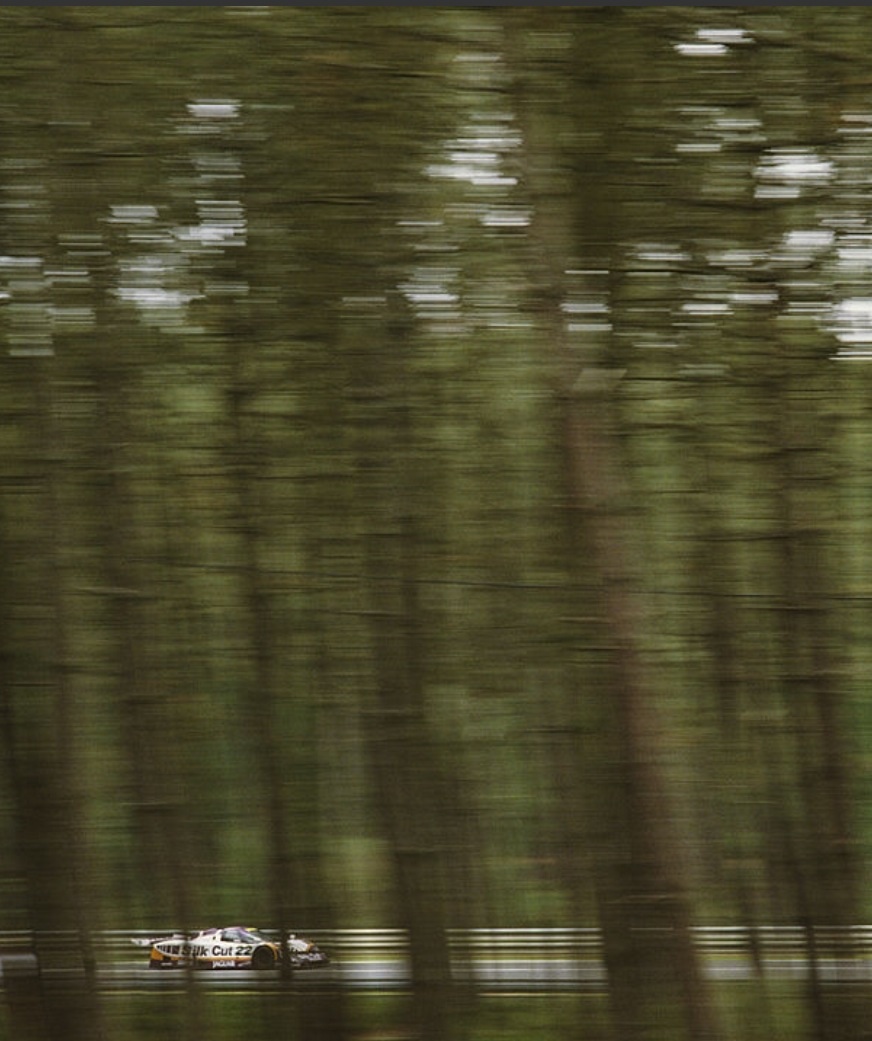
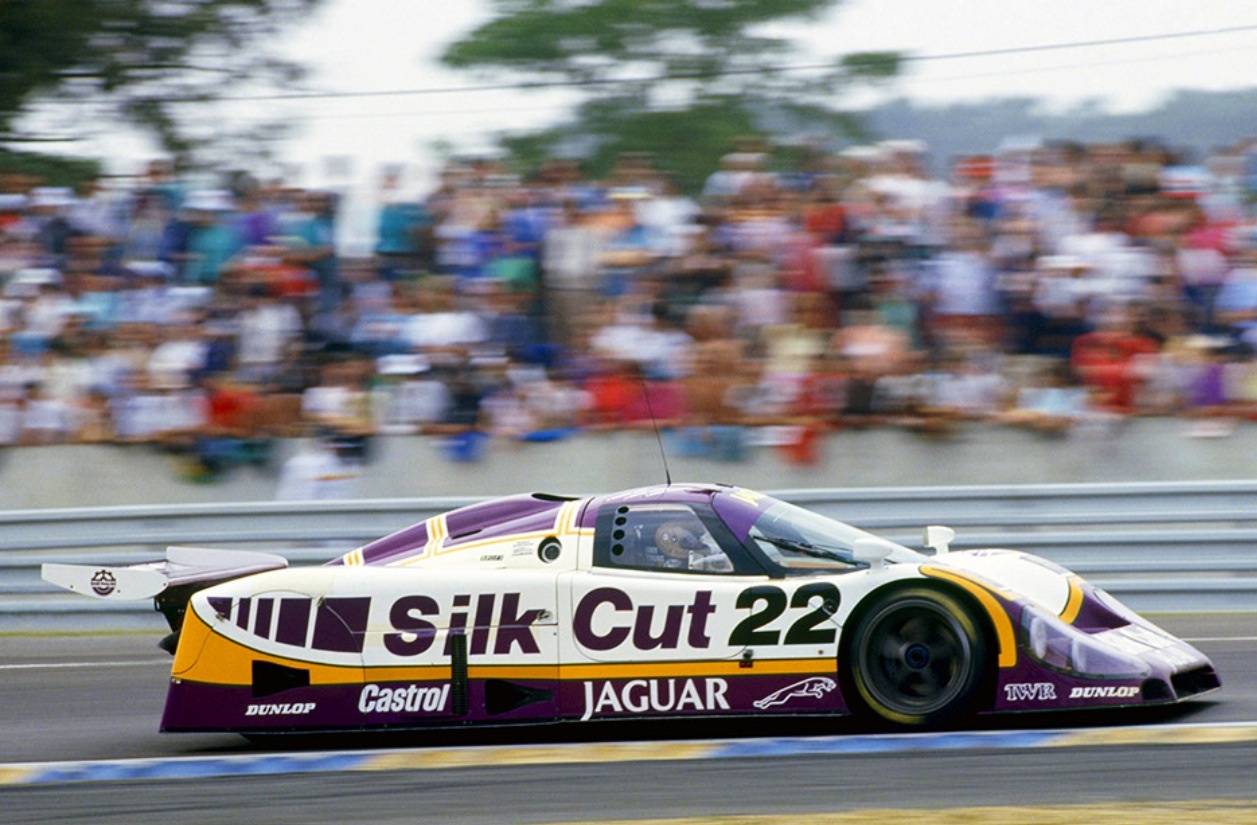
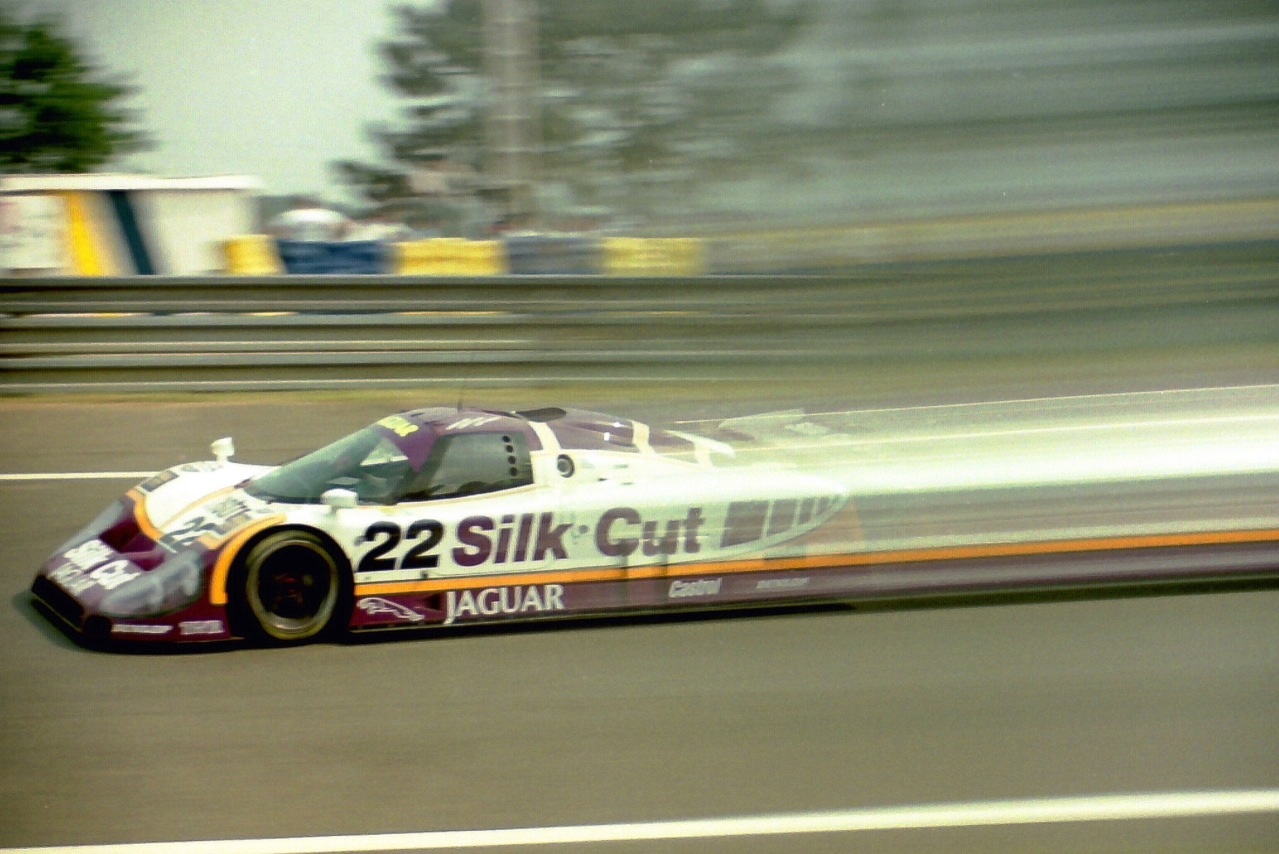
Larry Perkins amidst the Le Mans forest finished 4th in the ’88 classic in this Jaguar XJR-9 V12…
The 7 litre car was co-driven by Kevin Cogan and Derek Daly finishing 11 laps behind the winning sister car of Johnny Dumfries, Jan Lammers and Andy Wallace.
A story about the amazingly talented driver/engineer ‘Larrikins’ international career inclusive of F3, F1, F Pac and the occasional sportscar race is one for another time…
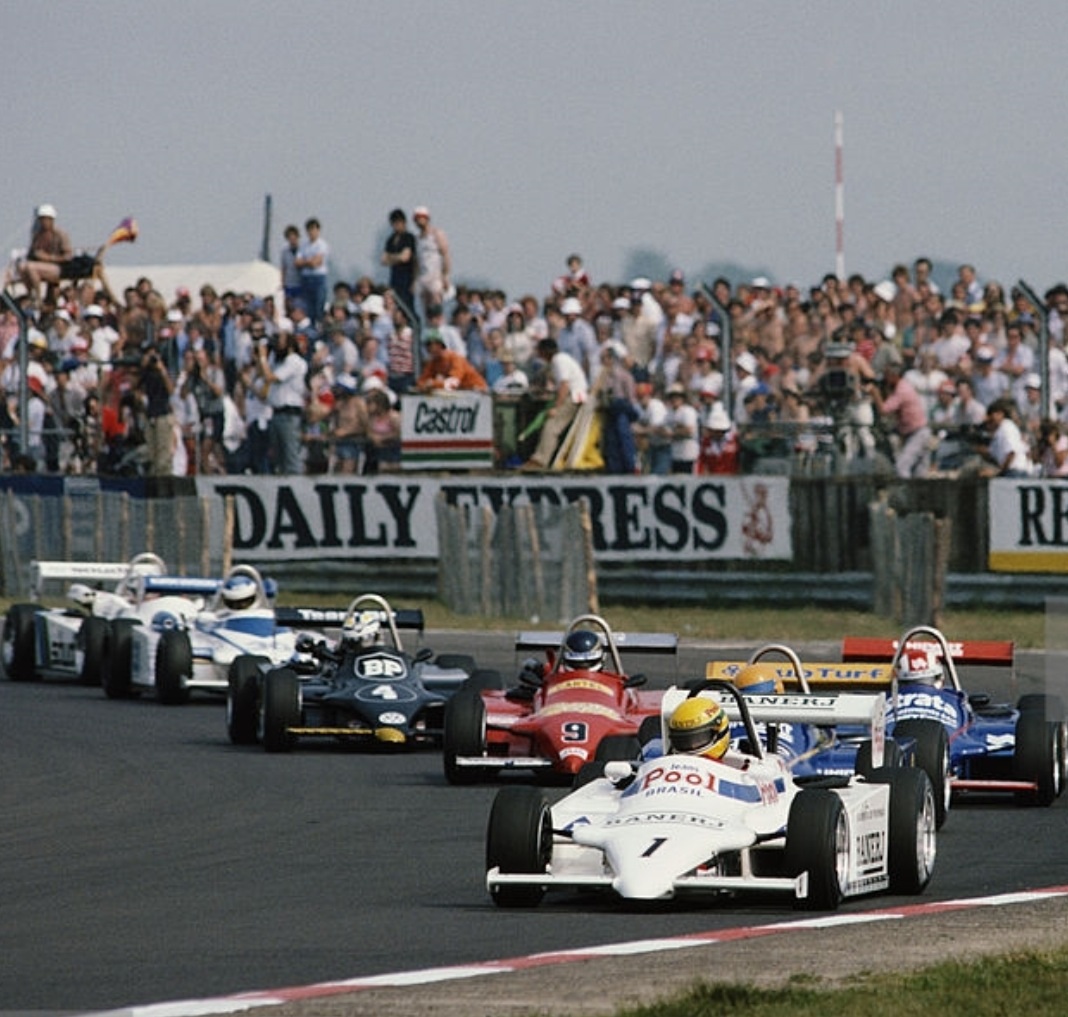
# 1 Senna, then Brundle, Allen Berg in the white/red helmet, #9 Eric Lang, #4 Calvin Fish all Ralt RT3/83, first lap British GP F3 race 16 July 1983 (Schlegelmilch)
Ayrton Senna has Martin Brundle right ‘up his clacker’ during the 1983 British GP F3 support race at Silverstone, Ralt RT3 Toyota’s both. Senna prevailed by a second over 20 laps, 16 July 1983…
And so it was for the season; Senna’s ‘West Surrey Racing’ entry took 12 wins and the title from Martin’s ‘Eddie Jordan Racing’ 6 wins but Brundle came ‘home like a train’ winning three of the last four rounds and setting up a thrilling last round confrontation, won by Senna at Silverstone on 23 October. Both drivers used the dominant Toyota 2T-G powered Ralt RT3/83, the car updated from the prior year in terms of sidepods and suspension geometry.
Both drivers jumped into Grand Prix racing in 1984; Senna with Toleman and Brundle with Tyrrell.
Credits…
Rainer Schlegelmilch, David Lister, oldracingcars.com
Tailpiece…
Senna #1 and Brundle on the front row of the 1983 British GP F3 support race. Ralt RT3/83 Toyota (Lister)
Austin Miller’s Cooper T51 Climax chases Bib Stillwell’s similar car at Reid Park gates, Mount Panorama, Bathurst on 2 October 1960, magic John Ellacott shot…
The two drivers are contesting the ‘Craven A International’ won by Jack Brabham from Bill Patterson, and Stillwell in 2.5/2.4 and 2.2 litre Cooper T51’s respectively. Miller retired his 2.2 litre engined car during the 26 lap race. Note the beautiful bucolic Bathurst surrounds of apple orchards and grazing paddocks, is a dangerous place, especially then, these cars mighty quick.
Jack was in the process of winning the 1960 GP championships for himself and Cooper, returning to Oz between the Italian GP at Monza on 4 September and season-ending USGP at Riverside on 20 November. He won the title with 5 wins from teammate Bruce McLaren and Stirling Moss (Lotus 18 Climax). Jack and Bruce drove ‘Lowline’ Cooper T53’s that season.
The tyre marks are from Doug Whiteford’s Maser 300S which had a component faiure earlier in the meeting.
The Gold Star title for Australia’s champion driver that year was won by Alec Mildren in another T51 but interestingly powered by a 2.5 litre Maser 250S ‘Birdcage’ engine.
I’ve already written an article or two about Stillwell.
Businessman, crop-duster pilot, publican, racer and Australian Land Speed Record Holder ‘Aussie’ Miller is an intensely interesting character, article coming soon! I know his son Guy having raced against him in FF and his engineer Geoff Smedley has helped with another article, must call ’em!
The shot below is also at Bathurst, its Austin heading across the top of the ‘mount. ‘Superior Cars’ signage is one of Stan Jones Melbourne dealerships.
Image from a 1939 promotional brochure to sell the car, not much has changed in the positioning of luxury high performance cars over the years, it’s just that online media is more important than print…
I’ve no idea what the seaplane is but am intrigued to know if any of you aircraft enthusiasts can pick it.
406 of these cars were built between 1934 and 1940. Powered by a 5.4 litre supercharged, 180bhp straight-eight, these elegant 2600Kg beasts topped 105mph and did a standing quarter in around 16.5 seconds.
The car above is the ‘ducks guts’ 540K Spezial Roadster of which only 25 were built, the brand association with the Hindenburg LZ-129 airship ended up rather a sub-optimal choice!
Jackie Stewart’s BRM P261 is pushed onto the Longford grid by Jimmy Collins and Stan Collier on 5 March 1966…
The race is the Launceston Examiner Trophy, the preliminary Longford Tasman round race, and Jackie is being moved onto pole.
Stewart won the main race, the South Pacific Trophy on the Monday from his teammate Graham Hill and Jack’s Brabham BT19 Repco- the new Repco ‘620 Series’ V8, 2.5 litres in Tasman spec, having its third race and gearing up for his successful world championship assault that year.
For the BRM boys it would be a more character building F1 year, mind you, Jackie took a great Monaco GP win in his nimble 2.1 litre P261 against the new 3 litre GP cars that May.
Stewart glides his BRM into Mountford Corner. Note the crossflow ‘inlet between the Vee’ spec of this P60 engine- the more ‘typical’ engine had the exhausts within the Vee (oldracephotos.com.au/DKeep)
The 1966 Tasman Series was a BRM rout.
The 1930cc P60 versions of the 1.5-litre P56 V8 engined cars won seven of the eight rounds- JYS took four victories and the title (Wigram, Teretonga, Sandown, Longford) Graham Hill two (NZ GP Pukekohe, AGP Lakeside) and Richard Attwood one (Levin). Jim Clark won the other round, the ‘Warwick Farm 100’ in his Climax FPF-engined Lotus 39.
The days of a Coventry Climax FPF winning the Tasman were over. From 1966 to 1970 the 2.5 Tasman Series was dominated by ‘multi-cylinder’ V6 and V8 engines of F1 and F2 extraction.
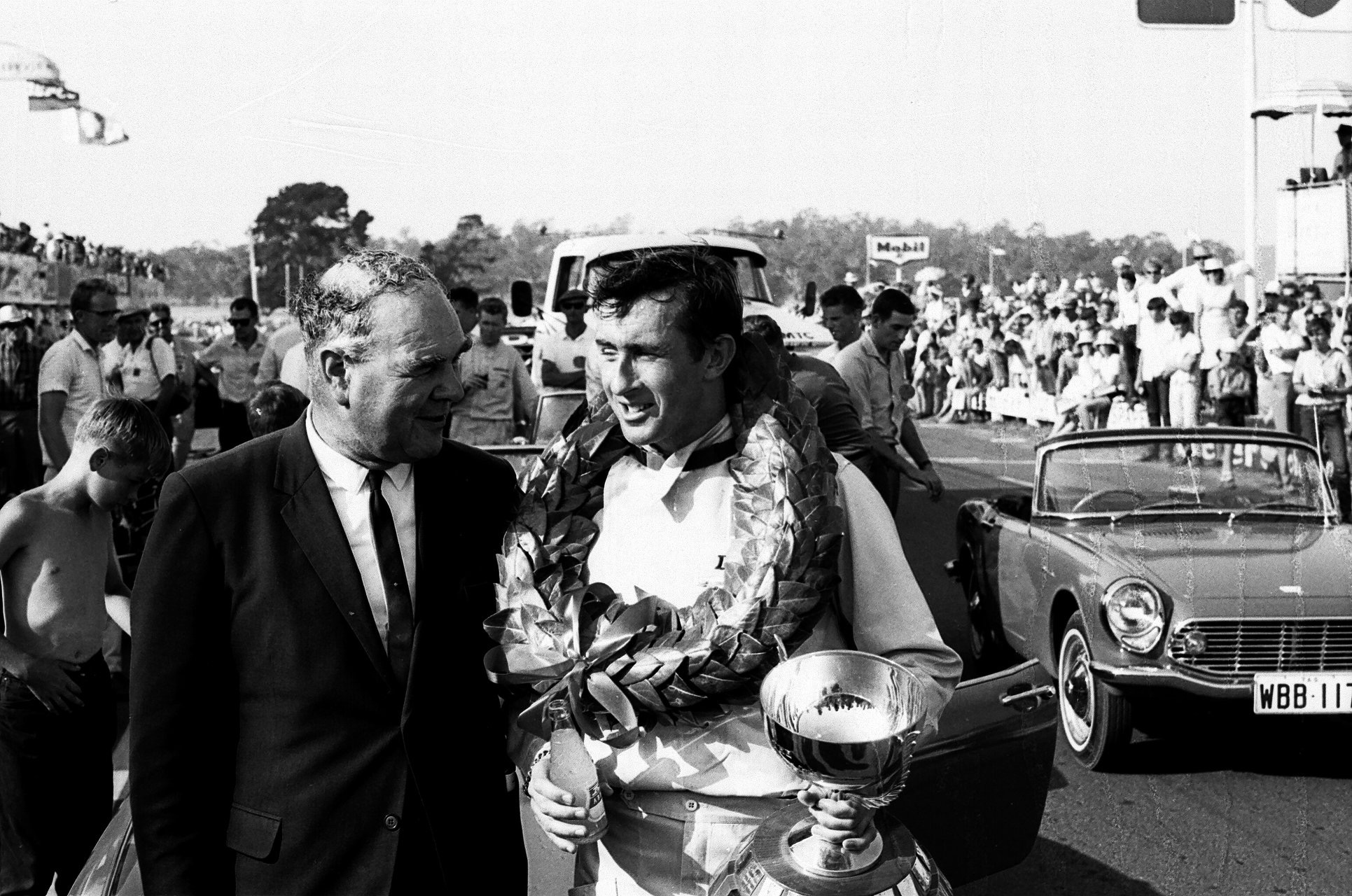
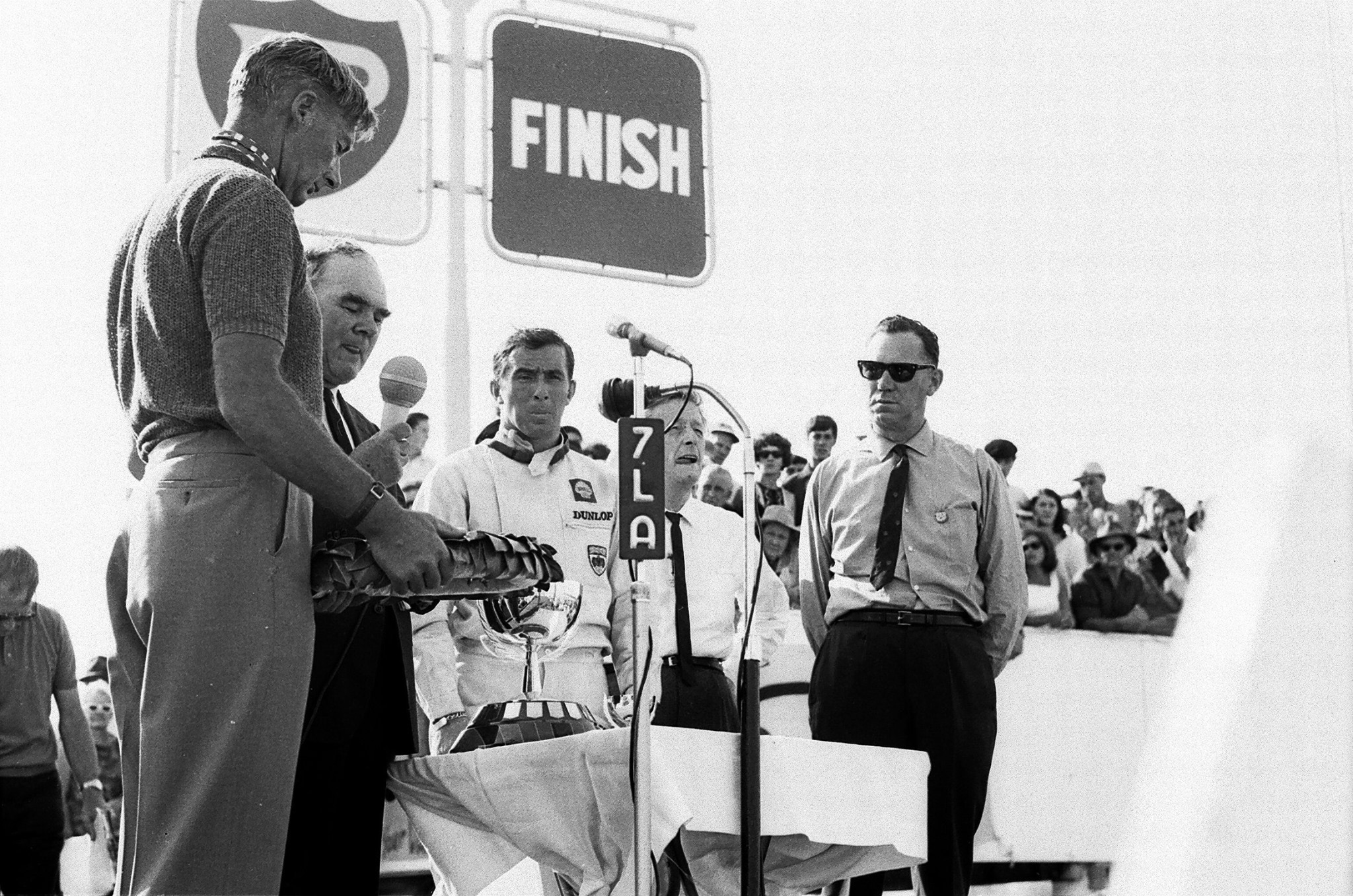
JYS and Eric Reece, Tasmanian Premier (HRCCT)
Lindsay Ross of oldracephotos captured the feeling at the time, ‘After his win at Longford in 1966, a lot of Tasmanians were now aware of Jackie Stewart and I, along with no doubt many other enthusiasts, began following his career.’
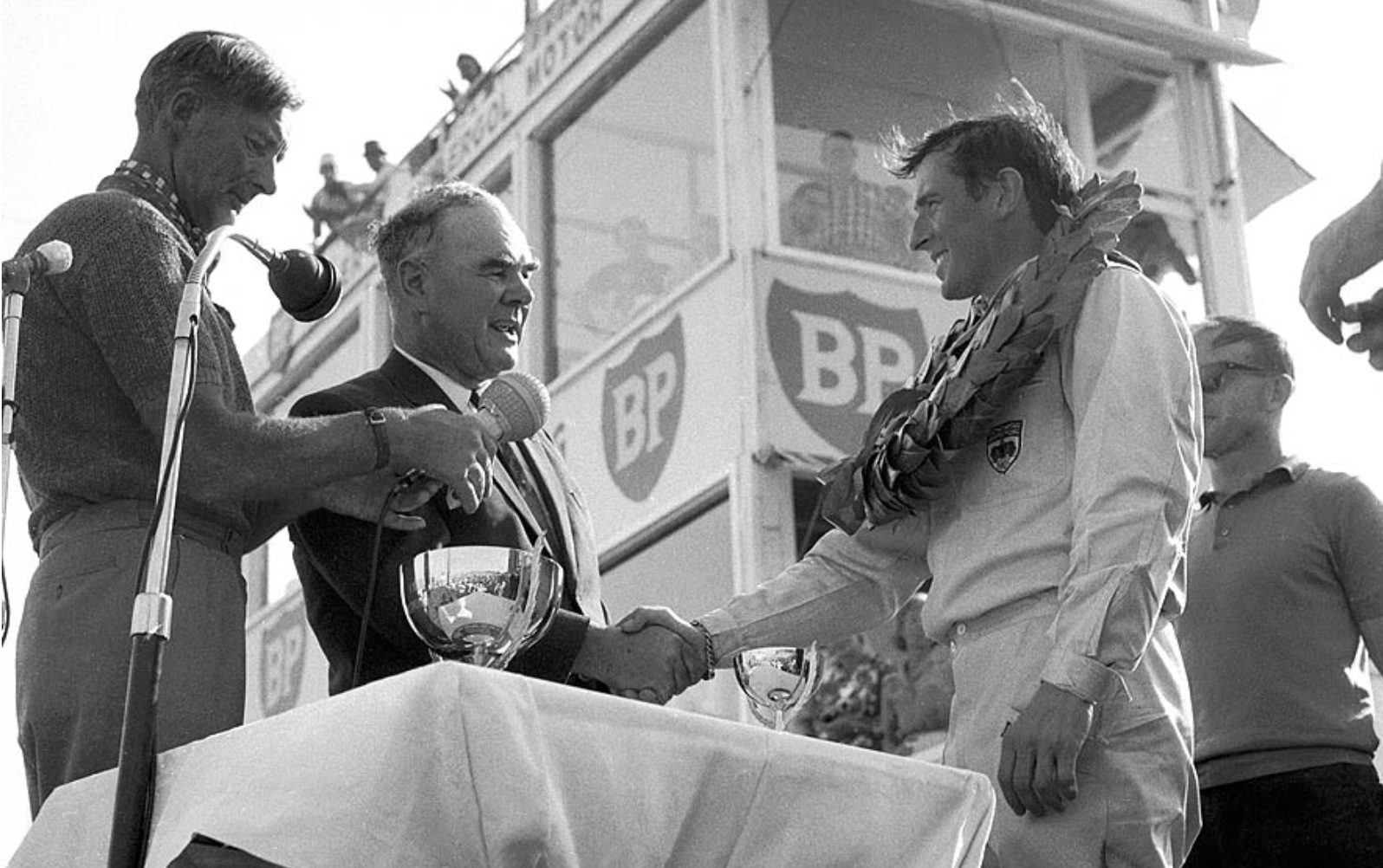
‘The podium shot has him shaking hands with Tasmanian Premier ‘Electric Eric’ Reece, who was the driving force behind Hydro-Electric power in the state. He also made sure the Longford roads were laid with the finest hot mix bitumen available. Ron MacKinnon of the Longford Motor Racing Association has the microphones- he owned much of the land around the Longford track.’
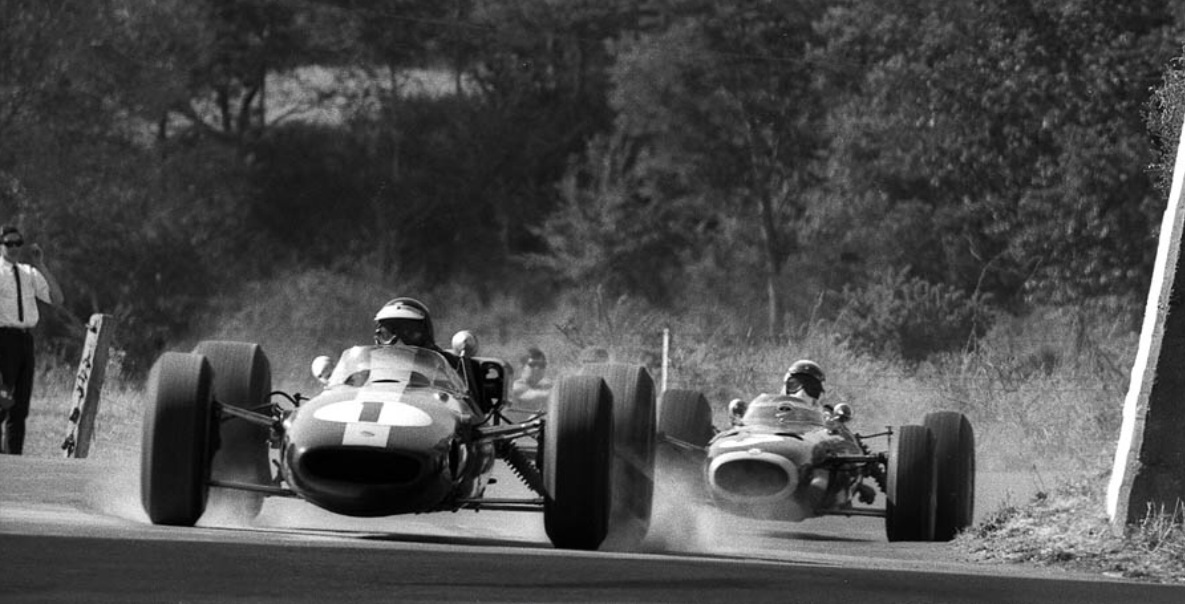
Jim Clark, Lotus 39 Climax in front of his fellow Scot at The Viaduct in 1966 (oldracephotos.com.au/DKeep)
Etcetera…
(HRCCT)
Brabham accelerates away from Mountford in BT19, surely the most photographed single-seater in 1966. The chassis was Brabham’s weapon in Tasman and GP competition pretty much all year.
Note the long inlet trumpets of the RB620 2.5-litre V8. Longford was the new RB620’s third race- a 3 litre unit was used in the non-championship South African GP at Kyalami, and another of 2.5 litres in capacity for the Sandown International in Melbourne the week before Longford. All three events in BT19- BT19-1 is still owned by Repco.
(HRCCT)
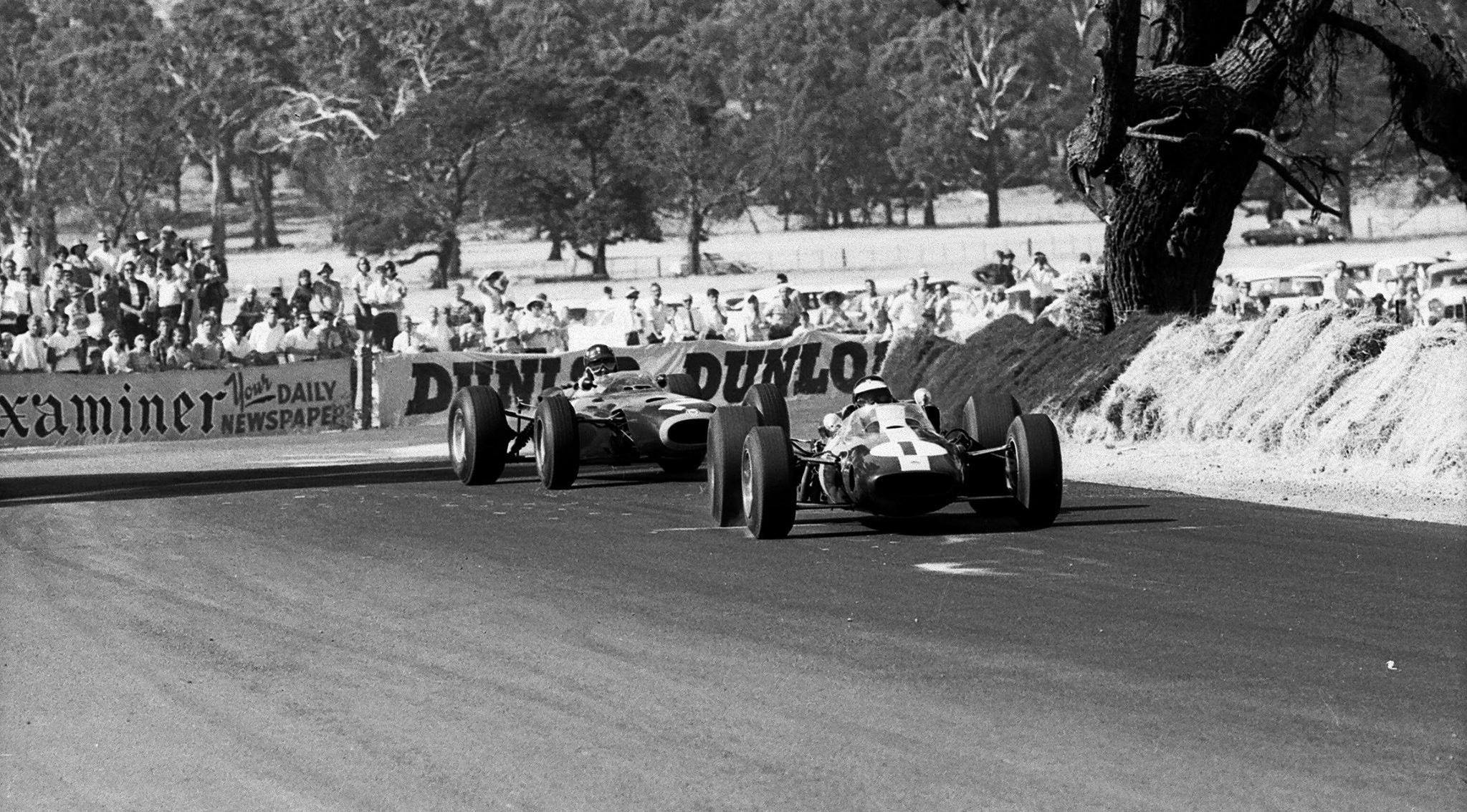
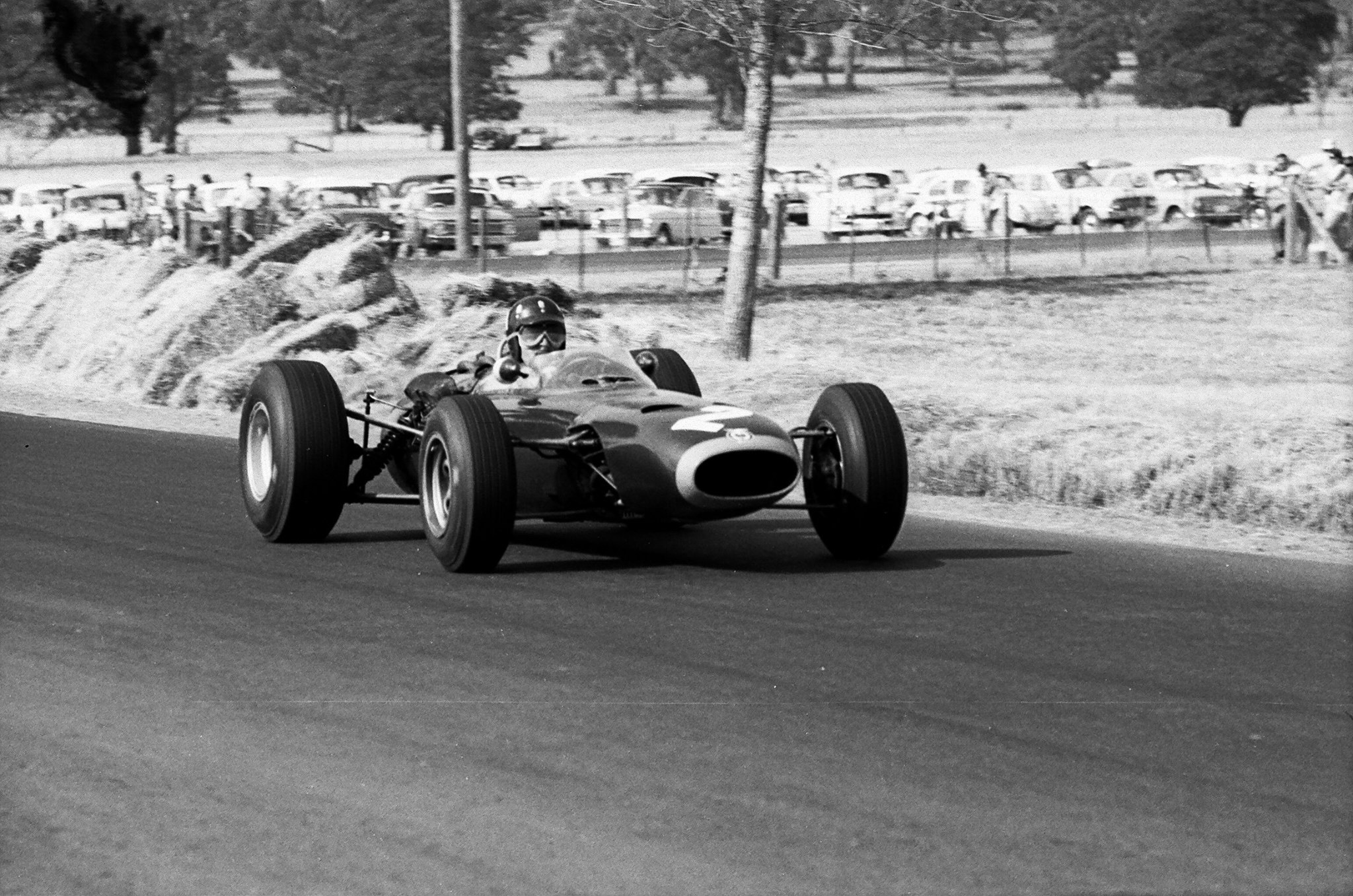
The next group of shots are all on the exit of Mountford- the corner onto the straight past the pits, here Clark’s Lotus 39 FPF from Hill’s BRM. The BRM’s solo are #2 Hill and #3 Stewart.
(HRCCT)(HRCCT)(HRCCT)
And another podium shot from a slightly different angle.
Stewart wheels his BRM into the left-hander under the famous Longford Railway Viaduct- a tricky, fast on approach, downhill corner with minimal run-off area should the pilot goof. Note the spectators on the hill and alongside the railway line at the top.
Deacon Litz lines up his Maser V8 RI for practice prior to the 1937 George Vanderbilt Cup at Roosevelt Raceway, Long Island, New York on 5 July 1937…
All four of these 4788cc, supercharged 320bhp V8 racers ended up in the US having proved totally uncompetitive against the Mercedes Benz W25 and Auto Union V16 challenge in 1935/6.
This car chassis ‘4501’ practiced but didnt’t start the Vanderbilt Cup, at that stage it was owned by the Bradley-Martin brothers who owned horse racing stables under the name ‘Balmacaan’, it was in this name the car was entered.
The Mercedes, Auto Unions and latest Alfa’s weren’t available ex-factory so the latest Masers on paper were appealing but in reality second-hand Bugatti Type 59 or various Alfa’s would have been better bets.
‘4501’ remained in the ‘States, failing to qualify for the Indy 500 on every occasion it fronted up; in 1939, 1946, 1947, 1948 and 1949 finally being ‘pensioned off’ at this point for SCCA racing…
Credit…
Archive Photos
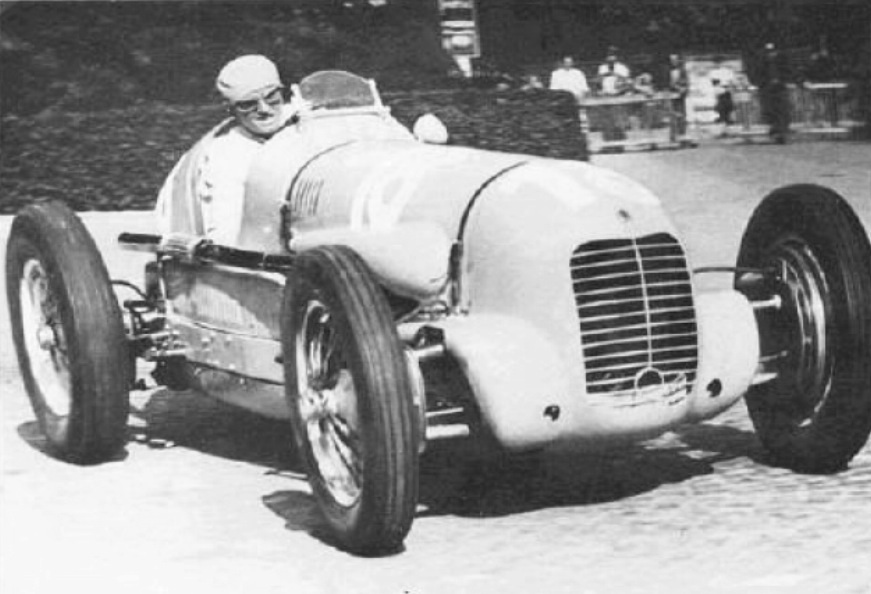
Tailpiece: Philippe Etancelin winning the 1935 Pau GP in a Maser V8 RI…
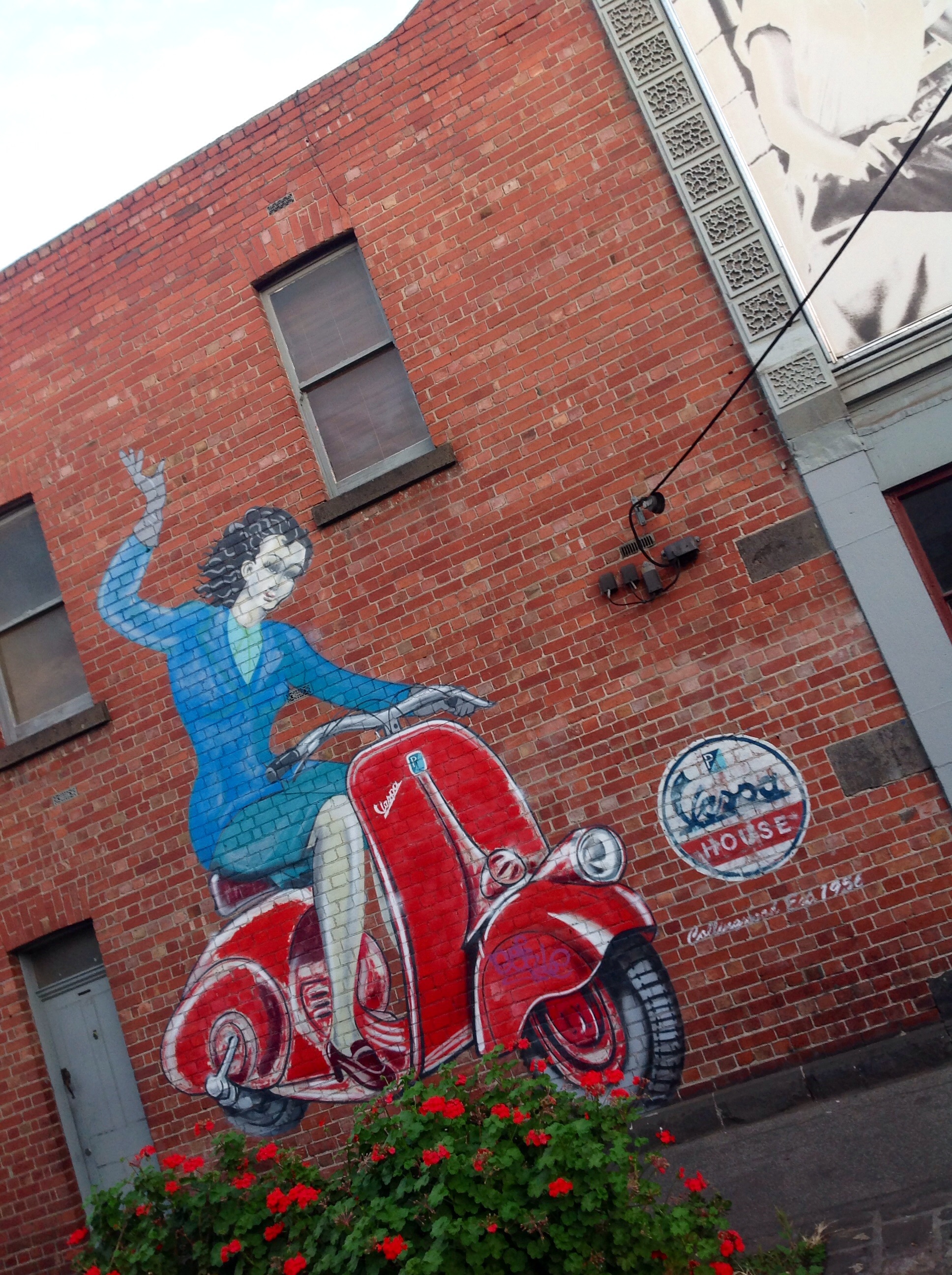
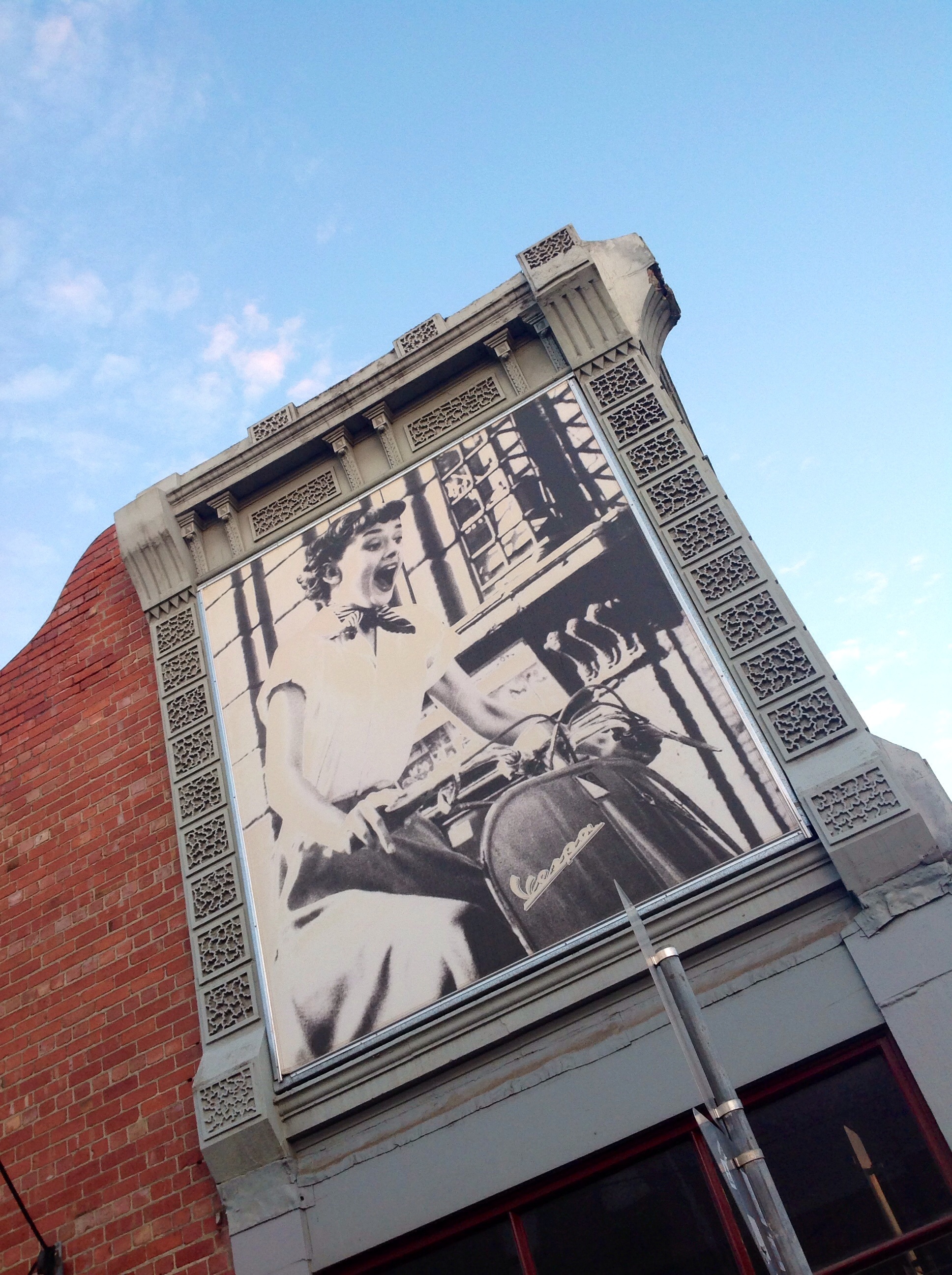
This is ‘Vespa House’ just around the corner from my joint in Johnston Street, Collingwood in Melbourne’s inner east…
I’m a fan of street art and always get a lot of pleasure from the work of urban artistes near me. I love the whole Vespa culture thing too, i think its about time i bought one.
The development of Australian inner cities is nowhere near as dense as most of those of Asia and Europe, fundamentally its a thing of the last 20 years. Before then most of us lived on quarter-acre suburban blocks. Post kids many of us have ‘moved in’, i’m one of those schmucks clogging up our inner city roads. Mind you, i’m only 3 km from Melbourne’s GPO so i get around on foot, by train and especially tram. Melbourne’s ‘Myki’ is London’s ‘Oyster’ card and works pretty well.
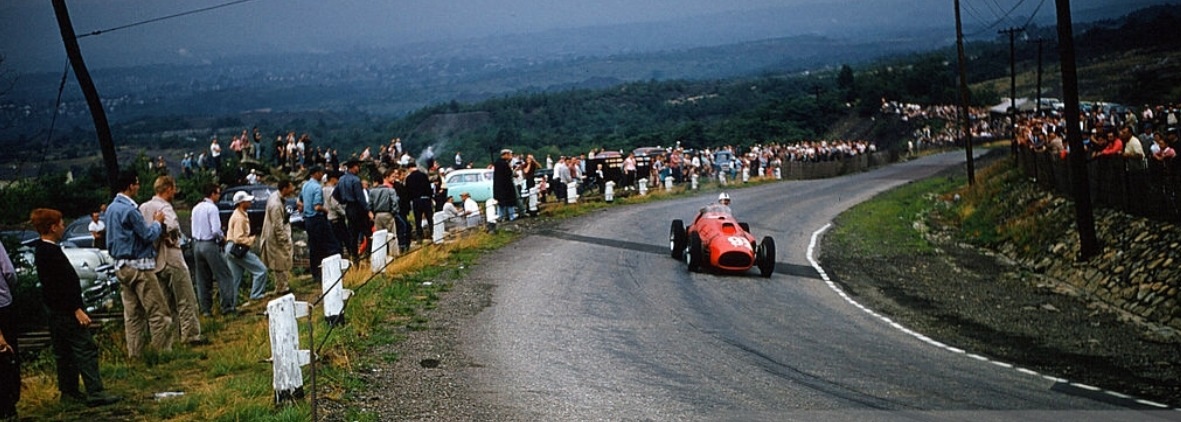
Stirling Moss cruising back to the pits, off the racing line on the Curva Grande, deep in thought…
The gearbox in his Vanwall failed during his dice with Mike Hawthorn’s Ferrari Dino 246 and with it his hopes of the 1958 World Championship, won of course by Hawthorn in Morocco a month later.
As to the other car and driver, my guess is Cliff Allison’s Lotus 12 Climax. All other entries welcome!
Tony Brooks won the race in another Vanwall VW 57 from Hawthorn and Phil Hill’s Dino’s after a stunning drive in his second GP, his first for Ferrari.
Carroll Shelby delicately guides his Ferrari 375 up the slippery Wilkes-Barre, Pennyslvania, Hillclimb setting a course record of 58.768 seconds for the on 20 July 1956…
Later Grand Prix driver and ’59 Le Mans winner, Shelby’s Ferrari was one of four 375’s sent to the US to race at the ’52 Indy 500, the car raced by Alberto Ascari was the only car to qualify, i wrote about the 375 a while back;
The 375 then was owned by John Edgar, Shelby raced it for him at three ‘climbs in 1956; ‘Mt Washington’ on 15 July, the following week at ‘Giants Despair’ and finally ‘Breakneck Hillclimb’ on August 5th. No doubt the 4.4 litre, 380bhp F1/Indy car was quite a challenge on the tight hillclimb courses!
Historian Michael Lynch noted; ‘…the body had been modified since the car ran at Indy. The cars original serial number was simply no 1. That was then changed to #0388 in Ferrari’s normal sportscar numbering series, probably when the bodywork was modified’.
‘Giants Despair’ was first used in 1906, the event is one of the oldest continuing motorsport venues in the world, held over a 1 mile course and the hill rises 650 feet with grades of 20% over its 6 turns.
The hill starts with a long gently rising straight of 1/4 mile long which leads into a fast left-hander, then onto a short chute and then ‘Devils Elbow’ a sharp rising hairpin. Then their are series of 90 degree turns connected by short straights. Finally comes the ‘The Incline’ a 1/4 mile stretch which rises a little over 20 degrees to the finish.
The best time in 1906 was 2 minutes 11.2 seconds, by Hugh Harding’s Daimler. The record is currently held by John Bourke, 38.024 seconds in a ’97 Reynard Indycar, click on the link for his record run in 2014.
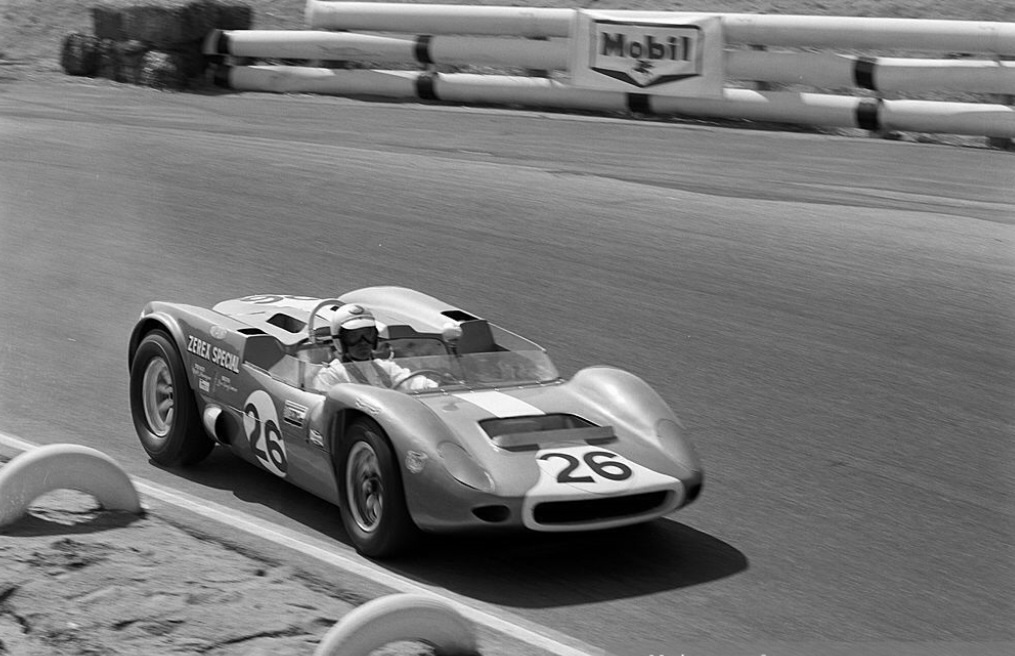
Walt Hansgen hustles his Scarab Mk4 Chev around Riverside Raceway during the 1964 LA Times Grand Prix…
Parnelli Jones won in a Cooper ‘King Cobra’ Ford, the event run on 11 October 1964. Roger Penske was 2nd in a Chaparral 2A Chev and Jim Clark 3rd in a Lotus 30 Ford. Walt didn’t finish the race with an oil leak but the speed of the car was proven with 2nd grid slot, McLaren’s McLaren Elva Mk1 Olds was on pole, Bruce also DNF with a loose water hose.
This was the last of the Scarabs, i will get around to an article on the sports-Scarabs soon.











 primotipo...