Archive for the ‘Sports Racers’ Category

(B Williamson)

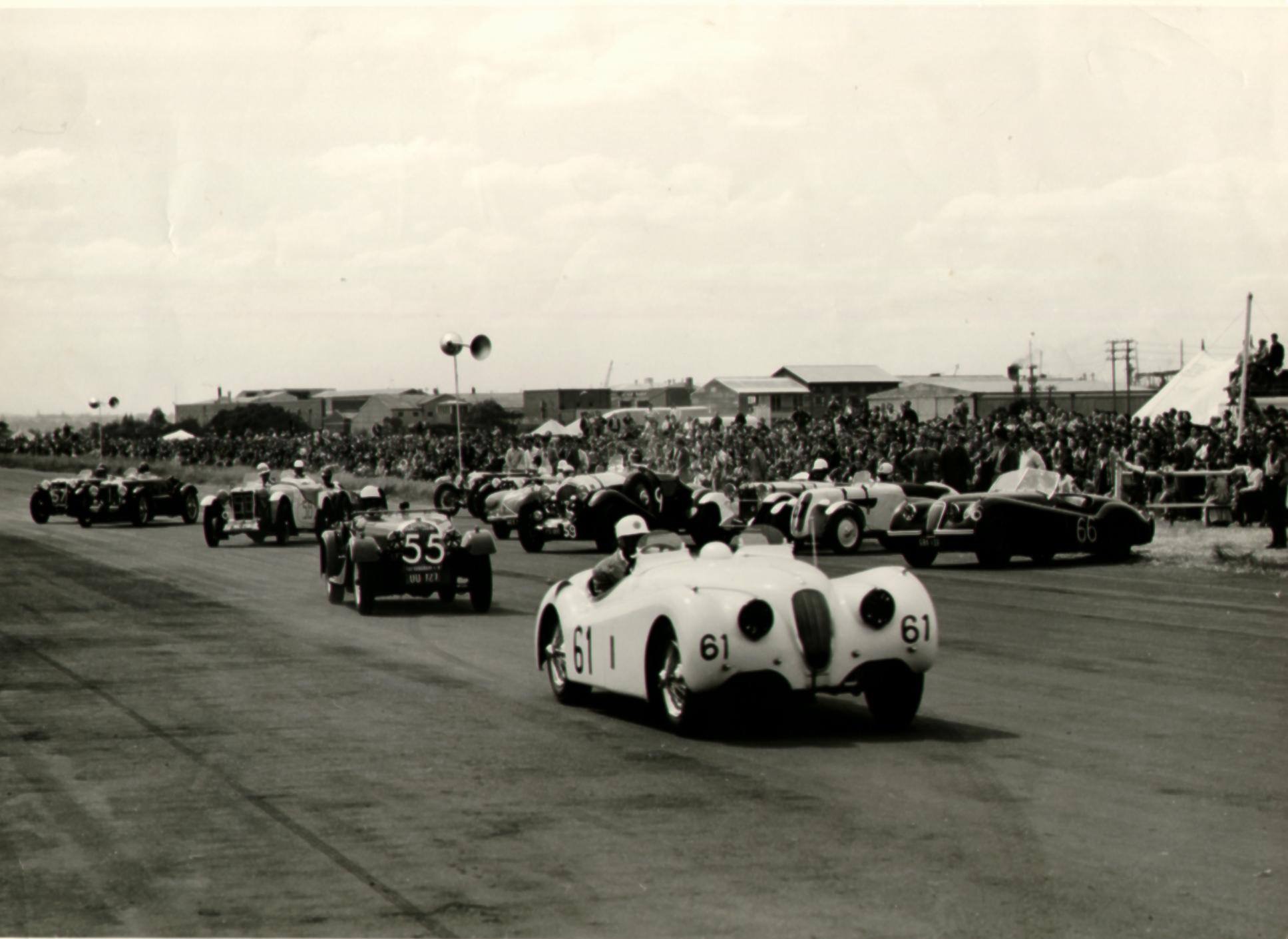
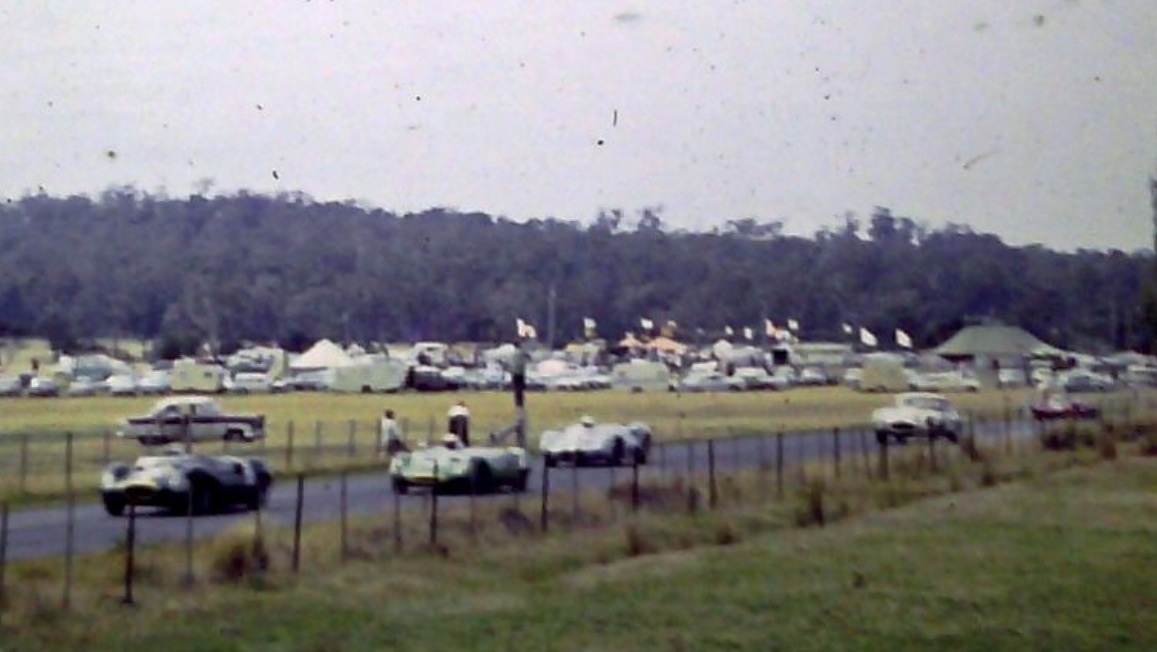
The drivers of the 20 March 1954, Fishermans Bend, Melbourne, Sports Car Race make for their cars…

Event Four on the program was of 12 laps, the journey started at 1.45 pm and was won by Melbourne transport businessman, Kevin Neal- the dude in the sports-jacket aboard the number 61 Jaguar XK120, his main competition according to Terry McGrath, was Harry Firth is his supercharged MG TC Spl.

From the front is the #66 GC Newton XK120, #61 car of Neal, the 3 litre Meadows engined Lea Francis of J Robinson, then the big 3 litre Bentley owned by Haig Hurst- you can just see car #55, the RH Reynolds Morgan Plus 4.

Other notables entered include Graeme Hoinville, MG TC (which he still owns), John  Sawyer, of later Bob Jane Racing fame in a K3 MG, Earl Davey-Milne in a Fraser Nash (which he still owns), Frank Porter, a later prominent touring car racer well into the late seventies, and P McKenna in the 1948 AGP winning BMW 328- you can see that light coloured car second in line behind the dark Jag, both still not off the start-line.

(T McGrath)

Its Neal away with a blinder of a start in his supercharged Jag from the Reynolds Morgan whereas the bulk of the field seems afflicted with problems caused by the ‘Prince of Darkness’- Lucas Electrics, or is that a tad unfair?

The light coloured car behind the Morgan is the RG Davis MG TC and the dark coloured one at the very back of the cars on-circuit is the Hoinville TC.

Click here for an article on Fishermans Bend; https://primotipo.com/2016/04/15/fishermans-bend-melbourne/

Neal progressed into some pretty serious motor cars including a Cooper T23 Bristol and the ex-Reg Hunt Maserati A6GCM with which he contested the 1956 AGP held not too far away in Albert Park. Click here; https://primotipo.com/2017/12/12/hunts-gp-maser-a6gcm-2038/

Credits…

Bob Williamson and Terry McGrath Collections, Stephen Dalton for the car identifications

Finito…


Michael Douglas, actor, Gunilla Lindblad, model and Pete Duel, actor with a Lola T70 at Ontario Speedway in 1970…

The Vogue photo-shoot is for the ‘Me+Plus’ by Catalina ensemble and Endura watch worn by Gunilla. I wonder how they sold? Of more interest is which Lola T70 chassis it is?

Douglas, then 26, ‘broke through’ in the 1969 CBS-TV ‘Playhouse’ special called ‘The Experiment’- the ‘Streets of San Francisco’, no doubt familiar to many of us, was still a couple of years hence.

Credits…

JP Zachariesen

(oldracephotos.com.au/JEllis)

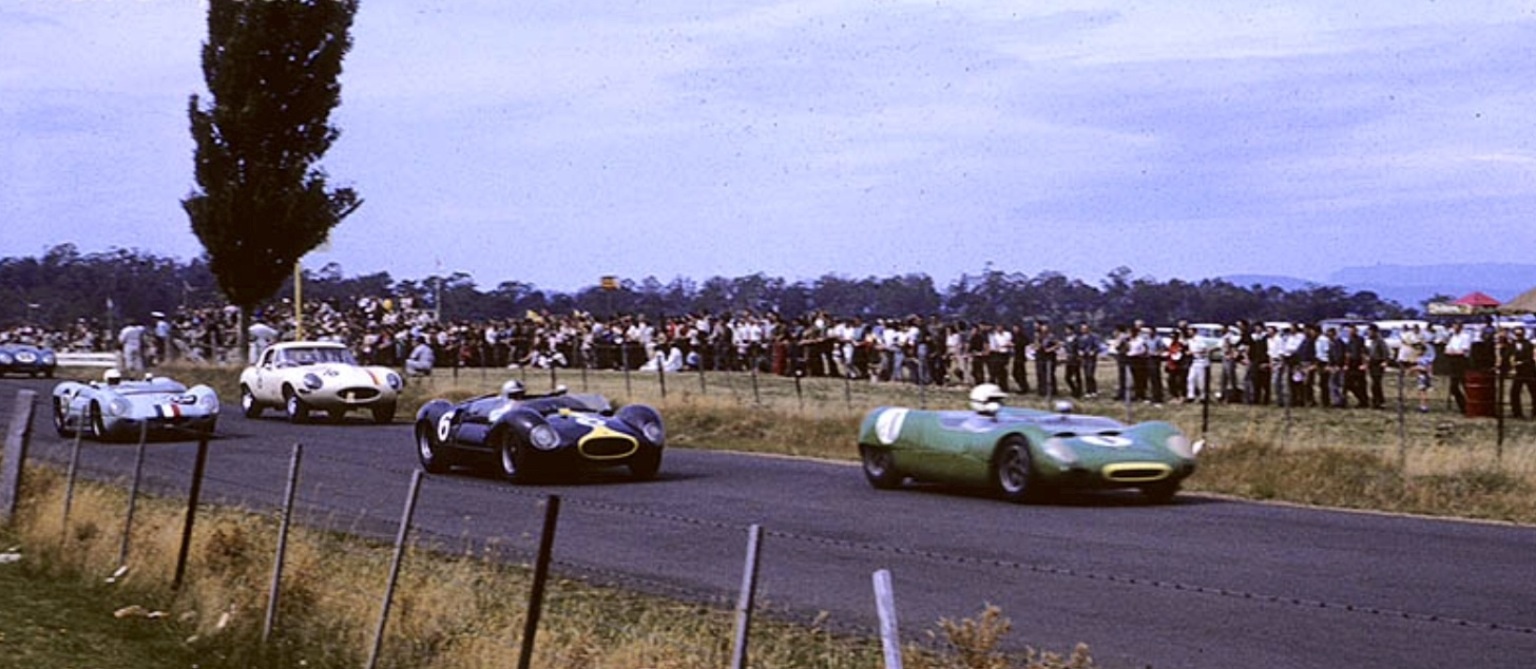
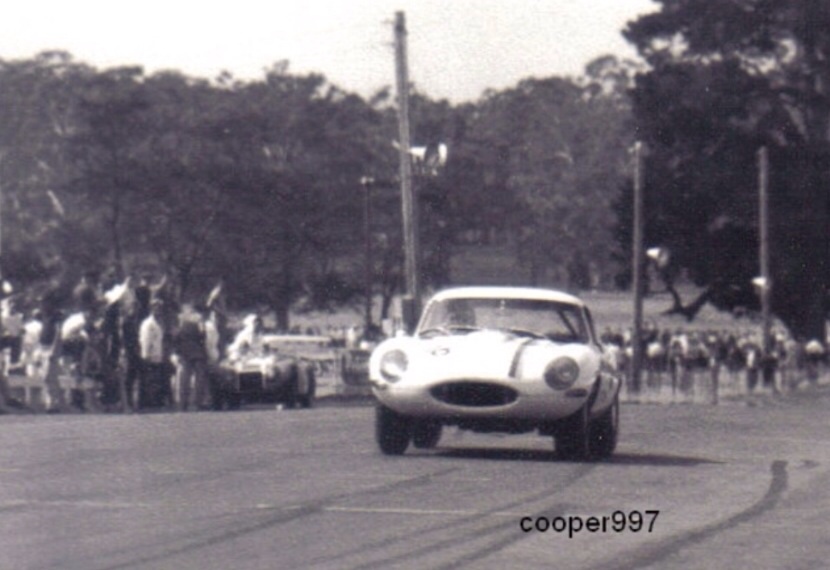
Frank Gardner leads a twenty-three car field away at the start of the 23 lap, 103 mile 1964 Australian Tourist Trophy, Longford on 29 February…

Gardner is aboard Alec Mildren’s Lotus 23B Ford 1.6 from Bib Stillwell, Cooper Monaco Climax FPF 2.7, Frank Matich, Lotus 19B Climax FPF 2.6 and Bob Jane, Jaguar E Type Lightweight and then in the distance is Frank Coad in the Lotus 15 Climax FPF 1960cc which Derek Jolly raced to win this event at Longford in 1960.

The Lotus was for sale, with Coad in Melbourne, close to potential East Coast potential purchesers, rather than in Adelaide where Jolly lived. ‘Hoot’ Gibson bought it for Bevan to race not so long after this, he drove the wheels off it of course, on the way to a drive with Bob Jane Racing several years down the track.

Matich (Brabham BT7A Climax obscured) and Jane seem to have found a nice bit of concrete on which to base themselves for the weekend. Or is a purpose built bit of ‘wheel alignment’ concrete? (oldracephotos.com.au/Smith)

Bob’s E Type had not long been in Australia, it first raced at Calder in December 1963.

Mildren’s Lotus is a new car whilst the great rivals in ‘outright’ sportscars- and from about then single-seaters too with the Matich acquisition of a Brabham BT7A, Stillwell and Matich are racing well developed cars- the 19B was FM’s second Lotus 19, whereas Bib had been racing the Monaco since September 1961.

(S Dalton)

Who is that pushing the Lotus into position with Matich- Bruce Richardson or Geoff Smedley? Gerry Brown is behind the Stillwell Monaco perhaps- click here for plenty on that wonderful machine; https://primotipo.com/2015/03/10/bib-stillwell-cooper-t49-monaco-warwick-farm-sydney-december-1961/

(S Dalton)

Whilst the opening photo immediately after the start shows Gardner getting the initial jump, 2.7 litres of Coventry Climax torque cannot be denied with Stillwell running strongly as the field contemplates the run up the hill past the Water Towers to the drivers left.

Gardner is second and Matich third, probably taking it easy off the line in deference to the somewhat fragile gearbox, then Jane and perhaps Greg Cusack’s Ford Cosworth 1.5 pushrod engined Elfin Mallala.

Matich looking for something in the Lotus cockpit- ‘his orange maybe’ as Stephen Dalton wryly observed (S Dalton)

The race was disappointing in that Stillwell and Coad were disqualified for push-starts, neither car was fitted with an operable self-starter- whilst Gardner was a DNF with gearbox problems after completing 23 laps.

Stillwell led from start to finish and had the time to make two stops to argue the toss with officialdom- and still was in front of Matich who stayed with Stillwell early- until Bib was disqualified, then Frank eased back confident he would be adjudged the winner.

FM won in 61.18 minutes at a race average speed of 101.25 miles per hour (fastest lap 2:33.0) with Stillwell protesting that his starter motor was operable but wouldn’t start the engine! Jane was second (2:43.3) and Greg Cusack, Elfin Mallala Ford 1475cc, third, a lap behind (2:48.4).

Les Howard was fourth in his Lotus 23 Ford 1098cc, 2 laps adrift (2:57.9), he had a great scrap throughout with the Coad 2 litre Lotus 15 (disqualified) with Bryan Thompson’s Elfin Mallala Climax fifth and John Edwards- the first Tasmanian home, sixth in his Morgan Plus 6 1998cc (3:15.8) 4 laps behind Matich.

Cusack was timed at 140 mph on ‘The Flying Mile’, Matich 150, Stillwell did 156 mph- as did Jane’s E Type.

Checkout ‘Long Weekend at Longford’, a superb Tasmanian Government film of the 1964 Longford weekend, it has excellent coverage of this race, apart from the rest of it which oozes with the relaxed atmosphere of the times.

Thomson’s Elfin Mallala exiting Newry Corner for the run down The Flying Mile (R Bell)

Greg Cusack was on the climb towards Australian National F1, racing a couple of Elfins- an FJ/WR375 and the Mallala sportscar which was derived from Elfin FJ componentry.

Two Mallalas raced that Longford weekend- Cusack’s Ford powered, third placed car and one driven by Shepparton racer, and later Touring Car/Sports Sedan drawcard, Bryan Thomson. The Thommo car was Coventry Climax powered, that 1.9 litre machine was eighth.

(oldracephotos.com.au)

The Thomson Elfin Mallala at rest in the paddock, I’ve long thought the Mallala was the prettiest of all of Garrie Cooper’s sporties. Five of the cars were built in 1962-3 based on the hardware also used by Cooper in the Elfin FJ single-seaters I wrote about a short time ago- all still exist.

As to the drivers of the ‘Humpy’ Holdens, please let me know.

(S Dalton)

Jane above passing the pit complex. Is that the Kerry Cox driven Paramount Jaguar in pitlane?

Matich on his merry way below- a very successful car with quite a few Brabham suspension components by the time FM and his boys had finished with it.

(S Dalton)

Credits…

oldracephotos.com.au, Stephen Dalton Collection, Mr Ramsay, Ray Bell

Etcetera…

(Ramsay)

Bevan and Hoot Gibson going for a blast around the streets of Mansfield in the newly acquired, immaculate Lotus 15 Climax, circa 1964- I love this shot, its just so ‘period’.

The story of the ex-works/Jolly/Gibson Lotus 15 is told here; https://primotipo.com/2017/11/09/dereks-deccas-and-lotus-15s/

(oldracephotos.com.au)

Tailpiece…

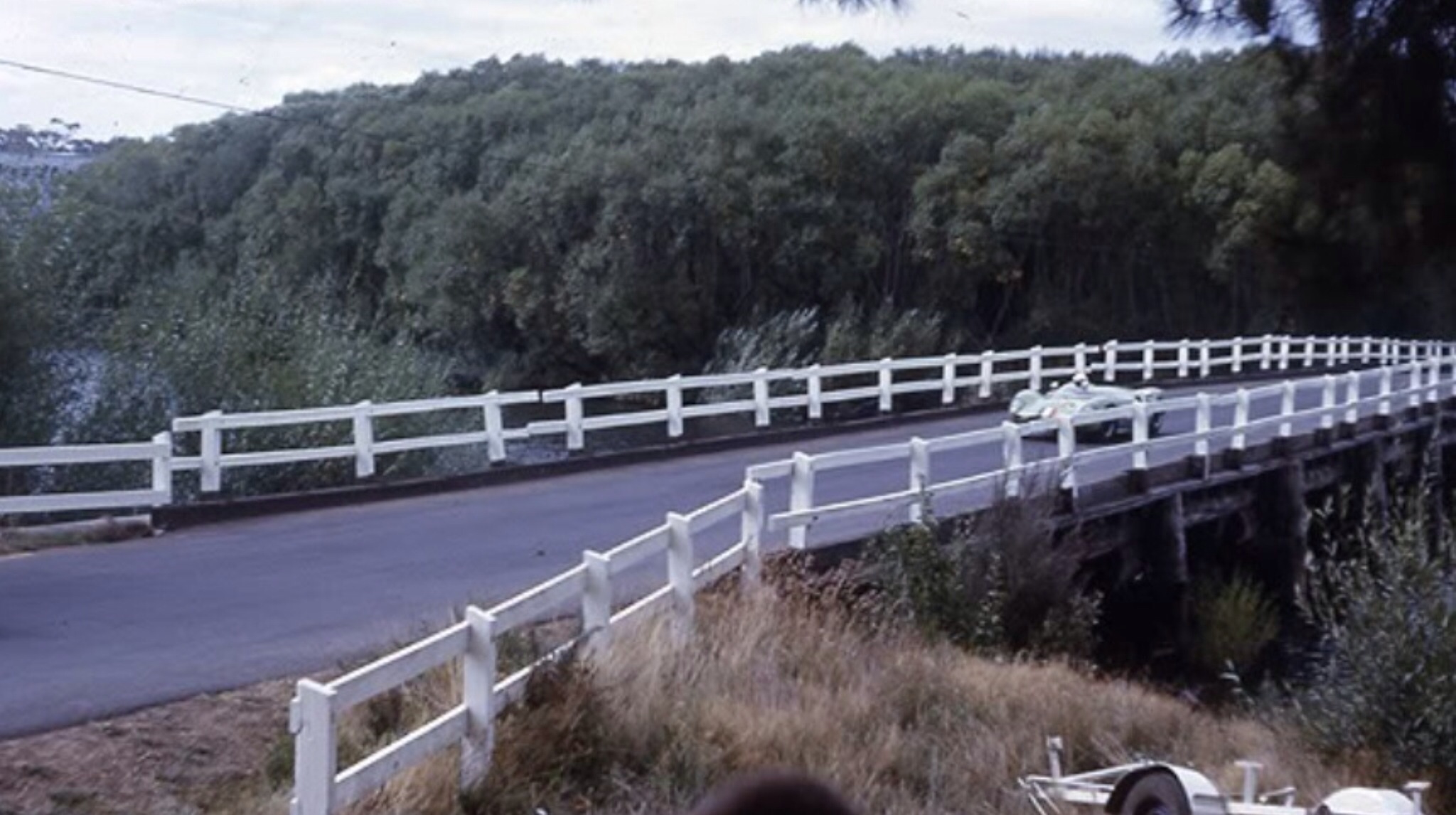
Matich, Lotus 19B on Kings Bridge- he turns to the right as he leaves the bridge in the direction of Longford village. Note the little boat/yacht trailer in the foreground. If memory serves there is/was a boat club in that part of the track?

The 19B met its maker at Lakeside in July 1965. Matich took the car to a Gold Star round we was contesting in his Brabham as preparation for the ’65 ATT, which was held that November and won by Pete Geoghegan in a Lotus 23B Ford. Matich had an enormous accident in the 19B pretty much destroying it and hospitalising himself.

Related thereto was the loss of his Total, the French oil company sponsorship- the local franchise of Total was acquired by Boral Ltd who were not interested in motor racing. As a consequence Matich went in a new direction- sportscars to the exclusion of single-seaters until 1969, the net effect was the purchase of an Elfin 400 Oldsmobile (aka the ‘Traco Oldsmobile’) with which he won the March 1966 Australian Tourist Trophy back here at Longford.

The Matich Lotus 19 story is here; https://primotipo.com/2017/09/08/bay-of-plenty-road-race-and-the-frank-matich-lotus-19s/

Finito…


Briggs Cunningham and his huge entourage of racers, technicians, pantechnicons and Caddies arrive in France for the 1954 Le Mans classic- ‘The Eagle Has Landed’!…

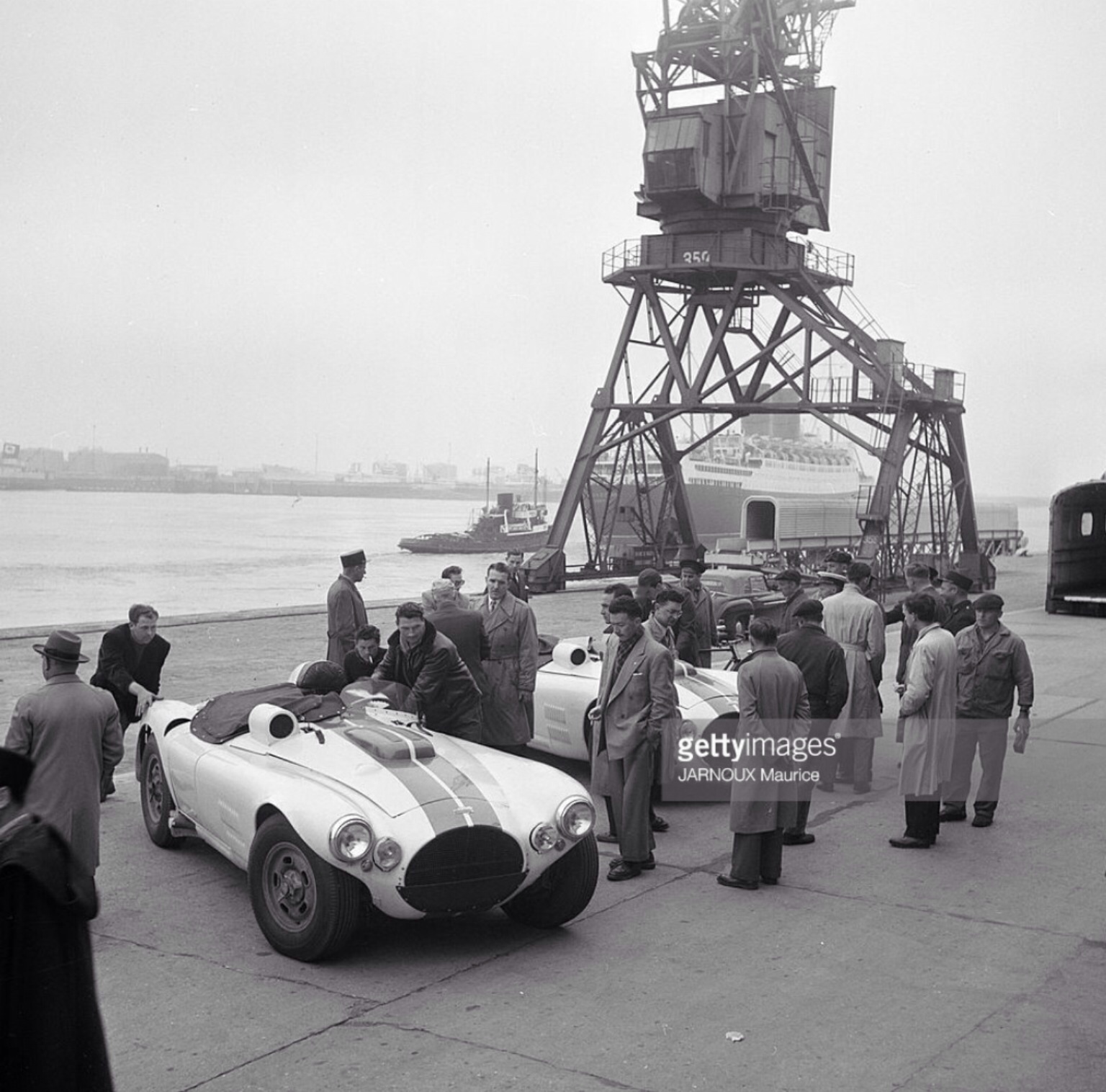
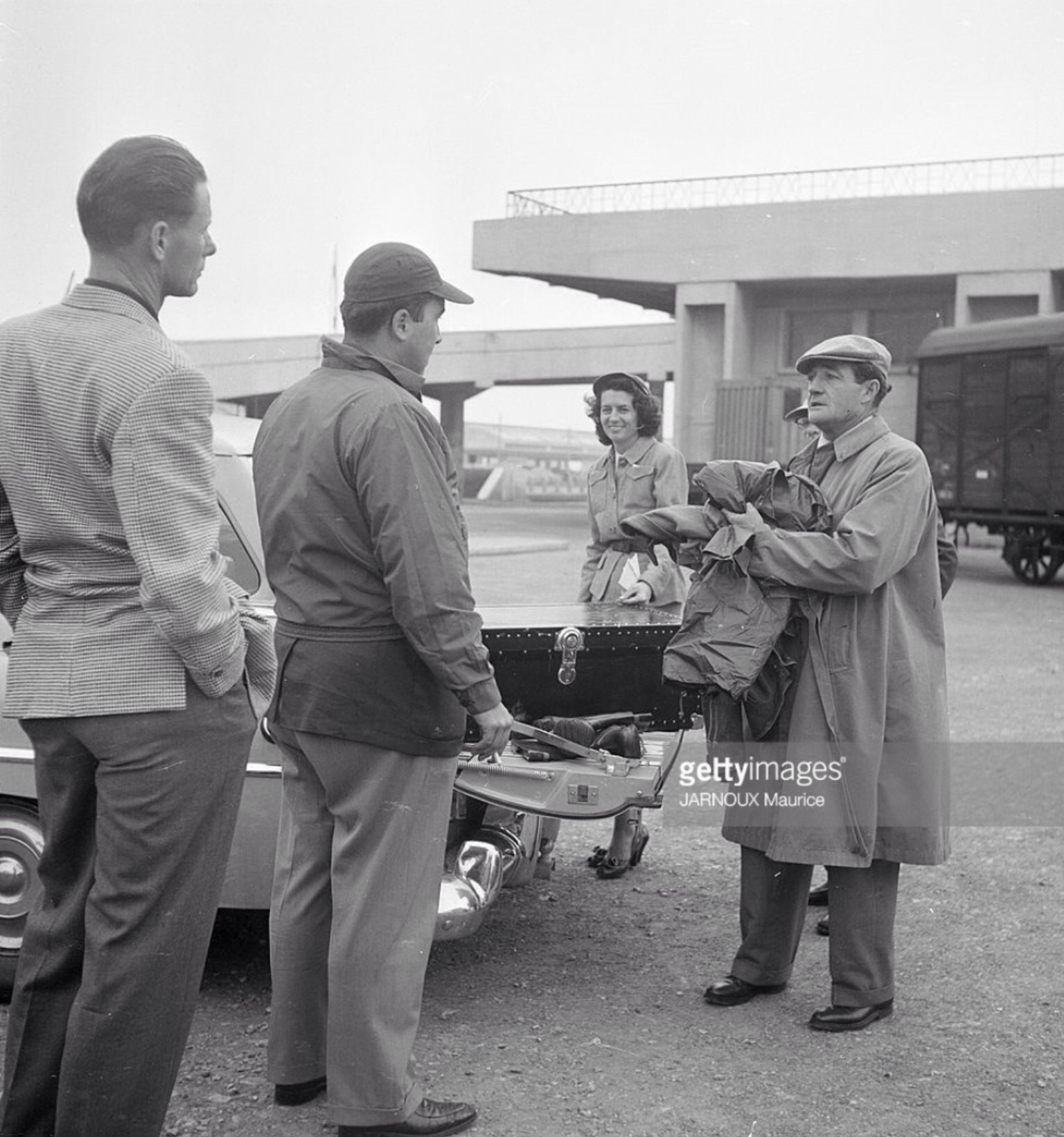
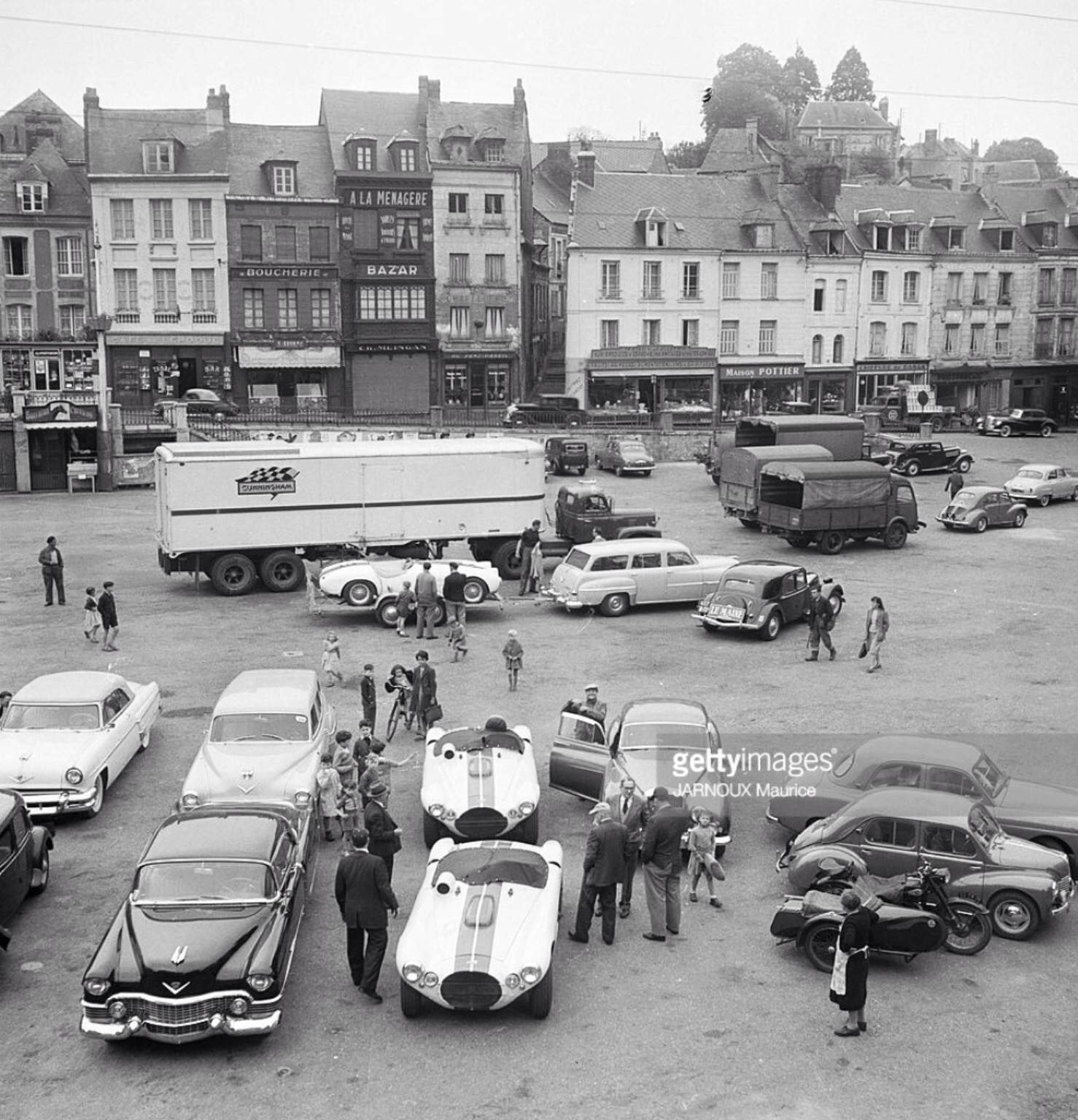
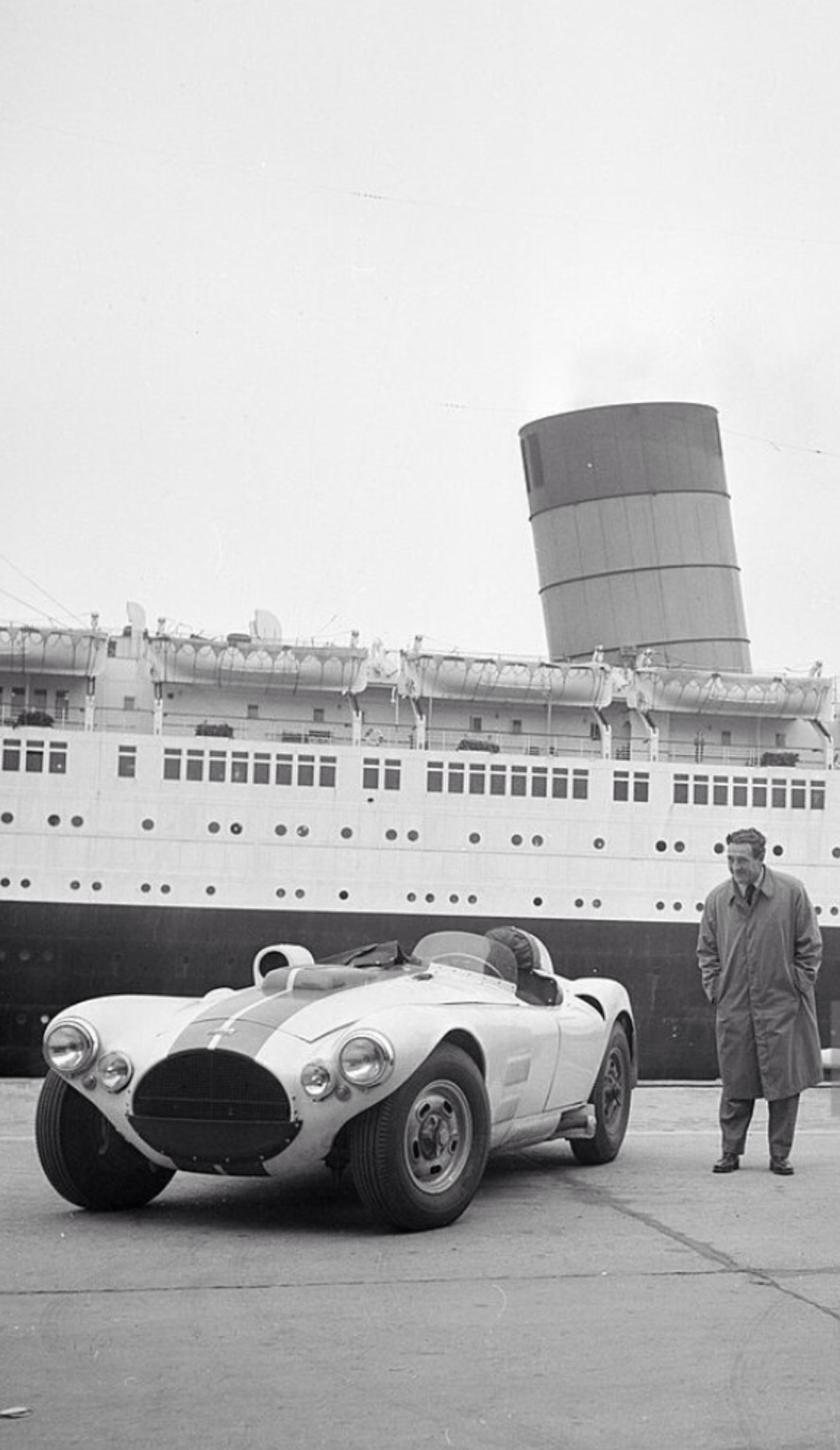
The racers are two Cunningham C4R’s whilst on the trailer is a Ferrari 375MM, the shot above was taken at the village of Bolbec, 35 km from the port of Le Havre where the team and all of the equipment above arrived from the United States on the ship ‘Mauretania’.

This article is about Briggs, his Cunninghams and the team’s 1954 assault on the event. In researching the C4R I discovered this fantastic website about all things Cunningham, so rather than using copious amounts of it here, take the time to explore, it is exceptional;

http://www.briggscunningham.com/home/cunningham-c4r-continuation/

This piece comprises a bit of context about Cunningham, some background on his cars and the main game which is the 1954 event. There are other images of the race but I have stuck as much as possible to the Getty Archive to keep the flavour of the shots similar, this Maurice Jarnoux chappie, whose work I am becoming increasingly familiar with, is a bit of an artiste.

Cunningham beside one of the C4R’s and the ‘Mauretania’ dockside at the port of Le Havre about 215 km from Le Mans (Getty-Jarnoux)

Briggs Cunningham…

Lived a life surrounded by extraordinary wealth and also one of considerable sporting achievement as both a yachtsman and racer, this slightly truncated obituary is as good a place as any to start.

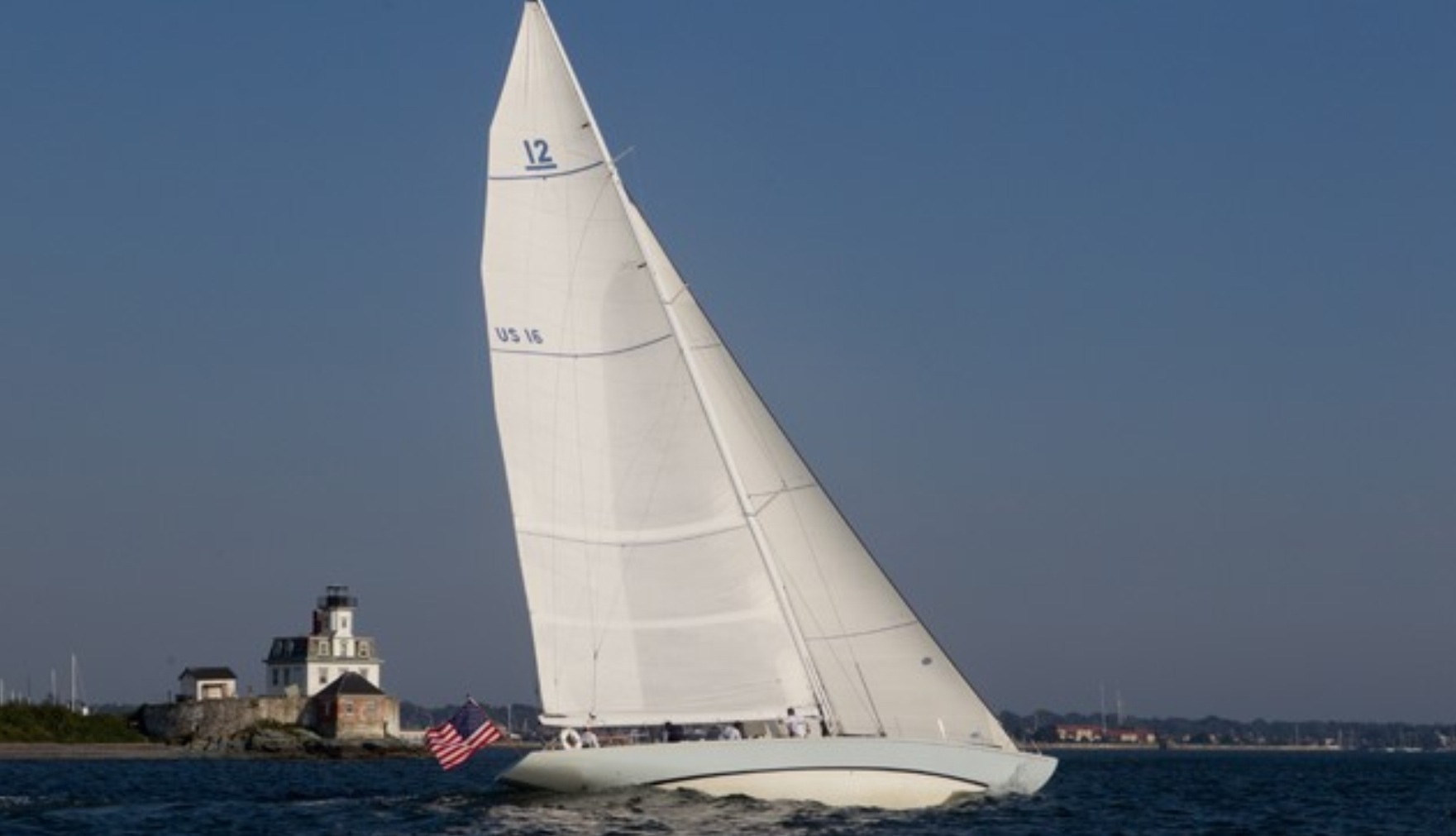
‘Briggs Swift Cunningham II, a sportsman whose affinity for yachts and cars drew him to sailboat racing as an America’s Cup skipper and to auto racing as the creator and driver of his custom sports car, died Wednesday 2 July 2003 at his home in Las Vegas. He was 96. Cunningham sailed in the 1958 Cup races off Newport, R.I., as skipper of the 12-meter sloop Columbia, successfully defending the America’s Cup against the British challenger, the 12-meter yacht Sceptre.

”Briggs was like a fine violinist with boats,” said Victor Romagna, who sailed with Cunningham in the competition. ”He would need someone to do the tuning, as one might with a Stradivarius, but afterwards, we would hand the boat back to Briggs. Then he would play the instrument absolutely perfectly.”

‘Columbia’ – US16, the first 12 Meter America’s Cup winner in 1958. Cunningham skippered the boat which beat the Royal Yacht Squadron’s ‘Sceptre’- Columbia won 4 straight races by margins of between 7-12 minutes

Cunningham was born Jan. 19, 1907, in Cincinnati. His family helped finance railways, telecommunications, meat-packing and commercial real estate and his father was the chief financier of two young men who had developed a bath soap that floated. Their names were William Cooper Procter and James Norris Gamble.

Briggs spent his summers in the Northeast and learned to sail by the time he was 6. His family moved to Southport, Conn., when he was a teenager. At age 17, Cunningham joined the Star Class racing fleet at the Pequot Yacht Club in Southport. The venture was the beginning of his 30 years of sailboat racing on Long Island Sound.

He attended Yale for two years, then left in 1929 to marry Lucy Bedford, daughter of a Standard Oil heir, Fred Bedford. It was during this period that he entered into sport as a way of life.

As a member of the New York Yacht Club, he continued to sail the Columbia in club races through the 1960′s. He also developed ‘The Cunningham’, a common device on sailboats that adjusts sail tension.

Cunningham’s interest in racecars began in 1939 when he participated in the New York World’s Fair.

After World War II, he began competing in the 24-hour auto races at Le Mans, France, and in 1951 he showed up with the Cunningham C-4R, a racecar he had designed and built. Made with a sleek, hand-hammered aluminum body and Chrysler’s newly introduced V-8 engine, the Cunningham has been called America’s first sports car. A year later, Cunningham and his partner, Bill Spear, placed fourth with the car at Le Mans, averaging 88 miles an hour.

Time magazine cover in 1954

”Cunningham himself was never particularly interested in short races,” Road and Track magazine said in 1979. ”What he liked to do was get out and drive and drive and drive, which was why Le Mans was so fascinating to him.”

Having raced his sports car for the last time in 1955, Cunningham began competing on a Jaguar team and became a Jaguar distributor in New England. After moving to California in 1962, he bought several vintage powerboats and, in 1964, opened the Briggs Cunningham Automotive Museum in Costa Mesa, Calif., which has since changed ownership and was moved to a private museum in Florida.

In 1993, he was inducted into the America’s Cup Hall of Fame at the Herreshoff Marine Museum in Bristol, R.I. Earlier this year, he was inducted into the Motor Sports Hall of Fame.

Cunningham was married 40 years to his second wife, the former Laura Cramer. He is survived by his wife; a son, Briggs Cunningham III of Danville, Ky.; two daughters, Lucie McKinney of Green Farms, Conn., and Cythlen Maddock of Palm Beach, Fla.; two stepsons; 19 grandchildren and 31 great-grandchildren’.

The George Rand/Fred Wacker Cunnungham C2R Chrysler 5.5 V8 at Le Mans in 1952 (unattributed)


Cunningham Cars…

Briggs first came to international attention with his Cadillac entry for Le Mans in 1950.

There were two cars, one looked standard, the other had somewhat bizarre streamlined open bodywork and was immediately nick-named Le Monstre by the Frenchies. Cunningham was encouraged by the results when the coupé finished tenth and the streamliner eleventh.

Cunningham’s original plan was a Cadillac-engined Ford, a high-power, low-weight recipe concepted by Phil Walters in the States, but the ACO turned it down.

The 11th placed Cadillac Spider ‘Le Monstre’ driven by Cunningham/Walters ahead of the 10th placed Cadillac 50-61 Coupe de Ville raced by Miles and Sam Collier at Le Mans 1950 (unattributed)

In a path that became well travelled, Briggs was convinced that a strong, simple American V8 with an equally sound, simple chassis would produce a competitive car to go head to head with European marques of more exotic specification.

Three specially-built sport-racers with Chrysler engines started the 1951 Le Mans classic. Two crashed, the third had engine bearing problems but finished eighteenth. Before its contretemps with the scenery one of the C2s was running in second place, a significant achievement for a new marque.

‘For 1952, less weight and more power were the goals. By now, having noted the C2’s promise (it had won at Watkins Glen and Elkhart Lake) Chrysler itself was tacitly backing the team’s attempt to defeat the Europeans on their home ground. The Detroit giant now had a standard engine with real performance potential, and the sales impact of victory was tempting. The ‘hemi’ V8 engine used lateral push-rods to operate splayed valves from the single camshaft in the Vee. This gave it the advantage of hemispherical combustion chambers with less complexity than using twin cams, and the stock output was somewhere around 180bhp’, said MotorSport.

Extensive engine development included ‘all the usual bag of hot-rodders tricks’- valve-gear lightening, needle-bearing roller rockers and cam followers, solid lifters instead of wheezy hydraulic components, special crankshafts and hi-lift cams. Four Zenith carbs fed the beast which used a compression ratio variously quoted from 7.5:1 to 8.6:1. The engine’s capacity was 331cid or 5425cc, power quoted was between 300 and 340 bhp and torque some 312Ib ft at only 2000rpm.

The big cast-iron, 625 pound plus lump with its two-inch overhead valves was understressed- down the decades this formula of worked Detroit V8’s was very successful as long as the limitations of the inherent layout and design specification were not exceeded. The big step forward for American V8s’ from a racing perspective was the small-block Chevy with its (relatively) lightweight thin-wall casting techniques, but the Chrysler, pound for pound was a competitive unit ‘in period’, the 283 Chev was still a few years away in 1954.

1952 C4R engine detail (unattributed)


Pit shot of the #2 Spear/Johnston car at Le Mans in 1954. Note the Halibrand alloy wheels, deatil of the body and unique scuttle mounted oil coolers (Getty)

The chassis was a period typical ladder frame comprising two pairs of steel tubes joined vertically by tubing and gussets which carried the big bent eight.

Suspension up front comprised coil springs and double wishbones, a coil-sprung rigid axle replaced the De Dion set-up of the C2 at the rear, it was well located by trailing arms and a Panhard rod. Hydraulic tubular shock absorbers were used front and rear.

Chrysler engineers were involved in sorting the suspension geometry, spring rates and shock absorber settings together with Cunningham’s team of Phil Walters, Jack Donaldson and Briggs Weaver.

A stock or even modified Chrysler transmission did not offer the number of ratios required let alone the strength with all that torque tearing away at it. It took a truck unit to cope- an Italian Siata gearbox was used containing four ratios in a light aluminium case, it proved to be sweet shifting and great to use over long distances.

Sexy alloy Halibrand (as used at Indy and on America’s sprintcars and midgets) 7 X 16 inch wheels were used with big, 13 inch, finned drum brakes but they were not really up to the task. The brakes had to be used sympathetically in the manner of the day, albeit by 1953 Jaguar was pioneering the disc brake paradigm shift, an advantage they would press home to the end of the decade, especially at Le Mans.

The cars track was 4ft 6in front and rear, its wheelbase 100 inches and weight circa 2410 pounds, not a lightweight but much less bulky than the ‘pork-chop’ C2.

Briggs, sans helmet, parade lap perhaps, during the September 1952 Watkins Glen GP, 6.6 mile road course weekend- C4R. Cunningham led from the start of the 15 lap journey but a first lap racing incident between John Fitch C4R in second and third placed Fred Wacker’s Allard J2 Cadillac caused the latter’s tail to run wide over a kerb, killing a young boy and injuring 12 people. The race was abandoned- and caused the end of road course racing in the US (B Tronolone Collection)


The 10th placed C4R Coupe at Le Mans in 1953- raced by Charles Moran and John Gordon-Bennett

Three C4Rs were built. One was a Kamm-tailed coupé the other two slab sided spyders designed by Bob Blake.

Big grille and cutaway wings channelled huge swags of air to the radiator and finned, iron brake drums. Rear wing scoops cooled the tyres, neat slots in the trailing edges of the rear wings kept the flow going. For the spyders, instead of siting the oil-cooler low, where it would be vulnerable to stones, the team adopted a distinctive cylindrical aircraft-style unit mounted high up on the cars scuttle.

The C4R’s race debut was at Bridgehampton early in 1952. For thirteen laps Phil Walters led, then a tail-pipe came loose and he was black-flagged. It was a minor disappointment but the team’s spirits were lifted for Le Mans.

Cunningham entered a spyder for himself and Bill Spears, another for John Fitch and George Rice, while Phil Walters and Duane Carter handled the coupé. By Saturday night, Carter had stuck his car in the sand, and Fitch and Rice had retired with valve problems. But they had been quick, and Briggs Cunningham drove solo in the remaining car for nearly 20 hours before letting Spear cruise home fourth. It was an amazing, gritty performance by the American sportsman.

The following year, 1953, a new streamlined Cunningham, the C5 raced, the winning Jag D’s top speed reaching 154mph on Mulsanne. The Coventry team’s Dunlop disc brakes were the difference between the cars. The C5 was third, the C4R spyder seventh, and the coupé tenth.

‘Smiley grille’ C5R Le Mans 1953- 3rd place driven by Phil Waters and John Fitch (unattributed)


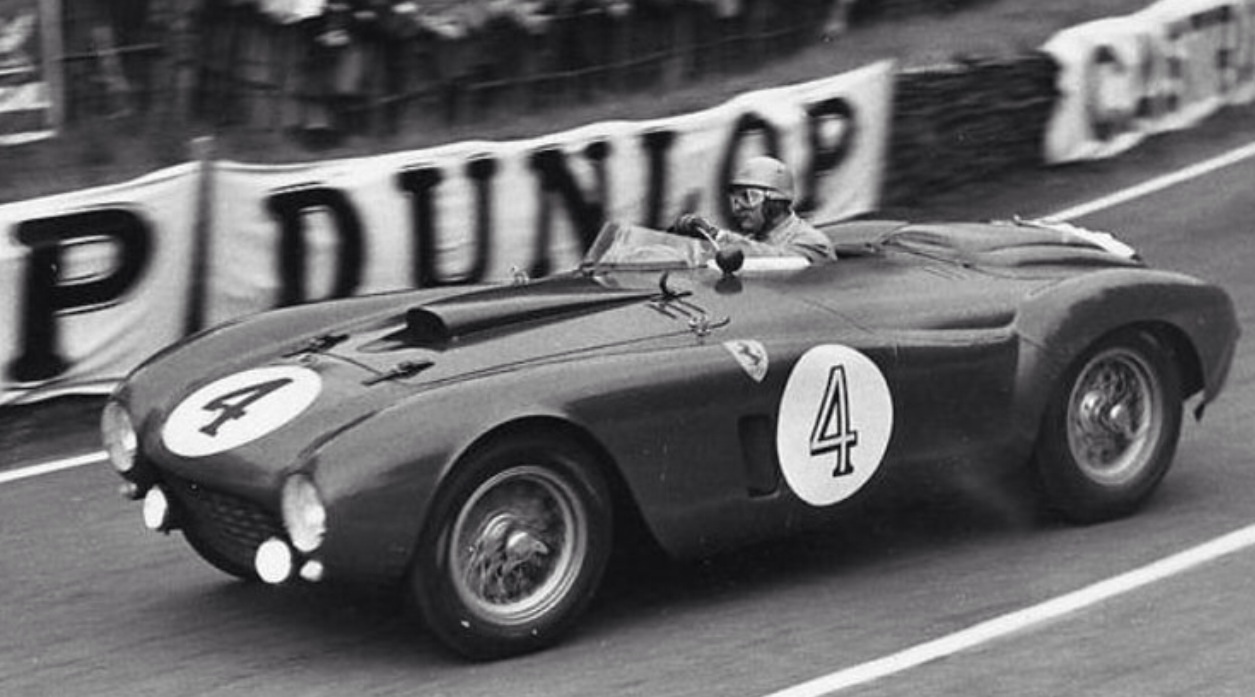
#1 Briggs Cunningham/John Gordon-Bennett C4R Chrysler, Le Mans 1954

Strong progress was being made on chassis, aerodynamics and engine by both Cunningham and Chrysler, but Briggs’ personal desire to win Le Mans was tempting him from Detroit to Maranello.

A string of national and international successes in the States ought to have been supremely satisfying, since the blue and white cars were beating the twin-cam Europeans handsomely there. Best of all was a hard-fought win against the works Aston Martin team at Sebring in 1953.

Two of the new DB3Ss, crewed by Reg Parnell/George Abecassis and Peter Collins/Geoff Duke, traded positions with Fitch and Walters from the start. After Duke collided with another car, the other Aston couldn’t close the small gap- at the end of 12 hours racing the Cunningham scored by 3 1/2-minutes’, the car won from the Parnell/Abecassis Aston Martin DB3 with the Johnston/Wilder Jaguar C Type in third.

And so, lets look at the 1954 Le Mans classic.

Jaguar raced three new works Jaguar D-Types driven by Peter Walker and Stirling Moss, Peter Whitehead and Ken Wharton and Duncan Hamilton paired with Tony Rolt- the winning combination aboard a C Type the year before.

(unattributed)

Jaguar HQ before the off- its all happening.

The #12 Moss/Walker car DNF brakes 12th hour, #15 Whitehead/Wharton D Type DNF ‘box 13th hour and the #16 Laurent/Swaters Ecurie Francorchamps C Type 4th place- see the spare bonnet for the C upstairs. The un-numbered car is a spare or the #14 Hamilton/Rolt car.

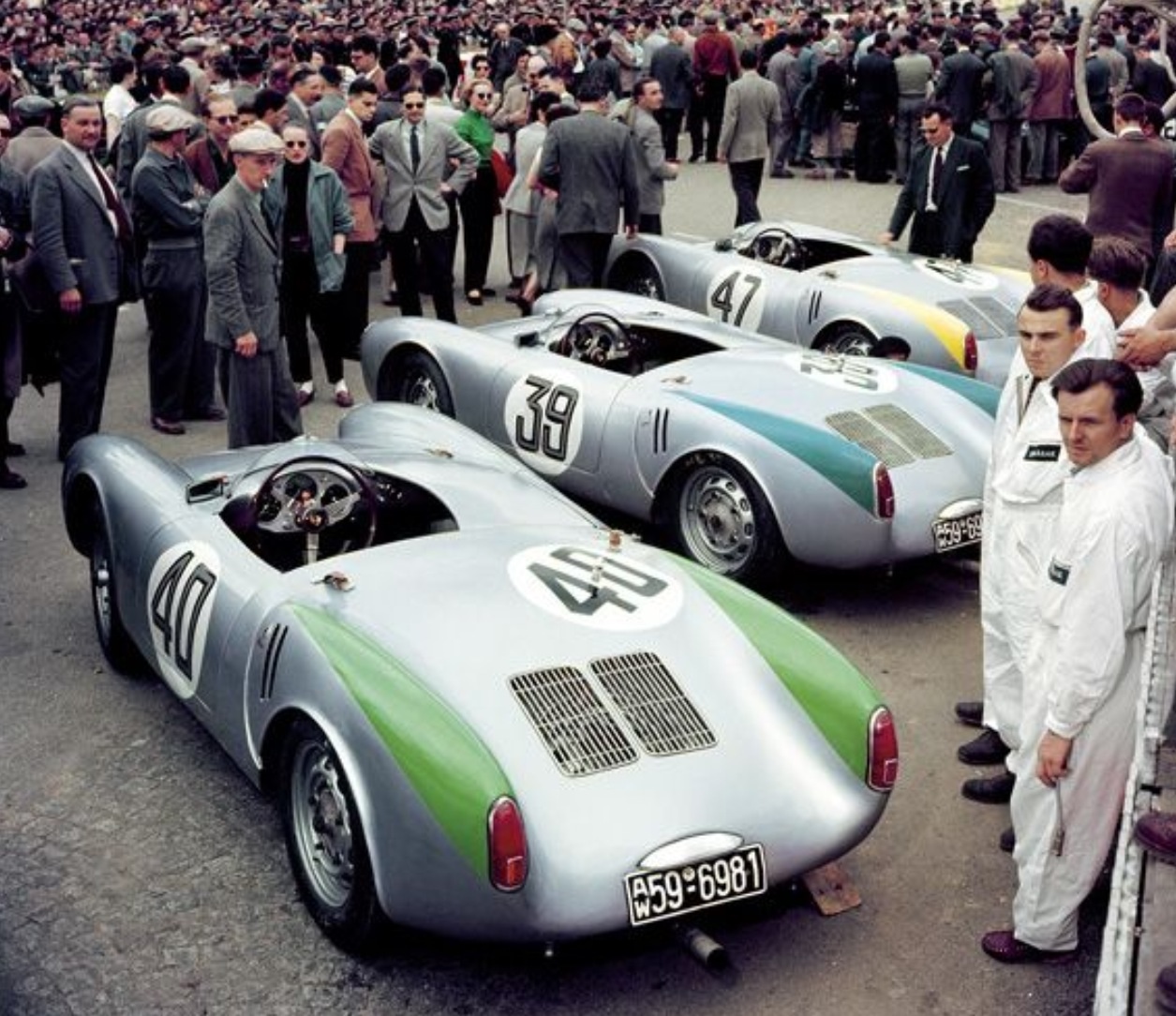
Some immaculately attired Porsche technicians and 550 RS 1500 Spyders. #40 von Frankenberg/Glockler DNF engine in the first hour, #39 the 12th placed Claes/Stasse car and #47 14th Arkus-Duntov/Olivier machine (unattributed)

Ferrari, Maserati and Osca entered cars, Ferrari’s challenger was the V12 375 Plus to be driven by Umberto Maglioli and Paolo Marzotto/Froilan Gonzalez and Maurice Trintignant/Robert Manzon.

At the endurance racing seasons opening round, Sebring on 7 March the Lloyd/Moss Osca MT4 1450 triumphed over the might of the Aston Martin and Ferrari teams. Now Briggs wanted a Ferrari engine for Le Mans!

To achieve this he needed to buy a car, so John Fitch and Phil Walters accordingly arrived at Le Mans with the 375MM pictured on the quayside above.

The new Cunningham C6 was not ready, the fast but unstable C5 had been destroyed at Reims the year before, so the two C4R spiders were again entered as well as the Ferrari. The C4R Spyders were driven by Bill Spear and Sherwood Johnston with Briggs and John Gordon-Bennett in the other car.

The Cunningham page from the 1954 Le Mans program (S Dalton Collection)


(unattributed)

The pre-start Le Mans panorama with the #54 BG Le Mans Renault of Brevil/Py 18th, #51 DB HBR Renault Louis DNF and #55 Monopole X84 of Hemard/Flahault thirteenth in focus. Amazing just how well these sub-one litre buzz-boxes place.

(unattributed)

The cars were lined up in order of engine capacity from largest to smallest- the 5482cc Cunninghams at the head of the queue- above the two C4R’s of Cunningham/Gordon-Bennett and Spear/Johnston and the three works Ferrari 375 Plus of Maglioli/Marzotto, Gonzalez/Trintignant and Manzon/Rosier.

The sprint has begun above.

The # 2 Spear/Johnston C4R and #6 Walters/Fitch Cunningham Ferrari 375MM from the #14 Rolt/Hamilton D Type (unattributed)

The 375’s of González/Trintignant, Manzon/Rosier and Maglioli/Marzotto led almost from the start, but Moss kept the D-Type in touch with them and Rolt was not too far behind. In its early stages the race looked like a 10 lap sprint rather than a 24 hour grind. At the end of the first hour, González led with Moss, the best placed Jag in third.

(unattributed)

Merde! or words to that effect.

The beached Chinetti Ferrari 375 Berlinetta of Rubirosa/Baggio, DNF after 5 laps, not a great return on a significant investment.

Three finishers on a damp track, so its early Sunday. Porsche 550 Spyder of Arkus-Duntov/Olivier 14th from the 2nd placed Jag of Hamilton/Rolt and 3rd placed C4R Chrysler of Spear/Johnston (unattributed)

Problems with blocked fuel filters delayed the Jags during the third hour. As darkness descended González and Trintignant led, the 375 Plus Ferrari of Maglioli and Marzotto had dropped out with transmission failure.

A large number of cars had fallen out of the race during the initial hours. By the seventh hour the number of retirements increased including the Shelby/Frere Aston DB3S and the Behra/Simon Gordini T24S.

Eric Thompson ponders his next move to get the Lagonda DP115 moving. The third placed Spear/Johnston C4R Chrysler rumbles past en-route to its finish (Getty)

The Lagonda was out during the seventh hour as well, having completed 25 or 26 laps after which Eric Thompson spun into the bank at the Esses. I wrote an article about this car and incident a while back, click here to read it; https://primotipo.com/2016/08/12/dyer-want-the-good-news-first/

So too, seven hours in, Ian Stewart rolled his Aston Martin DB3S on the fast stretch between Arnage and White House corners, destroying it with Stewart severely injuring his arm.

The slinky, aerodynamic, XK engined D-types steadily moved up the field. By midnight Whitehead and Wharton were second, two laps behind the leading Ferrari. Manzon/Rosier were third, ahead of Rolt and Hamilton, with the Aston Martins of Parnell/Salvadori and Collins/Bira completing the top six.

(unattributed)

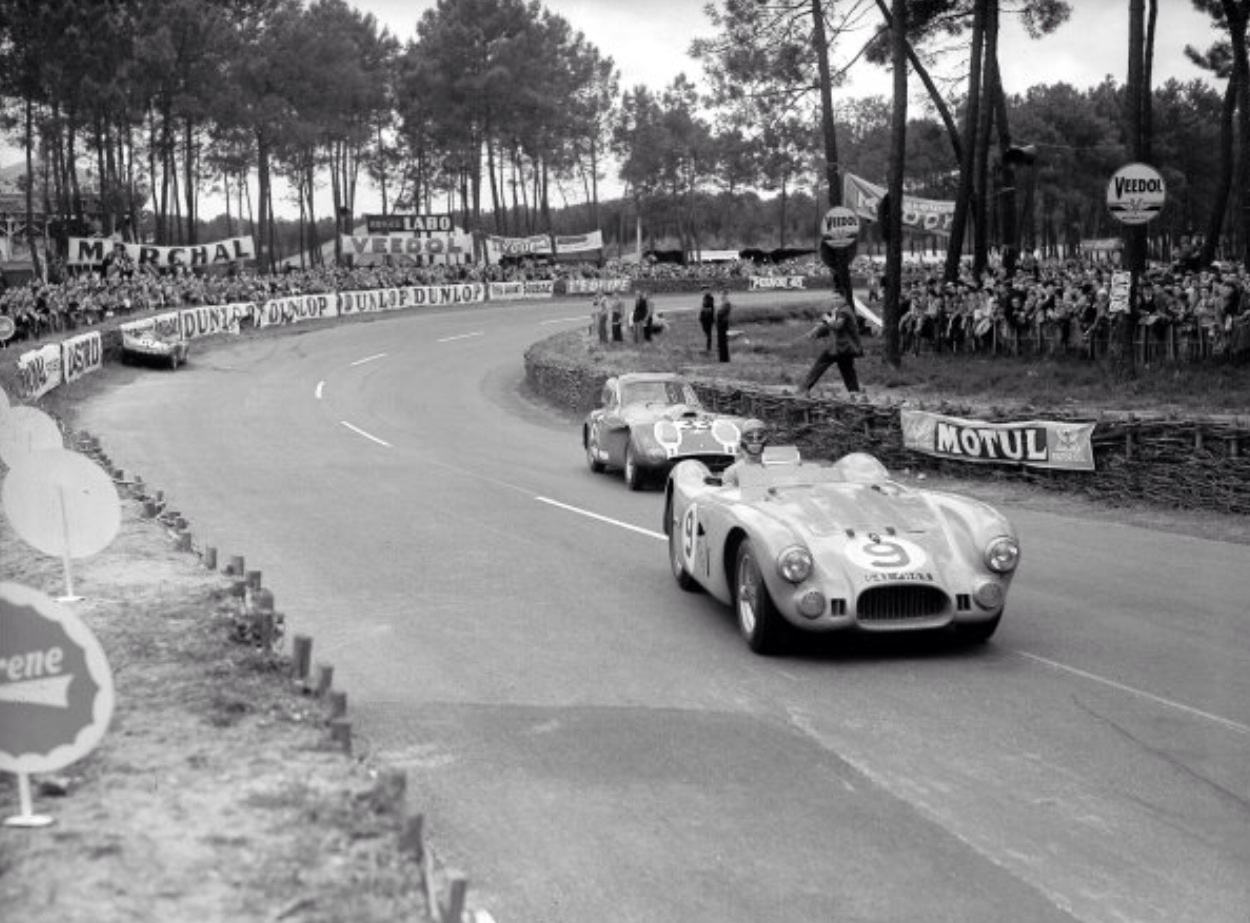
The #9 Talbot-Lago T26GS above of Rosier/Megrat DNF,  ahead of the eighth placed Bristol 450 of Wisdom/Fairman.

In an amazing team performance the three Bristol 450’s finished seventh, eighth and ninth. Seventh were Wilson/Mayes and ninth Keen/Line. I’m not sure who that is beside the road, Eric Thompson perhaps.

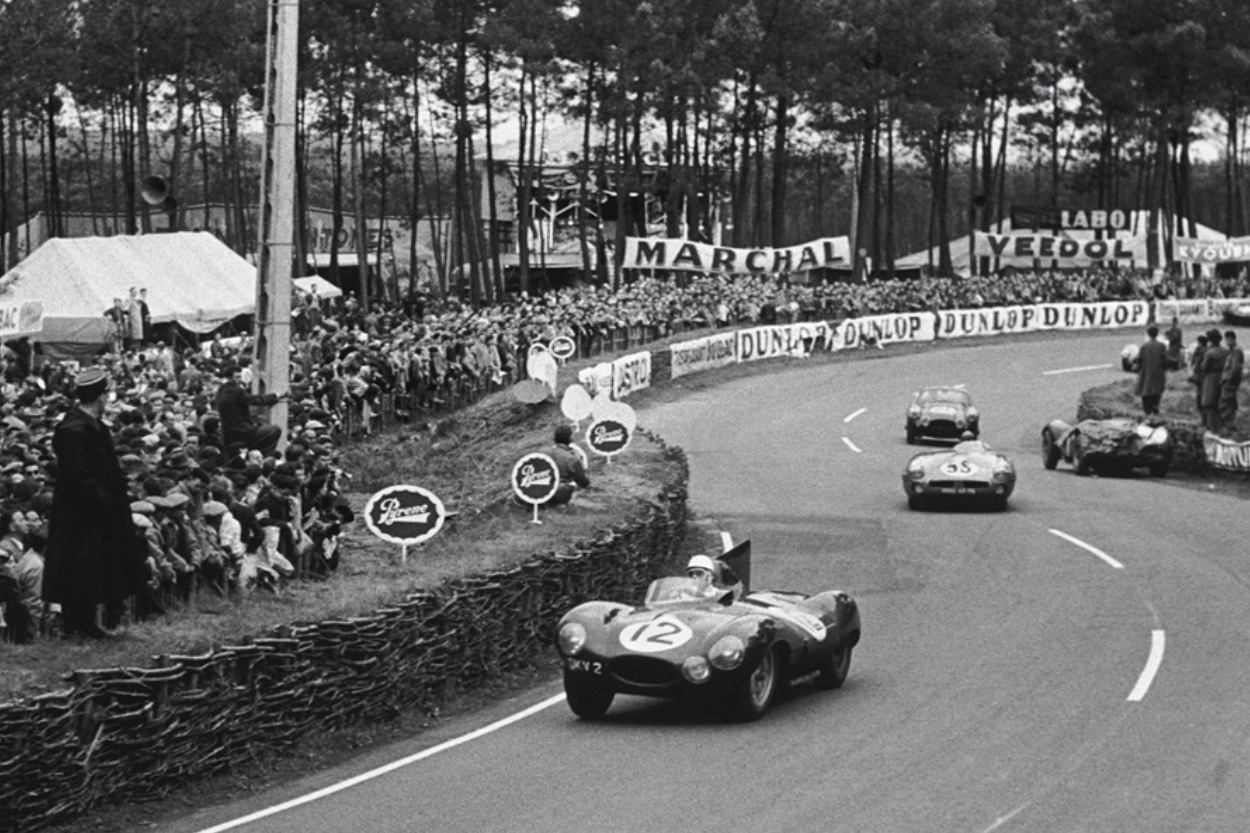
Moss from the Monopole X84 Panhard of Hemard/Flahault with the parked Thompson Lagonda still sitting in The Esses (unattributed)

Early on Sunday morning, Walker/Whitehead and Rosier/Manzon retired, both the Jaguar and Ferrari had shagged gearboxes. The Moss/Walker D succumbed to braking problems on Saturday evening. By the time dawn arrived the battle at the front was between a car from Coventry and Maranello apiece.

What’s more, as the clouds built up and rain became a threat, the Ferrari power advantage would be negated by the conditions- by breakfast it was raining heavily. González and Trintignant could afford to ease back a bit but any problems would place them into peril, as the rain intensified, the remaining Hamilton/Rolt D-type applied the pressure with nothing to lose.

(LAT)

The works Reg Parnell/Roy Salvadori supercharged Aston Martin DB3S ahead of the winning works Ferrari 375 Plus of Froilan Gonzalez and Maurice Trintignant. The Aston retired during the twenty-first hour with head gasket failure.

Later race wet pits top for the Rolt/Hamilton D Type (unattributed)

The two Brits, Rolt and Hamilton threw caution to the wind and raced their D-type hard. On one lap Rolt glanced the bank out of Arnage and stopped for a bout of impromptu aluminium panel beating. He had been forced off line by a slower car.

The rain eased, allowing the Ferrari to put its horses to the road and use its power to better effect but the Jag kept on coming, the rain intensified again and the Jaguar drivers began to close the gap further.

With two hours to run, González and Trintignant were still nearly two laps ahead of the Jag, with ninety minutes to run Trintignant brought the Ferrari in for a routine stop. González took over, but the big V12 refused to fire. Gonzalez jumped out whilst the mechanics fumbled with the plugs.

Rolt was now in sight, the Englishman intent on stopping for new goggles, but his crew waved him on now that the XKD was on the same lap as the leader

Gonzalez in the victorious Ferrari 375 Plus (unattributed)

The Scuderia Ferrari mechanics fiddled beneath the bonnet, they knew the engine was strong given its perfect state prior to the stop. The car sat for seven minutes, then suddenly burst back to life, González jumped aboard and accelerated away barely ninety seconds ahead of the chasing Rolt, but now his V12 sounded less healthy than it had before.

With thunder and lightning assaulting the circuit and an hour to run, Rolt handed over to Hamilton for the final stint.

In a fierce sprint to the finish, Hamilton cut the lead down to 1 minute 26 seconds, but as the track began to dry for the last few laps, González sped away to win by just under three minutes.

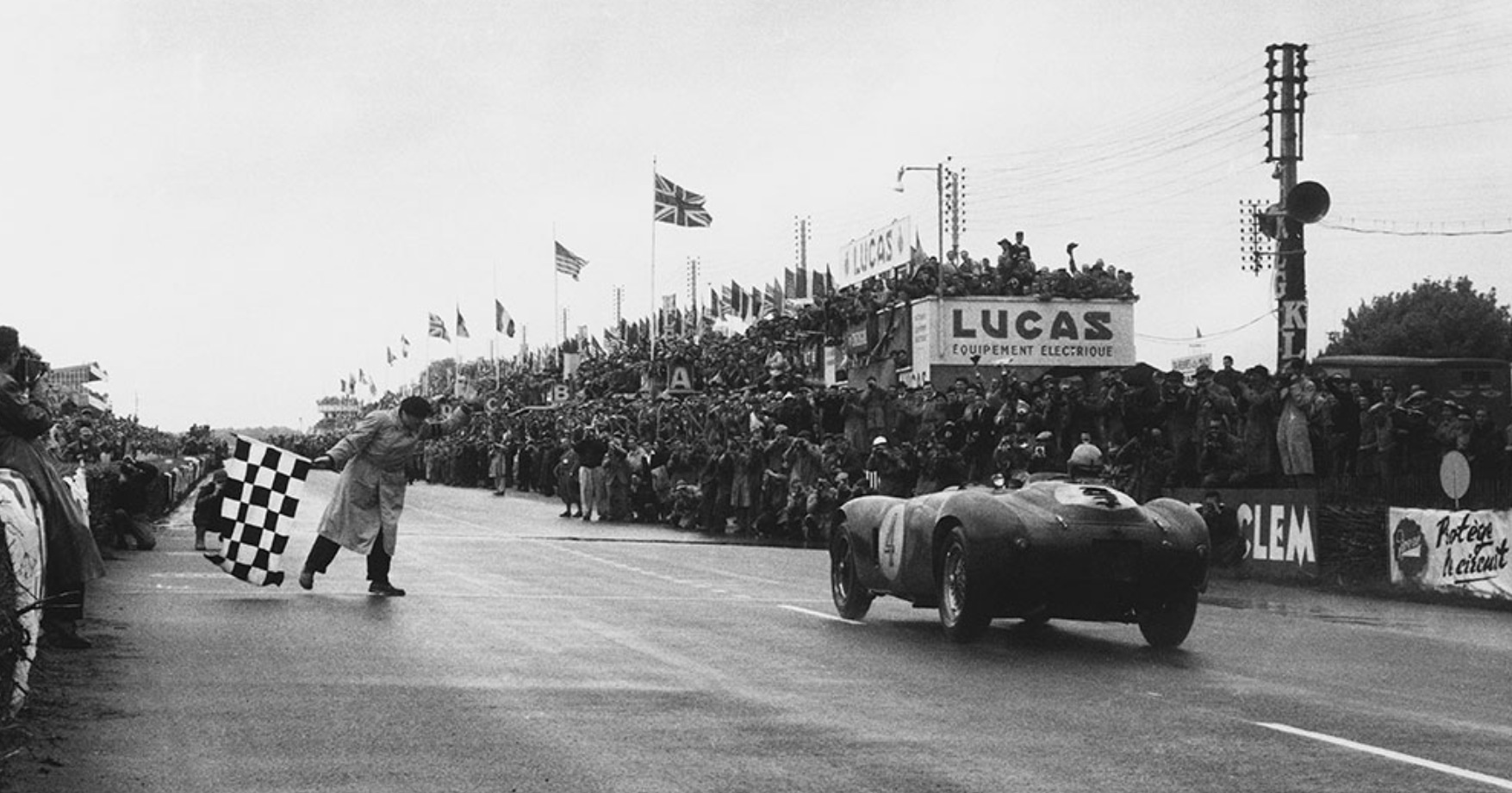
4pm- Froilan Gonzalez and Maurice Trintignant the winners after completing 302 laps or 4061 Km (MotorSport)

González and Trintignant had driven their Ferrari 375 Plus to victory, covering a distance of 2,523.486 miles over 302 laps, averaging 105.145 mph. Rolt and Hamilton were second in their very hard worked D-Type, one lap behind at the finish. Third were the American Cunningham duo of Bill Spear and Sherwood Johnston on 283 laps 19 laps (over 157 miles) behind the winners.

Three years before, in the 1951 British Grand Prix González scored Scuderia Ferrari’s first Championship F1 victory in a Ferrari 375 at Silverstone, in his last appearance at La Sarthe he won Scuderia Ferrari’s first Le Mans, a unique Ferrari double. The Lord Selsdon entered 166M took the first Ferrari victory at Le Mans in 1949 when he and Luigi Chinetti won the race having covered 235 laps in the 2 litre V12 engine car.

In terms of the overall performance of the two outright contenders the Jaguars were faster due to a much more slippery shape (Moss was timed at 154.44 mph/278kph), but the Ferrari was said to have superior acceleration and brakes, which is counter-intuitive given the new-fangled discs fitted to the Jags.

Whilst finishing third and fifth, the Cunninghams were unable to match the pace of the leaders, giving Briggs and his team plenty to focus on for 1955. None of the Astons lasted the distance and of course Jaguar would be back, and Mercedes Benz…

Cover of the 1954 Le Mans booklet put together by the staff of ‘Motor’


Etcetera Le Mans 1954…


(unattributed)

Jaguar works cars all lined up all ready to rock and roll.

The Moss/Walker, Hamilton/Rolt and Whitehead/Wharton D Types with the Laurent/Swaters C Type at the rear.

(unattributed)

Moss, lightning fast always from these run and jump starts, en-route to the #12 XKD, #14 crewed by Hamilton/Rolt and #8 is the supercharged Aston Martin DB3S raced by Reg Parnell and Roy Salvadori- DNF after 222 laps in the twenty-first hour with head gasket failure.

(L Klemantaski)

The Eric Thompson/Dennis Poore Lagonda DP115 4.5 litre V12 heading towards White House early in the race- a famous Louis Klemantaski photograph, before its fateful spin in The Esses.

Thompson, after his lose, manoeuvres the car to a safer position below, before working out how to get it back to the pits.


(unattributed)

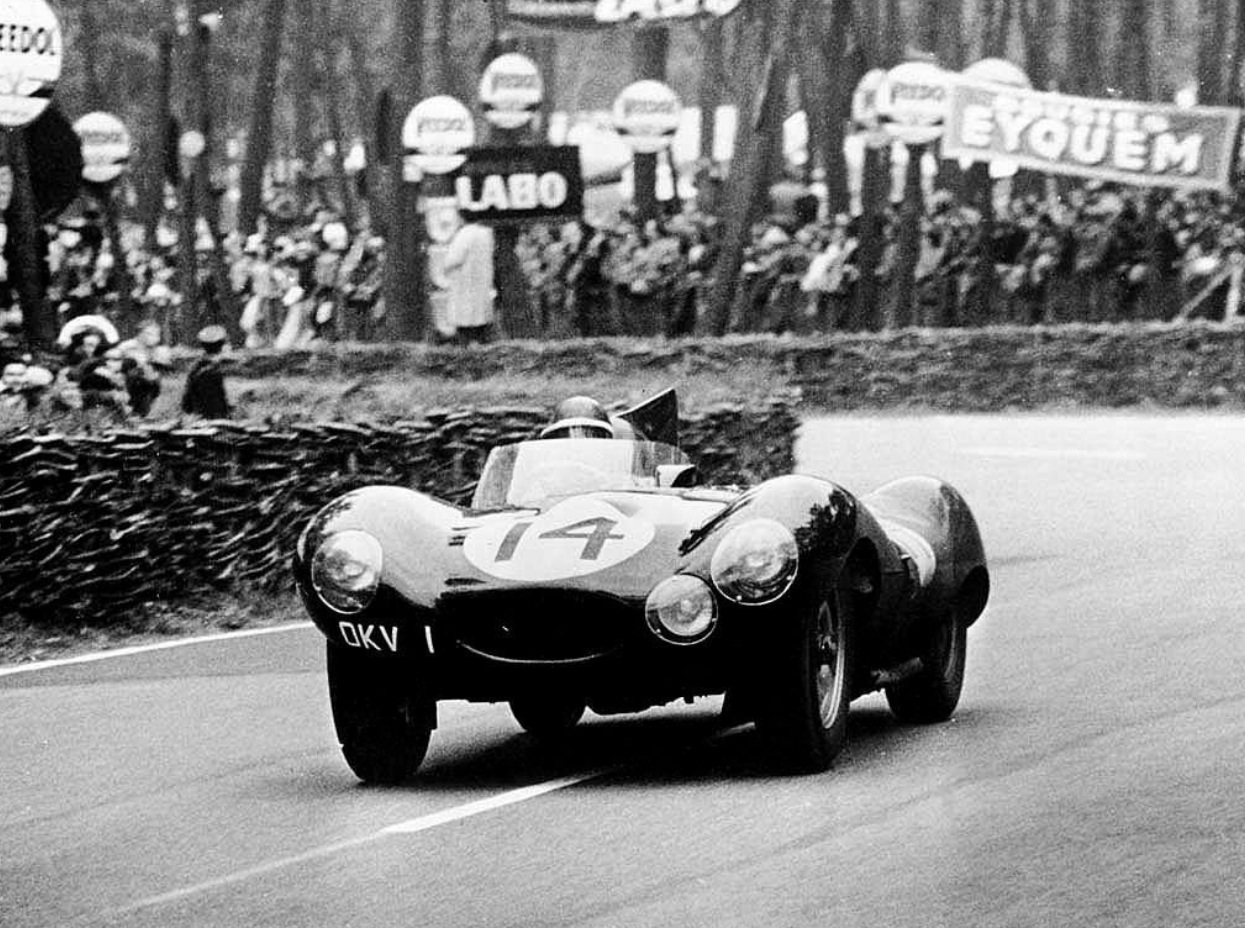
OKV 1. Duncan Hamilton aboard the works second placed D Type, by the look of the car its early in the race before nightfall. The machine was well and truly tested to its limits by its intrepid pilots especially in the final stages of the race.

(unattributed)

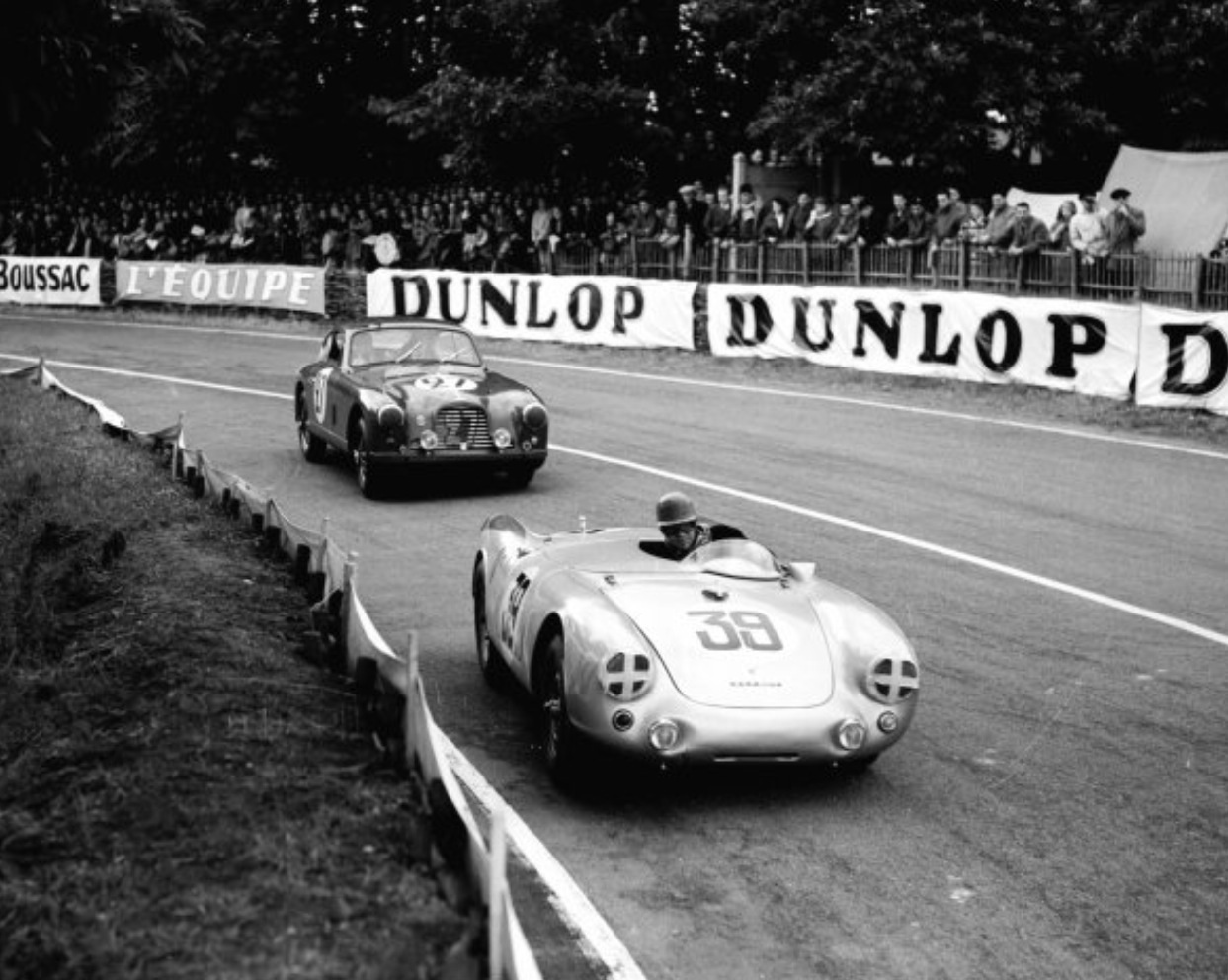
The twelfth placed Claes/Stasse Porsche 550 Spyder leads the 3 litre Aston Martin DB2/4 Vignale of Colas/da Silva Ramos which retired with gearbox failure in the fourteenth hour. None of the six Aston Martins or Lagonda which started the event finished it.

(unattributed)

Moss chasing the works Maglioli/Marzotto Ferrari 375 Plus early in the race- the beached Chinetti entered 375 MM in the background. The works 5 litre car retired with gearbox trouble in the eighth hour

Spin.

Even if you don’t win there is a clever marketing angle to be communicated- Jaguar press ad 1954.

And yes, the results do rather tend to speak for themselves!

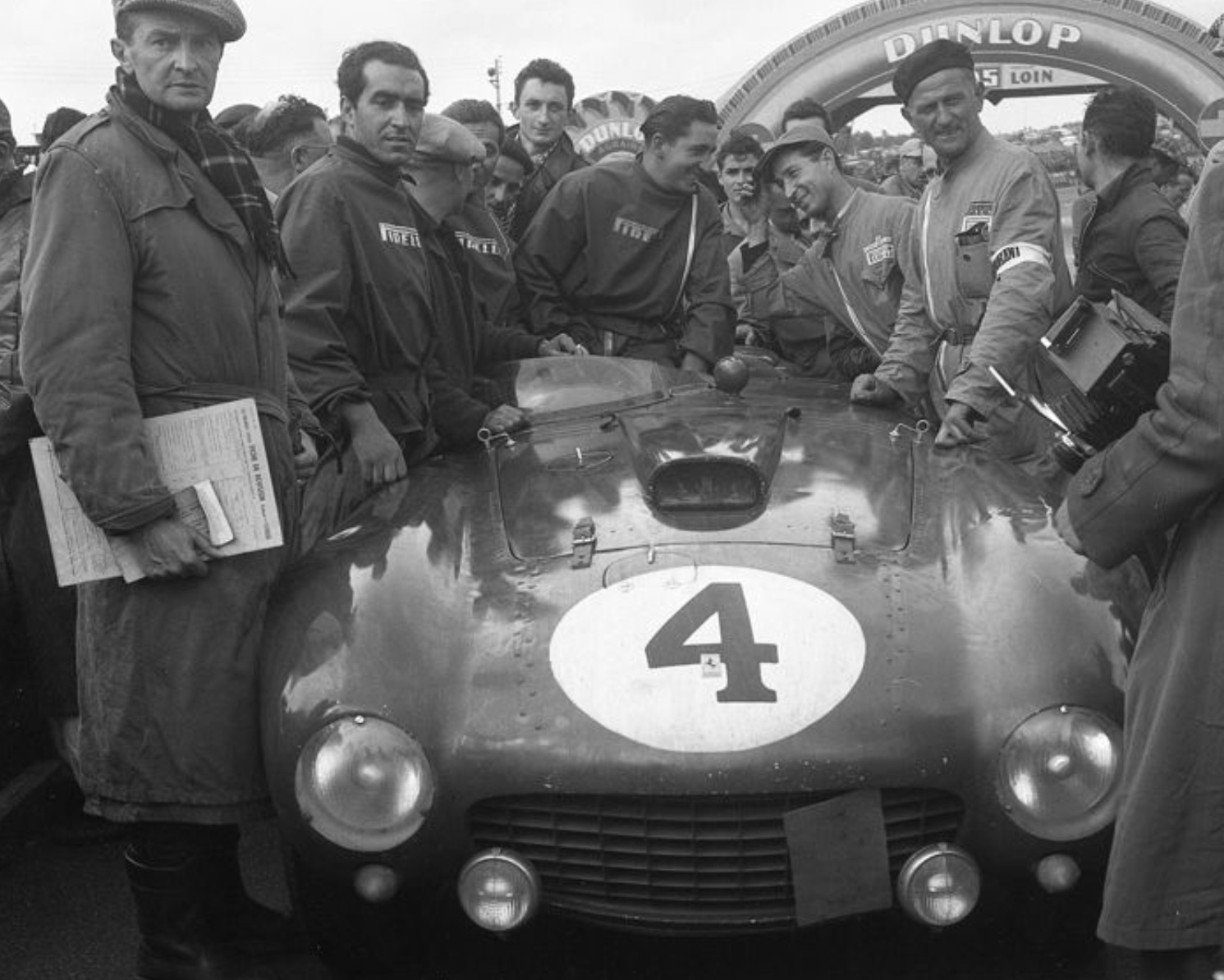
Happy Scuderia Ferrari crew gather around the winning 4954cc V12 375 Plus of Gonzalez/Trintignant. Car looks rather good, I suspect this is before the off.

Dockside at Le Havre, ship is the ‘Mauretania’

Briggs Cunningham and his team staged a campaign of military scale, organisation and precision- the only thing missing was the kitchen sink and a car with just a smidge more speed.

What a marvellous Le Mans it would have been to witness in 1954?

Bibliography…

Briggs Cunningham website- briggscunningham.com, MotorSport magazine, Wikipedia, Team Dan, F2Index, thanks to ‘The Nostalgia Forum’ boys work on the ‘Then and Now’ thread for great work in identifying the dockside and travelling photograph locations

Credits…

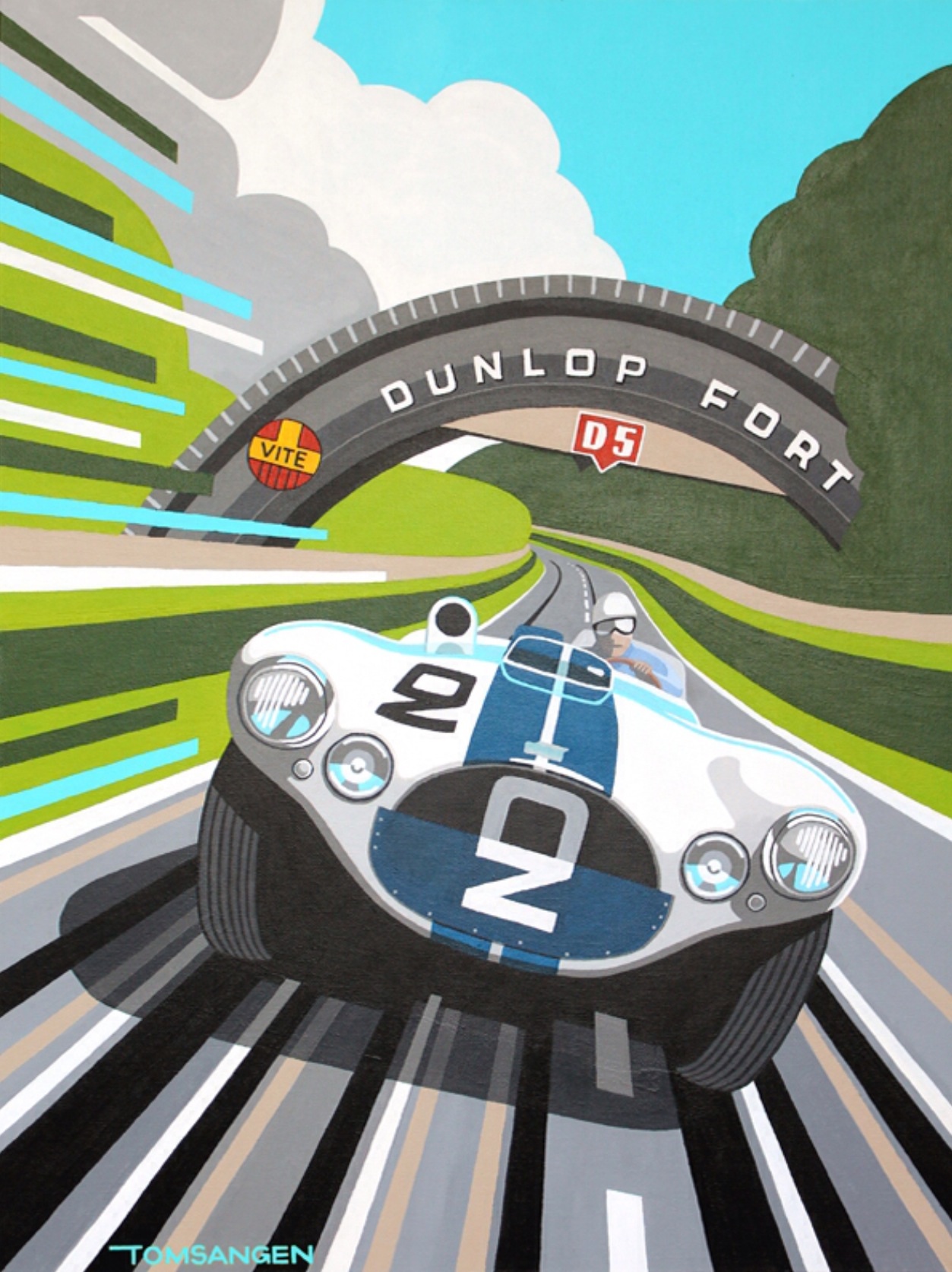
Getty Images, Louis Klemantaski, Tom Sangen, briggscunningham.com, Bob Tronolone Collection, Bernard Cahier, LAT, MotorSport, Stephen Dalton Collection

Tailpieces…

Apart from anything else Briggs Cunninham was a sportsman who just loved to compete.

Here he looks forward to his week in France, dockside with his family and team.

(B Cahier)

Finito…

(LAT)

The ill at ease David McKay / Tony Gaze Aston Martin DB3S receives some TLC on the Sussex Downs- Goodwood Nine Hour 20 August 1955…

The car survived an earlier collision but distributor problems triggered its retirement after completing 219 of the 309 race laps won by the Peter Walker/Dennis Poore DB3S.

I wrote about the Kangaroo Stable Astons and the DB3S a while back. Click here; https://primotipo.com/2017/09/28/david-mckays-aston-martin-db3ss/

and here; https://primotipo.com/2017/10/31/yes-frank-i-love-it-magnificent-in-fact/

The event was run for the third and final time in 1955 with Aston Martin achieving a perfect three out of three victories.

The Walker/Poore DB3S crossed the finish line at midnight a lap clear of the Jaguar D Type of Ninian Sanderson and Desmond Titterington with the Peter Collins/Tony Brooks DB3S a further three laps in arrears. The event was a tragic one in that Mike Keen died from his injuries after his Cooper Bristol rolled at Fordwater.

(LAT)

They are off!

3 pm on Saturday afternoon, on pole is the Hawthorn/de Portago works Ferrari 750 Monza with Hawthorn quick off the mark, then the three factory Aston Martin DB3S- Walker/Poore, Collins/Brooks third, and Parnell/Salvadori, DNF. Car #7 is the Jonnere/Wharton Ferrari 750 Monza, DNF. Hawthorn’s car retired after an accident having completed 219 laps.

Credit…

LAT, racingsportscars.com

Finito…
(D Lupton)

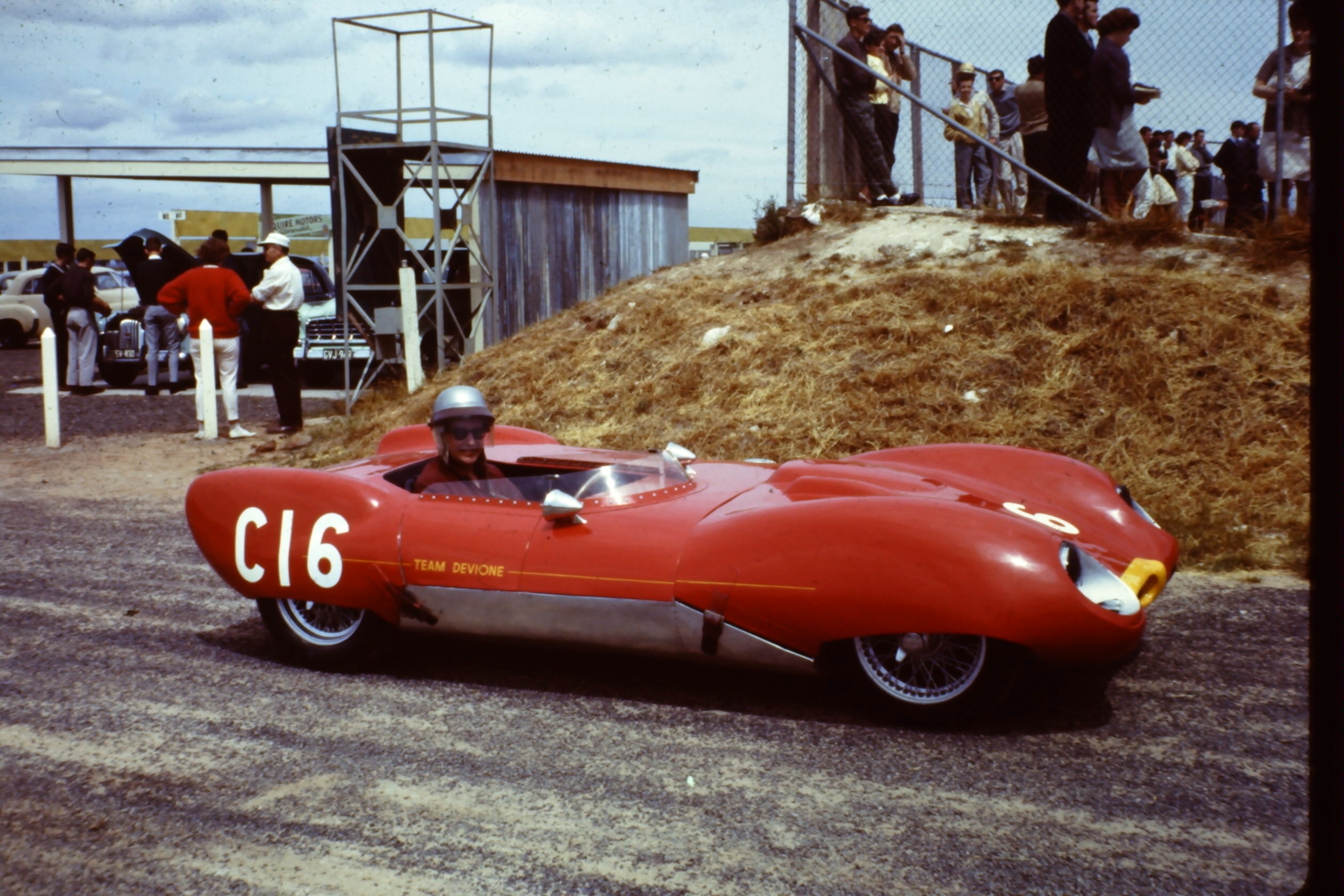
Denis Lupton’s ‘Team Devione’ Lotus 11 Ford Rep at Calder, ‘whilst the circuit was still being built, marked on the slide is 1960’…

Racer, engineer and mechanic Lupton and ace welder Hedley Thompson met at the Australian Motor Sports Club and soon developed a strong friendship.

Thompson was a foreman in aircraft maintenance at TAA – Trans Australian Airlines – was one of two large domestic Australian airlines, Ansett the other. He was regarded by many, including Reg Hunt, as one of the finest, if not the best welder in Australia.

Regular trips to the likes of Boeing kept him up to speed with the latest aviation techniques which of course flowed through to his motor racing sideline. Pat Ryan mused that ‘it would be interesting to know how many cars came out of the nightshift at TAA?!’

Lupton and Thompson saw an opportunity to build some Lotus 11 replicas, the ex-Jon Leighton Lotus 11 Series 1 (chassis 198) provided the car from which to create a jig and working drawings when the pair rebuilt it.

(D Lupton)

Brian Devlin’s genuine Lotus 11, ex-Jon Leighton with Denis Lupton at the wheel, above, Fishermans Bend, Melbourne in 1959.

Little is known of the car’s early history other than that it was bought to Australia when Leighton emigrated here in 1958- first competing at the Hepburn Springs Hillclimb in November 1958, for a class win, Brian Devlin acquired it in 1960.

Between Thompson and Lupton the pair had the requisite skills to build racing cars. The little machine was stripped in the workshop behind Thompson’s home in Melbourne’s inner eastern suburb of Deepdene, (‘down the drop in Whitehorse Road from Burke Road till when it flattens and then in on the left’). When it was a bare chassis Denis took all the measurements and made a set of drawings.

Denis and Hedley made the chassis whilst the aluminium work was done by close friend of Lupton’s and noted racer Ian Cook and Frank Esposito. Whilst the standard Lotus bodies were aluminium, a buck/moulds were taken from the Devlin car with painter Jim Jewitt producing fibreglass bodywork.

Word travelled quickly of course that some beautifully built cars were coming together and the orders quickly flowed in.

This article is very much a ‘work in progress’ from Denis records of the cars, if you can help with the history of an individual chassis please get in touch.

Histories of the cars…

Don Ashton, Hepburn Springs Hillclimb in Victoria’s Goldfields or Spa Country (D Lupton)

No.1 Don Ashton, Gnat  BMC 750cc. ‘A’ type sleeved down

John Partridge, 1100cc BMC A type

Warwick De Rose, 1100cc BMC A type

Ken Hastings,  Atom, 1100cc BMC S/C

???

John Lambert, Current owner

Don Ashton in front of his Ballan, Victoria, garage (D Lupton)

No.2 Alan Coleman, Ford 105E Anglia engine

Shifted from Melbourne to Perth

Stuart Campbell, Car finished off and competed in Perth.

Bruce Campbell, Perth.

No.3 Jim Jewitt,

Julian Coker

Dick O’Keefe,  BMC ‘A’ type S/C, currently  active in Historic Racing

Dennis at Calder (D Lupton)

No. 4 Denis Lupton, Ford 100E with Elva cylinder head

Then fitted with 1500cc Cortina GT engine, close ratio gearbox,  disc brakes and wide wheels.

Dr. Les Mendel

Steve Gifford

Colin Dane, Current owner

No.5 Bellair Brothers- Mike & Terry

Lindsay Urquhart

Alistair Scholl                                          Graham Hail

Chris Ralph                                              Gavin Sala

Bruce McGeehan                                   Rowan Carter

Joe Farmer                                              John Blackburn (Qld)

Ian McDonald all crossed up- ‘exiting The Hairpin the fast way’ at Hepburn Springs, Victoria in 1962-Tarquin (I McDonald Collection)

No.6 Ian McDonald,  Tarquin TC

Ian McDonald picks up the story of his car ‘…this car was the first of the Hedley Thompson Specials to be completed and raced and was the most successful.’

‘Hedley built the chassis in 1959-60, Jim Jewitt made the body and then the hard work really started in my garage at home in Camberwell assisted by two friends, one a good welder.’

The MG TC engine, complete with Laystall head and gearbox came from the ex-Franz Bird, Jewett bodied MG TC Special.

‘I first raced it in 1960, campaigned it solidly for three years and sold it to Wes Nalder in late 1963.’

The name had me intrigued- Ian McDonald ‘The name Tarquin derives from Tarquinius King of Rome but it was also the name of my wife Helen’s family dog in the fifties and we have a dog named Tarquin now!! We just liked the name.’

Wes Nalder, of Horsham  fitted the car with 1500cc Hillman Minx engine. In the historic era Alex Reid owned it, the car raced for him by Bernie Bisselling during the 1980s. More recently Terry Cornelius of Seaspray bought it, with his son Rowan the current owner in Longford, Tas

(I McDonald Collection)

No.7 Geoff Aarons, Hillman Minx engine

R.Slaney, Sebring Motors, 123 Bridge Rd, Richmond.

???

No.8 Nev McKay, BMC ‘A’ type  S/C

???

Russell McKenzie,   Ballarat,  current owner.  C/o Redan Motors, Ballarat

No.9 Neville Ham, Ford Consul  engine

????

No.10 Ian Munro, Ford 100E engine

???

Ed Flannery as it was with Alan Bail with Climax FWB motor (D Lupton)

No.11 Ed Flannery, MG TC engine and Gearbox

Syd Fisher, fitted Alfa Romeo engine and gearbox, then Peugeot engine.

Alan Bail, fitted 1500cc FWB Climax, very successful.

Graham Vaughan, Queensland, current owner.

No.12 Hedley Thompson, Lola Mk 1 copy.

Ford 1500cc engine.

Geoff Robbins

Ian Wells

???

Bruce Polain

Ray Kenny, NSW,   to Barry Bates   QLD  current owner 2019.

David McKay raced his Lola Mk1 Climax at the Ballarat International meeting in February 1961. During the meeting a radius rod mount pulled out, Hedley was engaged to repair the car, again a jig was made and drawings of the chassis taken.

Long time racer David Crabtree was the first to drive the Lola ‘around Deepdene after we finished the car.’ ‘In one of those “I thought you did moments” between us we hadn’t filled the diff with oil, so I took it back to my parents house in Malvern, and cobbled together a repair with all the Austin A30 bits I had.’

These days Crabby has a large successful aircraft maintenance business at Melbourne’s Essendon Airport, back then he was a young TAA apprentice, ‘I used to catch the tram up Glenferrie Road from Malvern and Hedley would scoop me up on the Cotham Road corner, not too far from his place and he would drive me out to the airport. He was a terrific bloke, immensely talented, he taught me how to weld. I did help in the build of the little Lola’.

Postscript…

Within a couple of hours of uploading this article my friend and historian Stephen Dalton raided his collection of magazines and emailed ‘…the history of Lotus 11 Replicas may have been somewhat different had Jon Leighton sold his Scuderia Birchwood Lotus in England. The 13 June 1958 Autosport ran his advert ”Scuderia Birchwood’s Lotus XI Sports, full 1172 trim, extras, enthusiast maintained, very fast, engine now dismantled, £850 ono – Twyford 5 (evenings)”.

Devione, the name?…

Denis advises the background to the names of his cars- ‘My lady wife is a Francophile, she says “Devione” is French for a “variation from a main theme” and I know better than to argue with her!’

‘So my cars were called ‘Devione’, and I built a few more for people, so we hoped to all race as a team so “Team Devione” was suggested. But people got married, or went sailing or found aircraft, or whatever, so it never got off the ground, pity!’

Credits…

Denis Lupton, ‘Historic Racing Cars in Australia’ John Blanden, David Crabtree, Doug Eagar, Stephen Dalton Collection, Ian McDonald Collection

(D Eagar)

Etcetera: Denis Lupton, Devione LC2 Ford, Calder circa 1970…

Denis is rather a modest fellow, the next Devione piece will be about the Brabham BT23 inspired Devione LC2 Ford Twin-Cam 1.6 ANF2 car built by Denis- the ‘L’ and Ian Cook- the ‘C’, and raced successfully by the pair from 1969 to 1972. A car owned and being restored by Grant Twining in Hobart.

Finito…
(unattributed)

Frank Matich ahead of the Australian sportscar pack at Warwick Farm in 1968- the car is his Matich SR3 Repco ‘720’ 4.4 V8, 5 May …

The chasing pack comprises the ex-works Scuderia Veloce Ferrari 350 Can-Am driven by Bill Brown- filling Chris Amon’s shoes after he departed back to Europe, Niel Allen’s white Elfin 400 Chev, Bob Jane’s #2 Elfin 400 Repco 4.4 driven by Ian Cook and then the #5 Scuderia Veloce Ferrari 250LM of Pete Geoghegan.

Pete and Leo G shared the car to win the Surfers 6 Hour enduro later that year, both had a drive or three of the ‘Old Red Lady’ as David McKay referred to his favourite car, in preparation for the race.

The #16 car is Tony Osbourne’s Argo Chev driven by Peter Macrow- then the twin-dark striped Lotus 23B Ford of Bob Muir another obscured Lotus 23- that of Glynn Scott, then the distinctive shape of a mid-dark coloured Elfin Mallala Ford driven by Ray Strong in front of Doug MacArthur, Lotus 26R and then, finally, John Leffler’s Cooper S Lightweight at the rear. His ‘Sports-Racing Closed’ Mini is somewhat of a fish outta-water amongst this lot.

Of the ‘big bangers’ racing in Australia at the time, the Lionel Ayers MRC Oldsmobile is absent as is the Noel Hurd driven, Globe Products owned Elfin 400 Ford. Oh, there is no sign of Alan Hamilton’s Porsche 906 or was he in between 906’s at the time perhaps?

There was no Australian Sportscar Championship in 1968- but the order of this race, in its first lap and just after the start is pretty much indicative of the state of competitive play at the time.

For the sake of completeness, the one race Australian Tourist Trophy, a prestigious event, was run at Mallala in January 1968 and won by Matich at a canter from Geoff Vercoe’s Cicada Ford, three laps adrift of FM’s SR3. Of the cars in the opening photograph, only the Jane Elfin 400 made the trip to South Australia.

Perhaps the timing of the ATT was sub-optimal as most of the top guns ran in the Tasman Series sportscar support races- at Surfers, Warwick Farm, Sandown and Longford over four weeks from 11 February to 4 March. The Adelaide race was tempting fate so close to the start of the Tasman and logistically Adelaide and the Gold Coast are a long way apart regardless of a team home base in Melbourne or Sydney.

Happy chappy. FM sits in his brand new Matich SR4 Repco 4.8 ‘760’ during the cars press launch at the ‘Rothmans Theatre’, Sydney Showgrounds on 26 November 1968. Car made its race debut the following weekend at Warwick Farm on 1 December

The ball-game changed into 1969 off course, Matich’s SR4 4.8 litre Repco 760- four cam ‘Sledge Hammer’ first raced at Warwick Farm on 1 December 1968. Then Bob Jane’s McLaren M6B Repco ‘740’ 5 litre and Niel Allen’s Chev F5000 engined Elfin ME5 joined the grids during 1969.

But Matich blew the grid apart with the SR4 all the same, and then, thankfully for all of us, jumped back into single-seaters (F5000) where he belonged.

But Lordy, didn’t he provide some fizz, fire and sparkle to sportscar racing for a decade or so? Just ask Chris Amon how quick FM was in a sporty during that Tasman Summer of Sixty-Eight…

Photo and Other Credits…

Snapper of the opening photograph unknown- i’d like to attribute it as it is a beaut shot if any of you can assist, Getty Images, Dick Simpson, Mike Feisst, Dave Friedman and Brian Caldersmith Collections.

‘Australia’s Top Sports Cars’ article by Graham Howard in Racing Car News May 1967. Thanks to Dale Harvey and Neil Stratton for assisting with car identification and the event date of the opening photograph.

Frank Matich and the SR3 Oldsmobile during the Warwick Farm Tasman meeting in 1967- the car’s race debut. That’s Ted Proctor’s Proctor Climax behind. Traco tuned ally Olsmobile V8, ZF 5 speed box and chassis all but identical to the Elfin 400 which preceded this car with some tubes added (D Simpson)

SR3 Etcetera…

I’ve not quite gotten to the Matich SR3’s yet, in terms of an article but click on the SR4 piece referenced below- there is a bit at the end of it about the SR3 and a complete Matich chassis list which will tell you what is what.

The 1967-1968 period is an interesting one from a technological racing history perspective.

Huge advances were made in tyres thanks to the application of vast wads of polymer chemistry research dollars to create products which were grippier than those which went before with consequent reduction in lap times.

Then of course their was the exponential progress in aerodynamics pioneered by Jim Hall and his boys at Chaparral in Midland, Texas well before their adoption by Ferrari and Brabham in F1 first, in 1968.

Sandown Tasman meeting the week after Warwick Farm, Peters Corner. This series of SR3’s were beautiful racing cars in all and whatever form. Note that the rear spoiler is bigger than that used the week before (B Caldersmith)

Of interest perhaps, is that it seems Matich and his crew have changed the roll-bar section of the chassis between its debut at Warwick Farm, see the colour photo above, and Sandown. Look how high it is in Sydney, and how low in Melbourne the week later whilst FM appears to be sitting in the same spot.

The car ran in as finished and completely unsorted state at the Farm with FM treating the whole weekend inclusive of races as a test and development exercise- Niel Allen won the feature race at that meeting in the ex-Matich Elfin 400 Traco Olds.

(M Feisst)

Peter Mabey prepares to alight the new SR3 he helped build, in the Sandown paddock. The gorgeous dark green machine with its neat gold ‘Frank Matich Pty Ltd’ and ‘SR3’ sign-writing and striping is about to be scrutineered.

The body, to Matich design, was built by Wal Hadley Pty. Ltd. at Smithfield in Sydney’s outer west, no doubt Wal and his crew enjoyed working on a racer rather than the hearses which were and still are their mainstream business!

The chassis was constructed by Bob Britton’s Rennmax Engineering in Croydon Park, also to Sydney’s west but closer in. Various independent sources have it, including Britton, that the spaceframe is pretty much tube-for-tube Elfin 400 with a few additional sections added to assist torsional rigidity.

Graham Howard credits the wheel design as Britton’s, said items of beauty were cast by the Commonwealth Aircraft Corporation at Fishermans Bend, Melbourne- also suppliers to Garrie Cooper.

Peter Mabey did the Can-Am tour with FM in 1967, I wonder where he is these days, his story of the Matich years would be interesting?

FM beside the SR3 Repco 4.4 V8 at Road America on 3 September 1967. Note the front spoiler, car still fitted with ZF tranny. The plan was to return to the US with the SR4 in 1968. If the team had done that, fitted with a reliable 5 litre 560 bhp V8 it is conceivable FM could have taken a Can-Am round whilst noting the 7 litre 1968 McLaren M8A Chev’s were almighty cars. If, if, if… (D Friedman)

So, the delicate looking Matich SR3 Oldsmobile which made its race debut at the Warwick Farm Tasman round in 1967 is ‘effete’ in comparison to the fire-breathing 4.4 litre Repco RB720 V8 engined car- blooded in battle during several Can-Am rounds in 1967, which took on, and slayed Chris Amon’s Scuderia Veloce Ferrari 350 Can-Am in the three 1968 Tasman sportscar races Matich contested that summer.

For whatever reason, I am intrigued to know why, FM did not contest the final round at Longford- the last ever race meeting at the late, lamented road circuit. To have seen Frank and Chris duking it out on that circuit, in those damp conditions, on that day- Amon took the all-time lap record in the Ferrari remember, would really have been something!

(B Caldersmith)

The two shots from Brian Caldersmith’s Collection above and below were taken during the 1968 Warwick Farm Tasman- Chis and Frank had some great dices with the hometown boy coming out on top.

In similar fashion to Matich, Amon didn’t do the whole Can-Am in 1967, he joined the series after two of the P4’s which he and his teammates had raced in the manufacturers championship were ‘sliced and diced’ into Can-Am 350 lightweight Group 7 form. But Chris had seen enough of the SR3 stateside to know his Australian summer would not be a cakewalk.

This SR3 is considerably lower with much wider tyres of a diminished aspect ratio compared with twelve months before- at this stage FM was the Australian Firestone Racing Tyre importer/distributor and doing plenty of test miles.

No high wing was fitted to the car yet- despite FM looking closely at what Chaparral were up to in the US, but that would come of course.

(B Caldersmith)

Further Reading…

Ferrari P4/Can-Am 350; https://primotipo.com/2015/04/02/ferrari-p4canam-350-0858/

Elfin 400/Traco Olds; https://primotipo.com/2015/05/28/elfin-400traco-olds-frank-matich-niel-allen-and-garrie-cooper/

Matich SR4 with some SR3 bits; https://primotipo.com/2016/07/15/matich-sr4-repco-by-nigel-tait-and-mark-bisset/

Longford with plenty of 350 Can-Am; https://primotipo.com/2018/07/05/longford-lap/

Matich, SR3 (RCN-Dickson)

Tailpiece: O’Sullivan, Matich SR3 Repco from Niel Allen, Elfin 400 Chev, Warwick Farm early 1969…

(D Simpson)

Roll on another twelve months to Warwick Farm 1969 and Matich is up front in the distance aboard the all-conquering SR4 Repco 760 4.8 V8 with Perth businessman-racer Don O’Sullivan racing the now winged SR3 Repco 720 4.4 V8.

The car following O’Sullivan through the ‘Farm’s Esses is the Elfin 400 Chev aka ‘Traco Olds’ raced by Matich in 1966- sweeping all before him that year before building the first SR3 and selling the Elfin to Niel Allen. Niel and Peter Molloy modified the car in several ways, most notably replacing the Olds/ZF combination with a 5 litre Chev and Hewland DG300 gearbox- but not really troubling Matich with the modified, faster car.

Lets not forget the role Garrie Cooper played in contributing to the design of the SR3- it is all but a direct copy of the Elfin 400 chassis- that story told in the Elfin 400 article link above.

Superb ‘Racing Car News’ cover by David Atkinson of Matich in the SR3 ahead of Alan Hamilton’s Porsche 906 Spyder.

The 1967 Australian Tourist Trophy was won by Matich from Hamilton and Glynn Scott’s Lotus 23B Ford on 21 May 1967 at Surfers Paradise.

The scene depicted has a bit of creative licence in terms of the earth banks on the right, if indeed it is meant to be Surfers?

Finito…
image

(Klemantaski)

The geography of racetracks prior to the seventies highlights the need for accuracy to avoid damage to the local scenery let alone car and driver…

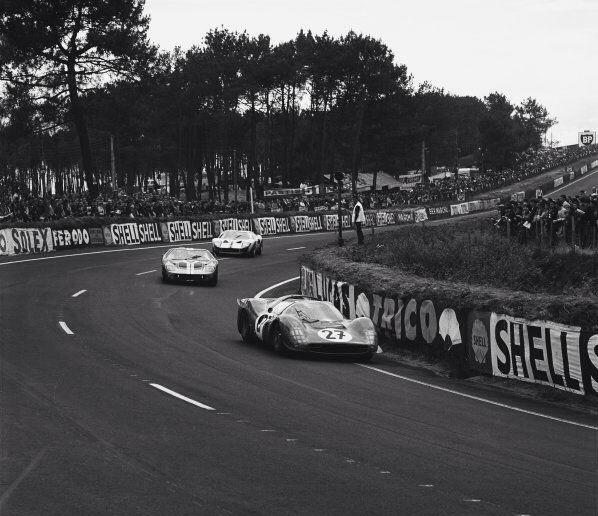
It’s Le Mans 1966, the 18/19 June weekend. The Ecurie Francorchamps Ferrari 365P2 of Pierre Dumay and Jean Blaton starts the long run along the Mulsanne Straight ahead of a factory Ford Mk2 and Pedro Rodriguez in the NART Ferrari 365 P3 ‘0846’ he shared with Richie Ginther.

I’m not sure which Ford it is but the two Ferrari’s failed to finish- the Francorchamp’s car with engine dramas and the NART machine with gearbox failure.

Bruce McLaren and Chris Amon won in a Ford Mk2, click here for a short article about the race; https://primotipo.com/2016/06/27/le-mans-1966-ford-mk2-andrettibianchi/

The Ginther/Rodriguez Ferrari P3 ‘0846’ ahead of a couple of Ford GT40’s at Le Mans in 1966 (LAT)

‘0846’ was the first of the Ferrari P3’s built and was the official press car.

Built as a Spyder, the 4 litre, 420 bhp, 24 valve, Lucas injected V12 machine raced throughout 1966-at Sebring, Targa and Le Mans- all DNF’s. At the end of the year it was converted to P4 specifications for 1967- becoming one of four factory P4’s raced that season in the International Championship for Sports Prototypes and Sportscars.

At the 1967 opening round- the Daytona 24 Hour, Chris Amon and Lorenzo Bandini shared the drive and won the race in it.

Two Ferrari at Daytona in 1967- the winning Amon/Bandini P4 ahead of the third placed Mike Parkes/Jean Guichet 412P (unattributed)

Entered at Le Mans, Chris Amon and Nino Vaccarella qualified the car in twelfth position amongst a sea of Ford GT40’s and Mk2’s.

On lap 106 Chris Amon encountered a puncture and tried to change a Firestone out on the circuit but the hammer he was wielding broke so he then sought to drive the stricken P4 back to the pits.

During this trip the shredded tyre somehow ignited a fire and as a consequence the car was severely burned- and subsequently thought by most historians to be destroyed.

(unattributed)

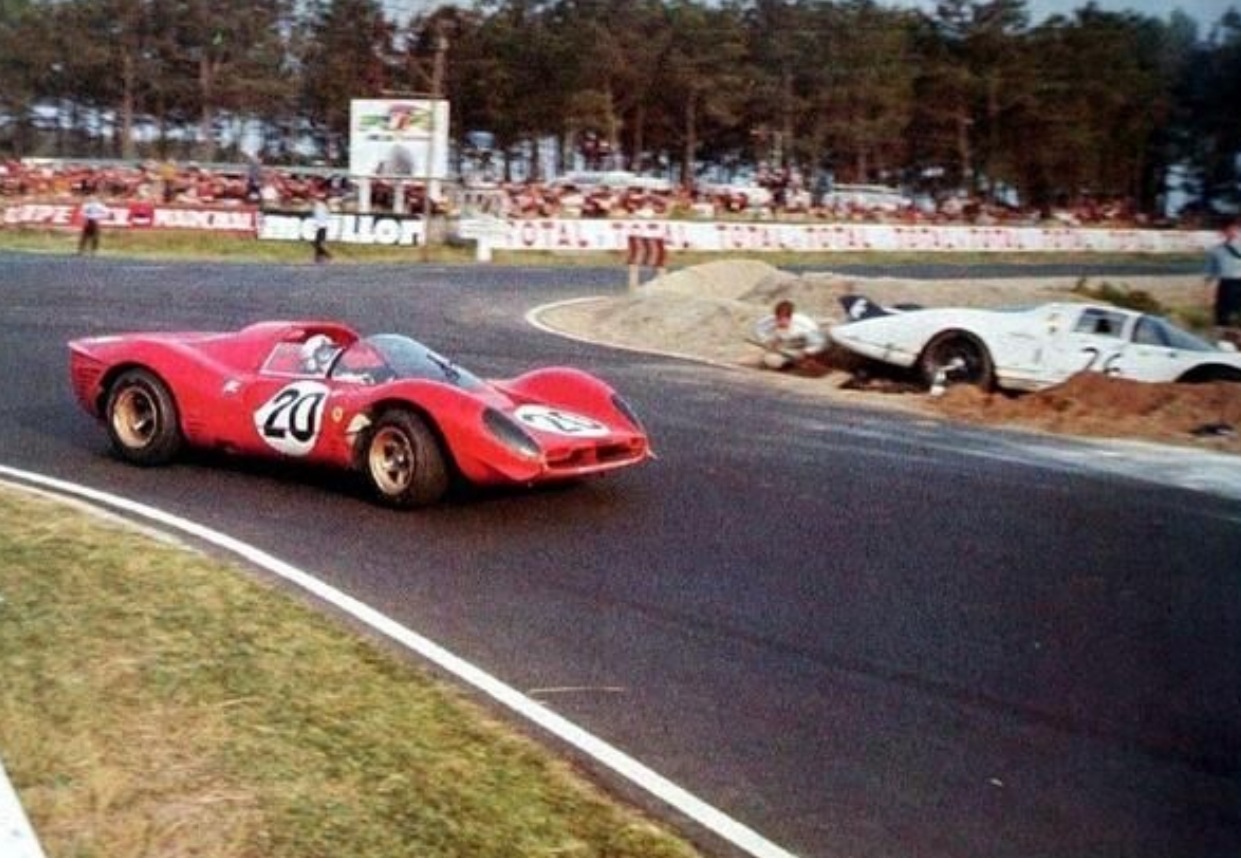
Amon lapping early in the ’67 Le Mans 24 Hour- the beached car is the NART entered Ferrari 365 P2 shared by Chuck Parsons and Ricardo Rodriguez which retired after completing 30 laps during the race’s fourth hour- Chuck is wielding the shovel.

(unattributed)

Incapable of economic repair, the P4 ‘0846’ chassis was discarded into the Ferrari scrapyard after inspection back at Maranello.

In recent times it has been confirmed, by Mauro Forghieri, that the repaired remains of the ‘0846’ chassis form the basis of the James Glickenhaus’ owned P4. Somewhat contentious, and the subject of much discussion on various Ferrari internet forums about the place, and ‘The Nostalgia Forum’ for more than a decade, some of you will have seen the car in the US or Europe.

Click here for an article about the Ferrari P4, and P3 in passing, and towards its end a link to the TNF debate about the restoration of ‘0846’; https://primotipo.com/2015/04/02/ferrari-p4canam-350-0858/

‘Veloce Todays’ bullshit-free summary of the car is here; https://www.velocetoday.com/cars/cars_69.php

Glickenhaus Ferrari P4 (unattributed)

Forghieri’s letter to Glickenhaus in relation to the chassis of the car, in full, dated 23 February 2016 is as follows;

‘Dear Mr Glickenhaus,

I am submitting my expertise regarding your Ferrari P4. It is based on the documentation that’s been made available to date and, to avoid any misunderstanding, I am submitting it in both English and Italian, the binding version being the Italian one.

1. The P3/4 denomination was never used in Ferrari and it is therefore deemed as incorrect. (Cars were either called P3 or P4)

2. The P4 chassis was almost identical to the P3’s, which were therefore routinely modified to produce P4 chassis.

3. The chassis I examined bears signs of modifications which are different from what was done in Ferrari as current practice. My opinion is that they were done by some other outfit after the accident of Le Mans 1967. The car involved was a P4 built upon a P3 chassis bearing the SN#0846, SN which was carried over as practice and regulations mandated. The car itself was seriously damaged in the 1967 accident and never repaired. The chassis, also damaged by fire, was returned to the Ferrari “scrapyard”.

4. It is my opinion that original parts of that chassis (as modified by some outfit; see above) are currently mounted on the P4 vehicle owned by you.

5. In spite of point 4 above, however, and as indicated in the factory statement that Ferrari sent you, it must be concluded that, for all legal purposes, SN #0846 has ceased to exist. Your car cannot be designated as “#0846”.

6. I can nonetheless state that your car, albeit containing non-standard modifications, is indeed a Ferrari P4.

Best Regards,

Mauro Forghieri

Modena, February 23 2016’

Chris Amon settles himself into ‘0846’ before the 1967 Le Mans classic in 1967. Injection trumpets clear as is the MoMo steering wheel, it looks pretty comfy in there.

Credit…

Klemantaski Collection, LAT Images

Tailpiece: Nino Vaccarella during the 1966 Targa Florio…

(unattributed)

P3 ‘0846’ was shared by Nino Vaccarella and Lorenzo Bandini in Sicily during the May 1966 Targa Florio.

The hometown team had completed 6 laps before Bandini crashed the car having misunderstood the intentions of the hand signals provided by the driver of a privateer Ferrari he was seeking to pass.

The race was won by the Filipinetti/Works Willy Mairesse/Herbert Muller Porsche 906.

Finito…
Beach Baby…

Posted: January 9, 2019 in Fotos, Sports Racers

(oldracephotos/DSimpson)

Or Beach Buggy, more specifically?…

The CMS VW buggy of George Geshopoulis in this group of four cars has been rounded up by one of the fastest cars in Australia at the time, Bob Jane’s 4.4 litre Repco-Brabham V8 engined Elfin 400, a racer I wrote about a while back;

Belle of The Ball…

Its a typically varied country race meeting grid of the day, 1968, on this occasion at Hume Weir close to the Victorian/New South Wales border towns of Wodonga and Albury. Here is the Hume Weir story;

Hume Weir…

The other cars shown are the Warwick De Rose Lotus 11, having difficulties with one of his doors, and the John Sheehan Geneer Outlaw VW at the rear of the group.

Australian Formula Vee enthusiasts will recognise CMS and Geneer as Melbourne constructors of Vees. I was aware of the Outlaw sporties, attractive little cars, but not that CMS made beach-buggies- which were big at the time constructed on shortened VW chassis’.

Maybe Janey, with a short set of ratios in his Hewland DG300 would have seen 130 mph at the Weir but no way the CMS would do 80, so the closing speeds and differential of pace are not to be sneezed at.

In any event, it’s a cracker of an amusing shot of a time and place long ago.

Credits…

Dick Simpson/oldracephotos.com.au – Lindsay Ross, Duane De Gruchy

Tailpiece: Geneer Outlaw…

The Geneer’s were built by Barry Coutts in East Burwood, not too far from where I used to live, about 15km to Melbourne’s east. About 30 are thought to have been constructed between 1960 and 1967 with a range of VW, and the occasional Porsche engine inserted in the rear of the multi-tubular spaceframe chassis. Very interested to hear from an owner.

Finito…

(oldracephotos.com.au/D Keep)

Bill Brown’s Ferrari 350 Can-Am on the exit of the very quick left-hander off Long Bridge- just about to change direction, Longford during the February 1968 Tasman meeting…

The ex-works car was owned by David McKay’s Scuderia Veloce and raced for him by Chris Amon in the sportscar events which supported each of the Australian Tasman rounds- and being beaten by Frank Matich in his Matich SR3 Repco V8 4.4 litre. Both cars had raced in some 1967 Can-Am Series races so Chris had a bit of an idea what he may have been up against when he arrived in Australia.

Sydney’s Bill Brown was to drive the car after Chris returned to Europe and also raced the car at Longford- a daunting place, to say the least, to become acquainted with one of the fastest sportscars on the planet at the time!

I wrote a long feature about the P4 Ferrari, and this particular car, chassis ‘0858’, a while back, click here to read it; https://primotipo.com/2015/04/02/ferrari-p4canam-350-0858/

(Rod MacKenzie)

For Chris the car was a bit of a distraction really, he was after the Tasman Cup aboard his works-owned but Chris Amon run Ferrari Dino 246T. He wasn’t successful in 1968, Jim Clark won the championship in his Lotus 49 Ford DFW but Chris made amends in 1969, winning the title against strong opposition including the Team Lotus duo of reigning F1 world champ Graham Hill and Jochen Rindt.

The shot below is of Bill setting off from the Longford pits in this oh-so-sexy machine, forever in the memories of those lucky enough to be at Longford ’68, or anywhere this car raced in its too short time in Australia that year.

(oldracephotos.com.au/D Keep)

Tailpiece: Can-Am 350 business end, Longford 1968…

(Dennis Cooper)

What an impressive beast it is!

The V12 three-valve engine grew from 3967 cc and 450 bhp @ 8000 rpm in P4 endurance spec to 4176 cc and circa 480 bhp @ 8500 rpm in sprint Can-Am trim. Fuel injection is Lucas- two distributors are providing spark to two plugs per cylinder. The transaxle is a Ferrari built 5 speeder and chassis the Scuderia’s ‘Aero’ semi-monocoque with the engine having a stiffer crankcase than the P3’s to allow it to be used as a semi-stressed structural member.

Photo Credits…

David Keep/oldracephotos.com, Historic Racing Car Club of Tasmania, Rod MacKenzie, Dennis Cooper

Superb shot shows Bill coming off Kings Bridge with oil flag on display (oldracephotos.com.au/Harrisson)

Finito…