


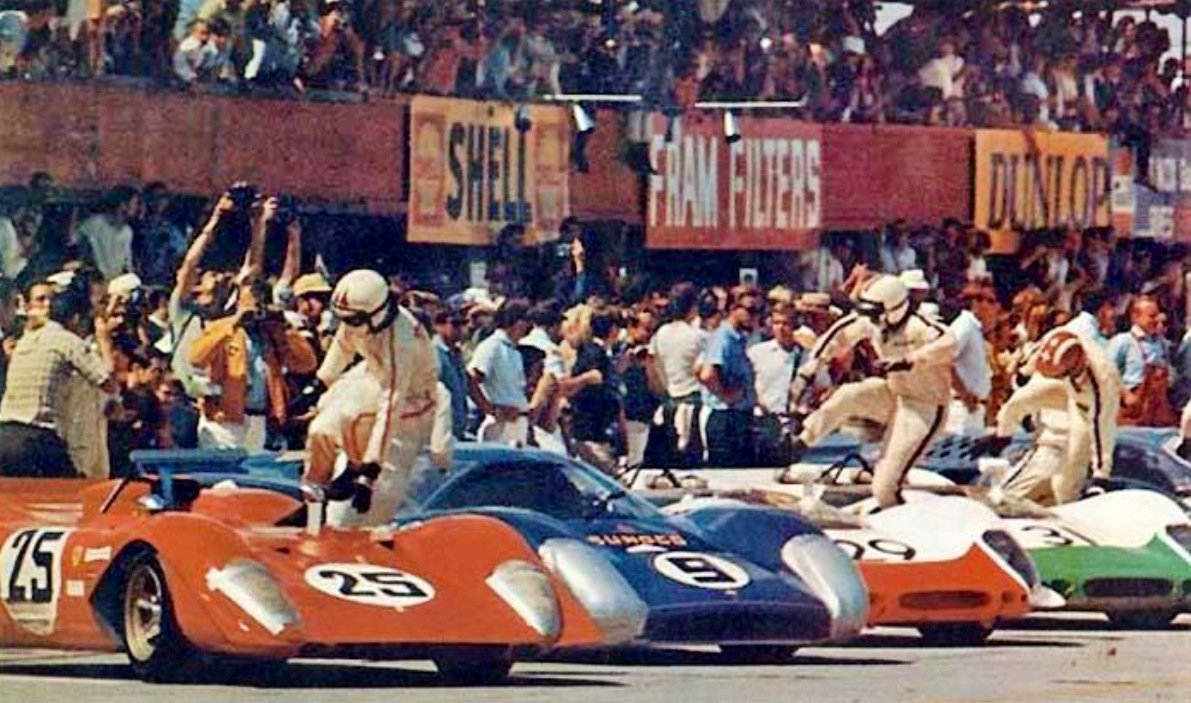
#14 Stommelen/Ahrens Porsche 917LH, #20 Siffert/Redman Porsche 908/2, #22 Lins/Kauhsen Porsche 908LH, #23 Schutz/Mitter Porsche 908LH, #2 Bonnier/Gregory LolaT70 Mk3b Chev, #7Hobbs/Hailwood Ford GT40…and the rest (unattributed)
Spectacular start of the tragic Le Mans 24 Hour Race, June 1969, the last with the traditonal driver sprint to the cars…
The Porsche 917 was a tricky, somewhat under-developed beast in its original specification even for experienced professionals. British privateer John Woolfe lost control of his on the very first lap of the race perishing in the subsequent accident.
Despite that, a 917 took pole and led the race for twenty hours, maybe it has been somewhat maligned in its formative year?

Groups 4, 6 and the regulator…
By 1967 the Commission Sportive Internationale (CSI) were concerned about the growing speeds of the unlimited ‘pushrod production’ 7 litre Ford GT Mk4 and Chaparral 2F Chev and the 4 litre ‘racing engine’ Ferrari P4 and therefore banned them- it did so by increasing the required number of cars to be built and lowered the engine capacity limits for homologation or admission of cars into both classes.
For 1969 there were no minimum production numbers to qualify in Group 6 ‘3 litre Prototypes’ and a minimum of twenty-five cars to be built for homologation into Group 4 ‘5 litre Sports Cars’.
Effectively the changes in 1968 allowed the existing Mark 1 Ford GT40 and Lola T70 Mk3B cars to remain eligible to keep grid sizes up in Group 4, but with the hope or intent that 3 litre prototypes would be built in large numbers to bolster Group 6, Formula 1 having the same capacity limit at the time.
Porsche would not have had the 908 ready to race in 1968 had they not anticipated the rule changes for 1968 which were announced late by the CSI- in October 1967. Fifty cars were required to be built to qualify for Group 4 in 1968, but that was reduced, as stated above, to twenty-five for 1969, which rather left the door ajar for Porsche…
The FIA, as the governing body then was, had another crack at rewriting the rules to encourage 3 litre prototypes with effect 1 January 1972, given the speed of the 5 litre or thereabouts Porsche 917 and 5 litre Ferrari 512S in 1970 and 1971 but that is another story- lets not get ahead of ourselves.
Porsche had come close to Le Mans victory with their 3 litre 908LH ‘class cars’ in 1968 and wanted to go one better, to win outright, to do so they audaciously and at great cost built twenty-five 4.5 litre air-cooled Flat 12 engined cars- the 917 in 1969.
With the gauntlet thrown down, Enzo Ferrari, his coffers full of Fiat money having sold his road car division to them in 1969, built twenty-five 5 litre V12 512S’ to go head to head with Porsche in perhaps the two best years of sports car racing ever in 1970 and 1971.


(Porsche AG)
On 12 March 1969 a 917 was displayed at the Geneva Motor show with a price tag of DM140,000 a fraction of the cars development costs- a couple of weeks later in late March Rolf Stommelen ran a 917 at the Le Mans test weekend, its quickest time was three seconds a lap quicker than the Group 6 Matra 630/650 V12 of Johnny Servoz-Gavin, but its seeming dominance was not assured as the thing wandered all over the road, somewhat alarming at over 200mph…
The cars above were displayed for inspection at the factory before CSI representatives on 22 April, Ferdinand Piech cheekily offered them the opportunity to drive any of the machines to prove they were complete and running, said offer was declined!
Twenty-five Porsche 917’s lined up at Zuffenhausen awaiting the CSI chassis count for homologation into Group 4, 22 April 1969. Imagine what a chill that image must have sent down the spine of Enzo Ferrari!
Lets have a look at the design, development and competition record of the 917 with a focus on 1969, the 908/02 also gets rather a good look-in given its dominance of the year with twelve months of intense competition under its belt.
Design…

Sales brochure for the 917, a snip at DM140,000 in 1969
Engineer Ferry Piech said that Porsche would not have built the 3 litre 908 had they known the CSI’s intent in relation to the 5 litre group.
At the time they built the 908- a Group 6 car, the minimum production number for homologation into Group 5 was fifty cars not twenty-five, so he can be somewhat forgiven for not being able to read the minds of the rule-makers, then as now unpredictable. The regime of rules was not about encouraging 5 litre cars with ‘racing’ as against ‘production’ based engines.
So Porsche surprised everyone- until then they had built class contenders rather than outright cars and even then it was not thought possible to build a 5 litre air-cooled engine, to that time a Porsche specialty- water cooled Porsches were not to appear for nearly a decade.
Work started on the design of the 917 in July 1968 with Ferdinand Piech entrusting Chief Engineer Hans Mezger with the task of leading the project. Porsche describe the choice of the ‘917’ type number as follows ‘The 912 engine designation comes from more recent Porsche race car nomenclature, whereby the number of cylinders in that particular car’s engine is also included ie. 904, 906, 908, however the vehicle as a whole with a 5-speed transmission, is given the 917 designation.’
Porsche were convinced they could build a car down to the class minimum weight limit of 800 Kg based on the 908 which was 300 pounds lighter than their Alfa, Matra and Ferrari 3 litre rivals. The aluminium spaceframe chassis of that car was a guide and shifting the cockpit and drivers seat forward ensured the 908 wheelbase of 2300mm was kept despite the 12 cylinder engine being considerably longer than its little brothers eight. 908 practice was also applied in that the fibreglass body was bonded to the chassis. A design maxim from the start was a car of exceptionally low drag, top speed is important on the Mulsanne with two bodies for ‘slow’ and ‘fast’ tracks always intended to be homologated.

Cutaway shot by Vic Berris of the aircooled, flat-12, SOHC 2 valve, fuel injected engine. Capacities/power 1969 4494cc/580bhp@8400rpm, 1970 4907cc/600bhp@8400rpm, 1971 4998cc/630bhp@8300rpm. Torque 376, 415, and 425 lb ft respectively. More than enough to see off the 512S/M Ferraris’…cooling fan absorbed around 17bhp @ maximum revs, far less than that absorbed by a water radiator @ equivalent speeds (Vic Berris)
To speed up the development of the 917 engine the same reciprocating parts, bore, stroke, valve and port sizes of the 908 engine were used giving a capacity of 4494cc with a bore and stroke of 85 x 66mm. Porsche believed, initially at least, it wouldn’t be necessary to build a car to the full 5 litre limit to dominate.
All the fuel injection and valve timing settings were taken over from the 908 albeit the valve angle differed to allow cooling air passages between the valves- four valves per cylinder was never an option for this reason, apart from that, the flat-12 is an entirely different engine to the 3 litre flat-8.
A long crankshaft did not allow anything other than a central power take off to avoid catastrophic torsional vibrations. The long crank hence became effectively two shorter cranks joined together at their flywheels, which were just a gear in mesh with another on the output shaft running parallel to, and under the crankshaft, which ran on eight main bearings.

Gerhard Kuechle and Valentin Schaeffer assemble a 917 engine, note central power take-off gears on the crank in 1969 (Porsche AG)

917 engine on the dyno in 1969 (GP Library)
The power output shaft drove the triple gear type oil pump with four additional small oil pumps driven by the exhaust camshafts. Another shaft running symmetrically with the crank drove the two distributors of the electronic ignition, the Bosch fuel injection pump being driven off the left hand exhaust camshaft.
The engine had few steel or iron parts- the crankcase, cam covers and timing gear case were magnesium. The heads and cylinders were aluminium with titanium used for conrods, auxiliary drive shafts, the main output shaft and later in the engines development, valves and valve springs. The cooling blower and most of the air ducts were plastic.
The 4.5 litre engine weighed 528lb in its original form and developed 542bhp on its first dyno run, this rose to 580bhp @ 8400rpm by the time the car arrived at Le Mans in 1969.
A new gearbox was built to take 376lb ft of torque- the case was magnesium, used Porsche synchromesh and had a wet sump incorporating a ZF ‘slippery diff’ with 75% locking factor.

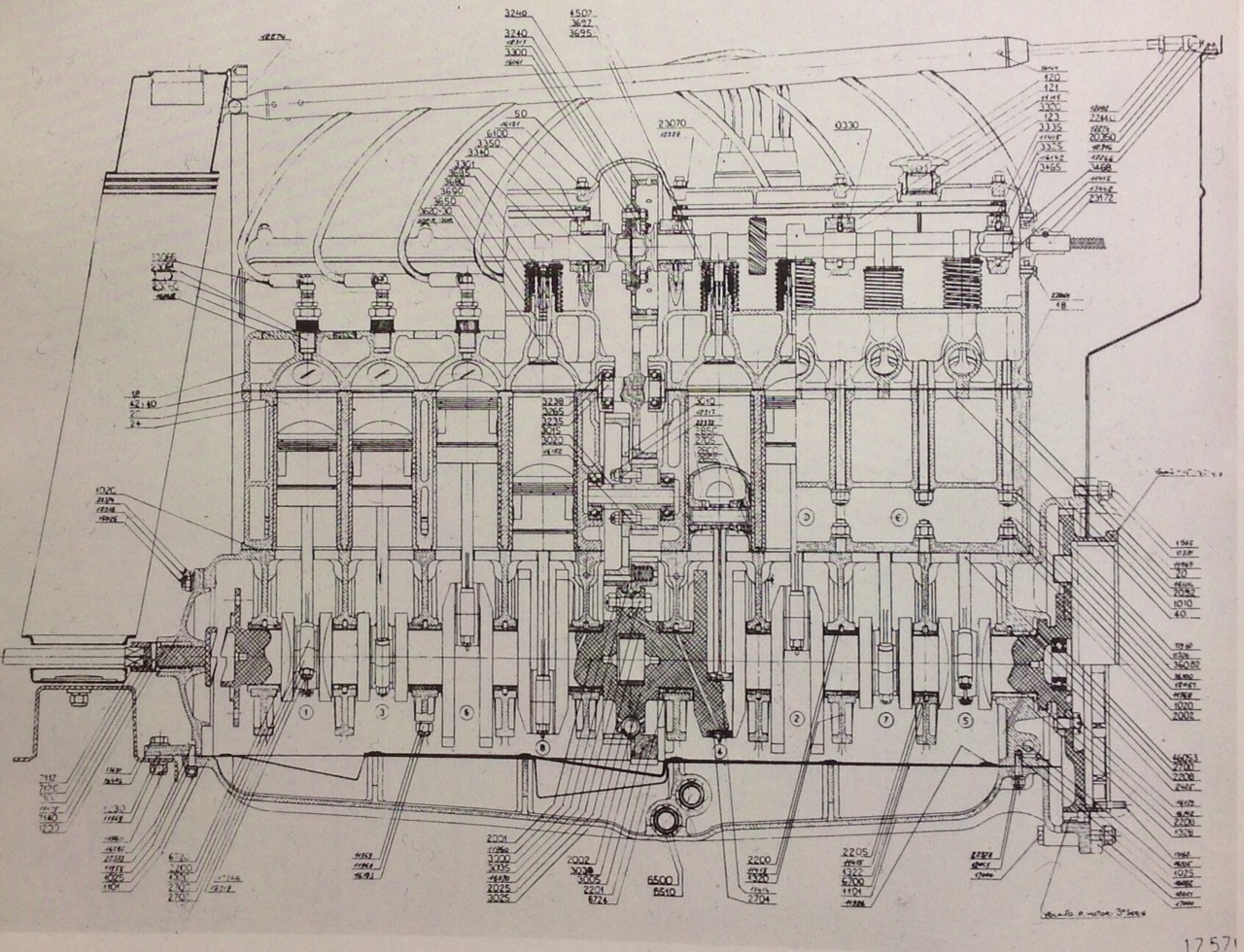
Cross section of the incredibly complex 917 engine, each of which took 200 hours to assemble. Magnesium crankcase is split along its centreline, the power takeoff is by pinion between the two middle main bearings, eight main bearings in total. DOHC per bank, two valves per cylinder sodium filled and two plugs per cylinder. Not winning was not an option! (Porsche AG)

All hands on deck…homologation and timeline pressures created surely one of the most amazing production lines ever!? Werk 1, Zuffenhausen (Porsche AG)
The spaceframe chassis was of welded aluminium tube and largely that of the 908 but suitably reinforced. Note that later in the program three chassis’ were built of magnesium, the wheelbase was 90 inches and track in 1969 58.8 inches at the front and 60.4 inches at the rear.
As with all Porsche racing cars the frame had to withstand 600 miles of hard driving on the Weissach ‘Destruction Course’ but even so a tyre valve was incorporated into the 103lb frame to allow it to be ‘inflated’, a loss of pressure indicative of chassis cracks- sub-optimal in a car of this performance!
Again, magnesium, aluminium and titanium parts were widely used for the running gear- titanium for spherical joints, hubs, springs, the gear lever and steering column. Magnesium was used for the uprights and wheels and aluminium for the steering rack, this obsessive approach to weight saving ensured the car tipped the scales at less than 800kg.

Porsches’ obsession with weight extended to the chassis which was welded aluminium tube. Total weight 103lbs. The one on the right is unfinished. Strong and light…both 917 and 512S Ferrari were spaceframe chassis’, hardly state of the art in 1969/70 but effective all the same. Porsche did not build an aluminium monocoque racing car till the 956 in 1983 (Porsche AG)
The suspension geometry was the same as the 908 but incorporated anti dive geometry, this was achieved by angling the upper and lower wishbone pivots to each other. Wishbones were used at the front with coil spring/damper units and an adjustable sway bar. At the rear a single top link and lower inverted wishbone was used, radius rods provided fore and aft location and again coil spring/damper units were used and an adjustable sway bar- Bilstein provided the shock absorbers.
Initially 9×15 inch front, and 12×15 inch rear, magnesium alloy wheels were used, with a single centre aluminium lock nut- the same as the 908, inside these big wheels the brake package in 1969 comprised ATE aluminium calipers clamping cast iron, ventilated rotors/discs.
Once ready to test, the suspension was largely set up at the Nurburgring- long suspension travel, plenty of camber change and tyres of a rounded tread section were necessary for performance there. This did not translate well at other circuits where the car was ‘under-tyred’ and the geometry thought unsuitable as well- more of this later in the article.

Factory rear suspension drawing- upper top link, inverted lower wishbone and progressive rate coil spring/damper unit. Titanium driveshafts with ‘rubber donut’. Magnesium uprights with titanium hubs, ATE aluminium brake calipers clamped ventilated iron discs. Wheels in mag alloy with aluminium lock nut (Porsche AG)

The bodies were developed in the wind tunnel…
The 917 body was developed in the Porsche Design Department, a plasticine model was created at 1:5 scale and shortly thereafter a 1:1 model which was used for wind-tunnel testing at the Research Institute of Automotive Engineering and Vehicle Engines at the University of Stuttgart. Additional support for testing the aerodynamic development was provided by Charles Deutsch’s Pars based Societe d’etudes et de Realisations Automobiles (SERA), although this was later in the program, not at its outset in 1968.
Both short and long tails were interchangeable, fitted with the latter 236mph on the Mulsanne Straight was achieved in 1969- the bodies were fibreglass, bonded to the chassis, as already outlined and incorporated two seats and doors in accordance with the regulations.
Stability of the cars was critical, front spoilers were fitted and an ingenious setup of mobile rear flaps connected to the rear suspension in such a way that if the suspension was compressed the flaps would create an aerodynamic force to raise the tail whilst if the suspension was extended, the flaps would angle up to push the tail down.
In 1969 these appendages caused major dramas- only two weeks before Le Mans, during the Monaco Grand Prix weekend, the FIA banned ‘moveable aerodynamic devices’ on all racing cars, a consequence of the many wing failures in F1 throughout 1968 and into early 1969- the ‘straw which broke the camels back’ was the breakage of Colin Chapman’s fragile high wings fitted to the Jochen Rindt/Graham Hill Lotus 49 Fords and consequent accidents a lap apart during the Spanish Grand Prix weekend at Montjuich Park- Jochen was lucky to survive that one.
As the 917 was almost undriveable without the flaps with which it was designed and homologated, the cars were allowed to race at Le Mans but the devices had to removed thereafter. Twenty-five sets had been made to comply with homologation requirements but only two or three were used!

Porsche factory drawing showing how suspension deflections actuated the rear wing flaps, from full to no downforce. Movable aero devices banned by the FIA from the end of Le Mans ’69. Changes to bodywork design obviated the need for the flaps in both short and longtailed forms in 1970/71 (Porsche AG)

’69 spec long and short tail comparisons (Porsche AG)
Construction…
From the outset Piech was determined to exhibit the 917 at the Geneva Motor Show in March 1969 to both maximise publicity and to use that timeline to ensure construction of sufficient machines to allow homologation before Le Mans- construction commenced in December 1968.
To meet the target Porsche created thirteen working groups into which 45 race mechanics were inserted to assemble the cars in the testing and race department at Werk 1 (Plant 1) in Zuffenhausen with 10 other mechanics taking cars of component pre-assembly.
Chassis construction was sub-contracted to Baur in Stuttgart and the fibreglass bodies to Waggonfabrik Rastatt. By this stage the first of Mezger’s engines had been tested and run.

917-001 after completion before loading for Geneva, outside Werk 1 Zuffenhausen (Porsche AG)

(Porsche AG)
With a little over two months to run the team were working around the clock to meet the deadline, with only a brief break for Christmas. Baur delivered the first chassis to Waggonfabrik Rastatt at the end of 1969, then, on 1 March 1969 the first chassis- 917-001 arrived at Zuffenhausen for final assembly, it was completed on 10 March 1969, the evening before its despatch to Geneva. At 3pm on 12 March the worlds motoring media gathered around the stunning new machine on the Geneva Show official press day.
Back at Werk 1 assembly continued, the 917 was accepted for technical inspection on 20 March but not all the cars were in running order so the CSI ordered a further inspection a month later ‘…the day finally arrived on 21 April 1969, the English FIA delegate, Dean Delamont, and the German ONS representative, Herbert Schmitz arrived at Werk 1 to examine the regulation compliant roadworthy units.’. The next day the Porsche Press Department declared that “The Porsche 917 is homologated as a sports car from 1 May 1969 and is expected to make its debut appearance at the 1000 kilometres of Spa-Francorchamps on 11 May”.

Porsche 917 homologation document dated 19 April 1969
Racing the 917…
The traditional Le Mans test weekend took place on 29/30 March 1969, there the 917 made its public circuit debut.
Proceedings were dominated by the gruesome death of Lucien Bianchi in the new Autodelta Group 6 Alfa Romeo Tipo 33 3 litre V8 which crashed after a component failure befell the co-winner of the race the year before, going over the hump on the Mulsanne Straight.
Rolf Stommelen drove the car (below) and achieved a speed quicker then the 908LH, (LH is ‘Langheck’ or Long Tail), 3 minutes 30.7 seconds, over 3 seconds clear of Johnny Servoz-Gavin in a Group 6 Matra MS630/650. Whilst ‘on paper’ the car had potential the handling and levels of stability from the drivers seat were frightening.

(unattributed)

(unattributed)
Fettling the 917 at the Le Mans test weekend.
No amount of ‘at the track fixes’ would deal with the high speed instability the drivers were experiencing- body is fibre glass and bonded to the aluminium spaceframe chassis.
By that stage of the sportscar season the first two championship rounds in North America had been run and won in February and March- the Daytona 24 Hour was won by Roger Penske’s Lola T70 Mk3b Chev driven by Mark Donohue and Chuck Parsons whilst the Sebring 12 Hour went to another 5 litre pushrod American V8- this time a JW Automotive Ford GT40 crewed by Jacky Ickx and Jackie Oliver- the season was wide open at this stage with Porsche still to get an outright win on the board.
The next two rounds at Brands Hatch in late April, and Targa in early May started to redress the balance though- both the Brands and Monza 1000km fell to the 908/02 combination of Jo Siffert and Brian Redman.
Gerhard Mitter and Udo Schutz won in Sicily, the Targa Florio on 4 May was a 908 rout- Vic Elford/Umberto Maglioli and Rolf Stommelen/Hans Hermann were second and third with another factory car of Willy Kauhsen/Von Wendt in fourth. ‘Porsche System Engineering Ltd’ entered six cars!, only the Lins/Larrousse and Attwood/Redman 908/02’s failed to finish. No 917’s were entered on a circuit totally unsuited to them.

First race apperance for the 917, Spa 1969. Gerhard Mitter and Udo Schutz shared the car but an engine failure early in the race meant only Mitter got a race drive (unattributed)
After little testing, two 917’s, in addition to a ‘fleet’ of 908s were entered for the Spa 1000Km on 11 May.
Jo Siffert and Brian Redman practiced their 917 but Jo made the call to race a 908, the duo won the event from Pedro Rodriguez and David Piper in a Group 6 Ferrari 312P and Vic Elford/Kurt Ahrens third in another 908 with the Stommelen/Herrmann crew fourth.
Gerhard Mitter started his 917, having qualified it eighth but retired with engine failure on lap 1 having possibly over-revved the motor at the start- the 917’s continued to exhibit high speed instability, the very reason Siffert elected to race a 908LH. It was a good call from a championship perspective with another win on the board.

On the Spa grid- drivers immediately behind the 917? Kurt Ahrens in the anorak to the right aft of car (Porsche AG)

(unattributed)
Gerhard Mitter wrestles his 917 around Spa’s La Source hairpin above, early aero with adjustable wings at the rear and no winglets up front- compare the front of the 917 at the Osterreichring in the photos to follow below. 1969 cars exhausts exited from both the rear and aft of the doors.
Porsche entered six cars at Monza- four Group 6 3 litre 908LHs for Elford/Ahrens, Stommelen/Herrmann, Siffert/Redman and Mitter-Schutz and two Group 4 4.5 litre 917’s for the last two named pairs who could make a choice between 908/917 as they/the team saw fit.

Frank Gardner and David Piper brought the 917 home for its first race finish at the Nurburgring 1000Km (unattributed)
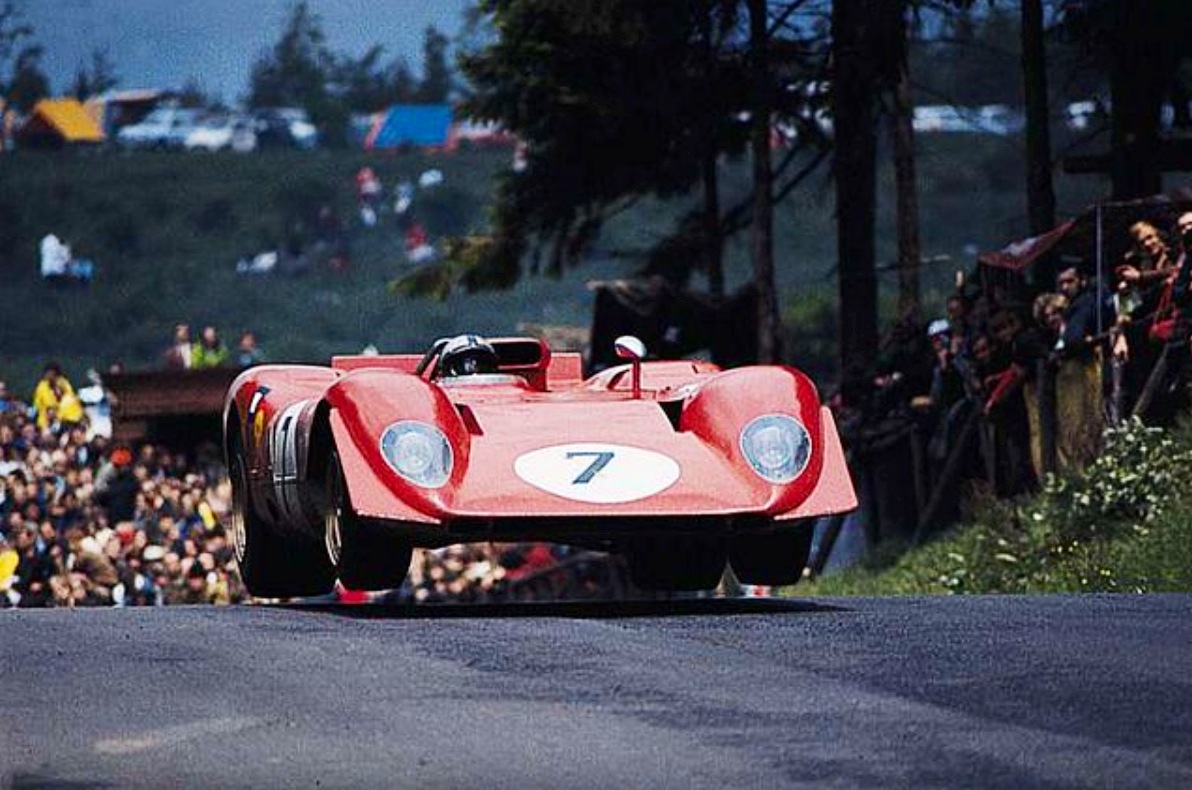
For Porsche’s home event, the Nurburgring 1000Km on 1 June they hired two hardened sports car professionals in Frank Gardner and David Piper to ‘bring the thing home’- that they did in eighth place having wrestled the unruly beast, chassis 917-004, around 44 laps of the ‘Green Hell’ for six hours and twenty minutes.
Gardner was a noted test and development driver, Porsche were keen to get his views on the changes he considered necessary to make the car competitive. The race was won again by the Siffert/Redman combination in a 3 litre 908/02 ahead of four other 908’s- Herrmann/Stommelen, Ahrens/Elford, Rudy Lins/Attwood and Kauhsen/Karl von Wendt- what domination, the first five cars on the grid were all 908/02s.

Gardner/Piper 917 ahead of the Hobbs/Hailwood Mirage M2/300 BRM DNF and Ortner/van Lennep Abarth 2000SP NC (Schelgelmilch)
Le Mans 1969…
Other than more power- 580bhp, and with the anti-dive geometry of the suspension reduced from a factor of 50% to 5%, the 917 arrived at Le Mans as designed. Fortunately, as described above the cars were able to race with their adjustable rear wings, common-sense prevailed from a safety perspective.
At Le Mans Porsche famously, very narrowly lost the race by about 100 metres, the Hans Herrmann/Gerard Larrouse 908LH was just beaten by the Ford GT40 of the ‘two Jackys’- Jacky Ickx and Jackie Oliver, won in GT40 chassis ‘1075’ the same JW Automotive GT40 which was victorious the year before in the hands of Pedro Rodriguez and Lucien Bianchi.

’69 Le Mans start. Jo Siffert #20 908/2, Elford #12 917LH, Schutz 908LH, #7 Hobbs Ford GT40, #2 Bonnier Lola T70Mk3b Chev, #64 Hermann 908LH, #22 Lins 908LH…and the rest. (Porsche AG)

The pole winning Stommelen/Ahrens 917LH retires on lap 148 with an oil leak, the car was hard driven, it was the teams ‘hare’ (unattributed)
Rolf Stommelen put his 917 on pole, outlining the cars potential but the car failed on lap 148 with an oil leak. Vic Elford qualified his second co-driven by Richard Attwood, the car led the race for twenty hours and did 327 laps- enough for ninth place but the car was not running at the finish having withdrawn with a cracked bellhousing.
Elford recalled ‘The engine was running like clockwork until that point. No problems whatsoever’ whilst Hans Mezger noted, upon returning from his lunch break at the time that ‘When I returned to the pit I could tell straight away that something wasn’t right.’
John Woolfe’s car was destroyed in his fatal lap 1 accident, the car having qualified ninth in the hands of factory driver Herbert Linge- car owner Woolfe started the race rather than the far better credentialled Linge.

Vic Elford in the car he qualified 2nd. He shared the car with Richard Attwood, they led the race for 20 hours, DNF after 327 laps with a cracked gearbox bellhousing (unattributed)

Ickx wins from Hermann…the GT40 margin from the 908LH, 2 seconds after 24 hours of racing and despite losing 20 minutes in a long pitstop for the crew of the 908 to replace a front wheel bearing (unattributed)
The first 917 win, Osterreichring 1000Km 1969…
Porsche did not take a 917 to the 12 July Watkins Glen 6 Hour but were victorious again all the same, Siffert and Redman again won in a 908/02 from the Elford/Attwood and Jo Buzzetta/Rudy Lins Porsche Austria pairing- the non-Porsche class-winner was the screaming V12 Group 6 Matra MS650 raced by Pedro Rodriguez and Johnny Sevoz-Gavin to fourth.
‘More intensive testing and test drives were carried out before the last race of the year, the Austrian Grand Prix in Zeltweg…A scheme to improve driving stability is instigated by race engineer Peter Falk, is one of the first tests to be tested at the South Loop of the Nürburgring. Further tests are later conducted on the skid-pad in Weissach and at Hockenheim. Adjustments to the aluminium frame and modifications to the body are intended to enhance the characteristics of the 917’ Porsche wrote, confident in advance of the meeting.

Starting grid Osterreichring 1000Km 1969. #29 Siffert/Ahrens winning 917, #33 Bonnier/Muller Lola T70 Mk3b Chev (2nd) #9Ickx/Oliver MirageM3 Ford (DNF). The 3rd placed Attwood/Redman 917 in white is behind Siffert. #42 Matra is Servoz-Gavin/Rodriguez (DNF) and the rest (unattributed)
The Seventh Austrian Grand Prix/Zeltweg 1000km/Austrian 1000km (take your pick) on the new 5.911km Osterreichring was the last round of the Manufacturers Championship in 1969 and is a fast track, circa 130 mph average and therefore well suited to the 917’s qualities.
And so it was that a 917 entered by Karl F von Wendt driven by Jo Siffert and Kurt Ahrens beat the Jo Bonnier/Herbie Muller Lola T70Mk3b Chev from the Richard Attwood and Brian Redman in the David Piper Racing Ltd 917K with Masten Gregory and Richard Brostrom fourth in the first of the 908/02s.
The Von Wendt/Piper 917 entries were made on the basis that both had options to buy the cars at a later date, Porsche having 25 of the things to sell, less those required for works use as you will recall…It wasn’t the strongest round of the year in terms of depth of entry but it was a win all the same!

(unattributed)
The Osterreichring winning Porsche 917K of Jo Siffert and Kurt Ahrens above.
Fitted with a 4.5 litre Flat-12 at this stage with the early rear aero treatment clear in this Shell promotional shot. In its first two races at Spa and the Nurburgring the car raced with a small fixed rear spoiler. Compare this photograph with the shot in ‘Etcetera’ below of the 1970 917K tail.
Jo Siffert (below) leads Jacky Ickx- the 4.5 litre Porsche 917 ahead of the 3 litre Mirage M3 Ford Cosworth DFV. JW Engineering, the entrant of the Mirage would be contracted by Porsche to race and develop the 917’s in 1970 and 1971, becoming the dominant team of that wonderful two year period…Le Mans excepted, where their luck did not hold!

(unattributed)
Race development, secret testing and the 917PA…

Jo Siffert Porsche 917PA, Bridgehampton Can-Am 1969. The race was won by Denny Hulme, McLaren M8B Chev, Jo finished third (unattributed)
Whilst a short tail 917K won the Austrian 1000Km race against weak opposition, other than at Le Mans the cars were still uncompetitive.
A critical test took place at Zeltweg which changed everything. Representatives of Porsche including experienced engineers Peter Falk and Helmut Flegl and from JW Automotive- David Yorke, Team Manger and Chief Engineer, John Horsman, attended the test which took place at the Osterreichring between 14 and 17 October 1969.
Two 917’s were made available- 917-006, a Le Mans practice car and 917-008 which led the race until it retired during the twenty-first hour. The target time for drivers Redman and Ahrens was the 1:46.6 the Gulf Mirage M3 Ford had done in August, by the end of the second day, the 15th, the best they had done was a 1:48.2.
During a pitstop John Horsman noticed the lack of dirt and bugs-gnats, on the rear bodywork which indicated to him the air was not following the contours of the bodywork and therefore the problems with the car were aerodynamic rather than suspension geometry or tyres. Note that the Porsche duo have claimed that they saw exactly what Horsman did at the same time he did so take your choice as to who was responsible for the key observation or whether the credit should be shared.
‘I knew immediately that we had to raise the rear deck and then attach small adjustable spoilers to the trailing edge. It was obvious to me that if the whole body was in the airstream it would be able to exert some downforce’ recalled Horsman.
Together with the JW mechanics- Ermanno Cuoghi and Peter Davies they quickly fashioned changes to the rear bodywork of 917-008 with aluminium sheet, rivets and tape, the work was finished after the circuit had closed. Brian Redman, sceptical, went out to test the car the following morning, 16th October and stayed out for 7 laps he was enjoying the car so much!
The changes were then made to 917-006 as well. Then, working between the cars on further alterations to both the body and suspension including springs and bars, no changes were made to the suspension geometry- and using wider wheels and Firestone tyres with whom JW were contracted (Porsche used Dunlops), resulted in a time of 1:43.2 set by Kurt Ahrens.


The John Horsman suggested changes to the rear deck of a 917 at ‘the Zeltweg test’ in October 1969 (J Horsman)

Less is more- you can see how the deck evolved over those couple of fateful days with more angle and bigger spoilers (K Ludvigsen)

(K Ludvigsen)
The Porsche design team, led by Eugen Kolb then had the task of ‘productionising’ the changes which involved the tail shape including redesign of the rear window, creating a tunnel in the upward sweeping tail to provide rear vision for the drivers and re-routing the exhausts to the open area behind the rear wheels. New side pods were also needed as they no longer housed the exhausts for the forward cylinders of the big flat-12. The nose profile was to be finalised too, with larger ducts for the brakes and fender vents for brake cooling.
The engine was largely left as was- whilst noting the exhaust changes, the Fichtel and Sachs clutch was replaced by a triple-plate Borg and Beck item whilst the gearbox and clutch housing were reinforced to avoid the failures experienced at Le Mans.
The pressure on Porsche was immense as a follow up test of what was by then referred to as the 917K was scheduled at Daytona only a month hence, on November 19 and 20 1969- it was another secret test with even Speedway employees refused admission to the grandstands and infield.
On hand were a squadron of technicians as well as drivers Siffert, Ahrens, Rodriguez and David Hobbs. In addition to the short tail, Porsche also brought along a new longtail, about which the drivers were not enthusiastic so the focus was on the ‘K’ and comprised Goodyear/Firestone tyre comparisons with simulated races and endurance runs.
Hobbs buzzed an engine on day 2 when he muffed an up-shift and bagged second instead of fourth gear and with it went his chance of perhaps partnering Pedro- the Porsche factory paid combination for 1970 was Siffert/Redman whilst the JW pairing, paid by them, ended up being Rodriguez and Leo Kinnunen- Ickx went to Ferrari for both F1 and sportscars in 1970 and so was no longer available to John Wyer.
Further changes to the cars made as a consequence of the test included re-routing the oil lines through dedicated plumbing rather than the chassis tubes to reduce cockpit heat, creation of the ‘D shaped’ windscreen to improve driver vision on the banking, bringing the steering wheel closer to the driver (when wanted), detail changes to the steering rack and transmission and a new front upright design due to concerns about brake pad taper wear and stability under brakes.
Whilst there are no photographs from Daytona, 917-011 was sent immediately upon its return from Florida to the University of Stuttgart for wind tunnel testing, the shots show how the car looked. The tests confirmed acceptable drag and downforce readings so no further changes were made to the body prior to Daytona several months hence with the exception of a roof window.

917-011 in the Uni of Stuttgart wind tunnel in November 1969 (Porsche AG)

(Porsche AG)
Lets not forget than an open car was built- designated the 917PA (PA ‘Porsche Audi’ the US importer of Porsche) for Jo Siffert to drive in the 1969 Can-Am series late that year.
The 917PA competed in six races with its best results a second and a third, the car was ‘blown away’ by the 7 and 8 litre Chevs, Bruce McLaren and Denny Hulme were dominant in their McLaren M8B Chevs. Valuable experience was gained for both the 1970 Manufacturers Championship and for another tilt at the Can-Am series. This information would prove useful for Porsche’s successful assault on the Can-Am championship in 1972 and 1973 with the awesome, turbo-charged 917/10 and 917/30.
Porsche had a fantastic 1969 season winning all but Le Mans. They won at Brands Hatch, Monza, Targa Florio, Spa, the Nürburgring, Watkins Glen and the Osterreichring to win the Manufacturers’ Championship and the GT Trophy as well as ‘blooding’ the 917 to set up its dominance for the next four years- two years in endurance racing and another two years at the Can-Am.
For 1970/1971 Porsche changed their approach to racing the cars, the factory continued to develop them but the race organisation was contracted to JW Automotive and Porsche-Salzburg, those seasons of success are another story- the seeds of dominance were sown in 1969…

(unattributed)
Porsche media day in late 1969 at Hockenheim.
Porsche 917PA Can-Am car and 917K in shot. Brian Redman, Jo Siffert, Pedro Rodriguez and Rico Steinemann are in attendance. You can see the refinements to the rear bodywork of the 917K, reputedly ‘cribbed’ off the Lola T70Mk3b and also on the #23 1970 Le Mans winning car below.
Etcetera…

Porsche 917-001 (Porsche AG)

(Porsche AG)
Assembly in Werk 1 Zuffenhausen early 1969.

(Porsche AG)
The first car completed, chassis 917-001, was a show car and beauty queen in a variety of configurations right throughout its life, it was restored to its original 1969 917 LH specifications a few years ago.

(Porsche AG)
Ferdinand Piech with the CSI inspection crew at Zuffenhausen in April 1969, can’t have been a difficult task, they only had to count to 25!
The process took two bites of the cherry, the cars were not complete on the first visit so the team rocked up again a month later to ensure alles wast kosher allowing the formal homologation of the 917 into Group 4 to take effect in time for Le Mans.

(unattributed)
Porsche kaleidescope of colour, 908 and 917 wings at Le Mans in 1969.
See the text for the operation of these rear wing flaps, 25 sets made for homologation but only 3 or so actually used! Flaps banned post Le Mans.

(unattributed)
The original 1969 917 body in all its glory.
#15 is the Herbert Linge/Brian Redman/Rudy Lins car which tested but did not race at Le Mans. It is a 917LH spec note front trim wings but lack of adjustable wing flaps at the rear.

(Klemantaski)
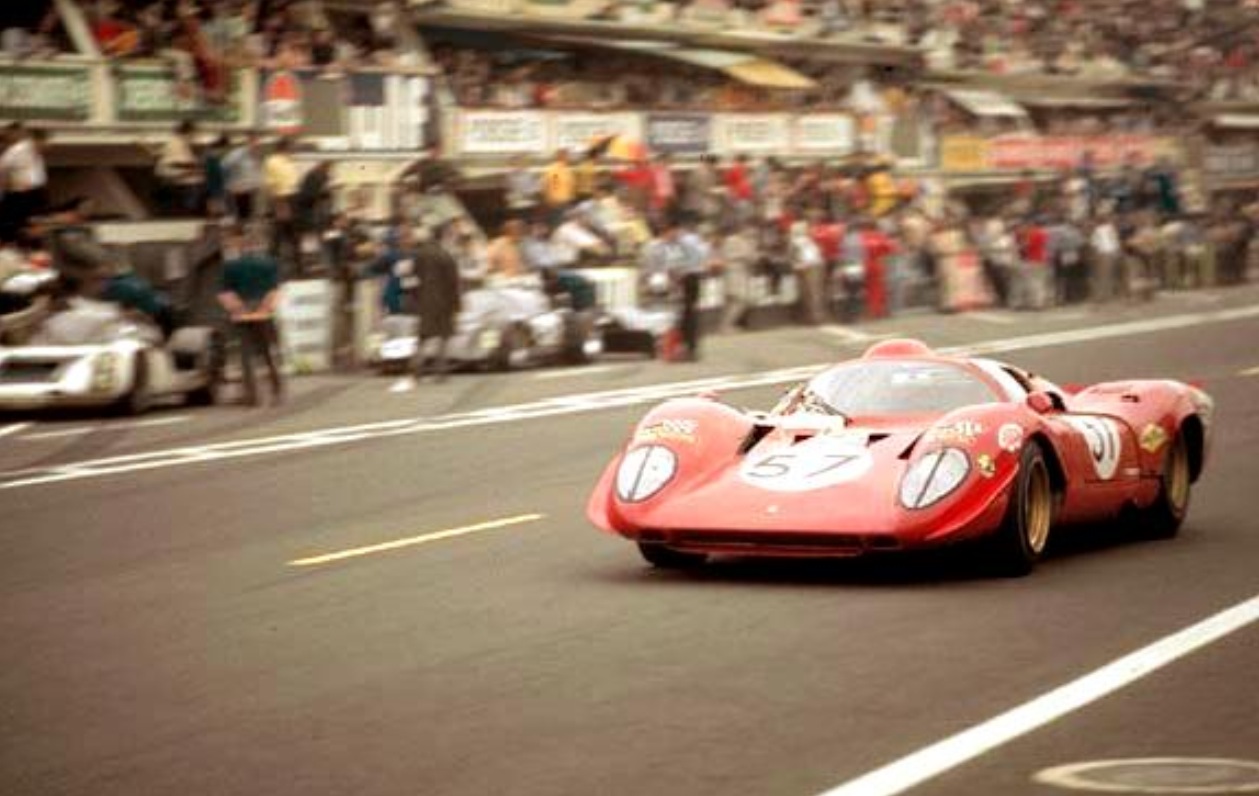
The Elford/Attwood 917LH at Arnage during Le Mans 1969.
Note the extreme length of the tail, side exhaust, front winglet and flaps at the back, allowed as per the earlier text for Le Mans only.

917-001 cockpit post restoration in modern times (Porsche AG)

(Geoff Goddard)
Porsche racing cockpits have always been about function.
‘Momo’ steering wheel, lever for 5 speed synchro (sometimes 4) gearbox to the right. Aluminium tube frames on floor visible, six point harness and minimal instrumentation.

(unattributed)
Bata ‘Scouts’ were the go in cool footwear for twelve year olds in 1969, clearly the Bata ‘Jacky Ickx’ was aimed at a slightly older market!
Jo Siffert at Spa during practice, again note in particular the aerodynamic treatment of this 917K- Jo elected to race a 908 and won together with Brian Redman.

(unattributed)
Jo Siffert, Porsche 917PA being chased at the Laguna Seca Can-Am round by Denny Hulme’s McLaren M8B Chev, the dominant car of 1969- Bruce McLaren won the race from Hulme with Jo fifth.
Compare and contrast the bodywork of the 917PA above on 12 October and that of the car a fortnight later on 26 October below during the LA Times Grand Prix at Riverside.
There the car has a much ‘wedgier’ nose in search of greater front bite and top speed. Siffert was Q11 and DNF with an oil leak, Denny the winner in his M8B Chev- Bruce McLaren won the championship that year from Denny and Chuck Parson’s Lola T163 Chev.


(unattributed)
Quintessential 917K (short tail) 1970 spec car- here the Porsche Salzburg Le Mans winning car driven by Hans Hermann and Richard Attwood car.
The shot included to show the changes made to the car’s bodywork very late in 1969- different door line, no exhaust exits aft of the doors, wedge shape and Lola T70 Mk3b inspired rear deck.

(unattributed)
For the sake of completeness the 1969 917LH evolved into this bodywork in 1970.
Here is the marvellous Martini Racing Team ‘Hippy Car’ of Gerard Larrousse/Willie Kauhsen which was second at Le Mans 1970- compare and contrast the swoopy, curvaceous long tail body with the 1970 917K #23 immediately above.

Reference and Photo Credits…
Vic Berris cutaway drawing, Porsche AG, ‘Cars in Profile Collection 1’ article by Paul Frere, ‘Testing at Zeltweg’ article by Karl Ludvigsen in ‘Drivetribe’, International Motor Racing Research Center article ‘A truly Secret Track Test of The Porsche 917’, Vic Berris, Geoff Goddard, Rainer Schlegelmilch, Klemantaski Collection, John Horsman Collection
Tailpiece: No time to admire the scenery for Frank Gardner! 917/004 during Nurburgring 1000 Km practice in June 1969…

(Schlegelmilch)
Finito…













































 primotipo...