Archive for the ‘Who,What,Where & When…?’ Category

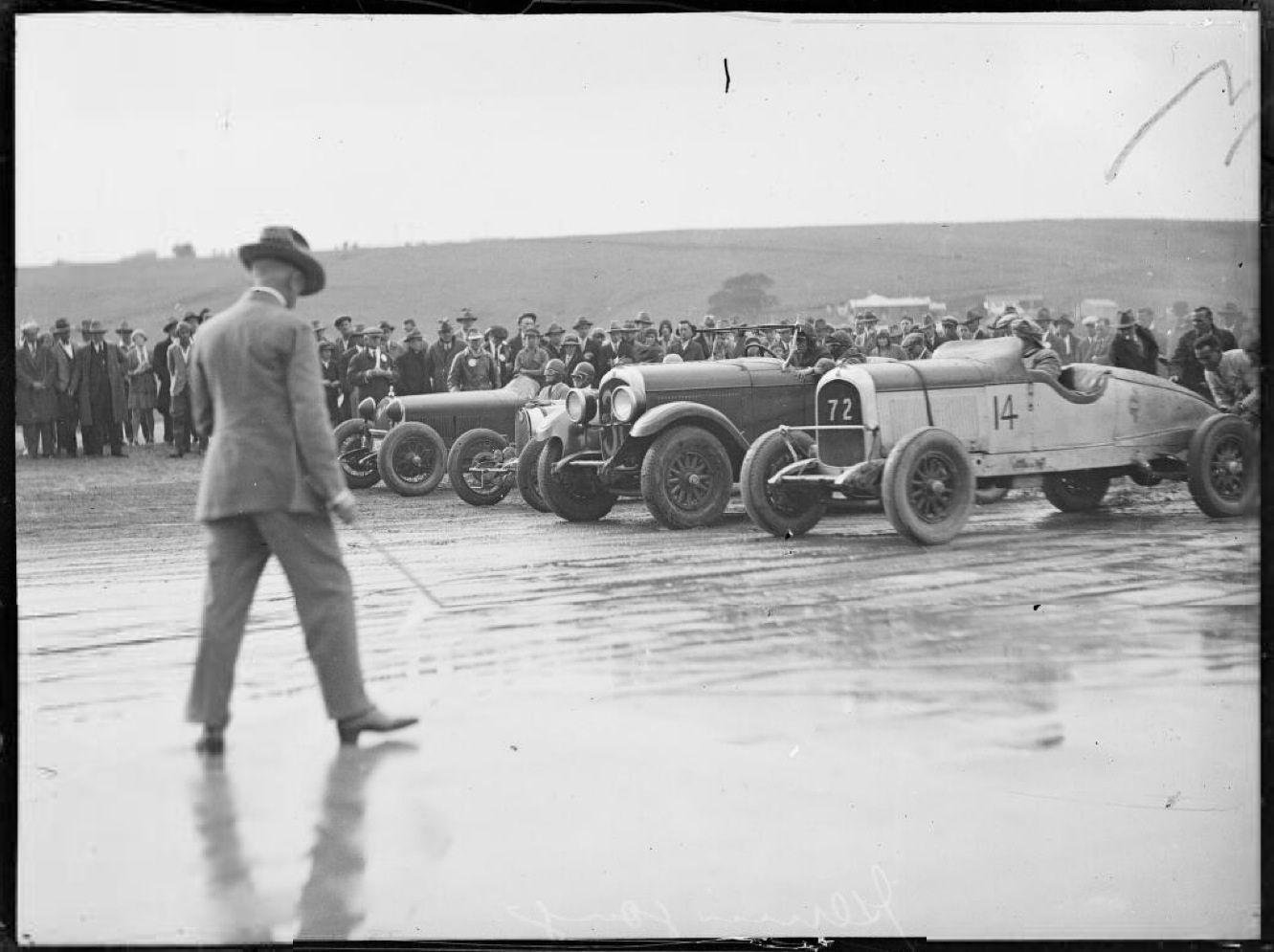
Start of the 50 Mile Handicap heats: Hunter in the Mrs Jones owned Alfa 6C1750 at left, Thompson’s obscured Bugatti T37A and two six-cylinder 4077cc Chryslers of E Patterson and #72/14 HJ Beith (Fairfax)

Bill Thompson’s Bugatti T37A swept all before him at Gerringong Beach on 10 May 1930…

Sydney’s finest was very much the form driver of the meeting, in fact many would say he was Australia’s best driver pre-War. He had not long before won the 1930 Australian Grand Prix at Phillip Island during the 24 March weekend- it was one of his three wins in Australia’s premier event. Bill was also coming off the back of record times at Penrith Speedway and at Kurrajong Hillclimb that season.

Gerringong is 130 Km south of Sydney on the Illawarra Coast, then as now it is a popular holiday destination. Throughout the 1920’s the relatively deserted Seven Mile Beach, between Black Head and Beecroft Head was a place where members of the Royal Automobile Club raced their cars, far enough from Sydney and the long cold stare of the law. These occasions were as much society events as they were motor racing ones.

The Smith/Harkness Anzac Rolls Royce arrives at Gerringong in December 1929 (Kiama Tourist)

Gerringong was very much in the public mind at the time as Norman ‘Wizard’ Smith had set an Australian Land Speed Record testing his Rolls Royce engined ‘Anzac’, at 128.571 miles per hour only months before on 1 December 1929. Wizard and his exploits, and the skill of Don Harkness, a racer himself, and his company which built ‘Anzac’ is a story for another time.

The beach had been the site of horse racing since the 1860’s but the noble beasts ‘could not compete with the speed and excitement of the motor’, mind you the take up of motor vehicles in Australia is indicated by the October holidays in 1919 when there was record volumes of motor traffic through the town, in just two hours, 12 vehicles were counted driving through Fern Street.

The weather on the 10th of May was awful for racing, with rain the night before and drizzle prevailing for most of the day from the 11.40am start of the meeting- only 300 hardy souls watched the race action.

The sand was wet, to the extent that all competitors of the first event had to be pushed out of the sand, into which they had sunk before the race started! The conditions became more difficult for the organisers, the Sydney Bicycle and Motor Club, as the programs timeline grew in inverse proportion to the usable width of beach- which was down to two cars  by the end of the days proceedings. ‘Another five minutes’, a club official said and ‘the tide would have beaten us’.

The ‘Sydney Referee’ report made note of the other difficulties as soft and slippery sand at the turn posts, drizzling rain and some ‘competitors whose race tactics, were, to say the least of it, unsafe’.

Thompson and a young admirer after his Gerringong win (Fairfax)

Thompson’s win of the feature event, the ’50 Mile Handicap’ for cars under 2000cc was described as a ‘great win’, a ‘fine individual effort’ ‘even though there have been better races held in Australia’.

Thomson won the race in the Bugatti T37A in which he was victorious at the AGP in the month before, chassis ‘37358’, which is still in Australia in the process of restoration. See my article at the end of this one on the 2015 Melbourne ‘Motorclassica’ for some information about that car.

Thomson won in 39 mins 4 secs from the CN Jackson MG Midget 847cc s/c, HG Potts Lea Francis 1496cc s/c. Other starters in the final were Charlie East’s Bugatti T37A, RR Hawkes Austin 7 Sports 748cc, N Hodge Morris Minor 847cc and the JAS Jones owned Alfa 6C1750 SS s/c driven by A Hunter, DNF due to splashing through a wave whilst on course. It is not clear if the other cars completed the distance.

The engine of Thonpson’s T37A is fettled before the off (Fairfax)


In other races, Charlie East won the final of the Four Miles Over 1000cc from the JO Sherwood Chrysler and J Aubrey Jones also in a Chrysler. There were three heats in all- won by Bill Thomson’s Bug, John Sherwood’s Chrysler and E Patterson’s Chrysler.

The Eight Miles Club Championship final was won by Thomson, the heats won by HJ Beith Chrysler Sports and Thomson’s Bugatti. Maroubra legend, Hope Bartlett in a Bugatti, did a very quick first lap in heat 1 but forgot the second lap! No pitboards were in use at Gerringong it seems.

The Handicap for Closed Cars was won by J Aubrey Jones Chrysler and the Handicap for cars under 1000cc was taken by the N Hodge Morris Minor.

Thomson said that such was the narrow course- it hardly gave him enough width to clear oncoming cars, that he was about to pull out. ‘It was the hardest event I’ve been in, much worse than the the Phillip Island race’, the ‘Island was famous for the challenging nature of its gravel roads, dust and undulations.

After the conclusion of the meeting Bill Thomson hoped to beat the Gerringong Flying 1 Mile record of 33 3/5 of a second set by Don Harkness in a Hispano Suiza in 1923 but failed to get there given the conditions, his 36 4/5 seconds not as good as he had hoped having changed into top gear a little too early with a head wind doing the rest of the damage to his time.

Another grid this time with two Chryslers to the left, #72 the E Patterson and HJ Beith Chrysler Sports, Charlie East Bugatti T37A to right (Kiama Tourist)

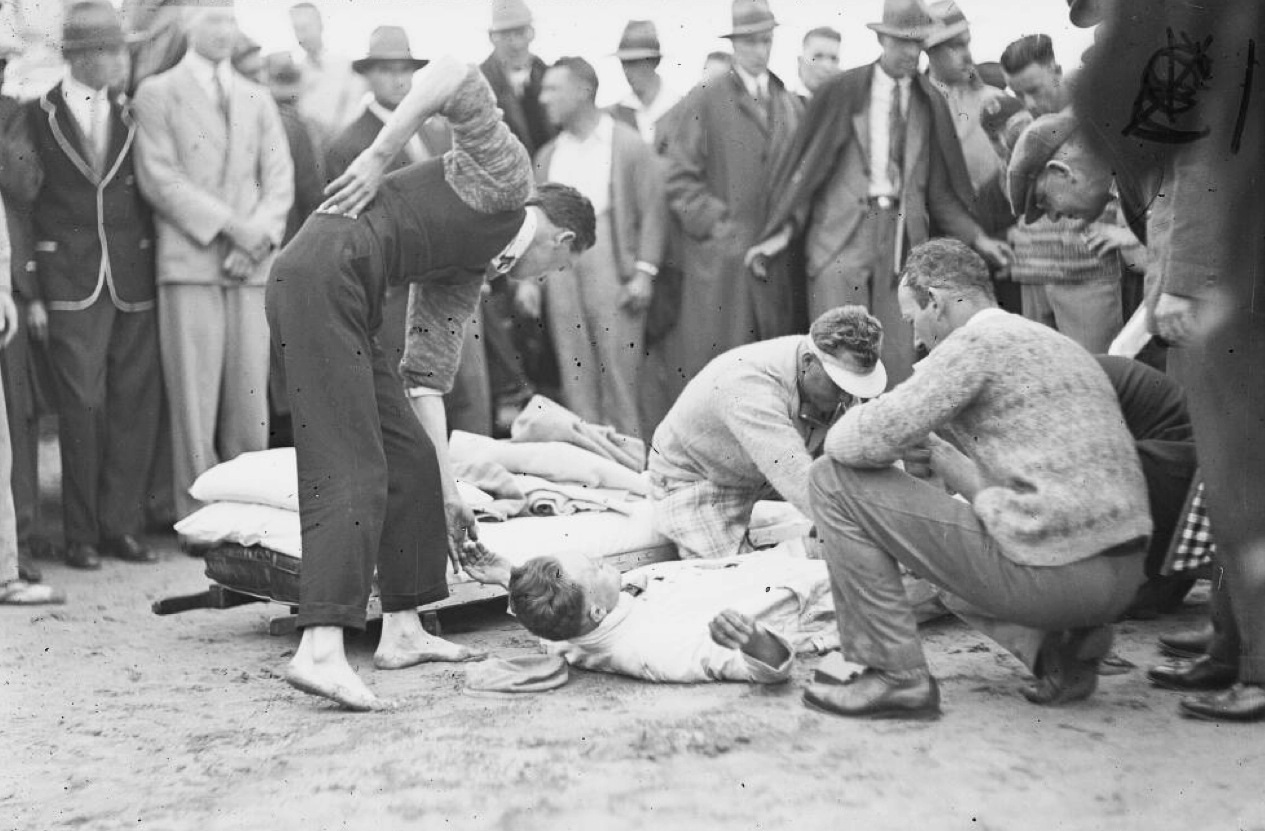
The only major incident of the day occurred when Mrs JAS Jones ‘winged’ one of the Chrysler mechanics (below) when competitors in the second heat of the over 1000cc Four Mile Handicap passed the finishing post and turned too quickly, and spectators pressed forward. Jones, in last place arrived at race speed and had to swerve several times to avoid cars and bystanders. She almost got through but struck Curley, breaking his leg.

(Fairfax)

The ‘Referee’ concluded its report of the meeting by saying ‘All things considered it was a successful meeting. But the supervision left a lot to be desired. It was this fault, plus stupidity on the part of certain competitors, that led to a serious accident. After crossing the finishing line several of the competing cars turned back towards the oncoming cars and one even swung out suddenly across their path. Thereafter the officials made their presence felt. But one subsequent offender should have been severely cautioned’.

Mrs JAS Jones aboard her Alfa 6C1750- a much respected racer and car. Raced by many latterly into the fifties Flathead Ford V8 powered inclusive of an AGP and still in Oz (Fairfax)

Motor Car Racing in Australia in 1930…

I wrote an article a while ago about Penrith Speedway and a championship meeting held there in 1930, click on this link to read it, not least for some context on the state of car racing, especially road racing at the time in Australia.

Penrith’s World Championship Race 1930…

Here are some snippets from that article, but do read the whole thing if you have not.

The Australian Grand Prix was held for the first time on an oval dirt layout around the showgrounds at Goulburn, New South Wales in 1927. The 1928 AGP, ‘The 100 Miles Road Race’ at Phillip Island, the first proper race in Australia on a road, run on a large, rectangular, gravel course was more indicative than Goulburn of the direction Australian racing would take and was indeed the race which started the tradition of road racing in Australia.

Gerringong Corners- two of them, one at end end of the beach, tide issues clear! (Fairfax)

At the time Australian motor racing was largely amateur, a ‘run what you brung’ approach prevailed with most competing cars driven to and from the track. The sport evolved from hillclimbs, sprints and races on horse-tracks, the province of the gentry pre-War, to hillclimbs at Waterfall Gully, Kurrajong, Mount Coot-tha and Belgrave, beach racing at Gerringong and Sellicks Beaches to venues such as the clay pans of Lake Perkolilli in Western Australia, and the Aspendale, Maroubra and Penrith Speedways.

John Medley wrote that ‘it was some time before other groups followed (the Light Car Club of Victoria’s Phillip Island) road racing direction, preferring the simpler expedient of running trials with speed sections included (rather like modern rallies) or contests on simple dirt speedways- both of these being more easily controlled by the organisers and also less accessible to the long arm of the law. One consequence was that their was very much a casual air to the whole occasion, with ‘chop picnics, family gatherings and exuberant overnight parties.’

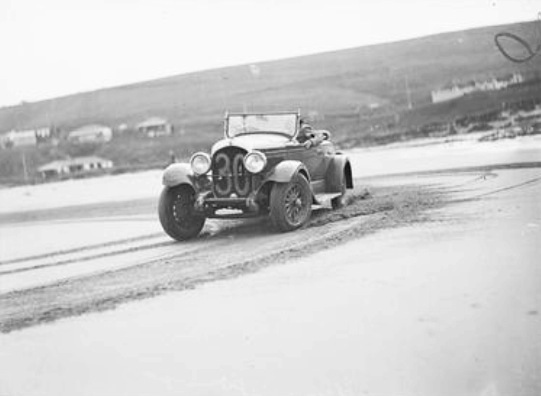
E Patterson’s 4 litre Chrysler, desolate nature of the area at the time clear, Gerringong 1930 (Fairfax

I have not used the term speedway racing as the ‘forked road’ the sport took in later years had not yet occurred, competitors entered a variety of events as above. In addition solo intercity record-breaking attempts were important with Graham Howard recording that ‘…intercity records…were the most consistent form of competitive motoring in Australia until the late 1920’s, and produced our first household-name drivers…’ In fact the police made illegal the ‘Intercity Record Breaking’ in 1930 with Wizard Smith a household name as a result of these exploits.

A lot would change in terms of road-racing between 1930 and the war- ‘Round the Houses Racing’ in towns became common in Western Australia at places like Albany, Bunbury and Goomalling. Australian Grands Prix were held at Victor Harbor and Lobethal in South Australia and most importantly the Mount Panorama Scenic Drive, at Bathurst- which doubled as a racetrack, opened in March 1938- the 1938 Australian Grand Prix was held there on that weekend. By the war the foundations for car road racing in Australia were well and truly established, something which could not be said in May 1930.

Professor Neville Burkitt’s Mercedes Benz SS- came close to colliding with Bill Thompson’s Bug, or more particularly his Bugatti Thompson was driving!, in his heat (Fairfax)

Etcetera…

(A Patterson Collection)

A ‘Percy’ Hunter and Vida Jones aboard the Jones 6C1750 before one of the events. What a superb spectacle that car and the 37As must have made on that beach!

Bill Thomson and his Bugatti T37A…

Penrith’s World Championship Race 1930…

Bibliography…

Sydney Morning Herald 6 May 1930, Sydney Sun 10 & 11 May 1930, Sydney Evening News 10 May 1930, ‘Bathurst: Cradle of Australian Motor Racing’ John Medley, kiama.nsw.gov.au

Photo Credits…

Fairfax, Adrian Patterson Collection

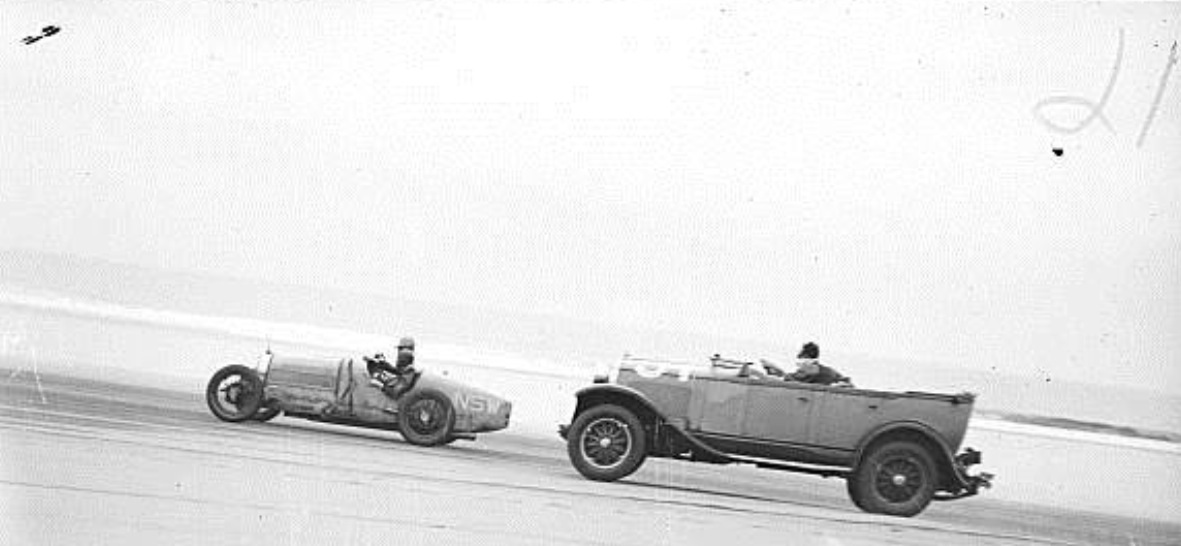
Tailpiece: Thompson’s Bug blowing off a Chrysler, Gerringong Beach 1930…

Finito…

(A Clisby)

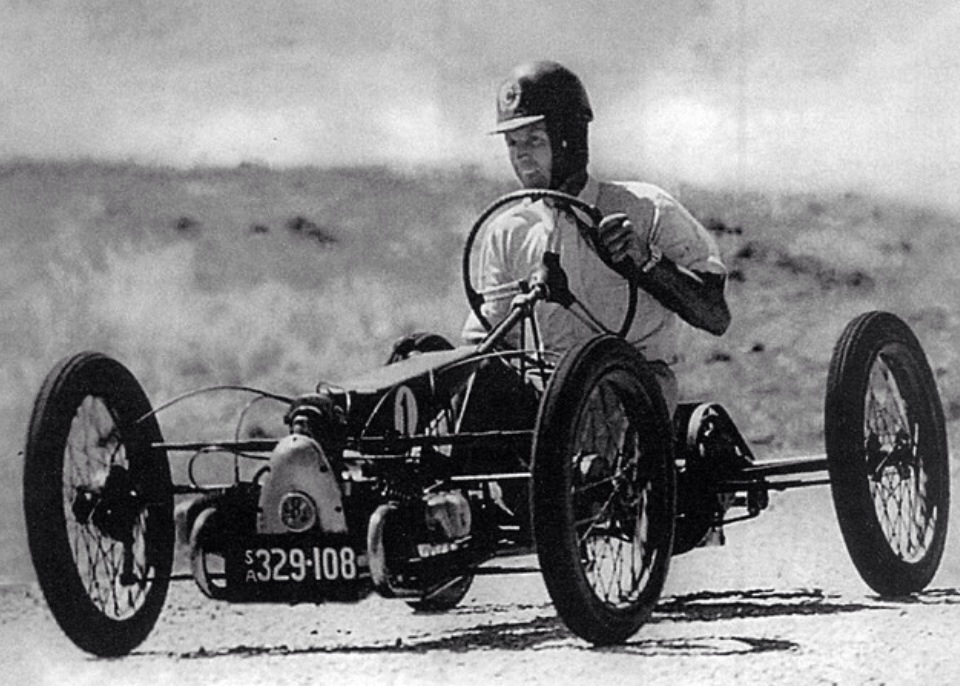
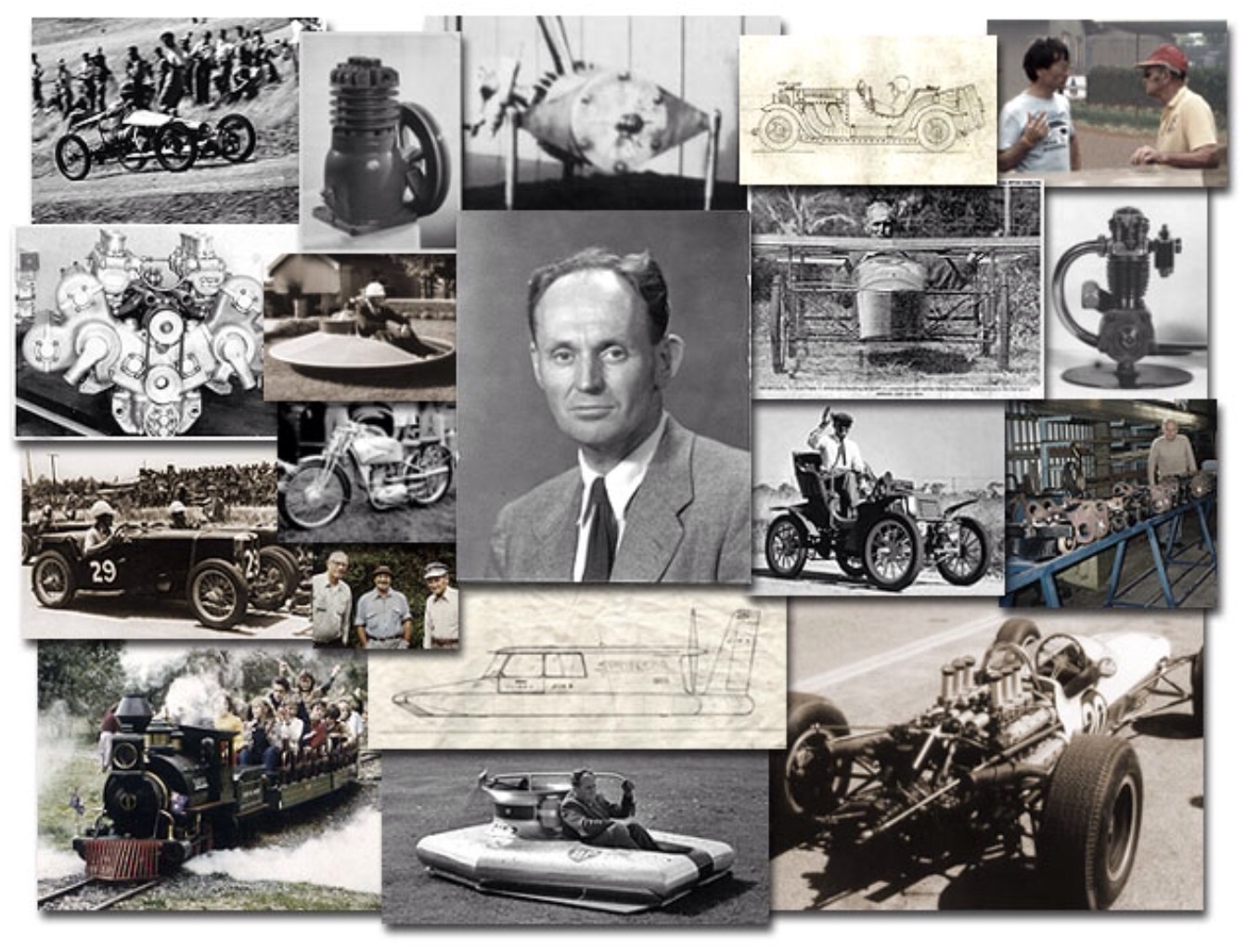
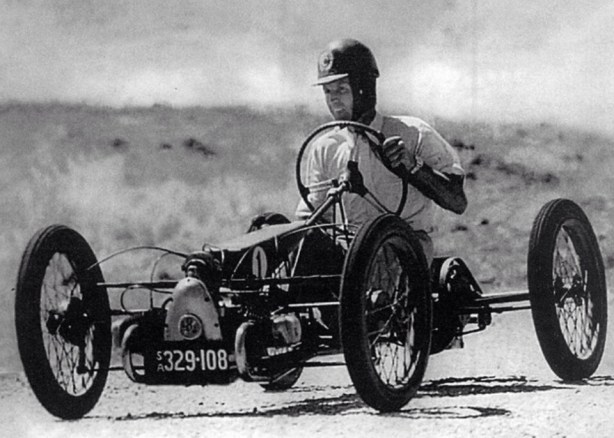
Harold William Clisby was one of those guys who did it all, above hurtling along in his 1952 Clisby Douglas Special…

Born in Norwood, Adelaide on 3 August 1912 he was a talented intuitive engineer/inventor from his childhood Meccano set fiddlings. He worked initially for his father in the family clothing business, for GM in an engineering capacity during the war, then post conflict made his fortune building Clisby Air Compressors and the Clisby/Sherline Lathe amongst many other products- Clisby Engineering Pty. Ltd. continues to this day. Click on the link at the end of this article for a comprehensive account of some of Clisby’s life.
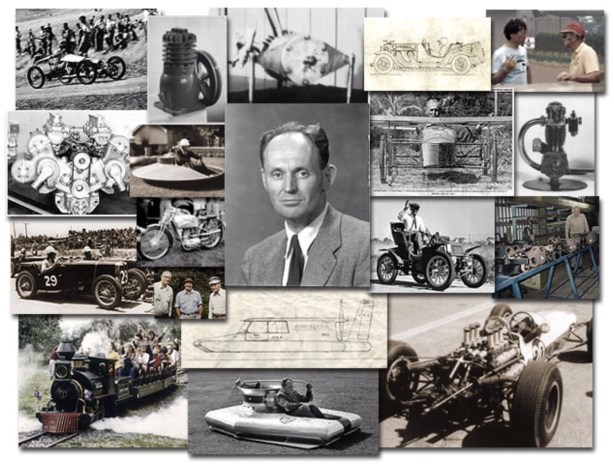
(clisby.com)

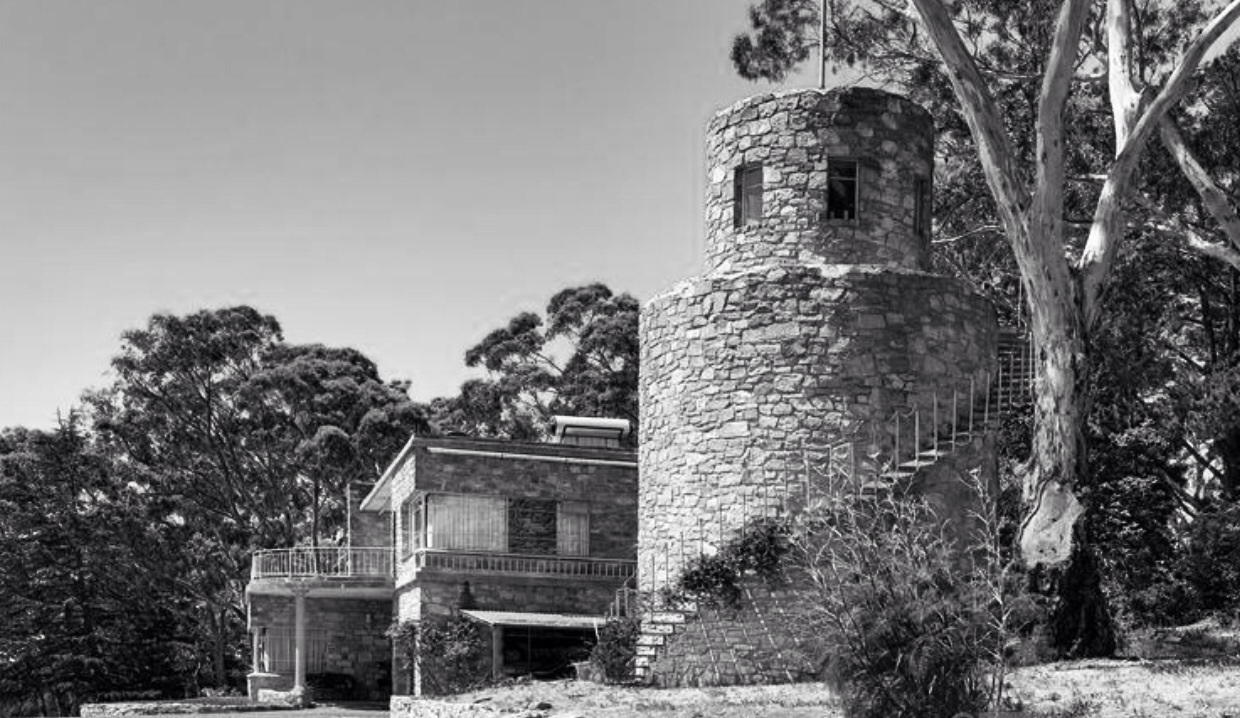
In addition to the above he built his own stone castle, complete with miniature railway line in the Adelaide Hills, various cars and motorcycles and a 120 degree, DOHC, 2 valve, 1.5 litre V6 GP race engine! This motor was fitted into an Elfin T100 Mono chassis- in so doing creating the first, the only, all-Australian, make that South Australian Grand Prix car.

This article started as a quickie on Harold’s ’52 hillclimber but a ‘teaser’ on the V6 at the articles end turned out longer than planned- that is a marvellous feature story for another time, but a précis of the Elfin Clisby V6 forms the second part of this piece.
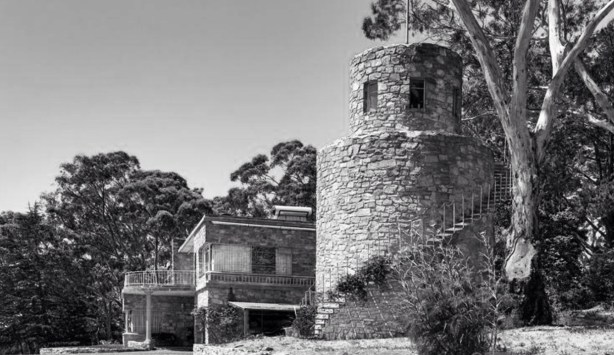
Clisby built this home/castle in the Adelaide Hills at Teringie- set on 1.62 ha it has a dungeon, catacombs, a tower with views across Adelaide and its own miniature railway- even a cannon to keep Ferrari’s lawyers away…
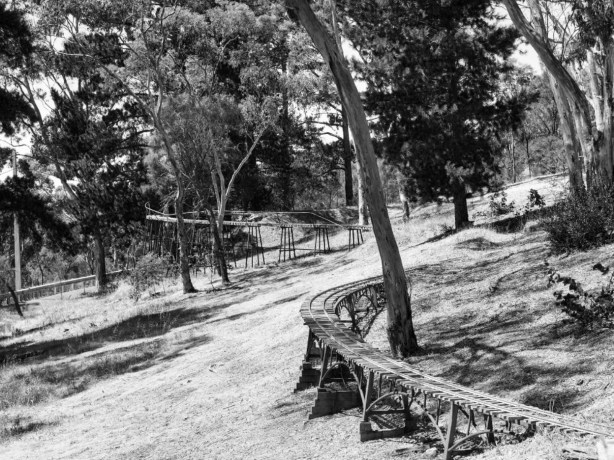
The Clisby home included its own miniature railway- what a place in which to grow up as a kid?! Clisby commenced construction in 1953, the home completed over a 15 year period
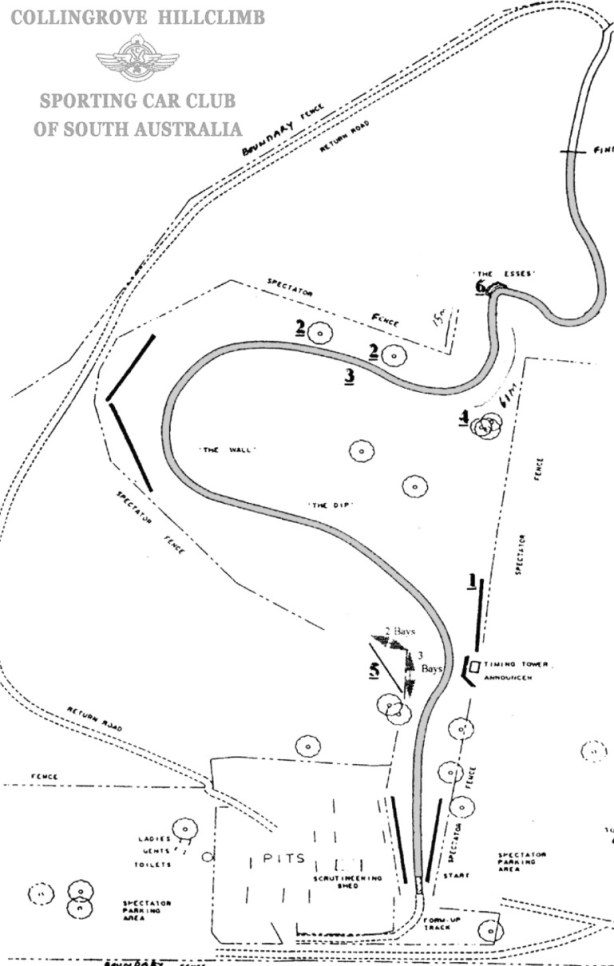
Harold was one of the instigators of the Sporting Car Club’s Collingrove Hillclimb built on land owned by the Angas family.

He spent a lot of time driving all around the large property with Robert Angas looking for a suitable hillclimb location in Angas’ Land Rover. Eventually the duo settled on a marvellous, challenging bit of geography- the land was surveyed and the Sporting Car Club of South Australia soon accepted a proposal to run the venue- which they do to this day, its one of the longest continuing motorsport venues in Australia.

Of course, as a co-instigator of the project Clisby needed a car to compete in the first meeting, the ‘South Australian Hillclimb Championship’ in March 1952, having cut his racing teeth in a modified MG TC he raced at Lobethal, Woodside and other local venues.

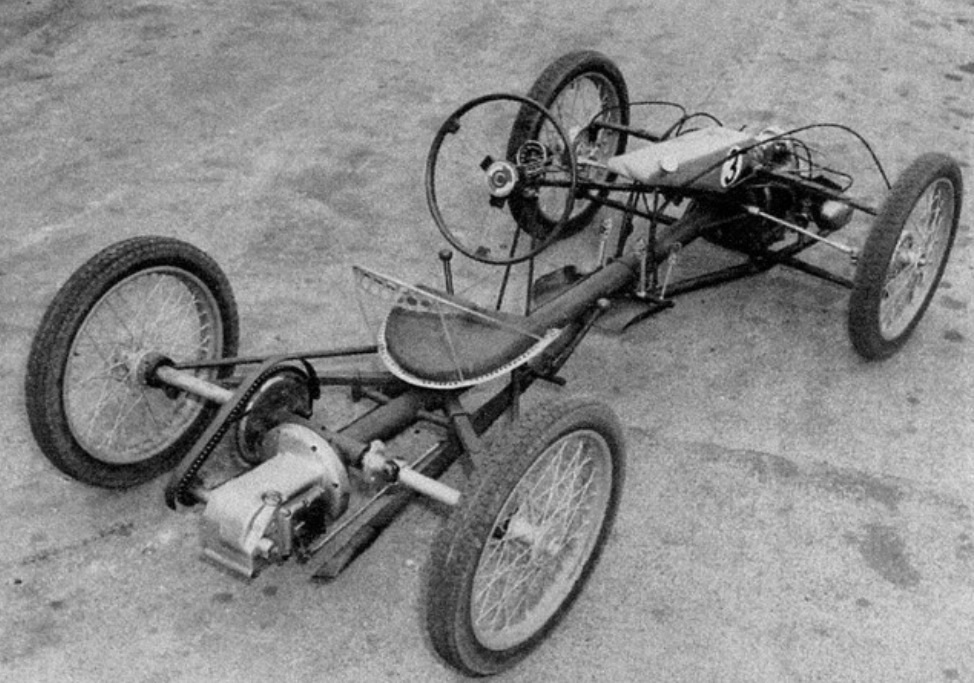
‘Having only three weeks to go before the maiden run, Harold decided that he would like to build a vehicle to compete…A rough layout was was drawn on a blackboard using the engine and gearbox of a Douglas motorcycle, time was short so all of the details had to be carefully planned’ clisby.com state.

‘The springs came first, as they would take the longest time to manufacture. A single tube of 3 inches in diameter was used for the chassis: the engine located on the front end of the tube, using a brake drum, the rear end to be attached to the gearbox, used the rear cover of a differential.

The wheels were from scrapped motorcycles, a chain drive drove a  large sprocket on the rear axle and incorporated the single rear drum brake.

Universal joints were used to produce independent rear suspension; a six foot long tailshaft of 7/8-inch diameter was supported on one end of the engine and one of the gearboxes.

The steering box was rack and pinion coming from a previously built incomplete automobile. The front wheels included their own drum brakes. A tapered fuel tank came from a pedal assisted motorcycle, the steering wheel from an MG and the seat supplied by Colin Angas from a farm implement.(!)

The engine was stripped, the ports were polished to accommodate slightly larger carburettors and the pistons were shortened and lightened by removing the bottom piston ring. A motorcycle speedometer was re-calibrated to show engine revolutions per minute. A racing magneto was used to replace the magdyno.’
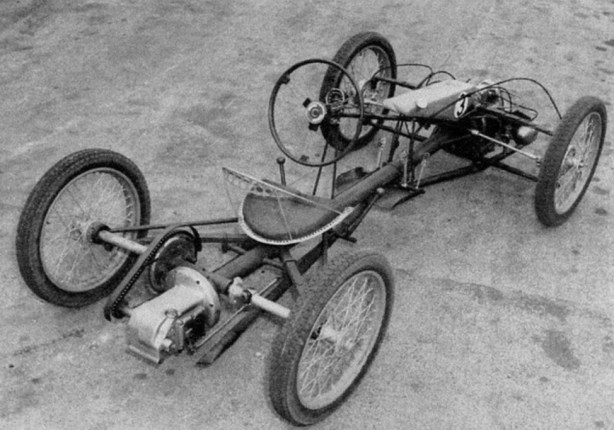
Great shot shows the key elements of this amazingly simple but effective racer. Note independent rear suspension- fixed length uni jointed driveshafts and forward racing radius rods for location. Chassis and gearbox clear (A Clisby)

‘All these elements were collected and assembled within 2 weeks allowing a week to test the box of tricks prior to the hillclimb.

Harold had trouble registering the vehicle for the road, as they did not believe the car weighed just 350 pounds!

With one week to go, he then decided to drive the car to the town of Angaston some 60 miles away (from Adelaide) on a Saturday morning wearing a flying suit, arriving about 1 1/2 hours later.

He then drove the car up the hill (Collingrove Hillclimb) using maximum acceleration. Returning to Robert Angas home (on the property where Collingrove was built), he then discovered the tailshaft had twisted like a long letter ‘S’! He then proceeded to straighten the shaft using an anvil and carefully drove the car home.

With only a matter of a few days remaining, a new 2 inch diameter shaft was provided, still only supported at each end. At high engine revolutions, the shaft also distorted. A third shaft was made of 1 inch diameter, 16 gauge tubing cut into three sections, the centre section was supported by ball races within the 3 inch diameter main tube.

This easily withstood the engine revs of 8000 rpm. The following Saturday morning, the car was now ready to attack the hillclimb and was driven again to Angaston.

After a number of other vehicles had successfully climbed the hill, Harold’s turn finally came in the under 500cc class. He pressed the accelerator pedal until the rev indicator showed 8000rpm, then took his foot straight off the clutch, the rear wheels spun on the tarmac and the car shot off up the hill in a satisfactory manner.

There was little trouble in changing gear into the various bends until reaching the top, where the descent back to the paddock was made on a rough rock track. One rock knocked a hole in the crankcase, allowing all the oil to drain out.

Returning to the pit area, the car was rolled on its side and the hole was welded up with acetylene and oxy torch supplied by an oil company. The vehicle was now ready for a second run. Using the same procedures used from his first experience, the time was improved setting a record that wasn’t broken in its class for seven years’.
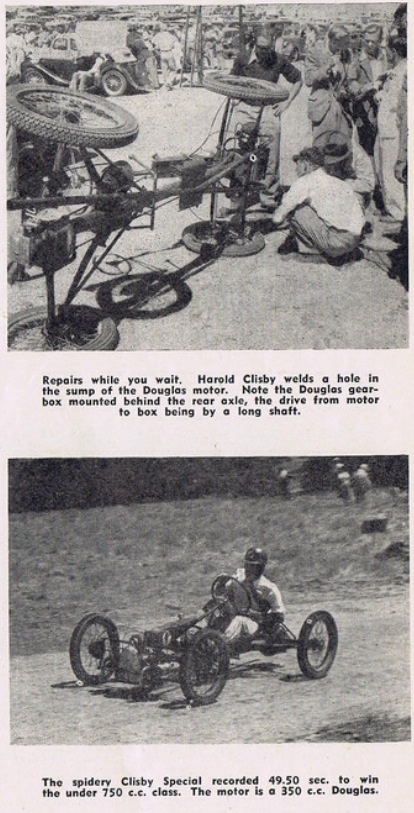
(Australian Motor Sports April 1952)

‘After the success of his hillclimb vehicle, he was then approached by several of his friends to design and build small competition cars with 125cc engines as the driving force. These were constructed out of steel tubing with rack and pinion steering and front and rear transverse independent suspension all round. The wheels were cast aluminium and fitted with 8 X 4 wheelbarrow tyres. Looking back he felt the cars led the way into the go-kart era in Australia’ clisby.com records.
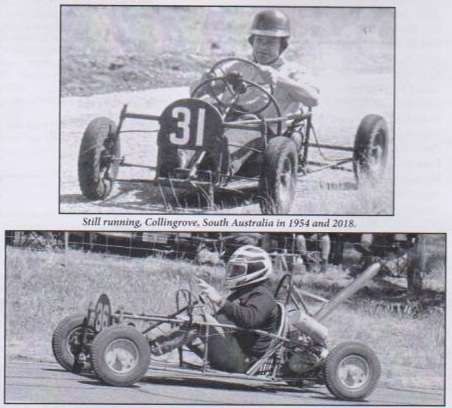
Clisby Bantam: ‘This car is one of 6 examples developed and constructed in 1954…originally owned and raced by Lindsay Lemussurier of Adelaide. Used in a number of AHCC events including the 1954 Championship at King Edwardd Park, Newcastle, where it competed against Jack Sheppard and Jim Gosse in similar Clisby Bantams- and Ron Tauranac in his Ralt 500, who won. The Clisby Bantams were given the moniker of ‘screaming blowflies’ by track event announcers’ (From the VSCC Mt Tarrengower October 2018 program courtesy of Bob King)
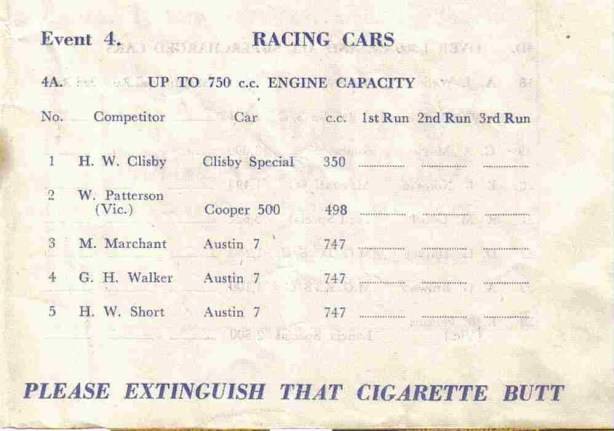
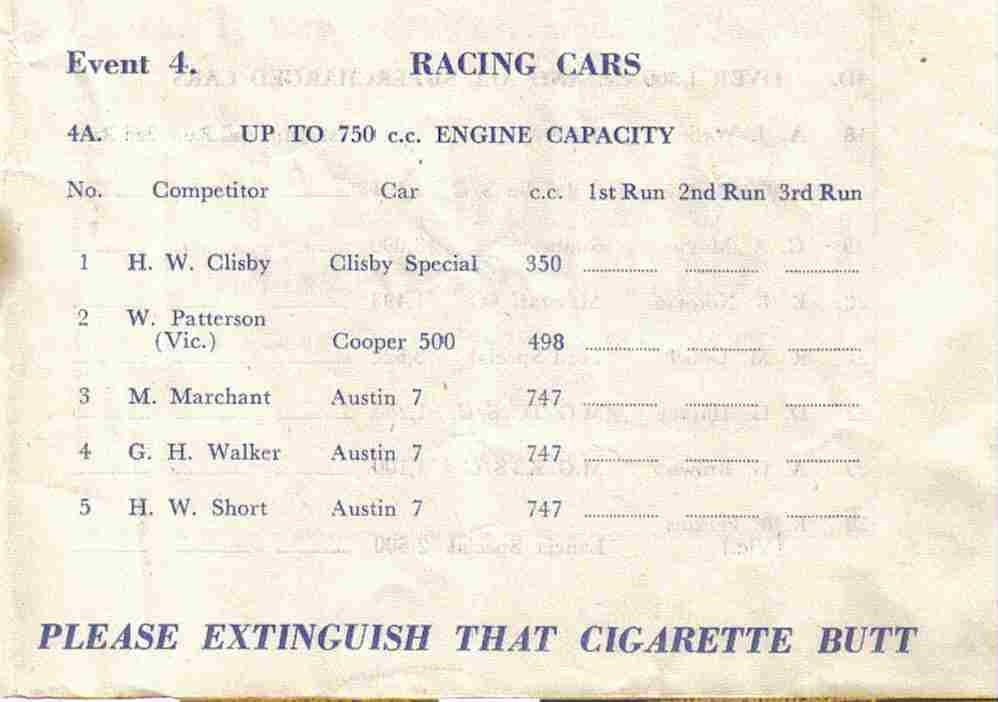
Collingrove opening March 1952 meeting entry- Harold’s opposition included a youthful Bill Patterson’s Cooper 500. Stephen Dalton advises he also competed in a production sports MG TD. Love the cigarette butt warning!- tidiness or bushfire avoidance?  (S Dalton)

Specifications…

Chassis-

Backbone frame of single three-inch by 16 gauge steel tube. Engine mounted on clutch housing welded to front, gearbox mounted on steel pressing welded to rear. Independent front suspension by twin transverse leaf springs. The transverse leaf springs mounted above and below clutch housing. Independent rear suspension by splayed quarter elliptic springs and halfshafts located by radius rods trailing at 30 degrees. Rack and pinion steering. Motor cycle wheels- front 19 X 2 1/4 inches, rear 19 X 2 3/4 inches, three-inch motorcycle ribbed tyres at front, grip tread at rear. Mechanical brakes- non-compensated 6 inch BSA cable operated at front, single central rod operated eight-inch Douglas at rear.

Transmission/Gearbox-

Seven-inch single dry plate clutch mounted direct on engine. Three piece tubular steel drive shaft running on ball races mounted within tubular backbone chassis. Four-speed positive stop Douglas gearbox with hand operation- overhung at rear of the chassis with final drive by chain to differential-less swinging halfshaft back axle

Engine-

Douglas air-cooled, horizontally opposed, pushrod OHV two cylinder engine. Bore/stroke 60.8 X 60mm, 348cc. Wet sump lubrication, BTH magneto ignition. Bottom piston ring removed and piston skirts shortened by 1/2 inch, ports bored out and polished, two Amal carbs, compression ratio 8:1, 30bhp, maximum rpm 9000

Monoposto body to be fitted, weight when registered 325 pounds.

Construction quoted as commenced on 19 February 1952, inaugural Collingrove meeting 15 March 1952 during which a time of 50.1 seconds was achieved. The class record was set at the second Collingrove meeting at 47.2 seconds for the up to 750cc class- the report says the car used the standard engine in the first meeting, with presumably the modified engine at the second. ‘Since then it has had further runs, but Mr Clisby is now faced with excessive wheelspin and so is tackling the problem of weight distribution’.

(Courtesy Australian Motor Racing Annual No 3)

That ‘F1 Car’- Elfin T100 ‘Mono’ Clisby V6, chassis ‘M6548’…
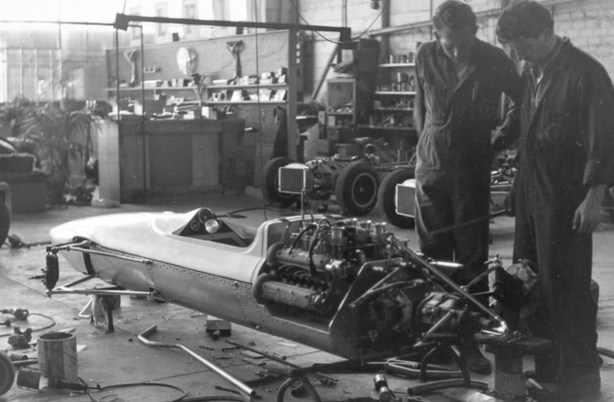
(K Drage)

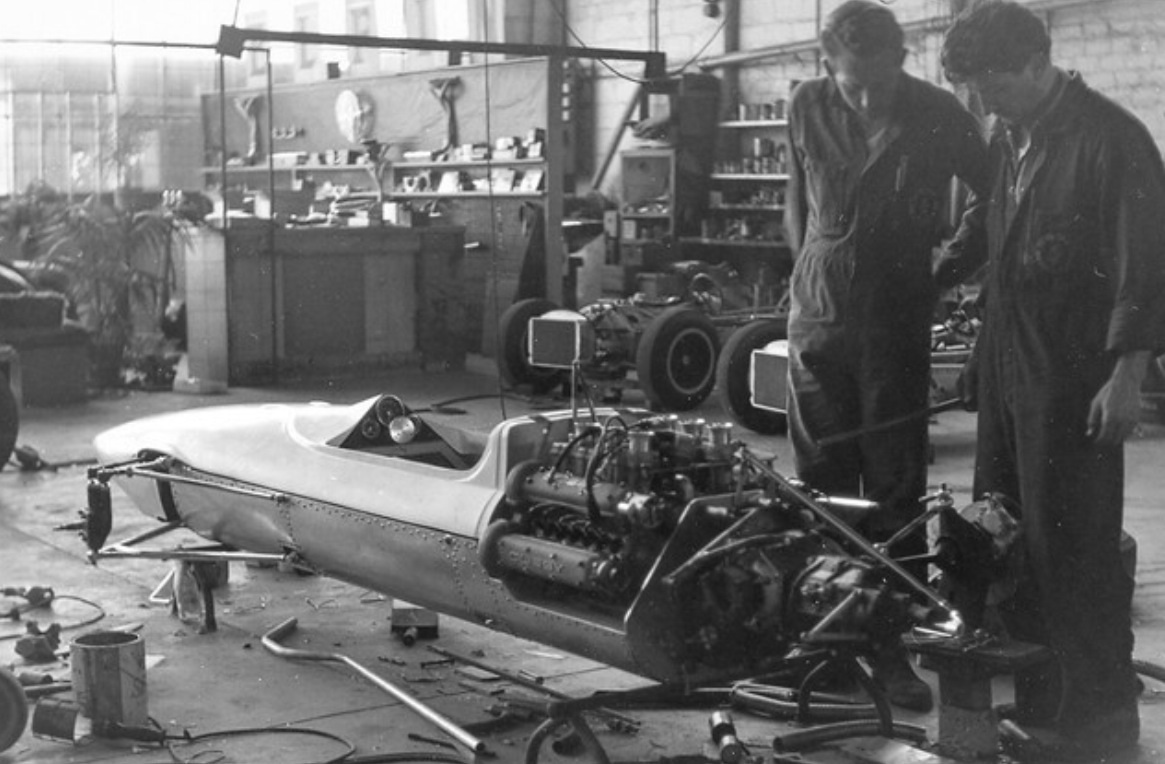
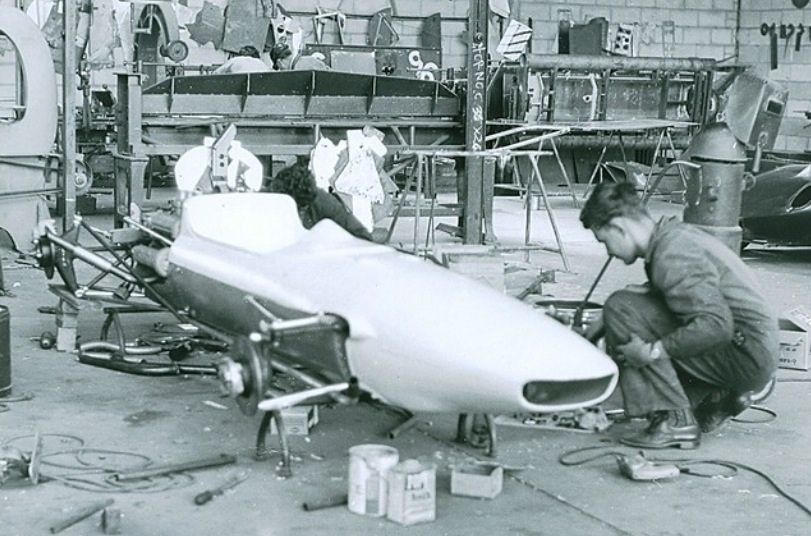
Elfin boss Garrie Cooper and legendary ace welder, Fulvio Mattiolo ponder the next step in the build of Andy Brown’s Clisby V6 engined Mono at Edwardstown, Adelaide during 1965.

Those with strong knowledge of the GP formulae will appreciate that 1965 was the final year of the 1.5 litre F1 and that therefore the little Clisby V6 was a tad late to the party!

The Elfin Clisby only raced on four occasions- at Mallala on 19 April 1965 when a rear tyre blew destroying the cars rear suspension, at Calder on 23 May when Brown retired with water porosity problems, back home in South Australia at Mallala on 14 June when the car popped an oil line in practice, non-starting the race. The cars last appearance was a championship one, Brown started the 11 October 1965 Mallala Gold Star round but retired from the race won by Bib Stillwell’s Brabham BT11A Climax after 8 laps when the engine locked up beneath him in the straight gyrating from high speed for 300 metres until coming to rest gently in the infield.

With that the project, one engine, was put to one side forever, there is a Repco epilogue however.

The chassis, engine and gearbox (using a VW case) were all made in South Australia, hopefully one day this extraordinary piece of Australian history- our only ‘all Australian’ GP car will run again.

An engine and the Elfin chassis are extant, sufficient of the engine patterns and moulds exist, with the will of all involved- chassis owner, the very keen James Calder, the Clisby family, and, critically Kevin Drage, the senior engineer on this project all those years ago this stunning machine will run. It must run- the combination is a national engineering treasure. Some very recent chatter online is promising too…
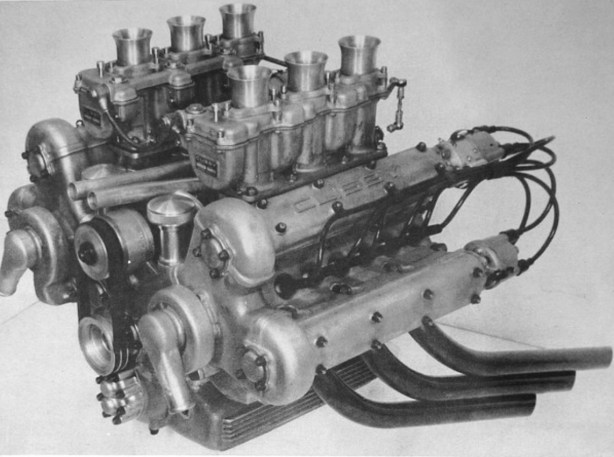
(Clisby)

Ferrari had been racing Vittorio Jano designed 1.5 litre F2 and 2.5 litre F1 DOHC, 65 degree V6 engines in the late fifties, Mike Hawthorn won the 1958 drivers title so equipped. Their 1961 championship winning car, the mid-engined 156, was powered by a 1.5 litre V6, initially with a Vee angle of 65 degrees and later 120 degrees. By the way, the first track test of Ferrari’s 156 120 degree V6 engine was at Modena, the car driven by Phil Hill, in April 1961.

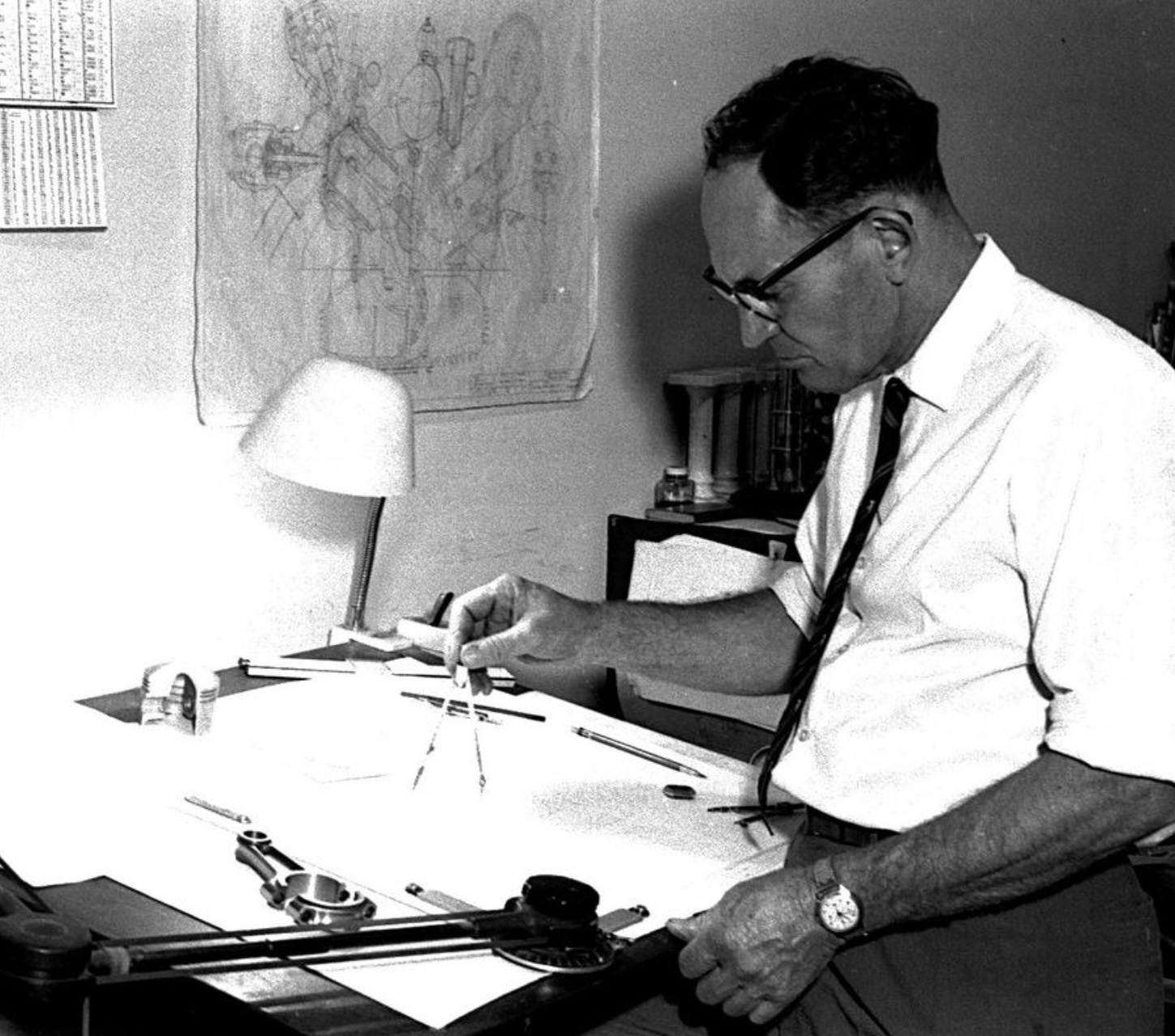
During a long fact-finding trip to Europe in 1960 Clisby chose a 120 degree, DOHC, 2 valve V6 design for his proposed GP and sportscar engine. He set about the design process on a portable drafting machine in the cabin of the ship which brought him back to Australia.

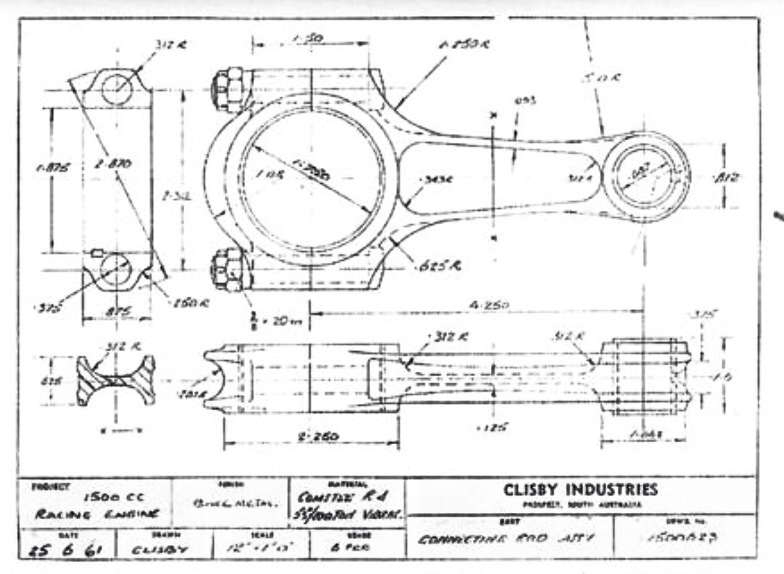
In order to construct the engine he also needed to upgrade his Prospect, Adelaide, Clisby Industries factory facilities to ‘manufacture our own con-rods, pistons, distributors and oil pumps…plus build our own manufacturing equipment such as sand foundry, electric melting furnace, sand mixer, crankshaft grinder, camshaft grinder, nitriding furnace etc’ Clisby Development Engineer at the time Kevin Drage recalled.

The essential elements of the all aluminium engine (the extent of local content extended to the Comalco aluminium used, the bauxite and alumina was mined and processed in Australia) was a four main bearing, billet steel crank, twin overhead gear driven camshafts, two 14mm plugs per cylinder fired by conventional coil and ‘…dual ignition circuits- there were four distributors, one master and one slave for each of the two ignition circuits fired from each camshaft. This allowed the spark requirements to spread across 4 coils’ said Kevin. The distributors were Clisby modified Bosch components. A generator was in the front of the engines Vee, a starter motor at its rear.

The engine capacity was 1476cc, its bore and stroke 73 X 58.8mm with the engines ultimate potential size circa 2 litres. Clisby saw a gap in the market in Europe for engines of 1.5 to 2 litres for both GP and sportscar use. With a very modest initial compression ratio of 8.5:1 and cam timing derived from the BSA Gold Star motorcycle, around 170-180 bhp was expected from the early engines.

Carburetion caused a big problem, conventional twin-choke Webers would not feed the wide angle engine. Drage wrote to Weber to enquire about purchase of some of its triple choke carbs, only to be advised of their exclusive supply agreement of said units with Ferrari. The Scuderia’s lawyers followed this up with a salvo several months later advising ‘that they (Ferrari) owned the copyright to the 120 degree, V6 layout and that we should cease building our engine forthwith and certainly not attempt to market it!’ KD recalled.

Clisbys therefore decided to build their own carburettor bodies to which were fitted standard Weber chokes, auxiliary venturis, jets etc sourced from twin choke carbs Weber were happy to supply. ‘Harold drew up the triple carburettor body and had a set of patterns made. We joked that we should have left and right hand carburettors to make the fitting symmetrical. A few days later, Alec Bailey, who was working on the engine with me, came in to work with a set of left hand carburettor patterns which he had made up at home in the evenings! So we did finish up with a pair of left and right hand triple choke carburettors after all!’
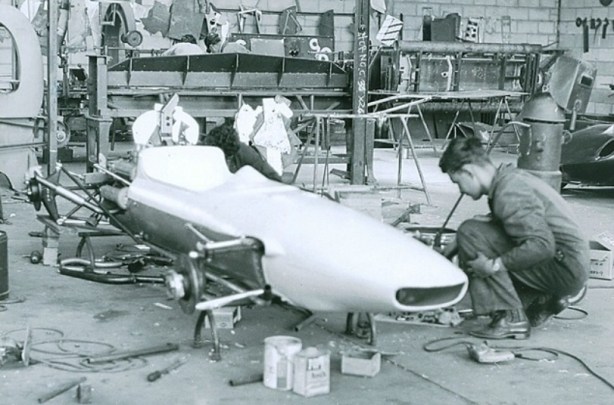
Ron Lambert ponders the next step in the Elfin Clisby- he is still spritely and fettling Elfins in Tasmania (K Drage)
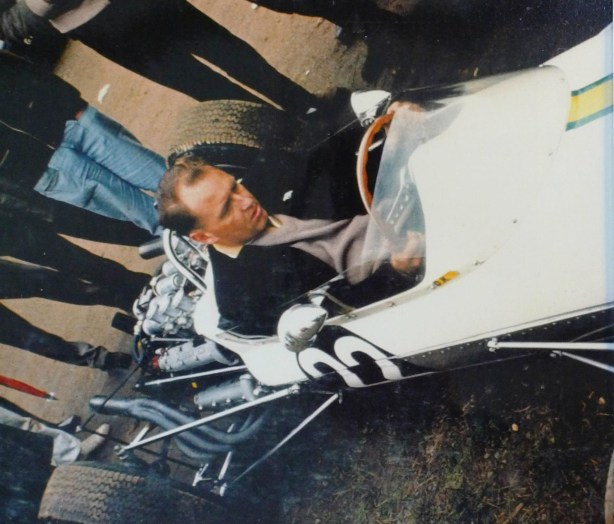
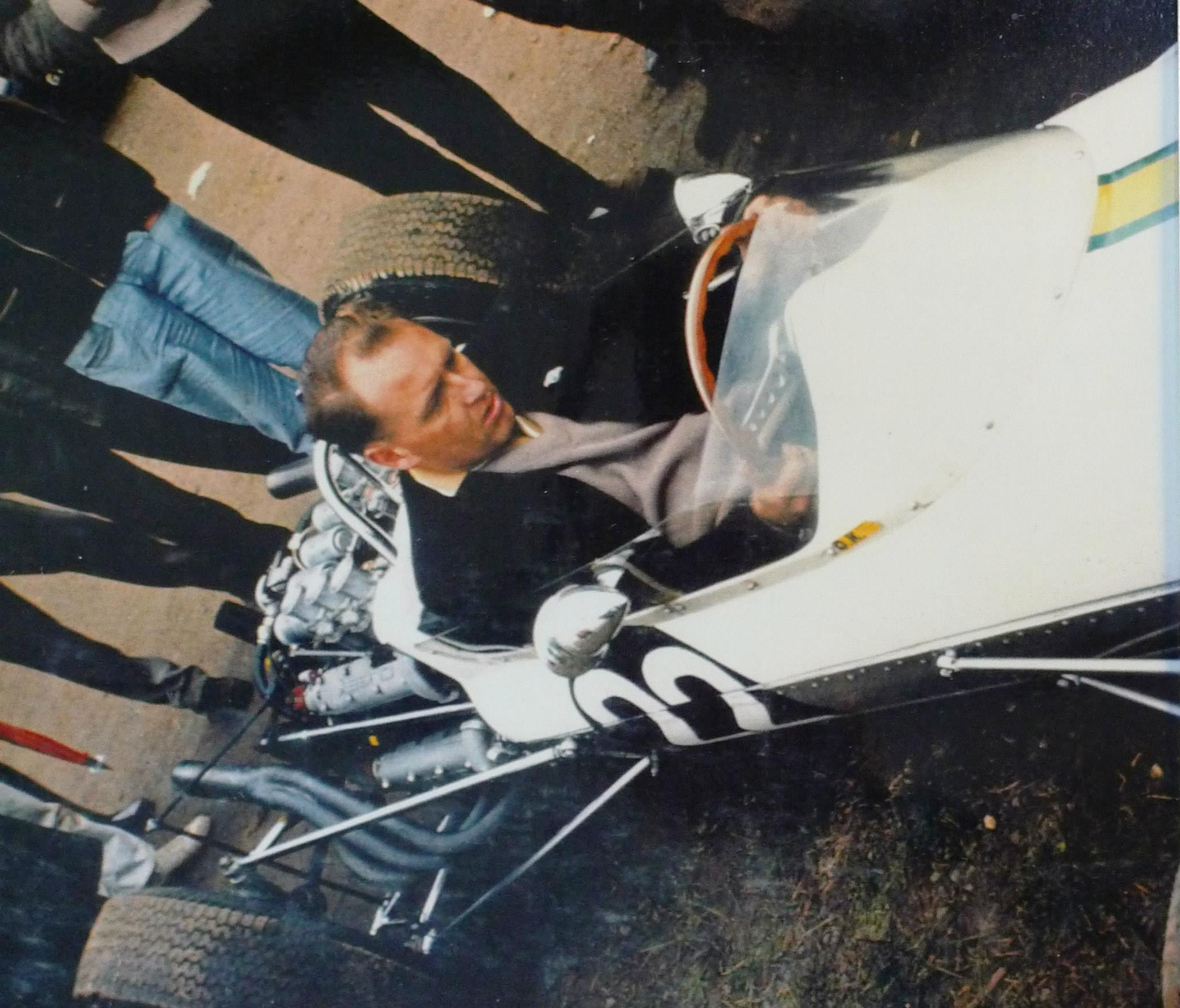
Kevin Drage in the Calder paddock 23 May 1965, Andy Brown a DNF in his Elfin Mono Clisby that weekend. Installation of 1.5 litre V6 into a monocoque chassis designed for the Lotus-Ford twin-cam inline four beautifully done (R Lambert)

The 260 pound, incredibly low, compact engine broke cover from about March 1961 with articles in Sports Car World, Road and Track, Sports Car Graphic and other publications following in 1962.

By then the BRM P56 and Coventry Climax FWMV 1.5 litre V8’s were dominating GP racing- Ferrari was developing its own V8, its ultimate 1.5 litre F1 weapon was the Ferrari 1512- a Flat-12 engine which formed a structural member of the cars semi-monocoque ‘Aero’ chassis in 1965. The point here is that by the time the Clisby engine was announced, let alone run, the game had well and truly moved on, but it does not matter in terms of the engines Australian historical significance.

Denis Jenkinson in his March 1963 MotorSport ‘Continental Notes’ wrote of Jack Brabham’s prospects for that GP season ‘…it looks as though the Australian is getting the design sorted out nicely…He will be dependent upon Coventry Climax and Colotti for the major components of the car…but the cars should be well in the running and he may even be patriotically inspired to try a Clisby V6 engine in a Brabham…’ if only it were true and had come to pass?!

As the engine came nearer to the stage of being installed in a car Kevin Drage initiated discussions with multiple AGP winner and Gold Star Champion, the wealthy Lex Davison. Kevin Drage recalled ‘…Lex was interested in seeing the Clisby engine run in a car…Initially he was prepared to fund an Elfin Mallala but later with the advent of the forthcoming Australian 1.5 litre Series he proposed building and campaigning an Elfin Mono. However by this time Harold had lost interest in the V6 project and was devoting his time to building model steam railway engines.’

‘I didn’t want to see four years of my involvement sidelined so I had discussions with Lex and Garrie Cooper regarding getting the Elfin Clisby Mono project off the ground. However, Andy Brown stepped in and offered to fund the Elfin Mono and Harold agreed for Andy to proceed- and the rest, as they say, is history’.

In fact Lex did order and pay a deposit on a Mono to be fitted with a Ford 1.5 twin-cam- this car was to be raced by young up-and-comers, but with Lex’ death at Sandown in early 1965 the project did not proceed.

Once on the dyno and in the car the V6 design’s problems surrounded engine balance and porosity of some of the castings- nothing which could not have been sorted with time and development.
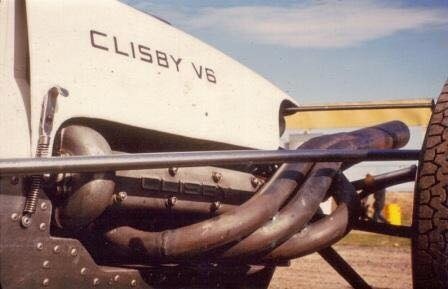
Saucy titillating shot of the Clisby Mono- shot captures the Elfins ally monocoque- Cooper’s first such design, the challenge of accommodating the exhausts and ultra low layout of the 120 degree Vee Six (A Clisby)

I’ve already gone further with this teaser than I had planned, lets come back to this marvellous project with a feature later and finish on the thought below.

The sad thing is that Clisby should have persisted with the motor’s development in Australia at a capacity of 2 litres. Both BRM and Lotus (Coventry Climax) with 2 litre variants of their F1 V8’s engines proved to be Tasman Series winners despite a category limit of 2.5 litres and therefore those motors giving away capacity to fellow competitors. Mind you it’s easy for me to say ‘push on’, Clisby’s was a family business, I hate to think how much in cold hard cash, diverted resources and opportunity cost this amazingly ambitious project cost.
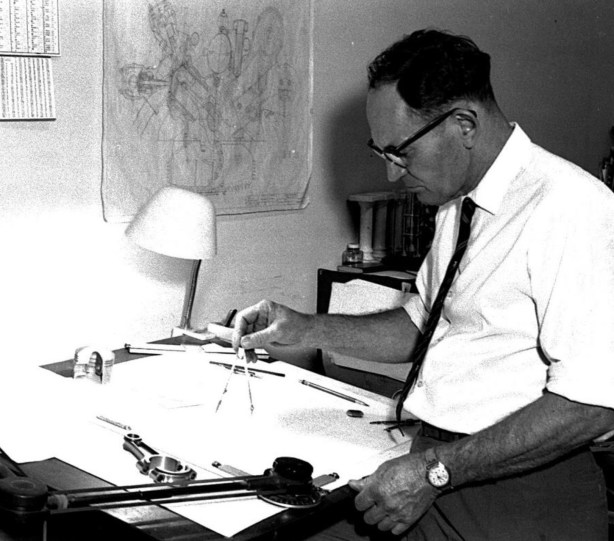
Harold Clisby with the original cross-sectional drawing of the Clisby V6 above the drawing board in his office (K Drage)

And that Repco epilogue, you ask?

When Repco Brabham Engines in Maidstone were looking for an Australian concern to cast their cylinder heads for the race program from 1966 to 1969 they chose Clisby given the problems they encountered in making the complex aluminium castings of their V6, and the learnings they had made as a consequence!

There is something rather neat about Australia’s first but largely unraced GP engine contributing to the World Championships of its Repco successors!
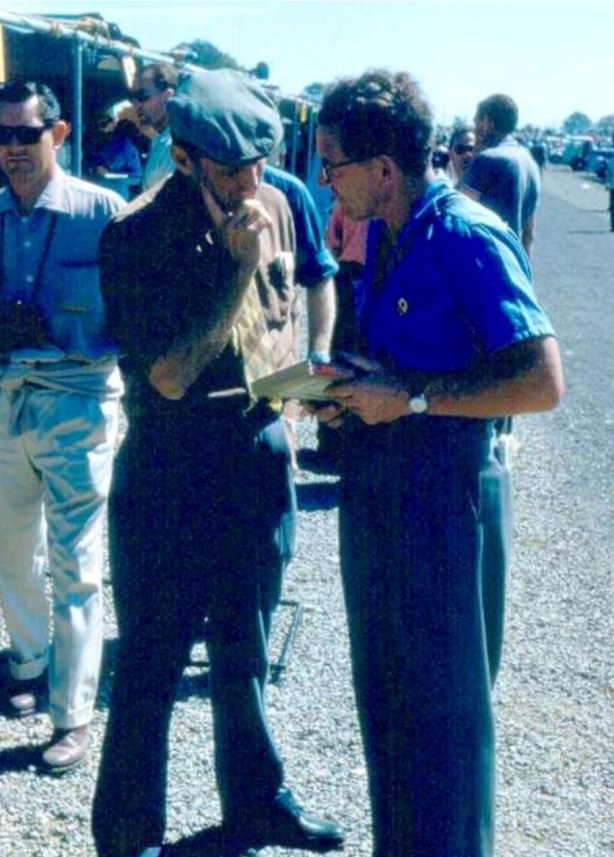
(K Drage)

I had a chuckle at this Kevin Drage photo of Harold Clisby (left) and Phil Irving in the Sandown paddock during the circuits opening international meeting on 12 March 1962…

‘No Phil, I’ve already got a copy of “Tuning for Speed”, I don’t need another’ is perhaps the conversation between these two great engineers. For sure the weather is not their interest.

At that stage Clisby is well into the build of his V6 whereas Phil is a couple of years away from starting the design of the aluminium GM Oldsmobile F85 block based 1966 World Championship winning ‘RB620’ V8.

The interesting bit in that context is that the Lance Reventlow owned, Chuck Daigh driven, mid-engined Scarab RE Buick V8 was competing at Sandown that weekend. If Jack, winner of the Sandown Park International in a Cooper T55 had not seen that GM motor before- its the brother of the F85, he most certainly did that weekend as i’ve posted a photo before of Jack looking lustfully at the engine and perhaps pondering its possibilities!

With Repco’s resources, Phil’s first 2.5 V8 ‘RBE620’ ‘E1’ burst into life about twelve months after he first put ink on paper, in Repco’s Richmond test-cells in March 1965- at about the same time as Harold’s V6 was being installed into Andy Brown’s Elfin Mono after a journey which started in 1960- whilst noting that Clisby Engineering and Repco Ltd were enterprises of vastly different sizes! Harold and his two offsiders also built an engine from scratch, most of it in-house too, whereas the first Repco jobbie did use plenty of components off the shelf, albeit to rather good effect!
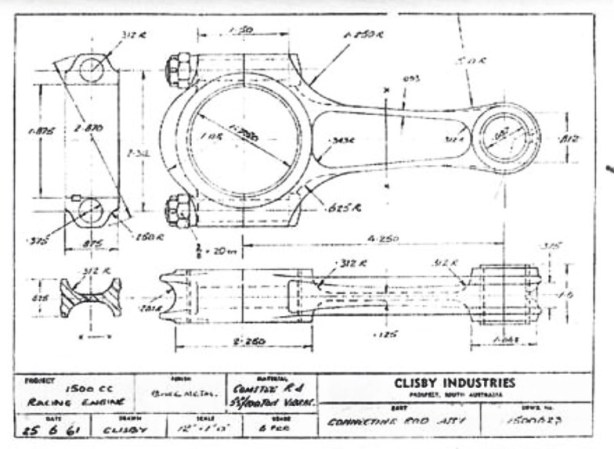
(Clisby)

Credits…

Kevin Drage on The Nostalgia Forum, ‘Harold Clisby: The Life of a Restless Engineer’ on clisby.com, Australian Motor Sports April 1952, Andrena Clisby via Kevin Drage, Kevin Drage, Ron Lambert, Stephen Dalton Collection, Bob King Collection

Harold Clisby’s Biography, in part…

http://clisby.com/hwc.html

Tailpiece: Forty year old Harold Clisby with his Clisby Douglas Special in 1952…
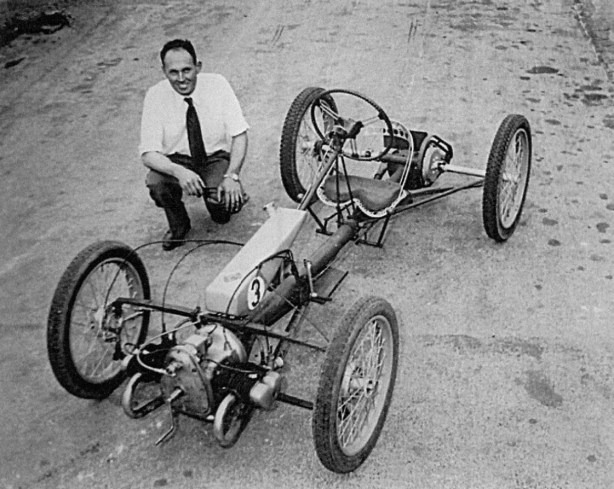
(A Clisby)

Its a photograph of crystal clear clarity in terms of mechanical layout- from the flat-twin Douglas engine and mount, simple tubular chassis, independent front and rear suspension and seat which appears to be from a tractor!

‘Hang on Harold’! is the message as he departs the startline!

Ones legs getting dislodged from the pedals and touching terra-firma at speed does not bare thinking about!

Finito…

(M Bishop)

Geoff Brabham gets the jump from Grace Bros Racing team-mate Andrew Miedecke and Alfie Costanzo at the Hume Weir, Australian National F2 round on 15 June 1975…

Birrana 274 Ford Hart, Rennmax BN7 Ford Hart and Birrana 274 again- Costanzo won that day but Geoff won the series.

In the black helmet at far right on the second row is Ray Winter in the Mildren ‘Yellow Submarine’ still a winner seven years after it first raced in Frank Gardner’s hands in the summer of ’69 Tasman Series.

The high water mark of Australian National Formula 2 racing (1.6 litre, DOHC, 2 valve- which effectively mandated the Lotus Ford twin-cam engine- the ducks guts version was the Hart 416B circa 205bhp injected variants) was in 1974 when an infusion of sponsorship dollars from shirt manufacturer Van Heusen resulted in an influx of drivers stepping up into the class and/or acquiring new cars.

Geoff Brabham during wet Oran Park practice in 1975. Birrana 274 Ford/Hart. No F2 championship round that year held at OP (oldracephotos.com.au)

Guys like Leo Geoghegan, Enno Buesselmann, Bruce Allison, Ken Shirvington, John Leffler, Chas Talbot, Wolfgang Prejawa with Sonny Rajah jetting in from Malaysia and Graeme Lawrence did a round or two from NZ. In some cases drivers ‘stepped down’ from F5000- Bob Muir, John Walker, Kevin Bartlett and Max Stewart to name a swag. For the sake of clarity Leo was an established ace- having finally won the Gold Star, the national drivers championship he deserved in 1970, he retired and then did a ‘Nellie Melba’ and returned to drive Malcolm Ramsay and Tony Alcock’s new Birrana 272 in mid-1972.

An absolute corker of a 1974 series was won by Leo in the ‘works’ Grace Bros sponsored Birrana 274 Ford-Hart in a closely fought battle with the Bob and Marj Brown owned Birrana 273 raced by Bob Muir and Leffler’s ‘tricky-dicky’, superb, variable rate suspension Bowin P8.

Sex on Wheels. John Leffler’s John Joyce designed Bowin P8 Ford-Hart at Sandown’s Dandy Road during the 1975 Tasman meeting, DNF suspension (B Keys)

Predictably in some ways the Van Heusen money ended up supporting ‘taxis’ in 1975 despite the great show put on by the F2’s in 1974. All the same, the 1975 championship was a good one given all the newish cars about.

Into late 1974 or early 1975 Costanzo bought Leo’s championship winning car- and in that ’75 season gave his career the shot in the arm it needed after running around in an old Elfin 100 Mono F2 for way too long. I think Alfie did travel to Italy seeking a drive in the late sixties, without success- imagine if he had popped his bum into the right car back then rather than a decade later at the end of the seventies when Alan Hamilton’s Porsche Cars Australia finally gave him the drive he deserved- the ex-VDS/Brown Lola T430 Chev F5000 and subsequently the McLaren M26 Chev and Tiga Formula Pacifics into the early eighties.

Miedecke, Rennmax BN7 Ford/Hart in the Calder paddock 1975. It was a small, neat bit of kit- conventional but for the chassis as per text. Uncertain if this is the first or second of the two Calder rounds won by Miedecke and Costanzo respectively (oldracephotos.com.au)

Miedecke at Oran Park during 1975. Note the Griffin helmet, a rare beast in Australia (J Bondini)

Brabham and Miedecke stepped up from Formula Ford- a Bowin P6F and Birrana F73 respectively, retaining their Grace Bros support which helped fund far more sophisticated and expensive cars than their FF’s. Geoff took the obvious choice in acquiring a Birrana 274- a low mileage, late build car from Neil Rear in WA whilst Andrew sought the ‘unfair advantage’ with a new Rennmax- the BN7 from Bob Brittan’s Sydney workshop.

In fact it wasn’t that edgy a choice really as his car was a refinement of Doug Heasman’s BN6 which hit the track about 12 months before- the speed of which was proven by Bob Muir in one or two races in the car before he got the Brown’s Birrana ride at Enno Buesselmann’s expense.

This photograph shows clearly the middle monocoque and front spaceframe sections of the ex-Miedecke BN7 recently (via R Bell)

Apropos the above- chassis front section (via R Bell)

The BN7 design was different to the paradigm of the era in having a monocoque centre-cockpit section and spaceframes both front and rear- the more usual approach was an ally mono from the front ending in a bulkhead aft of the drivers shoulders with an ‘A-frame’ at the rear to carry the engine and suspension.

Both the P8 Bowin and Rennmax were wedge nosed designs with side radiators whereas the Birranas and Elfins (works 622 as raced by Walker and 630) followed the ‘Tyrrell’ bluff nosed approach with a front radiator.

Amaroo Park 1975. Brabham Birrana 274, Winter Mildren Sub, Miedecke Rennmax BN7 and Hong Kong’s John McDonald Brabham BT40. Brabham won from McDonald and Winter (unattributed)

Paul King in the foreground beside his Birrana 374 Toyota F3, whilst Ray Winter strides across the track. His car is the famous Mildren ‘Yellow Submarine’ Ford-Hart ex-Gardner/Bartlett/Muir. The guys had a territorial dispute after Paul got a blinder of a start and Ray attempted to assert F2 superiority into the first corner. Hume Weir 1975 (M Bishop)

In a year of strong competition between Brabham, Costanzo and Miedecke Geoff took the title with three wins at Amaroo, Symmons and Phillip Island from Alfie with two wins- Hume Weir and Calder and Andrew, who won the first Calder round in May. Arguably the quickest of the trio was Costanzo but reliability was a little lacking on both his and Miedecke’s part.

With my new drivers licence I no longer had to rely on my reluctant dad to cart me around to race meetings- I saw the Calder, Sandown and Phillip Island rounds that season and well recall a chat with Geoff and Peter Nightingale, his mechanic/engine builder, after the final ‘Island round in late November which Brabs won in fine style.

He had his ‘tail up’ in his modest way and was looking forward to taking on the world in Europe.

Doug Heasman, Rennmax BN6 Ford from Peter Macrow, Cheetah Mk6 Toyota, Hume Weir, date uncertain (M Bishop)

Interest was added to the series with lady racer Sue Ransom doing some events in Leffo’s Bowin P8 Ford/Hart- I pissed myself with laughter watching him pop her Willans six-pointer on at Calder, he was far more judicious with the crutch straps than he would have been with a fella. In those days the two lady-quicks were Ransom and Christine Cole/Gibson, I always thought it a shame Sue didn’t race the Bowin for longer than she did. Leffler himself did a round or two in Paul England’s Brabham BT36/Dolphin in amongst his Bowin P8 Chev F5000 commitments- the Brabham/Dolphin was also raced a couple of times by Tony Stewart- a talent lost.

Other drivers who added colour were Ken Shirvington, Chris Farrell, Enno Buesselmann, Doug MacArthur in the Lola T360 Bartlett and Lawrence had ‘guested in’ the year before when it was imported and owned by Glenn Abbey- and Ray Winter still pluggin’ away in The Yellow Sub, albeit substantially modified by Mawer Engineering.

Brian Shead, Cheetah Mk5 Toyota ANF3- Mk5 the prettiest and one of the most successful Cheetahs of all- amazing what Shead produced from that little ‘shop in Mordialloc (M Bishop)

The quicker of the 135bhp ANF3 cars (1.3 litre, SOHC or pushrod engines on carbs) could always give an average driven 205bhp F2 a run for its money, dudes like the two Brians- Shead and Sampson, Paul King, Peter Macrow and Dean Hosking to name several who extracted all these little cars had to give.

(M Bishop)

I’ve no idea who the ace felling a ‘pine plantation’ at Hume Weir is, I’m intrigued to know? Ditto the car.

(M Bishop)

What about the career trajectory of the 1975 F2 protagonists you ask?

Miedecke did another F2 year in the BN7 in 1976, Costanzo acquired a Lola T332 F5000 and was immediately quick in it against the established 5 litre aces whilst Brabham headed off to Europe for a couple of Ralt RT1 Toyota F3 seasons before launching his pro-career in the US.

Etcetera…

Geoff Brabham Birrana 274 leads a group of cars up the Calder return to the paddock road- remember that setup? Peter Macrow’s Mk5 Cheetah and Paul King’s Birrana 374 behind. Geoff’s chassis, ex-Neil Rear was ‘274-018’, it was then bought by Ray Winter to replace the Sub but if memory serves he had a huge accident in it, Lakeside maybe? Now in the Holmes family collection (oldracephotos.com.au)

Ray Winter in the Mildren Ford Hart ‘Yellow Submarine’ at Oran Park circa 1975 (B Williamson)

Photo Credits…

Mark Bishop, oldracephotos.com.au, Bruce Keys, Ray Bell on The Nostalgia Forum, Bob Williamson, Jay Bondini

Tailpiece: Graeme Crawford, Birrana 273 Ford F2- he won the national title in this car in 1976- from Brian Shead’s self built Cheetah Mk5 Toyota F3, Hume Weir 1975…

(M Bishop)

Finito…
(WFFB)

Despite being in the middle of built up Sydney, Warwick Farm had its bucolic elements…

And there is nothing more quintessentially country Australian than a windmill- here as a backdrop for Leo Geoghegan’s Lotus 59B Waggott prior to the 1971 Tasman round on 14 February.

Frank Gardner’s Lola T192 Chev was victorious that weekend, Leo succumbing to ignition problems. The Lotus was kind to him though, he won the 1970 Gold Star in it with wins here and at Mallala- with the F5000’s about in the Tasman rounds the competition was a bit tougher though.

Geoghegan’s 59B in the Oran Park paddock during the September 1970 Gold Star weekend which he won from Garrie Cooper’s Elfin 600D Repco and Bob Muir’s Rennmax BN3 Waggott. Love the knock on wheels, radiator nostrils and distinctive air exit ducts. Bob Holden’s Ford Escort Twin-Cam behind (K Hyndman)

Dave Baldwin designed the spaceframe 59 as Lotus Components’ 1969 F3 and F2/B customer racing cars, there were a few Formula Fords too. Guys such as Emerson Fittipaldi, Mo Nunn, Roy Pike, Dave Walker, John Miles, Max Mosley, Graham Hill and Jochen Rindt raced the cars with success.

Shades of the 1961/2 F1 Ferrari 156 of course (P Townsend)
As pretty (and effective) as it is possible to get in its Castrol livery, WF 1970. Note the tail of Leo’s works Valiant Pacer Series Prod car behind (P Townsend)

In Australia the Tasman 2.5 litre Formula 1 (ANF1) was being phased out and F5000 phased in over 1970-71 so Leo Geoghegan saw an opportunity to replace his long lived, much loved, ex-Jim Clark Repco V8 engined Lotus 39 with a 59B.

Geoghegan’s Sporty Cars were Australia’s Lotus importer- it would also have made sense for Leo to race a Lotus 70 F5000 machine, not that it was one of their greatest designs mind you. Leo astutely chose the 59B and installed one of Merv Waggott’s new ‘TC-4V’ 275 bhp, fuel injected, DOHC, 4-valve 2 litre engines into the space usually occupied by a 1.6 litre Ford FVA F2 engine.

In a year of consistency he finally won the national title he had been chasing for years in the 39 Repco.

Leo’s car, chassis ’59-FB-14′ is still in Australia, in the Holmes family collection.

Etcetera…

Hewland FT200 5 speed transaxle, big oil tank and hub mounted inboard discs (P Townsend)

Again at the Farm, 6 September 1970 (D Simpson)
(N Murphy)

Geoghegan at Bathurst, Easter 1970.

Photo Credits…

(WFFB) Warwick Farm Facebook page, oldracephotos.com.au, Ken Hyndman, Peter Townsend, Neil Murphy

Tailpiece…

(oldracephotos)

Geoghegan and Lotus 59B Waggott on Warwick Farm’s Pit Straight in 1971.

Finito…
(P Geard)

John Youl attacks Mountford Corner, Longford in his Porsche 356 during the late fifties…

John and his racer brother Gavin were scions of a prominent Tasmanian grazier family and very successful, competitive drivers until business pressures forced early retirement. Symmons Plains is a permanent legacy for the racing brothers built as it was on the family property.

(P Geard)

John proved his world level pace in several seasons aboard Cooper Climax T51 and T55 prepared by Geoff Smedley, whose just published book will be definitive on both drivers careers.

In the 1961 Longford shot below he is in the best of company (at right) aboard a Cooper T51 alongside #14 Brabham’s T53 with Austin Miller’s distinctive yellow T51 Climax behind.

(J Richardson)

Roy Salvadori won the South Pacific Trophy race that weekend from Bill Patterson and John with Austin fourth. Brabham was outed with a broken half-shaft on lap 16 of the 24 lap distance.

Here John’s appearance in the Porsche is a little earlier, the last photo below perhaps in 1957 and the others a little later- you can see the evolution from road car still fitted with hubcaps! to lowered rortier racer. I wonder what modifications were made to that 356 Super?

Credits…

Paul Geard, Historic Racing Car Club of Tasmania, Ellis French, Geoff Smedley, John Richardson

Tailpiece: Youl, White, Walkem on ‘The Flying Mile’, Longford circa 1957…

(HRCCT)

Youl in what looks like a motor-cycle racing helmet beside his Porker, the yellow machine is Graham White’s Vincent Spl and the obscured Cooper is Jock Walkem’s- the man in black. Delightful bucolic scene belies the high speeds and sound of straining engines which took place annually on this stretch of road over the March Labour Day long-weekend from 1953 to 1968…

Finito…

On South Wharf, Port Melbourne, January 1951. Type 35 Bugatti, GP Lago Talbot and 4CL Maserati (Bob King)

This whole online caper is interesting not least for the people you meet in the virtual world and as a consequence subsequently in the real one.

Greg Smith is one such fellow, he is a well known Melbourne racer/engineer/restorer who wrote an article for us a while back. We were discussing some arcane topic online the other week which led to an invitation to one of Smithy’s wonderful Wednesday night feasts in honour of the late Italian/Australian hotelier/racer/raconteur Lou Molina- who looks down on proceedings from the wall with approval at Greg’s execution of some of Lou’s Italian dishes.

There were some fine car/racing identities there on the night including Perth boy Rod Quinn, and locals Ron McCallum, David Ogg and Bob King. Since then Bob and I have joined the Automotive Historians Australia Inc (many of you would be interested in this several years old group, a topic for another time) and the two day AHA conference gave me the chance to twist Bob’s arm into contributing an occasional article or two.

Bob King hustling the Anzani Bugatti around the Adelaide GP road circuit (Bob King)

He is a retired medical practitioner who has had a lifetime interest in vintage and racing cars and Bugattis- his particular passion. As well as racing and rallying these cars, he has maintained a deep interest in their history which culminated in the publication of three books on Australian (and New Zealand) Bugattis as well as one on the Brescia Bugatti. Bob has had historical articles published in many journals. He continues to enjoy restoring and driving his small collection of a Bebe Peugeot, Bugatti T35B and an AC Ace.

Bob is a wonderful, knowledgeable chap, its great to have him involved, his first ‘Words from Werrangourt’ piece is titled-

‘The Dale brothers, importers of important cars- Part 1’

Anyone who is fortunate enough to have old copies of Australian Motor Sport (January 1946 to April 1971) will be aware of wordy advertisements for exotic cars imported by the Dale brothers: Peter Durham Dale and Henry K H Dale. Their origins are something of a mystery, but it is thought they had some Egyptian ancestry mixed with more recent English blood – Henry may have been born in England.

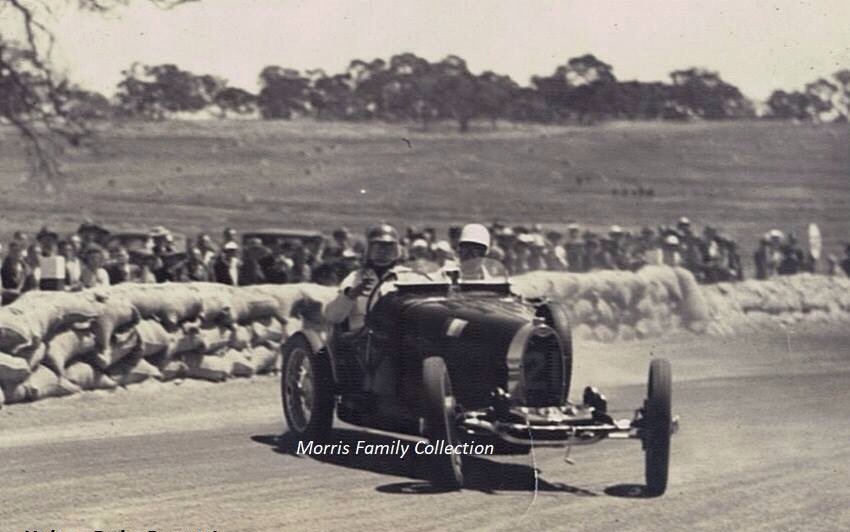
Dale brothers on the 1936 AGP grid at Victor Harbor in December 1936, Bugatti T37A. Henry driving, Peter alongside- DNF after 9 laps in the race won by the Les Murphy MG P Type (Bob King)

Dale boys during the Victor Harbor race, I wonder if he caught it! (Morris Family)

They are recalled as two rather pompous single men who lived the life of gentlemen in a terrace house in Williams Road, Toorak in Melbourne. Well remembered is a large round ‘coffee’ table in the drawing room on which was displayed the latest copy of every motoring magazine. The garage on the side street was opened to reveal the latest, newly acquired exotica. Peter, known as ‘Durham’ had some mundane job with an insurance company as well as being a journalist on the ‘Truth’ newspaper; he wrote a three part history of the pre-war Australian Grand Prix in AMS, which piqued the interest of the writer in these races. Henry, christened Hylton, was usually engaged in the wool trade in Egypt.

The writer’s earliest memory of Peter was at Fisherman’s Bend car races in the late 1950’s. A friend and I were gazing in awe at Miles Ryan’s 100mph Low Chassis Invicta. I commented to said friend that the radiator badge was not straight. We were addressed in a stentorious tone by one whom were later told was Peter Dale: “That is how you know it is handmade” – a lesson well learnt. We do not have a chronology of cars imported by the Dales, but let us start with three on a wharf.

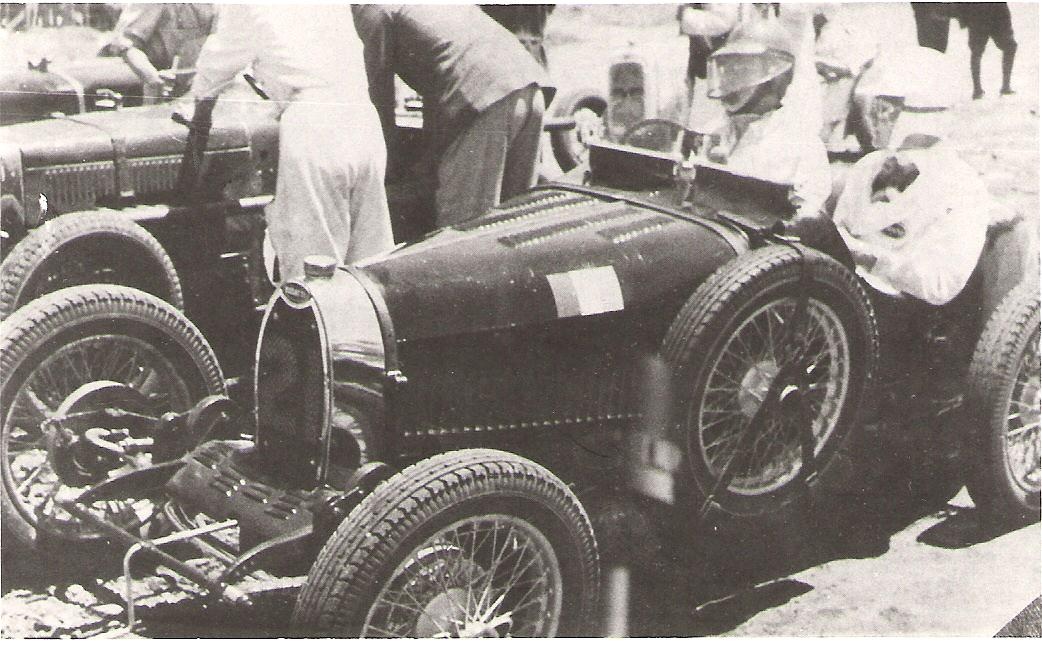
Peter Dale in ‘37160’ with its unusual ‘Touriste’ body by Jarvis of Wimbledon (Bob King)

The Bugatti 35A is not an ‘A’, but a 1925 Molsheim works racing Type 35, chassis no. 4575.

It was Jules Goux’s 2 litre car for the French and Spanish Grands Prix of that year. The French GP was a 1000km race held in torrential rain over 9 1/2 hours. The Bugatti team finished intact with Goux in fifth place. What endurance.

Henry spotted its radiator in the back of a garage in Neuilly-Sur-Seine in about 1950 and bought it for about $150. Although it had not been run since before the war, he had the oil changed and then undertook a delightful Autumnal drive to Marseille, from where the car was shipped to Adelaide.

Fisherman’s Bend Races – don’t be fooled by the blower blow off hole in the bonnet, Herb Ford had swapped bonnets with his supercharged Type 37A, ‘37332’. (Dino Lanzi)

Peter collected it, had it registered by Bob Burnett-Read who actually substituted a Ford Prefect from his used car lot for the Bugatti – the weigh bridge man seemed satisfied with this. The car was driven by Peter to Melbourne and from there to Bathurst for the Easter races where it performed creditably in the hands of Lyndon Duckett and Peter Dale.

They had driven there in a convoy of 4 Bugattis – the Type 35, the Anzani Bugatti, a Type 51A and a Type 57C – Dales ‘Ecurie Pur Sang’. The next owner of the 35 was Bugatti enthusiast Herb Ford who sold it on when it emitted expensive noises from its roller bearing crankshaft. In the words of Peter, it was ‘a mass of fatigued stresses’.

Some more photos of Bugatti Type 35 ‘4575’…

(P-Y Laugier)

This photograph above is thought to be M Poret in the car pre-war, he was a Parisian owner.

(B Burnett-Read)

This photograph was taken shortly after arrival in Australia. Bob Burnett-Read has just had the car registered prior to Peter Dale’s drive from Adelaide to Melbourne.

(Bob King)

Herb Ford only used the car once or twice, including a sprint on or near the Geelong Road (accounts vary). It is said he made the fastest 1/4 mile time- finishing at astronomical revs in third, maybe this is why the engine was making unpleasant noises.

He sold the tired car to John Martin who did not keep it long enough to dismantle the complicated built-up roller bearing crank before passing it on to John Thomson. Here it is with Martin- note the ill-fitting bonnet from the 37A- when adding a supercharger to an unblown GP Bug, the steering box is moved up and back, to make space. Hence the steering drop arm being in the wrong place.

(unattributed)

The next owner, John Thomson had the good fortune to be friendly with Bugatti expert Peter Menere, at his Brighton ‘Pier Prestige Garage’.

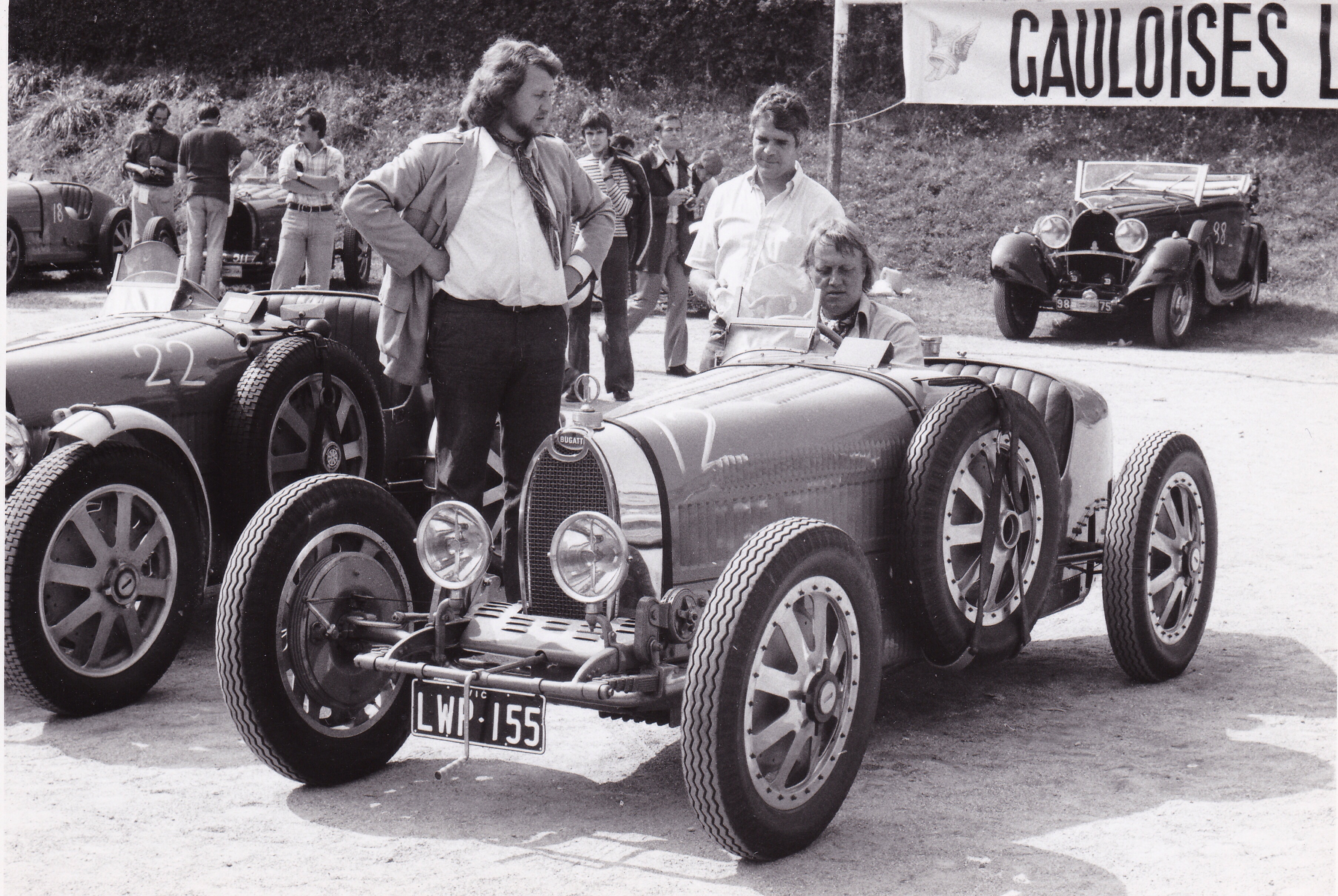
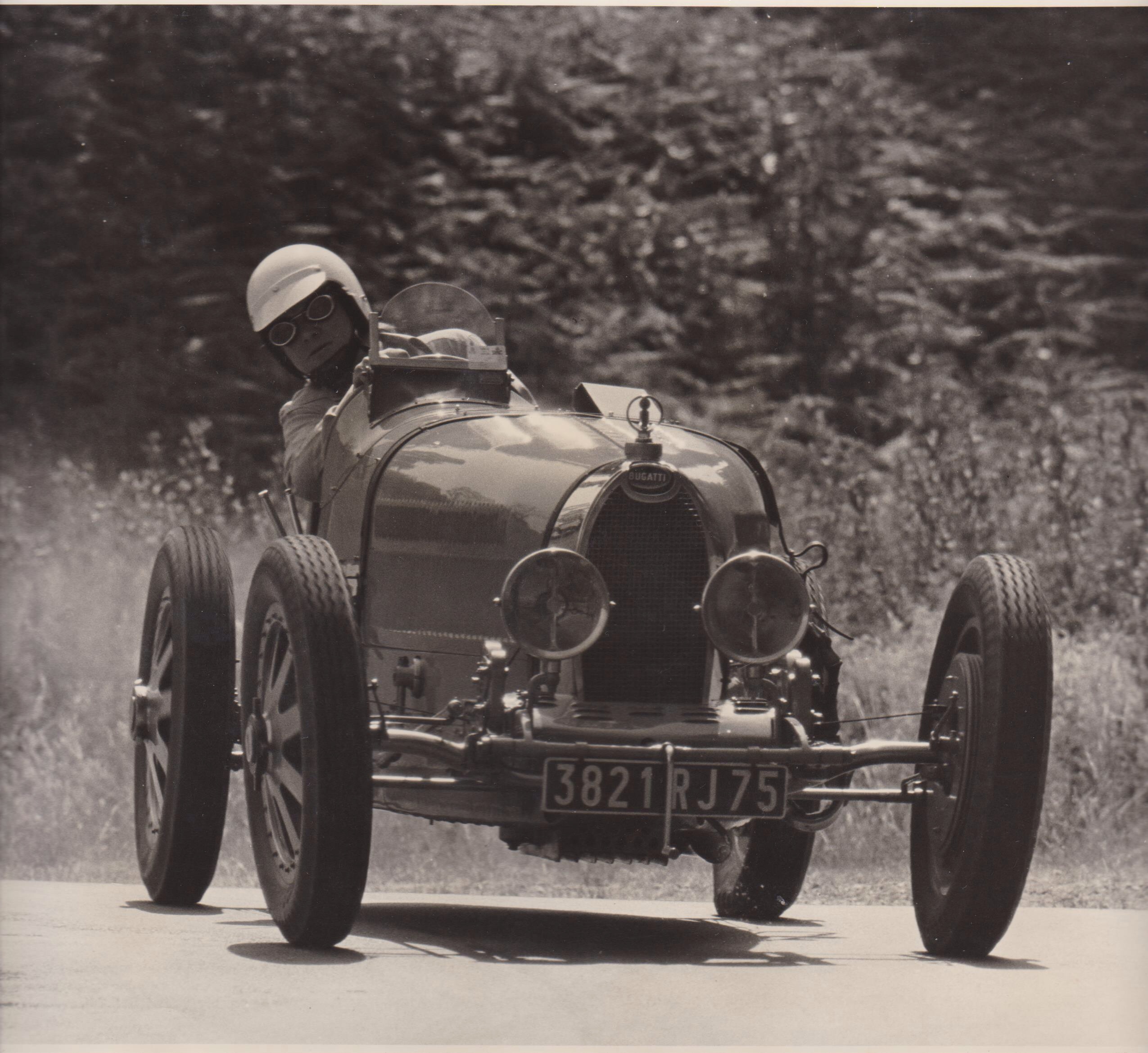
John was dead keen to have a GP Bug, and after prolonged and unsuccessful haggling with Ford, he eventually bought the dismantled car from Martin for an astromonical 870 pounds, the Brighton Buggattisti thought he was mad. After spending a further 700 pounds with Moore Hydraulics getting the crankshaft ground, and untold hours toiling over the rest of the car, he eventually had a going car- an original, unmolested factory racing car, no less. Not long after completing the car in the mid-sixties John moved to London, the car following him in 1972. In 1974 50 years of the Grand Prix Bugatti was celebrated in Lyon with an amazing turn-up of Grand Prix Bugattis. John is seen in the car on that occasion.

(unattributed)

On the starting line at Limonest Hillclimb, Lyon.

A great action shot of John on Prescott Hillclimb- the hillclimb owned and run by the Bugatti Owners Club (unattributed)

A well known photo of the Talbot-Lago ‘110007’ below but worth seeing again. Doug Whiteford AGP, Albert Park, 21 November 1953 – ‘Yes Doug, your tyre is missing’.

Lago Talbot GP chassis no. 110007 was the car with which Louis Chiron had won the 1949 French Grand Prix. Henry was contemplating purchasing Raymond Sommer’s Lago, but was advised by Chiron to speak to Paul Vallee, patron of Ecurie France, as he might sell Chiron’s car which was being prepared for the Barcelona Grand Prix. It was entrained to Marseille and thence to Adelaide.

Its first owner in Australia was Tom (Happy) Hawkes who only drove it once or twice. Its serious debut was at the 1951 Easter Bathurst meeting, 1951; Hawkes drove it to third in the Bathurst 100 and Whiteford was third in another scratch race, setting a new lap record of 3 minutes.

The ‘Maestro’ Whiteford won the 1952 GP at Bathurst and the 1953 race at Albert Park, in spite of the tyre issue.

Here the car is pictured below during the December 1956 Australian Grand Prix weekend at Albert Park, by then the ‘6 plug’ chassis ‘110007’ was owned by Owen Bailey, whose race was shortlived with axle failure on the line.

(S Wills)

AGP Albert Park paddock with the ‘6 plug’ Bailey ‘110007’ in front of the car Doug Whitford replaced it with- an earlier car, chassis ‘110002’ but to more advanced specification inclusive of more powerful ’12 plug’ 4.5 litre motor. Stirling Moss won the feature race aboard a Maserati 250F.

(S Wills)

Beautiful shot of ‘Dicer Doug’ Whiteford with Peter Dale during the 1956 AGP carnival. Car is Talbot-Lago ‘110002’. It would be interesting to know how many AGP’s in total the various cars the Dales imported over the years contested.

(S Wills)

Cockpit below is ’12 plug’, ‘110002’, Spencer Wills photograph again taken in the Albert Park paddock. Quadrant for the pre-selector gearbox clear.

(S Wills)

Photo below of Owen Bailey at Albert Park, am intrigued to know which meeting. It appears he has spun into a gutter, or been rammed from behind.- the shape of the dent suggests the former.

(S Wills)

Shot below is of Whiteford in the ’12 plug’ ‘110002’ at Fishermans Bend on 12 February 1956.

(S Wills)

(unattributed)

‘The Maserati 4CL, chassis No. 1579 is first recognised as Raymond Sommer’s 1946 Marseilles Grand Prix winning car.

In the photo above Sommer is being led by Tazio Nuvolari in another 4CL during the second heat. Sommer won both this 15 lap heat and 35 lap final, the great Mantuan failed to finish the preliminary and therefore did not qualify for the final run on the Marseille Prado Street circuit on 13 May.

It was painted blue for its French owner. Again it was Louis Chiron who suggested Henry should buy it from Sommer’s widow – Sommer had been the owner of one of Europe’s largest carpet manufacturers.

Via an advertisement in Australian Motor Sport, the car was soon in the hands of Victorian Peter Vennermark. He soon had trouble with the highly supercharged 1.5 litre engine, which had developed an appetite for cylinder blocks. Unlike the other two cars featured which have returned to Europe, this car remains in the caring hands of the Victorian owners.’

Bibliography…

‘Historic Racing Cars in Australia’ John Blanden, ‘Bugattis in Australia and New Zealand, 1920 to 2012’ Bob King and Peter McGann

Photo Credits…

Bob King Collection, Herald-Sun, G Griffiths, S Anderson, Morris Family, Spencer Wills, Bob Burnett-Read, Pierre-Yves Laugier

Finito…

(B Howard)

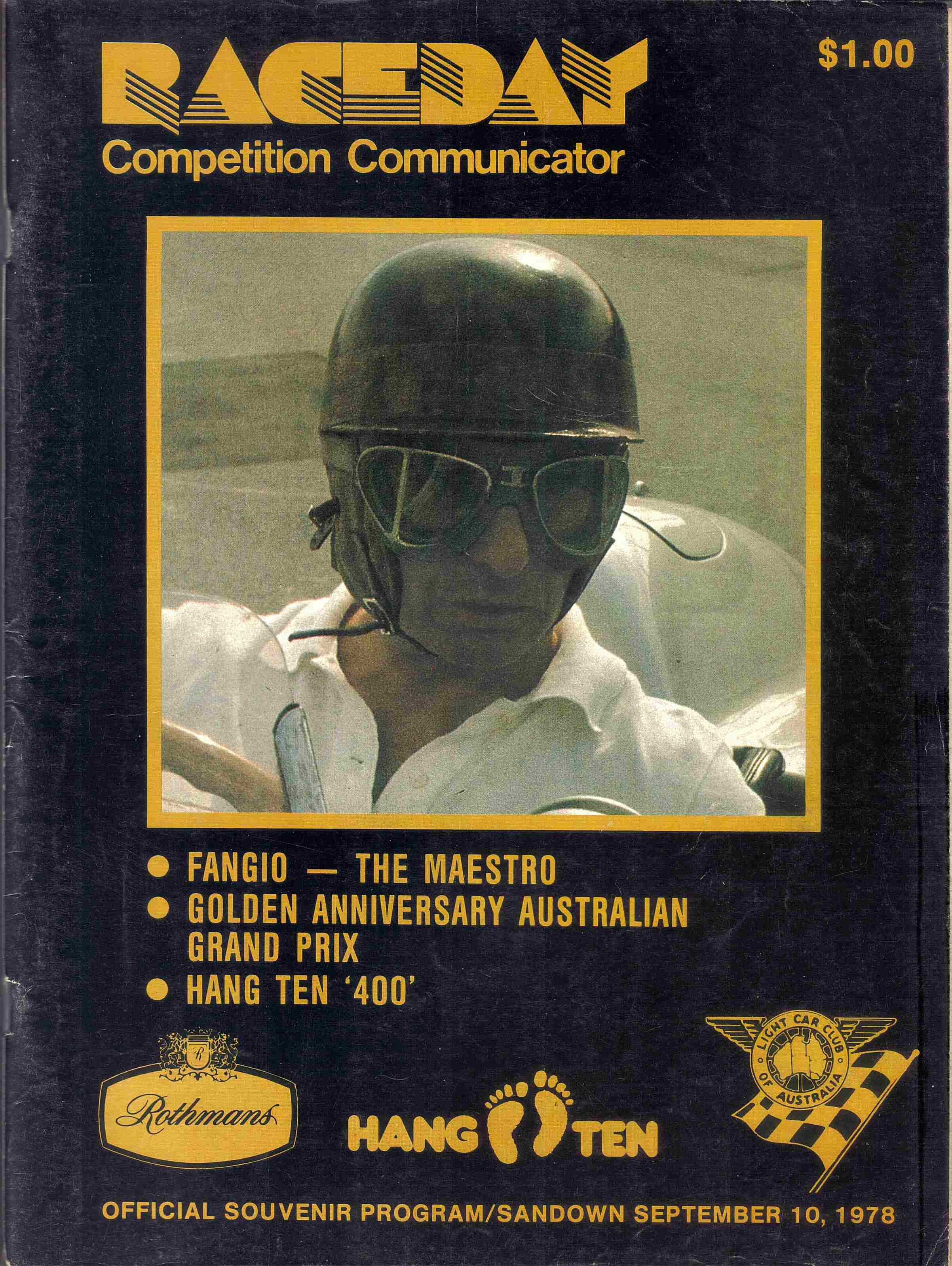
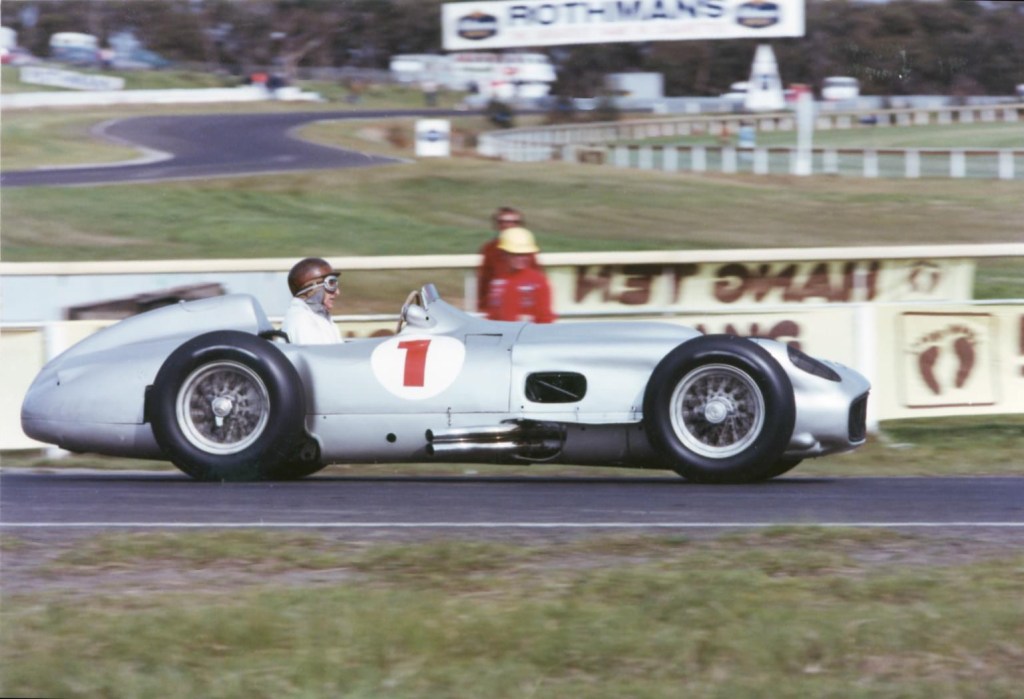
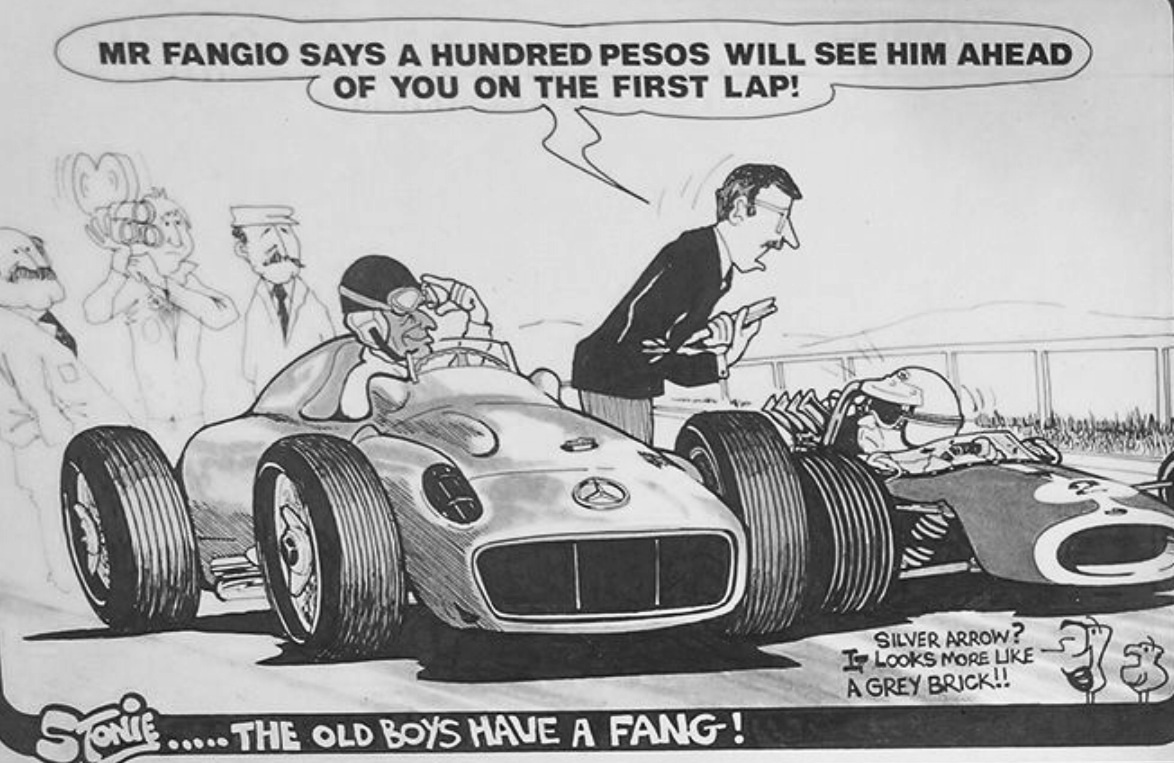
The Light Car Club of Australia achieved a major promotional coup by securing Juan Manuel Fangio’s attendance at the fiftieth anniversary of the first Australian Grand Prix, at Sandown, Melbourne on 10 September 1978…

Here the great man ponders his car during practice. Fangio raced a Mercedes Benz W196 straight-eight Grand Prix car, the design with which he won his 1954-55 World Championships: whilst noting the two wins he took in Maserati 250F’s in 1954 before joining Mercedes, from the French Grand Prix.

JMF wanted to drive in a Polo-Shirt as he did in the day but the Confederation of Australian Motor Sport would have none of that, hence the overalls over his normal clothes.

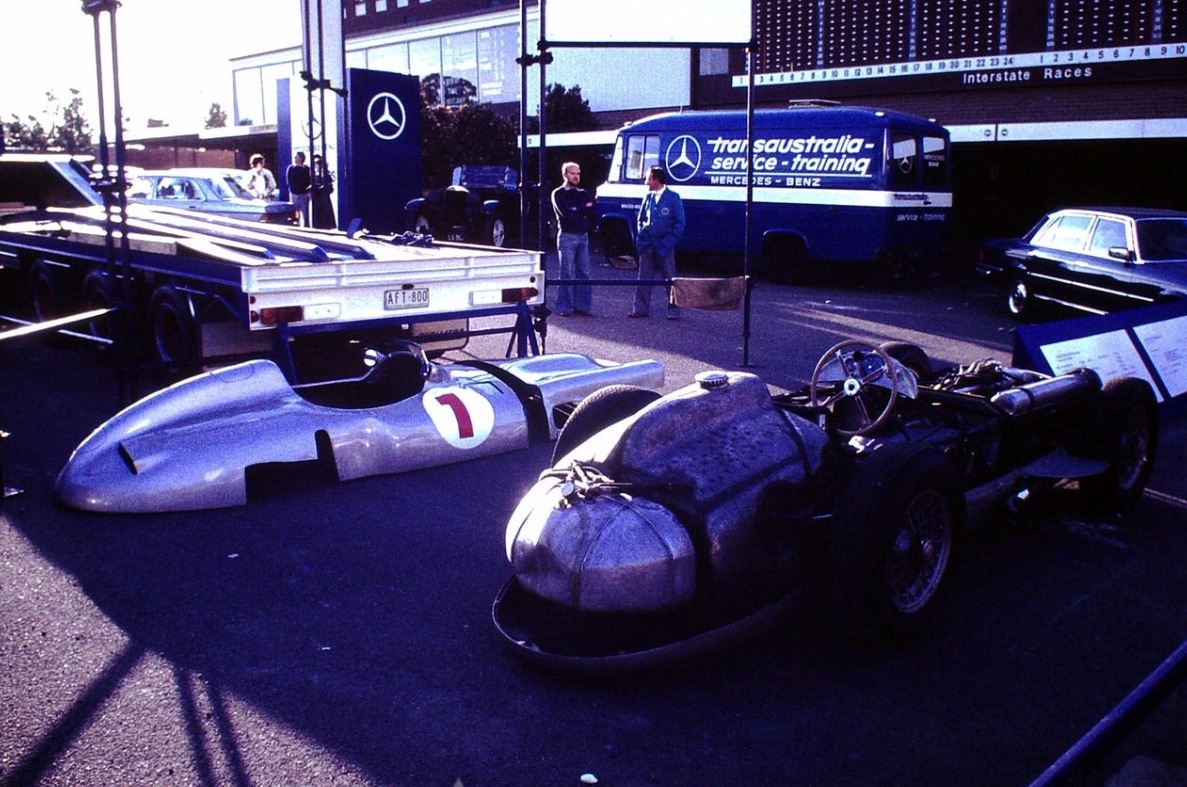
Fangio W196 on display behind the Sandown grandstand- the ‘Interstate Betting’ is a function of the place’s prime function- donkey races (mouserat159)
(S Dalton Collection)
Fangio hooks the big Mercedes into Dandenong Road corner at Sandown (I Smith)

The Sandown event created huge interest far beyond the racing fraternity, including articles in such unlikely places as the Australian Womens Weekly – normally the province of the Royal Family, cooking recipes and similar – such was the mans immense global stature decades after his last championship win in 1957. He won five F1 titles of course: 1951 in an Alfa 159, 1954/5 Benz W196, 1956 Lancia-Ferrari 801 and the final in 1957 aboard a Maserati 250F.

It was the Argentinians first visit to Australia, he had planned to race in the 1956 Melbourne Olympic Games GP at Albert Park, a race won by Stirling Moss in a Maser 250F, but in the end conflicting commitments scuttled the idea. He returned to Melbourne in 1981 and came to Adelaide twice I think, the sight of him blasting along Adelaide roads during the wonderful 1986 ‘Eagle On The Hill’ run from the city up through the Adelaide Hills to the top of Mount Lofty is not something any of the large number who saw it will readily forget either. He drove a Mercedes sports-racer, a 300SLR on that occasion. If memory serves he may have boofed an Alfa Romeo Alfetta 159 of the type he raced in 1951 at Adelaide doing a demo- by that stage he would have been well into his late seventies mind you.

Fangio contested a ‘Race of Champions’ at Sandown which included Jack Brabham aboard his 1966 championship winning Brabham BT19 Repco 620, and former Australian champions Bill Patterson in a Cooper T51 Climax and Bob Jane in a Maserati 300S. Both were cars they had raced in period and retained.

(mouserat159)
(C Griffiths)
(I Smith)

All eyes were on the Fangio, Brabham ‘battle’ over the three lap journey of course, the footage well known to most of you says it all in terms of the speed and spirit in which the cars were driven, note that JMF was 67 at the time and had suffered two heart attacks in the years before his visit.

The sight and sound of Fangio driving the big, noisy W196 on the throttle, kicking it sideways in the manner for which he was famous lap after lap in practice around Sandown’s third-gear Shell Corner onto Pit Straight is forever etched in my memory – he could still boogie at that stage, well and truly.

As you all know, normally the paddock is a hive of activity with mechanics and engineers getting on with necessary preparation of their steed for the next session or race. Sandown’s then layout afforded those in the paddock a great view of the cars on circuit from or near the pit counter. On the occasions that Fangio was on circuit the tents in the cuddly-small Sandown paddock were empty as drivers and mechanics watched Fangio strut his stuff. It was simply not to be missed whatever the competitive needs of the moment were.

It’s always funny to re-live discussions of that-weekend with fellow enthusiasts as so many of us were there from all over this vast land, all having a different experience or highlight but equally excited recollections of it all despite the elapse of forty years. As a student at the time I was there from the meetings start to finish, it was sad when it was all over, I was very conscious of the fact that I had witnessed something special.

Fangio was the President of Mercedes Argentina and owner of two dealerships when he visited Oz and had to sing-for-his-supper over the week he was here. He did a range of promotional events, dinners and drives with motoring writers to promote, mainly, the ‘Benz 450 SEL 6.9 which was the range-topper at the time, a snip at $A68,500 in 1978.

(C Griffiths)

Postscript…

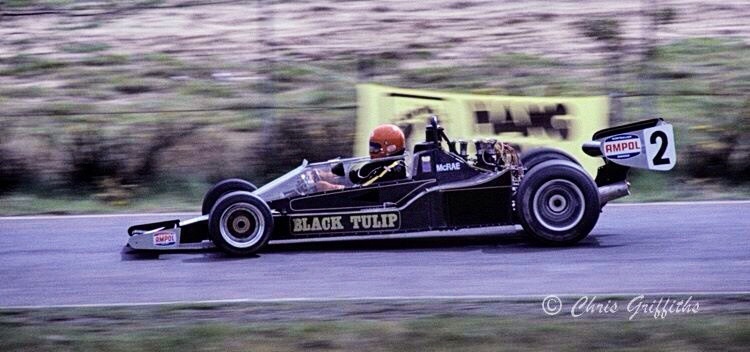
The 1978 AGP, held to F5000, was a race of attrition won by Graham McRae in his see-through perspex cockpit McRae GM3 Chev from John David Briggs and Peter Edwards in Matich A51 Repco and Lola T332 Chev respectively.

In fact it was an entirely forgettable AGP. Very bad accidents hurt both Garrie Cooper, Elfin MR8 Chev and Alan Hamilton, Lola T430 Chev. These very high speed shunts, together with a tangle that eliminated second placed Jon Davison’s T332 and Vern Schuppan’s Elfin MR8 Chev on lap 28, and a broken head-gasket for pole-sitter John McCormack’s unique ex-F1 McLaren M23 Leyland, conspired to rob a race which had lots of potential.

An arcane end to this piece.

It’s a long story, but a decade or so ago, an Australian enthusiast ‘discovered’ in contemporary newspaper reports that a very short race named ‘Australian Grand Prix’, was contested on an oval layout at Goulburn’s racecourse, New South Wales on 15 January 1927.

This race was shortly thereafter recognised by many, but not all historians as the first Australian Grand Prix thereby replacing the previous event which held that honour, the ‘100 Miles Road Race’ held at Phillip Island in 1928, later recognised as the first AGP.

So, Juan Manuel Fangio was here in 1978 to celebrate the 51st AGP not the 50th…

Photo / Other Credits…

Bruce Howard, John Stoneham aka Stonie, Chris Griffiths, Stephen Dalton Collection

Tailpiece: I wonder which particular W196 chassis Fangio ran here in 1978?…

(mouserat159)

Big butt isn’t it? All fuel and oil tank, its an object lesson in Vittorio Jano’s design intent with the D50 Lancia to get the fuel between the wheelbase via his pannier-tanks. I’ve a vague recollection this particular chassis was fitted with a 3-litre SLR engine for demonstration purposes rather than the GeePee 2.5? Interesting the way the body comes together too.

Finito…

(I McCleave)

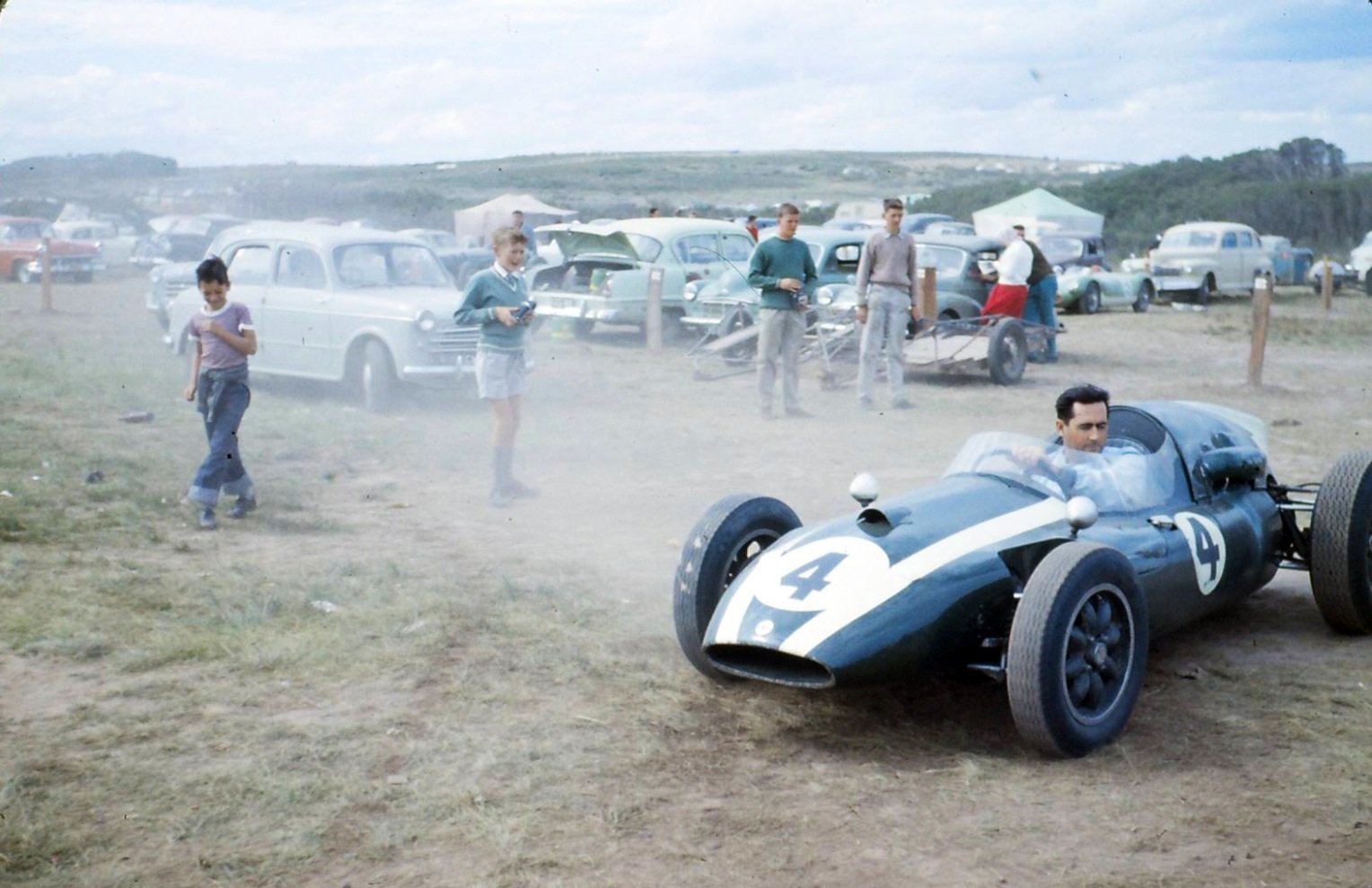
Jack Brabham playing with the kids in the Phillip Island paddock, Cooper T51 Climax, 14 March 1960…

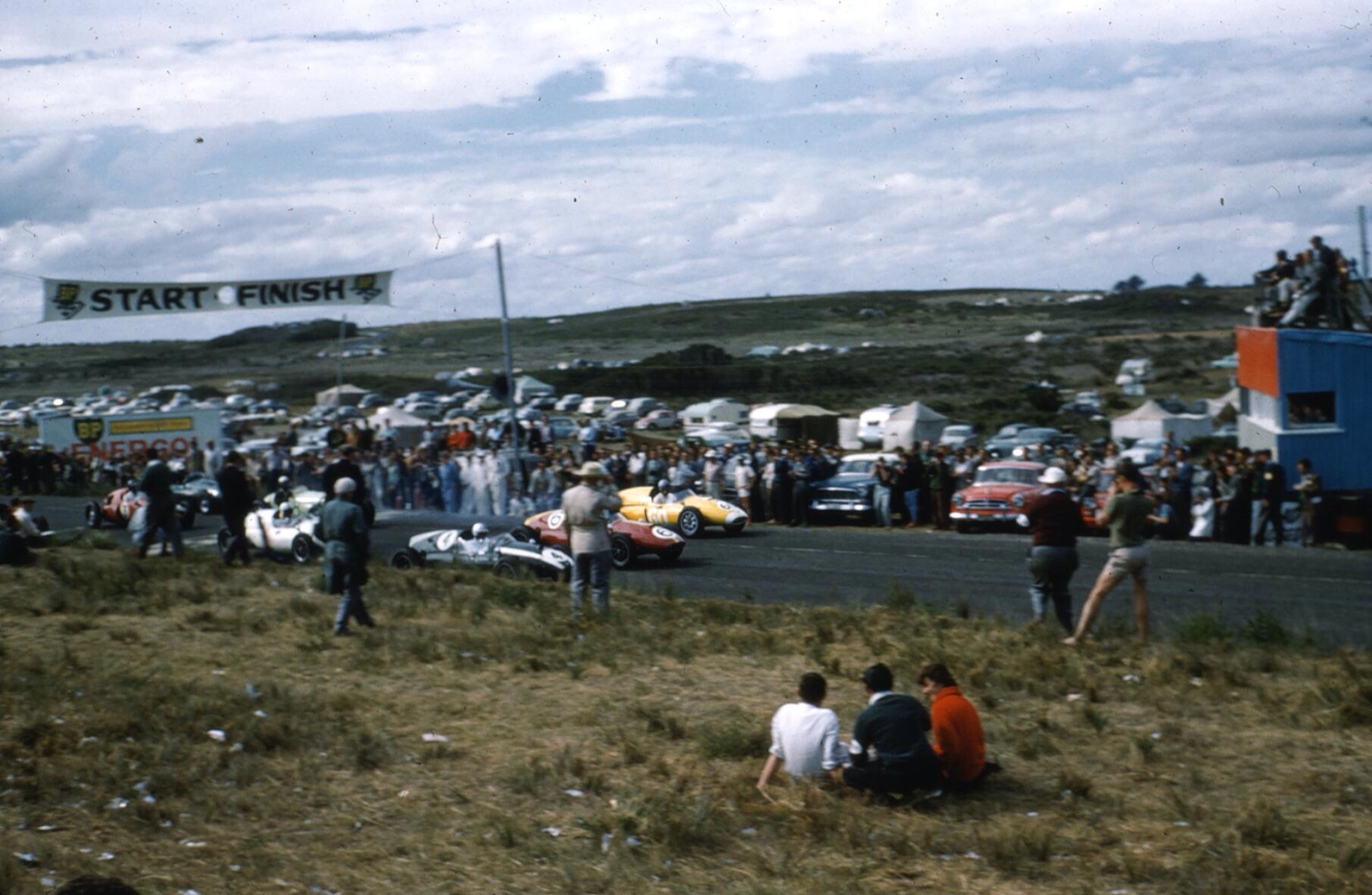
Jack won the Repco Trophy over 16 laps in a T51 rout from Bill Patterson, Bib Stillwell and Austin Miller in similar cars. None shared the latest 2.5-litre Coventry Climax FPF fitted to Jack’s F2-4-59 said to be ‘Brabham’s main car during the early part of 1959’. Austin’s motor was 2.2-litres, Bib and Bill’s 2-litre units.

Brabham had a successful fortnight during his short 1960 Australian summer racing tour, three races from three, winning the Longford Trophy, Light Car Club of Tasmania Trophy on 5 and 7 March at Longford the week before.

Ian McCleave took the opening photo of ‘A youthful Jack Brabham showering my younger brother in dust…I seem to recall Dad charged with adrenalin winding the Austin A95 up to 90 mph on the way back to Melbourne!’ Lukey Heights is well familiar to ‘Island regulars in the background, its a top shot and another enthusiast that day, Robert Jones caught the start of the race, below.

(T Johns Collection)

Australian Motor Sports Review 1959-60 wrote that “During these hectic two days , Brabham more than simulated his performance at the opening meeting of Phillip Island in December 1956.”

“On that occasion driving a Cooper sportscar he won the three races he entered including the Formula Libre event ahead of Ted Gray’s Tornado Ford V8 and Lex Davison’s 3-litre Ferrari 500/625. Three years later, Brabham as you would expect from a World Champion, won every scratch race he entered; but unlike the first meeting, he competed in five events, but won only four, having been beaten into second place in the Racing Car Handicap on the first day.”

(Ron Jackson)

Credits…

Ian McLeave, Robert Jones, Tony Johns Collection, Ron Jackson, Australian Motor Sports Review 1959-60

Tailpieces…

(R Jones)

The off, Brabham, Stillwell and Miller, with Bill Patterson in white, on row two.

(T Johns Collection)

Finito…

(P Ansell)

It does all get a bit serious these days doesn’t it!?

Here Jim McGuire and Alan Tatham are enjoying their Cooper Mk4 Norton at Gnoo Blas, circa 1957…

Aren’t these an amazing group of colour photographs of a race meeting at the popular, relatively shortlived Orange, NSW circuit. Such vivid images of race meetings in Oz at the time are not exactly plentiful.

These shots were posted on Bob Williamson’s Old Motor Racing Photographs – Australia Facebook page by Paul Ansell and immediately provoked a response from a swag of enthusiasts contributing information about the car and that day.

McGuire works, Tatham poses for the babes, as drivers do (P Ansell)

Australian Ace Kevin Bartlett recognised his ‘blue Morris Minor Series 2 fitted with a fibreglass top…’, that’s KB in blue standing beside the door of the car in the background. In fact Jim McGuire and his wife Carmen aided and abetted the careers of several drivers including KB, who raced the Elfin Imp for them in the mid-sixties and Peter Wherrett- the latter raced this very Cooper Mk4 with a Hillman Minx four-cylinder engine installed in the early sixties.

Here the Cooper is fitted with a Norton Manx engine. The red car over the back in the first photo is the Profilio MG Spl which still exists in historic racing as indeed does the Cooper Minx- restored by David Kerr a couple of decades ago.

By the time McGuire acquired the car, chassis # ’10/54/50′ was already a veteran of the 1954 Australian Grand Prix, Charlie Swinburne raced it, Manx Norton powered, to tenth place. Its thought when first imported to Australia the car was originally supplied to Les Taylor in Queensland fitted with a JAP 1100 motor.

Later raced by Queensland’s Ray Lewis as the ‘LPS Cooper Norton’ (Lewis/Bill Pitt/Charlie Swinburne) during 1953, Jim McGuire bought it from Tony Crick of Wellington, NSW, initially racing the machine with Tatham at the wheel.

Barry Collerson in the Cooper Minx leads an Elfin Catalina at Oran Park circa 1961 (Alan Stewart)

Later, in 1959 or early 1960, Jim mated a Hillman Minx 1500 engine and VW gearbox to the frame, the car in this form contested the 1960 Australian Grand Prix at Lowood.

The photo below shows Tatham aboard the Cooper Mk4 Hillman together with the #37 D Russell MG TD, #49 N Barnes MG TC s/c. I’m mystified by a couple of the cars but it appears to be the great Tornado 2 Chev down the back, by that stage driven and owned by Mel McEwin.

(F Pearse)

Up front a thriller of an AGP was won by Alec Mildren’s Cooper T51 Maserati by a whisker from Lex Davison’s Aston Martin DBR4/250, the little Cooper retired with an undisclosed ailment. Not so long after Lowood Tatham ceased to drive the car but it raced on, still owned by Jim at Strathpine, Tarrawingee, Hume Weir, Oran Park and Warwick Farm driven by Peter Wherrett and Barry Collerson.

Peter Wherrett, Cooper Minx, Warwick Farm May 1961 (P Wherrett)

Both Sydneysiders were talented coming-men of the day with Collerson racing an ex-Doug Whiteford GP Talbot-Lago in Australia before chasing the  FJ circuit in Europe for a couple of years. He has written a book too- i must buy ‘Mount Druitt to Monza’, been meaning to for ages.

Wherrett is incredibly prominent in the memories of several generations of us for his racing, his ‘Racing Car News’, for many years THE Australian motor racing monthly bible- race reports, ‘Peter Wherrett Advanced Driving’ school and ‘Torque’ the seminal, defining, brilliant ABC television motoring program of the mid-seventies. The genre popularised by Jeremy Clarkson much later started with Wherrett and a team at the ABC. Remember PW’s track test of Warwick Brown’s Lola T332 Chev?, it just blew my tiny, teenaged mind!

The Cooper Minx later fell into the tender, loving hands of David Kerr who restored and raced it extensively in historic racing with John Herman the last reported owner.

Lets Get Physical! Little Barry Collerson trying to stay aboard the Cooper Minx at Warwick Farm in August 1962. Note the different, later fibreglass nosecone in this shot (P Wherrett)

Credits…

Paul Ansell- photos. Dick Willis, Kevin Bartlett, Greg Smith, ‘Historic Racing Cars in Australia’ John Blanden, Fred Pearse Collection, Alan Stewart Collection and Peter Wherrett Collection on aussieroadracing.homestead.com

Etcetera: Cooper Minx, circa 1961, perhaps at the McGuire’s home in Sydney- Peter Wherrett Collection photos…

Water radiator neatly integrated given air-cooled engines originally fitted

Front transverse leaf suspension as standard Cooper Mk4

Rear suspension and wheels appear as standard Cooper Mk4

Hillman Minx 1500 four fed by a couple of downdraft Strombergs, transaxle is modified 4 speed VW

Tailpiece: Gnoo Blas officialdom, Cooper Mk4 unwell…

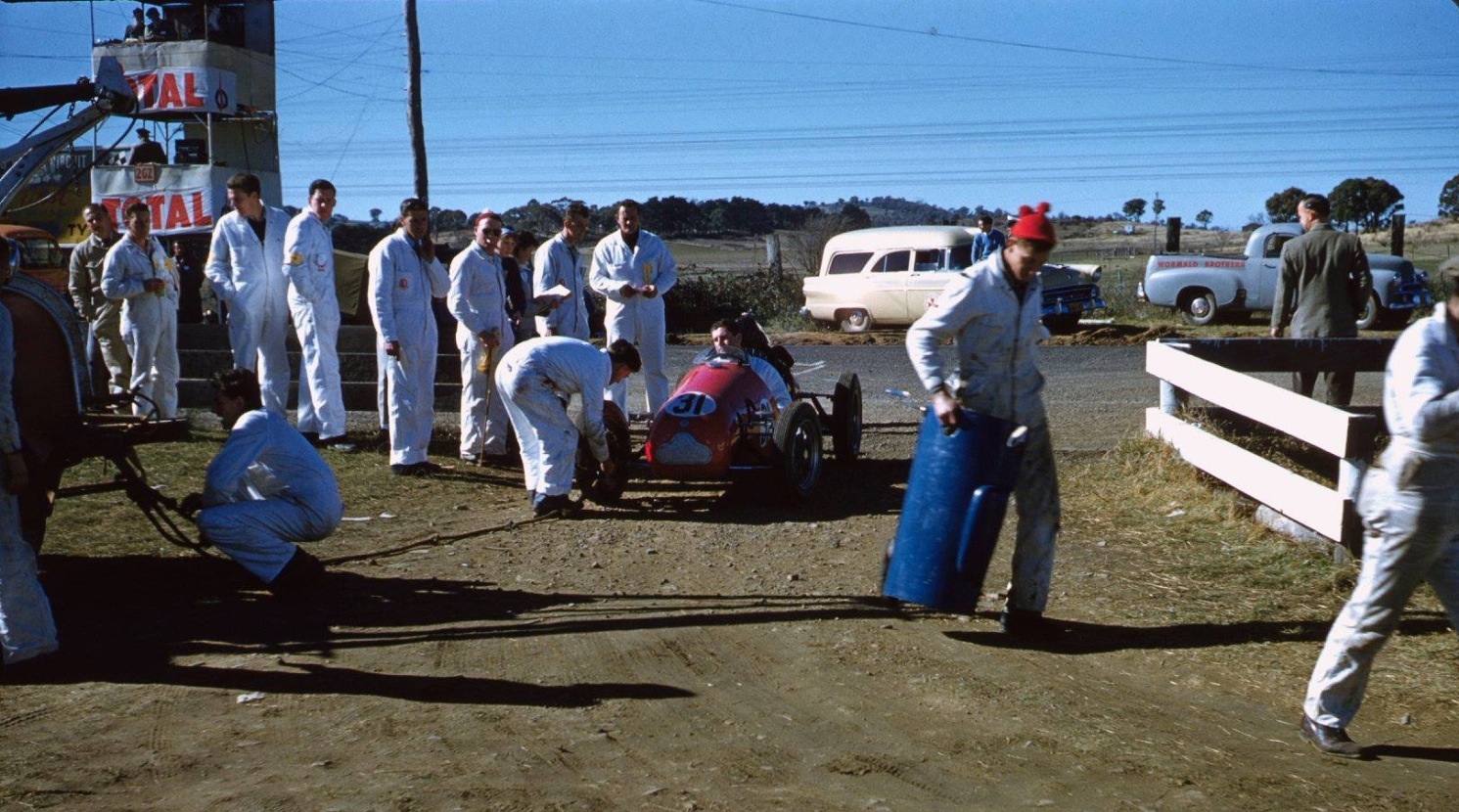
Never seen so many crisply laundered white overalls! Tatham in Cooper Mk4 Norton. Bucolic Gnoo Blas (P Ansell)

Finito…

(Popperfoto)

John Cobb at Brooklands during the 17 May 1937 Gold Trophy Coronation Race, Napier Railton…

What an awesome 23.944 litre, 580 bhp machine this is- there is little point waxing lyrical about a superb racing car which is a well known national icon in the UK, so I will keep it short and hopefully sweet.

Cobb was a big man and clearly liked his racing cars on some scale, a passion his fur-broking business Anning Chadwick & Kiver allowed him to indulge. Reid Railton designed the car which was built by Thomson & Taylor with the specific brief of taking the Brooklands lap record, a feat it achieved for all time, at 143.33 mph on 7 October 1935. It was an exercise he likened to ‘trying to see how far you can lean out of a window without actually falling!’.

Brooklands, Cobb, Napier Railton, date unknown (B Museum)

John Cobb and the Napier at Brooklands on 31 March 1934 (Pinterest)

Railton specified a slow running Napier W-formation aviation engine in a suitably butch chassis with massive side members, twin cantilevered back springs and a finely muscular front axle. Typical of its time, the cockpit was capacious and it needed to be for record-breaking runs of up to 3000 miles or so.

Successful from the start, the car won its first race at the Brooklands Bank Holiday Meeting in 1933, the big beast recorded a standing lap of 120.59 mph and a flying lap of 123.28 mph. ‘When running for long spells, very large Dunlop special racing tyres were required, imposing a heavy task for the mechanics changing wheels at pitstops’. In addition to three times breaking the lap-record at ‘The Track’ the car broke world records at Montlhery and at Utah. The BRDC 500 Mile Race was won at 121.28 mph and the 500 Km version at 127.05 mph with the Napier Railton timed over the kilometre at 151.97 mph.

‘Pandora and The Flying Dutchman’ starred the Napier Railton in a fantasy romance with Ava Gardner and James Mason. Here ‘Dunlop Boys’ Freddie Hicks and Sidney West push the Napier towards a run on the Pendine Sands. Love the fags in mouths- photo used by Dunlop as a PR shot (unattributed)


Napier Railton on duty for GQ parachute testing circa 1951 (B Museum)

In 1949 Cobb hired the Napier Railton to the Romulus Film Company to make ‘Pandora and The Flying Dutchman’, a film about a racing driver. In 1951 John sold the car to the GQ Parachute Company who used it to test aircraft brake parachutes at Dunsfold Airfield- GQ modified the car and fitted it with test equipment to deploy parachutes at high speed and then retract them at about 30 knots.

Cobb, who served as an RAF pilot during the war, was killed trying to achieve the Water Speed Record in the jet-boat ‘Crusader’ at Loch Ness on 29 September 1952- the boat hit an unexplained wake.

The Napier Railton was in the best of hands when Patrick Lindsay acquired it-after a rebuild by Crosthwaite & Gardner he raced it in vintage events. It was then bought by Bob Roberts for his Midland Motor Museum, it was kept in running order after ‘being completely overhauled, except the engine’ by Hodec Engineering, Surrey in 1975. Aston Martin’s Victor Gauntlett was the next owner in 1989, and then at auction it passed to a German industrialist and finally, thankfully, became the Brooklands Museum’s car when offered to them in 1997 via a Swiss classic car dealer who ‘discovered it’ in the German’s collection. It is regularly demonstrated, many of you will have been fortunate enough to see it on circuit.

An awesome machine in the true sense of the word, goodness only knows how it felt on the limit for 500 miles on Brooklands famous concrete bumps…
 Etcetera: Technical Details of the Napier Railton as MotorSport reported them in 1933…

Credits…

Getty Images- Popperfoto, MotorSport August 1933 and July 1997, brooklandsmuseum.com

Tailpiece: Reid Railton designed Crusader being towed out into Loch Ness in 1952…

(unattributed)

Finito…