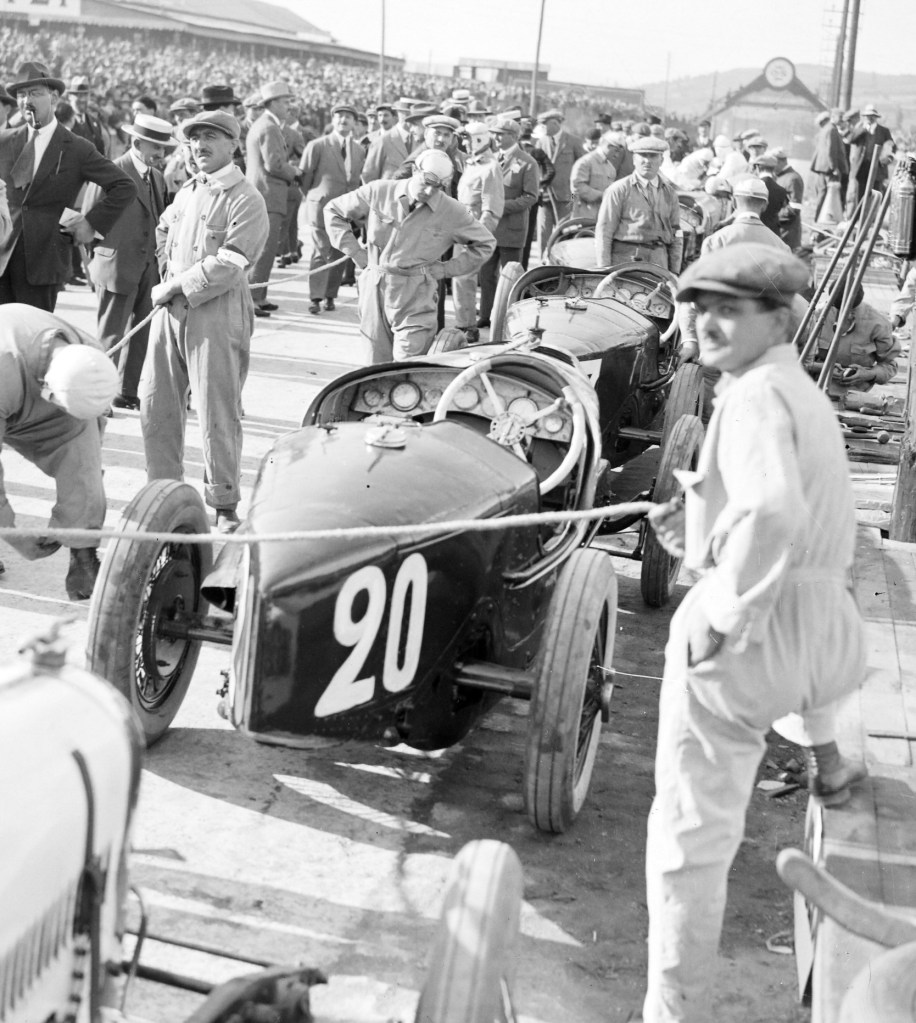
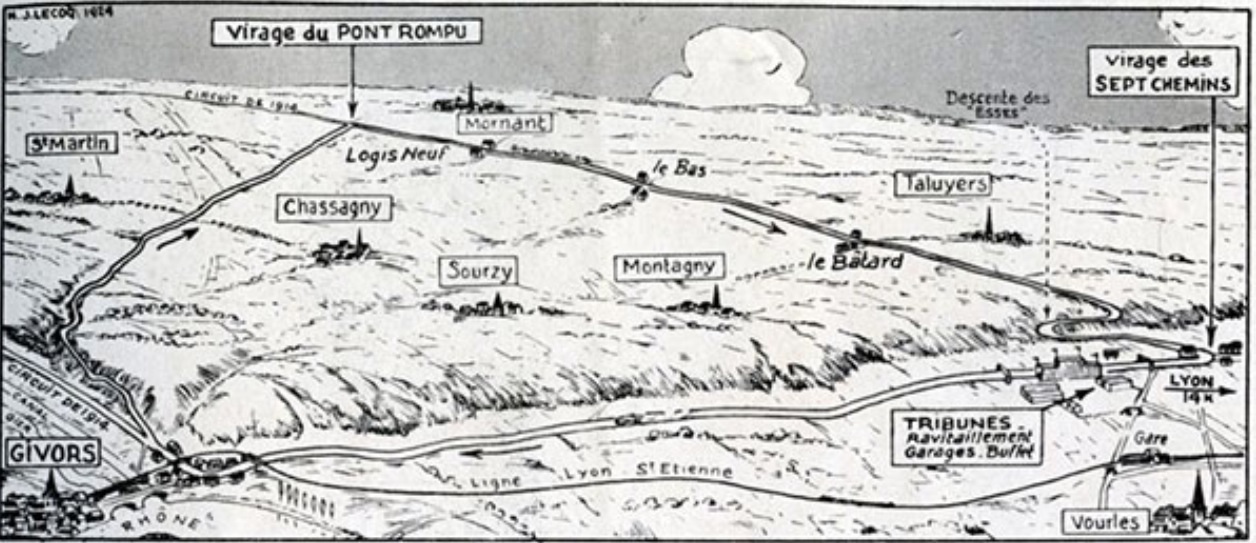
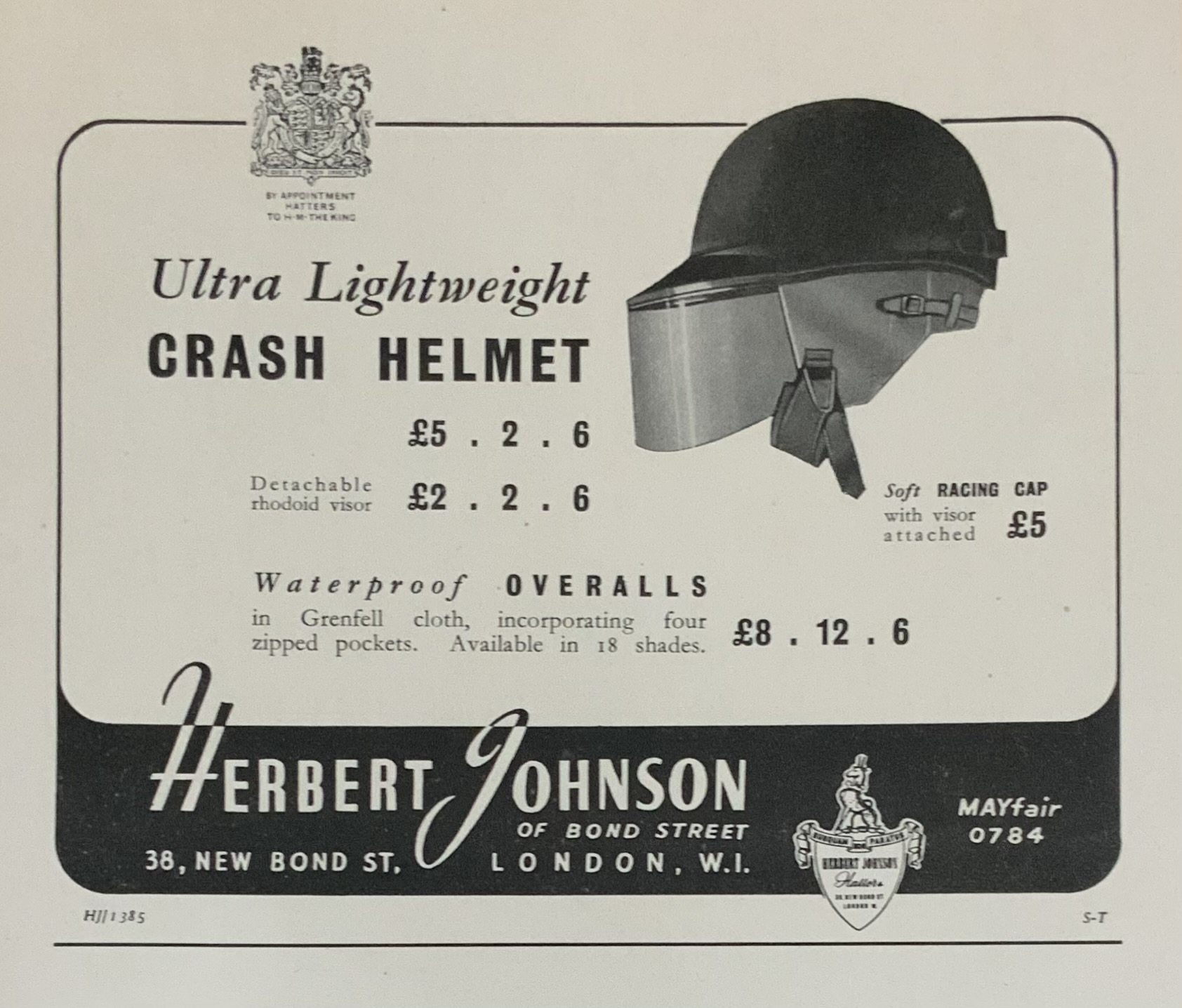
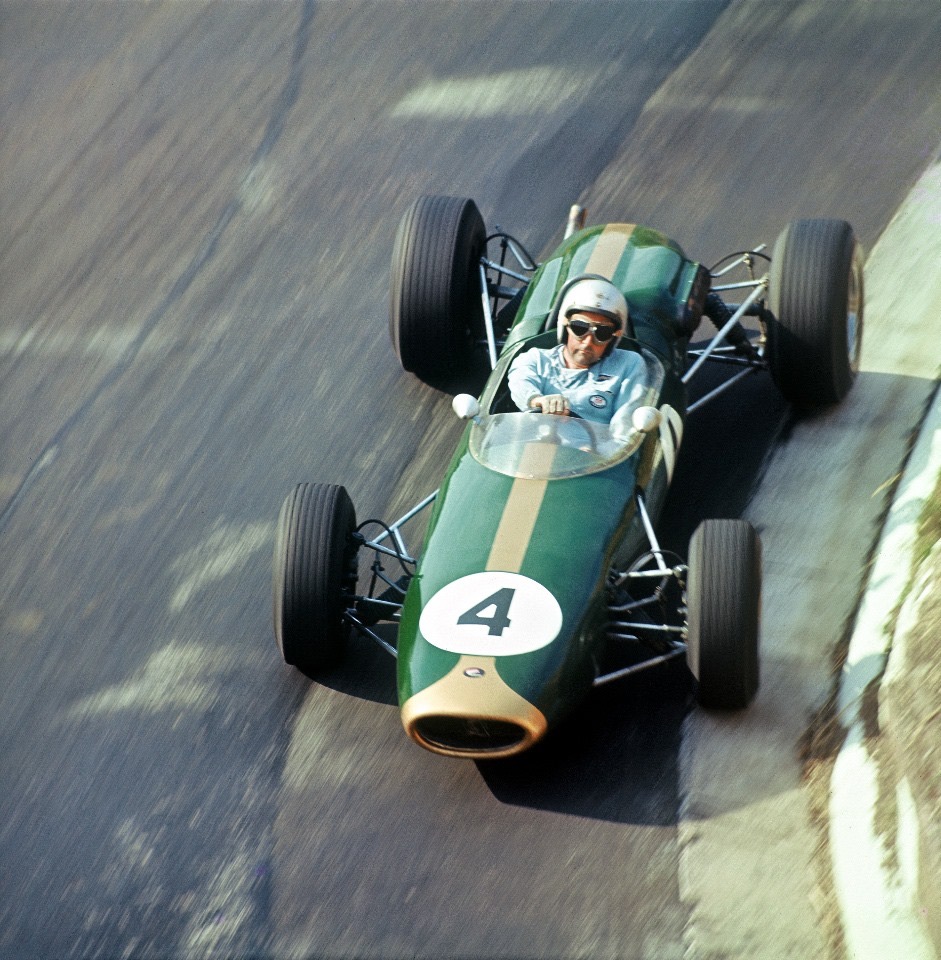
Herbert Johnson were one of the preferred purveyors of bash-hats to racing’s elite in the pre-Buco, pre-Bell early-mid 1960’s era.
The company, founded in 1889, made its name for its silk-velvet top-hats. By the outbreak of World War 1 its output was dominated by the demands of the military. Goldie Gardner was the first racer to commission a ‘protective hat’ from then proprietor, Geoffrey Glazier. Stirling Moss was a later customer as demand for the firm’s race products grew.
(K Devine)
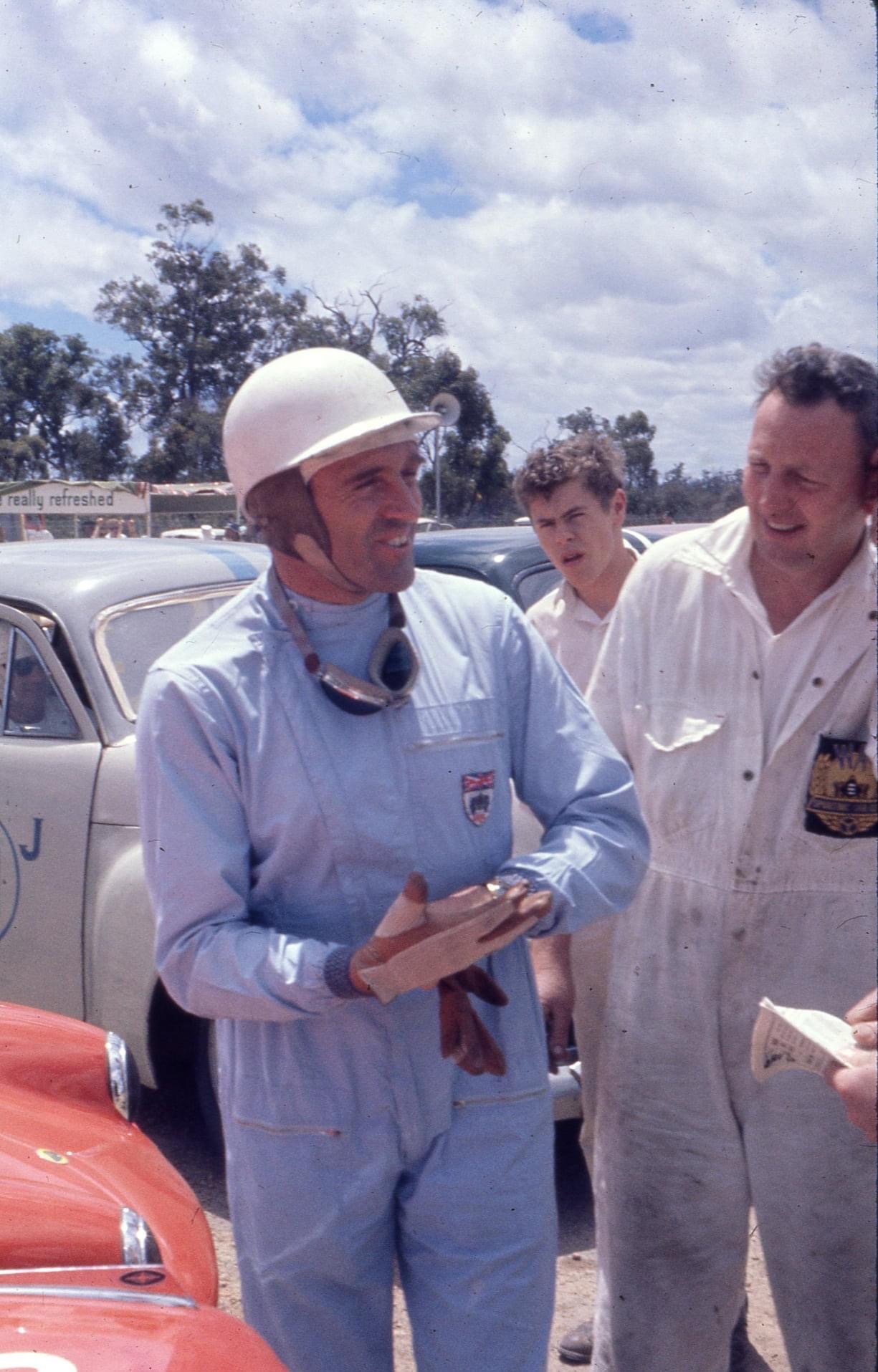
Lex Davison is shown so equipped at Caversham, near Perth in November 1962. It’s the Australian Grand Prix meeting, the four-times AGP winner is shown on the dummy-grid – looking very pucka in Herbie Johnson with British Racing Drivers Club badge on his overalls – about to jump aboard Len Lukey’s Ford Galaxie in a mixed touring/sportscar support race. The nose of the Elite belongs to Anthony Osborne.
Credits…
Ad from Motor Racing 1948-1949 BRDC Yearbook, Ken Devine
Tailpiece…
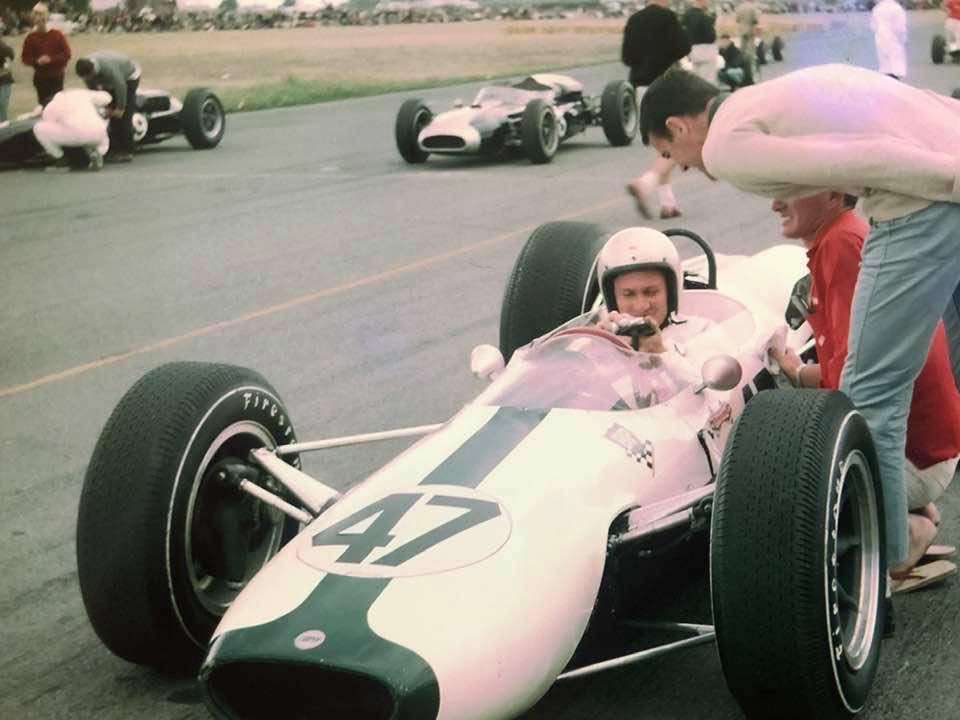
‘If yerv’ got a $10 head wear a $10 helmet’ was Bell’s compelling mid-sixties tagline. A mix of technology and innovation, quality, marketing and a great distribution network ensured the Bell Corporation did their bit to improve the safety of our sport. Dan Gurney’s Eagle depicted is his 1966-68 F1 Mk1 Weslake V12
Bruce McLaren setting up a selfie before the Lady Wigram Trophy, Tasman Series, 23 January 1965…
Sorting his goggles in any event, Cooper T79 Climax. The cars in the background are the #9 Bill Thomasen Brabham BT4 Climax and Red Dawson’s Cooper T53 Climax Lowline.
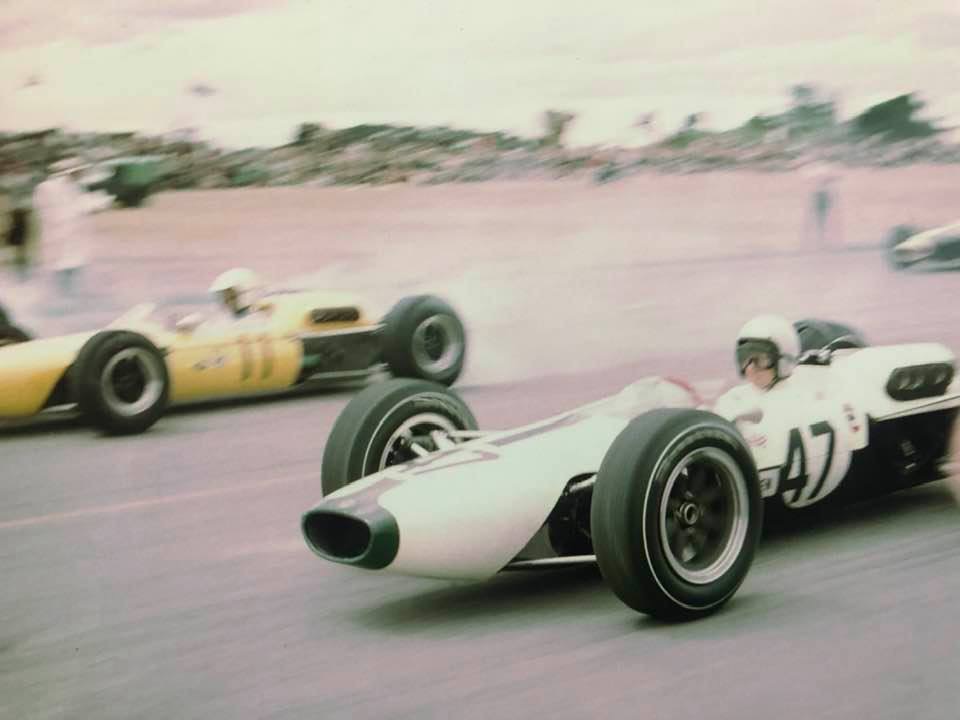
What stood out on an initial scan of this bunch of photos are those big tall white-wall Firestone tyres on large 15-inch wheels. It’s the start of the tyre-war; Firestone and Goodyear had just entered the domain which had been a cosy little monopoly for Dunlop for the previous few years.
Bruce won the first Tasman Cup in 1964 with what are regarded as the first McLarens. The two Cooper T70s Bruce and Wally Willmott constructed at the Cooper factory in Surbiton the year before were Dunlop shod machines. Click here for a piece on these cars; https://primotipo.com/2016/11/18/tim-mayer-what-might-have-been/
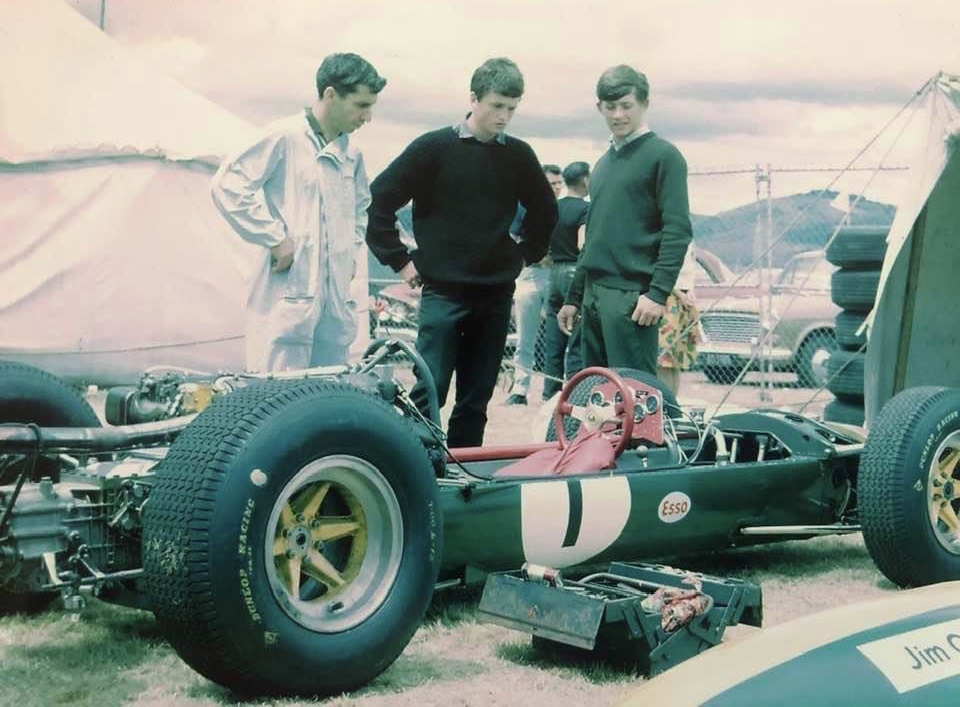
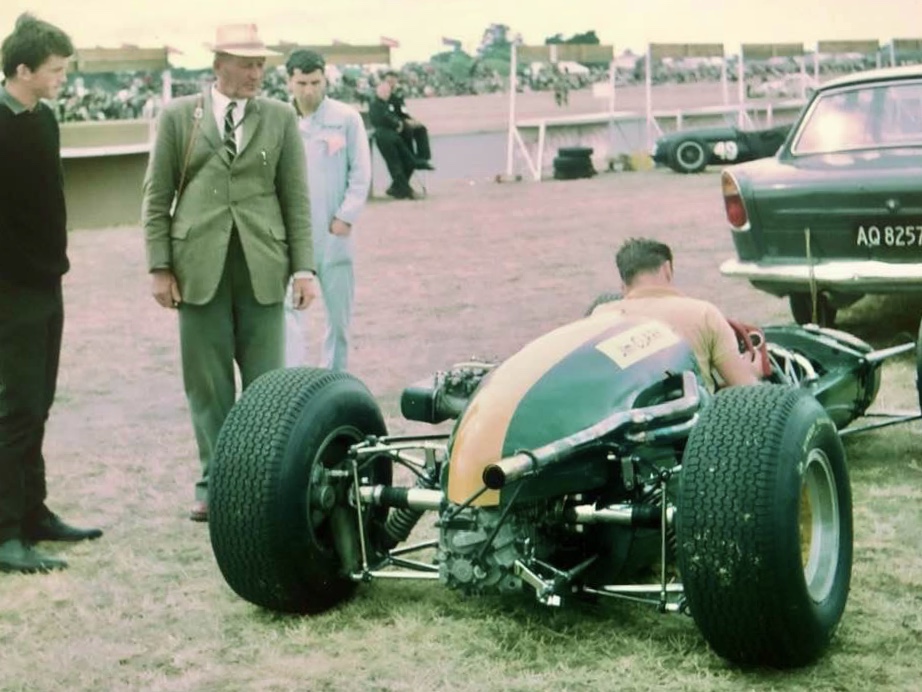
Admirers of the Clark Lotus 32B monocoque chassis, Wigram (A McKee)
It was going to be tough to knock Jim Clark’s Dunlop shod Lotus 32B Climax off in 1965- Bruce and Phil Hill’s campaigns were said to be sluggish at the series outset until Bruce and his boys adapted the suspension geometry and settings to the American tyres. Mind you, a close look at the results suggests Bruce was not far off the pace from the get-go.
The commercial relationship with Firestone was an important one for the entrepreneurial Kiwi as he assembled the technical partners and funding to take his nascent team forward- Bruce McLaren Racing’s first F1 season was in 1966.
Jack Brabham signed with Goodyear from 1965, that year of learning with the Akron giant was a critical foundation piece for Brabham Racing Organisation’s successful tilts at the 1966 and 1967 F1 championships for drivers and constructors.
Jim Clark had one of the greatest of seasons any driver ever had in 1965- he won an F1 drivers title, the Indy 500, the Tasman Cup plus a sprinkling of F2, touring car and other wins- the breadth of his achievements in that twelve month period has never been matched, or is ever likely to be I expect.
The start of that lot was in New Zealand- whilst Graham Hill won the first Tasman round, the NZ GP at Pukekohe in David McKay’s Scuderia Veloce Brabham BT11A Climax, Clark won the next two on the trot at Levin, where he won from the scrapping Frank Gardner and Jim Palmer aboard BT11A and BT7A’s respectively, and here, on the Wigram Airfield on 23 January from McLaren and Palmer- Jim acquired Clark’s series winning Lotus at its end. Bruce was obviously getting the hang of the Firestones mind you- he matched the lap record Clark set in the preliminary race in the championship event.
Off to Teretonga – famously the most southerly race track on the planet – Clark won again from McLaren and Phil Hill in the other Bruce McLaren Racing Cooper- an updated T70 raced by Bruce and the late Tim Mayer the year before.
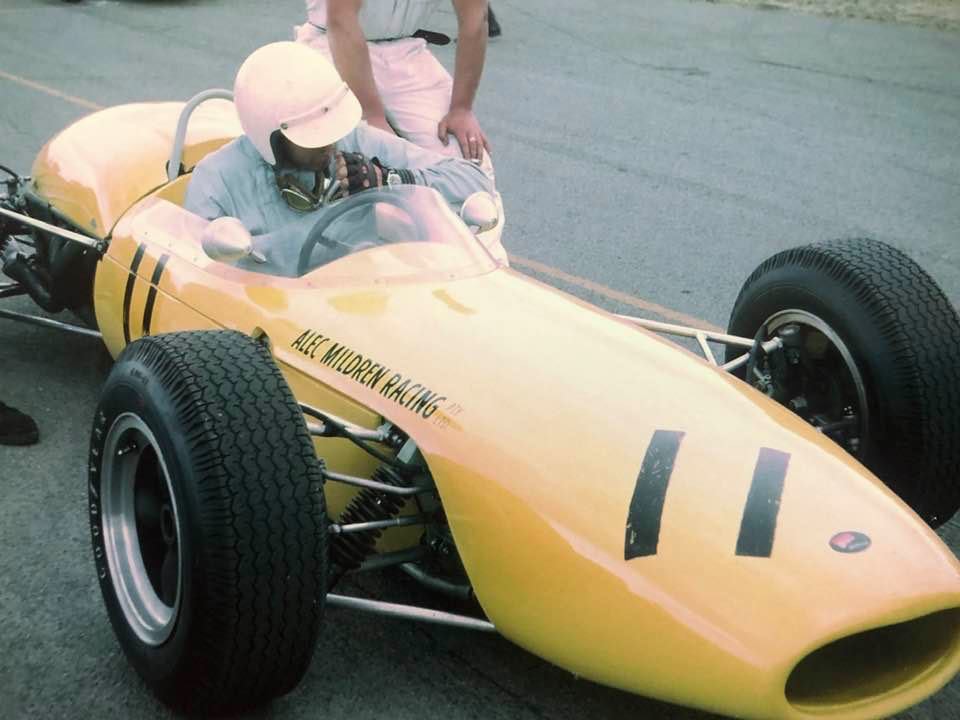
Jim at the wheel, 32B ‘beetle-back’ all enveloping bodywork, ZF gearbox. #49 in the background is the Peter Gillum Cooper T67 Ford FJ (A McKee) The off. Bruce with Frank Gardner’s distinctive Alec Mildren Racing yellow Brabham BT11A Climax alongside (A McKee)
That Bruce was getting the chassis/tyres sorted was further indicated by his pace- he pulled alongside Clark on lap 20, but Jim had enough in hand to pull away- taking the duo clear of Hill, Grant (ex-Jack 1962 AGP Brabham BT4 Climax, a car later to put John McCormack on the map) and Palmer.
The summary of the balance of the series is this; Clark won from grid three at Warwick Farm on 14 February whilst Bruce was Q5 and DNF engine. Brabham joined the Series in Sydney aboard a new BT11A- he was second from Q4. Matich was third from pole.
At Melbourne’s Sandown a week later, Jack won from pole with Jim second from Q2, Phil Hill third from Q6 and Bruce fourth from Q4- Goodyear, Dunlop, Firestone, Firestone if you like…
The seven round series ended at Longford with the Australian Grand Prix on 1 March 1965. Bruce won from pole from Brabham, Hill P and Hill G, Bruce Sergent observed that ‘Longford saw the McLaren cars come resoundingly into their own with good short-stroke engines and the small frontal area and shallow tread of the Firestones on this ultra fast circuit.’
Clark’s second half of the series was not as dominant as his first half. This was in large measure due to Jack’s presence and the pace of the McLaren Coopers- he won three races in New Zealand and once in Australia, but took the 1965 Tasman Cup with 35 points from McLaren’s solo victory and 24 points, then Jack with a win and a points haul of 21 from only three races. Brabham certainly would have given Jim a run for his money had he contested the championship in full. Gardner, Phil Hill and Jim Palmer were equal fourth…Or Dunlop, Firestone, Goodyear, Goodyear, Firestone and Dunlop.
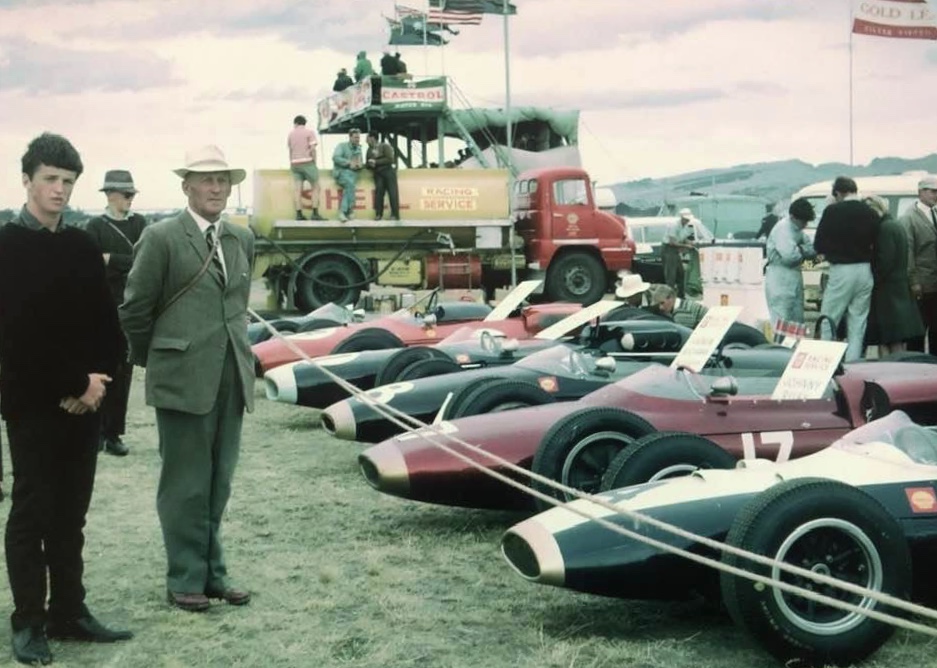
Wigram Shell Team compound, from this end; Bruce Abernathy Cooper T66 Climax, John Riley Lotus 18/21 Climax, Andy Buchanan #8 Brabham BT6 Ford 1.5 twin-cam, perhaps the Scuderia Veloce Graham Hill Brabham BT11A Climax and uncertain closest to the truck (A McKee)
Those early years of the F1 tyre war rolled as follows; Dunlop shod Clark’s 1965 winning Lotus 33 Climax and Stewart’s 1969 winning Matra MS80 Ford. Goodyear bagged back to back titles in 1966 and 1967 on Jack’s Brabham BT19 Repco and Denny’s Brabham BT24 Repco, while Firestones were on the Lotus 49 Ford Cosworth DFV used by Graham Hill in 1968, and Jochen Rindt’s Lotus 72 Ford in 1970.
Dunlop bailed from F1 at the end of 1970, leaving the two American giants. Then Michelin came in etcetera…and now of course we have same, same, same coz same, same, same is what is mandated by the commercial, sorry, sporting powers that be.
It was a bit different in the Tasman where Dunlop shod Clark’s winning Lotus 32B Climax and Stewart’s 1966 BRM P261, but then it was all Firestone on both Clark’s 1967 Lotus 33 Climax, 1968 Lotus 49 Ford DFW and the Ferrari Dino 246T raced by Chris Amon to victory in 1969, and Graeme Lawrence in 1970.
The Goodyear shod Mildren/Gardner Brabham BT11A Climax (A McKee)
Etcetera…
(A McKee)
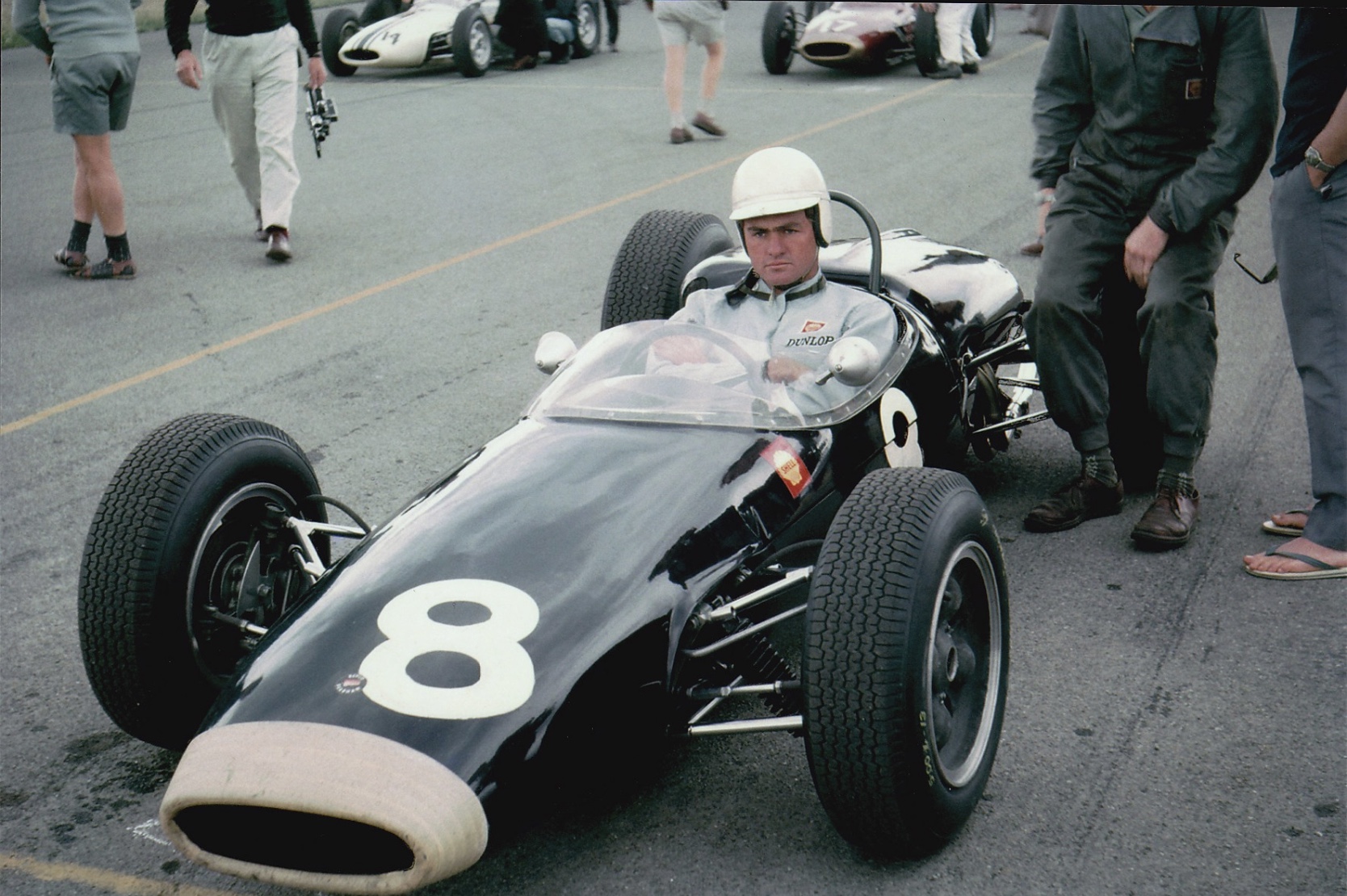
Andy Buchanan awaits the off in his immaculate Brabham BT6 Ford 1.5 twin-cam, top left in white is Graeme Lawrence’s similar machine. These cars were immensely successful 1.5-litre racing cars in Australasia, and at right the red ex-Tony Shelly Lotus 18/21 of John Riley.
Credits…
Bruce Sergent on sergent.com, oldracingcars.com, Ian Smith Collection
(I Smith Collection)
Tailpiece…
Brabham went like a rocket at Longford, the 1965 Tasman’s final round, he made a cautionary stop after giving Roly Levis a love-tap when the Kiwi locked a brake going into Mountford.
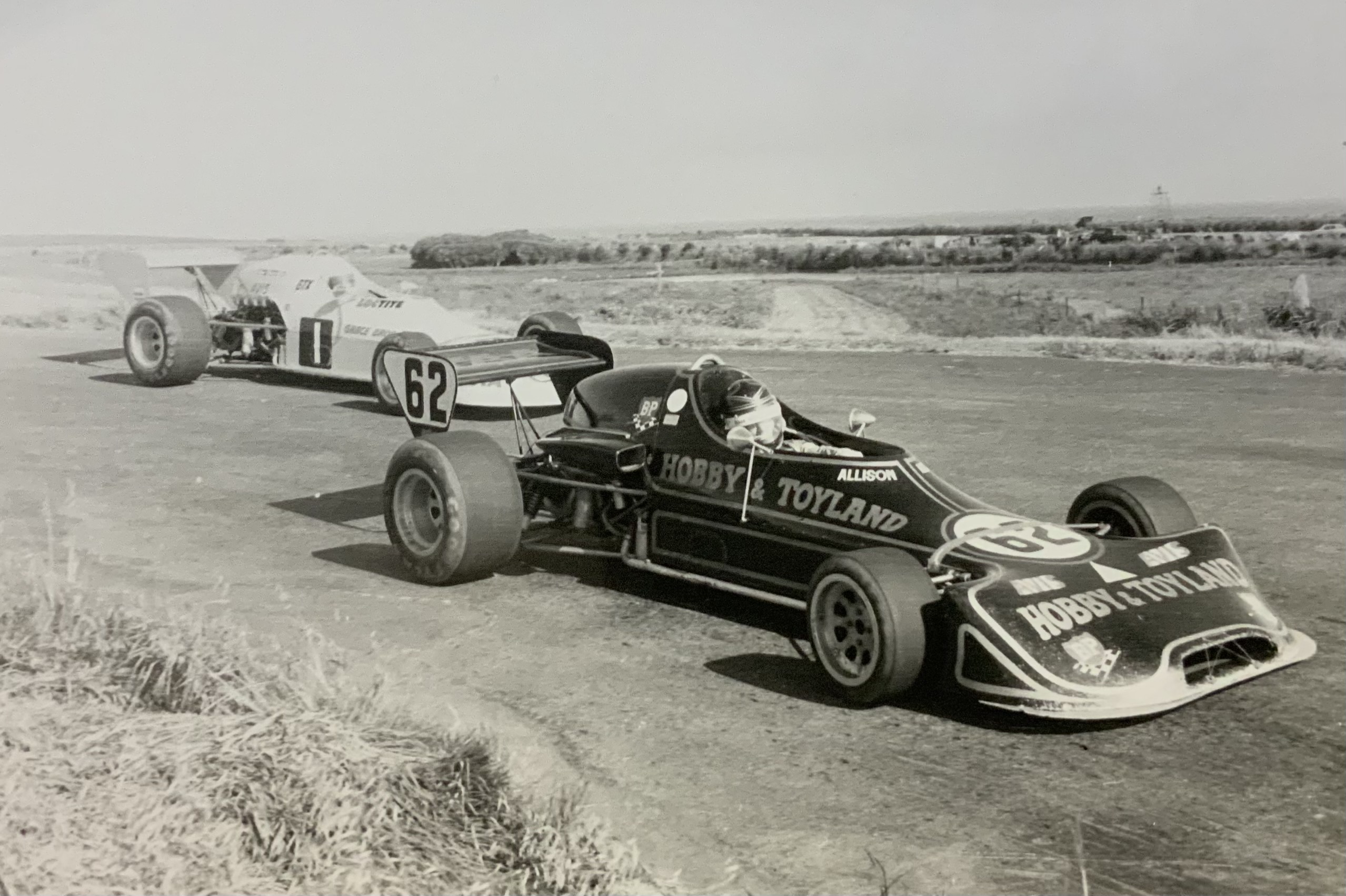
Birrana 274 Hart-Ford ANF2 cars at MG Corner, Phillip Island in late 1974: Bruce Allison inside Leo Geoghegan – Oz F2 Champ in Birranas in 1973-4 (Auto Action Archive)
Modern enthusiasts probably know of Birrana Racing as an outfit which won multiple Gold Stars running Reynard Formula Holdens. But for some of us, the most exciting period of Malcolm Ramsay’s lifetime passionate commitment to motor racing was the 1971-1974’ish period when he and his business partner, Tony Alcock, and their small crew at Logan Street, Adelaide built 20 or so jewels of championship winning FF, F3, F2 and Formula Atlantic single seaters. Oh yes, there was a VW powered mid-engined speedway Speedcar too, which rather shows they were not lacking innovation!
At the end of 1974, they ceased volume production, building racing cars simply wasn’t profitable. Mal constructed a few more racers in the ensuing years. Tony Alcock, the designer/fabricator, ran Bob Muir in British Formula Atlantic in 1975. Adelaide entrepreneurs Bob and Marj Brown took their two updated Birrana 273s to England for a season. Bob did well with several thirds and a fourth place in the two year old car among hotshots like Tony Brise, Jim Crawford, Brian Henton and Gunnar Nilsson.
Like Tony Brise, Tony Alcock joined Graham Hill’s Embassy Racing F1 team. Similarly, he was at the fateful Embassy Hill GH2 Ford Paul Ricard test on November 29, and subsequent Piper Aztec flight back to Elstree Airfield, England. Graham Hill crashed the aircraft in thick fog at Arkley Golf Club killing all aboard; Alcock, Hill, Brise, designer Andy Smallman and mechanic Terry Richards.
It was a monumental tragedy, to say the least.
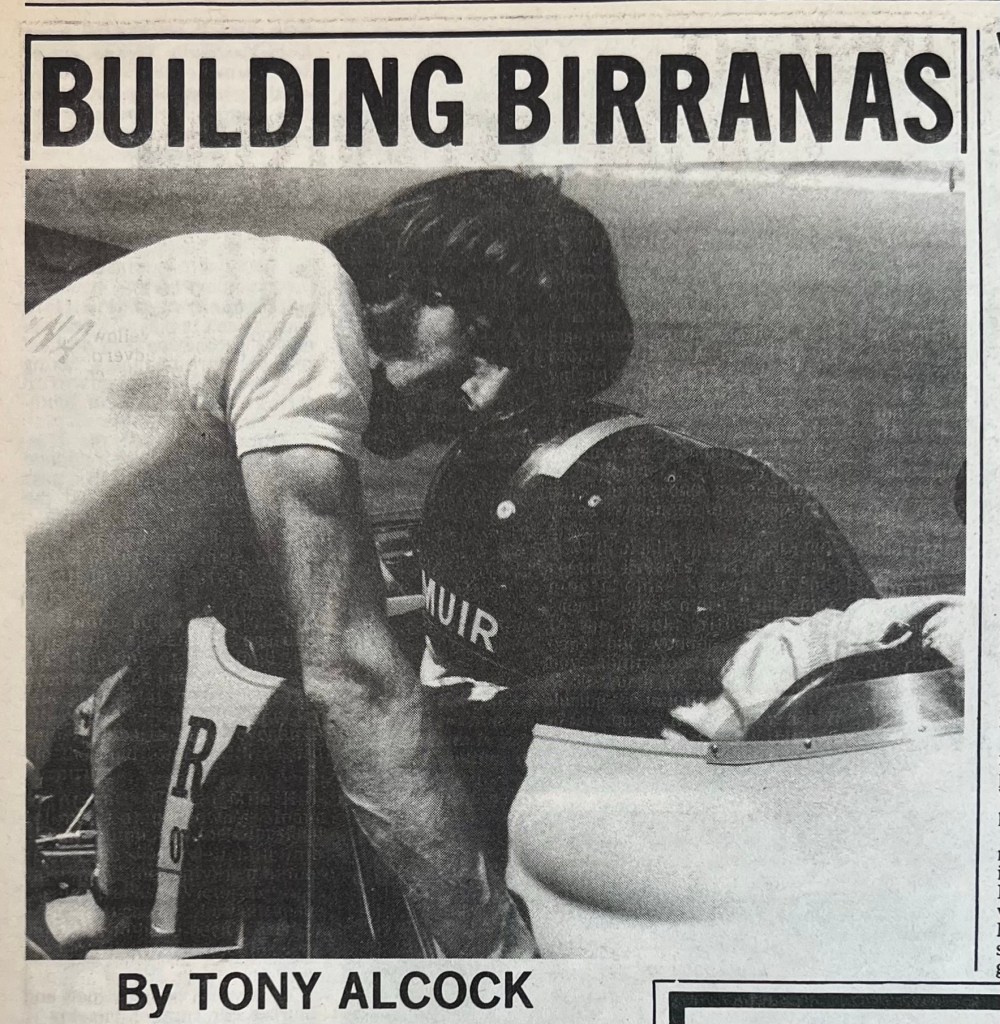
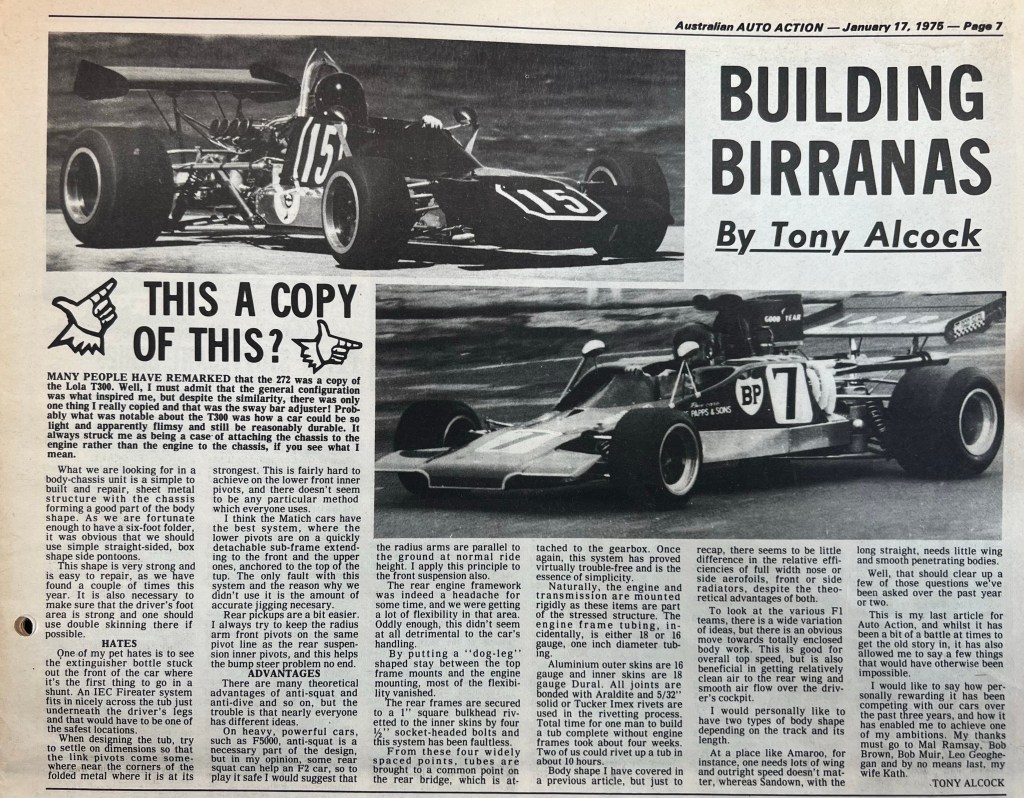
What might have been for all of them, not least Tony Alcock? During 1974 he wrote a regular Auto Action column. This May piece is about Birrana’s design process. I found it interesting, and reproduce it for that reason, and also to put on electronic record the members of Birrana Cars during that golden 1972-1974 era.
“I always liken designers, fabricators and mechanics as the racing equivalent of a TV production team. We know that the actors get most of the recognition, but of course the truth of the matter is that without the script writer, producer, director, film crew and so on, then the actor would be nowhere. Now although the modern race driver is an important part of the final product, it is the men behind him, the fabricators, welders, machinists, fibreglass men, painters, platers etc who make up the initial 80% of the total effort.”
“It is our job, Malcolm Ramsay and myself, at Birrana Cars to assemble all these tradesmen in the correct sequence to present a product such as the 2/374 range of cars. Basically, our respective roles are something like this.”
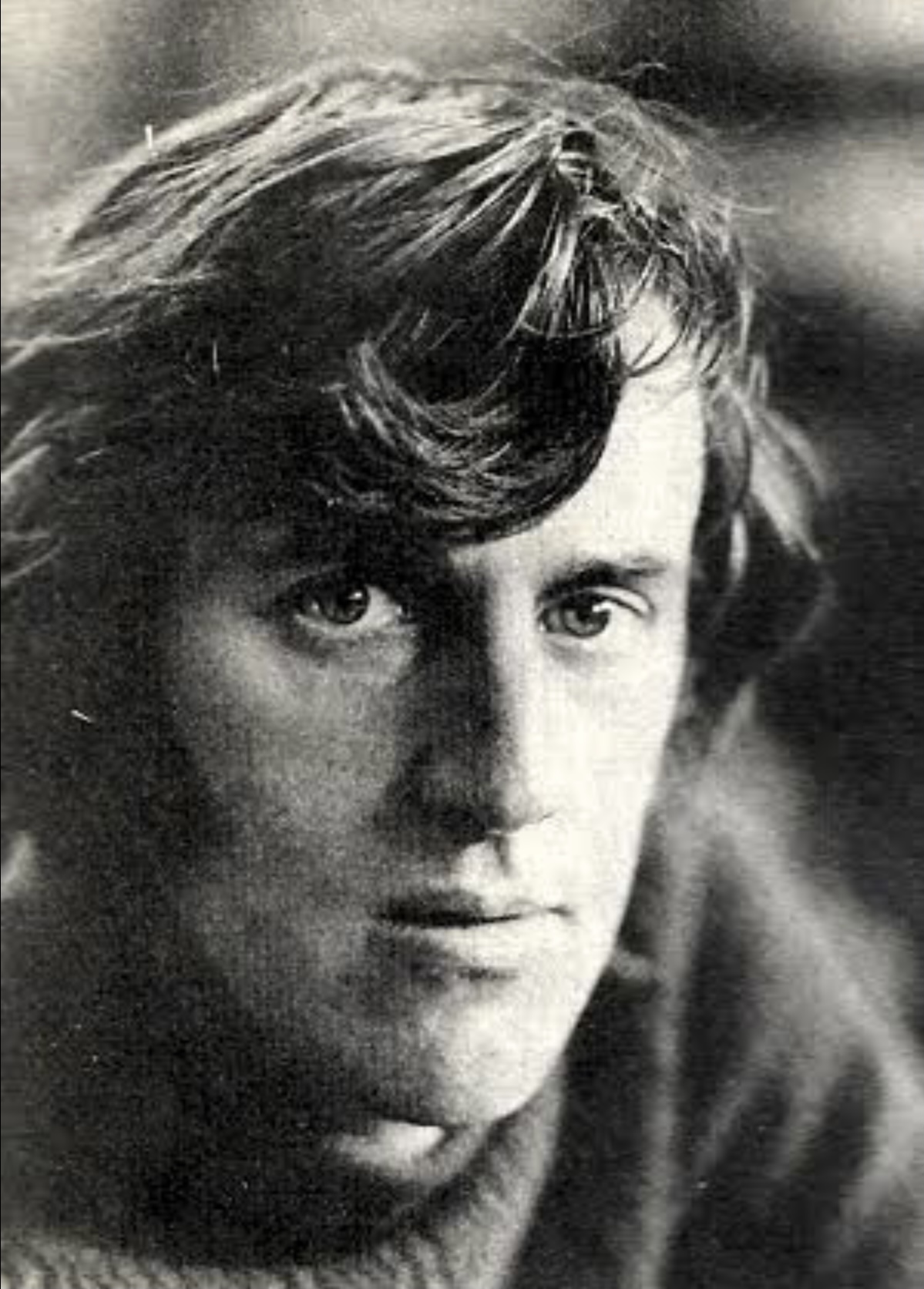
Tony Alcock circa 1974. Anybody got a better shot? (unattributed)1974 Oz FF Driver to Europe Series, Tin Shed, Calder: Andrew Miedecke, Birrana F73, Peter Finlay, Palliser WDF2 – not long back from success in this car in the UK/Europe – and the nose of Paul Bernasconi’s Mawer 004 (Geoff Selton)
“Starting with the previous years car, we decide on the areas which we feel need improvement and together with experiments which we have tried in some form or another during the year, we begin to formulate some sort of basic outline for our new model. At this stage I usually work at home so that the work can be achieved without interruption enabling the car to be drawn up as quickly as possible.”
“Whilst I do most of the basic design work, I reckon that two heads are better than one, so there is constant communication between Mal and myself. At the same time as the drawings start coming through, he is organising a supply of raw materials, radiator suppliers, rack and pinon assemblies, pattern makers etc.”
“From the basic chassis drawings, which comprise an overall side and top elevation, there are detailed ones of each bulkhead and suspension pickups, rear frames, suspension systems, body shape etc. From these more detailed drawings, Brian Farquhar, our welder, constructs the chassis and suspension jigs and from these the bulkheads and wishbones. Mike Lobanof machines the chassis and suspension bushes, discs, wheels, castings and so on. John Porter, our ‘March-immigre’ specialises in detail fabrication such as wing brackets, radius arms, parallel link brackets, headers, tanks, etc. I usually fold-up the tubs and Mal and I both attack the body mock-up prior to him doing the moulds. Our other man, Peter Nightingale, can usually be found stripping and rebuilding our existing cars as well as maintaining our Hart engines and Hewland gearboxes.”
“All of this is an over-simplification of the effort and just plain hard-yakka, which often means an all-nighter or two, but it is the general scene, which goes on at Elfin or Bowin or many other manufacturers.”
“As you can see it really isn’t very exciting or glamorous, all this back-room work, but to us it’s all worth it as the frustrations and heartaches suddenly vanish when our sparkling new creation is wheeled out to the start line ready for its first race.”
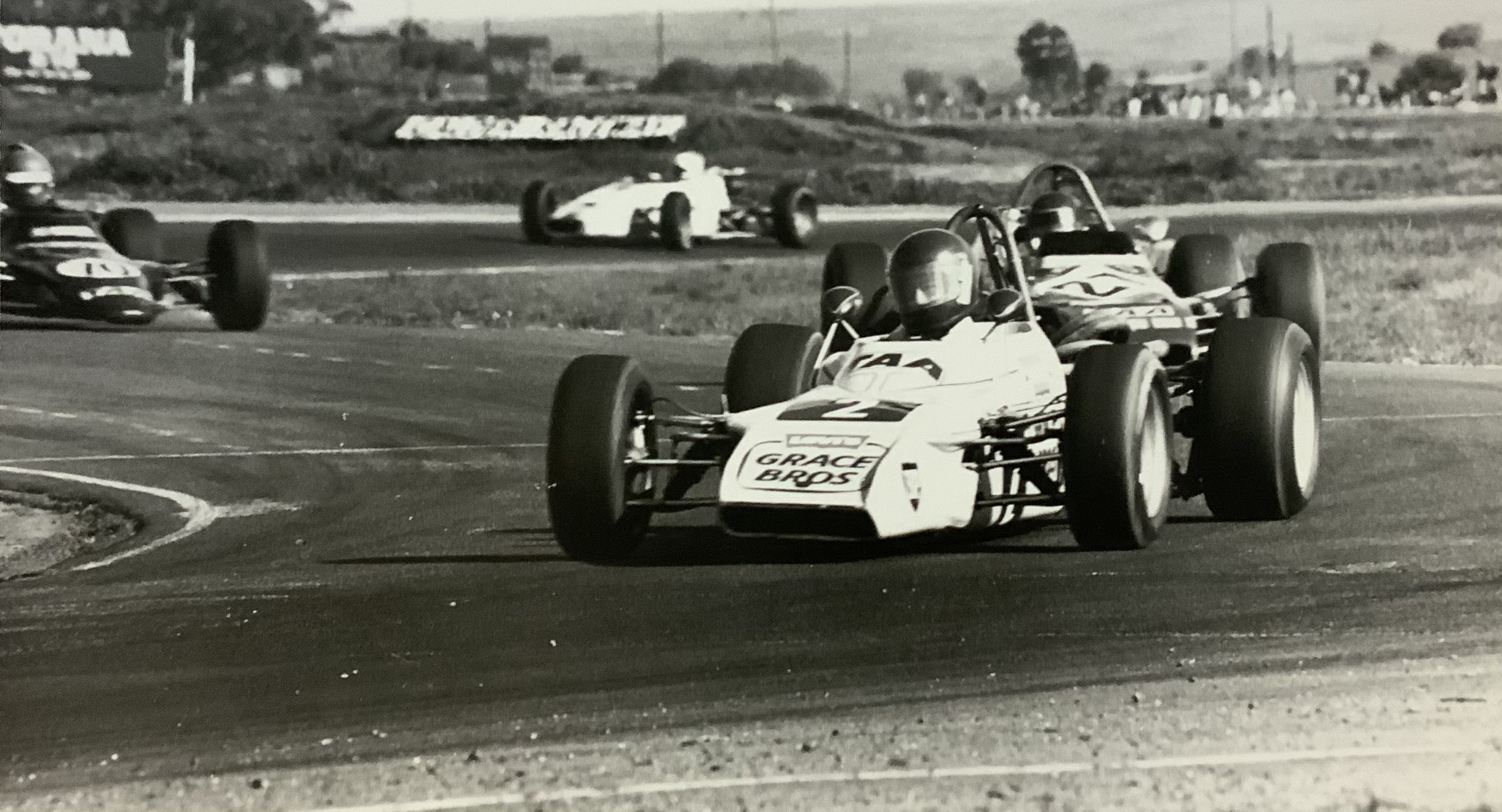
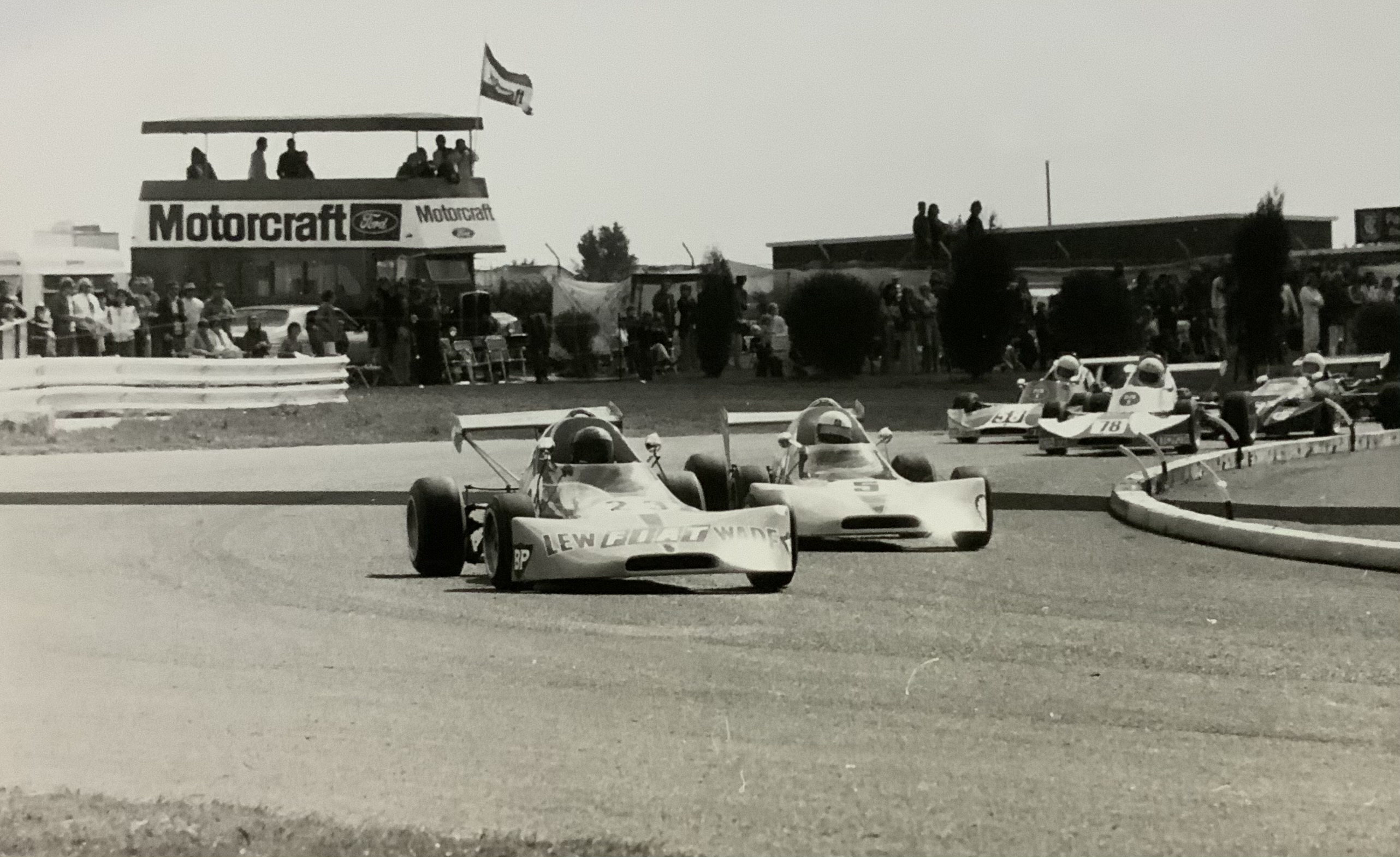
Sandown ANF3 race 1974, Shell Corner: Paul King and Dean Hosking in Birrana 374 Toyotas ahead of the Brian Sampson and Brian Shead Cheetah Mk5 Toyotas (Auto Action Archive)(Auto Action 1975)
I SUPPOSE I MUST HAVE RECEIVED a least a dozen letters over the last couple of months from people asking me about the cars.
Questions such as: “How do I go about designing a racing car?” “Or what determines where you put the roll centres?” Or “I am building a model, could you supply me with all the necessary dimensions?” and so on.
What I propose to try and do now is to give a brief run down in this and the next article on my method of designing and building a (reasonably) successful formula 2 car.
I hope I don’t make it sound too easy because it sure isn’t.
Bear in mind that I am starting right from scratch because that is precisely what I had to do with the first F.F. and the 272.
Looking through every motor magazine over the previous two years, I was able to get an average of what the wheelbase and front and rear track should be, I added two inches to these measurements because that was the way things were heading and all things being equal is the obvious way for stability and ease of driving.
I arrived at a 94” wheelbase and 57½” rear and 56″ front tracks, I increased this to 58½” and 58″‘ respectively in the 273 while the wheelbase stayed at 94″‘
There was a tremendous amount of research into the front and rear upright and brake assemblies too detailed to go into here.
Roughly, the front upright was based on the Triumph Herald upright pivot point dimensions.
However that has a king pin inclination of around 9 degrees which was too much, ao I settled for 5 degrees K.P.I.
This gives less change of camber on turns.
LIVE STUBS
Also, I wanted to use the live front stub axle, being a more rigid item and giving less offset from the upright pivot points to the centre of the contact patch.
A lighter steering effort results the closer these points are. So that a compromise is gained between lightness and feel, I settled on roughly 2½” which ties in nicely with the axle and disc brake set up.
Right, now we have a centre-line of the tyre, a tyre size, an axle centreline, two outer pivot points on the upright and a track,
What roll centre to use? From 15 years experience I settled on 2½”, in other words an educated guess. This has been raised progressively in subsequent models.
Now we come to a dimension called the virtual swing arm length. This is usually 2 to 3 times the track.
From here on, we have to start using a drawing board and the following details relate to a frontal view of the car. I try to work full size where possible for accuracy, but a scale drawing is acceptable.
LINE
Draw a line from the centre of the contact patch, through the roll centre until you reach a vertical line which indicates the length of the virtual swing arm length. Where these lines cut, draw back two more lines to the upright pick up points.
These are now the angles on which the front suspension links will be.
The lengths of these links can only be determined by using all different combinations of lengths until in conjunction with the wheel movement traversing 3″‘ either side of normal ride height, a satisfactory amount of camber change is achieved.
Our cars usually have about 2½ degree to 3 degree total camber change but this varies a lot from designer to designer.
Of course it doesn’t end there by any means. You must be sure that the tyre does not move too much laterally, in other words give a lot of track change.
From normal ride height to full bump our car moves about 1/8″‘. The next detail is to try and limit the roll centre rising and falling too much as the wheels move up and down.
This is very important for predictable handling. Our roll centres move about ½” in total.
Now that you have arrived at a whole lot of satisfactory figures in the vertical plane, the car must be subjected to degrees of roll. I do my drawings at l degree, 2 degree, and 2 1/2 degrees keeping an eye on all the variables such as camber change (try to avoid excessive positive camber readings here) track change (shouldn’t go over 1/16″ from normal ride to full bump) and roll centre (should stay close to what it does in the vertical plane).
GOOD GEOMETRY
When all this has been achieved, you would have fairly good suspension geometry, so now onto the rear.
This method would be the same as the front except that a suitable rear upright must be used or designed.
I’ll make no secret of the fact that the dimensions of an Elfin upright provided me with a starting point here although there is no similarity at all now.
Set your rear roll centre about a third as high again as the front. Most rear suspensions have the upper link appreciably shorter than the bot-tom. More camber change is desirable at the back and it is most important to make sure that there is virtually nil camber change from normal ride height to full droop.
Camber change here will give a rear steering effect under brakes as the tail tends to rise.
Well, there it is, the “Basic Design your own racing car kit” — just in time for Xmas!
I started off doing the first Formula Ford. I adapted the geometry considerably to suit the 272 and I would say that the whole effort regarding the suspension took about three weeks of fairly solid effort.
There are easier ways, using trignometry and computers and so on, but I’m afraid I am personally not much or a mathematician.
I think there are two ways to design cars successfully. One is to be a Colin Chapman, and have that certain something which puts him at the forefront of innovation and design, or to gain knowledge through read-ing, observing and building up ideas through practical experience.
Most of us have to resort to the latter, and I am glad to say that this method has so far worked for me.
Credits…
Tony Alcock in his Auto Action columns, the first on May 17, 1974. Thanks to Bruce Williams, Auto Action publisher/owner, Geoff Selton
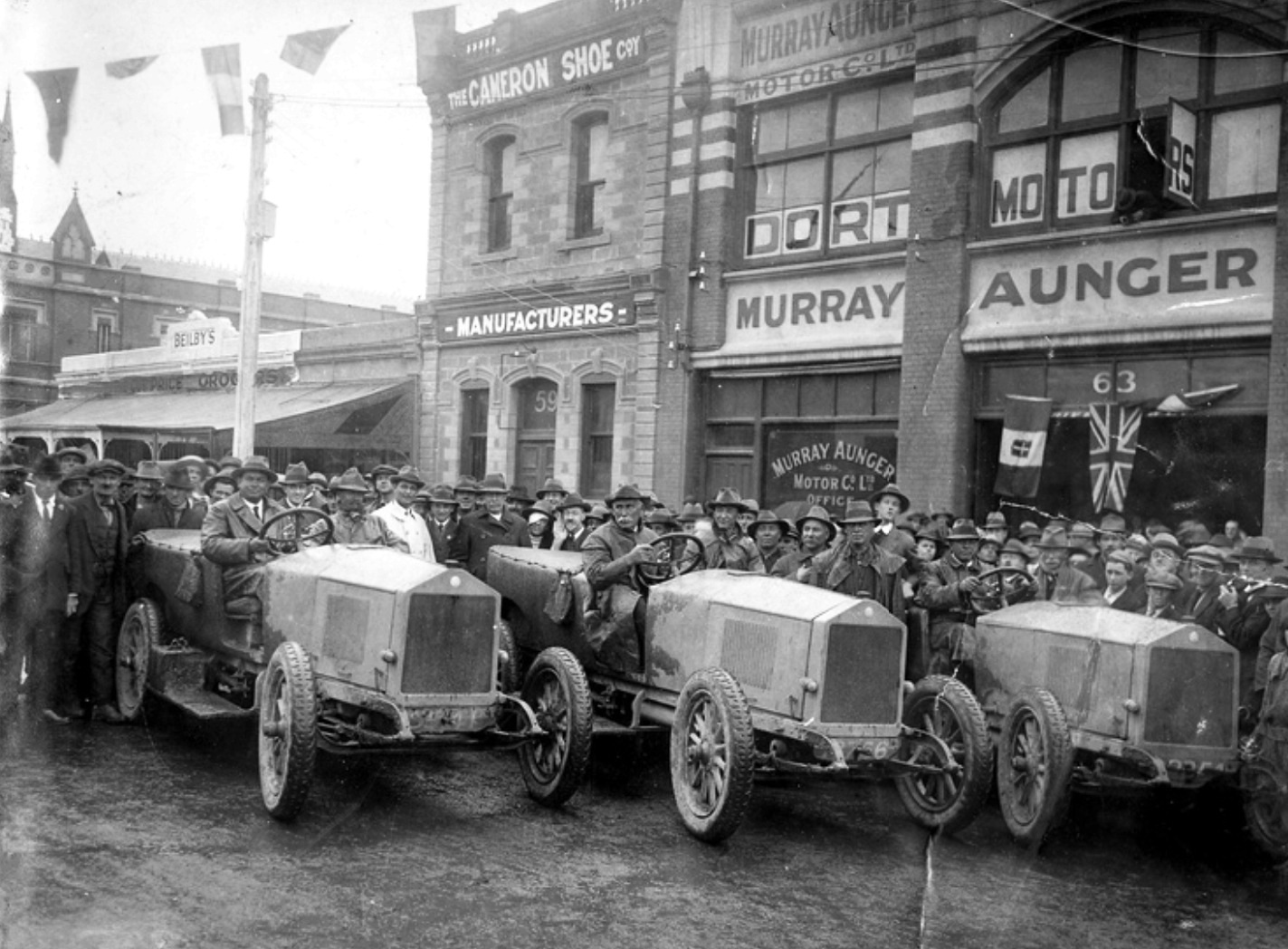
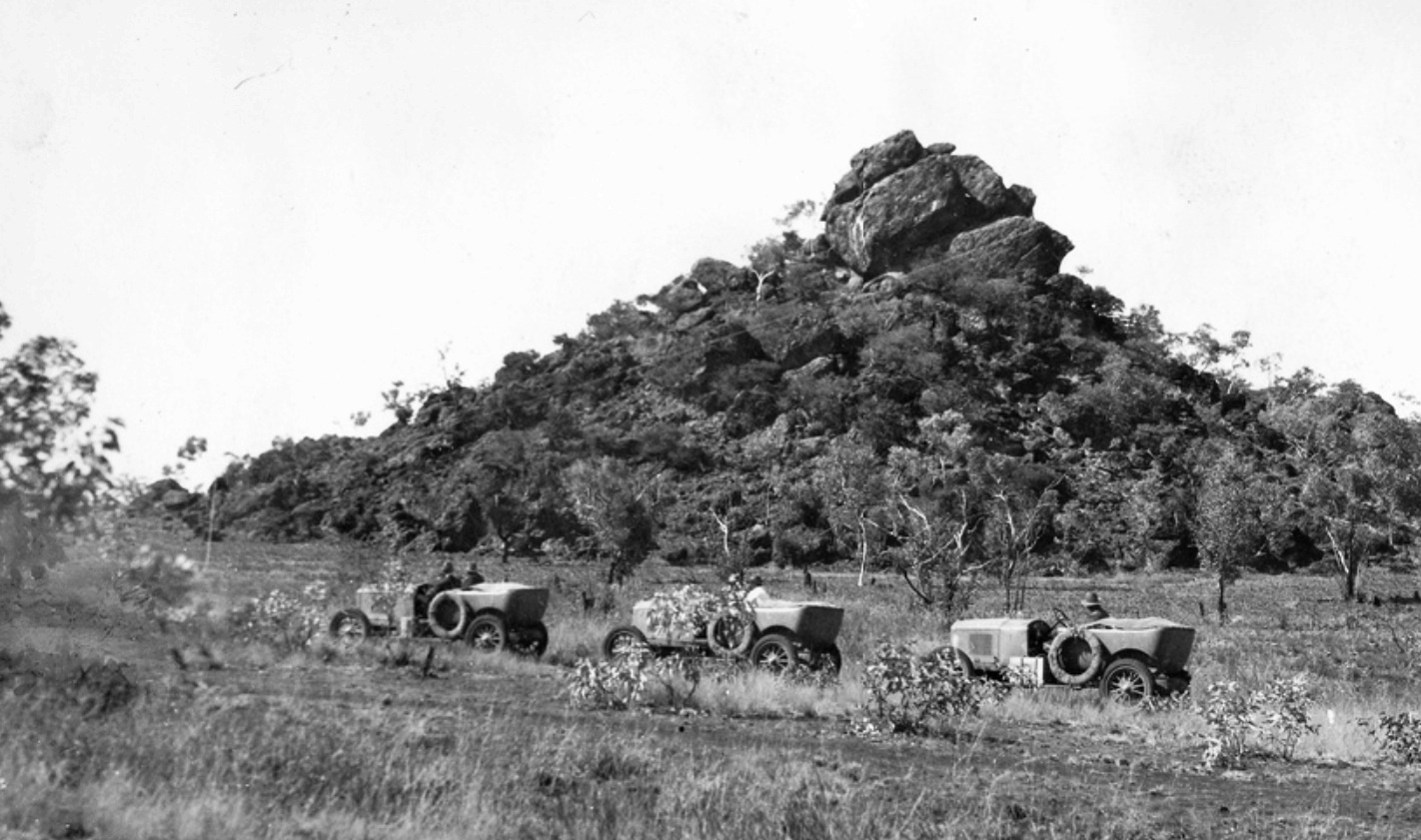
Murray Aunger in King William Street, Adelaide and his team aboard three Dort cars prior to departing for Darwin in July 1922…
Members of that Adelaide to Darwin and return trip were, left to right, Aunger with Donald McCallum, the organiser and local member of parliament, the Hon Thomas McCallum and WH Crowder of the SA Lands Department, and Cyril Aunger with Captain Samuel A White a prominent ornithologist
This article is about the exploits of Horace Hooper ‘Murray’ Aunger (April 1878-1953), sportsman, overlander, adventurer, businessman and motor engineer – born at Narridy, near Clare, South Australia.
Educated in Adelaide he was later apprenticed in the Kilkenny workshops of G. E. Fulton & Co., consulting engineers. He later joined the cycle works established by Vivian Lewis, collaborating with Tom O’Grady in the construction of the first petrol-driven car in South Australia. I wrote tangentially about Lewis and his machines a while back, click here to read the story; https://primotipo.com/2017/10/19/first-car-demonstration-or-parade-in-australia-adelaide-oval-18-october-1902/
A sportsman of note, riding Lewis bikes, Aunger was the colony’s one-mile (1.6 km) champion in 1899 and in 1901 held the Australian 50 Mile record.
As co-driver and mechanic, Aunger made two attempts with Henry Hampden ‘Harry’ Dutton to be the first to cross Australia from south to north by car.
Then there were only 500 cars registered in South Australia. Motorists facing ‘a hostile society of luddites, horse loving reactionaries, regressive law makers and over-zealous police’ wrote Dr Kieren Tranter. Dutton was then the wealthy 28 year old heir to a significant pastoral fortune, the family owned Anlaby Station outside Kapunda. Aunger was the brain and muscle behind crossing attempts which Harry later attributed to in their entirety to Aunger’s ability.
The pair left Adelaide in Dutton’s Talbot on November 25, 1907. ‘Angelina’ was powered by a 3770cc water cooled, monobloc four-cylinder engine rated at 20hp and was fitted with a four-speed gearbox.
‘Darwin lay almost 2100 miles (3380 km) away. ‘Obstacles confronted them on long sections of the route: rivers, treacherous sandhills and boulder-strewn country had to be traversed which no modern motorist would tackle without the advantage of four-wheel drive. Beyond Alice Springs, in the Northern Territory, the partners met the pioneering cyclist FE Birtles. The pinion in the Talbot’s differential collapsed south of Tennant Creek, where the car was abandoned given the wet season’s onset. Dutton and Aunger returned on horseback to the railhead at Oodnadatta, South Australia, and then back to Adelaide’.
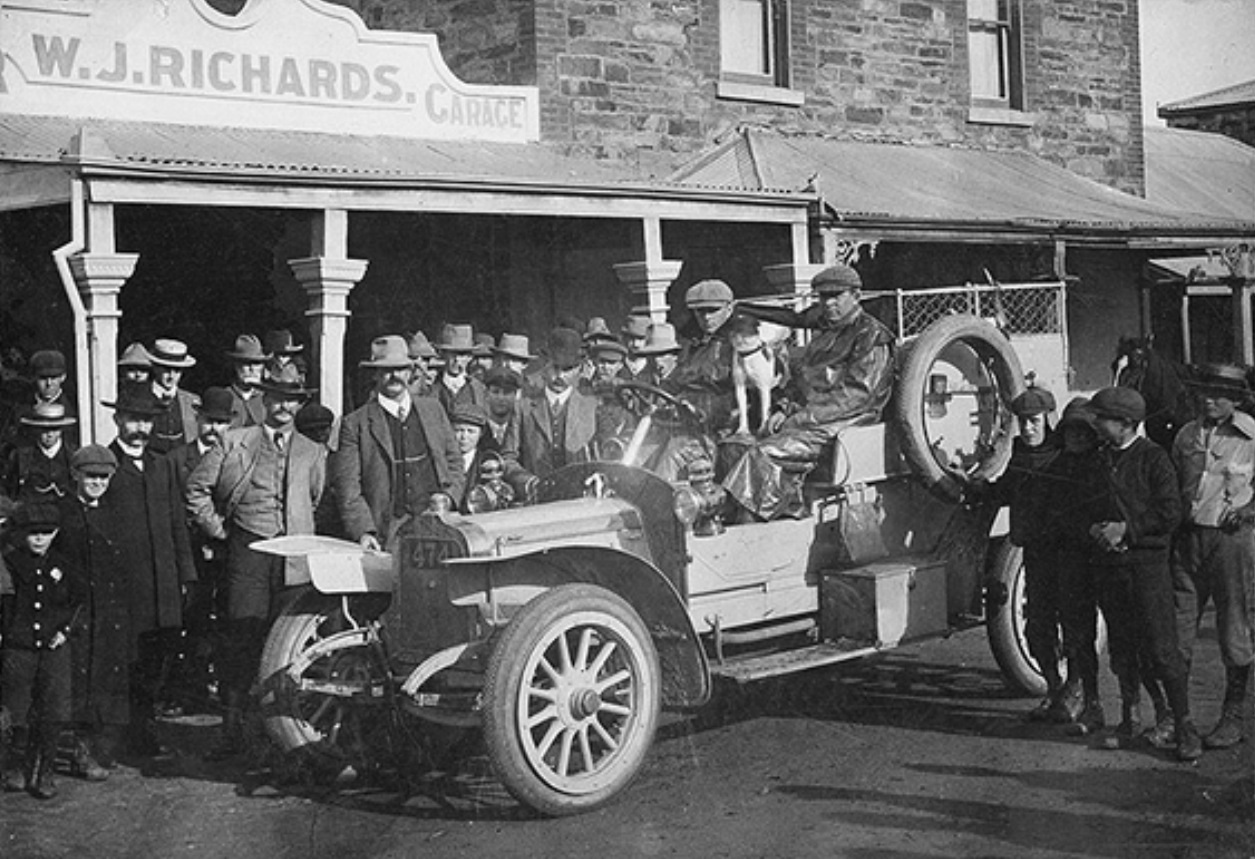
Aunger, Dutton and Dick the dog aboard Talbot ‘474’ at Burra on the second, 1908 trip (NM)
Determined to try again when the rains ended, Dutton bought another Talbot. This car, nicknamed ‘474’ after its registration number, was more powerful and had a lower axle ratio than ‘Angelina’ as a result of lessons learned the year before. Again with Aunger leading the charge, the pair left Adelaide on June 30, 1908. At Alice Springs, local special magistrate and postmaster Ern Allchurch joined the team. Ern’s ability to transmit messages along the telegraph line enabled them to keep in touch with, and confirm their position to the outside world.
Tennant Creek was reached in thirty days; the stranded ‘Angelina’ was repaired and driven in convoy to Pine Creek before being freighted by train to Darwin. Continuing their journey by car, the trailblazers reached their destination on August 20. International motoring circles recognised both expedition’s demonstrations of skill and endurance – it was one of the greatest pioneering motoring feats in Australia, the pair averaged over 50 miles a day over 42 days at the wheel. Talbot ‘474’ is preserved in the Birdwood Museum, in the Adelaide hills.
As I have written in previous articles about Australia’s pioneering motor sport days, speed-record attempts between Australia’s capital cities received wide publicity and the record breakers were our earliest motor-sporting stars.
Murray Aunger and Robert Barr Smith, Adelaide en route to Melbourne in February 1909, Napier (SLSA)
In 1909 Murray accompanied Robert Barr Smith in his Napier to set a new time for the Adelaide-Melbourne journey, the pair held the record for only a few weeks.
Aunger regained it in February 1914, driving a Prince Henry Vauxhall imported expressly for the purpose. He left Lewis Cycle Works in 1909 to establish Murray Aunger Ltd which held Willys-Overland, Vauxhall, Morris and Dort franchises.
Together with F. Bearsley – achieving speeds of over 80 miles per hour (129 km/h) on the pipeclay of the Coorong – their time was 14 hours 54 minutes. They improved the previous record time of GG White and Fred Custance set in a 35hp Talbot, 20 hours six minutes, which had stood for over five years by five hours 12 minutes.
At a time the only route to Melbourne included 90 miles of the dreaded Coorong in south-east SA, and then on to the border and into Victoria via Casterton, Hamilton and Geelong – about 100 miles further than the trip now. The 80 miles of the Coorong desert sand were negotiated in under two hours, the cars fastest speed of 80 mph was achieved on a 10 mile stretch of dried up Coorong lagoon.
They also broke the Adelaide-Broken Hill record in the same car.
Murray Aunger and, perhaps F Bearsley, testing their Vauxhall Prince Henry in 1913/14 (SLSA)
Better management of the South Australian Railways (SAR) and the need for a railway line from Adelaide to Darwin was a thread which ran through the next phase of Aunger’s life.
By 1920 the railway system was crippled by mismanagement and failure to invest. To that end, newly elected Premier, Sir Henry Barwell, appointed American William Webb to run the SAR. By 1926 the state had the most powerful locos in the country, the grand Adelaide Railway Station was Webb’s monument.
In 1922 Aunger joined another expedition – the one featured at the outset of this article – of three cars which travelled from Adelaide to Darwin and back. The group included his brother Cyril, Samuel White, H Crowder and a local parliamentarian, the Hon Thomas McCallum and his brother Donald McCallum. They explored settlement possibilities, inclusive of a railway along their route.
Samuel White in a ‘The Register’ article wrote that there was much public wrangling about the route of the north-south rail line. The plan was to drive the proposed course from Adelaide to Darwin, and then return to Adelaide via Queensland to see for themselves the nature of the terrain, its obstacles and opportunities.
Aunger, ‘the greatest overland motorist in Australia’ was engaged by the group to organise the trip. This included shipping fuel, provisions and spares sent months ahead to Oodnadatta and then 700-800 miles further north by camel train. Teams were also sent from the Darwin end as well, to be prepared for what was a large group of intrepid, influential travellers.
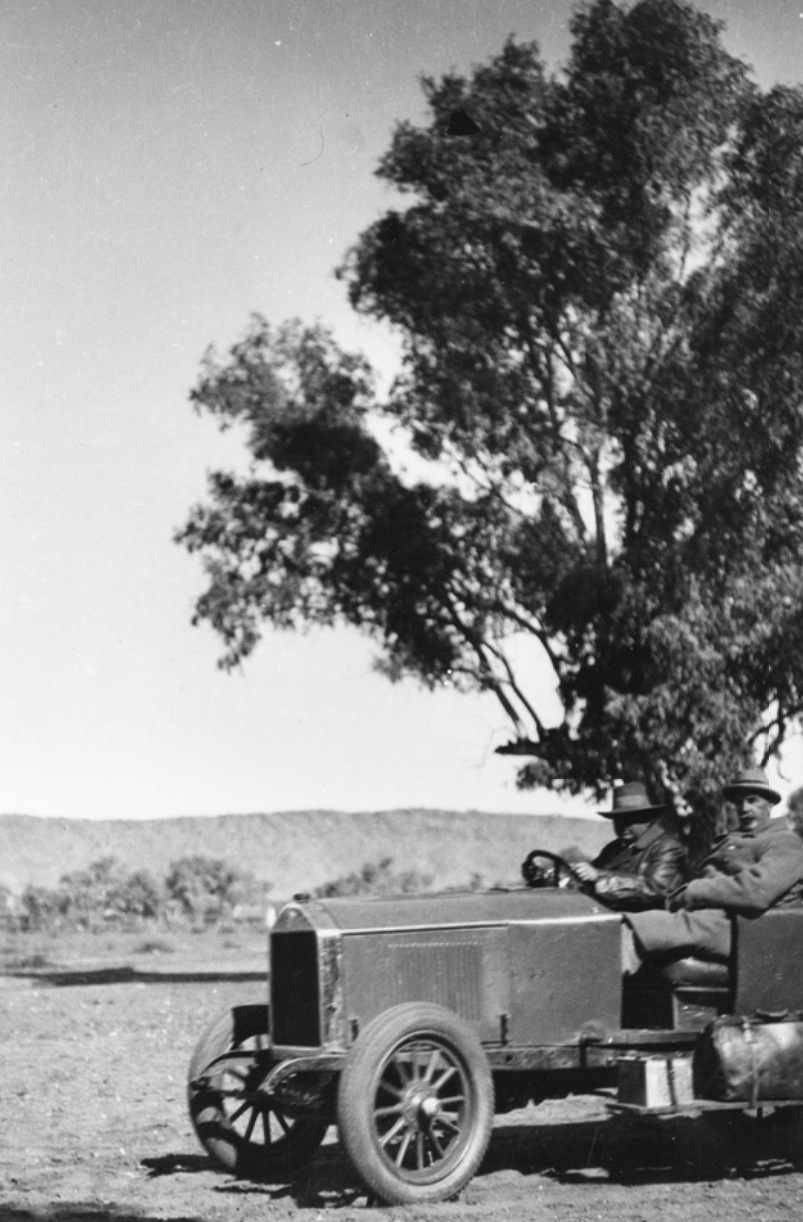
Aunger selected and prepared three American Dorts, machines built by the Dort Motor Car Company of Flint, Michigan. These hardy, Lycoming four-cylinder, 30 horsepower vehicles were stripped of top protective equipment and doors to make them a lighter and more suited to the demands of the Australian bush.
The three Dorts en-route to Darwin in 1922 (SLSA)
Murray was again called upon to assist in providing cars and logistics to the government in assessing possible rail routes, organising a trip in June 1923 from Adelaide to the wilds of Oodnadatta, Alice Springs and Central Australia, again using three Dorts.
The expedition was three weeks, the all-star cast included the State Governor, Sir Tom Bridges, Premier Sir Henry Barwell, William Webb, Chief Commissioner of the South Australian Railways, Thomas McCallum, who organised this trip, the earlier one in 1922 and two others. This time the Dorts were further modified with removable grips for the tyres. The party travelled by train from Adelaide to Oodnadatta, picking up the Dorts at Terowie, between Burra and Peterborough.
After returning, both the Governor and Premier called on the Commonwealth Government to extend the railway, the line from Oodnadatta to Alice Springs was completed in 1929.
Later in 1923 the SAR sought cars suitable for running on rails. By November, Aunger had modified one Dort, eventually ten were in service, but they (or perhaps their drivers) were accident prone with some fatalities from collisions and roll-overs.
The first of these accidents occurred on the Clare line in December 1923 when a Dort collided with a gangers trike – fortunately the employees aboard the trike were able to jump clear. The driver of the Dort was Webb – his passenger the State Premier, Barwell. The nature of their business was Sir Henry’s attendance at a bowls tournament with Webb the taxi-driver!
Murray Aunger and the SA State Governor, Sir Tom Bridges aboard a Dort at Oodnadatta out front of the Pub (SLSA)
In 1925 Webb persuaded Aunger to become the motor engineer of the SAR, on a salary of £1000. There had been a large increase in the use of motors in the railways and Webb had commenced bus services to various parts of the State. A number of politicians believed Aunger had received favoured treatment from Webb. Webb was the subject of ongoing bitter political attacks for the American’s revolutionary changes to improve systems, processes and viability of the SAR. Aunger twice visited Britain and the USA in the course of his SAR duties.
In 1930 Webb returned to America. For several years attempts (after the Hill Labor Government lost power in 1927 and Butler Liberal Administration in 1930, in part over ongoing railway deficits and their impact on the State budget) were made in South Australian political circles to wreak petty revenge upon Aunger, despite his important part in rehabilitating the State’s railway system. He was dismissed in June 1937 for contravening Section 37 of the South Australian Railways Commissioner’s Act.
On June 6, 1942 he re-married, his first wife having died some years before, they moved to Melbourne. Aunger died on September 14, 1953 at Mordialloc, aged 75.
Whilst there is plenty of material on Aunger’s life in South Australia there is little I can find about his time in Victoria. If any of can fill in the gaps it would be great to hear from you – the fellow certainly had an amazing life of sporting, commercial and pioneering success!
Bibliography…
‘The Register’ 22 August 1922, ‘Australian Dictionary of Biography’- article on Aunger by John Playford, ‘Lassetters Gold’ Warren Brown, Trove- various
Photo Credits…
State Library of South Australia, National Motor Museum
Tailpiece…
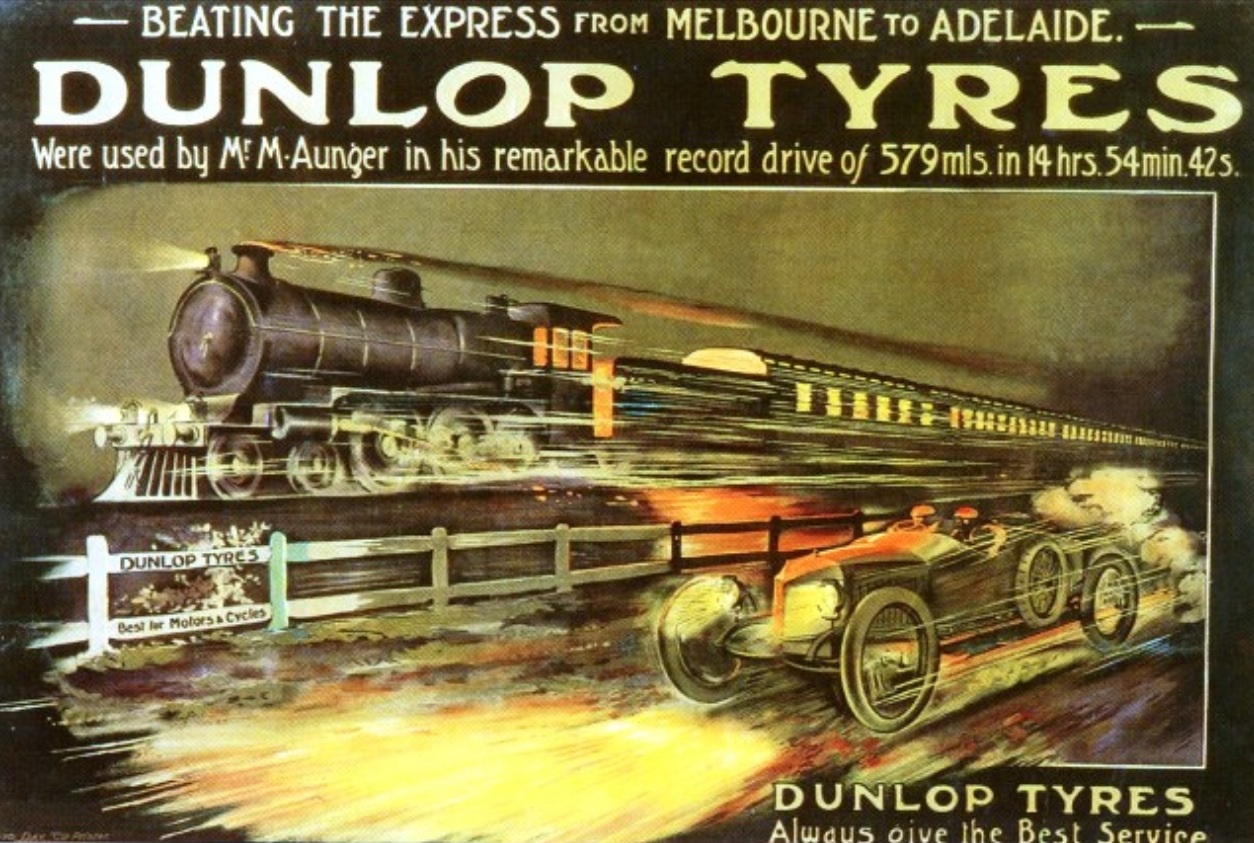
Dunlop ad celebrating the Aunger/Bearsley Vauxhall Prince Henry Melbourne-Adelaide record breaking run in 1914.
To those of us from less exalted climes, they were known as “the three ‘Ds’ from Toorak”, Dale, Duckett and Davey-Milne; all imbued with a fine sense of what a good motor car should be. They lived in close proximity, Duckett just around the corner from Davey-Milne and the Dales less than a kilometre away. They and their cars were often seen together. A fourth ‘D’ was their friend Lex Davison, four times winner of the Australian Grand Prix, but he was farming at Killara Park, near Lilydale.
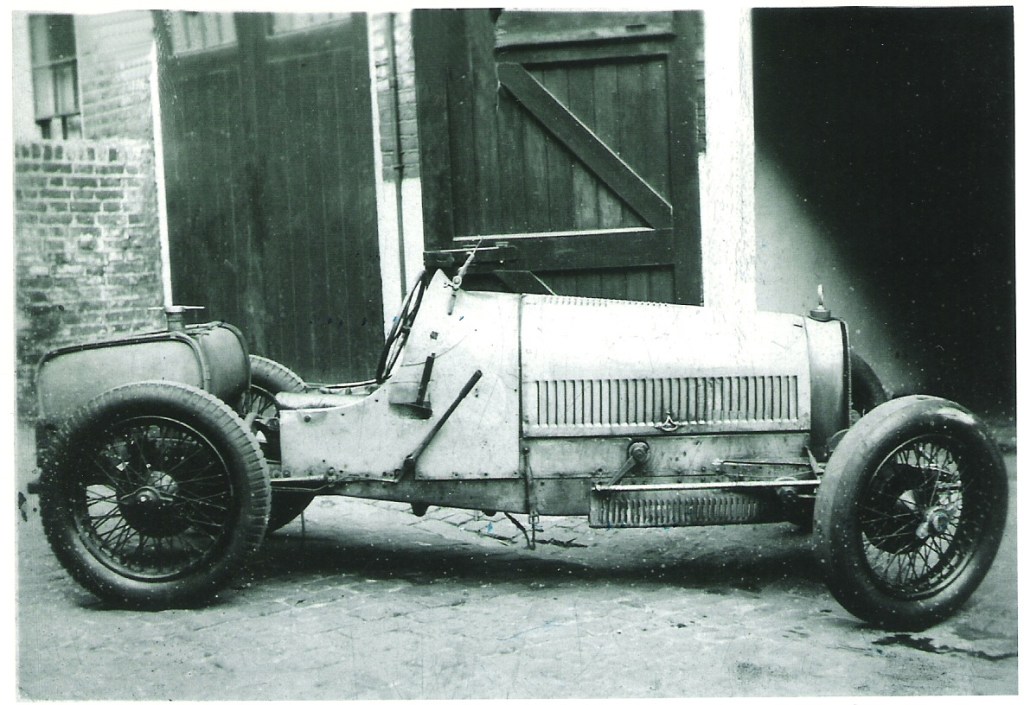
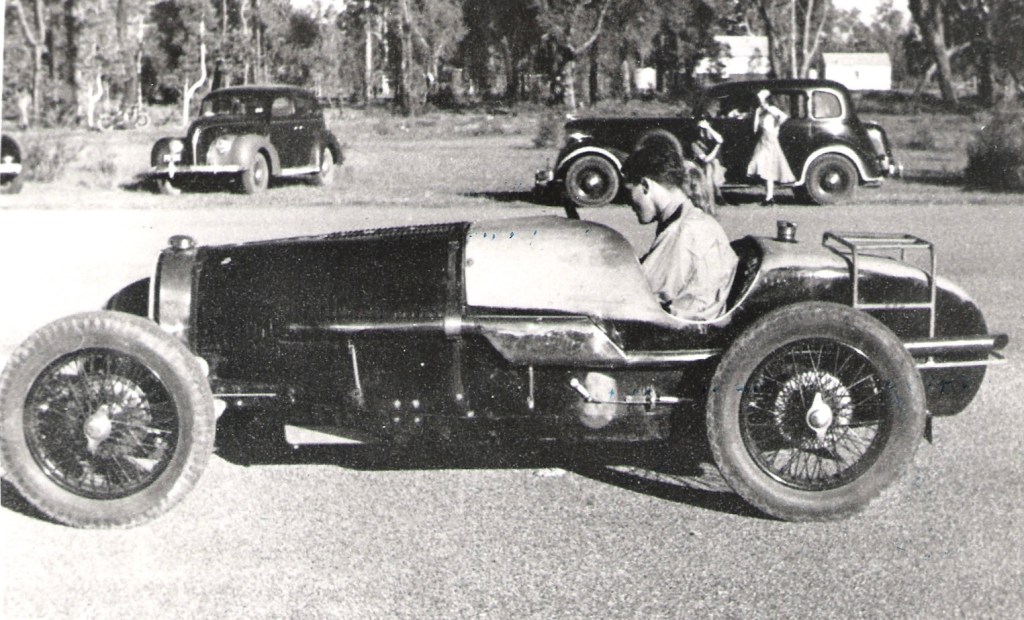
Lyndon’s family had a thriving hardware business in Melbourne. He was only a teenager when he ventured to Europe in the late 1930s. Whether the primary purpose of this visit was to find a racing car is not known, but he certainly brought one back with him, the car he made famous, the Anzani Bugatti Special. Lyndon wanted a twin cam Grand Prix Bugatti – in other words, a Type 51. As these were still being actively raced in Europe, they may have been a little beyond his purse. In a London mews he did find a single cam Type 35 with a blown-up motor. With his young mind obsessed with the twin cam idea, he contacted the works of Ettore Bugatti in Molsheim, France, and was assured that they had such a car (or was it an engine) for him. This was to be a disappointing trip, for on arrival there, the only Grand Prix Bugatti they had available had but a single camshaft; he did not purchase it. He took a side trip to Nuremburg for the annual Nazi Party rally and heard Adolf Hitler’s address, an event which horrified him. On return to London, he bought the 35 sans moteur.
The opening photograph is the engineless 1925 Type 35 Grand Prix Bugatti, chassis no. 4450, as found by Lyndon in a London Mews. Lyndon noted that there was a lot of sand in the chassis rails – it had an extensive racing history at Southport Sands and other venues in the hands of TGV Selby who was later involved in the development of Bristol cars. Its first owner was Glen Kidston and it was the first Grand Prix Bugatti to be raced in England. Kidston later became one of the ‘Bentley Boys’.
(Bugatti Trust)
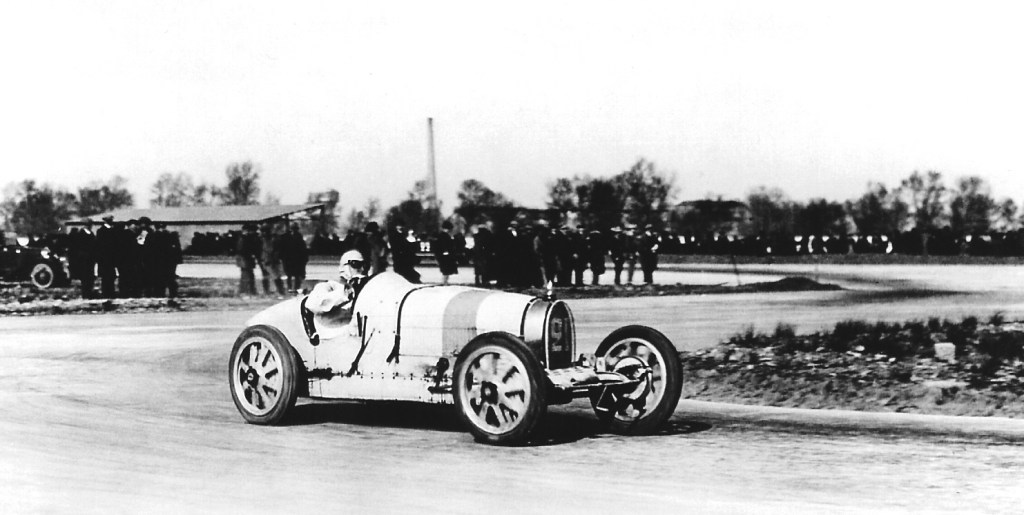
Glen Kidston on his way to a class second place in the Grand Prix de Provence in March, 1925. The band over the bonnet was yellow and denoted the 2-litre class.
(B King)
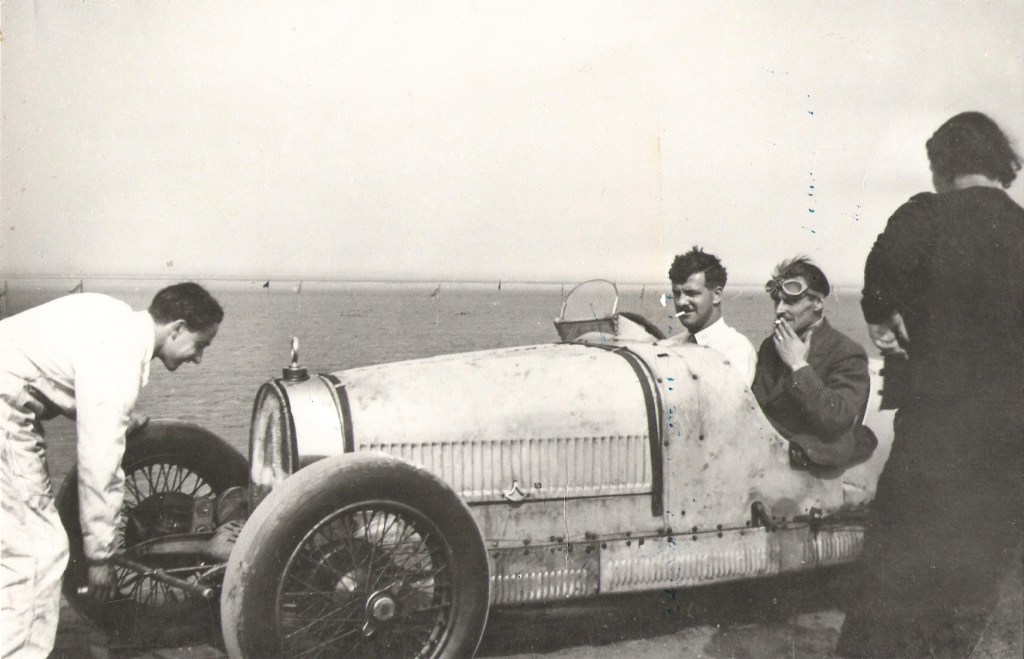
TVG Selby on Southport Sands. The Bugatti, chassis number 4450, can always be distinguished by the unusual bonnet lift handles that Kidston had fitted by the Nice Bugatti agent Friderich while it was there for the GP de Provence.
Lyndon’s search for a twin cam motor bore fruit when he found a brand new Anzani R1, 2 OHC, 4-cylinder, 1496cc motor; the same as fitted to the Squire motorcar. This engine, numbered R1 62, was the last engine to leave the Anzani works in Kingston-on-Thames – there were probably only 12 made. The English Bentley specialists Pacey’s were tasked with adapting the motor to the chassis, but this work was unsatisfactory and had to be redone in Australia. (Sound familiar?) A neat round tailed body was constructed by Cardigan Motor Body Works in Carlton. Initially there were problems with the motor (they had never been properly sorted by the factory, but Lyndon’s engineering skills overcame these problems).
(B King)
Lyndon Duckett in his immaculate Anzani Bugatti special.
For 10 years after the war Lyndon used the car for all sorts of motorsport. 1946 saw early success with ftd at a vintage sprint held at Lex and Diana Davison’s property, Killara Park. Duckett and the ‘Anz’ went on to be the inaugural winners of the Vintage Sports Car Club’s premier trophy, the ‘Vickery’.
(B King)
Lyndon at Marsden Park, NSW.
Not only did Lyndon set fastest under 1500cc time at Rob Roy, but he also beat allcomers at Marsden Park in a quarter mile sprint after an epic drive from Melbourne. Motor racing was just getting back on its feet after WWII and events were few and far between. Lyndon and Lex Davison had decided to make the long journey to north-west Sydney; Lex accompanied by his 17-year-old fiancé Diana Crick on the bodyless chassis of his 1500cc Alfa Romeo.
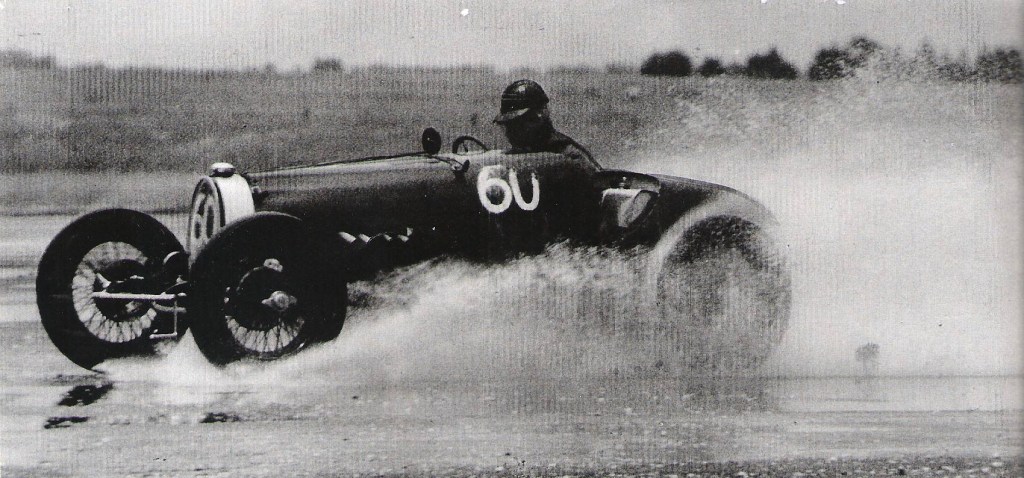
They had only reached the northern outskirts of Melbourne when the Alfa had a fit of Italian temperament and Lex needed Lyndon, the engineer, to travel with him. Diana, who did not have a licence, was installed in the Anzani and given a quick lesson on gear changing. In particular, she was told to get into top gear and stay there until she reached the outskirts of Albury, over 300 kilometres north! Lyndon had many more successes with the car, including wins at Ballarat Airfield races in 1950. Its last competitive outing with Lyndon ended as it had begun with a handicap win in the Tasmanian Trophy at Longford Road Races in 1955.
(B King)
It was wet in Ballarat for the 1950 Road Races held on Ballarat Airfield. It won the D Grade race. Note the stub exhausts.
(B King)
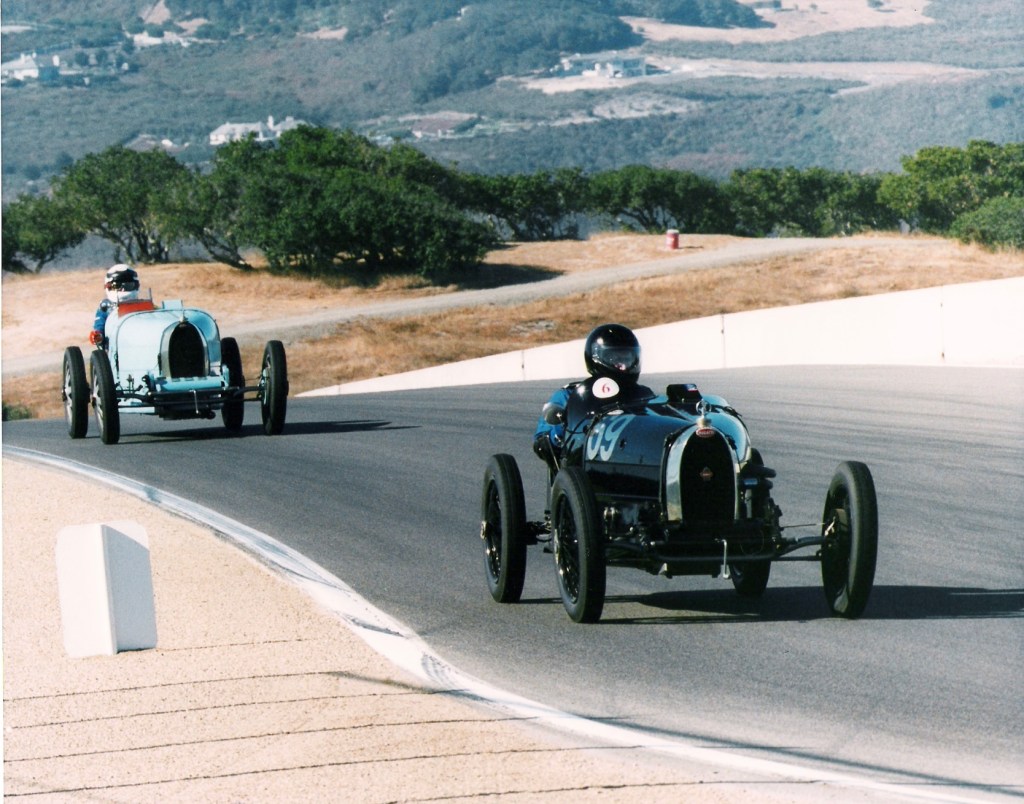
The writer also had 52 years of pleasure and some success in Historic Racing with the car. Here it is seen on the long climb up the hill at Laguna Seca in 2003 at a ‘Bugatti Grand Prix’.
(AMS)
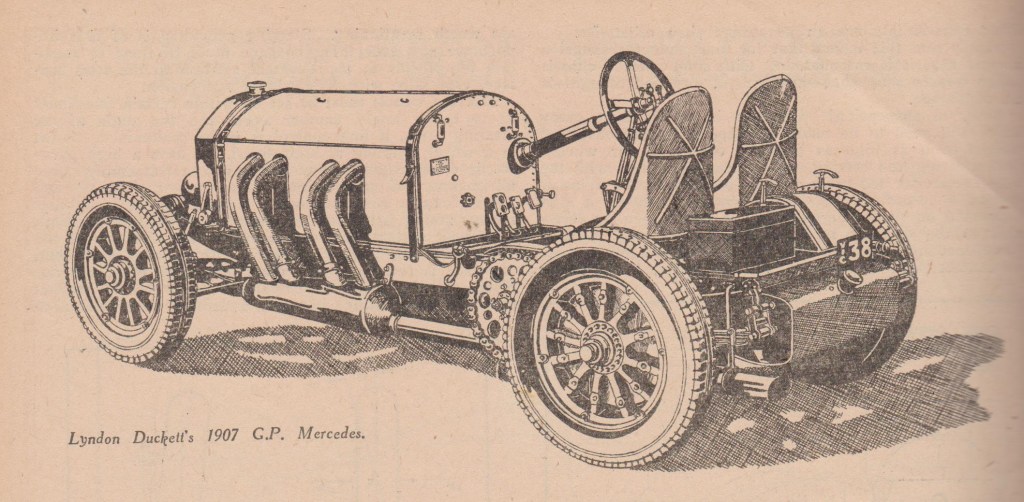
This drawing of Lyndon’s Semmering Mercedes, aircraft seats and all, appeared in the July 1947 Australian Motor Sport.
The Anzani Bugatti could hardly have been off the boat from England when the young Lyndon purchased this monster. At the time of Bob Shepherd’s AMS drawing, there was much discussion as to just what type of Mercedes it was. At 17.3 litres, it did not conform with the specifications of the 1907 or the 1908 Mercedes Grand Prix cars – it was larger than both and the largest Mercedes ever. Subsequent research has identified it as a 1908 car developed specifically to win the 10Km Semmering hill climb in Austria; it succeeded in 1908 and 1909. Lebbeus Hordern was just 18 years of age when his merchant father died, leaving him a £4,000,000 fortune. What better way to spend it than on the ultimate bird puller?
(G McKaige)(G McKaige)
No account exists of Lebbeus using the car, but the next owner Colin Smith, another millionaire, competed in 1911 at Artillery Hill, south of Sydney, before selling the car to Percy Cornwell, owner of potteries in Brunswick, an inner suburb of Melbourne. It was raced in a few events by Cornwell who also had the notorious Rupert Jeffkyns drive it for him before it passed to Ike Watson in Melbourne who dismantled it. It was bought by a brave young Lyndon in January 1942, and he had it running within a year. He confirmed that it had engine dimensions of 175×180 mm, consistent with the hill climb car. The gear ratios were equally heroic, 1st, 5:1; 2nd, 2.25:1; 3rd, 1.5:1 and 4th, direct drive.
(SLV)
Rob Roy with the Semmering Mercedes and Anzani Bugatti; also, the Davison ‘Little Alfa’ 6C1500 and 38/250 Mercedes Benz with Lex at the rear.
In July 1953 at Fisherman’s Bend race track the Melbourne Mercedes dealer attracted some attention which they may have preferred to have avoided. They pitted their new 300 model against the 1908 car, and to the delight of the considerable crowd, it was soundly beaten.
The writer recalls the only time he saw the Mercedes mobile; it was on the Argus Veteran Car rally in January 1955. The car was observed leaving a control in St Kilda Road and each time the engine fired the rear tyres left two black skid marks on the road – impressive.
(G McKaige)
Barn find. Lyndon’s Type FENC Isotta Fraschini.
This remarkably complete little jewel of a 1908 Isotta Fraschini Voiturette was found in rural Victoria; two of them had come here and they both survive. There are three others known, two in Italy and one in USA.
(G McKaige)
Professionally Lyndon had a motor engineering business in west-central Melbourne where he attended to client’s cars while accumulating a collection of vehicles for his own amusement.
At the time of his death, he had low-mileage Alfas, an Aston Martin, a Ducati and several other bits and pieces, including a rare Jowett Jupiter R1 and a Tojeiro chassis to which he hoped to mate a new MG twin-cam motor which was still in its box. I believe this was for a projected Le Mans car that he and Jumbo Goddard had dreamt up. The Isotta Fraschini remains with his sister.
(B King)
Isotta Fraschini FENC in recent times with Noel Cunningham at the wheel in Victoria’s Western District on a Bugatti Rally.
Etcetera…
Enthusiast, historian and restorer, Chester McKaige knew Lyndon as a child and shares his memories.
“He was a great bloke, he Bob Chamberlain, Earl Davey-Milne and a couple of Bentley Club bods in the Bentley Club were great to a kid growing up.”
“I have many fond memories of Lyndon and his mother Edith. The huge kitchen in Towers Road, Toorak, with kitchen table at one end piled high with car magazines. The stag head on the wall in the hall, the mosaic covered fountain. Lyndon’s obnoxious nephew too! Edith teaching me to play the saxophone. And towards his later years, the stick to keep the hoist up at his garage. The huge quantity of oil filters he had in stock that turned out to be empty boxes or filled with used ones.”
“I was his Godson and fortunate to get a guernsey in his will, so I was able to buy his Coventry Climax engined Morris Minor. I have his garage sign hanging on the wall in my garage. He used to keep spare cash under the carpet in his cars. I found $8 in $2 notes under the carpet in Morris. Dad used to call him Fella”.
Credits…
Australian Motor Sport, 1947, ‘Bugattis in Australia and New Zealand’ 1920 to 2012. King and McGann, Serpollete’s Tricycle, Volumes 2 & 3. https://earlymotor.com/serpolettes-tricycle/ The Brescia Bugatti, Bob King, Earl Davey-Milne, State Library of Victoria, George McKaige
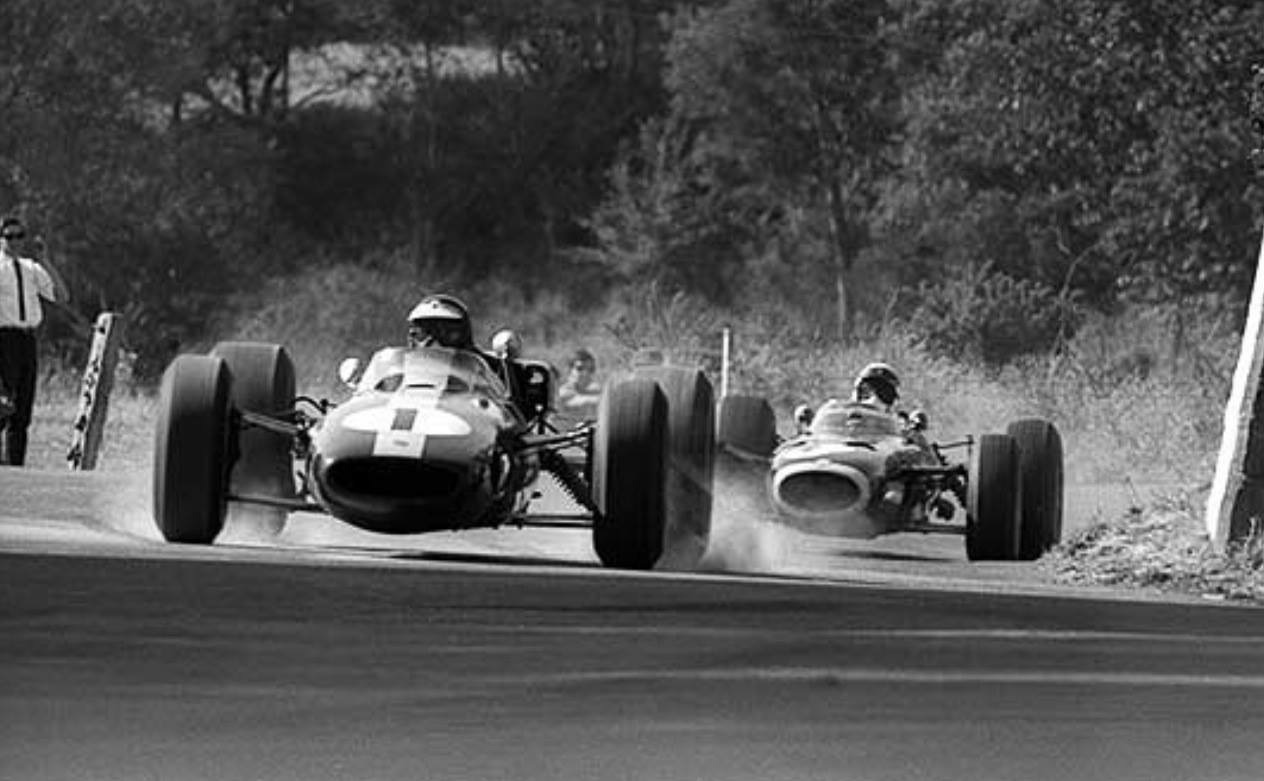
Jackie Stewart leads Jim Clark through Lakeside’s Eastern Loop during the 1967 Tasman round at the fast Queensland circuit on 12 February…
You can just see that the lightly loaded right-front wheel of Jackie’s 2070cc BRM P261 V8 is off-the-deck. Jim is chasing him in Lotus 33 R14 powered by a 2-litre variant of Coventry Climax’s 1.5-litre FWMV V8 Climax built for Lotus to tide them over pending delivery of the BRM H16 engines they used in the 1966, the first 3-litre GP year. The Ford Cosworth DFV V8 arrived at the ’67 Dutch GP in the back of a Lotus 49 and changed the GP world of course.
Stewart was the reigning Tasman Champion, BRM cleaned up in 1966 winning seven of the eight races – Jackie won four, Graham Hill two and Dickie Attwood one.
It was a lot tougher in 1967.
Lotus put to one side the 2.5-litre Coventry Climax FPF four cylinder engines they had previously used in their Tasman cars and used the F1 33 powered by the Climax V8, creating a very competitive mount despite giving away 500cc to some of the competition.
Jim finished all eight rounds and won five races including three point-scoring events. Jack Brabham’s Brabham Repco 640 Series V8s driven by he and Denny Hulme were also fast but had poor reliability. Jackie took two wins in 1967 for second in the series but was well behind Jim.
The BRMs were still very competitive in 1967 but the final increase in capacity – and resulting power and torque proved a bit too much for the transmission. BRM suffered gearbox problems in ’67 with the 2070cc variant of the P56/60 V8, they had not experienced with the 1930cc version used the year before.
(HRCCT)
The photo above shows the pair again, this time with Clark in front of Stewart during the final 1966 Tasman round at Longford, Tasmania on 7 March.
There Jackie won from teammate Graham Hill, Jack Brabham’s Brabham BT19 Repco third. It was the Brabham Repco V8 combination’s third race, by the early European Grands Prix the 1965 BT19 chassis and Repco 620 Series V8 was finding ultimate race and championship winning pace and reliability.
Clark’s 1966 Tasman Lotus was the 39 Coventry Climax FPF, he took one round win it at Warwick Farm.
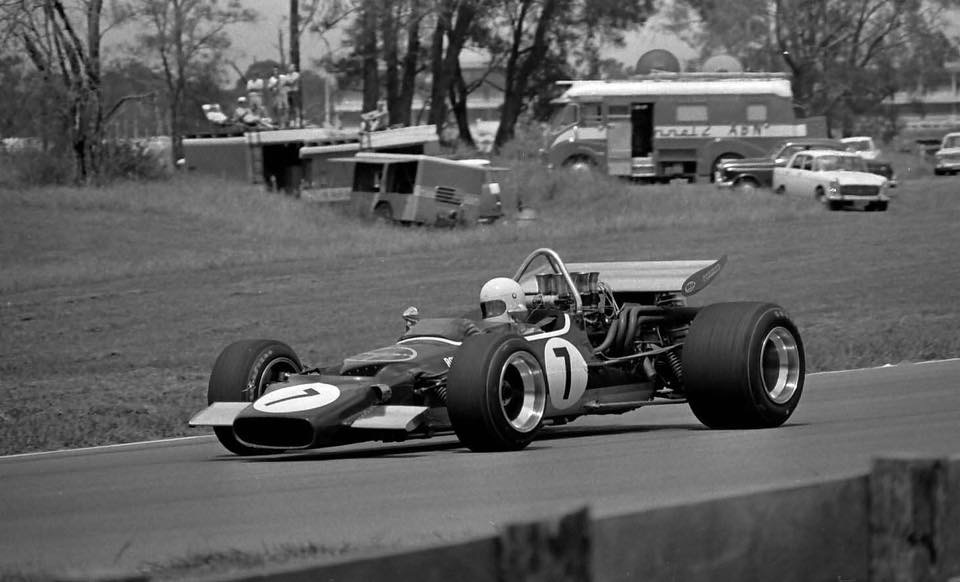
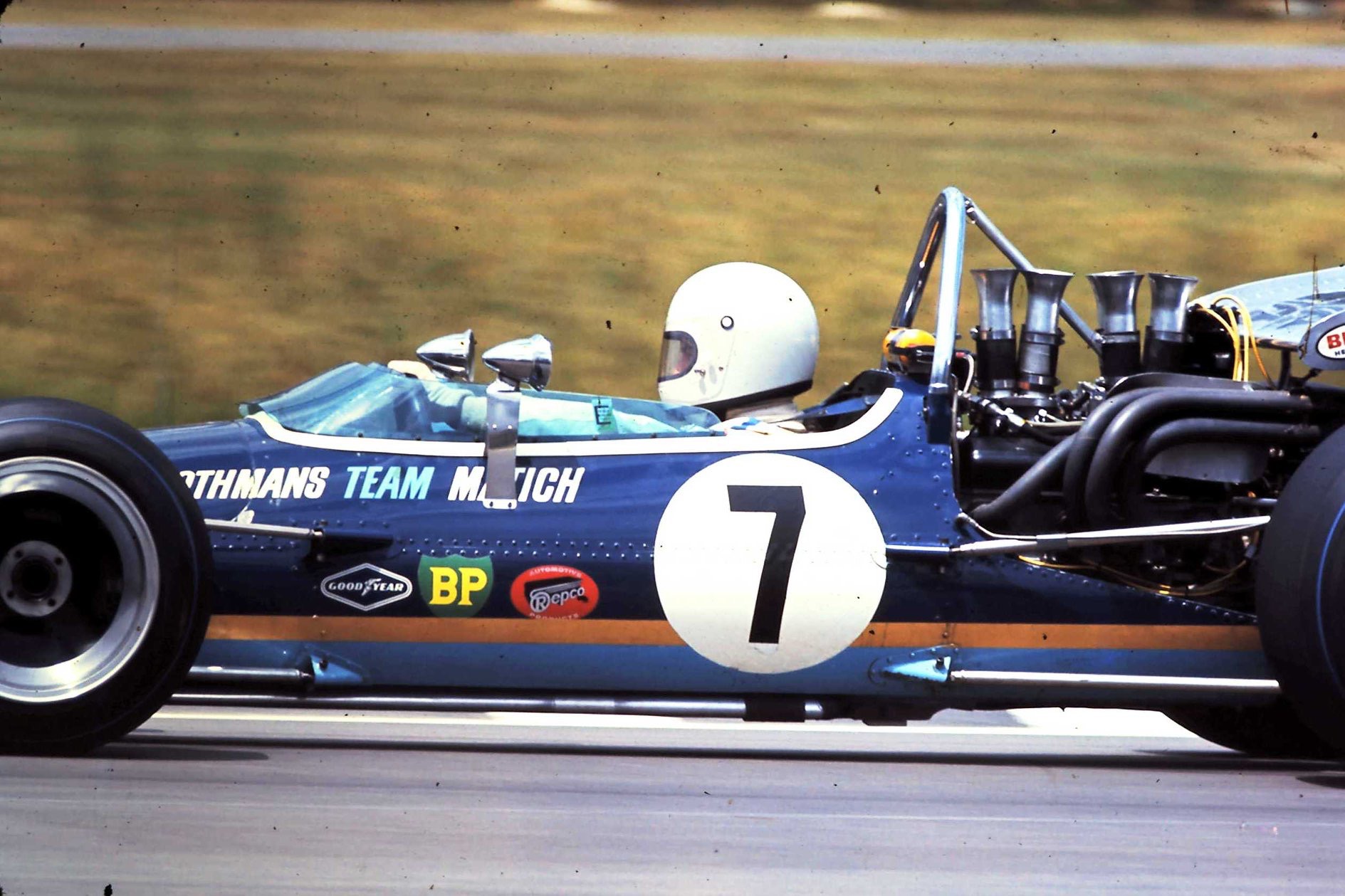
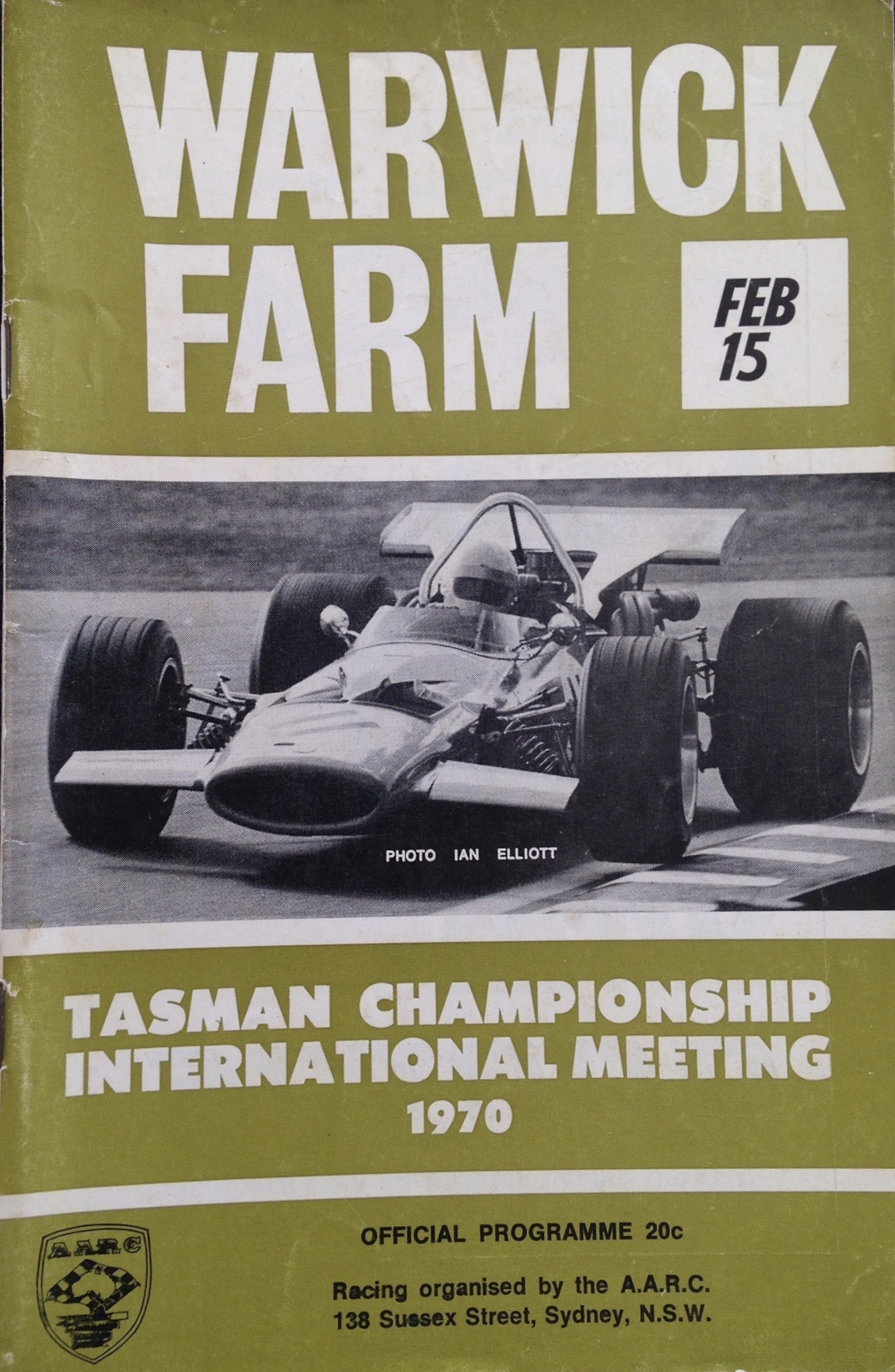
Lynton Hemer’s great shot catches the Frank Matich McLaren M10A Chev in the braking area before Creek Corner during practice for the Warwick Farm 100 on February 15, 1970.
Love the ABC TV outside broadcast van and flaggies and other officials cars sprinkled amongst the trees.
The 1970 Tasman was an interesting one in that the 2.5 Tasman cars which were on the way out (sadly) ended up having, just, the pace and the reliability to lift the Tasman Cup one last time over F5000, which was on the way in. Graeme Lawrence took the title with one win in the Ferrari Dino 246T Chris Amon raced to victory the year before, Matich was second in the points score with two wins.
(R Thorncraft)
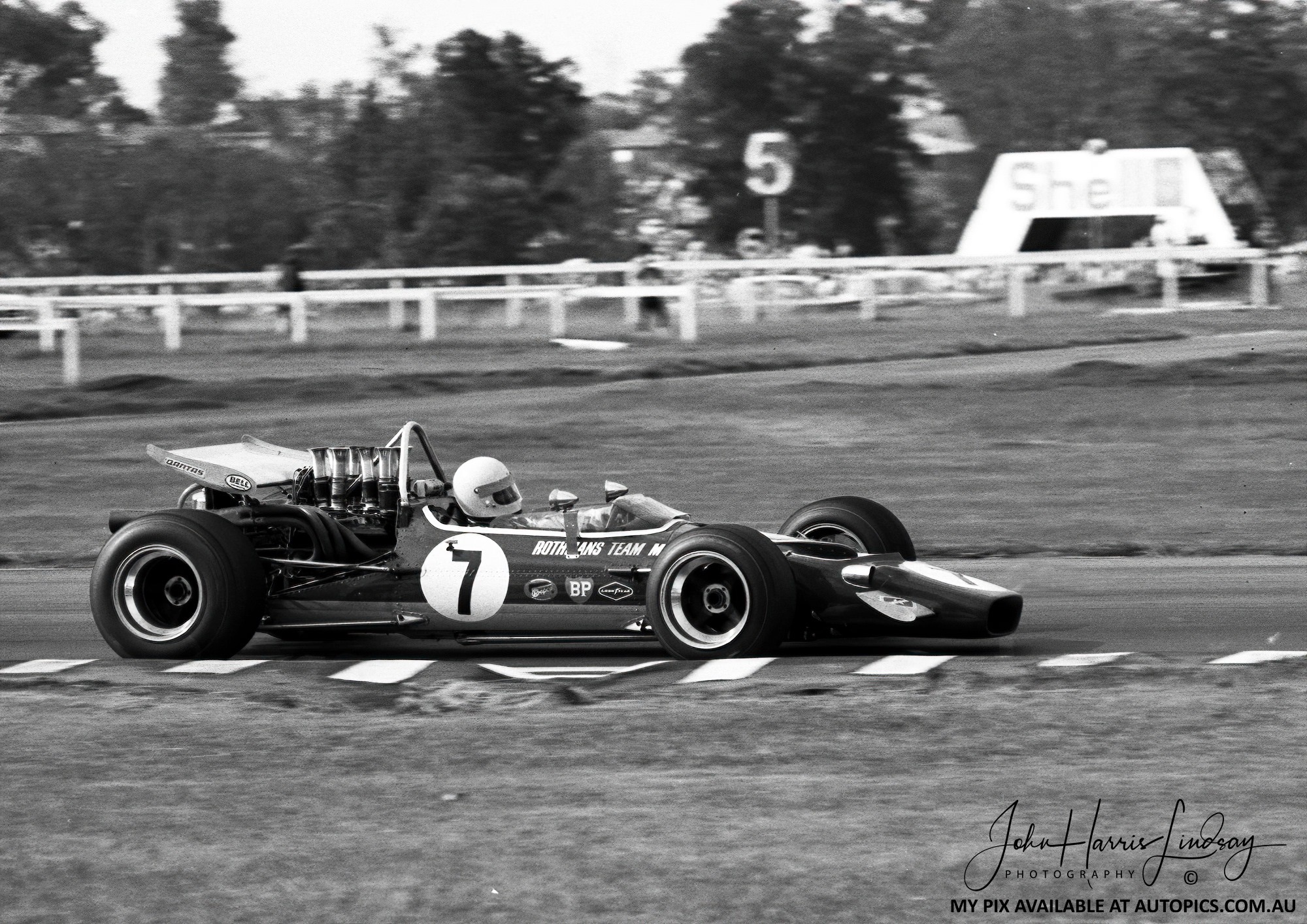
The Matich crew first raced their M10A in September 1969 and progressively modified the car in many respects to the new M10B specifications- Hewland DG300 gearbox instead of LG600 etcetera, see this epic on Matich here; Frank Matich: Matich F5000 Cars etcetera… | primotipo…
Frank’s car was the quickest of the series, he won the NZ GP at Pukekohe and at Wigram. Only a splash and dash stop for fuel at Surfers gifted Graham McRae that win and engine problems at the Sandown final round- having started from pole – spoiled his Tasman, Niel Allen’s new M10B won that day with Lawrence’ second place enough to give him the series win.
Jaime Gard susses, whilst FM sucks on the sponsors product
Matich started at Warwick Farm from grid two with Graeme Lawrence on pole, he had an early coming together with Kevin Bartlett’s Mildren Waggott TC-4V, which Derek Kneller believes was the cause of the broken left-rear upright after 29 of the race’s 45 laps.
In a splendid drive, KB he won the race in the sweetest of racing cars, the Mildren Yellow Submarine, from Max Stewart’s Mildren Waggott TC-4V, Graeme Lawrence Ferrari Dino 246T 2.4 V6 and then the first of the F5000s- Niel Allen’s McLaren M10B Chev.
FM talks to Lugsy Adams looking particularly summer-posh in Rothmans Team Matich shorts ‘n long sox whilst Jaime Gard looks altogether more casual – not much they can do at this stage of proceedings.
FM’s Matich SR3 Repco was owned then by Don O’Sullivan, I imagine Gard was over from Perth and in-situ at the Matich workshops looking after the prep of that car, and totally involved otherwise – he of ‘Gardos’ fame I wrote about a while ago;https://primotipo.com/2017/11/30/dons-party-f5000-party/
Credits…
Lynton Hemer, John Lindsay, Russell Thorncraft, oldracingcars.com
Thanks to Kris Matich and Derek Kneller for assistance with event and people detail
Tailpiece…
FM’s Matich is fitted with an injected Chevvy here having commenced the series in New Zealand with units fitted with Webers. By this stage Matich’ Repco sponsorship was being refocused away from the Matich SR4 sportscar powered by 4.8/5 litre Repco RB760 V8’s in favour of the Repco Holden F5000 engines which were in the early stages of development by Phil Irving, Brian Heard and the rest of the crew in Maidstone.
The early promise of that Repco Holden engine was realised with FM’s Australian Grand Prix win aboard his M10B Repco at the Farm ten months hence
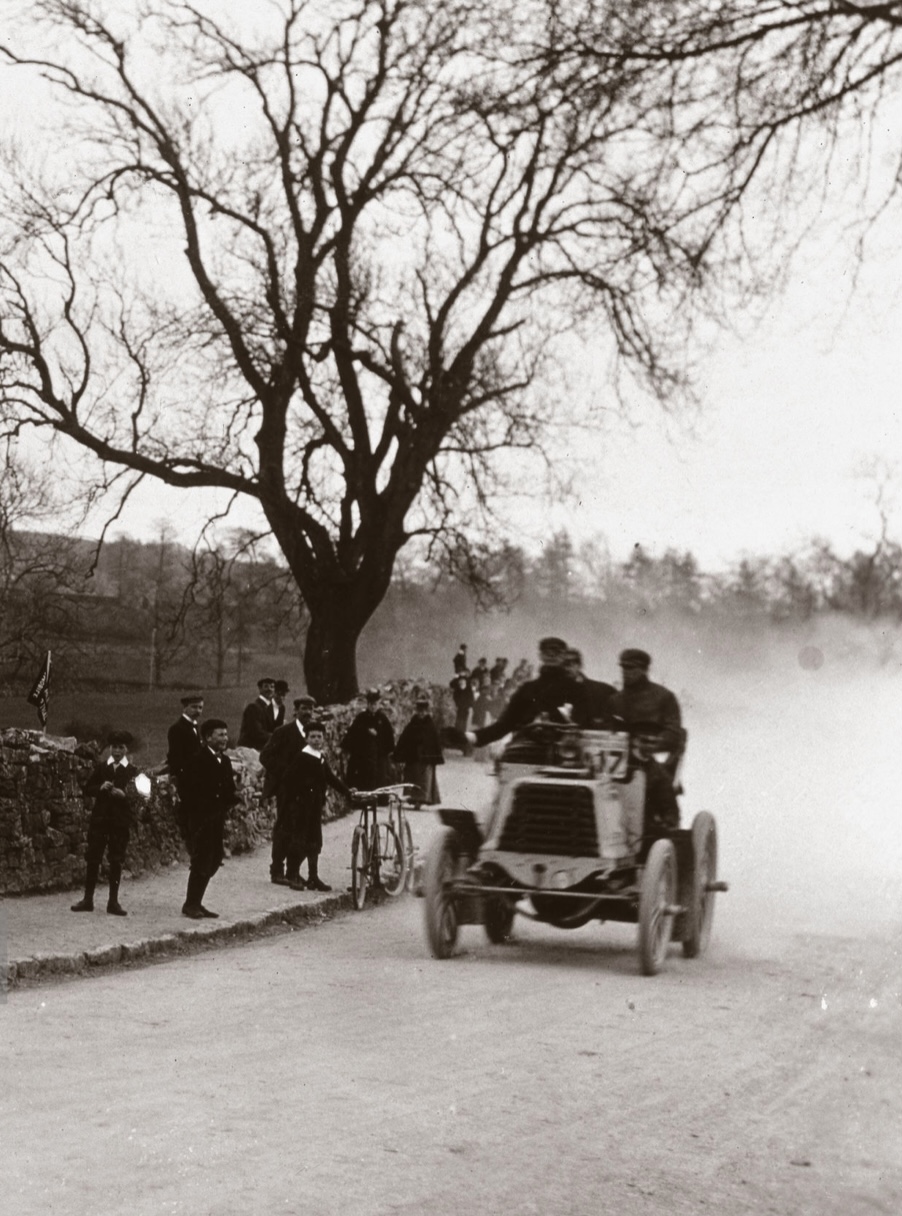
CS Rolls passing a group of spectators during his winning drive of a Panhard 12HP during the 1000 Mile Trial, 23 April to 12 May 1900…
Charles Stewart Rolls was a pioneer English motorist, an aviator and founding partner of Rolls Royce together with Sir FH Royce in 1906. Prior to founding that iconic company Rolls’ business assembled and sold French cars, including Panhards.
Rolls, Panhard 12Hp (Getty)
Rolls entered a Panhard in the 1000 Mile Trial which was the first public demonstration of the potential of the car for long distance travel in the UK. 65 vehicles started, 23 finished the course which started in London, headed west to Bristol, then north to Edinburgh before returning to London.
Etcetera: ‘The Motor Car – One Thousand Mile Trial in England’…
From ‘The Brisbane Courier’ (Australia) Saturday 4 August 1900.
It’s very interesting to read this article, published in Australia but clearly written by a journalist on-the-spot in Britain – by whom I know not. Of historic interest are the observations about the evolution from horses and horse-drawn vehicles to motorcars.
‘…The principal object of the organisers was to prove what it was considered the people of this country need to be to be taught-that the motor car is, even in its present state of development, a serious and trustworthy means of locomotion; not a toy dangerous and troublesome alike to the public and its owner, but a vehicle under as perfect control as a Bath chair, capable of accompanying long journeys in all weathers and over every kind of road with ease and safety, destined to take its place with the train and bicycle as a common object of daily life, and as superior to them, in many respects, as they are superior to the horse and cart. In so far as any demonstration ever brings conviction to indifferent or hostile minds the tour must be considered amply to have achieved its object’.
‘The trial, in fact, from the point of view of those who have taken part in it, has been entirely satisfactory. It is a considerable achievement for fifty new-fangled vehicles to have travelled nearly 1100 miles in eleven days through a densely-populated country at a speed seldom, if ever, below the legal limit, with no incident more untoward than the deaths of one dog and one unmanageable horse, whose leg, coming in contact with a passing car, received such injuries that he had to be destroyed’.
‘The mechanical results of the trial have been very much what they were expected to be. That is to say, the established type of machine has proved itself entirely trustworthy, and between the Daimler, Napier, and Panhard motors there has been, in the matter of “staying power,” practically nothing to choose. Of the cars which entered, only four were driven by any other motive power than petroleum spirit.
Among the large machines the more prominent have been the Hon. C. S. Rolls’ racing 12 horse-power Panhard, the 12 horse-power Daimlers owned by the Hon. John Scott-Montagu, M.P., Mr. J. R. Hargreaves, and Mr. J. A. Holder, and Mr. E. Kennard’s 8 horse-power Napier. In the 6 horse-power class the Daimlers and Panhards have been well represented, and with regard to these it may be said that, apart from special racing machines, the English-built cars have shown themselves to be at least as good as the French, and most people admit that the English workmanship is the better of the two. But it is a regrettable fact that English manufacturers still have to go to France for some of the most essential parts. Our spring and axle builders do not yet appreciate the opening that lies before them.’
‘The results of the hill-climbing trials, when published, will prove a better means than any other for comparing the respective merits of the cars from the purchaser’s point of view. To speak generally, the best cars of each class climbed astonishingly well, though there were probably few drivers who had no moments of anxiety on the way from Kendal to Carlisle. The condition of the roads on three out of the four test hills was fortunately good. Indeed, the roads throughout, with the exception of that between Manchester and Preston, which was execrable, have been in a satisfactory state of repair, though often muddy and greasy. There can be no doubt that, if the road authorities were provided out of the rates with solid-tired motor cars instead of horses and traps, the immediate improvement in the roads would be so great as to be well worth the increased cost of the vehicle.’
‘Speed pure and simple is in this country a secondary consideration, but, by way of fully testing all the powers of the cars, an optional trial of speed was carried out on Friday in Welbeck Park. The following speeds were attained by the fastest cars: Min. Sec. The Hon. C. S. Rolls’s 12 horse-power Panhard . 1 35 3-5 Mr. Ed. Kennard’s 8 horse-power Napier and Mr. Mark Mayhew’s 8 horse-power Panhard . 2 1 3-5 The Ariel Motor Company’s tricycle, with trailer . 2 2 1-5 Mr. T. A. Holder’s 12 horse-power Daimler. 2 17 1-5 The Hon. John Scott-Montagu’s 12 horse-power Daimler. 2 18. The distance was one mile, with flying start and the figures given are the mean of one run over the course in each direction. The road, which had slight gradients, was in good condition.’
‘If I were asked what had chiefly impressed me in the course of this journey of 1000 miles, I should say that it was the certainty that the next few years will see an enormous increase in the use of motor cars. The new method of locomotion has been taken seriously, and the friendly interest in it displayed by the thousands who have witnessed this trial will greatly facilitate its progress. At present good motor cars are somewhat expensive and difficult to procure at a moment’s notice. They also require for their maintenance in working order the services of a professional driver or of a mechanically-minded amateur. But these are difficulties which competition, the first place, and familiarity, in the second, will speedily overcome. There are in the country at this moment far more motor cars than might be supposed-the indifference to them of the horses in many districts, is already very remarkable and it is impossible to believe that, so soon as they become cheaper, their numbers will not largely increase.’
Indeed!
Credits…
Science and Society Picture Library, Getty Images, The Brisbane Courier
Tailpiece…
Unfortunately none of these shots Getty captions indicate the exact locale. A bumma.
Stan Jones wins the 1954 Victoria Trophy at Fishermans Bend in his shortlived, brand new Maybach 2, 21 March 1954…
Regular readers may recall the feature on Stan, Alan’s dad and a champion in his own right a while back. There are not many photos of Maybach 2 as it was only raced briefly before Stanley comprehensively destroyed it after a chassis weld failure, at the ’54 AGP at Southport on Queensland’s Gold Coast.
Jones raced Maybach 2 at Easter Bathurst, then Altona, Victoria on May 2 and at Fishermans Bend in October before that fateful November weekend. Still, he was lucky not to lose his life in the high speed trip backwards through the Southport scrub and trees.
The beauty of these online blogs is that you can continually update them as you find new shots, this set are so good I thought it worth a fresh post.
Davison in his new HWM Jag (VHRR Archive)
Maybach wasn’t ready for the Victoria Trophy preliminary on Saturday, but contested the 64 mile feature eventon the airfield circuit in Melbourne’s inner west.
He took the lead from Lex Davison’s HWM Jaguar before the first corner. Davos’ original intention was to fit the HWM with the engine from his Alfa Romeo P3, the complexities of that undertaking with the straight-eight, supercharged engines central power take-off were immense! He therefore fitted the HWM with a Jaguar engine topped by a C-Type head, the car was victorious at Southport in November winning the first of Davison’s four AGPs.
It was Jones’ Victorian Trophy though, he lapped the field, leading Jack Brabham’s Cooper T23 Bristol over the line by three miles.
Davison #3 HWM Jag, Ted Gray #8 Alta Ford V8 and Brabham’s obscured Cooper T23 Bristol. Fishermans Bend 1954 (VHRR Archive)
Arthur Wylie in the Wylie Javelin ahead of Brabham’s Cooper Bristol. Victorian Trophy 1954 (VHRR Archive)
Silvio Massola’s HRG, Fishermans Bend 1954 (unattributed)
Etcetera…
(The Age)
Stan won in 1953 too.
Here he is, two happy chaps Ern Seeliger at left, again at Fishos, on this occasion Ern had prepared Maybach. But he was also a racer as well as an engineer, famously adapting Maybach 3 to accept a Chev V8 creating, you guessed it, Maybach 4.
A very talented man, little has been written about him and the products of his Richmond workshop, a great future topic.
Alan Bruce poses in the UK on Leaping Lena : Brough Superior J.A.P 1000
Bob King looks at this record and the man who achieved it – Alan Bruce.
To this motor racing historian, motorcycle records were a peripheral issue, at least until I heard Alan Bruce’s story.
Let us start at the finish with an excerpt from the London Daily Mail May 4, 1932:
RECORD BREAKING IN HUNGARY, Alan Bruce, riding the J.A.P. 1000 c.c. machine on which he attained a speed of 200kmh on the Tat road near Budapest, April 30, 1932.
Alan Bruce is the first Australian to hold an officially recognized, WORLD LAND SPEED RECORD, the streamlining is noteworthy. This reads as a photo caption.
Another report, this time possibly from an Australian source, is headed:
AUSTRALIA “Knocks it for Six”, Alan Bruce on his now famous “Leaping Lena”, Sidecar outfit at Tat near Budapest, successfully attacked the Worlds (sic) Record for the two-way flying kilometre. His time, 17.88sec, is an average speed of 200.220 kmh, equal to 124.41 mph.
“The Motorcycle”, in another report noted that it improved on the “German figure by 6 mph”. The mention of ‘German Records’ hints at mounting tensions in Europe, which, to a certain extent, would be played out on race tracks and through record breaking.
Records like this do not happen by chance, but are usually preceded by months and possibly years of planning with the expectation that there will be set-backs. The unusual venue indicates the seriousness of this attempt. At that time the Tát road was thought to be the only suitable stretch of road for record breaking in the whole of Europe. Google maps suggests that the likely venue is a straight stretch of road that runs with no crossroads for approximately 8 kms north-east from Tat to Nyergesüjfal; it borders wide stretches of the Danube and is now known as Route 10, or locally as Kossuth Lajos U.
The team: Keith Horton, Alan Bruce, Phil Irving and Arthur Simcock
Most of my information on ‘Leaping Lena’ comes from Phil Irving’s Autobiography, 1992 (Turton and Armstrong). Phil Irving and Alan Bruce, who were of a similar age, had met at Stillwell and Parry’s in Elizabeth St. Melbourne, where Alan had been tuning racing machines. They shared a passion for motorcycles, particularly AJS, and had a continued friendship for the rest of their lives. Between them they cobbled up an overhead camshaft for an AJS, which was not particularly successful.
It is said that Alan got the notion of setting a Land Speed Record when he saw Paul Anderson take local records on Sellicks Beach, South Australia, in 1925. By 1926 Alan had done a lot of record breaking including the sidecar record for 350 c.c. machines on Bakers Beach in Tasmania. He also set the sidecar record from Hobart to Launceston; his speed exceeded the existing solo record.
By 1930 Alan had found success on the English speedways with a Rudge to which he had added his own modifications to the frame and forks. That year Phil arrived in England as Victorian 350c.c. Sidecar Champion. In 1931 they got together and cooked up a plot to break existing solo and sidecar world records – an ambitious plan for a couple of under-funded Australian battlers. They were joined by Arthur Simcock who was able to bring some Shell sponsorship. He was to ride solo, with Alan on the outfit. Although it was not his core skill, Phil was inveigled into designing a streamlined shell for the bike. The design was an attractive and unusual example of form meets function achieved without access to a wind tunnel. The front of the rig was not faired to avoid the adverse effects of crosswinds; the engine and sidecar were enclosed and the tail of the bike was shaped so that the rider’s backside was encased in a bucket seat. Eatons of Euston Road were tasked with beating up the shell; they formed the cowling over Arthur Simcock’s helmet. Phil’s involvement was confined to London; he did not go to Hungary.
The chosen machine was a Brough Superior SS100 with a J.A.P. V twin of 996 c.c., supercharged with a Powerplus blower. Alan assembled the power plant meticulously, but did not dyno-test it as its expected 100bhp exceeded the capacity of J.A.P.’s dynamometer. Phil already had a grasp of exhaust tuning; opting for short stubs finishing inside the fairing to avoid loss of charge down a long pipe. Theirs was a private venture with some trade support in the shape of parts as well as Shell fuel and lubricants; quite different from the Reichsmarks being spent elsewhere.
Their first visit to Hungary was in April 1931. Records were to be set on the average speed over the measured kilometre in two directions. After Arthur achieved a two-way average of 143 mph (229 kph) his attempt failed when a piston partially seized on a further run and the venture was abandoned until the following year. One can imagine their disappointment after traipsing all the way to Hungary.
Back in the UK, Phil and the team had other things to concern them, as they were also preparing a number of bikes for the forthcoming Isle of Man TT. In 1932 they trundled off to Hungary again with the bike on a truck. This time the record attempt went off without a hitch until Alan aviated the bike at near his maximum of 135 mph causing him to shut off. He then thumped a railway crossing, not realising he had passed the finish timing strip.
Not being across motorcycle records, this bit of Aussie fame had escaped my notice; at least until about 1983 when I had as a patient in my medical practice Alan Bruce’s middle-aged daughter. She told me of her record -breaking father whom she had not seen since before the war. He was shortly to come home for his eightieth birthday and she would like us to meet.
This culminated in a visit from Alan to see my cars and with me attending his birthday party which was also attended by Phil Irving and numerous elderly gentlemen, most of whom had pronounced limps. Alan entertained me with stories of his successful career on European tracks and was justifiably proud of is world land speed record. Seeing my Bugatti, he told me how he had been given a lift from Budapest to Tat for the record attempt with Swiss racing driver Armand Hug in his supercharged eight-cylinder Bugatti; Hug was also after some records. The whole journey was taken flat-out, including through villages, scattering chickens etc. in their wake. Among other achievements, Alan had designed a banking side-car for racing outfits on cinders which was a considerable improvement over Freddie Dixon’s pioneering eight-year-old design. The reason he had stayed overseas after the war was that he had joined the occupation forces in Germany, remaining there after marrying a German fräulein.
Alan’s final word on his record attempt: “Yes, it felt fast alright”.
Alan Bruce, his wife, Erwin Tragatsch, a German Bugatti authority, and Bruce’ son. East Germany in the mid 1980s (B King Collection)
Postscript…
The mention of Ernst Henne in regard to land speed records brought to mind an interesting anecdote told to me by my late, lamented friend Lucien Chabaud.
Lucien had spent his teen years in the Vaucluse, Provence. During the war he and his mates shared a racing Terrot motorcycle that they would start up from time to time, according to the availability of dope with which to fuel it.
One day they were playing with the Terrot in the main street of Orange; Avenue de l’Arc de Triomphr on Route National Sept. Their play was interrupted by the arrival of an imposing German staff car. A German officer stepped down, studied the bike, and asked if he could try it out. Moments later he was streaking up the highway, rounding the triumphal arch at an impressive speed: shortly after reappearing, still flat-strap.
Next day a German army truck arrived and a 200-litre drum of aviation fuel was unloaded, to which was attached a note reading: “Merci, Henne”. At that time Henne was the holder of the World Land Speed Record for a motorcycles at 279.5kph – set in 1937, the record was not broken for another 14 years.
Etcetera…
On location in Tat, Hungary, in Solo format, probably Arthur Simcock.
Sydney ‘Referee’ June 8, 1932 (B King Collection)
‘Fan-card’ shot shows the canted speedway sidecar.
Credits…
Bob King, The Vintagent, Moto Revue Jan-March 1933
Tailpiece…
(Hockenheim Museum Archive)
Stylised machine is a blend of 1930 OEC-Temple-Jap record breaker and the bodywork of Leaping Lena.