hoare

(Allan Dick)

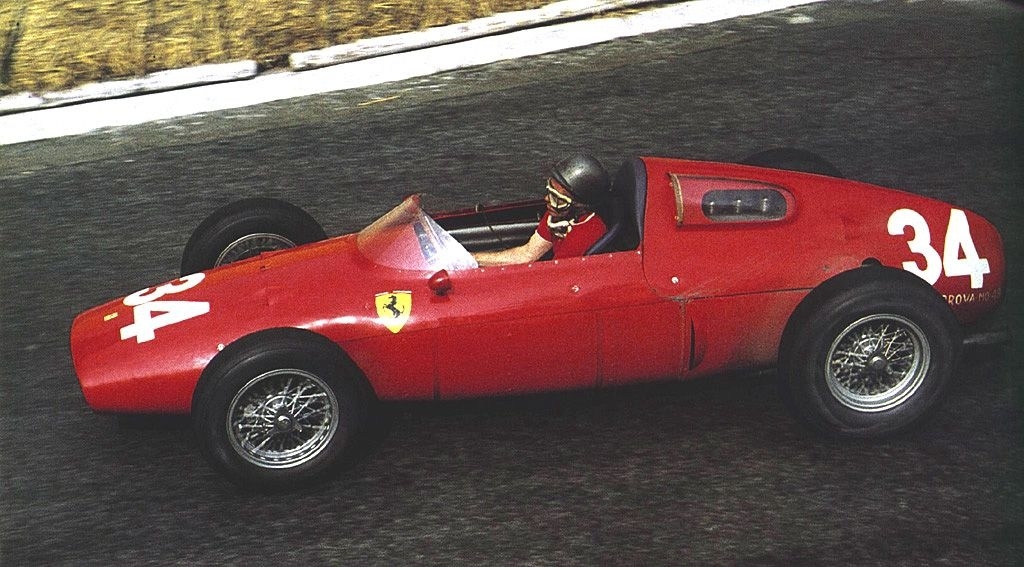
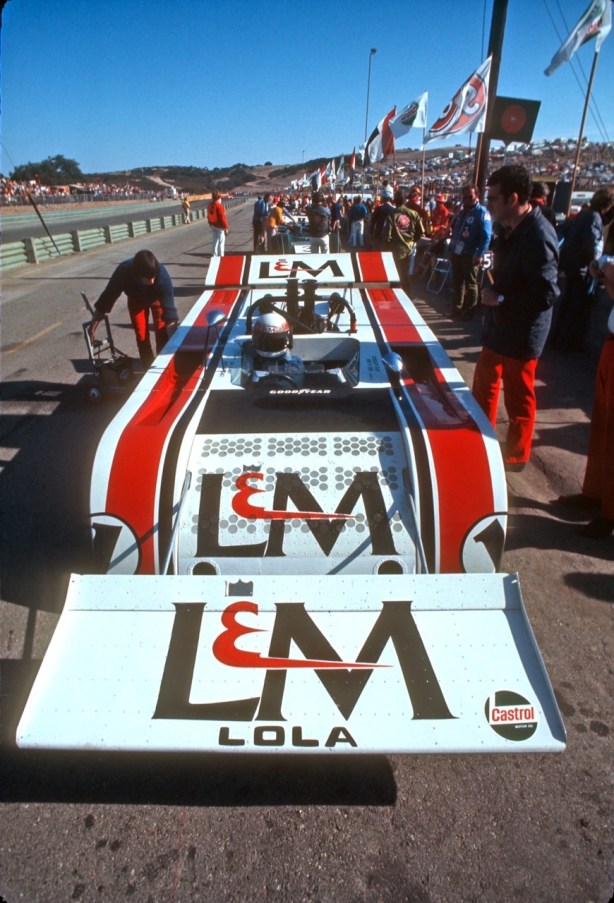
Pat Hoare’s Ferrari has 4 wheels ‘off the deck’ at Dunedin, New Zealand in 1961, Shell ‘Servo’ and Vanguard in the background of this road circuit…

Allan Dick ‘You might find it interesting to see what road circuits were like in NZ…its Pat Hoare in the Ferrari that Phil Hill won the Italian GP at Monza in 1960 (in 246 Dino guise). It was fitted with a 3 litre V12 Testa Rossa engine, the noise it made gave grown men erections.’

‘Is there a single wheel on the deck here? After 2 seasons Hoare was going to buy a Shark Nose Ferrari 156 F1 car and power it with a 2.3 litre V6 engine. The deal was done, but he couldn’t sell this car and eventually converted it into an awful looking road going GT’.

The 8th Dunedin Road Race was contested on 28 January 1961 and won by coming star Denny Hulme’s Cooper T51 Climax from Hoare and Angus Hyslop who was also Cooper mounted, a T45 Climax but 2 litre as compared with the 2.5/3 litre engines of Hulme/Hoare.

Click here for an earlier post on this amazing car; https://primotipo.com/2015/04/26/fazz-on-tight-shell-be-jake-matey/

ferrari butt

Another shot of the Fazz’ tight little Italian rear. Love the big exhausts for the Testa Rossa 3 litre V12, delicate aluminium reliefs to allow the exit of air, most fuel in ’60 spec cars in pannier tanks amidships, rather than rear tank to centralise weight distribution. Koni shocks. ’60 spec rear suspension independent by upper and lower wishbones rather than De Dion fitted originally to Dinos. Propshaft low on the right of the cockpit. Ohakea NZ 1961. (Barry McBride Collection/The Roaring Season)

dunedin circuit map

Dunedin Oval Circuit. (silhouet.com)

hill, monza

Italian GP grid Monza, September 1960. Phil Hill closest to camera in the winning Ferrari 246 Dino ‘0007/0788’. #18 is Richie Ginther 2nd and Willy Mairesse 3rd in similar cars. Ferrari routed the opposition, the Brits boycotted the event on ‘safety ground’ when the Italians chose the combined road/banked circuit to maximise the chance of a Ferrari win, the powerful engines of the Scuderia’s cars their trump as they struggled against the nimble Coopers and Loti’. The last front-engined GP win. (Archie Smith)

Full Race Record of Ferrari Dino 246/256 ‘0007/0788’…

http://www.barchetta.cc/english/all.ferraris/detail/formula/0007.246.60.htm

Words and Photo…Allan Dick, additional photo Barrie McBride Collection/The Roaring Season, silhouet.com circuit map, Archie Smith

Bibliography…

Doug Nye ‘History of The GP Car 1965-85’, barchetta.cc

ferodo

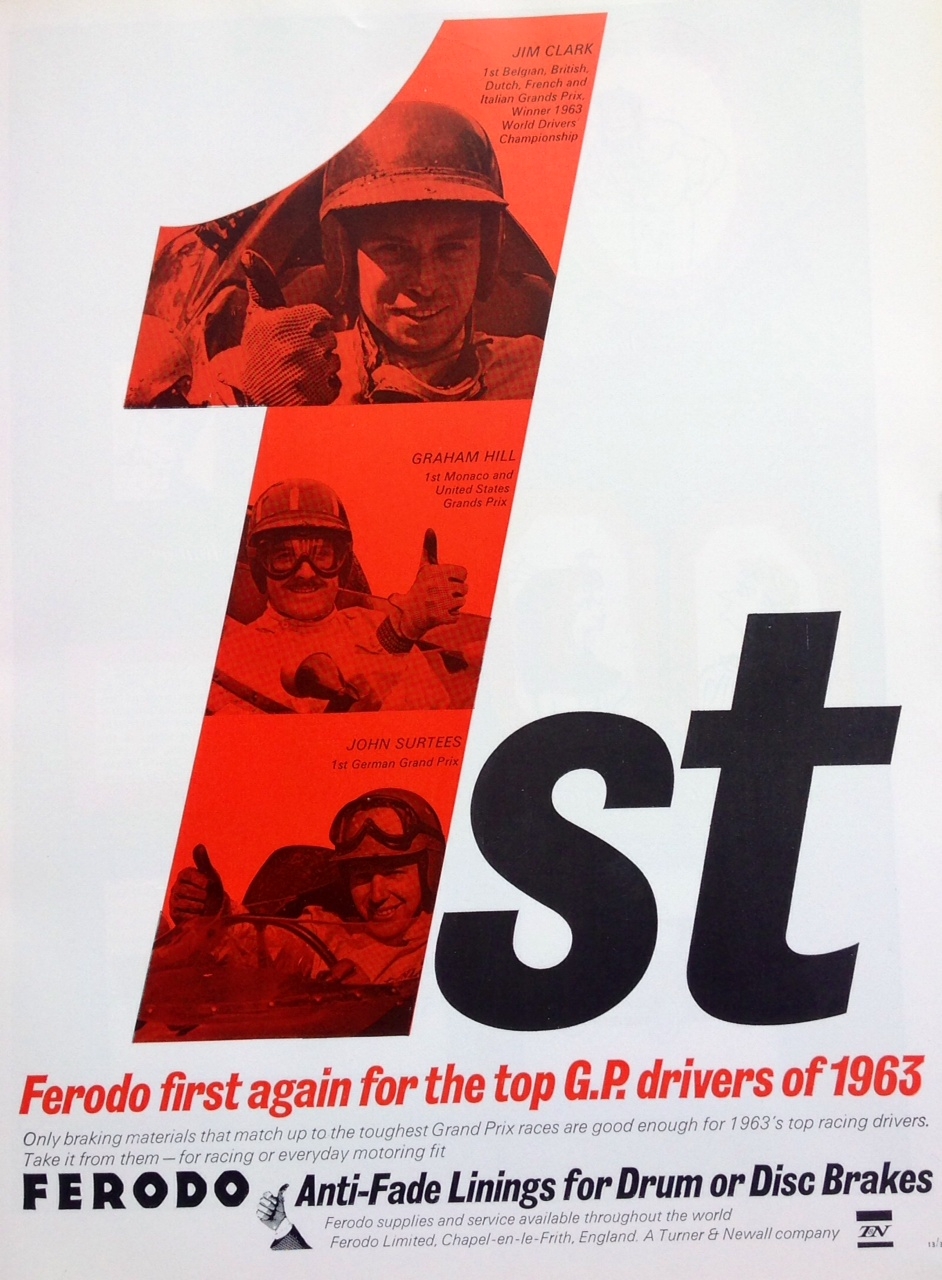
Ferodo advertisement from ‘Automobile Year’ proclaiming the company’s 1963 successes…

Image  —  Posted: November 8, 2015 in F1, Fotos
Tags:

jack monaco

Jack Brabham starts the plunge from the Casino Square to Mirabeau in his factory Lotus 25 Climax ‘R3’ during the 1963 Monaco Grand Prix…

Brabham was joined at ‘Brabham Racing Organisation’ by Dan Gurney in 1963, the lanky Californian left Porsche at the end of their F1 program. In 1962 BRO ran a car for Jack only in the teams first F1 season.

For 1963 both were driving the latest Brabham BT7’s powered by short stroke, fuel injected Coventry Climax V8’s. In first Monaco practice Jack’s Climax munched a valve, Jack flew the engine back to the UK in his Cessna to have it rebuilt it in time for Sundays race. The F1 racer of 1963 was a DIY kinda guy, if his name was Brabham anyway!

gurney

Dan Gurney’s brand new Brabham BT7 Climax, Monaco 1963, he was mighty fast if lacking in reliability and luck in that car that year! Famously the driver Clark came to respect the most. (unattributed)

In final practice Gurney lost the head off a valve, as had Trintignants Lotus 24, Roy Billington gave Jack the sad news when The Guvnor returned with his rebuilt FWMV from Coventry.

Brabham decided to start Gurney and withdraw from the race. The following morning having heard of Jack’s predicament Colin Chapman sportingly offered Jack a drive in the Team Lotus spare, ‘R3’ fitted with last years Weber carb Coventry Climax V8. Clark did a 1:35:2 in this car ‘just for fun’ only 9/10 of a second slower than his pole time in his race chassis towards the end of qualifying.

Chapman knew Jack was well familiar with the handling characteristics of the car as Jack acquired a Lotus 24 in early 1962, the spaceframe variant of the epochal, monocoque 25 whilst Ron Tauranac completed the build of Jacks 1962 and first GP contender, the Brabham BT3.

And so it was that Jack had the opportunity to drive a car he had wondered a lot about since driving his own Lotus 24 Climax for much of 1962. ‘That was a great gesture by Colin and i was delighted not to miss the race, but i can’t say i liked his car. If i thought my tube chassis Lotus 24 had been cramped, this Lotus 25 redefined the term. Its German ZF gearbox had a weird ‘upside down’ change pattern, and whilst i thought Dans feet were big, Jimmy’s must have been microscopic! The 25 seemed to have terrific traction and cornered well, but the gearbox got stuck in 5th twice and i had to stop to have it fixed and finished way back’ said Jack in Doug Nye’s biography of him. Click here for an article on this race and the Lotus 25;

Lotus 25: Jim Clark: Monaco 1963…

monaco 1963

’63 Monaco GP lap 1, the field led by Hill’s BRM P57 1st and Clark’s Lotus 25 cl 8th exiting the Station Hairpin. Next is Ginthers BRM P57 2nd, Surtees’ Ferrari T56 4th, #7 is a flash of McLaren’s Cooper T66 Climax 3rd, #4 Gurney’s Brabham BT7 Climax DNF ‘box and the rest. (unattributed)

MRD, BRO and the 1962 Season…

Jack Brabham and Ron Tauranac formed ‘MRD’ Motor Racing Developments Ltd to build racing cars in 1961, their first car, the FJ MRD was raced by Aussie Gavin Youl that year.

The main games were both production racing cars and F1, ‘Motor Racing Developments’ jointly owned by Brabham and Tauranac built the cars and ‘Brabham Racing Organisation’ owned by Jack (at that stage) ran the F1 program; prepared and entered the cars and contracted commercial agreements to fund the program.

sandown

Brabham being pushed to the Sandown grid, March 1962. Brabham sold this Cooper T55 to John Youl who raced it very successfully over the next couple of years the car continually developed by engineer Geoff Smedley including fitment of a twin-plug 2.5 FPF built by Smedley, an interesting story in itself. (autopics.com.au)

Jack raced in the International Series of races in the Australasian summer in early 1962 in a Cooper T55 under his own ‘Ecurie Vitesse’ banner.

The car was his factory Cooper 1961 F1 chassis ‘F1-10-61’ the little 1.5 litre FPF used in GP events replaced by its big FPF brother, an ‘Indy’ 2.7 for the Antipodean F Libre races. He won at Levin in NZ and Lakeside Queensland, i reckon his last Cooper win was his victory in the ‘Sandown Park International’ on 12 March 1962 from Surtees and McLaren both Cooper T53 mounted.

jack caversham

Jack Brabham in his F1 BT3 derived BT4 ‘Intercontinental’ Formula Brabham powered by a Coventry Climax 2.7 litre FPF ‘Indy’ engine. BT4 used smaller tanks than BT3 and 15 inch wheels all round. Australian national F1 was F Libre at this time. AGP, Caversham, WA, November 1962. Bruce Mclaren won the race in a Cooper T62 Climax, Jack collided with another competitor. (Milton McCutcheon)

By the end of the year he was racing his own BT4, 2.7 FPF powered in the Australian Grand Prix at Caversham WA in November.

But first there was a season of Grand Prix racing to contest, BT3 wouldn’t be ready until mid year as the customer FJ program had priority; MRD built 11 BT2 FJ’s, BT3 and 3 BT4’s in 1962, not bad for a new concern!

‘Brabham Racing Organisation’ needed a car for Jack to race in both championship and non championship 1962 events in the interim.

Colin Chapman was more than happy to oblige, selling Jack Lotus 21 chassis ‘936’ and 24 ‘947’ to enable the Aussie to chase the prizemoney and championship points on offer.

The 21 was the factory 1961 F1 design, a beautiful chassis only let down by the lack of a suitable, modern engine, the old 1.5 litre Coventry Climax FPF even in updated Mk2 form was too long in the tooth to keep up with the Ferrari Dino V6’s in 1961. Mind you, the brilliance of Moss in Rob Walker’s Lotus 18 took two wins at Monaco and the Nurburgring and Innes Ireland one in his factory 21 at the season ending Watkins Glen round.

Chapman updated the Lotus 21 design into the 24 for 1962, adapting the chassis to take the new 1.5 litre V8 Coventry Climax FWMV engine and the suspension of his ‘experimental’ masterstroke, the Lotus 25, the first modern, monocoque single seater from which all such racing cars right through to the present owe their parental lineage.

24 chassis

Lotus 24 cutaway drawing. Multi-tubular spaceframe chassis, front suspension by top rocker and lower wishbones and coil spring/damper units. Rear suspension by reversed lower wishbone, single top link and 2 radius rods for lateral location, coil spring/damper units. Girling disc brakes. Wheelbase 91 inches, front track 51 1/2 and rear 51 3/4 inches. Weight 1036 lb dry. Fuel tank capacity 27 gallons. Engines Coventry Climax V8 or BRM V8, gear boxes 5 speed ZF or 5/6 speed Colotti Francis. A good Coventry Climax FWMV V8 developed around 181bhp@8200rpm in 1962. (unattributed)

Mind you, the customers of the 24 thought they were buying Cols latest design…

As is well known, the conceptual inspiration for the Lotus 25 was Chapman’s Elan road car and it’s backbone chassis; why not widen the ‘backbone’ to accommodate the driver, pop the fuel into the structure so created either side of him and get enhanced torsional rigidity for less weight, the primary objectives of the exercise?

Chapman sketched his ideas, the 25 was drawn by draftsman Alan Styman, the prototype ‘R1’ put together in the early months of 1962 in a partitioned part of Team Lotus workshop at Cheshunt by mechanics Dick Scammell and Ted Woodley working with Mike Costin, Lotus Engineering Director (and shortly the ‘Cos’ of Cosworth) and Chapman himself . Doug Nye; ‘Chapman suspected the concept might not work out, but would in fact revolutionise racing car design’

The 1961 Lotus 21 chassis frames torsional stiffness was only 700lb/ft per degree of deflection, the 24 frame was 10 pounds lighter bare weight (before brackets and aluminium fuel tanks) and had similar rigidity to the 21. The 25 weighed in at 65 pounds bare, ‘yet offered 1000 lb/ft per degree rigidity rising to what was at that time a staggering 2400 lb/ft per degree when the new Coventry Climax V8 was installed in its rear bay’ said Nye.

clrak tub

Clark all snuggled into his brand new Lotus 25 ‘R1’, Belgian GP 1962. Monocoque structure by rivetted D Shaped light alloy longerons with fabricated steel bulkheads to support suspension, steering and engine. Suspension, wheelbase and track as per Lotus 24. Engine Coventry Climax FWMV V8 and ZF 5 speed ‘box. Fuel capacity 32 gallons. Weight 990lb dry. (Yves Debraine)

Chapman justified the new type 24 customer design as against offering them the 25 saying ‘just in case the monocoque idea didn’t work out’. Many customers had ordered 24’s unsuspecting the works was going to be running something quite different and superior. From Chapman’s perspective it was simple; he could build and sell plenty of 24’s then, off the back of the speed of the 21 in 1961, the 25 was unproven and it would take months to fulfil the orders even if he could talk his customers into embracing what was a new concept. Better to ‘take the bird in hand’, Lotus Components could build the 24’s quickly allowing Chapman to focus on the new 25 and deal with the flack later!

Lotus 24 customers in 1962 included UDT Laystall 4 chassis, Rob Walker 2 chassis, Wolfgang Seidel, Team Lotus themselves and Brabham.

maurice

Maurice Trintignant in one of Rob Walkers Lotus 24 during the 1962 French GP. He was 7th and highest placed Lotus in the race won by Dan Gurney’s Porsche 804. (unattributed)

It’s interesting to reflect on Jack’s thoughts when the 25 was announced but he probably had more than a sneaking admiration for Chapmans ‘guile’, Jack and Chapman both ‘wheeler-dealers’ par excellence, one needed to get up pretty early in the day to get the better of them; if anyone ever did!

In any event, Jack was a racer, he needed to work with what he had knowing the BT3 was coming along later in the season and in any event the 25 might not work.

Jack’s 21 ‘936’ was first tested at Goodwood ‘I found one needed a shoehorn to fit into it-Colin Chapman seemed to build cars for midgets. But its ride was softer than any Cooper, its steering lighter and its handling good’ said Jack.

Only a few days later the car was destroyed in a workshop fire at the Repco facility in Surbiton where Tim Wall was preparing the car. Whilst fitting the battery a spanner shorted against one of the fuel tanks, making a small hole which then gushed burning fuel! Brabham and Wall ran out of fire extinguishers trying to control the fire and the fire brigade were unable to save the uninsured 21.

Chapman lent Jack the parts to build up another car which was ‘flung together’ in time for the Pau GP on 23 April. Jack qualified well in 4th but the car ran its bearings on lap 4.

The team rushed to make the ‘Aintree 200’, the following weekend but they missed practice, the car stripped its gears in the race which was won by Clark’s Lotus 24. Chapman and Clark let Jack drive the 24 for the first time in practice ‘Again i found it as tight as a sardine can’ quipped Brabham. Tight but fast!

By early May Jack’s 24 was ready, Roy Billington and Jacks team worked feverishly on the car to finish it at Lotus in Cheshunt in time for the ‘BRDC International Trophy’ at Silverstone on May 12. He was 13th on the grid and  finished 6th, the race won by Hill’s BRM P578. It was a good result, final chassis set-up was done by guesswork/the eye and the tacho drive failed.

dutch gp 1962

Brabham raced his Lotus 24 competitively in Holland before running into the spinning Rodriguez Ferrari 156. Q4, DNF on lap 4 upon Clark’s debut of the Lotus 25. (unattributed)

On 20 May the Lotus 25 made its race debut in Jim Clark’s hands at Zandvoort, Holland. The racing world drooled over ‘R1’ which Clark qualified 2nd and lead the race until clutch problems intervened.

clark zandvoort 25

Jim Clark debuts one of the most influential GP cars of all time; Lotus 25 Climax chassis ‘R1’ Zandvoort 1962. (unattributed)

24’s were entered for Trevor Taylor, Innes Ireland and Jack, the competitiveness of the chassis shown by Taylor’s 2nd place, Jack qualified very well 4th, but was punted out of the race by Ricardo Rodriguez’ Ferrari 156. The Mexican spun across his path as Jack lined him up for a fast downhill pass. The race was won by Hills BRM P57.

jack monaco

Jack blasts up Beau Rivage, Ste Devote in the background, Monaco 1962. Behind his Lotus 24 is Clark’s Lotus 25. Jim Q1 DNF with clutch dramas, Jack classified 8th. In the distance is one of the Ferrari 156’s. (Sutton Images)

At Monte Carlo Jack had ‘947’ flying, he qualified 6th and raced in 3rd until until a prang forced his withdrawal. He was classified 8th and quipped ‘I had a wishbone break-after i hit the barricade’ avoiding Phil Hill’s spun Ferrari 156 in Casino Square. Bruce McLaren won in a Cooper T60 Climax.

brabham 24 monaco

Brabham Lotus 24 Climax ‘947’ Monaco 1962. (unattributed)

Back in the UK a week later for the ‘International 200 Guineas’ at Mallory Park on June 11 he finished 2nd from 3rd on the grid and continued to get good experience of the new Climax V8 in the 24. Surtees was victorious in his Lola Mk4 Climax.

2000

Brabham, Lotus 24, ‘2000 Guineas’ Mallory Park. June 1962. (unattributed)

A week later at Spa on 17 June he qualified 15th having arrived late and had little practice but raced well finishing 6th. Clark took his and the 25’s first championship win.

There the handling of the Lotus ‘was simply evil-demanding the full road width at 150mph…the boys straightened out the bent chassis (damaged in the Monaco prang) in time for Reims’.

innes

Innes Ireland’s BRP/UDT Laystall Lotus 24 Climax being loaded at the 1962 French GP at Rouen. Innes Q8 DNF puncture on lap 1. Fine carefully faired rump on display, as is the rear suspension, typical layout of the day described in the text earlier. (unattributed)

At Reims for the non-championship GP he was 4th from grid 5 on 1 July, McLaren again winning in a T60 Cooper. Jack enjoyed a long high speed slip-streaming dice with Bruce and Graham Hill’s BRM and in the process forgot to switch to the reserve fuel tank late in the race.

Then a week later Jack contested the French Grand Prix at Rouen-Les Essarts qualifying 4th but failed to finish with a suspension breakage, a rear shocker mount had broken. Dan Gurney took a popular win in the Porsche 804 from Tony Maggs Cooper T60, a wonderful result for the young South African. Hill and Clark both had troubles.

jack aintree

Brabham firing up the Coventry Climax FMWV 1.5 litre V8 engine of his Brabham Racing Organisation Lotus 24 under the watchful eye of chief mechanic Roy Billington, Aintree, British GP paddock 1962. This shot shows the svelte lines of the car to good effect. (unattributed)

Back home for the British GP, that year held at Liverpool’s Aintree on 21 July he qualified 9th and raced to 5th. The new BT3 was nearly completed only difficulties finishing the complex ‘crossover’ exhaust system required by the early series Climax engines prevented its debut.

aintree 2

Brabham, Aintree British GP 1962. Lotus 24 Climax. (unattributed)

The BT3 ‘F1-1-62’ was completed the week after Aintree and run briefly at Goodwood before Coventry Climax dramas intervened…

The engine out of the 24 was slotted in and then tested at Brands ‘here at last was a modern F1 car into which i actually fitted. Its cockpit wasn’t too hot and most critically it handled beautifully. Ron really knew his stuff’ said Jack.

brands

Brands BT3 test in late July at Brands Hatch. Tauranac at left, Harry Speirs of Climax fettling the engine and Jack. (Jack Brabham Story)

The BT3 was taken straight to the Nurburgring for its GP debut.

jack umbrella

Brabham awaits the start of the very sodden German GP, the Nurburgring awash. He looks calm but it had been a fraught practice with the new car, the Climax V8 ran a bearing. (unattributed)

On the 5th of August BT3 finally made its GP debut at the Nurburgring, Jack was taking the new car gently but it still ran the bearings in his Climax engine.

The team built an engine from the bottom end of a Team Lotus unit and top end of the one in BT3, which was rough but allowed him to qualify. Jack’s spare was flown in that night to Cologne and fitted in the morning.

He qualified 24th but failed to finish with a throttle linkage which had been lashed up with extra springs to ensure it would close safely, throttle balance in the corners a real challenge, so he retired. This thrilling race in awful wet conditions, watched by over 350000 fans was won by Graham Hill, a supreme drive in his BRM P57 by 2.5 seconds from Surtees’ Lola Mk4 Climax and Gurney’s Porsche 804.

bt3 cutaway

Brabham BT3 cutaway. Muti-tubular spaceframe chassis. Front suspension by unequal length upper and lower wishbones with coil spring/Armstrong damper units. Rear by reversed top wishbones, wide based lower wishbones coil spring/Armstrong damper units. Girling disc brakes. Fuel capacity 26 gallons. Wheelbase, as for the Lotus 24 and 25 was 91 inches. Front track 52 and rear track 50 1/2 inches. Weight 1045 lb dry. Engine Coventry Climax FWMV V8 circa 180bhp@8600rpm, 6 speed Colotti-Francis gearbox. (unattributed)

brabham bt3 germany

Brabham’s first GP car, the BT3 Climax makes its debut at the Nurburgring 1963. (unattributed)

Whilst testing of BT3 continued Jack raced the Lotus 24 ‘947’ one last time in the 3rd Danish GP at Roskildering on 25 August winning all 3 heats in a real carve-up with Masten Gregory in a similar Lotus 24, and the event as a consequence.

jack portrait

Nice portrait of Brabham in his Lotus 24 Climax in the Aintree paddock 1962. Cars behind are the Lola Mk4 Climaxes of John Surtees and Roy Salvadori. (unattributed)

Back in the UK Jack contested the ‘9th Gold Cup’ at Oulton Park on 1 September, Clark won the race in his Lotus 25, he seemed to have more luck in the non-championship than title rounds in 1962, Jack was 3rd in BT3 having qualified 5th. The race was held over a full GP distance so provided valuable mileage for the new car.

A critical learning was that the brake pads had worn after only 40 laps of a total of 73, the discs were increased in size from 9 to 10.5 inches and spring rates stiffened, the body was also ‘tidied up’ post Oulton.

gold cup

Brabhams BT3, Oulton Park ‘Gold Cup’ September 1962. (unattributed)

Jack elected to miss the Italian Grand Prix on September 16 in order to better prepare for the ‘away races’ at the end of the season; the non-championship Mexican GP and final championship rounds at Watkins Glen and Kyalami. Graham Hill won at Monza from teammate Richie Ginthers BRM P57, Clark started from pole but this time gearbox dramas caused a lap 12 DNF.

jack US

Brabham BT3, US GP. (George Phillips)

The US Grand Prix was held at Watkins Glen on October 7, Clark won the race from Hill and in so doing kept his championship hopes alive, the title was decided in the final round in South Africa.

Jack had a competitive run finishing 4th, having a big dice with Gurney and McLaren, despite his Colotti box jumping out of gear and qualifying 5th, the ‘Automobile Year’ report stating Jack ‘created a sensation in qualifying’ with what was still a new car.

The non-championship Mexican Grand Prix was contested by many of the GP teams on 4 November as it was close to the US Grand Prix in both time and proximity. The event was a tragic one; Ferrari had not entered but local star Ricardo Rodriguez, a Ferrari driver that year was keen to strut his stuff in front of his home crowd at the Magdalena Mixhuca circuit at Mexico City.

He approached Rob Walker who entered the 20 year old in his Lotus 24 Climax.

Jack’s Lotus 24 ‘947’ was lent to John Surtees for this race and was a ‘bit player’ in the sequence of events which lead to Ricardos death.

Rodriguez had fastest time, which Surtees then pipped in ‘947’. Rodriguez kissed his father on the hand from the cockpit of the Lotus and went out to attempt to retake pole to keep the faith with the thousands of his countrymen who had turned up to see him.

ricardo

Poignant and sad shot. Ricardo Rodriguez kisses his fathers hand, youngest brother Alejandro looks on and drives the Rob Walker owned Lotus 24 Climax to his death. Mexico 1962. (unattributed)

The poor driver had a massive, fatal accident on the dauntingly fast Peraltada corner.

Some reports say their was a right rear suspension failure on the Lotus, others that he was simply going too fast in a car he wasn’t familiar with. Innes Ireland’s account in his autobiography of the differences in handling of the Lotus 24 and Ferrari 156, he raced both in 1962, is that they were considerably different. Its possible given his limited time in the Lotus that Rodriguez made an error as a result of the differences in handling characteristics of the different chassis’. Whatever the case the young driver was dead.

Clark and Trevor Taylor shared the winning Lotus 25 from Jack’s BT3 and Ireland’s Lotus 24.

mexico

Jacks BT3 2nd leads good mate Bruce McLaren’s Cooper T60 Climax DNF engine in the 1962 Mexican GP. 4 November. (Dave Friedman Collection)

John Surtees, in Jack’s Lotus 24 qualified 4th in front of Jack in 7th but had ignition failure in the race and failed to complete a lap. ‘947 was then sold to Syd van der Vyver in South Africa. It was subsequently destroyed in a workshop fire there, it and Jack’s Lotus 21 ‘936’ have been ‘reconstructed/rebuilt/rebirthed’ and run in Historic Events to this day.

At Kyalami on December 29 Jack had another competitive points winning run again finishing 4th, despite a gearbox jumping out of 3rd and 4th gears. Jack experimented with the first Hewland gearbox in BT7 in 1963 and in so doing ended the gearbox unreliability for the non-BRM British teams of the era, Mike Hewland’s transmissions amazingly robust.

All of the South African GP drama was centred on the battle for the championship between rivals and friends, Clark and Hill.

Clark led from pole and had the race ‘in the bag’ but as was so often the case in 1962, whilst the Lotus 25 was easily the fastest car it was not the most reliable. Races were lost due to engine, gearbox, clutch and other component failures, and so it was that Jim retired on lap 61 of the 82 lap event with an engine losing oil, a liquid which cannot be replenished during a race.

Hill took a popular race and drivers championship win, and BRM’s only one as a manufacturer.

solitude

Brabham races to victory in BT3, the first GP win for Brabham as a marque, at Solitude, Stuttgart 28 July 1963.  (unattributed)

BT3 raced on into 1963 and GP Success…

Ron Tauranac developed a new car for 1963, the BT7 which was a lighter and cleaned-up BT3, Gurneys car 2 inches longer in the wheelbase than Jack’s in an effort to keep the lanky Californian comfier than Jack had been in Chapman’s Lotus 24!

Jacks BT7 was not ready until later in the season, he ran BT3 at Monaco before the Climax engine failure, racing the Team Lotus 25 and at Spa before using BT7 in the championship events from the Dutch GP in June.

Fittingly BT3 won Brabham’s first GP as a manufacturer when Jack won the Solitude GP, near Stuttgart, Germany on 28 July 1963 from Peter Arundell’s works Lotus 25 and Innes Ireland’s BRP BRM. The circuit was majestic, 7.1 miles long with many fast corners through pine forests with average speeds of over 105 mph, it was a fitting place to take such a win.

solitude turner

Solitude GP 1963. Brabham’s #1 BT3 1st from #30 Jo Bonnier’s Cooper T60 Climax 9th, #16 Trevor Taylor’s Lotus 25 Climax ‘R3’ DNF, the car Jack drove at Monaco that May, the red nosed Lola T4A Climax of Chris Amon DNF #2 Innes Ireland BRP BRM 3rd, #17 Peter Arundell’s Lotus 25 Climax and the red Lotus 24 BRM of Jo Siffert DNF. (Michael Turner)

solitude article

‘Autosport’ 1963 Solitude GP report

Solitude was truly an amazing feat for a newish marque. Jack famously became the first man to win a championship GP in  a car of his own name and manufacture at the French GP in 1966, when BT19 Repco took the chequered flag.

BT3 was also used by Jack to win the Austrian GP at Zeltweg on 1 September from Tony Settember’s Scirocco BRM and Carel de Beaufort’s Porsche. Raced by Denny Hulme to 3rd in the Kanonloppet at Karlskoga, Sweden behind Clark and Taylor’s Lotus 25’s on 1 August, BT3 was retained as BRO spare car for the balance of 1963.

Sold to Ian Raby for the 1964 season and a life in British Hillclimbing after that before being restored by Tom Wheatcroft in 1971 and an exhibit of his fantastic Donington Museum. In more recent times BT3 has been sold and is ‘historic raced’ which seems fitting for a car so significant in laying the foundations of success for Tauranac and Brabham all those years ago…

goodwood

BT3 at the Goodwood Festival of Speed in 2012. (oldracingcars.com)

Team Lotus sorted the 25 over the ’62/3 winter into a more consistent, reliable package, Doug Nye credits Len Terry for his role in finessing and fettling the car and Coventry Climax also developed the engines further.

Not only was the Lotus 25 and its successor 33 the best package of the 1.5 Litre F1 but one of the ten most important GP designs ever…no doubt Ron Tauranac had a good, long, hard look at Jacks sister Lotus 24 as he finalised the design elements of BT3 in the early months of ’62.

ickx

Victorious spaceframe amongst the monocoques; #6 Jacky Ickx in his winning Brabham BT26A Ford, #7 Stewart Matra MS80 2nd, Rindt Lotus 49B DNF and Hulme McLaren M7C DNF, all Ford powered. German GP 1969. Tauranac evolved his Repco powered 1968 BT26 into the Cosworth powered BT26A for ’69, Ickx also won at Mosport, Canada. Ron was using aluminium to provide some additional structural stiffness to his multi-tubulat masterpieces by then. (unattributed)

One of the bits of history which amuses me, small things amuse small minds, granted! is that despite the undoubted technical advantages of a monocoque chassis over a good-ole spaceframe, Tauranac’s Brabhams won GP’s with spaceframes right to the end of the sixties; his 1968 design BT26, won 2 Grands Prix for Jacky Ickx in 1969, let alone the titles Ron and Jack took in ’66 and ’67! So theory and practice sometimes diverge.

Tauranac’s first monocoque GP Brabham, the 1970 BT33, a change forced by regulations demanding ‘bag’ fuel tanks (his 1968 BT25 Indycar was his first monocoque) was a ripper car, one of the seasons best, it should have won at least 3 GP’s (South Africa, Monaco and British) instead of the one it did and Jack with luck, could have taken a title in his final, 1970 F1 year.

clermont

Brabhams BT33 3rd ahead of Hulme’s McLaren M14D 4th and Peterson’s March 701DNF a Ferrari 312B in the distance. Rindt’s Lotus 72 Ford won. French GP, Clermont Ferrand 1970. BT33 took a win for Jack in South Africa in 1970, Tauranac’s first GP monocoque. (unattributed)

Back to the period at hand; 1962’s BT3 evolved into 1963’s BT7, a very competitive package in the hands of both Jack and particularly Dan Gurney who became the driver the era’s undoubted star, Jim Clark feared the most.

There would be Brabham wins in the 1963-65 period but not as many as there should have been with a series of problems/preparation errors and bad luck of the type Team Lotus experienced in 1962, a story for another time…

Etectera…

Lotus 24.

24 outline

Lotus 24 outline. (unattributed)

dutch

Brabham, Lotus 24 Climax, Dutch GP 1962. (Getty Images)

monaco 62

Jack Brabham Lotus 24 Climax Monaco 1962 (John Hendy)

Brabham BT3.

bt3 outline

Brabham BT3 outline. (unattributed)

The photos below by George Phillips were taken of BT3 on 29 July 1962 at MRD’s New Haw Lock factory beside the River Wey navigation canal adjacent to the old Brooklands circuit.

brabham 1

Profile of BT3 (George Phillips)

brabham 2

Cockpit shot of BT3 also shows the spaceframe chassis and unusual front suspension, beefy upper wishbone and single lower link (George Phillips)

brabham 3

BT3 Rear wishbone upper and lower suspension, Weber carbed Coventry Climax FWMV engine in 1962, Colotti-Francis 6 speed ‘box. (George Phillips)

brabham 4

BT3 CC FWMV engine layout, spaceframe chassis, vestigial roll bar!, 2 radius rods. (George Phillips)

brabham 5

BT3 butt shot. Nicely faired engine, inverted upper wishbones. (George Phillips)

brabham 6

BT3 front detail. Spaceframe of 18 guage steel construction, Smiths instruments, LH change for Colotti ‘box, front suspension detail including odd top wishbone. (George Phillips)

BT7 1963 Future.

jack nurburgring

Brabham’s own spaceframe 1963 vintage. Jack in the Nurburgring paddock in a BT7 Climax, an evolution of BT3, 1963. (unattributed)

Bibliography…

Doug Nye ‘History of The GP Car 1965-85’, ‘Automobile Year’ # 10 and 11, Doug Nye ‘The Jack Brabham Story’, silhouet.com, oldracingcars.com

Photo Credits…

The Cahier Archive, Dave Friedman Collection, Milton McCutcheon, Yves Debraine, John Hendy, George Phillips, autopics.com.au, Getty Images, Sutton Images

Tailpiece: Brabham debuts BT3 Nurburgring 1962…

What a sense of achievement and anticipation Brabham must have felt as he set off on his first laps of The ‘Ring in BT3, in his wildest dreams i doubt he would have imagined the success of the following years?!

jack ring

(The Jack Brabham Story)

Finito…

Fitch HWM 'The Racers'

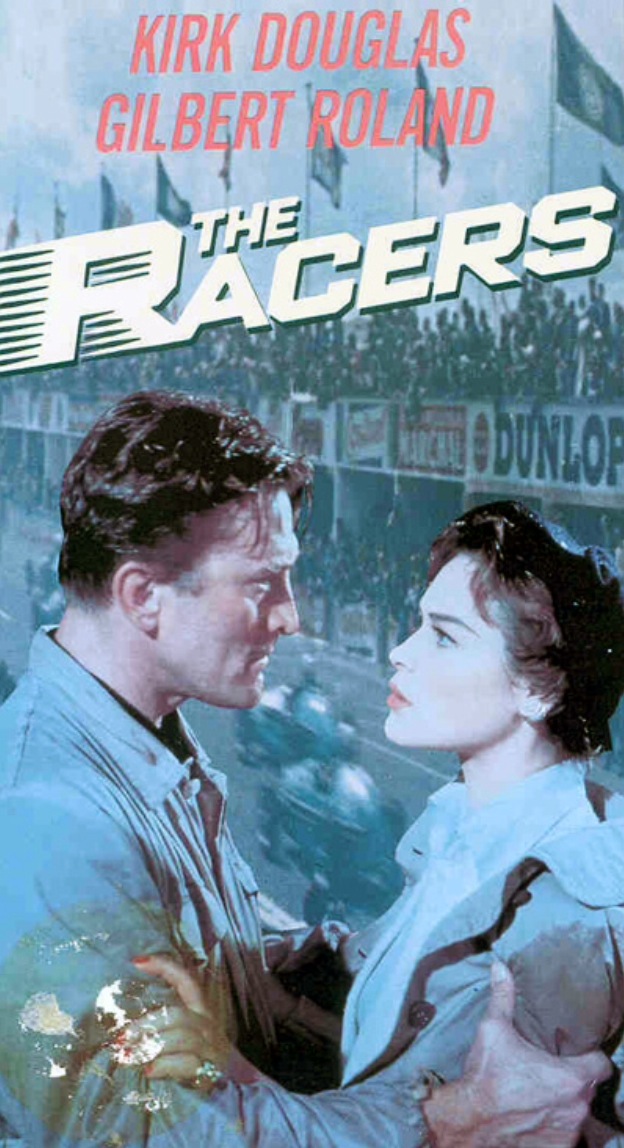
John Fitch crashes his HWM into the straw bales during the filming of ‘The Racers’ in 1954…

Cameraman Frank Phillips catches the action as ‘Gino Bergesa’ played by Kirk Douglas crashes his privateer HWM. ‘The Racers’ was a Hollywood film based on the book ‘The Racer’ written by Hans Ruesch a successful pre-war Grand Prix driver.

This photograph by Erde is in ‘Automobile Year’, neither book nor film are familiar to me but both appear to be worth a look. John Fitch was a successful driver who drove the action sequences for Douglas, this one was filmed at Monaco.

This website and article about the film are interesting;

http://www.velocetoday.com/lifestyle/lifestyle_56.php

The Racers

Photo Credit…

Erde ‘Automobile Year’

Gee Whizz…

Posted: November 1, 2015 in Compound curvature
Tags:

gee whizz

Many things spring to mind. I imagine their is a fine line between pleasure and pain in riding leathers a size or so too small. The helmet is a nod to rider safety tho its absence would have made the shot, but lets not get picky and be thankful for the creativity involved. Ideas on the make and model anyone?…

It gives a whole new meaning to concepts of an ‘early morning run’, i suspect on that particular day their were plenty of riders keen to follow than lead. No doubt ‘Fat Bob’ on the Harley struggled to keep up but no doubt he gave it a really good shake.


stew m10b

Jackie Stewart tests AJ Foyt’s Mclaren M10B Chev F5000 during Questor GP qualifying, perhaps the only time the Scot drove an F5000 car?…

The Questor Grand Prix was an intensely interesting experiment, a shame the Ontario circuit didn’t repeat it in subsequent years.

The event took place in March 1971 at the newly completed Ontario Motor Speedway. Promoted as the ‘Battle of Two-Worlds’, the USA and its Formula A/5000 cars against the best of European F1.

In 1971 there were only 11 championship F1 events so it was relatively easy for the teams to fit the event in, it gave them an extra race test without championship points at stake early in the season, and the prize money was $US278K or in 2015 $ terms, $M1.6, so it was well worth the effort!

questor tickets

For the Ontario Speedway promoters it was an ideal way to promote their new venue, the owners had aspirations of having a second US GP there, running of an event successfully provided the essential credentials to advance that goal. The event was well promoted with over 65000 punters rocking up on raceday.

The course itself comprised the start/finish straight, the first banked corner of the oval layout and a twisty infield section.

questor promo

The Grid…

The American entry included Peter Revson’s Surtees TS8 Chev, Mark Donohue Lola T192 Chev, George Follmer Lotus 70B Ford, AJ Foyt in a McLaren M10B Chev, Bob Bondurant’s Lola T192 Chev and Al and Bobby Unser, both in Lola T190/2 Chevs, Swede Savage was Eagle Mk5 Plymouth mounted and Tony Adamowicz raced a Lola T192 Chev.

donohue

Mark Donohue’s Lola T192 Chev 14th, Derek Bell March 701 Ford 15th.

lola

Tony Adamowicz’ Lola T192 Chev 17th, Graham Hill.

3 litre GP entrants included Ferrari with 2 1970 spec 312B’s (Mario Andretti and Jackie Ickx), Lotus (Emerson Fittipaldi and Reine Wisell in 72 Ford’s), BRM (Jo Siffert and Pedro Rodriquez P160, Howden Ganley P153 V12), Brabham (Graham Hill BT34 Ford ‘Lobster Claw’ and Tim Schenken BT33), Matra (Chris Amon MS120B V12), March (711 for Ronnie Peterson), Tyrrell (Jackie Stewart in 001), McLaren (M19A’s for Denny Hulme and Peter Gethin), and two privateer March 701’s entered by Frank Williams (Henri Pescarolo and Derek Bell).

seppi

Siffert in his ‘brand spankers’ BRM P160, Reine Wisell and friend, McLaren’s Hulme & Gethin.

denny

Attractive young maiden and Hulme poring over the innards of his McLaren M19A.

We may never see such a star studded battle ever again.  All the heavy hitters from each side of the Atlantic were there.  A race fans dream which some saw as a repeat of Monza’s ‘Race of Two Worlds’ held in 1957 and 1958.

denny 2

Denny Hulme, McLaren M19A Ford 3rd and Ronnie Peterson, March 711 Ford 13th.

jys

L>R top to bottom. Hill in his Brabham, #29 Ron Grable Lola T190/2 Chev #8 Denny Hulme McLaren M19A Ford, #28 Stewart McLaren M10 B Chev, Peterson March 711 Ford, Howden Ganley BRM P153.

Racing…

stew grid

Stewart, Tyrrell 001 Ford, Siffert BRM P160 and Ickx Ferrari 312B on the grid. (unattributed)

The race was run in two 100-mile heats because the F5000’s didn’t have the fuel capacity for a 200 mile race, a GP’s normal duration.

Mario Andretti, having just taken his first GP win in the season opener at Kyalami, South Africa, had an accident in qualifying on Friday and missed most of the session.  He also had an Indy race on Saturday at the Phoenix Oval. He started in 12th place, standing on his Friday time.

With AJ Foyt racing at Phoenix Jackie Stewart did some laps in his McLaren M10B doing a time good enough for 11th on the grid. Foyt was uncomfortable with the Scots setup and reverted to his own.

Jackie Stewart was on pole in his Tyrrell from Amon, Ickx, Hulme, Rodriguez and Hill with Donohue’s Lola the best of the F5000’s, then Siffert, Fittipaldi and Follmer’s Lotus 70.

hill

Hill, Brabham BT34 Ford 26th, Siffert.

ickx

Hill and Ickx, Ferrari 312B 11th.

amon

L>R top to bottom. Fittipaldi, Andretti, Amon Matra MS120B 4th from Ickx Ferrari and Hulme’s McLaren M19A..

In the first heat Andretti worked his way to the front, caught and passed Jackie Stewart under braking for the first turn and won pulling away, much to the delight of the American crowd.

Initially Ickx used his Ferrari’s power to take the lead from Stewart, Amon, Hulme, Hill and Siffert . Spins for Siffert and Hulme dropped them back, while Stewart battled to get past Ickx, outbraking him and moving ahead. There was a high attrition rate, Foyt retired early with handling issues and Follmer with an oil fire in his Lotus, Hill was the first F1 car to drop out as he felt his Cosworth engine tighten, Savage crashed his Eagle heavily into a concrete wall off the infield section of the course suffering severe leg and head injuries. Their were other Chevrolet failures amongst the Formula A contenders, both the F1 and 5 litre cars engines were suffering as a consequence of the long straight and therefore long period at maximum revs.

hulme

Hulme on row 2 McLaren M19A, Ickx Ferrari 312B behind, nose in shot is the Brabham BT33 of Tim Schenken. (The Cahier Archive)

wisell

Reine Wisell, Lotus 72 Ford, ret’d.

Andretti was moving up, Donohue, defended strongly in his Lotus before Andretti passed him for third, which became second when Amon pitted with a puncture.

Together with three laps remaining, Andretti moved ahead to the delight of the crowd, taking the win from Stewart, Donohue was forced to pit from third with fuel injection dramas allowed Siffert into 3rd with his BRM.

Retirements included both Marchs; Pescarolo with a cracked chassis member and Peterson going off after a shock absorber failure, both Lotus 72s retired, Fittipaldi with an injection issue.

andretti

Mark Donohue’s FA Lola T192 Chev 14th ahead of Andetti’s Ferrari 312B 1st. (unattributed)

In the 2nd heat outside front row starter Jackie Stewart got the jump on Andretti and led.  Andretti stalked Stewart for a handful of laps then repeated his first turn, first heat overtaking manouevre on Stewart to take the lead and the win.

Twenty-two cars gridded for heat two 45-minutes after the first. Foyt was persuaded to venture out in his McLaren Chevy and Peterson rejoinined after repairs but only once a large part of the race had been run.

Andretti was on pole but lost out to Stewart on the opening lap. Behind, Siffert led Ickx, Hulme, Amon and Donohue, that order changed when Ickx tried to dive past Siffert at the end of one of the short straights, Ickx spun and took Siffert with him.  Whilst Seppi continued Ickx pitted with a puncture.

stew

Stewart, Tyrrell 001 Ford 2nd.

Luckless Donohue pitted from third with injection dramas after a fine run, easily the quickest of the Formula A’s in his Penske Lola T192, Amon took over third in his Matra.

At the front, Andretti was closing in again on Stewart, the Tyrrell suffering a broken rear anti-roll bar which was causing issues on the banking, Stewart elected to yield as Andretti made his move.

The tough nature of the circuit again took its toll. Even Andretti was impacted, his Ferrari not revving cleanly and puffing smoke. He held on to win though with Stewart second from Amon. Rodriguez benefited from Siffert slowing after losing a suspension bolt to take fourth ahead of Hulme, Schenken and Ron Grable the first FA car home in seventh.

cannon

John Cannon in an STP sponsored March 701 Ford 12th. (unattributed)

andretti

Andretti’s victorious Ferrari 312B in essentially 1970 spec. (The Cahier Archive)

In terms of overall results the complex points structure meant that a car with a high finish in one race could outscore a car that had finished both, gave Andretti the win he deserved, Stewart was second from Hulme, Amon and Grable heading the US-runners in seventh.

The race was popular with the crowd, the American racers felt their cars had been uncompetitive and the European’s, other than those who had extensive sportscar experience of Daytona, were not fond of the banking!

The Questor Group, builder/owners of the circuit encountered financial problems shortly after the event so it was not repeated, leaving it a ‘great might have been’.

Certainly as F5000’s became more sophisticated into the 1970’s, the Lola T330/2 famously as quick as many F1 cars at Mosport and Watkins Glen, circuits upon which they both raced, would have made such an event much closer, perhaps, than the Questor GP was in 1971?

Overall Results: 1 Andretti; 2 Stewart; 3 Hulme; 4 Amon; 5 Schenken; 6 Siffert; 7 Grable; 8 Gethin; 9 Ganley; 10 Rodriguez. Fastest Lap: Rodriguez, 1m42.777s (111.49mph).

winners

L>R top to bottom. Hill/Schenken/Peterson and friend, happy winner Andretti, Jo Siffert

Etcetera…

ickx

Ickx doing a few laps in Andretti’s chassis during practice, Ferrari 312B. (unattributed)

gethin

L>R top to bottom. #7 Gethin McLaren M19A Ford 8th, #14 Siffert BRM P160 6th, #2 Fittipaldi Lotus 72 Ford 21st, John Cannon March 701 Ford 12th.

tim

Tim Schenken Brabham BT33 Ford, 5th.

YouTube Footage…

Etecetera…

swede savage

Dan Gurney’s protege Swede Savage deserved a more competitive car than the ’69 Eagle Mk5 Plymouth, the oldest car in the race. He crashed heavily and didn’t return to racing for 6 months after severe leg injuries and a ‘bruise to his brain stem’. (unattributed)

al

Al Unser in his ‘Kastner Brophy Racing’ Lola T192 Chev, #38 behind in the colour shot is brother Bobby’s similar ‘Charlie Hayes Racing’ T192. (unattributed)

ontario

Ontario lap 1 Questor GP vista (unattributed)

ickx

Andretti’s Ferrari 312B, lines of that 1970/71 series of Ferrari’s about as good as it gets?, #18 Henri Pescarolo’s Frank Williams March 711 Ford (unattributed)

entry

1971 Questor GP entry (unattributed)

jys

Reine Wisell top left and Jackie Stewart, Foyt F5000 McLaren M10B mounted, engineeer familiarising JYS with the dash and rev limits ‘7500 not 10500 pleeease Jackie…’

Bibliography…

The Nostalgia Forum, oldracingcars.com, HistoricRacingNews.com

Photo Credits…

Getty Images-all images by Getty unless otherwise stated, The Cahier Archive

exhibition
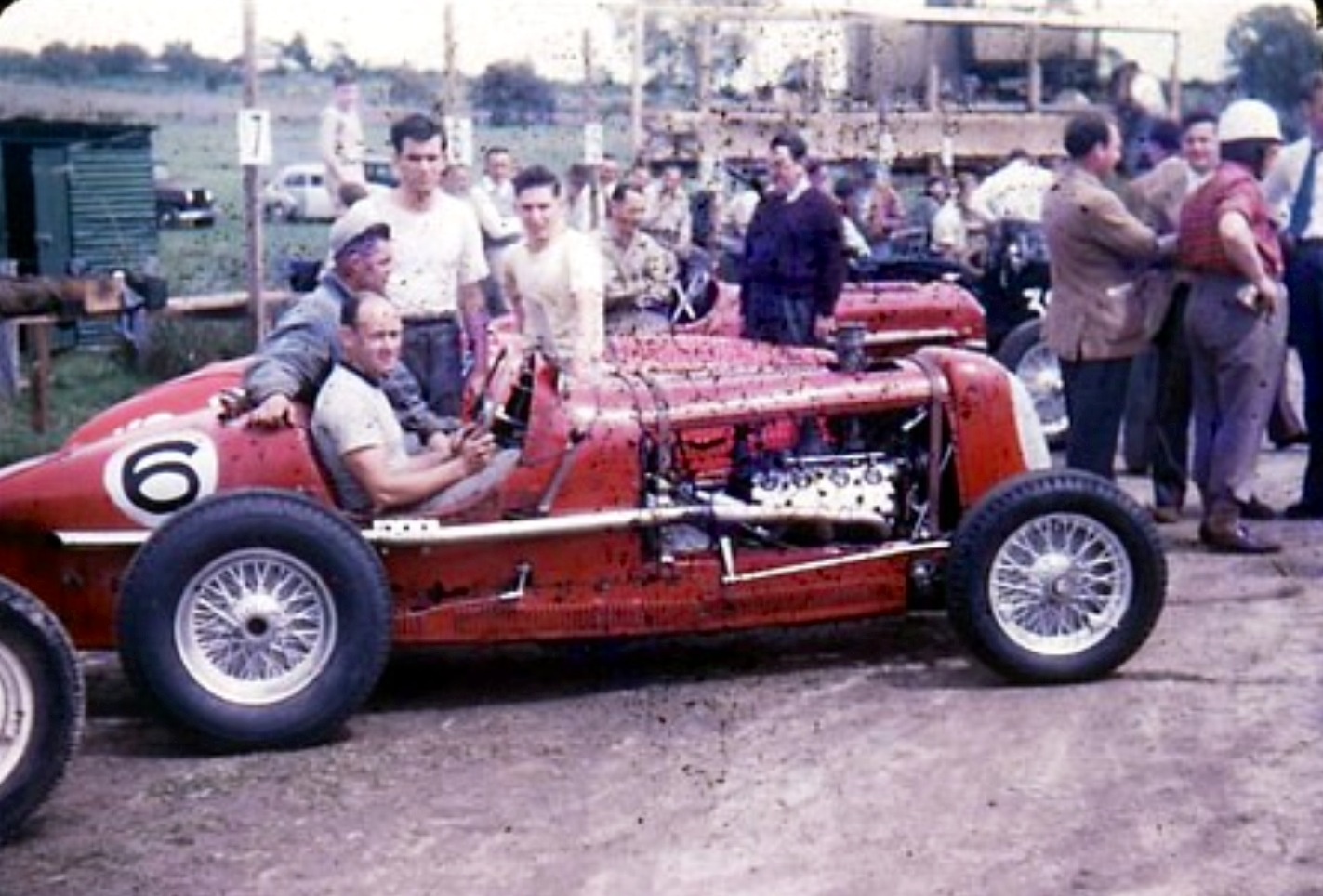
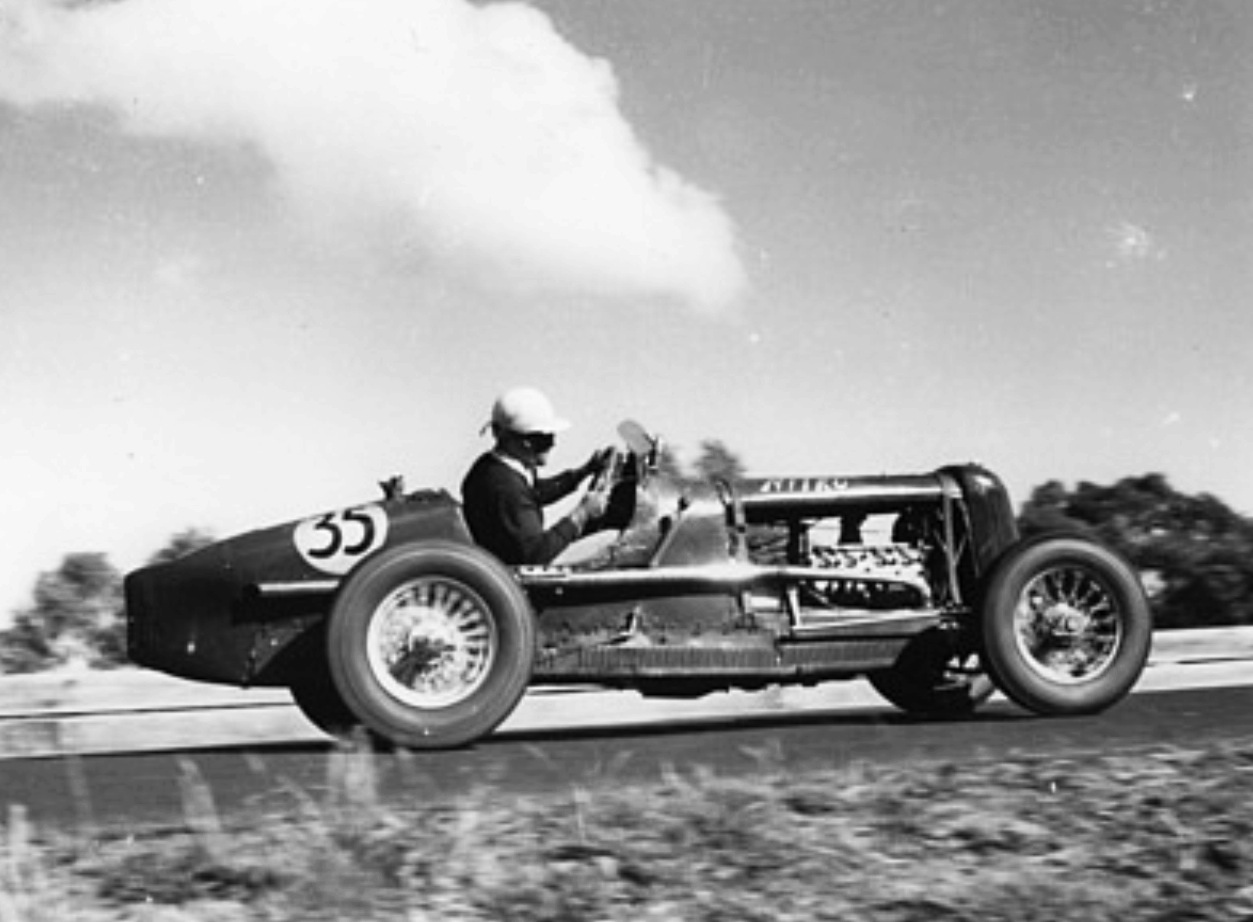
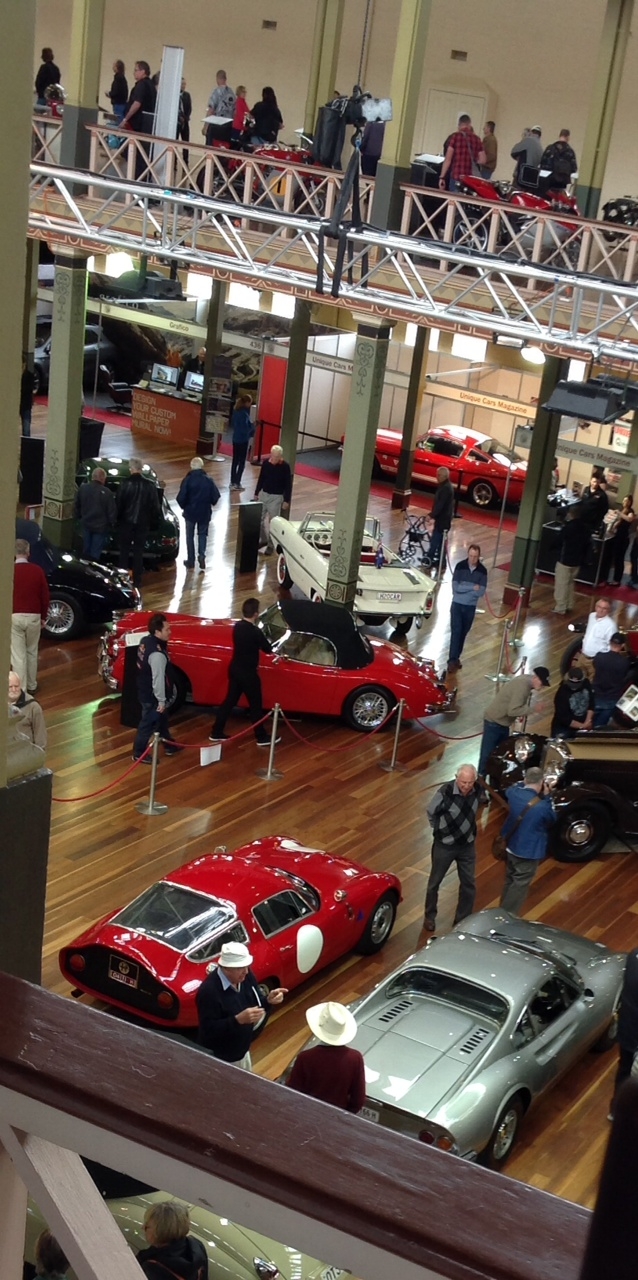
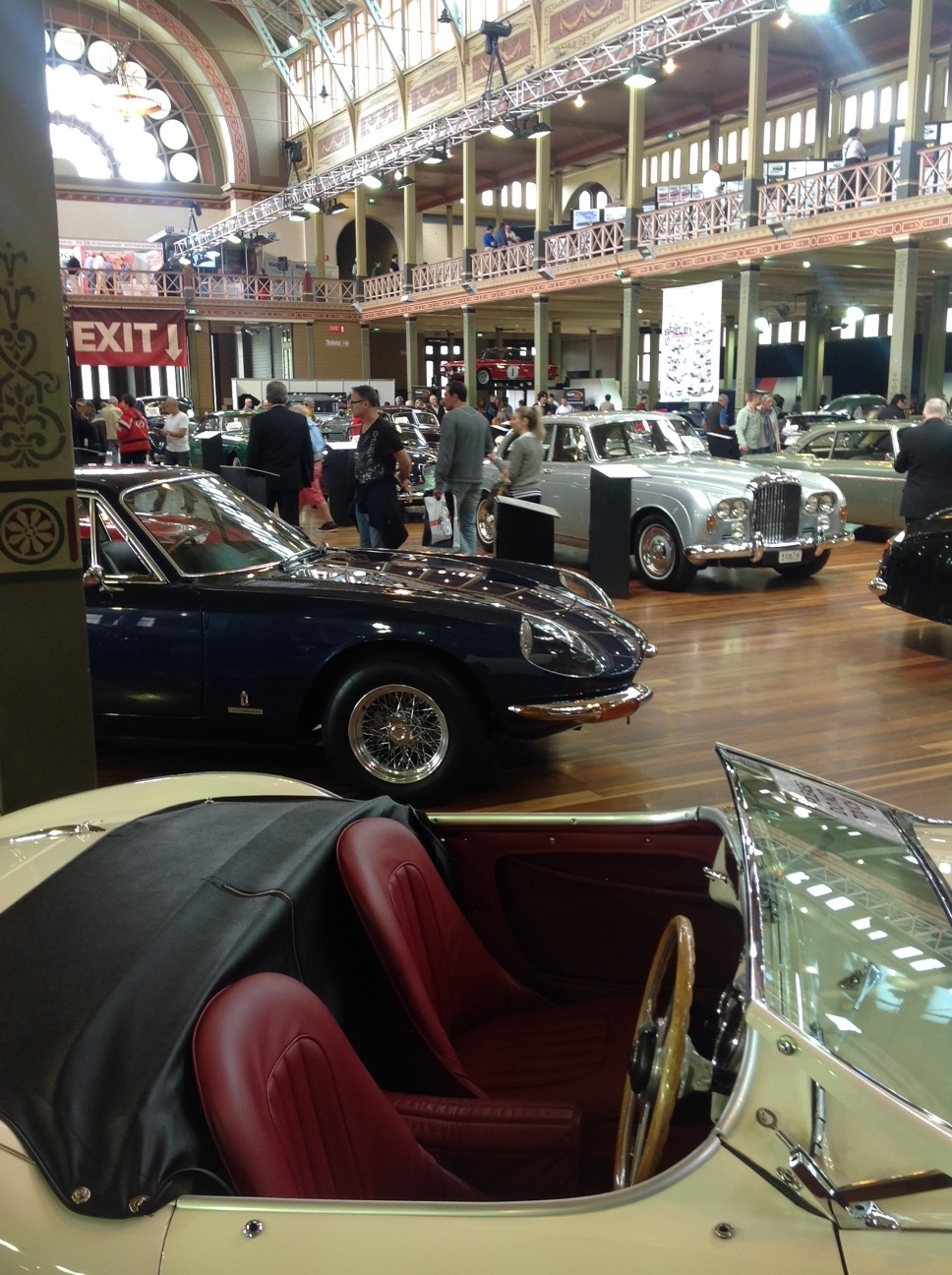
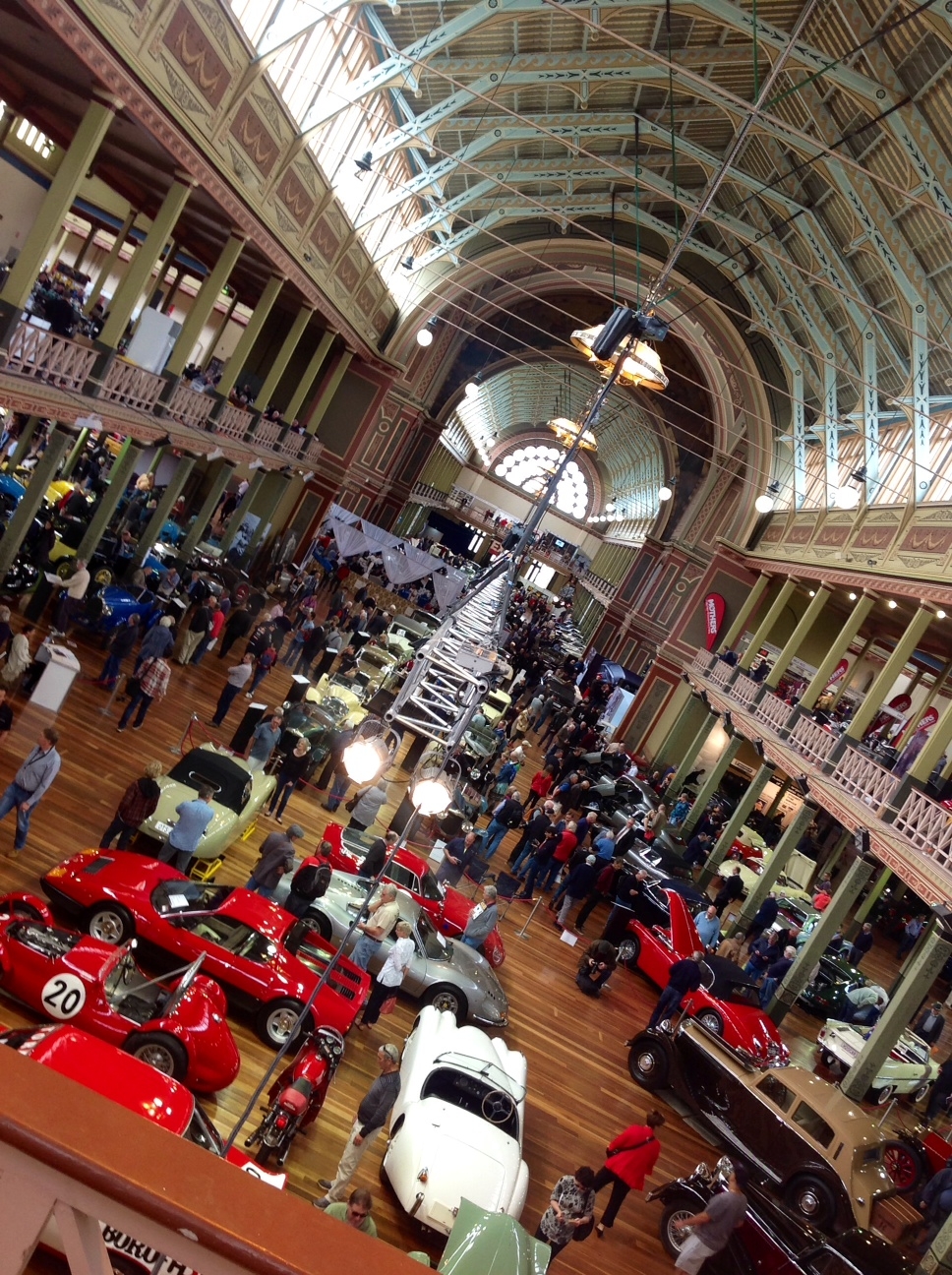
‘Motorclassica’ is now 5 years old, although its the first time i have been, its a bit too road car oriented to pique my interest, but it was great. The assembly of Bugatti’s worth the effort alone, the highlight of that display the first public appearance in over 60 years of the T37A Bill Thomson drove to two AGP wins in 1930 and 1932…
The event comprises a motor show, themed each year, a Concours d’Elegance which is
one of only two Australian events nominated in the prestigious International Historic
Motoring Awards. There is also a tour through the city streets for Concours entrants, an auction and over 400 enthusiast owned cars on display in the Royal Exhibition Building’s surrounds.
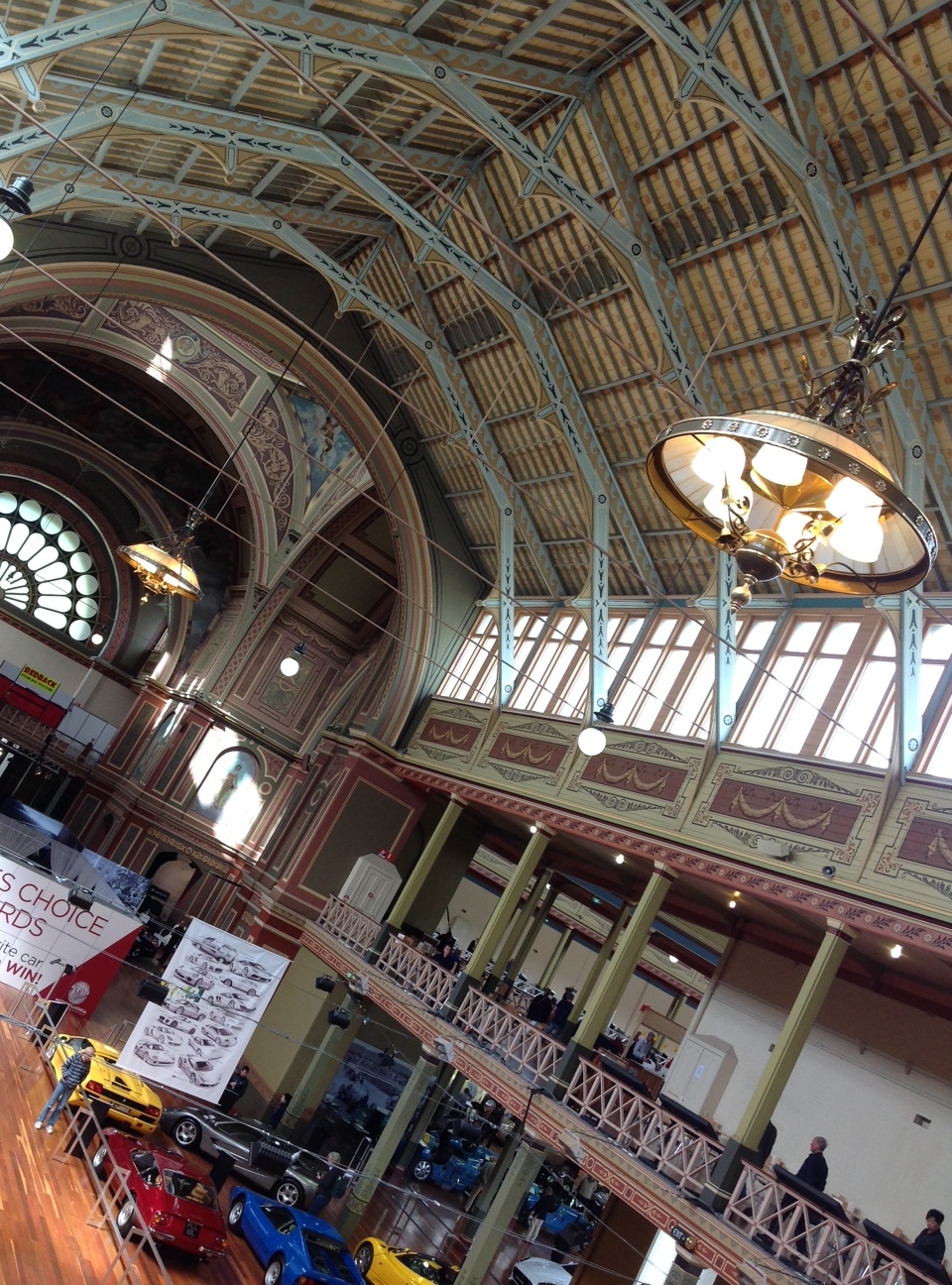
The venue is in Melbourne’s CBD fringe, The Royal Exhibition Building erected in the Carlton Gardens for the Melbourne International Exhibition in 1880 showed the cars to great effect, a terrific backdrop with a sense of grandeur that is apt.
reb
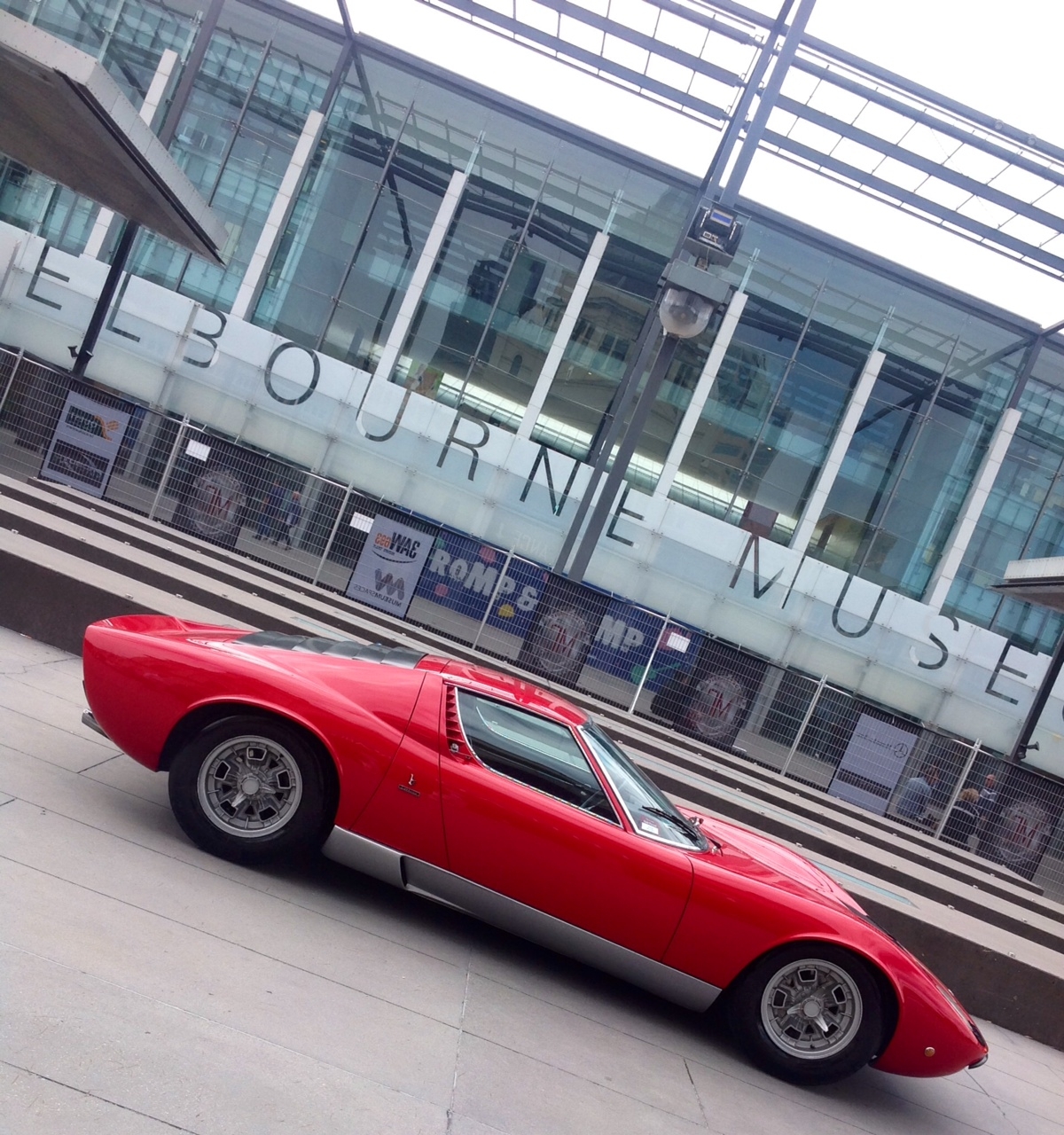
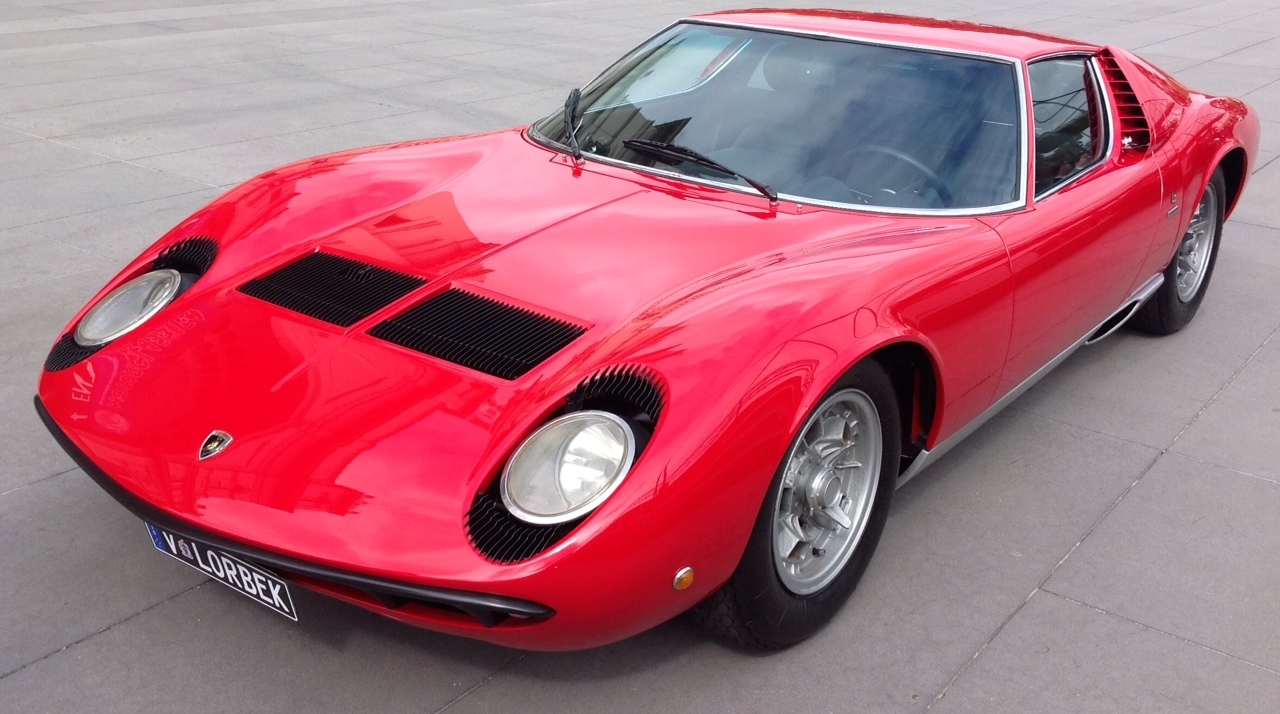
Themes this year were celebrations of 50 Years of the Supercar, (defined as the build date of the Lambo Miura), the Shelby Mustang, the Ferrari Dino, the Bugatti Club Australia and 70 years of MV Agusta.
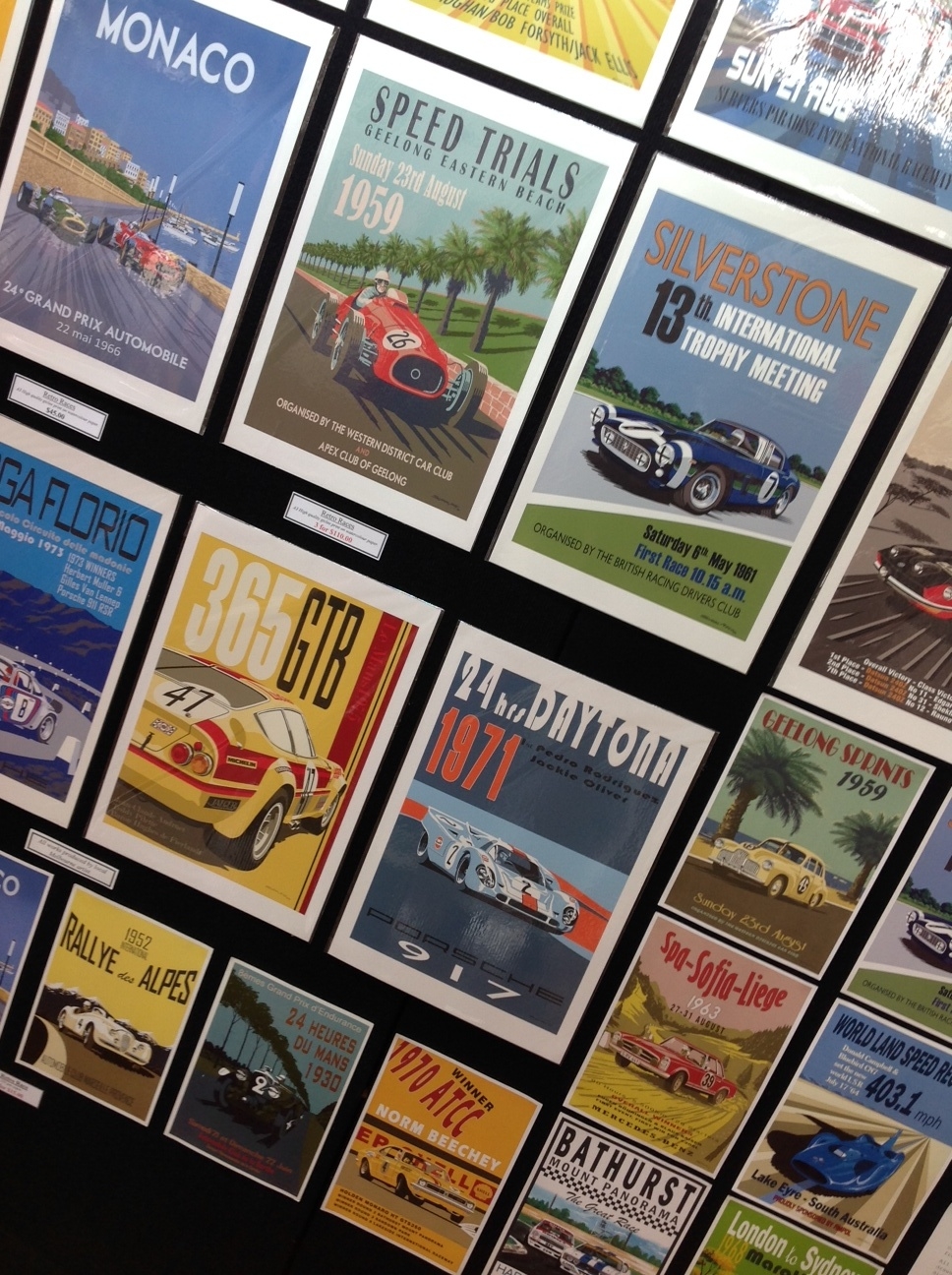
This post is largely pictorial with the exception of a tangent about the dual AGP winning Bugatti T37A and its driver Bill Thomson, which ‘broke cover’ at Motorclassica. I have not gone overboard with captions to ‘state the obvious’ only providing information where it may be of use…
porkers
ballot 1

Ballot 2LS

ballot 2

Ballot 2LS

ballot info
ballot steering

Ballot 2LS

art

(Artist; Martin de Lang)

miura 1
miura 3
 mv 1
mv 2
mv 3

1971 MV 150RSs: ‘Rapido Super Sport’ 4 stroke single cylinder pushrod OHV.

mv 4

MV 150 RSs

mv 5

1946 MV Agusta 98

mv 7
mv 6

MV 98

merc
 bentley 1
 bentley 2
 panorama
bug 1
bug 2

Bugs x 2: Nose of a T43 and front of T57

bug 4

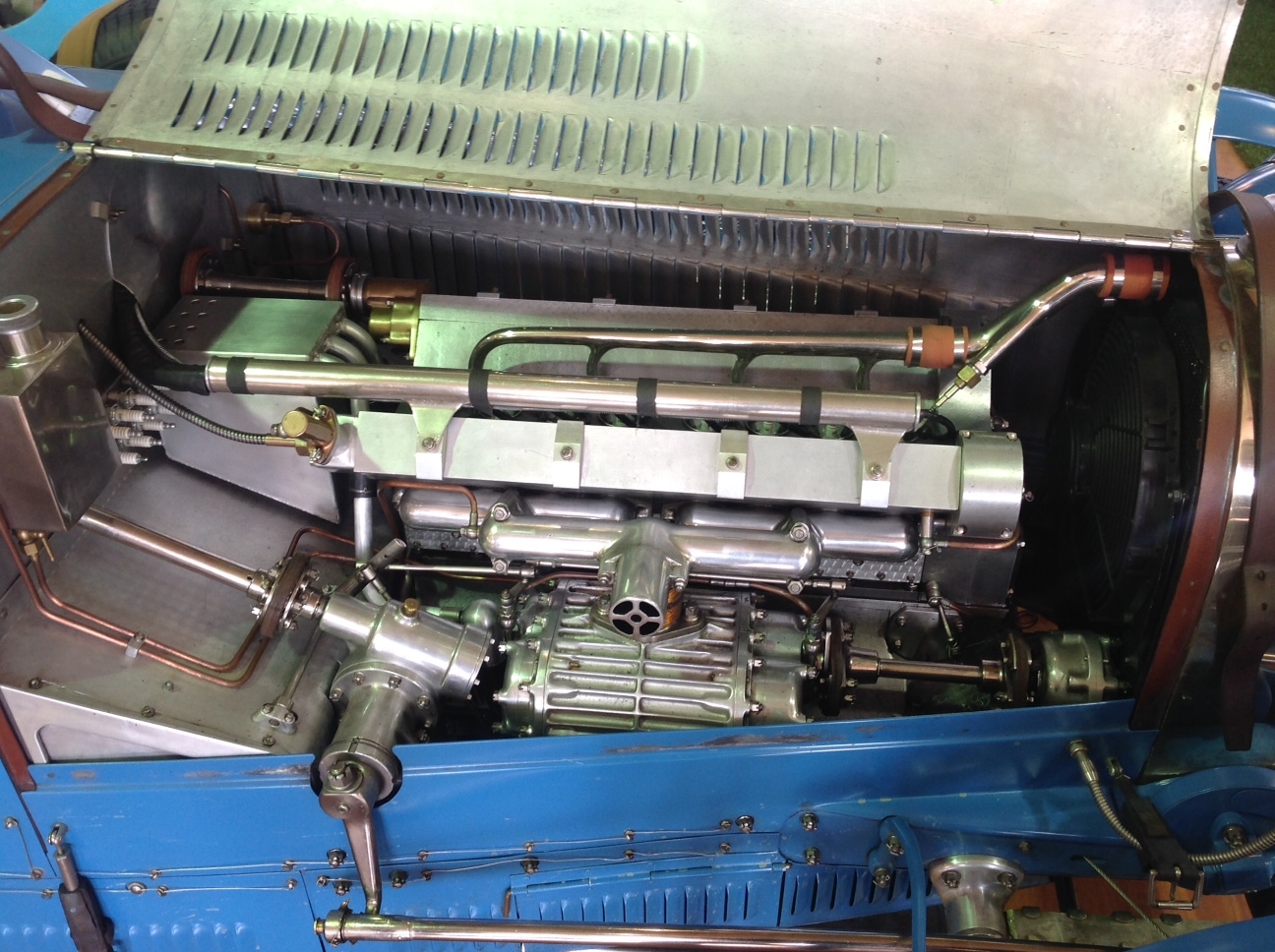
Supercharged Bug 4 cylinder engine, maybe one of you can help me with the correct model, a Tourer.

Dual Australian Grand Prix Winner: Ex Bill Thomson Bugatti Type 37A Chassis ‘37358’…

37 1

Bugatti T37A ‘37358’ in all its part restored glory. This T37 victorious in 1930 and 1932 is the veteran of more Australian Grands Prix than most.

37 2

T37A ‘37358’37 3

As the owners summary of the car makes clear the cars attendance in Melbourne is the first time this significant Bugatti has ‘seen the light of day’ in public for over 60 years.

In Bob King’s ‘Australian Bugatti Register’ ‘37358’ is said to be ‘…possibly the most famous of all Australian racing Bugattis’. The following short history of the car is from John Blanden’s ‘Historic Racing Cars in Australia’ is in addition to the short description above.

For the 1930 AGP the car was specially prepared with wire wheels and separate brake drums in place of the integral alloy equipment because of the roughness of Phillip Island’s gravel roads. After early plug trouble Bill Thomson was a comfortable winner in 3 hours 6 minutes, an average of 64mph in front of 6000 spectators, the ‘Island in those days a long way from Melbourne.

thommo island

Bill Thomson and car owner/riding mechanic Prof Arthur Burkitt, during their successful 1930 AGP win. Phillip Island. Bugatti T37A ‘37358’. (Bob King Collection)

In 1931 Hope Bartlett bought and raced the T37 but blew up with less than 7 miles to go whilst in the lead. Carl Junker won in a Bugatti T39.

For 1932 Thompson again raced the car which by this stage was owned by the Woolworth Tyre Company. It was off scratch giving 4 minutes to Carl Junker. Thomson won by 4 minutes having come through the field.

thommo

Bill Thomson before the off, AGP 1930, Phillip Island. Thomson won 3 AGP’s 1930 and 1932 in ‘37358’ and 1933 in a Riley Brooklands. Period experts rate Thomson and Alf Barrett as Australia’s greatest pre-War drivers, noting Alf raced post-war as well. Thomson certainly the more successful in terms of results. Thomson perished during the war in a Consolidated Coronado flying boat accident in the Marshall Islands enroute to Hawaii. A shot biography of Thomson is included as an addendum to this article. (Bob King Collection)

In October 1932 at the Mt Victoria Pass Hillclimb, in Sydney’s Blue Mountains, the car crashed heavily ‘as a result there have been suggestions that a replacement chassis was required, obtained and fitted but this has never been absolutely confirmed’.

Offered for sale but unsold, in May 1935 Thomson took the Australian Record for the Mile at 112.5 in the annual speed record attempts held near Canberra.

John Sherwood won the Australian 5 Mile Championship at Penrith Speedway in it, in Sydney’s outer west in 1936.

Tom Peters acquired it and raced it in the 1936 Australian Grand Prix (or 1937 Australian GP as has become the custom to call this event) at Victor Harbour, South Australia in December, retiring on lap 7.

‘37358’ was sold to New South Wales driver Ron Mackellar, shortly thereafter the cars engine blew and was replaced by a side-valve Ford V8, the car called the ‘Mackellar Special’. Raced at the 1938 AGP at Bathurst it finished 4 minutes behind Peter Whitehead’s victorious ERA R10B.

Wally James was driving the car during a qualifying heat of the Australian Speedway Championships at Penrith on Anzac Day, 25 April 1939 when he lost control and plunged into a group of spectators at over 90mph, killing 3 and injuring 39. James was shattered and never raced again, although a later enquiry showed the crowd sitting in front of safety fences.

Driven by Ken Laing for a while post war, the car was sold to ‘Gelignite Jack Murray’, a real character of the sport and so named for his antics with explosives in the Round Australia Trials of the period. Murray was successful in the now very old car, it contested the 1947 AGP at Bathurst, retiring with piston failure. Bill Murray won the race, Formula Libre and handicapped in those days in an MG TC.

mac spl

Bill MacLachlan in ‘37358’, by that stage the ‘Mackellar Spl’ at Bathurst , Easter 1949 just before its wild ride thru the bush due to a broken track rod. (Bob King Collection)

The car then passed through John Crouch’s and Bill MacLachlan’s hands, Bill had a lucky escape in the car upon his debut in it at Bathurst, Easter 1949. A broken track rod approaching Quarry Bend caused a wild ride down ‘the roadside bank missing solid trees by inches before it came to rest in a small clearing’.

mac pits

MacLachlan in T37A ‘37358’ Mackellar Spl Ford V8, Bathurst 1950. (Max Stahl Collection)

Little damage was done, the old war horse continued on racing, Ettore made em’ tough! through 1950 when it was timed over the flying quarter mile at Bathurst at 113.21mph. Into 1951 ‘37358’ continued to race including contesting the 1952 AGP at Bathurst finishing 13th in the race won by Doug Whiteford’s Lago Talbot T26C.

mac sky

Bill MacLachlan at Quarry Bend Bathurst 1952. T37A ‘37358’ Mackellar Spl. (Byron Gunther)

In 1954 the car was sold to Ralph  Snodgrass in Queensland, he used it briefly before acquiring Whiteford’s Lago, rolled the Lago and then kept both cars for decades.

‘While the car remained with Snodgrass in 2000, many of the original Bugatti components have been emerging over the years as various restorations evolve. Tom Roberts was suggested to have the ‘original’ chassis and some other ‘bits and pieces’ with Kent Patrick having other chassis and engine parts in a replica T37A he constructed in the 1980’s’ Blanden said.

Clearly ‘37358’ is in sympathetic hands with Michael Miller’s ownership, Buggatiste’ globally will follow with interest the restoration of this fabulous car and revealing its history in ‘definitive form’.

37 4

T37A ‘37358’

bug 8

T35TC/51 chassis  ‘4847’ GP: DOHC supercharged straight 8

outside
posters
mustangs
bristol

Bristol Zagato

pano 2
bmw
bentley
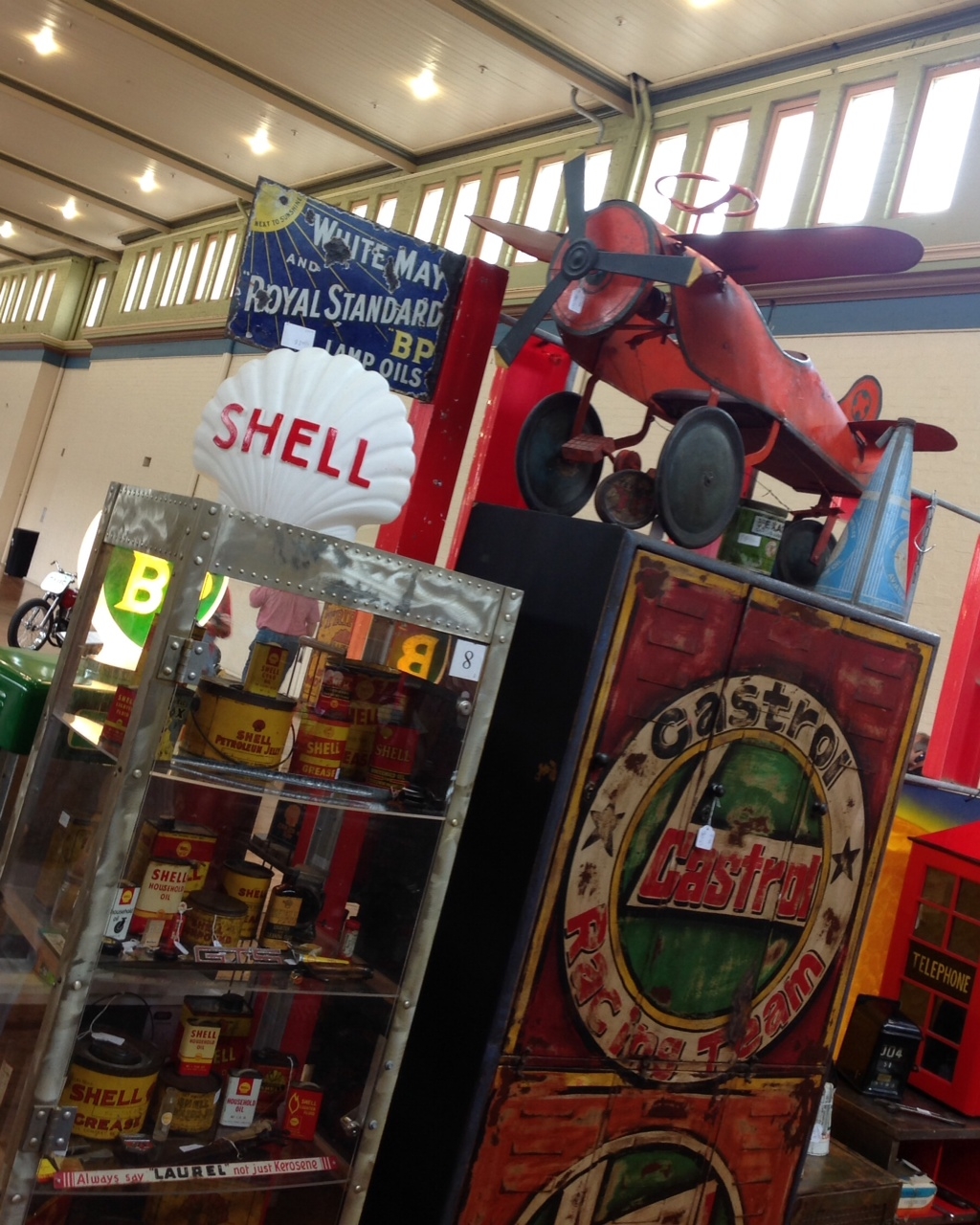
shell
pano 3
Tailpiece: A dogs life…
dogs
Bill Thomson: Triple Australian GP Winner Biography…
The following biography of Bill Thomson is by the late, great Australian Motor Racing Historian Graham Howard and is from ‘The Australian Dictionary of Biography’.
‘William Bethel Thompson (1906-1945), racing motorist, was born on 28 December 1906 at Summer Hill, Sydney, second child of William Ernest Thompson, customs clerk, and his wife Gladys Macdonald, née Bethel, both native-born. On completing his education at Sydney Grammar School in 1923, William worked in the motor trade. He married Jean Mavis Anderson at St Stephen’s Presbyterian Church, Sydney, on 26 September 1929.

Of moderate means, he was helped by Arthur Burkitt, professor of anatomy at the University of Sydney, who owned several of the cars that Thompson raced. He retired from his first Australian Grand Prix at Phillip Island, Victoria, in 1929, but won the 1930 race in a new, supercharged Type 37A Bugatti owned by Burkitt who travelled as riding mechanic. Starting from scratch, Thompson won again in the same car in 1932 and won for a third time in a Brooklands Riley in 1933. He finished second (by 14 seconds) driving a supercharged MG Magnette in 1934 and was again second (by 27 seconds) in 1935.

Despite his youth, Thompson approached his driving with a thoroughness that was uncommon in Australian motor racing, then in its infancy. Observers commented on the clean and efficient presentation of his cars, and on the lack of last-minute work they needed. Behind the wheel he was very fast and exceptionally consistent; his lap times on the 6.569-mile (10.571 km) rectangle of rough and dusty Phillip Island roads often varied by no more than a second. An outstanding finishing record was an essential part of his success. While he made occasional driving errors, he took exceptional care of his cars. He did some of his own mechanical work, but had expert helpers, among them the skilled engineer Bill Balgarnie who was often his riding mechanic.

Strongly built and about 5 ft 11 ins (180 cm) tall, Thompson parted his dark hair in the centre. Contemporaries recall him as well-tailored, confident—almost calculating—but also impulsive and given to practical joking at post-race parties. His Riley and MG drives were for Melbourne motor traders and he moved to that city in 1934 to head the MG department of Lane’s Motors Pty Ltd; he later transferred to the Shell Co. of Australia Ltd. He was briefly involved with midget speedcars in Melbourne and Sydney in 1934-35, but from 1936 his racing career faded. Divorced in 1938, Thompson married Millicent Francklyn Ironside, née King, a widow with two children, on 10 June 1942 at the government statist’s office, Melbourne.

Joining the Royal Australian Air Force as flying officer in 1940, Thompson was based in Melbourne from 1941 where he organized the manufacture and supply of engine spares for rescue boats. He held the rank of squadron leader when he was drowned in an aircraft accident on 12 February 1945 in the Marshall Islands, Pacific Ocean. His wife survived him, as did the two sons of his first marriage’.

Bibliography and Photo Credits…
John Blanden ‘Historic Racing Cars in Australia’, Graham Howard ‘History of The AGP’, Graham Howard ‘The Australian Dictionary of Biography, Bob King Collection, Max Stahl Collection, Byron Gunther

beltoise brm

All drivers have a day of greatness, surely!? Jean Pierre-Beltoise’ was his great wet weather drive at Monaco in 1972 when he won the race in a drive of controlled speed and aggression in the toughest of conditions in his BRM P160B V12…

Even ‘Rainmaster’ Jacky Ickx finished second to the Frenchman in his Ferrari 312B2 that day with Emerson Fittipaldi’s Lotus 72D Ford in third.

JPB started from row 2, his task made a little easier on lap 5 when Clay Regazzoni went up the escape road at the chicane taking Fittipaldi and Ickx with him, they had been braking when Clay did…

But it was a great drive, JPB’s first and last GP win and BRM’s last, sadly.

Click here for an article on JPB i wrote a while back… https://primotipo.com/2015/01/15/r-i-p-jpb/

image

Beltoise with Chris Amon’s Matra MS120C alongside and Brian Redman’s McLaren M19A Ford chasing (Michael Turner)

Monaco GP ’72 footage…


stew laguna

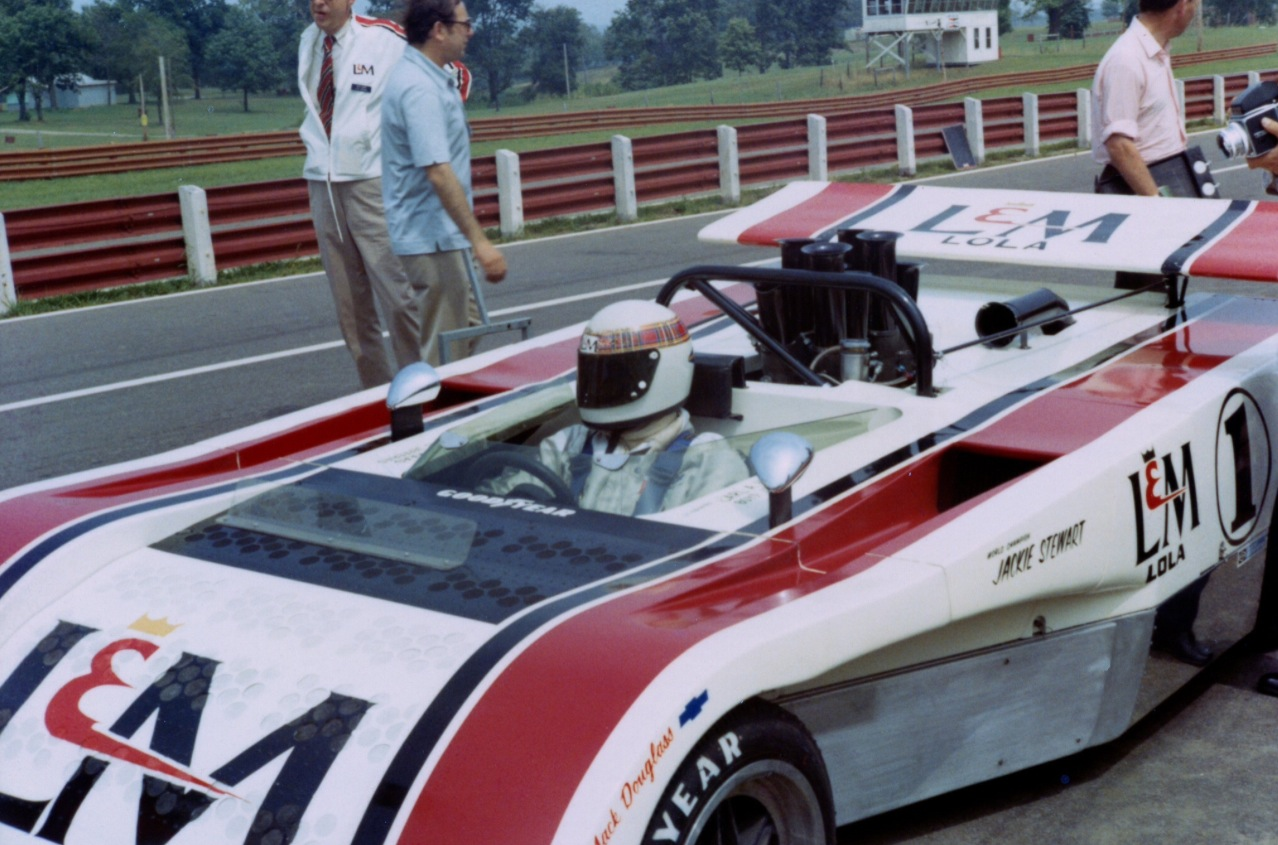
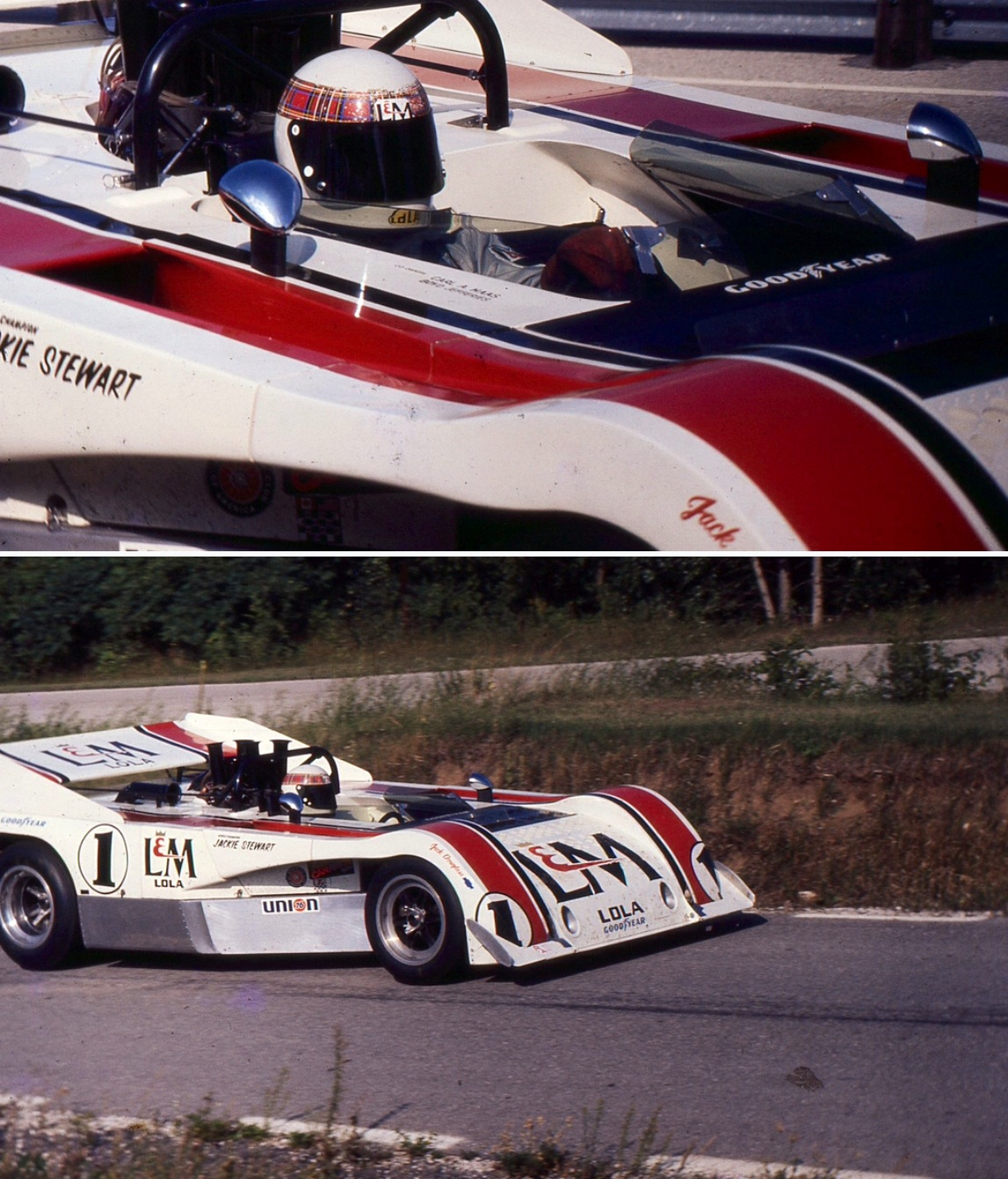
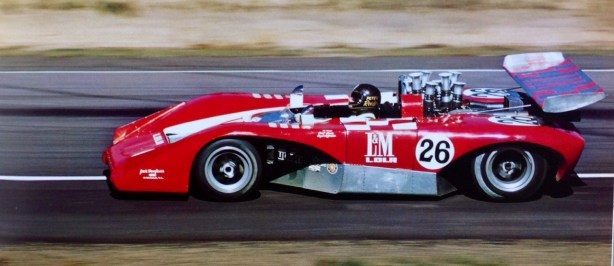
Jackie Stewart and his ‘Cowcatcher Winged’ Lola T260 Chev, Laguna Seca 1971 (Pete Biro)

It was always going to be tough to beat the dominant McLaren team, but the combination of World Champion Jackie Stewart and Lola, who had a strong Can-Am track record looked a good combination to give them a run for their money in 1971…

team meeting

JYS convening a team engineering and set-up meeting in the Road America paddock, August 1971. Bob Marston in red shirt, JYS and in the green hat George Woodward (Jim Buell)

Part 1: Lola and the Can-Am Challenge…

john and bruce

John Surtees, Lola T70 Mk2 Chev leads Bruce McLaren’s McLaren M1B Chev at St Jovite, Mont Tremblant, 11 September 1966, they finished in this order. (unattributed)

The Can-Am morphed out of a series of professional level sports car races which had taken place for over a decade, in 1965 this comprised four events, three were won by the Chaparral 2 and one by a Lola T70.

surteees monterey

John Surtees, Lola T70 Mk2 Chev at The Corkscrew, Laguna Seca, 1966 (Dave Friedman Collection)

The first Can-Am series held in 1966 was won by John Surtees in a quasi-works Lola T70; ‘Big John’ won three races, Dan Gurney and Mark Donohue one apiece in Lola T70s, with Phil Hill taking a solitary win aboard a Chaparral 2E.

While Colin Chapman designed the first modern-monocoque single-seater, the Lotus 25, which made its debut at Zandvoort in 1962, it was Eric Broadley who first applied the new construction technique to a sports-racer with his 1963 Lola Mk6 Ford.

lola mk 6

Augie Pabst’s John Mecom owned Lola Mk6 Ford, Road America 500 1964 DNF (unattributed)

Chapman was convinced the backbone chassis which worked so well in his Elan road car would migrate to sports-racing success but the Lotus 30/40 chassis were as floppy as a centenarians todger with results reflecting same; even Jim Clark could not make those cars sing.

So impressed were Ford with Eric’s Mk6 he was famously contracted to lead the design team of its GT40, a car with a steel tub.

monterey vista

Monterey Grand Prix, Laguna Seca, 16 October 1966. Phil Hill won in a Chaparral 2E Chev. Bottom left is Dan Gurney with his Ford powered Lola T70 (Dave Friedman Collection)

surtees

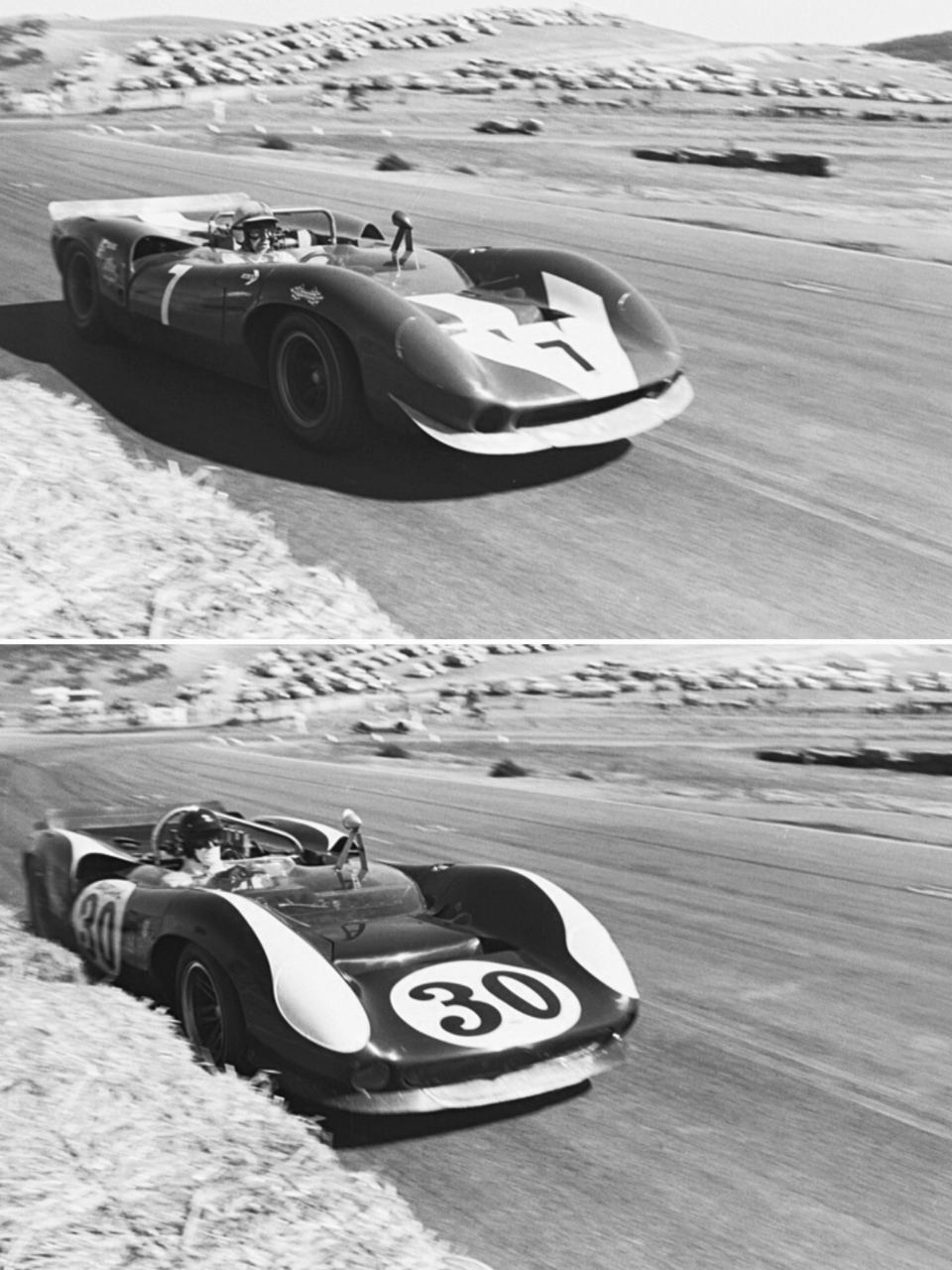
#7 John Surtees Lola T70 Mk2 Chev 12th and #30 Dan Gurney Lola T70 Ford DNF, Laguna Seca, October 1966 (Dave Friedman Collection)

The aluminium tubbed T70 was one of his first designs after his Ford sabbatical, that design process was useful in terms of evolving the car Eric thought Ford should have built in the first place!

In all its variants the T70 remained a competitive tool in both Group 7 (Can-Am) and Group 5 World Sports Car Championship events into the dawn of the 1970s. Teddy Pilette qualified his Team VDS Mk3B 19th at Le Mans in 1971, not bad for an old car with a pushrod OHV V8 against the might of the 5-litre, 12 cylinder Porsche 917 and Ferrari 512!

In endurance racing the T70 was really only held back by a suitable engine, the 12/24 hour longevity or lack thereof of the Chev engines usually chosen to power it. The small block Chev didn’t have the benefit of factory investment in its development in the same way Ford’s Le Mans winning small block Windsor V8 did.

sebring

Roger Penske’s Donohue/Parsons Daytona winning Lola T70 Mk#B Chev at Sebring in 1969. Here DNF driven by Ronnie Bucknum and Mark Donohue (unattributed)
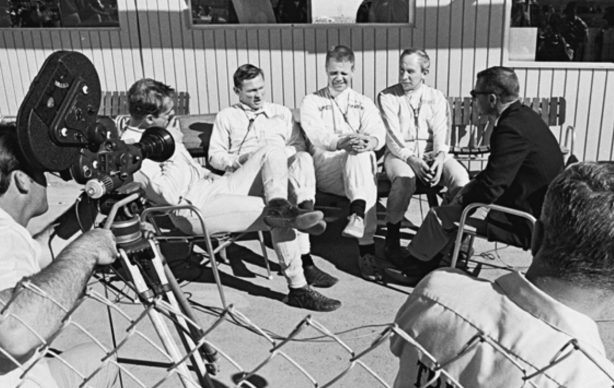
interview

Top Guns interviewed for the TV, Las Vegas 1966: McLaren, Parnelli Jones and Surtees (Dave Friedman Collection)

start

Stardust Grand Prix 13 November 1966, Las Vegas 1966 start. #7 Surtees Lola T70 Mk2 Chev first, #65/66 Phil Hill seventh, Jim Hall DNF both Chaparral 2E Chev, #5 Chris Amon McLaren M1B Chev DNF (Dave Friedman Collection)
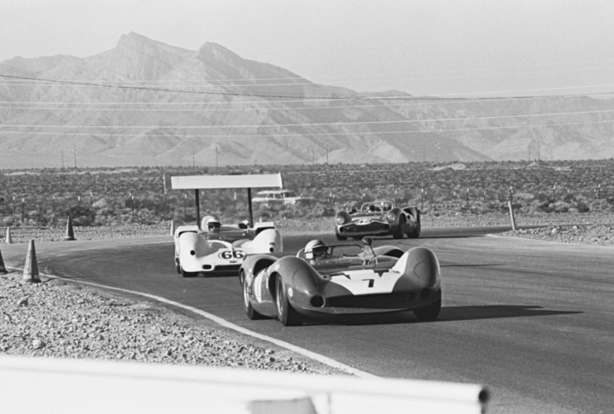
surtess 2

Surtees from Jim Hall’s Chap 2E Chev early in the race. Vegas 1966 (Dave Friedman Collection)
gals

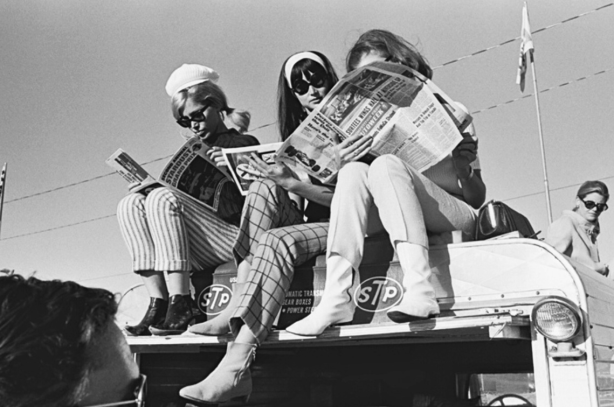
Las Vegas 1966 (Dave Friedman Collection)
surtees and hall

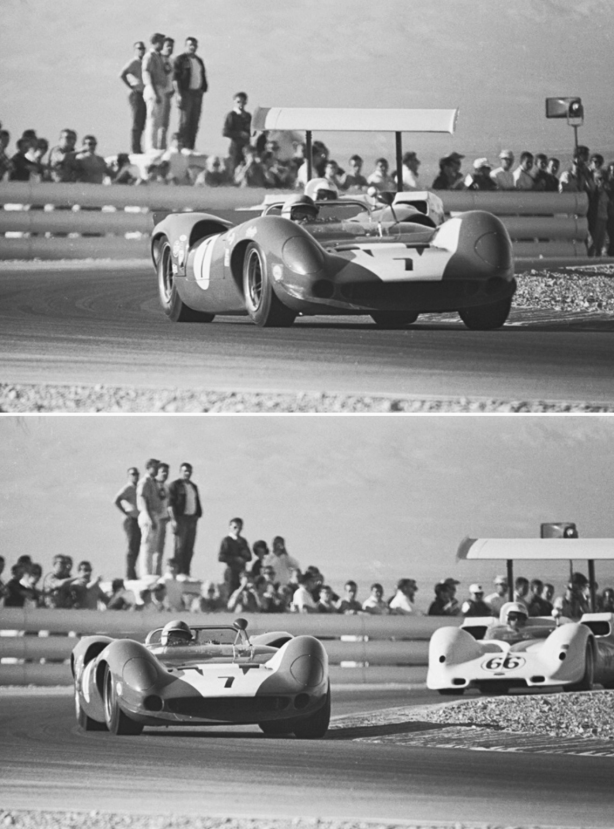
Surtees from Jim Hall’s Chaparral 2E Chev, first and DNF. Las Vegas 1966 (Dave Friedman Collection)

surtees 3

Surtees, Lola T70 Mk2 Chev, Las Vegas 1966 (Dave Friedman Collection)
surtees happy

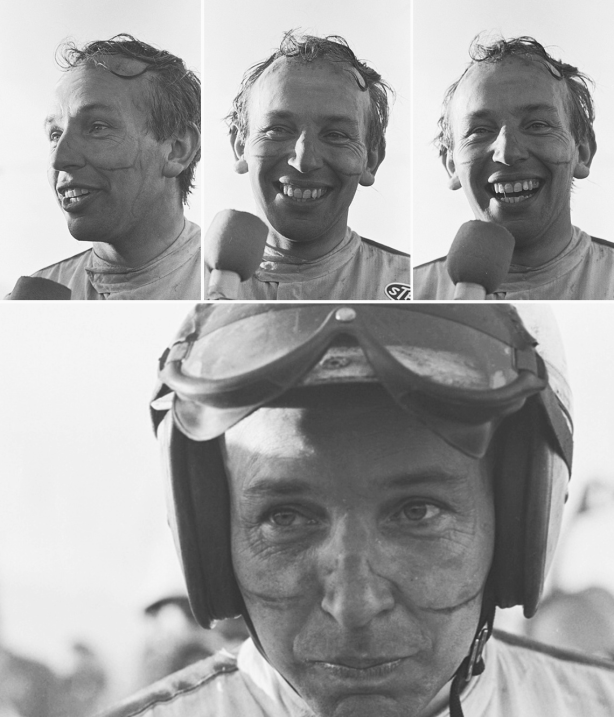
Happy Chappy. Surtees after his race and Can-Am series win, Las Vegas, November 1966 (Dave Friedman Collection)

Things would get tougher for Lola, Chaparral and the rest of the grid for the 1967 Can-Am.
surtees bridge

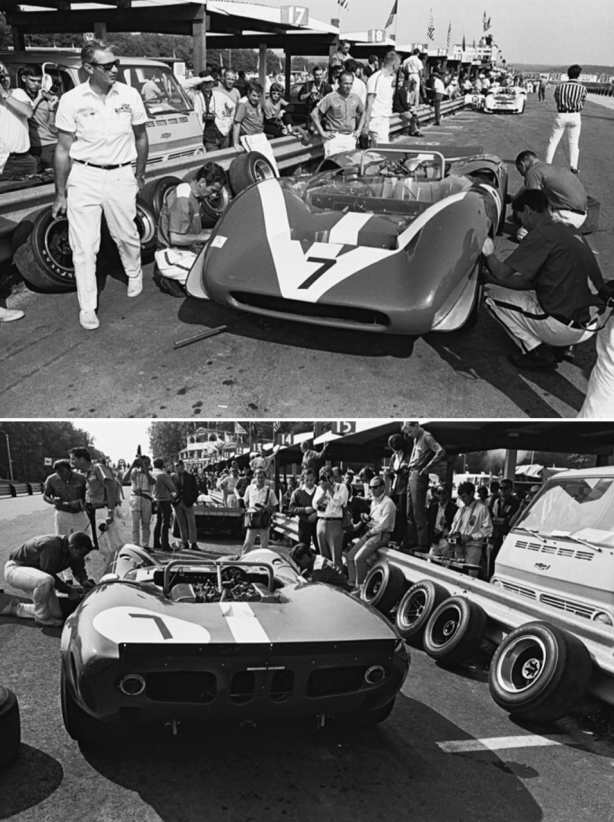
Surtees Lola T70 Mk3B Chev in the Bridghampton pitlane, September 1967, fourth (Dave Friedman Collection)

Jim Hall made it tough for himself  in ’66/7 by chasing championships in both Europe and the US, Chaparral sought titles in both the World Sportscar Championship and the Can-Am. They were always a threat with their unique blend of factory Chev engines, stunning chassis and aerodynamic innovation and quasi General Motors support.

Click here for an article on his 2F and it’s 1967 endurance campaign; https://primotipo.com/2014/06/26/67-spa-1000km-chaparral-2f/

But Bruce McLaren was the dark horse challenger.

McLaren had been racing in US sportscar events since his Cooper days, he became more serious with the acquisition of Roger Penske’s Cooper/Zerex Special, click here for an article on that car;

Roger Penske’s Zerex Special…

The Zerex became a test-bed for his own cars, the M1 which he raced in the UK and US until 1966. These light spaceframe cars handled well but the aluminium Oldsmobile V8s deployed – which provided weight and balance advantages – were limited by their power. The blocks maxxed-out at about 4.5-litres so the cars gave away plenty of mumbo to those running 6-litre engines.

McLaren and Chris Amon ran Chevs in their factory M1Bs in 1966 so Bruce had clarity about the bigger engine and its packaging needs, the Kiwi had a clear fix on what was needed to win in the Can-Am. He couldn’t match Jim Hall’s innovation but perhaps he could with a mix of sound design, engineering and good aerodynamics.

In essence this was the design brief McLaren gave to Robin Herd, the 6-litre monocoque McLaren M6 was the result. The M6 started the Bruce and Denny Show with five wins and Bruce deservedly taking the championship.
las vegas

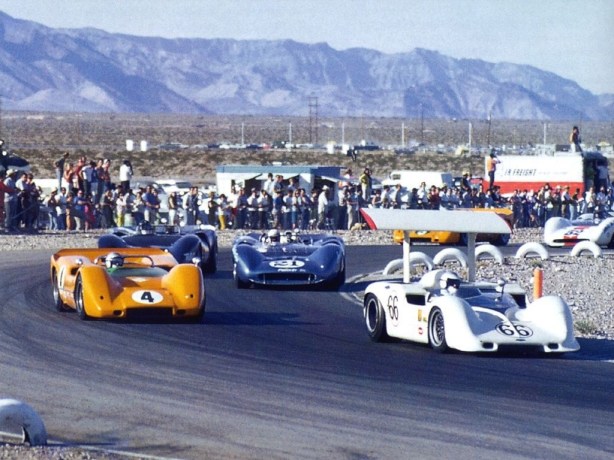
Class of ’67 at Las Vegas, 12 November. Jim Hall’s Chaparral 2G Chev from #4 McLaren’s McLaren M6A Chev, #21 Parnelli Jones’ Lola T70 Ford…all DNF, the race won by Surtees Lola T70 Mk3B (unattributed)

The dominance of the McLaren was a function of several elements. The design and execution of simple well engineered cars. Shaking them down thoroughly in England meant they were race-ready when the short season began. The team comprised three cars and world class drivers every year. They had a US base in Livonia, Detroit and their own engine program, its 6-litre Chevs were built by George Bartz and tuned and assembled in-house under Gary Knutsen’s supervision. Finally the team had adequate sponsorship to do things properly.

The 1968 McLaren M8 was a clean sheet design built from the learnings of the M6; the M8B, M8D and M8F works cars of 1969/70/71 were all evolutions of the M8A with sufficient change to stay ahead of the pack.

The dominance of McLaren was enhanced by ex-works cars passing into the hands of the best privateer drivers at the end of each season and customer cars available to whoever wanted one. Last years works-car became this year’s customer car, such bolides were built by Trojan Industries so the works team didn’t have to worry about pesky customers! By the end of 1968 at least, Lola’s dominance of grid numbers was over.

Such was the challenge Lola, Chaparral, John Surtees, Dan Gurney and the other best team owners faced.

Eric Broadley updated the T70 into the Mk3B for 1967, Surtees and Donohue were third and fourth in the Championship with John taking a win at Las Vegas at the seasons end.
bridge start

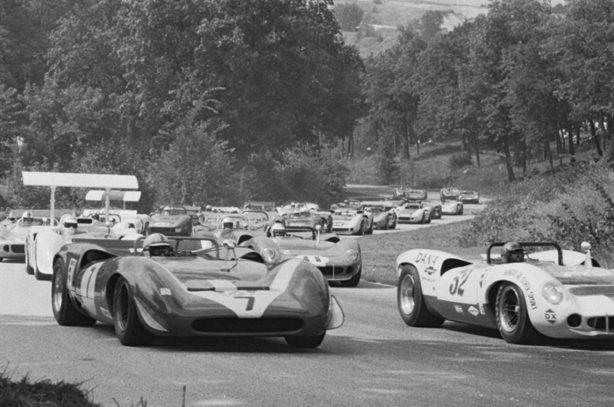
Bridghampton September 1967 start; the McLaren M6As of McLaren and Hulme are in front of this group headed by #7 Surtees and #52 Revson both in Lola T70 Mk3B Chevs, #11 Motchenbacher’s T70 Chev, Jim Halls winged Chaparral 2G Chev clear. Hulme won (Dave Friedman Collection)
lola ts

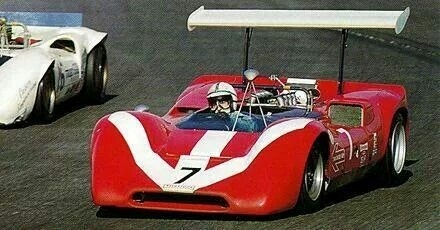
John Surtees much developed Lola T160/TS Chev at Bridghampton, September 1968, DNF having qualified 10th (unattributed)

The T160, Lola’s 1968 car was in essence a development of the T70. Surtees only raced in several rounds of the championship, Sam Posey was the best placed Lola T160 driver, finishing ninth in the drivers championship.

la times 1

Surtees in his modified Lola T160/TS Chev. LA Times GP, Riverside, 27 October 1968. DNF water pump in the race won by McLaren’s M8A Chev (Dave Friedman Collection)

For Surtees it was time to do his own thing, his first customer car was the Surtees TS5 F5000 car for 1969. In the Can-Am he jumped out of the fat and into the flames, Jim Hall’s 1969 Chaparral 2H was not his best car. Surtees got a taste of the M8 McLaren when Hall realised he had built a clunker and bought an M12 customer McLaren for John to drive whilst the team sorted the 2H, Surtees revelled in the car on the few occasions he raced it!

la times 2

Surtees T160 at Riverside from the rear. Top left Surtees in the pits, right Mark Donohue talking with his crew (Dave Friedman Collection)

Commercially for Broadley the appointment of Carl Haas as the Lola importer in 1967 was an astute move and provided the base for both firms success for decades with Haas having the required attributes above to take on the papaya McLarens.
chuck

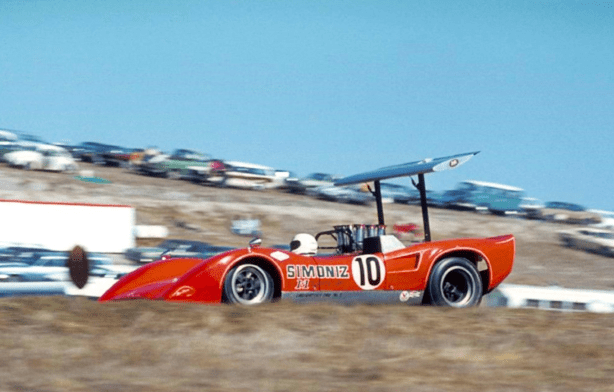
Chuck Parsons in Carl Haas ‘factory’ Lola T163 Chev at Laguna Seca in 1969. 3rd in the race won by Bruce’s McLaren M8B Chev (T Ferrari)

In 1969 Chuck Parsons proved the Lola T163 was not too bad a car, he finished third in the points chase, while the Chaparral was not a threat, and Porsche first appeared with the 917PA, the Can-Am variant of its dominant in 1970 and 1971, 917 endurance racer.

chap 2 j

Painting depicting Vic Elford’s Chaparral 2J Chev leading Peter Revson’s Lola T220/2 during 1970 (unattributed)

1970 was one of the great years of the Can-Am. The sound, conservative engineering of the McLaren M8D was juxtaposed by Jim Hall’s outrageous Chaparral 2J Chev, one of the most stunning, original, innovative, epic racing cars ever built. The two stroke engines which created the vacuum for its ground effects were its weak link and the cause of too many retirements but the car was stunningly fast while it lasted in Jackie Stewart’s and Vic Elford’s hands.

The Establishment had it banned at the end of the season of course; ‘movable aerodynamic devices were illegal’ but the Can-Am lost its soul and it’s ‘unlimited nature’ in making that decision, Hall told the organisers to go jam it and with it the Can-Am lost its biggest draw if not its most successful team.
revson

Peter Revson destroyed his Lola T220 Chev after a 180mph tyre blowout at Road Atlanta in 1970. He raced a new 10 inch longer wheelbase car, 98 inches, the T222 for the rest of the season. Here at Watkins Glen he was third (Automobile Year)

Haas convinced Broadley to design a new Lola for 1970 and signed Peter Revson, just peaking as a world class driver, to get the best from it.

The gorgeous, swoopy T220 had a very short 88 inch wheelbase which made it difficult to drive, a tyre failure at 180mph at Road Atlanta destroyed it, but fortunately not Revson. It was a blessing in disguise as the replacement T222 had an additional 10 inches added to its wheelbase which made it a much more competitive car.

t220

Revson’s T220 at Road Atlanta and destroyed that weekend. ‘Fence’ an addition from original body spec (Jim Hayes)

Having said that the T220 was fast if unreliable. Revvie qualified it second at Road America, third at Mid Ohio and fourth at Watkins Glen and Mosport, his best finish was second to Hulme at Mid Ohio.

With the longer wheelbase T222 he immediately banged the car on pole at Donnybrooke, finishing third behind the two McLarens and qualified third at both Laguna Seca and the final Riverside round for a third and DNF respectively.

So, by the end of the year the Lola car/driver combination was close to the McLarens, Hulme took the 1970 title with Revson sixth. He was off to McLaren for 1971, all Lola/Haas had to do was build a better car and hire a driver of the required calibre.

Part 2: The Lola T260…

t260 cutaway

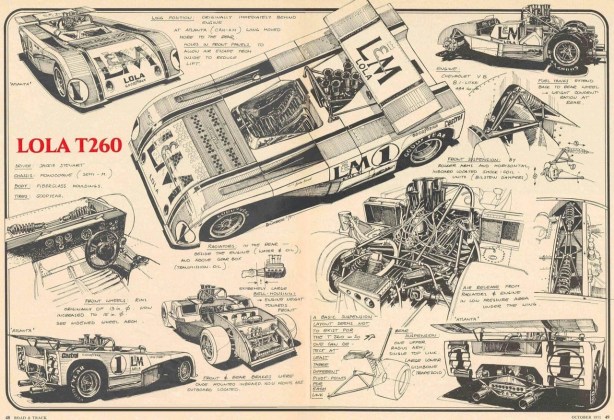
Lola T260 Chev cutaway (Tom Strongman)

Having had a taste of the Can-Am in 1970 and earlier years Jackie Stewart was keen to return. TThe professionalism of the Carl Haas team and Lola, a marque familiar to him having raced a T90 successfully at Indy together with Graham Hill in 1966, had appeal. He could fit the series into his 1971 F1 program with Tyrrell, or so he thought. Click here for an article on the Lola T90 and the 1966 Indy 500;

Graham Hill’s ‘American Red Ball Spl’ Lola T90 Ford: Indy Winner 1966…

Lola’s mount for Stewart was designated the T260 which was designed by Bob Marston with Eric Broadley’s guidance.

Lola Heritage; ‘The chassis was a…Lola full monocoque in L72 and NS4 light alloys bonded and riveted together with the fuel bags in either side of the tub with a total capacity of 60 gallons. The oil tank was contained in the rear of the left-hand fuel section. The rear of the monocoque extended to the back of the engine which was sandwiched between two bulkheads, a bell-housing supported the gearbox and absorbed suspension loads.

Cooling was via two brass-finned Serck radiators mounted behind the driver’s shoulder level and fed by two large NACA ducts on the top of the bodywork, the radiators vented through large louvres in the rear bodywork. Two oil coolers were mounted behind the water radiators and used the same ducts, an additional transmission cooler lay flat over the gearbox.

The bodywork was evolved following extensive tests in the Specialised Mouldings wind tunnel and featured a short, bluff nosecone with gauze-covered holes on the top to equalise pressure. At the base of the nose were two air ducts to feed air to the front discs, at the rear two ram pipes on the top of the rear body section collected the cooling air for the rear discs’.

Pete Lyons described the cars aerodynamic approach ‘The T260…was built to an aerodynamic theory already embodied in a few small-bore sports cars of the day. The intent was a shape that would bullet through the air on the straights and also remain stable as the car’s pitch attitude, ride height and positioning behind other cars changed everywhere else. In particular…a more conventional downforce-producing wedge nose, such as McLaren’s…could abruptly change from downforce to lift under certain conditions…’

t 260 aero

CAD sketch showing the T260 aero treatment. (unattributed)

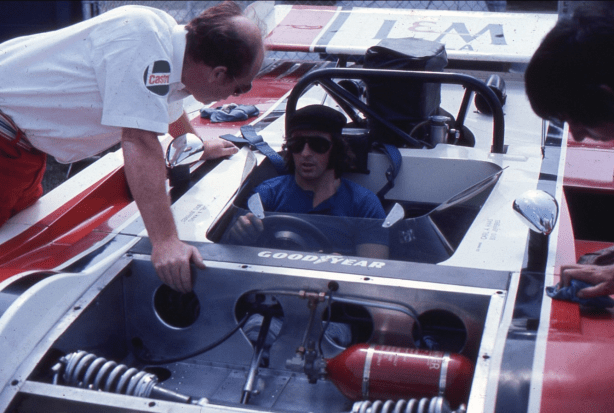
‘The front suspension on the T260 comprised unequal length wishbones, the upper ones were triangulated to form bell-cranks that operated Bilstein dampers and coil springs which lay almost horizontally across the front of the tub. The unusual spring-medium location freed space for the front brakes to be mounted inboard. Eric Broadley’s intention was to reduce the unsprung weight of the front wheels by moving the brakes inboard from their conventional hub location. This would have permitted the lighter wheel assemblies to ride better over the often bumpy Can-Am circuits. Jackie Stewart was adamantly opposed to inboard brakes after the death of his close friend Jochen Rindt due to the failure of an inboard-brake driveshaft on his GP Lotus 72 at Monza in September 1970. Conventional outboard brake mountings were used on the finalized T260 instead.’

A tangent is the fact that later JYS was comfortable enough with Engineer Derek Gardner’s approach to inboard front brakes, his 1973 Championship winning Tyrrell 005/006 being so equipped.
front

T260, Stewart up, Road America. Shot included to show the unusual location, for the time, of the spring/shocks referred to in the text. Graviner fire extinguished ‘bomb clear in shot. Chassis aluminium full monocoque (Jim Buell)

Rack and pinion steering was ahead of the front suspension.

Lola Heritage; ‘At the rear there was a short top link and a long radius arm attaching to the front engine bulkhead, a lower member extended rearwards to a cross-member bolted to the rear face of the gearbox. The springs and dampers fixed to the lower member and transmitted their load to tubular outriggers on the gearbox bell-housing.

Lola-made centre-lock, peg-drive magnesium wheels were fitted, their diameter 15 inches with 10.5 inch front and 17 inch wide rear Goodyears. The battery was mounted in the nose and a Graviner onboard fire extinguisher was fitted behind the dashboard’.

Two cars were built for Haas, chassis HU1 was Stewart’s race chassis, HU2 was an unused spare  in 1971.

The engine was a 496 cu in (8.1-litres) V8 Chevrolet tuned by George Foltz, it produced circa 700 bhp and 618 lb/ft of torque, Lucas fuel injection was fitted with a Scintilla Vertex magneto and a Hewland LG600 four-speed gearbox transmitted the power.

engine

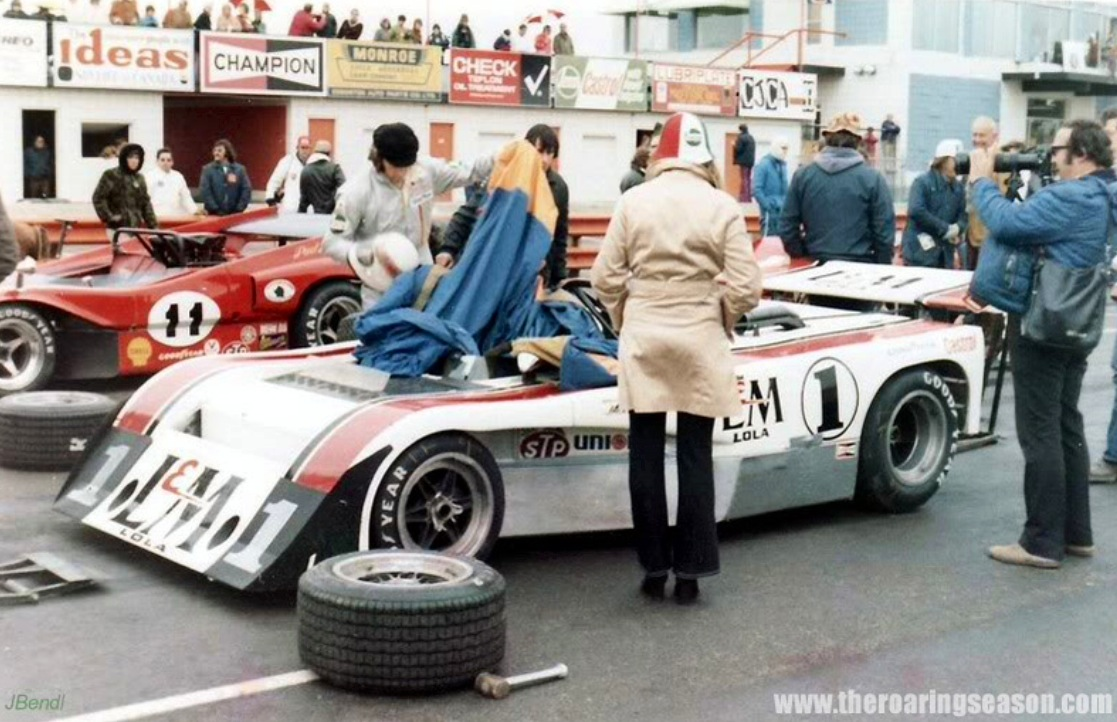
Aluminium block 8-litre engine of the T260 at Mosport. June 1971 (Jerry Bendl Collection/The Roaring Season)
lola t260

(Werner Buhrer)

gardenr back

Frank Gardner testing the Lola T260 at Silverstone in May, note how far forward the rear wing is in relation to shots taken later in 1971 (LAT)

When completed the car was tested by Lola racer/tester/development engineer Frank Gardner at Silverstone in May, FG was also turning his mind and skills into getting more speed from Lola’s F5000 T190/2; no doubt the F5000 was a kiddy-car compared to its 8-litre big brother!

Stewart drove the car in a rain soaked run at Silverstone prior to the cars shipping to Canada for the season opening Can-Am round at Mosport, Canada.

gardner side

Gardner in T260 HU1 at Silverstone, the shortness of the car and different to anything else in the Can-Am aero-treatment, clear in this shot (unattributed)

stewart sikverstone

Ropey shot of Stewart sheltering from the Silverstone weather during his brief drive of the T260 prior to shipment to North America, June 1971 (Sutton Images)

Other 1971 Can-Am Contenders…
hulme and stewart

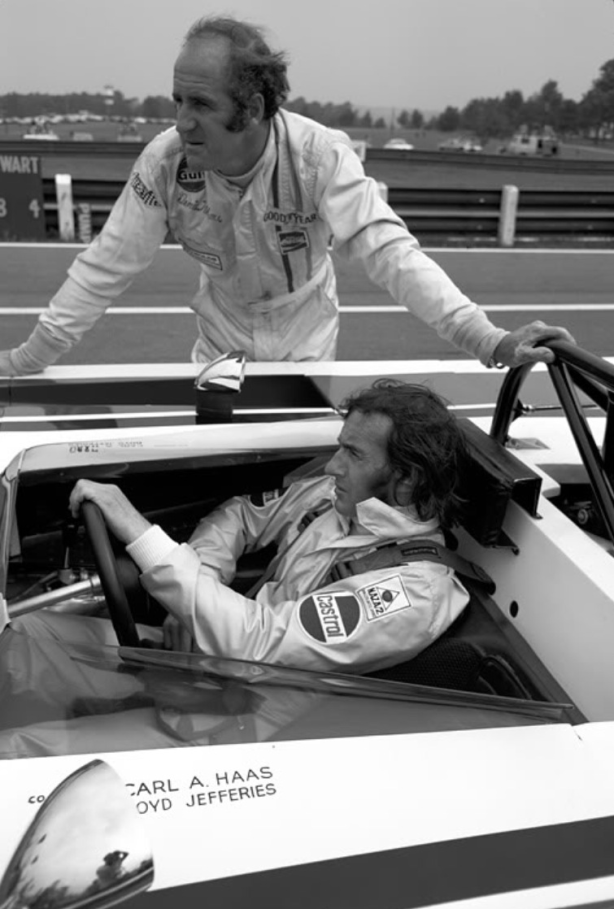
Denny Hume and Jackie Stewart at Mid Ohio 1971. Stewart in his T260 office (Ron Laymon)

road mclaren

Denny Hulme, McLaren M8F Chev, Road America, August 1971. DNF engine. Engine 494cid Reynolds aluminium block Chev, circa 740bhp @ 6400rpm (Jim Buell)

In reality the likely outright contenders in 1971 were the factory McLaren M8Fs, Stewart’s T260 and Jackie Oliver’s Shadow Mk2 Chev, designed by Peter Bryant.
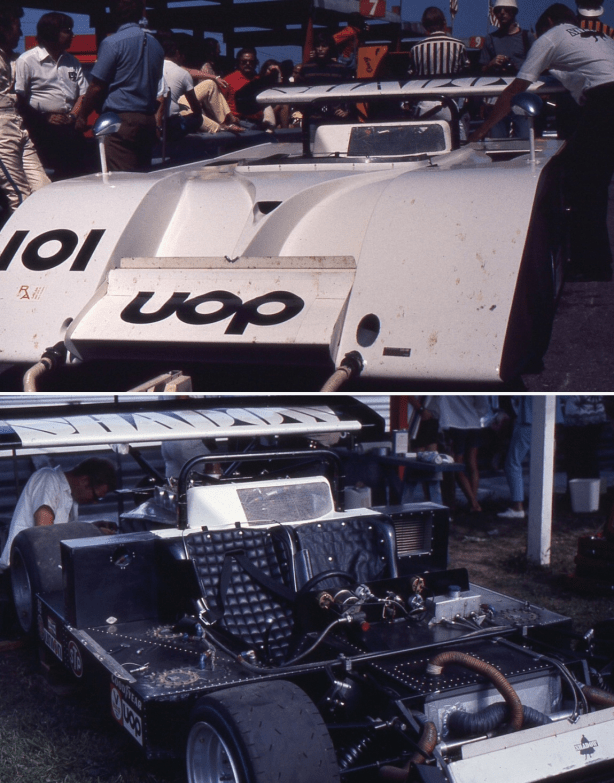
road shadow

Jackie Oliver’s Shadow Mk2 Chev, Road America 1971, 12th in the race (Jim Buell)

Jo Siffert’s Porsche 917/10 was gathering valuable data for a serious tilt in 1972. In exceptional circumstances (the wet) it was a contender as were a number of the best privateers in either ex-works or carefully developed M8’s: Lothar Motschenbacher, Vic Elford and Tony Adamowicz the most likely.
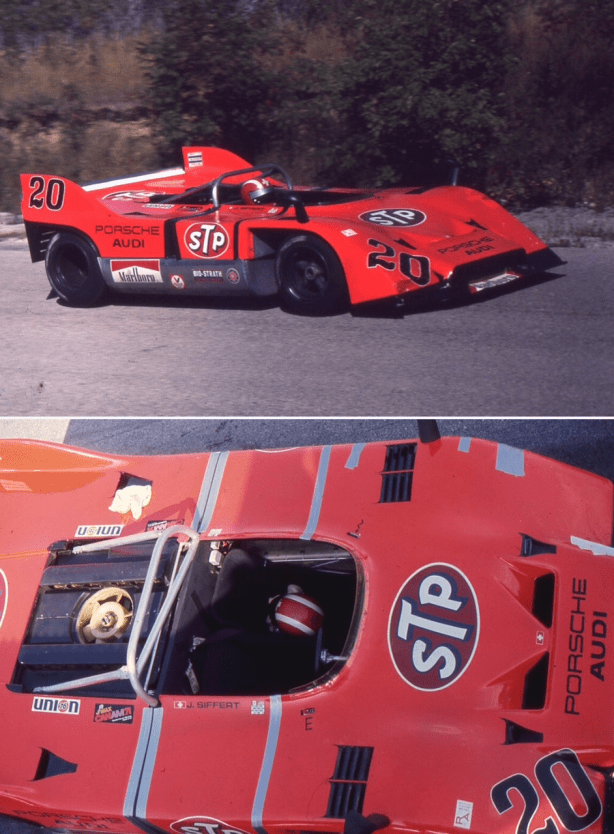
road pors

Siffert’s Porsche 917/10, Road America 1971. Spaceframe chassis, 5-litre flat 12 (Jim Buell)

road revvie

Peter Revson, Jackie Oliver in the helmet and front suspension detail of a McLaren M8F in the Road America paddock, August 1971 (Jim Buell)

The detailed specification of the McLaren M8F I wrote about a while back; click on this link to read the short article; https://primotipo.com/2015/03/08/peter-revson-mclaren-m8f-chev-1971/
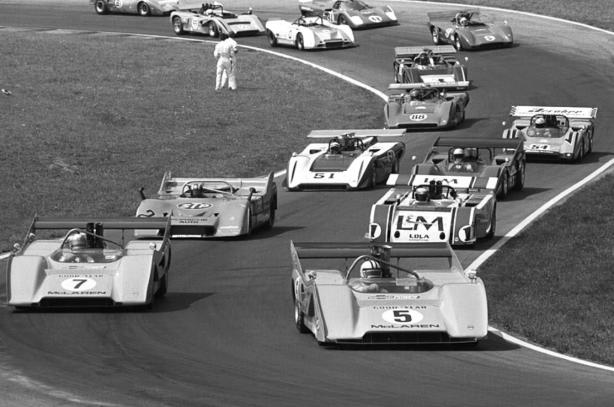
watkins grid

1971 Mid Ohio rolling grid. #5 Hulme, #7 Revson, #1 Stewart, #2 Jo Siffert,Porsche 917/10, #51 Dave Causey Lola T222 Chev, #54 Tony Adamowicz, McLaren M8B Chev, #88 Hiroshi Kazato, Lola T222 (Ron Laymon)

Part 3: Racing: 1971 Can-Am Round by Round…
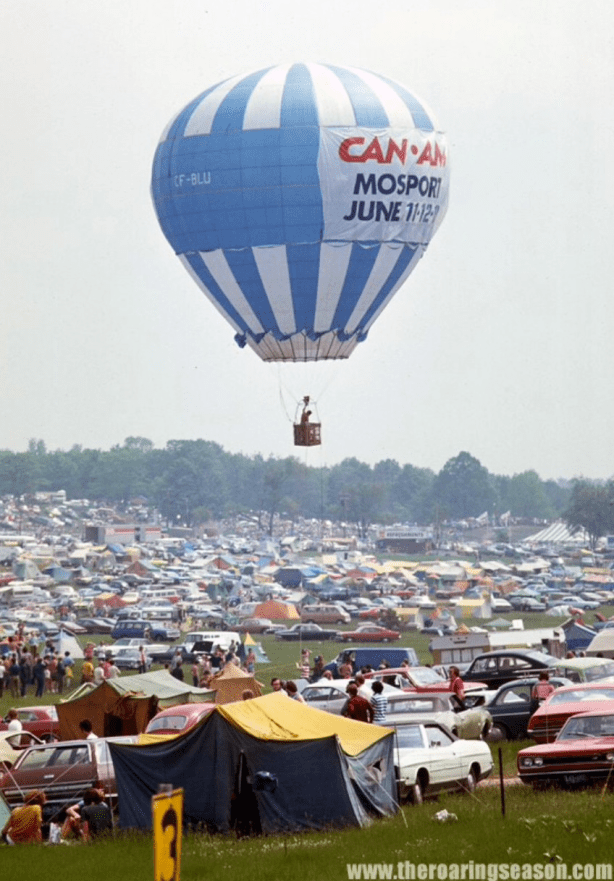
mosport 1

Mosport 1971 vibe, looks fantastic! (Jerry Bendl Collection/The Roaring Season)

Round 1: Mosport, Ontario Canada 13 June 1971
Stewart grabbed pole position from the works McLaren M8Fs of Hulme and Revson then led the race from Hulme, an oil leak from the LG600 Hewland ‘box resulted in its seizure on lap 18.

Hulme won from Revson and Lothar Motschenbacher in one the 1970 ex-works McLaren M8Ds.
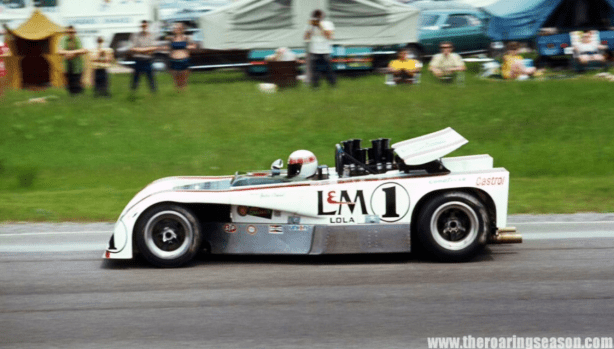
mosport 2

Pan of Stewart at Mosport shows the cars original aero treatment before ongoing modifications and experiments. Rear wing far forward and nose devoid of appendages (Jerry Bendl Collection/The Roaring Season)

Rounds 2 and 3: St Jovite, Quebec Canada 27 June and Road Atlanta, Georgia, 11 July
Stewart put the T260 on the front row next to pole sitter Hulme’s McLaren M8F at St Jovite. Denny led from the start but Stewart sat in second until lap 52 when Hulme, tiring from a stomach bug, had to slow due to exhaustion. Stewart won from Denny and Peter.
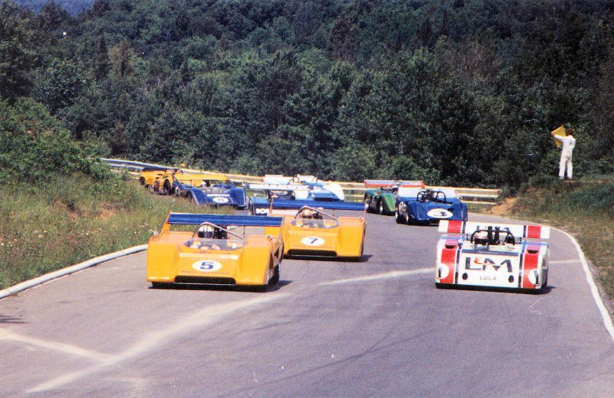
st jovite

Stewart a race winner at St Jovite, here beside Hulme with Revson just behind (Lola Heritage)

Stewart recalled in an interview with Gordon Kirby, ‘St Jovite was a good win because with that car, that track was hard work! The other race where we did quite well was at Road Atlanta. We led the race then had a puncture and a whole series of other problems but still turned the fastest lap of the race, quicker than Hulme’s pole time’.  Revson won from Hulme and Motschenbacher.
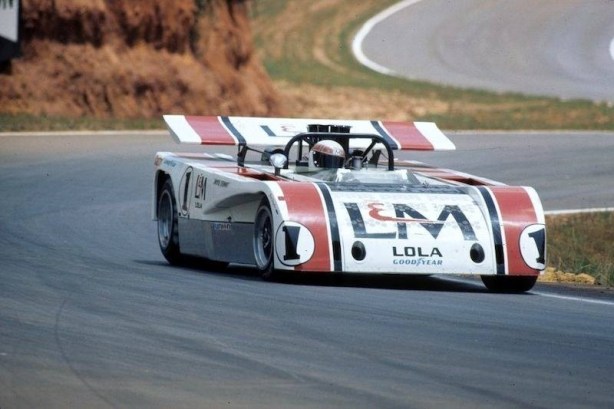
road atlanta

Stewart had great pace at Road Atlanta, wonderful high speed shot of the short, squat, original T260 (unattributed)

watkins glen

Stewart ahead of Revson, Mario Cabral Porsche 917K and Hulme in the distance, Watkins Glen, 1971 (unattributed)

Round 4: Watkins Glen, New York, 25 July
The T260’s speed was not in doubt, it was back on pole again with Hulme and Revson right behind. Stewart got the drop putting the T260 into the lead from Revson, the Lola and McLaren diced until Stewart pitted with another puncture, losing a lap while the wheel was changed.

Stewart returned to the race and began to fly, setting the fastest lap but on the 56th lap he retired the car after detecting vibrations which proved to be a failing transmission. Revson won from Hulme and Siffert’s factory Porsche 917/10.
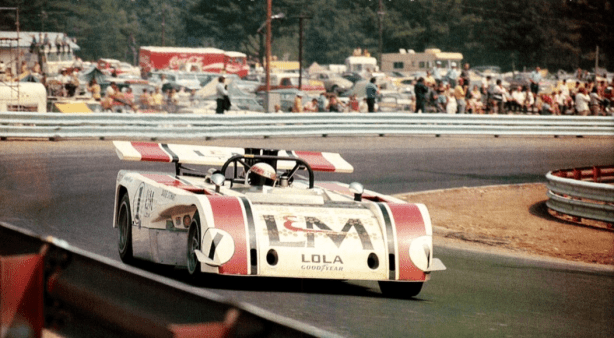
stew watkins

JYS at Watkins Glen, site of the US GP in upstate New York, it was a circuit he knew well (LAT)

jackie

Stewart loaded up and all ready to go in the Mid Ohio pitlane (Terry Capps)

Round 5: Mid Ohio, 22 August
Stewart, famously a successful campaigner for better circuit safety, was unhappy with the track; its surface was excessively bumpy and the presence of trees and telegraph poles surrounding the course meant mistakes would be punished severely.

Much overnight work was carried out to remove some of the trees and poles, and add straw bales where possible, but after looking at the result Stewart declared he would ‘run but he wouldn’t race’. Stewart’s position could be appreciated after the bumpy track caused three rear suspension failures to the T260 during qualifying.
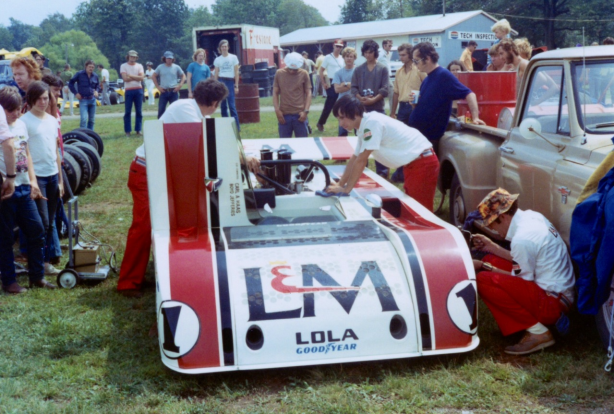
front f

Bucolic Mid Ohio paddock. Team busy this meeting, several suspension failures over the bumpy circuit. Standard-aero at this point (Terry Capps)

Stewart qualified third and was second behind Revson at the end of lap one but the McLaren drew away as Stewart drove well within himself. On lap 72 Revson’s driveshaft universal joint failed (the same problem sidelined Hulme) and Stewart took the lead and race win from Siffert’s Porsche and Tony Adamowicz’ 1969 ex-works McLaren M8B Chev.

back

Mid Ohio paddock, this time a butt shot. Neat brackets to support beefy exhausts and lights, black ducts are cooling for inboard discs located beside the Hewland ‘box. Note also ducts/louvres on the rear of the bodywork to exhaust hot air (Terry Capps)

From this point on, the continual development of the McLarens told while the Lola effort didn’t improve enough. McLaren were a well drilled team and both drivers were  experienced campaigners with whatever changes needing to be made could be done quickly in their Detroit workshop or back at Colnbrook.

While the T260 was effectively a works effort run by the marques US importer, Lola were at their core a manufacturer of customer racing cars with many customers, not a race team with only one focus.
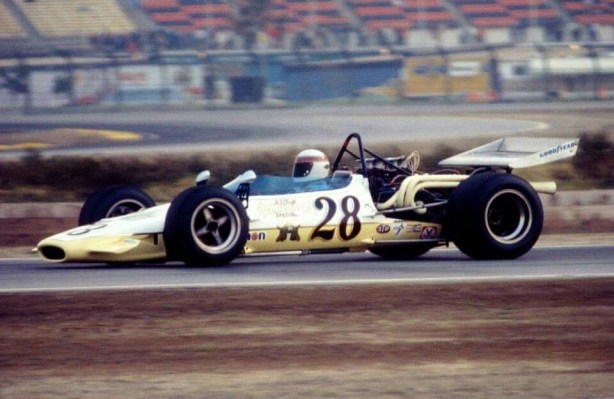
stew m10b

Included in JYS program for 1971 was the Questor Grand Prix at Ontario Speedway in March. He was second in his Tyrrell to Mario Andretti’s Ferrari 312B…but here Jackie is putting in a few laps in AJ Foyt’s McLaren M10B Chev in his only F5000 drive?? (Getty Images)

Jackie Stewart on driving the T260 and stresses of two major campaigns, F1 with Tyrrell and the Can-Am Lola in 1971…

Stewart related to Gordon Kirby and Adam Cooper in separate MotorSport magazine interview’s; ‘There were no wind tunnels in those days and Eric (Broadley) would suddenly arrive and under his arm was a new front wing. There was one we called ‘the cowcatcher’. It was hung out front of the car and what it was doing I just don’t know’

‘The car was very short wheelbase and very difficult to drive. In comparison to the McLarens, (Stewart was approached to drive for them in 1972 and actually signed to do so but withdrew when the extent of his health problems were clear) the car was just a monster to drive and we were just trying to keep up’.

‘I tested the McLaren and it was just like a passenger car compared to the incredibly nervous, pointy, short wheelbase Lola where you were a millisecond from an accident all the time.’

Stewart said the Lola T260 was the most physically demanding car he raced in his career ‘On the very fast circuits like Riverside it was awfully tricky because you never knew where you were going’. In order to make up for its shortcomings ‘I sweated more. It was just a difficult car to drive. There are some cars which are easy to drive and others not and that was one of the ones that was not’.

In a contest for the worst car he ever drove; ‘The Lola T260 Can-Am car would probably make that one…the H16 BRM runs it a close second’.

The main problem was dire understeer in addition to ultimate twitchiness at speed. The Lola’s blunt nose was dotted with mesh covered holes through which the underbody air could pass. In theory this helped provide some downforce. In its initial guise the shape of the front didn’t seem to have any obvious way of providing grip. Broadley deliberately opted not to have a fashionable chisel nose. But the lack of downforce at the front was borne out by the position of the giant rear , which was usually far forward, just behind the injection trumpets  in an attempt to achieve some sort of balance.

A combination of racing around the world in two series and lots of promotional work gave Stewart mononucleosis. ‘I was flying back and forth from Europe to do F1, I won the world championship that year and two Can-Am races, but I also got mononucleosis (glandular fever), a really debilitating disease that took your energy away. You couldn’t sleep and yet you were overly tired. So it was a tough year, a really exhausting year’.
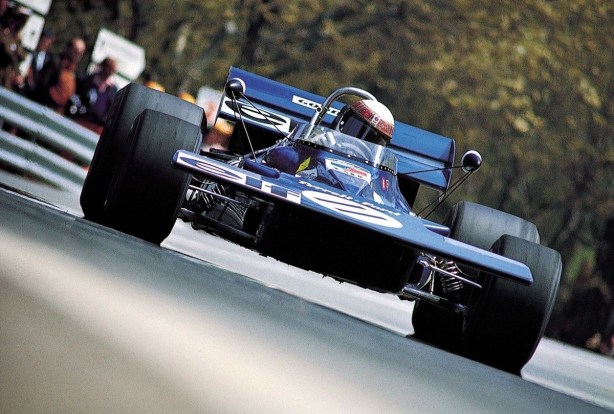
stew montjuic

Stewart racing his Tyrrell 001 Ford to victory in the Spanish GP, Montjuic Park, Barcelona on 18 April. He took six wins in 1971 and his second drivers title (unattributed)

It’s interesting to reflect on Jackie’s comments on the differences between the two cars. In fact both the T260, which retained the same wheelbase as the T222, and the M8F had 98 inch wheelbases.

The front/rear track of the Lola was 58 inches, of the M8F 60/57.75 inches, while the overall length of the Lola was 139 inches compared with the much longer M8F’s 167 inches. The aero treatment was radically different of course, a lack of downforce something the team chased progressively throughout the season.

road america

Stewart in the T260 at Road America and trying a different aero configuration comprising; a new profile ‘clip’ on the lower nose at the cars front and McLarenesque wing and integrated mounts, wing now much further back than the original (Jim Buell)

Round 6: Road America, Elkhart Lake, Wisconsin, 29 August
Stewart was third fastest in qualifying but his engine, also used at Mid-Ohio, was tired.

A new Chev was fitted for the race but high temperatures during warm-up were hoped to be vapour lock in the cooling system.
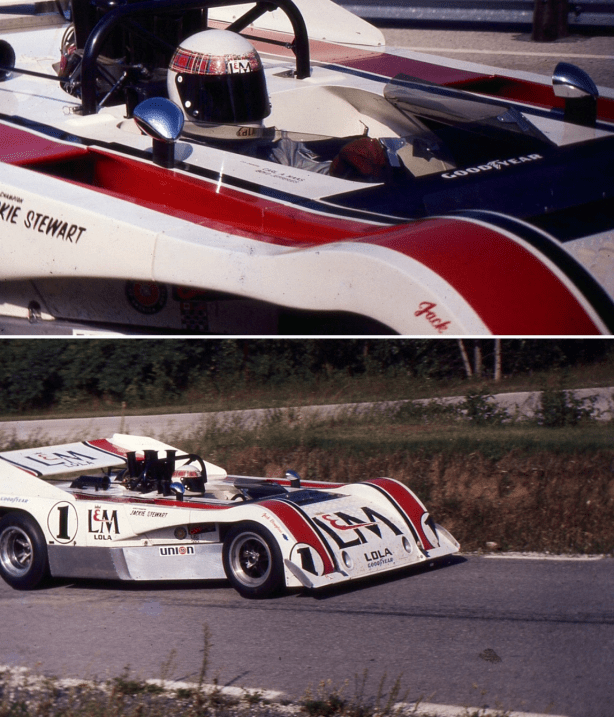
road am 1

Stewart ready to rock at Road America and a close-up of the configuration pictured above (Jim Buell)

Stewart ran second early on but after 10 laps the engine was smoking so Jackie parked it. Later examination showed a dropped cylinder liner was responsible for the high engine temperatures.

Revson won from Siffert and Vic Elford’s McLaren M8E Chev.
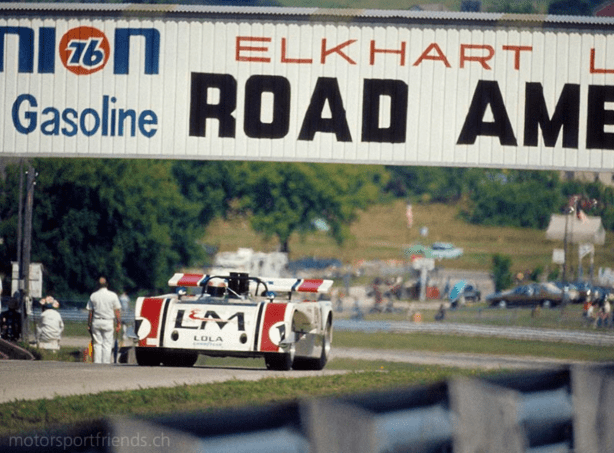
stew road am

Stewart T260 Road America, note that in this shot he is running the original nose and rear wing setup (Carl Knopp)

Round 7: Donnybrooke, Minnesota
The T260 had revised rear suspension but the McLarens were continually being developed as well, Stewart’s third fastest time was two seconds adrift of the factory M8Fs.

Stewart got away well and led for two laps until Revson found a way past, Hulme was unable to pass Jackie as the McLaren was losing grip in the Lola’s slipstream. The positions remained until lap 22 when Stewart felt something amiss and pitted, nothing could be found, he resumed in 10th a lap and a half down.

The Scot raced the T260 back to fourth but another puncture saw Stewart back in the pits, the T260 finished sixth, two laps down. Revson again won from Hulme and Gregg Young’s McLaren M8D/E Chev in third.
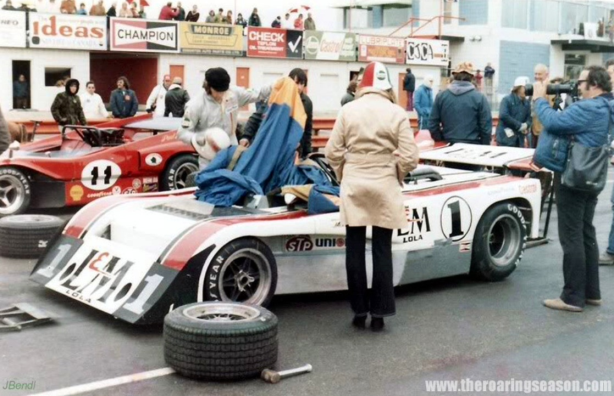
edmonton

Stewart about to load up on the wet Edmonton grid, September 1971. #11 is Motchenbacher’s McLaren M8D . See another variation of the T260 nose, the front ‘clip on’ less bluff than the original and more ‘scooped’. Rear wing mounted back (Jerry Bendl Collection/The Roaring Season)

Round 8: Edmonton, Alberta Canada, 26 September
The T260 featured a revised nose shape designed to give more downforce while the rear wing was moved back to balance the new nose.

Stewart qualified third again and had a great start on the wet track and led. The T260 was handling well in the rain, the Scot extended his lead over Jackie Oliver’s Shadow and Hulme’s McLaren. Stewart was still leading at half distance but a trip onto the grass when lapping Motschenbacher’s M8D lost the Lola’s handling balance.

Gradually Hulme closed the gap and he suddenly found himself in the lead with 13 laps remaining, the deteriorating handling caught Stewart out and he spun. The T260 resumed in second but with it’s competitiveness lost Stewart settled for a safe second. Jackie Oliver finally got the Shadow Mk2 into the points in third place.
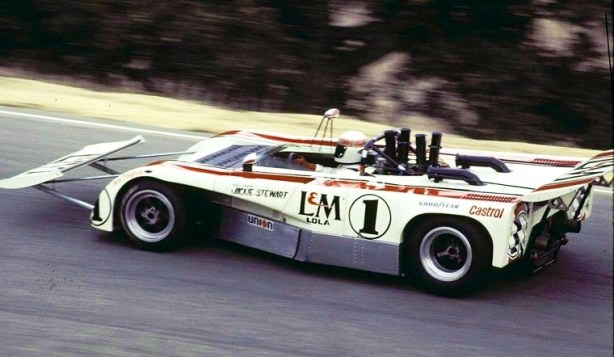
cow catcher

Stewart runs the cow-catcher set up at Laguna Seca, in search of downforce or what! Far forward wing and much larger rear wing to balance things up (Tony Ferrari)

Round 9: Laguna Seca, California, 17 October
At Laguna Seca the T260 had lost its high downforce nose from Edmonton and now featured a huge, front cow-catcher wing projecting out in front of the nosecone.

Stewart managed fourth on the grid behind the McLarens and David Hobbs in the Ti22 Chev.

Stewart soon passed Hobbs – David raced the Carl Haas factory Lola T310 in 1972 – and after 10 laps passed Hulme who had some broken valve springs.

Revson seemed secure 25 seconds ahead of Stewart but a collision with a backmarker required a pit stop to secure a loose door. Stewart was now nine seconds behind. Revson started to pull away again but with 20 laps to go Revvies engine lost power, he nursed it over the remaining laps but with two to go the M8F was puffing blue smoke.

He drove the last two laps cautiously to win and but Stewart took the chequered flag as Revson had been shown a black flag, Revson claimed he hadn’t seen it.

The Carl Haas team protested Revson, the results were pending for some hours, but eventually Revson got the win but received a $250 fine. Hulme was third.

corkscrew

Stewart ahead of David Hobbs Ti22 Chev, Jackie Oliver Shadow Mk2 Chev, another unidentified car with Jo Siffert Porsche 917/10 at rear. Corkscrew, Laguna (Hal Amarantes)
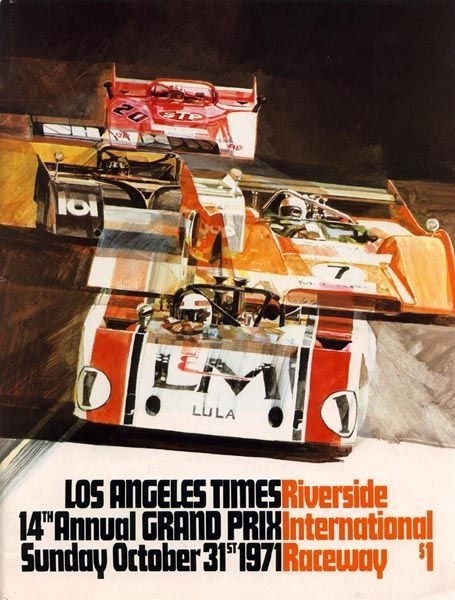
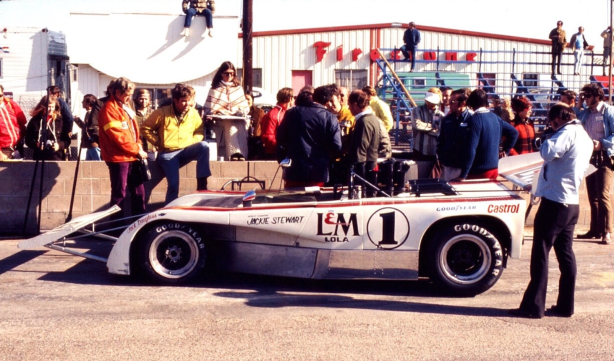
riverside

riverside 2

Stewart at Riverside, again with the cow-catcher aero setup. Side on profile shot gives an idea of just how far forward the front wing was and how big the rear one was! Lola T260 Chev (MP Hewitt)

Round 10: Riverside, California, 31 October
The series’ final round was at Riverside on October 30, only 3 1/2 short months since its commencement in mid-June.

Stewart again qualified third, the T260 now had bigger sideplates on its rear wing.

Hulme took the lead at the start but Stewart got up to second as Revson, looking for points to clinch the Championship, didn’t make it difficult. Unable to challenge Hulme, Stewart was running happily in second until a piston failed in the big aluminium Chevy on lap 27.

Hulme won from Revson and Howden Ganley in the BRM P167 Chev.

The end of the 1971 Can-Am Championship resulted in Peter Revson as champion with five wins to Hulme’s three, Stewart finished an honourable third to the two McLarens…

As Lola Heritage puts it ‘He had been their only consistent competitor over the ten rounds and there was a certain ‘what may have been’ feeling over the whole series, if only reliability had been better and punctures had been less’.

In addition to that it’s a shame the car hadn’t been finished earlier and tested extensively at Goodwood and Silverstone prior to crossing the Atlantic, but it wasn’t and the dominant McLaren’s reaped the rewards.
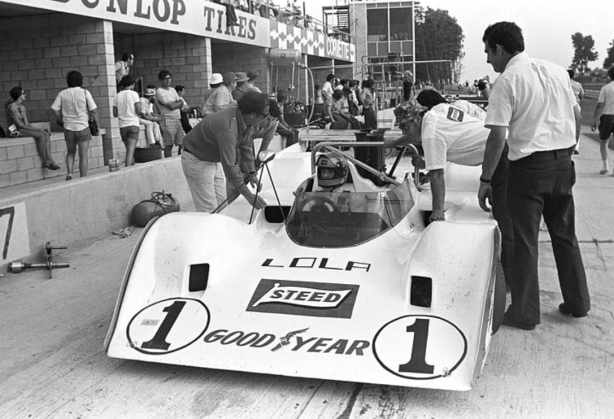
t310 front

David Hobbs in the Watkins Glen pits 1972, Lola T310 Chev (unattributed)

For 1972 Lola again contested the championship with a new car, the T310, McLaren built a new car, the M20 Chev to take on the pride of Stuttgart, but the mighty turbo-charged Porsche 917/10 was battle ready in the hands of the Penske Team and Mark Donohue in a way the 1971 Lola/Carl Haas/Stewart combination were not…
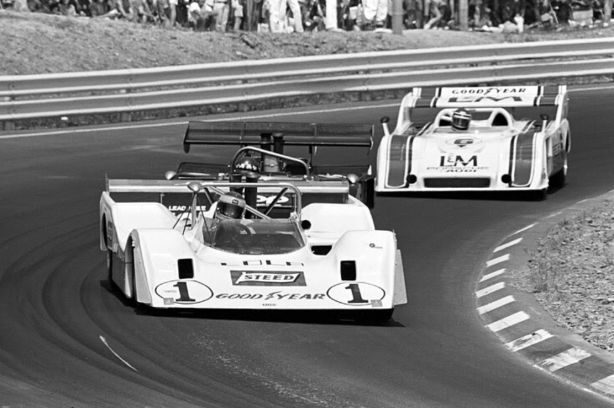
t 310 watkins

David Hobbs Lola T310 Chev fourth ahead of Jackie Oliver’s Shadow Mk3 Chev DNF and the dominant Porsche 917/10 turbo of George Follmer fourth. Hulme won this round in an M20 McLaren. Watkins Glen 1972 (unattributed)

Etcetera…
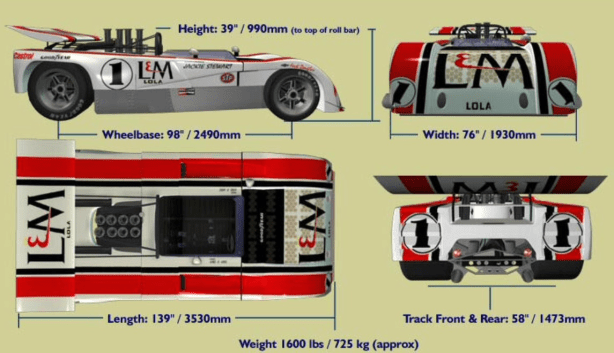
dimensions

Bibliography…

Lola Heritage, MotorSport October 2000 article by Adam Cooper and December 2013 article by Gordon Kirby, Automobile Year 19, ‘Can-Am’ Pete Lyons

Photo Credits…

Lola Heritage, Ron Laymon, Getty Images, LAT, Jerry Bendl Collection/The Roaring Season, Automobile Year, Jim Hayes, Tom Strongman cutaway drawing, Carl Knopp, Jim Buell, Terry Capps, Hal Amarantes, Tony Ferrari, MP Hewitt

Tailpiece…

Turn in Biiitch!
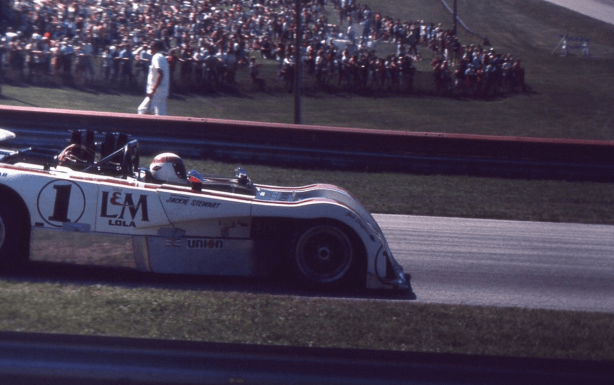
bitch

Stewart Lola T260, Road America 1971 (Jim Buell)

Finito…

taffy

(Archie Smith)

Taffy von Trips settles himself into his F2 Ferrari Dino 156 #0008 on the grid of the 1960 Italian Grand Prix, Monza, September 6…

The cars designer, Carlo Chiti looks on. Click on the link below to my article, I’ve converted a 100 word quickie on a Monaco vista in 1960 into a feature on a significant Ferrari thanks to a tangent introduced by reader Grant Perkins for reasons which are clear in the text; https://primotipo.com/2015/10/04/monaco-panorama-1958/

This car, Ferrari Dino 246P/156 0008, is the Scuderia’s first mid-engined car.

severi

(unattributed)

Ferrari factory test driver Martino Severi drives the brand new, mid-engined 246P 0008 on 22 May 1960 at Modena. Ginther and Hill also drove it that day, it’s a week before its Monaco GP debut. It’s not as gorgeous as it became in Fantuzzi bodied 1961 156 form, but luvverly all the same

Dino 246P 0008’s evolution from 2.5-litre mid-engined GP prototype in Ginther’s hands at Monaco 1960 to 1.5-litre Dino 156 Syracuse 1961 GP winner for Giancarlo Baghetti within 12 months is an interesting story.

richie

(unattributed)

Richie Ginther at Monaco 1960 for his, and Ferrari Dino 246P 0008’s GP debut.

Photo Credits…

Archie Smith

Finito…