FM in SR3-1 Oldsmobile on Sandown’s main straight during his victorious Victorian Sportscar Championship run on April 16. Car pretty as a picture, the SR3’s got more butch as the aero-revolution kicked in from 1968 onwards (R Davies)
One of my online buddies is to blame for yet another variation on Frank Matich themes.
‘Catalina Park’ – I hate this avatar bullshit, if ‘yer name is Freddie Fuddpucker be loud and proud of it right?! – sent the link to this clip of Frantic Francis Matich winning the Victorian Sportscar Championship at Sandown in April 1967, it got me thinking about that year. See here; https://youtu.be/IYJOnQZGJzA
Winner of the Australian Tourist Trophy that year, there is little doubt that FM’s new space frame design – whether it was an exact copy of his existing Elfin 400 chassis with a few extra tubes, or almost exact copy of the 400 with a few extra tubes is a moot point – was the best Australian sportscar of the year.
The 4.5-litre Oldsmobile V8 powered machine was quick outta-the-box from its debut Tasman Cup support event performances that January-February, and was a jet by the time it was fitted with a 390bhp Repco Brabham 620 SOHC, two-valve, Lucas injected V8 in time for the Can-Am Cup that September-November.
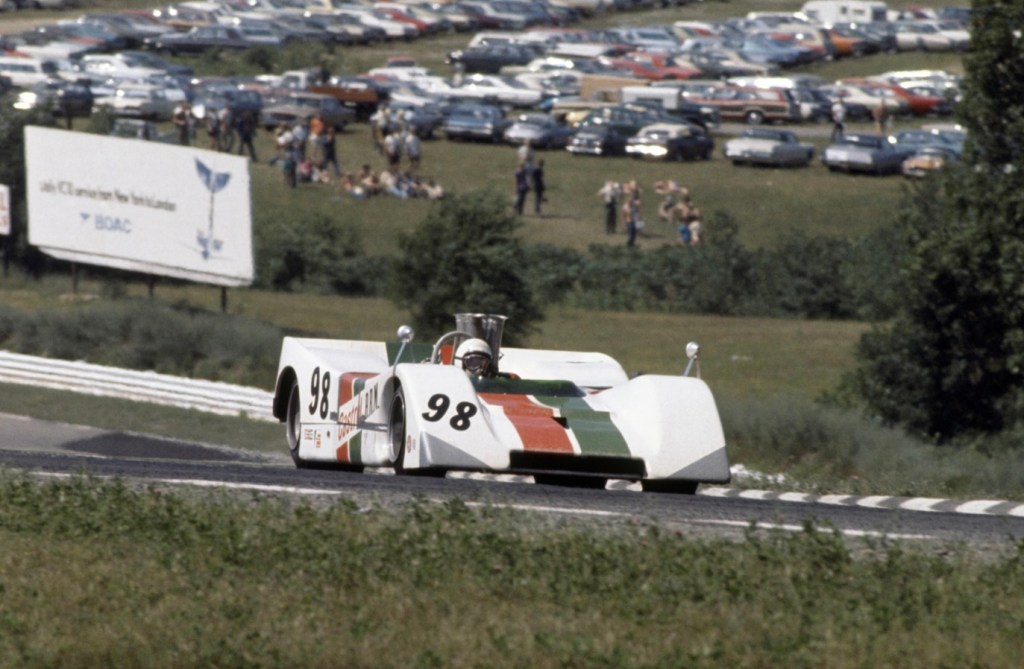
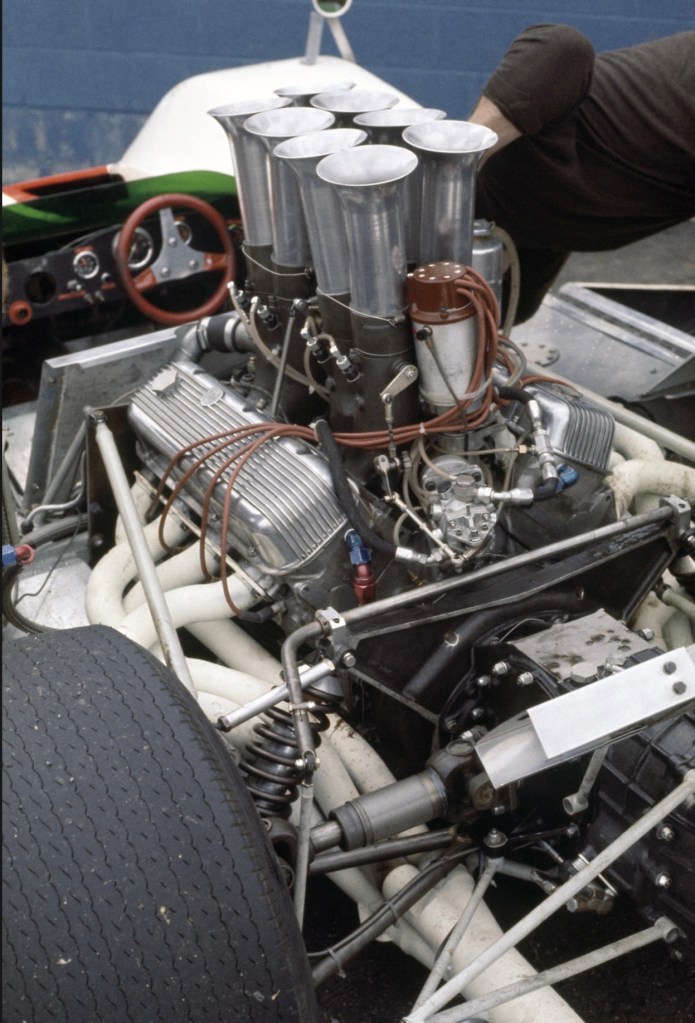
“Jesus they are quick”, or thoughts to that general effect by Matich and Mabey. This and the following shots were taken at Bridghampton – Can-Am round 2 – over the September 17, 1967 weekend. Chassis SR3-3, RB 620 4.4-litre V8, spaceframe chassis, ZF transaxle and period typical rear suspension; mag uprights, single top-links, lower inverted wishbones, twin radius rods, coil-spring/shocks and adjustable roll bar (S Rosenthall)“What next?” Matich was as good a design and race engineer as he was driver, the full-package. The watermark you can see is ‘Revs Institute’, which I recommend as a research resource. The nose of car #1 behind is Sam Posey’s – he raced a Surtees TS11 Chev in the ’73 Tasman, remember? – Caldwell D7 Chev (S Rosenthall)
Mind you, he got blown ‘orf the face of the planet over there. The SR3 was very light but its all-alloy 4.4-litre V8 – however many cams it had – was positively poofhouse-effete compared with the big, brawny 6-litre and above yankee-pushrod V8s. 1967 was the start of the Papaya-Revolution, the dominance of McLaren Cars in the Can-Am from 1967-71 before Porsche rained on their parade.
Matich entered four of the six rounds – Road America, Bridgehampton, Laguna Seca and Riverside – and failed to finish any of them, he only got past the halfway mark once, at Bridghampton. But he impressed pit-pundits with the speed of his cars, and both Team Matich and Repco Brabham Engines got their heads around 200-mile races, Can-Am events were GP length, so the cars needed a blend of speed and endurance.
Frank did good business over there, he sold two cars – SR3-1 to Marvin Webster and SR3-2 to Kent Price, both buyers were Californians. Matich used SR3-2 at Road America, and SR3-3 in the rest of the US races, then brought it home and clobbered Chris Amon’s ex-works Scuderia Veloce owned and run Ferrari P4/Can-Am 350 in the 1968 Australian Tasman Cup support rounds.
That was the benefit of the trip to the US, Matich and Peter Mabey honed SR3 to a fine-pitch in the intensity of competition stateside, with all of their learnings applied to the 4.8-litre Repco 760 V8 engined SR4 for 1968 Can-Am competition, but the car ran late. That saga is related at length here; https://primotipo.com/2016/07/15/matich-sr4-repco-by-nigel-tait-and-mark-bisset/
Hinchman overalls, Bell Magnum helmet – pro-driver paradigms for the day. Note the lack of a spare wheel/tyre, Can-Am rules dispensed with that stupidity. Note also the four-point harness, not a fitment – I think – he had in SR3-1 before going away. I don’t think they were mandated in the Can-Am – USAC mandated them in Champcars mind you – then but I may be wrong. A good idea all the same…the rollover bar is a tad-low mind (S Rosenthall)
Credits…
Robert Davies, Stanley Rosenthall-Revs Institute,
Tailpiece…
(S Rosenthall)
Yep, yep, I noticed the mechanic. Given my very school-boy smutty mind, my immediate thought was the acrobatics of a particularly athletic girlfriend when I was 19, my-lordy she had a trick or three. Anyway, I wonder what Mr Mabey or the other mechanic – who is he, wasn’t Rennmax Engineering’s Bob Britton, who fabricated the chassis over there for a bit? Whoever it was would have needed a chiropractic treatment for a fortnight after returning to the pitlane…
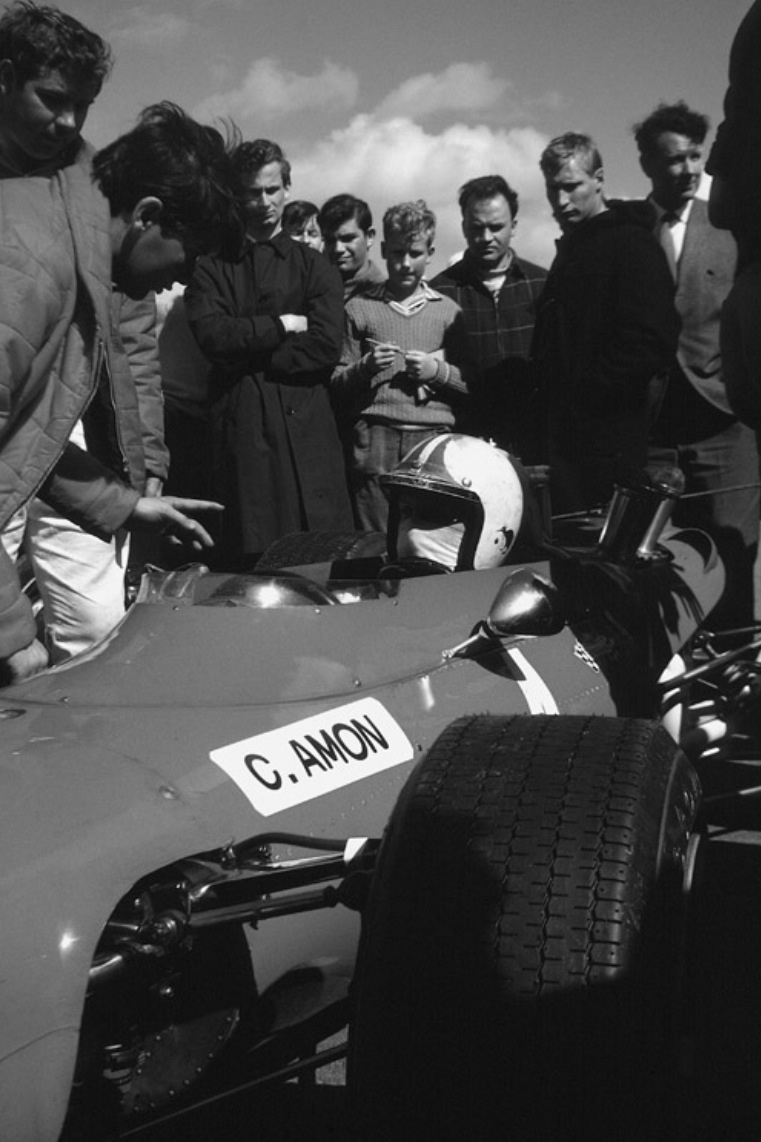
Seems to be the point Roger Bailey (or is it Bruce Wilson?) is making to Chris Amon before he takes to the Wigram circuit in January 1968…
The Ferrari lads popped a fresh engine into Chris’ Dino on Friday night so it may well be the thrust of the exchange! Terry Marshall took this wonderful shot, it was a good meeting for Chris, he was second to Jim Clark’s Lotus 49 in The Lady Wigram Trophy on Sunday, while Denny Hulme was third in an F2 Brabham BT23 Ford FVA. The shot below shows Clark’s fag-packet Gold Leaf Team Lotus, Lotus 49 Ford DFW – GLTL making its race debut and taking its maiden win – in front of Chris’ Ferrari.
(sergent.com)
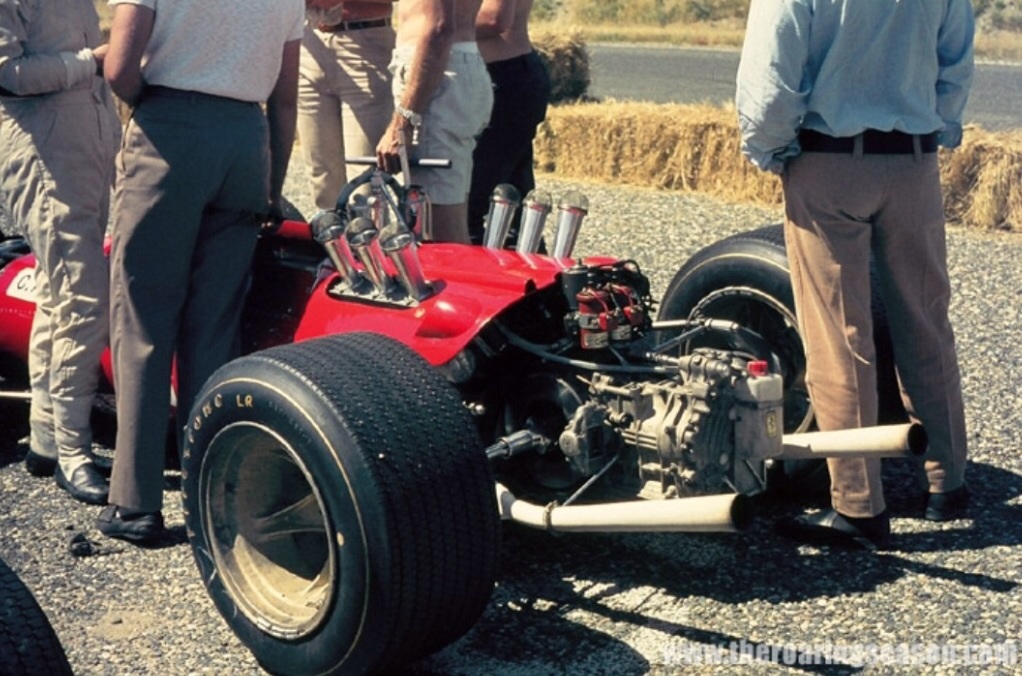
I’ve done these Tasman Dinos to death in various articles so won’t prattle on again, click on the links below for more on these jewels of machines.
Terry Marshall commented about the weekend, “I was stationed at Wigram (an RNZAF airbase) doing my military service and could hear Amon and Clark howling around in practice while I was learning how to survive an atomic attack by lying down behind any brick or concrete wall that was handy. Makes me laugh just thinking about it!”
(I Peak)
The photos above, and at the end are by Ian Peak the following weekend in the Teretonga paddock. Oh to have been there?! Chris was fourth behind Bruce McLaren’s works BRM P126 V12, Clark’s Lotus 49 Ford DFW and Frank Gardner’s Brabham BT23D Alfa Romeo V8.
George showed some pace too, he qualified fifth at both Road Atlanta and Donnybrooke, was sixth on the grid at Edmonton and eighth at Laguna Seca but he had a shocking run of reliability with various chassis, engine and engine ancillary failures. The team’s Chev engines were prepared at Bourne.
(MotorSport)
His best finish was third at St Jovite, a performance matched by Pedro Rodriguez who raced another P154 at Riverside, and at Laguna where he was fifth.
The team’s 1970-71 P153-P160 grand prix cars were race winners, so BRM had bigger fish to fry. It’s a shame they didn’t build on the Can-Am learnings of 1970 with a full two-car works effort the following year all the same.
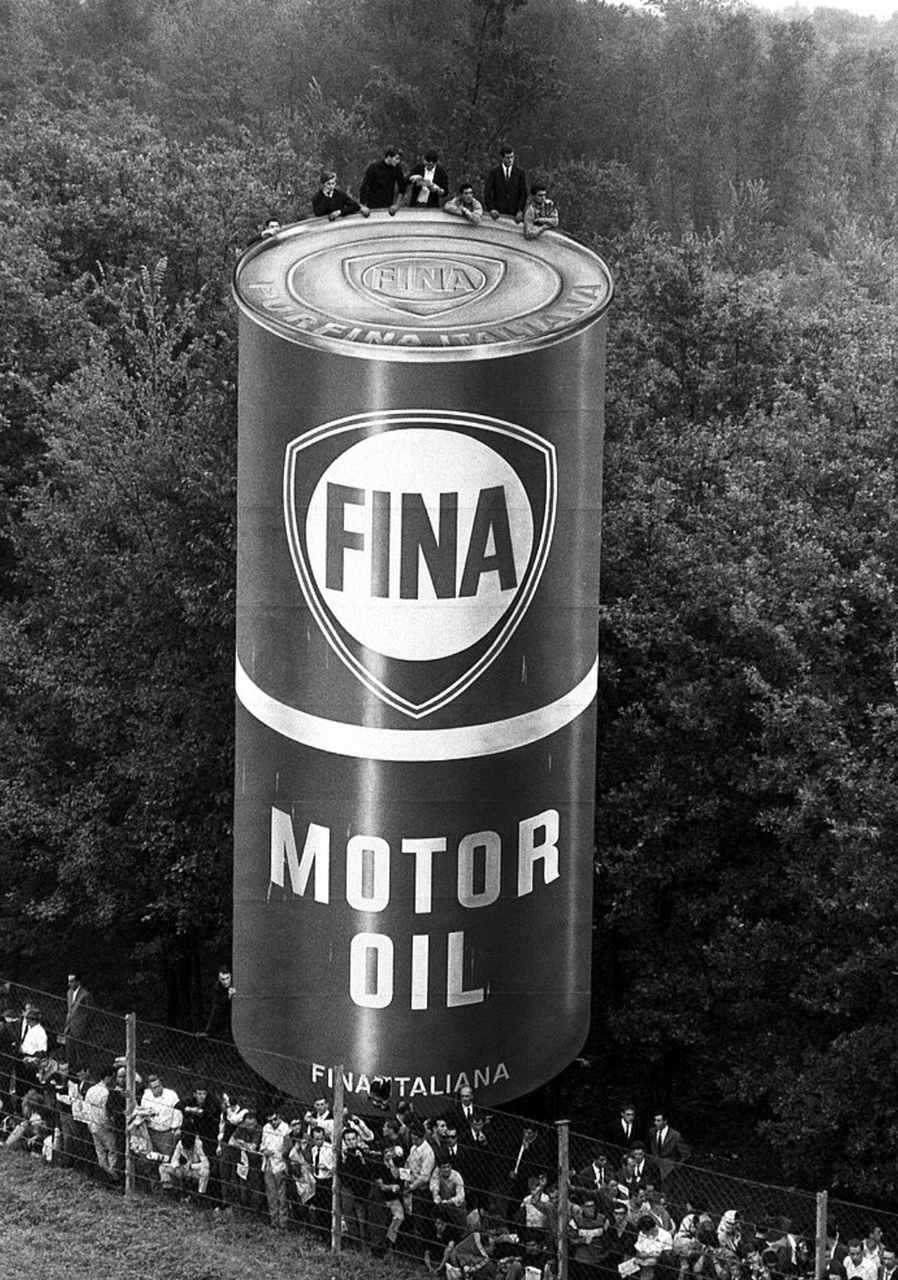
The crowd had plenty to cheer about. Bandini’s Ferrari had just won the 1964 Austrian GP and John Surtees took victory before their eyes on the way to his and the Scuderia’s 1964 World Championships. Italian Grand Prix, Monza September 6 1964…
In a thrilling race with slipstreaming battles down the field for which the circuit was famous, Surtees won in his Ferrari 158 from Bruce Mclaren’s Cooper T73 Climax and Bandini’s 158.
(unattributed)
John Surtees and Dan Gurney diced for much of the race until the Climax engine in his Brabham BT7 cried enough. Gurney had a few of these occasions when on the cusp of a win during his Brabham years.
(The Cahier Archive)
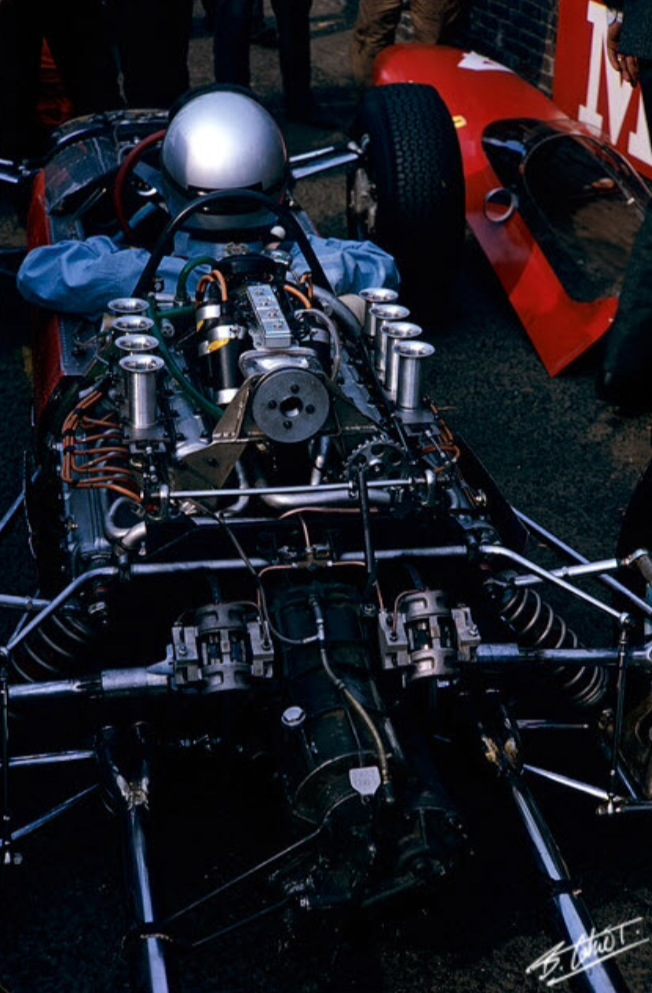
The business end of Lorenzo Bandini’s Ferrari 158 during practice.
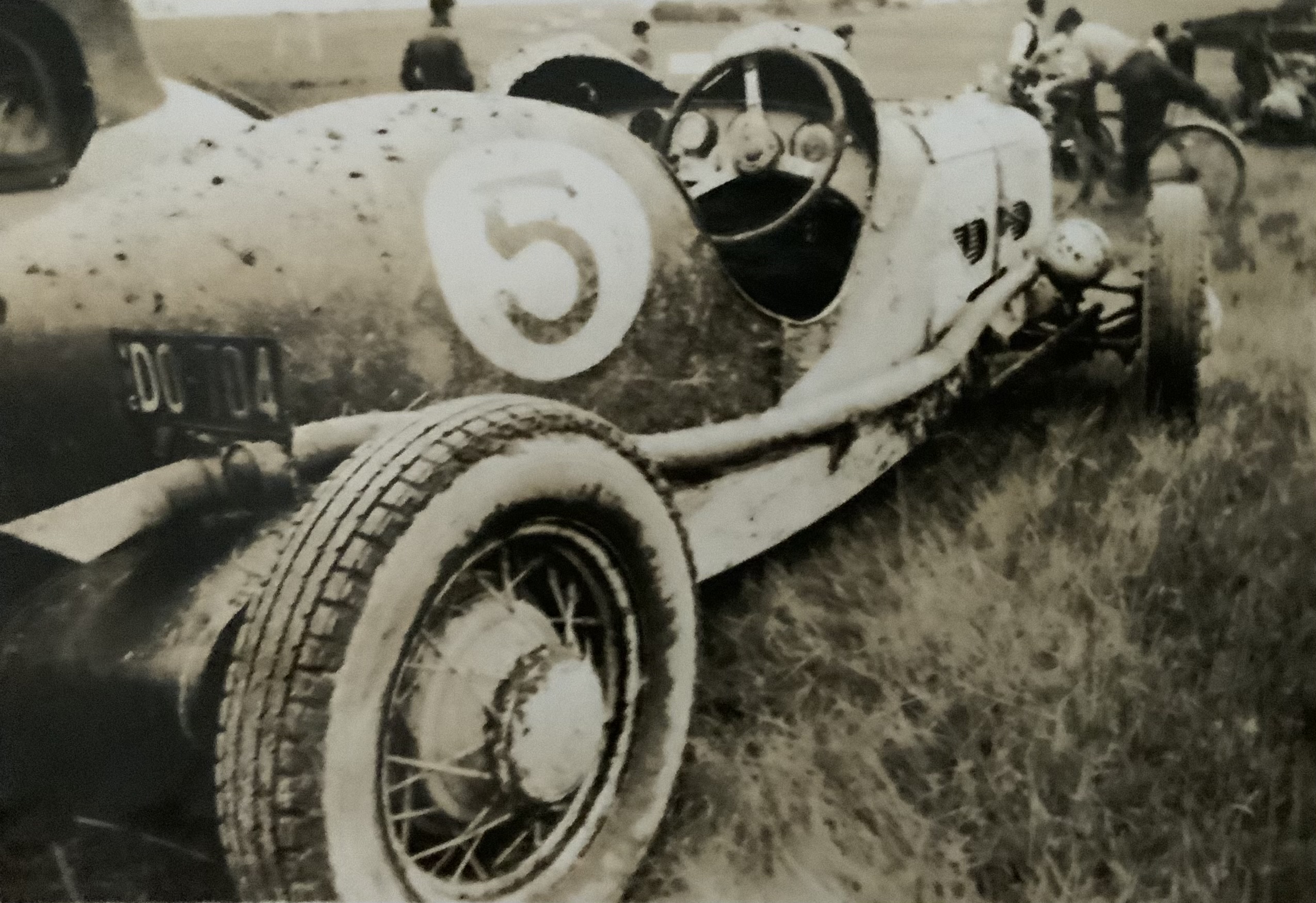
Whitehead is shown here in the cockpit of his ERA during the abortive – and aborted – Parramatta Park, Sydney meeting in 1938 (B King Collection)
English international, Peter Whitehead spent quite a bit of time in Australia during 1938 on business. One hat he wore was as a member of the W&J Whitehead family, Bradford based, wool textiles business, the other was as the driver of his much smaller motor racing enterprise.
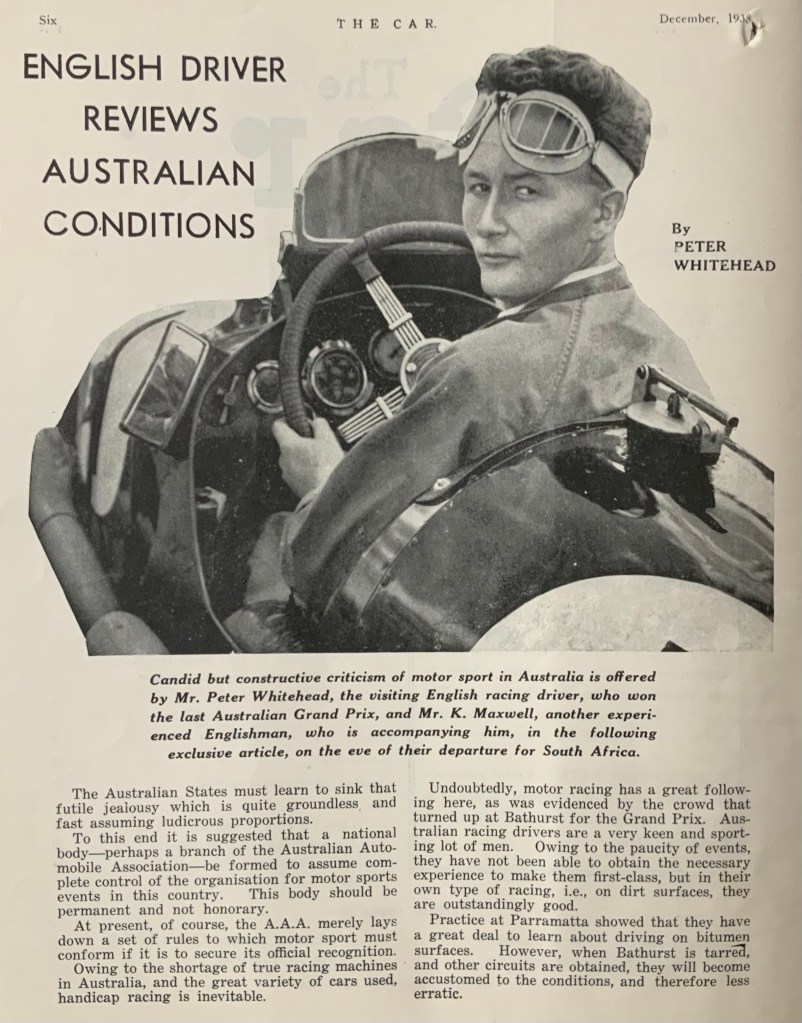
As you will appreciate from the articles, Whitehead was in Australia long enough, and travelled broadly enough, for his views to be fully formed on the state of motorsport play at that time.
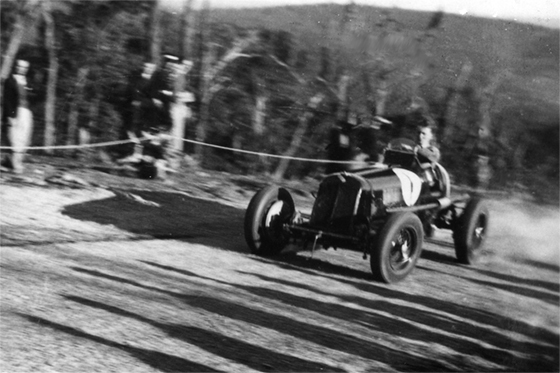
(B King Collection)Blurry and ‘Hatless’ Whitehead during the Australian Hillclimb Championship meeting at Rob Roy in June 1938. He did FTD and set the course record at 31.46 seconds on the still unsealed course which opened a year earlier (L Sims Collection)
Peter Whitehead was spot on with his observations really.
Picking up his points in the order they were made, the Confederation of Australian Motor Sport (CAMS) was formed in 1953 to manage, organise and regulate (sic) the sport on a national basis. Perhaps without World War 2 a more focused governing body would have replaced the Australian Automobile Association earlier.
Handicap racing continued throughout Australia well into the 1950s. We had a relatively small number of racing cars spread over a vast continent. Handicaps ensured everybody had a chance of victory, by this means, competitors were prepared to travel vast distances by road, rail or coastal ships to race.
Then the only Australian racers who competed ‘regularly’ on bitumen roads were the West Australians on their Round the Houses road courses in various country towns. Allan Tomlinson’s stunning Lobethal AGP win in 1939 is in part credited to his skill on such surfaces relative to the east coast based competitors, aboard his MG TA Spl s/c. See here; https://primotipo.com/2020/12/04/tomlinsons-1939-lobethal-australian-grand-prix/
A series of races to attract international competitors did eventually happen, formally with the Tasman Cup – seven/eight races in NZ and Australia in January-February each year – in 1964, and informally with a series of international races for the better part of a decade before that. Peter Whitehead returned and raced a couple of Ferraris here during that period. See here; https://primotipo.com/2020/10/10/squalo-squadron/
The bad-blood, combative relationship between the New South Wales Police and the racing community lasted well into the 1950s and is a story in itself.
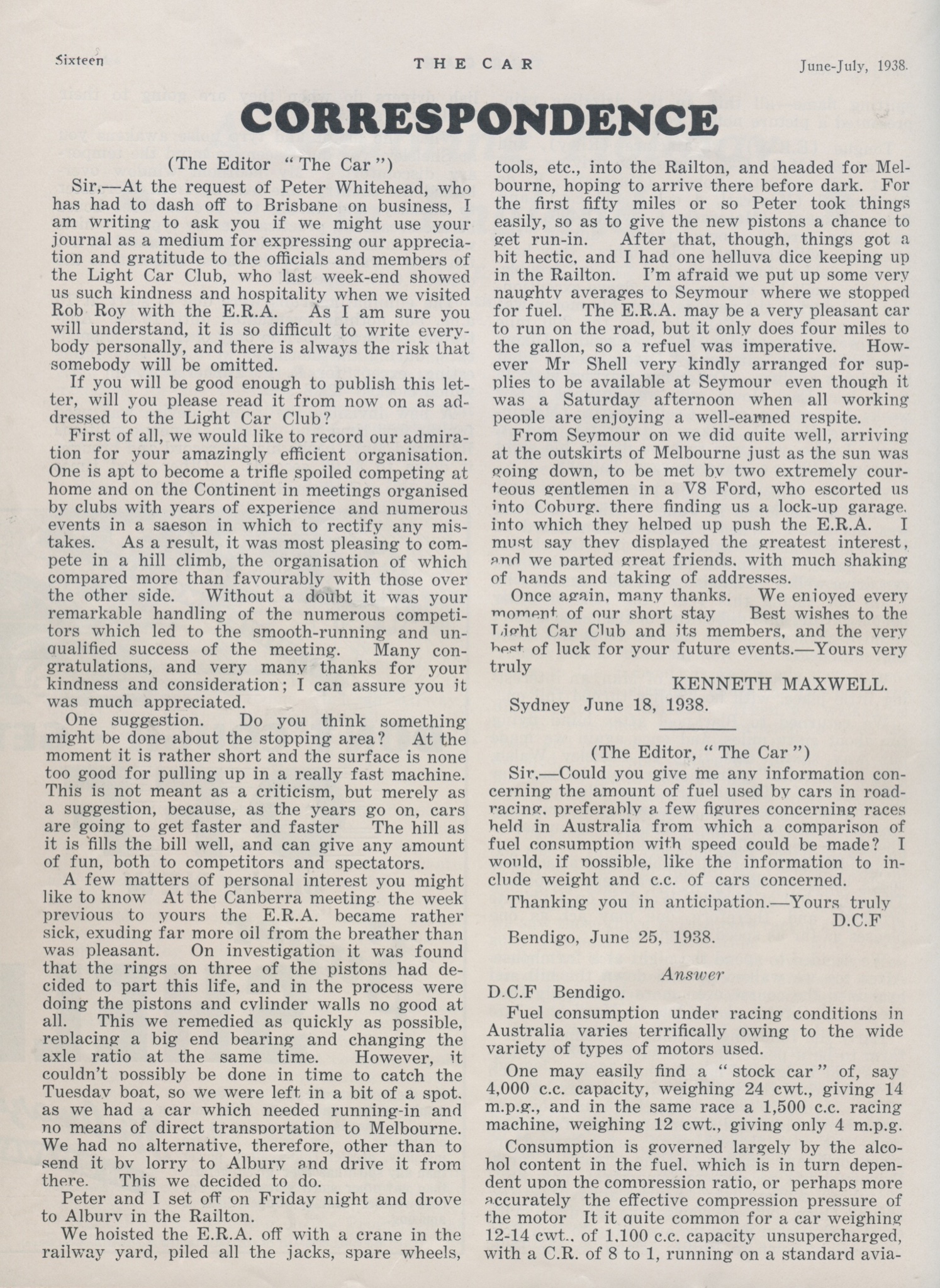
This piece was written by Kenneth Maxwell earlier in the trip and was published in the June-July issue of The Car.
The Yarra Falls building site in 1918. Melburnians will note the roofline of the Convent of the Good Shepherd on the north side of Johnston Street, that building is still there on the wonderful Collingwood Children’s Farm site; a visit to rural Australia in inner Melbourne is worth a trip for any international tourist. The Falls site was redeveloped, keeping many of the original buildings, for business and residential use several decades ago (Picture Victoria)
Etcetera…
The Whiteheads were customers of Australian wool from the earliest of times. The contents of an article in The Argus (Melbourne) appealed to the economist in me. The piece reported on the business trip of Henry Whitehead, a relative of Peter Whitehead, in January 1920 who is described as having interests in “three of the largest of the great Yorkshire textile works.”
Whitehead’s visit was as a director/advisor of Yarra Falls Spinning Co Pty. Ltd. at 80-110 Trenerry Crescent, Abbotsford – on the shores of the Yarra River in Melbourne where wool was scoured/cleaned – and he commented that “Although Australia is the greatest wool producer in the world she could not have competed with England before the war in the marketing in Australia of goods manufactured out of her own raw materials…But times have changed, and today Australia has the opportunity of making more of her own goods, and particularly of making up her own raw materials.”
Funnily enough, a century on, we are still better at shearing sheep and digging holes in the ground (mining) than manufacturing, that is, value adding to the raw materials we export to others.
Henry Whitehead spoke of the need for immigration of skilled labour to aid growth of the industry and encourage further British investment.
The Yarra Falls Spinning Company was then capitalised at £200,000, “the great bulk of which is Australian money.” The other directors, with the exception of Whitehead, were Australian, the factory was commenced in 1918 and employed 200 in 1920. The only limiting factor in expanding the business right then beyond relatively simple wool scouring and combing, to the production of worsted cloth (for clothing) was the difficulty of getting specialised weaving plant and equipment made, and imported from the UK.
So, Peter Whitehead would have been busy, apart from his racing…
Credits…
The Car, December 1938 via the Bob King Collection, Leon Sims Collection, Ted Hood, The Argus January 1, 1920, Picture Victoria
Tailpiece…
(T Hood)
Peter Whitehead fettles his ERA #R10B in frigid Canberra weather in June 1938. He was taking part in annual speed record attempts in the national capital, weird though that seems.
Mind you, there was a round the houses taxi race in Canberra not so many years ago, the Canberra 400 from 2000-2002.
Mark Skaife, Holden VX Commodore V8 Supercar en-route to winning the 2002 Canberra 400, Parliament House in the background (unattributed)
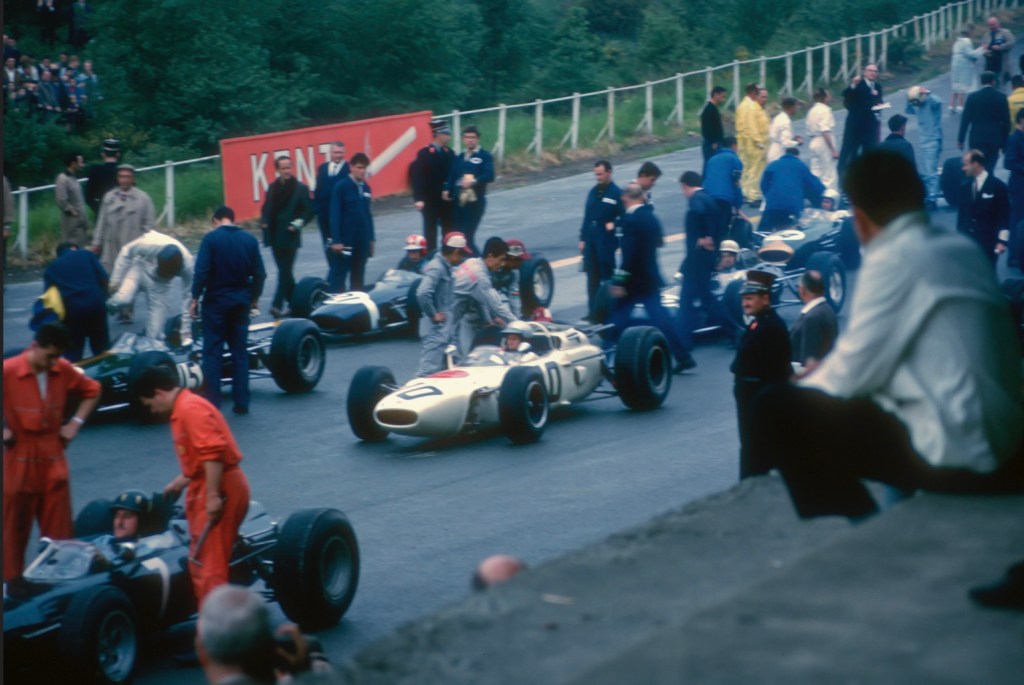
I just love pit or startline just-before-the-off shots. You can feel the tension, excitement and driver’s surge of adrenalin just before they pop their butts into the cockpits of their chariots. Here it’s the Belgian Grand Prix, Spa 1965.
Our black-snapper in some ways ruins the shot but he gives it intimacy and immediacy as well. The front row from left to right are Jackie Stewart, Jim Clark and a very obscured Graham Hill; BRM P261 by two and Lotus 33 Climax.
(wfooshee)
The only fellas I recognise are Messrs Stewart, Clark, Chapman and Hill. Can you do any better? The weather looks a bit grim, but such conditions are common in the Ardennes.
(wfooshee)
It’s a smidge out of focus but let’s not be too hard on our photographer Mr Fwooshee, I’d love to be able to credit him/her/it fully if anyone knows the correct name.
Every time I see a Honda RA271/272 I’m stunned by the audacity of a transversely mounted 1.5-litre V12, six-speed, monocoque chassis design in your first crack at a GP car; RA270 space frame prototype duly noted. Karma was Mr Honda’s originality being rewarded with that Mexican GP win several months hence, here Richie Ginther (RA272) was sixth. Graham Hill is in front, #15 is Dan Gurney’s Brabham BT11 Climax – everybody’s favourite Lanky-Yank is about to insert himself into that little Brabham – and behind him, Jo Siffert’s Rob Walker BT11 BRM. Jo Bonnier, Brabham BT7 Climax is behind the Honda, and further back the redoubtable Bob Anderson in his self-run #24 Brabham BT11 Climax. Brabhams galore, bless-em.
Who is the driver playing with his silver or white peakless helmet? Down the back, top-right there is a glimpse of Jean Stanley getting that tosspot ‘Lord Louis’ Stanley’s cravat nice and straight…
Oh yes, Jim Clark won from Jackie Stewart with Bruce McLaren’s Cooper T77 Climax in third place.
Credits…
fwooshee
(fwooshee)
Tailpiece…
Frank Gardner had an early afternoon, his John Willment Brabham BT11 BRM had ignition problems after completing only four laps. He started from grid slot 18 of 21, the best placed BT11 was the Guvnor’s works-car, Jack Brabham was fourth.
Phillips-Parsons airborne on the Wirlinga road circuit (cars4starters.com.au)
The Jack Phillips – Ted Parsons 1934 Ford V8 was Australia’s fastest of the breed pre-war. Here the machine is aviating on the Wirlinga road circuit – 10km northeast of Albury – on the Kings Birthday weekend in June 1940. The duo are on what was then called Orphanage Lane (now St Johns Road), the two crests which allowed the cars to take to the sky were near Corrys Road, Thurgoona, many thanks John Medley and Ray Bell.
The car was one of the most successful of all Australian racing cars in the immediate lead up to the conflict, placing sixth and third in the 1938 and 1939 Australian Grands Prix at Bathurst and Lobethal respectively. “In Victoria for the 1937-38 season, the Phillips Ford was awarded ‘The Car Trophy’ for the most successful competitor,” John Medley wrote.
The duo also won the Interstate Grand Prix/Albury and Interstate Cup on the Albury-Wirlinga road course in 1938-39 and the South Australian 100 at Lobethal in January 1940. On the same day the pair finished second to Les Burrows’ Hudson Terraplane Special in the Lobethal 50.
Bill and Ben the Flowerpot Men? Phillips/Parsons on the way to winning the South Australian 100 on New Years Day 1940 at Lobethal (unattributed)
As the lights were progressively turned down throughout 1940, the Phillips/Parsons pair were ninth in the Easter Bathurst 150 mile race won by Alf Barrett’s Alfa Romeo Monza. The car’s final meeting before being put on display for much of the conflict in their Wangaratta Motors Ford dealership was the 75 mile Albury and Interstate Cup Race on June 17, 1940. It was the final meeting on this road course and Barrett set the all-time lap record at 2 minutes 52 seconds but broke an axle and retired from the race. Harry James’ Terraplane won in a steady performance from John Crouch’s Alfa Romeo 8C2300 Le Mans with Phillips/Parsons third.
A great shot but whereizzit? Note the Victorian rego-plate and ‘tuned-length’ exhaust which will have aided driver and passenger comfort in longer races by dispensing with fumes and noise well-aft of the conducteurs. Quality of the body and standard of presentation impressive (cars4starters.com.au)
Based on a fire-damaged ‘34 sedan with over 20,000 miles on the clock, the car was modified in the partner’s Wangaratta, Victoria Ford dealership by fitment of a special, swoopy, lighter body. Engine enhancements included twin Winfield carburettors, Scintilla magneto, modified heads and free-flowing exhausts.
Timed at 115mph in top gear, it did 80 in second – at a then heady 6000rpm – using the 3.5:1 rear axle ratio. It was a paragon of solid reliability too, not suffering the overheating afflictions of so many modified Ford flatties.
The masked avengers on the Victor Harbor – Port Elliott road circuit during the 1936 South Australian Centenary Grand Prix, well protected from road detritus and here are using all of the available real estate. DNF after completing 21 of the 32 laps (B King Collection)
John Medley observed the car’s strengths, “The Phillips Ford simply soldiered on in prewar races on dirt and gravel roads, built tough to last to the finish. It continued to race postwar particularly in Victoria and South Australia where it was raced by South Australian Granton Harrison, by which time the newer breed of generally smaller and lighter V8 Specials could out-pace it.”
“Still it had been the mould in which the later V8s were shaped. In the postwar period, with T-Series MGs, Ford V8 specials were the backbone of Australian road racing.”
The Phillips/Parsons Ford was destroyed when it was crashed into a bridge, the remains were scrapped. Ted Parsons Jnr and his son Rob recreated the car between 2008-2014, the car took its bow at Winton in 2014.
Likely lads, who is the chap at left and where was the shot taken? (B King Collection)
Historian, Rob Bartholomaeus has worked out, by looking at his photographic archive, that a rebuild involving lightening and lowering the car and replacing the ’34 grille with a 1935 unit and a change in colour scheme from the one above, to the diagonal stripes shown in most of the other shots was made in late 1938 rather than 1937 as documented elsewhere. It seems the car started with underbody exhausts, then evolved to the side exhausts as above which were retained after the car was modified and repainted.
(B King Collection)
As noted above, the car’s last pre-war meeting was at Wirlinga in 1940. Bob King has this photograph in his collection, the caption on the back lists the racer as Bill Sinclair and the place, Oakleigh in 1942. I can find no Trove reference to this meeting at what is now a southern suburb of Melbourne. It appears as though the car is running the same number/roundel combination from Wirlinga, quite probably untouched. If anybody has information about the event do get in touch.
(unattributed)
It’s not clear when Granton Harrison bought the machine but he added to its tally of Australian Grands Prix entries, racing it at Point Cook to Melbourne’s west in 1948, where he placed fourth, and in 1950 at Nuriootpa in South Australia’s Barossa Valley where he was 11th in the race won by Doug Whiteford’s Ford V8 Special ‘Black Bess’, Bess was inspired by the Ossie Cranston and Phillips/Parsons Ford V8s.
The shot above is of Granton contesting the South Australian 100 at Lobethal on New Years Day, 1948. A good day for him too, he was second behind Jim Gullan’s Ballot Oldsmobile Special – and did fastest race time in the handicap event – continuing this car’s reputation for competitive reliability.
Back to the sequence of owners. Stephen Dalton has Granton advertising the car for sale in the February 1948 issue of Australian Motor Sports, with Jack O’Dea running it at Rob Roy in January 1949, perhaps Jack ran it as a borrow/view to purchase. As we can see Granton raced on for a couple of years after that, if anyone can help with the ownership sequence, do get in touch.
Ted (Edwin) Parsons wearing Warren Safety Helmet, goggles, white overalls – the pocket of which had the Ford V8 symbol embroidered – wearing a leather kidney belt. “To look your best under the overalls it was common for Ted to wear a white shirt and tie,” Ted’s son Rob Parsons wrote. Wirlinga 1939 perhaps, chap behind unknown (Parsons Family Collection)
Etcetera: The Warren Safety Aviation Helmet…
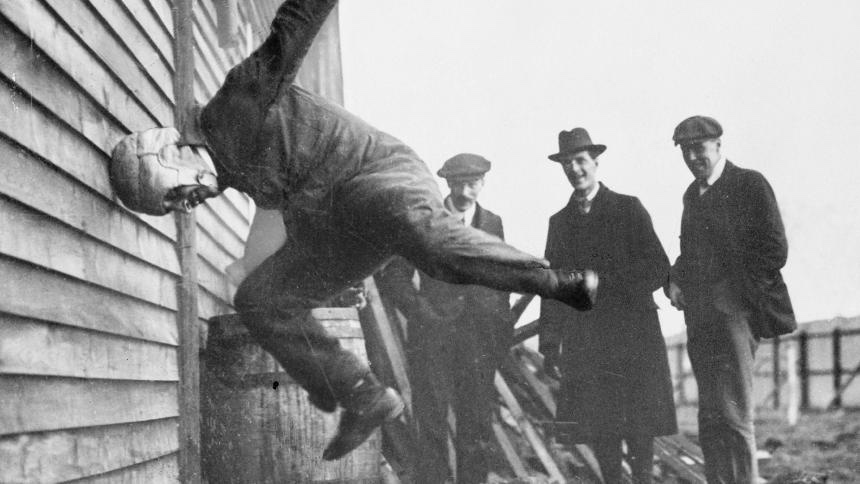
WT Warren invented the Warren Safety Helmet in 1912. The spring-equipped pilot safety helmet, made of leather and cork with vented ear collars was padded with horse hair and designed to minimise head injuries, the major cause of aero accident deaths at the time. The helmet was part of RAF listed kit issue from 1920-24.
Later models incorporated an ear audio piece and a breathing mask. By the time Phillips and Parsons used them they had been pensioned off by the RAF. Curtis and Taut & Co made the helmets under licence, the inscription in Parsons’ helmet, retained by the family, reads ‘No 2 Tuatz & Co Patent 17855 Aviators Safety Helmet. Maker Tautz & Co, Hunting Military and Multifit Tailors, 12 Grafton St, New Bond St, London.’
Phillips and Parsons with their distinctive Warren helmets after winning at Wirlinga in 1938 (J Dallinger)
Rob Parsons explained further, “While the helmet was obsolete for aircraft, they were used by Phillips and Parsons from 1935-39. With a lack of sporting regulations, these cars lacked the safety features of safety belts which were not considered a benefit for car racing. Drivers had a steering wheel and the co-driver a grab handle to hold onto. It would be common in rollovers to duck-down and brace yourself, perhaps to be trapped or otherwise flung free of the car, all with grave consequences.”
“Ted Parsons first introduction to motor racing was at the Benalla Airstrip circuit, perhaps a likely place to find such a helmet. On the back page of his photo album, he list drivers who died racing during his involvement, a reminder of the sport’s dangers. He retired from racing after the war to pursue golf and film-making.”
“Jack and Ted wore leather face shields to protect themselves from their own flying stones and other track debris, an idea adapted from the oxygen flying mask. The leather was painted white to match the colour of the car, aviation goggles protected their eyes,” Parsons wrote.
(Der Spiegel)
WT Warren tests his new helmet – as one does – by headbutting the wall of William Ewen’s Hendon flying school, where Warren was a trainee, in 1912.
What follows is the German-English translation from an article in Der Spiegel.
“In a 1912 issue of Flight magazine, British inventor WT Warren’s invention, a protective flight helmet is demonstrated. The image is often erroneously reported to be a football helmet.”
‘The wall against which the helmet carrier ran belongs to the flying school of William Hugh Ewen. The owner (middle) and and his chief pilot LWF Turner (left) are behind. The Lord in the foreground is his student Mr WT Warren. And, no, he has not failed the flight test and is just reacting to his anger.” Clearly the German hilarity is lost in translation.
“Dated 1912, Mr Warren is a tinkerer. He introduced his latest invention to experienced pilots: a protective helmet ‘that will attract considerable attention’, Flight magazine wrote. Warren’s leather cap was padded with horsehair: A system of steel springs should intercept any impact, thus reducing the risk of injury. Head injuries were the leading cause of death in flight accidents.”
Credits…
‘John Snow:Classic Motor Racer’ John Medley, State Library of Western Australia, cars4starters.com.au, Bob King Collection, ‘The Warren Safety Aviation Helmet’ by Rob Parsons in the July 2021 issue of ‘The Light Shaft’ – Austin 7 Club magazine, Parsons Family Collection via austin7club.org, John Dallinger, Der Spiegel
Tailpiece…
(SLWA)
I’m cheating a bit, this 1934 Ford is a V8 ute rather than a sedan, but you get the jist of it.
The Phillips-Parsons racer was not too far removed from a roadie, rather than an out-and-out bespoke racer, reliant as it was on the standard chassis, axles wheel to wheel, differential and gearbox.
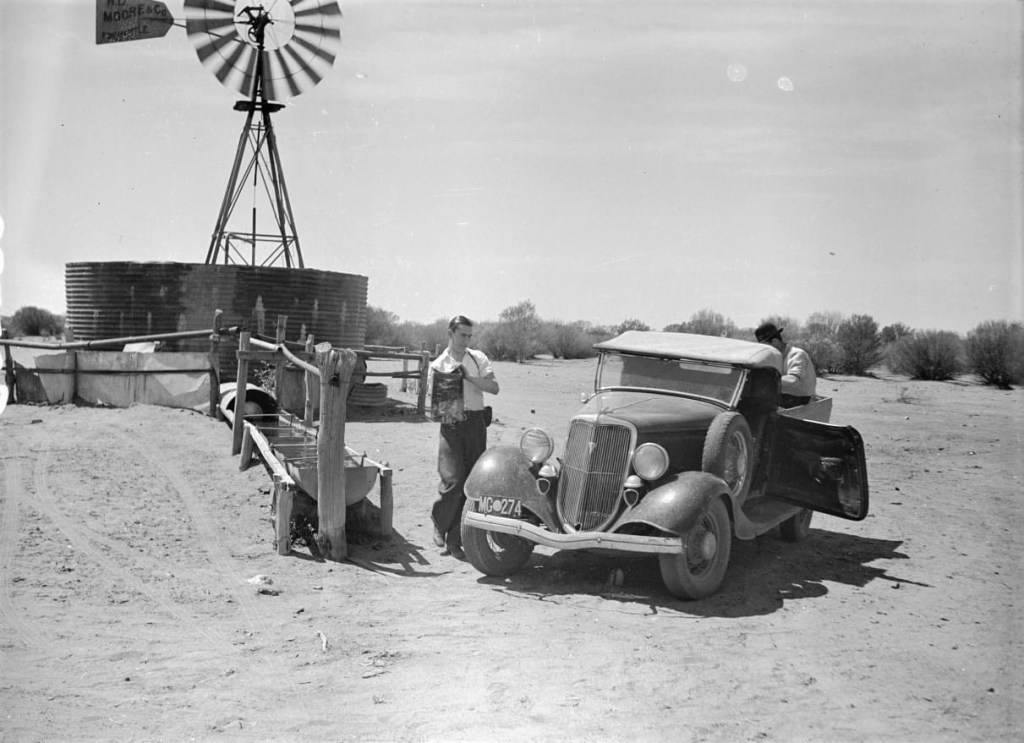
The ute is singing for its supper, doing a meat delivery in country Western Australia in 1937.
Brian Muir at Brands Hatch during the 1969 BOAC International 500, held over the April 13 weekend.
Muir shared the car with Lotus engineer and soon to be GP driver, John Miles. The pair qualified the new car 16th, finishing 13th outright and first in the 2-litre Prototype class.
The race was a Porsche rout, with the Jo Siffert/Brian Redman, Vic Elford/Richard Atwood and Gerhard Mitter/Udo Schutz 908/02s taking the podium. The Chris Amon/PedroRodriguez Ferrari 312P was fourth, the JW Automotive Ford GT40 crewed by David Hobbs and Mike Hailwood fifth with the other Porsche works car – yes, it finished too – raced by Hans Hermann and Rolf Stommelen in sixth. The 908 was quite a machine, about as reliable a racer as the 911 was/is a roadie.
(MotorSport)
It’s all about the engine really, this car. It was to a large extent a development exercise for the Lotus Vauxhall 2-litre LV240 Type 904 engine which, with lots of development, replacement of the Vauxhall block with bespoke Lotus alloy unit, and a whole lot more, later powered a couple of generations of Lotuses for 25 years or so. More about the engines gestation and useage at the end of this piece.
(MotorSport)
The arguments within Lotus Components about the location of the dry-sump oil tank would have been interesting! It’s all Tecalemit Jackson fuel injection componentry isn’t it. The metering unit is sharing the distributor drive (below). See the oil filter, “The heavy oil tanks sits too high Martin!” you can feel Our Col saying to designer Martin Waide. “Yep, I know but this car has bodywork Colin, I can’t shove it wherever I like compared with the open-wheelers.
A ZF 5DS five speed manual gearbox sits where a Hewland FT200 transaxle really belongs. Doncha-reckon Chapman said “use one of those things” and pointed to one of the ZFs pensioned off when Lotus got with the strength and fitted Hewland DG300s to the Lotus 49Bs?
(MotorSport)
240bhp @ 8000rpm is claimed for the 1992cc, twin-cam, four-valve, oversquare (95.3mm x 69.9mm bore/stroke) cast iron block, aluminium head engine. See the nicely boxed reinforcements for the top-hats of the coil spring damper units and cable drive for the Smiths chronometric tach. Plenty of Aeroquip there too, it’s coming into vogue…
(MotorSport)
The Lotus Europa parentage is clear enough, but parentage is putting things crudely, there is nothing Europa about this car other than the body. Two of these purpose built Group 6 racers were built. The thing clearly didn’t want to turn-in given the aero experimentation shown in this series of shots.
(MotorSport)
Front end detail, spaceframe chassis and conventional for the day front suspension comprising upper and lower wishbones, alloy uprights, coil spring/damper units and roll bar. Disc brake rotors are 12-inch Girlings, who also provided the calipers, weight of the car is circa 1250 pounds.
(MotorSport)
On the hop through Bottom Bend. The other cars in the 2-litre prototype class at this meeting were Chevron B8 Ford, Ferrari Dino 206S, Nomad Mk1 BRM, Abarth 2000S and Ginetta G16A BRM. The Muir/Miles Lotus 62 won the class from the Beeson/DeCadenet Dino and Blades/Morley B8 Ford.
26 year old racing driver/mechanical engineer John Miles, and 38 year old racing driver/mechanic Brian Muir will surely have extracted all their new mount offered and added a sizeable dollop of mechanical sympathy to boot (MotorSport)(MotorSport)
Lots of sheet aluminium to reinforce the tubular chassis. Lotus cockpits of this era, open and closed are the yummiest of workplaces. Attention to detail and finish of their racing cars is exceptional, while freely acknowledging the under-engineering on way too many occasions that also went into the package…
(MotorSport)
Hard to tell who is up? Mechanic’s names welcome. That’s one of the four Porsche System Engineering 908/02s behind, the numbers of which all started with a 5…I can see the short-arse driver but cannot pick him.
Lotus fitted development versions of their 900 engines to their Bedford CF van, Vauxhall VX4/90 and Viva GT in addition to the two Lotus 62s (B Wellings)
History of the 900 Series Lotus Engines by Tim Engel…
The production 9XX engines are Lotus designs. To expedite development, early versions of the cylinder head was bolted onto a Vauxhall block. No non-Lotus blocks were used beyond the first prototype iteration (904) and certainly not in production. Whether the 907 is a blueblood or a bastard is one that periodically comes up.
16 Apr 1997, Erik Berg <Erik.Berg@trw.com> wrote: OK, does anyone know more about the history of the development of the 62 engine? My recollection is that it was *not* in fact a 900 series engine, but was a four-valve head adaptation of the existing Vauxhall 2-litre block.
The Mk 62’s 904 engine was a development mule for the 907, and was a composite of a Vauxhall 2-litre iron-block assembly, a Lotus-spec’d, longer stroke crank and a Lotus prototype cylinder head. Lotus recognised that the most development intensive part of the engine design was going to be the head. To expedite head development without waiting for the complete engine to be designed and prototyped, they ‘borrowed’ the cylinder block from the very similarly sized/ configured (slant four) Vauxhall Victor 2.0 and mated it to the prototype head.
Later, the Mk 62 received the 906 engine, which was a further development of the Lotus design with a prototype sand-cast aluminum block. The 906 eliminated the Vauxhall crutch that had allowed the development program to get a faster jump start and got the engine closer to it’s final, all-Lotus design.
The Mk 62 car was built as much as a development test bed for the new engine as a race car. It was felt that racing the engine would accelerate the learning curve.
(MotorSport)
The aluminum 907 block is very different from the iron Vauxhall block and not just an alloy adaptation of an existing design. However, it’s probably (I’m jumping to a conclusion) more than coincidence that the bore centers are the same. The head was first designed to fit the Vauxhall block. Once that was done, why incur the extra work of re-designing it to fit a different bore spacing? Just design your new block to fit the head that was developed in advance of the rest of the program.
Iron block 2.0 race engine with T-J fuel injection, July ’68 (aka, LV220 = Lotus-Vauxhall, 220bhp)
Iron block 2.0 road car engine (non-production, test only).
Die-cast aluminum block 2.2 N/A Lotus road car engine
The 904 had a 95.25mm (3.75 in) bore x 69.85mm (2.75 in) stroke for a 1995 cc displacement… just under the racing class limit. The similar Vauxhall Victor 2000 used the same 95.25 bore, but a shorter 69.25 stroke for a 1975 cc displacement. As installed, the 904 crank was a Lotus specific part; however, I don’t know if it was machined from a Vauxhall blank or made from scratch.
Later, the 907 used the same 95.25 (3.75) bore as the Vauxhall, but with a claimed 69.2 (2.72) stroke/ 1973 cc displacement. Just a weeee bit smaller than the Vauxhall engine. The Elite/Eclat/Esprit manuals give the bore dimension to 4 decimal places, but leave the stroke at 69.2 (2.72).
I wouldn’t doubt (but I don’t know) that the stroke and displacement numbers (.05mm / 2cc smaller than the Vauxhall) were more of a weak marketing attempt to give the 907 it’s own non-Vauxhall identity by simply rounding off the numbers.
The 907 was supposed to be an important step for Lotus in establishing itself as a stand-alone manufacturer. However, when Lotus fast-started it’s development program by basing the first prototypes on the Vauxhall block, the press grabbed onto the Lotus-Vauxhall identity with a death grip and Chapman couldn’t break it. After a while, hearing the press continually refer to his new engine as a Vauxhall or Lotus-Vauxhall started to SERIOUSLY rub Chapman the wrong way.
Etcetera…
In a previous life I was CEO and a partner in one of Australia’s best graphic design and branding firm. I saw plenty of corporate identity standards manuals along the way but never one where the client felt the need to define the plural of the entity, as Chairman Chapman or his PR apparatchiks felt the need to do.
I don’t think anybody took any notice either, ‘Lotuses’ seems to have been in common use since Jim Clark was in shorts. I used Loti until someone observed that I had a touch of the Setrights. So I stopped.
Clearly the name of ‘our car’ is officially the Lotus 62 Europa albeit I follow the racing car nomenclature practice started by DC Nye and some of his buddies during the 1960s, viz; make-model-engine maker, that is Lotus 62 Vauxhall. Mind you, a more accurate description is perhaps Lotus 62 Lotus-Vauxhall given the mix of Lotus and Vauxhall mechanicals, mind you that sounds shit. How bout Lotus 62 Vauxhall-Lotus. Nah, that’s not too flash either. I think Lotus 62 Vauxhall will do the trick, application of the KISS Principle is always the way to go.
(MotorSport)
Credits…
MotorSport Images, Tim Engel 900 engine article on gglotus.org, bedfordcf2van.blogspot.com, Bruce Wellings
Tailpiece…
(MotorSport)
I wonder who took out the rest of the BOAC sign? An expensive accident no doubt.
It looks pretty good to me, not exactly Margaret River, but hey, what’s all this nonsense about the grim North Sea?
Jack Brabham was never the life of the party, seemingly, but he had a pretty good sense of humour, here making his way to the grid for the 1966 Dutch Grand Prix and addressing head-on media comments about his advancing years, complete with ‘walking stick’ and beard. He had turned 40 on April 2, like a fine wine he got better really, not too many of the over-40s won races in their final season, 1970 in Jack’s case. Ignoring the occasional touring car outings back in Australia.
(wfooshee)
He had the last laugh too, he had won the previous two Grands Prix in France and the UK and was on the-roll that delivered his third World Drivers Championship that year. He beat Graham Hill, BRM P261, and Jim Clark, Lotus 33 Climax to win at Zandvoort, then repeated the victorious dose at the Nurburgring a fortnight later. See here for a piece on his ’66 championship year; https://primotipo.com/2014/11/13/winning-the-1966-world-f1-championships-rodways-repco-recollections-episode-3/
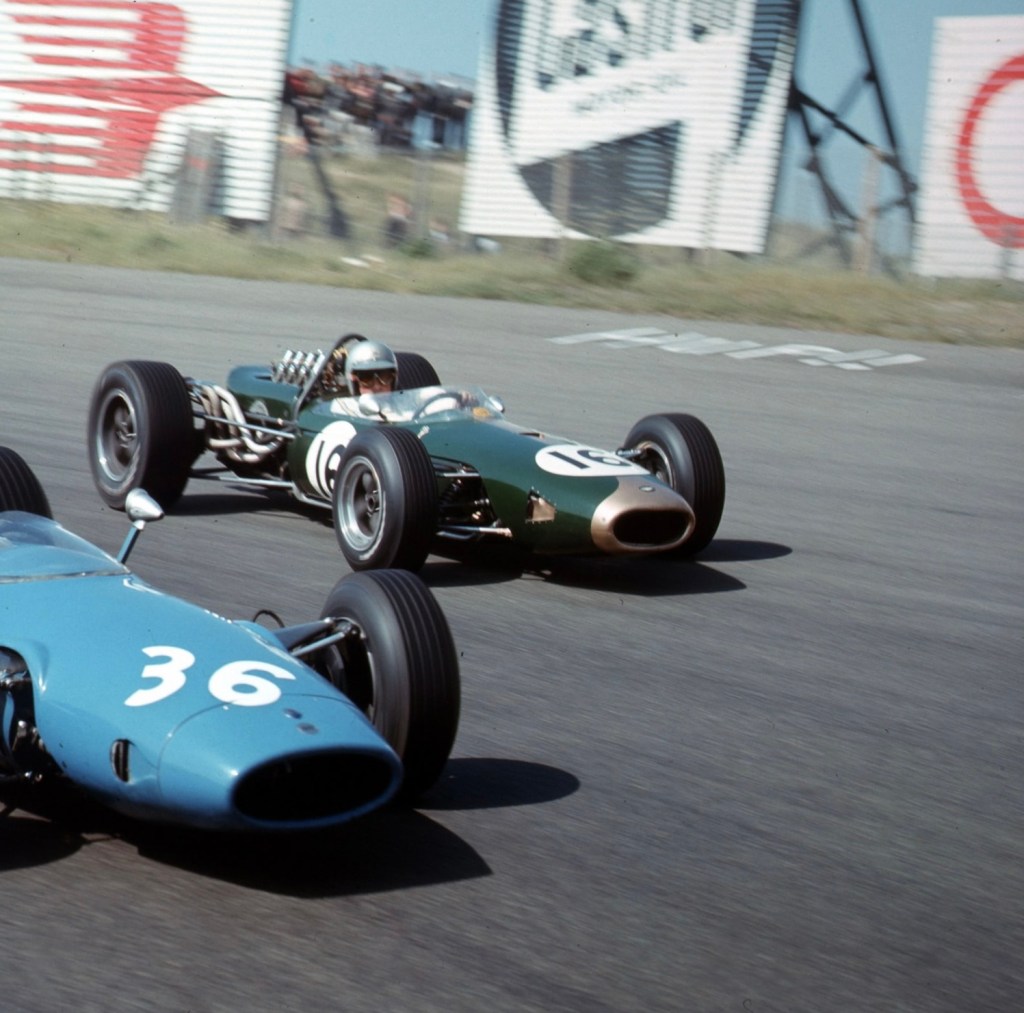
Two 3-litres ahead of two 2-litres in the Dutch dunes. Brabham and Denny Hulme, Brabham BT19/ BT20 respectively from Jim Clark’s Lotus 33 Climax and Graham Hill’s BRM P261 (MotorSport)
BT19 F1-1-65 defines simplicity.
Spaceframe chassis, and a repurposed one at that, Alford and Alder (Triumph) front uprights and povvo Repco RB620 290-310bhp, SOHC two-valve, Lucas injected V8 with a block donated by an Oldsmobile roadie. Can’t be true, surely? It’s an unusual angle of Jack’s weapon of war for 95% of 1966 in Tasman 2.5 and F1 3-litre Repco guises, it raced on towards the end of ‘67 too, no rest for the wicked, World Champ or otherwise.
Credits…
wfooshee, Bernard Cahier-Getty Images, MotorSport Images
(MotorSport)
Tailpiece…
Brabham rounding up Guy Ligier’s Cooper T81 Maserati V12, he was ninth and last, six laps adrift of the winner. At the end of the season Jack sold Guy one of BRO’s Brabham BT20 Repcos (Denny’s F1-2-66), so impressed was the rugby-international watching them go past at close quarters that season.
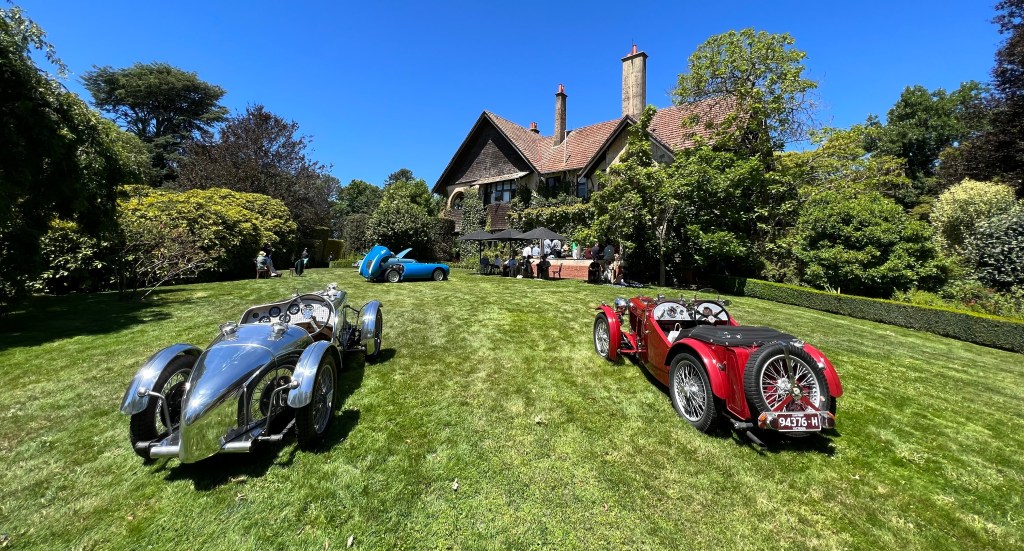
Panorama of the Self Preservation Society’s ‘Wombat Park Classic’ Concours held at Daylesford, Victoria, Australia on Saturday February 18, 2023.
Being of the Oily Rag School of Restoration I’ve always found the top end of this arcane world – Pebble Beach et al – pointless. Getting a car – ‘restoring it’ is such an inaccurate descriptor – to the point it never looked ex-factory defies me, why not go buy a Monet and pimp-that instead, it’s much smaller and easier?
At the more sane end, with fabulous cars that are used, I’m troubled to find fault with a day in the sunshine as works-driver of the Equipe King AC Ace Bristol talking gobshite to other punters, admiring the cars and pretty-ladies, not to forget sipping some exy-French-bubbles.
Wombat Park, Daylesford was settled in the 1850’s by William Stanbridge, gold-mine owner, entrepreneur and State MP, the place is slap-bang in the middle of Victoria’s beautiful Goldfields region. The current, magnificent 1910 Rodney Alsop designed – the great-grandfather of a car mate of mine as it transpires – English Arts and Crafts style home was recently bought by the Mayor of Daylesford, Tony Demarco, a local hospitality entrepreneur with over 1100 beds in the region.
The Concours d’Elegance was the first gig held at Wombat since Demarco’s acquisition. Many thanks to the sponsors below for a wonderful day of largesse.
I believe The Self Preservation Society (SPS) – you would need to ask them directly, any connection with The Italian Job is entirely accidental – is one of many seditious automotive organisations that have popped up around the world to celebrate life post-Covid, in particular the failure of the Wuhan Wet n’ Wild Market Alchemy Team to kill us all. Rest assured, the SPS is as potent a force as the Judean People’s Front, or was it The People’s Front of Judea? so no need to worry too much about recommendations to storm The Capitol from them.
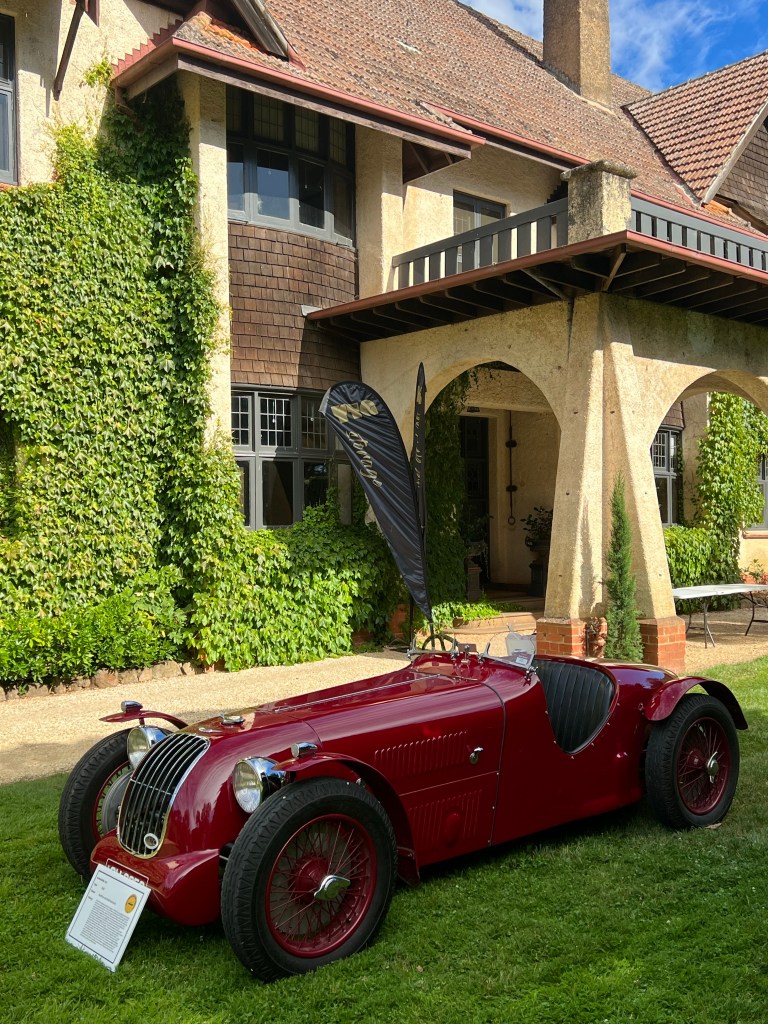
Fabulous Alta 2-litre #55S/DPG167 recently purchased by the brothers Murdoch, Geoff and Neill.
Fortunately this machine, and the ex-Sinclair-the-MI6-Spook Alta 1100 s/c have remained in Australia, many thanks to Betty Lowe and the Murdochs for that. The Late Graeme Lowe was a lifetime Alta fan, restorer and racer and would be best-pleased that they’ve remained in the colonies.
I don’t think quite so much technology had ever been shoved into one car until the Porsche 959 came along, it was quite the thing in 1986. Lots of bang for your buck, but visually not so exciting, Der Deutschlanders have never quite had the je ne sais quoi of the Italianos have they?
Seeing this car reminded me of an old client. Chris Taylor (Motors Pty.Ltd) was the Geelong and region Porsche dealer for many years, I was invited along to a presentation of a 959 to the-great-and-the-good of that city when it did its tour of Australian Porker dealers circa 1987.
There was never a dull moment with him as an old-school dealer: read wine, women and song. Chris’ production of a pair of boxing gloves from the drawer of his desk in the middle of a pitch to his bankers to increase his finance facility was memorable, I doubt Milton the Banker ever forgot it, it worked too! When Chris bought a new sprintcar, the sound of the 6-litre thing idling @ 5500rpm in the dealership back lane could be heard at Mount Duneed.
What wasn’t such a good idea was racing the 650bhp winged, roller-skate (at Warrnambool or perhaps Mount Gambier) with a residual smidge of alcohol in the system after a big-night the day before. His decline was dreadful, but his wife capably stepped into the breech to run the place for a while after that, RIP Chris Taylor. Not a man who died guessing.
(Porsche AG)
The Lola T70 in all of its forms is the most erotic – if not exotic – of all sixties sports-racers, bar none. It’s a big statement in a decade of sports-racer spunk-muffins I know, but T70’s lack nothing other than a Le Mans win.
This one is ‘the remaining bones’ of chassis SL70/5 an iconic, mainly South African domiciled Ford 289 engined machine. Of note is a period of ownership by Stirling Moss and wins in the 1966 Lourenco Marques 3 Hours (Doug Serrurier/Roy Pierpoint) and the 1967 Roy Hesketh 3 Hours (Serrurier/Jackie Pretorious).
Allen Brown explains the history of the car in his fabulous oldracingcars.com. My bit below is a summarised version, the full entry is here, scroll down to Lola T140:T70/140 SL70/5 https://www.oldracingcars.com/lola/t140/ We historians thank the good lord above for Allen’s site in that we have arms-length information about a machine rather than relying on the Disney-esque fantasy-tales of some owners.
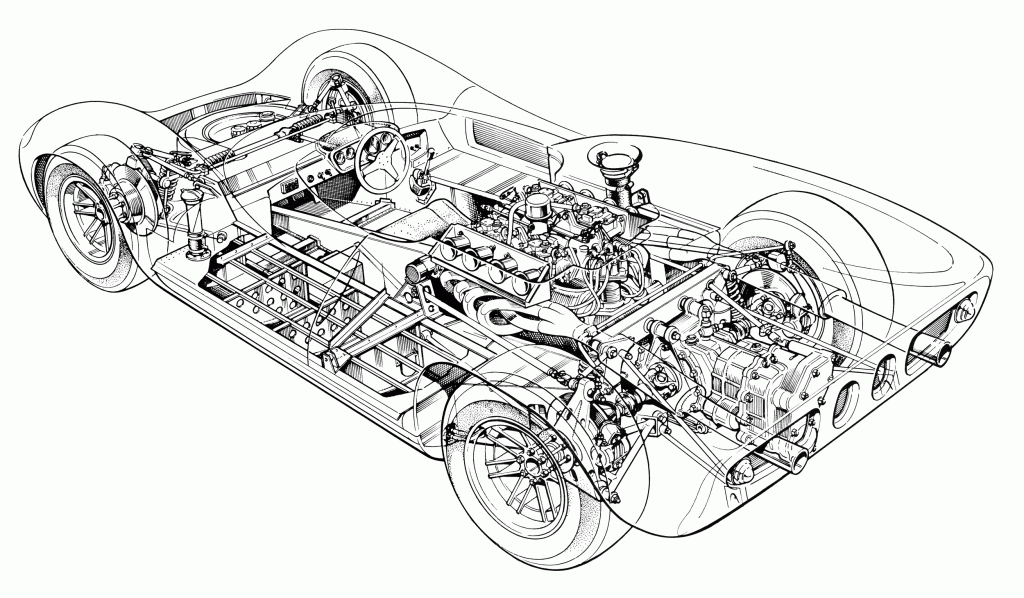
Lola T70 Chev cutaway (unattributed very nice work)Lola T70 SL/5 Ford at Clubhouse corner Kyalami, advice taken on the driver and date folks
“Doug Serrurier bought the ex-Mike Taylor/David Good 1965 Lola T70 (chassis SL70/5) with its 4.7-litre Ford Weslake engine for sports car racing in South Africa and raced it until it was crashed by teammate Jackie Pretorius in the 1969 Roy Hesketh 3 Hour. Serrurier then converted it into a Formula A T140 (spaceframe 1968 model Lola Formula 5000 car) using the running gear, Ford Weslake engine and Hewland LG gearbox. He didn’t use “T/70/140″ but sold it to the Domingo Bros. Mike Domingo contested the 1970 Bulawayo 100 and Alan Domingo the 1970 Rhodesian GP. Team Domingo had three Lola T140s during 1971.”
“T70/T140 then went to Peter Haller and was converted into a drag-racer by ‘a man named Delport’. Johan van der Merwe, Janie van Aswegen and Ivan Glasby were all owners of what Serrurier called ‘the sorry remains’ during the 1980s before it was purchased by A. R. Culpin in 1989. The T70 origins of these remains were now more important than its T140 interlude so the parts were combined with new T70 body panels and the whole project sold to David Harvey of GT40 Replications Ltd, New Zealand in July 2003. The car was completed as a new T70 by 2005 and is retained by Harvey in 2007. With its remaining parts in the T70, the T140 no longer exists.”
And on to an Australian owner in more recent times. New Zealand is a good place to ‘restore’ one’s Lola, they’ve built far more than Eric Broadley ever did…
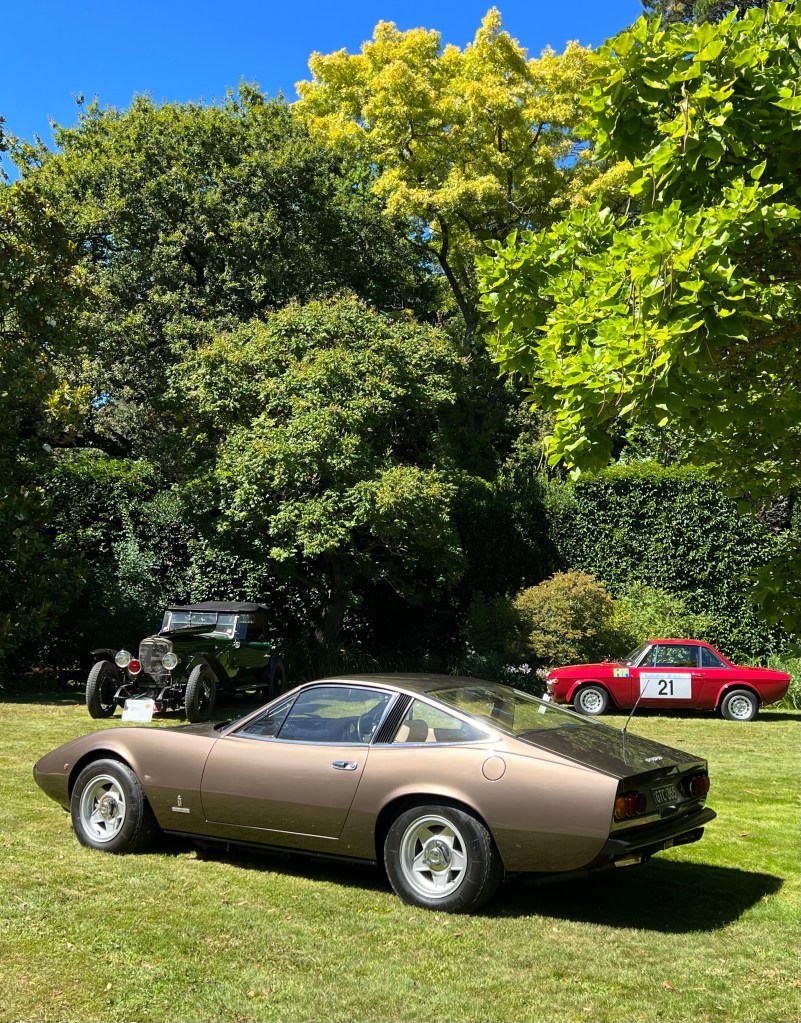
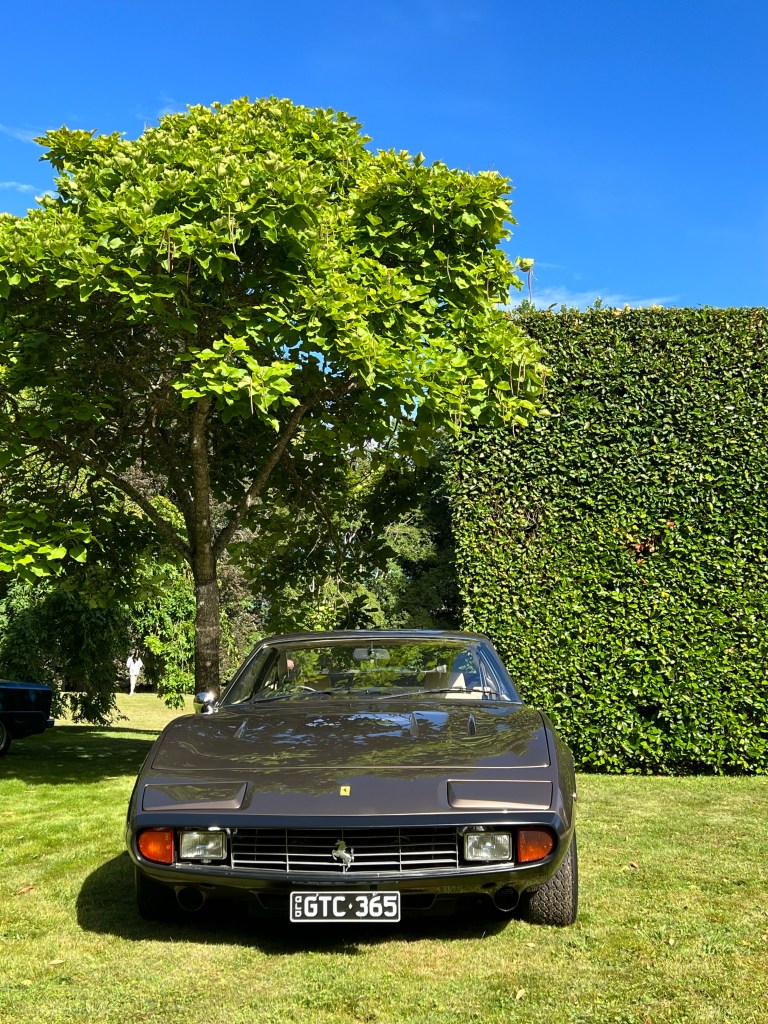
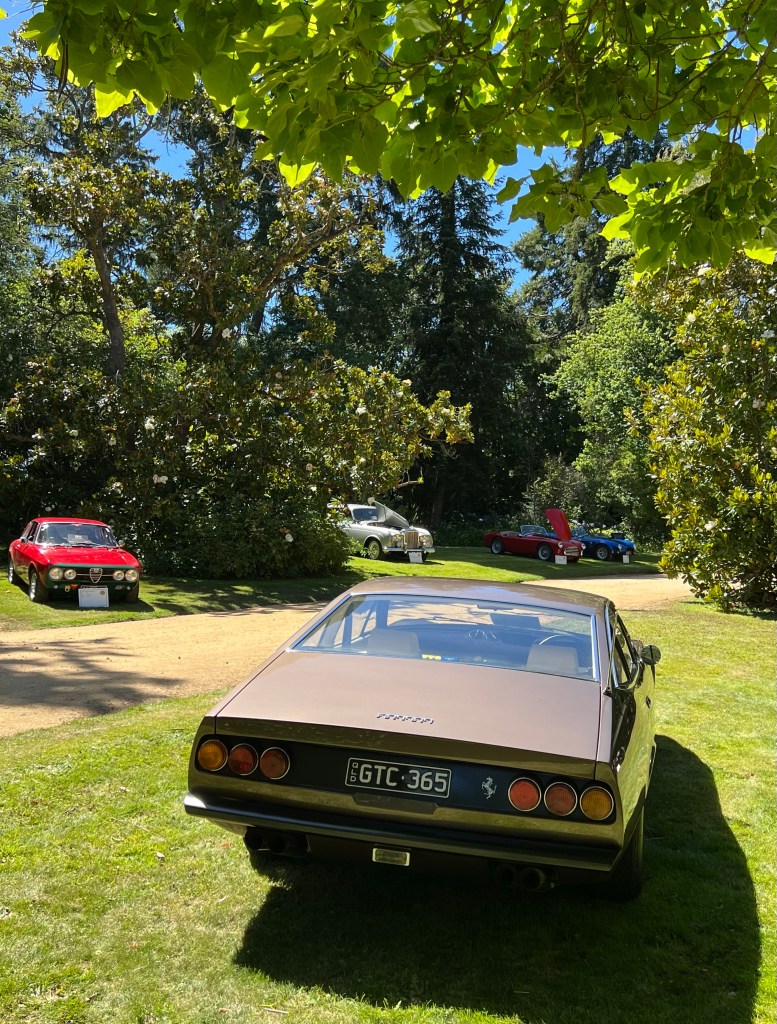
Ferrari 365 GTC/4 looking absolutely marvellous with a Sunbeam and Lancia Fulvia 1.3 HF in the background.
Described to me as a thinking man’s Daytona once, but on reflection, that was this particular knob-jockey’s attempted put-down of a good chap of mutual acquaintance who owned a 365 GTB/4.
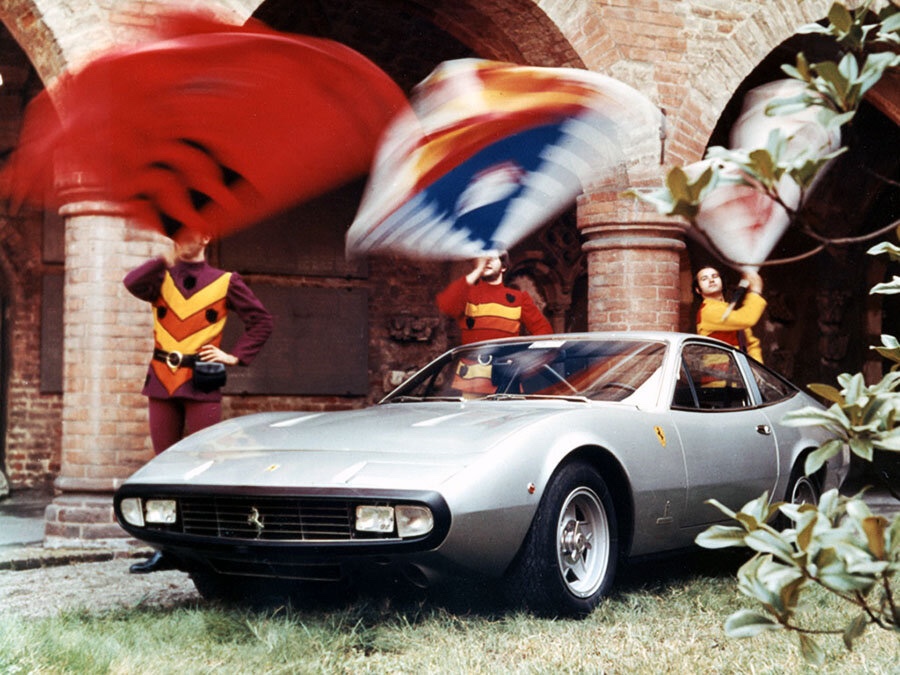
Whatever the case, what a marvellous machine, who get’s the individual credit at Pininfarina? I guess it’s only period competitor was the Lamborghini Espada. I’m intrigued to know the relative merits of the two if any of you have had that pleasure at length?
(Ferrari)(Ferrari)(unattributed)
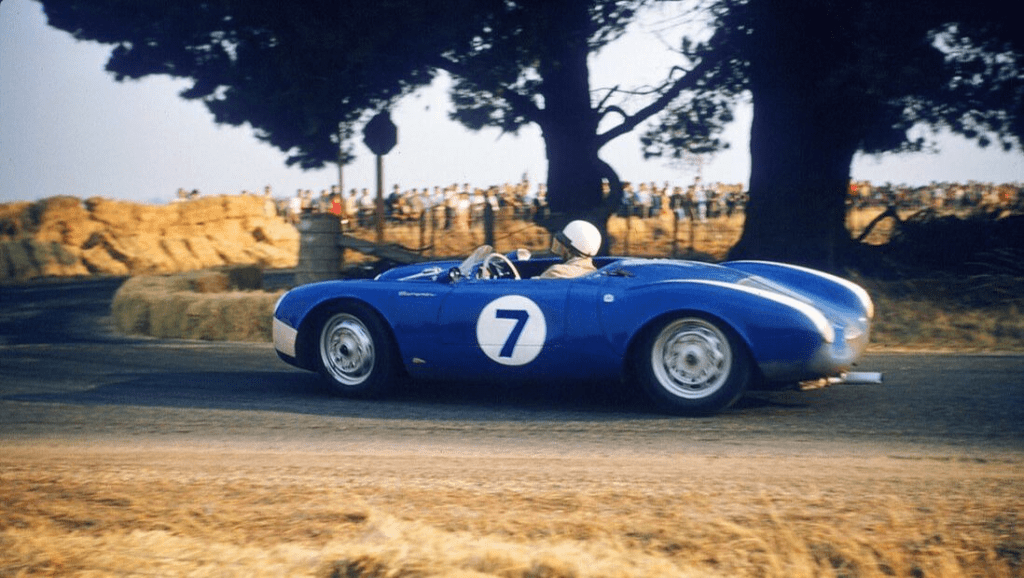
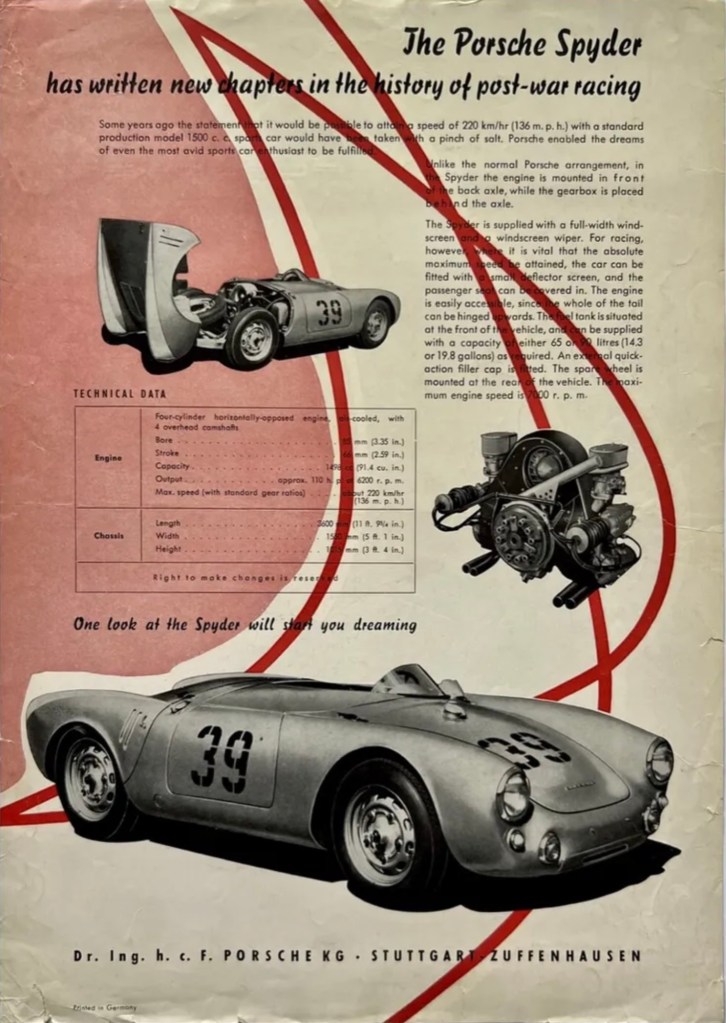
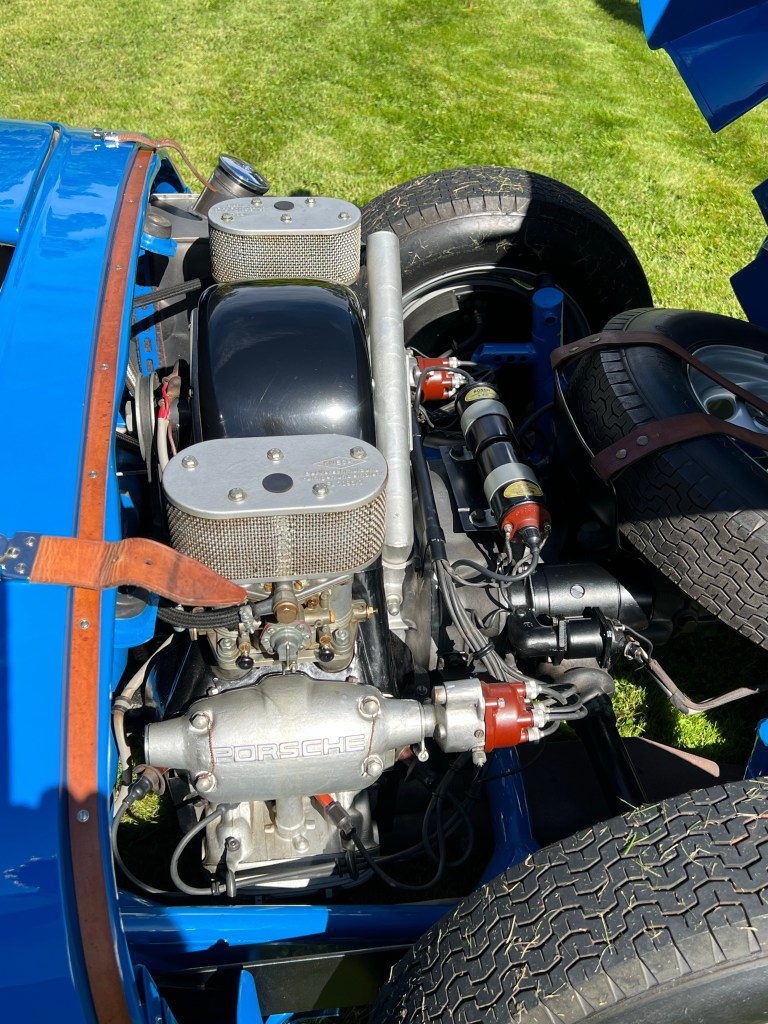
I’ve never seen Lindsay Fox’ Museum at Docklands so it was with great anticipation I looked forward to seeing one of their prize exhibits, the Porsche 550RS Spyder imported to Australia by Norman Hamilton in October 1955. The Self Preservation Society El Presidente, Jack Quinn must have a particularly good line-of-chat as Foxy doesn’t even lend his cars to his Point King clifftop buddies. Many thanks to both of you.
Norman Hamilton, Porsche 550 RS Spyder, Longford 1958. The Mountford Corner trees are still there (B Young)
So complete is the restoration that every single cell of character and patina the machine once had is destroyed, long gone; well done, mission accomplished. I’m at odds with the majority here, there were plenty of chaps with a grumble in the groin as they approached the perfect blue missile. How much restoration is too much you may ask? About this much in my mind.
I recall wandering the better suburbs of Perth with my brother a few years ago – Dalkeith, where he lives, Peppermint Grove and Mosman Park – and observing the small remaining number of older stylish homes and their modern, big, bold, gold’n brassy, loud n’proud replacements and proffering the view that “money and taste are non-converging circles in this part of the world.” He laughed initially, but not so much as the numbing effect of several Schofferhofer Hefeweizens drained from his system.
The same applies to cars of course, Lindsay Fox – a great philanthropist in addition to his stunning, enduring business successes I should point out – isn’t a knowledgeable car enthusiast so the nuances of what happens to each machine are lost in a big collection of mobile global investable assets. When Fox spoke to Dictator Dan and his other mates about 540K at a recent summer-soiree they thought he was rabbiting on about the deposit on a Shelley Beach bathing box, not the Nazi’s favourite chick-bait vehicle of choice, one of which Fox bought in recent times.
A Pebble Beach judge tells me that the the Prewar and Postwar Preservation classes are growing in number at prominent concours events, which is great. Hopefully it’s not too late though, over restoration is like virginity really, once it’s lost you’re fucked.
The perfect world of course is somebody with Lind’s money and my taste (sic)…
Delahaye 135M Coupe singing for its supper, roof-rack and all
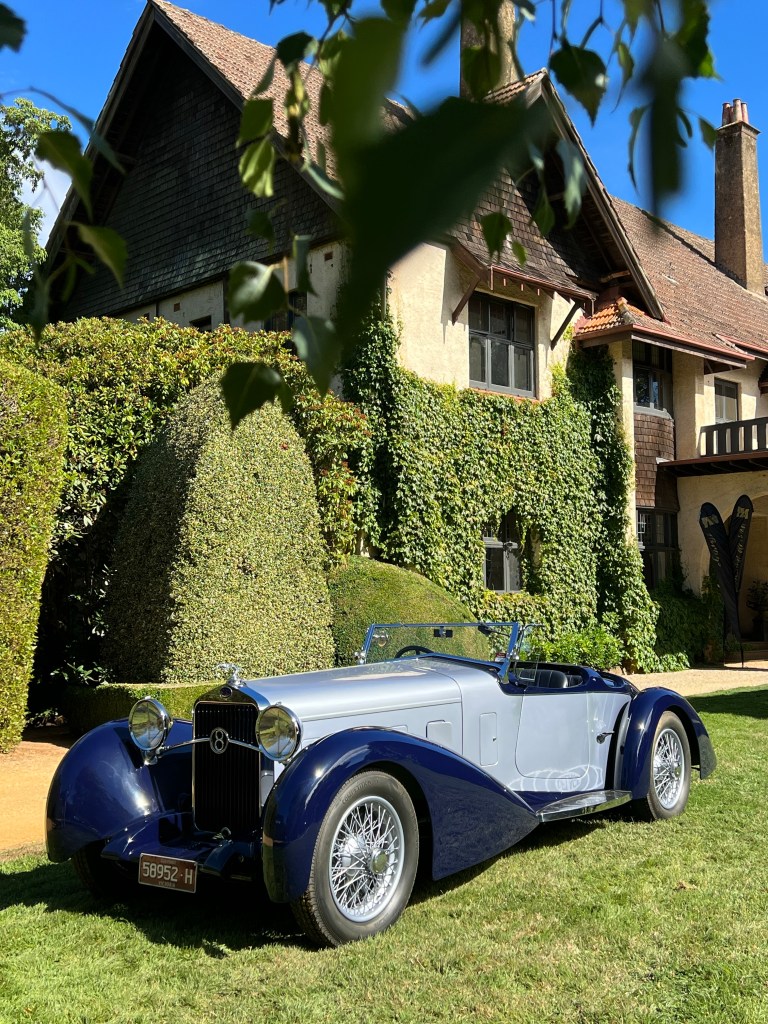
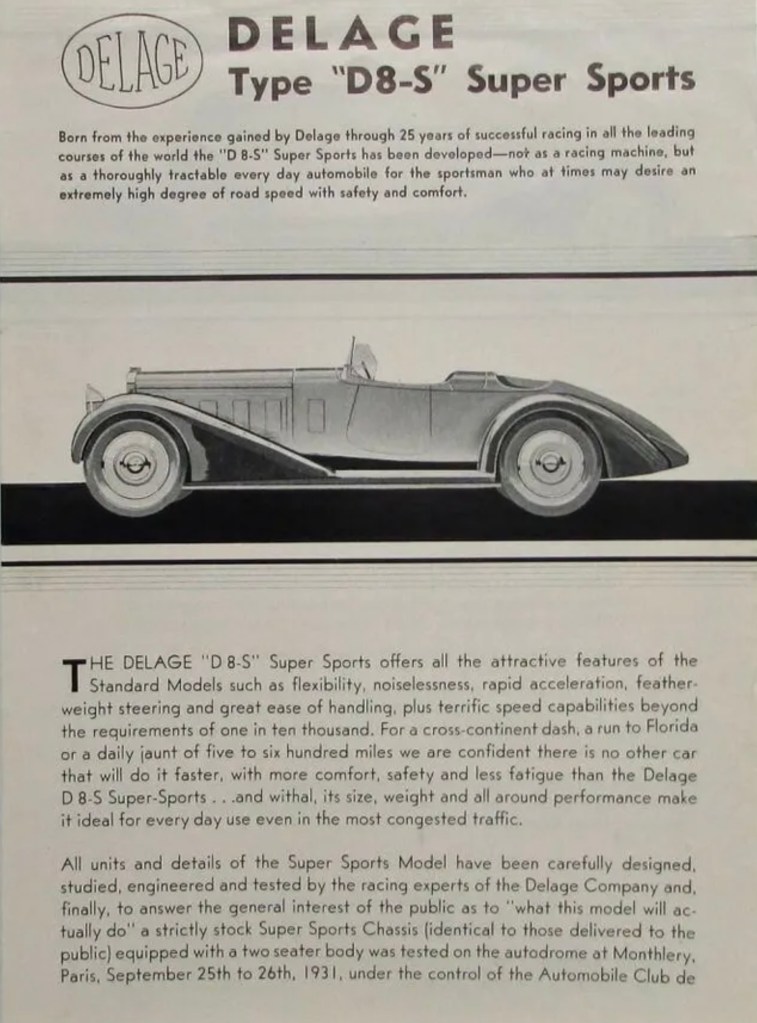
These two French trailer-queens were easy on the eye, a 1929 Delage D8S Cabriolet and 1948 Delahaye 135M Coupe with body by Jean Antem.
“The D8S has been extensively toured, with wins at Motorclassica and was invited to Pebble Beach in 2014 where is was displayed on the 18th Green,” the info card says. I suppose “has been extensively toured” in this context means on a truck? Perhaps somebody can explain the 18th Green bit to this particular Concours bogan.
Fabulous Maserati Ghibli was a car I admired in my childhood, Sam Patten kindly chauffeured me on the final leg of the trip to Wombat Hill, a lovely, quick, big-car from the passenger seat.
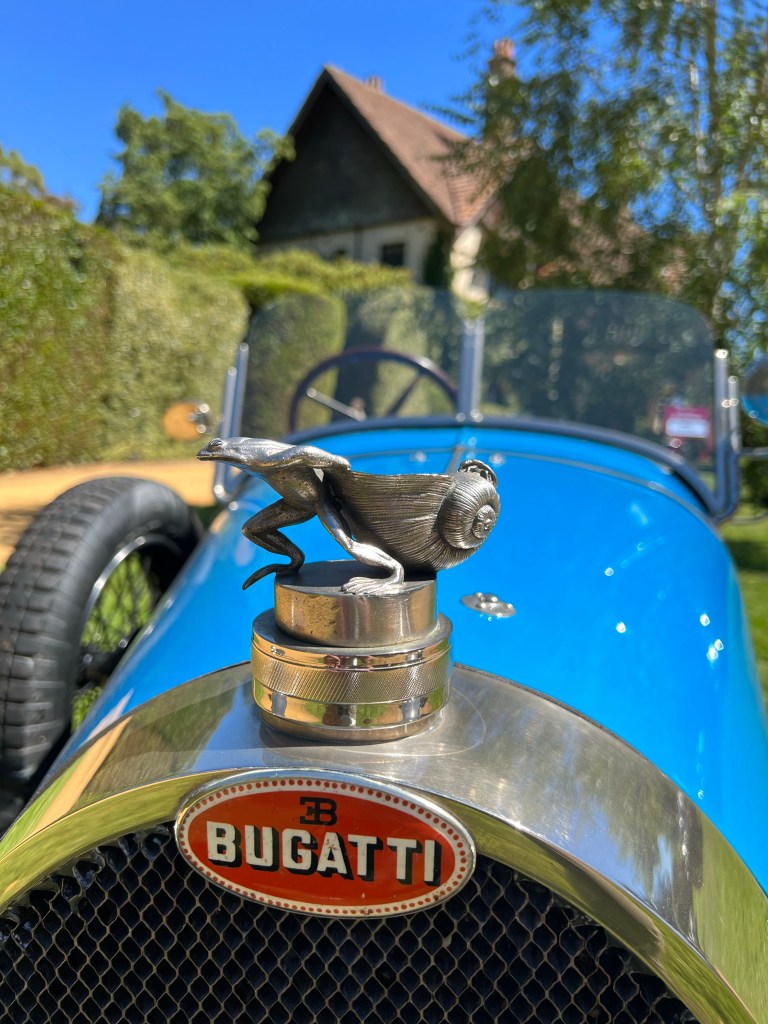
Bugatti Type 44
There was a Concours winner and placegetters of course, but the voting was by Peoples Choice rather than the usual army of morbidly obese geriatrics in gold-buttoned blue-blazers, bone carefully ironed trousers and practical shoes.
Stuff that, I’m down a bit on democracy since Trumpy’s ascension to the US Throne, and the 74,222,958 nuffies who voted for him last time. Screw the will of the people, WTF do they know? I’m therefore going through a benevolent dictator phase presently, on that basis the trailer-queens don’t get a look in, if you didn’t drive to the gig you’re disqualified. My three favourites, differing flavours of course, in no particular order are the Alta, Maserati Ghibli and AC Ace Bristol.
Credits…
M Bisset, the shots are all mine unless credited otherwise, oldracingcars.com, Bob Young, Porsche, Ferrari, Maserati
Tailpiece…
Two MGs, the one on the left (what is it?) is just/nearly finished, the one on the right is a J2 if memory serves.































 primotipo...