(Kiama)

I wrote an article about beach racing at Gerringong Beach near Kiama on the New South Wales Illawarra Coast a while back…

The article focused on a race meeting in May 1930, I had too many photos for that piece, the purpose of this article is to share them here.

They cover a diversity of Gerringong related topics- the May 1930 meeting, three land speed record attempts and Sir Charles Kingsford-Smith. The history of Gerringong Beach aka Gerringong Speedway is in that earlier article, click here to read it; https://primotipo.com/2018/10/26/gerringong-beach-races-1930-bill-thompson/

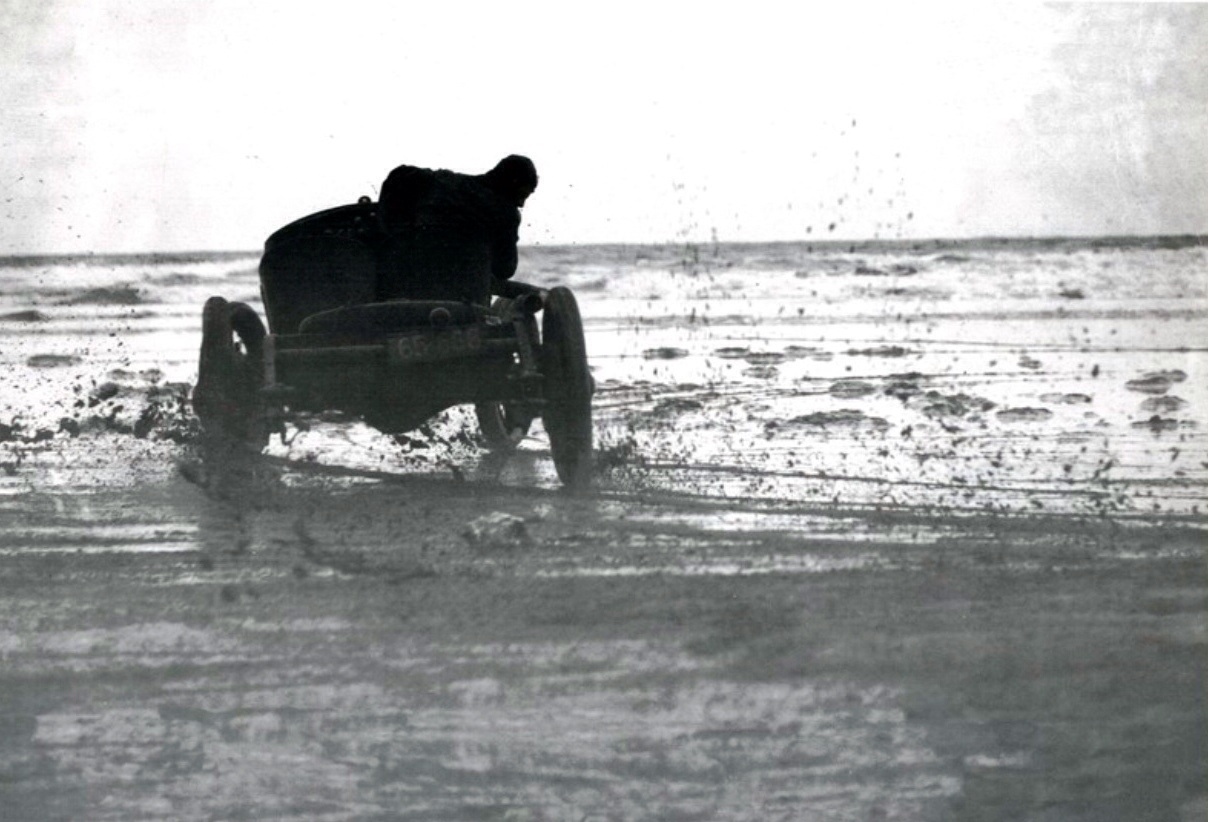
I’ve no idea who the driver or car above is but just love the silhouette of machine and driver against the backdrop of the Pacific Ocean. Its taken during the May 1930 meeting as the ‘track’ fights a losing battle with the tide.
(Kiama)

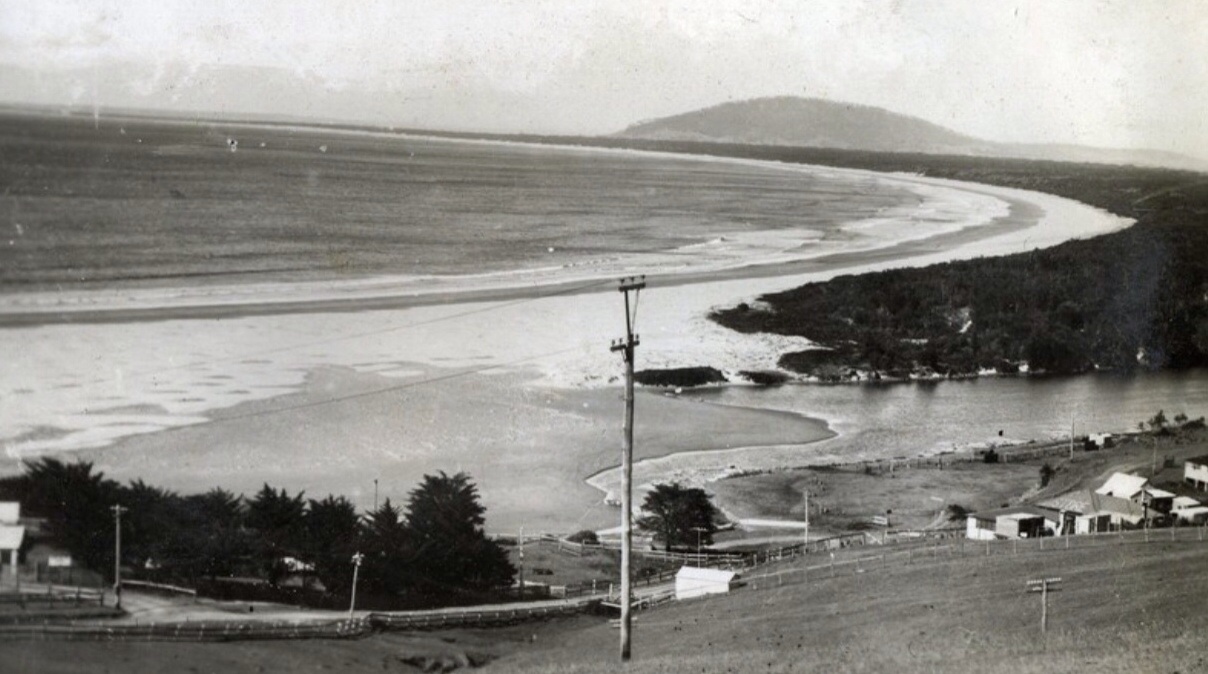
The photo above is of Seven Mile Beach and the little Gerroa settlement, it gives a sense of just how relatively quiet a place Gerringong was at the time. Gerroa River mouth at Gerringong.
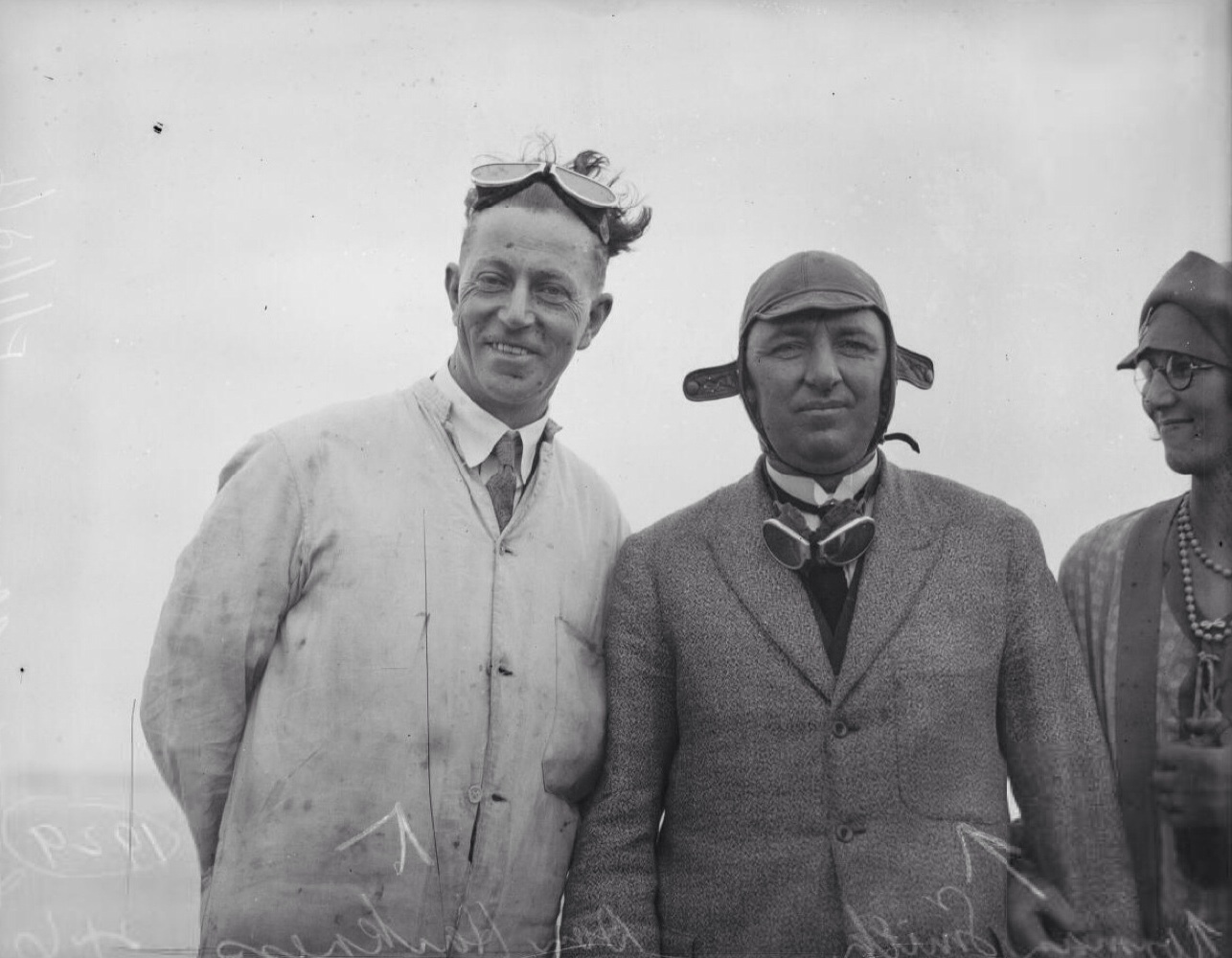
Don Harkness and ‘Wizard’ Smith on Gerringong Beach in December 1929 (Fairfax)


Don Harkness: Minerva Hispano Suiza Australian LSR October 1925…

Upon leaving school Don Harkness became an apprentice in general engineering, aged 20 he was employed by JC Hilliers at Drummonye Sydney, by 1922 Harkness and Hillier Pty. Ltd. was formed.

Don developed an interest in motor racing and imported a Willys Overland which was highly modified- ‘Whitey’ as the car was nicknamed won over 50 races at venues as diverse as the Maroubra concrete saucer speedway, the Penrith dirt speedway and on the beach at Gerringong.
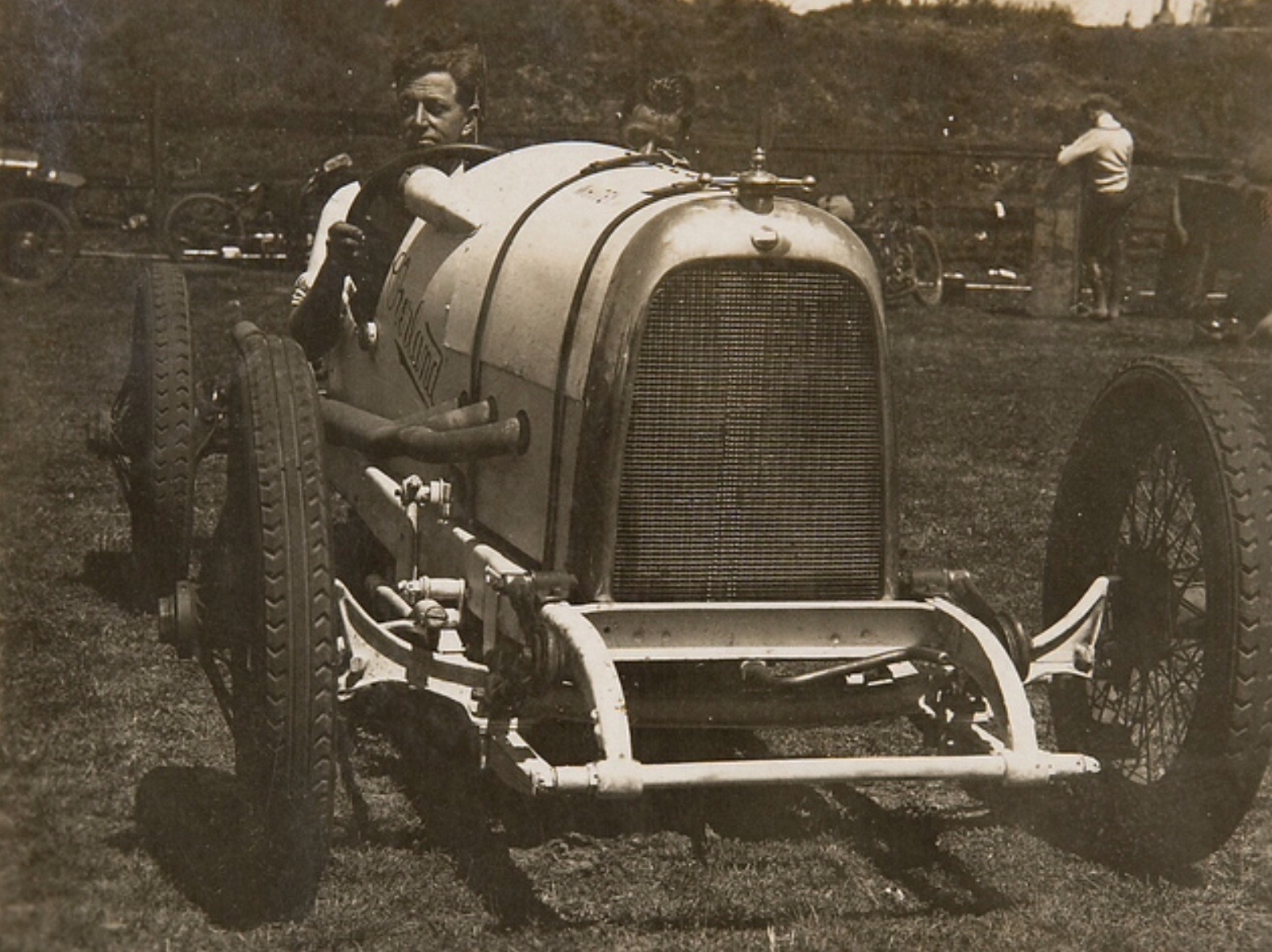
Harkness aboard the Overland ‘Whitey’ date and place unknown (DHA)

An offer of a fifty pound trophy to the first person to exceed 100 mph in Australia over the measured mile by the Daily Guardian newspaper led to Harkness’ use of FR Colbert’s  Minerva chassis powered by a Hispano aero V8 engine- the car below won the trophy on 17 October 1925 at a speed of 108 mph.
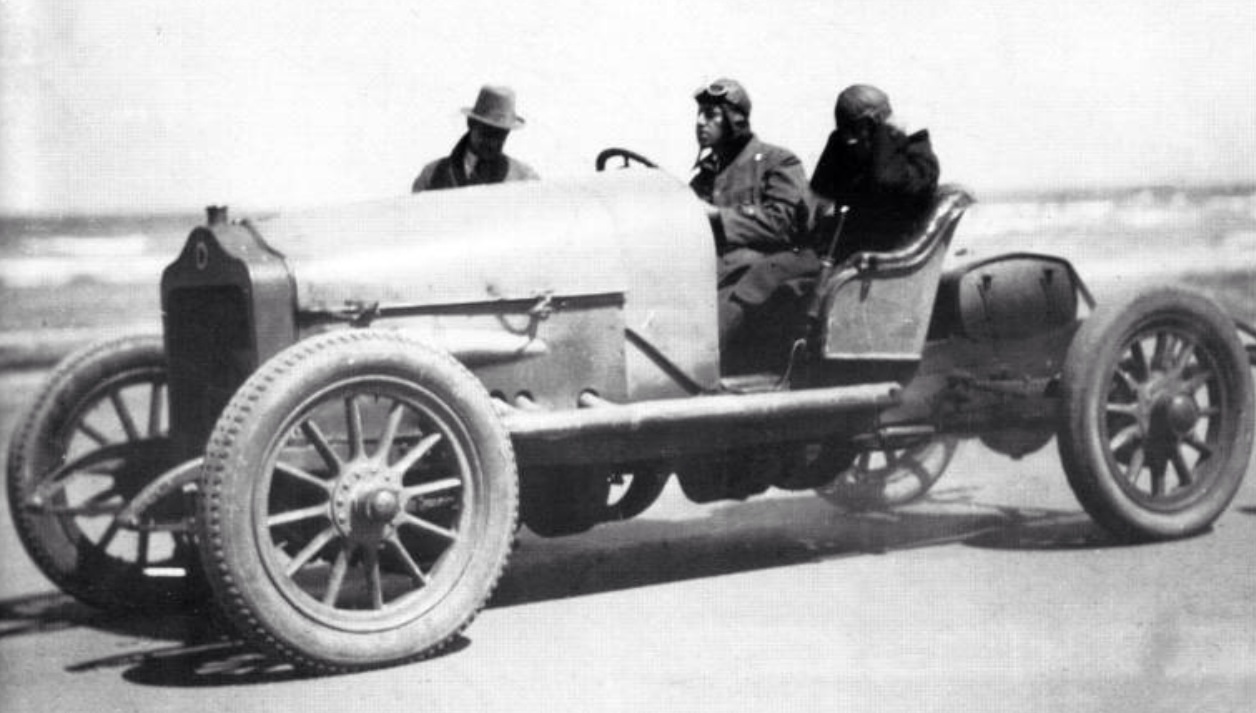
(unattributed)

Anzac Rolls Royce: Wizard Smith and Don Harkness, Australian Land Speed Record December 1929…

‘The run was made under the worst of conditions seen for years with danger hidden in every sand hole. The car at one stage reached a speed of 142 mph and with such ease as make both Smith and Harkness confident of an ultimate speed of 175 mph’ the Sunday Times reported.

Don Harkness was approached by Norman Leslie ‘Wizard’ Smith and the former Lord Mayor of Sydney, Jack Mostyn to design and build a car to attempt the Australasian one mile and ten mile records.
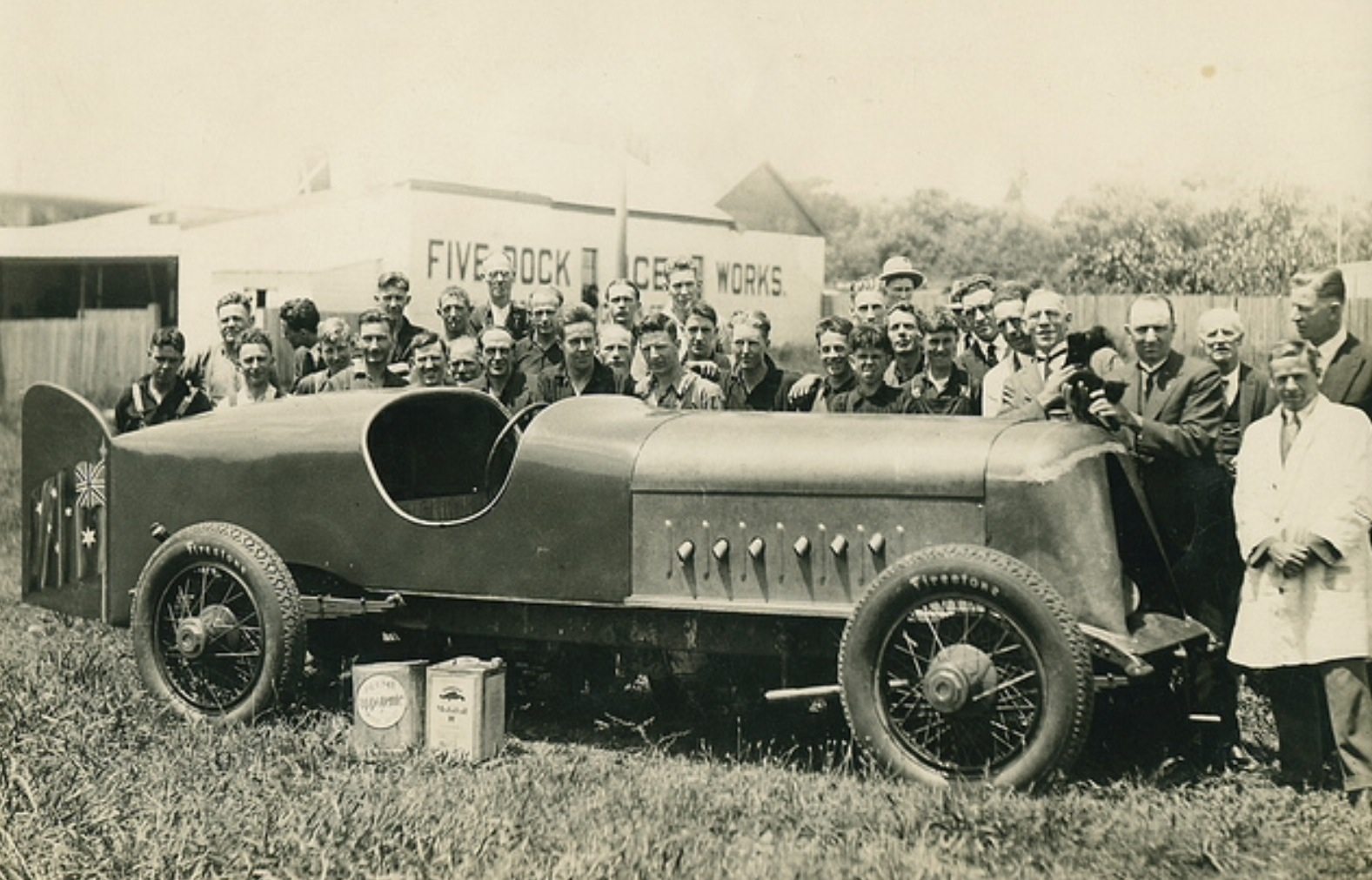
The proud Harkness & Hiller workforce of artisans with the Anzac Rolls Royce, Parramatta Road, Five Dock, Sydney in November 1929 (DHA)
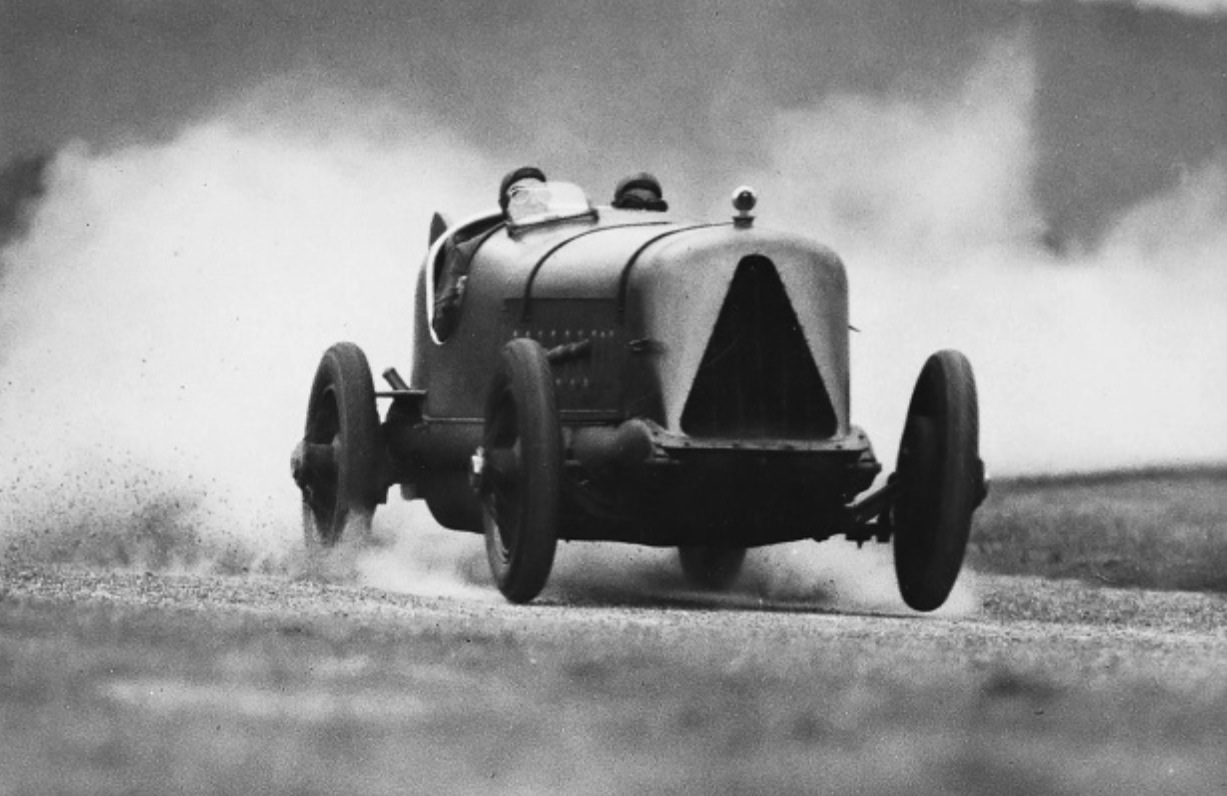
 

Smith and Harkness in an early test of the Anzac Rolls Royce with one and a bit wheels off the deck. Mention is made of a test run at Richmond, NSW, I wonder if that is the place, late 1929 (unattributed)

The result was the ‘Anzac’, a Cadillac chassis into which was inserted a Rolls Royce aero engine- as one does.

The liaison between Australian Speed Ace Smith- of intercity and circuit racing fame and financier Mostyn came about by chance when Smith came to Mostyn’s aid with a car breakdown. A series of discussions resulted in a determination to initially take Australasian Records and then with a second, more powerful machine, to take on the world.

Harkness was well known for his engineering and driving prowess to Wizard- Harkness had an amazing track record by then in both automotive and aero engineering which is a great story in itself, so it was a natural he turn to the Harkness and Hillier concern to design and build the first car, christened ‘Anzac’ in memory of the Australians and New Zealanders who lost their lives in the Great War.

The basis of Harkness’ design was a modified and strengthened Cadillac chassis- ‘Harkness chose a Cadillac and found the stock material so good, that he retained the frame, the (3 speed) gearbox assembly, the wheels, final drive, radiator and strengthened the steering by fitting a special chrome steel drag link in one piece’.

The Cadillac chassis details are unclear, but in 1928/9 they were made in two wheelbases- 140 and 152 inches, the former the standard and the latter the ‘semi-commercial’ lenghth for hearses and ambulance use, both had the same track of 56/58 inches front/rear. The standard engine was a 341cid side-valve, cast iron V8, the gearbox was a 3 speeder, brakes mechanical and rear axle fully floating with spiral bevel drive.

The frame was reinforced where necessary with special supports carrying the longer, lighter Rolls engine. New gears were cut from higher grade steel, then finished in the Harkness shop. ‘An overdrive gearbox was used to step up the revolutions of the wheels- the final drive ratio was 1.5:1. A new flywheel housing (bellhousing) was designed, patterned and cast, together with a new gearbox assembly. (this of course contradicts the earlier sentence- I suspect what happened is that new, stronger gears were cut and fitted to both the  Cadillac ‘box and diff)

Wheels were ‘ordinary stock 33 by 5 inch high pressure cords’, ‘on the trial run at Richmond they stood up to 121 mph’ with race tyres to be used in New Zealand with its higher expected speeds.

The Wizard of Anzac (Fairfax)

The beast was about 20 feet long, had a wheelbase of 11 feet and a track of 4 feet 8 inches.

The motor (variously described as both an Eagle series 8 and 9) was the last in a line which first saw use in 1915- the 320-360 bhp, SOHC, twin-plug, 20 litre, 60 degree, twin Claudel-Hobson carbed  V12 engine was acquired as war surplus from the RAAF.

Harkness modified it to be able to run at higher revs of 3000 rpm rather than the usual 1800-2200 rpm. The engine had a bore / stroke of 4 1/2 / 6 1/2 inches – 1239 CID or 20.32 litres.

The car was constructed in the Harkness and Hillier, Parramatta Road, Five Dock, Sydney workshops with local firm Prophets making the ‘streamlined’ body, which no doubt in style was a nod in the direction of other LSR cars in existence at the time.

The LSR in 1929 was held by Henry Segrave’s 930 hp Napier Lion engined ‘Golden Arrow’ at 231.362 mph- well out of reach of Anzac’s maxima of circa 175 mph- but the machine was still good for local record hunting and as a ‘proof of concept’ to build the next car designed to achieve the world record.

The radiator was at the front, the cockpit cowled around the driver ‘who was insulated from engine heat, flames and fumes’ by steel bulkheads and flooring. The mechanic was left well in the breeze, the body then tapered in towards the rear and had a neat stabilising tail at the very back. The fuel tank was aft of the driver and the oil tank behind the rear axle. The car no doubt looked stunning in its gold, lacquer paint.

The Australasian Record attempt was to take place at the Ninety Mile Beach in New Zealand in early 1930, but first the car had an Australian Record to set, and needed to prove it was fit for purpose before being shipped ‘across the ditch’ (Tasman Sea) from Australia to New Zealand.
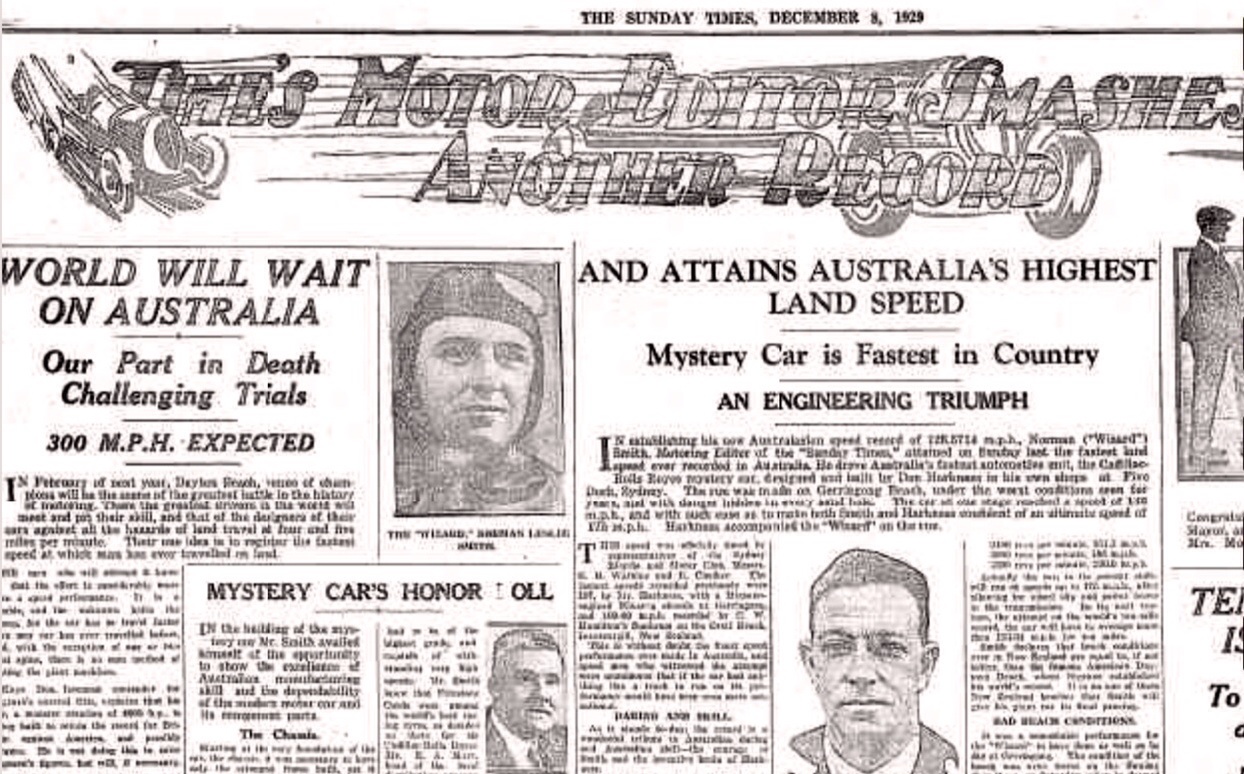
Anzac was taken by trailer from Five Dock to Gerringong where the team set up camp in late November 1929.

‘Conditions were so bad on the Saturday that Smith postponed his attempt but were even worse on Sunday. Heavy seas had pounded the beach for days and water rose as far back as the trees, 200 yards from the normal waterline. This had the effect of bringing thousands of tons of loosely, badly-knit sand on to the part of the beach used for racing. The line was covered with seaweed and ruts and hollows along the course and made the driving dangerous.

On the Sunday, the Wizard and Harkness looked over the beach at dead low tide and decided to give the car a trial. There was but a tiny stretch of the surface good enough for racing, just about three quarters of a mile long’.
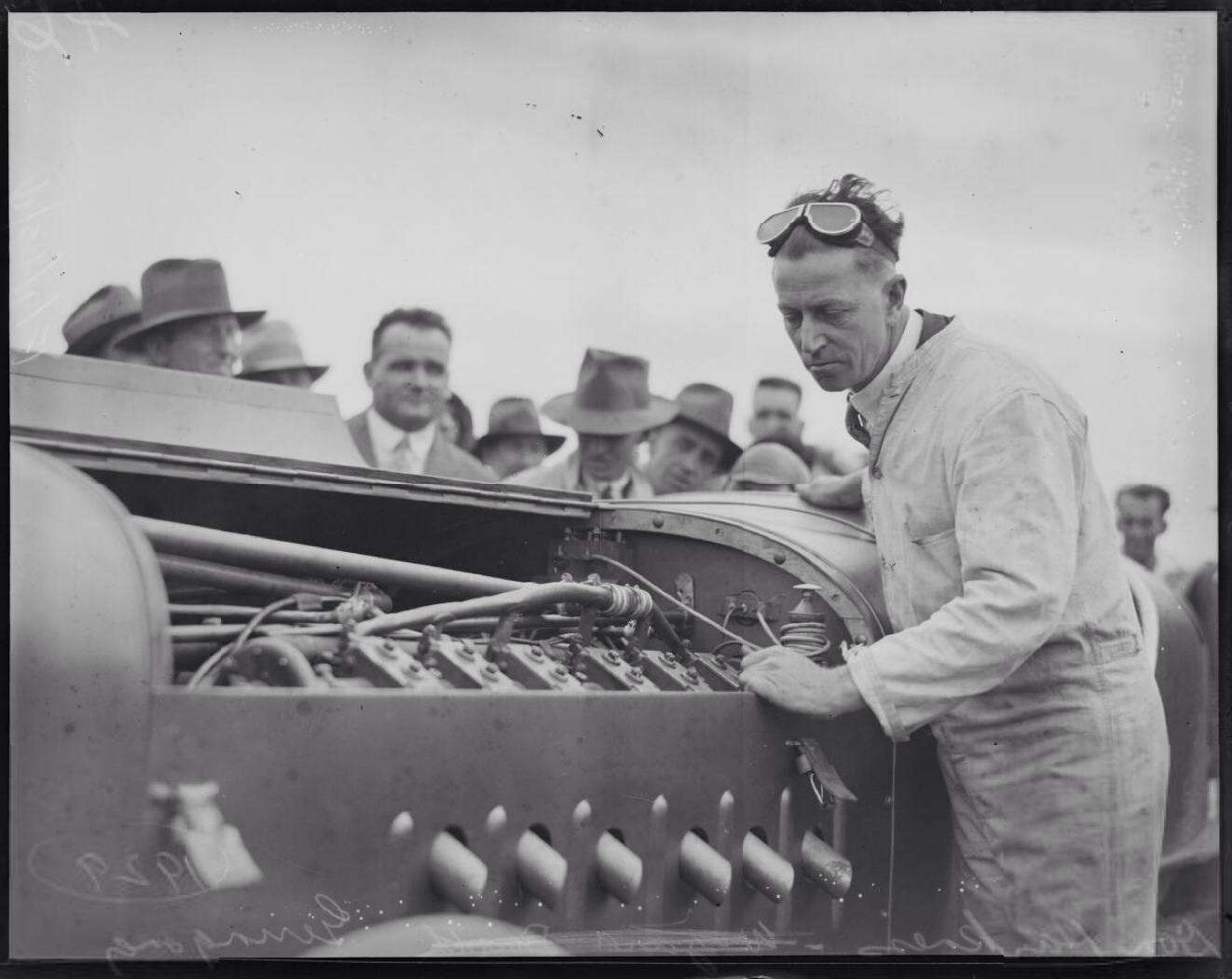
 

All set- Don Harkness has one last check of the engine- hard plugs now fitted to the Rolls V12- time for the off, Gerringong Beach December 1929 (Fairfax)


After being carefully made ready the Rolls engine was fitted with soft plugs for a warm-up run of the engine after which 24 race, or hard plugs were fitted. The car was fuelled, checked over for the umpteenth time and then Smith and Harkness jumped aboard.

‘The final quarter mile was marked off, and the car took a run of only 800 yards before entering the timing strip. “From the start we accelerated to 110 mph where we hit the starting line” said Wizard. “Just before we did nearly 3000 revs in second gear, and I changed a few yards in front of the line. We were doing just about 110 mph then, and in the next few yards I could feel her winding up. She surprised me. I’m convinced Don has built me the fastest car in Australia. The old bus will beat all the Wapitis that overflew. I’ll guarantee that she has more speed than anything else in Australia, or a plane”.

Don Harkness is more than pleased. He is delighted for the car has done more than he expected, and that more with so little effort that he doesn’t think of what it will ultimately achieve.’

Harkness said ‘After Sunday’s run…I’ll guarantee 150 mph in New Zealand and we’ll get her moving at 175 mph when we will have the very best of conditions and the car has the power, Norman will do the rest’

The team created an Australian record at Gerringong of 128.571 mph (206.909 kph). Harkness reported that with the gear ratios fitted the car was capable of the following speeds/rpm;

1000 rpm 63 mph, 1500 rpm 94.5 mph, 1800 rpm 113.4 mph, 2100 rpm 151.2 mph, 3000 rpm 188 mph, 3200 rpm 200.6 mph


Harkness on this side of the car is leaning well forward- I wonder if that is due to his seat or trying to get a better fix on the perilous nature of the beach?


Both set back in their seats in this shot, quite a functional handsome weapon


Suppliers cited as providing components for the car were AH Prophet, the body, Vacuum Oil Co the fuel and lubricant- ‘Plume Spirit’ and Mobiloil B.

EA Marr provided the Firestone tyres with Harry Taylor of Advanx Ltd having them ‘treated and scientifically trimmed and balanced for speed’. WT Adams of Motor Ignition Ltd supplied an ‘Ajax’ battery to start the giant motor and F Reed supplied Personne-Reed double-acting hydraulic shock absorbers.

‘The beautiful finish in gold’, was supplied by Bergers Ltd, using the famous ‘Opex’ lacquer. John McGrath Ltd, agents for Cadillac provided the chassis.

Taken to the Ninety Mile  (Kaitaia) Beach Smith and Harkness achieved a two-way average of 144.037 mph on 11 January 1930. Days later they attempted the 10 Mile Average achieving a one way speed of 148.637 mph- better than the record then held by Leon Duray’s Voisin of 135.333 mph and were told that because of the distance a return run was not necessary. This was subsequently established to be not the case with the record being unrecognised given the lack of a return run and the antiquated equipment used to time it.

Anzac never ran again- Smith became preoccupied with the Fred H Stewart Enterprise, a new Harkness/Smith 1450 hp LSR machine, which is a sad story of the breakdown in the relationship of the two men for another time…


(Fairfax)

May 1930 ‘Fifty Mile Championship’ Race Meeting…

It was a very soggy raceday for both the racers and the specators, only about 300 hardy well rugged up spectators turned up to see Bill Thompson win the ‘Fifty Mile Handicap’ feature race in his Bugatti T37A, a car he had used to win the Australian Grand Prix not so long before.

The grid above comprises two Chryslers to the left- the #72 E Patterson and HJ Beith Chrysler Sports with Charlie East’s Bugatti T37 on the right.

(SMH)

E Patterson’s 4 litre Chrysler on the turn around the flags which mark out each end of the course. Fine touring cars in their day.
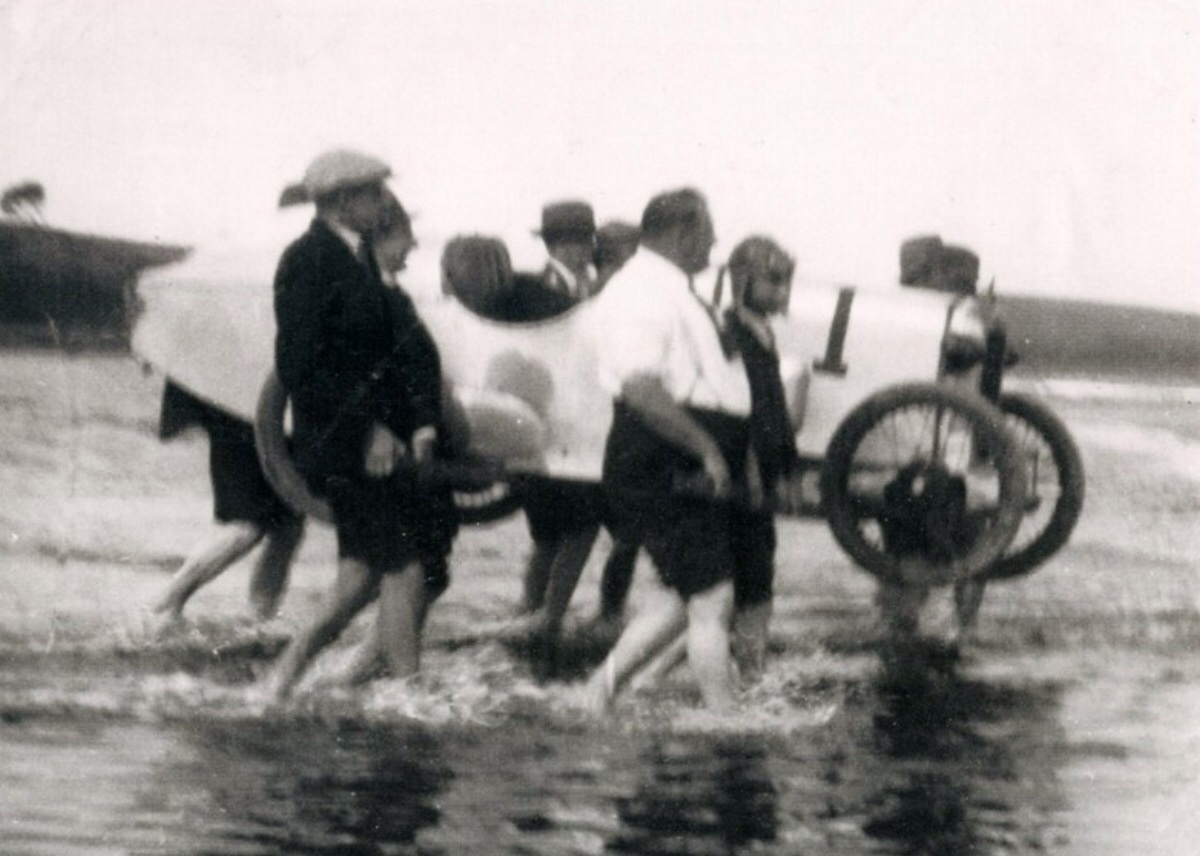
(Kiama)

The light weight of this Austin 7 Gordon England Brooklands Super Sport made rescue from the rising waters a good deal easier than more conventional and heavier machines!
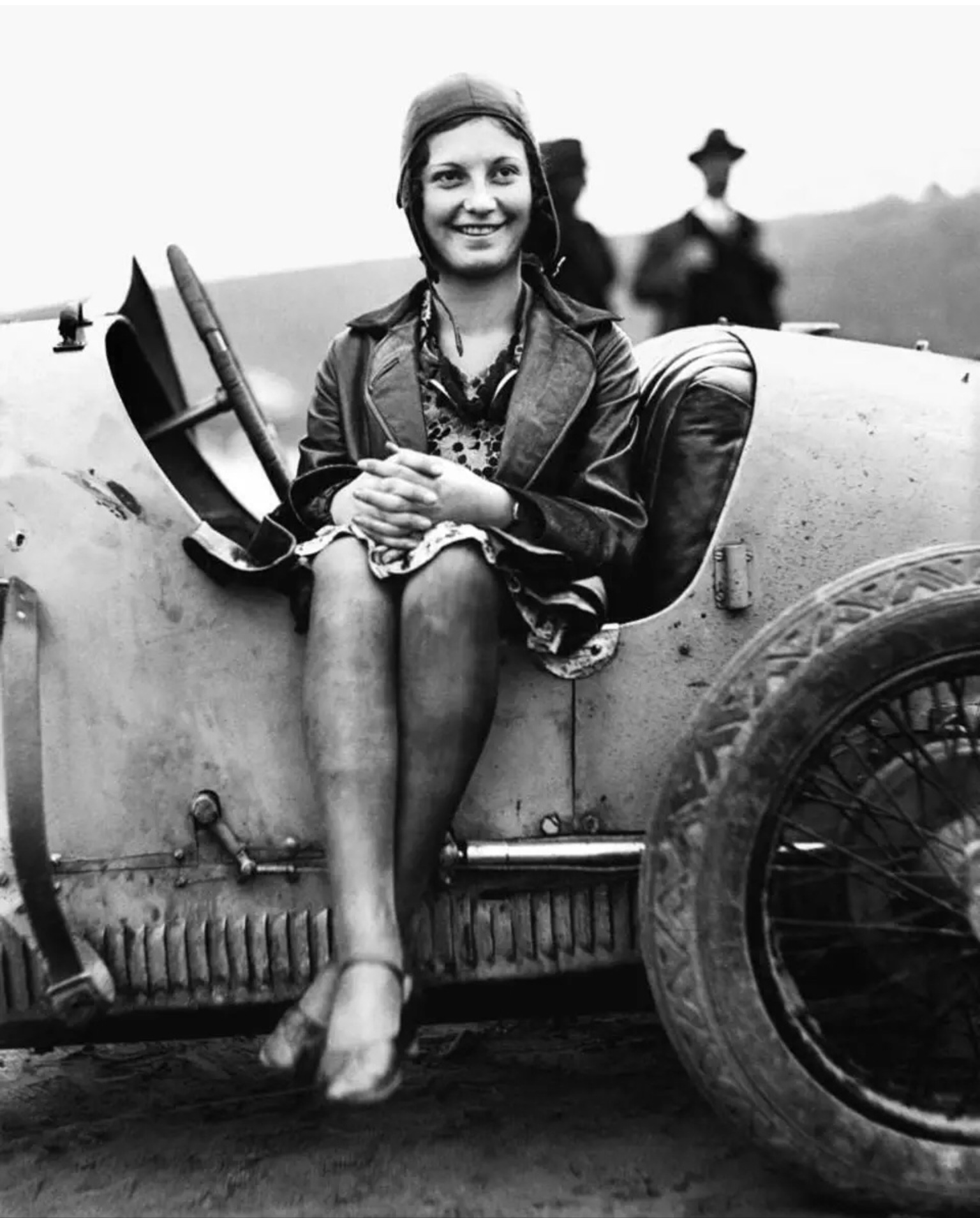
Young filly aboard one of the Bugatti T37’s, Thomson’s T37A I suspect (SMH)

The race meetings were as much social, society occasions as they were motor racing so there were never any shortage of ladies about. The May meeting is well served by photographs given the presence of a staff photographer from the Fairfax/Sydney Morning Herald.

(SMH)


Lea-Francis was entered by Mrs JAS Jones and raced by RG Potts in the 50 Mile Handicap.
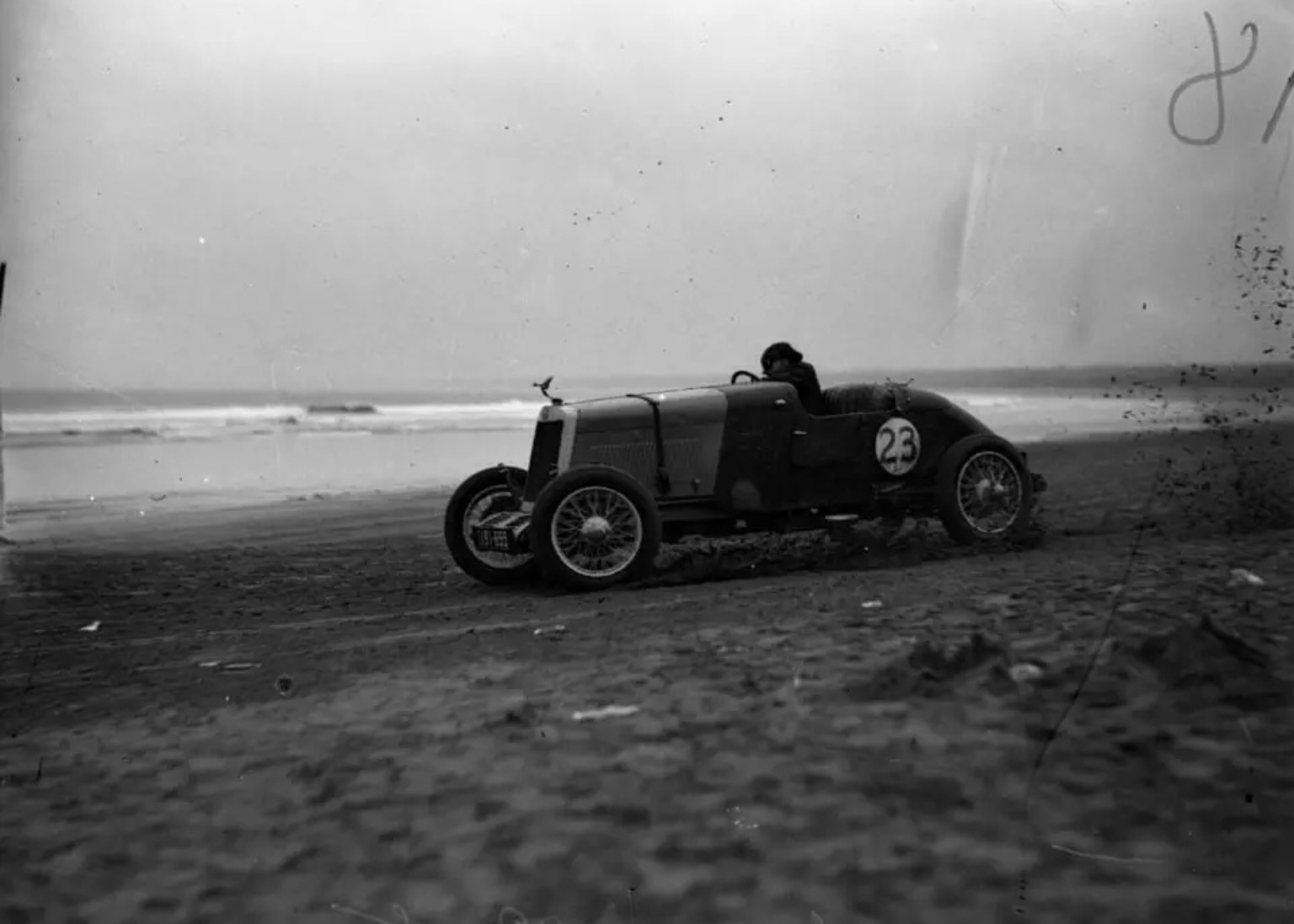
 

(SMH)
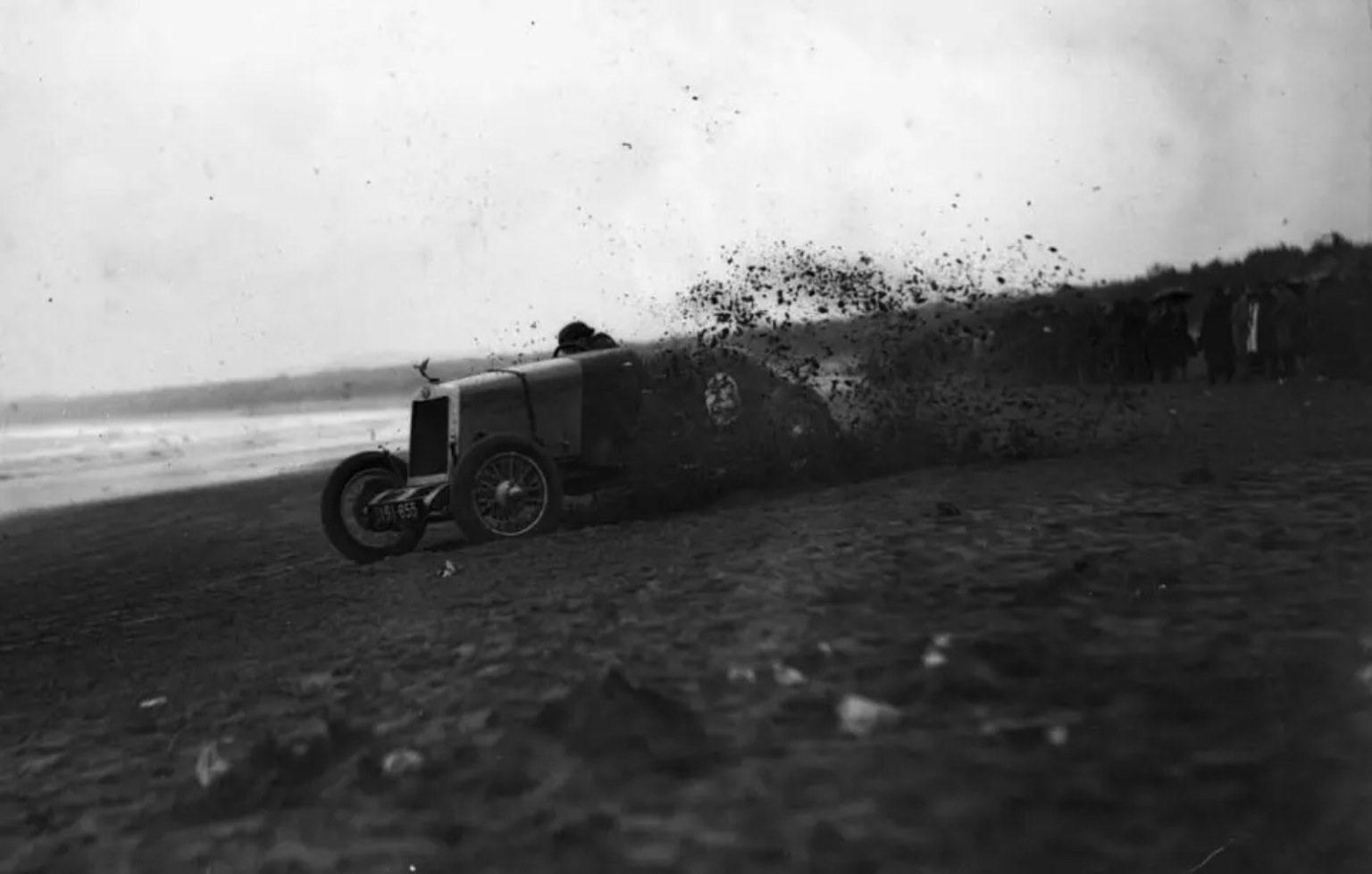
 

(SMH)

Speaking of Mrs Jones, here she is with riding mechanic aboard her rather peachy Alfa Romeo 6C1750 Zagato, one of Vittorio Jano’s finest, I wrote a feature about this wonderful machine a while back.

Mrs JAS Jones Alfa 6C 1750 SS Zagato…

She didn’t have a great meeting after winging’ a mechanic who strayed into her path having crossed the finishing line in one of the events- breaking his leg.

(SMH)

In amongst all the fun there was some serious motor racing for the top-liners of the day.

Three time Australian Grand Prix winner- and just back from Phillip Island having won the 1930 race, Bill Thomson raced the same Bugatti T37A and won the feature event of the weekend, the Fifty Mile Handicap.

In the photo below his mechanic is readying his mount- that is a Light Car Club of Victoria badge on the radiator.

(SMH)

Thomson was every schoolboys idol of the day as this photograph below shows- the look of adoration and joy on the little, capped dudes face is priceless. No doubt Bill has just won the feature event.
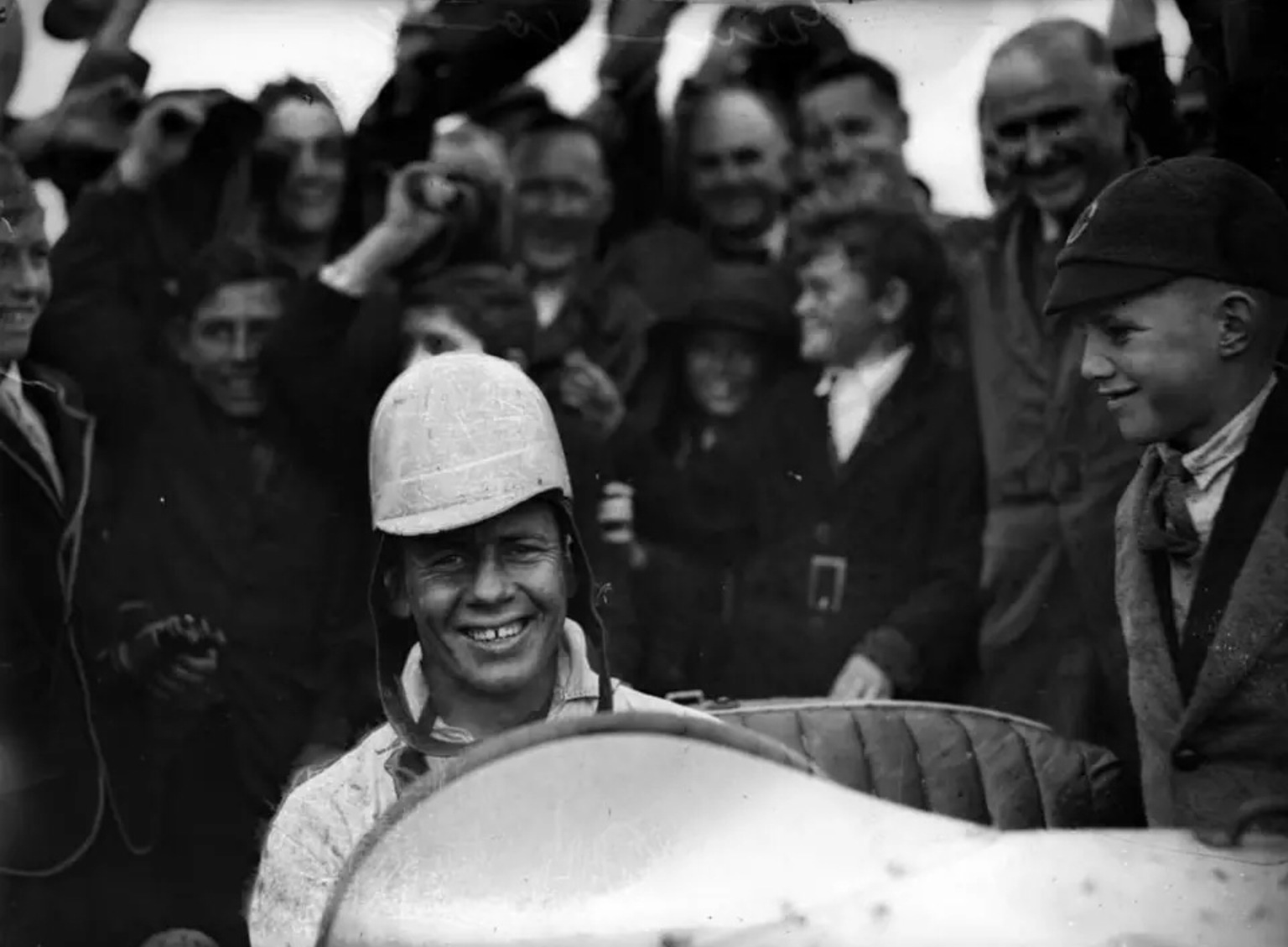
(SMH)

Simply amazing shot below of Bill’s T37A passing a Chrysler at speed- this photograph is the cover shot of Kent Patrick’s biography on the great man, a work I must acquire.

(SMH)

The impressive line up of cars before the Fifty Mile Handicap race includes, from the left, the Percy Hunter driven JAS Jones owned Alfa 6C1750 Zagato, the obscured Bill Thomson Bugatti T37A and two Chrysler 4 litre machines of E Patterson and #72/14 Herb Beith.

Any idea what the car below is folks, I thought for a bit it might have been Charlie East’s Bugatti T37 ‘37104’ in the paddock, or more specifically, on the beach- but it isn’t!  Any clues?
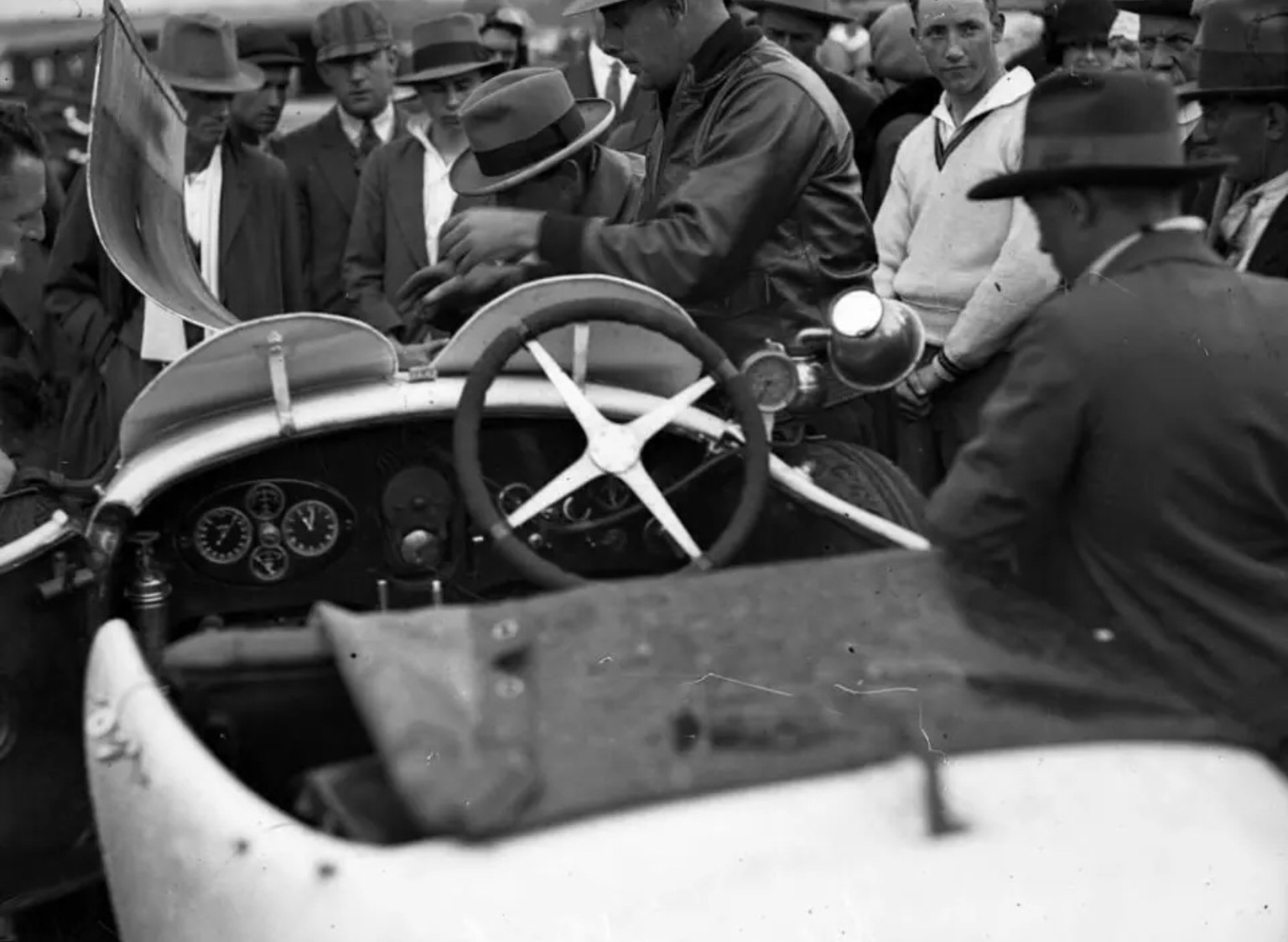
You can see from the gaggle of cars below going around one of the markers which defines  one of the extremities of the ‘track’ that the tide is rapidly marching in. No idea of the cars, assistance invited.
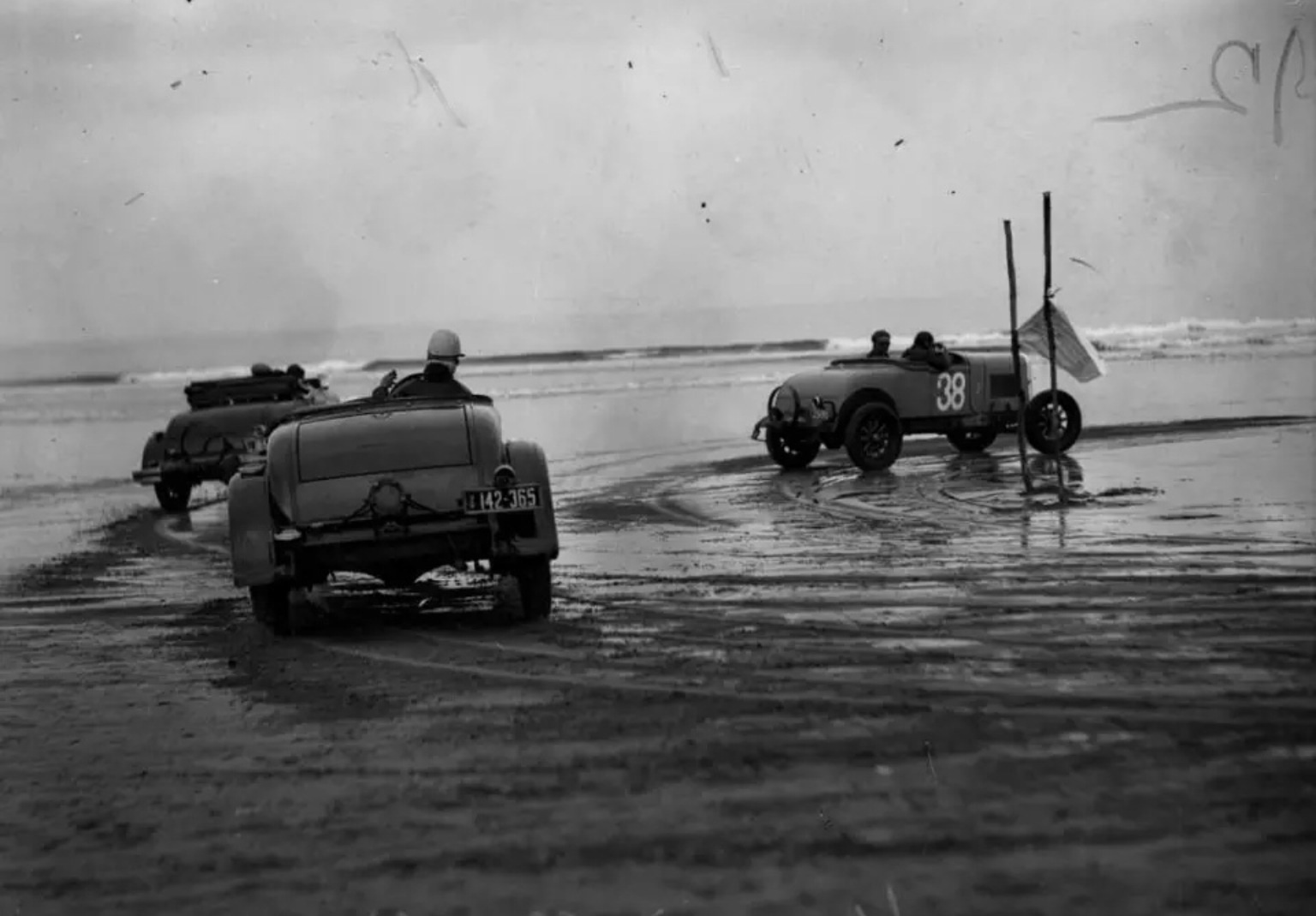
(SMH)

The masked avenger below appears to be another lady racer but I’ve no idea as to name or mount. Evocative shot, the mask is protection from the sea gales and sand but reminds me of the first use of Nomex masks circa 1967.

And I thought wet Winton in May can be a pain in the arse!
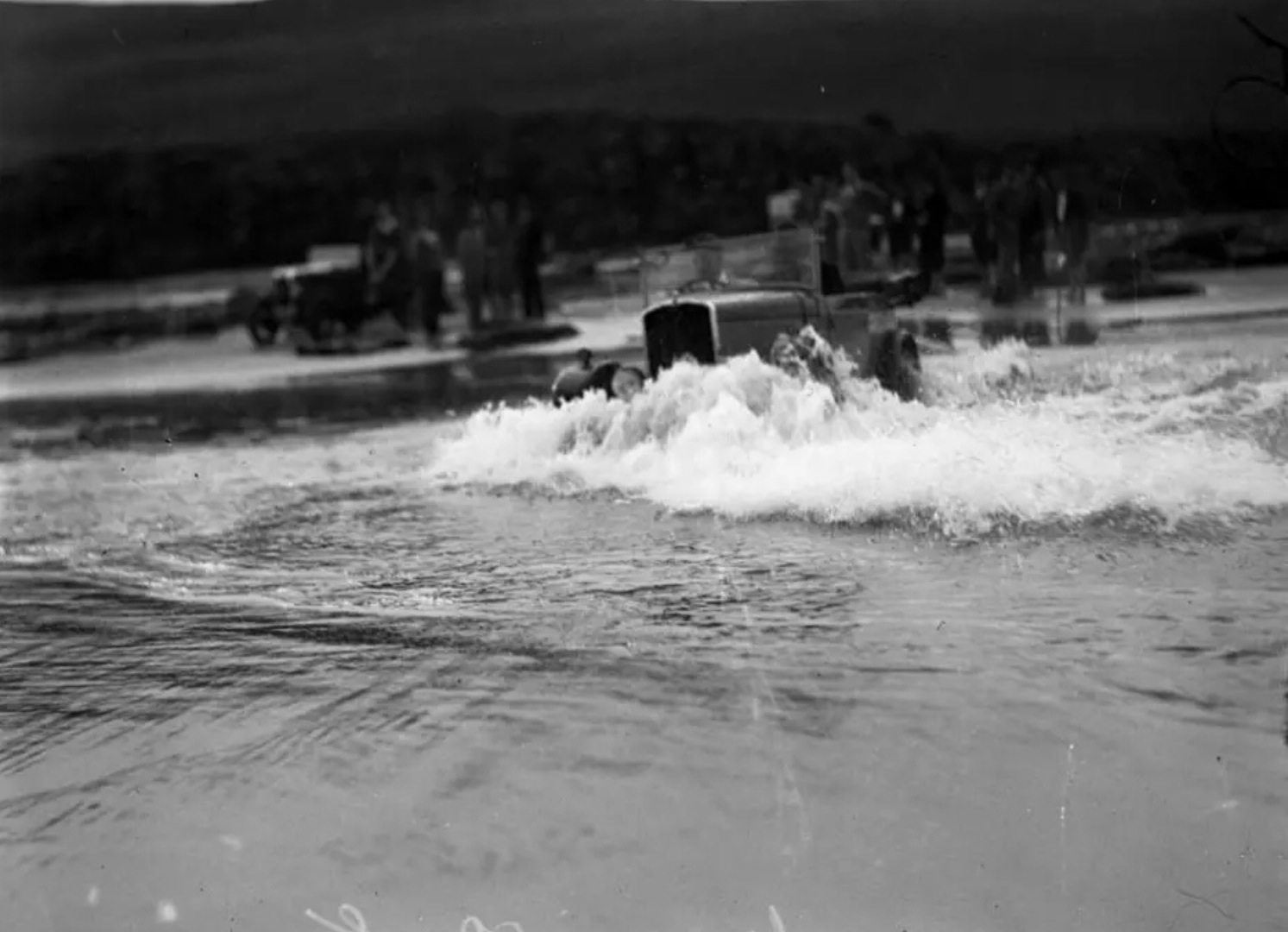
(SMH)

Definitely time for a few bevvies by this stage of the day. Car make and model?
(SMH)


(Kiama)

Kingsford-Smith: Australia-New Zealand Flight 1933…

Charles Kingsford-Smith used the beach at Gerringong to fly to New Zealand, above the ‘Southern Cross’ has just landed.

Seven Mile Beach was used as the runway for the first commercial flight between Australia and New Zealand.

The historic journey by legendary pilot Air Commodore (and later) Sir Charles Kingsford Smith took place in the early hours of January 11 1933, he landed more than fourteen hours later at New Plymouth on New Zealand’s North Island.

Gerringong Beach was chosen, for this, his second flight across the Tasman, because of its length which allowed plenty of distance to get the heavily laden plane off the deck- on board was 660 gallons of fuel and 30 gallons of oil as well as a crew of four.


Look at that crowd! (SMH)
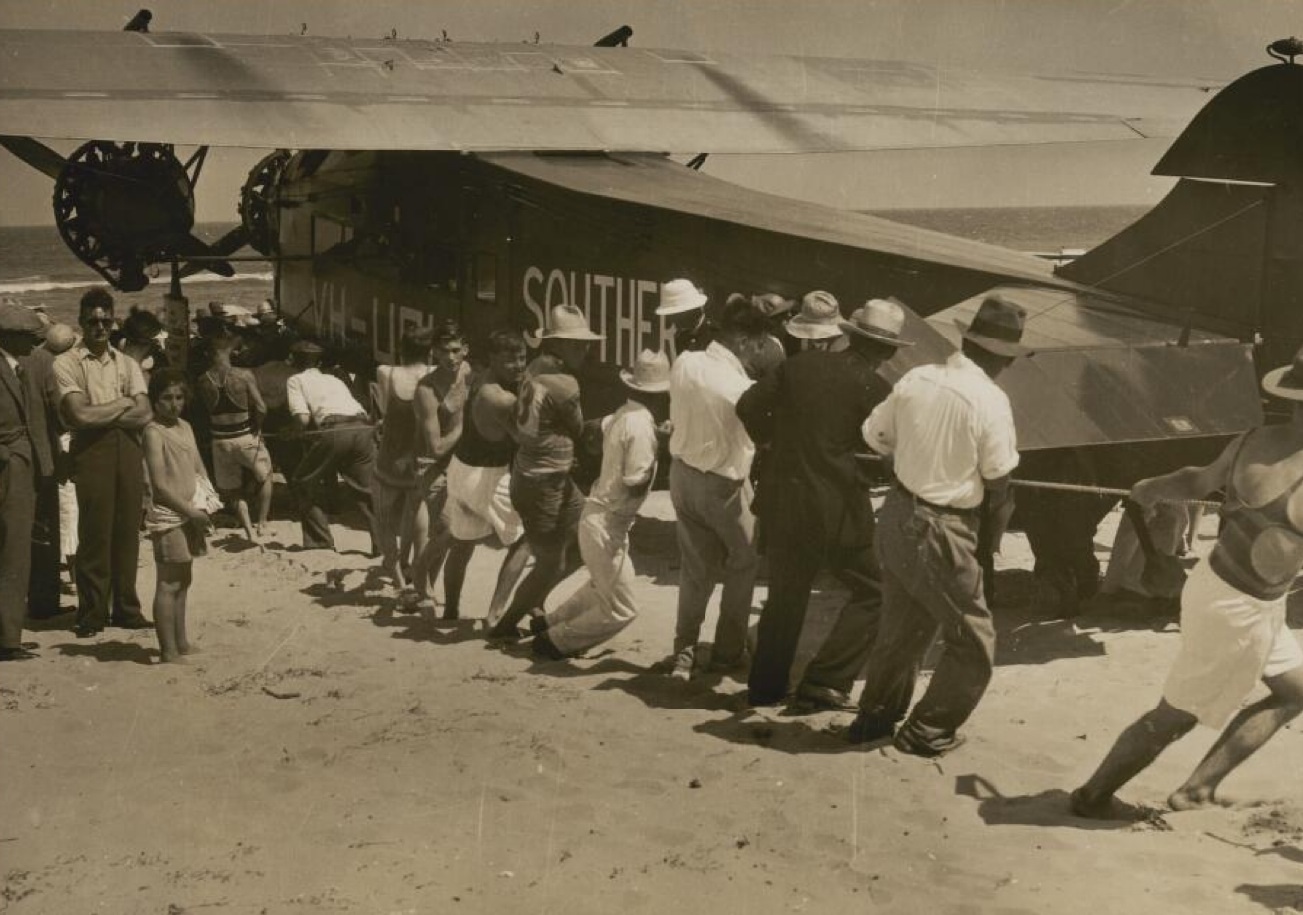
 

Hauling the plane clear of the rising tide (SMH)
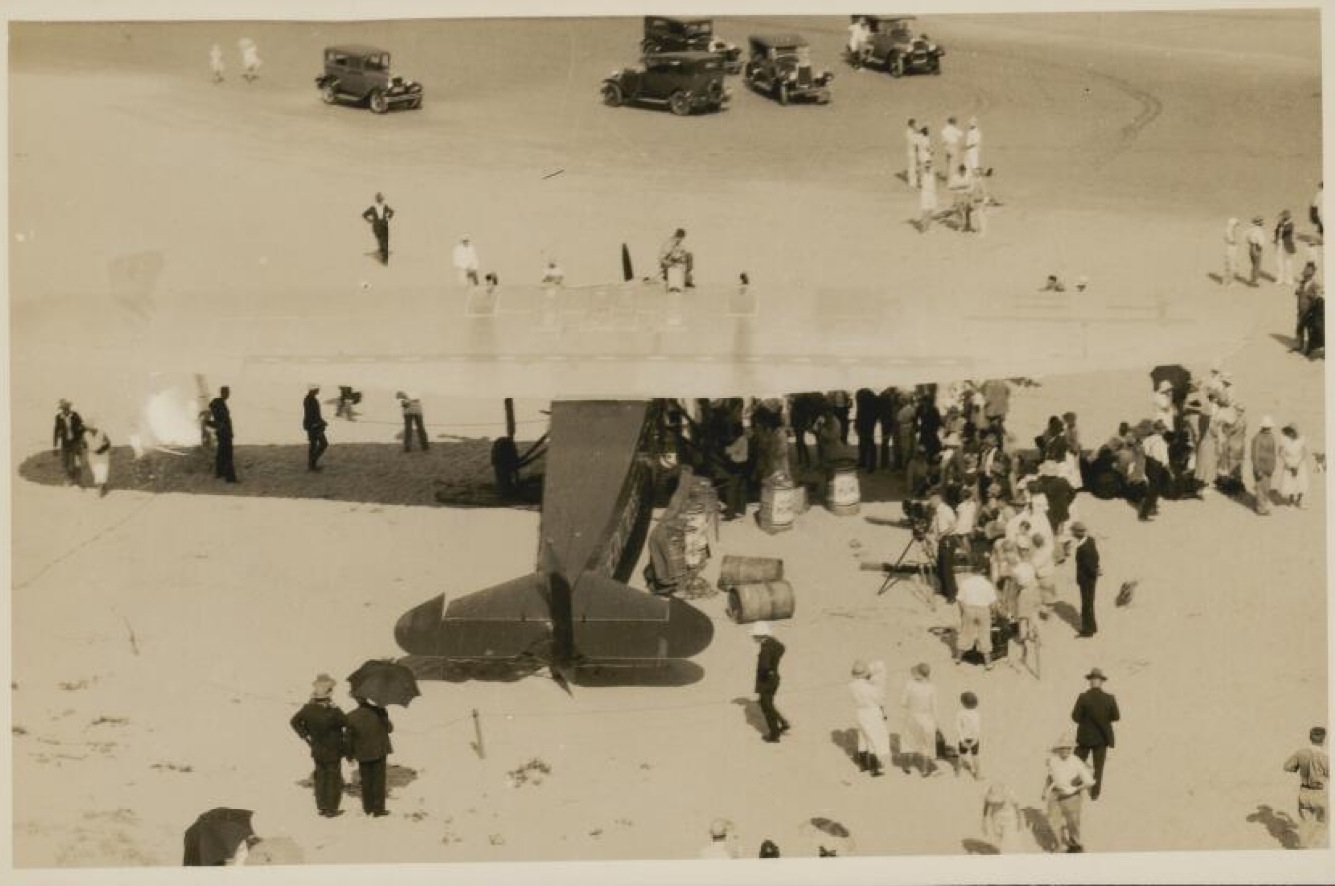
 

In position, being fuelled and made ready (SMH)
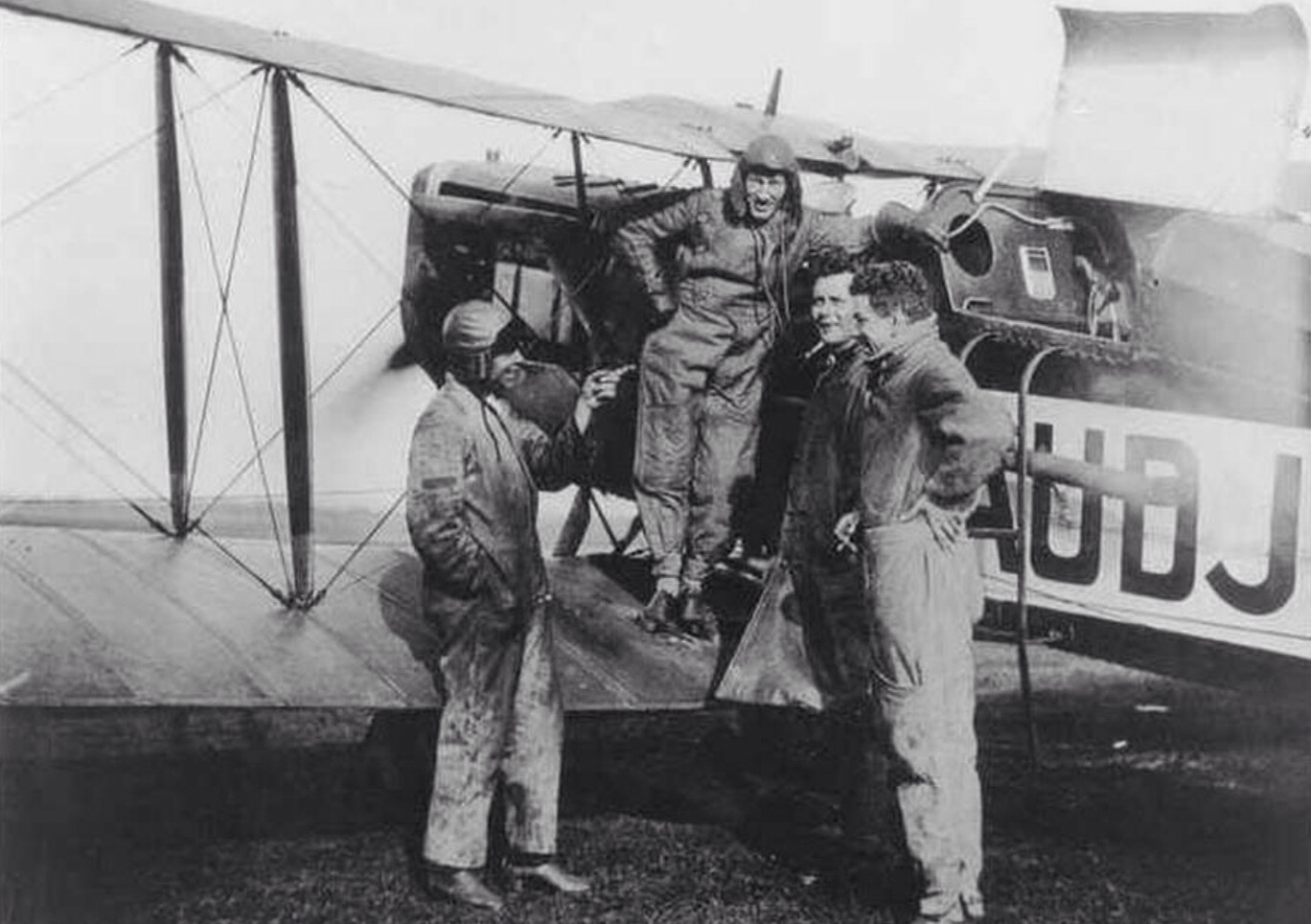
 

(unattributed)
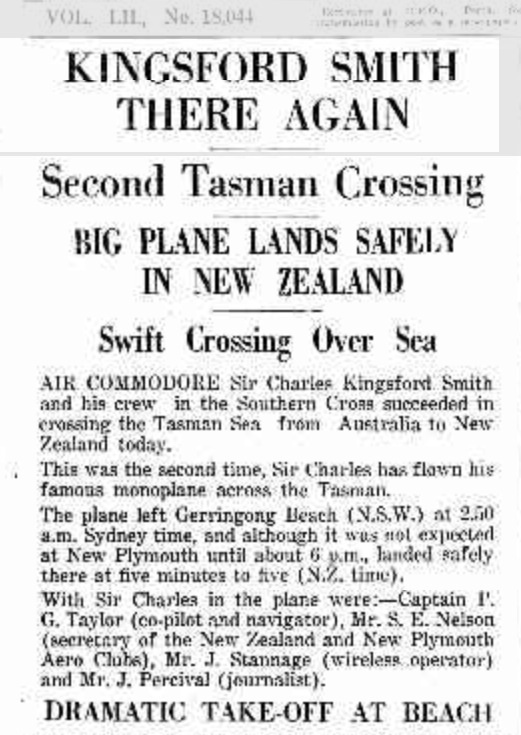
 

‘The Daily News’ Perth 11 January 1933

The famous aviators flight log describes the trip as a joyriding tour, his crew comprised co-piot and navigator PG ‘Bill’ Taylor, wireless operator John Stannery and SE Nelson, secretary of the New Zealand and New Plymouth Aero Clubs.

The aircraft was flown down from Mascot Airfield, Sydney on January 10 averaging 115 mph for the trip. Once on the ground the plane was pronounced fit and the engines were covered to prevent ingestion of air blown sand, it was refuelled with chamois leather providing the filter!

Flares were lit early on the beach to mark a runway with several thousand people making the trip from Sydney to witness the historic 2.50 am takeoff- turning on their headlights to provide the aviators with extra illumination. The motorists were requested to keep their headlights on for 15 minutes after departure with Smith firing some rockets or flares to signal all was well once the ‘Old Bus’- the Fokker Trimotor VH-USU ‘Southern Cross’ was aloft.

‘Smithy’s last flight was aboard a Lockheed Altair which disappeared in the dark, tropical heat off Burma in November 1935.
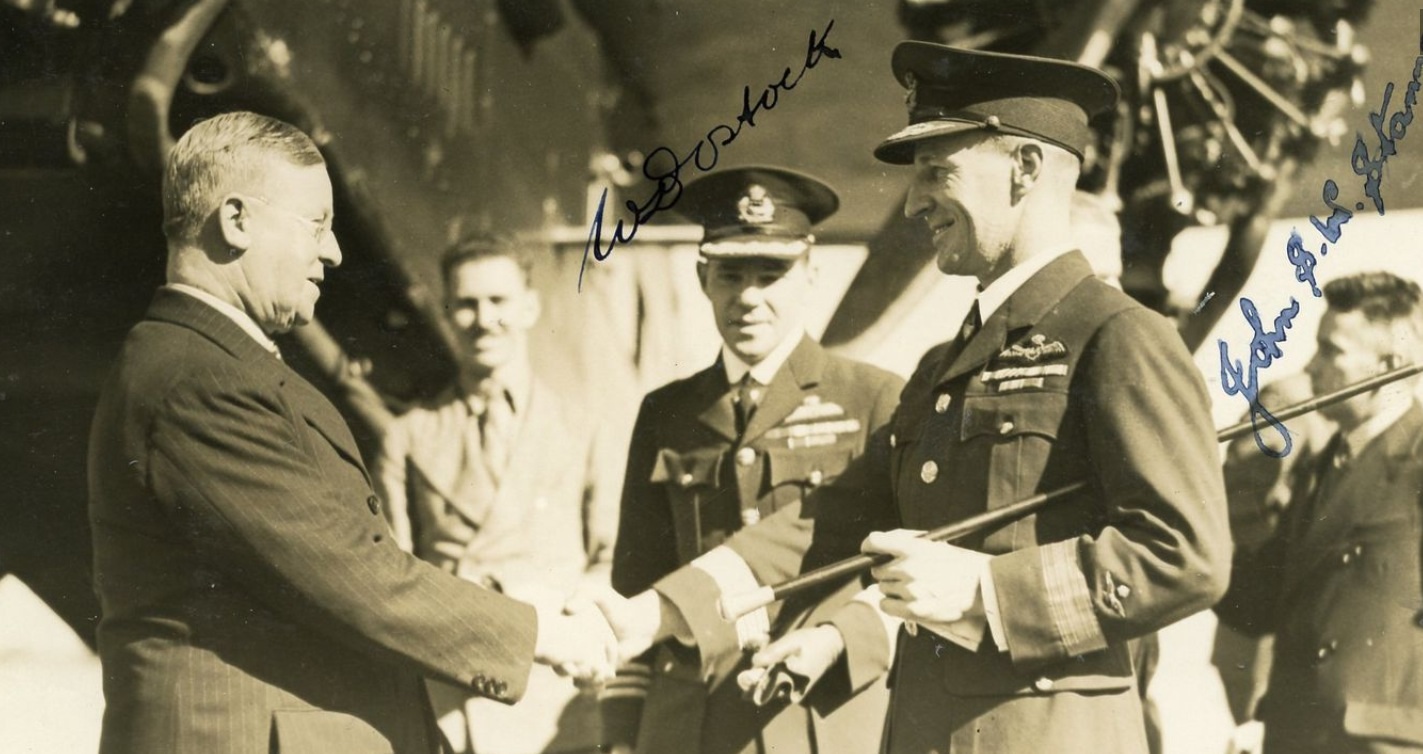
Australian Minister of Defence handing over the ‘Southern Cross’ to Kingsford-Smith at Richmond RAAF base, New South Wales in 1935 (MAAS)


Peter Whitehead ERA R10B: LSR attempt 10 November 1938…

Peter Whitehead raced his ERA R10B extensively around Australia in 1938 most notably winning the Australian Grand Prix at Bathurst over the Easter long weekend and the Australian Hillclimb Championship at Rob Roy in outer Melbourne’s Christmas Hills later in the year.

Peter Whitehead in Australia : ERA R10B : 1938…

(The Sun)

He found time for a little record-breaking though- his attempt on the Australian Mile started with a 133 mph pass at Gerringong but on the return leg a piston failed bringing an early end to his day. \

Here ‘the boys’ are hauling the car off the beach through thick sand.

(The Sun)


Credits…

‘Kiama’ – kiama.nsw.gov, monumentsaustralia.org.au, ‘Sunday Times’ 8 December 1929 and various other newspapers via Trove, ‘MAAS’- Museum of Applied Arts and Sciences, ‘DHA’- Don Harkness Archive, The Sun, Fairfax/Sydney Morning Herald

Tailpiece That May 1930 meeting really was soggy…
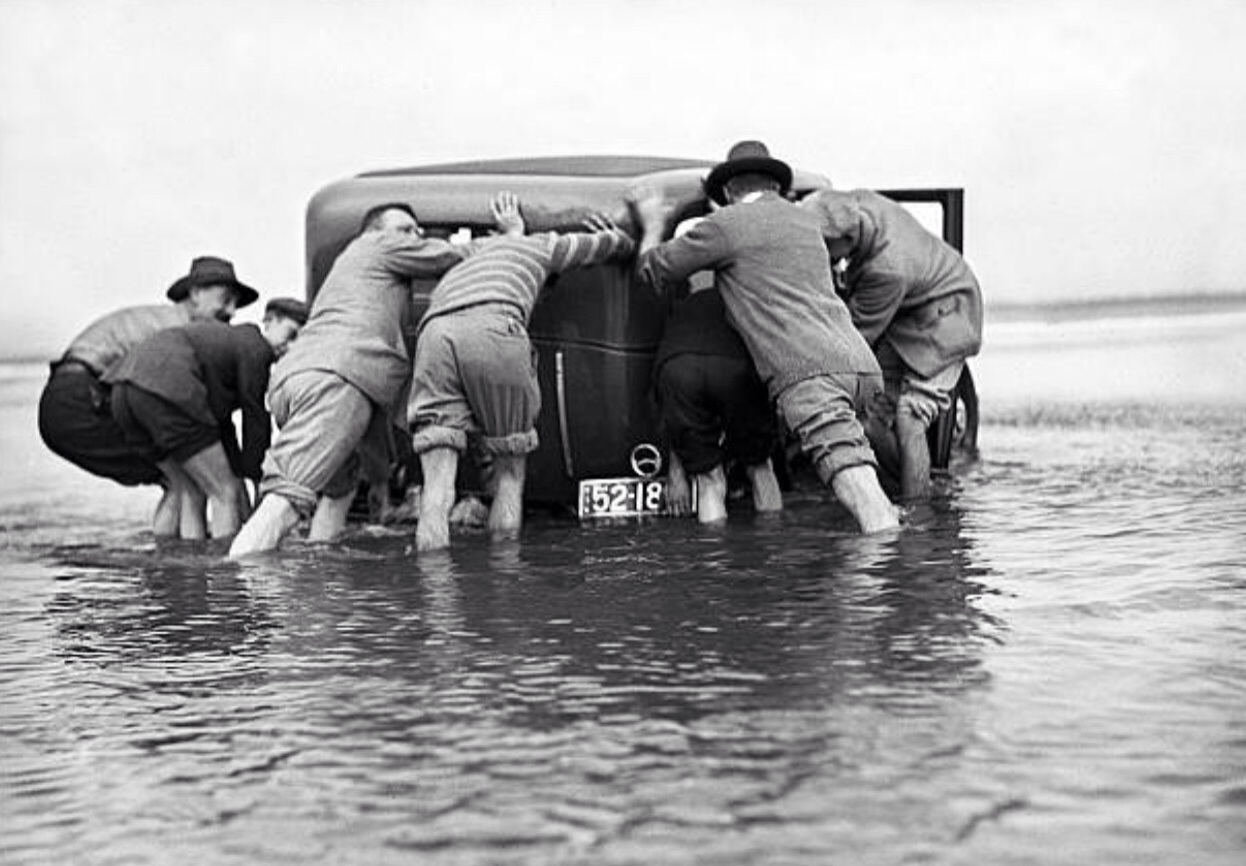
(Kiama)

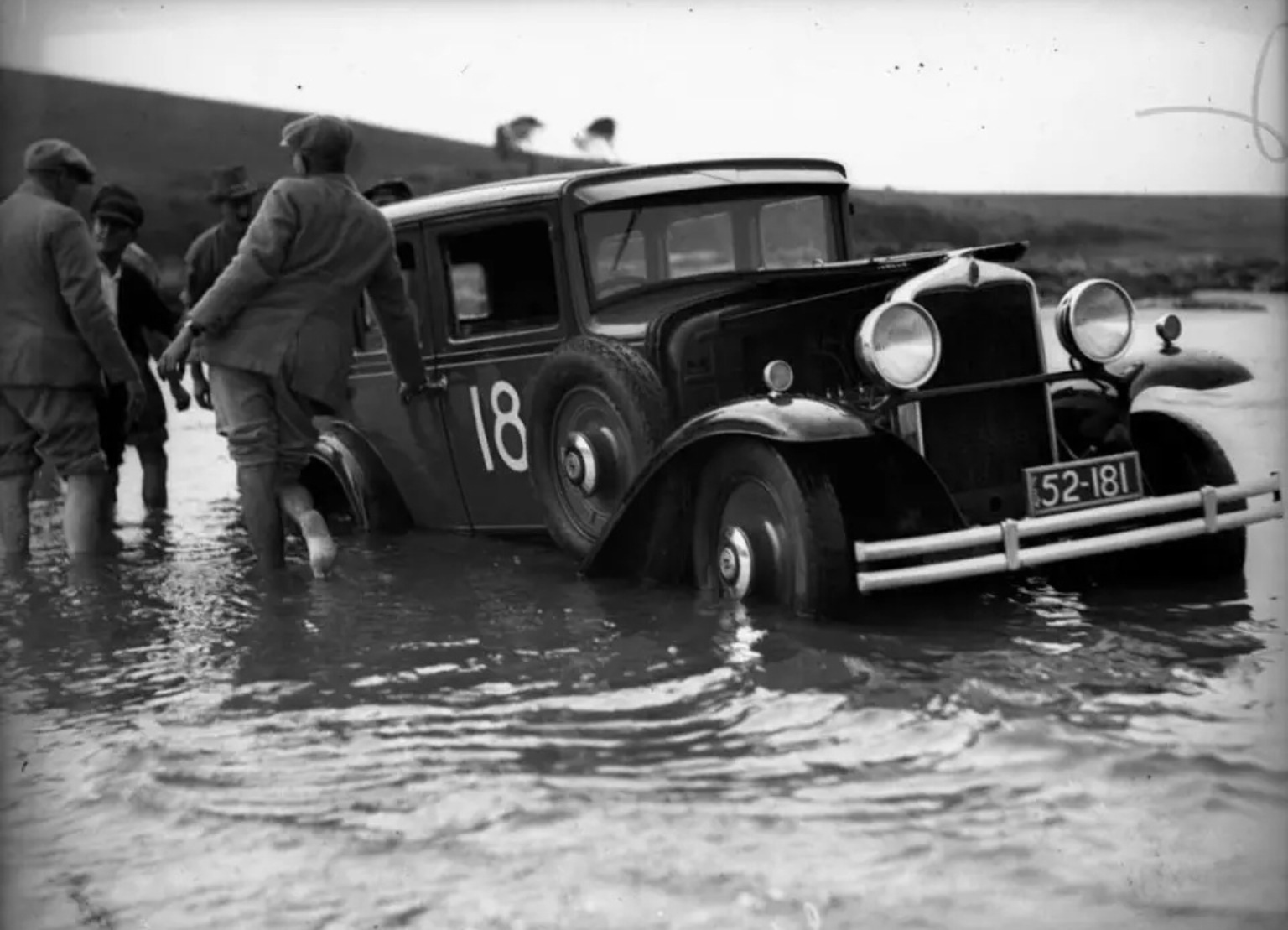
These dudes have well and truly lost the battle with the Pacific Ocean tide! It is a competitors car too, #18 in an earlier shot.

Finito…

(PA Images)

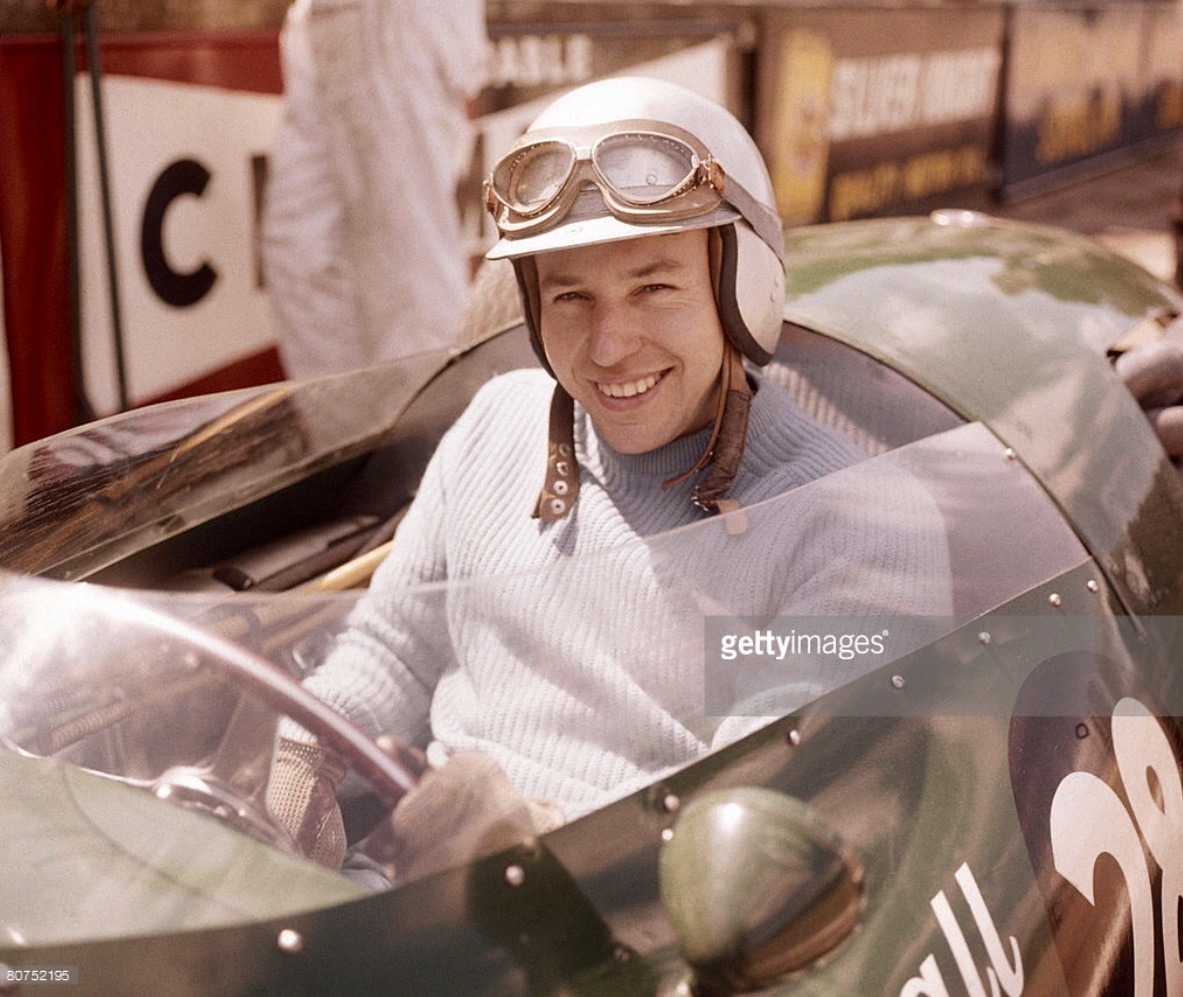
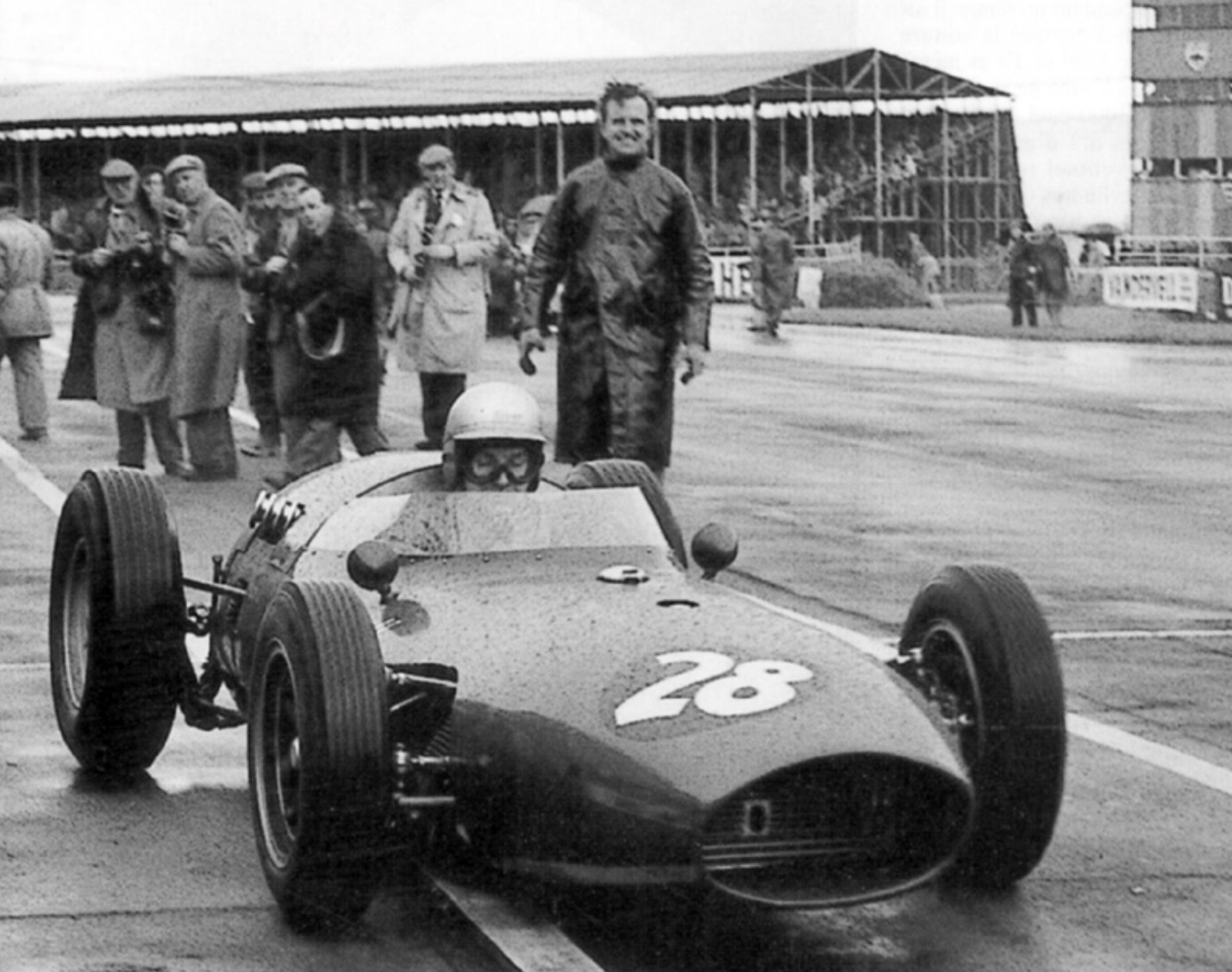
John Surtees listens to Tony Vandervell’s questions in the Silverstone pitlane- Vanwall VW14, 6 May 1961…

The carnival is over in the sense that this weekend was the last ever race by the Vanwall Team. The first, fittingly was also at Silverstone when Raymond Mays and Ken Richardson contested the British Grand Prix on 14 May 1949, the 1.5 litre V12 Ferrari 125 ’02C’ ‘Thinwall Special’ retired after it was crashed by Richardson on lap 81 of the race won by Emmanuel de Graffenried’s Maserati 4CLT-48.

The result in May 1961 was better, a finish at least- 5th in the Intercontinental Formula 200 mile BRDC International Trophy, the race won by Stirling Moss from Jack Brabham and Roy Salvadori in Cooper T53 Climaxes. Henry Taylor was an interloper in 4th aboard a Lotus 18 Climax.

I wonder then, if young Surtees, fixated on his own career, understood the significance of Tony Vandervell’s work in making the breakthrough for the ‘Green Cars’?- the world of GP racing as we know it changed with the Vanwall victories of the late-fifties.

Surtees in more pleasant weather aboard the Vanwall during the BRDC Intl Trophy weekend (Getty)


(unattributed)

VW14 was the only mid-engined Vanwall built.

Of 2.6 litres in capacity, three of the nine Vanwall 2.5 litre engines- V5, V6 and V9 were converted to rear-engine specification in 1961 which involved movement of the fuel injection pump and magneto to the right hand side of the cylinder block. In Mk 2 form this car is retained by Vandervell Products.

At Silverstone Bruce McLaren put his Cooper T53 on pole from Moss, Brabham, Hill BRM P48, Salvadori, then Surtees and Ireland’s Lotus 18 Climax.

Surtees drove the car well in tricky, wet conditions holding second between Brabham and Moss and then spun finishing fifth.

Checkout my feature article on Vanwall Cars…

Vanwall Cars and the 1958 Moroccan Grand Prix…

Etcetera: Jack Brabham’s Test Driving Impressions of the Vanwall…

Stephen Dalton provided a copy of Brabham’s August 1961 ‘Motor Racing’ magazine column which included Jack’s driving impressions of the car on the Thursday prior to the 8 July Silverstone ‘British Empire Trophy’ won by Stirling Moss in a Rob Walker Cooper T53 Climax. Jack also raced a T53 Climax that season, so that is his frame of reference.

‘Silverstone was a disappointment too, though the Thursday preceding the race was very interesting when i had a go in the Vanwall. Tony Vandervell wanted me to try it to see whether i would drive it in the race. (Jack entered the Intercontinental races in his own car not a factory Cooper so he was free to pick and choose)

After the try out i decided it was not a race winning car in the form in which i drove it so i regretfully turned down the drive. But i think with perhaps two days of test driving, while suspension alterations were made, it could have been a potential winner. Unfortunately we didn’t have time for this, and i decided to use my Cooper in the race…

The Vanwall is about the same weight as the Cooper but it has about 40 horsepower more more than the 2 1/2 litre Coventry Climax gives.

The five-speed gearbox, designed by Colotti and made by the Vandervell Organisation, is a real honey to use. The brakes too were very good, though completely different in feel to what i have been used to, with a much softer pedal. But they are more than adequate for the cars performance, and they really do stop the car.

The Vanwall certainly felt a beautifully made, rigid racing car. It steered very well down the straights but it did not handle well enough round the corners to make full use of the performance. I found it was over-steering too much, and i was also getting the front wheels pattering across the road.

After a comparatively short experience with the car i managed a Silverstone lap in 1 minute 36.8 seconds. This was of course 3 seconds slower than i managed in my Cooper during the next days practice. With a little more practising i think a 1 minute 35 seconds lap would have been quite possible with the Vanwall, but i wouldn’t have liked to have tried anything much quicker without modifications. To my mind it would have been necessary to have altered the roll stiffness and the spring rates to get a better balance.

Cornering apart, it is in fact difficult to answer the question why the Vanwall was not as fast as the Cooper. The Climax, of course, has more torque at low revs, but the Vanwall really winds up in a most exciting way along the straights, and the traction is good.

I would rate the car as possessing definite prospects in Intercontinental competition. It could of course be turned into a Formula 1 car, since it is light enough for a 1 1/2 litre engine. But i doubt whether the frame is wide enough to take a multi-cylinder engine, which i think would be needed to compete seriously in Formula 1 next season.

Another thing which struck me at the time was the enthusiasm of Tony Vandervell when he goes motor racing. I was pretty impressed with his knowledge of racing machinery’ Jack concluded.

So there we go, with a couple of days suspension sorting the Vanwall was potentially a competitive Intercontinental car in 1961.

Credits…

Getty Images, f2register, Stephen Dalton Collection

Tailpiece: Surtees, Vanwall VW14…

Surtees sets off for the grid and the last ‘in period’ race by a Vanwall, 6 May 1961, Silverstone (unattributed)

Finito…

A patriotic kiddo prepares his very aerodynamic ‘Spitfire’ for a run down Cross Road, Fullarton, Adelaide in the Winter of 1941…

We all start to race somewhere, I ‘progressed’ from billycarts! I wonder if this dude took steps beyond the Unley Soap Box Derby to bigger and better automotive things in the years to come? Love the schoolkids formal cold weather attire- caps, cloaks, coats and ties very much to the fore.

The run down Cross Road, from ‘the old gum tree’ to Fullarton Road attracted a crowd of 15,000! people to watch 100 competitors achieve speeds of up to 70 km/h. The crowd is indicative, I guess, of just how starved people were of any form of entertainment during the long, bleak, difficult war years.

Photo Credit…

State Library of South Australia

(M Williams)

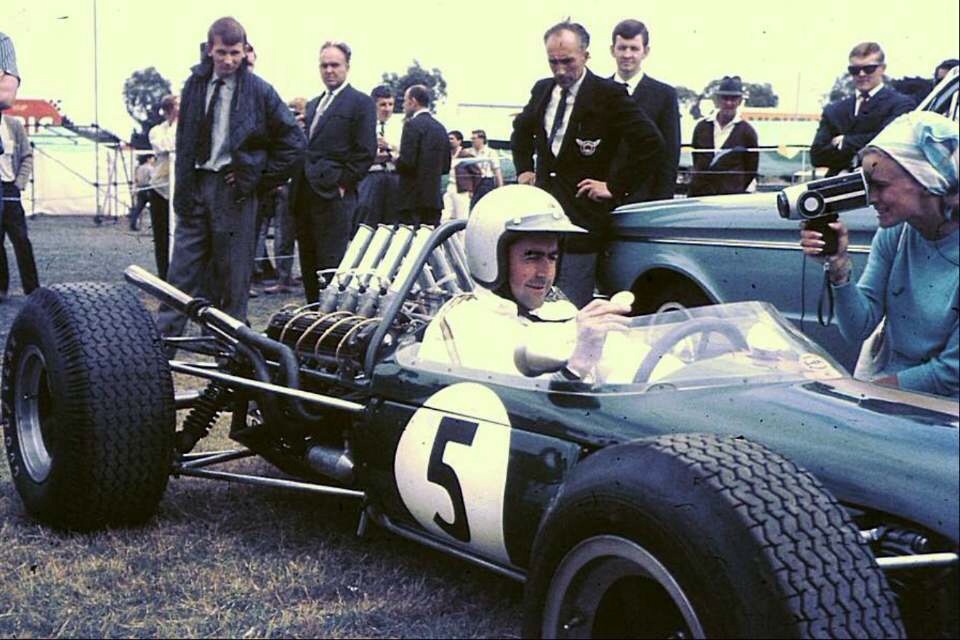
Jack Brabham in his 1966 F1 Championship winning Brabham BT19 Repco during the Sandown Tasman weekend, 27 February 1966…

The pretty little poppet with the camera is far more attractive than the RBE crew from the factory in Richmond/Maidstone. I guess she has been dispatched from Repco HQ in St Kilda Road to catch all the action. Which rather begs the question, what became of the footage missy captured?

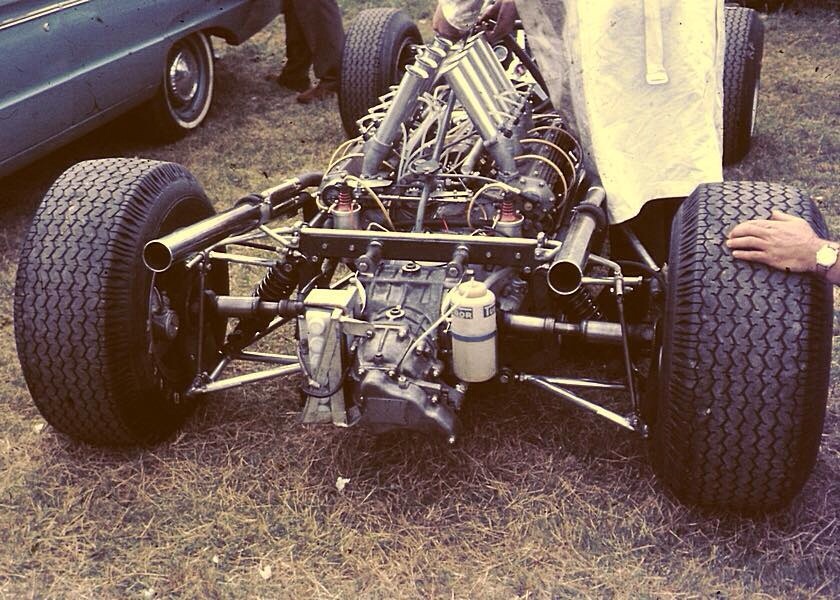
The car is powered by a new Repco Brabham Engines ‘620 Series’ 2.5 litre V8- the motor in 3 litre capacity made its race debut in South Africa on 1 January. BT19 was a very busy car in 1966 and well into 1967.

I’ve done this story to death of course, here on the engine; https://primotipo.com/2014/08/07/rb620-v8-building-the-1966-world-championship-winning-engine-rodways-repco-recollections-episode-2/

and here on Jack’s 1966 season; https://primotipo.com/2014/11/13/winning-the-1966-world-f1-championships-rodways-repco-recollections-episode-3/

but these two photos were too good not to share.

Jackie Stewart and Graham Hill created a BRM sandwich for Jim Clark that ‘Sandown Park Cup’ weekend- second in his Lotus 39 Coventry Climax FPF, the BRM lads were aboard 1.9 litre P60 V8 engined P261’s. Jack was out on lap 6 with a failed oil pump causing substantial engine destruction.

That is RBE620 ‘E2’ 2.5 in its engine bay. Over the next 12 months or so it would have no shortage of Repco RB620, 640 and 740 V8’s popped into and out of it (M Williams)

As is well known, the one and only Brabham BT19 ‘F1-1-65’ was built by Ron Tauranac in 1965 to suit the dimensions of the stillborn Coventry Climax FWMW 16 cylinder engine and lay unused until pressed into service as the first car into which the Repco RB620 V8, designed by Phil Irving, was installed.

Utterly conventional in design, Jack put the light, chuckable car to rather good use throughout 1966- see Werner Buhrer’s outline and drawing of the car below.

Etcetera…

I’d actually finished this piece and then cruised through my archive and noticed how many other photographs I had of this particular weekend.

Some are only of ‘proof quality’ recently posted by Repco-Brabham engineer/racer/historian Nigel Tait, but they are still valuable to share to document RBE history.

So here they are, in sort of chronological order…

(N Tait)

Mike Gasking giving an RBE620 2.5 a whirl in the Richmond test cells in late 1965- is it the engine in Jack’s car at Sandown?- more than likely it is ‘E2’ with those long inlet trumpets, yes.

Gasking was in on the ground floor- he was apprenticed at Repco and was involved in building and testing Jack’s Coventry Climax FPF engines and then throughout the Repco Brabham Engines period to its end.

Dyno is a Heenan & Froude GB4 which remained in Richmond for a while before being transported to RBE’s new digs at 87 Mitchell Street, Maidstone- this move took place in the early weeks of January 1966.

(N Tait)

Off she rolls from the truck, ‘Peters Corner’ and the start of the run up the back straight in the background.

BT19 has been a busy already. Fitted with a 3 litre RBE620 V8 the car was shipped to South Africa from the UK fitted with engine # ‘E3’ for the non-championship GP at Kyalami on 1 January.

Phil Irving describes the 3 litre engine as ‘…built up from scratch, with the cylinder heads as drawn for the original 2 1/2 litre, except that the inlet ports were enlarged and re-shaped to improve gas-flow and throttle-slides as developed for the 2 1/2 litre engine, were used. After assembly and short running-in, full power tests returned an output of 310 bhp (in his book Malcolm Preston quotes 280 bhp @ 7500 rpm with 310 bhp achieved several months later)…there was just time for an afternoon shake-down run (Goodwood) before the car was loaded onto the boat (to South Africa)…’

That SA GP was won by the works Lotus 33 Climax 2 litre FWMV of Mike Spence, Brabham retired when the fuel-injection pump seized having set pole and led for all but the last nine of the sixty laps.

BT19 was then air freighted to Melbourne’s Essendon Airport and trucked to Richmond where the 3 litre ‘E3’ was removed and the 2.5 litre ‘E2’  installed for the Sandown.

Many of you will recall Roy Billington, front and centre below, as a Brabham Racing Organisation mechanic for many years. All of Nigel Tait’s Christmases have come at once- he had just commenced at Repco as a graduate Cadet Engineer, his first assignment looking after Brabham’s new car- it does not get better than that at 22! Phil, leaning on the Lukey exhausts with ever-present fag in his mouth!

(N Tait)

Nigel Tait, Roy Billington and Phil Irving are fussing over ‘RBE620’ 2.5 ‘E2’ In the Sandown paddock on the Thursday or Friday prior to the meeting.

Plenty of pressure, it was the home teams first home race resulting in a massive crowd turnout of 55,000 people on raceday to see Brabham and his ‘all-Australian’ racing car make its local debut.

Irving quotes over 250 bhp was given by the 620 2.5 litre- not much greater than the FPF but the V8 had good mid-range torque and could be revved past it’s power-peak without self-destruction, unlike the short-stroke FPF’s which tended to be rather brittle if over-revved by even a smidge.

(N Tait)

Frank Hallam now joins in the fun between the exhausts- left to right Hallam, Billington, Tait, the very obscured Irving and Black Jack. On the pit counter beyond is lanky Norman Wilson, Peter Holinger, a nun identified fellow and Bob Brown, a Repco Ltd Director.

The sergent.com race report has it that the car was troublesome during practice, with 30 bhp being found overnight to put Jack right in amongst the front-running BRM’s of Stewart and Hill. Nigel recalls Phil getting cross with him on the race weekend , ‘We were working on the throttle slides on the BT19 the night before the Sandown meeting and it turned out to be a very long and late night. I went out to the all-night hamburger place and bought one for Phil but he spat it out. How was i to know he didnt like onions?- a great bloke and very clever’.

(I Nicholls)

Look at that crowd! Kidlets, Billington- who is the guy in the cap who always looked after Jack whilst he was in Oz and is in ‘all’ the shots?, Nigel Tait at right having cast aside his grotty lab-coat.

At Sandown Jack set a new lap record in his heat, the Exide Cup- the results of two heats determined grid positions.

The Tasman race engine seizure occurred in ‘…that the start of the race was delayed and everyone started with cold engines. The Repco V8’s oil-pump relief valve failed on the first lap (actually the sixth lap according to the various race reports) of the race the oil pressure went up to 160psi, the pump gears stripped and the engine locked up at about 7000 rpm’ according to Phil Irving.

Tait recalls ‘That night…I had the task of removing the pump and dismantling it. Frank Hallam and his wife Norma were there as was Phil’.

The oil pump gears were from a Fordson Major tractor out of an FM diesel model- they were amongst some components from proprietary vehicles used in RB620- which from that day were not sintered but machined from steel.

Rodway Wolfe noted that ‘I remember on the Monday after that Sandown race…when I arrived at the Maidstone factory at 8 am the drawing of the oil pump gear with new specifications was on Kevin Davies, the Admin Manager’s desk. Phil had made the modifications overnight. He (famously) didn’t keep the same hours as other management but he didn’t knock off at 5.30 pm like other management either!…’

‘Frank Hallam arranged for new steel gears to be made while Roy Billington helped me to remove and dismantle the engine. We found two crankpins were badly overheated and the crank was bent, so the crank and the main bearings were replaced, but fortunately the pistons, rings and cylinder liners were undamaged.

Although changing the crankshaft entailed almost completely dismantling the engine, the timing case and oil pump could be handled as units and we had the engine re-assembled with new pump gears and brake-tested by Tuesday afternoon. We stuck it in the car that night and it went off to Tasmania on the Wednesday (to Longford)…’ Phil wrote.

(T Brandt)

Jim Clark and Jack saunter through the Sandown paddock. Not the greatest of weekends for either!

In Jim’s case the 2.5 litre Coventry Climax FPF engine in his Lotus 39- which had been the motor of choice in the Tasman series since its inception in 1964 was now being found wanting by the V8’s of BRM and Repco.

Clark returned the following year with Lotus having taken a leaf out of BRM’s book- their 1967 weapon was a 1.5 litre F1 Lotus 33 fitted with a 2 litre Coventry Climax FWMV V8, with which Jim took the 1967 title convincingly from BRM and Repco Brabham.

(T Brandt)

And again above…meanwhile below the boys are about to pop the car into the truck for the drive back to Richmond and overnight checks before the start of official practice.

‘The start’ of a rather fruitful partnership wouldn’t you say…

Credits…

Max Williams & Nigel Tait Collections, Tony Brandt, Ian Nicholls, sergent.com, ‘Phil Irving: An Autobiography’

(N Tait)

Finito…

Rod MacKenzie captures Kevin Bartlett shaving The Esses Armco during the 1971 Warwick Farm 100, Tasman round on 14 January 1971…

The car is the Franklen/Palliser/Mildren/Wortmeyer F5000- a car designed by Len Bailey and built by Frank Gardner’s business as detailed in Allen Brown’s oldracingcars.com article here; https://www.oldracingcars.com/f5000/franklen/

Alec bought the car off the back of the prodigious speed of the Mildren Alfa/Waggott ‘Yellow Submarine’ also designed by Bailey and raced initially by Frank Gardner in the 1969 Tasman Series and then with great success by Bartlett in 1969/70 Gold Star/Tasman Championships.

The thrust of Bartlett’s 1970 was racing in the US (which we should talk to him about)- he contested the Symmons and Lakeside Gold Star rounds for third and a DNF and then missed Oran Park, Warwick Farm, Sandown and Mallala.

When he returned to Oz his beautiful Mildren Yellow Submarine had been sold to Bob Muir, the F5000 Mildren Chev was his new mount for the November 1970 AGP at Warwick Farm and beyond.

KB decamps from the Mildren Chev during the 1970 AGP. Glenn Abbey hands on hips at left, not sure of the other crewman- Alec Mildren back to us at far right

In a performance which flattered to deceive KB popped the car fifth on the grid but failed to finish with electrics problems after completing 21 laps. Frank Matich triumphed that day in his McLaren M10B Repco from Niel Allen’s similar Chev engined car (the chassis KB bought after Allen’s retirement) with Graeme Lawrence third in the little Ferrari Dino 246T which had been so fast in his and Chris Amon’s hands since 1968.

KB didn’t have a great run in the Mildren, his best finishes in the seven 1971 Tasman rounds was third at Warwick Farm and fourth at Teretonga- niggles elsewhere included a broken wishbone at Levin, coil at Wigram, engine failure at Sandown and a crash which precluded the speedy Sydneysider starting the final round at Surfers.

That was pretty much the end of Mildren Racing, sadly. Bartlett bought one of Niel Allen’s McLaren M10B’s shortly thereafter and was immediately a front-runner in one of the great production F5000’s.

(R MacKenzie)

KB’ boots the Mildren out of Peters Corner at Sandown and unleashes 500 or so neddies up Sandowns longish back straight and the left-right high speed kink and plunge into Dandenong Road.

Upon the sale of the Mildren Racing assets the car was bought by Jack Wortmeyer and re-named Wortmeyer SC/SC5 Chev and driven by hillclimb ace Erol Richardson, he made two Tasman appearances at Warwick Farm in 1973 and Oran Park in 1974. The car never left Wortmeyer’s hands- it was acquired after his death by the ACT’s Matt Veal who has completed, almost, the machines restoration.

Erol Richardson, Wortmeyer SC5 Chev, aka Mildren Chev at Hume Weir in December 1972. Uber rare for an F5000 to compete at the tight, twisty border circuit (B Keys)

This article is written in memory of great Australian photographer Rod MacKenzie who died in the last few days, on 1 February…

In fact it was looking at Rod’s archive for other photos of this car in addition to the lead one which he sent to me some months back that I became aware of his passing.

He was a man of great talent, check out his website if you have not done so and this article we did together in September which explains his ethos or creative approach.

Some of you will be familiar with his work via ‘The Tasman Cup 1964-1975’ book published two years ago whereas many of us first saw his art in ‘Racing Car News’ in its heyday.

Oz Racing Books…

and; http://www.rodmackenziecollection.com/

(R MacKenzie)

The photo above is of Rod on a fantastic trip to Scotland last 7 April 2018 to attend the Jim Clark Exhibition in Chirnside to commemorate the fiftieth anniversary of the Scot’s death at Hockenheim.

Some of Rod’s wonderful work- photos taken at Longford in 1968 formed part of the display.

RIP Rod MacKenzie

Credits…

Rod MacKenzie, Bruce Keys, oldracingcars.com, Fairfax Archive

Tailpiece: Bartlett, Peters/Torana Corner, Sandown Tasman 1971…

Great spot for photographers to get up cockpit close and intimate. Engine an Al Bartz injected Chevy.

Finito…
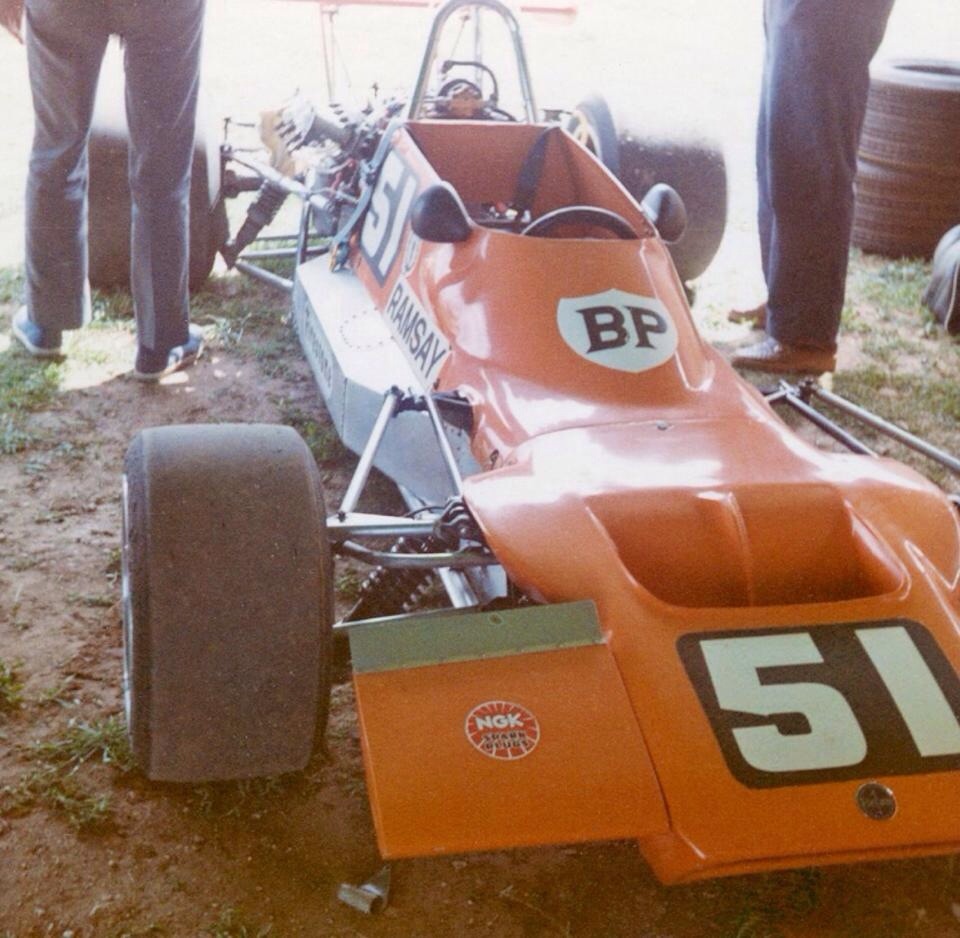
 

Jim Clark having some pre-race fun aboard a Lotus 25 in the Monza paddock, 4 September 1966…

I wonder if the neat little machine is pedal, battery or petrol powered?! In the race Clark raced a much more butch Lotus 43 BRM H16 from grid 3 to a gearbox induced DNF after completing 58 laps- the race was won by Ludovico Scarfiotti’s Ferrari 312 from his teammate Mike Parkes, a happy day indeed for the Tifosi- and Denny Hulme’s Brabham BT20 Repco in third.

(B Cahier)


Monza 1966 front row- Clark Lotus 43 BRM, Ludovico Scarfiotti and Mike Parkes on the far side, Ferrari 312’s pole (R Schlegelmilch)

I’ve done the 1966 Grand Prix season to death in my series of Repco Brabham articles, click here to read about that wonderful season from an era now so far away! https://primotipo.com/2014/11/13/winning-the-1966-world-f1-championships-rodways-repco-recollections-episode-3/ , and here for the 1966 Ferrari 312 https://primotipo.com/2017/10/26/surtees-ferrari-312-modena-1966/ , and here for the Lotus 43 BRM https://primotipo.com/2015/02/17/jim-clark-taking-a-deep-breath-lotus-43-brm/

Ferrari usually rise to the occasion at home and so it was that Mike Parkes popped his 312 on pole from Scarfiotti, aided by a bit more power. Clark was on grid 3 with John Surtees, by then firmly esconced at Cooper Maserati having started the season with Ferrari- but decamping after a series of spats within the team, on grid 4 and Lorenzo Bandini in another 312 in position 5.

Parkes below is looking fairly relaxed with a post-pole cuppa tea!

(unattributed)

In the early stages of the race Scarfiotti and Parkes led but were soon passed by Bandini before the end of lap 1- Clark was back in tenth. Bandini pitted on lap 2 with a fuel pipe problem with Stewart’s BRM P83 H16 soon out with similar dramas.

Scarfiotti led from Hulme, Parkes and Surtees- Surtees pitted on lap 32 with a fuel leak. Jack Brabham, out of the race, won the Drivers Championship as Surtees was the only driver capable of taking the championship from him. Ludovico retained his lead finishing six seconds clear of Parkes, Denny Hulme and then Jochen Rindt, Cooper T81 Maserati.

Scarfiotti from Parkes (unattributed)

Credits…

Rainer Schlegelmilch

Tailpiece: And what a tail it is! The big, fat, beefy BRM arse of the wonderful Lotus 43- the only H16 engined GP winner in the end of season US GP @ Watkins Glen…

(unattributed)

Finito…

‘Joisus Harry and the boys look after me pretty well’ is perhaps the thought going through Peter Brock’s mind…

Harry and the Boys are the Holden Dealer Team- Harry Firth, Ian Tate, Bruce Nowacki and others who built and prepared the various Holdens that Australian Touring Car Greats, Peter Brock and Colin Bond raced.

The Birrana 272 Ford ANF2 car Peter is looking after at Hume Weir in 1973 was a Father and Son operation between Geoff and Peter Brock.

This wasn’t new to the touring car ace mind you- the Austin A30 Holden Sports Sedan which thrust the lad from Diamond Creek to fame was run in just that manner but by 1973 he had been a works driver for four years with all of the cossetting- and expectations which goes with it.

Brock has that ‘where the hell is Tatey’ look about him!? Mind you, he may have just spotted a pretty young filly at the burger stand and doing that instantaneous, nano-second process of visual assesssment we all do.

This is another of my whacky-dacky articles in that it started as a mid-week quickie but grew like topsy into a feature as I chased a few tangents- so its not as cohesive as some of my efforts. Its a bit of this and a bit of that, without being a whole lot of any one thing! Bare with me all the same.

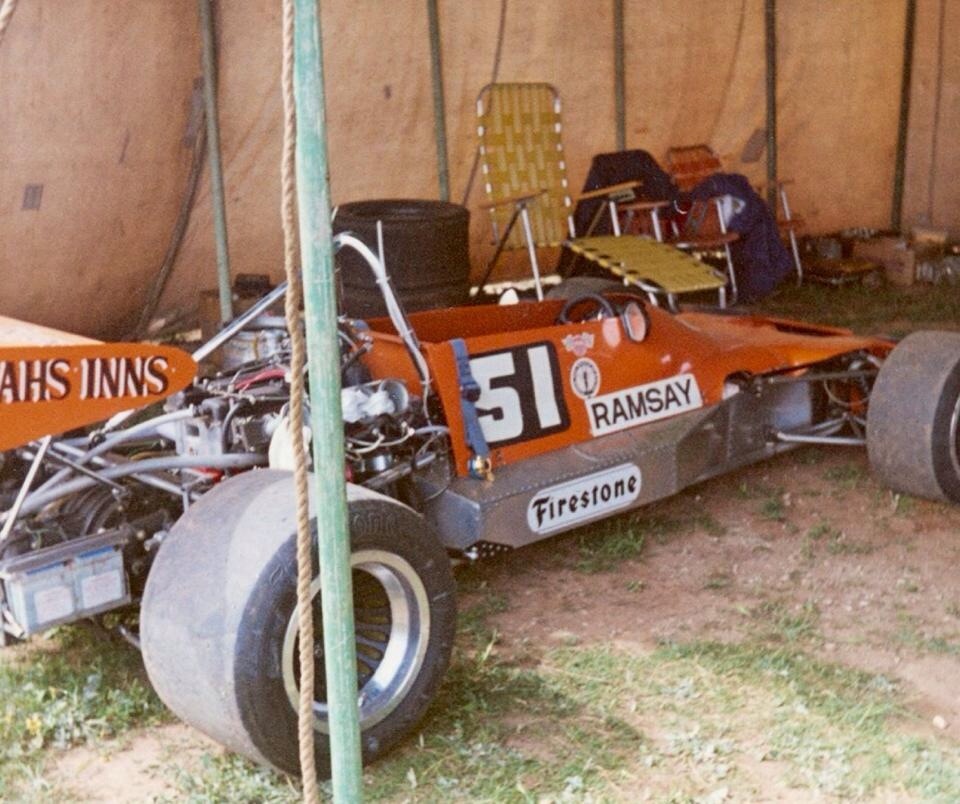
Chunky lines of the new Birrana 272 in the Victorian Trophy Sandown paddock. Single top link and radius rod and bottom lower wishbone, coil spring/damper front suspension. Note the ‘stay’ between the front and rear front suspension mounts on the tub (Kym)

I’ve written about this important car- ‘272-002’ and Brocky’s time with it before.

The car is significant in the pantheon of Birranas in that that it was the first monocoque chassis Tony Alcock and Malcolm Ramsay built, as well as the first of a very successful run of Formula 2 and Formula 3 cars constructed by Birrana between 1972 and 1974- noting that production spluttered along into 1978 with a couple of additional cars built in the interim.

In 1972-3 ‘272-002’ was raced by Ramsay, 1971 AF2 Champ Henk Woelders once, Leo Geoghegan and Brock before passing into Bernie Zampatti’s hands in Perth- he still has it, so rather a nice jigger to own in every respect.

Some of the additional photographs of the car were taken in the Sandown paddock during the weekend Malcolm Ramsay contested the ‘Victorian Trophy’ Gold Star round in April, i’m wondering if this was the car’s race debut? Frank Matich won the race in his Matich A50 Repco, with Ramsay seventh- FM took the Gold Star that year, his only Australian Drivers Championship in a couple of decades at the pointy end of Australian motor racing in both sports cars and single-seaters.

For most of the year Malcolm raced the car in South Australia and Victoria- in addition to the Gold Star round at Sandown there was a ‘Repco (fiftieth) Birthday Series’ of five rounds at Calder contested by F3, F2 and F5000 cars- won by Kevin Bartlett’s Lola T300 Chev

Tony Alcock built the first Birrana- the Formula Ford F71-1 initially raced by John Goss and then David Mingay in the garage behind his house in the Sydney suburbs. By the time the later F72 FF’s were constructed he was in partnership with Malcolm Ramsay back in his native Adelaide.

Ramsay had previously raced Elfins and Alcock worked for Garrie Cooper both before and after a sojurn to Europe working for McLaren, Cooper, Cosworth and others- both were mates of Garrie, so in a way it must have felt strange competing with the much respected outfit from Conmurra Road Edwardstown.

Ramsey- is that him sitting on the tub? and 272 at cold, windy Calder during 1972- possibly the August meeting (oldracephotos.com.au/Hammond)

Mind you, the story is that Malcolm approached Garrie to build him a car with some design features he wanted, the ever accommodating Cooper was fully committed with the build of the 620 and MR5 series of cars at the time so really didn’t have the capacity to do a ‘one off’. So Mal decided to do it himself and approached Tony who was at a loose end at the time.

Ramsey, Victorian Trophy meeting, Sandown. Note the injected Lotus-Ford twin cam and its metering unit and breathers on the roll bar. Box FT200, shocks I think Armstrong- half moon steering wheel a distinctive Birrana feature- Frank Matich the other proponent of those in Oz (Kym)

The 272 was an utterly conventional racing car of the period but what was different from the Elfin 600- which had pretty much ruled the small-bore racing car roost in Australia since its 1968 Singapore GP win with Cooper at the wheel, was that the Birrana had a monocoque chassis whereas the 600- a winner in FF, F3, F2 and ANF1 guises was a spaceframe.

The 272 was beautifully built and quick out of the box- its performance when driven by Malcolm and ‘Dame Nellie Melba’ Geoghegan when Leo- the 1970 Gold Star Champion returned from short-lived single-seater retirement to drive the car later in 1972- and Birrana Australian Formula 2 Championship wins in 1973 (273) and 1974 (274). For the record, Birrana national F2 titles were also taken by Geoff Brabham (274) in 1975 and Graeme Crawford (273) in 1976.

Leo first raced the 272 in the Hordern Trophy Gold Star round at Warwick Farm in November only completing 3 laps before having gear lever problems. He raced the car again in the final Repco Birthday Series round at Calder in December and was convinced of the Birrana’s potential so signed to drive one of two works ‘273’ cars- the other raced by Ramsay in 1973.

The 273 took Alcock’s concepts further, the 274 further again with sales and wins aplenty- the full history of Birrana is for another time.

Leo Geoghegan gridding up for the Hordern Trophy at Warwick Farm late in 1972- that’s Garrie Coopers ELfin MR5 Repco to the left (S Geoghegan)


Brock squirts his 272 around Calder in early 1973 (G Moulds)

At the end of the 1972 season Birrana sold the car to Brock- who made it available for Malcolm Ramsay to race in the opening round of the 1973 championship at Hume Weir whilst Peter attended to Holden Dealer Team commitments.

Malcolm handed the car to Leo who had broken valve spring problems with his 273 Hart motor throughout the weekend including raceday. Geoghegan took a great and somewhat lucky win from the rear of the grid when Tony Stewart’s leading 273 had overheating dramas and had to reduce his pace- the plucky, quick Victorian was second and Chas Talbot, Elfin 600E Ford third.

Tony Stewart’s 273 from Geoghegan in the 272 with an the Skelton Bowin P6 on the outside- and Clive Millis’ abandoned 600B on the inside of the corner. A shame Stewart ceased racing this car after so few meetings- very fast driver, with support from Paul England should have, and could have gone far (ACY)


Geoghegan on Hume Weir’s Pit Straight, Birrana 272 1973- race run in tricky conditions including some rain, tailor made for the experienced Leo (ACY)

Brock raced the 272 for several more meetings before he too acquired a 273. Brock’s too short single-seater/Birrana sojurn is told here; https://primotipo.com/2018/05/07/brocks-birrana/ , with some Birrana history here; https://primotipo.com/2016/04/29/birrana-cars-and-the-1973-singapore-gp/

The 272 had a locally built 1.6 litre Lotus-Ford injected twin-cam engine- the Hart 416B variant de-rigeur in Australia from 1973 when all of the top-guns used these motors excluding Peter Brock.

Hewlands ubiquitous 5 speed FT200 gearbox was specified with lower wishbone bottom, top link and radius rod suspension at the front and single upper link, two lower links and twin radius rods deployed at the rear. Roll bars were used of course with cast Birrana uprights, wheels and steering rack finishing off a very nice package.

Wide, shallow, very rigid monocoque chassis, Varley battery beside the gearbox, locally built twin-cam by Peter Nightingale fitted with Globe injection (Kym)

Tailpiece: ‘Formula Birrana’ Adelaide International 7 October 1973…

(ACY)

Geoghegan and Ramsay in works 273’s sandwich the #18 Bob and Marj Brown owned 273 driven by Enno Buesselmann at Adelaide International in 1973, this race was won by Enno after Leo suffered a puncture.

Evolution of the 272 to 273 clear in this shot inclusive of period-typical ‘Tyrrell type’ enveloping nose.

Marque experts rate the 273 the pick of the Birranas with the 274 said to be not really a quicker car- as proved by the pace of Buesselmann’s car when driven by Bob Muir for the Browns in 1974 fitted with 274 nose and rear wing.

Geoghegan crushed the opposition in 1973- demonstrating amazing reliability, he finished all seven of the championships rounds, winning six of them- one in the 272, the balance in his 273. In a busy season, Geoghegan and Ramsay also raced the cars in Asia- this tour is covered in one of the articles linked above.

Bob Skelton, Bowin P6 Ford-Hart from Peter Brock, Birrana 273 Ford, Oran Park 1973 (ACY)

Afterthoughts…

Bob Skelton and the Bowin P6.

An interesting thing looking back at this F2 season is the performance of 1972 ‘Formula Ford Driver to Europe’ (DTE) winner Bob Skelton and his spaceframe chassis Birrana P6 Ford-Hart.

He was, despite being a far less experienced open-wheeler pilot than Leo who had been racing Tasman 2.5’s since 1966, and was racing wings and slicks for the first time- right up Geoghegan’s clacker on raw pace if not finishing record that season in a brand new, unsorted car. Two second placings from four of the seven rounds he finished was his best.

Let’s look a bit closer in terms of raw speed- at Hume Weir both Leo and Bob didn’t record a time- Tony Stewart started from pole on 45.4 seconds with no race times disclosed.

At Oran Park Geoghegan was on pole 42.3 secs, with BS right behind him on 42.5, Brock 44.2.

At Amaroo LG pole 48.7, BS again in second slot with 48.9, PB on 51.9- the last round of the series Brock contested.

At Surfers the cars raced within the Gold Star Glynn Scott Memorial Trophy F5000 race- Skelton bagged the F2 ‘pole’ with 1:9.5 from Leo on 1:10.4 with BS a tenth quicker in the race- the first occasion that happened that season.

Kneeling John Joyce fettles Skelton’s P6 at the Hume Weir opening round (ACY)


Symmons Plains grid with Geoghegan and Skelton on the front row. Chris Farrell, Dolphin 732 Ford (Brabham BT36 copy) and Enno Buesselmann Birrana 273 on row 2 with the distinctive #62 black Bowin P6 Hart of Bruce Allison on the right- to the left is Ian Fergusson’s Bowin P3 Ford. The #3 white 273 is Don Eubergang in the ex-Tony Stewart ‘273-007’- then an assortment of Elfin 600’s and a couple of Cheetah Toyota F3’s towards the rear- a very young John Bowe is in one the 600’s (ACY)

From Queensland the circus moved down South to Symmons Plains in Tasmania where Leo put the championship beyond doubt- both did 55.7 secs in practice. Skelton didn’t contest the final rounds in Adelaide or at Calder.

The conclusions to be drawn from the above are firstly that Skelton was a very quick driver- no shit Sherlock- he had won the DTE in 1972 apart from demonstrable pace in the sports and touring cars from whence he came. On raw pace the Bowin P6 was the equal of the Birrana 273 despite being brand new and untested prior to the seasons outset- and in the hands of a ‘wings and slicks’ novice.

It is a great shame Skelton’s single-seater career ended at this point, he deserved another crack at F2 or elevation to the F5000 Big League.

Bob got the babes, or TAA ‘hosties’ air- hostesses as they were before the days of political correctness! Bob Skelton taking a Ford Falcon XA GT Amaroo Park lap of honour after wrapping up the 1972 DTE. Slumming it on Fairlanes are second placed John Leffler and third place-man Bob Beasley- all raced Bowin P4A’s (unattributed)

In fact Skello’s ‘P6-119-72’ was the very first P6 built by John Joyce, completed, according to Bowin records, on 8 September 1972.

After winning the DTE in his trusty P4 Bowin Skelton raced the P6 once or twice in Oz to Formula Ford specifications- the P6 was an FF/F3/F2/Formula Atlantic spec car, four of the latter were exported to Canada in 1973/5, before shipping it to the UK and contesting the Snetterton Formula Ford Festival or ‘World Championship’.

He raced in the UK together with fellow Australians Larry Perkins (1971 DTE winner), John Leffler (1973 DTE winner) Buzz Buzaglo and Peter Finlay- the latter duo were at the time living in the UK and were ‘jets’ in British/Euro Formula Ford. How the Aussies fared is covered in this feature on Buzz I did yonks ago;

Buzz Buzaglo: Australian international racing driver and the eternal racing story of Talent ,Dollars and Luck…

Bob Skelton and ‘P6-119-72′ in the Snetterton paddock in late 1973, variable rate rear suspension linkages clear, alongside is Larry Perkins’ equally new Elfin 620. Both cars successful Formula Fords models for their respective makers (unattributed)

After shipment of the P6 back to Sydney the Bowin lads removed all the Formula Ford clobber- ‘Kent’ 1600 motor, Mk9 Hewland, brakes, wheels etc and added Hart 416B, FT200, wheels and calipers and wings and the rest and had the car ready- just, for the first 1973 F2 round at Hume Weir.

Hey presto, now I’m an F2! ‘P6-119-72’ in F2 guise with a nice shot of Skletons trick, schmick alloy, short-stroke Hart 416B twin-cam, circuit unknown (MRA)

These days the beautiful, radical P6/P8 Bowins with their progressive or ‘variable rate’ suspension are somewhat maligned on social media- it really is time I attack Bowin as a subject and address the facts armed with statistics in relation to the P6/P8- favourite racing cars of mine!

The colour photo above is Skelton’s P6 in front of Brock’s 273 at Oran Park during the ANF2 Championship round on 5 August- Geoghegan won from Brock and Skelton. Peter’s second place was the best of his two 1973 championship appearances, the final one was at Amaroo Park, also in outer Sydney, a fortnight later where he was sixth.

After that Brock ceased racing the 273- as quickly as he started it- the lure of touring cars was too great, Holden weren’t happy for Brock to race a Ford engined car and no doubt the self-running nature of the program was no fun- and by then not what was required to win in F2.

Mark Fogarty quoted Brock as saying ‘Brock was disillusioned by the formula…in 1972 F2 meant a simple chassis and twin-cam engine, but in 1973 monocoque chassis and supertrick Hart motors were the rule if you wanted to be competitive’. ‘Brock, in between HDT commitments, struggled on…until it became apparent that he was banging his head against the wall without a Hart…’

PB was second in the ’73 Oran Park round, here in his new Birrana 273- unsponsored. Odd the lack of support for the 1972 Bathurst winner (ACY)

Peter Brock and single-seaters.

The opening photograph in this article aroused plenty of Facebook chatter about Brock’s prowess as an open-wheeler driver- the fact is of course we can never be definitive about Peter’s capabilities because he simply didn’t stick at it for long enough to make a determination.

He had good equipment in both the 272 and 273 chassis but the cars were not, as noted above, fitted with the Ford-Hart 416B engine. Good for about 205 bhp, these motors were 15-20 bhp, depending upon accounts, more powerful than the best of the local twin-cams.

Most of the quicks in 1973 had them including Geoghegan, Ramsay, Buesselmann, Stewart, Skelton and Bruce Allison (Bowin P6- a sixth and a fourth Bruce’s best in a car he loathed- the 274 he raced in 1974 was much more to his taste and his results reflected it!) Winter (Mildren Yellow Submarine).

What we do know is that Brock was quick in anything and everything- in machines as diverse as the Austin A30 Holden, Touring Cars of god knows how many number from Holden Monaro GTS350 to V8 Supercars, rally and rallycross cars, Bob Jane’s 600 bhp plus Chevy Monza Sports Sedan to the Group C Porsche 956 Prototype he shared with Larry Perkins at Silverstone and Le Mans in 1984. In all of these cars and disciplines Brock was a winner or at least very competitive.

By all accounts- and so many of us watched him for four decades, so we all have a view- Brock was a versatile, adaptable, mechanically sympathetic, consistently fast and aggressive but thoughtful, analytical racer of elite international level and standing.

That does not mean he would have been an ace in single-seaters, but on balance, my ‘I reckon’ is that he would have been at least the equal of the best Oz resident open-wheeler guys had he focused in part or exclusively in the rarefied end of the sport…

Let the debate begin!

Brock, in Birrana overalls bending Ian Tate’s ear (i think) at Calder in 1973 (unattributed)

Photo and other Credits…

Dean Oliver, Kym, Glenn Moulds, ACY- Australian Competition Yearbook, Mark Fogarty in Australian Motor Racing Annual, Racing Car News, oldracingcars.com, Shaun Geoghegan

Etcetera…

Brian Hart and Hart engines article; https://primotipo.com/2016/10/21/hart-attack/

Brock, Birrana 272 Ford, Calder 1973 (AMRA)

Tailpiece 2…Leo G and Birrana the dominant 1973/4 F2 combo…

(AMY)

I’ve taken a few twists and turns in this article but let’s not lose track of Leo’s superb driving in 1973- Birrana gave him a brilliantly designed, built and prepared car that year and in 1974which he put to very good effect.

A shame was that he didn’t switch into F5000 after his 1970 Gold Star win aboard a Lotus 59B Waggott- Lord knows we needed a few more cars on the grid, but it was great, having read so much about Leo before I first went to a race meeting, to be able too see so many of his F2 races in 1973 and 1974! He was ‘the goods’.

RIP Leo Geoghegan.

Finito…


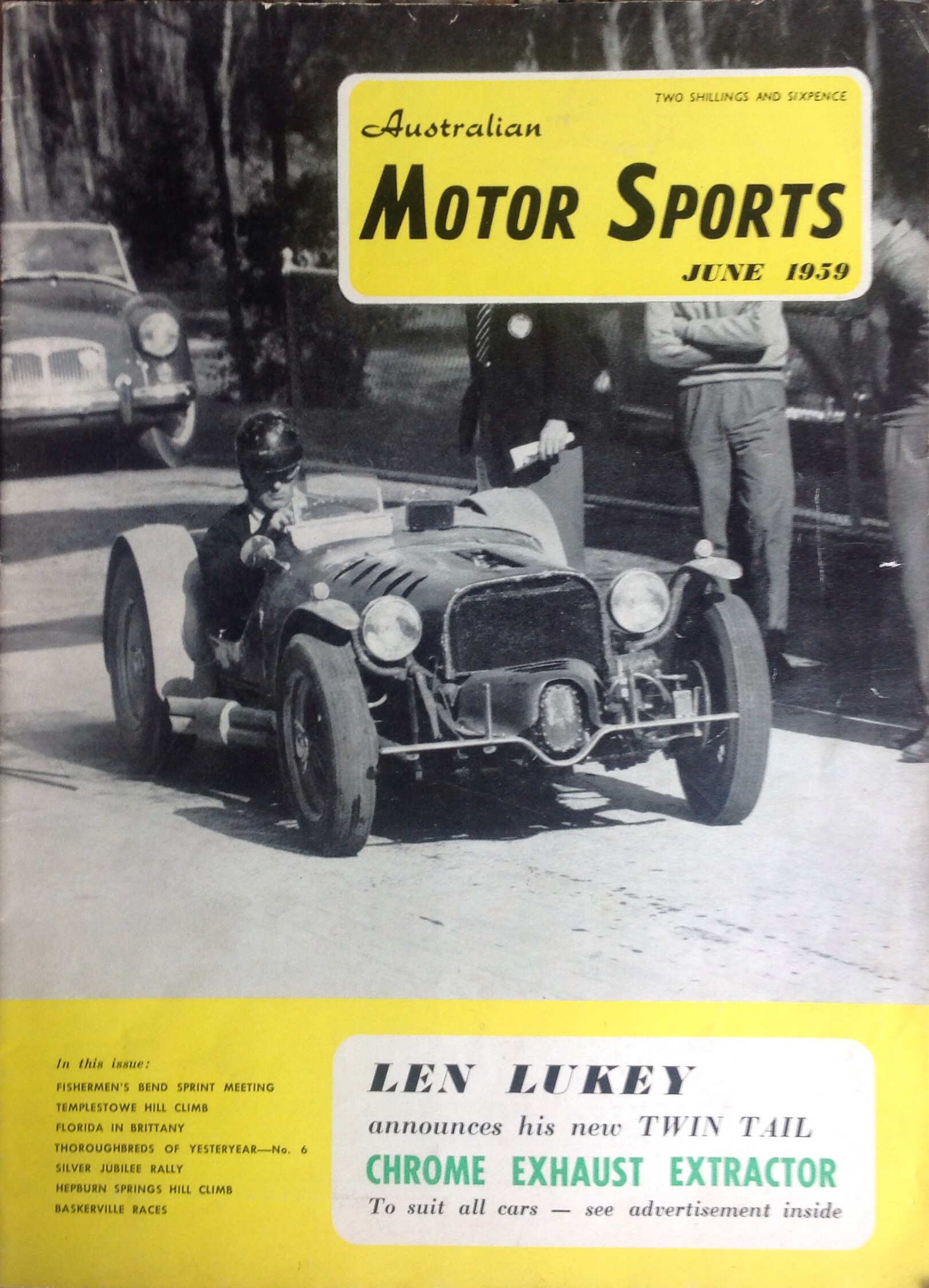
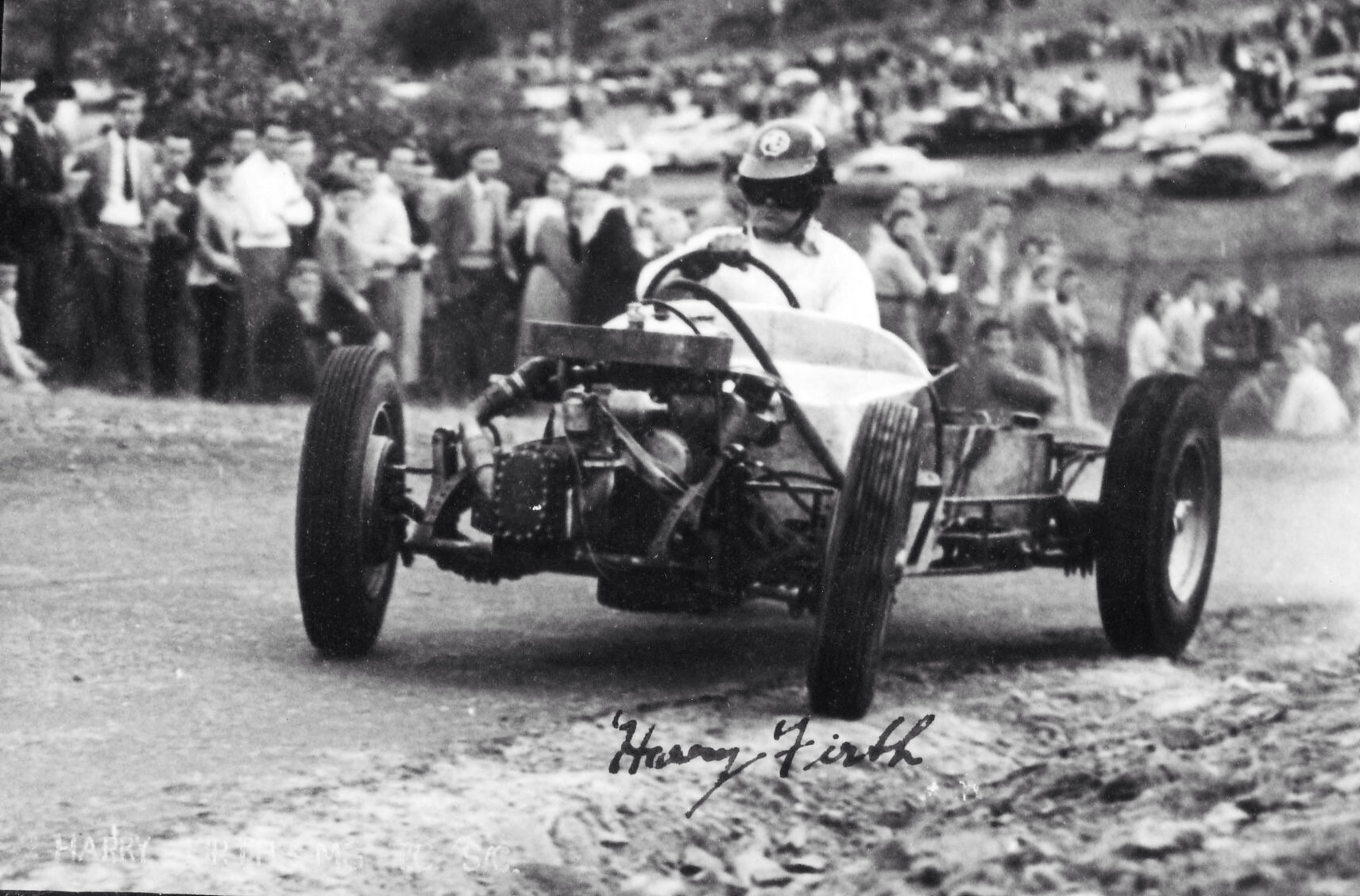
Harry Firth, MG TC Spl, Templestowe Hillclimb, outer Melbourne in 1959…

Long before his well known period as head of the Holden Dealer Team in the late sixties/early seventies Firth was a formidable car builder/preparer/driver in sports cars and sedans on tarmac and dirt.

He won the Armstong 500 three times- twice at Phillip Island and once at Bathurst partnered with Bob Jane- in 1961 they won in a Mercedes Benz 220SE, in 1962 aboard a works Ford Falcon XL, Firth prepared the works Fords at his famous garage in Queens Avenue Auburn, out of these modest premises did some great cars emerge.

He was also victorious in 1963 in a self-prepped works Ford Cortina GT and again as the event morphed into the Bathurst (Gallaher) 500, once, partnering Fred Gibson in a works XR Falcon GT in 1967.

(B Wells)

The Bob Jane/Harry Firth Ford Falcon XK (above) DNF leading the John/Caldecoat MGA, Hell Corner, Bathurst 6 Hour, 30 September 1962. Race ‘won’ by the Geoghegan Brothers Daimler SP250, who were first across the line in a race technically of classes with no ‘outright winner’.

Firth’s Cortina GT ahead of a couple of Humpy Holdens at Lakeside in 1964 (B Williamson)

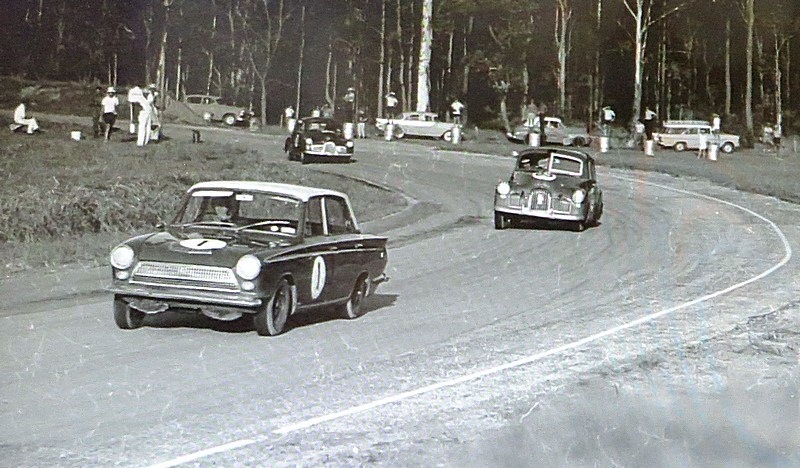
On Allan Moffat’s recommendation he was engaged to co-drive a Lotus Cortina with Moffat in endurance races at Green Valley and Riverside in 1966.

Ford were keen for him to stay but he had to return home to honour a Ford Australia rally commitment, duly winning the first Southern Cross Rally.

(J Hall)
(J Hall)

In 1968 he won the inaugural Australian Rally Championship driving a Lotus Cortina, another doyen of the sport, Graham Hoinville was his navigator.

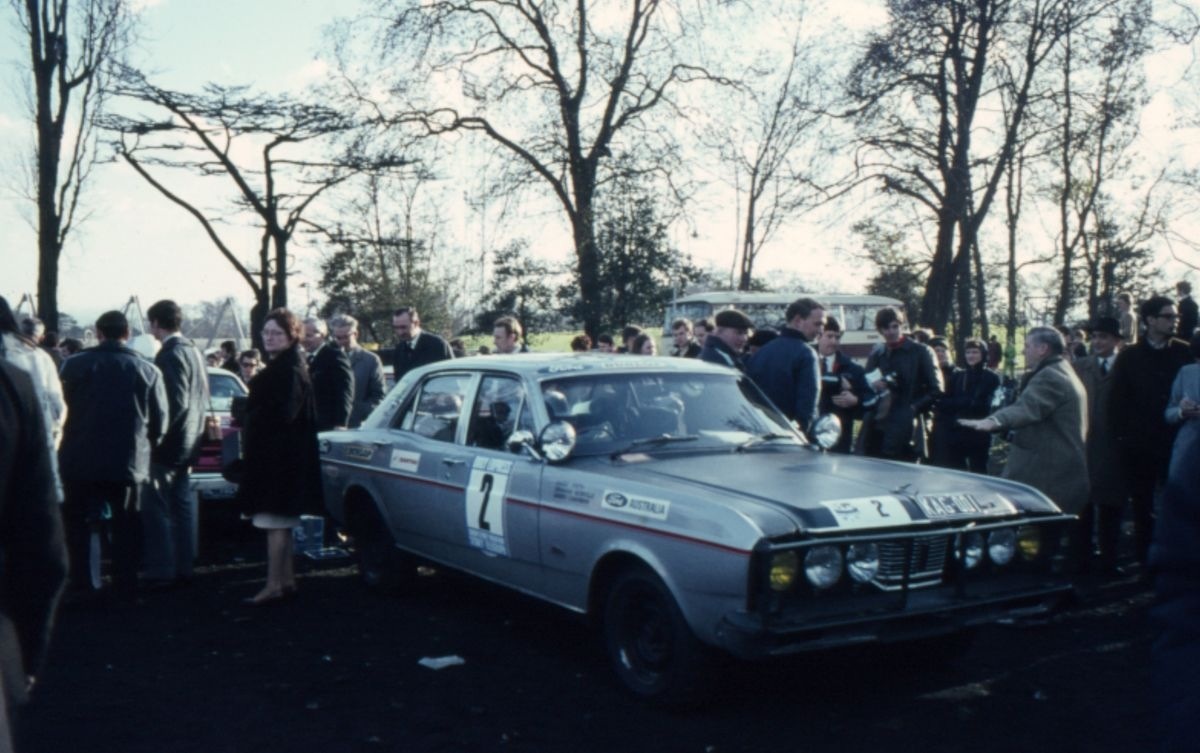
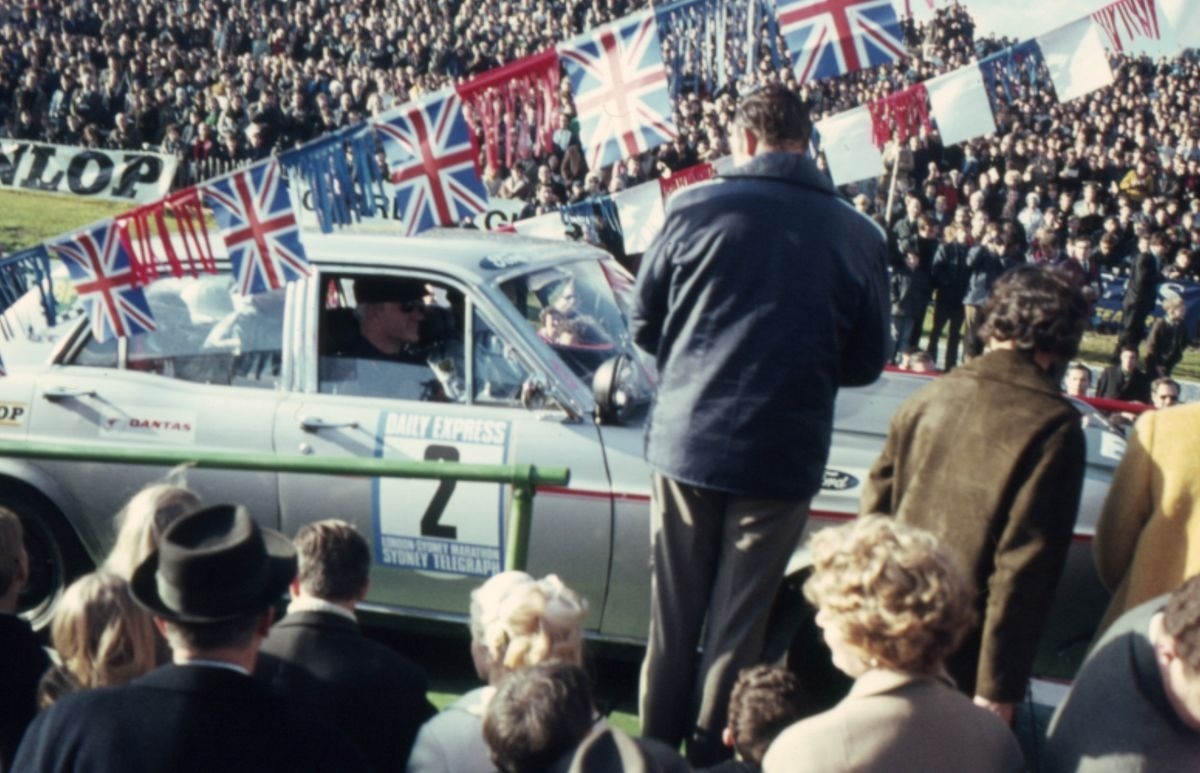
Firth and Ken Harper also prepared the Ford Australia Falcon GT ‘XT’ London-Sydney Marathon entries.

These 302 CID V8 engined sedans won the teams prize with Harry behind the wheel of the eighth placed car with his usual friend and navigator, Hoinville. The Vaughan/Forsyth car was third and Hodgson/Rutherford GT sixth.

The two photos above are at the Crystal Palace, London start on 24 November.

The Firth/Gibson winning works ‘XR’ Ford Falcon GT ahead of the 4th placed Mildren Racing Alfa GTV1600 of Kevin Bartlett and Laurie Stewart. Bathurst 500 1967 (unattributed)
Des West, Ian Tate and Harry Firth, Bathurst 1969 i guess (D Wilson)

This unique blend of skills and experience is what bagged him, even as a ‘Ford guy’, passed over as team manager by Al Turner as ‘too old’ – the HDT job. He held this management role until 59 years of age, in 1977 when John Sheppard succeeded him.

Let’s get back to the MG, this short article does not do Harry’s career justice, I am not attempting to do so- I am getting off point!

The MG Special, chassis ‘TC4723’ commenced construction in 1951, the chassis was much modified and lightened. The engine was also heavily adapted for the demands of racing, exactly how is not disclosed in my reference sources, but included fitment of a Wade supercharger running at 22 pounds of boost which mounted in front of the radiator. If any of you have details of the full specification, ever evolving as it was, drop me a note, I will pop the details into the article.

The bodywork was ‘functional’ rather than attractive as many of the ‘single-seater’ MG specials in Australia at the time were. Its bluff nature mitigated against top speed but perhaps the cars primary purposes were hillclimbs and trials rather than top speed on Conrod Straight, Bathurst and the like.

The MG was successful on the circuits, sprints and hillclimbs only slipping down the order as more modern Coventry Climax engined cars started to appear in the second half of the fifties.

Heart of The Matter: Firth in the stripped or perhaps not yet bodied TC @ Rob Roy during the 1952 Labour Day meeting on 10 March. Fantastic photo of a hard trying Harry- by then the LCCA were paying prize money, Leon Sims wry comment is that ‘Harry on occasion drove more than one car to increase his earnings’. FTD to Reg Hunt, Hunt Spl from Charlie Dean in Maybach 1 (L Sims)

Harry eventually replaced the MG with a Triumph TR2, which was equally effective and functional until endowed with an Ausca (Maserati A6GCS) clone body but he retained the car which was stored out the back of his ‘Marne Garage’ on the corner of Burke and Toorak Roads, Camberwell.

My grandparents and uncle had the newsagent on the opposite north-east corner of that intersection in the late fifties/early sixties, Harry was famous for sipping a cup of tea and working his way through the motor magazines, never buying any of course!

Firth eventually sold the site to the Confederation of Australian Motor Sport to construct their headquarters. At that point, when he had to remove the car, it was sold to Jack Schumacher in Murray Bridge, South Australia, he didn’t use it much and resisted Harry’s regular entreaties to buy the car back until 1977.

Harry restored it and occasionally used it in Historic events, I’ve lost track of it in recent years. Firth died in 2014 aged 96.

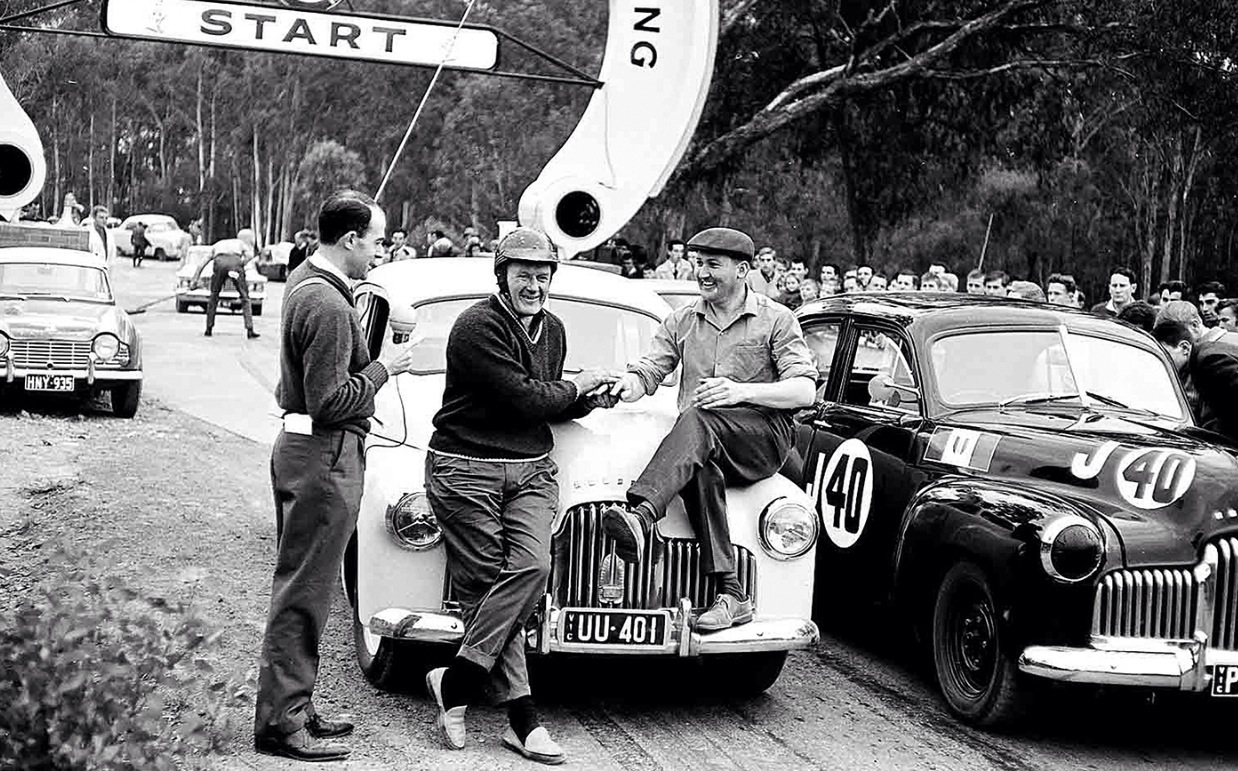
Harry Firth and later twice Australian Touring Car Champion Norm Beechey, both driving Holden 48-215’s at Templestowe Hillclimb in Melbourne’s, then outer east, not sure when- mid fifties. Not too far from Rob Roy actually. I wonder if they are laughing about a cup or their winnings? (unattributed)
(autopics.com.au)

The photo above is a decade or so later than the one at Templestowe and shows Harry driving a Holden Dealer Team Holden Monaro GTS350- perhaps one of the circuit racing cars pensioned off for much tougher duties in 1969- Calder Rallycross.

I wonder if this was Firth’s last competition appearance as a driver prior to his Historic Racing period a bit later on?

(unattributed)

Harry with all of his booty in 1964.

(Castrol)

Firth with the two Holden Dealer Team LJ XU1s of Peter Brock and Colin Bond in 1972- I think it’s brake fluid he is playing with for the camera or flogging.

(I Smith)

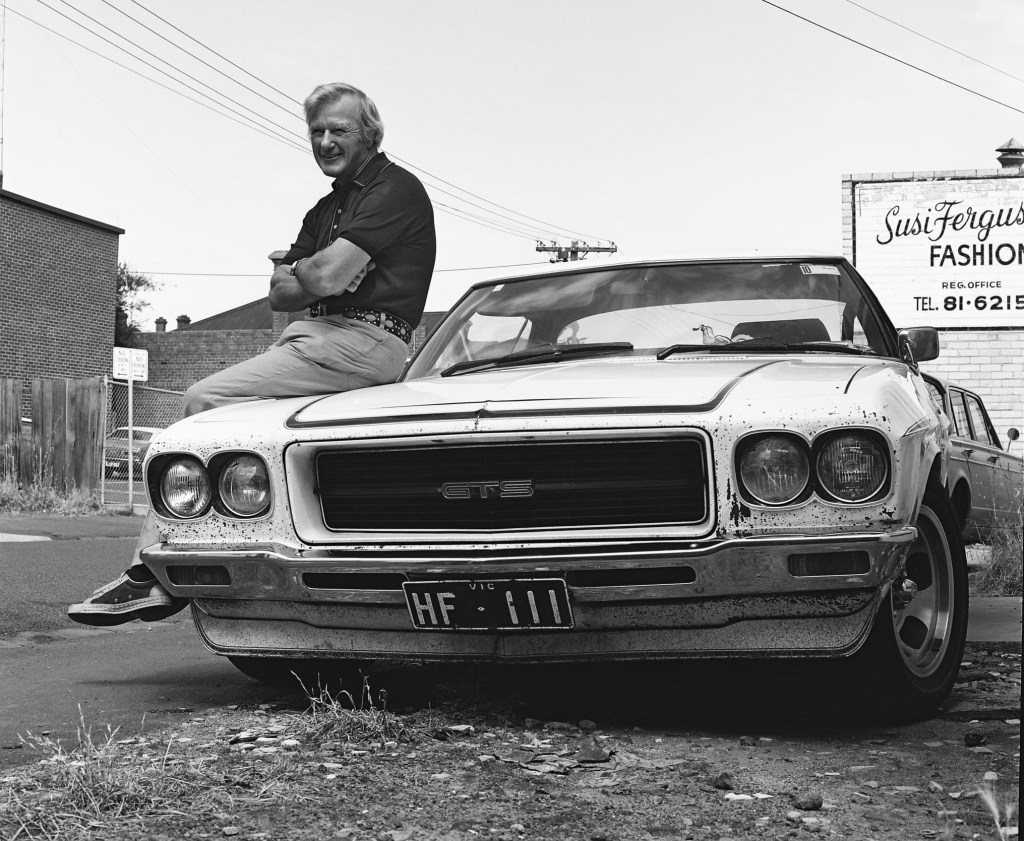
Relaxed in front of Ian Smith’s camera out front of Firth’s Queens Avenue, Auburn, Melbourne Holden Dealer Team workshop. Special build Holden Monaro GTS 308 circa 1974.

Bibliography…

‘Historic Racing Cars in Australia’ John Blanden, Leon Sims, autopics.com.au, Stephen Dalton

Photo Credits…

State Library of South Australia, Australian Motor Sports, Leon Sims Collection, Bob Williamson, David Wilson, John ‘Archie’ Hall, Ian Smith

Tailpiece…

(unattributed)

Harry Firth and Graham Hoinville on the way to winning the June 1964 Ampol Trial, works Ford Cortina GT. 101 cars including five works teams entered the event which was held over 7000 miles in Queensland, New South Wales and Victoria, start and finish at Bondi Beach

Finito…
Most Australian enthusiasts are aware of the Lex Davison, Stan Jones and Tony Gaze assault on the 1953 Monte Carlo Rally in the first Holden 48-215…

In doing some research on Tony Gaze recently I came upon this snippet from the great fighter ace in an Eoin Young interview published in the June 1997 issue of MotorSport- it made me smile given my abiding interest and respect for these three highly competitive racers, rivals and friends.

‘We had a good run.

Before the final test I think we were in sixth place and then we had an argument.

Stan wanted me to drive the final test because he felt I was better on ice than Lex (highly likely given the length of time TG lived in Europe compared to the other two), but Lex said he had put all the money into it and was determined to drive that final stage (which would have been exactly my view if in that position!)

That did it. Stan sulked.’

Gaze, Davison and Stan all smiles after the finish at Monaco (SMH)

‘He was navigating and I was braced in the back with the stopwatches. I suppose Stan might have been feeling car sick but he wouldn’t read out the markers and we finally came in 64th out of 100 finishers. It was probably a good thing because if we had done well they (the scrutineers) would have torn the car apart. On the way back we stopped off at Monza and our best lap average with three up and all of our luggage was 5 mph faster than a standard Holden’s top speed!’

GMH Australia were so delighted that they gave Stan and Lex a Holden each as a bonus but Gaze never received so much as a thank-you note.

The enterprise was an amazing one given the logistics of the time, the cost (4000 pounds- four times the cost of a new Holden then), lack of support from General Motors Holden and the lack of European rallying experience of the intrepid pilots whilst noting their stature as racing drivers.

Jones had never driven on the continent before. The February 1953 MotorSport reported the trio delighted the European press by saying that they had never seen snow before- whilst that may have been true  of Davison and Jones it would not have been the case for Gaze given his lengthy residence in the UK, a photo of him at Davos in Stewart Wilson’s biography of the man rather proves he was familiar with the white stuff!

Upon reflection, Jones grew up in Warrandyte and Lex lived at Lilydale, both places not too far from Mount Donna Buang where snow falls each year, so on balance we can conclude the above was PR bullshit!

Much was made at the time of the lack of rallying experience of all three but Davison and Jones had extensive trials experience- these events in an Australian context were typically of 100-200 miles duration, sometimes at night combining road navigation with sub-events which emphasised performance and car control.

In the all-rounder style of competition of the period keen racing types like Davison, Jones, Whiteford and Patterson contested trials, hillclimbs and circuit races. Indeed both Davison once, and Jones four times won the Light Car Club of Australia’s annual Cohen Trophy for best overall performance in the clubs trials.

‘Lex and Stan saw a lot of each other, since they were competing not only in the same trials but also the same hillclimbs and race meetings. The two were already great friends, and during 1952 this grew into an informal business relationship’ with Lex selling some cars through Stan’s car yards and splitting the profits with him Graham Howard wrote.

Peter Ward, friend and fettler of Lex’ cars engineered the two into sharing a Holden in the November 1952 Experts Trial, the pair finishing third with Ward navigating. Ward had proved the pair could co-exist in competition conditions- by mid 1952 Australian racer and AGP winner John Barraclough had secured two entries for the 1953 Monte- for himself and John Crouch and for Lex and Stan.

Tony, in the UK racing an Aston Martin DB3 that year, met Barraclough at London’s Steering Wheel Club and became the third member of the Lex/Stan crew. Gaze lodged all of the paperwork and later attended to getting the car through Customs.

Tony Gaze in his 2 litre F2/F1 ex-Moss HWM Alta during the 1952 German Grand Prix at the Nurburgring- Q14 and DNF gearbox on lap 6 in the race won by Alberto Ascari’s Ferrari 500. Ascari’s car was acquired by Tony in 1954 and raced successfully by both Gaze and then later Davison to two AGP wins. The car above is the HWM referred to later in the text- acquired by Lex and re-engined by his team in Templestowe to Jag XK120 ‘C Type’ spec it won the 1954 AGP and is still extant in Australia in sportscar form in the hands of the Hough family (LAT)

Graham Howard in Davison’s biography wrote that by the time the final decision was made to compete there were just two weeks before the car had to loaded aboard a freighter sailing from Port Melbourne on 25 November!

The intrepid Melbourne duo acquired a 1952 Holden 48-215 with 6000 miles on the clock which had been nicely run in by their friend and Repco Research boss Charlie Dean. Dean was a racer and engineer- the constructor of the Maybachs which Stan owned and raced but prepared by Repco. Dean was paid 550 pounds by each of   Lex and Stan for the car.

With no interest or support from GMH (who had a waiting list for the cars at the time) the car was stripped, rebuilt and repainted in Dean’s home garage in Kew- not too far from Stan’s Superior Motors and Lex’s Paragon Shoes businesses in Abbotsford and Collingwood respectively.

Charlie was the ‘industry link man’ ‘…calling in many favours from many corners of the Melbourne motorsport world and the broader motor industry. Via his contacts through Repco, not only with Holden but also with component suppliers…A lot of people put in a lot of work into the sprint to get the Holden ready ready for Monte-Carlo- after all it was a marvellous adventure. But much more than that, it was a consciously Australian expedition into international territory, in the 1950’s spirit of optimism and confidence which led thousands of Australians overseas in search of fame and fortune’ wrote Graham Howard providing broader context outside motor racing itself.

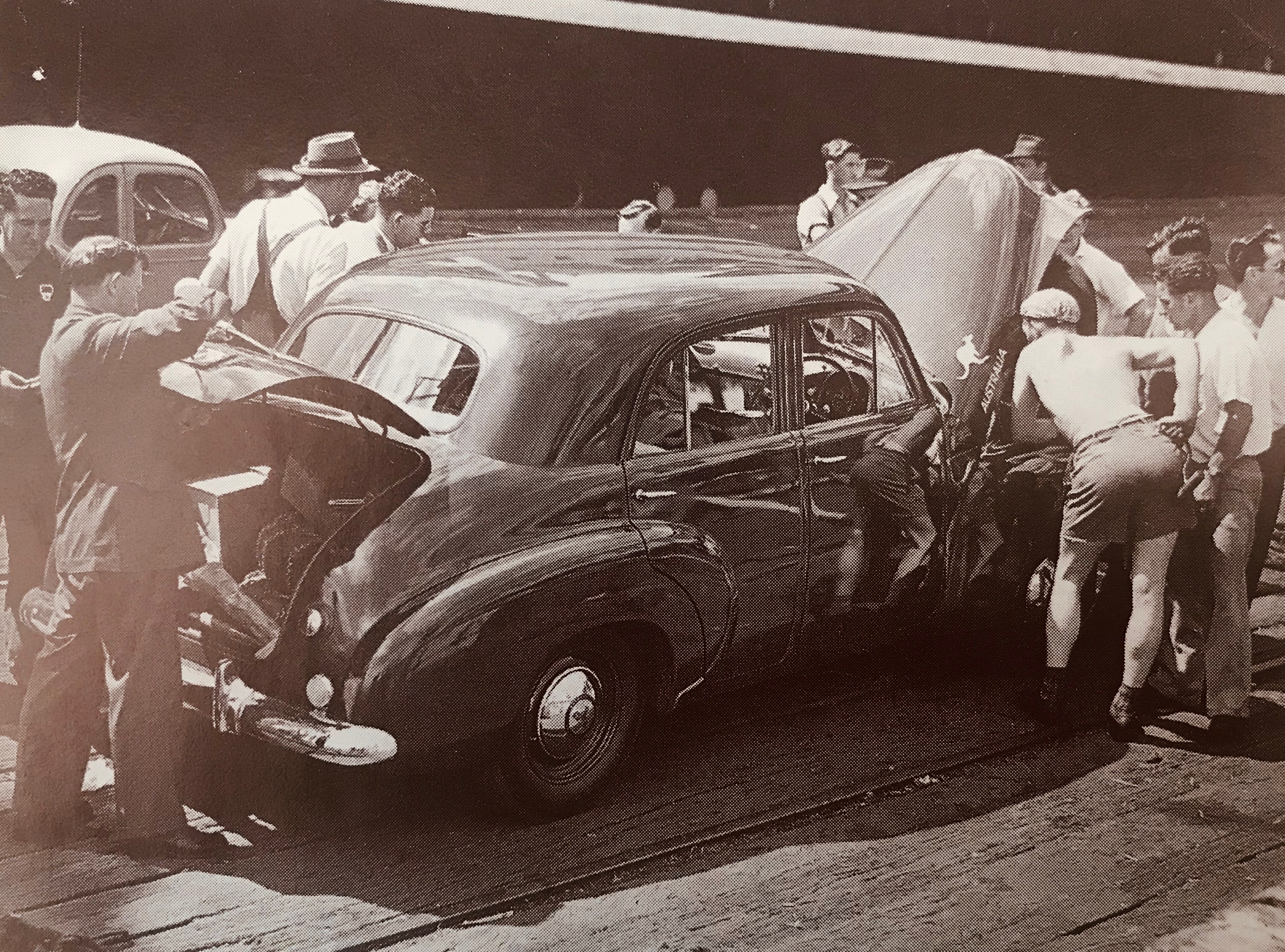
The Monte Holden getting plenty of attention from Port Melbourne’s ‘wharfies’ at Station Pier. That’s Charlie Dean removing the Victorian ‘plates from the boot lid (Davison)

Some modifications to the cars were allowed by the organisers.

A Buick speedo which read in kilometres was dropped into the Holden binnacle, a ten gallon fuel tank was added, two driving lights were mounted on the bonnet and recessed fog lamps into the front guards below the headlights.

A heater-demister and windscreen washer was installed with the washer reservoir located next to the exhaust to keep it warm. An emergency electric fuel pump was mounted on the bulkhead with a change-over switch on the dash.

A ‘rug rail’ which ran between the B-Pillars behind the front seat back provided useful chassis stiffening.

Dean’s knowledge of the 2.2 litre, OHV, cast iron Holden six was pretty good by that stage- he fitted stronger con-rods, bigger ex-Buick valves ‘and an inlet manifold which had been carefully sliced in half, internally enlarged, then welded back together and returned to standard external appearance’ which gave a useful boost in power if not, perhaps (sic) in accordance with the letter of the rules.

By the time all of the luggage, spares, men and clobber was loaded up the six-cylinder sedan weighed 8 hundred-weight more than the 20 hundred-weight of the standard car.

Lex’ pride in Australia was clear in his post-event Australian Motor Sports magazine article; ‘It was considered that this car had to be an example of Australian workmanship, that nothing should be skimped, and no short cuts taken, as one of the main reasons for our making this journey was to endeavour to show that industrially, Australia has come of age, that we have an engineering industry, quite a capable one, and that we are no longer a country of aborigines and back country sheep herders’.

‘A kangaroo with Australia printed underneath was painted on either side of the bonnet and the word ‘Australia’ was printed on the bootlid in gold, given the new Registered Australian Racing Colours of green and gold’.

On January 1 1953 the car landed in the UK, whilst on the other side of the world Lex rolled his Alfa P3 at Port Wakefield, South Australia after a tyre failed- Lex was ok, discharged from hospital whilst Stan winning three races on the day aboard Maybach 1. On January 7 they were enroute to the UK.

In the meantime Tony Gaze had borrowed a Holden used as a development car by Lucas in the UK to get the feel of it. He then tested the rally car when it arrived and was suitable impressed with its performance despite the added weight relative to the standard machine. He diagnosed a better heating system was needed for the rear passenger and windscreen, this work was done.

Start of the event outside the Royal Automobile Club of Scotland, Blythswood Square, Glasgow (AGR)

(AGR)

Competitors came from over 20 different countries- they could choose to start from different cities in Europe including Glasgow, Stockholm, Oslo, Monte Carlo itself, Munich, Palermo and Lisbon.

The Holden began the rally in Glasgow on 20 January 1953- Glasgow cars travelled the 2100 mile route to Monte Carlo via Wales, London, Lilles, Brussels, Amsterdam, Paris and Clermont Ferrand in The Alps.

The first 3 days were driven non-stop through thick fog. In the Alps on thee fourth night the crew ‘encountered a nightmare of falling snow and icy roads’, the Australians reported. MotorSport on the other hand described the conditions as generally kind.

Lex and Stan were completely unprepared for the driving conditions and soon the crew decided to abandon the sleeping roster to make use of Tony’s skill in fast driving in fog.

In any event only Lex could manage sleep on the back seat set up to allow someone to lie sideways.

As they encountered ice later in the journey ‘Lex was pleased with the handling of the Holden, and was confidently using the frozen snow on the outside of the corners to help the car around.’

During Stan’s stint in the ice, a truck they were overtaking veered out and hit the side of the car inches from Lex’ sleeping head but he continued in deep-sleep bliss.

The fog disappeared before dawn but still with plenty of ice about, the risk was a mistake close to the finish.

440 cars entered the event- of the 404 which started, 253 reached Monte Carlo without loss of points, including the Holden.

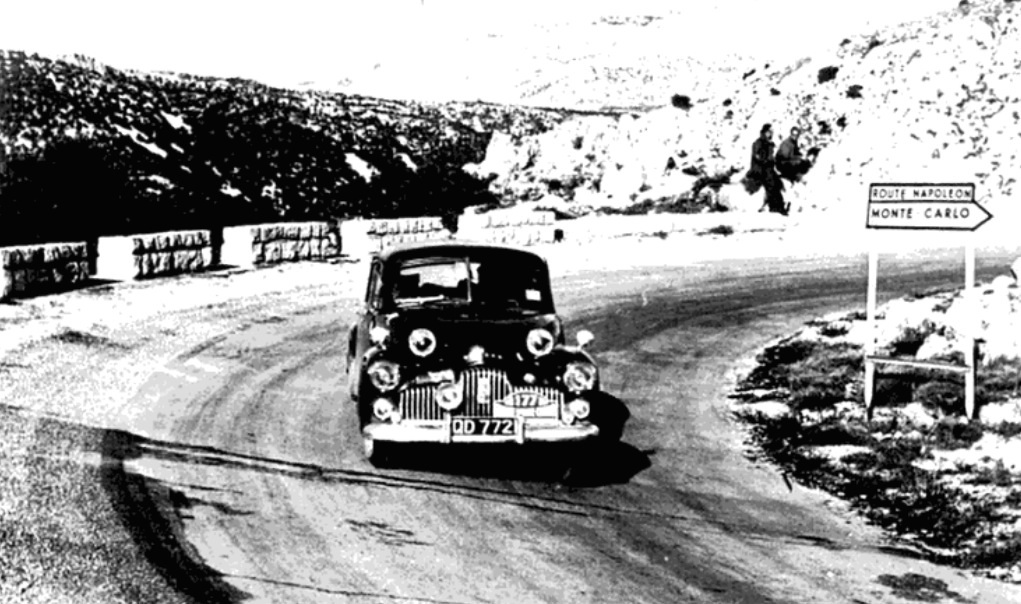
The event shot ‘everybody has seen’ but nobody knows where it is- intrigued to know the answer (Pinterest)

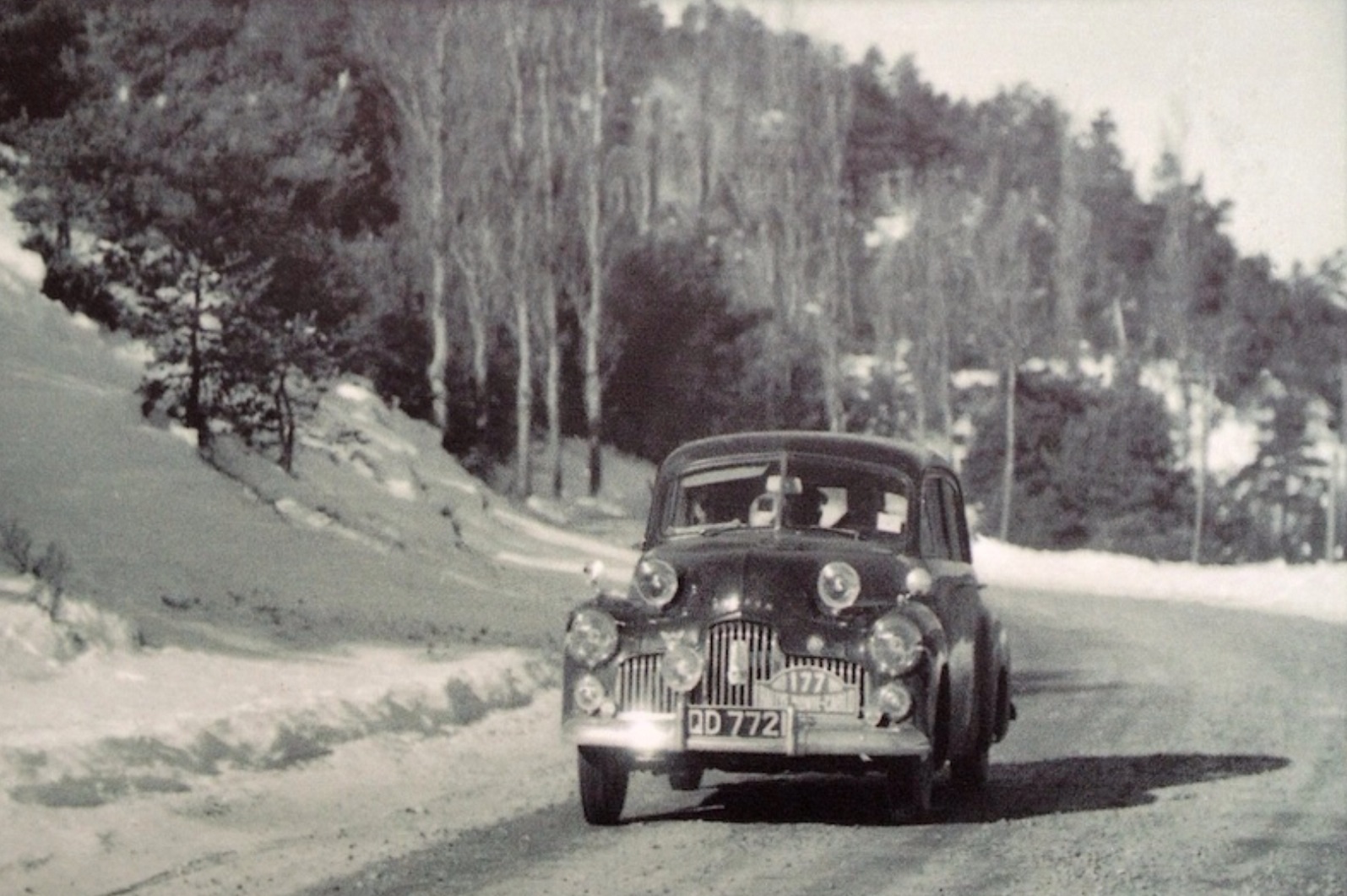
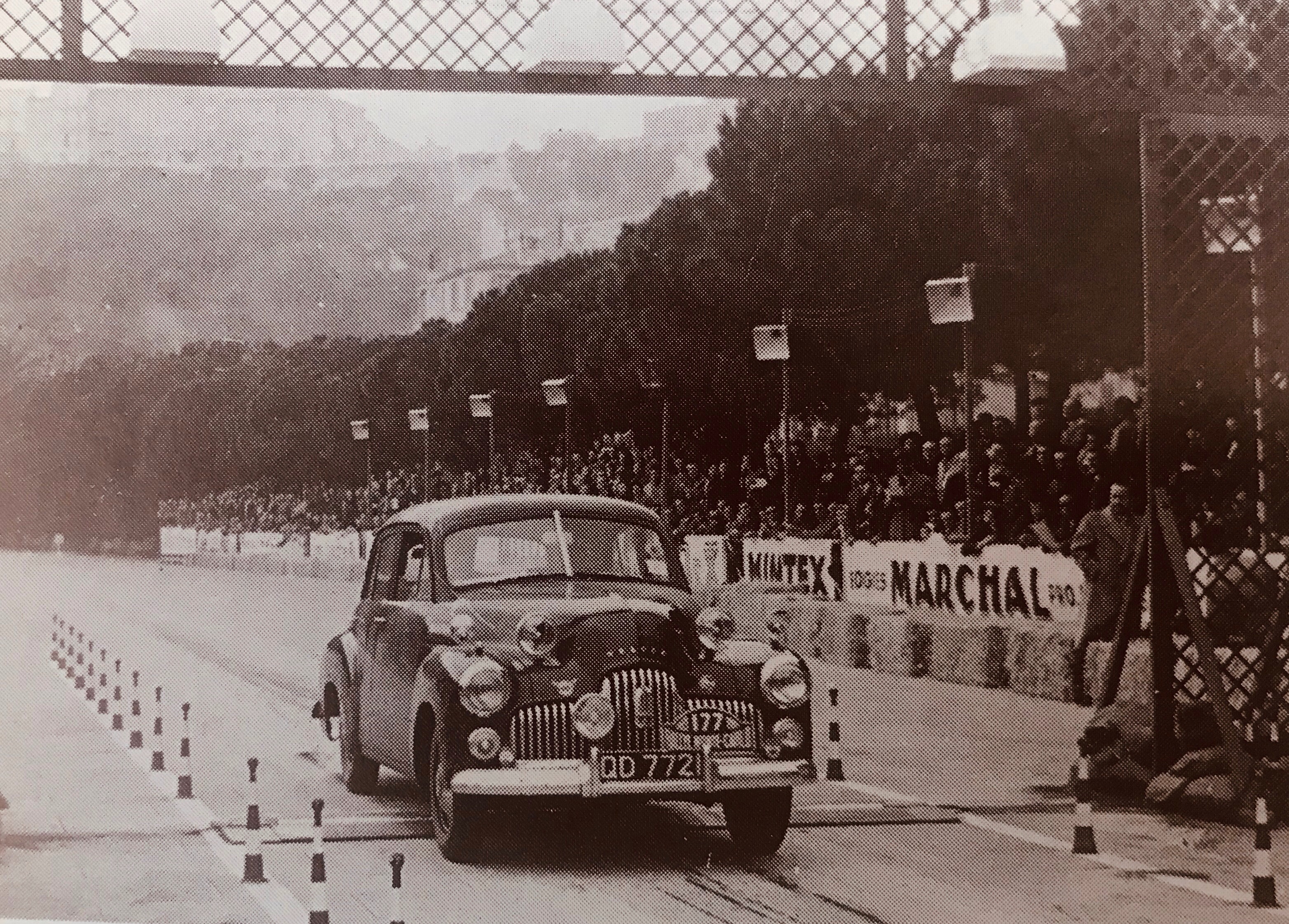
They drove unpenalised under the finish banner in Monaco and were’…escorted to a large marquee on the Boulevard where we were offered drinks, and we stood beside the sea-wall sipping brandy, blinking in the sun. We were terribly tired, and I noticed that Tony was fast asleep standing up leaning against the sea-wall’ Howard quoted Davison.

Then came an acceleration and braking test- with Stan at the wheel the car was equal 9th- with Stirling Moss in a Sunbeam Talbot. The quickest time was 21.9 seconds, the Holden Sedan showed good performance amongst the top group which comprised in order; an Allard, Porsche, Jaguar, Ford V8, Sunbeam Talbot, Riley and two more Jags.

Jones attacks the Monaco acceleration and braking test (Davison)

As a result of this test 98 cars qualified for a final, eliminating, regularity test- clearly this 46 mile run over the Col de Braus above Monaco was the event the subject of debate amongst the three racers.

Distances between the controls had been announced in advance- a set speed through the six controls was to be drawn early on the Sunday morning.

The experienced crews knew the regularity route the Australians did not, nor did they have a spare car as many others did to practise it. Late in the day they were able to do do one lap in a VW as passengers.

The troubles which Gaze reflected upon at the beginning of this piece were similar to those documented by Howard in Davison’s biography- ‘that Stan “went on strike”, and for at least part of the test could not be bothered calling out distances. It would have been a typically Stan Jones flare-up, gone as quickly as it arrived, because there were also sections of the test where Stan was sitting sideways and using his feet to hold Lex in place as the Holden hurried around the endless hairpin corners’.

By the end of the test the team were sure they had got several sections close to perfect and others very wrong.

The results were announced at 9 o’clock that night- 64th place, and much better than they had feared. The result was still admirable and polished both the reputations of the drivers and a car not exactly built with European conditions in mind.

(AGR)

The rally was won by the Maurice Gatsonides/Peter Worledge Ford Zephyr from the Ian and Pat Appleyard Jaguar Mk7 and Roger Marian/Jean Charmasson Panhard Dyna X86. Gatsonides had spent four weeks ‘holidays’ lapping the Col de Braus loop, in contrast to the Australians!

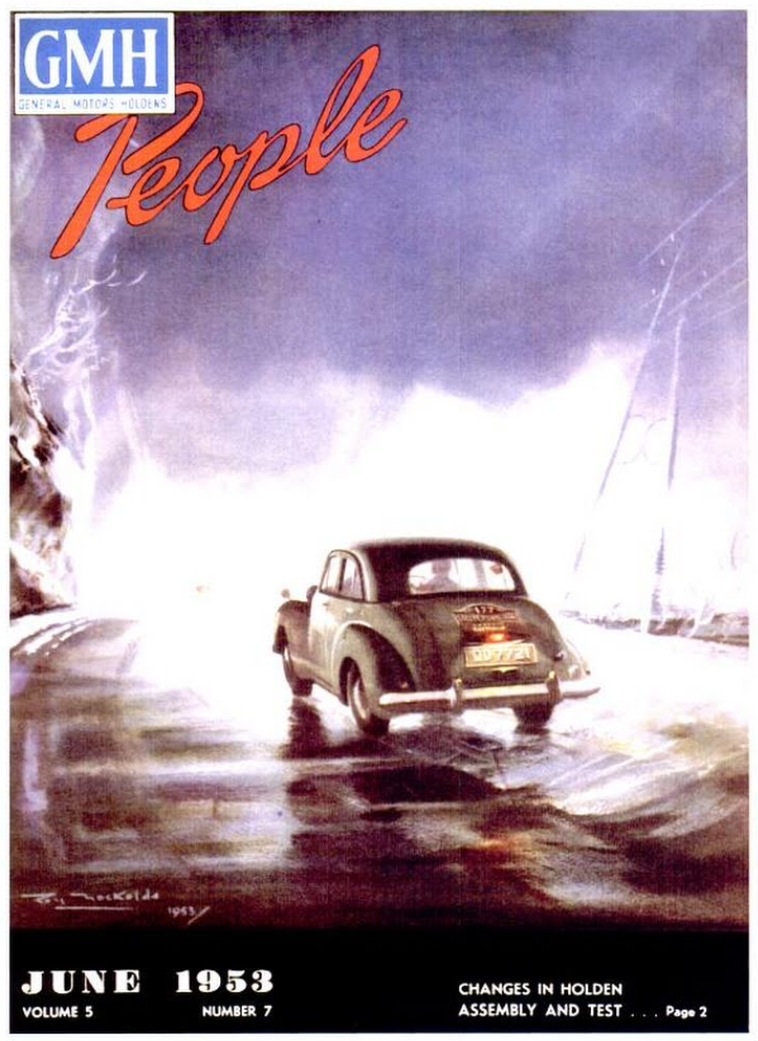
Picking up the speed of the Holden ‘People’ wrote ‘They had certainly not run out of steam, for immediately after the rally they took the Holden to Monza where its lap speed was 73 mph and its maximum 90 mph which was impressive as road tests of the day put the cars maximum at 81 mph…the checking from stem to stern that was carried out must have included some skilful tuning’.

Davison and his friends also visited Alfa Romeo whilst in Northern Italy ‘…where Guidotti, having many years before driven Lex’s Alfas, now drove the Holden. Bacciagaluppi, manager of the Monza motor racing circuit and one of Tony’s many European racing contacts, helped them to get the rally car onto the track, where, three up, they averaged a higher lap speed than the road-tested maximum for a standard Holden’.

(AGR)

They drove back through Switzerland to England, where Gaze shipped the car back to Australia with some of the spare parts for the ex-Moss/Gaze HWM Lex acquired prior to leaving Europe.

Davo put the HWM Jaguar to good use, winning the 1954 Australian Grand Prix in it at Southport on Queensland’s Gold Coast. It was the first of Davo’s AGP wins- his good mate Jones had the race ‘in the bag’ before catastrophic chassis failure (welds) pitched Stanley through the local topography at a million miles an hour- it was a very lucky escape for him which totally destroyed Maybach 2.

‘Autosport published two photographs of the Holden, one showing it looking immaculate in Monte Carlo after the event, and commented “The Holden, although not a prize winner, impressed everyone with its performance. It has distinct possibilities as a rally car”.

As Gaze commented early on, GMH invited Lex and Stan (later to become Holden dealers as ‘Monte Carlo Motors on the corner of Punt and Swan Street, Richmond, Melbourne) to a luncheon at Fsihermans Bend (Holden HQ) where they were each given a new Holden FJ and a cheque to cover some of their outgoings- with Tony apparently forgotten.

There was enormous local press both during and after the event with Lex also doing extensive speeches and presesntations about the adventure to car clubs but mainly community groups upon their return. It was a very big deal indeed.

The Monte Holden’s competitive life extended into 1953 when Lex and Diana Davison- DD a very capable and experienced racer herself contested ‘The Sun’ Four Day Rally out of Melbourne, Lex won outright defeating 122 other cars in a new Holden shared with Peter Ward and Diana was second in the womens section of the event in the Monte car she shared with Pat Wilson.

The Monte Holden was used in several trials by Lex and Peter Ward including one in mid 1953 when Lex slid off the a hillside and knocked over a telephone pole- damage was mitigated by the aged rotten nature of the obstacle!

(Davison)

Peter Ward later bought it and used it on the road. ‘It had some vertical cracks in the firewall which puzzled the Holden engineers, but it gave no trouble, Peter drove it for eighteen months before selling the well travelled car for 750 pounds- it cost him 500.

I wonder what became of this car which really should have found its way into a GMH Collection!?

The first of the Redex Round Australia Trials commenced in 1953- a story for another time, no doubt Holden’s confidence in going into these events ‘boots and all’ was as a consequence of the trail-blazers- Davison, Jones and Gaze.

Etcetera…

Article on the Holden 48-215; https://primotipo.com/2018/12/06/general-motors-holden-formative/

(AGR)

Davo on the Monaco quayside. Without his drive and entrepreneurial skill, not to say resources, the assault would not have taken place- not that the other two fellas involved were exactly skint.

(AGR)

Tony Gaze would have been razor sharp in 1953- he raced his HWM Alta in both championship and non-championship events throughout Europe in 1952, his primary program in 1953 aboard an Aston DB3 sportscar. He started racing the Ferrari 500/625 so important in his and Lex’ career in 1954.

(AGR)

Credits…

‘Lex Davison: Larger Than Life’ Graham Howard, ‘Almost Unknown: Tony Gaze’ Stewart Wilson, ‘Me and My Holden: A Nostalgia Trip With The Early Holdens’ Don Loffler, ‘GMH People’, ‘AGR’- anygivenreason.com for many of the images, Pinterest, ‘SMH’ Sydney Morning Herald

Tailpiece: Port Melbourne to Monaco- after the finish…

(AGR)

Finito…


(B Miles)

Arnold Glass blasts his Maserati 250F out of Quarry Bend, Bathurst, Easter 1960…

The Sydney motor dealer and later Datsun importer loved this machine and its forgiving nature. Arguably it was the car with which he achieved his best results even if it was becoming a little passe by the time he got his hands on it in 1959.

He finished second in the ‘Bathurst 100’ Gold Star round behind Alec Mildren’s Cooper T51 Maserati and ahead of Bill Patterson in another Coventry Climax engined T51.

I’ve written a story about Arnold, click here to read it; https://primotipo.com/2015/08/25/arnold-glass-ferrari-555-super-squalo-bathurst-1958/

This machine, chassis ‘2516’ was Jean Behra’s works car throughout 1955 before being imported to Australia by Reg Hunt as a replacement for the 250F engined A6GCM Maserati with which he achieved much in 1955. Hunt didn’t race the 250F for long before retirement at a way too an young age to take on his family responsibilities and a growing automotive empire based in Melbourne’s Elsternwick. Here is a piece about the A6GCM; https://primotipo.com/2017/12/12/hunts-gp-maser-a6gcm-2038/

and Reg; https://primotipo.com/2014/07/19/reg-hunt-australian-ace-of-the-1950s/

Bib Stillwell raced ‘2516’ in 1957 on his inexorable rise to the top of Australian racing and then Arnold acquired it competing into ‘into the Cooper era’ when he too acquired a T51. ‘2516’ inevitably, sadly, ended up back in Europe, none of ‘our’ Maser 250F’s survived here into the modern era

Credits…

Bill Miles, Rob Hartnett

Tailpiece: Bathurst pits, warming her up…

(Rob Hartnett)

Finito…