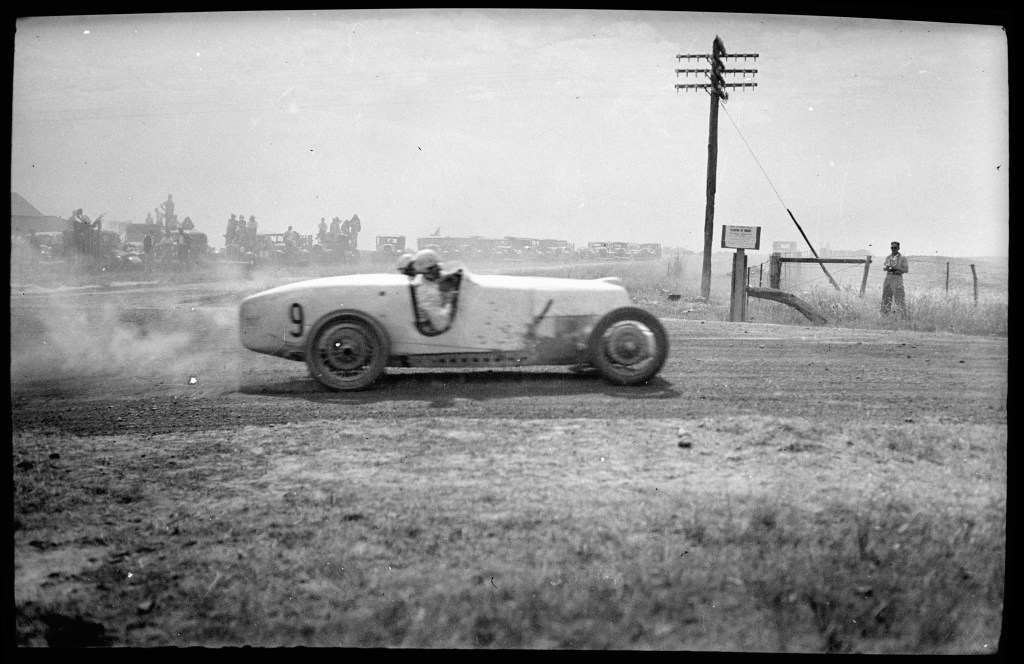
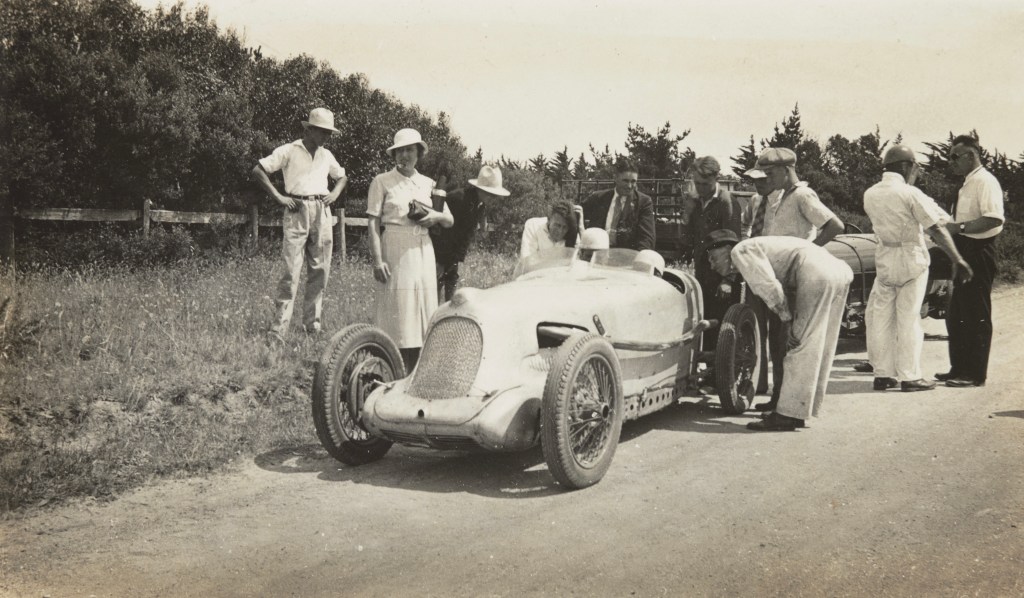
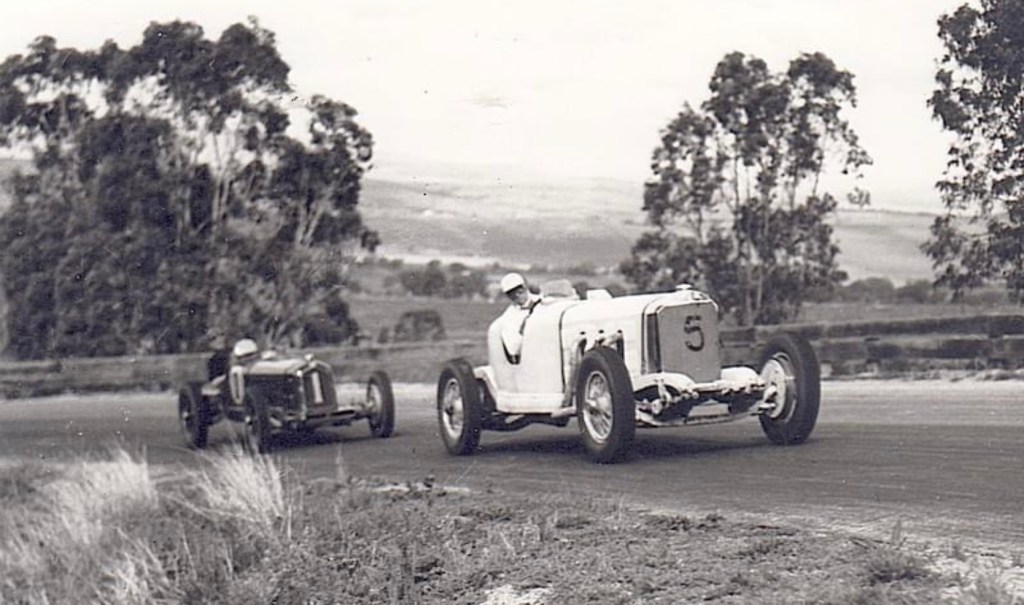
Such an evocative shot of the first couple of Australian motor racing, Melburnian’s Barney and Bess Dentry in their Riley 9 Brooklands. Perhaps during the 1936 Victorian Sporting Car Club Trophy held on the triangular Phillip Island road circuit on New Year’s Day.
Most ‘Island shots of the time are from the outside of the rectangular, right-handers-only course, looking in. This beautiful Edward Trevithick photograph looks the other way, with the Western Port sea-mist creating the rest of the magic.
The sign on the fence post issued by the People’s Republik of Phillip Island is headed ‘Closing of Roads’; sadly, I can’t read the fine print. More about the Dentrys here:https://primotipo.com/2023/04/07/barney-and-bess-dentry/
(E Trevithick-SLV)
Yes, the car doesn’t look kosher. Barney continually modified the Brooklands, chassis number 8062, over its long competition life, including this self-made, slipperier, lighter aluminium body. Both these photographs make it look like a Big Banger which it was not!
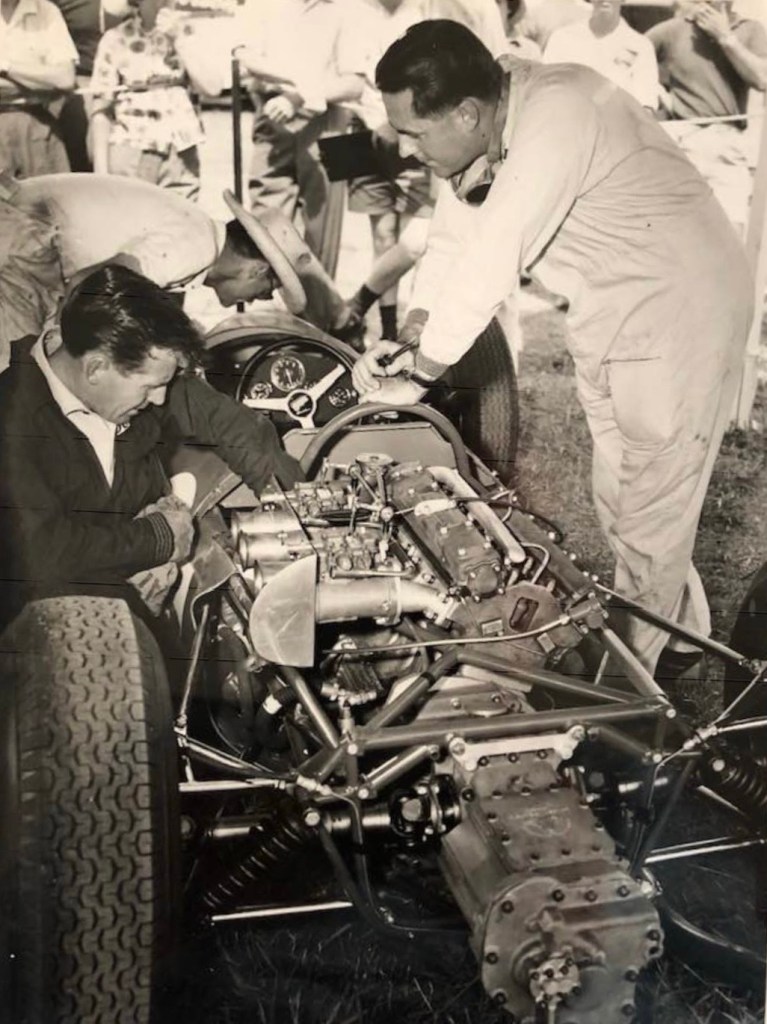
Master Mechanic Geoff Smedley made a pretty fine part-time photographer while fettling racing cars for the likes of John and Gavin Youl.
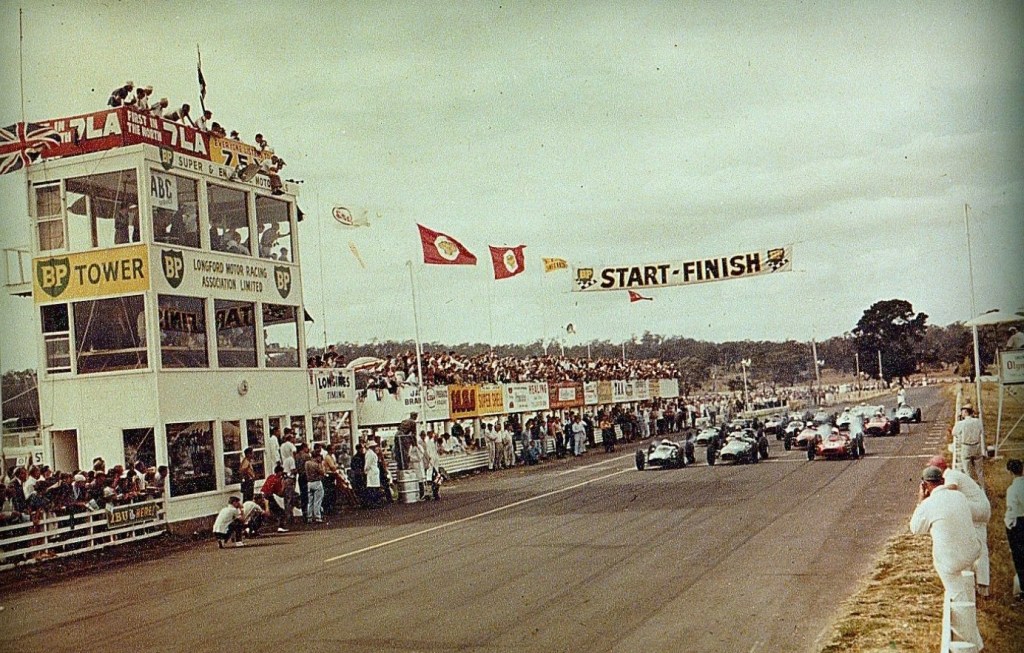
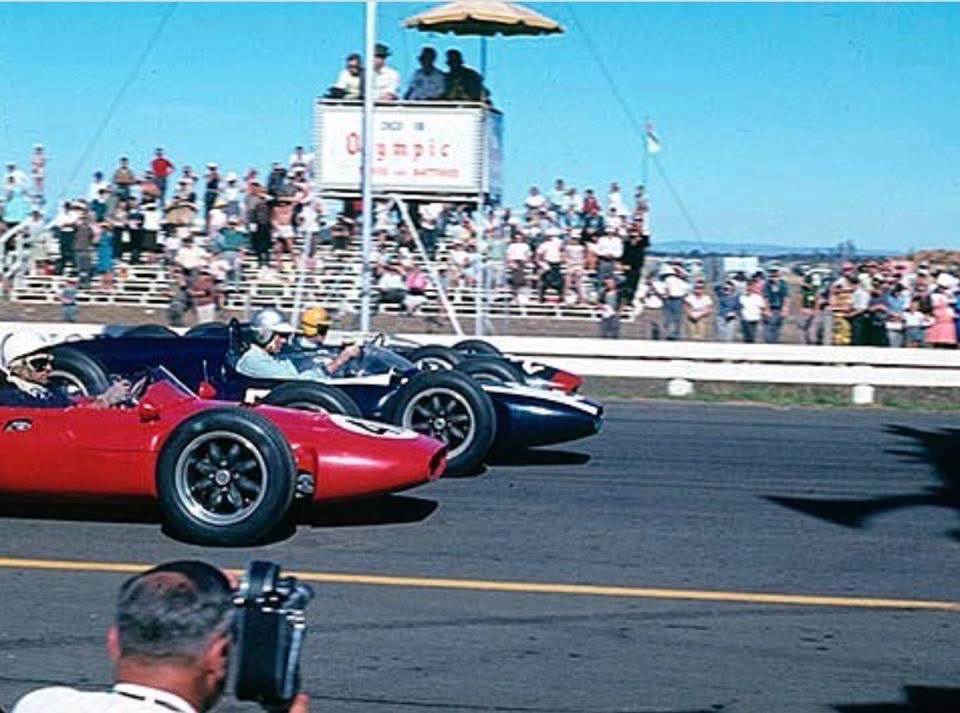
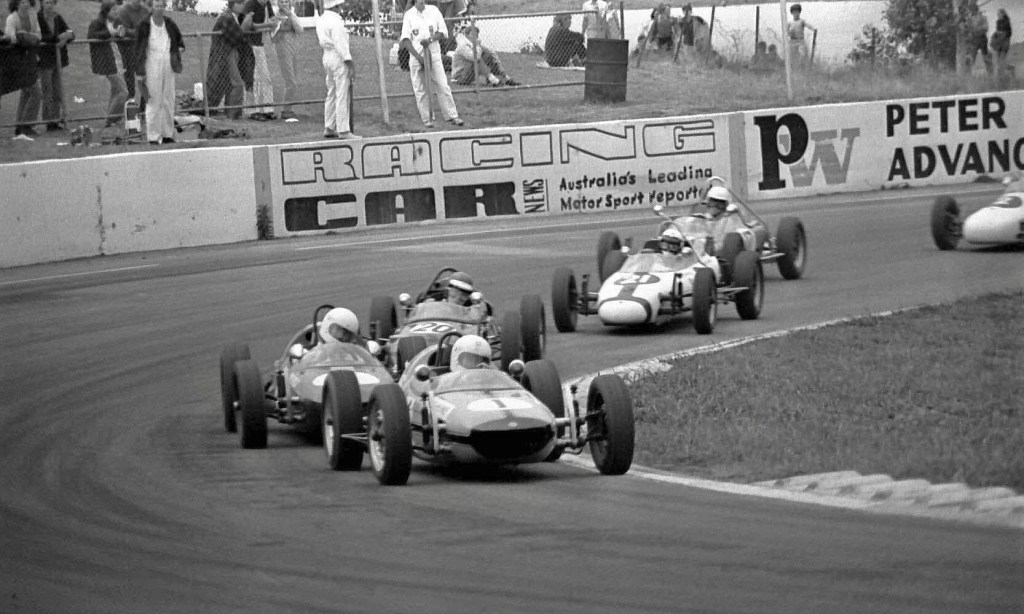
The 1963 South Pacific Championship has just got underway at Longford on March 4. Bruce McLaren is on pole in his Cooper T62 Climax at left with Bib Stillwell’s new Brabham BT4 Climax in the middle and Lex Davison’s Cooper T53 Climax on the right.
McLaren won the race comfortably from Bib Stillwell after Bruce’s dice with Jack Brabham’s leading BT4 Climax 2.7 ended with engine failure on lap 14 John Youl was third in his Cooper T55
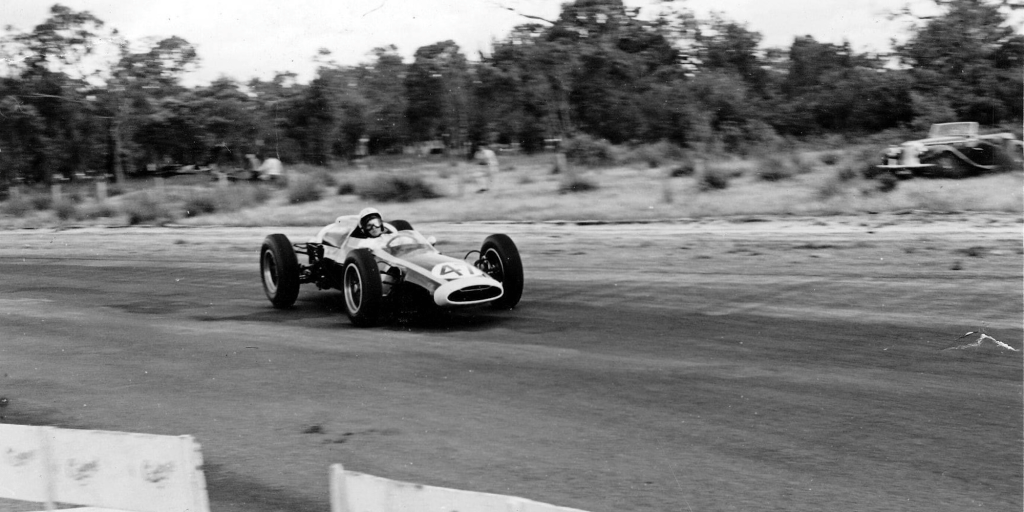
Bruce McLaren on his way to winning the 1962 Australian GP, Caversham, Western Australia, Cooper T62 Climax (K Devine)Jack Brabham debuts the BT4 Climax, Caversham AGP, November 1962. BT4 #IC-1-62 was the first in a long line of very successful, profitable ‘Intercontinental’ Brabhams from Ron Tauranac
Context…
The Cooper vs Brabham Australasian summer was set during the 1962 Australian Grand Prix, November 18 weekend at Caversham, outside Perth, when McLaren’s new Cooper T62 Climax and Jack Brabham’s equally new Brabham BT4 Climax faced off for the first time. A fantastic dice between Bruce and Jack that day was resolved in McLaren’s favour after a passing he-zigged-when-I-zagged manoeuvre between Brabham and Arnold Glass’s BRM P48 Buick V8 went awry.
Both machines were inspired by their Coventry Climax FWMV 1.5-litre V8-powered Grand Prix siblings: the Cooper T60 and Brabham BT3. By the time the eight-race Tasman Circus travelled to Warwick Farm, round five, the weight of numbers favoured Jack Brabham and Ron Tauranac’s Motor Racing Developments business with BT4s in the hands of Brabham, David McKay, who had bought Jack’s ’62 AGP car’, and Bib Stillwell, who had acquired a newie.
McLaren and the business end of his Cooper T62 FPF, Caversham 1962, with David McKay, Cooper racer/writer/later Scuderia Veloce supremo, showing more than cursory interest in the car given his pending car update considerations (T Walker)BT4 Tim Wall, Jack Brabham and Repco Indy 2.7 in the Sandown paddock. By then, Repco’s Michael Gasking was preparing Jack’s Tasman FPFs, and Repco was or were soon to be the Australian importer/distributor of Coventry Climax spares (Repco)
Bruce won two of the four Kiwi rounds at Wigram and Teretonga with his Cooper T62, while John Surtees won the NZ GP at Ardmore in an ex-F1 Lola Mk4A Climax 2.7, with Jack taking a Levin win in his BT4.
The additional power and torque from 2.7-litre Coventry Climax FPF Indy four-cylinder engines were causing a great deal of driveline stress to gearboxes, clutches and driveshafts.
At Warwick Farm, Brabham won in his new BT4-IC-2-62 from Surtees’ Lola Mk4A, McLaren and McKay in his first race of the ex-Jack BT4-IC-1-62 with Stilwell fifth in his new BT4-IC-1-63; all cars powered by Indy 2.7s.
At Lakeside on February 17, Surtees won from Graham Hill’s Ferguson P99 Climax 2.5 FPF and Stillwell. It was a great shame that the Ferguson went home at this point, we Victorians and Taswegians didn’t get to see it. McLaren spun and could’t restart while Jack was a no-show. It was an even greater shame the Fergy didn’t arrive in New Zealand with a pair of 2.7-litre FPFs…
Then Bruce won at Longford and at Sandown Park on March 10, so McLaren and Cooper won the 1963 Faux Tasman Cup. Jack was a DNF with engine failure with Tony Maggs in the other Bowmaker Racing Lola Mk4A Climax 2.7 second and McKay third.
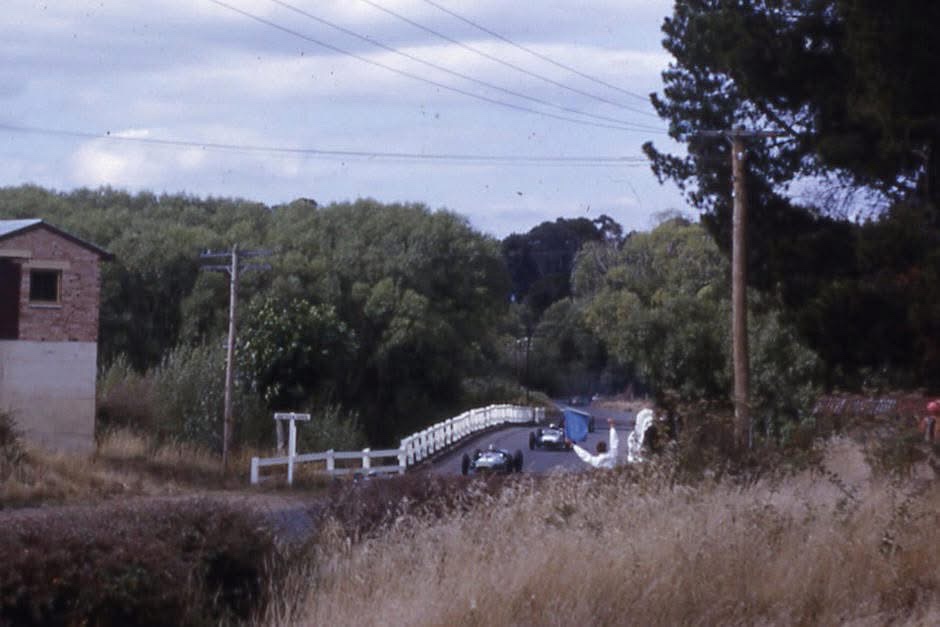
Lex Davison turns into the exit of Long Bridge, closely followed by John Youl, Coopers T53 and T55. Lin Gigney, the snapper of many of these shots, was a flaggie right here… (L Gigney)
Longford…
Down in the South Island Lex Davison was having a whale of a time in the Cooper T53 John Surtees used to win at Longford in 1962! He won both the Saturday 45-mile Formula Libre preliminaries, the first from Bib Stillwell and John Youl after Bruce McLaren retired from the leadership of the race with a broken universal joint.
The second Saturday race also fell to Melbourne’s famous cobbler, from Chris Amon, Cooper T53 Climax 2.5 and John Youl, Cooper T55 Climax 2.5. McLaren didn’t start this race; Brabham did, but then had carburettor problems during lap two that caused his retirement.
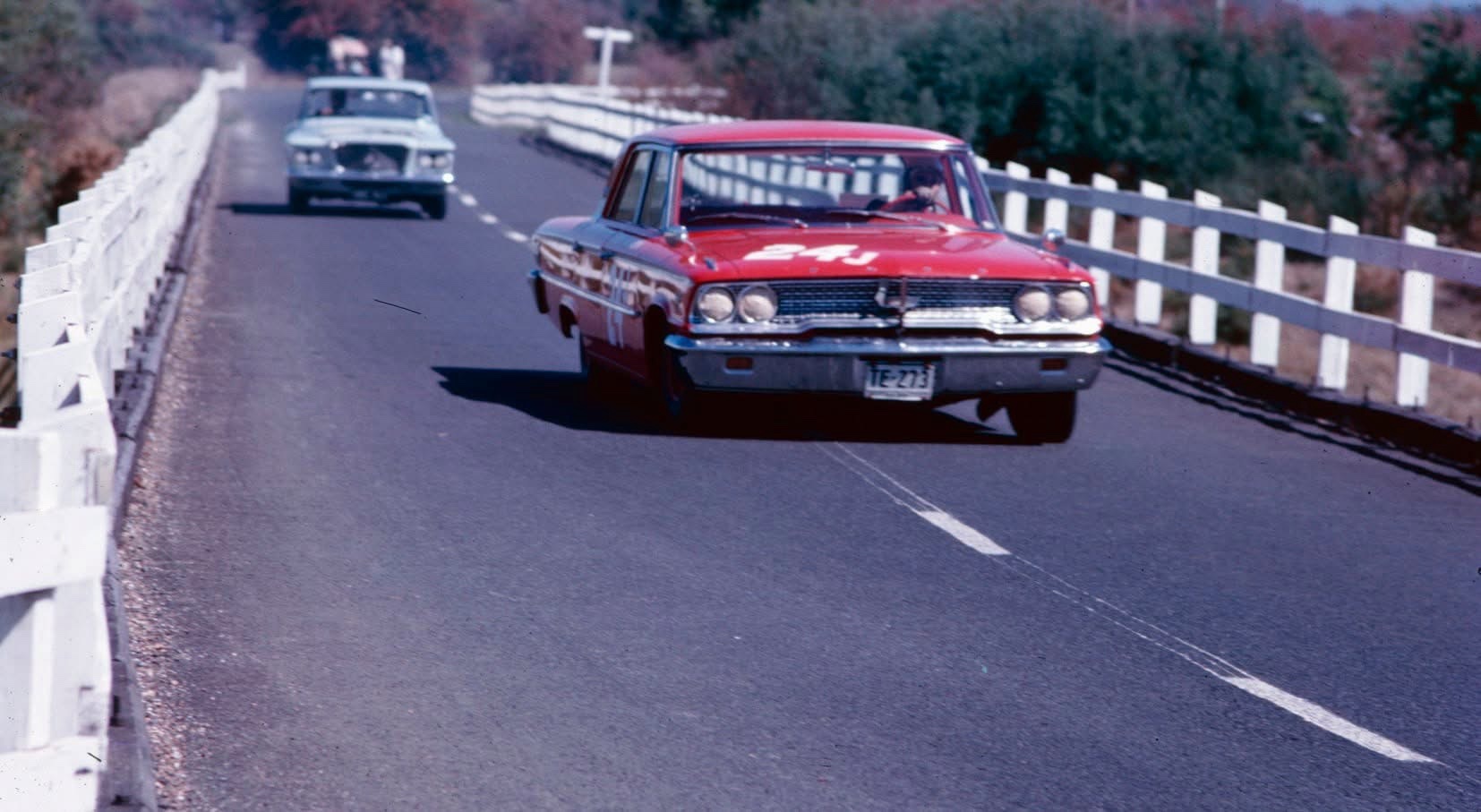
Lex Davison, Ford Galaxie – what a massive bit of real estate! – from Ern Abbott Chrysler Valiant on Long Bridge (L Gigney)
On top of that, the staunch traditionalist continued his flirtation with touring cars, finishing second in the 45-mile Touring Cars Championship aboard Len Lukey’s Ford Galaxie behind Bob Jane’s then-dominant Jaguar Mk2 3.9, with Ern Abbott’s Chrysler Valiant 3.9 in third.
The Jag was timed at 142mph on The Flying Mile, the Galaxie did 141mph in an experience Davison told Autosport reporter FGN Ewence as ‘Like Driving a Haystack.’ Ewence wrote that ‘It came out of corners as though they were launching pads, but its braking and handling let it down.’
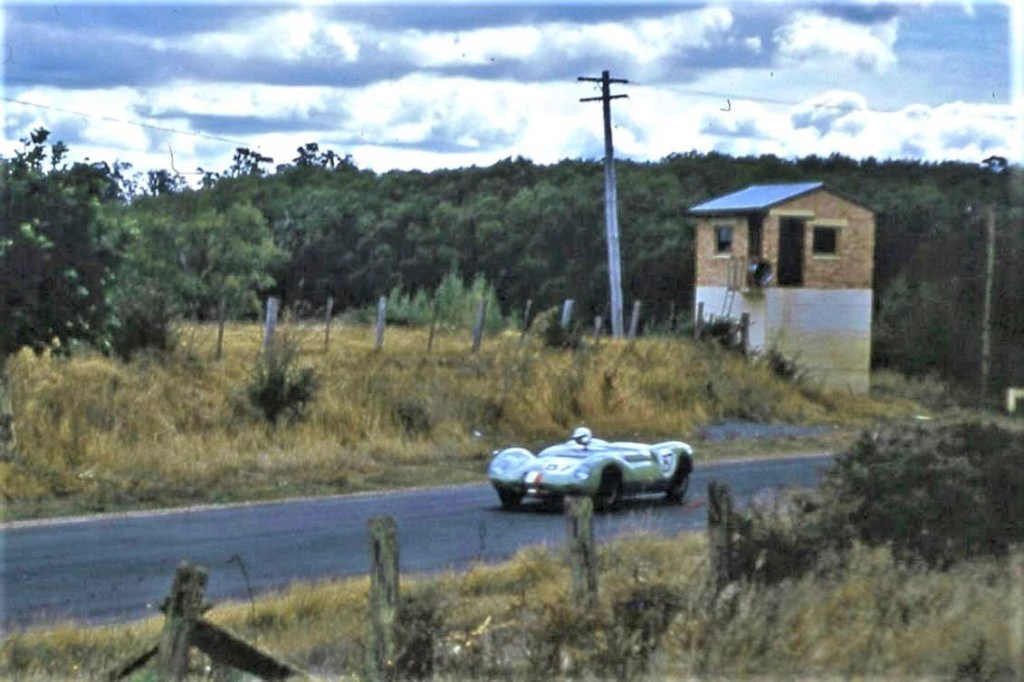
Frank Matich, Lotus 19 Climax, having just exited Kings Bridge and passed the irrigation water pumphouse (B Wright)
Bigger FPFs were fitted to Australian sports cars as well, notably Bib Stillwell’s Cooper T Monaco and Frank Matich’s Lotus 19, with FM winning the 45-mile Sports and GT Cars Championship from Stillwell and Bob Jane’s Jaguar E-Type.
Matich pushed his own lap record up to 108mph and was chuffed enough about the pace of his Lotus two-seater that he entered it in the Formula Libre feature.
Friday qualifying comprised two sessions, one in the morning and another in the afternoon. The quicks were McLaren on 2:23.3, McKay 2:27.0, Davison on 2:27.3. Of Davo, Ewence recorded that ‘Alan Ashton, got the 2.7 Climax to its bellowing best, and his wider wishbones had improved the car’s stability, and he had the brakes to a pitch which enabled Davison to rush up on his opponents as they approached corners.
Youl did a 2:27.4. Ewence noted that John’s Cooper ‘was handling much better following extensive modifications to the suspension, including widening of the track.’ Geoff Smedley was the engineer/mechanic involved.
Jack Brabham lines up his BT4 for the very strong timber Long Bridge exit clipping point! (L Gigney)
Brabham didn’t arrive from London, then Sydney, and on to Launceston until after 11am on the Friday morning and then spent most of the day chasing engine problems. Refer to the Climax twin-plug note in Etcetera.
The top three grid slots from times recorded in Saturday’s two races noted above were McLaren, Stillwell and Davison. Then came Maggs, McKay and Brabham, then Youl, Chris Amon, Jim Palmer, and the rest. The only starters from this race still alive are, I believe, Bob Holden, who raced his 1.5-litre Lynx Peugeot Formula Junior from grid 15, and Jim Palmer.
The Race…
Raceday at Longford was always on the Monday Labour Day holiday. There was no racing on the Sunday, giving plenty of time for dramas to be sorted: Jack’s engine, McLaren’s uni and driveshaft, Gardner’s clutch, Magg’s engine mount, etc. Bruce McLaren noted in his March 15, 1963 ‘From The Cockpit’ Autosport column how busy Repco Launceston and Merv Gray’s engineering shop were over that weekend.
(HRCCT)
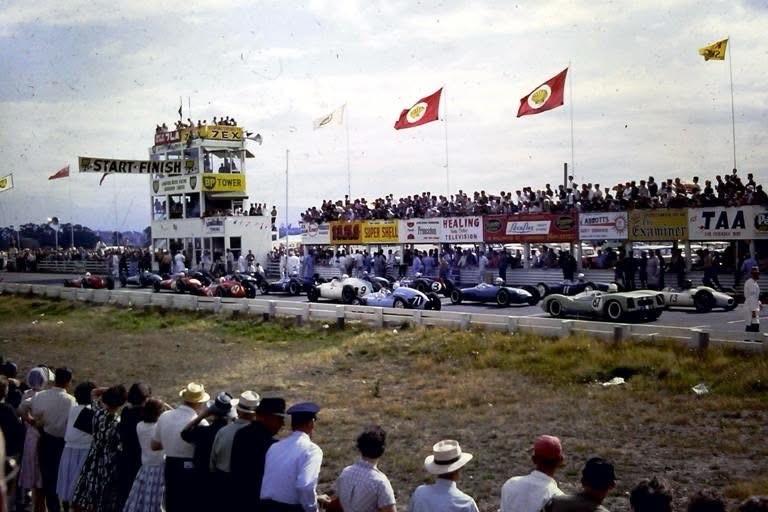
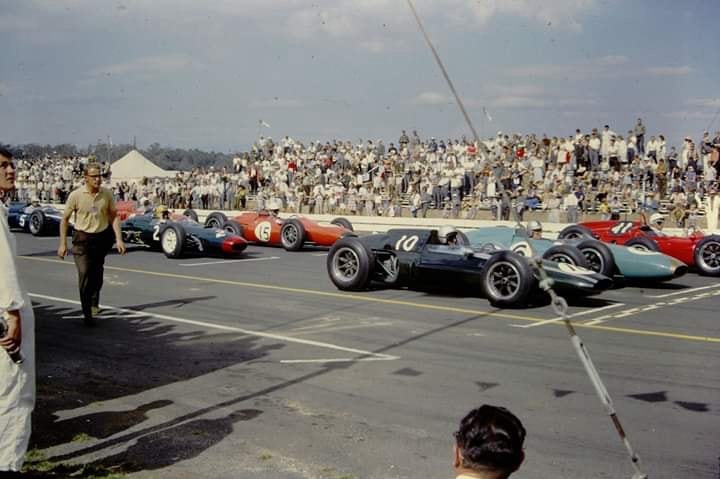
The rear of the grid (above) before the South Pacific Championship, showing #87 Frank Matich Lotus 19 Climax, #13 Bob Holden Lynx Peugeot 1.5, on the next row is Frank Gardner’s Brabham BT2 Ford FJ, which is sandwiched by Tony Shelley’s Lotus 18/21 Climax against the pits and Peter Boyd-Squires Cooper T45 Climax. The white #9 Cooper T51 is Bill Patterson, and alongside him is the #3 Cooper T53 of Jim Palmer. Then Chris Amon in the red Cooper T51 #14 with John Youl alongside, Cooper T55 Climax and an obscured Jack Brabham in his BT4. On the second row is David McKay’s Brabham BT4 Climax and an obscured Tony Maggs’ Lola Mk4 Climax with Davison, Stillwell and obscured McLaren up the front.
(unattributed)
South Pacific Championship 3-2-3 grid, 14 starters, Longford, Monday, March 4, 1963.
Bruce McLaren Cooper T62 2.7, Bib Stillwell, Brabham BT4 2.7 and Lex Davison, Cooper T53 2.5, then on row two, Tony Maggs, Lola Mk4 2.7 and David McKay, Brabham BT4, on the third row, we can get a glimpse of Chris Amon’s Cooper T53 2.5 near the fence, and #5 John Youl’s Cooper T55 2.5 alongside.
All of the engines were Coventry Climax FPF, whether John Youl was using his Geoff Smedley-developed twin-plug, twin-Magneto 2.5, I don’t know.
David McKay, Brabham BT4 from Tony Maggs, Lola Mk4, Long Bridge (L Gigney)
F.G.N Ewence reported that it was a great first lap for the Brabham marque with the three of them leading in line astern across Long Bridge. David McKay’s run was short-lived with leaking cylinder head sealing rings; he only compltetd the first lap.
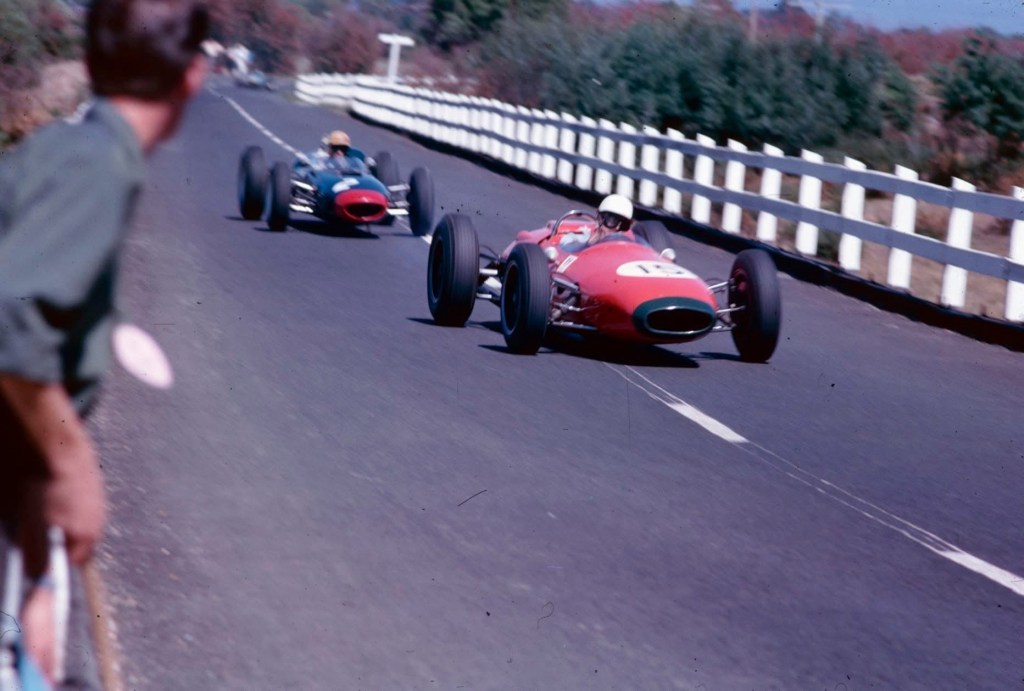
Brabham sat behind McLaren then he took the lead on lap 10, with Bib Stillwell third, but four laps later Jack’s run came to nought with the BT4 puffing plumes blue smoke of increasing volume on The Flying Mile, then through Mountford and into the pits. The ‘manifold leak’ caused a pit fire which was quickly extinguished with Jack leaving an oily calling card at Mountford that caused others some grief.
Brabham from McLaren on Kings Bridge, circa laps 10-14. The Viaduct is some way behind them, beyond the trees, with Longford village in front (Bob Wright)
Bruce took the lead back, having done the fastest lap of the race at 114mph on lap 13 in pursuit of Jack. He then modulated his pace to keep ahead of Bib Stillwell and John Youl. Bill Patterson was fifth behind Jim Palmer’s Cooper T53, and Tony Maggs demonstrated his professionalism by bringing the Lola home sixth despite being liberally coated with engine oil that escaped from a crack in the chassis tube, which conveyed the slippery stuff to and from engine and radiator.
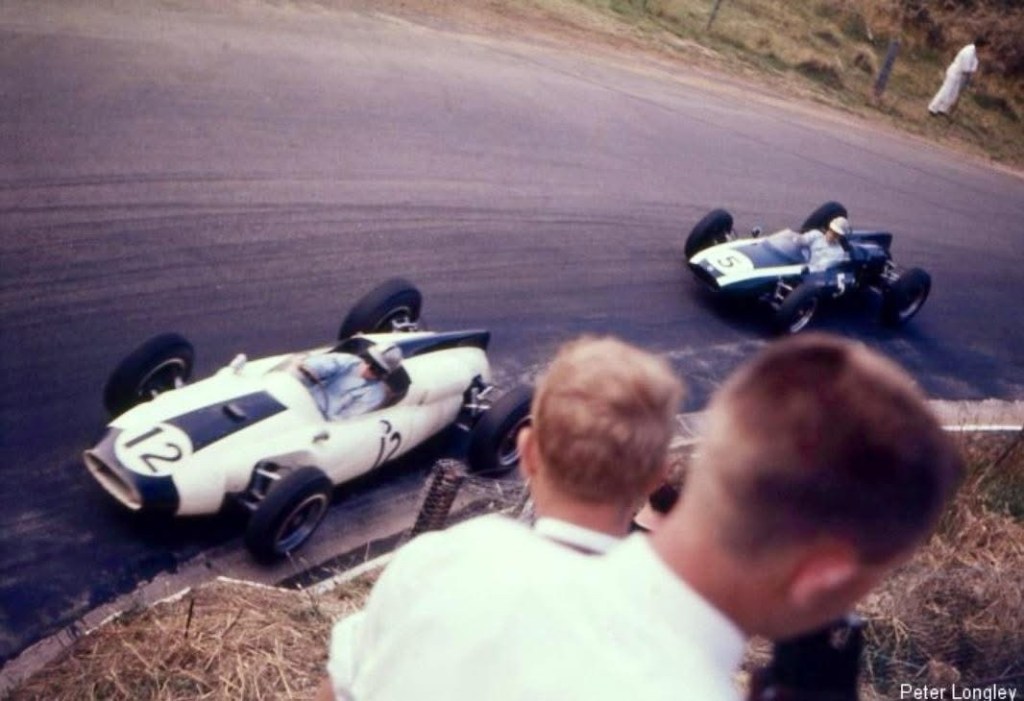
(P Longley)
This scrap between Kiwi, Jim Palmer, Cooper T53 Climax and local boy, John Youl, Cooper T55 Climax was over third place, an argument resolved in Youl’s favour.
Palmer was a multiple Kiwi Gold Star Champion, a Tasman Cup perennial whose best placings were fourth in 1966, ex-Clark Lotus 32B Climax and equal fourth with Phil Hill in 1965, Brabham BT7A Climax. Youl was ‘one who got away’, the incredibly gifted driver was fourth in that old T55 in the ‘ 64 Tasman before taking up family farming responsibilities at their Symmons Plains property, not too far from Longford.
(R Bell)
Bruce McLaren receives the plaudits of the Longford crowd from atop the Viaduct, he had a good summer in his Cooper T62 Climax, winning the 1963 Faux Tasman Cup, then came back in ‘64 and won the real one!
The views of experienced outsiders is always an interesting perspective. Here is Ewence’s race report Postscript in full.
‘Postscript: Despite the fact that the Longford Motor Association has no paid officials, it is limited by a lack of population. The whole State of Tasmania has only 350,000 inhabitants. To get 30,000 of them to a meeting is equivalent to an attendance of some four million at a British meeting! This makes the £20,000 budget something of a nightmare for the L.M.R.A. The two previous years’ operations had resulted in losses after necessary capital expenditure was met. This year, the hats went in the air when Treasurer Geoff Hudson’s casting of accounts revealed a small profit. Longford will be on again next year, and State Premier Reece seemed so upset about an interruption caused by a passenger train at the level crossing in Longford township that those on the inside believe that the trains will be very strictly controlled in the future.’
Etcetera…
(oldracephotos.com)
The start of one of the 45-lap preliminaries with Lex Davison on this side, then John Youl, and Tony Maggs in the yellow helmet. Davo won them both.
(Andrew Lamont)(W ‘i anson)
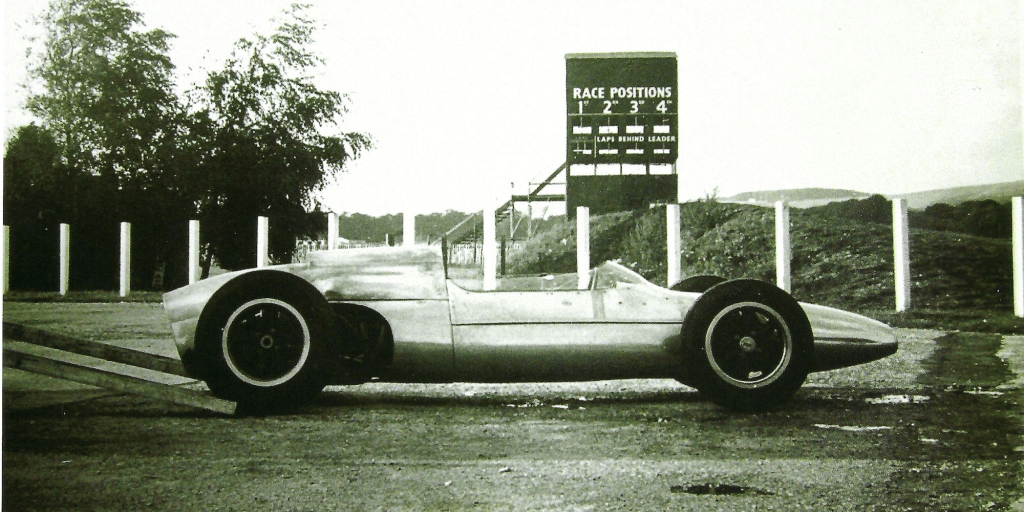
Bruce McLaren’s unpainted Cooper T62 Climax at Goodwood for a test session on September 26, 1962 not long before the car was shipped to Fremantle, Western Australia for the 1962 Australian GP at Caversham.
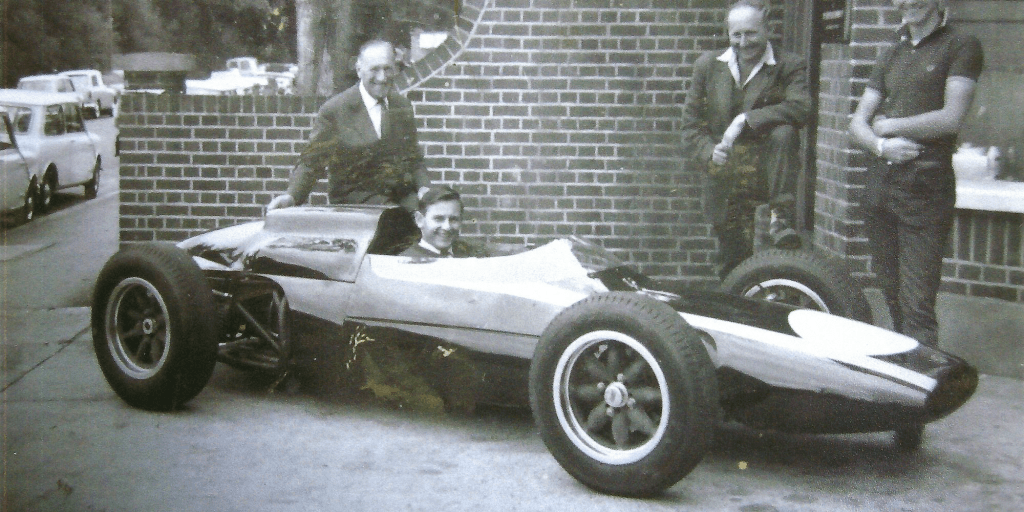
McLaren’s T62 – #CTA/BM/2 – was built on Cooper’s T60 1961-63 jig by Tommy Atkins’ team at his Chessington workshop. Harry Pearce and Wally Willmott were the artisans who built the car. The rear was designed to take a BRM P56 1.5-litre F1 V8; Bruce planned to contest the non-championship F1 races that Coopers chose to ignore. When that engine ran late, Atkins and McLaren decided to convert the car to Climax Tasman spec, gearbox, and a Colotti T32 five-speed.
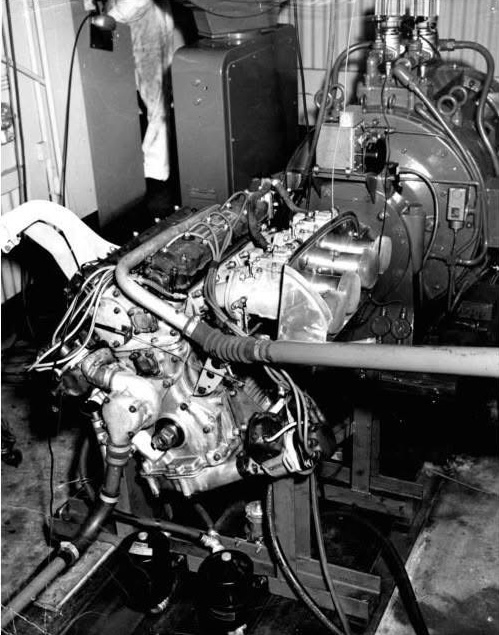
Tommy Aktins, Harry Pearce, partially beheaded Wally Willmott and completed T62 at Coopers in Hollyfield Rd, Surbiton (W i’ anson))Geoff Smedley’s Coventry Climax 2.5 FPF twin-plug on the Repco Research dyno in November 1963 (G Smedley)
Bruce McLaren (Eoin Young ghosting Bruce) wrote in ‘From The Cockpit’, ‘Brabham’s car was the centre of interest, sporting an 8-plug head. This was a very impressive looking set-up, but it must have been firing the right plug at the wrong time or the wrong plug at the right time, because he had a lot of trouble getting it to run right.’
‘That was Friday. The Saturday morning practice was kind to most of us except poor Jack again. The Brabham was smoking a lot more than a young car should, and he had to rush back to Launceston to take the engine out and fit his spare 2.7 Climax for the races in the afternoon..
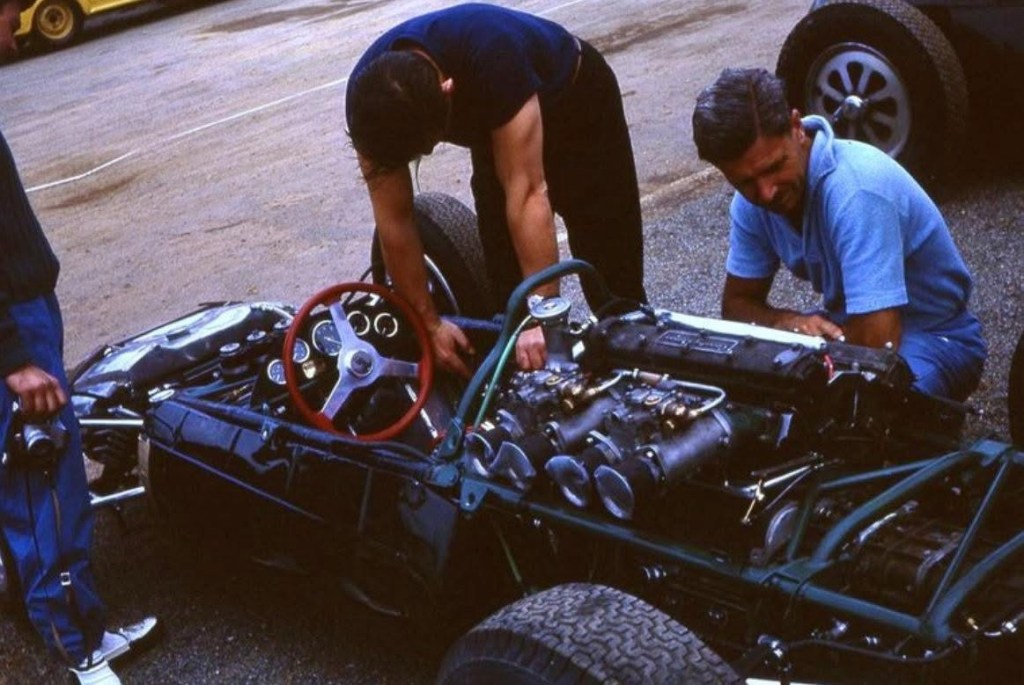
Those with a keen memory may recall that Geoff Smedley developed a race-winning 2.5-litre Coventry Climax twin-plug in Tasmania for John Youl. That engine, with the necessary sparks provided by twin-magnetos, was first raced by Youl fitted to his winning Cooper T55 in the October 14 1963, Gold Star round at Mallala. The engine was then used in the ’64 Tasman, in which Youl finished fourth in that ageing Cooper behind Bruce’s new Cooper T70, Brabham’s new BT7A and Hulme’s year old BT4. Youl and Smedley’s was a mighty effort!
In it, Geoff recalled that ‘Frank Hallam at Repco Research had been playing around with a twin-plug head for one of Brabham’s engines, using two distributors driven from the rear of each cam bank and couldn’t make it work through an inaccurate spark which was put down to windup in the camshafts in the high rev range.’
So it seems the Repco FPF twin-plug was tested over the Longford ’63 weekend. I wonder whether Jack tried it elsewhere? Does anybody know what became of that pair of twin-plug heads?
Credits…
Geoff Smedley, Bob Wright via Kay Wright, Andrew ‘Slim’ Lamont Collection, Historic Racing Car Club Tasmania, Ray Bell, Terry Walker, Ken Devine, Repco. The detail in this article is via Paul Cummin’s archive, specifically F.G.N Ewence meeting report and Bruce McLaren’s ‘From The Cockpit’ column published in Autosport, March 15, 1963, Willian i’anson Ltd, Geoff Smedley, Stephen Dalton
Tailpiece…
(E French)
One of the men of the weekend, Lex Davison, had gear-selector problems on his sixth lap with his Cooper T53 and is shown bumming a ride from Bruce McLaren, who is just starting the Newry ascent. Ewence reported that Davo ‘Broke down near the pub, where last year he had so spectacularly lost his first 2.7 Cooper in a 130 m.p.h skid. “Why hello, Mr Davison, back again?’ remarked the landlord’s wife as he entered the portals.’
Davo famously wore his cloth helmet under his real one throughout his career. Lex turned 40 on February 12, 1963, and was still mighty fast indeed!
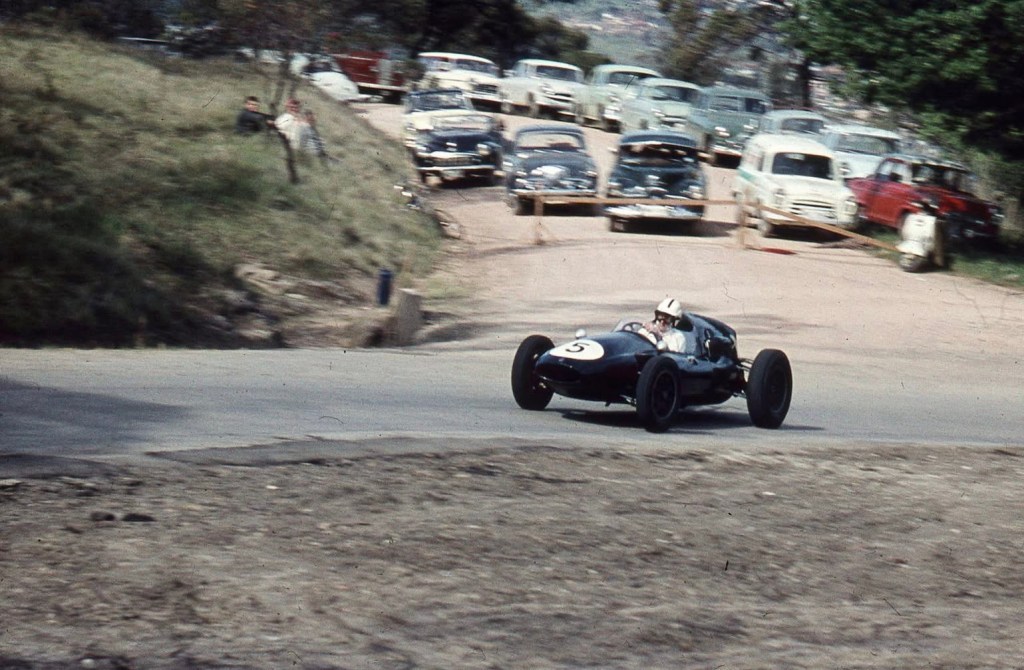
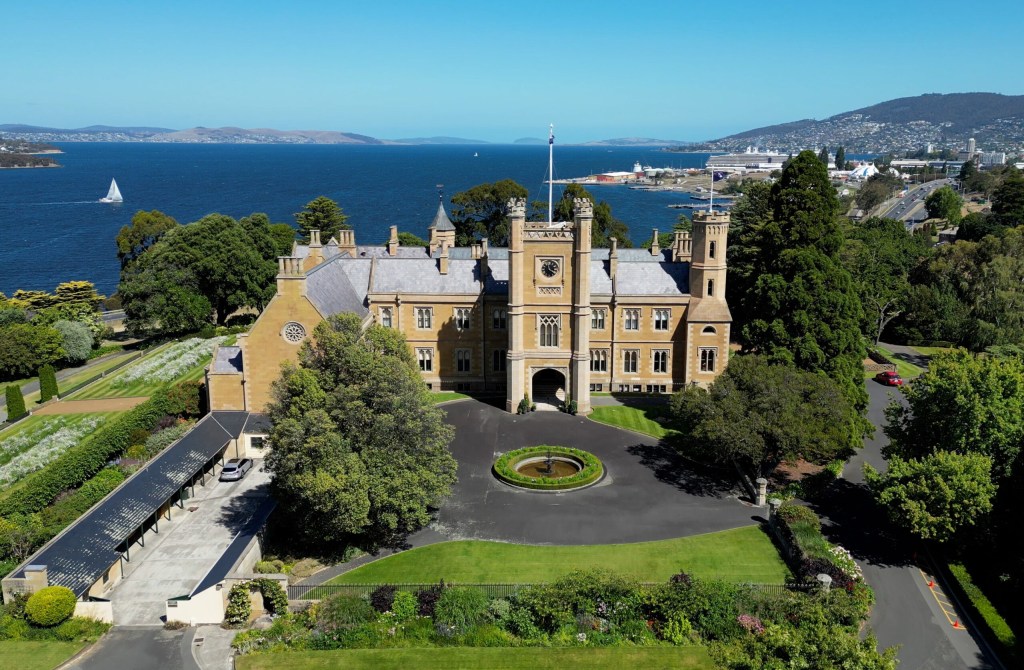
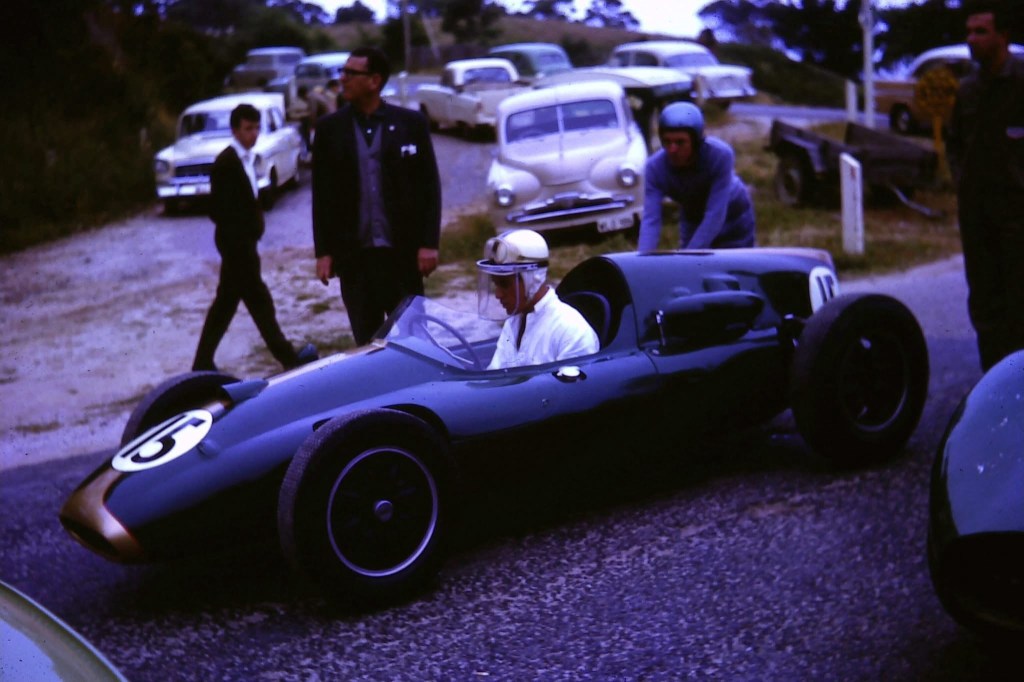
David Sternberg corrects a delicate slide in his Cooper T51 Climax at the Queens Domain hillclimb, Hobart, Tasmania, early 1960s. Date folks? As the name suggests, the locale contains the Governor’s Tasmanian pad.
Its a magnificent shot, photographer unknown, of a short-lived venue in central Hobart that was used from circa-1955-65. A modern event is held there. The climb was well regarded enough to hold the November 14, 1959, Australian Hillclimb Championship, which was won by the legendary Bruce Walton in his Walton Cooper.
Government House within the Queens Domain. Where are the hillclimb roads? Good question (Australian Gardens)(G Brooks)
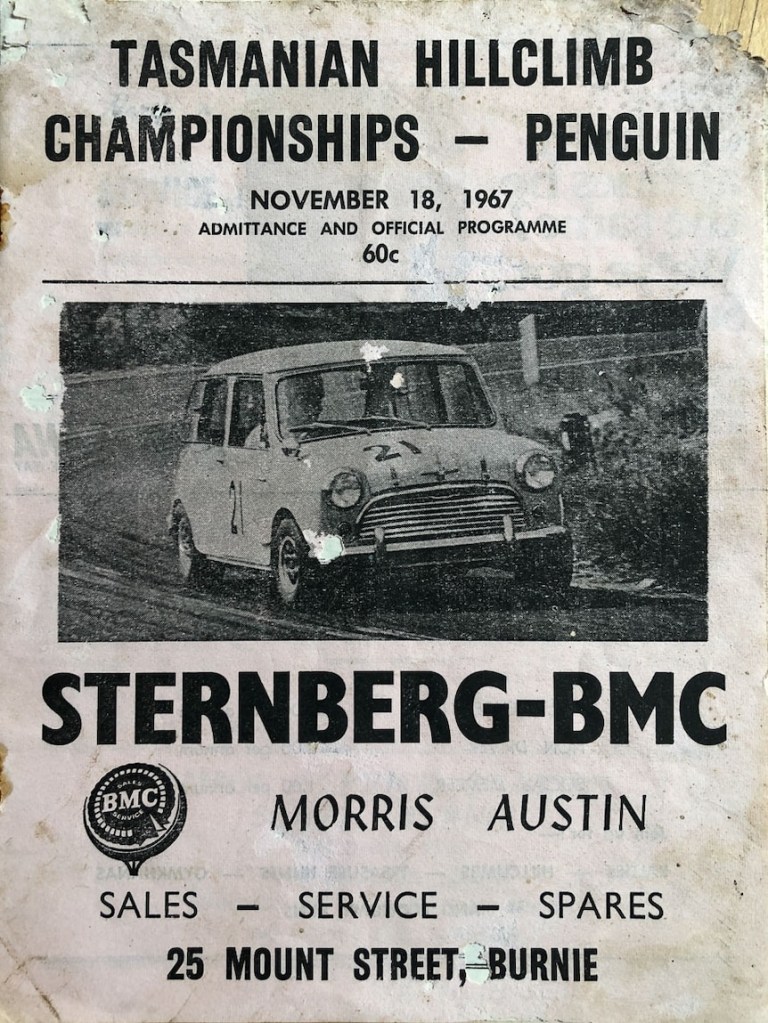
David Sternberg lines up the family Cooper at Penguin Hillclimb, on the island’s north coast at about the same time. That’s father Lex hanging onto the right rear.
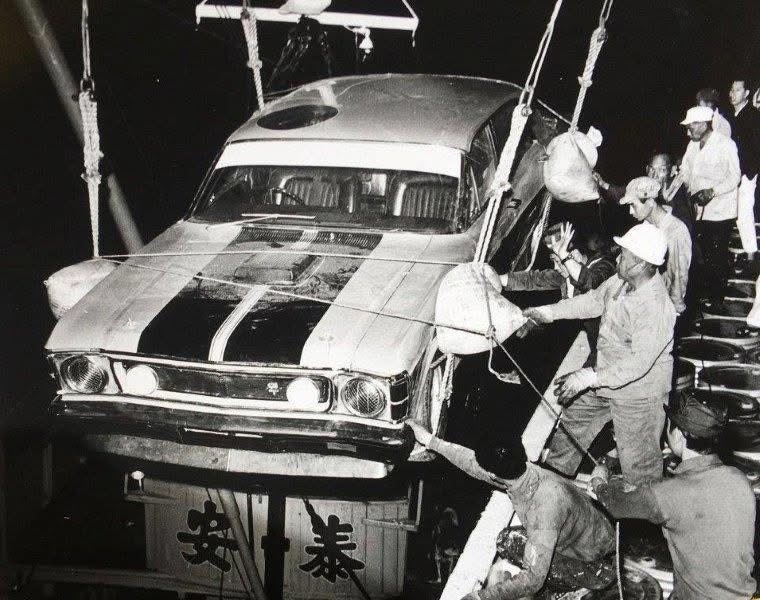
Allan Moffat’s works GTHO being unloaded off a ship onto the Macau docks in advance of the 1971 Macau GP carnival held on the weekend of November 20.
‘Be careful, blokes, if we drop it, they’ll shove us on the other side of the border! I couldn’t give a toss about Mao or his Little Red Book’. There is something rather surreal about the whole scene.
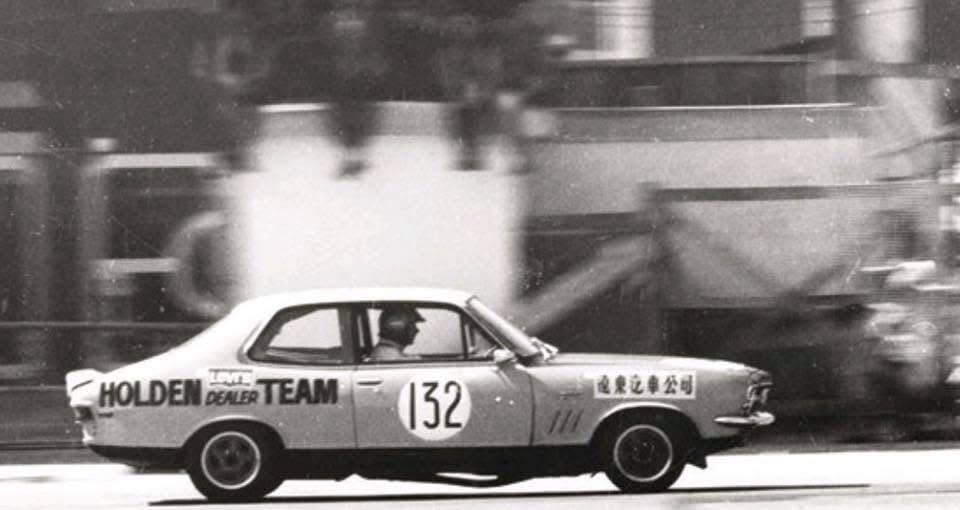
Ford entered this car, while the Holden Dealer Team – the works team – took an LC Torana GTR XU-1 up for Peter Brock. Both were Group E Series Production machines, whereas that Guia 200/ACP Cup was a Group 2 event, run to more liberal modification rules.
Brock’s LC XU-1, local signage probably the car’s entrant, Far East Motors. Wheels Globe Rallymasters or Sprintmasters (unattributed)Glemser and RS2600 are on the way to a record breaking pole of 2 min 56 sec (unattributed)
The star car/driver combo was recently minted European Touring Car Champion, Dieter Glemser aboard a 2.9-litre Ford Cologne entered ETCC Ford Capri RS2600 V6; 265-286bhp/ZF 5-speed/940kg/disc-disc/10×13 and 11.5×13 wheels. A weapon.
Brock’s XU-1 was ‘lightly modified’ from Series Production specifications, the only obvious external mod being fitment of a set of Globe Rallymaster aluminium wheels.
Moffat’s HO, upon closer inspection than most shots of this race in circulation allow – generally screen grabs of a video – is the more interesting as the machine is an XW HO gussied up to look a bit like an XY with its bonnet and shaker-air scoop. Is that attached to a 351 Windsor or Clevo?
Given the proximity of the late-season Australian enduros: Sandown, Bathurst, Surfers and Phillip Island, Howard Marsden shipped up an XW XY-HO Development Mule rather than the Real McCoy, it seems. Moffat won the last Manchamp round at Surfers on November 7. His and John French’s XY HOs finished in one piece, but maybe there wasn’t the time to prep and ship one of these cars to Macau. More likely, it just didn’t matter. Did FoMoCo Oz export any Falcons?
What are the VINs/names of the HO and XU-1 folks??
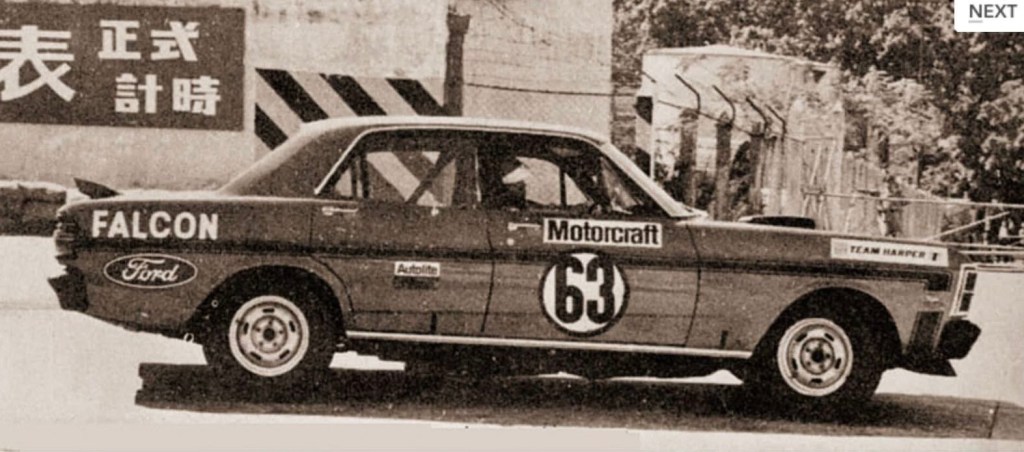
Moffat’s XW-XY HO Bitza. Team Harper, aka Wallace Harper & Co, the Hong Kong Ford distributorsBrock and Moffat on the first lap with Moffat about to exit stage right into the run-off area having messed up his Lisboa corner braking point in the bulky HO . Poon’s Alfa behind Brock with a BMW 2002 Tii looming as well (P Bennett)
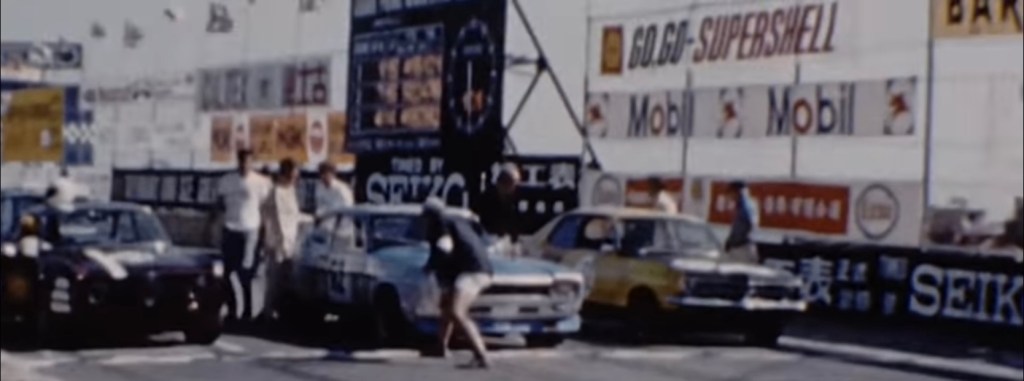
The touring car events that weekend comprised two heats and a final. Brock qualified third in his Far East Motors-entered car behind Glemser and Albert Poon, who raced an Alfa Romeo 2000 GTAm lookalike; Autodelta engine and ‘Poon suspension. Neither Moffat nor Jim Smith – he of Cooper S and Camel Rover Repco-Holden fame – who raced a Teddy Yip-owned BMW 2002, cop a qualifying mention in my reference material, but the video indicates a row three start or thereabouts for Moff.
Poon ? Glemser and Brock before the off (P Bennett)Stature and stance of Glemser’s Group 2 Capris contrasts with Brock’s Series Torana (P Bennett)
The final comprised two events run concurrently: the Guia 200 was 20 laps of the demanding, unforgiving 6.115-mile track, and the ACP Cup 15 laps.
The perils of Macau were demonstrated all too sadly during practice when David Ma lost control of his Lotus 47 Ford FVA under braking for Statue Corner, while trying in the final session to qualify for the Grand Prix, and crashed fatally into a lamp post .
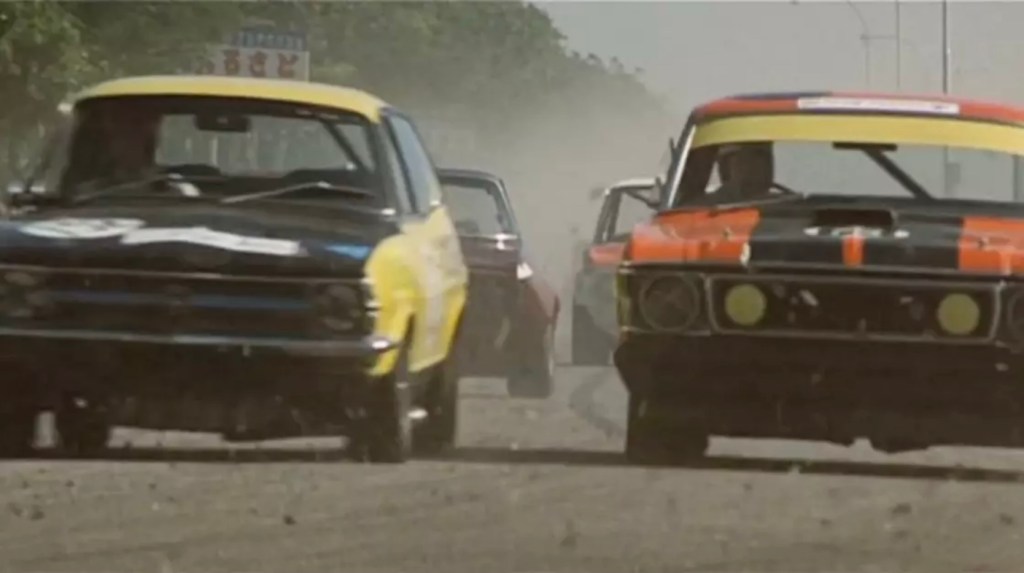
Glemser was an easy winner of the Guia from Poon and Brock, who diced throughout. Note that some references – all of the Australian ones – have Brock in second place having finished ahead of Poon who ran low on fuel in his last lap. Moffat went up the escape road on the first lap in the Big Henry and recovered to finish fifth.
The ACP Cup was taken by Ted Morrat’s BMW 2002 Tii from P Ramirez Toyota Corolla and Xie Dewen’s Cooper S. I don’t have a full list of competitors, but the videos show far more starters than my list of finishers, meaning my finishers list is incomplete.
Ted Morrat, BMW 2002 Tii, 1971 ACP Cup winner (J Santos)Moffat enroute to winning the Guia in 1973 aboard a works- Team Harper Ford Capri RS2600 (Getty)
Etcetera…
Allan Moffat was very impressed by Dieter Glemser and his Capri. Allan shared his Falcon XB GT Hardtop with the German in Moff’s unsuccessful 1974 Bathurst 1000 challenge.
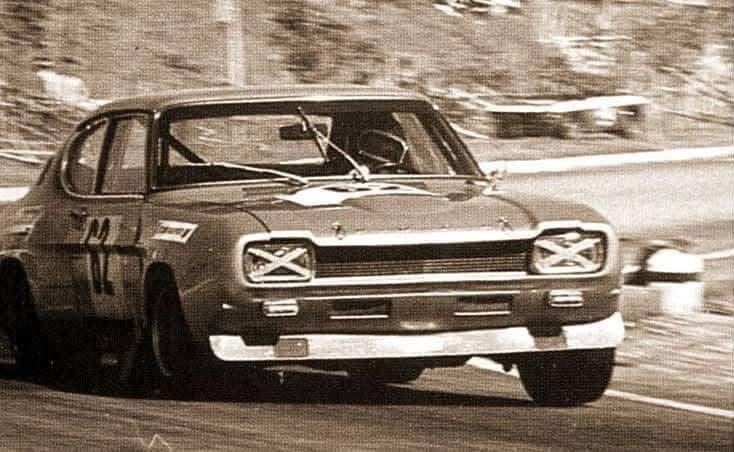
Moffat returned to Macau. In 1973, he won the Guia in a 3-litre Ford RS2600. He was impressed enough to get FoMoCo Oz to buy him one of the Ducks Guts ultimate spec Capri’s in late 1974. Moff’s ex-works 3.4-litre Ford Cosworth GAA-powered RS3100 first raced in Australia in the Sandown Tasman meeting in February 1975, and at Macau that November, DNF.
Moffat’s FoMoCo Oz Capril RS3100 at Macau in 1975 (unattributed)
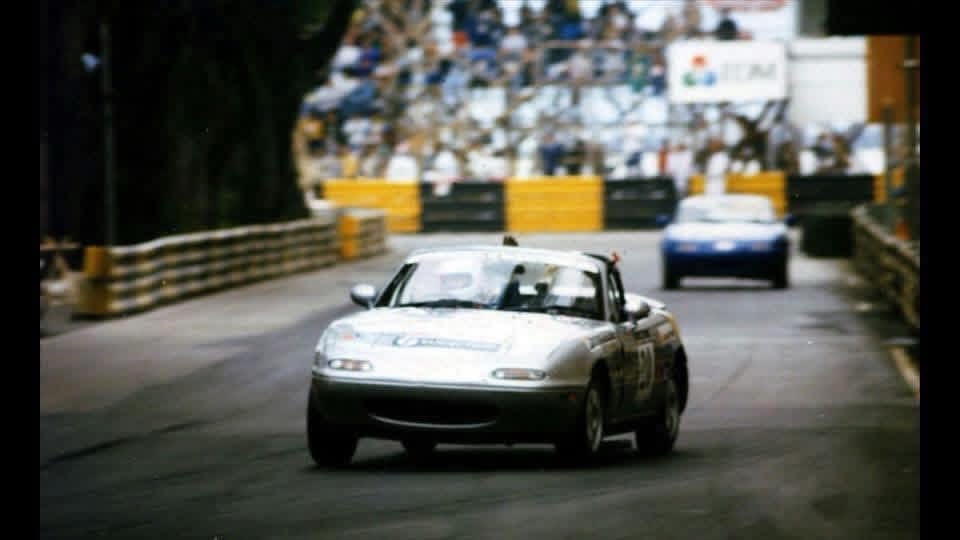
In the 1981 Guia, he was 11th in an RX-7. His final visit – his final ever race – was in 1989, when he finished third in the ‘Teddy Yip Mazda (MX5) Race of Champions’ on November 26 (below).
(Official Allan Moffat)
Harry Firth felt that Brock’s performance that ’71 Macau weekend, when he was very quick, changed him. Frankly, other than Glemser, who would hardly have extended his car more than he needed, it was not a field of great depth.
‘Peter came back from that a totally different person. He realised what international racing was all about. Totally different world. And he realised he was as good as any of them.’ Less than twelve months later, he bagged his first Bathurst crown.
Credits…
touringcarracing.net, Harry Firth quote from V8Sleuth, Getty Images, Official Allan Moffat FB page, Jose Santos, Paul Bennett Video
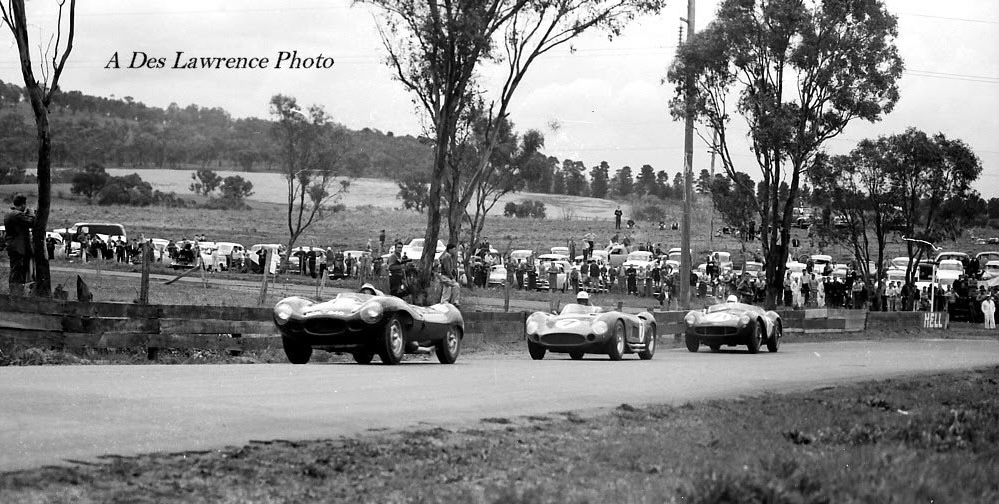
Bill Pitt, Jaguar D-Type, leads Doug Whiteford, Maserati 300S and race winner David McKay heading up Mountain Straight during the early stages of the 31-lap, 100-mile Australian Tourist Trophy at Mount Panorama, Bathurst, on October 6, 1958.
That weekend was an incredible double-header combining the Australian Grand Prix won by Lex Davison’s Ferrari 500/625, and the Australian Tourist Trophy.
It was the second running of an event first won by Stirling Moss in a Maserati 300S during the 1956 AGP carnival at Albert Park.
McKay, Whiteford, Phillips and Kiwi, Frank Cantwell’s Tojeiro Jaguar (unattributed)
By then, we had a good grid of outright current sports cars, including: Aston Martin DB3S – ex-works car for David McKay, and Warren Blomfeld’s Tom Sulman-owned customer machine, Maserati 300S – Doug Whiteford’s ex-works car, Derek Jolly’s ex-works Lotus 15 Climax FPF 1.5, Ron Phillips’ ex-Peter Whitehead Cooper T38 Jaguar, customer Jaguar D-Types for Bill Pitt and Jack Murray, plus a C-Type for young thruster Frank Matich. The quickest of the local cars was Gavan Sandford Morgan in Derek Jolly’s Decca Mk 2 Climax FWA.
Pitt and McKay head up Mountain Straight, while Whiteford, Phillips and Jolly negotiate Hell Corner (P Longley)
McKay won with Jolly’s 1.5-litre Lotus second – first in class – then Ron Phillips’ Cooper T38, Frank Matich in the Leaton Motors C-Type, Gavan Sandford Morgan, Decca MK2 Climax then Warren Blomfield’s Aston Martin DB3S in sixth.
(Edgerton Family Arc)
Etcetera…
(R Reid)
Early laps I suspect with Bill Pitt in the Geordie Anderson D-Type from the obscured Jolly Lotus 15 and distinctive blue flash of Ron Phillip’s Cooper Jag.
(K Devine Arc)Cooper T38 Jag, Bathurst paddock (P Kelly)
Not to forget Derek Jolly of course. He took ATT honours in the second of his Lotus 15s at Longford in March 1960, on that occasion Doug Whiteford’s Maserati 300S was second and Frank Matich third in a D-Type.
McKay in DB3S/9 and Warren Blomfeld in DB3S/103 below.
The Leaton C-Type was Frank Matich’s first Big Car and he handled it rather well in a career that stretched all the way to the end of the 1974 Tasman Cup.
He won the Australian Tourist Trophy four times: 1964, Lotus 19B Climax, 1966, Elfin 400 Oldsmobile, and 1967-68 in his Matich SR3: Oldsmobile powered in ’67, Repco-Brabham 4.4 powered in 1968. Not to forget the Australian Sports Car Championship aboard the 4.8-litre Matich SR4 Repco in 1969.
(K Devine Arc)
Educated guess territory…Jim Wright’s Buchanan TR2 from Harry Capes’ Jaguar XK120. 14th and 19th respectively. And below, Phillip’s Cooper Jag again, in front of I’m not sure who.
(K Devine Arc)
Credits…
Des Lawrence, Peter Longley, Edgerton Family Archive, Bob Ross Collection, Ron Reid, David Medley, Paul Kelly Collection, Ken Devine Archive
Alan Jones was a formidable weapon in anything; it took him four or so years to clear F3, but it was whammo after that as he stepped into more powerful cars: Formula Atlantic, F5000 and F1.
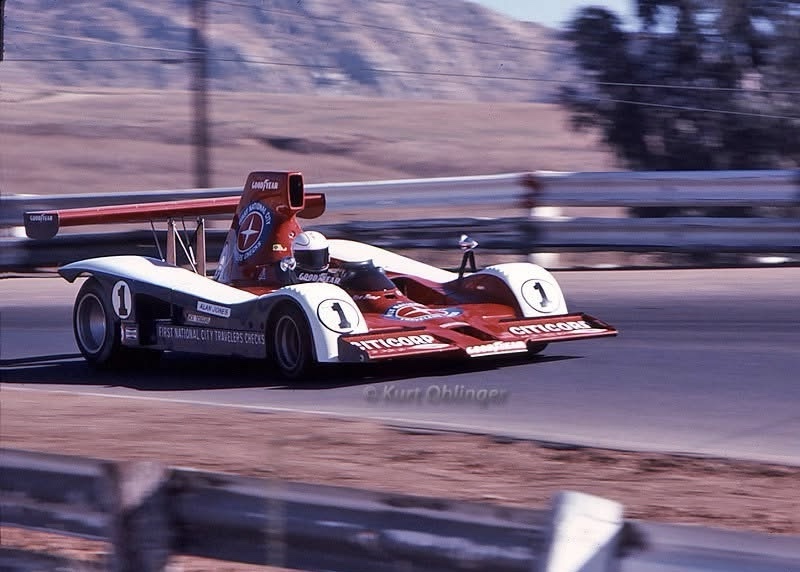
He raced F5000 on most continents, here in an F5000 in drag, a 5-litre central-seat Can-Am car, Carl Haas Lola T333CS Chev, at Riverside on October 15, 1978, where he won from fellow Aussie, Warwick Brown’s similar VDS Racing machine.
(R Deming)
Jones won five of the 1978 championships’ ten rounds, gathering 2712 points and the title from Brown, on 2548 then Al Holbert in another T333 on 1674 points.
Watkins Glen 1978 (P Goesina)
Jones is swapping notes in the Watkins Glen pits above with Jean-Pierre Jarier who raced a works Shadow DN10 Dodge, Q6/DNF gearbox. Brown won that round from Al Holbert and Rocky Moran, all three raced Lola T333CS, with Jones a DNF.
Jones at Watkins Glen (P Goesina)(P Goesina)
The rear of Jones’ T333CS Chev in the Watkins Glen paddock, essential elements at this end of the car are a 5-litre 525bhp or so Chev V8 and Hewland DG300 five-speed transaxle.
In the US, many Lola T332 Chev F5000 cars became Lola T332CS Chev Can-Am cars by buying the requisite body kit from Lola. You could buy a T332CS from the factory as well. The mildly updated Lola T333CS could be converted back the other way. The VDS Racing Lolas that Warwick Brown raced in the 1978-79 Rothmans F5000 internationals were T333 HU1 and HU2 fitted with good ‘ole T332C bodywork.
Despite missing half the season, Jones was equal seventh in the 1975 Shellsport British F5000 Championship 1975, together with Bob Evans. He won two rounds in RAM Racing cars, here at Brands Hatch on August 25, aboard a March 75A powered by the Ford Cosworth GAA 3.4-litre twin-cam, four-valve V6 fitted to Ford’s Cologne Capri RS3100 touring cars. Tony Brise and Guy Edwards were second and third aboard T332 Chevs.
Redman, Lola T332C Chev, Jones, Lola T332 Chev, Ongais, Lola T332 Chev, Oliver, Shadow DN6B Dodge and the rest #4 Pilette, Lola T430 Chev and #7 Sam Posey Talon MR-1A Chev (Getty)
Brian Redman and Alan Jones on the front row of the rolling start Mosport Park round of the 1976 US F5000 Championship on June 20, 1976.
Jones won here and at Watkins Glen later in a season where Jones mixed his Surtees F1 and F5000 programs, finding the latter much more satisfying!
Allan Brown wrote, ‘With two rounds to go, Jones (2 round wins) and Oliver (1 win Shadow DN6B Dodge) were tied for the championship lead, but when Oliver retired at Road America, and Jones had to miss the race to be at the Dutch GP, Redman (3 wins) won and leapt into a significant points lead. Third place in the last round secured the Lancastrian his third successive title, while Al Unser’s win (1 win Lola T332) propelled him into second place in the final points table.’
Grids of great depth that year, in addition to the above, competitors included Warwick Brown, Vern Schuppan, Teddy Pillette, Peter Gethin, Graham McRae, John Cannon, Brett Lunger, Danny Ongais, and occasionals/one-offs David Purley, Bruce Allison, Derek Bell, Maurizio Flammini and Patrick Tambay.
Jones, Sid Taylor/Teddy Yip Lola T332 Chev leads Peter Gethin, VDS Racing Chevron B37 Chev early in the 1977 Sandown International won by Max Stewart, his final race win (B Forsyth)
Jones was far and away the quickest bloke on the grid in Australia’s four-round Rothmans F5000 Championship in 1977. Still, he jumped the start in the Oran Park AGP, boofed a car in Surfers Paradise, then had overheating at Sandown and DNFd. Still, he won in Adelaide and made it awfully clear to his countrymen – having not raced in Australia since finishing second in the September 1968 Sandown 3-Hour touring car race in a Holden Monaro GTS327 shared with Clive Millis – just how blindingly quick he was!
Sandown pits (R Steffanoni)
The Jones/Millis second place Holden HK Monaro GTS327 at Shell Corner, Sandown during the September 3-Hour ‘Bathurst warm up’.
While entered by Jones, the car has Lloyd Holyoak Holden signage on it. Holyoak – still with us – was one of Stan Jones’ oldest friends/employees/confidants/supporters, so for sure Lloyd will have pulled the car off his Warrandyte dealership forecourt. One little old lady owner etc…
(M Bisset)
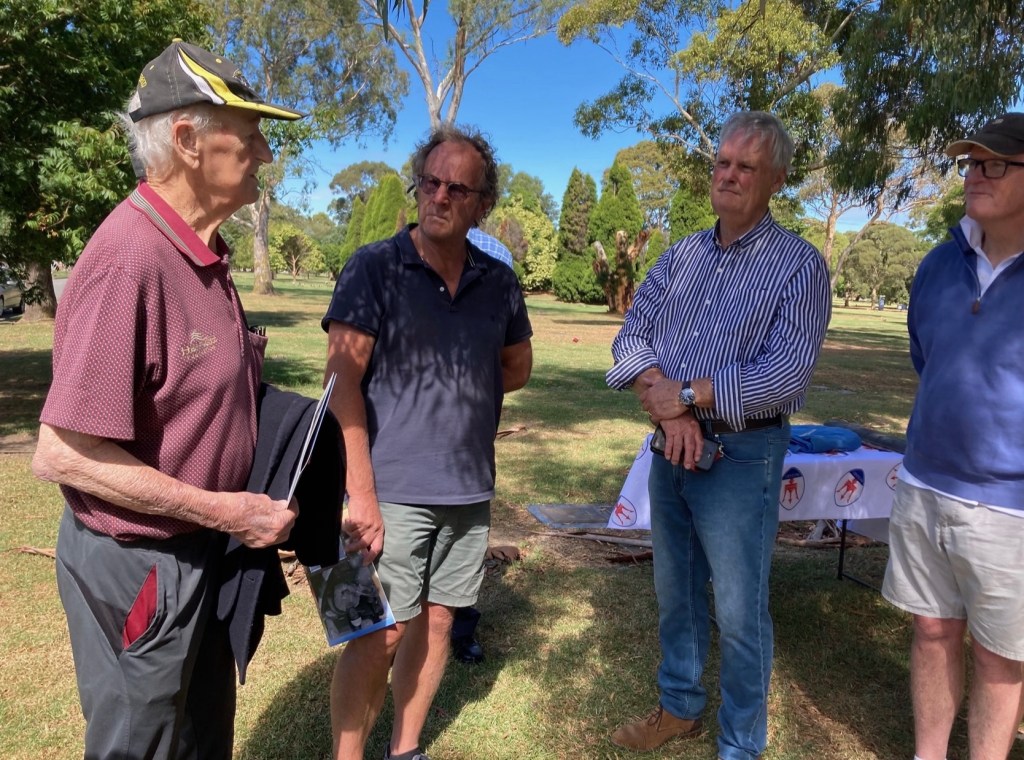
Melbourne enthusiast/historian David Zeunert (second from right) organised a small gathering of Stan Jones Nutters to pay our respects on the centenary of Stans birthday, March 16, 2023, at Springvale Cemetery, a stone’s throw from Sandown.
That’s Lloyd Holyoak sharing his recollections of all things Stan. Some Melburnian Aussie Rules fans may recall Holyoak, a very handy cricketer and football player in his youth, as the North Melbourne Football Club President when North won the VFL ’77 Flag.
(M Bisset)
Credits…
Kurt Oblinger, Richard Deming, Peter Goesina, Lola Heritage, Rod Steffanoni, autopics.com.au
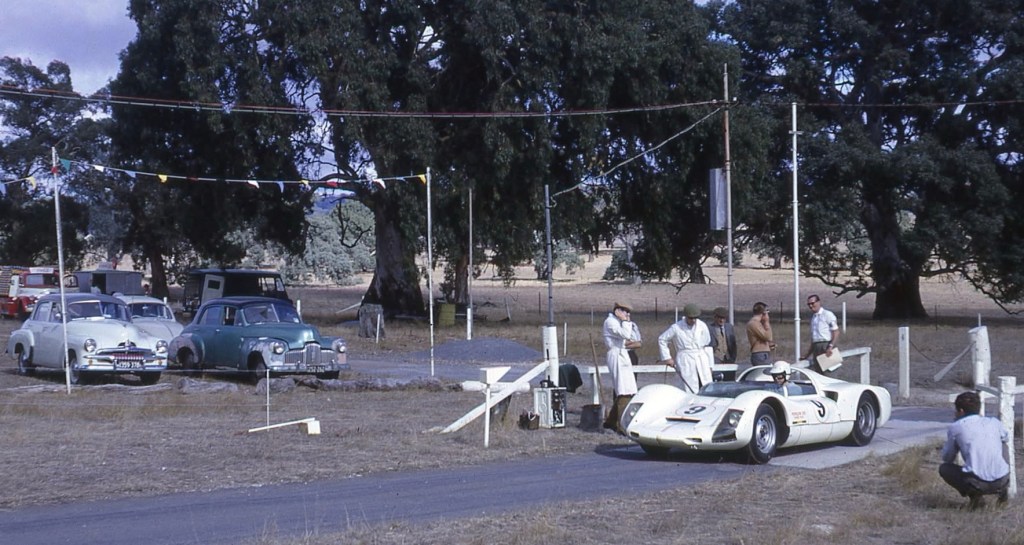
Alan Hamilton launches his Porsche 906 Spyder off the line at Collingrove during his successful assault on the track record over the Easter 1967 long weekend, 35.60 seconds.
It’s a delightfully bucolic Angaston, Barossa Valley scene complete with a couple of Humpy Holdens – an FJ and 48-215 – and a part hidden Gunter-Wagen, VW Beetle. Great stuff, John Lemm.
While the laddos should be drinking in the 908 visage, their eyes are on the prize sitting in the Valiant AP5/6! That’s a Toyota Crown S40 and a Holden HD too. The Japs really upset the local order with their Crown, which was far posher and better built than the contemporary Holden Premier and Ford Fairmont. I wonder who the bloke in the red driving suit is?
(J Lemm)
And below on April 10, 1971, Easter again, Hammo is in the process of winning the second of his four Australian Hillclimb Championships, at Collingrove with his second 906 Spyder, this one had chassis number 906-007 too.
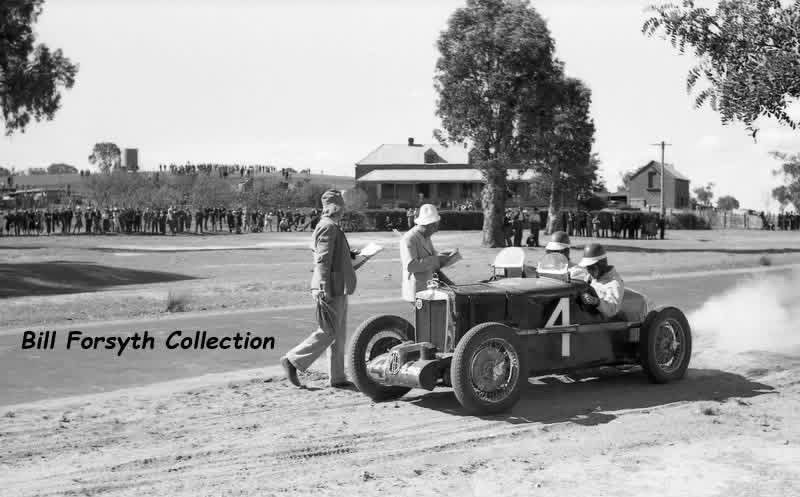
The great Hope Bartlett’s MG Q-Type at Wirlinga during the March 1938 Interstate Grand Prix/Albury Grand Prix weekend. The race was won by Jack Phillips and Ted Parsons in their self-built Ford V8 Special.
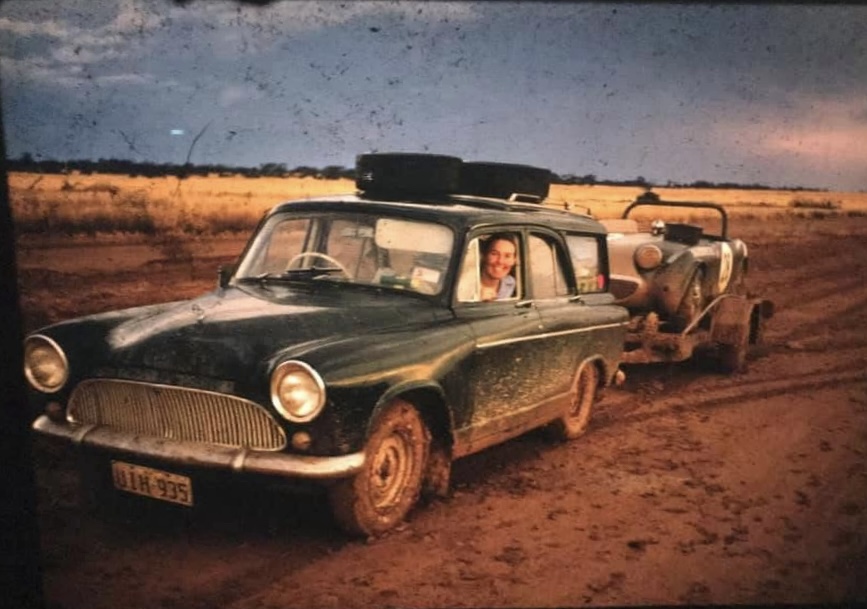
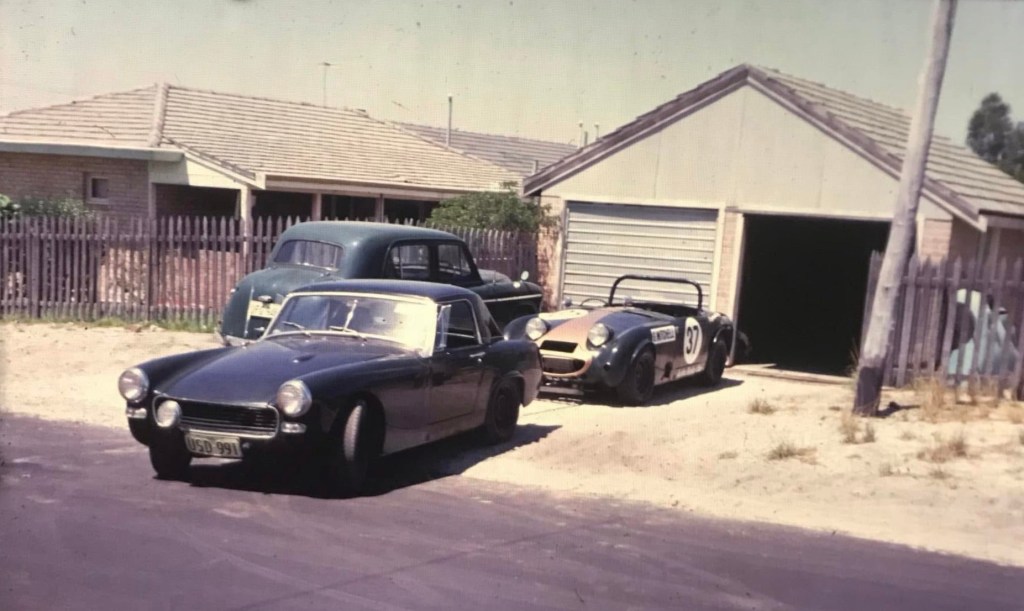
Commitment, Gordon Mitchell was absolutely nuts about his racing! ‘My Simca Station Wagon that I bought for $15, towing my Bugeye Austin Healey Sprite across the Nullarbor to an early night race meeting at Oran Park and a race meeting at Warwick Farm in 1971. Memories.’ It’s only 3820 km each way…London to Moscow is 2900 km.
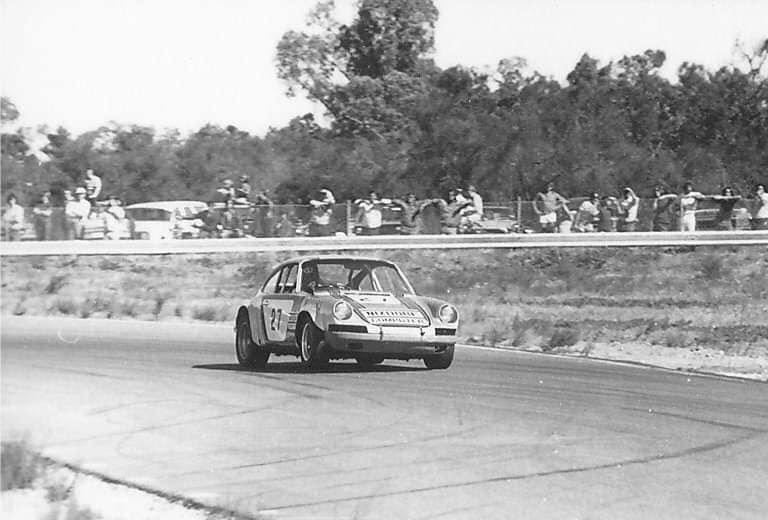
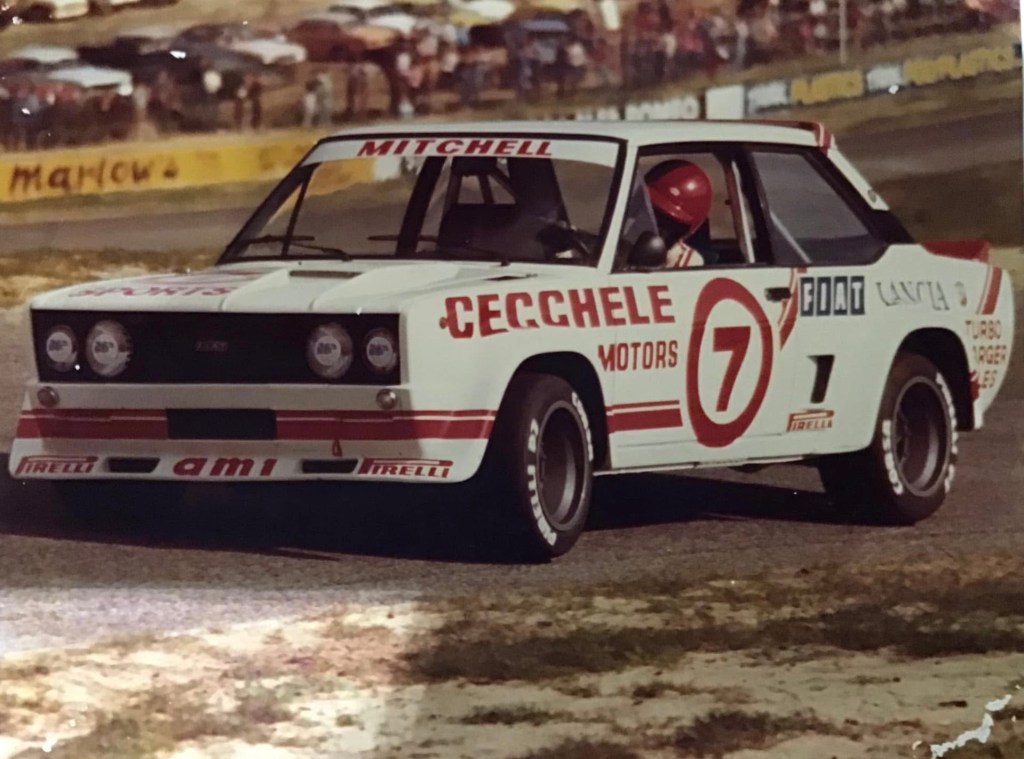
Mitchell was a racer of vast experience with a CV extending from several Sprites, to Porsche 911S, Morris Marina V8, Alfa Romeo GTV, Fiat 131 Abarth, Fiat X19 Abarth and many more.
Fiat 131 Abarth Wanneroo (G Mitchell Coll)
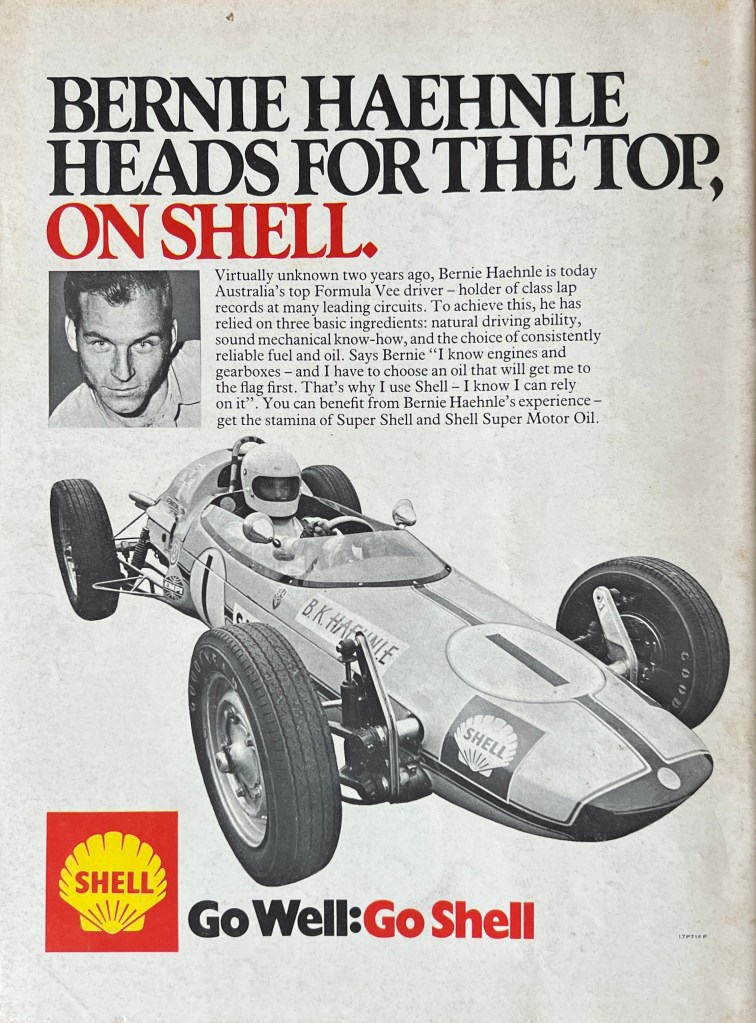
I’ve had some fun lately thumbing through my 1969-72 collection of Racing Car News researching a piece on FoMoCo Oz two Ford GTHO Super Falcons. It takes a helluva long time because of the tangents, not least the ads, wasn’t it a great mag in the day?
Bernie Haehnle was a turn of the 1970s Formula Vee Ace who did well in Series Production and a season or so of Formula Ford in a Bowin P6F. What became of him?
(L Hemer)
‘The Narellan Cup meeting at Oran Park on 6th November 1971, was the first night meeting held after daylight saving began in NSW,’ wrote Lynton Hemer.
‘This meant that the organizers could include Formula Vees in the programme with 4 and 6 lap races at 5:30 and 6:30, before the darkness set in. Here are Bernie Haehnle, Damon Beck, Paul Bernasconi, Laurie Campfield, Denis Riley and Enno Buesselmann.’
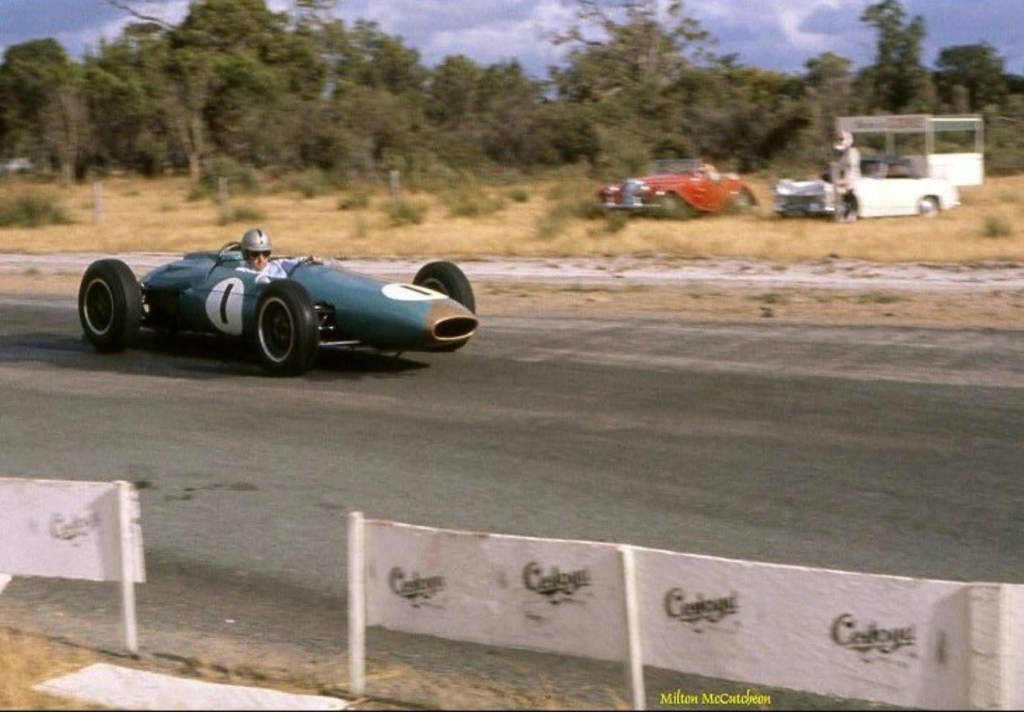
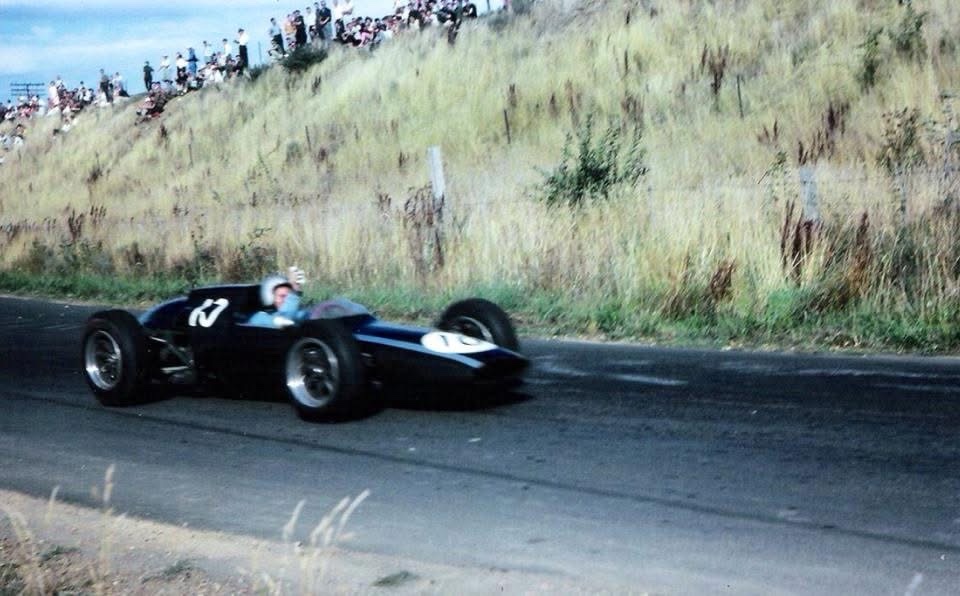
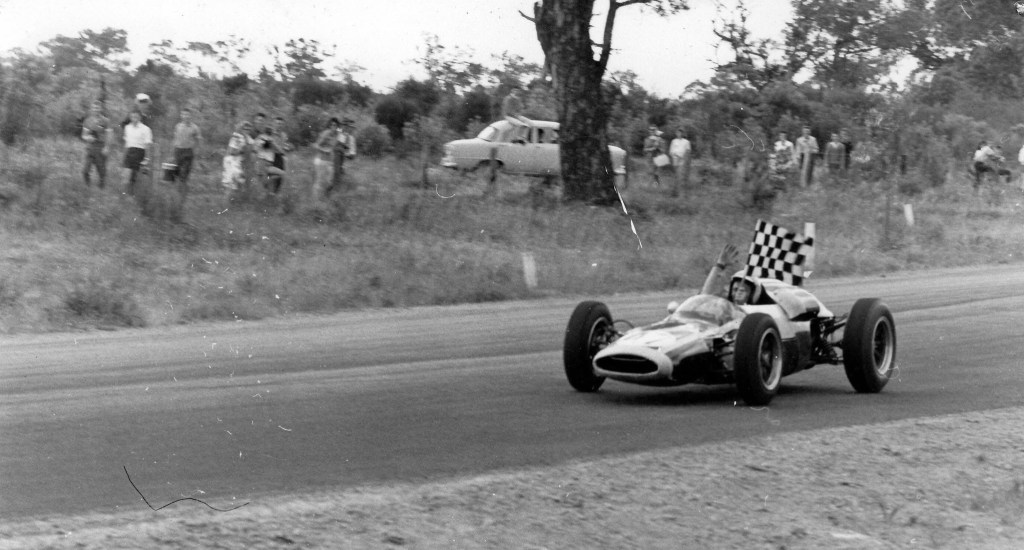
Bruce McLaren on the way to winning the November 18, 1962, Australian Grand Prix in his Cooper T62 Climax at Caversham, Western Australia.
It was a lucky victory in that Jack Brabham was taken out when he zigged, and Arnold Glass zagged, eliminating Jack’s Brabham BT4 Climax and clipping the wings of Arnold’s BRM P48 Buick 3.9 V8. John Youl and Bib Stilwell were second and third in Coopers T55 and T53, respectively.
(K Devine)
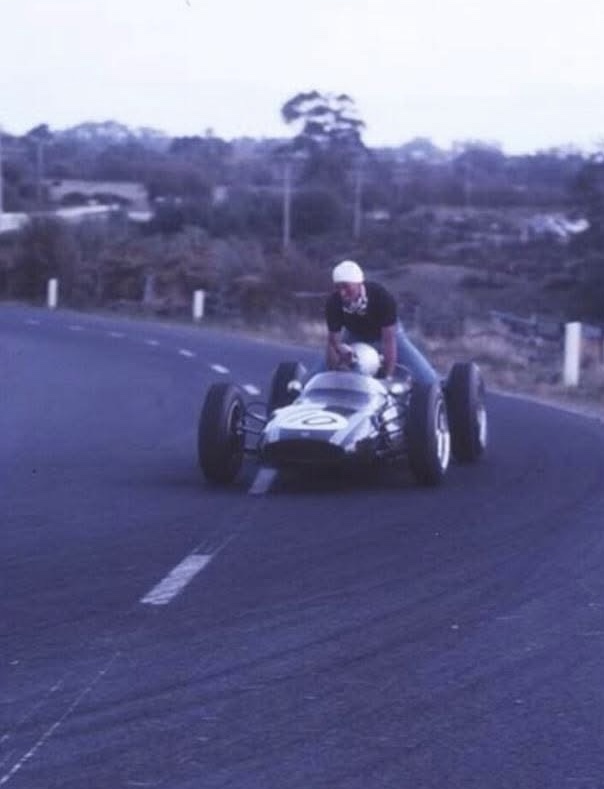
David McKay susses Bruce’s new Cooper; he bought Jack’s Brabham BT4 shortly thereafter. More about this car here:https://primotipo.com/2016/05/20/bruce-lex-and-rockys-cooper-t62-climax/ On the road near Perth, below, Eoin Young, Wally Willmott, Bruce McLaren and Cooper T62 Climax FPF 2.7.
(K Devine)(K Devine)(M Kass)
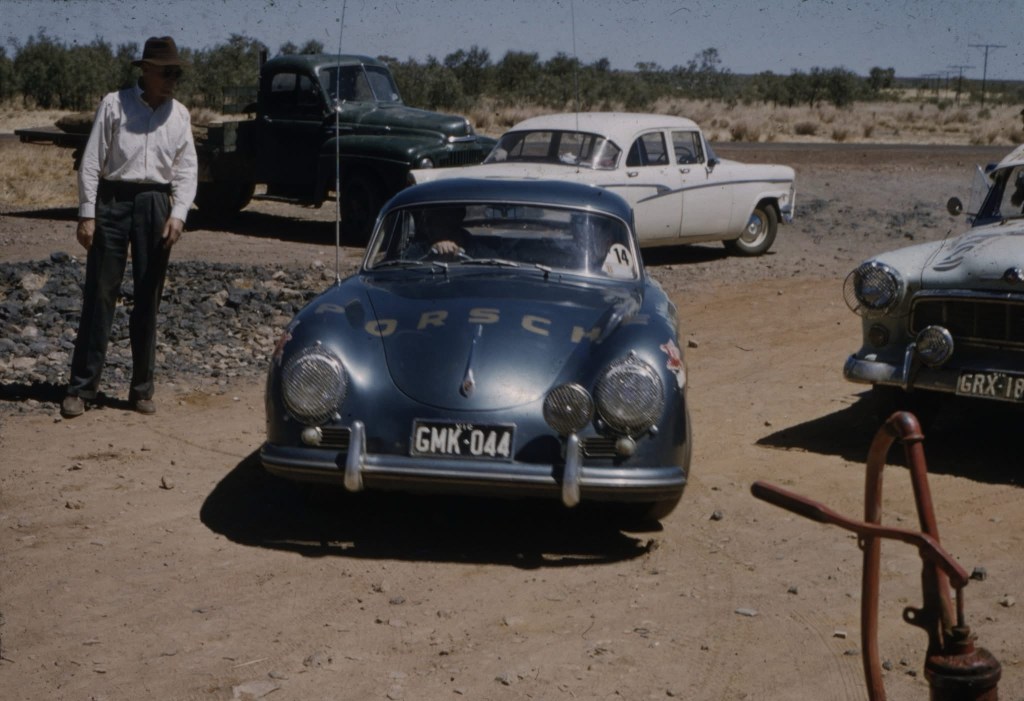
The Max Winkless/Jan Woelders Porsche 356A 1600 during the August 21-September 8, 1957 Mobilgas Round Australia Trial.
The winners were Laurie Whitehead and Kevin Young in a VW Beetle 1200 ahead of five other Beetles!
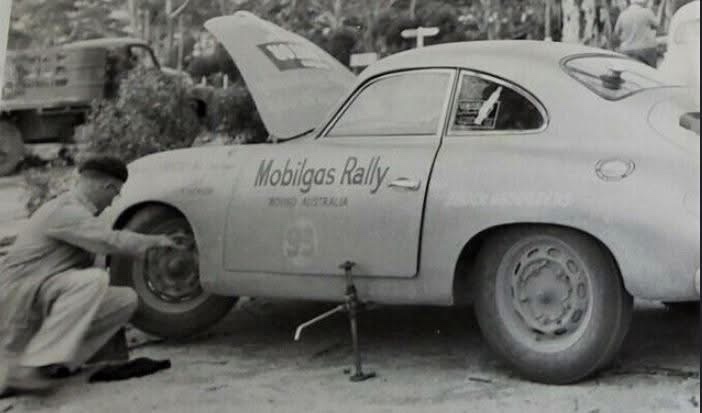
The other ‘Porsche Cars Australia’ 356s were driven by Tom Jackson/David McKay (1500) 27th – above with Jackson working on his car – and the boss, Norman Hamilton (356A), the other cars of Hamilton and Winkless/Woelders were DNFs.
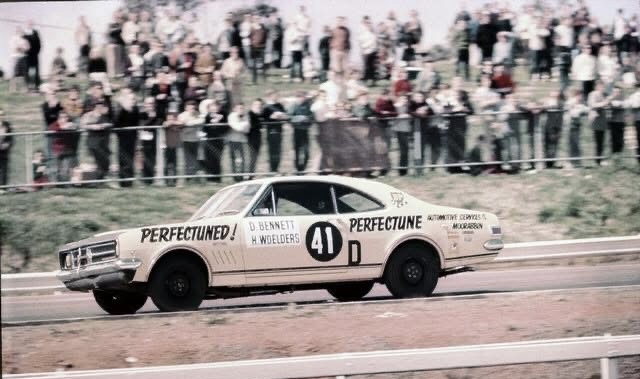
I guess 1971 Australian F2 Championship, Henk Woelders was Jan’s son? Henk is ahead of an Elfin 600 1.6 Lotus-Ford F2 pack at Calder: he, John Walker and Clive Millis, the black and yellow interloper is Peter Larner’s Rennmax.
(S Johnson)
And below Henk sharing an HK Holden Monaro GTS327 with Dyno Dave Bennett during the 1968 Sandown 3 Hour enduro, DNF, the race was won by the Tony Roberts/Bob Watson GTS327. More about Henk here:https://primotipo.com/2018/12/30/henk-woelders/
Unusual colour shot of Don O’Sullivan in his Matich SR3 Repco 720 4.4 V8 during 1969.
The Perth-based racer did quite a few East Coast meetings in 1969, finishing second in the 1969 Australian Sports Car Championship behind Frank Matich’s dominant Matich SR4 Repco 760 4.8 V8. His mechanic/engineer/driver and lifelong friend, Jaime Gard, was based in the Matich workshops that year to prepare the car and lend a highly skilled hand with FM’s cars, too, on occasion
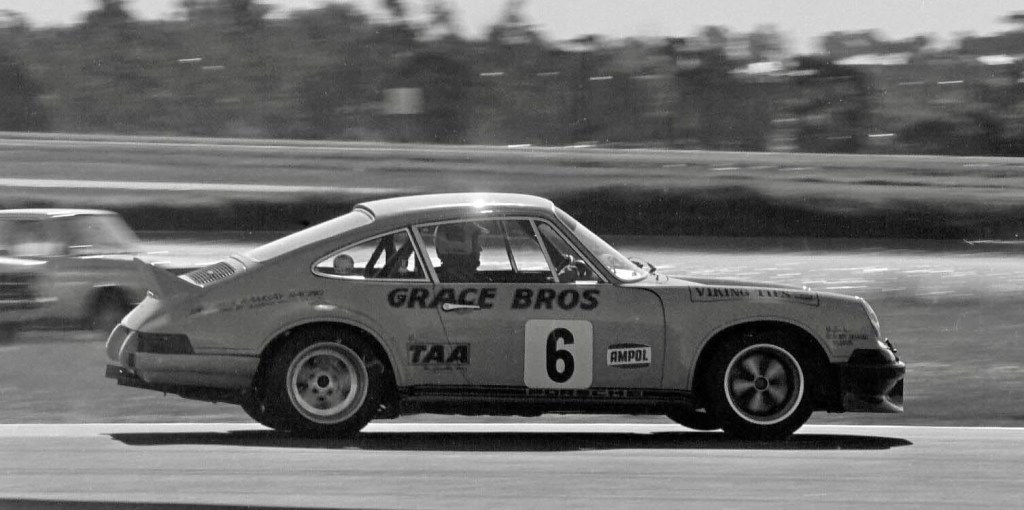
Lynton Hemer catches the sun and beautiful lines of Bill Brown’s new Porsche Carrera RS at Warwick Farm on May 6, 1973. The inside front is just clearing the deck.
Meanwhile, Scuderia Veloce’s Bob Atkin was in the pits and took this shot of one of the races on the same day on the grid: Brian Foley in his Alfa Lightweight- the ex-Mildren-French GTA after further ‘Project 9’ surgery by John Joyce’s Bowin Cars team over the summer of 1972-73, Brown, Carrera RS, Bob Steven’s Mustang and another Grace Bros 911S, one of the Geoghegans I guess.
(B Atkin)
Scratch-men Frank Kleinig, Kleinig Hudson Spl, and John Crouch, Delahaye 135, start the handicap New South Wales Grand Prix, Mount Panorama, Bathurst October 1946.
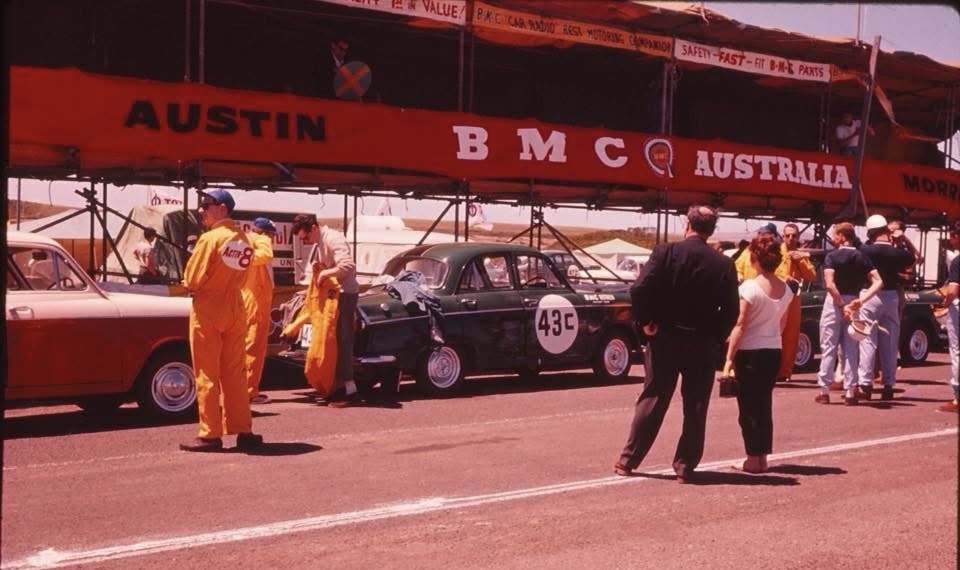
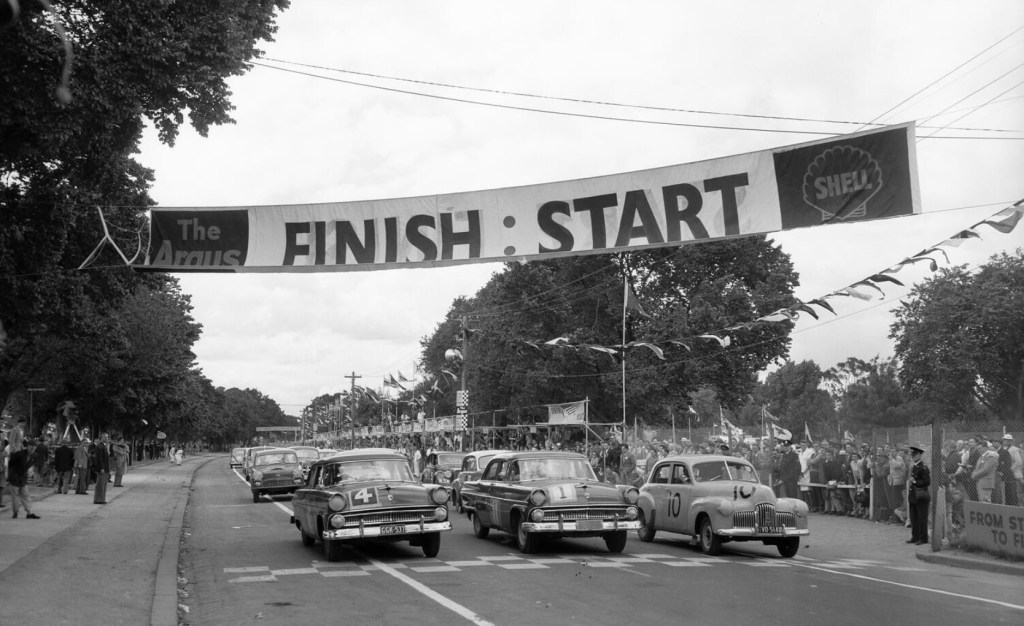
Rare feel the vibe colour shots of the first Armstrong 500 at Phillip Island over the November 20 1960 weekend; the Bathurst 1000 started right here, of course, folks.
Car 43C below, amongst the ‘BRM mechanics’, is a works Morris Major driven by Rod Murphy and John Callaway. Activ-8 was a local oil company, Golden Fleece’s brand at the time. HC Sleigh Ltd sold Golden Fleece to Caltex in 1981.
(J Devine)(J Cronin)
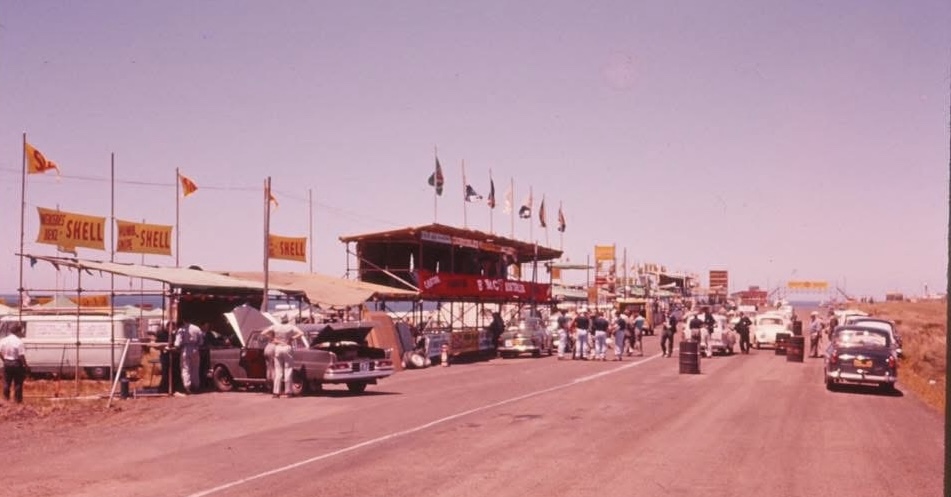
You can just see a glimpse of Bass Straight below the distant Shell banner in this Main Straightaway – I’m channelling Mike Raymond – photograph. The Mercedes 220SE was crewed by the Youl brothers, Gavin and John, DNF.
(C Munday)
A couple of Garrie Cooper shots at Wanneroo Park, Western Australia.
The first shows him #5 on the grid of the WA Road Racing Championship on May 3, 1970, aboard his Elfin 600D Repco 830 2.5 V8 alongside fellow South Aussie John Walker’s Elfin 600B Lotus Ford 1.6 with Craig McAllister, Macon Ford 1.6 on the left. Cooper won from Walker with Bob Ilich’s Brabham BT21B Cosworth SCB third. See a piece about this race and Cooper’s car here:https://primotipo.com/2018/03/06/garrie-cooper-elfin-600d-repco-v8/
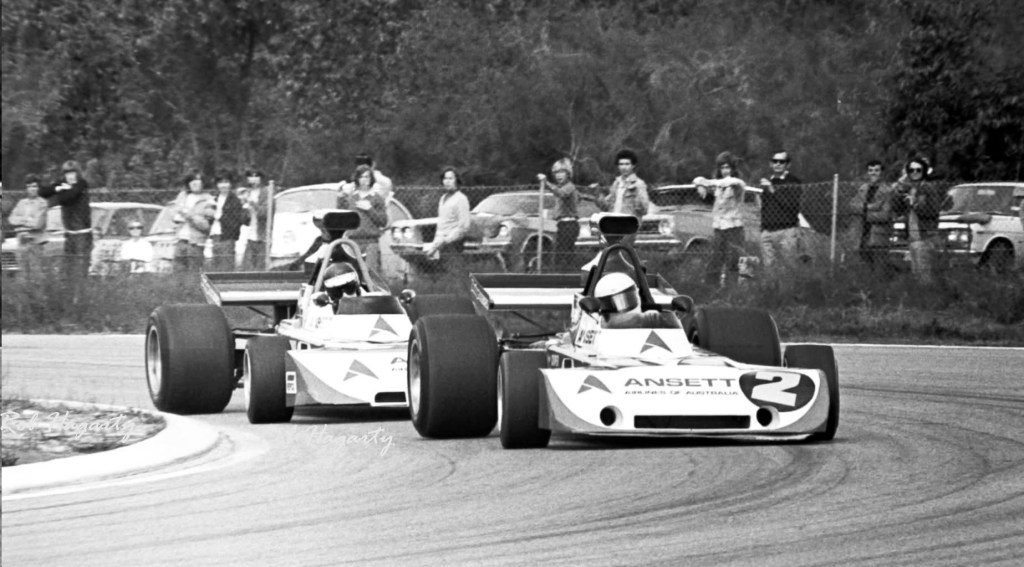
The one below is of Ansett Team Elfin: Garrie Cooper and John McCormack’s Elfin MR5 Repco-Holden F5000s at the Wanneroo Indian Pacific Plate meeting on August 12, 1973.
Cooper took out the three heat event overall with two wins to McCormack’s one Mac fastest of the day however a new lap record of 56.8 sec during the final 20 lapper.
(R Hagarty)
Credits…
John Lemm, Bill Forsyth Collection, Martin Kass, Bob Atkin, Ken Devine, John Cronin, Peter Cartwright, Mark Goldsworthy Collection via Bob Williamson, Sandy Fernanace, Chris Munday, Rob Hagarty, Stewart Johnson, Stephen Stockdale, Gordon Mitchell Collection
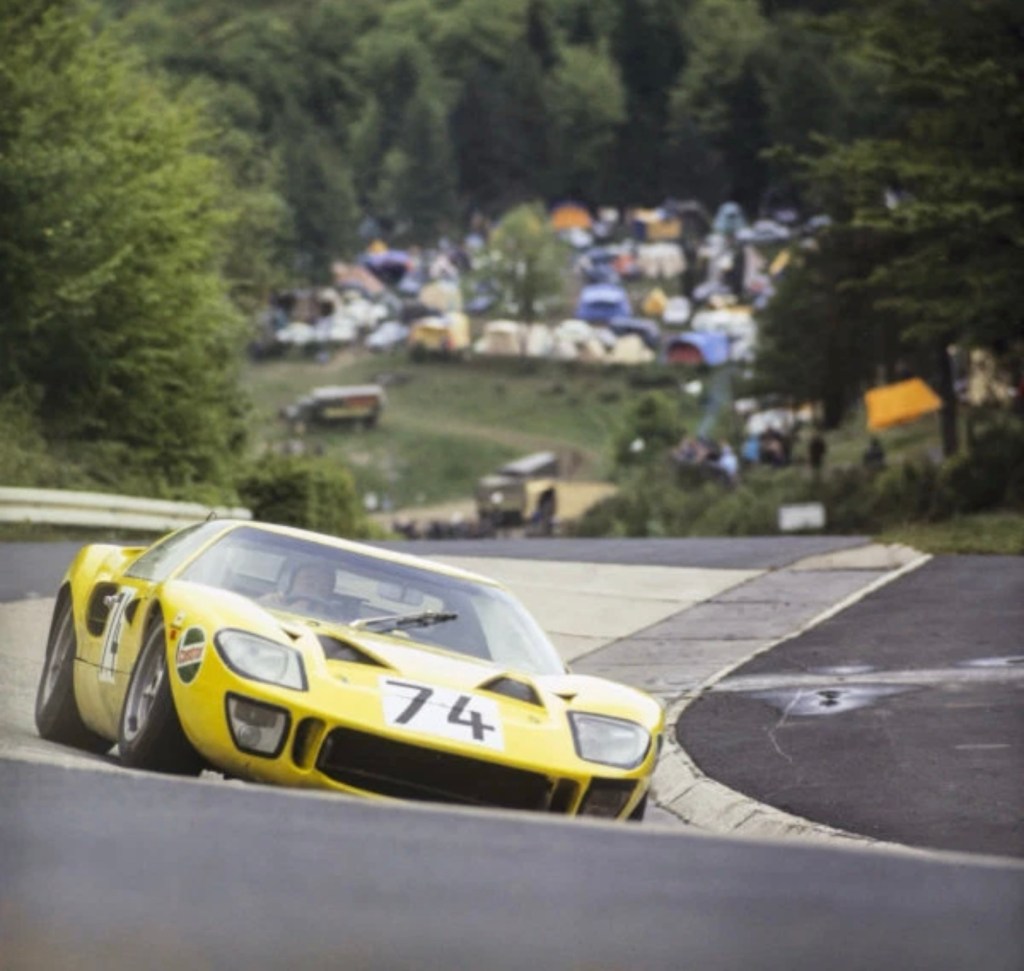
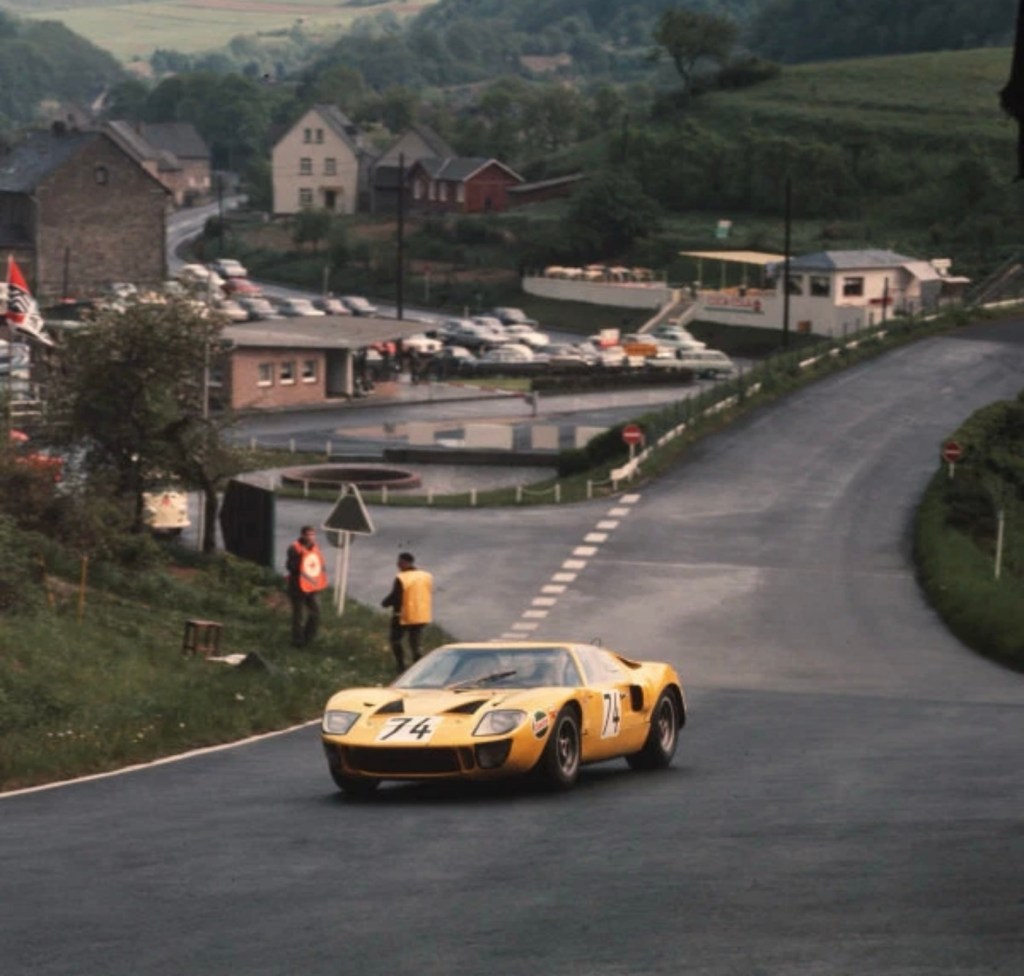
The John Reaburn/Nicholas Granville-Smith Ford GT40 during the 1968 Nurburgring 1000 km.
Melbourne-born John Reaburn – 20/10/1936-26/11/2016 – raced sports cars briefly in Europe in the mid-1960s before retiring at the ripe old age of 32 at the end of ’68.
He inherited the bug from his father Wal who raced a Humpy Holden and operated WJ Reaburn Auto Electrical Engineers Pty. Ltd. from 891-893 High Street, Armadale, Melbourne.
Reaburn’s Holden FJ at the Geelong Speed Trials date unknown (R Simmonds Archive)A brace of Buchanans. John Reaburn chases Wally Mitchell at Phillip Island, date unknown
John raced the Holden and then made his name with consistent winning pace in a potent Buchanan Holden from April 1960 to July 1961. Into the mix were drives in Jaywood Motors, Appendix J Holden Humpy, and FC.
He competed in the 1960-64 Armstrong 500 at Phillip Island and Bathurst, sharing a Singer Gazelle with Harry Firth in 1960, and then Firth’s works Ford Cortina GT, Zephyr MkIII and Falcon. He also raced a FoMoCo Cortina GT in the first Sandown enduro, the 1964 6-Hour International, with Geoff Russell finishing a rousing third outright..
Reaburn in the Ford Falcon XP he shared with Harry Firth during the April 1965 Ford 70000 Mile Durability Run at the FoMoCo You Yangs proving ground (Ford)Firth/Reaburn works-Cortina GT during the April 1964 Lowood 4 Hour, winning their class and ‘outright’
He took on the big-car challenge in 1965, finishing fifth in the one-race Australian Touring Car Championship at Sandown won by Norm Beechey’s Ford Mustang. Raeburn’s mount was the 7-litre Ford Galaxie left in Australia after the ’64 Sandown International by Sir Gawaine Baillie.
Reaburn jumped on a ship for Europe with the intention of racing the car in the UK, but Baillie had sold it before he got there. Brian Muir was third in that Sandown ATCC in his Holden EH S4; he too was soon heading off to the UK, very successfully so.
Reaburn, perhaps, in the Baillie Galaxie at Warwick Farm in 1965 (P Reynell)
Undeterred, Reaburn started working for Graham Warner’s Chequered Flag Motors in 1966, driving their Shelby Cobra in the Zeltweg 500 km (DNF oil leak) that September. He was in the best of company, sharing the grid with GP drivers Jochen Rindt, Jo Siffert, Mike Spence, Innes Ireland, Mike Parkes, David Hobbs and Bob Bondurant.
Nick Brittan wrote about Reaburn in Motoring News during 1966, ‘Raeburn Shines in Driving Test. I don’t seem to be able to get through a month in this column without making some comment about a new Australian driver. In fact I’ve been accused of running an Antipodean news sheet.’
Johnny Reaburn is the latest of the “gday there mate” brigade that are invading our shores. Johnny, a massive, lantern-jawed Melburnian, ran Holdens and FoMoCo cars back home.
JR in the Zeltweg pits in 1966. Bob Bondurant raced the other Chequered Flag Cobra, DNF engine. And yes, like me, the signwriter struggled with the spelling of JR’s name (JR Archive)JR during the September 1966 Zeltweg 500km DNF oil leak in the Chequered Flag Shelby Cobra. Race won by the works Porsche 906 crewed by Gerhard Mitter and Hans Hermann (Zdjecie)
‘Bathurst class successes, three Lowood 4 hour races on the trot, second in the Sandown 6 hour, plus numerous other solid performances, are grounds for giving the bloke a trial.’
‘What shook everybody up last week was his performance at the passout at Brands with the Motor Racing Stables outfit in front of a big crowd of journalists and enthusiasts. Eight lessons in a Formula Ford with the passout in an F3 in the reverse direction on the Club circuit, Johnny equalled the time set by professional driver and instructor Tony Lanfranchi on his fourth lap.’
‘He improved his time by a full seven-tenths of a second on the remaining six laps. Tony then jumped back in the car, but it took him twelve laps to equal the time Johnny had set. He should be deported or given a drive, as this was his first time in open wheelers.’
He raced Mike de Udy’s Porsche 906 with Roy Pike in the Reims 12 Hours in 1967 (DNF), and took part in several 1968 World Sportscar Championship rounds. His car was a yellow Ford GT40, chassis #1001, owned by Andy Cox, ‘who had won money on the football pools and bought himself a GT40,’ wrote Doug Nye.
Reaburn’s driving partners were Nicholas Granville-Smith and another Australian tyro who did a stint at The Chequered Flag, Tim Schenken.
Monza 1000km grid April, 1968 (JR Archive)Nurburgring 1000km April 1968, on the way to 21st place (LAT)
At the Monza 1000 km in April he shared the car with Schenken, DNF engine. At the Nürburgring on May 19, he and Granville-Smith were 21st in the 1000 km.
At Spa-Francorchamps, the week after the Nurburgring, back with Tim, John had a major off on the first lap of the 1000 km enduro.
Doug Nye was there reporting the event for Motoring News and wrote on The Nostalgia Forum, ‘It absolutely widdled with rain and early in the race John dropped the car in the pack on the right hand kink coming down the hill from La Source, past the pits. The GT40 spun round and round and round in a ball of spray and only near the bottom of the hill – entering Eau Rouge – did it finally slither off onto the grass and subside into a ditch on the left side of the track. It was very spectacular, with phenomenal avoidances all round. Pity, he’d been driving it pretty well until then.’
Nurburgring, JR ahead of the second place works Porsche 907 of Hermann/Attwood (LAT)Raeburn with Brigitte Bardot (JR Archive)
Reaburn reported his exploits back home via Racing Car News. Amongst the unreported good times of high performance off the track was a week-long dalliance with Brigitte Bardot that was memorable enough for her to purchase him a Rolex watch inscribed, ‘To Johnny, Love BB’. ‘True story’ confirms Greg Smith, who had a lot to do with Reaburn in the modern historic era, ‘I’ve seen the watch.’
‘Don’t forget that he was instrumental in getting the David Price-written Joan Richmond book published (Joan Richmond: The Remarkable Previously Untold Story),’ chipped in Bob King.
Reaburn tested an F3 car at Brands Hatch in 1966, matching class front-runner Tony Lanfranchi’s times, and a works F2 Lotus 48 Ford FVA at Hethel in 1967, but, being a tall unit, decided to concentrate on sports car racing.
He quit racing at the end of 1968, aged 32. In recent years John lived in retirement with his wife in Mooroolbark, Victoria. He died of a stroke on Saturday, 26 November 2016, aged 80.
Etcetera…
A Truish Story from 1965 by Clark Watson.
‘Young John Reaburn, south-eastern suburbs of Melbourne, six-foot-five in his socks, had come to England on the back of a Bathurst class win with Harry Firth. Europe didn’t care. Single-seater cockpits were built for midgets, so John ended up on the showroom floor of Chequered Flag Motorsport in Savile Row, selling Elans and the odd Ferrari while demonstrating Colin Chapman’s ultra-rare analogue driving simulator — one of only two ever made.’
‘One day, a Scottish Lord named Andy walked in — heir to half the Highlands, banned from racing by his mother until he produced heirs of his own. Instead, he spent the family’s millions running sports-car teams and collecting rogues like McLaren, Amon, Rindt, Surtees, and Bondurant. He took one look at the giant Australian and decided he liked him. Soon, John was testing for Andy’s private outfit and sharing a flat in Clapham with Bruce McLaren and Chris Amon.’
‘What happened in that flat stayed in that flat — except one story that finally slipped out. One winter evening, Andy dropped John home after a test day and said only, “Midnight. Sofa. Helmet. I’ll pick you up.” Over dinner, Bruce and Chris just sniggered. When John reached for the wine, they pushed water at him and told him to sleep. Just after midnight, a rattly old lorry reversed down the lane. Andy was directing mechanics who whipped a sheet off the load to reveal a gleaming silver Shelby Daytona Cobra, already thudding and rocking on its springs. Andy climbed into the passenger seat. “You drive.” They ghosted through sleeping London, turned right into Hyde Park itself — gates closed, lights out — pure madness.’
‘Fifty metres from disaster, the park blazed into light and the gates swung wide. Men in bowlers closed them again behind the Cobra. Andy grinned. “Foot flat, Johnno. The gates always open if you’re quick enough.”
‘The Midnight Stakes – the exact course. Horse Guards Parade → up the Mall → full slide around the Victoria Memorial (“the cake top”) → hard left into Hyde Park along South Carriage Drive → blast out at Marble Arch → down Park Lane → left into Constitution Hill → long, long opposite-lock slide back into Horse Guards Parade forecourt. Roughly 2.9 miles door-to-door. They did a slow reconnaissance lap first, just to let the oil warm and the tyres scrub in. Then they lined up again on the gravel.Top hats, tails, cigars, brandy, chalkboards, bowls of £100 notes. Tradition since the Napoleonic Wars on horseback, motorised by the Bentley Boys in 1929. Tonight it was John’s turn.’
‘Andy smacked the quarter panel. “Helmet on. The clock starts the moment you leave the forecourt. Don’t lift for the park — the gates will open.” John tightened the belts until they bit, clicked first, and dropped the hammer. Out of Horse Guards flat in second up the Mall, braked as late as he dared for the right into the park — 150 mph showing — then flat again. Lights flared, gates flew open, the Cobra thundered through the empty park like a silver bullet. Hard left at Marble Arch, 152 mph down Park Lane, police Pandas with blues twinkling, blocking every side street. One huge four-wheel drift around the Victoria Memorial — two perfect black doughnuts for the tourists to puzzle over next morning — then flat out down Constitution Hill and a long opposite-lock slide back into Horse Guards 1 minute 58.4 seconds dead.’
‘New outright record. John was dragged from the ticking Cobra, bundled into a waiting black cab and whisked home while the toffs threw top hats in the air and settled their bets. The record stood exactly thirteen nights. Then Chris Amon took the same 2.9-mile loop in a full Le Mans-spec GT40, big Ford V8 spitting blue flame, touching 198 mph past the Dorchester, and stopped the clocks at 1 minute 47 seconds flat. That night, the birds left every tree in Hyde Park in one black cloud, and half the palace windows rattled in their frames.’
‘The next morning, a humourless new Assistant Commissioner killed the game stone dead. The Cobra disappeared onto a ferry for Ireland before lunch, the chalkboard vanished, and the Horse Guards Midnight Stakes were declared finished “for the duration”.
‘Or so they say. Because if you’re ever in central London on a moonless night and you hear a big American V8 or a Le Mans Ford bark just once after the clocks strike twelve, sending the birds flying from the trees……you’ll know the gates are still opening for someone.’
Reaburn in the Buchanan Holden at Rob Roy, date unknown (L Sims Archive)AMS September 1960 (G Edney Collection)(JR Archive)
Outside Rootes HQ in Melbourne (?) 1960 with Harry Firth. Seventh in Class C 1960 Armstrong 500 at Phillip Island, up front of the class was the Geoff Russell/David Anderson/Tony Luxton Peugeot 403.
(JR Archive)
The word according to Harry…’Now listen here cock, just do this, this, and that, and we’ll win the class’, date and place unknown, yes, Harry is leaning on a Cortina.
(B Wells)
Bathurst 500 1964, the Bill Buckle/Brian Foley Citroen inside the Firth/Reaburn FoMoCo Cortina GT. Third in Class D and Class C respectively.
Zeltweg 500km grid on September 11, 1966. Johannes Ortner, Abarth 1300 GT, John Reaburn, Shelby Cobra and David Hobbs in Bernard White’s Ferrari 250LM.
(JR Archive)
In the Monza pits during the 1968 1000km weekend, that’s Tim Schenken in the sunglasses awaiting his turn at the wheel.
Schenken was a prudent co-driver choice, being the man on every team manager’s list. That year, he won the British Formula Ford Championship, Merlyn Mk11, the BRSCC-MCD British F3 Championship, Chevron B9 Ford/Brabham BT21X Ford/Brabham BT28 Ford and the Grovewood Award. Not bad…
Credits…
John Reaburn Archive via Greg Smith, Ebay, LAT, Ron Simmonds Archive, Leon Sims Archive, Peter Reynell, Brier Thomas, Graham Edney Collection, Bruce Wells, Ford Motor Company, Zdjecie on Historia jakiej nie znacie, David Lowe photo via Tony Johns’ archive
Sun-Herald cartoonist Mark Knight captured it rather nicely I thought?
Canadian-born Australian touring car racer – one of our legends – Allan George Moffat died last week after suffering from Alzheimer’s Disease for the last few years. November 10, 1939-November 22, 2025. Rest In Peace.
(R Hobman)
Moffat and Peter Brock after winning the January 1986 Wellington 500 in a 5-litre Holden Commodore VK.
With so many photographs popping up in the media since his death, it seemed a good idea to filch a few and add some more as a tribute to a man who provided so much fizz and sparkle to our scene on every level for so long. Google away for the statistical stuff.
(autopics.com)
On the grass at Sandown after one of his many wins at his home track, in the 1970 Sandown 250 enduro – the traditional Bathurst curtain-raiser – works XW Ford Falcon GTHO Phase 2.
His family settled in Melbourne from Canada – his Dad was a Massey Ferguson exec – and I guess the Melbourne die was cast when he arrived back permanently with the Kar-Kraft Mustang Trans-Am in 1969. Ford Australia have always been Melbourne-based based and he needed to be close to the action, so Melbourne it was, Toorak specifically.
Booting his XY GTHO Phase 3 out of Dandy Road at Sandown in the Sandown 250 the following year, DNF after only three laps, gotta be a qualifying flyer, AM wouldn’t have fried his Goodyears like this in an endurance race.
(B Nelson)
Barry Nelson and AGM with the ex-Clark Lotus Cortina at Hume Weir during the Boxing Day 1965 meeting
Nelson, ‘There was only one pre-airflow ex-Jim Clark Cortina in Australia, the later car was built in the Toorak workshop by me and Peter Thorn. The tow car is my FJ Holden panel van with hot Grey motor.’
Scrapping with Jim McKeown’s Lotus Cortina for the South Australian Touring Car Championship win in 1966. Clem Smith’s Valiant won the bubbles (P Smeets)(S Elliott)
Steve Elliott has captured the pensive, focused AGM of renown before a race – gotta be his ‘75 NZ Tour? – at Bay Park, New Zealand, aboard the fabulous Trans-Am, one of the most celebrated of all Australian Touring Car combos. I love this shot.
(autopics.com)
Here with the injected 351 borrowed from his Super Falcon at Calder’s Tin Shed corner? And below the distinctive Ford F150 rig that towed the car coast to coast, at Oran Park.
Oran Park, August 9, 1971 (R Jones)New Zealand circa-1972, circuit folks?
The planets were never aligned for Moff and the Boss 302 to take out the Australian Touring Car Championship they deserved, but karma caught up when he and the works-Phase 3 HO won his first of four ATCCs in 1973.
The shot above looks like the November 1972 Surfers 300 Manchamp round with FoMoCo Team Manager Howard Marsden doing his thing from the pit counter at the end of the Series Production Era, they won it. The one below is the Group C HO at Oran Park in June 1973, the happy ATCC year; they won that race too.
(insidesport.com.au)
The Falcon GT351 Hardtops were tougher going without direct factory support, golden ATCC 1977 year duly noted: the ATCC, Bathurst 1000 and Manufacturers Championship was pretty good going by Moff, Colin Bond and colleagues!
Surfers Paradise 300 in 1978 above, XC Cobra 351, and some of the key men in that period below: Peter Molloy, AGM and Mick Webb, missing from the shot (1978?), is Carroll Smith, who team managed the brilliant 1977 effort and was back Stateside by then.
(G Lindley)1977 Bathurst 1000 one-two weekend: Moffat/Ickx and Colin Bond/Alan Hamilton. Ford XC Falcon GS500 Hardtop 351. Carroll Smith with his back to us (speedcafe.com)(I Smith)
Moffat and Jim McKeown at it again, this time a decade later in a pair of sports sedans at Hume Weir in June 1975: the fabulous howling ex-works Ford Capri RS3100 Cosworth 3.4 V6 and the Alan Hamilton/Porsche Cars Australia mid-engined Porsche 911 Turbo that CAMS shortly thereafter legislated out of existence.
(R Cammick)
The Mighty Dekon built Chev Monza 350 at Bay Park, New Zealand, on its way to Australia in late 1975, and below all close up and friendly at Torana Corner, Sandown in 1979.
(R Martin)(BMW)
BMW claim their 1975 Sebring 12-Hour win – Hans Stuck, Brian Redman, Sam Posey, Allan Moffat – with a 3.5-litre 3.0 CSL ‘launched’ the marque into the public’s consciousness in the United States.
(BMW)
It was Moff’s biggest international win too. Over the years he contested many international enduros including Le Mans on several occasions.
The shot below shows him at the wheel of the Dick Barbour Racing Porsche 935 K3 he stared with Bob Garretson and Bobby Rahal at Le Mans in 1980; DNF piston in the 11th hour.
Moffat aboard the Andy Rouse-built, leased Ford Sierra RS500, at Bathurst in 1987, the car retired on lap 31 before AGM had a steer. His co-drivers were Rouse and Thierry Tassin.
Allan’s last serious race was the 1989 Fuji 500, in which he raced his Eggenberger-built RS500 to victory together with Klaus Niedzwiedz. Moffat entered the car #39, his birth year, won the race, then quietly retired from driving. Macau GP Mazda MX5 hit and giggle support race duly noted…
Credits…
Barry Nelson, Russell Hobman, Steve Elliott, autopics, Rob Jones, Glenis Lindley, Peter Smeets, Ian Smith, Ross Cammick, Russell Martin, Allan Moffat Archive, BMW, LAT, Getty, speedcafe.com
Tailpiece…
(Moffat Archive)
In the very best of company at Indy during the Month of May in 1965 with Colin Chapman, Jim Clark, the rest of the boys and the victorious Lotus 38 Ford Indy 4.2 V8.
Leo Geoghegan blasts his ex-Clark Lotus 39 Repco 830 V8 around Warwick Farm, perhaps during the July 12-13 1969 meeting, and the year before, below at Mallala during the 1968 Gold Star weekend.
(unattributed)
Leo won at Mallala from Kevin Bartlett’s Brabham BT23D Alfa Romeo, along side him on the front row and Glyn Scott, Bowin P3 Ford FVA in third.
#3 is Phil West’s Scuderia Veloce Brabham BT23A Repco, alongside him is John Walker’s Elfin Mono, the helmet under KB’s wing is Scott’s, I’m not sure about the fella behind Scott with the black helmet.
Three-wheel angel ride into Creek Corner for Leo at Warwick Farm, date unknown, but the 39 is still in its Climax FPF days. It wasn’t the only time the knock-offs ‘misbehaved’, he had a similar adventure at Longford during the 1968 meeting.
‘Just off to the Farm for the day to watch Darls, see you about 7’.
‘That’s Bob Holden in the ex-Bill Brown GTHO that rolled on lap 1 of the 1969 Bathurst 500,’ responded Alan Gow to this mystery car to me.
‘Bob kept that rego number his whole life (which continues!) and put it on various of his cars.’
(T Cotton)
Warwick Rooklyn, Class B Ralt RT32 VW F3 at Oulton Park during the August 13, 1989 round of the British F3 Championship.
David Giles wrote that ‘when he spun off in the race, Murray Walker referenced his sponsor with a “well the track is as dry as a bone and maybe that’s the problem!” quip!’
The young star yachtsman was a pretty handy racer as well, winning the 1986 Australian Formula Ford Driver to Europe Series in an Elwyn 003/004 from such luminaries as Alan Bisset (no relation), Richard Carter, Mark Poole and David Brabham.
He came across Brabham again in the 1989 British F3 Championship. DB won the August Oulton Park round en route to winning the championship from Allan McNish and Derek Higgins on his inexorable rise through the sport. Rooklyn was second in Class B behind Fernando Plata’s similar RT32.
Rooklyn raced Formula Holdens in the Australian Gold Star Championships in 1991-92, in a Ralt RT21 Holden as above in ’92 and aboard a Shrike NB89H Holden in which he was seventh in the championship.
Warwick had a number of Bathurst starts, his best was finishing 12th outright and third in class in a 2-litre BMW 318i alongside John Blanchard in 1994.
It’s on yachts that Warwick made his mark globally, I can’t give you one article that neatly summarises his career, so Google away as you see fit.
(P Cummins Archive)
B Bira – Birabongse Bhanudej Bhanubandh – during the South Pacific Championship meeting at Gnoo Blas on January 31, 1955, Maserati 4CLT-48 OSCA 4.5-litre V12.
At the outset of Prince 1955 Australasian Tour, his Maserati 250F was tatty but fresh enough to win the New Zealand Grand Prix at Ardmore on January 8 from a classy field that included Peter Whitehead and Tony Gaze’s 3-litre Ferrari 500/625s, Jack Brabham’s 2-litre Cooper T23 Bristol, and Reg Hunt’s 2.5-litre Maserati A6GCM.
But at Gnoo Blas, Orange, three weeks later, the exotic Italian DOHC, straight-six went kaboomba in practice. So Bira wheeled out his second-string OSCA, but it too had fuel feed problems in the first FIA-sanctioned race meeting in Australia, won by Whitehead from Brabham and Gaze.
The Peter Whitehead/Tony Gaze/Alf Barrett Jaguar C-Type led but DNF below after 282 of the winners’ 573 laps.
(M Goldsworthy Collection)
No such thing as too much Frank Matich as you all know…
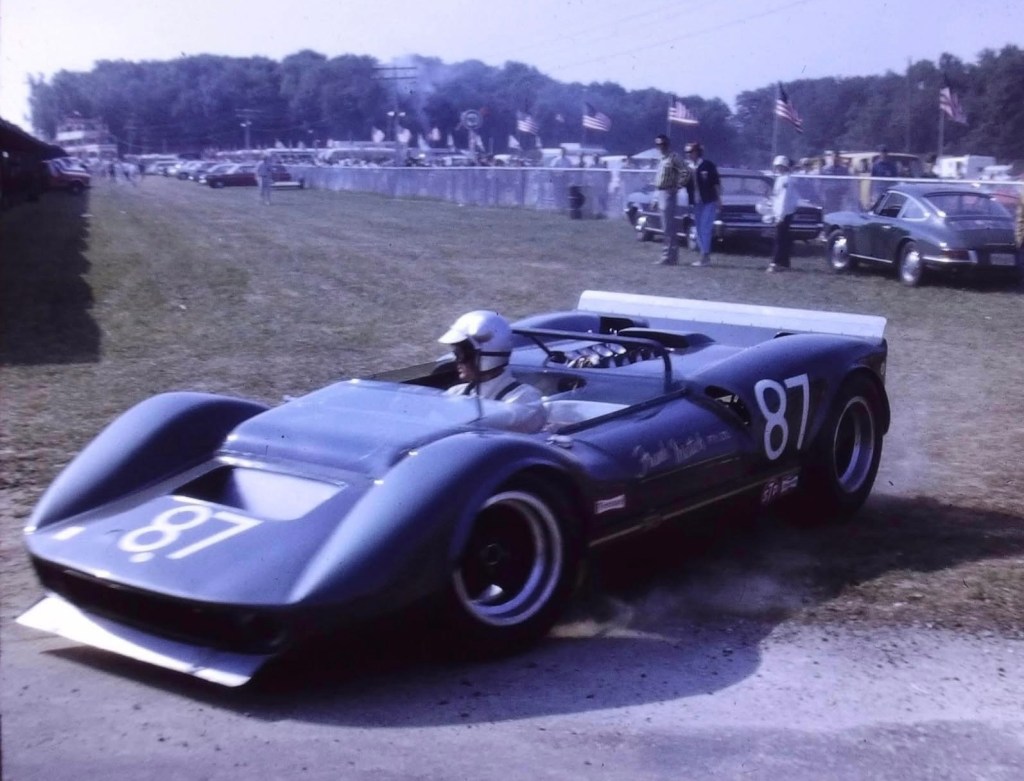
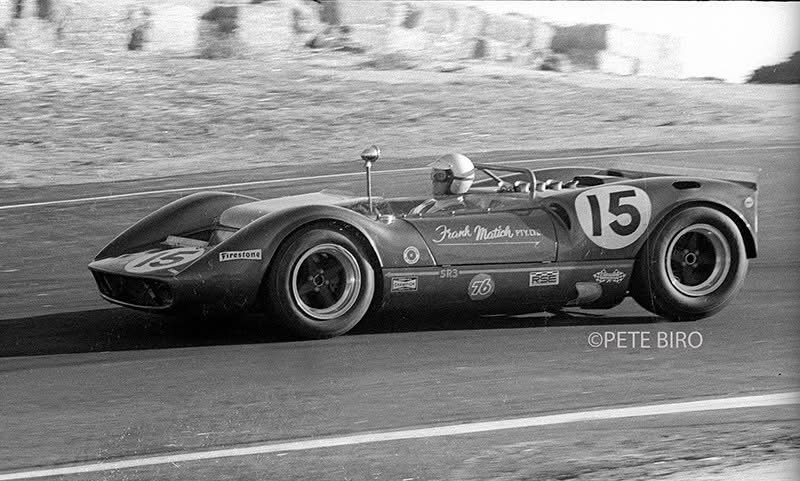
A decade ago there were few photographs of his 1967 Can-Am exploits with two 4.4-litre Repco-Brabham V8 powered SR3s but now there are a few more even if most are paddock shots, Facebook being the distribution medium.
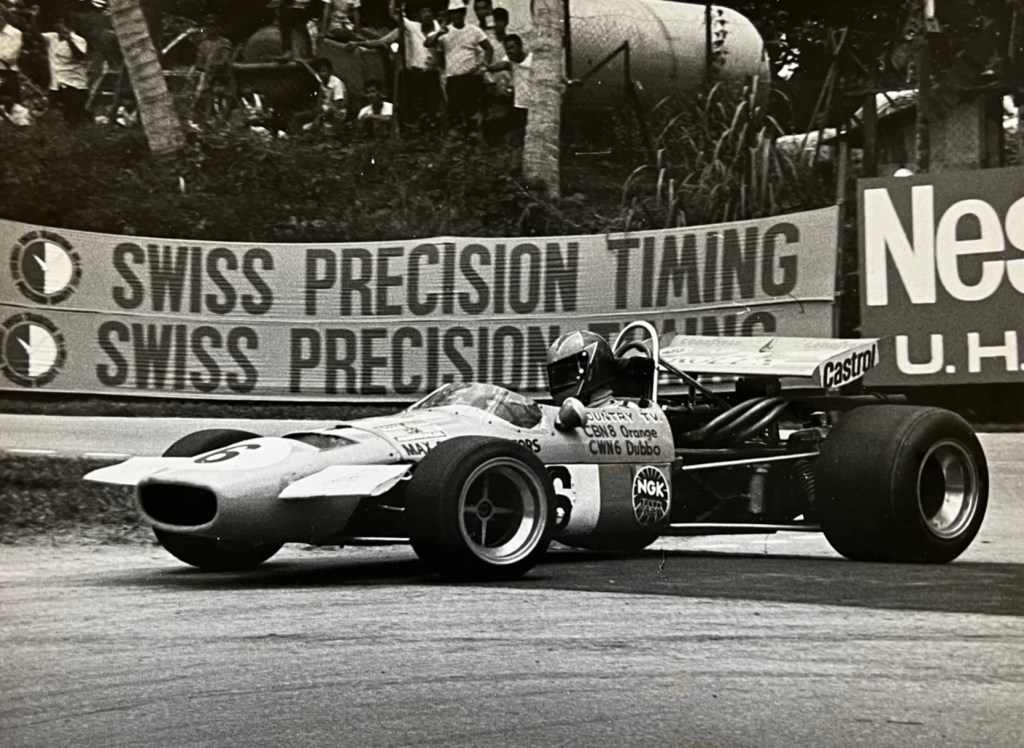
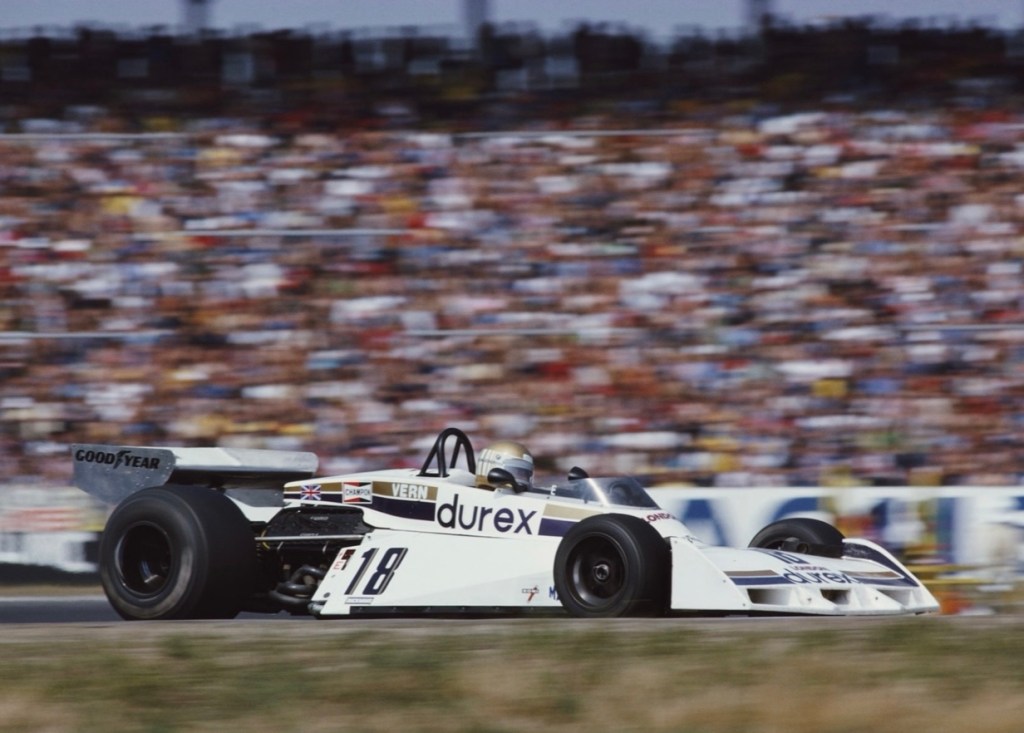
Max Stewart on the way to winning the April 2, 1972 Singapore Grand Prix on the Thomson Road circuit, Mildren Lotus-Ford 1.6 from Vern Schuppan’s March 722 and Bob Muir’s Rennmax BN3, both cars also Lotus-Ford powered.
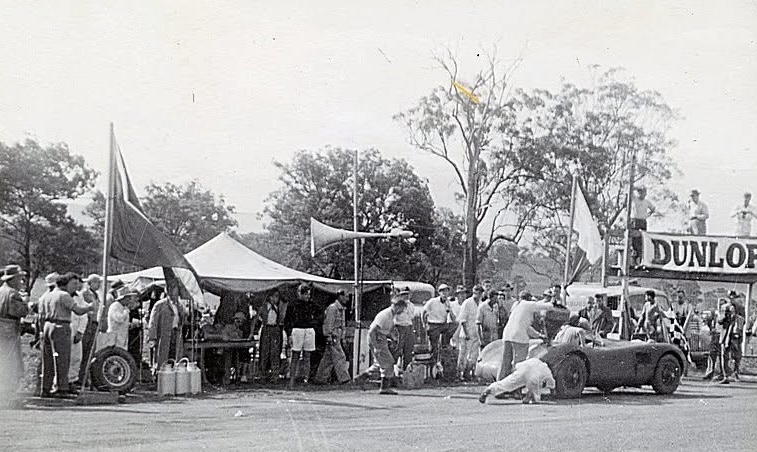
Up top, its Norm Beechey’s and Len Lukey’s Ford Customlines and Jack Myers’? Holden 48-215 at the start of the 8-lap KLG Touring Car Trophy won by Lukey’s Cusso from the similar cars raced by Reg Smith, Doug Whiteford and B Rice. See more on Len here: https://primotipo.com/2019/12/26/len-lukey-australian-gold-star-champion/
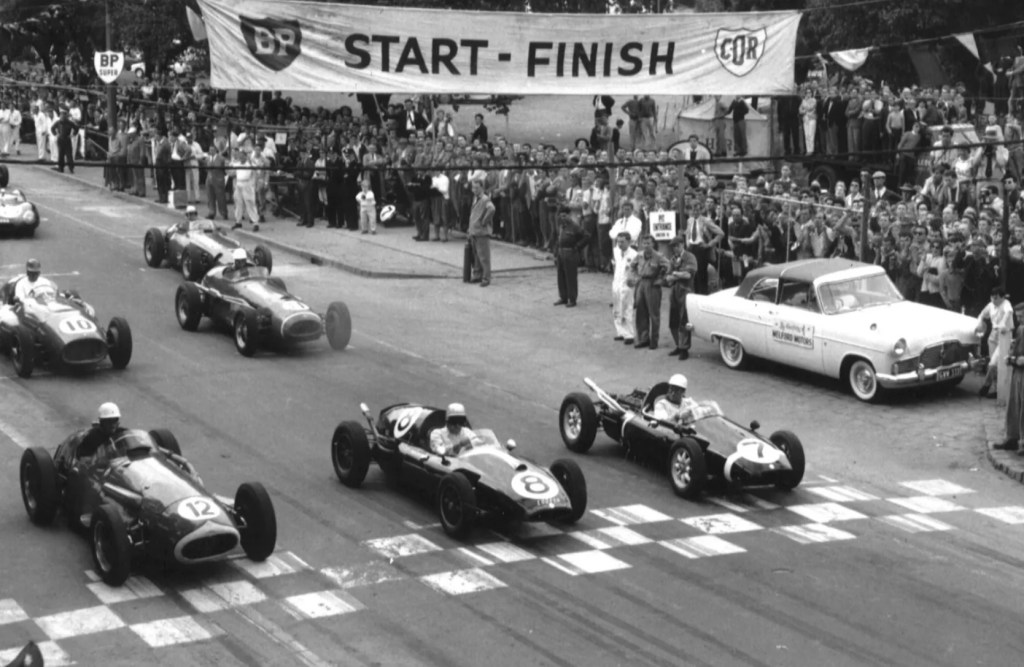
And the shot below shows young Allan Jones with his hand on the Ford watch the start of the 1958 Melbourne Grand Prix won by #7 Stirling Moss’ Cooper T45 FPF from Jack Brabham’s similar car #8.
#12 is Stan Jones’ Maserati 250F (DNF), #10 Tom Clarke’s Ferrari 555 Super Squalo (10th) with Ted Gray’s Tornado 2 Chev V8 (DNF) inside him. See here: https://primotipo.com/2024/01/12/coopers-aloft/
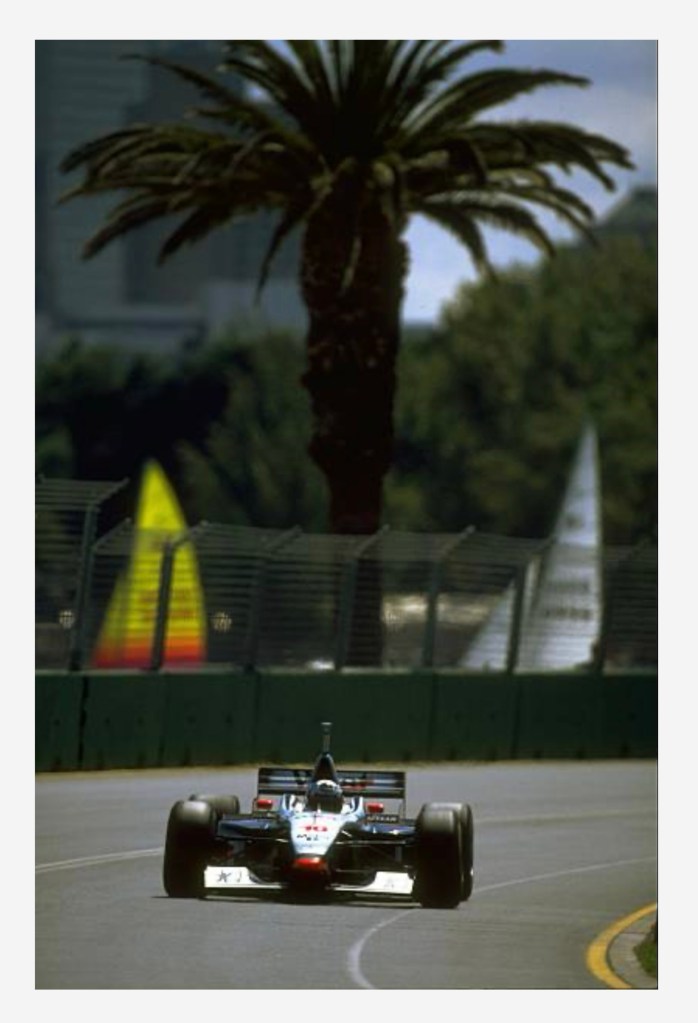
And David Coulthard below in 1997, 40 years on, there is just no comparison, same venue but so different…
(Getty)(T Parkinson Archive)
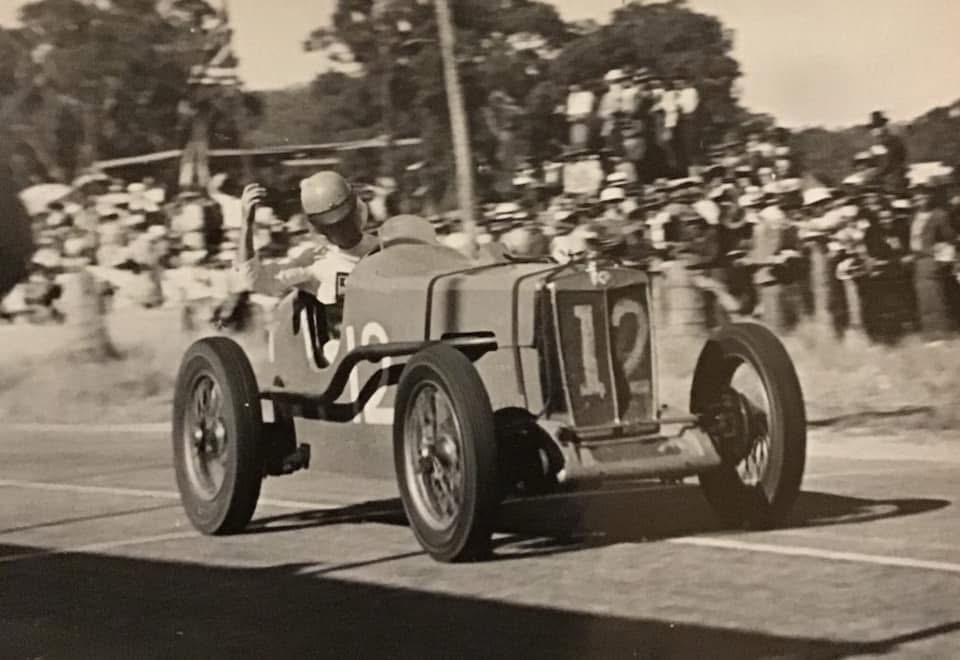
Allan Tomlinson waves to the punters as he takes a sensational victory in the 1939 Australian Grand Prix at fearsome Lobethal aboard his oh-so-carefully prepared and skilfully driven MG TA Spl s/c on January 2. See here for a feature on the race: https://primotipo.com/2020/12/04/tomlinsons-1939-lobethal-australian-grand-prix/
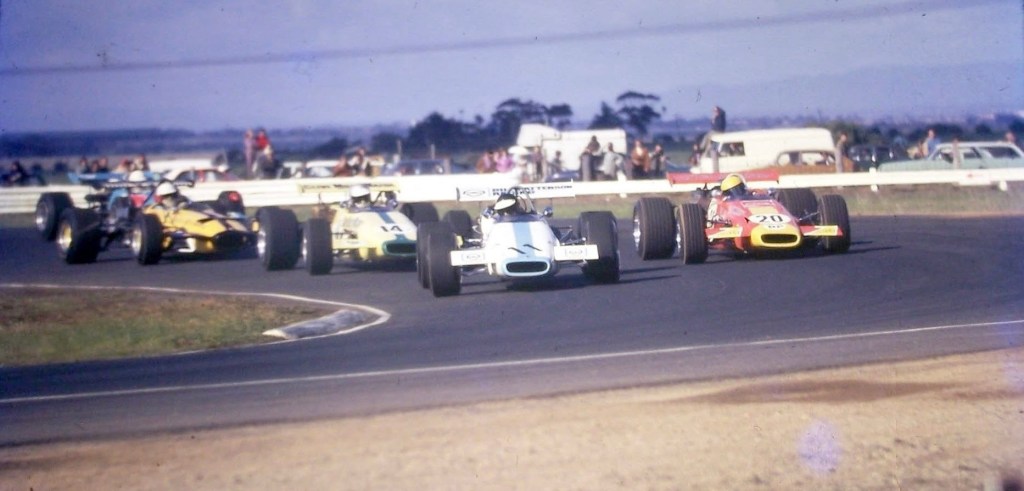
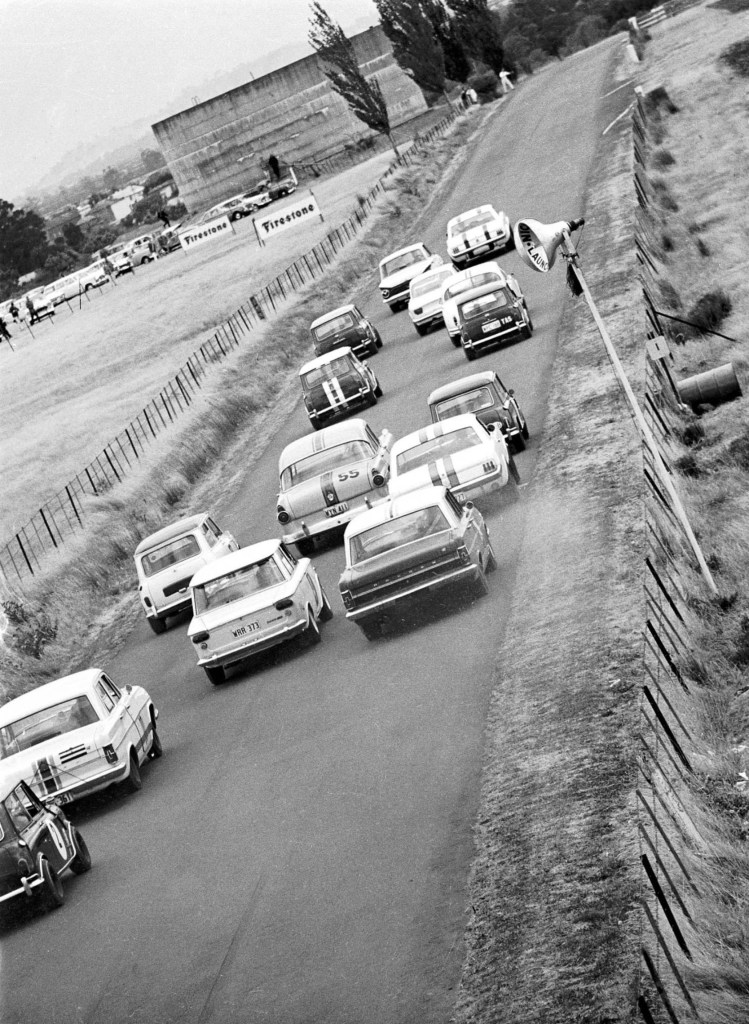
One for the touring car fans, start of a tourer race circa 1967 with Pete Geoghegan’s Mustang up the front together with Robin Bessant’s Lotus Cortina and Frank Gardner’s Alec Mildren Racing Alfa Romeo GTA. The tail of Bruno Carosi’s Jaguar Mk2 is there too.
There have been plenty of Australian Grand Prix winners who have worked on their cars but not to many by 1984…
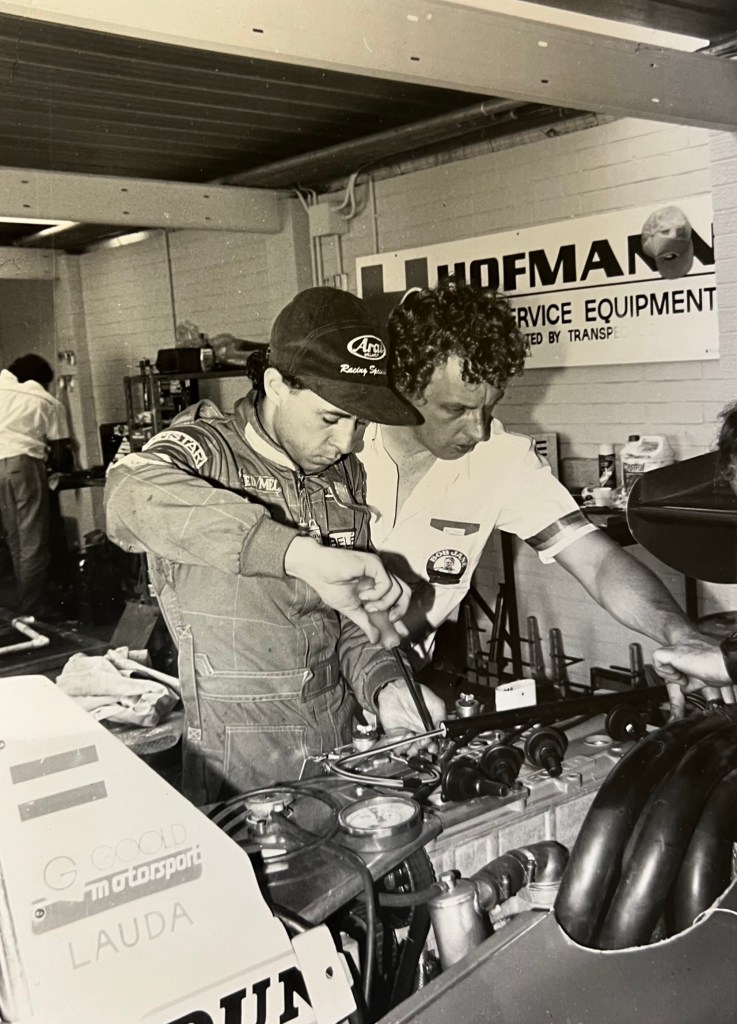
Roberto Moreno giving Harvey Spencer a hand on Niki Lauda’s Goold Motorsport – Greg Siddle – Ralt RT4/85 Ford during practice at Calder over the November 18 weekend. The compression tester is there with diagnostics underway.
Niki was Q18 and DNF collision after 41 of the 100 laps (100 miles), but Roberto had an affinity with the place and took the win from pole in the other Siddle machine; he won there in other RT4s in 1981 and 1983 too.
Lex Davison served a notice of later Australian Grand Prix intent with his impressive handling of his powerful, heavy Mercedes-Benz SSK 38/250 during the 1947 event at Bathurst on October 6.
He was third in the handicap race off 10.5 minutes, behind him is scratch-man, the great Alf Barrett’s Alfa Romeo 8C2300 Monza, who didn’t finish. Lex won the race in 1954-HWM Jaguar, 1957-58 3-litre Ferrarii 500/625 and in 1961 aboard a Cooper T51 Climax. Alf didn’t ever take a derserved win, his had AGP luck mirrored Lex’s great AGP luck!
Bill Murray’s MG TC won from Dick Bland’s Mercury Special and Davo.
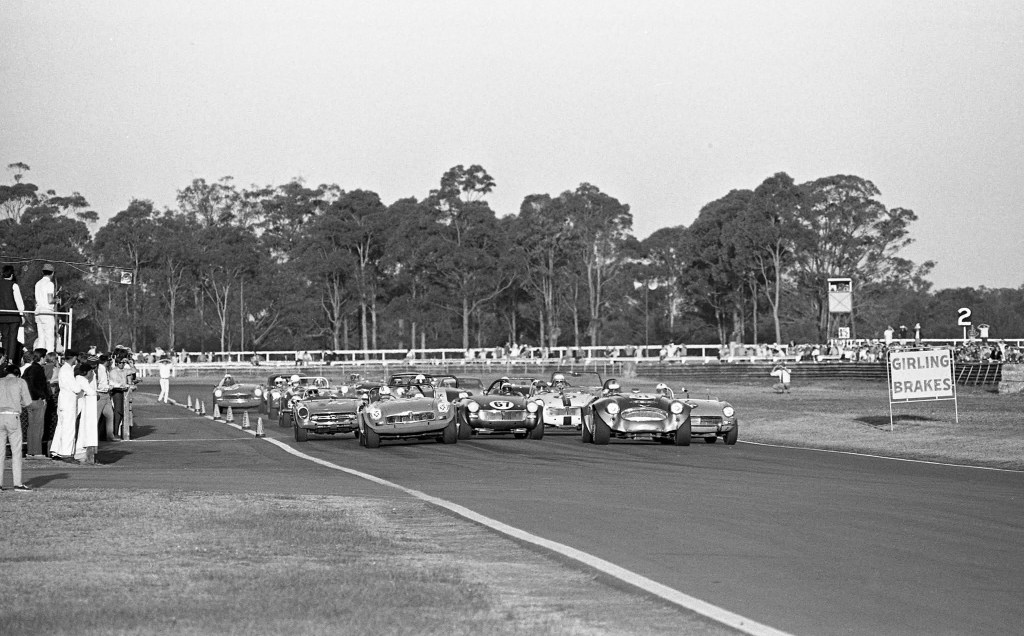
Start of a Warwick Farm marque sports car race circa 1971, date and placegetters folks? And what a grid it is!
From the left is Graham Bland’s Honda S800, Ian Corness’ MGB, Bob Skelton, Austin Healey Sprite, Ross Bond;s usually dominant Austin Healey 3000 and Graeme Lawrie, Triumph Spitfire.
(D Cummimg)
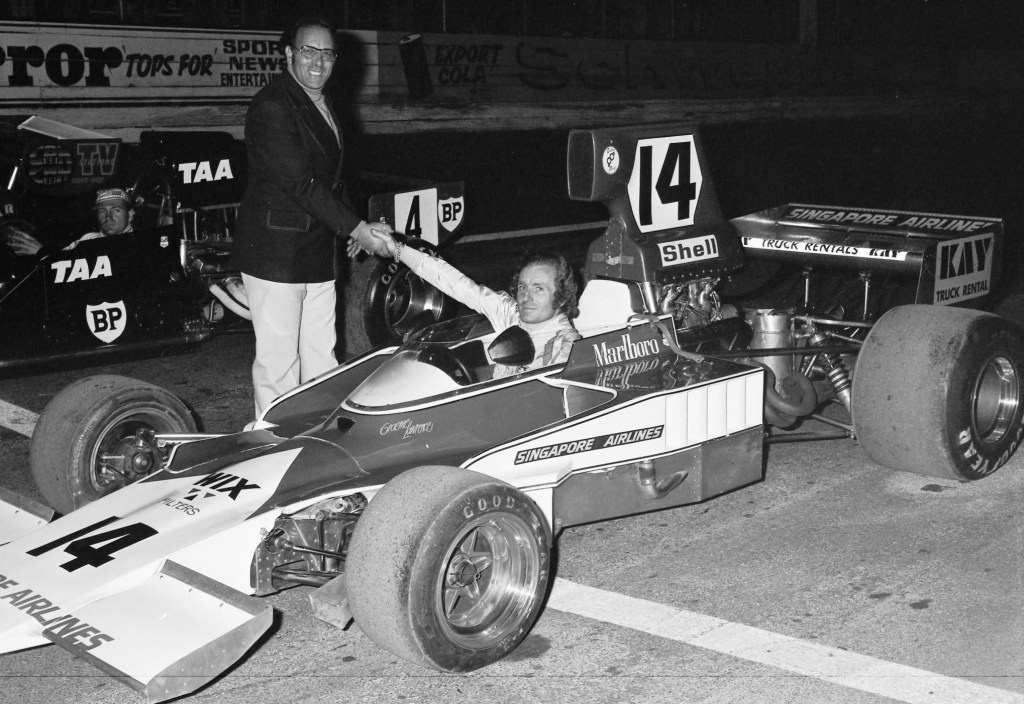
Graeme Lawrence shakes hands with Liverpool Speedway promoter, Frank Oliveri after an F5000 demonstration on the high speed, paved, quarter mile oval circa-1974.
The Kiwi is in his Lola T332 Chev and alongside is Jon Davison’s jet-black Matich A50 Repco-Holden. It must have been spectacular folks, anyone see it?
(West Archive)
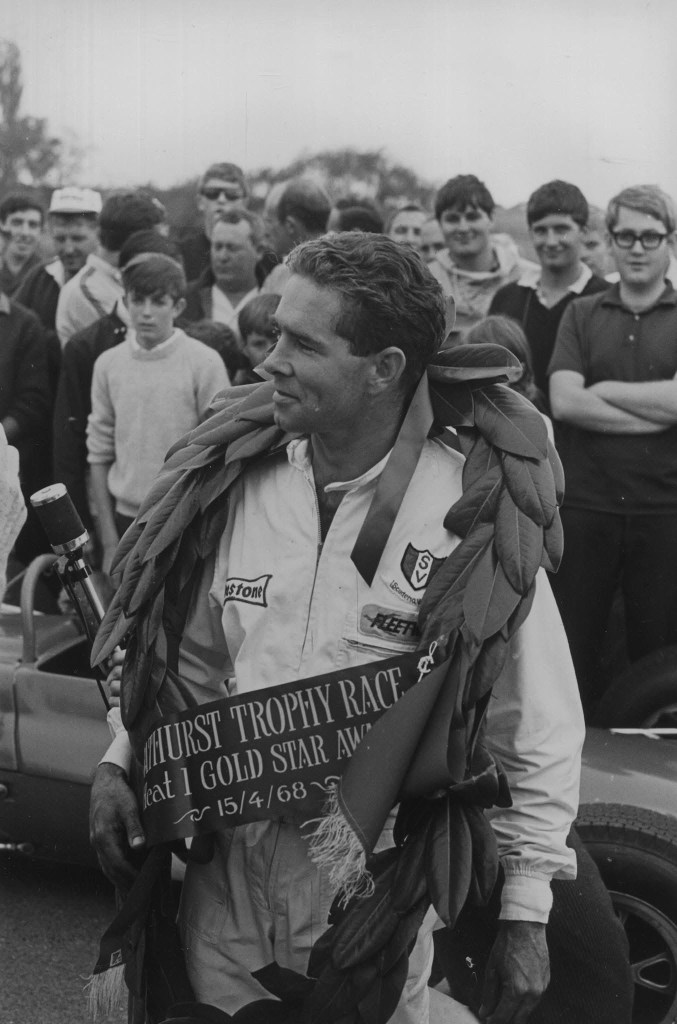
Phil West basks in the admiration of the Mount Panorama crowd after winning the Bathurst round of the Gold Star, Easter 1968.
This rare portrait of Phil was posted by his daughter, Kate Murphey on Bob Williamson’s Old Motor Racing Photographs FB page.
His mount was the Scuderia Veloce Brabham BT23A Repco 740 2.5 V8 vacated not long before by Greg Cusack after his Longford Tasman accident. More on Scuderia Veloce here:https://primotipo.com/2022/03/07/bob-atkin-collection-1/
(P Cross)
Credits…
Ed Holly Archive, Bill Forsyth via Tony Loxley/Full Throttle, Bob Williamson Archive, Pete Biro, Larry Fulhorst, Tony Parkinson Archive, Tim Cotton Collection, MotorSport Images, Mark Goldsworthy Collection via Bob Williamson, oldracephotos.com, David Cumming, Paul Cross, Phil West Archive via Kate Murphey
Tailpiece…
(R Edgerton Collection)
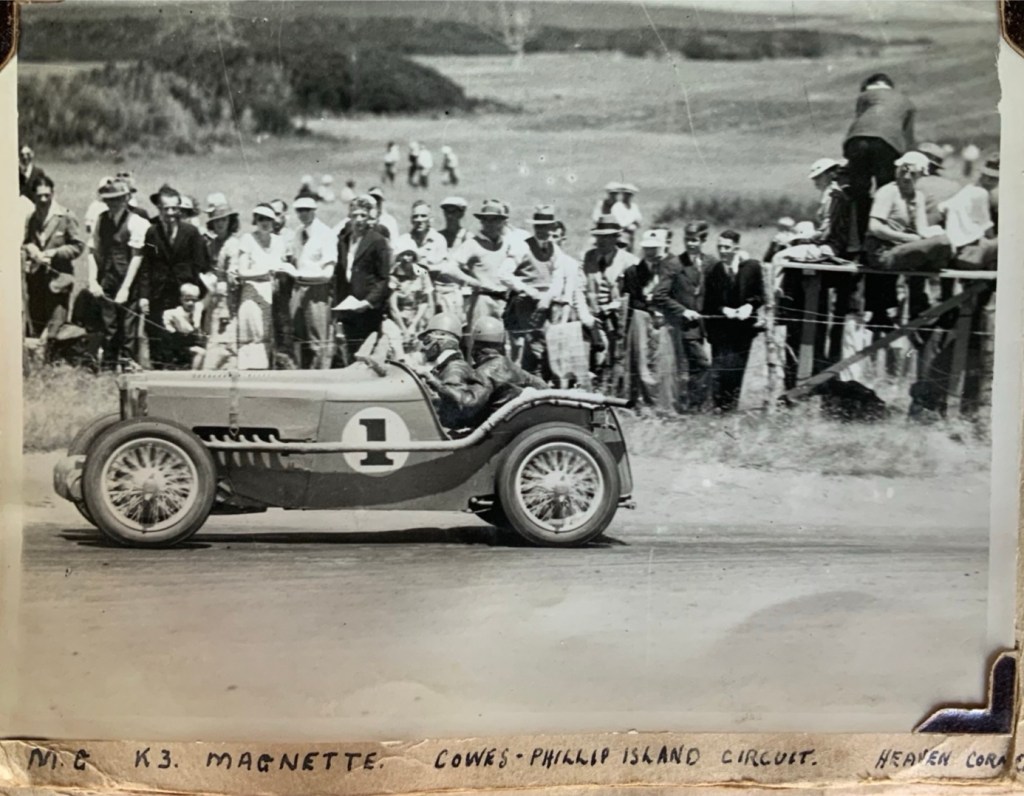
Love this shot of Bill Thompson and Bill Balgarnie’s MG K3 on the hop during the April 1, 1935 Australian Grand Prix, the last held on Phillip Island.
The 200 mile handicap race was organised by the Light Car Club of Australia and as usual to that point was a race for cars of under 2-litres.
Les Murphy’s MG P-Type won by only 27 seconds from Thompson off scratch, Murphy started the race 29 minutes and 27 seconds ahead of him. Thompson did the fastest time and set the fastest lap in a famous drive.

























 primotipo...