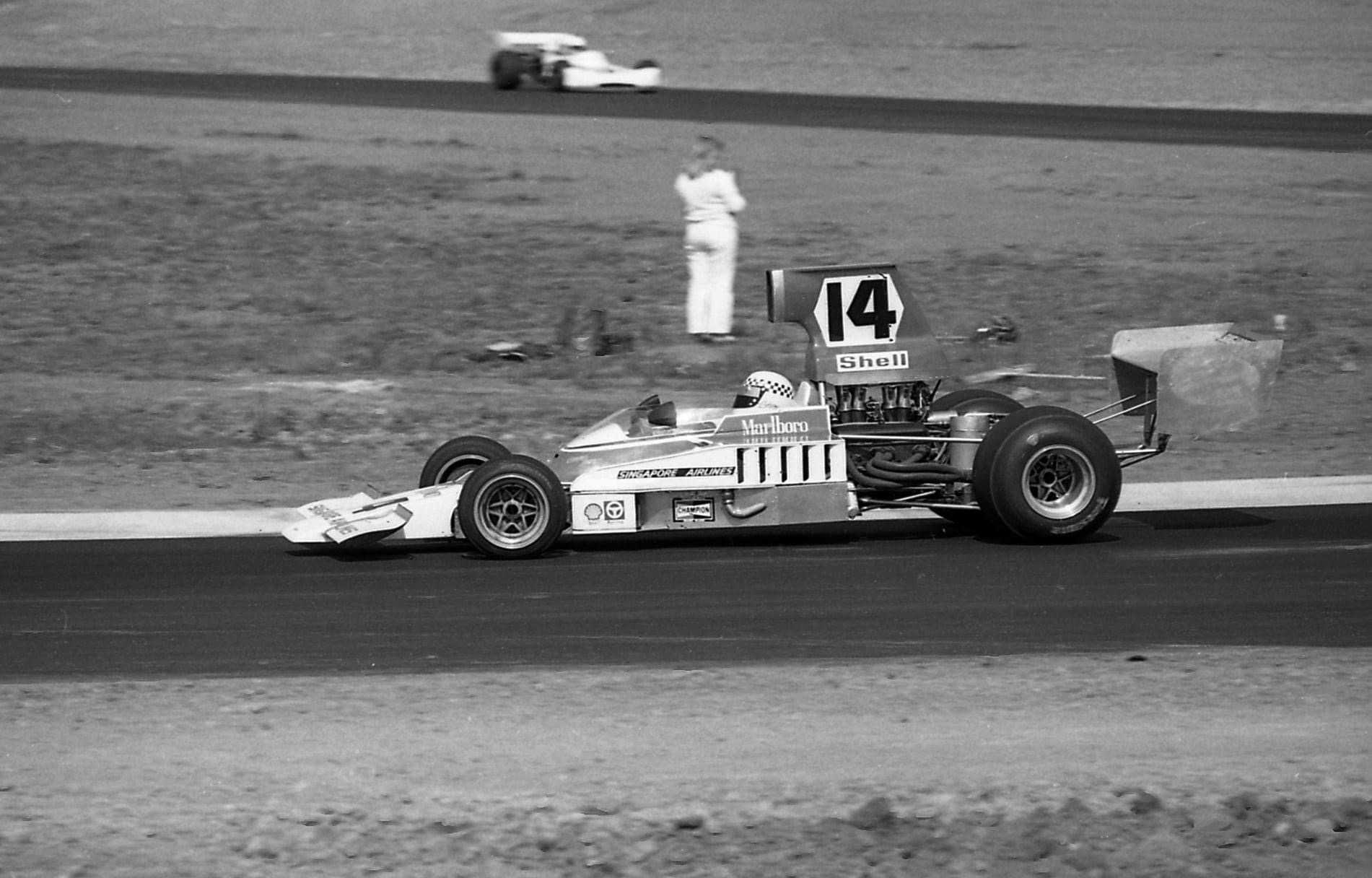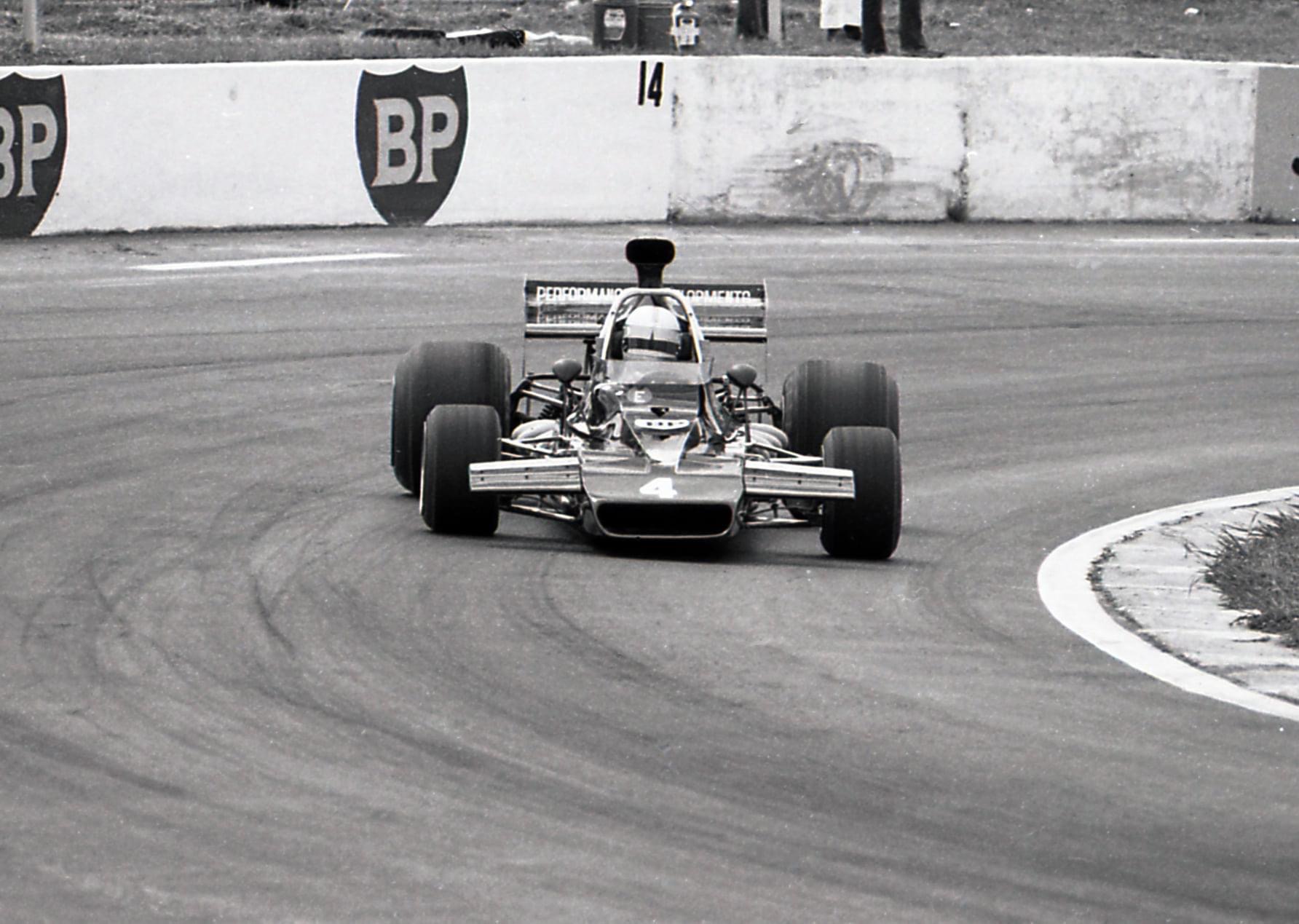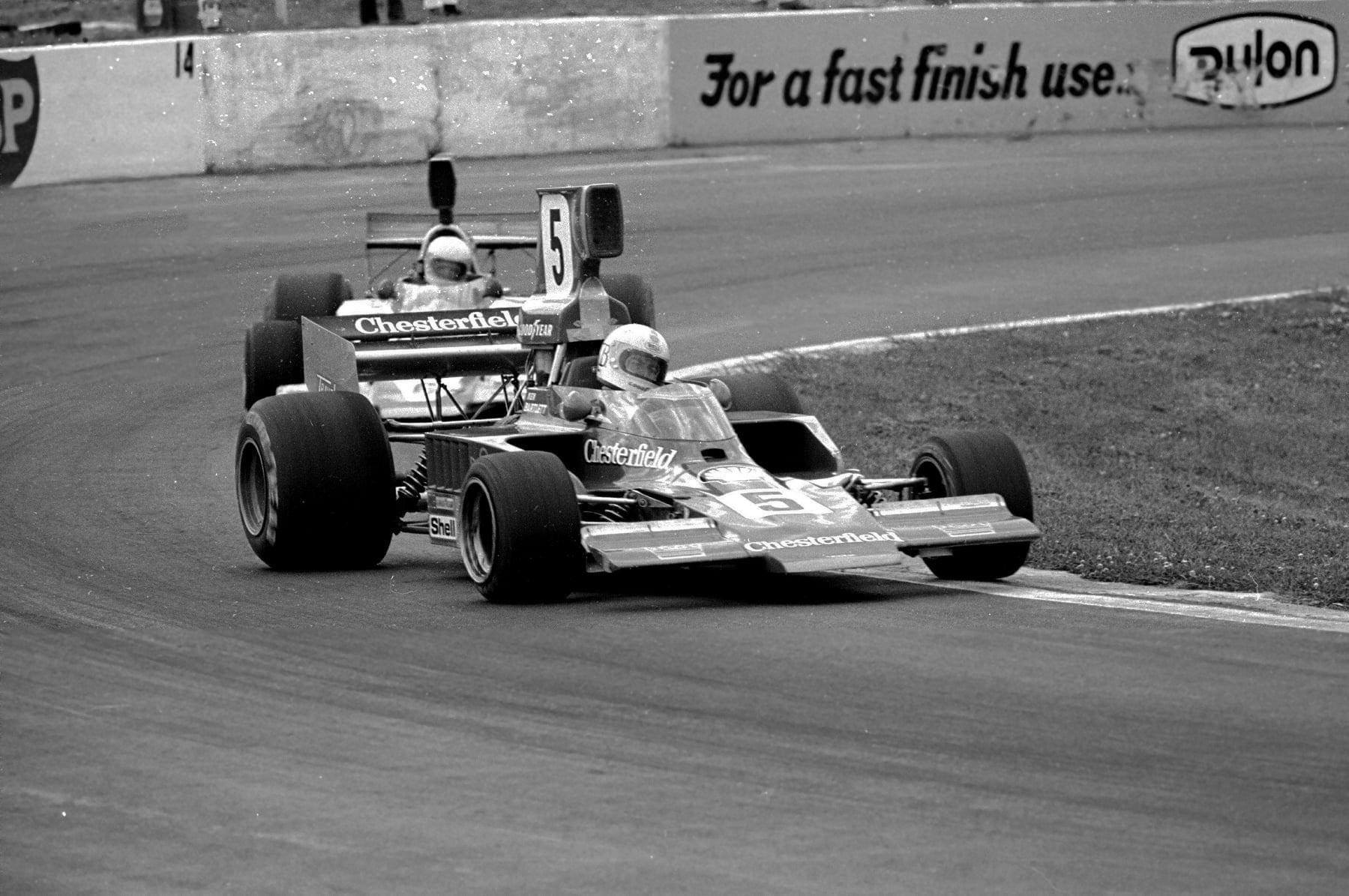
Posts Tagged ‘Australian Motor Racing History’

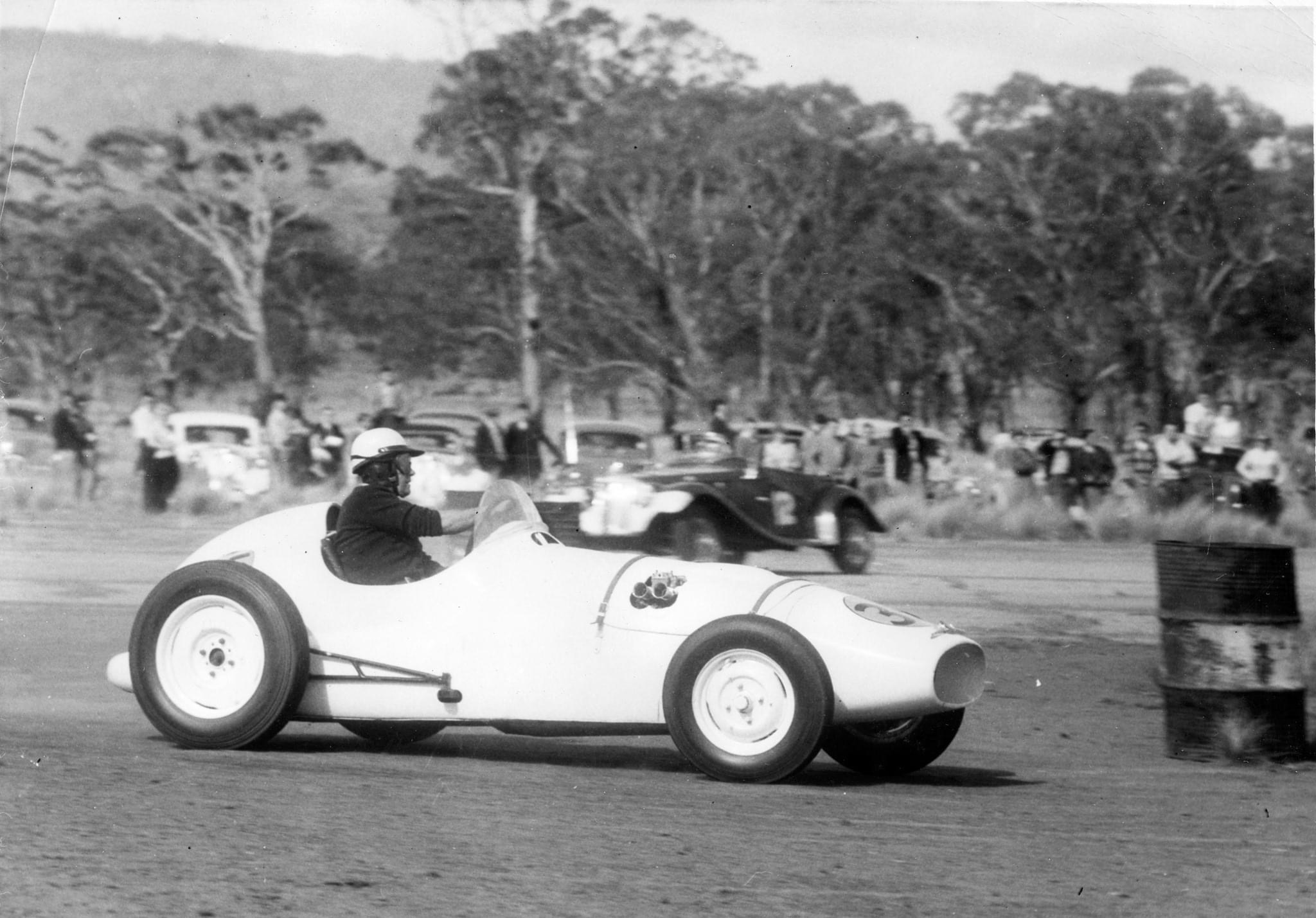
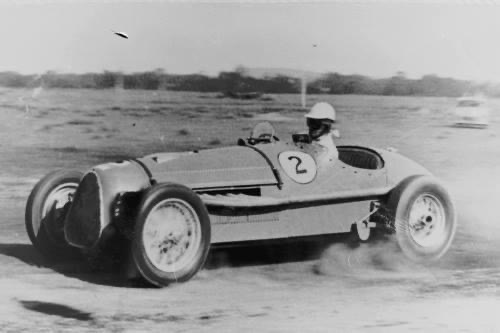
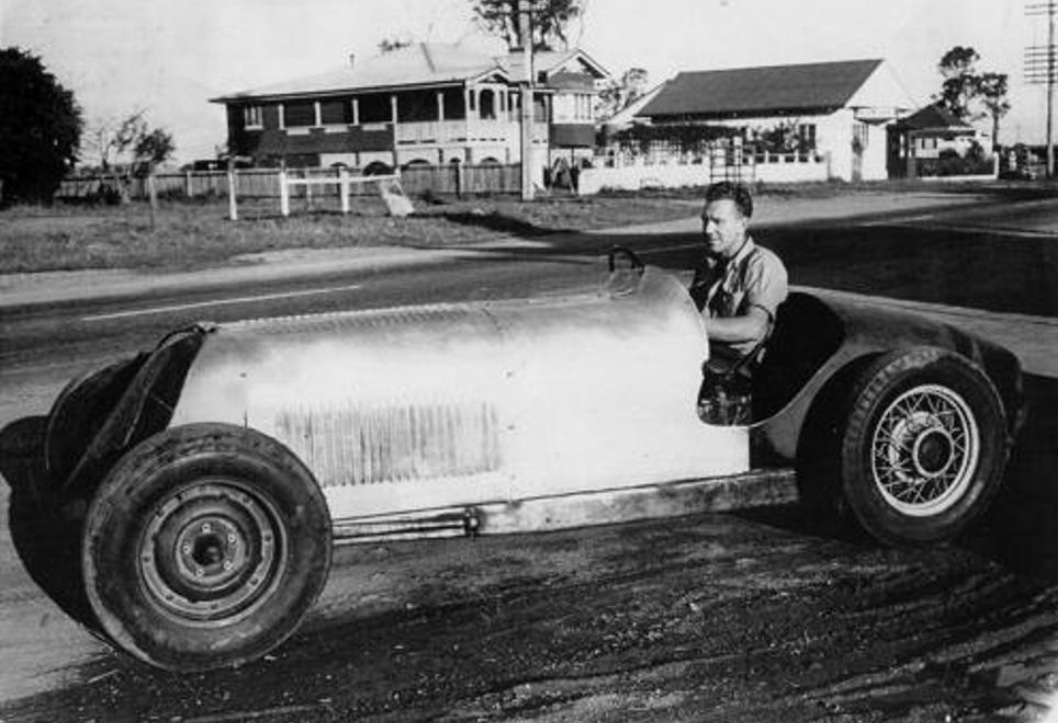
Ron Edgerton loomed large in Victorian and Australian motor racing from the thirties to the fifties, make that eighties if one includes his restoration efforts.

He owned a staggering number of exotic road and racing cars including Alfa Romeo Monza, Alta Ford V8, Ballot 5/8 LC ‘Indy’, Bentley 4.5 s/c, Bugatti T37, Cooper T38 Jaguar, Cord, Frazer Nash, Lancia Aurelia, Lotus Cortina, MG, Willys Woody and numerous speedway cars.

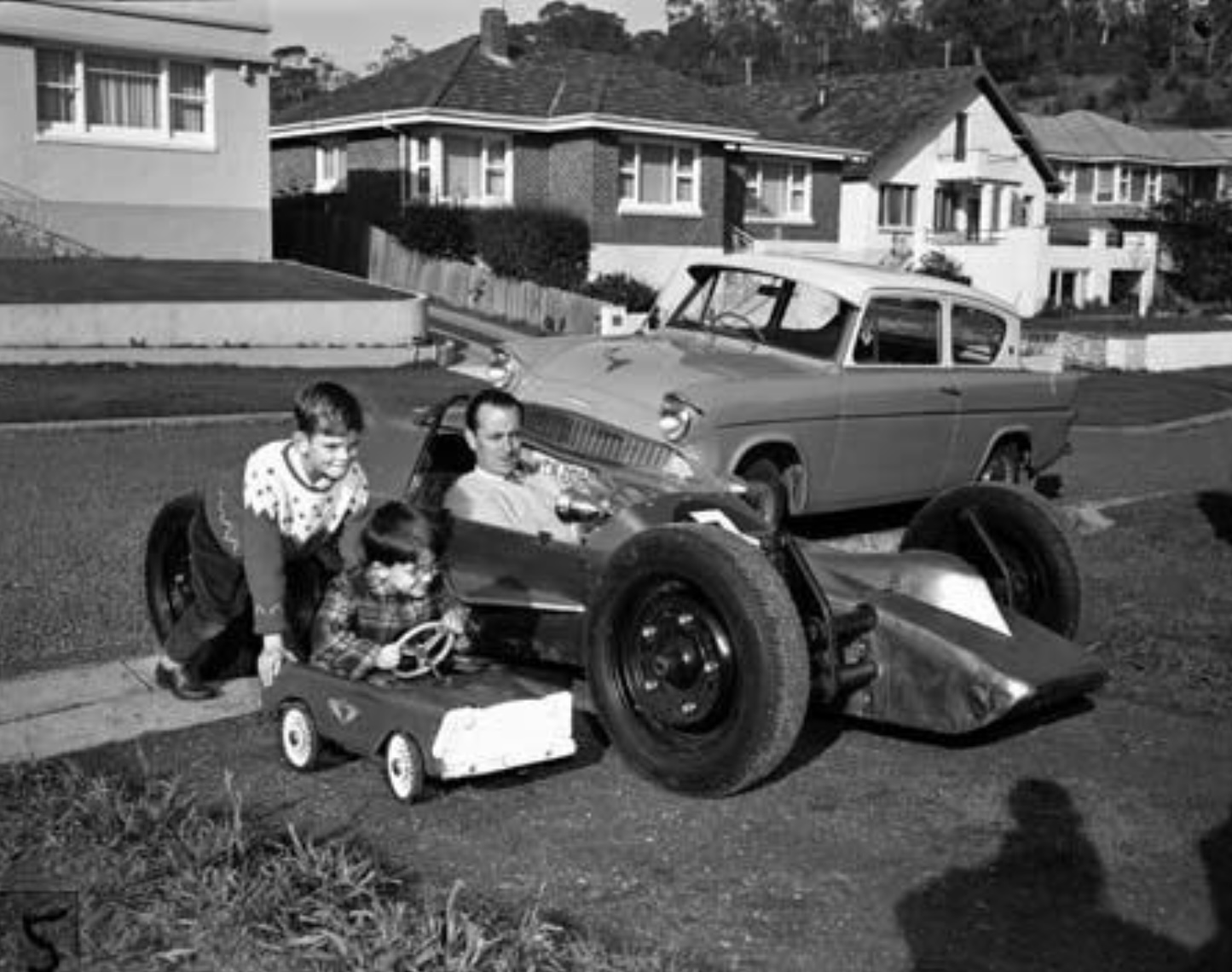
The shot above is of Ron and his son Greville in a posed newspaper photograph taken in the mid-late 1950s.

Grev raced also- a Cooper T38 Jaguar and Elfin Mallala Climax. Ron died many years ago but Greville is hale and hearty, still developing commercial properties, and in the middle of restoring a 50-foot huon-pine 1930’s yacht in one of his developments in Moorabbin.

My mate Bob King knows Grev, who very kindly allowed us to scan images from his dad’s album, there are enough of them to keep us going for years. As you will see, some are pro shots he acquired, and some self or family taken happy-snaps.

This first batch are some of the family cars.

I am not going to go berserk with the descriptions throughout this and subsequent posts, together we can flesh out the history of the cars.

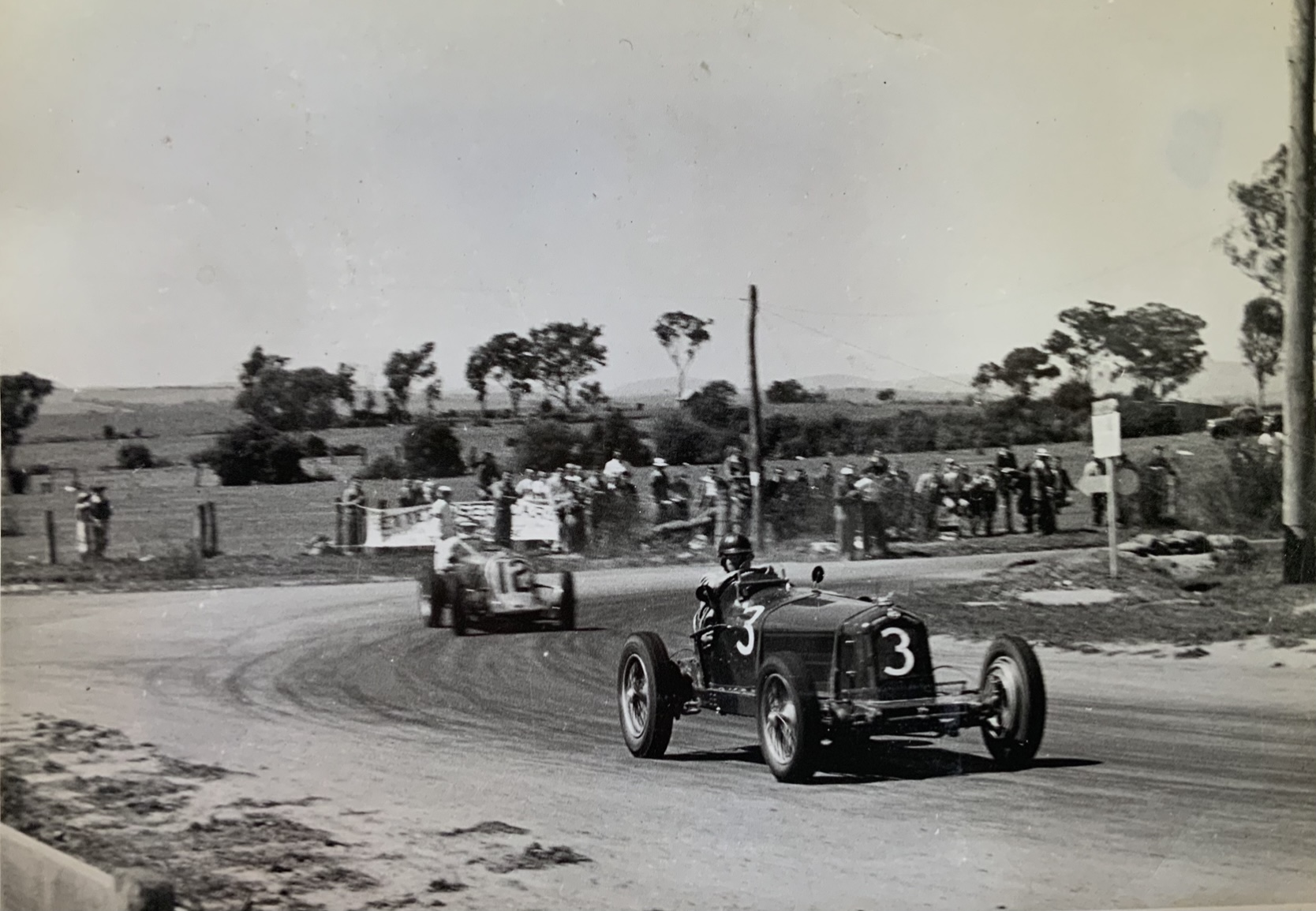
Ron and Ken Wylie aboard the Edgerton Bugatti T37 at Aspendale Speedway, a Melbourne southern bayside suburb pre-war.

VMCU meeting, June 8, 1941. Cashflow to fund Ron’s racing was provided by a printing business. Chassis 37104 is the ex-Russell Taylor/Advanx Tyres car raced by Charlie East. Ron bought it in March 1931 and later fitted a Hudson straight-eight when the delicate block could not be repaired after a decent blow-up at Tooronga.

Earl Davey-Milne has owned the car since the 1940s, see feature here; https://primotipo.com/2019/04/25/alexandra-sprints-and-bugatti-t37-37104/

Edgerton was a leading light in early speedway in Australia, research on the #4 Lycoming welcome, similarly about Reynold’s 8/80 JAP.

Bill Reynolds (the Sydney one vs. the St Kilda Wren building one) emigrated to Australia pre-war, having graduated through speedway bikes and then to cars winning World Speedcar Championships in 1939, 1941 and 1958- he won the Australian title  in 1956. He also strayed onto the circuits- a good topic for another time.

Australia’s only resident supercharged 4.5-litre Bentley in-period was chassis SM3907.

Yes, much later others were imported. Tom Luxton brought in SM3907 from the UK, Edison Waters famously raced the gas-burner powered car at Bathurst (not for long) over the Easter 1940 weekend. Post-war owners included Lex Davison.

Ron’s caption is ‘Ron, Dawn, Hugh Stewart with blown 4 1/2 Bentley’, quite where those Californian Bungalows are is something to find out. Pre-war is my guess.

Edgerton’s Alta Ford V8 at Mitcham Hillclimb in October 1941, interesting that we were still running motorsport events in Australia this late in the war.

It doesn’t seem all that appropriate given the number of blokes having their nuts shot off by this stage – or am I just a limp-wristed-commo-bleeding heart liberal?

Mitcham is a Melbourne outer eastern suburb, housing development of which exploded from the fifties. It looks quite bucolic 15 years or so before.

This car is the ex-Alan Sinclair Alta 1,100 cc s/c chassis 21S, the MI5 Spook brought to Australia in time for the January 1938 South Australian GP at Lobethal, but by this stage Ford V8 engined.

In this form it was a race-winner in Ted Gray’s hands as the Male Special pre-war. Edgerton had rebuilt it by late February 1942 (see shot below). Ron raced it post-war, it then passed back into Gray’s hands who made it sing again, especially when fitted with Lou Abraham’s Ardun-OHV head Ford V8- the car was the immediate precursor of Ted and Lou’s Tornado 1 Ford.

Wind the clock forward another couple of decades and Mount Eliza’s Graeme Lowe reunited the car with its rightful 25S 1,100cc engine and restored it superbly- it took its first bow in 1999. No longer with us, Graeme’s wife still owns it and a 2-litre stablemate.

Epic about the Alta and Sinclair here; https://primotipo.com/2018/11/08/the-spook-the-baron-and-the-1938-south-australian-gp-lobethal/

Hillclimb unknown post-war, note the LCCA badge on the scuttle and differences in appearance of the Alta before and after its 1941-2 ‘birthday’

‘No 4’ at Greensborough Hillclimb immediately post-war, date folks? Manufacturer of chassis and mechanical components unknown.

More Mount hillclimb action, this time Ron’s Lycoming Special at Mount Tarrengower, the following shot shows the engine bay; https://primotipo.com/2020/08/21/mount-tarrengower-2/

Edgerton jumped in amongst the big boys with the purchase of the ex-Alf Barrett Alfa Romeo Monza #2211134 from Rupert Steele in 1950

Ron’s caption says ‘Dirt track Charlie (Frank Kleinig, Kleinig Hudson Spl) chasing Racing Ron at Mount Panorama’ during the October 1951 meeting. He was fourth in the over 1500cc Championship Scratch, and third in the Redex 50 Mile Championship race- Whitefords’ Lago Talbot T26C won with Stan Jones second in Maybach 1.

Edgerton was immediately on the pace with it too. More on Ron’s time in this car soon, in the meantime it’s story is told, at length, here; https://primotipo.com/2015/02/20/alf-barrett-the-maestro-alfa-romeo-8c2300-monza/

Greville had a go too.

Here, his Elfin Mallala Coventry Climax 2-litre FPF is at freeze-yer-nuts-orf Silverstone testing during the winter in 1964. Ron used the Lotus Cortina to get around the UK. More of Grev’s UK adventures that year soon.

Racing Ron’s ex-Louis Wagner 1919 Ballot 5/8LC ‘Indy’ at rest at home in the eighties.

The high-born French aristocrat is in pretty good company amongst Ferrari Dino 246GT, sundry bikes and a racer.

When Alan Cooper’s Ernest Henry designed 4.8-litre, DOHC, four-valve, normally aspirated straight-eight racer arrived in Australia in late 1925, it was the most advanced and one of the quickest racing cars in the country. Chassis #1004 joined a 2-litre Ballot 2LS #15 acquired for Cooper by his patron twelve months before.

It all turned to custard at Maroubra in December 1925. Alan, a relative novice to a car of this performance, ran wide passing his brother Harold in the 2LS and rolled, badly damaging the car and his riding mechanic.

1004 was repaired in Sydney by Don Harkness and then raced very successfully by Harold, a gifted driver. One of the great mighta-beens of early Phillip Island AGPs is Harold racing the 2LS, but he never did.

The 5/8LC passed through many hands before Ron found it on a farm in country Victoria in the seventies. A long, complex restoration followed, Ron enjoyed the fruits of his labours before selling to Peter Briggs as his health failed. The car has been in England for many years.

Credits…

All photographs are from the Ron Edgerton Collection, with thanks to Greville Edgerton. Steve Wood

Tailpiece…

The album is very thick.
The degree of scanning difficulty is high, so let’s be thankful for what we have before some of you old women start chookin’ on about the quality of the shots- don’t spose I should say that. Oops.
Finito…

(NAA)

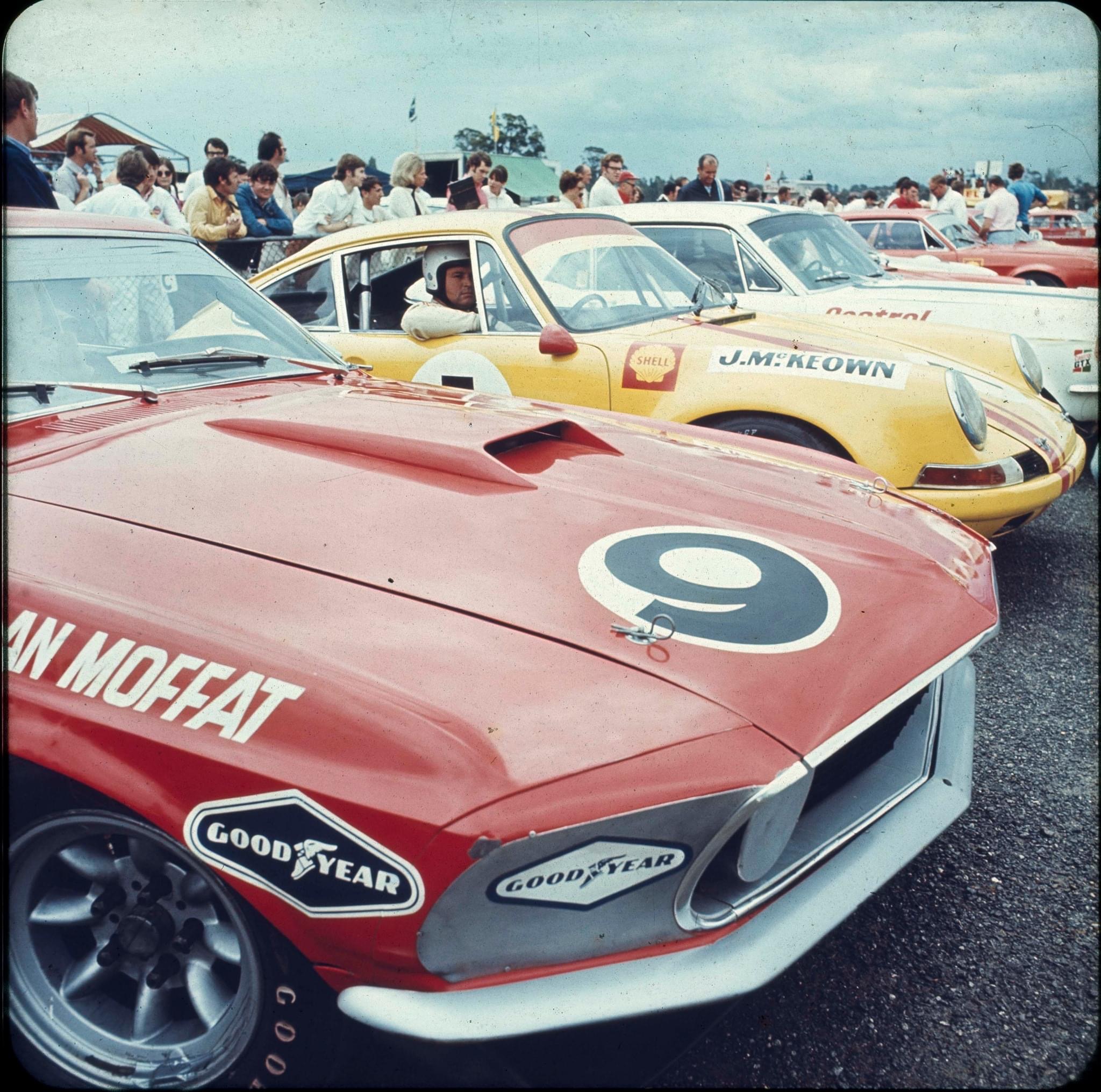
The heavies before the start of the AJC Trophy at Warwick Farm, fifth round of the Australian Touring Car Championship, on July 12, 1970.

Allan Moffat, Mustang Trans-Am, Jim McKeown, 911S, Pete Geoghegan, Mustang, you can just see Brian Foley’s 911S then Bob Jane’s Mustang Shelby Trans-Am on the dummy grid.

Moffat’s Trans-Am started from pole but he lost it in the first corner causing mayhem – Moffat, Geoghegan and Foley were out on the spot. McKeown led, Norm Beechey was up to second but then he lost a wheel gifting second to Bob Jane. It was the first ATCC round win for Porsche. https://primotipo.com/2016/05/11/jim-mckeown-porsche-911s-warwick-farm-1970/
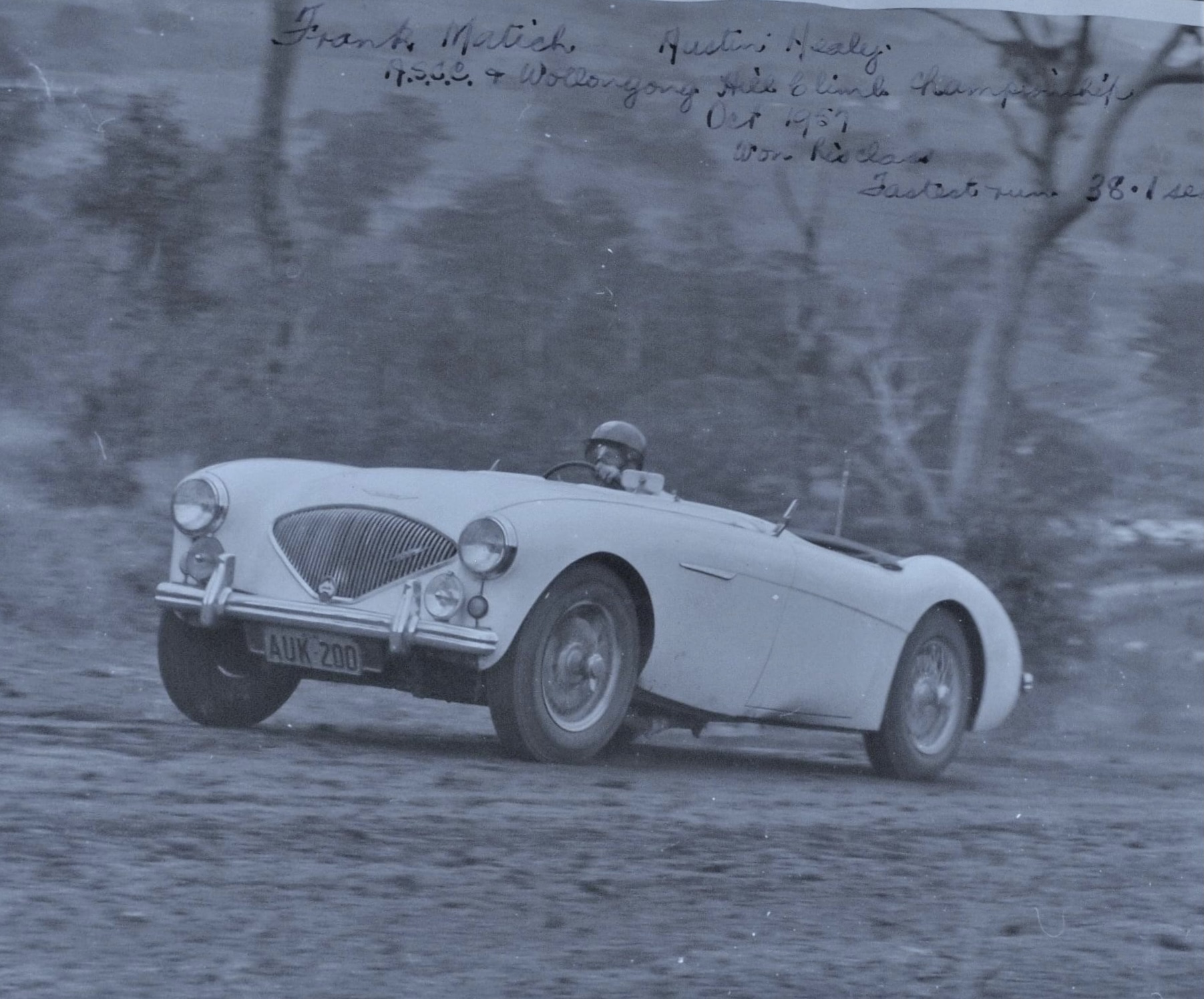
 

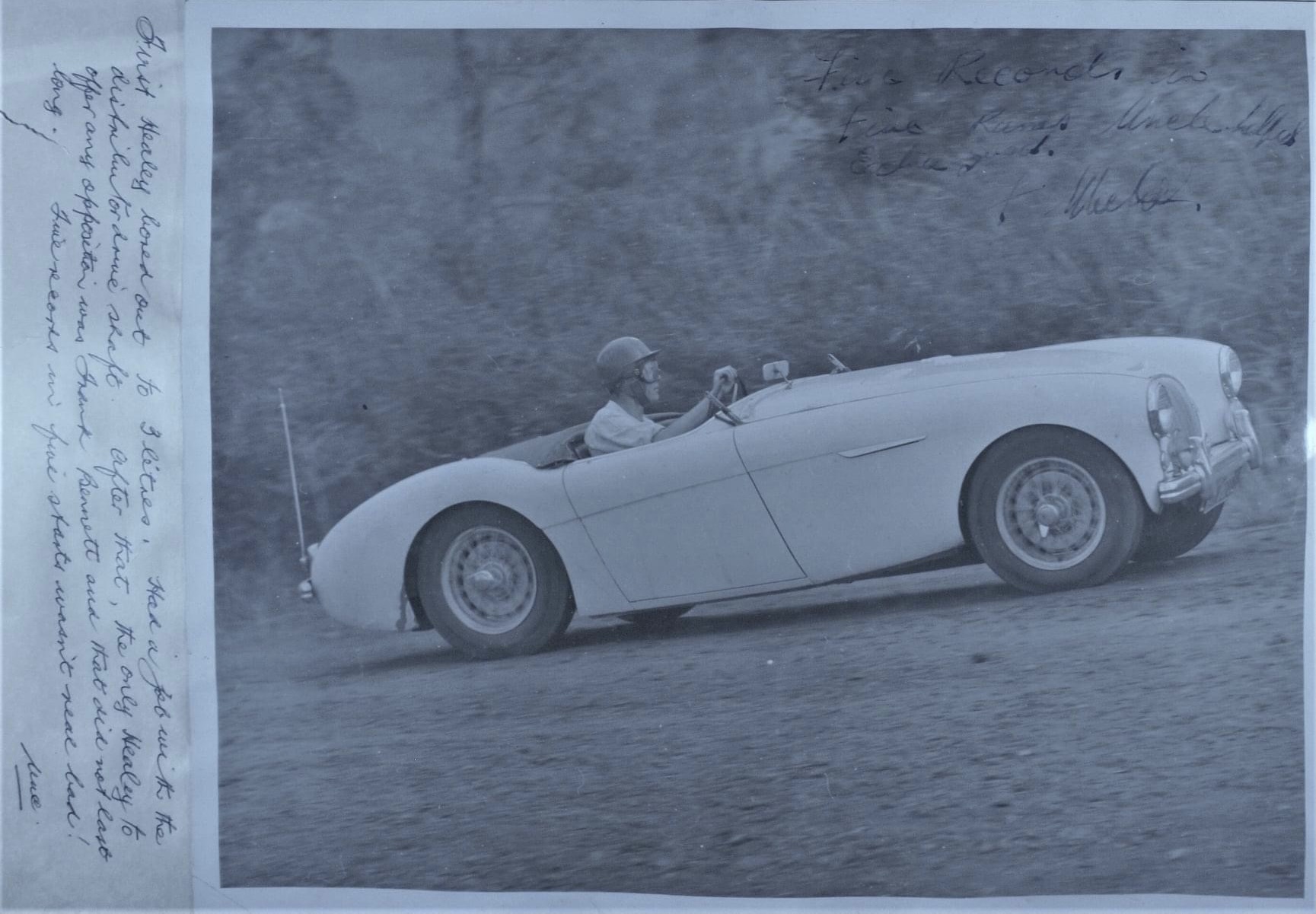
The power of the internet continues to amaze, in this case Facebook. The two shots above and below are the earliest I have seen of Frank Matich.

They show his ‘road-registered family car, the Healey 100/4 with LJC Motors bored out 3-litre engine at Huntley’s Hill in 1957’ for the Australian Sports Car Club Wollongong Hillclimb Championship..

‘First Healey bored out to 3-litres. Had a job with the distributor driveshaft. After that the only Healey to offer any opposition was Frank Bennett and that did not last long. Five records in five starts was not real bad’ is the note FM wrote to his friend Alan Cummine, to whom we are indebted for these shots.

Matich’ career is covered in this piece; https://primotipo.com/2015/09/11/frank-matich-matich-f5000-cars-etcetera/
(A Cummine)
 

(Examiner)

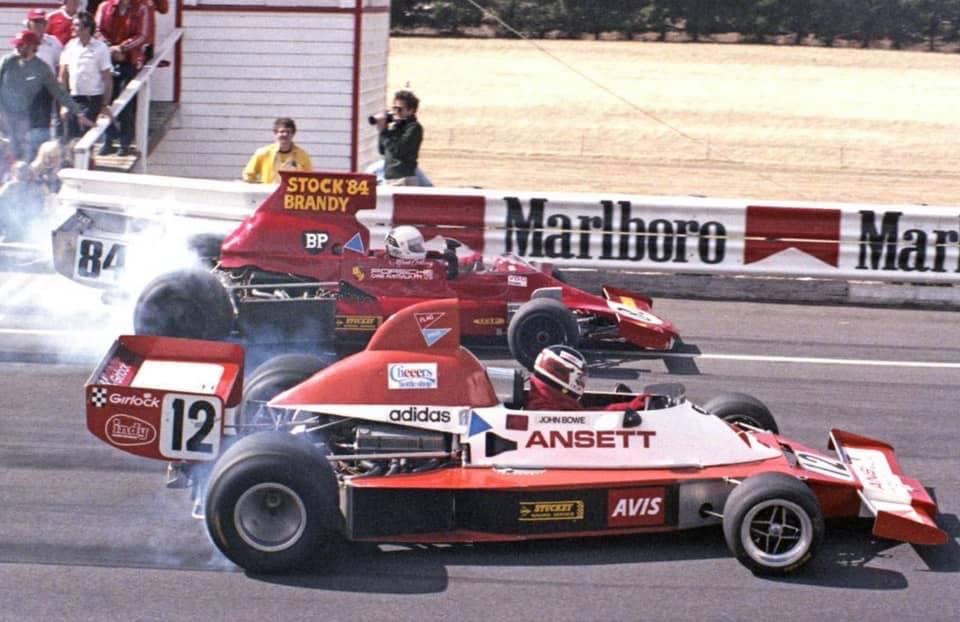
We have lift-off. John Bowe and Alfie Costanzo smoke their Goodyears off the line at Symmons Plains at the start of the Gold Star race in 1980.

JB won the race in his Elfin MR8 Chev from Alf’s Lola T430 Chev. Costanzo set a lap record of 50.16 seconds that weekend which stood for forty years until it was broken by Thomas Randle’s Ligier JS3 Ford S5000 on January 25, 2021. He did a 49.864 second lap in the S5000 opener before winning the John McCormack Trophy, Gold Star event.

It was a great, gutsy race win, the 24 year old below had his last chemotherapy treatment for testicular cancer on New Years Day.

A bit on John Bowe here; https://primotipo.com/2016/06/10/elfin-light-aircraft/
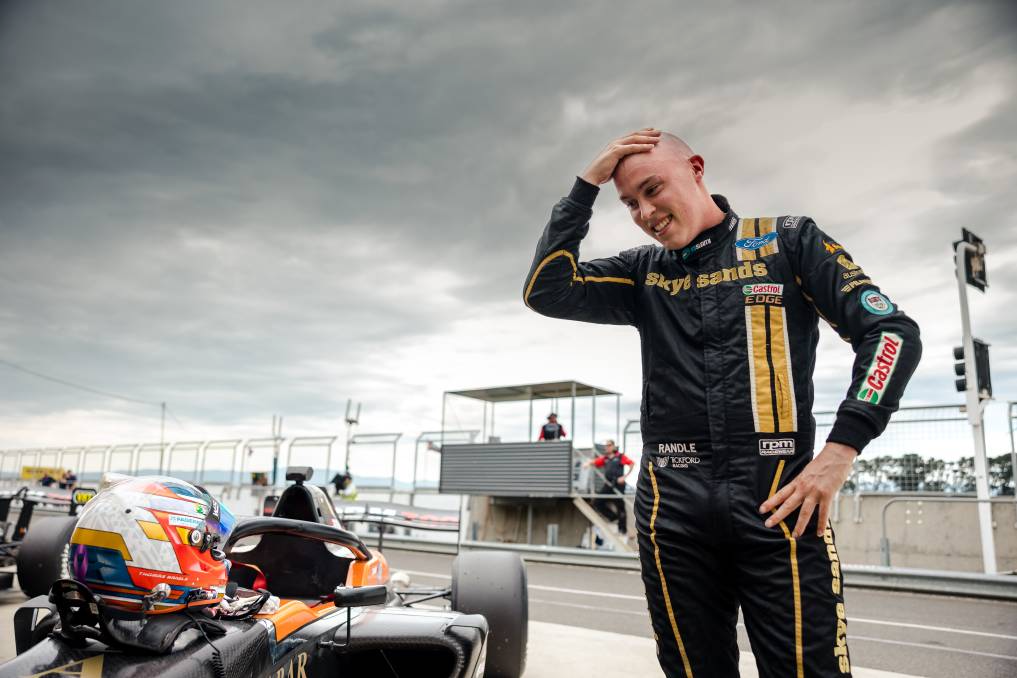
Thomas Randle delighted with his Symmons Gold Star win (S5000)
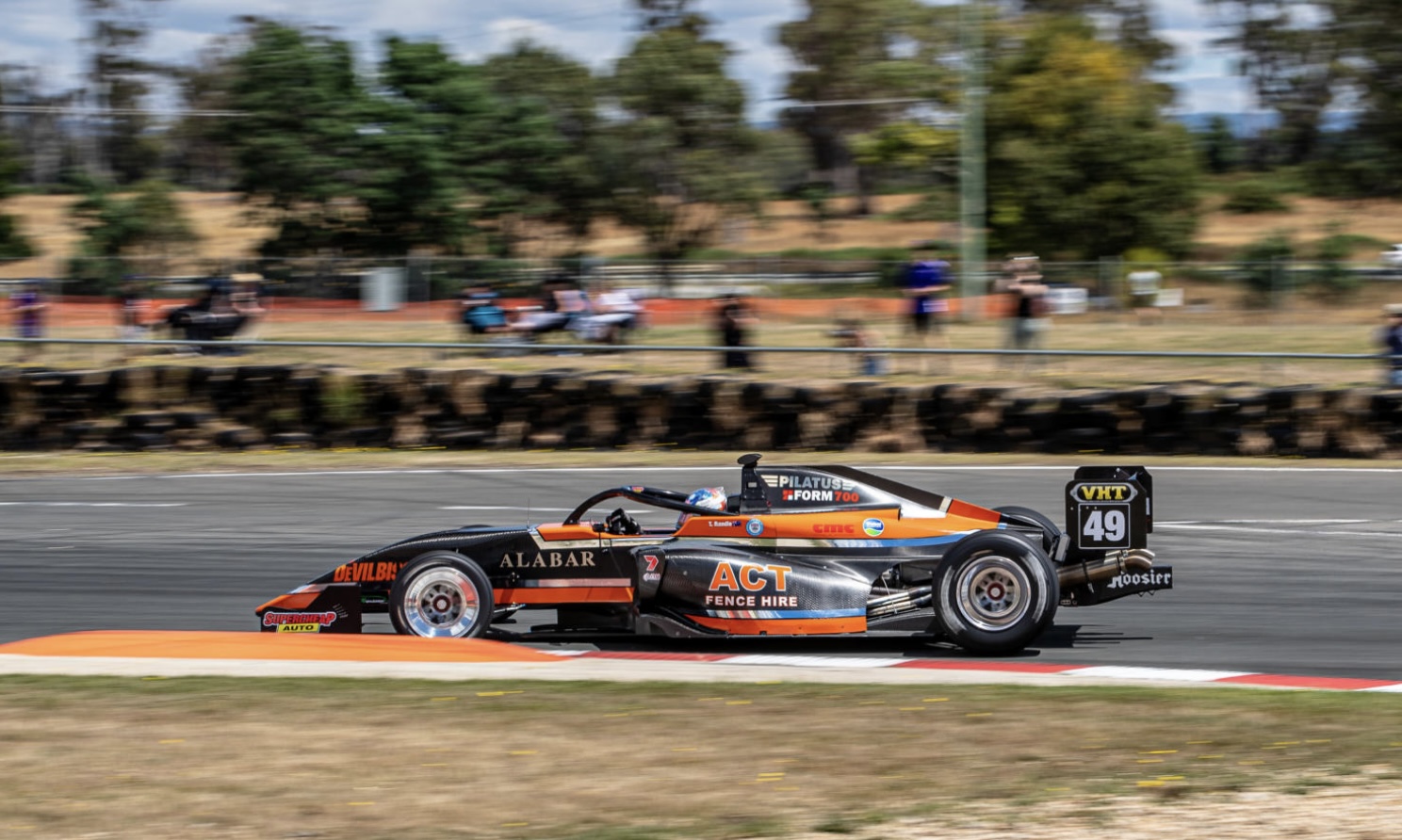
 

Randle’s Ligier JS3 Ford on the way to victory at Symmons- crowd limited to 5,000 given Covid restrictions. A magic weekend, was lucky enough to be there, these jiggers are magnificent, spectacular cars (Auto Action)
 

(S Griffiths)

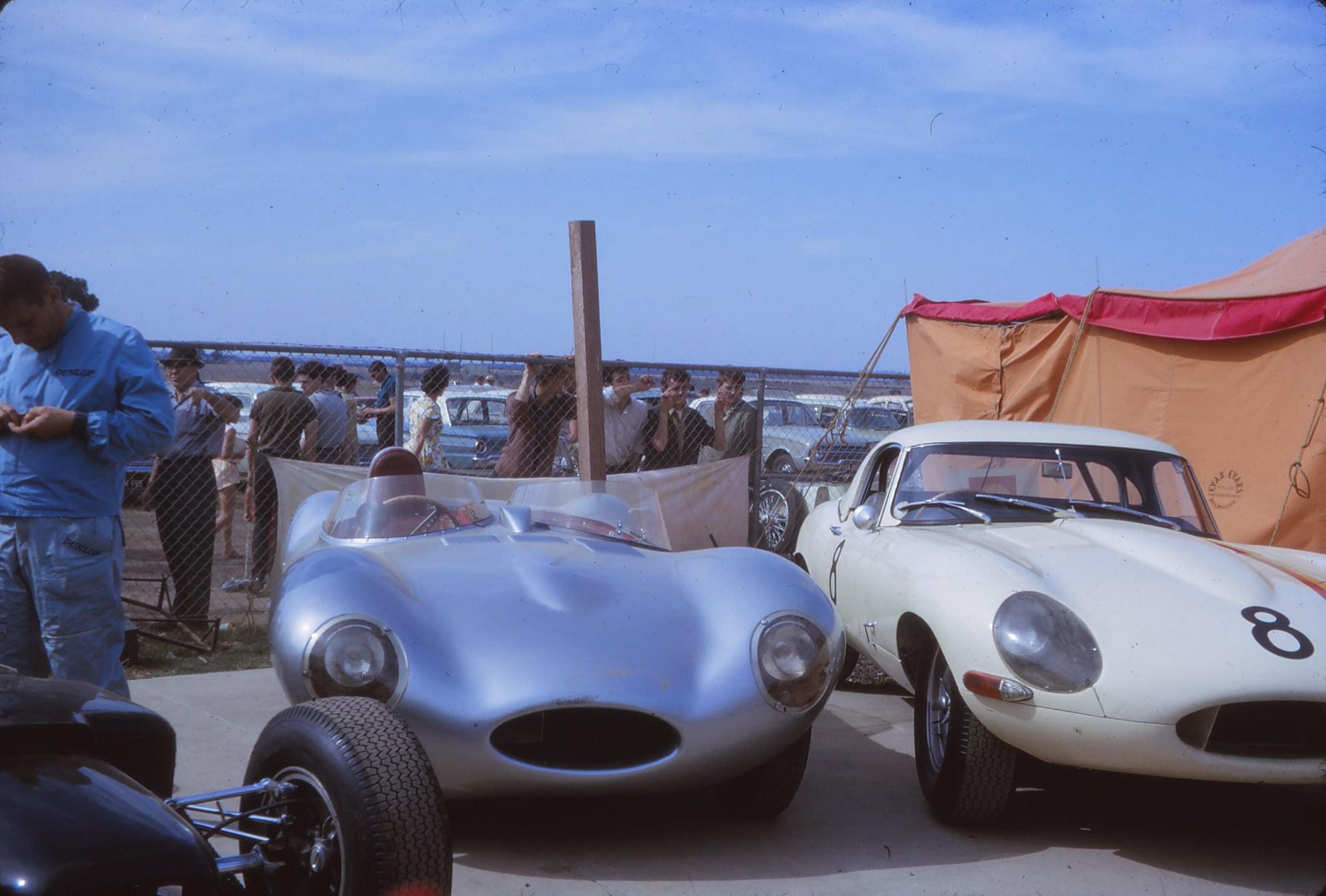
Bob Jane had exquisite taste in racing cars didn’t he? I’ve said it many times. Here are his recently purchased Jaguar D Type and new E Lightweight.

Calder, Australia Day meeting, 26 January 1964. I wonder what the black single-seater is? See this piece on Bob’s various cars; https://primotipo.com/2020/01/03/jano/
 

(J Manhire)

Can ‘yer grab my helmet Alec- I gotta go. Kevin Bartlett talks to his headless team-chief at Wigram in 1968, it was the first Tasman Cup KB did in full, both Kiwi and Oz races.

That Brabham BT11A Climax was one of his favourite cars, he did pretty well that summer in what was by then an old car amongst all the multi-cylinder exotica. See here; https://primotipo.com/2018/04/27/kbs-first-bathurst-100mph-lap/
 

(unattributed)

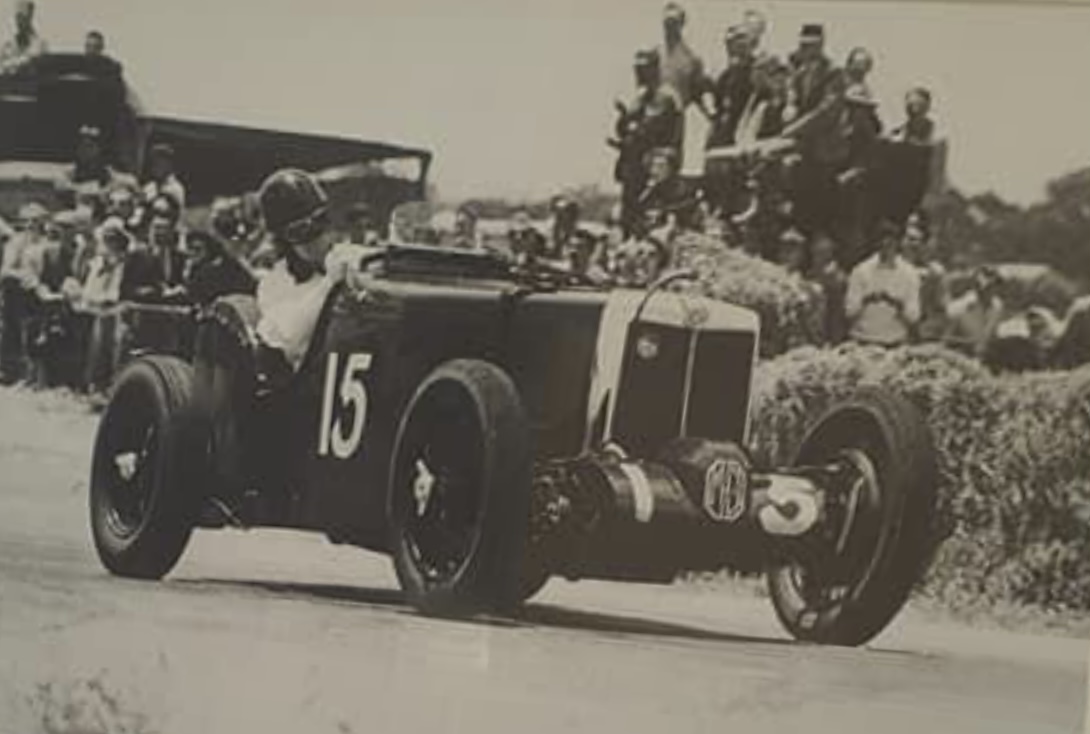
Otto Stone, MG K3 during the January 2, 1950 AGP at Nuriootpa, South Australia.

As adept behind the wheel as he was twidding the tools, he retired from the race after only completing one lap, with engine problems. Nine years later Otto prepared the Maserati 250F Stan Jones raced to AGP victory at Longford.

1950 AGP article here; https://primotipo.com/2015/07/10/1950-australian-grand-prix-nuriootpa-south-australia/
 

(C Bottomley)

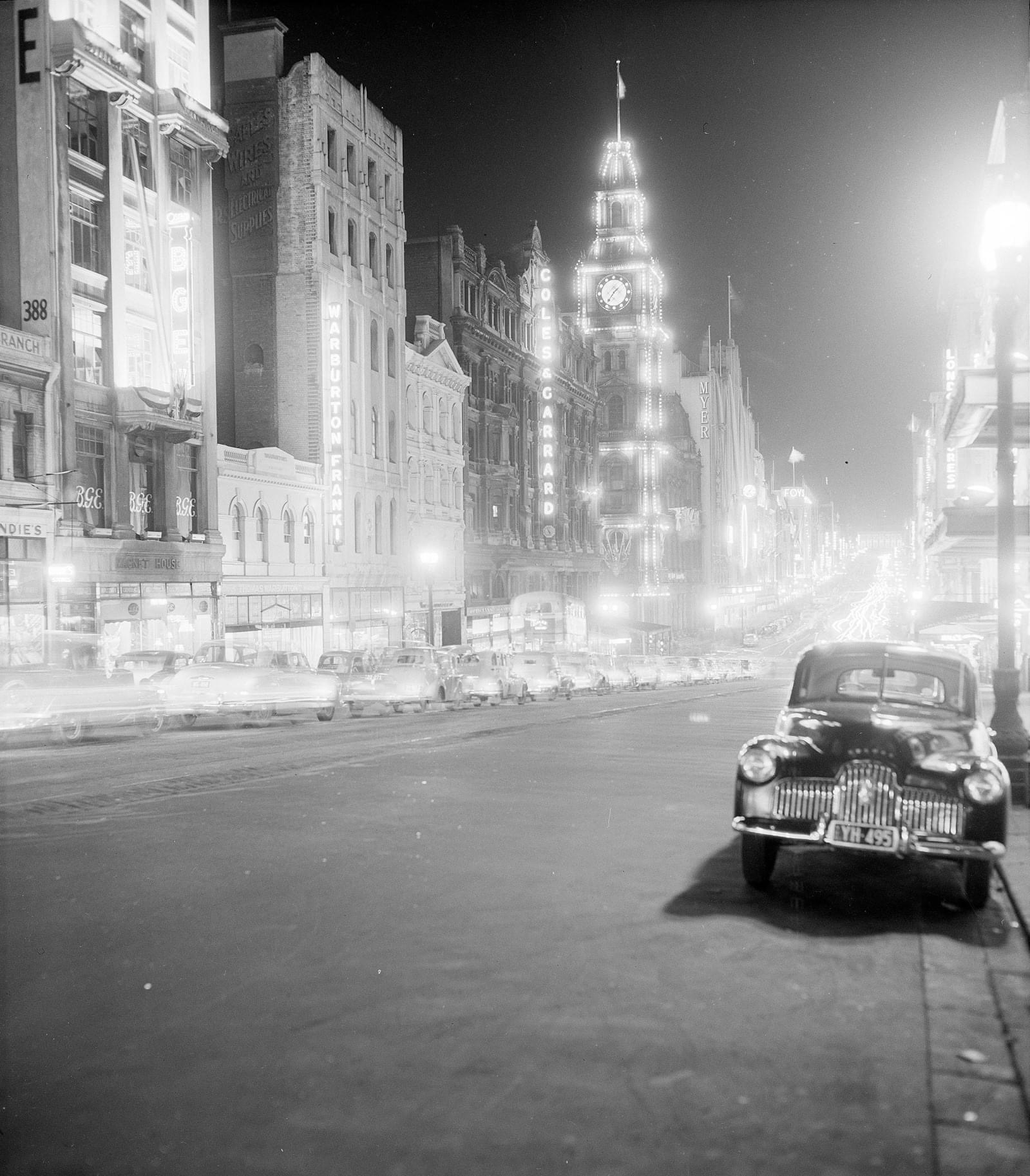
Marvellous shot of a Holden 48-215 in Bourke Street, Melbourne in 1959.

The post-office building stands, albeit as a retail emporium these days but the rest of the buildings in view copped the kiss-of-death from Whelan the Wrecker or one of Des Whelan’s mates. I wonder if YH-495 is extant? See here for a piece on Holden’s formative years; https://primotipo.com/2018/12/06/general-motors-holden-formative/
 

Triumph TR2 (B Young)

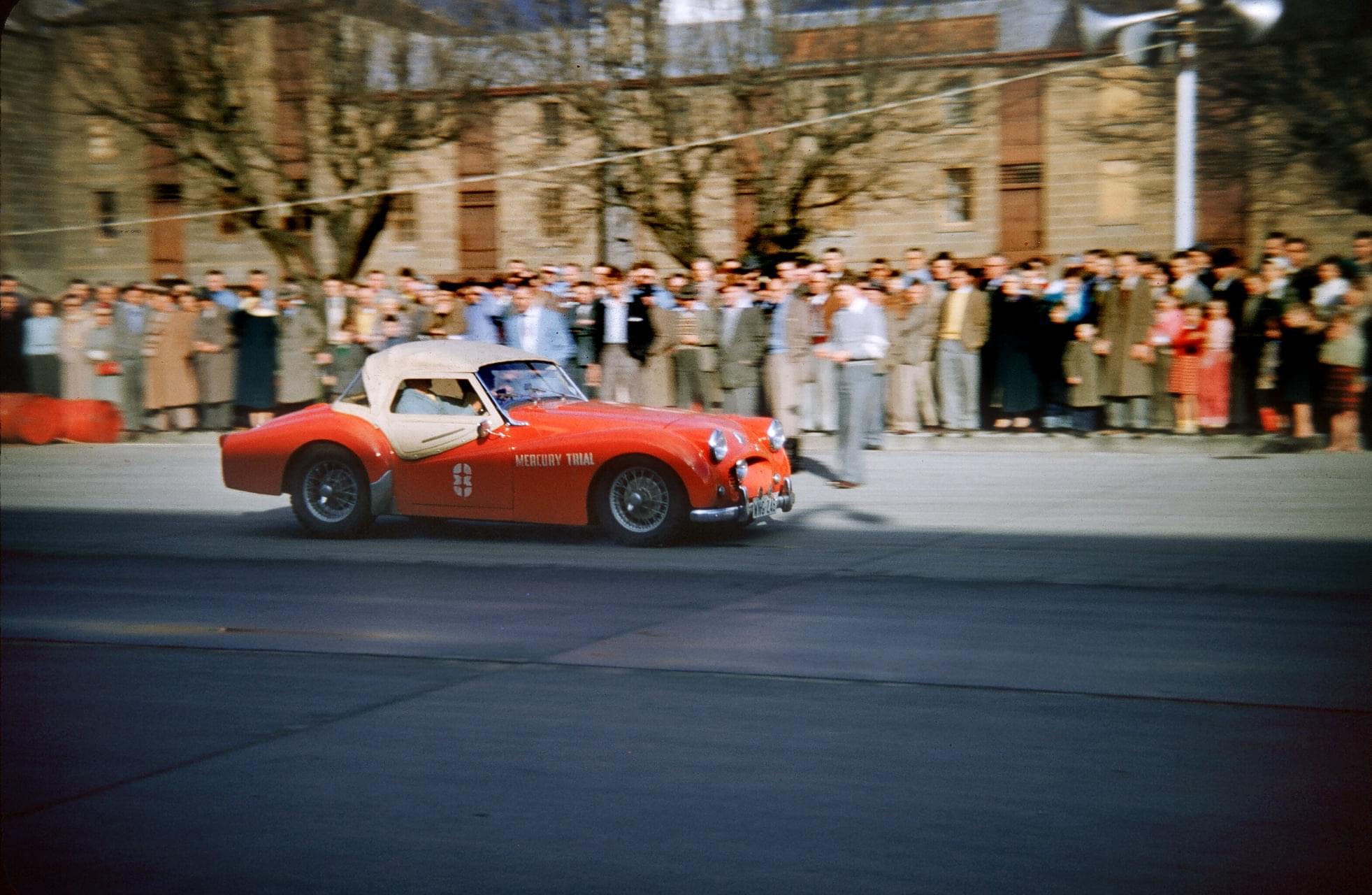
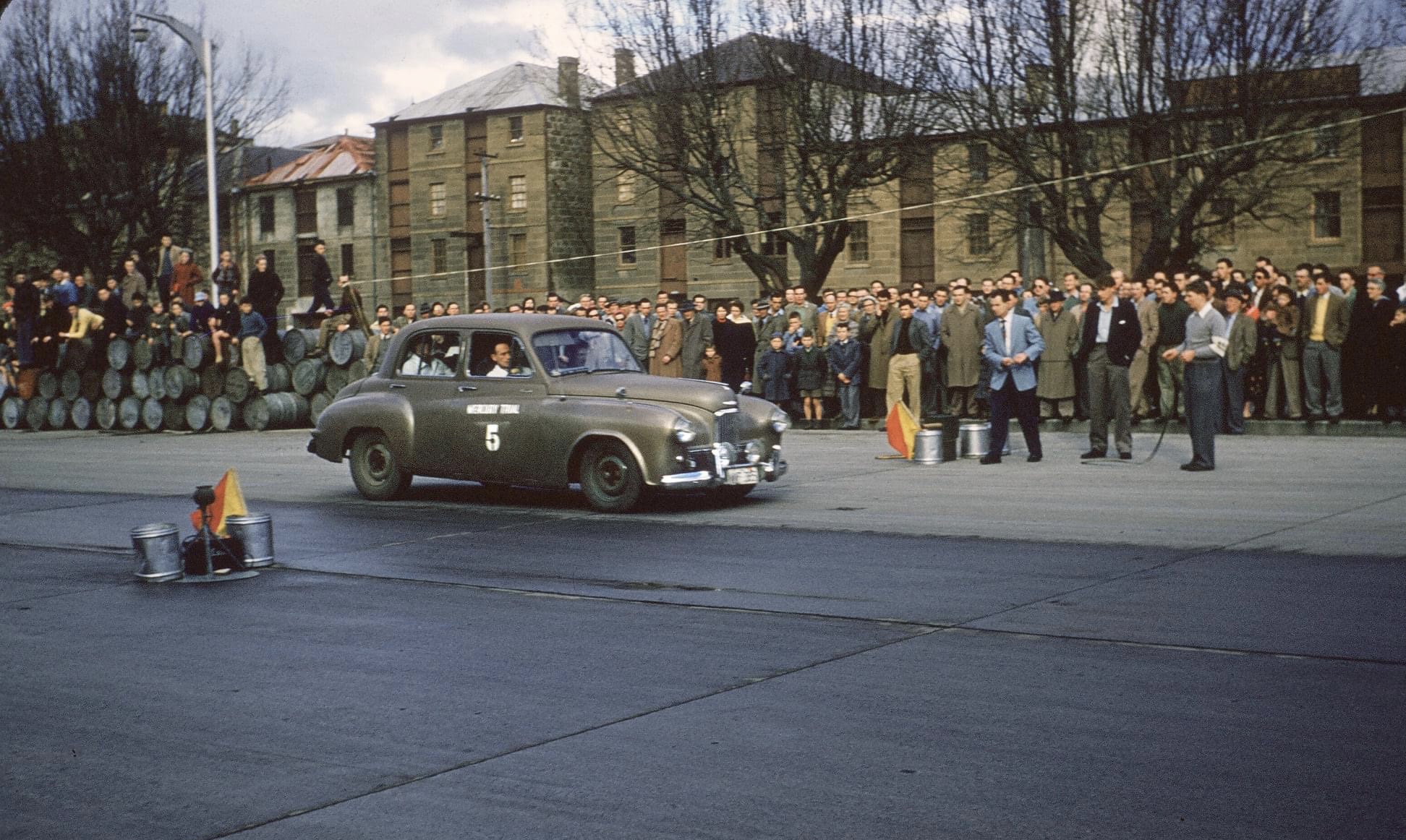
Grant Twining wrote in the marvellous Historic Racing Car Club of Tasmania’s FB page that ‘The 1956 Mercury Trial (The Mercury is Hobart’s local rag) was a big thing at the time. The Second World War was still in recent memory and Australia was just starting to recover economically from the austere post war years. In little old Tasmania, the well publicised ‘Mercury Trial’ was a significant event and eagerly followed by the public. Bob Young was on hand to capture these images in Salamanca Place’ dockside in Hobart.

All of which is fine and dandy but I’m buggered if I can find any details of the event – not even a piece in the sponsors product! It may be others out there are more patient than I. Do get in touch if you glean some deatails on the events duration, route and winner. Bob Young’s Tassie colour shots I’ve used many times before and just too good to ignore despite a paucity of information.
Humber (B Young)

I wonder if the Salamanca stage of the trial is a speed test or speed and braking? Note all the kegs of something nice. In the fifties this stretch is now filled with lots of wonderful cars, restaurants and places of fun. It is to the left in this mid-sixties shot of Constitution Dock looking towards Hobart CBD. The boats are possibly from a not long finished Sydney-Hobart.
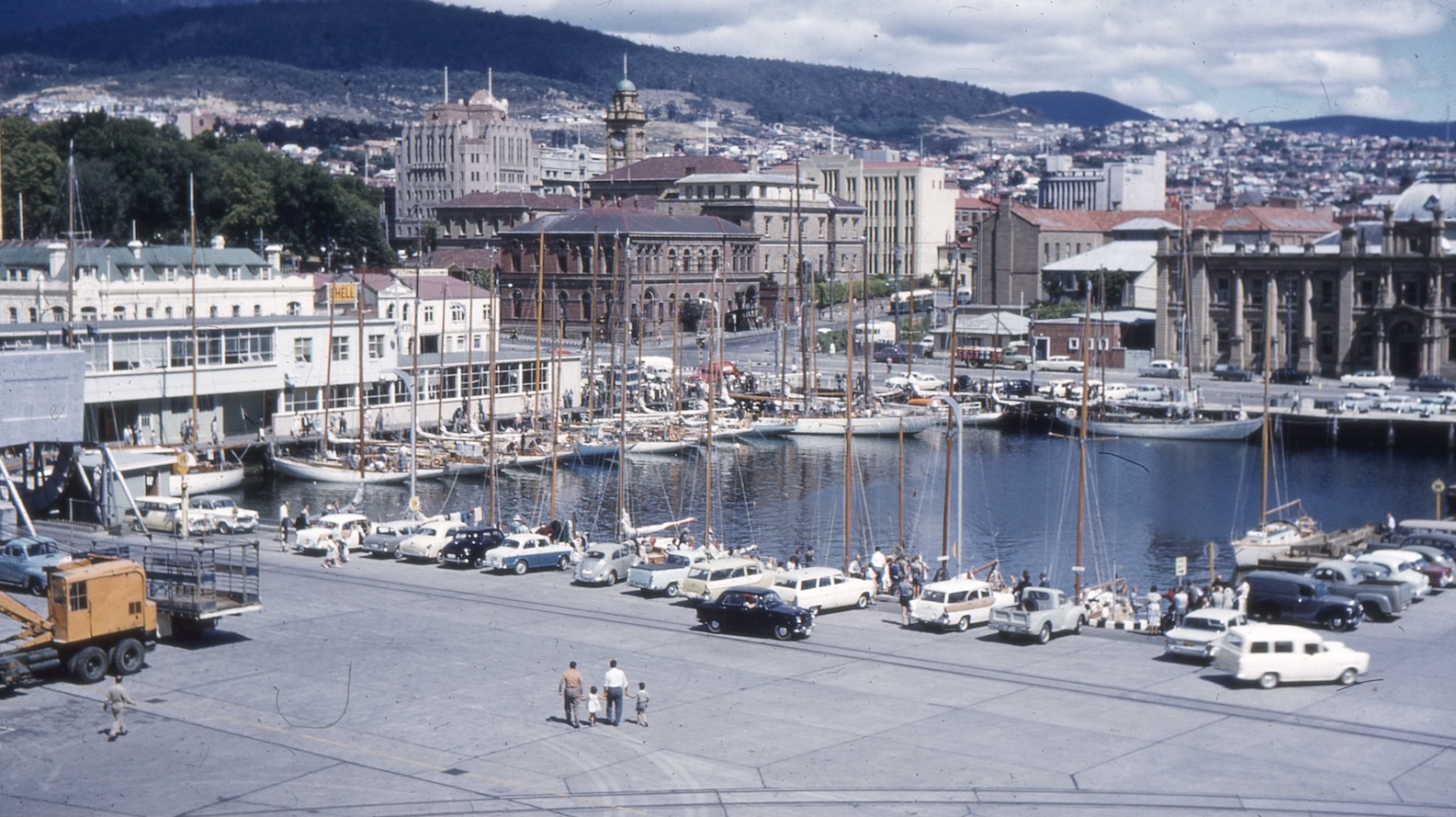
(B Short)
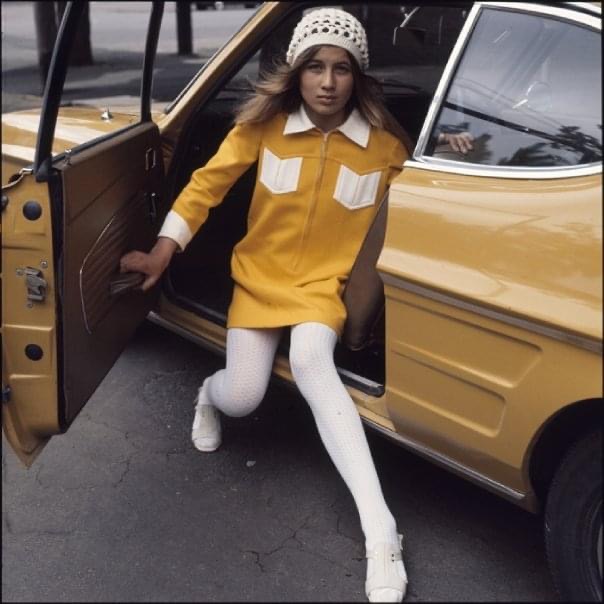
 

(NAA)

I had one of these when I was 18. The car, the Capri.

I had two in my student years actually, a 1600 GT and 3-litre GT V6, the little fella was much the nicer car to drive. I never had an accessory as cute as the one above in either car, sadly. Must have been my Brut 33.

Speaking of which, Moffat’s Cologne Capri was a Capri of a quite different type. Robert Davies’ shot of the car upon debut during the Sandown Tasman meeting in February 1975 is the best shot ever taken of the car. Lacked torque amongst all the big hairy V8 Gorillas but it was yet another of Marve’s imports which so enriched our grids.

Cologne Capris here; https://primotipo.com/2015/04/09/australias-cologne-capris/
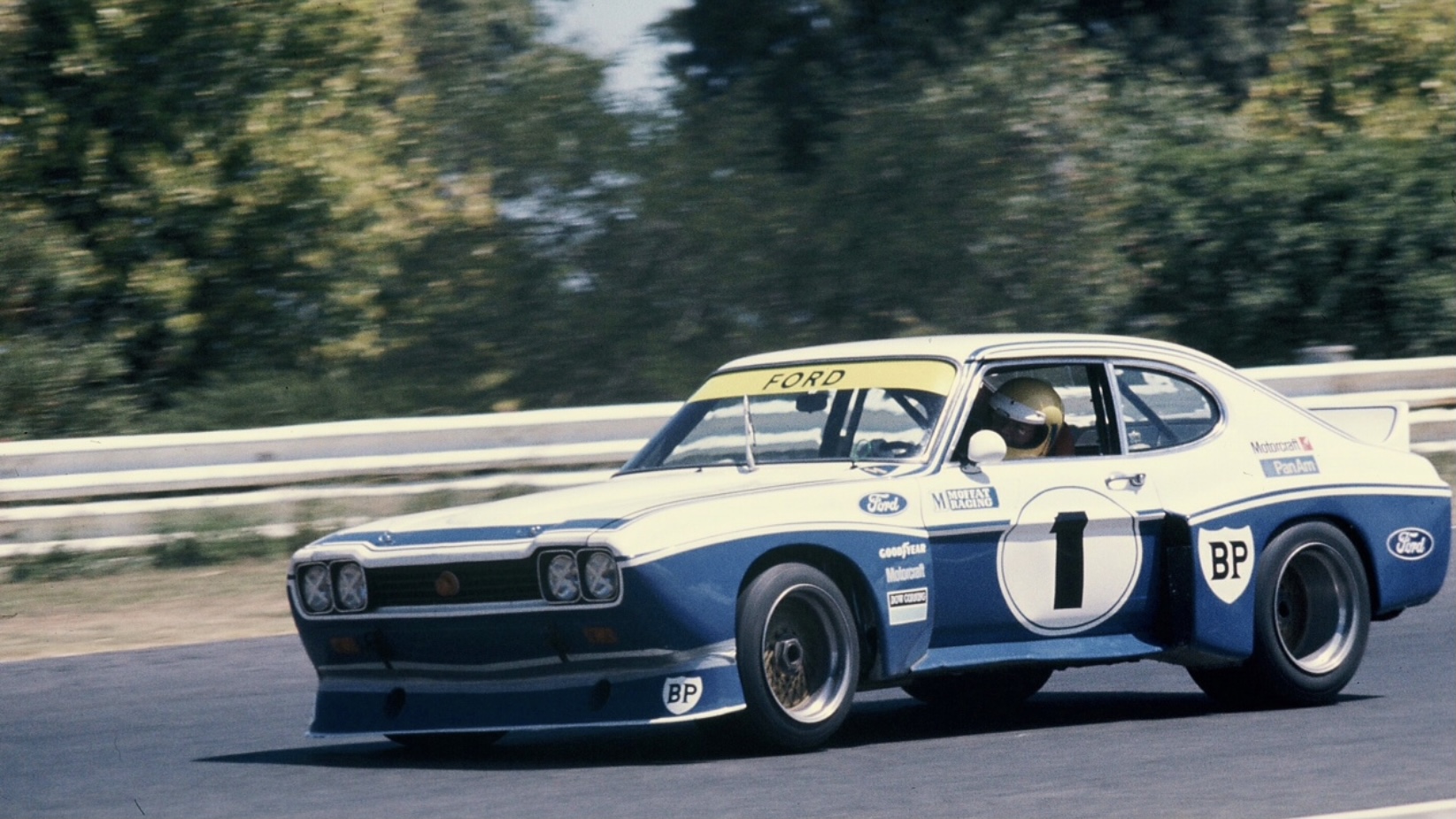
(R Davies)
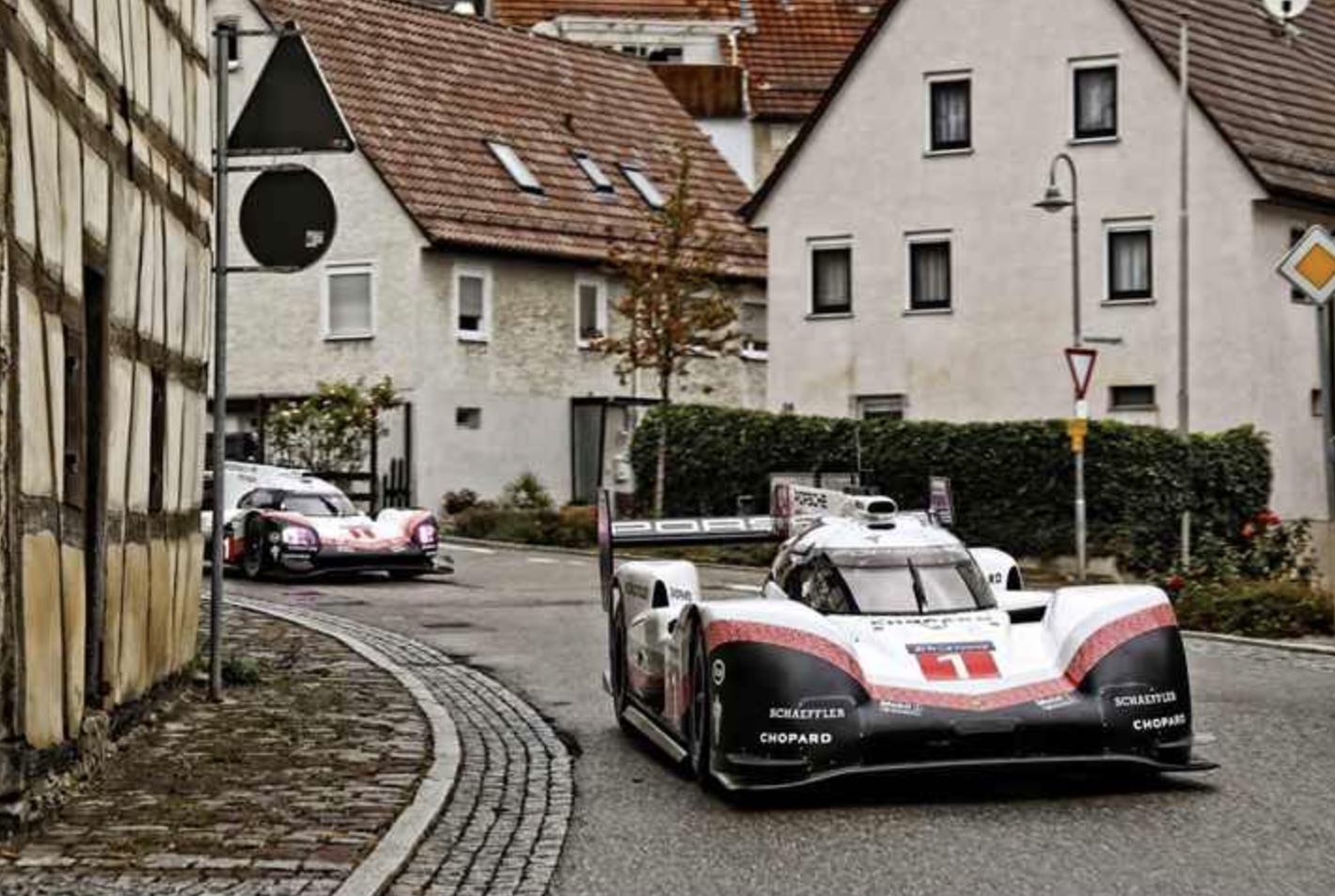
 

(Porsche)

Porsche’s PR machine has always blown me away. They do stuff in such an interesting kind of way.

When they put the 919 Hybrid away after several years of sterling service- a few Le Mans and WEC wins they enlisted Mark Webber and Marc Lieb to drive two of the cars 25km from Porker HQ in Weissach to their Museum in Zuffenhausen.

Milking plenty of teev, ‘paper and online coverage. Nice. The shot below is Webber’s 919 at Le Mans in 2014, check out this article; https://primotipo.com/2019/07/18/le-mans-arty-farty/
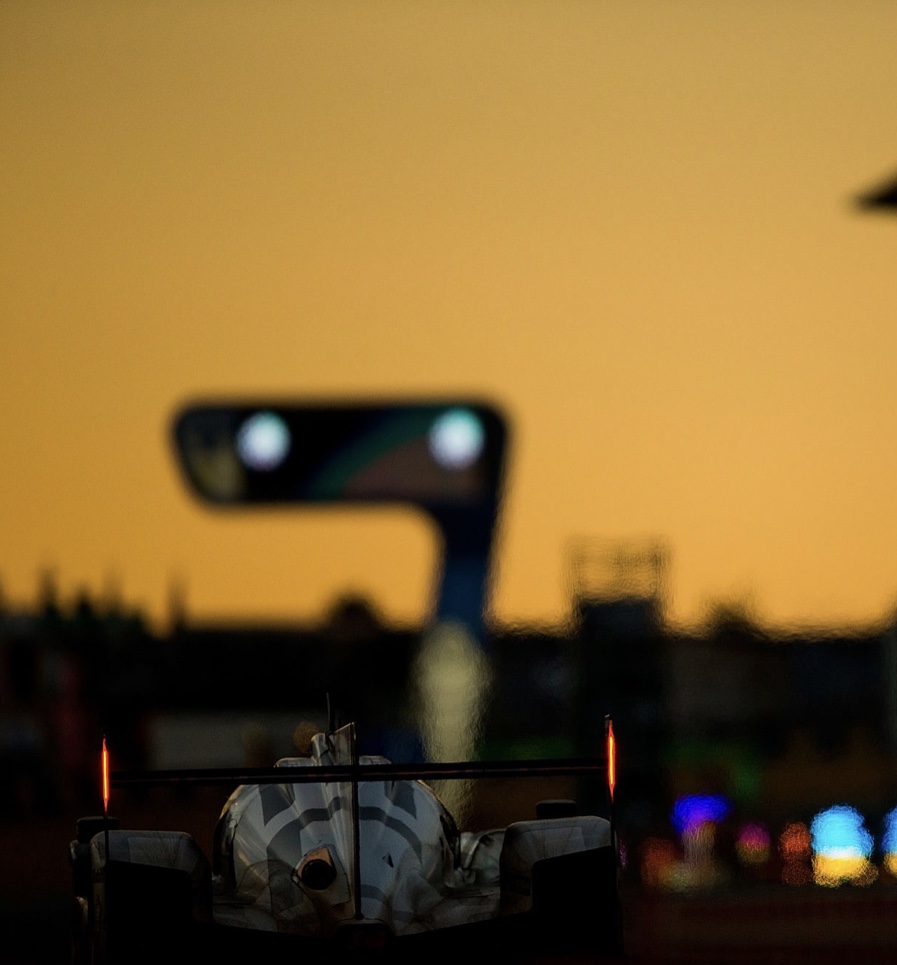
(Getty Images)
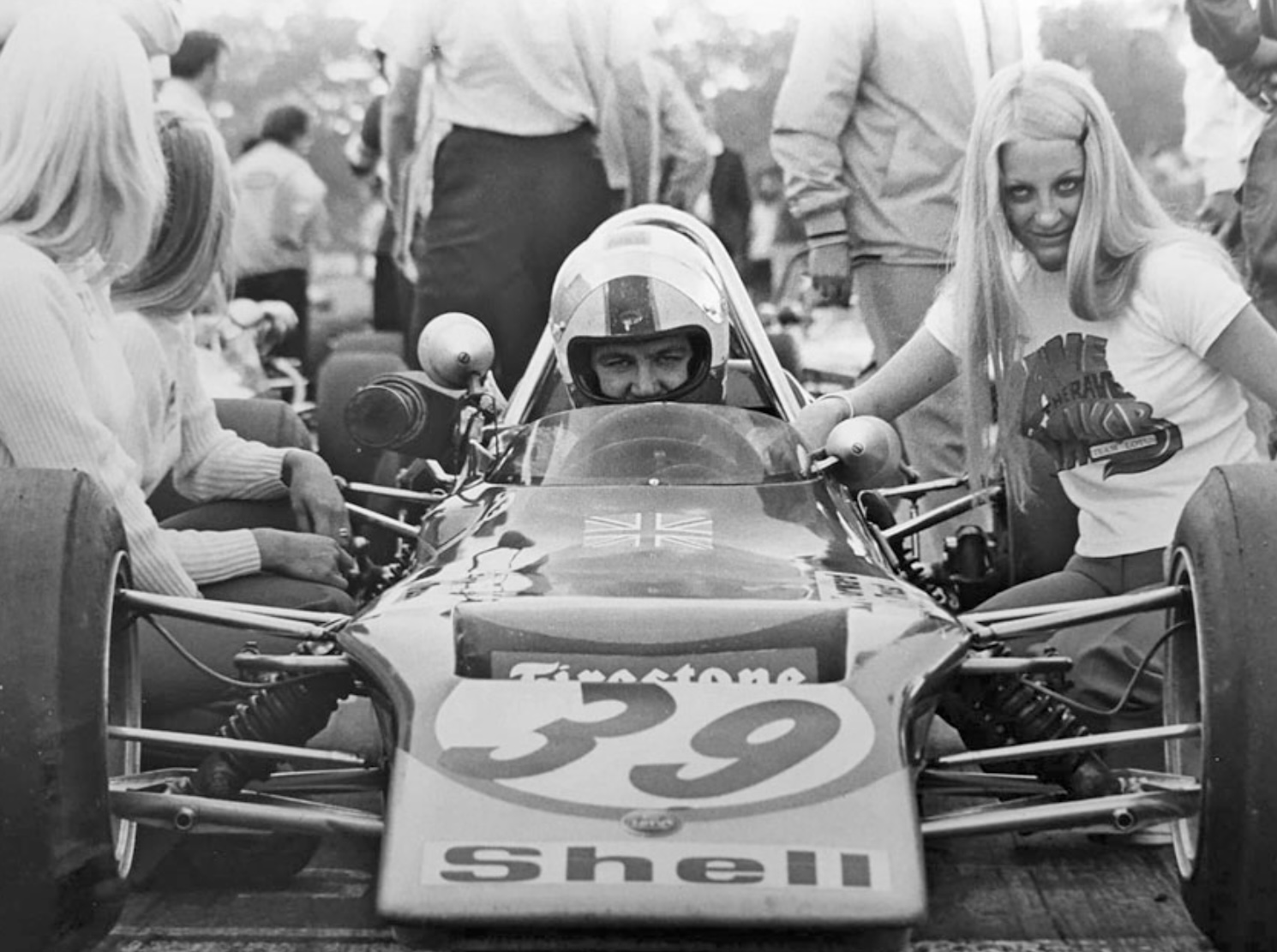
 

Walker with a couple of lovelies on the 1971 Zandvoort F3 grid, Lotus 69 Ford (J Ranger)

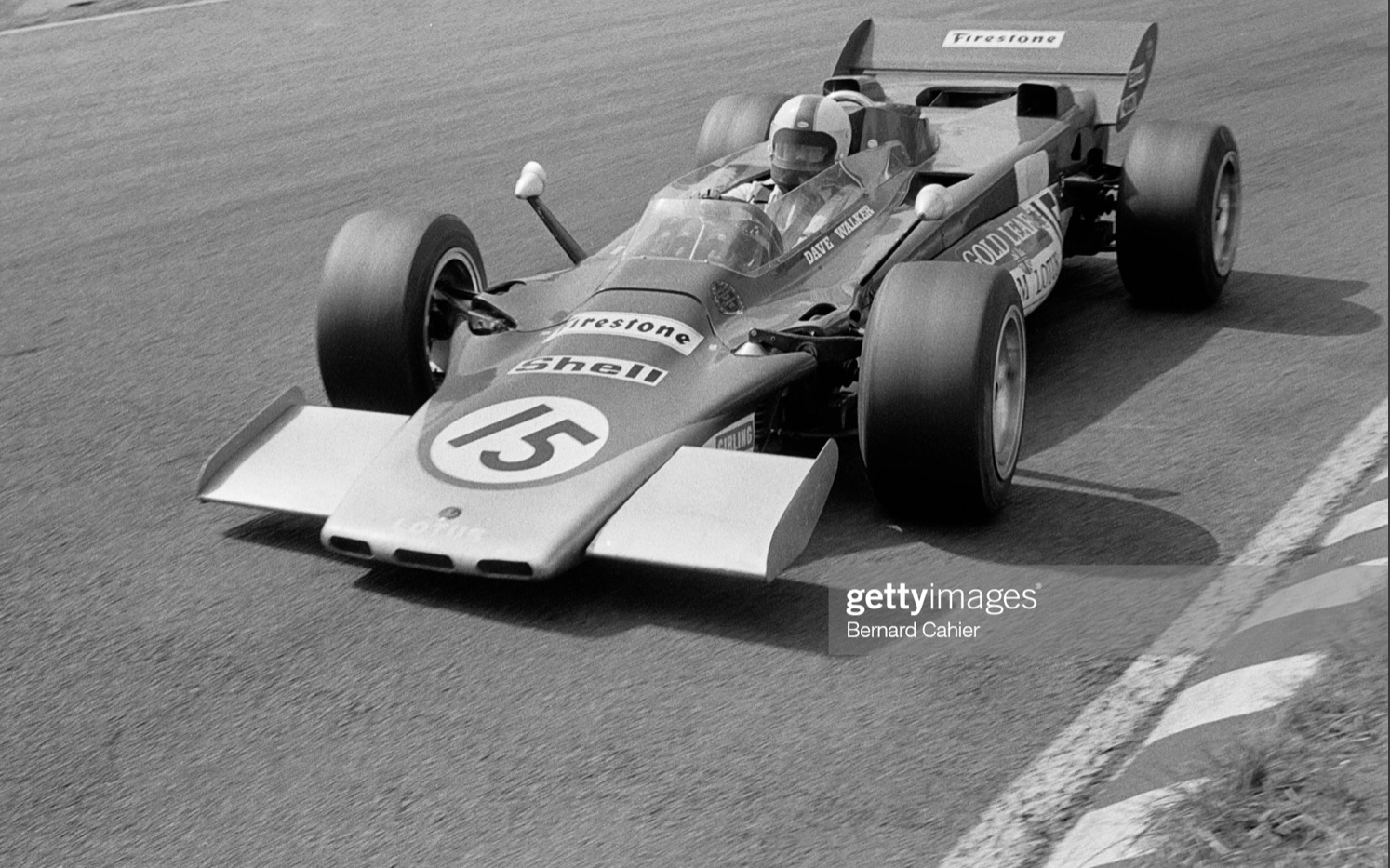
Its fifty years ago that one of Australia’s shooting stars had one of the most sensational F3 seasons ever- Dave Walker in his works Gold Leaf Team Lotus, Lotus 69 Ford-Novamotor during 1971.

In addition to winning everything in F3- he also had several F1 drives most notably aboard the incredibly sophisticated, complex, Pratt & Whitney gas-turbine powered, 4WD Lotus 56B.

Who knows, perhaps with some decent test miles under his belt he may have taken a podium finish during the wet Dutch Grand Prix at Zandvoort. The shot below of the 56B is during dry practice.

Stay tuned for a feature on David Walker.
 

(T Carwithe)

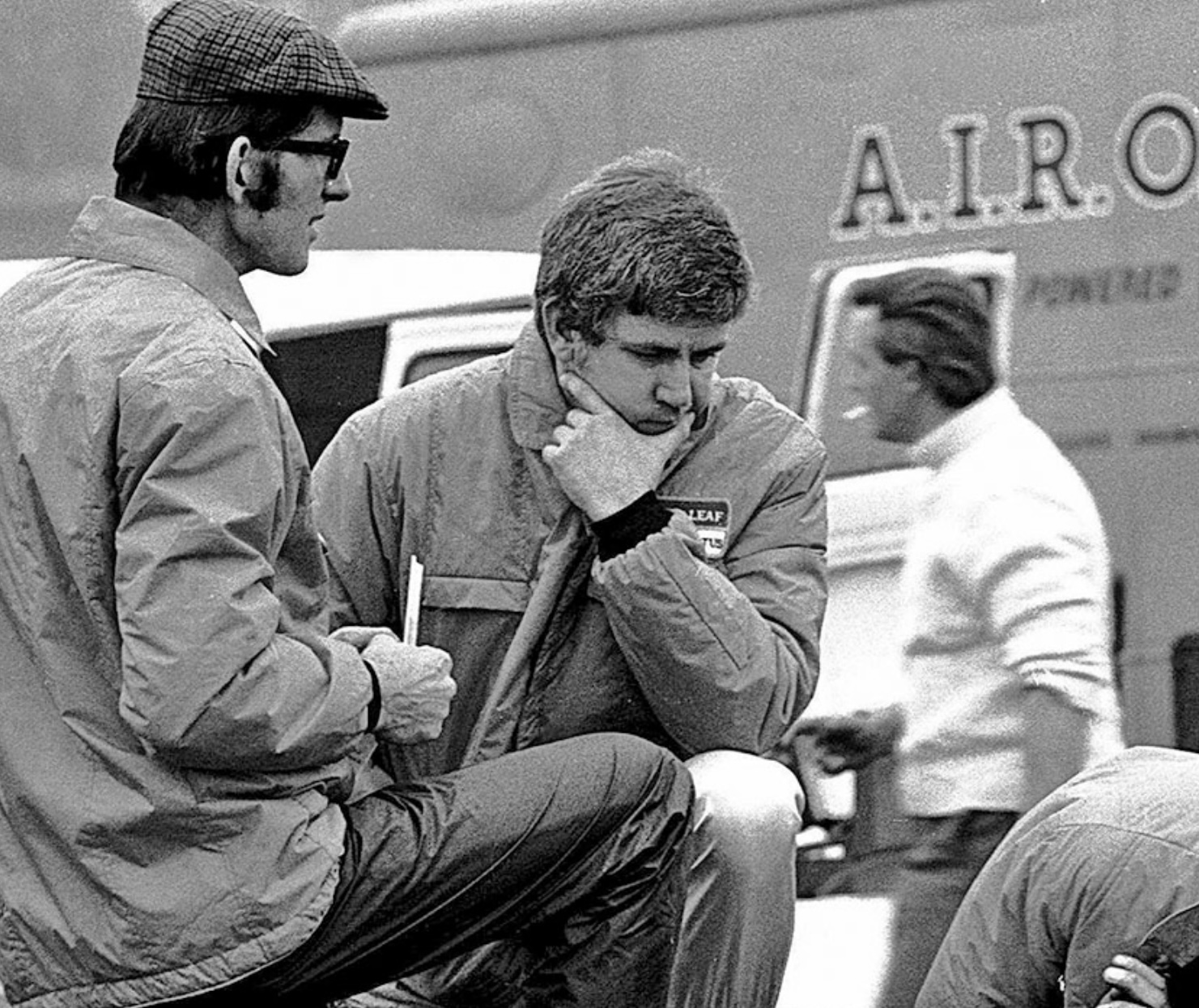
Dave with Lotus Team Manager Peter Warr at Mallory Park during 1971. Walker was the the most successful of the Gold Leaf Lotus drivers that season. Emerson Fittipaldi and Reine Wisell didn’t win a GP, the first time in about a decade Lotus hadn’t won a championship round. Walker’s ascent to the F! team in 1972 was in part to placate British Tobacco.

The eagle-eyed will have noticed the A.I.R.O transporter behind Warr and Walker. The Australian International Racing Organisation was the rather flash name for the smell of an oily rag operation which ran two Australians in F3- Alan Jones and Brian McGuire.
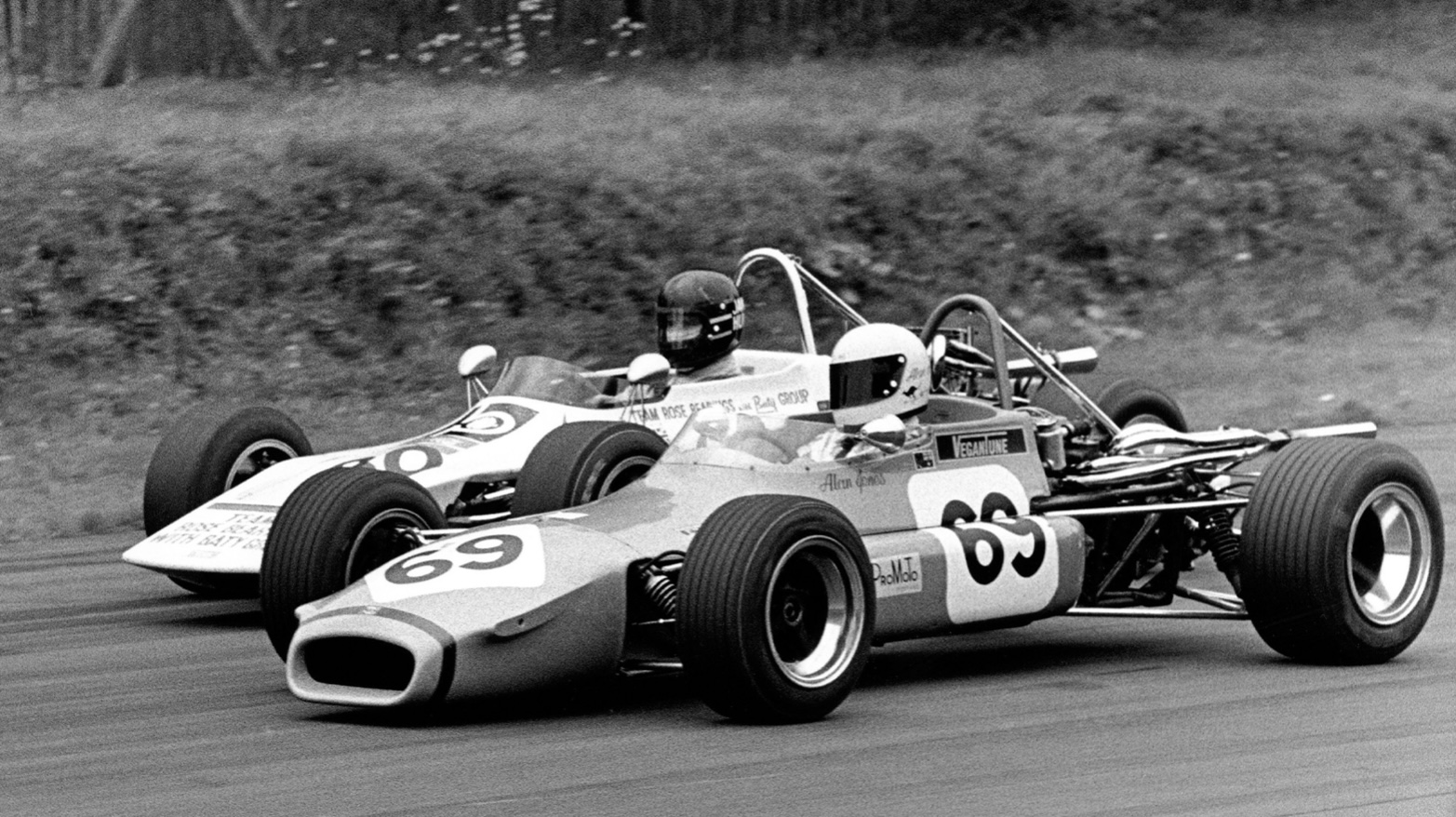
(N Snowdon)

A.I.R.O. driver Alan Jones at it hammer and tongs with another up-and-comer, James Hunt at Brands Hatch during 1971. Brabham BT28 and March 713M.

Hunt the Shunt jumped out of F3 and into GP racing with Alexander Hesketh’s team in 1973, Jonesy was a year or so after him but no less successful!
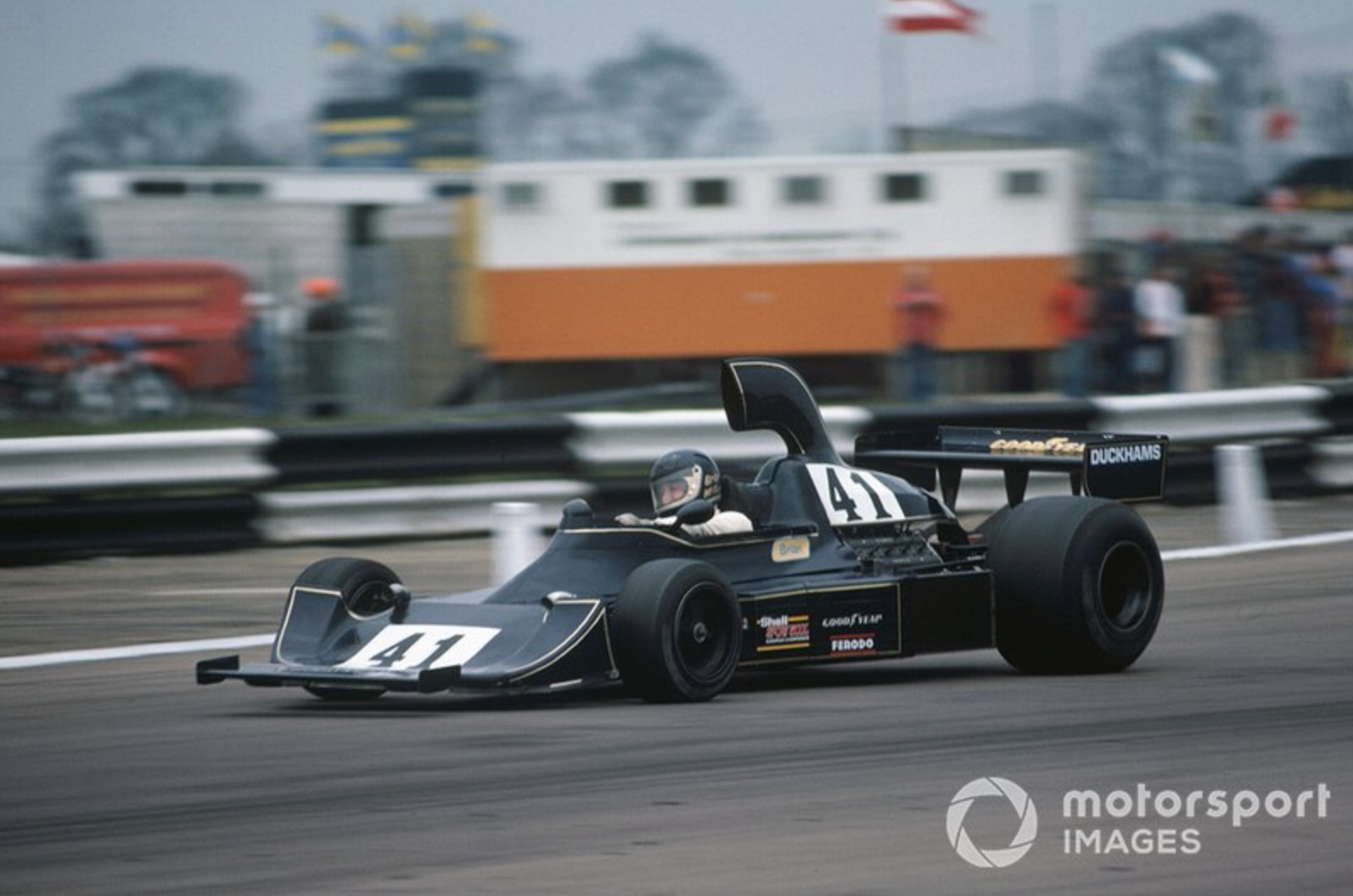
Brian McGuire aboard his Williams FW04 Ford during the April 1976 BRDC International Trophy at Silverstone.

Q18 and DNF lost oil/black-flagged in the race won by James Hunt’s McLaren M23 Ford.

The self made Aussie, a mate of Alan Jones, hailed from East Melbourne. He set off for England to race in 1966, paying his own way by dealing in cars and later caravans. He jumped from F3 to F5000 becoming a front-runner in the 1975 Shellsport F5000 Championship racing the ex-Bob Evans 1974 British F5000 Championship winning Lola T332 Chev.

He progressed to an F1 Williams FW04 Ford (aka McGuire BM1). He won a Shellsport 5000 European Championship race in the wet from pole at Thruxton in September 1976 – the first ever win for a Williams. It was in this car he crashed to his death, taking a flaggie with him, after component failure in practice for a Shellsport International Championship race at Brands Hatch on August 29, 1977 .
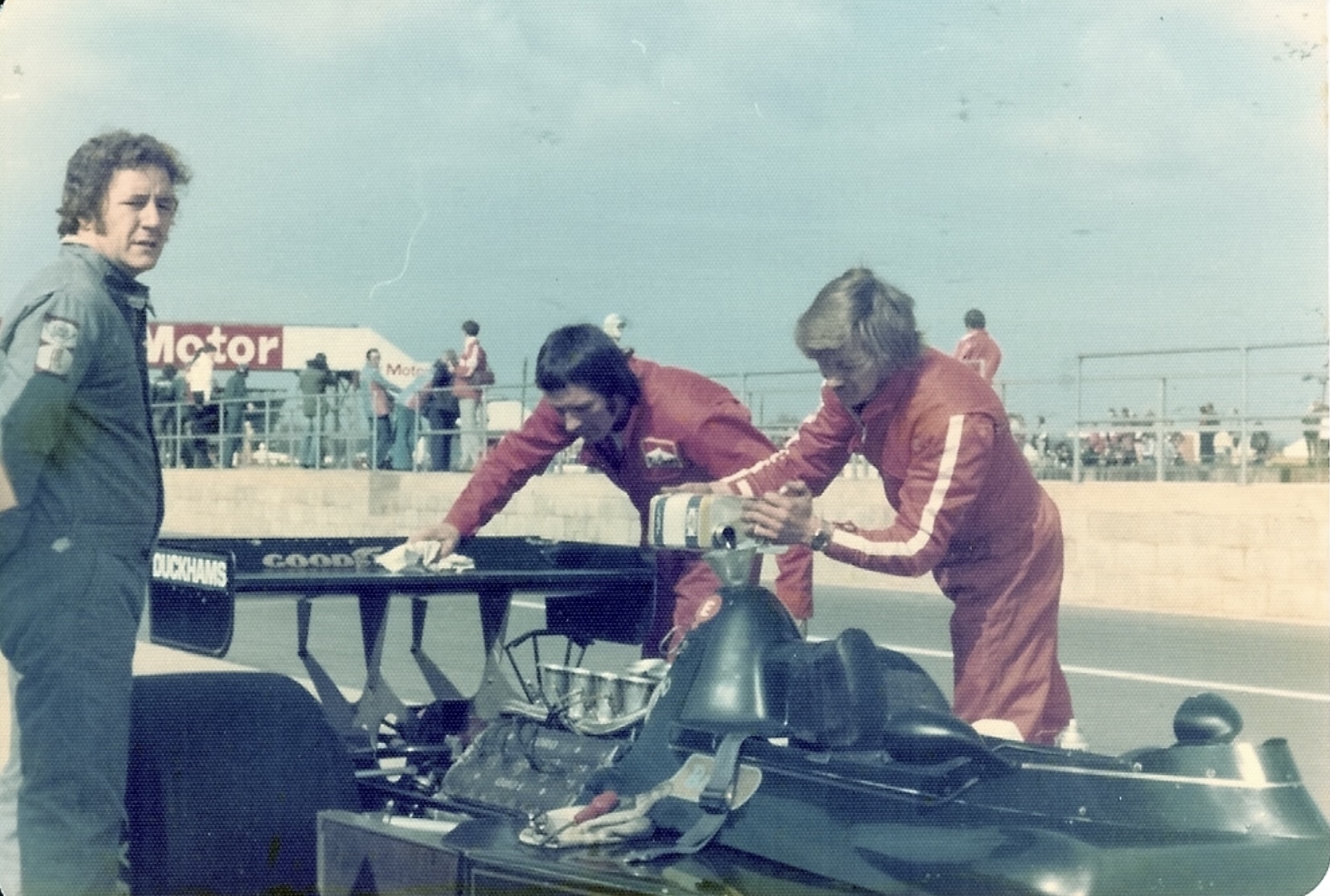
McGuire, Williams FW04 and crew in the Silverstone pitlane in April 1976 (peter.bryan.org.nz)
 

(NAA)

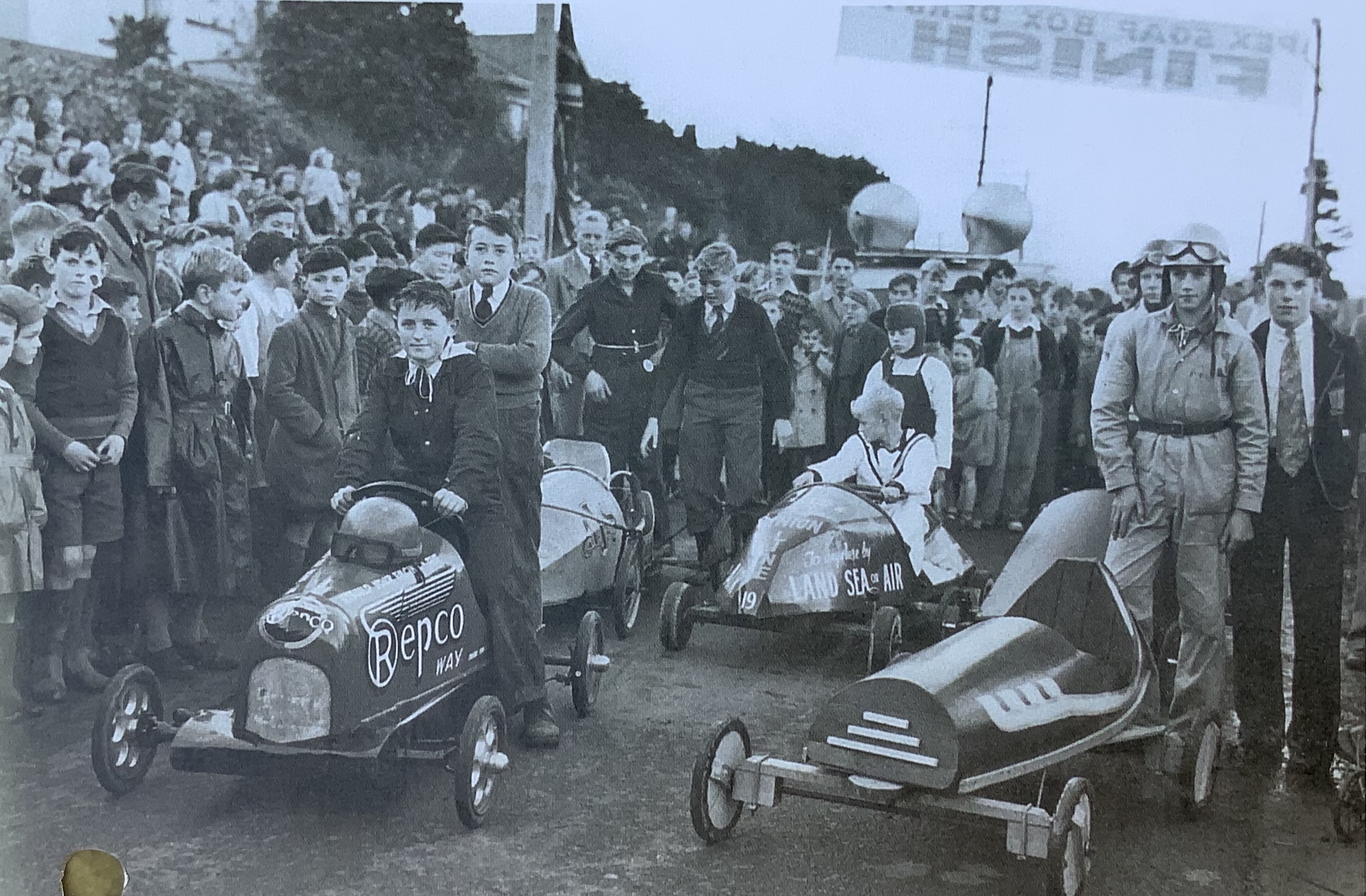
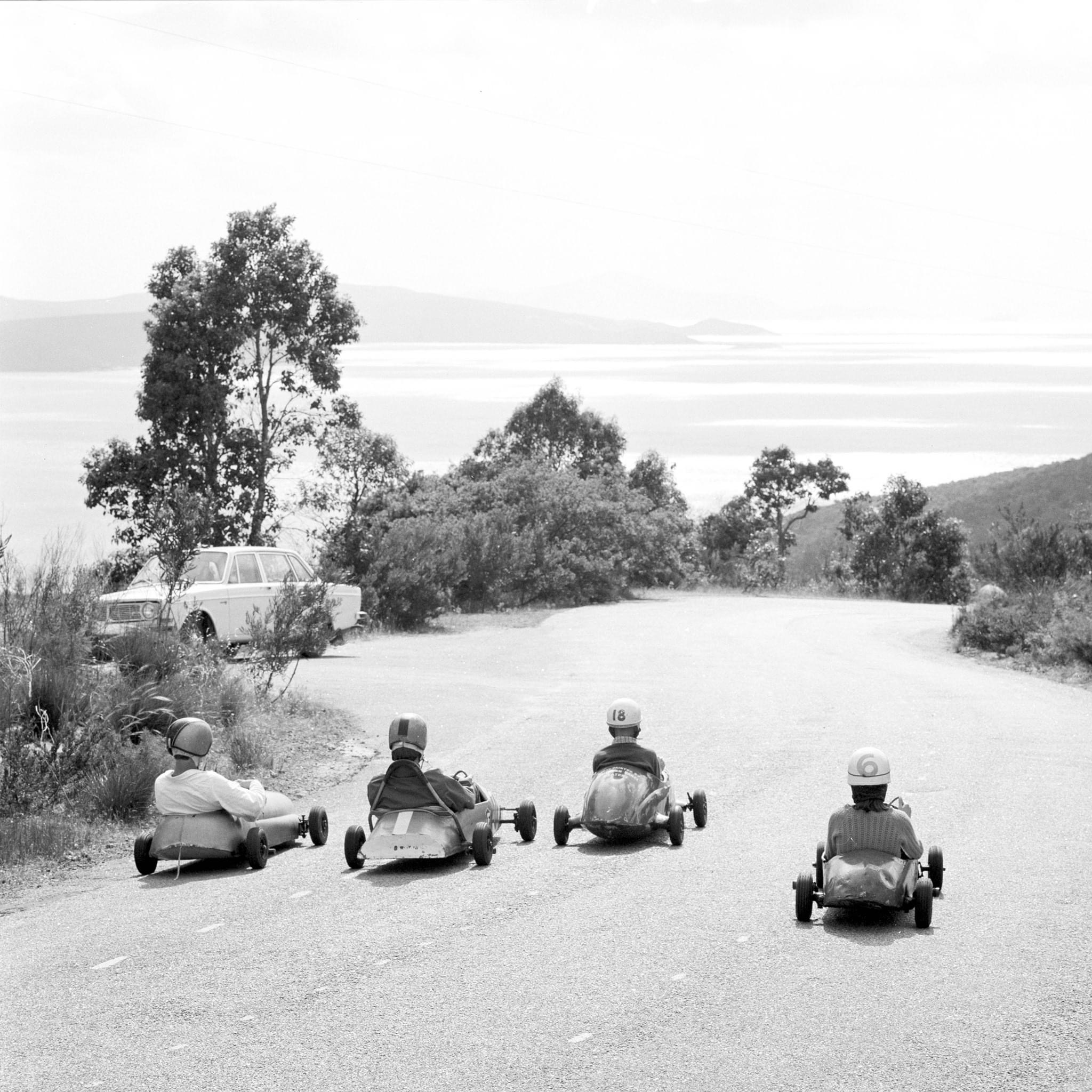
Soap-box race at Albany, West Australia in 1970.

It’s a shame that bloody Volvo buggered up a great shot.

What was the seventies Oz Volvo joke? ‘Wots the difference between a Volvo and a Porcupine? Answer- the pricks are on the outside of the Porcupine. Boom-boom. More billy-carts; https://primotipo.com/2019/02/10/spitty/
 

(J Barnes)

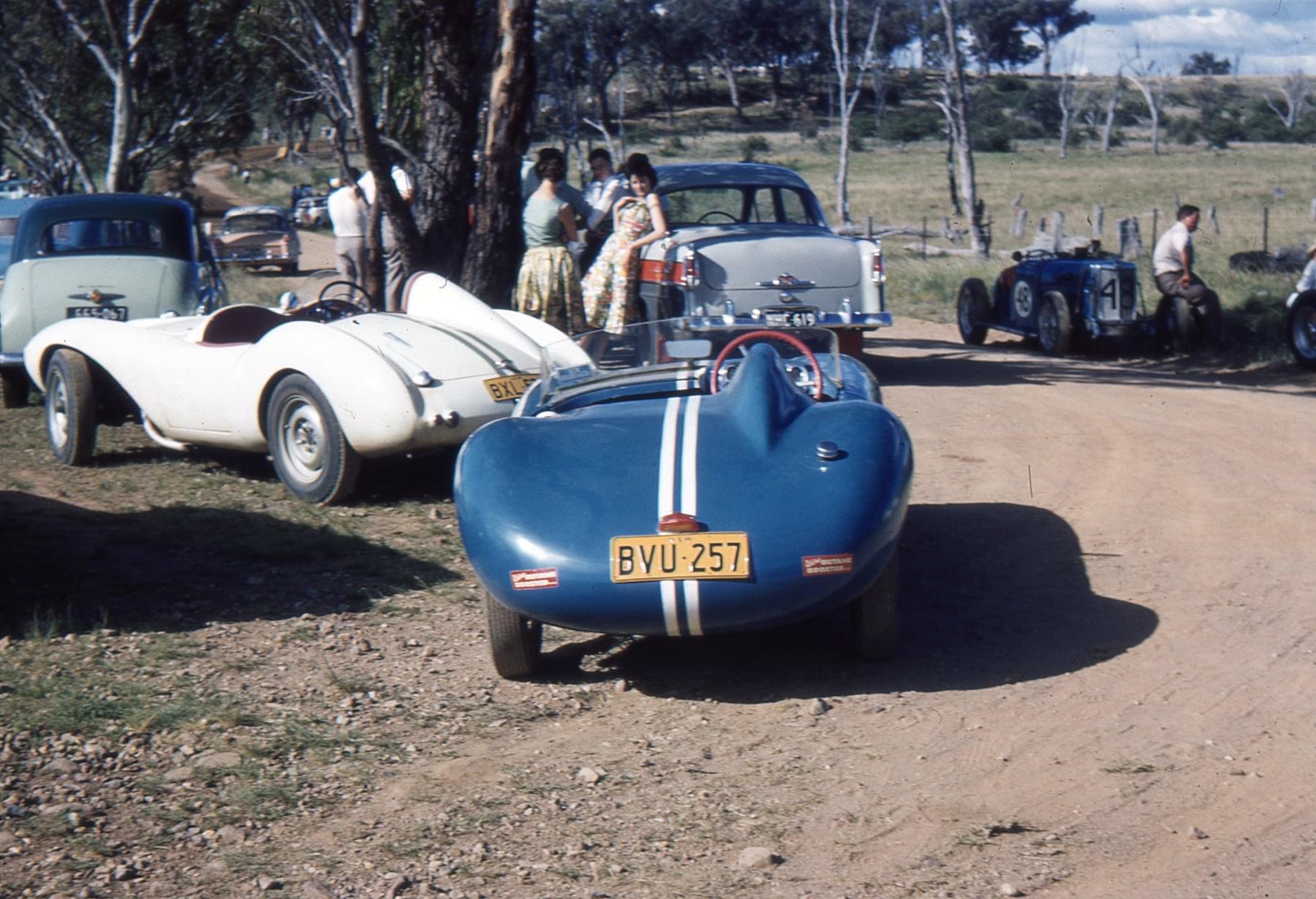
Some shots from Elsmore Hillclimb, east of Inverell in New South Wales.

The first shot shows John French’ Holden 48-215 at the far left, then the white RAWGS sportscar , the beautiful blue JWF Milano and the Barnes MG TC Spl at far right- thanks to Dick Willis for the IDs. The photographs below are from the carpark looking back up the hill.
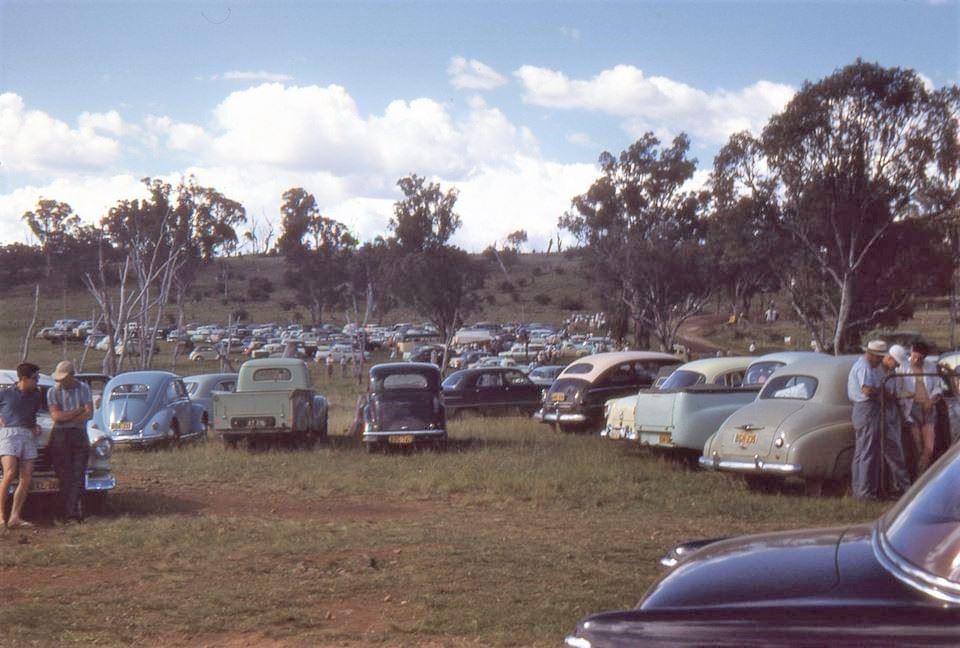
(J Barnes)
 

(A Purcell)

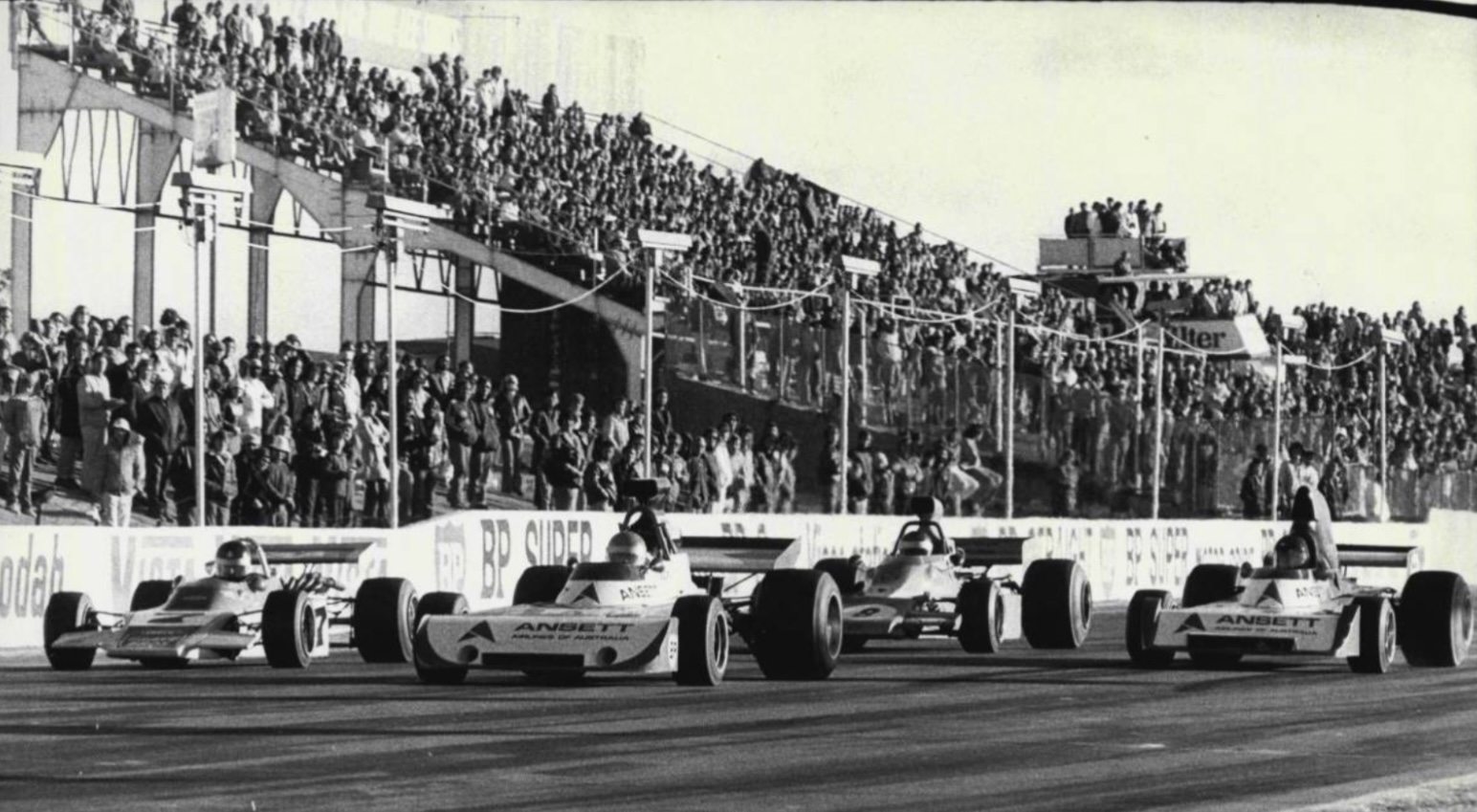
A packed crowd at Oran Park for the start of the

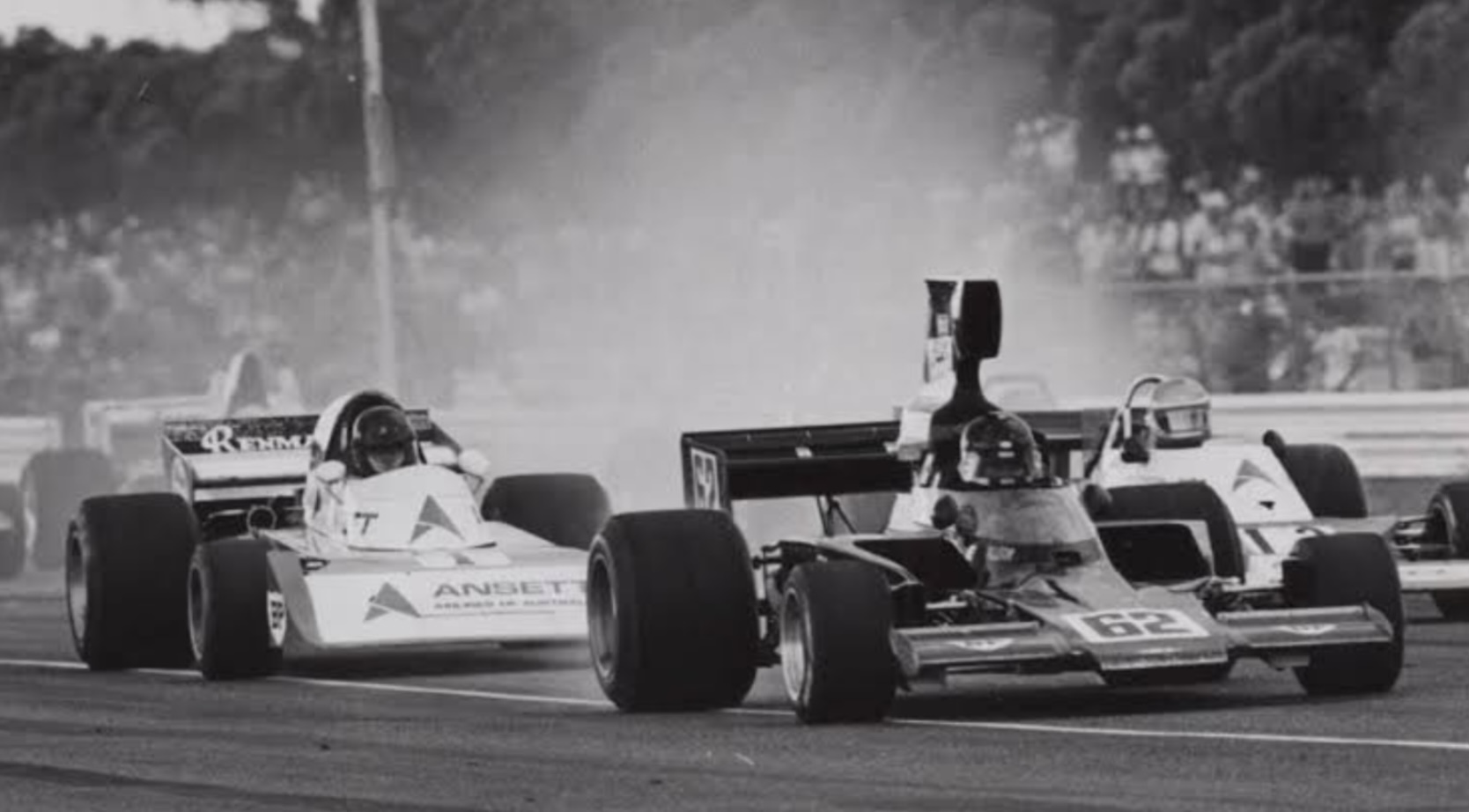
From left, John Leffler’s Bowin P8 Hart-Ford ANF2 car alongside Phil Moore, Elfin MR5 Repco-Holden. On row 2 car 8 is John Goss in his just acquired Matich A53 Repco-Holden and on the right John McCormack in the other Ansett Team Elfin car- an MR6 Repco-Leyland.

There were two heats, Max Stewart won both is his Lola T330 Chev- this group are the back couple of rows in one of them. Max won the Gold Star that season.

1974 Australian Grand Prix at Oran Park; https://primotipo.com/2021/01/15/1974-australian-gp-oran-park/
(P Weaver)

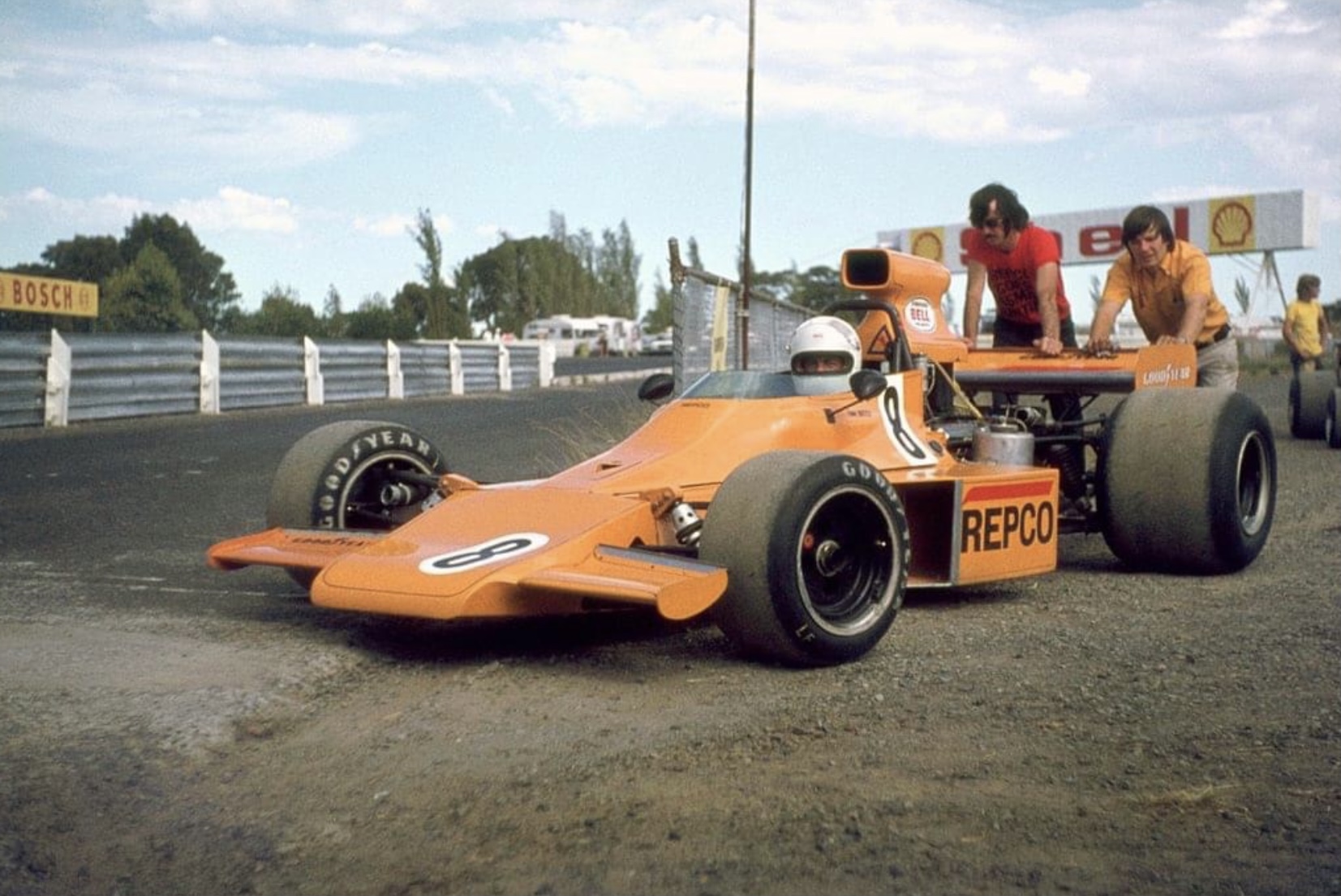
Here is the car John Goss raced at Oran Park in the hands of its creator Frank Matich at Sandown Park during the February Tasman Cup meeting. Repco’s Ken Symes and Matich’ chief mechanic Derek Kneller pushing.

The Matich A53 Repco-Holden was the smallest, last and best of the six Matich F5000 cars, it is a great shame FM did not return to the US that year as planned. His boating accident and Joan Matich’ illness meant the time had come to retire.

Goss did well with the car winning the 1976 AGP at Sandown in an A51 updated to A53 specifications. See here for a feature on the Matich F5000 cars; https://primotipo.com/2015/09/11/frank-matich-matich-f5000-cars-etcetera/
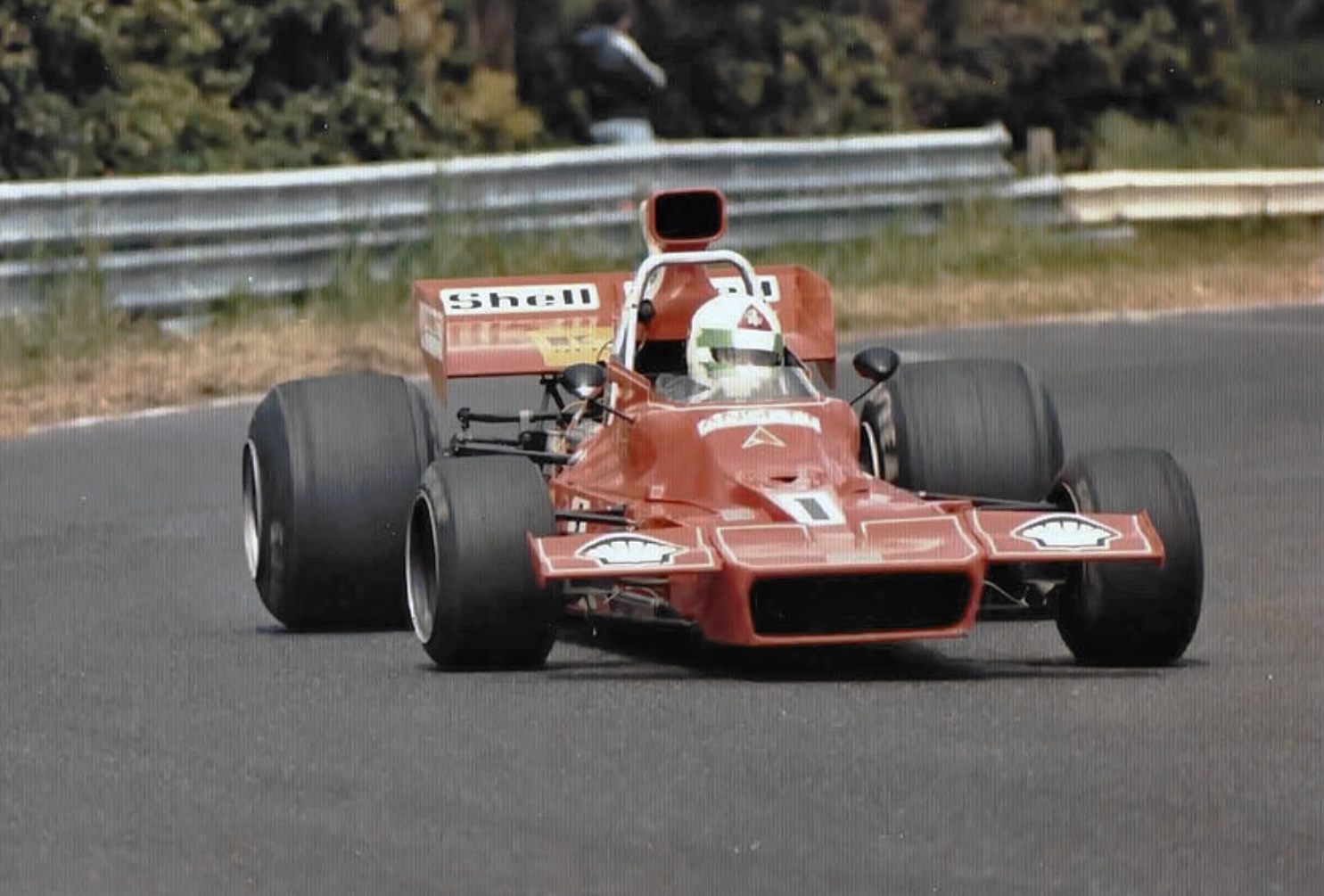
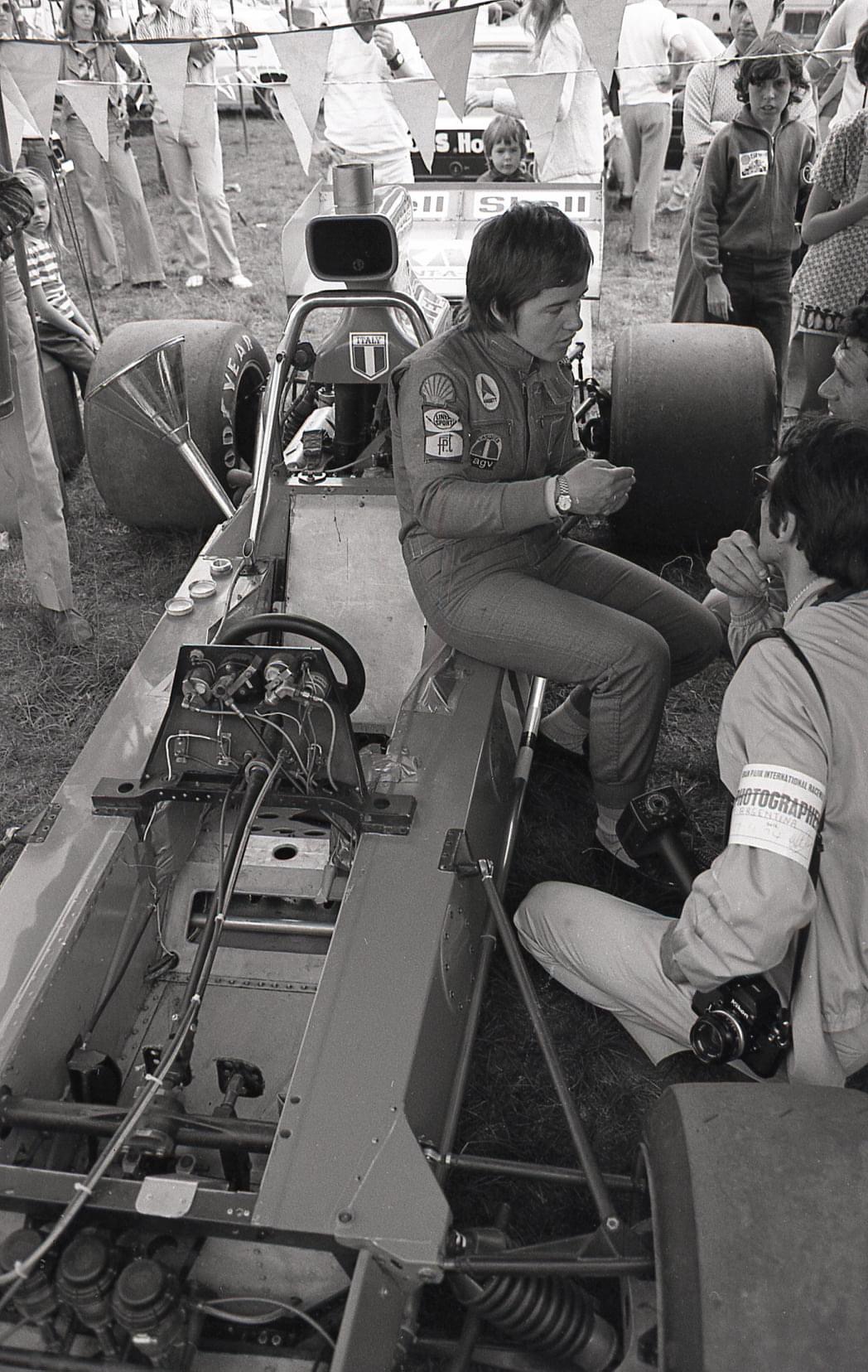
Above is Lella Lombardi in the same chassis Goss used to win the AGP at Sandown in 1976, A51 ‘005’.

When Goss used it, the car was converted to side-radiator A53 specifications similar to the shot of FM above. Lella is shown at Sandown’s Dandenong Road during the 1974 Victoria Trophy Gold Star round prior to contesting that years AGP at Oran Park, see here; 1974 Australian Grand Prix at Oran Park; https://primotipo.com/2021/01/15/1974-australian-gp-oran-park/
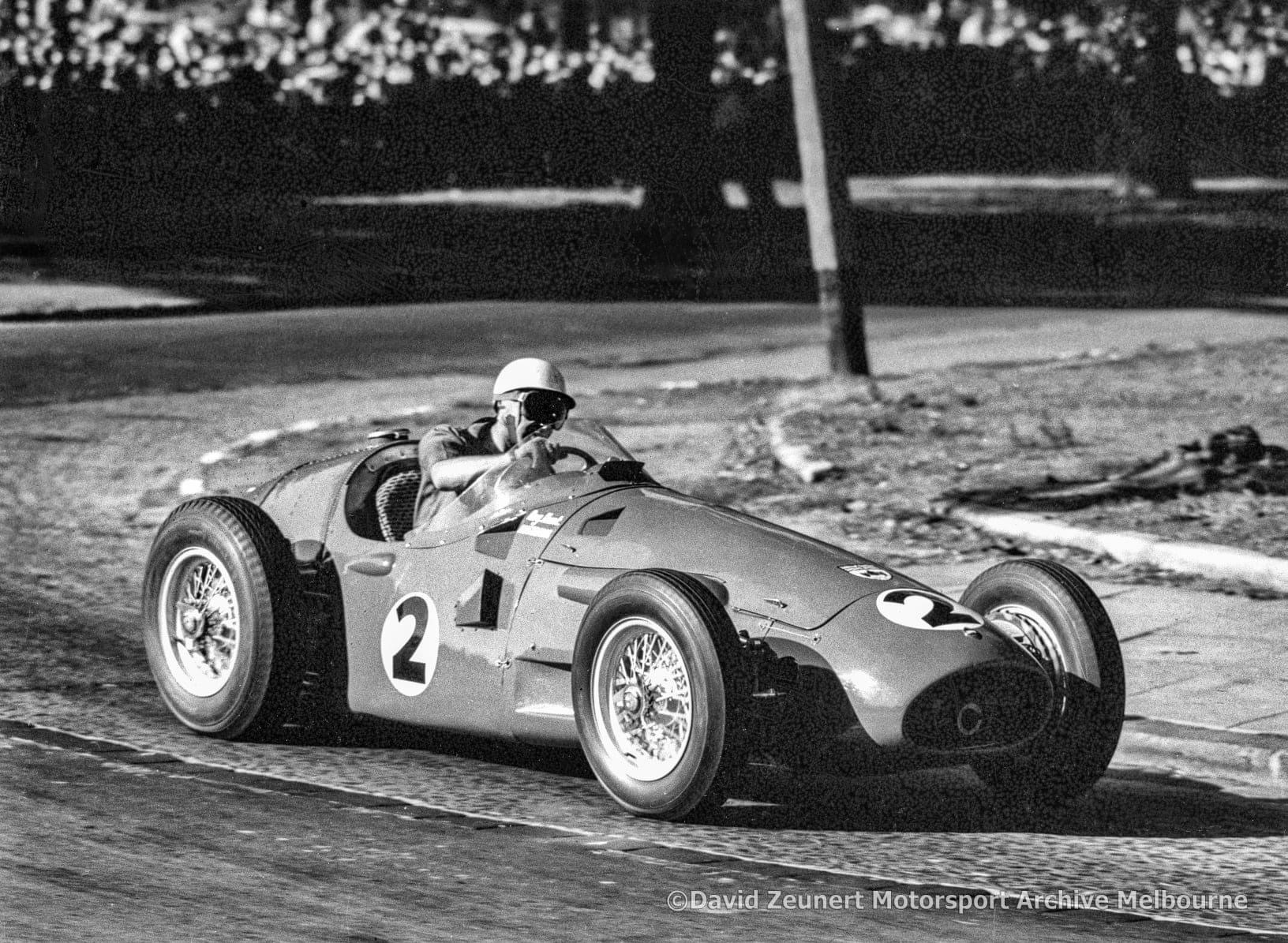
 

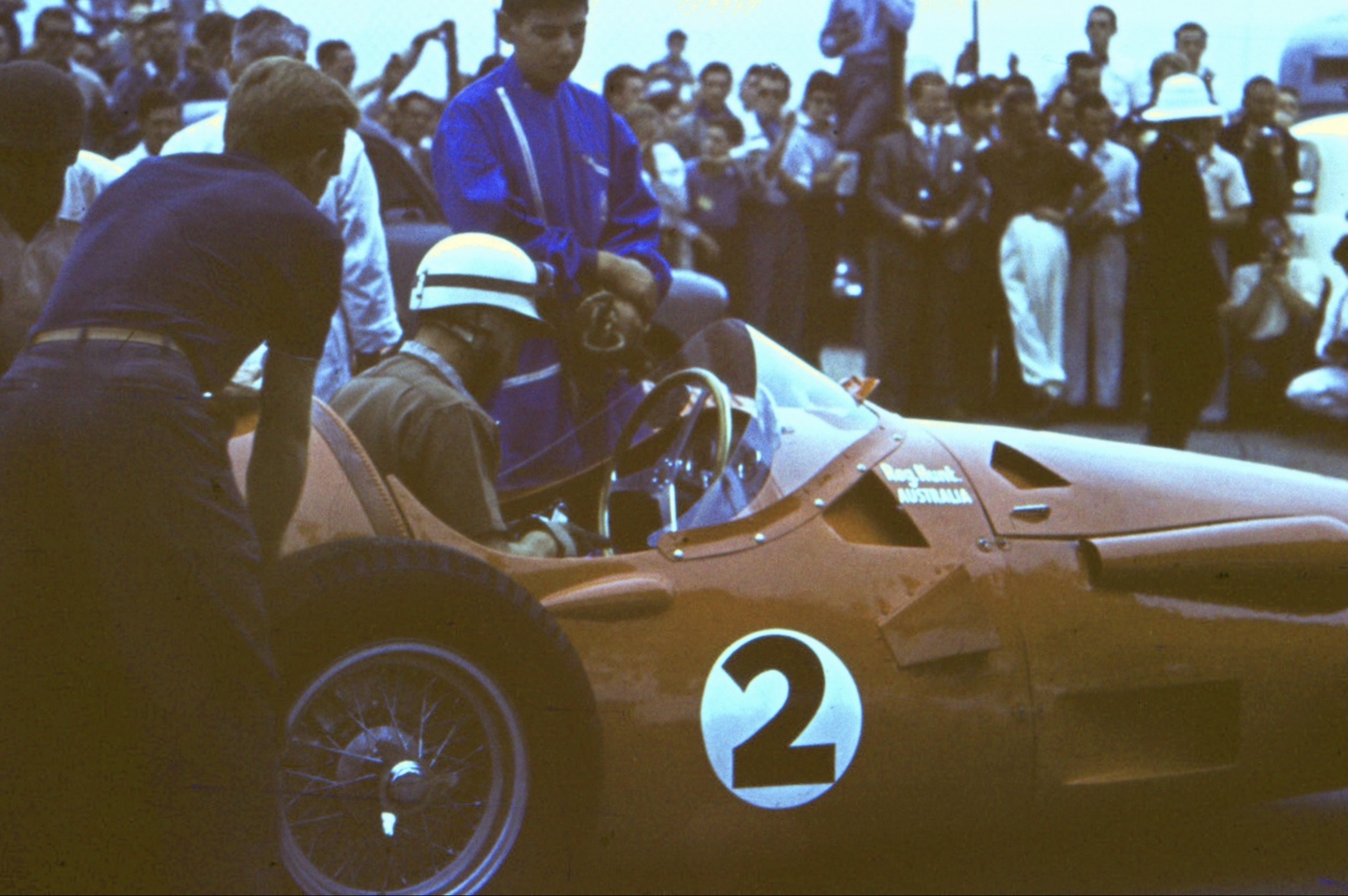
Reg Hunt, Maserati 250F during his successful March 1956, Moomba meeting.

He won both the 50-mile Albert Park Cup and 150-mile Argus Trophy feature from Lex Davison’s just acquired ex-Gaze Ferrari 500/625, Tom Hawkes’ ex-Brabham/Jones Cooper T23 Bristol, Bib Stillwell’s Jaguar D Type and others.

By the end of the year he had been the fastest resident in the AGP, also at Albert Park and retired from racing. His ‘reign at the top’ extended from the arrival of his A6GCM Maserati 2.5-litre in early 1954 to the end of 1956.

Feature on Reg Hunt; https://primotipo.com/2014/07/19/reg-hunt-australian-ace-of-the-1950s/


(J Fitzpatrick)

Who said Jean Shrimpton was the first to wear a miniskirt in Oz?

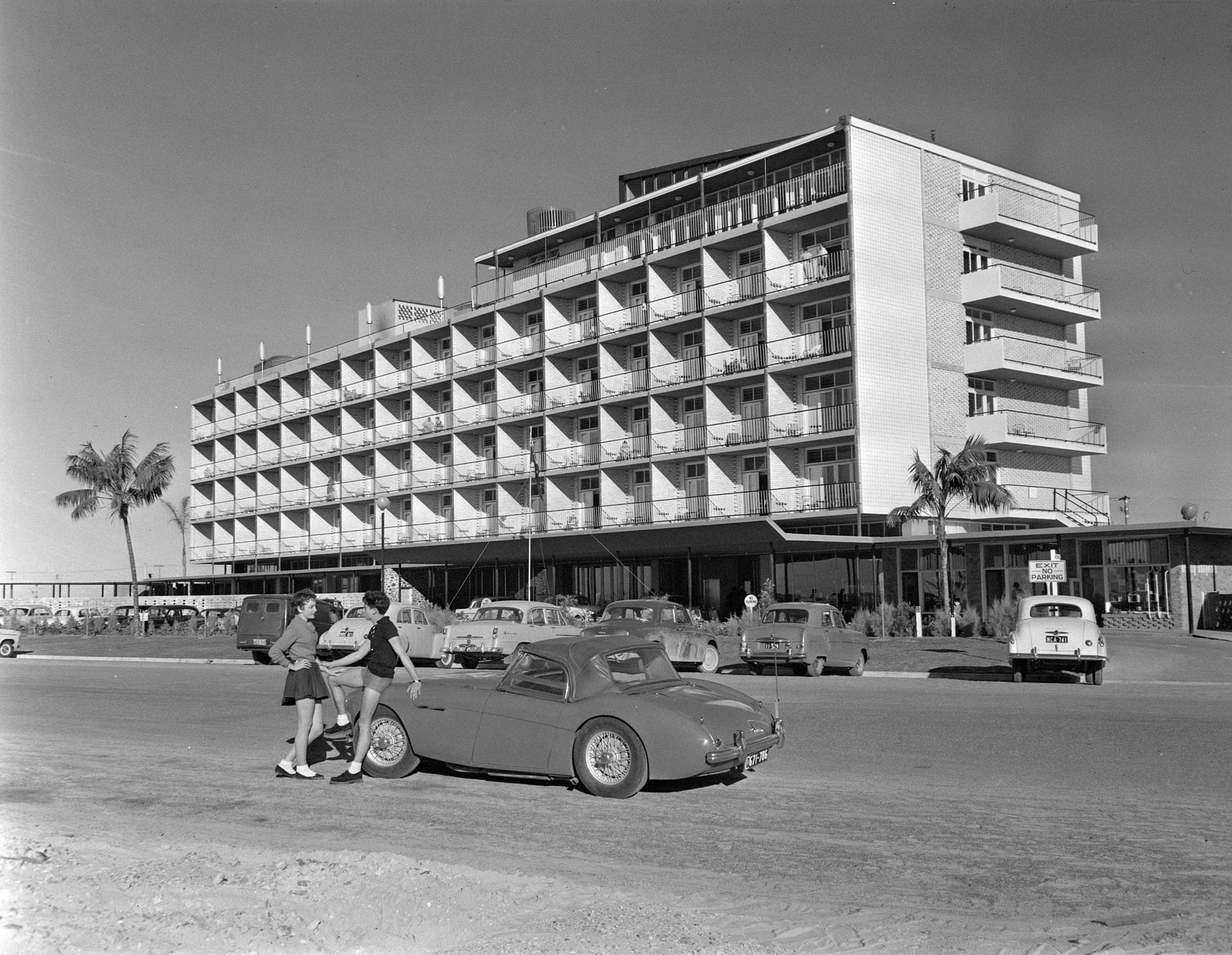
Leggy-lass, as we say in polite society, and a chap with quite questionable clothing taste, and Austin Healey 100 outside the Broadbeach Hotel on Queensland’s Gold Coast in 1957.

Have always thought the Goldie a good place to fly over, the Queensland white-shoe brigade got better with their developments as they went progressively north.
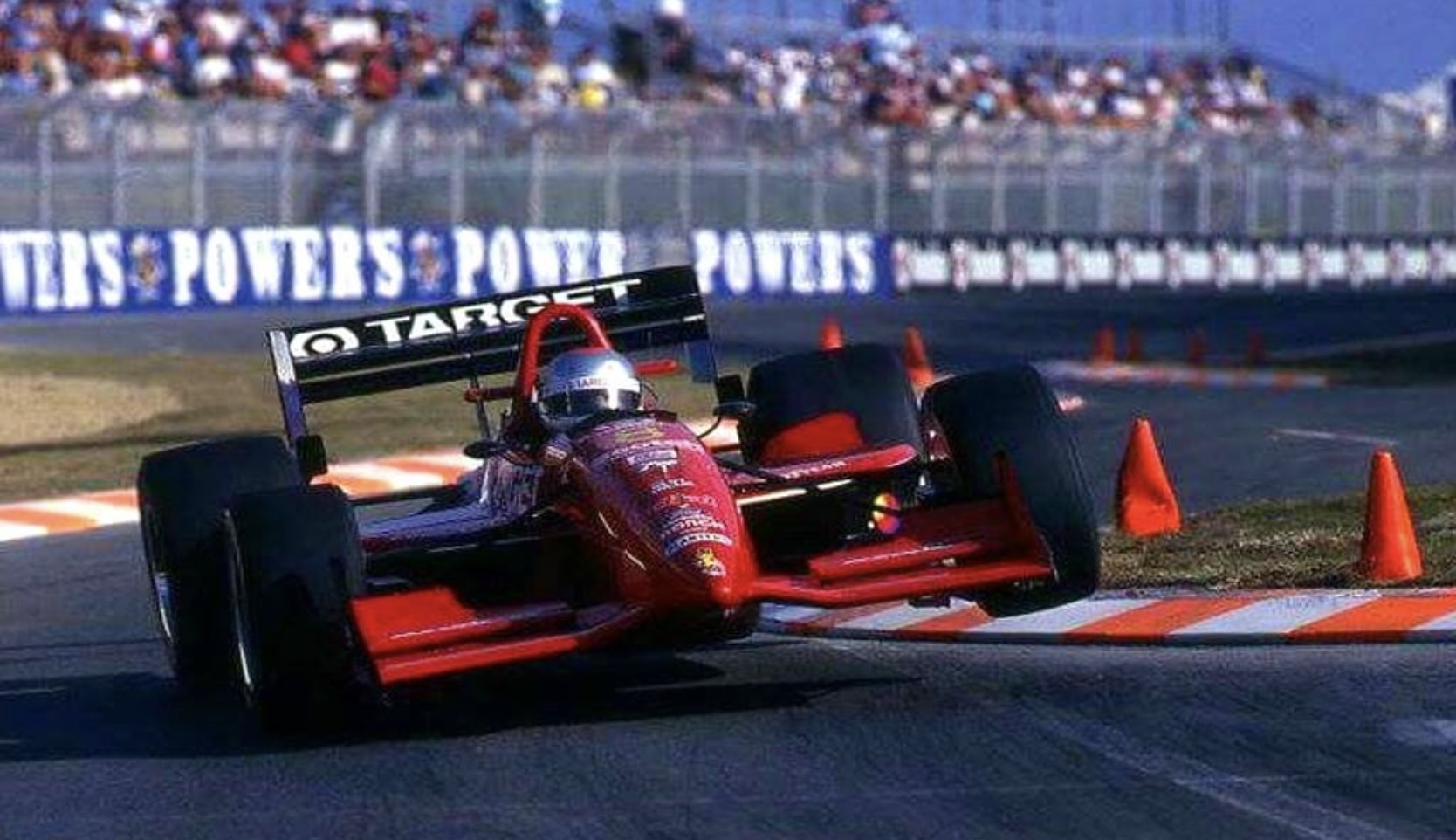
 

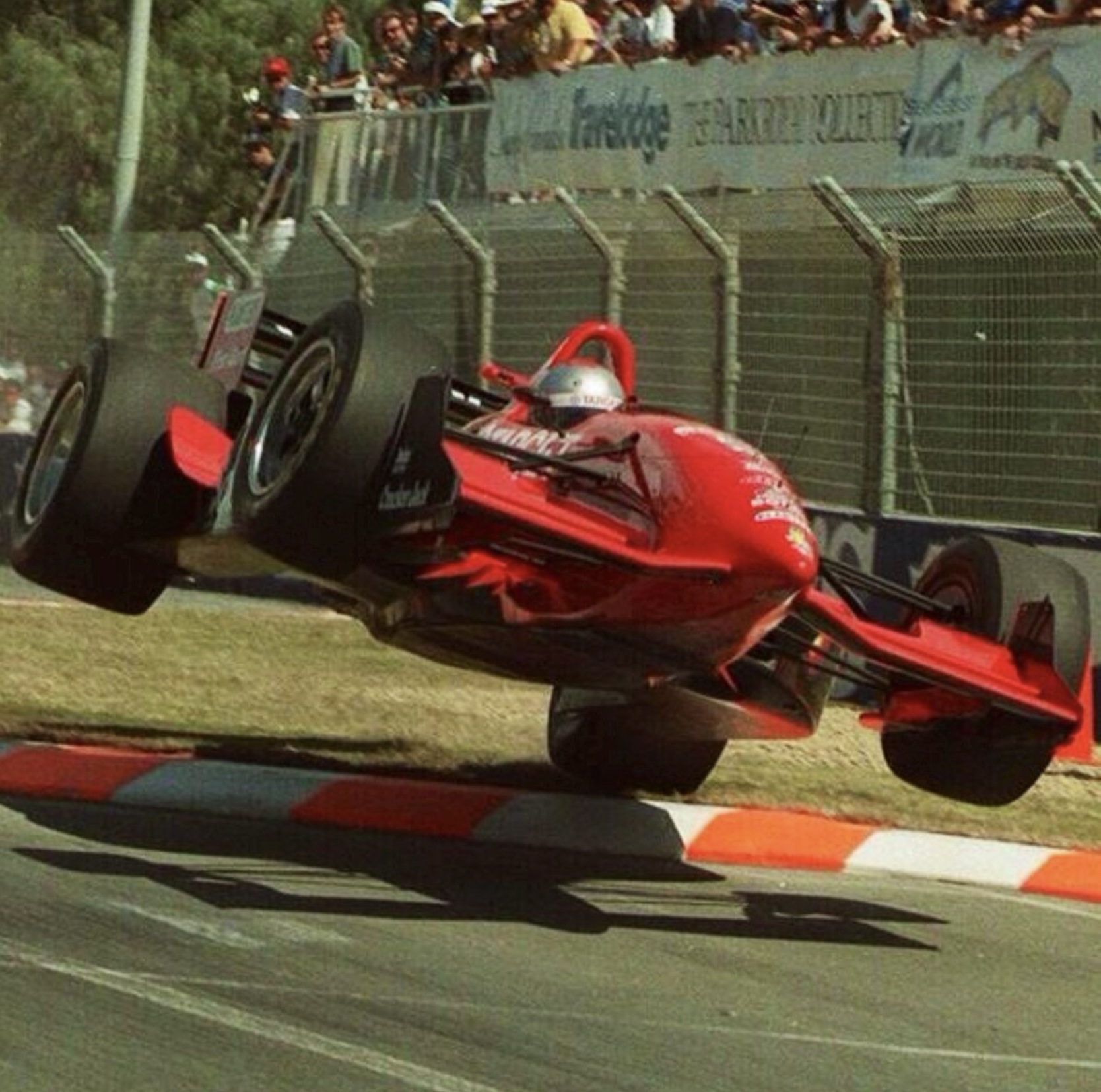
Michael Andretti had a shocker of an F1 season with McLaren in 1993.

It was never going to be easy with the incredibly gifted and well established Ayrton Senna in the other car. The class was new to Mario’s boy. So too the tracks and the culture of F1. Stupidly, he continued to live in the US rather than camp somewhere close to McLaren in the Thames Valley. See here; https://primotipo.com/2015/02/06/michael-andretti-and-f1/

Indycar was mighty competitive as well. To come back after a season away and win the first race of the season at Surfers Paradise in Malcolm Oastler’s brand new Chip Ganassi Racing Reynard 941 Ford Cosworth XB V8- his first Indycar design, was quite a feat.

Emerson Fittipaldi was second in the new Penske PC23 while Mario Andretti was third aboard his Lola T94/00 Ford in his final season- it was the great all-rounders final podium.
(unattributed)

Credits…

National Archives Australia, Auto Action, Stan Griffiths, Bob Young, Ben Short, Robert Davies, Getty Images, Janathan Ranger, Tony Carwithe, Nigel Snowden, MotorSport, peter.bryan.org.nz, John Barnes, Clive Bottomley, National Archives of Australia, Jim Fitzpatrick

Tailpiece…
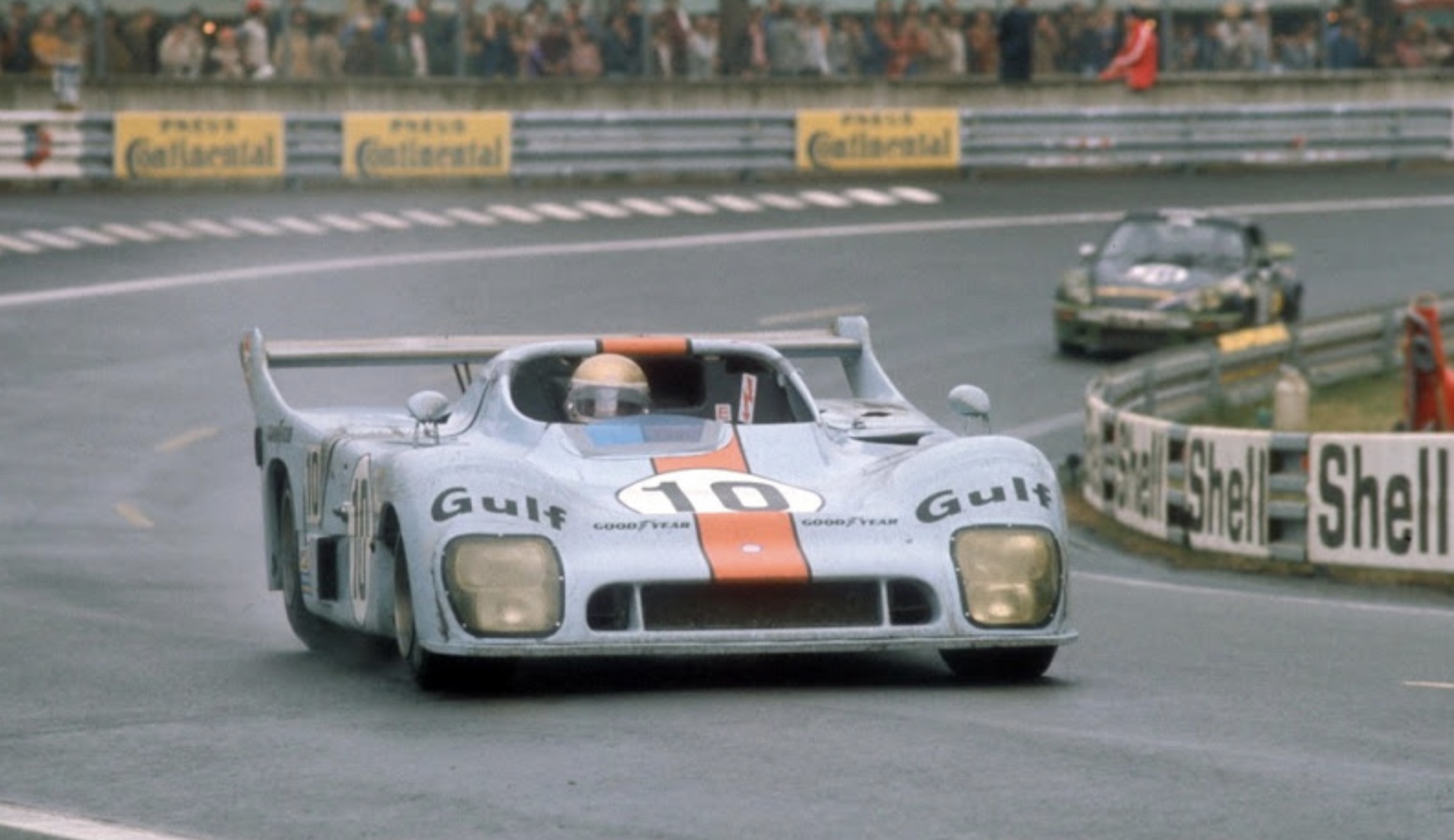
(LAT)

Vern Schuppan, Mirage GR8 Ford on the way to third place at Le Mans in 1975.

He shared the car with Jean-Pierre Jaussaud, Derek Bell and Jacky Ickx won in another Mirage.

Finito…

(NAA)

Launceston artist, gallery owner and teacher, Mary Jolliffe, aboard her Gremlin Formula Vee in 1968.

The shot made me chuckle. I wish I had one of my grandmothers pose for a shot in my Venom Vee a decade later. My old man ‘useter say there were only two brands of the the new-fangled radial tyres to buy, Michelin X and Pirelli Cinturato- these are Cints.

Launceston boy, Pat Stride, ex-RAF pilot, by day an air-traffic controller, built a number of Gremlins during the mid-sixties to mid-seventies, both single-seaters and sportscars.

Jolliffe, one of Tasmania’s best known water colourists, opened the Mary Jolliffe Art Gallery- a gallery, studio and art school, at 118 St John Street, Launceston in 1965. A decade later she was an immensely popular teacher at the Kalori Marist Brothers College in Burnie.

One of Pat’s former work colleagues wrote this brief piece about him when he died in 2014. ‘Pat Stride arrived in Australia on November 1st, 1963, along with 21 other hopeful  ATC recruits  who were destined to become short term course 22, the first of many  Australian ATC courses comprising personnel  recruited overseas, mainly in the UK.  Pat was accompanied by his wife, Wendy, and three children under 10 years of age, Trish, Jeremy and Andrew. Prior to his emigration Pat had been a pilot in the RAF, flying  Vampires, Meteors and Sabres, mainly in Germany.’

Kings Bridge, Longford during the final, 1968 meeting. The only Vee race held at Longford was won by Pat, here in the Gremlin ahead of Lynn Archer in Brian Roberts’ Elfin 500 and Mike Bessant’s Scarab. For we Longford nutters it’s an interesting and unusual shot as it gives us a great view of the approach to Kings- in the distance, well behind the final car is the Viaduct (Stride Family)

‘Having passed the theoretical ATC training he commenced field training in Melbourne and completed this in Launceston where he went on to be rated in both aerodrome and approach control. Being of an entrepreneurial nature, when an opportunity arose to establish a caravan park situated at the Tasmanian terminal of the catamaran service from Welshpool in Victoria he and Wendy embraced it with enthusiasm.  After 9 successful years they were shattered to learn the catamaran service was about to be withdrawn and chose this time to retire.

Pat had one enduring passion, other than for his family, and that was for speed. He was an avid racing car driver, building and competing in his own cars with a significant degree of success. This continued well into his eighties and his last road car was a Mazda MX5 sports.’

The Australian Government’s Department of Immigration was after migrant success stories in sport, the arts and entertainment for PR purposes. It is in that context that Mary and Pat, both Brits, were sought, photographed and doubtless an article was written and published somewhere.

I quite randomly found other photographs of the same ilk of Bernie Haehnle; https://primotipo.com/2018/11/13/bernie-haehnle-rennmax-mk1-fv/ and Henk Woelders; https://primotipo.com/2018/12/30/henk-woelders/

How the connection between Mary and Pat was made, who knows, Launceston is a small place now let alone in the mid-sixties. Mary owned the car built and raced by Pat.

Credits…

National Archives of Australia, Stride Family, Stride tribute piece from Rob Tanner via Geoff Harris

Tailpiece…

(NAA)

Same locale as the opening shot, Pat’s home in suburban Lonny seems about it. Low res (bumma) shot of Pat at the wheel of ‘the Formula Vee Scarab Gremlin he designed, built and drove for Mary Jolliffe.’ I wonder what the correct name for the car is? Andrew and Jeremy Stride do the brmmm-brmmmmm thing with Dad.

Great stuff, a quintessential Oz outer-burbs sixties shot many of us can relate to!

In an earlier article I wrote ‘FV Historian John Fabiszewski notes that the first to race Vees (in Australia) were Pat Stride in his Scarab and George Geshopulous (later Geshos) in a Nota, in Formula Libre races in Tasmania (what circuit folks?) and Oran Park respectively on the same weekend in September 1965 (what date folks?).

Finito…


One of my favourite Facebook pages is the Repco-Brabham one Jay Bondini started for us Repco nutters yonks ago.

It’s chock full of good stuff, much of it contributed by the boys who produced the RBE V8 magic at Maidstone in the day- it has cred you might say!

This shot gave me a chuckle.

The works Repco billy-cart is poised on Bendigo’s View Street hill during the 1954’ish Easter Fair. The team’s #1 driver aboard the exotic machine is Les Holt. His old-man, Arthur Holt, worked at Repco Bendigo.

Then I thought, in the words of the great George Pell, bugger-me! that’s Mac’s machine. I’m sure I’ve seen it before somewhere!

Sure enough there is later Elfin/McLaren triple Gold Star champion John McCormack aboard the same missile at Burnie, Tasmania at roughly the same time. Dunno if he won but it seems a reasonable assumption.

You will all be pleased to know John is in great shape, sharp as a tack. I had a good chat to him at Baskerville a fortnight ago, all was good until I asked about the MR6, which was not his favourite car…

(M Preston)


McCormack’s MR6 Repco-Holden hooks into Sandown’s Shell Corner during the 1975 Sandown Park Cup- second behind John Goss’ Matich A53 Repco (I Smith)

It begs the question of course. Why?

The MR5 may have been getting a bit long in the tooth by the ‘74 Tasman but it was very successful in McCormacks hands – the 1973 Gold Star and 1973-4 NZ GPs at Pukekohe are the most notable of the combinations victories.

Ansett Team Elfin’s ‘unfair advantage’ was to have been the Repco-Leyland aluminium V8 fitted to a new, compact chassis designated MR6. This gave a lighter car than the opposition and handling balance those using cast-iron Chevs and Holdens could only dream of. That all turned to custard when Repco withdrew from racing in mid-1974, pretty much leaving Leyland Australia and Ansett Team Elfin high and dry.

The P76 V8 (P38 was the joke of the day ‘wannit- the P76 was only half a car) block was structurally weak, the standard nodular crank was junk for racing purposes and the ports were a poor shape which limited flow, and therefore power. Ignoring the fact the block probably couldn’t handle any extra mumbo anyway. Most of this would have been fixed had Repco applied their full engineering armoury to the problems but that was not the case. So the thing was slow and unreliable throughout the 1974 Gold Star.

On top of the engine issues Garrie Cooper repeated some of the MR5’s chassis shortcomings in his new MR6. The front bulkhead was weak, the car had bulk understeer as the front suspension geometry was sub-optimal and the critical engine to monocoque attachment wasn’t stiff enough so the whole package flexed- inspiring little confidence in its intrepid pilot.

MR6 Repco-Holden, perhaps Surfers Paradise 1975 (autopics.com)


Bruce Allison, Lola T332 Chev, McCormack’s MR6 Repco-Holden to the left and Vern Schuppan, Elfin MR8 Chev to the right. Calder ‘Soccerpools’ F5000 race, March 14, 1976. Max Stewart won both heats. Significant shot as it’s Vern’s first race drive of the MR8, having tested it at Adelaide International in early March (unattributed)

Mac and his crew, Dale Koenneke and Simon Aram fixed the chassis problems step by step. The engine dramas were solved by removing the light, gutless, unreliable Leyland and bolting in the heavy, potent, reliable Holden. Putting the smart-arse line to one side, the Repco-Holden had by then five years of development under its rocker-covers, the best of them gave a good 520bhp. The Leyland unit was a babe in the woods in terms of comparative development.

So equipped, McCormack finished fourth in the 1975 Tasman Cup behind the very quick Lola T332s of Warwick Brown, Graeme Lawrence and John Walker. He was second at Wigram, Teretonga and Sandown finishing seven of the eight rounds. At home he won the Gold Star taking victories at Oran Park and Calder. John Walker was second and Max Stewart third, both in Lola’s, again the MR6 was reliable, finishing four of the five rounds.

McCormack contested both the 1976 NZ GP and Australian Rothmans Series that summer, but the combo was off the pace of the fast boys at the very pointy end.

Mac had fallen out of love with the MR6 and Elfin more generally. He acquired a 1973 F1 McLaren M23 sans 3-litre Ford Cosworth DFV V8 from Dave Charlton in South Africa. Into that engine bay John, Dale and Simon very skillfully fitted the Leyland V8 which McCormack had not given up on!

After much test and development work from McCormack and Phil Irving, including new cylinder heads, the circa-435bhp M23 Leyland won its first Gold Star round at Calder in October 1976. He was victorious in the 1977 championship from John Leffler’s Lola T400 Chev.

The MR6 became a display car before its sale while the M23 raced on in F5000 and had a trip to the US where McCormack ran in a couple of races as a central-seat Can-Am car. See here for a feature article on the MR6 and particularly the M23; https://primotipo.com/2014/07/24/macs-mclaren-peter-revson-dave-charlton-and-john-mccormacks-mclaren-m232/

McCormack’s McLaren M23 Leyland from Garrie Cooper, Elfin MR8 Chev and Dave Powell, Matich A50/51 Repco at Dandenong Road, Sandown International Cup 1977. Max Stewart’s Lola T400 won, Cooper third, Powell fourth and Mac fifth (autopics.com)

Credits…

Gary Nichols and Robert Reid for the Bendigo information, ‘From Maybach to Holden’ Malcolm Preston, Ian Smith, autopics.com, oldracingcars.com, Repco

Tailpiece…

(Repco)

Repco publicity shot of their Repco-Leyland F5000 engine in its original form as fitted to the Elfin MR6 in 1975. See the McLaren M23 link above for engine specifications and the changes made as it evolved when fitted to the McLaren.

Finito…

(D Lupton)

Rocky Tresise’ Lotus 18 Ford with Mike Ide’s Riley Special behind during an Australian Motor Sports Club meeting at Calder circa 1964.

Every now and again Melbourne enthusiast/racer/Brabham historian Denis Lupton sends me a great colour shot or two, these are his latest, grazia Denis.

Rocky commenced racing his road-going MGA, progressing to this Lotus, chassis ’18-J-797′ in January 1963. The car was one of a batch of three imported by Sydney’s Paul Samuels in 1960. The car was featured on the Lotus stand at the Melbourne Motor Show in April 1961 before being acquired by Jack Hunnam who was very quick in it. He scored first in class results in the 1962 Sandown Cup and Victorian Road Race Championships.

Tresise raced it throughout 1963, his best result on his climb to a Tasman 2.5 drive with Lex Davison’s Ecurie Australie was fifth in the Victorian Road Racing Championship. The sad Rocky story is here; https://primotipo.com/2016/05/20/bruce-lex-and-rockys-cooper-t62-climax/

Three likely Melbourne lads- Rocky Tresise, MGA with Tim Schenken’s Austin A30 on the outside and Allan Moffat’s Triumph TR3A at Calder on February 24, 1963 (M Carr)

Tim Schenken was the next purchaser, racing the outdated machine to many firsts before he sold it a year or so later to jump a ship to the UK and international racing success.

The car passed through Don Baker, Bob Minogue and two others hands before its arrival in historic racing with Gavin Sala in 1972. Kim Shearn has owned it for a couple of decades.

The other Calder Lotus 18 shot is ‘three of the five Birchwood race school cars, four were green, the spare in the workshop was white.’ I know little about Jon Leighton’s operation, it would be great to speak to a graduate or former employee to flesh this out.

(D Lupton)

Credits…

Denis Lupton, ‘Historic Racing Cars in Australia’ John Blanden, Mychael Carr via Graham White

Finito…

Towards Hell Corner for the first time. Jones’ Maserati 250F, Gray’s blue Tornado 2 Chev with Davison’s Ferrari 500/625 at left. Mildren’s green Cooper T43 Climax FPF 2.0 then Tom Clark’s Ferrari 555 Super Squalo 3.4 and Merv Neil’s Cooper T45 Climax FPF 1.7 (M Reid)

The October 6, 1958 Australian Grand Prix was regarded as one of the great AGPs- a battle between the big red Italian cars of Stan Jones and Lex Davison and the booming blue homegrown Australian special raced by Ted Gray.

In the end Davo’s evergreen ex-Ascari/Gaze Ferrari 500/625 prevailed over the 100 miles, while the attacks of Stan’s Maserati 250F and Tiger Ted’s Tornado 2 Chev fell short.

The event took on greater significance over time as it showed the front-engined Italians at the height of their power in Australia before the full force of the Cooper onslaught bit.

Lex Davison dips his fuel level before the off, Ferrari 500/625 (R Reid)


Ted Gray during his glorious run in front for two thirds of the race. Tornado exiting Murrays (R Reid)

Lou Abrahams and his team had developed, arguably, the fastest car in the country during 1958. In addition they had improved Tornado’s reliability as they addressed, step by step, shortcomings in the machines drivetrain exposed by the prodigious power and torque of it’s fuel-injected Chev Corvette 283cid V8 fitted later in 1957.

Stan Jones found the consistency he needed to win the Gold Star in 1058 but Tornado was quicker. Lex Davison, the defending champion, wasn’t seen during the Gold Star as the AF Hollins & Co crew took a long time rebuilding the Ferrari’s 3-litre DOHC four-cylinder engine which blew after piston failure during the New Zealand Grand Prix at Ardmore in January.

Gray’s promise was proved with a win in the heat which contained the quicker cars. Not only was the car speedy over a lap, he was also considerably quicker than the opposition down Conrod – 152.54mph from Davison’s 146.74 and Jones’ 139.5

Tension mounts before the start of the second heat. #22 Clark and Davison, then Gray and Jones. The dark car on the outside of row 3 is perhaps Len Lukey’s Lukey Bristol with Ray Walmsley’s Alfa Romeo P3 Chev on his inside. The red car with the white nose-roundel is Tom Hawkes modified Cooper T23 Holden-Repco Hi-Power (R Reid)


Tail of the field thru Hell on lap 1- Alf Harvey’s light blue Maserati 4CLT OSCA 4.5 V12 with what looks like, perhaps, John Schroder’s Nota Consul. Harvey’s just rebuilt Maserati won it’s heat but ‘blew a spark plug right through the bonnet’ on lap 16. The Nota was out on lap 10 (ABC)

Early in the race the lead changed between the big three, who cleared away from the rest of the field to lead by nearly a minute at the conclusion of the first 10 of 30 laps- at this point Gray was 8 seconds up on the Jones/Davison battle.

By lap 22 Ted was ahead by a steady’ish 10 seconds but pitted to report erratic handling. A messy, unplanned pitstop ensued during which fuel was topped up and slopped all over the place. A post-race examination showed cracked rear suspension mounts were the cause of the handling misdemeanors. Ted returned to the fray determined to make up the gap but in his haste, and still with his problem, Tornado glanced off the fence on the mountain, then did a couple of slow laps before retiring on lap 24.

Stan Jones then appeared set take a race he deserved to win (he did at Longford in 1959) but he had been shifting gears sans clutch for 7 laps- during his 26th lap the 250F dropped a valve and he was out. Davo completed the remaining four laps to win from Ern Seeliger in Maybach 4 Chev and Tom Hawkes’ Cooper T23 Holden-Repco Hi-Power. It was a happy day for Ern as he prepared both cars, and Tom’s was out of oil with a split sump!

Stan The Man in one of his muscle-shirts while in the lead early on. Maserati 250F exiting Murrays (I think) into Pit Straight (R Reid)

Etcetera…

(R Reid)

Credits…

‘Bathurst: Cradle of Australian Motor Racing’ John Medley, ‘History of The Australian Grand Prix’ Graham Howard and Ors, Ron Reid Collection, Australian Broadcasting Corporation

Tailpiece…

(R Reid)

A slightly fuzzy Jones, Davison and Gray through Reid Park in the early laps before Ted cleared out- Maserati, Ferrari, Tornado.

Finito…

(B King Collection)

Geoff Hine’s Bugatti T23 Brescia is shown above during a meeting held on November 27, 1954.

The Tasmanian Motor Cycle Club used a stretch of road at Collinsvale, 20km north-west of Hobart for ‘demonstrations of durability and speed’ as early as October 26, 1924, it is still in use.

On that day the fastest time was set by K Sutherland aboard a 2 3/4 horsepower BSA- the smallest bike entered. ‘A word of praise is due to this young rider, for he is only a beginner’ The News reported. ‘The races were over a distance of a mile, in which there were a number of nasty bends, but except for a few minor accidents, all the events were disposed of satisfactorily.’

Hine raced the Bugatti at various Tasmanian venues including the Brighton Showgrounds where ‘long straights and wide grassy corners were perfect for high speeds’ in November 1953. At Longford he did 23.22 seconds during a Light Car Club acceleration test in May 1954.

T23 chassis ‘2467’ was owned by Herbert Hine for many years. His grandson, Michael Dunbabin, recalls the car in his Darcy Street, South Hobart home garage along with ‘Some old Bentleys and a Rolls Royce. As kids we used to jump up into the Rolls and play with all of the levers and buttons- it was such fun in that dusty, dark garage full of old cars and loads of stuff he bought at the Burns Mart auctions.’

‘After Geoff had finished racing the car it was restored to perfection over many years by my grandfather. He was really skilled, he worked for the Hobart Marine Board as a fitter and turner. He eventually moved from Hobart back to Bacchus Marsh in Victoria where he was brought up. On his death the Brescia passed to his sons, Geoff and Warwick.’

See here for a feature on Brescias, more detail on the Hine car to come; https://primotipo.com/2018/07/27/country-spin/

‘The News’ Hobart 27 October 1924

Etcetera…

I’ve included this November 3, 1951 article published in the Launceston Examiner I found fishing for information on Collinsvale.

That the newspaper felt the need to explain the history of motor racing is perhaps indicative of the local populace’ knowledge of our sport at the time. The piece makes clear the need for a racetrack in the Apple Isle. The use of Longford from 1953 and construction of Baskerville in 1958 and Symmons Plains in 1961 would solve the problem of course.

I note the article records the first road race in Tasmania as taking place in May 1911 and won by JK Heritage, does anybody have more information on this event?

Valleyfield is covered tangentially in this piece on Quorn Hall; https://primotipo.com/2020/12/17/quorn-hall-tasmania/

Credits…

Bob King Collection, Michael Dunbabin, The News

Finito…


WB during practice (B Henderson)

Warwick Brown was the star of the show but didn’t win the AGP thanks to the failure of a crankshaft torsional vibration damper in the Peter Molloy tweaked Chevy V8 of his Lola T332.

To a large extent I covered this meeting in an article about Lella Lombardi a couple of months ago but the release of these photographs by photographer/racer Bryan Henderson made it clear that a second bite of the cherry was a good idea. See the Lella piece here; https://primotipo.com/2020/09/07/tigress-of-frugarolo/

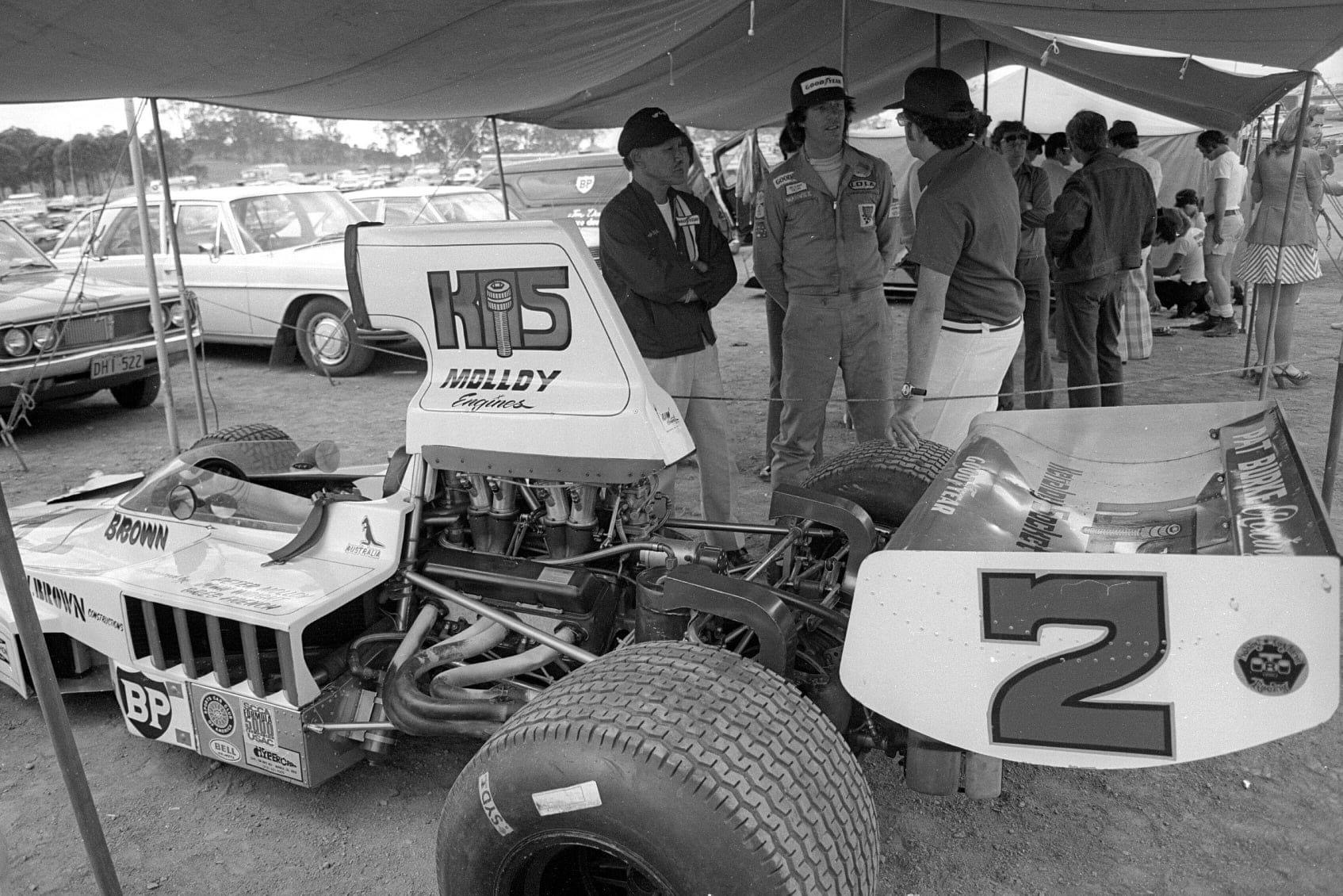
Brown was the ‘form driver’. He was the first Lola T332 customer, he raced ‘HU-27’ throughout the 1974 Tasman Cup, then did the first Gold Star round at Oran Park before heading to the US to take in three US F5000 Championship rounds in which the Lola/Molloy/Brown/Pat Burke combination were extremely competitive.

WB was Q7, second in heat and 11th overall at Ontario, Q12, fourth in his heat and fifth overall at Laguna Seca and  then finished his tour with Q9, second in his heat and third overall at Riverside. It was not bad at all coming into their season ‘cold’ in the sense that four rounds had been contested by the time WB and Peter Molloy arrived. Brown came back to Australia razor sharp, those at the front in the US included Brian Redman, Mario Andretti, James Hunt, Al Unser and Bobby Unser, David Hobbs, Vern Schuppan and the rest.

Teddy Yip, WB and another in the OP paddock (B Henderson)


KB T332 from Max T330 (B Henderson)

Max Stewart was well prepared. His Lola T330, ‘HU1’, the very first development machine raced a couple of times in England by Frank Gardner in late 1972 before its sale to Max, gave nothing away to anybody. It was increasingly reliable to match the speed present from tits debut in Max’ hands at the start of the ’73 Tasman Cup.

Graeme Lawrence raced his T332 in the 1974 Tasman whereas Kevin Bartlett’s was a newer car, first raced at Oran Park. KB had a shocker of a Tasman. A crash at the Pukekohe NZ GP opening round broke the car and a leg and hip, but he would be on the pace having built up a car around a new Lola T332 tub.

Graeme Lawrence, Lola T332 Chev with a Birrana in the background (B Henderson)


Garrie Cooper, Elfin MR5 Repco-Holden (B Henderson)

The Elfin MR5s were now long in the tooth having first raced in mid-1971.

John McCormack was back in his given the unreliability and lack of power of the Repco-Leyland V8 fitted to the compact Elfin MR6. Mac, the reigning champion had a shocker of a 1974 Gold Star, an accident at Surfers due to a structural failure ensured he missed the Calder round while repairs were effected to the front bulkhead.

McCormack ‘re-possessed’ his MR5 for the AGP. 1973 Australian Sports Car Champion Phil Moore had driven the car throughout the Gold Star with good pace and reliability despite few test miles. In fact he was the best placed of the Ansett Team Elfin pilots that year, ending the season third despite missing the final two rounds at OP and Phillip Island.

Garrie Cooper was still racing his MR5 which was a mobile test-bed for the talented designers new ideas.

The MR6 became a competitive car when the Repco-Holden engine was fitted and the front suspension geometry revised. Whilst 50kg heavier than the aluminium Leyland, the Repco-Holden’s 520 bhp was not to be denied, Mc Cormack won the 1975 Gold Star racing this combination.

McCormack’s Elfin MR5, 1973 Gold Star Champion  (B Henderson)


Jon Davison working his Matich A50 Repco-Holden hard- look at the distortion of those Goodyears. A man very much on the pace when he acquired a T332 (B Henderson)

Matich standard bearers were Jon Davison’s ex-John Walker A50 Repco, chassis ‘004’ was the car Walker raced in the 1973 L&M. John Goss raced Frank Matich’ 1974 Tasman car, chassis ‘007’ the very last Matich built. This A53 was a sensational device, A51/53 ‘005’ won the 1976 AGP in Goss’ hands at Sandown.

The A53 JG used to win at Sandown was the car raced by Lella Lombardi at Oran Park during this 1974 weekend. Then in A51 spec, it was one of the two chassis raced by Matich in the 1973 US L&M F5000 championship. The other, for the sake of completeness, ‘006’, was destroyed in a Warwick Farm testing accident in A52 spec with Bob Muir at the wheel in later 1973.

Lombardi had a big year of F5000 racing in Europe. Her primary campaign was aboard a Shellsport Lola T330 Chev. Late in the year she ran in the US and Australia when promoters could see the value in a ‘crowd-pulling chick’ amongst the fellas.

The ‘Tigress of Turin’ did not disappoint in Australia despite racing an unfamiliar car. Her crew included Frank Matich and later multiple Gold Star champion Alfie Costanzo as interpreter.

I don’t think anybody was going to beat WB at this meeting had he finished but I could easily see how Lella could have been on the podium especially if she were aboard her own T330, but it stayed in the UK.

Lombardi sitting on Matich tub ‘005’ during practice (B Henderson)


(B Henderson)

Gloomy faces all round in the Goss camp. The Repco engine has run a bearing, without a spare JG is out for the weekend. The dude in the white T-shirt is Repco’s, or perhaps ex-Repco by then, Don Halpin. The fella with his back to us is Grant O’Neill who moved across with the A53 from Matich to Goss as FM wound down his operation in Cremorne. Grant looked after Goss’ open-wheelers and Falcons for some years.

Warwick Brown was predictably quick in all sessions. After he did a 65.3, the team packed up and left the circuit but crafty Max bolted on a set of British Goodyears and nicked pole late in the final session with a 65.2. Bartlett was third on the grid with 65.9 with Lombardi fourth hampered by clutch failure. She finally did some decent laps stopping the Accusplits at 67.0 dead.

The grid was a very skinny nine cars. John Leffler made the cut with his gorgeous, very fast Bowin P8 Ford-Hart 416B ANF2 car. As mentioned above Goss lost an engine with bearing failure in the morning warm-up.

From left- Lombardi, Brown, Bartlett, Stewart and a glimpse of McCormack (HAGP)

From the off WB led convincingly all the way to his engine failure on lap 50. Lombardi got a great start and led the two amigos, Bartlett and Stewart but both passed the pint-sized Italian by the end of the first lap.

So it was Brown, Stewart, Bartlett with Lombardi and McCormack falling back, then Lawrence, Davison, Cooper and Leffler. After about 15 laps KB passed Max, aided by the Jolly Green Giant’s broken rear roll bar mount and stripped second gear- the latter damage was done at the start.

Leffo gave Garrie Cooper heaps in the little Bowin, well suited to Oran Parks new ‘twiddles’ with John well aware of the MR5’s strengths and areas of opportunity having done a few races in Max’s MR5 late in 1973. Lombardi caught Stewart but the big fella strenuously resisted her passing manoeuvres, then on lap 47 her oil pump failed causing the Holden engine to seize.

Bartlett from Stewart (B Henderson)


John Leffler, Bowin P6 Ford-Hart ANF2. Leffo did a million race miles in this car in 1974, all of the F2 championship rounds where he was amongst the class of the field headed by the Leo Geoghegan and Bob Muir Birrana 274/273, and the Gold Star rounds giving Grace Bros plenty of exposure and racegoers much pleasure given his brio behind the wheel (B Henderson)


Lombardi, Matich A51 Repco (B Henderson)

Two laps later WB’s harmonic balanced was hors ‘d combat which gave Kevin Bartlett the lead. For a while the Australian Triple Crown seemed possible- the Gold Star, Bathurst and an AGP. Then, on lap 58 of 61 laps KB’s Lola was starved of fuel, the T332’s pumps were not picking up the last 13 litres of juice!

Stewart took the lead, and despite his machine’s disabilities, won the race from McCormack’s, Elfin MR5, Graeme Lawrence’s T332, a lap down with an engine not at its best, then Jon Davison’s Matich A50 Repco and Garrie Cooper’s MR5 Repco- five finishers. There was no future in AGP’s being run other than during our summer internationals, whatever the formula, to get decent grids.

WB was ‘man of the match’ but lucked out, Lola T332 Chev (B Henderson)

Brown was the man of the meeting, getting back on the Lola horse which nearly killed him (a T300 Chev) at Surfers Paradise in 1973 was mighty impressive. WB carried the momentum forward, winning the 1975 Tasman Cup in this car, the only Australian to do so. He did get an Oran Park AGP win in 1977 too, on the day Alan Jones pumped the start bigtime.

It was a pity Lombardi didn’t return to Australasia for the 1975 Tasman but she had bigger fish to fry. Funding was in place so it was F1 in 1975 as a member of the March team together with Vittorio Brambilla.

Max Stewart takes the chequered flag, with barely a soul to see. What Covid 19 friendly meeting! Not really, just no spectators in that part of the world.

Stewart was like a fine wine wasn’t he, he got better and better with age? He was not exactly in the first flush of youth when he got the second Alec Mildren seat with Kevin Bartlett in late 1968. He won his first Gold Star in 1971 in the Mildren Waggott and then took to F5000 like a duck to water.

His Oran Park win was his fifth 1974 Gold Star victory in a row. It won him the title. Maybe he was lucky to win the AGP in the pissing rain at Surfers twelve months hence but those in front of him dropped out with drowned electrics. Max, who prepared his car together with Ian Gordon had electrics which functioned, that is, he made his own luck.

Etcetera…

(B Henderson)

Poor Susie Ransom (?) is trying to interview KB who is more interested in a glass of Pophry Pearl at the Leppington Inn after the meeting. Commonsense then prevailed with questions about tyre pressures, wing settings and roll-bar stiffness addressed.

(B Henderson)


(B Henderson)

Teddy Yip was omnipresent throughout the weekend. Here he is pointing out the Matich tacho-telltale in Mandarin. Lella’s English was not flash, I doubt Mandarin was effective so they probably settled with English.

Teddy was getting the lie of the land and perhaps starting to think about the deal which saw him bring a Lola T332 to Australia for our 1976 Rothmans International. Vern Schuppan raced a Yep/Sid Taylor Lola T332 to victory that summer.

(B Henderson)

Goss with his team bemoaning the bearing failure in his Repco-Holden engine, he knew a thing or two about that particular affliction didn’t he? Blazing the Falcon GT Hardtop Group C path in 1973 gave plenty of bottom end dramas which was eventually sorted with an engineering solution which met the good graces of the CAMS.

(B Henderson)

The Elfin MR5 is a bit maligned in some quarters. The most highly developed of the four cars built was John McCormack’s ‘works’ machine which won the 1973 Gold Star as well as the New Zealand Grands Prix in 1973 and 1974 despite Mac first racing it in later 1971.

(B Henderson)


(B Henderson)

So near but so far, Bartlett had the ‘Triple Crown’ of Australian motor racing chance but it was not quite to be!

He won a heat at Surfers and had the second in the bag until a front tyre deflated. In a season where he showed the Pukekohe accident had not cost him a tenth, he was second to Stewart at Calder and Sandown and then took victory at Phillip Island’s last round after a great dice with Stewart.

(B Henderson)

Lella ready to boogie.

Credits…

Bryan Henderson, many thanks for the fantastic photographs.

‘History of The Australian Grand Prix’ Graham Howard and Others, Getty Images, Fairfax Media

Tailpiece…

(B Henderson)

Graeme Lawrence in the ‘star car’ of F5000, the Lola T332. Engine troubles ruined his AGP weekend. The 1970 Tasman Cup champion was in a three way shootout several months later to win the 1975 Tasman together with Warwick Brown and John Walker in the Sandown final round but the cards fell Brown’s way.

Finito…

The white TR, is heading in the correct direction- the blue Healey has overshot his braking point (B Young)

Motorsport venues in Tasmania were a tad skinny in number prior to the opening of Baskerville near Hobart, and Launceston’s Symmons Plains circa 1960. Longford was great but it was a once a year deal over the March Labour Day long weekend.

So Quorn Hall, an ex-World War 2 airfield located on TC Clarke’s sheep grazing property was pressed into service. The 7,300 hectares, farmed by the same family since 1846 is on Lake Leake Road, Campbell Town 15km south of Launceston.

1952 (V Gee)


Jock Walkem’s #6 Norton or Vincent powered special going bush suspects Garry Simkin (B Young)

The ever interesting Historic Racing Car Club of Tasmania Facebook page notes that ‘Quorn Hall Airfield was developed during WW2 to house the huge American bombers if the need to fall back to Tasmania occurred during an invasion of the mainland’, or the ‘North Island’ as the Tassies like to call the rest of us!

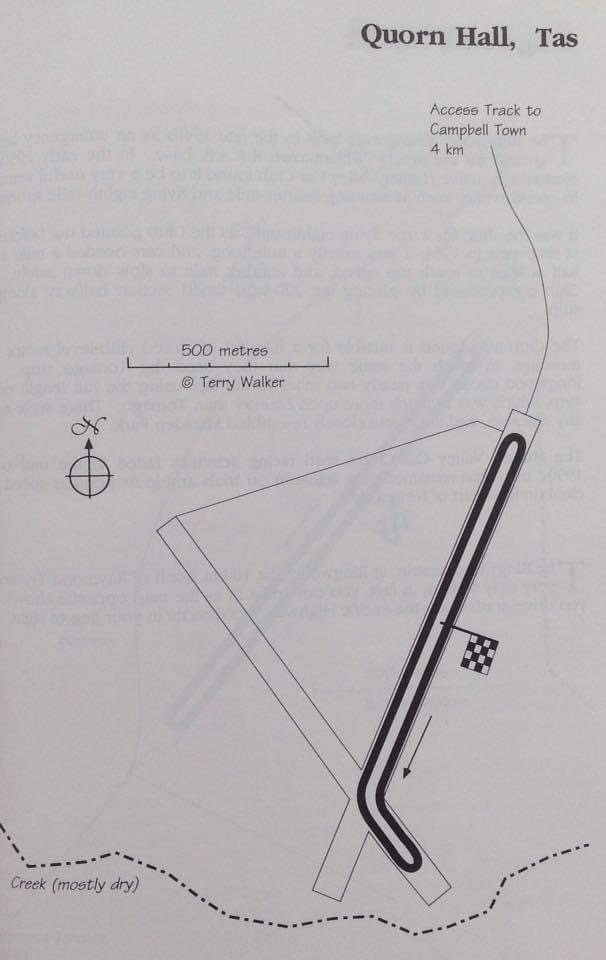
‘The runway is several kilometres long and about 50 metres wide. After the war (from November 1952) it was used for motorsport, essentially putting 44 gallon drums out and racing around them. The runway and access roads were used. Usage dropped off after the purpose made circuits opened, but it was still used for club events – standing quarter-miles etc until the end of the 1960s.’

It seems, as usual, the entrepreneurial motorcyclists beat us car dudes to the punch. The Tasmanian Motor Cycle Club organised a picnic ride to Quorn Hall in 1946 during which some races were run. ‘While the straw bales down the middle of the runway and use of oiled gravel access roads in a J-pattern may have been basic, unlike beach racing, you didn’t have to wait for the tide to go out and most of the 1 1/2 miles was sealed’ recorded Bike Australia.

2,000 people attended a combined car and bike meeting in 1951 organised by the Southern Motor Cycle Club and the Light Car Club. It was the first occasion on which ‘racing was officially noted.’

The Tasmanian Tourist Trophy was held there for the first time November 1952 with most of the national ‘bike stars of the day’ competing. The car racing was more club than national level, those honours went quite rightly to Longford.

Start of the Senior TT in 1952. Col #49 and Max #74 Stephens getting away smartly (Bike Australia)


Tasmanian Aero Club, Western Junction, date unknown (unattributed)

In fact the history of the site is a significant one in Tasmanian aviation.

The Tasmanian Aero Club was formed there site in 1927, the Western Junction Aerodrome (now Launceston Airport) was officially opened in 1929. The first passenger facility on the Apple Isle operated from there until August 1940 when the Royal Australian Air Force took over the place to house the ‘7 Elementary Flying Training School. Extra local ‘strips were built at Nile, Annandale, Valleyfield and Quorn Hall.

As the name suggests, 7 Elementary Flying Training School provided an introductory twelve-week flying course to those who had graduated from one of the RAAF’s initial training schools. It was the only RAAF base in Tasmania then. Flying ceased there in December 1944 with the school disbanded in August 1945.

Etcetera…

Western Junction Aerodrome in 1933.

These colour photographs are wonderful, unique. If any of you can help identifying cars/drivers please give me a yell and i will update the captions accordingly.

(HRCCT)

Bruce Gowans and John McCormack during a Historic Racing Car Club day out to Quorn Hall and Valleyfield (at Epping Forest) in 2016. They are standing on the Quorn Hall runway-circuit.

(HRCCT)


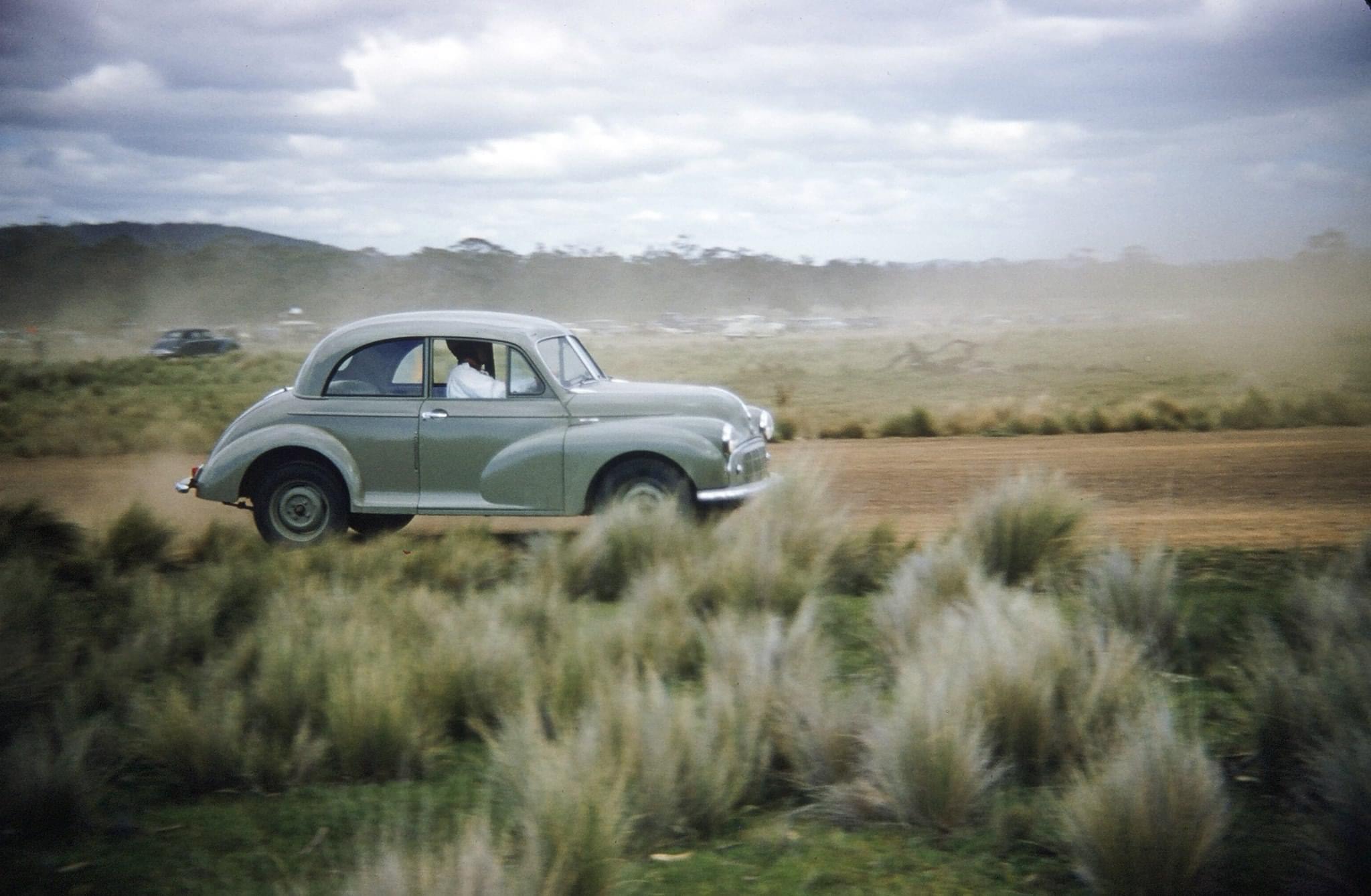
VW and Fiat 1100 (B Young)


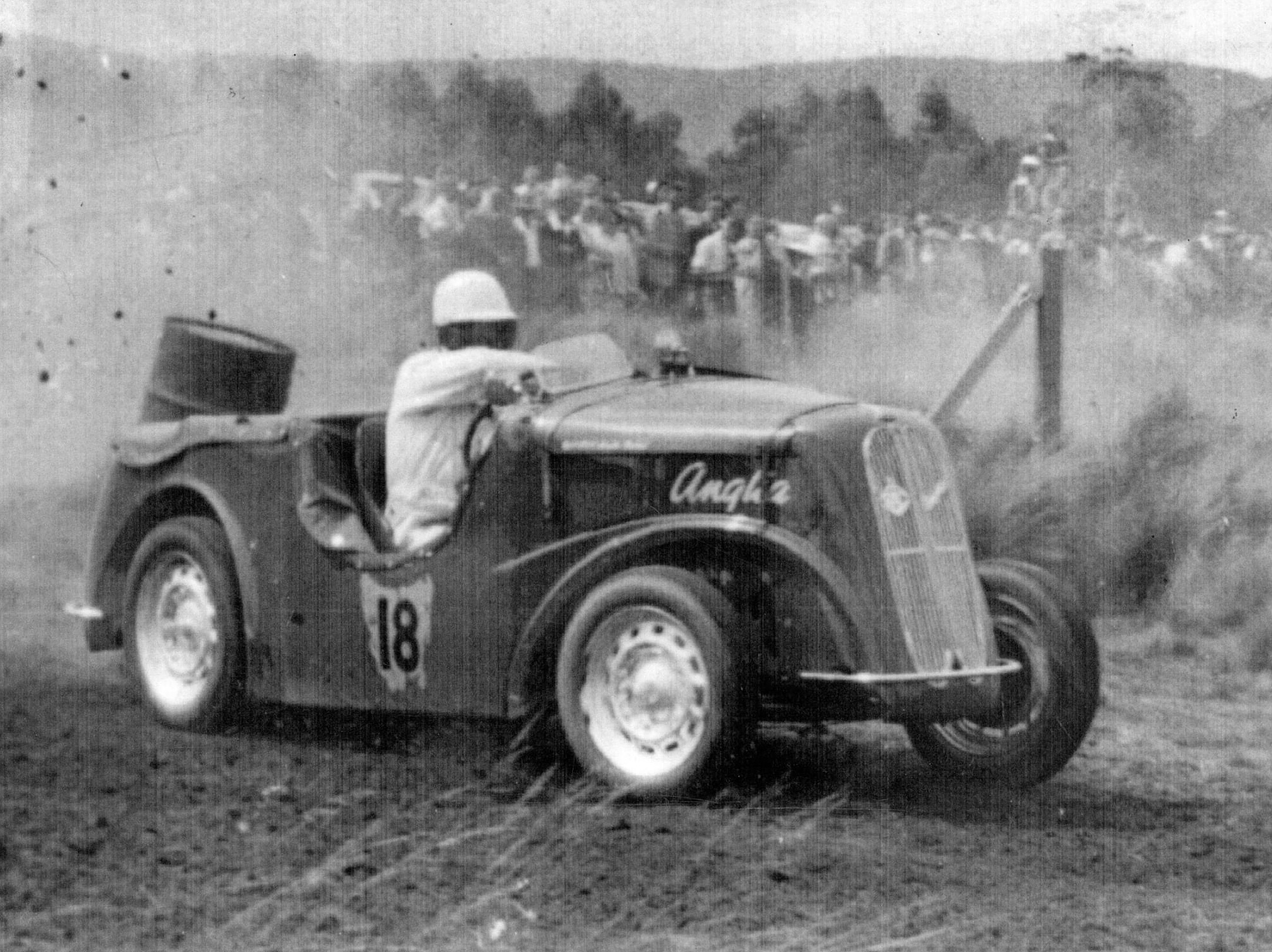
Mick Watt competing in the first ‘Half-Hour’ race at QH in 1953 in Ford Anglia. This little car, nicknamed the ‘Magic Goat’ won 64 races.


(B Young)

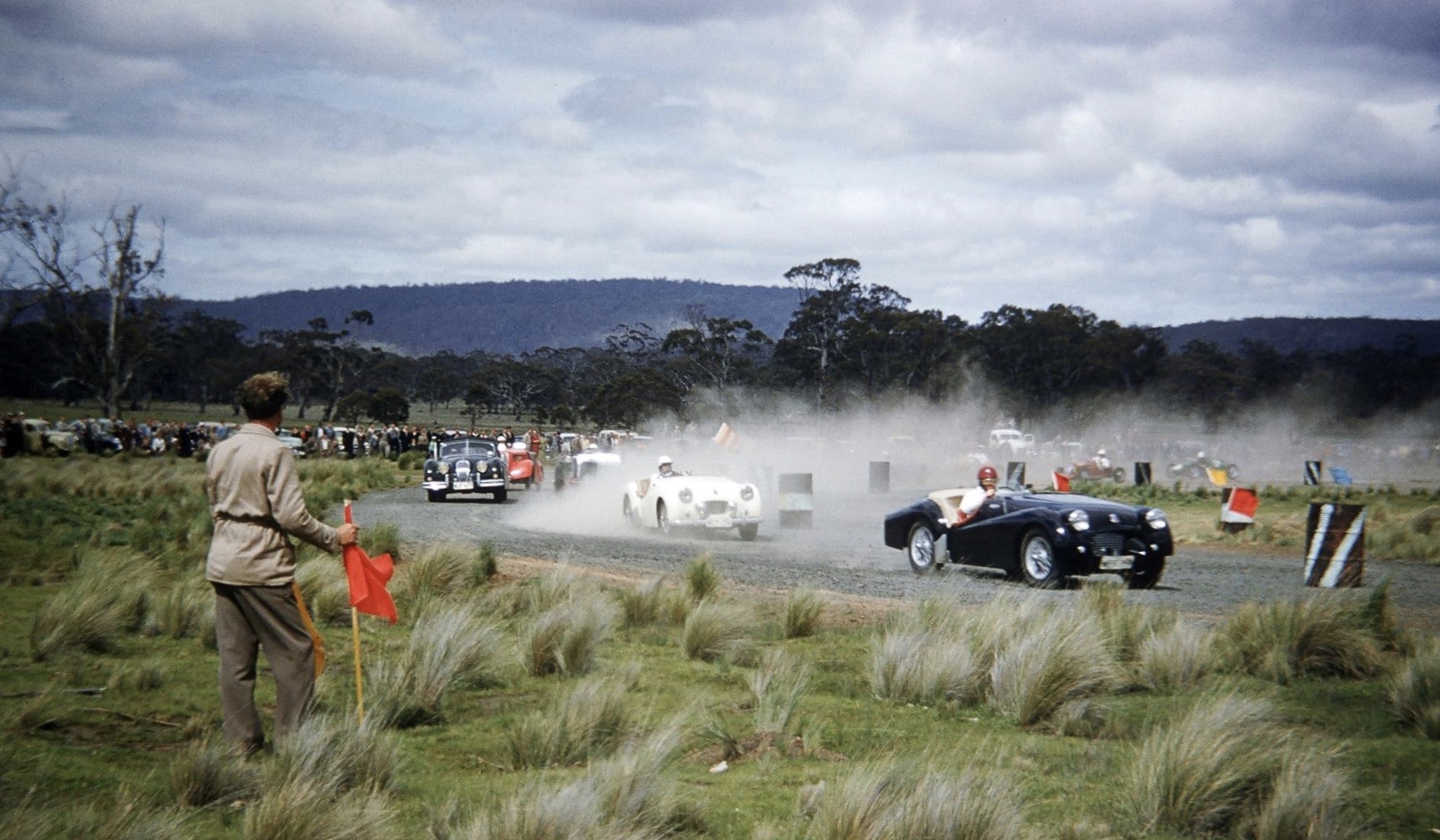
What a magic panorama. Brian Higgins believes the competitors are Jack Petts and Geoff Smedley in Triumph TRs, Boyce Youl in the Jaguar XK and Mick Watt’s Ford Anglia.


(B Young)


MG. Love the dudes in the background  (V Gee)


(B Young)


(D Elliott)

Don Elliott, Holden Special at QH in the late-fifties.

This attractive little car was a mix of Skoda and Holden components, the engine used a Repco Hi-Power hhead fed by a side-draft twin-choke Weber.

Our friend in the Fiat again (B Young)


A couple of RAAF cub ‘flyboys’ with their Tiger Moths at Western Junction circa-1940.


(M Watt)

This shot is of Stan Jones in Maybach 1.

It is from Mick Watt’s Collection, no doubt taken on a day he was also competing. Stephen Dalton thinks the shot is probably closeby to QH at Valleyfield, one of the four airstrips mentioned above. He and fellow Victorian, John Nind (Cooper) raced there on November 4 and 5 1951. It’s only a short time after Jones acquired the car from it’s builder, the great Charlie Dean. The pair and sponsor Repco would have much success together in the ensuing years.


(T McGrath)

Alan Stephenson, Cooper Mk5 JAP Cooper misjudgement and consequences, not too bad.

(T McGrath)

Etcetera…


The above are scans from ‘Country Houses of Tasmania’.

Photo and other Credits…

Bob Young Collection via the Historic Racing Car Club of Tasmania, Vicki Gee, Don Elliott Collection, Mick Watt Collection, Terry McGrath from the Graham Howard Collection, Garry Simkin

Bibliography…

speedwayroadracehistory, ‘Tracks In Time: Quorn Hall’ Bike Australia July 2018, Terry Walker, Bike Australia, ‘Country Houses of Tasmania’ Alice Bennett and Georgia Warner

Tailpiece…

(B Young)

‘Holy ‘snappin rissoles’. That’s the swing-axle shit the motor magazines are rabbiting on about.

Finito…

(MBRL)

Bill Pitt aboard the Geordie Anderson owned Jaguar D Type, perhaps during the March 1956 Strathpine, Queensland meeting.

‘XKD526’ is new. It arrived in Australia in December 1955 initially doing quarter-mile sprints at Strathpine in January 1956 and sprints at Leyburn in February on both occasions driven by Anderson. She did better than 120mph and 132.5mph respectively, the latter a state record.

Pitt took the car over from this Strathpine meeting, it was very kind to him over the next few years. Quite why he is contesting a race together with a little ‘Gunterwagen’ is a mystery one of you with the requisite Australian Motor Sports can perhaps solve!?

Click here for features on XKD526 here; https://primotipo.com/2016/03/18/lowood-courier-mail-tt-1957-jaguar-d-type-xkd526-and-bill-pitt/ and here; https://primotipo.com/2019/10/11/bill-pitt-frank-matich-and-xkd526-take-two/

Charlie Whatmore, Lotus 11 Climax ahead of Glyn Scott, Holden Special circa 1958 (MBRL)

Queensland’s Strathpine venue was 25km from Brisbane’s CBD, in the 1930s the area comprised farms and a new wartime airstrip as fears of Japanese invasion grew.

The Queensland Motor Sporting Club used its runways for a sprint meeting in 1938 but the place ‘blossomed’ post-war into a race circuit after local ‘Lawnton Garage’ proprietor and racer Snow Sefton saw its potential.

Local legend has it that after his garage closed for the day Snow ‘borrowed’ the Pine Rivers Shire Council’s road-making equipment to convert the airstrip into a dragstrip. ‘Councillors back then all lived out of town and were completely oblivious to Snow and his mates nicking their machinery and the racket they made turning the dusty airstrip into a bona-fide racetrack.’

Click here for a piece about Snow and his cars; https://primotipo.com/2019/04/30/bill-cuncliffe-ford-v8-spl-lowood-1956/

Snow Sefton, Strathpine Ford V8 Spl out front of his local garage (unattributed)

Initial up-and-back events around 44-gallon drums evolved into a small 1.4 mile circuit when the ‘Southern Loop’ was added in 1953 and a chicane in 1955. It was still pretty basic, haybales marked the turns in addition to the forty-fours in a nod to safety…

Only ever a club circuit because of its size and difficulty of racing on Sundays, 1960 was its last season. Lakeside’s construction close-by at Kurwongbah carried the torch forward.

We will come back to something about the place in future which is a bit more fulsome.

(L Manton)

John Aldis’ ex-Peter Whitehead/Stan Jones Cooper T38 Jaguar amongst the Strathpine grass and trees during May 1956. I’m not sure how he went.

This 1955 Le Mans veteran’s most successful Australian phase was when it was raced by Ron Phillips and prepared by Ern Seeliger. Highlight of that period was victory in the June 1959 Australian Tourist Trophy at Lowood, another Queensland airfield circuit.

The car is still in Australia and ‘still in Queensland’! There is a bit about it here; https://primotipo.com/2019/03/05/mount-tarrengower-hillclimb/

(L Manton)

Etcetera…

Credits…

MBRL- Moreton Bay Region Libraries, Stephen Dalton, Luke Manton Collection, drive.com.au, Terry McGrath

Finito…