Posts Tagged ‘Australian Motor Racing History’

(AMC)

Or 11, 12 or whatever.

Frank Matich, his creations and his band of merry men are amongst my favourite and most admired of Australian racers.

So why not do something with some of the photographs recently published by Australian Muscle Car magazine, I occasionally write for them after-all. Check out all of the shots here https://www.musclecarmag.com.au/gallery/manufacturer-monday-matich-610582 and subscribe while you are at it!

One of FM’s finest moments (above) was his victory in the November 21, 1971 Australian Grand Prix at Warwick Farm aboard the brand-spanking-new Matich A50 Repco-Holden F5000 (001/002) built just across town in Sydney, at Brookvale on the northern beaches.

This win is covered in this feature on all of the Matich F5000s: https://primotipo.com/2015/09/11/frank-matich-matich-f5000-cars-etcetera/
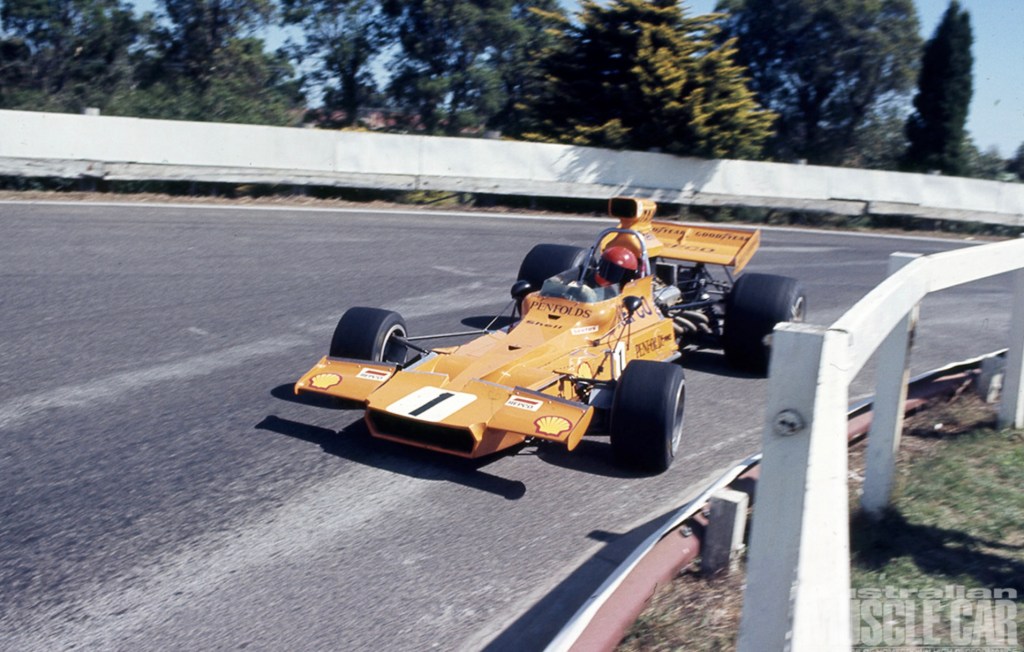
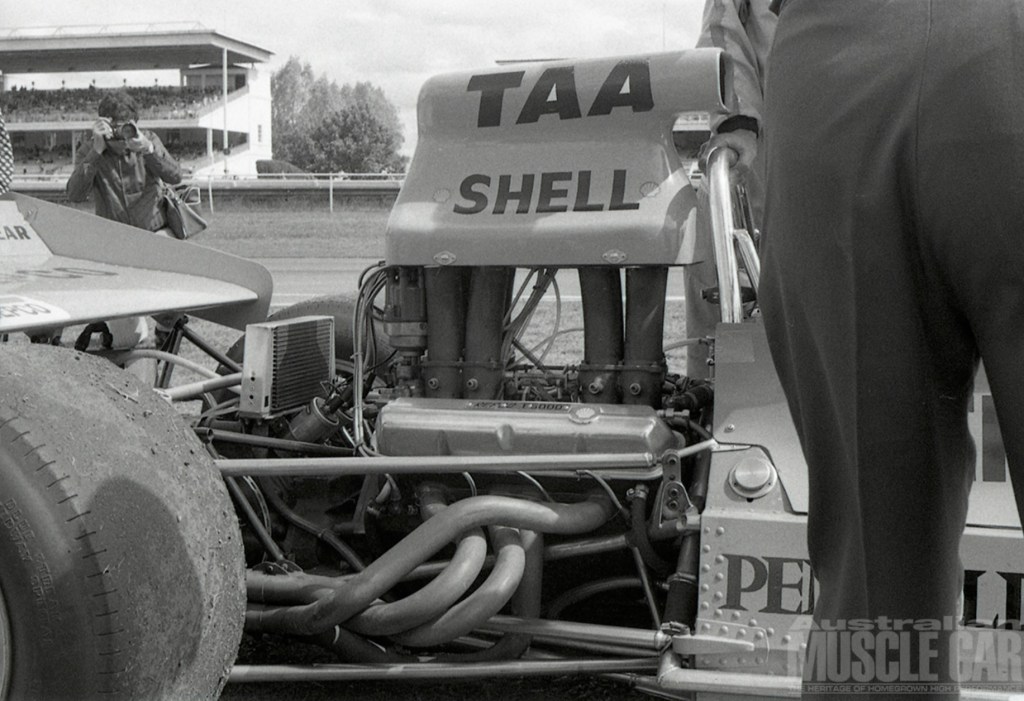
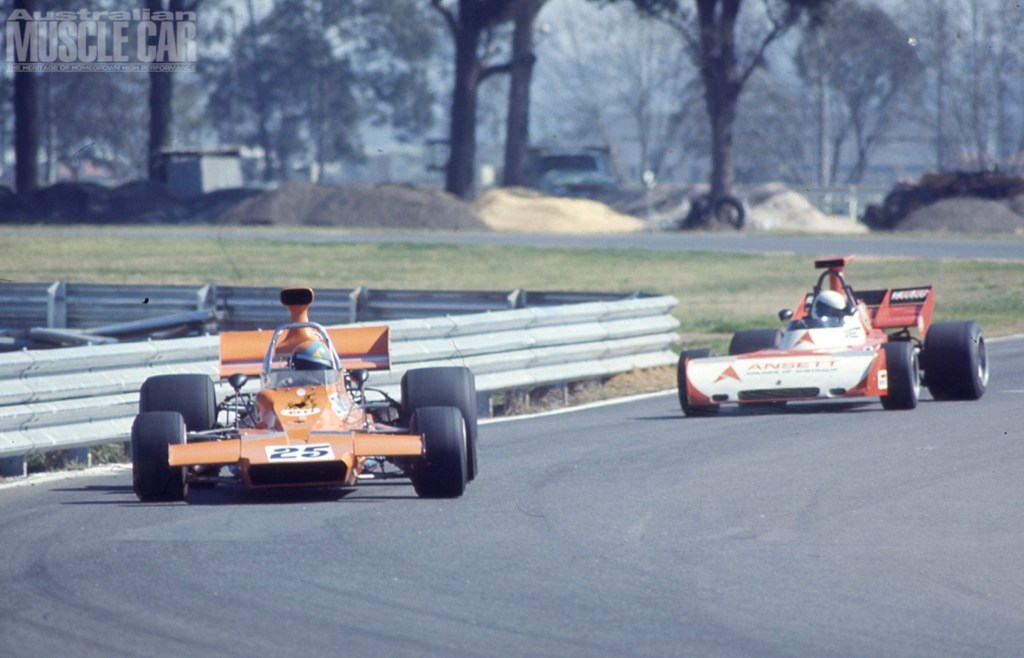
Up close and personal at Peters/Torana corner, Sandown during the April 16, 1972 Victoria Trophy Gold Star round. FM won in A50-001/002 from Bob Muir and John McCormack, Lola T300 and Elfin MR5 (AMC)
A50-001/002 on the grid at Warwick Farm, perhaps the Hordern Trophy Gold Star weekend on November 5, 1972. Matich popped the Gold Star in his pocket on that occasion. Note the multiple top pick-up points for the upper radius rod (AMC)
John Walker, Matich A50-004 Repco-Holden being chased by Garrie Cooper, Elfin MR5 Repco-Holden during the ’72 Sam Hordern Trophy race at the Farm. A DNF for JW (battery) and troubled tenth and last for the Elfin boss (AMC)

The three A50s built were raced with great success from 1971-73 by FM and by Adelaide’s John Walker (004) who used their machines in Gold Star, Tasman Cup, and in JW’s case the 1973 US L&M Championship. Roy Woods bought (A50-003) one, on Carroll Smith’s recommendation, for George Follmer to race in the 1972 US L&M fitted with Al Bartz prepared Boss Ford engines. That program was interrupted by an early season crash and George’s appointment as driver of Team Penske’s Can-Am Porsche 917/10 after Mark Donohue’s bad Road Atlanta accident in July.
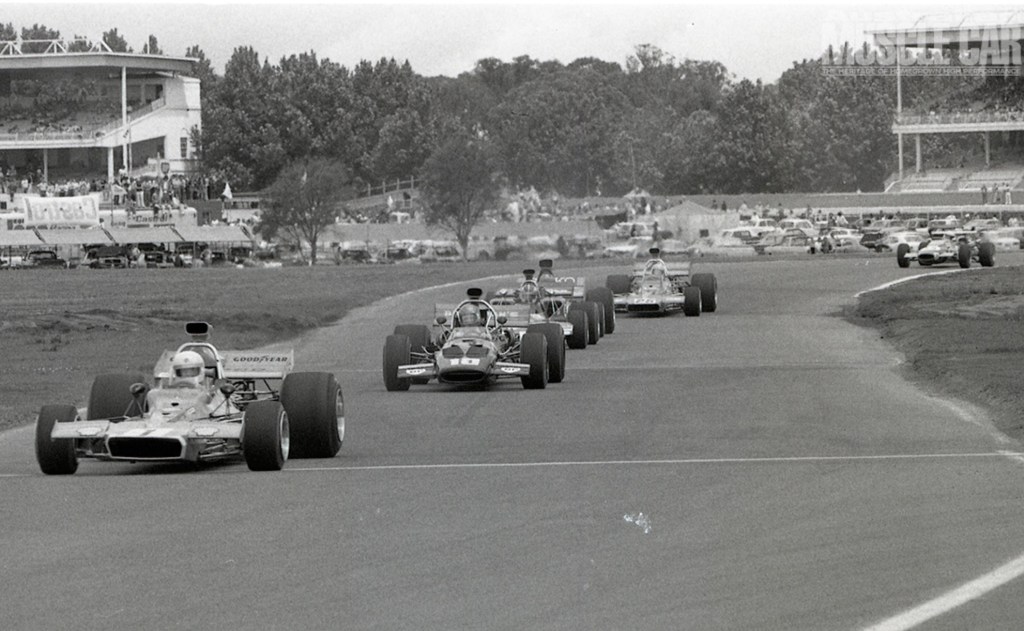
Matich, Matich A50 Repco-Holden, Warwick Brown, McLaren M10B Chev, Gary Campbell, Lola T300 Chev, the almost completely obscured Max Stewart, Elfin MR5 Repco-Holden and John Walker, Matich A50 Repco-Holden and an F2 car during the Hordern Trophy, Warwick Farm Gold Star round won by FM on November 5, 1972 (AMC)
(AMC)

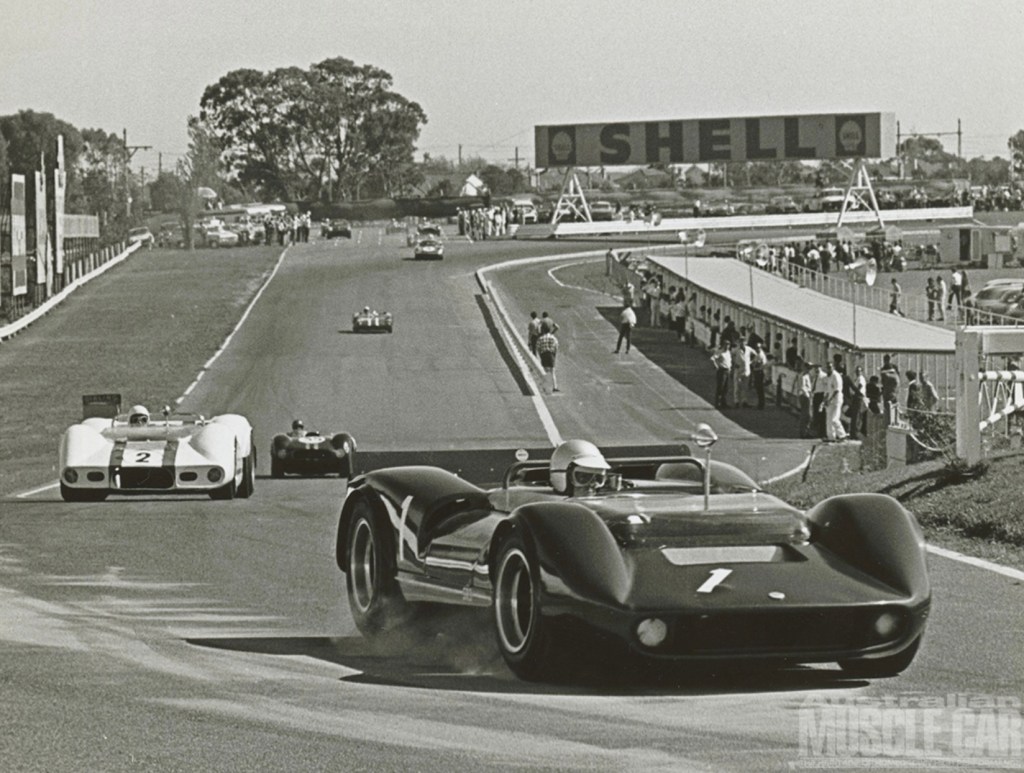
Of course, Matich’s plan to take on the Americans was hatched via his sportscar program. The shot above shows FM at Sandown during the 1967 Tasman round weekend aboard his new spaceframe-chassis SR3 Oldsmobile V8.

Behind him is Niel Allen in FM’s year old Elfin 400 Oldsmobile upon which the design of the SR3 was based. Some say the frame, fabricated by Bob Britton at Rennmax Engineering, was a tube-for-tube replica, with a few extra thrown in to strengthen areas Matich felt lacked torsional rigidity in Garrie Cooper’s Elfin design, four of which were built.

By the time Matich and his small team left Sydney to contest the 1967 Can-Am Cup he had sold the car above, SR3-1 to Marvin Webster, and another, SR3-2, to Kent Price, both Californians. Matich raced Price’s car at Road America and Elkhart Lake, and his own car SR3-3 for the rest of the series. SR3-2 and SR3-3 were fitted with 4.4-litre Repco-Brabham 620 V8s (SOHC, two-valve, fuel-injected).
AMC)
(AMC)

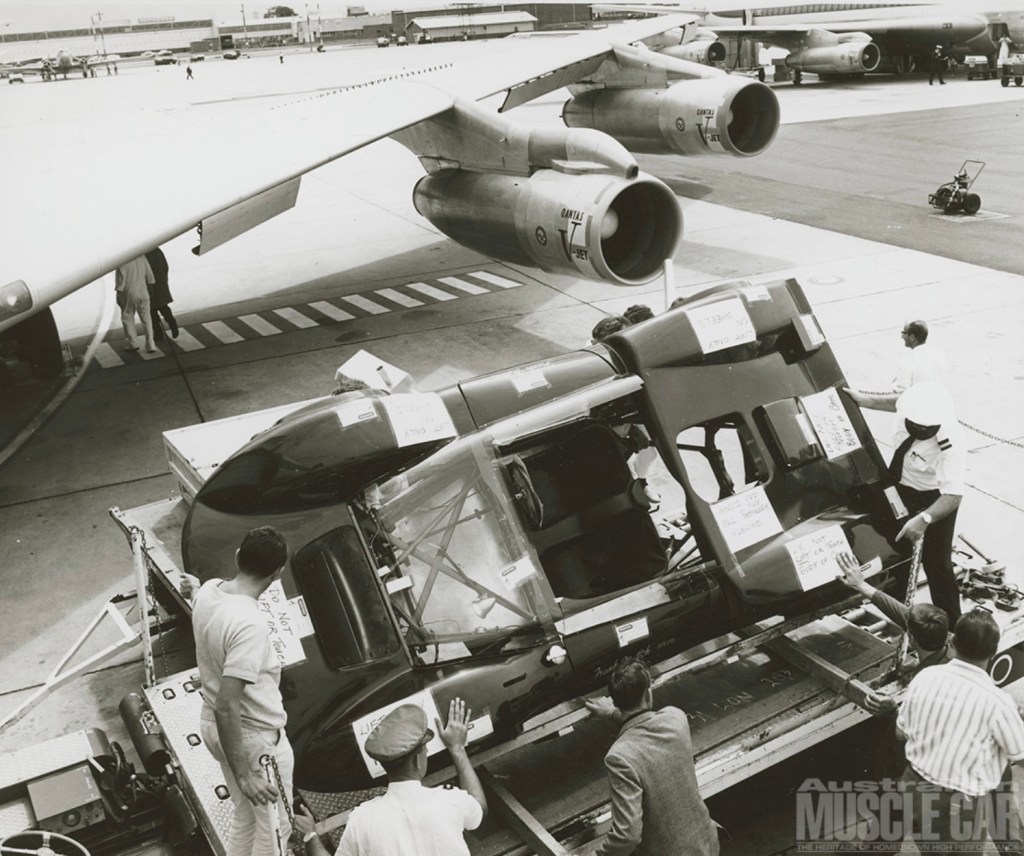
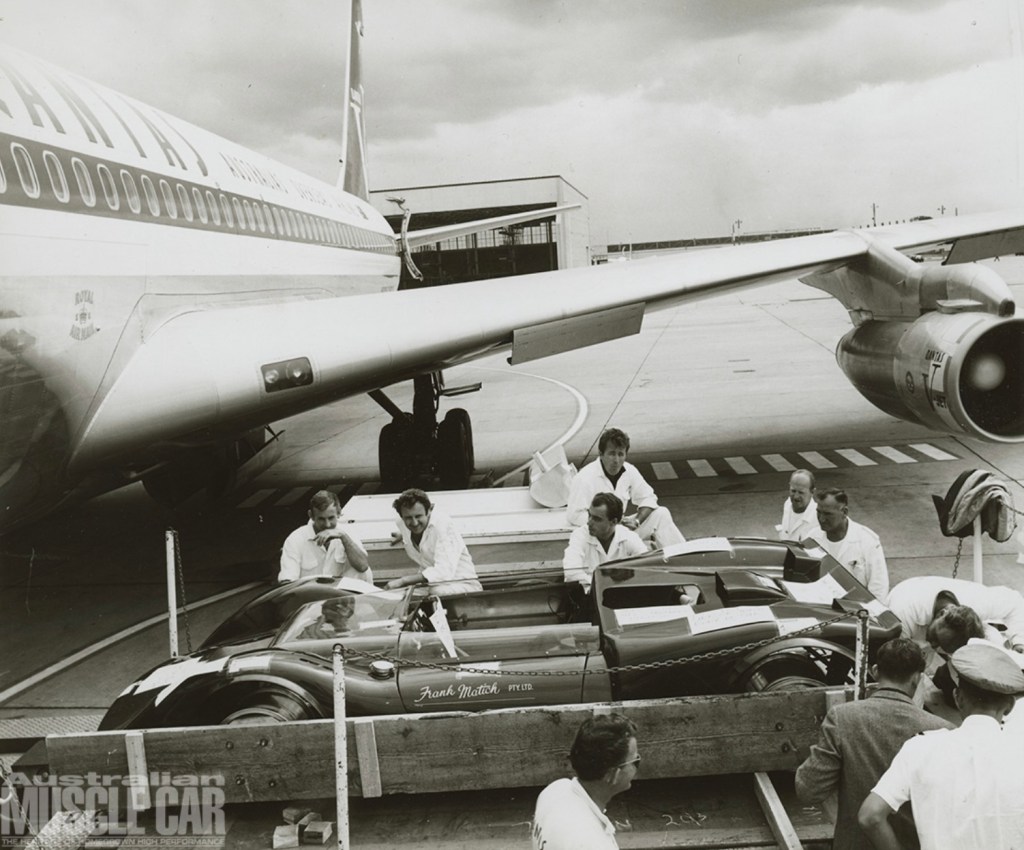
The photographs above are of one of the SR3s – perhaps SR3-1 which was sold to Marvin Webster sans engine and transaxle – on the tarmac at Mascot Airport, Sydney being loaded onto a pallet and Qantas Boeing 707 before it’s trip to California in June 1967.

The tale of Matich’s adventures in the US, and details of the Matich sportscar chassis numbers are told in two articles, here: https://primotipo.com/2023/04/02/matich-sr3/ and here: https://primotipo.com/2016/07/15/matich-sr4-repco-by-nigel-tait-and-mark-bisset/
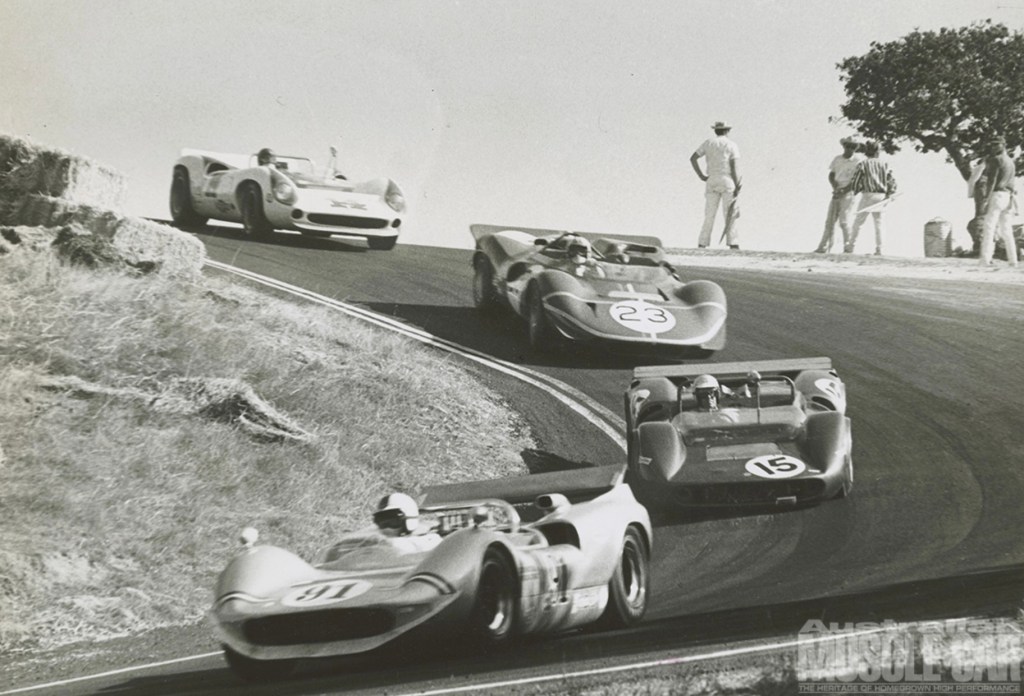
Laguna Seca Can-Am mid-field bunch on October 15, 1967. Skip Scott, McLaren M1C Chev (DNF) Matich in SR3-3 Repco (Q13 DNF oil leak), Chris Amon Ferrari 350 Can-Am (fifth) and a Lola T70. Bruce McLaren’s McLaren M6A Chev won (AMC)
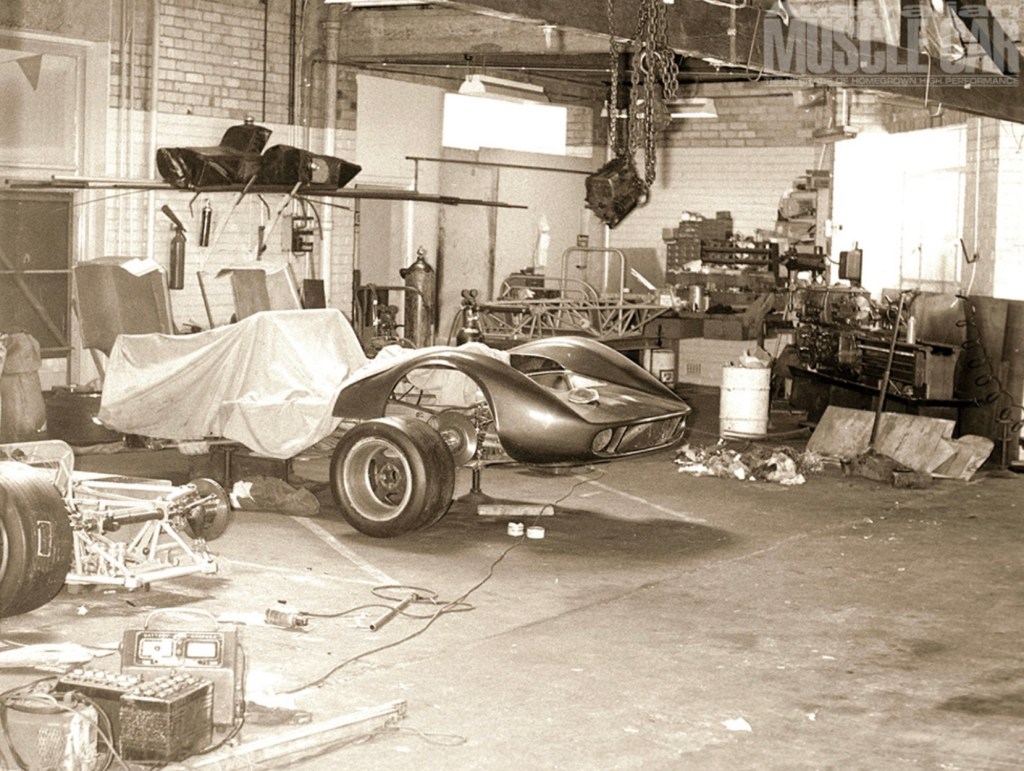
Race shop out back of Matich’s BP Servo on Eastern Valley Way, Castle Cove, Sydney. That’s the SR4 on the left, SR3-3 is in the middle, by that time probably owned by West Australian Don O’Sullivan and maintained by his friend/mechanic/engineer Jaime Gard in Sydney throughout 1969. The frame of SR4B-7 is at the rear. That looks like a Waggott TC-4V engine swinging in the breeze, we can date the shot by knowing when the Waggott replaced the original Lotus-Ford twin-cam originally fitted to this chassis…or is it a twin-cam? Two fuel cells sitting on the high storage rack (AMC)

While Matich had a hard time of it in the US, the intensive, highly competitive series ensured the team had developed the chassis of SR3-3 to a fine pitch before they returned to Sydney.

David McKay (Scuderia Veloce) bought one of the Ferrari 350 Can-Ams (#0858) raced by Chris Amon and Jonathan Williams in the later stages of the ‘67 Can-Am. Amon and Matich faced off in the sportscar support races at Surfers Paradise, Warwick Farm and Sandown in the Summer of ‘68 Australian Tasman rounds. Frank won each of the encounters, sprint races, unlike the 200 mile Can-Am events.

When Amon returned to Europe Bill Brown took over the Scuderia Veloce car but he was no match for Matich with McKay selling the 350 Can-Am to Australian international Paul Hawkins late in the year. See here for the lowdown on those cars: https://primotipo.com/2015/04/02/ferrari-p4canam-350-0858/
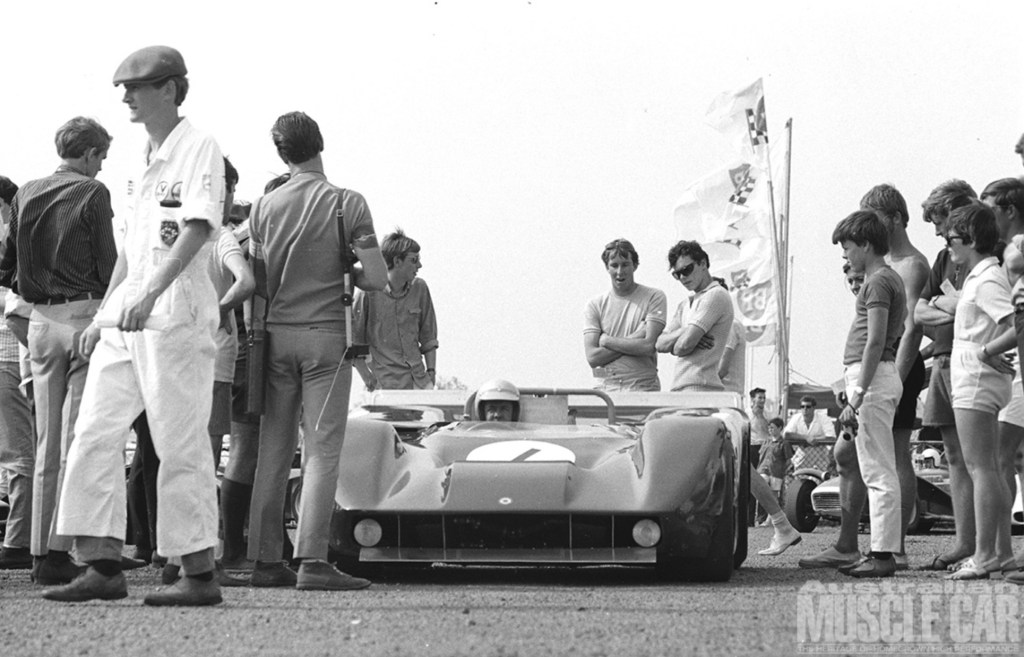
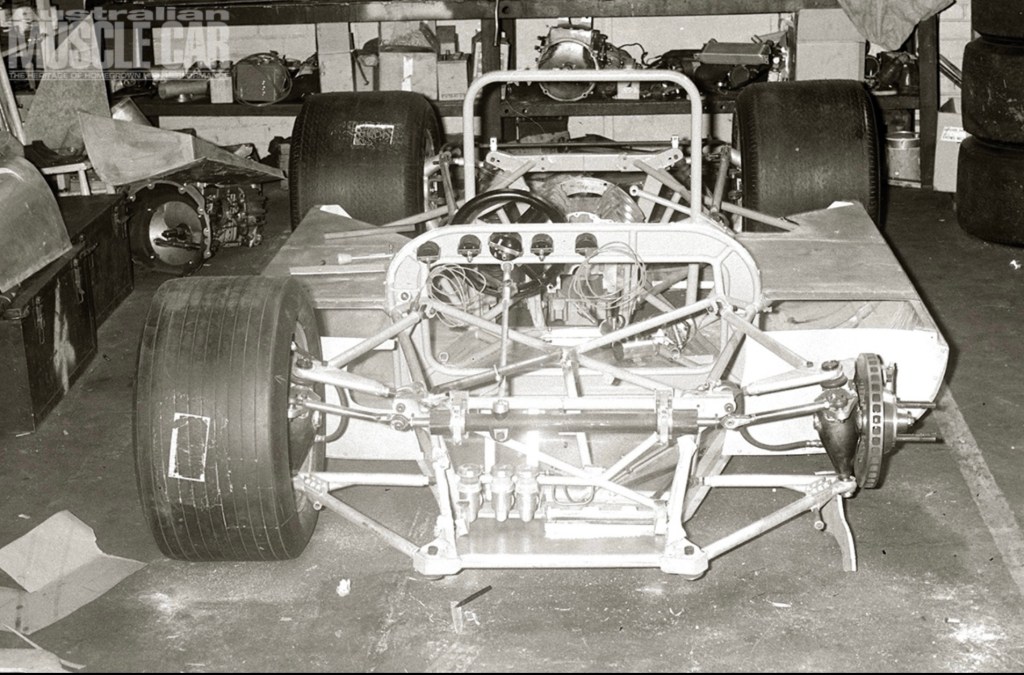
SR4 with no shortage of admirers at Warwick Farm in 1969 (AMC)
(AMC)

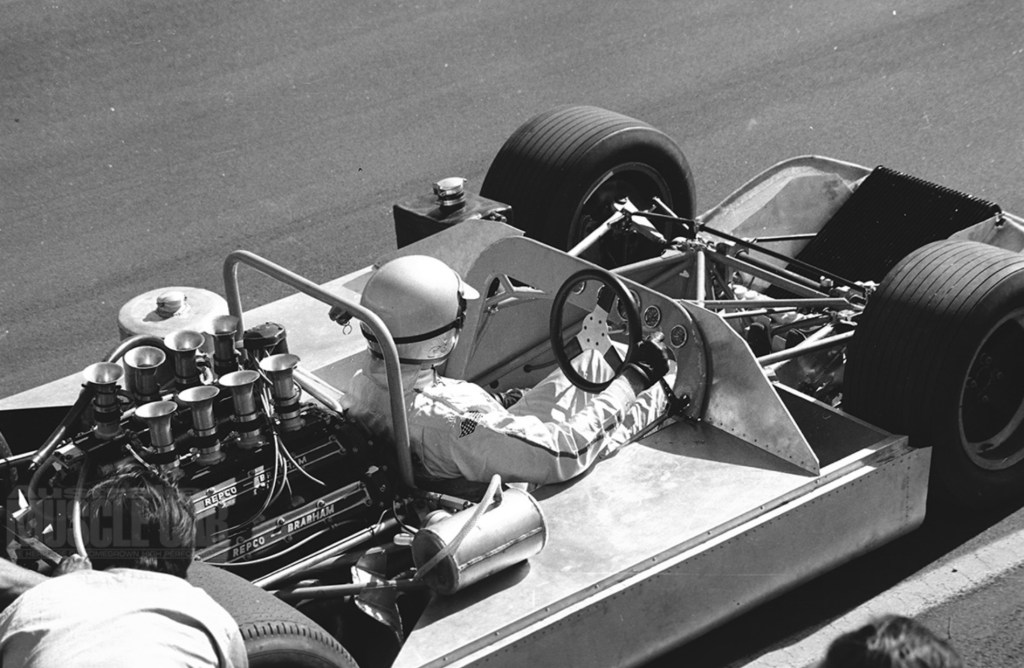
Frank and his team set to work on their planned 1968 Can-Am weapon, the Matich SR4 which was to be powered by a 5-litre four-cam, four-valve Repco-Brabham 760 V8. Ultimately both the builds of the car and engine ran late, the machine didn’t appear until 1969. Even using the ‘tiddler’ 4.8-litre 760 the machine crucified the local opposition that year in winning the Australian Sportscar Championship. It raced on into early 1970 by which time it was fitted with a 569bhp 5-litre 760 engine built by John Mepstead who was seconded from Repco to Matich to look after the engines.

SR4 was then set aside – it could have won Australian Sportscar Championships for years – and was then sold by Matich to Repco in a prid-pro-quo deal that ensured Matich would focus his attention on his McLaren M10B Repco-Holden F5000 project; FM was Repco’s test driver and received works Repco-Holden engines for the balance of his racing career. That customer engine program, led by Malcolm Preston and Phil Irving, designer of the 1966 F1 Championship winning Repco-Brabham RB620 V8, was Repco’s key racing priority.
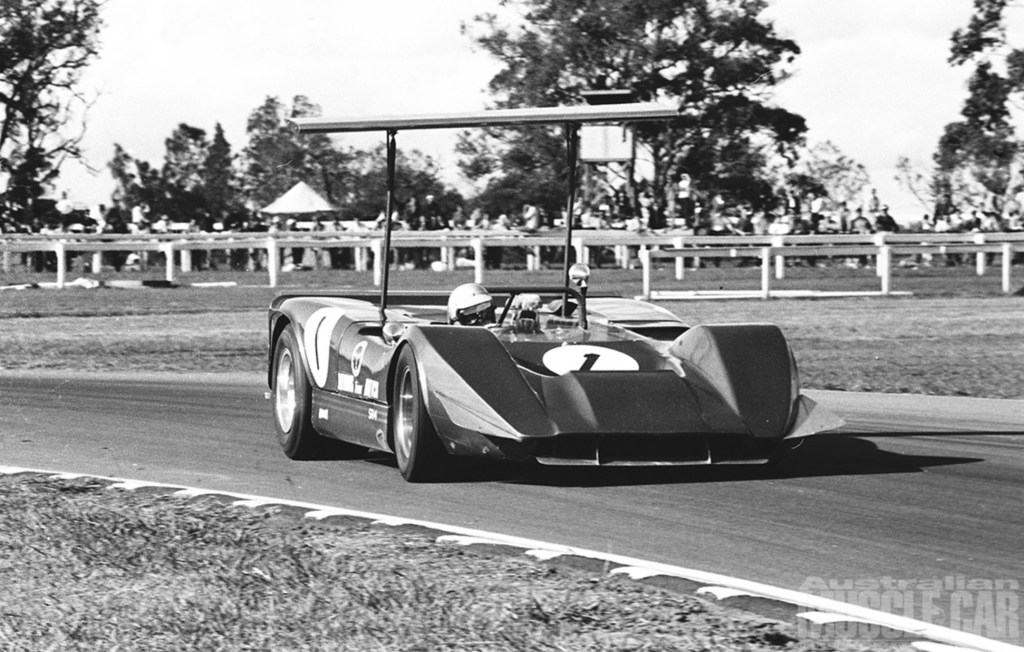
Matich aboard the SR4 in hi-winged spec at Warwick Farm, RAC Trophy, first Australian Sportscar Championship heat in 1969. He won the May 4 race. High wings were banned by the FIA/CSI during the May 18, 1969 Monaco GP weekend, a fortnight later (AMC)
This relatively rare body off shot shows Matich aboard the SR4 in 1969. 4.8-litre Repco-Brabham 760 V8 and beefy spaceframe chassis. Originally fitted with a 5-speed ZF transaxle, later in the year a Hewland LG replaced it (AMC)

The Repco-Holden F5000programmes early successes were secured by Matich using a McLaren M10B, victory in the 1970 Australian Grand Prix at Warwick Farm was the first big win.

When the M10B chassis was damaged beyond economic repair in a private practice incident at Oran Park in June 1971 Frank decided his team should rebuild the tub rather than buy a replacement from Trojan Cars to provide them with the experience of making an aluminium monocoque before embarking on the build of what became the Matich A50s.

While Matich had great success in the A50: the 1971 AGP, 1972 Gold Star Series and two Tasman Cup round wins in 1972-73, the car ultimately fell short of Graham McRae’s machines which won the 1972 (Leda GM1 Chev) and 1973 (McRae GM1 Chev) Tasmans, not to forget the oh-so-talented Kiwis’ successes in US and European F5000 events.
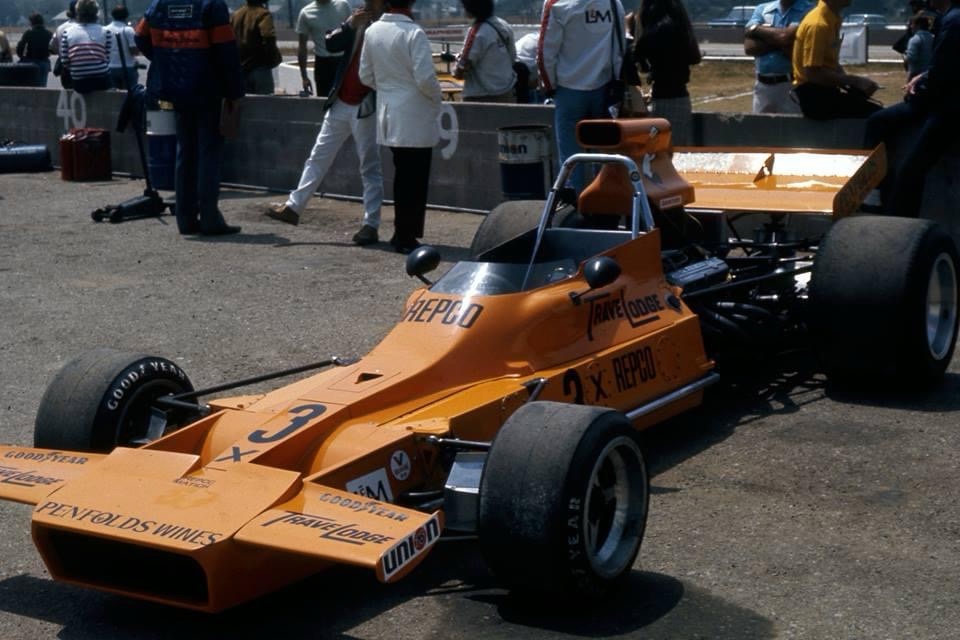
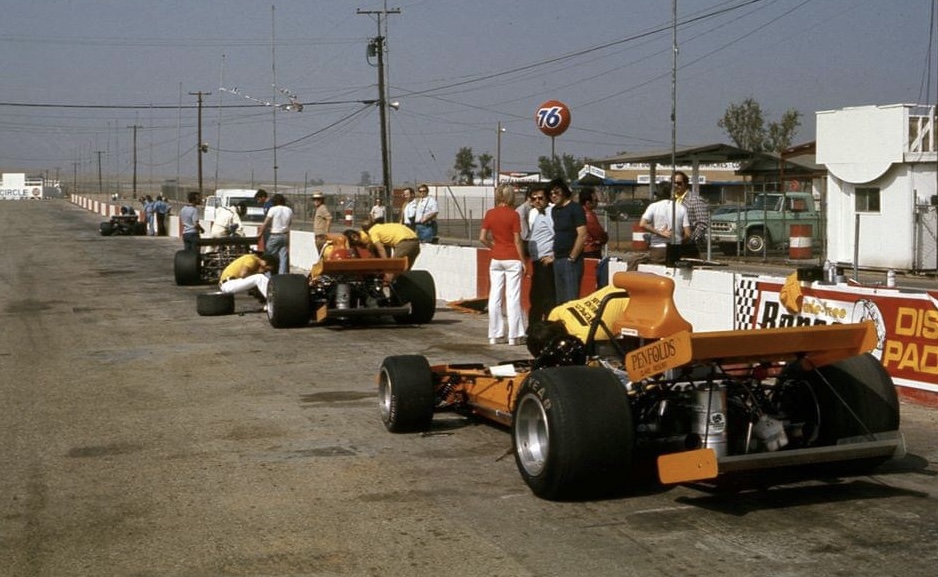
The Matich A51 Repco-Holdens, 005 and 006, in the pits at Riverside in April 1973, DNF (C Parker Collection)
(C Parker Collection)

Matich made an all-out assault on the US L&M F5000 Championship in 1973 comprising a two car team, flat-plane crank circa 515bhp Repco-Holden engines, mechanics led by Derek Kneller and locally based on-ground support.

The two A51s were evolutions of the A50 at a time the worlds best F5000s were the McRae GM1 and Lola T300. THE F5000 of 1973 was the Lola T330, variants of which were the greatest ever F5000 and central seat 5-litre Can-Am cars.

The downfall of the ambitious program was oil-scavenging problems with the hitherto bullet-proof Repco-Holden V8s. The constant radius, high speed corners of American circuits were cited as the cause of the issue which was identified and rectified later in the season when one of the A51s was sent back to the Repco Engine Development Company’s Maidstone headquarters. There the engines were tested replicating the effects of these types of corners, and changes to the units scavenging were made.

Interesting is that John Walker had no such problem with the Repco-Holden engines fitted to his very competitive car throughout that same series. That suggests, perhaps, that the problems may have been due to differences in the oil system tanks/plumbing between the A50 and A51 chassis.
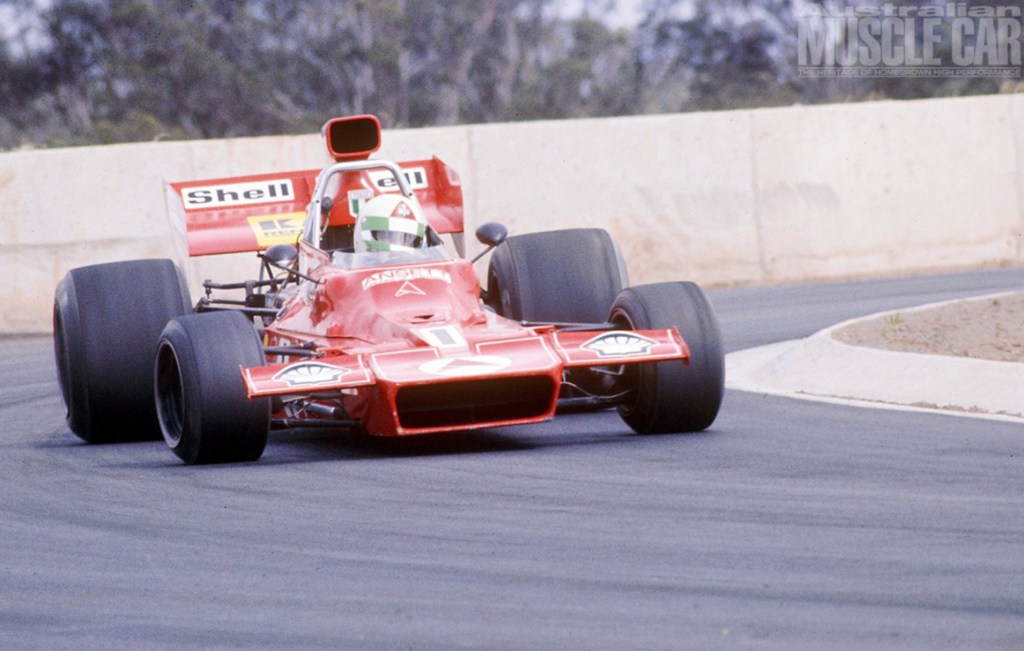
Lella Lombardi aboard A51-005 Repco-Holden during the Australian GP weekend at Oran Park in 1974. DNF oil pump (AMC)
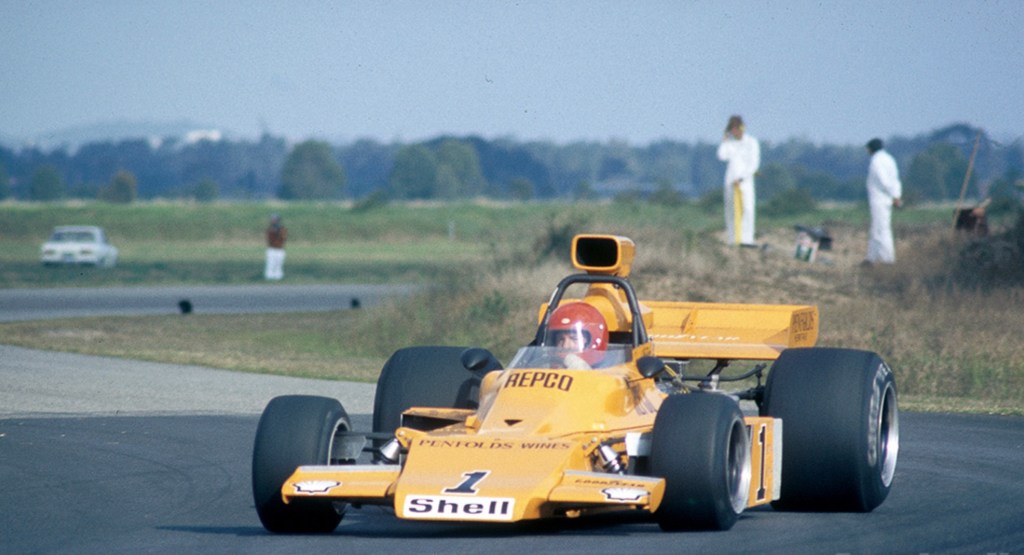
FM during his dominant run – for 43 laps – at Surfers Paradise in September 1973. Glyn Scott Memorial Trophy Gold Star round won by John McCormack’s Elfin MR5 Repco-Holden. A52-006 Repco-Holden (AMC)

Influenced by the speed of the Lola T330s stateside, FM and the team quickly converted A51#006 into a side-radiator design designated A52, with changes to the suspension, and the wheelbase using a longer T330 bell-housing.

The car was a rocket at the Surfers Paradise Gold Star round on September 2, 1973. Up there on the Gold Coast on a family holiday I watched Matich piss-orf into the distance until the beautiful exhaust note of the flat-plane-crank 5-litre V8 instantly ceased. The engine’s fierce high-frequency vibrations simply shook the gizzards of the lightweight Varley racing battery to bits…an expensive lesson.
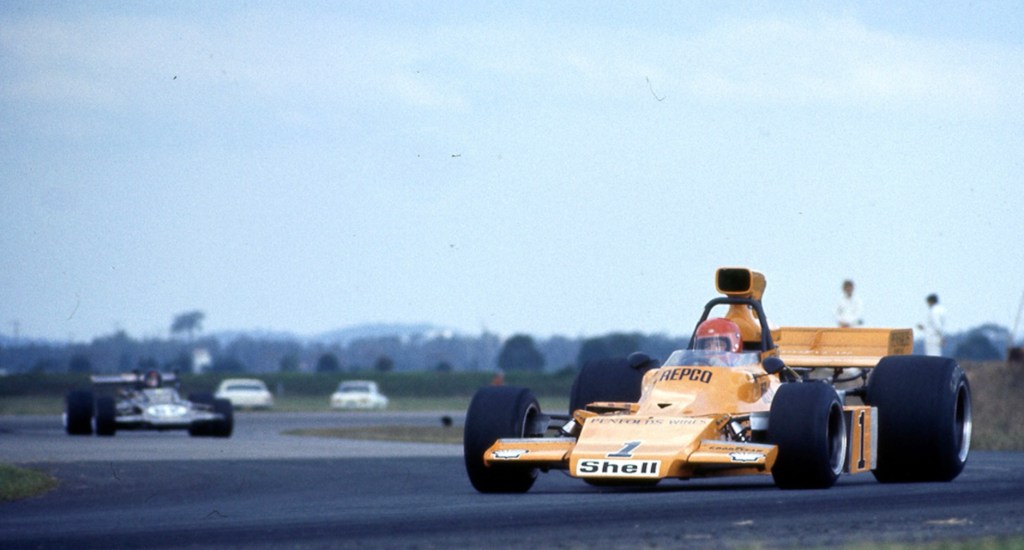
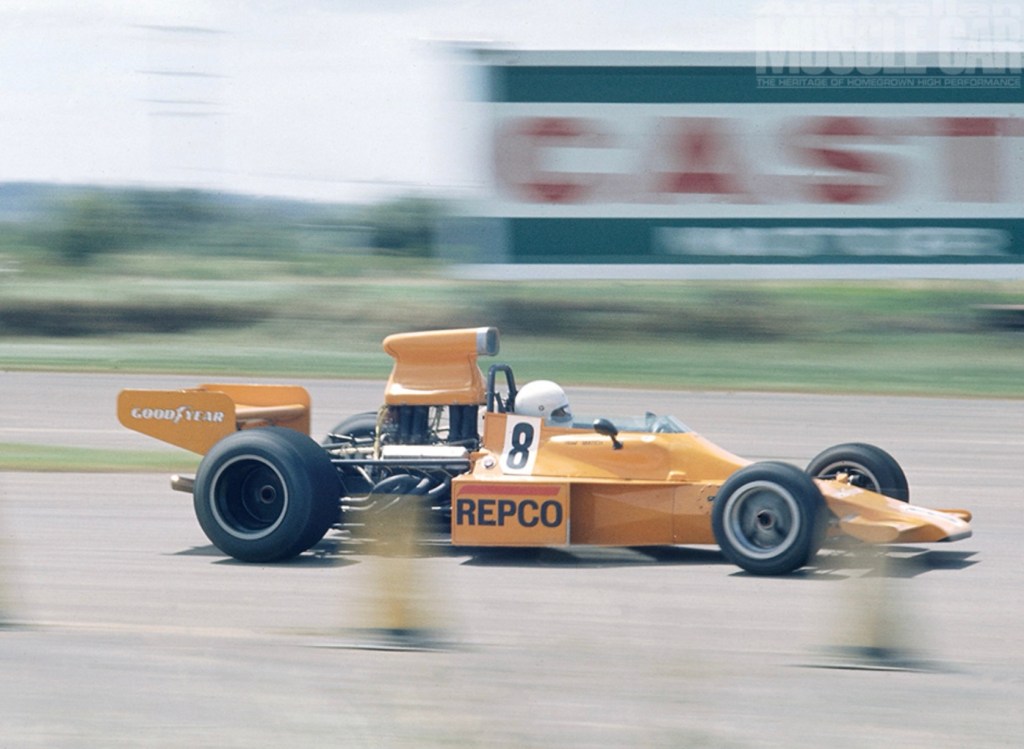
Matich in front of Bruce Allison’s Bowin P6 Hart-Ford ANF2 car – not Bruce’s favourite machine! – at Surfers. Bruce was fourth and second F2 behind Leo Geoghegan’s Birrana 273 Hart-Ford. Again Glyn Scott Memorial Trophy (AMC)
Wonderful profile shot of FM and A53-007 at Adelaide International during the February 24, 1974 Tasman round, fourth (AMC)

The A52 lost its life in a testing accident while being driven by Bob Muir, who had shown stunning pace aboard a Lola T330 Chev in the L&M, at Warwick Farm shortly thereafter. Equipe Matich then built up the last of six identical monocoque tubs made by the team and the Commonwealth Aircraft Corporation – #007 – into the A53, a further refinement of the A52 and intended as FM’s 1974 Tasman and L&M weapon of war.

A boating accident which gave Frank a near fatal electrical shock, and his wife Joan’s illness were catalysts for Matich’s retirement from racing at the end of the ’74 Tasman. Bob Muir raced the car at Oran Park (Q15/DNF fuel pump), and Matich at Surfers (Q4/third), Sandown (Q2/DNF water pump) and Adelaide (Q2/fourth; there was no shortage of pace.

To have seen the A53 battle the American T332 Chevs later in the year would have been something to watch, with the benefit of the character building visit and experiences the year before…

Credits…

Australian Muscle Car, Chris Parker Collection

Tailpiece…
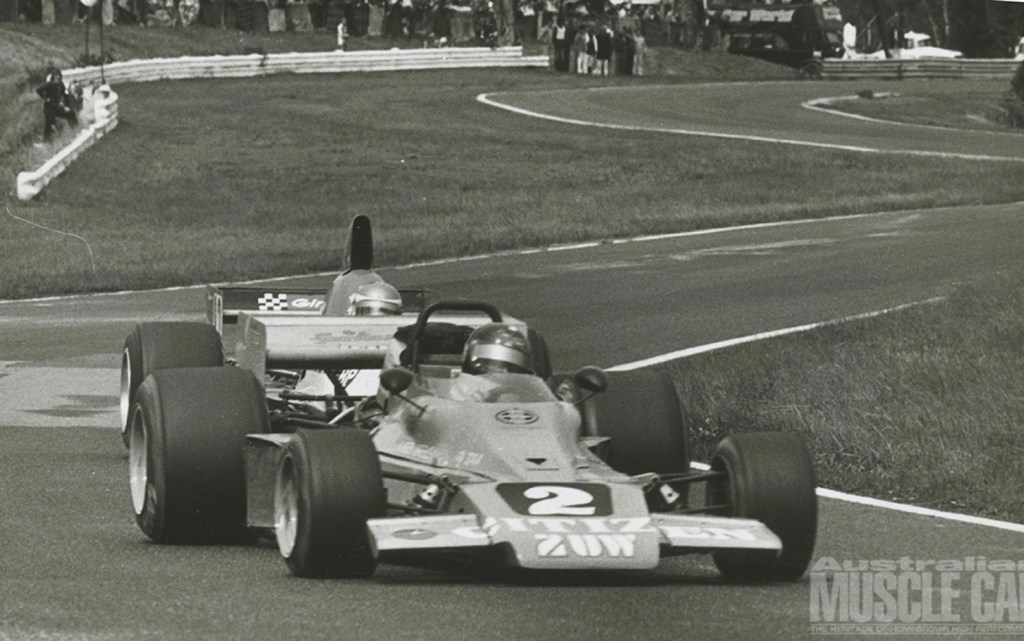
John Goss from Vern Schuppan through Dandenong Road at Sandown in the later stages of 1976 AGP. Matich A53 Repco-Holden and Elfin MR8 Chev. What a thriller it was! (AMC)

While Matich retired, the cars raced on, most notably in the hands of talented sports and touring car driver/mechanic/engineer John Goss.

‘Gossy’ bought A53-007 from Matich in mid-1974 and later A51-005, he converted the latter to A53 spec and generally preferred that car. He took to the brutish 5-litre roller-skates like a duck to water winning a couple of Tasman rounds. While John had the pace to take a Gold Star he never seemed to have the reliability, maybe given the challenges of also preparing and racing Ford touring cars. But it all came good good at Sandown on September 12, 1976 when he beat Vern Schuppan’s works-Elfin MR8 Chev home in a nail-biter of an Australian Grand Prix finish.

Goss out of A53-005 and taking the plaudits of the Sandown grandstand crowd. Note the lack of an airbox, and radiator location ducting changes compared with the A53 in its original form during the ’74 Tasman (AMC)

There were still plenty of sportscar and sports-sedan wins for Repco-Holden F5000 V8s but it was the last hurrah for a Matich chassis, the first of which, Frank argued – and I agree – began with his highly modified Lotus 19 Climax in 1962.

Finito…
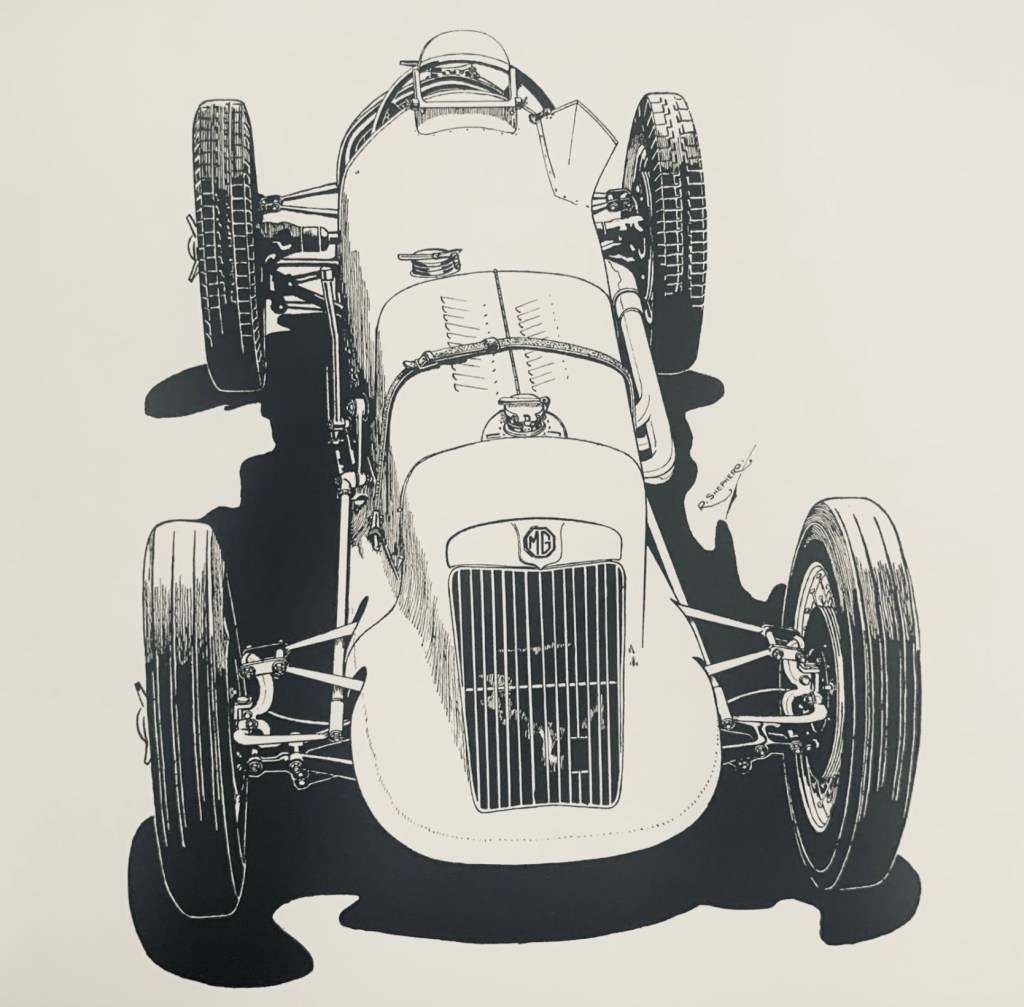
(Bob Shepherd)

Credits…

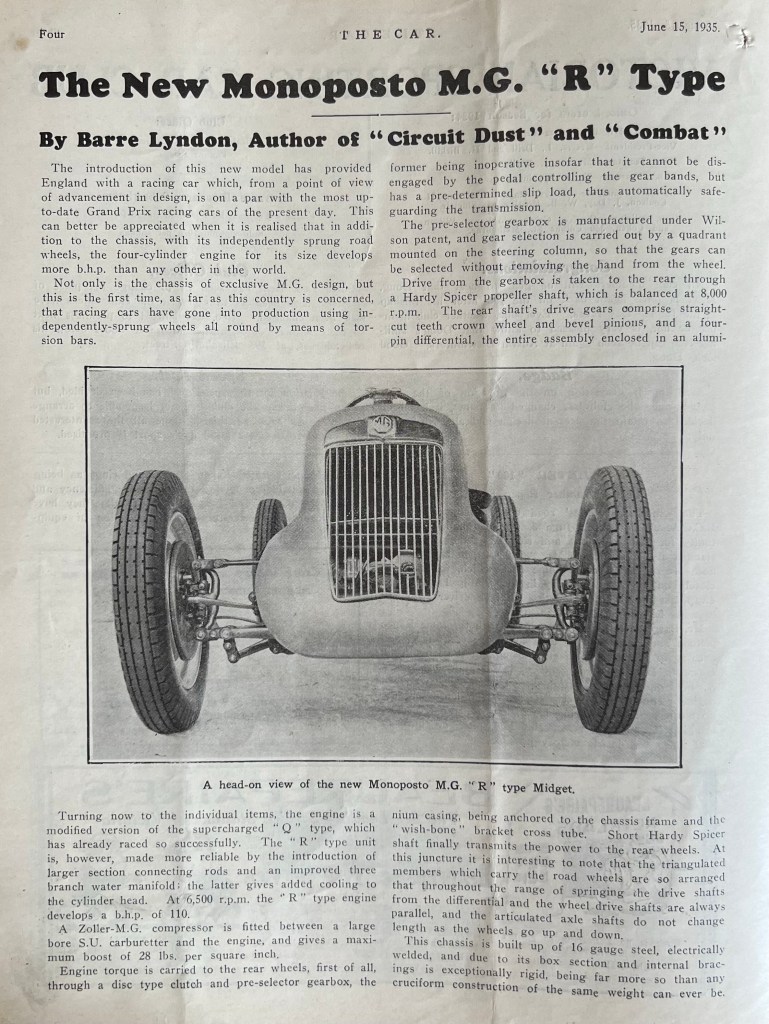
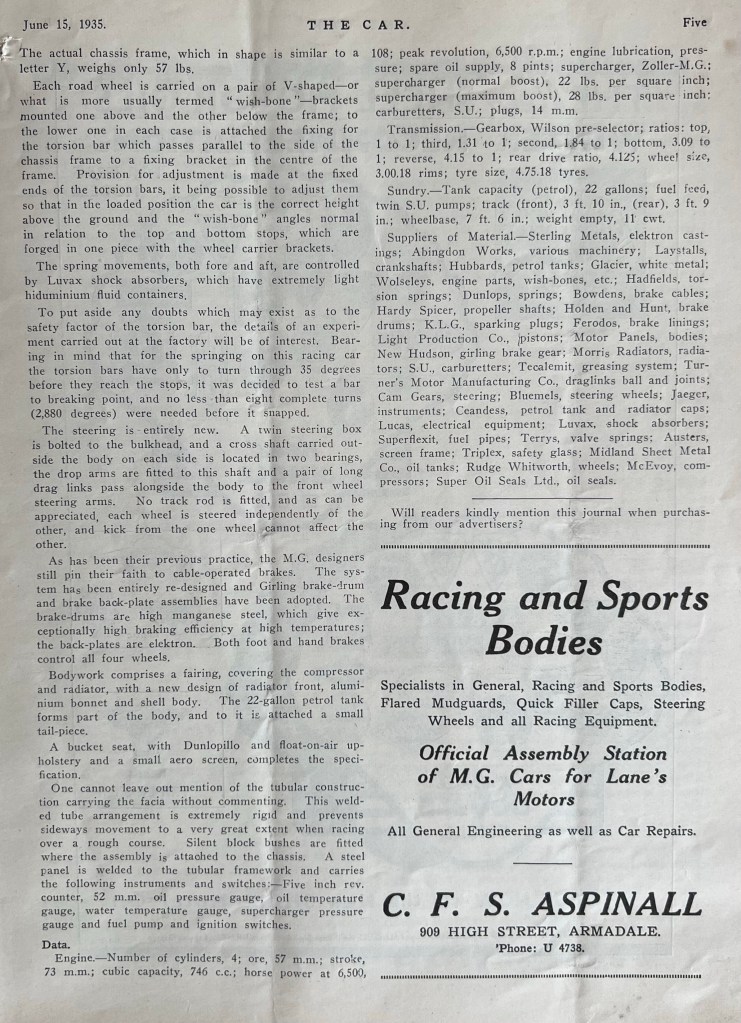
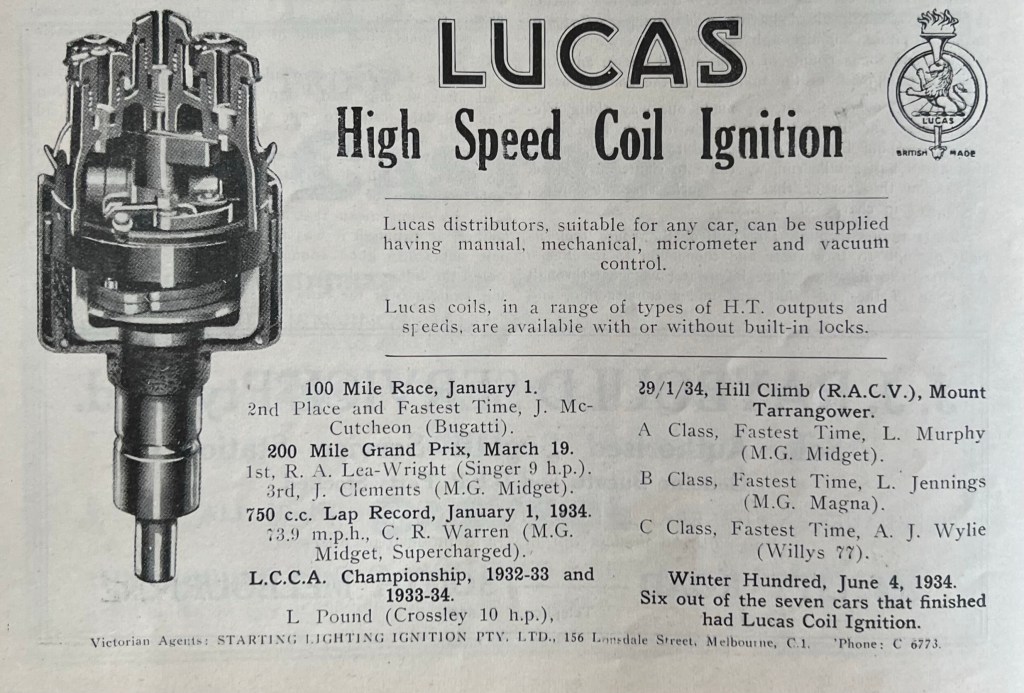
The Car June 1935 magazine and Bob Shepherd drawing are both from the Bob King Collection

Finito…

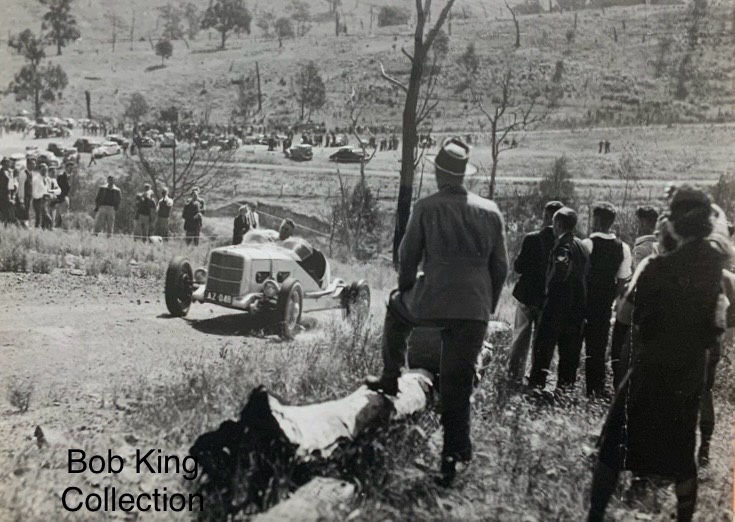
Evocative shot of Jack Phillips’ Ford V8 Special ascending Rob Roy hill in the Christmas Hills, 50km east of Melbourne

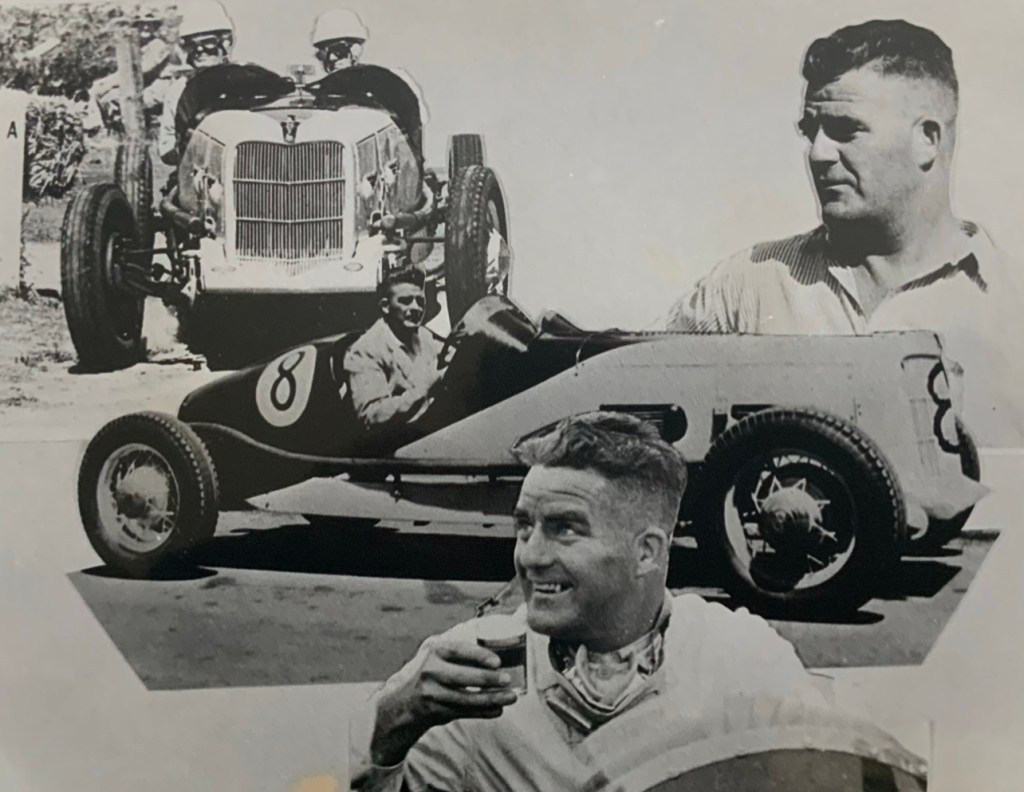
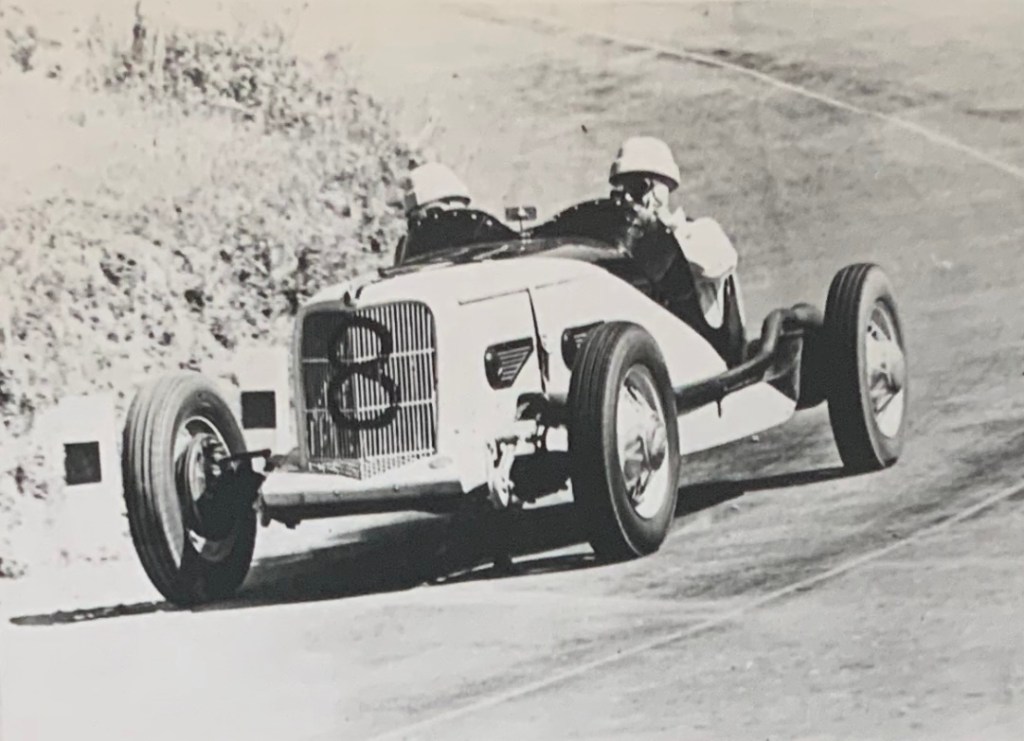
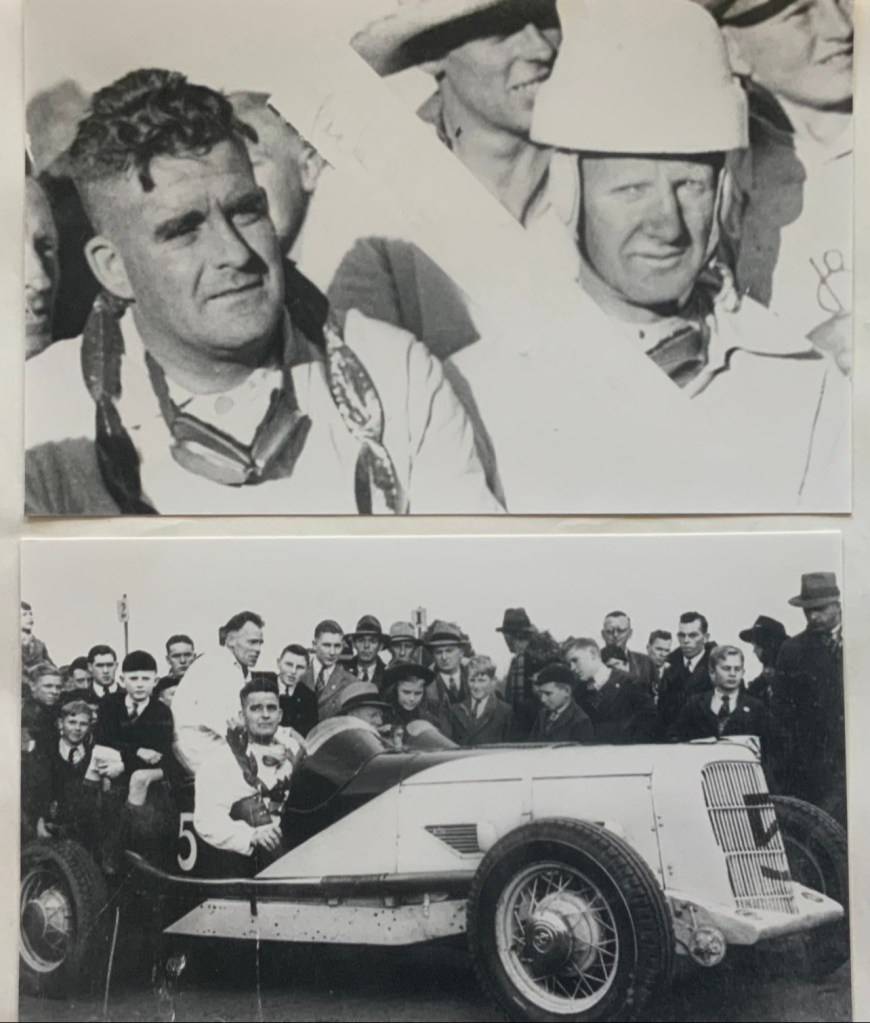
This car was one of the fastest and most successful racers in Australia – where handicap events then were standard fare – in the immediate pre and post-War period. Built by Phillips and Ted Parsons, his riding mechanic and partner in a Wangaratta Ford dealership, I’ve written about the combo before: https://primotipo.com/2023/03/07/jack-phillips-ted-parsons-ford-v8/

I’d love to know the date of the meeting and how Jack went? Before the January 13, 1939 Black Friday fires it seems?

(B King Collection)

Phillips/Parsons (above and below) on the way to a win in the South Australian Hundred on formidable Lobethal in 1940.

(B King Collection)

Credits…

Bob King Collection

Tailpiece…

(B King Collection)

Finito…

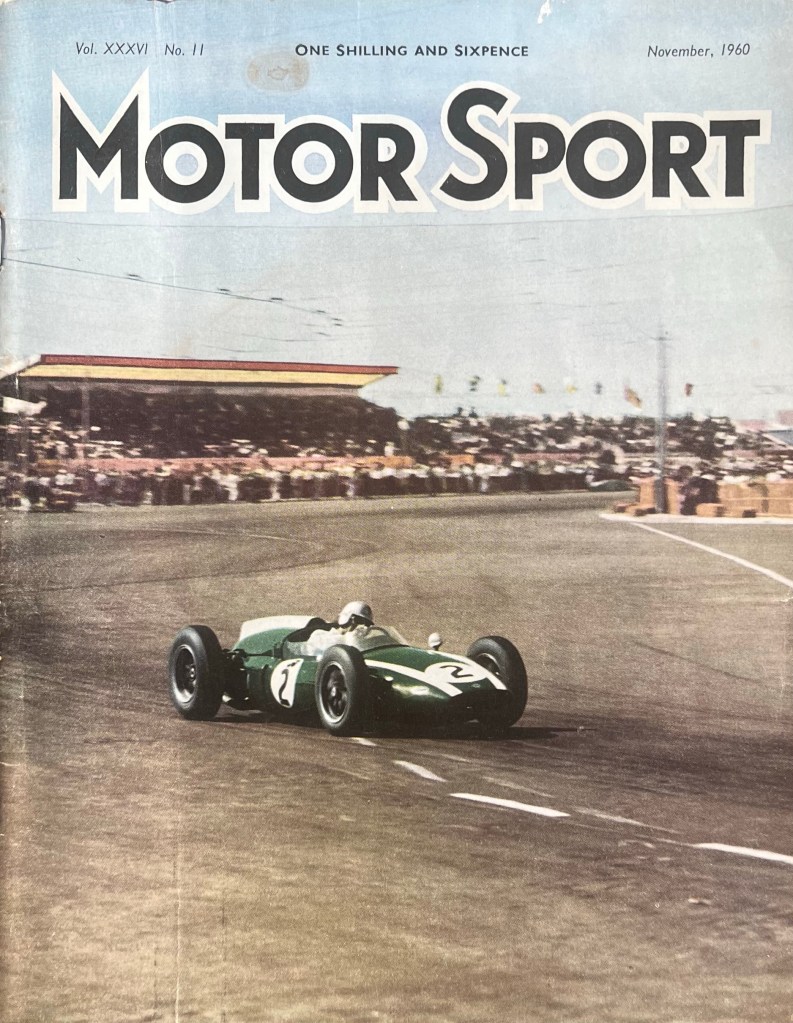
Jack Brabham on his way to winning the 1960 Portuguese Grand Prix on the Circuito da Boavista, Oporto on August 14. Cooper T53 Climax, Bruce McLaren was second in the other team T53 while Jim Clark was third in a Lotus 18 Climax.

He won his second drivers world championship that day – round seven of nine qualifying rounds – while Cooper bagged their second manufacturer’s championship too. Jack would collect another F1 title or two, Cooper did not. Sadly.

More about Boavista in this article about the 1958 race: https://primotipo.com/2014/09/24/circuito-da-boavista-portuguese-gp-1958/

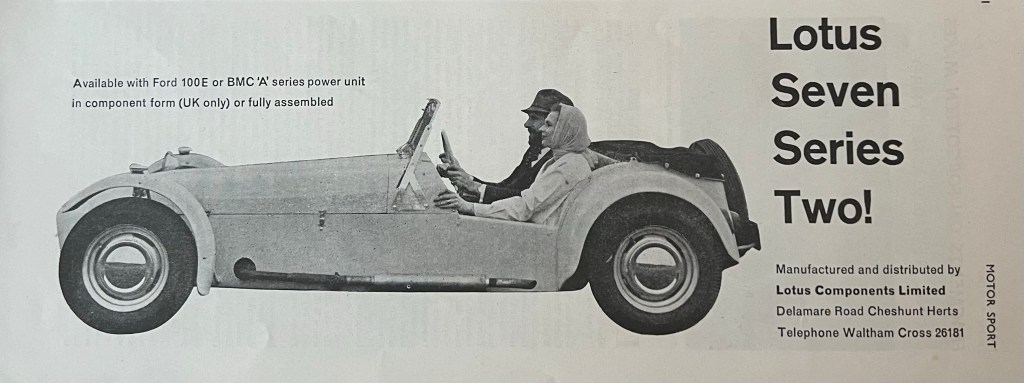
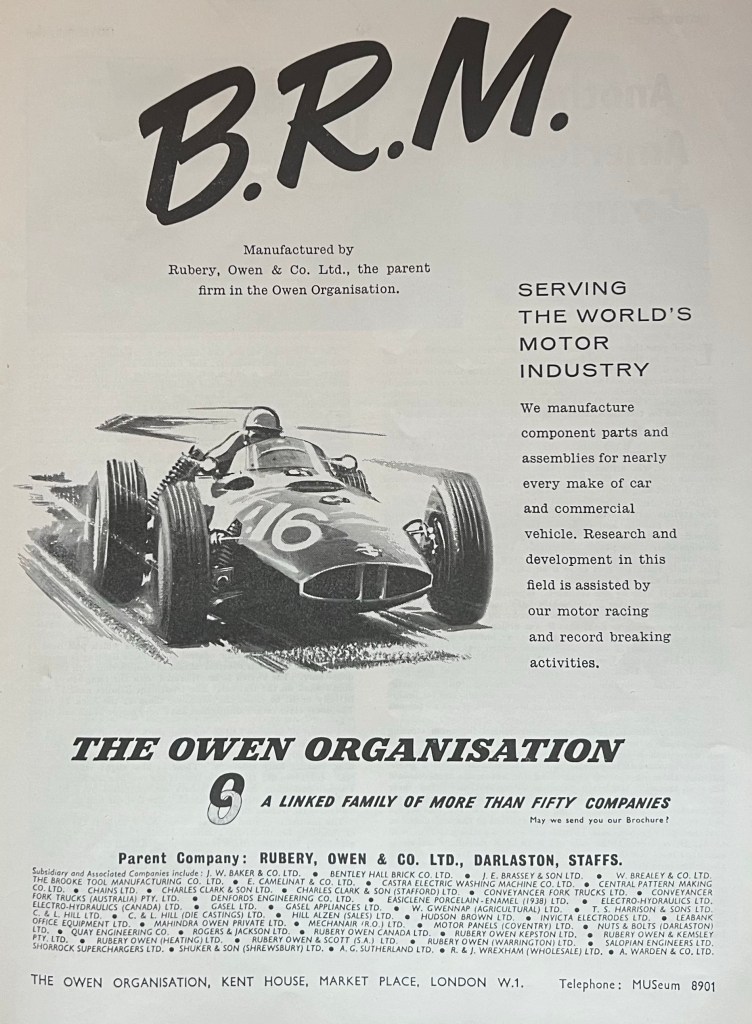
When flicking through old mags the ads are often as interesting as the editorial material.

At that stage ‘yerd be taking your Lotus 7 with the A-series I guess, the release of Ford’s 105E rather shifted the balance of course, especially once Messrs Duckworth and Costin did their thing thereon.

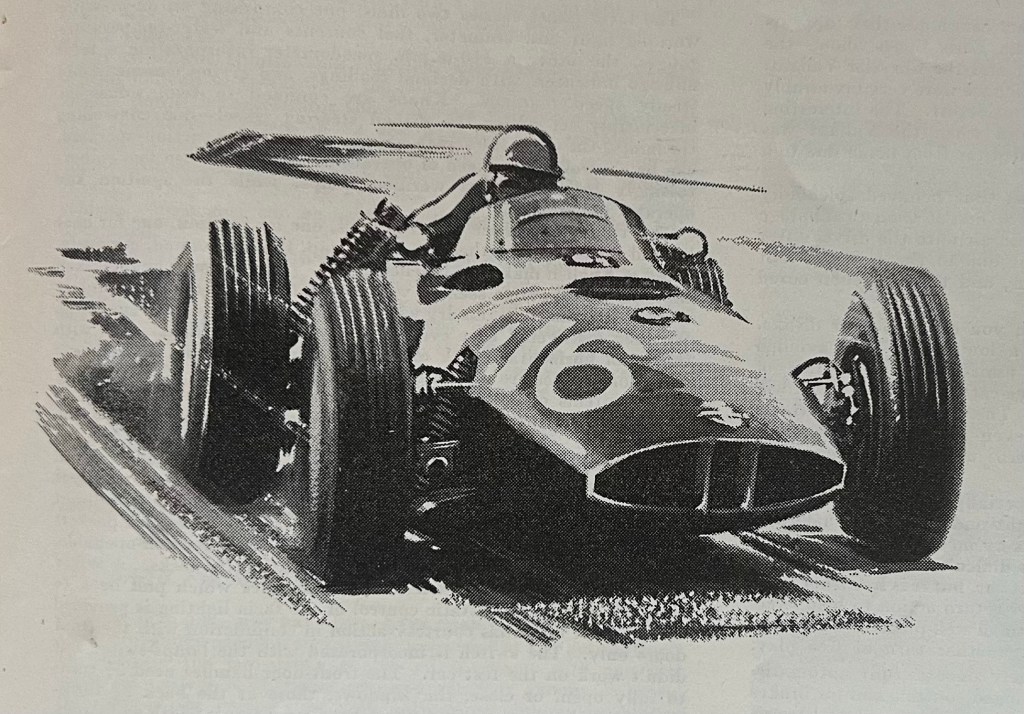
The BRM P48 is a favourite, what’s not to like, here: https://primotipo.com/2018/03/16/bourne-to-ballarat-brm-p48-part-2/ and here :https://primotipo.com/2015/03/26/tony-marsh-boness-hillclimb-scotland-brm-p48-part-1/

Who did the drawing do you think?

Credits…

MotorSport November 1960

Finito…

Chris Amon sneaks a look in his mirrors, no need to worry too much! Ferrari Dino 246T/69 #0008 (MotorSport)

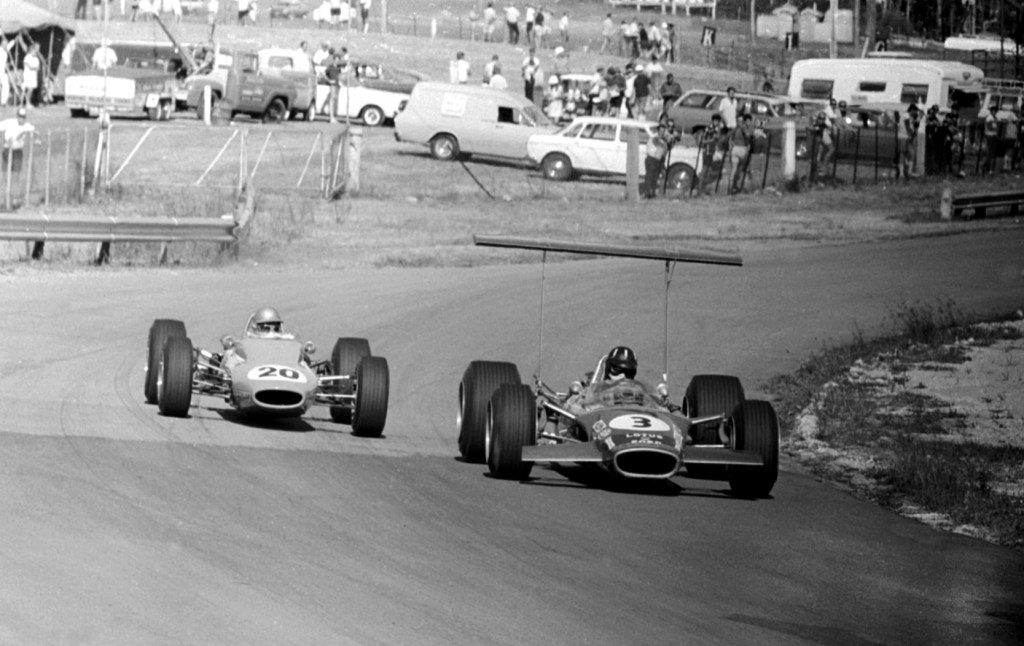
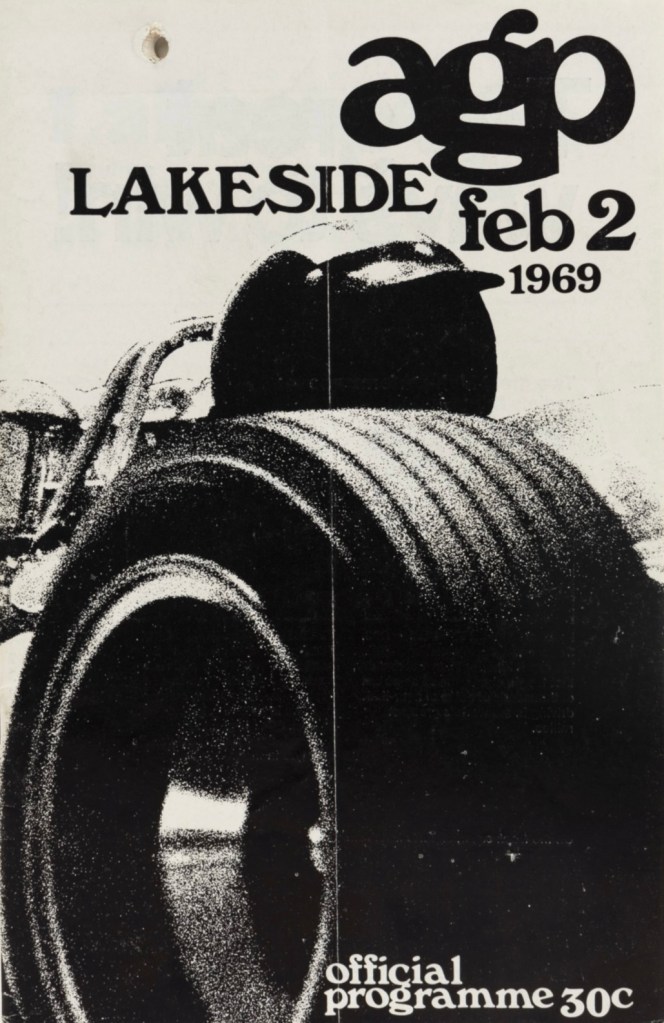
Unlike previous years when the cars had been shipped across The Ditch – the Tasman sea – from New Zealand to Australia, in 1969 they were air freighted as there was only a week between the Teretonga and Lakeside rounds, that year the site of the 1969 Australian Grand Prix held on February 2.

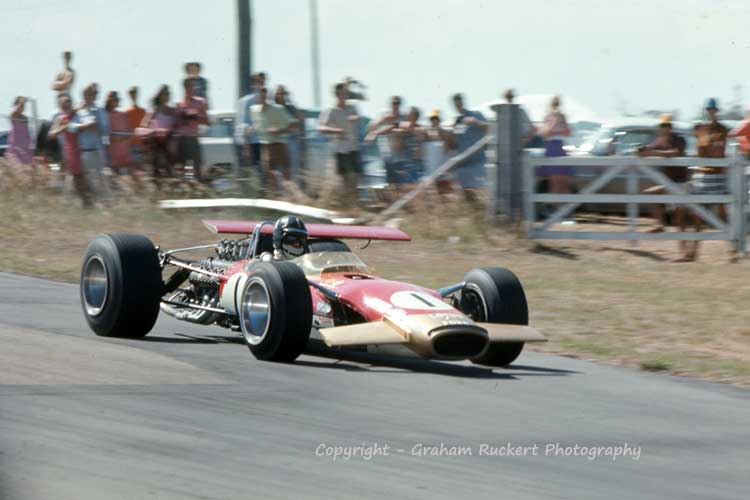
Top Guns were the Scuderia Ferrari/Chris Amon/Scuderia Veloce run Ferrari Dino 246Ts of Chris Amon and Derek Bell and the Gold Leaf Team Lotus Lotus 49B Ford DFW V8’s of just minted World F1 Champion Graham Hill and The Hunter-Jochen Rindt, with everything to prove.

The 1969 Tasman Cup gets underway at Pukekohe on January 4 with the gig-two on the front row. Chris Amon, Ferrari Dino 246T and Jochen Rindt, Lotus 49B Ford. Amon won from Rindt and Courage (MotorSport)

At the end of the four Kiwi rounds Amon was looking the goods for Tasman Cup honours, having won at Pukekohe and Levin and picking up third place points at Wigram and Teretonga. While the Lotuses were the fastest cars, they weren’t as reliable as the Ferraris: Amon and Bell had six out of seven point scoring finishes, while Rindt, Hill and Piers Courage – in Frank Williams Brabham BT24 Ford DFW – scored off only four races. Chris won the cup with four race wins (his two in Australia were at Lakeside and Sandown) to Jochen’s two (Wigram and Warwick Farm) and Piers’ one (Teretonga).

Rindt, Lotus 49B Ford #R10 heads towards The Karussel with Lake (MotorSport)

Practice…

Of the internationals, Only Ferrari and Piers Courage managed to get themselves sorted out in time, Bruce Sergent wrote. “While Lotus had all sorts of problems with customs and freight. It was apparent that Ford Australia weren’t behind the Lotus effort this year, for they had to do most of their own organising right from administration down to transport for drivers and mechanics.” Ferrari, of course had the well drilled David McKay/Scuderia Veloce organisation to deal with the logistics, and it showed throughout the weekend.

The new stiffer rear springs Amon was after from the start of the series were waiting for the two Ferraris in Brisbane, and with these fitted the cars were out early on Friday and soon showed it would be a tough round Lotus to even make a clean breast of. While Amon and Bell were making hay on a clear track, Lotus had only just received their cars and both needed attention. Rindt’s engine was misfiring, and Hill’s blew up shortly after starting up in the garage. Even with getting an engine back from Courage, it still left them with one very sick car, Rindt’s.

On Saturday, Amon comfortably took pole pole from Courage. Gardner had fitted a bi-wing set-up to his Mildren Racing Mildren Yellow Submarine Alfa Romeo V8 like Courage’s in unofficial practice but didn’t have the time to evaluate it and had to remove the front one and save it for testing on home turf at Warwick Farm, Sydney, the following week. Hill broke his wing in practice – the curse of Team Lotus at the time – but still managed fourth fastest, while Rindt was only able to push his Lotus 49B to fifth, creditable under the extreme circumstances.

Piers Courage, Brabham BT24 Ford DFW from Jochen Rindt, Lotus 49B Ford DFW thru the kink. The start-finish line is just out of shot (MotorSport)
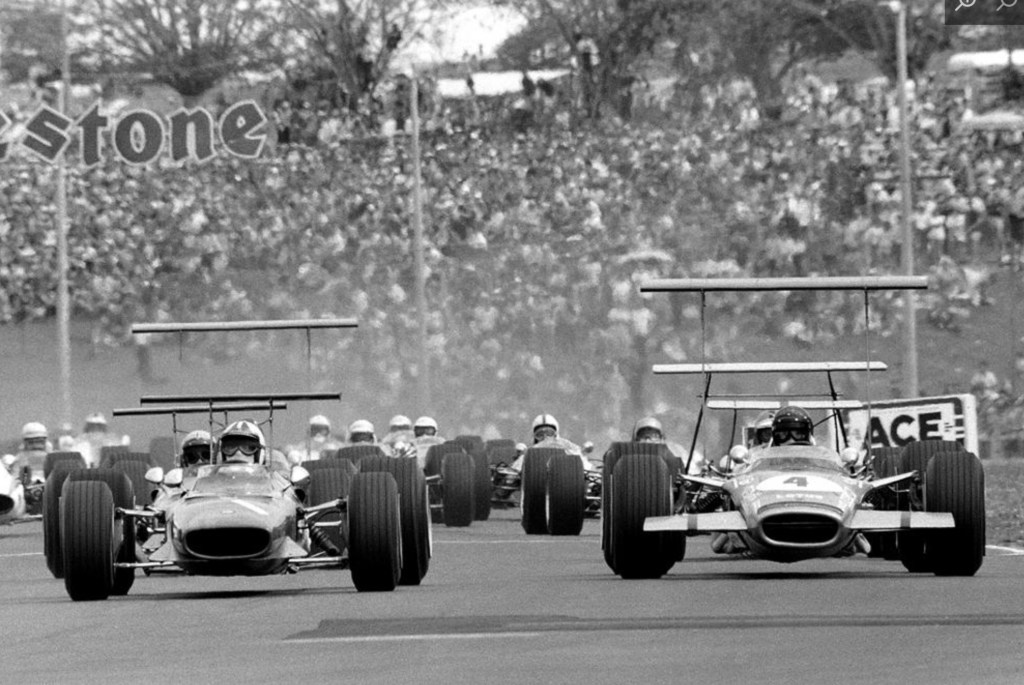
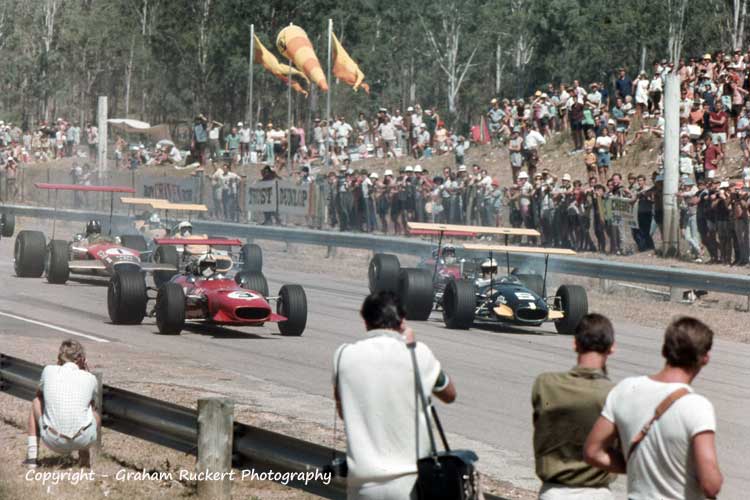
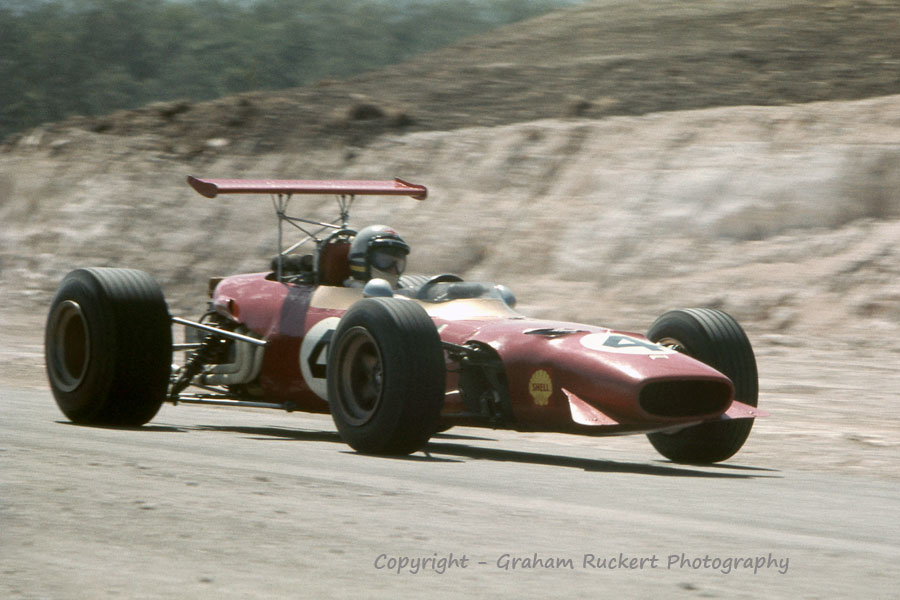
They are off: Amon and Courage, Hill and Bell partially obscured by Courage, then the two yellow winged Mildren entries of Gardner and Bartlett (G Ruckert)

Race…

Amon won the jump from Courage and streaked off into the afternoon sun while Hill, Courage and Bell lined up for battle behind, then followed Gardner, Rindt and Kevin Bartlett aboard the Brabham BT23D Alfa Romeo Tipo 33 2.5-litre-V8 that Gardner raced in the ’68 Tasman and was then driven by KB to victory in that years Gold Star, the Australian Drivers Championship. Next was Niel Allen’s ex-Courage McLaren M4A Ford FVA. It was Niel’s first drive at Lakeside after his huge accident during the Gold Star round in July 1968, the car’s monocoque having been rebuilt/replaced by Bowin Cars.

Positions remained static for a bit until Courage closed in on Hill and tried to pass on the outside as they ranged under brakes for BMC bend. But Piers didn’t quite make it and there wasn’t enough room left for both cars, Graham didn’t give way, being on-line for the corner so the two cars touched and Courage suddenly ran out of track and retired the car on the dirt with slightly bent front suspension. Hill lost four seconds giving Bell his opportunity and he went through into second position to make it a Ferrari 1-2 for the first time in the series.

Bartlett retired on the following lap with no water and blown head gaskets, giving away his position to Niel Allen. Then he overdid it under brakes, the front set locked, and he lost four places getting things in hand. He picked up one of the lost places immediately and set out on a long hard haul back through the field.

Rindt hustles his Lotus – engine problem duly noted – into BP Bend, Q5 and DNF. With fresh engine he made good and ‘blew the field off the planet’ in the Warwick Farm 100 one week hence
Frank Gardner, Mildren Alfa Romeo V8 aka the Mildren Mono/Yellow Submarine (MotorSport)

Jochen Rindt made the next move when he displaced Leo Geoghegan’s ex-Clark Lotus 39 albeit with a Repco Brabham V8 rather than the Climax FPF four, on the 13th lap for fifth spot, but Geoghegan was hanging on grimly and didn’t let the Austrian get away from him. But Rindt pulled out every horse he could find in the ailing Cosworth V8 and slipped by Frank Gardner on lap 19, making the order Amon and Bell in Ferrari Dinos, Rindt’s Lotus 49B, Gardner’s Mildren Alfa, Geoghegan’s Lotus Repco, Max Stewart, Mildren Alfa 1.6 F2, Allen, Glyn Scott, Bowin P3 Ford FVA F2 and Malcolm Guthrie, Brabham BT21B Lotus-Ford 1.6.

Rindt held onto this position, trailed by Gardner, who was becoming concerned over oil pressure. His fears were confirmed when the Alfa Romeo engine blew an internal oil line and he was forced out of the race on lap 12. Gardner’s demise brought everyone up a place but Jochen Rindt’s forceful run ended when the Cosworth Ford V8 engine lost power and he quickly shut off and headed for the pits.

Derek Bell, Ferrari Dino 246T/69 #0010. No adjustable wing for Derek (MotorSport)

Chris Amon was busy lapping all but his team mate, Derek Bell, while Leo Geoghegan was sitting in a wonderful position behind Graham Hill in fourth spot. Col Green, ex-Hill/Gardner Brabham BT16 Climax 2.5 FPF was in and out of the pits with gearbox and engine problems while Alf Costanzo, McLaren M4A Ford FVA F2 had retired after a spin over the back of the circuit, then stalled and was unable to restart.

The rear wing on Hill’s Lotus 49 had looked shaky for a few laps and finally it broke and folded over his rear wheel. He tried to keep the car as steady as possible so not to be black flagged, and finally pitted to have the offending piece of iron cut from the car. Geoghegan, meanwhile, seeing Hill’s problem, had speeded up and went by as Hill was having the operation finished to his wing. He came back into the fray bent on getting his third spot back from Geoghegan, but the Lotus was suffering from oversteer with the now, light rear end, and he steadily lost ground.

Graham Hill’s 49B #R8 with the rear wing mount problems that Lotus never satisfactorily solved. No bodily harm caused on this occasion. Ultimately the FIA solved Lotuses problem for them with their intervention over the 1969 Monaco GP weekend (G Ruckert)
Niel Allen, McLaren M4A Ford FVA. #M4A/2 is the ex-John Coombs/Courage ’67 Euro F2 entry, then, in Pier’s ownership his ’68 Tasman machine, and Longford round winner (MotorSport)

Niel Allen, worked hard to make up time lost in two spins and managed to catch Max Stewart in the surviving Alec Mildren Racing entry, the Mildren Alfa/Autodelta 1.6 four-valve F2 car and, now in fifth spot, went on to win the battle of the F2’s. Englishman, Malcolm Guthrie, having sat behind Glyn Scott on the Queenslander’s home circuit, finally made a last-minute burst and finished ahead of the Bowin. Scott was still waiting for a set of rods to come from Cosworth for his FVA engine, he was running on a set borrowed from Allen.

With two rounds to run, Amon’s win put him into an almost uncatchable Tasman Cup points lead. Only Piers Courage, with a bit of luck and by winning the final two races, could take the championship from the New Zealander. Rindt and Hill, equal on 15 points, were at that stage relegated to fighting out second spot.

Ain’t she sweet, Graham Ruckert has captured the car with its unloaded left-front off the deck. Note the hydraulics to operate Chris’ rear wing

Etcetera…

(MotorSport)

Graham Hill blasts through the hole left for him by Glyn Scott at Lakesides flat-knacker Kink.

Bowin P3 Ford FVA 1.6 #P3-101-68 and Lotus 49B Ford DFW 2.5. Hill was fourth and Scott 11th. More about Graham’s car here: https://primotipo.com/2022/02/26/lotus-49b-ford-chassis-r8/

It’s a David and Goliath shot. John Joyce’s superb monocoque was Lotus inspired too, he had a number of senior engineering posts at Lotus between 1963 and late 1967 when he returned home to start P3 – Project 3 – his first two cars (Projects 1 and 2) built before he left for his stint in the UK were a modified Cooper and the Koala Formula Junior. More about Glyn and the Bowin P3 here: https://primotipo.com/2020/07/24/glyn-scott/ and here: https://primotipo.com/2021/05/06/ian-peters-ex-glyn-scott-bowin-p3-101-68/

(MotorSport)

Nah, its too skinny to be Sergeant Schultz! It must be Jochen Rindt with a touch of the Adolfs, not the best protection for the searing Queensland summer sun, and with a smile on his face despite the challenges of the weekend.

Piers Courage took up where he left off in the ’68 Tasman, as a front runner in the clever car Frank Williams assembled for him. Brabham BT24-3 was ex-Brabham/Rindt/Gurney/Ahrens, with its F1 3-litre 740 Series Repco Brabham V8 removed and a 2.5-litre Ford Cosworth DFW installed the bi-winged Brabham was a very competitive car raced ably throughout. Piers ultimate pace was reinforced during that years GP season where he proved one of the quickest men around…he arrived that year big time.

Courage, Brabham BT24 Ford. Generally, but not completely, Ron Tauranac’s wings remained where he intended them from the start to the finish of the weekend (MotorSport)
(MotorSport)

Frank Gardner’s (above) Len Bailey designed, Alan Mann Racing built Mildren Alfa used many Brabham BT23 components and was ‘best of the rest’ behind the big-five. Gardner arrived in New Zealand ‘under-winged’, he scored in four of the seven rounds and would have gained a bit with more downforce from the start of the series.

It’s one of the most iconic and instantly recognisable single-seaters ever raced in Australia by – in turn – FG, Kevin Bartlett, Bob Muir and Ray Winter with Tipo 33 2.5 V8 as here, then Waggott 2-litre TC-4V and finally 1.6-litre Lotus-Ford twin-cam in ANF2 spec.

Derek Bell drove well throughout the series, a pair of seconds at Lakeside and Warwick Farm his bests. He was fourth at Pukekohe, and fifth at Wigram, Teretonga and Sandown. Depending upon your source, Scuderia Ferrari provided four of the latest spec 2.4-litre, DOHC, four-valve fuel injected V6s for the two-car touring team. Bell was given less revs to play with than his team-leader!

More on the Ferrari Dino 246T here: https://primotipo.com/2018/05/01/wings-n-dino-things/ and here: https://primotipo.com/2017/07/21/amons-tasman-dino/ on Piers Courage’s Brabham BT24 here: https://primotipo.com/2016/07/11/brabham-d50/ and on Jochen Rindt’s Down Under summer here: https://primotipo.com/2018/01/19/rindt-tasman-random/

(MotorSport)

Credits…

I truncated and added to Thomas B Floyd’s race report in the Australian Motor Racing Annual 1969, Sutton, MotorSport Images, Graham Ruckert Photography, Bruce Sergent on sergent.com, oldracingcars.com

Tailpiece…

Finito…

Graham Hill, Dan Gurney and the BRM mechanics await the start. Dan’s car is P48 #486 (D Jolly)

Make sure you buy the August 2024 issue of The Automobile, it contains a piece I wrote about Dan Gurney’s win at Ballarat Airfield in a BRM P48 on February 12, 1961.

That Victorian Trophy victory was the only international win for a P48 in Dan’s last drive for the Owen Racing Organisation.

There are some fantastic, never-seen-before colour shots taken by Australian Lotus ace/works-driver and Australian importer Derek Jolly at the meeting, courtesy of Lotus historian/restorer Mike Bennett.

Further ‘Australian content’ comes in the form of the cover car, Bugatti Type 35 chassis 4450. Better known to many of us as the Lyndon Duckett/Bob King Anzani Bugatti, the car is the subject of a long feature celebrating the centenary of the landmark T35. See here too: https://primotipo.com/2021/09/17/werrangourt-archive-9-lyndon-duckett-by-bob-king/

Towards the end of his 52 years of use on the road and in competition Bob restored the 4450 to its original, ex-factory specification. The same spec as that when it was delivered to first owner, George Pearson Glen Kidston in Molsheim on February 16, 1925. In a neat book-end of history Simon Kidston, Glen’s nephew, is the current custodian of #4450, not that it looks much like it did in Australia clad in its road-going garb.

Another fascinating article for proponents of Oily Rag Restoration, is a report on the Best in Show award going to an unrestored Alfa Romeo 8C2300 at May’s Concorso d’Elegance Ville d’Este.

It’s the first time the premier award in a ‘Grand Prix Concours’ has gone to a Preservation Class car. Great stuff, as Jörg Sierks ended his piece, ‘We can only hope that such appreciation of patina and preservation will be upheld and leave its mark on the future of Ville d’Este and other world-class concours events.’

The Automobile is in-store now in the UK, and two months away on the slow-boat to the Antipodes, other than to subscribers who should have it about now. Why not subscribe here: https://www.theautomobile.co.uk/subscribe/

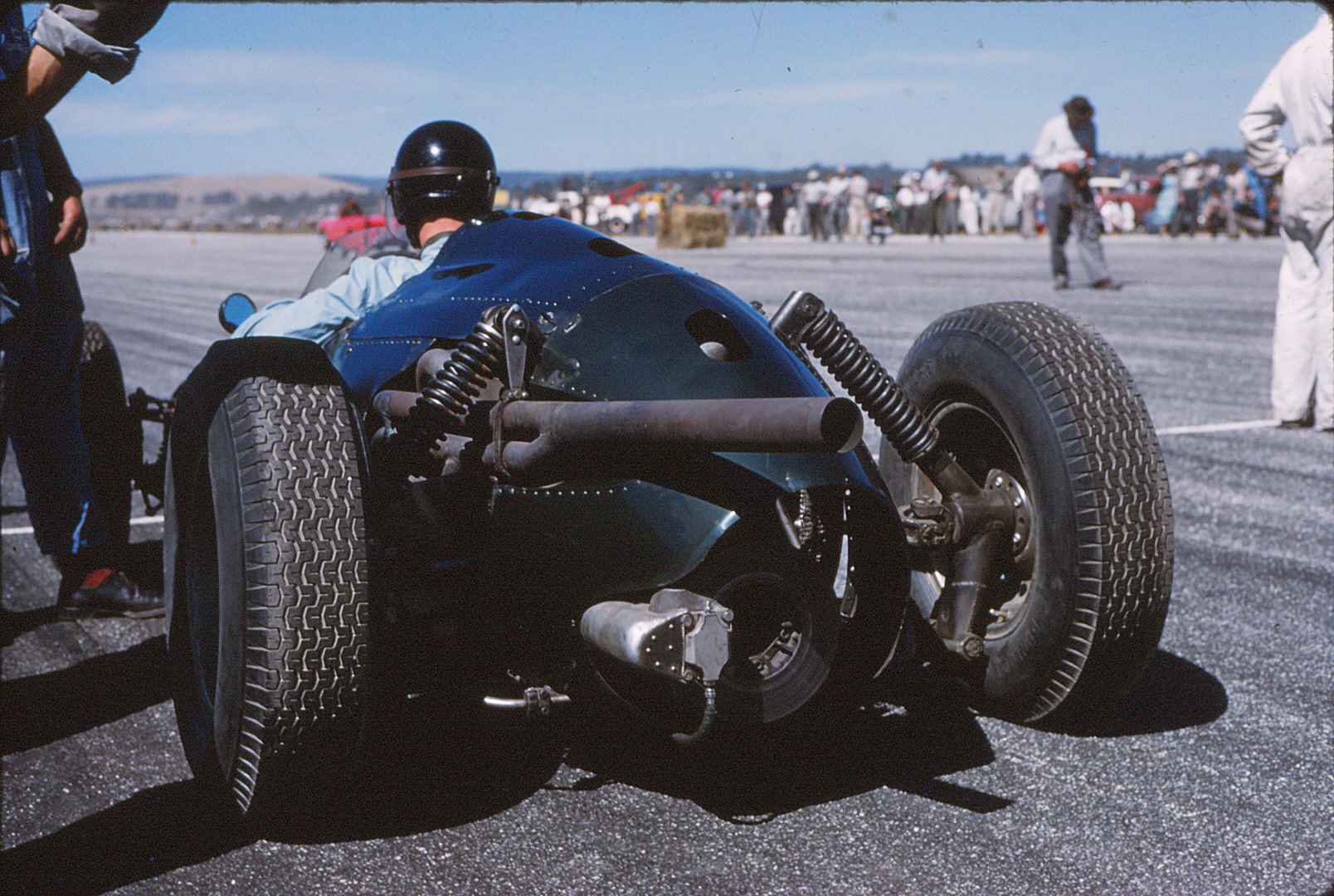
Rear of Dan’s P48. Macpherson strut, single lower wishbone and radius rod rear suspension, and famous Dunlop ‘bacon-slicer’ ventilated single rear disc brake mounted to the gearbox output shaft (D Jolly)

Credits…

Derek Jolly via Mike Bennett, The Automobile

Finito…

(unattributed)

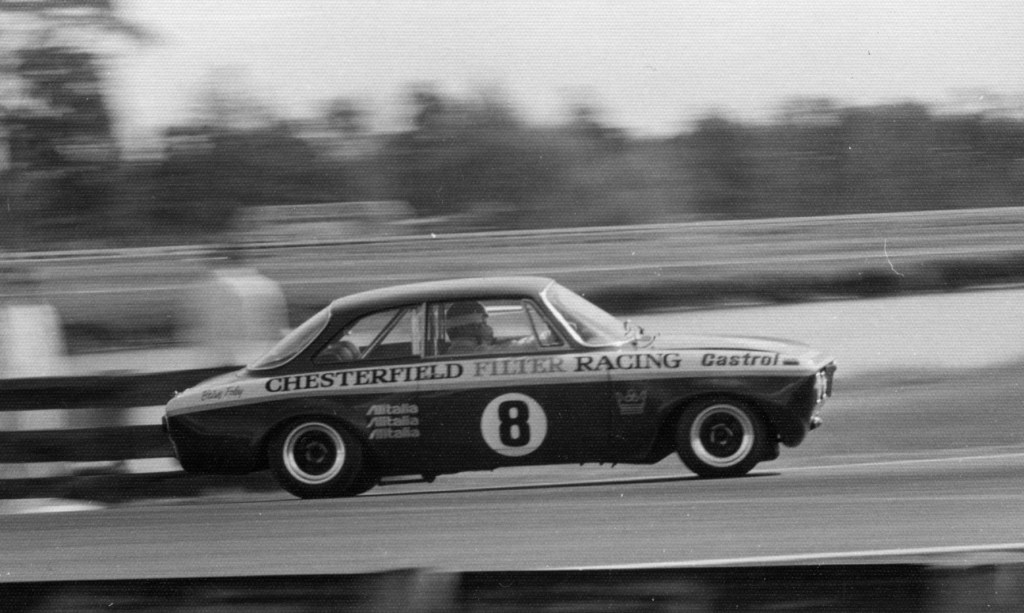
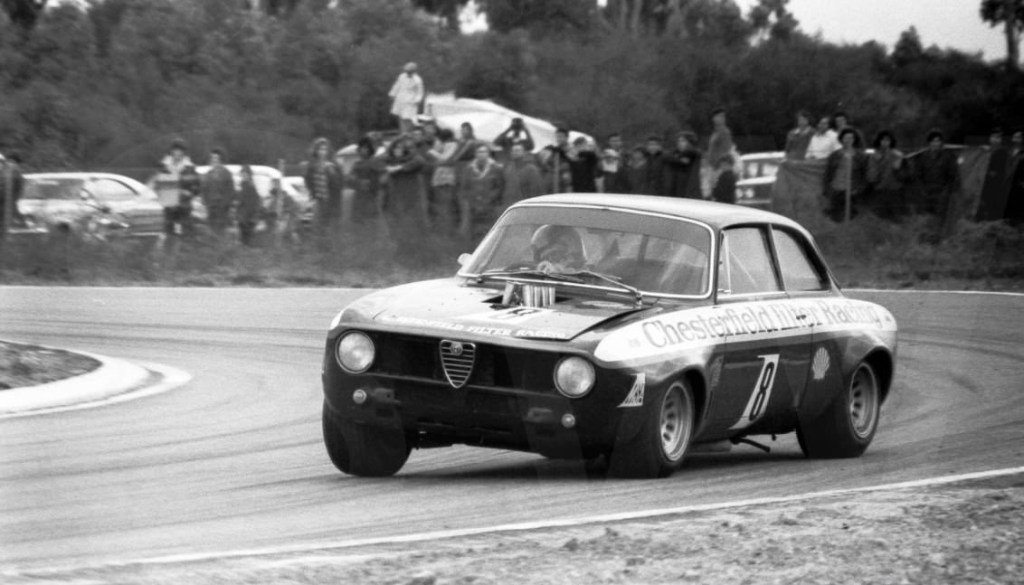
I’ll take the one with stripes…Brian Foley’s Alfa Romeo 1750 GTAm on the showroom floor of his Parramatta Alfa Romeo dealership, Sydney in 1972.

Look at all those 105s, a 2-litre Spyder with a Berlina alongside, boxy Giulia Super, a couple of 1750 GTVs, oh, and a 1750 GTAm at centre-stage, as it should be.

There have been some stunning ex-works touring cars raced in Australia down the decades, the must lustworthy for me are Alan Moffat’s ’69 KarKraft Mustang Trans-Am, his ’75 RS3100 ‘Cologne’ Capri and Foley’s GTAm.

Brian made his name in Minis. Together with Melbourne’s Peter ‘Skinny’ Manton, he was top of the Cooper S pops in the mid-1960s and became an outright contender with acquisition of a Porsche 911S in 1970. But if the Porker was outgunned by the big V8s in the Australian Touring Car Championship – Pete Geoghegan and Allan Moffat Mustangs, Norm Beechey’s Holden Monaro GTS350 and Bob Jane’s Camaro – Brian’s GTAm would struggle bigtime, and so it did.

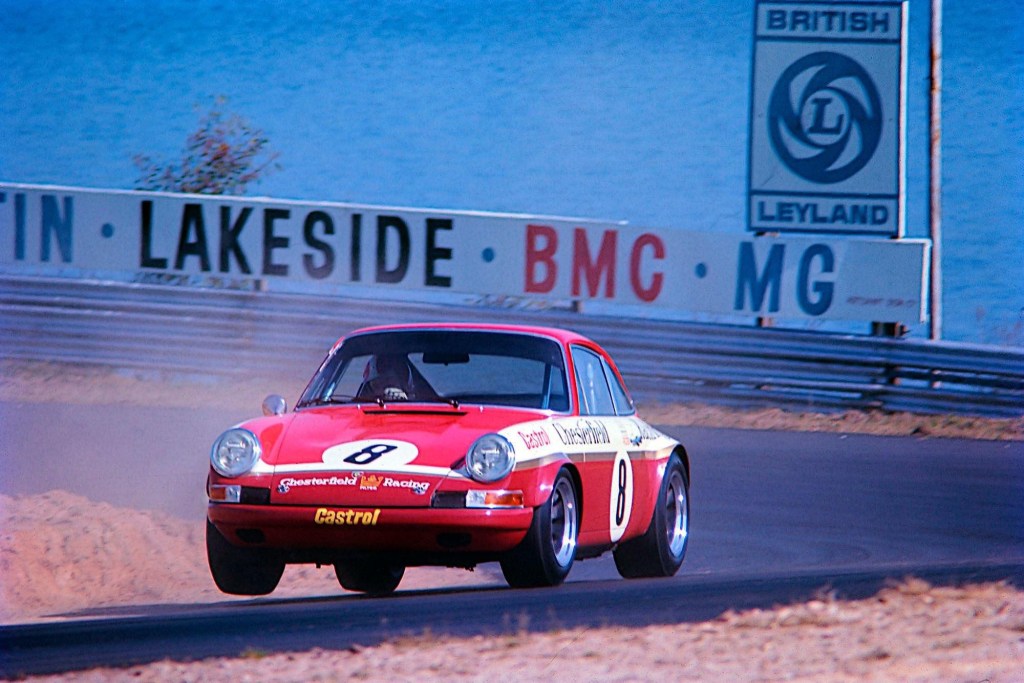
Dick Simpson artistry: Brian Foley on the hop through Lakeside’s Karrussel during the 1970 ATCC round, Porsche 911S (D Simpson)
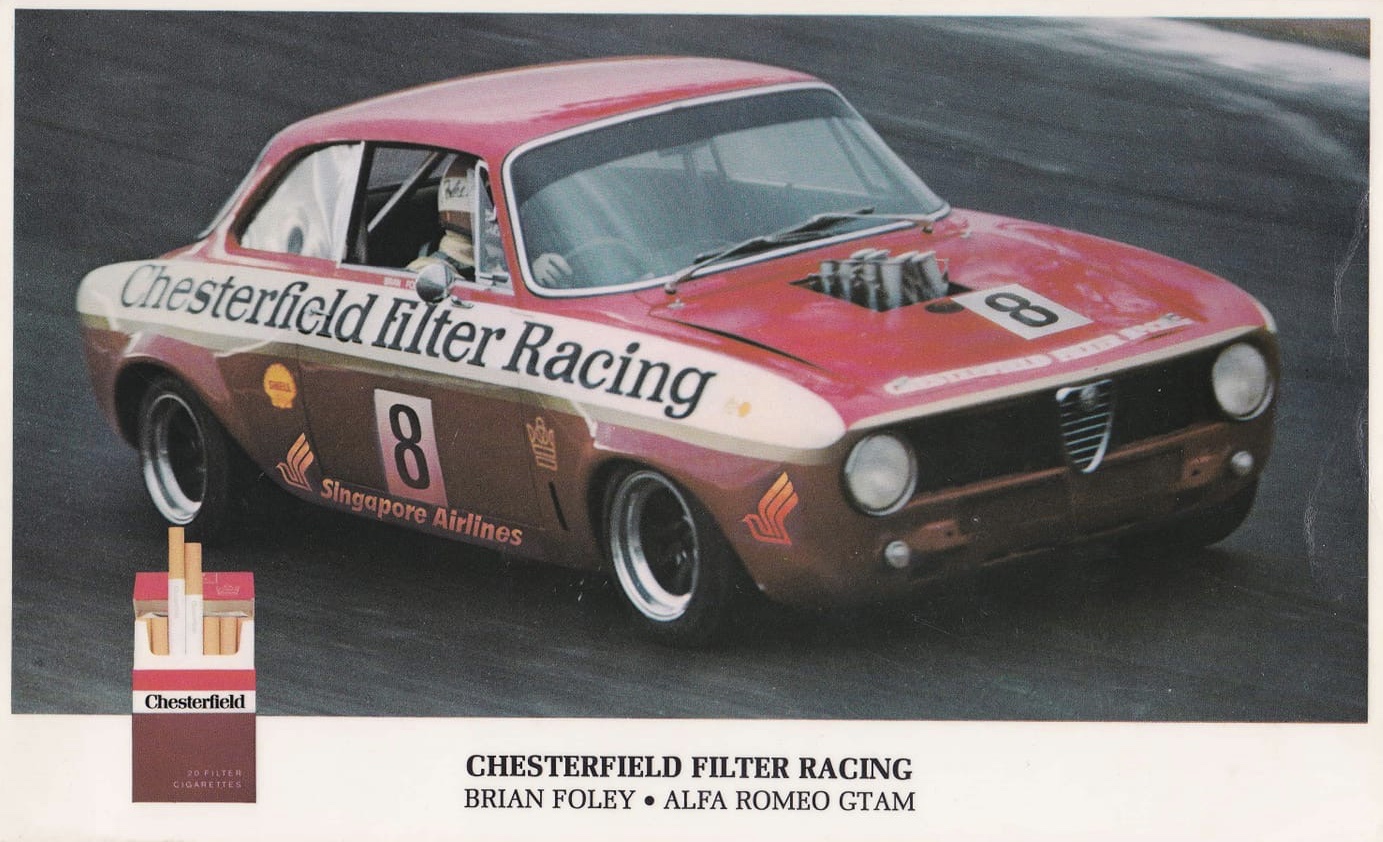
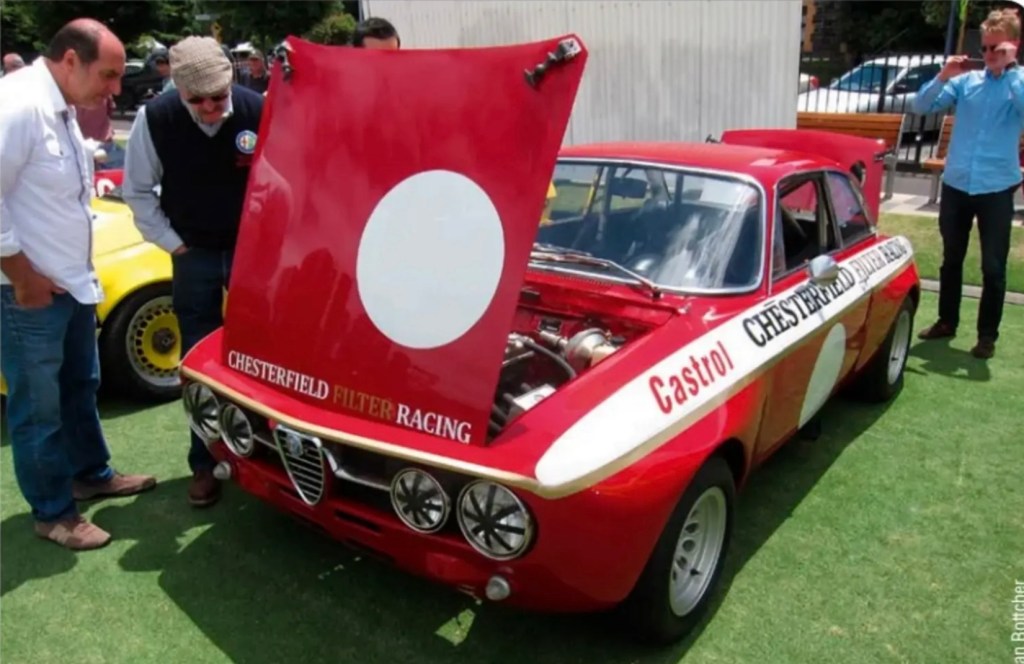
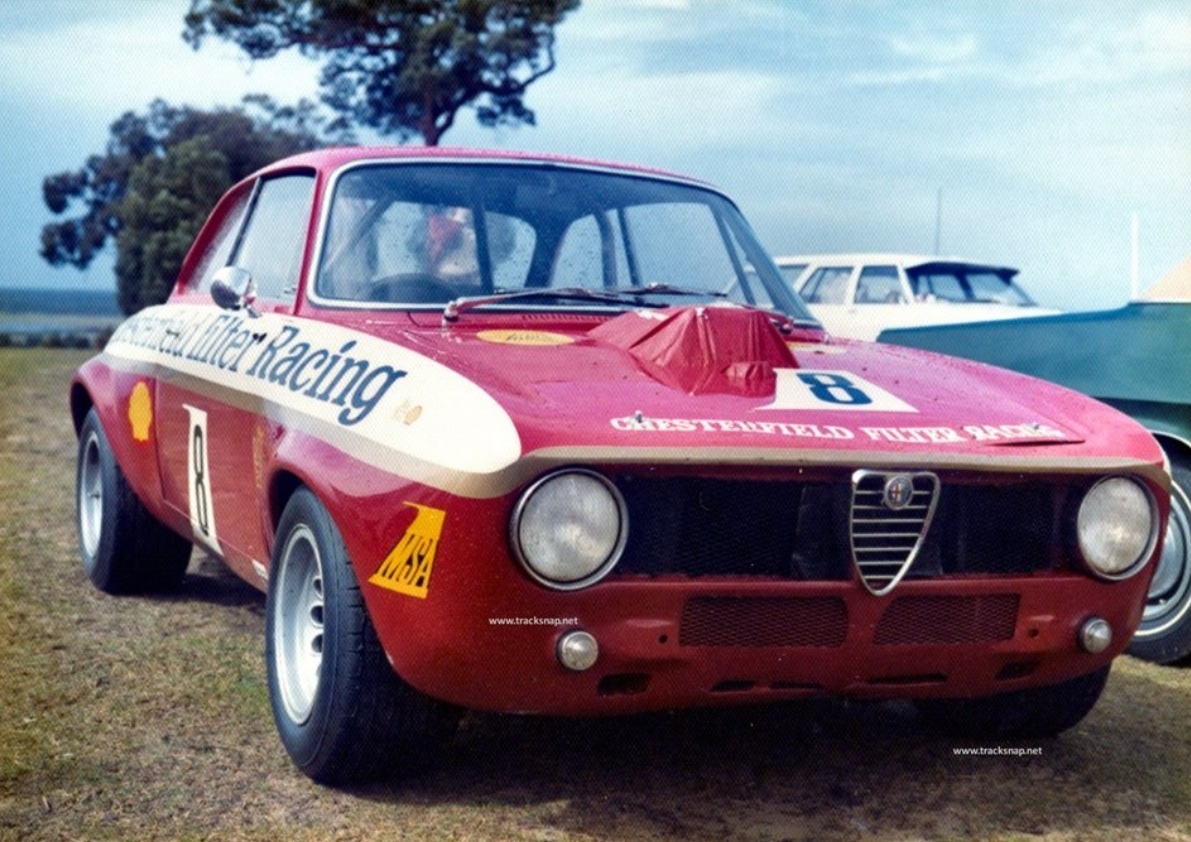
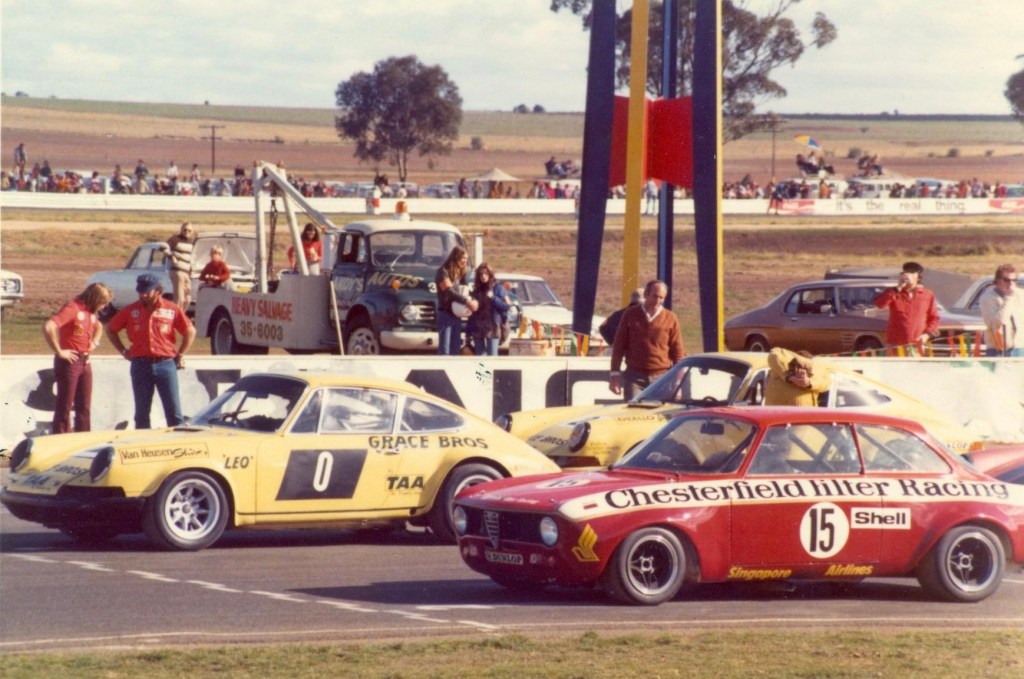
1971 Chesterfield press release shot, note the 10-inch Minilites (Foley Collection)

The Toine Hezemans/Carlo Facetti GTAm on the way to fourth place in the July 1971 24 Hours of Spa-Francorchamps (unattributed)

The purchase made commercial sense though. Brian Foley Automotive, formed in 1967, became an Alfa Romeo dealer, Foley had support for the car from Alfa Romeo Australia in addition to old sponsor, Castrol, Alitalia and of course Chesterfield ciggies.

Toine Hezeman had already won the 1970 European Touring Car Championship – four wins in nine rounds – in a works-1750 GTAm by the time Foley ordered his car.

While the Giulia Sprint GTA (700kg) was built by Alfa Romeo, the 1750 GTAm (970kg) (2000 GTAm from the introduction of the 2000 GTV) was built by Autodelta, and sometimes by other specialists using bodies they acquired or were supplied by clients, then built up with parts supplied by Autodelta.

See ‘Olaf Zagato’s’ wonderful post on The Nostalgia Forum which helps unravel the fine detail around the GTAm including specifications, Autodelta’s vast option list and a list of chassis numbers: https://forums.autosport.com/topic/80331-alfa-giulia-gtam/?p=10612593

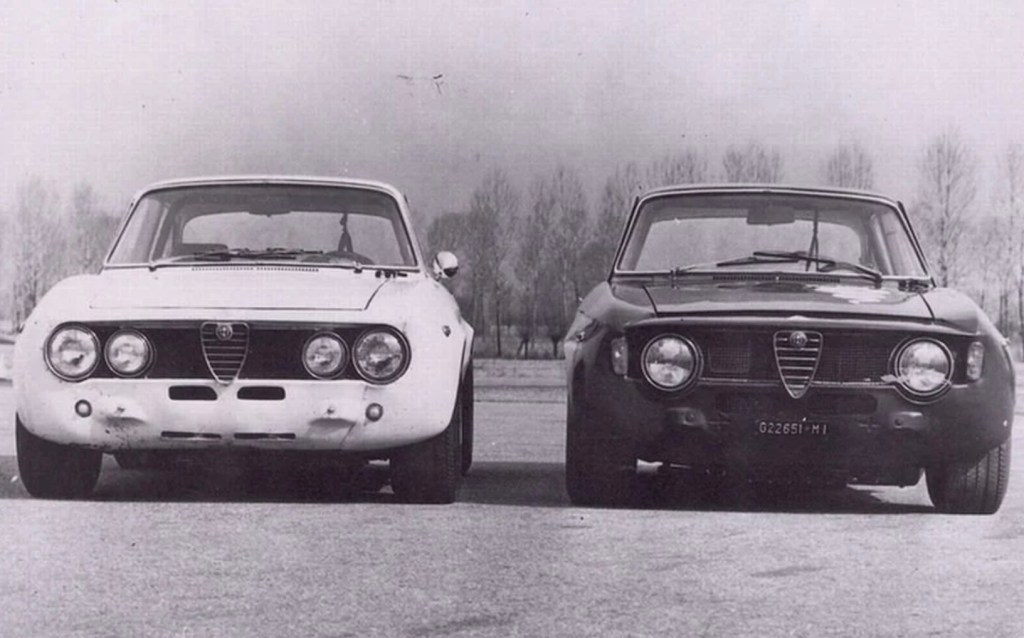
1750 GTAm and Giulia GTA Junior in 1970 (Autodelta)
Andrea De Adamich about to jump aboard his GTAm during the 19 Nurburgring (unattributed)

The model was homologated around the US version of the 1750 GTV – Tipo 105.51 – these cars were left-hookers’ fitted with Spica fuel injection to meet emissions regs: for racing purposes the rules allowed the use of competition fuel injection, usually Lucas. Having said that, right hand drive Tipo 105.44 shells were also used.

For years there have been several schools of thought as to the ‘Am’ bit of the name. One was that it stood for alleggorita maggiorata – increased and lightened, another was alleggorita modificata – modified and lightened, and the other is that the Am stood for America. Marco Fazio of Alfa Romeo Documentazione Storico put the matter to rest when he confirmed on the Spettacolo Sportivo in September 2011 that ‘America’ is the official type name, therefore Alfa Romeo 1750 GTAm/Alfa Romeo 2000 GTAm.

Chassis #1531068 was completed by Autodelta on February 24, 1970. It was acquired by Foley late in the year after an uncertain history, perhaps it had been used as a test hack during the Targa Florio weekend by works T33/3 drivers. When it arrived in Sydney, the car’s mechanicals: engine, gearbox and differential required rebuilds, so Foley missed the first three rounds of the 1971 Australian Touring Car Championship at Symmons Plains, Calder and Sandown.

Foley, GTAm in the Warwick Farm Essex during the November 1971 AGP meeting. Bill Fanning’s superb Escort Waggott following (L Hemer)
Foley in front of Jim McKeown at Mallala in 1971 (J Lemm)
David McKay and Robin Sharply during the Oran Park stage of the Dulux Rally on August 8, 1971. GTAm engined Alfa 1750 GTV (L Hemer)

Foley was then sixth at Surfers Paradise, fifth at Mallala and seventh at Lakeside. He missed the final round at Oran Park because he loaned the engine to David McKay for his assault on the Dulux Rally aboard a 1750 GTV (above). See here for more about the Dulux, not the correct year mind you: https://primotipo.com/2015/04/09/australias-cologne-capris/

Wanting to race competitively and give his sponsors a reasonable crack of the whip, Foley decided to run the car as a Sports Sedan in 1972, a class that allowed more significant modifications to be made.

He and his mechanics, Colin Devaney and Colin James created a unique GTAm by fitting a Tipo 33 2.5-litre V8 into the reasonably tight engine bay!

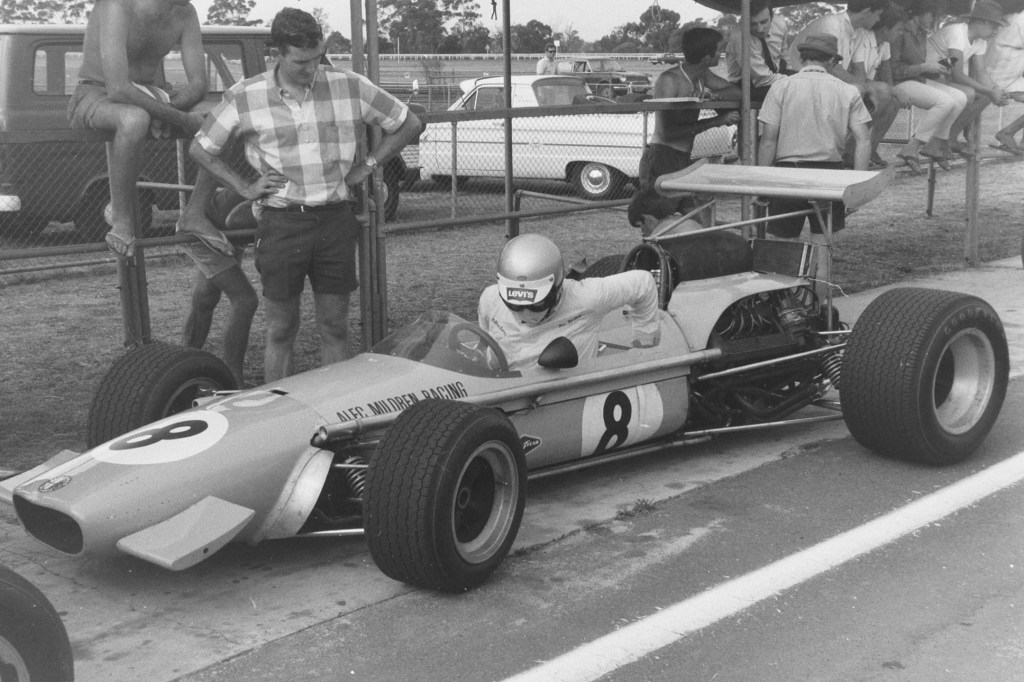
Alec Mildren Racing had a float of three of these 2.5-litre, quad-cam, two-valve, twin-plug, fuel injected V8s that had been fitted to the team’s Brabham BT23D and Mildren ‘Yellow Submarine’ single-seaters raced by Frank Gardner and Kevin Bartlett from late 1967 until late 1969 (the Sub was fitted with a Waggott in time for the Hordern Trophy in December 1969). KB won Gold Stars in 1968-69 so equipped.

When Mildren replaced the Tipo 33 V8s with Merv Waggotts 2-litre TC-4V engines Foley bought one of the V8s in bits. When rebuilt it gave circa 305bhp.

Kevin Bartlett decamps the Mildren Brabham BT23D Alfa Romeo during the 1969 Warwick Farm 100 Tasman round (B Jackson)
(B Jackson)

It wasn’t that simple though, the all aluminium engine was an incredibly tight fit, with Foley telling Australian Muscle Car’s Paul Newby that the sub-optimal exhaust system they were forced to run could have lost up to 50bhp. Costly, given the V8 was 70kg heavier than the 1985cc twin-cam, two-valve, twin-plug, fuel injected four which gave 194bhp when it was first rebuilt, and 217bhp after further development.

The car was converted to RH-steering during the rebuild – which involved a bigger hole in the floor pan to accommodate a larger bell-housing – but the running gear otherwise remained as built by Autodelta: gearbox, diff, suspension, Campagnolo wheels and brakes.

It’ll fit somehow…(C James)
Foley leans on it as he crosses Warwick Farm’s causeway in 1972, GTAm T33. Same car but now fitted with T33 2.5 V8, RHD and with single headlight 1600 Junior front-clip (J Semple)

Newby wrote that the car had wins at Adelaide and Amaroo Park, and one victory over Allan Moffat’s Mustang at Warwick Farm and a successful visit to Malaysia.

Despite that, Foley decided a better Sports Sedan starting position was a much lighter aluminium GTA, to that end he bought the ex-Mildren/Foley RHD GTA and gave it to Bowin Designs’ John Joyce to work his magic. A story for another time.

Over time it’s amazing how many racing Alfa Romeos have headed West, perhaps the LHD Mildren GTA was the first…Sure enough, when Foley advertised the GTAm it was Perth Fiat dealer Frank Cecchele who bought it, a good thing!

Gordon Stephenson was his driver, but it wasn’t too long before CAMS caught up with them. The GTAm was powered by an exotic full-race V8, it was not a production based engine as the rules required. While the Montreal V8 might look a bit the same, it shares not one component with Autodelta’s race V8.

After a while in the naughty-boys-corner, it was fitted a twin-turbo Rover V8 and won some state titles so powered in the 1980s before it was badly damaged in a testing accident at Wanneroo, by that time the car was fitted with a twin-turbo Fiat V6.

Various approaches were made to Cecchele down the decades to buy #1531068, and finally he succumbed to Vin Sharp’s entreaties in 2006. Vin is a member of a much respected Victorian Alfa Romeo family and has done a brilliant job restoring the car to original condition aided and abetted by Cecchele who kept all of the key components, with the exception of the engine.

Vin Sharp and Brian Foley unveiled the restored GTAm at the Alfa Romeo Owners Club of Victoria annual Specattolo day at Melbourne High, South Yarra in late 2013 (E Bottcher)
Dale Harvey captures the GTAm on the WF causeway in 1971 (D Harvey)

Specifications…

Summary of Peter Wherrett’s article on the Foley GTAm published in the June 1971 issue of Racing Car News

Body: Steel, bonnet and boot lid fibreglass, doors aluminium GTA with sliding perspex windows, all glass other than the laminated screen are perspex. The lower half of each guard is fitted with fibreglass flares which are bonded or pop riveted. Lightweight bumper if required.

All interior trim is removed and replaced with lightweight material. Front seats fibreglass, dashboard replaced with a lightweight unit, Momo steering wheel

Engine: 1985cc, DOHC, two-valve, twin-plug, Lucas fuel injected four cylinder, aluminium engine. 84.55×99.5mm bore/stroke. 220bhp DIN @ 7200rpm quoted.

Gearbox: 5-speed GTA with vast choice of gear and diff ratios

On tour. Foley at Bay Park, New Zealand in the summer of 1971-72 (B Williamson Collection)
Mallala ATCC round in 1971 (J Rogers)

Suspension:

Front: Independent coil springs, Armstrong adjustable heavy duty double acting shock absorbers, heavy duty anti roll bar

Rear: Coil springs with coaxially mounted Armstrong fully adjustable, heavy duty, double acting shock absorbers. Adjustable heavy duty roll bar

Rear axle: Anchored to the body structure by two trailing arms and upper magnesium A-brackets for transverse anchorages; all with metal bushes on the frame and axle. Hypoid final drive with pawl and clutch type limited slip differential. Choice of final drive ratios

Wheels: Standard wheels are Campagnolo 13 x 9 inch and 13 x 10 inch Minilites “which have an additional inch of offset over those from Autodelta to allow the car to fully exploit local regulations with a track two inches wider than the homologated figure.” The 10 inch rims will be dries, the 9 inchers wets.

Brakes: Four wheel discs, ventilated at the front, aluminium calipers

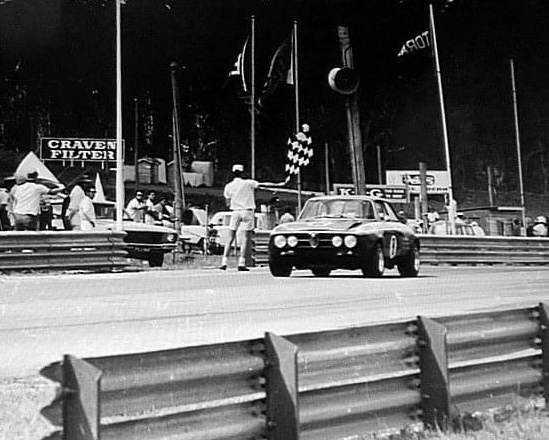
Foley crosses the finish line at the end of the Lakeside 1971 ATCC round (B Thomas)

 Etcetera…

(unattributed)

Two more shots of the Hezemans/Facetti GTAm during the July 24-25 1971 Spa 24-Hour.

The car’s head and radiator were replaced during the event, the strategically long pit stops of the other two Autodelta cars ensured the pair finished third. The race was won by the the Dieter Glemser/Alex Soler-Roig Ford Capri RS2600.

(unattributed)
Foley, Warwick Farm Creek Corner exit May 1971 (L Hemer)
In sports sedan guise at Wanneroo Park, Perth August 20, 1972, and again below (R Hagarty)
(Speedwest)

Homologation link: https://historicdb.fia.com/car/alfa-romeo-1750-gt-am

Credits…

James Semple, Lynton Hemer, Colin James, Dick Simpson, John Lemm, Brian Jackson, Olaf Zagato on The Nostalgia Forum, Racing Car News May 1971, John Rogers, Brier Thomas, Euan Bottcher, Bob Williamson Collection, Glenn Moulds Collection

Tailpieces…

(G Moulds Collection)

It seems sorta-right to conclude with Foley’s subsequent weapon of war, an even lighter variant of the ex-Mildren-French GTA ‘RHD’, at Calder in May 1973.

(L Hemer)

My friend Lynton Hemer captured ‘Foles’ saying gedday to the fans on the warm-down lap of the 1971 AGP touring car support race, GTAm, seems a nice way to finish…

Finito…


(B Donaldson)

John Surtees is chasing Jack Brabham hard in the latter stages of the 1963 Australian Grand Prix at Warwick Farm on February 10, 1963. He is racing a Lola Mk4A Climax 2.7 FPF chassis #BRGP44.

Jack’s Brabham, Brabham BT4 Climax passed him late in the race, John fell short by 12 seconds in a race run in intensive heat, but he had a good southern summer, winning two of the eight Australasian internationals, the NZ GP at Pukekohe and the Lakeside International.

I’ve had a crack at this topic before, but there are a swag of shots looking for a home, so why not? See here: https://primotipo.com/2017/10/05/cruisin-for-a-bruisin/ And here too, Lola Heritage have a great article: http://www.lolaheritage.co.uk/type_numbers/mk4/mk4.html

Dick Ellis cutaway of an F1 Lola Mk4 Coventry Climax FWMV 1.5 V8
Surtees, Team Lotus Lotus 18 Climax at Ardmore during the 1961 NZ GP, DNF (M Fistonic)

1963 wasn’t his first trip Down Under. Il Grande John did the Kiwi Internationals with Team Lotus in 1961 when Innes Ireland, Jim Clark and Surtees raced Lotus 18 2.5 FPFs fitted with the dreaded Queerbox. In a grim tour for the team, Surtees didn’t finish any of his three races at Ardmore, Levin or Wigram.

He was back again in 1962, running a Reg Parnell Cooper T53 2.7 in Australia, finishing second at Sandown and winning from Jack Brabham’s Cooper T55 2.7 on Longford’s daunting mix of roads, undulations, railway viaduct and barbed wire.

Parnell ran a pair of Lola T4 Climaxes, 1.5 FPF powered early on, then 1.5 FWMV V8 engined when the engine became available in Grand Prix racing that year. Surtees finished a great fourth in the World Drivers Championship during the season in which the monocoque Lotus 25 Climax rewrote the chassis design rulebook.

Surtees winning Lola Mk4A and Bruce McLaren, Cooper T62 on the front row at Pukekohe, NZ GP 1963. That’s Brabham’s #4 BT4, and Tony Maggs in the other Parnell Lola Mk4 at far left (D Oxton)
Later Kiwi Ace, David Oxton attends to a Colotti ratio change on Surtees’ car, Pukekohe (D Oxton)

Reg (Bowmaker-Yeoman Racing Team) fitted 2.7FPFs to two of his T4s in place of the smaller F1 V8 for the 1963 Formula Libre Australasian Internationals for Surtees and South African driver, Tony Maggs use. Parnell knew the local-ropes, having raced a Ferrari Super Squalo 3.4 as part of a two car team together with Peter Whitehead in the 1957 New Zealand Internationals. He did well too, winning the NZ GP and the Dunedin Road Race in what was his last hurrah as a driver before taking on Aston Martin team management duties.

Other hot-shots that summer included Jack Brabham in his new F1 BT3 derived BT4 2.7 FPF, while Bruce McLaren raced the similarly powered Cooper T62 with which he won the 1962 Australian Grand Prix at Caversham, near Perth that November. Graham Hill (and Innes Ireland in some NZ races) raced the radical, fast Ferguson P99 albeit he lacked the mumbo of his completion, running 2.5 FPF’s rather than the more fancied 2.7 ‘Indy’ variant.

Young Cooper T53 mounted thrusters included Chris Amon, Jim Palmer and Angus Hyslop. In Australia the local quicks included David McKay and Bib Stillwell in new BT4s, while Lex Davison and young grazier John Youl raced Coopers T53 and T55 respectively.

Surtees’s Lola Mk4A #BRGP44 was quick everywhere, starting the tour with a bang by winning the NZ GP at the new Pukekohe circuit near Auckland, then gearbox problems caused DNFs at Levinand Wigram. He failed to finish at Teretonga as well, albeit Maggs placed second behind McLaren at the track near Invercargill at the very south of the South Island.

Surtees in the Wigram – RNZAF airfield – paddock. That Ferrari 250 SWB belonged to ‘Richardson’ for those wanting to do further research (W Collins)
Surtees and handsome Mk4A at Teretonga, ninth after undisclosed problems (G Woods)

There was then a fortnight to ship the cars across the Tasman Sea to Sydney Harbour for the AGP to be held on the challenging, technical Warwick Farm on February 10.

Surtees put down a marker, popping his Lola on pole in Jack’s backyard. He then led the race until Brabham – who started well back on the grid having sorted a new BT4 chassis during practice – passed him with 14 laps to run, the Brit suffering along with many others in the intense heat. John had the consolation of meeting fastest lap.

Then it was off to Lakeside, north of Brisbane. There Surtees started from Q3 and won from Hill, bagging the P99’s best result for the tour, with Stillwell third in his new Brabham BT4. Chris Amon was fourth and impressing pit-pundits with every drive. At the end of the summer Reg Parnell took the 19 year old off to Europe where he did rather well…initially racing #BRGP44 FWMV powered throughout 1963.

Shell drivers at Warwick Farm: David McKay, Tony Maggs, Graham Hill, John Surtees, Jim Palmer and Chris Amon (C Galloway)
Surtees hooks into the right-hander at the end of Pit Straight, Paddock, at Warwick Farm 1963 (B Donaldson)

Surtees returned to Europe to meet his new Ferrari team commitments, missing the final two races at Longford and Sandown, with Tony Maggs, sixth and second in the Parnell Lolas respectively.

Had there been a Tasman Cup that summer – the first was contested and won by Bruce McLaren in 1964 – Bruce would have won it. Brabham won at Levin and Warwick Farm, Surtees at Pukekohe and Lakeside, while McLaren was victorious at Wigram, Teretonga, Longford and Sandown.

The Lolas had proved very competitive Formula Libre machines but were thoroughly outclassed in ’63 GP racing: Amon, Maurice Trintignant, Lucien Bianchi, Mike Hailwood and Masten Gregory all failed to bag a point for Reg Parnell Racing.

Surtees Mk4 during 1962. The idea of that yellow enamelled spaceframe chassis was to make it easy to see any cracks that arose (unattributed)

Etcetera…

(MotorSport)

Pretty car. Surtees during the soggy German Grand Prix was second behind Graham Hill’s BRM. He first raced the chassis he used throughout his 1963 Australiasion Tour, T4A #BRGP44, at Karlskoga in August, there he led until a valve spring broke.

(MotorSport)

Main Men. Reg Parnell, Surtees and who? during the May 1962 Dutch Grand Prix weekend at Zandvoort. John popped his car on pole but crashed in the early laps after a wishbone failure.

(MotorSport)

More Main Men. Surtees and Lola’s Eric Broadley at Aintree during the British GP meeting in July. And below, John with the car in the paddock. FWMV is on Webers, a bit cheaper, but less powerful than the Lucas injected alternative.

Lola had a fantastic weekend with Surtees qualifying and finishing second in the race. The cars gained pace after the cockpit area was found to be flexing by Surtees in the lead up to the Belgian Grand Prix, when additional tubes were added to the suspect area.

(MotorSport)
(N Beresford Collection)

Don Beresford – father of engineer Nigel Beresford of Ralt, Tyrrell, Penske Cars et al fame – working on a T4 at Bromley during 1962. It’s after the chassis cockpit section was strengthened, note the additional tubular section which has been added, so it’s probably the chassis Surtees raced carrying #6 in the December 29, 1962 South African Grand Prix at East London, DNF.

The ’63 New Zealand GP was a week later on January 5, no rest for the wicked!

Credits…

Bob Donaldson-State Library of New South Wales, Dick Ellis, Colin Galloway, Milan Fistonic, David Oxton Collection, Graham Woods Collection, Warner Collins, Lynton Hemer, Dick Simpson-oldracephotos.com, Michelle Glenn, Nigel Beresford Collection

Tailpieces

Surtees, Surtees TS8/9 Chev, Alan Hamilton, McLaren M10B Chev, Colin Bond, McLaren M10C Repco-Holden and Graeme Lawrence, Brabham BT29 Ford FVC (L Hemer)

John Surtees was a busy lad throughout the 1960s with Grand Prix, World Endurance Championship and Can-Am programmes in most seasons, so he never did do a Tasman.

Scuderia Ferrari had plans afoot for Surtees to race a Ferrari Dino V6 – the ‘Surtees Tasman Special’ Ferrari 246 #006 – in 1966 but a late season Can-Am accident at Mosport in a Lola T70 Chev hospitalised him that winter so that didn’t happen. Chris Amon subsequently went rather well with updated 246 variants in 1968-69.

(M Glenn)

By 1971 Surtees’ commercial imperatives had evolved somewhat. Not only was he contesting Grand Prix racing with a two car team, he was also a constructor of customer racing cars, including Formula 5000 machines, which had been adopted as the Tasman Formula from 1970.

So it made sense for Surtees to contest the November 1971 Australian Grand Prix at Warwick Farm in a Surtees TS8/TS9 Chev, perhaps selling a car or two, then leave the car here for his protege, Mike Hailwood to race in the following 1972 Tasman.

Surtees in front of Max Stewart’s Mildren Waggott TC-4V in the Farm’s Esses (D Simpson-oldracephotos.com)

Surtees qualified ninth after fraught practice sessions sorting handling problems, then had a miserable race without his preferred Firestones, but he still got as high as fourth before pitting for a new left-front tyre, losing three laps in the process, before having another puncture late in the race, finally finishing 14th. “He certainly gave the crowd good value while he was going, “The History of The Australian Grand Prix” recorded.

Frank Matich triumphed that day in his brand new Matich A50 Repco-Holden with Kevin Bartlett and Hamilton second and third in their McLaren M10B Chevs.

Finally, Mike Hailwood did well in the 1972 Tasman Series, he was second to Graham McRae’s Leda GM1 Chev despite not winning round, and was then the best of Team Surtees F1 drivers that season; eighth in the World Championship.

Finito

(Auto Action Archive)

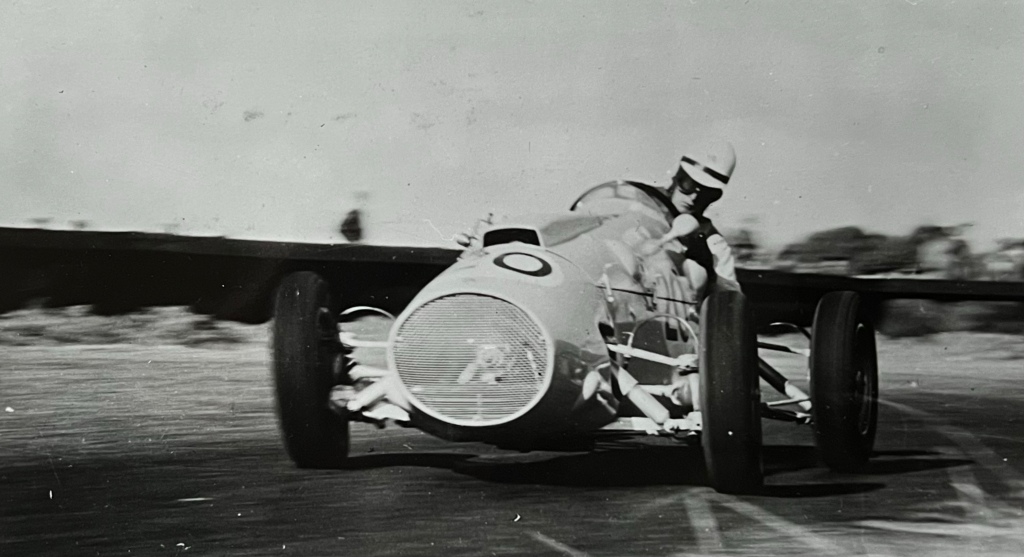
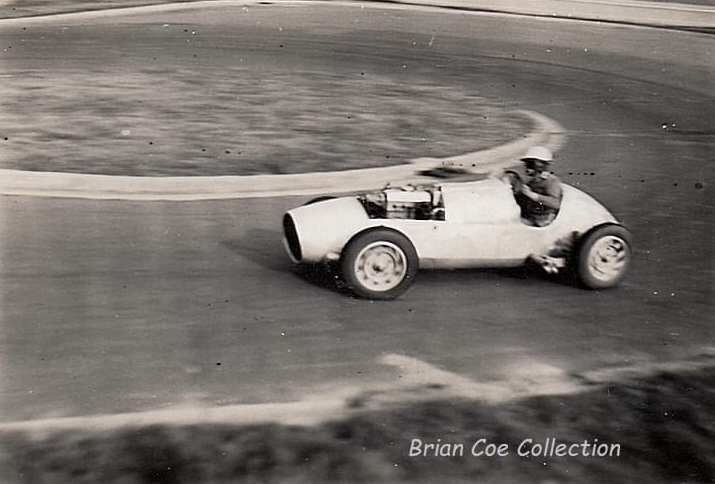
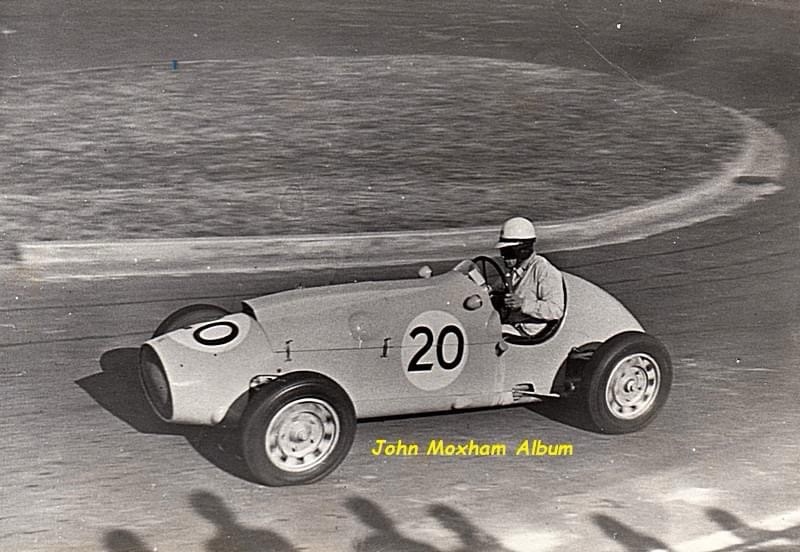
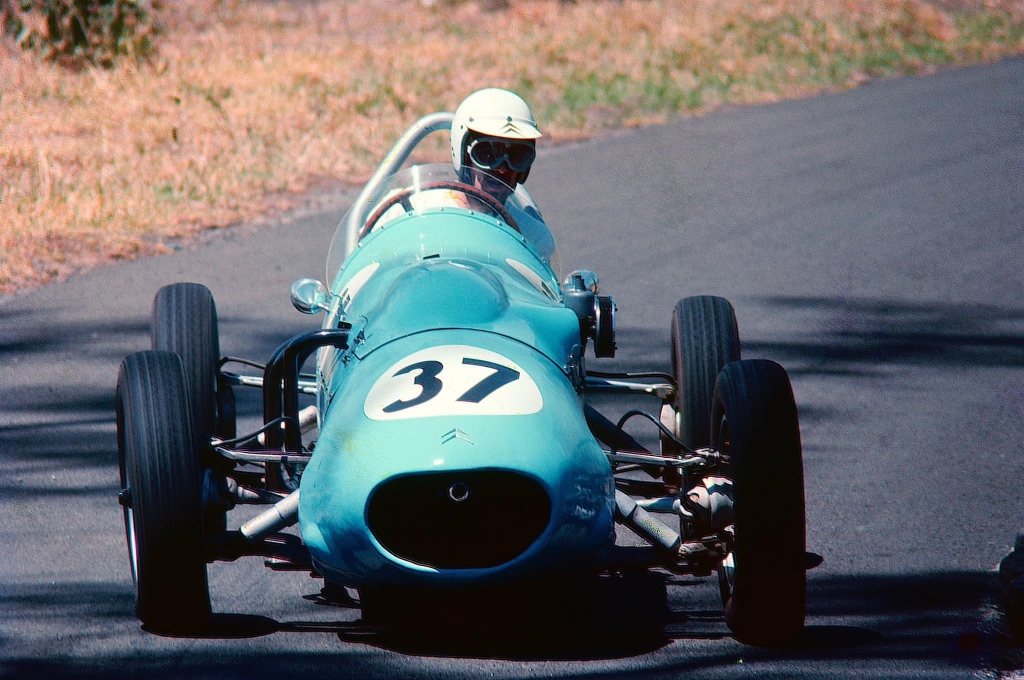
Don Wright with his eyes riveted on the apex of a corner at Sydney’s Mount Druitt circuit aboard his Citroen Special in 1956.

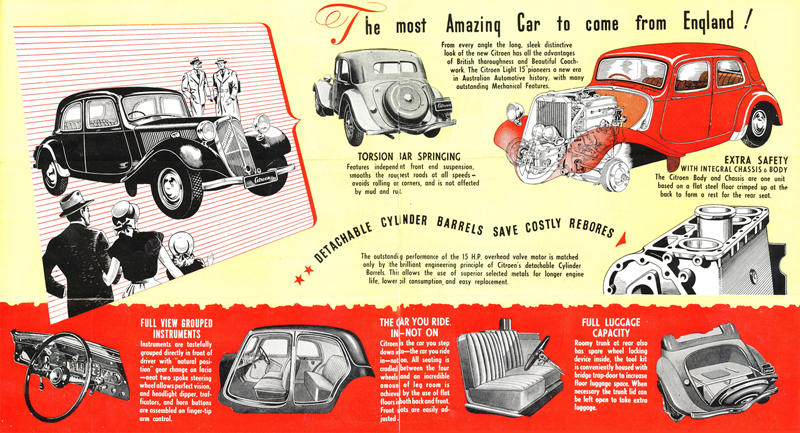
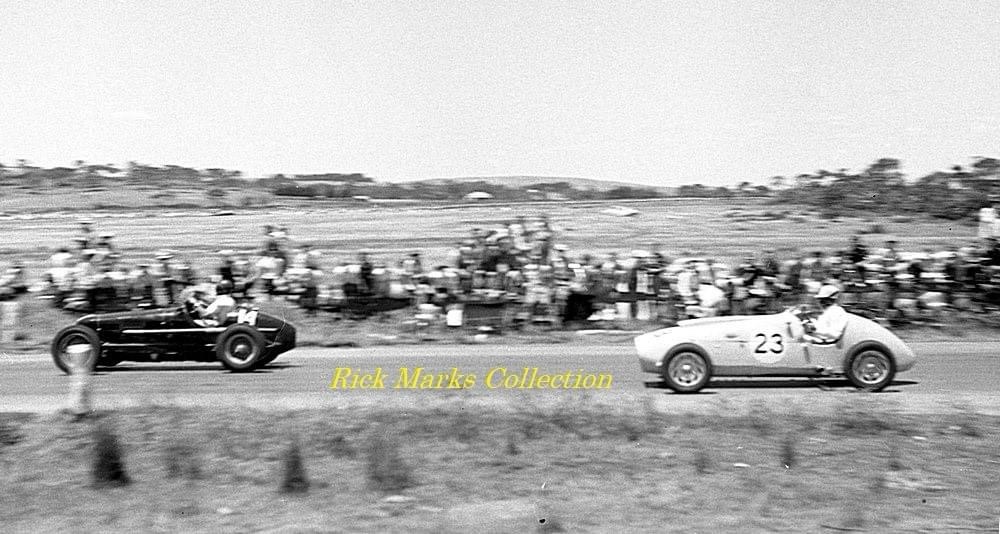
Racer/engineer/restorer/historian Dick Willis in his fabulous book, Optimism, describes the Citroen Light Fifteen (Light 15) based monoposto as “Probably Australia’s only front wheel drive racing car of the fifties…it had a successful career especially in the late 1950s and early 1960s when it raced as a Division 2 car in NSW having many memorable dices with the Nota Major.”

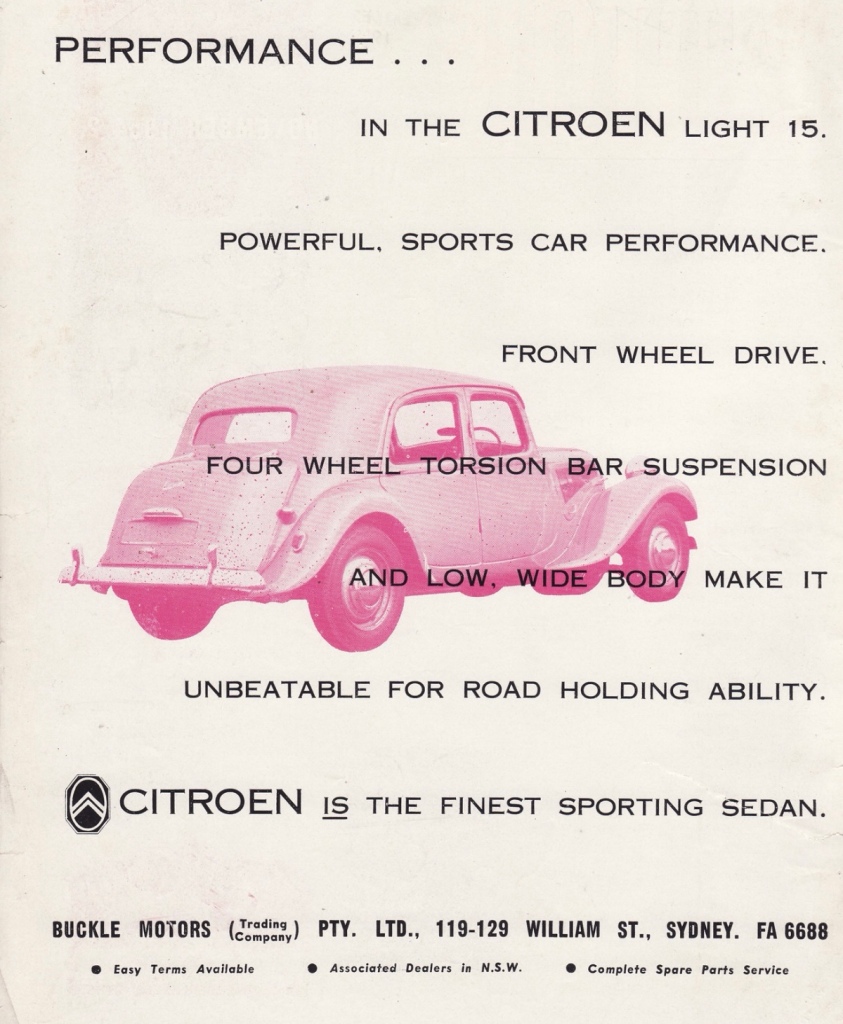
At the 1951 Easter Bathurst meeting, Bill Buckle, a member of the noted motor dealer family – then the holder of the Sydney Citroen franchise amongst other marques – raced a Light 15 to second place in the Production Closed Car Handicap.

Suitably impressed by the competition potential of his product, he cast around for a crash damaged car and commenced construction of a monoposto racer to accept the road cars core mechanicals.

Working with his close school friend, and fellow auto apprentice, Charlie Buck, they built a simple twin-tube ladder chassis to which was mated the Citroën front subframe, steering, 2-litre OHV engine and gearbox, and rear beam axle.

Before the car was finished Buckle decided to visit France and sold the project to Don Wright to help fund his trip.

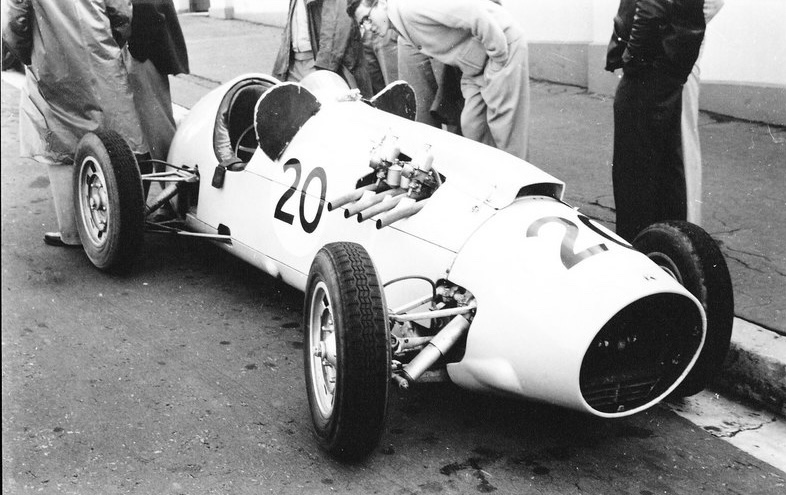
Wright and Buck then set to work in Wright’s Castle Hills workshop to finish it including fabrication of a stainless steel fuel tank and a slinky body made together with Stan Barrett. The 1911cc Light Fifteen engine was fitted with special valves, a pair of 1 1/2 inch SU carbs fed by an aircraft fuel pump and 17 inch stub exhausts. Those radical looking wheels were options Citroen offered in Europe but not here: light Michelin made ‘Pilote’ shod with the French tyre manufacturers new X-radial tyres

Don Wright, King Edward Park, Newcastle hillclimb circa 1953. Bob Winley, “In this shot the Citroen Special is very new with its original beam axle rear suspension and short nose.”

After several drives the cars shortcomings were laid bare and addressed. The duo modified the gearbox by eliminating reverse gear and machining and fitting a fourth forward gear in the space so released.

Unhappy with the rear suspension, Wright replaced the Citroen beam axle and transverse torsion bars with Morris Minor longitudinal (front) bars and bottom arms. “Uprights and top wishbones were fabricated to suit, the original rear stub axles having that convenient eight-bolt attachment,” Bob Winley, a later owner, and ultimately the car’s restorer, wrote

The car soon became a common sight on the hills and circuits of NSW including Foleys Hill, King Edward Park, Mount Druitt, Gnoo Blas, and then Bathurst in 1955. That year Don won the NSW Hillclimb championship at King Edward Park, Newcastle; quite a triumph for the sweet handling machine.

King Edward Park, Newcastle 1954. Winley, “The Citroen Special early on but after it was fitted with IRS: parallel wishbones and longitudinal Morris Minor torsion bars. Note the 17-inch stub exhausts. It seems to have grown an oil cooler too. I haven’t seen the ‘Mickey Mouse ears’ before. The front wheels could certainly throw rocks and water at the driver on any but clean tracks.” (J Moxham Collection)
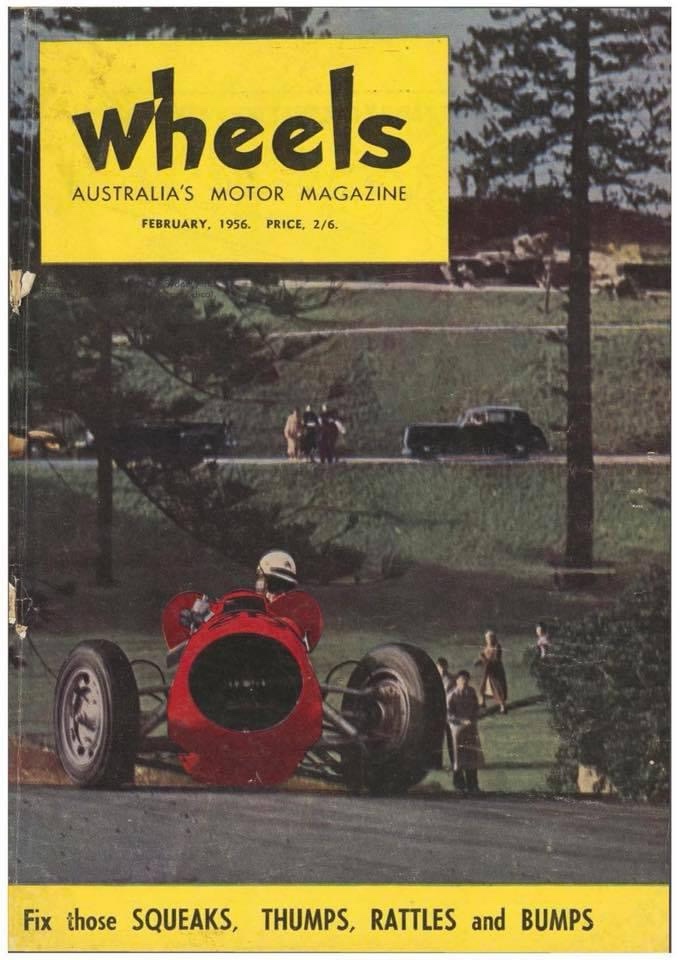
Wheels‘ caption, “Don Wright’s FWD Citroen Special was one of three cars which broke 60 seconds at the 1955 NSW Hillclimb Championship. It is seen in our picture rounding the hairpin at Newcastle where the climb was held.” Covering the same meeting Modern Motor observed that “Speed, roadholding and showroom finish have made Don Wright’s Citroen Special a favourite with racing fans.”
Photographer Bruce Moxon wrote, “The Citroen Special at Castlereagh Airstrip on August 21, 1960 with girlfriend, Pauline at the wheel. It was owned by Geoff Thorne, with whom I worked at GE Cranes in Glebe, Sydney. Geoff was a toolmaker, but also a professional ice skater and musician.”

Later, Don sold the car to dentist lan Steele who raced at Bathurst circa 1957, the car passed it to Geoff Thorne, a genius ice-skating clown amongst his other talents. He raced it extensively and then Don James did well on new tracks such as Oran Park and Catalina Park from circa 1963. By then the machine was fitted with a crossflow DS cylinder head, extractors in lieu of the stack-exhausts, and Big Six front brakes. He did well in the Division 2/Formula Libre races common at the time.

Ray Bell wrote, “In November 1968 Bob Winley bought it and started racing it but couldn’t wear his red shirt because CAMS required fireproof overalls and underwear from then on! Bob ran in ‘modern’ races and the newly created Historic Car races and club events, winning money and trophies and being accused of doing ‘rain dances’ before race days, such are the car’s abilities in the wet. Bob fitted extractors and a muffler.”

Lynton Hemer’s shots of Bob Winley racing the Citroen at Oran Park – sporting its crossflow DS engine – on June 27, 1970, and below, exiting Forrest’s Elbow at Bathurst during practice for the Easter 1970 meeting (L Hemer)
(L Hemer)

After six years John Moxham, a Citroen fancier, bought the car and re-fitted an original type of cylinder head. The car sat unused, then John moved interstate, selling the car to another Citroen collector, John Vanechop. The car languished until Don Wright’s friends bought it in pieces and Don began its restoration. With Bob Winley’s help the car is now ready to re-join the Historic Racing scene with proud owner Perry Long at the wheel, Dick Willis wrote.

“It was on display at Eastern Creek in 2006 and underwent some testing by John Bowe at Wakefield Park (pic below in 2017) but hasn’t been seen since although its return to competition is believed to be imminent and we look forward to it with great anticipation as the Citroen Special is a really interesting and unique Australian Special.”

Etcetera…

(G Mackie)

Not a great photo of Don Wright but better than nothing! Greg Mackie observed of the man, “Citroen Special and Lancia Fancier.” Ray Bell spoke to Wright circa 2001, at that stage he was still operating an automotive repair business in West Pennant Hills, “his major pursuit these days is making replacement blocks for Lancia Lambdas, which he carves out of billets of aluminium! No castings…”

Citroen Special in its original form, a nice shot of the Michelin Pilote wheels and immaculate line of the car even in its original short-nose guise.

Don Wright coming down the mountain at Bathurst in 1955, he carried #20 in both the Easter and October meetings.

Bob Winley commented in an exchange on Facebook with Australian Gold Star Champion, Spencer Martin, about Spencer’s observation of the Citroen Special’s understeer, “Near the driver’s left hand is a slight bulge in the body for the gear lever and fuel filler for the stainless steel tank between the chassis rails, keeping the centre of gravity well forward. Spencer Martin I steered it ‘on the throttle’ in BP Corner at Oran Park. I found it a delight to drive (and I don’t enjoy understeer).”

Don Wright chasing Tom Sulman’s Maserati at Gnoo Blas or Mount Druitt, thoughts on venue folks?

(D Willis)

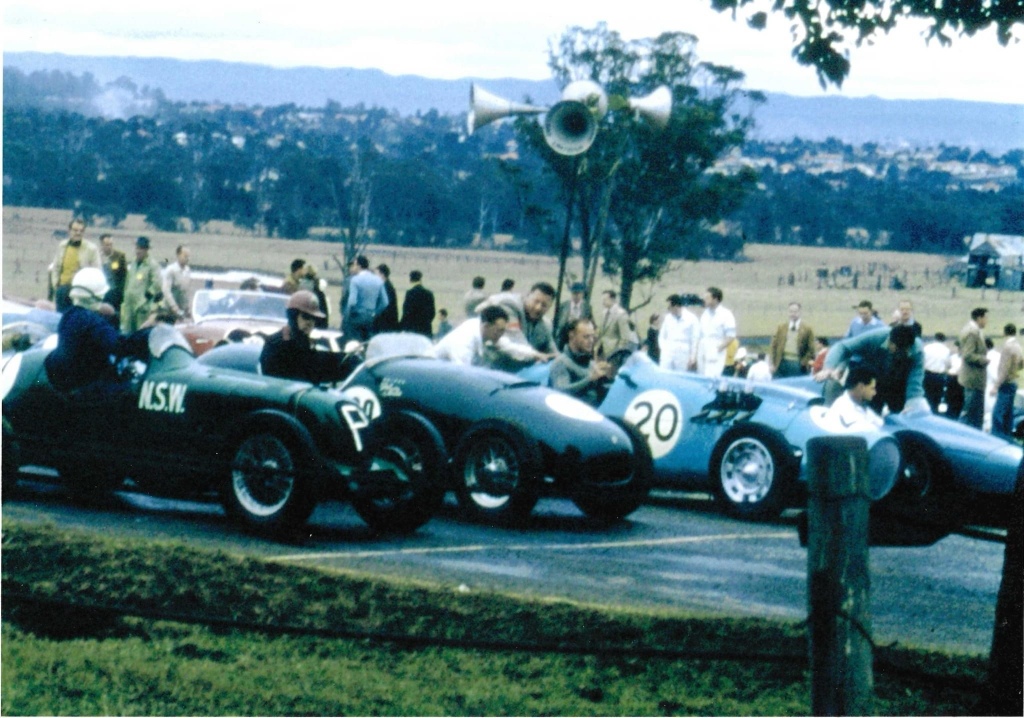
A couple of fabulous in-period colour shots by Dick Willis. The one above is the front row of the grid, perhaps the November 1956 meeting at Mount Druitt.

From the left, perhaps Greg Hunt in the ex-Tomlinson/Bartlett/Brydon MG TA Spl, Jim Johnson in the Cigar MG, probably Ian Steele in the light blue Citroen Special – with gleaming Pilote wheels – and on the right in the low-slung, mid-engined Stewart MG with Gordon Stewart at the wheel.

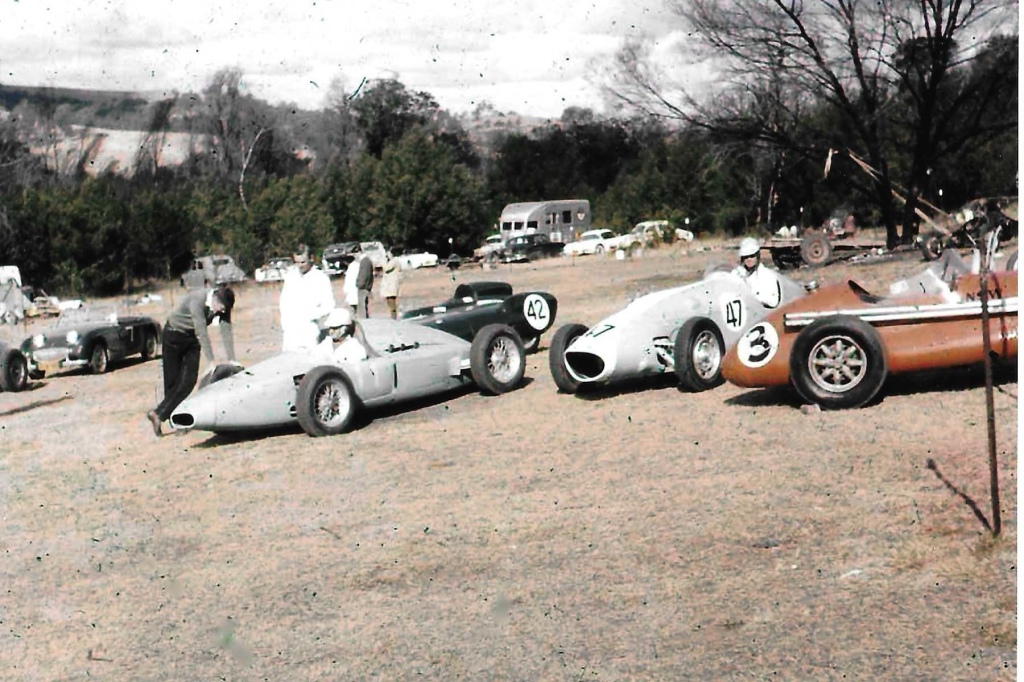
Below is a superb paddock scene at Silverdale, perhaps the June 1960 meeting.

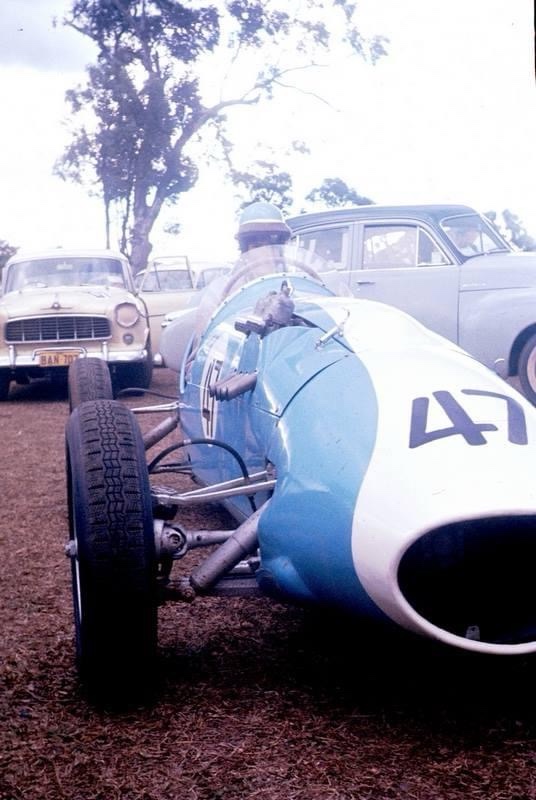
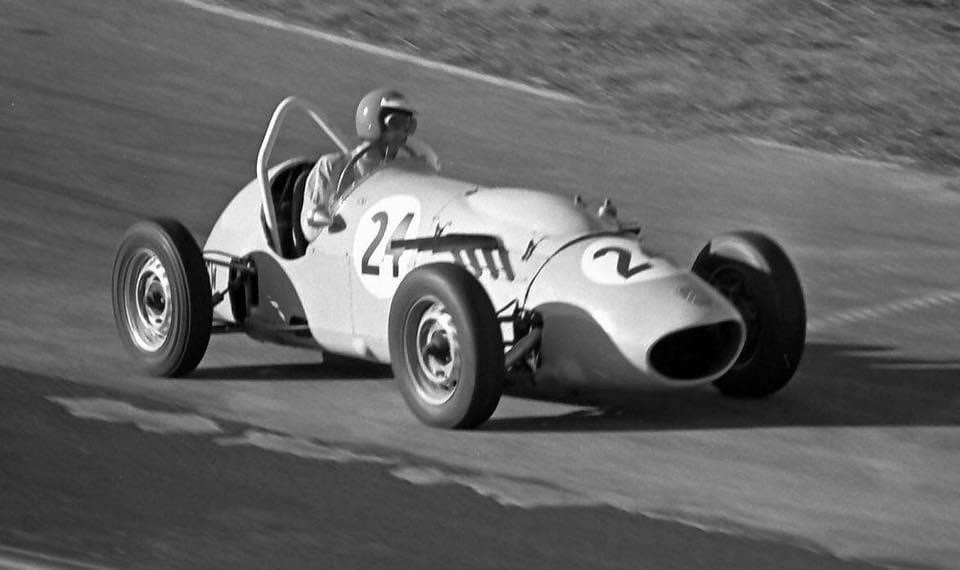
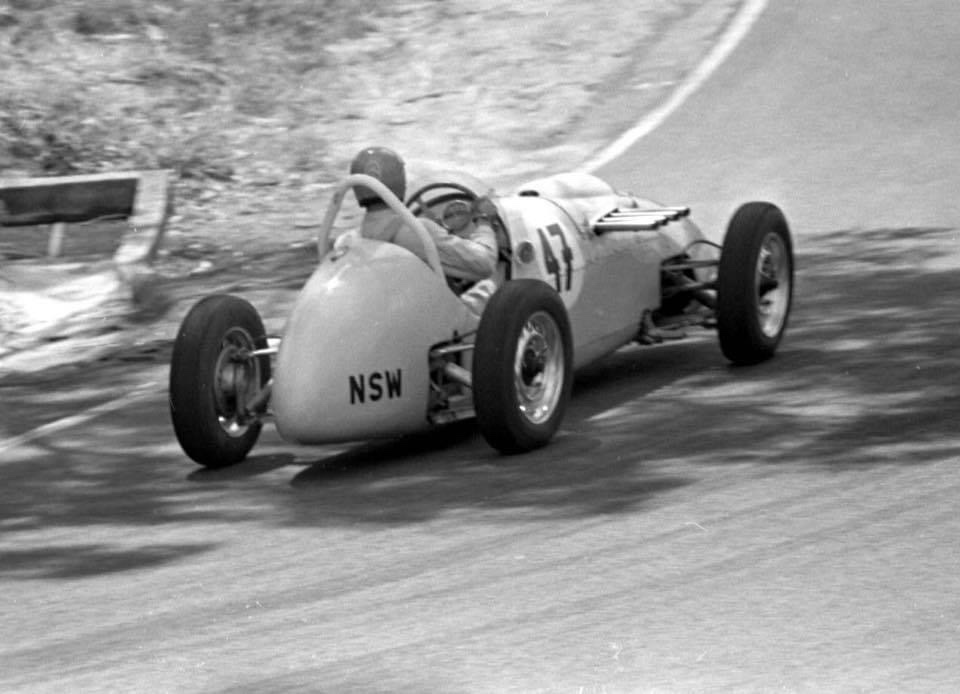
Gordon Stewart in the Stewart MG at left, #47 is our Citroen with Geoff Thorne up, #3 is Jack Myers WM-Cooper Waggott-Holden, #42 Don Swanson’s Lotus 11 Climax – up from Melbourne or had it changed hands by then? – while the Sprite at the far left was run by Leigh Whitely.

(D Willis)
(D Simpson)

Bob Winley in the Huntley Hills Esses during the December 1968 meeting. He recalls, “I found something out that day. I did my practice run without seatbelts and nearly got thrown out of the car towards the end of the run. Lesson learn’t!”

(J Moxham Collection)

A page from John Moxham’s photo album now in the custody of John Barass.

Credits…

The main image, the catalyst for this particular research journey, is courtesy of the Auto Action Archive.

The information was gleaned from Dick Willis wonderful book, ‘Optimism’ about Australian Specials, and demonstrates the potency of some Facebook groups. I carefully mined the comments of a whole lot of people on Bob Williamson’s Old Australian Motor Racing Photographs, and Greg Smith’s Pre-1960 Historic Racing in Australasia Facebook pages. Those photos and information are attributed to Ray Bell in one of Bob Winley’s posts, the Rick Marks, and Don Coe Collections, Nurk Daddo, John Moxham Collection via John Barass, Australian Motor Heritage Foundation via Brian Caldersmith, Bruce Moxon, Greg Mackie, Dick Simpson, Tim Shellshear, Bob Williamson and multiple, wonderfully informative posts by Bob Winley.

Wonderful teamwork! Let me know if I’ve cocked anything up on mark@bisset.com.au.

Finito…
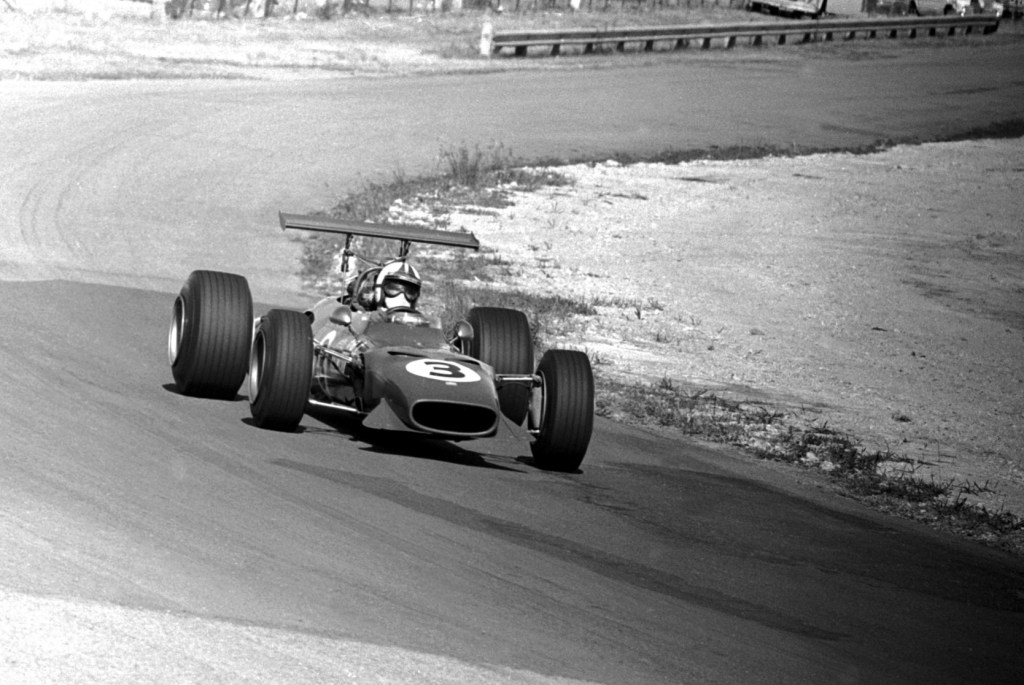
(B Richards)

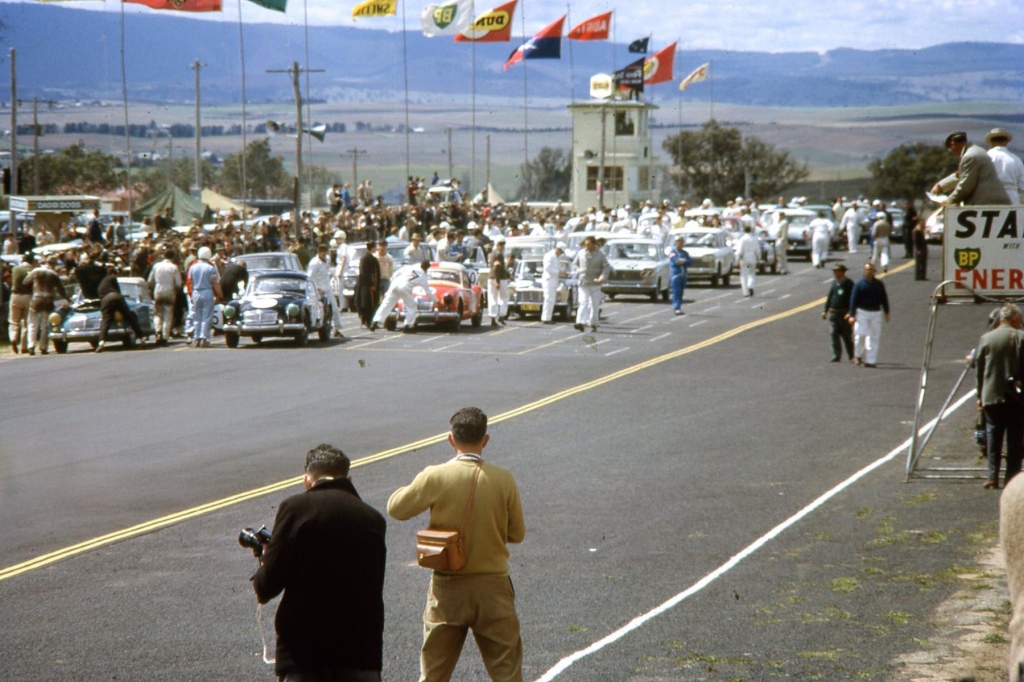
The grid gets way at the start of the September 30, 1962 Bathurst 6-Hour Classic. The entry comprised a mix of production sports and touring cars divided into price based classes. The front row comprises the three MGA Twin-Cams of Matt Daddo/Bill Stanley, N Claydon/Fred Gibson and Clarke/Lazich, with the C Lansdowne/Dianne Walker Triumph TR4 on the inside.

The Bathurst promoters, the Australian Racing Drivers Club, perhaps ran the event off the back of the success of the Phillip Island 500-milers (Armstrong 500) first run in 1960, which would soon after become the ARDC’s after the debacle of the Phillip Island October 1962 event in which the track surface famously, in essence, fell to bits.

(B Richards)

A total of £3,000 in prize money was split evenly among the classes or divisions: A-production touring cars up to £900, B-production touring cars £901-£1050, C-production touring cars £1051-£1250, D-production touring cars £1251-£1700, E-production sportscars up to £1500, F-production sportscars £1501-£2000.

While there was officially no outright winner, the interest of the punters was amongst the top-guns which included the V8s: Studebaker Larks, the brothers Geoghegan’s Daimler SP250 and potentially the best of the little-cars, the Bruce McPhee/Barry Mulholland Morris Cooper.

What strikes me now is that the entry list was a who’s-who of (mainly) New South Wales stars of the day and of the immediate future with a swag of Gold Star, Australian Touring Car and Sportscar Championship, and Bathurst winners in the mix.

It appears that the sportscars had to start with their tops up, so this is practice or the first stint for Leo and Pete Geoghegan’s winning Geoghegan Sports Cars entered and prepared Daimler SP250 (B Wells)

Morris 850s dominated Division A – 14 cars, of which all but one finished – where the winners were Frank Kleinigs senior and junior. Kleinig Snr was an Australian great pre-and post-war and always polls well in lists of Greatest Australian Drivers Never to Win an AGP. Junior was no slouch either as a racer and constructor of Formula Vees. There was no shortage of notables in this class including Des West, Bill Pitt, Arnold Glass, John French and Paul Bolton, while Tom Sulman would have run Kleinig Snr close in a contest for who started racing first.

Seven cars contested Division B, the victors were John Martin and C Hodges in a Skoda Felicia of all things. This group included cars raced by Ron Hodgson, Digby Cooke, Alan Heasman, Peter Wherrett, Doug Stewart and Alan Stanfield.

Bruce McPhee and Barry Mulholland went on to win the Bathurst 500 outright aboard an HK Holden Monaro GTS327 in 1968, they prevailed in Division C where Bob Jane and Harry Firth were much fancied in a works-Ford Falcon XK.

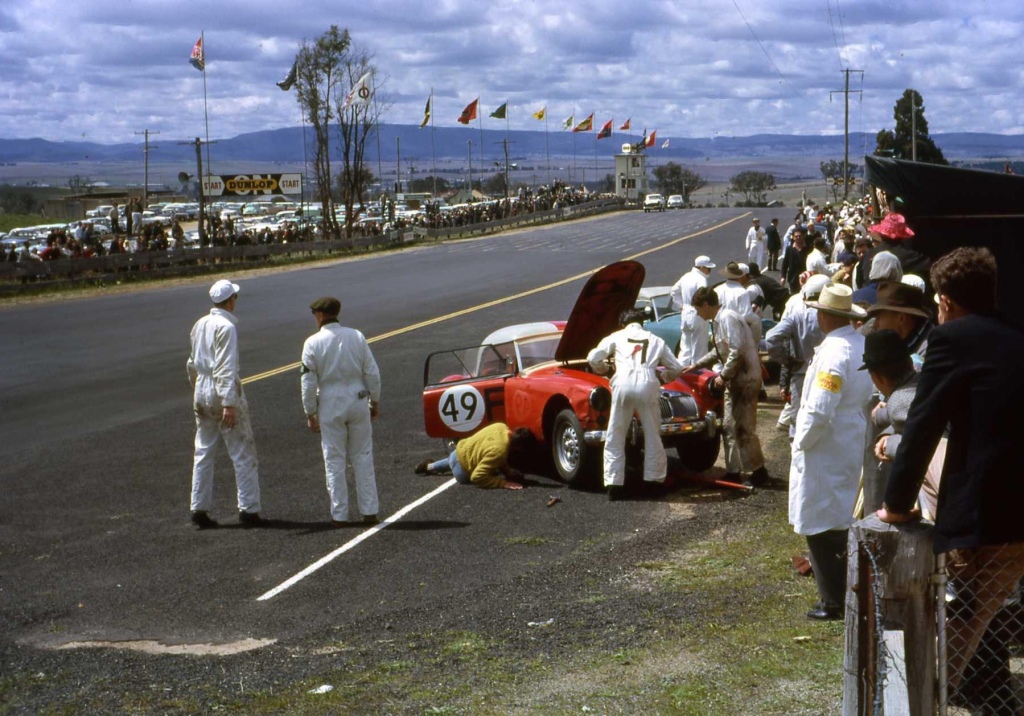
The Jane/Firth C Division Ford Falcon XK from the ‘E’ MGA 1600 driven by K John/Peter Caldecoat (B Wells)
Lap 39, Firth is ok and out of the Falcon via the back window but she needs a turret! Bob Williamson recalled, “They towed the Falcon up the escape-road on its roof with a tractor. You should have heard the noise, roof on a gravel road.” (B Richards)

Ford planned to race their new Falcon XL in the Armstrong 500 at the Island on 21 October, in addition they decided, wisely, to contest the Bathurst Six Hour Classic to be held only three weeks before. The catch was that Ford didn’t want to race the XL at Mount Panorama so Firth set about preparing an XK Falcon for the race.

Firth takes up the story in his typically self-serving way, “Having not been to Bathurst for some years, I had to rely on hearsay information like, “no, it is not hard on brakes and the circuit has not changed. I did all the usual things such as a valve grind, compression check, set the camshaft properly, gave the pistons plenty of clearance, deck-heighted the head and put the engine on the dyno.”

“I fitted a set of heavy Armstrong shockers and some well-worn springs. I made up some Ferodo brake shoes but ended up leaving them at home, thinking they wouldn’t be needed. I drove the car to Bathurst myself. Practice proved two things: the car was the fastest sedan and the brakes were not good enough.”

The Jim Clarke/A Lazich MGA Twin-Cam receives some attention, DNF (B Richards)

The two wily Melbourne racers – who went on to win three of these Phillip Island and Bathurst 500s together – led their class early, but the brakes were progressively showing signs of stress as the pedal crept inexorably closer to the floor.

Harry took over from Bob after a scheduled stop and then on lap 39 “As he braked for Hell Corner, the fronts suddenly over-energised and locked on, the nose dug in and the car rolled.” The roof was crushed with Harry extremely lucky he wasn’t badly hurt, the car had no roll bar or cage of course. He exited via the rear window as fuel spilt over the tarmac, but did not ignite.

The Division D winning Studebaker Lark raced by Algie/Hibbard. I’m old enough to remember when these beasts were popular cop-cars in Australia (B Wells)

Division D’s 10 car entry included three Studebaker Larks, with the Don Algie/Kingsley Hubbard entry the winner on 99 laps, then the well credentialed David McKay/Greg Cusack duo in a Fiat 1500 from Peter Williamson and K Whiteley third in another Fiat 1500. Other notables in that class were Bill Buckle, Brian Foley and George Murray.

Only four cars contested Division E, with the Tony Reynolds/Les Howard Morgan Plus 4 ahead of the Bill Reynolds/Kevin Bartlett Austin Healey Sprite Mk1.

The Geoghegans won Division F for the more expensive sportscars from the G Lansdowne/Holt Bonnie Triumph TR4. The Top-Three outright were the Geoghegan Daimler on 104 laps, then the Lansdowne/Binnie TR4 on 100 and the Algie/Hibbard Studebaker with 99 completed laps.

The entries for this race are staggering in their diversity, here the fourth in Division D Scuderia Veloce Citroen ID19 driven by Bill Buckle and Brian Foley (B Wells)

Credits…

Bill Richards, Bruce Wells, Shannons Falcon XK article by Mark Oastler, SS Auto Memorabilia

Tailpiece…
(SS Auto Memorabilia)

Leo Geohegan at the wheel of the winning Daimler SP250. With a 2.5-litre V8 and light fibreglass body it proved a quick car but the duo had some challenges, most notably the drivers door opening on a regular basis as the body flexed, and the loss of first gear on the start-line.

Finito…