Posts Tagged ‘Jackie Stewart’

(MotorSport)

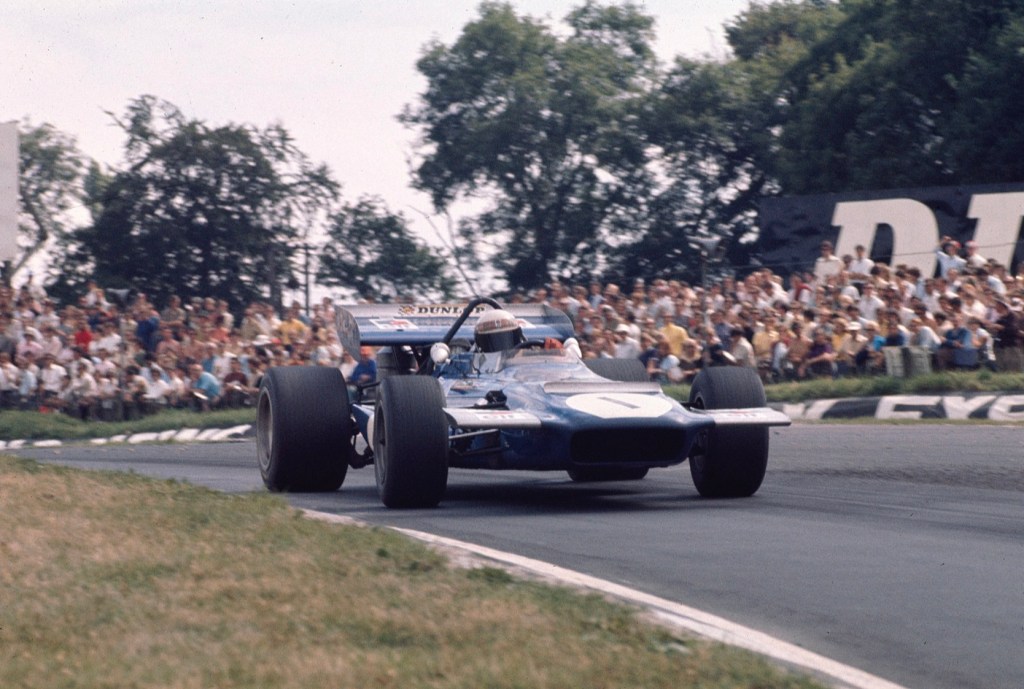
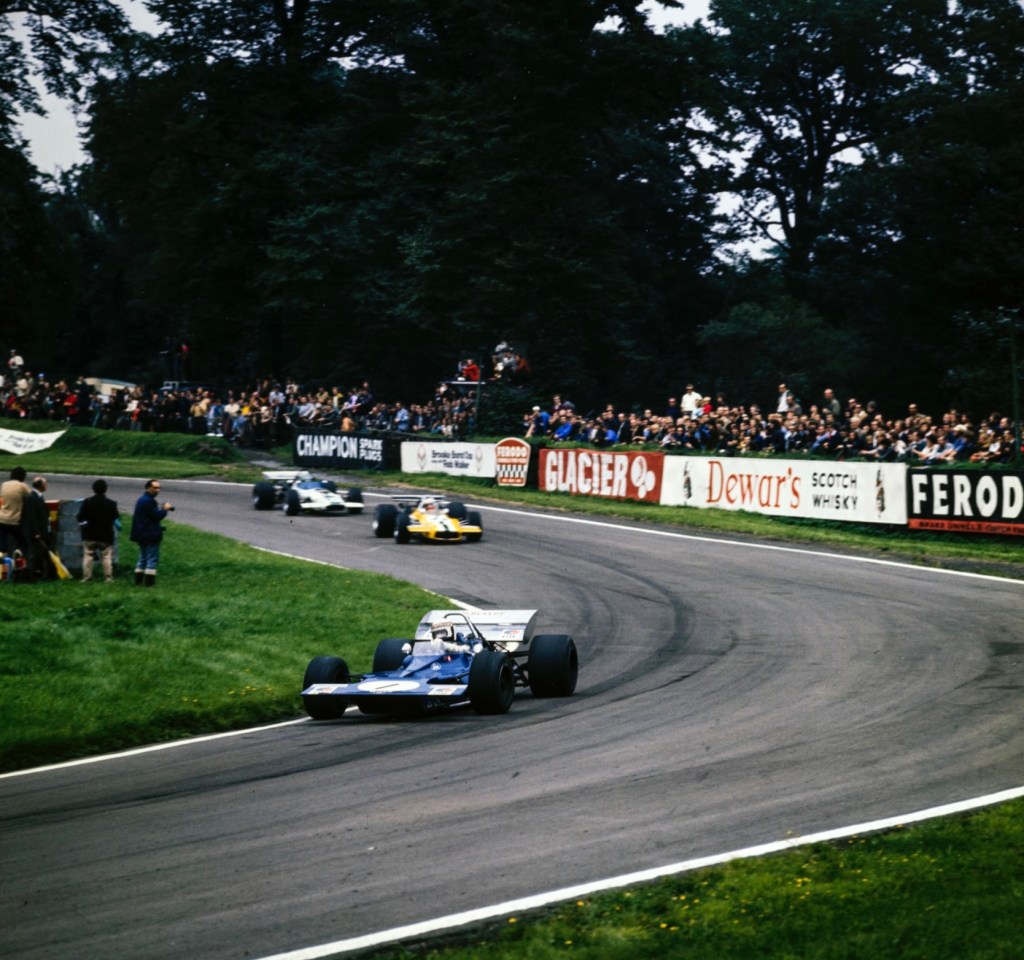
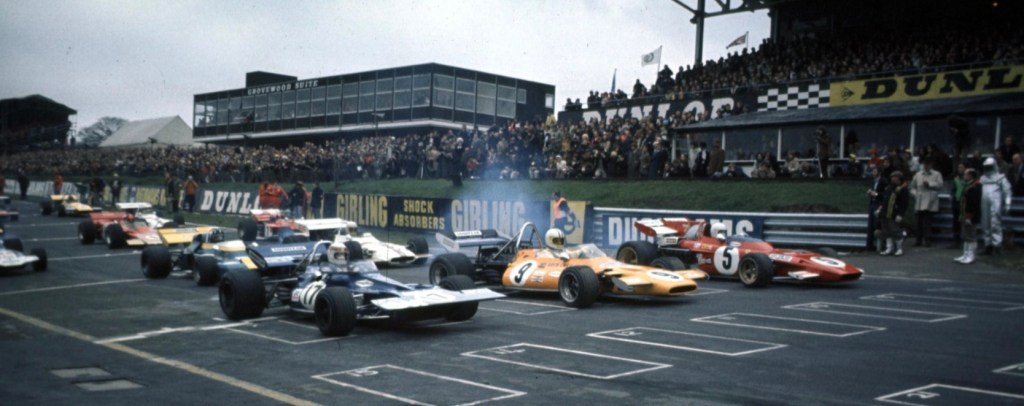
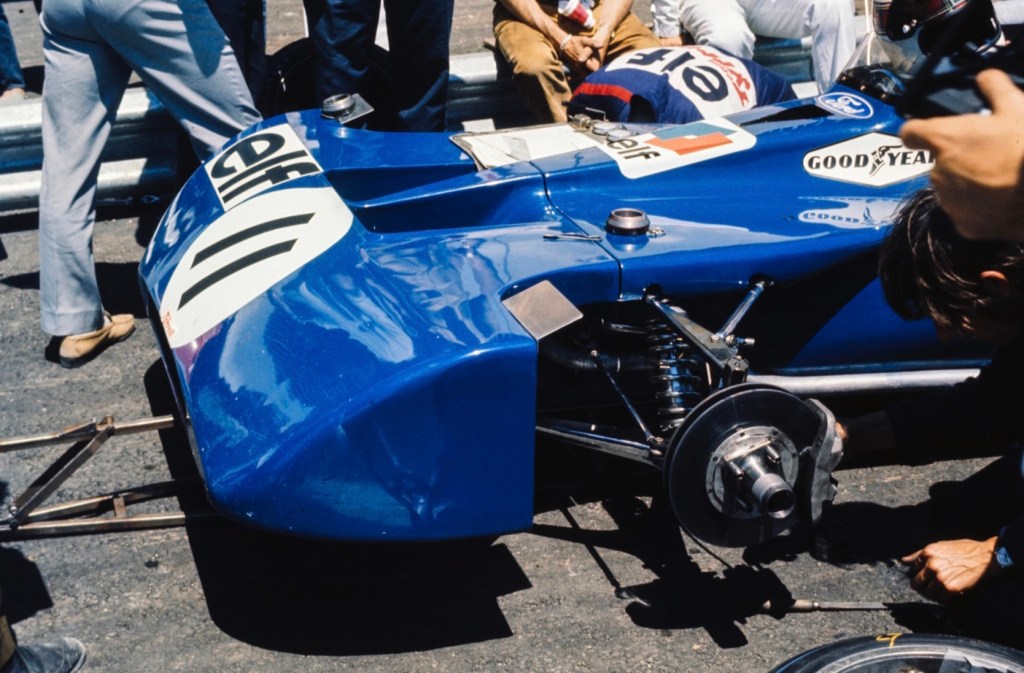
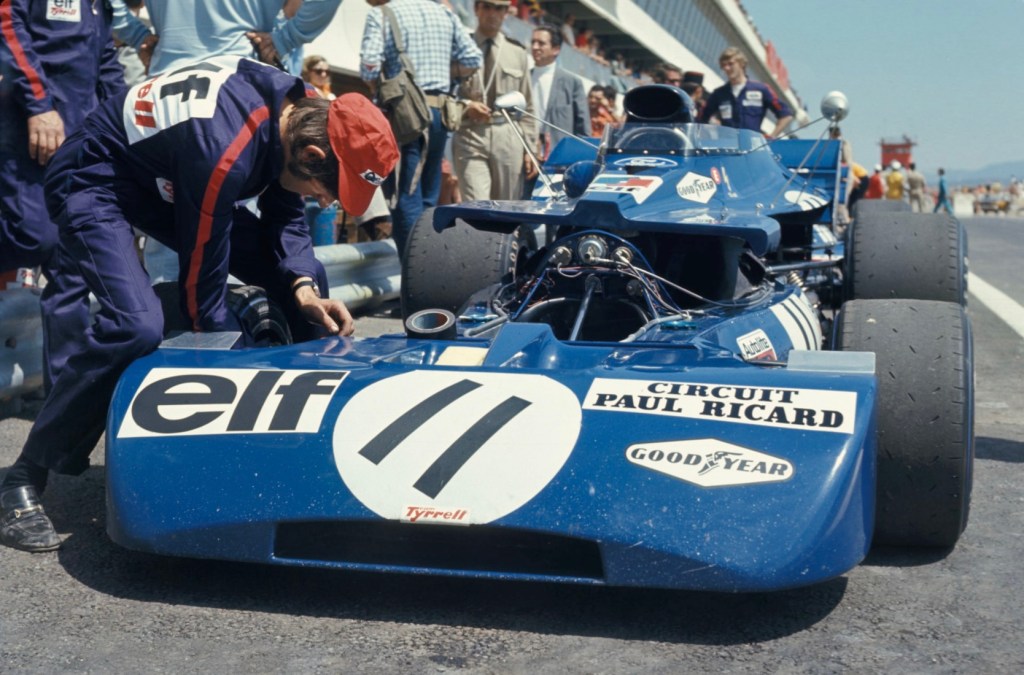
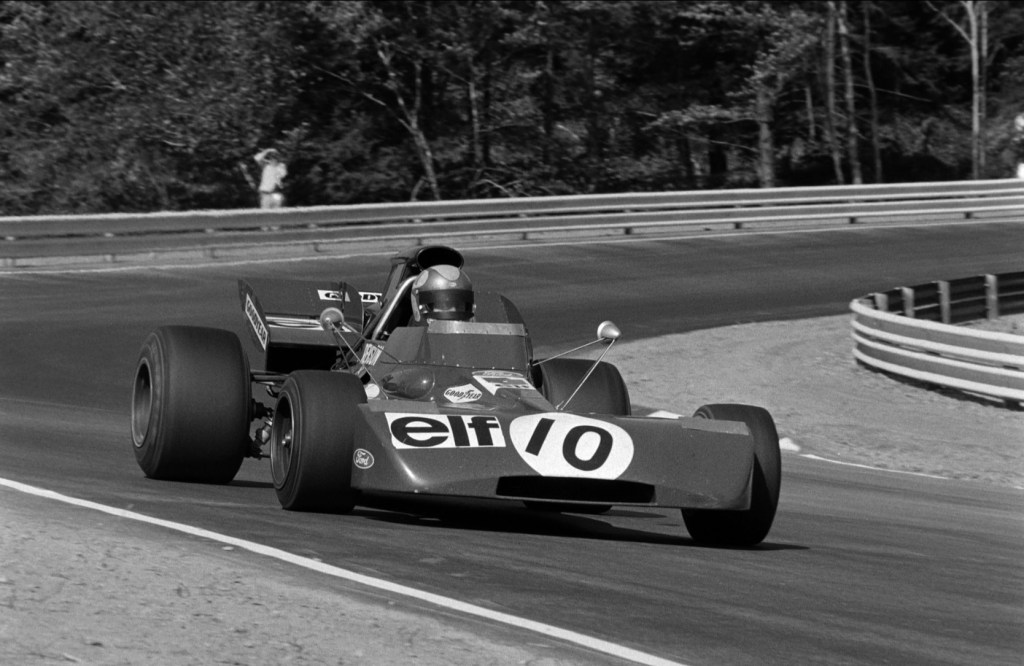
“Och aye! That really is more like it” or thoughts to that general effect. Jackie Stewart in his brand new Tyrrell 001 Ford Cosworth DFV at Oulton Park during the August 22, 1970 Gold Cup weekend.

Derek Gardner’s first F1 design was only days old and already it felt better than the customer March 701 Ford – victories in the Race of Champions and Spanish GP (Stewart) and International Trophy (Chris Amon) notwithstanding – that he had been racing that season.

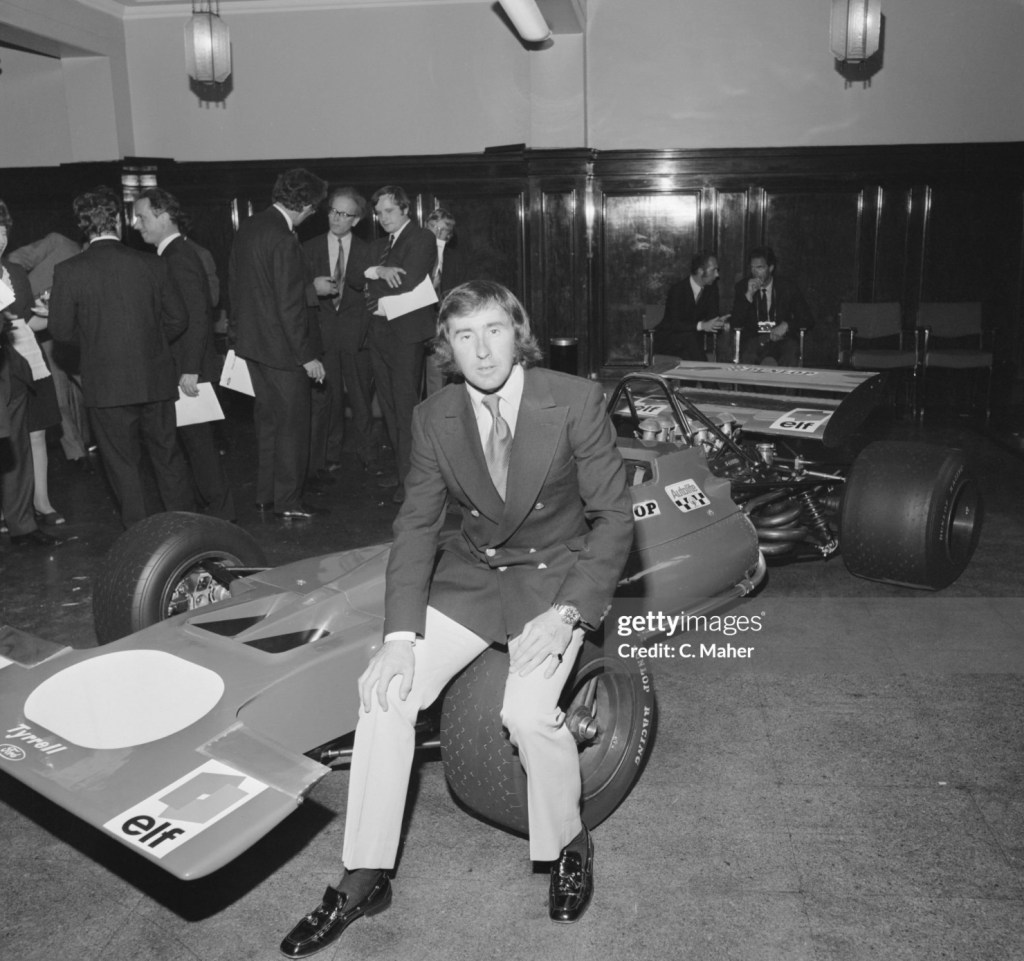
Press release of the Tyrrell 001 at Ford’s London premises, August 18, 1970

Stewart and Tyrrell’s Matra International team had won the 1969 World Drivers and Manufacturers Championships with the superb Matra MS80 Ford. For 1970 the French aerospace giant wanted to race only Matra V12 engined cars. After Tyrrell and Stewart travelled to France and Stewart tested the new Matra MS120 the pair decided they preferred to stick with the Ford engine; hence the acquisition of March 701s. See here for a short piece on the 701: https://primotipo.com/2014/05/15/blue-cars-rock/

Tyrrell quickly realised he needed to build his own car to control his destiny, rather than be at the mercy of a chassis manufacturer, so Gardner was engaged and secretly set to work in a design studio he established at his Leamington home.

Ken got to know and respect Derek during the occasions on which Matra International raced the Matra MS84 Ford 4WD drive car in 1969, Gardner was then employed by Ferguson Research and was responsible for the transmission in that car.

“…and then it does that, really suddenly!’ OR “…it doesn’t matter what I do, it just doesn’t respond!” JYS and March 701 Ford (MotorSport)
Stewart at Brands Hatch in the Tyrrell March 701 Ford during the July 1970 British GP (MotorSport)

The guidelines were, amongst others, that the design needed to be simple and competitive with minimal development, with a deadline of the August 22, Oulton Park Gold Cup meeting.

Gardner decided upon a light, aerodynamic car with very lower polar moment of inertia and optimum front-rear weight distribution. He had a wooden buck of the chassis made by a local joinery firm for Stewart to try. At that point the Tyrrell mechanics were let in on the secret with comments invited about what went where and maintenance – important design considerations for someone who hadn’t designed a racing car before

Hockenheim, Germany Q7 and DNF engine in the March 701, Jochen Rindt won(Schlegelmilch/MotorSport)
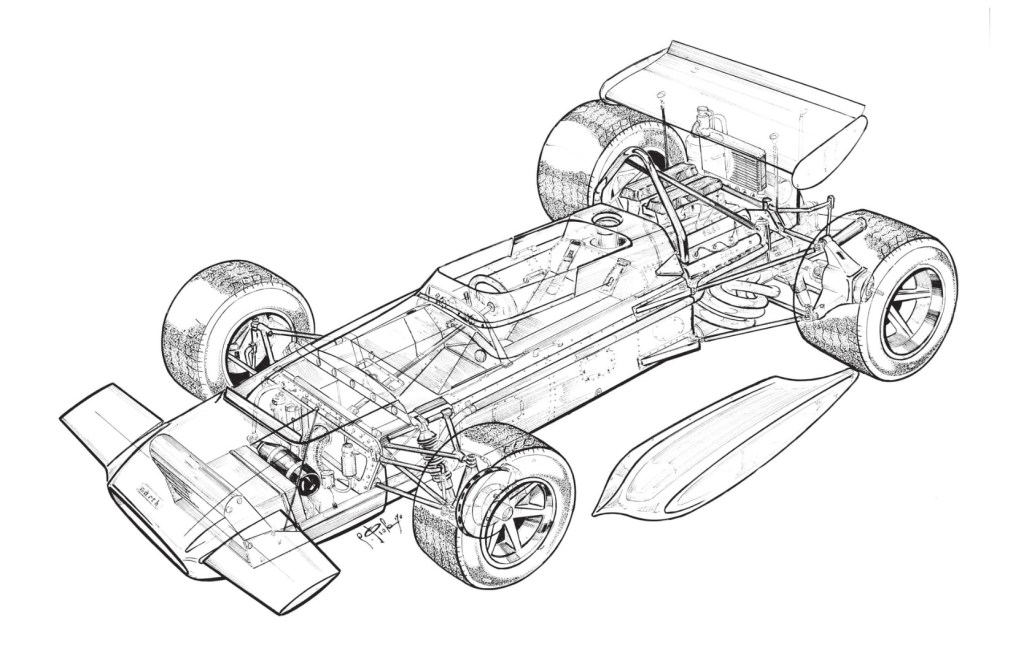
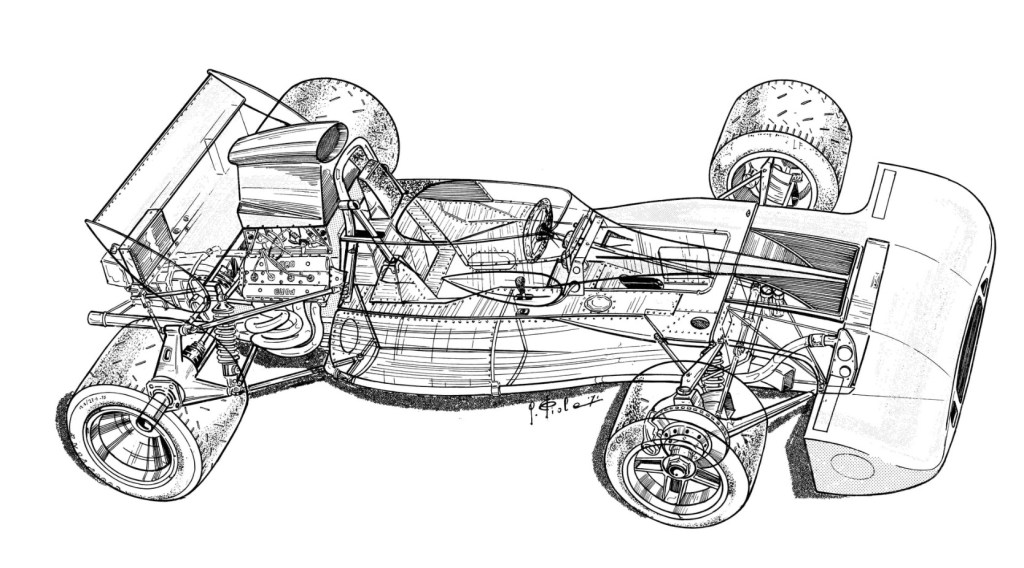
March 701 Ford cutaway drawing (G Piola)

Given Tyrrell’s famous Ockham timber yard operation was equipped to prepare racing cars, not build them – something that would change quickly enough – a swag of well known industry suppliers and ‘subbies were soon busily making components to the account of this fella named Gardner D.

A Ford DFV engine and Hewland FG 5-speed gearbox were sent over to Derek, while Maurice Gomm’s Gomm Metal Developments fabricated Gardner’s open, bath-tub, pregnant-belly, monocoque chassis out of 18-gauge NS4 aluminium alloy. Derek had modelled a tenth-scale model of the car in the University of Surrey’s wind-tunnel. The front of the chassis covered Wee-Jackie’s feet, while a subframe extended forwards to carry the radiator and front lower wishbone pick-up points.

Doug Nye wrote that “A massive front bulkhead structure extended into Matra-like wings on each side, supporting tiny, split upper wishbones and top mounts for the outboard coil spring/damper units. Very wide-based fabricated lower wishbones were used.”

Jackie Stewart in 001 ahead of Mike Hailwood, Lola T190 Chev and Reine Wisell, McLaren M10B Chev Oulton Park Gold Cup, August 1970 (MotorSport)

The Ford DFV engine was mounted, as the design intended, to the bulkhead aft of the driver, while the rear suspension was attached to the DFV and Hewland transaxle via tubular subframes. Len Terry’s ‘industry standard’ parallel power links were used with a single top link, twin radius rods and again outboard coil springs/Koni shocks.

Brakes were outboard at the front, and inboard at the rear: rotors were ventilated and 10.5 inches in diameter front and rear. Aeroplane and Motor provided many of the castings: uprights, wheels and other items, Laystall made the stub axles and Jack Knight Engineering did most of the machining.

The unusual nose and cowling shape were informed by the ‘tunnel-work, the central spine designed to divert relatively clean air around the side of the cockpit back onto the two-tier rear wing mounted atop a gearbox strut.

“When the prototype car (#001) was first assembled and weighed it scaled some 100 lb less than the team’s proprietary March 701s, and was only 32 lb above the minimum weight limit. It had cost Ken Tyrrell £22,500 less engine and gearbox, compared to the purchase price of £9000 for his March 701s.” Nye wrote.

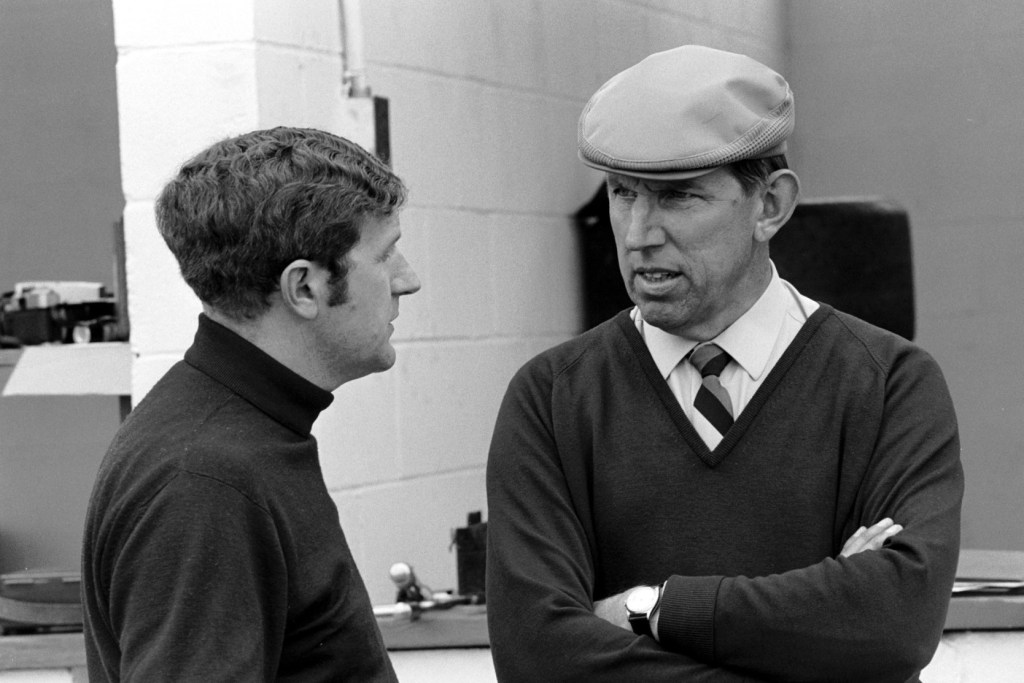
Messrs Gardner and Tyrrell looking youthful in 1970 (MotorSport)
Tyrrell 003 Ford cutaway drawing, the eagle-eyed may pick the Girling twin-disc brakes (T Matthews)

After completion and dealing with all of the press-release niceties the car was despatched to Oulton Park where 18 cars faced the starters flag: five GP and thirteen F5000 cars.

Niggles that weekend included metering unit failure and a blocked fuel injection unit, so JYS also practiced and qualified his March fifth, but elected to start from the rear of the grid in 001 having not set a time.

On lap two of the first heat he pitted after the throttle jammed, to have the linkage eased a bit, and to have loose bodywork made good. He returned to set the lap record (twice) before an oil pick-up problem caused the engine to fail. John Surtees’ TS7 Ford won that heat, and Jochen Rindt’s Lotus 72C Ford the second, with John victorious overall.

Mosport, Canada 1970 (MotorSport)
Stewart and team at Mosport where keeping wheels on 001 was a problem, and a broken stub axle (MotorSport)

Given a choice of cars Stewart did the logical thing and plumped for the new Tyrrell 001 for the final four championship round of the season at Monza, Mosport, Watkins Glen and Mexico City.

At Monza the car’s main fuel tanks weren’t picking up enough fuel to the collector to run at sustained maximum rpm so he raced his 701 – despite being distraught after the death of his close friend Jochen Rindt in practice – to second place behind Clay Regazzoni’s Ferrari 312B, Regga’s first GP win.

Things improved big time in North America. Jackie started from pole in Canada and was on the front row in the US and at Mexico City. At Mosport the wheels kept coming loose in practice, and then a left-hand-front stub-axle failed while Jackie led the race. Gardner designed stronger parts which were machined from solid magnesium by the Jack Knight crew and used on the car at the Glen and in Mexico.

Jackie lost in upstate New York when an oil-line retaining clip parted, “causing the plastic line to fall against a hot exhaust manifold and burn through, which allowed the lubricant to haemorrhage away.” Emerson Fittipaldi took his first GP win that weekend in a Lotus 72C Ford.

The Mexican GP was an entirely forgettable weekend all round, not least for Jackie Stewart, who hit a stray dog at 160mph. “It disintegrated and the car veered violently to the left towards a bank where spectators were sitting cross-legged a few metres from the tarmac. I only just managed to regain control and prevent my car from ploughing into that area and scything through the crowd.”

Importantly, despite the somewhat predictable niggles, the car was fast: Team Tyrrell, Stewart, Ford, Elf and the other sponsors looked forward to 1971 with plenty of optimism.

The Big Three at Kyalami in 1971: Stewart, Gardner and Tyrrell (MotorSport)
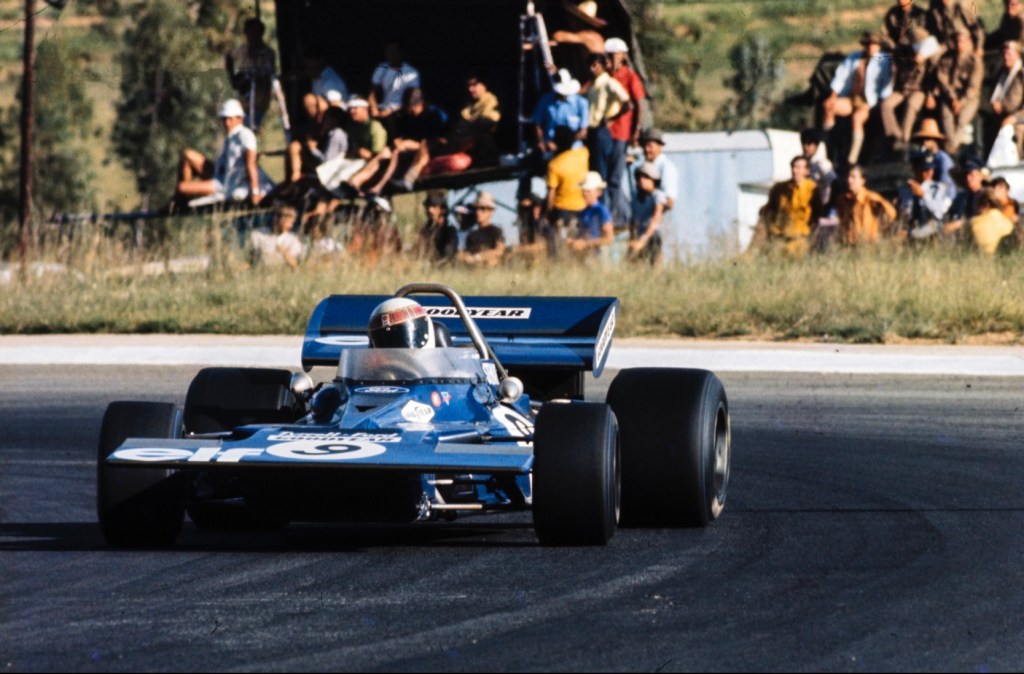
Stewart in 001 during the ’71 South African GP (MotorSport)

Over that 1970-71 winter the team built up another car, chassis #002 for Francois Cevert. A taller chap than his team-leader, the chassis was four inches longer than #001, the wheelbase 1.5 inches longer, and the side-skins of the tub were thicker 16-gauge NS4 aluminium. In addition, Derek simplified the front bulkhead structure and braced the roll-bar forward, rather than aft. “This latter change was to allow the engine to break away from the chassis in an accident without compromising the drivers protection, and would become standard practice in all categories over the next four to five years,” wrote Allen Brown.

Longtime tyre provider, Dunlop withdrew from F1 at the ned of 1970 so Tyrrell did over 1400 trouble-free miles (two engines) with Goodyear in warm Kyalami over the annual break. Trouble-free but not incident free: a pebble jammed between the throttle pedal and bracket causing a crash which crushed the tub’s left-front corner and jarred Stewart’s wrist. The car was sent home, the monocoque unstitched, the skins repaired then the chassis was reassembled and returned to South Africa.

Stewart in his new Tyrrell 003 on the way to victory at Montjuïc Park, Barcelona in 1973. Rainer Schlegelmilch photographic brilliance (MotorSport)

Not much was wrong with 001, Stewart started his first three races in 1971 from pole…and finished second in all them: the South African GP, Race of Champions at Brands Hatch and the Questor GP at Ontario Motor Speedway in California.

From then JYS moved to Tyrrell 003 – identical in spec to 002 – and immediately won in Spain (Montjuich Park) and Monaco with it. He had brake dramas in the Zandvoort dunes but bounced back at Paul Ricard, Silverstone and the Nurburgring putting the World Championship in-the-bag. Later in the season Jackie won at Mosport and Francois took his first – and sadly his only – GP victory at Watkins Glen. Tyrrell won the Constructors Championship in its first full year of competition as a manufacturer.

Great cars! Doug Nye named his chapter in ‘The History of The Grand Prix Car 1966-1985’ about the 1970-73 championship Tyrrells ‘Uncomplicated Craftsmanship’, which about says it all…

Not a shot of Francois! Let’s fix that, here in during the September 5, 1971 Italian GP weekend in 002. Ronnie Peterson at left in his March 711 Ford, Cevert in 002, Mike Hailwood, Surtees TS9 Ford and one of the BRMs. Peter Gethin’s BRM P160 took a famous win by a bees-dick – one-tenth of a second – from Peterson then Cevert (MotorSport)

Etcetera…

Oulton Park 1970

(MotorSport)

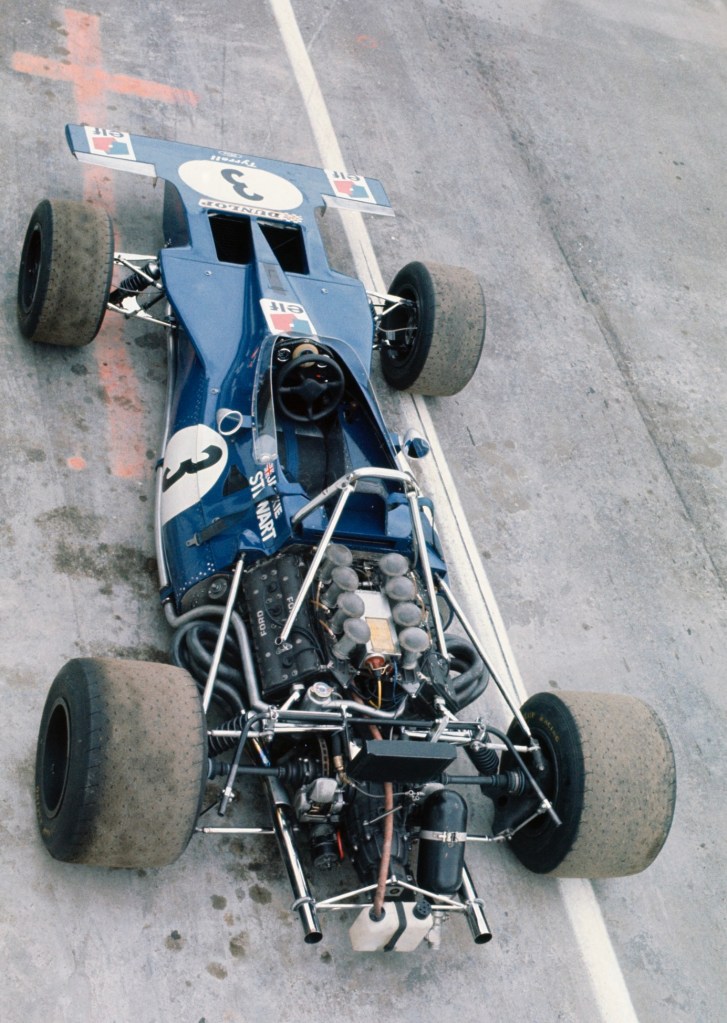
This overhead shot of Tyrrell 001 at Mosport in 1970 – sans rear wing – is a great one to show the overall packaging of the car – body features as per earlier text – and the period typical Ford Cosworth DFV, Hewland transaxle and outboard suspension. Quality of design, execution and preparation outstanding.

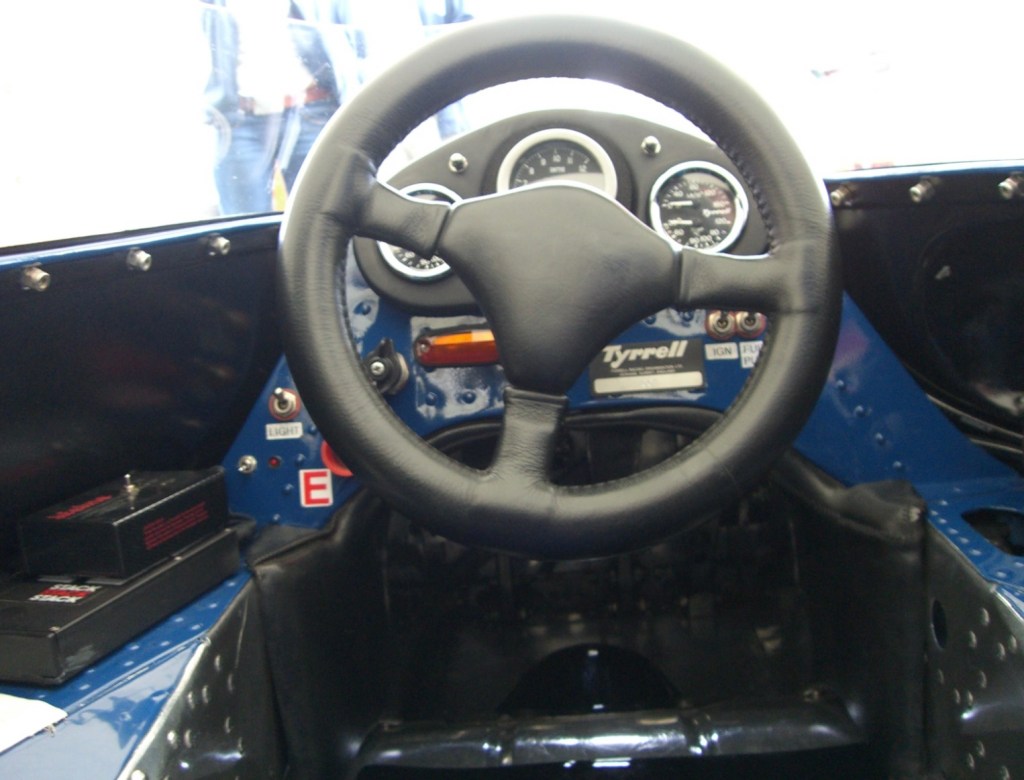
Contemporary photograph of 001’s cockpit.

(MotorSport)

Mechanics work on Francois Cevert new #002 at Kyalami in 1971. Note the forward facing roll bar bracing

Tyrrell 002 Ford (G Piola)
(MotorSport)

Race of Champions March 21, 1971. Stewart in 001, Denny Hulme, McLaren M19A Ford and Clay Regazzoni, Ferrari 312B2. Regazzoni won from Stewart and Surtees in his TS9 Ford.

French GP 1971, Tyrrell 003, note Girling twin-disc set up (MotorSport)

Tyrrell experimented with Girling twin-disc front brakes fitted to 001 at Silverstone during the May 1971 International Trophy weekend. After Monaco both regular cars: 002 and 003 were fitted with the double-disc brakes as here, to Jackie Stewart’s 003 at Paul Ricard.

Doug Nye explains the set-up, “There were twofold discs on each hub, spaced by a double thickness of pad material, and with pistons on only one side of the caliper. The discs were given a degree of side-float which allowed them to move sideways, cramped by the pads, when the brakes were applied. The idea was to double pad and disc area and provide better heat dissipation plus the opportunity to reduce line pressures which permitted the use of smaller pistons and less deflection on pad wear. The problem had been that conventional discs were wearing the brake pads into a taper form. This in turn promoted knock-off when the drivers braked hard, giving a spongy pedal feel and slashing driver confidence.”

The twin-discs were removed from both cars at Ricard, “after Stewart had a harmless spin into the catch-fencing, for Girling seemed happy with the lessons learned thus far.” Nye wrote.

(MotorSport)

Two of Derek Gardner’s innovations are shown in the shot above, Stewart’s 003 at Paul Ricard, and Peter Revlon having this final in-period race of 001 at Watkins Glen in 1971 below.

The ‘Tyrrell nose’ first appeared in scutineering over the Dutch GP weekend and made its race debut at Ricard. The bluff nose extended to the maximum allowable width ahead of the front wheels, reducing the lift they caused and reducing drag.

With that, Gardner introduced the second alternative nose treatment until the ground effect era, the other was the wedge nose inspired by the Lotus 56/72.

Doug Nye notes that Stewart was “simply uncatchable on the long (Ricard) Mistral straight”. After the Tyrrell 1-2 in France and Stewart’s strong win at Silverstone a fortnight later, his engine was sealed and checked, and a fuel sample was taken in France with no irregularities found. Tyrrell simply had two very quick cars and drivers…

Note also the engine snorkels on the two cars. Lotus fitted ducts to the 72 from the 1970 British GP, and Matras snorkels, but Gardner’s design was sealed allowing clean air and a mild ‘supercharging’ effect.

It was far from the end of Derek Gardner’s innovations of course!

(MotorSport)

Peter Revson had a long international apprenticeship. Six years after winning the Monaco F3 GP and some promising top-five F2 performances in Ron Harris-Team Lotus 35s in 1965, at the ripe old age of 32 he returned to F1.

In 1971 he won the Can-Am Cup aboard a works McLaren M8F Chev and popped the team’s McLaren M16 Offy on pole at Indianapolis, then finished second behind Al Unser’s Colt Ford.

Tyrrell engaged Revson to race 001 at Watkins Glen. He qualified 19th but only did a lap after clutch failure. It was the last in-period ‘race’ for Tyrrell 001, Peter raced for McLaren in Grand Prix racing in 1972-73. See here: https://primotipo.com/2014/07/24/macs-mclaren-peter-revson-dave-charlton-and-john-mccormacks-mclaren-m232/

Happily, #001 is owned by the Tyrrell Family.

(MotorSport)

Credits…

MotorSport Images, Rainer Schlegelmilch, ‘History of The Grand Prix Car 1966-85’ Doug Nye, ‘Winning Is Not Enough’ Jackie Stewart, Automobile Year 19

Tailpiece…

(MotorSport)

February 2010 in the Ockham woodyard.

Finito…

Stewart, Lotus 33 Climax #R10, Rand GP 1964 (P Tempest)

Jackie Stewart on his way to victory in the second heat of the Rand Grand Prix aboard a works Lotus 33 Climax. Kyalami, December 12, 1964.

Stewart’s first drive of a Grand Prix car had been organised by Jim Clark during the 1964 British Grand Prix weekend at Brands Hatch on the July 11 weekend.

Dominant in one of Ken Tyrrell’s Cooper T72 BMCs that F3 season, Clark convinced Colin Chapman to give the young charger a few laps in Clark’s Lotus 33 Climax at the end of practice. The marshalls were asked to stay in situ for an extra 20 minutes to allow the test to take place. Using Jim’s car and his settings: pedals, seat etc, off went The Other Scot down the pitlane to complete only a few laps before the engine failed.

Despite the short session, JYS impressed, a week later Jackie had the first of a half-dozen meetings in a works-Ron Harris Racing Lotus 32 Cosworth SCA F2 car at Clermont Ferrand. The opportunity arose as a result of Peter Arundell’s misfortune.

Peter Arundell on his way to fourth place during the French GP at Rouen on June 28, Lotus 25 Climax. Only a week before his Reims near death experience (MotorSport)

Arundell was badly injured during the Reims F2 GP on July 5. In a slipstreaming group, he got onto the rough at the kink on the straight, corrected, but lost a bit of speed and was hit by Richie Ginther’s Lola T55 Cosworth SCA. Peter parted company with his car in mid-air, breaking an arm, thigh and collarbone and was comatose for a fortnight. At that time he was in joint third place in the F1 World Championship standings with Ginther, behind Clark and Graham Hill. Arundell eventually returned to F1 with Team Lotus in 1966, a tough place to be at the time: see here for a great summary of Peter’s career: https://www.f1forgottendrivers.com/drivers/peter-arundell/

Meanwhile, Jackie Stewart was immediately on the pace at Clermont, placing second behind Denny Hulme’s winning Brabham BT10 Cosworth SCA. Jackie then won at Snetterton, was second at Montlhery and third at Oulton Park.

So when Clark sustained a back injury at Cortina d’Ampezzo during a snowball fight at a Ford Cortina marketing event, it was an easy call for Chapman to engage Stewart to replace him in South Africa. Lotus had contracted to provide two cars to contest the Rand Grand Prix and touring car support races at Kyalami that weekend.

Jim briefing Jackie before heading out at Brands Hatch in July (F1GPDC)

Stewart at Snetterton, winning the Vanwall Trophy on the 26 September, British F2 Championship round, Lotus 32 Cosworth SCA (MotorSport)

Stewart initially thought that he should make his GP debut with BRM, to whom he was contracted for 1965, but “I telephoned Ken Tyrrell and asked his advice. He said ‘don’t be such a stick in the mud, you’ve got to get out and drive the thing sometime’ and pointed out that this Formula 1 scamper would calm my nerves rather than taking my first appearance in a full-scale Grand Epreuve. I think from that aspect I couldn’t have done better than drive at Kyalami and perhaps I wouldn’t have done it if someone hadn’t kicked me in the backside and told me to get on with it,” he told the F1 Grand Prix Drivers Club.

Chapman cleared the drive with BRM’s Tony Rudd and Stewart promptly qualified on pole in a brand new Lotus 33 Climax (R10). The field included his teammate Mike Spence, his soon to be teammate at BRM, Graham Hill in a Willment entered Brabham BT11 BRM, Bob Anderson’s BT11 Climax and two Brabham BT10 Lotus-Ford twin-cams raced by Paul Hawkins and David Prophet. There was a swag of competent locals too including John Love, Piet de Klerk and Sam Tingle.

Stewart, Kyalami (R Young)

Jackie’s Lotus broke a driveshaft on the line of the first heat – causing maximum chaos behind – but the Team Lotus mechanics, ever competent, had the car ready for the second heat which Stewart won from Hill. Graham won the Rand GP overall from Hawkins and Anderson. Mike Spence was second in the first heat but had a rose-joint fail after only one lap in the second.

See here: https://www.f1grandprixdriversclub.com/jackie-stewart-fifty-years-ago/ and here: https://velocetoday.com/jackie-stewarts-first-f1-drive/

Credits…

F1Grand Prix Drivers Club, VeloceToday.com, Robert Young, Peter Tempest, MotorSport Images, f1forgottendrivers.com

(R Young)

Tailpiece…

Paul Hawkins raced John Willment’s Brabham and Ford Galaxie that weekend, getting the better of Stewart’s Lotus Cortina in the touring car support races. Look at the size of that thing…

Finito…

(MotorSport)

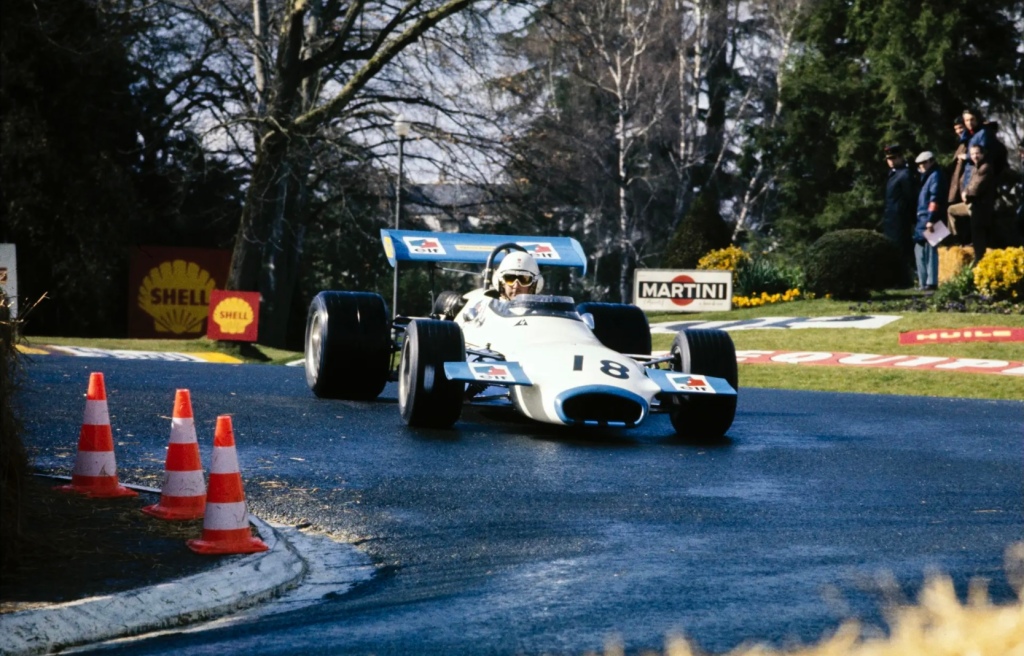
Jack Brabham negotiates the tight confines of Pau during the April 5 weekend. Got his Jet Jackson helmet on too, hasn’t he, see here; https://primotipo.com/2020/07/11/jack-piers-and-helmets/

The car is Brabham BT30 chassis # 17 owned by ex-racer/businessman/team owner John ‘Noddy’ Coombs, the machine was shared by Jack and Jackie Stewart that season

Brabham didn’t finish at Pau fuel metering unit problems intervened. Jochen Rindt won in a works/Jochen Rindt Racing Lotus 69 Ford FVA from four BT30s: the machines of Henri Pescarolo, Tim Schenken, Derek Bell and Francois Mazet.

(MotorSport)

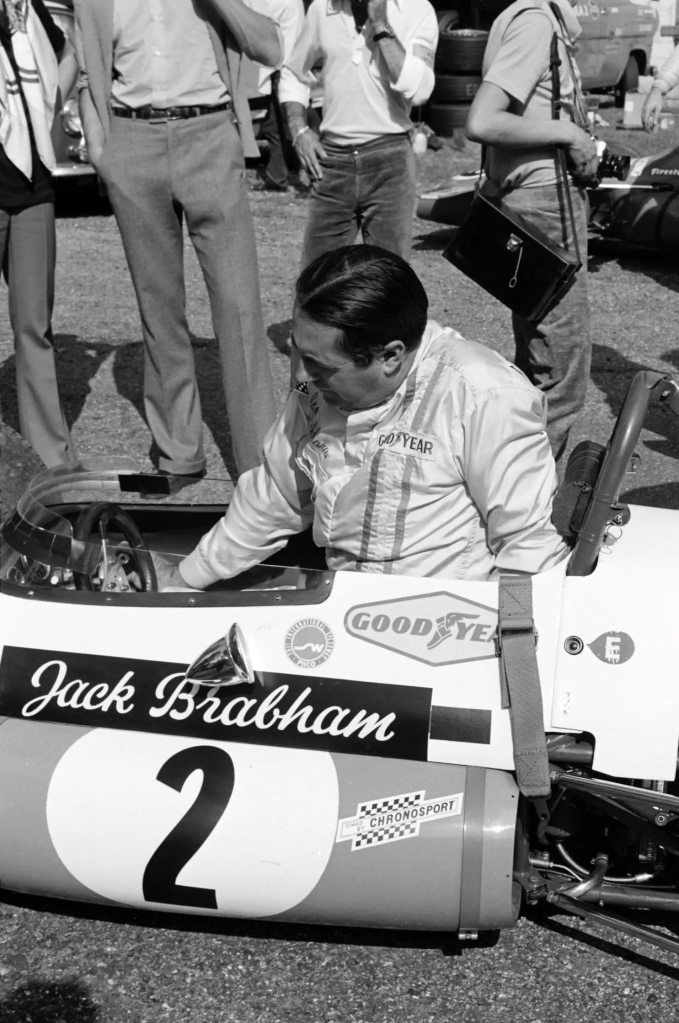
“Yeah, its not a bad little jigger, we’ve won a few races with BT30s in the last twelve months I suppose. It’s a lot tighter than I remember when I tested it for Ron last year mind you…”

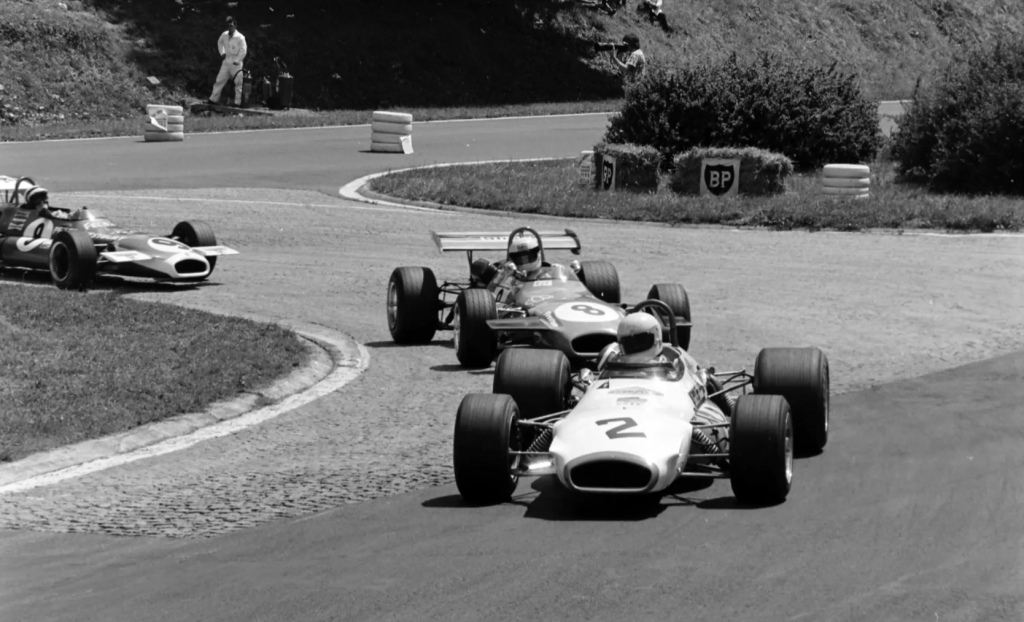
Jack gets out of BT30/17 over the June 28, XVIII Grand Prix de Rouen-les-Essarts weekend where he was eighth in the race won by Jo Siffert’s BMW 270.

BT30/17’s best results that season was Jackie’s second place at Thruxton and victory at Crystal Palace, while Jack was second at Tulln-Langenlebarn. Coombs shipped the car to Japan in May, where JYS won the Formula Libre Japanese Grand Prix at Fuji with Ford Cosworth FVC power.

Stewart bagged the Quadrella in the London Trophy at Crystal Palace in May. He won his heat, the final from pole, bagging fastest lap along the way (MotorSport)
(MotorSport)

The Brothers Brambilla compound during the Hockenheim 11, 1970 weekend. The car in shot is Tino’s #7 Brabham BT30/21 (DNF) during the 1970 Preis von Baden – Wurttemberg und Hessen Euro F2 Championship round. Dieter Quester had a home-win for BMW, he prevailed in an M11 powered BMW 270. The exhaust of Vittorio’s car, BT30/22, is at right.

The essential elements of customer F2 Brabhams of the era are on display; a spaceframe chassis, Ford Cosworth 1.6-litre FVA 210bhp engine and Hewland FT200 five-speed transaxle. It was then up to the driver to make these immensely robust, chuckable, fast, Ron Tauranac designed cars do the rest.

Chassis fetishests should check out Allen Brown’s detailed review of all BT30s built on oldracingcars.com, here; https://www.oldracingcars.com/brabham/bt30/

Etcetera…

(MotorSport)

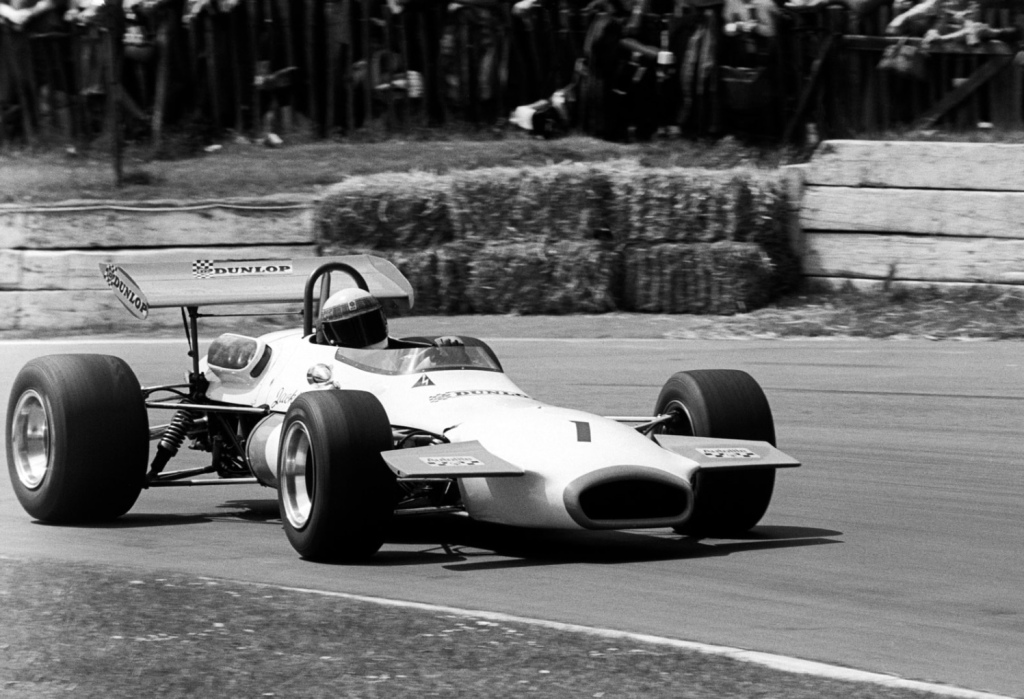
Jack toyed with wings on and off at Rouen, racing without the appendages. Here he is showing the way to customers, Derek Bell (seventh) and Peter Westbury (tenth).

(MotorSport)

Another lovely Pau GP shot, where Tim Schenken was third in the Sports Motors International Brabham BT30.

That year the European F2 Championship was won by Clay Regazzoni’s Tecno 69 and 70 FVAs with 44 points, from Derek Bell’s BT30 (he also bagged one point in a BMW 270) 35 points, and Emerson Fittipaldi’s Lotus 69 FVA on 25.

‘Graded drivers’ – in essence and summary, drivers who had scored points twice in the Top Six of a Grand Prix in the previous two years, and the World, F2, Indy, and Can Am Champs of the previous year – were ineligible for Euro F2 championship points.

In 1970 Rindt won at Thruxton, Stewart at Crystal Palace and Ickx at Tulln-Langenlebarn. Of the non-graded drivers, Regga won at Hockenheim, Enna-Pergusa and Imola – and won his first Grand Prix for Ferrari that September at Monza -, for Derek Bell at Montjuich Park, Barcelona, and Dieter Quester in the final Hockenheim round.

Credits…

MotorSport Images

Tailpiece…

(MotorSport)

The ‘guvnor keeps an eye on his protege during the Rouen weekend. Brabham and John Coombs, who bought his share of Brabhams over the years. See here for a MotorSport interview with John; https://www.motorsportmagazine.com/archive/article/may-2009/71/lunch-john-coombs/

Finito…

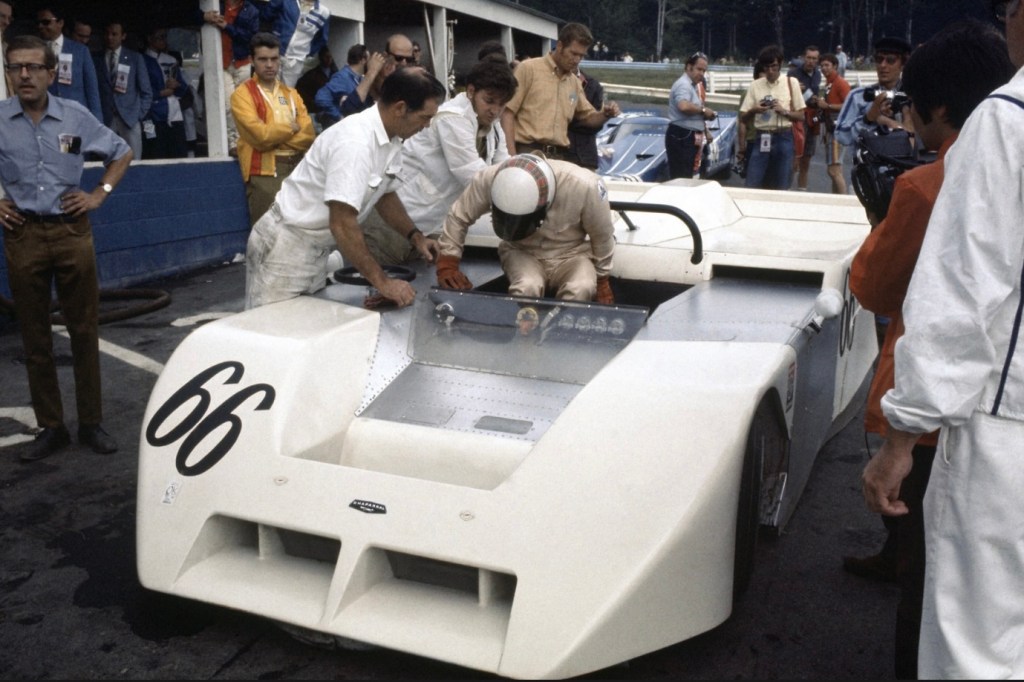
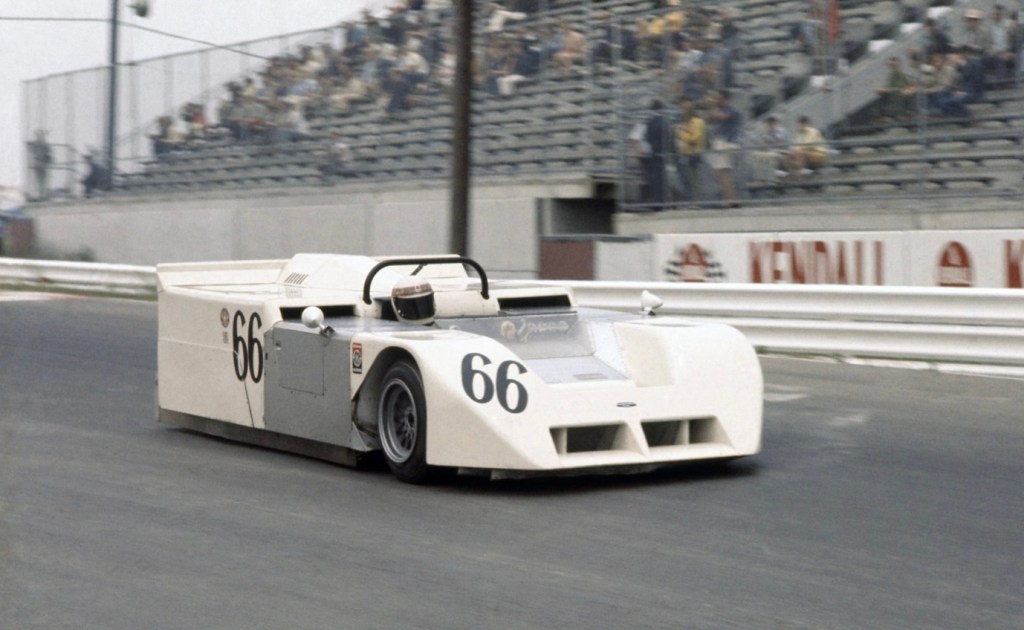
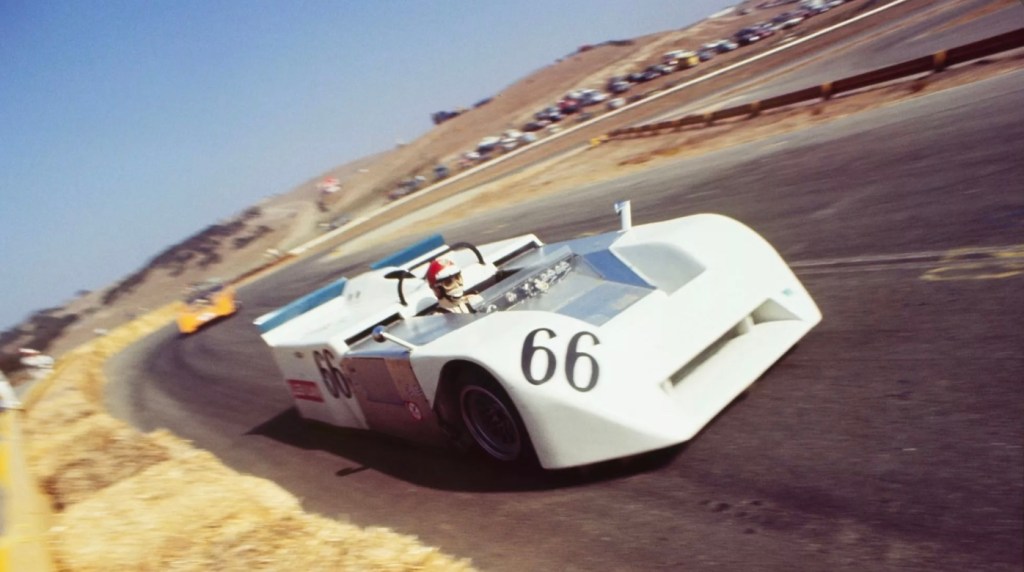
JYS loads up into the Chaparral 2J at Watkins Glen in July 1970 (LAT)

Apart from the Chaparral 2J Chev, name another car raced in 1970 that looks as edgy now as it did way back then?

I still remember flicking through Automobile Year 18 in Camberwell Grammar’s library in 1971 and flipping-my-14-year-old-lid at the sight of the 2J. My oldest mate remembers me saying, “Look at George Jetson’s car!” The only things missing were Jane, Judy, Elroy, and of course ‘rAstro!

John Surtees, Chaparral 2H Chev at Riverside in October 1969
2H butt at Riverside in October 1969. Of note is the world’s biggest fabricated aluminium De Dion rear axle and one of the worlds biggest radius rods. ZL1 Chev has a crossover inlet manifold to get the fuel injection trumpets out of the airstream, ditto routing of extractors. Enormous wing fitted in this shot – you can see the vertical support – which is not installed in the shot above, remember too that this car was originally designed and built with the driver fully enclosed inside, something John Surtees pushed strongly against

Jim Hall has gonads the size of pineapples.

His outrageous 1969 offering, the wedgy, door-stop, knee high, De Dion rear-ended 2H was a complete flop. It’s driver, John Surtees, thought Hall had been smoking wacky baccy at Woodstock rather than working with clean-cut Nixon supporters at GM’s Skunkworks to design a new car.

Ever the poker player, Hall doubled his bets and concepted a machine so advanced and fast it was banned after only four races.

The Phil Hill/Mike Spence winged Chaparral 2F Chev looking lonely on the Daytona banking in 1967, DNF (Getty)

Chaparral had been giving the rest of the racing world aerodynamics and aero-technology lessons for five years or so to that point.

By 1970 the aluminium monocoque chassis was passe, so too was the aluminium block 650bhp’ish Chev ZL1 V8, even Chaparral/GM’s semi-automatic three-speed transaxle was a bit ho-hum.

Legend has it the inspiration for the 2J was a child’s fan-mail drawing to Hall of a sports racer being sucked down to the road by giant fans extracting the air underneath.

Whether it was ‘Elroy Jetsons’ sketch, an extension of previous Chapparral/GM R&D work, or divine providence, GM’s Paul Von Valkenburgh and Charlie Simmons, and Chaparral’s Don Gates started modelling the possibilities on Chevy R&D’s Suspension Test Vehicle.

More of a test-rig than a car, it enabled them to play with roll-centres and stiffness, ride height, pitch axis, anti-dive/squat and lots of other stuff; this rig became the 2J test mule.

“Gates worked out a fan and skirt infill defence system while Don Cox, Ernie DeFusco and Joe Marasco engineered a chassis to match,” Doug Nye wrote.

(sportscardigest.com)

The resulting tricky bits were the slab-sided, fully-fenced bodywork and Rockwell JLO 247cc two-stroke 45bhp snowmobile engine which powered two rear fans nicked from an M-109 Howitzer Tank. That combination could move 9,650 cubic feet of air a minute @ 6,000rpm, creating negative pressure equal to 2,200 pounds of downforce. Unlike other racing cars, the downforce was independent of the speed of the car.

For three-quarters of its footprint the car was ‘attached’ to the ground via skirts made of General Electric’s new, trick, Lexan polycarbonate. The skirts moved up and down with the movement of the car via a system of cables, pulleys and machined arms that bolted to the suspension. On the smoother Can-Am venues the seal was good, with the fans on the car hunkered-down by two inches.

The net effect of all of this was that the car sucked itself to the road, thereby creating immense cornering power and traction.

Stewart on the Watkins Glen grid, Chris Ecomomaki in front looking for a mike (J Meredith Collection)
Vic Elford togs-up at Riverside. The car in front is Peter Revson’s Carl Haas entered Lola T220 Chev, Revson is sitting on the pit wall to the right of the Lola’s rear. His performances in that car propelled him into a works-McLaren M8F Chev with which he won the 1971 Can-Am Cup – F1 followed (B Cahier-Getty)

During the 2J’s build Jim Hall was smart enough to give SCCA officialdom a look at the car to ensure it was kosher in the almost-anything-goes Group 7/Can-Am world. The crew-cut mob deemed it hunky-dory to race.

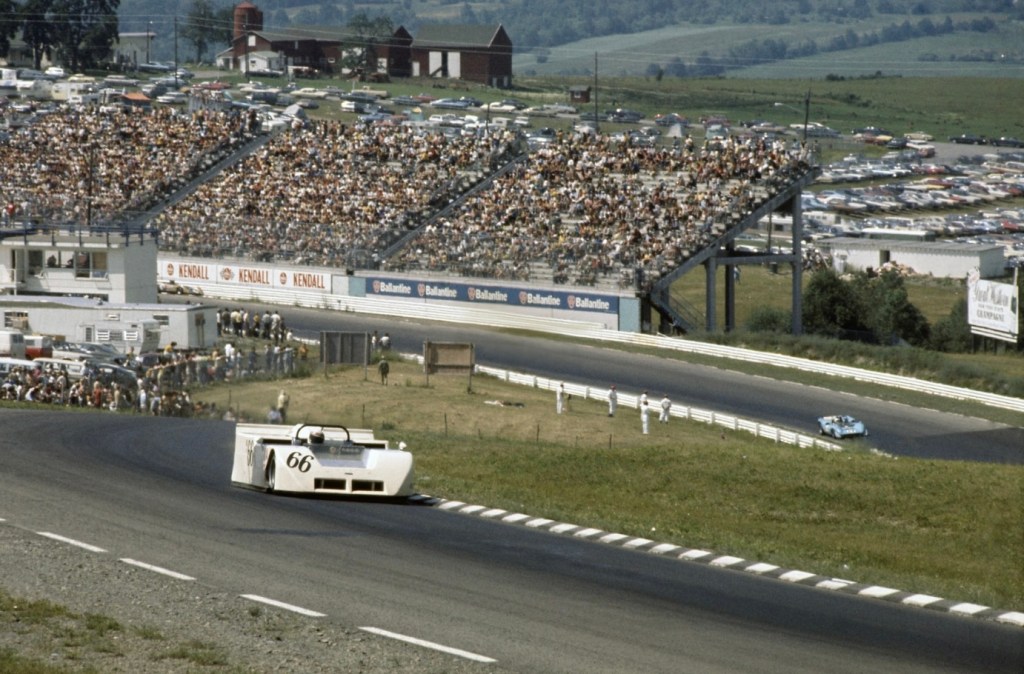
While the car was first tested at Rattlesnake Raceway in November 1969, the complex machine missed the June 14, 1970 Mosport season opener and the following Canadian round at St Jovite. But 2J-001 finally arrived aboard a modest ute (pick-up) at Watkins Glen in mid July.

It’s driver was reigning World Champion Jackie Stewart in a one-race deal supported by GM (weird given the Ford sponsored Cosworth engine which powered his F1 cars). JYS had plenty of sportscar experience, including Can-Am cars, but nothing prepared him for the 2J.

“The car’s traction, its ability to brake and go deeply into corners is something I’ve never experienced before in a car of this size and bulk,” he wrote in Faster! “Its adhesion is such that it seems able to take unorthodox lines through turns, and this, of course, is intriguing.”

Jackie Stewart during practice at Watkins Glen, and below, a wonderful race day panorama (LAT)
(LAT)

Stewart, and Vic Elford, retained by Hall to drive the car for the balance of the series, experienced the same other worldly, steep learning curve – retraining the brain about what was possible – as Mario Andretti encountered with Peter Wright and Colin Chapman’s Lotus 78-79 ground-effect cars in 1977-1978.

In a practical sense, half the problem was keeping the auxiliary engine alive – remember it wasn’t designed for this application – in its new harsh environment with all the trackside detritus the fans sucked up from the bottom of the car and regurgitated out the back at speed. Not to forget the skirts and their support mechanisms. The engineering challenge of this lot was mega.

Stewart qualified the brave-new-world 2J third behind the dominant orthodoxy, Denny Hulme and Dan Gurney’s new Batmobile-Beautiful McLaren M8D Chevs. Jackie closed on Dan during the race before being forced to pit, then went out for another seven laps – 22 in all – he bagged fastest lap before braking problems ended his race.

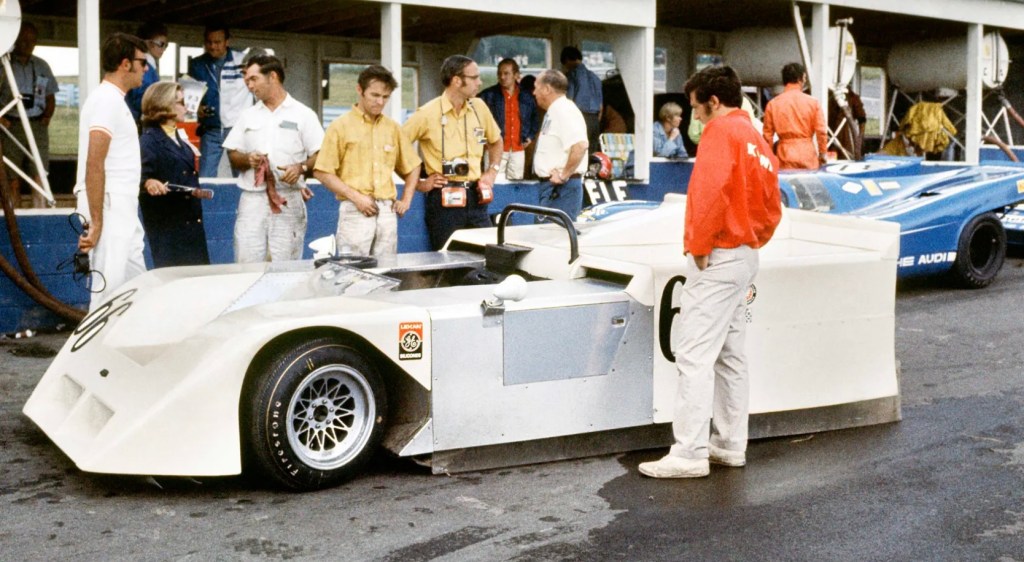
2J-001 at rest in the Watkins Glen pitlane. Sole sponsor decal is for GE-Lexan. Porsche Salzburg 917 of either Vic Elford or Dickie Attwood behind (LAT)
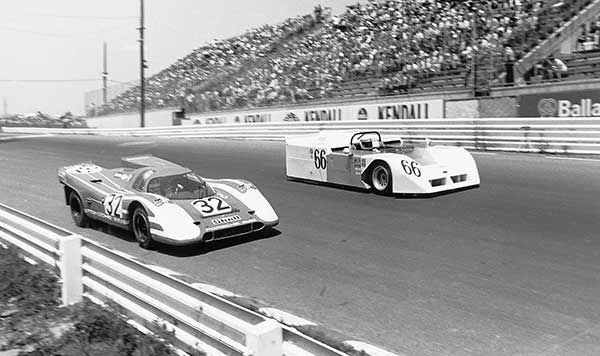
Stewart blasts past Attwood’s third placed Porsche 917. While Hulme’s McLaren M8D Chev won at Watkins Glen, the next six placings were taken by Group 5 enduro cars, not the Group 7 cars for which the race was run. Said Porsche 917 and Ferrari 512S’ had already done the Watkins Glen 6-Hours the day before, most without an engine change between the two races. The JW 917 of Pedro Rodriguez/Leo Kinnunen won (unattributed)

Context is everything. The Glen’s Can-Am round was always topped up by Group 5-6 World Endurance Championship cars which were also in town for the Watkins Glen 6-Hour.

The dominant 1970-71 endurance racer was the swoopy-rounded, spaceframe, 4.5-4.9-litre flat-12 engined Porsche 917. Alongside the 917 the 2J looked like a Sci-Fi film prop!

The Texans missed the next three rounds at Edmonton, Mid Ohio and Road America to further develop the car before rejoining the circus at Road Atlanta in mid-September.

Elford recalled his impressions of the car to MotorSport, “Drving the car was just out of this world. The start-up procedure was a bit like an aeroplane I suppose, you didn’t just jump into first gear and drive away.”

“I put my left foot hard on the brake to make sure it didn’t go anywhere, then fire-up the little engine which immediately started to drive the two monster fans at the back, sucking up the air underneath. When I did this the car would literally go: ‘Shhhp!’ and lower itself down to the ground by about two and a half inches.”

Such was the suction of the turbines, the 2J could tootle off on its own at up to 30mph if the brakes weren’t applied.

At Road Atlanta Vic popped it on pole and finished sixth after ignition problems with the snowmobile engine.

“You get to the stage of thinking it’s just not possible to go around any corner at that speed, and adapting to it mentally is the most difficult approach because no other car has ever gone around a corner as fast as this one,” Elford recalled.

“Another great thing about the suction is that it doesn’t allow the cars’s handling characteristics to change as you go through a corner. Whichever way it’s set it remains that way at all times, whether its a fast corner or a slow swerve – it remains absolutely constant.”

Come race day Elford was always impacted by the three speed semi-auto transaxle, rather than the four of the LG600 Hewland equipped competition, that wasn’t the problem at Road Atlanta though, it was the subsidiary engine.

Laguna Seca followed a month later. There, Elford was the only car to go under a minute, a smidge less than two seconds quicker than Denny Hulme, despite never seeing the place before…

“I went around Laguna in 59 seconds and it was about five years before the next car managed to go under a minute, and that was an Indycar!”

He didn’t get to start from pole as the Chevy popped a-leg-out-of-bed in the warm-up early in the day, and there simply wasn’t the time for the Midland boys to pop in a new engine. The complexity of an engine change involved pulling much of the car apart and reassembly, a days work. It was an immense bummer for the Californian crowd.

Beautiful Laguna Seca profile shot of Vic Elford shows the unmistakable slab-sided lines of the car and operation of the skirts which appear to be riding the bitumen pretty well (unattributed)
Imagine being showered by fast moving trackside shrapnel at 170mph, Dyson have nothing on this vacuum-cleaner! Elford in the Road Atlanta pitlane

The final Can-Am round was at Riverside a fortnight later. There, Elford was again well clear of Hulme in qualifying, this time the gap was a little over two seconds, these are huge margins folks.

“At one point we came into Turn 9 with Denny Hulme just in front of me. I was right up against the wall and I probably didn’t even change gear. I drove all the way around the outside of Denny in third gear. He went straight off, went into the pits and took his helmet off, sat on the pit wall and sulked for the next half hour!”

This time the Rockwell engine didn’t play ball, breaking its crank. The team managed to patch it up and take the start but it inevitably failed on lap two.

And that was it, the howls of protest were loud and long.

Not that there was any way known the 2J didn’t bristle with illegal ‘moveable aerodynamic devices’! No way can the SCCA officials who saw the car pre-season could have thought it otherwise, but – bless-em – they probably thought “Let ‘em run, the crowds will be huge and we’ll see what happens from there.”

In the process of banning it, the SCCA ripped the soul out of Can-Am in that Hall and his boys walked away.

Can-Am’s attraction was its anything goes nature which invited innovation. Anything goes was great, unless, it seems, it threatened the dominant orthodoxy. To me there was Chaparral-Can-Am and Post-Chaparral-Can-Am and the former was vastly better than the latter, with all due respect to Porsche and Shadow.

Elford in front of one of the Papaya-M8D-Terrors at Laguna Seca. Hay bales still very much around in 1970 (H Thomas/Getty)
Brian Redman, Jim Hall, the Chaparral crew and their Lola T330/332 Chevs were the dominant US F5000 force from 1974-76. Here the duo are in the Elkhart Lake pits in 1974, Lola T332C Chev

Still, Hall kept his core team together running Lolas in the US F5000 and single-seat Can-Am championships, then had the joy of watching Lotus carry the ground effect torch forward, not that Chapman ever gave any credit his way, our Col never did that to anyone.

Hall then returned with the John Barnard designed ground effect Chaparral 2K Cosworth which won the CART championship and the Indy 500 in 1980 with Johnny Rutherford at the wheel.

Lone Star JR on the way to a win at Indy in 1980, Chaparral 2K Cosworth (IMS)

That Automobile Year 18 I prattled on about at the start of this masterpiece was hugely influential in stimulating my interest in cars and racing. Six of my Top Ten cars I first saw in that tome; Ferrari 312B, Lotus 72 Ford, Ferrari 512S, McLaren M8D Chev, Ferrari Dino 246GT and of course the Chaparral 2J. The Ferraris and McLaren are all about sex-on-wheels, the 72 and 2J are a tad more cerebral.

This article made me consider what the most influential racing car in my lifetime is? Its ‘gotta be a toss-up between the Lotus 25 Climax and 2J.

All monocoque racing cars are related to the 25, the first modern monocoque. The aerodynamics of racing cars since the Lotus 78 are related to the 2J. Let’s toss the coin as to which is the more influential, let the debate begin!

PS…

I ‘spose you think I’ve forgotten John and Charlie Cooper, but they were doing their mid-engined thing way before I was born, so, I’ve dodged that debate at least. In any event, Auto Union’s mid-engined missiles won GPs pre-war.

May 1967
Thinkin, always thinkin. Jim Hall at Riverside in 1966 (B D’Olivo-Getty)

Credits…

MotorSport Images, sportscardigest.com, Indy Motor Speedway, Getty Images, J Meredith Collection, Harry Hurst, Sports Illustrated, Sportscar Digest, MotorSport November 2020 article by James Elson

Tailpieces…

“Aw come on Jim, it’s years since you raced in F1, time to return and give things a bit of a shake up.”

Jim Hall and Jackie Stewart pre-race at Watkins Glen. “Just make sure you have your left foot on the brake when we fire it up or you’ll mow down half the paddock!”

Note the fan-covers missing at Watkins Glen but present in subsequent races.

Jim Hall’s British Racing Partnership Lotus 24 BRM during the 1963 Dutch GP at Zandvoort, eighth in the race won by Jim Clark’s epochal Lotus 25 Climax. Carel de Beaufort’s ninth placed Porsche 718 in the distance (MotorSport)

Finito…

(via Bonhams unattributed)

Jackie Stewart’s Carl Haas/works Lola T260 Chev all cocked up ahead of Denny Hulme’s McLaren M8F Chev at Laguna Seca on October 17, 1971…

Peter Revson won that day in the other works M8F from Stewart and Hulme, it was the second last Can-Am Cup round, the title won by Revson from Hulme and Stewart with five, three and two wins respectively.

I’ve given the Lola and the ’71 series a really good go here in a long epic; Jackie Stewart’s 1971 Can-Am Lola T260 Chev… | primotipo… but the discovery of some great MotorSport testing shots of the car at Silverstone in May and June that year were too good to ignore.

Lola’s 1971 challenger was developed off the back of its quick 1970 T220/T222 raced with great speed by Revvie. They upped the ante the following year with another new car, run by Haas, well funded by the L&M tobacco company and driven by no less an ace than John Young Stewart.

As you will see from the article above, the only things the Lola program lacked – both critical mind you – was sufficient testing and development prior to the championship’s commencement in mid June, and a tad more luck!

(MotorSport)
(MotorSport)

Frank Gardner shaking T260 HU1 down at Silverstone in May, doesn’t it look small in comparison to other Can-Am contenders of the day?

Gardner was Lola’s F5000 and development driver/engineer. He had a busy year extracting a little more pace from the (F5000) T192, and then, together with Bob Marston developed the smash-hit Lola T300 F5000 machine. A mountain of profits flowed into Eric Broadley’s coffers over the ensuing decade as Lola shifted dozens of T300/T330/T332/T333 machines.

Eric Broadley, Bob Marston? and who else folks, Silverstone test June 1971 (MotorSport)

Marston designed the T260 to a brief developed by Broadley. While the car had the same wheelbase as the dominant M8F, the car was narrower in both its front and rear track, and notably shorter in overall length. The car was very twitchy and difficult to drive at the limit, JYS later listed it as his least favourite racing car, by a nose from the 1966/7 BRM P83 H16. The T260 also had an understeer problem the team chased all year with all manner of different aero-treatments, most notably the cow-catcher additional front wing fitted in the final rounds.

(MotorSport)

The inboard mounted coil spring/Bilstein shock units were designed to allow huge, inboard disc brakes but Stewart vetoed that design approach given the failure of a front brake driveshaft fitted to a Lotus 72 Ford caused the death of his best friend, Jochen Rindt, at Monza in 1970.

Jackie later used inboard discs to good effect on the 1973 World F1 Championship winning Tyrrell 005/006s designed by Derek Gardner, but for the moment they were verboten.

(MotorSport)

Two T260s were built, the car shown is chassis HU1, Stewart’s racer all season, while HU2 was an unused spare in 1971.

(MotorSport)

Stewart shelters from the rain at Silverstone in June 1971, I wonder if he managed any dry laps before the car was shipped to North America for the first race at Mosport over the June 13 weekend?

(MotorSport)

The George Folz built, Lucas injected, circa 700bhp 8.1-litre alumium block Chev comes in for a bit of attention at Watkins Glen in late July. Jackie retired with gearbox problems after starting from pole. Revson won from Hulme and Jo Siffert’s Porsche 917/10.

(via Bonhams unattributed)

Credits…

MotorSport, Getty Images, Bonhams

Tailpiece…

Another angle on that radical, extended cow-catcher front wing in an attempt to get better grip at the front. LA Times Grand Prix, Riverside, the final Can-Am round on October 10, 1971. Hulme won from Revson and Howden Ganley, BRM P167 Chev, JYS DNF engine failure.

Finito…

image

(Brier Thomas)

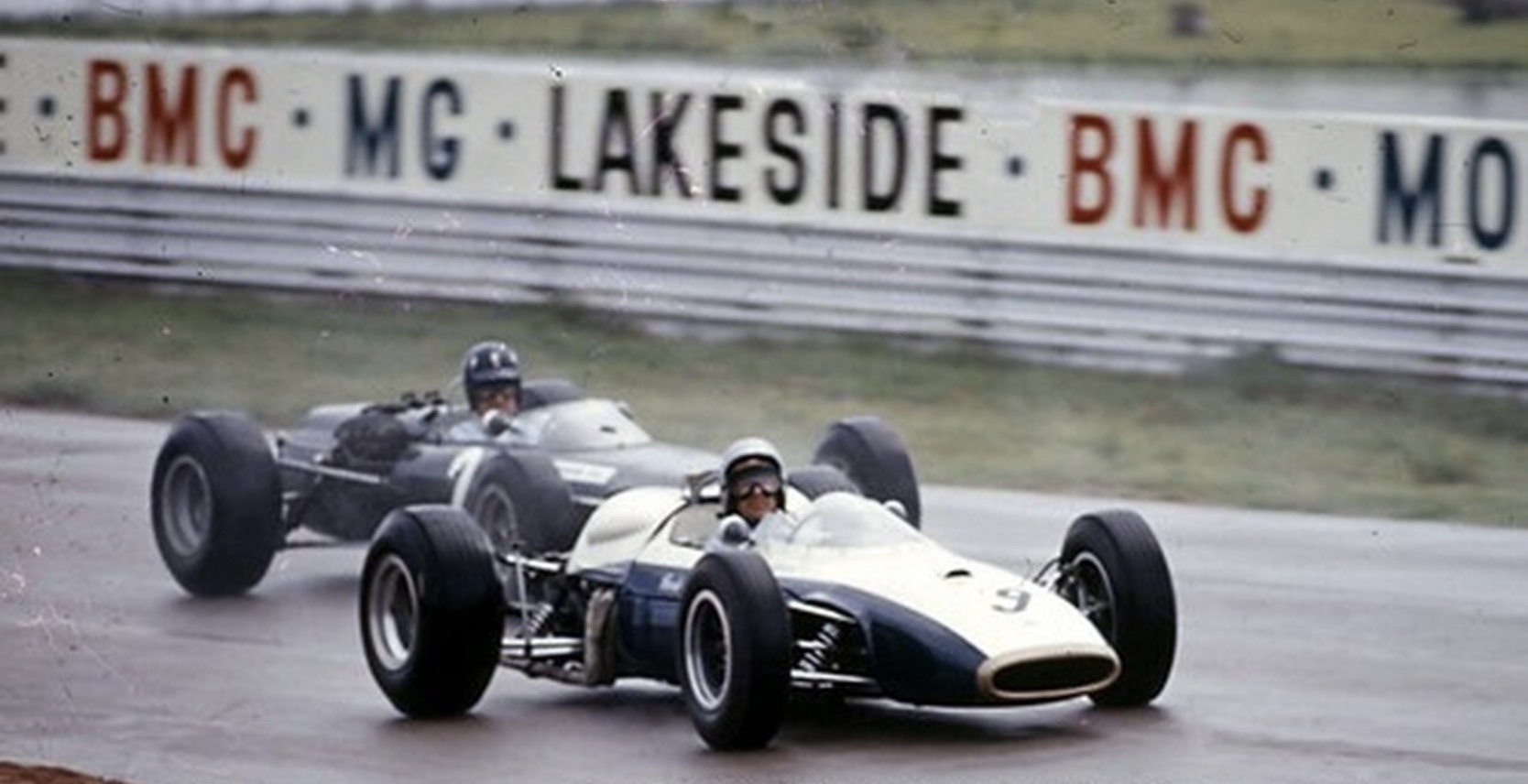
Jackie Stewart leads Jim Clark through Lakeside’s Eastern Loop during the 1967 Tasman round at the fast Queensland circuit on 12 February…

 You can just see that the lightly loaded right-front wheel of Jackie’s 2070cc BRM P261 V8 is off-the-deck. Jim is chasing him in Lotus 33 R14 powered by a 2-litre variant of Coventry Climax’s 1.5-litre FWMV V8 Climax built for Lotus to tide them over pending delivery of the BRM H16 engines they used in the 1966, the first 3-litre GP year. The Ford Cosworth DFV V8 arrived at the ’67 Dutch GP in the back of a Lotus 49 and changed the GP world of course.

Stewart was the reigning Tasman Champion, BRM cleaned up in 1966 winning seven of the eight races – Jackie won four, Graham Hill two and Dickie Attwood one.

It was a lot tougher in 1967.

Lotus put to one side the 2.5-litre Coventry Climax FPF four cylinder engines they had previously used in their Tasman cars and used the F1 33 powered by the Climax V8, creating a very competitive mount despite giving away 500cc to some of the competition.

Jim finished all eight rounds and won five races including three point-scoring events. Jack Brabham’s Brabham Repco 640 Series V8s driven by he and Denny Hulme were also fast but had poor reliability. Jackie took two wins in 1967 for second in the series but was well behind Jim.

The BRMs were still very competitive in 1967 but the final increase in capacity – and resulting power and torque proved a bit too much for the transmission. BRM suffered gearbox problems in ’67 with the 2070cc variant of the P56/60 V8, they had not experienced with the 1930cc version used the year before.

image

(HRCCT)

The photo above shows the pair again, this time with Clark in front of Stewart during the final 1966 Tasman round at Longford, Tasmania on 7 March.

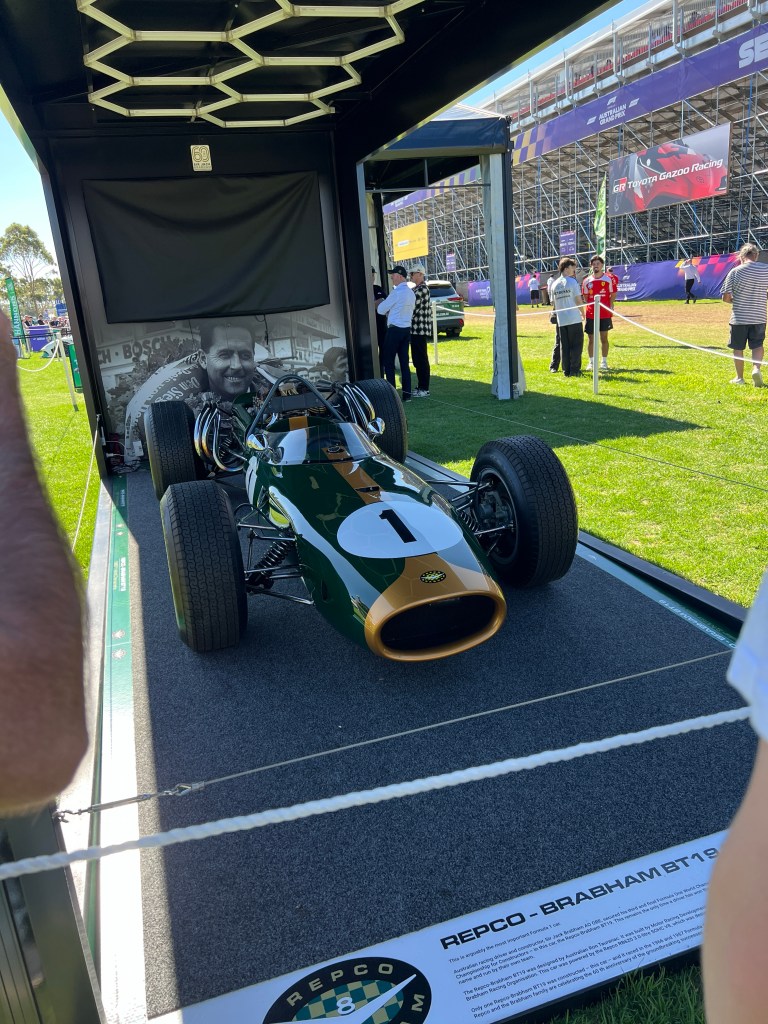
There Jackie won from teammate Graham Hill, Jack Brabham’s Brabham BT19 Repco third. It was the Brabham Repco V8 combination’s third race, by the early European Grands Prix the 1965 BT19 chassis and Repco 620 Series V8 was finding ultimate race and championship winning pace and reliability.

Clark’s 1966 Tasman Lotus was the 39 Coventry Climax FPF, he took one round win it at Warwick Farm.

I wrote an article a while back about the ’67 Tasman and the seasons of Clark, Stewart and Hulme, see here; https://primotipo.com/2014/11/24/1967-hulme-stewart-and-clark-levin-new-zealand-tasman-and-beyond/ This article on the P56 BRM V8 may also be of interest; https://primotipo.com/2016/02/05/motori-porno-stackpipe-brm-v8/

Credits…

Brier Thomas, Historic Racing Car Club of Tasmania

Finito…

(B Henderson)

Cripes! Move. My clutch! My water temperature!

Look a bit closer, the Formula 3 car caught in the 1969 Monaco GP traffic is being towed by the Simca in front. I love the creativity of Bryan Henderson’s shot, a Scot who emigrated to Sydney, Peter Houston tells me he was a Formula Vee racer in the mid seventies, he plies his trade as Scanpix.

Bryan recalls, ‘The 1969 Monaco GP was my first F1 race, i had just arrived to pursue a career as a freelance photographer and jumped on a train down to the south of France to catch the race. I remember taking the photo of the car in the traffic, I was waiting to cross the road and there was the open-wheeler in my way! I was able to get the shot as it drove away.’

So, who is it?

F2 Index to the rescue. My guess as to the number is 50, 52, 58 or 59! #50 was Bernard Plaisance who raced an Ecurie Tecno France, Tecno 69 Ford, DNQ. Car 52 did not arrive, so let’s cross him off. #58 was Peter Hanson’s Chevron B15 Ford DNQ and #59 was Roger Keele, EMC F3 Ford, he was eighth in the race won by Ronnie Peterson’s Tecno 69 Ford. I’m going for Bernard, he’s French, the other two blokes are British so would probably have a Pommie registered tow car…

I’ve chosen a few other Henderson shots which are a bit different from the average, the first is Vic Elford heading up the hill from Ste Devote in his Cooper T86B Maserati.

(B Henderson)


(B Henderson)

The next one is Jackie and Helen Stewart walking down the hill towards Ste Devote, JYS even has a bag-man, who is the guy, he looks familiar?

How great would it have been to have attended the race then, plenty of challenges too that weekend, high wings were banned after the Thursday session by the CSI so the shot of Jo Siffert’s Rob Walker Lotus 49B Ford sans wings is probably on the Friday, by Saturday front wings were back.

(B Henderson)

Credits…

Bryan Henderson at Scanpix.com.au

(B Henderson)

Denny Hulme’s McLaren M7 Ford on Pit Straight, perhaps a Matra ahead, classic Monaco shot with that home made fence in the foreground!

Finito…

(R Bell)

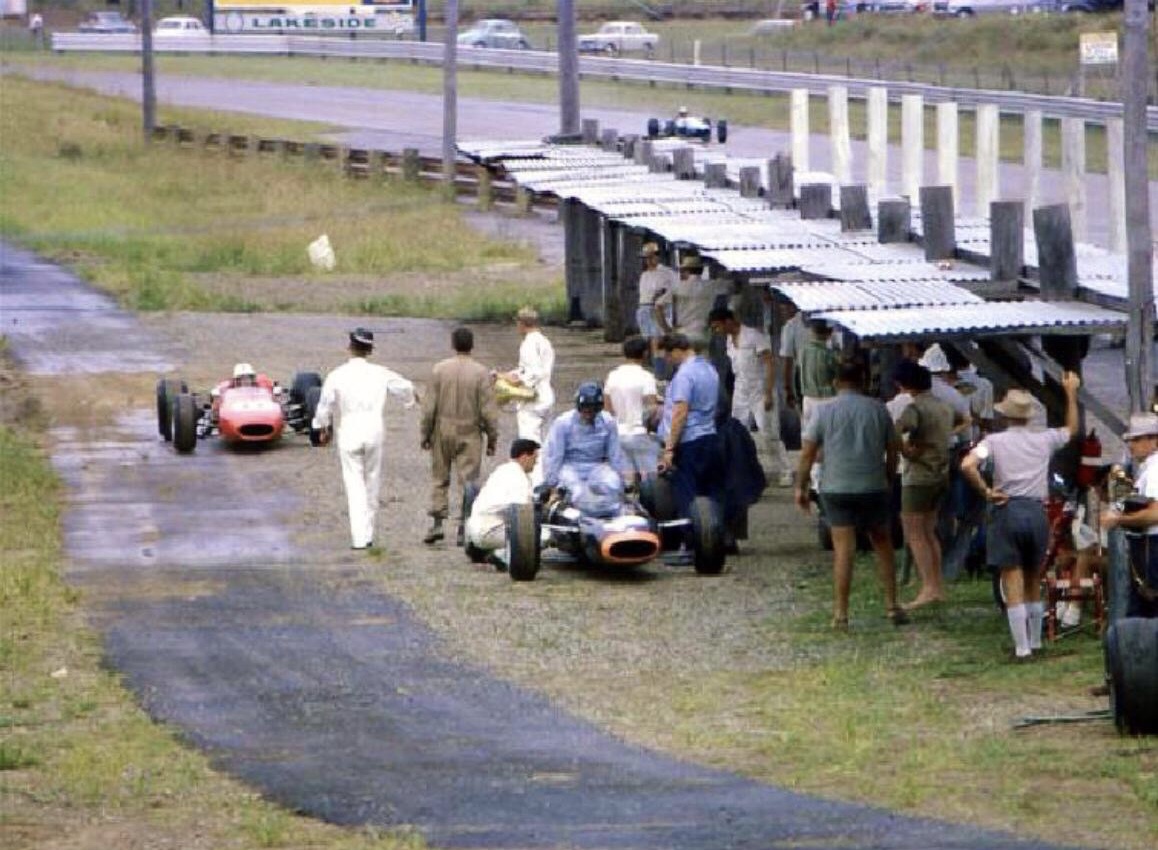
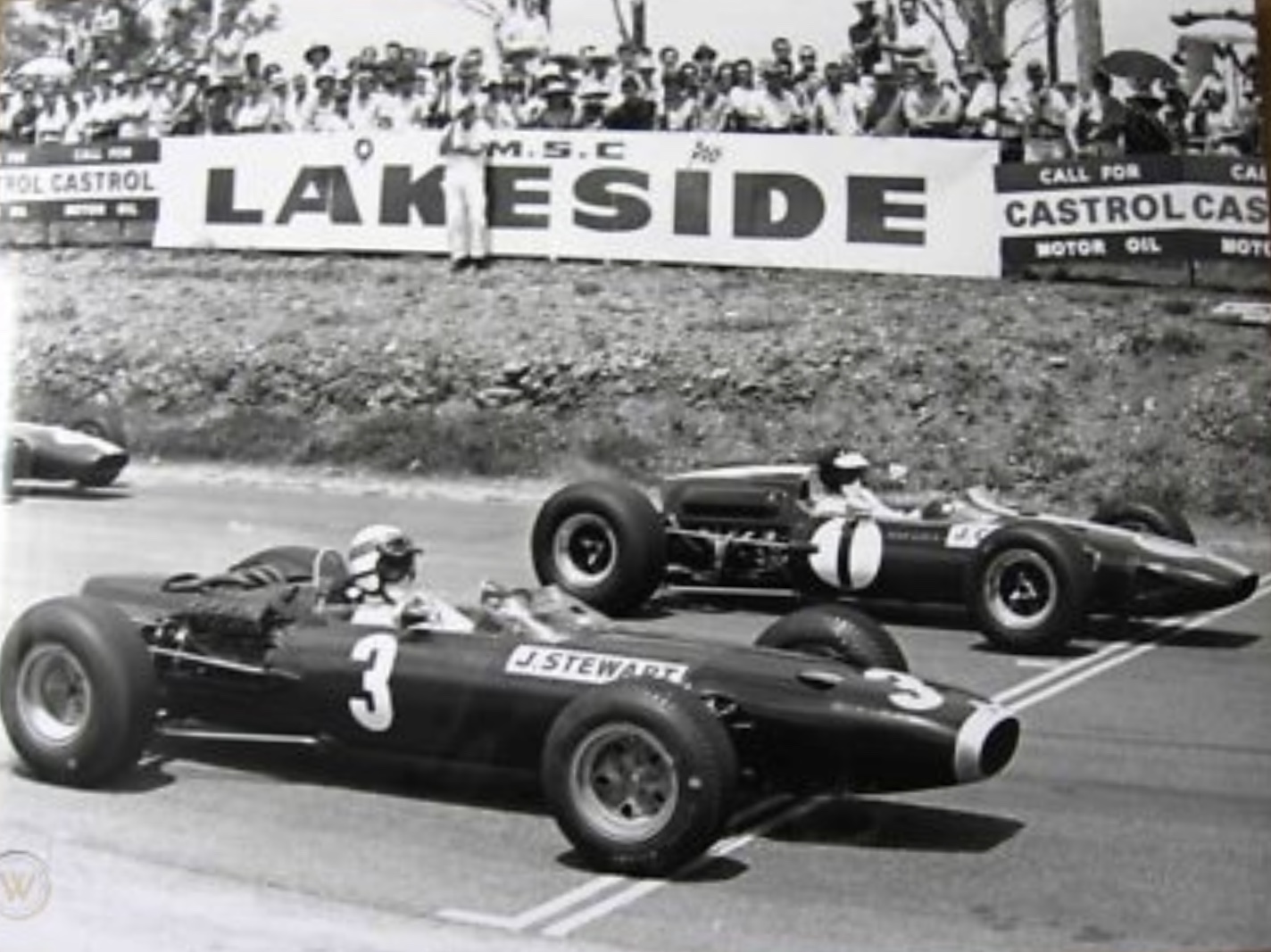
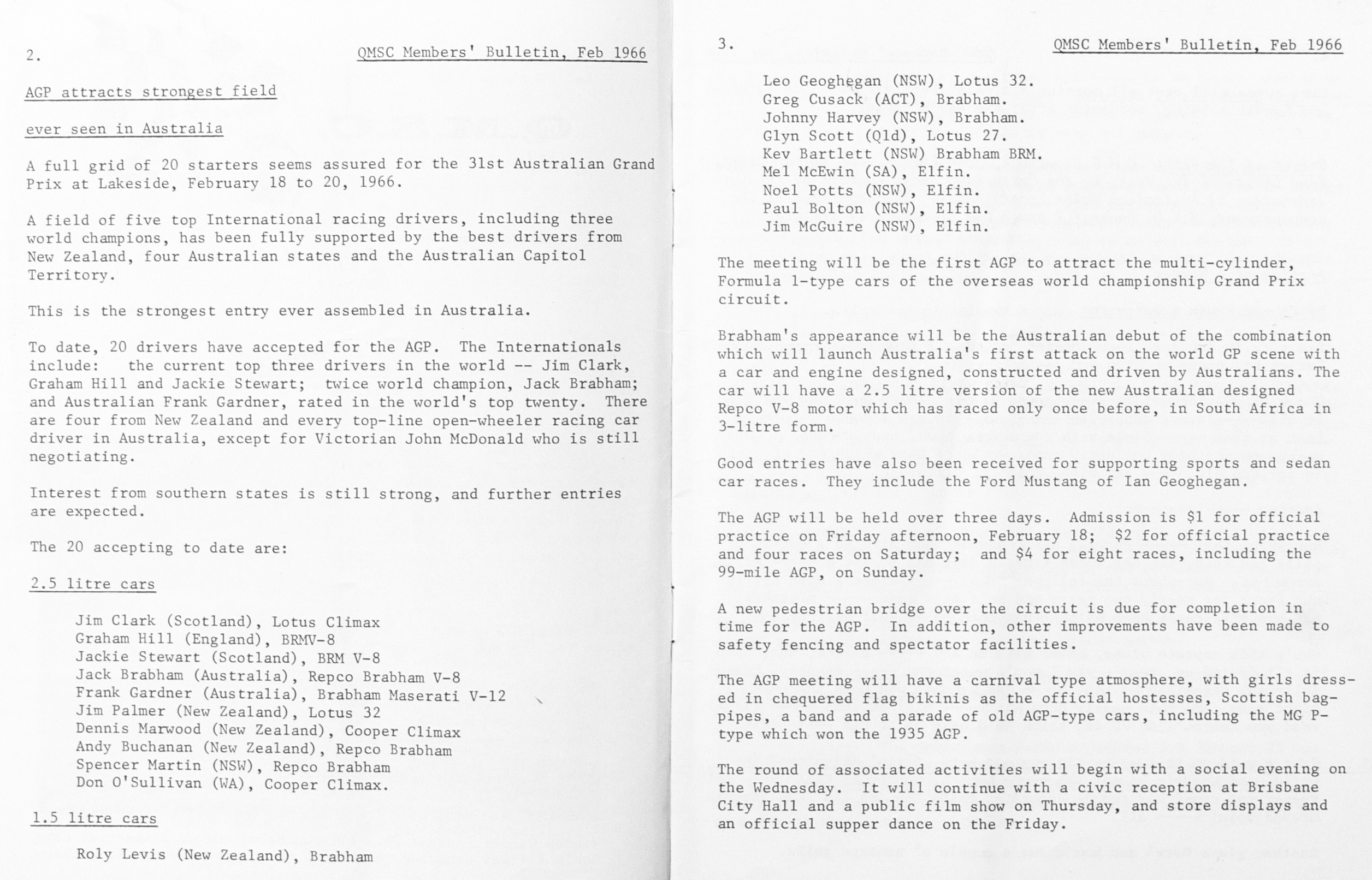
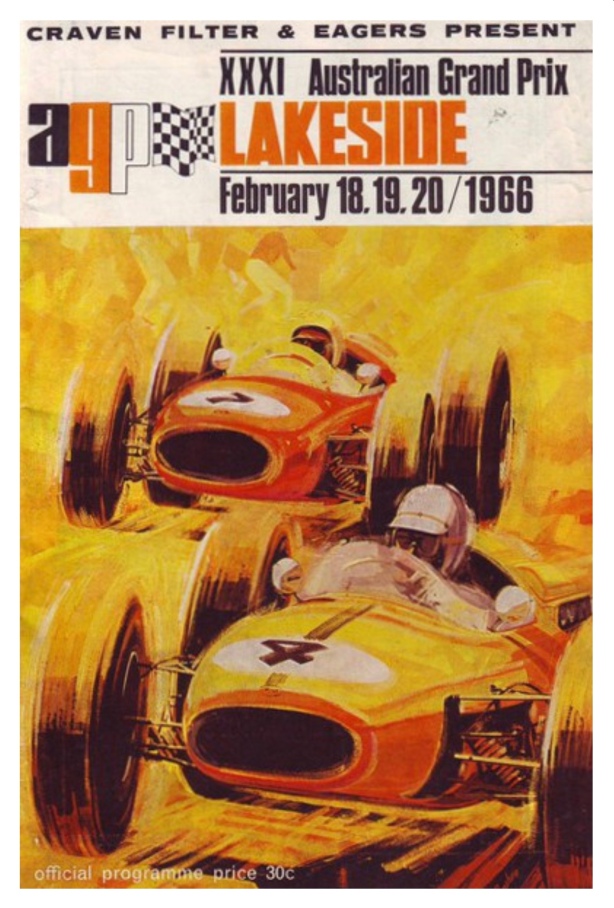
Stewart, Hill, Clark, yellow nosed black bodied Gardner, Palmer looking like Clark, Martin in red and Geoghegan white- BRM P261 by two, Lotus 39, yellow nose Brabham BT11A, Lotus 32B of Palmer, red Brabham BT11A of Martin (all but the BRM’s Coventry Climax FPF powered) and Leo’s white Lotus 32 Ford. AGP- the off 20 February 1966 and what a marvellous vista Lakeside is…

The front row of the grid pretty much summed up the 1966 Tasman Cup, the two BRM P261’s driven by Hill and Stewart, two of the finest racers of their time were the class of the field powered by 1.9 litre versions of the ‘P56’ V8’s which won so many races during the 1961-1965 1.5 litre F1, they were quickest cars on the circuit throughout the weekend right from the first session on Friday having recorded laps of 55.5 and 55.8 for the Brit and Scot repectively.

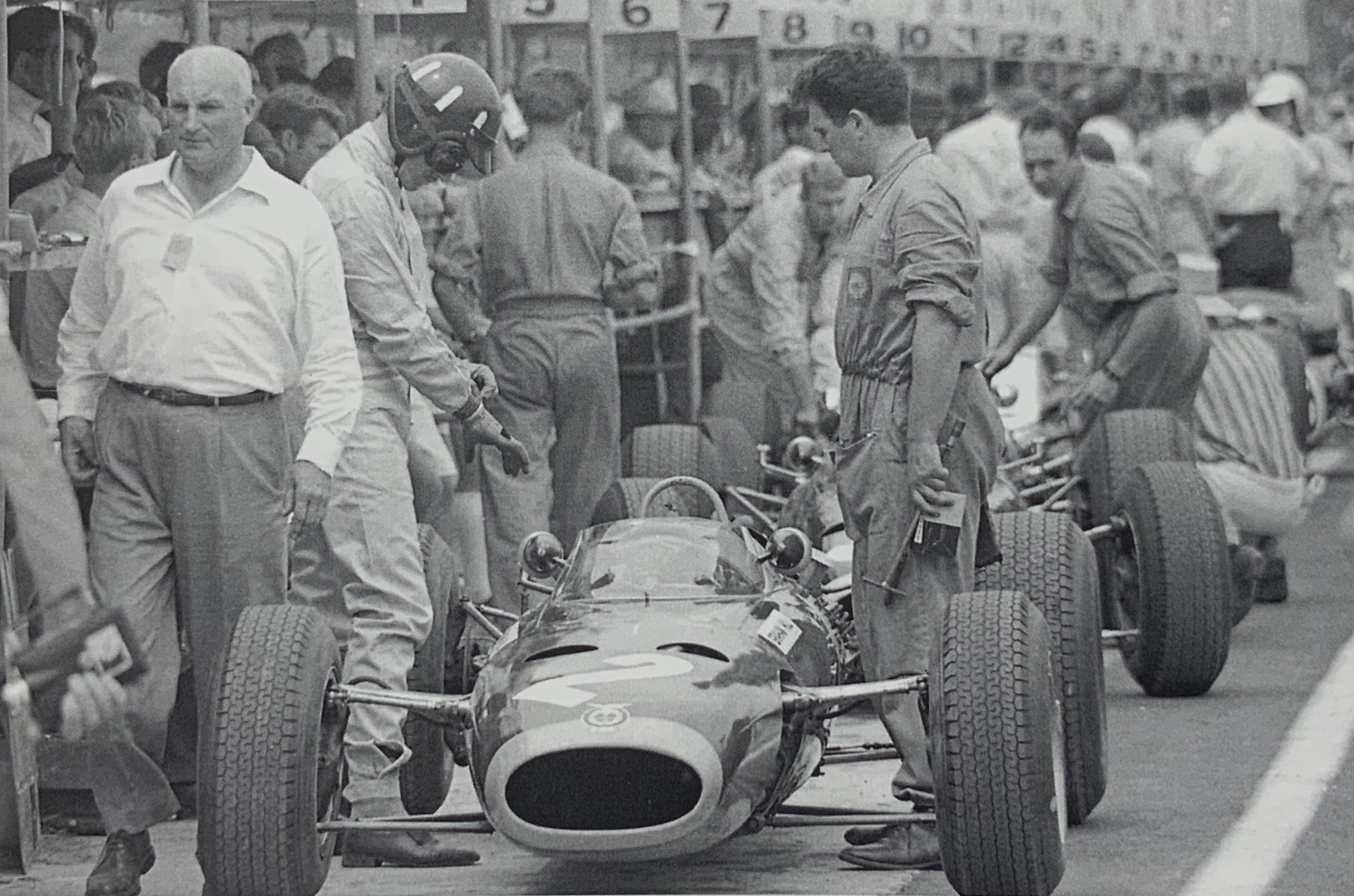
Much of the pre-race press interest centred on the strong BRM presence which included three chassis ‘Graham Hill driving the same car with which he won the 1965 Monaco and US Grand Prix’ and a team of three mechanics, Rivers Fletcher doing public relations all led by Team Manager Tim Parnell- lets come back to BRM’s Australasian representation in a little bit.

Lakeside razzmatazz included girls dressed in chequered flag bikinis, a bagpipes group and a brass band in addition to the on-circuit attractions which included international drivers Clark, Hill, Stewart and Gardner.

David Harding, secretary of the Queensland Motor Sporting Club, quoted the total value of the cars at $A300,000…

Stewart had a huge points lead going into the Lakeside meeting with much expected of Clark after his first win of the series at Warwick Farm the week before.

In New Zealand Graham Hill showed BRM’s form early, winning the opening round, the NZ Grand Prix at Pukekohe on 8 January by 1.5 seconds from Stewart, in P261 ‘2616’ before returning home to the UK to continue tyre and other testing duties. He travelled back south arriving at Mascot for the first of the Australian races, the ‘Warwick Farm 100’, on 13 February.

Richard Attwood won at Levin the following weekend after Stewart had gearbox selector problems having completed 9 laps- Jim Clark was second and Spencer Martin third, Jackie Stewart continued the Bourne boys great form and won the Lady Wigram Trophy at the Wigram RNZAF base the following weekend of 22 January.

Stewart completed a clean sweep of the first four races for the P261 before crossing ‘The Ditch’- the Tasman Sea for Australia- Jackie won the Teretonga International from Frank Gardner and Jim Palmer- the latter had a great season of speed and reliability in the Lotus 32B chassis aboard which Clark took the Tasman Cup twelve months before.

Teretonga wasn’t such a great race for Dick Attwood, as his car ‘2617’, was tagged from behind in the first corner ‘The Loop’ into soft earth whereupon the it rolled trapping the hapless Brit underneath- Spencer Martin and local driver Ian Dawson, also involved in the melee, jumped from their Brabhams and helped marshalls right the car and release the driver.

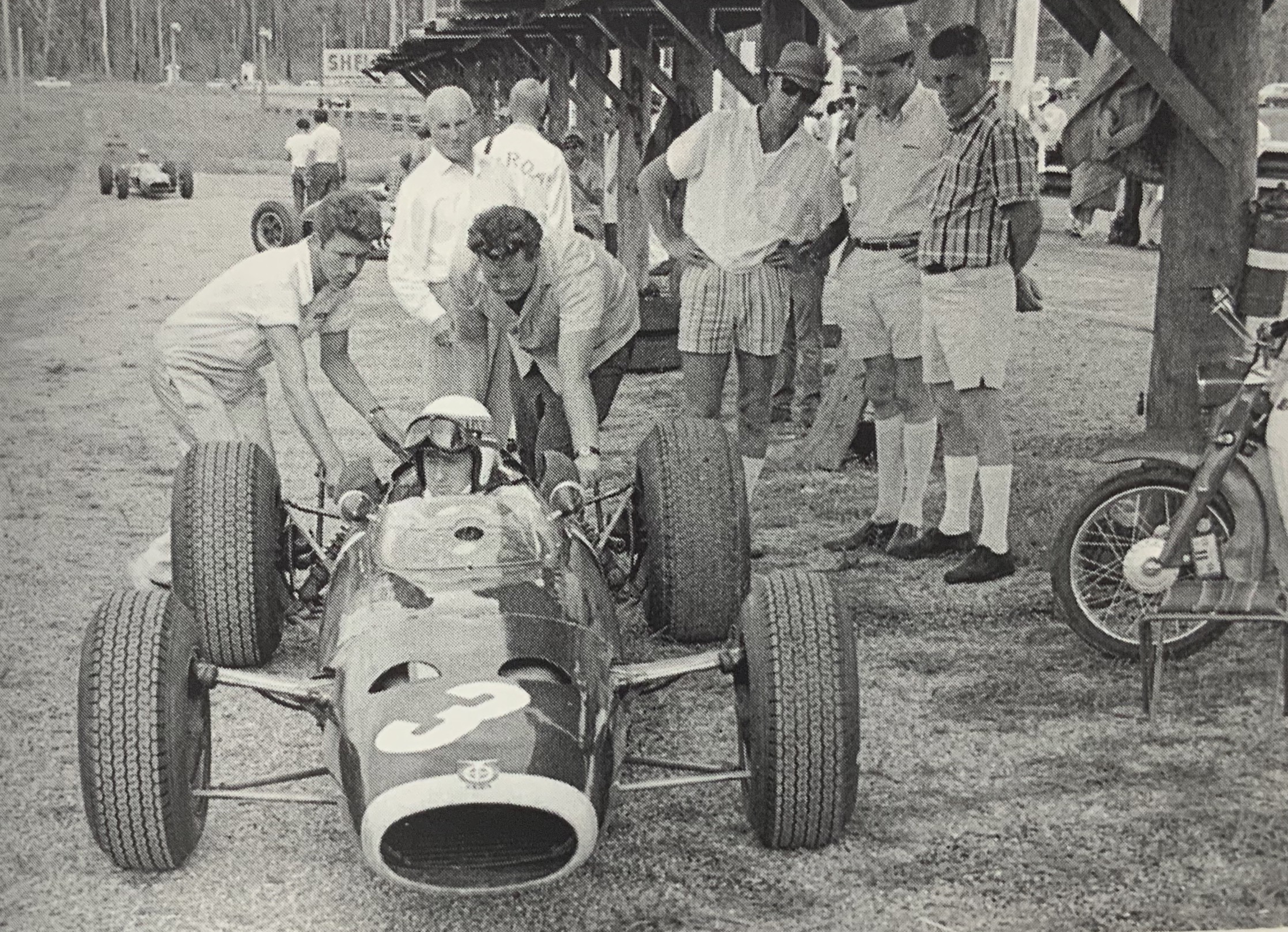
In fact a ‘switcheroo’ in the cars of Jackie and Richard took place at Wigram. Attwood had his ‘2614’ going like a missile in practice thanks to some judicious testing of bars, tyre pressures and ride-heights with Alan Challis, at which point, Jackie, getting the hang of this Number One Driver caper in Hill’s absence said ‘I’ll have a crack in that’- and so he did winning The Lady Wigram Trophy’ in ‘2614’ the following day.

He kept the same car at Teretonga so the machine, the front bulkhead of which was badly bent, was off for a rebuild to Bourne. It was the car Jackie had raced throughout the 1965 F1 season- ‘2617’ the strength of which would save his life at Spa in mid-1966. We will come back to the individual chassis’ later in the article.

Whilst the drivers flew to Sydney on the Monday after Teretonga Tim Parnell supervised the shipping of ‘2614’ and ‘2616’ to Sydney whilst ‘2617’ headed back to Liverpool, and thence Bourne into the tender hands of the boys in the build shop.
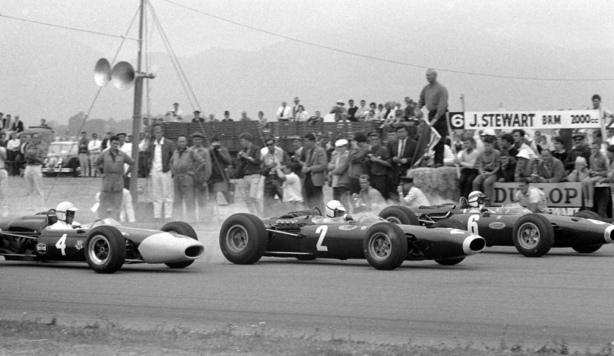
Gardner at left, Attwood, Stewart- Brabham BT11A and two BRM P261s- the off at Wigram 1966. Stewart won from Attwood and Jim Palmer with Frank a DNF after an accident on lap 4 when his brakes failed and he cannoned into Jim Clark, taking them both out of the race (Wigram)
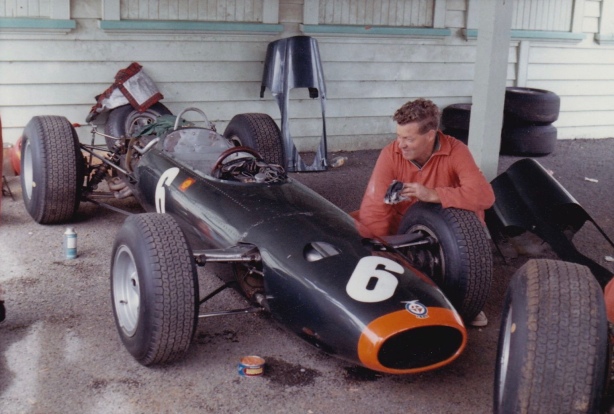
Under the Tote building, Pukekohe. JYS’ P261 chassis ‘2617’, in all of its elegant glory, 1966. Which of the BRM mechanics is it folks? The car is fitted with a P56 type 1930cc engine- inlets between the Vee and exhausts exiting thru the ‘letterbox’ orifice in the side of the monocoque, in BRM speak. Note the colour of the car, red nose band, big BRM badge and air relief ducts atop the nose and tail section leaning up against the wall (CAN)

At Warwick Farm Jim ran away and won by 21 seconds from Hill, Gardner, Stewart, Martin and Palmer, click here for a piece on that meeting; https://primotipo.com/2018/07/03/1966-warwick-farm-100/

Clark had carburetion problems with his 2.5 litre Coventry Climax FPF engine throughout the Lakeside weekend but still managed to pop the car onto row two of practice on the two by two car grid together with Frank Gardner’s similarly powered Brabham BT11A. The Lotus 39 was another mighty car from the Lotus 25/33 continuum but the good ole FPF was struggling a bit from 1966 given the entry into Tasman racing of the BRM and Repco V8’s.

Spencer Martin in the Scuderia Veloce BT11A, and Leo Geoghegan going like a jet in his Lotus 32 was the first of the ANF1.5 twin-cams, a mighty impressive performance on this power-fast-100mph lap average circuit.

Jim Palmer and Greg Cusack shared the next row and the rest- Bartlett, McDonald, Harvey, Andy Buchanan Denis Marwood, Mel McEwin and local boy Glynn Scott rounded out a small field after ‘CAMS cut the grid from 20 to 15 cars’ in the interests of safety.
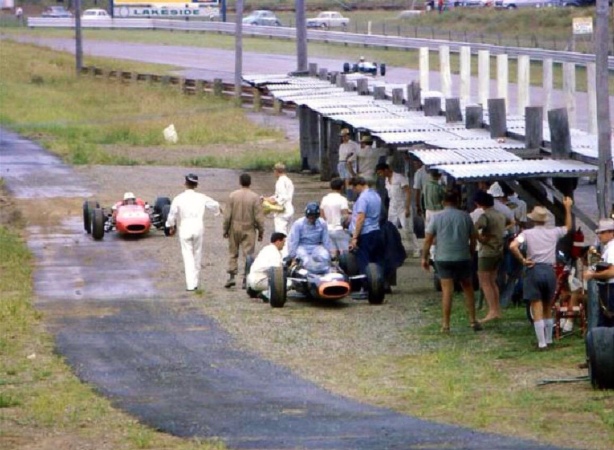
Graham Hill alights his BRM whilst Spencer Martin’s Brabham BT11A Climax enters the paddock- Glynn Scott, Lotus 27 Ford twin-cam 1.5 approaches in the distance. This is the damp Saturday afternoon session (K Drage)
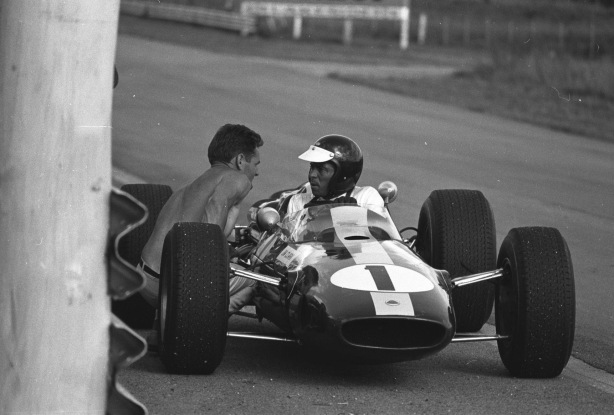
Magnificent photograph of mutual respect and affection, racer/mechanic Ray Parsons and Jim Clark ponder the next change (B Thomas)
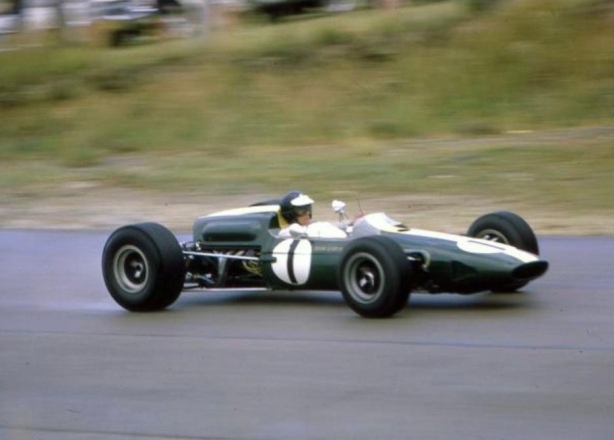
Clark in the very sweet Lotus 39 Climax on Saturday afternoon in the wet- exiting The Karussel (K Drage)
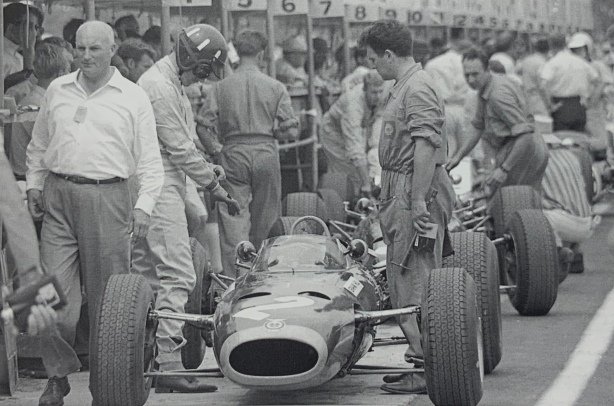
Lakeside 20 February 1966. Dunlop’s Vic Barlow at left, Hill suiting up and ‘Dobbin’ Challis beside Graham’s ‘2616’ whilst Jimmy Collins and Stan Collier look after Jackie’s ‘2614’ behind (BRM 3)

Sunday dawned cloudy and hot, the crowd got a magnificent days motor racing on this, the first occasion Lakeside held an AGP, for their four-dollar entry fee!

In addition to the feature race there were two 10 lap heats for the Tasman cars both won by BRM- Hill won the first from Gardner and Martin and Stewart took the second from the Clark and Geoghegan Lotuses.

Stewart and Hill settled into their front row grid slots and howled away from the off- Stewart, Hill, Clark and Gardner led the high speed train, then Martin, Palmer and Geoghegan.

Cusack got by Geoghegan on lap 5 with ‘Hill tied to Stewart as if by string’, Stewart set a scorching pace from the start, thrilling the crowd, despite this Hill was close behind and always within striking distance.

The race developed into three tough fights between Stewart and Hill up front, then Clark just ahead of Gardner and then a flying wedge of Palmer, Cusack and Geoghegan.

’The race pitch at this point had the crowd running from vantage point to vantage point, a rare thing in open-wheel competition, and to really set the seal on the excitement, the tail closed up and made a magnificent show as Marwood, Harvey, Buchanan, McDonald and Scott raced wheel to wheel’ Des White wrote in his HAGP race report.

Stewart’s gearbox cried enough on lap 28- it was this element of the BRM P261 which became its weak link at 1.9 litres and even much more so at the 2.1 litre capacity the Bourne team raced these cars in the 1967 and 1968 Tasmans.

’Stewart was very hard on gearboxes…Hill suffered persistent clutch slip in the last two races, but otherwise the BRM’s were very reliable. So they should have been too, with the massive Owen group effort which included a public relations man’ wrote Bill Tuckey. Bill is a bit hard on Jackie, the ‘box was the problem not JYS lack of mechanical sympathy.

Then Cusack clipped Palmer in the Eastern Loop when Jim braked a little early and Leo kissed Greg causing Cusack to spin and Geoghegan to re-enter the circuit 100 metres down the road- both retired with bent or busted suspension components shortly thereafter.
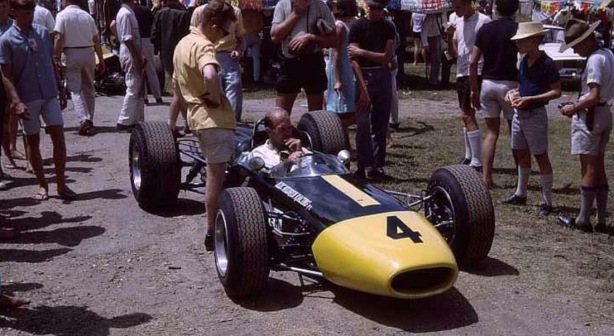
Frank Gardner in one of two Brabham BT11A’s Alec Mildren Racing raced that summer, Climax engined, the other was Maserati 2.5 V12 powered and ran in Warwick Farm and Sandown practice- pre-race hype promoted the Brabham Maserati at Lakeside but the car did not make the trip from Sydney (unattributed)
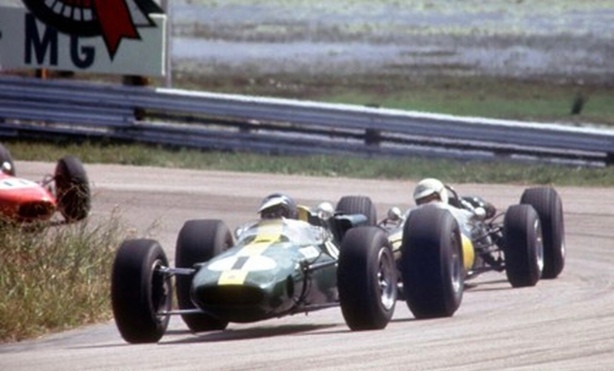
Jim Clark from Frank Gardner with Spencer Martin’s Brabham BT11A just back a bit- third, second and DNF clutch (autopics.com)
Frank Gardner was still pushing Jim Clark hard- he had a great summer in Mildren’s BT11A with better FPF reliability than some- but FG was mighty quick too, i’m not implying his results were solely due to reliability. Then Jim’s Climax took a turn for the worst- losing its edge further so Frank was through to second from Hill up front- Hill won at an average speed of 94.9mph from Gardner, Clark and Palmer.

Hill and Stewart both did equal fastest laps of 55.9 seconds- one second adrift of Clark’s 54.9 second lap record set in the Lotus 32B the year before. Kevin Bartlett’s Alec Mildren Racing Brabham BT2 Ford was the first of the ANF1.5s home in another drive which convinced Mildren KB was ready for the step up into the more demanding 2.5s- something he did with great aplomb later in the year.

Clark’s carburetion problems persisted throughout the series and were solved by John Sheppard when the car passed into his care after Leo Geoghegan acquired it by the simple expedient of solid carburettor mounts.
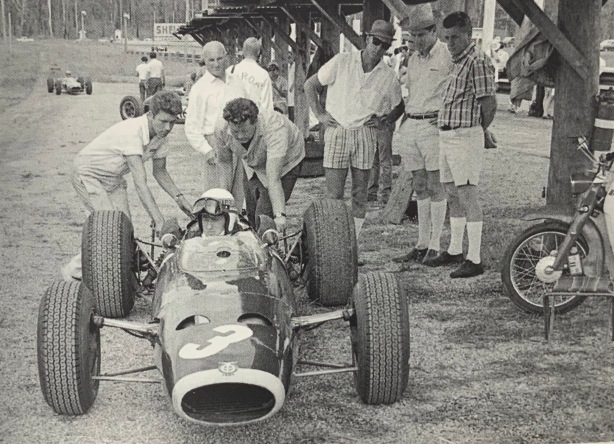
Jackie fires up the now ‘Central exhaust’ P68 powered ‘2614’ before heading out of the Lakeside paddock. Jimmy Collins, Vic Barlow and Tim Parnell watched by a group of local enthusiasts (BRM 3)
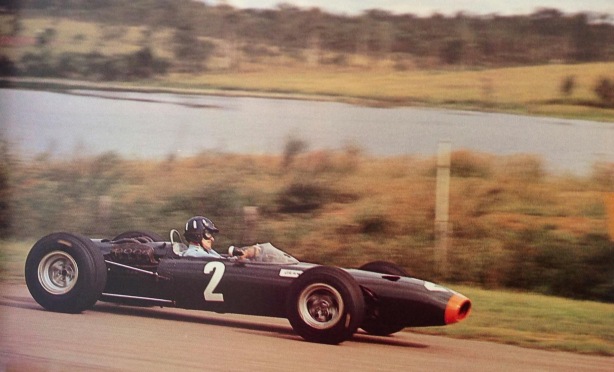
(HAGP)

Graham Hill nose up at Lakeside in a car that was so kind to him- the BRM P261, a machine with which he was synonymous, not the BRM he used to win his 1962 World Title but one he raced from 1963 all the way into 1966 with the H16 BRM P83 duly recognised.
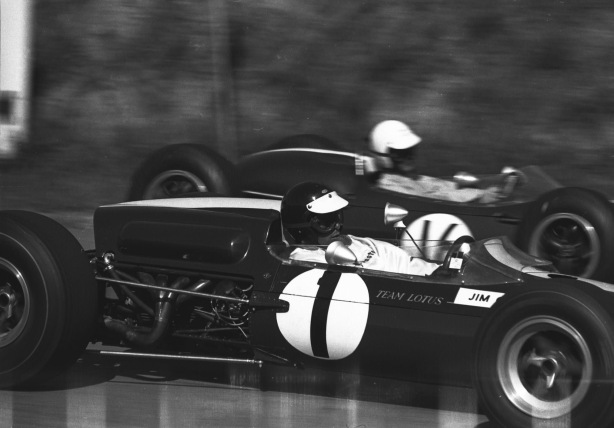
(B Thomas)

Jim Clark with Andy Buchanan on the outside, Brabham BT7A Climax, who finished seventh.
BRM and The Antipodes 1966…

The Owen Organisation had extensive business interests in Australasia (it would be interesting to create a list of the British transnational’s subsidiaries in this part of the world at the companies height) and had of course raced here before- Ken Wharton thrilled Kiwi crowds in a P15 V16 in 1954 at Ardmore and Wigram and Ron Flockhart did all of the NZ Internationals in a front-engined P25 in 1959 whereas the 1961 campaign was a full works representation of two P48 mid-engined 2.5 litre F1 cars- these were raced by Graham Hill and Dan Gurney and on this occasion the visitors came to Australia as well as New Zealand. See here; https://primotipo.com/2019/11/18/ken-wharton-and-brms-grand-turismo-south-in-1954/ and here; https://primotipo.com/2018/03/16/bourne-to-ballarat-brm-p48-part-2/

The local promoters led by Ron Frost (NZ) and Geoff Sykes (Oz) had been doing their job in trying to seduce BRM back here and had a ‘red-hot go’ for 1965 given by that stage BRM had an 1880cc ‘P60’ version of their P56 V8, it was thought the P261 so powered would have been competitive with the 2.5 litre (mainly) Coventry Climax engined ‘Tasman Special’ Brabhams and Lotuses.

In essence Tasman races were 100 miles and had no minium weight limit whereas GP’s were 200 miles in duration and the cars had minimum weight limits so Ron Tauranac’s ‘Intercontinental’ Brabhams, for example, were designed and built to the Tasman formula or rules. Tony Rudd, backed by Graham Hill, felt the P261 at 1880cc would not be a competitive Tasman Cup mount in that the cars would be too heavy and not powerful enough- underlying their opposition (in a document reproduced by Doug Nye in BRM 3) was the (correct) belief that the Tasman program would detract from their 1965 F1 program in the same way Sir Alfred Owen’s BRM-Rover turbine Le Mans racer grabbed scarce resources in 1963 and 1964- it too was foisted upon Rudd and ORO (Owen Racing Organisation) at short notice.

However, in late 1965 Sir Alfred was resolute, the broader commercial needs of the Owen Group (the establishment of an Austin-Morris production facility in NZ, with Owens to provide the necessary components) were met by having ORO’s presence in the 1966 Tasman Cup and as a consequence the team had to ‘make it work’ despite being up to their armpits in the new for 1966, immensely complex, BRM P83’s H16 engine.
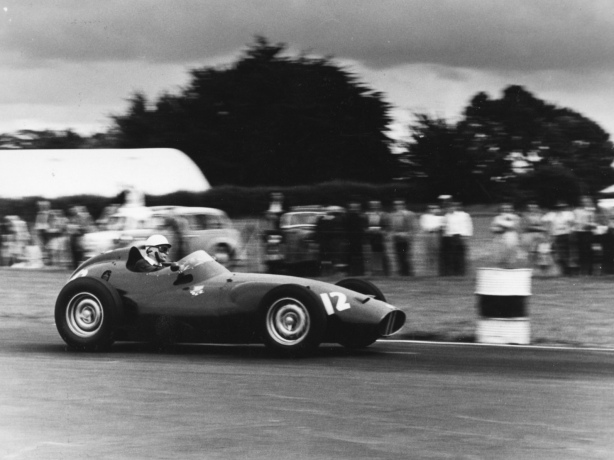
Ron Flockhart, BRM P25 during the 10 January 1959 NZ GP on the Ardmore airfield circuit- DNF oil leak, the race won by Stirling Moss’ Cooper T45 Climax FPF 2 litre (Ardmore)
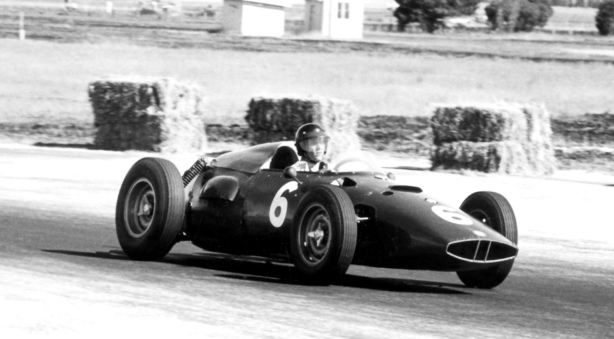
Dan Gurney on the way to the BRM P48’s only International win, the Victorian Trophy at Ballarat Airfield, Victoria 12 February 1961 (unattributed)

Geoff Johnson and his engine design team squeezed the P56 V8 up again from 1880cc to 1916cc and then 1930cc- the latter became the definitive 1966 Tasman spec engine used throughout that summer.

These motors gave between 260 and 270 bhp, which despite the weight of the P261 chassis, was more than enough to trump the circa 240bhp ‘Tasman Specials’. These motors and P61 Mark 2 chassis ‘2616’ Graham’s regular 1965 F1 car first raced to a win by him upon its debut at Watkins Glen in 1964, Jackie in his normal ‘2517’, the last P61 built during the winter of 1964-5 for JYS debut season, and old ‘2614’, first raced by Graham in the 1964 Aintree 200 and used as the team spare throughout 1965 were sent to New Zealand on the SS Tasmania Star which left Liverpool on 29 November and arrived in Auckland on 23 December.

Of interest is that ‘2616’ lives as does ‘2614’ whereas ‘2617’ whilst destroyed and scrapped after Jackie’s death defying 1966 Spa crash was recreated for Richard Attwood as ‘2617R’ in the late nineties- a lovely bit of symmetry given Richard rolled it at Teretonga in 1966 when he was part of others ‘moment’. Finally, for the record, a total of one P61 Mk 1 was built, chassis ‘611’ and six P61 Mk 2’s- chassis ‘2612’ to ‘2617’. The P61 Mk1 ‘611’ was scrapped in 1963 but all of the P61 Mk2’s live, thank goodness.

Despite broken ring problems in testing at Bourne, with a very careful running regime when a motor was first used which involved abnormally large amounts of engine oil in the fuel- the motors proved very reliable throughout that summer- a bonus for Team Manager Tim Parnell and the mechanics- Allan Challis, Jimmy Collins and Stan Collier, the later seconded by Parnell.

One of the compromises made to meet the needs of preparation for the new 3 litre F1 as well as being competitive in Australasia was the appointment of Tim Parnell as Team Manager and secondment of Stan Collier into the ORO group for the trip rather than Tony Rudd and another BRM mechanic make the trip.

Son of Reg- Tim was a racer to the core who had stepped very ably from the cockpit to running his fathers F1 race team upon Reg’ sudden death in January 1964 and was well known to BRM as a customer using BRM V8’s and cars for some years.

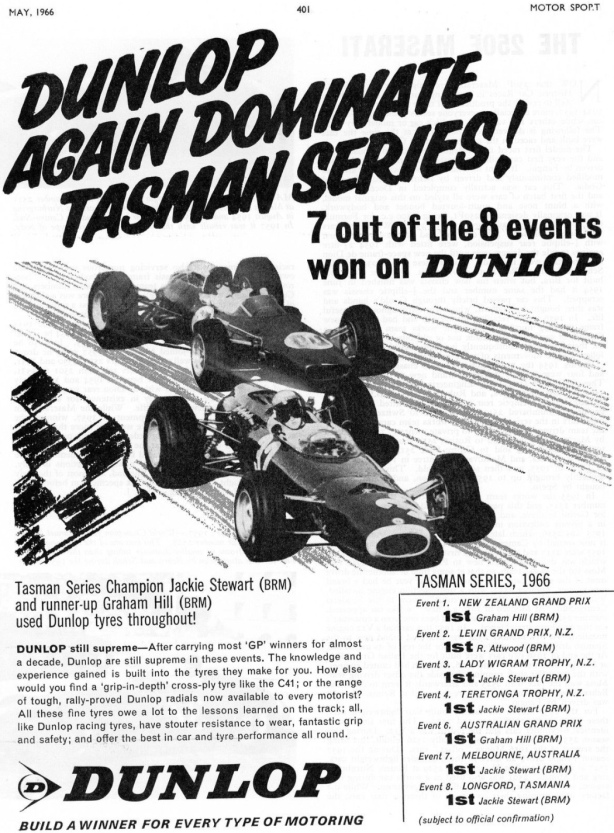
And so the scene- cars, engines, drivers, technicians and team management were put in place for an immensely successful summer in competition and commercial terms- seven of eight championship rounds and nine of ten races won with the Tasman Cup secured by Jackie Stewart bolstering even further BRM’s ‘cub’ drivers confidence who had already won his first GP in his first F1 season of 1965 at Monza no less.
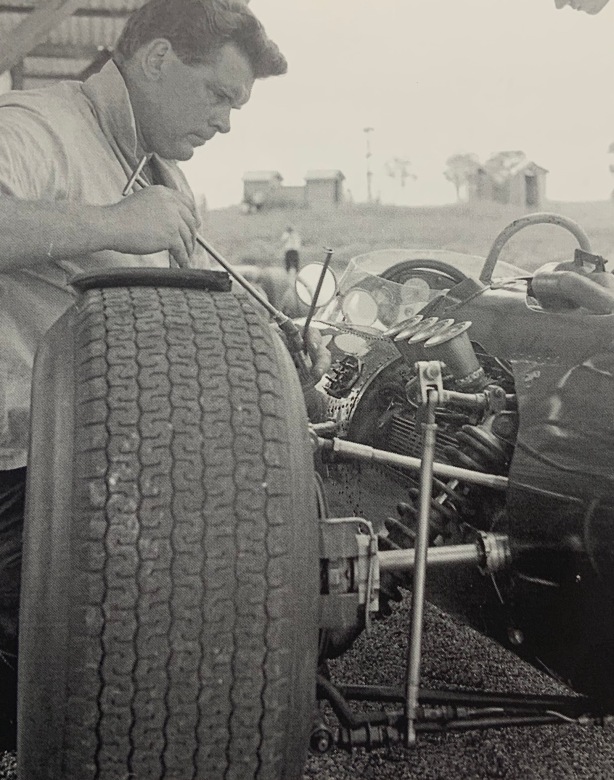
‘Technical Tim- plug changing on Graham’s ‘2616’. Very popular, avuncular Tim had spent his entire life in racing and farming- thanks to his father- former BRM V16 driver and pig-breeder Reg Parnell. Tim had been a racing driver before his father’s untimely death in 1964, whereupon he had taken over full-time management of Parnell Racing’ wrote Doug Nye (BRM 3)
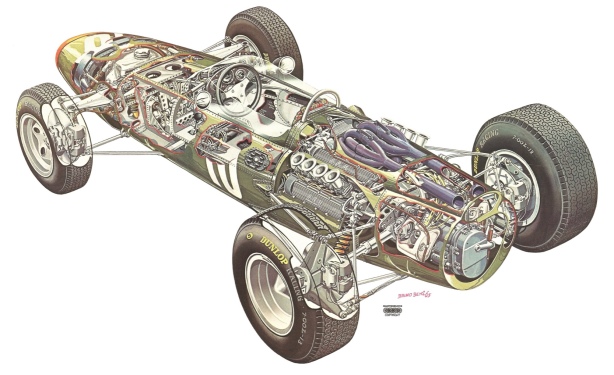
(B Betti)

BRM V8 Engine Types/Designations…

I wrote an article about the ‘Stackpipe’ BRM P57/578 in which Bourne and Graham Hill won their 1962 titles and covers the P56 engine in a bit of detail which still stacks up ok, see here; https://primotipo.com/2016/02/05/motori-porno-stackpipe-brm-v8/

It is a bit wanting in terms of the ‘P56’ engine derivatives though, so, having picked over ‘BRM 3’ Doug Nye’s treasure trove of all things Bourne here is a summary of the motors if for no other reason than to provide myself a simple list to refer to the next time i tangentially cover this amazingly, long lived series of race engines.

‘P56’ 1.5 litre V8

Initial design as per the link above- 68.5mm bore and 50.8mm stroke for 1497.7cc. DOHC gear driven two-valve Lucas injected with ‘conventional’ cross flow disposition of inlet and exhaust valves

The engines first drawings of 300 in total were issued in January 1961, the first batch of components received in April 1961, assembly of the engine commenced that June with the first one fired up on 12 July 1961

170bhp was produced by the end of August with the engine first tested against the competition at Monza over that tragic September weekend. Racing began in 1962 with the ‘Stackpipe’ exhausts fitted- 185bhp

Ongoing development gave rise to the 195bhp ‘Monza’ spec which won the 1962 championship

For 1963 a single plane crank version was developed, this allowed the use of a coupled exhaust system which gave the engine a broader power band- with development this produced 205bhp

‘P60’ 1.9 litre V8 1964

1880cc engine developed at Richie Ginther’s suggestion for the 2 litre sportscar class in the US, in original form it produced 240bhp
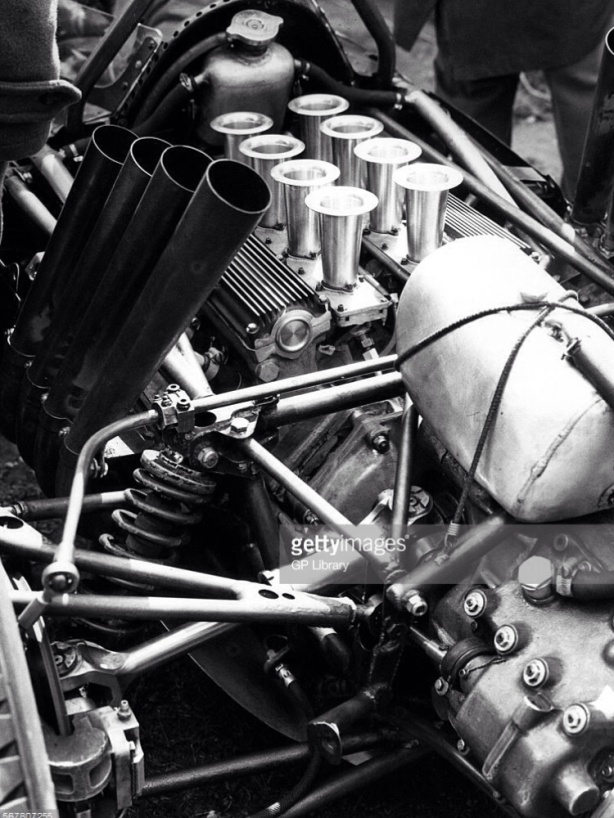
P56 1.5 litre V8 ‘Stackpipe’ nestled in one of Graham Hill’s P57/578 chassis during 1962
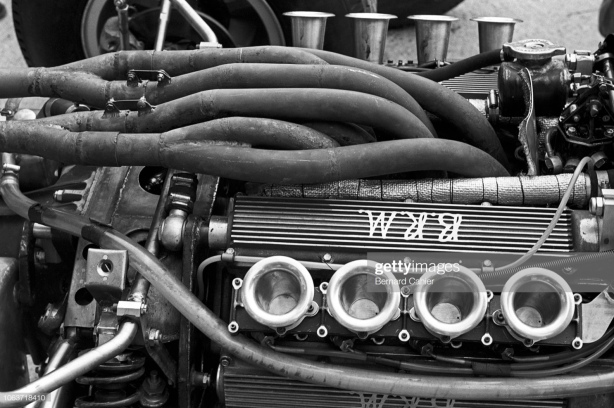
P68 1.5 V8 in the 1964 Monza paddock

‘P68’ 1.5 litre V8 late 1964

Between the Vee exhaust layout- exhaust ports in the Vee, inlets located between the cam-boxes. The space around the engine was unobstructed by exhaust pipes which allowed a stiffer tub to be built and an extra 5 gallons of fuel to be carried

First appearance Monza 1964- first win at Watkins Glen- work over the winter of 1964-5 led to engines giving 215bhp

By the end of the 1.5 litre Formula the best of the engines gave 220bhp and weighed 264pounds

2 litre V8

1916cc and the ‘definitive’ 1966 Tasman engine of 1930cc in capacity

T56 variant gave 260bhp and T68 version 270bhp- both types were used in ORO’s successful 1966 Tasman campaign as close scrutiny of some of the photographs demonstrates

1998cc sportscar version for Matra in 1956 was P56 type with the taller P123 blocks. Fitted to MS620 coupes- these engines with alternators etc designated P100
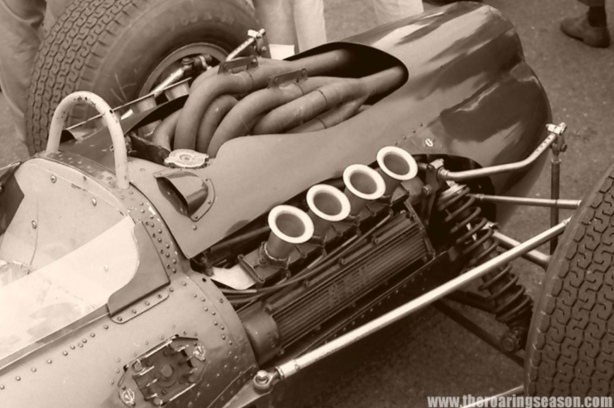
One of the P261’s in the Warwick Farm paddock in February 1966- P68 1930cc (B Wells- The Roaring Season)
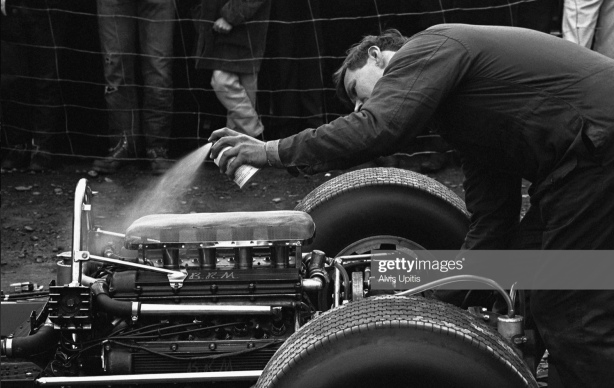
One of the BRM mechanics persuades the P56 2 litre V8 fitted to Peter Arundell’s works Lotus 33 to start during the 1966 US GP weekend at Watkins Glen. He was sixth in the race won by Jim Clark’s Lotus 43 BRM H16- famously that wonderful, complex, mad engine’s only win

P111: 2.1 litre V8

1967 Tasman and beyond specifications

Two engines built initially of 2070cc and gave 287bhp and 292bhp- used the taller P123 blocks

Six engines were converted by the time of the 1967 Tasman – 2 P56 type and 4 P68 exhaust within the Vee type. Engines very reliable, the weakness of the package was the magnesium cased lightweight  P72 six-speed gearboxes which were never designed with the power and torque- and tyre grip by then being produced

Type 80: 1.5 litre Straight-four cylinder Formula 2 engine

’Half’ of one of the 2 litre V8’s – soon gave in excess of 130bhp.
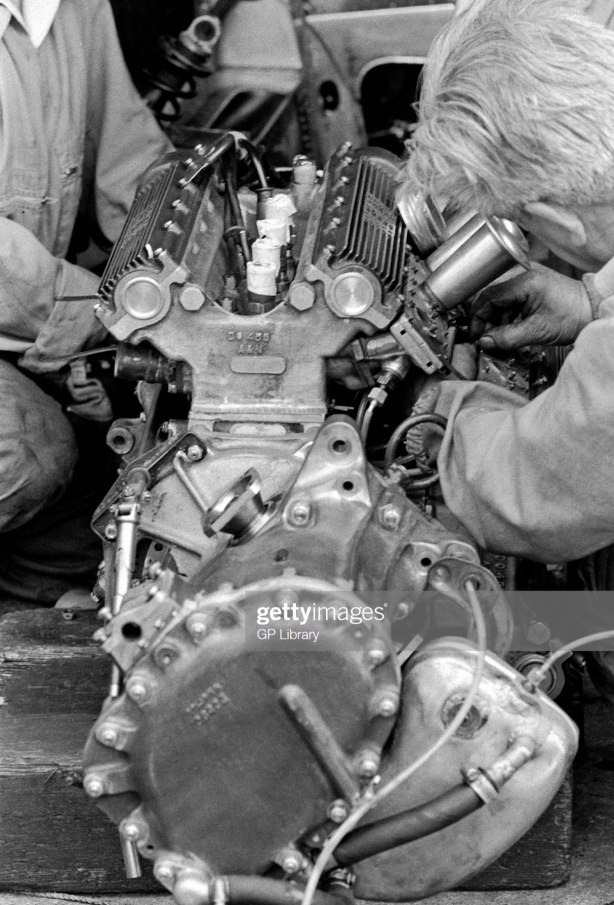
P80 1 litre, four cylinder F2 engine the size of which is ‘overwhelmed’ by the bulk of the P72 transmission

Etcetera…
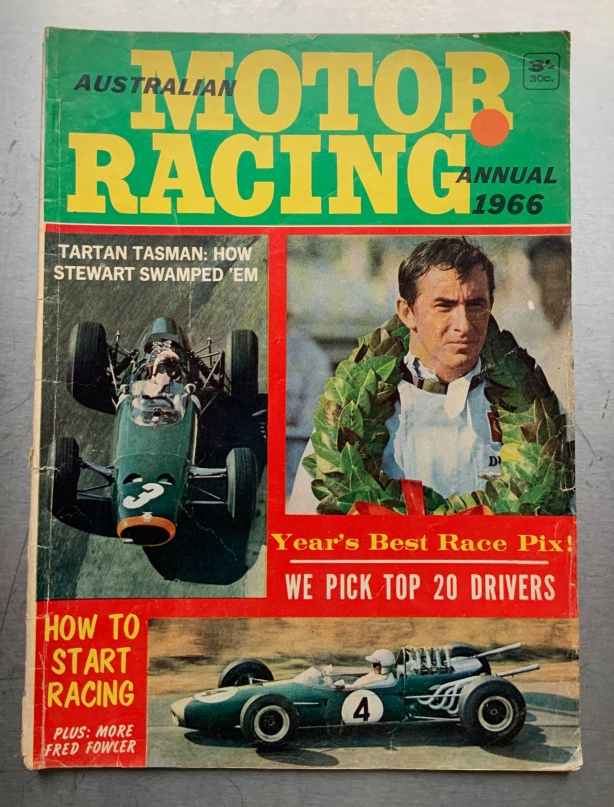
(M Bisset)

JYS was ‘top of the pops’- on the cover of ‘Australian Racing Annual’ for 1966- these annuals are much treasured and were a useful pot-pourri of the season just gone, they were published by the ‘Sports Car World’ magazine people.

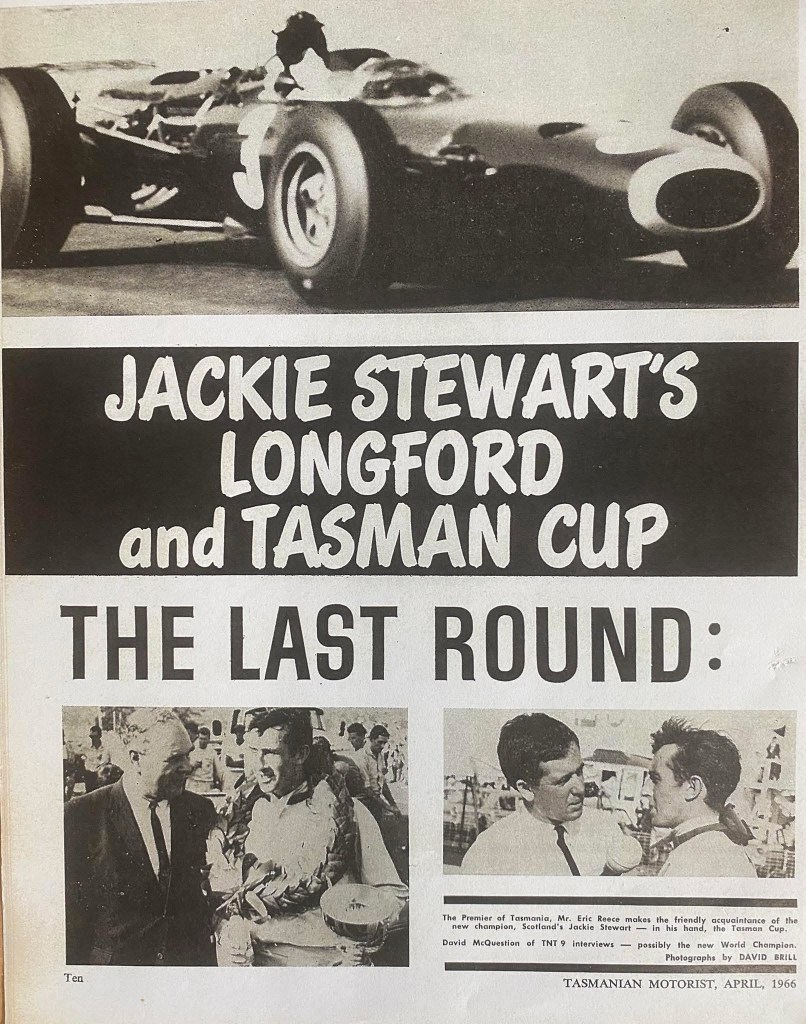
Shots show Stewart on the way to victory at Longford on the entry to The Viaduct, and wearing one of the many garlands popped around his neck that summer. The shot below is Jack in BT19 complete with brand-new Repco-Brabham 620 2.5 litre V8 also at Longford.
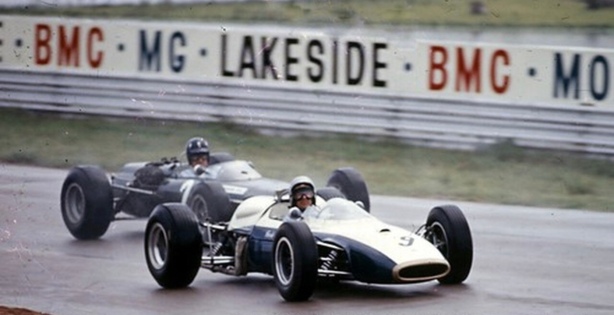
(autopics.com)

Graham Hill on the outside of Kiwi Dennis Marwood’s Cooper T66 Climax during the Sunday morning warm-up at Lakeside- DNF oil pressure in the feature race.
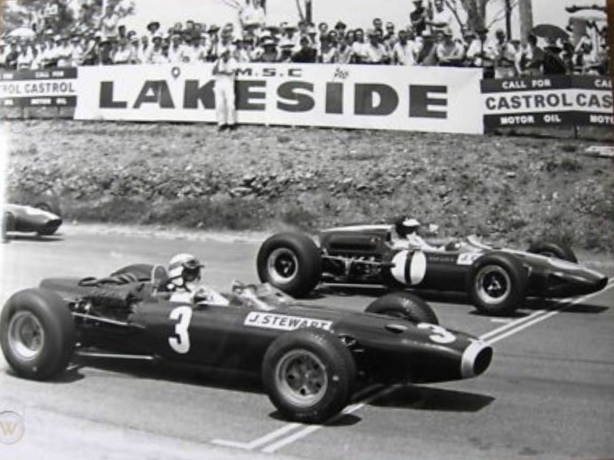
(unattributed)

Stewart and Clark off the front row of the grid during the second of the Sunday morning heats.

BRM P261 ‘2614’ and Lotus 39 Climax ‘R12’- they had some titanic dices during their Australasian summer but plenty of fun off-track and shared accommodation throughout, parsimonious Scots as they were.
(autopics.com)

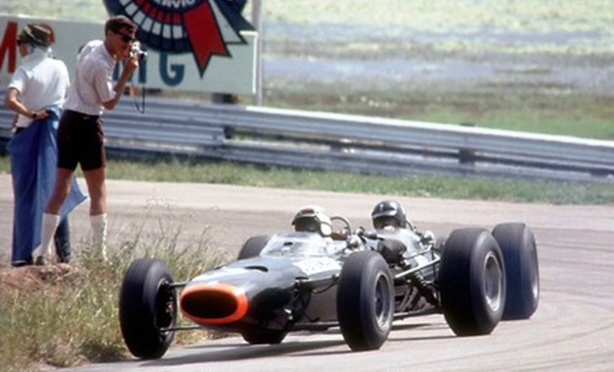
Like a rat up an aqueduct- ‘2614’ from ‘2616’…

GH has his nose shoved right up JYS gearbox which is not helpful as that unit was the weakest link of an otherwise bullet-proof remarkably fast racing car into 1969 generally- and into 1968 specifically when the one P261 which was sent to Australasia- as a support or back-up car to the new P126 2.5 litre V12 was a very popular machine particularly with Pedro Rodriguez who took any excuse he could to pop his bum into the ‘old darlin’ rather than its much younger sister.
(D Cooper)

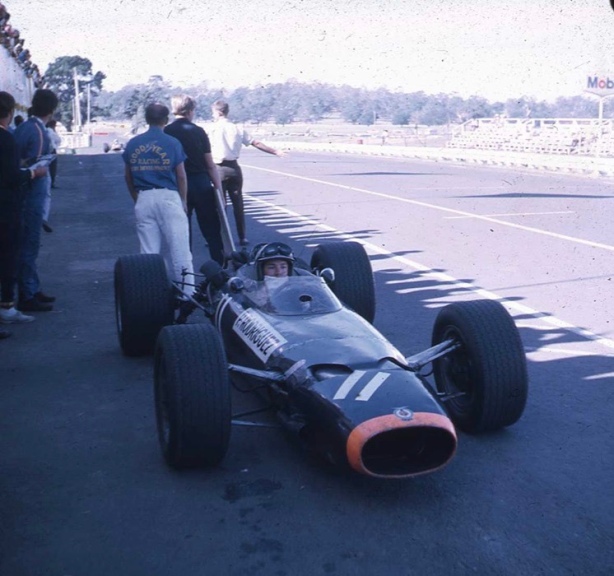
Pedro Rodriguez in good ‘ole ‘2614’ on the very last weekend a P261 was entered by the factory.

Rodriguez was second in the very soggy ‘South Pacific Trophy’ Longford Tasman round on 4 March 1968, won in fine style by Piers Courage in an F2 McLaren M4A Ford FVA 1.6.
A view is that the only thing between Graham Hill and another world title or so at the time was Jim Clark and the Lotus 25 and Lotus 33- lets make that the only thing between Hill and another title or so was Jim Clark’s God-given other-worldly skills- the gifts that only one driver seems blessed with every decade or so.

The Lotus 25 deserves every accolade accorded it as the first ‘modern monocoque’- the car to which every F1 machine which followed is related. The BRM P61 Mk1 and P61 Mk2 aka ‘P261’ followed the ‘original’ but in almost every respect, other, perhaps than in traction, putting its limited power to the road the BRM was the equal of the 25 and 33- and the BRM ‘P56 Family’ of engines the equal of, if not superior motor however many valves Coventry Climax deployed in its FWMV V8! Tony Rudd, biased as he undoubtedly was, makes this case on pages 232 and 233 of ‘BRM 3’.

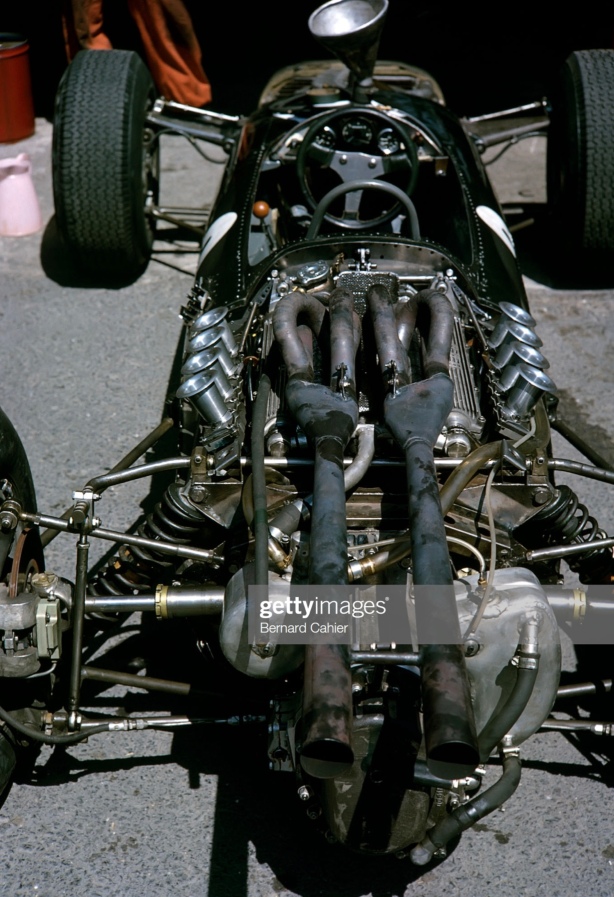
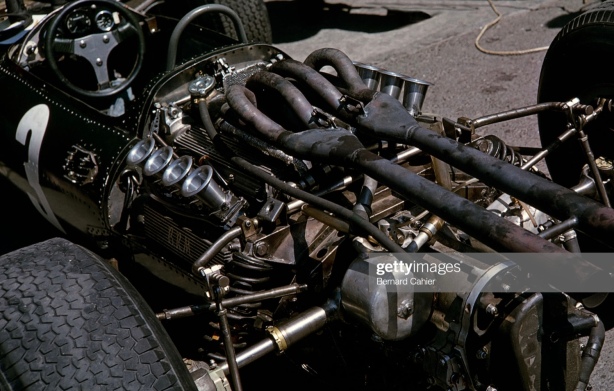
Whatever the case, feast your eyes on all of the mechanical gubbins which comprise the whole of a very well rounded package. The car shown is Graham’s F1 P261 during the Mexican GP weekend in 1964- its powered by a P68 1.5 litre V8.

The chassis is an aluminium ‘full monocoque’ made of 18swg ‘half-hard’ duralumin with extension horns supporting engine/gearbox and rear suspension assemblies . Note the period typical inboard front suspension- lower wishbone and rocker actuating a coil spring/damper unit, brakes are solid 9 inch discs outboard- these are light cars remember, brake lines are rubber, we are still a couple of years away from the use of braided steel lines in Europe.

Distinctive BRM steering wheel- who supplied them? Gear lever at left. The engine we have done to death but note the slide Lucas fuel injection, beautiful expressions of the exhaust pipe benders art- you can just see a heat shield beside the radiator cap to keep the hot gasses away from the fuel metering unit which is right behind the roll-over bar.

The rear suspension is again period typical and in contrast to the front is fully ‘outboard’- magnesium uprights, inverted lower wishbone, single top link, twin radius rods to look after fore and aft forces, coil spring/dampers and adjustable roll bars both front and rear. Plumbing for the needs of lubricants is ‘bitsy’ rather than ‘cohesive’ and the lack of shine to the nickel (?) plating doubtless reflects a long hard season- this was the last championship meeting of the year after all. Note the beautifully made splined driveshafts, solid brake rotor and caliper.

I’ve always thought BRM’s gearboxes- i’m not sure if this is a six-speed Type 62 or 72 look a bit butch compared with Mike Hewland’s products of the time but that may not be the case upon having details of said products dimensions and weight. Whilst the boxes’ were the weak link in P261s powered by 1.9 litre V8’s and above that was not the case when 1.5 litre V8s were used which was of course the engine around which the gearboxes were designed at the outset.

Beautifully concepted, designed and built, robust, prodigiously fast cars the performance of which could be accessed by ‘newbees’ and exploited by ‘the gods’ alike.
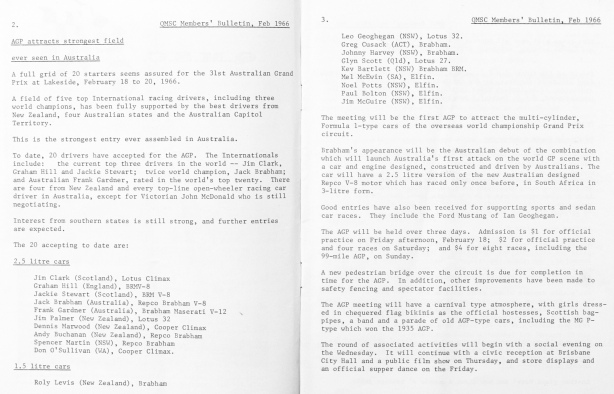
(S Dalton Collection)
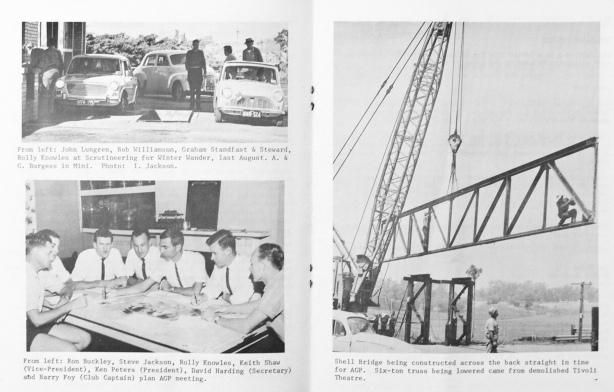
(S Dalton Collection)

Stephen Dalton contributed these pages from the February 1966 Queensland Motor Sports Club newsletter which gives the organisers perspective- note the attention to O,H & S as Stephen points out!

Photo Credits…

Ray Bell, Kevin Drage, ‘Ardmore’, autopics.com, M Bisset Collection, Getty Images- Bernard Cahier, Alvis Upitis, ‘CAN’ Classic Auto News, BRM 3, Dennis Cooper Collection, Brier Thomas via Richard Croston

Bibliography…

‘Australian Motor Racing Annual 1966’, ‘BRM 3’- ‘BRM: The Saga of British Racing Motors Volume 3’ Doug Nye, various articles by Ken Blair in ‘The Canberra Times’ on 8, 15 and 21 February 1966, Bruce Sergent’s race reports on sergent.com, ‘History of The Australian Grand Prix’ Graham Howard and Others, 1966 Tasman Cup review by Allan Brown in oldracingcars.com

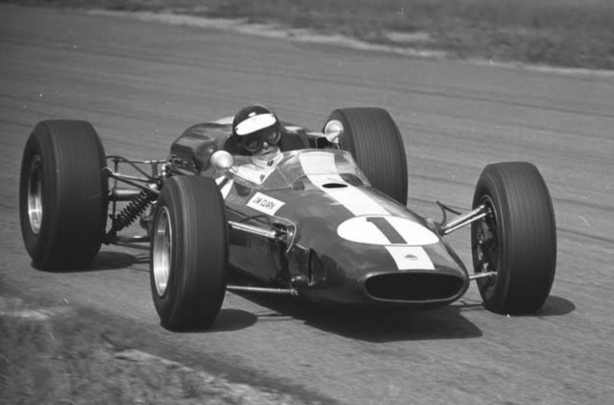
Tailpiece: Clark, Lotus 39 Climax, Lakeside 1966…
(unattributed)

Jim gulps a big dose of Queensland air as he snicks a Lakeside high-speed apex.

Finito…

Jack Brabham awaits the start of one of the ‘Wills Trophy’ heats at Silverstone on 27 March 1967…

Is that John Cooper saying gedday before the off?

Jack is aboard BT23 chassis number 1- the very first in a long line of successful F2 and Tasman Formula cars- let’s not forget the BT23 spawned Ron Tauranac’s F1 Championship winning BT24 Repco design too.

Denny Hulme’s Brabham BT24 Repco during the 1967 US GP at Watkins Glen- he was 3rd behind the Clark/Hill Lotus 49 Ford duo (LAT)

Weren’t British enthusiasts blessed with championship F2 choice over Easter 1967?

They could have watched Jochen Rindt win at Snetterton on Good Friday and see him do it all again at Silverstone 180 Km away on Easter Monday aboard the same BT23-5 he used throughout a dominant 1967.

In a small tangent of Australian motor racing history this chassis is the one Denny Hulme raced in the 1968 Tasman Series- he boofed it at Pukekohe in a terrible accident involving Lawrence Brownlie’s Brabham and replaced it with BT23-2 in time for the Lady Wigram Trophy two weeks later.

Feo Stanton and Alec Mildren bought the remains less suspension and sent them off to Rennmax Engineering in Sydney for Bob Britton to built a jig and a run of new cars, the ‘Rorstan’ for Feo and ‘Mildren’ for Alec. Numerous cars really, the Rorstan, Mildren and Rennmax BN3’s all owe their lives to Jochen’s dead BT23-5.

Jochen blasts off at the start of heat 1- wheel on the right is Rees. Stewart’s Matra MS5 behind his Austrian buddy, Brabham’s BT23 #1- behind Brabham is Gardner, BT23 and alongside him in the red helmet is Widdows’ similar car with the red/orange tipped nose to the right on the same grid row, Mike Spence Parnell ex-F1 Lotus 33 FVA (Getty)

The Snetterton ‘Guards 100’ was the first championship race for the new 1.6 litre Formula 2 which commenced on 1 January that year, the category was enormously popular and successful even if, from the off it was ‘Formula FVA’, with special mentions for the Ferrari Dino V6 and BMW M11 in-line four.

Rindt came into 1967 as the acknowledged F2 King and left it with his crown polished ever more brightly, a quick perusal of ‘F2 Index’ results suggests he won all of the rounds in which he started and finished- Snetterton, Silverstone, the Nurburgring and Tulln-Langelbarn.

He had a DNF, a puncture at Jarama, that race was won by Clark’s Lotus 48- whilst he was occupied elsewhere the other race wins were taken by Stewart at Enna, Gardner at Hockenheim and 1967 European Series Champion, Jacky Ickx in a Ken Tyrrell Matra MS5 FVA was victorious at Zandvoort and Vallelunga.

McLaren and Surtees, McLaren M4A and Lola T100 (V Blackman)


Surtees in Lola T100 ‘SL/100/4’ given I am bandying chassis numbers around. Surtees primary programs that year were leading Honda’s F1 campaign and his Team Surtees Can-Am Lola program in the US- busy boy. That’s Ickx’ Matra MS5 behind and Mike Spence, Lotus 33 further back

As a ‘Graded Driver’ Jochen was ineligible for F2 Championship points, so Ickx won in 1967 from Gardner’s works BT23 and Jean-Pierre Beltoise’ works Matra MS5, Piers Courage in John Coombs McLaren M4A, Alan Rees in the other Roy Winkelmann BT23 and Chris Irwin’s works Lola T100 FVA and T102 BMW.

Creation of a new category brings forth a wonderful commercial opportunity with Cosworth Engineering flogging heaps of FVA’s (putting aside the derivatives of the motor which followed and the DFV proof of cylinder head design concept Duckworth’s FVA in part represented), Hewland Engineering dozens of FT200’s and of course availed the chassis manufacturers a great opportunity too.

Jack’s new BT23-1 and new Hewland FT200- in front of that 5 speed transaxle is a Ford Cortina blocked, Cosworth four-valve, Lucas injected 1.6 litre circa 210 bhp powerhouse. Tauranac’s typically simple combo of spaceframe chassis and outboard suspension provided a phenomenally fast, chuckable, robust, winning combination year after year. I don’t think he ever built a dog- Brabham or Ralt?


Bruce McLaren is aboard chassis number 1 too. M4A-1 was the first car designed by the McLaren/Robin Herd combo

The class of 1967 included the monocoque Lotus 48, Matra MS5/MS7, Lola T100 and McLaren M4A but arguably the car of the year, even putting aside Rindt’s dominance as a driver, was the spaceframe Brabham BT23- bias hereby declared by the way! Perhaps the BT23/23C are the ‘winningest cars’ of that 1967-1971 1.6 F2 period?

I really should prove that assertion statistically I guess, when and if I can be bothered. ‘Nicer cars’ in my book are the Lotus 59 and 69, Matra MS5/MS7 and Ferrari Dino, but more successful, I’m not so sure.

Whatever the case, in this immediate pre-wing year these cars were and are a mouth watering, very fast selection of single-seater racing cars.

Jackie Stewart above and below in one of the two Tyrrell Racing Organisation Matra MS5’s-Ickx in the other car.

Another year of the GP BRM H16 in 1967 was one too many for Jackie, and so it was that Ken Tyrrell stitched together a winning F1 combination of Matra, the Ford Cosworth DFV, Stewart and of course his own team’s preparation and organisational skills.

Bruce McLaren is behind Jackie in the shot below.

Silverstone’s BARC 200 was run over two heats of a little over 30 minutes in duration, Rindt won both with John Surtees third in the two events, Alan Rees was second in one and Graham Hill runner-up in the other.

The aggregated results gave Rindt the round from Rees’ BT23, Surtees T100, Bruce’s M4A, Stewart’s MS5, Gardner’s BT23 and Jacky Ickx’ MS5.

The entry lists right from the get-go of the new category were top notch, other drivers who raced at Silverstone included Robin Widdows BT23, Mike Spence in a Tim Parnell ex-F1 Lotus 33 fitted with an FVA, Denny Hulme BT23 (DNF with a busted conrod in heat 2), Piers Courage M4A, Jean-Pierre Beltoise MS5, Jo Siffert in the BMW factory Lola T100 BMW (all three of whom had injection dramas) Mike Costin, Brian Hart and Trevor Taylor. The list of Did Not Arrives was equally impressive.

Siffert, Lola T100 BMW M11, fuel injection dramas brought an end to Jo’s run (unattributed)

Of twenty-four starters, four were fitted with Lotus-Ford twin-cam motors, Siffert’s Lola (above and below) the very interesting BMW M11 Apfelbeck, the balance were toting Ford FVA’s so Duckworth and the lads had the production line in Northhampton humming along nicely.

There were a couple of FVA users with Lucas injection dramas, but Denny’s buggered rod was the only example of greater mechanical mayhem in a package which proved a paragon of reliability over the ensuing years.

(unattributed)


This has to be the most distinctive, simple piece of personal branding ever- in colour or black ‘n white Hill G or Hill D are so easy to pick in their London Rowing Club colours aren’t they? Lotus 48 Ford FVA.

Sydneysiders had the chance to see a Euro F2 1.6 car earlier than most, Warwick Farm promoter Geoff Sykes did a one race deal for Graham to race Lotus 48 ‘R1’ in the Australian Grand Prix that February.

Having come all that way the car’s FT200 expired after 25 laps of the race, Jackie Stewart’s BRM P261 2.1 prevailed, the series was won that year by Jim Clark racing an F1 Lotus 33 Climax FWMV 2 litre V8.

Graham raced ‘R2’ back in Europe with Jim Clark using ‘R1’ as his mount in 1968.

Stewart, BRM P261, Clark, Lotus 33 Climax and Hill, Lotus 48 Ford FVA, row 2 Brabham left Brabham BT23A Repco and Leo Geoghegan, Lotus 39 Climax and against the fence, Denny Hulme, Brabham BT18/22 Repco. AGP, Warwick Farm, February 1967 (B Wells)


Rindt and Hill- and Rees to the right jump similarly at the start of heat 2.

Thats Brabham, Surtees and McLaren on row two and Hulme, Gardner, Ickx and far right in the red McLaren- Piers Courage. The result was Rindt, Hill, Surtees.

(V Blackman)

Jochen with a delicate slide out of Woodcote, the proximity of ‘snappers to the action back then never ceases to amaze.

Rindt’s car control is right up there with the rest of the Gods of that art- Nuvolari, Fangio, Peterson, Villeneuve et al.

Etcetera…

Jack looks happy enough before the off.

Its only several weeks after the end of the Tasman Series- Brabham finished a pretty skinny series for the full on Repco-Brabham two car works assault on the championship that year well, he won the Longford final round in his one off Brabham BT23A on 5 March.

Two Repco ‘640’ engined cars were raced by Jack and Denny in all eight meetings of the six round championship- that season Levin and Teretonga were not championship rounds.

In fact there were a whole swag of blokes on that Silverstone grid who had raced in Australasia that summer- Stewart, Brabham, Gardner, Irwin, McLaren, Hill and Hulme- Clark was the only absentee from the roll-call.

(L Ruting)

Brabham fries a set of Goodyears and proves just how chuckable a BT23 can be in the hands of an Ace- AGP Warwick Farm 1967.

Its BT23A-1, JB’s 1967 Tasman weapon, a one-of-a-kind BT23 variant powered at that stage by a 640 Series Repco 2.5 litre Tasman V8, this machine is still in Australia, it was acquired by the National Motor Museum in 2018.

Article on the Tasman Brabham Repco’s here; https://primotipo.com/2016/09/29/bathurst-1969-and-jacks-tasman-brabhams/

(Getty)

An imperfectly executed pan of Hill’s Lotus 48 chasing Brian Hart’s Protos 16 FVA. Now there is a interesting marque topic to explore one day!

Who are those fellows looking after Bruce?

Piers Courage in John Coombs M4A behind McLaren, and in the photograph below. This car, ‘M4A-2’, Piers acquired from Coombs and raced in the 1968 Tasman and brained everybody with his speed and commitment.

He capped off an amazing summer with a blinding wet weather drive at Longford, his deft pace won the race from the 2.5’s which were hampered in their ability to put their power down on the slippery, bumpy bitumen.

The car was bought by Niel Allen at the end of the series, he did well in it and survived an almighty car destroying accident in it at Lakeside, it was rebuilt around a Bowin Designs built tub and then was one of the cars in which Warwick Brown made his name when owned by Pat Burke. Not so sure its still in Oz?

Article on Piers @ Longford here; https://primotipo.com/2015/10/20/longford-tasman-south-pacific-trophy-4-march-1968-and-piers-courage/

(LAT)

The photographs of the Courage McLaren in Australia below are during the Warwick Farm 100- he was second in the race won by Clark’s Lotus 49 Ford DFW.

The two monochrome photos below are during his victorious Longford weekend in March 1968, the great circuit’s final meeting.

(P Hudson)

Piers nipping the right front brake of M4A-2 on the entry to Mountford Corner during the dry, earlier over the Labour Day long weekend.

Courage ran the car on a shoestring assisted by Australian ex-Lotus mechanic Ray Parsons with two FVA’s, his performances that summer in many ways re-launched his career.

(oldracephotos.com.au)

It really did piss down on raceday, sadly for all, not least for the venues future, crowd numbers were way down although better than the ‘three men and a dog’ perspective provided by the shot below.

The hardy natives saw one of the great drives, Courage won from Pedro Rodriguez’ BRM P261 and Frank Gardner’s Brabham BT23 Alfa with Richard Attwood’s BRM P126 fourth.

(oldracephotos.com.au)


(unattributed)

‘And to think Jack pays me to do this shit! Its such a blast!’

Denny having a ball at Silverstone, he seems to have lost his front number but no doubt this was addressed by race day. The stars affixed to the cars are part of the Wills corporate identity i guess, sponsorship became less subtle from 1 January 1968!

Denny is racing BT23-2, his regular mount during 1967, although his primary commitments that year were winning the World Championship, which he managed nicely, and running the second of McLaren Cars, McLaren M6A Chevs in the Can-Am Challenge Cup- he was second to Bruce.

(D Simpson)

Max Stewart is shown above in the Mildren Waggott during the 1970 Sandown Cup, Tasman round.

Niel Allen won that day in his F5000 McLaren M10B Chev from Graeme Lawrence’s ex-Amon Ferrari Dino 246T, Ulf Norinder, Lola T190 Chev and then Max in the 2 litre Waggot TC-4V engined car- Max ‘won everything’ in Australia in this jigger including the 1971 Gold Star.

The photo is included for the sake of completeness to show one of the seven cars built by Bob Britton from the jig created from Rindt’s dead BT23-5, which these days of course is alive and well and racing in Europe.

Speaking of which, the photo below is of Denny ranging up on Lawrence Brownlie at Pukekohe during the 1968 NZ GP on 6 January in BT23-5, Lawrence’s car is a Brabham BT15/23 Ford t/c.

In a move which is still hotly debated by Kiwi enthusiasts decades later, Denny and Lawrence collided destroying both cars and ending Brownlie’s career.

(Classic Auto News)

1.6 F2 Reference Resource…

Most of you know Allen Brown’s oldracingcars.com is a primary reference source for me inclusive of F2 1.6, click here for his F2 homepage and then navigate the site easily to look at seasons, individual races and in many cases car and individual chassis histories; https://www.oldracingcars.com/f2/

Here is one of my own pieces on the Lotus 48;

Lotus 48 Ford FVA: AGP Warwick Farm 1967: Graham Hill and Jim Clark…

Credits…

Getty Images, LAT, F2 Index, oldracingcars.com, LAT, Lance Ruting, Paul Hudson, Dick Simpson, oldracephotos.com.au, Victor Blackman, Bruce Wells, Classic Auto News

Tailpiece: Six 210 bhp F2 Missiles whistle into Copse at speed…

(Getty)

Finito…
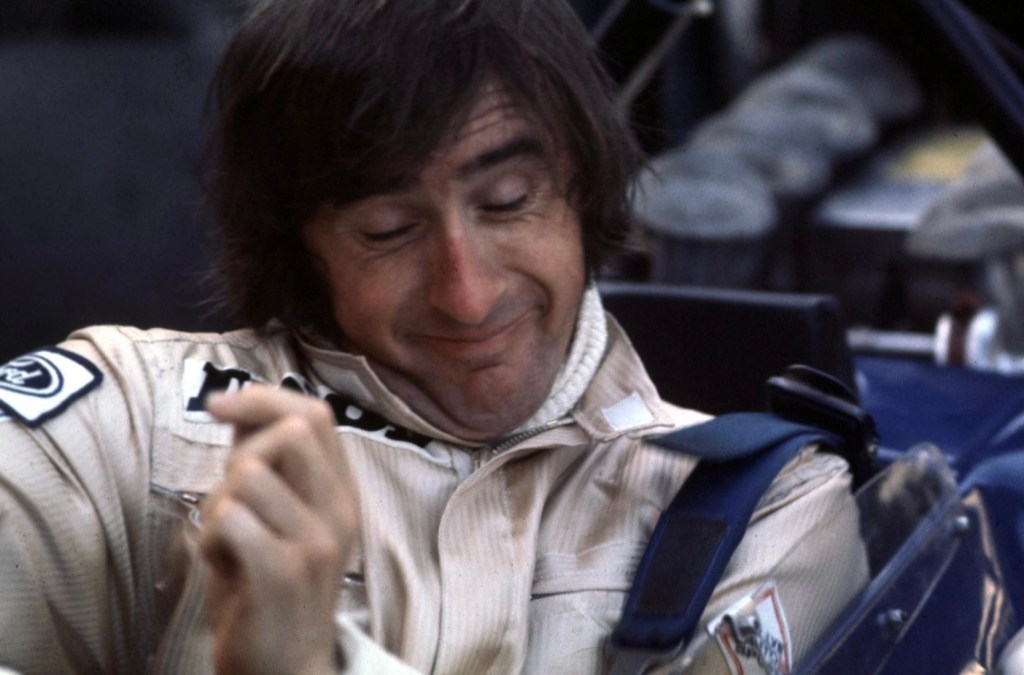
John Surtees, the reigning World F1 Champ, aboard his Cooper T75 BRM P80 during the ‘London Trophy’ weeekend at Crystal Palace in June 1965…

He was a busy boy that year, fitting in F2 races around his primary programs for Ferrari in F1 and Endurance events.

Ken Tyrrell entered two Coopers that weekend, the other for Jackie Stewart, above, very much on his career ascent- he scored his first GP win with BRM that season at Monza in September aboard a P261 after a great dice with his teammate Graham Hill.

Surtees, Cooper T75 BRM

The London Trophy comprised two heats of 25 laps, the top four in each race were the same, Jim Clark, Lotus 35 Cosworth SCA, Graham Hill, Brabham BT16 BRM, Richard Attwood, Lola T60 SCA and Jochen Rindt, Brabham BT16 SCA.

(Getty)

The off, Heat 1.

Stewart at left and Clark right, Brabham on the inside of row 2.

Clark won both heats, the Tyrrell Coopers had problems in this heat which were fatal for their chances of a start in the second race- Stewart had half-shaft failure after completing 16 laps and a rod let go in the BRM engine after 21 of the 25 laps in Surtees case.

There was plenty of depth on the grid, other starters included Mike Spence, Trevor Taylor, Chris Amon, Denny Hulme, Jack Brabham and Peter Revson with the DNQ list including Jo Siffert, David Hobbs and Chris Irwin.

Credits

Getty Images

Tailpiece: Jim Clark, Lotus 35…

Jim Clark aboard his Lotus 35 SCA, final chat to his mechanic who has a tyre pressure gauge at the ready. I’m not sure this is Crystal Palace, if it is, the car behind is Bill Bradley’s Brabham BT10 SCA.

Finito…