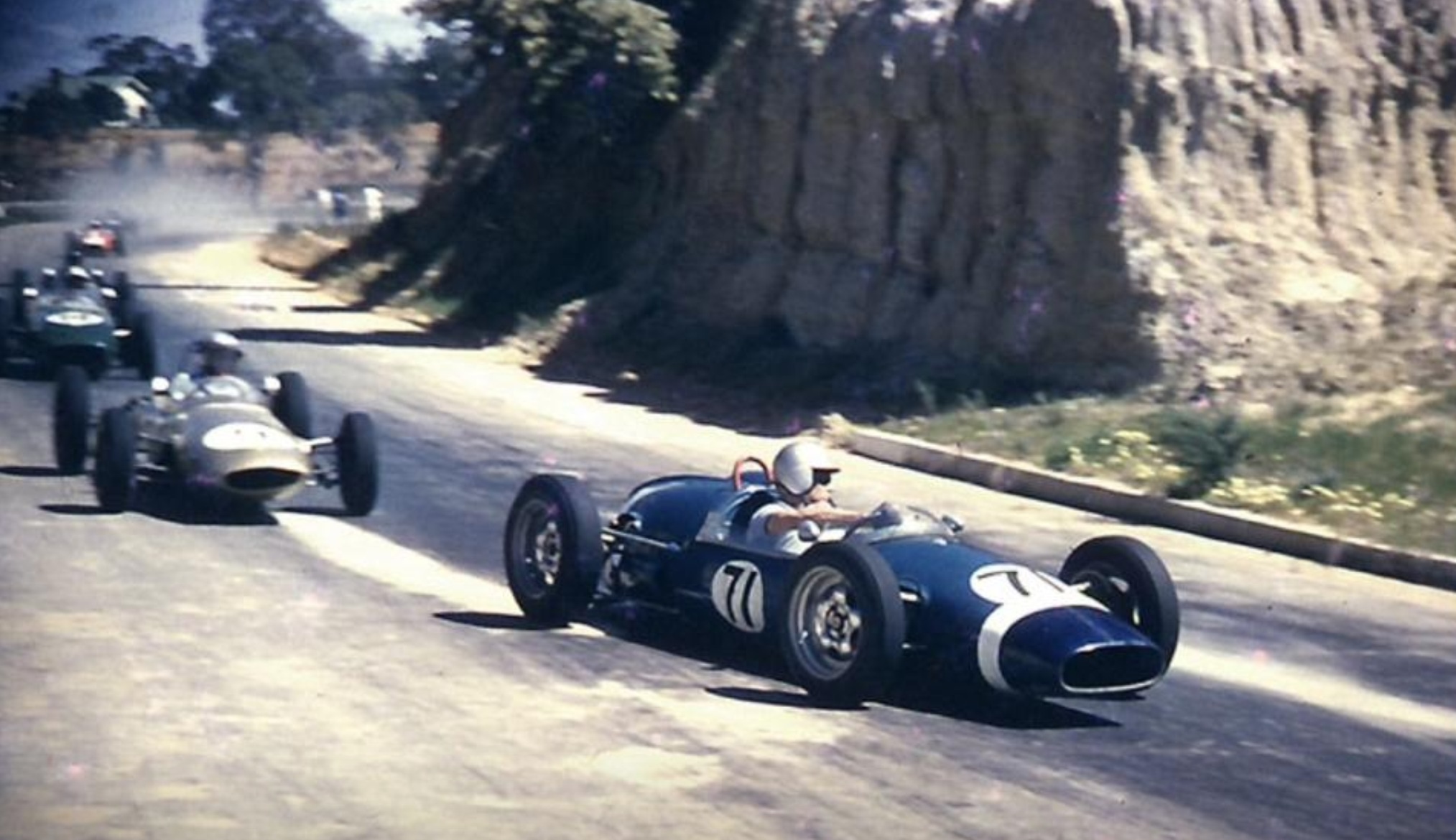
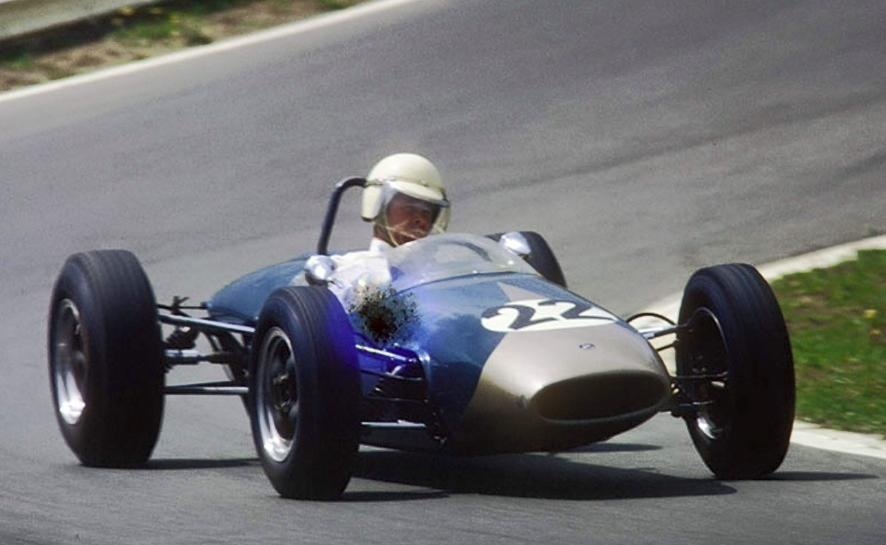
Posts Tagged ‘Leo Geoghegan’

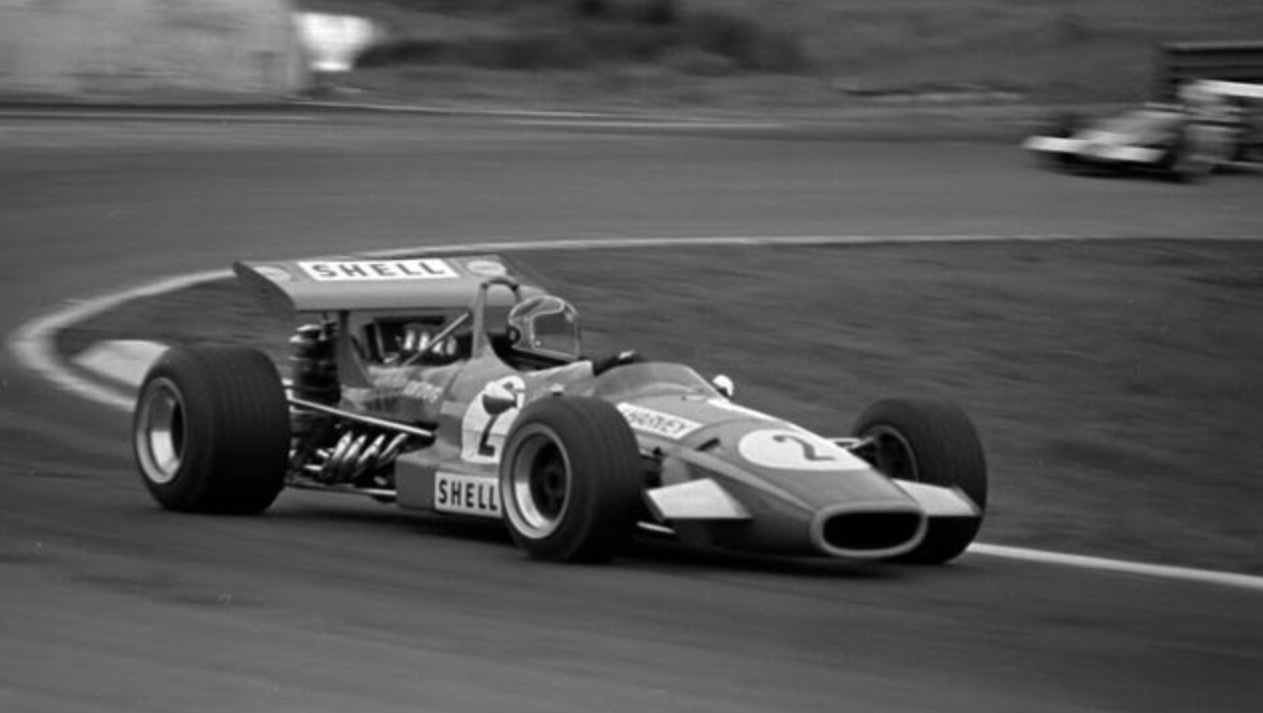
Chris Amon sneaks a look in his mirrors, no need to worry too much! Ferrari Dino 246T/69 #0008 (MotorSport)

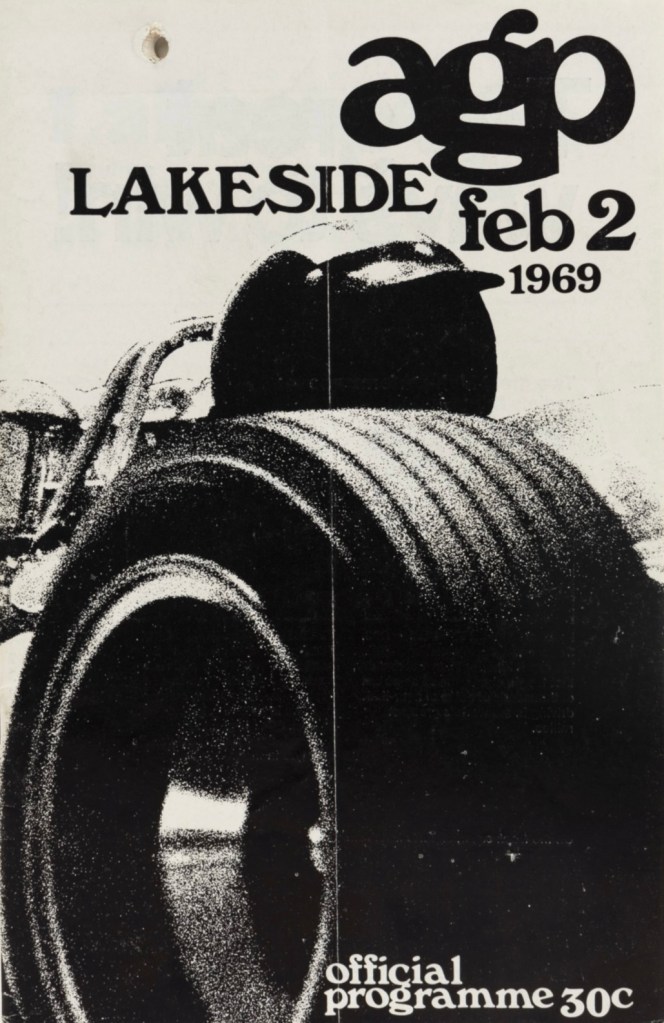
Unlike previous years when the cars had been shipped across The Ditch – the Tasman sea – from New Zealand to Australia, in 1969 they were air freighted as there was only a week between the Teretonga and Lakeside rounds, that year the site of the 1969 Australian Grand Prix held on February 2.

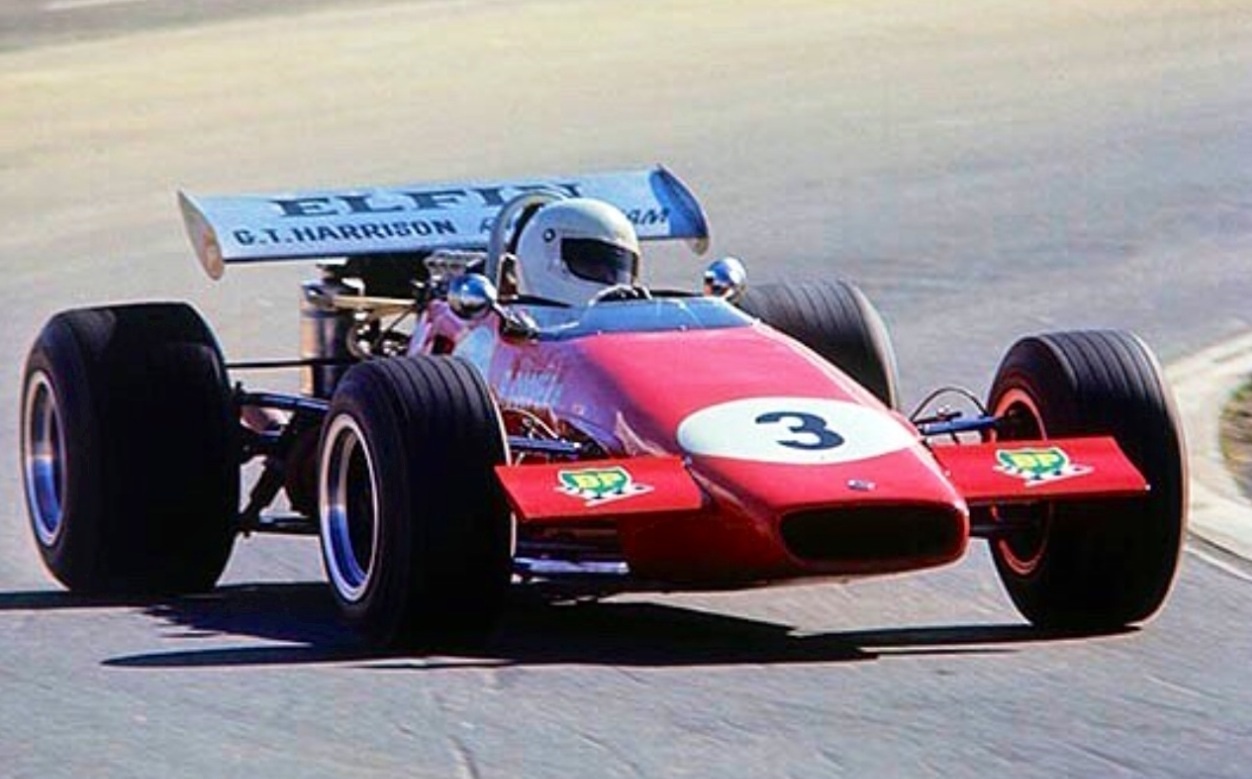
Top Guns were the Scuderia Ferrari/Chris Amon/Scuderia Veloce run Ferrari Dino 246Ts of Chris Amon and Derek Bell and the Gold Leaf Team Lotus Lotus 49B Ford DFW V8’s of just minted World F1 Champion Graham Hill and The Hunter-Jochen Rindt, with everything to prove.
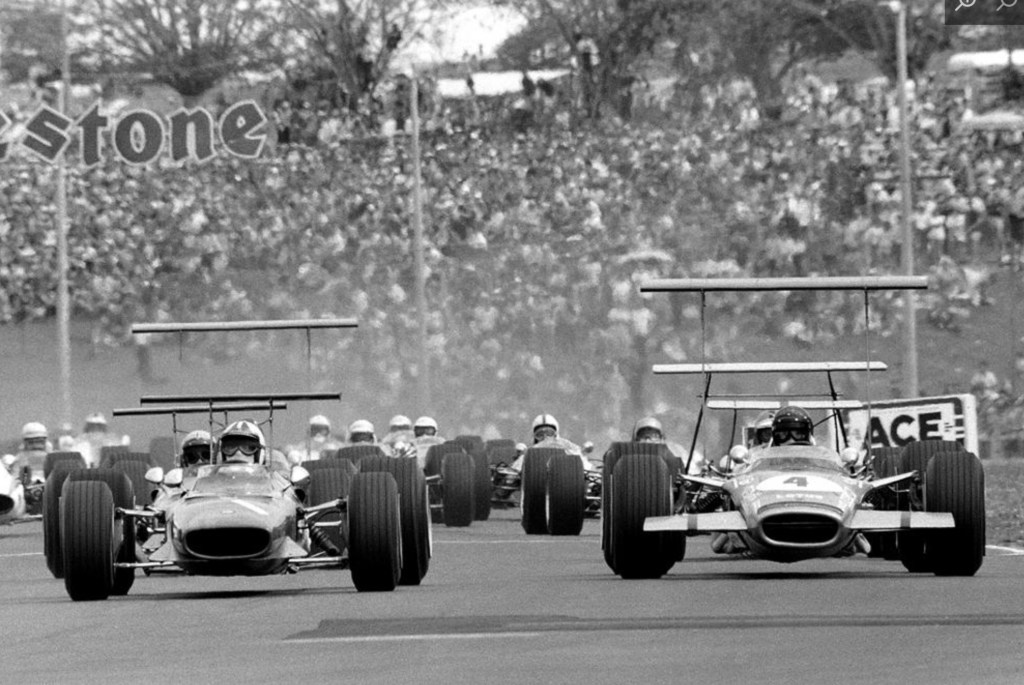
The 1969 Tasman Cup gets underway at Pukekohe on January 4 with the gig-two on the front row. Chris Amon, Ferrari Dino 246T and Jochen Rindt, Lotus 49B Ford. Amon won from Rindt and Courage (MotorSport)

At the end of the four Kiwi rounds Amon was looking the goods for Tasman Cup honours, having won at Pukekohe and Levin and picking up third place points at Wigram and Teretonga. While the Lotuses were the fastest cars, they weren’t as reliable as the Ferraris: Amon and Bell had six out of seven point scoring finishes, while Rindt, Hill and Piers Courage – in Frank Williams Brabham BT24 Ford DFW – scored off only four races. Chris won the cup with four race wins (his two in Australia were at Lakeside and Sandown) to Jochen’s two (Wigram and Warwick Farm) and Piers’ one (Teretonga).

Rindt, Lotus 49B Ford #R10 heads towards The Karussel with Lake (MotorSport)

Practice…

Of the internationals, Only Ferrari and Piers Courage managed to get themselves sorted out in time, Bruce Sergent wrote. “While Lotus had all sorts of problems with customs and freight. It was apparent that Ford Australia weren’t behind the Lotus effort this year, for they had to do most of their own organising right from administration down to transport for drivers and mechanics.” Ferrari, of course had the well drilled David McKay/Scuderia Veloce organisation to deal with the logistics, and it showed throughout the weekend.

The new stiffer rear springs Amon was after from the start of the series were waiting for the two Ferraris in Brisbane, and with these fitted the cars were out early on Friday and soon showed it would be a tough round Lotus to even make a clean breast of. While Amon and Bell were making hay on a clear track, Lotus had only just received their cars and both needed attention. Rindt’s engine was misfiring, and Hill’s blew up shortly after starting up in the garage. Even with getting an engine back from Courage, it still left them with one very sick car, Rindt’s.

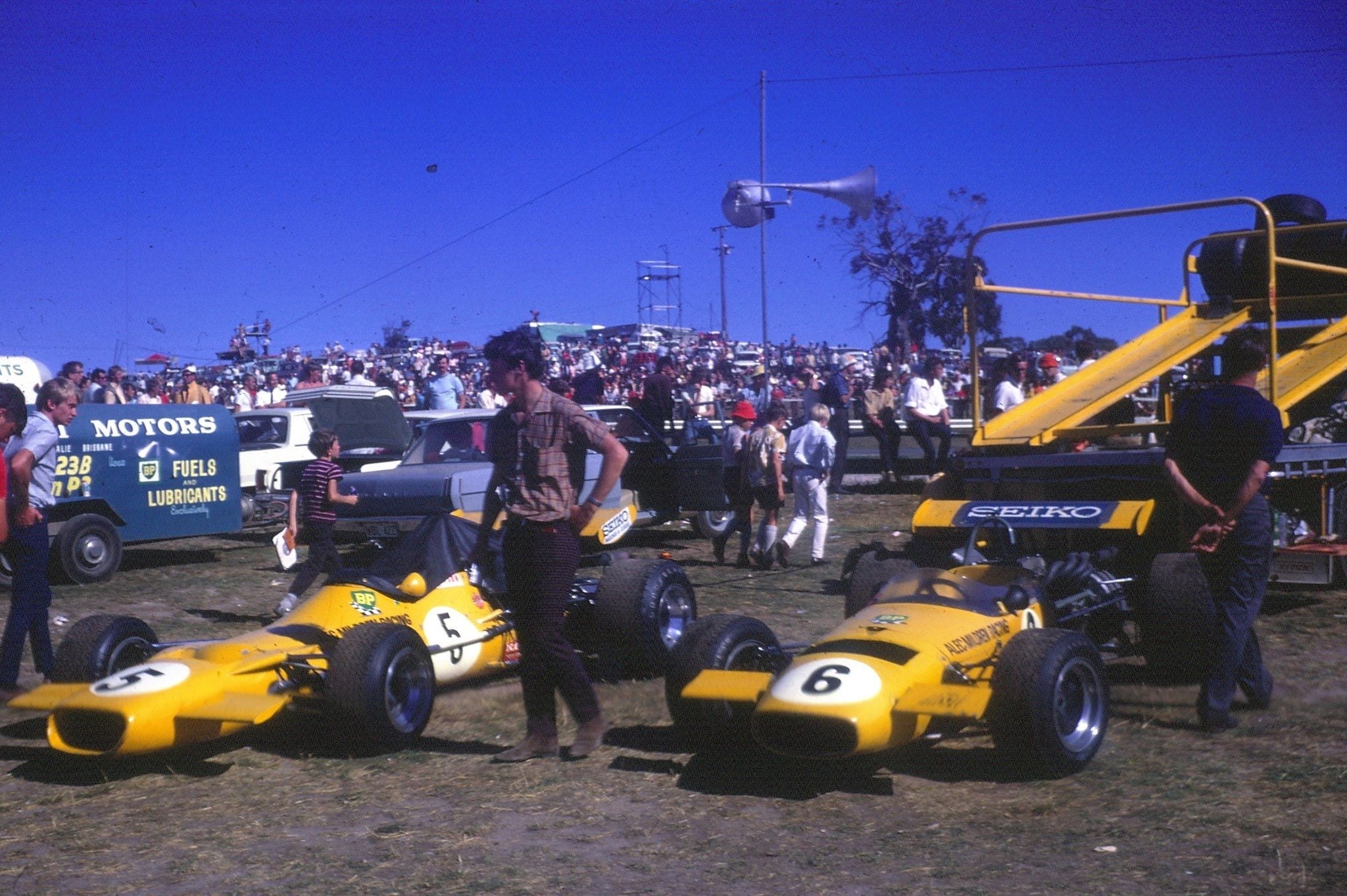
On Saturday, Amon comfortably took pole pole from Courage. Gardner had fitted a bi-wing set-up to his Mildren Racing Mildren Yellow Submarine Alfa Romeo V8 like Courage’s in unofficial practice but didn’t have the time to evaluate it and had to remove the front one and save it for testing on home turf at Warwick Farm, Sydney, the following week. Hill broke his wing in practice – the curse of Team Lotus at the time – but still managed fourth fastest, while Rindt was only able to push his Lotus 49B to fifth, creditable under the extreme circumstances.

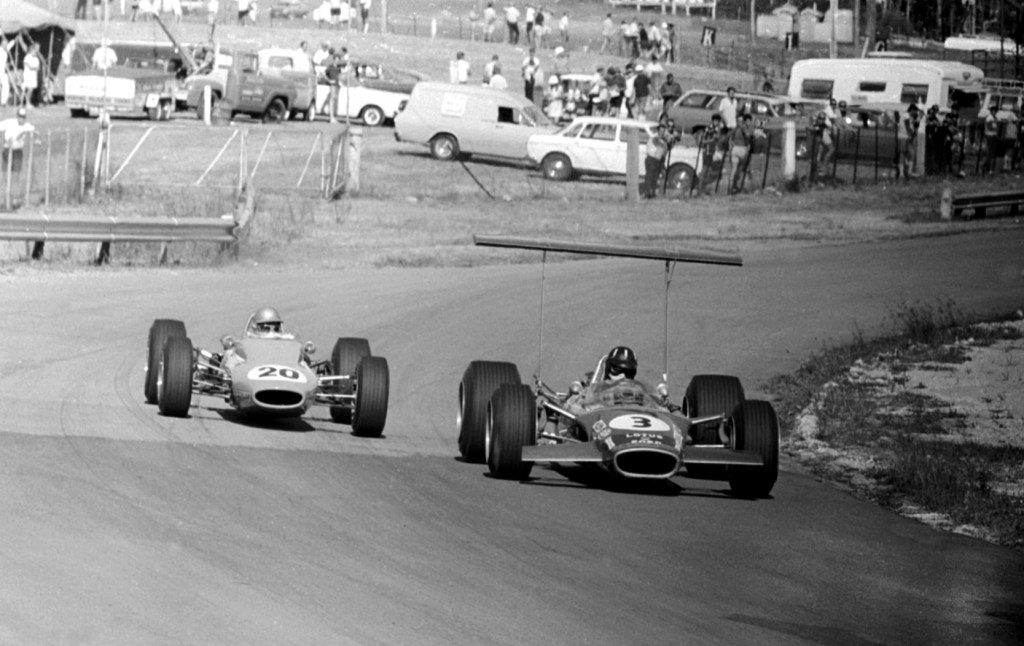
Piers Courage, Brabham BT24 Ford DFW from Jochen Rindt, Lotus 49B Ford DFW thru the kink. The start-finish line is just out of shot (MotorSport)
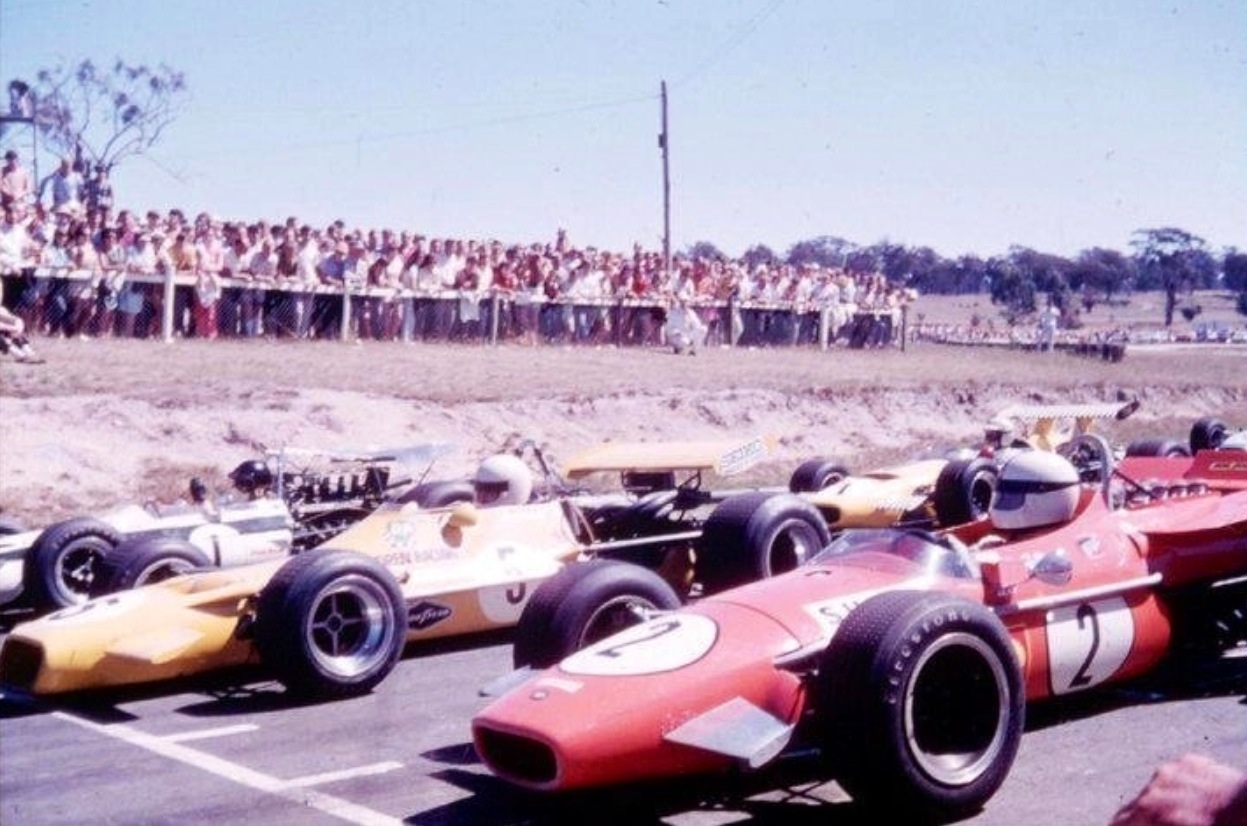
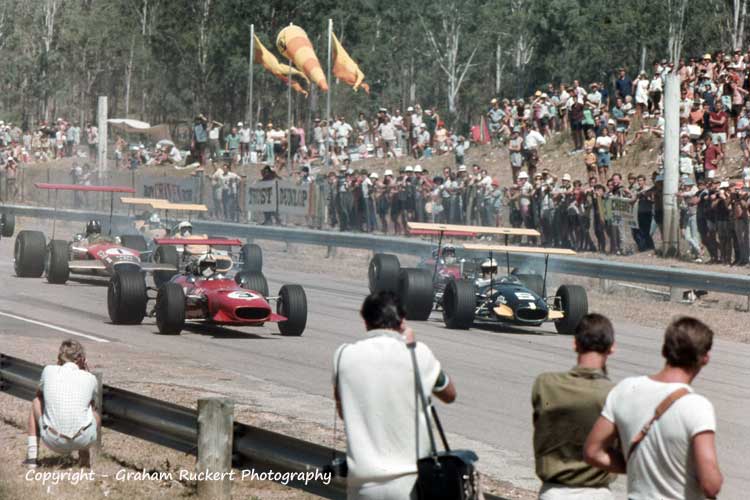
They are off: Amon and Courage, Hill and Bell partially obscured by Courage, then the two yellow winged Mildren entries of Gardner and Bartlett (G Ruckert)

Race…

Amon won the jump from Courage and streaked off into the afternoon sun while Hill, Courage and Bell lined up for battle behind, then followed Gardner, Rindt and Kevin Bartlett aboard the Brabham BT23D Alfa Romeo Tipo 33 2.5-litre-V8 that Gardner raced in the ’68 Tasman and was then driven by KB to victory in that years Gold Star, the Australian Drivers Championship. Next was Niel Allen’s ex-Courage McLaren M4A Ford FVA. It was Niel’s first drive at Lakeside after his huge accident during the Gold Star round in July 1968, the car’s monocoque having been rebuilt/replaced by Bowin Cars.

Positions remained static for a bit until Courage closed in on Hill and tried to pass on the outside as they ranged under brakes for BMC bend. But Piers didn’t quite make it and there wasn’t enough room left for both cars, Graham didn’t give way, being on-line for the corner so the two cars touched and Courage suddenly ran out of track and retired the car on the dirt with slightly bent front suspension. Hill lost four seconds giving Bell his opportunity and he went through into second position to make it a Ferrari 1-2 for the first time in the series.

Bartlett retired on the following lap with no water and blown head gaskets, giving away his position to Niel Allen. Then he overdid it under brakes, the front set locked, and he lost four places getting things in hand. He picked up one of the lost places immediately and set out on a long hard haul back through the field.

Rindt hustles his Lotus – engine problem duly noted – into BP Bend, Q5 and DNF. With fresh engine he made good and ‘blew the field off the planet’ in the Warwick Farm 100 one week hence
Frank Gardner, Mildren Alfa Romeo V8 aka the Mildren Mono/Yellow Submarine (MotorSport)

Jochen Rindt made the next move when he displaced Leo Geoghegan’s ex-Clark Lotus 39 albeit with a Repco Brabham V8 rather than the Climax FPF four, on the 13th lap for fifth spot, but Geoghegan was hanging on grimly and didn’t let the Austrian get away from him. But Rindt pulled out every horse he could find in the ailing Cosworth V8 and slipped by Frank Gardner on lap 19, making the order Amon and Bell in Ferrari Dinos, Rindt’s Lotus 49B, Gardner’s Mildren Alfa, Geoghegan’s Lotus Repco, Max Stewart, Mildren Alfa 1.6 F2, Allen, Glyn Scott, Bowin P3 Ford FVA F2 and Malcolm Guthrie, Brabham BT21B Lotus-Ford 1.6.

Rindt held onto this position, trailed by Gardner, who was becoming concerned over oil pressure. His fears were confirmed when the Alfa Romeo engine blew an internal oil line and he was forced out of the race on lap 12. Gardner’s demise brought everyone up a place but Jochen Rindt’s forceful run ended when the Cosworth Ford V8 engine lost power and he quickly shut off and headed for the pits.

Derek Bell, Ferrari Dino 246T/69 #0010. No adjustable wing for Derek (MotorSport)

Chris Amon was busy lapping all but his team mate, Derek Bell, while Leo Geoghegan was sitting in a wonderful position behind Graham Hill in fourth spot. Col Green, ex-Hill/Gardner Brabham BT16 Climax 2.5 FPF was in and out of the pits with gearbox and engine problems while Alf Costanzo, McLaren M4A Ford FVA F2 had retired after a spin over the back of the circuit, then stalled and was unable to restart.

The rear wing on Hill’s Lotus 49 had looked shaky for a few laps and finally it broke and folded over his rear wheel. He tried to keep the car as steady as possible so not to be black flagged, and finally pitted to have the offending piece of iron cut from the car. Geoghegan, meanwhile, seeing Hill’s problem, had speeded up and went by as Hill was having the operation finished to his wing. He came back into the fray bent on getting his third spot back from Geoghegan, but the Lotus was suffering from oversteer with the now, light rear end, and he steadily lost ground.
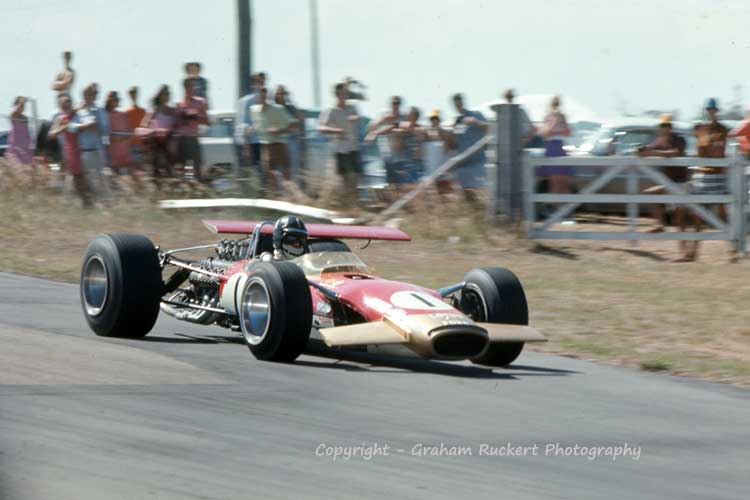
Graham Hill’s 49B #R8 with the rear wing mount problems that Lotus never satisfactorily solved. No bodily harm caused on this occasion. Ultimately the FIA solved Lotuses problem for them with their intervention over the 1969 Monaco GP weekend (G Ruckert)
Niel Allen, McLaren M4A Ford FVA. #M4A/2 is the ex-John Coombs/Courage ’67 Euro F2 entry, then, in Pier’s ownership his ’68 Tasman machine, and Longford round winner (MotorSport)

Niel Allen, worked hard to make up time lost in two spins and managed to catch Max Stewart in the surviving Alec Mildren Racing entry, the Mildren Alfa/Autodelta 1.6 four-valve F2 car and, now in fifth spot, went on to win the battle of the F2’s. Englishman, Malcolm Guthrie, having sat behind Glyn Scott on the Queenslander’s home circuit, finally made a last-minute burst and finished ahead of the Bowin. Scott was still waiting for a set of rods to come from Cosworth for his FVA engine, he was running on a set borrowed from Allen.

With two rounds to run, Amon’s win put him into an almost uncatchable Tasman Cup points lead. Only Piers Courage, with a bit of luck and by winning the final two races, could take the championship from the New Zealander. Rindt and Hill, equal on 15 points, were at that stage relegated to fighting out second spot.

Ain’t she sweet, Graham Ruckert has captured the car with its unloaded left-front off the deck. Note the hydraulics to operate Chris’ rear wing

Etcetera…

(MotorSport)

Graham Hill blasts through the hole left for him by Glyn Scott at Lakesides flat-knacker Kink.

Bowin P3 Ford FVA 1.6 #P3-101-68 and Lotus 49B Ford DFW 2.5. Hill was fourth and Scott 11th. More about Graham’s car here: https://primotipo.com/2022/02/26/lotus-49b-ford-chassis-r8/

It’s a David and Goliath shot. John Joyce’s superb monocoque was Lotus inspired too, he had a number of senior engineering posts at Lotus between 1963 and late 1967 when he returned home to start P3 – Project 3 – his first two cars (Projects 1 and 2) built before he left for his stint in the UK were a modified Cooper and the Koala Formula Junior. More about Glyn and the Bowin P3 here: https://primotipo.com/2020/07/24/glyn-scott/ and here: https://primotipo.com/2021/05/06/ian-peters-ex-glyn-scott-bowin-p3-101-68/

(MotorSport)

Nah, its too skinny to be Sergeant Schultz! It must be Jochen Rindt with a touch of the Adolfs, not the best protection for the searing Queensland summer sun, and with a smile on his face despite the challenges of the weekend.

Piers Courage took up where he left off in the ’68 Tasman, as a front runner in the clever car Frank Williams assembled for him. Brabham BT24-3 was ex-Brabham/Rindt/Gurney/Ahrens, with its F1 3-litre 740 Series Repco Brabham V8 removed and a 2.5-litre Ford Cosworth DFW installed the bi-winged Brabham was a very competitive car raced ably throughout. Piers ultimate pace was reinforced during that years GP season where he proved one of the quickest men around…he arrived that year big time.

Courage, Brabham BT24 Ford. Generally, but not completely, Ron Tauranac’s wings remained where he intended them from the start to the finish of the weekend (MotorSport)
(MotorSport)

Frank Gardner’s (above) Len Bailey designed, Alan Mann Racing built Mildren Alfa used many Brabham BT23 components and was ‘best of the rest’ behind the big-five. Gardner arrived in New Zealand ‘under-winged’, he scored in four of the seven rounds and would have gained a bit with more downforce from the start of the series.

It’s one of the most iconic and instantly recognisable single-seaters ever raced in Australia by – in turn – FG, Kevin Bartlett, Bob Muir and Ray Winter with Tipo 33 2.5 V8 as here, then Waggott 2-litre TC-4V and finally 1.6-litre Lotus-Ford twin-cam in ANF2 spec.
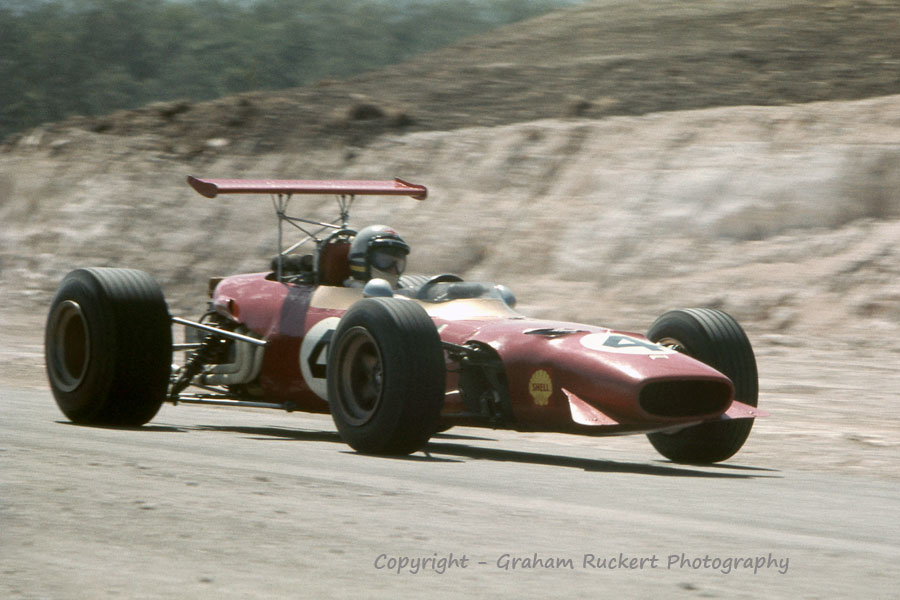
Derek Bell drove well throughout the series, a pair of seconds at Lakeside and Warwick Farm his bests. He was fourth at Pukekohe, and fifth at Wigram, Teretonga and Sandown. Depending upon your source, Scuderia Ferrari provided four of the latest spec 2.4-litre, DOHC, four-valve fuel injected V6s for the two-car touring team. Bell was given less revs to play with than his team-leader!

More on the Ferrari Dino 246T here: https://primotipo.com/2018/05/01/wings-n-dino-things/ and here: https://primotipo.com/2017/07/21/amons-tasman-dino/ on Piers Courage’s Brabham BT24 here: https://primotipo.com/2016/07/11/brabham-d50/ and on Jochen Rindt’s Down Under summer here: https://primotipo.com/2018/01/19/rindt-tasman-random/
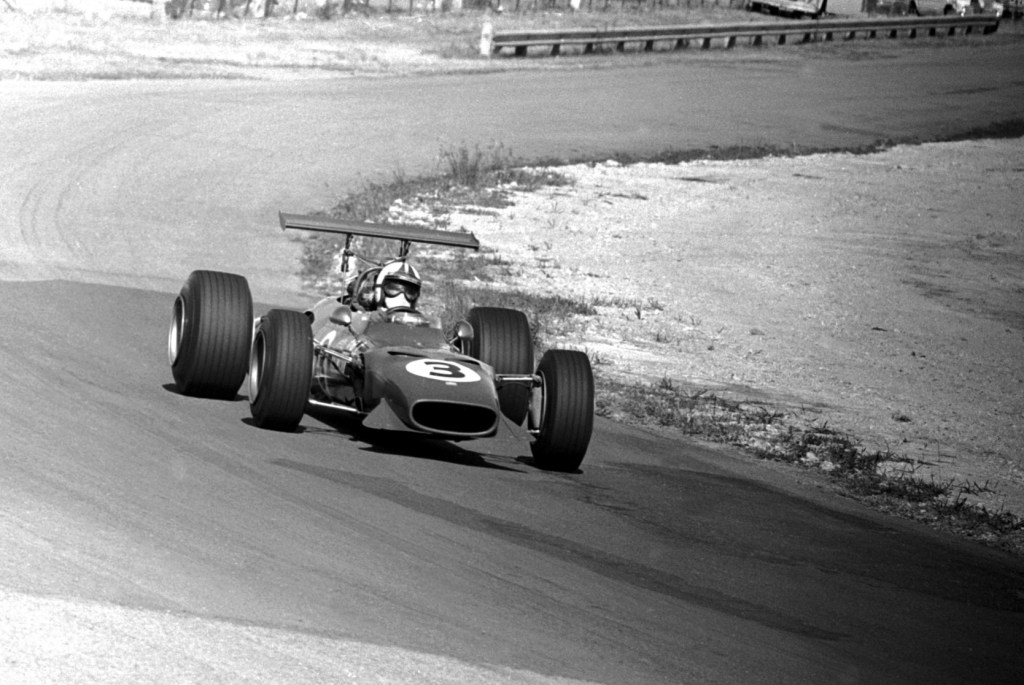
(MotorSport)

Credits…

I truncated and added to Thomas B Floyd’s race report in the Australian Motor Racing Annual 1969, Sutton, MotorSport Images, Graham Ruckert Photography, Bruce Sergent on sergent.com, oldracingcars.com

Tailpiece…
Finito…

(B Richards)

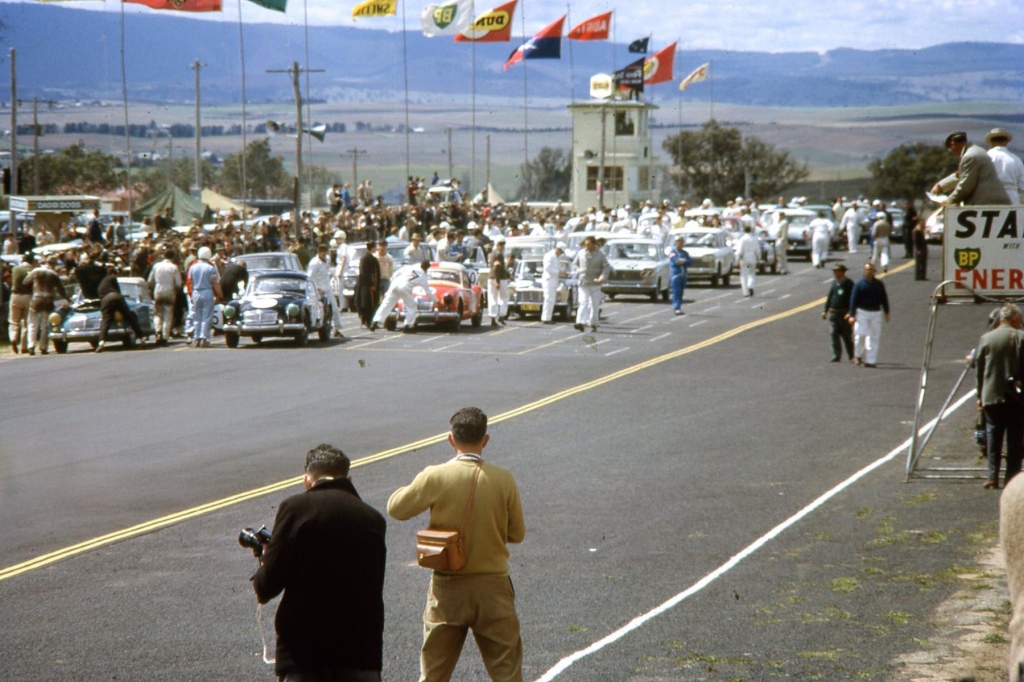
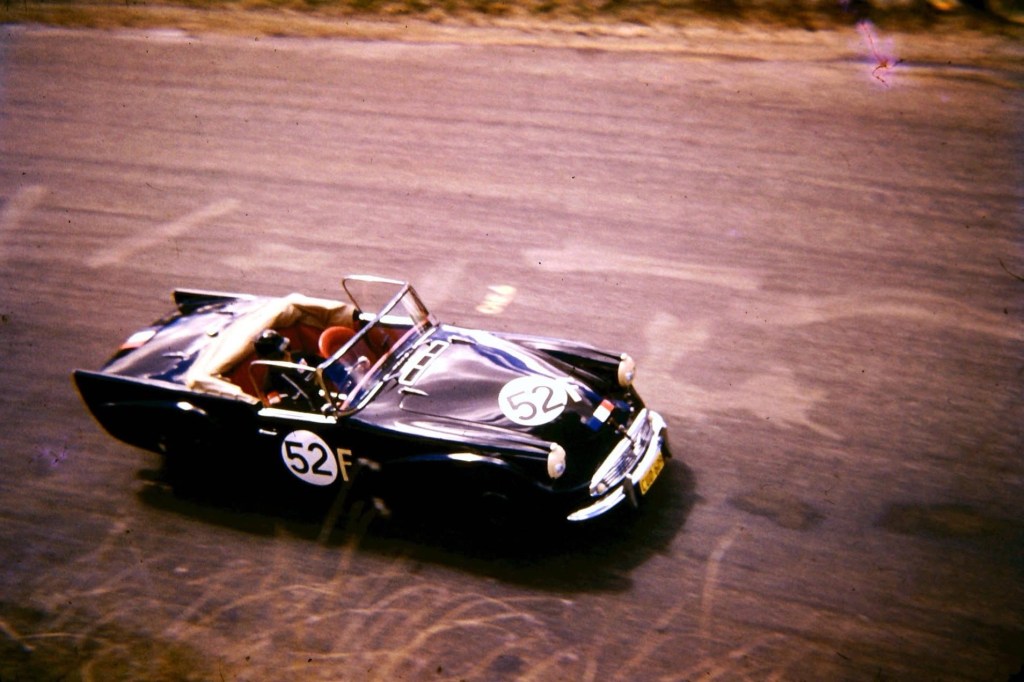
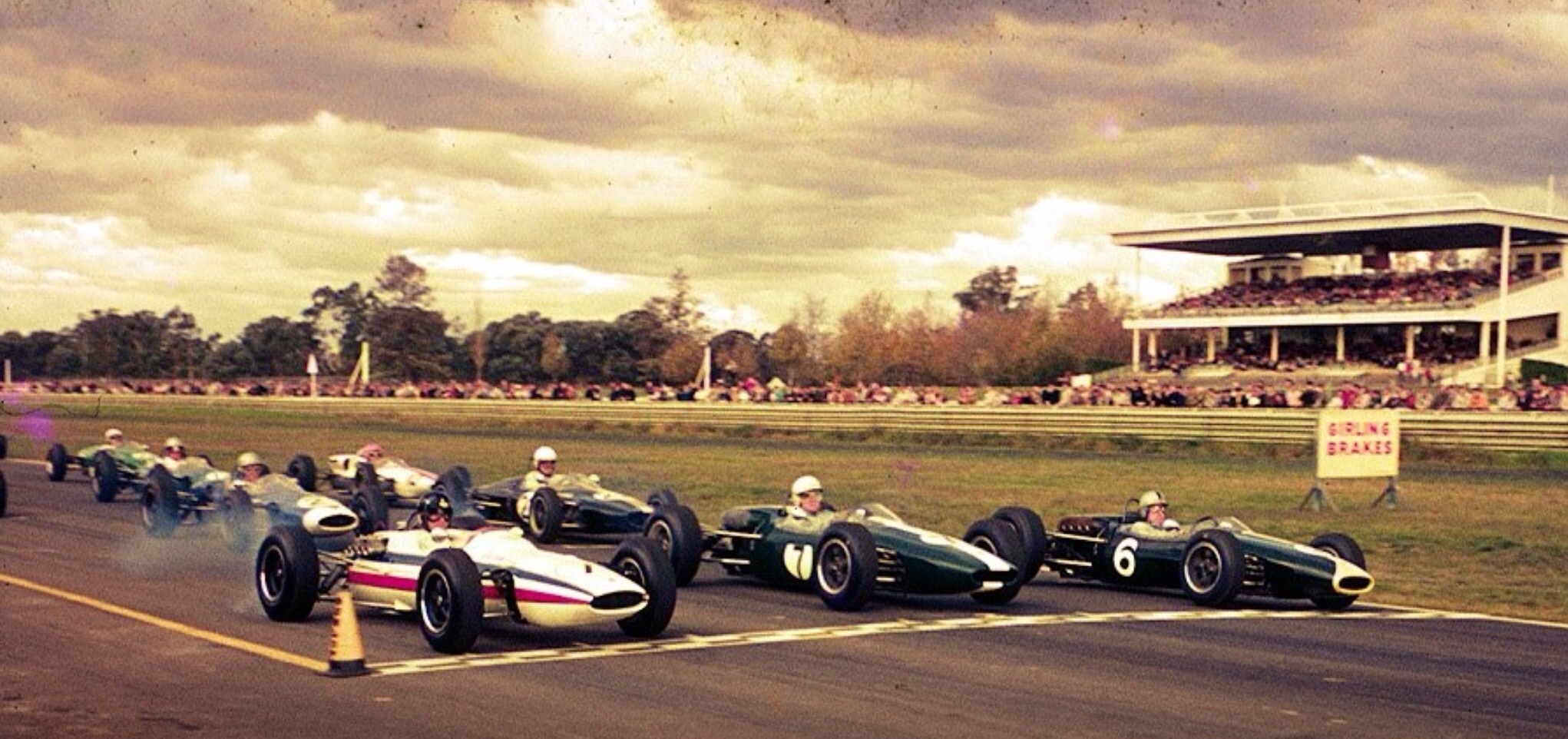
The grid gets way at the start of the September 30, 1962 Bathurst 6-Hour Classic. The entry comprised a mix of production sports and touring cars divided into price based classes. The front row comprises the three MGA Twin-Cams of Matt Daddo/Bill Stanley, N Claydon/Fred Gibson and Clarke/Lazich, with the C Lansdowne/Dianne Walker Triumph TR4 on the inside.

The Bathurst promoters, the Australian Racing Drivers Club, perhaps ran the event off the back of the success of the Phillip Island 500-milers (Armstrong 500) first run in 1960, which would soon after become the ARDC’s after the debacle of the Phillip Island October 1962 event in which the track surface famously, in essence, fell to bits.

(B Richards)

A total of £3,000 in prize money was split evenly among the classes or divisions: A-production touring cars up to £900, B-production touring cars £901-£1050, C-production touring cars £1051-£1250, D-production touring cars £1251-£1700, E-production sportscars up to £1500, F-production sportscars £1501-£2000.

While there was officially no outright winner, the interest of the punters was amongst the top-guns which included the V8s: Studebaker Larks, the brothers Geoghegan’s Daimler SP250 and potentially the best of the little-cars, the Bruce McPhee/Barry Mulholland Morris Cooper.

What strikes me now is that the entry list was a who’s-who of (mainly) New South Wales stars of the day and of the immediate future with a swag of Gold Star, Australian Touring Car and Sportscar Championship, and Bathurst winners in the mix.

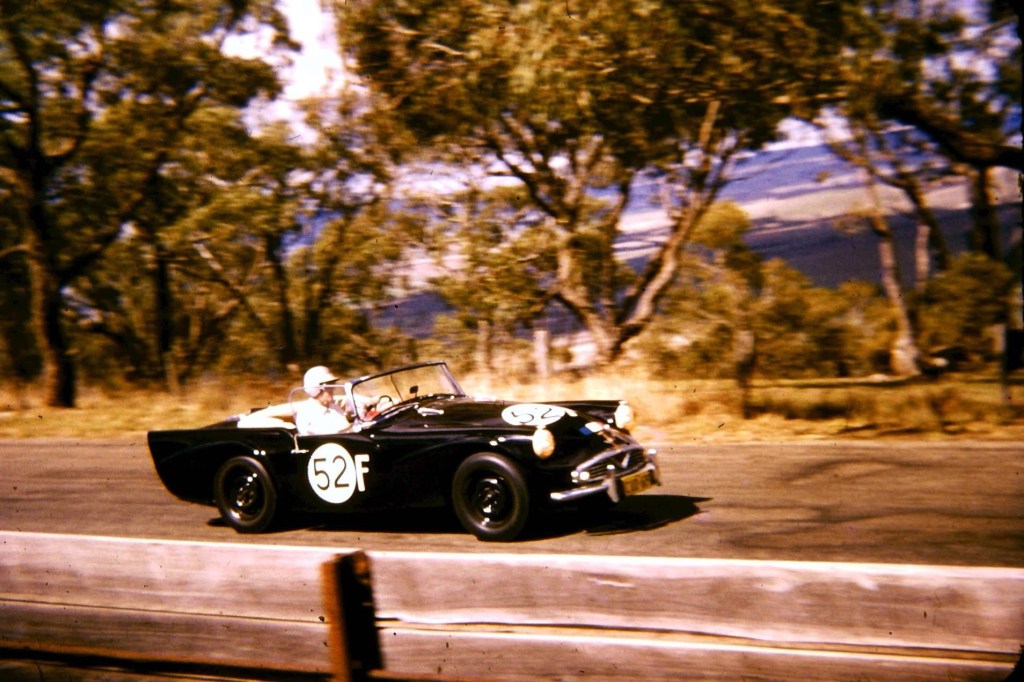
It appears that the sportscars had to start with their tops up, so this is practice or the first stint for Leo and Pete Geoghegan’s winning Geoghegan Sports Cars entered and prepared Daimler SP250 (B Wells)

Morris 850s dominated Division A – 14 cars, of which all but one finished – where the winners were Frank Kleinigs senior and junior. Kleinig Snr was an Australian great pre-and post-war and always polls well in lists of Greatest Australian Drivers Never to Win an AGP. Junior was no slouch either as a racer and constructor of Formula Vees. There was no shortage of notables in this class including Des West, Bill Pitt, Arnold Glass, John French and Paul Bolton, while Tom Sulman would have run Kleinig Snr close in a contest for who started racing first.

Seven cars contested Division B, the victors were John Martin and C Hodges in a Skoda Felicia of all things. This group included cars raced by Ron Hodgson, Digby Cooke, Alan Heasman, Peter Wherrett, Doug Stewart and Alan Stanfield.

Bruce McPhee and Barry Mulholland went on to win the Bathurst 500 outright aboard an HK Holden Monaro GTS327 in 1968, they prevailed in Division C where Bob Jane and Harry Firth were much fancied in a works-Ford Falcon XK.

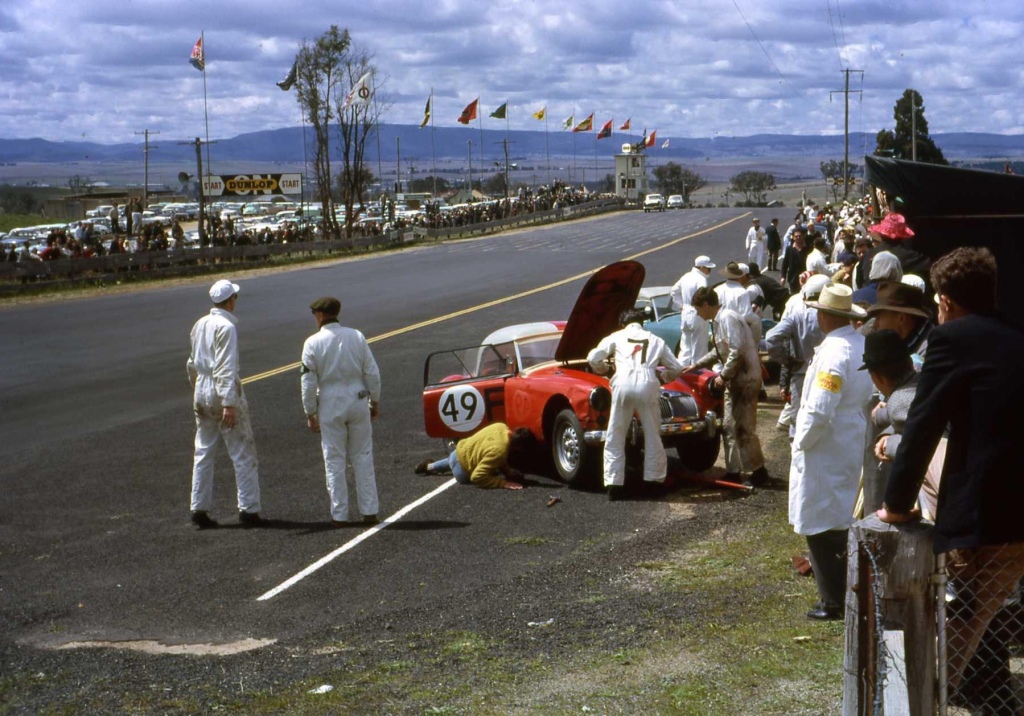
The Jane/Firth C Division Ford Falcon XK from the ‘E’ MGA 1600 driven by K John/Peter Caldecoat (B Wells)
Lap 39, Firth is ok and out of the Falcon via the back window but she needs a turret! Bob Williamson recalled, “They towed the Falcon up the escape-road on its roof with a tractor. You should have heard the noise, roof on a gravel road.” (B Richards)

Ford planned to race their new Falcon XL in the Armstrong 500 at the Island on 21 October, in addition they decided, wisely, to contest the Bathurst Six Hour Classic to be held only three weeks before. The catch was that Ford didn’t want to race the XL at Mount Panorama so Firth set about preparing an XK Falcon for the race.

Firth takes up the story in his typically self-serving way, “Having not been to Bathurst for some years, I had to rely on hearsay information like, “no, it is not hard on brakes and the circuit has not changed. I did all the usual things such as a valve grind, compression check, set the camshaft properly, gave the pistons plenty of clearance, deck-heighted the head and put the engine on the dyno.”

“I fitted a set of heavy Armstrong shockers and some well-worn springs. I made up some Ferodo brake shoes but ended up leaving them at home, thinking they wouldn’t be needed. I drove the car to Bathurst myself. Practice proved two things: the car was the fastest sedan and the brakes were not good enough.”

The Jim Clarke/A Lazich MGA Twin-Cam receives some attention, DNF (B Richards)

The two wily Melbourne racers – who went on to win three of these Phillip Island and Bathurst 500s together – led their class early, but the brakes were progressively showing signs of stress as the pedal crept inexorably closer to the floor.

Harry took over from Bob after a scheduled stop and then on lap 39 “As he braked for Hell Corner, the fronts suddenly over-energised and locked on, the nose dug in and the car rolled.” The roof was crushed with Harry extremely lucky he wasn’t badly hurt, the car had no roll bar or cage of course. He exited via the rear window as fuel spilt over the tarmac, but did not ignite.

The Division D winning Studebaker Lark raced by Algie/Hibbard. I’m old enough to remember when these beasts were popular cop-cars in Australia (B Wells)

Division D’s 10 car entry included three Studebaker Larks, with the Don Algie/Kingsley Hubbard entry the winner on 99 laps, then the well credentialed David McKay/Greg Cusack duo in a Fiat 1500 from Peter Williamson and K Whiteley third in another Fiat 1500. Other notables in that class were Bill Buckle, Brian Foley and George Murray.

Only four cars contested Division E, with the Tony Reynolds/Les Howard Morgan Plus 4 ahead of the Bill Reynolds/Kevin Bartlett Austin Healey Sprite Mk1.

The Geoghegans won Division F for the more expensive sportscars from the G Lansdowne/Holt Bonnie Triumph TR4. The Top-Three outright were the Geoghegan Daimler on 104 laps, then the Lansdowne/Binnie TR4 on 100 and the Algie/Hibbard Studebaker with 99 completed laps.

The entries for this race are staggering in their diversity, here the fourth in Division D Scuderia Veloce Citroen ID19 driven by Bill Buckle and Brian Foley (B Wells)

Credits…

Bill Richards, Bruce Wells, Shannons Falcon XK article by Mark Oastler, SS Auto Memorabilia

Tailpiece…

(SS Auto Memorabilia)

Leo Geohegan at the wheel of the winning Daimler SP250. With a 2.5-litre V8 and light fibreglass body it proved a quick car but the duo had some challenges, most notably the drivers door opening on a regular basis as the body flexed, and the loss of first gear on the start-line.

Finito…

(Auto Action)

I was flicking through some images and came upon a few photographs of Leo and Pete Geoghegan the other day, intriguingly, they were all shots taken in 1973. A good reason for a quickie article.

The shot above is on Pit Straight at Sandown just before Leo eases onto the brakes for Torana. Interesting for we Birrana-perves is the little winglet atop the nose. I wonder where else he ran it so equipped, buggered if I know the meeting date either. More Birrana here: https://primotipo.com/2021/10/12/tony-alcock-birrana-cars-design-process/ and here: https://primotipo.com/2020/08/10/testing-times-2/

Leo initially raced the first ANF2 Birrana, the 272 Hart-Ford 416B 1.6, in 1972. By 1973 he raced a works-car to the Australian Formula 2 Championship in the 273 shown above. He won six of the seven rounds, then doubled up and won again aboard a 274 in 1974 against much stronger opposition. More about the 272 here: https://primotipo.com/2019/02/01/this-is-hard-work/

Pete Geoghegan ahead of one of the Toranas in the final ATCC round of 1973 at Warwick Farm in July. He was third behind the Peter Brock and Bob Morris XU-1s (Auto Action)

Meanwhile, younger-brother, Pete was doing his thing as one of the country’s greatest exponents of touring cars. He ran a John Sheppard built Group C Chrysler Valiant Charger E49 in the Australian Touring Car Championship, then switched brands to co-drive a works XA Ford Falcon GT351 Coupe in the Bathurst round of the Australian Manufacturers Championship.

Pete was sixth in the ATCC, his bests, a second place at Surfers and a pair of thirds at Calder and Warwick Farm. Allan Moffat won the title in his XY Ford Falcon GTHO Phase 3 from Peter Brock, LJ Holden Torana GTR XU-1, and Graham ‘Tubby’ Ritter, Ford Escort twin-cam.

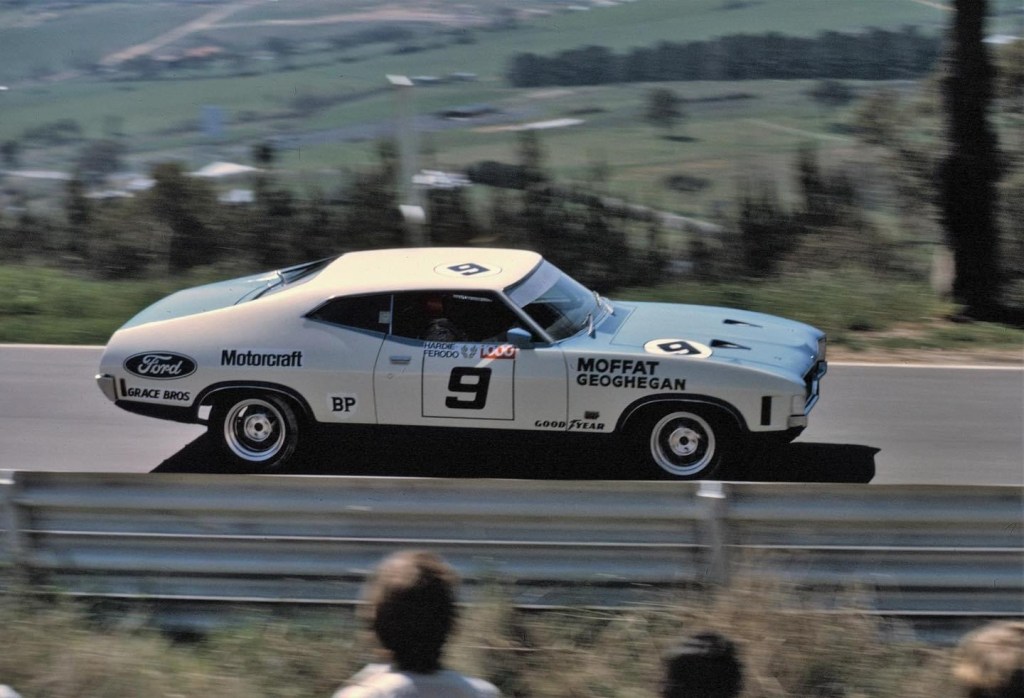
At Bathurst (below) Pete bagged an overdue 500-win for the brothers when he co-drove Moffat’s Coupe to a celebrated FoMoCo victory. Holden (Torana GTR XU-1) won the Manchamps with wins in three of the five rounds, Ford won two and were placed fourth in the title race, with Alfa Romeo (105 Series 2000 GTV) second and Mazda (Capella RX2) third.

(R Steffanoni)

Credits…

Auto Action, Rod Steffanoni

Finito…

image

Cathy Ford looking all pert and perpendicular in a Paula Stafford bikini, a mighty fine chequered flag design it is too. The car is a Valiant Charger R/T (road/track) at Surfers Paradise International Raceway in 1972’ish…

Once upon a time Australia had a motor industry. It was largely owned by the US Big Three, Chrysler was the smallest. Based in Tonsley Park outside Adelaide, the company punched well above its weight, the product, especially the Hemi-six cylinder engined cars were good in the context of the times.

The Big Three’s pony cars in 1971-72 comprised Ford’s four-door road Falcon GT 351 and Bathurst winning GTHO 351 variant, General Motors Holden’s mid-size 202cid six-cylinder road Torana GTR and Bathurst winning GTR-XU1, and the 265cid-six powered road Charger R/T E37 and Bathurst E38 in 1971, and E48/49 in 1972.

These amazing Australian designed and built road cars – in world terms they were fast and acccomplished – were fundamentally built to win Series Production races, especially the annual Bathurst 500 bash. Win on Sunday, Sell on Monday, it was that simple for the snappily dressed marketing men and their whiteshoe, sales foot-soldiers.

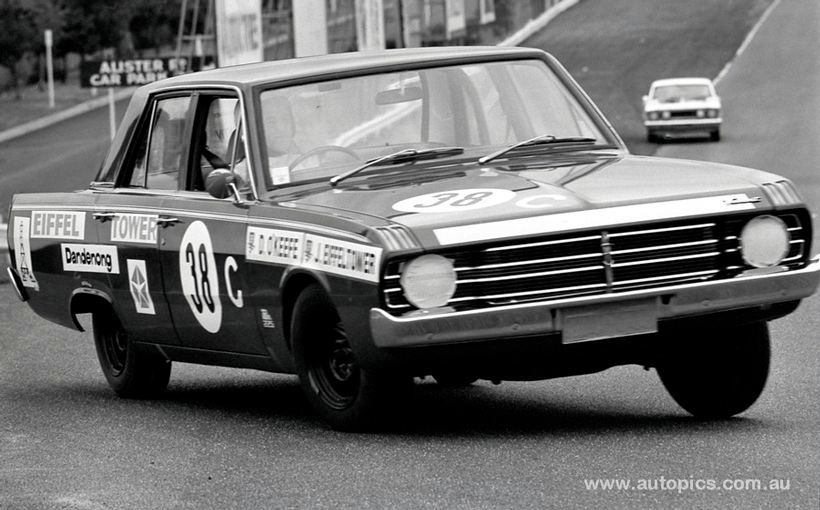
The David O’Keefe/ Jack Nougher Valiant Pacer VF on the way to a Class C win in the 1969 Sandown 3 Hour

Valiant put a toe in the competition water with mildly tuned ‘Pacer’ variants of their four-door VF and VG family man machines in 1969-70. Then they got serious with the new shortened 105 inch wheelbase Charger which was released two months after the mainstream 111 inch VH Valiant sedan in 1971.

The American styled VH suited guide-dog-owners, it’s big arse, cavernous overhangs, high waisted looks and narrow track weren’t a patch on the looks of the contemporary Holden HQ, Falcon XY or XA.

When Chrysler Oz CEO David Brown realised what a mutt his new car was going to be, he bundled up a tiny-budget and built a two door coupe, the design of which was led by Brian Smyth at Tonsley Park. It had to plug a hole in his range and grab some halo-effect for his four-doors.

I’ve cheated with photo selection here, the VH Pacer to me looked pretty good, all stripes and wide wheels. But the base models were very grim shit-fighters.

And what a horn-bag Smyth and the Chrysler International Design Studio, under Bob Hubbach, came up with. Charger was an immediate sensation when released in August 1971. The best bit of the Valiant, its front, was retained and otherwise the team crafted a low, squat, muscular, sexy machine that still looks great from every angle.

With Elle McPherson looks at an affordable price it was a sales smash aided and abetted by a brilliant marketing campaign. Hey Charger! was on everybody’s lips, young or old, male, female or confused. Winning Wheels magazine’s coveted Car of The Year award in ’71 was the cherry on the cake.

The range went from the poverty-pack 215cid, drum braked, three-on-the-floor Charger to the fire-breathing race-bred 265cid – a bored-out 245 Hemi – 1971 E38 280bhp @ 5000rpm and 1972 E49 302bhp @ 5600rpm R/T machines of interest to us.

For a while 70% of all Chrysler sales were Chargers, but they were far from niche. With a big back seat and a boot you could fit granny in, they were legit four-folk-family-cars. Read Mel Nichols’ account of what a great drive these competition bred Chargers were on the road; https://www.classicandsportscar.com/features/chrysler-valiant-charger-australian-odyssey

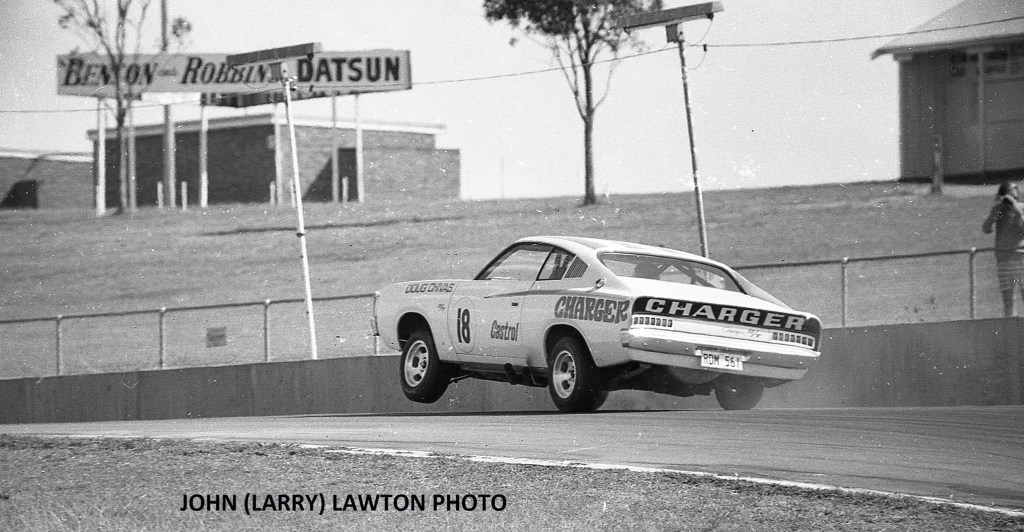
Chrysler competition chief, engineer John Ellis put together a strong development team in the Pacer days which included 1970 Gold Star champion single-seater racer, Leo Geoghegan who raced the cars and acted in a consulting capacity. Another sportscar/single-seater racer/mechanic, Ian Cook, a Chrysler employee was key too. This group, and others, concocted a potentially race winning car, the only missing ingredient in the formative stages was a four-speed gearbox…

John Ellis circa 1971 (CCC)
A goal perhaps Leo? Geoghegan with a VG Valiant Ute at Mallala in 1971. Two Utes were cut and shut to replicate the upcoming Charger’s track and wheelbase, engine and big-tank location (autopics.com)

The A84 Track Pack option included a very direct 16:1 ratio steering box, Sure-grip LSD, a choice of tall 3.23:1 and short 3.50:1 diff ratios, light 14×7 R.O.H. cast alloy ‘Dragmag’ wheels and a huge 35-gallon tank with twin-fillers.

On paper, the big-Val had Bathurst shot-to-bits but the lack of a four-speed box was a big shortcoming; there was no Oz four-speeder available at the time, a situation rectified in 1972.

While it looked the goods, there were other shortcomings, as Mark Oastler outlines. “The Charger was built on a relatively short 105-inch wheelbase, which magnified the ‘see-saw effect’ of dynamic weight transfer from front to rear, resulting in excessive squat under acceleration and forward pitch under heavy braking.”

Leo with the real McKoy E39, again at Mallala. Squat at the rear, nose up a characteristic of the cars as per the text, the bonnet air duct doesn’t – it’s a styling addition only (autopics.com)
Geoghegan practicing at Oran Park before the Chargers race debut in September 1971

“This was not helped by the high location of the big long-range fuel tanks fitted to the Bathurst cars. The VH Valiant’s bulbous bodywork ended up being more than 100mm wider than that of the VF/VG ute-based development mules, which added to the R/T’s lateral inertia and tendency to understeer in hard cornering. The Charger’s wheelbase was also quite short relative to its track. This wheelbase-track ratio created a car that was very responsive to directional change, but was twitchy and nervous at high speeds.”

The Charger’s track was similar to the GTHO but its wheelbase was six-inches shorter than the big Roaring Ford. It wasn’t stable on high speed Mount Panorama but was better suited to shorter, twistier tracks. The Chargers were dominant in NZ production racing for years, a status never accorded them at home.

The 11-inch non-power assisted ventilated front discs and calipers (which flexed badly) were marginal on track too. Ford’s similar challenges with the beefy 351 Cleveland powered HO were met late in the 1971 piece with Ferodo’s trick DP11-103 pads.

Oastler quotes Leo Geoghegan as saying that the Chargers could have beaten the Toranas in ‘the six-cylinder class battle’ and applied greater pressure on the HO’s had Chrysler sorted its front-disc problem. A set of pads was only good for 60 miles if given a hard workout.

Leo Geoghegan in the Charger E49 he shared with Peter Brown in the 1971 Bathurst 500 (Chevron Publishing)

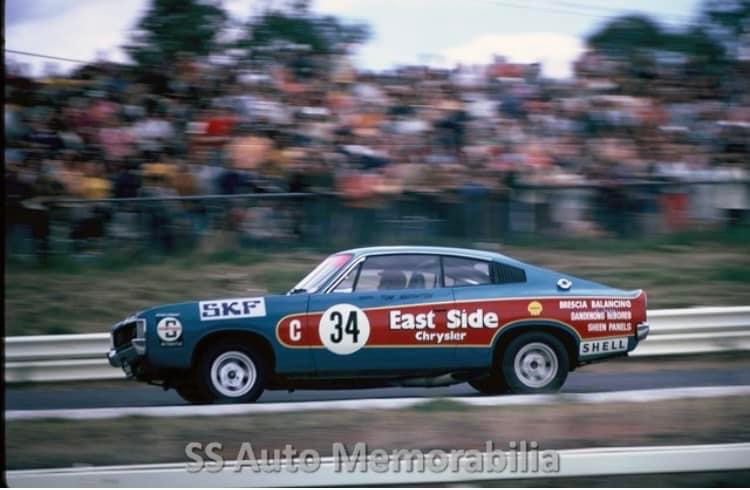
In 1971 expectations were high after Doug Chivas won a 100 lap enduro at Oran Park a fortnight before Bathurst. While it was a great drive, Chivas was advantaged by Colin Bond’s HDT XU1’s race-long gear selector problems…the works HO’s were absent too.

With vastly inadequate Bathurst preparation: simulations to determine fuel consumption, brake and tyre life etc, Geoghegan’s Top 10 Q8 was great – quickest of the Class D cars including the XU1s – but was still six seconds off Moffat’s GTHO Phase 3 pole.

Moffat won by a lap with Geoghegan’s Charger seventh outright and second in class behind Bond’s HDT XU1. Impressively, eight of the 10 Chargers that started, finished. Geoghegan’s post-race list of shortcomings included tyre wear, fuel consumption far greater than that anticipated and brakes…

In the later rounds of the 1971 Australian Manufacturers Championship (Manchamps), Chivas was third at the Phillip Island 500K, while Geoghegan was second to Moffat’s HO in the Surfers Paradise 250 – ahead of the two LC XU1s of Brock and Bond – with Chivas sixth. Progress was being made.

Geoghegan’s E39 Charger from Colin Bond’s LJ XU1 at Warwick Farm during the 1972 Tasman Cup meeting (L Hemer)
Leo did the final Bathurst 500 solo in 1972. E49 was Q6 and fourth (autopics.com)

Chrysler’s response for 1972 was the 302bhp @ 5600rpm E49 Charger variant…fitted with Borg Warner’s new four speed gearbox, the more aggressive cam-profile was possible thanks to a better set of ratios which could exploit the peakier power delivery.

Just as in 1971, the E49 was short on Bathurst development, in part as a result of the Supercar Scare, see here for chapter-and-verse on that important bit of Australian Motor Racing History: https://primotipo.com/2018/04/12/holden-torana-gtr-xu1-v8/

A byproduct of the Supercar Scare was Chrysler’s withdrawal from motor racing with factory cars, an incredible decision really after all the clever development and homologation. The better call would have been to contest that years Manchamps and then pulled the plug; but Chrysler was in big financial strife globally.

Noel Hurd raced his E49 to fifth in the first round of that championship, the Adelaide 250 in August, while at Sandown, the traditional Bathurst curtain-raiser, the two cars raced by Victorians, Tom Naughton and Lawrie Nelson failed to finish.

Tom Naughton’s car was a Victorian meeting regular, here at Sandown in April 1972
Geoghegan E49 at Lakeside during 1972

Off to Bathurst, Geoghegan was again the quickest of the Chargers at Mount Panorama, qualifying sixth. Again Moffat was on pole in an XY GTHO, but this time the margin to the E49 was 3.3 seconds. Leo led for a while early in the race but a faulty starter motor, loose battery lead and misfire late in the race ruined what could have been a good run. Geoghegan was fourth in the race won by Peter Brock’s GTR XU1, with John French’s GTHO second, with the Doug Chivas/Damon Beck E49 the best of the six Chargers entered, in third.

Tom Naughton was sixth at the Phillip Island 500K, while Leo was sixth in the Surfers Paradise 300. Chrysler placed fifth in the the Manchamps behind the GTHO, XU1, Ford Escort Twin-cam and Mazda 1300.

Pete Geoghegan enroute to third place in the final Warwick Farm ATCC round in July 1973. Look how nice and flat that Charger is with Sheppard’s suspension mods: geometry, spring and shock changes

With the end of Improved Production and Series Production in 1972, and adoption of Group C as the formula to which the Australian Touring Car Championship and Australian Manufacturers Championship were run in 1973, a group of New South Wales and Victorian Chrysler dealers supported the construction of a Group C-spec Charger built by ace engineer/mechanic, John Sheppard at his Monaro Motors workshop in Melbourne. It was to be raced by Leo’s brother, four-time Australian Touring Car Champion, Pete Geoghegan.

Pete finished sixth in the ATCC in this quick, often forgotten car, but switched camps to Ford for the Manchamps. Successfully so, he co-drove Moffat’s factory XA 351 GT Coupe – FoMoCo’s response to the two-door Monaro and Charger – to victory at The Mount. This Group C Charger is beyond the scope of this article but is a good one to pick up soon with some input from Sheppo, who is still razor sharp.

Etcetera…

In Chrysler’s own words above, “You’re watching Charger’s Hemi/Weber Six Pack during a dyno endurance test. After 480 hours at both ends of the rev range, it’s running red hot at peak revs for longer than it ever would on road or track. The Six Packs an unbelievable mill. But don’t get the idea it’s just a 265 cube Hemi with three double-barrel Webers bolted on.

The whole engine’s been tuned to the Webers. In fact, we flew a car (a VG Pacer driven by John Ellis from London to Bologna) over to the Weber factory in Italy. Breathings been freed up with a high overlap camshaft, bigger valves and tuned length extractors. And the crankshaft, conrods and valve springs have been shot-peened for high-speed strength.

But there’s more to a Six Pack Charger than just a great engine. The E37 Street version offers dual disc clutch, close ratio gears, 20:1 steering, 3:23 diff and pancake air-cleaners to pick up bottom end torque. The E38 Track Pack version picks up compulsory alloy wheels and special engine, brake and suspension mods. All of which make it ready to roll straight on to the track.

Your Chrysler/Valiant dealer has the Six Pack systems to make you believe in the unbelievable. And at Charger prices, you can’ attord not to.

CHRYSLER. GREAT IDEAS IN MOTION. BELIEVE.”

(L Nelson Collection)

Laurie Nelson’s Group C Charger E49 being harrasssed by an LJ GTR XU1 at Shell corner, Sandown circa 1973.

(J Edwards)

Following the privateer theme – these cars were very fine cars for those on a tight budget – here is Tim Slako’s car at Wanneroo Park circa 1971.

Credits…

Chevron Publishing, ‘Australian Touring Car Championship’ Graham Howard and Stewart Wilson, ‘VH Valiant:The R/T ‘Super-Charger’ that never made it’ Mark Oastler, Lynton Hemer, SS Auto Memorabilia, Graham Ruckert, Chrysler Car Club, Julian Edwards, John Lawton, Laurie Nelson

Tailpiece…

The ROH aluminium alloy ‘Dragmag’ was adopted by Chrysler for the Charger programme. It was made across town in Finsbury by Rubery Owen and Kemsley Pty Ltd one of the local subsidiaries of Owen Organisation/Rubery Owen, a global automotive UK based transnational of which the Owen Racing Organisation/BRM (British Racing Motors) F1 team was a part.

I wondered whether Chrysler inspired the design of the fabulous Dragmag – easily my favourite Oz Alloy of the period – for the Charger programme but Moff ran the wheels on his famous Boss 302 Trans-Am in 1970, and the ad above was in the June 1970 issue of Wheels so they were on the market at the time Charger was being developed.

Obiter…

It transpires – the power of internet searches – that the factory Rubery Owen Kemsley took over in 1946 dates back to WW2. After the British retreat at Dunkirk in 1940 the Australian Government decided to decentralise ammunition production away from the more populous eastern seaboard cities, Adelaide’s Finsbury/Hendon were two such locales.

The Finsbury ammunition factory was established on a massive 50acre/123ha site and commenced production in February 1941. It comprised about 20 buildings where up to 4000 people made cartridge cases and shell fuses for munitions, but not the explosives themselves. The castings and arms cases were sent by rail on a new spur line from Woodvile to Finsbury, to the Salisbury Explosives Factory for filling and assembly.

The factory is now a tyre warehouse.

Finito…

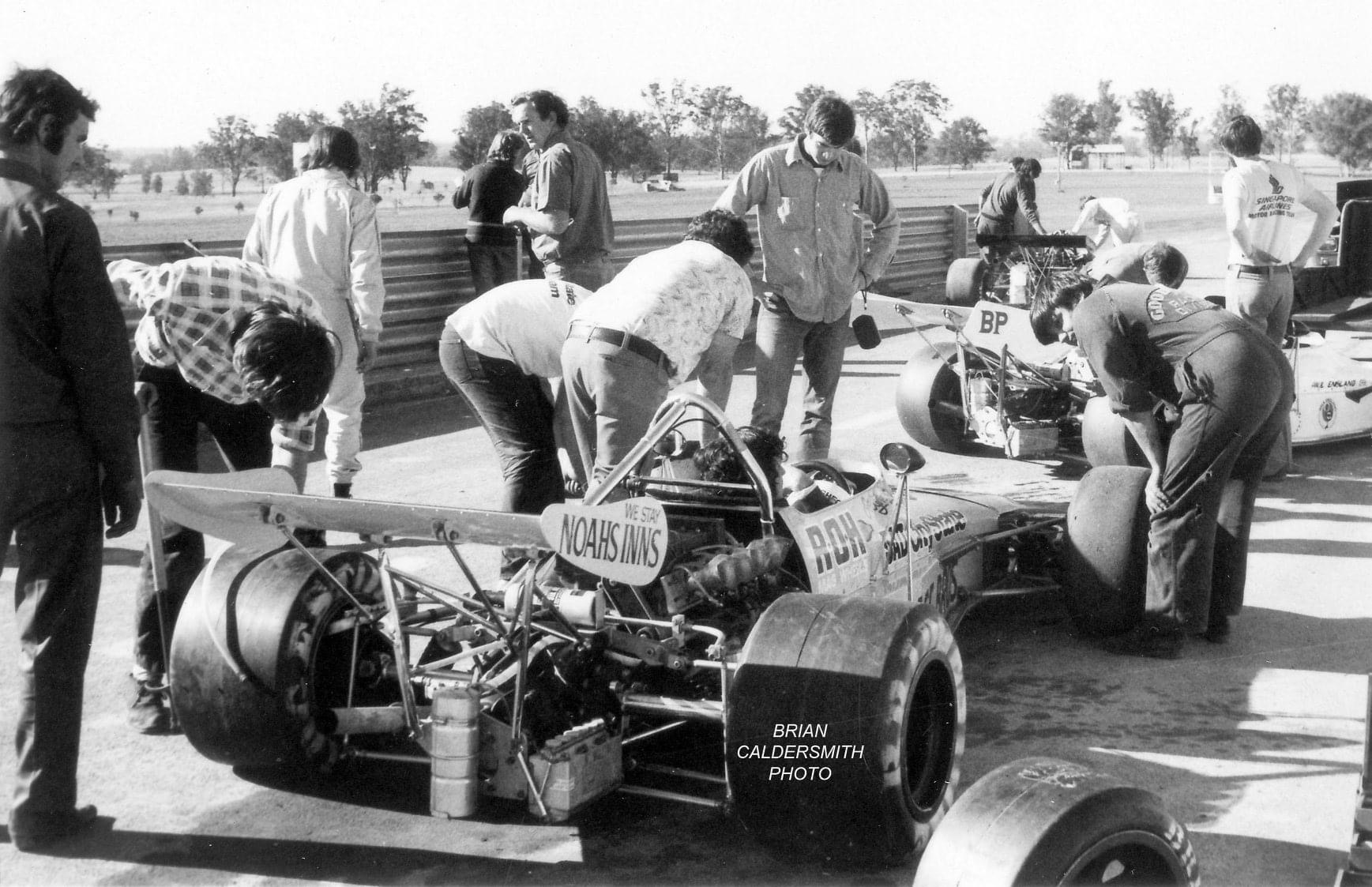
I love watching busy test sessions such as this.

It’s the Thursday or Friday before the second round of the Australian Formula 2 Championship at Oran Park, New South Wales on August 5 1973.

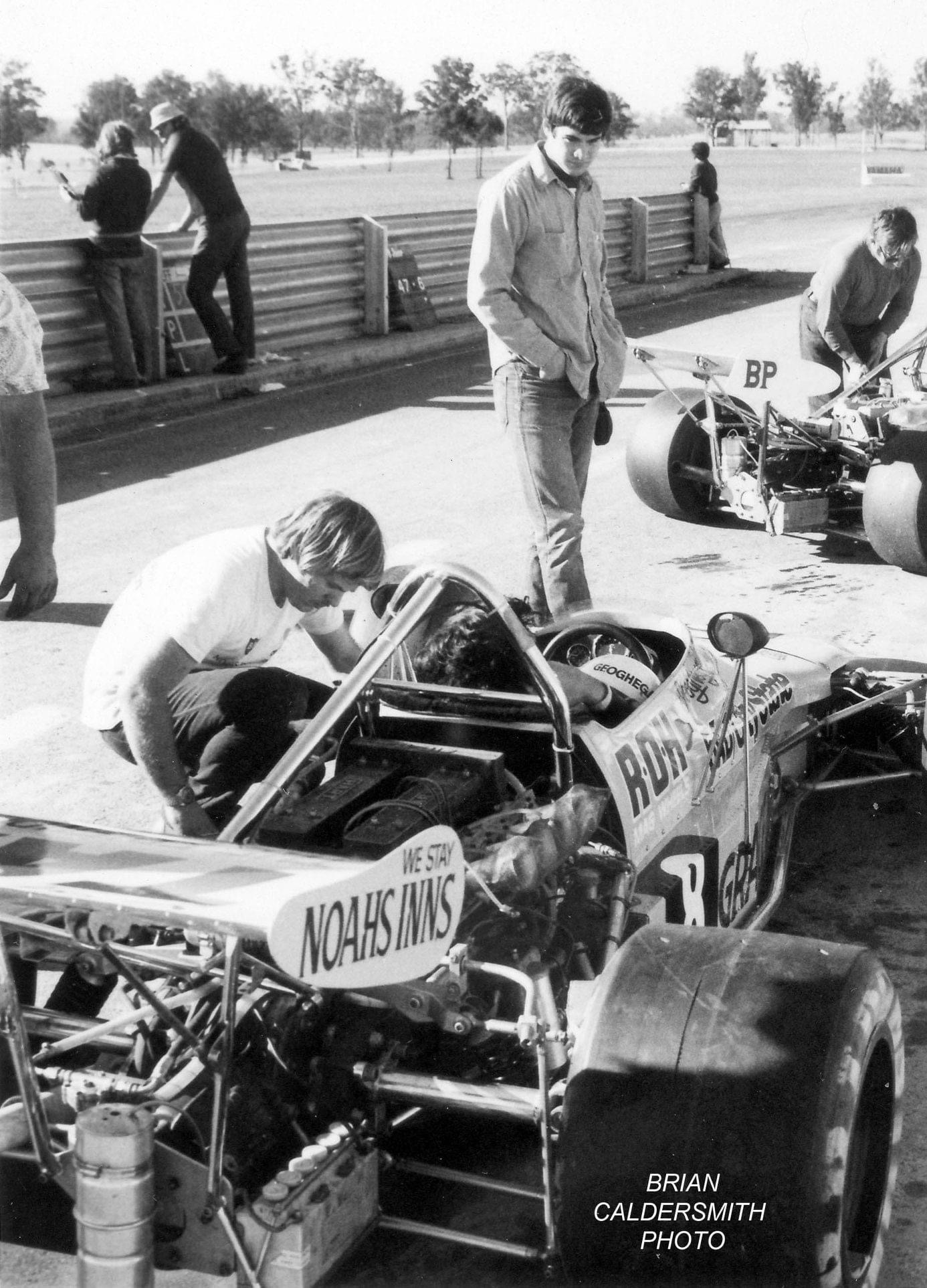
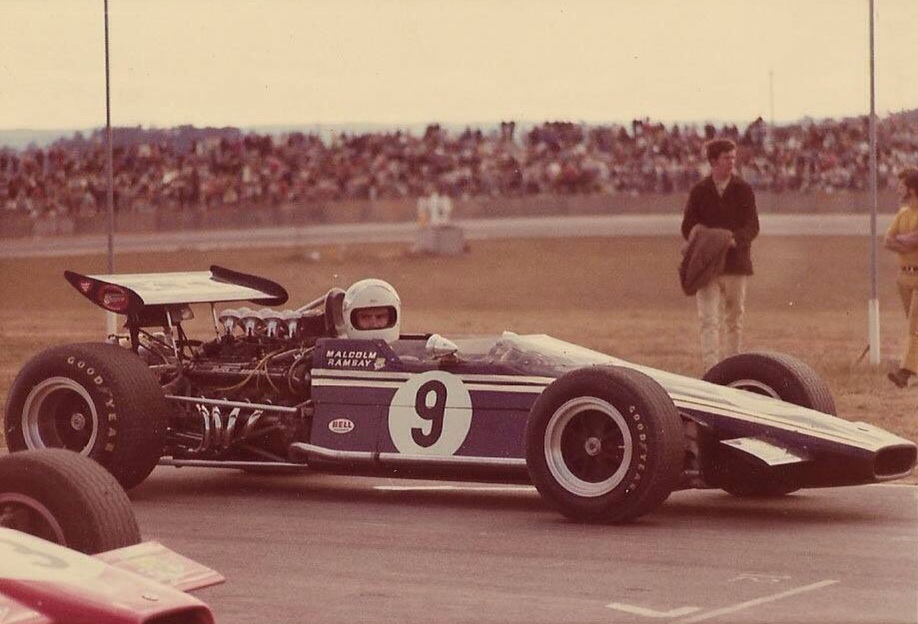
The Birrana Cars onslaught is underway, Malcolm Ramsay and Tony Alcock’s 272 impressed all in 1972 including Leo Geoghegan who drove the car late in the year and was happily seduced back into single-seaters with a works Birrana 273 Ford-Hart 416-B 1.6 for 1973.

Leo mopped up that year winning six of the seven Australian Formula 2 Championship rounds despite opposition from Tony Stewart and Enno Buesselmann in 273s, Bob Skelton’s Bowin P6 and Ray Winter in the old darlin’- the ex-Gardner/Bartlett Mildren Yellow Submarine. Of these Skelton was quick everywhere and led Leo at Amaroo and Symmons, missed the last two rounds and ultimately could not convert the potential of the variable-rate suspension Bowin.

But all of that is in the future, the flurry of activity centres on Leo’s car and a back to back test between Goodyear and Bridgestone tyres- who is the the Goodyear tech looking closely at the right front- i am being assertive with my identification of people but in some cases ‘i think’ should be used- just letting you know rather than write it ten times.

Check-shirt man is Bruce Cary, the driver at left is Ray Winter, to his right in the short sleeved shirt is Bruce Richardson- the car in front of Leo’s is Tony Stewarts, the guy in the Singapore Airlines T-shirt is Malcolm Ramsay and the car at the end of the pitlane is one of the black Bowin P6s- either Skelton’s or Bruce Allison- Bob liked the car more than Bruce!

Goodyears in the first shot, Bridgies here.

All of the Birranas are superb racing cars- FF, ANF3, ANF2, F Pac and the mid-engined Speedway machine, Adelaide strikes again! Those who have driven both cars either say the 273 was a better car than the tidied up in the body and bracketry 274, or its equal- Bob Muir gave Leo ‘absolute buggery’ in the 274 bodied 273 owned by Bob and Marj Brown in 1974 didn’t he?

Note the mounts on the nose to accept another small wing- in search of more front bite.

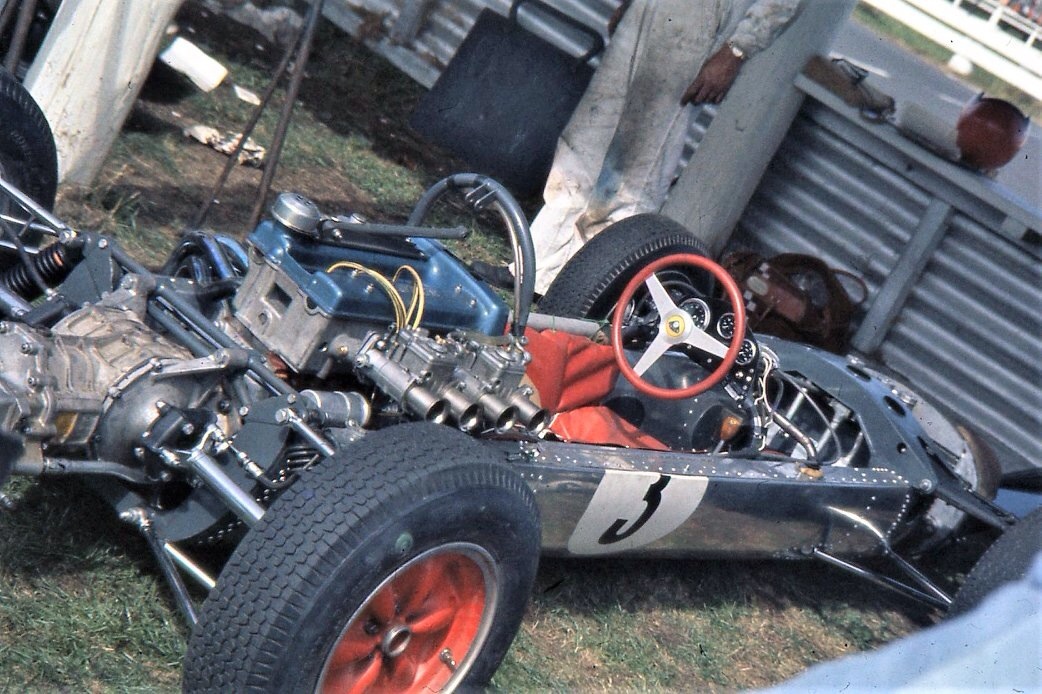
Business end with Varley battery and oil catch tank- forward of them is a Hewland FT200 five speed transaxle and the Brian Hart Ltd, Harlow, Essex built ‘416-B’ Lotus-Ford DOHC, two valve, Lucas injected four cylinder motor.

This engine was aimed at the large American Formula B market, where all of the British tuners fought a pitched battle and in much smaller numbers Australian F2.

The ‘ducks guts’ variant was alloy blocked, the late Peter Nightingale, who looked after Leo’s and Geoff Brabham’s Harts amongst others quoted 200bhp @ 8500rpm and 130lb/ft of torque @ 7500rpm for the 1973 iron block variant and a ‘minimum’ of 200bhp @ 8500rpm and 125lb/ft of torque @ 8500rpm for the 1974 alloy block.

Line ball call but the alloy block was lighter and in the very best of hands every liddl’ bit counts.

No idea who blondie is but the vertically challenged fella looking at the engine in front is ex-Repco immensely talented engineer and multiple Australian hillclimb champion Paul England looking at Tony Stewart’s Jack Godbehear built engine.

Oh yes, come raceday Leo won from Peter Brock’s 273 and Bob Skelton, i am intrigued to know what tyres the works 273 raced…

Credits…

Brian Caldersmith, Peter Nightingale on The Nostalgia Forum

Tailpiece…

Leo is ready to boogie- fuel check and off. Bearded Ramsay, tall isn’t he, wandering past.

I’ve often wondered what Tony Alcock could have achieved in his second European stint, as most of you know he was in that plane, on that day, and in those circumstances with Graham Hill in 1975.

Finito…

(R Meyer)

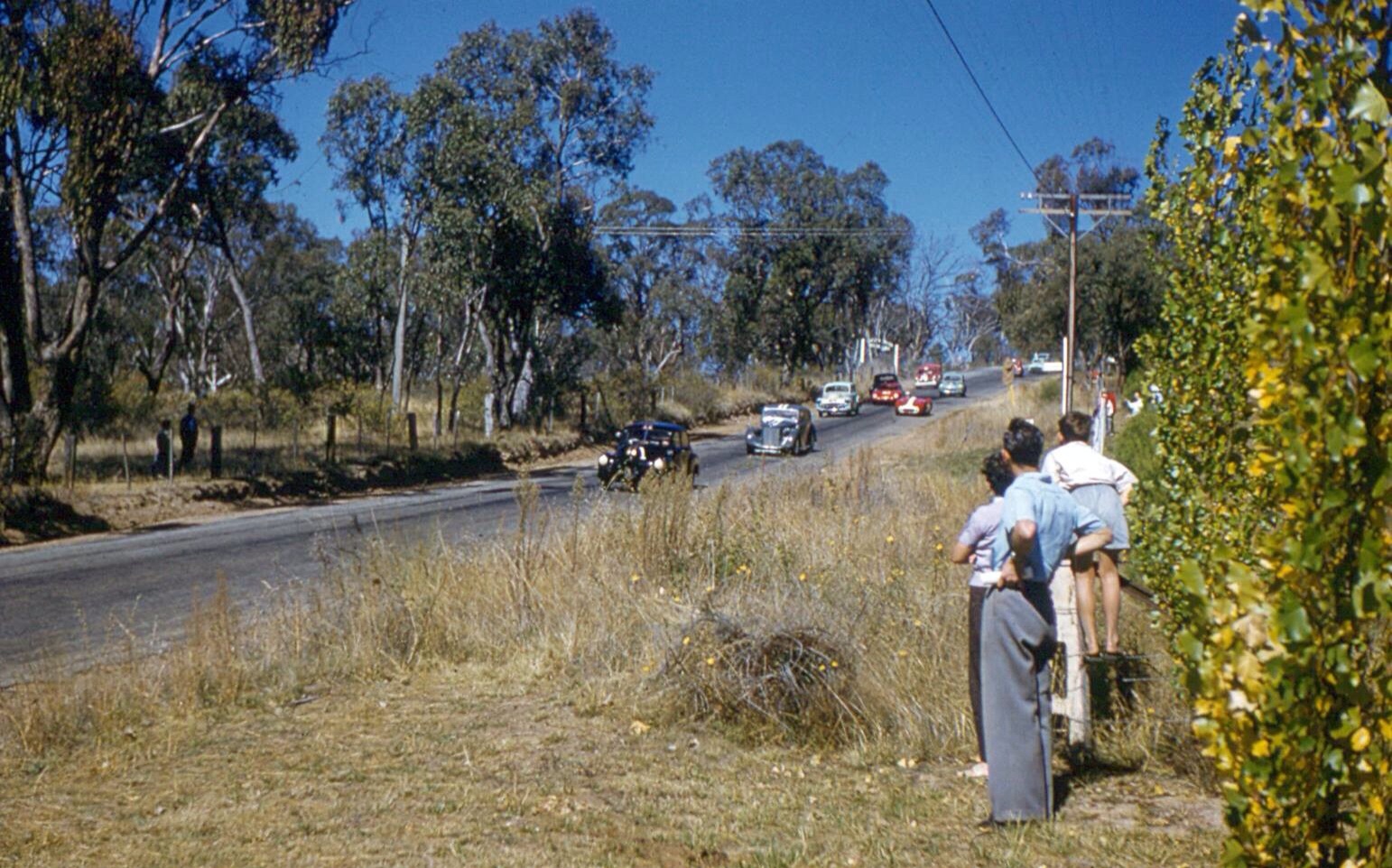
Leo Geoghegan’s Holden 48-215 from Frank Hamm’s Jaguar Mk5, Bathurst, Easter 1959…

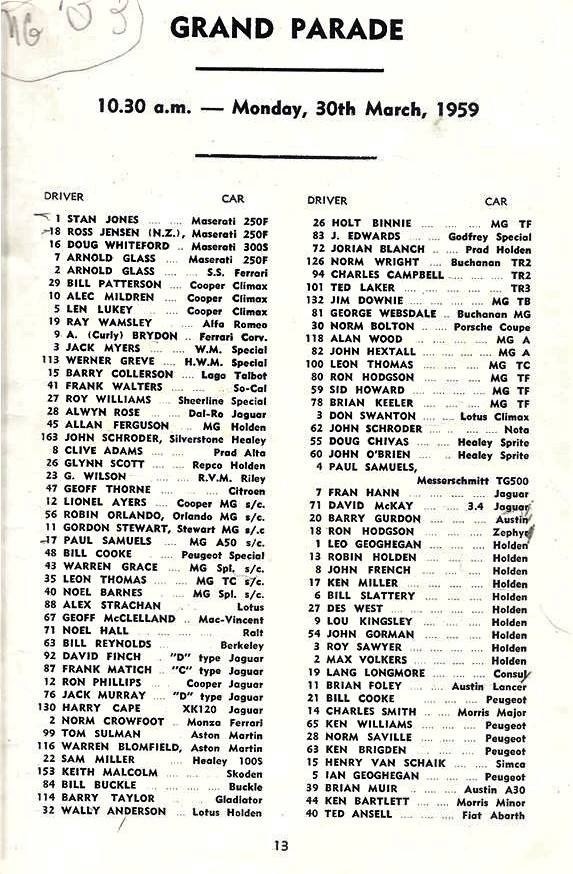
I’m not sure if this is the parade lap described below or a race but the presence of the sportscar in amongst the touring cars suggests the former.

The stunning series of photographs are uber-rare ones from the inside of Conrod Straight, the cars have just cleared Forrests Elbow and are winding up in top gear. The kid standing on the fence is Rick Meyer, his father took these wonderful rare photos trackside, ‘locals’ photographs.

The Easter meeting was the Gold Star round traditionally- there are a huge number of past, current and future top liners or champions amongst the entry list. ‘Currents’ include Stan Jones, Doug Whiteford, Ross Jenson, Curley Brydon, Jack Myers, Jack Murray and David McKay. ‘Future stars’ are Len Lukey, Alec Mildren and Bill Patterson- Gold Star winners in 1959, 1960 and 1961 respectively, Lionel Ayers, Glynn Scott, Arnold Glass, Frank Matich, Ron Phillips, Ron Hodgson, Doug Chivas, Leo Geoghegan, John French, Des West, Max Volkers, Brian Foley, Ian Geoghegan, Brian Muir and ‘Ken’ Bartlett- no doubt Kevin Bartlett learned the value of clean, clear hand-writing on entry forms when he perused the race program at the circuit!

The photo below is from the same spot and shows reigning World Champ Jack Brabham on the 2 October 1960 weekend when the local boy returned to Australia having retained his F1 drivers title, to win the ‘Craven A International’ from a classy field of locals.

The Cooper T51 Climax leads the similar white-coloured machine of 1961 Australian Gold Star Champion, Bill Patterson. Patterson was second in the race with Bib Stillwell, also T51 equipped in third- he is probably that flash of red car behind Patto.

(R Meyer)

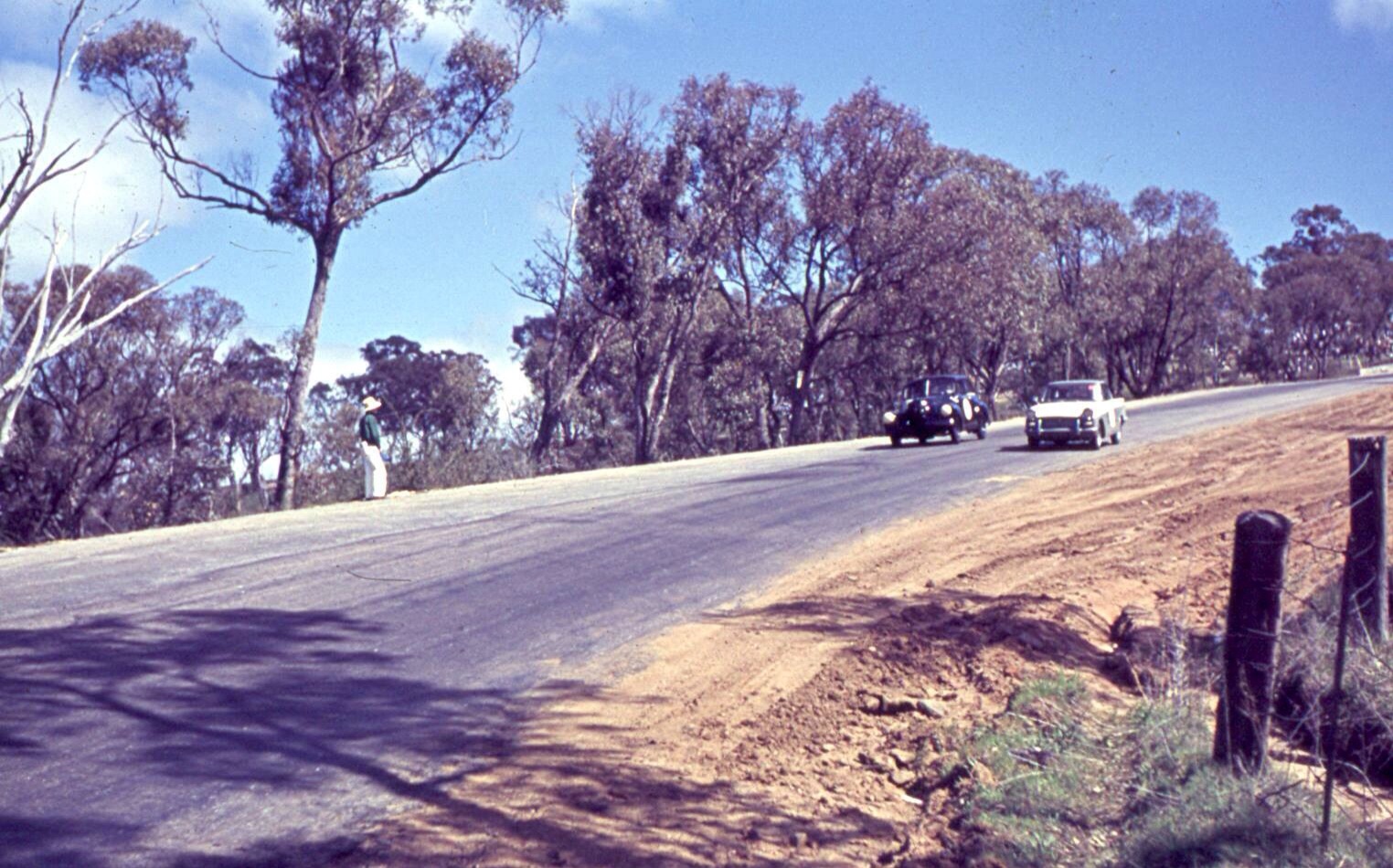
The photo below is again Geoghegan who is about to take, perhaps, Barry Gurdon’s Austin on the run down Conrod, or is it a Triumph Herald? By this stage Leo’s car is very quick and much modified- light weight, it has a Repco Hi-Power cylinder head and multiple SU carbs, is fitted with an MG TC gearbox, slippery diff and disc front brakes.

The introduction of the Australian Touring Car Championship from 1 January 1960 run to Appendix J regulations would reign-in the ‘costs out of hand’ development of touring cars without in any way constraining the appeal of tin-top racing to either spectators or owner-drivers.

(R Meyer)

Beautiful picture of the Les Wheeler funded, Gordon Stewart designed and built Stewart MG…

Believe it or not this very advanced car was concepted and constructed in the early fifties around a tubular steel spaceframe chassis, MG TC engine and brakes. With a Bob Baker built body, modified in the nose here, it first raced at Mount Druitt in 1955.

(R Meyer)

The engine was 1350cc in capacity and fitted with a Laystall crank and locally made rods. By the time the car appeared lots of serious stuff from Europe was racing locally so it missed the boat a bit as a potential ‘outright’ contender but its 1957 Gordon Stewart driven 142 mph made it the fastest TC speed ever over Bathurst’s Flying One-Eighth!

Here, Dick Willis says the car is supercharged ‘B-Series’ BMC powered, still with Gordon at the wheel. This car is extant and a wonderful feature article, such is its conceptual design and execution, for another time.

(D Willis)

A bit more from Dick Willis, here the Stewart MG crew- ‘Ecurie Cinque’ at Mount Druitt probably in 1958. ‘Jim Robson (at right) of Silverdale fame was a technical writer for Riley (Nuffield) before the war writing workshop manuals etc. After the war he emigrated to Australia and soon struck up a friendship with the like, Nuffield minded, Gordon Stewart- Jim was one of the team who developed the Stewart MG…’

Credits…

Rick Meyer, Dick Willis, Paul Newby

Tailpiece: Finish as we started, neighbour still with hands on hips and the obedient Rick still on and behind the fence!…

(R Meyer)

Cars are Horst Kwech’s RM Spyder (Buchanan body) and Tom Sulman’s Aston Martin DB3S during the Easter 1960 meeting.

Paul Newby explains that Horst Kwech built the RM Spyder whilst working at Regional Motors in Cooma- New South Wales sub-alpine country, hence the ‘RM’. It comprised a Buchanan bodied upside-down Singer chassis powered by a Repco Hi-Power headed Holden ‘Grey’ six-cylinder engine and still exists in Canberra.

Finito…


(unattributed)

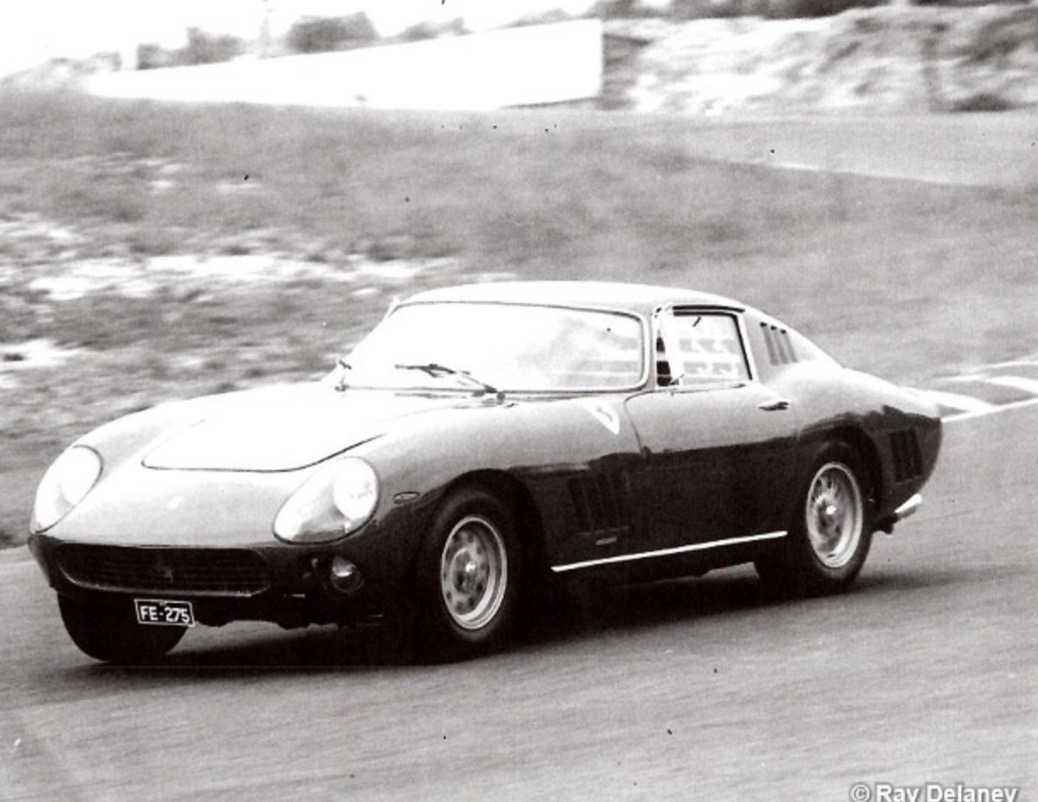
The Frank Matich/Glynn Scott Matich SR3 Repco (DNF) homes in on the Phil West/George Reynolds Scuderia Veloce Ferrari 275 GTB Competizione Clienti during the 1 September 1968 Surfers Paradise 6 Hour…

As usual, the race was won by the SV Ferrari 250LM, that year driven by the brothers Geoghegan, click on this link for an article about that car inclusive of Surfers wins; https://primotipo.com/2014/07/03/pete-geoghegan-ferrari-250lm-6321-bathurst-easter-68/

In a race a bit light on entries- and reduced from twelve to six hours, the Geoghegans won having covered 249 laps from the Bill Gates/Jim Bertram Lotus Elan, 237 and Doug Whiteford/John Roxburgh/Frank Coad Datsun 2000 on 230. Other than David McKay’s ‘Old Red Lady’ 250LM the other fancied sports-racers all retired- the Matich/Scott Matich SR3 Repco, Palmer/Brown Ferrari P4/Can-Am350 and O’Sullivan/Baltzer/Bassett Lola T70 Chev.

The Ferrari 275GTB/C completed 216 laps which made it ninth outright and first in its class- the only car in that class mind you.

Phil West wasn’t impressed with it at all ‘It was a fucking awful motor car. Coming into Lukey Corner, over the back, i was braking at 180 yards while the others were at 80. It had complete and utter rear-end breakaway’ he said to Australian Muscle Car magazine.

He then drew comparisons with the early Holden Monaro during testing at Surfers, ‘The Ferrari was doing 154 mph down the straight, the Monaro about 124. The Ferrari was on 10-inch wide racing Dunlops with inboard disc brakes and the Holden was on Michelin XAS road tyres. But it was six seconds a lap quicker around the circuit than the Ferrari. That was something that really opened my eyes, and since then i’ve not been the least bit interested in the badge on the front’ West concluded.


SV 250LM goes under its stablemate at Surfers (unattributed)


Frank Gardner circa 1966, probably in Australia during the Tasman. Where folks? (Repco Collection)

I hadn’t realised the significance of this Ferrari 275 GTB as one of three RHD ‘Competizione Clienti’ specification 275’s of a total 1965 production run of ten. The addition to the nose of the car appears to be a camera- I would love to see the footage if it exists?

Chassis #07545, the seventh of the ten cars, was ordered by Britain’s Maranello Concessionaires, it was intended as their Le Mans reserve car- their entries that year comprised a P2 raced by Jo Bonnier and David Piper and a 250LM steered by Mauro Bianchi and Mike Salmon, both cars failed to finish.

The GTB wasn’t completed in time for the 24 hour classic but starred as an exhibit at the 42nd International IAA Motor Show in Frankfurt that September. Maranello sold it in October 1965 to Paddy McNally, then a respected journalist later to make a motza as an equity-holder in Allsport Ltd along with Bernie The Unbelievable (Ecclestone).

The GTB featured in an Autosport feature, McNally waxed lyrical about driving the car on the fast uncluttered roads of Europe inclusive of the Col des Mosses in Switzerland. ‘Even at close to 6000 pounds…the Ferrari represents excellent value and it is quite the best car that i have ever driven.’ McNally’s enthusiasm for these machines was genuine, he later acquired #09027 and raced it at Montlhery in the Paris 1000km.

Ford race team boss Alan Mann was the next owner two years hence, along the way he returned it to the factory where the bumpers were removed and big fog-lights installed and then sold it to one of his stars- Frank Gardner.

FG used the car to commute to his race commitments across the UK and Europe- these were many and varied inclusive of Touring Cars, World Manufacturers Championship Prototypes and Sportscars, F2 and the occasional F1 event. It would be intiguing to know just how many km’s the ultra fast GT did in Frank’s short ownership.

The Australian International then brought the car to Australia in the summer of 1967/8 to take up his usual Tasman drive with Alec Mildren, that year he raced the Brabham BT23D Alfa Romeo Tipo 33 2.5 V8. He sold it to Gallaher International, a British cigarette company- sponsor of the 500 mile Bathurst enduro in 1966 and 1967, who used it as a promotional tool.

Scuderia Veloce team driver Bill Brown bought it next, it was during his ownership that Phil West/George Reynolds raced it to eighth outright and first in class (the only car in the class) at Surfers in 1968. It seems this was the machines only race in period.

Melbourne motor racing entrepreneur/hill-climber Jim Abbott was the next owner, I dare say he gave it a run up Lakeland once or twice on the way to its garage at home- after his death it passed to Daryl Rigg and then to Ray Delaney who owned it for seven or so years using the car extensively. So too did Max Lane including contesting Targa Tasmania in 1993- the car left Australia many years ago as the global investment grade commodity it is.

#07545 in recent years (Talacrest)

Competizione 275 GTB’s…

The competition variants of one of Ferrari’s most sought after Grand Turismo’s was born of Enzo’s swifty in attempting to homologate his 1963 250P sports-prototype ‘in drag’- the 250LM as a GT car to replace the revered GTO. The FIA could see  the 3.3 litre LM- a larger capacity 250P with a roof for what it was and refused to homologate it.

Even as a GT the 250LM won Le Mans of course. Masten Gregory and Jochen Rindt flogged their NART entry to death- but not quite and won in 1965 after the more fancied Ferrari P2 and Ford GT40 Mk2 prototypes fell by the wayside with all manner of problems.

As a consequence, needing a GT racer, Ferrari set to modifying the just released in 1964 GTB whose baseline specifications included a sophisticated ‘Tipo 563’ chassis, independent suspension front and rear, aerodynamic bodywork, four-wheel disc brakes, five-speed rear mounted transaxle and the well proven ‘Tipo 213’ Colombo V12- in this car SOHC, two-valve and 3.3 litres (3286cc- 77 x 58.8mm bore and stroke) in capacity.

275GTB prototype and first car built #06003 during the 1966 Monte Carlo Rally crewed by Giorgio Pianta and Roberto Lippi, DNF driveline (unattributed)

Depending upon your source there are either three or four distinct series or phases of build of competition 275’s.

The first are the relatively mild modifications to chassis #06003 and #06021.

#06003 is the prototype, very first 275GTB built in 1964, it was retained by the factory for testing purposes throughout 1965, then modified and entered in the 1966 Monte Carlo Rally. #06021- is ‘the third GTB built and the prototype for the 1965 customer competition cars’ according to Peter Sachs who owned it twice. Its first custodian was a Roman, Antonio Maglione who contested at least four Hillclimb events in it in June/July 1965 having acquired it that April.

The second group of three works cars (plus a fourth built to this spec in 1966) designated ‘Competition Speciale’ were extensively modified by a team led by Mauro Forghieri with lightweight tube frames based on the standard Tipo 563 chassis.

The motors were six-Weber carb, dry-sumped Tipo 213 engines to 250LM spec giving 290-305 bhp and had 330 LM Berlinetta style noses with an air-scoop atop the long bonnets.

Other modifications included holes in interior panels, plexiglass windows and the use of magnesium castings for some engine and transmission parts. These cars, also designated 275 GTB/C Speciale, the bodies of which were of course designed by Pininfarina and built by Scaglietti are said by some to be the most direct successors to the 250GTO.

After a DNF at Targa and third in class at the Nürburgring 1000km #06885 was sold by Scuderia Ferrari to Ecurie Francorchamps who raced it at Le Mans in 1965 achieving first in class and third outright- stunning for a GT. The reputation of these ‘275 GTB/C’s was underway.

Ferrari 275 GTB cutaway, specifications as per text (unattributed)


Scuderia Veloce line up before the 1968 Surfers 6 hour with Pete Geoghegan’s stout frame back to us. The #17 Ferrari Can-Am 350 DNF in the hands of Jim Palmer and Bill Brown. The West/Reynolds GTB is alongside and victorious Leo and Pete Geoghegan 250LM to the left (Rod MacKenzie)

Gardner’s #07545 was one of ten cars designated 275 ‘Competizione Clienti’ or ‘GTB/C Series 1′, which were built as dual purpose customer road/racers between May and August 1965- they were constructed in parallel with the works cars mentioned above and delivered only to privateers.

The specifications of this batch, very close to production cars included short nose bodies and six Weber DCN3 carbs, rather than the standard three, feeding essentially a standard wet sump Tipo 213 engine. The fuel tank was 140 litres rather than the standard 94 litre jobbie, the spare sat vertically aft of the tank. A higher rear shelf is a visual difference with three air vents in each rear guard a signal of menace. No two cars were identical but most had lightweight alloy bodies.

The final run of twelve cars, the ‘9000 series chassis’ were super-trick, schmick jiggers and are variously described as ‘275 GTB Berlinetta Competizione’ or ‘275 GTB/C’.

They have lightweight long-nose bodies built by Scaglietti which were half the thickness of the 250GTO’s and a specially designed steel and aluminium Tipo 590A chassis which was lighter and stiffer than the standard unit. The suspension and hubs were reinforced, clutch upgraded and a different steering box fitted.

The dry sumped Tipo 213 V12- which allowed the engine to be mounted lower in the frame, was tuned to 250LM specifications with some Electron components incorporated- sump, cam cover, timing chain casing and bell-housing- power was circa 275-282bhp @ 7700rpm. The three big Weber 40 DF13 carbs were a design unique to the car and fitted due to a clerical stuff up by Ferrari who had not homologated the six-carb Weber option.

Out and out racers, these were the only cars referred to by the factory as 275 GTB/C and were the last competition GT’s fettled in Maranello- the Daytona GTB/4 racers were modified in Modena.

Le Mans Esses 1967. The second placed Ferrari P4 of Scarfiotti/Parkes ahead of eleventh placed and first in class Filipinetti Ferrari 275GTB/C #09079 driven by Steinemann/Spoerry (LAT)


Ray Delaney in GTB #07545 at Amaroo Park, Sydney in 1981

Credits…

Jaguar Magazine, Repco Collection via Nigel Tait, Rod MacKenzie, Ray Delaney, Talacrest, barchetta.cc, LAT, Stephen Dalton, Australian Muscle Car interview with Phil West

Tailpiece: 1968 Surfers 6 Hour…

(unattributed)

Borrani’s at the front and Campagnolo’s up the back, ain’t she sweet…

Finito…

(B Hickson)

Leo Geoghegan, left, Lotus 32 Ford, Greg Cusack Brabham BT6 Ford and Bib Stillwell, Brabham BT14 Ford with Bob Jane in the white Elfin Mono a couple of rows back, await the start of the ANF 1.5 race at Warwick Farm 16 May 1965…

This contest was an absolute cracker with Cusack ‘driving the race of his life’ according to Ray Bell. GC set the class record at 1:35.2 whilst ‘tigering’ after an early spin at ‘Creek- he dived way too deep in a late braking manoeuvre on Bib. Stillwell won from Geoghegan and Cusack. Then came Glynn Scott, Lotus 27, the similarly mounted Les Howard and A Felton in a Brabham.

Australian National Formula 1 was the ‘Tasman 2.5 litre’ Formula from 1964 to 1970 inclusive. The next level of single-seater racing was, variously, during this period, ANF 1.5 and ANF 2, putting the rule changes in F2 itself back then to one side.

ANF 1.5 existed between 1964-1968 inclusive, and, effectively as a twin-cam, two-valve formula ‘mandated’ the use of the Lotus-Ford ‘twin-cam’ Harry Mundy designed engine in 1.5 litre capacity, at least for those seeking victory. The engine was of course originally built to power Colin Chapman’s Lotus Elan, albeit it’s race potential was immediately obvious and exploited.

Arnold Glass’ Lotus 27 Cosworth Ford twin-cam in the Longford paddock 1964. Ain’t she sweet- in concept and execution very much a ‘mini’ F1 Lotus 25- daddy of the modern monocoque which first raced at Zandvoort in 1962 (R Lambert)

Mind you, the simple statement above does not do justice to the Cosworth modified four cylinder pushrod Ford engines which were dominant in Formula Junior, and were at 1.5 litres the engine to have in the early sixties before the ANF1.5 class was created in Australia.

The motors (not necessarily modified by Cosworth) were fitted to many small bore single-seaters at the dawn of the sixties and could still give a reasonable account of themselves after the twin-cam era arrived, but usually were no longer winners.

Perhaps the first twin-cams to race in Australia were Arnold Glass and Frank Gardner (Alec Mildren Racing Brabham BT6) at the 1964 Australian Grand Prix at Sandown- Arnold’s Lotus was fifth in the race won by Jack Brabham’s Coventry Climax FPF engined Brabham BT7A. Cusack entered a Brabham BT6 similarly engined at Longford and so the bar was shifted in that class as the ‘rush’ to fit the latest and greatest got underway.


Lotus-Ford twin-cam. Surely one of the great, enduring race engines despite its road car parentage (Vic Berris)

The problem for the Tasman 2.5’s was the speed of a well driven ‘one and a half’! There were many occasions on which the 1.5’s showed very well in Gold Star competition including winning in the right circumstances.

Some examples of Gold Star top-two performances were Cusack’s second at Lakeside in 1964, Brabham BT6, Leo Geoghegan first in the Hordern Trophy at Warwick Farm in December 1964, second at Lakeside and at the Hordern Trophy, Warwick Farm in 1965 aboard his Lotus 32 Ford. John Harvey was first at Mallala in 1966 driving the ex-Stillwell Brabham BT14. Max Stewart was second at Bathurst during Easter 1968 in his Rennmax BN2 Ford. Garrie Cooper was second at Sandown in an Elfin 600 Ford with John Ampt, Clive Millis and Maurie Quincey all in Elfin 1.5’s in third, fourth and fifth places!

Fast and reliable is the observation about these machines.

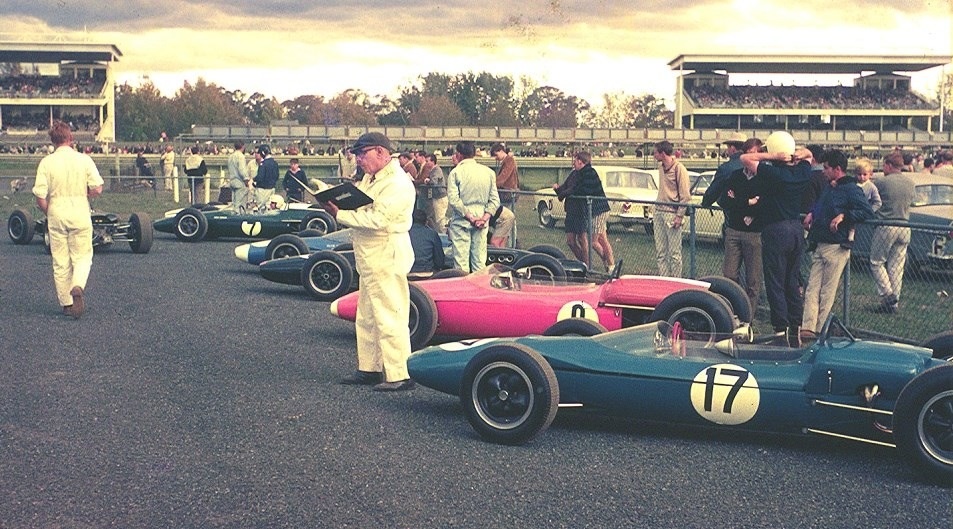
16 May 1965- the initial photograph race’s dummy grid- #7 is the Cusack Brabham, the bit of white beyond Geoghegan’s Lotus. #17 Les Howard Lotus 27, #9 A Felton Brabham and the blue car with the white on the nose is Glynn Scott’s Lotus 27 (B Hickson)

Great drivers won the ANF 1.5 title too- in 1964 it fell to Greg Cusack’s Brabham BT6 Ford, in 1965 Bib Stillwell won in a Brabham BT14 Ford with John Harvey victorious in the same car the following year. In 1967 it was Max Stewart’s Rennmax BN1 Ford which took the honours, whilst Max and Garrie Cooper won jointly in 1968. Max raced a Rennmax BN2 Ford and Garrie Cooper an Elfin 600B Ford.

Max Stewart gets some attention during the Symmons Plains Gold Star weekend in 1967, Rennmax BN1 Ford (oldracephotos.com.au/Harrisson)

With the exception of Stillwell, who was already an established ace- a multiple Gold Star winner when he won the title, the drivers were all ‘up and comers’- the ANF 1.5 Championship was an important part of a  journey onto greater things.

In 1964 and 1965 the championship was decided over one race at Warwick Farm and Bathurst respectively and from 1966-1968 by a series of events.

Leo Geoghegan’s Lotus 32 Ford in the Warwick Farm paddock in May 1965 (B Hickson)

ANF 1.5 Championship, Warwick Farm, 6 September 1964…

Leo Geoghegan was the form driver in a top car, most would have their money on the Sydney Lotus 27 Ford pilot to win the race in his home backyard but a practice accident meant he was a non-starter come Sunday.

John Ellacott’s photo below shows Leo’s machine less a corner or two- ‘Racing Car News’ reported ‘a sudden inexplicable brake lock-up at the end of Hume Straight’ as the cause.

Leo’s Lotus is at the end of Hume Straight. What happened? (J Ellacott)


Geoghegan’s Lotus 27 Ford at Warwick Farm in one piece! (B Wells)

A good field of nineteen cars entered the race with Greg Cusack, Brabham, Roly Levis in Alec Mildren’s Brabham BT2, Glynn Scott and Arnold Glass in Lotus 27’s the likely lads with Cusack the favourite. Future Lotus GP driver David Walker entered his Brabham Ford FJ.

Cusack aboard his Brabham BT6, WF September 1964 (B Wells)

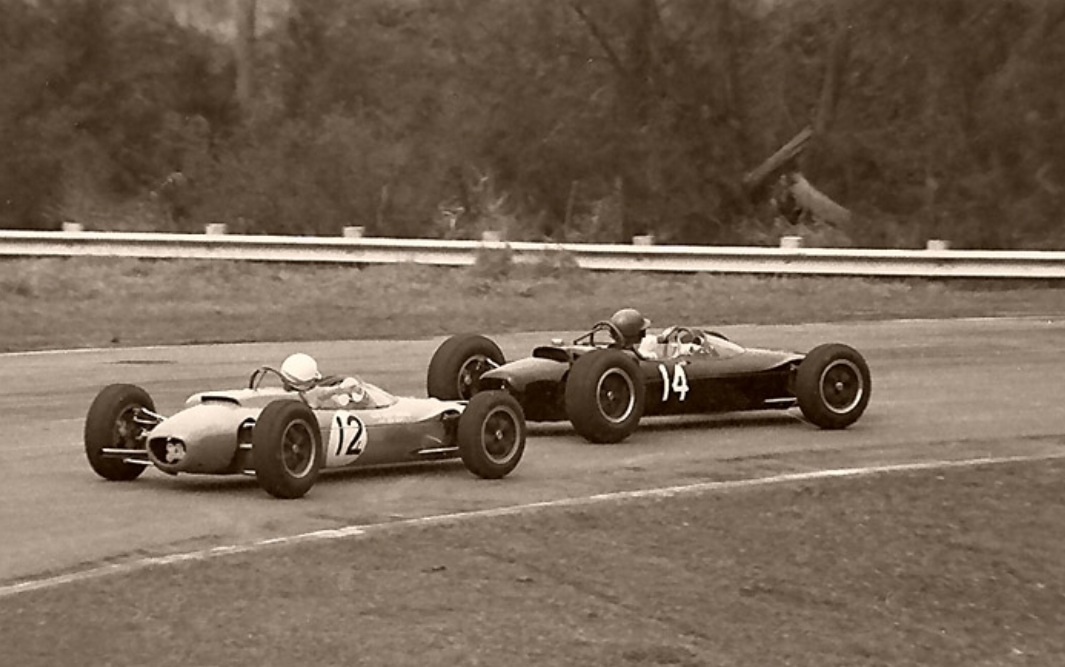
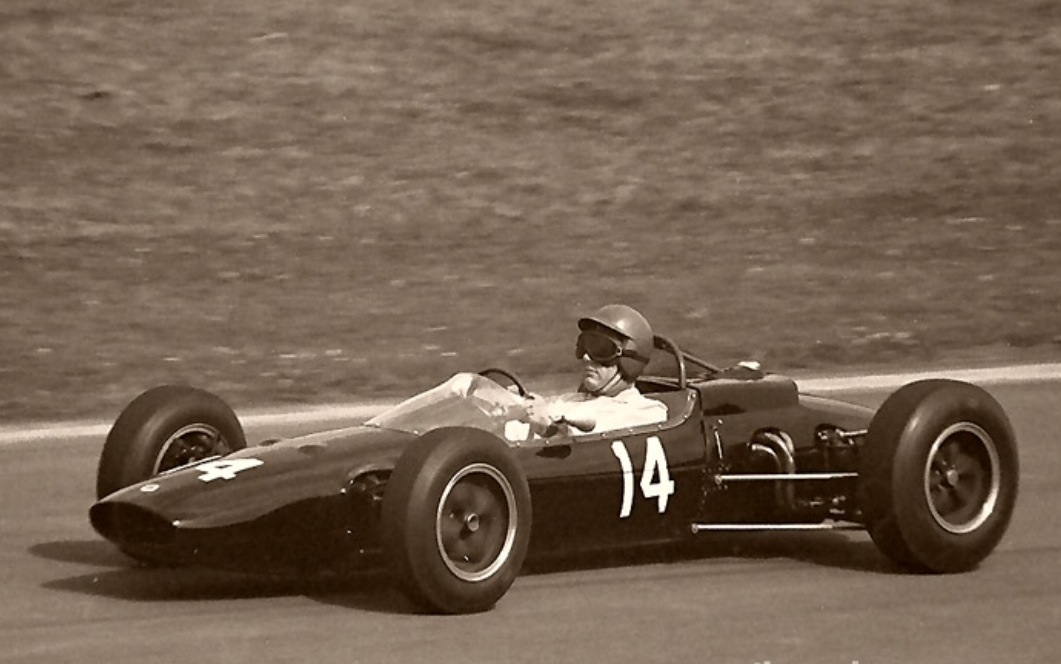
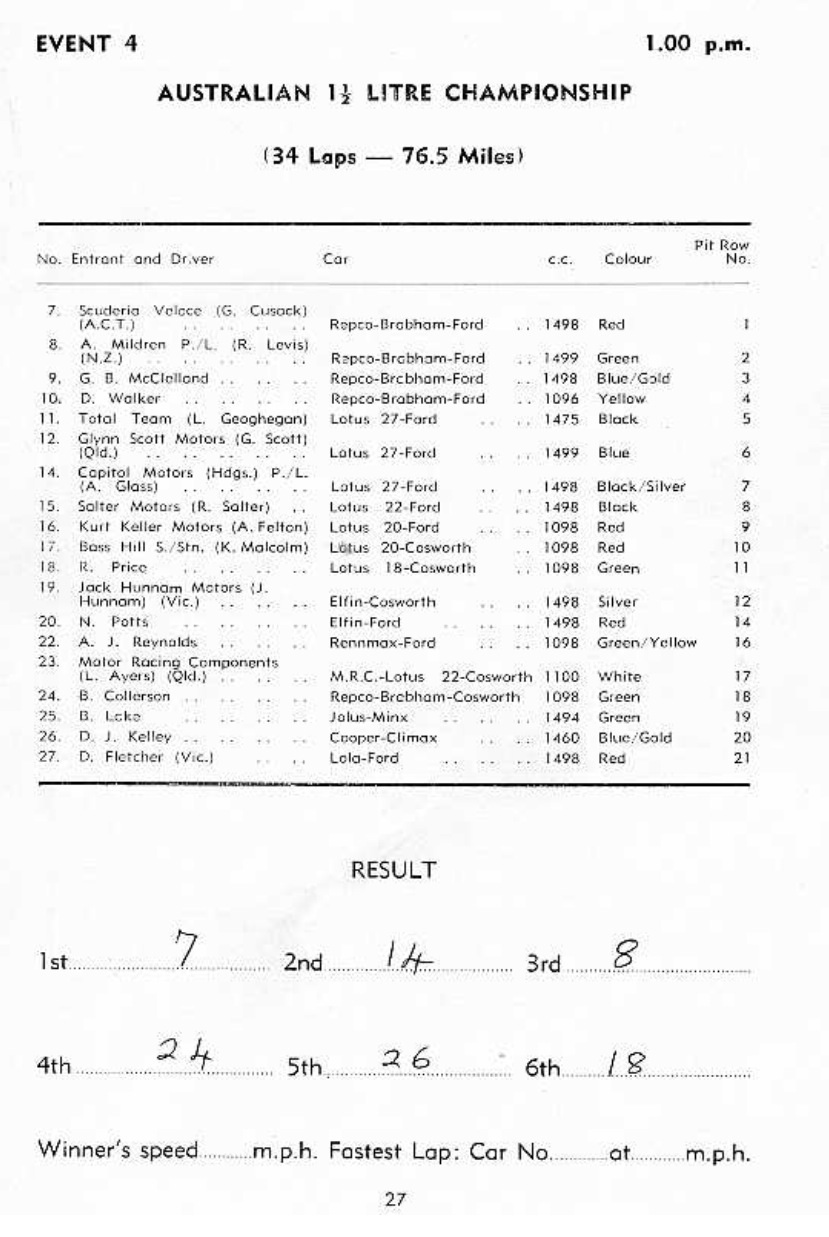
Despite a spin on lap 2 Cusack easily won the 34 lap 76.5 mile race from Glass, Levis, Barry Collerson’s Brabham, DJ Kelley in a Cooper and the R Price Lotus 18.

Shot below is the duelling Lotus 27’s of a couple of relative veterans, Glynn Scott chasing Arnold Glass. Glass had a recent past which included ANF1 Ferrari Super Squalo, Maser 250F and various Coopers. Glynn’s CV extended just into the next decade and sadly his tragic death at the wheel of an Elfin 600 Waggott TC-4V at Lakeside in 1970.

(B Wells)

Glass with a determined set to his jaw! Pretty car had its knocks, re-tubbed at least once in Glass’ hands, famously landing atop the Armco at Catalina Park on one occasion.

Arnold Glass, Lotus 27 Ford, WF Sept 1964 (B Wells)

(Terry Sullivan Collection)

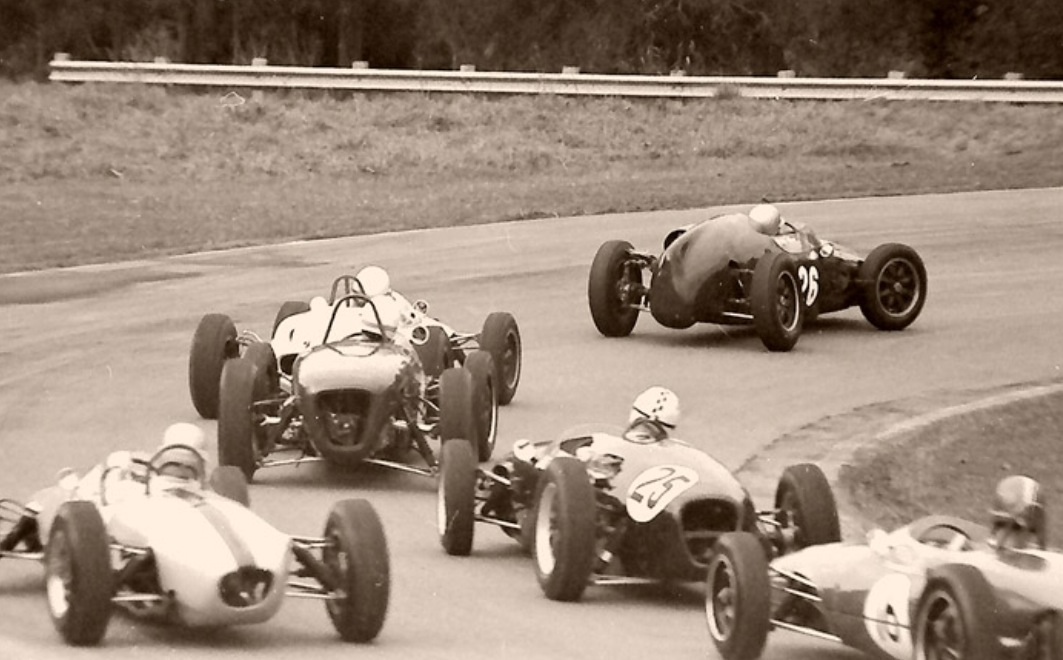
Doug Kelley’s Cooper leads a gaggle of cars below on lap one- the distinctive rear of the R Price Lotus 18, #25 is Barry Lake in the Jolus Minx- a prominent racer/journalist and #16 A Felton’s Lotus 20, this group are a mix of ANF1.5 and FJ cars.

(B Wells)

ANF 1.5 Championship, Bathurst Easter 1965…

As noted above Greg Cusack won the 1964 ANF 1.5 Championship at Warwick Farm in his Brabham, he set off to Bathurst from his Canberra base to defend his title at Easter 1965.

Unfortunately his weekend was over almost before it started.

He spun on a patch of oil at The Cutting- he almost had the car back under control and then hit Ian Fergusson’s stranded Elfin which was perhaps the source of the oil Greg found.

The car was badly damaged, but he was ok- the championship was won by Bib Stillwell from Leo Geoghegan. In the photo below Leo’s Lotus 32 Ford chases Bib’s Brabham BT14 Ford up the mountain.

To compound Greg’s shocker of a weekend, earlier in practice Cusack was running his Lotus 23 Ford sporty, with that car badly damaged after crashing with brake failure. Again Cusack was ok but the trailer was awash with rooted cars by the weekend’s conclusion- it would have been a long sombre drive back to the national capital at the end of the meeting.

(J Ellacott)

Another photograph of a Stillwell/Cusack Warwick Farm battle…

Here its the 19 September 1965 meeting in the up to 1500 cc 10 lapper. The photo is towards the end of Hume Straight approaching the Creek Corner braking area.

Bib won from Greg and Mike Champion, Elfin Catalina. Leo Geoghegan broke a halfshaft coupling on the line and Cusack spun twice he was trying so hard.

Its was not too long before Stillwell retired after a long successful career which included four Gold Stars on the trot from 1962-1965- this fast little Brabham was then sold to Ron Phillips for John Harvey to race. It was an important stepping stone in Harve’s career fitted as it was with successively bigger twin-cams and eventually with a Repco RB740 V8 to contest ANF2.5 races in 1967.

(J Ellacott)

The photo below is of Harvey in the now RRC Phillips owned Brabham BT16 after purchase from Stillwell, in the Warwick Farm paddock during the 1966 Tasman round.

In a very good showing he was eighth- second of the ANF1.5’s home just behind Leo G’s Lotus 32. The race was won by Clark’s Lotus 39 Climax, a car Leo acquired after the Tasman’s end in his step up to ANF1- a jump Harvey also made a year later in 1967. Both were to have their reliability challenges as Repco Brabham V8 engine users during this period!

(autopics.com.au)

The Elfin Connection…

Whilst the photographs above feature imported marques the ANF1.5 category was a sensational class for the local motor racing industry industry, particularly for Elfin Sports Cars.

Garrie Cooper built a swag of Ford 116E pushrod and Lotus-Ford twin-cam powered Catalina’s, Mono’s and early 600’s throughout the early to late sixties.

Below GC is showing off the prototype Mono Mk2 ANF1.5 at the Edwardstown works in 1967.

This chassis had wider swept back upper wishbones and alloy racing calipers on larger diameter 9.5 inch diameter disc brakes than the Mk1.

Whilst Cooper proved the pace of this car (win in the ANF1.5 class of 1966 Surfers Gold Star round) the unpopular with customers, top upper, boxed, swept back wishbones (look hard) were replaced by more conventional top links- so creating the Mono Mk2B.

(R Lambert)

The same chassis again, ‘MB6550’ this time with bodywork on- isn’t it a pretty little gem of a thang, at Mallala with mechanic and friend Norm Butler alongside.

(R Lambert)

Garrie’s own talent behind the wheel developed considerably in this period as he was contesting ANF1.5 races and his share of Gold Star rounds- honing his skills against the top-liners in more powerful, but not always faster cars.

Garrie Cooper, Elfin 600B Ford chasing John Walker Elfin Mono Mk2D Ford, both ANF1.5’s during the October 1968 Mallala Gold Star round- 4th and DNF in the race won by Leo Geoghegan’s Lotus 39 Repco (J Lemm)

Below the chief is being looked after by Bob Mills during the 1967 Symmons Plains Gold Star round won by Greg Cusack’s Scuderia Veloce Brabham BT23A Repco.

GC was out with bearing failure in his Mk2D Mono ‘MD6755’. It is a beautifully composed shot with the local coppers and captivated crowd looking on, or are they St Johns Ambulance chaps?

Love Bob Mills using the Shell dispenser for the BP oil behind his foot- Elfin were a BP sponsored team right from the very start.

(R Lambert)

Plenty of future Australian Aces cut their teeth at elite level in these 1.5s, if I could put it that way, including Leo Geoghegan, David Walker, John Harvey, Max Stewart, John Walker and Alfredo Costanzo.

Alfie broke through in the Mono below and then was ‘in the wilderness’ for a few years as he raced the increasingly uncompetitive car before he re-launched his career with the purchase of the ex-Geoghegan Birrana 274 ANF2 car in 1975-later becoming one of Australias’s greatest in F5000 and F Pacific machines entered for him by Alan Hamilton’s Porsche Cars Australia.

Costanzo, Elfin Mono Mk2B Ford, Lakeside Gold Star round July 1968. DNF the race won by Kevin Bartlett’s Brabham BT23D Alfa  (J Lambert)

Cooper proved the speed of his new design, the spaceframe Elfin 600 Ford, by taking the prototype car, chassis ‘6801’ to South East Asia winning the 1968 Singapore Grand Prix in the 1.5 Ford twin-cam powered car.

He replaced it in mid-1968 with 600B ‘6802’ also 1500 t/c powered, here the car is being tested by Cooper at Elfin’s home circuit, Mallala. Cooper and Max Stewart shared the ANF1.5 Championship, as related earlier, in 1968.

(B Mills)

Cooper’s ANF1.5 class winning Elfin 600B is shown in the BP compound below at Sandown in September 1968.

GC was second outright in the Gold Star race won by Glynn Scott- he of earlier ANF1.5 fame- in the Bowin P3 Ford FVA F2, part of which is on the lower right. See the laurel wreath over the cockpit of the 600- love the atmospherics of this shot.

(J Lambert)

At 6 feet 3 inches Max Stewart was a big, tall, heavy bugger for an open-wheeler dude!

His F5000’s could more readily absorb his body mass and big frame popping out of the cockpit of his smaller cars upsetting their aerodynamic efficiency. He must have given away the equivalent of 20 bhp or so compared to shrimps like Alfie! So his small-car results are all the more meritorious as a consequence.

Below he is at Hell Corner, during the Easter Bathurst Gold Star round in 1968- Max was second outright, winning the ANF1.5 class in his Rennmax BN2 Ford. Somewhat symbolic of the state of ANF1 2.5 racing at the time is that the second to seventh placed cars at Mount Panorama were all 1.5’s.

The engine of Max’ Rennmax was acquired from John Harvey when Ron Phillips fitted a bigger twin-cam to their BT14 thereby providing Maxxy with a very potent motor he put to rather good use!

(D Simpson)

ANF 1.5 was succeeded by ANF2 and that categories evolution to a 1600 cc racing engine class- a logical move given the growing number of Ford Cosworth FVA engined cars in Australia throughout 1968.

Merv Waggott’s 1.6 litre TC-4V four-valve engine broke cover in the same year and was first raced by Max Stewart fitted to Alec Mildren’s Bob Britton/Rennmax built Brabham BT23 copy- the spaceframe ‘Mildren Waggott’ at Symmons Plains in early 1969.

ANF 1.5 was a relatively short lived class, but oh-so-sweet.

Clive Millis all cocked up in his Elfin Mono Mk1 Ford on the way to 6th place in the Hordern Trophy, Warwick Farm Gold Star round in December 1968 won by Bartlett’s Brabham BT23D Alfa (R MacKenzie)

Photo and Other Credits…

Barry Hickson, John Ellacott, James Lambert Collection, Ron Lambert, Bob Mills Collection, Stephen Dalton Collection, John Lemm, Rod MacKenzie, Bruce Wells, Dick Simpson, Terry Sullivan Collection, The Nostalgia Forum, oldracingcars.com, Rob Bartholomaeus for some of the photo identification work

Etcetera…

(oldracephotos.com.au/DSimpson)

Superb Dick Simpson shot of Garrie Cooper hiking the inside right, Warwick Farm Esses 1968. Elfin Mono Ford, I am intrigued to know the meeting date, before too long he had swapped his Mono for the new 600.

(S Dalton Collection)


The cutaway above is of a monocoque Lotus 27 powered by a pushrod Cosworth Ford 1.5 and is indicative of the type of chassis construction at the time.

Tailpiece: Bob Jane, Elfin Mono Mk1 ‘M6444’ Ford ANF1.5, Warwick Farm Tasman meeting, 13 February 1966…

(J Ellacott)

Finito…

(P Greenfield)

Malcolm Ramsay awaits the start of the ‘Diamond Trophy’ Gold Star race at Oran Park on 28 June 1970…

His car is an Elfin 600C Repco ‘730’ 2.5 litre V8, alongside him you can just see the nose of the cars constructor, Garrie Cooper’s Elfin 600D ‘830’ V8- only three of these Repco V8 engined Elfins were built, John McCormack’s Elfin 600C was the other, and all are ‘Australian Motor Racing Royalty’ to me- about as good as it gets!

The Oran Park round was the third of the 1970 series, a championship which was wide open- reigning champion Kevin Bartlett had finished third in the first Symmons ‘Tasmanian Road Racing Championship’ round behind John Harvey’s old-faithful Brabham BT23E Repco and Leo Geoghegan’s equally venerable Lotus 39 Repco.

Bob Jane, John Harvey, a young Pat Purcell, ? and John Sawyer, side on during the 1970 Symmons round- car wing is BT23E (oldracephotos.com.au)


Symmons Plains 1970- changing of the guard- last race for Harvey’s Brabham BT23E Repco, Geoghegan’s white Lotus 39 Repco and almost KB’s last race in the Mildren Yellow Submarine Waggott. Max Stewart in the Mildren Waggott on row 2 (H Ellis)


Leo Geoghegan and Garrie Cooper at Symmons in 1970 (oldracephotos)


The Mildren Duo- The Sub, Mildren Waggott with Glynn Scott’s blue trailer alongside

At Lakeside for the ‘Governor’s Trophy’ in early June, Max Stewart won from Harvey’s new car, the ‘Jane Repco V8′ built on Bob Britton’s Brabham BT23 jig. It was a modified car with suspension geometry suited to the latest generation of cars and other tweaks. Bartlett DNF’d with ignition problems- and Leo Geoghegan made the championship debut of his Lotus 59B Waggott 2 litre ’59-FB-14’, at long last (or sadly depending upon how you view that wonderful Lotus 39) Leo had a modern car, that 39 had served him so well but had not delivered the Gold Star it was surely capable of- with Repco reliability in 1967 or 1968.

Lakeside, Governor’s Trophy 7 June 1970. Pole-sitter and winner Max Stewart in the Mildren Waggott with Kevin Bartlett in the Mildren ‘Yellow Submarine’ Waggott alongside (G Ruckert)

After Lakeside KB jumped on a plane to the ‘States to chance his arm over there in Indy racing- he raced on and off in the US from 1970 to 1973- we must get him to tell us that story.

Garrie Cooper, perhaps the other driver capable of winning the Gold Star that year also had a poor start to the season with his new Repco 830 Series V8 powered Elfin 600D ‘7012’. At Symmons he retired with a flat battery having failed to set a time in practice and at Lakeside he was ninth from Q5 with a misfire for the races duration.

Malcolm Ramsay was a title contender too- if the Repco planets could be aligned, mounted as he was in Cooper’s first Repco engined 600- the 600C ‘6908’ raced by Garrie in Asia and then sold before returning to Oz in late 1969.

GC Cooper, Elfin 600D Repco ‘830’, Oran Park June 1970- oh to have seen an ace in this chassis (oldracephotos)

1970 was an odd year in terms of Gold Star eligibility…

The Confederation of Australian Motor Sport made the following naff decisions during 1969 in an attempt to keep the peace with all interested parties- an impossible challenge of course and provide a formula, or formulae to suit the needs of Australian single-seater racing into the future. A summary of the rules for the next couple of years goes a bit like this;

1970 Tasman Series- Tasman 2.5, F5000 and 2 litre cars and under

1970 Gold Star- Tasman 2.5 and 2 litre cars and under

1971 Tasman- Tasman 2.5, F5000 and 2 litre cars and under

1971 Gold Star- F5000 and 2 litre cars and under

1972 Tasman- ditto as per ’71 Gold Star

1972 Gold Star- F5000 and ANF2 (to make up the numbers)

The impact of the above in 1970 was that those fellas who invested in F5000 could not race their cars in Australia- in particular Frank Matich and Niel Allen, both round winners during the 1970 Tasman could not race their McLarens in Gold Star events- a bummer for them and their fans but a bonus for the rest of the elite grid- Bartlett, Matich and Allen were out of the equation in 1970.

The machinations of the change from the Tasman 2.5 to F5000 category are ventilated at length in this article;

Repco Holden F5000 V8…

Wearing my Repco bias on my sleeve- 1970 was it, the last opportunity for the Maidstone concern to win either a Tasman or Gold Star 2.5 litre title for their beautiful little V8’s!

Max, second on the grid before the off, Mildren Waggott TC4V 2 litre. A jewel of a car and uber successful chassis (P Greenfield)

And so the title protagonists headed in the direction of Narellan on Sydney’s then western outskirts for the Oran Park round…

John Harvey put his stamp on practice with a 43 seconds dead lap in the Jane Repco with Max Stewart’s Mildren Waggott two-tenths adrift on a circuit Max knew like the back of his hand.

Its interesting that Max/Alec chose to keep racing the spaceframe car rather than the ‘Sub, a monocoque (after KB went away) but I guess Max wore that car like a glove- an extension of his body and he was never more than a bees-dick away from KB in terms of pace, so why not sell the Sub and keep the little Mildren nee Rennmax Waggott?

John Harvey ahead of one of the Elfin 600’s. Jane nee Rennmax Repco V8 – 830 Series V8. Bob Jane obtained the 830 V8’s used by Jack Brabham in the 1969 Brabham BT31- good works motors (L Hemer)

And as most of you know Mildren commissioned an F5000 car which Bartlett raced in the 1970 AGP and throughout the 1971 Tasman Series before the team was, very sadly, disbanded. But lets not get distracted from Oran Park.

Geoghegan did the same time as Max- he had clearly got to grips with the Lotus chassis and Waggott motors quickly having pedalled Repco V8’s since mid-1967. His Repco 830 would have had a smidge over 300 bhp with the Waggott at that stage of its development circa 265 bhp- albeit the 59B would have been a bit lighter overall than the 39.

Leo raced sans nose wings. Lotus 59B Waggott TC4V- yes please. OP June 1970 (oldracephotos)

Bob Muir demonstrated his growing pace with a 43.6 in his Rennmax BN2/3, at this meeting 2.5 Coventry Climax FPF powered- my guess is this was the best Gold Star FPF performance for a couple of years, by then these motors were no spring-‘chookins at all having taken two World Championships on the trot for Cooper/Jack Brabham in 1959 and 1960.

Bob bought a Waggott TC4V 2 litre engine which he popped into this chassis (in specification it is a BN3 but Bob referred to it as a BN2 ‘in period’) before the following ‘Sam Hordern Trophy’ round at Warwick Farm in early September and then later in the year bought the Mildren Yellow Sub off Alec and put the Waggott into that chassis- and somewhat famously rated his Rennmax BN2/3 the better car of the two. (same chassis as the Mildren Waggott).

Garrie Cooper and Malcolm Ramsay were fifth and sixth with a 44.6 and 45 seconds dead respectively, perhaps more could have been expected of the two V8’s but the dudes in front of them were all ‘locals’- if you can refer to an Orange resident as ‘local’ in Max’s case and Melbourne local for Harves! Harvey did plenty of laps at Oran Park before he emigrated to Mexico (Melbourne) when he started driving for Bob Jane .

John McCormack took the next step in his career when he replaced the ex-Jack Brabham 1962 AGP Caversham Brabham BT4 Climax FPF with an Elfin 600C in time for the 1970 Gold Star.

Fitting it with the FPF from the Brabham was sub-optimal but he was in the process of putting together a lease deal on a 740 Series Repco V8 with Malcolm Preston which would take him a further step along the path towards national championships in the years to come.

One day of The Year- that you can race your F5000 that is. Frank Matich on the way to 1970 AGP victory in his McLaren M10B Repco Holden (N Foote)

Preston and Mac developed a lifelong friendship during the Repco Holden F5000 years- Preston was the General Manager of REDCO, the Repco Engine Development Company which assumed the assets (most of ’em) of Repco Brabham Engines Pty. Ltd. and designed, built and maintained the Repco-Holden motors.

That Repco 740 engine was nestled in the spaceframe of Mac’s 600 ‘7011’ by the Hordern Trophy meeting, so he used it at WF, Sandown, Mallala (pole) the AGP at the ‘Farm in November as well as the Warwick Farm Tasman meeting in February 1971.

In 1970 the Australian Grand Prix was a stand alone meeting- not part of the Gold Star or Tasman Series and allowed Tasman 2.5, 2 litres and under- and F5000’s!

Warwick Farm Meister Frank Matich won the race from a strong field in his McLaren M10B Repco Holden- it was the first ‘notch in the belt’ for another world class race engine from the Repco boys, the design of which was led by Phil Irving- he of Vincent and Repco Brabham Engines ‘620 Series’ fame with the assistance of Brian Heard, also ex-RBE.

Queenslander Glynn Scott in his brand spankers Elfin 600B Waggott TC4V, DNF (L Hemer)

Meanwhile, back at Oran Park in June…

Glynn Scott was next up, seventh in a brand new Elfin 600B Waggott 2 litre. Glynn was sure to be quick in this car over the next season or two but his time in it was way too short, only a month later he was killed in an awful accident at Lakeside when he and his friend Ivan Tighe collided, Ivan also Elfin 600 mounted.

Waggott engined Elfin 600’s are rare beasts- this (destroyed) chassis ‘7016’, Gary Campbell’s ‘7122’ (the chassis, then powered by a Lotus-Ford twin-cam  in which Larry Perkins won the 1971 ANF2 Championship) and Ramsay’s ‘6908’ were so equipped.

The Goodwins, unrelated were next, Len in the ex-Piers Courage/Niel Allen McLaren M4A ‘M4A/2’ Ford Cosworth FVA, the Pat Burke owned car soon to become an important stepping stone in the career of Warwick Brown who raced it in 1971 before stepping into another ex-Allen McLaren, M10B F5000, for 1972- fame if not fortune followed.

Ken Goodwin’s Rennmax BN3 Ford in the OP paddock June 1970 (K Hyndman)

Ken Goodwin who had come through Formula Vee raced a beautifully self-prepared Rennmax BN3 Lotus-Ford t/c ANF2- its amazing how many guys did well in these beautifully forgiving motor-cars. Ron Tauranac got the Brabham BT23 design spot on and Bob Britton didn’t bugger things up in his translation of same!

The thirteen car grid was rounded out by the ANF2 1.6 cars of Jack Bono, Brabham BT2 Ford t/c, Ian Fergusson, Bowin P3 Ford t/c and Noel Potts Elfin 600 Alfa Romeo 1.5.

Come race-day there were only twelve starters, unfortunately Muir’s Coventry Climax engine had ‘oil leaks’ which could not be remedied.

Stewart’s Mildren sorted before the off- Glenn Abbey and Alec Mildren look on as Derek Kneller at front and Ian Gordon set final tyre pressures. Waggott 2 litre TC4V engine and FT200 Hewland ‘box (K Hyndman)

Gold Star fields in terms of numbers were always tough, other than in the Formula Pacific and Formula Holden ‘peaks during the eighties/nineties- in 1970 the number of starters were; Symmons 11, Lakeside 17, Oran Park 12, Warwick Farm 12, Sandown 18 and Mallala 12- the AGP, not a Gold Star round had 19 starters with F5000 making the difference in the main.

The field was interesting too- all of the top-liners were racing cars with spaceframe chassis, four had Repco 730 or 830 ‘crossflow’ V8’s, three modern as tomorrow Waggott 2 litres started, with one Ford Cosworth FVA, an ‘old school’ Coventry Climax FPF in the back of McCormack’s Elfin 600 and a smattering of Lotus-Ford twin-cam ANF2’s plus Pott’s 1.5 litre twin-cam, long stroke Alfa Romeo.

Look mum, one hand! Stewart shows perfect control and a gaggle of car down OP’s Main Straight (L Hemer)

The 82 lap race was won by Max Stewart by 17 seconds from the similarly engined Lotus 59 of Geoghegan, then the ‘Elfin-GT Harrison Racing’ 600 Repco’s of Garrie Cooper and Malcolm Ramsay.

McCormack was two laps back in his 600 FPF from John Harvey a couple of laps back with problems.

Than came Ian Fergusson’s monocoque Bowin P3 Ford, Noel Potts Elfin 600 Alfa and Glynn Scott with only 50 laps in his 600 Waggott.

As Max Stewart left Oran Park for home in Orange on the Sunday night little did he know the high point of his 1970 Gold Star season had been reached, he took no points at either of the following Warwick Farm (injector problem) or Sandown (bearing) rounds won by Leo Geoghegan and John Harvey respectively.

John Harvey in the Jane Repco V8 in Warwick Farm’s Esses during practice for the Septmeber Gold Star round won by Geoghegan from Cooper and Muir. Harves Q4 and DNF fuel pump (L Hemer)

In fact the difference between Leo and his pursuers that season was a blend of speed and consistency- lessons from his Repco years!

He won two of the six rounds but scored in all but one. Stewart and Harvey both won two rounds as well but scored points in four rounds apiece. Harves went mighty close though, he recalled recently ‘…at the last round of the Gold Star at Mallala I was so far in front of Leo Geoghegan and Max Stewart I thought I had the race and the series in the bag. However, not to be, the left front suspension broke and took me off the road.’

In terms of qualifying performances, often an indicator of outright speed, Harvey took pole on three occasions with Stewart, Geoghegan and McCormack, the latter at Mallala using his Repco V8, to good effect once.

Geoghegan won the championship with 33 points from Stewart 27, Harvey 25, Cooper 16 and Ramsay 9.

Leo’s 59B before the off with Bob Holden’s Escort Twin-Cam sharing the Castrol tent. OP June 1970, car still in Oz (K Hyndman)

Leo Geoghegan- Lotus 59B…

Leo Geoghegan’s Lotus 59B Waggott…

Max Stewart- Mildren Waggott…

Singapore Sling…

Bob Muir- Rennmax BN3 Waggott…

Rennmax BN2 Waggott…

Garrie Cooper- Elfin 600D Repco…

Garrie Cooper, Elfin 600D Repco V8

1970 Gold Star Season…

https://www.oldracingcars.com/australia/1970/

Credits…

Peter Greenfield, Harold Ellis, Lynton Hemer, oldracingcars.com.au, Nigel Foote, Ken Hyndman, oldracephotos.com.au, John Harvey, Graham Ruckert

Tailpiece: Harves and Hottie, Maxxie and ‘Yoko Ono’…

(L Hemer)

Finito…

(H Federbusch)

Greg Cusack Brabham BT6 Cosworth-Ford, Tim Schenken #16 green Lotus 18 Ford and Phil West, red Lotus 20 Cosworth on the outside. Then Kevin Bartlett, Elfin Catalina Hillman Imp on the inside in the distance and lanky Max Stewart, Rennmax BN1 Ford in the dark coloured car on the outside- Warwick Farm’s Creek Corner on 19 September 1965…

Some pretty handy drivers amongst that lot!, thanks to Rob Bartholomaeus and John Medley as well as Ray Bell for identifying the car/driver combinations.

Bell recalls the meeting ‘I thought it must be Cusack out front, but the white nose had me tossed. It turns out he borrowed his car back from new owner, Alan Felton, who had put the stripe there. He made a mess of the start and had to work his way through, this scene appears to be when he hit the front…there’s another Lotus 18 ranging up though, probably McCaughey.’

Fifteen competitors contested the title over 34 laps- 76.5 miles of Warwick Farm, Cusack, the reigning champion (he won at Lowood in an Elfin Catalina FJ in 1964) won from pole in his borrowed Brabham Cosworth from Max Stewart’s Rennmax BN1 Ford, Kevin Bartlett in the McGuire Family owned Elfin Imp and Ralph Sach in Alec Mildren’s Brabham.

Other ‘notables’ contesting the event included Ken Shirvington, Lotus 20B Cosworth and Les Howard aboard a Lotus 27 Ford.

Cusack, Brabham BT6 (Bob Williamson)

ANF2 at that time, from 1964 to 1968 was an 1100cc production-engine based class, it embraced what had been in 1962/3 Formula Junior, and engines of 1000cc free design.

Which sort of begs the question of what the single-seater Australian Formulae of the day were in 1965’ish.

I’ve used the ‘Australian National Formula’ or ‘ANF’ descriptor in my narrative which is not to say the CAMS used it at the time, here it is applied to make clear the classes were Australian ones, which in most cases were different to the categories similarly named in Europe. Here goes;

ANF1…

The ‘Tasman’ 2.5 category reigned supreme from 1964 to 1970 inclusive- the Australian Drivers Championship- the Gold Star, was run to this class. It was our best ever premier domestic elite category albeit however blessed were the Tasman grids, once the ‘furriners returned to Europe our domestic fields were not generally flash in quantity.

An anomaly was 1971 when 2.5’s were out, 2 litres were ok, F5000 was the Gold Star class of the next decade- and Max Stewart nicked the title in his reliable, fast 2 litre Waggott TC-4V engined Mildren nee Rennmax BN3 from under the noses of the new 5000’s. Just thought i’d get this in before you sticklers do- this articles ‘limit’ in terms of discussion is circa 1969/70.

Here is a rare ANF2.5 car!

It’s a Wren Coventry Climax 2.5 FPF commissioned from St Kilda’s Bill Reynolds by Tasmanian Brendan Tapp to compete with the other front-running Apple Isle locals- John McCormack in his ex-Jack Brabham 1962 Caversham AGP Brabham BT4 and David Sternberg’s ex-Clark Tasman 1965 Lotus 32B, both 2.5 FPF powered.

(oldracephotos.com.au/Harrisson)

In essence the spaceframe chassis car raced once or twice at Sandown and Symmons Plains in 1969 before being damaged in a towing accident. Bob Wright then acquired it from Tapp, fixed it and raced it as above before using it as the basis of his ‘Tasma Climax’, later Repco 2.5 V8 engined, sportscar. The chassis was widened for this purpose.

ANF1.5…

1964 to 1968. A production based twin-cam, two valve category which de-facto became a class for the Lotus-Ford twin-cam engine, the quickest of which gave 2.5’s driven in ‘average fashion’ a serious run for their money. ANF1.5 was critical to pad out increasingly skinny Gold Star grids throughout this period.

The national championship was a single race affair in 1964, won by Greg Cusack in a Brabham BT6 Ford at Warwick Farm and in 1965 when Bib Stillwell, Brabham BT14 Ford, prevailed at Bathurst. It was then a series of races in 1966, 1967 and 1968 when the winners were John Harvey, ex-Stillwell Brabham BT14 Ford, Max Stewart, Rennmax BN1 Ford and Max Stewart/Garrie Cooper in Rennmax BN1 Ford/Elfin Mono and Elfin 600 Ford respectively.

Its only in recent times that i have appreciated just how important this class was, and what great racing it provided as both a ‘stepping stone’ for young thrusters and as a destination for some single-seater stalwarts.

(oldracephotos.com.au/DKeep)

Another unusual car above is the ex-David Sternberg ANF1.5 Alexis Mk6 Ford t/c raced by Brian Bowe, here being watched over by a couple of fellows including a youthful, bespectacled John Bowe at Symmons Plains in 1968.

I wonder what has become of this little car generally referred to as the ‘Lotus Alexis’ in Tassie at the time?- he did pretty well in it including a third place in the 1967 Symmons Gold Star round behind Greg Cusack’s Brabham BT23A Repco and John McCormack’s Brabham BT4 Climax- both ANF 2.5 cars.

ANF2…

1964 to 1968. Australia recognised Formula Junior for only two brief years as a championship class, as noted above.

In 1962 Frank Matich won the title in an Elfin FJ Ford at Catalina Park, in 1963 Leo Geoghegan won at Warwick Farm aboard a Lotus 22 Ford- in both years the title was decided over one race.

F2 was a class for cars powered by 1100cc production based engines which embraced what had been FJ.

There were plenty of FJ’s around even though Australia was slowish in picking up the class which exploded globally from its European start in 1958. In Oz the cars raced in Formula Libre in 1960, by 1961 FJ only races were being run in Victoria and New South Wales.

In addition F2 allowed 1 litre race engines, not that I think anyone raced such a machine?

Front row L>R Geoghegan Lotus 22, Jim Palmer Elfin Catalina and Greg Cusack Brabham BT6. Thats Kent Price in the other Geoghegan Lotus on row 2 (B Wells)

The photos above and below are of Leo Geoghegan during and after winning the 8 September 1963, 75 mile, Australian Formula Junior Championship at Warwick Farm. Leo’s Lotus 22 Ford won from Greg Cusack, Brabham Ford and Jim Palmer in the ex-Cusack Elfin Catalina Ford.


In the photo above that’s Kingsley Hibbard losing his Rennmax Ford comprehensively as he goes over the Western Crossing (of the horse-racing track international folks).

Up front Leo leads Jim Palmer, Elfin Catalina Ford, Kent Price in the other Geoghegan Lotus 20 and then perhaps Greg Cusack alongside Hibbard- in a Repco-Brabham Ford, to give the racer the name on the badge of the car at the time!

Look at those packed grandstands!

(oldracephotos.com.au/Phillips)

Leo’s Lotus 22 Ford won from Greg Cusack, Brabham Ford, Jack Hunnam in a Catalina, David Walker and then Hibbard, who did well to finish fifth after his first lap misdemeanour. Palmer’s car expired after 13 laps.

(oldracephotos.com.au/Phillips)

Many of the FJ drivers fitted Cosworth Ford 1500 pushrod engines to their Elfin FJ/Catalinas, Brabham, Lotus and Lynx chassis and entered Gold Star rounds so equipped, which then made them ANF1.5 cars.

In 1969 and 1970 the ANF2 championship was for cars fitted with 1.6 litre race-engines, so there were two years of the Ford FVA and Waggott TC-4V before the very successful 1970-1977, 1.6 litre DOHC 2 valve production based class. This ‘Lotus-Ford twin-cam’ class was a beaut but it too was in the seventies, not the decade earlier which is our focus.

ANF3…

Apparently from 1964 to 1968 we had European F3- 1000cc production based with overhead camshafts not permitted. How many of these cars did we have ‘in period’, I certainly don’t recall these things rocketing around here in any numbers?

The ‘heyday’ of ANF3 was the 1100cc era from 1969 and especially the 1300cc period from 1972 to 1977- production based and SOHC by then ok. Lets not go there as its outside the sixties period too.

Then there is the 2 litre European F3 period even later when the Gold Star was awarded to ‘Australia’s Champion Driver’, demeaning the award in the process. European F3 as our elite level single-seater category- ya gotta be friggin’ jokin CAMS? Lets not go there either as my blood-pressure tablets are way too light a dose to deal with the angst so caused by such fuck-wittery.

(Stride Family)

Formula Vee…

Formula Vee commenced in Oz in 1965 when ex-VW rallyist and dealer Greg Cusack demonstrated an imported American Formcar whilst Frank Kleinig Jnr is credited as winning the first FV race in Australia at Warwick Farm that December.

However FV historian, John Fabiszewski notes that the first to race Vees were Pat Stride in his Scarab and George Gessophilis in a Nota, in Formula Libre races in Tasmania (what circuit folks?) and Oran Park respectively on the same weekend in September 1965 (what date folks?).

The photograph above is of the only Vee race ever held at Longford, in its final year, 1968. Winner Pat Stride is coming off Kings Bridge in his Gremlin ahead of Mike Bessant- he was third in his Scarab with Lyn Archer second in an Elfin 500.

(R Thorncraft)

Formula Ford…

FF came a bit later of course, created in England in 1967, it commenced in Australia in 1969 with a race at Sandown that November, its first ‘National Championship’, the ‘Formula Ford National Series’ was run and won in 1970 by Richard Knight in an Elfin 600.

The photograph above is of Richard in his Bib Stillwell Ford Elfin 600 at Creek Corner, Warwick Farm during 1970- in a convincing display he won five of the six championship rounds.

Noel Potts, Elfin Catalina Ford 1.5, Warwick Farm circa 1964 (B Wells)

Etcetera…

Quintessential Australian cars of this period in Formula Junior, 1.5 litre pushrod Ford powered ‘Juniors’ and ANF1.5 per-se are Elfins (bias hereby declared) FJ/Catalina/’Works Replica 275 and 375′, Garrie Cooper’s first spaceframe single-seater design, and the monocoque T100 ‘Mono’ which followed it.

Arguably the best two drivers to come through the Catalina were Frank Matich and Kevin Bartlett- which is cheating really as FM had already ‘arrived’ (in sportscars) when he started to race the FJ/Catalina. So maybe my other choice is Greg Cusack.

Applying the same approach to the two best Mono pilots is a harder as there were plenty built and a lotta good guys raced them. On balance i’ll go with John Walker and Alfie Costanzo, you can’t go too far wrong with a couple of Gold Star champions, and AGP winner in Walker’s case.

I did say arguably, happy to enter into correspondence in relation thereto!

(J Ellacott- G Burford Collection)

To me the Elfin Mono is pretty much single-seater sex on wheels.

They were a very competitive piece of kit from 1964 to the arrival of the 600 replacement and also looked the goods. Garrie Cooper’s ‘eye’ for an attractive car should not be overlooked in any and all of his designs.

They were not without controversy in terms of the effectiveness of the ‘swept back upper wishbone’ rear suspension setup of the early cars- Bob Jane’s Mono Mk1 Ford t/c one such example. Here he is shown at Warwick Farm, probably during the 1966 Tasman meeting. Bob’s cars were always superbly prepared and presented, the Mono is no exception.

Credits…

Heinz Federbusch, Ray Bell, Bruce Wells, Dick Simpson, Lindsay Ross’ oldracephotos.com.au, Bob Williamson Collection, John Ellacott via Grant Burford, Stride Family, Russell Thorncraft

Tailpieces…

(B Wells)

Kevin Bartlett clad in a Nomex t-shirt aboard his Lynx BMC from Wally Mitchell’s Lotus 20 Ford during a Formula Junior race at Hume Weir on 23 September 1962. KB was first and third in the two races that day, the other victor was Leo Geoghegan in a Lotus 20.

(D Simpson)

Jack and Ron sold plenty of Brabhams in Australia at the time, surely they were THE manufacturer of ‘small bore’ production racing cars of the sixties.

The photo above is of later ANF2.5 pilot Phil West in a Brabham BT6 (or is it BT2) Ford at Oran Park in 1967, chosen, despite a blemish of age on the negative, as it shows the lines of the car to great effect.

The very first Brabham or MRD and BT2, BT6 and BT14 smaller capacity chassis scored lots of race wins/success/played a part in the success of many careers in Australia including West, Gavin Youl, Greg Cusack, Bib Stillwell, John Harvey, Kevin Bartlett, David Walker, Warwick Brown and others.

Finito…