Phil Hill’s ATS 100 enters the Curva Parabolica during the 1963 Italian Grand Prix, Monza 8 September…
The expression on the great American’s face is probably indicative of the joy he is deriving from the car. He is on his way to 11th place, a finish at last in the third race meeting for Carlo Chiti’s little spaceframe 1.5 litre V8 engined racer.
ATS was born as a result of a confluence of events; Ferrari’s senior management ‘Maranello Palace Revolution’ of late 1961 and the eagerness of 24 year old Venetian Count Giovanni Volpi di Misurata to part with a swag of his inheritance…
Doug Nye describes Laura Ferrari, as a ‘spitfire wife’, she was famous for her interfering ways in the family business which seems to have been rather well run by Enzo down the decades if in a somewhat imperious, autocratic manner.
The senior team at Ferrari eventually tired of Laura’s incessant interference, she had always been a Scuderia Ferrari shareholder but became a regular visitor to the factory and to the races in 1960. One not shy in providing direction to said chiefs where she felt it warranted.
Her intrusions and interference grew so bad that after Taffy Von Trips funeral in late 1961 a letter was written to Ferrari signed by various of his senior managers requesting she stay clear of the factory. During the following regular weekly meeting with the Commendatore he gave those miscreants as he saw them, their marching orders, eight ultimately departing.
Ferrari, in time honoured Italian fashion, was a bit of a scallywag with the signoritas and was always under a certain amount of pressure from the chief. A believer in the ‘Happy Wife, Happy Life’ dictum he gave the boys their parting cheques, keeping wifey on side was more important than them. He rated the depth of talent he had within the factory gates. What he lost and didn’t have he could hire, Ferrari was a place people wanted to work after all?

The boys before the falling out, first test of the 120 degree V6 engined 156 at Modena in April 1961. Phil Hill leans against the bosses Ferrari 250GT with Ferrari to his right. Richie Ginther in the car, leaning forward over the front of the car is Luigi Bazzi, senior technician, the big guy to his left is Medardo Fantuzzi who built the car’s bodies. Chiti is in the suit jacket leaning over Richie and the fellow in the hat behind the car is Romulo Tavoni, team manager (Klemantaski)
In fact he survived rather well of course but trashed the 1962 season in the process.
Their simply was not the depth of engineering talent to turn the championship winning 156 of 1961 into something suitably evolved, a 156B if you will, in response to the much greater British threat of 1962. The Lotus 25 and 1.5 litre Coventry Climax FWMV and BRM P56 V8’s great examples of progress in big leaps over the winter of 1961/2 in the UK.
Volpi on the other hand was an adherent of another dictum; ‘The best way to make a bit of money in motor racing is to start with a lot of money…’ The Italian had just come into his inheritance and formed a racing team ‘Scuderia Serennisima di Venezia ‘Serenity of Venice’ team, to start churning through it. Mind you Volpi was not the big loser in the A.T.S. (ATS) mix as we shall see.
The Palace Revolution was good for quite a few who went on to bigger and better things; Carlo Chiti and Giotto Bizzarini to name two, and it rather created a wonderful opportunity for Mauro Forghieri to step up into the engineering vacuum created at Maranello. It was one he took with open arms influencing in a very positive sense the engineering direction, design and speed of Ferrari racing cars for a couple of decades or thereabouts. For Chiti, Tavoni and Bizzarini though ATS was a thoroughly forgettable experience- their 1963 was worse than Ferrari’s 1962.
Scuderia Serenissima raced customer Porsche and Maserati sports and GP cars but the young Italian Count wanted to become a manufacturer in his own right…
He wasn’t silly though, in terms of funding, he had the support of both a Bolivian tin billionaire, Jaime Ortiz Patino and Italian businessman/industrialist Giorgio Billi. Volpi hired Ferrari departees Carlo Chiti, Giotto Bizzarini, Romolo Tavoni and Girolamo Gardini to design, build, develop and race a sports and F1 car. These staffing choices were all excellent, however much the Ferrari 156 bombed in 1962, Chiti’s design won the 1961 title in Phil Hill’s hands.
Both Chiti and Bizzarini were also no-nonsense kind of folk; they were quick, efficient and ‘mucked in’-important attributes in a nascent business devoid of significant engineering and construction resources.
The Serennissima partners soon fell out over the project though, so the enterprise took on the ‘Automobili Turismo e Sport’ or ATS name. The team was based at Sasso Marconi near Potecchio Marconi, a depressed area south of Bologna. A place which the Serennisima partners thought would attract some government funds, such grants not ultimately forthcoming.

Hill, Spa 9 June 1963. What to change next? ATS 100. No point wanting a quick engine change, at this stage of the cars development the engine was impossible to remove without removal by hacksaw or torch of a chassis tube or three (Getty)
The Lotus 25 made its debut at the Dutch Grand Prix in 1962, many of the F1 paddock’s designers were in the process of knocking together their version of a monocoque chassis somewhat in the Chapman idiom.
There was plenty of life in the multi-tubular spaceframe yet though. Ron Tauranac’s Brabhams won two GP’s in 1969 so equipped, it was only the bag tank regs of 1970 which rained on Ron’s spaceframe parade. Carlo worked away on a spaceframe chassis, key elements of which were a relatively long wheelbase and extreme lowness partially made possible by the use of a new Colotti T34 six-speed gearbox which was to be ‘underslung’ between the main upper and lower chassis members at the rear.
The chassis, to Chiti’s design, was assembled in Palermo by Aeronautica Sicula. It had conventional upper rocker and lower wishbones and inboard coil spring/damper units at the front and multi-link rear suspension comprising upper and lower wishbones and a single lower radius rod providing lateral location. Again coil spring/dampers were fitted with adjustable roll bars front and rear.
Uprights were cast magnesium and disc brakes outboard at the front, and inboard beside the transaxle at rear. This approach was advanced, it helped get the masses low in the frame contributing greatly to a low centre of gravity. The ‘box ended up being a problem in terms of its reliability and difficulties in changing gear ratios ‘in the field’ but of itself the design made sense in search of Mark Donohue’s ‘Unfair Advantage’.
The body was styled by Alfonso Galvani in collaboration with Chiti, Alfonso was ex-Stanguellini. Nye recounts that the ’…F1 chassis was assembled in a farmhouse standing on the new factory building site (Pontecchio Marconi) which the company had just acquired. When the the car was completed a wall had to be demolished to get it out!’

Rear view of one of Baghetti’s ATS, alighting the car, at Spa. Rear suspension as per text, you can also see the top rockers and lower wishbones at the front. Body beautifully faired at the rear to aid airflow over the low rear deck, but you can see the messy, last minute nature of the above engine section caused by the need for late body changes as a consequence of adding in various additional chassis members to the frame as designed to get required levels of torsional rigidity. The engine could not be removed without ‘Louis The Torch’ to perform necessary surgery to said chassis members…(Getty)
The first chassis was completed by late 1962 and was powered by a new all alloy, quad cam, 2 valve, 4 Weber carbed 1494cc 90 degree V8. 190 bhp was claimed for the engine upon debut, the optimism of Ferrari dyno’s seemed shared by those of ATS! The engine built upon Chiti’s learnings at Ferrari, he was convinced the V8 route was the way to go to keep the package compact but obtain greater piston area to squeeze more power than had been possible with the various incarnations of the Ferrari V6 he knew so well.
The ATS people sought to ‘serve it up to Ferrari’ and on the face of it the car was a sensible mix of engineering choices, with a dash of innovation and was acclaimed upon its launch.
The first testing of the car was done on the roads near Pontecchio Marconi, with Teodoro Zeccoli ‘ starting from Pila St along straight stretches and muddy paths and on a straight stretch for 300 metres on the Porrettana under the curious gaze of passers by…’ only in Italy, bless em!
Roberto Businello and Mario Cabral, also like Zeccoli, Serenissima drivers, also drove the car in these sessions with alterations to spring/shocks early tweaks

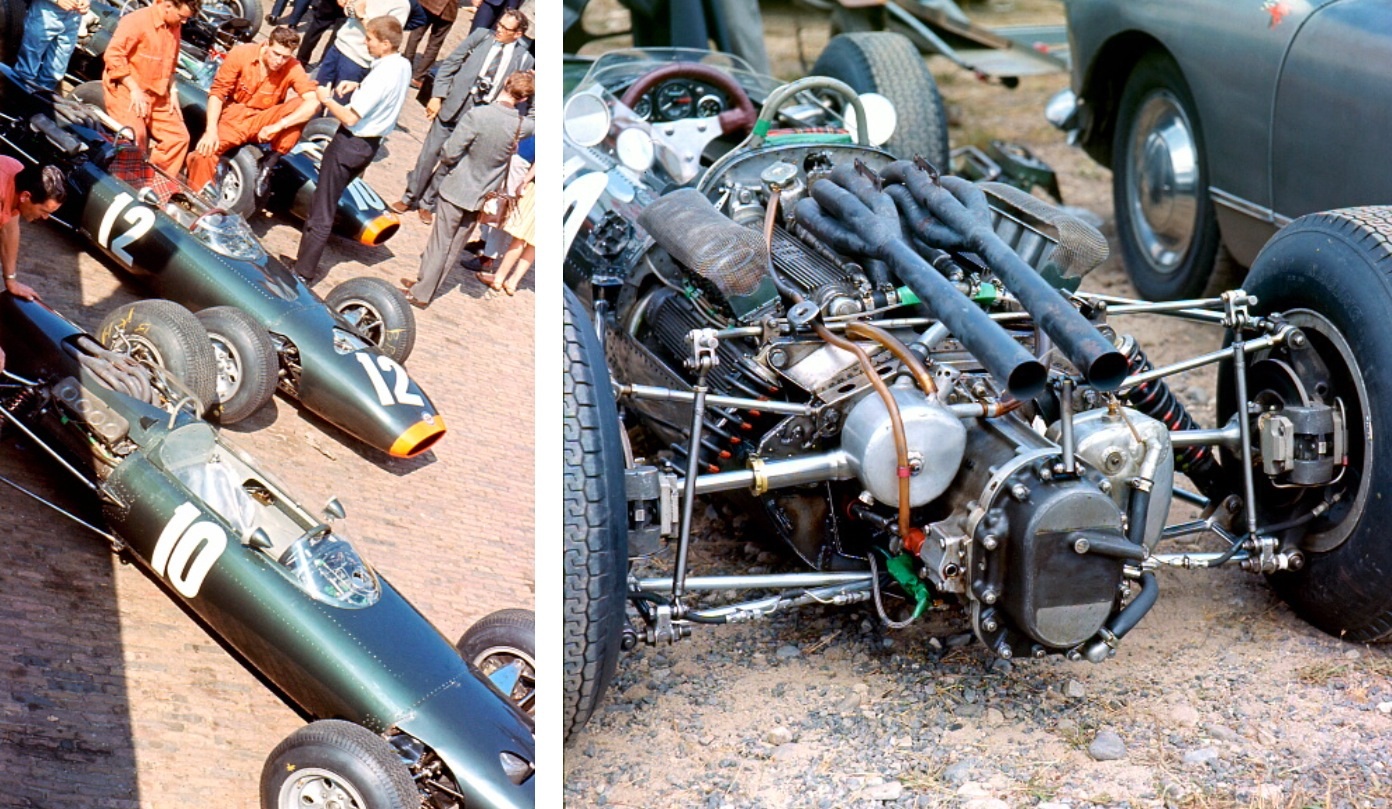
ATS 100, race debut Belgian GP, Spa 9 June 1963. Starting fron the rear is the dry sump tank, rear suspension as per text, note the inboard discs and calipers beside the Colotti transaxle. Note its ‘underslung’ between the main chassis members location; good for weight distribution but problematic in terms of ratio changes. Remember they did not have computer simulations to get the ratios right before arrival at the circuit, with a brand spankers new car ratio changes were a dead cert. Engine; Weber carbs, DOHC, 2 valve, twin plug, see the distributors driven off the end of each inlet camshaft (Getty)
Whilst Romulo Tavoni worked upon securing the services of 1961 World Champion Phil Hill, he did so on 8 January 1963 and that of 1961 prodigy, Giancarlo Baghetti, late of Ferrari, the new car was further tested before its unveiling at the Baglioni Hotel, Bologna on 15 December 1962.
Before the ATS 100 launch, by mid November 1962, the partners in the project had fallen out however…
Volpi was ‘rattled’ by the death of his good friend Ricardo Rodriguez in a Lotus 24 Climax during the Mexican Grand Prix weekend and was questioning whether the firm should be involved in racing. Volpi made these pronouncements to the press and whilst he made it clear he had partners whose views he had to consider, fissures between the parties were opening.
Billi expressed the view that the nearly completed ATS 100 F1 car was important to promote the 2500 GT car. Others have observed that both Volpi and Billi wanted to be President but in the end Billi bought both Volpi and Patino out.
Billi’s woes were added to in buying out his business partner in a machinery manufacturing business which was the primary source of his wealth and then the failure of government financing or a grant to help establish Pontecchio Marconi facility.
At the cars launch in December Billi announced the name of the project as ‘Automobili Turismo e Sport’ (ATS) and at the same time, 30 November 1962 in fact, the return of the rights to the name and mark ‘Serenissima’ to Volpi.

The Baghetti/Frescobaldi ATS 2500 GTS before the start of Targa 1964. ATS 2500 GT/GTS. A mid-engined road car was being designed by Chiti before he left Ferrari to be powered by a V8. Ferrari built the V12 powered 250LM if you call it a road car! The 2500GT was Chiti’s concept finalised and launched at the 1963 Geneva Show. Engineering by Giotto Bizzarini and Carlo Chiti, styled by Bertone’s Franco Scaglione and built by Turin’s Serafino Allemano the cars had a multi-tubular spaceframe chassis, all independent suspension by wishbones and coil springs, disc brakes all round and a 2500cc all alloy 90 degree V8, the GTS a Colotti ‘box, weighed 750Kg and developed around 250bhp. 12 chassis were built but only 8 cars completed
Rather than focus exclusively on F1 the company was also developing a sports car, a project pushed by one of ‘The Maranello Eight’ Girolamo Gardini. Along the way Giotto Bizzarini left the company, ending up very soon thereafter at Iso, as he felt his views were not being listened to by Chiti.
This GT car was unveiled at the March 1963 Geneva Motor Show. The car was fitted with a 2467cc alloy 90 degree V8 giving circa 220/250bhp @ 7500rpm for the GT/GTS variants. As a consequence of the mixed priorities of the engineering team the F1 car lacked development and missed the early races in 1963, despite Billi announcing the planned debut of the ATS 100 at the Syracuse GP in April..
Testing progressed at Modena and Monza in April with Baghetti and Jack Fairmanwho had been recommended to ATS by Dunlop’s Dick Jeffrey. Issues included ignition, gearbox and rear suspension, although the wonderful if unusually translated Lazzari ATS book does not make clear the precise nature of the issues. In the weeks before Monaco Phil Hill returned to the factory to test the car but the Monaco date was also missed.

ATS 100 upon its debut on 15 December 1962. As initially raced the car looked quite different as a result of testing changes, cohesive nature of the design was received to optimistic critical acclaim, especially in Italy! (unattributed)
Belgian GP 1963, ATS 100 debut, June 1963…
Whilst the cars were not race ready Billi insisted, it was his money after all, that the cars contest the Belgian GP at Spa.
The majestic Ardennes circuit is one of the toughest on both engines and of high speed handling so it was a supreme test of an under-developed new car. During that weekend Tony Settember’s Scirocco-BRM was also making its debut.
The ATS boys missed first Friday practice, with Tavoni reporting to Denis Jenkinson that the team transporter was delayed on the road.
As the second session neared its end with Brabham setting the pace in his Brabham BT7 Climax, the ATS team arrived on the other side of the pits and unloaded the cars in time for two exploratory laps for both Hill and Baghetti.
Denis Jenkinson’s Belgian GP report says after Saturday practice that ‘Phil Hill (was) being delighted, if not surprised by, the handling and roadholding but feeling he needed more bhp as the rpm would fall off peak all too easily’.There were whole seconds of difference in performance between the front runners let alone Baghetti and poor Phil, whose best lap was 11.6 seconds slower than pole, he was 17th and Baghetti 20th on the grid.
During the race Phil could sense a problem early, due to lack of heat in his cars cockpit, which indicated to him the cooling water was not circulating forwards to the radiator, he stopped to have a vapour lock diagnosed and rectified. But he was still not happy as the single throttle return spring was broken and the pedal was not returning rapidly. Then the car coasted to a halt, the gearbox had silently broken. The race was won by Clark’s Lotus 25 with Hill retiring on lap 17 and Baghetti who also had gearbox problems on lap 7. Lack of proper testing miles was already indicating the new gearbox was an ongoing weakness.

ATS 100 1963, cutaway drawing and profile shot, specifications as per text (unattributed)
Whilst Jenkinson’s report didn’t comment on the engineering of the cars Nye writes ‘ The two cars presented…were a disgrace, with ill-fitting unfinished body panels, looking as if they had been sprayed from a spud gun, while the hastily installed engines were actually imprisoned by welded on additional chassis stiffening tubes which would have to be sawed through to permit engine removal…’ The Colotti designed inboard mounted gearboxes and carburetion were weak points as identified by Hill.

Hill, ATS 100, Spa 1963 (Getty)
These sort of problems should not have been present given the six months between unveiling of the well finished prototype and the Belgian GP. There seems little doubt that the distraction of the GT car and management problems caused in part by the departure of two of the projects original partners resulted in the company/team not being well run on a day to day basis. Billi’s other equipment manufacturing business occupied most of his time.
The differences in appearance of the car between its launch and appearance at Spa are due, according to Lazzari’s book ‘to a hump between the driver, built to cover a new part of the chassis. This comprises tubular members to increase the rigidity of the crib of the motor. The additional tube had been settled on the existing chassis, so that it resulted (in being) impossible to remove the propeller (engine) without resorting to the oxy-hydrogen flame, whilst waiting to prepare a definitive version (of the chassis) endowed with a system of bolts’! I’m sure the Italian text is eloquent but the translation is amusing, to say the least. ‘The bodywork has been shortened and strengthened just before the steering wheel; in that zone an additional (fuel) tank has been inserted’.

Top; Hill at the top of Raidillon, botton pitlane, body as per text, note Dunlop knock on magnesium wheels, Spa 1963 (Getty)
The team attended the Dutch GP two weeks later on 23 June…
It was at Zandvoort in 1962 that Colin Chapman produced his ‘monocoque’ bombshell into Grand Prix racing. Clark lead the race until clutch trouble intervened, he proceeded to dominate the event in 1963, winning from pole, the Lotus 25 had none of the reliability issues in 1963 which prevented Colin Chapman and his merry men winning the title the previous year.
Denis Jenkinson reported on the progress made at Bologna ‘The A.T.S. team had tidied up the bodywork of their cars since Spa, but they were still not very elegant, and the tubular structure over the engines had been cut and jointed with threaded muff-joints that would have done credit to a plumber! Similar joints had been incorporated in one of the cross-members above the gearbox/axle assembly. Phil Hill’s car had the four exhaust pipes on each bank fed into single tail pipes and Baghetti’s car had separate pipes from each cylinder, ending in small megaphones’.
As practice got underway on the Friday the ATS team were soon in strife with Jenkinson reporting that Baghetti’s car broke a distributor and developed a fault in the brake master-cylinder and ‘Phil Hill was not in the running’.

Giancarlo Baghetti’s ATS 100, Zandvoort 1963, shot shows pretty lines of the car and evolution of the bodywork since Spa. Note rear brake duct to inboard disc (Schlegelmilch)
‘The opening lap ended with Clark leading Graham Hill and McLaren, but the Cooper driver was waving Brabham by into third place, as his gearbox had gone wrong again and he had only 5th and 6th gears available. Sure enough he pulled into the pits at the end of the second lap and his mechanics took the gearbox selector mechanism apart. On lap 3 there was a semblance of order, Clark always in front, hotly pursued by Graham Hill and Brabham, but the BRM engine was running a high water temperature. In fourth place was Maggs in the second Cooper and after a short pause came a truly impressive crowd of cars getting involved in some pretty serious motor racing in the best tradition. This included Ginther (BRM), Surtees (Ferrari), Bonnier (Cooper), Amon (Lola), Phil Hill (ATS), Ireland (BRP), Taylor (Lotus), Scarfiotti (Ferrari), and Gurney (Brabham), the rest of the runners being spaced out behind’.
Baghetti retired with ignition trouble on his ATS on lap 16 the other car went out in a cloud of sand as Phil Hill spun off the road due to the left-hand rear axle stub breaking off.
Jenkinson concluded his race report thus ‘As at Spa, Clark had led from the first corner to the chequered flag, the Lotus Climax V8 performing perfectly in the sort of race that must soon label Jimmy Clark as a second Stirling Moss. Not as fast, but equally praiseworthy was the performance of Dan Gurney, who started last, had a pit-stop and yet finished second.’
ATS then sensibly missed the French and British GP’s won by Clark to get some sort of resolved specification and levels of base line preparation and reliability to the two cars prior to their home event, the Italian GP at Monza on September 8th.

Hill Dutch GP 1963, ATS 100 (Getty)
Looked at objectively the choice of the drivers to join ATS makes complete sense.
The engineering team were ex-Ferrari and won a title in 1961, financial backing was solid. It made sense to jojn a team comprised of senior people Phil and Giancarlo knew well, and had won races with in ’61. Phil’s Ferrari history of course went way back to his days driving Ferrari customer sportscars for team owners in the ‘States.
By the Nurburgring in 1963 they must have wondered what the hell they had gotten themselves into! The team truck did not make it to the Eifel Mountains mind you, it crashed en-route, so the cars did not start, nothing was going right! Next the Italian GP.

Car quite beautiful in profile with its all enveloping, evolved bodywork and discs over the Dunlop alloys to eke out a few more rpm on Monza’s long straights. Phil Hill, Italian GP ’63 (Getty)
Off to Monza it was important for all the obvious reasons they do well; the cars did finish with Hill 11th and Baghetti 15th. The little red single-seaters were also looking like GP cars rather than lash-ups, better finished with neat enveloping bodywork and drag reducing wheel fairing discs fitted for the usual high speed Monza slipstreaming.
Jenkinson observed ‘The Bolognese cars were looking a lot tidier and clearly the design is becoming settled and parts are being made in a more permanent manner. Carburettors are still used although experiments have been carried out with Lucas fuel injection, and the rubber-ring universals in the drive shafts were replaced by normal Hardy Spicer joints.
During practice Phil was going better, at one point matching Brabham’s times, with Denis noting he was amongst the preofessional teams such as B.R.P. and Parnell. Baghetti only made the cut after Cabral, in front of him on times, withdrew after some pursuasion was applied!
Hill raced in company with Siffert and Jim Hall but began to lose ground, then pitted for fuel, the difficulty of topping up clear in the photo earlier in the article. Fuel was slopped into the cockpit in the process adding to Phil’s woes. Baghetti had pitted with electrical dramas but both were still in the race and running getting valuable race miles.
Clark won the race and the titles for he and Lotus with wins at Zandvoort, Spa, Reims, Silverstone and Monza. Progress was being made at ATS, it seemed.

Phil Hill looking hopefully over his shoulder at the experimental Lucas injected variant of the little ATS V8, Watkins Glen 1963 (Lyons)
No doubt it was with some trepidation that the little team from Bologna loaded its car up for the ‘away races’ at Watkins Glen and Mexico City on 6 October and 27 October respectively…
As Jenkinson looked at the cars in the upstate New York paddock he observed that whilst Baghetti’s car was of the same specifications as at Monza Hills had been quite heavily modified, ‘…the gearbox (was) now behind the axle. This had been done by turning the whole gearbox axle unit around and putting a spacer between the engine and axle to keep the wheelbase the same without moving the engine back. Both cars had a short radius arm from the top link to the chassis halfway along the engine. This radius rod was approximately half the length of the lower one, and was as used at Monza’.
Hill, Clark and Surtees were soon down to quick times with plenty of drams in the ATS pits, the meeting had started badly when an oil plug blew out of a scavenge pump coating the circuit with oil. ‘What was wrong at ATS was not easily definable as the mechanics were tearing both cars to pieces. In Hill’s car they rather foolishy fitted the experimental injection engine for the next day…The injection ATS engine was losing a lot of oil and Hill said he had no power at the top end, which was disappointing after the way he went the day before with the carburettor engine’, said Jenkinson.
Hill’s car started the race, as did Baghetti’s with the carburettor engine, the two BRM”s initially led from Surtees and Gurney. Baghetti’s ATS completed half a lap and retired with a broken oil pump. As Brabham moved into second place behind G Hill’s BRM his namesake retired from the race, again with a broken oil pump. Hill and Surtees diced for the lead at the 30 lap mark, with Surtees seemingly in command of the race, then his engine started to lose power leaving the win to Graham Hill’s BRM P578.

ATS 100 cockpit shot, Spa 1963, Baghetti up. Rough as guts body clear, as is radiator pipe to engine and Veglia Borletti instruments (GP Library)
Mexican Grand Prix…
Jim Clark ran away from pole and hid, his Lotus 25 won the race by a minute and a half from Brabham’s BT7 Climax and the BRM twins Hill G and Ginther in BRM P578’s.
It was the first championship GP in Mexico, a non-championship event was run the prior year. The high altitude of Mexico City, 7400 feet above sea level, always played havoc with the fuel systems/mixture of the cars back then, another variable for the poor over-worked ATS technicians to deal with! Jenkinson observed ‘Last year when all the entries were on carburettors (the ’62 non-championship GP) it was fairly simple to change jets until by a ‘suck it and see’ method a correct mixture was determined. This year, most cars were using fuel injection and to weaken the mixture it was necessary to reshape the metering cam…’
Between the ‘Glen and Mexico ‘The two engines had been sent back to Italy and arrived on the eve of practice, necessitating a night session before practice for the whole team. The engine fitting was made more difficult by the fact that a tremendous thunderstorm had cut off the electricity and the whole job had to be performed by torch and headlights’, MotorSport reported. ‘All a great pity as the race report starts by complimenting the organisers on the 600 acre sports arena in which the circuit is located, particularly the pits facilities and lockable pit garages themselves. Not a lot of use without power mind you! The two chassis were as at Watkins Glen.
The weekend went from bad to worse for ATS. In the first session Hill’s car was not revving very well but changing the jets improved things albeit when the engine did rev it sprayed Phil with hot oil from the breather. After few laps for which no times were given, Hills car was moved away to be worked on, soonish Baghetti’s car also followed with oil circulation troubles. Clark was setting the pace, just for something different!
The ATS boys did another all-nighter ‘…tearing the cars to pieces. They found that in the few laps Hill had done the bearings were beginning to break up. The same trouble was found on Giancarlo’s ATS. After Monza two extra scavenge pumps were fitted because excess oil in the sump was losing power. The sump was also dropped 8mm. Since this modification was done there had been consistent trouble with bearings and oil pressure pumps. Overnight the two extra pumps were removed in the hope that the cars would keep going’.
The ATS was sounding crisper on the Saturday morning but Hill was now having gear selection problems, having to jiggle the lever between 3rd and 2nd…

Phil Hill’s car in the Mexican GP pits 1963, dramas as per text (Friedman)
The ATS’ both took the start but as Clark lead Baghetti’s car was misfiring visiting the pits on lap 3 and again on lap 8 when it was pushed into the paddock for attention. He retired on lap 11 having been told he could not return to the race after going to the paddock.
In the meantime Phil’s car popped and banged its way around the track, the poor ATS mechanics had been dealing with much more fundamental engineering issues and had simply run out of time to get the mixtures right for Mexico’s altitude challenges. He didn’t appear for the 41st lap, a lower rear wishbone mount broke away from the chassis, a similar problem to the one which outed him at Zandvoort.
The end to a weekend from hell for the team- the oil circulation problem seemed solved though given the large number of laps completed by Hill. Jim Clark won the race from Jack’s Brabham BT7, Ginther’s BRM P578 and Hill G’s similar BRM.
South African Grand Prix…
Two months after the Mexican round, the final event of the 1963 World Championship was held at East London, on the south-east coast of the countries Eastern Cape province on 28 December. Jim Clark won the race in his Lotus 25 Climax, of course he and Lotus had wrapped up the drivers and manufacturers titles at Monza some months before.
The ATS team were amongst a group of cars not invited to the event. With the high cost of transporting drivers, cars and mechanics to South Africa, the R.A.C. of S.A. invited two cars from each of the main teams, with one European private entry, the rest all being local boys.
And with that, or more precisely the two cars that raced in Mexico City, the short life of ATS was effectively over.

15 December 1962, the ATS presentation at the Hotel Baglioni, Bologna. Romolo Tavoni shakes Giancarlo Baghetti’s hand in the drivers seat, ATS owner Giorgio Billi kneeling right. Twelve months later it was all over (unattributed)
The End of The Beginning…
Chiti had progressed design of a new car for 1964 which featured an overhung gearbox instead of the inboard Colotti type used in 1963.
At the end of 1963 the ATS project got into financial difficulties, Billi had over extended himself as outlined earlier. Patino and Billi opted for closure, but Volpi decided to pick up some of the assets. The GP project was shelved, several 2.5 litre mid-engined GT Coupes were built, two of which raced at the 1964 Targa Florio (ATS 2500 GTS Coupe-Baghetti/Frescobaldi DNF 3 laps ignition and Zeccoli/Gardi DNF 1 lap ignition) with the car building factory facilities split into three; a foundry doing contract work, a machine shop similarly contracting out and finally ATS Racing comprising the GP cars, components and spares.
Alf Francis and Vic Derrington formed a partnership to continue racing the two ATS cars.
One chassis ‘100-02’ was refashioned in the ilk of a Lotus 24 or Brabham BT3 with the wheelbase shortened by 6.5 inches, the Colotti box attached directly to the engine in conventional style. Componentry of the original chassis used comprised the front cross member, upper front wishbones and inboard springs, uprights, wheels and brakes. At the rear bits of the original car used included the uprights, wheels, brakes and Colotti box. Water was shifted between engine and front mounted radiator via the top left side frame tube, returning via an external pipe. The nose cowl was tidied up and the V8 engine developed over the winter, the focus its lubrication system and adaption of Lucas fuel injection. 200bhp @ 11000rpm was claimed.
The Derrington Francis ATS raced on into 1964 driven initially by Portuguese driver Mario Cabral. The plan was to run one car in GP racing and to develop the engine for sale to interested constructors, to build engines for future racing with a 3 litre version of the Grand Turismo engine already underway’ MotorSport reported in October 1964.
The car was reviewed very favourably but the development of ATS 100 chassis ‘02’ raced only once at Monza in 1964 where Cabral diced at the back of the field with Peter Revson and Maurice Trintignant before retiring on lap 24 with ignition problems.
John Surtees won the race in a Ferrari 158, on his way to the 1964 World Title. Resilient chap, that Ferrari…

Italian GP 1964. The #50 Derrington-Francis ATS with driver Mario Cabral in black and Alf Francis looking across the car from the nearside in short sleeved shirt, DNF lap 24 Q19. The other car is Maurice Trintignat’s BRM P578 DNF fuel injection. John Surtees won in a Ferrari 158 (unattributed)
The Serenissima Wheel Turns…
Volpi established his short lived Serenissima marque, with some of the assets acquired above, in the small town of Formigine, half way between Modena and Marnello.
The CEO and team manager was Nello Ugolini with Alf Francis as technical head and Bruce MacIntosh as chief mechanic. They decided to build a mid-engined, spaceframe chassis sportscar. The Jungla GT or 308V was first tested at Modena on December 20 1964. It was powered by a 3 litre 90 degree V8 designed by former Maserati engineer Alberto Massimino, he also designed the chassis.
It was this engine, which contrary to some views has no resemblance to the ATS V8 it was a clean sheet road car design according to Volpi, which McLaren used in F1 races in 1966. The ‘Tipo M166’ was a 2996cc all alloy 90 degree, DOHC, 2 valve, Weber carbed, 305 bhp @ 8500rpm engine which was fitted, personally by Bruce to his F1 McLaren M2B. Bruce McLaren used it three times in his , click on the link at the end of this article to read about that episode, one of several engines Bruce used in 1966. Finally click here for an interesting article by racer Jonathon Williams who raced for Serenissima in the late 1960’s , its fascinating and fleshes out the end of this story in the nicest possible way; http://www.motorsportsmarketingresources.com/short-stories/jonathan-williams/serenissima.html

Jonathon Williams and Alf Francis at Modena, Serenissima 3 litre V8 Coupe, circa 1968 (unattributed)
ATS Postscript…
The old adage, speaking again of such things, ‘If ‘Yer Aunty Had Balls She’d Be Yer Uncle’ springs to mind in relation to this venture. I think this saying is attributed to Frank Gardner but it’s a part of Australian vernacular, witty and pithy as Francis G was I don’t think he ‘owns’ that one.
Had ATS focussed on the GP car exclusively from December 1962 until when it should have first raced, pick a non-championship F1 event prior to the Monaco GP, rather than also building the very tasty 2500 GT/GTS, the problems with the ATS 100 engine and gearbox should have been sorted away from the harsh glaze of race weekends.
Maybe Chiti’s ATS first design should have been more conservative? Perhaps he should have foreseen the difficulties just getting a new engine right, the Colotti box however much it made conceptual sense was one step too far and these things always took time to get raceworthy, read competitive and reliable.
IF Volpi, and Billi and Patino stayed together as partners the venture would probably have continued, the combination of pockets and egos was deep.
IF Billi had not over extended himself buying out the other fellas- and his partner in his primary business he probably would have continued.
IF the government funds the venture sought to defray their capital costs were forthcoming the financial equation would have been stronger.
The ATS boys did not cover themselves in glory during 1963 but they are far from ‘the biggest F1 debut clusterfucks’ of all time. BAR springs to mind and all they did was build a chassis. How bout Toyota too, how could so much money be wasted so fast by a company who knew a thing or three about motor-racing?
The scale of the ATS venture was heroic in terms of ‘taking on Ferrari’, how stupid it was to do that kind of posturing though? By building engines as well as chassis the ATS lads were not seeking to be mere garagistes but rather create something of enduring scale- a marque which produced wonderful road cars as well as racers. They were lofty but noble aims.
But of course none of that happened, so the design Chiti laid down for 1964 never saw the light of day and the whole venture went out with a whimper in the form of the Derrington-Francis ATS in the 1964 Italian Grand Prix.
Enzo and Laura Ferrari certainly had the last laugh!?

Phil Hill aboard his ATS 100 and simultaneously wondering what to change and what will go wrong next! Circuit unknown. Inboard front suspension as per text (unattributed)
ATS 100 Build…
The prototype car, ‘100-01’ was Phil Hill’s 1963 race chassis, it was sold to Tom Wheatcroft in 1970 and formed part of his Donington Collection until sold to Philip Walker in 1999.
Chassis ‘100-02’ was Baghetti’s race chassis in 1963 and built into the Derrington Francis ATS as described above, Walker also acquired this car in 1998/9. The MotorSport November 2000 article on which this paragraph is based states that ‘Philip has acquired a second chassis…’, which rather suggests, three, at least, chassis were built.
Bibliography…
‘The History of The Grand Prix’ Car Doug Nye, The GP Encyclopaedia, 8w.forix.com, ‘A.T.S. – The Team That Challenged Ferrari’ Michael Lazzari
Photo Credits…
Getty Images, The Cahier Archive, Pete Lyons, Rainer Schlegelmilch, Dave Friedman Archive
Tailpiece: Giancarlo Baghetti, ATS 100, Dutch GP, Zandvoort 23 June 1963…