Archive for the ‘F1’ Category

clark

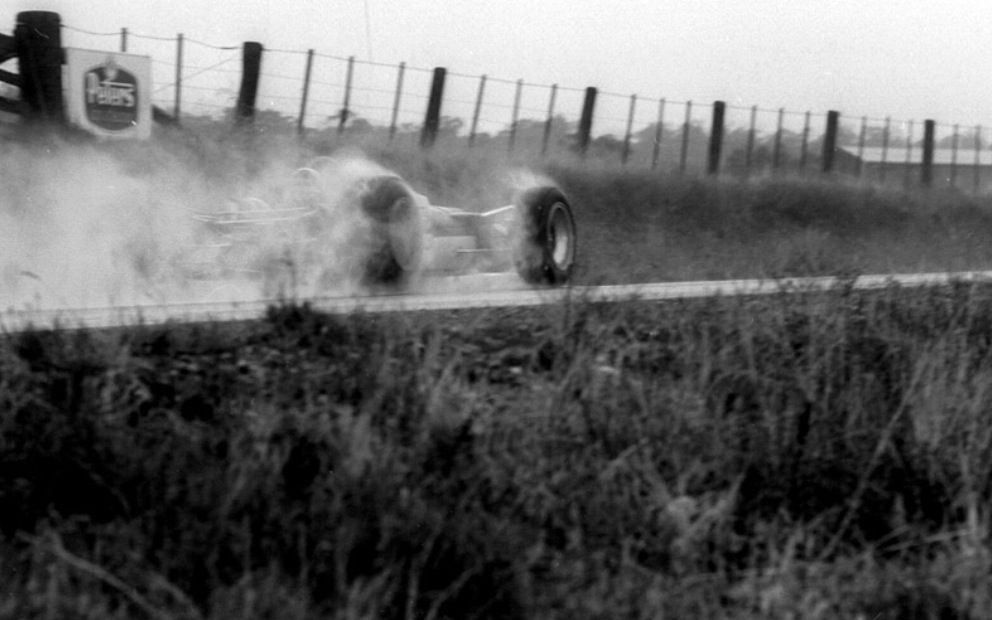
Rod MacKenzie’s moody, foreboding, evocative image of Jim Clark’s Lotus 49 at Longford in 1968 is one of my favourites…

Clark is exiting Newry Corner on the run towards the ‘Flying Mile’. He started from pole, winning 100 bottles of champagne in the process and finished second in the Saturday preliminary race in beautiful weather but the clouds opened on Monday morning for the Tasman Championship event, ‘The South Pacific Trophy’.

Star of the show was Piers Courage who drove a gutsy, skilful race in the most challenging, treacherous conditions to win the event in his little F2 McLaren M4A FVA ahead of the big Tasman 2.5’s of his close competitors. Pier’s car was self run, his performances in it that summer reignited his career.
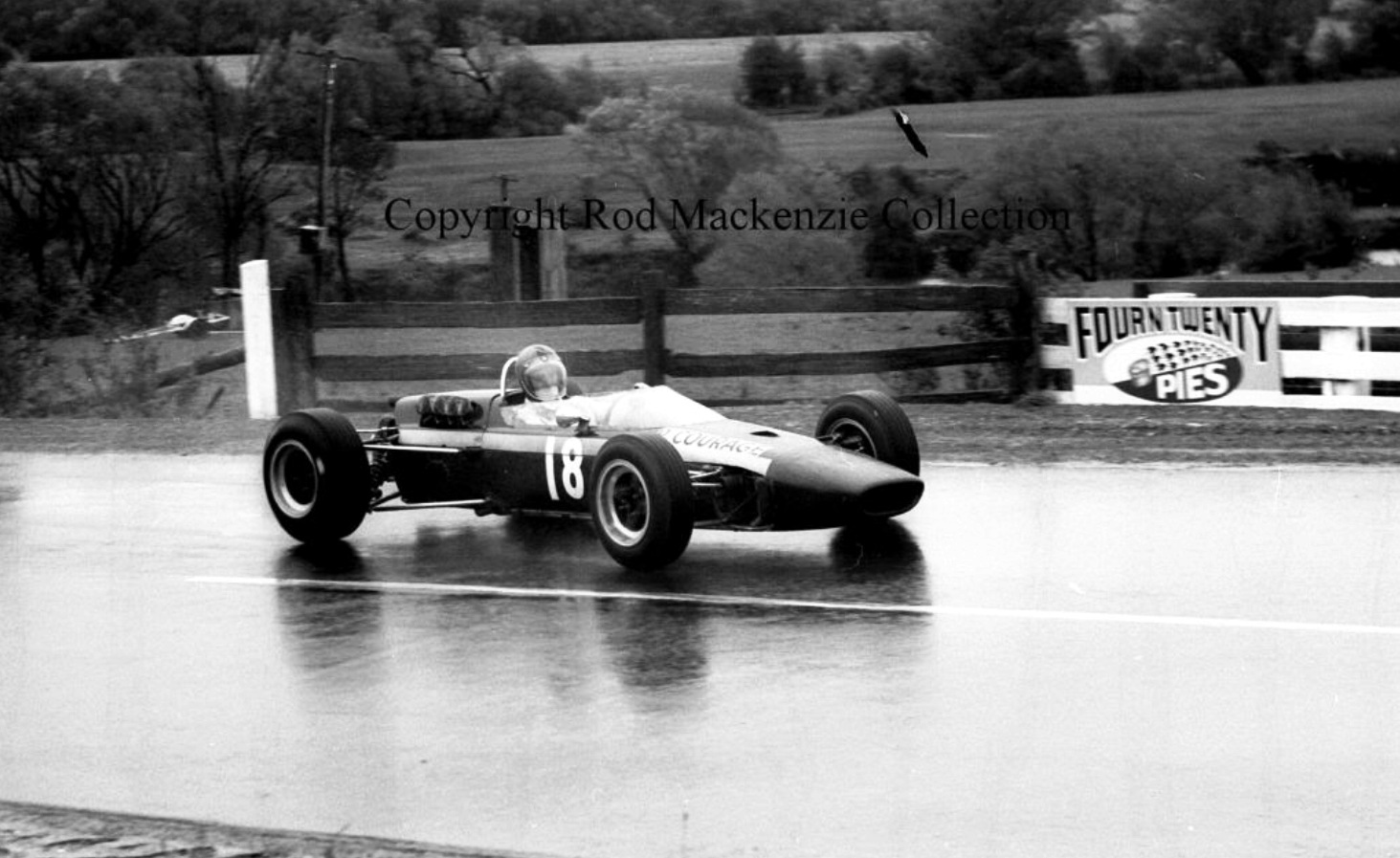
courage

Piers Courage in his McLaren M4A F2 car, Newry Corner, Longford 1968. Power was not all on this fast circuit in such wet conditions, but the plucky Brit was giving away at least 130bhp to his 2.5 litre V8 powered opponents (R MacKenzie)

Pedro Rodriguez and Frank Gardner were second and third in BRM P261 2.1 V8 and Brabham BT23D Alfa 2.5 V8 respectively. Clark was fifth in his Ford Cosworth DFW engined Lotus 49, the 2.5 litre variant of the epochal 3 litre DFV GP engine.

Jim Clark chewing the fat with BRM’s Tim Parnell- all the fun of the fair, Longford 1968, Clark’s Lotus 49 Ford DFW ready for action (oldracephotos/Harrisson)
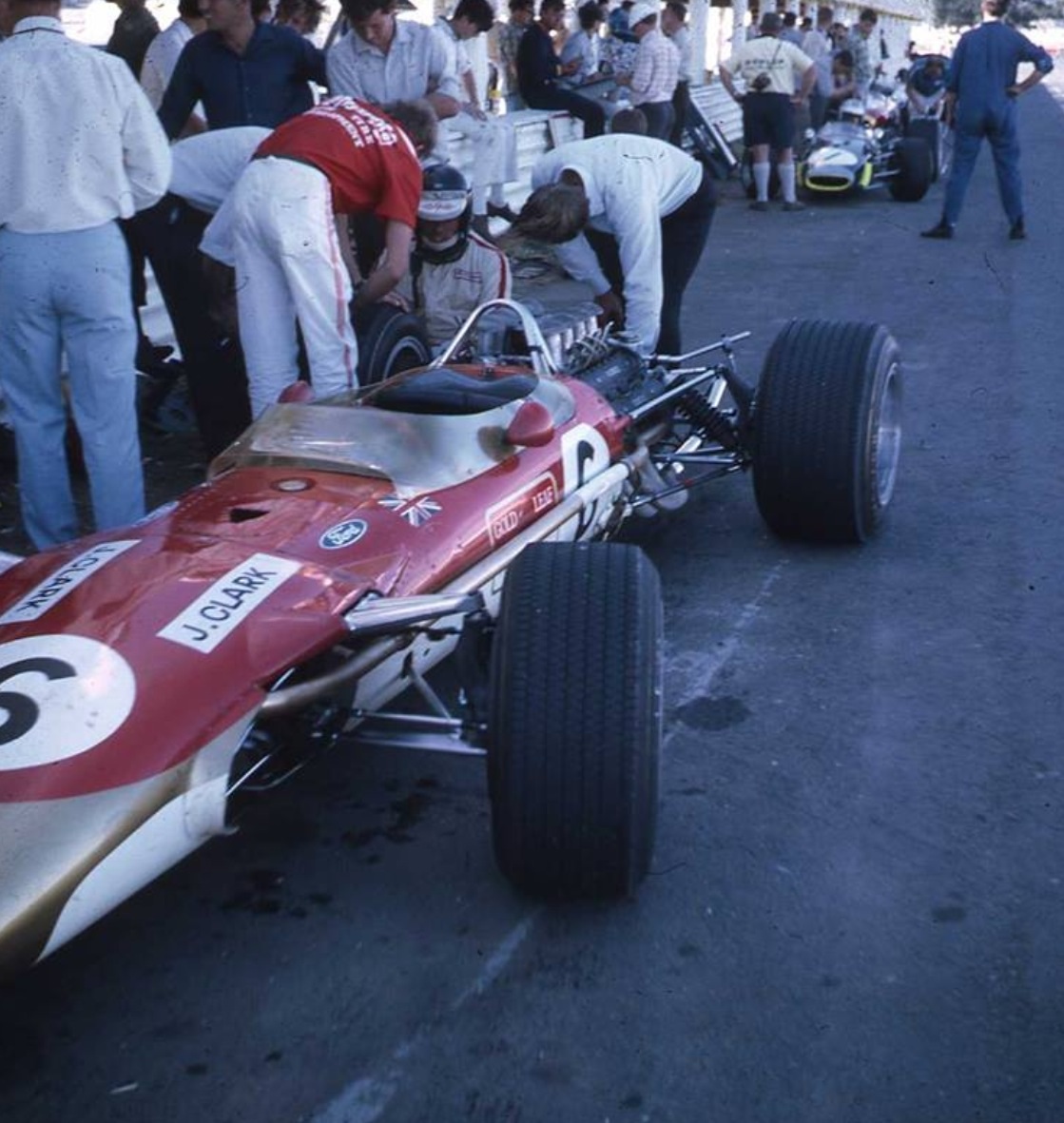
 

Clark and the boys with Denny Hulme’s Brabham BT23 FVA behind (HRCCT)

Lets go back to the start of the meeting, marvellous from the Tasmanian’s perspective as the series went down to the wire, Chris Amon was still a potential series victor with only six points between he and Jim Clark with Piers Courage’s third place within Graham Hill’s grasp depending upon how he fared.

Chris Amon blew the sealing rings in the Ferrari’s little V6 keeping his crew busy for the evening whilst Pedro Rodriguez popped an engine too- the BRM mechanics therefore readied the P261 V8 for the race rather than the P126 V12 the Mexican raced in the Saturday preliminary. Piers Courage tapped the nose of his pristine McLaren M4A when the flaggies got so enamoured of the cars they forgot to signal oil on the track! All was well at Gold Leaf Team Lotus.

Lap 1 of the preliminary on Saturday, Geoff Smedley’s amazing colour shot- Clark from Hill, Amon, Gardner and one of the BRM’s- Lotus 49 by two, Ferrari 246T, Brabham BT23D Alfa and BRM P261 0r P126 (G Smedley)

Practice times didn’t mean too much as the teams were focused on race setup for the twelve lap Saturday preliminary race ‘The Examiner Racing Car Scratch’ which also counted for grid positions. In the second session of practice Clark did a 2:12.8, Hill 2:13.6 and Amon 2:13.8. Clark was under Jack Brabham’s record set on the way to his win the year before in his BT23A Repco, Jim won 100 bottles of champagne for pole as stated earlier.

In the preliminary on Saturday the grid formed up with Clark on pole. Hill comfortably won the event run in fine, dry weather from Clark and Amon. Both Lotuses were timed on the Flying Mile at 172 mph but Amon’s 182 mph in David McKay’s ex-works Ferrari P4/Can Am 350 sportscar rather put the single-seaters in the shade! Lets not digress about that car now, follow the link at the end of this article for a long piece about the P4 which Chris raced in the sportscar support events in each of the Australian Tasman rounds.

Hill G leads the pack off Long Bridge on lap 1 of the Saturday preliminary. Hill, Clark, Amon, Gardner, Leo Geoghegan Lotus 39 Repco, a BRM and perhaps Kevin Bartlett Brabham BT11A Climax (R MacKenzie)
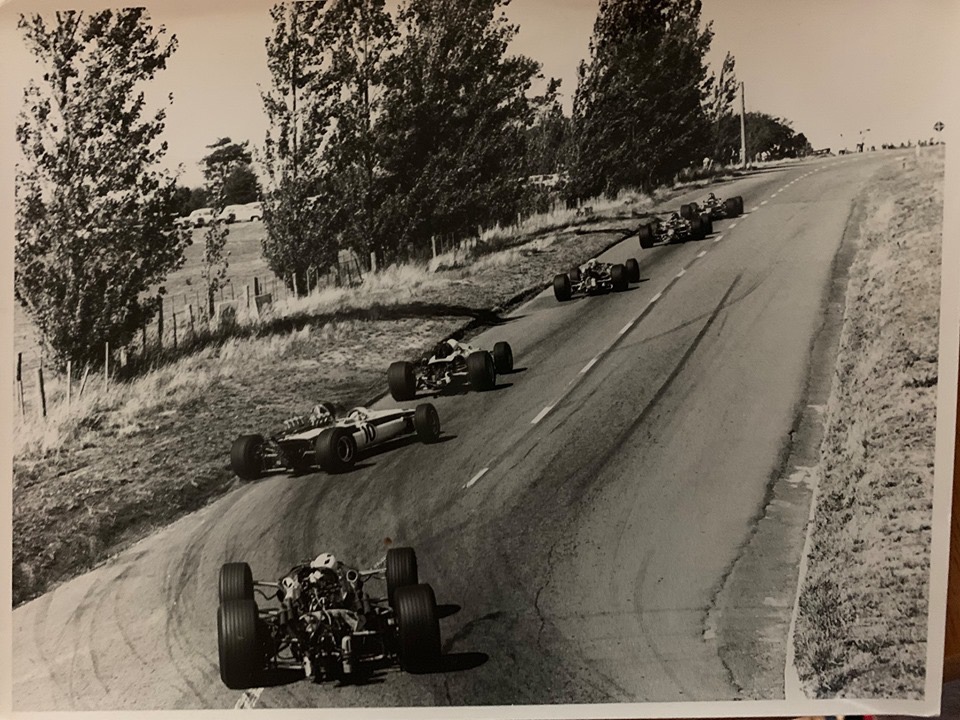
 

Exit from Newry, lap 1 of the preliminary- Hill, Clark, Amon, Gardner, Geoghegan’s Lotus flirting with the tracks edge, and Attwood. Great shot shows how the circuit rises at this point into the right hand kink up the road (S Geoghegan)

Only a couple of supporting races had been run on the Monday raceday when light rain started to fall at about 10am, this soon became heavy. As the rain got harder and the clouds more threatening it was obvious that it was not likely to abate before the 2.15 pm race start time

The track was almost under water at some points where hay bales had broken up and straw was blocking the drains. Efforts by track officials soon had most of the drainage system under control.

A large crowd was of course present on the Labour Day long-weekend. Crews brought the cars out onto the circuit in front of the pit counter and stood together under umbrellas as the drivers went into a huddle with the promoters of the meeting and the CAMS stewards to determine if the race should go on.

Leo Geoghegan and Lotus 39 Repco return to the Longford pits after some exploratory laps. DNS with unsuitable tyres. Its the Courage McLaren by the pit counter (oldracephotos)

Sergent.com report that first it was decided that the cars should do a couple of exploratory laps then report their findings.

Geoghegan, Amon, Clark, Hill, Attwood, Gardner, Bartlett and others went out and after looking like motor boats ploughing through the water delivered their thoughts to the meeting. The conditions were so bad various drivers with unsuitable tyres elected not to start having driven some ‘sighting laps’.

Kevin Bartlett recounted his experience in the Alec Mildren Racing Brabham BT11A Climax; ‘I did two exploratory laps and the old BT11 couldn’t find traction anywhere. I had an absolutely terrifying 4th gear 720 degree spin across the short Kings Bridge, the one after the Viaduct, missing all the obstacles at the tracks edge. After exiting Pub and in a straight line i did a 360 degree loop. She nearly escaped me over the rail line on the way to Long Bridge. Out of Newry and up the hill to the straight slithering along with no touch felt between me and the bitumen, so i suppose I thought at that moment to do another lap at a very reduced speed then pit’.

Packed car park: Amon’s Dino, the BRM’s of Attwood and Rodriguez, Pedro’s P261 fully covered, the two Lotus 49’s, Piers McLaren, then Leo G’s Lotus 39 and John Harvey’s Brabham BT11A (oldracephotos)
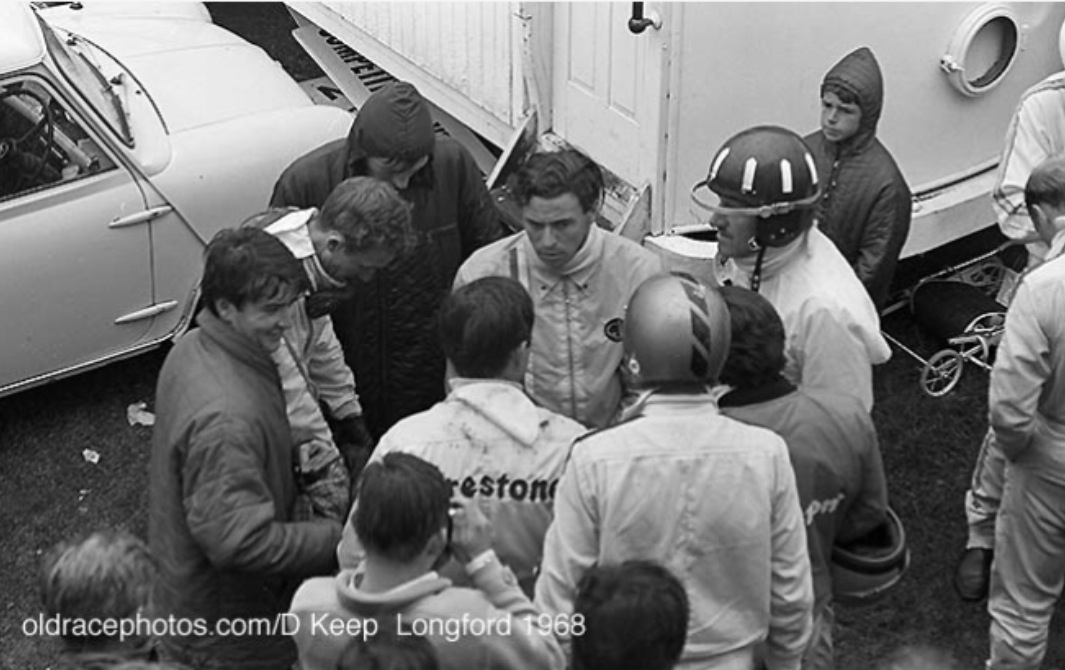
long

‘What are we going to do boys?!’ Drivers considering their options before the race, the pouring rain exacerbated by drains beside the track which couldn’t cope with the deluge; Clark facing us, Hill’s distinctive helmet clear. Courage with his back to us in helmet, Gardner’s lanky frame partly in shot to the right. Amon in the ‘Firestone’ suit, Harvey? at left with head down (oldracephotos)

‘Once back in the tent Alec, Frank (Gardner) Denny (Hulme Brabham BT23 FVA F2) and i had a talk about the tyres that Denny and i had and after trying to come up with a better tread pattern, such as the ones fitted to Franks car (Brabham BT23D Alfa) but with no result. It was agreed that Denny and i shouldn’t risk a start. I was happy with the call and Leo (Geoghegan Lotus 39 Repco) followed suit. Most of the top guys had the latest Firestone, Dunlop or Goodyear wets but none were available to suit the BT11’s. I consoled myself with the fact that if the new world champion (Hulme) didn’t like the risk i certainly shouldn’t!’

Longford, wonderful circuit that it was, provides no runoff area for a driver to go in the wet (or dry!) should a driver lose control or suffer a bad attack of aquaplaning, and this was the main point in contention.
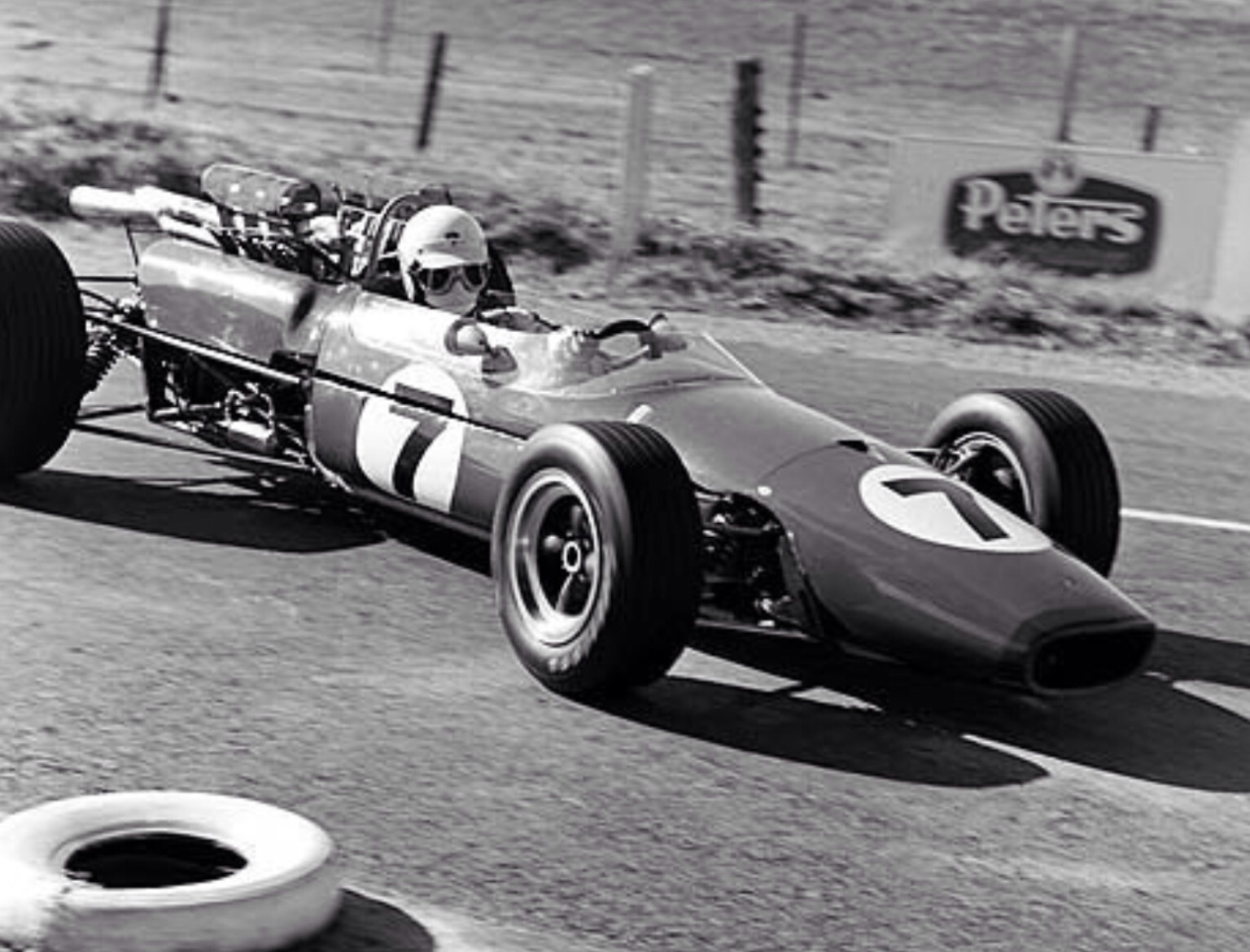
The ill fated Brabham BT23A Repco ‘740’ of Greg Cusack on Friday or Saturday (oldracephotos)

Greg Cusack in David McKay’s Scuderia Veloce Brabham BT23A Repco (Brabham’s victorious Longford mount from 1967) had left the road that morning. He lost the car on the greasy road as he went over the hump/bump on the approach to The Viaduct. The car left the road, hit a bank, somersaulted and crashed into a ditch, he was then pinned under the it before being quickly released by officials.

The 37 year old Canberra motor dealer, who had intended Longford to be his last race meeting, was taken to Launceston Hospital with chipped bones to both knees, stretched ligaments and a fractured left wrist. He was lucky it was not a good deal worse. Bib Stillwell organised for one of his planes to fly Cusack and his wife home to Canberra on the Tuesday where he was admitted to hospital.

Whilst Cusack lay in hospital the other drivers were trying to explain the difficulties of Longford which were exacerbated hugely in the wet. ‘Motoring News’ reports at length about the cordial discussions between the drivers and officialdom and all of the competing issues of safety, providing a show and running a race to determine the winner of the Tasman Cup.

The Stewards finally ruled that the race should go ahead but be shortened to 15 laps of the 4.5 mile circuit, (128 miles to 68 miles) and put the starting time back to 4pm hoping the rain would ease and the situation be safer as a consequence. At 4.15pm the sodden cars and their game, uncomplaining drivers were facing the soggiest start ever seen at Longford, one of the most challenging road circuits in the world.

Front row- Amon Ferrari 246T and the two Lotus 49 DFW’s of Hill and Clark, that’s Frank Gardner’s Brabham BT23D Alfa nose (oldracephotos)


Soggy start: L>R Amon Ferrari Dino 246T, Hill Lotus 49 and unsighted to the right Clark. Then Rodriguez BRM P261 #11 and alongside Gardner in the light coloured Brabham BT23D, #12 behind him Attwood BRM P126 and alongside him the winner Courage McLaren M4A. L>R in the back row John Harvey’s Brabham BT11A, John McCormack Brabham BT4 and Mel McEwin Lotus 32B (oldracephotos)

Clark’s Lotus 49 got away well, somehow finding traction with the wide Firestones, and he was followed into the right-hander before The Viaduct by Amon and Hill. The drivers took the opening laps cautiously under race conditions and each car was leaving a gap to the other so they could see through the flying spray.

At the end of lap one the order was Clark, Rodriguez BRM P261 V8 on Dunlops, Gardner Brabham BT23D Alfa on Goodyears, Courage Mclaren M4A Ford FVA using new narrow-section 970s, Hill Lotus 49 Ford DFW on Firestones, Attwood BRM P126 V12 on Dunlop, Amon Ferrari 246T back in seventh owing to a run down the escape road at Newry Corner, then John Harvey Brabham BT11A Repco John McCormack Brabham BT4 Coventry Climax FPF and Mel McEwin Lotus 32B Coventry Climax FPF, this car the ex-Clark/Palmer 1965 Tasman Championship winning chassis.

Richard Attwood, a very good 4th in the big BRM P126 V12 on Pit Straight. BRM was testing, by way of eight Tasman race weekends in a row, this new F1 design in 2.5 litre capacity in advance of the ’68 GP season (oldracephotos/DKeep)

‘Attwood found he had more traction on Dunlops than Hill had with the wide Firestones and he slipped under the Lotus for fifth place on lap 2. Both Attwood and Rodriguez had hand-cut drainage grooves in their tyres. A lap later Courage really got his foot in it to take Gardner on lap 3. He then jumped past both Rodriguez and Clark on the next lap while Gardner followed him through and waited for another lap behind Clark before taking the plunge and heading for second. Amon had taken Hill and now, on lap 5, the order was Courage 9.6 secs ahead of Gardner, Clark, Rodriguez, Attwood, Amon, Hill and Harvey. McEwin and McCormack were already in danger of being lapped by the flying Courage.

Hill from Gardner, not sure who and one of the BRM’s, Long Bridge (R MacKenzie)

Courage, driving like a young Stirling Moss in the blinding rain, somehow gained another 9.5 secs on lap 6, putting him 16 secs ahead of second man Gardner in the Brabham-Alfa. Rodriguez had pulled past Clark and on the next lap Attwood whizzed past Clark to take fourth. On lap 9 Courage was 32 secs ahead of Gardner and having a ball out on his own, right foot hard in it. Gardner was 3.5 secs ahead of Rodriguez who was followed by Attwood, Clark, Amon, Hill and Harvey losing a lot of ground’.

Pedro raced the little 2.1 litre BRM P261 V8 having raced the new P126 V12 in the preliminary and had engine failure. 2nd a minute behind Courage just sneaking past Gardner in the final stages (oldracephotos/DKeep)

‘Rodriguez started to close up on Gardner in the closing laps, but nothing could touch Courage. This was his day, it was he who had the best gear on his car and he was darned sure he was going to make it a race to remember. He had pulled 45.5 secs on Gardner by lap 12 while Rodriguez had got within 2.5 secs of Gardner. Hill challenged Amon on the same lap and finally squeezed past in a daring effort on the greasy track to make the Lotus-Fords fifth and sixth’.

Frank Gardner on the exit of Newry, Alec Mildren’s Brabham BT23D Alfa Tipo 33 2.5 V8. 3rd a minute behind Courage (R MacKenzie)

‘As Courage screamed down the straight heading for the flag he was over 55 secs ahead of Gardner and he came past the pits jubilantly waving his hand. Gardner by this time, heading for the braking area at Mountford, had Rodriguez looking right at the Alfa V8 pipes. There seemed no way that Rodriguez could slip past, but suddenly a gap appeared as Gardner went a shade wide on Mountford and Rodriguez poured on the power into the short straight and took the flag about 25 yards ahead of the Alec Mildren car. Attwood finished his race fourth after a very steady drive, followed by Clark, Hill and Amon’.

John Harvey coming off Long Bridge in Bob Janes Brabham BT11A Repco ‘740’ V8. This is the car in which Spencer Martin won the ’66/7 Australian Gold Star. Converted to Repco power just prior to the Tasman (R MacKenzie)

Hill, Lotus 49 DFW, 5th on the Flying Mile (R MacKenzie)

‘Courage had the rubber, just the right amount of power for the job and the ability to keep the car straight on a very dicey and greasy circuit. He finished the Tasman Cup Series in a wonderful third place behind Clark and Chris Amon. Then came Hill and Gardner 17, McLaren 11, Rodriguez and Hulme 8, Jim Palmer 7, Attwood 4, Roly Levis and Leo Geoghegan 3, Paul Bolton, Red Dawson and Kevin Bartlett 2, Graeme Lawrence and Ross Stone 1 each’.

Like a duck to water- Courage, right tyres, set up, enough power, precision and bravery. McLaren M4A FVA F2 machine (R MacKenzie)

It was very much the end of an era, the last Longford, the speed of the cars and advancing track safety rules caught up with the place and an inability of the club/government to make the requisite investment. Most importantly Jim Clark, a very popular visitor to Australasia since the early sixties and twice winner of the series in 1965 and 1968 died at Hockenheim in an F2 Lotus 48 in April.

Lotus returned in 1969 but it was not quite the same without the magic and personality of the great Scot.

photo (15)

A very happy but cold and soggy Piers Courage, with wife Sally after his Longford ’68 win. It was a might fine drive which is still remembered by those fortunate enough to see it. (oldracephotos)

Etcetera…

Practice and Saturday Preliminary

Richard Attwood, BRM P126, The Viaduct (oldracephotos/Keep)


Lap 1 bunch behind the lead group- Gardner Brabham BT23D, Geoghegan Lotus 39, Attwood BRM P126, Bartlett Brabham BT11A, Rodriguez BRM P126 into The Viaduct (oldracephotos)


Leo Geoghegan, Lotus 39 Repco 740. Leo frightened the internationals in his ‘old bus’ more than once that summer- Clark’s ’66 Tasman mount Coventry Climax FPF engined. Non starter on Monday tho (R MacKenzie)


Chris Amon, Ferrari 246T. Chris learned a lot from his ’68 tour, and applied those learnings well in 1969 winning the title in an updated, four valve, winged  Dino (oldracephotos


Pedro Rodriguez, BRM P126. The V12 engine in this car failed during the race so Pedro raced the ‘backup’ P261 V8 in the championship event- cars which had become wonderful Tasman machines from 1966-8. Winner in ’66 in Stewart’s hands (oldracephotos/Keep)


Graham Hill, Lotus 49 Ford DFW. Perhaps not the best of Tasmans- 2nd at Surfers and Warwick Farm his best results (R MacKenzie)


Pedro Rodriguez, BRM P261 V8 during practice (oldracephotos/Keep)


Pedro Rodriguez, BRM P126, The Viaduct (oldracephotos/Keep)


Richard Attwood, BRM P126. Drove the Oz rounds in the car vacated by McLaren- 4th at Longford deserved, DNF’s @ Surfers and Sandown, overall the P126’s were not blessed with great reliability in the ’68 Tasman (R MacKenzie)

Photo and Other Credits…

Roderick MacKenzie Collection;  http://www.racephotoaustralia.com/

oldracephotos.com;  http://www.oldracephotos.com/content/home/

The Nostalgia Forum/Ellis French/Rod MacKenzie and Kevin Bartlett.  Sergent.com race report. Geoff Smedley. ‘Canberra Times’ 6 March 1968

Ellis French Collection/Archive

Scuderia Veloce Ferrari P4/Can Am 350…

Ferrari P4/Can Am 350 #0858…

Tailpiece: Practice- Rodriguez BRM P261 from Courage McLaren M4A Ford FVA and Kevin Bartlett Brabham BT11A Climax FPF. Variety is the spice, braking into The Viaduct…
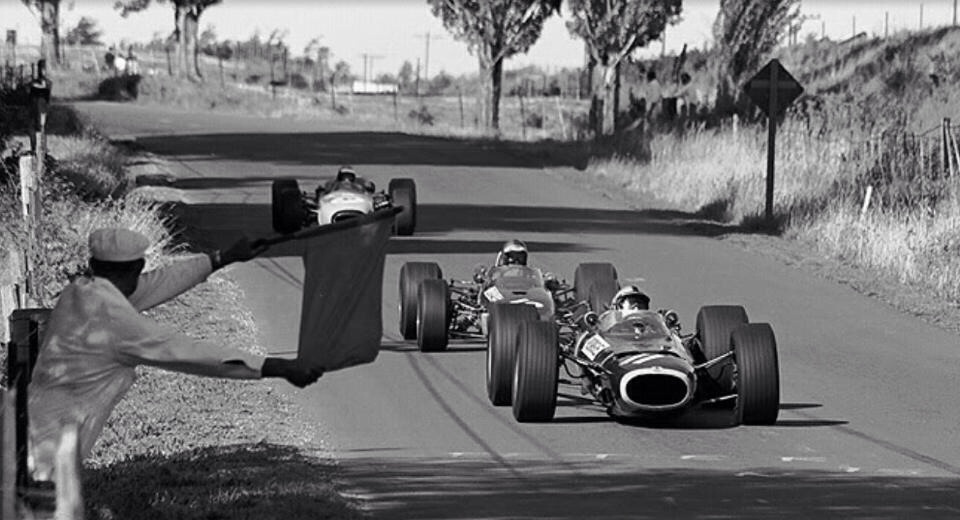
(oldracephotos/DKeep)

Finito…

merc staub
(Max Staub)

Mercedes Benz returned to Grand Prix racing with a vengeance at Reims in 1954, here Fangio leads Karl Kling in the W196 Streamliners…

Mercedes had a habit of re-entering racing in the French Grand Prix every twenty odd years, when doing so bringing new standards of engineering excellence with them.

In 1914 the four cylinder, SOHC 4483cc engined Mercedes 18/100 of Sailer, Lautenschlager, Salzer, Pilette, and Wagner crushed the opposition at Lyon just before The Great War. The course was 37.6 Km long, 20 laps of it took the winner Christian Lautenschlager 7hr 8 min!

1914
Three of the 1914 French GP winning Mercedes team cars at Unterturkheim post event. L>R #28 Lautenschlager first, #39 Salzer third, #40 Wagner second. (unattributed)

In 1934 Auto Union and Mercedes came to Monthlery with cars which would largely sweep the board until war again intervened.

Although on that day an Alfa Romeo triumphed – Louis Chiron won in a Scuderia Ferrari Alfa P3 from Achille Varzi similarly mounted – the three 2.9-litre supercharged straight-eight Mercedes W25s of Rudi Caracciola, Manfred von Brauchitsch and Luigi Fagioli retiring with a variety of maladies.

1934
1934 French GP, Montlhery. Rudy Caracciola Mercedes W25 DNF, from Avhille Varzi Alfa P3/Tipo B, second (unattributed)

And so it was that Mercedes returned to racing after a break of fifteen years at Reims on the weekend of July 4th 1954 – 40 years after Lyon and 20 after Monthlery – with the W 196 R, as the car is designated internally…

fangio reims
JM Fangio, Mercedes Benz W196, Reims victor 1954 (Jesse Alexander Archive)
(Mercedes Benz)

The W196R was a triumph of complex engineering, the 2.5-litre straight eight cylinder car had a swag of new features.

Direct injection (Bosch) of fuel into the M196R’s cylinders (76×68.8mm) for more precise ignition of the incoming fuel charge was the first of many, the engine lay on its side 53 degrees from the horizontal to the right to allow a lower bonnet line and the driveshaft to pass beside the driver rather than have him sitting on it. Desmodromic, or mechanical operation of the valves allowed higher rpm than the valve springs of the day could handle.

Downstairs, in traditional Mercedes fashion, there were/are two blocks of four cylinders with welded on cooling water jackets. The Hirth type crankshaft was supported by 10 roller-bearings, with central power take-off. Mercedes quoted 256bhp @ 8260rpm with maximum potential revs 9500. The transaxle is 5-speed and mounted behind the rear axle.

M196R 2.5-litre straight-eight (Mercedes Benz)
W196R chassis, inboard brake drums and 5-speed transaxle. Rear suspension is swing axle, tubular dampers and longitudinally mounted torsion bars, hidden in this shot (Mercedes Benz)

The chassis is a multi-tubular spaceframe with upper and lower wishbones, telescopic shocks and torsion bars. At the rear there is a single-joint swing axle, longitudinal torsion bars and again telescopic shock absorbers. Inboard drum brakes front and rear (350/275mm in diameter) to lower unsprung weight and a streamlined all enveloping body helped the car to be quicker thru the air. Steering was worm and sector, wheel/tyres 6-inch and 7-inch wide and 10-inch diameter

The very experienced pre-war engineering team of Dr Fritz Nallinger and Rudy Uhlenhaut were in control of the conception, design, development and testing of the new car.

french paddock
Reims 1954 paddock shot. #18 Fangio and #22 Hans Hermann Mercedes W196 Streamliners being prepared for the race. Open bodies were used from Nurburgring 1954 onwards, Streamliner body about 60 pounds heavier than the ‘Nurburg’ slipper/open wheeler bodies (unattributed)

The purpose of this article is not to write in detail about a car which has had everything written about it, rather the words are a support to the wonderful painting and cutaways originally published in that splendid annual, Automobile Year, in this case in the 1955 edition.

cutway 2
(Automobile Year)

In his Automobile Year technical review of the 1954 season noted journalist/Le Mans Winner/GP driver Paul Frere explains in great detail the technical advances of the car, but also makes clear that in his view all of the Benz victories that season were scored by Fangio, in that the car’s speed was in large part a factor of Fangio’s dominance as a driver rather than it being a function of the cars outright pace; JMF and Alberto Ascari were the standout drivers at the time.

The W196 won four of five 1954 races entered, impressive with a new car, Frere also makes it clear that the development potential of the car was obvious, that point subsequently reinforced in their 1955 season!

french start
French GP Start; #18 Fangio, #20 Kling Benz W196, #10 Alberto Ascari Maser 250F #2 Gonzalez Ferrari 553, #12 Marimon Maser 250F, #46 Prince Bira Maser 250F, #22 Hans Hermann Benz W196, #6 Hawthorn Ferrari 553, #4 Maurice Trintignant Ferrari 625, #34 Robert Manzon Ferrari 625, #14 Luigi Villoresi Maser 250F (unattributed)

At Reims Fangio was on pole with his young German teammate Karl Kling alongside and Alberto Ascari in a factory Maserati 250F.

Alberto and Onofre Marimon were ‘loaned’ to Maserati by Gianni Lancia given his new D50 GP car was still not raceworthy and the drivers were otherwise unemployed for the weekend.

Ascari’s race was over on lap 1 due to either gearbox or engine failure depending upon the report you read, this left Fangio and Kling to run away with the race. Hawthorn and Marimon scrapped for third before the Argentinian stopped for a plug change and dropped to the back of the field.

start 2
Fangio left, and Kling Mercedes W196 well clear of Ascari’s Maser 250F shortly after the start (unattributed)

Pre-war Thai driver Prince Bira drove a great race in a customer 250F dropping from third to fourth having run out of fuel and losing time switching to his auxiliary tank, so Robert Manzon was third in a Ferrari 625.

Hans Herrman in the other W196 took fastest lap early in the race before over-revving the engine and leaving its telltale at 9100rpm!

So, a dominant Mercedes start to a run which sadly only lasted until the end of the 1955 season before their modern era return and the dominance of 2014/5…

fangio thillois
Fangio, Thillois Hairpin, Reims 1954. MB W196 (unattributed)

Etcetera…

(Mercedes Benz)
grid shot
(unattributed)

Front row prior to the Reims start. Fangio and Kling taking a sideways glance, and Ascari’s new but somehow antiquated looking 250F in the company of the Mercedes Streamliners whilst Hawthorn fiddles with his goggles on row three.

(Mercedes Benz)

M 196 R – Mercedes Benz when publishing the car and engine type use the spacing shown, albeit short-form will do me – engine being dyno tested Unterkükheim in 1954. From the left, Engineers Karlheinz Göschel and Heinz Lemm, Werner Wolf and Eckstein.

cutaway 3
(Automobile Year)

Fangio’s car being ministered to between sessions. What stands out is the quality of the Streamliner’s build and finish and the enormous inboard brake drums both front and rear – JMF’s seat has been removed allowing a peek at the rear units.

The straight-eight Type 32 Gordini was the last Grand Prix car fitted with an engine of this layout, but the W196 was the last successful one. The compact nature of Vittorio Jano’s 2.5-litre V8 engined 1954-55 Lancia D50 was a reminder of the advantages of engines in Vee formation and was highly influential as such.

(Mercedes Benz)
merc w 196
(Automobile Year)

Nice cross section of the W196 cylinder head showing the operation of its desmodromic valve gear.

(Mercedes Benz)

Another detail front end shot sans radiator; the hollow bars either side of the drums are the ends of the torsion bars, note also the short upper suspension links.

Tailpiece…

(unattributed)

Majestic and atmospheric Reims as JMF takes his position on the grid.

Credits…

Max Staub, Automobile Year, Jesse Alexander Archive, Getty Images-Maurice Jarnoux, Mercedes Benz Archive

Finito…

b schumi and mansell

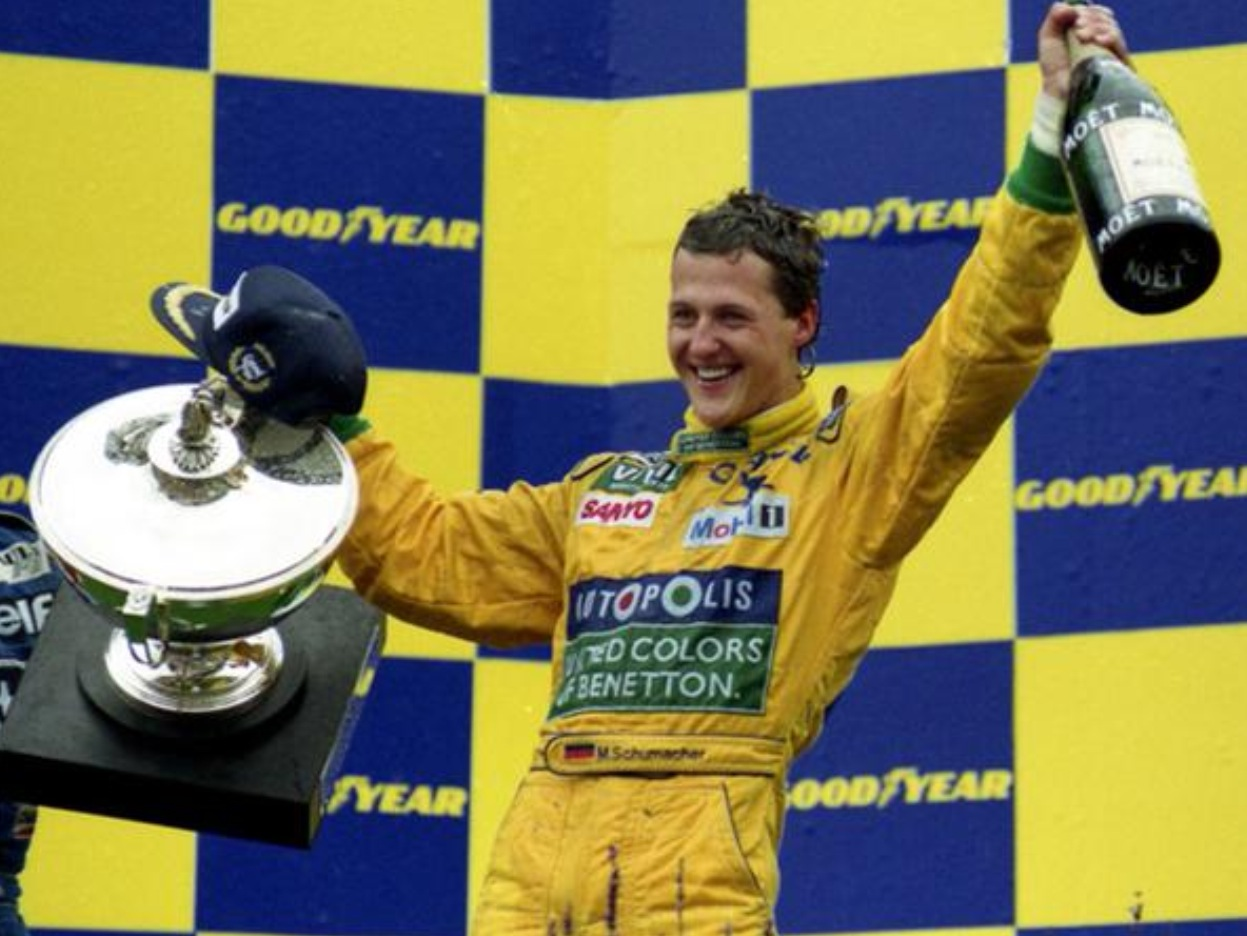
Michael Schumacher’s Benetton Ford just in front of Nigel Mansell’s Williams Renault. He took his first GP win having made his Championship debut at Spa with Jordan 12 months before…

Schumacher’s 1991 Belgian Grand Prix debut was in a Jordan 191 Ford. His Sauber Mercedes sportscar performances didn’t make it clear that ‘The Next Superstar’ had arrived but he qualified 8th and ran 4th retiring his car with clutch dramas, his brief drive was enough to convince Flavio Briatore to sign him up on the spot.

Roberto Moreno lost his Benetton seat to the German, swapping across to Jordan, Schumacher took a 5th and two 6th placings by seasons end.

1992 would be a tough year for all but Williams.

‘Active suspension’ experiments which started at Lotus with Colin Chapman tasking his engineers to explore it as far back as 1981 with the Esprit road car and in F1 from 1987 met an ‘apex’ with the Williams FW14B/15C Renault’s in 1992/3.

noige

Nigel Mansell, Williams FW14B Renault, the dominant car of 1992, here at Spa. (unattributed)

The Patrick Head/Adrian Newey designed cars were powered by a 3.5 litre Renault V10 considered to have around 760bhp, 30bhp more than the Honda V12 by seasons end.

But the key to the cars dominance; Nigel Mansell became the first driver to achieve 9 wins, and the title that year, was the cars carbon fibre chassis which incorporated active suspension. The advance of computer technology finally allowed the exploitation of suspension actuators to deploy the system effectively.

The Williams 6 speed gearbox incorporated traction control and was of the semi-automatic type pioneered by the Ferrari 640 in 1989. The car also incorporated anti-lock braking for a time. The promise shown later in 1991 was now converted into stunning, consistent race winning pace.

Benetton B192 Ford…

b cutway

(Terry Collins)

The Benetton B192 was a conventional, well engineered, ‘chuckable’ chassis developed by Ross Brawn and Rory Byrne.

The chassis was carbon fibre, suspension by wishbones front and rear with coil spring/dampers actuated by pushrods. The gearbox was Benetton’s own transverse design 6 speed manual.

The Ford Cosworth HB 75 degree 3.5 litre V8 developed around 700bhp @ 130000rpm, well short of the Honda and Renault’s output but the car was consistently fast and ‘best of the rest’ after the dominant Williams and the McLaren with which Senna took 3 wins.

b monaco

Jean Alesi, Ferrari F92A and Schumacher collide after an attempted Schumi pass on lap 12 of the 1992 Monaco GP. Jean’s car was damaged taking him out of the race, MS 4th in the race won by Senna’s McLaren. (unattributed)

Schumacher’s 1992 Season..

b kink

MS Benetton B192 Ford, Spa 1992. (unattributed)

Schumacher was 3rd in the drivers championship in a season of speed and consistency; he took 2nds in Spain, Canada and Australia and four 3rds, his breakthrough first win was at Spa, exactly 12 months after his GP debut.

schum la source

THE classic Spa shot, MS La Source hairpin 1992. (unattributed)

In a race of changing fortunes and variable conditions good or lucky pit work put him on dry tyres at the right time; Mansell and Patrese in the other Williams chased him down but both had cracked exhausts which took the edge of their engines performance. Schumi took the win from Mansell, Patrese, his Benetton teammate Martin Brundle, Senna’s McLaren MP4/7A Honda and Mika Hakkinen’s Lotus 107 Ford.

schum alesi hakk

Remember the skid plate sparks!? L>R; Hakkinens 6th placed Lotus 107 Ford, Schumacher and Alesi’s Ferrari F92AT, he spun on lap 7 so its early in the race. (unattributed)

The Schumacher/Benetton/Ford combination took the drivers (but not the manufacturers) title in a season of tragedy and controversy in 1994, the 1992 B192 was an important stepping stone in that evolution…

b victory dais

Spa 1992 victory dais; the first of 91 GP wins. (unattributed)

Credits…Terry Collins

monaco 1958

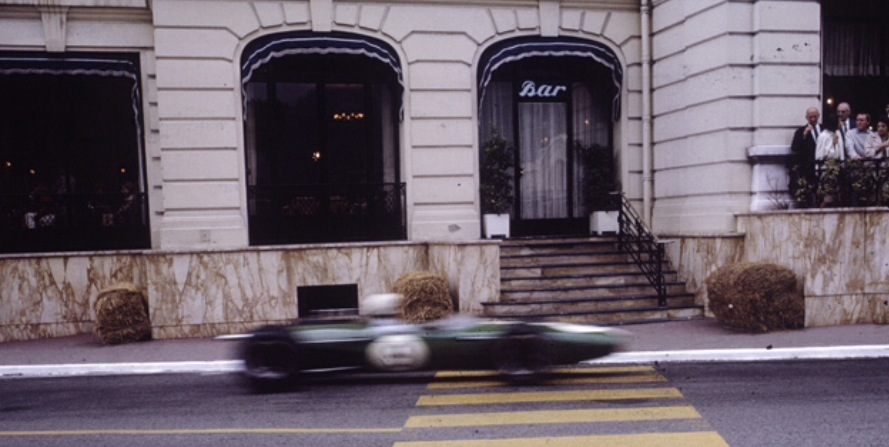
Quite a stunning 1960 Monaco vista…

I was trawling the internet, as I do, looking for photos which inspire the articles I write, one of the reasons why this blog is so nuttily diverse is to do with that approach.

I found this shot, unattributed as most of them are, but identified as ‘Monaco 1966’ which it most definitely is not!

Its one of those the more you look, the more you see shots; the steam train, four nurses sitting together, the working port, none of your fancy-schmancy big yachts of today and of course the car itself!

That’s the tricky bit. It’s not sharp in focus but I thought it might, just might be, Luigi Musso’s #34 Ferrari Dino 246 in the 1958 race.

richie

GP debutant Richie Ginther on his way to fifth place in the Ferrari Dino 246P 0008′, Monaco 1960 (unattributed)

After I posted this shot, reader Grant Perkins did some research and confirmed the photo as Richie Ginther at Monaco in 1960 in the Ferrari Dino 246P…

Stirling Moss won the race in Rob Walker’s Lotus 18 Climax – Colin Chapman’s first championship win as a manufacturer – from Bruce McLaren’s Cooper T53 Climax and Phil Hill’s Ferrari Dino 246.

The shot is historically significant. Ginther made his GP debut that weekend and his mount, the Ferrari 246P, the Scuderia’s first mid-engined racing car, competed for the first time.

Monaco that year is also significant for the long awaited, but far too late appearance of Lance Reventlow’s Scarabs. These superbly engineered, but heavy, unwieldy front-engined cars entered GP racing just as Ferrari, the last team by then racing a front-engined car experimented with its mid-engined replacement. A tangent too far for this article, but see here; Better Late than Never… | primotipo….

scarab

Monaco 1960. #46 Chuck Daigh and #48 Lance Reventlow Scarabs. #34 Ginther’s Ferrari 246P (Dave Friedman Collection)

Ferrari built the 246P in secret. It was tested at Modena by Hill, Ginther and factory tester Martino Severi on 22 May. The design was perceived by its drivers to have too much weight at the rear causing excessive nose lift under acceleration.

Despite Stirling Moss’ Cooper win in the 1958 Argentine GP Grand Prix, and Jack Brabham’s Cooper win in the 1959 World Championship – firsts mid-engined cars – Carlo Chiti had to fight hard to build a mid-engined Ferrari prototype.

The Scuderia’s conservatism was proven time and again over the years. They were not often innovators or early adopters. Examples include the change from drum to disc brakes, wire wheels to alloys, carburettors to fuel injection, ladder frame to spaceframe chassis, spaceframe chassis to monocoques and so on.

Fortunately 246-0008 showed enough promise to race at Monaco on 29 May. By the end of the year the chassis had morphed from a prototype 2.5-litre F1 car into a 1960 1.5-litre F2 156. It then morphed into an an F1 156 with the GP rule change from 2.5 to 1.5-litre engines with effect 1 January 1961.

0008 became Giancarlo Baghetti’s race chassis for 1961, part of the amazing start to his F1 career. The Italian famously won his first three GPs; Syracuse, Naples and finally the French GP. In so doing Giancarlo became the only man to ever win his first championship GP.

So, 0008 won the first of many GPs the 156 design took in 1961 on the way to dual world titles; the drivers for Phil Hill, and manufacturers for Ferrari in 1961.

There wasn’t a happy ending for the chassis though. Giancarlo spun out of the wet British GP at Aintree a week after his Reims win doing enough damage to 0008 that it was scrapped. Mind you, Ferrari famously destroyed all of the 156s at the end of 1962 when the cars were as uncompetitive as they had been fast the year before.

From mid-engined 2.5-litre F1 prototype at Monaco on May 6 1960 to 1.5-litre F1 winner at Syracusa on 25 April 1961, 0008’s story is a short but historically significant, interesting one.

ginther

Enzo Ferrari and the Ferrari 246P designer, Carlo Chiti, watch Martino Severi testing their first mid-engined car 246-0008 at Modena May 1960 (unattributed)

modena

Phil Hill testing the Ferrari 246P at Modena 1960, the suburb oh-so-close to the circuit! Compare the body of 0008 here with its Italian GP spec the same year (unattributed)

1960 Monaco Grand Prix…

Ginther qualified the new car ninth, between the front engined Dinos of Von Trips eighth, and Phil Hill 10th. In the race Hill was third, Richie sixth with Von Trips eighth but not running at the finish.

ginther monaco

29 year old Richie Ginther makes his GP debut at Monaco 1960. Ferrari 246P (Dave Friedman Collection)

monaco

Ginther’s new prototype mid-engined Ferrari Dino 246P-0008 #34 beside the conventional front-engined, third placed Dino 246 of Phil Hill at Monaco in 1960. The difference in size is not that great at this stage. Some sources say Ferrari acquired a Cooper to understand that car’s packaging and suspension geometry tricks (unattributed)

fazz zand

Ferrari 246P in the Zandvoort pitlane 1960 (unattributed)

The team then took the 246P to Zandvoort for the following Dutch GP, however, the engine, which had not been rebuilt was burning and blowing so much oil that it was unraced.

Ginther therefore ran a conventional front-engined Dino as did his teammates. They were comprehensively blown off by large numbers of Lotuses and Coopers. Ginther’s 12th was the quickest Ferrari qualifier, with Von Trips fifth, Ginther sixth, while Phil Hill retired with engine failure on lap 13.

The race was won by Jack Brabham’s Cooper T53 Climax on the way to his second title on the trot.

zandvoort

Cars being marshalled before the start of the Dutch GP on June 6, 1960. #3  Ginthers Ferrari Dino 246, #5 Alan Stacey, Lotus 18 Climax DNF, #12 Bruce McLaren Cooper T53 Climax DNF, #9 Tony Brooks’ Cooper T51 Climax DNF, #6 Jim Clark Lotus 18 Climax DNF (unattributed)

Ferrari Dino 246P technical specifications…

While 0008 car didn’t race at Zandvoort, photographer George Phillips took some rare shots of a Ferrari too little has been written about, the car practiced with the number 3T.

front

(George Phillips)

246P’s front suspension by upper and lower wishbones, coil spring/Koni dampers and roll bar. Dunlop disc brakes.

side

(George Phillips)

Chassis Tipo 543, of welded tubular steel was described as Cooper in style if not in the quality of the welding! Borrani wire wheels were 15-inches diameter, Dunlop tyres 5.25/6.5 inches wide front/rear. The wheelbase was 2300mm and track 1200mm front and rear. Fuel capacity 150-litres, while the car’s weight, wet was 452kg.

engine

(George Phillips)

Engine Tipo 171 was derived from the Tipo 134 65-degree, all alloy, DOHC, two valve V6. Bore/stroke 85 X 71mm, capacity 2,417cc. three Weber 42 DCN carburettors with twin plugs fired by Marelli magneto. Dry sumped, the unit developed a claimed 265bhp @ 8,300rpm.

rear sus

(George Phillips)

246-0008’s rear suspension comprised upper and lower wishbones, coil spring/Koni dampers and roll bar. The Tipo 543 transaxle had five speed and reverse and an LSD. Note also the clutch location at the back of the ‘box, you can just see the top of the inboard brake rotor beside the chassis member.

Development of the 246P and its evolution into the 156…

Ferrari decided to abandon further development of the 246P as a 2.5-litre GP car. They focused their attention on the front-engined Dinos for the balance of the season, and the future 1.5 Litre GP car for the new Formula 1.

The basis of the new 1.5-litre F1 engine was the Vittorio Jano designed 1.5-litre Dino V6 already used in Ferrari’s front engined F2 cars which first raced in 1957. Von Trips won the 1960 F2 season opening Syracuse GP in March aboard one of these cars ahead of two Coopers.

syracuse

Taffy von Trips Dino 156 winning the Syracuse GP, 19 March 1960. He won from the Cooper Climaxes of Trintignant and Gendebien (George Phillips)

Chiti progressively modified the engine, initially retaining the 65-degree angle but then changed it to 120 degrees.

The wide Vee angle has/had the benefit of a very low centre of gravity and rear bodywork which was as much a styling signature of the 1961 156 as its Sharknose. Definitive-spec 1961 156s raced with the 120 degree engine, but the 65 degree was also used; 0008 was always fitted with the 65-degree spec unit.

solitude

Taffy von Trips at Solitude in 0008 in 1960. The 246P/156 left front wheel is off the deck in a victorious run over the Porsches (unattributed)

The test bed for the new engine was the 246P 0008

After the car was fitted with a revised bodywork and 1.5-litre V6, it was tested at Modena and then entered at the Tenth Solitude F2 GP, Germany on 24 July. There, Taffy von Trips belted the Porsche 718/2s, a great F2 car, on their home ground, the aristocrat lead home Hans Hermann, Jo Bonnier, Graham Hill and Dan Gurney, all aboard factory Porsches.

Further testing and development of 0008 followed. With many of the British teams punting on the Intercontinental Formula for 1961, Ferrari were developing a formidable weapon for the new 1.5 F1, the implementation of which was confirmed, much to the Brits chagrin, as they wouldn’t have competititive engines until 1962.

At the Italian Grand Prix at Monza in September, Ferrari raced 0008 in what was getting close to the 156’s definitive 1961 specification.

0008 in 1.5 litre F2 form was raced by Taffy Von Trips to fifth place fitted with an auxiliary fuel tank among the 2.5-litre GP cars.

taffy front

At the Italian GP in September 1960 Ferrari ran Taffy von Trips in 246P/156 0008. Both this and the shot below show how much more svelte the car became compared its May Monaco spec. It was not as small as the best of the British cars mind you, but in 1961 the Brits were hamstrung by lack of suitable, competitive engines (Archie Smith)

Von Trips had the 1.5-litre F2 class to himself outrunning Hermann’s Porsche 718/2 by a full lap. Phil Hill won the race, it was the final GP victory for a front-engined car but it was somewhat of a hollow one.

The sneaky Italians decided race on the combined Monza road course and banking to maximise the chances of the old-tech Ferraris winning. Power was Ferrari’s only advantage over the four cylinder Coventry Climax FPF and BRM engined cars. The Brits then told the organisers to jam-it on safety grounds with most boycotting the event.

taffy rear

Von Trips 246P/156 0008 in the 1960 Monza paddock. Note how much different the rear bodywork is compared with its 246P Monaco spec (Archie Smith)

grid

Phil Hill’s winning Ferrari Dino 246/60 0007 #20 is pushed onto the 1960 Monza grid ahead of Von Trips’ Ferrari Dino 246P – or by then – 156 0008 (Archie Smith)

von trips

Von Trips ready for the off, Monza 1960, Ferrari Dino 156 (Archie Smith)

VI Gran Premio di Modena F2 1960…

0008’s final 1960 race was Ferrari’s home event at Modena on 2 October.

In the same way that Ferrari beat the Porsche’s at Solitude in July, so it was that Jo Bonnier’s Porsche beat Richie Ginther in the front-engined 156 from Taffy von Trips in the new 156 suffering from fading brakes.

Hans Hermann was fourth and Edgar Barth fifth, both also driving 718/2 Porsches.

bonnier

1960 Modena F2 GP. Jo Bonnier’s Porsche 718/2 leads #26 Ginther’s front engined Ferrari Dino 156 from Von Trips’ mid engined 246P/156 (unattributed)

trips

Von Trips Ferrari 246P/156 F2, #10 Edgar Barth Porsche 718/2, #28 Hans Hermann Porsche 718/2. Modena GP 1960 grid (unattributed)

trips 2

Taffy von Trips, Ferrari Dino 246P/156 0008 F2, Modena GP 1960 (unattributed)

carlo

The brilliant, portly Tuscan engineer and 246P/156 designer, Carlo Chiti explains to Von Trips how to get the best from his car. Italian GP, Monza 1960 (Archie Smith)

1961 Beckons…

All of this development work on the new-fangled mid-engined concept was very successful, the 156 was the dominant GP car of 1961.

It took the Constructors Championship for Ferrari and Drivers title for Phil Hill. Let’s not forget the role 246P/156 0008 and Chiti’s development skills and prodigious work output made in that remarkable transition from the back to the front of the grid in less than 12 months.

ferrari 156 cutaway

Cutaway drawing of the Ferrari 156 F2 car 0008 in 1960 trim. Spaceframe chassis, double wishbone and coil spring/damper suspension front and rear. Tipo 188 1.5-litre 65 degree, DOHC, two valve, dual triple -choked Weber carbed V6 giving circa 180bhp in 1960 spec. Five speed gearbox, Dunlop disc brakes (James Allington)

Etcetera…

front 2

(Archie Smith)

More detail, Von Trips Dino 246P/156 Monza 1960.

butt shot

(Archie Smith)

Ferrari Dino 246P/156 butt shot at Monza, Italian GP 1960. The fairing of the chassis by Fantuzzi’s gorgeous bodywork provided both visual splendour and aero advantage.

monza

(Archie Smith)

Willy Mairesse’ 2.5-litre GP Ferrari Dino 246 tows Von Trips’ 1.5-litre F2 156 to a good time in the little car, Monza banking, Italian GP 1960.

ferrari

(Archie Smith)

The boss at Monza sussing his new car and the opposition. Enzo Ferrari 1960. The car is Barth’s factory Porsche 718/2 F2.

Etcetera, first 246 test…

Here are a series of photos from Getty Archives of the first test day at Modena in May 1960.

Mr Ferrari is present as is Carlo Chiti, the driver in all of these shots is factory test driver Martino Severi. The car is unpainted, perhaps Ginther was not present on day one.

enzo 1

Ferrari, Severi, Chiti (Getty)

enzo 2

(Getty)

The 246SP lines are clear in this shot, in short front-engined styling on a mid-engined car! Ferrari with his back to the camera looks on with a tad more paternal interest than usual.

enzo 3

(Getty)

enzo 4

(Getty)

Fantuzzi’s hand formed aluminium panels of the prototype clear as are Borrani knock-ons and Dunlop disc brakes.

enzo 5

The boss looks on and contemplates this big change in the design of his cars, the Scuderia got the hang of it quickly enough! (Getty)

The boss looks on and contemplates the new design of his cars, certainly as big a change in direction as the famous marque ever made. They got the hang of it quickly enough too!

Check out this brief article i wrote about the Ferrari 156 a while back… https://primotipo.com/2014/12/21/ferrari-156-duet-ricardo-and-phil-spa-1962/

Also see this article on Giancarlo Baghetti which covers the 1961 record of both him and 156 0008 in 1961…https://primotipo.com/2015/05/08/giancarlo-baghetti-lotus-49-ford-italian-grand-prix-1967/

Some great Monaco 1960 Race Footage…

Photo Credits…

George Phillips, Dave Friedman Collection, Archie Smith, Getty Images

Bibliography…

F1 Technical, F2 Register, 8W.forix.com, James Allington cutaway drawing, barchetta.cc, ‘History of the GP Car 1965-85’ Doug Nye

Tailpiece…

train

(Dave Friedman Collection)

Let’s leave Monaco by train, just as we arrived…

Finito…

trulli

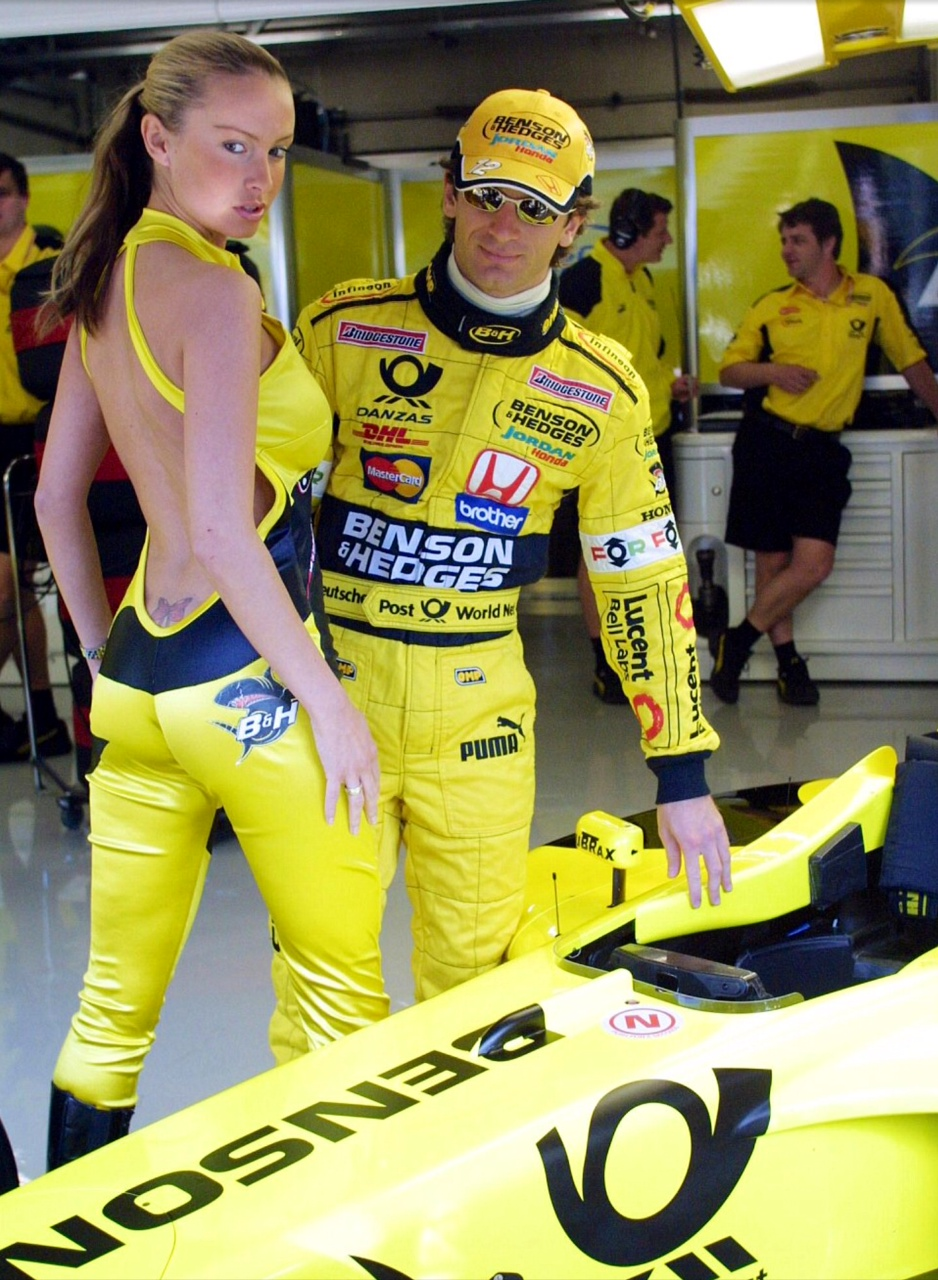
Jarno Trulli doing his best to focus on matters at hand during the Austrian Grand Prix weekend of 2001…

He qualified his Jordan EJ11 Honda very well in 5th, but a lapse of judgement on Sunday, he passed a red light whilst leaving the pitlane resulted in his disqualification, seems understandable in all the circumstances.

I struggle a bit with ‘the age of adornment’ one of my sons has a ‘sleeve’ which is suboptimal as a parent but i must confess to finding little to complain about in the discretely placed butterfly in this particular case!

Eddie Jordan really added a lot of ‘fizz’ to F1 in so many ways did he not!?

andretti

Michael Andretti’s McLaren MP4/8 Ford Silverstone lines being scrutinised from above…

Michael was in and out of Grand Prix racing far too quickly, in less than a season. His 1993 run of woe was made worse at Silverstone, he qualified back in the pack, rain ruined his qualifying run and then spun on the first lap, ending his race, he was going too hard too early.

Teammate Ayron Senna qualified 4th and lost 3rd when his car failed on the last lap, he was classified 4th. The race win was taken by Alain Prost in a Williams FW15C Renault.

Click on this link to the article i wrote about Andretti’s 1993 season; https://primotipo.com/2015/02/06/michael-andretti-and-f1/

Credit…reddit.com

bob 1

Bob Anderson blats his Brabham BT11 past the watching crowd, its little 1.5 litre Coventry Climax V8 echoing off the Monaco buildings on his way to a very good 9th place in his self-run car…

Anderson was born in Hendon, North London to a well-to-do family on 19 May 1931.

bob anderson portrait

Bob Anderson circa 1966. (MotorSport)

He made his name in the 1950s as a motorcycle racer, by 1959 he was a front running competitor in the 350cc World Championship against the stars of the day including John Surtees, Mike Hailwood and Geoff Duke. He nearly won the 1958 Swedish GP, finishing inches behind Duke but he never came so close to GP victory again.

ando bike mallory

Bob Anderson aboard his Manx Norton, Mallory Park, April 1957. May be 350/500cc (Bruce Anderson)

He switched to car racing aged 30 in 1961. Anderson raced a Jim Russell Lola Mk2 Ford in some early season UK Formula Junior races before doing some events in Europe in a Lotus 20 Ford entered by Henry Taylor. His results weren’t sensational but he moved to Lotus’ factory FJ team in 1962.

ando lotus nurburg

In the Team Lotus FJ Lotus 22 Ford during practice for the Eifelrennen, Nurburgring 28 April 1962. DNS in the race won by later Team Lotus Team Manager, Peter Warr Lotus 20 Ford (Bruce Anderson)

His best result that year was a second place in the 1962 Coupe de Salon at Monthlery behind teammate Peter Arundell, both in Lotus 22 Fords. He was also third in the 1962 Monaco FJ event also Lotus 22 Ford mounted, the race again won by Arundell. It was a first class result, on the grid that year were Mike Spence, Jo Schlesser, Alan Rees, Richard Attwood, Frank Gardner and John Love amongst dozens of other hopefuls!

Arundell pretty much won everything in FJ that year, rocketing into a Team Lotus, ’25’ GP car in 1963.

dutch gp 1966

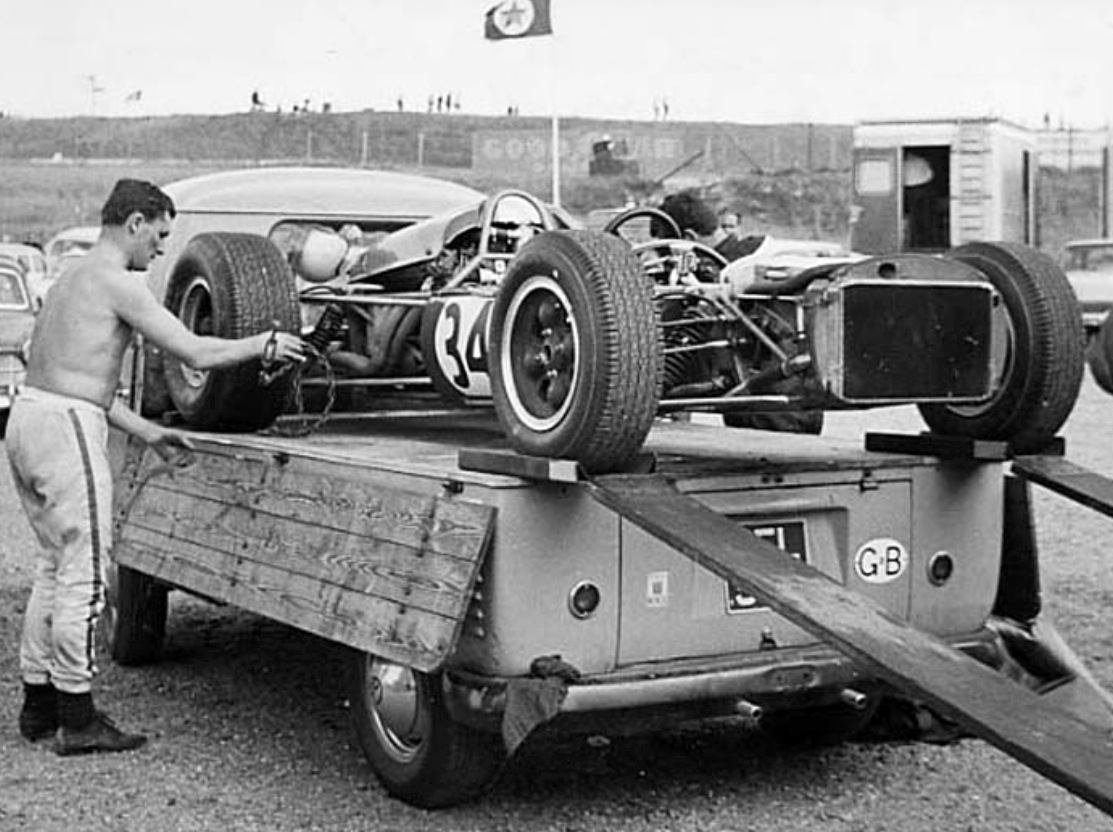
‘DW Racing Enterprises’ was very DIY! Here Bob Anderson loads his Brabham BT11 Climax onto his Kombi for the long drive back to the UK. Dutch GP Zandvoort 1966. He qualified well given his equipment but DNF with suspension dramas. (unattributed)

Anderson felt it was time to progess, at the start of 1963 Bob he acquired an ex-Bowmaker Team F1 Lola Mk4 Climax. He began racing as a Formula 1 privateer ‘DW Racing Enterprises’, based at Haynes, Bedfordshire comprised Bob and his French wife Marie-Edmee! Close friends David Stanbridge and Alan Brodie were important to his success and most critically George Copeland, his fulltime mechanic.

In those far away days a living could be made, sort of, with some trade support, from start and prize money as part of the European F1 Circus participating in a mix of Championship and Non-Championship (NC) Grands Prix.

Bob’s aims in his first year were to ‘cut his GP teeth’ by mainly competing in NC events taking in some Championship GP’s later in the season.

In 1963 there were 14 NC meetings, 13 of them in UK/Europe. These events were well supported by factory teams so he had his chance to ‘strut his stuff’ in fields made up of folks like him as well as seasoned professionals.

ando lola

Anderson contesting the IX Kanonloppet at Karlskoga, 1 August 1963. The Lola was 8th on aggregate off grid 6. Jim Clark won in a Lotus 25 Climax (Bruce Anderson)

He did well in the Italian events in ’63; victory at the GP of Rome at Vallelunga, admittedly in not the strongest grid of the season, 3rd in the Imola GP, 4th at Syracuse and was 6th in the ‘II GP del Mediterraneo’ at Enna-Pergusa. He was also 8th at the Solitude GP in Stuttgart.

In addition the ex-factory Lola Mk4 ‘#BRGP43’ contested UK NC meetings at Snetterton and Oulton Park. He also travelled to France to race in the Pau GP on the northern edge of the Pyrenees and to Sweden to take the grid in in the ‘9th Kanonloppet’ at Karlskoga. His transporter did plenty of miles that year!

Checkout this short YouTube footage of the ’63 Rome GP Won by Anderson;

rome

Bob Anderson during his victorious Rome GP drive at Vallelunga in 1963. Lola Mk4 Climax. (British Pathe)

His Championship events were at home at Brands Hatch where he was 12th having qualified 16th of 23 and at Monza where he was again 12th having qualified 18th of 28 entries.

By any objective assessment it was a strong start to GP racing. The Lola was a good choice, maybe not the fastest ‘tool in the shed’ even in 1962, but John Surtees placed second twice in it in 1962.

For 1964 he was looking for a more competitive mount.

dutch

Anderson 6th in the Dutch GP at Zandvoort, 1964. Brabham BT11 Climax. (unattributed)

He switched to a Brabham BT11, again powered by the Coventry Climax FWMV 1.5 litre V8 for 1964, the years highlight third place behind Lorenzo Bandini and Richie Ginther at the Austrian Grand Prix at the Zeltweg airfield. Most of the fancied runners went out with mechanical trouble caused by the incredible bumps on the runways of the circuit, but it was a very strong performance all the same.

zeltweg 1964

Best championship result was his 3rd in the 1964 Austrian GP at the Zeltweg, ‘rough as guts’ airfield circuit. Brabham BT11 Climax.(unattributed)

Other strong 1964 races were 6th at the Dutch GP, 7th at both Monaco and British GP’s and 11th at Monza.

His best NC results were 3rd in the Rand GP in South Africa and 6th at Syracuse.

dutch hailwood

Bike racers dicing at Zandvoort 1964, Dutch GP. Anderson Brabham BT11 Climax ahead of Mike Hailwood’s Lotus 25 BRM, 6th and DNF in the race won by Clark’s Lotus 25 Climax. (unattributed)

ando brabham vw

‘DW Racing’ in South Africa, 1964/early ’65. VW ‘Ute’ and Brabham, how many miles must that Kombi have done!? They would have been slow trips too, at Uni i had a mate with one, it really didn’t have enough power to ‘pull ‘ole Granny off a piss-pot’!, let along with 450Kg of F1 car aboard (Bruce Anderson)

1965 Monaco GP and the the Brabham BT11 Climax…

anderson, gardner siffert

Battle of the privateer Brabham BT11’s Monaco 1965. Anderson (#9) 9th, Gardner DNF in his (red) BRM engined car and Siffert 6th also BRM engined. (unattributed)

The Ron Tauranac designed and built Brabham spaceframe customer cars of all formulae were popular with customers in the 1960’s. Perhaps, statistically the most successful customer single seaters of that decade.

It was therefore an easy choice for Anderson to make when he needed a more competitive mount to buy one of the five BT11’s built. Three were sold to customers and 2 retained for use by the factory ‘Brabham Racing Organisation’ team. The BT11 was an evolution of the BT7 with which Dan Gurney won 2 GP’s in 1963.

So Bob had a very competitive tool for the final year’s of the 1.5 litre formula. The Lotus 25/33 was the dominant car of 1964/5, Jim Clark took his second world title in it in 1965, but the BT11 was a good, fast, reliable, robust, easy to maintain customer car.

Gurney used his BT7 during 1965 with three 3rds and two seconds to finish the title in third place. Jack changed from his BT7 to a BT11 in Germany, it was not his best season, third at Watkins Glen his best result, better was to come for him in 1966!

bt 11 rear

Anderson BT11, Monaco pits 1965. (Dave Friedman)

Magnificent shot of a typical 1.5 litre F1 car of the 1961/5 period. Andersons BT11 ‘F1-5-64’. In this case a spaceframe chassis, Lotus ‘pioneered’ the monocoque with its type 25 in 1962. Mid-engined of course, the Coventry Climax FWMV V8 the most successful engine of the period in terms of race wins. Hewland HD5 gearbox and all independent, infinitely ‘tunable’ suspension.

bt11 front

Anderson BT11 Monaco pits 1965. (Dave Friedman)

In this front end shot you can see the oil reservoir in front of the pedal box and Lucas fuel injection pump mounted vertically in front of the radiator. The spaceframe chassis tubes are clear, as is the pendant pedal box, aluminium fuel tank and front suspension comprising upper and lower wishbones. Small rotors and Girling brake calipers, they were light cars after all!

bt 11 engine

Anderson BT11 Monaco pits 1965. (Dave Friedman)

Heart of the matter is the ubiquitous Coventry Climax FWMV 1496cc 90 degree V8 engine. In Mk4 spec the 2 valve, DOHC, Lucas fuel injected, all alloy motor produced circa 200bhp@9750rpm. Trick 32 valve engines available to some of the factory teams in 1965 developed more but the engine was an excellent customer choice.

The gearbox was Mike Hewlands HD5, 5 speed transaxle. The cars rear suspension, typical of the period comprised a single upper link, inverted lower wishbone, coil spring/damper unit and two radius rods providing fore and aft location. Adjustable roll bars were fitted front and rear.

silverstone 1

BRDC Int Trophy, Silverstone, 15 May 1965. Brabham BT11 Climax, Anderson 14th and many laps down with mechanical maladies. (Getty Images)

In 1965 Anderson’s Championship results had too many DNF’s. Highlights were qualifying 12th for the South African GP, finishing and qualifying 9th at Monaco and finishing 9th in the French GP at Clermont Ferrand.

In ’65 NC events he was 6th at Syracuse with again too many DNF’s; at Silverstone, Goodwood and Brands Hatch.

monaco 66

Denny Hulme Brabham BT22 Climax from Anderson’s Brabham BT11 Climax, Bruce McLaren’s white McLaren M2B Ford beside Jochen Rindt’s Cooper T81 Maserati, all DNF in the race won by Jackie Stewart’s BRM P261. (unattributed)

For 1966 Grand Prix racing had a new formula based around engines of no greater than 3 litres capacity, this presented a big problem for most entrants as Coventry Climax, suppliers of engines to the British teams since the late 1950’s withdrew from F1.

My detailed account of the 1966 season and related engine issues can be read by clicking on this link, rather than repeating it all again here;

Winning the 1966 World F1 Championships: Brabham BT19 Repco…

Anderson’s solution was to use the old Coventry Climax 4 cylinder FPF engine, dominant in the last years of the 2.5 GP formula in 1959 and 1960. This engine had ongoing use and development in Australasia where it was essentially the engine of choice in the Tasman Championship, an annual series of 8 races, 4 each in New Zealand and Australia in January and February.

Bob was in good company, Dan Gurney also used the 2.7 litre ‘Indy’ Climax FPF in his new for ’66, Eagle T1G until his Weslake built V12 engine was raceworthy, that engines first GP at Monza in September. In fact Anderson outqualified Dan at Reims in the ‘battle of the FPF’s, Gurney in front elsewhere the drivers met.

The conversion of his BT11 from Coventry Climax V8 to 4 cylinder FPF specification was relatively easy as Ron Tauranac built a variant of the BT11, you guessed it, the BT11A for Tasman use, selling 5 such cars in the Antipodes, competitive tools until late in the decade.

Given all of the foregoing, remember his car was already 2 years old at the start of the season, his results in this year of transition were impressive. He qualified 8th at Monaco for DNF, 10th at Brands for the British GP DNF, finished 6th at Monza having qualified 15th and qualified 14th on the Nurburgring, half way down the big grid in his little old car, again DNF.

anderson feedback

Bob Anderson getting stuck into the Yamaha RD05 during Dutch GP practice, Assen 1966. (classicyams.com)

Bob never fully left motor-cycle racing, he contested the Dutch 250 GP at Assen in June 1966, an interesting interlude in mid-season!

He was hired as a ‘safe pair of hands ‘ to provide feedback as an experienced rider to Yamaha who were developing their new 4 cylinder engined bike, the Yamaha RD05.

Anderson’s assistance was around the bikes handling, he rode to 5th, only Hailwood, Phil Read, Jim Redman and Derek Wood were head of him. Not bad for a current F1 driver and someone who had been away from bikes for a bit!

photo (18)

Bob Anderson aboard his Yamaha RD05 at Assen 1966. (classicyams.com)

read, anderson, ivy

Yamaha factory riders at Assen 1966. L>R Phil Read, Bob Anderson and Phil Ivy, lost in thought. (classicyams.com)

I wonder if he is the only driver/rider to race in F1 and motor-cycle GP’s in the same year? Not sure if John Surtees raced his MV and for Lotus in the same season?

dutch grand prix

Dutch GP, 24 July 1966. Anderson’s 2.7 litre Coventry Climax FPF engined Brabham BT11 with old FJ Lotus Teammate Peter Arundell on his outside in the factory Lotus 33 BRM 2 litre. Anderson qualified 14th, 1 slot ahead of Arundell, both struggling with engines well short of 3 litres. Both DNF in the race won by Jack Brabham’s Brabham BT19 Repco.

Anderson contested the French GP at Reims straight after Assen qualifing his old car 12th and finishing a fine 7th in the first race won by Jack Brabhams 3 litre Repco Brabham V8, on his way to the title that year.

In 1966 non-championship events he was 7th in the International Trophy at Silverstone and won the Rhodesian GP at Kumalo on December4.

Looked at objectively, his results deserved a factory drive, if not in F1 then certainly in sportscars. Perhaps one of you can explain why he seems to have been overlooked?

dutch gp 1967

Oopsie in the Dutch Dunes. Anderson spinning his BT11 during the ’67 Zandvoort event. He was 9th, Clark the winner on the Lotus 49 Ford debut. (Brian Watson)

He started 1967 well having left his Brabham in South Africa that summer. He was 2nd in the Cape South Easter GP on 1 January, John Love took the win in the Cooper T79 Climax he acquired from Bruce McLaren, that car having won the Australian GP at Longford in early 1965.

Even better was 5th place in the South African GP, that year a championship round. In April he was 8th at Silverstone’s International Trophy.

ginther and anderson

Richie Ginther appears to be yelling at himself to go faster. Here in his Eagle T1G Weslake ahead of Anderson’s Brabham at Monaco 1967. Both DNQ. (unattributed)

At Monaco he didn’t qualify which is not so much an indication of his speed but rather his aging car and the relative number of full 3 litre F1 cars now competing.

monaco 67

Bob giving his all to qualify at Monaco 1967, the old car not up to it. Brabham BT11Climax FPF. (unattributed)

In Holland he was 9th, 8th at Spa. He retired at Le Mans with ignition failure, the race held at the legendary track, or a shortened version thereof in ’67.

anderson and clark

Jim Clark Lotus 49 Ford, Bob Anderson Brabham Bt11 Climax, British GP, Silverstone 1967. (Bernard Cahier)

The shot above shows Bob Anderson’s old Brabham BT11 Climax beside F1’s state of the art; the new at Zandvoort, Lotus 49 powered by the 3 litre Ford Cosworth V8, Bobs Climax FPF was giving away around 150bhp to the 400bhp Cossie.

Sadly, Silverstone was the Brits last race, he qualified 17th and retired on lap 67 with engine failure, Clark won the GP in a dominant performance.

anderson, british

Anderson, Copse Corner, Silverstone, British GP 1967. BT11 Climax (Mike Hayward Collection)

Anderson missed the following German GP but was testing in the Brabham in the wet at Silverstone on 14 August prior to the Canadian Grand Prix. The car slid off the circuit and collided with a marshal’s post. He suffered serious chest and neck injuries and died later in Northampton General Hospital.

It was a sad end to a fine rider and driver with strong engineering/mechanical skills, somebody i was aware of but did not know much about. A driver who deserved a ride in a factory car methinks!?

Etcetera…

silverstone 2

Anderson ahead of Lorenzo Bandini’s Ferrari 1512, Silverstone, BRDC Int Trophy 1965. DNF and 7th. (unattributed)

ando rand gp

Contesting the 4 December 1965 Rand GP at Kyalami, DNF with oil pressure problems on lap 28, Jack Brabham won in another BT11 Climax (Michele Lupini)

monaco 2

Anderson fettling the Brabham, Monaco 1966. (unattributed)

monaco 1

Anderson, Monaco 1966. (unattributed)

monaco 3

Monaco ’66 again. Brabham BT11 Climax FPF. (unattributed)

Credits…

Dave Friedman, Bernard Cahier, Brian Watson, classicyams.com, Getty Images, Bruce Anderson, f2index, silhouet.com, Michele Lupini

Tailpiece: Bob and Dan Reims 1966…

bob and dan

Bob Anderson 7th left and Dan Gurney 5th attack the fast swoops of the Reims countryside on 3 July 1966. Brabham BT11 Climax and Eagle T1G Climax, Brabham won the French GP, the first driver to win a GP in a car of his own make/name. (The Cahier Archive)

Finito…
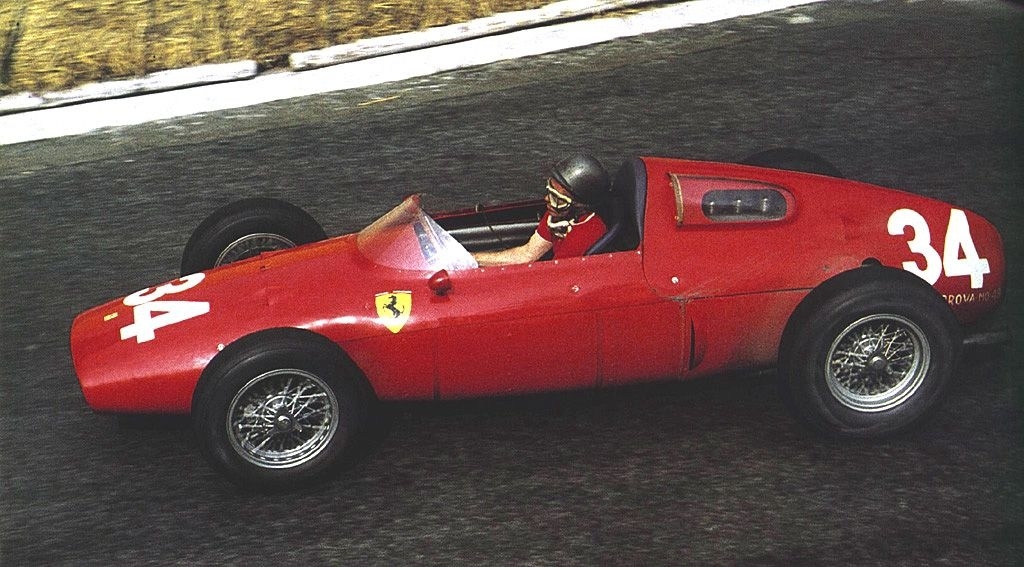
spa 2014

(unattributed)

The ‘Old Majestic circuits’ still afford talented photographers a great canvas on which to display their talent…

Spa is one of them. Sure the backgrounds aren’t as good; trees are more distant, stone walls, chateaux and so on lacking but then driver safety is paramount. The ‘snappers’ can’t get as close either, again this is a good thing as occasionally, i remember a poor bloke at Albert Park, photographers have been killed as well.

Daniel Ricciardo won this race, his third and last win in a year in which he comprehensively blew-off Sebastian Vettel. Daniel extracted the most from the complex new generation cars with their energy recovery systems incorporated in the 1.6 litre turbo-V6 mix. Petite Prix rather than Grand Prix cars?…

riccardo spa

Daniel Riccardo, Red Bull RB10, Spa 2014.

Photo Credit…Getty Images


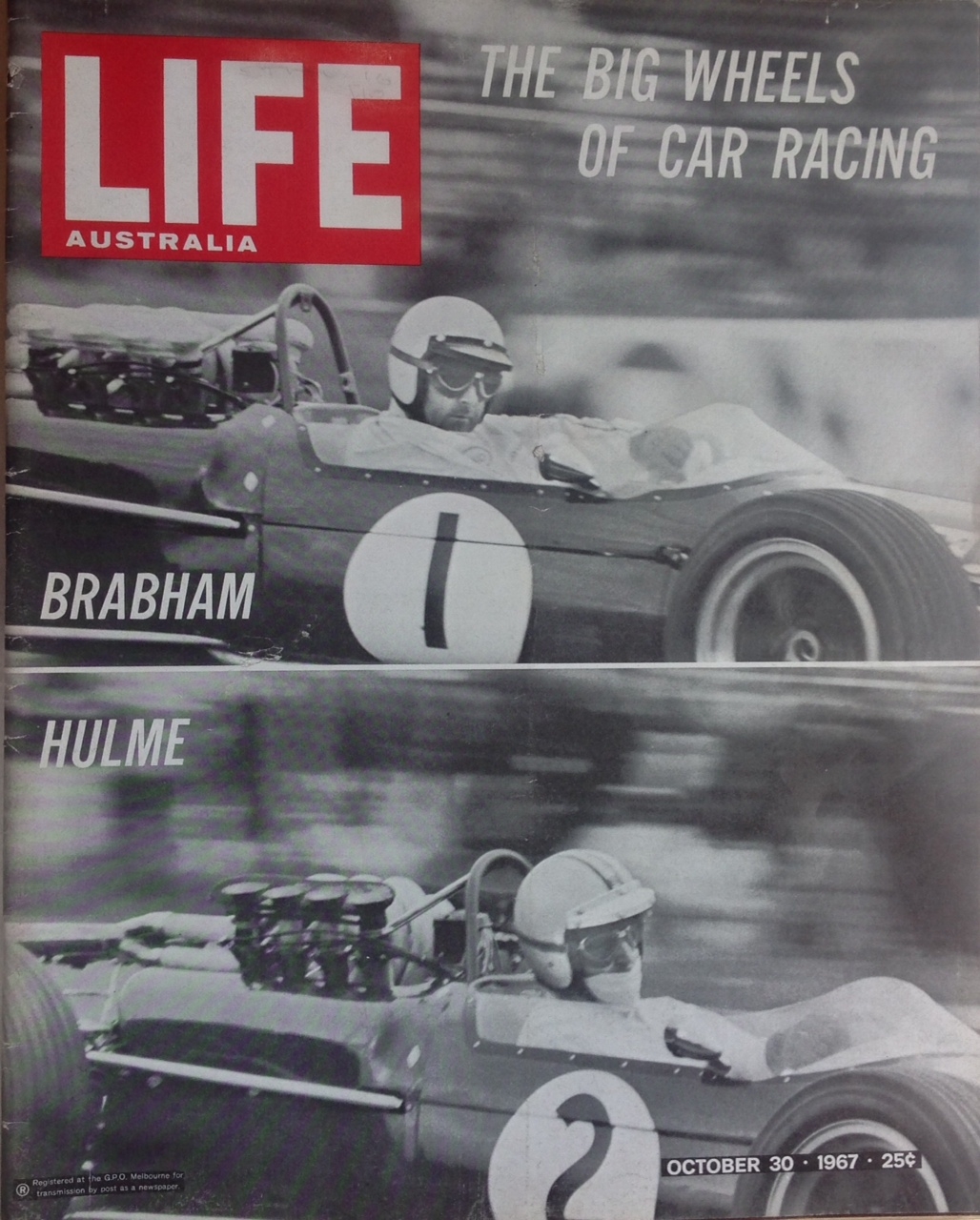
brabham life 2

This 1967 Life magazine was staring at me, waiting for me to pick it up in my favourite bric-a-brac store in Chapel Street, Windsor. I  was more than happy to give it a good home. It celebrates the Brabham F1 team achievements in 1967…

Articles on motor racing have never been mainstream in such global publications, of course the article has a lot of general rather than specific enthusiast interest stuff. But I thought the photos worth posting and a little of the contents.

jack evocative
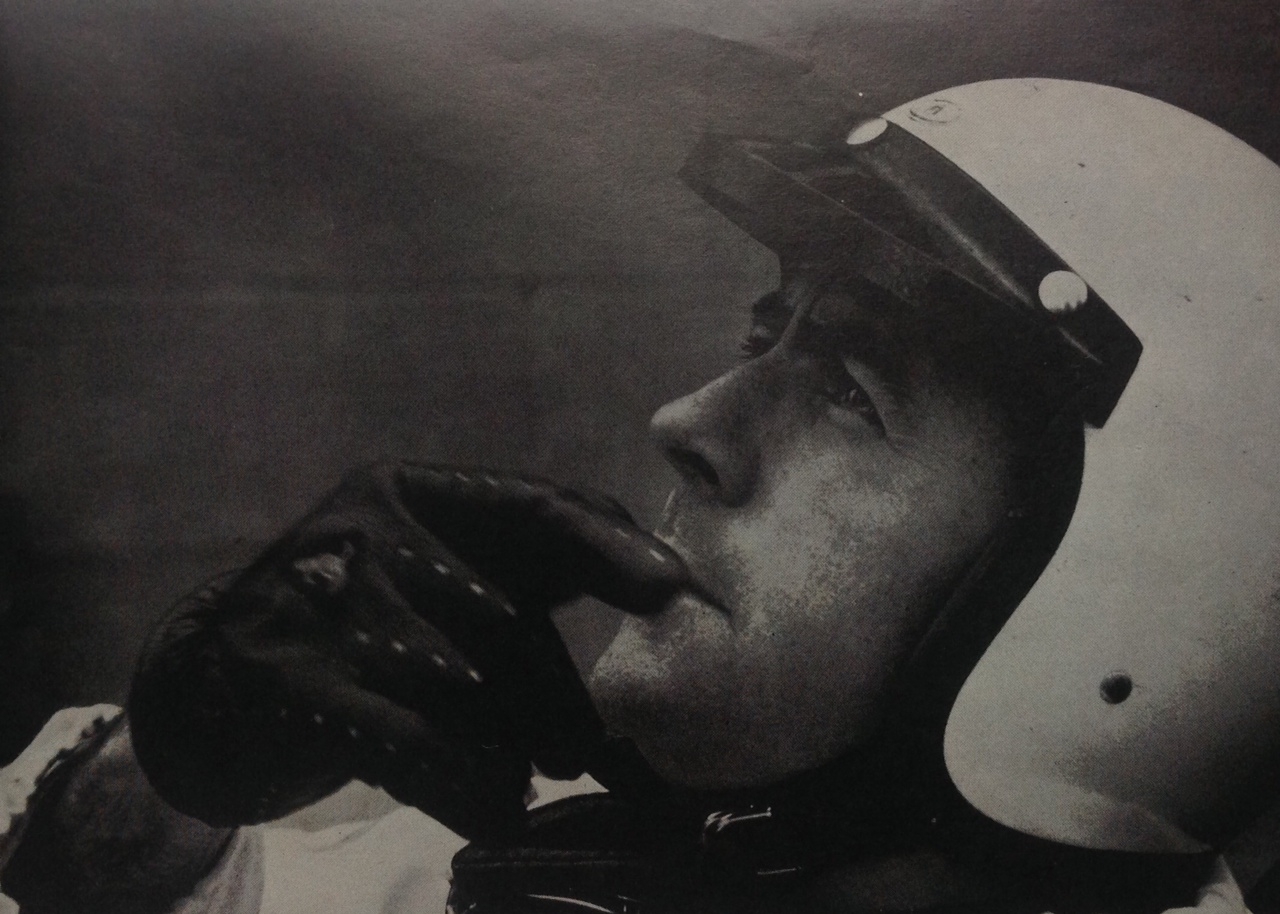
Jack Brabham pondering setup changes. US GP 1967 (Life)

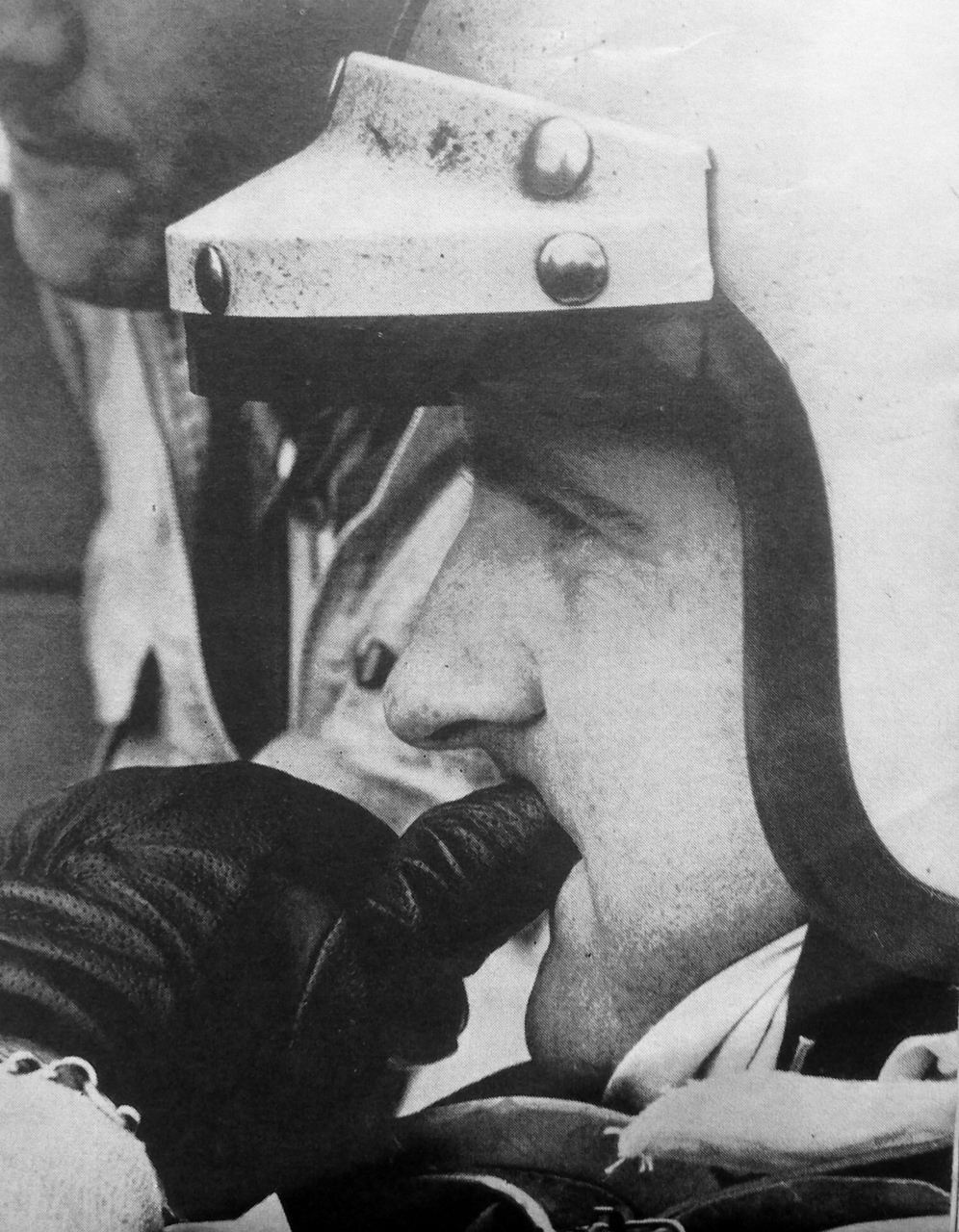
All of these photos were taken during the US Grand Prix weekend, held on 1 October at Watkins Glen.

By that stage of the season the new Lotus 49s had the consistency as well as the speed they demonstrated from debut at Zandvoort in May. Clark and Hill finished 1-2 at the Glen in the Ford Cosworth DFV engined cars.

Denny Hulme was fourth and Jack fifth. Denny won the 1967 Drivers title and Brabham the Constructors, for the second year on the trot.

Those spaceframe BT24s powered by 3-litre Repco ‘740 Series’ SOHC, between the Vee exhaust V8s were chuckable, fast, successful cars. They were still quick in Jochen Rindt’s hands early in 1968 against even more formidable opposition, despite having only 320bhp or so.

denny evocative
Denny Hulme, Watkins Glen 1967 (Life)
jack and betty
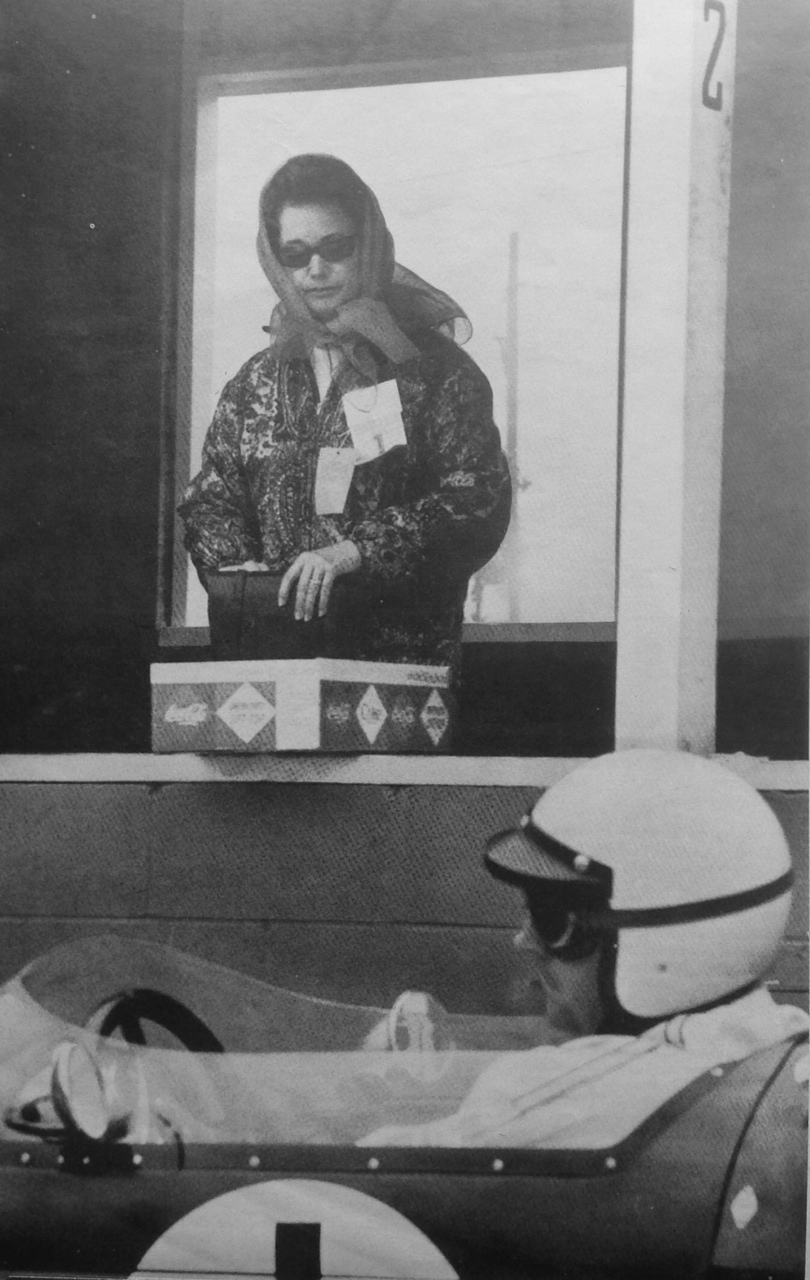
Betty Brabham and Jack. Car is BT24 Repco. Watkins Glen, US GP 1967 (Life)

‘Life’ credit ‘The pre-eminence of Australia and New Zealand in automobile racing to Brabham…

He is responsible not only for the Brabham Racing Organisation (the F1 team), but also for Motor Racing Developments Ltd, which constructs the Brabham designed cars (Ron Tauranac may have a view on that!): Jack Brabham conversions Ltd which produces go-faster kits and treatments; and Jack Brabham Motors Ltd, a garage and car dealership’.

Jack was a busy boy indeed! I think at that stage he was still ‘ghosting’ a magazine column or two as well in addition to managing the relationship with engine partner Repco.

mc laren
Bruce McLaren in his McLaren M5A BRM, US GP 1967. DNF with water hose failure. With Cosworth power from 1968 his GP cars found success (Life)

‘It isn’t only Jack Brabham and Denis Hulme who bring glory to their part of the world…

Contributing to the lustre are Bruce McLaren, 30, as well known as a manufacturer of racing cars as a driver, and Chris Amon, 25, who was in fourth place in the World Championship standings going into the final race (the Mexican GP)…McLaren has won three GP’s during his career. Amon…still seeks his first victory which could come at any time’.

amon
Chris Amon, Ferrari 312. Watkins Glen 1967. DNF in the race with engine failure (Life)
jack trailer
Jack Brabham; post race, happy mode in the Brabham pit. Looks like an apple in hand! Watkins Glen 1967 (Life)

Credit…

Life Magazine 30 October 1967

Finito…

webbo rear

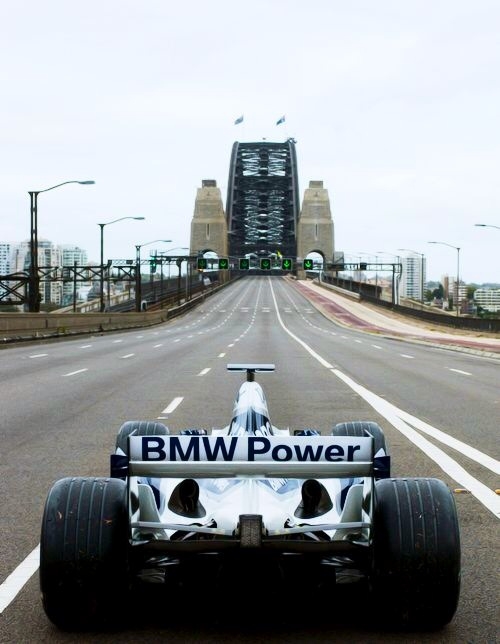
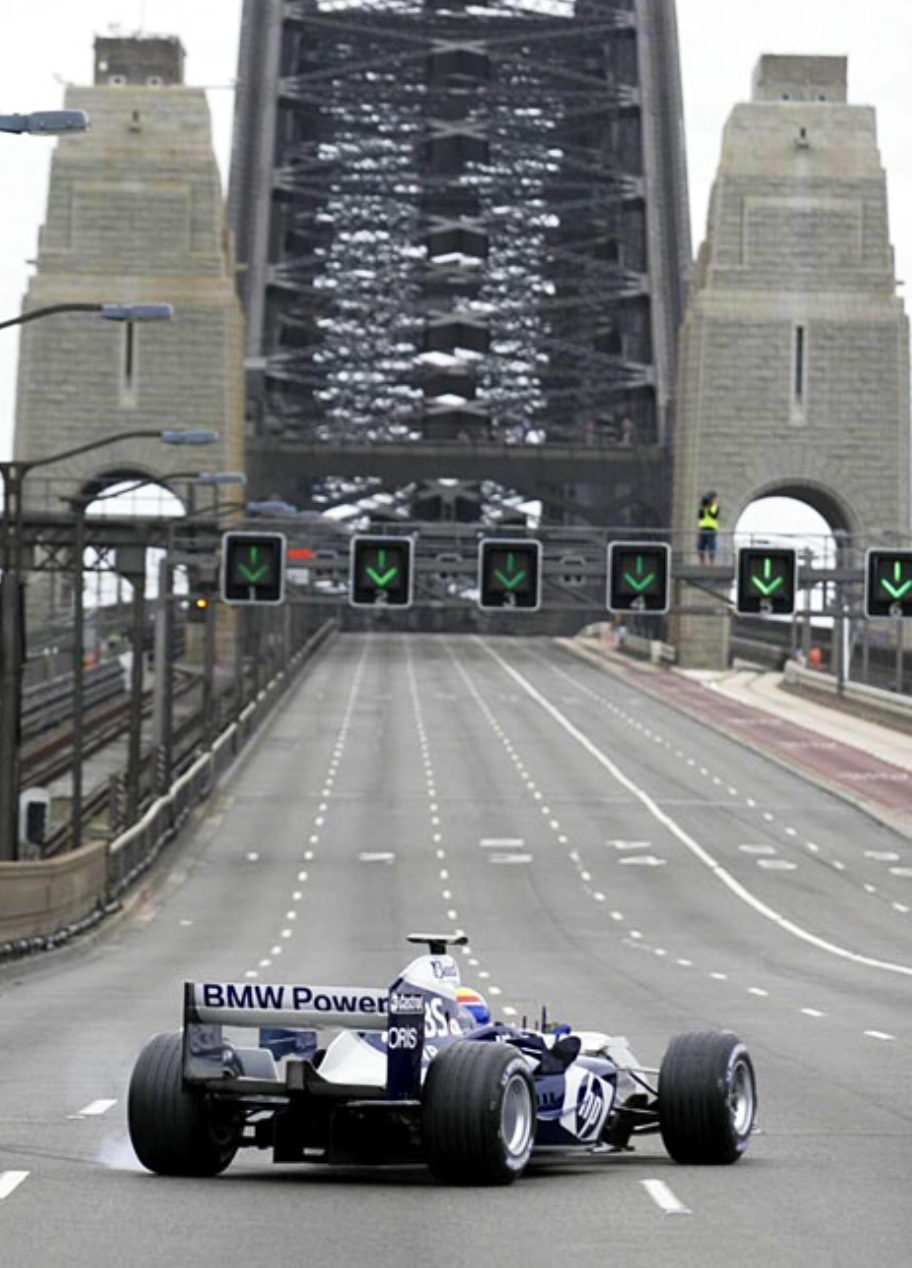
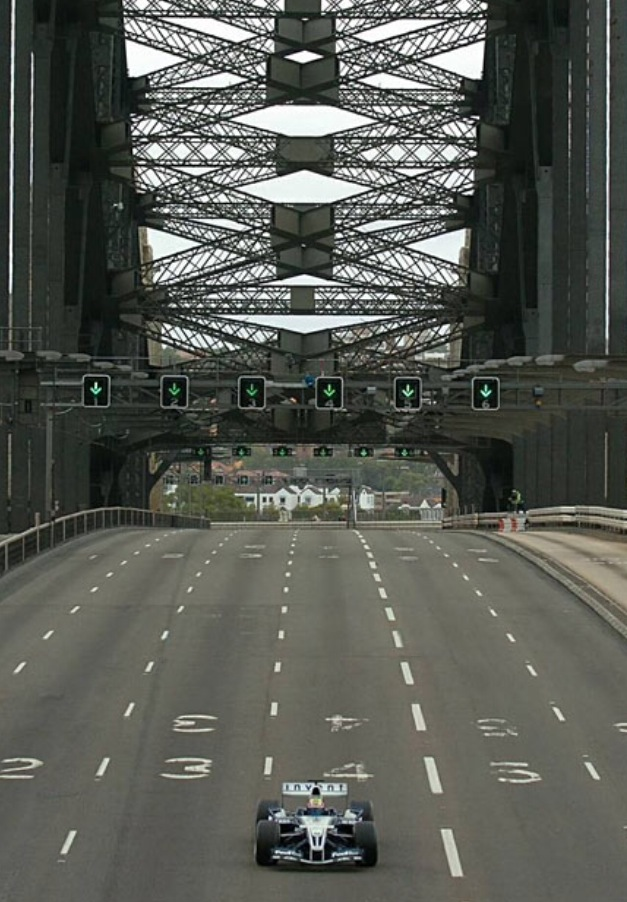
On 27 February 2005 Mark Webber did ’10 laps’ of Sydney Harbour Bridge in his Williams FW26B BMW F1 car…

Webber had just joined Williams from Jaguar and much was expected of his shift to a top team. The Harbour Bridge run promotion was part of the build up to that years AGP held at Albert Park on 6 March.

The Bridge, a critical part of Sydney’s traffic flow was closed for 5 hours for the sortie which itself took only 10 minutes, he was flagged away by New South Wales Premier, Bob Carr.

The 2004 spec, V10 engined car was based at the City end of the Bridge and went backwards and forwards between the CBD and Kirribilli, Mark flicking the car to make the ‘tight u turns’ required. The FW26, a race winning car in Juan Pablo-Montoya’s hands in 2004, was fitted with wets in deference to Sydney’s ‘moody weather’ on the day.

Webber’s two seasons with Williams were not especially successful ones although 2005, 10th in the Drivers Championship, 3rd place at Monaco his best was better than 2006 when he was 14th in the standings. The move to the nascent Red Bull team the following year was the critical move to get into an ultimately race-winning team/car. And some celebrated duels with ‘enfant-terrible’ teammate Sebastian Vettel!

Giancarlo Fisichella won the 2005 AGP, confirming the renaissance of Renault as a team, teammate Fernando Alonso won the first of his World Championships in 2005 in the 3 litre V10 Renault R25. Mark Webber qualified 3rd and finished 5th at Albert Park in a good start to the season.

YouTube Footage…


webbo

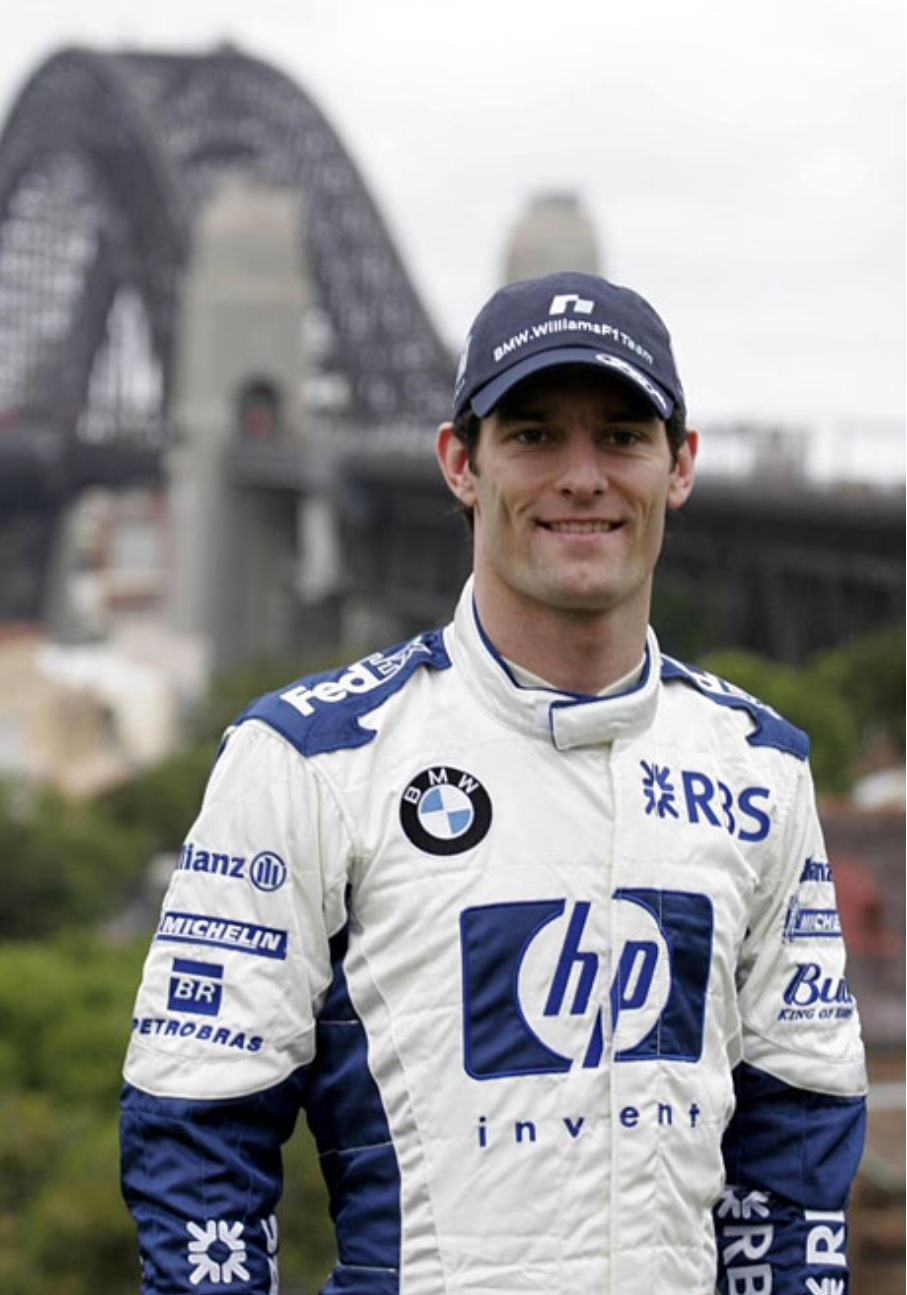
Happy chappy prior to the start of the 2005 season. I always thought Williams and Webber could have and should have achieved more, the problem was the team not MW, Williams having a fall-off in competitiveness at the time. A pity. Sydneysiders may know this spot, photo taken from the Rotunda at Observatory Hill Park looking North. Webbo would have had to elbow aside a couple of wedding groups which are booked solidly back to back for ‘happy snaps’ in the warmer months. Its my old neighbourhood, i lived there for 9 years,.The Rocks, Millers Point, Barangaroo, Observatory Hill and Sydney Observatory itself all worth a good look on foot.

webber 3

webbo front

Photo Credits…fullboost.com