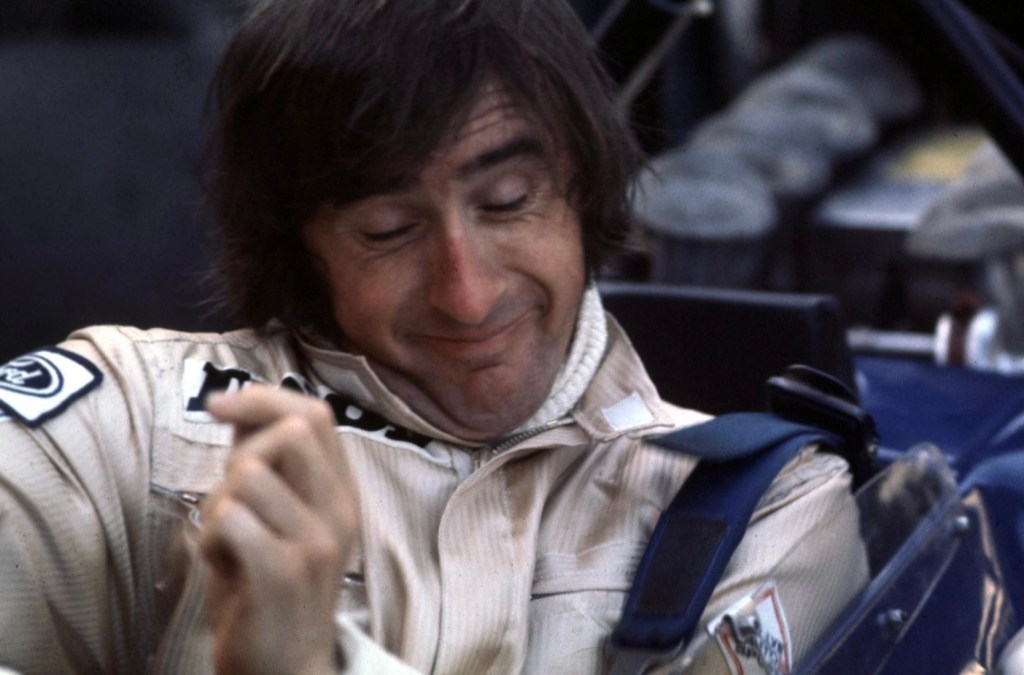
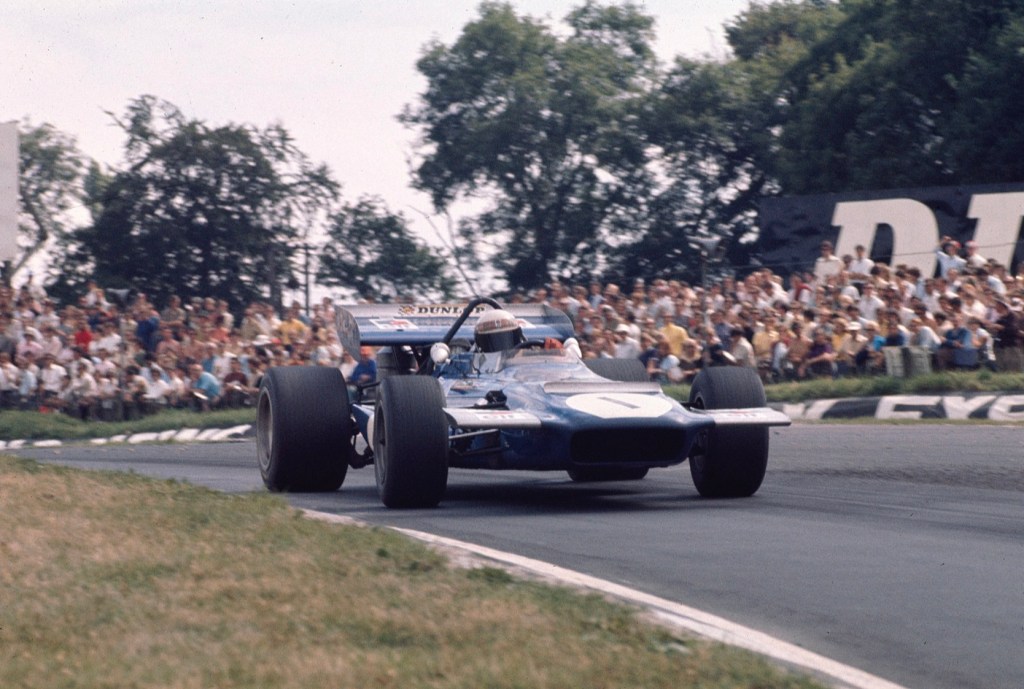
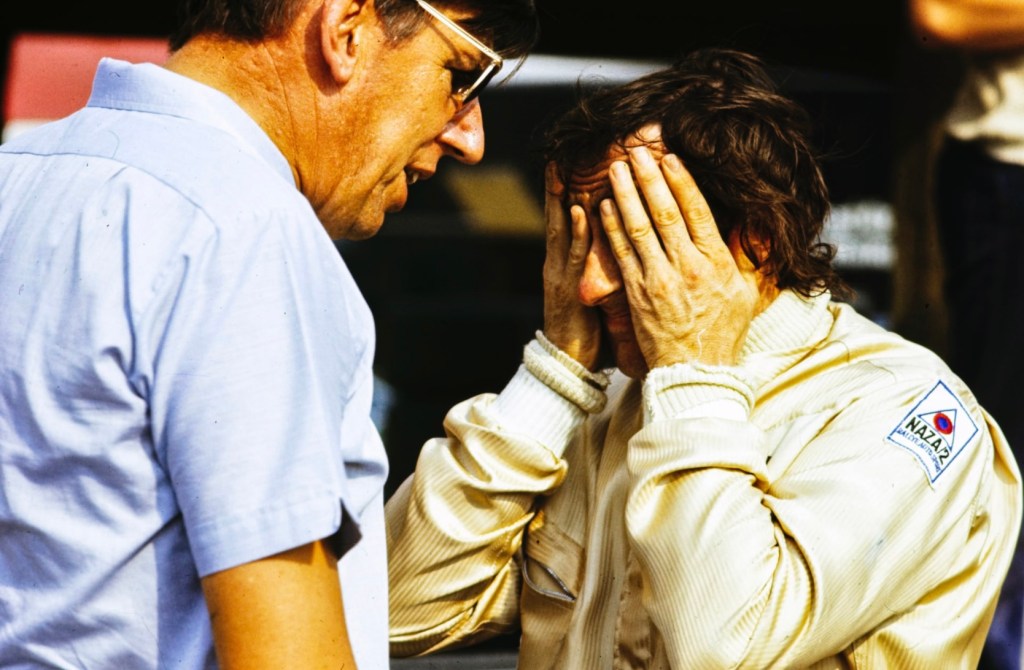
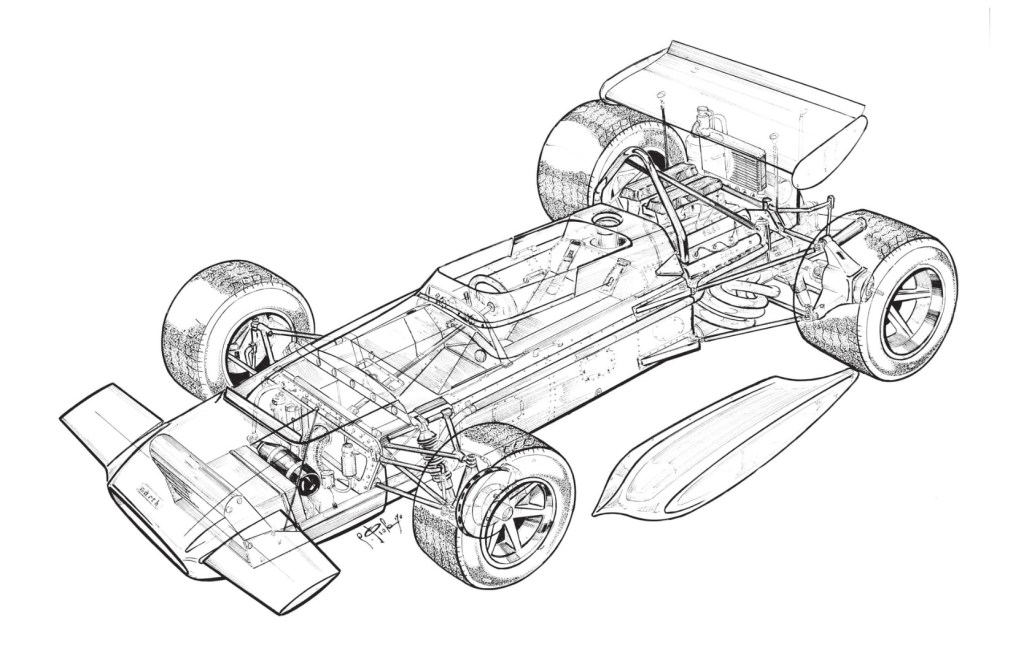
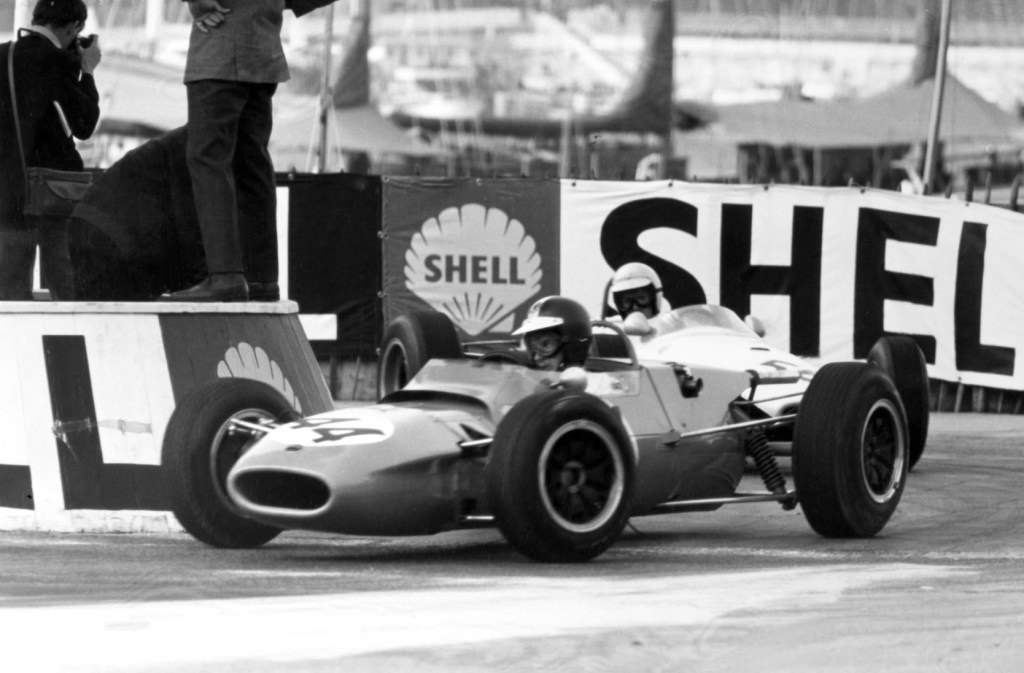
Jack Brabham being pestered by Frank Matich before the start of the Tasman Series Sandown Park Cup on February 16, 1969. Frank is after some tips on how to extract the best sponsorship deal from Repco Ltd management.
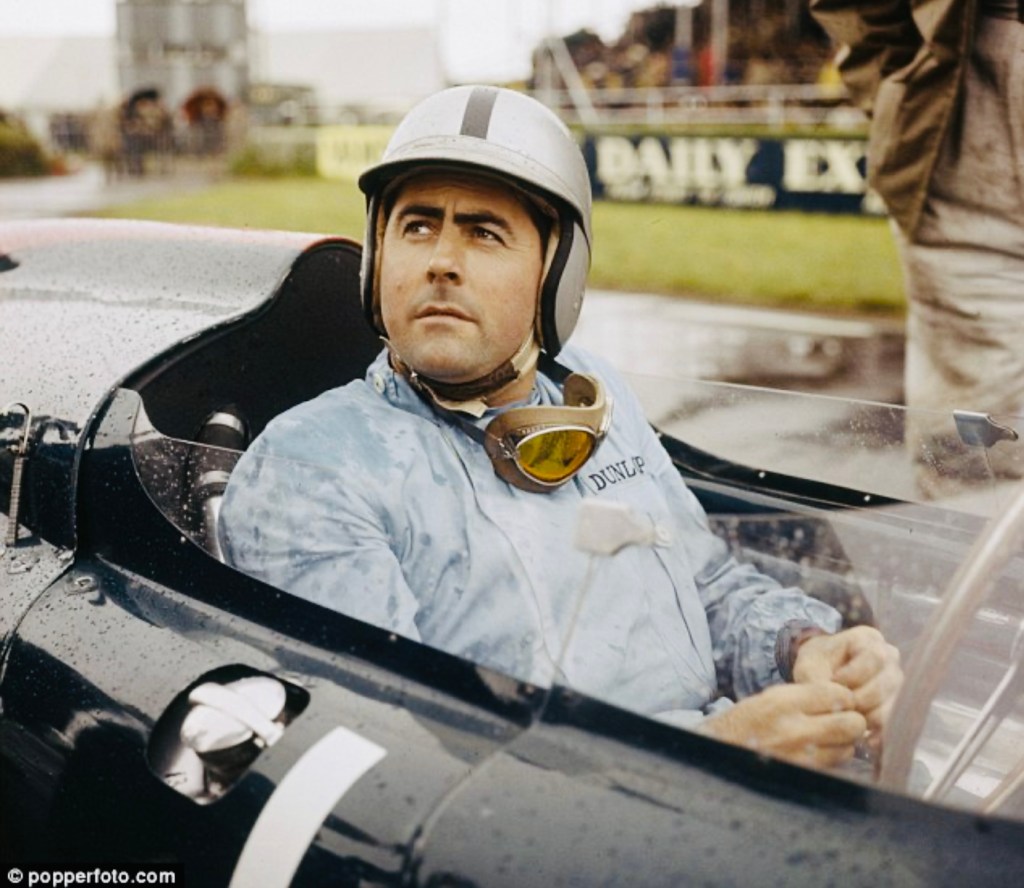
It’s intrigued me that Jack clearly forgot to bring his nice modern Bell Magnum helmet home with him when he jumped on his Qantas 707 at Heathrow for Sydney in December 1969.
When his Brabham BT31 Repco was finally offloaded at Port Melbourne and had its nice new RBE 830 V8 fitted at Repco Brabham Engines in Maidstone, he cast around for a skid-lid and – seemingly – this circa 1960 helmet and pair of goggles were the only ones available to head off to Calder to test the car two days before the Sandown race. See here for a BT31 epic: https://primotipo.com/2015/02/26/rodways-repco-recollections-brabham-bt31-repco-jacks-69-tasman-car-episode-4/
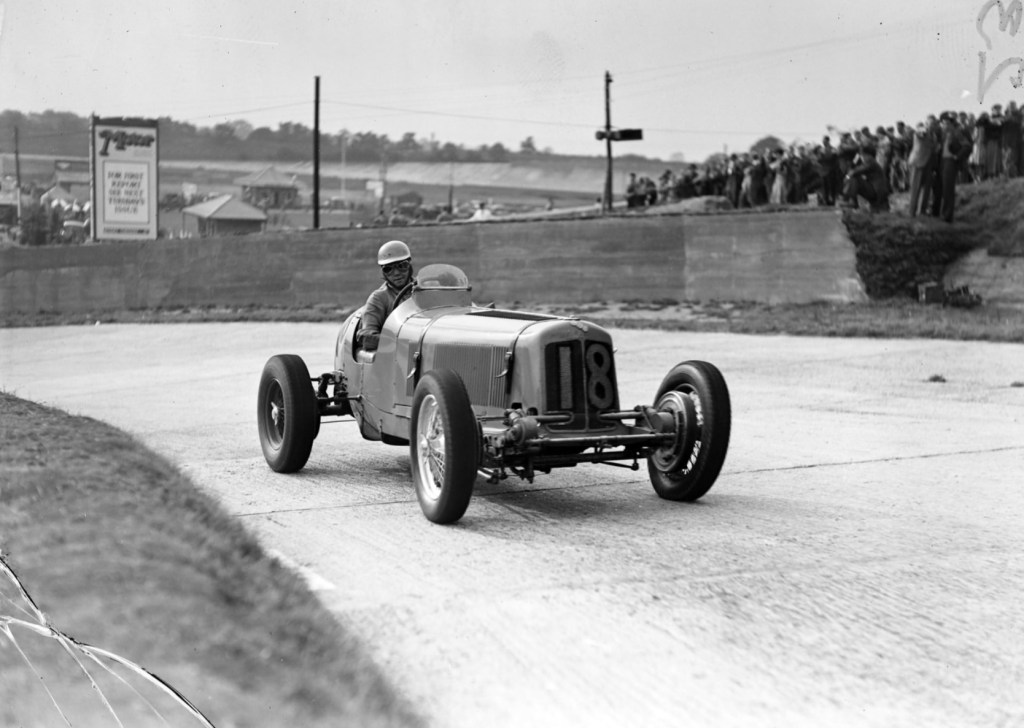
The lovely shot above seems to be the helmet in question sitting atop Jack’s noggin on the grid of the BRDC International Trophy at Silverstone nine years before, May 14, 1960: second in his works-Cooper T53 Climax behind Innes Ireland’s Lotus 18 Climax.
(unattributed)
Our very own Jack during the ‘69 Sandown Cup. He is on the run out of Peters above, and on the way into Dandy Road below, wearing the same 1960 helmet or one very much like it.
Small things as I say…mind you, I don’t like ‘yer chances of racing with a nine year old helmet in today’s homogenised, pasteurised over regulated times.
Brabham finished third in the race, proving brand-new BT31 was quick right out of the box, which was won – so too the Tasman Series – by Chris Amon’s Ferrari 246T. Jochen Rindt was second in his Lotus 49B Ford DFW.
(R MacKenzie)
Jack returned that Easter to fulfil his final Australian Repco commitments, winning the Gold Star round at Bathurst in BT31. This time (below) Jack remembered to pack the Bell Magnum but not his modern goggles…
I uploaded this butt-shot of a naked Mercedes Benz W 196 R Grand Prix car taken at the factory in 1954 to the primotipo Facebook page the other day, with interest levels as crazy as a frog-in-a-sock since…
The photograph shows the spaceframe chassis, two inboard brake drums and rear mounted 5-speed transaxle. The rear suspension comprises swing axles and tubular shocks with the spring medium longitudinally mounted torsion bars, which are not in view.
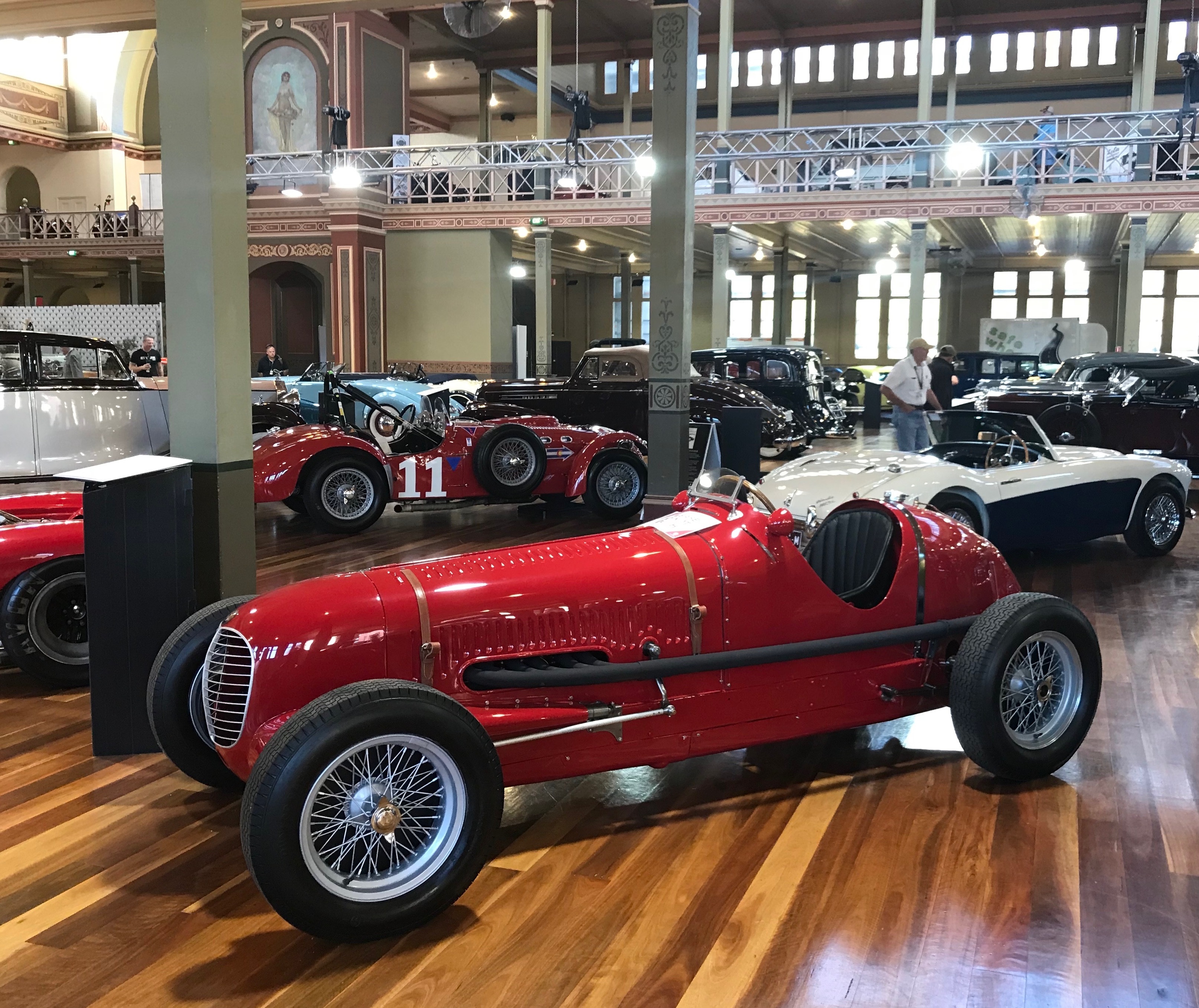
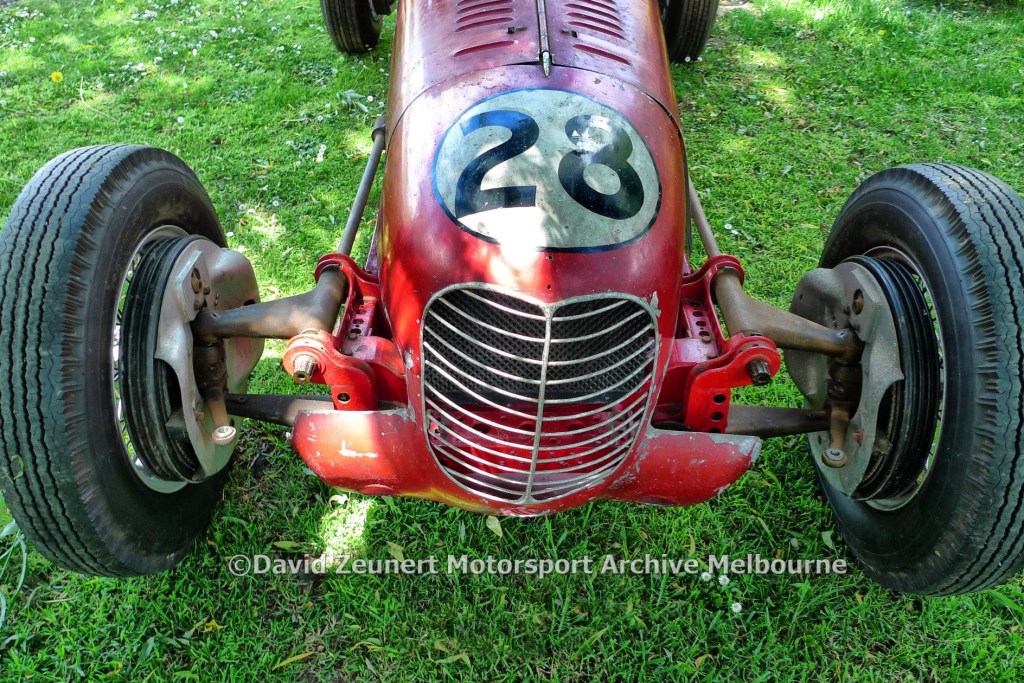
The ex-Johnnie Wakefield 1.5-litre, supercharged Maserati 6CM Voiturette, chassis #1546 is the lowest mileage Maserati racer on the planet, it’s been nowhere near a circuit since April 1938.
The Society of Automotive Historians in Britain caption for the beautiful drawing above reads, “Here is the front suspension of the Maserati 6CM produced in 1937 and 1938. Its torsion bar suspension gave much improved roadholding and cornering speed. The torsion bars were 24-inches long, the left-hand bar can be seen extending back from the pivot of the top wishbone. The friction shock-absorber is linked to the front end. The hydraulic drum brake is wide and well-ventilated.”
The confluence of ‘finding’ the drawing above, a period newspaper article about the ex-Wakefield Maserati in Australia, and several photographs of the same chassis, naked in Adelaide are the stimuli for this article.
John Peter Wakefield meeting folks? (D Zeunert Collection)
John Peter Wakefield was born into incredible wealth in Marylebone, London on April 5, 1915. In a tragic childhood, his mother died when he was four, and his father – who ran the family gunpowder business – when he was seven. Brought up by his family in Kendal, in the Lake District, he was a natural athlete who commenced racing bikes: Ariels and Velocettes in 1933.
Wakefield focused on learning to fly 1934-35. Having achieved his wings, he bought a second-hand Gypsy Puss, and shortly thereafter, a new British Aircraft Eagle Gypsy.
Into the deep end, he switched from motorcycles to cars and bought Alta 56S, a monoposto 1.5-litre supercharged machine – which Tony Gaze brought to Australia post-war and was ultimately restored by Graeme Lowe – that he raced regularly throughout 1935-37 with good results.
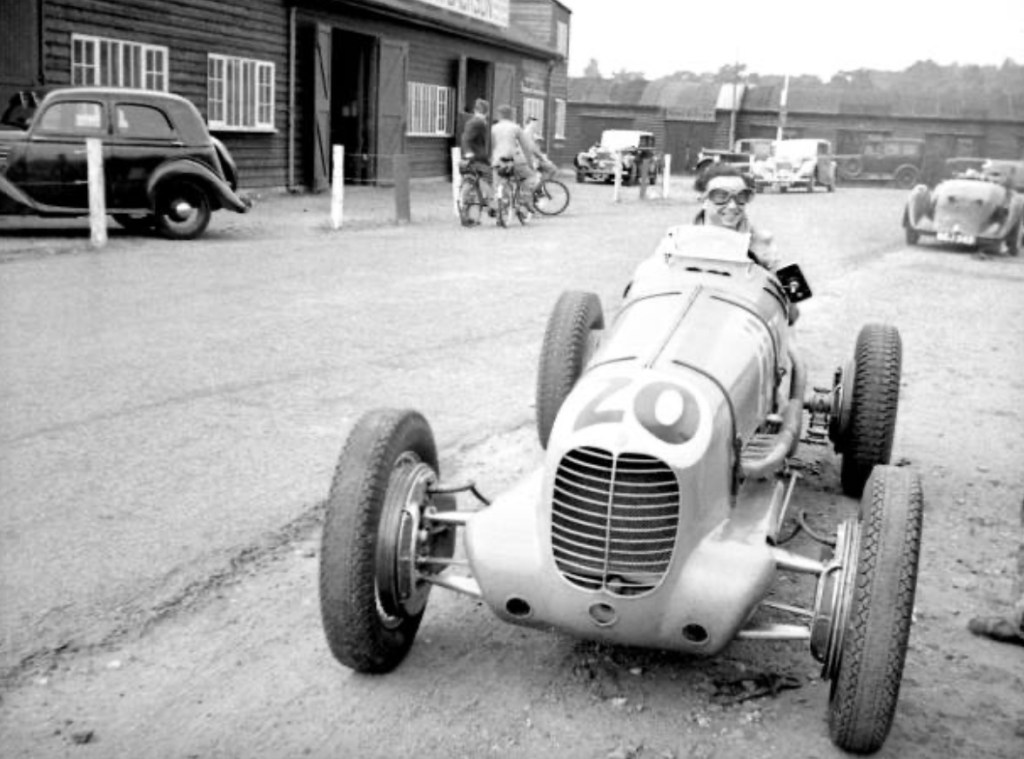
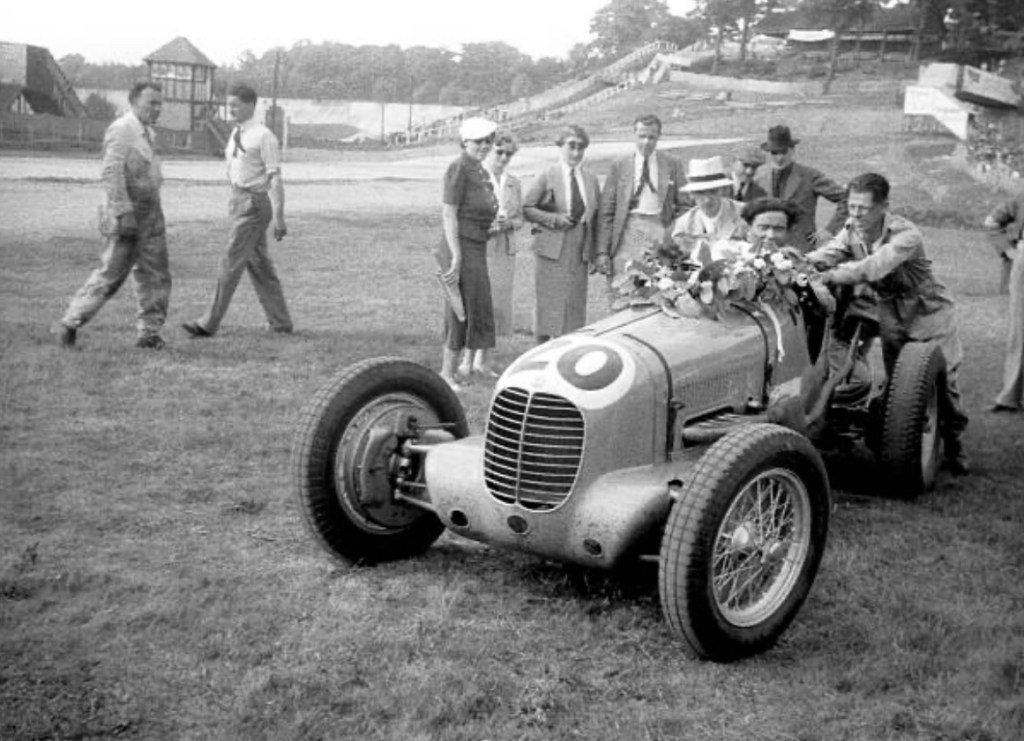
In 1937 he bought the Maserati 6CM in which he contested 18 meetings into 1938 with his best results two 2nds, four 3rds, two 4ths and a fifth place. Then in April 1938 he crashed it during the Cork GP, hospitalising himself with cuts, abrasions and broken ribs in what was his only serious racing accident.
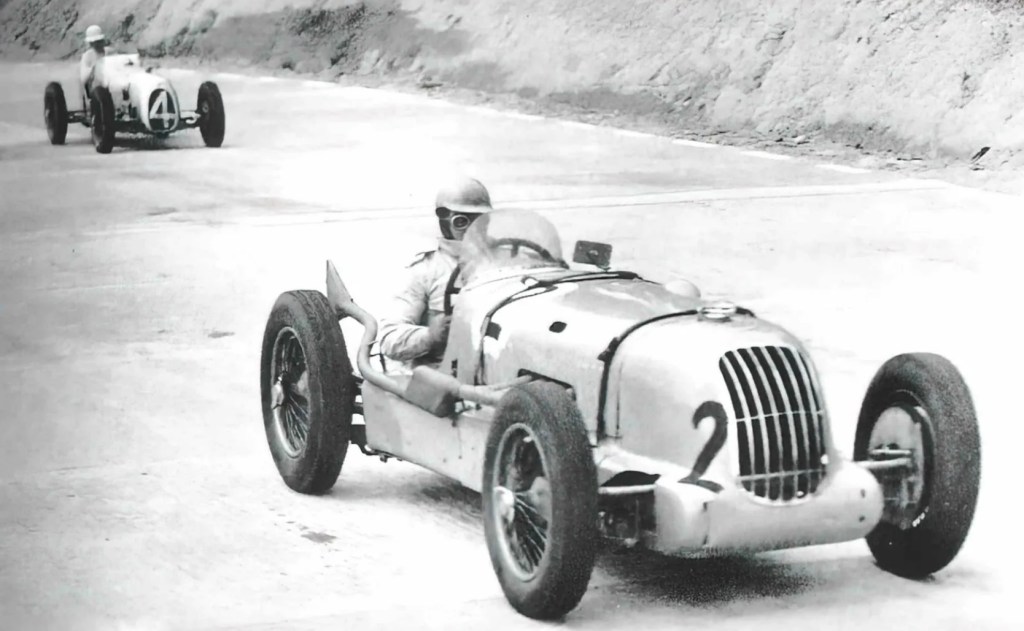
Wakefield in the Brooklands paddock, Maserati 6CM, chassis 1546. JCC International Trophy 1937, second place. Ray Mays won in ERA R4C (Bill Brunell/Getty Images)(Bill Brunell/Getty Images)
Undaunted, our intrepid adventurer placed an order for an ERA B-Type. Wakefield raced Ian Connell’s B-Type before he took delivery of R14B; in around 20 meetings with the two cars he did exceedingly well, taking three wins, two 2nds and six 3rd placings until May 1939. Johnnie then raced a new Maserati 4CL, chassis #1569 for the balance of that season, again excelling, with wins in the UK, France and Italy. He was a rising star, a man to watch.
As Hitler and his merry band of perverts took on the world, Wakefield signed up with the Royal Navy Volunteer Reserves as a sub-lieutenant in September 1939. From then until 1942 he flew 25 different aircraft in eight squadrons. By March ’42 he had resigned his commission to undertake pilot flying test duties with Vickers Aircraft on Spitfire PR MkIVs.
Johnnie was attached to RAF Aldermaston, one of five hangars where Spitfires were assembled. Wargrave Aerodrome (sometimes called Henley Aerodrome) had no formal control tower and Vickers shared the place with a busy RAF pilot training school. On 24 April, as Wakefield took off in his Spitfire (MkIV BR413) for a production test flight he was confronted by a Miles Magister on a collision course, while he swerved in avoidance as he took off, he crashed. The plane burst into flames and he was killed instantly.
Wakefield was on course as a potential great, the BRDC Gold Star, awarded to the most successful driver of the season, was awarded to him posthumously post-war, his wife Kay received it. The Johnnie Wakefield Trophy, is awarded in his honour to the driver who achieves the fastest race lap of Silverstone each year, to this day.
Back to #1546. The doyen of Australian racing historians, John Medley wrote that “Wakefield’s 6CM Maserati was donated engineless (it was sent back to Maserati for a rebuild) to his mechanic, Rex Tilbrook, a South Australian who imported it to South Australia but refused to pay the customs duty…so it became the ‘box of stones’ in the customs store, rescued but unused by one of the Brooks brothers, and eventually bought by Frank Kleinig for the final version of his Kleinig Hudson Special.”
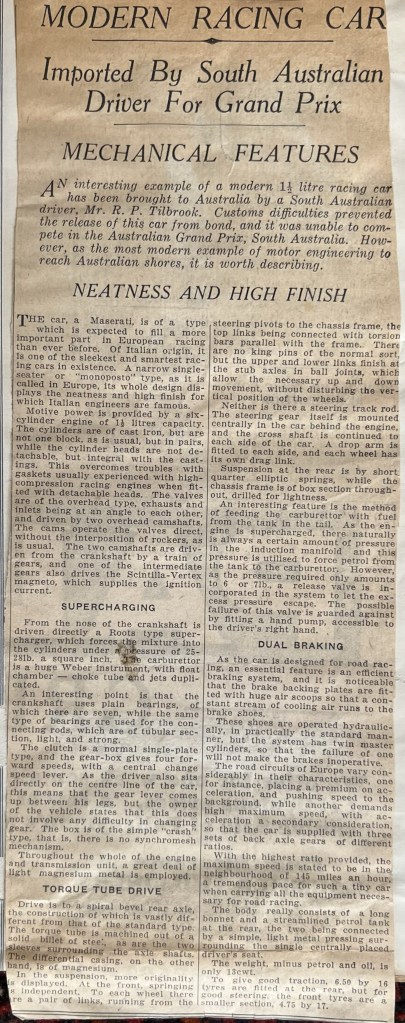
The Mercury Hobart, March 4, 1939 (C McLaren Rumblings)
Rex Patterson Tilbrook was a man of immense ambition, an intuitive engineer who left an amazing heritage in motorcycles. An aspiring South Australian racing driver and engine designer, he headed for the UK in 1933 and soon landed a job with Vickers at Brooklands. Before long his capabilities as a mechanic and fabricator were such that he opened his own workshop there. His clientele included some top riders and up-and-comers of the day including Fergus Anderson and Dennis Minett…and some racing drivers such as JP Wakefield.
Disaster struck Tilbrook in 1938 when a failed acetylene gauge caused a fire which gutted his workshop. With the drums-of-war getting louder, Rex opted to return to Australia. He had dreams of motorcycle manufacturing at home and brought six ‘bikes and and an engineless racing car – Wakefield gifted 6CM 1546 to Tilbrook – to sell to raise the working capital for his planned venture. Then the Fiscal Fiend intervened, Australian Customs seized the Maserati to pay for the import duty payable on six motorcycles. See this fabulous article on Rex Tilbrook; https://www.oldbikemag.com.au/remarkable-rex-tilbrook/
The newspaper article above was a catalyst for this piece, it is such a good detailed technical period article on the 6CM. I rather suspect that the journo obtained much of the nitty-gritty from Tilbrook rather than a glossy brochure. The race alluded to was the 1939 Australian Grand Prix held at Lobethal, South Australia on January 2, it was won by Allan Tomlinson’s MG TA Special s/c. Obviously Tilbrook was never going to contest the race ‘coz his nice, one owner, only-driven-on-Sundays Maserati didn’t have a donk under its svelte bonnet.
Maserati built 27 6CMs. The six-cylinder 1493cc engine (65x75mm bore/stroke) had cylinders cast in pairs and twin overhead camshafts driven from the nose of the crank. A single Weber was used and Roots type blower, ignition was by Scintilla magneto and the engine was dry-sumped. Power output was quoted initially as 155bhp @ 6200rpm, and later 175bhp @ 6600rpm.
Anthony Pritchard wrote that “The 6CMs were beautifully engineered, almost like a jewelled motion in comparison with the rather crude ERAs, and gave the impression of being Grand Prix cars in miniature. There were times, however, when Maserati cut corners in the standards of assembly and in the main the British owners became unhappy with the performance of their cars.”
There was a big difference in performance, and as Pritchard wrote, sometimes build quality of the works and privateer cars. The compression ratio of works cars was 6.75:1, of British customer cars, 6:1, supercharger size – 140mm blower for works cars, and 130mm for customers. Blower boost of 15-16psi compared with 11-12psi. Whether or not Giacomo the Junior assembled the machine on a Friday afternoon was doubtless a factor too.
The modified four-speed Fiat gearbox was mated to the engine and, being designed for a 34bhp Fiat 532 taxi, was unreliable. This situation wasn’t remedied until Maserati built their own transmissions. The rigid rear axle, made by Isotta Fraschini, was suspended on semi-elliptic springs.
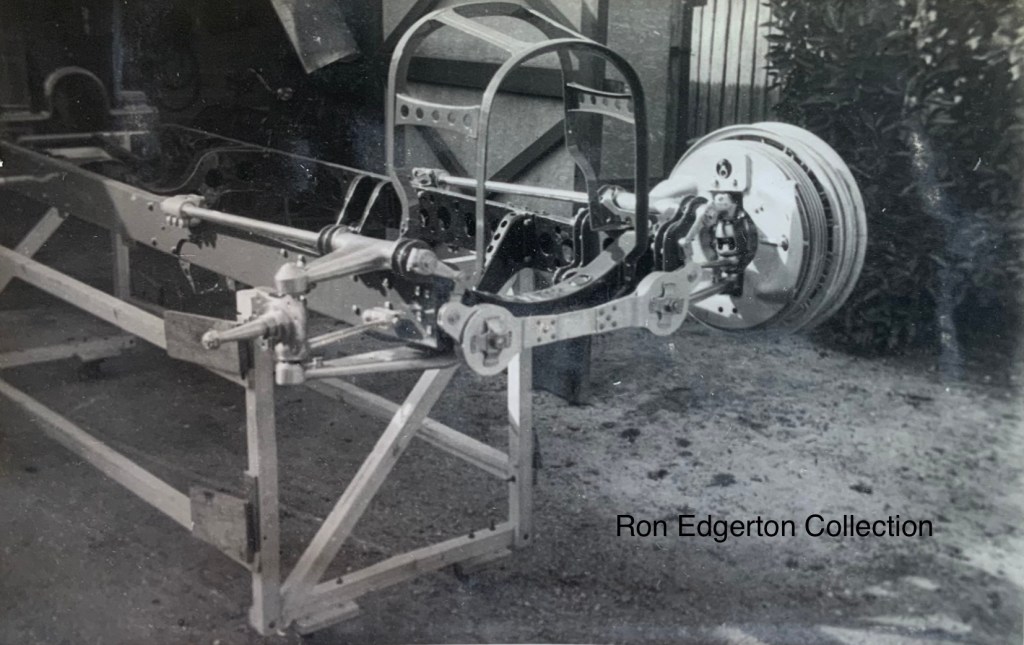
Another bit of intrigue in all of this is that within Racing-Ron Edgerton’s photo collection are some naked shots of a Maserati chassis which looks suspiciously like that of a 6CM…it is 1546 actually.
Ron’s minimal captions include: ‘Maseratti’ (wrong), ‘1 1/2-litre chassis’ (correct) and ‘4CL Maserati (Brooks) Adelaide 1939’. The latter tells us it is the Wakefield car – he got the 4CL bit wrong – albeit the current orthodoxy is that Bill Brooks bought the car from customs in 1943. My suspicion is that Racing Ron made his notes about the photographs decades after the events themselves, the same blue biro he used throughout aids my forensic conclusion. We know from photographs in the Bob Shepherd Maserati Scrapbook – now in historian, David Zeunert’s care – that the car was not taken apart as shown in the chassis shots in 1939. More about Bob Shepherd here; https://primotipo.com/2021/12/03/werrangourt-archive-13-bob-shepherd-artist-extraordinaire/
Edgerton was a businessman who raced on the circuits and speedways throughout Australia; he got around when not many folks did. It’s highly likely he considered purchase of the car and travelled to Adelaide to do so, his high end automotive road and racing car CV is pretty much unmatched in Australia. More about Racing Ron here; https://primotipo.com/2021/03/17/racing-ron-edgerton/
If you read the first link above you will have seen photos of the car in its restored but unused state as below.
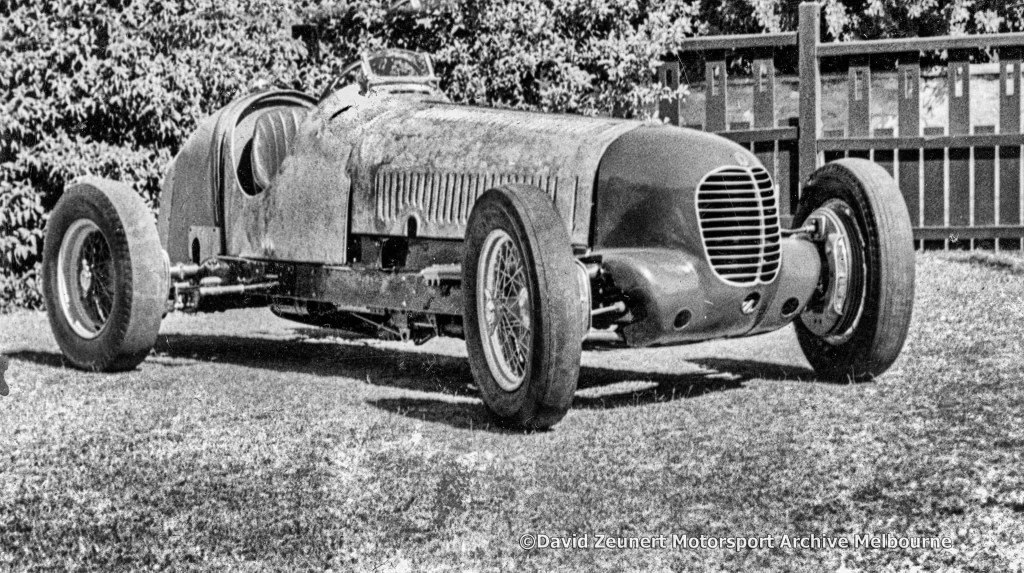
#1546, MotorClassica Melbourne 2018 (M Bisset)6CM #1546 probably during the Brooks period of ownership, an Adelaide front yard (Bob Shepherd)
Etcetera…
(BRDC Speed Magazine)
Johnnie Wakefield in his Alta, #56S 1.5-litre s/c at Brooklands. Some lengthy research by Stephen Dalton identifies the meeting as the BARC Brooklands Campbell Circuit Meeting on July 10, 1937. The race is the First Short Handicap and the following car is Kay Petre, Austin s/v.
(MotorSport)
Wakefied at Brooklands during the Junior Car Club 200 Mile Race on August 27, 1938. He had a very successful weekend, winning his first major race in ERA R14B, the last B-Type constructed. Bira was second in his Maserati 8CM 34 seconds adrift, and Earl Howe third in an ERA C-type.
(MotorSport)(unattributed)
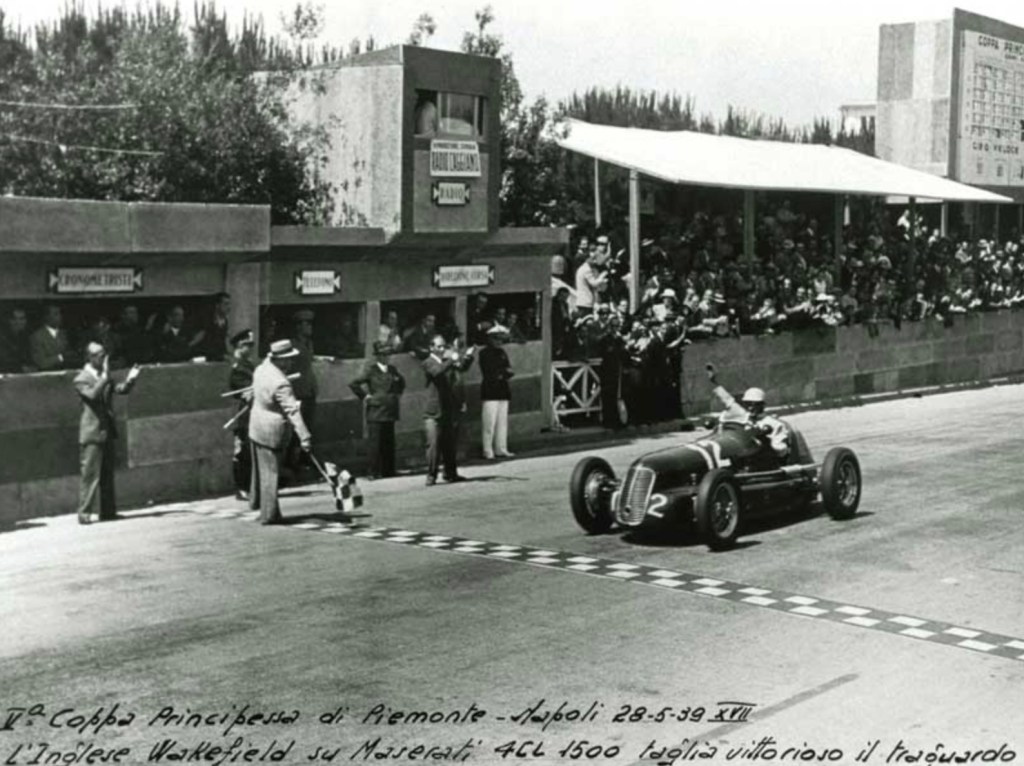
Wakefield surprised the Italians on their home ground by winning the 246km Coppa Principessa di Piemonte at Posillipo, Naples on 28 May, 1939 aboard his Maserati 4CL. In an all Maserati field of 14 cars, Johnnie took a very good win, and fastest lap, from Piero Taruffi aboard a Scuderia Ambrosiana 6CM, and works-4CLs driven by Franco Cortese and Gigi Villoresi.
Wakefield was plenty quick in the final races he contested in 1939. A fortnight after Piemonte he won both races of the GP de Picardie, then led the Sporting Commission Cup, French GP support race at Reims on July 9 until his brakes faded, finishing second behind Armand Hug, Maserati 4CM. Off to Albi on July 16 he was victorious in front of Reggie Tongue, Maserati 4CL and Bira, ERA B-Type – then won again in the second race. At Berne Johnnie was third in the Voiturette heat and third in the Voiturette class of the Swiss Grand Prix with Giuseppe Farina and Clemente Biondetti’s Alfa 158s the class of the 1.5-litre field.
Wakefield really looked the goods as the dark years approached.
MotorSport in their September 1940 issue quote a power output of 200bhp @7000rpm for the “short stroke, square” 16-valve four-cylinder 4CL, the Alfa Romeo 158 straight-eight at 195-210bhp @ 7000rpm, the ERA E-Type 220-250bhp @ 8000rpm, and Mercedes Benz W165 V8 250bhp @ 10000rpm; all engines were supercharged.
(D Zeunert Collection)
More #1546…
Bill Brooks with #1546 as bought from Australian Customs circa 1943. It looks shite, is it as crashed at Cork, less engine? Or was the machine subject to some repair prior to being given to Tilbrook?
(D Zeunert Collection)
This series are as purchased by Tom Roberts prior to the restoration work of David Rapley.
Credits…
Cameron McLaren’s Rumblings, ‘Maserati : A Racing History’ Anthony Pritchard, Society of Automotive Historians in Britain, Bob Shepherd Collection via David Zeunert, David Zeunert Collection, BRDC Speed Magazine August 1937 via the Stephen Dalton Collection
Tailpiece…
I love scrap-books, Cam McLaren’s is far more posh than mine too. He lists his address at the time – wartime I guess – as ‘Sub/Lieut C.S. McLaren, 456 Glen Eira Road, Caulfield’ in Melbourne. More about McLaren here, can anybody tell us more? https://primotipo.com/2019/12/20/tooronga-park-light-car-racing/
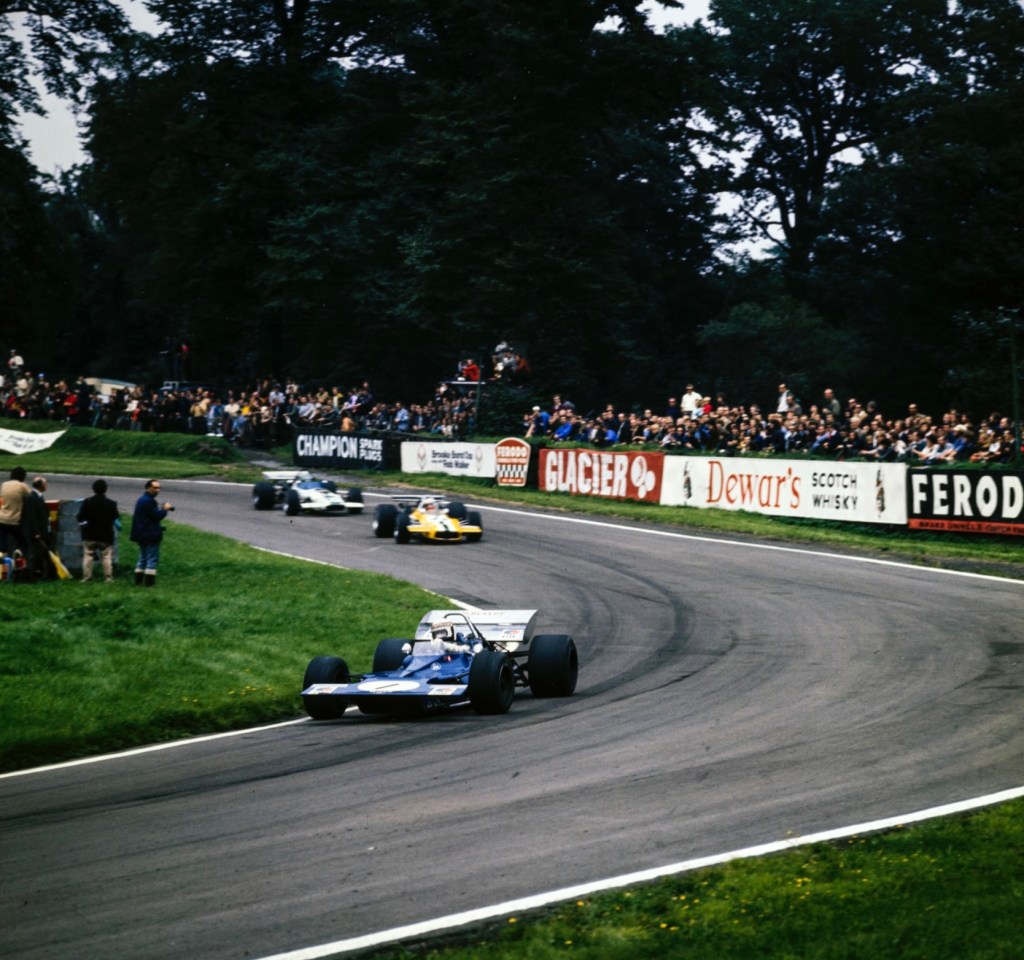
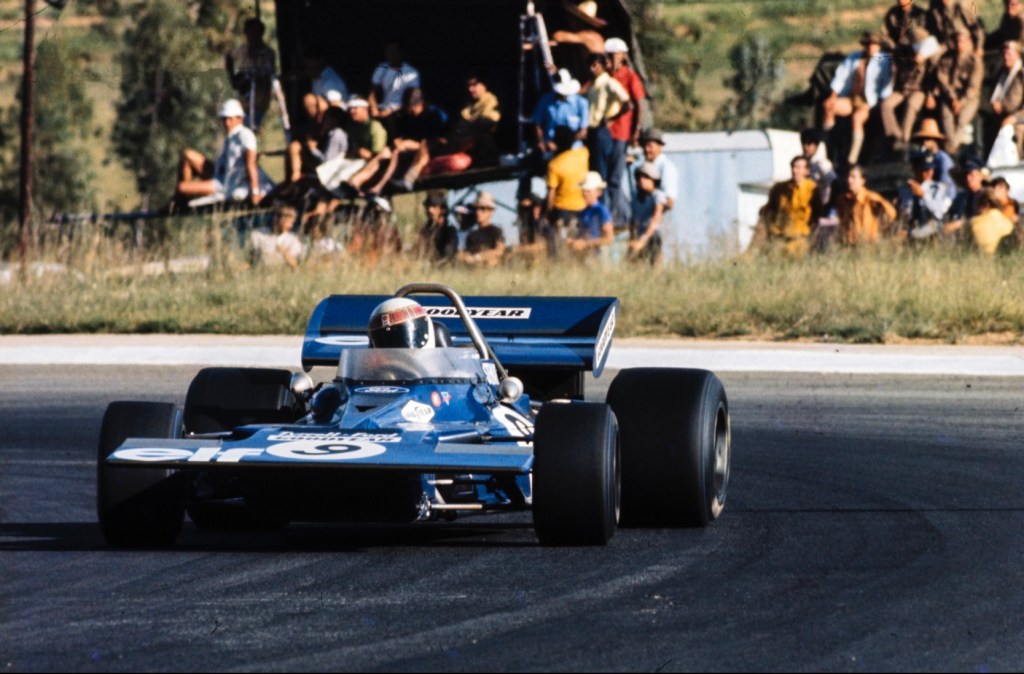
“Och aye! That really is more like it” or thoughts to that general effect. Jackie Stewart in his brand new Tyrrell 001 Ford Cosworth DFV at Oulton Park during the August 22, 1970 Gold Cup weekend.
Derek Gardner’s first F1 design was only days old and already it felt better than the customer March 701 Ford – victories in the Spanish GP and notwithstanding – that he had been racing that season.
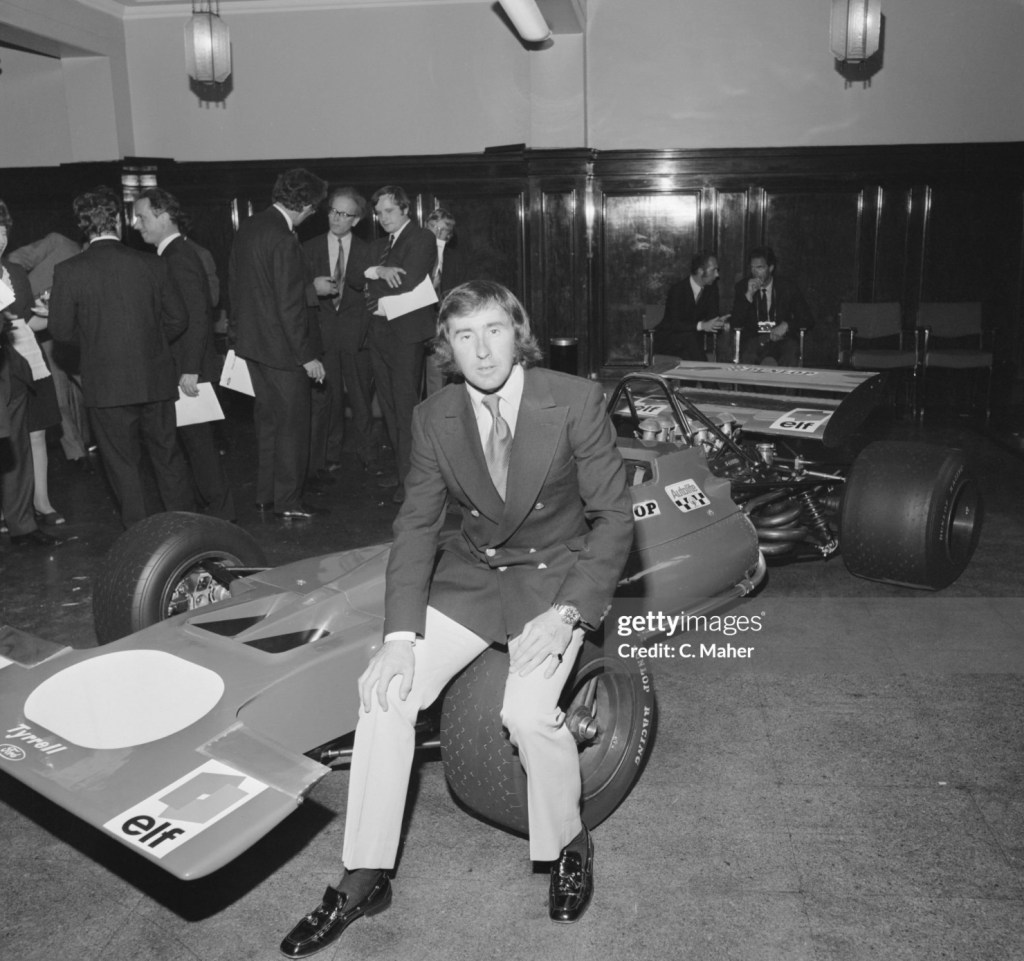
Press release of the Tyrrell 001 at Ford’s London premises on September 18, 1970
Stewart and Tyrrell’s Matra International had won the 1969 World Drivers and Manufacturers Championships with the superb Matra MS80 Ford. For 1970 the French aerospace giant wanted to race only Matra V12 engined cars. After Tyrrell and Stewart travelled to France and Stewart tested the Matra MS120 the pair decided they preferred to stick to the Ford engine; hence the acquisition of March 701s.
Tyrrell quickly realised he needed to build his own car to control his destiny, rather than be at the mercy of a chassis manufacturer, so Gardner was engaged and secretly set to work in a design studio he established at his Leamington home. Ken got to know and respect Derek during the occasions on which Matra International raced the Matra MS84 Ford 4WD drive car in 1969, Gardner was then employed by Ferguson Research and was responsible for the transmission in that car.
“…and then it does that, really suddenly!” JYS and March 701 Ford (MotorSport)Stewart at Brands Hatch in the Tyrrell March 701 Ford during the July 1970 British GP (MotorSport)
The guidelines were that the design needed to be simple and competitive with minimal development, with a deadline of the August 22 Oulton Park Gold Cup meeting.
Gardner decided upon a light, aerodynamic car with very lower polar moment of inertia and optimum front-rear weight distribution. He had a wooden buck of the chassis made by a local joinery firm for Stewart to try. At that point the Tyrrell mechanics were let in on the secret with comments about what went where and maintenance – important design considerations for someone who hadn’t designed a racing car before
Hockenheim, Germany Q7 and DNF engine in the March 701, Jochen Rindt won(Schlegelmilch/MotorSport)March 701 Ford cutaway drawing (G Piola)
Given Tyrrell’s famous timber yard operation was equipped to prepare racing cars, not build them – something that would change quickly enough – a swag of well known industry suppliers and cubbies were soon busily making components to the account of this fella named Gardner D.
The Ford DFV engine and Hewland FG 5-speed gearbox were sent over to Derek, while Maurice Gomm’s Gomm Metal Developments fabricated Gardner’s open, bath-tub, pregnant-belly monocoque chassis out of 18-gauge NS4 aluminium alloy. Derek had modelled a tenth-scale model of the car in the University of Surrey’s wind-tunnel. The front of the chassis covered Wee-Jackie’s feet, while a subframe extended forwards to carry the radiator and front lower wishbone pick-up points.
Doug Nye wrote that “A massive front bulkhead structure extended into Matra-like wings on each side, supporting tiny, split upper wishbones and top mounts for the outboard coil spring/damper units. Very wide-based fabricated lower wishbones were used.”
Jackie Stewart in 001 ahead of Mike Hailwood, Lola T190 Chev and Reine Wisell, McLaren M10B Chev Oulton Park Gold Cup, August 1970 (MotorSport)
The Ford DFV engine was mounted, as the design intended, to the bulkhead aft of the driver, while the rear suspension was attached to the DFV and Hewland transaxle via tubular subframes. Len Terry’s ‘industry standard’ parallel power links were used with a single top link, twin radius rods and again outboard coil springs/Koni shocks.
Brakes were outboard at the front, and inboard at the rear: rotors were ventilated and 10.5 inches in diameter front and rear. Aeroplane and Motor provided many of the castings: uprights, wheels and other items, Laystall made the stub axles and Jack Knight Engineering did most of the machining.
The unusual nose and cowling shape were informed by the ‘tunnel-work, the central spine designed to divert relatively clean air around the side of the cockpit back onto the two-tier rear wing mounted atop a gearbox strut.
“When the prototype car (#001) was first assembled and weighed it scaled some 100 lb less than the team’s proprietary March 701s, and was only 32 lb above the minimum weight limit. It had cost Ken Tyrrell £22,500 less engine and gearbox, compared to the purchase price of £9000 for his March 701s.” Nye wrote.
Messrs Gardner and Tyrrell looking youthful in 1970 (MotorSport)Tyrrell 003 Ford cutaway drawing, the eagle-eyed may pick the Girling twin-disc brakes (T Matthews)
After completion and dealing with all of the press-release niceties the car was despatched to Oulton Park where 20 cars faced the starters flag: five GP, and fourteen F5000 cars.
Niggles that weekend included metering unit failure and a blocked fuel injection unit, so JYS also practiced and qualified his March fifth, but elected to start from the rear of the grid in 001 having not set a time.
On lap 2 of the first heat he pitted after the throttle jammed to have the linkage eased a bit, and to have loose bodywork made good. He returned to set the lap record (twice) before an oil pick-up problem caused the engine to fail. John Surtees TS7 Ford won that heat, and Jochen Rindt’s Lotus 72C Ford the second, with John victorious overall.
Mosport, Canada 1970 (MotorSport)Stewart and team at Mosport where keeping wheels on 001 was a problem, and a broken stub axle (MotorSport)
Given a choice of cars Stewart did the logical thing and plumped for the new Tyrrell 001 for the final three championship round of the season at Monza, Mosport, Watkins Glen and Mexico City.
At Monza the car’s main fuel tanks weren’t picking up enough fuel to the collector to run at sustained maximum rpm so he raced his 701 – despite being distraught after the death of his close friend Jochen Rindt in practice – to second place behind Clay Regazzoni’s Ferrari 312B – his first GP win.
Things improved big time in North America. Jackie Started from pole in Canada and on the front row in the US, and at Mexico City. At Mosport the wheels kept coming loose in practice, and then a left-hand-front stub-axle failed while Jackie led the race. Gardner designed a stronger part which were machined from solid magnesium by the Jack Knight crew and used on the car at the Glen and in Mexico.
Jackie lost in upstate New York when an oil-line retaining clip parted, “causing the plastic line to fall against a hot exhaust manifold and burn through, which allowed the lubricant to haemorrhage away.” Emerson Fittipaldi took his first GP win that weekend in a Lotus 72C Ford.
The Mexican GP was an entirely forgettable weekend all round, not least for Jacki Stewart, who hit a stray dog at 160mph. “It disintegrated and the car veered violently to the left, towards a bank where spectators were sitting cross-legged a few metres from the tarmac. I only just managed to regain control and prevent may car from ploughing into that area and scything through the crowd.”
Importantly, despite the somewhat predictable niggles, the car was fast, Team Tyrrell, Stewart, Ford, Elf and the other sponsors looked forward to 1971 with plenty of optimism.
The Big Three at Kyalami in 1971: Stewart, Gardner and Tyrrell (MotorSport) Stewart in 001 during the ’71 South African GP (MotorSport)
Over that 1970-71 winter the team built up another car, chassis #002 for Francois Cevert. A taller chap than his team-leader, the chassis was four inches longer than #001, the wheelbase 1.5 inches longer, and the side-skins of the tub were thicker 16-gauge NS4 aluminium. In addition, Derek simplified the front bulkhead structure and braced the roll-bar forward, rather than aft. “This latter change was to allow the engine to break away from the chassis in an accident without compromising the drivers protection, and would become standard practice in all categories over the next four to five years,” wrote Allen Brown.
Longtime tyre provider, Dunlop withdrew from F1 at the ned of 1970 so Tyrrell did over 1400 trouble-free miles (two engines) with Goodyear in warm Kyalami over the annual break. Trouble-free but not incident free: a pebble jammed between the throttle pedal and bracket causing a crash which crushed the tub’s left-front corner and jarred Stewart’s wrist. The car was sent home, the monocoque unstitched, the skins repaired then reassembled and returned to South Africa.
Race of Champions March 21, 1971 (MotorSport)Stewart in his new Tyrrell 003 on the way to victory at Montjuïc Park, Barcelona in 1973. Rainer Schlegelmilch brilliance (MotorSport)
Not much was wrong with it, Stewart started his first three races in 1971 from pole…and finished second in all them: the South African GP, Race of Champions at Brands Hatch and the Questor GP at Ontario Motor Speedway, California.
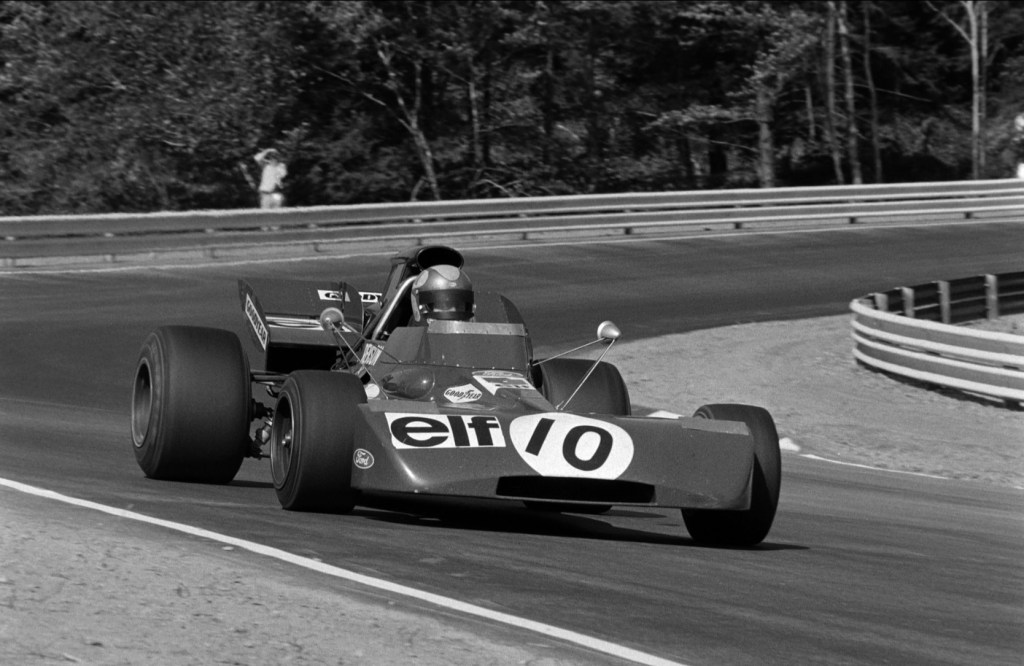
From then JYS moved to Tyrrell 003 – identical in spec to #002 – and immediately won in Spain (Montjuich Park) and Monaco with it. He had brake dramas in the Zandvoort dunes but bounced back at Paul Ricard, Silverstone and the Nurburgring putting the World Championship in-the-bag. Later in the season Jackie won at Mosport and Francois took his first – and sadly his only – GP victory at Watkins Glen. Tyrrell won the Constructors Championship in its first full year of competition as a manufacturer.
Great cars, Doug Nye named his chapter in ‘The History of The Grand Prix Car 1966-1985’ about the 1970-73 championship Tyrrells ‘Uncomplicated Craftsmanship’, which about says it all…
Not a shot of Francois! Let’s fix that, here in during the 1971 Italian GP weekend in 002. Ronnie Peterson at left in his March 711 Ford (MotorSport)
Etcetera…
(MotorSport)
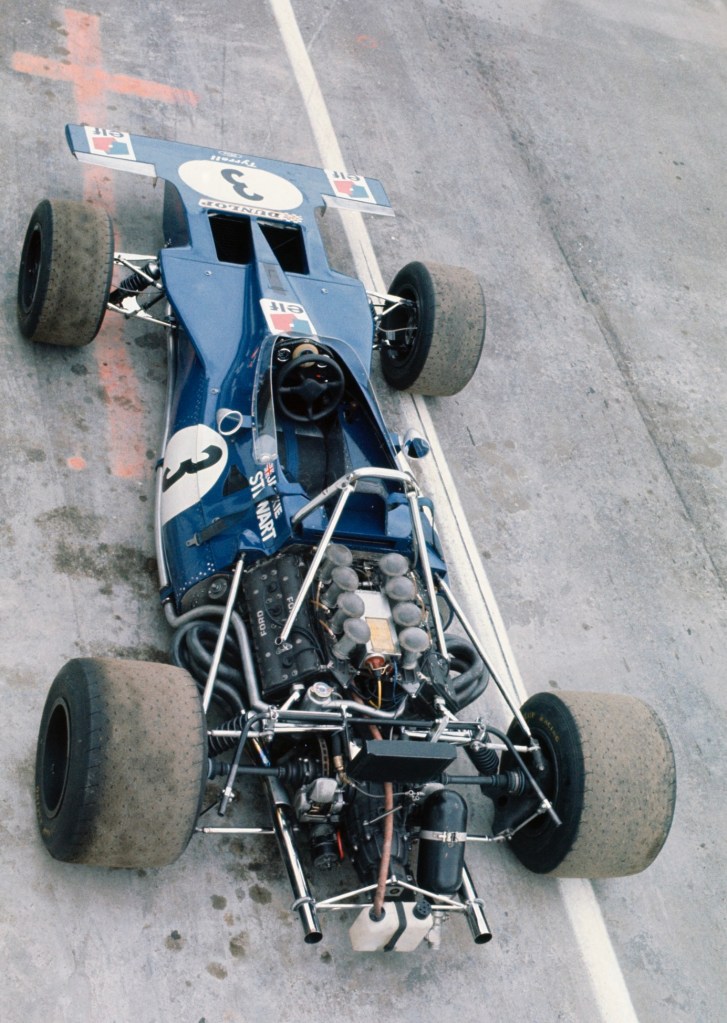
This overhead shot of Tyrrell 001 at Mosport in 1970 – sans rear wing – is a great one to show the overall packaging of the car – body features as per earlier text – and the period typical Ford Cosworth DFV, Hewland transaxle and outboard suspension. Quality of design, execution and preparation outstanding.
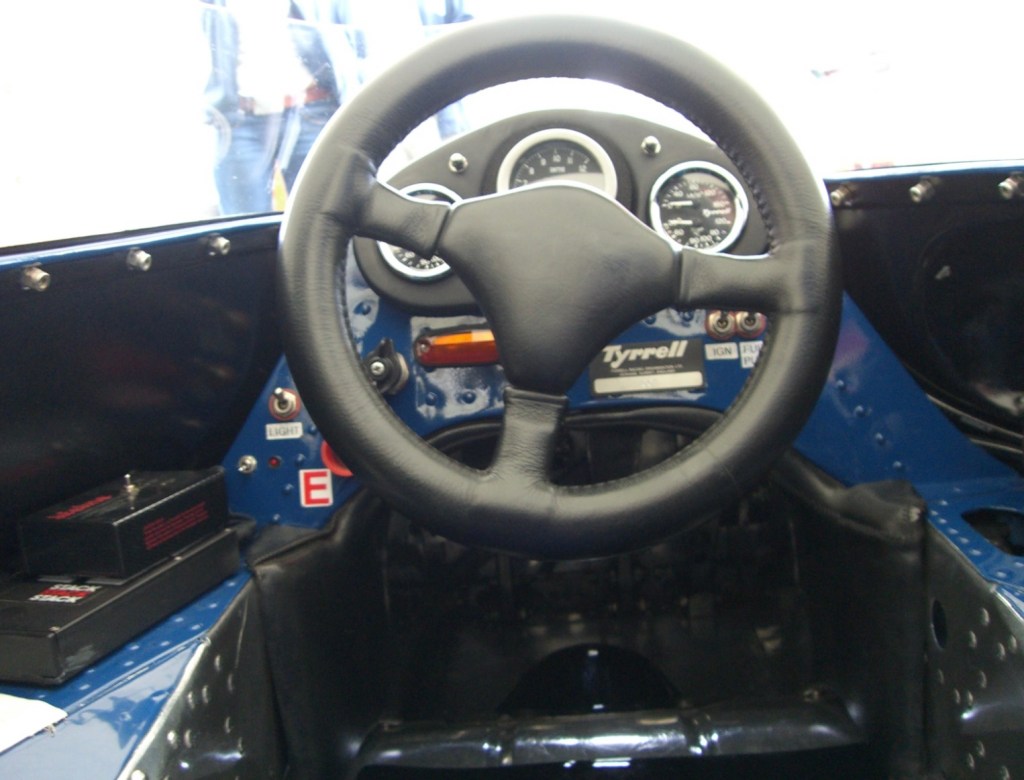
Contemporary photograph of 001’s cockpit.
(MotorSport)
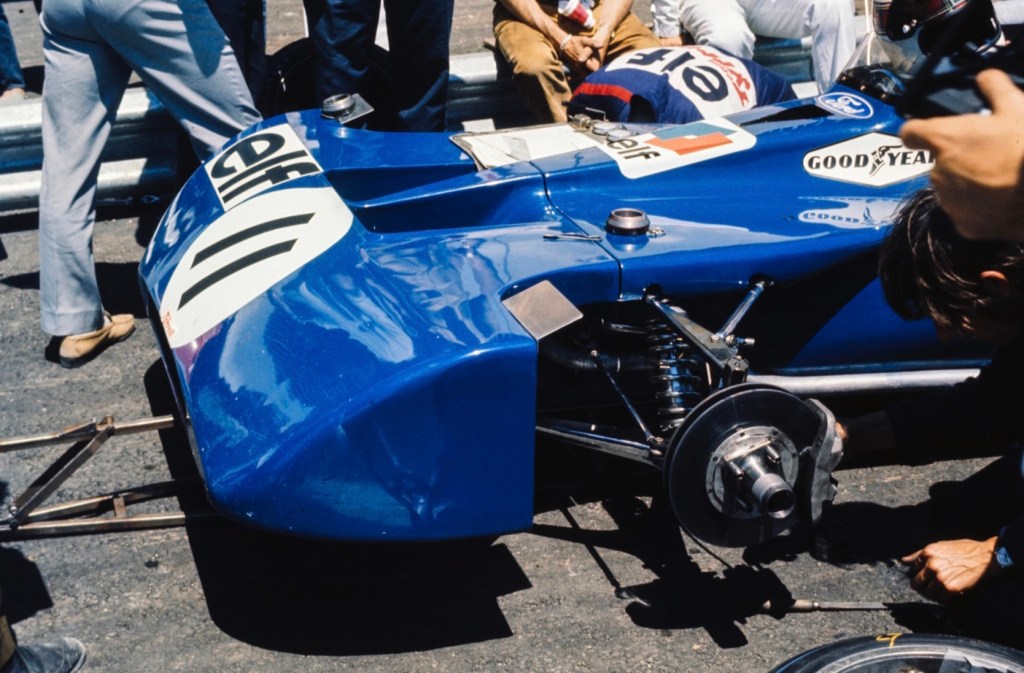
Mechanics work on Francois Cevert new #002 at Kyalami in 1971. Note the forward facing roll bar bracing
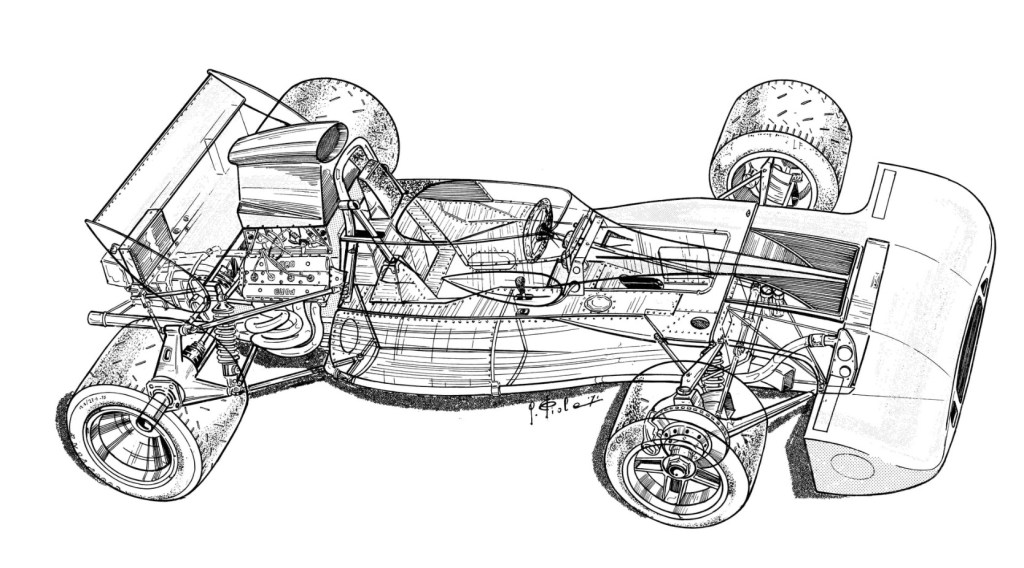
Tyrrell 002 Ford (G Piola)
Stewart aboard 001 from pole alongside Denny Hulme’s McLaren M19A Ford, with winner, Clay Regazzoni’s Ferrari 312B2 on the outside.
French GP 1971, Tyrrell 003, note Girling twin-disc set up (MotorSport)
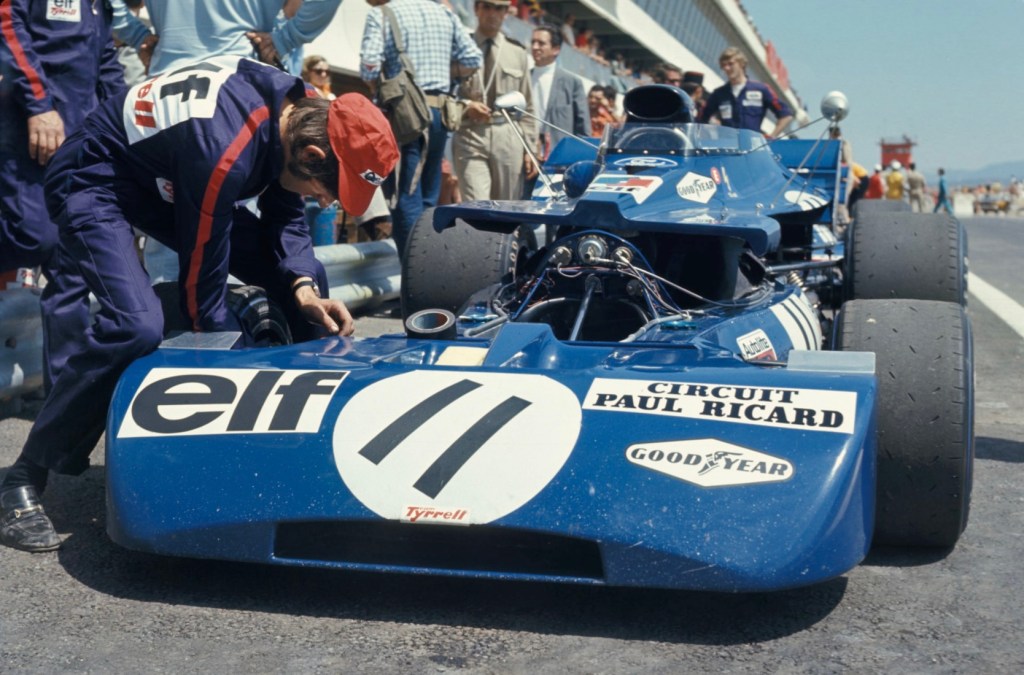
Tyrrell experimented with Girling twin-disc front brakes fitted to 001 at Silverstone during the International Trophy weekend. After Monaco both regular cars: 002 and 003 were fitted with the double-disc brakes as here, to Jackie Stewart’s 003 at Paul Ricard.
Doug Nye explains the set-up, “There were twofold discs on each hub, spaced by a double thickness of pad material, and with pistons on only one side of the caliper. The discs were given a degree of side-float which allowed them to move sideways, cramped by the pads, when the brakes were applied. The idea was to double pad and disc area and provide better heat dissipation plus the opportunity to reduce line pressures which permitted the use of smaller pistons and less deflection on pad wear. The problem had been that conventional discs were wearing the brake pads into a taper form. This in turn promoted knock-off when the drivers braked hard, giving a spongy pedal feel and slashing driver confidence.”
The twin-discs were removed from both cars at Ricard, “after Stewart had a harmless spin into the catch-fencing for Girling seemed happy with the lessons learned thus far.” Nye wrote.
(MotorSport)
Two of Derek Gardner’s innovations are shown in the shot above, Stewart’s 003 at Paul Ricard, and Peter Revlon having this final in-period race of 001 at Watkins Glen in 1971 below.
The ‘Tyrrell nose’ first appeared in scutineering during the Dutch GP weekend and made its race debut at Ricard. The bluff nose extended to the maximum allowable width ahead of the front wheels, reducing the lift they caused and reducing drag. With it Gardner introduced the second alternative nose treatment until the ground effect era, the other was the wedge nose inspired by the Lotus 56/72.
Doug Nye notes that Stewart was “simply uncatchable on the long Mistral straight”. After the Tyrrell 1-2 in France and Stewart’s strong win at Silverstone a fortnight later, his engine was sealed and checked, and a fuel sample was taken in France with no irregularities found. Tyrrell simply had two very quick cars and drivers…
Note also the engine snorkels on the two cars. Lotus fitted ducts to the 72 from the 1970 British GP, and Matras snorkels, but Gardner’s design was sealed allowing clean air and a mild ‘supercharging’ effect.
It was far from the end of Derek Gardner innovation of course!
(MotorSport)
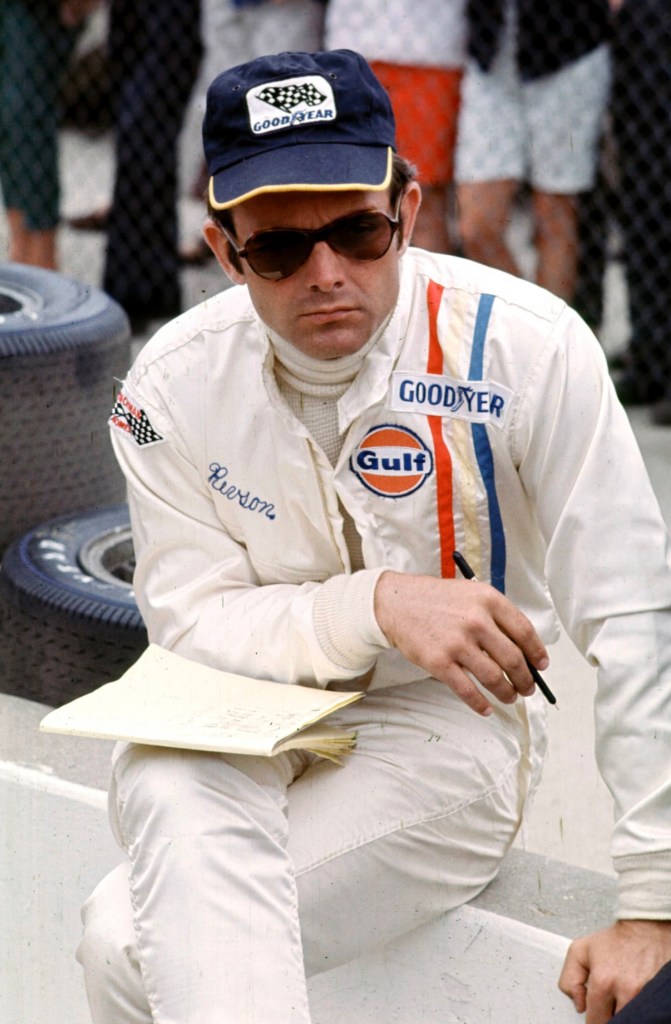
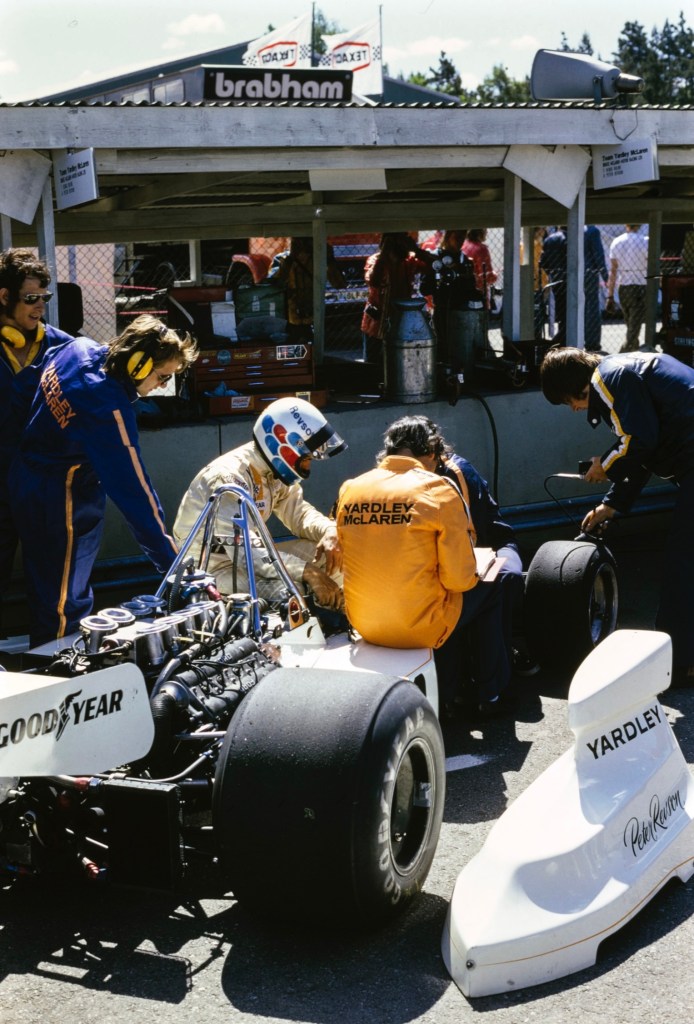
Peter Revson had a long international apprenticeship. Six years after winning the Monaco F3 GP and some promising top-five F2 performances in Ron Harris-Team Lotus 35s in 1965, at the ripe old age of 32 he returned to F1.
In 1971 he won the Can-Am Cup aboard a works McLaren M8F Chev and popped the team’s McLaren M16 Offy on pole, then finished second behind Al Unser’s Colt Ford.
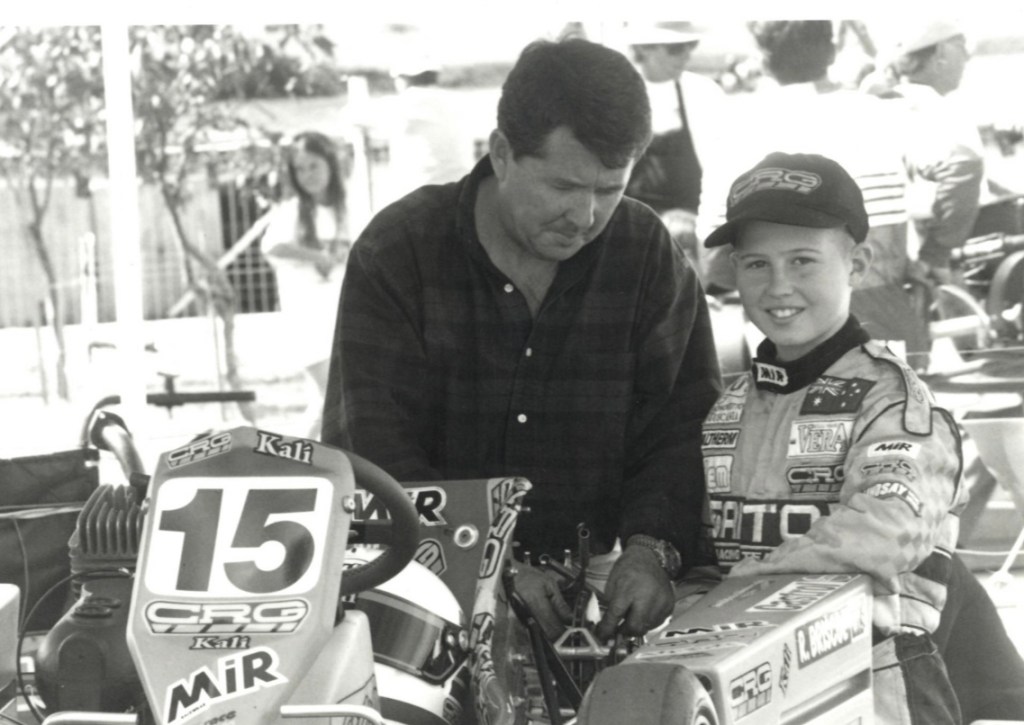
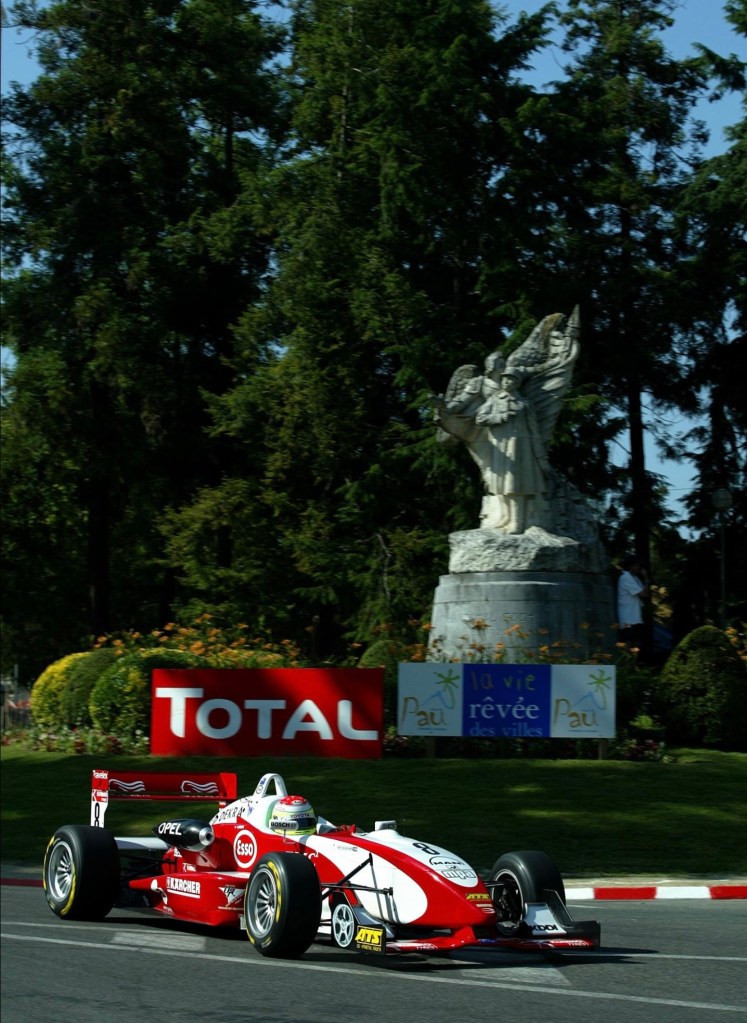
Ryan Briscoe is one of those Australian internationals I tend to forget about as he raced so little in Australia. His formative Karting years were here and then – Oscar Piastri like – most of his secondary education was in Europe from the age of 15 as he and his family successfully chased The Dream.
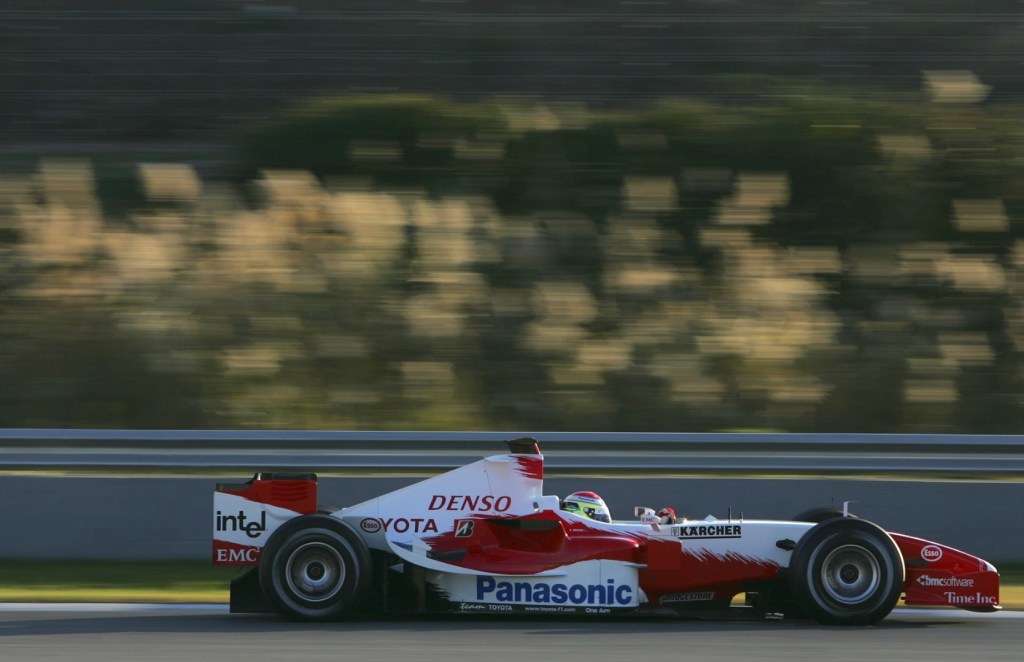
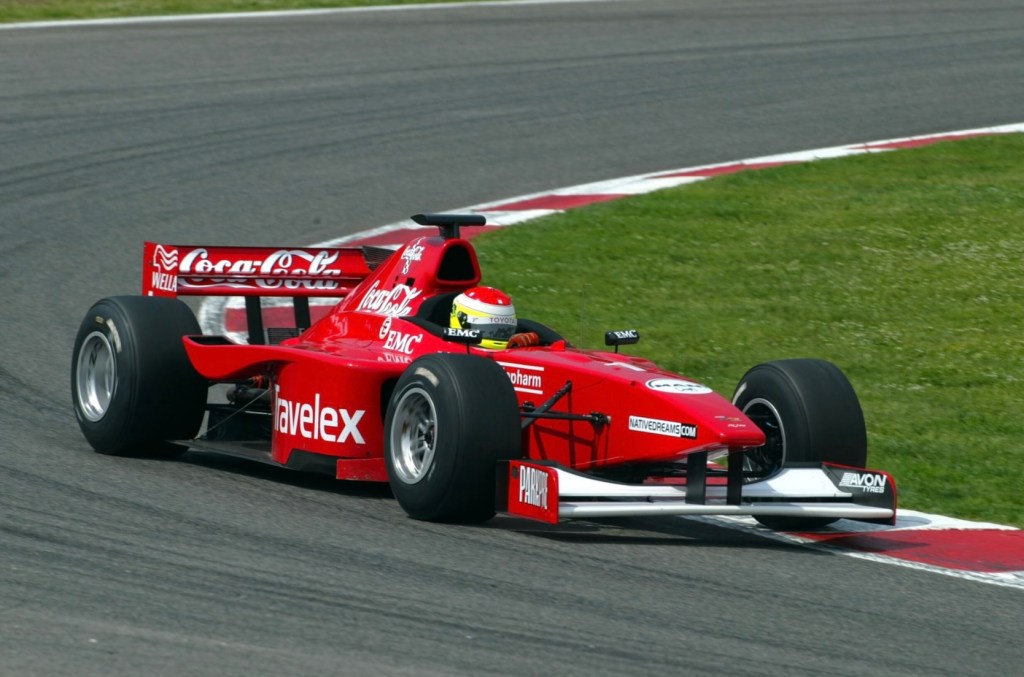
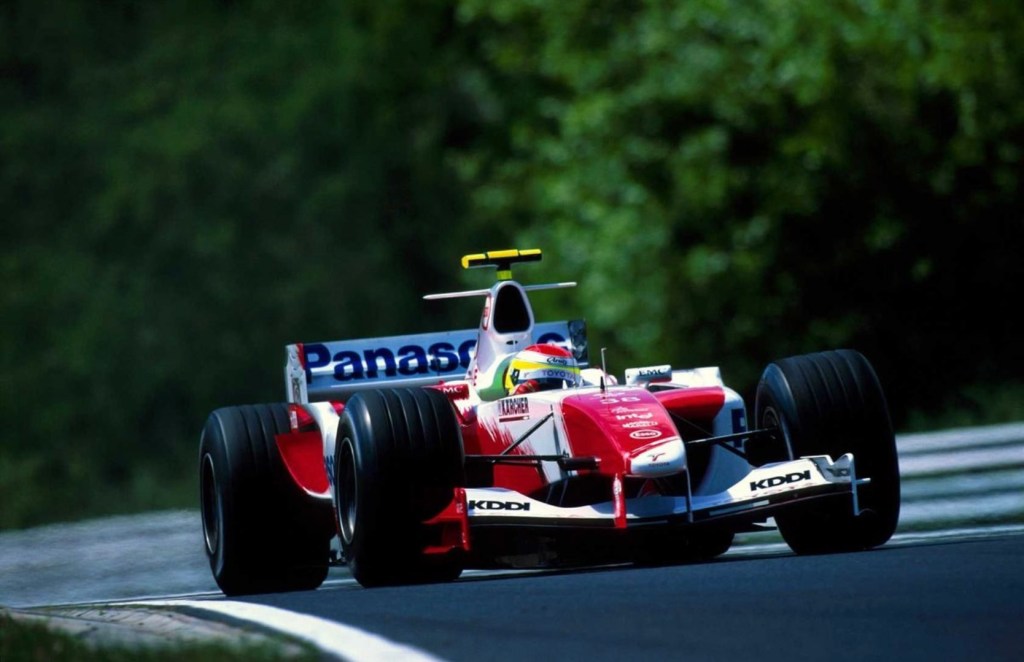
Briscoe, born in Sydney on 24/9/1981, is shown above testing the Toyota TF106 Grand Prix car at Jerez in December 2005. He was in on the ground floor of Toyota’s F1 program – from 2002-2004 – but never quite cracked it for a race seat so he was switched to Indycars in 2005, initially racing a Toyota powered Panoz for Chip Ganassi.
With Dad, Geoff circa 1992 (R Briscoe Collection)Spa 2004 (MotorSport)
During the climb, he won Australian , American and Italian Karting titles in 1994, 1998 and 1999 respectively.He switched to cars, Formula Renault in 2000, winning the Italian F Renault Championship in 2001.
Ahead of the F Renault pack at Monza on April Fools Day 2001 from pole, but DNF as below! Tatuus Renault 2-litre (LAT)(LAT)
During this most meteoric of rises Ryan also did some F3 in 2001, the shot below is at Zandvoort during the Marlboro Masters event on August 5, 2001. Car is Team Prema Dallara F300 Opel, DNF in the race won by Taka Sato, but third overall.
(LAT)(MotorSport)
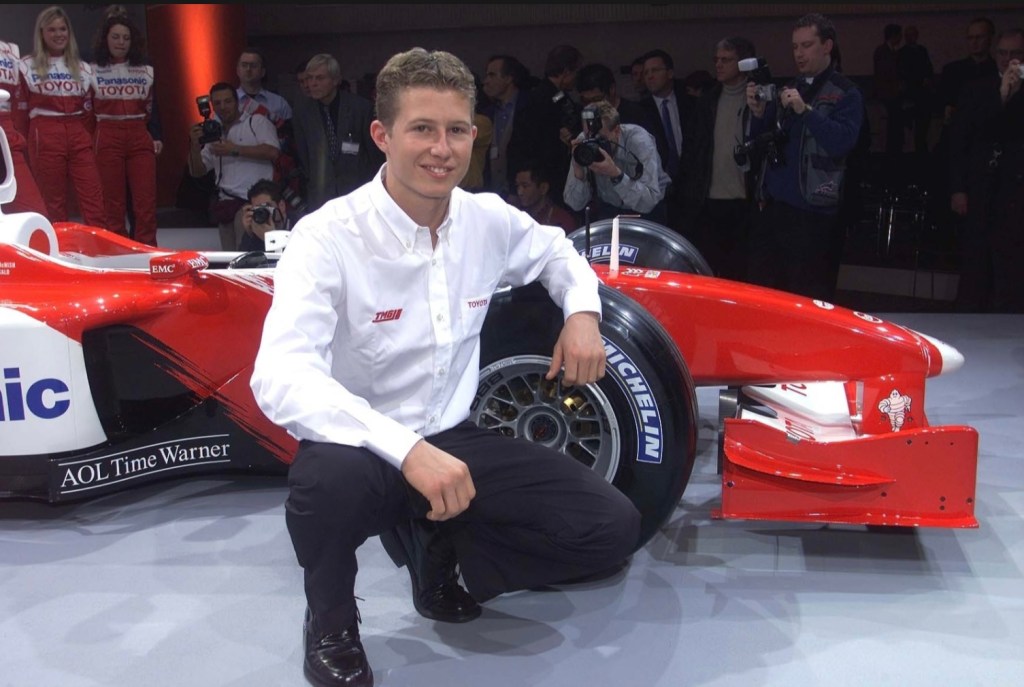
By the end of that year, aged 20, he was front and centre of Toyota’s F1 program as their test driver. Here he is at the launch of the Gustav Brunner designed Panasonic Toyota Racing TF102 V10 in Cologne, where the team was based, on December 17, 2001. The race drivers in 2002 – at the start of a rather grim eight year F1 sojourn for Toyota – were Mika Salo and Allan McNish.
Amongst his testing duties he raced initially in F3000, not going very well in the Nordic run car, and F3 later in 2002, and in 2003, winning the Euroseries that year. He progressed to being Toyota’s third driver, testing on the Friday of each grand prix, in 2004.
Lola TB02/50 Zytec-Judd KV circa 450bhp V8, Formula 3000 Barcelona April 2002 (MotorSport)During the Pau GP weekend in June 2003, Dallara F303 Opel. Briscoe won a race, and Fabio Carbone the other (Glenn Dunbar/LAT)
Briscoe won eight of the 20 races in the F3 Euroseries in his Prema Powerteam Dallara F303 Opel to take the title from Christian Klien. Other hotshots in the field that year included Niko Rosberg and Robert Kubica.
Briscoe, during practice, Toyota TF104 3-litre V10, Hungary 2004 (unattributed)
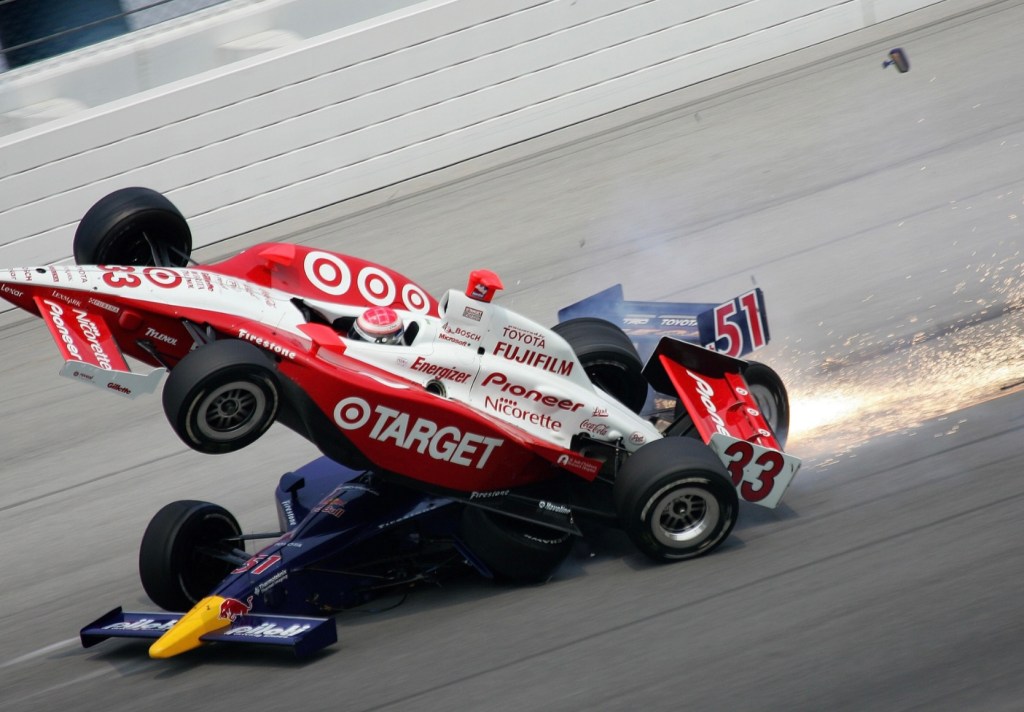
Ryan moved to Indycars (I’m using that word as a generic descriptor of the genre) with Chip Ganassi in 2005, showing extraordinary pace for a rookie; two poles and regular top-half qualifying on unfamiliar ovals. Tenth at Indy on debut was stunning, equally so was seven crashes in his 15 starts, the last of which was a massive accident after his Panoz GF09C Toyota climbed atop Alex Barron’s Dallara at Chicagoland Speedway in September that landed him in hospital and rehabilitation for four months.
Zandvoort A1 GP Cup October 2006 – the first meeting of the 2006-7 season – third in the main race won by Nico Hulkenberg. Lola A1GP Zytec 3.4 V6 circa 520bhp (MotorSport)
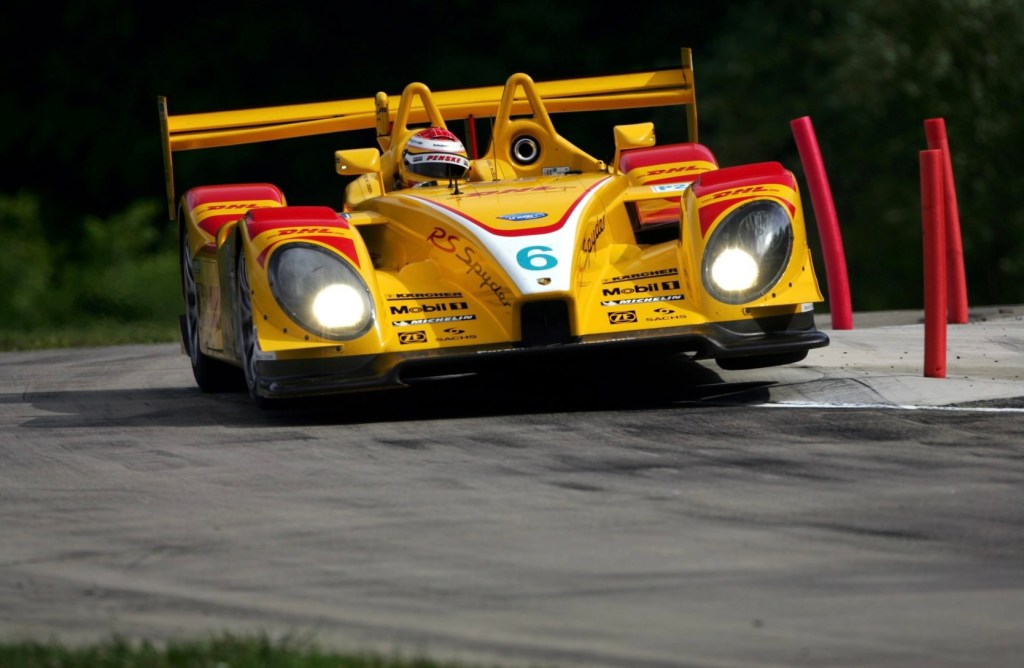
In 2006 he did a mixed programme of Indycar, V8 Supercars and A1 Grand Prix, but it was a full season in the American Le Mans Series for Penske Racing driving a Porsche RS Spyder in 2007 that pushed his career forward with Penske. He won three rounds sharing with Sascha Maassen.
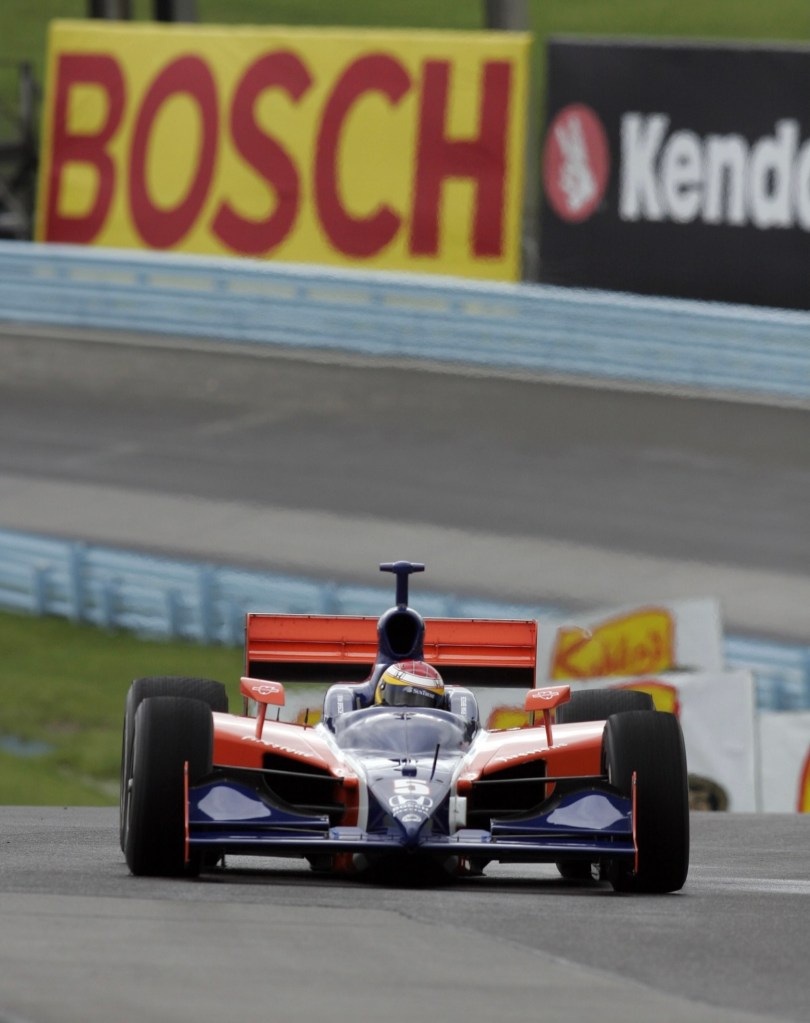
Ryan at Watkins Glen in June 2006. I rather like the shot of the Dallara IR03 Chev aero elements doing their thing (Dan Streck/LAT)Briscoe in front of Vitor Meira at Sonoma Raceway, California in August 2006. Racing for Dreyer & Reinhold Racing in a Dallara IR03 Chev V8. 16th in the Indy GP of Sonoma won by Marco Andretti (Dan Streck/LAT)Briscoe, American Le Mans Series, Northeast Grand Prix, Lime Rock July 2007, Penske Porsche RS Spyder. Ryan won the LMP2 class, and was third outright, sharing the car with Sascha Maasen (Sutton Images)
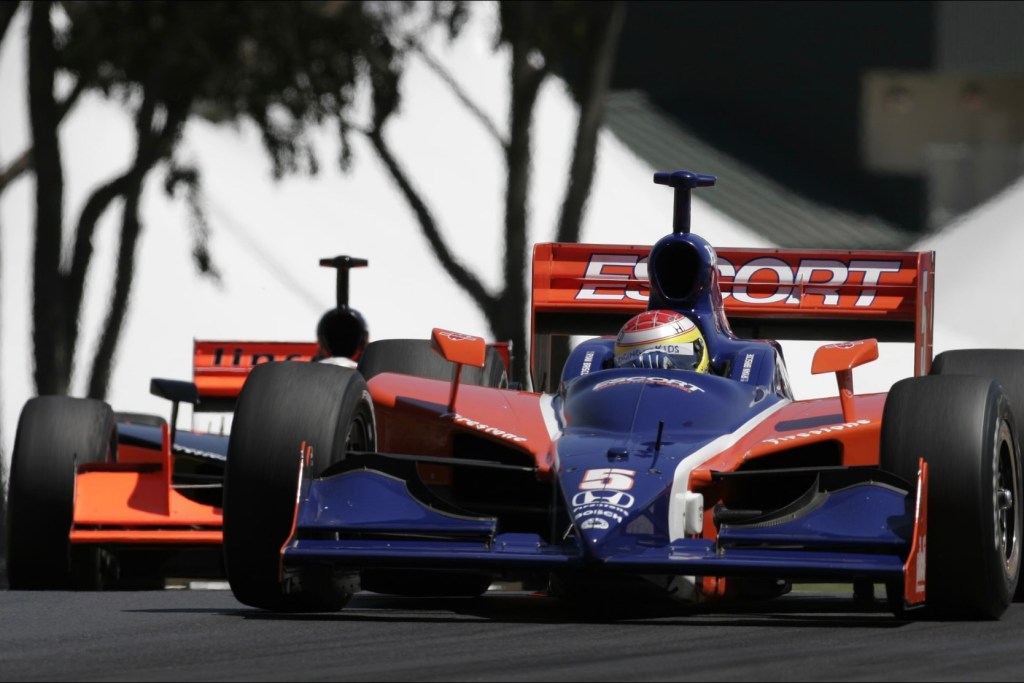
This sportscar success, together with some strong performance in limited Indycar outings – Q5 and fifth in the Indy 500 for Luczo-Dragon Racing, led to a full-time Indycar drive with Penske from 2008-2012.
In a strong Indycar career he won eight races, had 28 podiums and finished third in the title in 2009 (three wins), and fifth in 2008 and 2010 as his bests. In 2009 he led the championship going into the penultimate round but hit the wall exiting the pitlane at Motegi, then, in a three-way battle for the title finished second behind Dario Franchitti in the final round, who became champion.
(MotorSport)
Aviating at Surfers Paradise on the way to winning the Indy 300 in October 2008, Team Penske Dallara IR-04/05 Honda 3.5 V8. Scott Dixon was second, 5/10ths behind and Ryan Hunter-Reay a further nine seconds adrift.
And below doing the same thing at the same place in a V8 Supercar in October 2011, sharing the Holden Racing Team Holden Commodore VE in the Gold Coast 600 with Garth Tander. The pair were 11th in the first race, 23rd and last in the second. The winner overall was the Triple Eight VE Commodore crewed by Jamie Whincup and Sebastien Bourdais. Ryan’s best V8 Supercar result was at this event in 2013 when he shared a VF Commodore with Russell Ingall to third place.
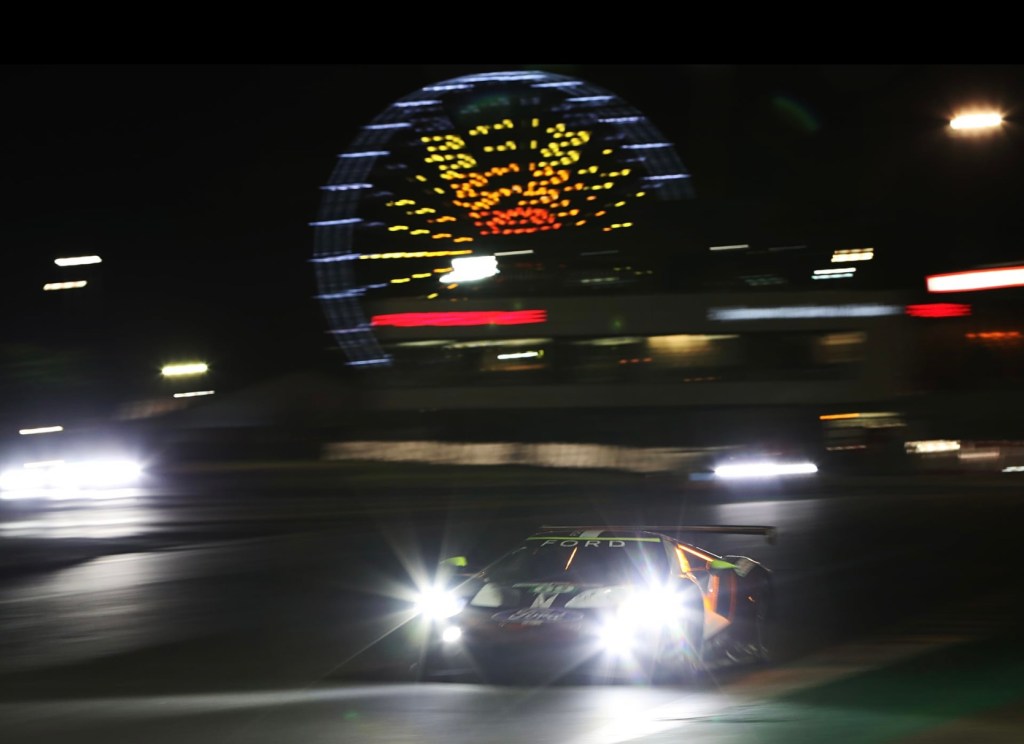
(Mark Horsborough/LAT)The Briscoe, Richard Westbrook, Scott Dixon, Chip Ganassi Ford GT at Le Mans in 2018. Q37 and 39th outright in the 3.5-litre turbo-V6 powered car – and shot below (MotorSport)(MotorSport)
“Ryan has driven more sportscars that I’ve had Sunday roasts,” would perhaps be the observation Australia’s greatest all-rounder, the late Frank Gardner would have made.
Briscoe’s best sportscar results are victory in the Daytona 24 Hours in 2020 (Cadillac Dpi-VR), and Petit Le Mans the same year.
He was runner-up in the 2016 (Ford GT), 2018 (Ford GT) and 2020 (Cadillac DPi-VR) IMSA Sportscar Championship GTLM class. He was third in the 2007 American Le Mans Series, winning the LMP2 class (Porsche RS Spyder),
His best results at Le Mans were fifth in 2021 sharing a Glickenhaus 007 LMH with Romain Dumas and Richard Westbrook, and third in 2022 in the same make/model, this time sharing with Westbrook and Franck Mailleux.
At Daytona he won outright in 2020 (as above) and was first in class in 2015 and 2018 racing a Cadillac DPi VR, Chev Corvette C7.R, and Ford GT respectively – with co-drivers of course. At Sebring he won his class in 2013 and 2015 aboard a HPD ARX-O3b and Chev Corvette C7.R.
Briscoe/Richard Westbrook/Franck Mailleux Glickenhaus SCG007 LMH, fifth. Le Mans 2021 (MotorSport)Richard Westbrook, Franck Mailed, Ryan Briscoe and James Glickenhaus, Le Mans 2021 (MotorSport)Power by Pipo Moteurs 3.5-litre twin-turbo 500Kw V8, Xtrac 7-speed sequential manual (MotorSport)
Ryan married Nicole Manske in 2009, they have two children, and in 2018 he became a naturalised American.
Etcetera…
(MotorSport)
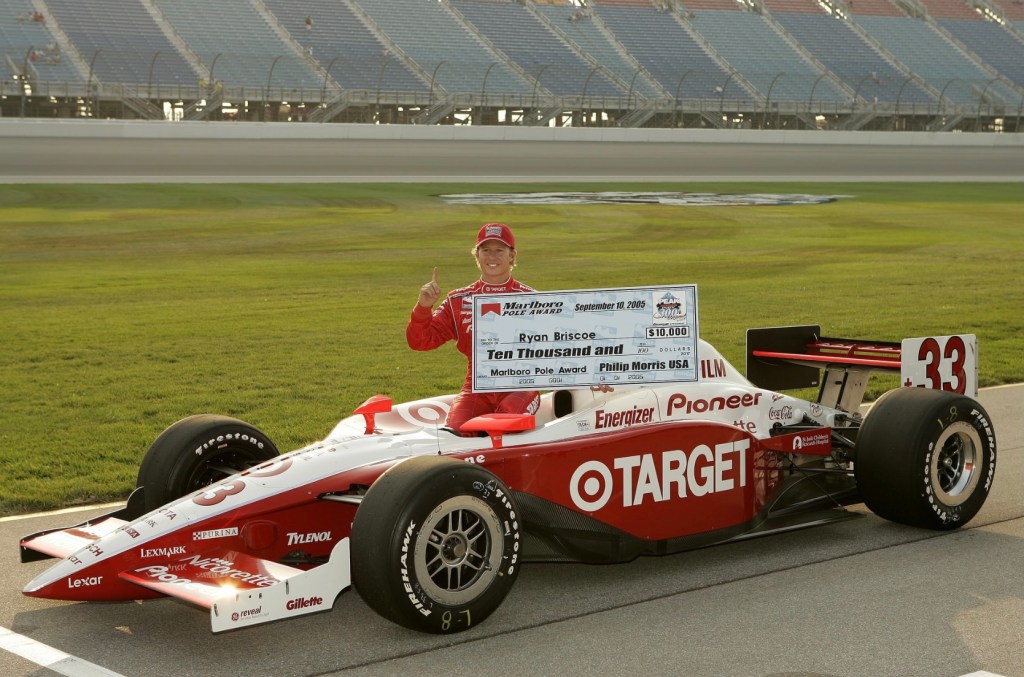
Here to zero at the Chicagoland Speedway, Joliet, Illinois on the Indy 300 September 10-11 weekend in 2005.
Here with the Gregory-Peck for pole, a handy $10k. It was Ryan’s second Indycar pole, he started from pole at Sonoma, the previous round but crashed out on the first lap. The car is a Chip Ganassi run Panoz GF09C Toyota.
Shortly after this happy scene the car failed post-practice scrutineering, so Ryan lined up last on the grid, perhaps sowing the seeds of the crash which followed.
(MotorSport)
‘Roger that, we have lift-off Houston.’
On lap 20 Briscoe’s Panoz GF09C Toyota ran into 15th placed Alex Barron’s Dallara Toyota (Q18) as he sought to go under him on his way up the field towards turn 3 of the 1.5-mile oval – look at the proximity of his right-rear to Barron’s head/roll bar area – and the staggering physics of a collision at 215mph were unleashed.
(MotorSport)
Briscoe hit the fence with the bottom of his Panoz first, it split in two as it ripped through a fence post, leaving a big hole. With a half-tank or so of fuel there was a spectacular explosion as the car split, with the cockpit safety cell spinning down the track narrowly avoiding other cars. Car 2 is Thomas Enge, #55 is Kosuke Matsuura.
(MotorSport)
After several anxious minutes Ryan was removed from the wreck – the monocoque had done its job well – and gave a reassuring wave as he was placed into the ambulance with injuries later diagnosed as two broken collarbones, a bruised lung, fractured right foot and contusions to his arms, legs and back.
Briscoe was hospitalised for nine days then had extensive rehab in the US and Italy before returning to the cockpit in a Riley Mk9 Pontiac 5-litre V8 in the Daytona 24-Hours on the January 28-29, 2006 weekend – four months after his Big One.
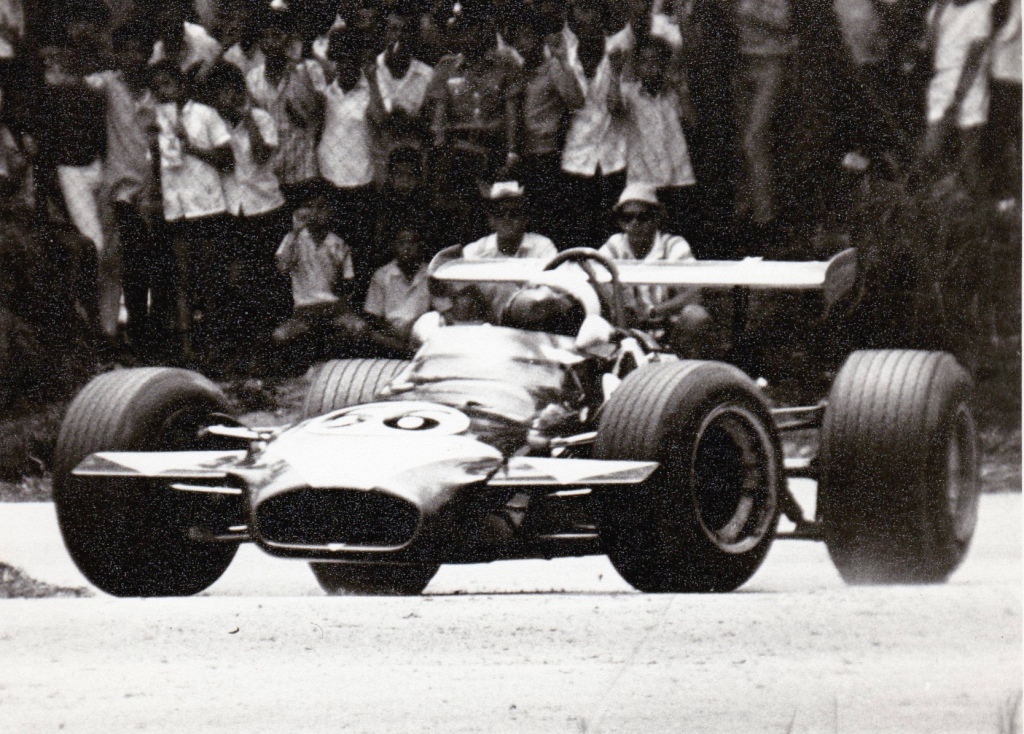
Kevin Bartlett and Graeme Lawrence at the start, Mildren Mono Alfa V8 and Ferrari 246T (SNL)
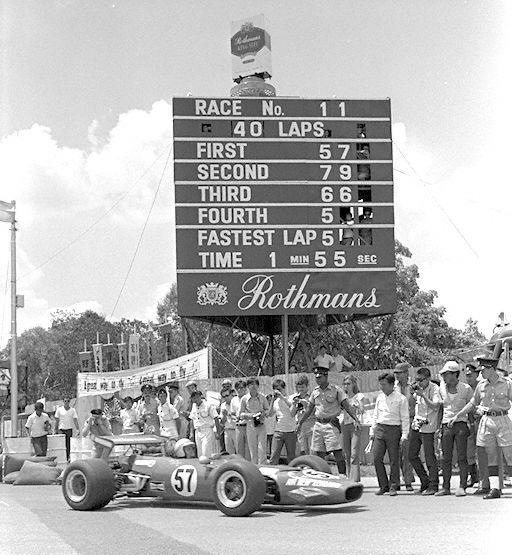
1970 SINGAPORE GP: THE FERRARI FROM THE ORIENT
Why the Kiwis always get along with the Ferraris?…
The history of Scuderia Ferrari in F1 and F2 has always been marked by being a team that rarely gives its “official” equipment to third parties. Ferrari single-seaters have always been known to race only under the aegis of Scuderia Ferrari itself. Even in more turbulent times, such as in 1961, when Giancarlo Baghetti raced a Ferrari 156 for both FISA and Sant’Ambroeus teams, there was always an attentive team of Ferrari mechanics on hand to take care of the car. Another case was the N.A.R.T., in the years 1964, 1965 and 1969; they were nothing more than fancy names for Scuderia Ferrari itself and its squad of mechanics and engineers.
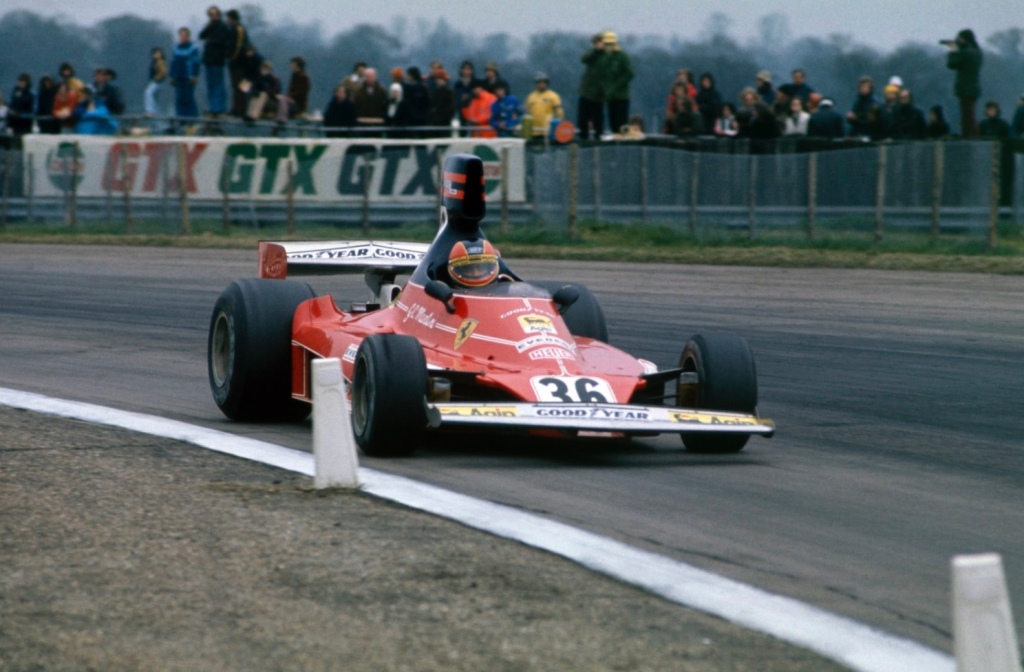
We can name rare occasions when the scarlet cars were given to third parties and took part in races by this way: one of them was the British Racing Partnership/UDT-Laystall Ferrari 156, driven by Innes Ireland, in the XIV BDRC International Trophy of 1962; another was Scuderia Everest (the forerunner of Minardi) in 1976, which with a Ferrari 312T competed in the Race of Champions and the International Trophy.
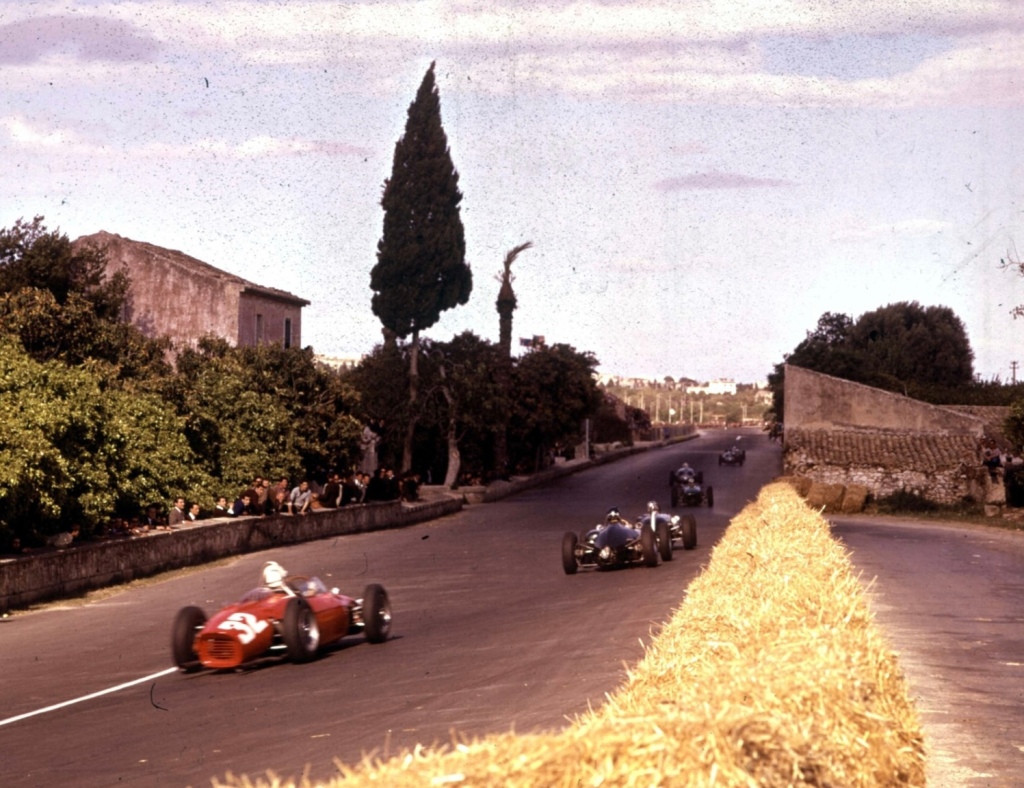
Giancarlo Baghetti, Ferrari 156 chases a BRM and Cooper on way to winning the April 1961 Syracuse GP (MotorSport)Giancarlo Martini, Ferrari 312T, 10th in the BRDC Intl Trophy, Silverstone April 1976 (MotorSport)
Moving on to categories below F1, we can highlight the Australian Scuderia Veloce. It was another one of those peculiar and picturesque stories that happened in motorsport in the 1960s and, who really stood out in the 1968/69 Tasman Series. Thereupon, stay tuned, because the real story of this text starts here.
But, as expected, without the support and protection of the Scuderia, most of these attempts ended in a resounding failure; we can credit this to the very complexity of the material, which required a team of technicians who knew how to put in motion an equipment as sophisticated as a Ferrari F1 car.
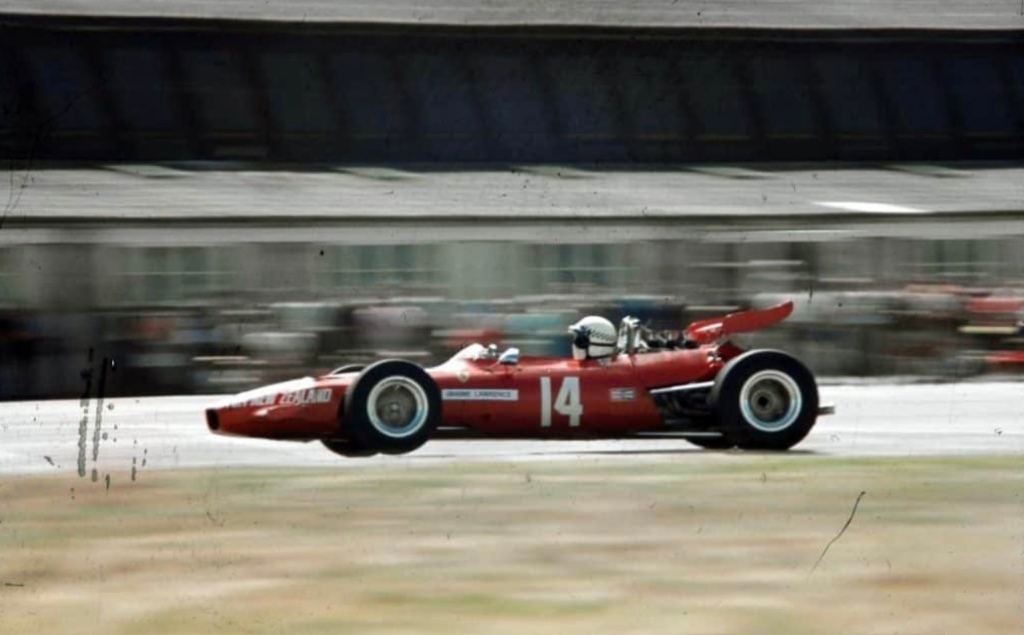
Perhaps one of the few successes reported by a single-seater Ferrari without being bankrolled by the Scuderia itself was due to the duo of Graeme Lawrence and his Ferrari 246T F2 Dino (the same Scuderia Veloce´s car from the beginning of the text – I’ve told you that the story started there). With successes in the main events of Southeast Asia in 1970, the pair proved to carry on the prestige of the Italian team.
The first example of the success of the partnership between the 246T and Lawrence came in the 1970 Tasman Series. This, which was the first edition in many years that did not feature the big European stars, opened the door for many smaller pilots and teams, mainly from the axis Australia-New Zealand, to have a chance to stand out.
And so it was with the New-Zealander, who, in the first race of the series, in Levin, already gave the first victory for the private Ferrari. And after a positive sequence of results in the next six races, the pilot would clinch the overall title of that season.
The next challenge would be the Singapore GP, which would take place at the end of March. The race, which was one of the most prestigious sport events in Asia-Oceania, always brought together the cream of the region’s pilots.
Graeme Lawrence, Ferrari 246T #008, during the 1970 Lady Wigram Trophy. DNF overheating in the race won by Frank Matich, McLaren M10A Chev (unattributed)(progcovers.com)
1970 Singapore GP…
Today, we always think about how F1 and F2 are almost interconnected categories, dependent on each other. Where one goes, the other’s circus usually follows. We also think about how F2 itself has gone beyond continental limits to become a global category – we have F2 races in Arabia, Australia, Azerbaijan – all of which form part of a unified international FIA Championship.
Well, the reality of the 60’s and 70’s was quite different. The F2 championships were as spread out as possible: there was one in Europe (which was considered “official”, in terms of historical classification); another two levels (of second tier single seater racing) in Oceania such as the Tasman Series and the Gold Star, which were a hybrid between the F1, F2 and, later, the F5000); several smaller tournaments in South America (such as the Argentine Temporada); and one in Asia.
The last one on this list was also one of the most peculiar: even though it was the most obscure, when it comes to the story itself, the racing season in Southeast Asia was made up of quite prestigious GPs, even for the time: for example, the Grand Prix of Malaysia, the Singapore Grand Prix and the internationally coveted Macau GP, were some of the races that made up the season.
For many pilots of Southeast Asia, this championship was the only opportunity that existed to compete in a real Grand Prix. Far from the magnitude and professionalism that took European motor racing by storm in the late 1960s, the GPs in Asia were almost a spectacular exercise in execution – but they were Grand Prixs, nonetheless.
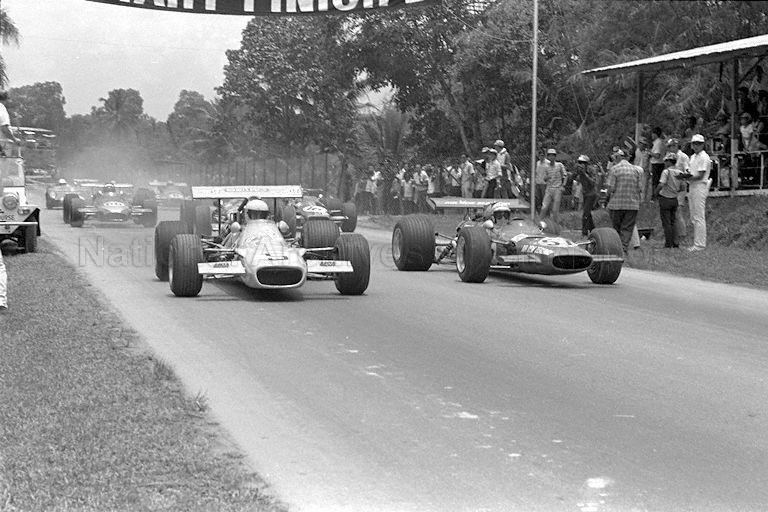
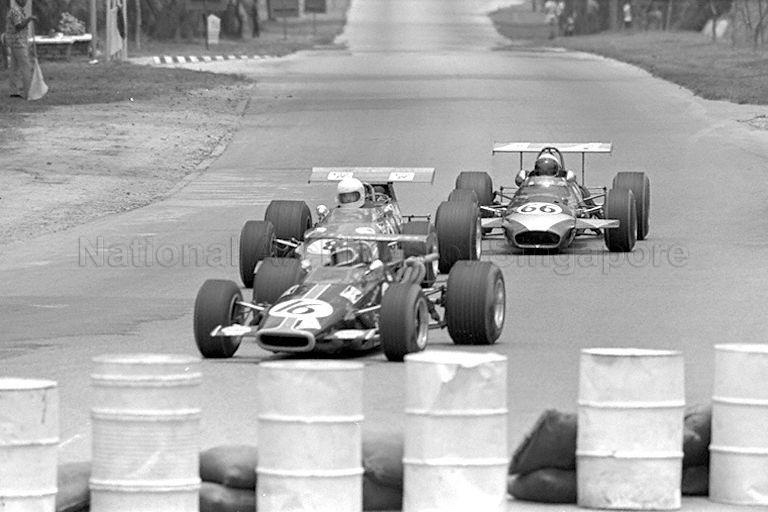
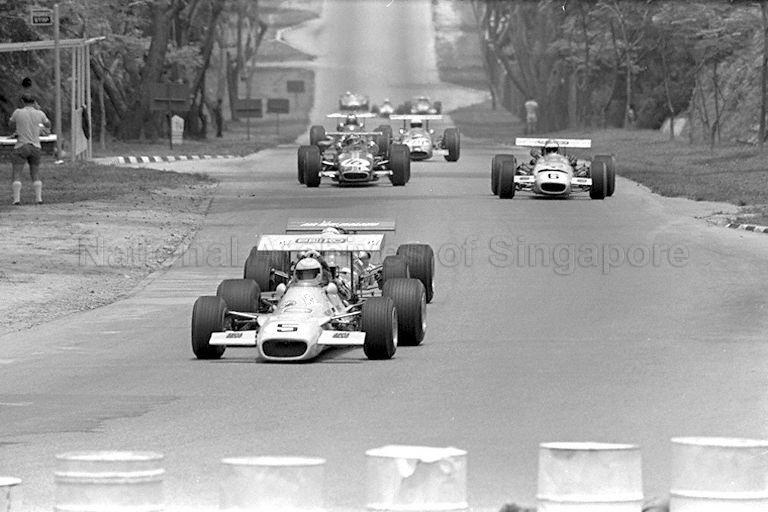
Bartlett and Lawrence on the front row with John MacDonald, Brabham BT10 Ford FVA, Hengkie Iriawan, Elfin 600C Ford FVA and Albert Poon, Brabham BT30 Ford FVA #66 behind. Lawrence won from MacDonald and Poon (SNL)From the other side of the road (SNL)
The issue is that, even with the knowledge of the European teams about these races, there was no interest in sending representatives to compete in these GPs. Why? Well, we can draw some assumptions about it: first, to mention the commitment to European F2, which already drained a large part of the resources; the calendar, which conflicted with some of the big races in Europe; and, more obviously, the cost and logistical problems of keeping these complex cars in such precarious locations as those in Malaysia, Thailand or Singapore.
Therefore, it was up to the region’s drivers to fill the grids of these races. As varied as the origins, as there were drivers from Australia, New Zealand, Malaysia, Hong Kong, were the cars that made up these grids. Even though ‘theoretically’ qualified as non-championship F1 races, most of them took place under Formula Libre regulations. So it was common to see F2 cars, modified F3 chassis, F5000 and Tasman Specs competing with each other in the late 1960s and early 1970s.
Following this script, we set the stage to the 1970 Singapore GP. After the great balance of the Tasman Series, which ended just a month before, it was expected that a large contingent of drivers who participated in that series would also participate in what was one of the great automobile events of Southeast Asia. And a great show was promised, especially with the tone of revenge that was publicized by the press: would the runner-up of the Tasman Series, Frank Matich, give the payback on Graeme Lawrence?
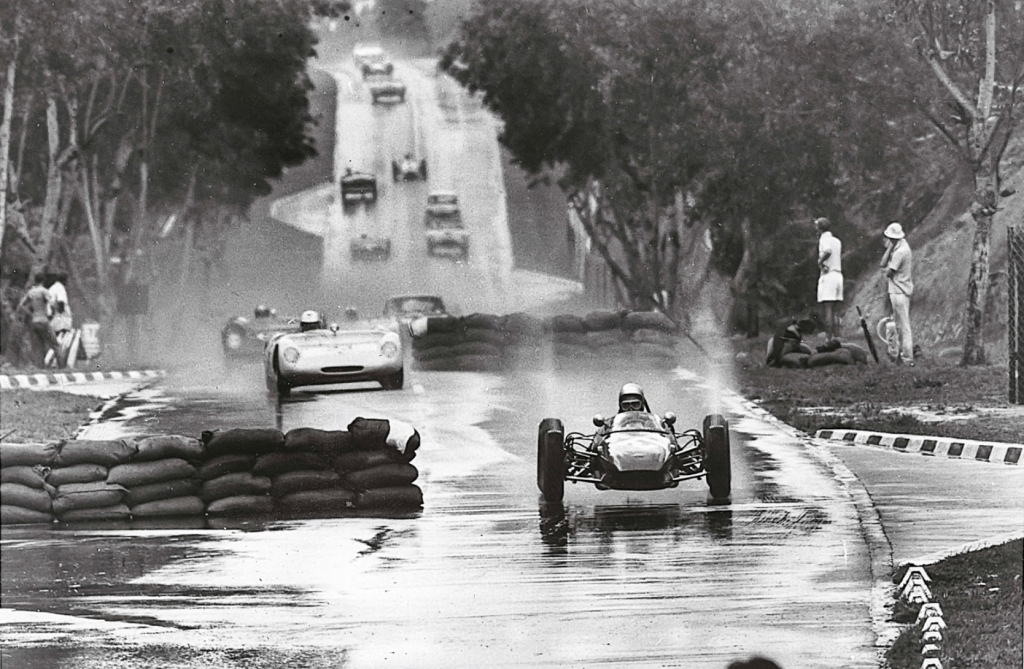
And the lift-off over the Java Sea really happened. The main drivers to confirm their presence were Graeme Lawrence, Frank Matich, Kevin Bartlett and Albert Poon; in addition to them, another eighteen pilots were registered in the GP’s preliminary list.
The main attraction was, of course, the newly crowned Tasman Series champion (and also 1969 Singapore GP champion) Graeme Lawrence and his Ferrari Dino 246T Tasman. With chassis number 0008, this was the same car that was “lent” to Chris Amon to compete in the Tasman Series one year before.
By itself, this car already had a rather peculiar history. Scuderia Ferrari loaned two chassis to Chris Amon to compete in the 1969 season of the Tasman Series: the 0008 itself, in addition to the 0010. With this loan, conditions arrived: the first was to have another official Ferrari driver in the second car; and the chosen one was Derek Bell. Another point is that the car would not be officially managed by Maranello, but by Amon himself, for the duration of the championship – but the results achieved would be attributed to Ferrari. (The cars were entered by SEFAC Ferrari (oldracingcars.com), were managed on-the-ground by Amon and Scuderia Veloce and the cars tended by a mix of Scuderia Ferrari, Scuderia Veloce and Amon’s longtime friend and personal mechanic, Bruce Wilson.)
The cars themselves were basically the same as those that contested the 1968 European F2 season and the Argentine F2 Temporada later in the year, the biggest differences being the engine, modified to a 2.4 -liter Tasman, and the expanded power boost, up to 285 bhp. Even with these modifications, and the great results achieved by the car in the last races of 1968, Chris Amon had doubts if this would be enough in 1969. To his own surprise, it was, and Amon himself became champion of the 1969 Tasman Series.
After this victory, the car did not even return to Europe (I think it may have been rebuilt by the factory and returned to New Zealand-Mark). Amon handled the sale of chassis 0008 to Graeme Lawrence, who continued Ferrari’s legacy in Australia and New Zealand after the team announced that after the 1969 edition, it would not return to the Tasman Series next year.
Frank Matich and McLaren M10A Chev before the high speed accident (E Solomon Collection)Hengkie Iriawan, Elfin 600C Ford FVA ahead of Allan Bond, car unknown (SNL)
Lawrence’s biggest challenger was the Australian Frank Matich, who had been runner-up in the 1970 Tasman Series (the difference between Matich and Graeme was only 5 points). He would drive a McLaren M10A, a car built to Formula 5000 specifications. With chassis number 300-10, the car would use a new 5-liter Traco-Chevrolet V8 engine. With strong sponsorship from the Rothmans cigarettes, Matich was arguably the main threat to Lawrence’s victory.
Kevin Bartlett was also another standout in the 1970 Tasman Series and was one of the big favorites for the race. Driving an English-built Mildren-Mono (nicknamed Yellow Submarine), he had achieved a string of good results earlier in the year, culminating in victory at Warwick Farm.
The last of the highlights was Albert Poon, a well-known driver on the Southeast Asian GPs, mainly for his appearances in Macau. Poon had one of the most advanced cars on the grid: the Brabham BT30. This model, which was one of the most used in European F2 between 1969 and 1970, would now have the chance to demonstrate its potential in the lands of the East.
Specifically, Poon’s car was an ex-Frank Williams, having been driven by Piers Courage and Richard Attwood in several races in Europe during 1969. At the end of that same season, the car was sold to Albert Poon.
Poon, Brabham BT30 Ford FVA at the Hairpin (unattributed)
The drivers began arriving in Singapore on March 25th. Upon arrival, the first concern was not about present events, but future ones. As a rumor circulated that the race would not be held the following year, and an appeal was made by the pilots: for the creation of a Grand Prix of South East Asia or a fixed series of races that could attract international interest.
Some participants even gave their opinion on the subject, such as Kevin Bartlett: “Most of them (pilots and teams) are not keen to spend big sums of money just for one race. If you have four held in a row, they will certainly be attracted”.
Frank Matich even suggested a union between the Australian Championship and this possible series of races in the region: “If the idea of the Far East circuit failed, then Singapore should go ahead to arrange a series of three races with Malaysia. This could in time join the Tasman Series”.
But the great demonstration of what the cogitated South East Asian Grand Prix might be could only be given on the track; and on the 26th, activities began on the dreaded Thomson Road circuit. Right in the first track reconnaissance session, Graeme Lawrence made it clear that he would not give his opponents any chance. He pulverized the track record, set the previous year, lowering it by 1.8s, establishing a time of 1’57”8.
Iriawan leads Malcolm Ramsay, Elfin 600C Repco V8 and Poon along the Thomson Mile (SNL)
With less than a second difference and setting the second fastest time, came Kevin Bartlett and his Mildren Mono Alfa Romeo V8. And the dominance of the Tasman Series drivers did not end there, because Max Stewart, in a characteristic Mildren-Waggott 2-litre, managed to snatch the third position, closing a lap in 1’59”6 (same time as the 1969 record). With two drivers beating the track record and another equaling it, it was soon demonstrated that the 1970 edition would be one of the fastest in the history of the circuit.
And that speed almost proved fatal on the first day, when Frank Matich lost control of the car at more than 257 km/h and ended up in a tree, near a bus stop. According to what the pilot reported at the time, when leaving the first part of the Thomson Mile and going over the Hump, the car went out of control due to the track condition, which was extremely slippery as a result of a light drizzle that was falling on the circuit. Without being able to do anything, the driver simply became a passenger in his own car.
Fortunately, the pilot was completely unharmed from the accident; the same cannot be said of McLaren, which had the front almost ripped off due to the impact. At the time of the accident, the driver had the fifth best time, but the crash basically ended Matich’s chances of trying to duel with Graeme. It was now up to Rothmans’ team of mechanics to try to get the car in the best possible shape for the next day’s official time stamps.
The 27th arrived and with it, a phenomenon so common on the island of Singapore: the traditional tropical storms in the afternoon. Weather conditions became so adverse (even by local standards) that all activities on the circuit had to be cancelled.
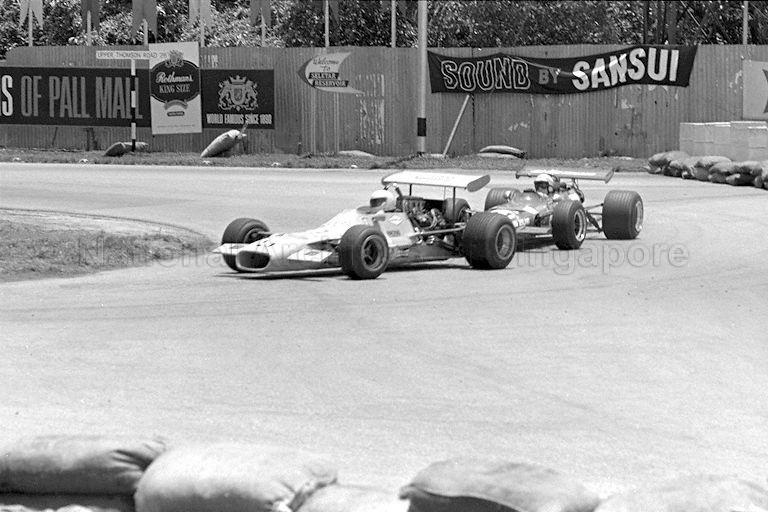
Bartlett and Lawrence hard at it (SNL)
The one who was grateful for the downpour was undoubtedly Frank Matich, who had already accepted his fate of starting in the last position of the grid; but now, with one more day to prepare the car, the pilot believed that his mechanics could put the McLaren in conditions to dispute the victory again.
The 1970 Singapore GP would be held in 2 heats: the first, on Saturday (28), would be a more sprint race, with 20 laps. On the following day, Sunday, the other 40 laps would be carried out, making a total of 60. For the final result (and the title of Singapore GP winner), only the outcome of the second heat would be taken into account.
Some of the drivers were not very fond of this dispute format, mainly because it favored certain cars over others. For example, Albert Poon highlighted how his Brabham would have an advantage over the monstrous Australian engines, if the dispute was held in only one-full heat: “My car is specially fitted with a 21-gallon tank which is more than sufficient to last the race without refueling”.
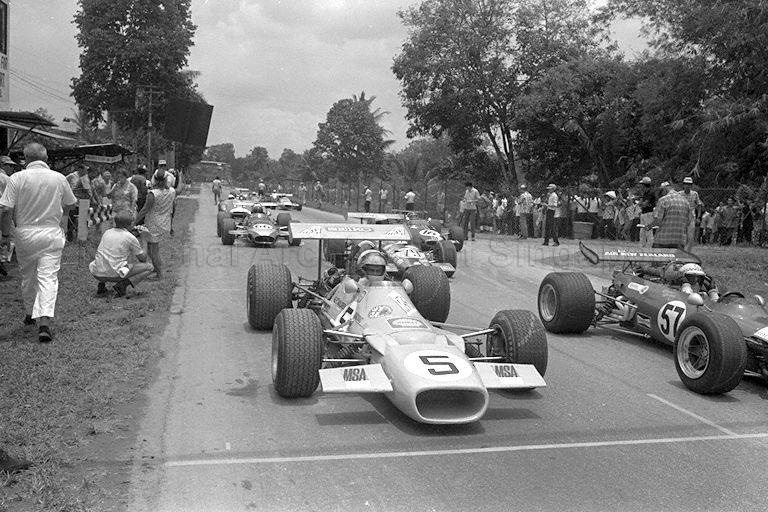
Liking it or not, the riders lined up on the grid for the first heat. The starting order was defined by the times of the free sessions: therefore, Graeme Lawrence and Kevin Bartlett were the ones who opened the grid, followed by Stewart, Matich, MacDonald and Poon.
With the checkered flag lowered, the cars shoot off on the 4,865-metre circuit. It quickly became clear that the fight would be between the two Italian-made engines: Bartlett’s Alfa Tipo 33 2.5 V8 and Graeme’s Dino/Ferrari 2.4 V6.
But Graeme had a scare on the second lap, when the driver missed the braking point on the Range Harpin and ended up on a spin. Nothing to worry about, as both the car and the pilot emerged unscathed; so, Graeme resumed his hunt for Bartlett.
Ramsay presents an opportunity for Poon on the inside, Elfin 600C and Brabham BT30. The battle for third/fourth was won by Poon (SNL)
Right behind, a compact group was formed, involving Mike Heathcote (Singapore), John MacDonald (Hong Kong), Albert Poon (also from Hong Kong) and Hengky Iriawan (Thailand). On the second lap, these drivers would provide another one of the remarkable moments in the history of the Thomson Road circuit.
On the Thomson Mile (that’s right, almost in the same place as Matich’s accident), Mike Heathcote was trying to overtake Albert Poon. The Singapore driver, equipped with a 1.6-liter Brabham-Ford Twin Cam (Formula Libre), forced the overtake too much, skidding with the car and stopping only on trees that that dotted the sides of the circuit.
The car broke in two due to the collision, with the engine block disappearing in the middle of the dense forest that surrounded the track. Again, to the relief of the audience, the pilot left the accident almost unharmed.
As such accidents were common at the circuit, the race continued. Frank Matich, who owed a lot to the Rothmans team of mechanics, after the superhuman work of rebuilding the car in just two days, looked like he could get a reasonable finishing position in the Saturday heat race, to give all he could on Sunday. But that idea soon fell apart.
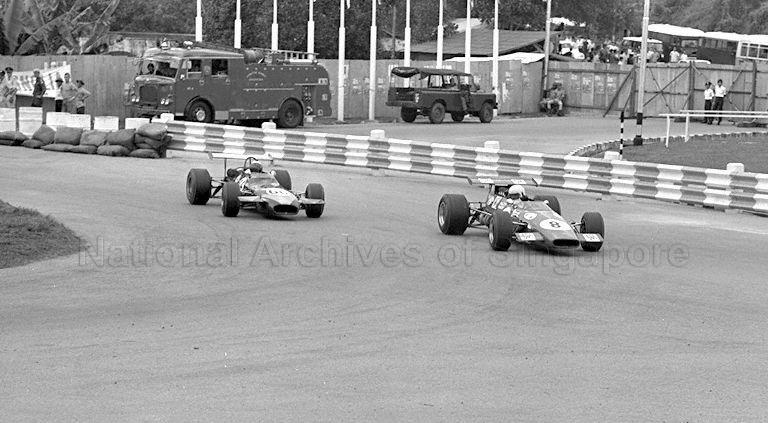
Bartlett with Lawrence right on his tail, then KB’s teammate, Max Stewart, Mildren Waggott, Iriawan, MacDonald and the rest (SNL)
On the third lap, the Australian faced his first problem, with a puncture. No big deal, this being quickly circumvented. But five laps later, a terminal problem spelled the end of any hope, as the engine gave its last breath and died.
Another one who was also struck by bad luck was Max Stewart: on the same lap that Matich made his tire change, Stewart’s Mildren-Waggott also refused to continue going forward, since his engine also had terminal problems. In the end, the pilot, who had scored the third best split time in mid-week practice session, had to abandon the race.
So with two of the top four drivers out of action, the battle for the victory would be decided between Bartlett and Graeme. Lap after lap, the duo pulled further away from the rest of the pack, with both lapping the rest of the grid.
With great skill, Bartlett used the power of the Mildren-Alfa V8 against the nimbler Ferrari. And so it was, managing to slowly open up an advantage, which reached nine seconds when the final checkered flag dropped. In addition to securing pole position for Sunday and relegating Ferrari to second place, Bartlett set a new track record: 1m55’8.
Iriawan in the Elfin 600C Ford FVA, car extant and currently being restored in Sydney (unattributed)
One lap behind, therefore, came the other classifieds: John MacDonald (Brabham-Cosworth FVA BT10/23C), Albert Poon (Brabham-Cosworth FVA BT30), Hengky Iriawan (Elfin-Ford Cosworth FVA 600C), Chong Boon Seng (Lotus-Cosworth 41) and Steven Kam (Lotus-Ford 23B Twin Cam).
But there was no time to celebrate and the next morning the cars lined up again on the starting line, for the race that would really define the winner of the 1970 Singapore GP.
The grid was slowly decimated by the fatigue of the long week that preceded this heat: among the drivers who did not show up on the decisive day, of the cars that were victims of accidents, mechanical problems and other failures, only 10 would start on Sunday. Even with this number much lower than expected, that did not stop the public from invading the Thomson Road circuit. According to some press reports at the time, there were about 100,000 people on the sidelines of the track on that Sunday morning.
Start, and the grid quickly pulverized into two small groups: Bartlett, Lawrence and Max Stewart (who had managed to fix his car overnight) took the lead, while MacDonald, Poon and the other drivers disputed the middle positions of the grid.
Bartlett led from the start and had a 3-sec lead from Lawrence when his Alfa V8 cried enough with 3 of the 40 laps to run (SNL)
In the first laps, Graeme Lawrence spun his car again. But, as if the script was repeating itself, it was nothing that affected the performance of the pilot. In less than five laps, the driver and his Ferrari had already reached the top two again; and on the tenth lap, Lawrence had already recovered the second position, when he overcame Max Stewart.
And Graeme’s momentum didn’t stop there. With the very strong race pace that was being set by Bartlett, the Ferrari became the only car that could catch the Mildren-Alfa. And so began the chase, which would last for most of the race.
Bartlett piled up faster and faster lap times, managing on the 27th lap to set a new track record: 1m55’5. Graeme answered, keeping close to the pilot of the Mildren.
Max Stewart sought to protect himself, accepting the third position – he didn’t have the car to compete with the leaders, but also, wasn’t threatened by the drivers that came further behind. But even going at a cruising pace doesn’t mean reaching the end of the race: during one of the laps, the pilot became distracted in the Long Loop, where lost control of the car and ended up in the middle of the trees. End of race and goodbye podium.
Graeme Lawrence on the way to another win in Ferrari 246T #008 (SNL)
So, the race was summed up between the Bartlett vs. Lawrence battle. And luck again laughed to the last. When the Ferrari driver had reduced the gap to less than 2 seconds, Lawrence saw when Bartlett had to pit, on the 37th lap. He didn’t know it, but the Australian’s Alfa engine had overheated, due to the sweltering conditions of the Singapore.
So, without competition and with only three laps to go, the driver had no trouble leading Ferrari to another victory (the second with him at the wheel, if you count his victory in Levin). Two laps behind came the drivers who would complete the podium: John MacDonald and Albert Poon, second and third, respectively.
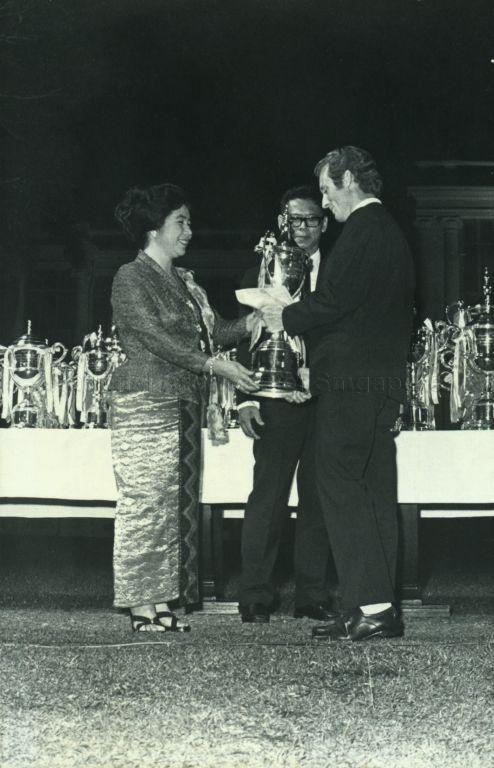
Graeme Lawrence was crowned winner of the Singapore GP once again. The pilot had made a high stakes gamble on the race: according to what he told in an interview to The Straits Times a month later, he managed to take only one chassis and one engine to Singapore! Because of this, the pilot accepted second place in the first heat, and then waited for the opponent’s error (or car failure) in the second. We can say, apparently, that the strategy paid itself off in the end…
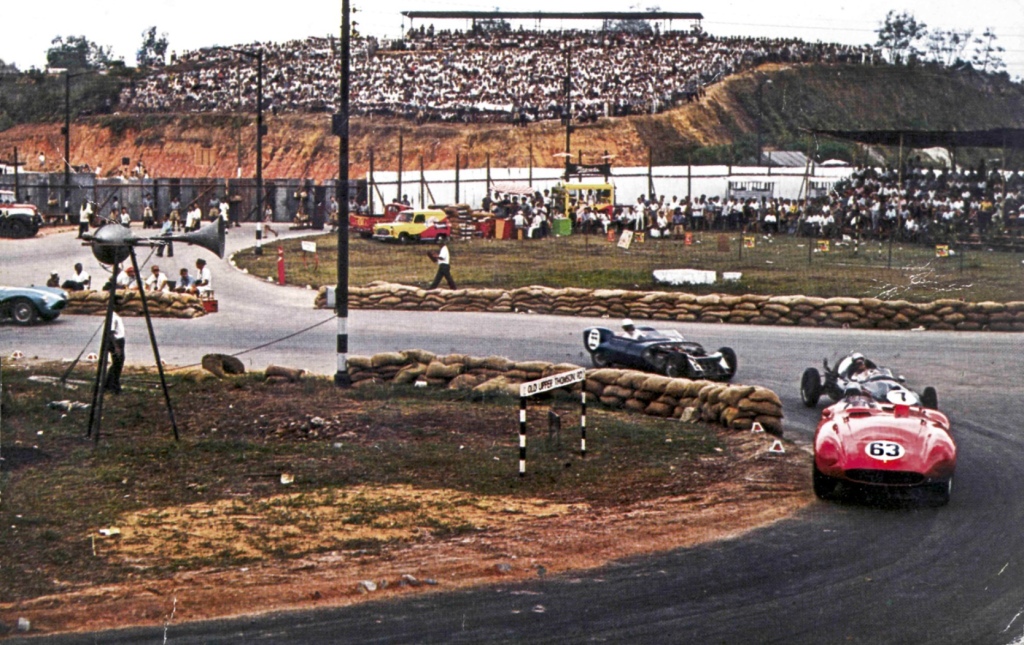
(SNL)To the victor the spoils, Graeme Lawrence (SNL)Jan Bussell’s Ferrari Monza leads the first Singapore GP in 1961. Giving chase are the Peter Cowling Cooper T51 Climax and Saw Kim Thiat’s Lotus 11 Climax. The nose of Ian Barnwell’s Aston Martin DB3S is at far left (E Solomon Collection)
Thomson Road : A distant memory in a forgotten past…
If the 1960s were marked by the technological development of competition single-seaters (mainly in F1, F2 and F3), we can say that the 1970s were marked by another transformation: the increase in concern about the safety of circuits.
Venues like Piccolo delle Madonie, Nurbürgring Nordschleife, Spa-Francochamps and many others would have a hard choice to make: adapt to the new times, or have to say goodbye to their racing times. While certain tracks did manage to make modifications that would guarantee a minimum of safety for pilots and spectators, others never reappeared. A major ‘purge’ ended up happening in the 1970s – nostalgic people can say that this was tragic for the history of motorsport; realists might say it had to be done, for the sake of the survival of the sport in a long-term.
If the blow was hard in Europe, where a large portion of the tracks had traditional events, with sponsors and captive audiences, one cannot even imagine how this was felt in the most peripheral parts of the racing world.
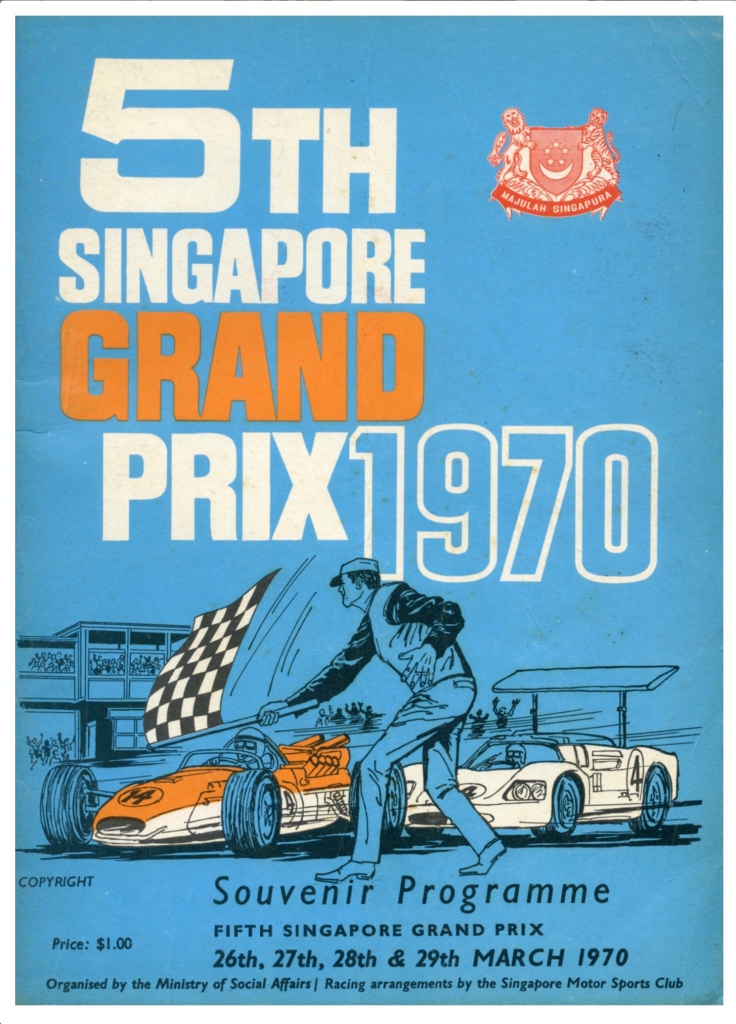
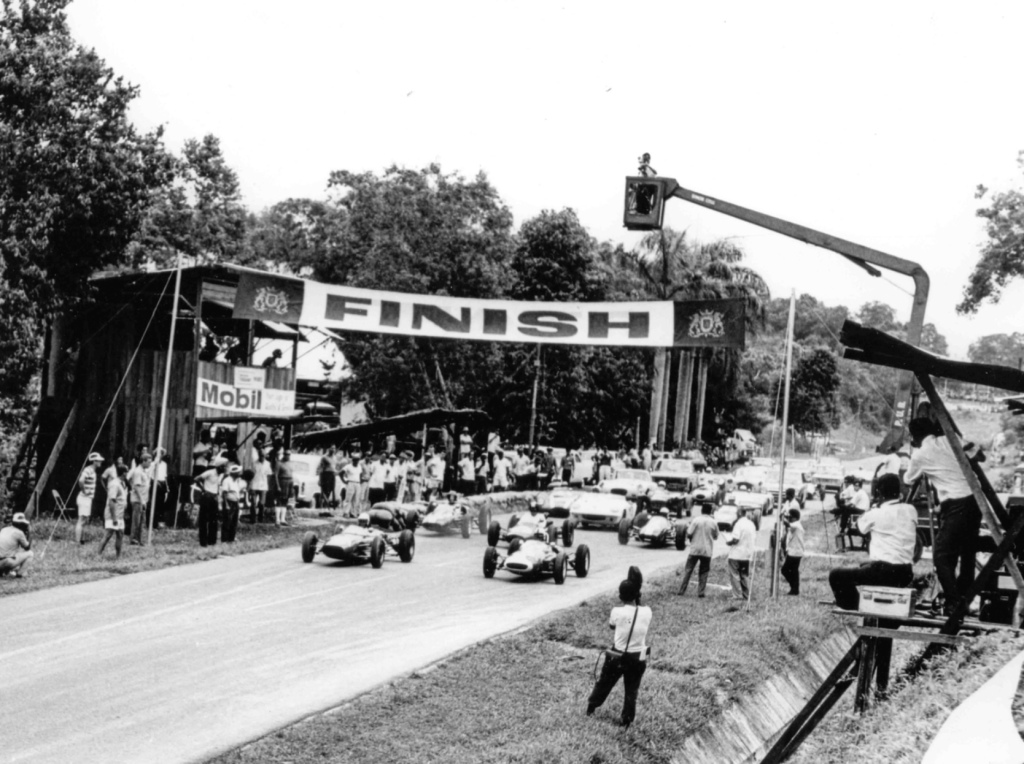
In this category is the Thomson Road circuit. Opened in 1961 for the Orient Year Grand Prix, it quickly became one of the most prestigious events in the Formula Libre racing series in Asia. When Singapore became independent, the venue gained even more prominence and importance, and in 1966 it was rebranded the Singapore Grand Prix.
Start of the 1966 race.eclectic mix of single seaters, sportscars and sedans including the pre-war ERA R2A (E Solomon Collection)Rodney Seow ahead of the rest of the 1964 grid, Merlyn Mk5/7 Ford. The race was red-flagged after 7 laps (E Solomon Collection)
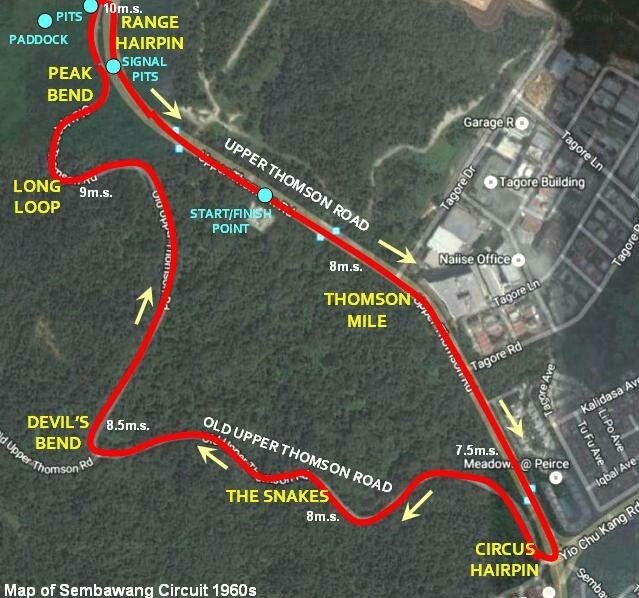
The circuit, just under 5km long, gained fame for its winding, fast and extremely dangerous layout. The track started at the Thomson Road (a.k.a. the Murder Mile), which is one of the most important roads in Singapore. The Mile was spilt in two, by the Hump, a fast right uphill turn, with a false apex on its turn-in.
The second part of the Mile ended abruptly at an elbow, known as the Circus Harpin. After this turn, the drivers began a slight access, that led to the most sinuous part of the circuit: first the 4-sequence of bends known as The Snakes, then the Devil’s Bend curve; this was the entrance to another long radius turn, which was bound for the Long Loop and Peak Bend turns. After that, the pilot was almost at the entrance to the pits and at the end of the lap, which was outside the Range Harpin.
Racing at Thomson Road circuit lasted until the mid-1970s (the 1974 edition was canceled at the last minute), when it became clear that the track was woefully out-of-date compared to other venues in the region. In just 11 years of operation, 7 people died on the circuit – not mentioning so many other terrible accidents, in which pilots and spectators miraculously left unharmed or with only minor injuries.
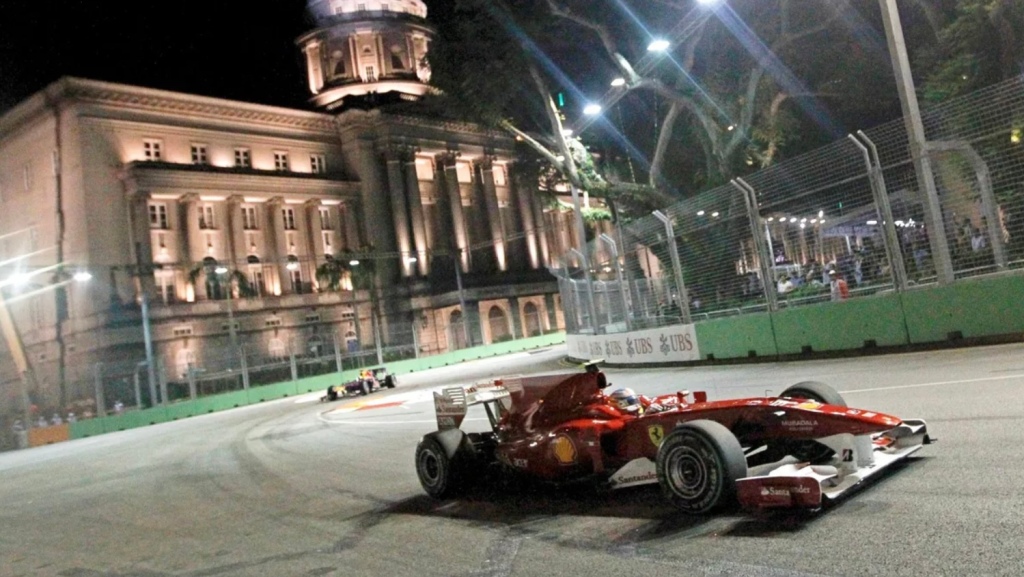
Thomson Road was a victim of its time and circumstance, like so many circuits of the past. Only 35 years later, a GP for single-seater cars would be held again in Singapore. And it would take 40 years (1970 with Graeme Lawrence / 2010 with Fernando Alonso) for a Ferrari to return to the highest place on the podium in the Island-State.
Fernando Alonso on the way to 2010 victory in a Ferrari F10 (eurosport.com)
Acknowledgments…
The Straits Times (editions from 24 March to 20 April 1970), The Eastern Sun (editions of 29 and 30 March 1970), Singapore National Library / NLB for the Photos, OldRacingCars.com for some extra data, ‘Snakes & Devil’s: A History of the Singapore Grand Prix 1961-1973’ Eli Solomon, MotorSport Images, Eurosport.com
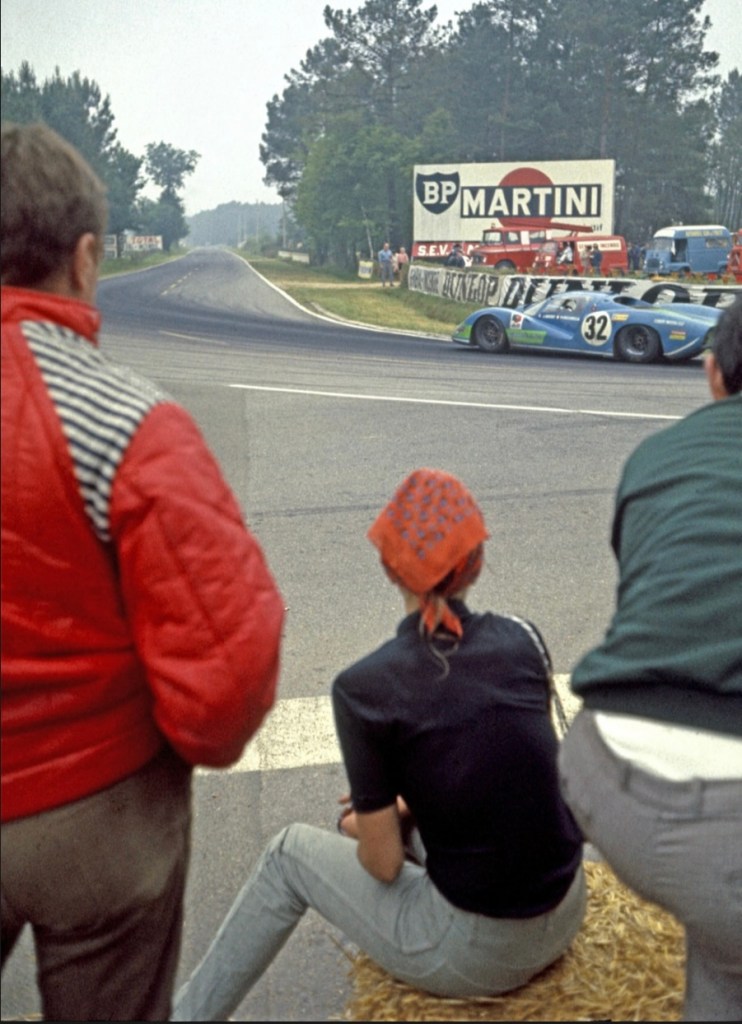
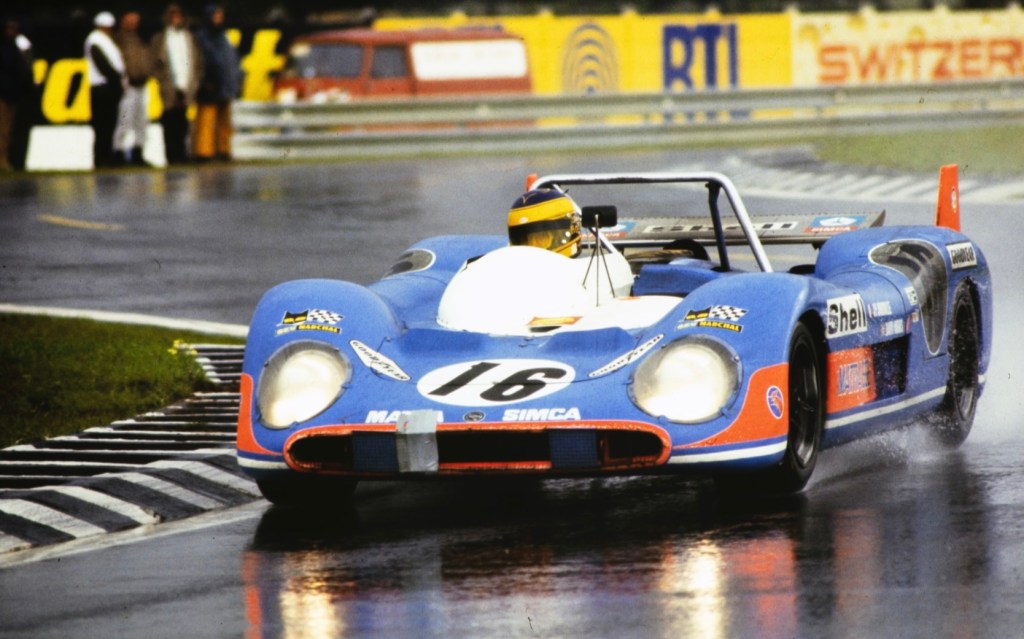
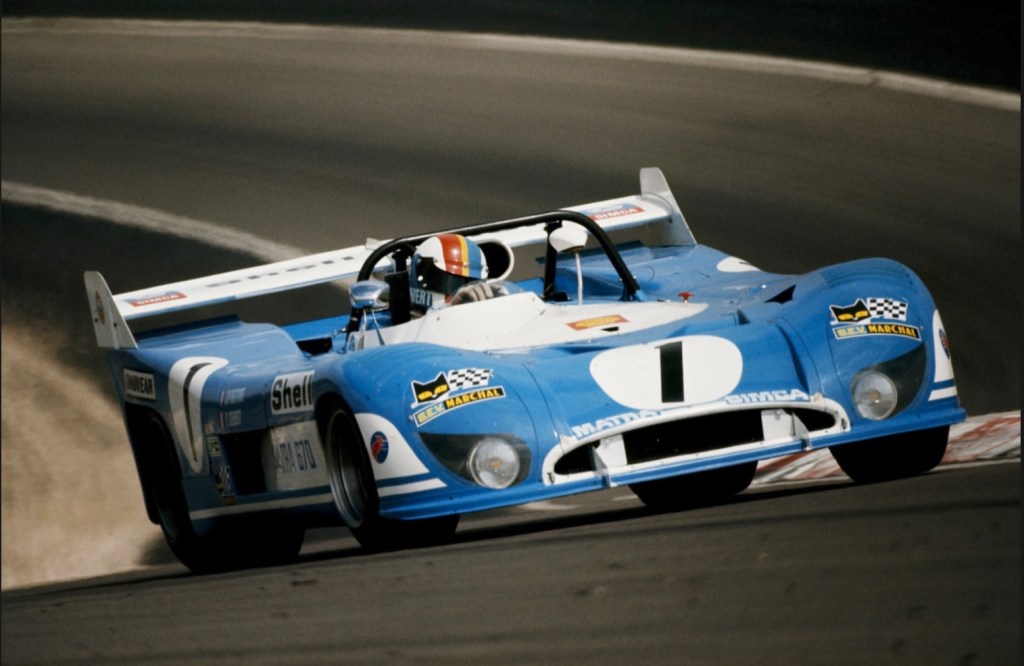
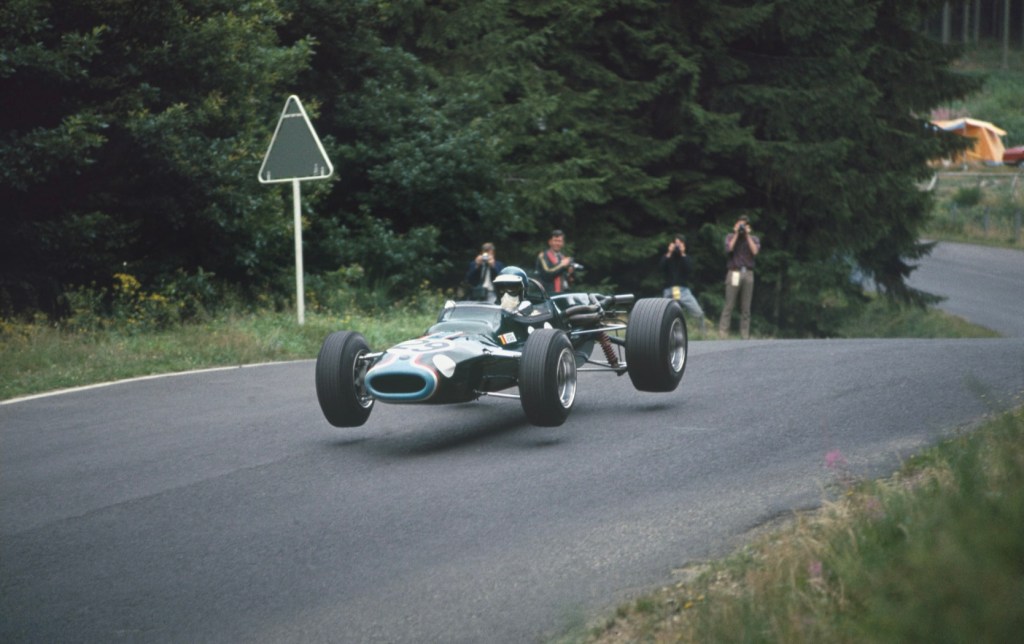
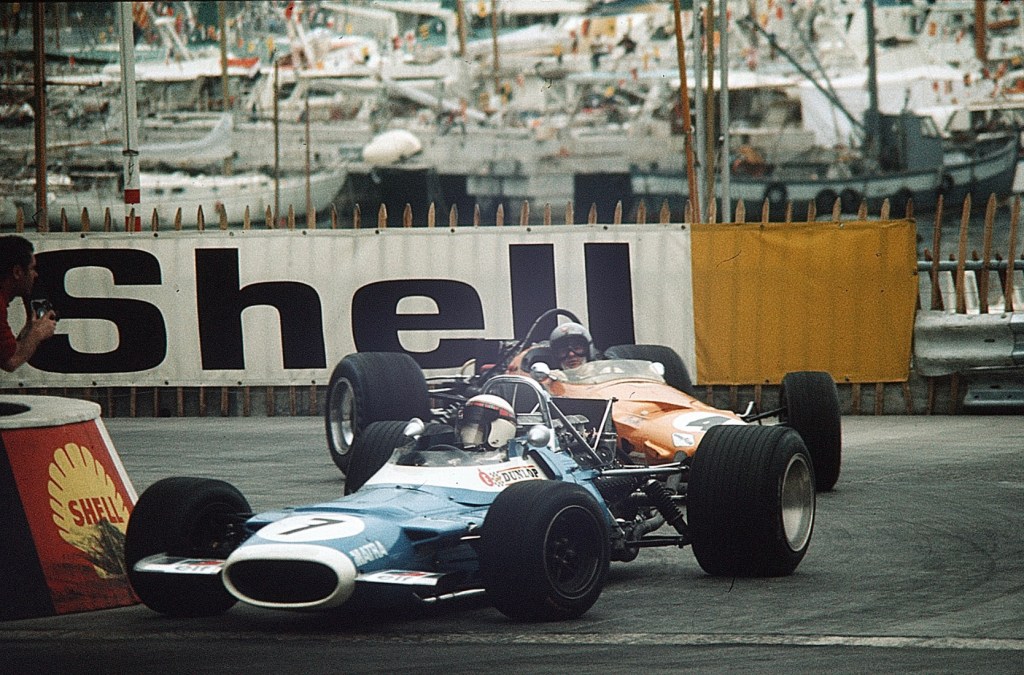
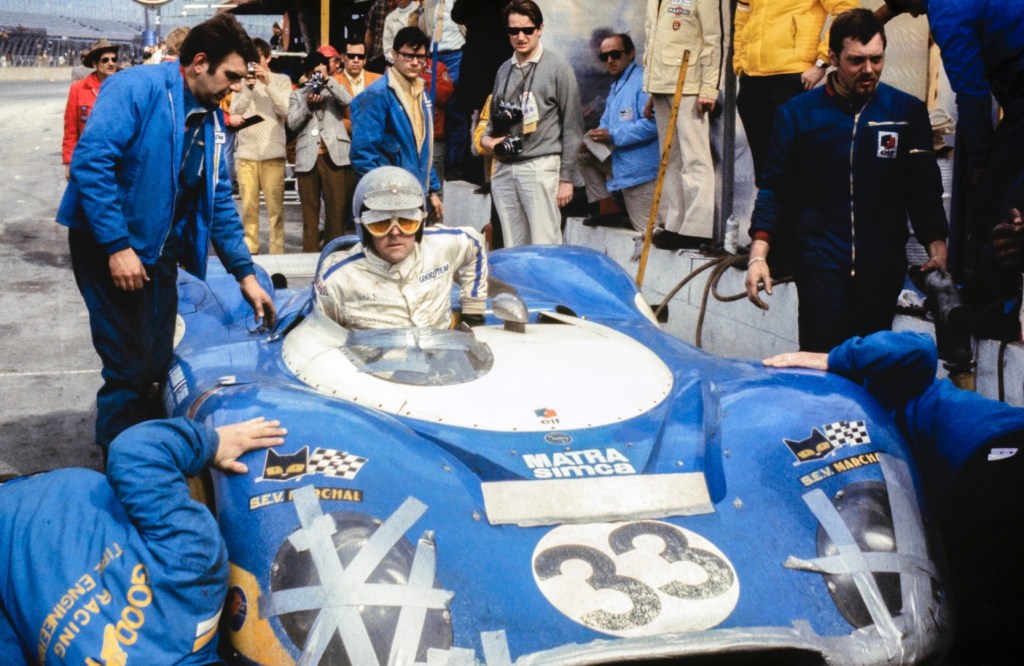
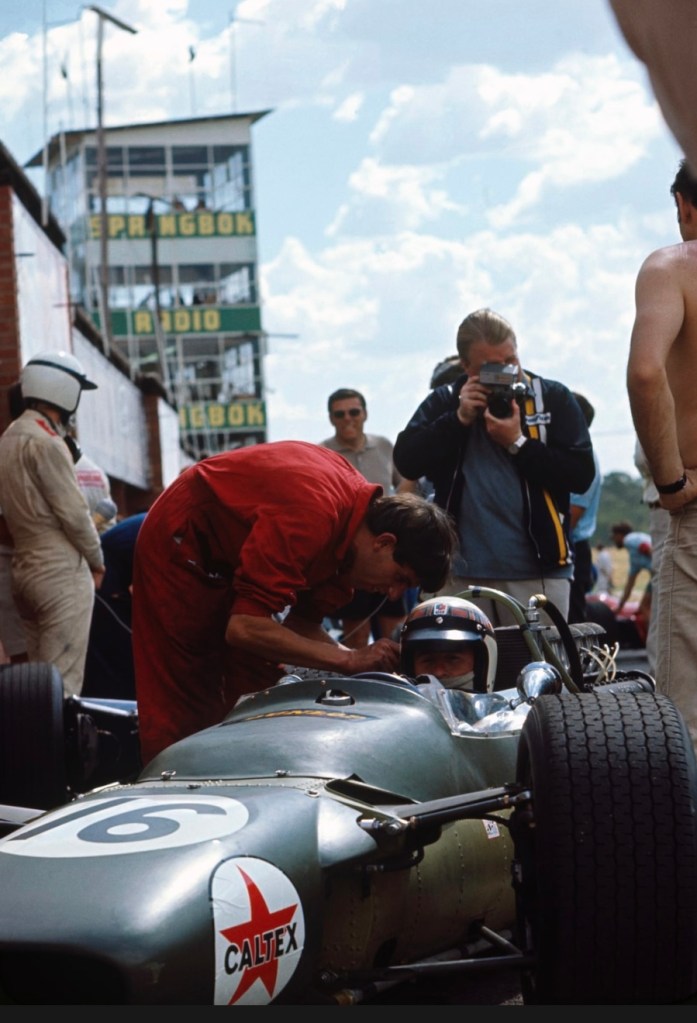
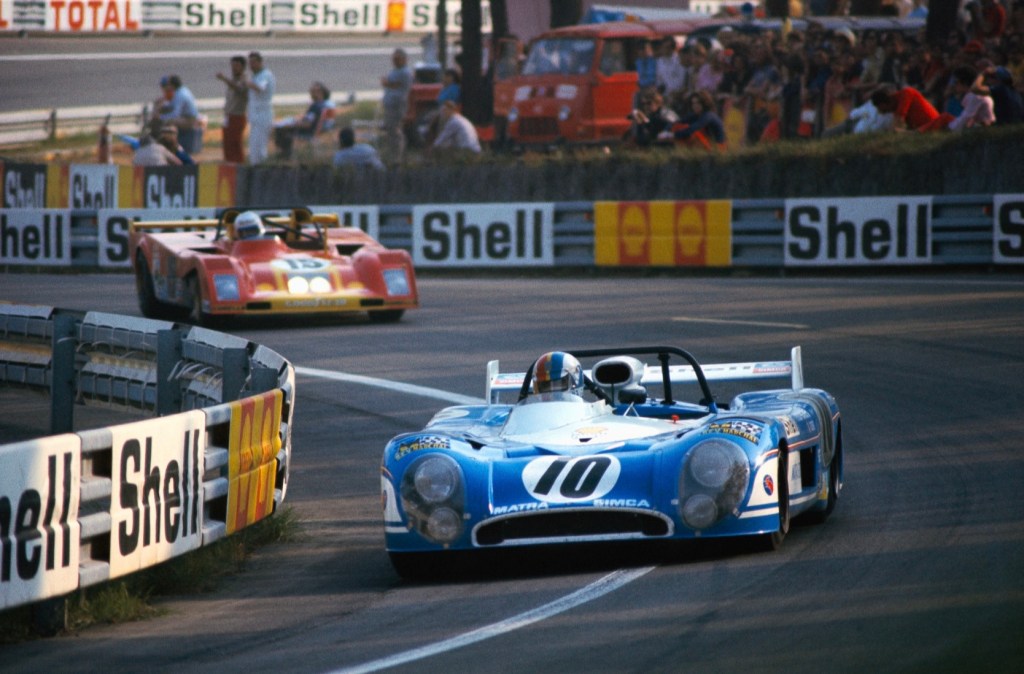
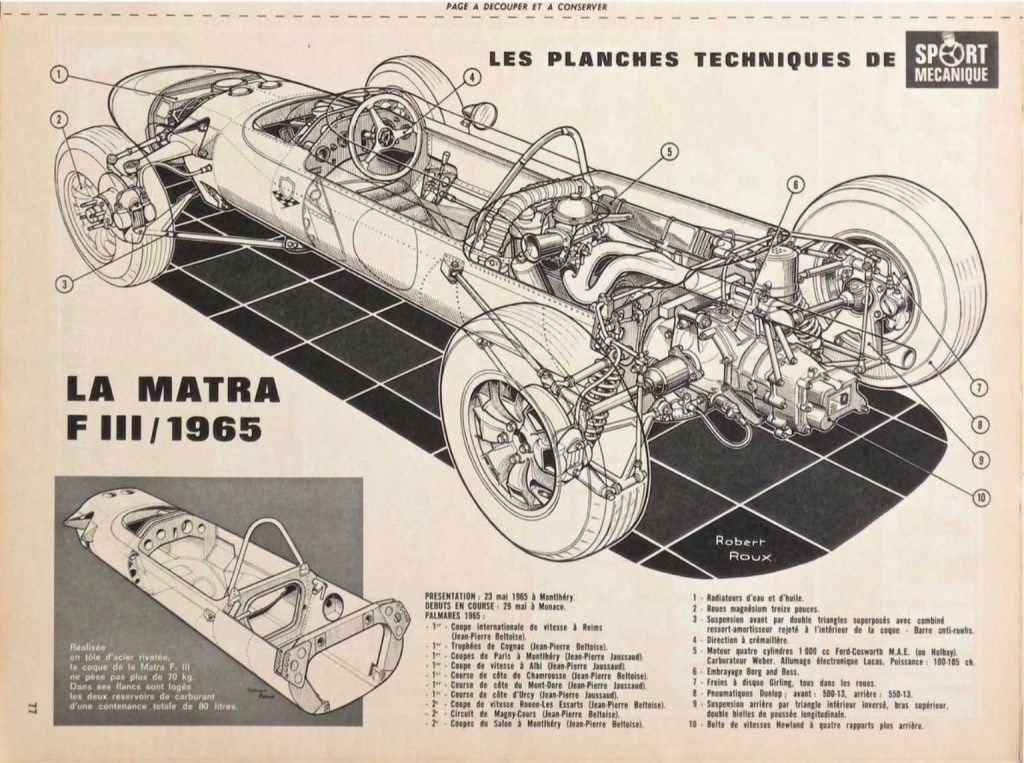
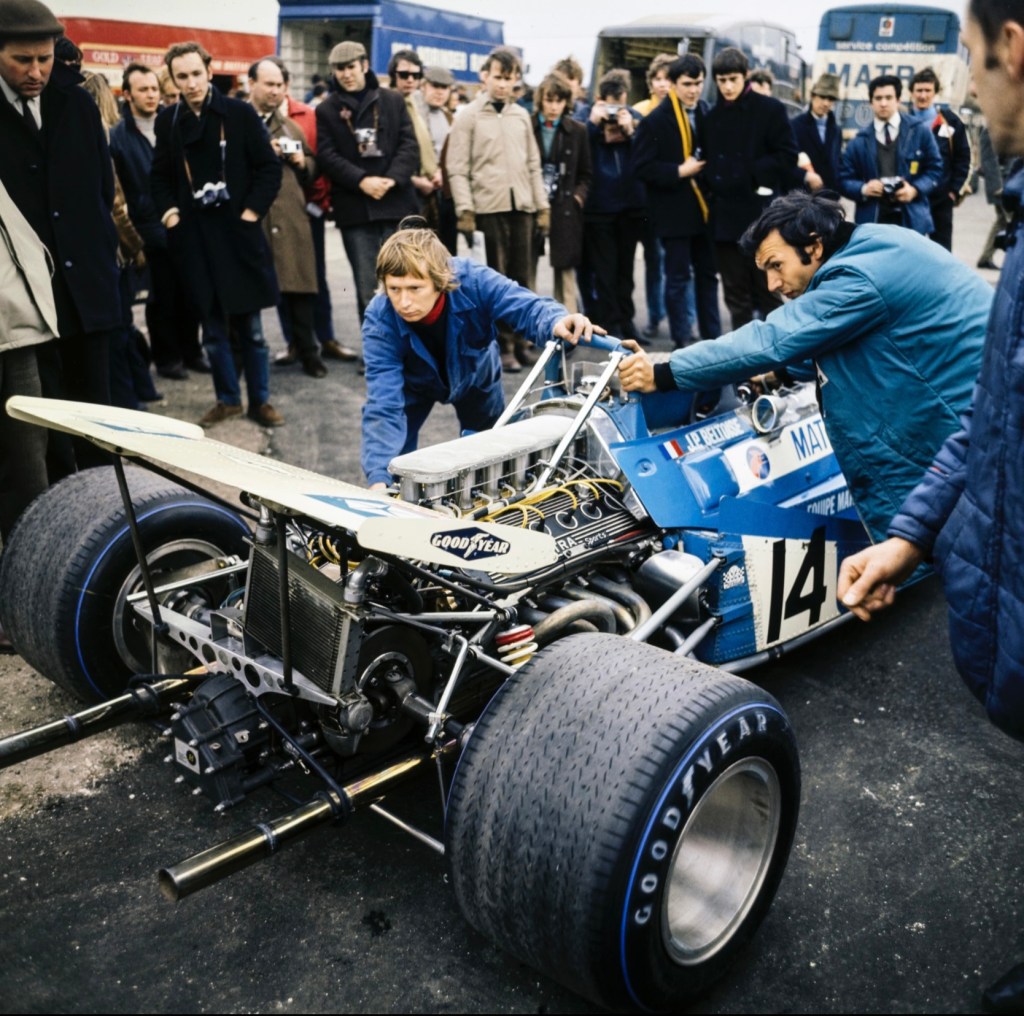
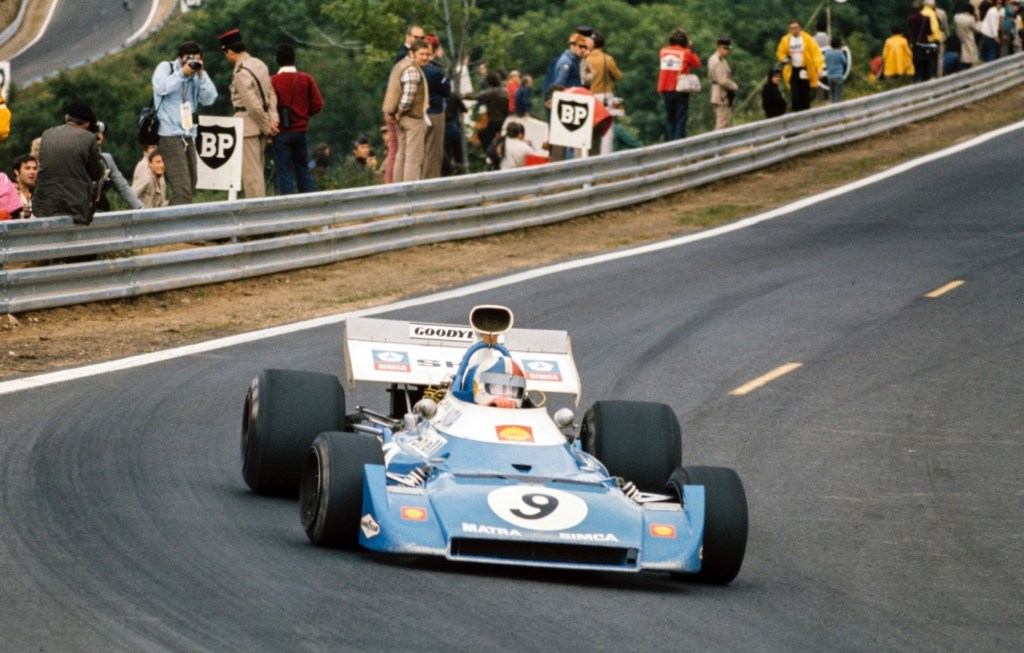
The Jean Guichet/Nino Vaccarella Matra MS630 at Le Mans in 1969, they finished fifth in the race won by the John Wyer Ford GT40 driven by Jacky Ickx and Jackie Oliver.
Matra’s progression up the Le Mans results was underway. A pair of DNFs for the two 2-litre BRM P56 V8 powered MS630s in 1967 wasn’t improved upon by the Johnny Servoz-Gavin/Henri Pescarolo MS630 V12s in 1968 (puncture, accident). Fourth and fifth places in 1969 was more impressive, the Jean-Pierre Beltoise (JPB) / Piers Courage MS650 Spider was a lap ahead of the Guichet/Vaccarella MS630 Coupe. Matra would get there soon enough of course, Henri Pescarolo and Graham Hill (below) won the classic race aboard an MS670 from teammates Francois Cevert and Howden Ganley similar car in 1972.
Graham Hill’s ’72 Le Mans victory famously bagged him the Triple Crown: an F1 title, Le Mans and Indy wins, the only bloke to achieve it of course (MotorSport)
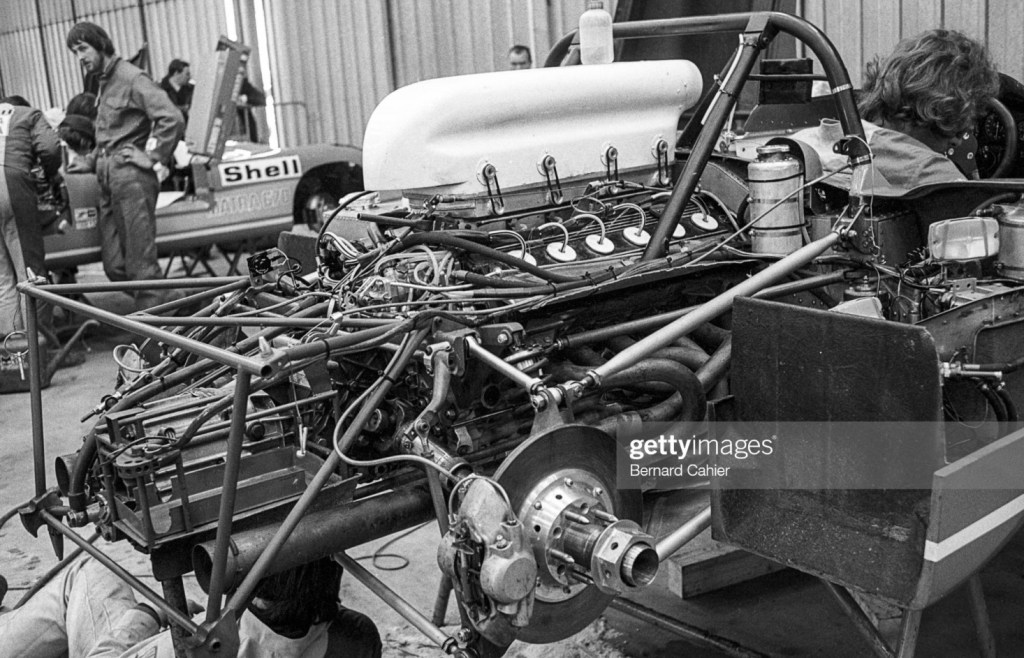
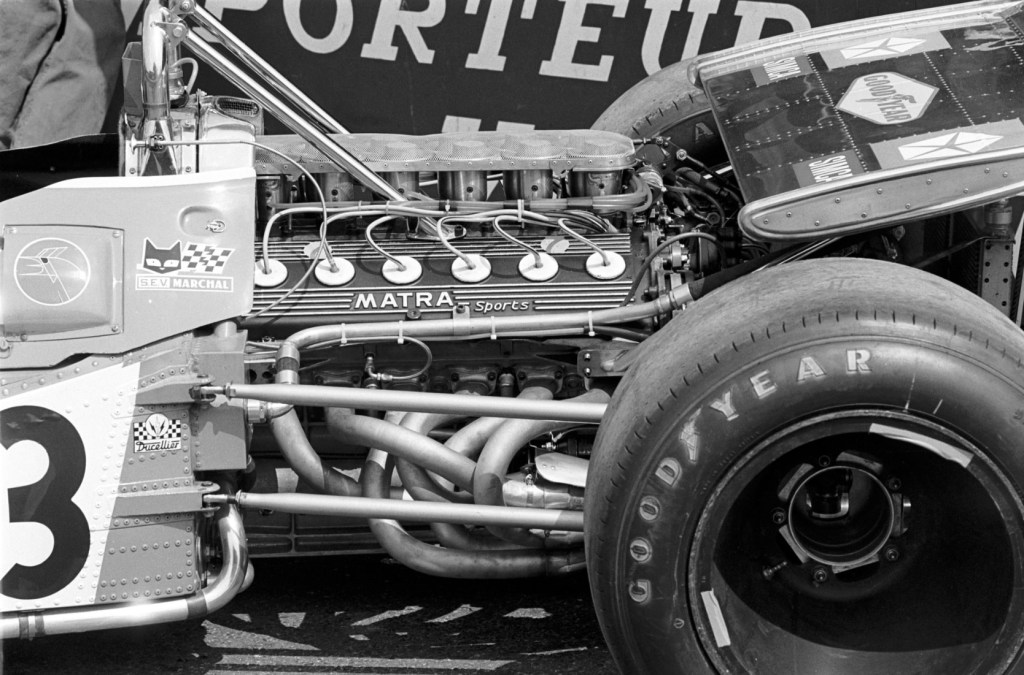
Two of the team MS670s in the garage at Le Mans in 1972. The MS73 circa 450bhp 3-litre V12 is a stressed member of the monocoque chassis, note the light tubular frame to support the rear bodywork, the five speed transaxle is ZF.
The third member of the Le Mans team was an MS660C crewed by Jean-Pierre Jabouille and David Hobbs, DNF gearbox after 278 laps in the final hour.
David Hobbs, MS660C in 1972 (MotorSport)(MotorSport)
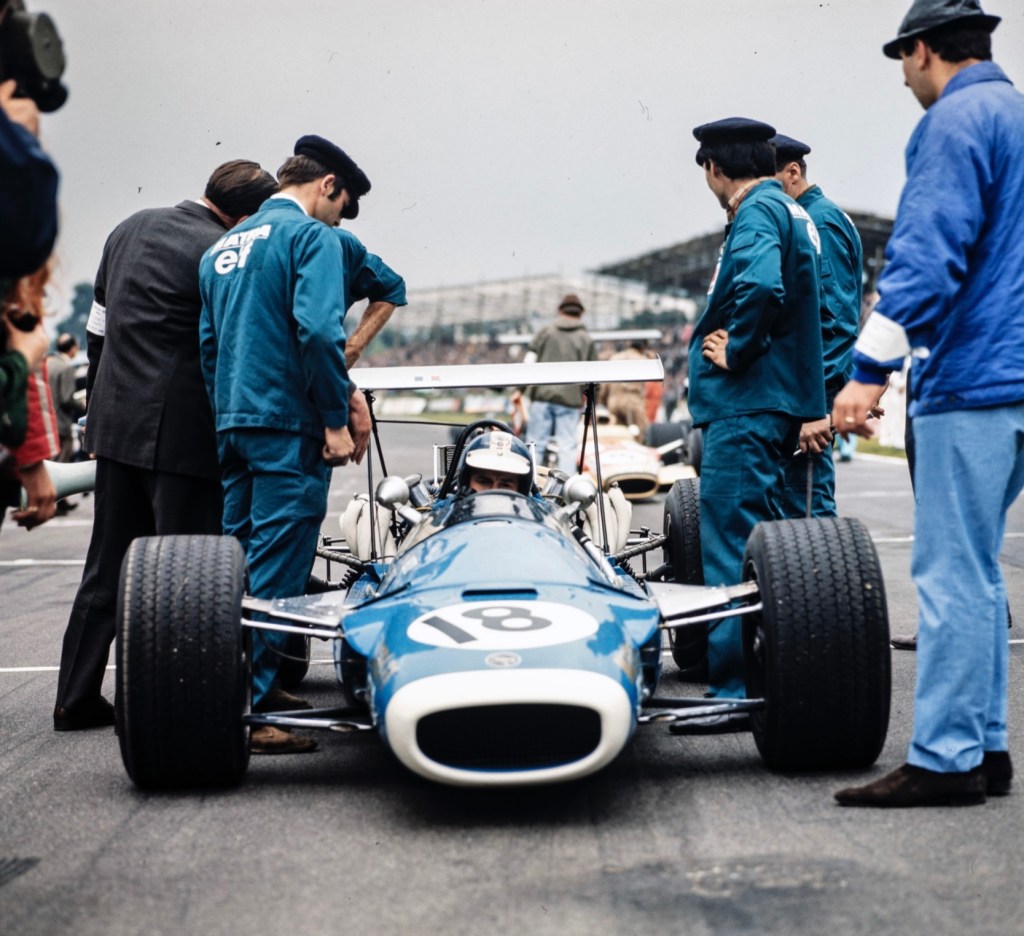
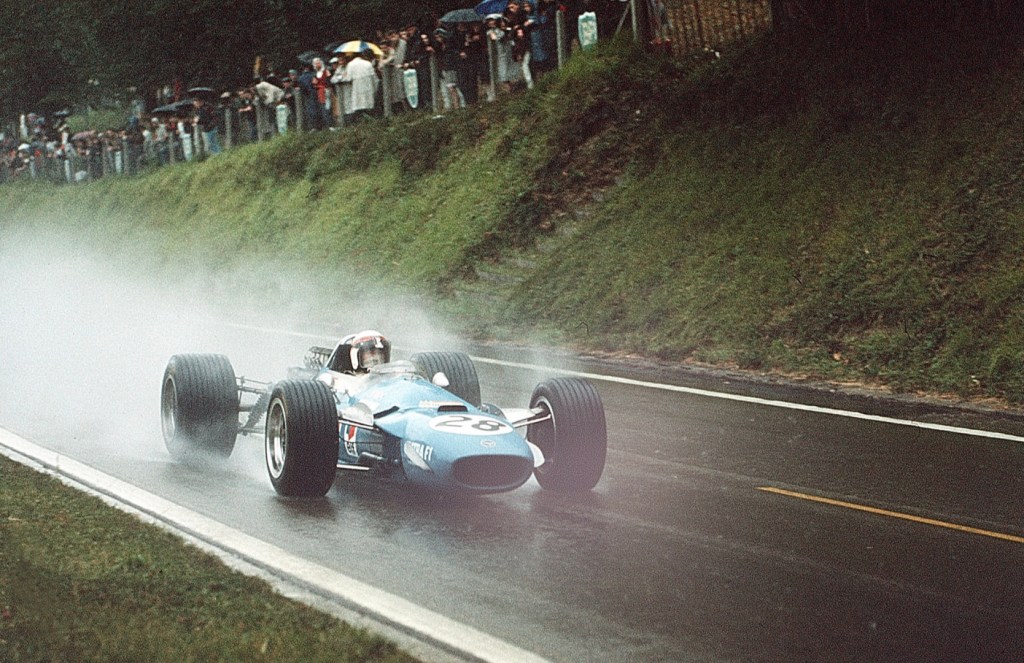
Jean-Pierre Beltoise lines up for the start of the July 1968 British Grand Prix aboard his Matra Sports Matra MS11 V12. Q11 and 14th in the race won by Jo Siffert’s Lotus 49B Ford.
The best placed of the Matras was Jackie Stewart’s Ken Tyrrell/Matra International MS10 Ford DFV in sixth. See here for a piece on JPB; https://primotipo.com/2015/01/15/r-i-p-jpb/
(MotorSport)(MotorSport)
Francois Cevert tips his Matra MS670B into a right-hander at Dijon in during the 1000km enduro in 1973.
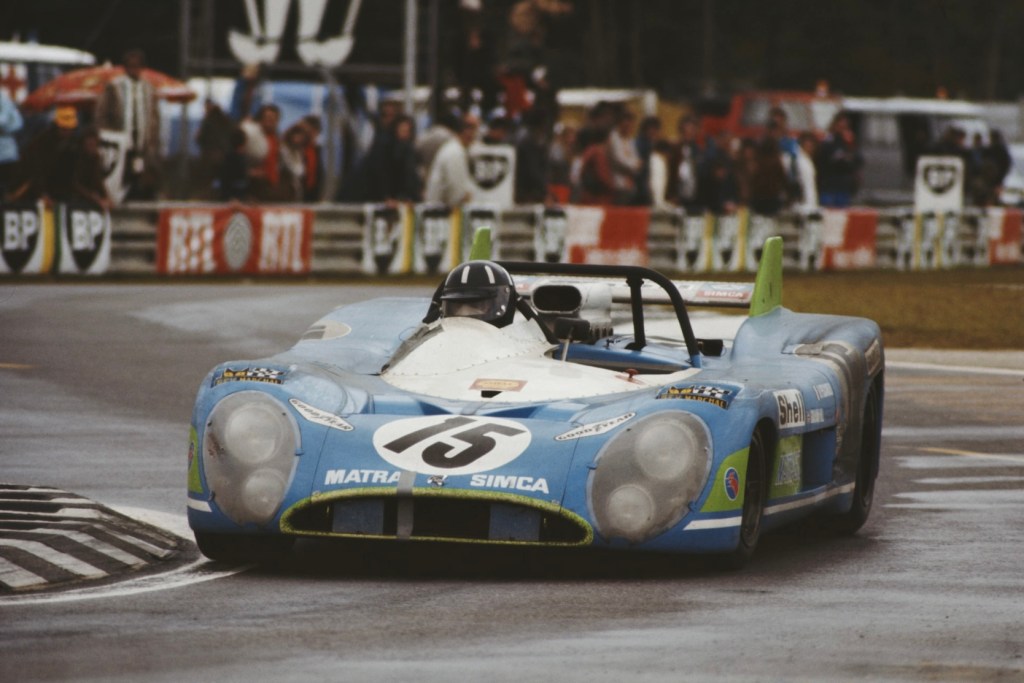
Unlike 1972 when Ferrari and Matra shadow-boxed – Ferrari won everything but didn’t contest Le Mans and Matra won Le Mans but didn’t race anywhere else – Matra won a clean fight with Ferrari in 1973. They again won at Le Mans, the MS670B driven by Henri Pescarolo and Gerard Larrousse were the star crew of the year. Matra won five of the ten World Sportscar Championship rounds, narrowly taking the title from Ferrari, 124 points to 115.
(MotorSport)
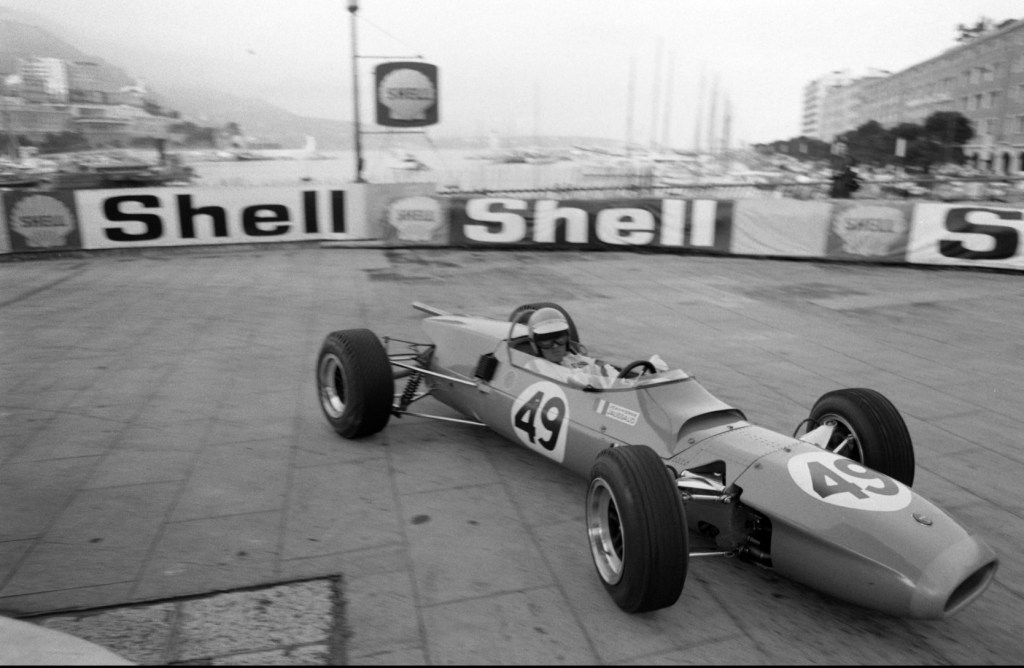
Jean-Pierre Jaussaud, Matra MS6 Ford 1-litre F3 car during the 1967 Monaco F3 GP weekend.
JPJ won heat one and Pescarolo the other in the second Matra Sports entry, with Henri in front of Jean-Pierre in the final by six-tenths of a second, with Derek Bell’s Brabham BT21 Ford another half-second in arrears.
While Brabhams were again 1967 Top F3 Dogs in the UK and Sweden, Matras won the French (Pescarolo), Italian (Geki Russo) and the Argentinian Temporada (Beltoise) titles.
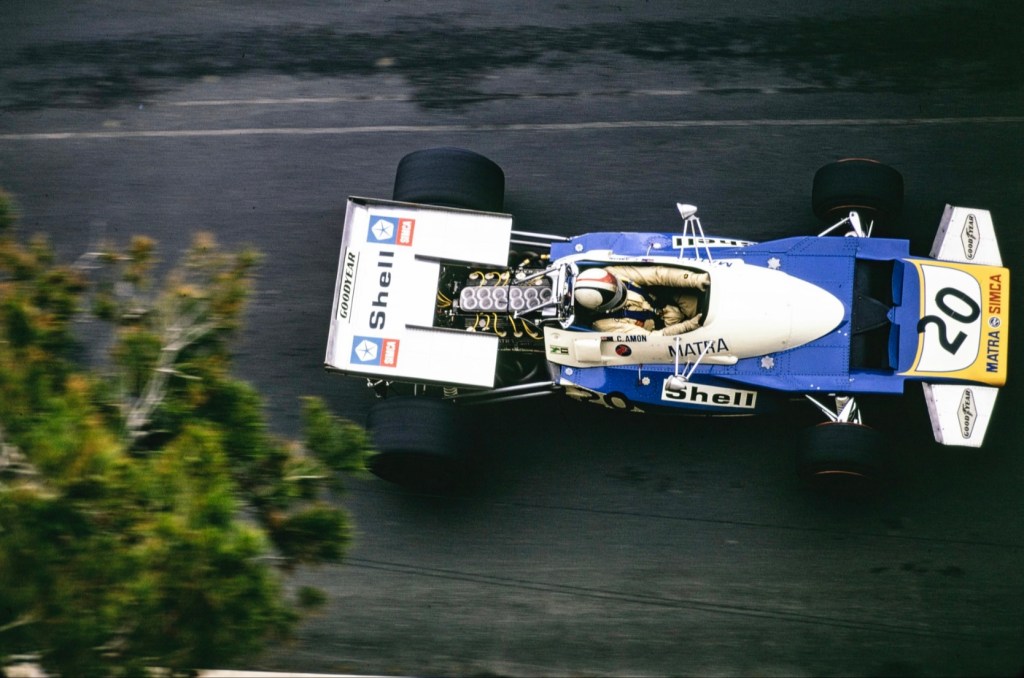
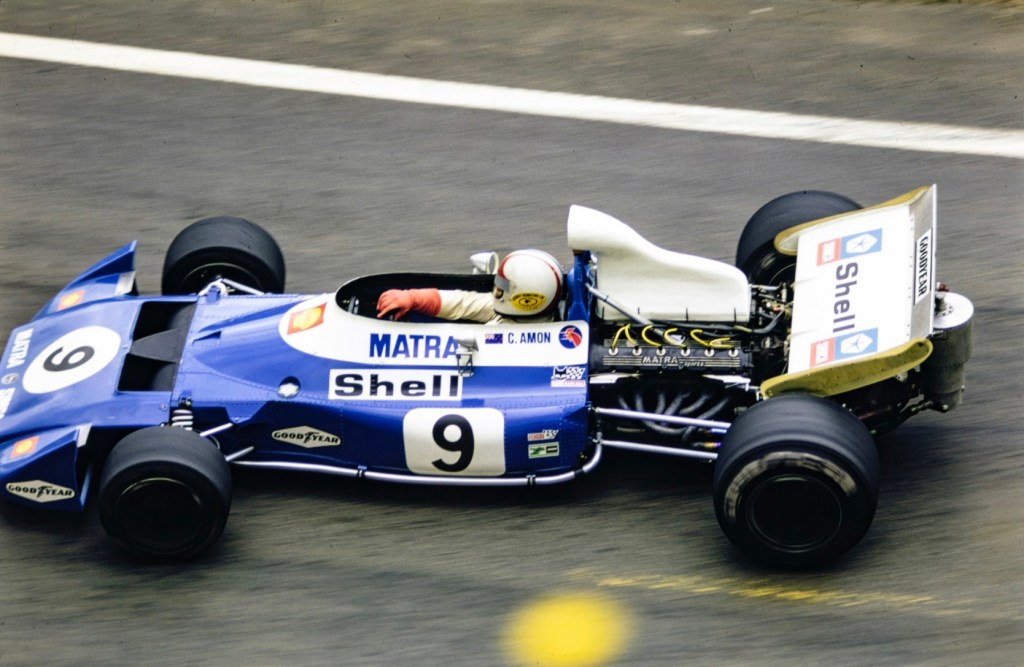
Amon Monaco 1971, Q4 and DNF diff MS120B (MotorSport)
Amon and Matra, what should have been never quite was!
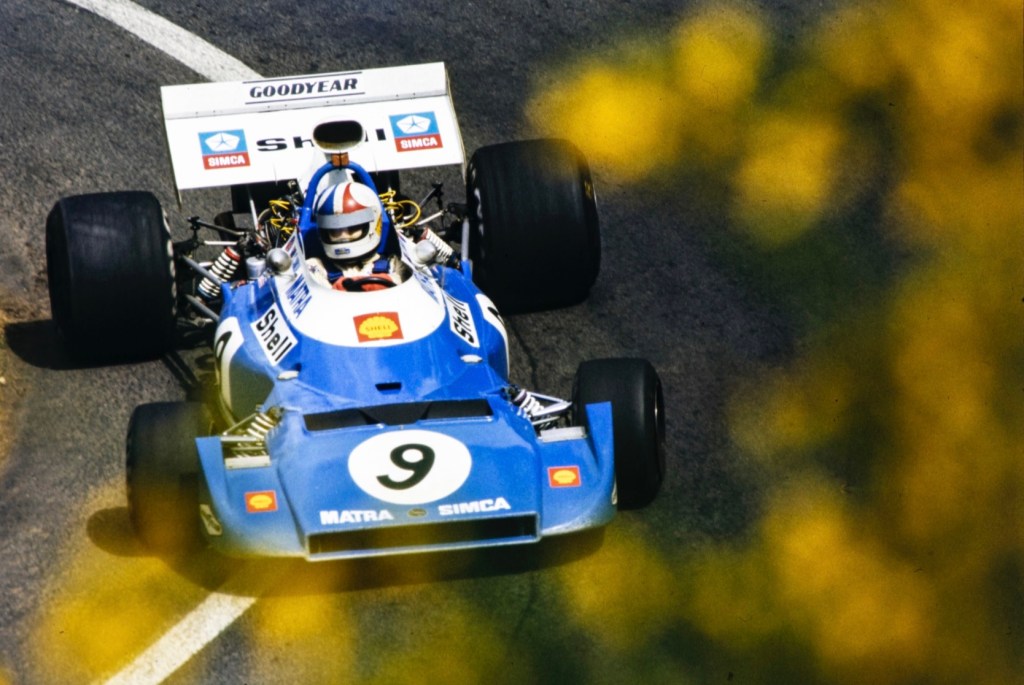
Chris won the non-championship 1971 Argentine GP which was a portent of ‘front two row’ qualifying pace over the ensuing two years but 11th in the ’71 World Drivers Championship and 10th in 1972 was a poor dividend not really indicative of the pace of the car and driver.
Chris should have won at Clermont in 1972, as it was, pole and fastest lap there, and fastest lap at Nivelles was about all the driver and team took away from the season, withdrawal as a team from F1 followed. Very sadly. Feature piece about the MS120 here; https://primotipo.com/2014/07/06/venetia-day-and-the-1970-matra-ms120/
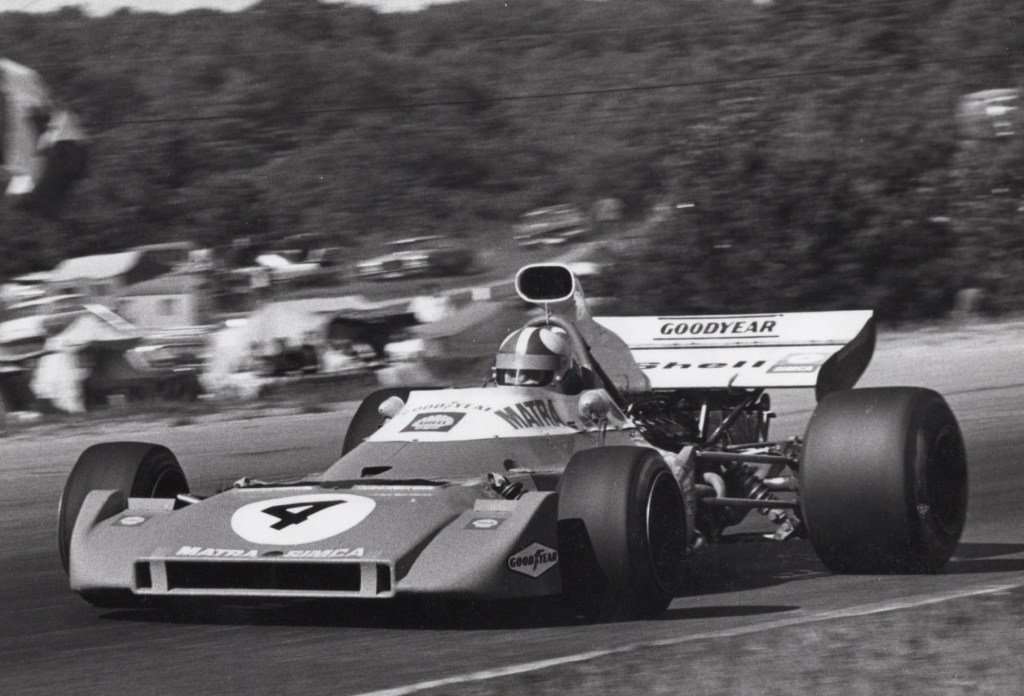
Amon, Mosport 1972 Q10 and sixth MS120D (unattributed)(LAT)
Jacky Ickx won the first European F2 Championship in 1967 aboard Ken Tyrrell Matra MS5 and MS7 Ford FVAs.
Here he is at the Nurburgring over the August 6, German GP weekend in an MS5 which was outted with suspension failure, I wonder why!? More on the MS7 in this piece on Johnny Servos-Gavin; https://primotipo.com/2016/09/02/johnnys-talbot/
Jackie Oliver won the F2 section of the race, he was fifth overall in a works Lotus 48 FVA. Denny Hulme won the race from Jack Brabham in a Brabham Racing Organisation BT24 Repco 1-2, Alan Rees was the second placed F2 home, seventh overall in a Brabham BT23 FVA.
Ickx won the championship from Frank Gardner’s works Brabham BT23 and Beltoise’ MS5 and MS7, but the F2 Star was – as ever – graded driver, Jochen Rindt with five wins of the ten rounds aboard his Roy Winkelmann run Brabham BT23 Ford FVA.
(MotorSport)
Jackie Stewart, Matra MS80 Ford – the 1969 drivers and constructors champions – from Bruce McLaren, McLaren M7C Ford at Monaco in 1969.
Jackie retired with a broken UJ and Bruce was fifth in the race won by the Mayor of Monaco, Graham Hill, in his Lotus 49B Ford, for the fifth time. It was the crazy weekend when the CSI/FIA banned high-wings after Friday practice, see here; https://primotipo.com/2015/07/12/wings-clipped-lotus-49-monaco-grand-prix-1969/
Matra International and Stewart won the respective titles with victories at Kyalami, Montjuich Park, Zandvoort, Silverstone and Monza. See here for more on the Matra MS80; https://primotipo.com/2016/07/01/matra-ms80-ford/
(MotorSport)
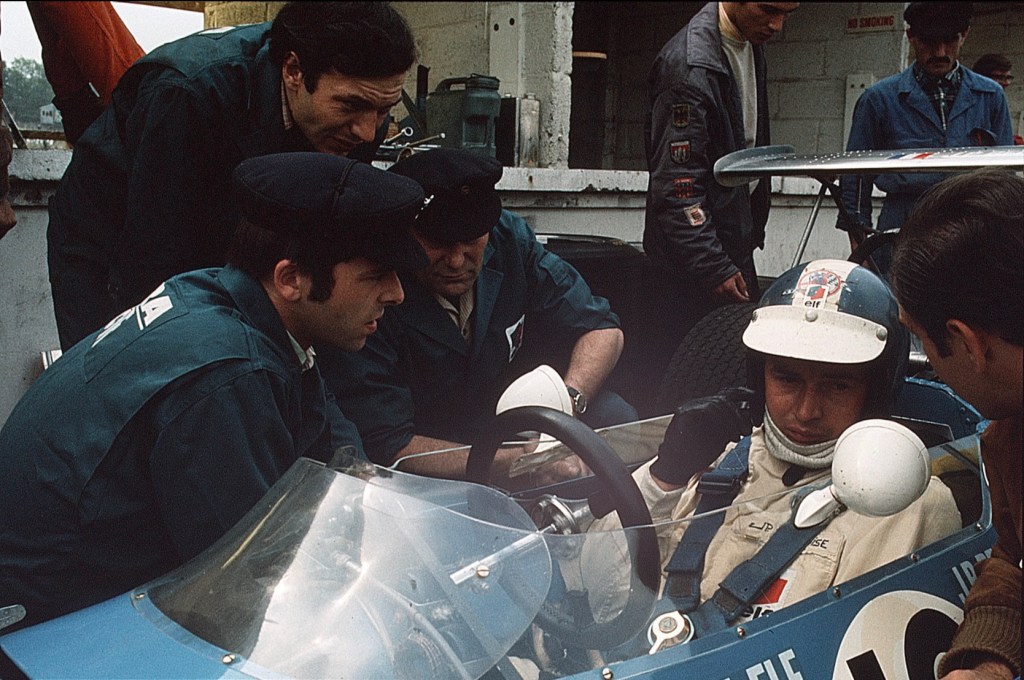
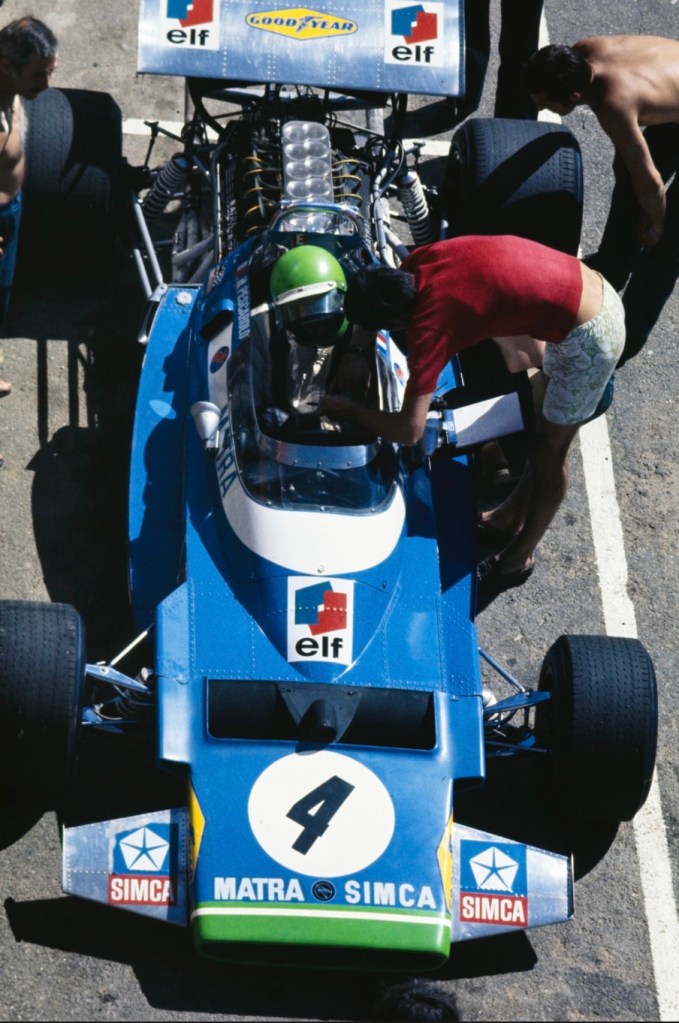
Jack Brabham at Daytona in 1970, where he was 10th in the Matra MS650 he shared with Francois Cevert. It was Black-Jack’s final season, later Australian taxi-competition duly noted.
Relieved of management responsibilities – he had sold his half share in Motor Racing Developments and the Brabham Racing Organisation to Ron Tauranac at the end of 1969 – the wily campaigner attacked his final season with great vigour, knowing he had Her Indoors to look forward to on a more regular basis when the family returned to Australia.
Apart from his Brabham F1 program, he raced an F2 Brabham BT30 for John Coombs, contested the Indy 500, and had a program of World Endurance Championship rounds with Matra, see here for the detail; https://primotipo.com/2016/09/09/jack-and-francois-matra-ms660/
Brabham in the MS650 he shared with JPB, Brands Hatch 1000km 1970. 12th in the race won by the Rodriguez/Kinnunen Porsche 917K (MotorSport)(MotorSport)
The quickie MS7 F2-derived F1 Matra MS9 Ford DFV was knocked together as an R&D machine in advance of the quintessential ’68 Ford powered MS10.
MS9 was raced at Kyalami to give Ken Tyrrell and Jackie Stewart a car in which to contest the opening 1968 F1 round in South Africa.
(MotorSport)
The car was purposeful in its military green primer and became an entrant in the Fugly Car Cup when fitted with an outsized front radiator, extra water tankage and cooler to cope with the ferocious African heat (below). All the hard work paid off though, Jackie drove the lash-up to third behind Jim Clark – the great Scot’s final F1 victory – and Graham Hill’s Lotus 49 Fords.
The MS9 was used only once again in a test at Albi before being set aside and ultimately restored, it resides in a private collection.
(MotorSport)(MotorSport)
The definitive 1968 Ford V8 powered F1 Matra was the MS10, here at Spa with Jackie on his way to fourth place, and below at Rouen in the tragic French GP.
Jo Schlesser died in the new Honda RA302 that awful, wet day, while Stewart was third. Bruce McLaren won at Spa in his M7A and Jacky Ickx in France aboard his Ferrari 312, the only F1 race not won by a Ford Cosworth powered car that season.
(MotorSport)
Francois Cevert, Matra MS670B from Brian Redman, Ferrari 312PB at Le Mans in 1973.
Both cars failed to finish, the Icky/Redman car with engine failure after 332 laps, and Cevert/Beltoise after completing 157 laps before a puncture induced accident. The winning Pescarolo/Larrousse MS670B competed 356 laps, while the second placed Art Merzario-Carlos Pace driven Ferrari 312PB 350 laps. A convincing win indeed.
The tail shot below is of a 670B during the May 1973 Nurburgring 1000km weekend.
Both the Cevert/Beltoise and Pescarolo/Larrousse 670Bs retired with engine failure allowing an easy Ferrari 312PB 1-2, the Redman/Ickx pair in front of Pace/Merzario. Hewland gearbox this time, note the alternator driven off the rear of the transaxle.
(MotorSport)(MotorSport)
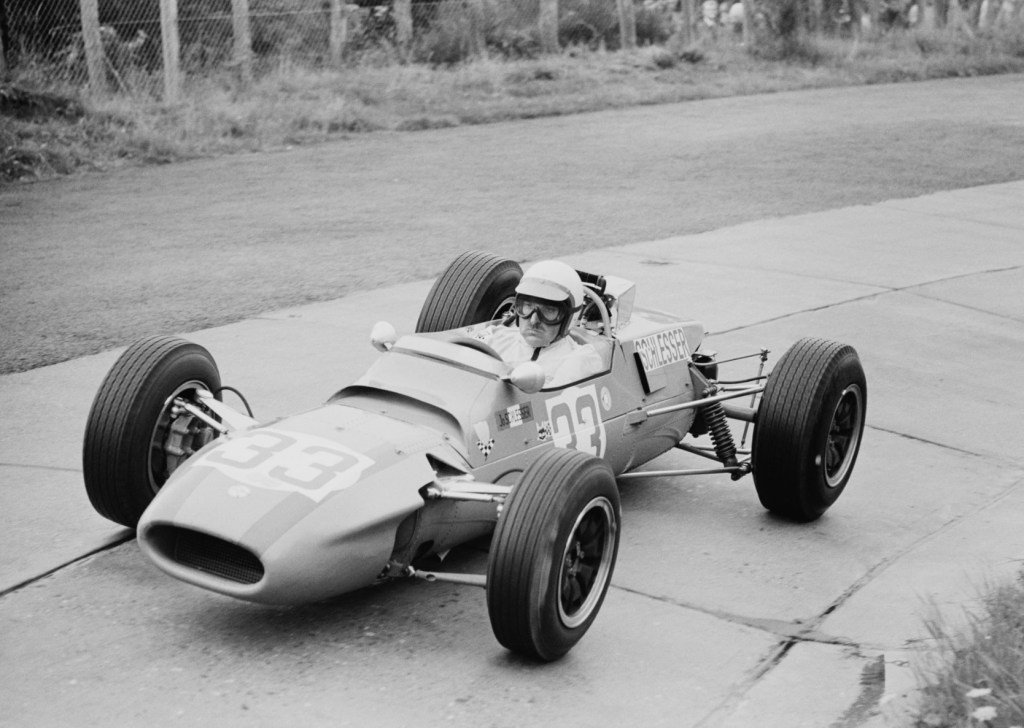
Jo Schlesser during the 1966 German Grand Prix, F2 1-litre Cosworth SCA powered Matra MS5. Jo was third behind two other MS5s raced by Beltoise and Hubert Hahne (Tyrrell entry).
1966 was the year of absolute F2 dominance by the works Brabham Hondas raced by Brabham and Hulme. Sad story on Schlesser, more positively, I am in the process of assembling a feature on the man, will finish it soon; https://primotipo.com/2019/07/12/its-all-happening-3/
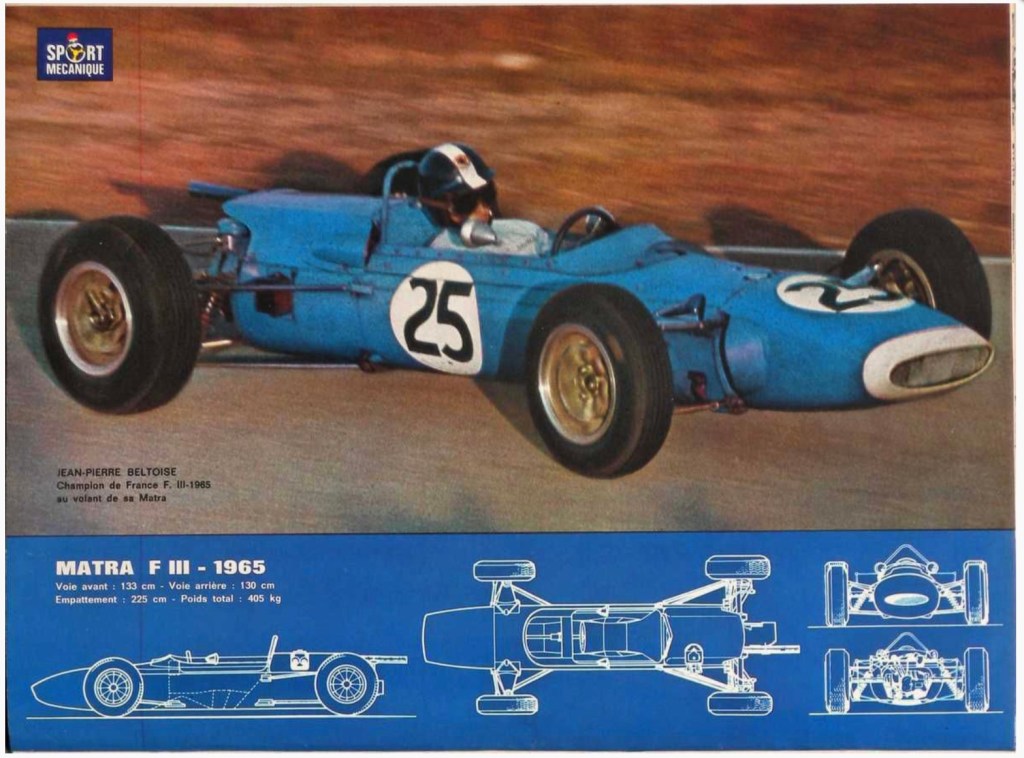
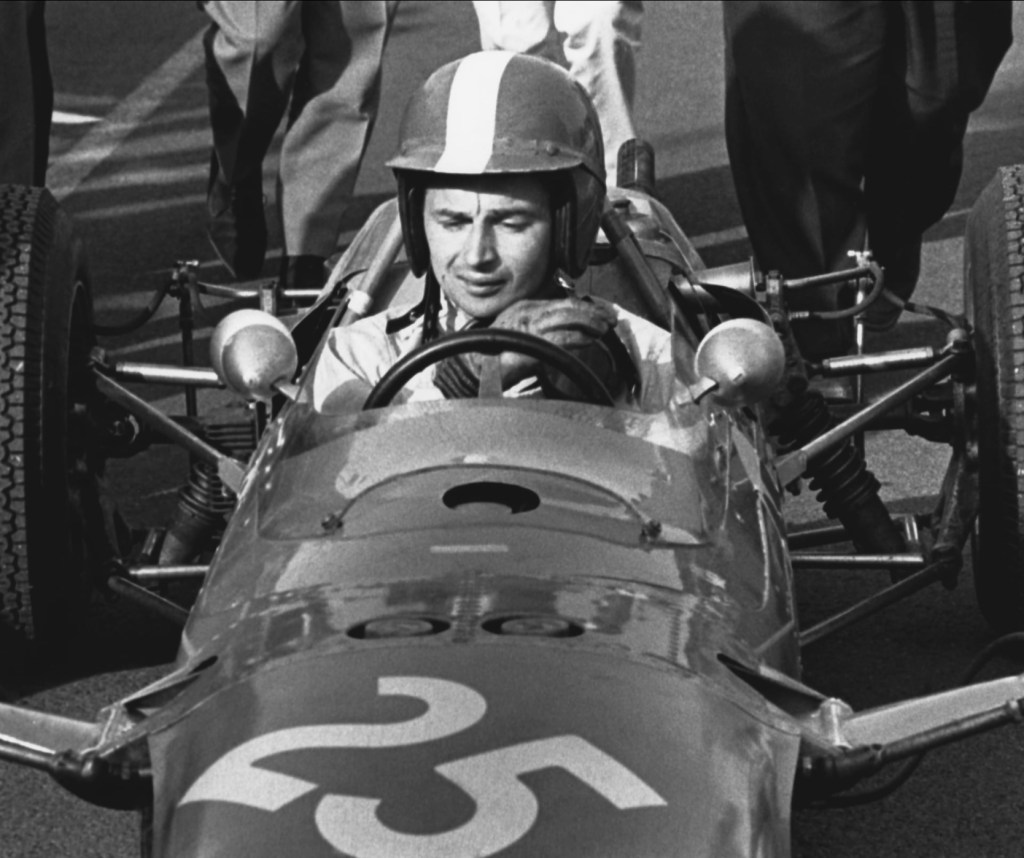
JPB before winning the F3 round at Reims on July 4, 1965 – a breakthrough first victory for Matra – Matra MS1 Ford.
It was a slipstreaming ball-tearer of a 54 minute race too, JPB won by one-tenth/sec from Piers Courage’s Brabham BT10 Ford with John Fenning’s Cooper T76 Ford two-tenths further adrift!
In another year of Brabham F3 dominance, Matra grabbed a market toehold. JPB won the Trophy de Cognac at Reims in July, while Jean-Pierre Jaussaud took two more wins aboard his MS2 Ford in September, the Coupe de Paris at Montlhery and Coupe Internationale de Vitesse at Albi.
(MotorSport)
Henri Pescarolo at the Kyalami first F1 championship round in 1970, Matra MS120.
Henri finished the drivers world championship that year in 12th place, while JPB was 9th. Their best results were third placings at Spa and Monza for Beltoise, and at Monaco, Pescarolo. Matra were seventh in the manufacturers championship.
That year the Velizy concern chose not to build a Ford powered variant of their chassis raced so capably by Ken Tyrrell’s outfit in 1968-69, and Tyrrell/Stewart felt they were better sticking with a Ford DFV powered chassis, having tested the MS120 that winter. Initially Tyrrell raced customer March 701s, but by the season’s end the pace of Derek Gardner’s Tyrrell 001 Ford was apparent, and was delivered in spades in 1971.
Zandvoort 1970, Beltoise’ fifth placed MS120. Isn’t the distance between the radius rods unusually small? (MotorSport)JPB, Brands Hatch, British GP 1970. DNF wheel after 24 laps, looong exhausts! (MotorSport)(MotorSport)
JPB on his way to victory in the VII GP de Monaco Formula 3 GP in 1966, Matra MS5 Ford, from Chris Irwin’s Brabham BT18 Ford – five-tenths adrift – and John Cardwell’s Lotus 41 Ford.
That year Johnny Servoz-Gavin won the French title in another MS5.
(MotorSport)
Another one that got away from Chris…
He led the 1972 French Grand Prix on a mans track – Clermont Ferrand – to half distance, then copped a puncture which dropped him back to eighth, then worked his MS120D back up to third place. So close, again.
(MotorSport)(MotorSport)
Credits…
MotorSport Images, LAT Photographic, Getty Images, MotorSport, oldracingcars.com, Wikipedia
Tailpieces…
(MotorSport)
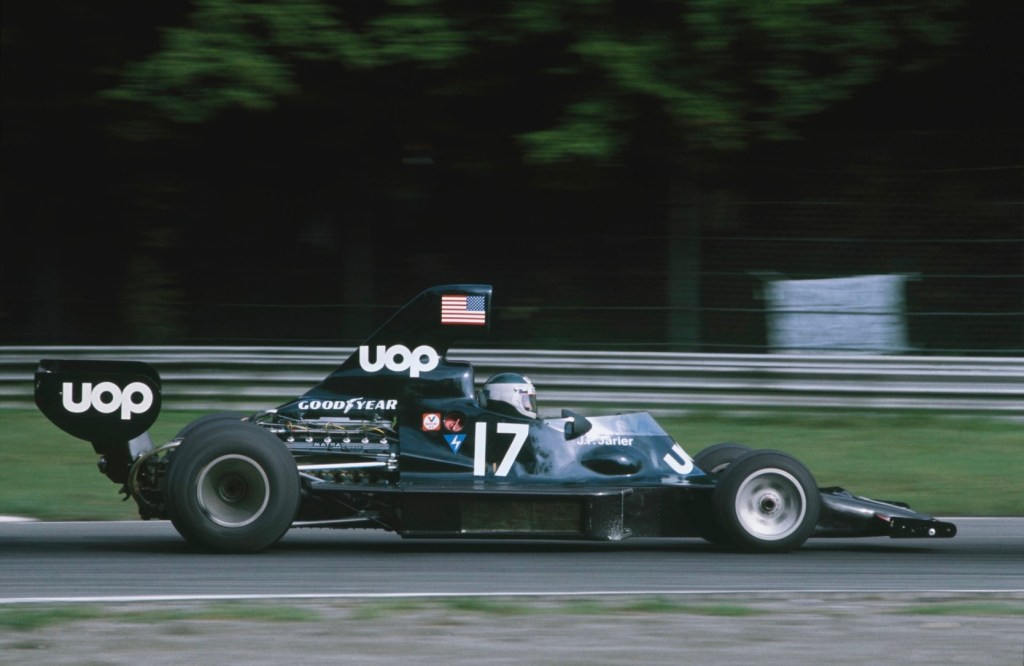
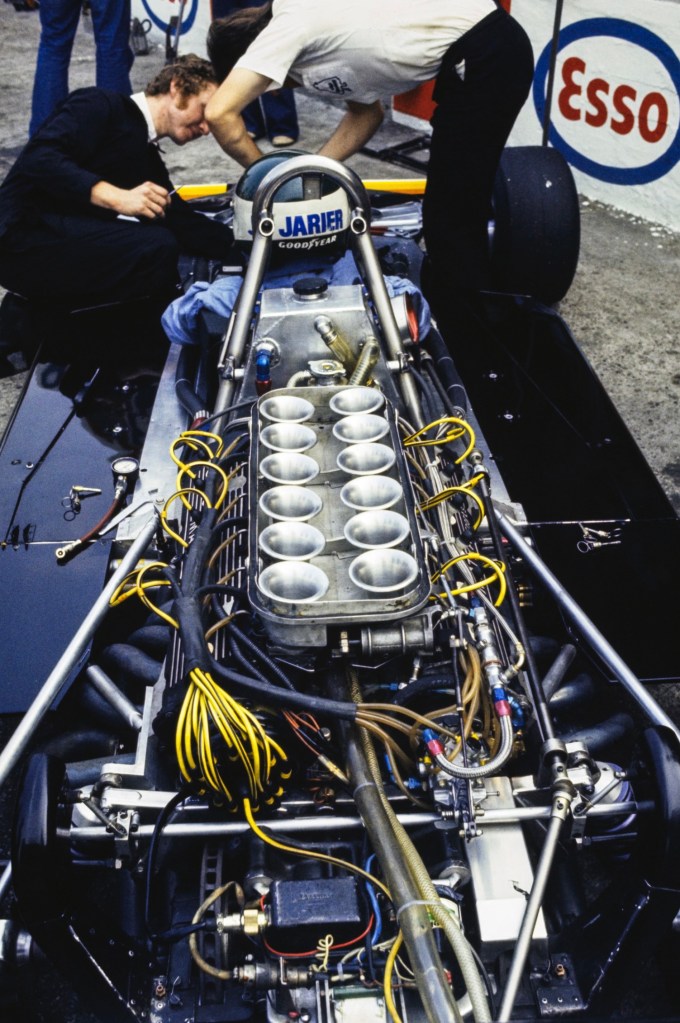
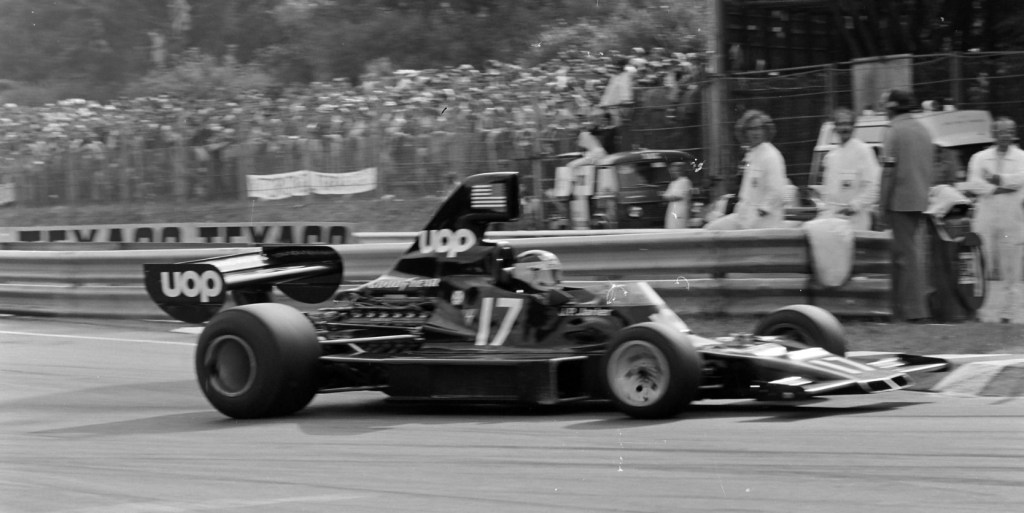
Of course, one of the most erotic of all Matras is the black one, Tony Southgate‘s 1975 Shadow DN7 Matra.
An experiment that was over way too soon, here at Monza driven by Jean-Pierre Jarier, DNF fuel pump after 32 of the 52 laps from Q13. Clay Regazzoni’s Ferrari 312T took a very popular victory. See here for an article on the Shadow Matra; https://primotipo.com/2016/01/15/shadow-dn7-matra/
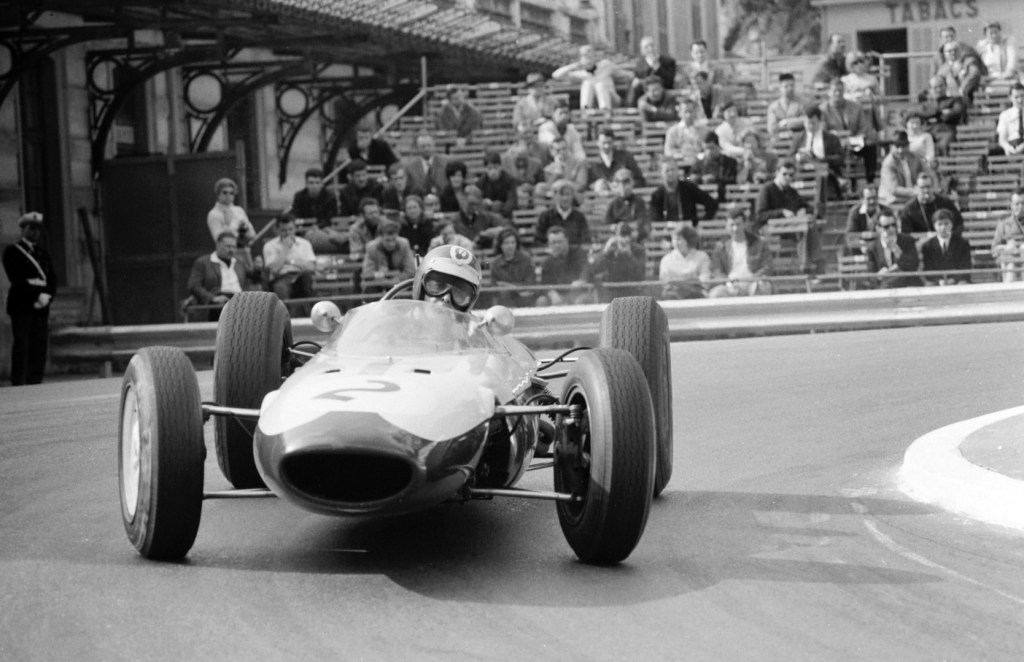
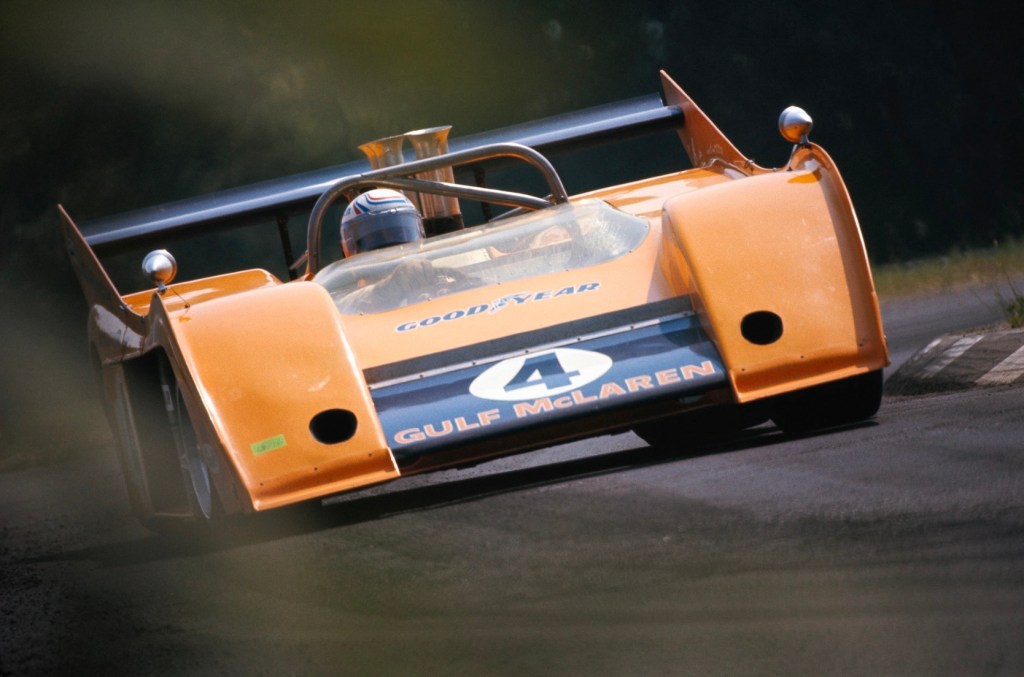
Monaco GP weekend 1964, Revson – Parnell Racing Lotus 24 BRM, DNQ. Graham Hill won, BRM P261 (MotorSport Images)
I love this letter to the editor of MotorSport from Ray Truant, of Hamilton, Canada, their Star Letter in the September 2023, current issue, highly recommended of course.
“In F1 Retro…Peter Revson is referred as ‘the heir to the Revlon cosmetics fortune.”
“This is a statement repeated during Revson’s entire racing career by the media, but was never correct. While he was a Revson, Peter’s father split his interest in the Revlon firm very early from his brothers Charles and Joseph in 1958 and had no equity in Revlon.”
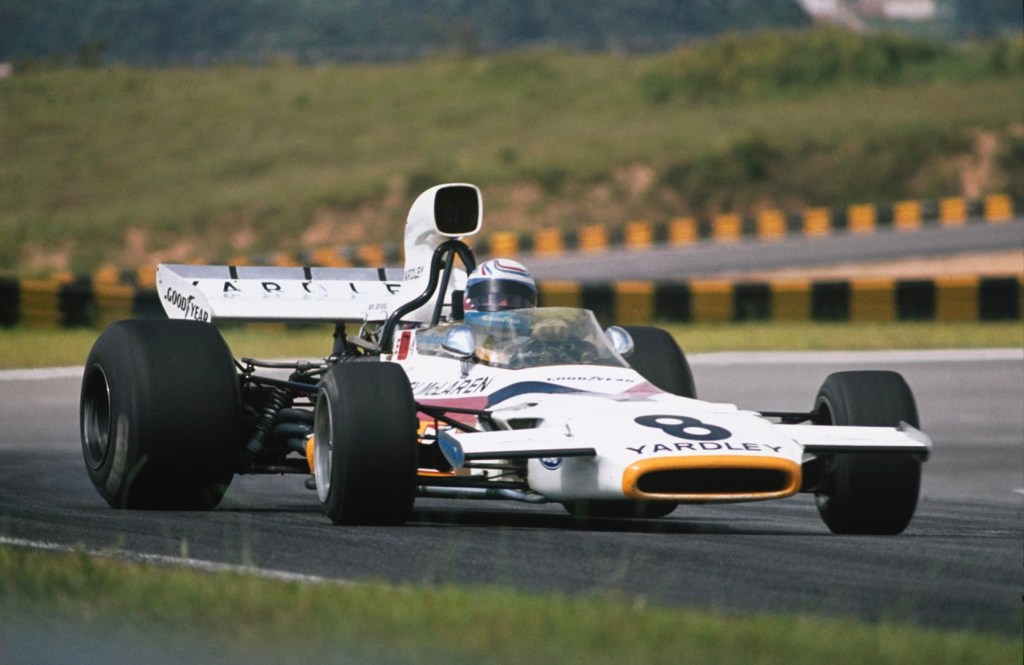
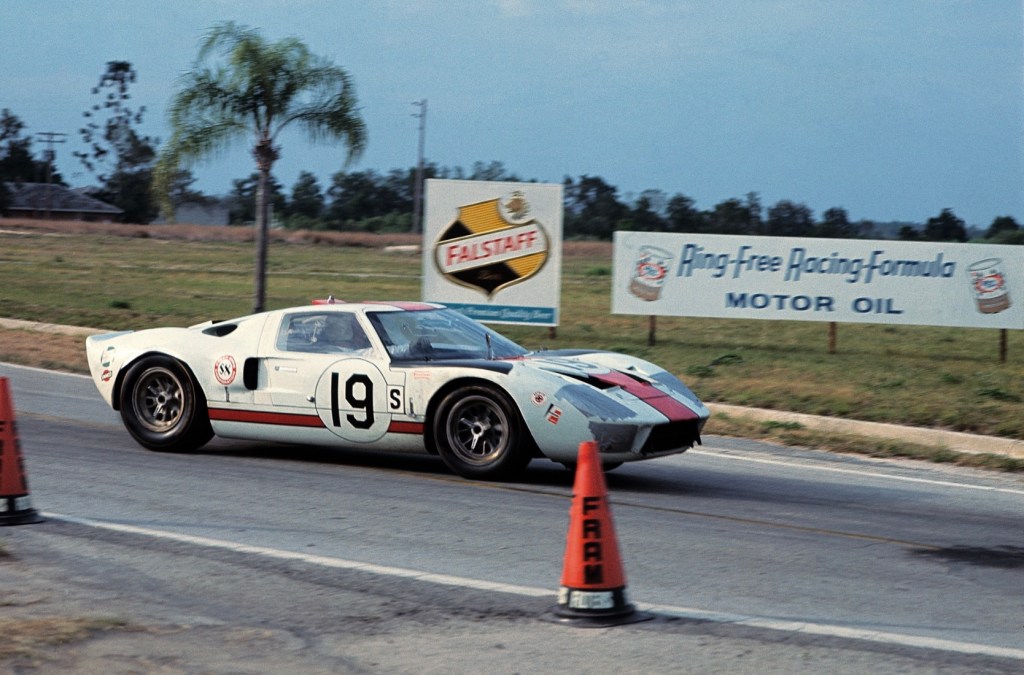
1973 Brazilian GP, McLaren M19A Ford. DNF gearbox after 3 laps from Q12, Emerson Fittipaldi won in a Lotus 72D Ford on his way to the drivers title (LAT)The 1969 Indy 500 carnival had its moments but fifth place in the Brabham BT25 Repco 760 V8 was a career turning point in the view of some – from dilettante to pro. Mario Andretti won in a Hawk 3 Ford (MotorSport)Sebring 12 Hour 1966, Essex Wire Ford GT40, third shared with Skip Scott. Ken Miles and Lloyd Ruby won in a GT40 X-1 Roadster (LAT)
“Charles and Joseph Revson ran Revlon subsequently into an empire, but Peter’s father was not involved. He ran Del Laboratories and lived to an incredible 105 before dying in 2016. Interestingly, Martin Revson left Revlon over ethical concerns of how the company was marketing to women.”
“The media loved the playboy heir story so much they ignored the reality and it persisted throughout Revson’s career, despite Revson’s attempts to correct this myth repeatedly in interviews.”
McLaren M20 Chev at Watkins Glen in July 1972, the reigning Can-Am Champ was second to Denny’s M20 that day (MotorSport/R Schlegelmilch)Chassis sorting the McLaren M23 Ford during the June 1973 Swedish GP weekend at Anderstorp, Q7 and seventh in the race won by Denny Hulme’s sister car (MotorSport/D Phipps)
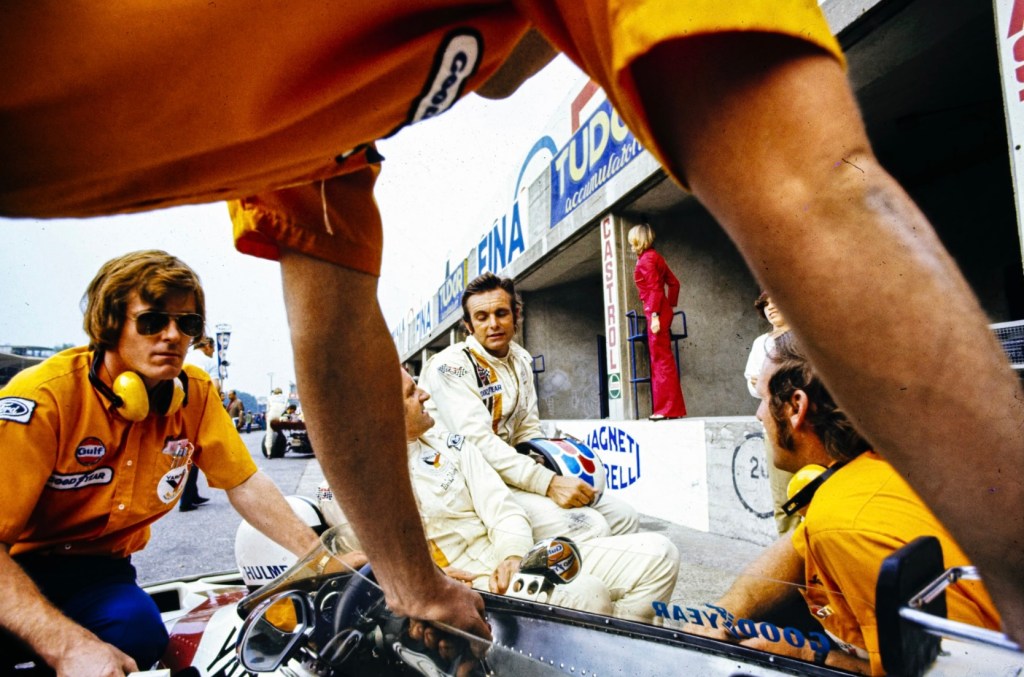
Practice session meeting of the type established by Bruce McLaren. Alastair Caldwell ponders while Denny and Revvie chew the fat. Monza 1972, where they were third and fourth in their M19C Fords, Emerson Fittipaldi’s Lotus 72D Ford won.
Credits…
MotorSport and Ray Truant, MotorSport Images, LAT Photographic
(MotorSport)
Tailpiece…
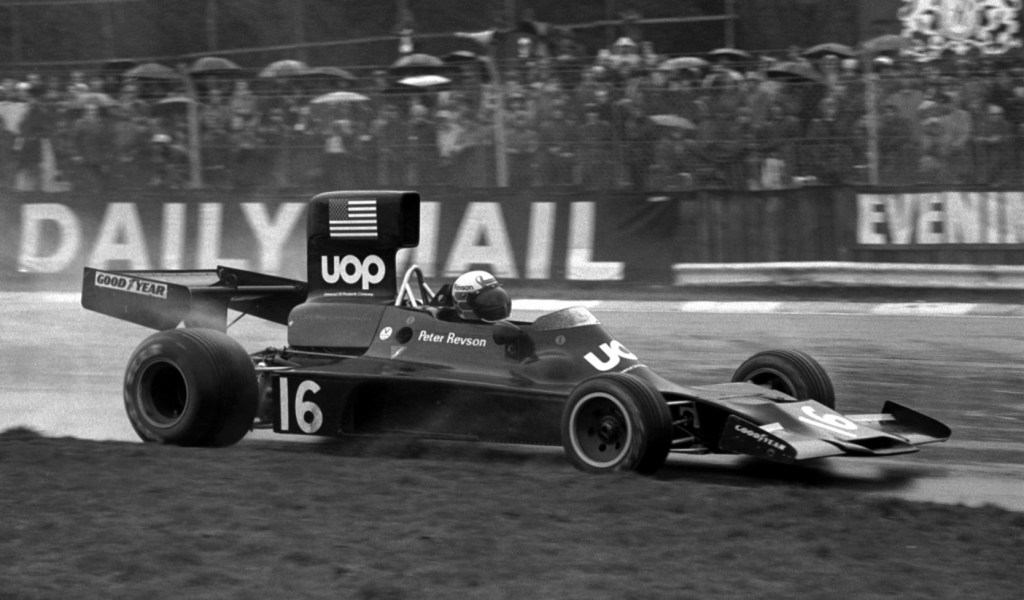
Sixth place in a gloomy Race of Champions at Brands Hatch on March 17, 1974, Shadow DN3 Ford. Sadly the car in which Peter perished due to component failure – a titanium ball joint – during practice at Kyalami, South Africa, the week after Brands on March 22.
Racing a Grand Prix Maserati around the short, tight Darley circuit outside Melbourne would have been somewhat akin to racing in ‘yer backyard…
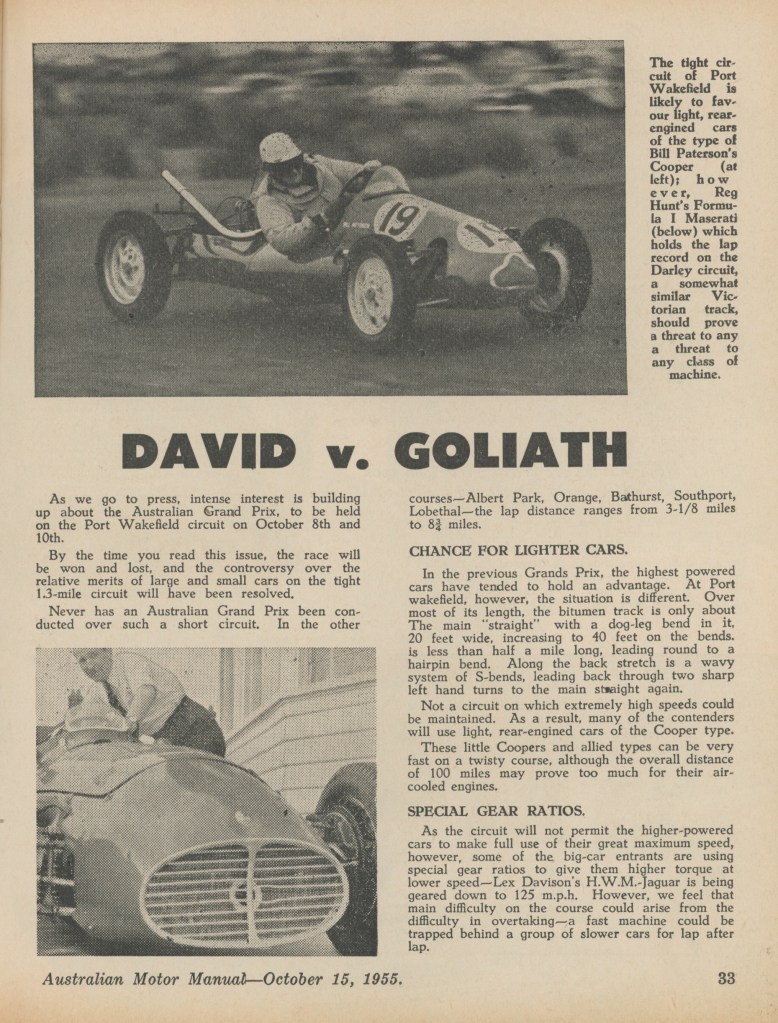
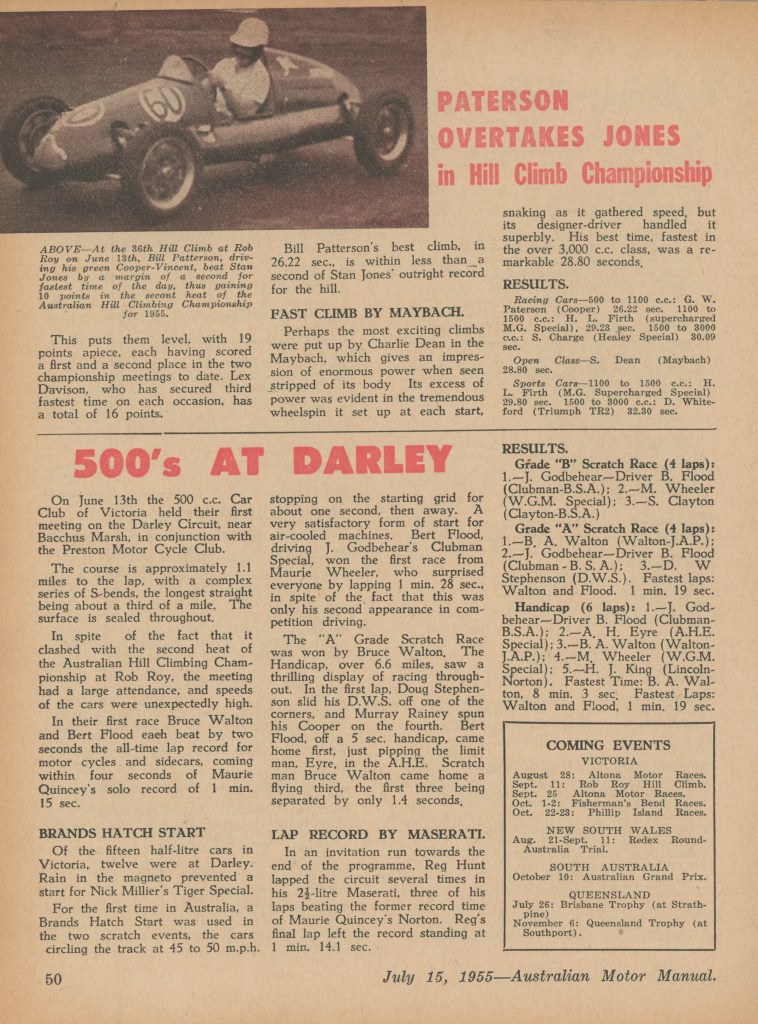
Reg Hunt pretty much became-the-pace when he imported this 2.5-litre Maserati A6GCM (chassis ) to Australia, he was stiff not to win the ‘AGP at Port Wakefield, South Australia with it in 1955.
These two Australian Motor Manual excerpts highlight the controversy surrounding the selection of Port Wakefield as the AGP venue that year given its short length – only the Goulburn course used for the first AGP in 1927 was shorter – and put in the electronic public domain Hunt taking the Darley lap record in his lead up preparation to the AGP.
This press advertisement dated January 13, 1968 changed the racing world as we knew it in many parts of the globe, the US and some other places excepted…
The days of the mobile fag, franger and fragrance wrapper were underway, for better or worse.
While Lotus and Imperial Tobacco were negotiating the commercial deal which would take advantage of the FIA/CSI relaxation of rules relating to the advertising of non-trade products and services on racing cars, the business of motorsport rolled on.
(MotorSport)
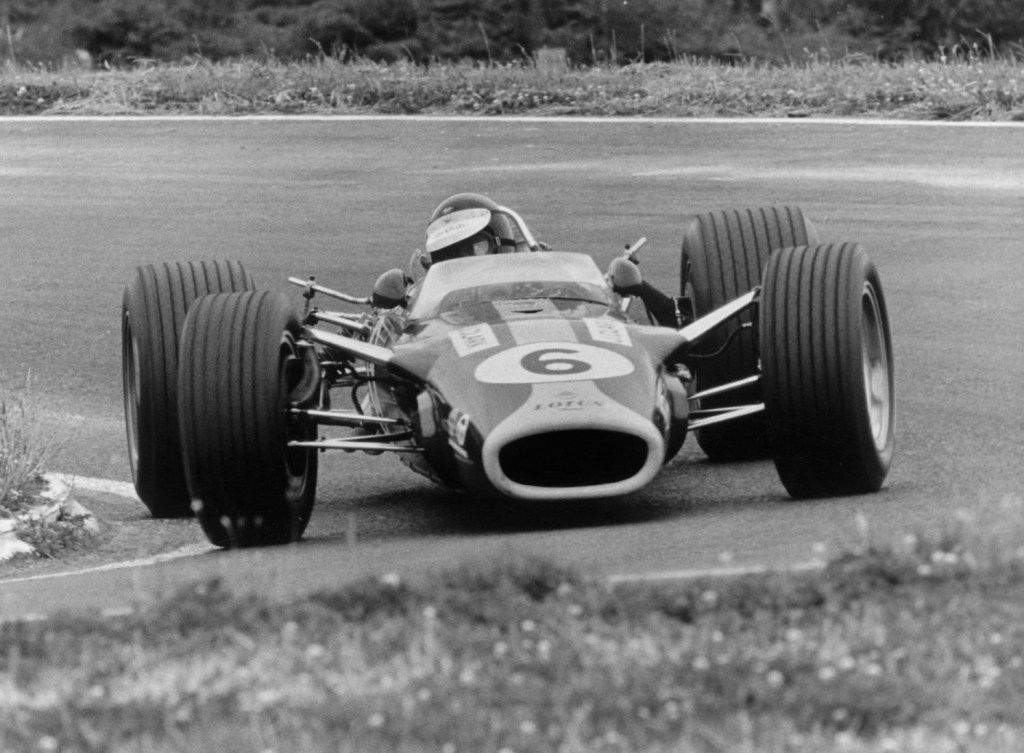
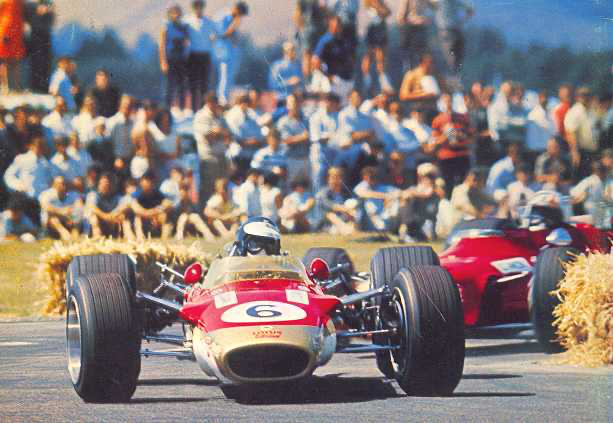
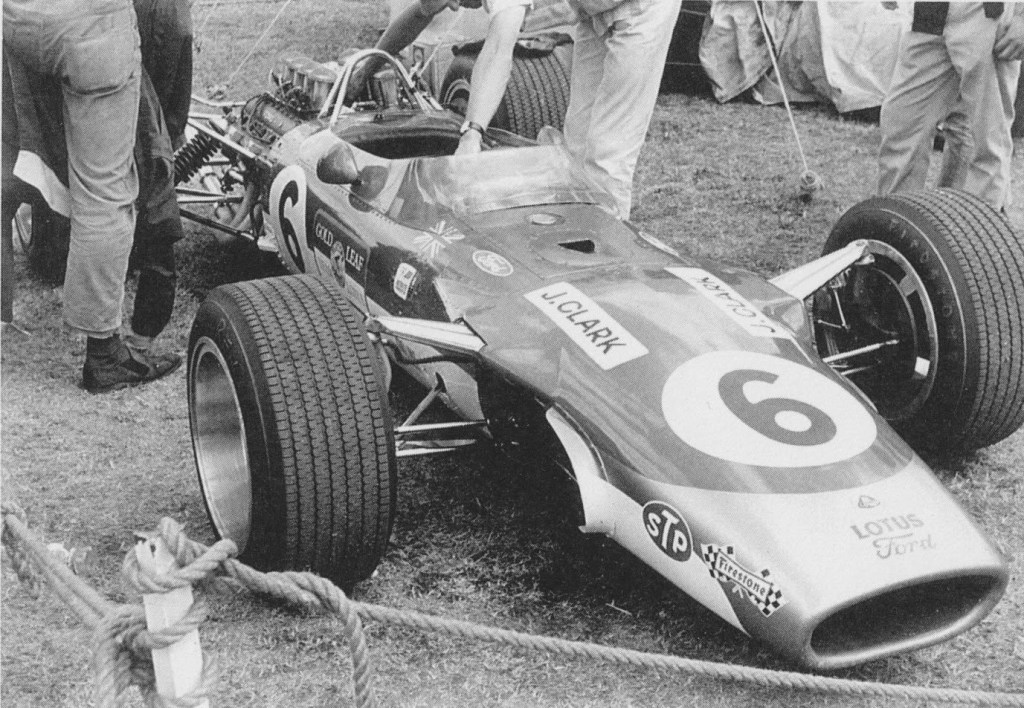
Jim Clark took off where he left off at the end of 1967, the fastest car/driver combination won the South African Grand Prix in Kyalami. Clark won aboard his Lotus 49 Ford from Graham Hill in the other Team Lotus entry, and Jochen Rindt’s Brabham BT24 Repco.
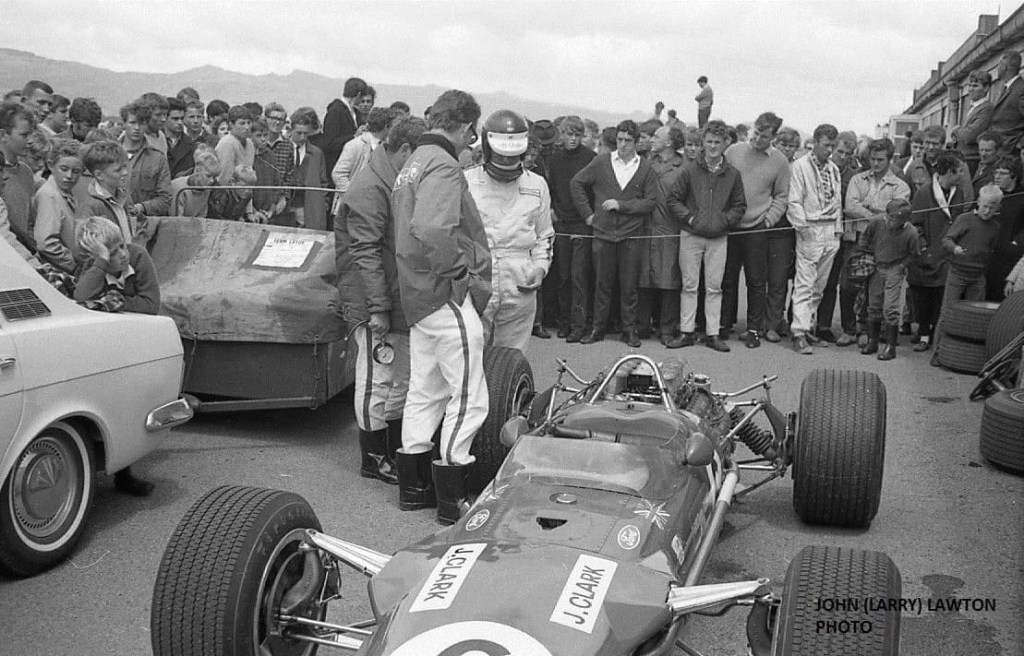
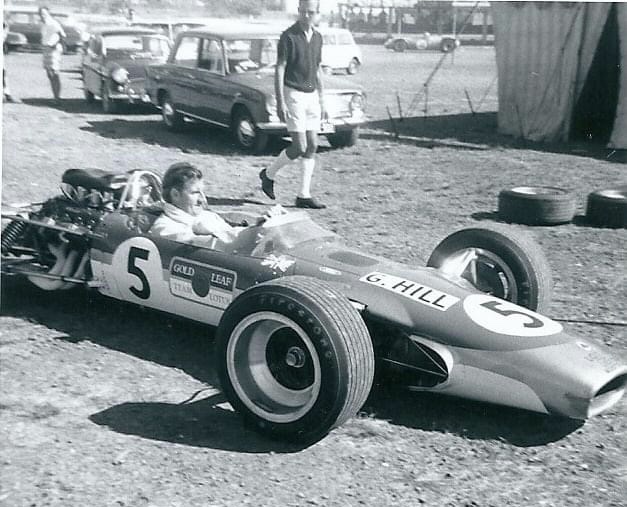
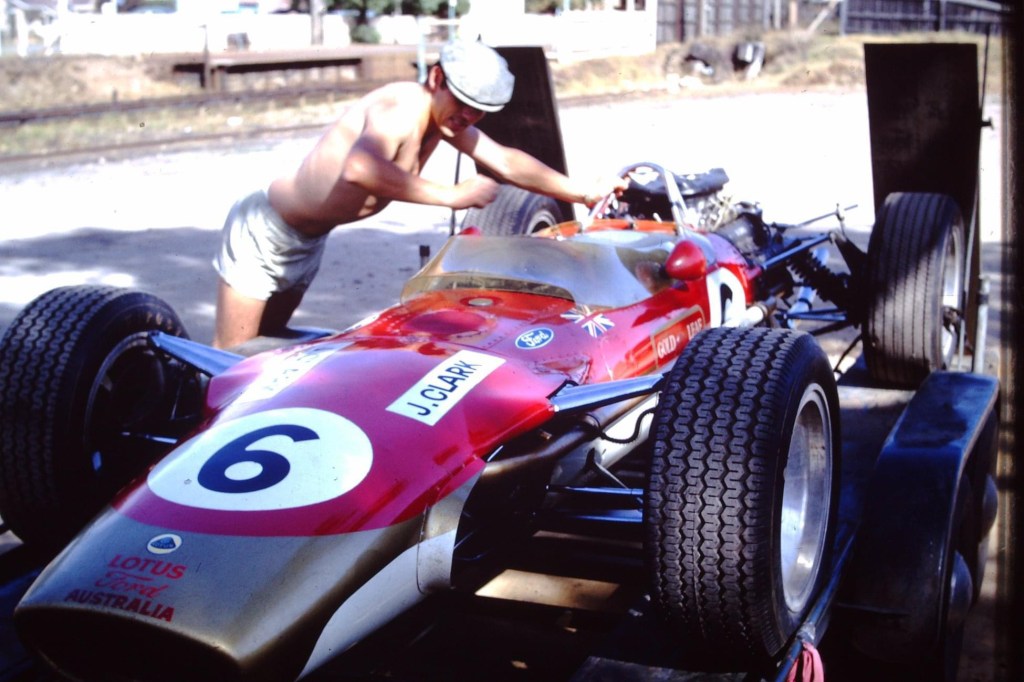
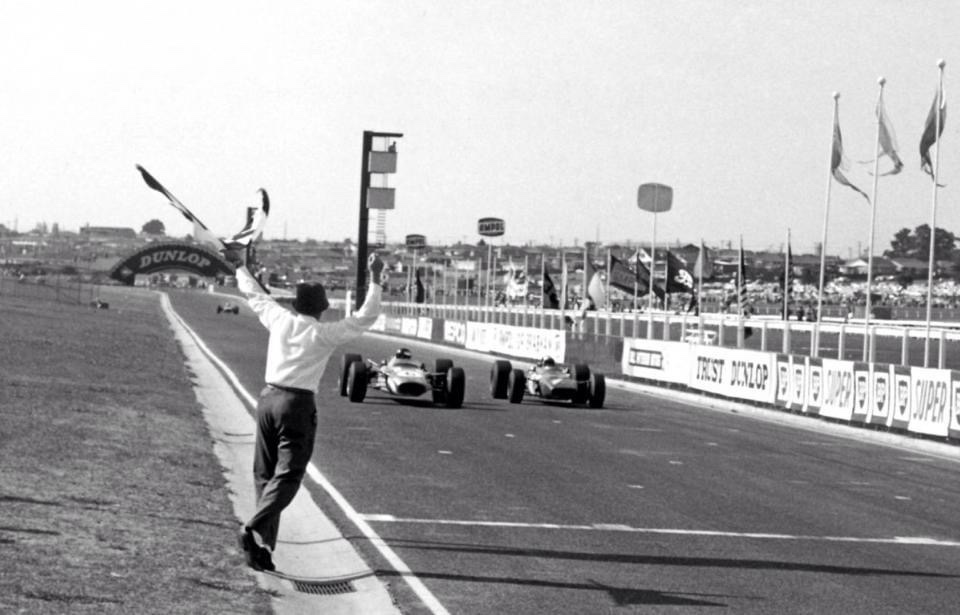
After that race – his final Championship GP win as events transpired – he flew to New Zealand along with Jack Brabham, Bruce McLaren, Denny Hulme, Chris Amon, Pedro Rodriguez and Graham Hill to join other internationals, Frank Gardner and Piers Courage, and local drivers for the 1968 Tasman Cup.
That summer the highly competitive 2.5-litre series comprised four rounds in NZ, and in Australia, commencing with the NZ GP at Pukekohe on January 6, and concluding with the South Pacific Trophy at Longford, Tasmania on March 4. Eight events in eight weeks on both Kiwi islands, shipping the circus across the Tasman Sea from the very south of the South Island (Teretonga) to Brisbane…oh, yes, and prepare the cars for the 100 mile races too. While the series was famous for sun, fun and spunkmuffins there was some serious racing as well. To win the Tasman required a mix of speed, discipline, endurance and organisation.
(LAT)
Chris Amon jumped out of the blocks, winning at both Pukekohe, and Levin aboard his works Ferrari Dino 246T. JC had engine failure after 44laps in the NZ GP while in the lead, and suspension problems at Levin (above). He ran wide off the track early, caught Amon but then went off again and bent a radius rod while trying to pass Chris.
During the week between Levin and the Lady Wigram Trophy round, the small team looking after Jim’s Lotus 49 Ford DFW organised a signwriter of some talent, at Hutchinson Ford, Christchurch to apply the cancer-stick signage in accordance with the Gold Leaf corporate identity standards manual…a document with which Lotus staff were to become intimately familiar.
Kiwi journalist, Allan Dick wrote that there was a function held in Christchurch on the Friday evening of the race weekend to unveil the new colours, perhaps the shot below is during said gig, albeit the venue doesn’t appear particularly salubrious.
(MotorSport)(A Batt)
Big Wigram crowd taking in the candy-coloured Lotus – chassis number R2, Jim’s 1967 F1 mount – over the January 20 weekend. Clark provided plenty of cheer for the suits back in the UK when he won ‘on GLTL debut’ from Amon and Denny Hulme’s F2 Brabham BT23 Ford FVA.
These three shots are all at Wigram Clark from Amon at Wigram (sergent.com)Wigram looks chilly that day, Kiwi-Oz touring car ace Jim Richards with his hands in race-suit pockets towards the far right of the crowd
Bruce McLaren won for BRM at Teretonga in the final NZ round. He finished in front of Clark after Jim had an off while in the lead. Bruce’s mount was a 2.5-litre V12 engined BRM P126, a chassis designed by Len Terry, and being blooded in advance of the ‘68 F1 season by McLaren, Rodriguez and Richard Attwood.
Clark had a much stronger run on the other side of the Tasman Sea – where he was joined by teammate Graham Hill, who had been enjoying a family holiday – winning the Surfers Paradise 100, the Warwick Farm 100 in Sydney and the Australian Grand Prix at Sandown, in Melbourne’s outer suburbs. Only the final round at Longford eluded him, Piers Courage took a wonderful victory there in his F2 McLaren M4A Ford FVA in streaming rain.
Clark at Teretonga where a high speed off cost him the lead to Bruce McLaren (unattributed)Clark at Sandown winning the AGP, here on Pit Straight in third gear. The shot highlights the shortcomings of the too low roll bar. While Jim was well familiar with seat belts in his ‘Indycars’, he missed these safety devices in Grand Prix racing, commonplace as they were by the end of the year
When he departed Australia on or about March 5, Jim Clark had won his final GP and championship, he died a month later at Hockenheim during the first heat of the Deutschland Trophy, Euro F2 Championship round, aboard a GLTL Lotus 48 Ford FVA on April 7, 1968.
Last discussion before the off with Dave ‘Beaky’ Sims, Hockenheim April 7, 1968 (MotorSport)Clark here running behind Chris Irwin, Lola T100 and Chris Lambert, Brabham BT23C, the Lotus, Lola and Brabham all Ford FVA powered (MotorSport)
Etcetera…
(W Reid)
Graham Hill displaying his new colours, ones he immortalised in the F1 record book by the end of a tragic year, Sandown paddock, February 1968.
(W Reid)
Hill raced Lotus 49 chassis R1, early spec 49s used a ZF five-speed transaxle rather than the later Hewland DG300, engine is the Ford Cosworth DFW 2.5-litre V8. The skinny rears – front tyres – are for transport purposes. A bit of arcane trivia for Melburnians is that the GLTL Lotuses were fettled in the Head Brothers, BMC dealership and bodyworks, at 504 Neerim Road, Murrumbeena, (below) not too far from Sandown.
(J Makeham)
Ford Australia must have kicked in a few dollars to the budget, note the crude ‘Australia’ added to the deft signwriting on the nose of the Lotus executed in Christchurch. The elaborate trailer is as flash as the one I used to tow my Formula Vee.
(C Neale)
Jim Clark about to go out and win the AGP at Sandown. The official margin between Clark’s Lotus 49 and Chris Amon’s Ferrari 246T is one-tenth/sec, but it was closer than that!
(unattributed)
Fags…
Kiwi enthusiast/historian Graham Woods wrote that “The first car (other than in places like the US where such advertising had been allowed) to carry tobacco sponsorship was in South Africa in a round of the SA F1 Championship.”
“The driver was John Love, and the tobacco company, Gunston. Three weeks before Wigram, Love and Sam Tingle started the South African GP, the opening round of the world championship in a Brabham and SA built LDS on January 1. Love was ninth and Tingle DNF – both were in Gunston colours. “
John Love in the Team Gunston Brabham BT20 Repco during the ‘68 South African GP (LAT)
“South Africa was Jim Clark’s last GP win in the green and yellow of Team Lotus. The first race for Lotus in GLTL colours was at Wigram, the first championship GP, the Spanish GP at , a race won by Graham Hill’s Lotus 49 Ford…another GP that got away from Chris Amon, whose Ferrari 312 dominated practice and led most of the race.”
Graham Hill enroute to winning the 1968 Spanish GP, GLTL Lotus 49 Ford (MotorSport)(CAN)
Afterthought…
The afterthought goes to Allan Dick of New Zealand’s Classic Auto News.
‘Historic image of Jim Clark’s Lotus 49T (“T” for Tasman) at Wigram 1968. It’s historic because this was the first time the public had seen the new Gold Leaf sponsorship — a first for Formula One on this scale. The deal with Lotus and the tobacco company had been finalised between Levin and Wigram and it was done in “secret”.’
‘There had been an official and rather exclusive unveiling on the Friday evening in the snobby “The Motor Racing Club” way of doing things in those days, but it was Saturday morning when the great unwashed got to see it. There it sat, paint so new it still looked sticky and fenced off with a great lump of old rope! The reaction? I can still remember it clearly! It was “Yucchhh!” Nobody liked it. It looked cheap and taudry. Nobody thought it was good. We far preferred the dark green with yellow stripe — traditional Lotus. But the world got used to it.’
Credits…
Bryan Miller Collection, LAT Photographic, Allan Batt, Ray Sinclair, John Lawton, Warren Reid, Chris Neale, John Makeham, Allan Dick Classic Auto News