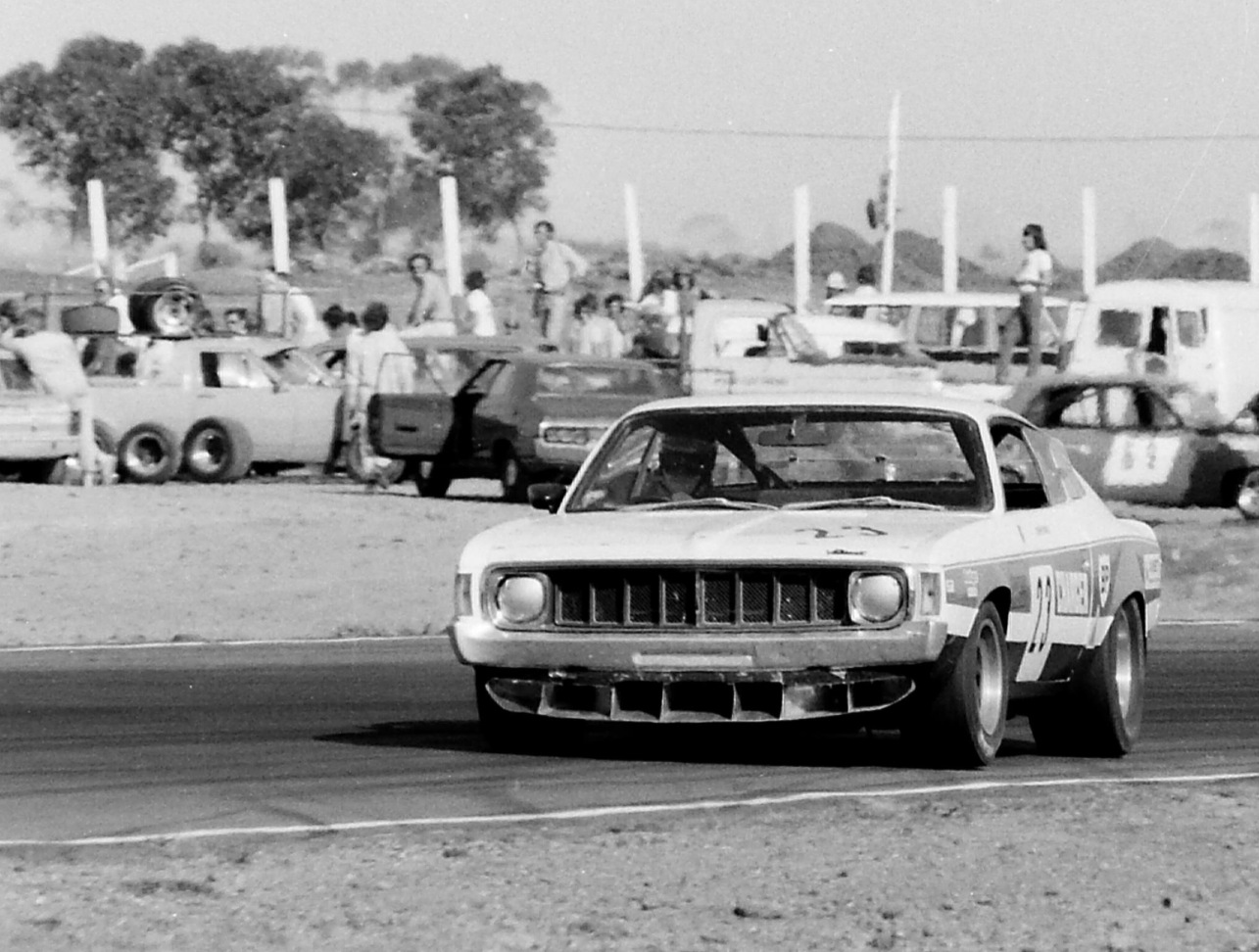
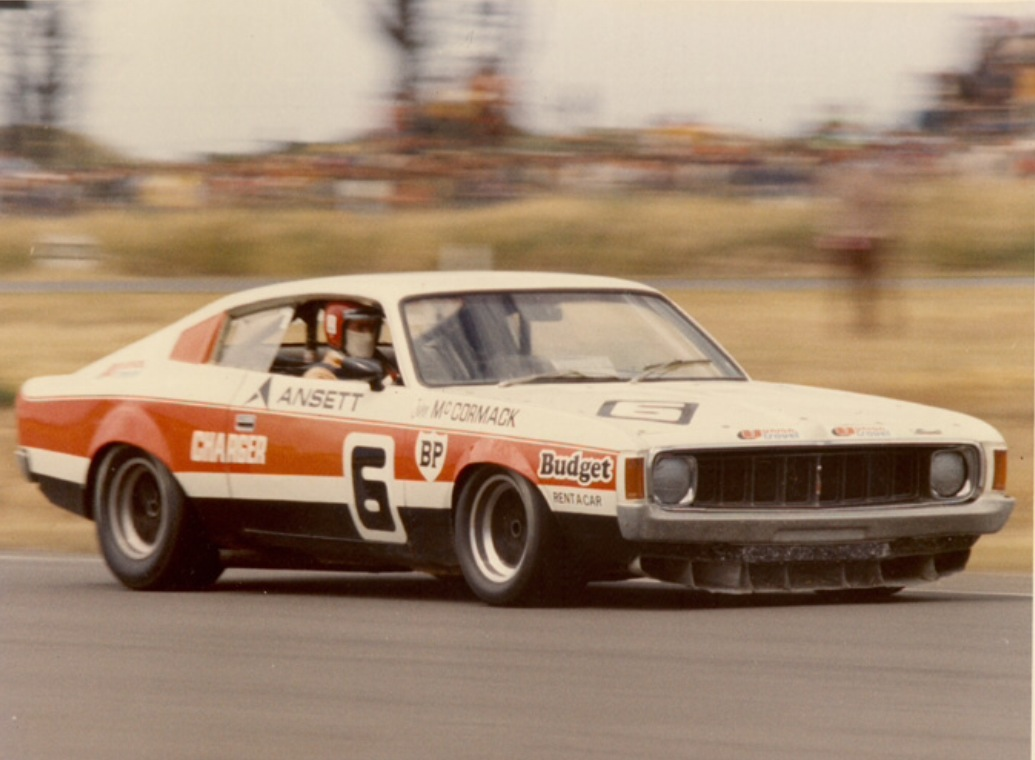
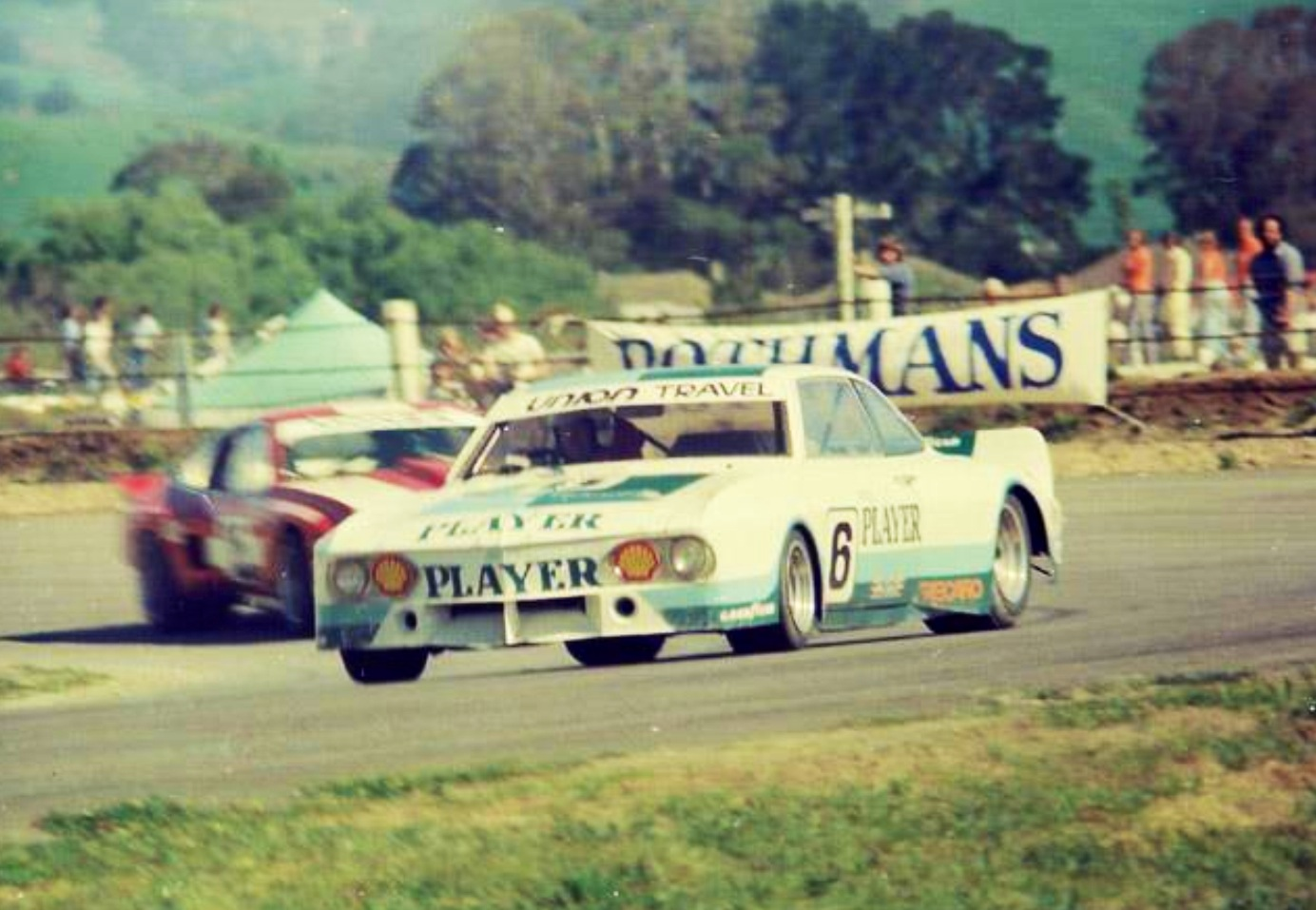
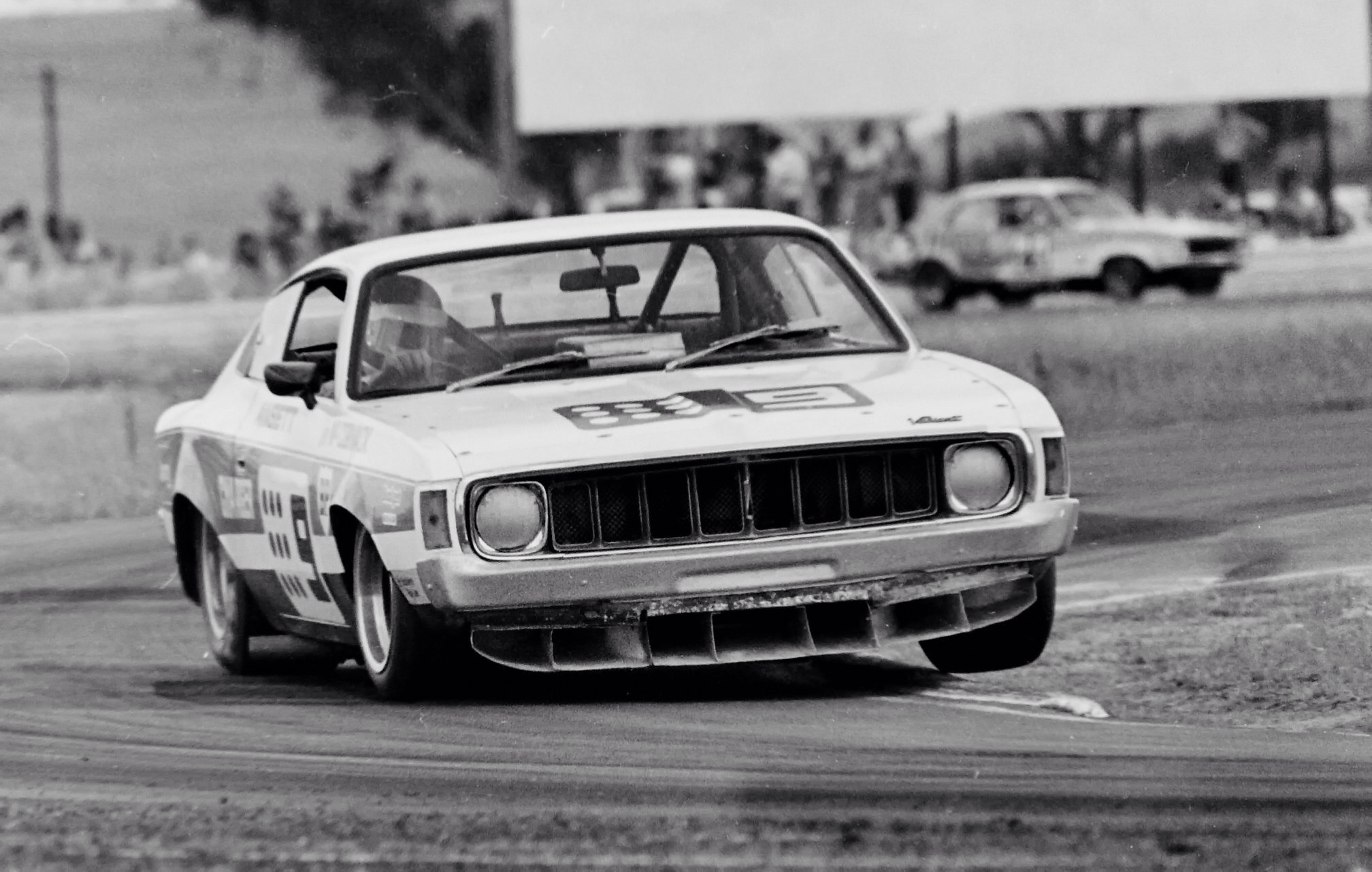
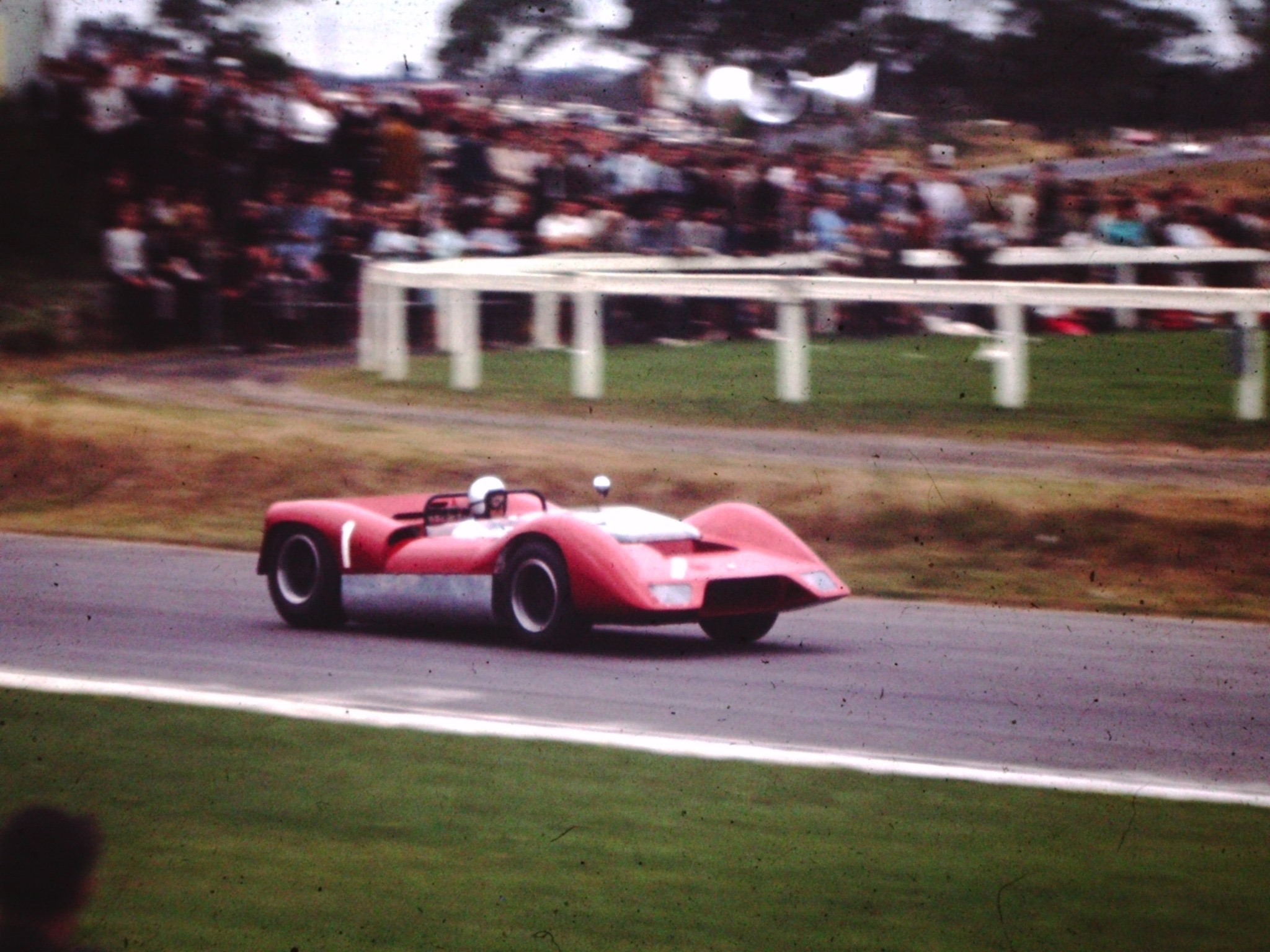
John McCormack wrestles his big, powerful but relatively nimble Valiant Charger Repco around the tight Calder, Melbourne confines in 1974…
Robert Davies shots have inspired two other articles, this is the third about a car which set a new paradigm in local Oz Sports Sedan racing in the mid-seventies.
In 1970 Touring Car Racing in Australiacomprised ‘Series Production’ for essentially standard cars, contesting the Bathurst 500 and the like. ‘Improved Touring’ were more highly modified cars, the Australian Touring Car Championship was run to these regs, and ‘Sports Racing Closed’ or ‘Sports Sedans’ was an ‘anything goes’ type of category.
Sports Sedans were often the province of the more impecunious, owner driver, engineering types who created some incredibly quick Minis, Holdens of all descriptions and the occasional bit of ‘heavy metal’ V8’s from Oz or the US.
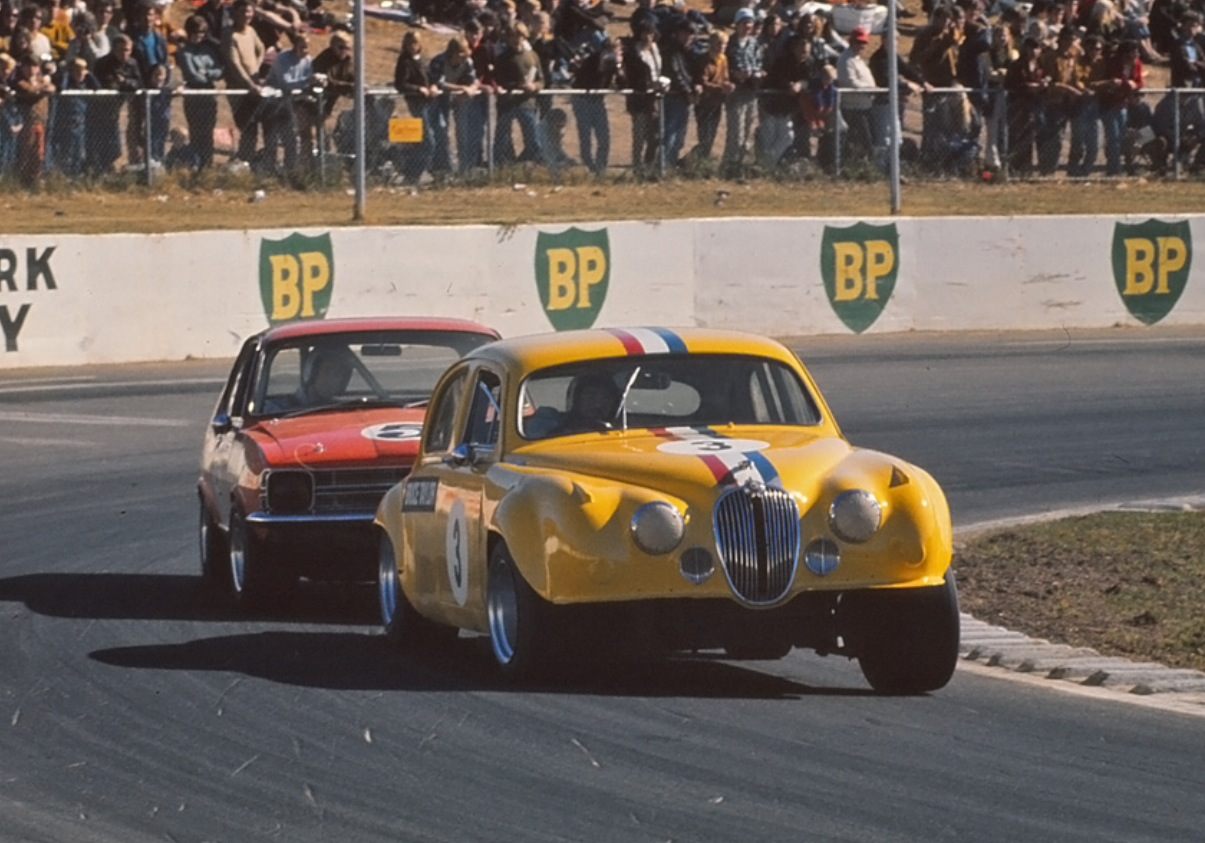
The Spirit of Sports Sedans in 1971; full spectator mounds, here at Sydney’s Oran Park. Bruce Taylor’s ex-Sharp Jag Mk2 Ford V8 ahead of Barry Seton’s ‘LC’ Holden Torana GTR XU1- old and new. (Vic Hughes)
Australian race fans liked Sedans, they were easier to understand and more spectacular to watch than most open-wheelers and the punters could relate to cars they either drove or saw on the road.
Other than during the Tasman Series, in most years our domestic single seater championship, the prestigious ‘Gold Star’ fields were thinnish. Scarce sponsorship dollars progressively found its way to Touring Cars fanning the open wheeler problem. Promoters were keen to give spectators what they wanted to fill their venues, and so, over time the dominance of Touring Cars in Australia occurred. And continues today. Sadly for open-wheeler nutters like me.
Castrol, for example, sponsors of Bob Jane Racing, one of our bigger teams encouraged Jane to get out of racers and more into touring cars in 1971. The Brabham and Bowin single seaters and McLaren sporty were progressively put to one side, replaced by a Holden Monaro Improved Tourer and Holden Torana Repco V8 Sports Sedan.
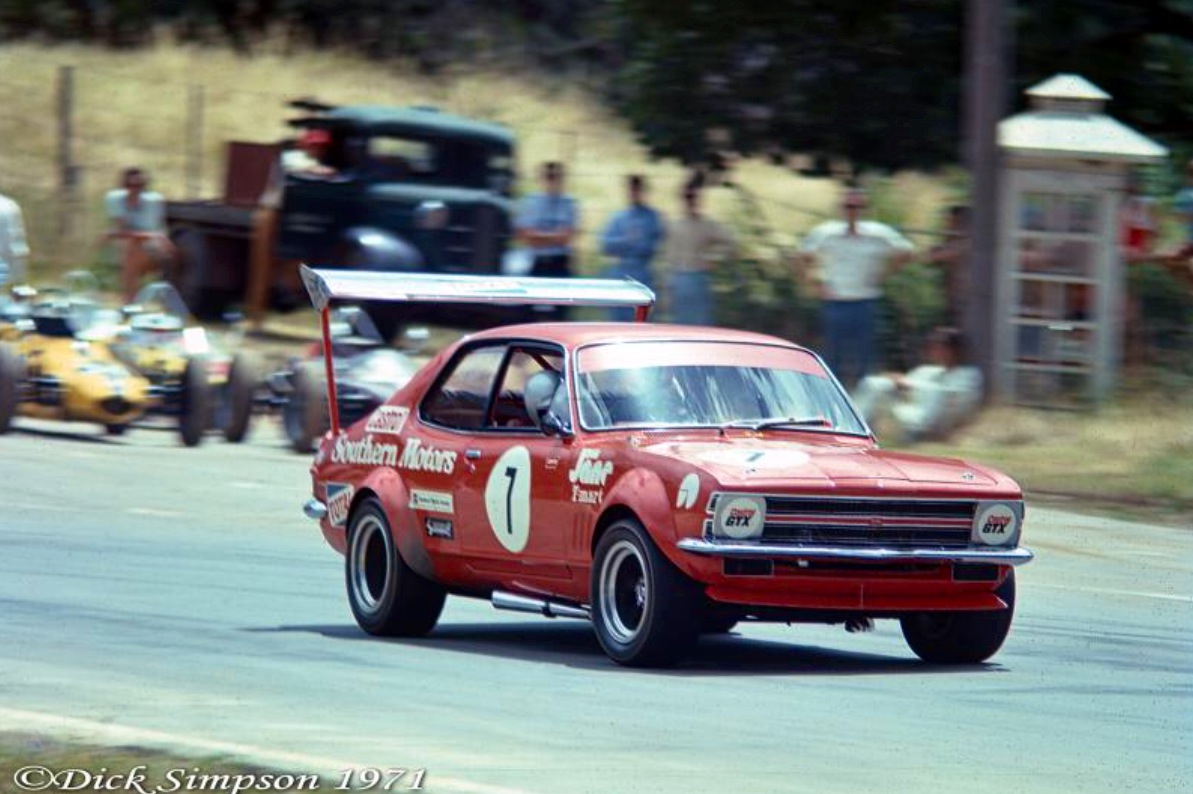
Bob Jane’s Holden Torana ‘LC’ GTR XU1 Repco. Hume Weir, Boxing Day 1971. John Sheppard built and prepared superb cars, this is one of his best, its first iteration here was not that highly modified, engine and Borg Warner ‘box excepted. Phase 2 in its life was when Frank Gardner returned to Oz and raced the car for Jane in 1975; an F5000 Chev replaced the Repco, the suspension also modified substantially in addition to the car being lightened considerably. Jane reputedly said to Gardner when he saw it ‘What have you done to my beautiful car…?’. Car still exists. (Dick Simpson)
There had been other ‘clever’ Sports Sedans, Harry Lefoe’s Hillman Imp Ford V8, an example but Bob Jane’s John Sheppard built Torana, which married a lightweight but still fully trimmed LC Torana with the Repco 4.4 Litre ‘620 Series’ V8 Bob had sitting in his Brunswick Race HQ took things to another level.
The alloy Repco developed 400 bhp but at 360 pounds weighed less than the cast iron 3 litre ‘186cid’ straight 6 fitted to the car in production form. Bob and John Harvey won many races in this car.
The ‘professionalisation’ of Sports Sedans was underway.
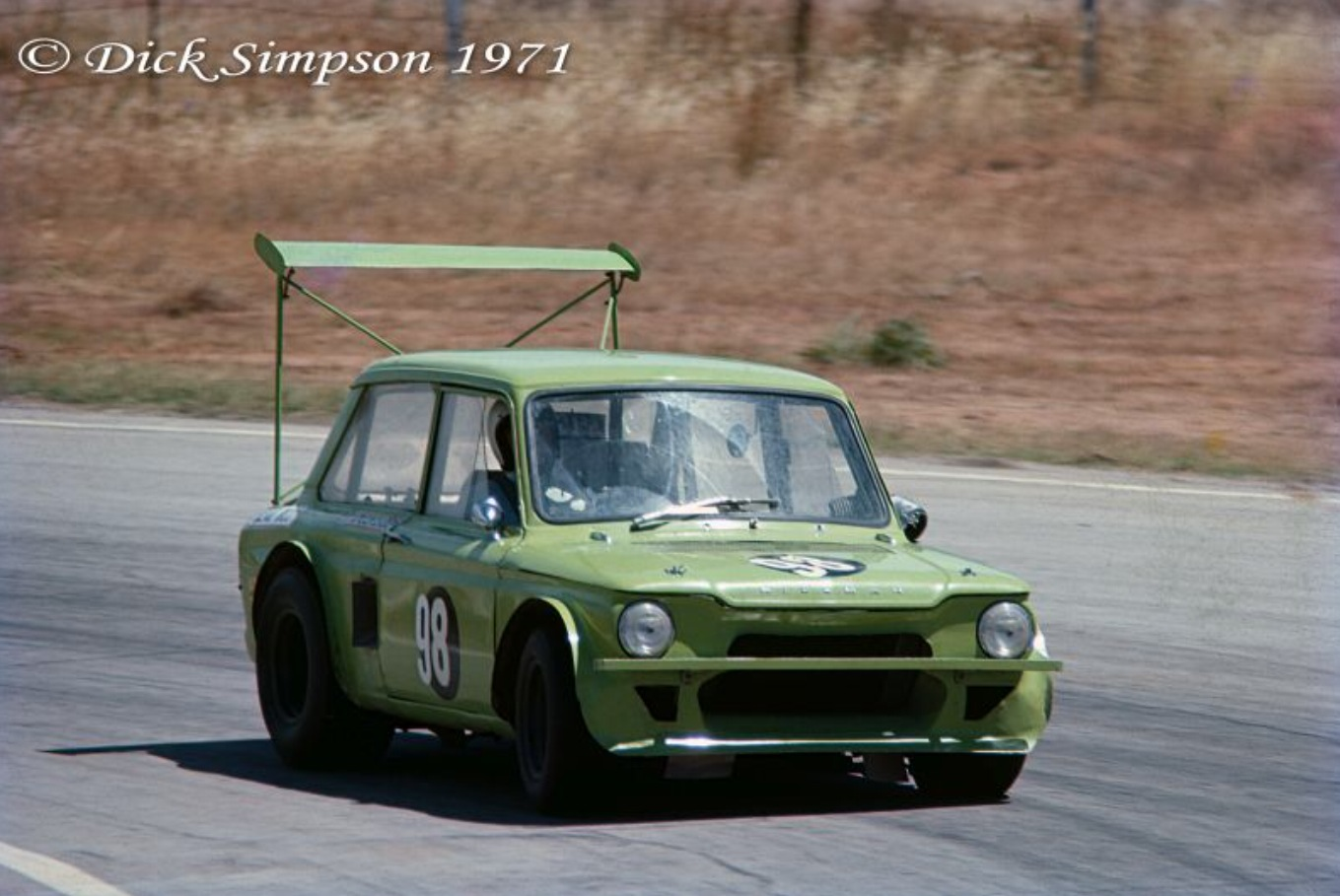
Harry Lefoe in his Hillman Imp Ford at Hume Weir, Albury, NSW on Boxing Day 1971, Dick Simpson took this shot and the one above of Bob Jane in the same race. Car had a 450bhp plus Ford ‘Windsor’ shoved in the back seat, Lefoe had balls of steel to drive the thing, twas usually sideways, considerably so! Its life ended with a big accident at Sandown in the late 70’s. Extremely short wheelbase clear, big wing, engine put out slightly more power and was slightly heavier than the 1 litre alloy standard engine…(Dick Simpson)
Another trend setting Sports Sedan was the Valiant Charger Repco built by Elfin and John McCormack’s team in 1973. Macs background is covered in the article about his McLaren M23 I wrote 12 months ago, you can read it here, I won’t repeat it.
John was an open-wheeler man, he won the Gold Star in 1973 in his Elfin MR5 Repco F5000, but he was also a professional driver who needed to chase dollars. Oran Park promoter Allan Horsley agreed appearance money with McCormack if he ran a Sports Sedan in his ‘Toby Lee (shirts) Series’ in 1974, that was the impetus McCormack needed.
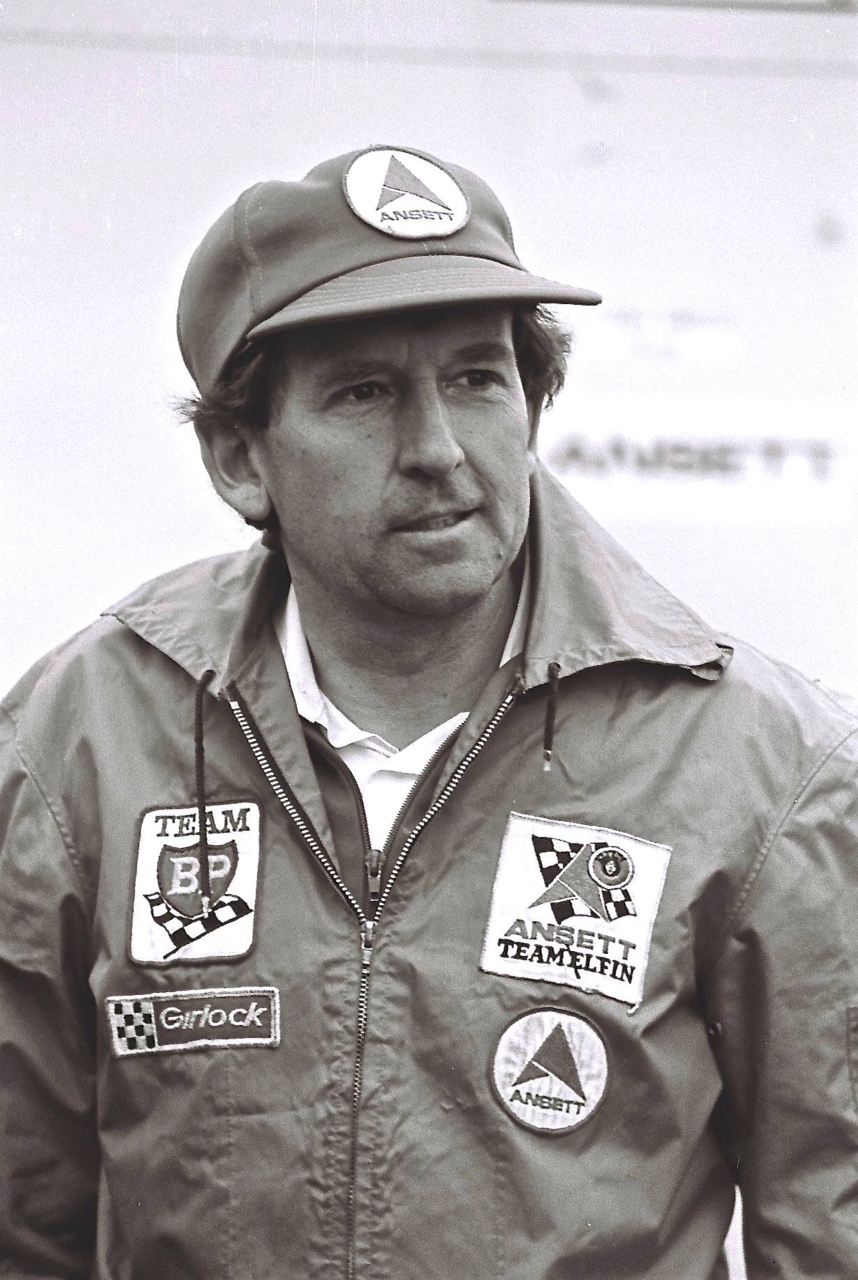
McCormack and Elfin boss Garrie Cooper (who ran 2 Elfin MR5 F5000 cars as Ansett Team Elfin in the Gold Star and Tasman Series at the time) toyed with the idea of a mid-engined Chev Corvair but commercially a deal with Chrysler made more sense.
In those far away days Ford, GM (Holden), Chrysler (Valiant) and British Motor Corporation all made cars in Australia, with others VW included assembling them here. Now only Ford, Holden and Toyota (who changed from assembly to construction of their cars progressively after 1970) remain but have announced plans to withdraw as manufacturers.
The economic and social policy as well as wider societal implications of this are beyond the scope of this article. Suffice it to say the death of the Automotive Industry in Australia is sad, wrong and was avoidable with a mix of better management, cooperation from the global headquarters of Ford, GM and Toyota and politicians who are not fuckwits. An oxymoron i grant you.
McCormack during his NZ Tour with the Charger in 1975, circuit unknown. Beautifully proportioned racing car, the external appearance matched the unseen clever and well executed engineering. Elfin 10 inch wide wheels, that width mandated then, not much to put 495 energetic ponies to the road. But spectacular! (The Roaring Season)
Elfin were based in Edwardstown, a southern Adelaide suburb, the Valiant factory was at Tonsley Park, not so far down the road.Valiant lost the promotional value of motor racing when they ceased building and racing their performance ‘Chargers’ and were receptive to the idea of a Sports Sedan Charger to go some way to matching Ford and GM who were still actively involved in racing and exploiting its promotional benefits in the competitive local market.
In one day McCormack and Ansett Elfin’s John Lanyon negotiated a deal which gave them cash, a truck to transport the racer, support and a Charger which made its debut after much surgery and modification in early 1974.
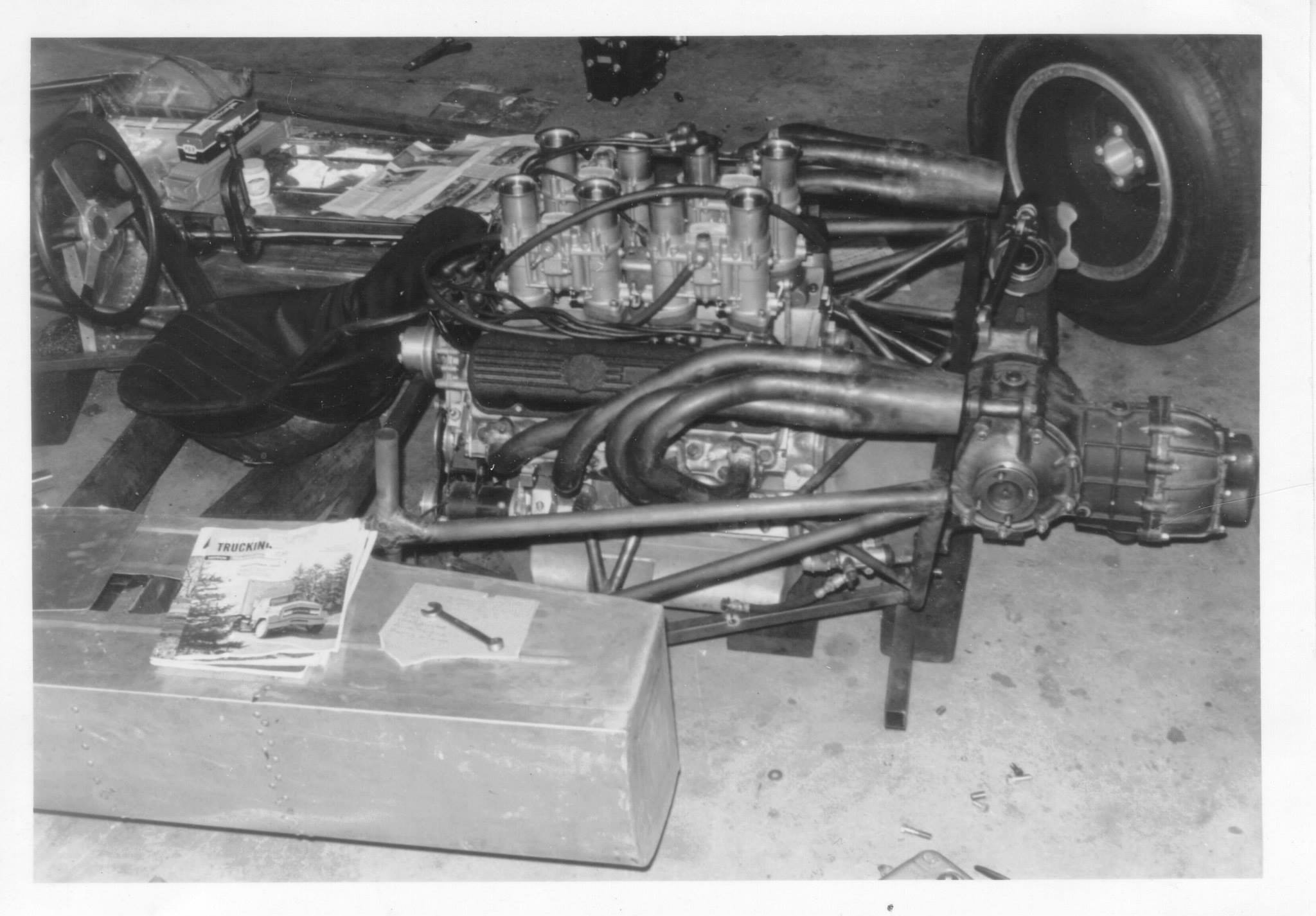
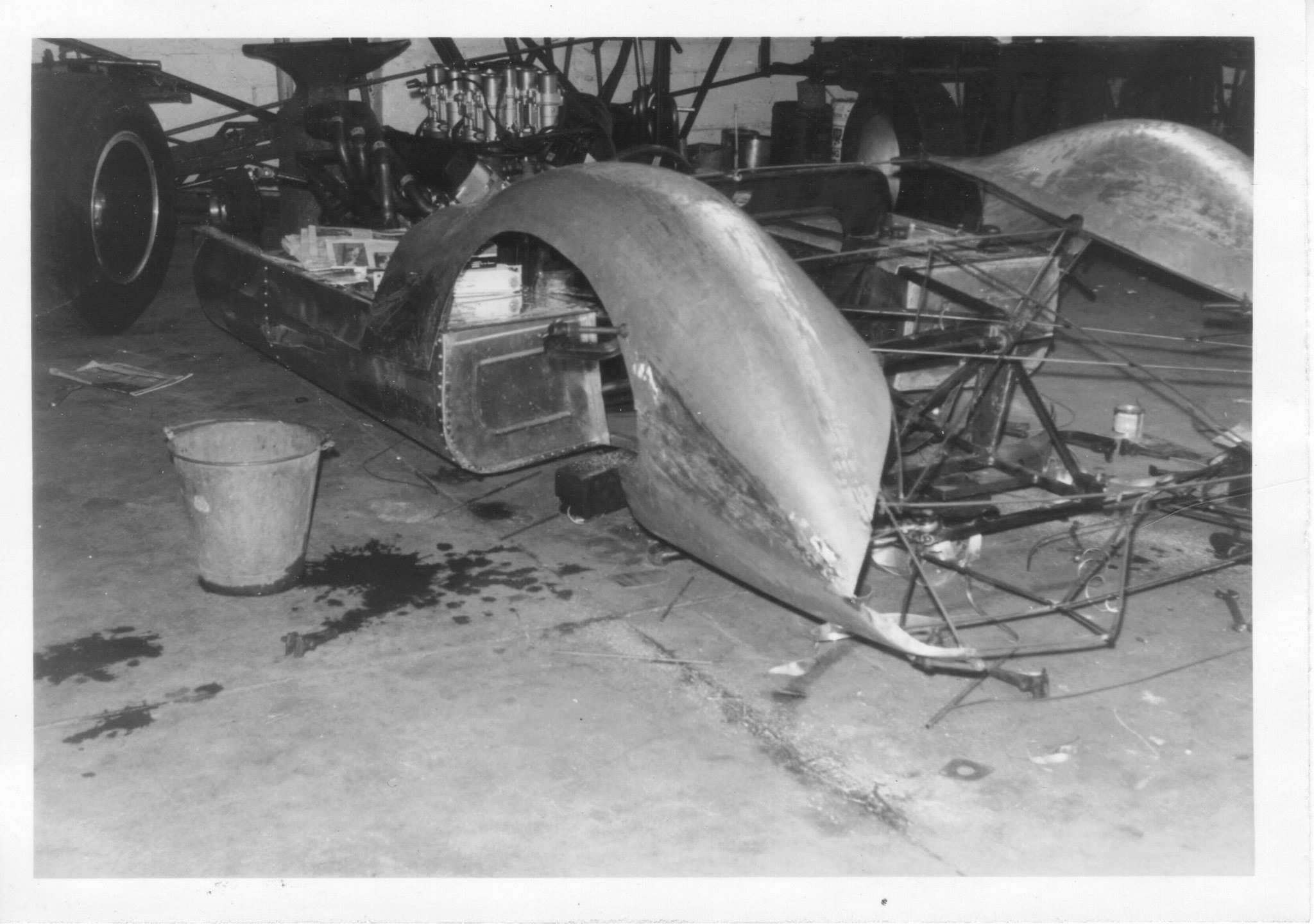
Cooper’s Conmurra Avenue shop was ‘chockers’ building Elfins so McCormack set up a workshop just around the corner in Coongie Road where the Charger was built. He took two Elfin employees in the process, Dale Koenneke and Harry Aust which did not go down well with Cooper, way too decent a man to be mixed up in professional motor racing…
The Charger was the result of the design ideas of McCormack and Cooper but was always Macs project, Garries priorities were production racing cars and his own racing program which was always fitted in around his customers needs. Elfin built 11 cars in 1973, 14 in 1974, a lot from the small facility.
McCormack and his team ran and prepared the car with the income derived going to Mac, but Ansett and Ansett Team Elfin received the promotional value of winning races in a growing part of the sport.
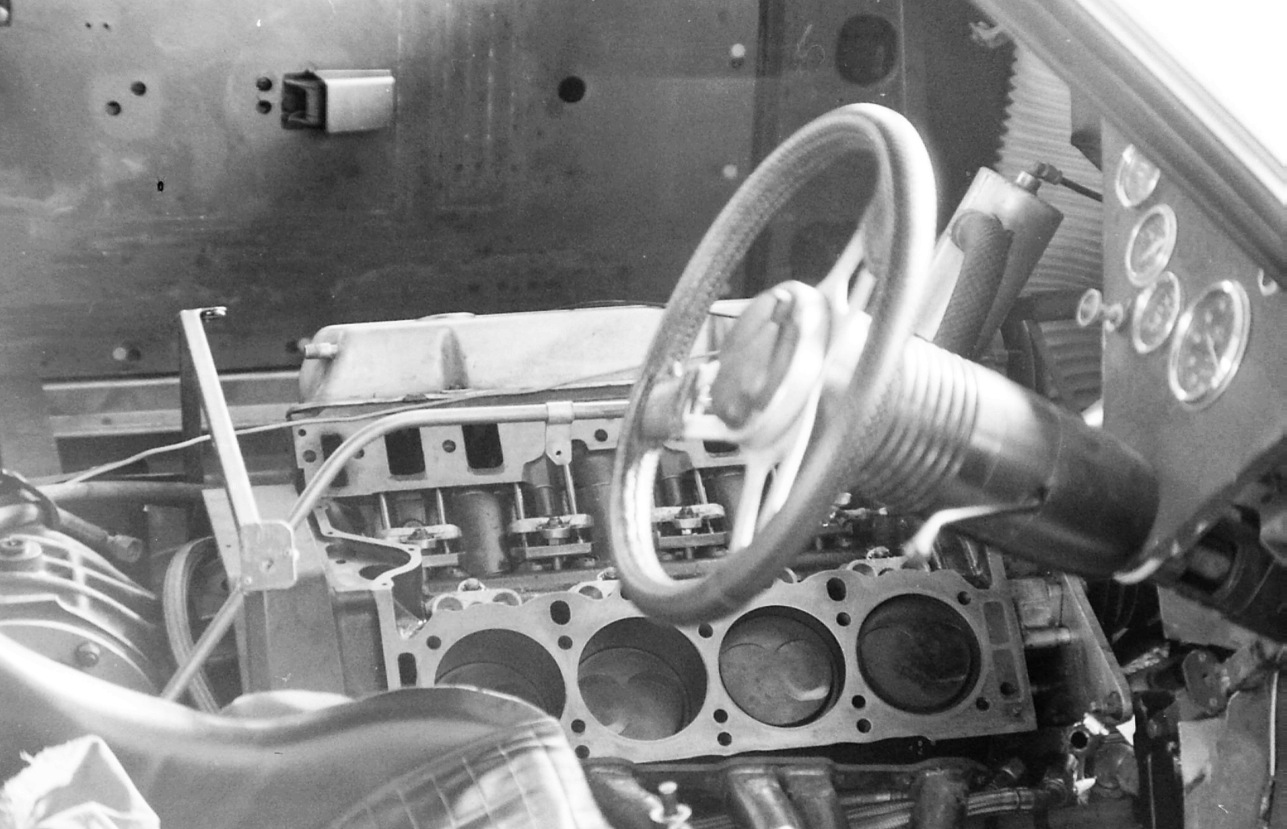
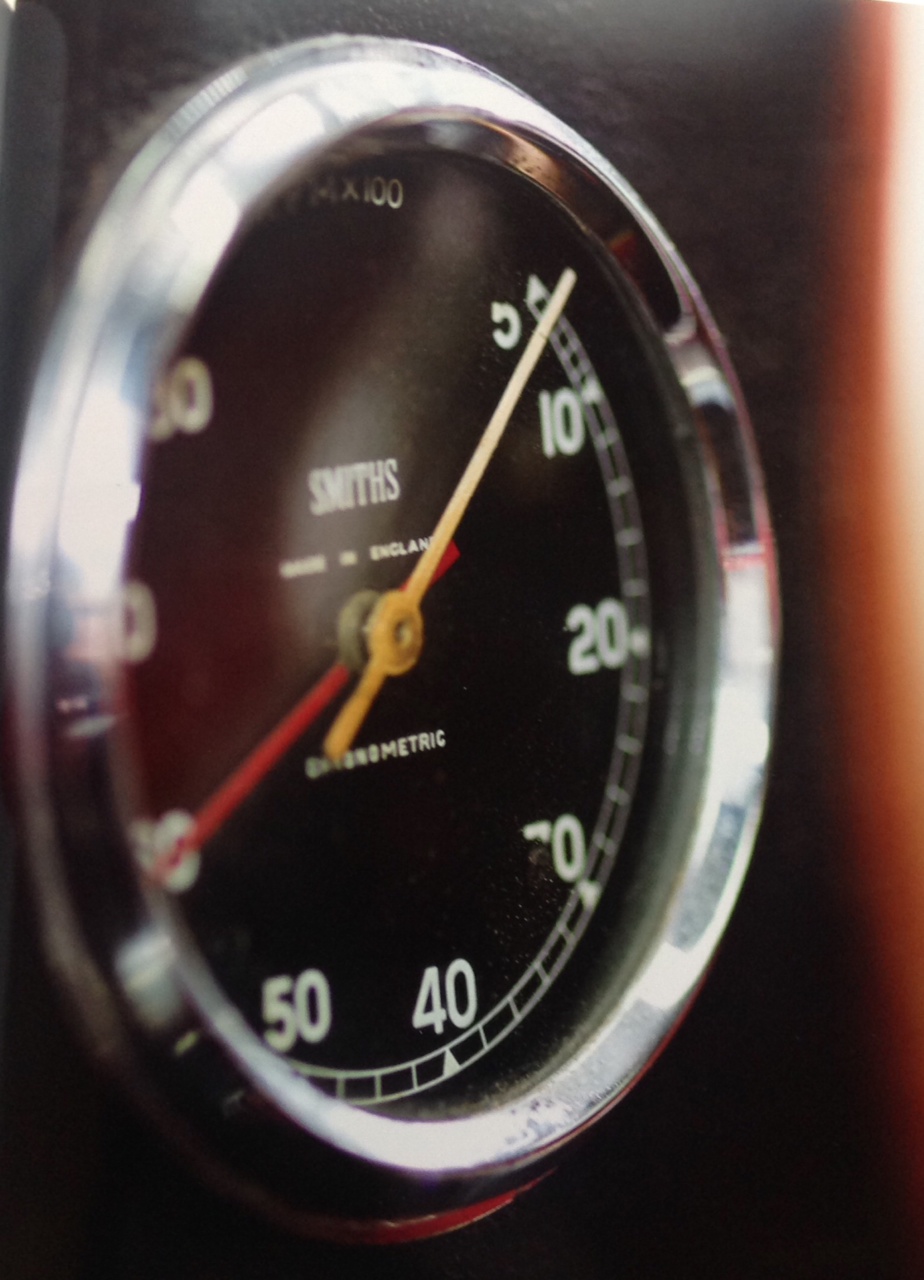
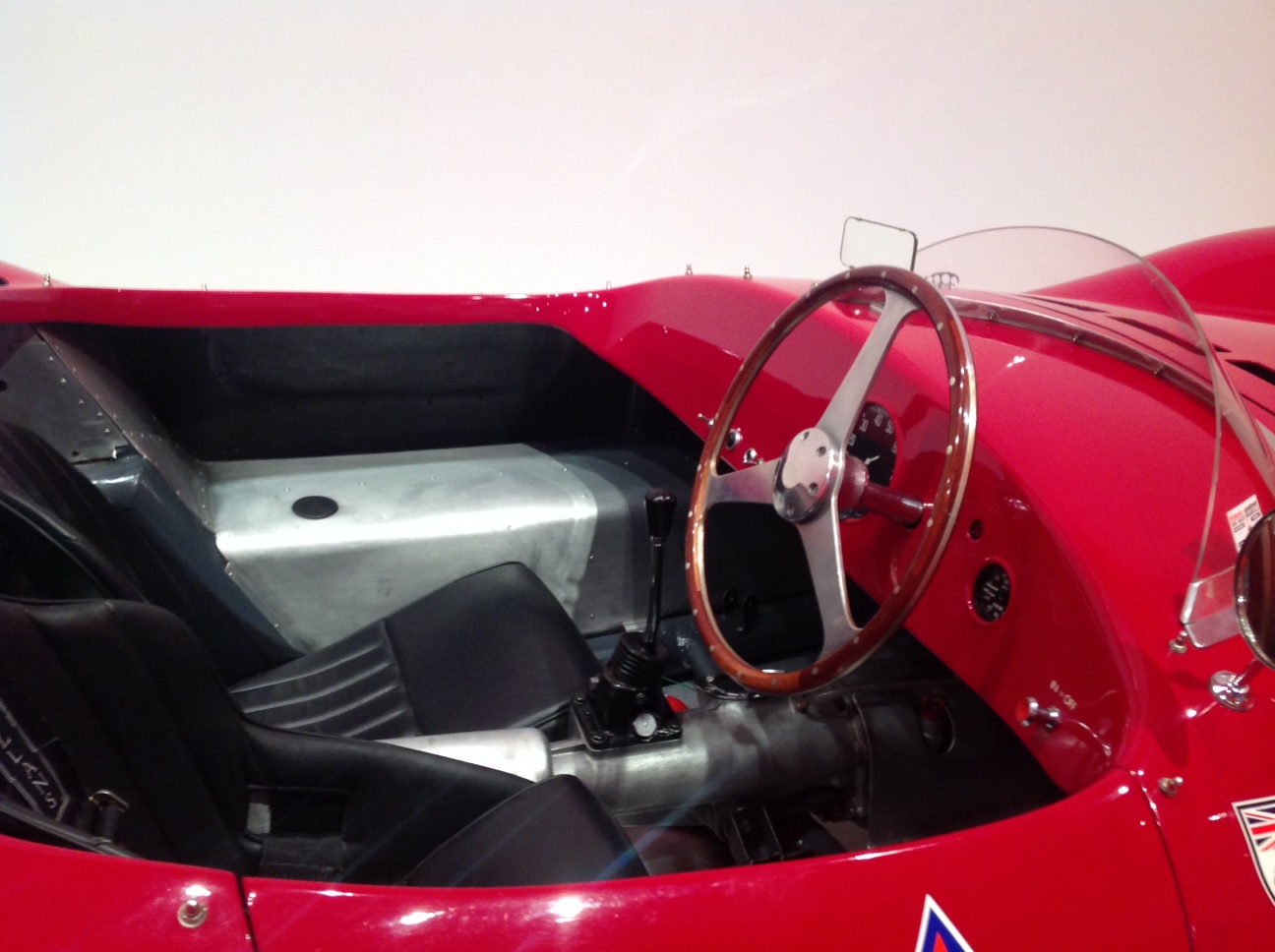
Rare cockpit shot of the McCormack Charger. Clearly cylinder head or valve gear problems during this Calder meeting in 1974. Mid-mounted Repco F5000 engine sans Lucas injection in this shot. Standard Valiant style steering wheel and column a nod to the donor car. Smiths chronometric tach, instruments and Hewland DG300 ‘box, the alloy case of which you can see aft of the engine all ‘standard F5000’ kit. RH gearchange outta sight, the pedal box was off the Elfin shelf as well, Mac felt right at home. (Robert Davies)
The trend setting bit referred to above was the decision to use as many F5000 bits as possibleand to locate the 495 BHP Repco Holden F5000 engine amidships beside the driver, the car was in essence mid-engined albeit the engine was in front of the centre-line of the car rather than to its rear.
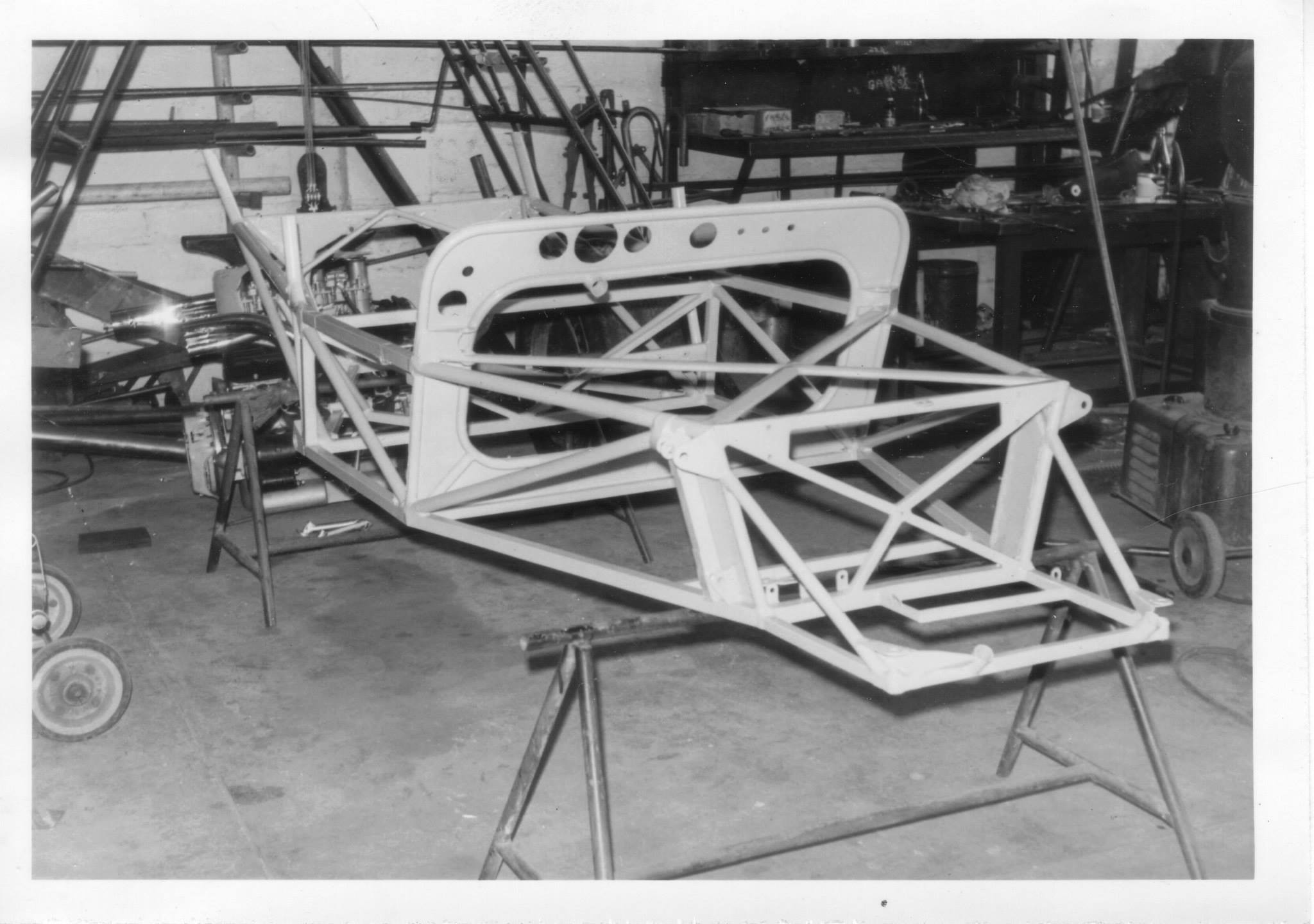
The car was completely gutted of all interior trim and surplus metal, an integral roll cage designed by Cooper adding considerable torsional rigidity to the standard sheet metal shell.
Elfin uprights and wheels were used front and rear, upper and lower wishbone’s and coil spring damper units were used at the front and single top link, twin parallel lower links, coil spring dampers, radius rods providing fore and aft location at the rear. Roll bars were of course adjustable. An Elfin steering rack was used as were Lockheed brake calipers.
The transmission was standard F5000 issue, a 5 speed Hewland DG300 transaxle, located aft of the engine. There were two though, the front one contained the gears and the rear DG300 case the differential. Mac placed the gearchange lever to the right of the very low mounted drivers seat so he would feel pretty much at home, the driving position akin to the single-seaters from whence he came.
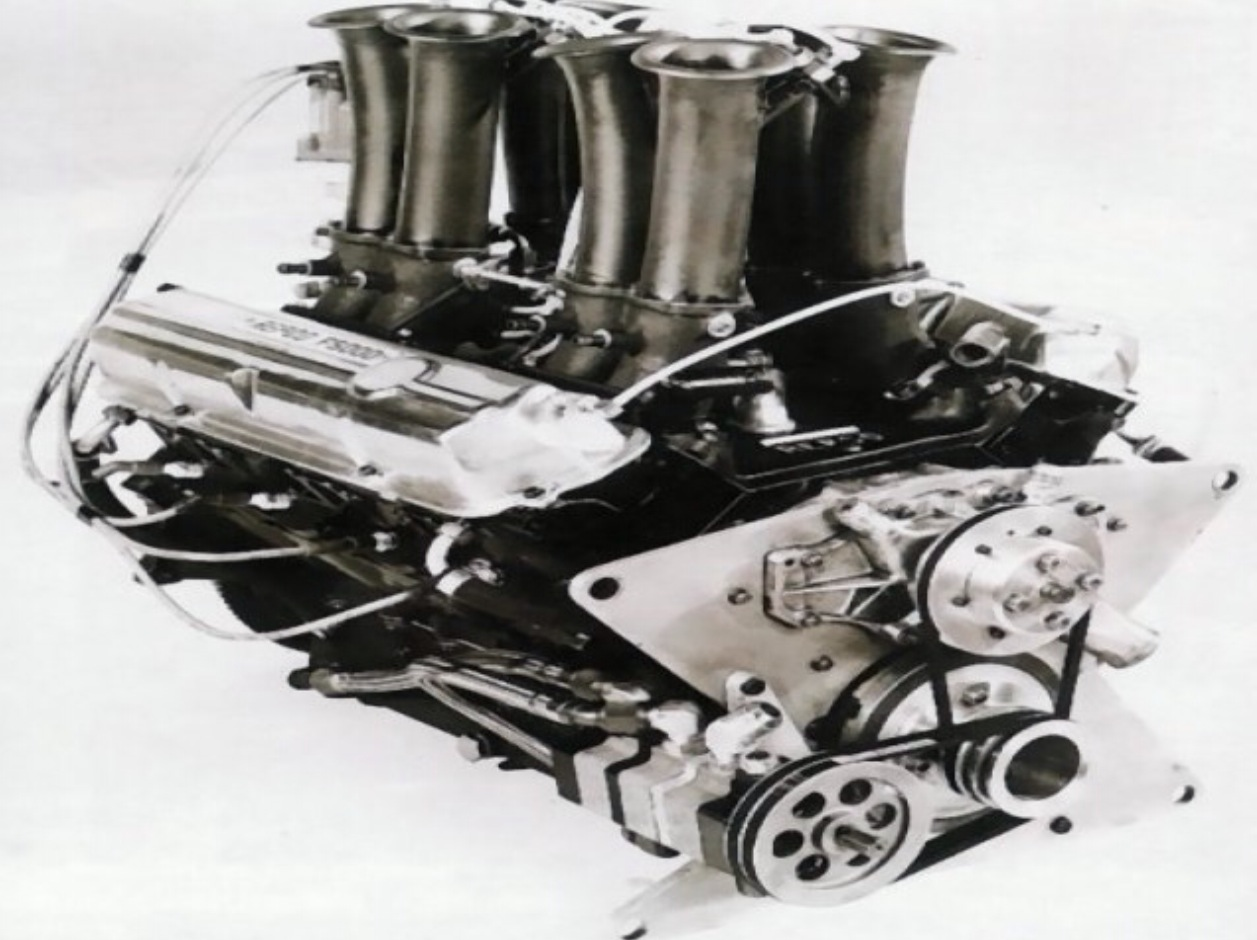
Phil Irving’s adaptation of General Motors’ Holdens then new ‘308’ V8 as an F5000 engine in 1970 created a very effective racing engine. Lucas fuel injection was one of the few non-Repco manufactured parts. 495bhp@7500 rpm is the quoted figure but the few flat-plane crank engines of 1973/4 produced closer to 525. It didn’t matter, the engine had greater mid-range punch than most Chevs, the blend of power/torque won it championships. (Repco)
The Charger had its first race at Adelaide International in early 1974, the Elfin MR6 Leyland F5000 made its debut on the same day, by the end of it the Chrysler executives present were far happier than the Leyland guys, the race variant of that engine always somewhat of a ‘hand grenade’ as covered in the McLaren article referred to above…the Charger cantered away and won its races.
The intelligent beast was immediately successful, Mac getting $2500 appearance money each time he ran in the ‘Toby Lee Series’ at Oran Park and carted away a good share of the prize money in 1974, he won the series from Jim McKeown’s Porsche and Frank Ure’s Holden Torana V8.
The car was also raced around the country with similar success.
He raced the car into 1975 selling it eventually to Tony Edmonson who was also successful in it.
McCormack re-focussed on single seaters with his ultimately successful McLaren M23 Leyland program and was just coming back into sports sedans, having built a Jaguar XJS at the time of the untimely road accident in which he was a passenger, ended his racing career.
Their were many very clever Sports Sedans which followed the McCormack/Cooper Charger but arguably it was the first…
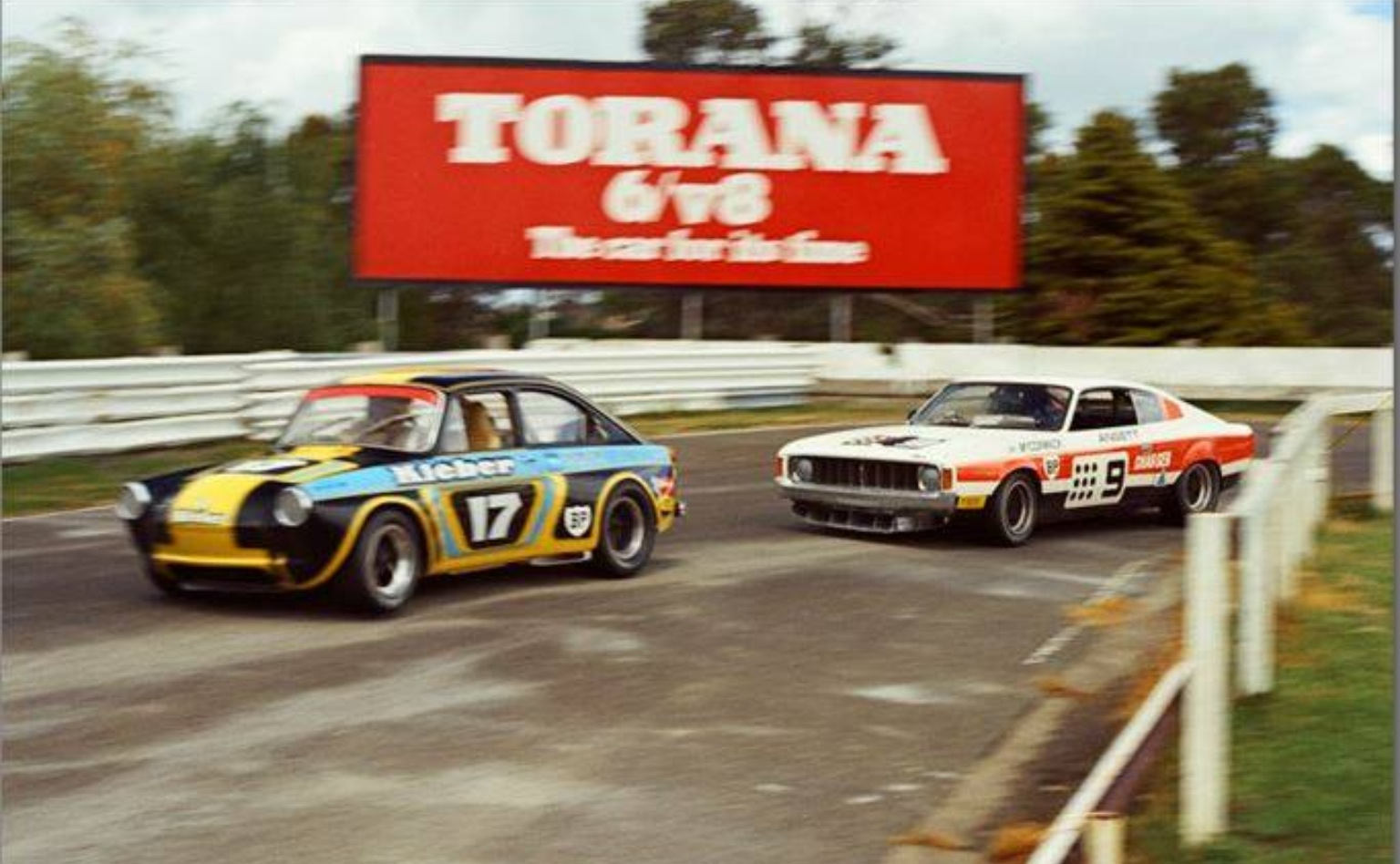
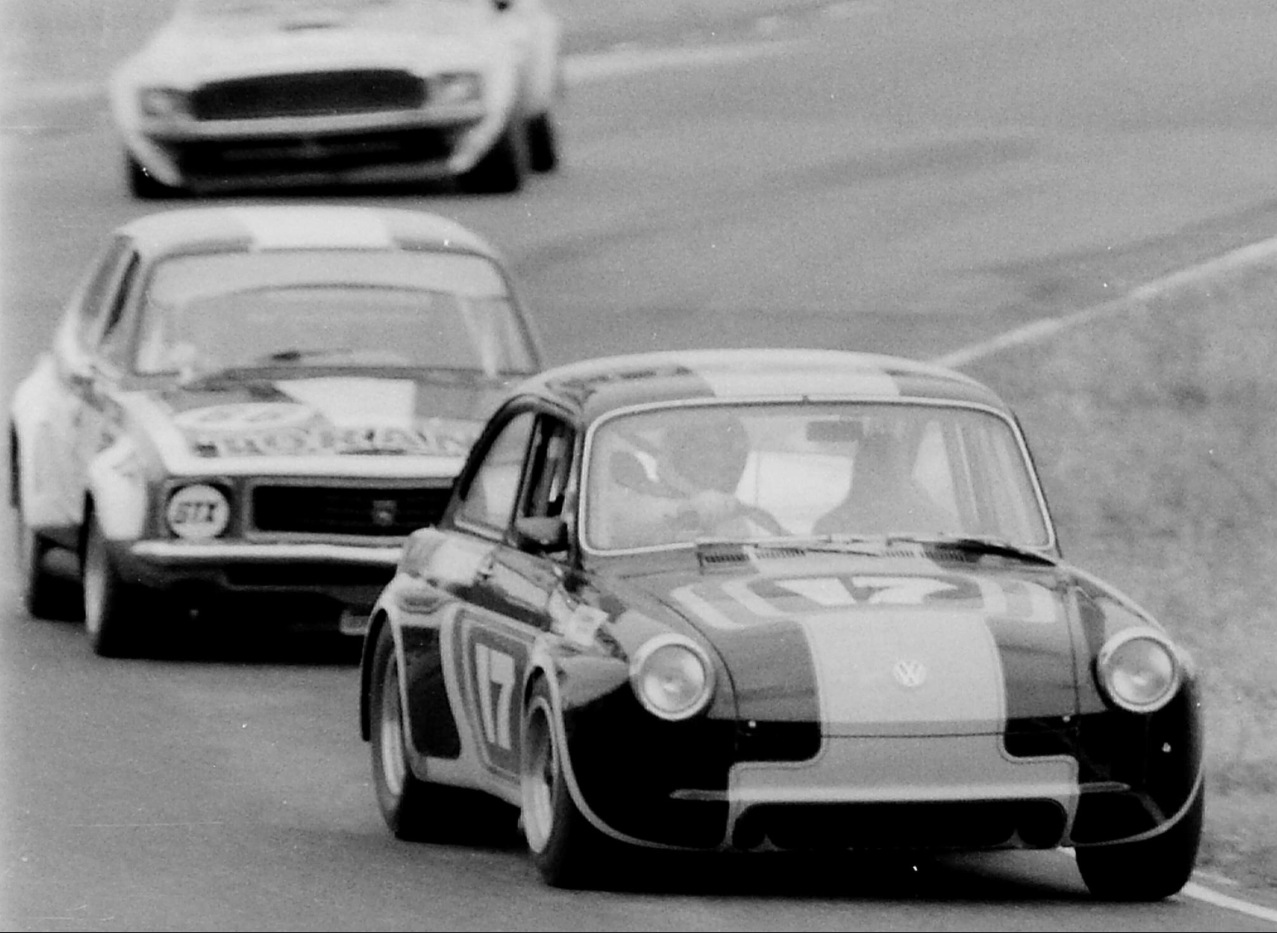
Bryan Thomson VW Fastback being chased by John McCormack’ Charger at Sandown’s, you guessed it, Torana Corner in November 1974. They are about to unleash 500’ish Chev and Repco Holden horses up Sandowns’ long back straight. Great circuit for these cars. Two clever cars from 1974; both F5000 based, both ‘mid-engined’ the VW at the mid-rear and Charger in the mid-front. (Paul Van Den Akker)
PostScript…
Frank Gardner got around to building a Chev Corvair, the car well engineered (see etcetera below) as you would expect and largely built around Lola F5000 componentry. He essentially ‘killed the category’ such was the dominance of the car until the regs were changed to effectively ban it (the Corvairs engine and gearbox in standard form, were located Porsche 911 style, with the engine behind the gearbox, the legislators would allow a Corvair to race in that format but not the layout Gardner had with the classic ‘box behind the engine layout).
Frank Gardner in the Chev Corvair ahead of Red Dawson’s Chev Monza, Bay Park, NZ 1976. (The Roaring Season)
Etcetera…
Other ‘Class of ’74 Cars’; Bryan Thomson’s ‘Volksrolet’ was a marriage of VW Fastback and an ex-Hamilton/Brown McLaren M10B F5000, but it never worked as well as Frank Gardner’s Corvair variation on the same theme despite the prowess of Thommo and his engineer Peter Fowler. But a massive crowd-pleaser. Behind is Peter Brock in the Holden Dealer Teams ‘Beast’. From memory an ex-rallycross LC Torana chassis into which was shoehorned a Repco Holden F5000 engine mated to a Borg Warner T10 ‘box. Ok in ’73 but the game had moved on by 1974, let alone the cars to come. Sandown Park November 1974. (Robert Davies)
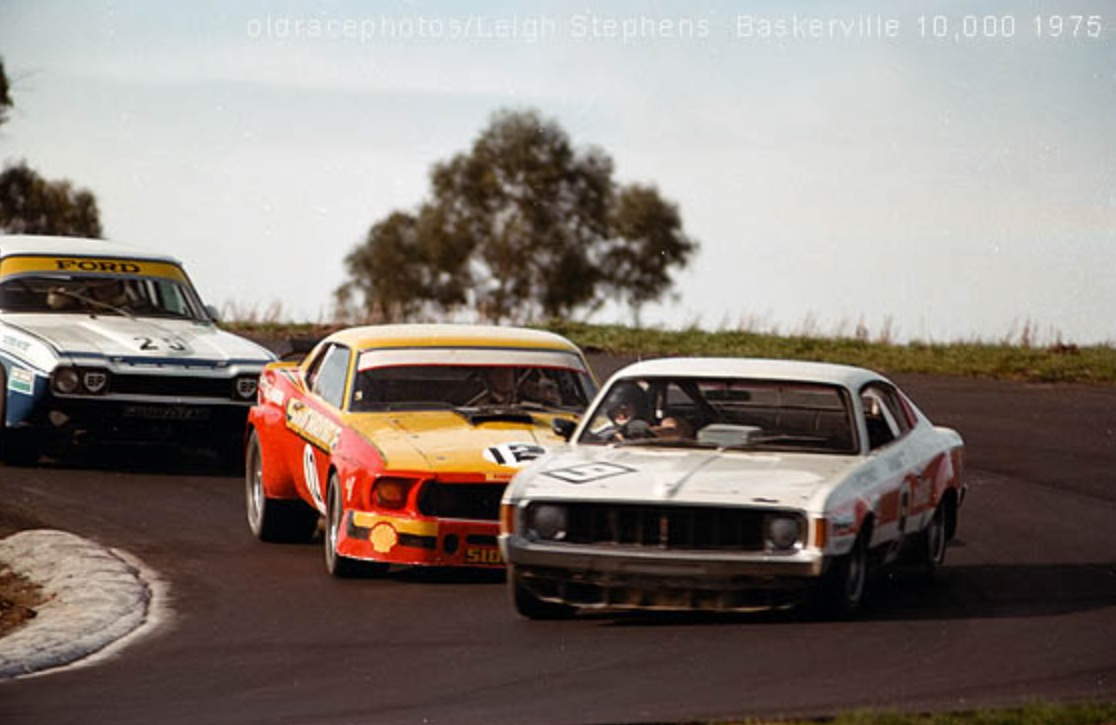
Baskerville, Tasmania 1975. McCormack ahead of Jim Richard’s Kiwi built, old tech but superbly driven Ford Mustang 351 and Allan Moffat’s Ford RS3100 ‘Cologne Capri’. Moffat won the Australian Sports Sedan Championship in 1976 using this car and a Chev Monza. (oldracephotos.com/Leigh Stephens)
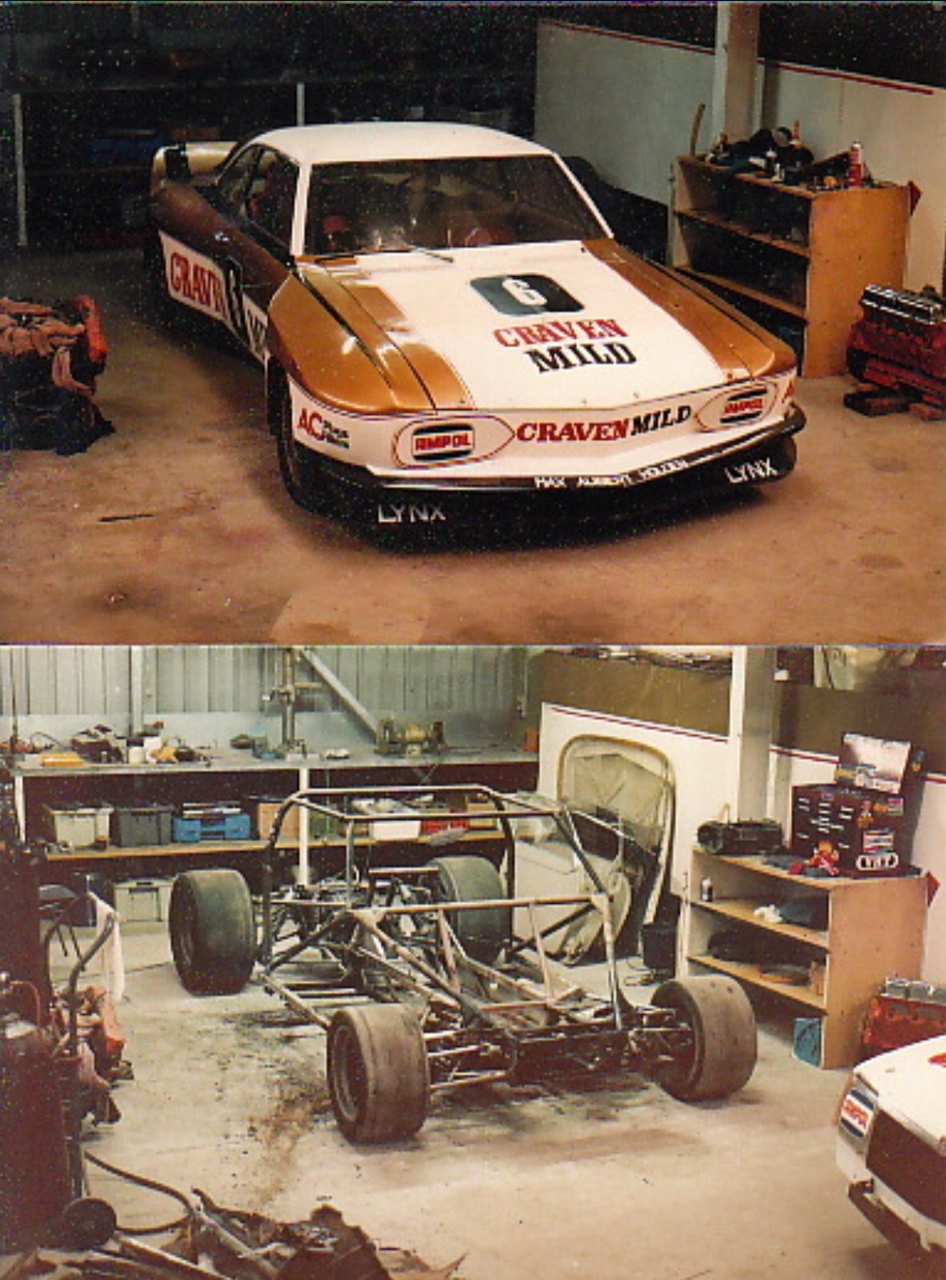
Frank Gardner’s Corvair as raced by Allan Grice after Gardner stepped outta the driving seat. Circa 1977. Nose of Grice’ Group A Commodore to the right. FG raised the Sports Sedan bar again with the Corvair, the bottom shot clearly shows the car for what it was conceptually; a Lola T332 F5000 albeit with a spaceframe chassis and a roof! Brilliant device, even the 6 litre cars couldn’t keep up with it, put its power down so well. (The Nostalgia Forum)
Bibliography and Photo Credits…
‘Australia’s Elfin Sports and Racing Cars’ John Blanden and Barry Catford, ‘Maybach to Holden’ Malcolm Preston
Robert Davies, Dick Simpson, Vic Hughes, Dick Simpson, Paul Van Den Akker, The Roaring Season, The Nostalgia Forum, oldracephotos.com/Leigh Stephens, Bruce Keys
Tailpiece: McCormack, Charger Repco Holden, Calder, December 1974…
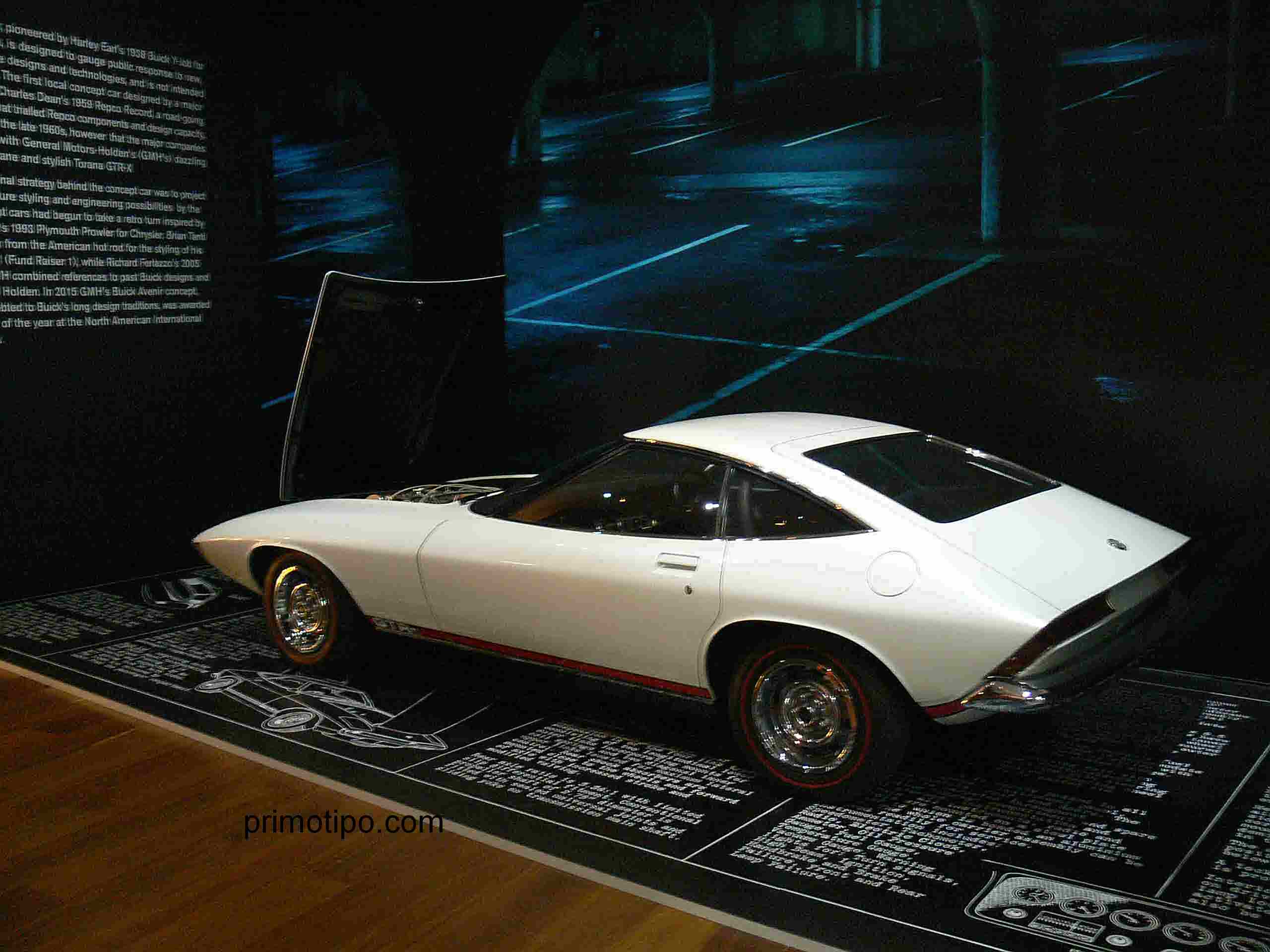
Dean, Head of Repco Research, the large transnationals ‘Skunkworks’ turned his attention to the creation of a road car which would form a test bed for the companies products, a promotional tool and an expression of Repco’s innovative capabilities.
Dean recruited Tom Molnar (Chief Engineer of Patons Brakes) and Wally Hill (Repco Research) to assist with development of the car; Molnar with its engineering and brakes, Hill built the body with some assistance from Bob Baker to Deans design, a process completed in Dean’s spare time at his Kew, Melbourne kitchen table!
The cars construction took 4 years, the yellow coupe made its debut at the 1959 Melbourne Motor Show, where it was ‘The Starlet’ painted a distinctive shade of yellow.
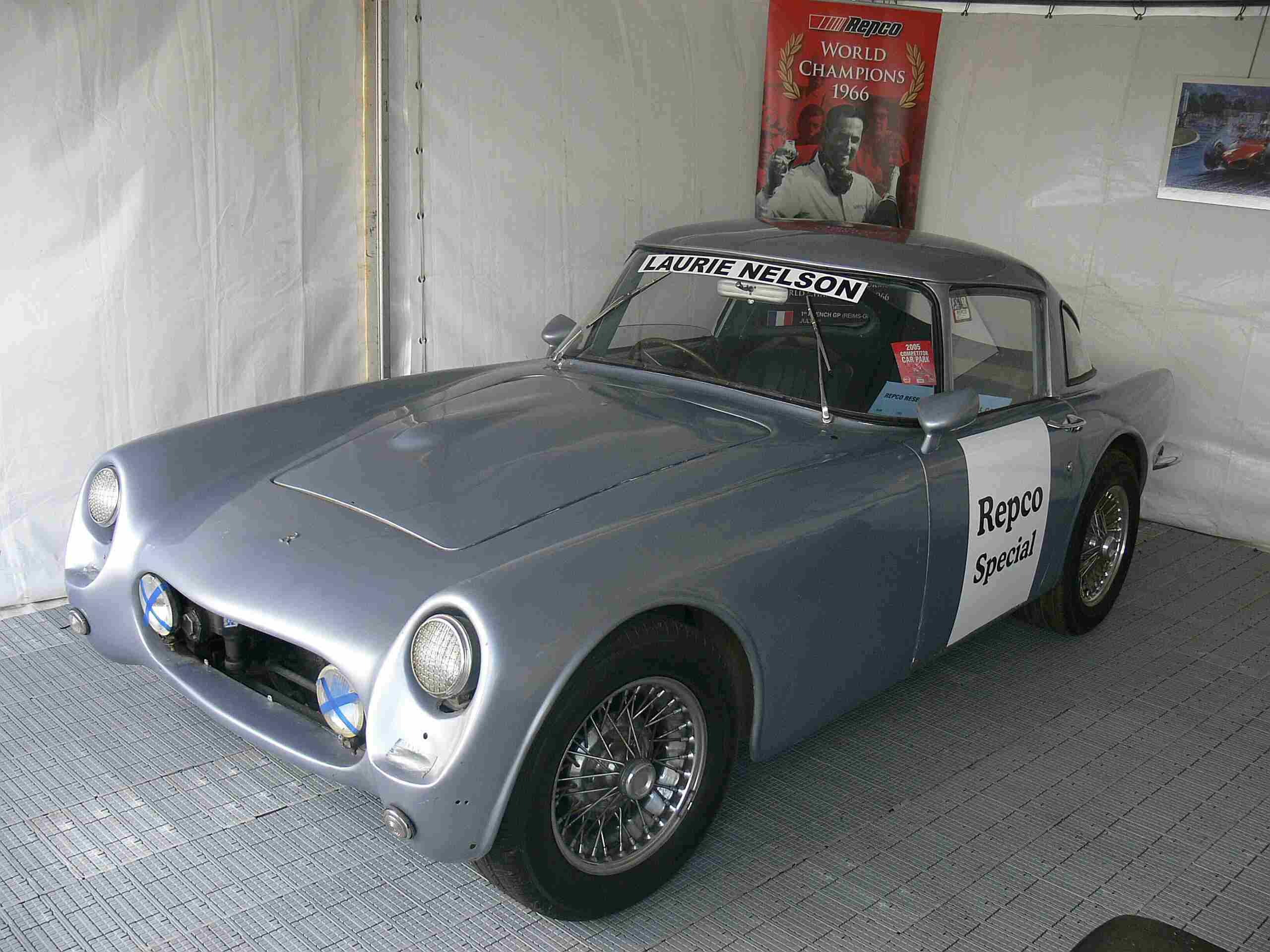
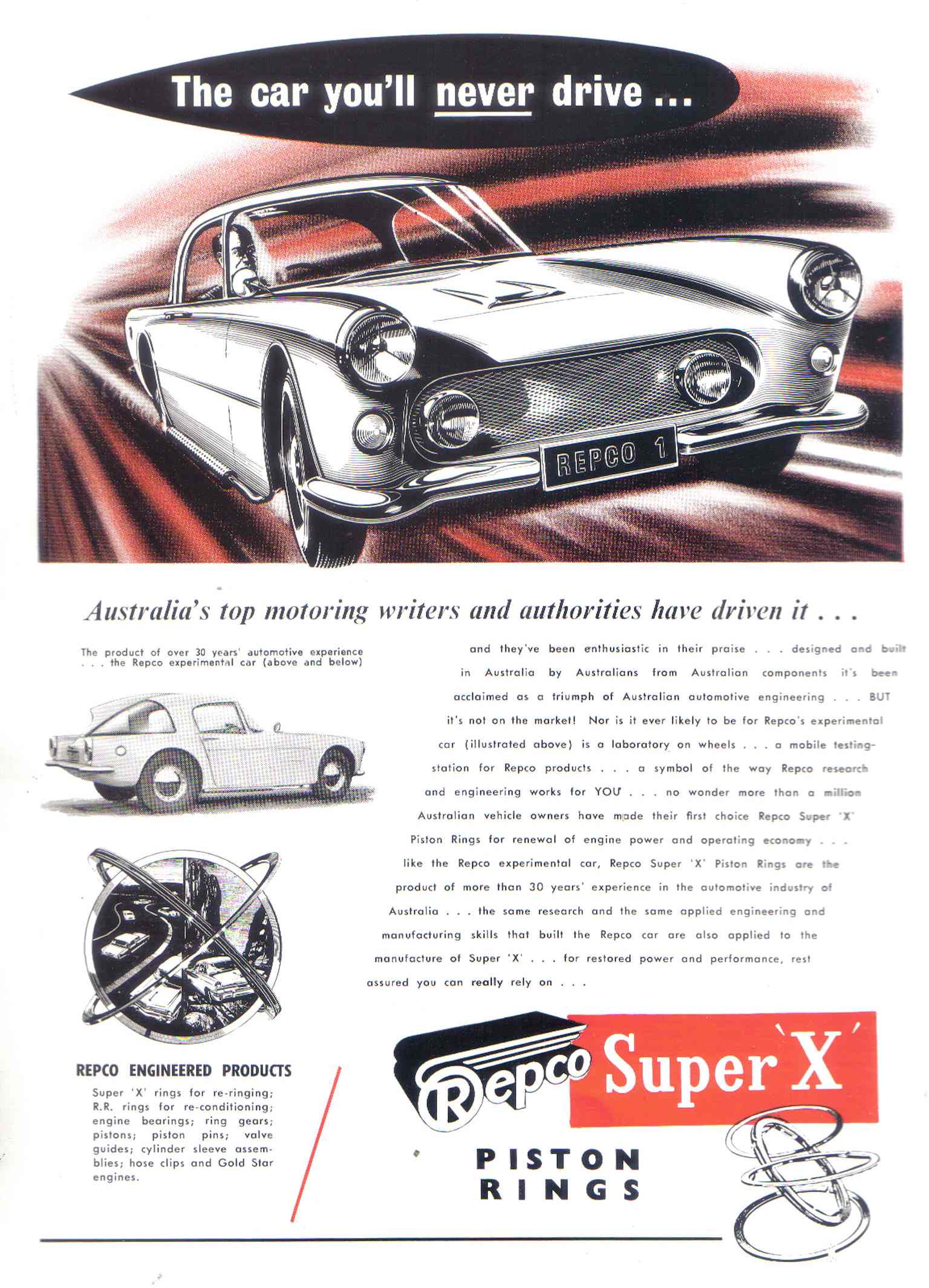
The ‘Repco Experimental Car’ as it was then unimaginatively called was a mobile test beddesigned to trial the groups products, but that didn’t stop contemporary reports speculating about series production. In the context of its time it was a highly specified, comfortable high speed car of potentially modest cost using largely production based components.
When originally built it was fitted with a Ford Zephyr engine with a Raymond Mays cylinder head Dean bought to fit to his company car, and an MG TC gearbox. A Holden engine was slotted in when the Repco ‘Hi-Power’ head was developed, a David Brown Aston Martin ‘box replaced the MG unit at the same time.
‘Sports Car Worlds’ Peter Costigan tested the Record with Dean on board and raved about its comfort, performance, roadholding and handling. Less impressive was the David Brown ‘box and brakes which faded after repeated high speed applications. The car cruised comfortably at 100mph with a top speed of 120 mph, the Repco modded Holden engine in ‘touring tune’. Heavier shocks, improved brakes and an oil cooler were suggested improvements.
Repco shot with the car posed in front of Repco Research’ new home in Dandenong, Victoria. Late 50’s. (Repco/From Maybach to Holden)
The pretty Coupe was used during the filming of ‘On The Beach’, a Hollywood movie shot in Australia featuring Gregory Peck, Ava Gardner and Fred Astaire during 1959.The film was based on a novel by British/Australian author Nevil Shute.
The car was one of several used in the productions racing scenes filmed at Phillip Island. It was during breaks in filming that SCW magazine drove the car, it was about this time someone dubbed the car ‘Repco Record’ a name never officially endorsed by Repco but an appellation which stuck!
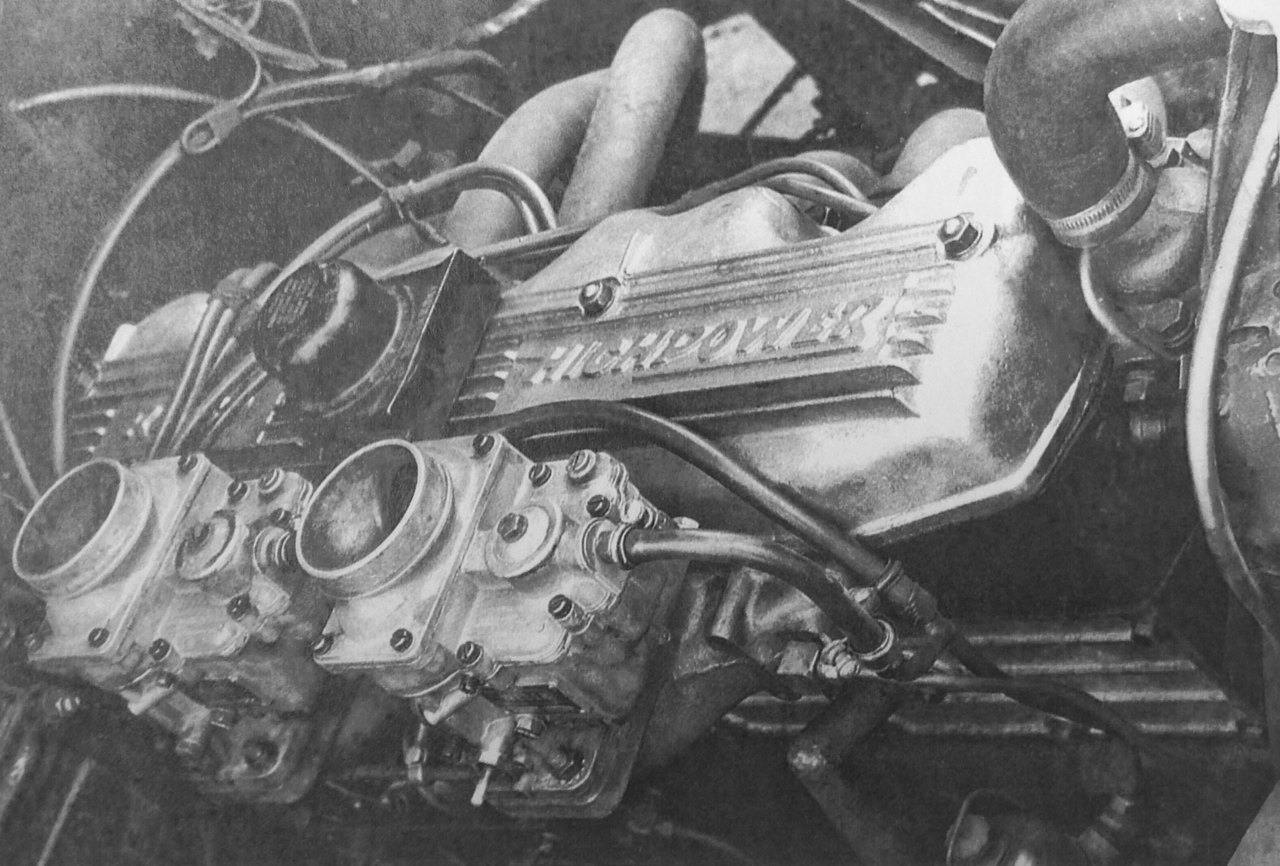
Repco ‘Hi-Power’ headed Holden ‘Grey Motor’ 2.3 litre OHV 6 cylinder, cross-flow engine fed by 2 Weber carbs. Circa 133 bhp with a ‘cooking cam’ and extractors. (SCW Magazine)
After testing of various Repco subsidiary components and the changing of the cars livery and especially rear window treatment the Record was sold after a few years into private hands, it is still in Australia, last sold several years ago and pops up occasionally at historic events.
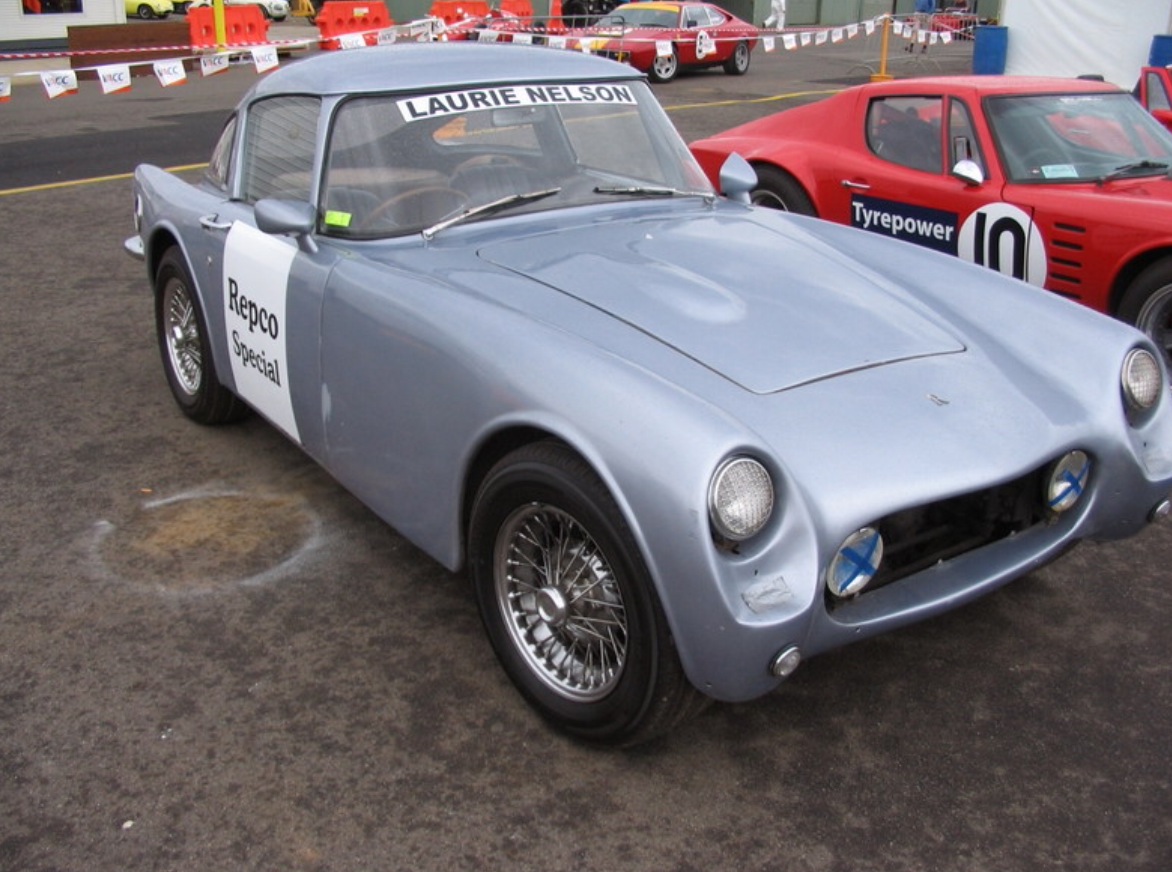
Contemporary shot of the Repco Record at Phillip Island in 2014, changed frontal treatment not for the better. (Stephen Dalton)
Specifications…
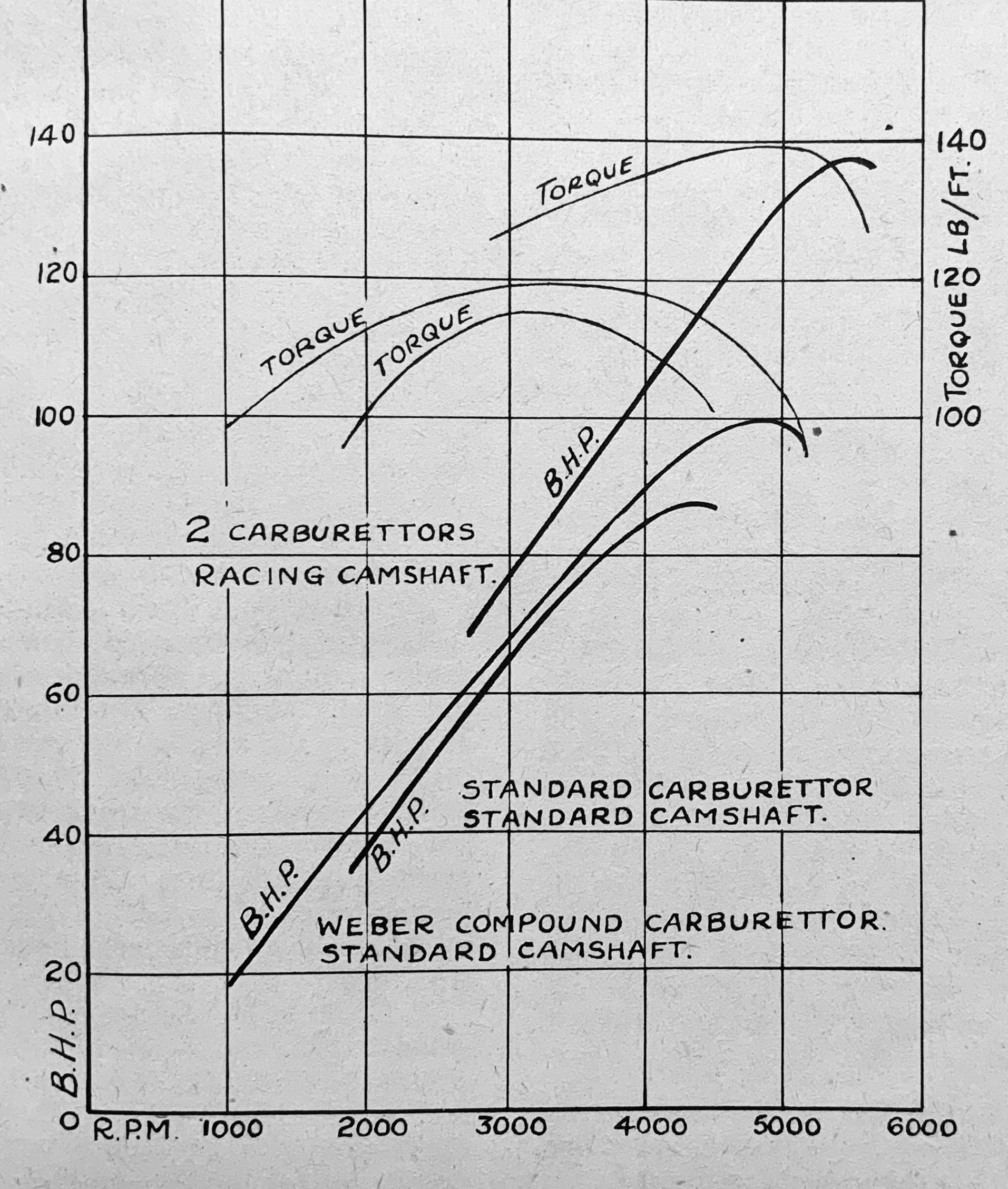
The Record used the then contemporary (1948-1962) Holden 6 cylinder ‘Grey Motor’ bored to 2360cc. It featured a cast iron block, 4 bearing crank fitted with Repco Hi-Power crossflow, OHV semi-hemispherical cylinder head, 2 Weber 36 DCLD7 downdraught carburettors. On a compression ratio of 8.7:1. the engine developed circa 133bhp@5500 rpm and 141lbs/ft of torque@4000 RPM. For more on the Repco Hi-Power head see the separate section below.
The chassis was of integral construction with a tubular backbone, the steel body was welded to the frame to provide stiffness.
Suspension comprised modified Holden components; wishbones, coil springs and telescopic dampers at the front. At the rear a Holden live axle, quarter elliptic leaf springs and telescopic dampers was used. Rear axle was ENV spiral bevel, its ratio 3.66:1, Gearbox was a David Brown 4 speed manual with synchromesh.
Brakes were hydraulic drums front and rear with a Repco PBR booster, Steering by recirculating ball. Tyres: 6.40-13 on steel wheels
Fuel Capacity: 42 litres (9.5 gal) Height: 1320 mm (52 in) Length: 3810 mm (150 in) Weight: 1018 kg (2240 lbs) Wheel Base: 2286 mm (90 in)
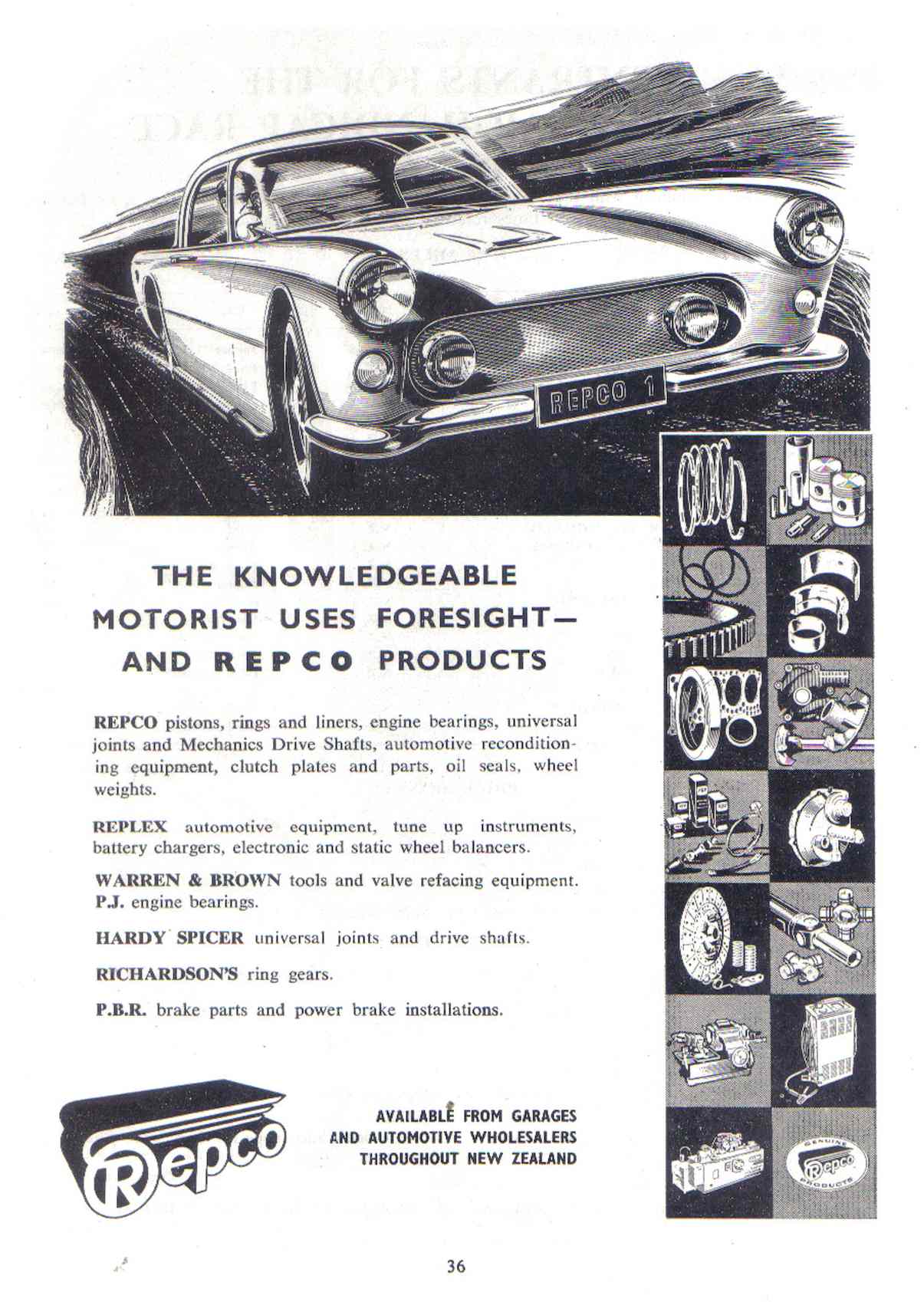
Repco Record contemporary press ad. (Stephen Dalton Collection)Repco Hi-Power headed Holden engine complete with optional aluminium rocker cover. Engine variously named ‘HighPower’ ‘Hypower’ and ‘Hi-Power’ the latter the name it was finally marketed as…notwithstanding the name on the rocker cover! (Maybach to Holden)
Repco Hi-Power Head…
All countries have production car engines which, with tuning provide a staple for road going sedans, racing or sportscars, sometimes all three!
The BMC ‘A and B Series’, Ford 105E through Kent engines, the small block Chev and Ford V8’s and more recently Ford Zetec and Toyota 4AGE engines spring to mind. In Australia the Holden ‘Grey’ and ‘Red’ 6 cylinder engines were the tuners weapon of choice for 2 decades starting in the early ’50’s.
Repco were active in racing throughout this period, largely starting with the efforts of Charlie Dean and his Repco Research colleagues based in their Sydney Road, Brunswick, inner Melbourne base.
Phil Irving of Vincent and Repco Brabham RB620 Engine fame, his exploits well covered in the articles I have written about the 1966 World Championship wins by Brabham and Repco, designed the ‘Hi-Power’ cylinder head to meet market needs and exploit the knowledge Repco had gained about improving the performance of Holden’s 2200cc, 6 cylinder, iron, 4 bearing, OHV engine which in standard tune gave, according to Irving, a claimed and real 62 BHP at 4000 rpm. Click here for an article about Irving’s 1966 F1 Championship Winning Repco engine;
Contemporary ‘horsepower press’ ad from ‘Wheels’ magazine July 1962 edition. (Wheels)
Irving, a noted author himself wrote about the Repco head in Barry Lake’s late, lamented and sadly shortlived ‘Cars and Drivers’ magazine in 1977, this piece is based on Irving’s article, the quotes are just that…
Irving’s simple proposal to Dean was to design a head which would increase the engines power, Dean agreed on the basis that the design be interchangeable with the original head, inexpensive and simple enough to be machined with little or no special equipment. In effect this precluded the head being made of aluminium so cast iron it was.
‘The valves were arranged in two rows with the 1.375 inch exhaust valves vertical and on the near side, while the inlets were inclined at 25 degrees on the opposite side, their heads being 1.56 inches in diameter’.
‘The 6 circular exhaust ports were short and direct, while the rectangular shaped inlets were arranged in two groups of 3, springing from the 2 galleries, these formed partly in the head and partly in the manifolds. The manifolds were simple open sided castings, made in several types to suit vertical or horizontal carburettors’.
The pressed steel side plates were replaced by an aluminium plate. ‘This feature enabled the head to be widened to give room for desirably long inlet ports and inclined rockers which oscillated on a hollow bar… Another bar carried the exhaust rockers, both bars mounted to pedestals integral to the head and thus free from flexure under load.’
Cost pressures meant the rockers were made of nodular iron, hardened locally and proved failure free.
Most of the development work was done by Repco subsidiaries; Warren and Brown the patterns, Russell foundry the head castings, Brenco the heavy milling and Repco Research the final machining.
‘There was no fancy work done on the ports, the first head was slapped on an FE Holden engine that was fired up in the middle of the night…after playing about with jet sizes and ignition settings we obtained 85bhp with a single Holden carburettor on a mocked up manifold’
‘The compression ratio was only 7.5:1 to suit the 90 octane fuel of the day which most people today (1977 at the time of writing) wouldn’t even put in their lawn mowers!’
‘It was an encouraging start with 100bhp, it was enough to push a road car along at over the ton…but more was needed for serious racing…which wasn’t difficult to get by changing camshafts, raising the compression ratio and boring .125 oversize…with each carburettor supplying 3 cylinders it was discovered the induction system came into resonance at around 4000rpm’.
Ropey shot of Phil Irving and Paul England, ‘Racers’ in thought word and deed both! They are fettling the first Hi-Power head on the Russell Manufacturing Co dyno, Richmond, Melbourne. This was the same cell in which the first RB620 F1/Tasman engine burst into life in 1965. This first head was fitted to England’s Ausca sportscar, the car very successful, a car i must write about. (P Irving/Cars and Drivers magazine)
The bolt on kit was priced at £150, a fully rebuilt engine with camshafts and carburettors of the clients choice was £450. ‘The most popular choice was the 140bhp version with 2 double choke progressive Weber down-draft carburettors which gave a road speed (in a Holden sedan with three ‘on the tree’ speed gearbox) of 114mph’.
‘The harmonic balancer was the weak link with bad, critical oscillations at 6200rpm…crankshafts were prone to break if run consistently near 6200rpm…’
103 heads were made most going into road cars or speed boats ‘In a couple of seasons Hi-Power heads just about dominated sedan racing with drivers like John French, the Geoghegans, Stan Jones, Bob Holden and Ray Long on top of the pile’. Lou Molina fitted one to his MM Sportscar, (later supercharging the engine), Tom Hawkes to his Cooper in place of the Bristol original for a while holding the Phillip Island lap record together with Lex Davison’s Ferrari 500/625.
‘General Motors failed to evince any interest in our design which would have kept them ahead of the game for years…The end of the engine was hastened by the advent of big V8’s…and by a change in (racing) regulations which prohibited replacing the heads on production cars’.
Phil Irving’s drawing of a cross section of his Repco Hi-Power head, his notes self explanatory. (P Irving/Cars and Drivers magazine)
Etcetera…
The Record worked hard as test bench, promotional tool and ‘function starlet’, here at such a function. The controversial and ever evolving rear fin is well shown in this shot. In the context of its time, an attractive car, front on view arguably its best angle? (Repco/From Maybach to Holden)‘Repco Record’ at the Phillip Island Classic in 2008. Front treatment has changed along the way, not for the better! (Dick Willis)Repco Hi-Power head and related parts price list 1956. (From Maybach to Holden)
Credits…
Stephen Dalton and his collection for the provision of ‘Sports Car World’ March 1960, ‘Australian Motor Sports’ May 1959 and ‘Modern Motor’ January 1960 as reference sources, Dick Willis, ‘Maybach to Holden’ Malcolm Preston, ‘Cars and Drivers’ Magazine Number 2 1977 Phil Irving Repco Hi-Power head article, Don Halpin Collection
Tailpiece…
(D Halpin Collection)
Love this shot of Phil Irving and Charlie Dean trying to keep a straight face during a Repco promotional shoot to promote their new head. FE Holden, lovely head, extractors and twin-Strombergs clearly visible.
I’m too much of a dinosaur to relent to going through life with a ‘Bucket List’ – but if I did – then Goodwood Festival of Speed would be on it. However, in what now seems an eternity ago, that itch was scratched…
The year was 1997 and three full days at FoS action was on the agenda. That year was the 5th running of the ‘must see at least once’ event – originally established as a one day event at Lord Charles March’s humble abode on June 20, 1993. Essentially as a method to generate some income for the upkeep of his Goodwood Estate, while including the enthusiasm he shares with his late grandfather, Freddie March for the motor vehicle.
When you put on the show, you get to play with all the good toys. Lord March about to take the Chaparral-Chevrolet 2 for a run with Jim Hall’s team mechanic, Troy Rogers
Perhaps one shouldn’t have been surprised, given it was under British skies, that 1997 happened to be the first year rain actually intervened with the event. The rally stars such as Juha Kankkunen, Michele Mouton & Tony Pond were in their element in those conditions. Although gumboots, or ‘Wellies’ (as our Chichester friends would prefer us Aussies call them), aided by a Massey Ferguson should have been the quintessential accessories in the outfields. But the show must go on… and so it did.
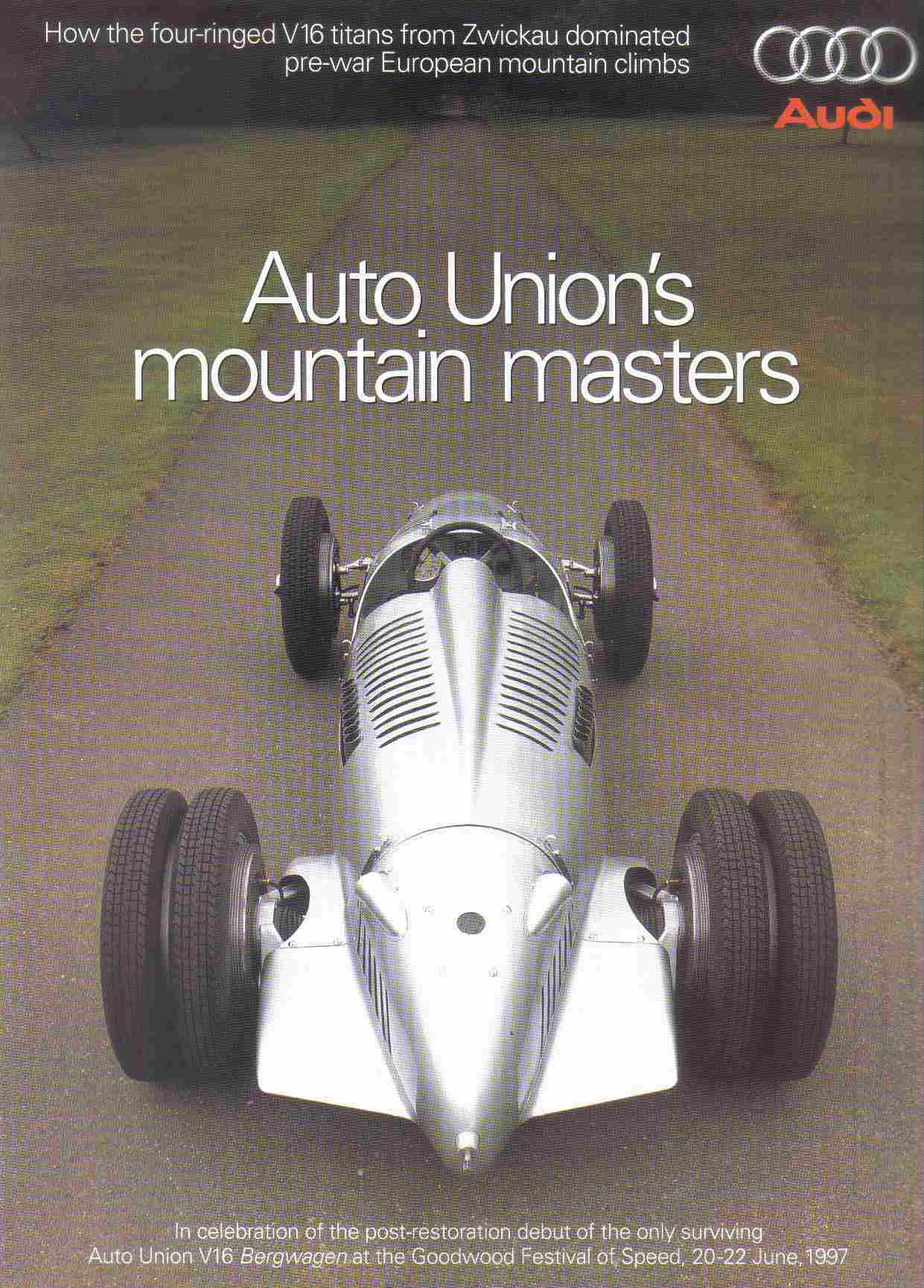
Quattro of a different kind…part of Audi’s 1930’s heritage. As would be expected of a manufacturer like Audi they produced a special press pack just for the unveiling of the restored Auto Union V16. This forms part of it.
The prime of motoring’s manufacturers were ready to exhibit their wares in both static and competition or demonstration-mode to highlight their presence to the mass of Goodwood-bound enthusiasts and glitterati alike – arriving from both spheres of the globe.
Audi brought along their newly restored Auto Union V16 Mountain climb car for Hans Stuck to run up the Goodwood drive. Not quite mountain climbing, but a sight and sound to behold. Arch rival, Mercedes Benz brought along their 1955 Mille Miglia winning 300SLR for Stirling Moss to drive in memory of the then recently departed Moss MM co-driver and motoring journalist, Denis Jenkinson.
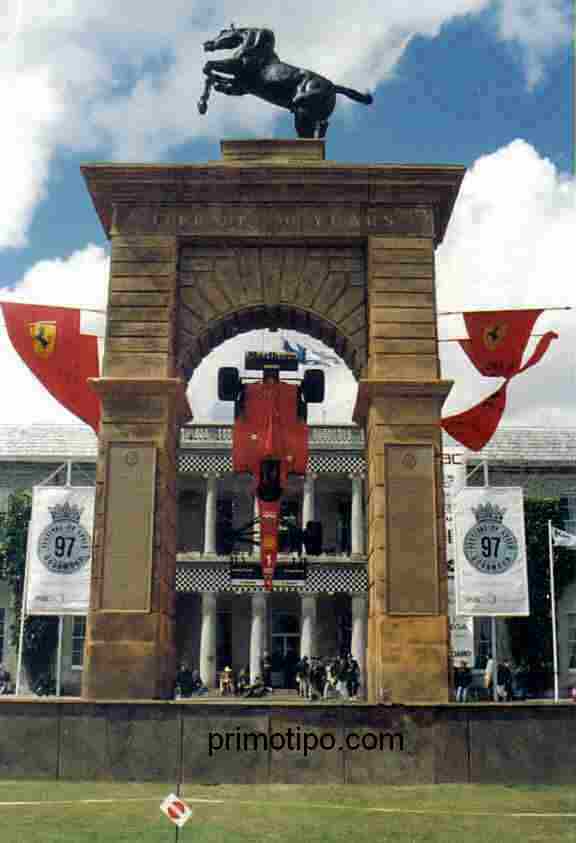
Arguably standout that year was the fiery red Italian, Ferrari marque. Certainly so, based on their presence at the event marked with the massive statue created in front of Goodwood House – celebrating their 50 years of Maranello motoring couture with a V12 orchestra under the bonnet. Ably backed with many examples baring the scarlet tone and prancing horse insignia, with past & then present drivers’ from the Scuderia invited along to accompany the celebration.
One way to hook an F1 Ferrari… worshipping the scarlet red Italian marque, Goodwood-style. The even more imposing Goodwood House is behind.
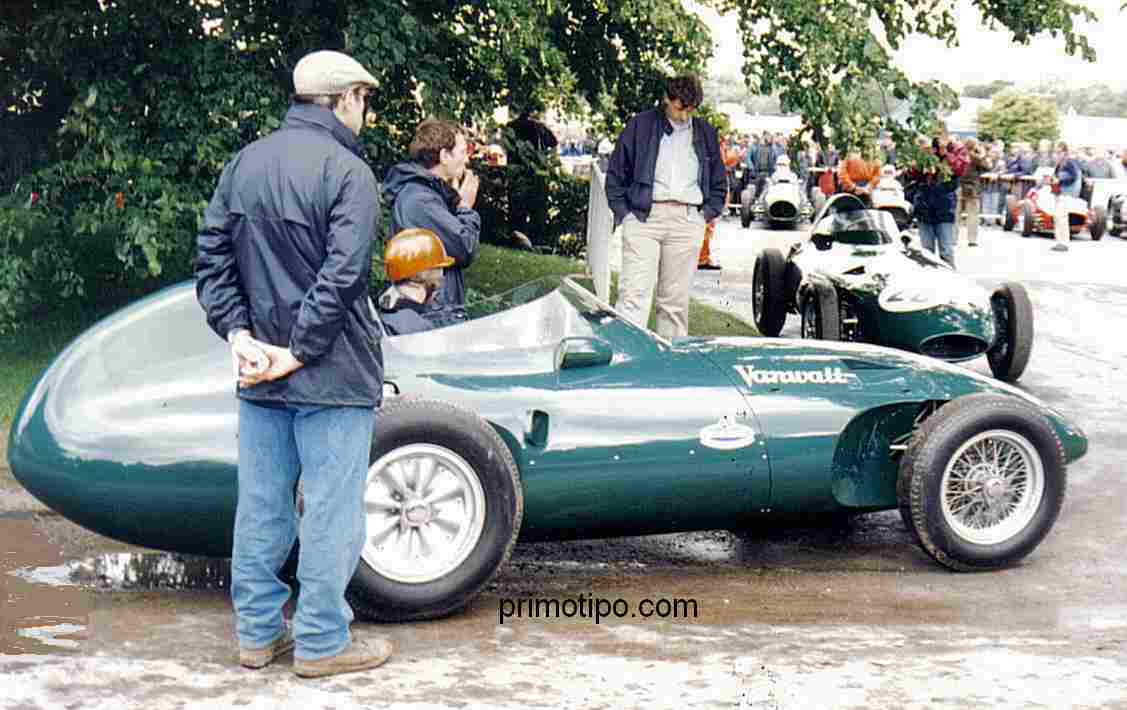
If that wasn’t enough to ignite the flame then perhaps the presence of Jim Hall’s Chaparrals, various Lotus F1 & Indy car’s, Pink Floyd drummer, Nick Mason’s BRM V16, Wheatcroft & Collier collection’s Vanwalls, or numerous Shelby Cobra, et al flowing through the grounds to be enjoyed, would.
Period attired Tony Brooks awaits in the Wheatcroft Vanwall ‘VW9’ for Stirling Moss’ arrival to jump aboard the Collier Vanwall ‘VW5/11’ so they could both do a demonstration run together. The Vanwall’s of course testament to engine bearing magnate, Tony Vandervell’s efforts after his frustrated support during the early days of the supremely complicated BRM V16 project.
Another option was to give the cheque book a work out by making your way to the BROOKS marquee and put your hand up or nod obligingly at the auctioneer in an attempt to procure various vintage or classic sports, or racing cars. Amongst the many offerings was the ex Graham Hill/Arnold Glass BRM P48 and original Mini designer, Alec Issigonis’ ‘Lightweight special’. Then again if the budget didn’t stretch that far, various memorabilia or even fashion traders would happily liberate multiples of pound notes from you. The memorabilia traders’ certainly worked their magic on me.
Brooks Auctions (now Bonham’s) sold the ‘Lightweight Special’ originally built in the late 1930’s by 1959 Mini designer, Alec Issigonis and his friend, George Dowson. Both drove it in Hillclimb’s and ¼ mile Speed Trials at the likes of Prescott and Brighton. That’s how ‘Issi’ met John Cooper! When built the ‘Lightweight’ was advanced with its monocoque construction, rubber suspension and cast wheels. The Heritage Museum at Gaydon in the UK’s midland’s tried to acquire the car to add to its other Issigonis artefacts, but strong bidding knocked them out and it stayed in private hands – selling for around £40,000 at Goodwood. It was soon back into hillclimbing, but damaged quite soon after. The necessary repairs to the bodywork, meaning it lost some of its long established patina.
Given the prevailing moist atmosphere for 2 of the 3 day event, the smart move would have been to stay out of the weather and procure a grandstand seat while enjoying the sights, sounds and smells of motor sport’s past and then current, rally cars, sports cars, F1 or motor cycles as they motored by. Often driven or ridden by someone famous. Some on a mission to set a Hill record, others purely as a demonstration run.
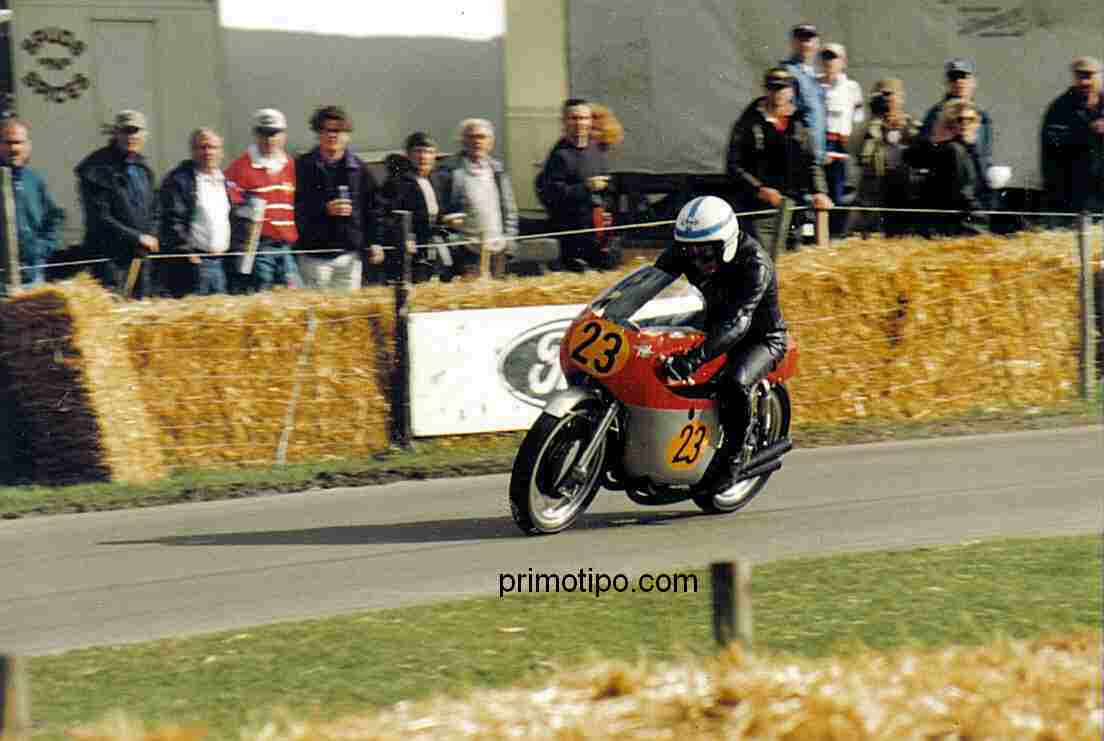
Uniquely placed in motor sport’s history is John Surtees – championships on motorcycles and cars. Seen here riding his 1960 MV Agusta 500.
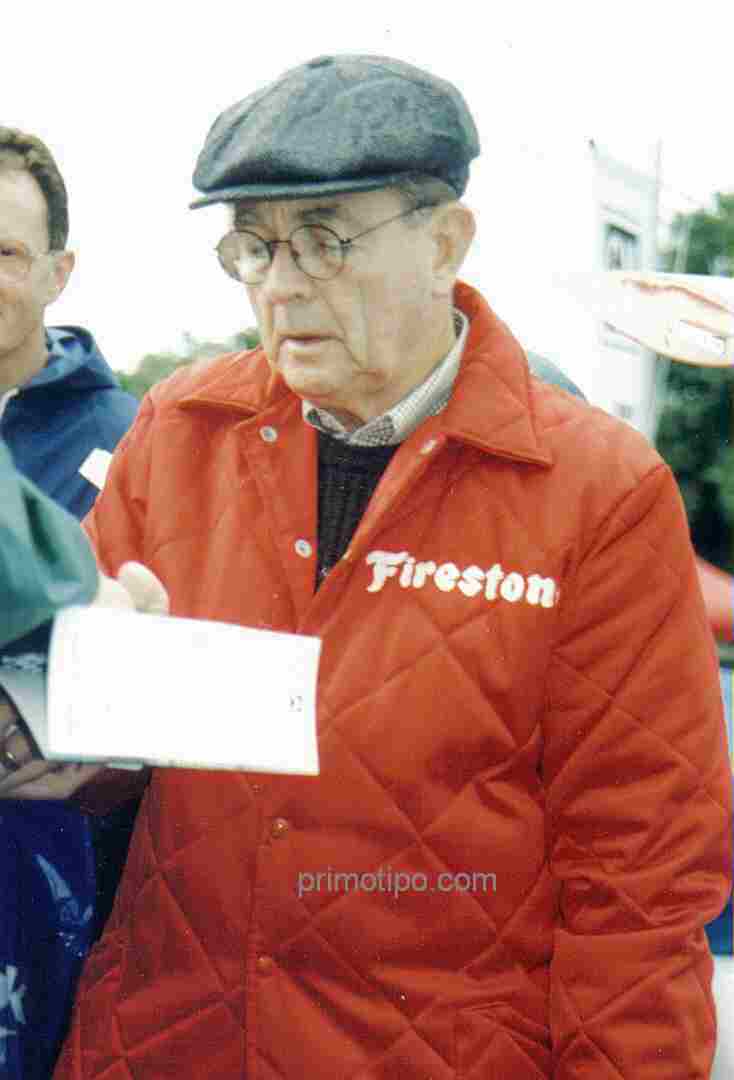
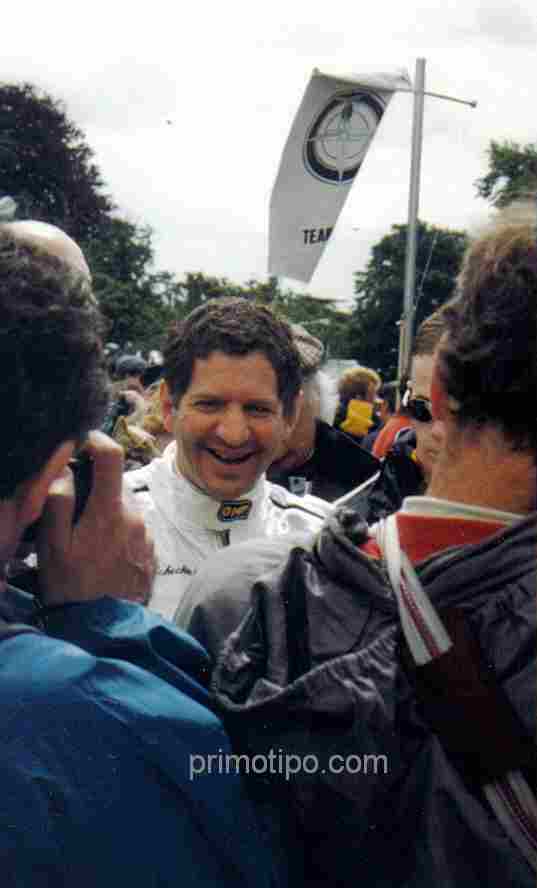
What made Goodwood special for me though was the ability to just amble around and find something to enjoy.The paddock was a special place to get up close and view, not only the very special racing cars present, but many drivers or riders. Several who carried world titles within their sport and happy to oblige an autograph or 3. For me, a copy of the Doug Nye’s ‘Cooper Cars’ book garnering notable autographs from those who took part in racing Coopers during period on track battles. Reflecting back after 18 years, several of those present that weekend are no longer with us. However fond memories of a visit to Goodwood Festival of Speed will remain. For what was even in the event’s early years’ an overwhelming 3 days hard to take it all in… but worth giving a damn good crack.
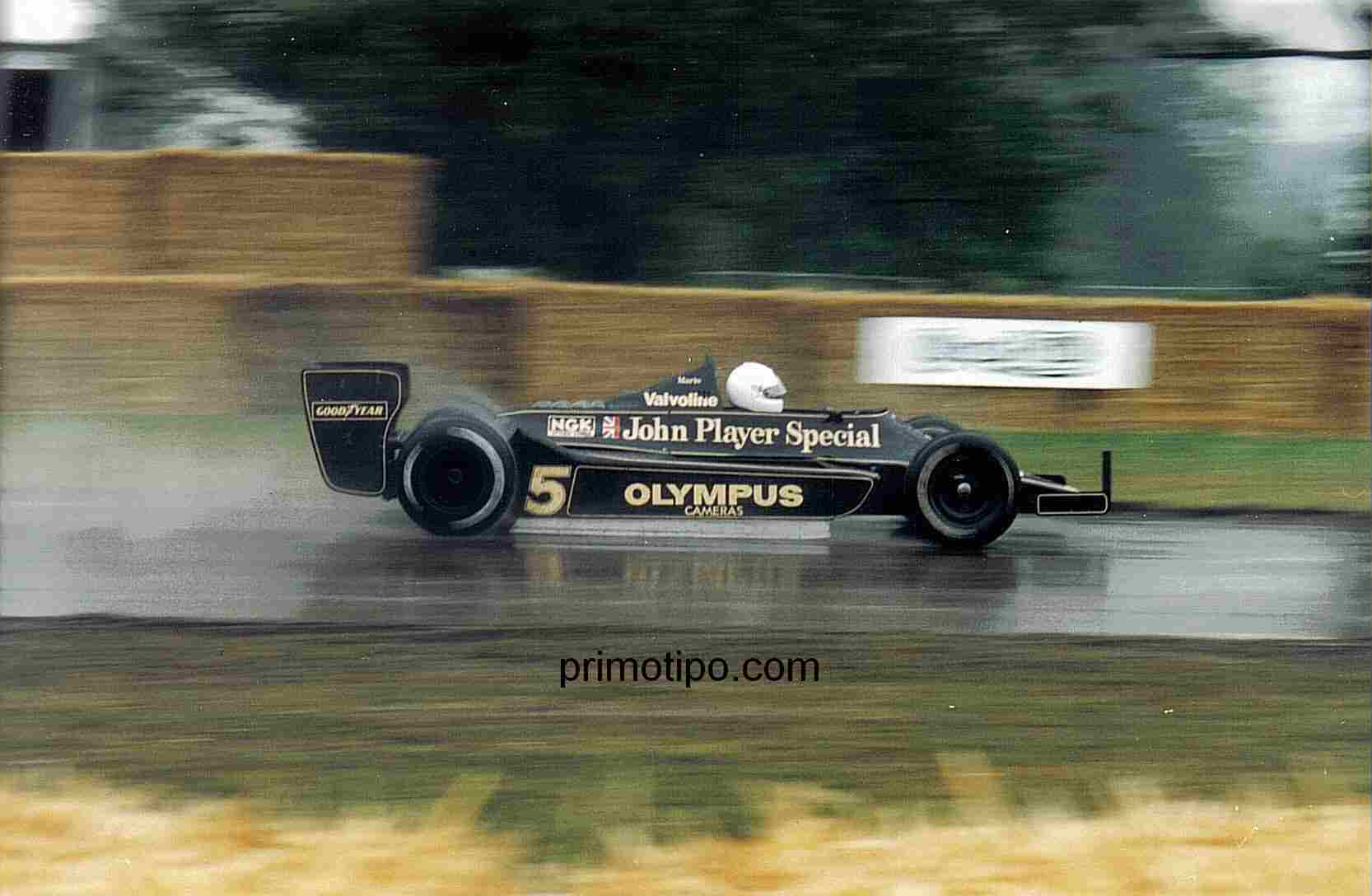
Splish, Splash… John Dawson-Damer takes his ex Team Lotus 79 for a gingerly run along a very damp Goodwood drive. This is chassis ‘79/5’ originally run in 1979 Team Lotus Martini colours for both Andretti and Reutemann during that season. When Lotus and J-DD struck up the arrangement that his ex-Clark Lotus 32B Tasman car went back to Lotus and the 79 was delivered to him in the far more pleasing JPS scheme
Only Barry could get away wearing his baseball cap backwards at Goodwood… After hearing Barry Sheene on Australian TV commentary for ATCC/V8 Taxis, some wags might say “What’s he doing trying to read!” Well I witnessed the relaxed Mr Sheene sitting atop this BMW in the pits, when clearly an enthusiast of his approached for an autograph of a Sheene book he had brought along. What quickly transpired was that while Barry was out winning races and busting bones on racing motorcycles, before disappearing to the warmer climates of Australia to live afterwards, he clearly was not aware of this book about himself! Flicking through it and scanning its pages as I managed to snap this photo.
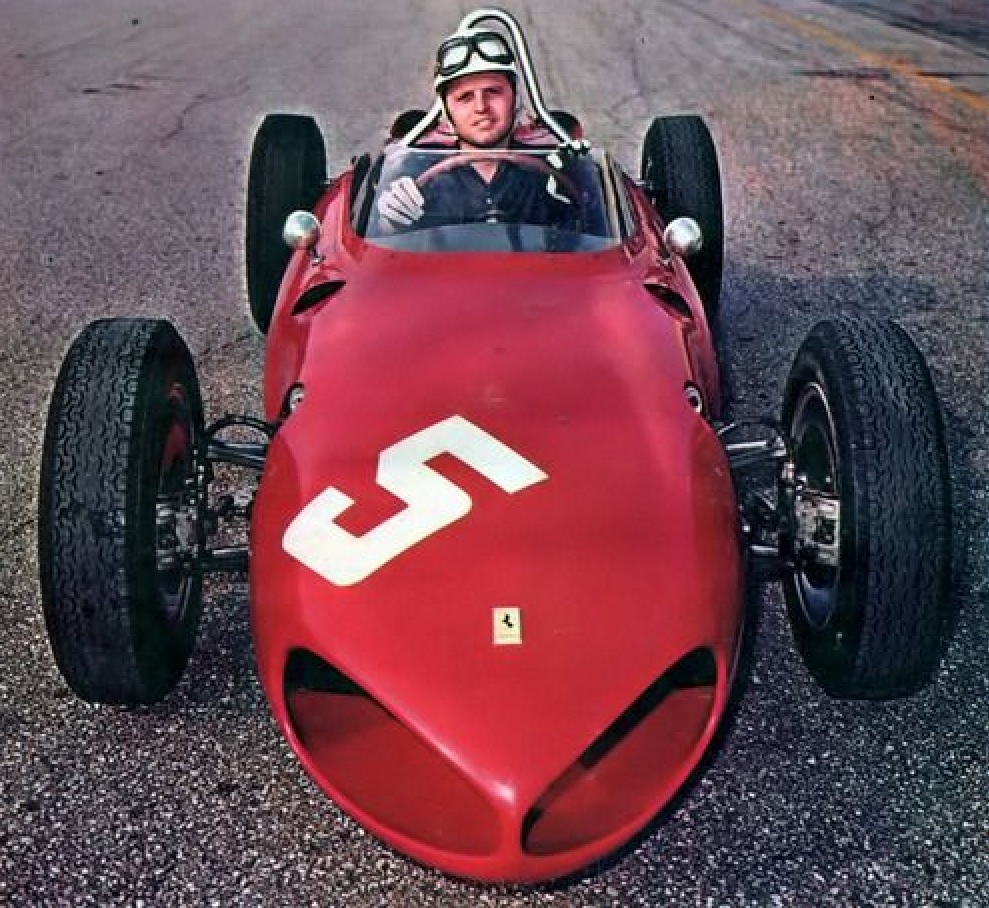
Despite Enzo not wanting to join the late 1950’s F1 GP rear engine revolution, Phil Hill won his 1961 F1 Championship in the ‘sharknose’ Ferrari 156 with the V6 engine behind the driver. So not only was Phil the first USA citizen to win F1’s highest accolade, he also goes down in history as the first Ferrari rear engine era Champion.
Not Jimmy Clark’s 1965 Indy 500 winner, but the sister Bobby Johns Team Lotus entry.
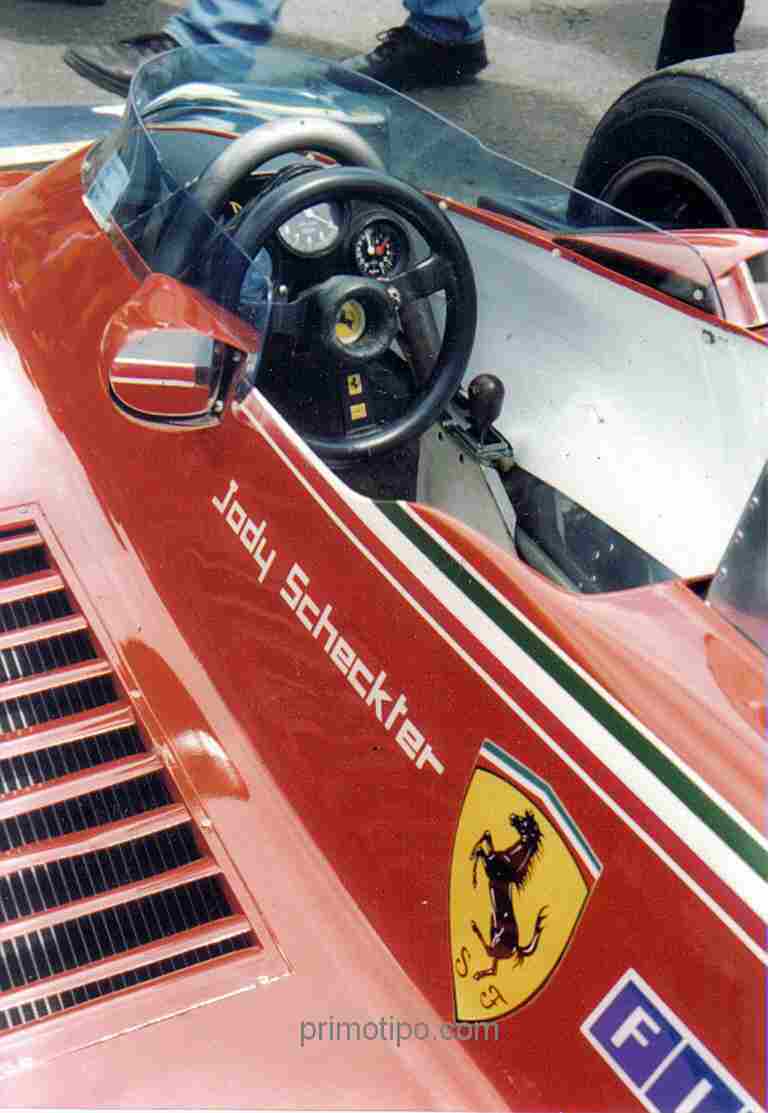
The Ferrari T4 cockpit fit for a 1979 F1 World Champion. Jody was at Goodwood, here accosted by photographers
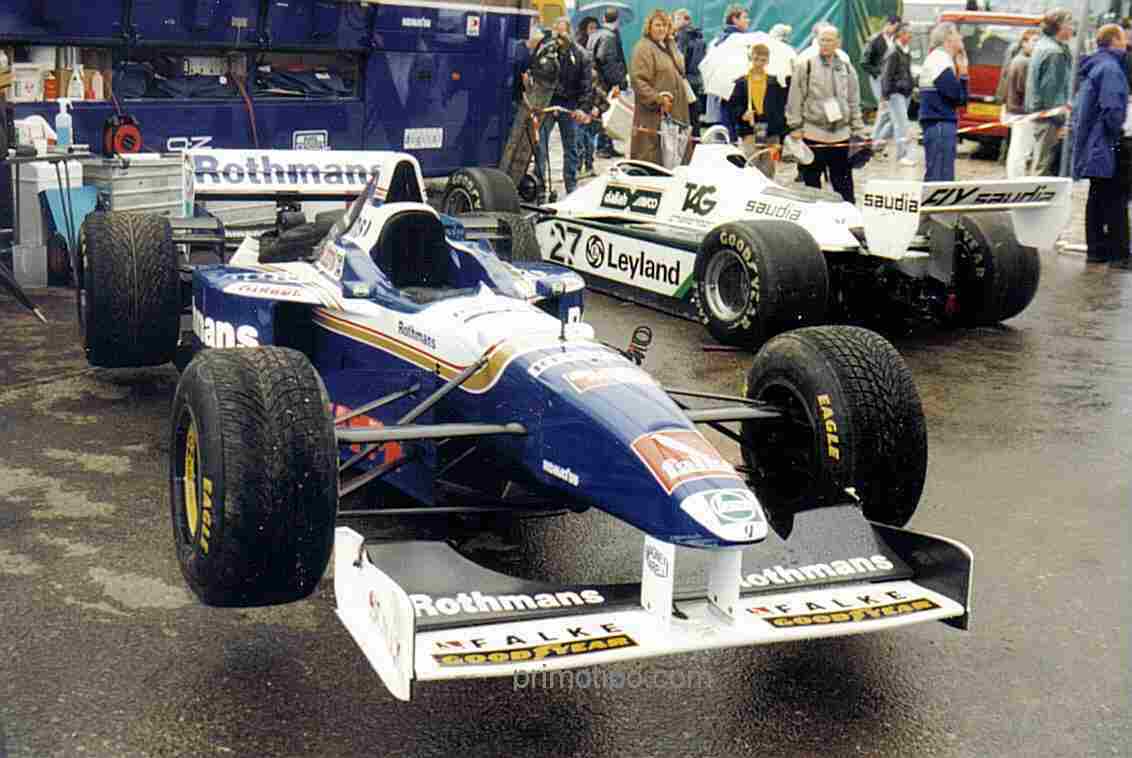
Even in 1997 you would have struggled to get this close to Williams GP Engineering at an F1 event. One of the FW18’s used by Damon Hill in his successful 1996 season and the FW07B used successfully by Alan Jones in 1980 – both clinching World Drivers’ & Constructors’ Titles.
The dedicated FoS officials and Ford’s then WRC weapon of choice… Juha Kankkunen’s Repsol Cossie Escort
Credits…
Excepting Goodwood artwork & Audi press material, all photos Stephen Dalton
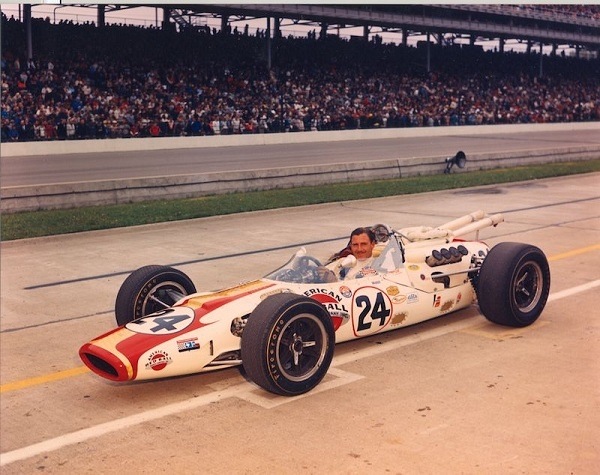
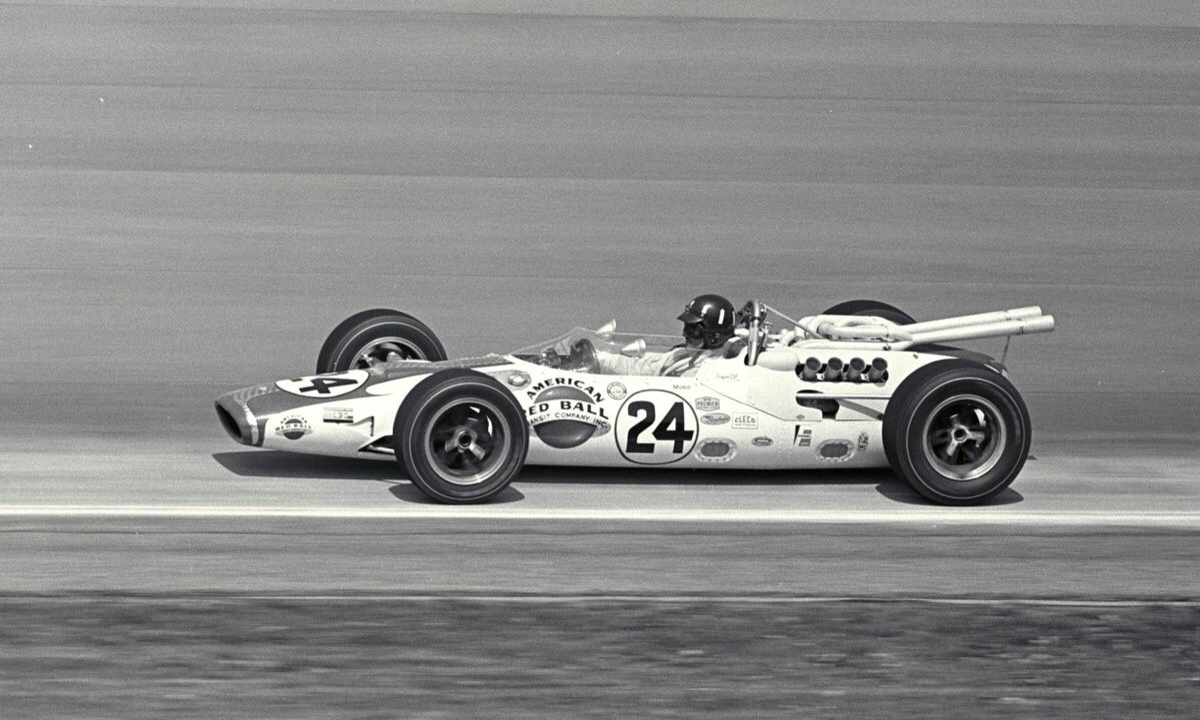
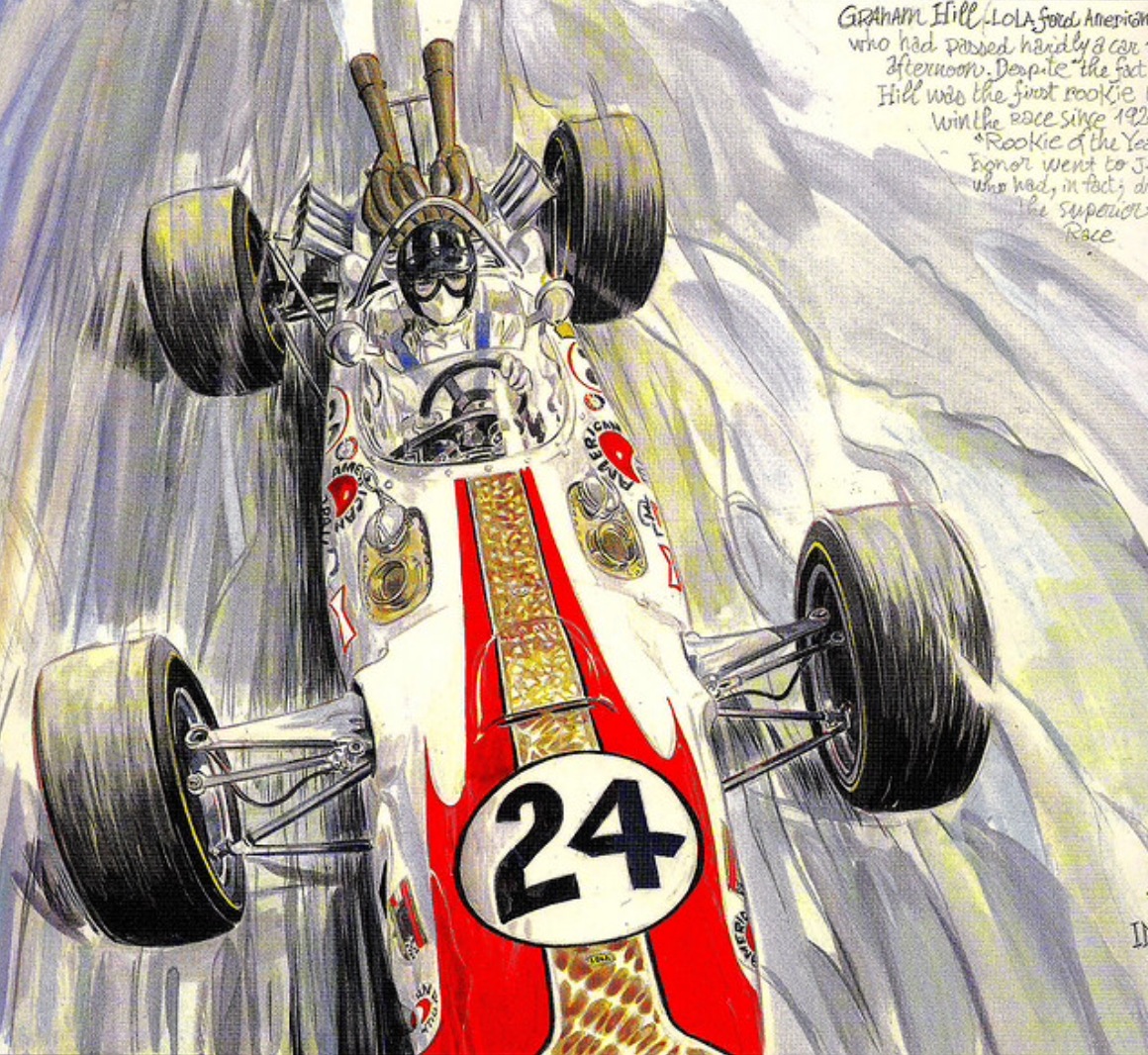
Graham Hill in his ‘American Red Ball Special’ Lola T90 Ford leads the latter stages of the 1966 Indianapolis 500 from Joe Leonard’s Eagle and Jim Clark’s Lotus 38. Fabulous Michael Turner painting…
Hill won the race from Clark and Jim McElreath’s Brabham. Graham lead the most critical part of the race, it’s last 10 laps after teammate Jackie Stewart slowed and retired his Lola T90, the BRM teammates also ‘roomies’ and Indy debutants in John Mecom’s Indy Team.
JYS, Hill and Eric Broadley giving GH a few tips about instrument location before the off…Note seatbelts, still 2 years away in F1, a bit earlier for Jackie after his big Spa shunt a fortnight later. (Autoextremist)
The race was not without controversy with more than one lap timer giving victory to Clark, who spun twice during the race without hitting anything on each occasion but causing some lap scoring confusion.
Hill was doubly lucky; he was not entered to race until the unfortunate Walt Hansgen was killed in the LeMans test weekend in a Ford MkII, the Brit taking the unfortunate Hansgen’s place in Mecom’s factory Lola entry, Mecom the American Lola importer at the time.
One of my earliest motor racing memories is of Hill’s car, the Lola featured big time in one of those ‘Boys Own’ type books we were all given as stocking fillers at Christmas. I have always had a soft spot for these big Lolas’ as a consequence. I still have the book but its in storage, i can’t remember what happened yesterday but the book’s articles on Hill’s Lola, the equally new curvaceous Lola T70 and Tony Lanfranchi’s psychedelic helmet livery i adopted as my own in 1979 stick in my mind. Come to think of it my Lola fetish started then!
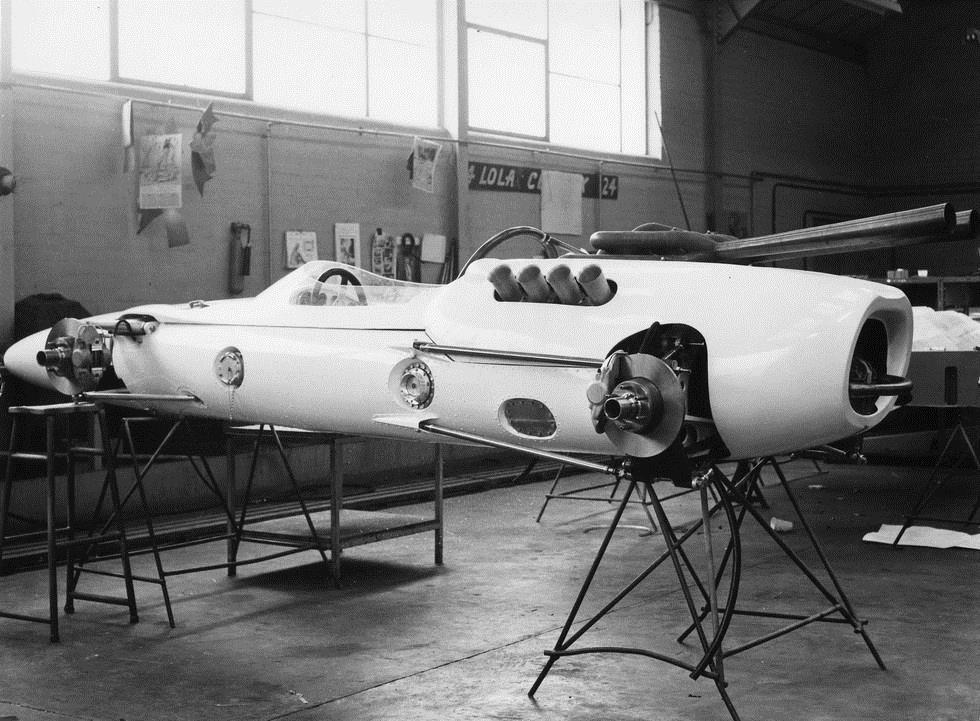
Lola T80 being assembled at Slough in 1965. T80 unsuccessful, the T90 was an update of this car with the suspension geometry which held it back in 1965 addressed. (Lola Heritage)
The mid-engined invasion of Indianapolis was started by Cooper, Jack Brabham raced at Indy in 1961, Lotus had their first start with the pushrod-V8 Ford powered 29’s driven by Clark and Dan Gurney in 1963. Ferguson and Lola joined the stampede with mid-engined victory finally achieved by Team Lotus in 1965. Clark victorious in the Ford four-cam 4.2 litre V8 engined Lotus 38.
The US was a big market for Lola’s Eric Broadley, he achieved much success with the Group 7/CanAm T70 from 1965, USAC was another great opportunity. Broadley built the T80 for Indy 1965, but the car was late, wasn’t tested and was let down by suspension geometry shortcomings which gave the cars poor and unpredictable handling.
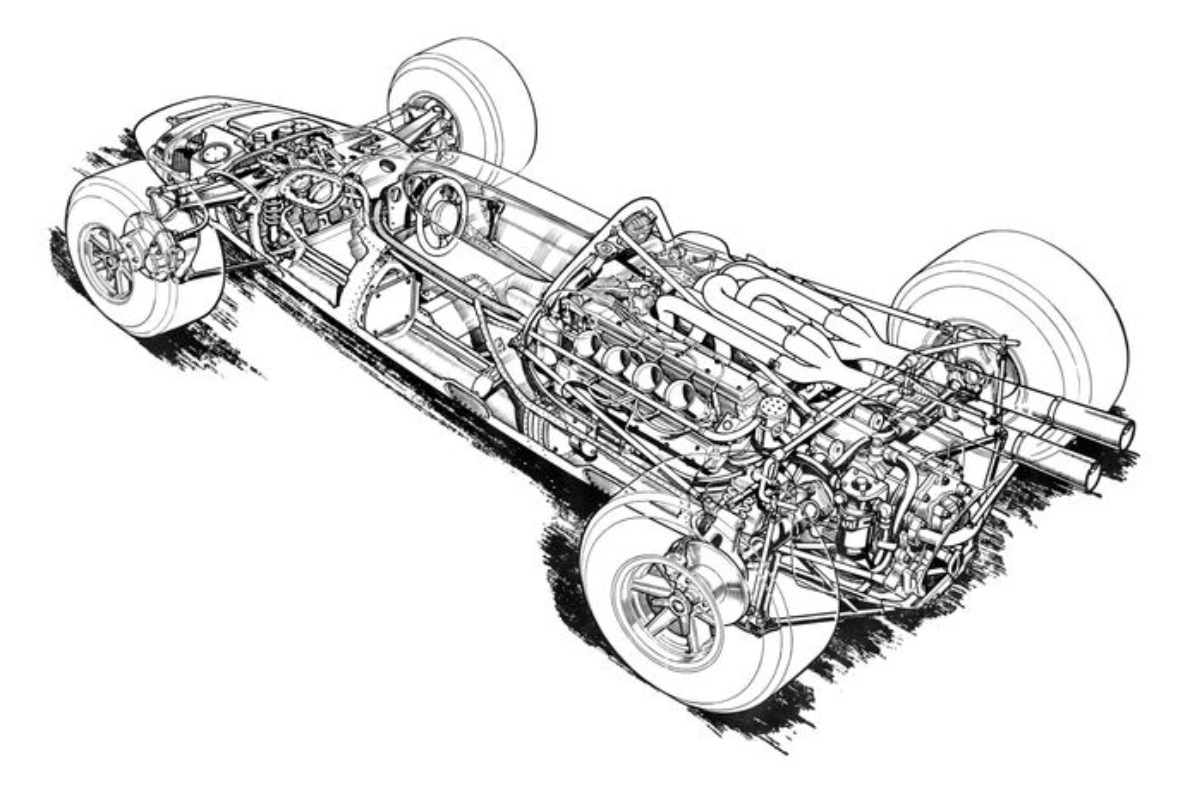
Lola T90 Ford cutaway drawing. Car also designed for Offy 4 cylinder engine. Aluminium ‘full monocoque’ chassis, offset suspension; front top rocker operating inboard mounted spring/damper and lower wishbone. Rear, inverted lower wishbone with additional locating link, single upper link, single radius rod and coil spring/damper units. Adjustable sway bars front and rear, rack and pinion steering, 2 speed Hewland transaxle, Ford DOHC 4 valve, Hilborn fuel injected 4.2 litre V8. Circa 425 bhp @ 8000 rpm in 1965
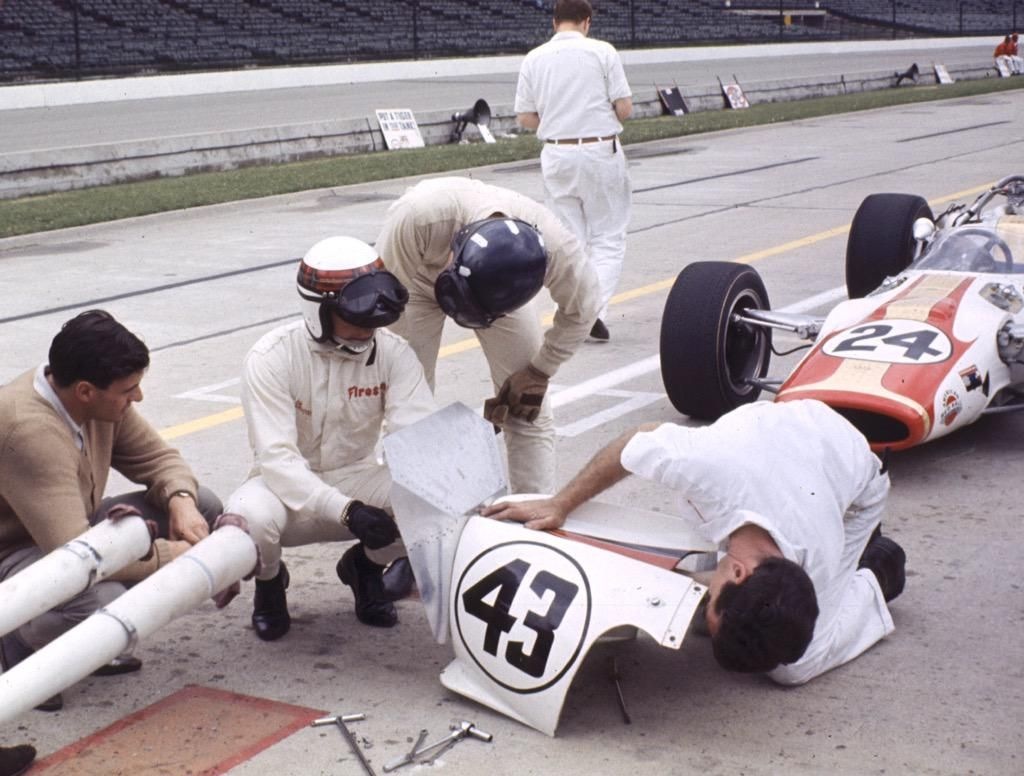
Jackie Stewart and Graham Hill helping Mecom’s mechanics with the fettling of the rear bodywork of Jackie’s T90 #43, the Scot and the other Scot, Clark, both unlucky not to win the race…Graham’s #24 Lola behind. (LAT)
The Lola T90 which followed for 1966 addressed the T80 shortcomings…
The T90 chassis was an aluminium monocoque constructed from Indy mandated 16-guage aluminium. Sheet steel diaphragms front and rear provided additional internal stiffness, externally a sloping scuttle in front of the instrument panel gave additional rigidity.
Lola Heritage ‘Tubular steel subframes were attached to both the front and rear of the chassis, the front subframe carrying the oil tank, radiator and the forward mountings for the lower wishbone. At the rear there were two subframes above and below the two-speed Hewland gearbox, the upper one carrying the attachment point for the single top link and the top spring/damper mounting. The lower subframe had the mounting points for the lower wishbones’.
‘The T90 was designed to accept either the 2.8-litre, 4-cylinder Offenhauser engine or the 4.2-litre 4-cam Ford V8. The Offy, built by Meyer-Drake in California was fitted with Hilborn fuel injection and a Paxton Roots-type supercharger and gave some 520 bhp, the Ford, whilst slightly less powerful, was a more known quantity having won the 1965 race in Jim Clark’s Lotus 38’
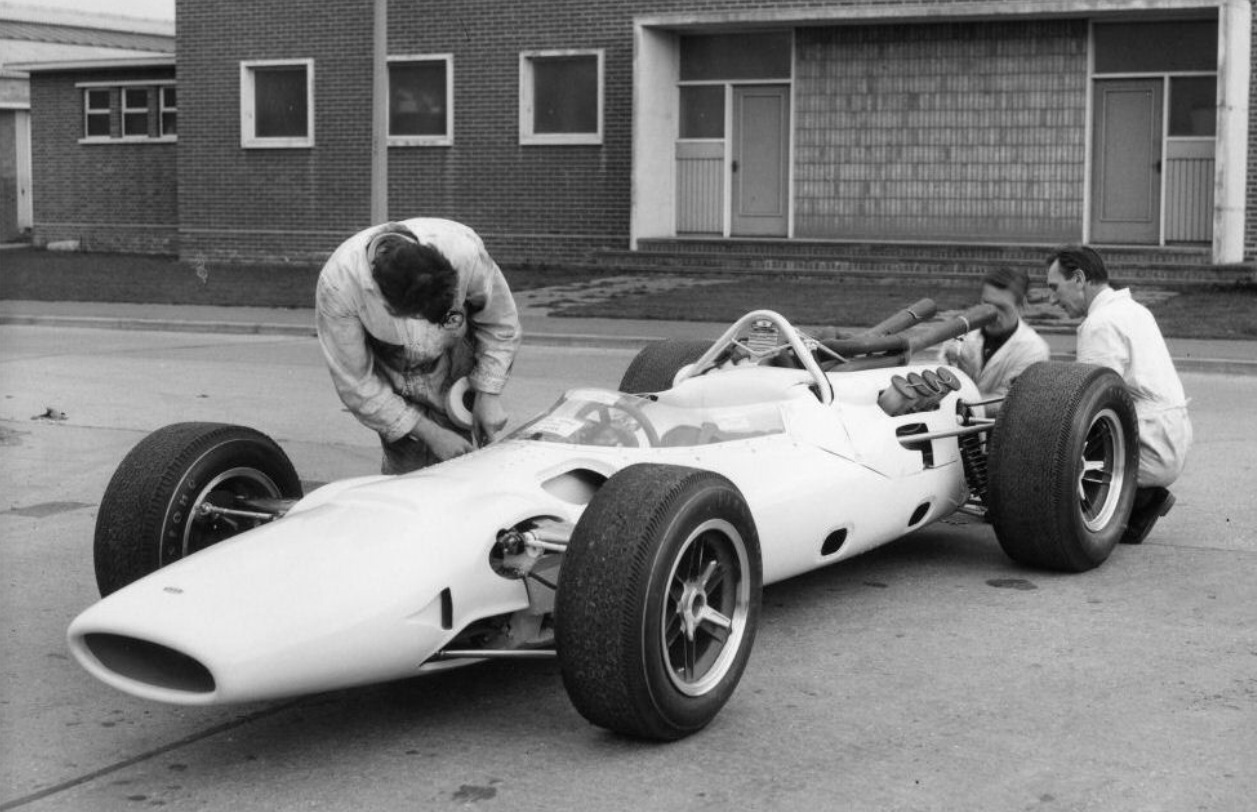
Lola T90 build, Slough 1966. Looking very sexy in its Specialised Mouldings body. Distinctive Lola ‘knock-offs’. Fuel cells still to be inserted into monocoque. (Lola Heritage)
The cars front suspension was inboard with fabricated rocker arms at the top operating coil spring/damper units and wide-based lower wishbones.
‘Rear suspension was fairly conventional with one departure from the norm. At the top of the upright was a single adjustable top link attached to the top chassis subframe whilst at the bottom a wide-based wishbone (reinforced on the left), mounting to the rear of the upright, was mounted to the lower chassis subframe. There was a single adjustable lateral link running from the lower front of the upright to the subframe that allowed for toe-in alterations. The unusual feature to the design was the single top radius rod, a lower rod was not used to to the difficulty of a suitable chassis attachment point due to the fuel tank design. As was the norm at this time front and rear suspension was offset to the left by three inches, the theory being that this helped the car through the left-hand turns at Indianapolis.’
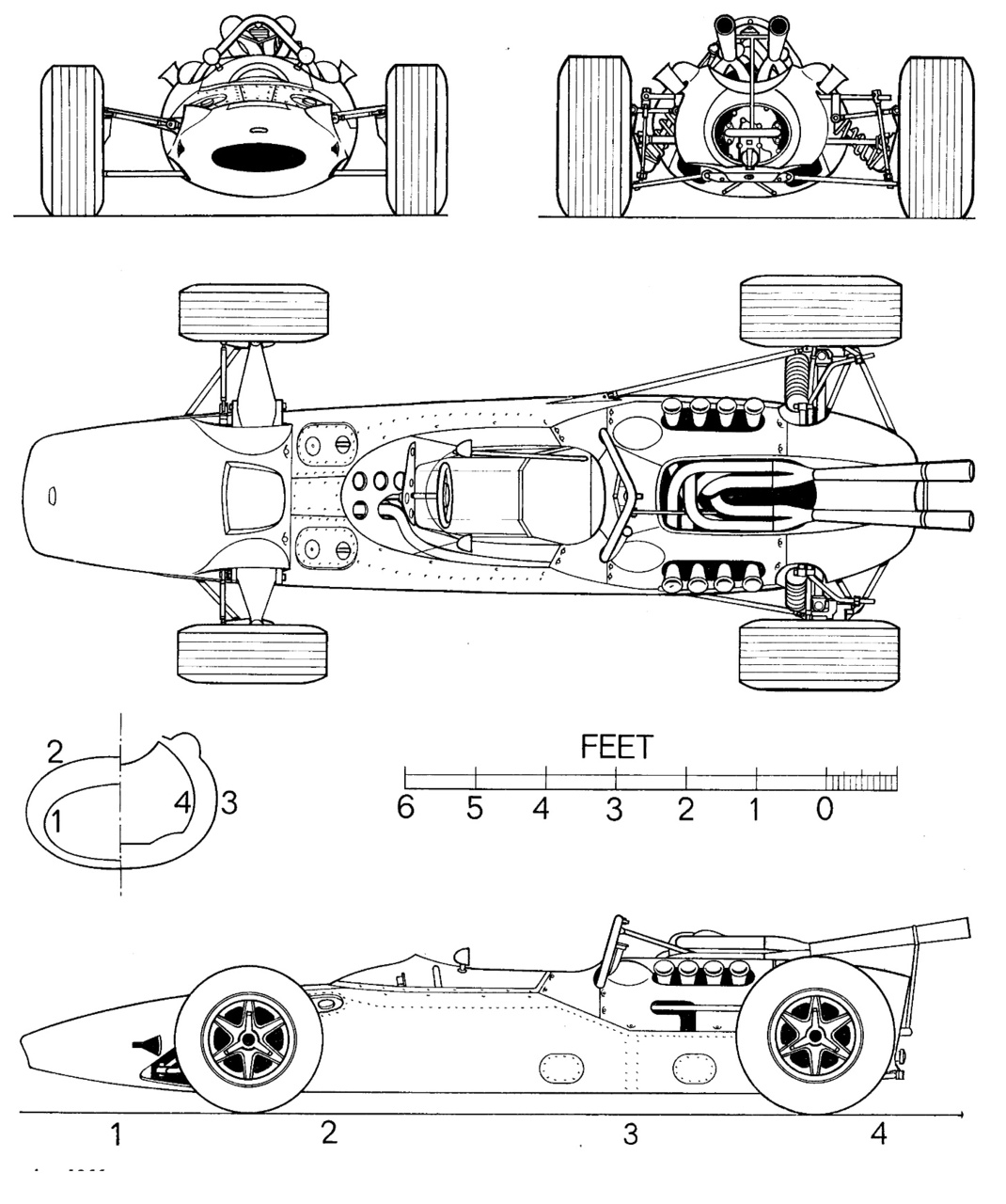
These drawings as well as showing the T90’s lines also nicely show the suspension, offset to the left, as was the convention of the time on speedways. (unattributed)
Ford DOHC Four-Cam Indy V8 Engine…
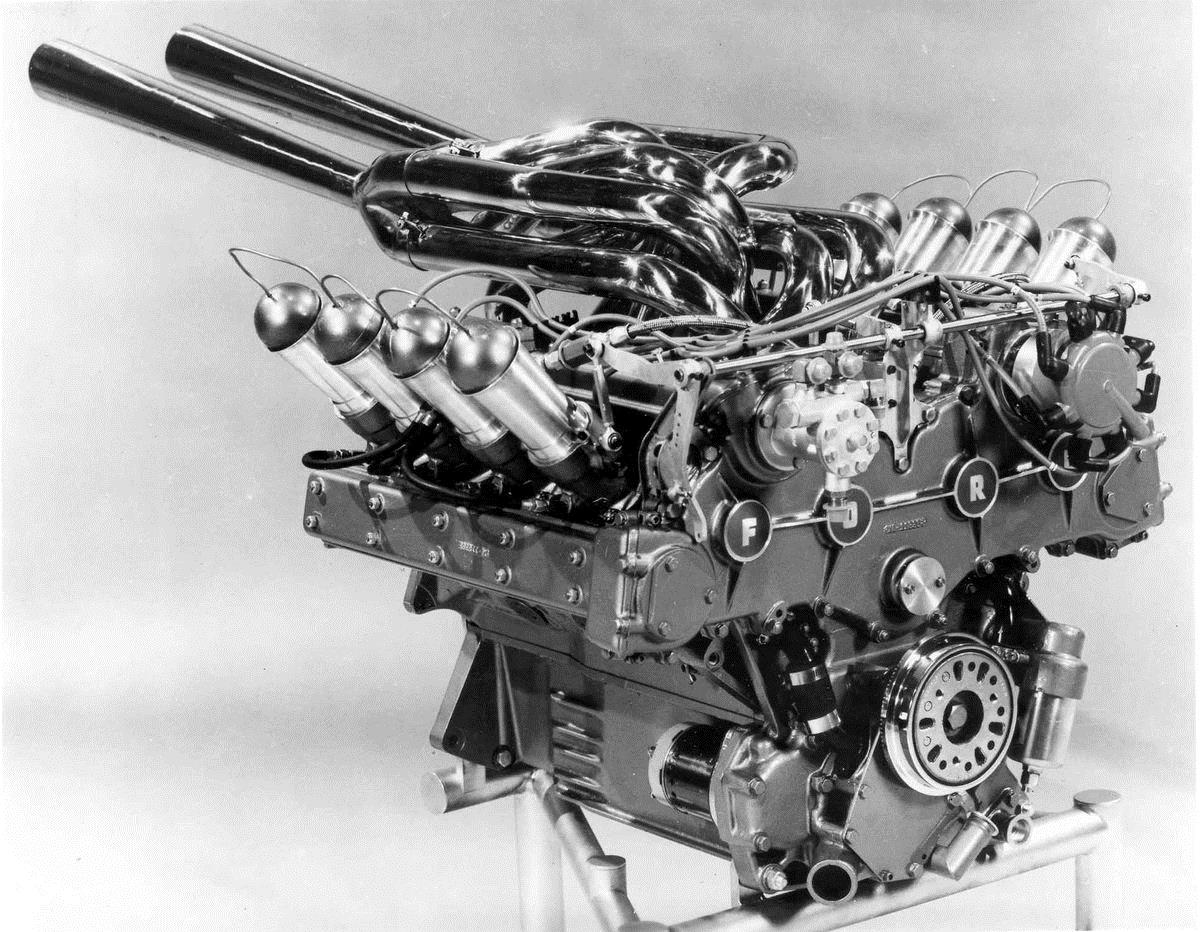
Ford’s 1963 Indy engine fitted to the Clark and Gurney Lotus 29’s was an aluminium variant of its 260cid Falcon/Fairlane small block V8, it developed 350-376 bhp at 7200 rpm on 103 octane fuel fed by 4 Weber 58mm carbs.
Ford, after Lotus’ great showing (they was robbed) in 1963 decided to build an engine capable of developing 50bhp more but with a weight gain of no more than 50 lbs over the aluminium pushrod engines 345lbs.
Ford evolved, using many parts from the earlier engine, a DOHC motor with four valve heads, the combustion chamber ‘pent roofed’. The engine had ‘between the Vee’ exhaust as tests showed power was optimised with this setup. Hilborn fuel injection was used, in 1965 the engines developed 425bhp @ 8000rpm.
The block was cast of aluminum alloy using patterns modified from the production 289cid production ‘small block’. Cast iron cylinder sleeves were a shrink fit in the block and were sealed at the heads with copper laminated steel O-rings. In order to clear the two banks of camshafts in the heads, the 10 attaching studs were moved closer to the cylinder centerline. An additional 8 studs protruded from the heads maintained clamping force needed to seal the combustion chambers. The space occupied by the camshaft in the normal production engine was replaced with an oil tube. This acted as a gutter and collected oil as it drained from above to keep it off the reciprocating assembly.
The bottom end was beefed up considerably. The special forged steel crankshaft was held by 4-bolt bearing caps on numbers 1 through 4. Main and rod bearing journals are the same size as the 289, as is the engine’s stroke – 2.87″. The rod journals are crossdrilled for better oiling at high engine speeds. The rods are from the 289 HiPo, modified for floating pistons pins. The pins are 289 HiPo pieces. The oil pan is cast magnesium and is a structural part of the engine. ‘Ears’ cast integrally with the pan provide the engine/chassis mounts.
As summarised above, the cam-ground forged aluminum pistons have a pent-roof dome to closely fit the combustion chambers. Compression is 12.5:1. The cylinder heads housed 4 valves per cylinder with a central spark plug. The plugs are canted toward the 1.64″ diameter intake valves. Exhaust valves are 1.36″ diameter. The camshafts run in bearing bores in the cylinder heads directly over their valve banks. Valve clearance is adjusted by the selective fitting of the followers. Intake ports are between the cams with exhaust out the top of the heads between the vee. This was done to do away with the nightmare of exhaust tubing normally required. Hilborn injection is used having been selected for its light weight and simple low-pressure design.
The 255 CID engine weighed 406 lbs and produced in excess of 425 BHP at 8000 RPM. Useful power/torque was developed from 6000 with a rev limit of 9000 RPM
Once developed by Ford the engine was sold and serviced via Louis Meyer. In 1966 Ford built 20 engines which retailed at US$23000. The wonderful engines evolved over the decades, in both normally aspirated and turbo-charged form as Indy rules changed.
Checkout this website which gives an in-depth account of both the DOHC engine and the pushrod V8’s which preceded it, click on this link for an interesting read; http://www.quadcamford.com/development.html
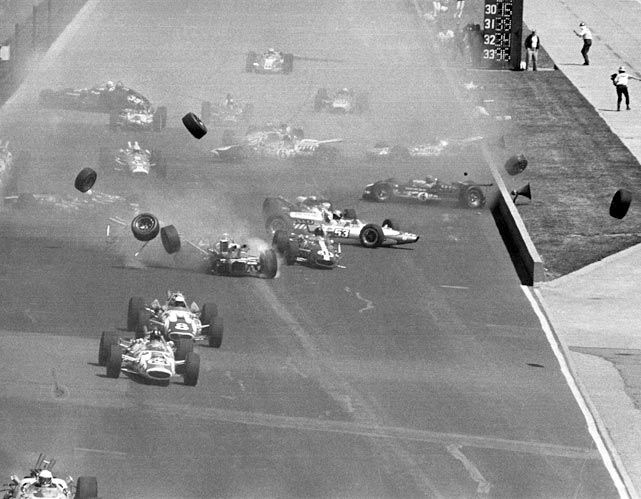
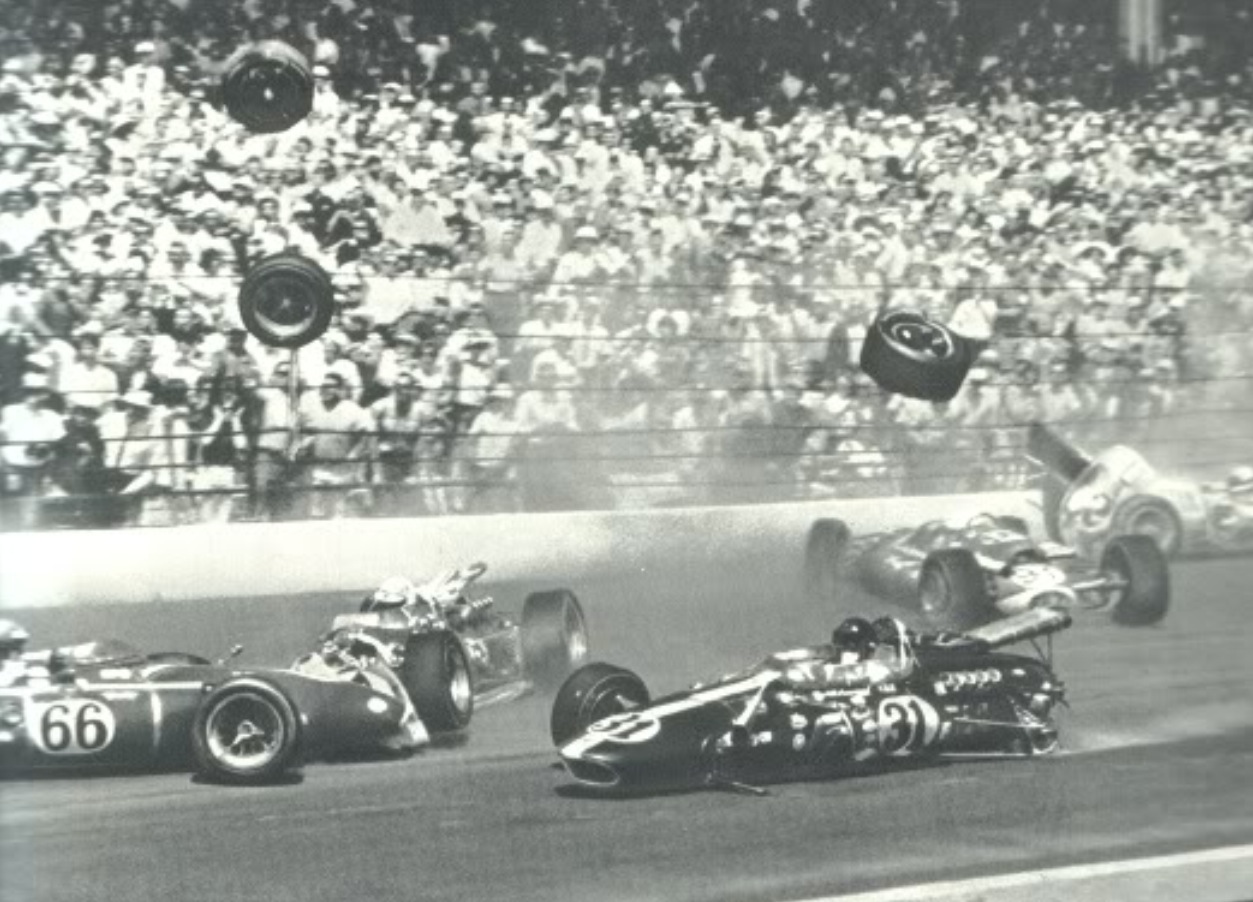
Indy 1966 first lap shunt. Hill #24 Lola, McCluskey #8 Eagle Ford, Joe Leonard #6 Eagle Ford , Al Unser Lotus 38 to the left of his side-on car, Gary Congdon #53 Huffaker Offy, Don Branson in the sideon #4 Gerhardt Ford and the rest…(unattributed)
1966 Indianapolis 500…
Lola Heritage ‘Learning the lesson from 1965 Lola made sure the T90 was ready in plenty of time for the 1966 Indy 500, the John Mecom Racing Team-entered car made it’s debut at the March season opener at Phoenix International Raceway. Success was immediate with Roger Ward finishing second in his Offenhauser-powered T90 and a month later Ward took the winner’s laurels at Trenton’s 1-mile paved oval when he won a rain-shortened race ahead of Gordon Johncock.
Come the month of May and there were three T90s, all entered by John Mecom’s Houston-based team, ready to run at Indy qualifying, Roger Ward in his successful Offenhauser-engined car and Rookies Jackie Stewart and Graham Hill who were both Ford-powered. There was nothing much between the cars at the end of qualifying, Stewart was 11th fastest at a speed of 159.972 mph, Ward 13th at 159.46 mph and Hill 15th at 159.243 mph.’
The Indianapolis Star called the 1966 Indy 500 ‘the most fantastic, confused and incredible 500.’ And it may have been. This was the ‘500’ marked by a 16-car crash at the start when Billy Foster’s car hit the rear of Gordon Johncock’s Gerhardt setting off a violent chain reaction that eliminated 11 cars, including those of A.J. Foyt, Dan Gurney, Don Branson and Cale Yarborough.
Foyt suffered minor injuries, a cut finger and a bruised knee when he climbed out of his car and scaled a fence to get away from the scene.
Jim Clark’s ‘STP Oil Treatment’ Lotus 38 Ford in the Indy pits 1966. Andrew Ferguson at left. I put a can of the stuff in Mums Morrie 1100 but it didn’t seem to go any quicker…the sticker on the rear window looked good tho. I thought so, she didn’t! #12 the car behind Clark is the Chuck Hulse driven Watson Ford. Lotus 38’s well raced, Lotus Indy tool ’65-’67. (unattributed)
The race was red-flagged for the second time in three years and was re-started after a one hour and 23 minute delay.
Mario Andretti took the lead at the restart but retired shortly thereafter with engine failure. Clark lead but spun twice with handling maladies without hitting anything, pitting on each occasion to have the car checked. Stewart and Lloyd Ruby in an Eagle diced for the lead before fuel stops put Clark back in the lead.
Great shot of Hill and Lola Supremo Eric Broadley discussing the cars setup during Indy qualifying 1966. See the quick change safety fuel cells/filler cap. Ignition cutout wired to steering wheel beside drivers thumb. (unattributed)
Ruby took the lead but his car was then black-flagged for the loss of oil, leaving Stewart in the lead from Clark and Hill. Hill had progressed through the field without making mistakes and benefiting from others errors or misfortunes, by lap 175 he was past Clark for 2nd. Stewart lead, until with 25 miles to go his oil pressure diminished, his engine scavenge pump failure gave Hill the lead he was not to relinquish.
Despite protests by Lotus’ Colin Chapman and sponsor Andy (STP) Granatelli that Hill had been incorrectly scored with an extra lap, the unofficial results stood. Hill won $156,297 for his victory, Jim Clark finished second battling an ill-handling car the entire race, Jim McElreath’s Brabham Ford was third and Stewart was classified 6th.
Hill drove a quick, clean race. He stayed out of trouble and was in front for the final laps which mattered, putting lap scoring disputes to one side…What a gorgeous looking, in a brutal kinda way, car! (unattributed)
Another start shot; Cale Yarborough #66 Vollstedt Ford and Dan Gurney’s #31 Eagle Ford. Indy 1966. (unattributed)
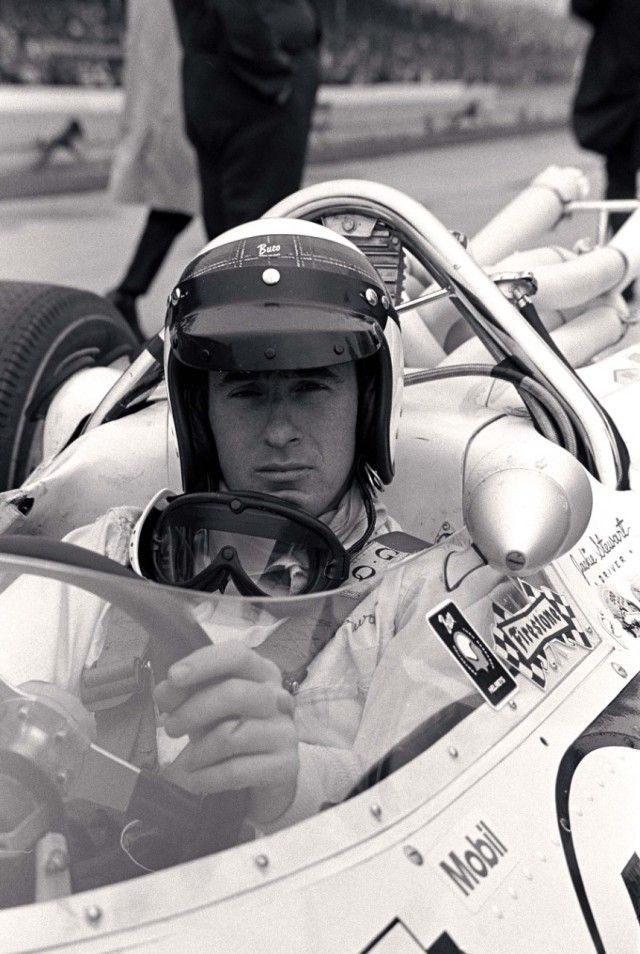
Jackie Stewart.
Jackie Stewart in the ‘Bowes Seal fast’ John Mecom owned Lola T90 Ford Indy 1966. Eric Broadley front lower left, chief mechanic George Bignotti in the Texan hat, Mecom in the tan short sleeved shirt in front of Bignotti (unattributed)
JYS with the face of a man focused on the qualifying task at hand. He qualified 11th, he was classified 6th after an oil scavenge pump failure caused his retirement. Lola T90 Ford, Indy 1966. (Dave Friedman)
Graphics and Imagery Hill/T90.
Lovely artwork of Hill and his Lola T90 (D Sire)
1967 Lola T92 Ford.
The successor to the Lola T90 was the mildly updated in bodywork T92 for 1967, here raced by John Surtees in his one and only USAC race, the ‘Rex Mays 300’ held at Riverside in November 1967, a road course John knew well from his CanAm campaigns. His John Mecom entry DNF’d with magneto trouble in the race won by Dan Gurney’s Eagle Ford. The car did not use offset suspension on road circuits…
John Surtees, Lola T92 Ford. Riverside 1967. (unattributed)
American Red Ball Company.
Even though the name has been in my brain since 1967, i had no idea what they do, clearly not the case in the US as they are an old established well known global removalist and transit organisation. So now i know! http://www.redball.com/long-distance-moving-company/our-rich-history/
Tailpieces…
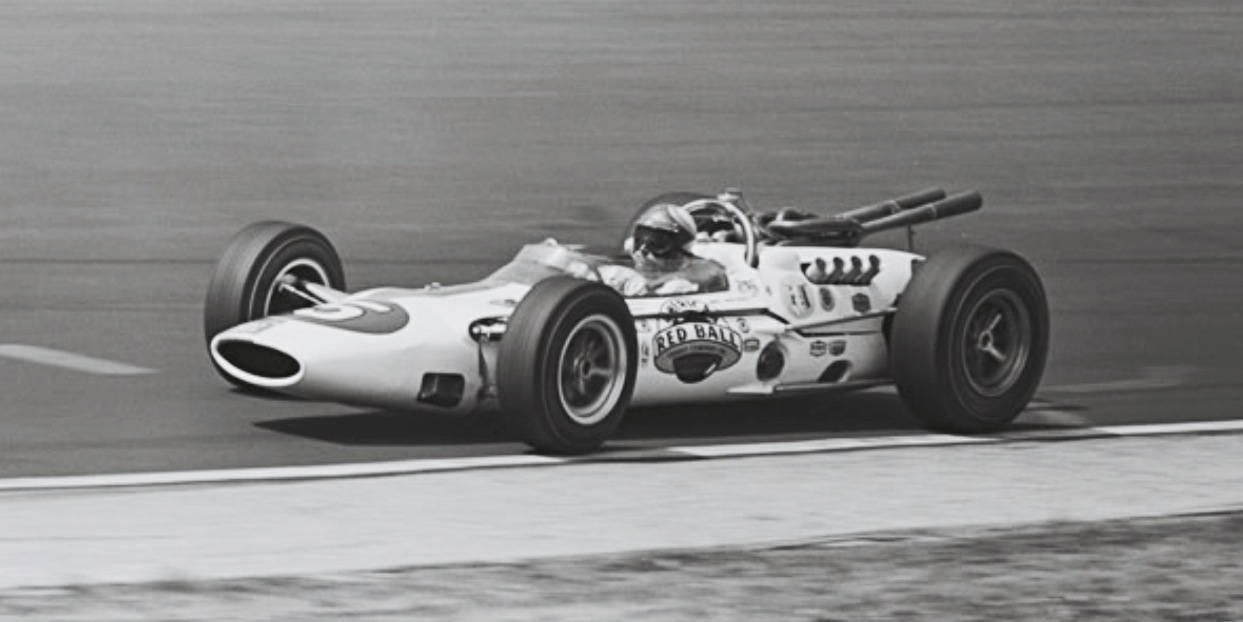
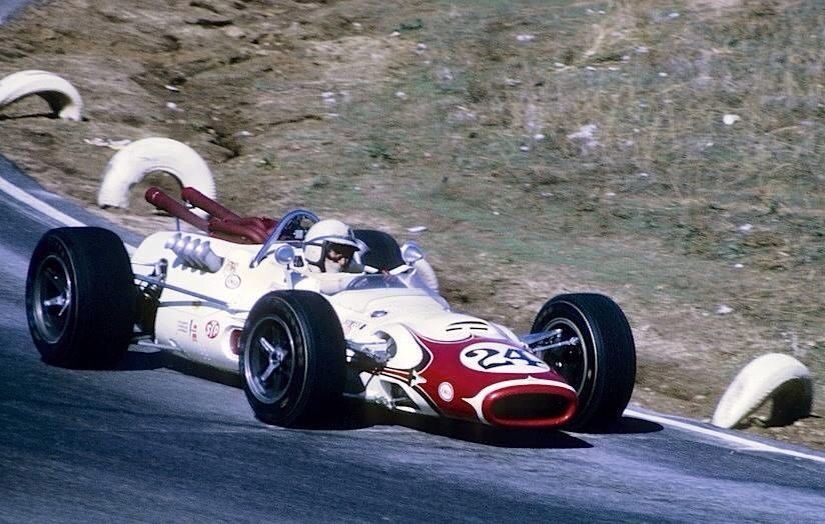
Hill looking the focused driver he was. Interesting shot shows the conventional rear suspension albeit with 1 rather than the usual 2 radius rods to locate the suspension fore and aft. Seat belts, roll over bar too low in the event of a rollover and cross-over exhausts all clear as is all enveloping bodywork of the T90 to smooth air flow and top speed, F1 cars at the time largely devoid of rear bodywork. (unattributed)
Nice bit of modern art; Top>Bottom; Stewart, Clark, Hill. Friends and Champions all. (olivesart.com)
(Graham Howard ‘History of The Australian Grand Prix’)
Jim Clark and Graham Hill swap notes prior to the start of the 1967 Australian Grand Prix, Warwick Farm, Sydney. It would be a good season for them both…
Their new F1 Lotus 49’s await their return to Europe, the Ford Cosworth powered cars established a package of integrated design which became the F1 standard for the duration of the 3 litre formula. Their is plenty of press interest in the two stars, teammates for the first time in 1967 and Hill’s #5 Lotus 48.
Behind them in the ‘Farm pitlane is Kevin Bartlett’s Brabham BT11A Climax, KB just in shot with his foot on his front Goodyear. Sixth in the race for him, an excellent result in the old car.
Start of the 1967 AGP. #5 Hill Lotus 48 FVA 1.6, #6 Clark Lotus 33 Climax 2.0 V8, #3 Jackie Stewart on pole, BRM P261 2070cc V8. (autopics.com.au)
The 48 was Lotus’ new car for the inaugural 1.6-litre F21967 season. Designed by Colin Chapman and Maurice Philippe, it was in essence a ‘mini’ Lotus 49 which made its successful debut in the ’67 Dutch Grand Prix on June 4.
Keen to get in some early season testing of the new car, Colin Chapman sent the first chassis to Australia for the Warwick Farm round of the Tasman Series, the Australian GP that year, held on 19 February for Graham Hill to drive. Hill was popular at the Sydney circuit, the promoters paying plenty of money to get the Brit and his new Lotus to New South Wales for just one race. Of added local interest was that Hill had just returned to Lotus having been a BRM driver since 1960. Mind you, in Australia he raced in our internationals the Ferguson P99, Brabham Climaxes owned by ‘Scuderia Veloce’ as well as various BRM’s.
Jim Clark did all of the Tasman rounds in New Zealand and Australia that summer. He won the title in a Lotus 33 Climax, his 1966 F1 mount ‘R14’ fitted with the 2 litre Coventry Climax FWMV V8 engine with which he started the 1966 F1 season, the first year of the 3 litre F1. He used the car until the BRM engined Lotus 43 was ‘ready’ to race.
The new 48 F2 car had a full monocoque chassis made from aluminium sheet with steel bulkheads front and rear. Bolted to the rear bulkhead was a tubular steel subframe which carried the unstressed FVA engine and ZF gearbox. Front suspension used top rockers operating inboard mounted springs and dampers. The rear suspension was also conventional; single upper link, reversed lower wishbone, twin radius rods and coil spring/ damper units.
The 48 used the Ford Cosworth FVA, one of two engines contracted from Keith Duckworth and Mike Costin by Ford. Significantly the engine proved Duckworth’s design direction for his F1 V8, the Cosworth DFV which made its race debut at Zandvoort in the back of the equally new Lotus 49. The FVA’s design commenced in July 1965, its first bench test was in March 1966 and its first race in July 1966. The engine was well tested prior to its trip to Australia in the summer of ’67.
The remarkably successful unit combined a four-cylinder cast iron Ford Cortina block with an aluminium Cosworth head. FVA was an acronym of the ‘four valve assembly’ or ‘four valve type A’ of the engine’s new head. Twin overhead camshafts were used of course, driven from the crankshaft by gears. Equipped with Lucas fuel injection, the dry sumped engine developed circa 220 hp @ 9000rpm.
Ford Cosworth FVA Engine Cutaway drawing by Theo Page.
Graham Hill qualified Lotus 48 chassis ‘R1’ well amongst the Tasman Formula 2.5 litre engined cars, 3rd on the grid with only the V8 engined cars of teammate Jim Clark and Jackie Stewart’s BRM in front of him. He may only have had 1.6 litres but the chassis was clearly good and Hill was always been quick around Warwick Farm, the Sydney circuit a very technical one.
Stewart was very fast throughout the Tasman, he won it in ’66, but the BRM’s gearbox was at its limits with the greater stresses of the P60 BRM V8, now at 2070cc and developing much more power and torque than the same engine in its original 1.5 litre F1 guise ever produced. But the car held together at the ‘Farm, Jackie won from Clark and Frank Gardner in a Brabham BT16 Climax FPF, the old 2.5 litre F1 Climax four cylinder engine well and truly outclassed by ’67.
Hill’s new Lotus 48 expired with gearbox maladies on lap 25 but he gained valuable miles on the brand new chassis in advance of the European F2 season, which both he and Clark contested.
Intended as a customer car, the 48 was exclusively campaigned by Team Lotus during 1967, privateers used uprated 41’s. The new Lotus was quick but encountered the Brabham BT23, one of Ron Tauranac’s most successful designs. The 48 won four F2 races in 1967, three in Clark’s hands, the fourth by Jackie Oliver in the combined F1/F2 German GP at the the Nürburgring.
Whilst the Brabham BT23 was the car of the season many of its victories were taken by ‘graded drivers’, notably the ‘King of F2′ Jochen Rindt, whilst graded drivers did win races they could not score championship points. The 1967 title was won by Jacky Ickx using both Matra MS5 and MS7 chassis’, FVA powered.
Lotus continued with the 48 in 1968, 4 chassis were built in total, but struggled again with the dominant Brabham BT23’s. Jean Pierre Beltoise won the ’68 title in a Matra MS7 FVA. 1969 would be a ‘different kettle of F2 fish’, the Dave Baldwin designed Lotus 59 a much more competitive tool.
Graham Hill tucked into the comfy cockpit of his beautifully finished Lotus 48. He is on the grid of the ‘Guards 100’, Snetterton in March 1967. Hill was 2nd to Rindt’s Brabham BT23. (Max Le Grand)
III Gran Premio Barcelona, Montjuic, Spain 31 March 1968…
Jim Clark, Lotus 48 FVA, Montjuic, Barcelona 1968. (Unattributed)
Jim Clark aviating his Lotus 48 during practice for the first European F2 event in 1968.
He started the season strongly with victories in his Lotus 49 in both the South African Grand Prix held at Kyalami on 1 January and the Tasman Series, including the Australian Grand Prix at Sandown Park, Melbourne. Jim won 4 of the 8 Tasman rounds, his Lotus used the 2.5 litre Ford Cosworth V8 variant, the ‘DFW’ so he came to this F2 event ‘razor sharp’.
Despite Clark’s speed, Jackie Stewart won the race in his Matra MS7 FVA, Jim was tagged by Jacky Ickx at the first turn, a ‘bonzai’ move down the inside taking out the innocent Scot, deflating a tyre and rearranging the rear suspension. Ickx was involved in another accident on lap 2 and retired. Karma at play!
The shot below is of #1 Clark, with Hills nose in shot, in the middle is an innocent Jochen Rindt, Brabham BT23 FVA. Ickx shot off down the road in his Ferrari 166. The next F2 round was the ‘II Deutsche Trophae’ at Hockenheim the following weekend.
Hill’s Lotus 48 nose, Jochen Rindt caught up in the melee in his Brabham BT23 FVA and Clark, Lotus 48 FVA. (Unattributed)
End of Clark’s race, flat tyre and shagged rear suspension. Lotus 48 FVA. Barcelona 1968. (Unattributed)
YouTube Footage of the Barcelona Race;
Hockenheim 7 April 1968…
Jim Clark before the off and (below) in the early stages of this fateful, awful race and the probable high speed tyre deflation which caused the accident that claimed the champions life.
Jim Clark, relaxed before the off and Dave Sims. Hockenheim 7 April 1968. Lotus 48 FVA. (Rainer Schlegelmilch)
Clark, Lotus 48 FVA, Hockenheim 7 April 1968. (MotorSport)
Lotus 48 Technical Specifications…
Chassis; aluminium monocoque with rear subframe. Front suspension; lower wishbones, top rocker actuating inboard coil spring/dampers, roll bar. Rear suspension; reversed lower wishbones, top links, twin radius arms, coil spring/dampers, roll bar
Steering rack and pinion, Brakes, discs all-round, Gearbox ZF 5DS12 5 speed.
Weight 420 kilo / 926 lbs. Length / Width / Height 3,797 mm (149.5 in) / 1,727 mm (68 in) / 762 mm (30 in)
Wheelbase / Track (fr/r) 2,330 mm (91.7 in) / 1,473 mm (58 in) / 1,473 mm (58 in). Wheels (fr/r) 13 x 8 / 13 x 10
Ford Cosworth FVA…
Pretty much the ‘engine de jour’ of the 1.6 litre F2 from 1967 to 1971, the FVA won all of the European titles in that period.
Cast-iron Ford Cortina 1600 ‘116E’ 5 bearing block, aluminium head, 1,598 cc. Bore/Stroke 85.7 mm/69.1 mm, DOHC, 4 gear driven valves per cylinder, Lucas fuel injection and electronic/transistorised ignition. Circa 220 bhp @ 9000rpm.
Those with a strong technical interest in the Cosworth FVA and its role in relation to the subsequent Cosworth DFV V8 Design will find this treatise of interest;
Mini Lotus 49 indeed! Clark in his svelte Lotus 48, Pau GP 1967. 4th behind 3 Brabham BT23’s; Rindt, Hulme and Alan Rees. (Unattributed)
Clark in his Lotus 48 from Jackie Stewart’s Ken Tyrrell entered Matra MS7, both Ford Cosworth FVA powered, 1st and 2nd, Chris Irwin’s Lola T100 3rd, Jarama, Spain July 1967. (Unattributed)
Jackie Oliver jumping his works Lotus 48 into 5th place, and first F2 finisher, German GP August 1967. He drove a great race, Hulme victorious in his Brabham BT24 Repco. (Unattributed)
Hill on the way to 3rd place in the Oulton Park ‘Gold Cup’ in September 1967 amongst the F1 cars, Jack Brabham won in his BT24 Repco from Jackie Stewart in a Matra MS7 FVA F2 car. (Brian Watson)
Graham Hill in the Tulln Langenlbarn, Austria paddock in July 1968. NC with insufficient laps. Rindt won the race in a Brabham BT23C. ‘Chequered Flag’ truck contained the McLaren M4A driven by Robin Widdows also DNF. (Unattributed)
For the sake of completeness…this is the Dave Baldwin designed, spaceframe chassis F2 Lotus 59 which succeeded the 48. ‘Twas an FF/F3/F2 car, much more successful than the Lotus 48 but again the Brabham BT 28/30 gave it a good run for its money! Here G Hill at the Pau GP in April 1969 with high wings having only weeks to run before being outlawed by the FIA during the Monaco GP weekend. Hill DNF with fuel metering unit failure, Jochen Rindt victorious in the other Winkelmann Racing 59B. (Unattributed)
Credits…
Graham Howard ‘History of The Australian Grand Prix’
Max Le Grand, autopics.com.au, MotorSport, Rainer Schlegelmilch, Theo Page, Brian Watson, Roger Linton
Tailpiece: 1967 AGP Warwick Farm…
(R Linton)
Start of the race from the pit counter.
Hill’s Lotus 48 FVA at right, Clark, Lotus 33 Climax and Jackie Stewart, BRM P261 on the front row. Brabham is behind Stewart and Denny Hulme behind Jack in Repco ‘640’ V8 engined Brabhams
There are so many historic elements to Dick Simpson’s wonderful shot of the three cars in ‘The Dipper’ on lap 1 of the Sunday feature race.
Allen is in Frank’s old car, the first Elfin 400/Traco Olds ‘BB662’, Matich’s 5 litre quad-cam Repco ‘RB760’ engined car slaughtered the opposition in 1969. It was intended for the 1968 Can Am but was completed too late, its high wings will be shortly outlawed as all such appendages were over the 1969 Monaco GP weekend…and tragically Bevan died during this race, a victim of circumstances and the aero of the 400 which was not, with the knowledge of the time, ‘fully resolved’.
I have not written an article about one of our ‘Racers Retreat’ Peter Brennan’s restorations for a while, this article features his ex-Frank Matich Elfin 400/ Traco Olds ‘BB662’ Sports Car.
I had almost finished it a few weeks ago and then the tragic news of Frank Matich’s death on May 11 came through.
With the assistance of his former colleagues at the time, Bruce Richardson and Geoff Smedley i have been able to fill in some gaps and i think portray an objective account of the Elfin 400’s design and construction, which has been somewhat contentious down the decades.
This article is dedicated to this incredibly talented racer, constructor and businessman- truly a great Australian, Frank Matich.
‘Auto Sportsman’ cover July 1966 depicts Frank Matich ‘Australian Tourist Trophy’ win at Longford in February. Elfin 400/Traco Olds ‘BB662’.
Historic Context…
It’s interesting to look at the explosion of motor racing post war as the vestiges of conflict faded away and people started to live their lives again and indulge in their passions.
Consumer credit became more available, manufacturers introduced new models of cars and of course wanted to extol their virtues and promote their brands via motor racing.
In the US, sports car racing was the focus of road racing at the time, single seater racing being mainly the province of speedways. The Europeans slugged it out with local specials powered by increasingly larger capacity V8’s. Ferrari and Maserati built cars such as the 340 America and 450S as cars like the Allard Cadillacs, their 6 litre engines providing stiff competition to the D Types, 300S Masers’ and Monza Ferraris’ the latter three began to dominate based on numbers alone.
A ‘game changer’ was the introduction of the small block Chev V8 introduced into 1955 model cars. The engine was 100 pounds lighter than any other production V8 at the time and compact, Lance Reventlow exploited its virtues in his Scarabs in 1958.
The Cooper Monaco and Lotus 19, mid-engined cars powered by the Coventry Climax FPF brought a level of subtlety to the fields but it wasn’t long before the small block Chev, Ford ‘Windsor’ V8 introduced in 1962 and the F85 aluminium Oldsmobile engines found their way into the backs of the Coopers and Lotuses. These ‘small and big block’ modern V8’s established a new paradigm globally for sportscar racing, they won everything up to and including Le Mans.
The focus of the European and English racing car manufacturers was the US market where there was much money to be made supplying this strong sportscar scene which launched the careers of Phil Hill, Carroll Shelby, Dan Gurney and Richie Ginther into Europe in the ’50’s.
In Australia the bigger racing budgets were devoted to single seaters although we had a smattering of Jag C and D Types’, 300S, Lotus 11’s and 15’s all of which could double up in events like the Australian Grand Prix which was run to Formula Libre until 1961.
In the early 60’s Frank Matich and Bib Stillwell slugged it out in both single seaters and sportscars; Stillwell in a Cooper Monaco I wrote about a while back and Frank Matich in a Lotus 19 and later, after the earlier car was destroyed in a Warwick Farm testing accident, a Lotus 19B. Both cars were Coventry Climax powered. (Stillwells Cooper was fitted with an ex-Scarab Traco Buick engine later)
‘Cranky Franky’ was an awesome competitor and engineer, his later self built cars were of world class and won Australian Sportscar and Gold Star (Single Seater) Championships.
In 1962 Matich raced Elfin Clubman, Formula Junior and 1.5 litre cars as a factory driver, in fact he ‘cut his single seater teeth’ with Elfin and was appointed the firms NSW Agent. Elfin is the South Australian company created by Garrie Cooper in 1958, it evolved from his fathers body-building business and became Australia’s largest and most successful producer of racing cars, building over 350 cars and winning dozens of Championships until well after Coopers death in April 1982
The modest, understated Cooper, a titan of Australian Motor Racing was to play a key role in Matich’s next championship winning sportscar.
FM cutting the grass in the Lotus 19B Climax, Homestead Corner, Warwick Farm. This car was extensively and continually developed by Matich and his team and had some Brabham components; wheels and brakes at the end of its life which occurred at Lakeside in 1965. Chassis number unknown, car taken to Elfin and used as a reference for the 400 design, car last seen atop a workshop at Elfins many years ago…destiny unknown. (John Ellacott)
Destruction of Lotus 19B Climax…
Matich had success in his Lotus 19’s, winning the Australian Tourist Trophy in the 19B at Longford in 1964. He was the favourite to win the title at Lakeside in 1965, but the competition was to be stiffer than the year before with no less a driver than Ken Miles competing in a factory Cobra a long way from home.
Frank decided to contest a sports car event during the Lakeside Gold Star Meeting in July as his final preparation for the ATT in November.
Matich was out in practice when he lost it behind the pits, the throttle of the car stuck open, he crashed the car through the fence at around 120 miles per hour badly damaging it and giving Matich second degree burns to his hands and back.
Frank Matich pictured later in his career at Wigram, NZ. Tasman Series 1973. The car is his self built F5000 Matich A50 Repco, and here he is typically deep in thought pondering the setup changes he needs. He was 4th, the race won by his Kiwi rival in the constructor/driver stakes, Graham McRae in his McRae GM1 Chev. (Shane Lee)
The result was that Total, the French Oil Company and Matich’s sponsor, withdrew their support, the local distribution company had recently been taken over by Boral in Australia.
Ray Bell ‘They (Total) had been looking to Frank to win the Gold Star in the Brabham and continue blitzing the field in the 19B, but he was now out of racing for some time and they bailed right out of their deal with him’.
Laurie O’Neil was a wealthy Sydney businessman who had the franchise for Peterbilt Trucks, he had and would for many years own cars others raced, he was a sponsor of the Lotus 19B and would support Matich in a new car.
The Matich 400 ‘BB662’ coming together at Elfins, Conmurra Avenue, Edwardstown. Side pontoons, Traco Olds 4.5 litre F85 engine and Hewland HD5 gearbox. Key elements of the engine; Engle roller cam, stock rockers but fabricated steel rocker stand or pedestal, JE pistons, Warren machined ‘H Beam’ rods, Moldex steel crank, 4 48 IDA Webers, conventional Delco Remy distributor and coil ignition, Traco inlet manifold, McLaren supplied exhausts; circa 350-365bhp at 6500 rpm. By 1966 the Olds even at 5 litres wasn’t enough to do the job in the ‘States, but in Oz it was more than sufficient, the engine 200 pounds lighter than a 5.4 litre Chev with consequent benefits in terms of running gear, weight transfer etc. (Bob Mills Collection)
Birth of The Elfin 400…
According to Barry Catford in ‘Australias Elfin Sports and Racing Cars’ Garrie Cooper was developing his own ideas for his first ‘big banger’ sports car as he had been approached by an existing customer, Noel Hurd to build a car powered by a Ford 289cid V8.
Cooper visited the UK looking at the latest racers and had commenced the design process of the car according to Noel Hurd who confirmed as such to journalist Ray Bell in August 2002. Still, the somewhat contentious part of this story is the input Matich had into the design of the Elfin 400, which was to be the new cars type designation, as against Cooper himself.
Geoff Smedley was Matich’s engineer at the time and recalled ‘I started to work with Frank after John Youl retired from racing (a world class driver of Cooper Climaxes from Tasmania) and have memories on the birth of the Elfin 400, it was in 1965 after the demise of the 19B at Lakeside. Garrie Cooper came over from Adelaide to Sydney, Frank and i picked him up and we had a long lunch, about half the day. We discussed the layout of the car, the ideas were drawn up on a restaurant serviette incorporating salvageable bits from the Lotus.’
‘At that stage we assumed we would use the Coventry Climax FPF from the Lotus, the decision to go with the Traco was made later. Garrie designed the car using the general layout we discussed and agreed. The final design couldn’t be finalised until we decided what could be used from the 19B. The Hewland HD5 box’ was used and i think the car was set up on the 19 uprights but i am not sure the car ever raced on them.’
‘I spent much time at Elfins’ in Adelaide machining many of the components as Garrie had a lathe but not a machinist which was my core skill. Garrie Cooper was a brilliant man and all the credit must go his way for the 400, it was an Elfin’ Smedley said.
‘Total had kept me on to sort out the sale of all of the bits left over from the Lotus and Brabham race program, but it all got too hard and complex so i left to work on other projects
Lovely portrait of Garrie Cooper taken in the late 1970’s by Ian Smith. The ‘Ansett Team Elfin’ F5000 MR5/6/8/9’s were mainstays of Australian top level single seater racing for the best part of a decade from 1972. Cooper a remarkably successful designer/constructor and fine driver. (Ian Smith)
After Geoff Smedley’s departure, Bruce Richardson was employed to work on the program ‘I worked with FM on the Leaton Motors owned D Type Jag and Lotus 15 from around 1958 and then left to go overseas. I was working for Reg Parnell Racing in Europe at the time Total/Matich were looking for a competitive sportscar and made the introductions on their behalf to UDT Laystall which resulted in the purchase of FM’s first, ex-Moss 19.’
‘When I returned to Australia Laurie O’ Neil had decided to get actively back into motor racing by supporting Frank Matich into another car, which became the Elfin 400. He bought the wreck of the Lotus 19B from the insurers, employed me to look after the car and employed FM on his books as a salesman. early on Frank and i had discussed the various cars we liked at the time including Bruce McLaren’s ‘Zerex Special’ Cooper, all of which was later discussed with Garrie Cooper’
Laurie soon despatched me to Adelaide to pick the 400 up, I had only just got married so off my wife and I went on the long trip from Sydney by road South West. When we arrived in Edwardstown Garrie was surprised to see us, the car was far from finished!’
The Noel Hurd, Globe Engineering owned car was the prototype and given the chassis number ‘BB661′ but was soon relegated to the second built, with the Hurds’ generous consent, to allow the Matich car to be completed first. Frank wanted to contest the 1966 Australian Tourist Trophy at Longford in February 1966.
Richardson, ‘I stayed in Adelaide and helped build up the car together with Fulvio Mattiolo, a great bloke and fabricator, John Webb who built the body, Bob Mills and others. To my recollection none of the parts from the 19B were used in the 400.’ (other than the Hewland gearbox as noted above by Geoff Smedley)
‘The engine was a brand new Traco Olds based on the F85 block, Laurie was always bringing in cars from the US so he plonked it in the boot of one of his imports! I had several trips for Laurie to see the Traco guys in Culver City, both Jim Travers and Frank Coon were remarkable people and very professional to deal with’.
‘The engine itself was very good, the problems were inherent with the lightweight block once they developed over about 300BHP. The block distorted quite a lot causing loss of oil pressure. We used Merv Waggott’s dyno in Sydney and had him make some steel sleeves to fit into the block where the cam followers ran which helped the problem. Repco had similar issues with the same block they used in F1, solving them by building their own blocks from the 1967 season.’
‘With time running short, we planned to do the sports car events which were part of the 1966 Tasman Series Australian rounds, especially the Tourist Trophy, at Longford we took the car back to Peterbilts headquarters in Sydney. There the finishing touches were completed including the rear body, John Webb came to Sydney to do that, the exhaust system, painting etc. The car made its race debut at Sandown having been tested at Warwick Farm.’
The body of the 400 was hand formed by John Webb in aluminium with a fibreglass female mould taken from the nose section.. (Bob Mills Collection)
Matich related his version of the 400’s design and build in a ‘Vintage Racecar Journal’ article published in August 2002, unfortunately 20 years after Garrie Coopers’ death and therefore ability to respond…
‘Garrie Cooper of Elfin came to see me (after Matich destroyed his Lotus 19B) as he had orders to build a big sports car and had a proposition. They would do the work and build the car to my design if they, with some modification, could apply the design to their own version. VRJ: So your own car was known as the SR3?
FM: The first car for me was called the Traco Olds. I was a bit embarrassed and didn’t want to call it a Matich…My good pal, Laurie O’Neil, was involved with me and had bought an engine from friends at Traco Engineering in America and we agreed to call the car a Traco. They were flattered but there was a bit of criticism as everyone thought there was some disagreement between Elfin and us. There was no disagreement, but there
was a little problem as BP had an arrangement with Elfin where they used to pay a bonus for every race that an Elfin car won. As a result of that, Elfin wanted me to call the car an Elfin; then they offered me a part of what BP was paying but I wouldn’t agree, so it all became too bloody complex. So from then on I decided to call them Matiches’.
In fact the ‘spin’ by Frank started very early, in an Australian ‘Auto Sportsman’ October 1966 article written by Ray Simpson. The article says ‘ The early stages of construction were carried out with the help of Garrie Cooper at the Elfin works in Adelaide. Completion of the project however took place at the Peterbilt Works in Sydney where Bruce Richardson and Rennmax exponent Bob Britton finalised the design and finished the car’.
The photos in this article clearly show the car being built at Elfins in Adelaide, the account of Geoff Smedley and Bruce Richardson confirm both the design and construction of the car by Cooper/Elfin in Adelaide with only the finishing touches made in Sydney, the bodywork itself completed by Elfin’s John Webb there.
Britton had no role in the design or construction of the 400. He did build the Matich SR3, Franks’ 1967 Repco powered Can Am contender, the chassis of which is ‘as good as a copy’ Elfin 400 according to Bruce Richardson, ‘something Bob Britton and i had a chuckle about in recalling all the fun times, challenges and success we had with Matich at his recent funeral’.
What seems likely is this; That Cooper had started the design of what became the 400 before Matich ‘boofed’ his 19B. That Cooper and Matich met in Sydney, at whose instigation is unclear. That the general conceptual layout of the car was agreed and ‘documented’ on a serviette. That the remains of the Matich 19B were used as reference points only, no parts of the Lotus other than the Hewland HD5 ‘box were used in the ‘BB662’ build. That Cooper designed the car, which he had commenced, perhaps changing the detail of the design to be consistent with the ‘conceptual serviette layout’ and whatever learnings were to be taken from the very dead but still useful 19B…
The basic dimensions of the car were referenced from, or compared with depending on how far Coopers design had progressed when the Lotus arrived in Adelaide, the 19B. It was critical to both Matich and Cooper that the car was successful from the start.
Peter Brennan, having owned and restored ‘BB662’ 25 years ago comments; ‘…the rear frame is similar to the Lotus, the centre bulkhead is of the Lotus diaphragm type, the 400 uprights are very similar, Elfins perhaps took a pattern from them, the Lotus in standard form didn’t have a Hewland box, the Elfin had cast front uprights, the Lotus Alford and Alder uprights’.
The Lotus was a source of reference as was the ‘conceptual serviette’ but the car is entirely of Elfin detail design and manufacture as Geoff Smedley and Bruce Richardson confirm.
Matichs’ conversations with Cooper about the dynamic attributes and qualities of the car he sought would have been readily understood by Cooper, a champion driver himself. Matich had been racing ‘big sports cars’ for over a decade; C and D Type Jags, Lotus 15 and Lotus 19/19B. He knew what he wanted and what was needed to win. Garrie hadn’t raced a ‘big car’ to that point nor built one.
To say that they collaborated closely on the conceptual design of the car, that the detail design was Coopers’ and the cars construction was by Elfin is an accurate way to describe the design and build elements of the project.
400 space frame was fusion welded square, round and oval mild steel tubing. Lotus type centre diaphragm clear. (Bob Mills Collection)
Garrie Cooper designed a conventional space frame chassiswhich was fully triangulated and constructed of square, round and oval section tubes. The aluminium undertray and subsidiary bulkheads were stressed to add rigidity to the light structure. His first monocoque Elfin, the very successful Type 100 or ‘Mono’ single seater was winning races at the time and whilst the monocoque Lola GT, Ford GT40 and Lola T70 raced during 1963-5, a good space-frame could still do the job, time was of the essence and the successful Lotus 19B was a spaceframe…
Front suspension comprised upper and lower wishbones, coil springs and Armstong dampers, the uprights are cast magnesium, the roll bars adjustable. At the rear a single top link, inverted lower wishbone, twin radius rods and again coil spring damper units using Armstrong shocks was deployed. The sway bar was adjustable.
Rear shot of the Matich ‘BB662’ Olds in Sydney. Rear chassis diaphragm, Hewland HD5 ‘box, muffled! aluminium Traco Olds engine, inverted lower wishbones, Elfin cast magnesium uprights, driveshafts and adjustable sway bar all clear. Rear tyres 15 inch diameter X 12 inch wide shod with Firestone tyres to whom FM was contracted at the time. L>R Bruce Richardson, Matich, Laurie O’Neil. (John Ellacott)
The rack and pinion steering was Triumph Herald, the offset seating position encouraging Cooper to use this component.
Brakes were discs, 12 inch front and 11 inch rear using Girling BR calipers. Wheels were also of Elfin design and like the uprights were cast by the Commonwealth Aircraft Corporation in Fishermans Bend, Melbourne. They were 4 stud magnesium alloy, 15 inch X 10 inches in diameter at the front and 15 x 12 at the rear…to comply with Australian sports car regs a spare was also carried, mounted under the wrap around perspex windscreen.
The wheel base was 91 inches, track 55 inches, width 68 inches, length 148 inches, height 32inches and weight 1300 pounds.
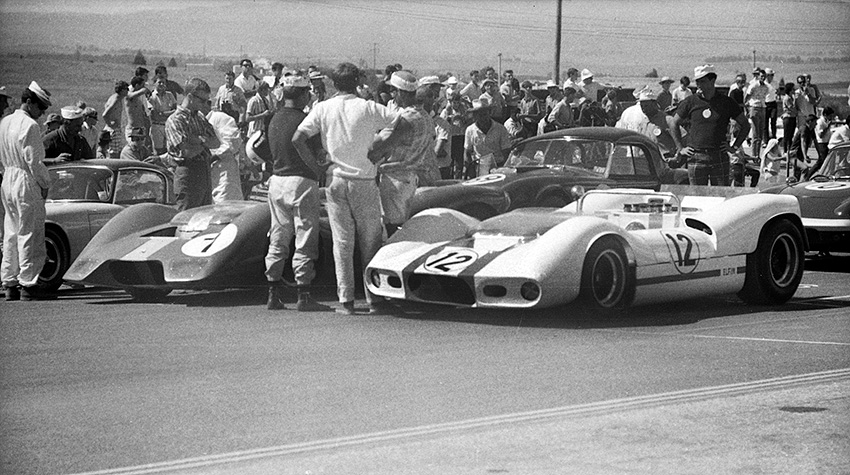
Four Elfin 400’s were built; ‘BB661’ for Dick Bassett and Noel Hurd , ‘BB662’ for Laurie O’Neill and Frank Matich, ‘BB67-3’ for Bob Jane Racing and ‘BB67-4’ for Andy Buchanan in New Zealand.
All of the cars still exist and have interesting histories. For example, the Bassett car was fitted with a Ford Windsor V8 engine with DOHC heads developed by Globe Engineering for a period. The Bob Jane car was fitted with the first Repco Brabham RB620 racing engine sold to a customer, Brabhams engines all factory supplied as part of Jacks deal with Repco.
Car at Peterbilts’ Alexandria, Sydney base. Elfin 400 Traco Olds, February 1966. Car delivered completed without rear bodywork and all of the exhaust system. Rear body finished and fitted in Sydney by Elfins’ John Webb. Matich in the car, Laurie O’Neil and Bruce Richardson in overalls. (John Ellacott)
‘BB662’ without rear bodyword was taken to Sydney on February 8 1966 for completion and testing prior to the Australian Tourist Trophy which was contested during the Longford Tasman meeting on March 7.
Matich initially raced the car with the bodywork and its distinctive ‘front horns’ containing the headlights in place but these were later removed to attempt to overcome the aerodynamic lift that was characteristic of the car.
Front of ‘BB662’ post painting in Sydney fitted with its controversial and aerodynamically unstable, original ‘front horns’ nose. The aero issues are explored in the text. It looks great, ‘edgy’ for its day but the aero was not ‘fully resolved’. (John Ellacott)
Elfins body-builder John Webb and Bruce Richardson accompanied the car to Sydney, the 400 being race ready to compete in the sportscar events at the 27 February Sandown Park, Victoria, Tasman meeting where it was immediately competitive. The body was completed the car pounding around ‘Franks Backyard’, Warwick Farm in Sydneys’ west before heading south to Melbourne and then across Bass Strait for the fabulous Longford meeting.
The ‘Racing Car News’ report of the ‘Elfin Traco Olds’ Sandown debut explains that the 365bhp car was barely slower than the 2.5 litre Tasman single-seaters. Matich won the race comfortably at a canter from Alan Hamiltons Porsche 906 and Spencer Martins’ Ferrari 250LM taking half a second off Bib Stillwells’ Cooper Monaco lap record ‘doing it so easily he’s saving a few seconds for the future…there just isn’t anything in the country that can come close to it in Sports Cars’.
Other than routine pre-race preparation the car was nicely ‘run in’ for its Australian Championship encounter the following weekend.
(Ellis French Collection)
ATT grid Longford 1966; #2 Matich Elfin 400/ Traco Olds, #1 Spencer Martin Ferrari 250LM, the red helmet on the far left is Alan Hamilton, his Porsche 904/6 Spyder invisible, #11 on row 2 is Lionel Ayers, a long way from Queensland in his Lotus 23B Ford . (Richard Blanden)
Frank Matich shares the front row of the 1966 Australian Tourist Trophy grid at Longford with Spencer Martin’s Scuderia Veloce Ferrari 250LM, his brand spanking new Elfin 400/ Traco Olds gleaming in the Tasmanian autumn sun…
The feature event of the annual carnival of racing at Longford was the Tasman race for 2.5 litre single-seaters, in ’66 the race was won by Jackie Stewarts BRM P261 but all eyes were on Jack Brabham and his BT19 Repco, the new partnership of Brabham and the RB620 engine making only its third start, the engine made its debut in South Africa, raced at Sandown the week before finishing 3rd behind the 2 BRM’s in Tasmania. The testing was all critical to give the package the reliability it needed to win the World Title, which of course Brabham did in 1966, doubling up with Denny Hulme in ’67.
The Australian Tourist Trophy was also an event of great stature, Matich took an easy win in an 8 lapper which opened the meeting, setting a lap record of 2:28 winning from Martin’s Ferrari and Frank Demuth’s Lotus 23B.
The latest Elfin Sports Car passes the first…Ross Ambrose (father of V8 SuperCar driver Marcus) is passed by Matich. Elfin Streamliner and 400 respectively. In fact FM muffed a gear under brakes and was nearly hit up the chuff by Ambrose. ATT Longford 1966. (oldracephotos.com.au/David Keep)
Mechanic Bruce Richardson and FM ponder changes to the Elfin 400/Traco Olds in the Longford Paddock. Note the sartorial elegance of the 2 Aussies in the background…Longford was always hot! (oldracephotos.com.au/David Keep)
Matich crosses the South Esk River, Longford 1966. The couple in the boat looking relaxed and dropping in a line…(Alan Stewart Collection)
The ATT was contested over 23 laps on day 2 of the carnival. ‘Racing Car News’ reported the event as follows ‘Martin made a slow start and allowed Hamilton’s Porsche 906 to follow Matich into the first corner, but took over 2nd towards the end of the first lap. Second time past the order was Matich, Martin, Hamilton, Demuth, Mitchell (RM1), then Ayers and Bolton…’
‘The pace was fast and furious but positions did not change greatly in the early laps…already Matich had lapped Bob Holden (Lolita) and Greg Ellis…Martin was forced into the pits on the 6th lap with a loose undertray and rejoined the race exactly as Matich went past.’
The order was Matich a half a lap ahead of Hamilton, Demuth, Ayers, Bolton and Holland, the latter 2 drivers in Lotus 23B’s.
‘The next 2 laps the big Ferrari regained 2 places..on lap 17 Matich was coming into Newry about to lap Carosi’s Bolwell when Carosi spun into the bank on the inside of the circuit barely giving Matich the room to pass…In the closing stages of the race Martin gave the Ferrari everything, making up 5 seconds a lap but he was unable to catch the fantastic white Porsche’
‘Matich was untroubled in the final few laps, his times dropping to 2:45’s and his top speed from around 160mph to 130. The fleet footed although bulky looking Elfin took the flag some 13.4 secs ahead of the Porsche with Martin another 29 seconds away in 3rd’.
The meeting was indicative of the dominance of the car Matich winning many races in it in the short time he raced it, but he needed to do his own thing, he resigned from Peterbilt, who employed him, in September 1966 to pursue his own programs with his Rennmax built but ‘as good as a copy’ Elfin 400 chassis Matich SR3 cars…The success of these fabulous devices is a story in itself for another time.
Peter Windsor’s shot of the RAC Sports Car Trophy race at Warwick Farm in May 1966. Matich is on pole in his new car with Alan Hamilton alongside, Porsche 904/6 with Kevin Bartlett on the outside in the Alec Mildren Racing Alfa Romeo TZ2. Windsor captions the 2 Lotus 23B’s behind as driven by Frank Demuth and Niel Allen, you can also just see Spencer Martin’s Scuderia Veloce Ferrari 250LM…the heavy long distance racer well back amongst all these ‘Sprinters’. (Peter Windsor)
RCN cover with David Atkinson’s watercolor of duelling Elfin 400’s; Allen in ‘BB662’, from Noel Hurd in the Globe Engineering Ford Windsor powered car and Bob Jane in his Repco 4.4 litre engined device…
Wonderful Dick Simpson shot of Bill Brown in the Scuderia Veloce Ferrari P4/350 CanAm with Niel Allen slipping up the inside at Hell Corner in the Elfin 400…on this occasion the exotic V12 bested 5 litres of Chev V8. Brown set the Bathurst top speed record of 181 mph and Allen took the lap record, then DNF in this Sports Car Trophy race. Love the crowd, vestigial safety fencing, ‘Murrumbidgee Road Racing Club’ overalls and ‘King Size Daggi Dog’ health food stand…(oldracephotos.com.au/Dick Simpson)
Laurie O’Neil sold the 400 to Sydney property developer and up and coming racer, Niel Allen…
Bruce Richrdson again picks up the story, ‘When FM left to do his own thing with the SR3 program Laurie said to me one day that Niel Allen was interested in buying the car, they did the deal, I went to work with Niel, looking after the Elfin and the other cars in his stable until I was injured in a fuel explosion. I left, Peter Molloy took my place. I took 12 months off and then worked for a succession of touring car teams as well as doing my own stuff; McLeod Ford with John Goss, Ron Hodgson with Bob Morris including a Bathurst win. I helped Charlie O’Brien run a BMW 635CSI at Bathurst, which was my introduction to electronics, at that stage I decided if that was the way things were going I would quit racing! Frank Gardner lived next door to me on the Gold Coast, I did work with them on a casual basis including helping them with their Bathurst win’
Allen initially raced the car with the Traco Olds but after blowing the engine ‘BB662′ was fitted with a 5 litre Chev V8 and ZF gearbox by Peter Molloy, Allen’s engineer till the end of his later, successful F5000 program. He continued to develop the car including changing the suspension pick-up points to suit the ever wider tyres available and fitment of Matich wheels to suit.
At the 1967 AGP Meeting at Warwick Farm Allen broke Matich’s lap record by 0.8 seconds and won the race. A month later he broke Franks’ Sandown lap record in a handicap race, FM having set it earlier in the day on the debut of his new Matich SR3.
Niel Allen was the only driver ever to set an outright lap record crossing the finish line backwards. This occurred at Symmons Plains, Tasmania, there being a tight corner that leads into a curve over the finish line there. At the end of the second lap he spun… and crossed the line backwards with a new lap record!
Now with 5 litre Chev V8 in Niel Allen’s ownership, the installation done by Peter Molloy. ZF 5DS ‘box fitted at the same time. Wider Matich wheels fitted. (oldracephotos.com.au/David Keep)
Check out this YouTube Footage of the 1968 Warwick Farm Tasman Sports Car support race; wonderful race between Chris Amon in the Scuderia Veloce Ferrari P4/CanAm 350, Allen in the Elfin 400 and victorious Frank Matich in his Matich SR3 Repco…
Niel Allen ahead of Ian Cook in Bob Janes car. The 2 400’s are pictured at Warwick Farm’s Creek Corner during the Tasman meeting in February 1968, Matich having first tested the car 2 years before at the ‘Farm. Later nose clear to see, aerodynamically better? but fugly! (John Stanley)
#12 Niel Allen Elfin 400 sharing the front row of the 1967 Easter Bathurst Sports Car grid with #7 Bob Jane Elfin 400 Repco ‘BB67-3’, Fred Gibson’s Niel Allen owned Lotus Elan 26R on the far left and Ron Thorp’s AC Cobra and another Elan on row 2. ‘BB662’ certainly did a few racing miles at Mt Panorama! (oldracephotos.com.au/Stuart Phillips)
Allen won both races he started at Hume Weir, near Albury in December 1967 s breaking Spencer Martins’ lap record set in the Scuderia Veloce Ferrari 250LM.
At the traditional Bathurst Easter meeting in 1968 Bill Brown set a top speed record in the Scuderia Veloce Ferrari P4/Can Am 350 at 181mph but Allen seriously challenged the Fazz setting a lap record of 2:18:4, 8 seconds ahead of Matich’s previous mark. Sydneysider Matich was on a business trip to the US to plan his 1968 CanAm assault, which ultimately did not eventuate due to the late completion of his SR4. Niel was a DNF forlornly parking the Elfin at the top of the mountain. Brown won the race from Pete Geoghegan in the SV Ferrari 250LM and Fred Gibson in Allens’ Lotus Elan 26R.
He also broke the record at Winton in Central Victoria in 1967 before selling the car to Sydney racer and tuning specialist Fred Gibson.
Allen bought Piers Courage’ McLaren M4A FVA at the end of the 1968 Tasman series in his inexorable rise to the top of Australian Motor Racing. He never won an Australian Title but took victory in the 1971 New Zealand Grand Prix in his McLaren M10B Chev, by rights perhaps he should have won the Tasman that year…FM said he didn’t understand how Allen was so fast given his need to divorce himself from his business pressures as a ‘weekend racer’, FM was a fulltime professional who tested religiously and relentlessly doing endless miles around Warwick Farm and being paid by the lap as part of his Goodyear contract. FM was very fast but he worked hard at his craft.
Niel Allen wasn’t finished with Elfins’ sports cars either. He bought Cooper’s first monocoque sporty, the short wheelbase, tricky to drive, Elfin ME5 Chev 5 litre in 1969, success in that car was tough as by that time Matich was absolutely at the top of his game with his Matich SR4 Repco, the space frame car powered by a DOHC 4 valve, 5 litre RB760 engine, the car designed for the ’68 Can Am series for which it was late is a story in itself.
Niel Allen advertises the ‘fleet’ for sale to concentrate on his ex-Courage F2 McLaren M4A FVA. RCN Oct 1968. (Stephen Dalton Collection)
Start of the fateful Easter Bathurst race which took Bevan Gibson’s life, 1969. Gibson is in Bob Jane’s red Elfin 400 Repco, Allen is alongside in the Elfin 400 Chev ‘BB662’ and Frank Matich on the right in his hi-winged Matich SR4 Repco. SR4 the fastest car in Australia of any type in 1969, winner of the ASS Championship and the only year in which it raced. Allen gets the jump at the start. (Wayne McKay)
Nose Lift and Aerodynamic Instability at High Speed…
The aerodynamics of racing cars in the 1960’s was still very much a black art, perhaps the most early experiments in gathering data on the flow of air over and around racing cars was in the latter stages of Fords Le Mans program and the ongoing, seminal and defining work of Jim Hall and his band of ‘GM quasi-works’ boffins at Rattlesnake Raceway in Texas, the Chaparrals simply iconoclasts.
Without taking a tangent too far Jim Hall spoke about his early aerodynamic testing and calibration in the article i wrote about the Chaparral 2F, those with an interest in his work may find it of interest, the relevant bit is about half way through the article;
Cooper designed the body with ‘John Webb wanting the underside of the horns extensions to be horizontal, as a continuation of the whole underside of the 400, to avoid the possibility of aerodynamic lift , but Garrie insisted they curve upwards to avoid the nose fouling the track’ quoted Barry Catford in his Elfin book.
Interestingly, in the ‘Auto Sportsman’ article mentioned earlier Matich claims credit for the body design ‘ The body styling was inspired by the very successful Chaparral Sports Car …Jack (sic) Webb fabricated the design from drawings supplied by Matich and it features front ‘Fish Gill’ spoilers which added to its gruesome appearance. Matich has recently run the car with a ‘blunt nose’ unit but plans only to use this on short circuits’. Taken at face value this statement suggests Matich did not think the car had high speed instability, if he planned to use the blunt nose on short circuits only, it implied he was happy with the original bodywork on fast ones.
Whatever the case Matich removed the distinctive horns on ‘BB662’, probably to cure aerodynamic lift, possibly to differentiate the look of the car from other 400’s.
During the 1967 Longford meeting in practice Noel Hurd in the Globe 400 ‘BB661′ became airborne at high speed, he mowed down a row of fence posts after spinning several times but was unhurt. The car was repaired at Elfins’ with the ‘horns’ removed.
When Peter Brennan acquired ‘BB662’ he spoke to Niel Allen about his experience of the car which was complimentary overall but ‘Niel said on the fast straights he used to have to touch the brakes to get the nose down before applying the brakes hard. The horns were already off the car at this point but Niel was still having problems with front adhesion. It was pretty clear these early cars had little or no frontal downforce’.
Once he cut the air slots in the guards he said it cured the problem ‘The horns were not the problem causing the lift, it was air damming under the guards which could not escape, all that was required was to cut slots in the rear of the front guards. I discussed this at length with Niel, he found out the cause later and would not have cut the original nose off had he understood the real nature of the problem’.
Peter raced the car at Adelaide in 1990 ‘at 175 mph down Brabham Straight without a problem, in fact it was making so much downforce we had to reinforce the nose brackets at the meeting with the belt of one of my pitcrews pants!’
Unfortunately all these learnings were in the future, lets not forget that even with technology no-one in their wildest of dreams could imagine in 1966 that Mark Webber aviated in his Mercedes on the Mulsanne Straight at Le Mans on consecutive days only a decade ago…
And so it was that Bevan Gibson, the young up and coming Benalla driver lost his life in Bob Jane’s Elfin 400 at the Bathurst Easter meeting in 1969.
Barry Catford described the race ‘Matich was favourite for the race with a practice time of 2:14.9. After practice the faster drivers reportedly discussed the aerodynamic lift they had experienced over the second hump (this is pre ‘The Chase’ which now slows the cars on Conrod) on Conrod and resolved to treat that section of the track with caution.’
‘Niel Allen roared away (in BB662) followed by Gibson and Matich. Frank took over at Forrests Elbow and then on lap 2 Niel had a lose on the Mountain and dropped back and the Matich SR4 Repco began having fuel pressure problems. Bevan closed…on Mountain Straight making up more ground and the next lap drew alongside as they headed into Shell again’.
Bevan sensed a victory (which would never have been on had the SR4 been running properly, it was an opportunity which would seldom come) and tried harder on the 4th lap…the Elfin became airborne on the 2nd Conrod Hump, turning on its back and killing Bevan instantly. Matich, Allen and others retired almost immediately’
(Stephen Dalton Collection)
Elfin 400/ Traco Olds/ Elfin 400…now the ‘R&T Chev’
Fred Gibson was then an up and coming driver and proprietor of a Randwick, Sydney tuning business called ‘Road and Track Automotive Services’ hence the new name when Fred purchased the car he had occasionally driven for Allen.
The 400 was extensively rebuilt but mechanically unchanged, the notable difference the new bodywork designed and built by Denis Julian which used the original body as a mould but gave the car a lower line. Gibson also added a wing.
The engine was a 5 litre Chev with Crower cam, Warren rods, again on 48IDA Webers and gave circa 450bhp.
Fred Gibson in ‘BB662’ as the ‘R&T Chev’, Surfers Paradise 1970. (Unattributed)
Gibson didn’t race the car for long, his career was on the rise, he became a Ford factory driver in their Series Production racing program with the iconic Falcon GTHO’s, the car being sold to Allan Newton in Victoria.
Newton raced the car regularly for years both in Victoria and interstate only selling it after a ‘big hit’ going up Bitupave Hill at Sydneys Amaroo Park in 1977.
Geoff Russell’s shot of the Elfin 400 after its big Amaroo shunt on 29 May 1977, front of the car clearly shortened considerably by its impact against one of the circuits earth banks. See ‘Etcetera’ below for a sequence of photos which captured the accident. (Geoff Russell)
He sold the car to a friend, Dennis Burdon who cut away the badly damaged rear of the chassis to fit a 4.4 Litre Leyland P76 V8 and Hewland F1 FGA gearbox.
This process took years, Brennan was aware of the cars location, knew Newton and eventually when Burdon tired of the car he bought ‘the steering wheel, 4 corners which were complete, the centre section of the chassis from roll bar to the pedals and the engine and gearbox which were sold, respectively to Andrew McDowell and Chas Talbot for his self built Formula Holden’
And so, our intrepid racer set off on a mammoth reconstruction project…
R&T Chev ‘BB662’ in the bucolic Winton, Benalla, Victoria paddock in 1974, still very much as Fred Gibson modified it. The car was a regular in Victorian events at the time, i saw it race many times, Allan Newton drove it well. The cars either side are Lotus 23B’s, the bright yellow car the Gibson Family (as in Bevan Gibson who died at Bathurst) which if memory serves was fitted with a Repco V8, at the time the car was driven by Paul Gibson. Australian readers will know the popular Gibson’s as Benalla Auto Club stalwarts. (oldracephotos.com.au/Neil Hammond)
Elfin 400 ‘BB662′ getting towards the end of its restoration by Peter and Gavin Sala’s team. Car has been tested at Calder sans body, and is in the final stages of completion in late October 1990. Look closely and you can see the other 2 400 chassis’ in the workshop at the time. (Peter Brennan Collection)
Restoration of Elfin 400 ‘BB662’…
Having acquired the car, or rather it’s remains the restoration challenge was a big one, essentially Peter had the bones of a car, the project was largely one of reconstruction or resurrection rather than a rebuild.
Brennan liked the combination of the original bodywork and 5 Litre Chev engine, a Traco Olds was pretty much impossible to source, the Hewland HD5 and ZF boxes were also rare so it made practical, economic sense to choose a combination of core components with which the car had raced in its long racing life which could be sourced at sensible money.
That decided, Peter wrote to the Confederation of Australian Motor Sport and was given written approval from the CEO, John Keefe to rebuild/reconstruct the car to that spec.
Some years later, after the car had been racing, the CAMS Historic Commission changed their view on the matter, what followed was a decade of protracted arguments and negotiations about all manner of the detail specifications of the car which was finally resolved with compromise being reached; the car could race as rebuilt but when sold by Peter the nose of the car is to be similar to that used by Niel Allen during the period he raced it; in essence the car could race in the spec chosen by Peter and confirmed as such by the CAMS CEO at the projects commencement…
Gavin Sala’s handiwork on display. Brennan says’ Be fair to say Gavin played an equal part in the resto work, he is a craftsman for a butcher, hard to believe the work he produces with virtually no qualifications’. ‘Old Midnight’ is in situ, its a spaceframe chassis, the aluminium side pontoons are clear. Gear linkage sitting atop the pontoon this side, exhausts have been ‘dummy fitted’. (Peter Brennan Collection)
Having agreed on the specs of the car with CAMS a handy confluence of events accelerated the cars resurrection from mid 1990…
Our intrepid racer sold his Melbourne ‘Carbitune’ business and decided to give himself a well earned break before starting his new venture, the Australian Grand Prix was in Adelaide in November, with a little bit of luck ‘BB662’ could be a debut starlet in the Historic Racing support events, these races always popular with the punters and owners alike.
The repair choice was made easy as Gavin Sala, a Victorian Racer/Restorer/Dealer and Owner happened to have the ex Bob Jane ‘BB67-3’ and ex Buchanan ‘BB67-4’ cars in his outer urban Melbourne workshop for restoration at the time.
The most difficult part of the job was the chassis. Elfin still existed, it was only money to buy uprights, wheels and so on but the 400 chassis jig no longer existed. Having the other cars alongside made the task of using the remains of the original chassis as a base; from rear bulkhead to the pedals, then carefully measuring and fabricating the required frame, brackets, diaphragm and related aluminium panels relatively straight-forward for skilled fabricators such as Ken Leigh, Gavin and Peter himself.
‘BB662’ resto assembly butt shot. DG300 ‘F5000’ Hewland ‘box. ‘Old Midnight’ 5 litre Chev circa 500bhp on 48IDA Webers. Cast Elfin uprights, upper and lower wishbone/coil spring damper suspension and beefy front bulkhead and rear chassis diaphragms all clear, ditto LHS aluminium pontoon. Car sans exhausts here, but the ‘overhead’ headers came with the bits acquired from Newton. (Peter Brennan Collection)
The suspension was complete but gently sand blasted, crack tested and either reused or replaced using the originals as templates. The wishbones and radius rods were then nickel plated with new spherical joints used throughout.
The cast magnesium uprights were again crack tested, found to be ok, and then reassembled with new bearings.The Triumph Herald steering box was checked and re-used. The lightweight aluminium radiator was a pair of Nissan Pulsar rads’ alloy cores welded together.
400 front end showing Gavin Sala’s beautiful aluminium radiator surround/support/duct fabrication work. Not bad for a fella apprenticed as a butcher as PB says! (Peter Brennan Collection)
Peter acquired a Hewland DG300 transaxle. The engine was bought from F5000 Racers Peter and Mary Middleton. ‘Old Midnight’ was originally the great Max Stewarts’ spare engine, we covered its history in the story about the restoration of Peters’ ex Lella Lombardi Lola T330 ‘HU18’, a while back.
Peter, ‘Its nickname was ‘Old Midnight’ as the motor was usually slipped into his Lola after midnight when the race engine was cactus for the weekend.I bought it as a ‘long motor’ less injection. The block was shaved of all unnecessary production lugs and lightened as much as possible.It has Bow-Tie heads, TRW pistons, Carillo rods, a Crane ‘574’ roller cam, Z28 crank, Vertex magneto, and like most of Max’ engines is on Weber 48IDA carbs, it produces 505bhp@7500rpm’.
The bodywork was provided by Elfin, or rather the front mould, which had been run over by a truck! Peter repaired it in order to ‘take a flop’ from it. The original Matich rear body was long since gone, so a production 400 rear ‘glass panel was used, again sourced from Elfin.
Calder test less bodywork 3 weeks before the 1990 AGP in October. (Peter Brennan Collection)
With time getting tight Peter tested the car sans bodywork at Calder to carry out systems checks, ‘BB662’ behaved itself well although Peter was stunned by the very heavy steering which Kevin Bartlett diagnosed as the offset of the rim from the centre line of the kingpin, ‘scrub radius’.
The car then returned to Gavin’s shop for the final fitment of the body, making its debut, as planned in November 1990, where it was undoubtedly one of the stars of the show for many misty eyed enthusiasts who remembered the cars heyday in the hands of the supremely talented Frank Matich and Niel Allen.
Peter has dated this shot on the front guard…its 10 October with 3 weeks to the 1990 AGP…with still a great deal of work to do. Sala’s workshop. (Peter Brennan Collection)
Last minute pre-event fettling out front of Noiges’ pit, AGP Carnival Adelaide 1990. (Peter Brennan Collection)
Peter Brennan at the AGP Meeting 1990. Photo signed by Niel Allen, Lola Mk1 at rear. Elfin 400 Chev. (Peter Brennan Collection)
The pointless squabble with CAMS meant the car disappeared from sight for a bit but otherwise the 400 is a regular entrant at Historic Meetings around the country and is always punted with verve and skill, much as Matich did during his ATT win at Longford all those years ago…
Peter had the important job of ferrying Lorraine Cooper, on the Elfin Owners and Drivers Club’ Tour To Tarrengower’ in 1994. The 400 is pictured at Bendigo, the start of a road trip for around 35 racing Elfins on the public roads of Victorias’ Goldfields district to Mount Tarrengower Hillclimb at Maldon, 45 kilometres away. I did it in an Elfin Crusader F Vee…it was fun in that, the 400 and various F5000’s entered had a wonderful time! (Peter Brennan Collection)
More recent shot of ‘BB662’ at an Albert Park GP. Brennan’s standard of preparation and presentation outstanding. Car has its original Elfin nose, if you look at the top right of the nearside front guard you can see the ‘gills’ or air reliefs let into the bodywork which eventually addressed the front end lightness of the car by releasing air pressure at high speed. McLaren M1 alongside. (Peter Brennan Collection)
‘Racers Retreat’ Peter Brennan, in Elfin 400 ‘BB662’, a much cherished car for over 25 years. Albert Park AGP several years ago. (Peter Brennan Collection)
Amazing shot of the first Scarab Chev out the back of the Traco shop, ‘Thunder Alley, Culver City in 1958. Looking at the fuel tank on the right are Phil Remington and Harold Daigh, Dick Troutman is in the doorway. The Scarab body builder Emil Deidt is at the back of the car, beside him in the check shirt Marshall Whitfield. Jim Travers and Frank Coon are ‘midships with the suited Leo Goosen leaning against the car, beside him at the front of the car is Sonny Balcaen. (Photo Warren Olson Collection/Jerry Entin for ID of those pictured)
Etcetera Traco Engineering…
Traco Engineering was formed by Jim TRAvers and Frank COon in 1957, the pair made their names as mechanics for Bill Vukovich in his successful Indy wins in 1953 and 1954. Well before that they were pre-war hot-rodders racing on the dry lakes of California.
Their ‘shop’ was based in ‘Thunder Alley’, 11928 West Jefferson Boulevard, Culver City in the LA ‘Megalopolis’. The area was so named due to the number of ‘big hitters’ based in the area including James Garner and Lance Reventlow who tested their cars on the block.
The fledgling company was off to a strong start when Lance Reventlow contracted Traco to work on the front-engined Chevy powered sportscar Scarabs’ in 1958. AJ Foyt’s victory in the Mecom owned Scarab at Nassau gave the firm it’s biggest push with engines soon being supplied to Gurney, McLaren, Mecom, Brabham and Lola amongst others.
The bulk of the work in 1965/6 was on the Chev and Olds F85 engine although Bruce McLaren’s team used the companies talents to decrease the capacity of the Ford DOHC Indy engine for F1 use in 1966.
The payroll included some engineers who went on to become great engine builders in their own right; Al Bartz, George Bolthoff to name two.
In 1965 Traco built 48 complete engines and rebuilt 68 more, a ‘Sports Car Graphic’ 1966 article reported that ‘The average Traco built engine takes from 4-6 weeks to complete and requires approximately 100 man hours’, the engines were priced at the time from US$5000-6000.
In 1986 Travers and Coon retired after selling the business to then chief engine builder Jim Jones.
Frank Coon (L) and Jim Travers in their Traco shop building an engine in 1966. (Sports Car Graphic)
Sports Car World cover shot at Longford 1966 during the Matich ATT win. Overhead shot shows a different angle of the body.
Matich Elfin 400/Traco Olds with its AT Trophy laurel wreath. Longford paddock March 1966. (Ellis French)
Matich in the Elfin 400/ Traco Olds, Lakeside, Qld 1966. (John Stanley)
Rear shot of ‘BB662’ during Niel Allen’s ownership circa 1968, circuit undisclosed. (Mike Feisst Collection/The Roaring Season)
Chequered Flag magazine captured Allan Newton’s May 1977 accident which all but destroyed ‘BB662’, the old but sturdy spaceframe protecting Newton from worse injury…in much the same way the monocoque chassis of the Elfin MS7 saved him when his throttle again stuck open, this time at Calder, Victoria in 1984. He was a very lucky boy that day…(Chequered Flag)
BP ad shot, taken, i think at Sandown, Victoria, ‘Peters Corner’ upon the cars debut, February 1966. (Facebook Elfin 60’s Sportscars Group)
Bibliography…
‘Australias Elfin Sports and Racing Cars’ John Blanden and Barry Catford, Ray Bell/The Nostalgia Forum, Sports Car World, Australian Auto Sportsman, Sports Car Graphic, Chequered Flag
Facebook ‘Elfin 60’s Sportscars’ Group. This is a very dedicated group of Elfin enthusiasts, key the group name into the FB search engine and apply to be to be admitted
Special Thanks…
To Bruce Richardson and Geoff Smedley for their affectionate, respectful accounts of their time working with Frank Matich
Stephen Dalton for the research assistance and access to his extensive collection
Photo Credits…
John Ellacott, Bob Mills Collection, Wayne McKay, Ellis French, John Stanley, Peter Windsor, Laurie Kay, Alan Stewart Collection, Ian Smith, Shane Lee, Peter Brennan Collection, Richard Blanden, Warren Olson Collection/Jerry Entin, Chris Snowdon, Mike Feisst Collection, Geoff Russell, Mike Kyral
As motoring enthusiasts we all have a favourite (or two) when it comes to the various pressed, beaten or moulded automotive art…
The Italians have had a long tradition of art worthy cars for many to aspire. So what happens when the Art World decides to pay homage to a predominately Australian automotive heritage? Well you get the National Gallery of Victoria’s ‘Shifting Gear – design, innovation and the Australian car’ exhibition.
The NGV’s ‘Ian Potter Centre’ in high profile Federation Square, opposite Melbourne’s famous Flinders St Train Station has gone all out to show a variety of Aussie ‘coachbuilders’ art from the roads and the race tracks, ‘a celebration of Australian Automobile design represented by 23 cars dating from the late nineteenth century to the present day’.
Despite there being a lot of red involved, not one has an Italian sounding car name and only one has bodywork with a close relationship to Maserati.
‘Efijy’ – Shifting Gear? Or Cape Canaveral we have lift off? Holden built ‘Efijy’ as a Motor Show concept 10 years ago – Corvette basis, 6 litre supercharged GM LS2 644bhp V8 & 4 speed auto with ’55 FJ Holden looks
Upon entering the precinct, Holden’s Efijy greets you.It’s long and oh so low stance ready for cruising along Carlton’s Lygon St.
Then an entry fee covers viewing the main exhibition halls with more than enough variety for all to come away with a favourite that wouldn’t look too out of place sitting in your garage or shed.
It was a tad rushed when primotipo visited, so give yourself at least an hour to pass through and enjoy.
Several of the cars have long standing Australian Motor Racing Heritage, so it’s interesting to see how the Art World perceives them. Certainly different to the bitumen they usually frequent! And indeed, substantially different to seeing them at the likes of Phillip Island or Sandown.
And remember not to get told off by security for using a camera flash!
A Unique arrangement that allowed some smart, capable Aussies to take on the world, Brabham BT19 Repco.Brabham and Tauranac based in the UK collaborated with Repco in Melbourne to gain a head start on the new 3 litre F1 Grand Prix rule changes for 1966. Jack and this Brabham successfully taking on the ill prepared other teams within the F1 paddocks and grabbed both Drivers’ & Constructors’ Titles in 1966 and 1967. (Denny Hulme grabbed the Drivers Title in 1967).
And in the red corner we have Purvis Eureka, Paul England’s Ausca (mostly hidden), Elfin Streamliner Climax and Molina Monza Holden…
Garrie Coopers’ Elfin concerns first production racing car was the Elfin Streamliner, like many other designers he took a long look at Chapmans’ Lotus 11 and was consistent with many elements of it in his own interpretation; multi-tubular spaceframe chassis, slinky, light aluminium body and a range of engine configurations to suit customer choice. The car on display is the ‘ducks guts’ with Coventry Climax FWA engine and front wishbone, as against split front axle setup.
Elfin built 23 of these cars from 1959 to 1963, Cooper setting the foundations for high standards of design and manufacture which were his hallmark and sustained commercial success.
When Ausca met Eureka; Nice juxtaposition of the 70’s Wedge with the curvaceous 50’s. Not many cars have been built with full canopy door openings. But with the Purvis Eureka and Holden Hurricane this exhibition has two.
Allan Purvis, an advertising executive, obtained the rights to the English developed ‘Nova’ building over 650 cars in Melbournes’ Dandenong between 1973 and 1989 considerably improving the design as he went along. The car was based on VW Beetle chassis and mechanicals although Purvis built some cars with the Ford ‘Kent’ 1600 engine, a very ‘tunable lump’ with bits from Cosworth, Holbay and the like.
Despite its Maserati A6GCS looks, the Paul England-built Ausca has links to Repco and Holden too. A gifted engineer, the Ausca remains fitting testament to Paul’s skills of 60 years ago. He passed away last year
Paul England and his friend Bill Hickey built the Ausca in their spare time at Repco Research in Sydney Road, Brunswick the clever, light car having a ladder frame chassis, a fibre glass body, the pair making the moulds. Holden front suspension was used, England narrowing the track by cutting 6 inches out of the middle of the cross-member and a Holden rear axle casing also shortened by 3 inches, suspended by quarter elliptic springs, radius rods doing locational duties.
Steering was by Peugeot rack and pinion, Repco subsidiary Patons provided the drum brakes the car powered by the very first ‘Repco Hi-Power’ cross-flow head for the ubiquitous Holden ‘Grey Motor, the engine good for around 115bhp @5000 rpm using 2 1 3/4in SU carbs 1956. Gearbox was a Fiat 521 using straight cut gears, the car first raced late in 1955.
The Chamberlain 8 is about the wildest Australian Special of all and deserving of an article in its own right…
Chamberlains’ as a family had a rich engineering heritage, originally manufacturing ball bearings and later tractors so Bob Chamberlain and his friend Bob Price had access to the toolroom and factory facilities to build their outrageously innovative space frame chassis, independently sprung, front wheel drive car.
First completed in 1928, the car evolved over the decades. After a succession of unreliable motor cycle engines Bill Chamberlain decided to build an engine himself. The result was a 1004cc 2 stroke with 4 cylinders and 8 pistons, two crankshafts and a Rootes type blower. Its scream was its hallmark @ 7000rpm, at a sedate 5000rpm it developed 80bhp.
The Chamberlain competed in 3 AGP’s at Phillip Island in the 1930’s coming into its own post war when one of the Chamberlain’s cousins, Jim Hawker built his own spark plugs and improved its electrical system.
The car never left the families hands and was restored for the 1978 Phillip Island 50 Year AGP Anniversary, its now owned by John Hazelden after the brothers deaths some years back. He is the lucky custodian of a very important part of our history.
Checkout this YouTube footage of the Chamberlain 8 Sound…
One off, Torana GTR-X conceptwas still a fair way away from Holden’s 1969/70 production vehicles. As with most concept cars the economics didn’t stack up to sign off for production. It would have been part of a niche market catered by the likes of Datsun’s 240Z and even the Bolwell Nagari shown below.
A stunning car with bullet proof, race proven ‘186’ CID, pushrod OHV, triple Stromberg carbed 160bhp 6 cylinder engine hitting the road through a 4 speed close ratio gearbox…it should have been built and exported.
Alas, a great Aussie ‘what if’
Melbournes’ Art Centre spire, aspect across the Yarra River from the NGV ‘Ian Potter Centre’ in Federation Square…gloomy Autumn day
The FR1 Concept Car is a 2011 collaboration between GM Holden Design, the Victorian Centre for Advanced Materials Manufacturing, Boeing, the Victorian Automotive Chamber of Commerce and Marand Precision Engineering Collection.
The car is a 21st century concept hotrod, hand crafted and powered by a 362bhp Chev V8 and 6 speed manual ‘box.
Repco Brabham ‘RB 750 Series’ V8…
Repco were a very innovative company, this is the engine developed as an option for the 1968 season and whilst developing good power on the test bench the difficulties of fitting the engine into Ron Tauranacs’ spaceframe chassis Brabhams’ or any other car for that matter are immediately apparent given the ‘spiders web’ of exhausts to be accommodated.
Developments of Repco’s ’30 Series’ heads showed there was a power advantage with cross flow gas paths, the ‘radial layout’ ’50 Series’ heads were aimed at exploiting that.
DOHC were used per bank, each one driving inlet and exhaust valves alternately. The valves were side by side in each half of a pent roofed combustion chamber. This layout allowed very simple valve operation compared with the BMW Apfelbeck ‘radial’ heads of the time. Doug Nye..’ On the Repco test heads exhaust stubs appeared within the Vee as a bunch of 8 small bore pipes, while 4 more appeared below the heads outside the Vee on either side. 8 induction trumpets fought for space within the Vee, and 4 more appeared on each side’.
One test engine was built up and the results were ‘encouraging’ but it was a blind alley because of installation problems…So the ‘Type 50′ heads were shelved and the more conventional ’60 series’ DOHC 4 valve heads used in 1968.
The ‘750 Series Radial Valve’ engine beside Jack Brabhams Brabham BT19 Repco and its simple RB ‘620 Series’ SOHC 2 valve 3 litre, 310 bhp 1966 Championship Winning V8 Engine
Pictures on the wall…Repco’s 3 litre F1 engines L>R ’68 ‘860 Series’ DOHC 4 valve, ’67 ‘740 Series’ SOHC 2 valve ‘exhaust between the Vee’ and obscured workshop shot showing the assembly of the ’66 ‘620 Series’ SOHC 2 valve cross flow…
43 years on and the Bolwell Nagari still has it. Good looks and performance to match…
When i was 13 i drooled endlessly over the Bolwell Nagari, it really was ‘as good as it got’ in Australia. Home grown in dowdy Mordialloc but with Italian looks; the Chapman inspired backbone chassis a lightweight platform for the fibre-glass body and core Ford componentry; ‘302’ Windsor 5 litre V8, 4 speed ‘box and rear axle, live axle but very well located.
The Coupe version was even sexier than the ‘Spider’, Campbell Bolwell and his brothers were masters of the kit and low volume art…very tricky in a small market like Oz at a time the legislators made life hard for small players.
I still have the brochure i mailed away for in 1971…
Molina Monza Holden Special…
In many ways the MM is the most powerful and beautiful of Australias’ Holden engined specials.
Concepted by Lou Molina, much loved member of Melbournes’ ‘Spaghetti Mafia’ who brought fine Italian cuisine to Melbourne between the wars and Silvio Massola, the car was designed and built by Brian Burnett, who by 1955, had the Maybach bodies in his cv. The car had a ladder frame chassis, an aluminium body that was derivative of many influences but wonderfully distinctive with it.
Motive power was the Holden ‘Grey motor’ with Repco Highpower head but also fitted with a Marshall blower fed by a big SU 2 3/16th ins. carb, 199bhp @ 6000rpm the result. Drive was transmitted by a dual plate clutch to a Jag ‘box and then by a short drive shaft to a de Dion rear end utilising Ford components. Front suspension is of planar type using a transverse spring to locate steering knuckles at the top, with wishbones below. Telescopic shocks are used front and rear. Steering is by Citroen rack and pinion, brakes drum using HWM Jag components at the front.
MM made its competition debut at Rob Roy in Melbournes’ Christmas Hills on May 5 1957 and was very successful in Molinas hands against much more exotic cars before slowly passing into obscurity before being superbly restored not so many years ago by Gavin and Bryan Sala.
It is a truly fabulous device.
NGV
The Holden Hurricane design study is about as far removed to their Holden production cars could ever be…
It was of course the era of low slung, mid-engined sporties such as the Ford GT40, De Tomaso Mangusta, Lamborghini Miura and even Lotus Europa. So Holden decided to give it a crack. One way to get the new ‘253’ CID Holden V8 noticed
The car made its Melbourne Motor Show debut in 1969 and has a box section steel frame clothed in fibre glass panels. Wishbones, coil springs and dampers were used at the front, rear suspension uses swing axles, trailing arms and coil springs. The 4.2 litre pushrod OHV V8 produced 260bhp @ 6000rpm, the car uses a 4 speed manual ‘box and disc brakes on all corners. Height is 39.2 inches.
‘Hey Charger!’ the Ad Tag Line said in 1972…
The triple 45 DCOE Weber-fed Chrysler Valiant Charger’s played second fiddle to GTs and XU1s for too many years. But not anymore, they have a strong following and their values have increased substantially.
265 CID, in line OHV 6 cylinder engine, ‘E39’ 3 speed and ‘E49’ 4 speed ‘boxes. Never really developed as racers as Fords GTHO’s or Holdens XU-1’s but mighty competitive all the same.
Giancarlo Baghetti relaxes during the Italian Grand Prix weekend, he had a ‘one off’ drive of the Team Lotus spare ’49, backing up Jim Clark and Graham Hill…
He qualified well back on the grid, 17th, and retired on lap 50 whilst running 6th with an engine failure. John Surtees took a fabulous last corner win from Jack Brabham, winning Hondas’ first Grand Prix since Ginthers’ victory in the last race of the 1.5 Litre Formula in Mexico, 1965.
Baghettis’ career started with immense promise, famously winning his first championship Grand Prix, the French in a great dice with Dan Gurney (Porsche) in a Ferrari 156 in 1961….
The stone chips on the nose of Baghettis’ 156 bear witness to the closeness of the race, third place went to Jim Clarks’ Lotus 21 Climax. (sutton images)
Toto Roche waves the chequered flag for Baghetti, winning a famous victory over Dan Gurneys’ Porsche 718, French GP Reims 1961, his championship race debut. (Unattributed)
Baghetti started racing in 1956in an Alfa Romeo 1900Ti and built a solid reputation as he moved into Formula Junior in 1959. In early 1961 he was selected to drive for the Italian FISA team, an organization formed to promote young Italian drivers by entering them in Non-Championship Grands’ Prix.
FISA struck a deal with Scuderia Ferrari to run a 1960 F2 Ferrari Dino 156 (in effect the prototype of the 1961 F1 car) in the first non-championship races of 1961. The results were amazing, Baghetti, not necessarily the best credentialled candidate won on his GP debut in Syracuse in front of Gurney, Surtees, G Hill, Brabham, Moss, Salvadori, Ireland and Bandini.
Giancarlo Baghetti ahead of Dan Gurney Syracuse GP April 1961. Ferrari Dino 156 from Porsche 718. The first of Giancarlos’ wins against stong opposition. (Unattributed)
He followed up with another win in the Napoli GP in May beating Ashmore, Lotus 18 Climax and Bandini Cooper T53 Maserati 2nd and 3rd as well as Roy Salvadori, Andre Pilette and Tim Parnell.
FISA persuaded Ferrari to hire them a 1961 ‘Shark Nose’ for their driver to make his championship GP debut at Reims, he was allocated the car which was to be driven by Equipe National Belge driver Olivier Gendebien, the car quickly repainted from yellow to red.
Phil Hill took pole from Ferrari teammates Von Trips and Ginther, Baghetti 12th fastest. The 3 works Ferrari’s disappeared at the start, only Moss managed to stay near them. Even a quick spin by Ginther dropped him behind the Lotus, but he was soon able to re-pass Moss such was the Ferraris’ power advantage.
Baghetti had made his way to the front of the chasing pack. When Moss was forced to pit with brake problems, the four Ferrari’s lead, this didn’t last as Von Trip’s engine died in the heat.
Hill spun on the melting road surface. The American lost over 2 laps as he tried to restart his hot engine. This left Ginther in the lead with Baghetti fighting the Porsches of Dan Gurney and Jo Bonnier to hold on to second place, a battle that became even more significant a couple of laps later as Ginther pulled off the track with no oil pressure.
Baghetti recounts the last laps …’It was a very hard race. It was hot. The asphalt was melting, the radiator was blocking up and I saw the temperature starting to soar. Luckily I was behind the two Porsches of Gurney and Bonnier and relied on getting a tow along the straights. What you must remember is that this was my first Grand Prix and both Gurney and Bonnier were trying to frighten me by running on either side of me, but I thought that if they could do things like that and get away with it, then I could do it too.
Three laps from the end Gurney and I were fighting for the lead and I realized that to finish first I needed to be in the perfect position to slipstream. Going into the last corner I was right behind Gurney so that as we came out I was on his tail. He sat right in the middle of the track because he obviously knew what I was going to try to do. I waited and when I saw him glance in his mirror when I was on his left, I quickly switched to the right and got past him to win the race.’
Giancarlo Baghetti became the first man in history to win his debut World Championship Grand Prix.
James Allingtons’ cutaway drawing of the 1960 Ferrari 156 F2 car, chassis ‘008’ the car used by Baghetti at Syracuse and Naples was the prototype 1960 car fitted with ’61 ‘Sharknose’ body. Multi-tubular spaceframe chassis, suspension by upper and lower wishbones front and rear. 1476cc 65 degree DOHC 2 valve Weber carbed V6, 185bhp@9200rpm. 5 speed ‘box. Later spec ’61 cars had the 120 degree V6 190bhp@9500rpm. (James Allington)
Baghetti qualified mid-grid for the British GP, spinning off the wet Aintree circuit during the race. For his home GP at Monza he qualified 6th, the other four Ferrari’s were faster. This was the day that von Trips was expected to win the world title, but it was not to be, ‘Taffy’ crashed to his death after contact with Clarks’ Lotus 21, the car flew into the crowd killing 11 spectators on lap two. Baghetti raced at the front until his engine blew on lap 14 and Phil Hill won the race to seal the first World Championship for an American driver. Giancarlo set the fastest lap.
His season ended with his 4th and last GP win, he took victory in a little known event to decide the ‘Prima Coppa Italia’ (Italian Championship for Drivers) at Vallelunga, Baghetti won the 2 heats in a Porsche 718 when his Ferrari was not available for the event. Lorenzo Bandini and Baghetti were tied for the Championship , this event was organised to decide the winner.
What a debut GP season!
1961 spec Ferrari 156. (Scuderia Ferrari)
For 1962 Baghetti joined Phil Hill, the ’61 champion in the works Ferrari team (Rodriguez driving a third car occasionally). Enzo rested on his laurels thinking that the 156’s didn’t require evolution to continue their dominance but the Brits had caught up.
BRM, Lotus and Cooper produced cars to beat the Ferrari’s. Lotus debuted the epochal monocoque chassis Lotus 25 at Zandvoort and Coventry Climax produced their FWMV 1.5 V8 in quantities, the BRM team also built a V8, the Type 56 available to customers as well as the ‘works’ BRM P57’s. The British teams shortcomings in 1961 were their engines, the relatively old 1.5 litre variant of the Climax FPF not ‘man enough’ for Ferrari’s powerful V6. It was different in 1962 when their engine power was equivalent to their chassis mastery…
Baghetti scored points at Zandvoort and Monza, but Ferrari was in total turmoil and for 1963 he joined Hill in the mass exodus to Carlo Chiti’s ATS team, an unmitigated disaster for all involved, it effectively destroyed his F1 career. Baghetti drove Centro Sud’s old BRM P57 in 1964, he returned to race in F2, F3 and sports and touring cars, also making an annual apperance at the Italian GP, his last in the Lotus 49 in 1967.
‘Hitchin a ride’: Baghettis’ BRM P57 gives Phil Hill and Bob Anderson a lift at the end of the 1964 Belgian GP, Spa. Giancarlo was 8th in the race won by Clarks’ Lotus 25 Climax. Hill raced a Cooper T73 Climax and Anderson a Brabham BT11 Climax (G Clayton)
Brabham entered a third car for Giancarlo at the 1965 Italian GP. He qualified the BT7 Climax poorly in 19th, the engine failed on lap 12 in the race won by Stewarts’ BRM P261. (Unattributed)
Baghetti at the wheel of a factory Ferrari 275 P2 during Targa 1965, DNF with Jean Guichet. (Unattributed)
After a huge accident at Monza in a Ferrari Dino 166 F2 car in the ‘Monza Lottery GP’ in June 1968 he retired from driving, working as journalist and photographer. He succumbed to cancer in 1995 age 60.
No-one has ever repeated the feat…a quasi factory Ferrari drive on the results of a ‘journeyman’, won his first 3 GP’s, 4 for the year, one of them a championship event and then so rapidly disappeared from sight…
Baghetti at the wheel of a Ferrari Dino 246, Monza, Italian GP 1966. Q16, raced Spences’ Lotus for 5th until the car failed in the race won by Scarfiottis’ Ferrari 312. Car was lent to him by Scuderia after his Parnell Lotus BRM failed in practice. (Unattributed)
Giancarlo Baghetti, Ferrari 156 1962. The class of the field in 1961 were at best also-rans in 1962. He is smiling so it must be at the seasons commencement… (Unattributed)
Photo and other Credits…
Mel Turbutt, motorsportretro.com, Sutton Images, James Allington, Scuderia Ferrari, The Auto Channel
Spencer Martin tips his Ferrari 250LM into the fast Homestead Corner at Warwick Farm before unleashing the cars 3.3-litre V12 on the long Hume Straight, what a sound it must have made! August 1965…
Spencer Martin was one of Australia’s champion drivers of the 1960’s winning the Gold Star, the Australian Drivers Championship in 1966 and 1967 in a Brabham BT11A Climax.
His career could be summarised thus; he saw, he came, he conquered from 1960-1966, retired to marry and have a family, focus on business and then returned many years later…
Spencer Martin in his racing heyday, Lakeside 1965. (Bruce Wells)
I don’t cover Spencer’s career in detail but rather introduce an interesting article i discovered in a rally guide for an event held in memory of David McKay. Martin outlines his experiences as a driver/mechanic with McKay and Scuderia Veloce, if not the first, then certainly one of the first of Australia’s professional racing teams formed in 1959…
Martin commenced racing at Gnoo Blas, Orange NSW in 1960 in a Nota, he built from a kit himself, then progressed through the Prad Holden, a very successful sportscar and into ‘Appendix J’ sedans. He beat some of the heroes of the day in his ’48-215′ or FX Holden and was approached by McKay to join SV. Martin picks up the story…
Spencer in the ‘Boomerang Service Station’ Holden FX, Catalina Park, Katoomba 1963. It was consistent ‘giant killing’ performances against Norm Beechey and the like which attracted McKay to Martin. (Autopics.com.au Collection)
‘Work on the racing cars was carried out in a garage at the rear of his (McKay) house in Wahroongaon Sydney’s upper North Shore. We later moved to new premises beneath the Shell Service Station on the Pacific Highway at Wahroonga.
At this time I was driving the ‘Boomerang Service Station Holden’ for Joel Wakely and was keeping Norm Beechey very busy around Catalina Park, Warwick Farm and Sandown Park. In 1963 David brought Brian Muir back from the UK to drive in the Hardie Ferodo at Bathurst and I was to be Brian’s co-driver. Brian had been driving a Ford Galaxie in the UK and had won the British Touring Car Championship
David was, thankfully very impressed by my driving with Brian and told me he was about to retire and would I like to take over driving his Brabham. (Ex Jack Brabham BT4 Climax) Well you may imagine how I felt getting out of an EH Holden into an F1 Repco Brabham! We took the car to the short circuit at Warwick Farm for a few familiarisation laps where I was shocked by how much power the car had, especially how the far the nose lifted when you put the ‘pedal to the metal’.
It was not long before David entered the car at Bathurst. It was now 2.7 litres and running on methanol. He told me to keep it under 4500rpm down the straight for a few laps and be careful over the hump. I ‘pulled the string’ on the third lap and was doing 172mph over the hump. The car became completely airborne with a very much nose up attitude. I was wearing a Les Leston helmet with a small peaked visor to help keep the sun out of your eyes. Well the wind at this speed would catch under the visor which gave the effect of lifting you out of the car. It didn’t take long for me to remove the peak!’
Its 1967 as the painted date on the Longford Viaduct says. Martin eases his Bob Jane Racing Brabham BT11A Climax ‘IC-4-64’ into the right hander to exit the turn, ’67 Tasman ‘South Pacific Trophy’ 5 March 1967. He only lasted a lap of the race, his Climax FPF suffering ring failure. Jack Brabham won the race in his Brabham BT23A Repco. Clark took the series win in his Lotus 33 Climax FWMV 2 litre V8. Love the local ‘topography’, sturdy stone viaduct!, hay bales, painted, slippery white ‘no passing’ lines on the public roads. (oldracephotos.com/David Keep)Spencer Martin exercising all of his Coventry Climax’ lusty 235 horses through Leger Corner, Warwick Farm, December 1966. ‘Hordern Trophy’ Gold Star round won by Frank Gardners’ Brabham BT16 Climax from Kevin Bartletts’ Brabham BT11A and Martins’ similar car in 3rd. (Autopics.com.au Collection)
‘The biggest difference in driving the cars of David’s and my time was the safety aspect.
No seat belts, no fuel cells, no on-board fire extinguishers, no roll cages, no fireproof clothing. I was driving the Tasman Series in New Zealand and was wearing a polo-shirt made of nylon. When Jim Clark saw me in this he explained how dangerous nylon was in the event of a fire. Jim gave me a pair of his Dunlop Racing overalls. Boy, did I think I was smart wearing these and they were fireproof so I could go faster! Actually they gave you about 5 extra seconds in the event of a fire. They were made of cotton and soaked in a fire retardant. Rather different from today’s suits.
Another extremely dangerous factor was the aluminium fuel tanks which were placed either side of the drivers seat. We needed to have over 18 gallons of Avgas for a long race, so we packed dry ice around the tank prior to the race on hot days.’
Spencer Martins’ Ferrari 250LM ‘6321’ leads the ‘Country Club GT Race’ at Warwick Farm September 19 1965. The chasing Lotus Elan 26R’s are Niel Allen and Fred Gibson. (Heinz Federbusch)Graham Hill and a quizzical Spencer with the SV Brabham BT4 Climax Hill raced during the 1964 Tasman- here in the Warwick Farm pitlane (unattributed)
‘Graham Hill was driving our new Brabham (BT11A Climax) at Warwick Farm in 1965.When we fuelled the car, an hour before the race, one tank was leaking through a crack in its top edge. I went into panic mode, Graham, however, asked me to go to the toilet and bring him back a bar of soap. He made this into a putty mixture and plastered it into the crack. As he explained, the leak was on the top of the tank, so after a few laps the fuel would be below the problem area. I used this fix a few times over the years. Can you imagine this sort of thing happening to an F1 Ferrari or McLaren?!
One of the biggest events to materialise at SV was when David talked Archie White, the Shell Racing Manager, into buying the 250LM Ferrari. I was not allowed to go to the wharf to bring it home as I had work to do on the Brabham. However I’ll never forget seeing it for the first time and David saying it was mine to drive!’
‘David was the best motoring journalist at this time. Not only was he able to write about cars, he could also drive them.
David was at the front of the grid for the 1963 Australian Grand Prix at Warwick Farm alongside Surtees and McLaren. He was the first Aussie home and all this on a 40 degrees Celsius day when many of the younger drivers stopped due to heat exhaustion. The temperature inside his car was measured at over 50 degrees.
Front row of the AGP grid, Warwick Farm February 1963. Surtees on pole, Lola Mk4a Climax, McLaren Cooper T62 Climax and McKay Brabham BT4 Climax. Jack won in his BT4 Climax from Surtees, McLaren and McKay.(Autopics.com.au Collection)
David, in his motoring column, was very critical of the cars which Ford, GMH and Chrysler were building at that time. Sir Frank Packer allowed David to continue his reports in the Sydney Telegraph because his column was selling newspapers. When News Ltd took over the Tele, they would not allow him such a full hand as they explained they needed the advertisers money from the motoring industry so David left.’
Spencer Martin in one of his early drives of the SV Ferrari 250LM at Murrays Corner, Bathurst, Easter 1965. (Autopics.com.au Collection)‘Australian Autosportsman’ magazine July 1965. Shell ‘Advertorial’! Martin on the cover in the SV Fazz 250LM, picture taken probably on the same day as the one above, but this time, i think, ‘Hell Corner’, which leads onto the uphill ‘Mountain Straight’ having gone past the pits. (Stephen Dalton Collection)
‘The first race for the 250LM was the Sandown Park Tasman round sports car race in February 1965…
Graham Hill was to drive the Brabham in the Tasman race, however he put it on David to allow him to also drive the LM. David kept his word to me and told Graham that ‘the boy’ was going to drive it. Well, Frank Matich was leading (in Elfin 400/ Traco Olds) then suddenly we did a ‘Stephen Bradbury’ as Matich blew up and we went on to win it’s very first race. In reality it was no match for the more powerful Elfins and Lola’s. It did however win every long distance race in which it was entered.
The ‘Old Red Lady’ as David affectionately called the LM, was a fantastic car to race. With the V12 very low slung in the engine bay behind the driver, and with 8000rpm, the noise inside and out was certainly something to remember for driver and spectator alike.
David was a vary hard taskmaster. He expected me to work on customer road cars during the day and maintain the Brabham and Ferrari after hours. I was made an offer by Bob Jane which I decided was better for my future so I moved on. Years later David wrote me a letter saying he was sorry for being so hard on me. This lead to a rekindled friendship where we travelled overseas together to many of the F1 races.
I really miss ‘The Old Man’. He was a true Ferrari-ist, and gave us all the true pleasure of seeing the two best cars ever to race in this country, the 250LM and P4 Ferraris!’
This ‘RCN’ cover David Atkinson painting depicts Spencer winning the 10 July Gold Star race at Lakeside, Queensland 1966 ahead of Kevin Bartlett #14 Brabham BT11A Climax and John Harvey Brabham BT14 Ford 1.5…1-3rd in the race en route to Martins 1966 Gold Star title. (Racing Car News)
David McKay had this to say about Spencers’ departure and career in his wonderful autobiography, ‘David McKays Scuderia Veloce’…
’I was both surprised and disappointed but in retrospect I had expected too much and had been too hard on the young man. I had treated him as I would a son and no doubt Martin thought ‘the son’ had had a lucky escape. Sadly I had planned to take Martin to Maranello where I was sure Mike Parkes would have got him a drive at Le Mans and he would eventually have graduated to F1.
However, instead of telling me he’d been waiting for this chance and had his bags packed, Martin said he didn’t fancy Le Mans with its dangerous mix of cars and drivers and thank you but no thanks. I still consider to this day Martin would have achieved a successful career with Ferrari and we have often joked about what might have been. Martin argues that he has all his arms and legs in place and that his successive Australian Championships in 1966 and 1967 fulfilled his motor racing ambitions. It was twelve years before we were to speak again and it was the LM which brought us together’.
Front row of the Symmons Plains, Tas 1966 ‘Gold Star’ grid. #7 the winning ex-Clark Lotus 32B Climax of Greg Cusack, #5 Brabham BT11A Climax of Kevin Bartlett and on the near side Spencer in his Brabham BT11A Climax. The nose of John Harveys’ Brabham BT14 Lotus/Ford TC is on row 2. Cusack won from Harvey and John McCormack, Brabham BT4 Climax. (oldracephotos/David Keep)Martin on the way to 6th place in the SV Brabham BT11A ‘Warwick Farm 100′ Tasman race 13 February 1966 won by Clarks’ Lotus 39 Climax. This is not long before Martin left SV for Bob Jane Racing, this same chassis ‘IC-4-64’ won his 1966/7 Gold Star titles. (Autopics.com.au Collection)
As Spencer says he left SV and Sydney to join Bob Jane Racing in Melbourne, both Shell sponsored teams at the time and a controversial move albeit a very successful one for both driver and team…
Jane acquired the Brabham BT11A Climax Spencer had been racing for SV, it was this car in which he won the Gold Star in 1966 and 1967. His toughest competitor was Kevin Bartlett in a similar car entered by Alec Mildren, the pair having many close dices with Bartlett famously setting the first over 100mph lap of Bathurst during their Gold Star encounter at Mt Panorama in 1967.
A touch of understeer for Spencer in his Bob Jane Brabham BT11, ‘Hordern Trophy’, Warwick Farm in December 1966. Race won by Frank Gardner from Kevin Bartlett. This shot is from a ‘period’ Shell magazine ad. (Spencer Lambert Collection)
In 1967 Repco’s 2.5 litre Tasman ‘740 Series’ V8’s powered the cars of Greg Cusack (SV Brabham BT23A), Leo Geoghegan (Lotus 39) and John Harvey (Brabham BT14 ) even though these cars were all competitive they lacked the consistent reliability which prevented Repco ever achieving a Gold Star Series win…Martins’ Climax engined Brabham won 2 rounds, winning his second title by 7 points from Cusack, his replacement at Scuderia Veloce and promptly retired.
Years later he re-established his relationship with McKay as he outlined above, he owned a share in McKays’ LM for a while and raced a range of exotic racing cars in historic racing in both the US and Europe. He still lives in Australia and is in happy retirement with a large extended family to keep him busy…and the occasional competition drive.
Spencer Martin and David McKay pictured on 27 October 2004. Chris Haigh took this shot having just taken David for a lap of Wakefield Park, Goulburn, NSW in McKay’s original Jaguar Mk1 ‘The Grey Pussy’. David died on December 26 2004 at 83 of cancer. (Chris Haigh)
Etcetera…
Spencer Martin stands by the front ‘guard of the SV 250LM, his second meeting in the car, Longford Tasman meeting February 1965. Yellow car is the Mildren Maserati, driven by Ralph Sach (built by Rennmax’ Bob Britton on his Lotus 19 jig) the yellow shirted Mildren mechanics are (L) Stewart Randall and (R) Glen Abbey, the latter behind many Mildren/Gardner/Bartlett/Stewart victories. Driver behind the Fazz perhaps Les Howard. (oldracephotos.com/David Keep)Martin leading and winning the Surfers Paradise Gold Star round in 1966. Shot taken below Repco Hill, Brabham BT11A Climax. (John Stanley)
The ‘Guvnor David McKay steers his 250LM through the Longford paddock in March 1965, the second meeting for the Ferrari driven by Martin. Graham Hill drove the SV Brabham BT11A Climax in the final ’65 Tasman race, the AGP, to 4th place, Bruce McLaren won in a Cooper T79 Climax. (Ellis French)Martin being congratulated before the start of the Gold Star race at Symmons in November 1967. DNF with cam follower failure, race won by Greg Cusack, his replacement at Scuderia Veloce, in a Brabham BT23 A Repco. #2 is Garrie Coopers’ Elfin Mono Ford TC. Its Martins’ final race of ‘his serious career’, he had wrapped up the Gold Star for the 2nd time in succession and retired, the car driven by John Harvey for Bob Jane Racing from then. (oldracephotos.com/David Keep)Martin in the SV Brabham BT11A ahead of Leo Geoghegans’ Lotus 32 Ford 1.5 TC, Lakeside ‘Gold Star’ race July 1965. Martin won from Leo and John McDonalds’ Cooper T70 Climax. (The Roaring Season/Bruce Wells)Car owner, the stocky, strong Bob Jane tests the rear spring rates…whilst driver Martin does his best to ignore the chief. Symmons Plains Gold Star round November 1966. Brabham BT11A Climax, ‘box is Hewland HD5. (Ellis French)Spencer pictured beside the Brabham BT23D Alfa Romeo raced by Frank Gardner in the ’68 Tasman and then Kevin Bartlett to Gold Star success in 1968. Car restored by Paul Moxham and driven by Spencer here at the Eastern Creek, NSW Tasman Revival Meeting in December 2006. (Stephen Dalton Collection)Spencer Martin signed program of the Catalina Park cover on which his Holden starred! (Stephen Dalton Collection)
Bibliography…
‘David McKay Memorial Rally 2012: Rally Guide’, ‘ David McKays’ Scuderia Veloce’ David McKay, The Nostalgia Forum
Photo and Other Credits…
John Ellacott, Bruce Wells, autopics/Richard Austin, The Roaring Season, Chris Haigh Collection, Racing Car News, Heinz Federbusch, Ellis French, John Stanley, Racing Car News, Chris Haigh
Robert Davies captures Alan Moffat is his Ford ‘Cologne Capri’ RS3100, exiting Dandy Road upon its Australian debut at the Sandown Tasman meeting in February 1975…
Whilst Alan Moffats’ car is well known by most Australian enthusiasts, the factory RS2600 campaigned by David Mckay in the 1972 Dulux Rally is a bit more obscure, we will come back to Moffat’s car, McKays’ was the first to appear.
The Dulux Rally was a unique event in the World, whilst influenced by the Tour de France was different in that competitors faced both the challenges of dirt rallying and circuit racing. The Rally only lasted 2 years, such was the cost of running an event over two weeks commencing in Queensland and finishing in distant Victoria.
The Dulux was promoted and run by the Sydney based Australian Sporting Car Club and worked commercially due to the support of ICI Australia, whose research showed the most effective way to promote the name change of ‘Balm Paints’ to ‘Dulux’ to the trade in 1971 was via motorsport. Re-finishers, panel and paint shop proprietors were interested in motorsport, so the key commercial support to get quite a radical event off the ground was made.
McKay very successfully ran an Alfa 1750 GTV powered by the 2-litre race engine out of his friend Brian Foley’s ex-factory GTAm circuit racer, a veritable 210bhp wolf in sheep’s clothing in 1971. McKay finished second to Colin Bonds’ factory Holden Torana LC GTR-XU1. No mean feat, as Bond was one of Australia’s most versatile drivers: a winner in open wheelers, on the dirt and on the circuits as both multiple Australian Rally Champion and a winner of the Bathurst 500 and many other circuit races.
For 1972 McKay was keen on a more competitive mount, the nature of the various hats he wore and his capabilities meant he was attractive to all of the local manufacturers/importers. McKay was invited to breakfast with Ford’s CEO Australia, Bill Bourke, on his departure from Australia who asked if there was anything he could do for McKay in his new appointment elsewhere in the Ford empire.
McKay recalled ‘Ford were running V6 Capris in European Rallies and perhaps Bill Bourke could collar one which wouldn’t be missed in time for the ’72 Dulux? This he did together with a mechanic to look after a car which had been run by Ford France. Howard Marsden (head of Fords racing program in Australia) was enthused and turned on his Ford works crew’.
The 1972 Dulux entry was not large at 27 cars…but included International, Edgar Herrmann, in a factory Datsun 240Z, Colin Bond and Peter Brock in factory Torana GTR XU1’s both of whom were equally at home on tar or dirt, Australian Rally Champion Bob Watson in a Renault 8 Gordini, Stewart McLeod, XU-1 and Bruce Hodgson, Ford Escort Twin Cam and many other top drivers.
The rally commenced after a run from Brisbane to Grafton at Surfers Paradise Raceway.
The Capri had a high speed miss which cost power, McKay finished third on a track tailor made for the car. Due in Sydney on the second night, David organised the SV Team to be on hand to rectify the problem, there, out of the rain which had accompanied the rally since it’s start, a condenser was identified as the cause of the misfire and fixed.
With full power the car won the Silverdale Hillclimb and night racing at Oran Park, then a circuit on Sydney’s Western outskirts. This put a smile on Ford fans faces and gave General Motors Holden and their Torana’s cause for concern…
McKay also won the Dapto Hillclimb, having time to divert to visit his ailing mother in Bowral Hospital enroute to Canberra!
McKay ‘passed’ as he put it on the Mount Ginn event, spitting the dummy over the condition of the track surface, even protesting the organisers conducting the Mt Ginn activity at all…he could do so as the Capri was comfortably in the lead at the time.
Based in Albury, on the New South Wales/Victorian border for several nights the car won the circuit events at Hume Weir, another lost circuit, and several nights of rallying. ‘The Capri was very quick on dirt surprising both (navigator) Garry Connelly who was doing the navigating and myself but it wasn’t to last’.
‘Apparently the wide Goodyear Ultragrips should have been fitted with tubes to give some protection against deflation over the rocky outcrops and we had tyre problems on one section. On another a rear coil spring became detached from its mountings and pierced a tyre. The final blow was hitting a rocky ridge in the middle of the dirt road with the front cross member and pushing the lot back out of alignment. ‘
‘No-one else had noticed the ridge, all driven safely over it as we had expected to do. In our jubilation after the wins at Hume Weir earlier in the day we had inadvertently forgotten to reset the ride height, consequently we were rallying with race track settings and it took the Ford boys a long time to straighten out the mess’.
The Toranas therefore skipped off into the distance. On the final leg towards Melbourne the Capri won a 20 lapper at Phillip Island, lapping the Toranas, McKay finally able to use its ‘moonshot-fifth gear’ on the Island’s long main straight.
The event finished at Melbourne’s Dallas Brooks Hall, the two works Holden Torana LJ XU-1s first and second from Stewart McLeod third, McKay and Connelly seventh in the exotic Cologne Capri.
The car does not seem to have been rallied again but passed into the hands of Melbourne’s Graham ‘Tubby’ Ritter, a noted engineer/driver who mated the car with donor parts from the March 751 F5000 left in Australia by John Cannon; engine, gearbox, suspension, and brakes all used in the cars conversion to a Sports Sedan, the March tub was attached to a VW transmission and sent to New Zealand to deal with the import duty issue which otherwise arose…
If memory serves the cars injected 5-litre Chev was later twin-turboed, if any reader knows of this RS2600’s ultimate destiny I am intrigued to know.
Moffat’s RS3100…
Allan Moffat made his name in Australia as one of our greatest touring car drivers but was born in Canada and emigrated to Australia with his father who was posted here for career reasons in the early 1960s.
Moffat commenced racing in Australia in a Triumph TR3A and progressed to a Lotus Cortina bought from Team Lotus at the end of 1964, Moffat having worked with the team in the United States.
His racing of the Cortinas in both Australia and in the US is a story in itself, suffice it to say that at the end of 1967 he was competitive enough to be invited to join Ford’s KarKraft as a development driver.
Ford was fully committed to the Trans Am Series to promote its image. It was a hotbed of competition with Shelby American representing Ford. Allan co-drove the first two rounds (Daytona 24-Hours, Sebring 12-Hours) of the 1968 Trans Am, with Horst Kwech, the car did not finish either race.
He returned to Australia to work for Bob Jane after Jane purchased a genuine 1968 ex-Shelby Trans Am Mustang, Allan returned to Detroit in early 1969 and met with Jack Passino, Ford Racing Director who organised a brand new 1969 Trans-Am Boss Mustang.
Moffat brought the car to Australia and with support from Coca-Cola in one of the first commercial deals of its type here, and raced the car as a professional becoming one of the most iconic car/driver combinations in Australia.
Moffat and the Trans Am won 101 of its 157 starts but ironically not the coveted Australian Touring Car Championship for which it was intended. ATCC rule changes forced the Mustang into the Sports Sedan category in 1973. The Mustang was competitive but with new rule freedoms during 1974 wins became fewer against the mid engined cars now being developed. Moffat, to his eternal credit chose not to ‘hack the car about’, one of only seven genuine factory 1969 Trans Ams…but he needed a competitive mount to replace the famous car. His immaculate Ford connections secured one of the works Capri RS3100s at the end of Fords successful 1974 European Touring car championship campaign…
This is a slightly truncated version of Mark Oastlers tremendous article about the car in ‘Shannons’ magazine…if you have a hankering for Touring Cars its worth signing up to the Shannons site just to get access to Oastlers’ excellent articles, http://www.shannons.com.au/club/
Why Ford built the ultimate RS…
‘The catalyst for creation of the RS 3100 was the 1973 ETCC, when BMW fended off a gallant season-long challenge by Ford’s less powerful RS 2600 Capris to win the prestigious title.
BMW had caught Ford by surprise that year by equipping its 3.5 litre CSL coupe with a huge boot-mounted inverted rear wing, made even more effective by a full-width scoop mounted along the rear edge of the roof to feed it clean air flow for maximum downforce. Not surprisingly, the big CSL coupe soon earned the nickname ‘Batmobile’!
Ford rightly figured that to overcome the CSL challenge in 1974, the Capri would firstly require more power. However, the RS 2600’s German 2.6 litre V6 engine, which had already been bored out to 2.9 litres capacity and was producing around 320 bhp, had reached the peak of its development.
By comparison, the capacity of BMW’s potent 3.0 litre in-line six had been increased to 3.5 litres under the FIA’s liberal Group 2 rules, providing a big power advantage over the Fords. The obvious answer was a switch to the larger capacity 3.1 litre British-built Essex V6 as used in UK-built Capris.
The CSL’s inverted rear wing also provided a considerable edge in traction and high speed stability so Ford had no choice but to join the aero wars with a large rear spoiler of its own. Wind tunnel and track testing of various designs proved how effective a large ducktail spoiler could be.
As a result, Ford committed to production of a ‘homologation special’ called the RS 3100 that would serve as the road-going production basis for its full-house Group 2 competition cars for the 1974 ETCC attack.
Built in a batch of 250 (the minimum number required for FIA homologation) the British-built RS 3100 came with front and rear spoilers and the 3091cc Essex V6. Use of this engine of course would allow the 1974 race car to increase its engine capacity to 3.5 litres to match the BMW.
The small batch of RS 3100 road cars went on public sale in November 1973 with FIA homologation approved on January 1, 1974. Surprisingly perhaps, these rare homologation cars proved hard to sell. Evidence of that fact is that 50 of the 250 built were shipped to Australia as late as June 1974 where they were eventually sold through selected Ford dealers.
Cosworth to the rescue…
Michael Kranefuss was the man in charge of Ford’s ETCC program. Given Ford’s long and successful association with Cosworth, in particular its 3.0 litre V8 DFV Formula One engine, he approached the Northhampton firm to design the new RS 3100 race engine. Initial discussions between Ford and Cosworth about this engine had started back in 1972.
The Group 2 rules required use of the manufacturer’s standard cylinder block, but a timely change that allowed use of alternative cylinder heads for 1974 left Cosworth with the task of designing new aluminium heads with dual overhead camshafts, four valves per cylinder and an initial power target of 400-plus bhp.
The Cosworth GAA-V6 was designed by Keith Duckworth and Mike Hall, featuring cast aluminium heads that could be used on either bank. The four overhead camshafts operating 24 tiny valves were belt driven by toothed pulleys at the front of the engine, with one spark plug per cylinder and Lucas mechanical fuel injection.
Cosworth needed to increase the cylinder bore size of the Essex block, but wayward casting tolerances meant that few of these mass produced blocks survived the machining process. They settled on 3412cc as the safe limit. Cosworth also beefed up the bottom end with rugged four-bolt main bearing caps.
In-house dyno testing of the new 3.4 litre GAA-V6 began late in 1973 and it produced 420 bhp straight up, instantly meeting Ford’s 400 bhp plus target. With on-going development these engines reached 450 bhp at a spine-tingling 8750 rpm.
The RS2600’s five-speed ZF gearbox was carried over and matched with a rugged Borg & Beck triple-plate clutch in a feather-weight magnesium bell housing.
The RS 3100 Cologne Capris were built with a win-at-all-costs approach at Ford’s German competitions department in Cologne, under chief engineer Thomas Amerschlaeger. The exotic materials, quality of workmanship and attention to detail evident in the construction of these factory race cars was beyond belief.
The emphasis was on minimising weight, as the lightweight fiberglass doors, bonnets and boot lids used on the RS 2600 were no longer allowed and the new Essex V6 was slightly heavier than the German engine. This resulted in a 50 kg weight increase in the new cars, which would be offset somewhat by the more powerful 3.4 litre Cosworth engine.
They started with standard LHD steel body shells taken from the production line which were rumoured to have spent time in an acid bath to remove some excess metal before they arrived at the workshop.
Large aerodynamically shaped fiberglass wheel arch flares were installed at each corner to shroud huge wheels and tyres and lightweight laminated window glass was fitted throughout the cabin. The large front and rear spoilers, which under Group 2 rules had grown considerably from the road car versions on which they were based, were fitted front and rear.
The increased weight of the Essex V6 altered the car’s critical front to rear weight distribution, which Amerschlaeger’s team addressed by mounting the engine’s dry-sump lubrication oil tank and fuel injection pumps inside the boot area, where the battery and huge 120-litre long distance fuel tank also resided.
Oil cooling radiators for the gearbox and rear axle were also moved to the tail end and mounted directly behind the rear wheels, with oil circulation controlled by a pump driven directly by the tailshaft via a toothed belt and pulley arrangement. The engine oil cooling unit was mounted in the nose where it was fed fresh air through the grille.
The engineers also experimented with a rear-mounted engine radiator but found that there wasn’t sufficient air flow available because of the effectiveness of the huge front spoiler in stopping air from flowing under the car. Amerschlaeger eventually opted for twin side-mounted engine radiators mounted just ahead of the rear wheels.
The standard dashboard pad and door trims had to be retained but the rest of the interior was stripped bare, leaving a full set of competition gauges, remote switch panels, massive roll cage, on-board fire extinguisher system plumbed to every corner of the car and lightweight Nomex covered driver’s seat.
To minimise weight, many suspension components were made from aluminium or magnesium.
Under Group 2, a touring car’s suspension had to keep its original ‘architecture’ so the RS 3100 was equipped with strengthened front suspension towers, Bilstein aluminium McPherson struts with gas-filled adjustable dampers, a wrist-thick anti-roll bar, magnesium hub carriers and solid aluminium replacing rubber in all suspension bushes.
Likewise the Capri’s live rear axle and leaf spring design had to be retained, but Ford got very creative in its rule interpretation. It complied by fitting leaf springs, but they were made from lightweight composite materials and had no springing function at all.
This was performed instead by big coil springs and adjustable gas-filled Bilstein shocks. Ford’s homologation paperwork stated that these coils were simply ‘additional springs’ and the FIA duly agreed!
The rear axle was located fore and aft by upper and lower trailing arms and laterally via a Watts linkage that also allowed adjustment of the car’s rear roll centre.
The brakes were huge with four wheel discs permitted under Group 2, even though the road car had rear drums. The ventilated front rotors measured 12 inches (305mm) in diameter and more more than 1.0-inch thick, clamped by powerful servo-assisted calipers.
The front brakes were also fitted with an automatic water cooling system connected to a large tank in the cockpit which could spray a fine mist onto the disc rotors to cool them down each time the brake pedal was pushed. The rear discs were slightly smaller 10.5 inch diameter units.
The racing wheels and tyres were enormous given the size and weight of the car, capable of generating such huge cornering forces that the works Capris were often seen in the ETCC cornering with their two inside wheels clear off the deck.
German BBS composite rims (magnesium centres with aluminium rims) were secured by a single central locking nut and fitted with tailor-made Dunlop tyres that measured a staggering 16 inches (405mm) wide at the rear and 12 inches (305mm) on the front.
With top shelf drivers the calibre of Niki Lauda, Jochen Mass, Toine Hezemans and Dieter Glemser on the team, Ford was ready for all-out war.
The 1974 ETCC…
‘Unfortunately, the timing could not have been worse for what promised to be the battle of all battles for the ETCC crown between Ford’s new RS 3100 Capris and BMW’s mighty CSL ‘Batmobiles’.
The world’s worsening energy crisis, which had been triggered by the Arab-Israel war, forced car companies to quickly change priorities in their marketing and product development strategies. Motor racing programs were hit particularly hard during this time, including Australia where Ford withdrew its factory support in January 1974.
Sadly BMW also began to scale down its racing activities during the ETCC which left easy wins to the new Capris at several rounds. Even so, despite these outright victories and the vast sums of money spent designing, building and developing the new RS 3100s, it was the German Zakspeed-prepared RS 1600 Ford Escorts which ended up winning the manufacturer’s title for Ford due to a points system that was heavily weighted in favour of smaller capacity cars.
The last time an RS 3100 Cologne Capri competed in full works guise was when Jochen Mass and Toine Hezemans were sent to Kyalami in South Africa to compete in a gruelling non-championship 9-Hour endurance race as part of the Springbok series that featured many sports cars. The Capri was fast and faultless again, winning the touring car class and finishing an outstanding fifth outright.
The same car – chassis number GA ECPY19999 – would not return to Germany after the race, though, as it was destined for a very different life in Australia.’
The Moffat era…
‘In late February 1975, GA ECPY19999 arrived at Allan Moffat Racing in Melbourne after being shipped directly from its last race as a works car in South Africa.
Although the stunning European thoroughbred won first time out at Sandown it soon became apparent that the Capri, which was built for long distance racing on high speed European tracks, was going to be doing it hard against lighter and more powerful V8 competition on Australia’s tighter tracks in short sprint races.
Its V6 engine just couldn’t match the explosive power and torque outputs of rival V8s. And it was restricted to the local maximum wheel width of 10 inches, which was a substantial drop in traction given the car was designed to race on massive 16-inch wide rears and 12-inch fronts in Europe.
It was also comparatively heavy given its touring car racing origins, competing against increasingly sophisticated purpose-built local designs that featured mid-mounted V8 engines, space-frame chassis, Formula 5000 suspension and featherweight composite body panels.
Moffat had his sights set on winning the inaugural Australian Sports Sedan Championship (ASSC) in 1976, so when it became clear he would need V8 power to do it he sourced a state-of-the-art DeKon Chevrolet Monza from the US. With 6 litre Chevrolet V8 power, it was immediately more than a match for the best sports sedans in the land.
Even so, the RS 3100 Capri still had an important role to play as the controversial Monza was sidelined midway during the ASSC due to questions over its eligibility. So while that was being sorted, Moffat dusted off the Capri for two crucial rounds at Wanneroo in Perth (which he won) and A.I.R in Adelaide (where he came second). The Capri proved it was still highly competitive, effectively sealing the title for Moffat and finishing its Australian career on a high note.’
Moffat retained the car, as he did the Mustang for decades before finally selling it to a lucky collector in New Zealand.
The Kiwi Connection…
For the sake of completeness there were only two other, I think, ‘Cologne Capris’ which raced in Australia, both originated from the ‘other side of the ditch’, the colloquial name we Australasians give to the Tasman Sea, which separates Australia and New Zealand.
Grant Walker raced the ex-works RS2600 imported into New Zealand by Paul Fahey which won the NZ Touring Car Championship in 1975 converted to Cossie GAA power.
Don Halliday raced the GAA powered car he and his equally talented brother built up in NZ with many factory parts as well as local ingenuity.
Both scored points in the 1976 Australian Sports Sedan Championship, ironically won by Allan Moffat in the Chev Monza which replaced his Capri. As Mark Oastler points out above the Capri did play a vital role in that series victory.
Bunch of three photographs of David McKay in his RS2600 during the 1972 Dulux- I don’t know the venues though, assistance appreciated. Colin Bond’s Holden Dealer Team Torana GTR-XU1 lined up beside him in the shot below.
The last shot is the same car but has none other than Kevin Bartlett at the wheel, date and place unknown.
Credits…
Robert Davies, Jerry Melton, autopics.com, spooky21, Green Machine, Bruno Betti, oldracephotos, David McKay’s ‘Scuderia Veloce’ autobiography, Mark Oastler/Shannons for the RS3100 article, snooksmotorsport.com, The Roaring Season, Stephen Dalton for the research assistance and material