Archive for the ‘Fotos’ Category

oversteer

Nick Heidfeld thrilling spectators in qualifying with a touch of what was a drivers stock in trade into the early seventies, oversteer which thrilled the eye if not always the stopwatch…

He was brought in to replace Pedro de la Rosa, qualified 15th and retired after a collision on lap 36 in the race won by Fernando Alonso’s Ferrari F10.

Credit…Getty Images

image

It’s a Formula Junior with a cutie at the wheel during the 1960 Geneva Motor Show…

VW Beetle front suspension, independent at the rear, any ideas as to make and model anyone?

Credit…

Getty

image

A parade of Auto Unions through the streets of Zwickau on November 7 1936, Auto Union’s home town to celebrate Bernd Rosemeyer’s 1936 European Championship victory…

The cars were built in the Horch factory located in the town. Bernd Rosemeyer drives the lead car with Hans Stuck, Ernest Von Delius and Rudolf Hasse in the cars behind.

After two years of Mercedes supremacy it was the turn of the mid-engined, 6 litre, 520bhp Type C V16 engined cars. Rosemeyer was the dominant driver winning 3 of the 4 championship rounds- the German, Swiss and Italian GP’s. Rudy Carracciola’s Mercedes W125, powered by a 600bhp 5.6 litre V12 in 1936 took the Monaco race. Rosemeyer also won the Eifelrennen and Coppa Acerbo non-championship events.

Mercedes would be back with a vengeance of course, but for now victory is sweet and to be celebrated…

image

Rosemeyer’s German GP win 26 July 1936, Auto Union Type C (Getty)

Credit…

Imagno

brabham art

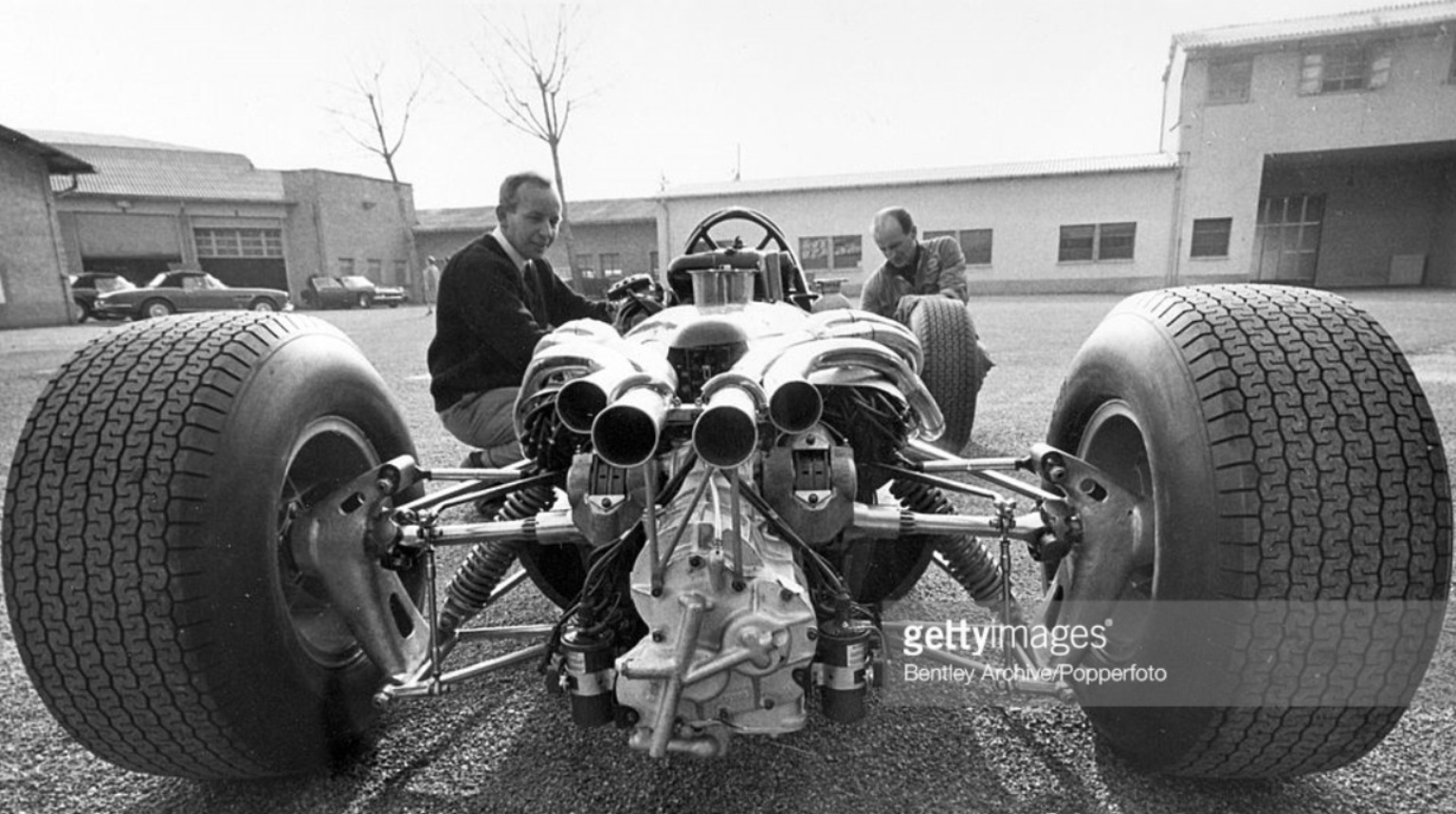
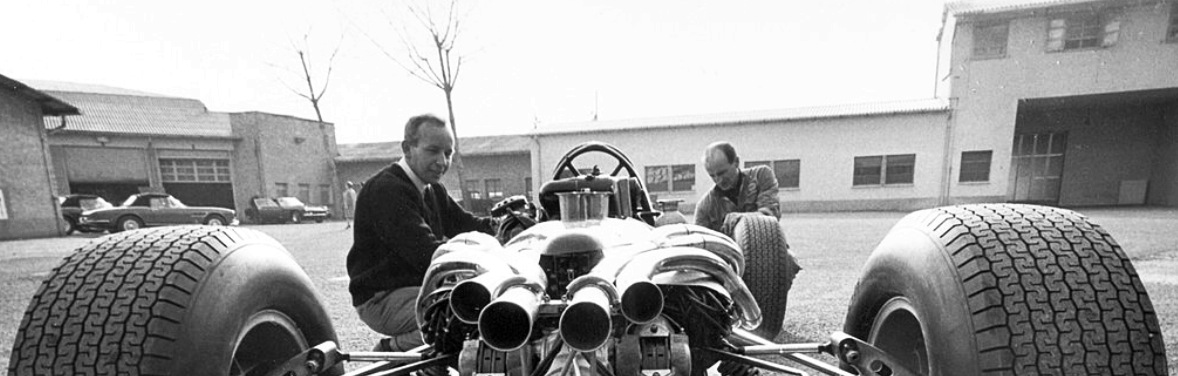
Jack Brabham, long time ‘Brabham Racing Organisation’ Chief Mechanic Roy Billington (left) and another fella, ‘twould be nice to know who, on 25 April 1967…

‘Co-stars’ in this studio shoot, which seems to be one of a series taken that year, is the Brabham BT19 pictured in the background and the Repco Brabham ‘RB620’ 3 litre V8 which is the engine/chassis combination with which Jack won the 1966 F1 Drivers and Constructors titles.

I have written comprehensively about both this engine;

‘RB620’ V8: Building The 1966 World F1 Champion Engine…by Rodway Wolfe and Mark Bisset

and the 1966 F1 Championship Year;

Winning the 1966 World F1 Championships: Brabham BT19 Repco…

I love the shots!…

Credit…

Len Trievnor

Tailpiece: Jack’s ‘Dr Evil’ pose?…

blackie

image

(Heritage Images)

I’m constantly in awe of the talents of the photographers whose work is displayed in this ‘masterpiece’ of mine…

Take a careful look at the composition and execution of this shot of Phil Hill’s Dino at Monaco in 1959-the use of light, the way the shadows of the palm tree and building architecture frame the shot of the snub-Monaco nosed Ferrari 246 and the expression on the American drivers face. The shadow of the photographer gives a sense of involvement.

image

(Klemantaski)

Things were pretty tough for the front engined brigade by 1959 of course.

Jack’s first Cooper title was bagged that year. In the process of trying to keep up, Enzo’s brigade created quite the most beautiful cars in these later Dino’s. The snub nosed car not so much but checkout Tony Brooks slinky, curvaceous chassis above during the BARC 200 at Aintree on 19 April ’59. Jean Behra took the win that day in a sister car, the Scuderia may have been lulled into a sense of false security by this non-championship event result.

The 1959 Dinos had more voluptuous bodywork by Medardo Fantuzzi, clothing big-tube frames with coil-sprung de Dion rear ends rather than the transverse-leaf setup used earlier. Dunlop disc brakes and tyres were used with Armstong telescopic shocks replacing the ‘unreliable’ lever-arm Houdailles- Doug Nye wrote that some Ferrari team members blamed the Houdailles as the cause of Peter Collins fatal 1958 German GP accident.

image

Brabham on the way to his first GP win at Monaco in 1959, Cooper T51 Climax (Cahier)

It was very much a Cooper T51 Climax year.

They won three of the five non-championship events (Moss took 2, Brabham 1) with Ferrari and BRM taking one apiece (Behra and Flockhart). Ignoring the Indy 500 which was part of the world championship back then, there were eight GP events. Cooper won five (Brabham-Monaco, British and Moss-Portugal and Italy two races each for the Aussie and the Brit and McLaren-US 1 win). Ferrari won two (Brooks-French, German) and BRM won one, the break-through first win for the Bourne marque and Jo Bonnier aboard a P25 at Zandvoort.

image

(unattributed)

Its front is a little ‘fugly’, the looks only a mother could love

‘Snub nosed’ Dino, Hill rounding the Gasworks Hairpin, Quay in the background. Oooh, la, la from the rear tho. All things Italian look great from the back!? Hill hustling his Dino, thru the Mirabeau right hander below.

image

(LAT)

Have a look at Phil’s car below in August on the hugely picturesque and dangerous Monsanto road course during the Portuguese GP.

DNF when Lotus 16 mounted Hill G spun in his path taking out both cars. Moss won in a T51 Cooper Climax from Masten Gregory similarly mounted, Gurney the best placed Ferrari in 3rd.

I guess by definition these Dino’s are the ultimate expression of the front engined GP car given Enzo persevered at least a year longer than he should have.

image

(LAT)

Credits…

Heritage Images, Klemantaski Collection, LAT, Cahier Archive, Ferrari Dino article by Doug Nye in Motorsport November 2007

Etcetera- Technical Specifications…

Two rare photographs of Dinos in the semi-nude.

The first, above, is a 156 F2 in the Nürburgring pits in August 1957, both are by Bernard Cahier. The second is of the Taffy Von Trips (DNF) car during the 1960 Belgian Grand Prix weekend at Spa.

Vittorio Jano’s new 65 degree 1.5 litre V6 gave about 180 bhp @ 9000 rpm on the Maranello test-bed, it burst into life about five months after Dino Ferrari’s untimely death due to renal failure on 30 June 1956.

The cars chassis was a scaled down variant of the Lancia Ferrari 801, its tubular frame comprised of two large diameter bottom tubes braced by a welded on superstructure of thinner tubes- not a true spaceframe in a definitional sense.

The engine was angled across the frame, as you can see, this allowed the prop-shaft to run past the drivers seat to the left. The front suspension, clearly shown, is by wishbones and coil springs with the rear suspension by de Dion tube and transverse leaf spring. Drum brakes and Houdaille lever arm shocks were fitted with Scaglietti providing the sexy aluminium body.

The 1957 German GP was a famous victory for Fangio’s Maserati 250F from the Hawthorn, Collins and Musso Lancia Ferrari 801’s. The Dino, if the photo is captioned correctly, was perhaps in the transporter. Whilst entered in the F2 section, the race results show Maurice Trintignant as a ‘no-show’, Denis Jenkinson’s race report also says the car did not arrive so perhaps the date on the caption is wrong and the shot is of a 1958 246.

The first F2 Ferrari Dino, chassis #’0011′ made its race debut at the Naples GP on 28 April 1957. Enlarged engines of 1983 cc, 2195 cc were built over the ensuing months and- then the 2417 cc variant was raced by Peter Collins during the non-championship 27 October Moroccan GP- the Dino 246 was born!

Stricken by flu, Peter spun off, the 85mm bore, 71mm stroke, 2417 cc engine at that stage gave 270 bhp @ 8300 rpm burning 130 octane AvGas, the 1958 mandated fuel.

The 1960 Dino 246/60 (above) were lightened with engines angled across the frame the opposite way to 1959, with the transaxle turned around to match- providing the drivers with the challenge of a reversed gearchange gate.

They also featured pannier fuel tanks without separate covering body panelling (look closely above) smaller fuel tanks and all-independent coil-spring and wishbone suspension.

At Spa Phil Hill used the Ferrari four-cam power advantage but was still overwhelmed by a Cooper Climax 1-3 finish. Jack Brabham led home Bruce McLaren in T53’s whilst Olivier Gendebien was third in an earlier T51.

Tailpiece: And what a tail. I’m cheating really, this is the butt of Phil’s ’58 Dino, this pictorial article is mainly about the 1959 cars…

image

’58 Moroccan GP; Moss won in a Vanwall VW57 from Mike Hawthorn and Phil, both Dino mounted, Mike won the ’58 World Title at this race (LAT)

The photo is another masterpiece of composition and high-speed shutter work during the Moroccan GP at Ain-Diab, Casablanca Morocco on 19 October 1958.

Check out the different tail treatment from the later cars earlier in the article and ‘three piece’ fabrication of the Ferrari’s rear tail section comprising from driver back- the fuel tank, then oil tank and finally small curvaceous endplate, Italian panel bashing at its best.

Finito…

image

An Australian daily broadsheet newspaper ad to promote Repco’s 1967 Grand Prix successes…

Thats Michael Gasking giving the 1967 F1 RB740 V8 ‘a tug’ on the Maidstone, Melbourne dyno before shipping the usually still warm engine off to the Brabham Racing Organisation in Guildford, England.

Credit…

Michael Gasking Collection

image

(Ullstein Bild)

Sculptor Olaf Lemke works with Hans von Stuck on the bust of the pre-War Champion German driver, 1932…

Stuck cut his racing teeth in the hills and was soon scooped up by Mercedes Benz for whom he was a factory driver, but via the introduction of Adolf Hitler became Auto Union’s first star.

image

Stuck in the Auto Union Type A, Avus 1934 (Getty)

He did most of the early development work on the AU Type A or P Wagen and won the German, Swiss and Czech Grands Prix in 1934, his best season. Had a European Championship been run that year he would have won it. His star rose and then fell as his capabilities were put into context by Bernd Rosemeyer, a ‘Gold Standard’ of outright pace admittedly.

image

Hans Stuck leading the Italian Grand Prix at Monza in 1935, his final GP victory (Getty)

His last championship win was the 1935 Italian Grand Prix, the photos here show his Auto Union Type B 5 litre V16 machine, which triumphed over the Rene Dreyfus/Tazio Nuvolaro Alfa 8C-35 3.8 litre straight-8 and the Paul Pietsch/Bernd Rosemeyer AU B Types.

image

Stuck with the Monza crowd in 1935 (Getty)

After Rosemeyer’s death he returned to the Auto Union team from which he had not long before been fired! He raced post-war with little success having obtained Austrian citizenship to do so.

His son, Hans Joachim Stuck became a rather handy racer as well…

Click here for an interesting story on Stuck Senior; http://8w.forix.com/stuck.html

Credits…

Getty Images

Tailpiece: Auto Union ‘Tempo’ V16 Boat…

image

(Ullstein Bild)

Always interested in record breaking, Stuck took this craft to a speed of 81 or 82.5kmh on the Scharmuetzelsee in 1937. He set a new under 800Kg record with the craft which was powered by an Auto Union Type B V16 engine. It was built to Audi and Stuck’s order in Klaus Engelbrecht’s boatyard on the River Dahme, Berlin.

Tempo was sunk post-war, having survived the ravages of the conflict. After a bombing raid on 1 March 1943 the car was moved from Berlin to Southern Germany where is was less likely to be hit by allied bombing missions. It was wrecked when a joy-riding occupying forces officer lost control of the craft which sank to the bottom of a Bavarian Lake complete with V16 engine. The skipper survived!

Finito…

spanish grand prix

Maurice Trintignant’s 1953 type Ferrari 625 from Harry Schell’s Maserati 250F and victor Mike Hawthorn’s 1954 type Ferrari 553 on the picturesque Pedralbes road circuit at Barcelona, 24 October 1954…

This event was famous for the race debut of the Lancia D50’s in the hands of Alberto Ascari and Gigi Villoresi, both were quick and Alberto led convincingly from Fangio’s Mercedes W196 until a clutch hydraulic failure caused his retirement.

The three drivers above had a great dice and all led at different points with Hawthorn taking the victory. Schell retired after a spin damaged his car and Trintignant with a fractured oil pipe. Hawthorn’s win was a good one made slightly easier by the problems Fangio was dealing with in his Benz, his W196 spraying oil into the cockpit.

lancia barcelona

The Ascari #34 and Villoresi #36 Lancia D50’s, just unloaded at Pedralbes for an event which showcased Vittorio Jano’s design brilliance as well as the sublime skills of Alberto Ascari. Such a pity Lancia ran out of money! Still a world title as a Lancia Ferrari D50, and drivers title for Fangio in 1956 was a great reflection on the original design even if it had ‘evolved’ a bit by then (unattributed)

I’m leaving Australia’s winter for 3 weeks in France and Spain including Barcelona so look forward to retracing the street circuits of  Montjuic Park and Pedralbes whilst based in one of my favourite cities. My posts will be shorter over this period.

YouTube Race Footage…

Photo Credit…Yves Debraine

Donna Mae Mims…

Posted: June 18, 2017 in Compound curvature, Fotos
Tags:

image

Donna Mims prepares for the off in her MGB December 1964, no details of circuit unfortunately…

She was a prominent driver and character in the US and was the first woman to win an SCCA title in 1963 in an Austin Healey Sprite. Click here for a short article on the lady;

http://www.autoblog.com/2009/10/14/donna-mae-mims-first-female-scca-winner-and-cannonball-run-vet/

Credit…

Bill Ray

image

Racers in 1966- Anita (sister of F1 driver Trevor) Taylor, Donna Mae Mims and future Indy 500 competitor Janet Guthrie. Mims, Guthrie and Suzy Dietrich drove the #80 Sunbeam Alpine to 32nd in the Daytona 24 Hours (speedqueens)

Finito…
fazz color

The Ludovico Scarfiotti/Peter Sutcliffe factory Ferrari P4 during the 1967 Brands Hatch 6 Hour held on 30 July…

Louis Klemantaski’s creative shot beautifully captures and ‘distresses’ the 5th placed car, Phil Hill and Mike Spence won the race in a Chaparral 2F Chev from the P4 of Chris Amon and Jackie Stewart.

fazz 1

Sutcliffe dives the P4 inside the Enever/Polle MGB (Klemantsaki)

fazz 2

P4 Ferrari cockpit at Brands ’67. Of the period ‘innit? Momo wheel, Veglia Borletti instruments, right-hand 5 speed change, car a spaceframe chassis with riveted on aluminium panels to add stiffness, beautifully trimmed for a racer-added to driver comfort over longer distances (Klemantaski)

I wrote articles about the Ferrari P4/CanAm 350, Chaparral 2F and 1967 Le Mans which may be of interest if you are into these cars and this great era of ‘unlimited’ endurance racing, check out;

https://primotipo.com/2015/04/02/ferrari-p4canam-350-0858/ and https://primotipo.com/2014/06/26/67-spa-1000km-chaparral-2f/ and https://primotipo.com/2015/09/24/le-mans-1967/

fazz 3

Brands pits, 6 Hours ’67; the 3 factory P4’s in line astern with the Scarfiotti/Sutcliffe car ahead of the other two crewed by Amon/Stewart 2nd and Paul Hawkins/Jonathon Williams 6th. # 30 and 32 Lotus 47 Fords are Taylor/Preston 19th and Hine/Green DNF (Klemantaski)

Credit…

Klemantaski Collection

Tailpiece: Phil Hill in the winning Chaparral 2F Chev from the Scarfiotti/Sutcliffe Ferrari P4…

fazz last

(Klemantaski)