Archive for the ‘Fotos’ Category

image

Mike Barney prepares Jack Brabham and Bruce McLaren’s Cooper T53 Climax’, French GP Reims, 3 July 1960…

That racing drivers shouldn’t have too much imagination is shown by this shot!

#16 is Brabham’s winning chassis, #18 McLaren’s third placed car. Olivier Gendebien was second and Henry Taylor fourth in T51’s making it a Cooper 1-4!

Yer ‘fancy-schmancy’ high tech relatively, I say it again, relatively safe 2017 carbon fibre GP machine is another world away, 55 years or so to be precise. Mind you, one would hope we would progress.

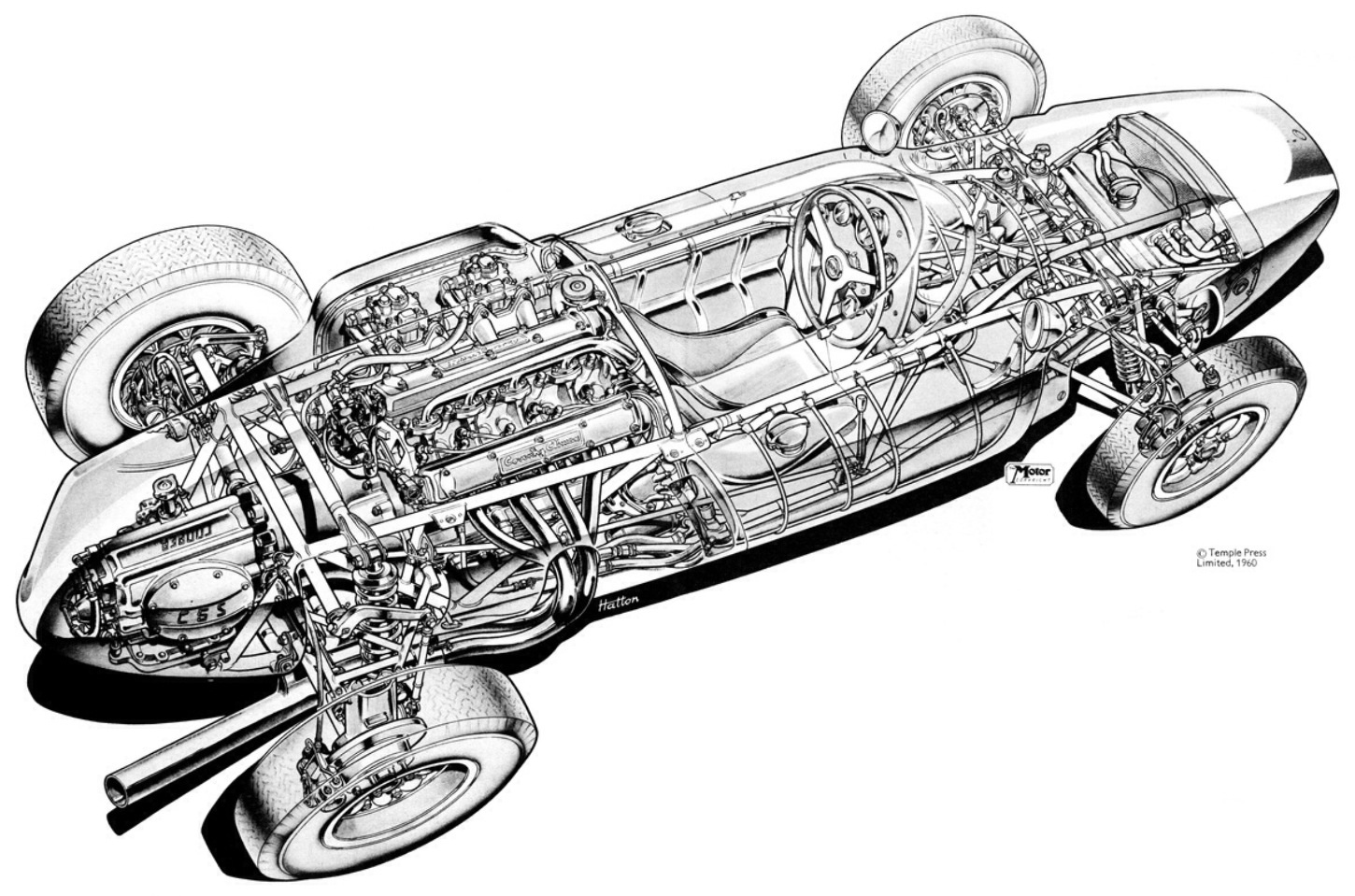
Owen Maddock’s curvy spaceframe chassis is typical of the day, the spaceframe anyway if not the imperfect in an engineering sense bent tubes! At the front the water radiator and oil tank are the ‘deformable structures’ ahead of the drivers ankles and lower legs. The fuel tanks are neatly and very practically ‘bungee’ strapped to the chassis and prone to leakage as the ‘ally tanks chafe on the steel chassis tubes. The ‘deformable side structures’ are the tanks, no bag bladders in those days so the risk of fire was great, prevalent and occasionally fatal.

The 2.5 litre Coventry Climax FPF powered T53 ‘Lowline’ was the 1960 successor to the race-winning and built in vast numbers 1958/9 T51. That car in both F2 and F1 spec has to be one of the greatest customer racing cars ever? T53 was the design work of Jack, John Cooper and Maddock.  The Lotus 18, Chapmans first mid-engined car was the quickest bolide of 1960. Moss took wins in Rob Walker’s car at Monaco and in the season ending US GP at Riverside but it was not the most reliable, something Jack was happy to capitalise upon.

McLaren won the Argentinian GP at the seasons outset, then Jack had an amazing mid-season run winning the Dutch GP on 6 June and the Portuguese GP on 14 August. In between Zandvoort and Oporto he won the Belgian, French and British GP’s thereby setting up his and Cooper’s second world titles on the trot.

Its good to look at these cars in the ‘nuddy’ every now and again to remind oneself of just how close to the elements and how brave the drivers of yore were. Yep, the piloti are no more exposed than they had been in the past but the cornering speeds of a 1960 2.5 litre Cooper or Lotus were a good deal quicker than a 1954 2.5 litre Maser 250F, the road circuits in particular just as hazardous…

Cooper T53 Climax cutaway by Brian Hatton

Credits…

GP Library, Brian Hatton


bugatti atlantque

The wonderful, outrageous, avant-garde, art deco Atlantic is both a monument to Jean Bugatti’s design talent and also to pre-war Europe. It is one of the last visual wonders of its age before the focus of engineers was forced upon munitions, the resultant devastation the antithesis of the Bugatti’s beauty.

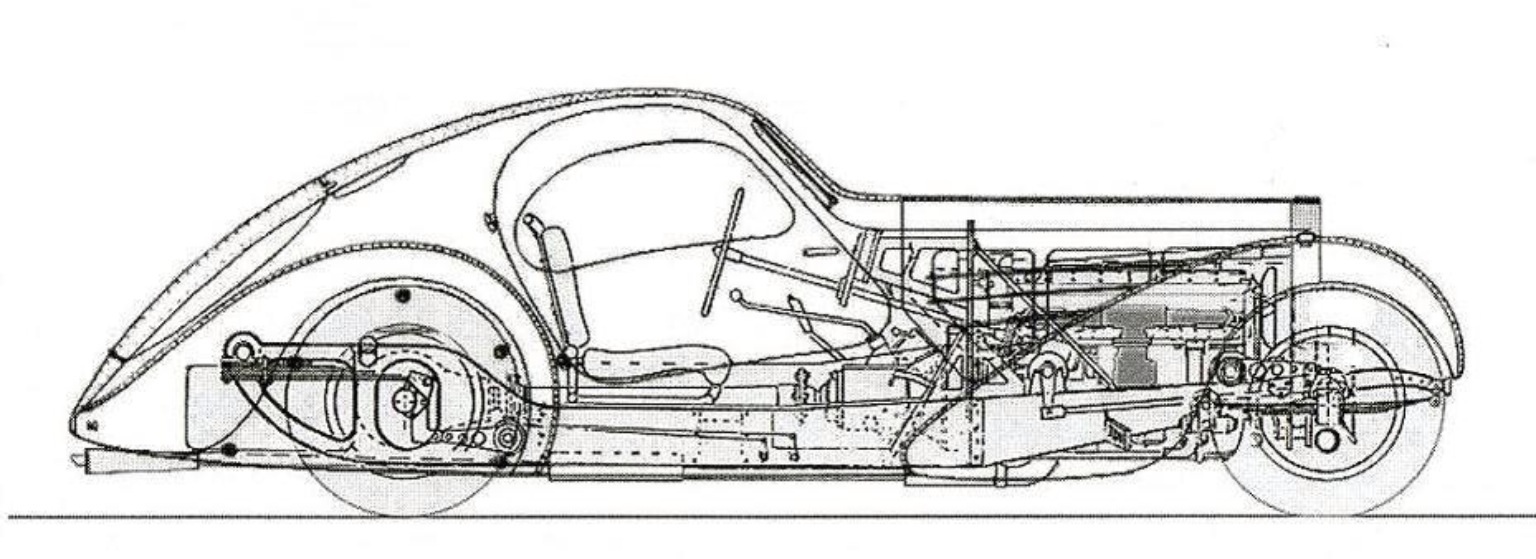
When Molsheim’s Aérolithe concept debuted at the 1935 Paris Salon, the public just didn’t get it. It was radical to behold, the body was made out of light, flammable ‘Elektron’ magnesium which was riveted externally giving the car its distinctive central seam. Under the haute couture clothes was a new ultra low, modified T57 chassis, also fitted to the ‘normal’ T57S and SC. The rear axle passed through the rear chassis frame rather than riding under it. Those elements and the T59 GP car derived DOHC 3257cc straight-8 engine, dry-sumped in this application to fit under the low bonnet, made the Aérolithe the most advanced car of its time.

T57 Atlantic cutaway (unattributed)

But Ettore Bugatti was disappointed in the work of art, the solo Aérolithe soon disappeared. To this day its fate is a mystery, explanations include it being a casualty of war or perhaps broken down for its parts. Not so long ago Aérolithe was recreated using original parts and materials with only 15 photographs as a resource and reference base. Quite a job!

After the Aérolithe show car, Bugatti produced four supercharged Atlantic coupes in 1936/7 using aluminum instead of magnesium for the bodies whilst keeping the rivets. Powered by supercharged straight-8’s, these circa 200bhp coupes exceeded 120mph- in 1936! In fact two unsupercharged Type 57S and two supercharged Type 57SC Coupes were built but both T57S’ were later supercharged by the factory, therefore becoming SC-‘surbaisse’- lowered and C-‘compresseur’-compressor in specification. All four cars still exist.

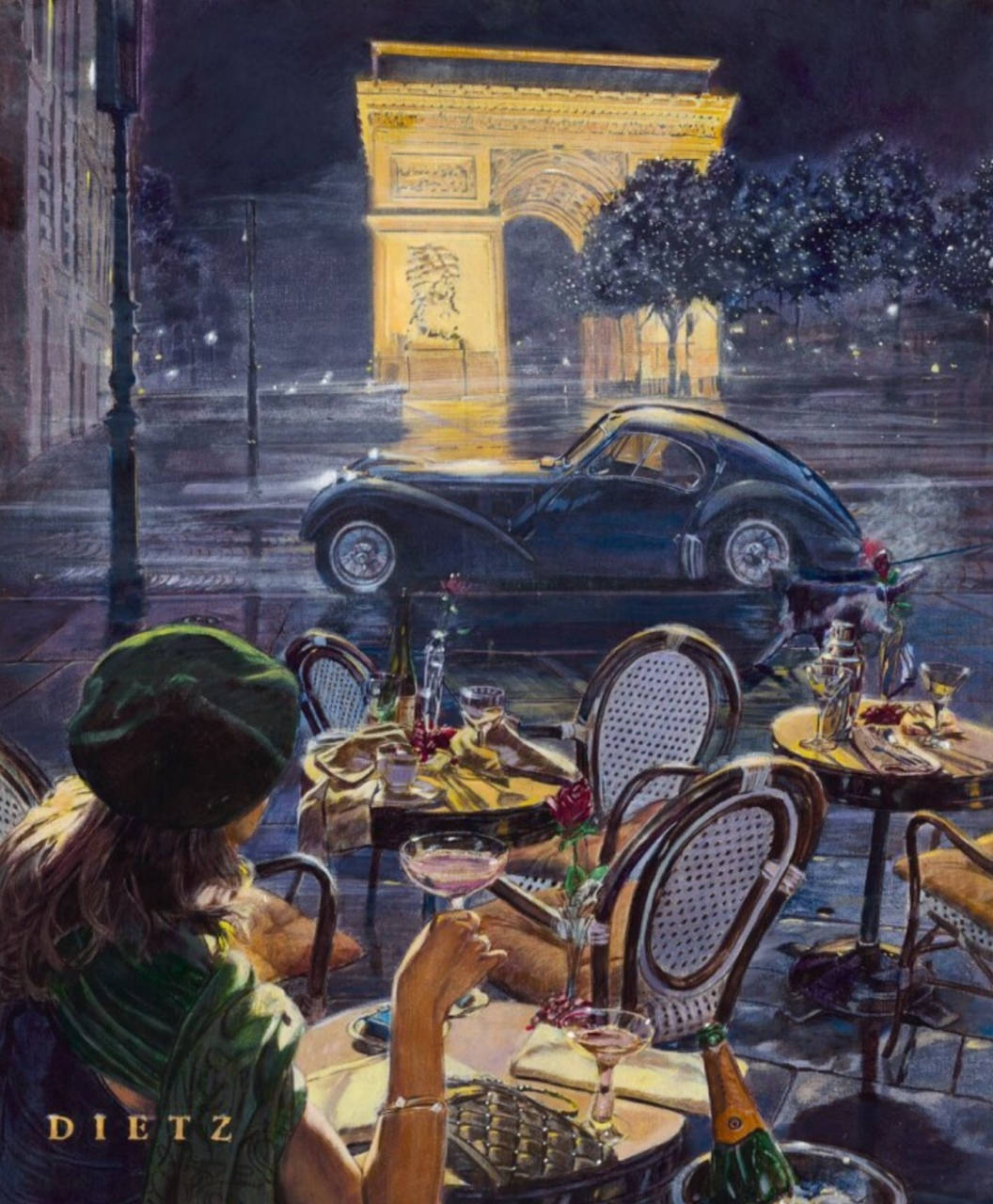
I thought this painting by Dietz the quintessential Parisian Atlantique scene…

Credit…

Dietz

image

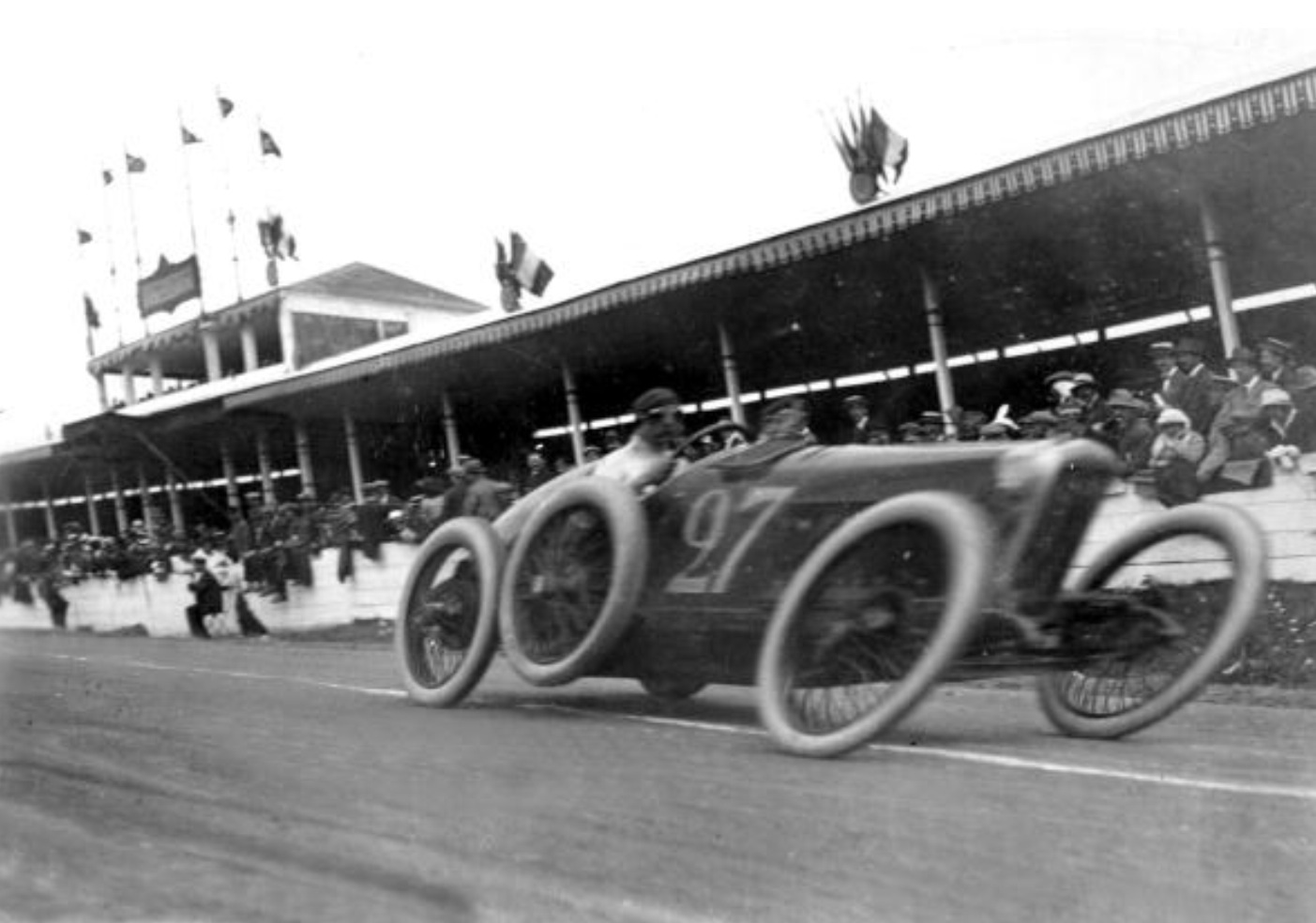
Engine 4 cylinder monobloc, 1 inlet and 2 exhaust valves, SOHC, 4493cc-100X143mm bore/stroke, 4 speed box, 4 disc clutch, brakes on transmission, front and rear wheels, 1025Kg

Antonio Fagnano blasts his Fiat through a village during the 14 July 1914 event, Lyon…

Fagnano was a Fiat all-rounder and institution, he was a mechanic, foreman, member of the test department and graduated from riding mechanic to race driver of the works team!

For 1914 the GP ‘Formula’ provided for an 1100Kg maxiumum weight and engines of no more than 4.5 litres in capacity. The race was a contest between Peugeot and Mercedes in the context of imminent war; Archduke Franz Ferdinand was assassinated less than a week before the GP at Lyon which drew a crowd of over 300,000 filling hotels within a 50Km radius of the course.

Christian Lautenschlager and riding mechanic on the way to winning the 1914 French GP, Mercedes GP 35HP. Engine 4 separate cylinders, 4 valves per cylinder, SOHC, 3 plugs per cylinder, 4456cc-93X164mm bore/stroke, claimed power 115bhp@2800rpm. 4 speed box, leather cone clutch, brakes on transmission and rear wheels, 1080Kg, top speed circa 110mph (unattributed)

Christian Lautenschlager won from teammates Louis Wagner and Otto Salzer in 7 hours 8 minutes 18.4 seconds at an average speed of 65.665mph.

Sailer led by 18 seconds at the end of the first lap, by lap five he had built a lead of almost 3 minutes and then retired with a blown engine on lap 6.  Boillot’s Peugeot took over the lead for 12 laps, at one point he led by over 4 minutes.

The Mercedes drivers made one stop during the race for new Continentals. This contrasted with the poor wear of the Dunlops of Peugeot, Boillot made eight stops for tyres, the Frenchman’s many tyre changes allowed Lautenschlager to pass on lap 18. By the end of that lap, Christian had opened up a lead of over 30 seconds.

Fagnano’s Fiat was the best placed of the Italian cars, the talented driver died of an illness, aged 35, on 8 July 1918.

France, 1914 and the Art Historians…

If you have a hankering for this era of racing here is a very interesting article with a completely different angle.

http://www.king-of-the-boards.com/articles/france1914.pdf

Credit…

Roger Viollet, Alinari Archive, T Mathieson ‘Grand Prix Racing 1906-1914’, Patrick Ryan Collection

image

Tailpiece: Dealership ‘in period’, the first Fiat dealership in Geneva with two 501’s out front, circa 1921…

balilla

(Alinari Archive)


image


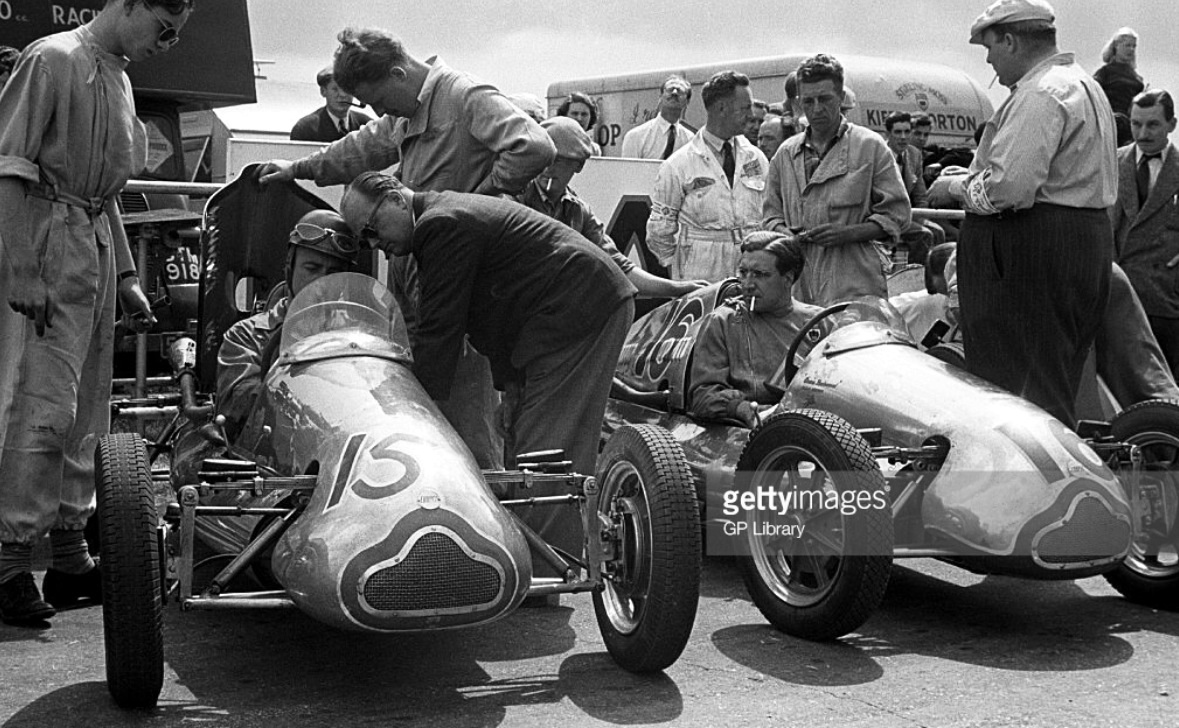
Eric Brandon and Alan Brown, ‘Ecurie Richmond’ drivers with capped patron Jimmy Richmond, a haulage contractor from Nottinghamshire and mechanic Ginger Devlin at Silverstone 14 July 1951…

It’s the British Grand Prix meeting, the cars the latest Norton engined Cooper MkV 500cc F3. The motors were tuned by the highly rated Steve Lancefield and Francis Beart. The very competitive drivers were first (Brandon) and second in that years Autosport F3 Championship from the JBS’ of Peter Collins and Don Parker. They didn’t win at Silverstone though, Stirling Moss won in the new Kieft CK51 from Ken Wharton and Jack Moor.

The Ecurie Richmond pair netted 16 major victories and 41 heat wins in a marvellous 1951 season. The Brands Hatch Junior Championship in ’51 was taken by Cooper mounted BC Ecclestone.

Ecurie Richmond progressed to F2 in 1952 with Brown’s Cooper T20 Bristol achieving the great marques first championship GP points with his 5th place at Bremgarten in the Swiss Grand Prix, F2 adopted as F1 in 1952-3 of course. Heady days indeed…

Credit…

GP Library, 500 Owners Association

hawthorn

(Klemantaski)

 A study in concentration, Mike Hawthorn at work and on the way to fourth place at Aintree, Lancia Ferrari 801, British Grand Prix 1957…

But Mike was hardly ‘the main game’ in this race, a pivotal one in GP history.

Tony Brooks and Stirling Moss shared a Vanwall to win at home, thereby scoring the first world championship victory for a British car, the beginning of a period of dominance by British teams, largely undiminished for the last 50 years. Also noteworthy and equally epochal was the appearance of two Cooper T43 Climaxes driven by Roy Salvadori and Jack Brabham.

Behra led from the start but Moss passed him before the end of the first lap, then came Brooks, Hawthorn, Collins, four Brits in the first five.

Moss’s Vanwall started to run roughly so he pitted, taking the wheel of Brooks sister car, who was summoned to the pits, Moss rejoined 9th and started carving his way through the field. By this stage Jean led from Hawthorn, who was unable to challenge the Frenchie, then came Lewis-Evans, Vanwall, and Collins. Moss was soon up to 5th aided by mechanical failures which befell Fangio and Collins.

Poor, Jean, his clutch exploded whilst in the lead, Hawthorn ran over some of the schrapnel the Frenchman dropped, puncturing a Continental. Stuart Lewis-Evans then momentarily lead but was quickly swallowed by Moss, Stuart’s throttle linkage broke but it mattered not, Moss won the race from Musso, Hawthorn, Trintignant/Collins all in Lancia Ferrari’s with Roy Salvadori in the little 2 litre Cooper T43 5th

image

Credit…

Louis Klementaski, GP Encyclopaedia

long beach

(Klemantaski)

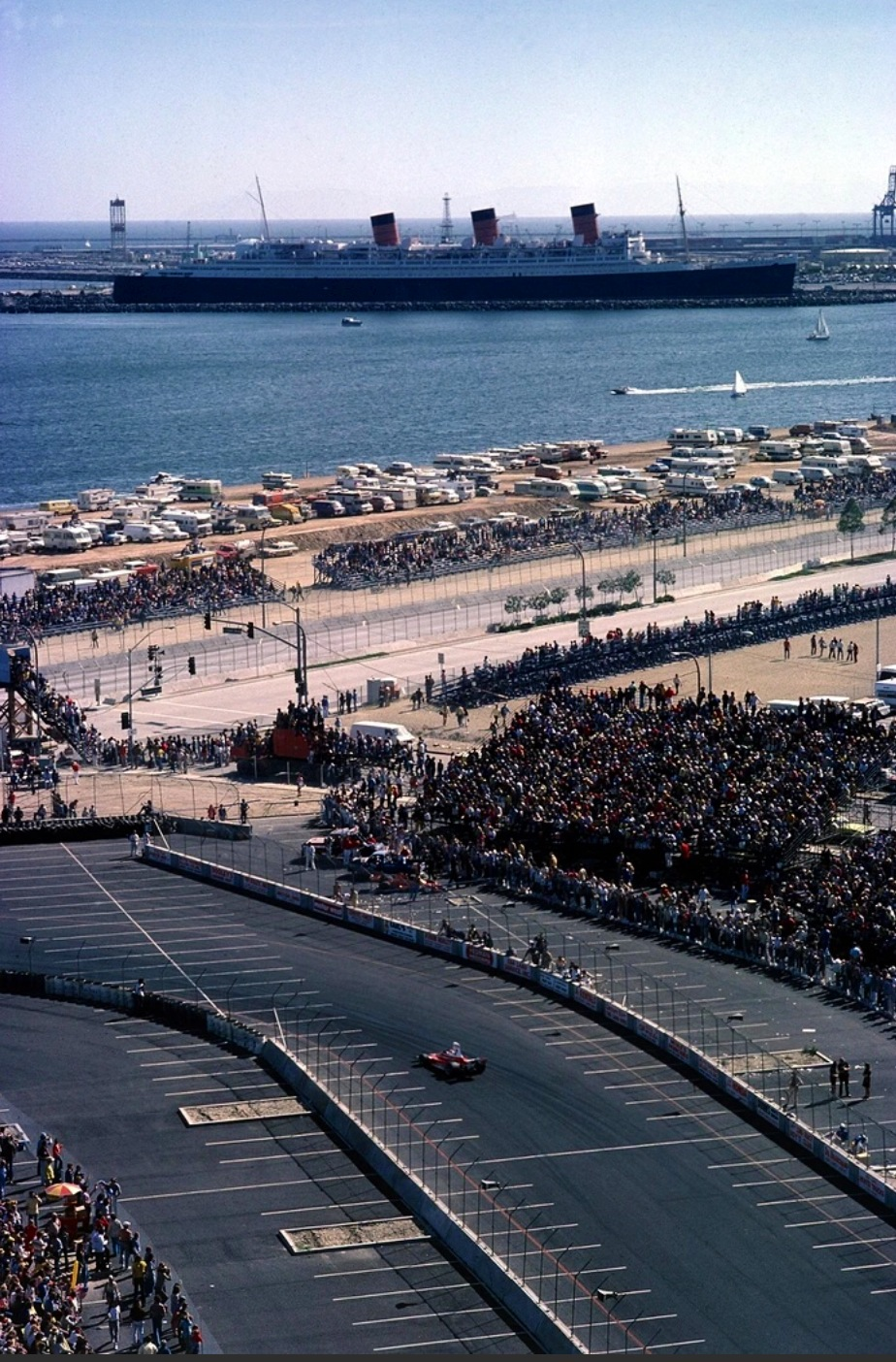
Clay Regazzoni oblivious to the ‘Queen Mary’s existence as he races to victory from pole in his Ferrari 312T, US Grand Prix West in March 1976…

I’ve never been to the place but Chris Pook’s idea was a great piece of entrepreneurship.

His first 1975 event, a marvellous demonstration of what is great about F5000 was followed by a championship GeePee in ’76. The other thing that captured my imagination about the place was the Depailler in-car Tyrrell footage. If you weren’t a PD fan, I always was, you had to be so after seeing him flick the 500bhp beastie through the Long Beach boulevards as though it were a 100bhp Lola T342 Formula Ford. The ability that separates the greats from the rest of us. Check it out if you’ve not seen it, look again if you have!;

longbeach clay

Nice portrait of Regga in 1978, Shadow Ford. Looks like a a Bell photo shoot ! (Getty)

Regga, a GP driver with a personality, they seem to breed it out of ‘em these days, anodyne boring liddl’ fuggers they all seem to be. The Swiss Italian had a great weekend in California winning from teammate Niki Lauda’s 312T and Depailler’s Tyrrell 007 DFV, the sound of which (Tyrrell 008 anyway) screaming in protest you can see, hear and feel in the footage above.

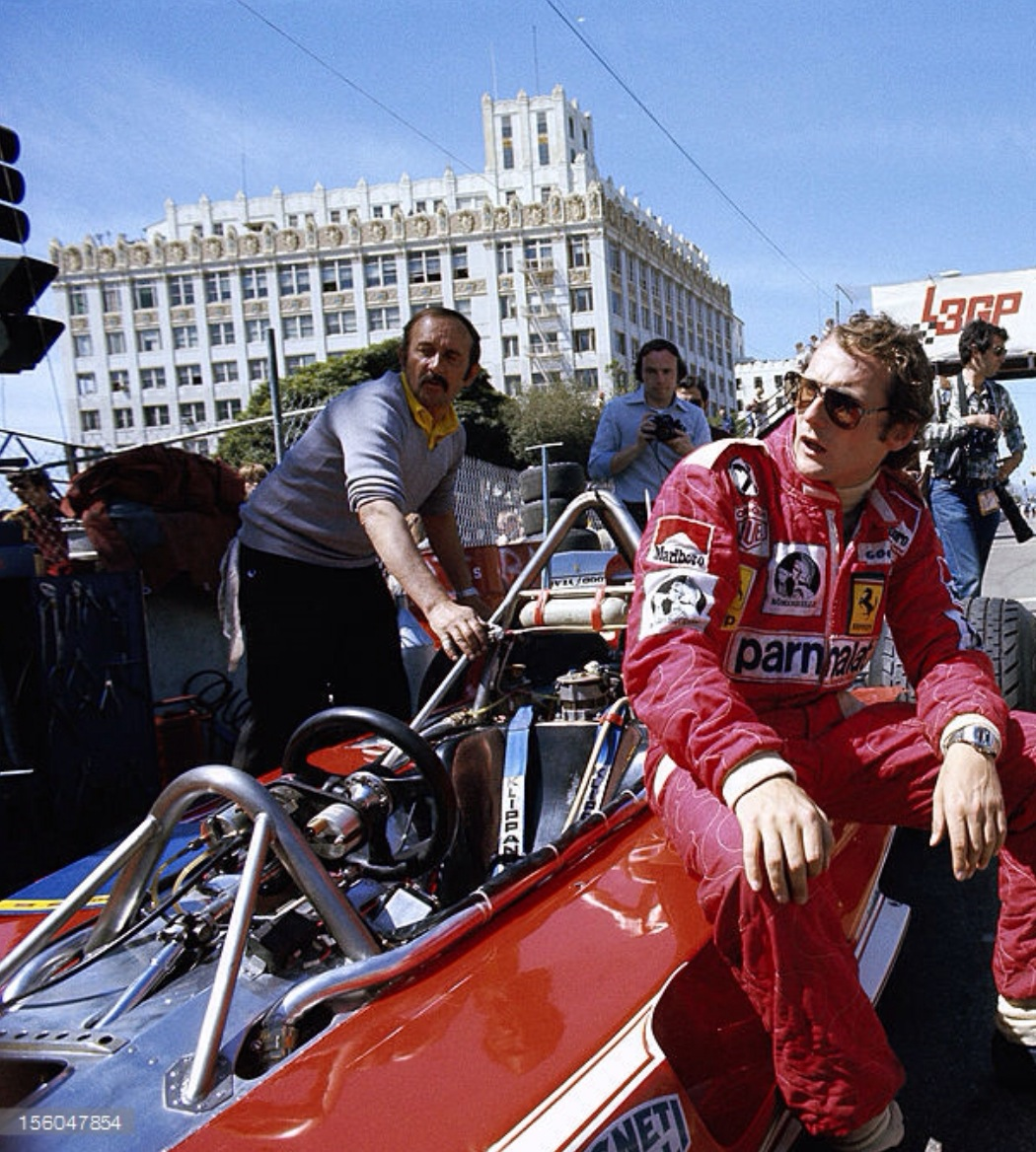
Tailpiece: Niki Lauda prepares for the off in the other Fazz 312T, 2nd place for the plucky Austrian reigning champion…

longbeach lauda

Niki Lauda contemplates changes to his Ferrari 312T during Long Beach practice. Mauro Forghieri’s 312T-T4, jewels of cars, circa 525bhp @ 11000 rpm at this stage of the 3 litre flat-12;s long front-running life (Schlegelmilch)

Credits…

Klemantaski Collection, Rainer Schlegelmilch

image

Brian Redman looking pretty relaxed  prior to the start of the Monza 1000 Km on 25 April 1972…

It was a happy weekend (and year) for Ferrari, the Ickx/ Regazzoni 312PB won from the Jost/Schuler Porsche 908/3 with the sister SEFAC Fazz of the two great mates Petersen/Schenken third. Brian’s car was out on lap 32, the car was co-driven by Arturo Merzario.

Redman had a good year though, he won at Spa, a supreme test of high speed finesse, with ‘Little Art’ and at the Zeltweg 1000 Km paired with Ickx. Merzario took another win as well, Targa a big challenge, this time of speed and accuracy on the unforgiving, difficult to learn ‘Little Madonie’, in the singleton Ferrari entry he shared with rally ace Sandro Munari.

image

Ickx, Peterson and Redman lead away, Ferrari 312PB’s, gloomy Monza 1000Km 1972 (unattributed)

The only race of significance they didn’t win, didn’t enter for that matter was the one which mattered most, Le Mans. Ferrari chose not to enter due to the difficulty the team had in making its 3 litre F1 adapted flat-12 last 24 hours, a problem Matra didn’t have with its far less successful in F1, V12! Graham Hill and Henri Pescarolo won Le Mans in a Matra MS670, Matra breaking through for a long awaited French win at Le Mans. The fact that arch rivals Ferrari were absent made the win no less satisfying…

Credits…

Rainer Schlegelmilch

Tailpiece…

image


ach 1

Achille Varzi in need of a ciggie after a great win in his Bugatti T51, 1933 Monaco Grand Prix…

Varzi started racing on motorcycles, in 1928 he established a partnership racing a stable of Bug T35’s with Tazio Nuvolari, his career, which flourished with Alfa Romeo is a story for another time.

ach 2

The race was held on 23rd April 1933 and is significant as the first GP in which practice times determined grid positions rather than a ballot.

In one of the greatest grands prix ever, Tazio Nuvolari’s Scuderia Ferrari Alfa Monza and Varzi’s works Bugatti duelled throughout the race swapping the lead many times. The result was determined on the last lap when the great Mantuan was disqualified for a push start after his car caught fire, an oil line split and ignited! Baconin Borzacchini was 2nd and Rene Dreyfus 3rd in Monza and T51 respectively.

Credits…

Hulton Archive

Tailpiece: Varzi and Bugatti T51…

ach 3


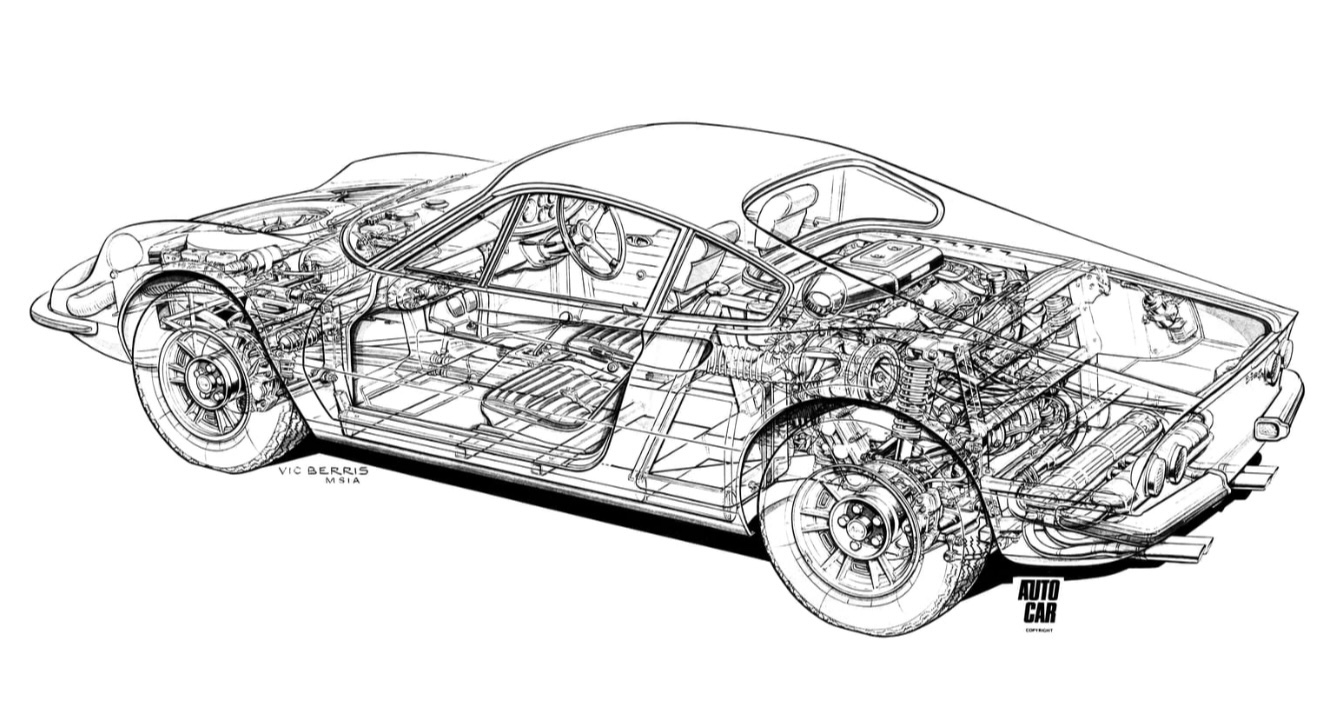
dino trak road

I always figured this is what Ferrari ownership is all about. Having rather attractive young ladies throwing themselves at you?!…

Clearly this little minx is keen on Pininfarina’s stunning coachwork if not the size of the drivers wallet. What is it my ‘little sabre-toothed tigress’ tells me, ‘even you ugly blokes look good standing on your wallets’.

Australian social documentary photographer Rennie Ellis captured a 1974 Toorak Road, South Yarra, Melbourne ritual that is still played out pretty much the same way 40 years on…

Credits…

Rennie Ellis, Vic Berris

Finito…

image

Melbourne’s finest trying to keep enthusiastic shoppers under control out front of ‘Georges’, Collins Street in 1965…

The car is, I think, Bib Stillwell’s Brabham BT11A Climax. The occasion some type of promotion between Georges luxury department store and Repco or Bib Stillwell Holden. Stillwells switched from Holden to Ford in 1966 before all you Melburnians correct me, clearly the crowds are fascinated by the presence of a ‘Grand Prix’ car in Melbourne’s busiest and most up-market shopping strip.

For over a century Georges was the place the ‘great and the good shopped’, an incredibly conservative joint, its intriguing to speculate just what the promotion may have been, automotive products are not at all what Georges stocked! String-backed gloves maybe and flat-caps but nothing grubby or grimy at all.

I think its Bibs car. The color scheme is right, his dealership/workshop was in Kew, not far away. He usually raced wearing #6, this car carries #3 but that’s neither here nor there. For Repco, Brabhams were badged ‘Repco Brabham’ at the time and the Coventry Climax FPF engines by that stage were largely built in Richmond under licence from CC so there were good associations to Repco’s brand.

When is it?, not sure exactly. Bib raced his BT11A from the Tasman Series 1965, he took the last of his four Gold Stars in it that year and then retired, so I guess it’s 1965…

Georges, for the curious…

http://www.georgesoncollins.com.au/

Credit…

Nigel Tait, many thanks for another tid-bit from your Repco archives