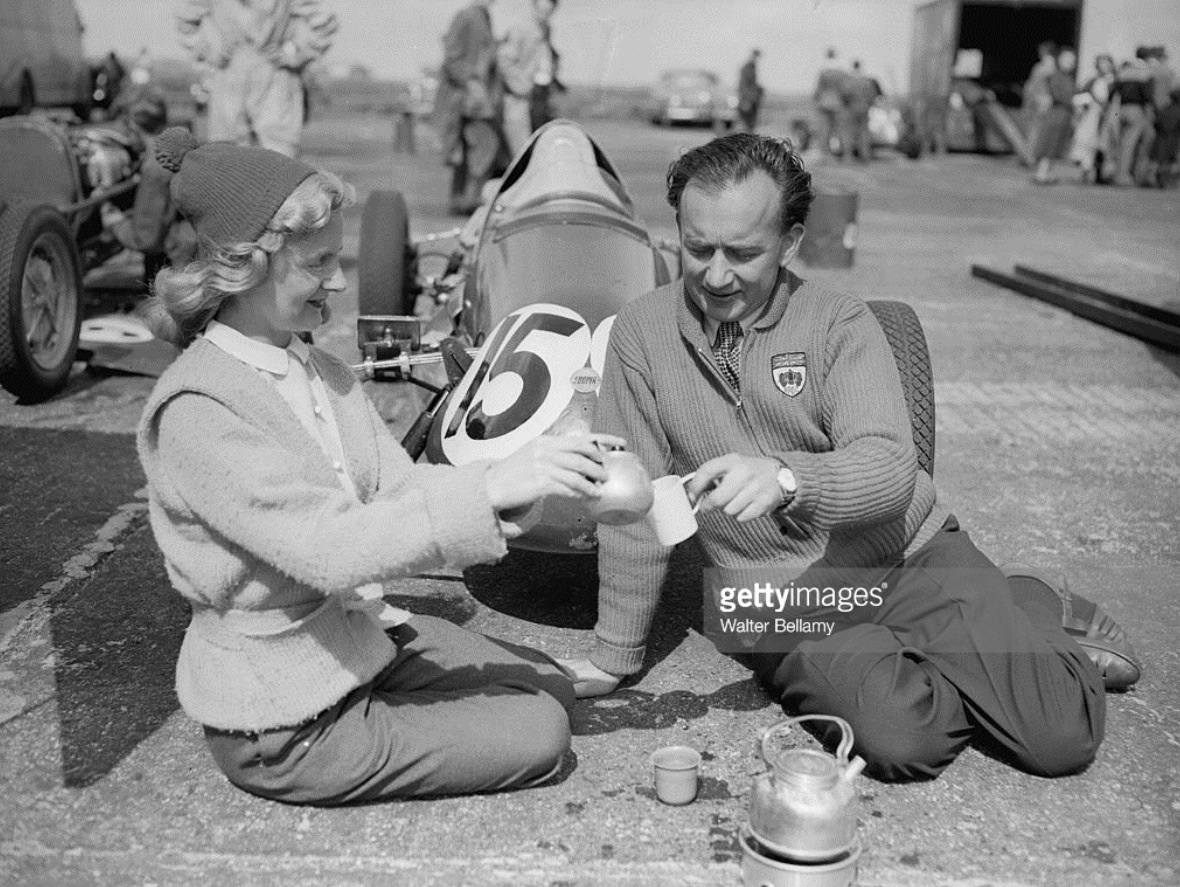
Coopers galore! Alan Brown, Eric Brandon, Juan Fangio and Mike Hawthorn in F2 Cooper T20 Bristols before the Lavant Cup, Easter Monday 14 April 1952. This race was one of a series of performances which vaulted Hawthorn into a GP Ferrari seat in 1953.
Hawthorn won the six-lapper from Brown and Brandon and set the fastest lap.
Equally impressive was Hawthorn’s second place behind Froilan Gonzalez’ Ferrari 375 in the Formula Libre Richmond Trophy. Duncan Hamilton placed third in a Talbot Lago T26C.
And Fangio? I have one report that says the great man raced John Cooper’s Cooper T20 to a misfiring sixth place but he doesn’t appear at all in the results for the Lavanat Cup and Richmond Trophy I have. John Cooper offer the ride after Alfa Romeo failed to appear. Happy to take your advice on this one.
The thoroughly delightful Eunice Fidock is shown beside an Austin 7 Special at Dowerin, Western Australia circa 1935.
Dowerin is a wheatbelt community 160km north-east of Perth. It had two pre-war racing venues, the Lake Koombekine one mile, dirt, circular speedway, and the Dowerin Showgrounds speedway in town. I’m not sure which of the two this is, but I’m happy to take advice.
My friend Tony Johns, Austin racer/historian is on the job as to chassis type and number, albeit he suspects a Perth built body on a standard or Super Sports chassis.
Eunice hails from Cottesloe, an inner Perth beachside suburb. Looking like that she would have cut quite a dash at Cotts’ Indiana Teahouse. Resplendent in leopard-skin shorts, she is showing lots of bumpy-curvy bits for the times and is therefore well armed to keep the more amorous of Dowerin suitors at bay. I’ll leave the make of weapon to you NRA members.
Credits…
Lake Perkolilli Revival Facebook page, State Library of Western Australia
Tailpiece…
(SLWA)
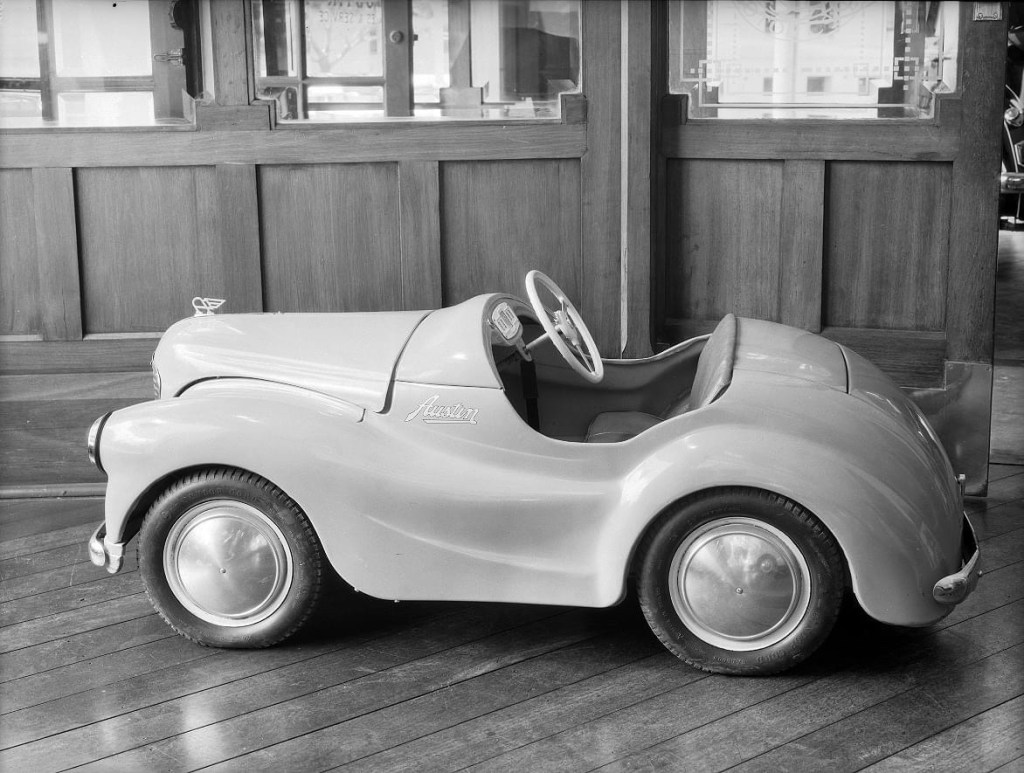
A slightly later model Austin – an Austin Junior Forty – shown in a Perth dealership circa 1951.
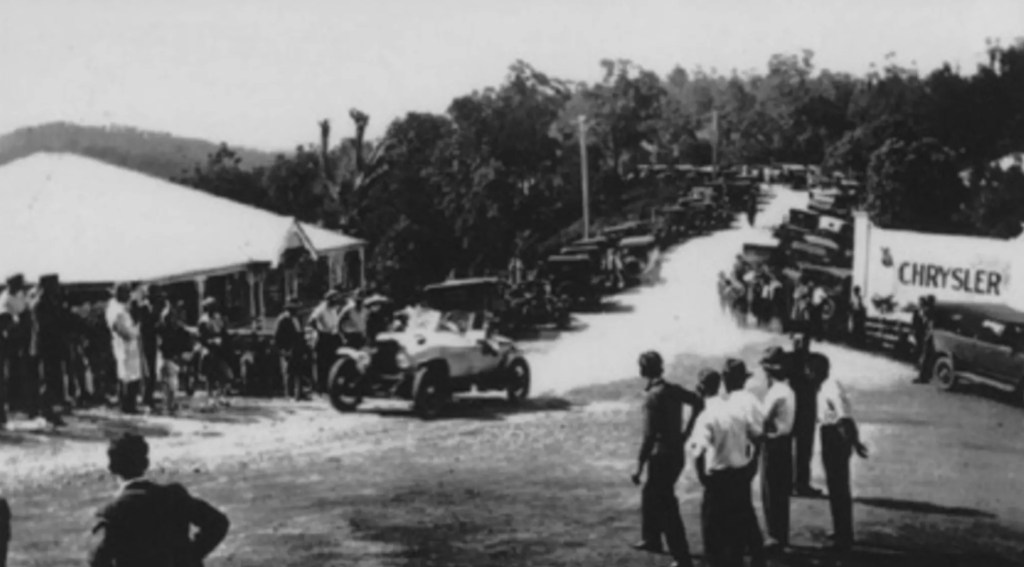
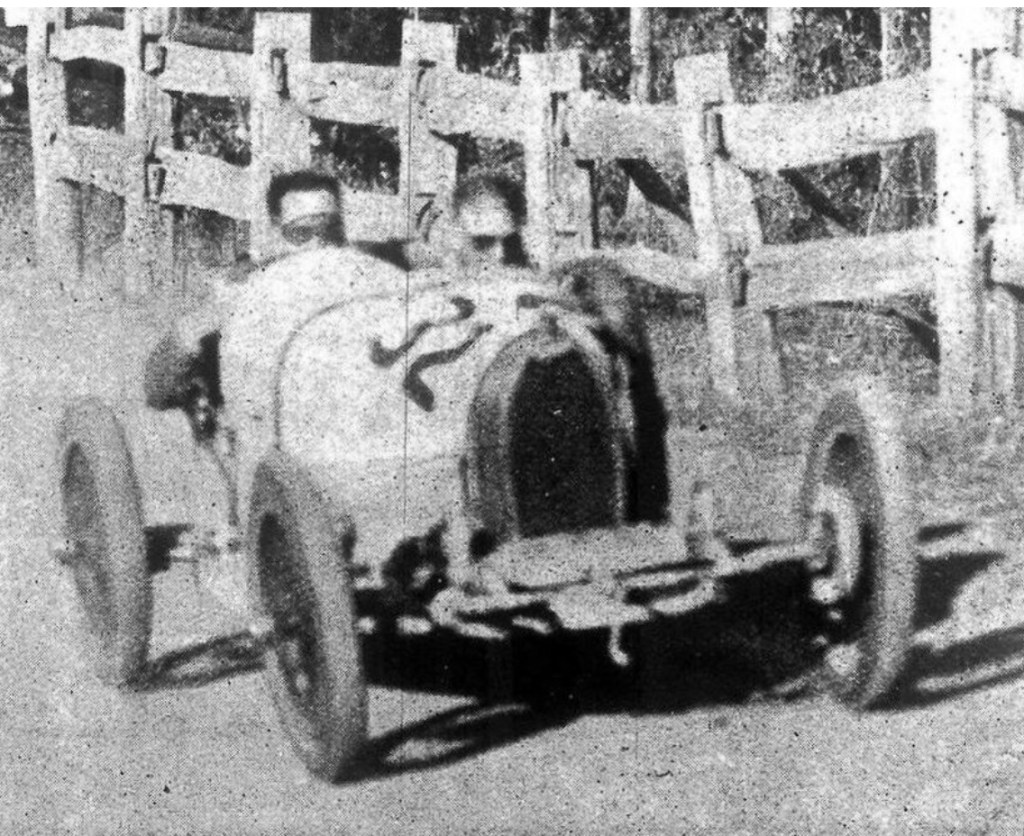
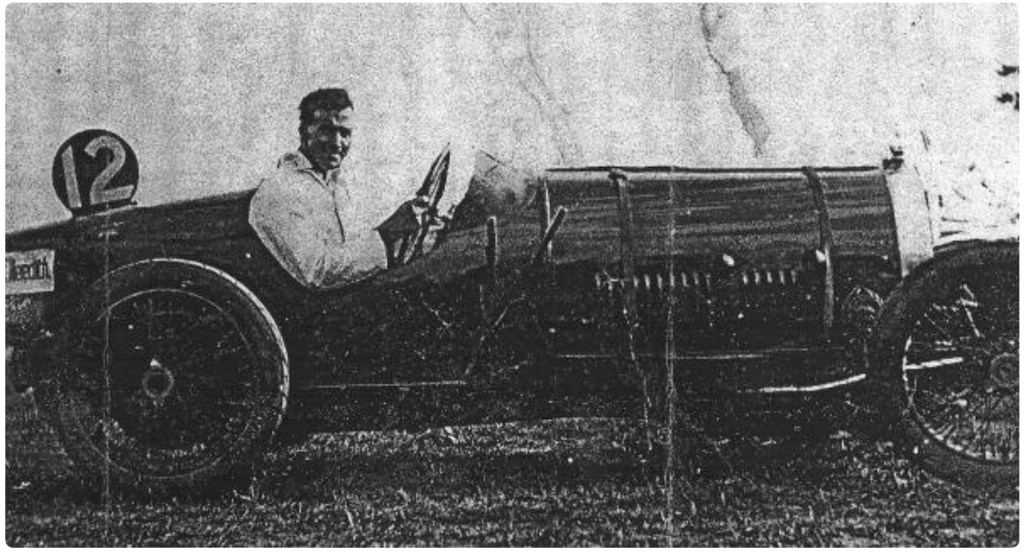
Competitor (who and what?) in the 1918 Coot-tha Classic (Brisbane Times)
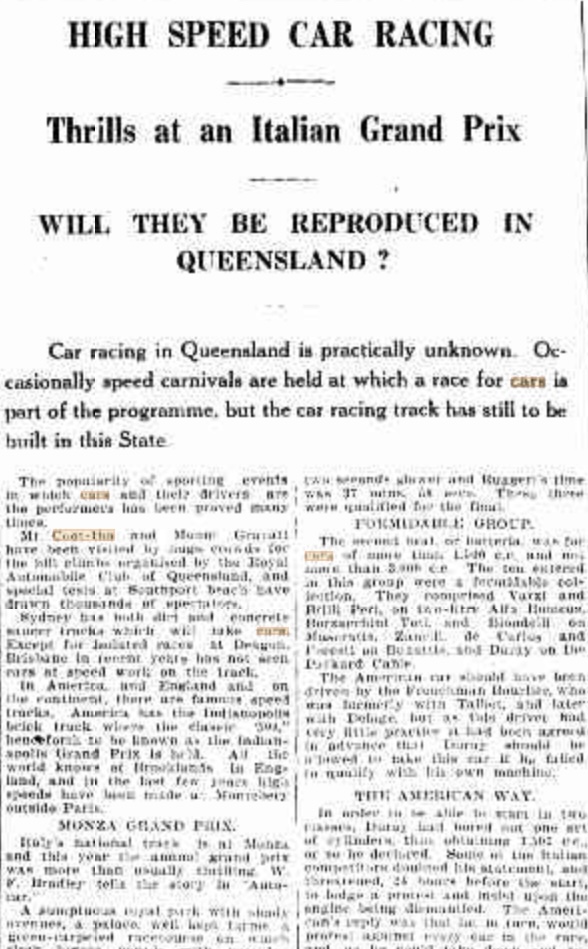
“Car racing in Queensland is practically unknown. Occasionally speed carnivals are held at which a race for cars is part of the programme, but the car racing track has still to be built in this state,” said the motoring reporter of Brisbane’s The Telegraph on November 5, 1929.
“The popularity of sporting events at which cars and their drivers are the performers has been proved many times.”
“Mount Coot-tha and Mount Gravatt (8 km and 10 km from Brisbane’s CBD) have been visited by huge crowds for the hillclimbs organised by the Royal Automobile Club of Queensland, and special tests on Southport Beach (on the Gold Coast) have drawn thousands of spectators.”
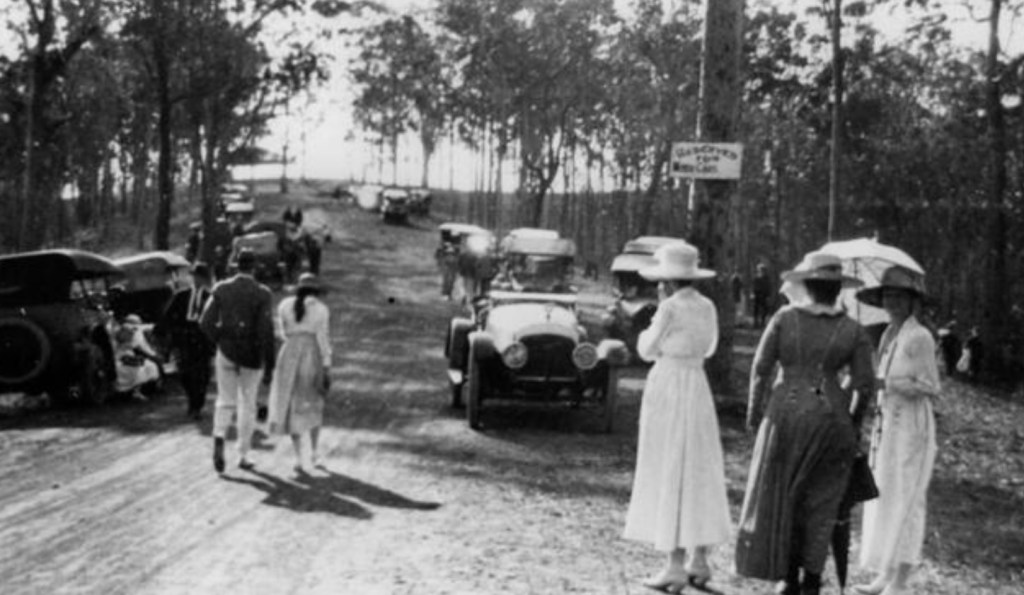
Henry Horstman and Maldwyn Davies – Queensland Bugatti importer – on the way to FTD in the RACQ hillclimb at Mount Coot-tha on April 1, 1928, Bugatti T37. His time of 1 min 20 sec was eight seconds clear of the rest of the field (speedwayandroadracehistory.com)Folks take in the Mount Coot-the sun, circa 1920 (alamy)
“Sydney has dirt and concrete saucer tracks which will take cars. Except for isolated races (for cars) at Deagon (Speedway 20km north of) Brisbane in recent years has not seen cars at speed work on the track.”
“In America, and England, and on the continent, there are famous speed tracks. America has the Indianapolis brick track where the classic ‘500’, henceforth to be known as the Indianapolis Grand Prix is held. All the world knows of Brooklands. In England, and in the past few years high speeds have been made at Montlhery, outside Paris.”
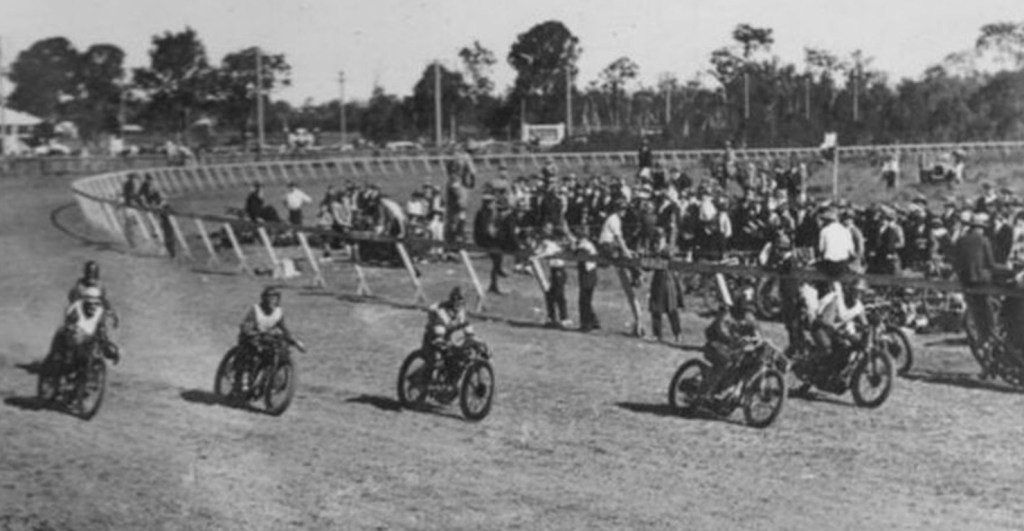
(The Telegraph, Brisbane, November 5, 1929)Motorcycle racing at Deagon in 1926 (T Webb Collection)
Some context of motor racing progress elsewhere in Australia is that the Aspendale Park Speedway opened in outer Melbourne in 1906, the Olympia Motor Speedway at Maroubra, Sydney in 1925. The first Australian Grand Prix was held at the Goulburn Racecourse (Neddies), 200 km south of Sydney in 1927, and the first AGP on a road-course at Phillip Island in 1928. Viz; 1928 100 Miles Road Race, Phillip Island… | primotipo…
Geoff Meredith aboard the Bugatti T30 in which he won the speedway style 1927 AGP at the Goulburn Racecourse (Goulburn Post)
Given the relative population of Queensland to Victoria and New South Wales, the banana-benders (Queenslanders) weren’t lagging behind too much. What is interesting is the popular press ‘pushing’ for creation of a local venue. It wasn’t until 1949 that an AGP was held in the Sunshine State, at Leyburn, a former Royal Australian Air Force base. See Aspendale here; Werrangourt Archive 11: DFP ‘The Greyhound of France’ by Bob King… | primotipo… and Leyburn here; 1949 Australian Grand Prix, Leyburn… | primotipo…
(ABC via M Hubbard)
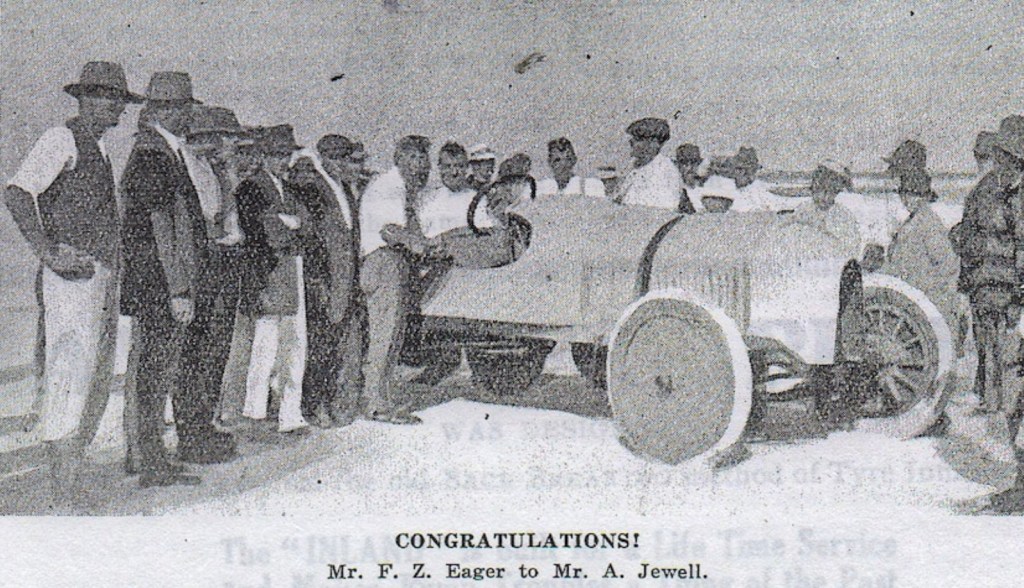
Alec Jewell aboard the Willys Overland which won “Australia’s first land speed record” in a competition with a Studebaker Six driven by Fred Eager on the Surfers Paradise sand, Christmas Day, December 25, 1916.
The cars had a number of runs, Jewell’s best was a time of 21.4 seconds between the measured marks, 84.5mph as adjudged by Automobile Club of Queensland officialdom.
Etcetera…
Deagon was established as a horse-racing venue in the early 1880s. It was first used for motorised events with ‘The Great Motor Cycle Carnival’ in November 1921. The card that day included 3 and 20 mile races for solos and a 5-miler for sidecars. 24 meetings were held from 1921-1931 including 14 state, and six Australian/Australasian Championships. Cars were never the mainstay of racing at Deagon, but were occasional guests on the bike’s-card.
Credits…
Brisbane Times, The Telegraph, Brisbane, November 5, 1929, Old Bike July 2015, Alamy, Goulburn Post, speedwayand roadracehistory.com, Tony Webb Collection, ABC via Murray Hubbard, Bob King
Tailpiece…
(T Webb Collection)
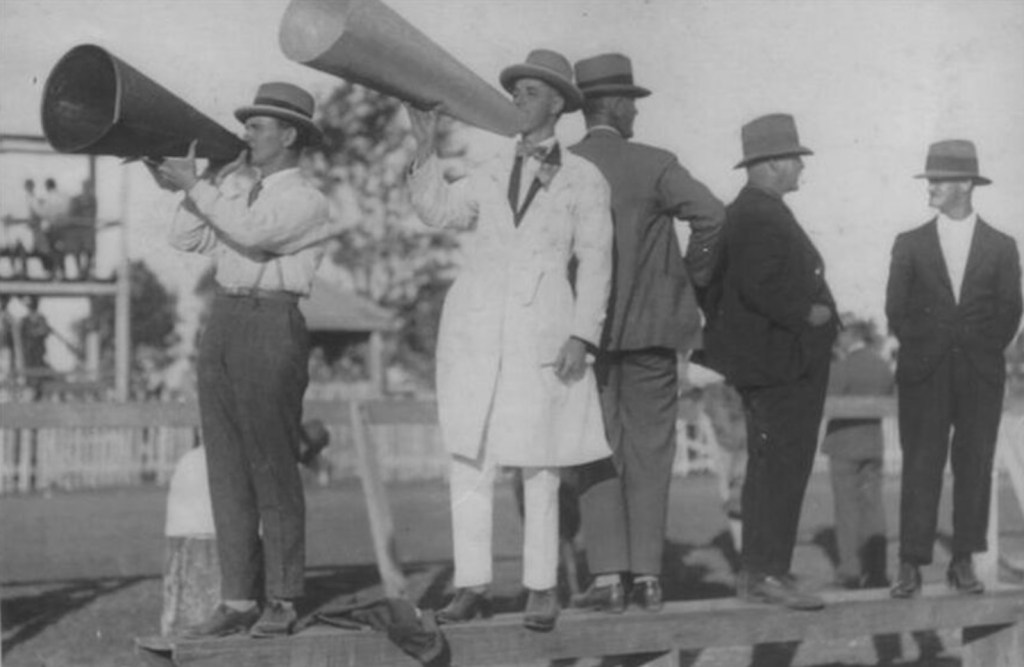
Deagon Speedway commentators doing it the hard way in the mid-1920s. I wonder if hats will ever make a comeback?
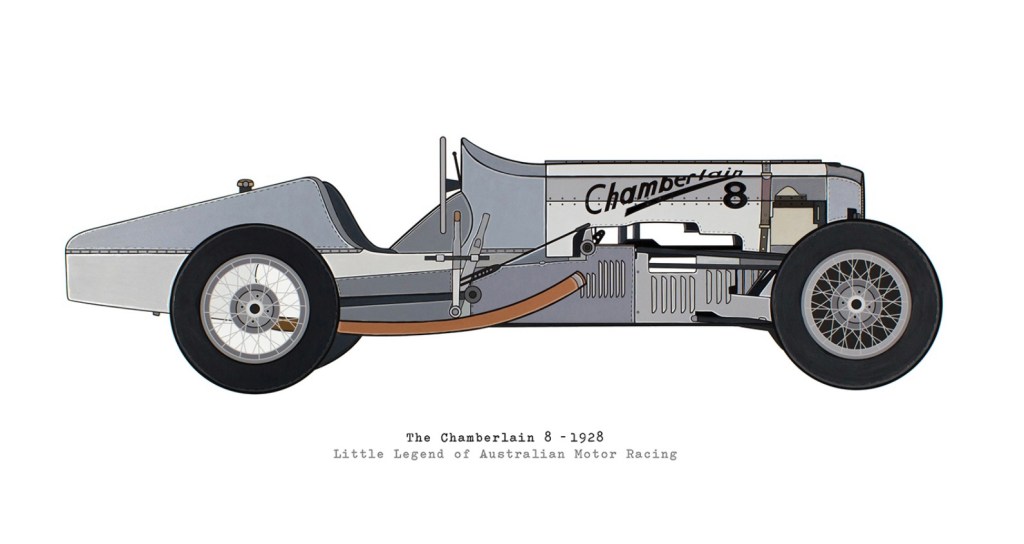
Chamberlain 8 painting – as it is currently sans-engine – in the Birdwood Mill Museum, South Australia (artomobile.com.au)
The Chamberlain Eight’s four cylinder, eight piston, supercharged, twin-crank, two stroke engine left an unforgettable, ear-splitting impression on all who saw it at the 1978 50-year anniversary of the 1928 100 Miles Road Race aka Australian Grand Prix at Phillip Island.
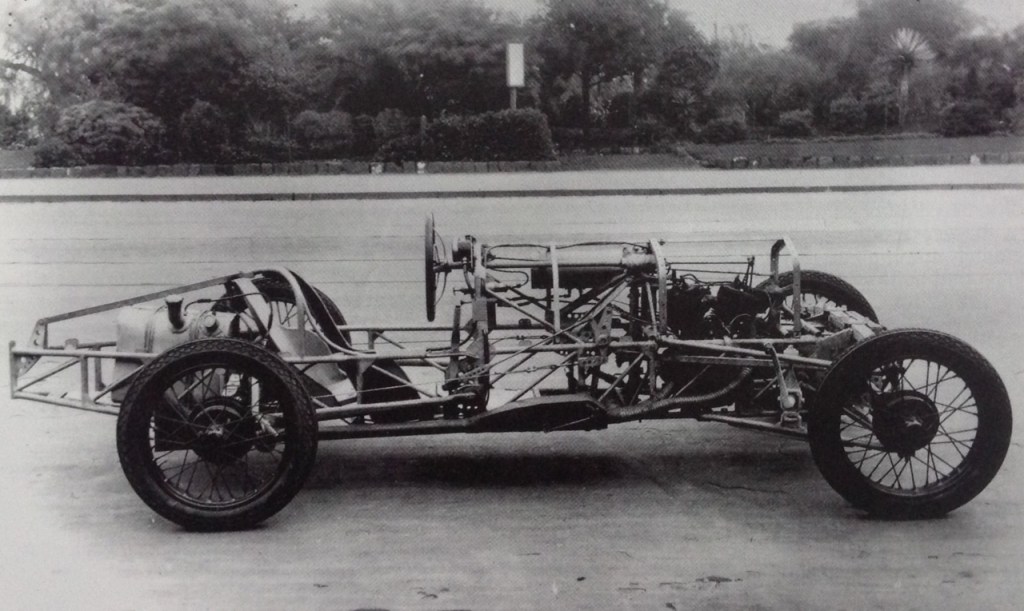
What I hadn’t fully appreciated in fulsome fascination for a car which was at the cutting edge in its engine, chassis, suspension and front wheel drive – all of which were out-there in 1929 – was the length of time it was first fitted with Indian motorcycle engines. It first saw the light of day with a Daytona unit and then an Altoona. It was only when Bob Chamberlain travelled overseas that he handed the car to his brother Bill, who built and fitted the Chamberlain engine circa 1934-35.
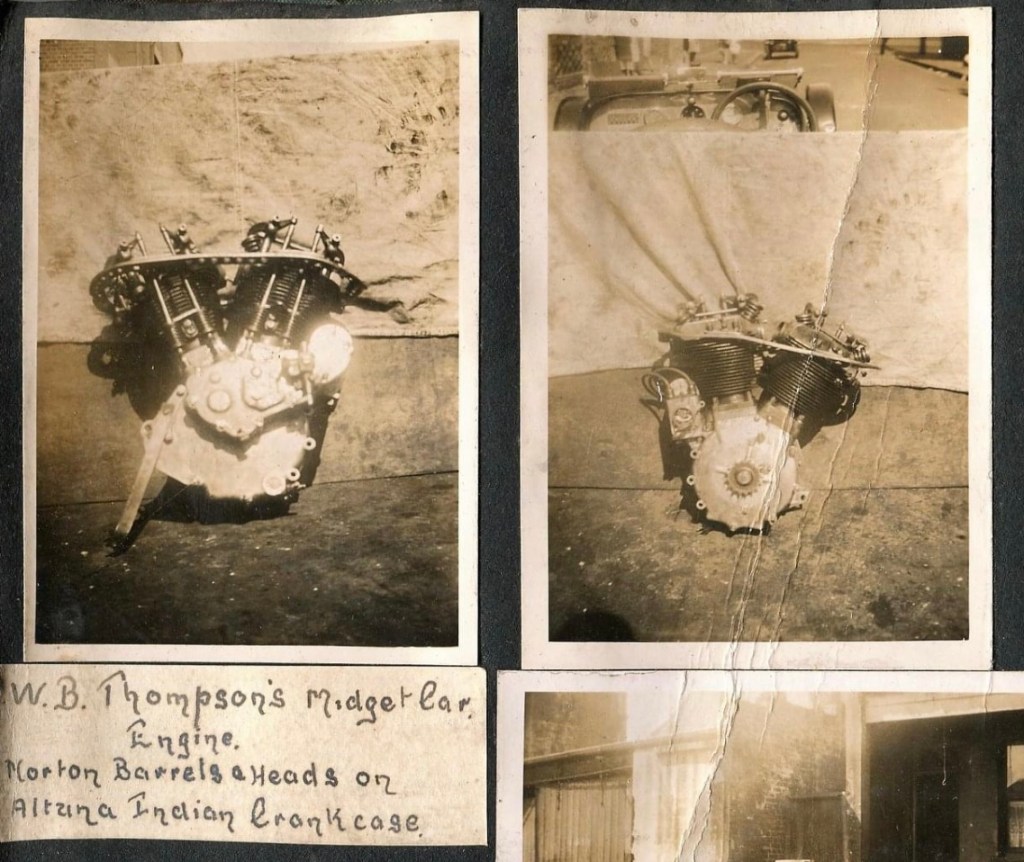
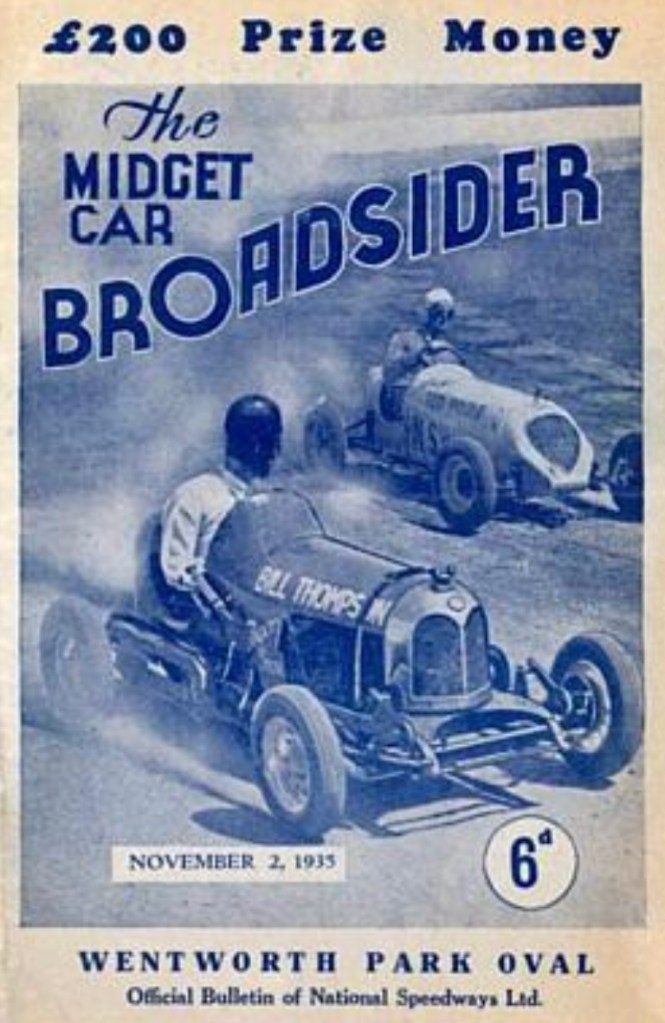
Bob Chamberlain at the wheel of The Beetle as the family called the car, Chamberlain Indian, circa 1929 (Chamberlain Australian Innovator)The ex-Chamberlain Indian, Altoona Indian-Norton engine during the period it was installed in Bill Thompson’s ‘Lane Special’ speedway midget (Fred Pearse)
The publication of a good photograph of the Altoona racing engine taken by mechanic Fred Pearse, and published on Bob Williamson’s Old Australian Motor Racing Photographs Facebook page by Peter Reynell, piqued my interest.
It’s unsurprising that the Chamberlains chose an Indian engine for their beloved Beetle, from the businesses incarnation Indian was innovative and used motorsport to develop the product and build their name, they finished 1-2-3 at the Isle of Man TT in 1911.
John Medley picks up the story (in the article linked above) “The car’s first engine was a big-valve Daytona Indian motor cycle unit. In this form, the road registered car covered thousands of miles but trouble was experienced with the valve gear.”
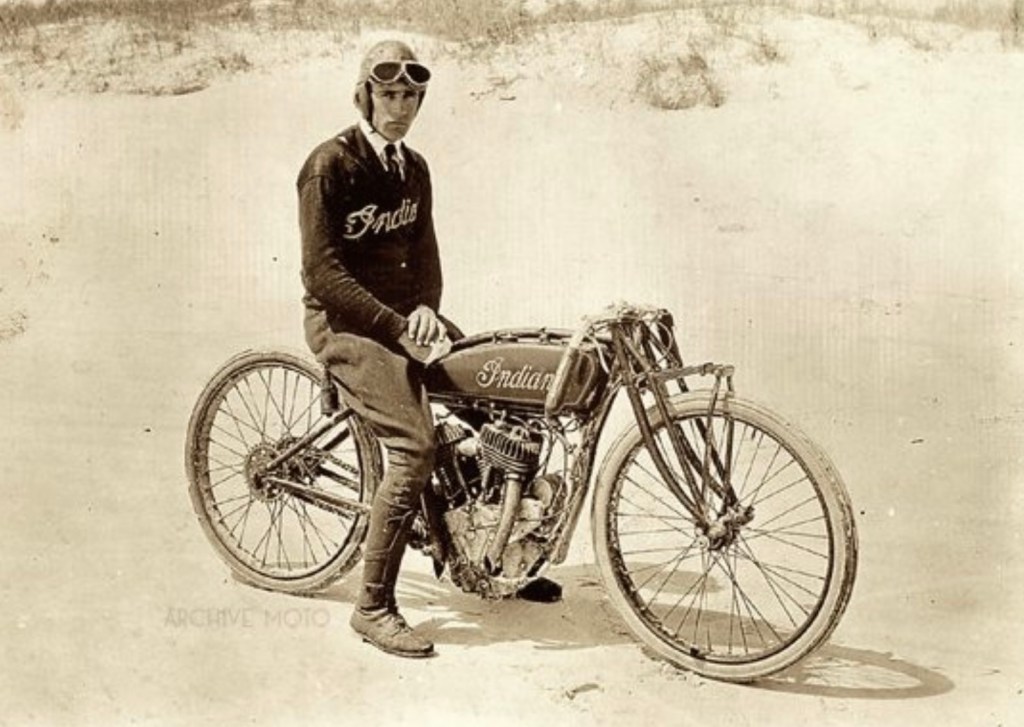
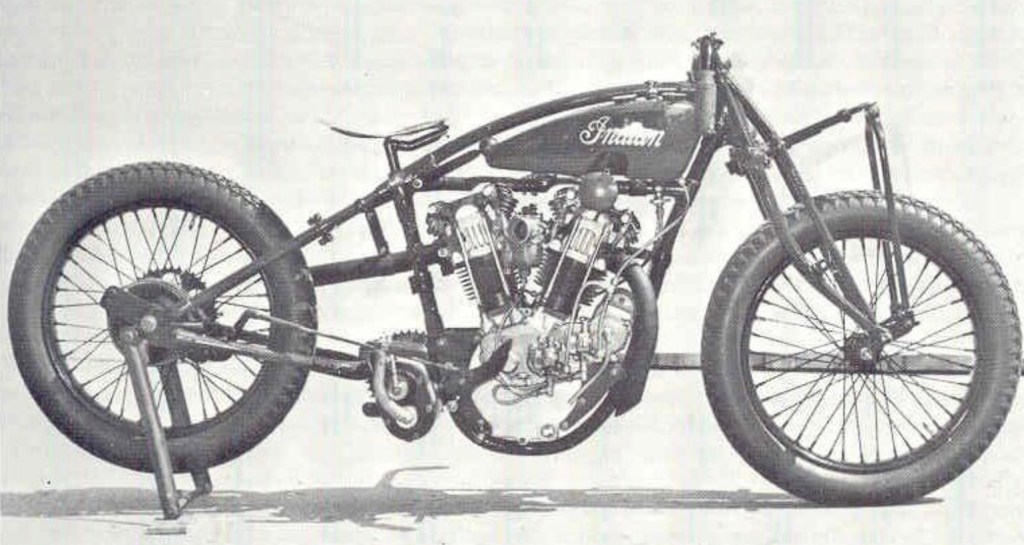
In April 1920 a 998cc side-valve, Vee-twin Indian Powerplus ridden by James McBride achieved a top speed of 99.25mph on the Daytona Beach course. The race versions of the Powerplus motor subsequently became known as the Daytona, throughout the 1920s various configurations of factory racers were built around this record setting engine.
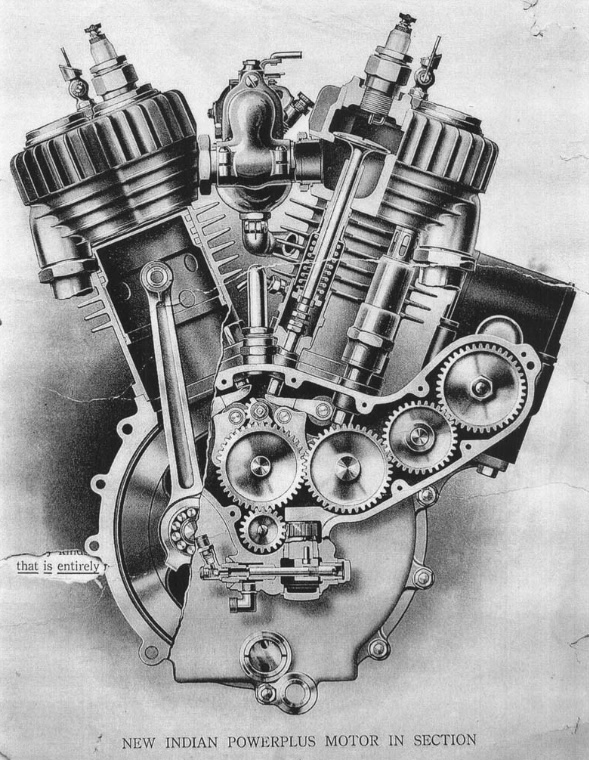
Gene Walker on a factory Indian Powerplus 61cid, at Ormond Beach, Daytona in April 1920. Walker and fellow rider Herbert McBride collected 24 US and international records on this sortie to the Daytona speed coast. “Walker performed so well onboard his newly configured side-valve machine – with its distinctive finned exhaust ports seen in this photo – that the setup became known as the ‘Daytona’ motor, a legend in American racing circles” wrote (archivemoto.com)Indian Powerplus 1-litre side-valve Vee-twin cutaway. Designed by Charles Gustafson and refined and developed by Charles Franklin (unattributed)
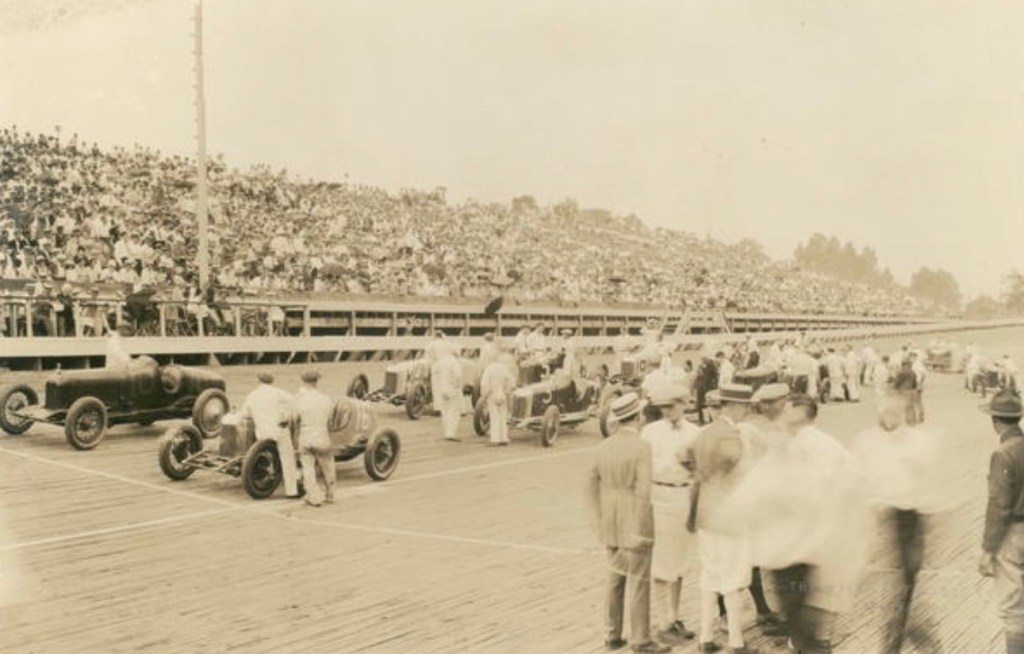
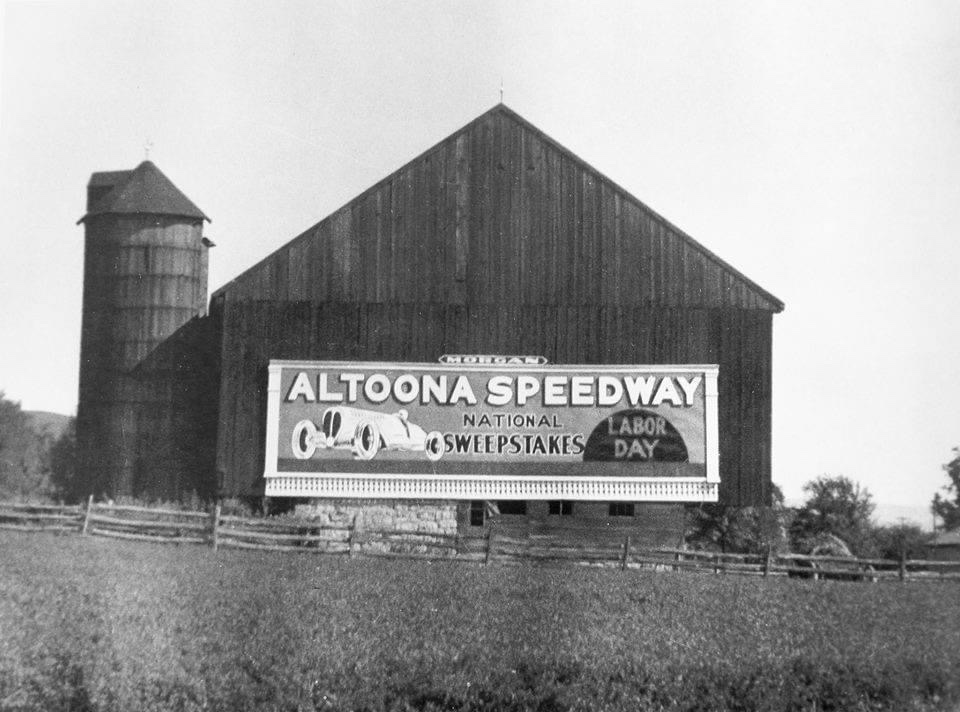
The Altoona Speedway was a 1.25 mile board track at Tipton, near Altoona, Pennysylvania which was home to the national championships in the 1920s, winning there was a big deal.
Indian’s designer, Charles Franklin – Irish road-racer and Brooklands tuner who discovered the ‘squish-effect’ in combustion chambers 10 years before Harry Ricardo – inherited a new 61cid side-valve engine from his predecessor, Charles Gustafson, which he turned into a race engine (there were also eight valve and 45cid variants) to take on the best at Altoona. The engine incorporated timing gears and crank carried on self-aligning ball-bearings, two oil pumps, removable heads and twin up-draught Zenith racing carbs.
With the new engine – still mounted in a 1920 spec board-racing frame – Curley Fredericks lapped Altoona at 114mph in a July 1926 race, the highest speed ever recorded on a circular board track. On Hampshire’s 1.25 mile board track that August he did 120.3mph, the fastest speed ever recorded on the boards. These unique race venues vanished soon after when the sanctioning bodies and manufacturers withdrew their support given safety and maintenance issues, so Frederick’s record still stands.
Of course it wasn’t long before Indian applied the Altoona name to its 1926-28 factory side-valve racers. The engines were used in disciplines other than board racing, including hillclimbs and drag racing
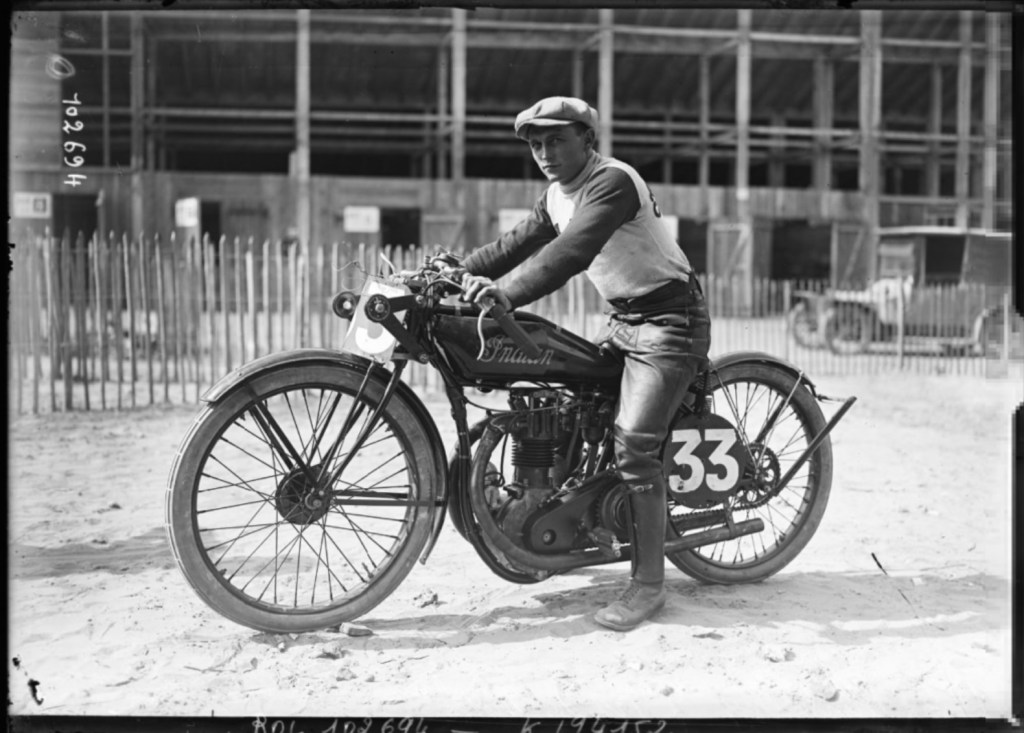
Indian Altoona 8-valve racer (unattributed)Altoona Speedway, grid of the Fall Classic in September 1924. Front left Ernie Ansterburg, Duesenberg, #16 Ray Cariens, Miller and #3 Bennet Mill in another Miller. Four Indy winners contested this race – look at that crowd! – Tommy Milton, Jimmy Murphy (who won the Classic), Joe Boyer and Peter DePaolo (Paul Sheedy Collection via firstsuperspeedway.com)Indian factory rider, Paul Anderson (who raced in Australia over the 1924-25 summer) aboard a 500cc, four-valve, single-cylinder 1924 road racer at Montlhery in 1925. Frame is “a full-loop design like Indian’s board-track racers, and a front brake 3 years before other Indians got them,” wrote The Vintagent (Bibliotheque Nationale de France)
To promote the opening meeting of John Wren’s Melbourne Motordrome (aka The Murder Drome and Suicide Saucer on the Olympic Pool/Collingwood FC site) in November 1924 the promoters imported four top US stars and their bikes; Paul Anderson and Johnny Seymour on eight-valve Indians and Ralph Hepburn and Jim Davis on Harleys.
Ultimately the Harley duo rode borrowed Douglas twins when their machines failed to arrive on time. In the solo-final Seymour and Hepburn dead-heated. The Indian riders had a successful tour albeit Seymour (later an Indy racer) broke a leg at one meeting. Among his successes, Anderson won the 10-Mile Solo under-500cc NSW Championship in January 1925, and did a record-breaking 125mph over a half mile on Adelaide’s Sellicks Beach. Anderson won so many scratch races on the Melbourne Motordrome that the promoters abandoned scratch events and ran handicaps!
When the Chamberlains were looking for greater performance they turned to “A motor (500cc, eight-valve, V-twin) of novel design, using an Altoona Indian crankcase, originally used by the famous American, Paul Anderson,” The Sun, Sydney reported.
“The cylinders were scrapped and 588cc overhead valve Norton cylinders and cam gears and two carburettors were fitted, and the compression ratio raised to 10:1.”
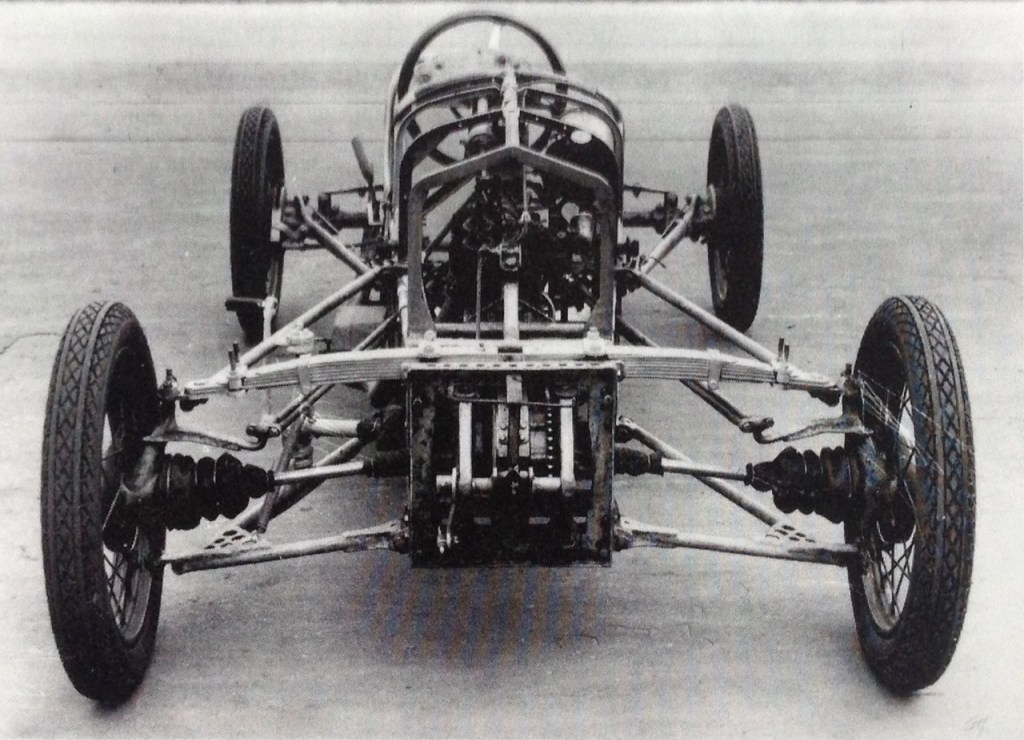
Chamberlain Indian front shot shows front-wheel drive, with CV joints made in-house. IFS by top leaf spring with locating radius-rods, wide based lower wishbones. Hartford friction dampers not fitted in this shot. Gearbox (in house) and chain-drive clear as is the tiny size of the car. Brakes are inboard drums (The Chamberlain)Chamberlain Indian circa 1929, light multi-tubular spaceframe chassis as per later 1950s and onwards practice…(The Chamberlain)
John Medley continues, “The car now became quite competitive, particularly in sprint events, easily holding the Wheelers Hill (in outer Eastern Melbourne) record for example. It ran in the numerous sprint events run by the Light Car Club of Australia, Junior Car Club and the Royal Automobile Club in Victoria during the period, as well as circuit races at Aspendale (inner Melbourne bayside suburb) and Safety Beach (holiday destination on Melbourne’s Port Phillip Bay).”
“Entered three times for the AGP at Phillip Island, the car was not successful. At the first attempt (1931) a piston seized due to the alloy being unsatisfactory, so the car did not start. By the following year the Chamberlains had made their own pistons from ‘Y’ alloy and the car completed practice without any troubles. In the race it only lasted 3 laps, when a crankpin broke.”
“Bob had trouble recalling a third attempt at the Island but checked his records and found that the car was indeed entered and listed as supercharged, although he is sure the car did not actually race in this form. Bob says that the blower was fitted to the Indian motorcycle engine and the compression lowered in the hope of improving big-end bearing life. It didn’t work out that well but this two-cylinder supercharged engine powered the car at several meetings at Melbourne’s Aspendale Speedway as well as a number of hillclimbs, with some success.”
“Then, in 1934, in Bob Chamberlain’s first attempt at Mount Tarrengower, the car crashed not too far from the site of (Australian Hillclimb Champion) Peter Holinger’s Holinger Repco V8 1977 accident. It has been said of Mount Tarrengower that if you make a mistake you have to fight for airspace with the pigeons. Bob Chamberlain was saved from that battle by a stout tree, which he scored at top speed just beyond the finishing line.”
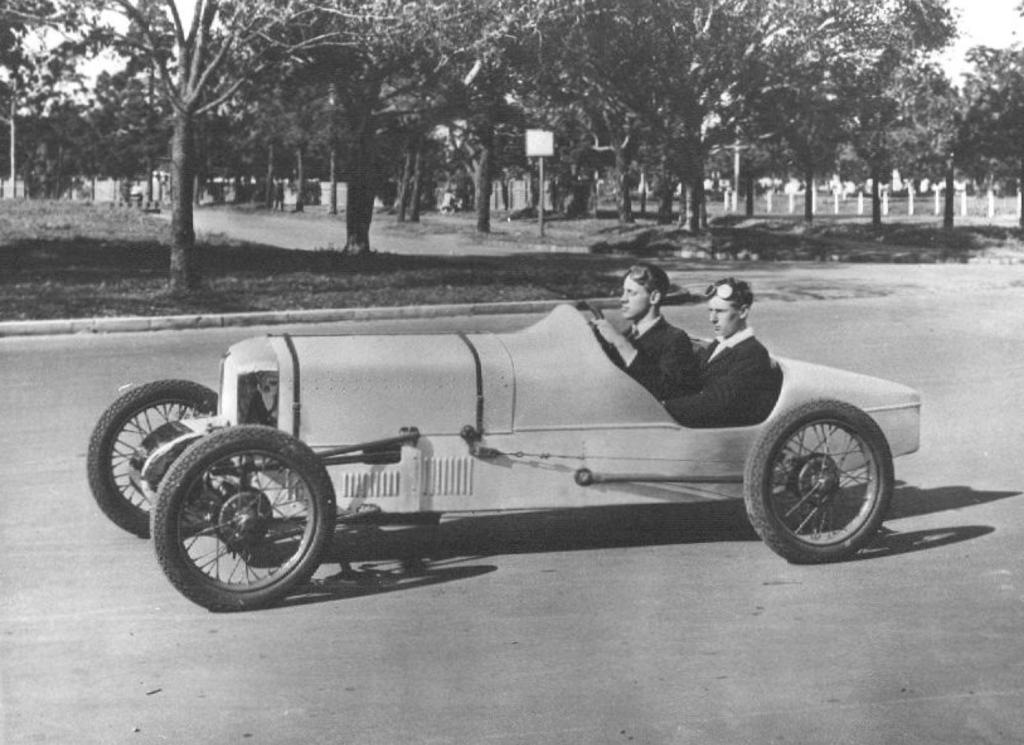
It is at that point that Bob Chamberlain departed overseas and Bill Chamberlain set to work on construction of the Chamberlain 8 that Bill Thompson enters the picture.
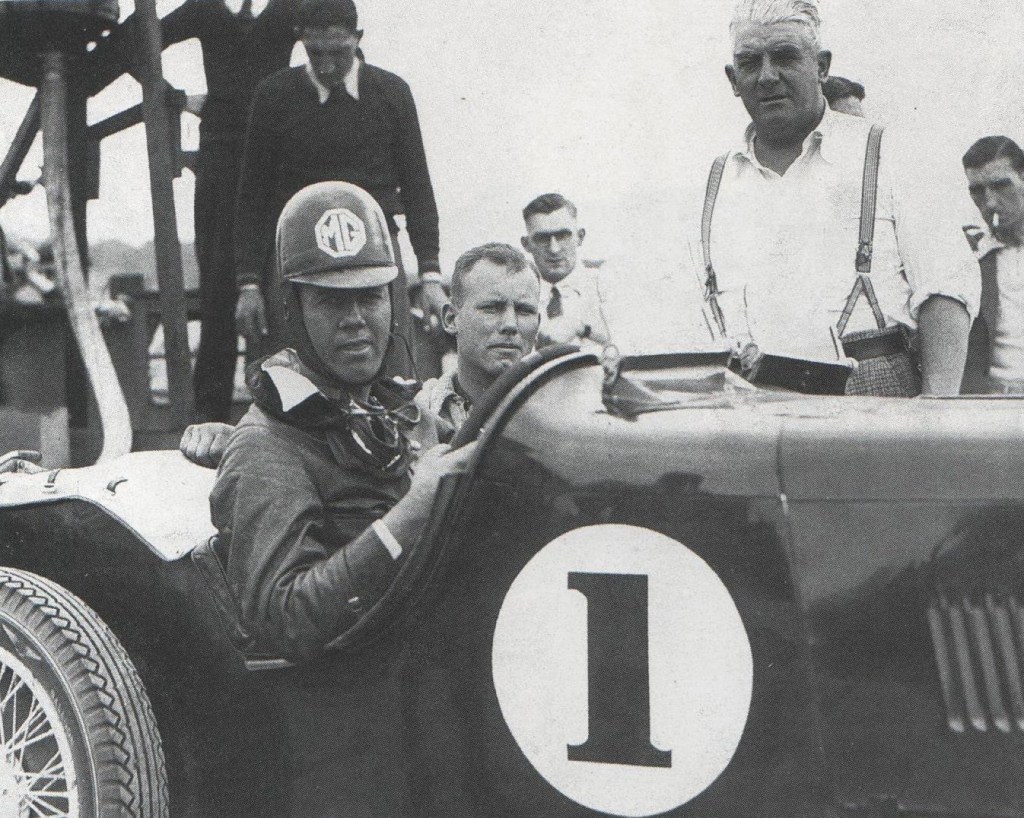
Bill Thompson and Bill Balgarnie in the Lanes Motors MG K3 during the 1935 AGP weekend at Phillip Island. The pair finished a close second off scratch in the handicap race (B Thompson Collection via B King)
Thompson had won the Australian Grand Prix thrice, aboard the same Bugatti T37A in 1930 and 1932 and racing a Brooklands Riley in 1933. He was regarded as the best of his generation. By 1935 he had retired from road racing, but was perennially short of cash so decided to compete in the nascent sport of midget speedway racing, an activity which dovetailed nicely with his recent appointment as managing director of National Speedways Ltd.
In need of a car, Thompson convinced Lanes Motors – Melbourne dealers of Morris and MG amongst others – where he was head of the MG department, that midget racing would provide great exposure for their products on tracks at Sydney’s Showgrounds and Wentworth Park, Penrith, Newcastle and the Olympic Park Melbourne.
He concepted his ‘No 1’ machine, the Altoona Indian powered Lane Special to be powered by the light, potent, proven Altoona Indian-Norton engine. Built in Lanes’ racing department in South Melbourne the car “has a clutch and speed (sic) gear box and the chassis, steering axles, brakes etc built up from Morris Minor and MG parts,” The Sun recorded.
Australian international motorcyclist/master mechanic, Wilfred ‘Bill’ Balgarnie – who had represented Australia at the Isle of Man aged 22 in 1934, finishing 13th on a Velocette 350 in both Junior and Senior TTs – was also involved in the construction of the car. Balgarnie accompanied Thompson as riding mechanic in two of his AGP wins and in many of his major races.
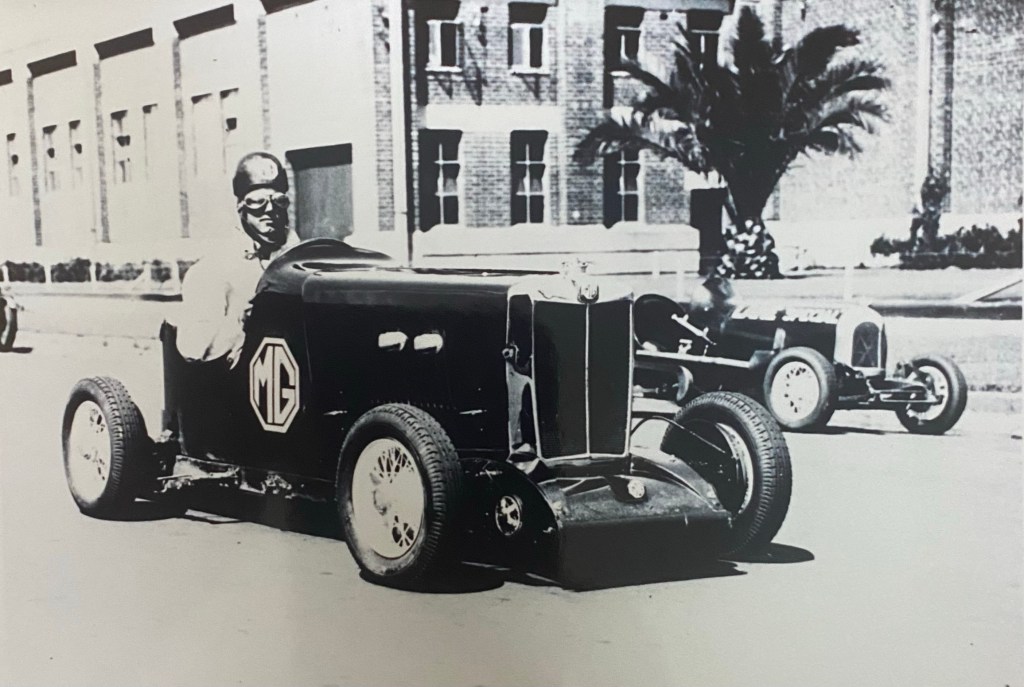
Balgarnie worked on Bill’s car and on a P-Type MG which was to be adapted for midget competition and raced by him. The 845cc engine was retained and modified, while the body was streamlined and lightened, the engine/transmission lowered, and mandatory 12-inch by 4-inch wheels fitted.
The Bill Balgarnie modified MG P-Type Midget – there cannot have been too many MGs raced globally as dedicated dirt speedway machines?! – with Bill Thompson up, chassis number folks? Note the Lane Special at rear. Given the backdrop, Wentworth Park, Sydney I think (B Thompson Collection via B King) Bill Thompson, Lane Spl Indian Altoona, and Ted Poole at Wentworth Park, Sydney in 1935 (vintagespeedway.com)
By August ’35 Thompson’s equipe also included Bob Findlay’s Midget. Balgarnie had performed so well in the P-Type Spl that Thompson acquired a better car for him, with which he was formidable throughout 1936-37.
The Sun reported in November 1935 that Thompson had a successful season (February to May) in Victoria but “has been disappointed with the Lane Special’s performance since its arrival in Sydney.” Thompson consulted with “famous speed merchant Ron MacKellar (Sydney Ford dealer and racer/engineer)” to dismantle the Altoona Indian engine to recondition it to find the 70bhp of which the motor is capable.”
When fitted to the Chamberlain “it has been credited with lapping Phillip Island at 78mph, “only 6mph below the official lap record. It was timed over the mile there at 103mph.”
While Thompson’s speedway record is said to be ‘undistinguished’, I’d like to record his results if any of you have ready access to Kent Patrick’s biography of Thompson. Time I bought it.
Finally, what became of that rather special engine I wonder…
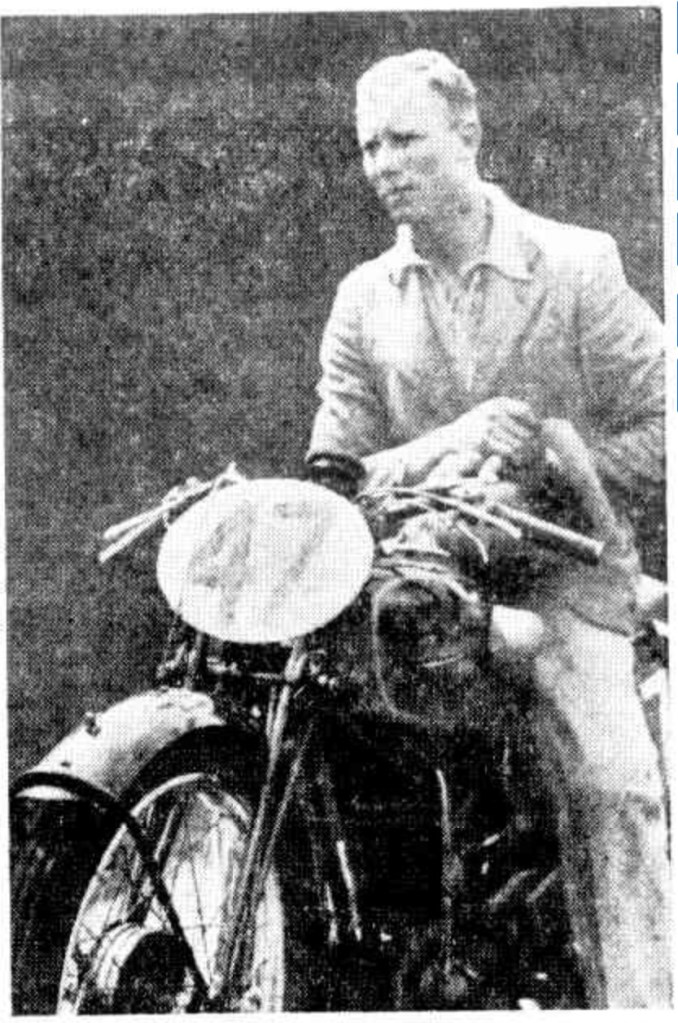
Bill Balgarnie aboard his works-Velocette “waits to hand in his gear on the eve of the Isle of Man event” in 1934 (Western Mail)
Etcetera: Bill Balgarnie…
I was aware of Bill Balgarnie as a talented mechanic/riding mechanic but not his own record as a racer on two wheels and four.
Some Troving (Trove is an Australian newspaper digital archive) reveals that Bill was as much of an ace in a car as he was on ‘bikes, including countless midget wins, victory in the 1937 NSW State Midget Championship in front of 25000 spectators at Penrith and much more.
A Western Mail, Perth article about him published in March 1951 helps fill in the gaps, I’ve paraphrased it and added some other tidbits.
Born of parents who lived in Bowral, he first became interested in motorcycle racing when he left school in Sydney, competing in road races around Sydney and at Bathurst.
By 1934 he was one of the leading riders in NSW and was chosen to represent Australia at the Isle of Man. When he arrived in the UK, Velocette made a 350cc bike available for the races contested by 80 riders including the champions of England, Germany, Spain and France.
While the going was tough, the bike performed faultlessly and he averaged 74mph to finish 13th, and first visiting rider home. In so doing he won The Motorcycle Visitors Cup and received a replica of the Senior TT Trophy for recording one of the races’ fastest times.
The Junior TT was held the following day, “A terrible day, very foggy and wet and on parts of the course, visibility was very limited. I must confess I was pretty anxious about that ride, but again the machine went without a hitch and averaged about the 70 mark.” He was again 13th on the 350.
Afterwards he toured England for several months and for a period received specialist training at MG. He visited Brooklands and did a trial lap on a borrowed bike at 97mph, just missing out on the Gold Star awarded for laps of 100mph and over.
Then it was off to the Belfast TT, then France for an “international car race”, and finally Milan for a tour of Alfa Romeo before returning home to Australia late in 1934.
Balgarnie was immediately back in the fray, using his tuition at Abingdon to prepare and act as riding mechanic aboard Bill Thompson’s Lanes Motors entered MG K3 Magnette in the Centenary 300 at Phillip Island, the longest race for “purely racing cars” in Australia in January 1935.
In a winning position from scratch, and on-the-hop, Thompson sought to pass another competitor on the outside at Heaven Corner on lap 12, slid, then ran out of road as he corrected, crashed into a scoreboard and rolled. Thompson escaped with facial injuries but Balgarnie’s chest was crushed, “which kept him from work for several weeks.” The perils and stupidity of allowing riding mechanics…
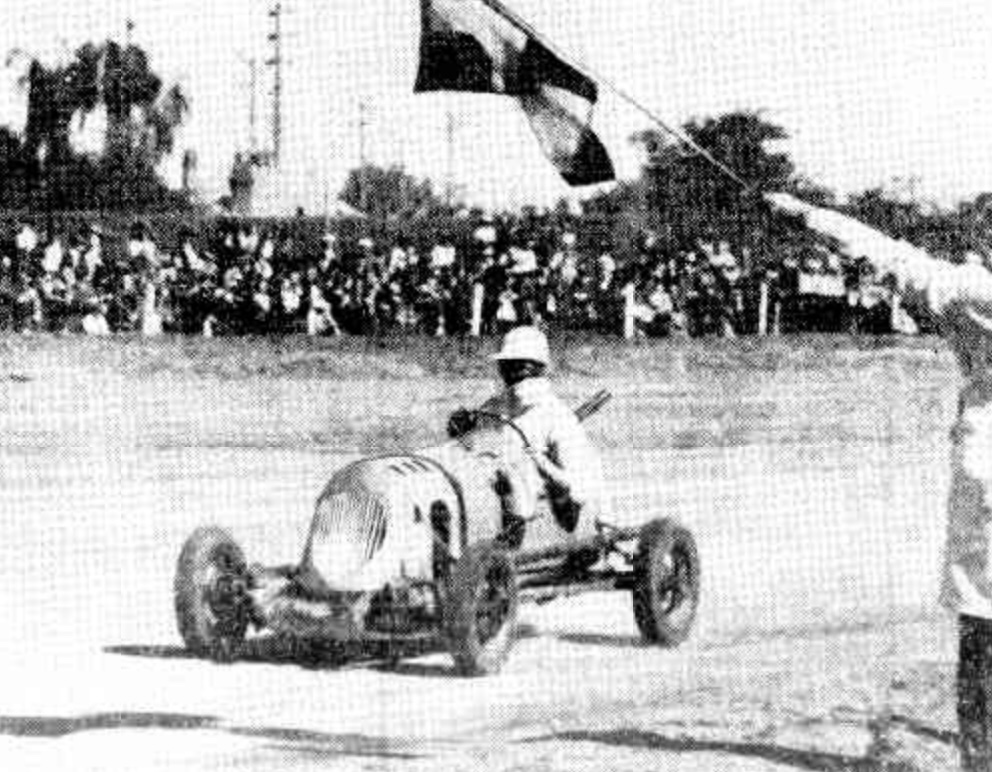
Balgarnie takes the chequered flag to win the 1937 Australian Midget Championship at Penrith New South Wales. Make of chassis and engine would be a bonus? (Western Mail)
By 1936 Balgarnie was back in Sydney to race and running a servo in Rushcutters Bay, in addition to “dabbling in wrestling to develop his strength”!
The Australian Midget Car Championship and Five Miles Amateur Car Championships followed at Penrith in April 1937, and shortly thereafter a major accident when a fellow competitor stalled right in front of him at the Sydney Showgrounds. “It was too late to avoid him, I crashed into his back axle, looped the loop and turned over three times. After that I can’t remember a thing, I was out to it for three days.” He recovered quickly despite a cracked skull, broken arm and injured thumb.
Showing that he wasn’t at all phased by the accident Balgarnie won his class driving Ron MacKellar’s MacKellar Spl s/c at Waterfall Hillclimb in late August.
In February 1940 he married Pauline Laidley at Double Bay, the bride was given away by Ron Mackellar in a large wedding. In the early 1940s he joined the armed services but returned to competition with a couple of hill-climb drives aboard the Chamberlain 8 in 1946.
By then employed by the Chamberlains, Balgarnie was promoted to the position of works manager for Chamberlain Tractors whose manufacturing facility was in Perth. At the time of the Western Mail interview he lived in Dalkeith Road, Nedlands.
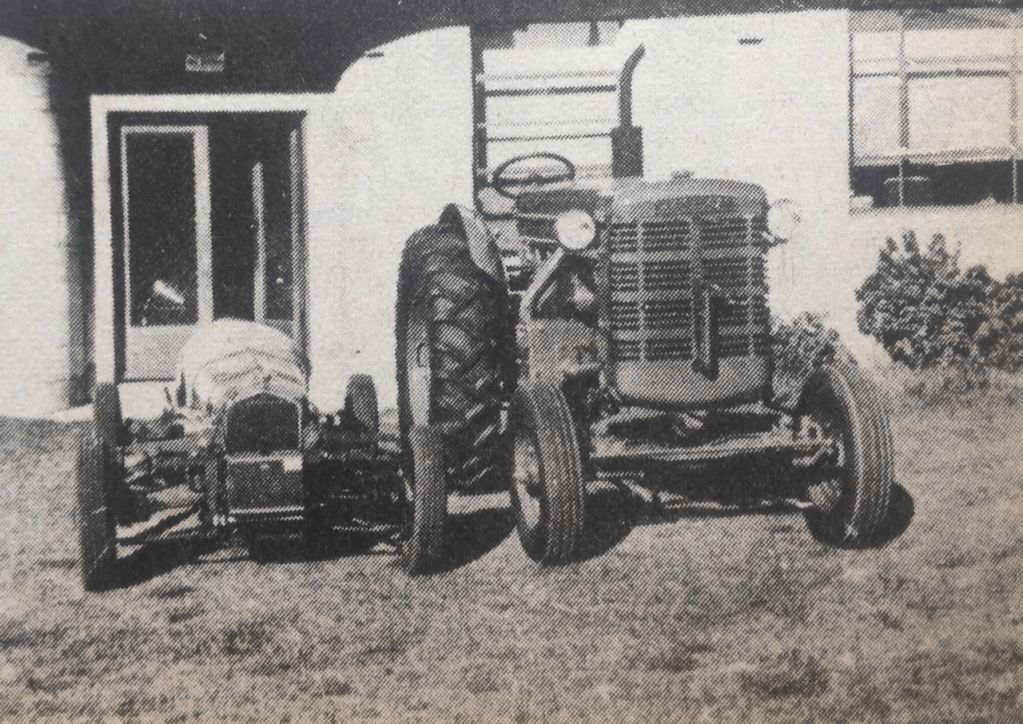
The Chamberlain 8 with the first of the Chamberlain tractors in 1946 (Cars and Drivers)
Balgarnie Snippets…
In the 1930s, the Midget racing season ran from November to May
Balgarnie rebuilt the Jack Jones/Mrs JAS Jones Alfa Romeo 6C 1750 Zagato SS after it was “completely burned out” in 1933. “Used as a hack for many years,” Jack Jones set second fastest time of the day in the May 1937 Canberra Speed Trials at 102.2mph over the standing quarter mile, “Which speaks well for the skill of the mechanic who rebuilt the car and was mainly responsible for its performance in Canberra,” the Sydney Referee reported. Frank Kleinig’s supercharged Miller powered Kirby Deering Special was quickest at 116.9mph.
In December 1935 Balgarnies speedway midget was reported to be equipped with “BSA overgear and an Altoona crankcase.”
In a 15 August 1935 Sydney Referee news item about the upcoming 1935-36 “season in Melbourne there will be at least 24 drivers available when the Olympic Park track reopens again” with the “big shots” among them “Bill Thompson, Bob Findlay, Bill Wilcox, Barney Dentry, George Beavis, Les Gough, Ern Day, Fred Curtis, Joe Parmeley, Bill Allan, Bill Balgarnie, Arch Tuckett, Arthur Higgs and Sid Gowar.”
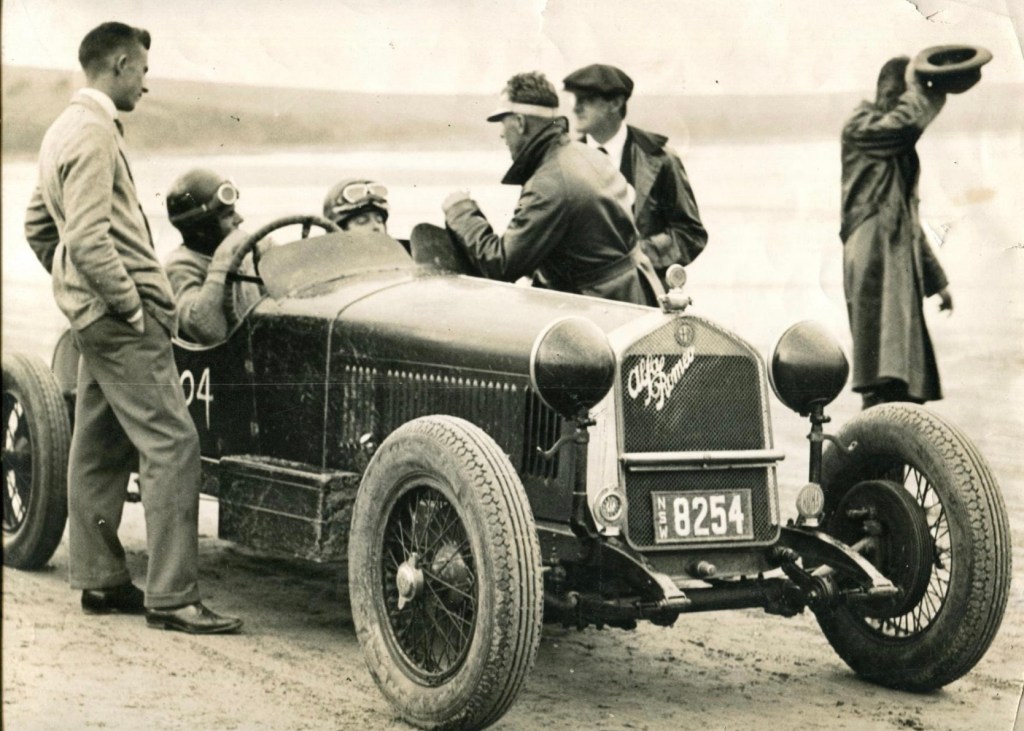
Percy Hunter with JAS Jones aboard the Jones family Alfa Romeo 6C1750 SS Zagato at Gerringong Beach New South Wales in 1930 (A Patterson)
Credits…
artomobile.com.au, ‘The Chamberlain’ John Hazelden, ‘Chamberlain Australian Innovator’ Bruce Lindsay, thevintagent.com, The Sun Sydney November 1, 1935, various 1934- newspapers via Trove, The Vintagent, Bibliotheque Nationale de France, archivemoto.com, Paul Sheedy Collection via firstsuperspeedway.com, Bill Thompson Collection via Bob King, Cars and Drivers, vintagespeedway.com, Adrian Patterson Collection, Daniel Statnekov Collection, Getty Images, silhouet.com
Tailpieces…
(D Statnekov Collection)
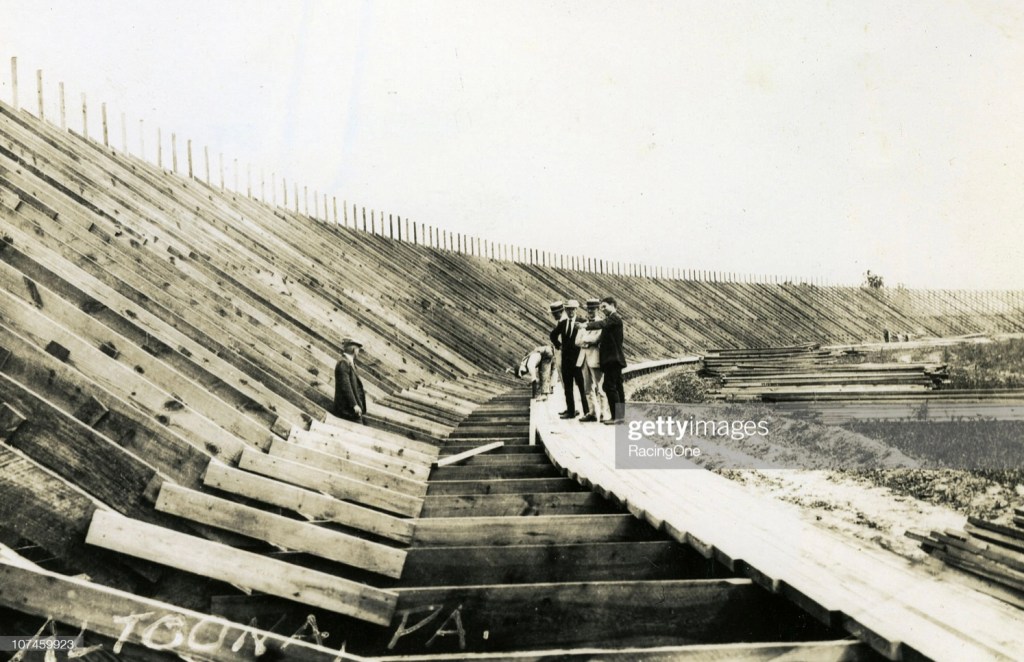
Now, where did I put my hammer? The engineering and construction challenge, and ongoing maintenance, were considerable! Dated by Getty as 1950, but lets call it 1922.
Altoona Speedway was built at Tipton, 20km north of Altoona, Pennysylvania as a 1.25-mile timber-oval with corners banked at 32-degrees, by entrepreneurs Jack Prince and Art Pillsbury.
It operated between September 4, 1923 and September 7, 1931, then was destroyed by fire in May 1936. In 1935 an oiled-dirt oval was built on the site, then post-war, a quarter-mile track opened on the infield, it held meetings until 1952. Industrial buildings now occupy the site.
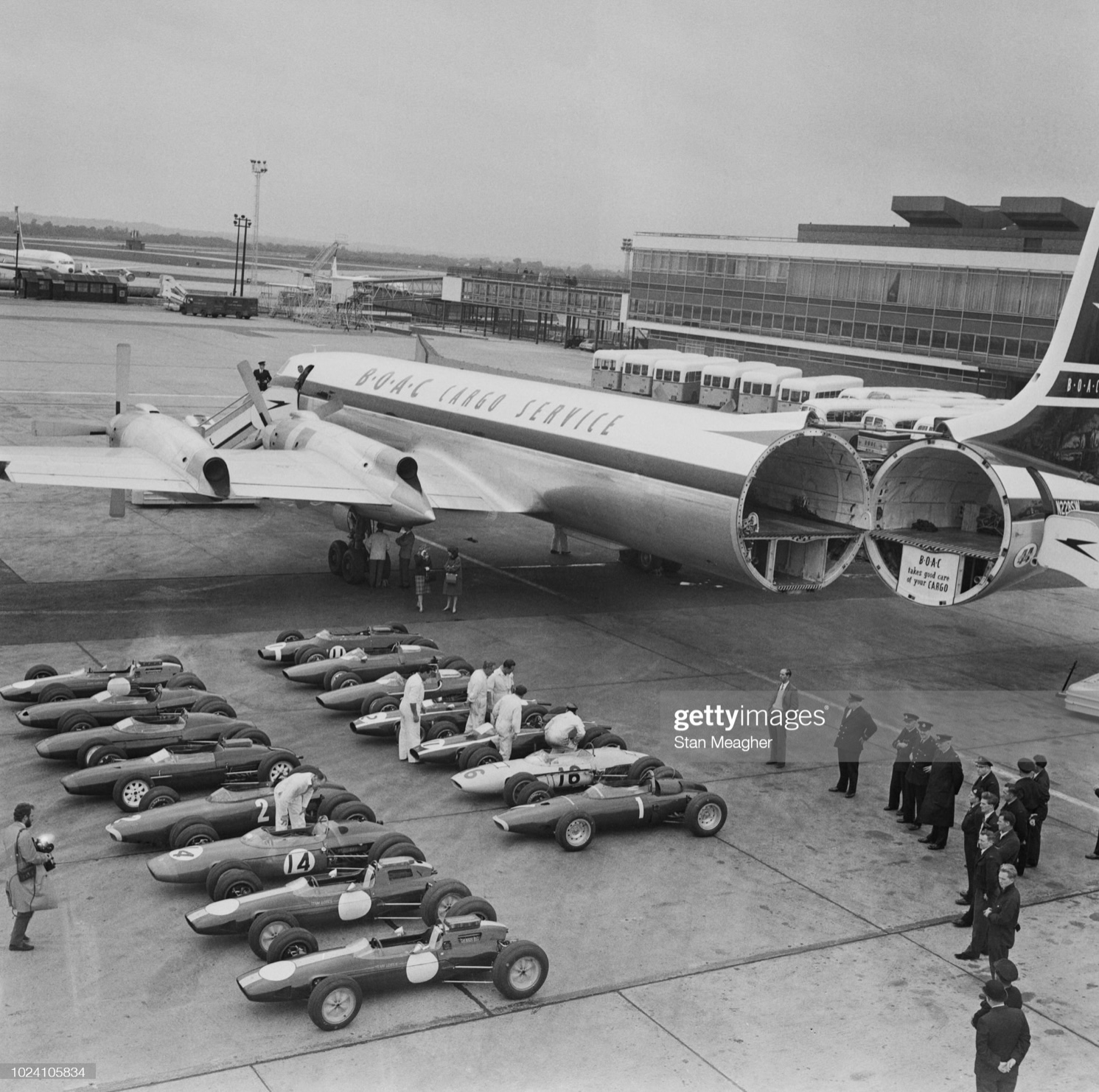
A BOAC Bristol Britannia ‘Whispering Giant’ (actually a Britannia based Canadair CL-44D4-1 – thanks Jon Farrelly!) awaits its precious cargo before departure from Heathrow to the fly-away, end of season United States and Mexican Grands Prix, October 1963…
The cars in the foreground are the factory Lotus 25 Climaxes of Jim Clark, victorious at Mexico City, and Trevor Taylor. #1 and 2 are the reigning World Champion BRM P57’s of Graham Hill and Richie Ginther, they finished first and second at Watkins Glen.
#16 is Jim Hall’s Lotus 24 BRM and #14 is Jo Siffert’s similar car. #11 and 12 are Jo Bonnier and Bruce McLaren’s Cooper T66 Climaxes, note that Bruce raced carrying #3 in both events.
For the aircraft buffs amongst us here is a link to a period BOAC documentary about the Bristol Britannia
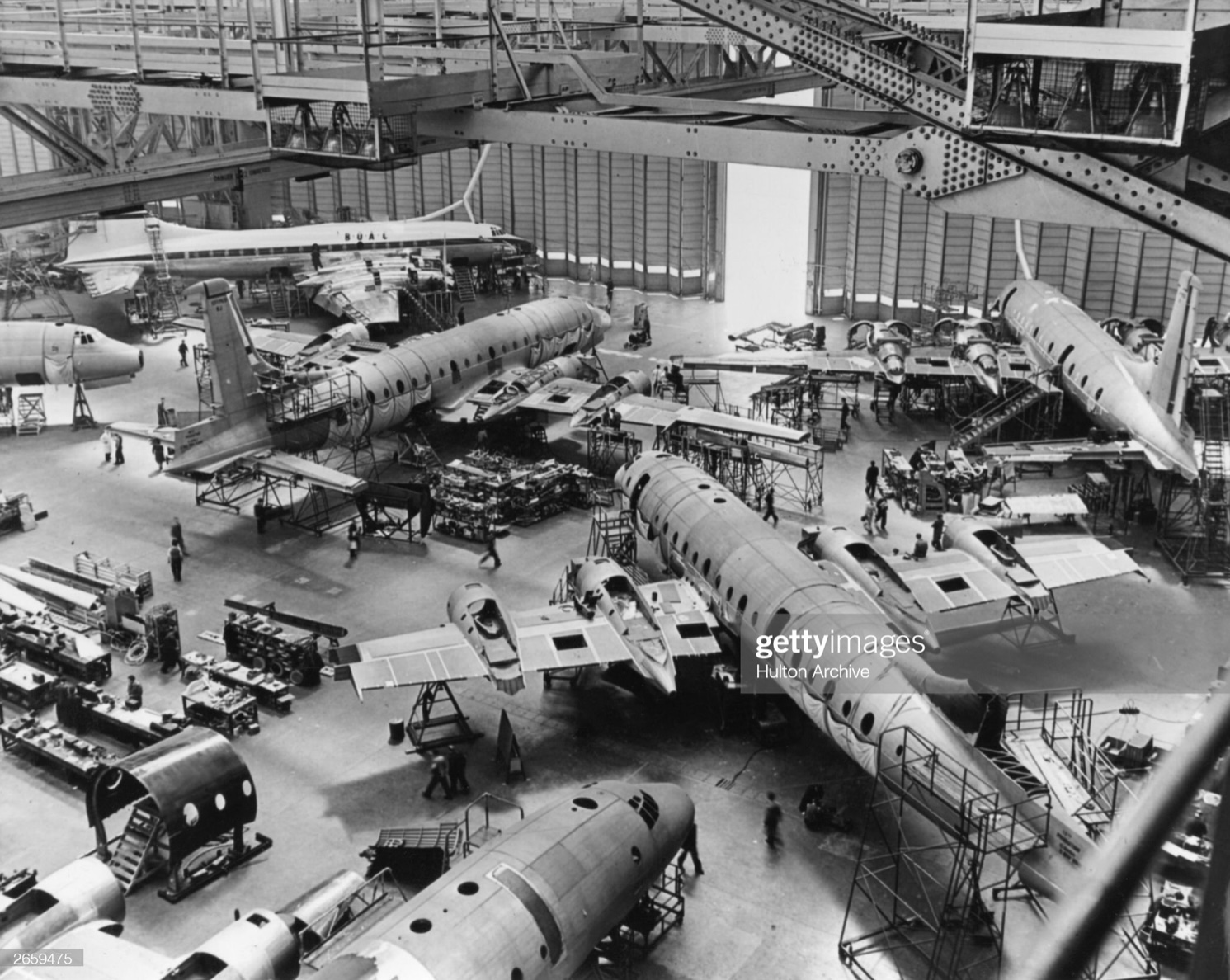
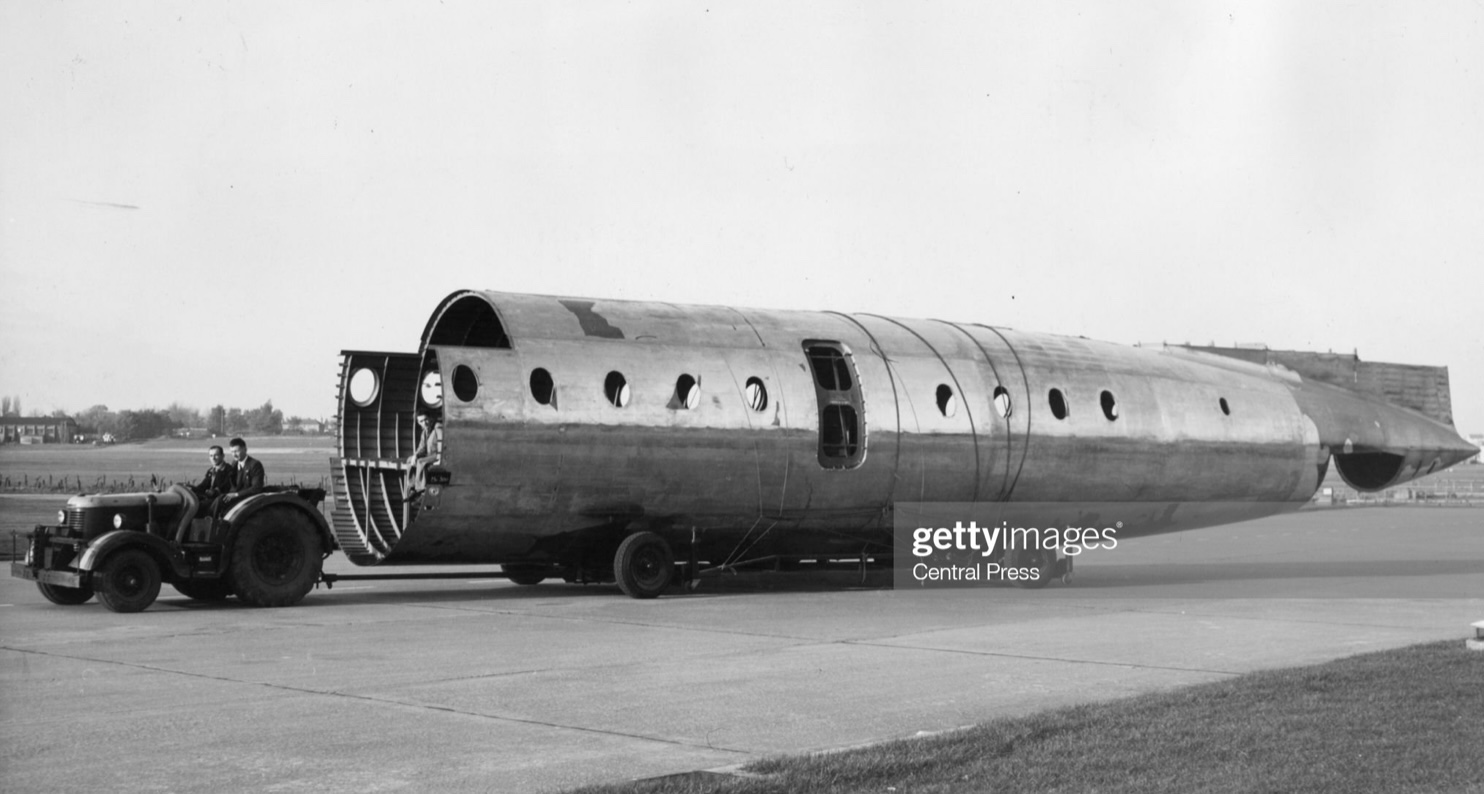
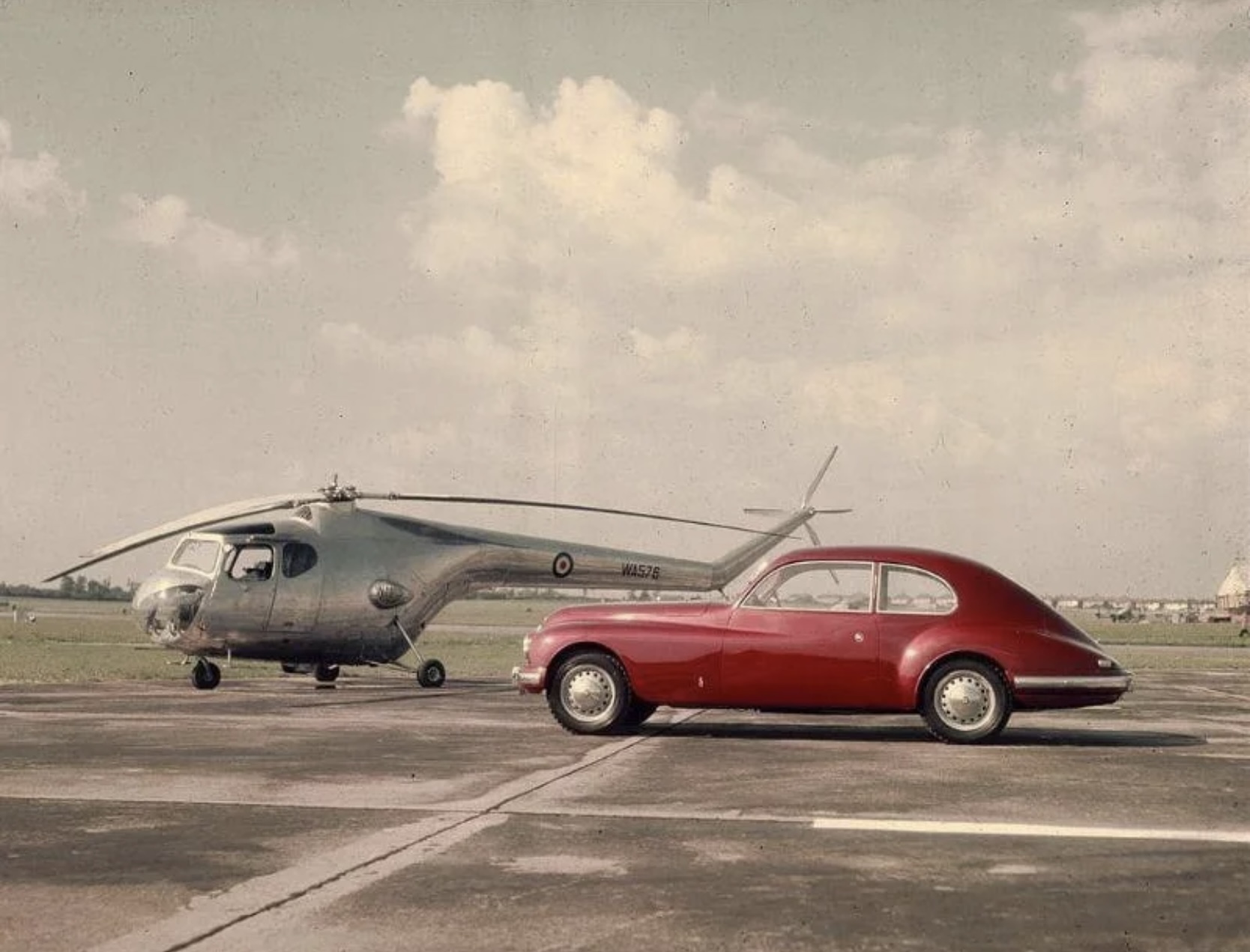
I love these two photographs of construction of Bristols in the mid-1950s.
The first shows Britannia 100s being completed in Bristol’s Assembly Hall at their Filton, South Gloucestershire aerodrome/manufacturing facility about four miles north of Bristol, in January 1956.
The second, dated a year earlier, may well have been the inspiration for Colin Chapman’s monocoque Lotus 25! (that was a joke). It’s such a powerful shot showing the conceptual simplicity and strength of such (highly sophisticated) structures.
In 1959 Bristol Aircraft merged with several other companies to form the British Aircraft Corporation, which in turn became a founding piece of British Aerospace, now BAE Systems. BAE Systems, Airbus, Rolls Royce, MBDA and GKN still have a presence on this Filton site. More Bristol Aircraft reading here; https://www.baesystems.com/en/heritage/filton–bristol
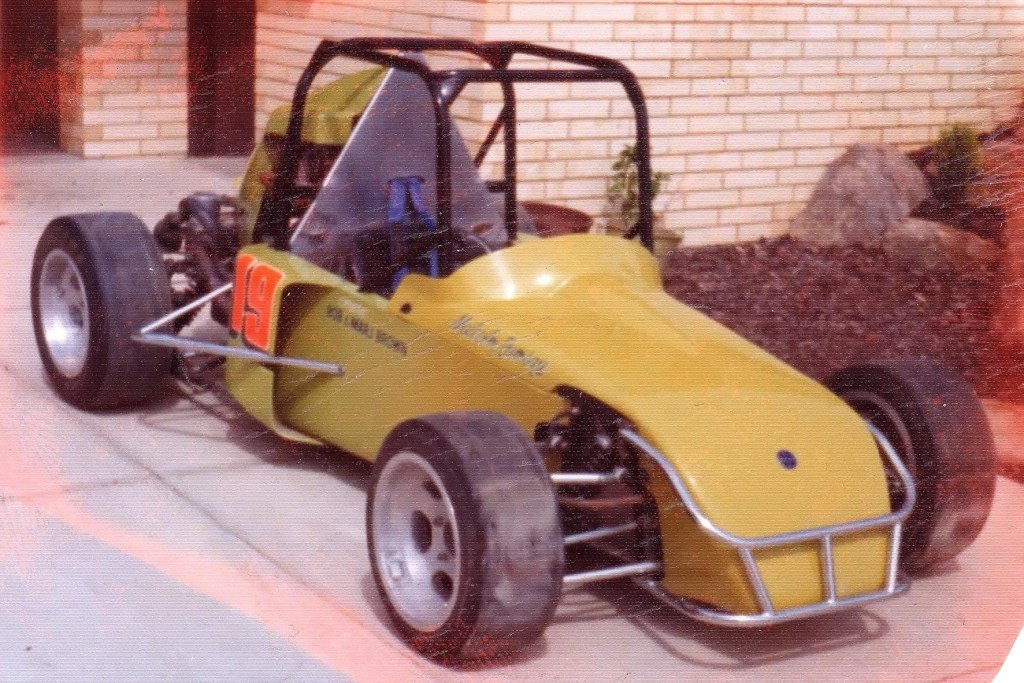
Malcom Ramsay and Tony Alcock built a swag of championship/race winning Formula Ford, F3, F2 and Formula Atlantic single-seaters from 1971 to 1978.
And this mid-engined, supercharged VW powered speedcar.
The project was funded by Bob and Marj Brown, a successful Adelaide business-couple who aided and abetted the careers of Birrana pilots Enno Buesselmann and Bob Muir from 1973-76.
Alcock’s revolutionary spaceframe design was tested by Ramsay on the dirt at Rowley Park, and at Adelaide International’s half-mile, banked, bitumen oval in 1974, it was immediately quick.
It was a step way too far for the conservative controlling body who suggested that “You circuit racing wally-woofdas can take your changes elsewhere!” Or as Ann-Maree Ramsay put it more delicately, the car “was banned due to perceived different handling characteristics compared with the front-engined Sesco and Offy cars of the time.”
The VW engine was a supercharged 1.6-litre flat-four mated to a Holinger modified VW transaxle.
By 1975 the Browns were in England chasing Formula Atlantic fame together with Muir and a pair of modified Birrana 273s.
Ramsay advertised the car in Auto Action, outlining that the S74 was the only car of its type “permitted to race for 18-months on a bitumen-oval, in this very restricted form of the sport.”
Yes, I know it’s a shit-photo, but it seems to be the only one there is, let’s record our history anyway. If you have a better one, please send it to me. The shot is out front of the Ramsay home in Adelaide. If memory serves, it now resides in the Holmes Collection in Brisbane.
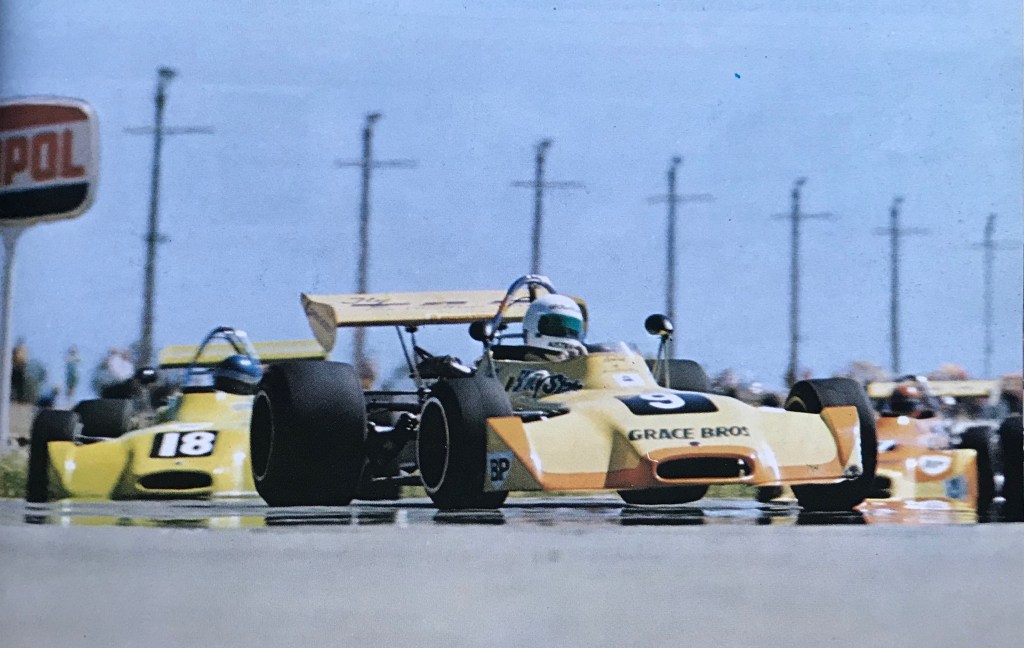
Leo Geoghegan and Enno Buesselmann in Birrana 273 Hart-Fords during the 1973 ANF2 Adelaide International round
John Harvey’s 2.5-litre Repco V8 powered Brabham BT11A shrieks it’s way around Warwick Farm on 18 February 1968…
Looks a treat doesn’t it? Nose up out of Leger Corner onto Pit Straight, it was first meeting for the car with its Repco engine.
By 1968 IC-4-64 was an old-girl, albeit a very successful one. It was raced by Graham Hill in the 1965 Tasman Series for David McKay’s Scuderia Veloce, winning the 1965 NZ GP at Pukekohe on its race debut.
Hill won the ’65 NZGP at Pukekohe on 9 January 1965 from Frank Gardner’s similar BT11A and Jim Palmer’s earlier model BT7A, all 2.5 Coventry Climax FPF powered (sergent.com)
The 2.5-litre Coventry Climax FPF four cylinder engine was struggling against the V8’s by then, so Bob bought a 740 Series Repco 2.5-litre V8 to plonk in the back of the BT11A.
John Harvey, Martin’s successor at Bob Jane Racing, contested the Australian rounds of the 1968 Tasman Series so powered. Jim Clark’s works Lotus 49 Ford DFW won the Tasman that year, it was the final championship he won before his untimely death at Hockenheim that April.
740 Series Repco 2.5 Tasman V8 engine. 700 Series Repco block and 40 Series ‘between the Vee’ heads’, the ’67 World Championship winning SOHC, two-valve engine in 2.5-litre Tasman spec as against its 3-litre F1 capacity. Repco claimed 275bhp @ 8,500rpm for the 2.5, and 330bhp @ 8,400 rpm for the 3-litre variant. Lucas injection trumpets, Bosch distributor and plenty of chrome and cadminium plating in shot (P Houston) Harvey in the BT11A Repco at Longford, 1968. The attention Bob Jane placed on the presentation of his cars is clear. Note the seatbelt, six-point? (oldracephotos.com-H Ellis)
Harves’ did three Australian rounds, only finishing the wet, final Longford event. By the start of the Gold Star series he slipped into Jane’s new Brabham BT23E which had been Jack’s 1968 Tasman mount.
Harvey raced the final round of the 1967 Gold Star Series in IC-4-64 after Martin announced his retirement. He was already well familiar with Repco power, the 740 Series Repco had been shoe-horned into his Ron Phillips owned BT14 F2 Brabham.
Third place at Sandown was his only finish in the car. John commented in a Facebook exchange about this car “…On handling, Peter Molloy and I were still developing the chassis setup, however in the Diamond Trophy race in 1967 (pictured below) at Oran Park I set a new outright record on the last lap”, so they were improving the car.
The engine and Hewland ‘box was removed from the BT14 which Jane acquired, and popped into the BT11A which it was figured would better cope with the power than the BT14 F2 frame and related hardware.
IC-4-64 is still alive and well, as part of the Bob Jane Estate, in FPF engined form.
Harvey in the WF pitlane, Tasman meeting ’68. The BT11A has a vestigial spoiler and a few ducts the it didn’t have when CC FPF powered. Jewels of things these ‘Intercontinental’ Brabhams, very successful ones at that (B Williamson) At the Warwick Farm Tasman meeting again (J Stanley) Competitor view of the BT11A and its luvverly Repco RB 740 2.5-litre 275 bhp V8 (P Houston)
Credits…
autopics.com.au-Richard Austin, John Stanley, Peter Houston, sergent.com, Bob Williamson, oldracephotos.com-Dick Simpson, Harold Ellis and Harrisson, oldracingcars.com, Stephen Dalton Collection
The shot of Harvey in the Ron Phillips owned Brabham referred to above, on the way to victory in the Diamond Trophy at Oran Park.
John made his name in speedway and transitioned into road racing in an Austin/Morris Cooper S, and then into open-wheelers in this ex-Bib Stillwell car. The Brabham received progressively bigger Lotus-Ford twin-cams, with Harvey going quicker and quicker, before the machine copped its Repco V8 Birthday between the 1967 Tasman and Gold Star Series. Rennmax’ Bob Britton performed the surgery to pop the Repco into the BT14 frame, creating a BT14 jig in the process.
It wasn’t that successful in Repco form; DNF/DNS at Lakeside, Surfers, Mallala and Symmons Plains, third place in the Sandown Gold Star round in September was the car’s best, behind Leo Geoghegan’s Lotus 39 Repco and Spencer Martin aboard BT11A IC-4-64.
Harvey during the Diamond Trophy meeting at Oran Park (oldracephotos.com-Dick Simpson)
Harvey’s Bob Jane drive commenced aboard IC-4-64 in the final Gold Star round, the Hordern Trophy, at Warwick Farm in December 1967.
So…Harvey in 12 or 14 months drove quite a few different Brabham/engine combinations! BT 14 Ford, BT14 Repco, BT11A Climax, BT11A Repco, and then BT23E Repco for the ’68 Gold Star Series. Mind you he missed the ’68 Gold Star.
The ‘noice new Brabham crashed after a rear suspension upright failed in practice for the opening Bathurst round. Harvey’s big accident and subsequent recovery kept him away from racing for the rest of the year.
Harvey aboard the Jane Racing Brabham BT23E Repco 830, during the Symmons Plains Gold Star round in March 1970, at the end of its competitive life. He won the race from Leo Geoghegan’s Lotus 39 Repco and Kevin Bartlett’s Mildren Waggott (oldracephotos.com-Harrisson)
Tailpiece…
(S Dalton Collection)
The July 1965 Oran Park meeting program shows Harvey’s Austin Cooper S ahead of George Garth’s Ford Cortina GT during the OP May 1965 meeting.
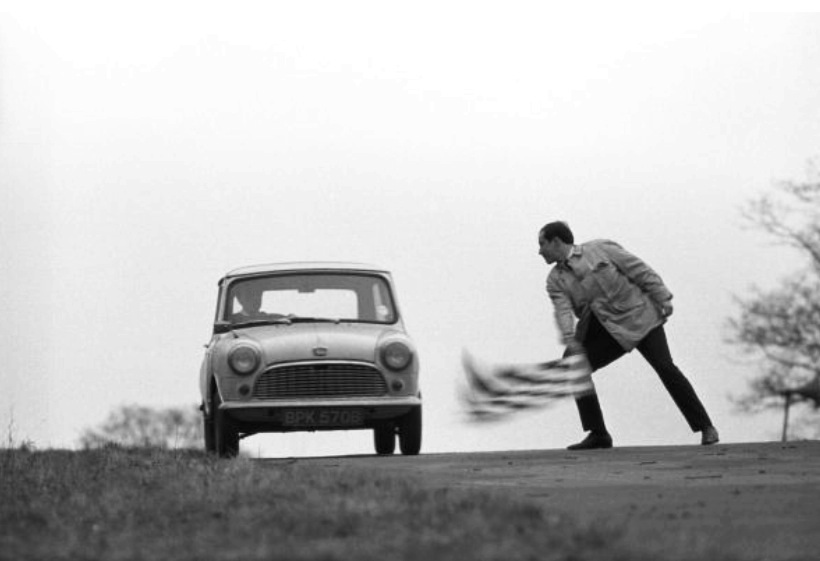
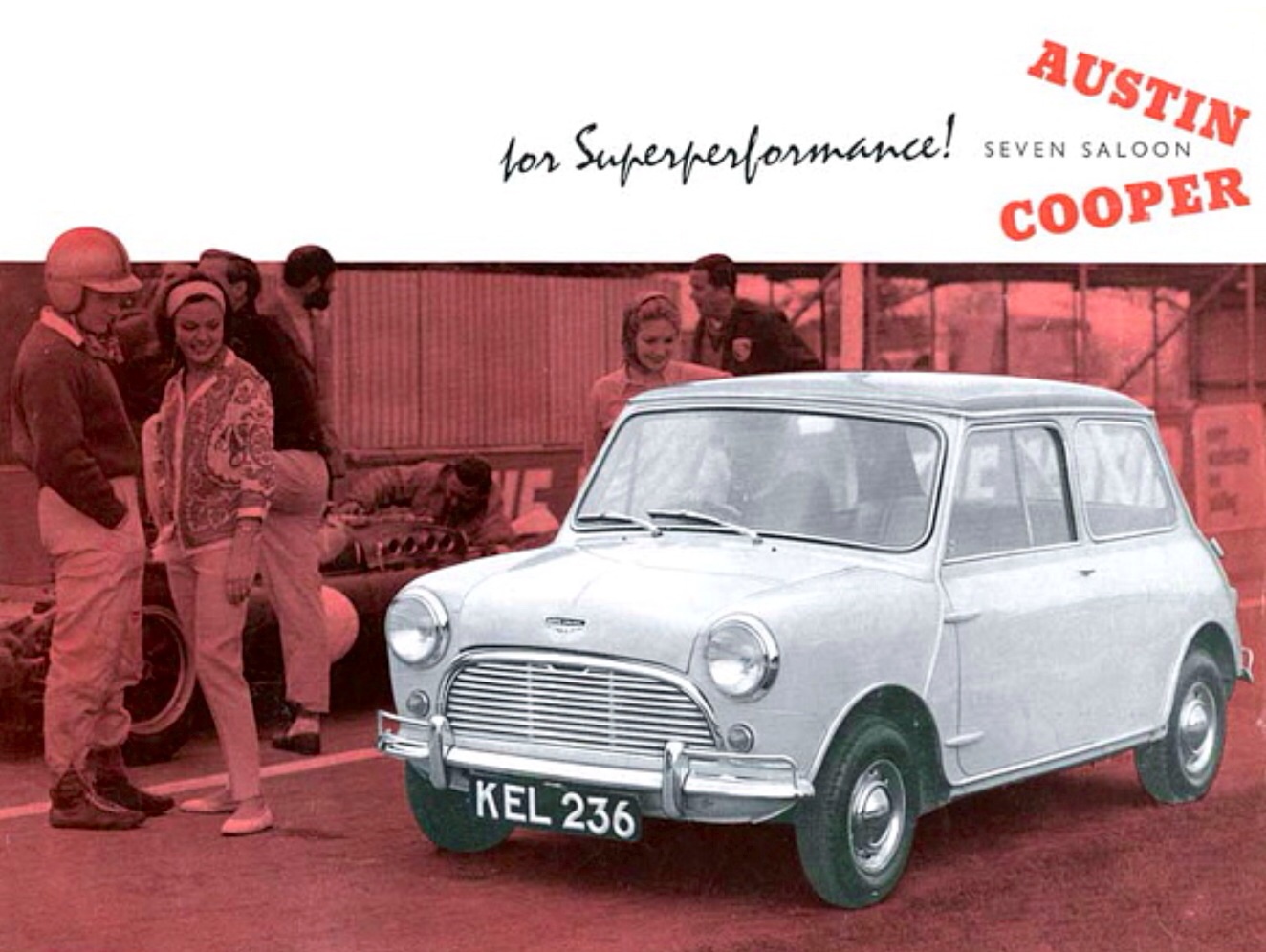
Sales promotion of the Mini Cooper early-sixties style…
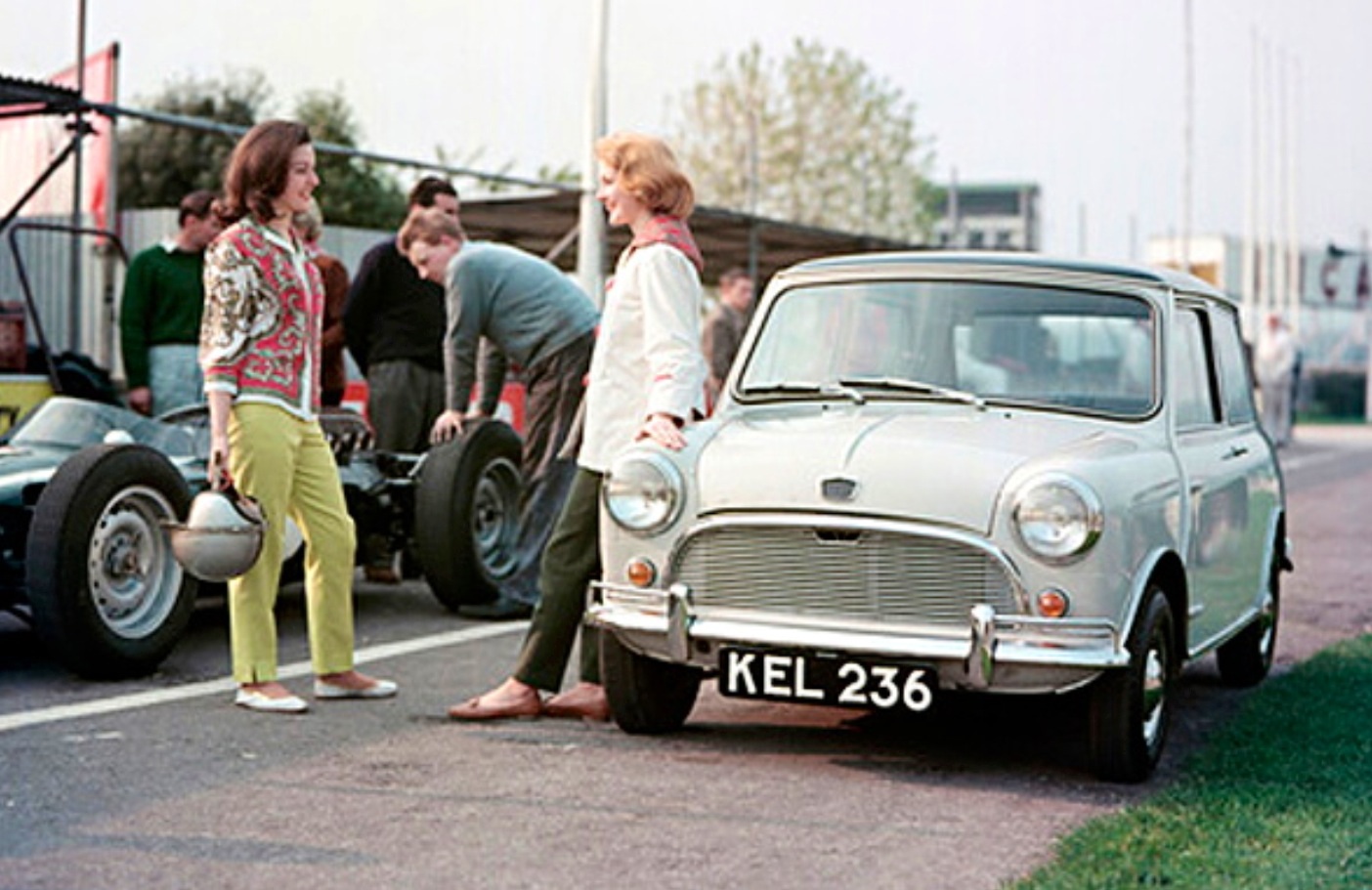
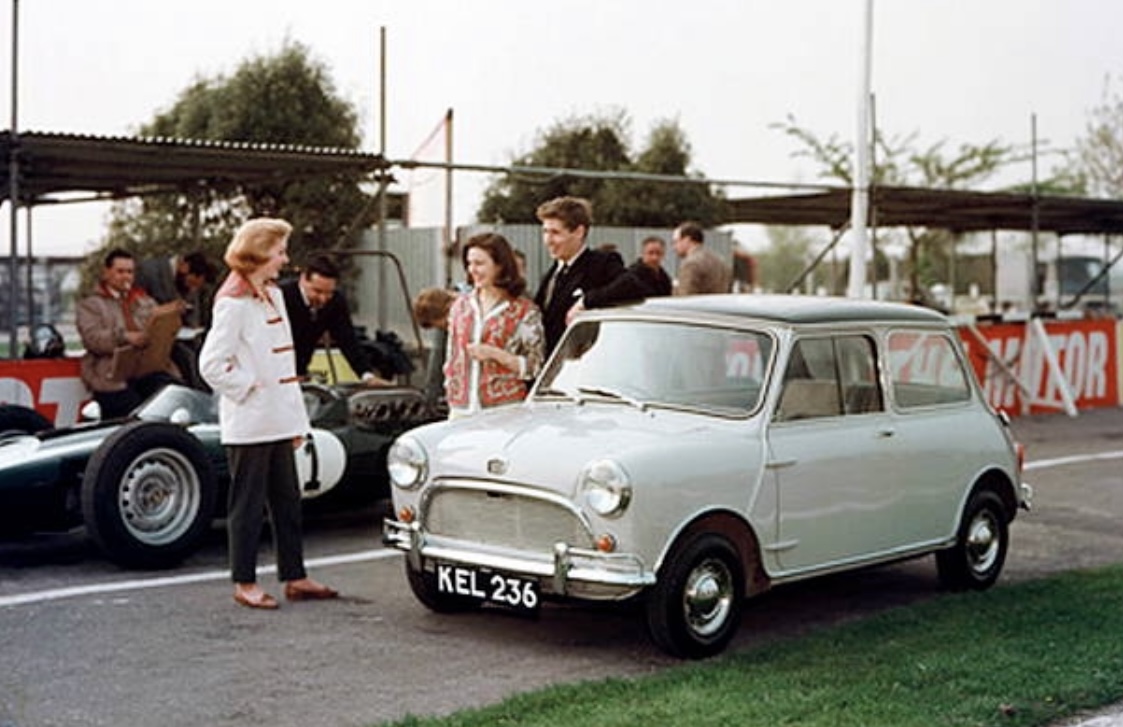
The shot above is by Bert Hardy, the extraordinary photographer of the UK’s Picture Post by then plying his trade in advertising. See here for more about Hardy; 1947 JCC Jersey Road Race… | primotipo… The photos below are via other agencies working on the BMC account.
It’s a decade before my time but are very much of the time aren’t they?
The caption for the opening shot, ‘Mini Rally at Brands Hatch’ is dated January 6, 1965. Touring car racing was never quite the same again when the Minis joined in on the fun, the magic little cars punched above their weight, as often as not being outright contenders in addition to inevitable class wins.
Bruce McLaren is at left in the shot above, taken at Goodwood in 1961, and again at far left in the one below..
Partially hidden behind the attractive babes (I don’t spose I’m allowed to make that kind of factual, complimentary observation these days) is, my friend and Cooper Historian Stephen Dalton tells me Jack Brabham’s 1961 Indy 500 spare car, a Cooper T53 Climax 2.7 FPF. See here for a feature on Coper’s Indy adventure; Jack’s Indy Cooper T54 Climax… | primotipo…
It is it a real-test day, John Cooper is tending to the engine in the similar shot above, “they tested a Cooper T55 that day too.”
Stephen comments further, “KEL 236 is a numberplate borrowed from a motorbike and fitted to the 997 Cooper prototype. The brochure cover image has the grille and bonnet badge touched in by a graphic artist.”
“It’s totally different to the colour shots, as they were still developing stuff for the car when these April 1961 photos were taken. No production 997s existed until July 1961.”
“They also did Austin Healey Sprite Mk2 press photos in similar scenes to this on the same day, neither BMC car was officially released at the time.”
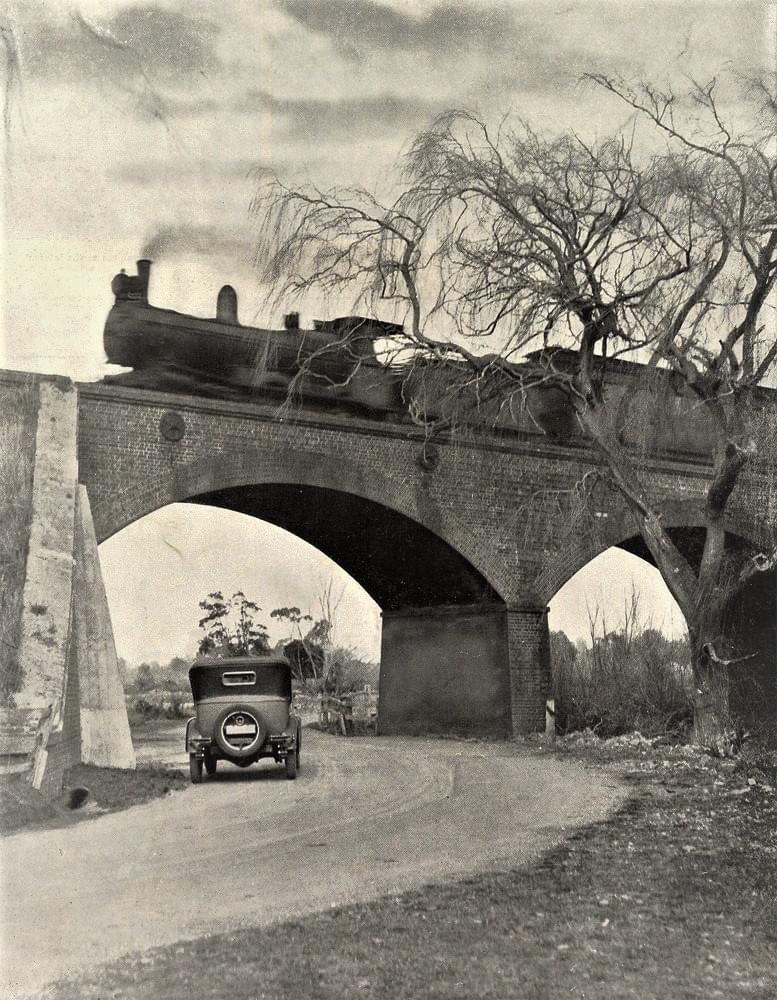
A steam loco probably doing the Hobart to Launceston milk-run – from the south of Tasmania to its north – blasts its way over the Longford Viaduct circa 1930. Points for the train and car make/model/year folks?
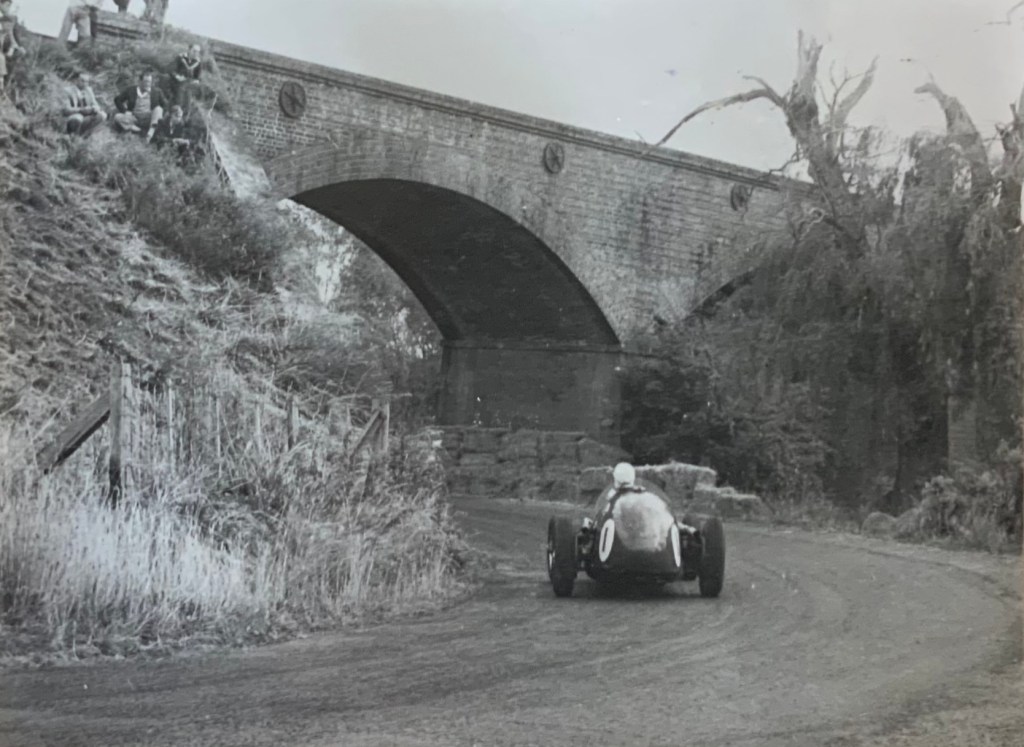
The challenge of course was then to come up with a monochrome photograph of a racing car from exactly the same angle.
Ron Edgerton Collection. As to the first shot, the fella who posted it on Facebook disappeared with his shot as quickly as he arrived. Happy to attribute whoever you are/were.
(unattributed)
Tailpiece…
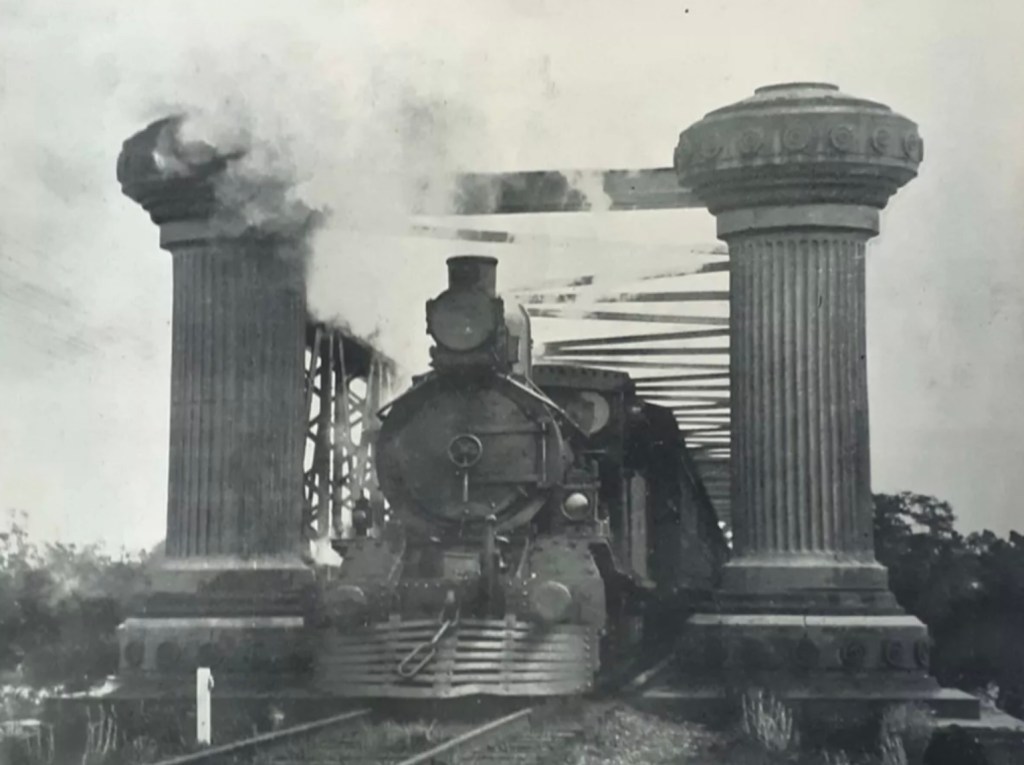
Longford’s Viaduct and Railway Bridge close by to it are popular places for train-spotters.
The lattice-truss, wrought iron and steel bridge which spans the South Esk River was the equal longest bridge in Australia for a decade or so after the Welsh built structure was commissioned in 1870.
Those lovely pillars were removed during the 1960s – where were the Builders Labourers Federation when you needed them – there is a gofundme.com program to raise the $A80k required to replace the four pillars, two at each end of the bridge, an important bit of our industrial heritage.
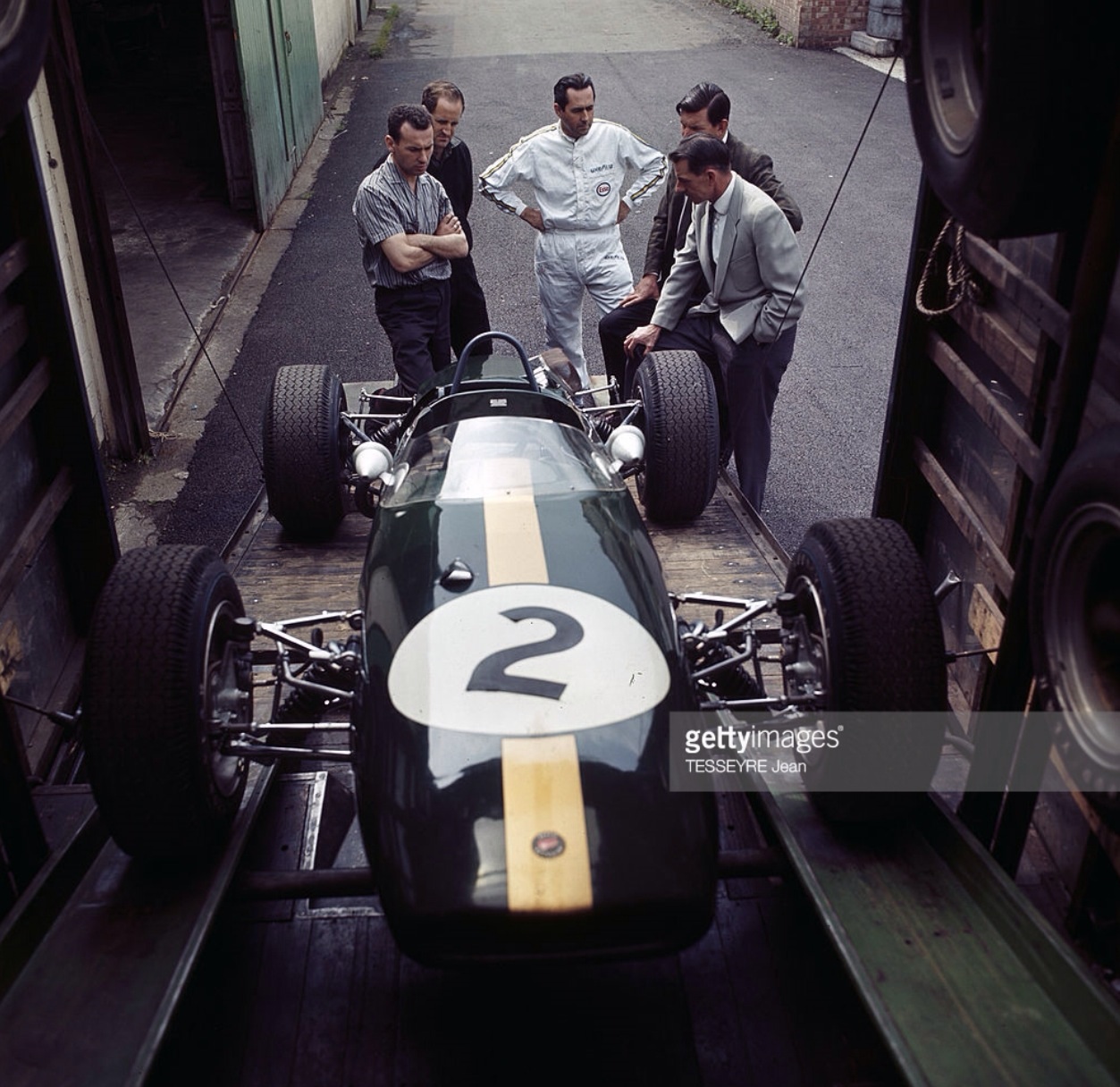
Jack Brabham with his F1 Brabham BT11 Climax, F2 BT16 Honda and one of Ron Tauranac’s bare spaceframes Jack has borrowed from Ron’s production line.
The photo isn’t dated but it’s between mid-June and mid-September 1965 – works Brabhams used number 14 at the Belgian, French, British, Dutch, and Italian Grands Prix.
In some ways it was a bit of an investment year for Brabham. It was their first year using Honda engines and Goodyear tyres, not to forget the Repco Brabham Engines V8s being developed in Melbourne. All of these initiatives paid off in spades the following year. Mind you, investment year or otherwise, Dan Gurney made the BT11 sing in F1 with a swag of top three results, albeit no wins in 1965.
Jack worked with Honda engineers to get more torque from their peaky but powerful 1-litre four cylinder engines. The team partnered with Goodyear from the January-March 1965 Tasman Cup. Lots of work on compounds and profiles helped the Brabham Racing Organisation win the 1966 F2 (Trophees de France) and F1 World championships with Honda and Repco-Brabham powered cars respectively.
The photo requires detective work as the Getty Archive caption has it as a Lotus 33 Climax V8, which it most assuredly is not! The caption reads “Motor Sport Formula 1. In July 1965, during a report on Motor Sport and Formula 1, the Lotus 33 returning to the back of a truck, men and a driver discussing outside.”
While it’s not the French Grand Prix, that year held at Clermont Ferrand in June, it could be during the British Grand Prix weekend at Silverstone during July, a meeting the photographer, noted Paris Match regular Jean Tesseyre, may have attended.
Does it look like the Silverstone paddock to any of you Brits? There was no F2 race on the program but it is possible that Brabham did some test laps during the meeting and/or had the BT16 Honda on display. Perhaps the car is being loaded up at MRD or BRO in Surrey?
I love solving these mysteries if any of you can assist, attendee identification in full would be a bonus…


 (GP Library)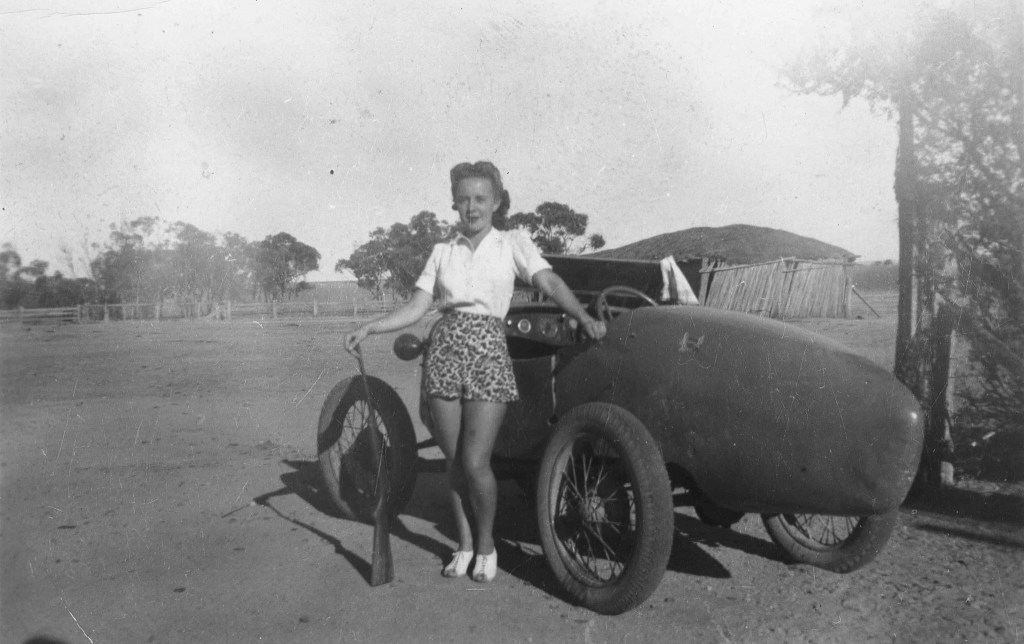



 primotipo...