Archive for the ‘Sports Racers’ Category

image

Evocative Jesse Alexander pre-start shot of the Mario Andretti/Lucien Bianchi Ford GT Mk2 and a young Ford fan…

The American, Italian/Belgian combo survived 97 laps before retiring with head gasket failure of their 6982cc pushrod V8.

Andretti was the ‘young gun’. He won the USAC Championship in 1965 and had plenty of wins too in 1966, but had limited sportscar experience, Le Mans, was his first GT40 race! Bianchi was the opposite, vastly experienced in such cars with three straight Tour de France victories from 1957-9 and a Sebring 12 Hour win with Jo Bonnier in 1962 to his credit.

The pair started 12th and steadily worked their way up the field, but luck was not on their side, retiring in the eighth hour.

They hit it off though, Holman & Moody paired them together again in a MkIV in 1967.

Le Mans 1966 Ford prep

Pre race preparation, Hawkins/Donohue Ford Mk2 in the foreground, the #6 Andretti/Bianchi car clear…a military operation! (Dave Friedman)

The GTs’ famously failed to win in the previous two years but Ford made no mistakes in 1966, no less than thirteen of the powerful cars, both GT40’s and Mark 2’s started with Bruce McLaren and Chris Amon victorious in a Shelby American entered Mk2.

They ‘beat’ Ken Miles and Denny Hulme in the ‘infamous form finish’ in another Shelby Mk2.

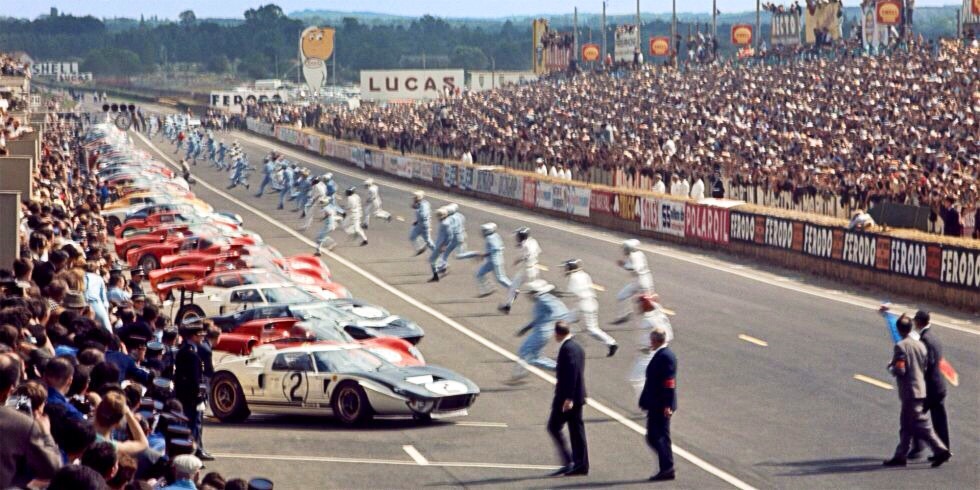
LeMans 1966 grid forming

(Ford Motorsports Archive)

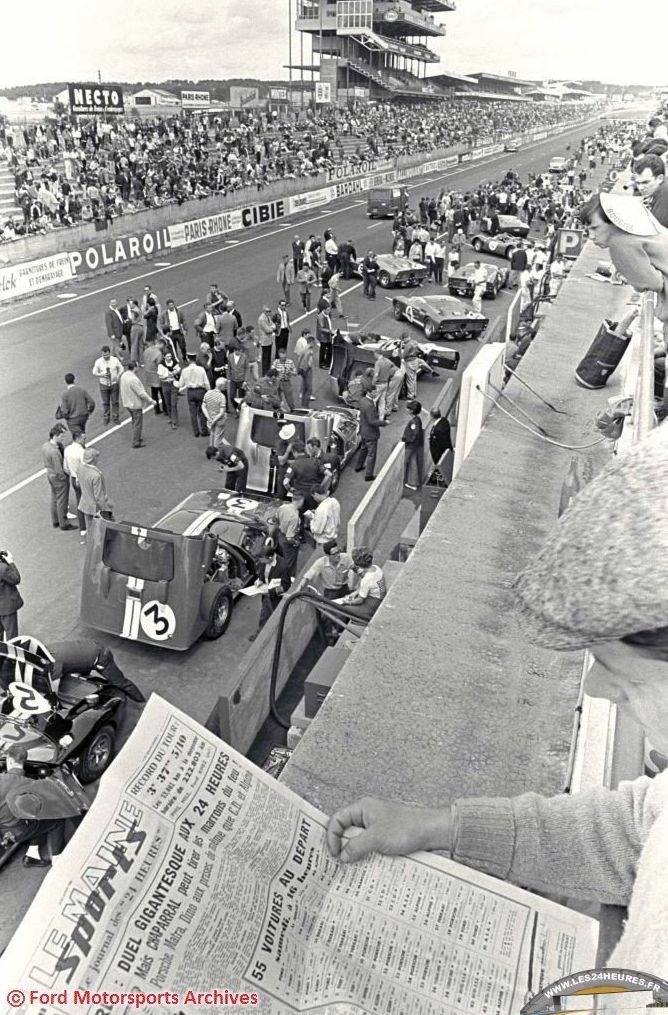
Gridding up pre start, above.

#2 is the victorious McLaren/Amon Mk2, #3 Gurney/Grant Mk2 (DNF), #4 Hawkins/Donohue Mk2 (DNF), and the rest. Captures the moment doesn’t it?

Le mans '66 start

(unattributed)

Le Mans ’66 start, look at that crowd.

#3 Dan Gurney, #4 Paul Hawkins, from grid slot 11!- what a blinder from the race start from the Aussie, #1 Ken Miles, the yellow car alongside is John Whitmore, #2 Bruce McLaren in the winning car- all Ford Mk2, you can just see the tail of the Bucknum Mk2, from 9th on the grid! and the rest.

Hill Le Mans 1966

(Automobile Year 14)

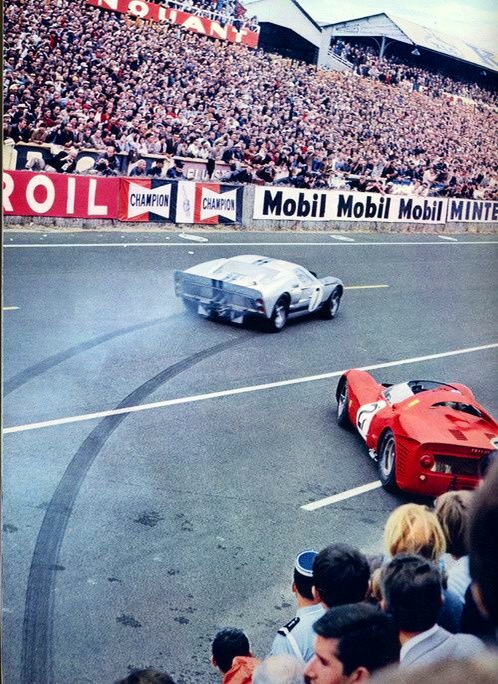
Every man and his dog have used this photograph in online and more traditional media down the decades! I first saw it in Automobile Year- I should check to see who the photographer is- such a marvellous action shot.

Graham Hill squirts his Alan Mann Racing Ford Mk2 off the line leaving the NART Pedro Rodriguez/Richie Ginther Ferrari P2/3 ‘Spyder’ on the line…’slippery diff functioning well.

In a race of incredible attrition amongst the front-runners only three of the thirteen Ford GT’s which started finished and only two Ferrari GT’s of 14 which set off at 4pm were running 24 hours later. The Hill/Brian Muir Mk2 retired on lap 110 with front suspension damage and the Ginther/Rodriguez car on lap 151 with gearbox failure.

Hub repair

(Ford Motorsport)

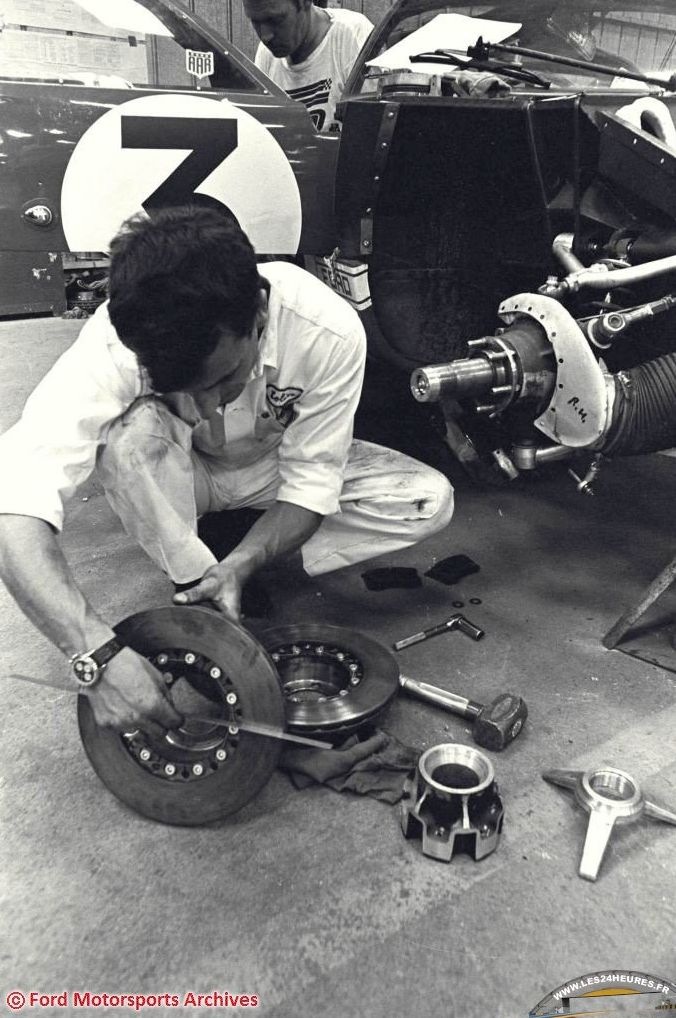
A Shelby-American mechanic checks a new disc before fitment to the Gurney/Grant Mk2 hub assembly.

The beautiful standard of fabrication and workmanship of the front upright and suspension assembly clear in this shot. Front suspension comprises double wishbones, coil spring/damper units and adjustable sway bar. Steering arm also in shot, knock off nut etc.

66 Le Mans form finish...

(unattributed)

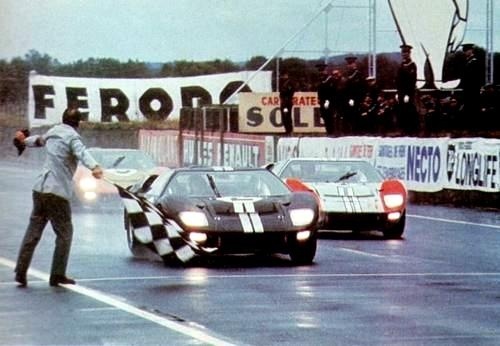
Almost to the finish…the Shelby American cars of McLaren on the left, Miles on the right, at about this point Miles backs off allowing McLaren/Amon to take the win.

The absolute detail of the finish has several versions but the sequence as follows seems to be generally accepted.

At the race halfway mark four GT Mk2’s comprised the lead group. By 9 am only three Mk2’s were left of the ? which started- all the GT40’s had retired. Ford Director of Racing Leo Beebe was not happy as Ken Miles and Dan Gurney had been dicing for the lead- against team orders- the Gurney/Grant car was the last of the Mk2’s to retire just before 9 with head-gasket failure.

1966 formation finish

(unattributed)

It was at this point that Beebe decided upon a ‘dead heat’ between his two lead cars. This, it was thought,  would stop the competition between the remaining cars and emphasise the win as one for the car rather than the driver.

The organising club, the ACO told him that a dead-heat would not be possible as the McLaren/Amon car, which started from grid slot 2, would have covered a greater distance than the Miles/Hulme car which started from pole- a difference according to the club of 8 and 20 metres depending upon the account.

But, assuming the cars were still running at 4 pm, Beebe decided to push ahead with his plan and instructed Miles to ease his pace at the last pit stop- the Miles/Hulme car led at that point, to allow McLaren to catch up.

Just before 4 pm it started to drizzle again.  Ken Miles whilst pissed off, wants no part of it of the contrived finish, so eases gently before the flag in the photo above, or Bruce surged, depending upon the account, allowing Bruce McLaren and Chris Amon /McLaren to take the win.

Miles was dead in a Ford J car testing accident at Riverside, California within two months. The great British American the lead development driver of the GT40 program was in the view of many the more deserving of the drivers to win the race- but there are many layers to this race finish. Beebe’s successful attempt to get his cars to the finish and over the line first is understandable, to say the least, given the failures of the GT40 and Mark2’s at Le Mans in 1964 and 1965.

In terms of ‘deserving drivers’ lets not forget Bruce did a huge amount of the initial GT40 testing for JW Automotive way back in 1964 and subsequently, not to forget that he raced the cars at Le Mans in 1964, (GT40 with Phil Hill DNF gearbox on lap 192) 1965, (Mk2 with Miles DNF gearbox on lap 45) 1966 and 1967 (MK4 4th with Donohue).

Photo Credits…

Jesse Alexander, Ford Motorsport Archive, Automobile Year

Tailpieces…

image

Andretti and friends before the off (Jesse Alexander)


Ford Mk2 rear suspension

Mk2 business end, Daytona 1967. Note 2 roll bars to counteract the forces on the bankings (Automobile Year)

Finito…


ke shop

Victoria Morris’ swoopy Kieft De Soto at rest in Piper Street, Kyneton, Victoria on a very balmy Anzac Day 25 April 2016…

Everything was going nicely until Victoria shattered the peace and quiet of our long, languid ‘Mr Carsisi’ middle-eastern lunch. Thoroughly recommended by the way.

We were out to atone for minor, alleged misdemeanors on my part. Me ‘an the little sabre-toothed tigress were just knocking back the second pinot and tucking into tasty mains as a big, loudish V8 ‘snap, crackle ‘n popped’ its way down quiet Piper Street in the beautiful Macedon Ranges village, 90 Km north of Melbourne.

I couldn’t help myself of course, I just had to see what it was there and then!

image

Too slow to see the driver exit the slinky light green beast, I was quick enough to beat the swarm of ‘rubber-necks’ soon checking out this ‘one of a kind’ car. Patrizia was not a ‘happy camper’, the photo and drool session took a good 40 minutes.

image

This article is long on photos, all of the ‘touristy shots’ are of Piper Street, Kyneton and its immediate surrounds unless otherwise stated.

image

image

Campaspe River, Kyneton

The delicacy of the Kieft’s styling is deceptive I reckon…

It looks lithe and ‘Coventry Climax FWA’ light but totes a big, heavy cast iron De Soto 4.5 litre V8 and has the performance to match. I have spotted the car once or twice at race meetings before, what was great was to see it being used on the road, no doubt driven with considerable brio too!

image

Bill Morris, Terry Cornelius and Greg Snape and the Kieft De Soto in Terry’s Corowa workshop in April 2009 (The Border Mail)

The Kieft is an intensely interesting project. It was the realisation of the dream of its late owner, historic racer Bill Morris and two talented Australian artisans who brought it to life, body builder Terry Cornelius and mechanic/engineer Greg Snape, who did the rest inclusive of project management. Cornelius’ business is in Corowa on the mighty Murray River and Snape’s in Yass, in New South Wales Southern Tablelands.

image

image

image

image

Greg Snape picks up the Kieft story and Morris’ passion for two rather special cars…

‘The Erwin Goldschmidt De Soto engined sportscar was built alongside the Grand Prix car in early 1954’. Goldschmidt was a wealthy insurance broker and champion owner/driver in early/mid-fifties American racing’.

The Grand Prix car is the Kieft ‘GP1’, the chassis’ of which was completed in 1954 but was never completed and raced due to the ‘stillborn’ nature of the Coventry Climax 2.5 litre FPE V8 engine intended to power it.

Nearly 50 years later the car was completed with its correct engine by the Morris/Snape team in the UK in 2002.

Family 2007 002

Kieft GP1; Coventry Climax ‘Godiva’ FPE 2.5 litre, DOHC, 2 valve, twin plug V8 fed by 4 Weber DCNL carbs. On methanol the engine produces circa 260bhp @ 8500rpm. Gearbox is an Armstrong Siddeley ‘pre-selector’ type with specially made close ratios, AP racing clutch (Bisset)

Greg; ‘I had a business in Deniliquin, NSW which I was getting bored with and decided to sell it to move to the UK to get a job in F1 for a change of scene and pace. I rang John Diamond (the late owner of Penrite Oil in Melbourne) to get a reference, told him what I planned to do, he told me historic racer/engineer Bill Morris was in his office and handed the phone over! He had lots of contacts, offered to help me and after I sent him my CV said you will always have job with me if all else fails in the UK’

kieft

The GP car was designed by Gordon Bedson, the chassis a ‘semi spaceframe’ that is, not fully triangulated but with deep side elements tapering towards the front to clear the wide engine. A thin tube structure carries the body. Here Greg Snape races ‘GP1’ at a dry! (is it a pretty car or what?) Winton Historic Meeting in May 2007 (Bisset)

‘So, I packed up the wife and kids and off we went, from Deniliquin to Oxfordshire in late 1996. I worked for Bill for a few months, then did a season with Alan Docking Racing’s F3 team as Mark Webber’s #2 mechanic in 1997. I returned to Bill for a couple of years in 1998, then went to the JSM Alfa 147 BTCC Team in 2001 as #1 mechanic on Tim Harvey’s car and finally the Castrol Hyundai WRC team in 2002 as #1 transmission tech’

Family 2007 009

Kieft GP1 Climax; Front suspension comprises unequal length upper and lower tubular wishbones, coil springs, Spax shocks and a roll bar. Hubs are ‘wartime’ Ford V8 to which new fabricated steering arms were bolted. Rack and pinion steering mechanism and wood-rim wheel are of Kieft manufacture. Rear suspension is independent by upper and lower unequal length wishbones, transverse leaf spring and Spax shocks. The diff is a proprietary ENV unit as fitted to Jags in period mounted in the original magnesium Kieft housing incorporating a ZF ‘slippery mechanism. Winton paddock 2007 (Bisset)

‘Bill ended up with the Kieft F1 car and bits via a friendship he had with Gordon Chapman who he had known for years via their mutual ERA ownership. Unfortunately Gordon died. Bill tried to sell all the bits on behalf of Guy’s widow Jeanie but eventually decided to take it on himself. He asked me to work on the project, the deal was that I spent half my time rebuilding pre-selector gearboxes for Bill’s clients and half the time building up the Kieft F1 car, it’s a whole fabulous story for another time’.

Family 2007 004

Radical for its day, Dunlop disc brakes as used on the Jag XKC were specified. Wheels are new cast magnesium to the original Dunlop patterns, 5/5.5 inches wide front/rear and 16 inches in diameter. Lago Talbot T26C alongside the Kieft GP1, Winton May 2007 (Bisset)

‘Throughout the process of building the Kieft GP car we were in regular touch with Cyril (Kieft) who was both helpful and really keen to see the finished car. During this process he told Bill about the sportscar.

Essentially the car was built in the UK, sent to the US where it was hillclimbed and damaged. It was rebuilt but then stolen in the 1980’s and an insurance payout made. It was all said to be a bit ‘suss’ but over the years even though some people claimed to know where components were Bill couldn’t track anything down nor has anyone ever claimed to have the remnants of the car’.

‘So Bill decided to build a ‘reconstruction’ of the Kieft De Soto using components from the spare original chassis he bought with the F1 project’.

‘Kieft built three sets of parts for the GP cars in period and two chassis. The first car is the one we know and love (‘GP1′) the second incomplete chassis comprising the main structural tubes with magnesium front bulkhead attached was hanging on rafters in Bills workshop and ultimately sold together with GP1 when Bill auctioned it.’

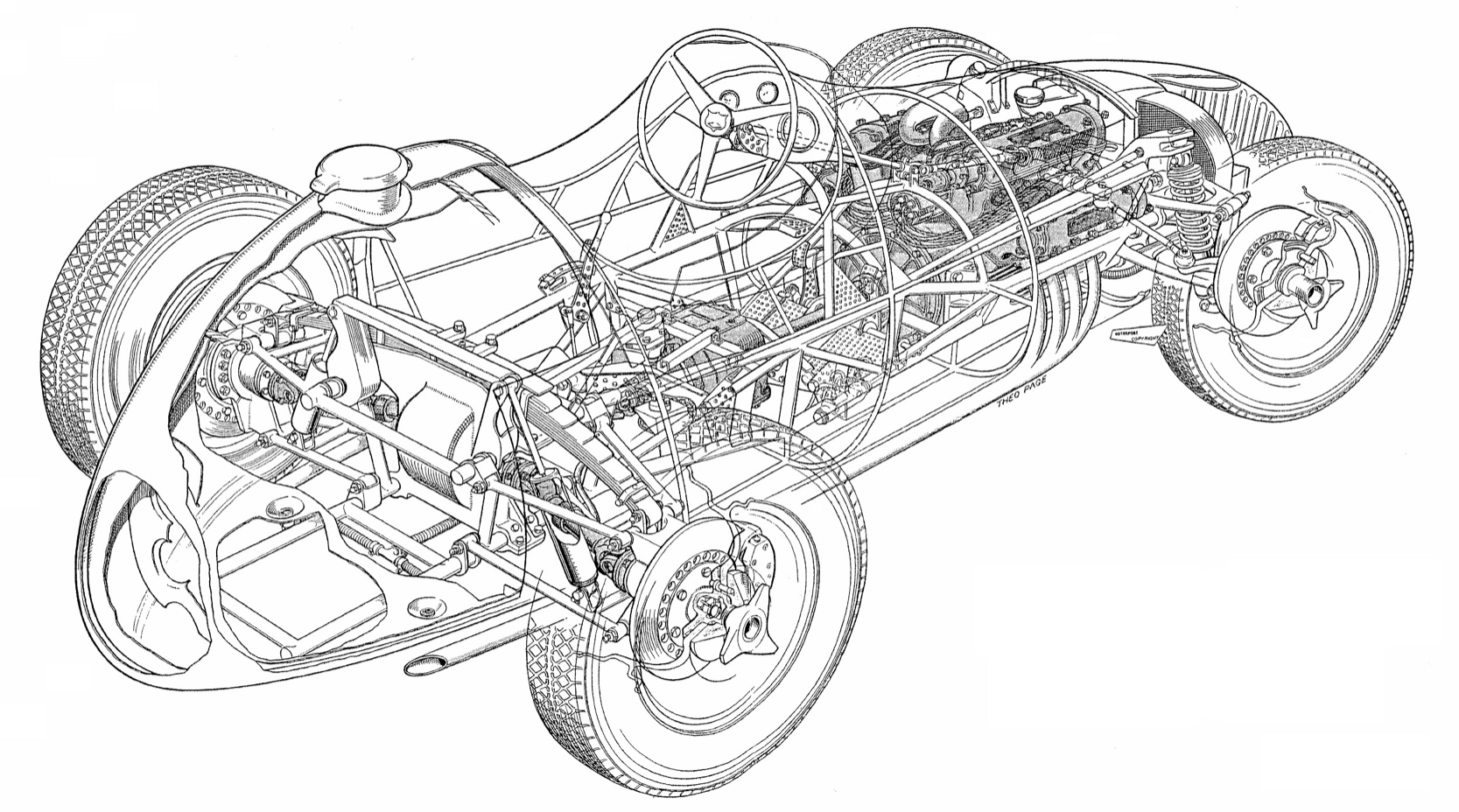
(T Page)


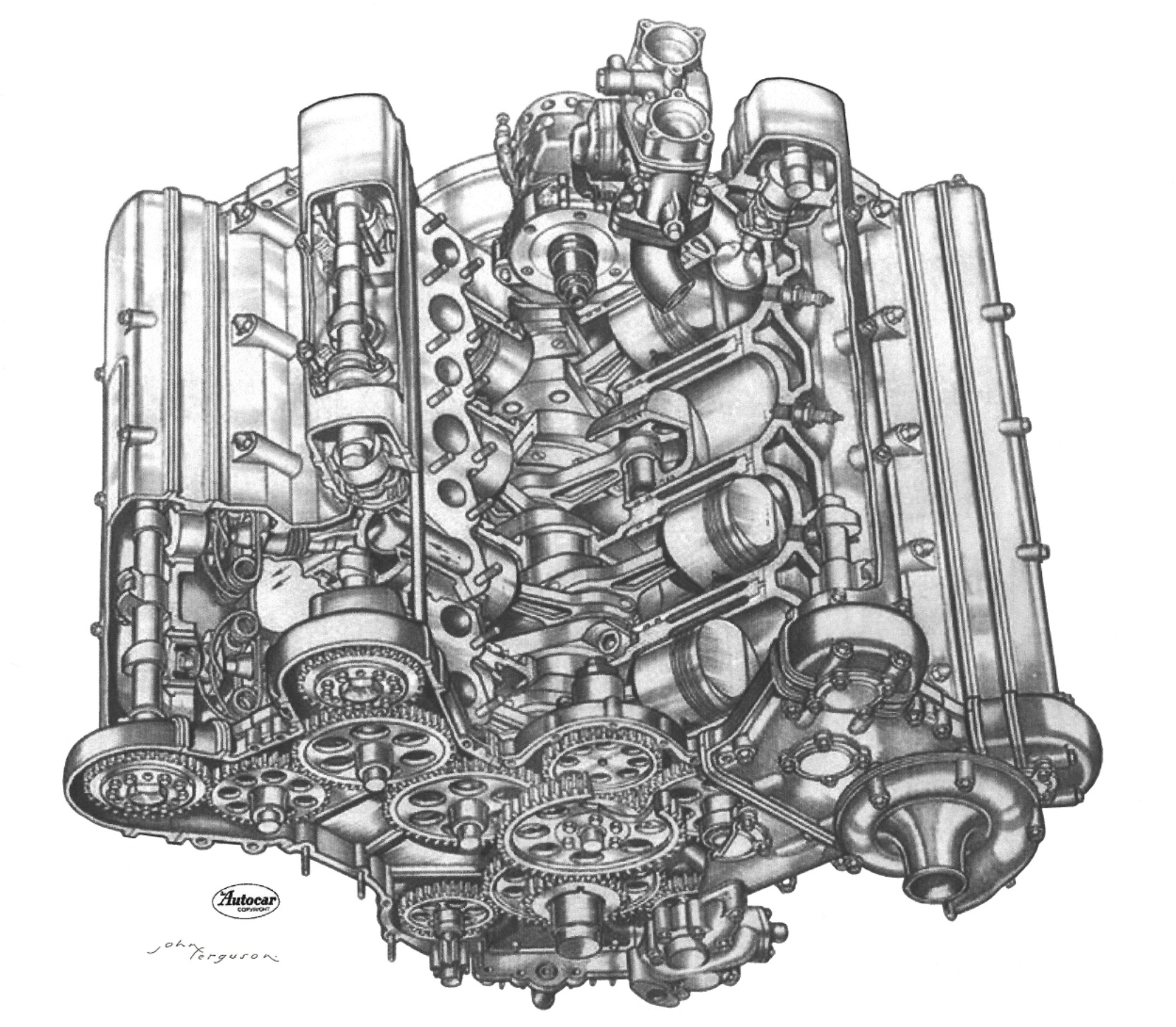
Coventry Climax FWE 2.5 litre V8 

‘We used the components that came with the second GP car chassis to recreate the sporty.

Really the sports car chassis was completely different to the F1 car but the suspension bits; hubs and uprights, magnesium diff housing were the same. The F1 car has Dunlop disc brakes, the same components which went on the Jag C Type, it stops incredibly well, the brakes on the sportscar are drums, a 13 inch standard Girling size on the front and 12inch Jag components on the back’.

image

(The Border Mail)

The original bodies of both GP1 and sportscar were built by EW Humphries Ltd in Wolverhampton, the sportscar then fitted out at Kieft’s Derry Street, Wolverhampton works, painted white and  exported to the US. Here Terry Cornelius (above) checks his reference material in his Corowa workshop during the cars build.

‘The sportscar was installed with a De Soto ‘Fiedome’ 4.5 litre V8, a Jaguar ‘Moss’ gearbox with close ratios, and same as the GP car, an ENV rear axle in a Kieft housing’.

‘The chassis wasn’t straight forward other than the two main frame longerons but Duncan Rabagliati of the GP Library had some original photos which were invaluable. Whilst the F1 car was in Australia in 2006/7 I stripped it down and made a jig which, with the photos, allowed us to get the chassis and suspension pick-up points and therefore the geometry spot-on. We knew that it would be great as the F1 car handled so sweetly and progressively’.

image

Original Kieft chassis frame main tubes clear clear as is ‘Superleggera’ construction method, what else does Cornelius have in his Corowa shop? (The Border Mail)

‘Terry Cornelius did a sensational job with the body which was all done by looking at photos and building accordingly. Its easy to say but much harder to do! Bills health at this stage was holding up pretty well, he eventually died from a degenerative disease which gradually destroyed his central nervous system’.

‘Bill and his wife had a place at Lancefield in country Victoria as well as in the UK, they lived 6 months in each, so he was able to help with direction of the project. Funnily enough, in a tragic kind of a way, when he saw the body for the last time before going back to the UK where he died, he ‘looked at’ the body largely by feel. He said to Terry,‘I think the body will crack here’, near an intersection of curves at the front of the rear wing, sure enough that’s exactly what happened 12 months later! Terry has chosen not to repair the crack as a tribute to Bill’s great knowledge of all things automotive.’

image

De Soto 276cid  V8, ‘Moss’ box and bellhousing ready for installation in the car. Note beautifully fabricated extractors and single 2 barrel Rochester carb (Peter Delaney)

The heart of a car is its engine of course. Goldschmidt specified and provided a new 276 cid/4.5 litre, cast iron OHV V8 from De Soto’s new for 1952 ‘Firedome’ family sedan for Kieft to fit his new car. It was De Soto’s first such engine since 1931. The oversquare 3.5/3.344 inch bore/stroke engine, fitted with hemispherical combustion chamber cylinder heads was ‘state of the art’, an ‘engine with high performance characteristics’ as Motor Trend magazine put it.

Modern though it was, in production form developing circa 160bhp, it was heavy ‘the engine weighs a ton, I don’t know how much but I reckon the heads alone weigh as much as an A-Series BMC engine!’ quips Greg.

The relatively lightweight ‘Small Block’ Chev and Ford V8’s with their thin-wall casting techniques changed the world of motor racing but they were still a few years away in 1954. But there were plenty of sportscars in the burgeoning US scene using a range of heavy but powerful V8’s that pushed Ferrari and Maserati to build cars with progressively bigger engines throughout the 1950’s.

image

Degree of difficulty in building the body from little reference material clear, note the light tubes to which the hand formed and rolled aluminium sheets are attached (Cornelius)

image

Lots of compound curves, workmanship superb (Cornelius)

‘The engine fitted is a 276cid De Soto Firedome exactly the same as the original car before it left the UK. Its been only lightly modified as was the case with the original, we needed  to go that way to be eligible for FIA papers and Bill and Victoria wanted a car they could use on both road and track’.

‘It has a set of fabricated extractors, been bored out 40 thou, has 11:1 compression ratio and a mild high lift cam. High comp pistons, light rods, oil pump and oversize valves are from ‘Hemi Hot Heads’ in the US.’

‘Fed by a 2 barrell Rochester carb it develops around 350bhp at only 4800rpm, not high but its under-carbed, the thing has heaps of torque, its got a big, fat torque curve from 2000-4500rpm, bags of grunt and it doesn’t weigh much’.

image

Terry Cornelius left and Greg Snape proudly show off their superb creativity and workmanship, KD-S nearly complete early in 2009 (Cornelius)

snape winton

Greg Snape samples the Kieft De Soto’s power upon its race debut at Winton Historics in May 2009 (unattributed)

‘I phoned Bill one night not long before he passed away, started it up and gave it a few revs over the phone. Victoria said he looked as happy as a kid in a sweet shop! Unfortunately whilst Cyril saw and sat in the F1 car he didn’t get to see the De Soto Kieft either’.

‘Bill passed away just before Terry and I finished the car about a week before its race debut at Historic Winton in 2009. Victoria was keen to fulfil Bill’s dream to reunite the two Kiefts at the Goodwood Revival in the UK, she shipped the car to the UK and I raced it at Donington Park and at the Goodwood Revival Meeting in September 2009′.

snape good wood

Snape contests the ‘Freddie March Memorial Trophy’ in 2009, KDS looks beautifully balanced and putting its power down nicely on turn-in  (unattributed)

‘Its really quick in a straight line, capable of 150mph and clocked at 132mph at Goodwood but the suspension needed more sorting. No big deal just spring/shock settings, the sort of stuff which would have been got right if the car was to be a racer rather than a roadie which occasionally does a meeting. It holds the road well. The brakes aren’t as good as the discs on the F1 car and also needed sorting in terms of balance and pad material, I think we were probably off its potential by around 5 seconds a lap.’

image

Snape in the Kieft, Eastern Creek, New South Wales (Bruce Moxon)

‘When the car came back to Australia we ran it at an HSRCA meeting at Eastern Creek, out to Sydney’s west.

It was a stinking hot weekend and the car started overheating after a few laps, it was a case of keeping an eye on the gauges and driving it accordingly’.

When I looked at the Kieft in Kyneton I was struck by the high standard of finish for a one-off, the leather seats were made by Greg’s wife Glenda. It has a full set of matching Smiths instruments for example. ‘Bill was apprenticed to Smiths originally so knew exactly what instruments were needed for the period inclusive of the lovely chronometric tach.’

‘For most of the project he was well enough to have lots of input into all of this detail stuff. The overall result is sensational to look at and even better to drive!, something which Victoria does often’, including regular drives from Lancefield to Kyneton as she did on the day I was lucky enough to see and hear the car…

image

image

image

image

image

image

Kieft Cars…

Click on this link for a great summary of the creativity of Cyril Kieft;

http://www.500race.org/web/Marques/Kieft.htm

image

image

image

Winery, Tylden

Etcetera…

ke front

ke wheel

ke rear

ke logo

ke profile

ke mirror

ky dump

Tylden

ky sun

Kyneton Avenue of Honour shot on Anzac Day, ‘Lest We Forget’, 25 April 2016

Photo and other Credits…

Mark Bisset, Terry Cornelius, ‘The Border Mail’ newspaper, Bruce Moxon, Peter Delaney, Theo Page, John Ferguson

Special thanks to Greg Snape for the generosity of his time

Tailpieces…

ky shop 2

ke village

image

(Darrell Ingham)

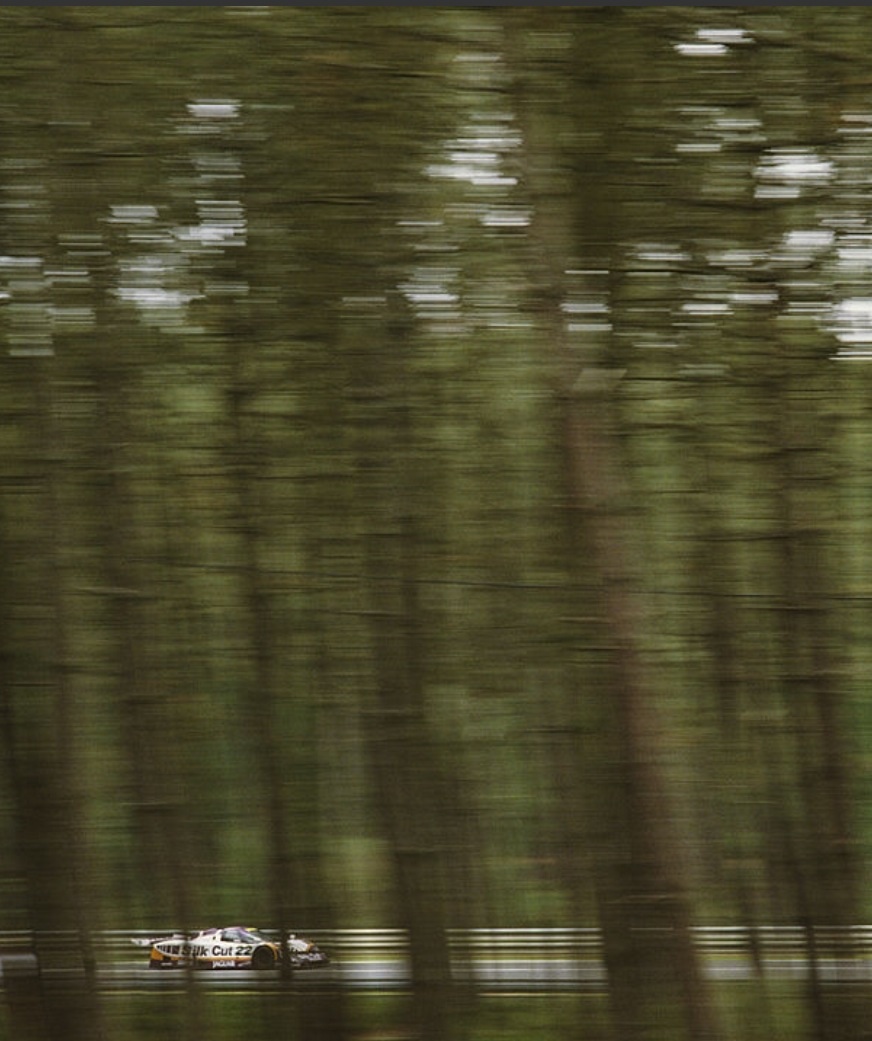
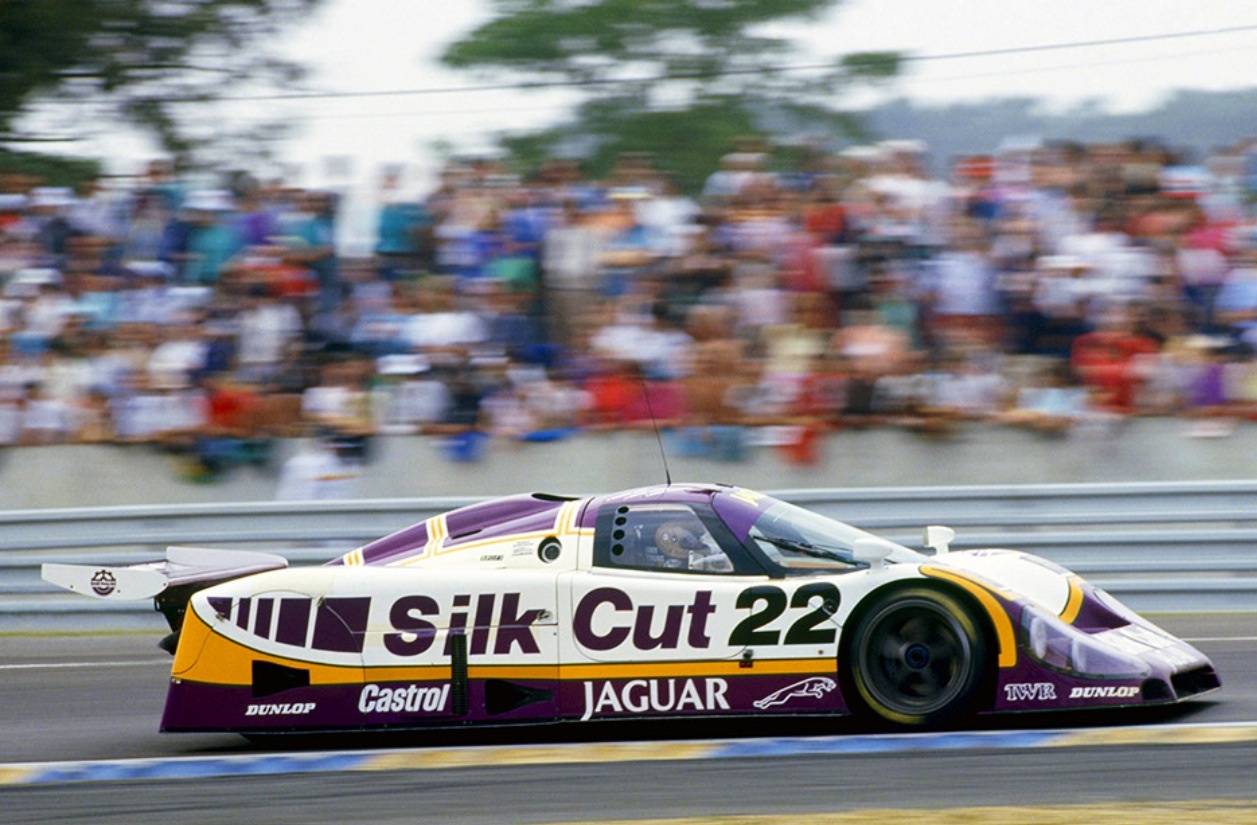
Larry Perkins amidst the Le Mans forest finished 4th in the ’88 classic in this Jaguar XJR-9 V12…

The 7 litre car was co-driven by Kevin Cogan and Derek Daly finishing 11 laps behind the winning sister car of  Johnny Dumfries, Jan Lammers and Andy Wallace.

image

A story about the amazingly talented driver/engineer ‘Larrikins’ international career inclusive of F3, F1, F Pac and the occasional sportscar race is one for another time…

Credit…

Darrell Ingham, Shane Lee

Tailpiece…

image

(Shane Lee)


image

Somehow I think the local boyos aren’t getting excited about the rear of Andre Hechard’s D.B-Panhard HBR?…

This shot was taken in Brescia during the 1956 Mille Miglia which was won by Eugenio Castellotti’s Ferrari 290MM Scaglietti . Hechard’s Sports 750 class car DNF, no details of the lady sadly…

Credit…

Carlo Bavagnoli

911S

(Rolling Road)

Jim had a great weekend, he knocked off the V8’s and won the ‘AJC Trophy’ round 5 of the 1970 Australian Touring Car Championship on 12 July…

Allan Moffat’s Trans-Am Mustang was on pole but he spun on the first corner taking out Pete Geoghegan’s Mustang and Brian Foley’s 911S, McKeown took the win. Outright contender, Norm Beechey’s Holden Monaro lost a rear wheel, Bob Jane’s Mustang was second and Bill Brown, 911S finished third-fast, robust, reliable beasts 911’s…

image

Foley in the WF paddock, ATCC round 1970 (Rolling Road)

The ex-factory specification of these cars is infinitely variable to special order and in summary comprises…

Engine; six cylinder, horizontally opposed ‘boxer’, SOHC two valve, 2247cc. Compression ratio 10.3:1, three 46IDA Weber carbs, Marelli distributor, bigger valves and polished inlet and exhaust ports giving circa 240bhp @ 8000rpm.

Five speed gearbox with ‘slippery’ diff, external oil pump, cooler and vast array of ratio choices The body was lightened by deletion of bumper over-riders, rubber locks, simplified interior, wings widened and the front bumpers were made of fibreglass.

Wheels; 7 and 9 inches front and rear in width, 15 inches diameter.

For those with an interest in these cars attached is a link which shows you the factory options for both the 1970 911 and 914-6 and later 3 litre Carreras, wallet size the only limiting factor;

https://onedrive.live.com/?authkey=%21ADIWaF_m7_hVjME&id=C806C41D17D73AC8%216464&cid=C806C41D17D73AC8

(D Simpson)

Etcetera…

Brian Foley on the way to third place during the 26 July 1970 Lakeside Australian Touring Car Championship round- Norn Beehey won in his Holden Monaro GTS350 and Bob Jane was send in his Shelby built Ford Mustang. Hasn’t Dick Simpson caught the car superbly, Foley dancing the car right on its toes.

At the opening championship round at Calder (below) in March Foley and McKeown had a fantastic tussle for second place which was resolved in Brian’s favour- up front Allan Moffat’s not quite twelve months old KarKraft/Bud Moore Ford Mustang Trans-Am took the win. Bob Jane was fourth, then Bill Brown’s 911S fifth and Bill Fanning’s Lotus Cortina Mk1 sixth.

Brian Foley in the right-left wiggle off Calder’s back straight (J Lemm)


Foley from McKeown in the battle for second place- onto the back straight (R Davies)


Foley, McKeown Calder dice from the rear heading into front straight (R Davies)

Lynton Hemer (below) catching Foley on the hop and committed coming down The Dipper at Mount Panorama, Bathurst, Easter 1970- ATCC round.

Beechey won this encounter from the Pete Geoghegan and Bob Jane Mustangs.

(L Hemer)

This is a beauty, its twelve months hence- the June 1971 ATCC round at Mallala- the South Australian Touring Car Championship race which was won by Bob Jane’s big, booming seven litre Chev Camaro ZL1 from Pete Geoghegan’s and Allan Moffat’s Mustangs.

Foley and McKeown were still at it but by this stage Brian was racing an ex-works 2 litre Alfa Romeo GTAm whilst McKeown was still running his 911S. Foley made the change to the Italian coupe as he had opened an Alfa Romeo Dealership in Sydney- KcKeown was fourth and Foley fifth.

(J Lemm)

Recently the ex-Foley 911S/T, both the Foley and McKeown cars were fitted with factory S/T kit of goodies has been restored by Melbourne’s Ian Henderson.

These shots are of the cars appearance at Phillip Island in March 2016. Use of the period Chesterfield Racing transporter is a nice touch!

image

(Bisset)


image

(Bisset)


image

(Bisset)


image

(Bisset)


image

(Bisset)

Credit…

The Rolling Road, Dick Simpson, Nigel Watts, Mike Jacobson of Spyder Automobiles for the information on ex-factory parts, John Lemm, Robert Davies

Tailpieces: McKeown and Brian Foley in 911S’ doing the wheel lifting 911 thing, Energol Corner, Oran Park 1970…

image

(Nigel Watts)

McKeown at the 1970 Bathurst ATCC round, fourth in the race won by Beechey’s Holden HT Monaro GTS350.

image

(Dick Simpson)


McKeown and Brian Foley in 911S’ doing the wheel lifting 911 thing, Energol Corner, Oran Park 1970.

Finito…

girl

(GP Library)

The little girl seems lost amongst the flurry of pre-race preparation in JW Automotive’s workshop near Le Mans 0n 29 September 1968…

It was not to be a happy race for the pictured car #11, chassis ‘1076’ driven by Aussie Touring Car and Sportscar star Brian Muir and Jackie Oliver. Brian tipped the car into the ‘kitty litter’ on lap 1, and managed to dig himself out but in the process fried the cars clutch, causing its retirement after completing 15 laps.

muir

Teddy Pilette watches Muir digging his Ford out of the sand, the VDS entered Alfa T33/2 failed to finish with driveshaft failure on lap 104 (unattributed)

JW Automotive entered three GT40’s; ‘1074’ for Paul Hawkins and David Hobbs, ‘1075’ for Pedro Rodriguez and Lucien Bianchi and the aforementioned ill-fated ‘1076’…

It was to be a great race for the team despite the poor start, Rodriguez/Bianchi won the classic by 5 laps from the Porsche 907 of Rico Steinemann and Dieter Spoerry. The Hawkins/Hobbs car retired on lap 107 with engine failure.

le amns gulf line up

JW 1968 Le Mans lineup; #9 the winning ‘1075’ of Rodriguez/Bianchi, #10 Hawkins/Hobbs and #11 Muir/Ickx (unattributed)

le amns start

Brian Muir gets away closest to the pits in GT40 #11 determined to make up lost ground…#14 Masten Gregory/Charlie Kolb Ferrari 250LM DNF , this NART entered chassis the car in which Masten won in 1965 co-driving with Jochen Rindt, #30 Andre de Cortanze/Jean Vinatier Alpine A220 Renault 8th, #3 Henry Greder/Umberto Maglioli Chev Corvette DNF and #60 Willy Meier/Jean de Mortemart Porsche 911T DNF (Schlegelmilch)

la mans start

le mans feeris wheel

All the fun of the fair, Le Mans 1968 (Getty)

le amns color

(Getty)

le mans pommes frite

Plenty of pommes frites (Getty)

Lucien Bianchi (below) in the victorious Ford GT40 ‘1075’ this chassis became one of the greats of the event winning it again in 1969 driven by Jackie Ickx and Jaclie Oliver who had rather better luck than the year before!

In 1968 JW also won the Brands 6 Hour, Spa 1000Km  (Ickx/Oliver in ‘1075’), Monza 1000Km (Hawkins/Hobbs in ‘1074’ and Watkins Glen 6 Hour (Ickx/Bianchi in ‘1075’) in addition to Le Mans winning for Ford the Manufacturers Championship.

At the 1969 years end the wonderful Ford GT’s from a ‘factory perspective’ competed no more having won Le Mans from 1966 to 1969, fitting results from one of the all time sports/racer greats.

le mans rodrig

Bianchi in the winning Ford GT (Schlegelmilch)

le mans pits @ end

A Porsche 907 chasing 2 Alfa T33/2’s and below Rogriguez/Bianch aboard the winning JW GT40 (Getty)

le mand s podium

Rodriguez, Bianchi and well earned Moet (Getty)

Etcetera…

le mans jw

John Wyer (left) confers with his timekeeper during the race (Getty)

image


le mans gendermes

The gendarmes start to prepare for the traditional 4 pm finish (Getty)

le amns poster

Credits…

GP Library, Rainer Schlegelmilch

Tailpiece: ‘More friggin’ sand than Bondi Beach, Sydneysider Brian Muir is thinkin’ to himself?…

le amns digging

jane

(Bryan Liersch)

Bob Jane leading his champion driver, Spencer Martin onto the Hume Weir dummy grid for his first race in ‘Bob’s baby’, his Elfin 400 Repco 4.4 V8, June Queens Birthday weekend 1967…

Martin was by then the reigning national Gold Star Champion. In fact he was half way through a year in which he won his second title on the trot, and then having achieved his motor racing aims retired from the sport at elite level’.

#85 in the background is the ex-Bib Stillwell, Tony Osborne owned Cooper Monaco Olds V8 driven by Ian Cook.

Click here for an interesting article on Spencer; https://primotipo.com/?s=spencer+martin

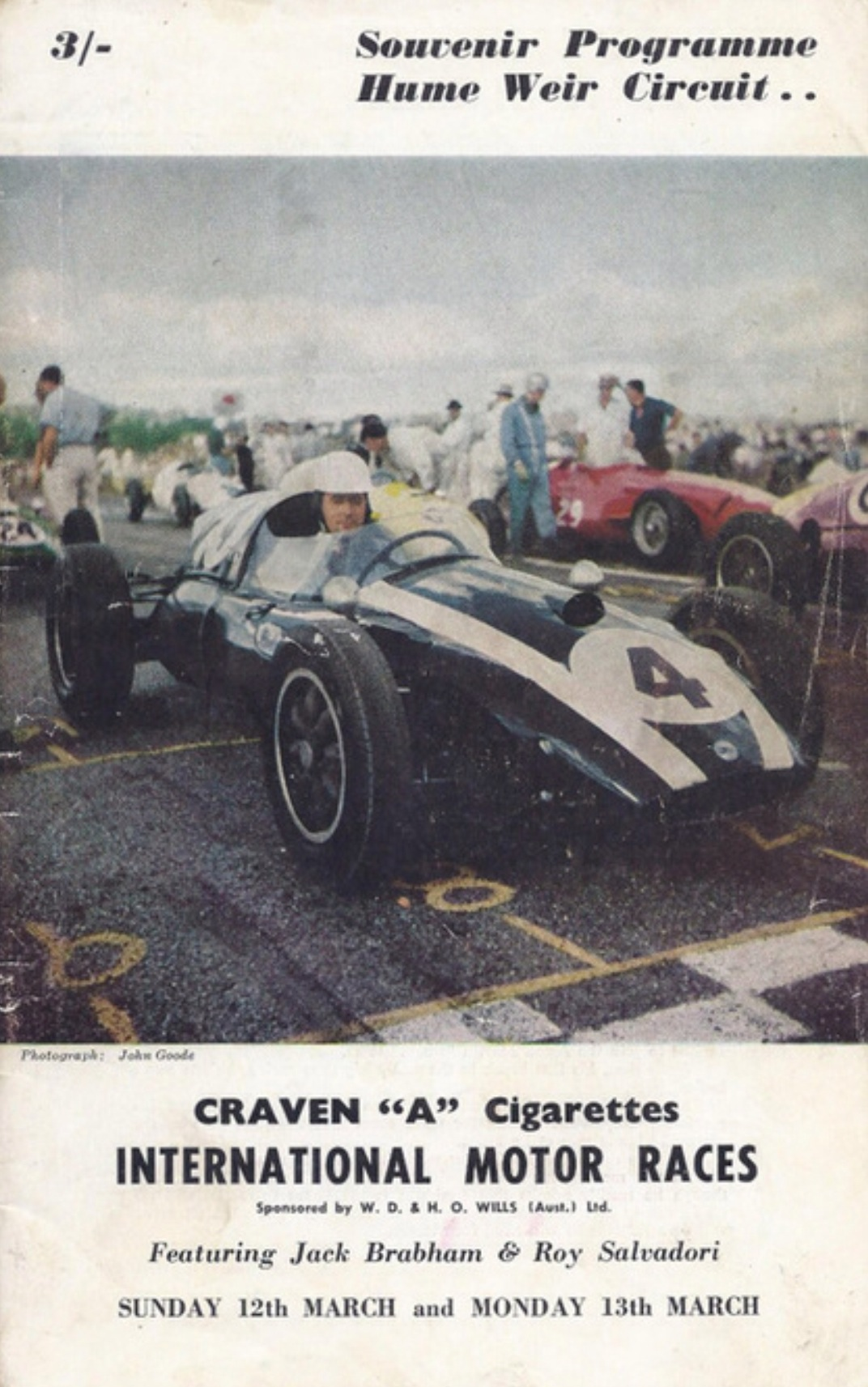
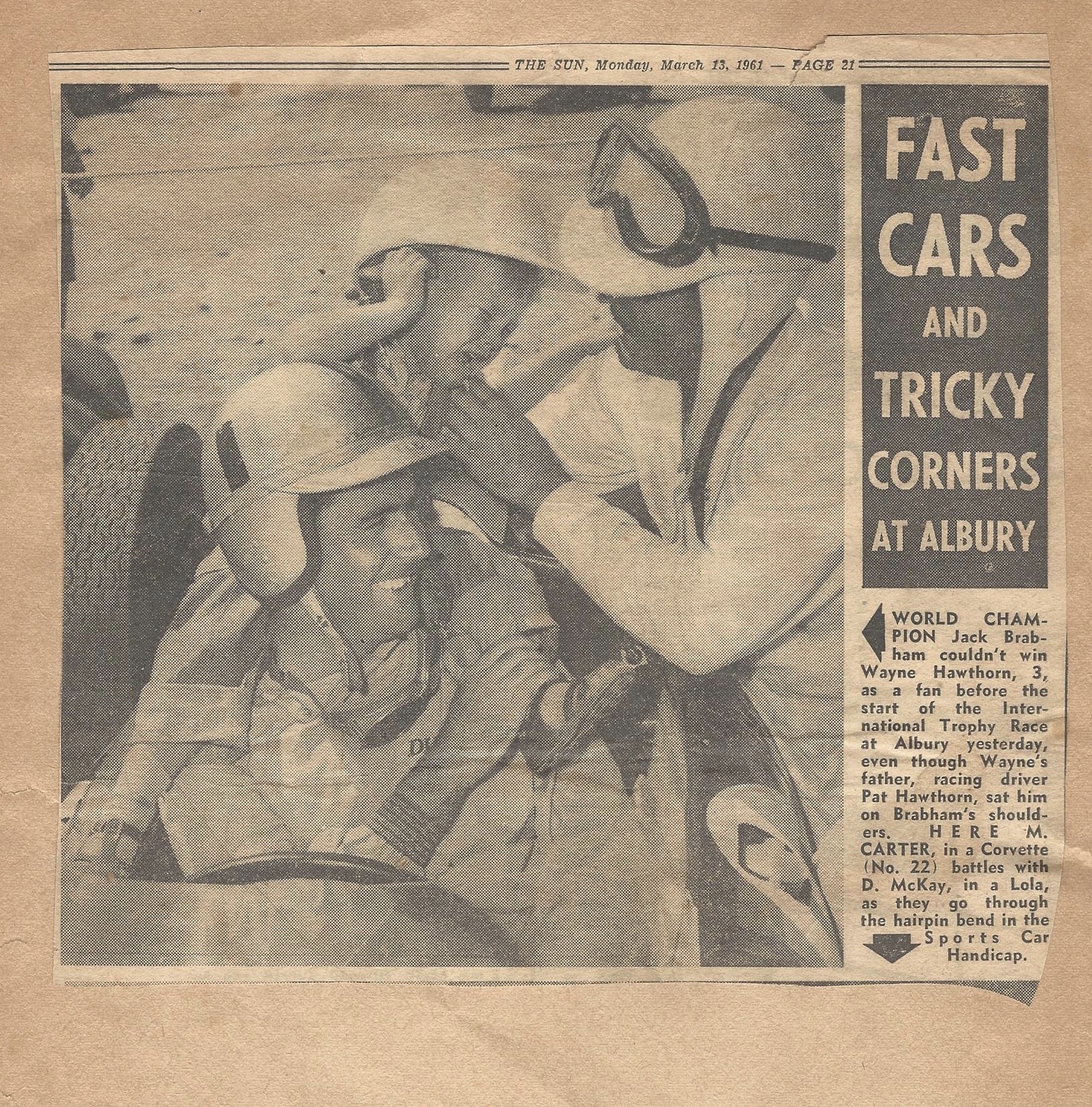
The inspiration for this article are a number of great shots of the Hume Weir circuit near the mighty Murray River and border of New South Wales and Victoria. The circuit, closed in 1977 won’t be on the radar of international enthusiasts although Jack Brabham and Roy Salvadori raced there during the Australian International races in the summer of ’61.
Brabham 1961, Cooper T53 Climax (C McQuellin)


hum jb

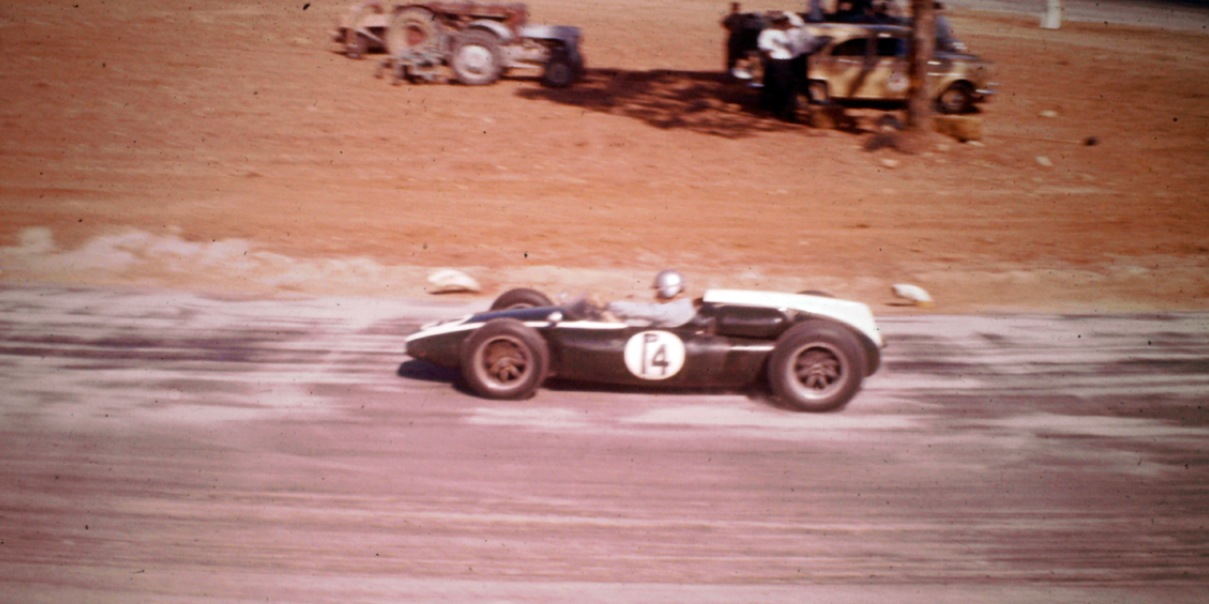
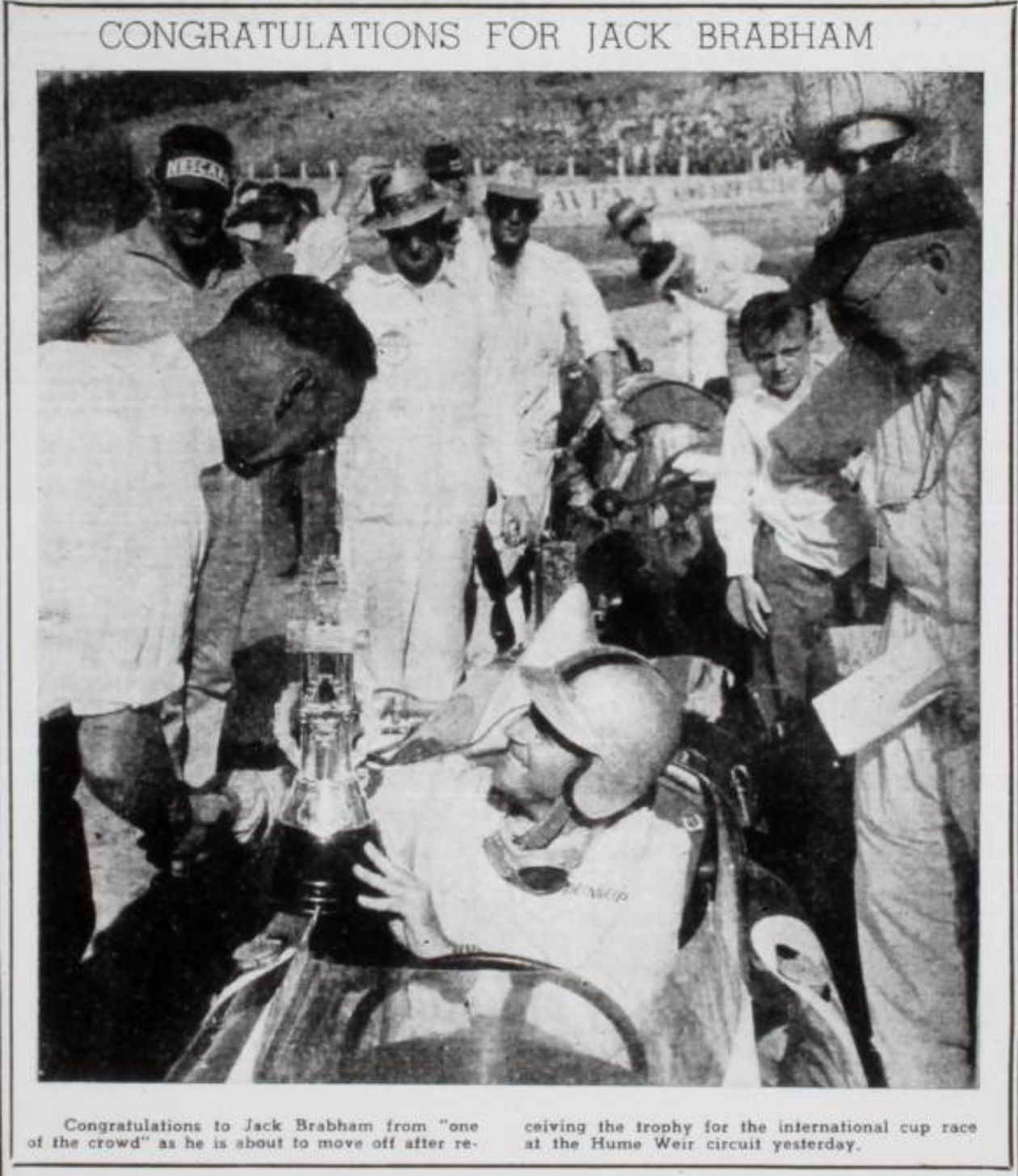
Jack Brabham wins the ‘Craven A International’ in his Cooper T53 Climax in March 1961, love the ‘Fergy’ in the background, Hume Weir  (unattributed)


JB post one of his wins with booty, ours is a parched brown land (C McQuellin)

I knew the circuit, i just missed racing there, it was closed by 1979 when in bought my first Formula Vee, was built in a disused quarry which provided construction stone and gravel material to build the Hume Dam, particularly its retaining wall. Although a Victorian i am a Thredbo skier, a legacy of 9 years working in Sydney and for years summer and winter have driven from Melbourne along the stretch of road from Ebden to Tallangatta with Lake Hume to my left. From Khancoban where the Alpine Way starts is a phenomenal drive to Thredbo Village. This drive, in fact the whole journey from Albury through Corryong, Khancoban, Geehi and Dead Horse Gap to Thredbo is one of Australia’s great drives.

Watch the ‘coppers’ though they police it furiously, the area near Scammells Lookout, a must stop, is an area to stick to the limits in particular!

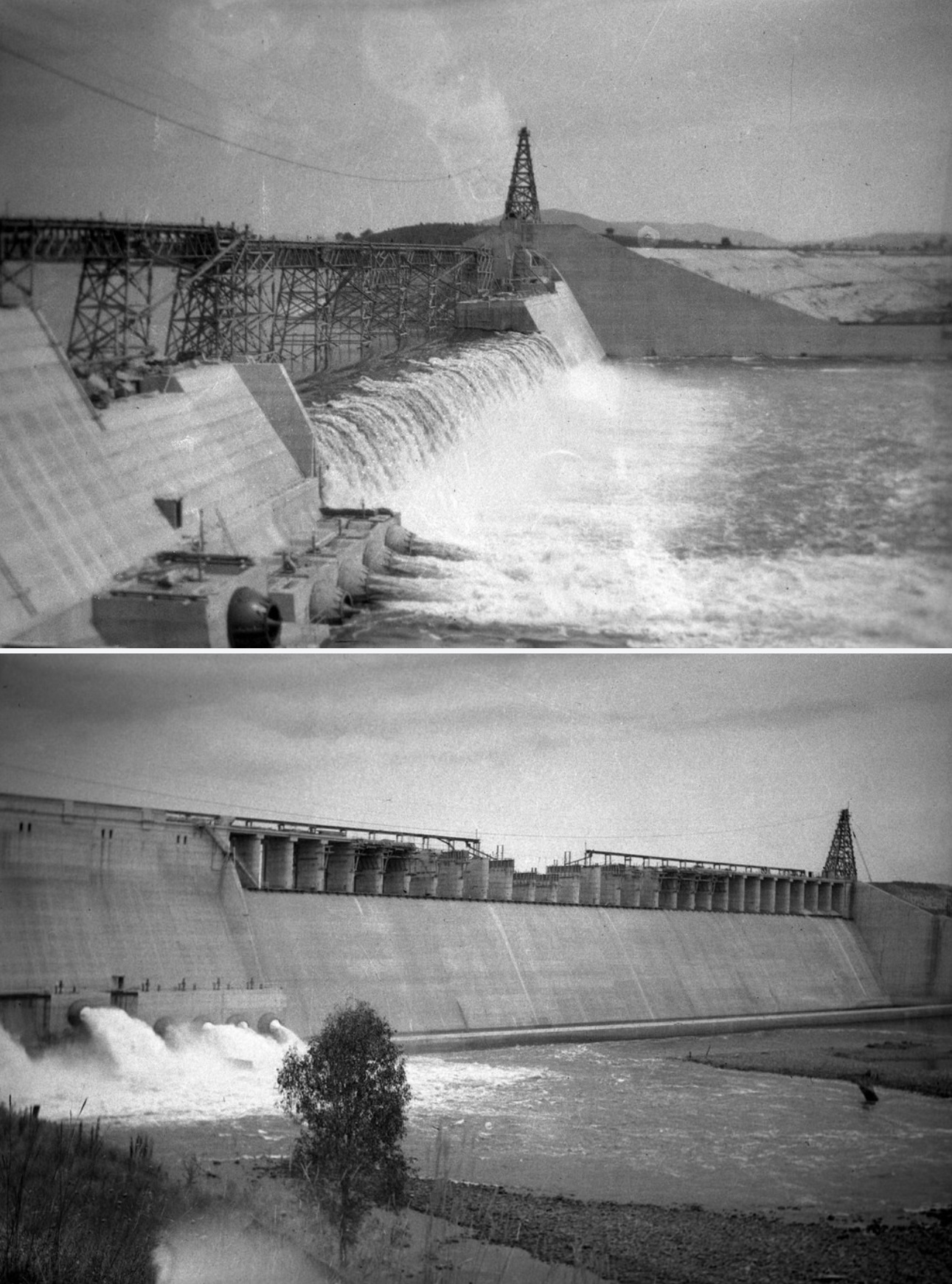
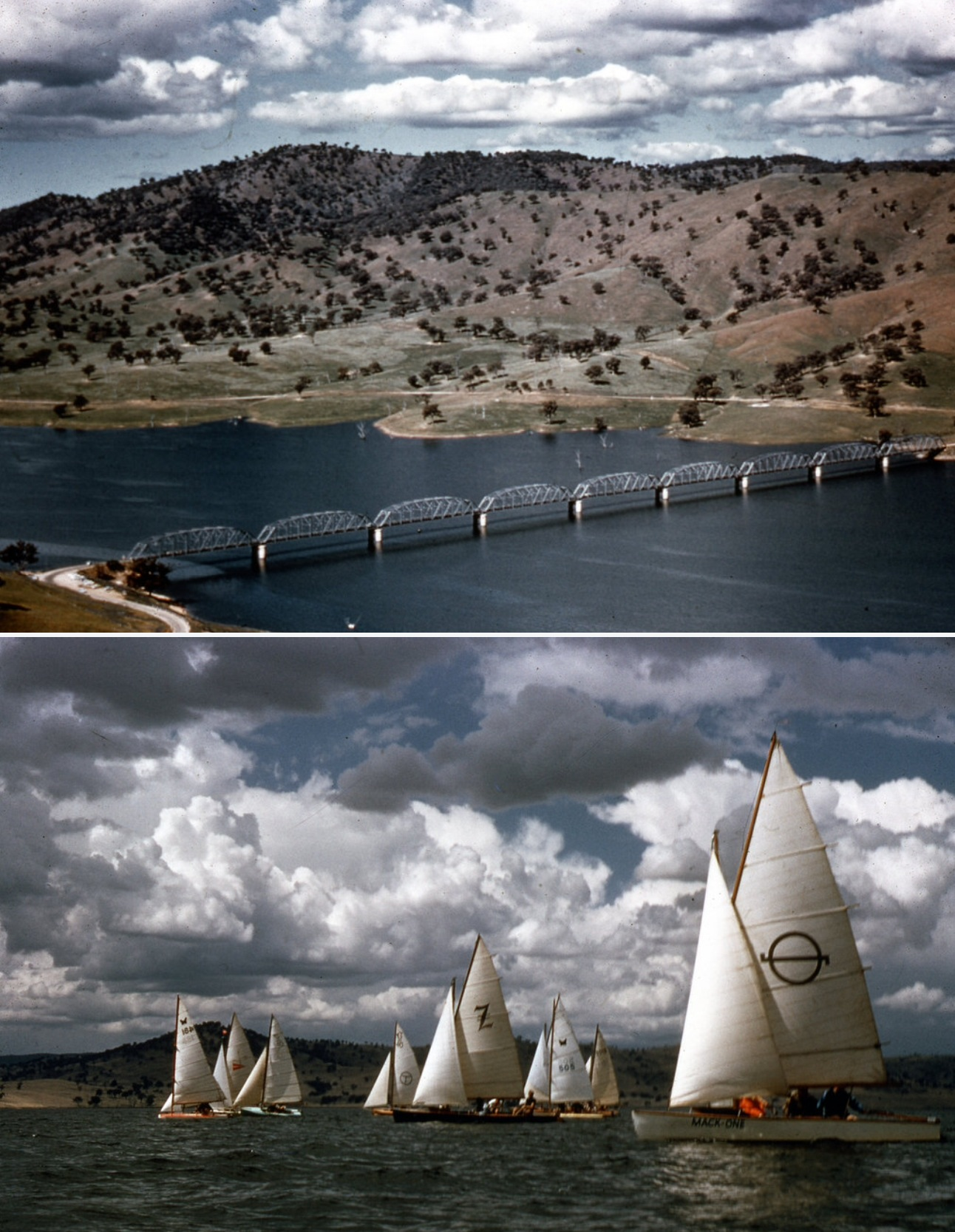
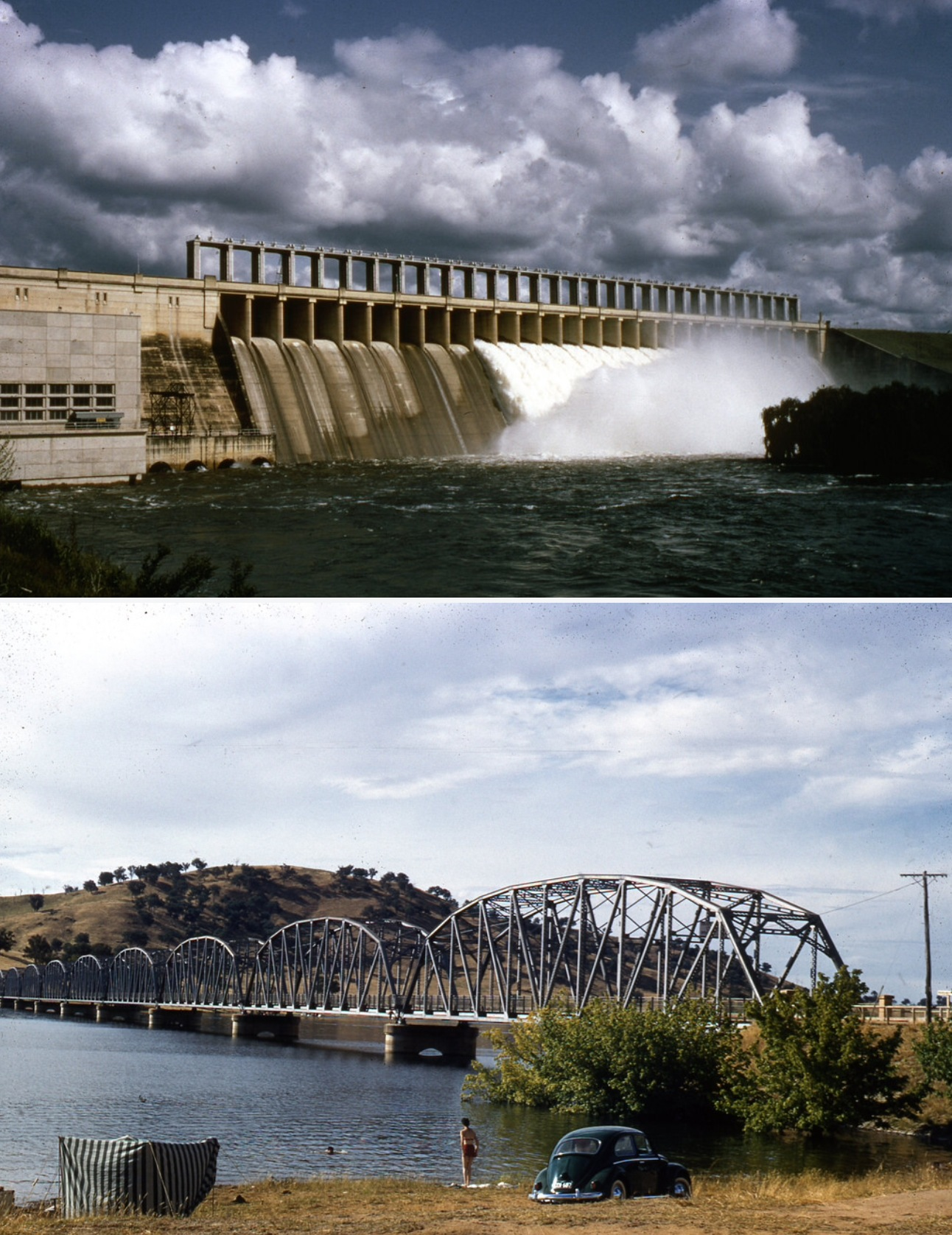
For years i have driven for miles with Hume Dam on my left and wondered about the Hume Weir project and researched it, some old shots i found are too good not to share.

So, this masterpiece comprises a piece about the building of the Hume Dam, the birth of its Hume Weir Circuit ‘love-child’, the history and some shots of the circuit and a bit about Bob Jane’s Elfin 400 the photos of which at Hume Weir inspired the article.

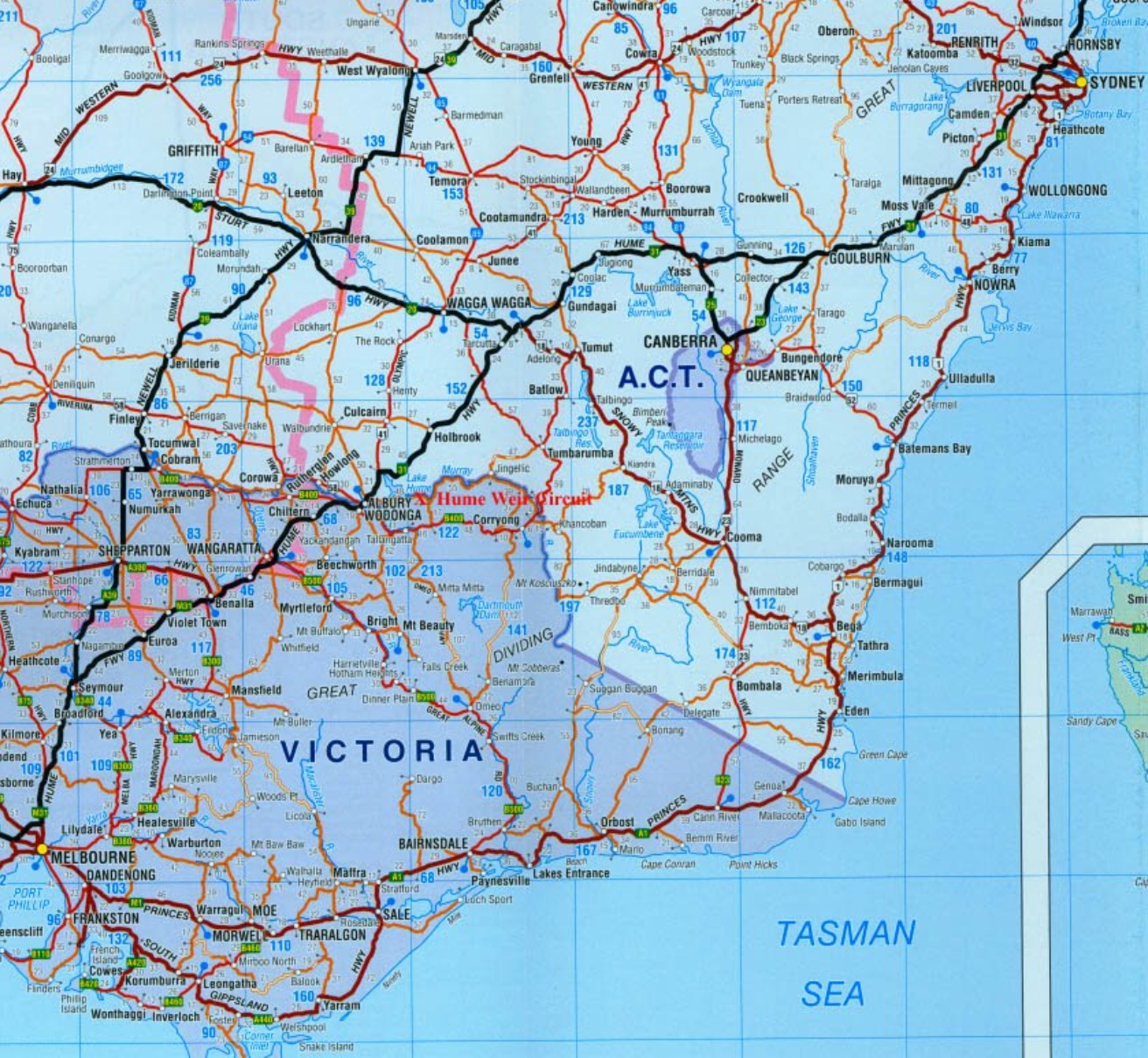
For my international friends, the ‘where the hell is he talking about?’ question is addressed by the map below, ‘Hume Weir Circuit’ is in red, the road to Thredbo is also there.

hum map

hum circ air

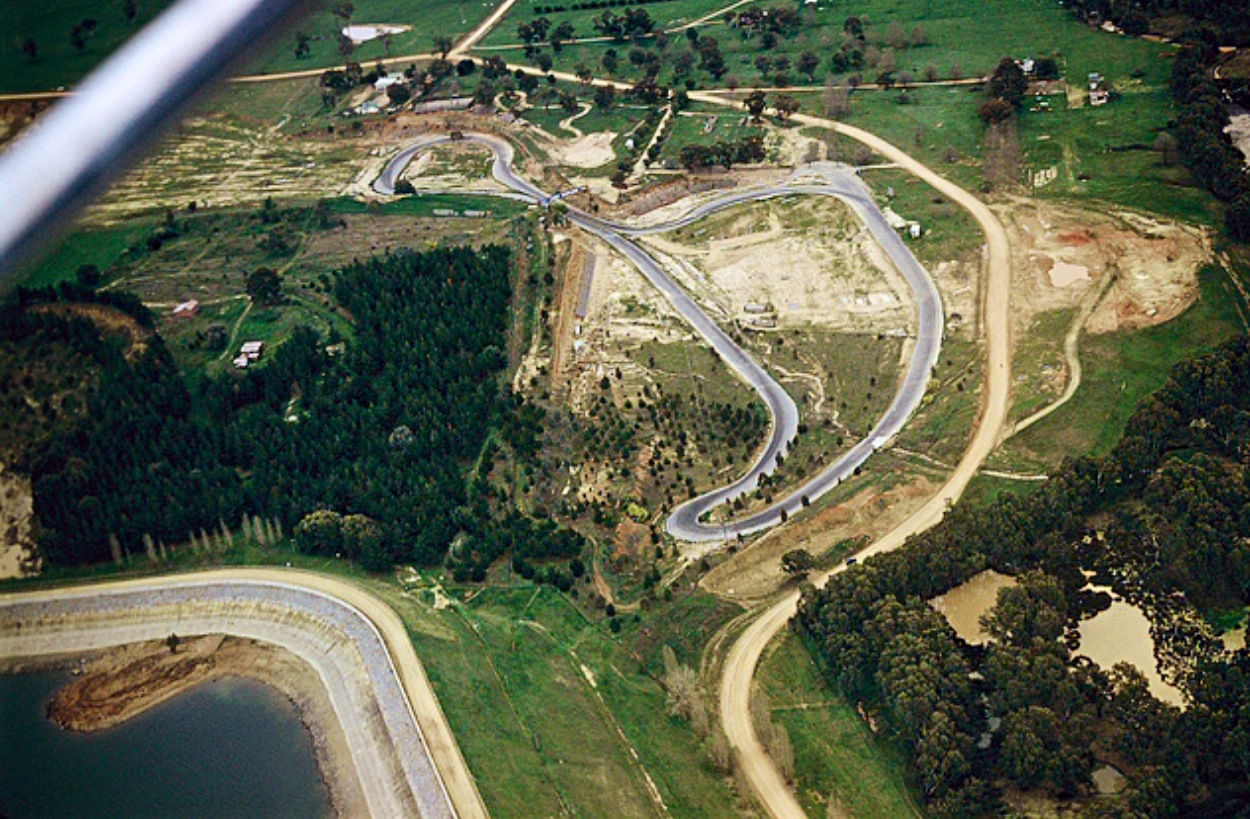
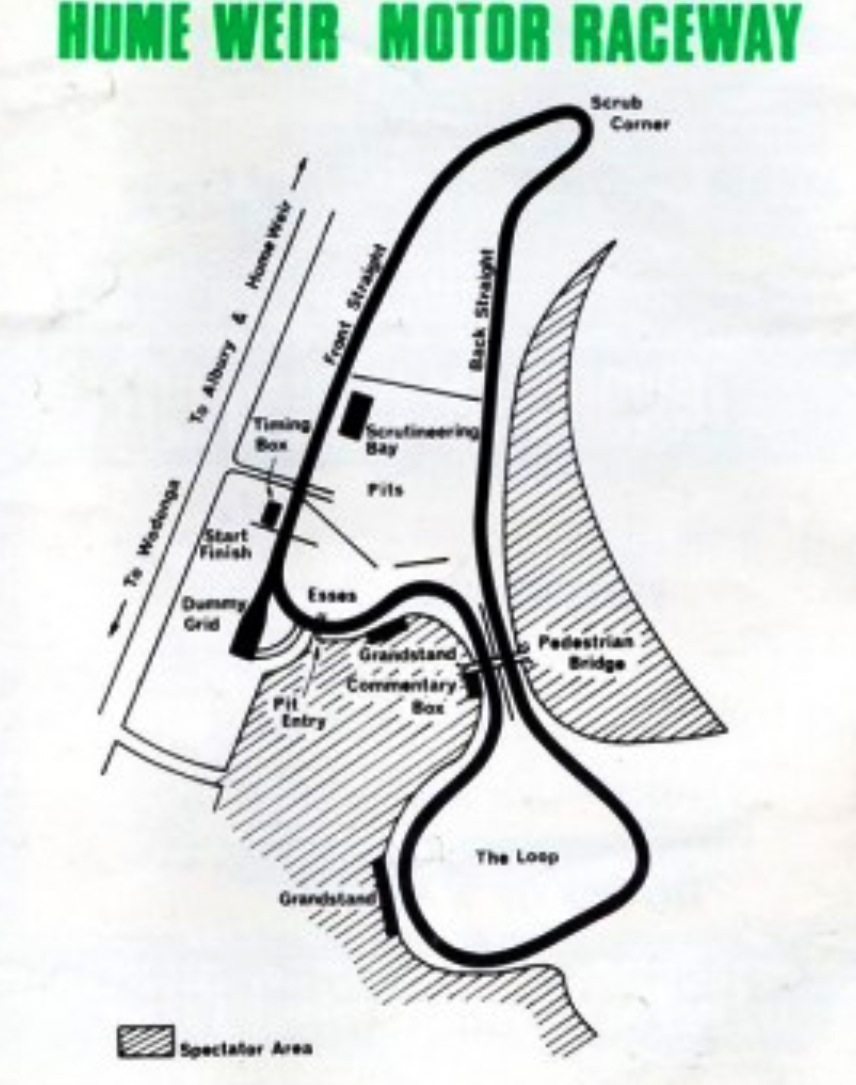
1960’s aerial shot of Hume Weir circuit, dam and dam wall. At the bottom of the shot is ‘Scrub Corner’, the tightest hairpin in the country, then heading ‘up’ is the ‘Back Straight’ into the combination of corners called ‘The Loop’, then left (going down the page again) into ‘The Esses’ past the pit entry and onto the ‘Front Straight’, the start/finish line is at the start of which (Dallinger)
 

dam dean st

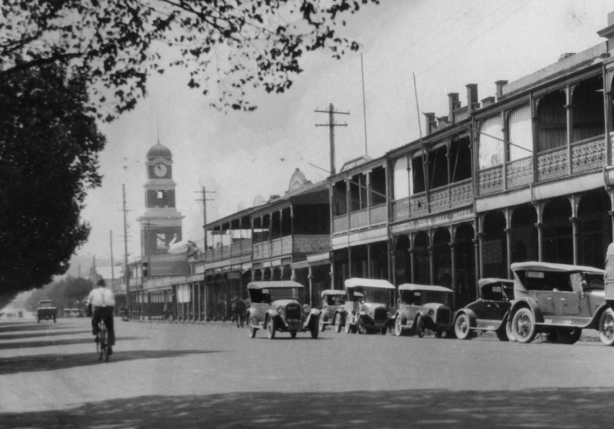
Dean Street, Albury 1920’s (Dallinger)

Australia is the driest continent on the planet, as a consequence there have been some major infrastructure projects since Federation in 1901 to provide water for irrigation of crops and/or power. The Hume Dam is one, on much bigger scales are the Ord River Scheme in WA and most impressively and significantly the post-war Snowy Mountains Scheme in NSW.

Travelling the roads mentioned above gives some insights into the ‘Snowy the scale of this nation building post-war project, its one of the civil engineering wonders of the world, can only be experienced on the ground, its un-Australian not to experience it at some point in your life!

Explorers Hume and Hovell trekked through the area in 1824, Albury was first settled by Europeans in the 1840’s.

As early as 1863, it was clear that water management was needed to ease the boom and bust flows of the rivers. Lochs and weirs were advocated but when representatives of the three colonies impacted, NSW, Victoria and South Australia met in Melbourne, the talks came to nothing. Not much different to today really, when the Premiers meet. Difficulties with border customs, bridge and punt tolls, along with self interest made necessary compromises between the parties impossible.

dam beth

Albury/Bethanga Bridge construction 1920’s (Dallinger)

After Federation (when the colonies joined to form a country) in 1901 a more global view of national priorities was capable of being made and after consideration of 25 sites the present one was chosen.

The factual material which follows is a truncated version of a paper by Joe Wooding for the ‘Albury & District Historical Society’ on construction of Hume Dam.

To build a reservoir, lots of land is needed, in this case, prime river frontage. 15,582 acres in NSW  and 87,268 in Victoria. Not everyone was pleased with the compensation offered, the lawyers were happy though as the courts were ‘chockers’ with disputes for over a decade.

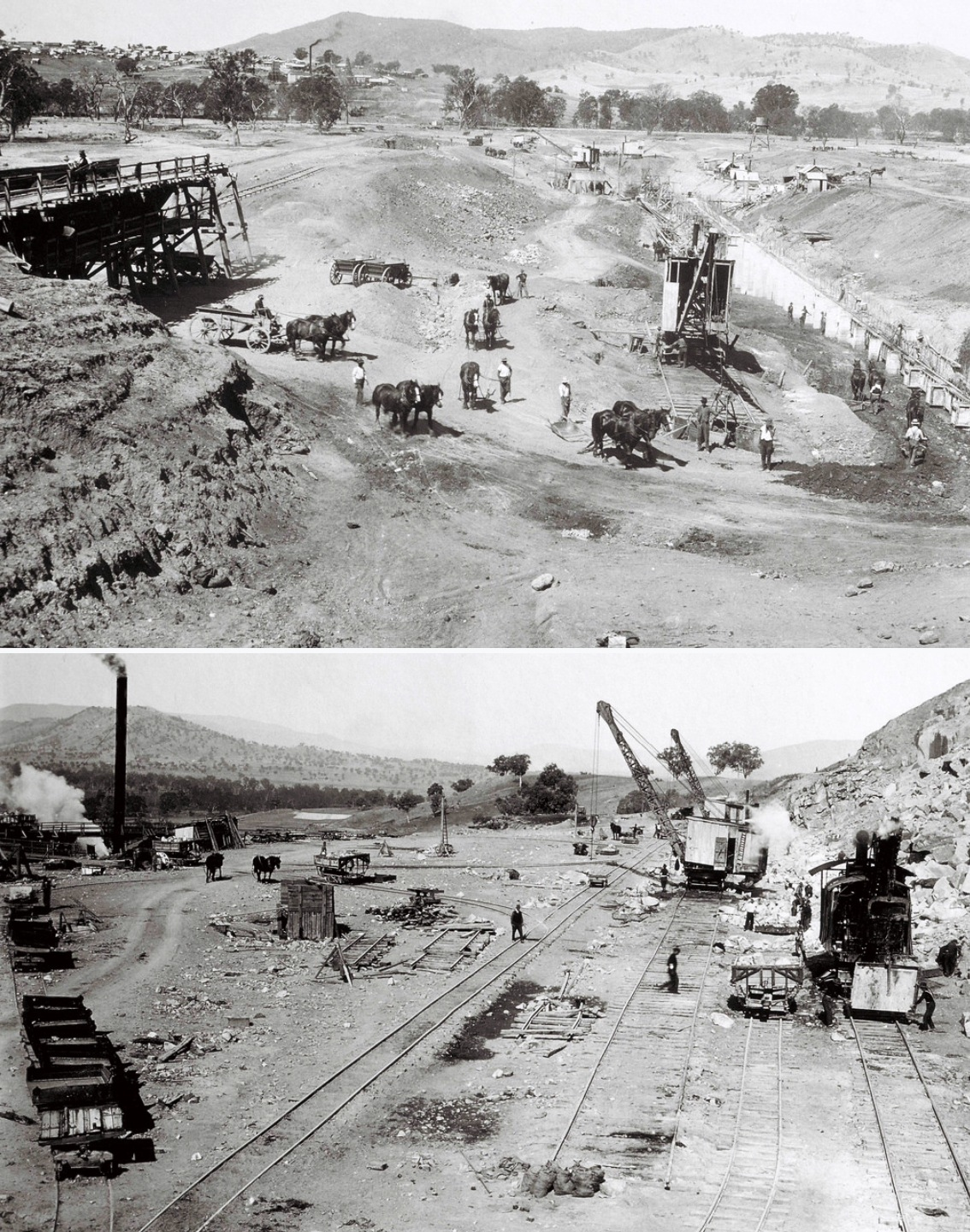
Construction commenced in November 1919, soon tent cities sprang up on both sides of the river. More permanent buildings were soon erected. On the Victorian side, the hamlet of Mitta Junction, became known as Ebden Weir and the site for operations.The higher ground in NSW was called Hume Weir, started from nothing. In 1920, the title Hume Weir was officially bestowed on the whole project in honour of the explorer.
dam early

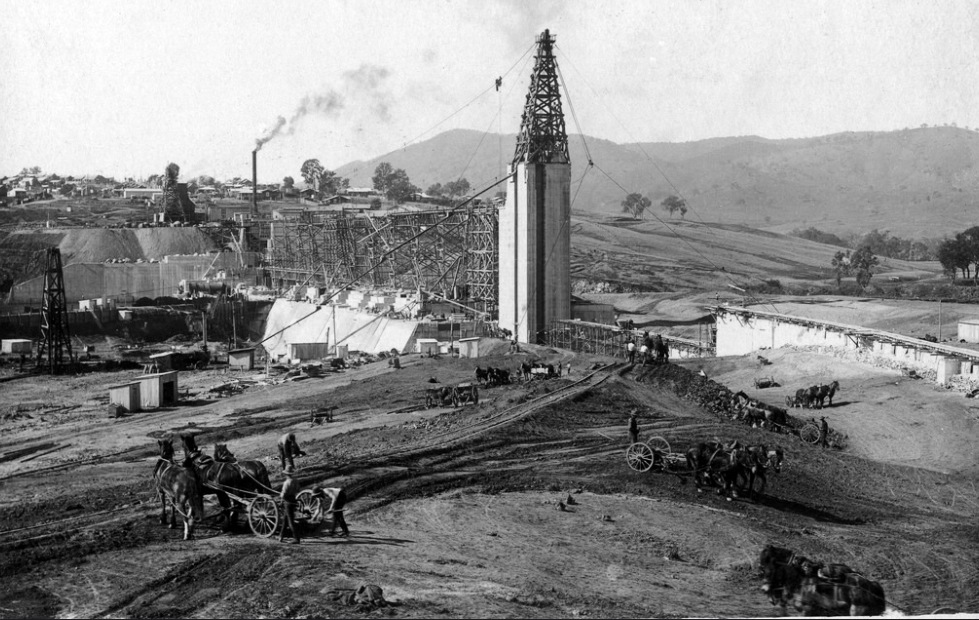
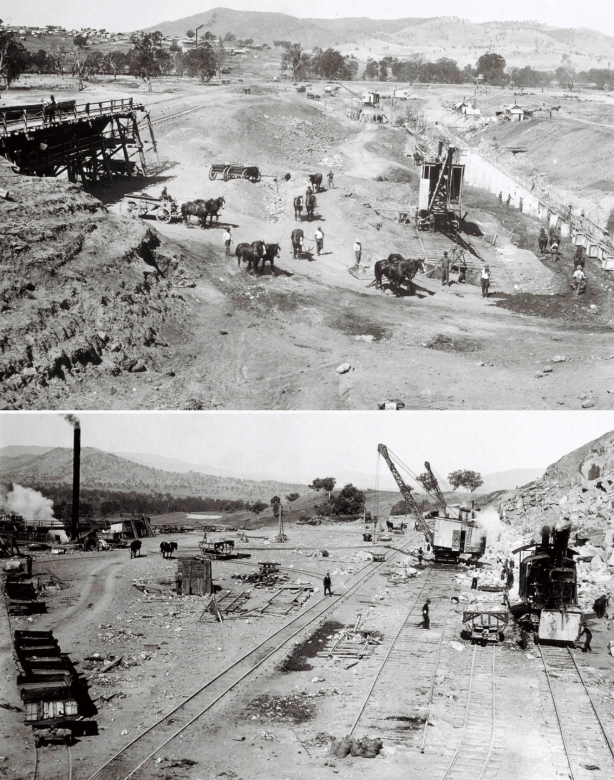
Relatively early works, 1920’s (Dallinger)

Massive amounts of infrastructure were needed. I must admit to always being amazed at what was built with the equipment available in earlier times. (noting the Pyramids scale of achievement!)
A metalled road from the main road at Wirlinga, now Old Sydney Road was built to the site. A Hume Weir rail siding was established from which vast amounts of stores, equipment and cement were conveyed to the NSW work site by a fleet of 10 solid rubber tyred Thornycroft motor lorries. In Victoria, a branch from the Wodonga to Cudgewa rail line was laid to Mitta Junction. A road bridge to link the two villages spanned the Murray just below the work site.
Two quarries were established. The one in Victoria provided earth fill and clay for the embankment and later the site for the Hume Weir circuit. Originally, 2 steam locos were used to haul trucks along the earthen bank, 8 were added later. The rail tracks were constantly re-laid as the bank grew. Two steam grab cranes were used in early excavation work at the quarry. Two ‘navvies’ were deployed, steam cranes which ran on the rail system. Much of this equipment was brought from Nagambie and Eildon. Over 500 horses were  used to haul monkey-tailed scoops and drays.
dam horse

Horses still had a role despite modern construction techniques of the day (Dallinger)

In NSW the stone quarry is on Hawksview Hill. Four steam locos and numerous trucks were brought from Burrinjuck. The rail system was extensive, rails ran to and from the quarry and the Bethanga Bridge site. Rail was also used inside the coffer dam to service the spillway foundation excavations.

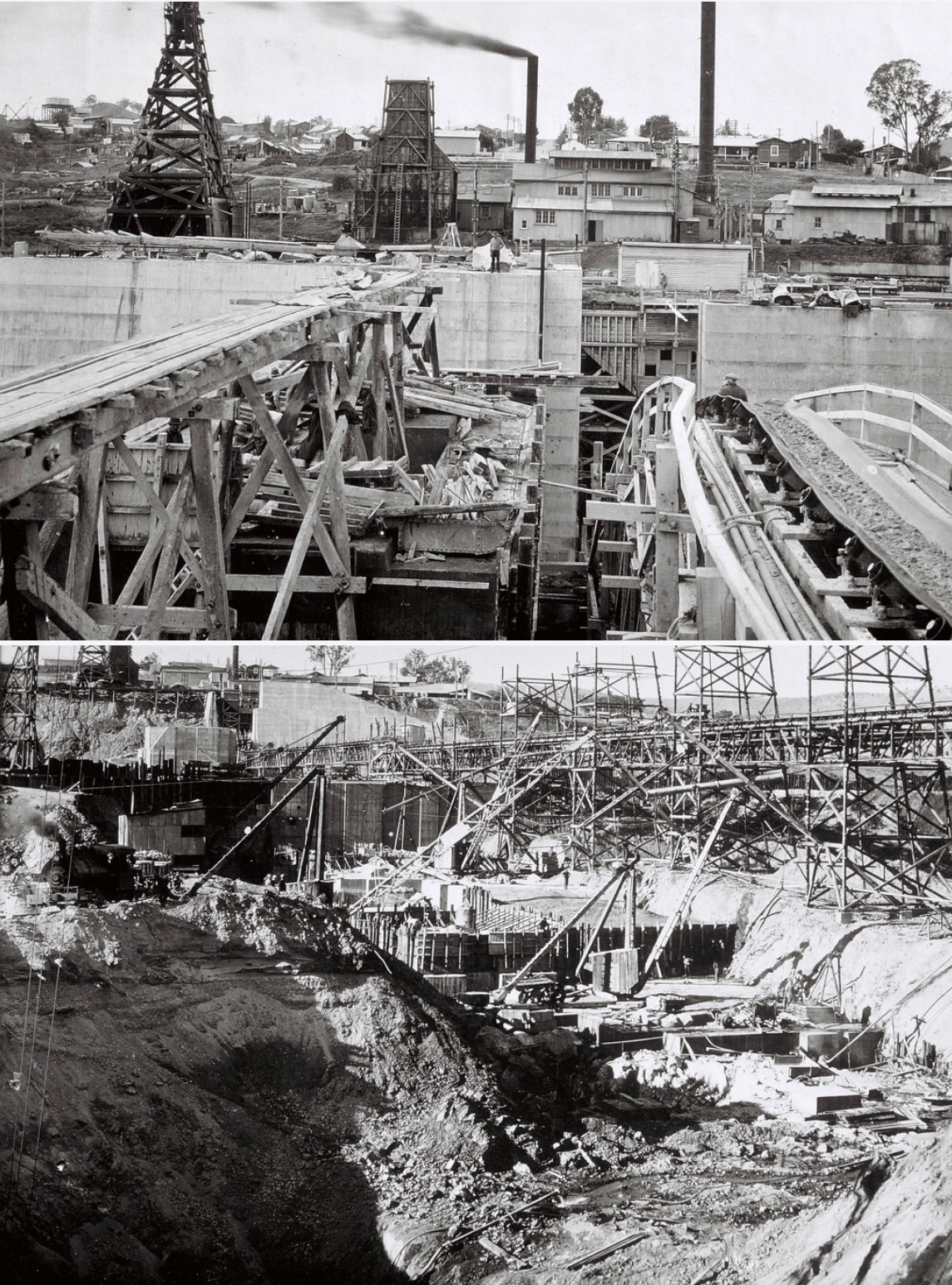
Steam power was widely used, some of the machinery was extraordinary. In NSW two huge cement mixers capable of producing 900 cubic yards per day were operated. The crusher was a 30 ton Hadfield made in Sheffield, England. It was unloaded at the weir rail siding and with great difficulty, transported to the quarry by 2 large steam traction engines.
dam steel

(unattributed)

A flying fox spanned the river from east to west with a large steel cable 400m long. The cables were attached in such a way allowing coverage of almost the entire work site. 300 tons of concrete blocks were used as ballast on the mobile pylon. A trolley was attached to the cable, enabling loads of up to 10 tons to be placed almost anywhere on the work site. The Bucyrus steam shovel was capable of lifting 3½ cubic yards and the only machine on site using caterpillar tracks.
dam train

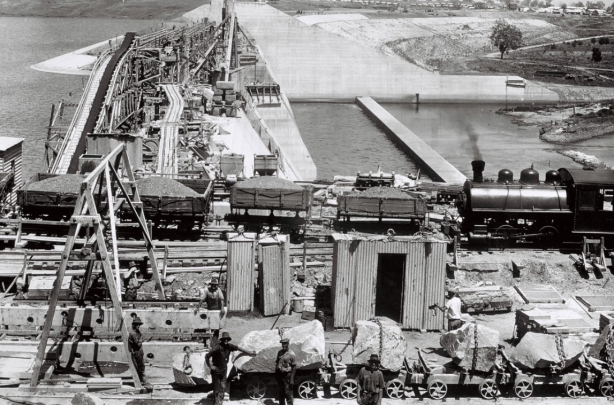
(Dallinger)

‘The process of using crushed rock rather than smooth river gravel and adding large rock individually, produces ‘cyclopean concrete’. A 750mm wide concave rubberized conveyor belt carried the concrete, which could be retrieved at any point, by concrete shutes, for placement at the work site. Belts were pressure cleaned for their return journey. The huge rocks, some weighing up to 10 tons, called ‘plums,’ were cleaned with a high pressure hose before being individually craned into the wet concrete. Some were completely buried, but many were left half exposed to ‘key in’ the next batch of concrete. Steel reinforcing was only used near the top of the spillway. The structure is about 17% rock. At its base, the wall is 32m thick and double that if you take in the dissipater wall’.

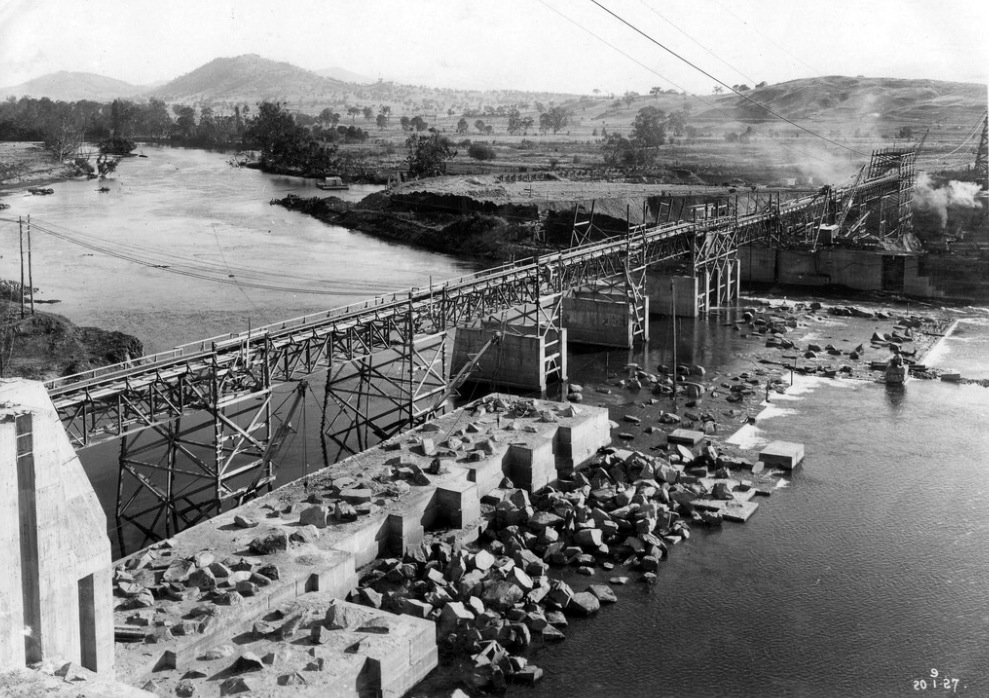
dam wall 1927

Dam wall 1927, looking at the Murray upstream (unattributed)

‘As well as road works in the villages, other amenities were provided. Residences, barracks, stores, recreation halls, a post office and police presence were established. Electricity was installed for lighting only and turned off at 11pm. A Church of England was transported in. A casualty ward, a doctor with a phone and car were provided. Dances and pictures, obviously silent, as ‘talkies’ were not seen in Albury until 1928. The school had 66 pupils in 1921. The baker, milkman, greengrocer and butcher called regularly as did the ice man. Sport attracted many of course’.

dam end 1

Dam wall work progression (unattributed)

Manual labour was harsh with a 48 hour week, later reduced to 44 hours. Picks, shovels and
bare hands were often the only method of filling drays. Returned soldiers from the Great War
were given preference for employment, followed by married men. Estimated numbers of
workmen employed varies greatly with about 1000 cited. At the peak of construction around 1927, numbers given were Victoria 355, NSW 650, Bethanga Bridge 89. With a large workforce and dangerous working conditions, accidents were a reality, with total fatalities estimated at 6-9 people.
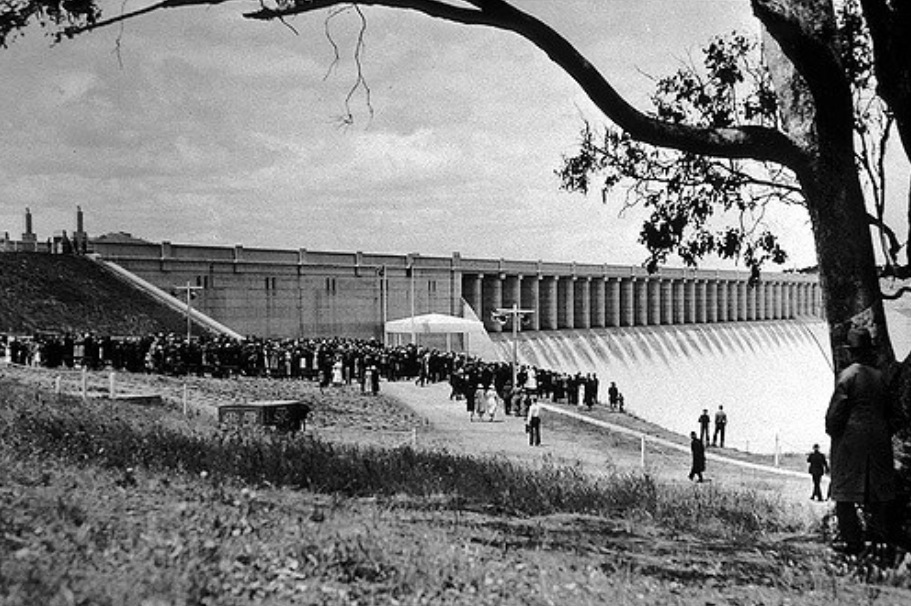
The Weir was officially opened by the Governor-General, Lord Gowrie, on November 21 1936
 ‘by closing an electric valve control circuit which released the water through two giant needle valves…the greatest irrigation work in the Southern Hemisphere and one of the most important in the world. It cost £5,550,000 to construct, and is located nine miles from Albury’ The Albury Banner’ said.
dam ope

Dam opening ceremony in 1936 (Dallinger)

In 1957, the Power Station was completed with 2 turbines now capable of producing 58 Mw which is not large in the electricity industry. As a comparison, Albury’s peak demand for summe of 2013 was 110 Mw.

dam end
The 1960s saw a large increase in the weir’s pondage necessitating additional works on the
dam. One aspect was to open the old stone quarry and supply thousands of tons of granite to
stabilize the clay bank of the earthen wall.
dam sail
dam car
Wirlinga…

Hume Weir wasn’t the first circuit in the Albury area, Wirlinga was.

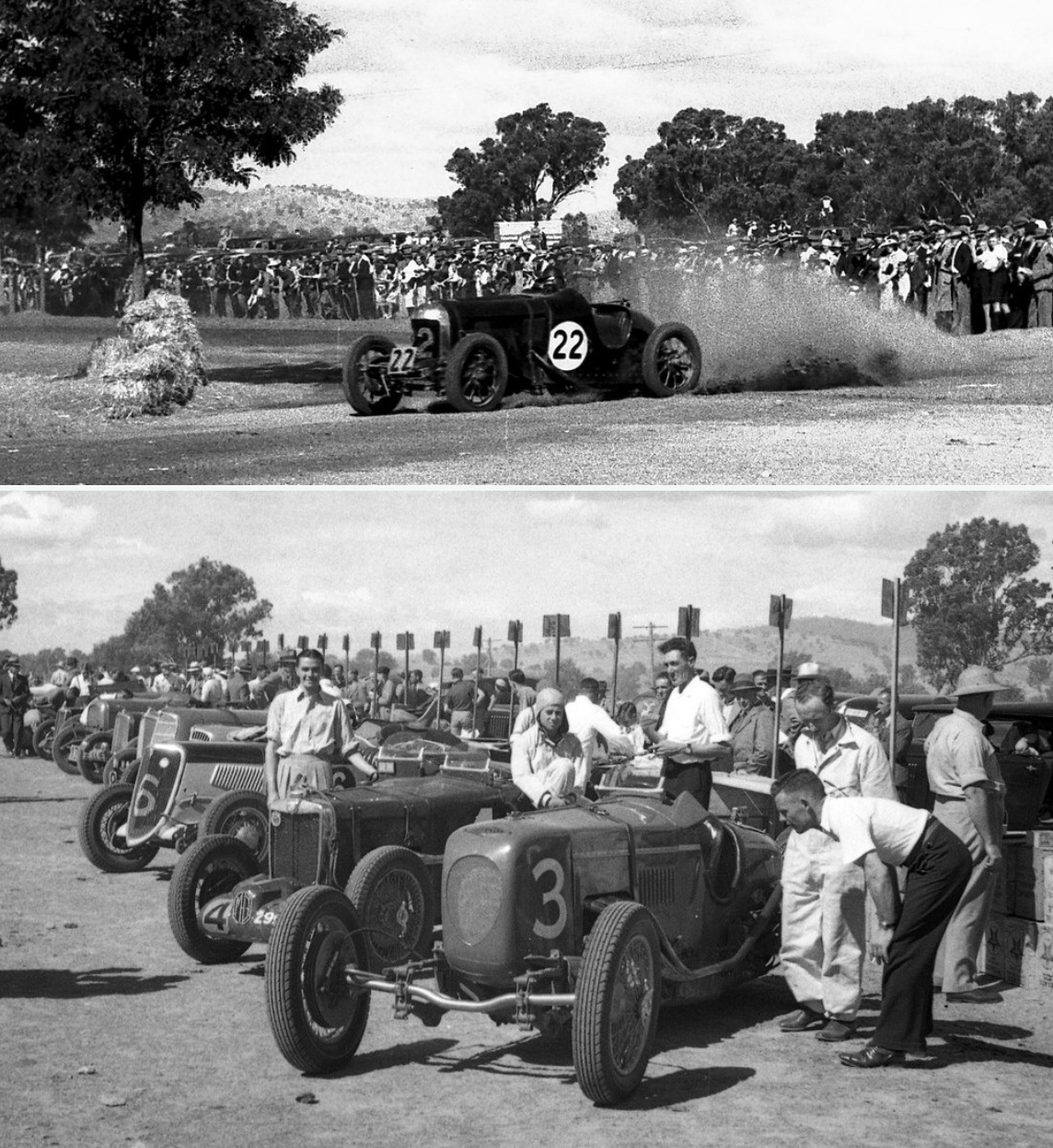
A public roads layout of 6.79K, roughly rectangular shape using Thurgoona, St Johns and Bowna Roads as well as the Riverina Highway was used. 14km  from the centre of Albury, the track was used several times before WW2. Rather than get lost in that tangent now, tempting though it is, we will come back to Wirlinga another time.
wir 1

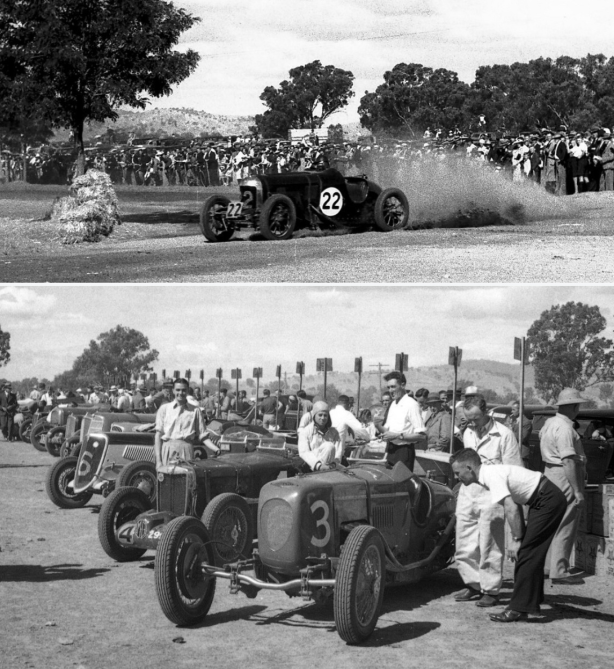
Car #22 is Alf Barrett’s Morris Bullnose Spl. #3 Tim Joshua’s Frazer Nash TT Replica, #4 Hope Bartlett’s MG Q Type,  #6 Jack Phillips winning Ford V8 Spl, Wirlinga 1938 (Dallinger)

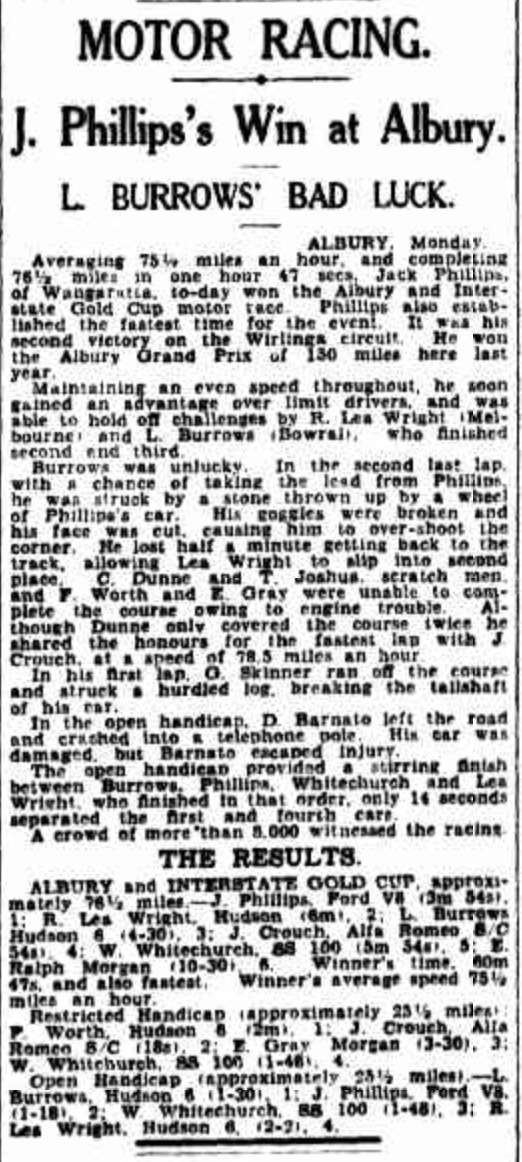
The 150 mile ‘Interstate Grand Prix’ (called the ‘Albury Grand Prix’ in the Sydney Morning Herald report of the 1939 race) was run on 19 March 1938. The ‘Albury and Interstate Gold Cup’ was run on 12 June 1939. Both handicap races were won by local Wangaratta boy, Jack Phillips Ford V8 Spl. The track wasn’t used post war.

wir 2

The lower pic shows Les Murphy in the O’Dea MG P Type from Colin Dunne’s similar car and George Bonser’s Terraplane Spl, help wanted in relation to the cars in the upper shot  Wirlinga 1938 (Dallinger)
 

hum wir

‘Sydney Morning Herald’ 13 June 1939


hum summer

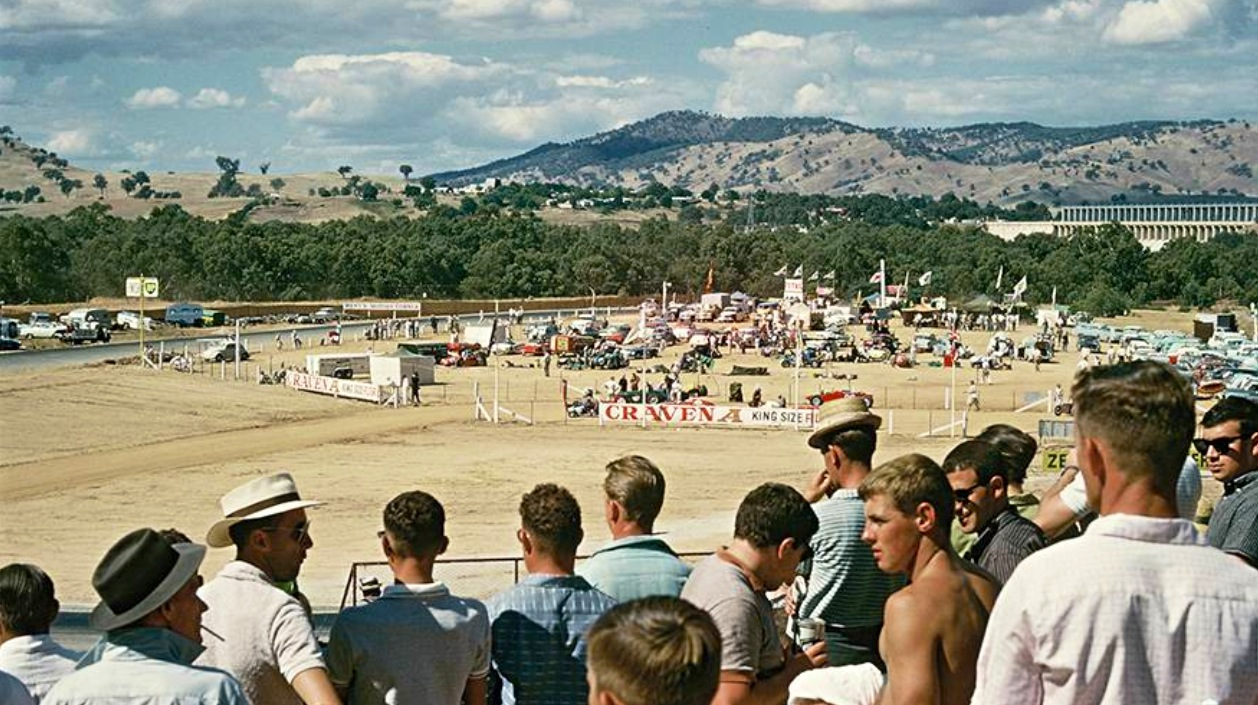
Typically parched Australian summer, 1970’s. Hume Weir wall middle right and Great Dividing Range clear  (unattributed)

Hume Weir Circuit…

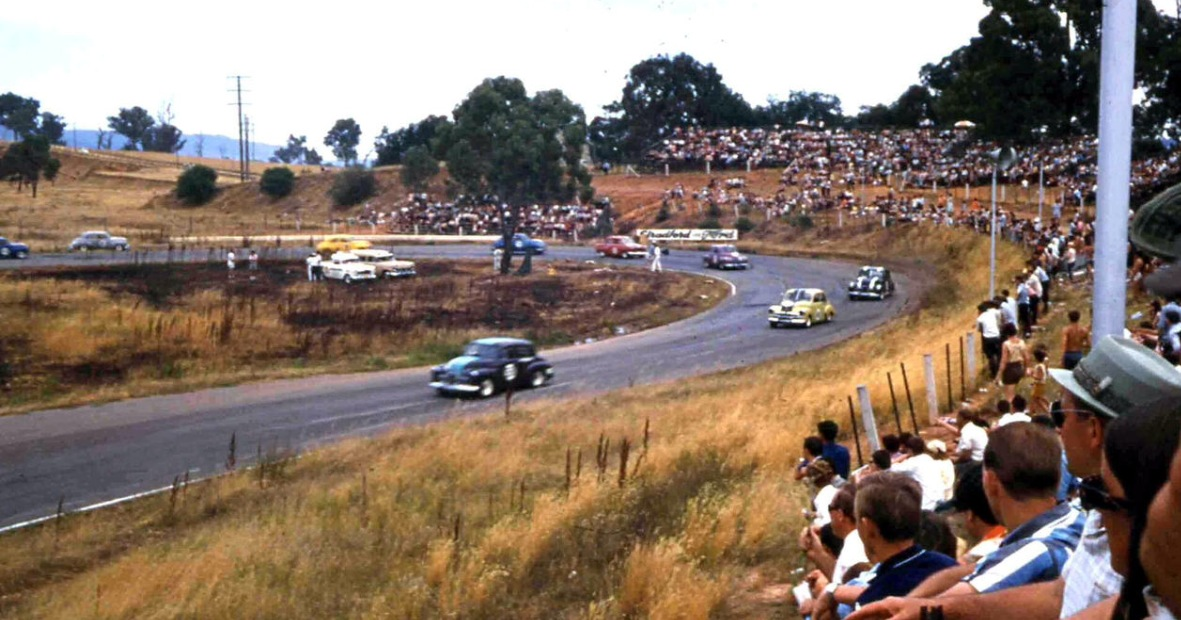
Hume Weir was enormously popular in the immediate area, in fact depending upon the year the locals were served by Tarrawingee, Winton outside Benalla and the ‘Weir.

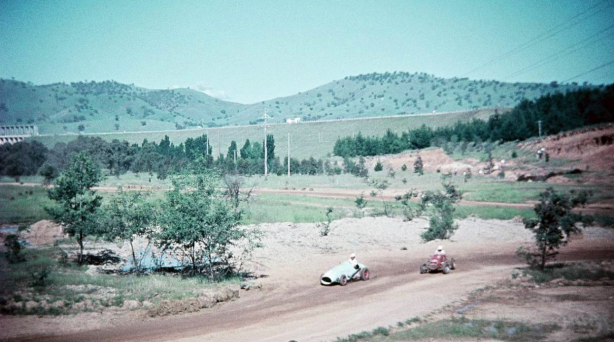
When the circuit was leased from the Hume Dam authority by the Albury and District Car Club the members initially established an unsurfaced layout which was first raced on 2 November 1959. It was lengthened to 1.1 miles during the year, first used sealed for the Christmas meeting on December 12 1959.
hum dirt

Cars race at one of the earlier meetings on the original dirt layout, Hume Weir 1959 (unattributed)

The financial support of Gold Star champion Len Lukey’s and his ‘Lukey Mufflers’ business allowed the amenities to be improved sufficiently to hold the 1961 international event. The ‘weir only got the gig, historian Stephen Dalton records as negotiations with PIARC to use Phillip Island fell over.

The 1961 program comprised an ambitious 21 events held on the Sunday and Monday 12 and 13 March, they were mainly short races with the feature ‘Craven A International’s 20 lappers on each day.

The meeting was contested by Brabham, Salvadori, Bib Stillwell, Bill Patterson, Austin Miller and Jon Leighton. It wasn’t a big field; Moss had long since left the country, as had the BRM drivers Hill, Gurney and Ron Flockhart and his Cooper.

hum split

This shot shows the two sections of the track separated by a narrow strip of concrete, March 1961 meeting perhaps (unattributed)

Brabham.

The Internationals that summer were raced at Warwick Farm, Ballarat Airfield in Victoria and Longford and won by Moss Lotus 18 Climax, Gurney BRM P48 and Roy Salvadori’s Cooper T51 Climax respectively.

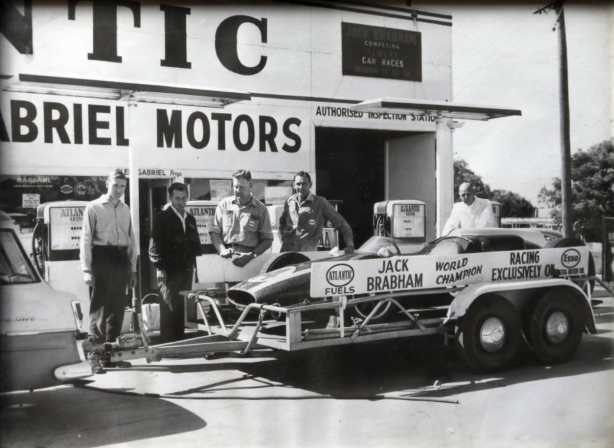
The Longford meeting was on March 5, Brabham and Salvadori travelled back to Melbourne from Tasmania, the Coopers were towed up the Hume Highway, the main Melbourne/Sydney artery to contest the ‘Craven A Internatioanals’ at Hume Weir on 12 and 13 March. No doubt it gave Jack an opportunity to catch up with his family in Sydney.
hum brabs servo

Brabham’s Cooper T53 Climax out front of its Albury digs, Gabriel Motors.  (Border Mail)

It was all fairly casual, Jack’s car was accompanied by his mechanic and a driver for the towcar, an FC Holden Station Wagon which was maintained at a local Esso servo/workshop.

hum brabs color

Brabham’s Cooper T53 during his victorious March 1961 weekend (unattributed)

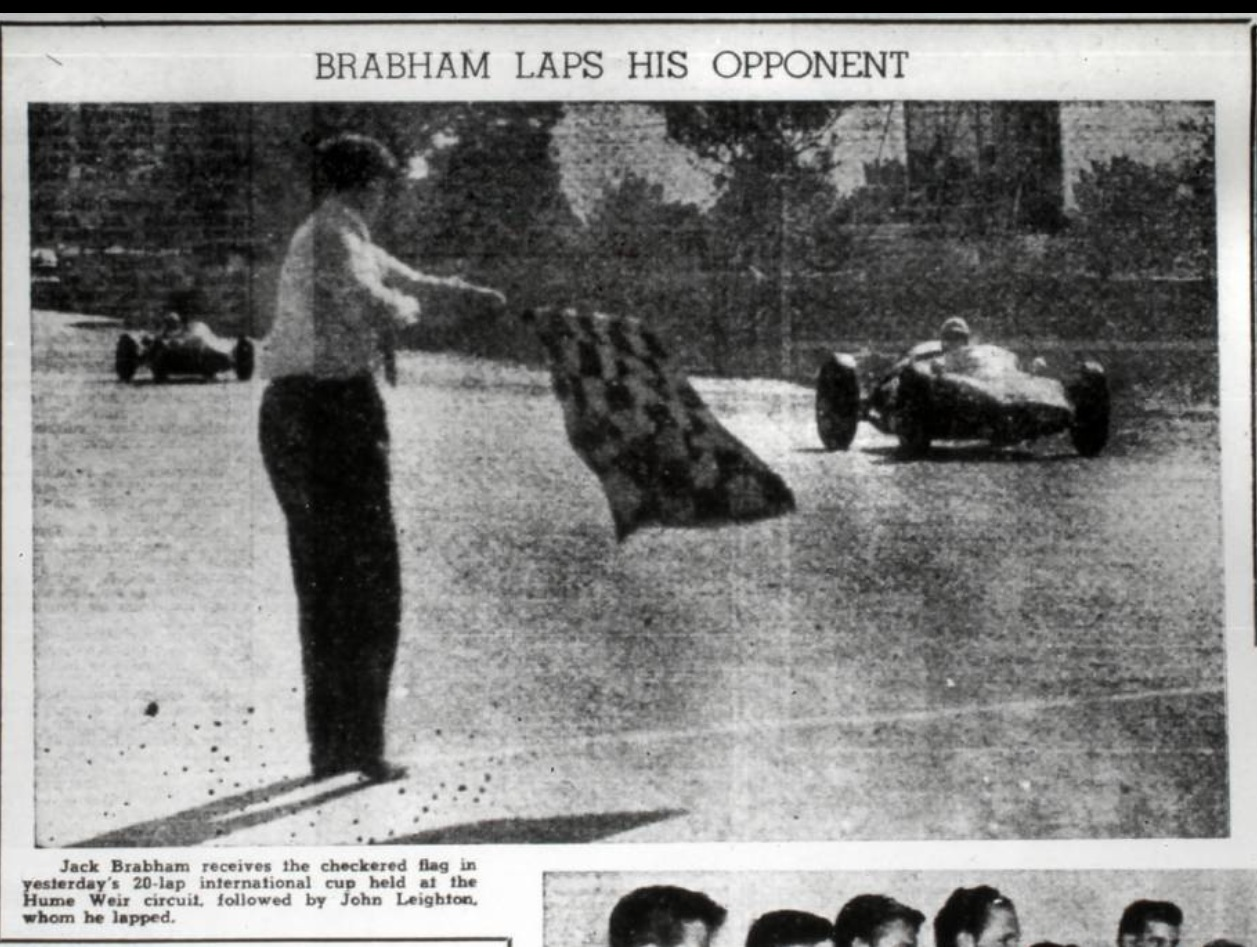
Jack won the race on the Sunday by just 0.9 sec from Patterson, the reigning Gold Star champion and Bib Stillwell’s Cooper T51’s in his T53.’The last 3 laps saw the leaders in the esses together and the crowd was wild with excitement as it was still anybody’s race but Jack Brabham showed championship form and held off the challenge to win’ said the Border Mails report.

hum brabs cheq

(Border Mail)


hum miller

Austin Miller’s distinctive yellow Cooper T51 Climax perhaps chasing Jon Leighton’s Cooper T45 and Roy Salvadori’s T51 during the Sunday race in which they were 4/5/6th (unattributed)
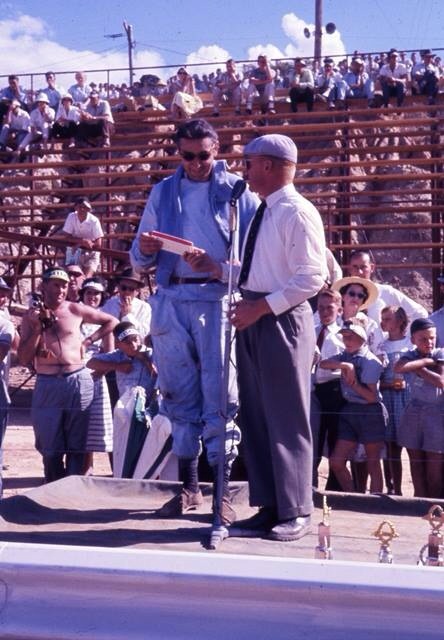
 

Roy Salvadori sussing the size of the cheque- ‘Can you make it in pounds sterling matey?’ (C McQuellin)
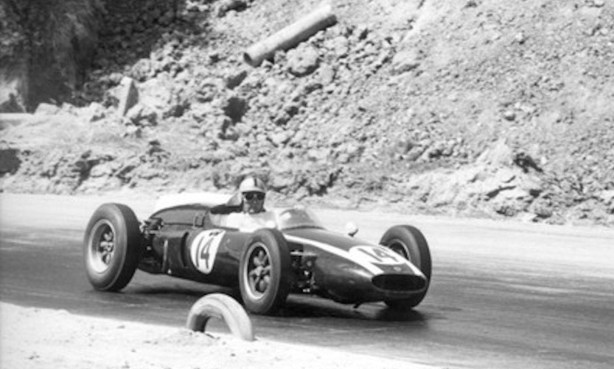
 

Brabham, Cooper T53 Climax (unattributed)


Brabham from Salvadori- Cooper T53 from T51 (unattributed)


Salvadori, Cooper T51 (unattributed)

On Monday ‘Brabham streeted the field in the international cup race and set a lap record of 51.2 seconds, a time equated to 147kmh’. ‘Twas again a Cooper 1-3, JB winning from Stillwell and Jon Leighton in Cooper T51 and T45 respectively.

With that both internationals jumped on a plane for the UK, their first event the Lombank Trophy at Snetterton which Jack won in his Cooper T53, Roy was 5th in a similar car.

hum brabs

Brabham T53 just in front of Patterson T51 in Sunday’s race closing stages (unattributed)


hum brabs in car

(Border Mail)


hum jack

hum circ map

The short nature of the circuit perhaps mitigated against its use for championship events having said that it hosted a round of the Australian F2 Championship from 1973-76…

Later multiple Gold Star winner Alfredo Costanzo set the all-time lap record in a Birrana 274 Hart 1.6 F2 car on 15 June 1975, in 1976 the circuit also held a round of the Australian Sports Car Championship, fundamentally though it is a circuit which is fondly remembered by club racers of both bikes and cars and spectators of course.

The circuit was essentially ‘killed-off’ by CAMS with ever increasing and more difficult safety requirements which the owner/promoters couldn’t afford. There was a section where the cars passed each other separated by a concrete wall which was of particular concern.

The last race meeting was held on 27 March 1977 although the track was used as part of the Alpine Rally which was run out of Bright, not too far away. Every now and again a ‘comp sec’ of a car club convinced CAMS to issue a permit for a ‘sprint event’ but essentially another circuit was lost, a real shame as the usual causes; noise in a built up area or urban encroachment which simply made the entreaties of property developers irresistible to circuit owners didn’t apply in this rural area.

hum air

(Dallinger)

The photo above nicely juxtaposes the Dam with the circuit which is clear to see above the dam wall in the middle of the picture, plenty of water about in this shot! At present it is as dry as!

Molina Monza Holden Spl.
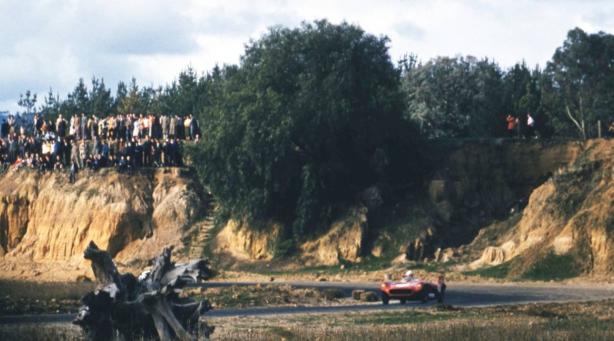
hum monza

You get a sense of just what a magnificent natural ampitheatre the circuit was, most of but not all of the circuit could be seen from one place. This is the Molina Monza Holden Spl, the shot isn’t dated so not sure who the driver is. The car’s specifications are outlined in this article amongst other Oz cars; https://primotipo.com/2015/05/13/shifting-gear-design-innovation-and-the-australian-car-exhibition-national-gallery-of-victoria-by-stephen-dalton-mark-bisset/

Perkins.

hum perk

(Dick Simpson)

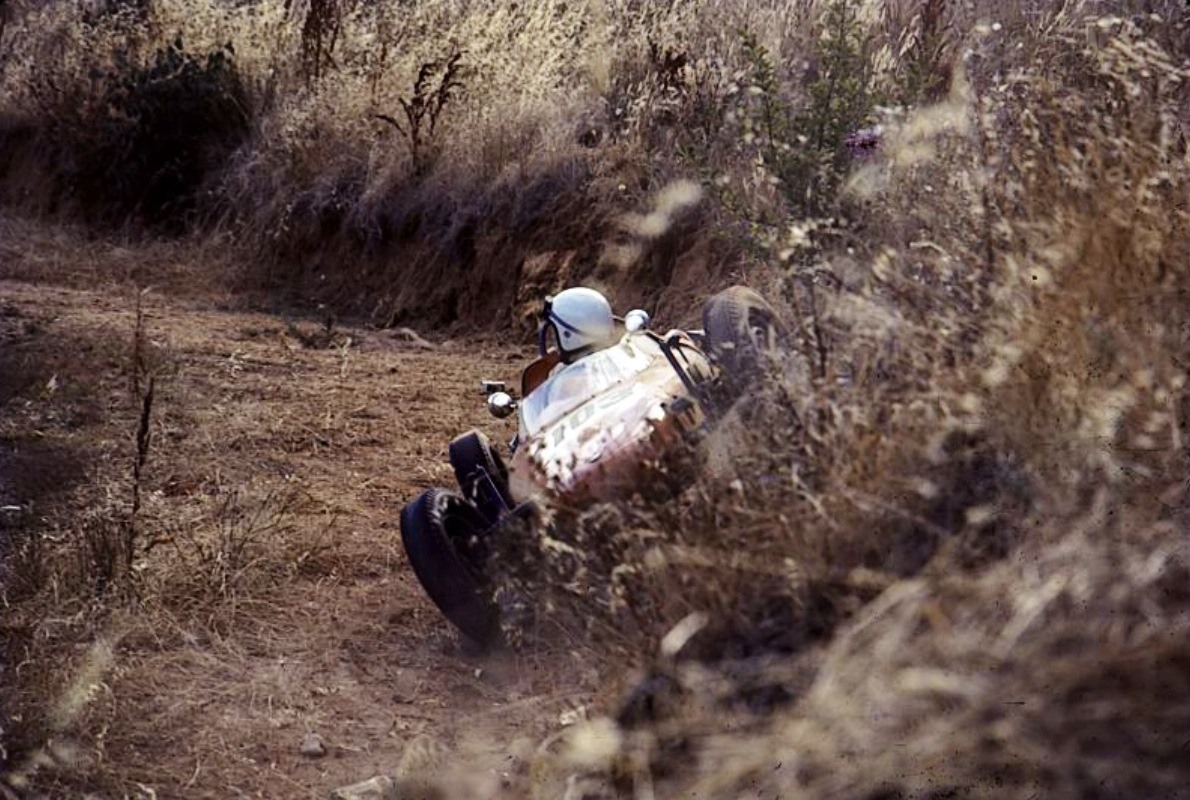
Larry Perkins in the ‘boonies’ at ‘Scrub Corner’ on 28 December 1969 early in his career, car is characteristically a Perkins Vee. He is looking for a marshall to help him back to terra firma.

He was in F1 in a private Ensign nee Boro in 1975. This is early days tho, his early break was to get one of Bib Stillwell’s Elfin 600FF seats in 1971 taking the ‘Driver to Europe’ series. He stayed in Oz for ’72 and raced an Elfin 600B/E Ford to win the national F2 title. He then took Garrie Cooper’s first Elfin 620FF to the Formula Ford Festival at Snetterton at the end of the year, contesting the Festival with a few other Aussies and then stayed in the UK. F3 in 1973 and the rest is history…

Brock.

hum brock

Peter Brock ahead of Lynn Brown’s Cooper S, these are ‘Sports Sedans’, anything goes sedans with Brock and Brown two of the sports finest pracitioners of the art. Brocky is young and made his Holden ‘Red’ 6 cylinder engined A30 sing, his performances in it resulted in Harry Firth, fine judge of talent picking him up as a Holden Dealer Team driver. Brock took his first Bathurst win in 1972.

hum brock bir

Brock, Birrana 273 Ford, Hume Weir 22 April 1973 (Robert Davies)

‘Peter Perfect’ only did one fullish season in single-seaters in this ex-works Birrana 272 Ford, its the very first of Tony Alcock’s monocoque cars. A good car but it didn’t have a Hart Ford engine, and the competition was hot in 1973-5 in F2, Brocky quickly went back to Holdens. A great pity, a natural driver of great smoothness, finesse and throttle control; oh to have seen Brock in a Repco Holden engined F5000 in the 1970’s!

Hansford.

hum hans

(P Hall)

Greg Hansford blasts onto the main straight 1977. Kawasaki KR750 water-cooled 2 stroke.

Beechey.
hun beech

(Bowdens)

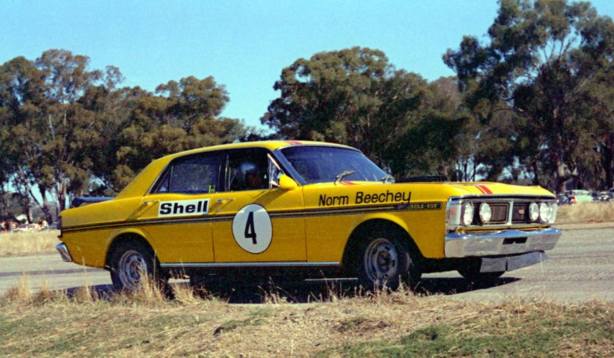
Beechey changed from Holden to Ford running this ex-works Series Production Ford Falcon GTHO Ph3 with some cash from Ford in 1972. Here he is in April, DNF with clutch failure. Ford apparently then changed their minds wanting Norm to return the car and money they paid him, Norm telling them unsurprisingly to ‘jam it’.

Bartlett.
hum bart

(Bruce Wells)

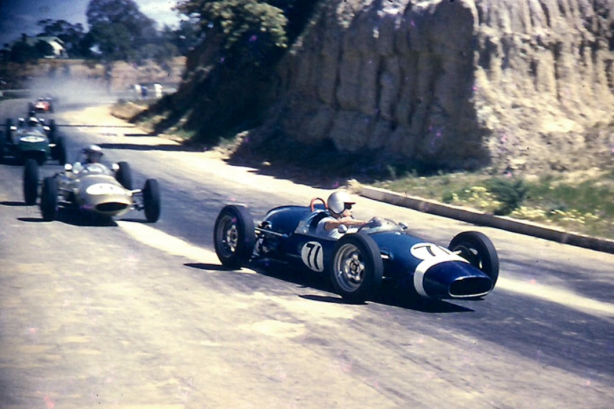
Kevin Bartlett in polo-shirt at the wheel of the works Lynx BMC, the Curl-Curl  kid was on his way! Lotus 20 behind i think. Year anyone?

Bikes.

hun bikes

(John Small)

Jim Budd and Roger Hayes Team Avon Kawasaki’s lead the 1 hour production race at the ‘weir in November 1977. Third is Jeff Parkin and then Alan Hales both on Suzuki’s. Hot work in the heat.

Jane.

jane mustand

(oldracephotos.com)

Bob giving his factory Shelby built Mustang Trans-Am plenty during the 1970 Christmas ‘Weir meeting. His new Chevy Camaro 427 cannot be too far away, Norm Beechey took the 1970 ATCC in his Holden Monaro GTS350 but Jano won it in 1971/2 in the same car with a 427 in ’71 and ‘tiddly’ 350 small block in 1972.

jane torana

(Dick Simpson)

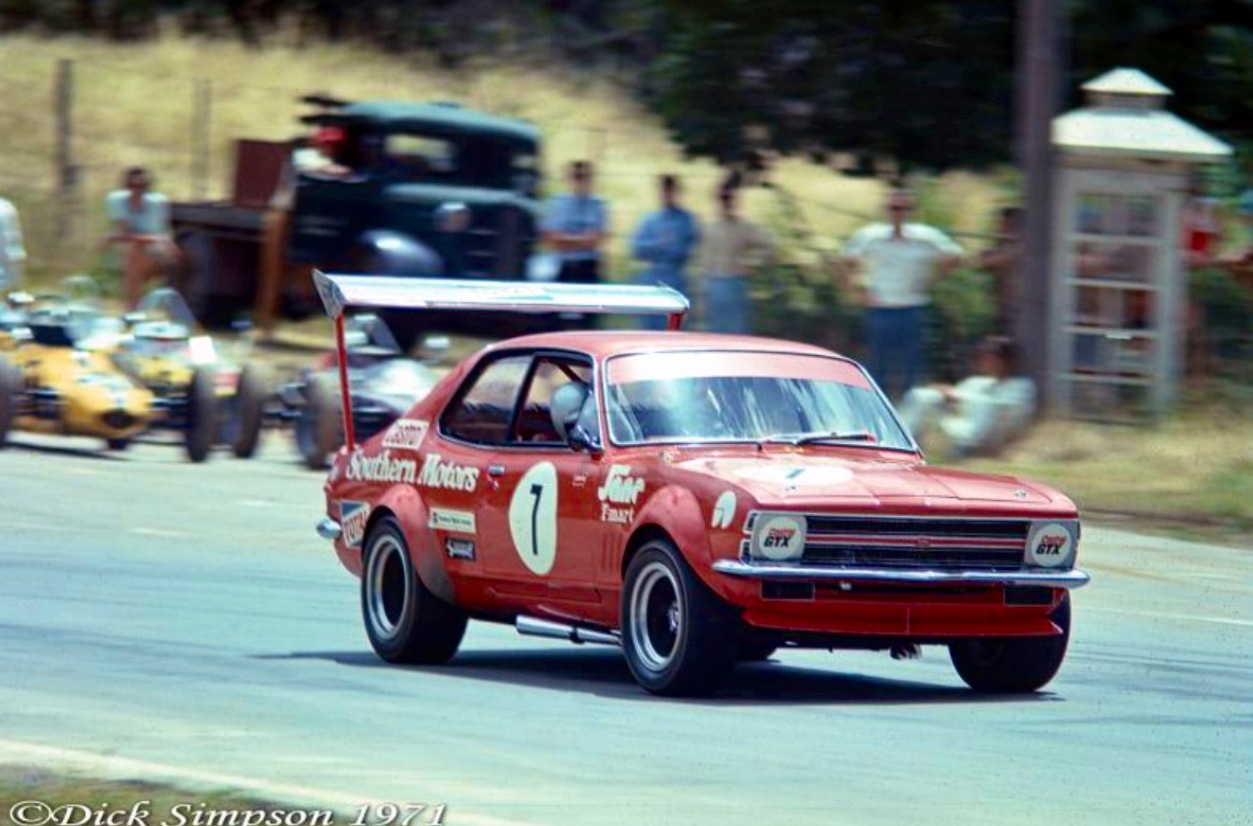
Bob was back with another new toy in 1971, one of his finest, the John Sheppard built Holden Torana into which was slotted one of the 4.4 litre SOHC ‘620 Series’ Repco V8’s once fitted to the Elfin 400 pictured below. CAMS didn’t allow it to compete with the wing for long, check out the Vees in the Weir ‘form up’ or dummy grid area in the background. This car was mainly raced by John Harvey, in ’71 Bob focused on the Camaro and winning the ATCC. The car is still around albeit Chev engined and in need of restoration.

jane elf

(oldracephotos.com)

Bob Jane didn’t race his Elfin 400 too much, it was mainly driven by his drivers; Spencer Martin, Ian Cook and Bevan Gibson.

Here in early 1968 at Hume Weir Jane is ahead of a Lotus 11, Meyers Manx beach buggy! and, is it an Elva Courier. These big Elfins are sensational cars, i wrote a long article about them a while back, click here to read it;

Elfin 400/Traco Olds: Frank Matich, Niel Allen and Garrie Cooper…
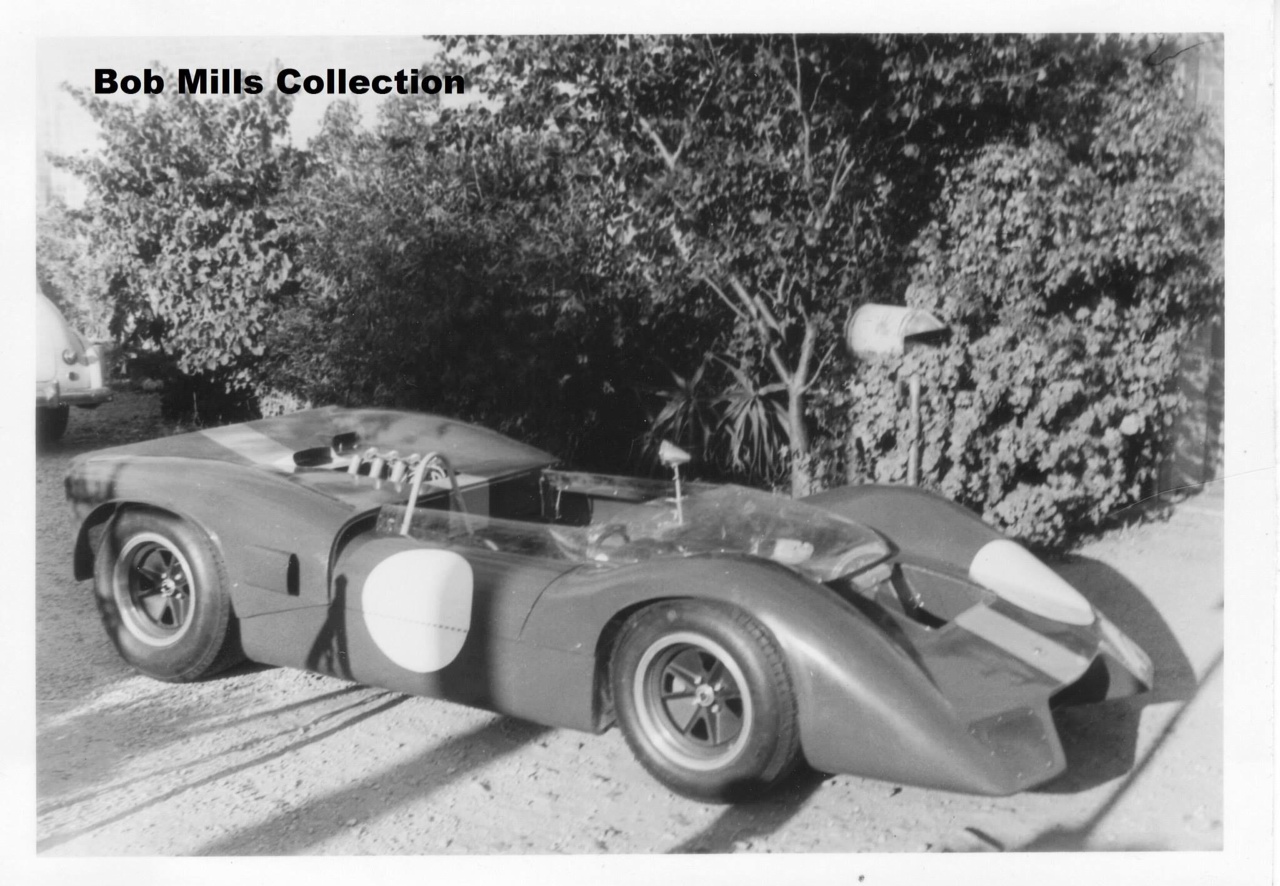
400 rear

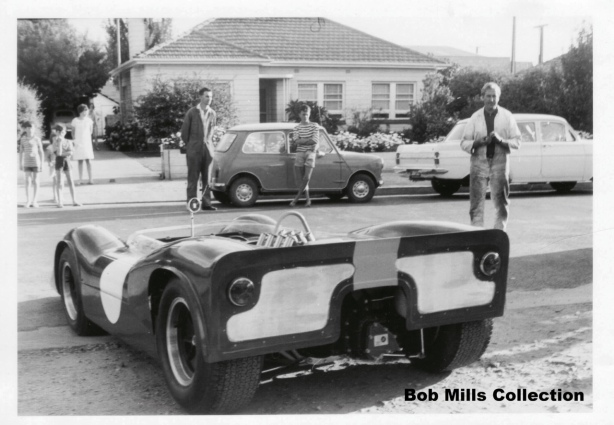
It’s interesting to see racing cars in the context of their day to gauge the impact they had on people, how ‘other worldly’ and fast they looked. Seeing them at historic race meetings is not the way the populace saw them at the time.

This shot does that in spades and the fair citizens of Conmurra Avenue, Edwardstown, an Adelaide suburb had seen plenty of cars leave the Elfin factory in their street. This one clearly captured their attention all the same.

That WOW! factor we all still experience at the sight of something really special, mind you, these days it’s usually the ‘WOW! Ugly as a Hatful of Arseholes’ impact rather than ‘WOW! Beautiful’. Such is the impact of cad-cam and the aerodynamicists ‘art’ on free flowing curvaceous forms.

The Mini 850 and Holden ‘EH’ on the typically Aussie outer suburban street nicely juxtapose the body of Elfins first ‘big-banger’ sports car with contemporary ‘roadies’ of the day.

WOW! indeed.

400 side

Elfin built four Elfin 400’s, all with different engines, the first completed was the Frank Matich Elfin 400/ Traco Olds featured in the article link above.

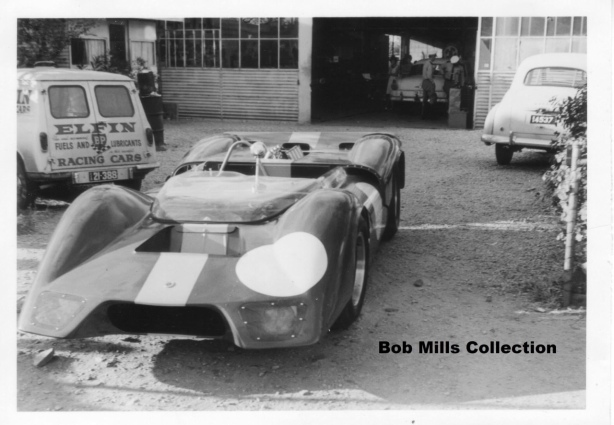
This car is about to be delivered to Bob Jane Racing in Melbourne in early 1967 in time for the sports car events which were a part of each years Tasman rounds.

It’s the first 4.4litre Repco ‘620 Series’ V8 fitted to a car, the engine developed in parallel with the 1966 Championship winning 3 litre variant of the same engine, victorious in Jack Brabhams hands that year.

In fact it is the first customer Repco engine sold, the first fitted to a sports car and the first fitted to a car built in Australia, Brabhams were built in the UK. So, significant in Repco’s’ history.
400 front

The SOHC 2 valve, Olds block, Lucas injected engine produced around 400bhp@8000rpm, enough in Australia, but not elsewhere in the world at the time, where big Chevs were dominant. In 1965/66 the Lola T70 was the ‘ducks guts’ in Group 7 sports car racing but the McLaren M6A appeared in 1967, from that moment the record books were attacked by the McLaren steamroller until the end of 1971 when Porsche ‘rained on their parade’ with the 917/10 and 917/30 turbo’ cars.

As stated above this car was raced by Jane himself, Ian Cook and Bevan Gibson. Unfortunately it was the car in which Bevan flipped on Conrod Straight, Bathurst at the Easter 1969 meeting, killing the promising young driver instantly.

Frank Matich was dominant in his range of sports cars in Australia into 1967, pickings at championship level were slim when FM was present. Matich’s Elfin 400 Traco Olds delivered its promise and his own SR3’s were almost identical in terms of chassis to the Elfin 400 if not the body.

The ex-Jane 400 is now restored and owned by Elfins’ Bill Hemming.
bevan

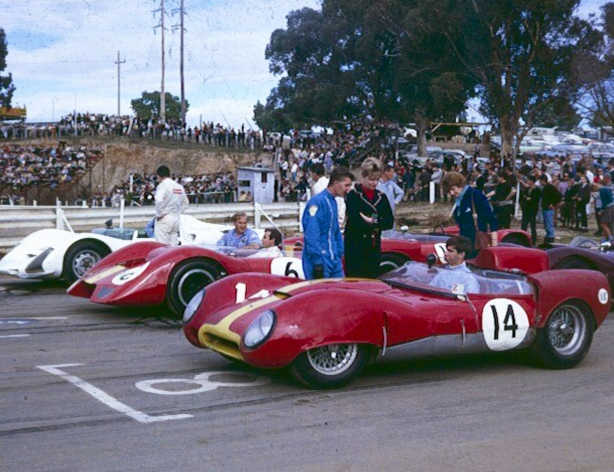
Hamilton Porsche 906 Spyder, Spencer Martin Elfin 400 Repco and Bevan Gibson Lotus 15 Climax, Hume Weir, Queens Birthday weekend 1967. Somewhat poignant shot given Bevan is to die in the car beside him 2 years later. Gibson made the families Lotus 15 Climax absolutely sing, it was his drives in this old car which earned him the Bob Jane drive (Bryan Liersch)

Bibliography…

Joe Wooding ‘Albury & District Historical Society’ paper on construction of Hume Weir

‘Elfin Sports and Racing Cars’ John Blanden and Barry Catford, Elfin Sports Cars Facebook page
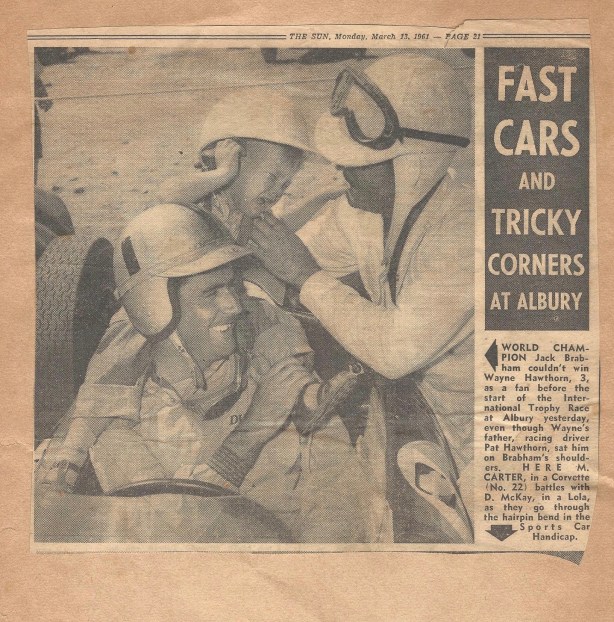
(P Hawthorn)

Photo Credits…

Bryan Liersch, Bob Mills Collection, Dick Simpson, John Small, oldracephotos.com, Bowdens, Bruce Wells Collection, Robert Davies, Bowdens, Christopher McQuellin, Phil Hall, Terry Kelly Collection, Pat Hawthorn Collection

John J Dallinger’s stunning collection of Albury photographs

Tailpieces: Family, fun day out at the Weir…

hum humpy

(unattributed)


Terry Kelly, Ryleford, Hume Weir circa 1960 (T Kelly)


hun humpy 2

Hume Weir humpy Holden mayhem (Dick Simpson)

Finito…

image

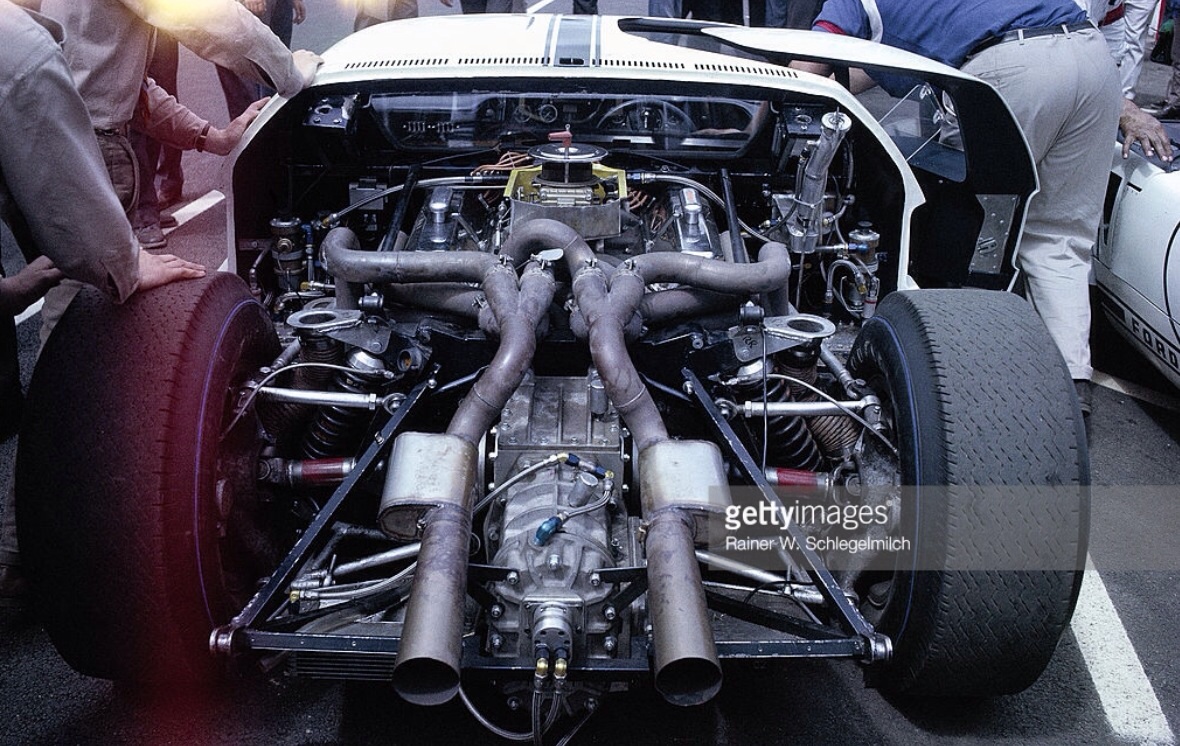
A Shelby American mechanic fettles the Bruce McLaren/Ken Miles Ford GT40 Mk2 ‘106’ prior to the Le Mans 24 Hours commencement on 20 June 1965…

I always thought the 4.7/5 litre GT40 variants were masterpieces of Eric Broadley packaging, if a bit beefy given the steel rather than aluminium monocoque mandated by Ford- but the 7 litre Mk2 and Mk4 are altogether less subtle expressions of the genre! Successful ones at that.

You can’t see ‘Henrys’ cast iron blocked, ally headed 427cid pushrod OHV V8 under all the plumbing, the dry sumped 90 degree, 107.2mm X 96.1mm lump was fed by a single, big Holley 4-barrel 780CFM carb developing circa 485bhp@6200rpm and 475lb.ft of torque@3200-3600rpm, plenty for a car weighing 1200Kg.
The ‘cross-over’ exhaust sytem is a masterpice of the pipe-benders art, mufflers interesting and unusual on a racer, maybe to save the drivers ears a tad? You can just see the gulping, big mouth of the monster Holley in front of the exhausts.

To the right near the roof is the water radiator neck, filler and temperature sender, to the right are the gold colored fuel pumps, the fuel tank had a capacity of 159 litres.

You can see the Kar-Kraft / Ford T44 four-speed ‘box, in fact ’twas the failure of this very special transaxle, the design of which was led by Ed Hull, which caused chassis #’106′ retirement on lap 45 of the classic.

There are plenty of lovely ‘Aeroquip’ aircraft braided fittings too, well in advance of their adoption in F1, for brake lines and various oil feeds around the transaxle, note the transmission oil-radiator under the mech’s elbow.

See the big, rear, grey stove enamelled chassis diaphragm below the exhaust and above the ‘box to support the engine/gearbox and location of the rear suspension, the top of the spring/shock’s clear- there, too, is the brake cooling duct which takes air collected from the body. Big cast magnesium uprights, beefy driveshafts and top suspension link and forward facing radius rod and brake calipers for the outboard mounted, ventilated discs are also in shot.

image

The quick-lift jack and ‘captive frame’ on the car is typical of Shelby’s thoughfulness and endurance racing knowledge…

Mind you they had a shocker of a race!

Five cars were entered, two Mark 2’s and three Daytona Cobra Coupes and all failed to finish; the Miles/McLaren Mk2 after 45 laps due to gearbox failure, the Amon/P Hill Mk2 on lap 89-clutch. The Johnson/Payne Daytona ‘2287’ was out on lap 158-head gasket, Gurney/Jerry Grant Daytona ‘2286’ on lap 204-engine and Daytona ‘2601’ Schlesser/Allen Grant on lap 111-clutch.

So, a disaster for Ford, their best placed car was the AC Cars Ltd entered Daytona Cobra Coupe driven by Sears/Thomson which finished eighth, the race was won, famously by the 3.3 litre V12 Ferrari 250LM of Masten Gregory and Jochen Rindt, the latter flogging the thing to within an inch of its life!

It was Ferrari’s last Le Mans win with the first of four on the trot to come for Ford from 1966-69- wins for the Mk2 and Mk4 in 1966 and 1967 and 1968/9 for the Mk1 5 litre GT40.

Finally, Shelby American made amends in 1966, taking the first two places in the infamous ‘Ford Form Finish’ ahead of arch rivals, the Holman Moody prepared Ford Mk2’s…

Etcetera…

image

(unattributed)

Le Mans 1965 start.

The Amon/Hill GT40 Mk2 on pole, then Surtees/Scarfiotti Ferrari 330P2 , Bondurant/Bucknum GT40 in 3 and McLaren/Miles GT40 Mk2 in grid 4

image

(unattributed)

McLaren/Miles Ford GT40 Mk2 early in the race, Le Mans 1965.

Both Mk2’s failed due to transaxle preparation mistakes with a gear that was intended for scrap being put into one gearbox and dirt on a bearing surface in the other.

image

(unattributed)

Carroll Shelby beside the Chris Amon/Phil Hill GT40 Mk2 chassis ‘106’ at Le Mans 1965- note the ‘at meeting’ fabricated rear spoiler addition.

image

(unattributed)

Shelby American Le Mans garage- Daytona Cobra Coupes #12 Schlesser/J Grant, #10 Johnson/Payne #9 Gurney/A Grant- all DNF.

Credits…

Rainer Schlegelmilch, teamdan.com

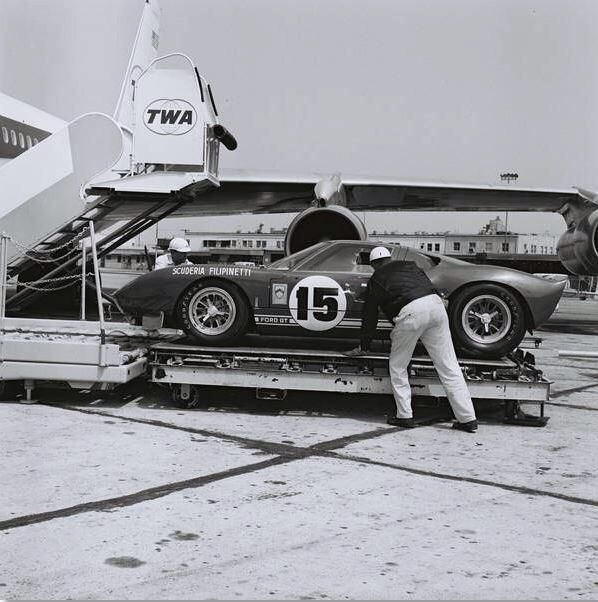
Tailpiece: Filipinetti’s GT40 Mk2, prepped by Shelby American on the way to Europe at LAX, it too failed to finish driven by Ronnie Bucknum and Herbie Muller…

image

Finito…

sebring

(Max Staub)

The Phil Walters/John Fitch winning Cunningham C4R Chrysler ahead of the Reg Parnell/George Abecassis Aston Martin DB3 and Cook/Moynet/Collier/Cahier/Bonnet/Morehouse!! DB Panhard…

The American car won by a lap from the Aston with Sherwood Johnston and Bob Wilder 3rd in a Jaguar C Type.

Credit…Max Staub

image

image

image

The Quifel-ASM Team Lola B05/40 AER of Miguel Amaral, Guy Smith and Oliver Pla zooms past the Le Mans funfair during final qualifying for the 2008 running of the endurance classic…

They finished 20th in their 2 litre entry, the race won by the Capello/McNish/Kristenson Audi R10.

lola

The Pla, Amaral, Smith Lola B05/40 AER at Le Mans 2008; carbon composite monocoque chassis with wishbone and pushrod suspension front and rear, Ohlins shocks. Rack and pinion steering, carbon discs, 6 speed paddle operated Lola sequential ‘box. AER XP-20 all alloy 1995cc DOHC, 4 valve, injected turbo engine, weight 750Kg (unattributed)

Credit…

Mike Hewitt

Tailpiece…

image