image

(VHRR Collection)

Murray Carter blasts his Carter Corvette sporty across the top of Mount Panorama in October 1961, just before the daunting drop into Skyline. The cars fuel injected, 5 litre, 300bhp V8 echoed between the eucalypt trees and into the valley below…

Its such a wonderful shot, he looks lean and lithe-he is only a little bloke, you can see the injection trumpets and ‘maggie’, sitting proud of the unpainted, aluminium bonnet fashioned by Murray’s own hands.

Murray was running 2nd in the 75 mile Australian Tourist Trophy on 1 October, behind Bib Stillwell’s 2.5 litre Cooper Monaco Climax and Frank Matich’s Jag D Type before retiring on lap 8 with diff failure in the 19 lap event. Look closely at the photo and you can see the smoke from a differential which is about to cry ‘enough’!

It was a classy field of great depth, the competitiveness of Murray’s self constructed car amongst the factory built Jags, Aston’s, Coopers, Maserati and Lotus’ clear; as was its top speed, 154mph down Conrod during practice! Stillwell won from Matich and Bob Janes Maserati 300S.

Carter has been around forever. Born in 1931, i thought he looked like an old codger at the first race meeting I attended, the 1972 Sandown Tasman round, the ignorance of a 14 year old. He raced his Ford Falcon GTHO Phase 3 at that meeting in the ‘South Pacific Touring Car Championship’, a series of races held throughout the Australian Tasman Rounds.

Carter Corvette, The Viaduct, Longford 1961 (Langdon Brothers)

image

Carter racing his Ford Falcon GTHO Phase 3 351 V8, at Hume Weir on the Boxing Day weekend in 1971, this is the car in which I first saw him race at Sandown a month or so later (Dick Simpson)

An out and out racer, he still runs a Corvette C5 in Victorian race meetings the car prepared in his Moorabbin workshop, in Melbourne’s southern bayside suburbs, where all of his cars have been built down the decades.

Murray raced other cars but for years was a Ford stalwart, never a factory driver but the recipient of plenty of assistance from Broadmeadows. He was no slouch either, 2nd in the Australian Touring Car Championship in 1975 in a Falcon GT 351 Coupe and 4th in 1980 in a similarly powered Ford Falcon XD, his best performances. At Bathurst his best finish was 3rd in 1978 in a Ford Falcon XC GT Coupe this time sharing with single-seater ace, Kiwi, Graeme Lawrence.

image

Carter pictured in his Ford Falcon XB GT351 Hardtop/Coupe at Hell Corner, Bathurst in 1975. He was 2nd in the ATCC that year in this car, the title won by Colin Bond in a Holden Torana LH SLR5000/L34 5 litre V8. At Bathurst he shared his car with Ray Winter, a very quick F2 driver, Murray qualified the car 7th but DNF after only 53 laps. Brock and Brian Sampson, another driver who has raced until a road accident put paid to his racing, forever, won in an L34 Torana (unattributed)

Like so many drivers he started racing bikes, campaigning a Triumph Tiger 100 at circuits like Fishermans Bend in 1948, aged 17 before switching to cars with a Jaguar XK120.

In search of more speed but as a panel beater unable to afford a factory car he set forth to create a more competitive mount. His original intention was to build a mid-engined single-seater to compete in Gold Star events, Australia’s National Drivers Championship, which was run to F Libre at the time.

Unable to locate a suitable transaxle to cope with the 283cid Chev’s power and torque, Murray placed the relatively light, small block Chev well back in his space frame chassis locating the 4 speed box behind it. He achieving 50/50 front/rear weight distribution that way.

image

Murray aboard the car in its original single-seater form at Phillip Island in March 1960. The car was all but destroyed at this meeting after Murray and Bib Stillwell swapped contact. Note the Cooper wheels, vestigial body and short exhausts. Very simple-and fast. Spaceframe chassis, upper and lower wishbone front suspension with coil spring/damper and well located solid rear axle again with coil spring/dampers. Other car on the grid anyone? A Cooper Bristol perhaps? (autopics.com)

The car raced in chassis form with vestigial panels to support a race number at Fishermans Bend in October 1959. It was immediately competitive, even achieving 4th place in the Philiip Island Gold Star round, behind the Coopers in December 1959.

Back at Phillip Island in March 1960, he had an argument about local real estate with Bib Stillwell and came off second best, rolling the car and all but destroying it.

image

Murray racing the Carter Corvette in a support event, at the international meeting held at Ballarat Airfield, Victoria in the summer of 1961, 12 February. Is that George Spanos’ Elfin Streamliner Coupe in the pits-he still owns that car 60 years later! The feature race, the Victorian Trophy was won by Dan Gurney from teammate Graham Hill, both in 2.5 litre BRM P48’s (autopics.com)

Carter at Calder in the early sixties, Carter Corvette (J Wishart)

Looking at the plethora of Cooper T51’s coming into Australia and at the growth of sportscar racing, he decided to rebuild the car as a sportscar constructing the functional aluminium body himself. The Carter Corvette reappeared at in October 1960.

The car was immediately successful, winning races and holding lap records around the country.

When CAMS adopted Appendix K, GT Racing in Australia, Carter modified the car with vestigial coupe bodywork. Whilst it looked as ugly as sin it remained fast finishing the one race 1963 Australian GT Championship in 2nd place at Calder. The event was won by Bob Jane in his factory built LWT Jaguar E Type, a car acquired with rather a greater budget than Murray’s beast!

image

Carter in the ‘orrible looking but fast Carter Corvette after the addition of a roof to allow it to comply with new regs introduced by the CAMS. Windscreen thought to be an FE or FC Holden rear window mounted upside down. The boy from Moorabbin was a clever improviser! (Dalton)

Eventually the car fell into disuse but still exists, wonderfully restored by the talented Lou Russo in 2007 or thereabouts, and driven by his son Michael in historic events. Meanwhile, Murray Carter, forever young at 86, races on…

image

Carter pictured with one of his old ‘HO’s lovingly restored, in recent times. Car is the Phase 3 HO pictured above at Hume Weir, in its war paint carried during the 1972 Bathurst 500 in which Murray was 10th. Globe alloy wheels homologated not long before the ’72 500 made these beasts look a treat! (carcavalcade.com)

Credits…

VHRR website, Stephen Dalton Collection, Peter D’Abbs/autopics.com, John Wishart, Langdon Brothers, John Medley ‘Bathurst: Cradle of Australian Motor Racing’

Tailpiece: Bob Jane’s lightweight E Type leads the Carter Corvette at Calder…

image

(Dalton)

Finito…

image


Tony Rudd and one of the BRM crew either sorting a problem or firing up Harry Schell’s P25 so the Bourne engineering chief can get back to his hotel, Monaco 1959…

image

Behra’s Ferrari Dino 246 you can just see on the left then Moss and Brabham, both Cooper T51, #48 Phil Hill Fazz Dino, #22 McLaren and #32 Trintignant Coopers T51. #16 and #18 Schell and Bonnier in BRM P25’s outside Brooks Dino. #20 Flockhart P25 BRM and behind him Graham Hill’s Lotus 16 Climax (unattributed)

In a sign of the times Jack Brabham won the race from Tony Brook’s front engined Ferrari Dino 246, Jack and third placed Maurice Trintignant in mid-engined Cooper T51 Climaxes. Jack of course took the first of his drivers titles that year and Cooper the constructors.

image

Jack on his own on the Monaco quayside in 1959, on his way to his first championship GP win, Cooper T51 Climax. His last the 1970 South African GP at Kyalami (Cahier)

It wasn’t a great weekend for the BRM boys; all three cars retired, Ron Flockhart, Jo Bonnier and Harry with a spin, brake’s and an accident and a split fuel tank the causes respectively.

mon butt

Stunning shot of Tony Brooks’ Dino chasing Harry Schell’s BRM into casino Square, Monaco 1959 (Heritage)

brm cutaway

BRM P25; spaceframe chassis, 2491cc DOHC, 2 valve, Weber fed 4 cylinder engine developing circa 275bhp@8000rpm, 4 speed ‘box. Suspension; upper and lower wishbones and coil spring/dampers and De Dion and coil spring/dampers at the rear. Front disc brakes, single disc on the transmission at the rear (C La Tourette)

The team broke through for its well deserved first win in 1959, Bonnier took the next race, the Dutch GP on 31 May, beating Jack and Masten Gregory in Cooper T51’s.

mon babes

BRM babes; hard for the mechanics to focus surrounded by this lot. The photo has done the rounds but i’ve never read the identity of said poppets if anyone can advise, BRM P25, Monaco 1959 (unattributed)

Credits…

Klemantaski Collection, Cahier Archive, Heritage Images, C La Tourette

Tailpiece: Harry Schell’s BRM P25 clips the inside of the kerb on entry to a corner in his pursuit of Cliff Allison’s Ferrari Dino 246 at Zandvoort in 1959, JoBo’s P25 took a famous win, Harry DNF, Allison 9th…

image


image

Great to see Innes Ireland maintain focus AND have the head space to follow Sirling Moss home in the  1960 US Grand Prix…

Bit of a tight fit in the cockpit of his 18, it would have been a bit more comfy in his 19 Sportscar, albeit not as much fun.

He  won the USGP in his Lotus 21 Climax the following year, the Scots only championship GP win. His talent deserved more but life was for living, he was a champion with joie de vivre!

Innes took Team Lotus first GP win in the process so ’twas a big weekend for Innes, Chapman and the Lotus 21.

The photo below is Ireland leading Dan Gurney’s Porsche 718 and Graham Hill’s BRM P48/57 Climax on his way to victory in 1961.

image

(unattributed)


Credit…
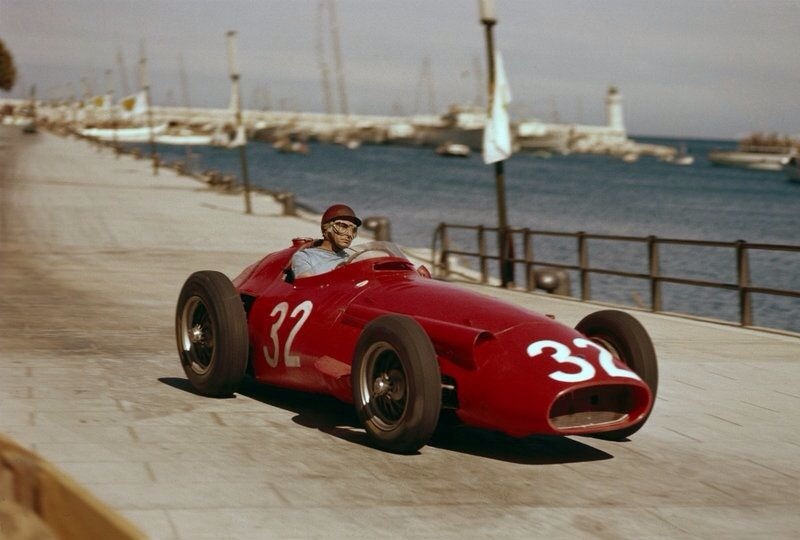
Dave Friedman, Getty Images

Tailpiece: Innes, Silverstone, circa 1961…
image

(Getty)


image

The spare Lotus 48 Ford FVA, chassis 48-2 during the Eifelrennen Euro F2 round in the Nurburgring pitlane on 24 April…

Oliver’s Lotus Components entered Lotus 41B was the most successful of the Lotus works entries, he finished 11th. The Team Lotus duo of Graham Hill were 15th with Clark retiring with fuel metering unit failure. The latter two drove Lotus 48 Ford FVA’s, Oliver’s car was an update of Lotus’ 1966 contender. Jochen Rindt won the race in a Brabham BT23 FVA.

image

Oliver on his way to 4th place and first F2 home during the Oulton Park Spring Trophy. His Lotus 41B was behind the Brabham Repco’s of Jack and Denny Hulme, and the Honda RA273 of John Surtees. 15 April 1967 (Brian Watson)

Oliver raced for the Charles Lucas factory Lotus F3 team in the second half of 1966, driving a Brabham BT18 Ford and Lotus 41 Ford finishing third in the Les Leston British F3 Championship, Harry Stiller won it from Chris Lambert.

For 1967 Oliver contested the British F2 Championship, finishing 5th, as well as many Euro F2 rounds, for 1968 he was a member of the ‘works’ F2 team racing Lotus 48’s together with Jim Clark and Graham Hill.

image

Lotus Team compound during the 25 June 1967 Reims GP weekend. The white car is Ollies Lotus 41B 7th. Jim Clark is talking to Jackie beside his car #8 Lotus 48 DNF, the car under the cover is the spare carrying #8. Hill is talking to the mechanics next to his chassis, 2nd. The race was won by ‘F2 King’, Rindt in a Brabham BT23 FVA (unattributed)

Then, in the worst of circumstances he ascended to the F1 team upon Jim Clark’s death at Hockenheim on 7 April during the second round of the 1968 Euro F2 Championship.

Oliver was 5th in the championship won that year by Henri Pescarolo’s Matra MS5 Ford, Rindt the dominant driver, as ever, in the category but ineligible for the title as a graded driver.

Olivers first Gold Leaf Team Lotus F1 race was the Monaco Grand Prix in which he qualified his Lotus 49B Ford 13th but was out on the first lap after colliding with Bruce McLaren.


image

Oliver Q10 in the Dutch dunes where the Lotus 49B made its victorious debut in Clark’s hands the year before. He was non-classified having done insufficient laps. Jackie Stewart won in a Matra MS10 Ford (unattributed)


In a character building year, he had a monster accident at during French GP practice when the cars rear wing support failed-pinging the fence of a chateau on an amazing 125mph trip thru the Rouen countryside. He was able to walk away but the car was hors ‘d combat, so that was his meeting.


image

Oliver reflecting on life after a wild, wild, wingless ride thru rural France. Whilst his mechanic reflects on the long night ahead (sic) Jackie is sussing out his DG300 box and rear suspension which is 50 metres back up the road from whence he came (unattributed)


image

The chateau gates Oliver hit are to the right past the Lotus 49’s rear end (unattributed)


image

Chapman, Hill and Oliver during the tough 1968 season (unattributed)


His best result from a year in which Graham Hills tour de force of leadership gave him and the team world titles was Q2 in his home race at Brands Hatch, the race won by Jo Sifferts Rob Walker Lotus 49B, and 3rd in the season ending Mexican GP, Hill was the winner of that race.


image

Oliver DNF gearbox after qualifying 2nd, ahead of Jo Siffert 1st both in Lotus 49B’s, Chris Amon 2nd, Ferrari 312, the last car in the group Surtees Honda RA301 5th (Getty)


image

Oliver leads Pedro Rodriguez BRM P133, 3rd and 4th in the 1968 Mexican GP, 3 November. Hill won from Bruce McLaren (unattributed)


For 1969 Jackie was off to BRM, Jochen Rindt took his Lotus seat for 1969 in an ‘all star’ team with Hill. It was a tough year in  1969 as BRM had  ‘lost their way’ in a design sense, the P133/138/139 uncompetitive, better was to come  in 1970 with the Tony Southgate designed P153.


image

Oliver, BRM P133 Monaco GP 1969 , Q13 and DNF with an accident of lap 1. Hill won in a Lotus 49B Ford (Schlegelmilch)


image

Jack Oliver giving his brand new BRM P153 V12 plenty during the season opening South African GP weeeknd at Kyalami in March 1970. Car looks gorgeous without its Yardley branding! Brabham won in a Brabham BT33 Ford, Oliver DNF with gearbox dramas (unattributed)


Chapman waxed and waned between monocoques and space frame chassis for his ‘small bore’, production single-seaters throughout the 1960’s…

Whilst the marketing advantage of a you-beaut monocoque ‘just like Jim Clark’s Lotus 25’ was clear, equally the relative cost of repair of a spaceframe, especially in the field, a long way from the Norfolk was something which wasn’t lost on a lot of customers. Local garagiste ‘Louis the Torch’ may have been able to fix bent RF corner tubes, but he was less likely to be able to assist with curved sheet metal/aluminium complexities…

Statistically the most successful FJ/F3/F2/FB cars of the 1960’s were Ron Tauranac’s spaceframe Brabhams which were built to a consistent design philosophy throughout.

The cars were simple, strong, fast and forgiving straight outta the box. The latter because Jacks ‘finely tuned arse’ in testing contributed the ex-factory suspension settings which could be relied upon as a competitive, starting position by customers. Plenty of championships were won by not straying too far from them.


image

Jim Clark, Pau GP, 25 April 1965, victorious in his Lotus 35 Cosworth Ford SCA from Richard Attwood’s Lola T60 and Jochen Rindt’s Brabham BT16, both also SCA powered (unattributed)


Lotus Components 1965 F2/3 car was the monocoque 35, a modified version of the 1964 32, with Clark winning plenty of races in the car including the  Trophee de France, the Scot won 3 of the 4 rounds.

Aussie John Joyce (later the designer of magnificent Bowin racing cars when he returned to Australia) with assistance from Dave Baldwin were briefed to build a spaceframe F3/F2 frame for 1966 designated the 41. The Lotus brains trust were having second thoughts about monocoque chassis suitability in the junior classes. Issues were cost, weight and utility and expense of repair. The 41 was raced from 1966 to 1968 and whilst a good car didn’t have the factory support needed to further develop it, the exception the Lotus Components 41 raced by Oliver. The chassis was also raced in the US FB class.


image

Pau GP, ’65 JC ponders setup changes on his monocoque Lotus 25 inspired 35 (unattributed)


The works Lotus F2 car for 1967, the first year of the 1.6 litre F2, the Lotus 48 was a monocoque, the car Oliver raced was the customer 41B, a spaceframe.

Both cars were comprehensively blown off by Tauranac’s Brabham BT23 which had some mighty fine pilots; aces like Rindt, but also coming drivers who extracted all the performance the car had to offer. The Matra F2’s, the MS5 and MS7 were also fairly tidy, fast (monocoque) devices…


image

Leo Geoghegan, Australian Gold Star Champion in a Lotus 59 Waggott 2 litre in 1970. Here at Oran Park, Sydney that year (oldracephotos.com)


Chapman’s 1969 F3/F2 car, the Dave Baldwin designed 59 was a spaceframe. Its successor, the final Lotus production racing cars produced in volumes, the 1970 69 was a spaceframe for FF/F3 (spaceframe chassis are mandated in FF) and a monocoque for F2. Go figure!? Mind you, the 59 and 69 were very effective, successful tools whatever the variant.


image

Jochen Rindt doing his thing in his Lotus 69 FVA during the Crystal Palace Euro F2 round, the ‘London Trophy’ on 25 May 1970. Jochen’s car DNF battery lead, Jackie Stewart’s John Coombs Brabham BT30 FVA won the race. The 69, a monocoque, was a mighty fine car in the hands of the works and customers, competitive into 1971 (unattributed)


These Lotus chassis changes are only of arcane interest over the decade I guess. Perhaps the reasons for the choices were simply the opinions and preferences of the individual designer who worked on each cars design or layout, not that I am suggesting Chapman ever lacked clarity about design direction or objectives!

In terms of the general specifications of F2 cars of the early 1.6 litre Formula, those and that of the engine de jour, the Ford Cosworth FVA 1.6 litre unit are well covered in my article on the Lotus 48, click here to read it, there is no point repeating it all;

https://primotipo.com/?s=lotus+48


ollie

Lynn Oliver, Monaco 1968. Husband Jackie and Bruce McLaren collided on the first lap, both DNF. Car is Lotus 49B Ford, Graham Hill’s sister car won (Schlegelmilch)

Credits…

Rainer Schlegelmilch, Brian Watson, oldracephotos.com, Getty Images

Tailpiece: Ollie’s Lotus 48 aerobatics at Klostertal during the ’67 German GP weekend, he was the F2 category winner…

image

(Schlegelmilch)

In a great performance Jackie was 5th in a Lotus 48, the race won by Denny Hulme’s Brabham BT24 Repco

Finito…


image

(Rod MacKenzie)

Graeme Lawrence ‘bang on line’ as Kevin Bartlett remarked upon seeing this shot of the Kiwi champions Lola T332 Chev going through Oran Park’s new ‘twiddly bits’ during the 1974 Australian Grand Prix…

There is something great about seeing a racing cars mechanical elements isn’t there? Rod MacKenzie has captured them beautifully in this shot.

These Lola’s are favourites of mine as some of you would know, and a topic about which I have written at length, specifically Peter Brennan’s restoration of Lola T330 ‘HU18’- Lella Lombardi’s old bus. So I won’t bore you with the technical details again, it’s all in this series of articles, attached is the link to the first of them;

Lella’s Lola…Peter Brennan’s Restoration of the Ex-Lella Lombardi Lola T330 Chev ‘HU18’…Episode # 1

There is so much to see back there starting, of course, with 5 litres of fuel injected Chev, say 520bhp in period. The poor Hewland DG300 5 speed transaxle coped, just, as long as it’s components were adequately lifed, the ‘box was originally designed around ‘effete’ 3 litre F1 engines, not, big, butch Chevs.

The beefy sliding spline driveshafts are clear as are the big inboard brake calipers and ventilated cast iron discs. These Lolas were beautifully finished, all of the steel fabrications were finished in shiny nickel plating.

Suspension is period typical at the rear; single upper link, two lower links, the earlier T330 you will see via the link above had inverted lower wishbones. Uprights were magnesium alloy, fore and aft location provided by radius rods. The shocks are double adjustable alloy bodied Koni’s. Adjustable roll bars were of course also fitted front and rear. Rod MacKenzie’s shot is so sharp you can see Graeme has the rear bar set at full soft, trying to get rear end bite out of Oran Park’s slower turns no doubt.

The big airbox is clear, within 12 months most of the T332’s on the planet had converted to an all enveloping engine cover cum airbox to better flow air over the car and onto the rear wing, this development was first made by the Haas/Chaparral crew in the US on Brian Redman’s car.

Big, wide Goodyears put the power to the road, the wheels are Lola’s own 14 inch diameter cast magnesium jobbies; within 12 months 15 inch American Jongbloed’s were de rigour on these beasts.

A car of beauty indeed!

Graeme was very successful in it; he came within a bees-dick of winning the ’75 Tasman Series in a last round shoot out at Sandown with fellow T332 pilots, Warwick Brown and John Walker, that story is told here, the battle resolved in Warwick’s favour, the only Aussie to win the coveted Tasman Cup;

The Mother and Father of Lucky Escapes…John Walker, Sandown Tasman 1975…

Graeme also won the Kiwi Championship, the Gold Star with Lola in 1974/5.

Credits…

Rod MacKenzie, Terry Marshall

Tailpiece: ‘Team Lawrence’ and trusty T332 after a Tasman Levin win in 1975…

image

(Terry Marshall)

The circumstances for the upload of these two photos by Rod and Terry Marshall were in honour of the recent passing of Graeme Lawrence’s late father Doug, helping Graeme out of the car above. He was an integral part of his sons motor racing from the start. Clearly there is deep respect and affection amongst former competitors and their crews on both sides of the Tasman for Doug Lawrence. RIP Sir.

image


I wonder how much it was? ‘Gotham Ford’ does have a touch of the ‘Batmans’ about it doesn’t it…

Not too many of these GT40 ‘road cars’ were built, maybe one of you knows which chassis this is?

image

Credit…

Unattributed

image

When I first saw this shot I had a chuckle at the Auto Union logo on the ‘brolly, merchandising and brand placement goes back so far, there is nothing new under the sun?!…

And then I wondered which car and where of course, and as is so often the case with the Getty Archive there are no useful details. It makes the detective work a challenge, there are obviously not a lot of hints in this shot!

image

But I think it may be Bernd Rosemeyer’s victorious 1936 ADAC Eifelrennen winning Type C, 3 litre V16 engined car. The number fits, the photo was taken by a German agency and the exhaust pattern, two into one ‘drainpipe’ seems to fit with the limited number of shots I can see of Bernd that day. But all correspondence will of course be entered into.

Rosemeyer won the 13 June event from teammate Hans Stuck, the two 6 litre V16’s ahead of Antonio Brivio’s Alfa Romeo 12C 4.1 litre V12. Checkout the Kolumbus.com website, my favourite for this period, and their detailed race report, just scroll down to the race;

http://www.kolumbus.fi/leif.snellman/gp363.htm

image

Rosemeyer, AU Type C, 1936 Eifelrennen (ullstein)

image

Credits…

Ullstein Bild

Tailpiece…

image


image

(Gasking/Repco)

‘Scuds’ was the nickname of David McKay’s Ferrari, Porsche and Volvo dealership on Sydney’s North Shore…

Here is the team with its Brabham BT23A Repco ‘740’ 2.5 V8 at Warwick Farm in 1967’ish. Not sure of the exact date, but it looks warm and Cusack carried #7 in the Hordern Trophy on 3 December 1967 so my tip is that weekend. He finished behind Frank Gardner’s Alec Mildren owned Brabham BT23D Alfa Tipo 33 V8, its race debut and John Harvey’s Brabham BT11A Climax.

Mind you, Cusack carried the same number in the 18 February ’68 Tasman Round won by Jim Clark’s Lotus 49 Ford DFW, Greg was out on lap 4 with brake problems. Upon a closer look, the car in the shot below, during the Tasman round does not have the green band at its noses tip, so let’s go for the shot above as pre Hordern Trophy.

From the left is the beautifully liveried Holden HR Station Wagon tow car.

It’s probably toting the big 186cid 3 litre ‘six’ and ‘three on the tree’ manual tranny. Mechanic Bob Atkin, later a Director of SV, then El Supremo McKay and driver Greg Cusack. Greg was a very successful Ford dealer himself in Canberra. He was said to have been as quick as anyone on his day but ‘those days’ didn’t happen often enough! The trailer is a ‘Rice’ rated then and eagerly sought after now.

Top period shots, luvvem!

image

Cusack at the Farm during the ’68 Tasman round in the SV BT23A (oldracephotos.com)

Chris Amon did some laps in the car that 1968 Warwick Farm 100 weekend too. I wonder if David McKay was keen to see just how fast the car could go- Chris was one of the fastest guys on the planet at the time after all, or perhaps he was helping with car setup.

That Tasman he was racing a works Ferrari Dino 246T his own team were running, and SV’s Ferrari P4/350 Can Am.

(D Grant)

The colour shot below is of Cusack on the same weekend- he was out of the championship race on lap 4 with brake problems whereas Chis was fourth in his Ferrari, Jim Clark won in a Lotus 49 Ford DFW.

(P Houston)

Credits…

Michael Gasking Collection/Repco, oldracephotos.com, oldracingcars.com, Perry Drury, Doug Grant, Peter Houston

Tailpiece

(P Drury)

Denny behind Jack’s BT23A in the Longford paddock in March 1967, Brabham won the Monday Tasman race taking the one and only Repco engined Tasman win, using a ‘640 Series’ 2.5 V8.

Finito...

frank gardner

(John Ellacott)

Frank Gardner beside his Jaguar D Type ‘XKD 520’ at Mount Druitt on 23 May 1958, looking fairly relaxed, photographer John Ellacott recalls FG achieved a 14.57 standing quarter mile in the big, powerful car…

Its right at the end of Mount Druitt’s decade long life as a race circuit in Sydney’s western suburbs. FG took FTD in one of the sprint events after the circuit was ‘mortally wounded’ by circuit owner Belf Jones after a spat with its operator the ‘Australian Racing Drivers Club’ in 1958.

mt druitt 1

(TR0003)

These wonderful Mount Druitt, 1955 Sydney, New South Wales colour shots (the one above and below) were posted on ‘the Nostalgia Forum’ which, for those of you who haven’t discovered it is something you should do, but be warned you will be lost in interesting motor racing ‘threads’ for years…

http://forums.autosport.com/forum/10-the-nostalgia-forum/

Ace researcher/historian and primotipo contributor Stephen Dalton dates the shots as probably the 4 September 1955 meeting with the Healeys’ driven by #93 C Kennedy and #98 K Bennett. In the background Stephen thinks the #53 tail is an important Australian MG Spl, the ex/Dick Cobden/David McKay/Curly Brydon car.

The red car surrounded by mechanics is perhaps the ex Jack Saywell Alfa Romeo P3 then Alvis powered and driven by Gordon Greig. The covered #4 single seater is Stan Coffey’s Cooper Bristol ‘Dowidat Spl’ and #14 Jack Robinson’s Jaguar Special.

mt druitt 2

(TR0003)

All ‘The Fun of The Fair’ or ‘Mount Druitt Motor Racing’ as the case may be…

This article was published in the Sydney Morning Herald on 14 August 1954, it captures the atmosphere of the place and the day and ignorance of the public of motor racing;

THIRTY thousand picnicking spectators in 8,000 cars make a phenomenon in Australian sport and entertainment at Sydney’s monthly motor races at Mt. Druitt.

Cars park two to four deep the whole length of the two and a quarter miles racing track. Spectators drive between races from one vantage point to another over ‘horror stretches’ in the seemingly endless acres of paddocks around the track.

Vendors sell hot water, hot dogs, all the usual provendor of picnics. Children play rounders or football between races.

By the standards of Britain’s famous Brooklands, the informality is extreme for the spectators, but it is typically Australian; sunshine, open air, gum trees.

The Australian Racing Drivers’ Club, however, applies the strictest international rules of competition to its 12 or 14 race program.

Officials on motor cycles patrol the boundary fences. White uniformed officials with international motor racing flags signal the drivers safely through the races-a blue flag waved – ‘a competitor is trying to overtake you’; a yellow flag waved ‘great danger, be prepared to stop’; yellow, with vertical red stripes-‘take care, oil has been spilt on the track.’

A public address system links the whole of the two and a quarter miles of track with the finishing line.

A truck tows breakdowns off the course, often two at a time, ignominiously, like a defeated bull dragged from the ring.

At the end of the day 8,000 cars crowd the Great Western Highway in a colossal traffic jam, in which the ‘hot rodders,’ after a few imitative accelerations, lose their ardour for speed on frustrating miles of bumper-to bumper driving.

What attracts this crowd to a venue nearly 40 miles from the city is the excitement of speeds up to 140 miles an hour and skid turns on hairpin and right-angle bends. The straight of the bitumen track is a wartime airstrip.

The club conducts events for racing, sports, and stock cars and has 60 to 70 competitors at a meeting.

Most of the competitors are owner-drivers-fanatical seekers of perfection in the assembling and tuning of motors. They acquire a car, according to their means and choice. If it is a stock model they remachine and reassemble parts of the motor, and fit new parts, two carburettors, and a ‘blower’ (a supercharger), which gives the ultimate ‘kick.’

In all types of cars running and maintenance costs are high. A set of tyres is good for only 500 racing miles. A car may run half a mile and burn the top out of a piston. An owner may spend £250 on a new cylinder head and find it does not fit satisfactorily.

brabham

Jack Brabham in the Cooper ‘Redex Spl’ Bristol referred to in the text. On the outside is Bill Hudson, Hudson Spl at Mount Druitt in 1955. Jack was later to say he should have taken this highly self developed car to the UK rather than purchase the Cooper Alta he bought in the UK…still it didn’t hold him back in the end! (unattributed)

THE glamour driver of the moment is a 26-year-old motor engineer, Jack Brabham, with his British £4,000 six cylinder Cooper (frame)-Bristol (motor).

He is a former Australian midget car champion, whom some club officials put in ‘world class.’

In the lingo of the fans, he ‘lashes the loud pedal-(accelerator) down to the boards’ and scorns the ‘anchors’ (brakes).

His driving is, indeed, a spectacle as he relentlessly mows down a field, flashes past car after car, and changes gears at 85 to 90 miles an hour.

But the fans are watching a £7,000 Italian Ferrari, with a 12-cylinder two litre engine having a power output of 250 b.h.p. and a top speed around 150 m.p.h. Owner Dick Cobden, a fine driver, has had the car only a few months and is still familiarising himself with its tuning and driving.

The Ferrari is a Grand Prix car, which famous English driver, Peter Whitehead, drove in the Lady Wigram trophy at Christchurch, New Zealand, early this year’.

cobden

Dick Cobden’s ex-Whitehead Ferrari 125 at Mount Druitt, date uncertain. (G & L Liebrand Collection)

Circuit Map…

druitt circuit

(unattributed)

Mount Druitt Aerodrome, 45 Km west of Sydney was built for the Royal Australian Air Force during World War 2. The facility comprised 2 hangars, workshops and a runway 1,524 metres long and 48 metres wide, perfect as the basis of a racetrack postwar.

The first race meeting was held on October 4 1948 on a short track based on the runway established by the Australian Sporting Car Club.

In 1952 Belf Jones built a full circuit, 2.25 miles long using some adjoining land owned by a Mr McMahon, a Sydney businessman. The circuits’ first meeting was on 30 November 1952 organised by the Australian Racing Drivers Club, the main event, a 50 Mile Handicap won by future Australian champion, David McKay’s MG Spl. (one of the cars obscured in the first photo above).

Over the following 5 years over 25 meetings were run with crowd attendances often over 15,000, given the circuits proximity to Sydney. Mt Druitt’s last meeting was on 10 November 1957.

Commercial agreement for the circuits future use could not be reached between the ARDC and Jones, who did irreparable damage to the circuit; Jones cut a trench around the circuit with a digger!

gardner 2

Another shot of Frank Gardner’s D Type at Mount Druitt on 23 May 1958. (John Ellacott)

The last hurrah for the venue was a number of sprint meetings run in 1958. Victories resulted for Gardner’s D Type Jag, Arnold Glass’ HWM Jaguar and Len Lukey’s Cooper Bristol.

The ‘NSW Speedway Act’ in 1959 and consequent required investment in the facility to meet new safety standards was the final death-knell for this fondly remembered circuit.

The parts of the track added in 1952 remain but the airstrip section is long gone, the area is now known as the Whalan Reserve, it comprises the Mount Druitt industrial estate and Madong Avenue Primary School.

druitt circuit 2

Current google earth aerial shot of the circuit area. (speedwayandroadracehistory.com)

Bibliography…

The Nostalgia Forum Mount Druitt thread, particularly the contributions of Stephen Dalton and ‘wirra’. Sydney Morning Herald 14 August 1954, speedwayandroadracehistory.com

Photos…

John Ellacott, TR0003, G & L Liebrand Collection

Finito…

noige

(Automobile Year/DPPI)

Nigel Mansell blasts his Lotus 87 Ford through the North Sea sand dunes of the fabulous Dutch circuit on August 30 1981…

Mansell joined the team in 1980, contesting the Austrian, Imola and Canadan Grands Prix.

In Holland he qualified his Cosworth powered Lotus 87 17th in a field of 30, 5 cars were non-qualifiers. His race was a short one though, he retired with an electrical failure on the races first lap. Alain Prost took the Renault RE30 win from Nelson Piquet, Brabham BT49C Ford (Piquet won the drivers title that year and Williams the constructors) and Alan Jones’ Williams FW07C Ford.

Mansell finished his first full season with 8 points, 14th in the drivers championship and a best placing of 3rd at Zolder, Belgium.

noige 2

Mansell, Zandvoort 1981. (The Cahier Archive)

Photo Credit…DPPI, The Cahier Archive