Posts Tagged ‘Australian Motor Racing History’

image

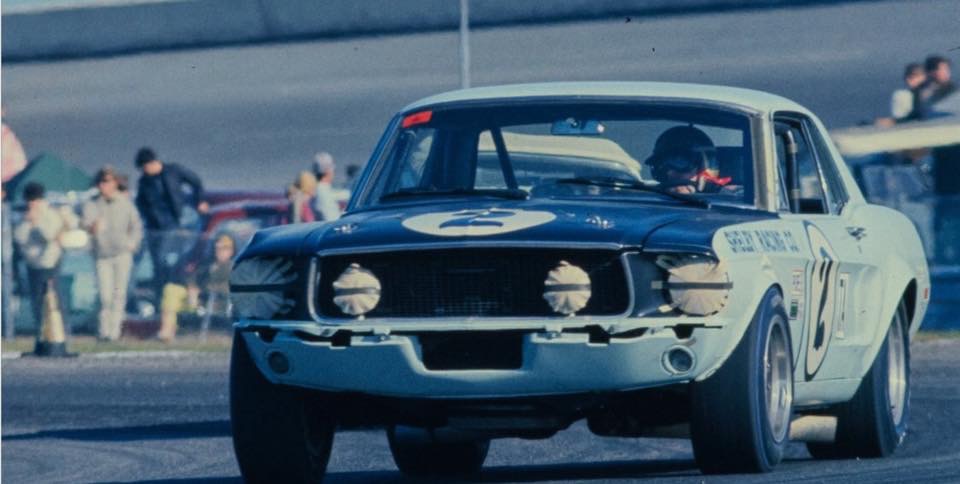
Allan Moffat finesses his Shelby Mustang around the Daytona banking during the 1968 running of the endurance classic on 4 February…

The first two World Sportscar Championship rounds in 1968- at Daytona and Sebring were also the first rounds of the Sports Car Club of America’s Trans-Am Championship which had very quickly become an important ‘Win on Sunday, Sell on Monday’ contest for the major manufacturers and importers of cars into the US since it’s inception in 1966- the ‘Pony Cars’ so many of us know and love are a by-product of the Trans-Am, more to the point, they provided the homologation foundation upon which the race winners were built.

Shelby Racing Company entered two new ‘tunnel port’ 305cid V8 Mustangs at Daytona crewed by Jerry Titus and ex-F1 driver Ronnie Bucknum and another raced by Allan Moffat and Austrian/Australian/American Horst Kwech- they qualified Q22 and Q23 respectively.

image

Siffert/Hermann Porsche 907 second placed car (the pair also shared the winning #54 car!) in front of Moffat/Kwech/Follmer Daytona 1968 (D Friedman)

Whilst the Porsche 907, Alfa Romeo T33, Ford GT40 and Lola T70 slugged it out at the front of the field- that battle was settled in favour of the Vic Elford/Jochen Neerpasch/Rolf Stommelen Porsche 907 with 673 laps from the Jo Siffert/Hans Hermann 907 in second, Ford were fourth outright courtesy of the Titus/Bucknum combination who  covered 629 laps- the Moffat car failed to finish when a spring tower failed. Ford were fortunate in that Roger Penske’s Chev Camaros had been ahead of the Mustangs, but they too did not finish.

image

Daytona 1968 pre-race prep for the two ’67 rebuilt Shelbys, Titus car in front of Moffat’s (D Friedman)

Moffat from the Kleinpeter/Mummery/ Hollander Shelby 350 DNF- the blaze of lights getting Moff’s attention is the Wonder/Cuomo Ford GT40 DNF (unattributed)

image

Thaddl be during the long night- car DNF after 176 laps (D Friedman)

Whilst Allan Moffat is a household name in Australia, he may not be quite so well known to some international readers so a potted history follows, noting the focus of this article is two years or so of his long, successful career- 1967 through to the middle of 1969.

Despite the articles narrowness in time it’s 13,594 words in length which is insane really, my longest ever, and about Touring Cars FFS! but I got more and more interested and chased increasingly many tangents as I explored. Grab three ‘Frothies’, here goes…

Allan George Moffat was born in Saskatoon, Saskatchewan Canada on November 10, 1939. His father’s career progression took the family to South Africa in the early 1950s. Moffat’s  high school education spanned 1953 to 1958- he attended General Smuts High School in Vereeniging, near Johannesburg.

Keen on cars from the start, he bought a 1935 Ford V8 aged sixteen then stripped and rebuilt it over two years before he was able to drive on the roads, the first circuit he visited was Grand Central track- what became Kyalami, a ‘citadel’ of racing. Allan’s father moved the family to Melbourne, Australia in 1961 where he became a cadet with Volkswagen and attended night-school at Taylor’s Business College with the aim of being admitted into university.

Sandown’s first international meeting was held on 12 March1962, he blagged a his way into a gopher role with the Rob Walker camp helping look after Stirling Moss’s pit- the great Brit was third in a Lotus 21 Climax 2.7 FPF in the race won by Jack Brabham’s Cooper T55 Climax.

Early days on the Victorian circuits- Moffat, Calder, Triumph TR3A 1963

Moffat and Jim McKeown go at it during the 1966 South Australian Touring Car Championship at Mallala- Jim was disqualified for receiving outside assistance after a spin whilst Moffat blew a tyre on the last lap. Clem Smith won in his Valiant RV1 (unattributed)

Shortly thereafter the budding racer bought a Triumph TR3A on hire purchase and commenced his competition career at Calder and the country circuits of the day as time and money allowed. He raced a hot VW while studying at Monash University and working with Volkswagen. After failing at Monash he followed his family back to Canada where he made a living selling Canadian cookware door-to door.

If it was ever in doubt, Indianapolis 1964 was the event which decided the young, focused and very determined Moffat that his future was in racing. He travelled from Toronto to Watkins Glen to see Team Lotus race their Lotus Cortinas to try and get a job with the team. He sought out Australian Ray Parsons all weekend about helping the team but failed so, ever persistent, followed them 2900 kilometres away to Des Moines- the next event where he met Parsons who took him on without pay- by the next meeting at Washington he was accepted into the team albeit on an unpaid basis.

At the seasons end the Cortinas were advertised for sale at $4500 each including spares- Allan asked his father to lend him the $3000 shortfall in excess of his savings to buy one, he reluctantly agreed. The deal was done and the car quickly shipped to Australia where he contested the 1964 Sandown Six-Hour race, a high profile international event with all of the local touring car stars of the day and internationals Roberto Businello, Paddy Hopkirk, John Fitzpatrick, Rodger Ward, Timo Makinen, Rauno Aaltonen, Jackie Stewart and Jim Palmer. After twenty laps Moffat had lapped Bob Jane and was leading the race but boofed the fence at Peters Corner, eventually finishing fourth- it was a magnificent debut all the same. The race was won by Businello and Ralph Sach in Alec Mildren’s Alfa Romeo Giulia Ti Super.

Allan Moffat two-wheeling Shell Corner in best Lotus Cortina style during the November 1964 Sandown 6 Hour- he and Jon Leighton were fourth in the race won by Roberto Businello and Ralph Sach in Alec Mildren’s Alfa Romeo Giulia Super TI (unattributed)

Moff checks the tyres of his FJ Holden Panel Van with Lotus Cortina on the back circa 1965. This servo- the pumps were soon to go, became AM’s workshop from the mid-sixties until 2015, 711 Malvern Road, Toorak is well known to eastern suburban racing nutbags. The locale is much the same now- those houses abut Beatty Avenue are still there. What is different, sadly is that Allan sold the site circa 2015, it is now a several story block of apartments named ‘Mandeville Lane’. Moffat lived in Toorak forever and was a regular in ‘Romeos’ and ‘Topo Gigio’ restaurants in Toorak Road, both are still there, where he was often wining and dining contacts, sponsors etc (AMC)

Moffat, Lotus Cortina, Green Valley 4 Hour Trans-Am April 1967, 18th with Gurney’s Cougar the winner (J Melton)

Moffat raced his car to a win in the Victorian Short Circuit Championship at Hume Weir a month after Sandown and was part of a posse of well over 20 drivers who ‘put the Ford Falcon on the map’ in Australia and dispelled concerns about the marques quality and durability by staging a 70,000 Mile Reliability Trial over nine days in late April 1965.

Ford America still had two unsold Lotus Cortinas so the competition manager, Peter Quenet asked Moffat to come back to prepare and race one of the cars throughout 1965, he returned to the US in time for the Indy 500 and was famously Jim Clark’s ‘water boy’ during the Scot’s historic Lotus 38 Ford victory. He raced the Cortinas in the Detroit area doing consistently well at Waterford Hills, his ‘home track’ but later in the year he raced at Mosport- running a distant third to Sir John Whitmore in a Team Lotus car.

He returned to Melbourne in November 1965 for the six-hour race and was holding second place with his BRM tweaked twin-cam engine when the rear axle failed two laps from the finish- Kiwi open-wheeler ace Jim Palmer co-drove that year.

In early March 1966 Peter Quenet rang again and offered Moffat a drive in Cortinas fitted with a ducks-guts BRM-prepared twin-cams, quick as a flash he was back across the Pacific again. The main competition were the Alan Mann Racing Cortinas whose driving roster included such luminaries as Frank Gardner, Sir John Whitmore and young thrusters Jacky Ickx and Hubert Hahne, in addition the grid that year included about fifteen alloy-bodied Alfa GTAs.

The Alan Mann Racing team manager was Howard Marsden, later to take over management responsibilities of Team Matich in Sydney and shortly thereafter Ford Australia’s racing team which was based in an unprepossessing ‘skunkworks’ in Mahoneys Road, Broadmeadows. In a splendid performance Moffat won the third ever Trans-Am race at Bryar, New Hampshire using U.S. Goodyear tyres, specially developed for his car and in the process his 1.6 litre Cortina defeated heavy metal including Frank Gardner, and John Whitmore Lotus Cortinas Horst Kwech Alfa GTA and ‘heavy metal including the Bruce Jennings Plymouth Barracuda, Yeager/Johnston and Lake/Barber Mustangs, Bob Tullius’ Dodge Dart and others.

Ray Parsons, both a mechanic and a racer, joined Moffat later in the year to build and run another Cortina with Harry Firth and Jon Leighton brought over from Australia as co-drivers for the longer races. At that time Harry Firth was ‘the competition arm’ of FoMoCo Australia preparing both rally and series production racing cars out of his small, famous workshop in Queens Avenue, Auburn. Moffat and Firth- and Parsons and Leighton contested both the Green Valley 6 Hour and the Riverside 4 Hour season ender in mid-September 1966 for ninth/seventh and seventh/thirteenth (both Ray Parsons and Moffat did Riverside solo, the latter when Harry Firth was laid low with flu) outright respectively.

A small historic sidebar is that Ray Parsons was a Tasman Series regular looking after Jim Clark’s Lotuses in the Australasian summers, after he returned to Australia- having tended to Piers Courage’ McLaren M4A Ford FVA in throughout the Etonian’s very successful 1968 Tasman Tour- he joined another ex-Lotus colleague, Engineer John Joyce in Sydney to build the very first Bowin- Glynn Scott’s P3 which just happened to be powered by Pier’s spare FVA. What became of Ray Parsons folks?

Becoming more and more entreprenueurial, Moffat asked Quenet for a budget to take over and race the two Alan Mann cars for the opening race of the 1967 season at Daytona- the Daytona 300. In a deal that involved Moffat agreeing not to race in Australia in 1967- and with assistance from Shell, the very powerful 180bhp twin-cam engine from Jim McKeown’s Shell-Neptune Lotus Cortina was shipped to America and installed in one of the Mann cars- McKeown was Moffat’s co-driver.

The Canadian got the class pole and led the first half hour before the flywheel parted company with the crank- with that ended any chance of a Ford works deal for 1967 but an agreement was reached whereby Moffat was given the cars, spares, equipment and transporter- and received $300 for each car which started a Trans-Am race.

In order to make the deal financially viable he took on pay drivers who were somewhat rough on the cars. It got to the stage where the other cars were cannibalised to keep his own machine racing- Moff’s results were appalling- Daytona 300 DNF, Sebring 4 Hour DNF, Green Valley 4 Hour eighteenth, Lime Rock DNF, Mid Ohio DISQ, Marlboro U2 litre with Adams DNF and then, bingo, a strong second sharing a Mustang with Milt Minter behind the Donohue/Fisher Roger Penske Chev Camaro Z28 and ahead of other notables in a smallish field in the Marlboro Double 300 at Marlboro Park Speedway in Washington DC.

The one off drive came about when Moffat was asked to take over the drive of a Mustang owned by George Kirksey, a Texan former sports writer and businessman at Mid Ohio- it was a great opportunity which Moffat capitalised upon- the Moffat/Minter pair were third outright at the end of the 500km race albeit they were later disqualified for refuelling whilst the engine was running- an error not Moffat’s. (I can make no sense of this in the ‘Racing Sports Cars’ results of the 11/6/67 Mid Ohio Trans-Am)

Kirksey then invited Moffat to do a non-championship Manufacturers Round at Watkins Glen where the major opposition was the Penske Camaro- Allan put the car on pole, recorded the fastest race lap and were elevated to first place after the winning car was disqualified for running a ‘fat’ engine.

Moffat in front of Dan Gurney’s Mercury Cougars- he would drive one later in the season, here during the March 1967 Sebring 4 Hour, both guys DNF in the race won by Jerry Titus’ Mustang (unattributed)

Moffat, works Bud Moore Mercury Cougar- note Allan Moffat Racing Ltd on the guard, maybe the deal was that AM’s team looked after the car on race weekends? Circuit unknown, help needed(unattributed)

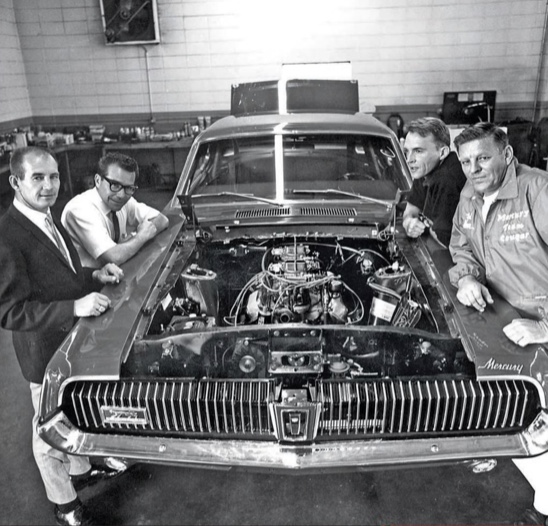
Mercury Cougar test session at Riverside 8-14 January 1967- Bud Moore, Dan Gurney and Al Turner with Fran Hernandez with his back to us. Al Turner came to Australia a year or so later and ‘captained’ Ford Total Performance’ in Australia, bless him (F Hernandez)

AM in his Brabham BT15 Ford twin-cam, Road America, Wisconsin 1967 (B Nelson)

For the final four Trans-Am races he was given one of the Bud Moore Mercury Cougars and was up there racing with the big boys, a drive Allan credits to Peter Quenet…

His results weren’t flash mind you- his first race was at Modesto on 10 September for a DNF after 9 laps, then a Riverside prang after 41 laps, then in Las Vegasm as a support during the Can-Am round, DNF after 76 laps and then finally in the last race of the year at Kent where he was fifth.

Moffat said of his results ‘In my view it wasn’t my finest hour, but others differed. The DNF’s, two of them not my fault, and an out of points finish in the final race were the sum of my contribution. On paper it didn’t look good, but in that last race i’d actually achieved the team’s objective. I’d been sent out to block, to deliberately spoil the field. And it seemed i’d been successful’ Ford Mustang won the title by two points from Mercury with Chevrolet outclassed.

The young Canadian was very much a ‘coming man’, but he was ‘skint’ so set about selling the Cortinas ‘as well as a Brabham BT15 open wheeler in which i’d had one run and one win at Waterford Hills using a Cortina engine…’

Around about then, in December 1967, Moffat met Kar-Kraft’s Roy Lunn who offered him a job as a development driver. It was during that year (1968) that Moffat either reinforced or established his close links with the various Ford people who would help his career when he returned to Australia- this is about where we came in at Daytona 1968…Shelby, Kar-Kraft and Moffat- a bit player but becoming more significant.

Ford well and truly put a Trans-Am toe in the water by engaging Shelby American to build two Mustang Coupes for the 1967 championship after being successful the year before- Fastbacks could not be used as the SCCA classified them as sportscars at the time- and were therefore ineligible. Kar-Kraft provided valuable engineering assistance to Shelby- in particular making changes to the upper ball-joint mount to provide greater tyre/guard clearance and developing a stronger front axle (spindle). The two Coupes they developed won the ’67 Trans-Am.

Separate to Fran Hernandez’ Mustang program, he also oversaw the the running of (Lincoln Mercury division of Ford) two Bud Moore Mercury Cougars in 1967, one of which was raced by Moffat later in the season as we have just covered. In fact the Cougars almost upset Fords’s championship, falling short by only two points but finishing ahead of the Camaros. According to Lee Dykstra, Bud Moore based the Cougars racers on Shelby Mustang specifications- but they (the Cougars) did not use Kar-Kraft parts.

For 1968 Ford decided to move the Trans-Am Mustang engineering program from Shelby Engineering, based in California to Kar-Kraft just down the road in Dearborn- still with Fran Hernandez as leader. For those of us who are not Americans lets have a look at this short-lived (1964 to 1970) but hugely influential and successful 1960’s race organisation.

Smokey Yunick’s car out front of Kar-Kraft’s Haggerty Street Dearborn facility- building still exists, now used by a shipping company  (unattributed)

Kar-Kraft was an independently owned racing organisation started by Nick Hartman (although other sources say it was a wholly owned subsidiary of FoMoCo) with only one client- Ford. It was born of a group of young Ford engineers who quickly brought together Lee Iacocca’s mid-engined Mustang 1 concept and build- Roy Lunn was also part of that program and it was that small group who were central to Lunn’s plan for a nimble specialist group to take Ford’s various race programs forward.

Ford Advanced Vehicles in England was Lunn’s responsibility, when he became frustrated with the lack of success/progress of the Eric Broadley designed, FAV/John Wyer built and managed Ford GT40 in 1964 (Colotti gearbox reliability, aerodynamics, outright pace etc) he wanted greater FoMoCo Detroit control and therefore reorganised the GT40 program by tasking FAV to build the chassis/cars in Slough with the race program/development work under the wing of Jacque Passino, Ford’s global motorsport manager- and in turn Kar-Kraft in Dearborn.

Hartman, Ed Hull and Chuck Mountain knew each other as local SCCA racers, Hartman started K-K upstairs of his father’s machine shop in Dearborn- in the beginning the K-K designers and mechanics were moonlighting from Ford Research with management’s permission.

After a short stay at the Hartman workshop on Telegraph Road, Dearborn, K-K moved to 1066 Haggerty Street where the group was expanded to a team of about four engineers, four designers and ten mechanics and fabricators- flexing in size up and down, who worked for the following six years to make Ford’s products winners.

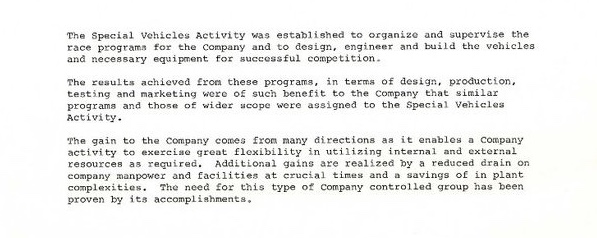
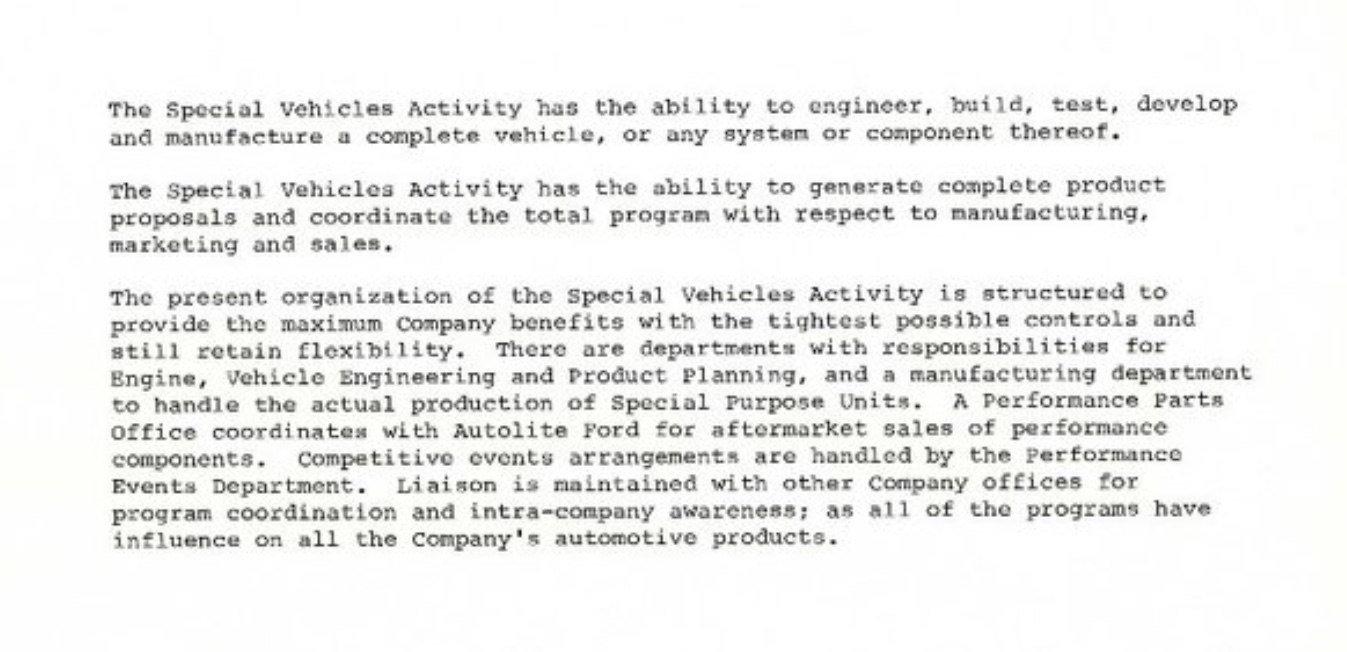
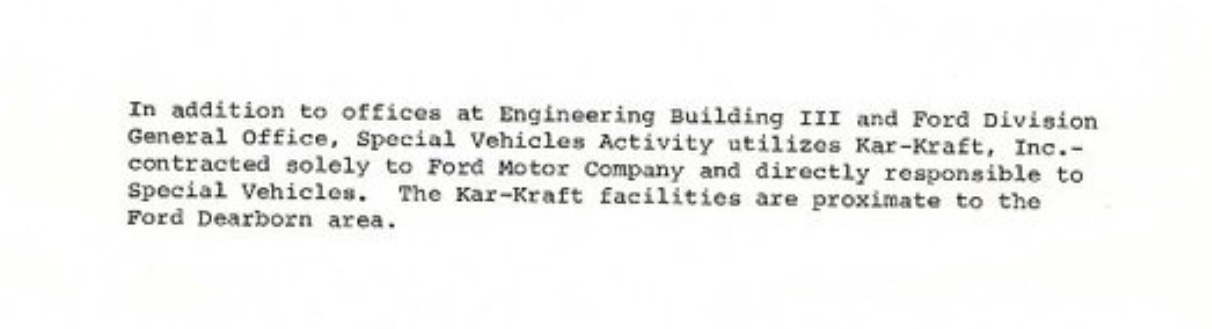
K-K had a ‘Special Vehicles Activity’ whose brief, described in an undated Ford document was to ‘…engineer, build, test, develop, prototype and manufacture a complete vehicle, or any system or component thereof. It (further) has the ability to generate complete product proposals and coordinate the total program with respect to manufacturing. In addition to offices at Engineering Building 3 and Ford Division General Office, Special Vehicles activities utilises Kar-Kraft Inc, contracted solely to Ford Motor Company…’

In short K-K had a brief broad enough to build one car or a limited production line such they did to construct the Boss 429 Mustangs when Bunkie Knudsen tasked them to do so. Crucially, they formed the link between the race teams (such as Shelby and Bud Moore in a Trans-Am context) and divisions back at Ford. In this way the race teams got access and input from the Ford departments which looked after engines, gearboxes, suspension, aerodynamics, computers and electronics.

Mustang 1

Ford GT40 race debut, FAV Slough built, Nurburgring 1000km 31 May 1964 Bruce McLaren (up) and Phil Hill. John Wyer behind the car head down taking notes

Ford GT Mk2, Ford Proving Ground Detroit June 1966 (Getty)

By the time K-K were given the 1968 and onwards Mustang programs their Ford Mk2 and Mark 4’s had won Le Mans in 1966 and 1967- the J-Car program was not so successful. K-K’s first job, which they did rather successfully was to marry the GT40 chassis and componentry with the 427 ‘Big Block, NASCAR engine and in the process developing the K-K transaxle, stuffed with heavy-duty ‘Top Loader’ gearsets, together with Pete Weismann and relentless testing by K-K and Ken Miles and Phil Remington from Shelby, they soon had a race winner. The Mark 2 first won at Daytona in early 1965 and of course triumphed in the famous 1-2-3 form finish at Le Mans in 1966.

In fact one of the reasons K-K ‘copped’ the Mustang program is that with a stroke of the rule-makers pen 7 litre cars were banned from the International Championship of Makes with effect 1 January 1968, so K-K’s primary race programs were at an end, they had resources available. And so it was with the death of the big-beasts, that the ‘original’ GT40 5 litre finally, long in the tooth, had its place in the Le Mans sun in 1968 and 1969 with John Wyer’s JW Automotive the most successful team to race these cars, two wins on the trot at the Sarthe using chassis ‘1075’.

During 1968 Allan Moffat got his chance with K-K ‘I was sitting in the Ford cafeteria with Peter Quenet, when Roy Lunn came over and said “What are you doing?”, and I said “starving to death”, so he said why don’t I go and work for Kar-Kraft. It was really one of those very fortuitous, fateful lunch meetings that happen to people from time to time. I worked right through Christmas, but their first cheque didn’t arrive until March. It was for $5000 and I think it all went straight to American Express’ Auto Action recorded.

Moffat worked on the Mach 2 Mustang- a mid-engine Corvette beater with IRS and a fibreglass body (which ultimately became the Ford engined De Tomaso Mangusta) the 1968 Trans-Am Mustang developments and the 1969 Trans-Am.

When K-K took over the Mustang program they built two new 1968 Coupes which Shelby developed and raced- the two cars raced at Daytona and Sebring were modified 1967 Shelbys. Moffat got his opportunities with Shelby early in the season given his involvement with K-K albeit the Shelby Racing Co staff would have been well aware of his race record in recent years.

Where I am going with all of this is Moffat’s journey from Lotus Cortinas in 1964 to the first meeting at Sandown in May 1969 when he raced his Kar-Kraft/Bud Moore Trans-Am, so a look-see at the 1968 Kar-Kraft/Shelby cars, given the carryover of some key components to the ’69 Trans-Am is relevant to the car we all came to know and love in Australia. And there is a Bob Jane Shelby twist in all of this too as many of you know.

The primary differences between the 1967 and 1968 Mustang notchback racers may have appeared minor, just sheetmetal, but the ’68 racers were mechanically much closer to the ’69 Boss cars than they were their ’67 notchback predecessors, that was in part due to rule changes between the 1967 and 1968 seasons.

The 1968 rules allowed greater freedoms than the Trans-Am’s first two years. For over 2 litre cars, a maximum engine capacity of 305cid was allowed regardless of the size of the original engine fitted. Wheels could be 8-inches wide and arches flared to accommodate them. Full interiors were no longer mandated- and most cars used roll cages to increase the vehicles torsional rigidity with obvious performance dividends. Pieces were removed, trimmed or drilled to reduce weight- this search for weight reduction eventually led to acid-dipping chassis as well as the parts attached to them- this became an epidemic really and is a story in itself, but not for now- the minimum weight was 2800 pounds.

Four-wheel disc brakes were allowed even though no such option was available on the specification sheet from any US manufacturer of a production car. Kar-Kraft used massive Lincoln calipers and rotors on the front whilst Kelsey-Hayes four-piston calipers (used on the 1965-1966-1967 Shelbys) were used at the rear. k-K special hubs allowed the rear ends to be fully-floated and suspensions employed K-K Watts linkages, narrowed rear springs were used and double-adjustable Koni shocks. Fuel cells were made mandatory from May 1968 with special refuelling rigs deployed- Penske’s team were aces at using trick rigs to speed up pitwork and forced other factory teams to follow.

Two ‘Shelby Racing Co’ cars were entered for each event, a total of four team cars were used during the year- two were new cars based on 1968 Mustangs and two were rebuilt 1967 Shelby team cars, the latter pair were the duo of cars raced at Daytona and Sebring as covered above. For the sake of completeness another new chassis was set aside for Shelby’ use but was not built up as a racer, however it was eventually assembled as such some years later.

Jerry Titus 1967 Shelby Mustang notchback during the Mission Bell 250 at Riverside in September. Not quite as ‘butch’ as the ’68 cars with more tyre and ‘flare’ (J Christy)

The dreaded 1968 302 Tunnel Port engine- cylinder head (unattributed)

Riverside late 1968 season engine test, one of the ’68 Shelbys at Riverside (F Hernandez)

The ‘famous’ late 1968 engine test is the 1969 shootout between the Tunnel Port, Gurney-Weslake and Boss 302 engines fitted in a ’68 Shelby- but look closely and it appears a bunch of Webers smiling at us. Charlie Henry’s book says that K-K tested a G-W manifold with Webers (exactly as used on the JW GT40’s with a bulge to give the carbs breathing space- in long distance 24 hour spec, fitted in a GT40 the engines in period gave a smidge under 500bhp. ‘Whilst the carbs provided data they were illegal in SCCA Trans-Am’ but legal in Oz where Webers were Moffat’s instruments of choice (F Hernandez)

As related earlier, Jerry Titus won the first 1968 Trans-Am round at Daytona run in conjunction with the Daytona 24 Hour, he finished fourth behind three long-tailed Porsche 907 Lang-Hecks.

The engines used at Daytona were Shelby Racing Co built Tunnel Port V8s. From race four of the Trans-Am, the Lime Rock round and onwards, Ford decided that all engines for Shelby would be supplied directly from Ford’s engine foundry- that is, engines assembled and built by ‘Ford Engine Engineering Special Vehicles’ were shipped in crates to Shelby for installation into the cars.

After each race they were removed and shipped back to Ford for disassembly, inspection and evaluation- this proved a disastrous decision which cost Ford any chance of winning the 1968 championship. So frustrated was number one driver Jerry Titus, that he formed his own team to race Pontiac Firebirds starting with effect the final Riverside round.

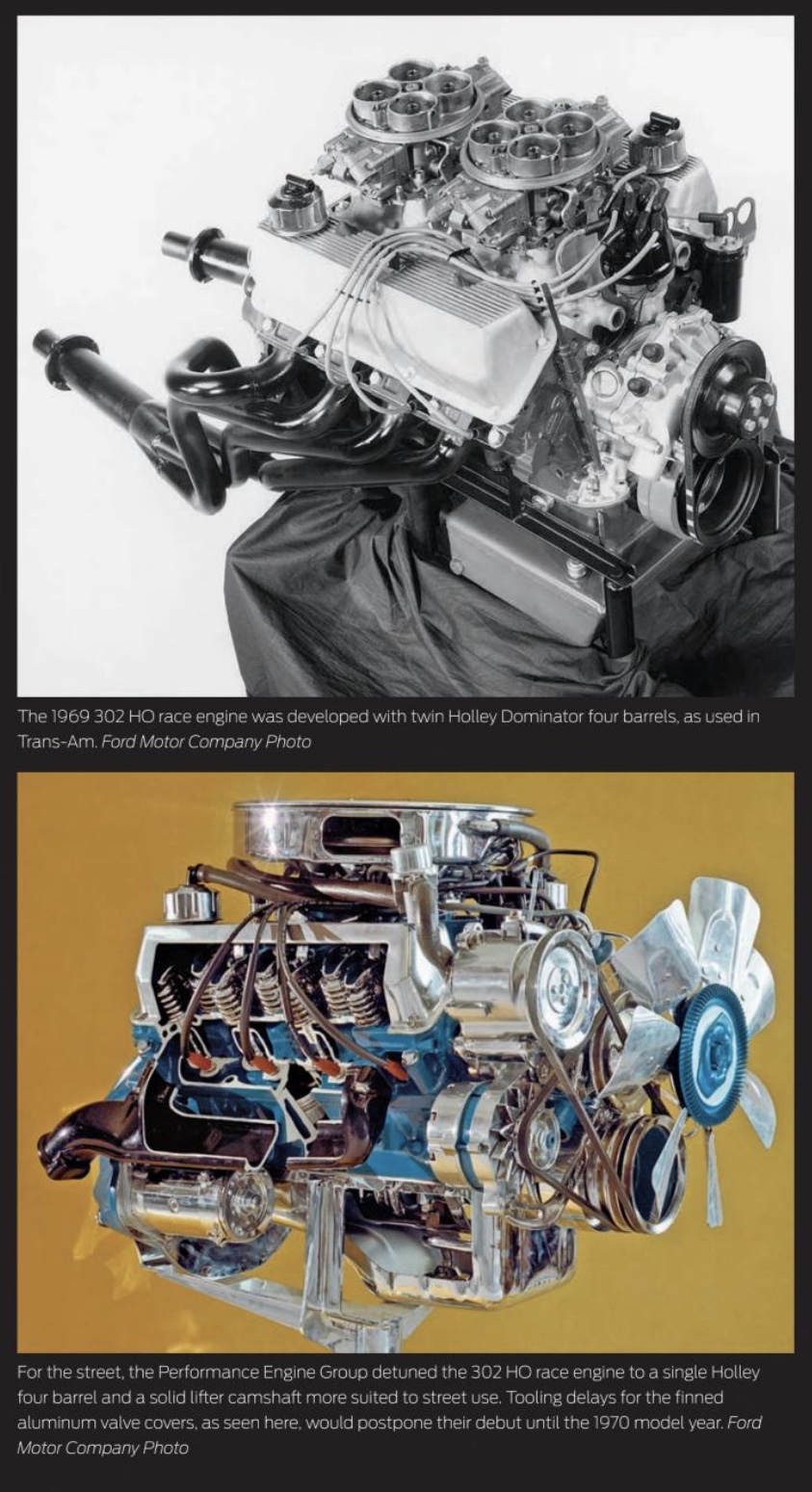
FoMoCo’s new 302 ‘Tunnel-Port’ engine was the secret weapon which would bring a third Trans-Am Championship on the trot, they hoped. A refinement of the 289 Hi-Performance V8, the primary change was to the cylinder head design. The 289 heads tended to be restrictive and only so much extra performance could be gained through porting and polishing- the new design was based on Ford’s NASCAR 427 heads.

The intake ports were straight instead of snaking around the pushrods- the pushrods went through the centre of the ports, giving rise to the name ‘Tunnel-Port’. This also allowed larger valves to be used, an extra eighth of an inch of piston travel was included, bringing the total displacement to 302 cubic inches. The block was strengthened and used lovely four-bolt main bearing caps, the whole lot was topped off with an aluminium dual quad carburettor intake. Shelby dyno sheets showed power outputs of 440 to 450bhp albeit this was produced very high in the rev range which became the cause of great, consistent reliability problems- apart from being power and torque curve characteristics unsuited to the demands of road racing.

Oiling problems plagued the engines the entire season- hardly a race weekend went by without one, usually more engines turning themselves into scrap metal. Some races were described as ‘six engine weekends’ because two engines would blow in practice and the race. At one point Shelby asked Ford if the team could go back to building their own engines- Ford’s answer was a succinct ‘No’. For the record, Shelby engines won two out of the four races in which they built the engines- Daytona and Riverside whereas Ford’s score was one from nine- Watkins Glen.

(L Galanos)

A month or so after Daytona (where this long piece started) the Shelby team headed from California in the direction of Florida, Sebring for the second race of the season on the 23 March weekend.

There, Moffat again shared the car with Horst Kwech where they qualified Q22, the Titus/Bucknum duo Q16 with the pair of Penske Camaros of Donohue/Fisher Q13 and Fisher/Welch/Johnson Q17.

Up front the race was won by the Siffert/Hermann 2.2 litre, flat-8 Porsche 907 from the sister car of Elford/Neerpasch whilst third outright was the Donohue Camaro from the Fisher machine, then the Titus/Bucknum Mustang with Allan and Horst one of the many tunnel-port’ engine DNF’s for the year.

Louis Galanos commented about his photo above ‘I can’t help but smile seeing this…photo…from the Sebring 12 Hour…After the Le Mans style start cars are coming down the front straight  three and four abreast. David Hobbs in a Gulf GT40, Ludovico Scarfiotti in a factory Porsche 907, Allan Moffat in a Shelby Mustang , Scooter Patrick in the Lola and so on…’

Checkout the amazing sequence of photographs below which shows just how quick away Jo Siffert was on pole and Allan Moffat down in Q22- Usain Bolt twitch fibres and all that, and no seat belt buckle done up I guess.

(D Friedman)

Drivers all in a pack, Moffat does appear to be making ground here, wherever he is, he comments in his autobiography written with John Smailes about his lack of training down the decades so we was not an elite level runner.

(D Friedman)

Siffert and Moffat- surely both have ignored belts, and critically their engines have answered the starter button immediately on call.

(D Friedman)

Jo is gone- out of shot whilst Moff is about to be swamped.

(unattributed)

From the off you can see how Moffat takes the Mustang wide knowing the zippy mid-engine rockets are going to cannon in his direction with the #11 Lola T70 Mk3B Chev of Mike de Udy (above and below) nearly driving him right into the wall- did he have a rear view mirror after that I wonder?

#28 Ickx/Redman and #29 Hawkins/Hobbs are the JW GT40’s #51 is the Ludovico Scarfiotti Porsche 907, #56 is the Foitec/Lins Porsche 910 and #42 the Bianchi/Grandsire Alpine A211 Renault and the rest.

(L Galanos)

(unattributed)

Titus and Bucknum made a strong showing at Sebring where they finished third in the Trans-Am class, behind the two Penske Camaros despite thirteen pit stops. The cars used Shelby prepared Tunnel Port V8s and cast iron Ford top-loader four-speed close ratio gearboxes, after this race aluminum Borg Warner T-10s were used.

Moffat all loaded up before the race, Titus machine alongside- ‘Shelby Racing Company’ decal on the B-pillar- and in action at Sebring below

Context for being given the Daytona and Sebring drives are Moffat’s performances in the previous two years and in particular the late 1967 Mustang and Mercury drives together with the KK testing role ‘…I was in the Ford fold, totally visible’ Moffat related to Smailes.

Allan was competing for the second seat in the Shelby team against Kwech- Titus was the number one and Bucknum had indicated he didn’t want the drive for the year.

At Daytona ‘In the race for the Shelby Ford works seat, score one for H Kwech. You never want to be at the wheel of the car when it breaks and he’d neatly handballed that honour to me. A month later at Sebring I broke my golden rule. When the flag dropped I was away, leading (the class) for the first hour until I was overhauled by Mark Donohue…When I handed the car back to Horst it was perfect, but, with one lap remaining of his long stint, the engine blew. At least he hadn’t been able to get me back behind the wheel before it broke.’

In due course the two Shelby sprint Trans-Am drives for 1968 went to Titus and Kwech.

Allan Moffat would return to Sebring a few years later at BMW’s invitation.

He joined Hans Stuck, Same Posey and Brian Redman in a BMW 3 litre CSL to victory in the March 1975 running of the classic from the Dyer/Bienvenue Porsche Carrera RSR and the Graves/O’Steen/Helmick similar car.

(unattributed)

After the conclusion of the two big international races in the US at the outset of the 1968 season Moffat was at a loose end- he still had his K-K testing gig but all the Mustang Trans-Am race seats were taken, Ford had lost interest in the under 2 litre class and in any event the Porsche 911s (admitted by the CSI as Group 2 touring cars) were dominant. More Cortina racing wasn’t going to take Allan forward, the Mercury program was at an end too- Ford would not make the mistake of splitting its resources and racing against itself again. As Charlie Henry wryly observed ‘Cougar never gained admittance to the Ford Motor Company “racing clique”. Ford wanted a performance oriented Ford to win, not a division with a luxury car reputation.’

The balance of the 1968 Trans-Am season unfolded like this.

Parnelli Jones joined Shelby at War Bonnet for the third Trans-Am round, qualifying on pole, but by the lap 7 Donohue’s Camaro was firmly in control up front- Jones was third with Titus out on lap 46 with a popped Tunnel Port V8. At Lime Rock, over the Memorial Day long weekend, Titus was second with the ‘guest car’ driven by NASCAR stockcar racer David Pearson, he retired on lap 22 after being black-flagged for leaking oil onto the track, the engine was consuming the slippery stuff faster than the crew could pour it during pit stops

shelbytransam wrote that ‘Things went from bad to worse for the Shelby team after that. Roger Penske’s Sunoco Camaro, driven by Mark Donohue, continued to run like a freight train while the Shelby cars faltered at every turn. Titus finished second at Mid-Ohio but teammate Horst Kwech, in #2 car blew the engine on the first lap. At Bridgehampton, the team’s semi-tractor trailer was involved in an accident on the way to the track and crushed the roofs of both cars. They were repaired as soon as they arrived but Kwech blew during the Sunday morning warm up before the race started and Titus went out with a broken suspension. At Meadowdale, in Illinois, Kwech finished eighth and Titus came in eleventh. Titus finished fifteenth at St. Jovite in Canada whilst Kwech blew his engine. At Bryar, in New Hampshire, Titus finished tenth and Kwech again blew an engine. Donohue won that race…effectively clinching the championship right there.’

Whilst all of this race excitement was going on, Moffat still had his Kar-Kraft testing duties but he was of course frustrated about not racing but his career was about to change direction again- in a pivot back to Australia.

Entrepreneur/racer Bob Jane’s first 1965 Mustang met its maker in an accident at Catalina Park in New South Wales’ Blue Mountains that November, he was lucky to walk away from the accident which is covered in this article here; https://primotipo.com/2020/01/03/jano/

Undeterred, he soon acquired a 1967 Mustang GT390 which was progressively modified, inclusive of the use of a small block V8 to get a car which handled as well as Pete Geoghegan’s locally developed (by John Sheppard) Mustang GTA- but it didn’t matter what the boys in his Brunswick HQ did, he still could not catch Big Pete. In fact the shortfall was Jane’s capabilities behind the wheel- Bob was no slouch of course, but he, like the rest of the competitor set were not on the same planet as the big, beefy Sydney motor dealer.

Bob despatched his long-time Team Manager, John Sawyer to the ‘States to find some goodies and know-how to try and bridge the performance gap between his and Geogheagan’s cars mid-year prior to the one race Australian Touring Car Championship to be held in Pete’s backyard- Warwick Farm, on September 8 1968.

John knew Allan, looked him up in Detroit and sussed him as to who to talk to and contact in relation to all the trick Ford bits, Allan helped out with introductions, explaining who John and Bob Jane were and how they fitted in, and assisted in getting all the components they needed, and then some.

Allan also set up the contacts with Shelby to acquire an ex-works 1968 car for Jane to use in 1969 and beyond- lets come back to that in a little bit.

Sawyer and Moffat spent plenty of time together, John soon got to understand Allan’s plight- race drive unavailabilty and all the rest of it. John contacted Jane about Moffat’s plight and soon he was offered a job with the Bob Jane Racing , acting as a go-between for the Mustang purchase project. Although nothing was documented, Allan understood that, in return, he would get to drive the older Mustang ‘GT390’  when the new car arrived in Australia.

Happy days indeed! Or so it seemed.

Bob Jane in the GT390 early days @ Warwick Farm in 1967 (unattributed)

Horst Kwech, Shelby Mustang, Riverside, on the way to a win in late 1968- this chassis was soon to become Bob Jane’s car (unattributed)

Bob Jane, Mustang, Hume Weir, circa 1970 (D Simpson)

Jerry Titus finally broke Donohue’s winning Trans-Am streak at Watkins Glen in August 1968 when the Camaro lost its brakes three-quarters of the way through the race. Dan Gurney was guesting in the other Shelby Mustang and retired with a blown engine. Donohue came back at Continental Divide Raceway in Colorado, finishing back in front- Titus and Gurney were both out with blown engines- this was the meeting after which Jerry announced that the next race, Riverside, would be his last in a Mustang, then he was off to campaign his own Pontiac Firebirds- Shelby were very sad to see him go of course.

By September 8, with both Donohue and Titus out at Riverside and Horst Kwech a Shelby Mustang race-winner, his car fitted with a Shelby pepped Tunnel Port, Allan Moffat was back in Australia, racing of all things Bob Jane’s Tasman 2.5 litre single-seater over the 15 September weekend…

On Horst’s race-winning weekend Bob Jane contested the ATCC race at Warwick Farm. Geoghegan started the race from pole and won after Beechey and Jane touched on the first lap- Bob retired with Geoghegan winning from Darrell King’s Morris Cooper S and Alan Hamilton’s brand new, just arrived in Oz, Porsche 911S/T.

Bob Jane Racing had a swag of drivers on its books by this stage of 1968.

John Harvey came very close to meeting his maker after a rear-upright failure in Bob’s new- just bought off Jack Brabham, Brabham BT23E Repco V8 dumped him amongst the scenery at Mount Panorama during the traditional Easter Bathurst Gold Star round. Harves was incapacitated with a long convalescence for the rest of the year whilst the shagged Brabham was repaired by Bob Britton in Sydney.

With Harvey indisposed, a three car team (Brabham, Mustang and Elfin 400 Repco sports-racer) and contractual commitments to Shell, Jane contracted two young Melbourne up-and-comers- Ian Cook and Bevan Gibson to  have some drives, the story of the Elfin and these two are told in this article; https://primotipo.com/2018/04/06/belle-of-the-ball/

So, by the time Moffat arrived in Melbourne Sawyer and Jane had four drivers and three cars.

Ian Cook, with a solid background in ANF1.5 single-seaters, raced the repaired BT23E to fourth in the Gold Star round at Lakeside in late July during Kevin Bartlett’s dominant 1968 Gold Star year aboard Alec Mildren’s Brabham BT23D Alfa Romeo Tipo 33 2.5- the team missed the following Surfers Paradise round in late August with Moffat having a run at Sandown.

Whilst Moffat now had heaps of touring car experience- including ‘Big Car’ stuff as Frank Gardner liked to call them, his exposure to the more rarefied world of single-seaters was limited to a race or two in a Brabham BT15 Ford twin-cam in the US in 1967.

Sawyer and Moffat set off across Melbourne from Jane’s race base in Brunswick to Sandown Park- a circuit on which Moffat had always been quick, but his weekend was over almost before it started after an accident when a rear tyre parted company with its rim as he accelerated up the back straight. Game over before it had even begun.

Towards the end of the year, on 24 November he drove the Elfin 400 Repco ‘620’ 4.4 V8 sports car (below) to two wins in the Victorian road Racing Championships meeting at Phillip Island.

This shot and the one below are of AM and John Sawyer in the backlane behind Bob Jane Racing HQ in Brunswick, Melbourne just before heading off for Sandown in 1968. Brabham BT23E Repco ‘740’ 2.5 litre V8 ‘Tasman Formula’ car (B Nelson)

(B Nelson)

Moffat in the Jane Elfin 400 Repco ‘620’ 4.4 V8, Phillip Island, November 1968 (R Bartholomaeus)

Horst Kwech’s Riverside Mustang win was the team’s third victory of the year, the last race of the season, at Kent, Washington saw Donohue win while Kwech and Peter Revson both failed to finish. Revson’s engine blew and Kwech crashed on the tenth lap. Titus seemed to console himself by talking pole in his new Firebird although he retired with engine problems on the lap 43.

Moffat’s work was very well done- Jane  bought the car raced by Horst to victory at Riverside- VIN#8RO1J118XXX was the very last of the 1968 K-K/Shelby cars built and had only raced three times in the hands of Dan Gurney, Peter Revson and Horst- happily for both Jane and Moffat it was soon on its way to Australia with our man expecting to race the hand-me-down GT390 in 1969 whilst his team-owner raced the near new car, on the face of it the pair were a strong combination for the ensuing year.

David Hassall wrote that the association with Jane nearly resulted in Allan’s first drive in the Bathurst 500- at one stage in 1968 it appeared that Jane would enter the race in an Alfa 1750 GTV with Moffat as co-driver, but it didn’t eventuate.

Allan stuck it out at Jane’s until one day in January 1969 when Bob went through the workshops- the Bob Jane Corporation headquarters was in North Melbourne several suburbs away from the race workshops in Brunswick, so Jane- running an empire at that stage involving new and used car dealerships, a car wholesale auction business and Bob Jane T Marts, a national franchise- would not have seen Moffat regularly in the normal course of running his large enterprise.

Bob said he didn’t think things were working out too well, suggesting they call it quits. Allan was thinking of leaving anyway, so that was it. He certainly wasn’t sorry to leave Bob, but he was also fired up with strong feelings about the way things had gone.

For the umpteenth time in his career, Moffat had no money or income or a drive.

At that point, with a new season underway, Moffat played the best card he had- he write to the most senior Ford executive he knew from his years in the states, he related to John Smailes ‘I wrote directly to Jacque Passino, the head of all motor sport for Ford. Like most of the Ford top brass at the time, Passino was a dyed-in-the-wool car guy, but not necessarily a motor racing enthusiast.’

‘The…motor racing brief was another step on Passino’s career ladder and he intended to carry it out well. The thing is, he had the authority to keep his promise. I just thought I had to have a go. My letter to him got through to his secretary, a feat in itself, and I was granted an appointment. I guess I had some credibility, being the outright winner of the third-ever Trans-Am race in one of his products must have stood for something, and backing up as a driver in his works team as well as a Kar-Kraft test pilot maybe put me on his radar. But I seriously doubted it.’

‘My grandfather always taught me never to sit down in anyone’s office unless they invited you. Passino was a fearsome guy, beautifully dressed, with prematurely greying hair and strong steel glasses. He didn’t ask me to sit. I explained my case. I was a Ford man through and through. I had unfinished business in Australia – to win the national title – and a Cortina was no longer going to do it for me. I concluded by asking: “Are you able to help with a car?”

‘He said: “I don’t know where the cars are. Give me a couple of days and I will see what I can dig up for you.” He asked me where I was staying – a motel down the road, which he passed every day on the way to the office. It was only when I left his office that I reviewed what he’d said; “I’ll see what I can dig up for you.” Not just “I’ll see what’s available”, but “for you”. Those were the two key words.’

‘I hightailed it back to the motel and briefed the front desk guy. “Sometime, I don’t know when, I am expecting a visitor or a phone call. I won’t be leaving my room until then”. I arranged for room service for all meals – not exactly a feature of the house. And I waited.’

‘On the fourth day, the longest four of my life, the phone rang. It was Passino himself: “Have you got enough money to get to Spartansburg (Bud Moore’s workshop)?” I said, “Only just”. He said, “There’s a car waiting for you”.

‘There was no mention of payment, but I figured that was to come. For the 1969 Trans-Am series Ford was having a big go. Through Kar Kraft they had built seven incredibly special Ford Mustangs, the Boss 302s. Three each were to go to Ford’s two works teams – Carroll Shelby and Bud Moore. The seventh would go to Smokey Yunick’s NASCAR team. Their value was incalculable.’

‘I had no expectation even of touching those cars. My goal had been to see if I could buy, at the cheapest possible price, one of the now-redundant 1968 cars. I was at Bud Moore’s workshop the next day and he wouldn’t look me in the eye. I thought, Who are you to be upset? I’ve come to buy used stock. He walked me into the workshop and there, sitting abreast, were three new Trans-Am Boss 302s, each still in their grey undercoats.’

“The middle one is yours,” he said.’

‘Jacque Passino had done what probably nobody else in Ford could do, with the possible exception of Henry II. With one word, he’s made one of the magnificent seven mine. At no cost. No cost at all. I didn’t know why then and I don’t know why now. There are theories. Ford Australia was a favoured outpost of Dearborn. Maybe a favour was being offered way beyond me. Maybe, simply, it’s because I asked and someone liked me.’

Moffat’s car as he first saw it at Bud Moore’s Spartanburg workshop in South Carolina late 1968. The thing that is not clear, despite plenty of research and I suspect differs, is the degree of completion of each of the Trans-Ams at Kar-Kraft before handover to the race teams (AMC)

Moffat taking some lucky punters- members of the press no doubt for a whirl of Sandown, probably on the Thursday prior to the May 1969 Southern 60. Note the Fairmont Wagon alongside, a good family bus of the time (AMC)

Moffat’s primary job when he returned to Australia with the Mustang was as Ford’s #1 driver of Series Production (Bathurst) cars- here he is during the 1972 Phillip Island 400km aboard an XY Ford Falcon GTHO Ph 3- he won from Brock’s XU1 and Gibson’s HO. In the background is one of the two works Datsun 1200’s of Evans or Roxburgh/Leighton (I Smith)

‘When I returned to Australia that year I was immediately drafted into Ford’s series production touring car team and became Number One. So perhaps there was a grand plan in which the Mustang was the best incentive ever. I don’t think I’ll ever know. A lot was happening in Australian motor racing.’

‘For the first time the Australian champion would be decided in a series of five rounds. Two rounds of the championship would have already been held by the time of my return, one won by Pete Geoghegan and the other by Bob Jane, both in Mustangs. Even if I won the last three races, if Pete came second, he would still take the title on accumulated points. The second major change in motor racing was the emergence of sponsorship on cars. The Mustang may have been free but I needed money, lots of it, to run it and this was the opportunity to provide a big-name sponsor with exposure in a brand-new medium. Coca-Cola was interested. My proposal had gone to Victoria and landed on the desk of its visionary marketing manager, David Maxwell. My Coke backing was, in the context of the company’s other involvements, a pretty cheap sponsorship. I had two reasons to be grateful to him. The other was Pauline Dean’- who was to become Allan’s first wife.

But lets not get ahead of ourselves, whilst the specifications of Moff’s iconic car can almost be cited by Australian enthusiasts- even open-wheeler nutters like me verbatim, some of you may not be quite so familiar with these seven, in particular six special racing cars…

Lets not forget before we embark on these 1969 Trans-Am cars that the 1968-1970 Mustang chassis were similar enough that suspension components, chassis strengthening, engine packaging, fuel, cooling and exhaust system learnings of the previous two years were carried over into 1969.

These included but were not limited to heavy duty front axles (spindles), the floating rear axle, brakes and Watts linkage- the 1969 car was not ‘clean sheet’, the 1968 program generated useful aerodynamic information and late in the year more reliable engines, but even with the upgrades the 1969 Mustangs were still working to improve brakes, low RPM response, tyres and weight- by 1970 the machine’s shortcomings were resolved and the Trans-Am championship went to Mustang.

Prototype K-K 302 Trans-Am towards completion- the hood scoop didn’t make it onto the race or road variants, date unknown (F Hernanadez)

Stunning image of ‘the recently completed 1969 Kar Kraft prototype’ VIN unknown, this batch of photos were in an envelope Fran dated 14 December 1969. It’s a racing car but note the standard of finish- panel fit for example. Blue cars suggests its destined for Shelby. Wheels are American Racing ‘Torq Thrust’. Stunning motorcar (F Hernandez)

At the commencement of the Boss 302 race program, K-K built two prototype Trans-Ams for evaluation by the Shelby Racing and Bud Moore Engineering race teams. In mid August 1968, shortly after commencement of 1969 Mustang production, and with race homologation in place, an internal factory order was placed for two ’69 428 Cobra Jet fastbacks, less paint, sealant or sound deadener. The cars were delivered to the K-K’ workshop Haggerty Street ‘shop, from Ford’s River Rouge Complex and then completely stripped and rebuilt to Trans-Am race specifications under the supervision of K-K chief designer/engineer Lee Dykstra.

After completion, with conversion taking three weeks, one of the cars was given to Bud Moore whilst the other was retained by K-K.

Initial testing of the first prototype was carried out by K-K at Michigan International, after that the car was sent to Engine Engineering at the Dearborn Proving Grounds. That group used it to develop a fix for an oil starvation problem in the front-sump oil pan- a K-K design ended up as the oil pan of choice. Ford engineers, working closely with the Shelby and Moore race teams used these prototypes to conduct intensive race track engine evaluation (see engine specs) and chassis development work over several months.

During the engine selection tests at Riverside in late 1968 the engineers, technicians and drivers also worked on spoilers, ride height, springs, roll bars and other suspension components. A Shelby fabricated adjustable rear spoiler allowed the group to assess downforce/drag trade-offs- a front air dam assisted in getting the front to rear balance right.

The Trans-Am did find its way into the wind tunnel but not until July 7 to 18th 1969 when Lee Dyksta and Mitch Marchi tested a 3/8 scale model of the car in the University of Maryland tunnel- full scale tests were subsequently done in the Martin-Marietta wind tunnel in Marietta, Georgia.

When the specification for the racers was finalised, another internal order was placed at Ford’s Dearborn plant in December ’68 for seven more ’69 Mustang fastbacks to be assembled minus paint, seam sealer and sound deadener for Trans-Am race duties. Unlike the two KK-built prototypes which started out as R-code big block Cobra Jets, the seven new cars were no frills M-code (carrying sequential VIN numbers from 9F02M148623 to 9F02M148629) 351 V8s with four speed transmissions. Allan Moffat’s Trans-Am started as one of the cars in this special batch, carrying VIN No. 9F02M148624.

K-K picked the cars up at The Rouge and drove them the 5km to Haggerty Street.

After stripping, building and preparing the cars for racing the technicians installed the production parts removed from the cars earlier in the process, in essence each car was its own parts bin. One car was retained by Kar-Kraft, three were shipped to Shelby Racing Company and three to Bud Moore Engineering – Moffat’s car was one of the Bud Moore cars as related above. The sole fastback kept by K-K was a unique hand-built racer finished in a black with gold stripe paint scheme, for tuning legend Smokey Yunick to run in NASCAR’s ‘Baby Grand’ stock car series. The other six cars were built to Trans-Am specifications by the two race teams based on Kar-Kraft’s chassis design blueprints.

During a span of two years 15-18 cars came off the K-K surface plate, Charlie Henry wrote.

Alex Gabbard interviewed Fran Hernandez in the late eighties about the Mustang program, Fran recalled ‘I was officed at Kar-Kraft and running the program when we were doing all that (Trans-Am) racing. I had Bud Moore, Carroll Shelby and Bill Stroppe doing some racing for me, and also the independents. Ed Hull was the principal designer behind all my work as well as the design work behind the Mark 4 Ford that we ran at Le Mans (which won the race in 1967)’

‘Ed was a very prominent person overall in our racing program, body and chassis. He assisted me in designing my suspension system for the Trans-Am cars. Had we (Ford) stayed with racing in 1970, as progressive as we were, and well ahead of everybody else, 1970 would have been more of a “no-contest” than it was because we actually built no more chassis in 1970. ’69’s were the last cars we used. We were out of the picture. 1969 was our last big effort in racing. 1970 was when Ford got out of racing completely, the Le Mans effort shut-down, the Kar-Kraft effort went away, and our racing was gone.’

(AMC)

Chassis

FoMoCo were not going to be out homologated in 1969 as they had been in 1968 by Penske/General Motors.

The specialised design and fabrication which went into the six racers amounted to a very liberal interpretation of the Trans-Am regs- made possible by the ambiguous wording of the SCCA rule book, allowed Trans-Am race engineers a lot of creative freedom.

The first step in Kar Kraft’s chassis preparation was minimising weight.

Minimum weight of the 5 litre Group 2 cars in 1969 was 2900 lbs (1315 kgs). The aim was to build the cars as light as possible- and then bring them up to the minimum weight limit by positioning lead or steel ballast down low at chosen chassis points to move the car’s standard 55.9% front to 44.1% rear weight distribution nearer a 50/50 split.

The battery was moved from the engine bay to the boot, the engine was lowered discretely by around 50mm and moved back as far as the firewall would allow- this had the effect of lowering the car’s centre of gravity. The fuel tank was made out of two flanged halves (ie upper and lower shells) but a Boss 302 racer featured a much deeper bottom section than standard to drop the fuel load as close as possible to the road. This idea was replicated in the Bathurst ‘drop tanks’ used on the Holden Torana L34 and A9X racers of the mid 1970s.

The Mustang bodyshells were built without any weather sealing or sound deadening. K-K then removed any brackets not required for competition and either drilled holes in any remaining component or re-made it in aluminium right down to the internal window winding mechanisms which even had shorter crank handles to save weight.

Acid dipping was strictly outlawed but the practice was widespread in Trans-Am. It involved ‘drowning’ a metal component in an acid bath for a period of time to eat away a small amount of excess metal. Too much time in the acid vat left some components dangerously weak, hence the SCCA ban. It is not clear how much, if any, acid dipping the ’69 racers were subjected to. ‘Dipped’ or not, the fat farm program for the Boss 302 racers was effective and included significantly thinner window glass and bolt-on panels (bonnets, boot lids, door skins, guards etc) stamped from thin gauge sheet metal.

Technicians doing Trans-Am chassis structure work in the Kar-Kraft Merriman facility (F Hernandez)

Early’ish shot of Moffat’s car, probably Surfers Paradise in 1969, wearing Minilites by this stage- note in particular the guard flares as per text (unattributed)

Lessons learned from sedans at 200mph on NASCAR super speedways and Kar-Kraft’s own GT40 program made clear the performance gains to be made from good air penetration. This was prevalent in sedans with wedge-shaped silhouettes, Kar Kraft took things a step further by trimming 25mm from the height of the radiator support panel- the engine bay inner guards were then tapered down from the firewall on each side to match, this substantially lowered the front aerodynamic profile of a Boss 302 racer.

Hammer and dolly work created a flare for front guard to tyre clearance- technicians just pulled out, rolled over and flattened the inner lip of the guards. The inner halves of the rear wheel housings were also discretely moved inboard about 75mm on each side to provide adequate clearance for the 12-inch wide Goodyears- minimal flaring of the external wheel arch lips was permitted, this was achieved with the use a stamped metal panel, shaped as a flare which was fitted after cutting out a section of the rear guard- the stamped flare panel replaced the original metal.

To maximise torsional rigidity the shell was seam-welded and two sturdy braces were connected to the front suspension towers- one spanned across the engine bay between the two towers (which Moffat didn’t use) and another braced the towers rigidly to the firewall. The base of the towers used the substantial reinforcing plates fitted to the road going Boss 302.

Inside the cabin was a welded tubular steel roll cage ‘which blessed the Trans-Am Mustangs with the strength of armoured tanks’. Although the K-K cage designs of the Shelby and Moore teams differed in detail, they were fundamentally similar in that they extended beyond the cabin front and rear to integrate each suspension mounting point into the overall cage structure. This lack of chassis flex ensured accurate and consistent suspension tuning for optimal performance.

Rear suspension of Moffat car in recent times, note the oil coolers, Koni shock and roll bar beside the leaf spring on the right and the lower ‘Rose jointed’ lower end between the tyre and spring AMC)

Watts linkage and cooler (AMC)

(AMC)

Suspension

The front suspension subframe was notched about 20mm on each side where it bolted to the chassis, this had the effect of raising the sub-frame further into the car permitting a lower static front ride height. This left only 25mm of belly clearance above the road and was another gain in lowering the centre of gravity. It also explains why (in combination with the tapered front sheetmetal) a standard 1969 Mustang looks so high at the front compared to Moffat’s Trans-Am version!

Front suspension was based on the architecture of the road car but was considerably beefed up. Forged steel stub axles on thick cast uprights were mounted between strengthened upper and lower swinging arms, with revised pick-up points for geometry best suited to the lower ride height and the camber change characteristics of racing rubber. Adjustable rose joints and solid metal bushings featured with stiffer coil springs, adjustable Koni shocks, an adjustable anti-roll bar and a quick-ratio 16:1 steering box.

Rear suspension rules required the road car’s live axle/leaf spring arrangement be retained. As a result, Kar-Kraft’s superb ‘full floater’ nine-inch rear axle assembly (ie a full floater design ensured a broken axle would not result in a wheel parting company at speed) was located by race-tuned leaf springs and a pair of traction bars sitting directly above the springs and parallel to the road. These eliminated spring wind-up/axle tramp under hard acceleration and also served as rigid trailing arms for positive fore and aft axle location.

Lateral control of the rear axle assembly was assured by K-K’s beautifully fabricated panhard rod. Like the front end, the rear suspension was equipped with adjustable Koni shocks and an anti-roll bar. The static rear suspension ride height was around 90mm which, when matched to the 25mm front ride height explains why Kar Kraft’s Boss 302 racers looked like they were literally being pulled down onto the track surface by magnetic force!

The net result was a superbly balanced and responsive chassis.

Ford received so many enquires about modifications to Mustangs to Trans-Am spec they took the step of commissioning this booklet from K-K and offered it via the dealer network for $2 per copy- Google away, it’s online. Many of the goodies to modify the cars could be bought from dealers

Brakes, Wheels and tyres

Manufacturers were allowed to upgrade the braking system provided the components were sourced from the parent company or its divisions. The Kar-Kraft engineers used the same brake package as deployed in 1968. Ford Lincoln luxury, huge 11.96-inch diameter ventilated rotors and four-spot Kelsey-Hayes calipers. The road car’s rear drums were removed and upgraded with the standard road car’s 11.3-inch front disc brakes. External adjustment of front to rear brake bias was via a proportioning unit mounted under the floor adjacent to the rear axle.

The combination of Lincoln front brakes and Ford rears resulted in different wheel stud patterns front and rear- under Australian racing rules all four wheels had to be interchangeable, Moffat therefore had to re-drill his wheel centres so that they could be bolted to either end.

Trans-Am rules specified a maximum wheel width of eight inches, the Boss 302 racers rolled on a set of lightweight magnesium wheels, either the ‘American Racing’ rims on which Moffat’s car was delivered, later UK-built ‘Minilites’ he used and later again South Australian made ROH wheels. Tyres were 5.00 x 11.30 front and 6.00 x 12.30 rear.

Moffat’s car was delivered with a tunnel port 302- later Allan had two dry deck Boss 302’s- this is one, both engines exist and are with the car. Moffat used 7500rpm, 485bhp quoted with the Weber setup used in Oz (AMC)

Engine

The Boss 302 Mustang big breathing, high revving 5.0 litre small block V8 was one of the toughest small block pushrod production V8 ever to come out of Detroit.

It evolved from the failure of the Tunnel Port 302 in 1968, in any event Ford never proved to the SCCA that it had produced the 1000 engines required for homologation so the temptation to make the thing (Tunnel port) work still had a legislative wrinkle or two to sort.

Ford’s Engine and Foundry engineers were faced with the challenge of cost effectively using existing ‘regular production’ engine components to meet the homologation challenge. After plenty of testing it was discovered that the cylinder heads from the new ‘Cleveland’ 351ci (5.8 litre) small block V8- to become such an important part of Australian motor racing- featured the same bolt pattern and bore spacing as the four-bolt main ‘Windsor’ cylinder block on the Tunnel Port 302, the mass-produced Cleveland heads were well suited to high performance applications and in many ways were superior to the Tunnel Port heads.

They featured a canted valve design (ie inlet and exhaust valves inclined towards the combustion chamber from opposite directions) which ensured unimpeded gas flow due to an excellent configuration of the inlet/exhaust porting. The huge 2.23-inch intake and 1.71-inch exhaust valves- larger than the exotic Tunnel Port, and semi-hemispherical combustion chambers further evidenced the Cleveland’s competition breeding. Some of the water jacket passages needed to be slightly modified to suit, but the 351 Cleveland heads/302 Windsor block combination became the basis of a Trans-Am winner.

In late 1968 the engine was track tested at Riverside against two others under consideration (as we have already covered)- the unloved Tunnel Port 302 and the more exotic Gurney-Weslake headed 302 which prevailed at Le Mans in 1968 and 1969 in the JW GT40’s. Although the Gurney-Weslake motor, with its all-alloy casting and integral inlet manifold proved the fastest of the three- followed by the Boss and the Tunnel Port, the Boss version was chosen given its use of existing production componentry and therefore the ease and cost of producing it.

The Boss 302 was produced in road and full race specifications- 110 special race versions were cast featuring four-bolt bottom ends, ‘dry-deck’ head sealing (ie crushable o-rings that seated in grooves at the top of each cylinder bore as opposed to conventional head gaskets) and a different oil system design to suit the Cleveland heads. These were equipped with lightweight valves, stronger valve springs, screw-in rocker studs, steel guide plates for the solid lifter pushrods, 1.73:1 aluminium roller rockers and improved top end oiling.

The induction system comprised two 1050cfm (or 1235cfm) Holley Dominator four-barrel carburettors mounted on a short runner, single plane alloy inlet manifold. A special offset distributor was needed to clear the front carb, they were fed cool, dense air via a fully enclosed airbox connected to twin inlet pipes mounted behind the grille. The Boss 302 roadie was fitted with a single 780cfm Holley.

A variety of induction systems were trialled during the Boss race engine’s development, including four twin-choke downdraught 48mm IDA Weber carburettors which proved very successful on Moffat’s car- those carbs were enlarged to 51mm chokes.

The crankshaft was made of forged steel, was cross-drilled with an anti-frothing windage tray, high volume oil pump with triple pick-ups and a big capacity baffled sump to combat oil surge. Connecting rods had much meatier big end supports were attached to 12:1 forged alloy pistons (road versions used 10.5:1 compression ratio).

Large diameter, equal length tubular steel exhaust headers dumped the spent gases through huge side pipes, a large capacity aluminium radiator and oil cooler were used.

In 1969, Ford claimed 470bhp (350kW) by mid season and it was good for 8000rpm in short bursts, drivers complained that the Boss 302 had the Tunnel Port’s lack of low and mid-range torque but it also had formidable top-end punch.

Ford’s official power ratings for the factory rev-limited Boss 302 road car were a modest 290bhp (216kW) @ 5800rpm. These quoted figures were aimed at keeping the insurance companies happy, in reality a street Boss was good for circa 350bhp (260kW) with the 6150rpm factory rev limiter disconnected.

Transmission and drivetrain

Two variants of the Ford Top Loader four speed gearbox were available in the road car- a wide-ratio version (2.78 1st gear) was standard and a close-ratio (2.32 1st gear) unit was optional. Top Loaders with a variety of ratios were available for the racers.

Boss Mustangs were equipped with a nodular iron cased nine-inch differential assembly and indestructible 31-spline axle shafts, the standard rear axle ratio was 3.50:1 with optional 3.91 and super short 4.30 gear sets to choice. A remote oil cooler and Traction-Lok limited-slip diff were factory options. The racers were fitted with a pair of diff oil coolers located under the car in front of the rear axle.

Cockpit

For Trans-Am duty, all the standard carpet, seating and interior trim were removed except the dash-pad which had a purpose-built instrument panel. A deeply dished sports steering wheel, competition seat with a padded head rest attached to the roll cage and a multi-point harness were used.

There was also an auxilliary switch box on the tunnel and an on-board fire extinguisher system. The rear edge of the driver’s door was secured internally by additional bonnet pin-style clips top and bottom, to ensure the door would not spring open due to impact damage in the heat of battle.

The interior of Moffat’s car after restoration- very much as it left Bud Moore’s (AMC)

‘I entered the 1969 Southern 60 at Sandown and booked passage for myself and the Mustang on a part-passenger, part-cargo aircraft out of New York. The drama started in the air. I’d hopped a plane to make it to JFK International to supervise the loading of the car but we got stuck in a massive mid-air holding pattern. We advanced to fourth landing slot when the pilot came on and said we were low on fuel, and had no option but to divert to Washington.’

‘I arrived in New York late that night to be told the Mustang had already been loaded and would I please take my own seat. I finally persuaded a steward to peep in the hold. He did and reported that there was a big grey car back there that looked like it was going faster than the plane.’

(AMC)

Moffat and crew at ‘711’, Mustang early days (AMC)

In Australia..

‘The Trans-Am was delivered to a holding yard and my only way of moving it to the earthern-floor workshop at 711 Malvern Road in a timely fashion was by towing it. I hitched a rope to the front of the world’s most valuable race car and flat towed it behind my Econoline van.

At ‘711’ we examined this beautiful gift for the first time. It was not a Mustang at all. For a start it had been made lightweight by a process of elimination that had stood the test of time throughout race-car development. Fuel tanks were dropped lower and the engine was discretely sunk in its bay to provide a better centre of gravity and even better handling.

We didn’t start the car in the workshop. We’d save that for Sandown.

Peter Thorn painted the Mustang red. Most people assumed it was Coca-Cola’s corporate colours but we weren’t that sophisticated and neither were they. We thought the car looked so good we wanted to paint it Ferrari red.

We arrived at Sandown and our first hit out and the car wouldn’t go. It started with a magnificent crackle and I drove out of the pits, heading for the back straight, when it stuttered and stalled. Back in the pits we went over everything. The electric fuel pump was not getting fuel through to the engine.

That’s when I chased the line all the way from the front to the rear and found under my driver’s seat a surplus of rubber fuel tube tied tightly in a knot. We undid it and shortened it. Fuel flowed and we were away.’

Moffat crew sort the fuel feed problem during those first laps at Sandown- note the TV crew and proximity of the houses. We are on the old pit straight just past the pitlane exit/paddock entry. Moff has his back to us and Peters Corner (AMC)

Problem sorted- off we go, no mirror @ this stage, note Coke sponsorship from day 1 (AMC)

‘To say the car created immense interest was an understatement. A guy from Ford arrived and placed a huge blue Ford decal on the car. I politely removed it and replaced it with a discrete white one that I’d brought from the States. A person from Ampol put a sticker on and I left it there because I assumed money or kind would follow. It didn’t.’

‘At its first race meeting, the Mustang won three races out of three. It was going to be something to write home about’, Moffat won the Southern 60 from Terry Allan’s Chev Camaro, Jim McKeown, Lotus Cortina Mk2 and Peter Manton, Morris Cooper S. ‘Mallala, my first round of the ATCC, was a disaster and it was a forebear of the season. The new engine flown in from the States put me on the front row of the grid alongside Jane and Geoghegan. But two laps later it blew when I was challenging Jane for second. When we pulled the engine down we found it to be bog standard. I’d not been sent a racing engine but a completely stock unit’ Moffat related to Smailes.

Sex on wheels- too good to race! In the Sandown paddock on that first May 1969 weekend (SS Auto Memorabilia)

Moffat opens the 302’s taps through the kink on Sandown’s back straight looking quite bucolic. Pete Geoghegan at right alongside Terry Allan’s Camaro and Jim McKeown’s Mk2 Lotus Cortina back a bit (unattributed)

‘There’s one word to describe the Mustang’s first season and that’s ‘harrowing’. Seasons two, three and four were better but the Mustang never did win the ATCC, and that’s a cause of immense disappointment to me. In 1969 it never even got on the board, never even scored a point. It even suffered humiliating DNFs and DNS (did not start) in some of the non-championship races. From 1970 to 1972 it cemented its position as one of the most successful and admired cars in the country.’ Checkout this piece on the 1969 ATCC; https://primotipo.com/2018/02/01/1969-australian-touring-car-championship/

‘In the 23 ATCC races it contested until its forced retirement at the end of the 1972 season, it won 10, finished on the podium another four times, claimed 14 pole positions and set four lap records. It figured in some of the most controversial incidents in the championship, starred in front of the biggest crowd ever at Oran Park and played a lead role in the touring car battle regarded as the best of all times. (Bathurst ATCC round Easter 1972) Yes in the annual title fight, the best it could manage was a second and a third.’

In the US, despite a two team approach Ford was again beaten by Penske in 1969 despite the Mustangs being the quickest cars in the early rounds- they took the first four races. Some of the 302 Trans-Ams were destroyed during the year which dissipated what had been a good start. Ford was said to have cut its Trans-Am budget by as much as 75% in 1970 but Bud Moore’s two car entry of mildly updated 1969 cars finally did the trick- before Ford pulled the pin altogether.

Geoghegan from Moffat, Sandown, May 1969- in front but not the way they finished (R Davies)

As I wrote at the outset, this article is about a small period of a long and vastly successful career.

Allan is an icon, a guy we all saw occasionally until quite recently at the circuits keeping an eye on his sons racing career.

He lived close by- it always amused me and warmed my heart to occasionally see him pushing a shopping trolley affectionately around Woolies in Toorak Village behind wife number two, Susan!

In the last couple of years Moff’s battle with Altzheimers Disease and family squabbles over the loot has been made public which is terribly sad, and common though it is, its not the way a lion of the circuits somehow deserves to see out his days.

In that sense John Smailes’ book ‘Climbing The Mountain’, an autobiography he wrote together with Allan ended up being incredibly timely, first published as it in September 2017. He has managed to package up an incredibly interesting and beautifully written story which would simply be impossible now. Do buy it, I bought it in the last week to check some facts and can see how great swags of it have been lifted from it in the sources I found.

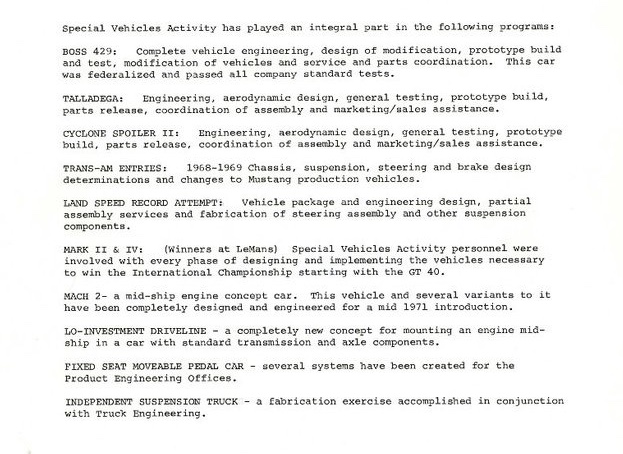
Special Vehicles Activity, Advanced Concepts Engineering Activity, Kar-Kraft…

The material below should be the subject of an article on its own titled something like ‘Ford Total Performance: Motor Racing’- a mammoth topic.

For the moment included are some undated Ford Motor Company documents which provide immensely valuable snippets of information about how the FoMoCo organised its ‘Advanced Concepts Engineering’ from a corporate structural perspective.

Whilst the document is undated the models of cars referred to puts it into the early seventies. Clearly the material is internally focussed- it’s the sort of document one puts together at budget and business plan submission time or when seeking to get a company to invest funds in a new activity or direction.

All of the material in this part of the article is from the Fran Hernandez Archive, now deceased, given his senior positions within Ford, the foregoing may well be correct or ‘thereabouts’.

(F Hernandez)

Great shot of Fran and Thunderbird outside Edelbrock- he was Vic Edelbrock’s Machine Shop Foreman circa 1955.

Interesting also is this corporate structure document below as it relates to entities which orbit around Kar-Kraft- more interesting would be the overall Ford organisational structure and the way ‘Special Vehicles Activity’ fitted in. If you can enlighten me please do so.

All of these entities were on Ford’s Rouge Complex with Kar-Kraft close by- all of which makes eminent sense for all the obvious reasons. K-K were still in business as late as 1984 when Jack Mountain owned it according to Doug McLean, ‘at that time the workshop was busy with projects for Renault-Elf, AMC, Pontiac, Oldsmobile, Plymouth. Chevy, Chrysler and…Ford.’

In the Ford heyday the K-K sites comprised the following; Haggerty, Dearborn 10,000 sq ft including the engineering department, component prototyping, engine build shop- Brighton, Michigan a complete automotive assembly line of 65,000 sq ft spread over 11 acres- the Trans-Am 429s were built on this site. Glenmore, at Glenmore Street and Grand River was (and the plant still is) in Redford, comprised 18,000 sq ft, its focus was the construction and modification of special test and show vehicles. Merriman in Glendale, Livonia was a new factory of 24,000 sq ft housing the vehicle engineering department, it too still exists. Tireman was an engine build and engine engineering facility- this older plant at 8020 Tireman Street, Detroit is still extant also.

The Ford ‘Experimental and Sports Prototype Vehicles’ family tree as at 1967, possibly a part of the earlier document but  perhaps not given the difference in end-dates.

Etcetera…

(AMC)

Moffat- second from the right at the rear, Chapman, Clark, the rest of the boys and Lotus 38 Ford after the Indianapolis triumph of 1965.

(AMC)

Victory lap for Moffat, left, at Waterford Hills date uncertain.

(FoMoCo)

Mercury Cougar key team members gather around one of the cars in early 1967- Parnelli Jones, Fran Hernandez, Dan Gurney and Bud Moore.

Allan Moffat and fellow Aussie touring car star Jim McKeown at Daytona in early 1967- they ran a Lotus Cortina with ‘Jim’s most powerful twin-cam in the world’ fitted- the mechanic is Vince Woodfield (Allan Moffat)

Daytona 1968..

Sebring 1968..

It can’t be that bad, surely?

Moffat was a pro-racer at a time in Australia where he was competing against racer/businessmen to whom competition was a weekend sport whereas for Moffat it was his business and his demeanour always reflected that- he was easily cast in Australia as the foreign ‘baddie’ given his intense focus on the task at hand- success, to put ‘bread on the table’. He took Australian Citizenship in the early 2000’s.

(D Friedman)

The two Shelby cars in line astern, and below Horst Kwech looking as happy about things as Moffat looks displeased. He forged a great career in the US after cutting his racing teeth in Australia- he grew up in Cooma, in the foothills of the New South Wales alpine country.

The Moffat/Kwech car alongside the Thompson/DeLorenzo Chev Corvette DNF- what a marvellous mixed grid both Daytona and Sebring had that year even if the closing speed differences between some of the cars was most alarming. Still that aspect has never changed in all of these endurance classics.

(F Hernandez)

This image and the three below were taken by Fran Hernandez at the same time as the one posted earlier of the ‘302 Trans-Am prototype’ in December 1969

(F Hernandez)

(F Hernandez)

(F Hernandez)

Compare and contrast Boss 302 race and road 5 litre V8s

(AMC)

Moffat on the move- Sandown ‘Southern 60’ weekend in May 1969. Many enthusiasts will remember this novel shaped red and white coloured ‘Coke Tent’, he was certainly still using it when I went to my first race meeting- the 1972 Sandown Tasman meeting.

(T Marshall)

At the end of its ‘in period’ life the Trans-Am raced as a sports-sedan but to Moffat’s credit he never butchered the car by relocating the engine/transmission or making changes to its suspension or body structure to give it greater pace – here he and Jim Richards are whistling around Wigram at about 140mph circa 1974- this is a good angle as the ‘Brut 33’ signage cannot be seen, be thankful you cannot smell that pong which I have always likened to ‘Eau de Pine-O-Kleen’ either…

Bibliography…

Milan Fistonic summary of AM career on ‘The Nostalgia Forum’, shelbytransam.com, ‘The Making of a Legend’ David Hassall, Boss Registry summary of the 302 Trans-Am technical specifications, ‘Kar-Kraft: Race Cars, Prototypes & Muscle Cars of Ford’s Specialty Vehicles’, ‘Hot Rod’ magazine article ‘The Story Behind Ford’s Ill-Fated 1968 Tunnel Port 302’, ‘Fast Mustangs’ Alex Gabbard, ‘Allan Moffat: Climbing The Mountain’ Allan Moffat and John Smailes, Auto-Action article ‘Allan Moffat- The Love of a Liftime’

Photo Credits…

Getty Images, ‘AMC’-Allan Moffat Collection, Barry Nelson, Jerry Melton, sebringrace.com, Fran Hernandez Facebook page, Fran Hernandez Collection courtesy of ‘The Roaring Season’, Terry Marshall, Rob Bartholomaeus, Louis Galanos, Dave Friedman Archive, SS Auto Memorabilia

Tailpiece: Monza, Daytona 1975…

Let’s finish where we started- high on the Daytona banking.

Here Moffat is ahead of one of the BMW CSL’s during the final IMSA 1975 series round on 30 November, DNF after just 15 laps.

In late August that year he raced one of Horst Kwech and Lee Dykstra’s Dekon Engineering Monza’s for the first time, co-driving with Kwech in a 500 mile race at Mid-Ohio. Despite mechanical dramas causing a DNF Moff was impressed. He returned to the US in November, after the Sandown and Bathurst endures to run in the IMSA final round using the same chassis he raced at Mid-Ohio- he qualified third but was outted again, this time with fuel injection dramas.

‘No result but it was an eye-opener, it was, Moffat noted of the long banked stretches, the fastest he had ever gone on a race track- the Monza topping out at a mammoth 329kmh!’

‘It was interesting to note how Moffat fared against top Americans, especially those in ostensibly identical DeKon Monzas. Against the likes of Al Holbert, Al Unser Snr and a host of other top American and European aces, and on a banked oval course of which he would have had not much experience, (that bit is not perhaps correct- he did have some experience as we have seen) Moffat looked right at home. When the injection issue halted the car, he had been comfortably ahead of the BMW 3.0 CSL’s and only had the winning Corvette ahead of him’ Auto Action wrote.

Satisfied, Moffat put down his money to acquire this car, chassis #1005, the fifth to roll out of Dekon’s, Libertyville, Illinois ‘shop. He was now the proud owner of a DeKon Monza, by then it was December so the Monza was flown to New Zealand for its first races in the southern hemisphere in Kiwi ‘sports-sedan’ racing that January/February of 1976. The Monza story is one for another time.

Finito…

(R Kaleda)

Kevin Bartlett awaits the start of the Country Club GT Trophy at Warwick Farm on 18 September 1966…

Magic shot from the collection of the late racer Ray Kaleda- that’s Glenn Abbey with the hand on the roof and Bob Jane’s Jaguar E Type Lightweight to the left, with Spencer Martin at the wheel- thanks to Glenn Moulds for identifying the meeting date and the race itself. I wrote an article a while back about the development of the Alfa TZ1/2; https://primotipo.com/2014/11/04/alfa-romeo-tz2-sebring-12-hour-1966/

Niel Allen’s Lotus Elan 26R entering the Farm’s Pit Straight but its a different meeting- Fred Gibson is at the wheel


(G Moulds)


(R Kaleda)

The front row- Niel Allen, on pole from Martin and Bartlett, the splash of red behind is Andy Buchanan’s Ferrari 250LM. That’s John Sawyer, Bob Jane Racing Team Manager in the blue trousers and shirt keeping an eye on Spencer. Click here for a piece on the Jag Lwt and Elan 26R; https://primotipo.com/2018/04/15/perk-and-pert/

(B Caldersmith)

First time down Hume Straight it’s Martin, Allen, Bartlett and Buchanan almost side by side, the Fred Gibson Lotus Elan and Brian Foley in the first of the Cooper S’.

Andy Buchanan in the Ferrari 250LM vacated by Spencer Martin at the end of 1965 and looking pretty as a picture as always. Car #3 is Ron Thorp’s AC Cobra. Piece on the Scuderia Veloce/David McKay LM here; https://primotipo.com/2014/07/03/pete-geoghegan-ferrari-250lm-6321-bathurst-easter-68/

(B Caldersmith)

Martin with a touch of the opposites out of Creek Corner ahead of Allen, the pair finished first and second followed by Kevin Bartlett’s TZ2, Andy Buchanan, 250LM Brian Foley’s Cooper S Lwt and Ron Thorp in his wonderful AC Cobra.


(B Caldersmith)

All concentration, Spencer was busy that weekend, he also raced the Jane Lotus Cortina but the Tasman Brabham BT11A Climax was left back in Brunswick.

Here he is on the exit of Polo sandwiched between Shepparton’s finest- Bryan Thompson in his ex-Beechey Mustang and Bob Beasley’s Cooper S. This Touring Car feature was won by Pete Geoghegan’s Mustang from Brian Foley’s Cooper S, Thompson, Beasley and Martin.

(unattributed)


(B Caldersmith)

Martin and Allen continue their race-long dice whilst lapping Noel Riley’s Honda S600- Noel Riley was a race and rally driver of some note as well as a handy race and rally engineer inclusive of a stint with Frank Matich during the F5000 years in his CV- not to forget the business he had with Colin Bond for a bit.

Etcetera…

Peter Manton’s Neptune Racing Morris Cooper S is not in this race but in the same batch of shots- too good a shot to waste in any event. Story about him here; https://primotipo.com/2017/11/29/mini-king-peter-manton/

Credits…

Ray Kaleda Collection, Peter Windsor, Glenn Moulds Collection, Rob Bartholomaeus

Tailpiece…

(P Windsor)

Kevin Bartlett chews the fat circa with Glen Abbey? 1966 in Alec Mildren’s Warwick Farm compound- TZ2 and the Brabham BT11A Climax whilst a grinning Fred Gibson in jeans and polo shirt wanders past. Magic.

Finito…

(R Bell)

Stewart, Hill, Clark, yellow nosed black bodied Gardner, Palmer looking like Clark, Martin in red and Geoghegan white- BRM P261 by two, Lotus 39, yellow nose Brabham BT11A, Lotus 32B of Palmer, red Brabham BT11A of Martin (all but the BRM’s Coventry Climax FPF powered) and Leo’s white Lotus 32 Ford. AGP- the off 20 February 1966 and what a marvellous vista Lakeside is…

The front row of the grid pretty much summed up the 1966 Tasman Cup, the two BRM P261’s driven by Hill and Stewart, two of the finest racers of their time were the class of the field powered by 1.9 litre versions of the ‘P56’ V8’s which won so many races during the 1961-1965 1.5 litre F1, they were quickest cars on the circuit throughout the weekend right from the first session on Friday having recorded laps of 55.5 and 55.8 for the Brit and Scot repectively.

Much of the pre-race press interest centred on the strong BRM presence which included three chassis ‘Graham Hill driving the same car with which he won the 1965 Monaco and US Grand Prix’ and a team of three mechanics, Rivers Fletcher doing public relations all led by Team Manager Tim Parnell- lets come back to BRM’s Australasian representation in a little bit.

Lakeside razzmatazz included girls dressed in chequered flag bikinis, a bagpipes group and a brass band in addition to the on-circuit attractions which included international drivers Clark, Hill, Stewart and Gardner.

David Harding, secretary of the Queensland Motor Sporting Club, quoted the total value of the cars at $A300,000…

Stewart had a huge points lead going into the Lakeside meeting with much expected of Clark after his first win of the series at Warwick Farm the week before.

In New Zealand Graham Hill showed BRM’s form early, winning the opening round, the NZ Grand Prix at Pukekohe on 8 January by 1.5 seconds from Stewart, in P261 ‘2616’ before returning home to the UK to continue tyre and other testing duties. He travelled back south arriving at Mascot for the first of the Australian races, the ‘Warwick Farm 100’, on 13 February.

Richard Attwood won at Levin the following weekend after Stewart had gearbox selector problems having completed 9 laps- Jim Clark was second and Spencer Martin third, Jackie Stewart continued the Bourne boys great form and won the Lady Wigram Trophy at the Wigram RNZAF base the following weekend of 22 January.

Stewart completed a clean sweep of the first four races for the P261 before crossing ‘The Ditch’- the Tasman Sea for Australia- Jackie won the Teretonga International from Frank Gardner and Jim Palmer- the latter had a great season of speed and reliability in the Lotus 32B chassis aboard which Clark took the Tasman Cup twelve months before.

Teretonga wasn’t such a great race for Dick Attwood, as his car ‘2617’, was tagged from behind in the first corner ‘The Loop’ into soft earth whereupon the it rolled trapping the hapless Brit underneath- Spencer Martin and local driver Ian Dawson, also involved in the melee, jumped from their Brabhams and helped marshalls right the car and release the driver.

In fact a ‘switcheroo’ in the cars of Jackie and Richard took place at Wigram. Attwood had his ‘2614’ going like a missile in practice thanks to some judicious testing of bars, tyre pressures and ride-heights with Alan Challis, at which point, Jackie, getting the hang of this Number One Driver caper in Hill’s absence said ‘I’ll have a crack in that’- and so he did winning The Lady Wigram Trophy’ in ‘2614’ the following day.

He kept the same car at Teretonga so the machine, the front bulkhead of which was badly bent, was off for a rebuild to Bourne. It was the car Jackie had raced throughout the 1965 F1 season- ‘2617’ the strength of which would save his life at Spa in mid-1966. We will come back to the individual chassis’ later in the article.

Whilst the drivers flew to Sydney on the Monday after Teretonga Tim Parnell supervised the shipping of ‘2614’ and ‘2616’ to Sydney whilst ‘2617’ headed back to Liverpool, and thence Bourne into the tender hands of the boys in the build shop.

Gardner at left, Attwood, Stewart- Brabham BT11A and two BRM P261s- the off at Wigram 1966. Stewart won from Attwood and Jim Palmer with Frank a DNF after an accident on lap 4 when his brakes failed and he cannoned into Jim Clark, taking them both out of the race (Wigram)

Under the Tote building, Pukekohe. JYS’ P261 chassis ‘2617’, in all of its elegant glory, 1966. Which of the BRM mechanics is it folks? The car is fitted with a P56 type 1930cc engine- inlets between the Vee and exhausts exiting thru the ‘letterbox’ orifice in the side of the monocoque, in BRM speak. Note the colour of the car, red nose band, big BRM badge and air relief ducts atop the nose and tail section leaning up against the wall (CAN)

At Warwick Farm Jim ran away and won by 21 seconds from Hill, Gardner, Stewart, Martin and Palmer, click here for a piece on that meeting; https://primotipo.com/2018/07/03/1966-warwick-farm-100/

Clark had carburetion problems with his 2.5 litre Coventry Climax FPF engine throughout the Lakeside weekend but still managed to pop the car onto row two of practice on the two by two car grid together with Frank Gardner’s similarly powered Brabham BT11A. The Lotus 39 was another mighty car from the Lotus 25/33 continuum but the good ole FPF was struggling a bit from 1966 given the entry into Tasman racing of the BRM and Repco V8’s.

Spencer Martin in the Scuderia Veloce BT11A, and Leo Geoghegan going like a jet in his Lotus 32 was the first of the ANF1.5 twin-cams, a mighty impressive performance on this power-fast-100mph lap average circuit.

Jim Palmer and Greg Cusack shared the next row and the rest- Bartlett, McDonald, Harvey, Andy Buchanan Denis Marwood, Mel McEwin and local boy Glynn Scott rounded out a small field after ‘CAMS cut the grid from 20 to 15 cars’ in the interests of safety.

Graham Hill alights his BRM whilst Spencer Martin’s Brabham BT11A Climax enters the paddock- Glynn Scott, Lotus 27 Ford twin-cam 1.5 approaches in the distance. This is the damp Saturday afternoon session (K Drage)

Magnificent photograph of mutual respect and affection, racer/mechanic Ray Parsons and Jim Clark ponder the next change (B Thomas)

Clark in the very sweet Lotus 39 Climax on Saturday afternoon in the wet- exiting The Karussel (K Drage)

Lakeside 20 February 1966. Dunlop’s Vic Barlow at left, Hill suiting up and ‘Dobbin’ Challis beside Graham’s ‘2616’ whilst Jimmy Collins and Stan Collier look after Jackie’s ‘2614’ behind (BRM 3)

Sunday dawned cloudy and hot, the crowd got a magnificent days motor racing on this, the first occasion Lakeside held an AGP, for their four-dollar entry fee!

In addition to the feature race there were two 10 lap heats for the Tasman cars both won by BRM- Hill won the first from Gardner and Martin and Stewart took the second from the Clark and Geoghegan Lotuses.

Stewart and Hill settled into their front row grid slots and howled away from the off- Stewart, Hill, Clark and Gardner led the high speed train, then Martin, Palmer and Geoghegan.

Cusack got by Geoghegan on lap 5 with ‘Hill tied to Stewart as if by string’, Stewart set a scorching pace from the start, thrilling the crowd, despite this Hill was close behind and always within striking distance.

The race developed into three tough fights between Stewart and Hill up front, then Clark just ahead of Gardner and then a flying wedge of Palmer, Cusack and Geoghegan.

’The race pitch at this point had the crowd running from vantage point to vantage point, a rare thing in open-wheel competition, and to really set the seal on the excitement, the tail closed up and made a magnificent show as Marwood, Harvey, Buchanan, McDonald and Scott raced wheel to wheel’ Des White wrote in his HAGP race report.

Stewart’s gearbox cried enough on lap 28- it was this element of the BRM P261 which became its weak link at 1.9 litres and even much more so at the 2.1 litre capacity the Bourne team raced these cars in the 1967 and 1968 Tasmans.

’Stewart was very hard on gearboxes…Hill suffered persistent clutch slip in the last two races, but otherwise the BRM’s were very reliable. So they should have been too, with the massive Owen group effort which included a public relations man’ wrote Bill Tuckey. Bill is a bit hard on Jackie, the ‘box was the problem not JYS lack of mechanical sympathy.

Then Cusack clipped Palmer in the Eastern Loop when Jim braked a little early and Leo kissed Greg causing Cusack to spin and Geoghegan to re-enter the circuit 100 metres down the road- both retired with bent or busted suspension components shortly thereafter.

Frank Gardner in one of two Brabham BT11A’s Alec Mildren Racing raced that summer, Climax engined, the other was Maserati 2.5 V12 powered and ran in Warwick Farm and Sandown practice- pre-race hype promoted the Brabham Maserati at Lakeside but the car did not make the trip from Sydney (unattributed)

Jim Clark from Frank Gardner with Spencer Martin’s Brabham BT11A just back a bit- third, second and DNF clutch (autopics.com)

Frank Gardner was still pushing Jim Clark hard- he had a great summer in Mildren’s BT11A with better FPF reliability than some- but FG was mighty quick too, i’m not implying his results were solely due to reliability. Then Jim’s Climax took a turn for the worst- losing its edge further so Frank was through to second from Hill up front- Hill won at an average speed of 94.9mph from Gardner, Clark and Palmer.

Hill and Stewart both did equal fastest laps of 55.9 seconds- one second adrift of Clark’s 54.9 second lap record set in the Lotus 32B the year before. Kevin Bartlett’s Alec Mildren Racing Brabham BT2 Ford was the first of the ANF1.5s home in another drive which convinced Mildren KB was ready for the step up into the more demanding 2.5s- something he did with great aplomb later in the year.

Clark’s carburetion problems persisted throughout the series and were solved by John Sheppard when the car passed into his care after Leo Geoghegan acquired it by the simple expedient of solid carburettor mounts.

Jackie fires up the now ‘Central exhaust’ P68 powered ‘2614’ before heading out of the Lakeside paddock. Jimmy Collins, Vic Barlow and Tim Parnell watched by a group of local enthusiasts (BRM 3)

(HAGP)

Graham Hill nose up at Lakeside in a car that was so kind to him- the BRM P261, a machine with which he was synonymous, not the BRM he used to win his 1962 World Title but one he raced from 1963 all the way into 1966 with the H16 BRM P83 duly recognised.

(B Thomas)

Jim Clark with Andy Buchanan on the outside, Brabham BT7A Climax, who finished seventh.

BRM and The Antipodes 1966…

The Owen Organisation had extensive business interests in Australasia (it would be interesting to create a list of the British transnational’s subsidiaries in this part of the world at the companies height) and had of course raced here before- Ken Wharton thrilled Kiwi crowds in a P15 V16 in 1954 at Ardmore and Wigram and Ron Flockhart did all of the NZ Internationals in a front-engined P25 in 1959 whereas the 1961 campaign was a full works representation of two P48 mid-engined 2.5 litre F1 cars- these were raced by Graham Hill and Dan Gurney and on this occasion the visitors came to Australia as well as New Zealand. See here; https://primotipo.com/2019/11/18/ken-wharton-and-brms-grand-turismo-south-in-1954/ and here; https://primotipo.com/2018/03/16/bourne-to-ballarat-brm-p48-part-2/

The local promoters led by Ron Frost (NZ) and Geoff Sykes (Oz) had been doing their job in trying to seduce BRM back here and had a ‘red-hot go’ for 1965 given by that stage BRM had an 1880cc ‘P60’ version of their P56 V8, it was thought the P261 so powered would have been competitive with the 2.5 litre (mainly) Coventry Climax engined ‘Tasman Special’ Brabhams and Lotuses.

In essence Tasman races were 100 miles and had no minium weight limit whereas GP’s were 200 miles in duration and the cars had minimum weight limits so Ron Tauranac’s ‘Intercontinental’ Brabhams, for example, were designed and built to the Tasman formula or rules. Tony Rudd, backed by Graham Hill, felt the P261 at 1880cc would not be a competitive Tasman Cup mount in that the cars would be too heavy and not powerful enough- underlying their opposition (in a document reproduced by Doug Nye in BRM 3) was the (correct) belief that the Tasman program would detract from their 1965 F1 program in the same way Sir Alfred Owen’s BRM-Rover turbine Le Mans racer grabbed scarce resources in 1963 and 1964- it too was foisted upon Rudd and ORO (Owen Racing Organisation) at short notice.

However, in late 1965 Sir Alfred was resolute, the broader commercial needs of the Owen Group (the establishment of an Austin-Morris production facility in NZ, with Owens to provide the necessary components) were met by having ORO’s presence in the 1966 Tasman Cup and as a consequence the team had to ‘make it work’ despite being up to their armpits in the new for 1966, immensely complex, BRM P83’s H16 engine.

Ron Flockhart, BRM P25 during the 10 January 1959 NZ GP on the Ardmore airfield circuit- DNF oil leak, the race won by Stirling Moss’ Cooper T45 Climax FPF 2 litre (Ardmore)

Dan Gurney on the way to the BRM P48’s only International win, the Victorian Trophy at Ballarat Airfield, Victoria 12 February 1961 (unattributed)

Geoff Johnson and his engine design team squeezed the P56 V8 up again from 1880cc to 1916cc and then 1930cc- the latter became the definitive 1966 Tasman spec engine used throughout that summer.

These motors gave between 260 and 270 bhp, which despite the weight of the P261 chassis, was more than enough to trump the circa 240bhp ‘Tasman Specials’. These motors and P61 Mark 2 chassis ‘2616’ Graham’s regular 1965 F1 car first raced to a win by him upon its debut at Watkins Glen in 1964, Jackie in his normal ‘2517’, the last P61 built during the winter of 1964-5 for JYS debut season, and old ‘2614’, first raced by Graham in the 1964 Aintree 200 and used as the team spare throughout 1965 were sent to New Zealand on the SS Tasmania Star which left Liverpool on 29 November and arrived in Auckland on 23 December.

Of interest is that ‘2616’ lives as does ‘2614’ whereas ‘2617’ whilst destroyed and scrapped after Jackie’s death defying 1966 Spa crash was recreated for Richard Attwood as ‘2617R’ in the late nineties- a lovely bit of symmetry given Richard rolled it at Teretonga in 1966 when he was part of others ‘moment’. Finally, for the record, a total of one P61 Mk 1 was built, chassis ‘611’ and six P61 Mk 2’s- chassis ‘2612’ to ‘2617’. The P61 Mk1 ‘611’ was scrapped in 1963 but all of the P61 Mk2’s live, thank goodness.

Despite broken ring problems in testing at Bourne, with a very careful running regime when a motor was first used which involved abnormally large amounts of engine oil in the fuel- the motors proved very reliable throughout that summer- a bonus for Team Manager Tim Parnell and the mechanics- Allan Challis, Jimmy Collins and Stan Collier, the later seconded by Parnell.

One of the compromises made to meet the needs of preparation for the new 3 litre F1 as well as being competitive in Australasia was the appointment of Tim Parnell as Team Manager and secondment of Stan Collier into the ORO group for the trip rather than Tony Rudd and another BRM mechanic make the trip.

Son of Reg- Tim was a racer to the core who had stepped very ably from the cockpit to running his fathers F1 race team upon Reg’ sudden death in January 1964 and was well known to BRM as a customer using BRM V8’s and cars for some years.

And so the scene- cars, engines, drivers, technicians and team management were put in place for an immensely successful summer in competition and commercial terms- seven of eight championship rounds and nine of ten races won with the Tasman Cup secured by Jackie Stewart bolstering even further BRM’s ‘cub’ drivers confidence who had already won his first GP in his first F1 season of 1965 at Monza no less.

‘Technical Tim- plug changing on Graham’s ‘2616’. Very popular, avuncular Tim had spent his entire life in racing and farming- thanks to his father- former BRM V16 driver and pig-breeder Reg Parnell. Tim had been a racing driver before his father’s untimely death in 1964, whereupon he had taken over full-time management of Parnell Racing’ wrote Doug Nye (BRM 3)

(B Betti)

BRM V8 Engine Types/Designations…

I wrote an article about the ‘Stackpipe’ BRM P57/578 in which Bourne and Graham Hill won their 1962 titles and covers the P56 engine in a bit of detail which still stacks up ok, see here; https://primotipo.com/2016/02/05/motori-porno-stackpipe-brm-v8/

It is a bit wanting in terms of the ‘P56’ engine derivatives though, so, having picked over ‘BRM 3’ Doug Nye’s treasure trove of all things Bourne here is a summary of the motors if for no other reason than to provide myself a simple list to refer to the next time i tangentially cover this amazingly, long lived series of race engines.

‘P56’ 1.5 litre V8

Initial design as per the link above- 68.5mm bore and 50.8mm stroke for 1497.7cc. DOHC gear driven two-valve Lucas injected with ‘conventional’ cross flow disposition of inlet and exhaust valves

The engines first drawings of 300 in total were issued in January 1961, the first batch of components received in April 1961, assembly of the engine commenced that June with the first one fired up on 12 July 1961

170bhp was produced by the end of August with the engine first tested against the competition at Monza over that tragic September weekend. Racing began in 1962 with the ‘Stackpipe’ exhausts fitted- 185bhp

Ongoing development gave rise to the 195bhp ‘Monza’ spec which won the 1962 championship

For 1963 a single plane crank version was developed, this allowed the use of a coupled exhaust system which gave the engine a broader power band- with development this produced 205bhp

‘P60’ 1.9 litre V8 1964

1880cc engine developed at Richie Ginther’s suggestion for the 2 litre sportscar class in the US, in original form it produced 240bhp

P56 1.5 litre V8 ‘Stackpipe’ nestled in one of Graham Hill’s P57/578 chassis during 1962

P68 1.5 V8 in the 1964 Monza paddock

‘P68’ 1.5 litre V8 late 1964

Between the Vee exhaust layout- exhaust ports in the Vee, inlets located between the cam-boxes. The space around the engine was unobstructed by exhaust pipes which allowed a stiffer tub to be built and an extra 5 gallons of fuel to be carried

First appearance Monza 1964- first win at Watkins Glen- work over the winter of 1964-5 led to engines giving 215bhp

By the end of the 1.5 litre Formula the best of the engines gave 220bhp and weighed 264pounds

2 litre V8

1916cc and the ‘definitive’ 1966 Tasman engine of 1930cc in capacity

T56 variant gave 260bhp and T68 version 270bhp- both types were used in ORO’s successful 1966 Tasman campaign as close scrutiny of some of the photographs demonstrates

1998cc sportscar version for Matra in 1956 was P56 type with the taller P123 blocks. Fitted to MS620 coupes- these engines with alternators etc designated P100

One of the P261’s in the Warwick Farm paddock in February 1966- P68 1930cc (B Wells- The Roaring Season)

One of the BRM mechanics persuades the P56 2 litre V8 fitted to Peter Arundell’s works Lotus 33 to start during the 1966 US GP weekend at Watkins Glen. He was sixth in the race won by Jim Clark’s Lotus 43 BRM H16- famously that wonderful, complex, mad engine’s only win

P111: 2.1 litre V8

1967 Tasman and beyond specifications

Two engines built initially of 2070cc and gave 287bhp and 292bhp- used the taller P123 blocks

Six engines were converted by the time of the 1967 Tasman – 2 P56 type and 4 P68 exhaust within the Vee type. Engines very reliable, the weakness of the package was the magnesium cased lightweight  P72 six-speed gearboxes which were never designed with the power and torque- and tyre grip by then being produced

Type 80: 1.5 litre Straight-four cylinder Formula 2 engine

’Half’ of one of the 2 litre V8’s – soon gave in excess of 130bhp.

P80 1 litre, four cylinder F2 engine the size of which is ‘overwhelmed’ by the bulk of the P72 transmission

Etcetera…

(M Bisset)

JYS was ‘top of the pops’- on the cover of ‘Australian Racing Annual’ for 1966- these annuals are much treasured and were a useful pot-pourri of the season just gone, they were published by the ‘Sports Car World’ magazine people.

Shots show Stewart on the way to victory at Longford on the entry to The Viaduct, and wearing one of the many garlands popped around his neck that summer. The shot below is Jack in BT19 complete with brand-new Repco-Brabham 620 2.5 litre V8 also at Longford.

(autopics.com)

Graham Hill on the outside of Kiwi Dennis Marwood’s Cooper T66 Climax during the Sunday morning warm-up at Lakeside- DNF oil pressure in the feature race.

(unattributed)

Stewart and Clark off the front row of the grid during the second of the Sunday morning heats.

BRM P261 ‘2614’ and Lotus 39 Climax ‘R12’- they had some titanic dices during their Australasian summer but plenty of fun off-track and shared accommodation throughout, parsimonious Scots as they were.

(autopics.com)

Like a rat up an aqueduct- ‘2614’ from ‘2616’…

GH has his nose shoved right up JYS gearbox which is not helpful as that unit was the weakest link of an otherwise bullet-proof remarkably fast racing car into 1969 generally- and into 1968 specifically when the one P261 which was sent to Australasia- as a support or back-up car to the new P126 2.5 litre V12 was a very popular machine particularly with Pedro Rodriguez who took any excuse he could to pop his bum into the ‘old darlin’ rather than its much younger sister.

(D Cooper)

Pedro Rodriguez in good ‘ole ‘2614’ on the very last weekend a P261 was entered by the factory.

Rodriguez was second in the very soggy ‘South Pacific Trophy’ Longford Tasman round on 4 March 1968, won in fine style by Piers Courage in an F2 McLaren M4A Ford FVA 1.6.

A view is that the only thing between Graham Hill and another world title or so at the time was Jim Clark and the Lotus 25 and Lotus 33- lets make that the only thing between Hill and another title or so was Jim Clark’s God-given other-worldly skills- the gifts that only one driver seems blessed with every decade or so.

The Lotus 25 deserves every accolade accorded it as the first ‘modern monocoque’- the car to which every F1 machine which followed is related. The BRM P61 Mk1 and P61 Mk2 aka ‘P261’ followed the ‘original’ but in almost every respect, other, perhaps than in traction, putting its limited power to the road the BRM was the equal of the 25 and 33- and the BRM ‘P56 Family’ of engines the equal of, if not superior motor however many valves Coventry Climax deployed in its FWMV V8! Tony Rudd, biased as he undoubtedly was, makes this case on pages 232 and 233 of ‘BRM 3’.

Whatever the case, feast your eyes on all of the mechanical gubbins which comprise the whole of a very well rounded package. The car shown is Graham’s F1 P261 during the Mexican GP weekend in 1964- its powered by a P68 1.5 litre V8.

The chassis is an aluminium ‘full monocoque’ made of 18swg ‘half-hard’ duralumin with extension horns supporting engine/gearbox and rear suspension assemblies . Note the period typical inboard front suspension- lower wishbone and rocker actuating a coil spring/damper unit, brakes are solid 9 inch discs outboard- these are light cars remember, brake lines are rubber, we are still a couple of years away from the use of braided steel lines in Europe.

Distinctive BRM steering wheel- who supplied them? Gear lever at left. The engine we have done to death but note the slide Lucas fuel injection, beautiful expressions of the exhaust pipe benders art- you can just see a heat shield beside the radiator cap to keep the hot gasses away from the fuel metering unit which is right behind the roll-over bar.

The rear suspension is again period typical and in contrast to the front is fully ‘outboard’- magnesium uprights, inverted lower wishbone, single top link, twin radius rods to look after fore and aft forces, coil spring/dampers and adjustable roll bars both front and rear. Plumbing for the needs of lubricants is ‘bitsy’ rather than ‘cohesive’ and the lack of shine to the nickel (?) plating doubtless reflects a long hard season- this was the last championship meeting of the year after all. Note the beautifully made splined driveshafts, solid brake rotor and caliper.

I’ve always thought BRM’s gearboxes- i’m not sure if this is a six-speed Type 62 or 72 look a bit butch compared with Mike Hewland’s products of the time but that may not be the case upon having details of said products dimensions and weight. Whilst the boxes’ were the weak link in P261s powered by 1.9 litre V8’s and above that was not the case when 1.5 litre V8s were used which was of course the engine around which the gearboxes were designed at the outset.

Beautifully concepted, designed and built, robust, prodigiously fast cars the performance of which could be accessed by ‘newbees’ and exploited by ‘the gods’ alike.

(S Dalton Collection)

(S Dalton Collection)

Stephen Dalton contributed these pages from the February 1966 Queensland Motor Sports Club newsletter which gives the organisers perspective- note the attention to O,H & S as Stephen points out!

Photo Credits…

Ray Bell, Kevin Drage, ‘Ardmore’, autopics.com, M Bisset Collection, Getty Images- Bernard Cahier, Alvis Upitis, ‘CAN’ Classic Auto News, BRM 3, Dennis Cooper Collection, Brier Thomas via Richard Croston

Bibliography…

‘Australian Motor Racing Annual 1966’, ‘BRM 3’- ‘BRM: The Saga of British Racing Motors Volume 3’ Doug Nye, various articles by Ken Blair in ‘The Canberra Times’ on 8, 15 and 21 February 1966, Bruce Sergent’s race reports on sergent.com, ‘History of The Australian Grand Prix’ Graham Howard and Others, 1966 Tasman Cup review by Allan Brown in oldracingcars.com

Tailpiece: Clark, Lotus 39 Climax, Lakeside 1966…

(unattributed)

Jim gulps a big dose of Queensland air as he snicks a Lakeside high-speed apex.

Finito…
(HRCCT)

Chris Amon eases his Ferrari 350 Can-Am into Pub Corner, Longford village during the raceday sportscar support in 1968…

There are plenty of marshals but not too many spectators in evidence on this famously soggy day- the last day of motor racing at Longford. I’ve done this topic to death really but there is no such thing as too much Amon, Ferrari or Longford. See here for the P4/Can-Am 350; https://primotipo.com/2015/04/02/ferrari-p4canam-350-0858/

here for Longford; https://primotipo.com/2018/07/05/longford-lap/

and here for the 1968 Tasman feature race, the ‘South Pacific Trophy’; https://primotipo.com/2015/10/20/longford-tasman-south-pacific-trophy-4-march-1968-and-piers-courage/

Credits…

Historic Racing Car Club of Tasmania- D Cooper Collection

Tailpiece: Ferrari P4/Can-Am 350 ‘0858’ at rest, Longford- in the dry 1968…

(D Cooper)

And not a soul in those stands at this particular point of the day.

Finito…

(A Robinson)

Andrew Robinson worked for Alec Mildren’s Pymble dealership for a number of years, starting as an apprentice motor mechanic in 1977 and was given these discarded photographs which span a decade of Alec Mildren Racing from about 1964 to 1972, many thanks to Andrew for sharing them with us, rolled gold they are too…

I have arranged them pretty much in chronological order- the cars themselves are easy enough to identify but in some cases I don’t know where they are, hopefully Kevin Bartlett or others can assist in that regard!

The first (above) is the Mildren Maserati sports-racer with Alec, long time Mildren race mechanic/engineer Glen Abbey and another dude checking out the car which appears brand new- note the XK150 and Mk2 Jaguars.

After speculating online that the locale was Glenn Abbey’s home in Avalon for a couple of days Kevin Bartlett’s memory kicked into gear ‘The penny has just dropped…its the “Railway Shed” where many of the cars were worked on. It was opposite the Mildren Pymble headquarters on the Pacific Highway alongside the Northern Railway (look closely at the top of the shot and you can see the railway track). I also remember building a pushrod Ford engine for a Brabham in the floor above the workshop. We ceased using it in 1967 when the cars were worked on behind the main building.’

The car was built by Bob Britton of Rennmax Engineering on his Lotus 19 jig around the core mechanical components of Alec’s 1960 Gold Star Championship winning Cooper T51 Maserati- suspension and brakes, Maserati T61 2.9 litre DOHC four cylinder engine and Colotti gearbox. The story of this car is told at the end of this lengthy piece on Alec; https://primotipo.com/2018/06/08/mildrens-unfair-advantage/

(A Robinson)

Beautiful shot of Alec and Marjorie Mildren, Frank Gardner, the tall Glenn Abbey, Bob Grange or Stuart Randall on the pit counter at Warwick Farm circa 1965.

Gardner’s pattern throughout the decade was to race in Europe in F1/F2/Sportscars/Touring cars and then return home in the summer time taking in the Hordern Trophy at Warwick Farm in December as a warm up for the Tasman Series in January, February and just into March against the best in the world before heading back to Europe.

Great work/life balance it seems to me!

(A Robinson)

Mildren Racing became outright Tasman Series contenders with the acquisition of a Brabham BT11A Coventry Climax 2.5 FPF before the 1965 series, the car is chassis number ‘IC-3-64’.

Here Alec at left, is sussing his new racer together with his son, Jeff Mildren and Glenn Abbey in late 1964, probably in the workshop over the road from Alfa Romeo Dealership at 970-980 Pacific Highway, Pymble on Sydney’s Upper North Shore.

The car was first raced in the 1965 Tasman Series opener, the New Zealand Grand Prix at Pukekohe, where he was second to Graham Hill’s identical, Scuderia Veloce machine. No doubt Frank gave it a whirl around the Farm before venturing to the Land of The Long White Cloud- he didn’t run at in the 6 December 1964 Hordern Trophy though, which means either he or the car, or both, were not in the country by then.

Note the the rear of a Hewland gearbox on the bench and rear springs missing from the Brabham at this point- no FPF either BTW. Checkout this article on the ‘Intercontinental’ Brabhams; https://primotipo.com/2018/07/20/matich-stillwell-brabhams-warwick-farm-sydney-december-1963/

The shot below is the same spaceframe chassis unclothed.

(A Robinson)

During 1965, after a very successful Tasman in which FG was equal fourth, Mildren was looking for a Tasman Series ‘Unfair Advantage’ for the coming year. ‘Everybody’ ran the Coventry Climax FPF which was becoming a bit long in the tooth, BRM planned to race their 1.5 litre F1 P261’s with the V8 taken out to about 1.9 litres and Repco announced they were to race their new 2.5 litre V8- which first fired a shot in the Doonside Street, Richmond Repco Engine Lab in March 1965 during the 1966 Tasman in advance of an assault on the F1 World Championship.

Alec found an exotic solution via his old buddies at Maserati.

He was a Maserati dealer and had impeccable connections within the racing side of the company by virtue of his successful Gold Star tilt, Maserati powered in 1960, and so it was he obtained a 2.5 litre Maserati Tipo 58 (250F T2) quad cam, two valve, six-Weber carbed, circa 310bhp V12 which had been lying around Modena since Officine Maserati tested and occasionally raced V12 versions of the 250F in 1957. Fangio won the last of his five F1 championships racing six-cylinder 250Fs that year of course.

(A Robinson)

The engine was shipped to Sydney where it was married to the team’s BT11A ‘IC-3-64’- our friend above, the frame of which was lengthened more than a smidge to suit, a bell-housing was cast to mate the engine to a Hewland HD5 gearbox and away Gardner went in practice for the 1966 Warwick Farm 100- the photo above is on that very day, 12 February 1966.

Frank and Kevin Bartlett tested the car at Oran Park early in the summer, the engine blew, the machine had plenty of power but its delivery- exactly as JM Fangio and Jean Behra experienced in their 250F’s when they tested (and raced in Behra’s case at Monza) them so equipped in 1957, was either ‘on or off’ so Frank raced his Climax engined BT11A ‘IC-2-64’ at the Farm instead, he was third behind Clark’s Lotus 39 Climax and Graham Hill’s BRM P261.

This latter BT11A was the machine Bib Stillwell used to win his final Gold Star in 1965 which was then acquired by Alec when Bib retired, for Frank to use in the NZ Tasman rounds whilst Stu Randall rebuilt the Maserati engine with bits flown in from Italy and re-fitted it to BT11A chassis ‘IC-3-64’ for Frank to use at Warwick Farm, the first Australian Tasman round.

Tested again in practice at Sandown a fortnight later, the Brabham Maserati was put away when the engine blew again and that was that, what became of the engine is uncertain.  BT11A ‘IC-3-64’ was converted back to Climax spec and raced with much success by Kevin Bartlett in 1966, 1967 and the ‘68 Tasman. Meanwhile ‘IC-2-64’ was sold to Kiwi Kerry Grant but not before Bartlett and Jackie Stewart had a ding-dong of a dice in these two BT11A’s at Surfers Paradise in mid-1966, see here;

Jackie Stewart, Surfers Paradise ‘Speed Week’ 1966, Brabham BT11A Climax and Ferrari 250LM…

There is more to the Brabham Maserati story, lots more, but you will have to wait a few weeks whilst I finish a feature…For now salivate about an amazing engineering sidebar in Tasman History- truly a great mighta-been from the little team in Sydney.

(A Robinson)

From one rare beastie to the next.

This time the Mildren Alfa Romeo, not ‘The Sub’ mind you but the first Mildren Alfa, the lesser known one.

Another Bob Britton built car, this one was constructed on Britto’s Brabham BT23 jig and fitted with an uber-rare Alfa Romeo 1.6 litre, four valve, fuel injected European F2 engine and 5-speed Hewland FT200 transmission, both of which are clear as a bell in the shot above.

The car made its race debut driven by Kevin Bartlett at Warwick Farm on 8 September 1968- it raced in Alfa engined form a miniscule number of times before the very first of Merv Waggott’s TC-4V engines was popped into the back of the chassis and raced by Max Stewart who joined the team alongside KB with effect from the start of 1969.

The tale of ‘Max’s’ car is long, successful and slightly tortuous with the appearance of a second chassis, the provenance of which is not in doubt,  in the last decade or so, but is not for now- i did write a ‘quickie’ about it a while back though; https://primotipo.com/2018/05/29/singapore-sling/

(A Robinson)

Speak of the devil, there is the man himself, Max Stewart corner-weighting the Mildren Waggott as it then was in 1969 or 1970.

You can just see the front corner of a ‘105’ Alfa at far left, the race truck out the doorway and the rear of the chassis of Kevin Bartlett’s Mildren ‘Yellow Submarine’ just left of Maxxies midriff.

(A Robinson)

Speak of the other devil, there is KB at Warwick Farm in the ‘Yellow Submarine’ Mildren Waggott TC-4V.

With that circuit, livery, helmet and engine I wouldn’t mind betting the shot was taken during the 7 December 1969 Hordern Trophy Gold Star meeting, KB won the race upon the debut of the 2 litre Waggott engine, what say you Mr Bartlett? Max was second in the 1.6 litre Mildren Waggott and Niel Allen third in his ex-Courage McLaren M4A Ford FVA.

Both these Mildrens are iconic in the pantheon of Australian motor racing, ditto the drivers and entrant.

(A Robinson)

A couple of Mildren Waggott, Max Stewart, Warwick Farm compare and contrasts.

The shot above circuit, livery, bodywork and helmet suggests probably the 1969 Hordern Trophy meeting too whereas the one below is during 1971 by which time Max had acquired the car from Alec, still in the same livery and with support from Seiko- it was the year in which Max ‘nicked’ his first Gold Star from the F5000 fellas, brittle things that they were.

The photo below is during the September Hordern Trophy race in which Max was third behind KB’s McLaren M10B Chev and Leo Geoghegan’s Lotus 59B Waggott TC-4V.

(A Robinson)

Whilst the unreliability of Kevin Bartlett’s McLaren M10B Chev cost KB the 1971 Gold Star Max had to get with the F5000 strength and bought an Elfin MR5 Repco-Holden which he first campaigned during the 1972 Tasman Series.

Note the retention of Seiko still and the Mildren Yellow colour (take my word for it) despite the commercial relationship between Alec and Max being at an end, Alec Mildren Racing ceased after the conclusion of the 1971 Tasman Series.

(A Robinson)

Here the car is on the grid of the Warwick Farm 100 Tasman round with Teddy Pilette’s Racing Team VDS McLaren M10B Chev alongside in February 1972.

Max didn’t have a happy race, his Repco engine broke its crank after 8 laps whereas Teddy was seventh, the race was won by Frank Matich’s Matich A50 Repco from Frank Gardner, Lola T300 Chev and Kevin Bartlett, McLaren M10B Chev.

Max became an F5000 star of course in a succession of cars- the Elfin and three Lola’s are covered in this article here; https://primotipo.com/2017/10/24/maxwells-silver-hammer/

Credits…

Andrew Robinson Collection, Kevin Bartlett, oldracingcars.com

Tailpiece…

(A Robinson)

Patron Mildren, Glenn Abbey and Don Baker (of Brabham/Dolphin and other such fame) at Warwick Farm- perhaps this shot too is over the 1969 Hordern Trophy weekend…

Finito…

The Arthur Barnes driven TH. Schneider broke the Adelaide-Melbourne record with a time of 12 hours 10 minutes for the wild ride over a very rough roads on 11 April 1925…

Sydney motorist AH Barnes was accompanied by J W (William) McCulloch, in the 25.5 hp French six-cylinder 4.5 litre machine. It was national news, this advertisement was placed in the Sydney Morning Herald on 20 May 1925.

The same car, engine number #29, set a Broken Hill-Adelaide record of 8 hours 3 minutes for that 336 mile journey, an average of 42 mph, on 19 August 1925, ‘speeds of more than 100 mph were attained along the route’- that record was previously held by an Amilcar.

Three veteran and six vintage TH. Schneider chassis are known to have been imported to Australia through agents in South Australia and Victoria- George H Booth and Thomas Mitchell and Co-pre-War, and Domain Motors/Kellow-Falkiner Pty Ltd-both post-war, respectively in each state.

The two photographs below show the 25.5 hp TH. Schneider (variously TH. Schneider, Th. Schneider and both of these without the full-stop- I have used the variant on the badge below) out front of Geo Booth’s premises in Adelaide after the Broken Hill to Adelaide run on 19 August 1925. The crew was again Barnes as driver and McCulloch the mechanic.

George Booth of 411 King William Street Adelaide and Domain Motors of 348 St Kilda Road in Melbourne were the agents for the cars at the time and of course sponsors of the successful record attempts.

(SLSA)


(SLSA)

Theophile Schneider first entered the motor industry in partnership with Edouard Rochet to build the Rochet-Schneider at Lyon in 1894, he then moved to a factory in Besancon, east France near the Swiss border to build cars on his own- his first was an 1850cc four cylinder machine with a radiator behind the bonnet, a style later popularised by Renault.

These first ‘Schneiders, fitted with engines from 10 to 35hp were raced circa 1912-1914, the best result second place in the June 1912 Grand Prix de l’Automobile Club de France held on a course based at Dieppe, the car was driven by Rene Croquet with riding mechanic Rene Champoiseau.

After converting to manufacture of components for the war effort the company resumed car production post-war and changed its structure to that of a limited stock company, the record-run car is a type 21.20.1, 25.5hp six cylinder, 4480cc six cylinder, for speed manual with a solid front axle, live rear axle fitted with semi-elliptic springs and two rear wheel brakes, the wheelbase was 3505mm

Three of this model were imported into Australia by Domain Motor Body Builders/Domain Motors. At 1950 pounds they were nearly twice as expensive as the 4.5 litre Bentley of the day, Domain Motors ceased business around July 1926 at a time Th. Schneider themselves were in deep financial trouble at home, having been declared bankrupt in November 1921.

The reputation of the marque allowed the company to trade profitably through the mid-twenties, re-entering racing inclusive of participation at Le Mans in 1926- Pierre Tabourin and Auguste Lefranc were sixth in a 1954cc 25SP and in 1927 when Robert Poitier and Pierre Tabourin DNF accident in a 25SP.

‘White House Crash’ aftermath- the #2 d’Erlanger/Duller Bentley Sport 3 litre at left and #1 Clement/Callingham Bentley 4.5 litre at right- ditto photograph below (unattributed)


(unattributed)

The Tabourin driven TH. Schneider is infamous amongst Bentley enthusiasts as the cause of the ‘White House Crash’ which involved three Bentleys. At dusk Tabourin approached the corner too fast, lost control and hit a building close to the road coming to rest and partially blocking the track, Leslie Callingham, following closely, swerved to avoid him and ended up in a ditch on the opposite side of the road, George Duller then hit Callingham, and then Benjafield too hit Callingham in avoidance of Tabourin- Benjafield was able to continue but the race was well over for the other three machines.

No-one was seriously injured but Pierre Tabourin was taken to hospital with broken ribs, the #12 ‘Schneider driven by Chanterelle/Schlitz withdrew from the race out of respect for the injured Tabourin. In a happy ending for Bentley Benjafield and Sammy Davis won the race in the Sport 3 litre ‘old number 7’.

Problems in 1928 led to a second bankruptcy in March 1929 and closure of the Besancon factory doors in early 1930- right in The Great Depression of course.

TH. Schneider’s assets were acquired by French company Societe SADIM, the name continued but was applied to caterpillar tractors- World War 2 saw the end of a once proud marque.

Meanwhile, back in Australia, the insolvency sale of Domain’s assets resulted in four Ansaldos, three Ansaldo chassis and ‘four brand new latest model Schneiders’, of which one was the record breaking car- number ’29’ the other a new DS six cylinder 25hp model changing hands.

The record breaker, which John Bisley has (as of 2015) was never bodied, it was acquired by Watts McNamara and went from Myrtleford to Griffith in 1927- where it remained for most of its life. If any of you can fill in the ownership details of the car since it arrived in Australia please get in touch.

The record breaker at the Cockburn Hotel, in South Australia, not far from Broken Hill near the South Australia-New South Wales border (Richard C)


(unattributed)

Even though the cars were small in number in Australia, motorsport was used in attempts to build the brand inclusive of an entry in Australian Grand Prix where a 2 litre TH. Schneider driven by Ernest King contested the 1929 event held on the daunting, dusty, undulating and fast Phillip Island road circuit- King failed to finish having lost a wheel on lap 17 of the race won by Arthur Terdich’s Bugatti T37A.

The photograph above shows King contesting a hillclimb at Wheelers Hill in Melbourne’s outer east in June 1928, six months prior to the 1929 AGP- Th. Schneider 2 litre 25SP.

‘Schneider’s motorsport participation in Australia extended to the reliability trials which were popular at the time and of which I have written in the past. In March 1927, a 7hp car was first in class and fifth outright in a field of about forty cars- the driver was AGP winner Arthur Terdich as below.

(unattributed)

Etcetera…

(unattributed)

Rene Croquet and Rene Champoiseau aboard their TH. Schneider during the second day of the 1912 French Grand Prix on 26 June- the road race comprised 20 laps of a 77km course based in Dieppe, a total of 1540km.

Contestants raced over 10 laps on each day with the results aggregated to produce a winner.

Georges Boillot won in a Peugeot from Louis Wagner’s Fiat S74 and Victor Regal in a Sunbeam with Rene seventh, Rene Champoiseau raced another TH. Schneider but retired.


Credits…

SLSA- State Library of South Australia, thschneider.wordpress.com, prewarcar.com, Richard C, F2Index

Tailpiece…

The site of Domain Motors business premises at 348 St Kilda Road- a nice spot right opposite The Shrine of Remembrance, next door to the French Consulate which is apt! and not too far from Albert Park Lake, for international readers, is now, in the best Australian tradition, a block of luxury apartments…

Finito…

(M de Lang)

No Australian racer comes close to owning and racing as many interesting cars as Bob Jane…

The tough nut from Brunswick developed a used car business initially, and shortly thereafter took on new car franchises before creating ‘specialist tyre retailing’ in this country- Bob Jane T-Marts are as iconic now as they were novel in the late sixties when Jane initially rolled the arm over with what was a new concept here.

Bob was the embodiment of ‘living life to the full’, he did not die guessing. Calder Park’s owner collected wives with as much enthusiasm as he did racing cars but found that they are not as easy to unload as last years Holden, the complications of his various ‘families’ screwed the later decades of his life comprehensively, which was a great shame as someone who gave much to many.

Big hitters. Niel Allen, Bob Jane and Frank Matich in Matich’s Firestone Racing Tyres tent at Sandown, circa 1967/8 at a guess. The vented guard belongs to Bob’s Elfin 400 Repco (M Kyval)

I’m not suggesting the man was perfect i might add, but in a motor racing sense he put far more into the sport than he ever took out.

This series of paintings were commissioned of Martin de Lang to celebrate the fortieth anniversary of Bob and Harry Firth’s Ford Cortina GT, Bathurst 500 win in 1963. I’ve set them more or less in the chronological order Bob raced them, there were plenty more Jane owned racing cars than this though, check out the list at the end of the article.

The painting at the article’s outset shows Bob’s Maserati 300S in front of his great mate, Lou Molina’s Molina Monza Holden-Repco from Doug Whiteford’s Maserati 300S and then Bill Pitt’s Jaguar D Type at Albert Park on 23 November 1958- Bob and Lou are about to be lapped by the other duo during the 32 lap, circa 100 mile Victorian Tourist Trophy won by Whiteford from Ron Phillips’ Cooper Jaguar and Pitt, Bob was fifth and Lou unplaced.

(K Drage)

In the beginning.

Kevin Drage’s shot of Bob is at Fishermans Bend on the race debut of his ex-works 300S ‘3059’ in October 1958. Doug Whiteford and Jane (in Bob’s case after Reg Smith had it briefly first) acquired the Officine Maserati cars raced by Jean Behra ‘3055’, and Stirling Moss ‘3059’ during the 1956 Australian Grand Prix/Australian Tourist Trophy weekends in late 1956.

Bob was initially rough and ready in it, even inspiring Reg Hunt to move his boat further out into Albert Park Lake to keep it out of harms way- he did get the hang of this racing caper mind you. Stephen Dalton’s first competition outing for Bob Jane, he believes, was in a Ford Customline at Hepburn Springs hillclimb in October 1956. See here for an article on the 300S;

Bob Jane: Maserati 300S: Albert Park 1958…

(B Jane)

Another shot of Bob at Albert Park on the same weekend depicted in the opening painting. In a decade of stunningly beautiful racing cars as curvaceous as Sophia Loren, surely the 300S is up there for the title of the prima-donna sportscar of the fifties?


(M de Lang)

Jane’s locally developed Appendix J Jaguar Mk2, ultimately raced at 4.1 litres, won his first couple of Australian Touring Car Championships (ATCC) in the days the title was decided in one race- in 1962 at Longford and 1963 at Mallala.

See the article here about the car; https://primotipo.com/2014/10/20/australian-touring-car-championship1962-longford-tasmania-battle-of-the-jag-mk2s/

Warwick Farm circa 1962 (J Psaros)


(M de Lang)

The factory Jaguar E Type Lightweight didn’t make a lot of sense given the way it fitted into our local class structure at the time, and given the lack of endurance events in Australia of the type for which the car was built, but who can argue with the beauty and spectacle it provided all the same. Mind you, Bob did win the one race Australian GT Championship at Calder in December 1963, I rather suspect 10 miles could not really be characterised as an endurance event.

This machine, like Bob’s 300S and D Type, he retained for decades but was ultimately sold, global cars that they are- all left Australia, which is a bummer.

(B Miles)

Spencer Martin with the white helmet in hand, John Sawyer and Bob leaning on the delicate aluminium panels of his car at Lakeside before the start of a heat of the Australian Tourist Trophy in 1965- Ron Thorp’s AC Cobra is on the row behind. See here for a piece on Bob’s E Types, he had a couple, as one does; https://primotipo.com/2018/04/15/perk-and-pert/


(M de Lang)

Whilst Jane raced single seaters and won in sportscars he was most formidable in all types of touring cars from Series Production machines such as the Cortina GT in which he won at Bathurst in 1963 together with Harry Firth, through to the animal savagery of the Chev Monza Sports Sedan shown further on.

The Jane/Firth pair won three of these 500 mile production car enduros on the trot, the first was the 1961 Armstong 500 at Phillip Island aboard an ‘Autoland’ Mercedes Benz 220SE-they then followed up in a ‘works’ Ford Falcon XL in 1962.


Harry Firth behind the wheel of the winning Cortina GT, Murrays Corner, Mount Panorama 1963- that’s Max Volkers in a FoMoCo Cortina 1500 behind (unattributed)

In 1963 the event moved to Mount Panorama as the ‘Islands track surface was too badly damaged by the ’62 event to continue to stage the race- in fact racing came to an end there until Len Lukey bought the facility circa 1964, reopening it in 1967. At Bathurst they won in a ‘works’ Ford Cortina GT.

In 1964 Jane won again in a ‘works’ Cortina GT but this time shared the drive with George Reynolds- all of these ‘factory Fords’ were prepared by Harry Firth and his team in his ‘Marne Garage’ on the corner of Burke and Toorak Roads, Glen Iris in Melbourne’s twee inner east.


(unattributed)

Jane’s first 1965 Ford Mustang was locally developed with plenty of goodies bought over the counter in the US, it met an untimely end at Catalina Park in an accident the young entrepreneur was extremely lucky to walk away from.

The shot above shows it in rude good health at Warwick Farm entering Pit Straight, whereas it is in its death throes in Martin’s painting below, 7 November 1965.

(M de Lang)


(unattributed)

She is well and truly rooted- the angle from the other side is worse but I don’t have a clear, sharp shot from there to pop up. It was a case of pull all the good bits off and start again- Bob is clear with the white blotch on his head, I think its a flaw in the photo rather than Nurse Ratched gone berserk with bandages.

‘Cripes, its gunner need more than bog to fix this lot!’

RF Jane with Nomex shirt reflects upon the remains of a Mustang which was pristine ten minutes before. Leo Geoghegan looks on from behind whilst Bob Jane Racing Chief John Sawyer ponders gathering up the pile of shrapnel and popping it into the truck before the long trip back to Melbourne.


(M de Lang)

Bob certainly had a penchant for Mustangs, this is his second, a 1967 GT fitted with a big-block 390cid V8 and also raced later with small-block engines.

It met its maker when Chris Brauer had a very nasty career ending accident in it at Lakeside in 1970. Bob replaced this one with the 1968 Shelby built Trans-Am factory car, it still exists in the US.

The livery and specifications of this car evolved a lot over a short space of time not least driven by the needs of ever widening tyres with the photograph below in the machines at Warwick Farm in 1967.

(B Williamson)

If any Mustang enthusiast can give me details of the evolution of this car’s specifications from 1967 to 1970 please get in touch and i will add them in.

Jane is blasting across the top of Mount Panorama in de Lang’s photo above at a guess, whereas in the photograph below he is exiting Hell Corner, after a change to Shell colours, circa 1967. Perhaps this photo is a Shell shot given the background. The grille evolved to a simpler, later look too making identification of the car and year tricky, especially in monochrome!

(unattributed)


(M de Lang)

Pure touring car sex on wheels. Moffat’s Trans-Am, Foley’s GTaM and this John Sheppard built LC Holden Torana GTR-XU1 Repco ‘620’ 4.4 V8 Sports Sedan are my favourite Taxis.

This jigger was brilliant in conception and exquisite in the detail of its execution right down to the ‘standard interior trim’ and an engine compartment which looked as though it was made for a Repco V8 rather than an inline-six. The art shows Bob at Hume Weir circa 1971.

Just brilliant, not to forget the shedload of races Bob and John Harvey won in the thing circa 1970-1972. Bob should be shot for allowing Frank Gardner to commit automotive rape upon the little sweetie when he shoved a 5 litre Chev into it in 1975- although FG did squeeze an extra season up front despite said atrocity…

Warwick Farm, 5 September 1971 (L Hemer)

CAMS took exception to the wing, which was fair enough, it was outside the rules, but didn’t it look even more of a menace in this specification?

Extant but not likely to see the light of day until someone with very deep pockets scoops it up- there is a bit about this car in this article about McCormack’s Charger Repco and Sports Sedans more generally; https://primotipo.com/2015/06/30/hey-charger-mccormacks-valiant-charger-repco/


(M de Lang)

Didn’t Jane put the cat amongst the pidgeons with this Chev Camaro ZL1 427 ally blocked weapon! The painting depicts the car at Dandenong Road corner, Sandown 1971.

Looking at it reminds me of the spectacle of ‘full on body contact’ between Bob and Allan Moffat’s Mustang Trans-Am in 1971-2. Bob won the ATCC in 1971 with the big fella fitted and when shafted by CAMS, who changed the rules to eliminate the 427 motor, stuck it up the regulator and won again fitted with the ‘liddl 350 cast iron engine in 1972.  ‘Nice one’, i thought at the time, plenty of lawyers improved their billings for the year by being involved in some serious litigation between RF Jane and the CAMS down the decades.

(unattributed)

Ere we go again…

Did Moffat lose it or did Bob give him a Rock Hudson to assist?

With the splendour of Springvale ‘Triple Fronted Brick Vanilla Slices’- 1950’s cream brick-veneer houses of the type I was brought up in, in the background, Moffat and Jane engage in a territorial dispute under brakes into Sandown’s Dandenong Road- meanwhile Graham ‘Tubby’ Ritter takes avoiding action at right. Cooper S pilot folks? Jane won this race.

‘I still don’t know if he hit the Armco?’ quipped Lynton Hemer @ the precision of this particular apex, 9 July 1972 (L Hemer)


(M de Lang)

The HQ Holden Monaro GTS 350 started life as an Improved Tourer in late 1972- its race debut was in John Harvey’s hands that year at Surfers Paradise, but morphed into a most formidable Sports Sedan when Group C replaced Improved Touring as the class to which the ATCC was run from 1973- Pat Purcell modified the car further as the Sports Sedan rules allowed.

Another Sheppo built car originally, it raced in Bob’s hands until 1978 and still exists restored to its original form, the art depiction is probably Oran Park whilst noting the signage isn’t correct.

(B Keys)

Nice and close at ‘Torana’ as it then was or ‘Peters’ as it originally was, corner at Sandown circa 1974/5.

Bob has the Monaro tucked inside John Pollard who has given the faster car room in his Holden Torana L34.

Hallmarks of all of Jane’s cars, whoever was Boss Cocky of the team at the time was the immaculate standard of presentation and preparation. I’ve always been fond of the look of HQ’s, surely one of the most harmonious and fully resolved of all of GMH’s styling exercises- lowered and with plenty of wheel and tyre under the ample guards they were/are mighty fine looking road cars with this beast, and Mal Ramsay’s HQ Kingswood Repco visual delights as racing cars.


(M de Lang)

One can easily imagine the excitement around the Jane transporter at race meetings circa 1971 with their bit of the paddock occupied by the Camaro, Torana, Brabham BT36 Waggott 2 litre and this McLaren M6B Repco ‘740’ V8 5 litre- which won a pair of Australian Sportscar Championships in 1971 and 1972.

Excitement around the Bob Jane transporter, or Shell tent anyway, circa 1965. Nose of the Mk2 Jag at left, first Mustang, E Type Lwt and nose of the Elfin Mono at right (M Kyval)

The story of this thing, one of the best looking Can-Am cars ever built, is told here; https://primotipo.com/2019/10/16/sex-on-wheels/ ,the art is of Bob at the wheel, circuit who knows, it could be anywhere, whereas the shot below is of Bob giving John Harvey a lift just after Harves won the Symmons Plains round of the 1972 ASCC- and the championship itself.

(E French)


Who could ignore Sports Sedans, even as a devout open-wheeler woofda, with savage beasts like this thing providing quite a show.

Watching Bob drive this car was magic, seeing Peter Brock race it after Bob retired was sensational- he teased everything out of Pat Purcell’s magnificent racer, another painting at Sandown’s Dandenong Road corner.

(C Parker)

Chris Parker caught all the heavies on the grid at Calder August 1982- Australian GT Championship round 6, heat 1- Alan Jones won every race of the nine round championship.

Alan Jones is on pole in the Porsche Cars Australia Porsche 935 alongside Peter Brock in Jane’s Monza, on the row two is Jim Richards’ black BMW 318i turbo and alongside him Tony Edmondson’s Alfa Romeo Alfetta GTV Chev and then the white Colin Bond driven PCA Porsche 944 GTR turbo- on his inside is Rusty French’ Porsche 935. On the back row on the inside is Brad Jones’ Mercedes SLC and on this side the Bob Jolly Holden Commodore. They really were the most exciting grids of things at the time even if the 935’s rained on everybody else’s parade…

Everything about this car was big! Originally built by a team led by Pat Purcell it was raced by Bob from 1980, then rebuilt by Pat and Les Small before being raced by Peter Brock in 1982/3, then Allan Grice raced it in 1984 to an Australian GT Championship and then Bryan Thomson to the title the following year. It morphed into a Toyota Supra in 1989- where is it now? Click here for a summary of the car; http://www.scharch.org/Cars/Monza_Racecars/Cars_MonzaAU_Purcell-Jane.htm

(B Jane)

Peter Brock awaits the start at Calder circa 1983- the formidable size of the car evident in this shot- 6 litre Chev V8 upfront and a transaxle at the rear.

Etcetera…

The list of cars Bob owned and raced, or were raced for him by others is as below. It isn’t complete, it’s out of my head, i am happy to add others to the ‘good stuff’, no road cars only racers he owned…

Sportscars

Maserati 300S, Jaguar D Type, Jaguar E Type 3.8 FHC, Jaguar E Type Lwt, Elfin 400 Repco 4.4, McLaren M6B Repco 5 litre

Single-seaters

Elfin T100 ‘Mono’ Ford twin-cam 1.5, Brabham BT11A Climax 2.5, Brabham BT23E Repco V8 2.5, Jane Repco V8 2.5, Brabham BT36 Waggott TC-4V 2 litre, Bowin P8 Repco-Holden F5000, Ralt RT4 Ford BDA F Pac, McLaren M26 Chev F5000

Tourers

Ford Customline, Holden ‘Humpys’, Jaguar Mk2 4.1, Mercedes Benz 220SE, Ford Falcon XK, Fiat 2300, Lotus Cortina, Ford Mustangs- three of em- 1965, 1967 and 1968 Shelby Trans-Am, Ford Falcon GT ‘XR’, Chev Camaro ZL1, Holden Torana GTR-XU1 Repco 4.4, Holden Torana GTR-XU1 Series Prod/Group C, Holden Monaro GTS 350 Imp Tourer/Sports Sedan, Holden Monaro GTS 350 Series Prod, Chev Monza, BMW 635Csi, Holden Torana L34, Holden Torana A9X, two Mercedes Cosworth 190. In addition there were numerous ‘Thunderdome’ thingies

Not bad is it- in one lifetime.

The ‘Jane Estate’- those two words are a catch-all of ‘Jane Family individuals, corporate entities and trusts’, i think, still own the Brabham BT11A, Ralt RT4 and McLaren M6B. I am happy to take advice from those who have the facts rather than ‘i reckon’…

Image and other Credits…

Martin de Lang- artist, Stephen Dalton

Mike Kyval, Kevin Drage, Bill Miles, Chris Parker, Jock Psaros, Ellis French, Lynton Hemer, Bruce Keys, Bob Williamson Collection, Bob Jane Heritage Collection

Tailpiece…

(M de Lang)

Peter Brock in the Porsche 956 he shared with Larry Perkins at Silverstone and Le Mans in 1983- didn’t this ‘Aussies taking on the world attack’ capture us all at the time.

It symbolises a few things not least Bob’s world view and a couple of blokes in a very long list Jane supported from the early sixties…

Finito…

(P Coleby)

Ray Porteous’ JMW leads the John Fleming Austin 7 Spl at Darley, Queens Birthday weekend June 11 to 13 1960…

Darley Army Base, 8km from Bacchus Marsh is a reasonably obscure motor racing venue so Hugh Coleby’s upload of some photographs from his late  father, Peter Coleby’s collection on social media is hugely welcome. Gordon Dobies’s contribution in identifying the cars and drivers is gold too ‘one of the advantages of being old enough to have raced at those meetings and never throwing anything away’ he quipped.

The Preston Motorcycle Club conducted the meeting, whilst I have vaguely heard of the place I thought it was a ‘bikes only venue- clearly that is not so, members of the 250cc and 500cc car clubs were also invited along.

Bacchus Marsh was a tiny rural hamlet when I played in some tennis tournaments there as a kid, I still remember the wonderful lawn courts and Avenue of Honour as you drive into the town which is 60km from Melbourne on the Western Highway- the main road from Melbourne to Adelaide for you internationals.

These days its a big commuter town to Melbourne but when the 4000 members of 4th Infantry Training Brigade, the U.S Marines and others occupied the place they must have wondered what they had struck, Bacchus Marsh let alone Darley would have been microscopic!

Australian, American and Dutch (from the Dutch East Indies/Indonesia) soldiers trained at the camp located on a plateau with rolling hills in the background, before being shipped overseas many of them marryied local gals, the area was used for Citizen Military Force (remember the CMF?) training until the 1970’s.

(AIF)


Rifle training at Darley, trusty Lee Enfield 303’s by the look (AIF)


(AIF)

Robert Thompson wrote that his late grandfather, Lou Thompson built the camp in 1939- Thompson and Chalmers Pty Ltd took on Simmie & Co as an associate on the large project, Darley Military Camp had over 360 buildings including recreation huts, a Post Office and a 68 bed hospital on 160 hectares of land located at Camerons Road.

When the military moved out post-war most of the infrastructure went as well inclusive of buildings, but, critically, the roads remained, the site soon came to the attention of the Preston Motorcycle Club who were eagerly looking for a venue on which to race.

Ray Porteous, Austin 7 Spl (P Coleby)


Extreme narrowness of Darley evident in many of these shots, this one the start of the 1959 Junior A Grade- L>R Eric Hinton AJS 7R, #64 Owen Archibald Norton, #82 Ron Miles Norton, #1 Tom Phillis Norton, #2 Jack Ahearn Velocette. On row 2 are #25 Ray Blackett and Geoff Curley #14 (E Miller)

Working bees of club members soon filled trenches left by the removal of cabling, re-coated the road surface, cleared scrub and removed junk left behind by retreating military forces. By late 1947 the place was ship-shape with the first meeting held on 29 February 1948- the Hartwell and Kew clubs were invited along to join in the fun.

Open meetings soon followed, ‘the main straight, which had a left-hand kink in the middle, was only as wide as a two lane road, while the rest of the rack was even narrower. It made for shoulder to shoulder racing on solos and even closer encounters on outfits’ recorded Old Bike Australia.

Peeling off the Main Straight (Camerons Road) is #8 Alan Osborne, Honda and Tom Phillis Ducati in 1959 (MCN)


John Hartnett, Cooper Jap 497cc 1960 (P Coleby)

The Preston club guys were happy to hold a couple of well run meetings a year, fitting many races onto the card without chasing the major titles such as the Australian Tourist Trophy with all of the stars of the day racing there- Frank Mussett, Maurie Quincey, Bert Flood, Jack Ahearn, Keith Brien, Max Stephens, Rex Tilbrook, Alan Wallis, Ken Rumble, Kel Carruthers and others with Quincey the ‘local ace’ in the mid-fifties- he switched to cars later in life remember folks, an ANF2 Elfin 600B Ford twin-cam springs to mind. Max Stephens was another who tried four wheels, he owned and raced the ex-Brabham Cooper T40 Bristol, with some success out of Tasmania.

Easter Monday meetings were common early, the club then settled into a mid-year date on the Kings/Queens Birthday weekend which was usually a frosty, wet experience for both the riders and the punters. The Preston guys were also innovative in running the first one hour race for production machines during the June 1959 program.

Over the years various high profile car racers had a crack at the lap record,  Reg Hunt’s Maserati 250F did a 1:14.1 in 1955 which was bested by multiple Australian Hillclimb Champion Bruce Walton aboard a Cooper Mk9 JAP 1 litre twin in 1960 with a 1:10.8. At that stage the quickest of the bikes was the 1:13.5 achieved by both Eric Hinton and Tom Phillis.

Maurie Quincey and Matchless G80 (C or CS?) on the Darley grid, rider of #1 more interested in the babe behind than the race start!

And below is Quincey aboard an Elfin 600B Ford twin-cam during the 1971 Sandown Tasman meeting, it was after some involuntary aerobatics in this car at Sandown at about this time that he called it quits on his competition career.

By then Maurie was in his late thirties, well after his international bike racing career, inclusive  Isle of Man appearances and running a successful Honda dealership in Moonee Ponds, Melbourne. He died on July 19, 2019 six months ago- see a very interesting article about Maurie here; https://www.oldbikemag.com.au/maurie-quincey-victorian-dominator/

(L Hemer)


Maurie Quincey on Bray Hill during the 1955 IOM Junior TT- a splendid fifth aboard a spare works Norton Manx 350. He was offered the bike after going so well on his ‘customer’ 350 and 500 during practice (unattributed)

Back to Darley.

Kel Carruthers appearance on the Honda 250/4 in 1961 would have been really something to see and hear- i bet he frightened the kookaburras flying above the citrus trees in the valley below the track bigtime!  Kel won the Harvey Wiltshire Trophy Lightweight race slicing four seconds off the lap record in the process.

The final meeting took place in 1962, in a thriller of a race Trevor Pound and Ken Rumble passed and re-passed for the whole 15 laps with Pound winning by a bike length, both being credited with a new outright lap record of 1:12.8. Trevor Pound raced in the Manx classic too and never lost his passion for competition, he raced Formula Vees in his dotage.

Whilst plans were being made to race in 1963, on 10 June the farm owner withdrew his permission saying the continued rain in the region had flooded the pit and spectator areas and damaged sections of the track- at late notice the meeting was held at Calder, 30km away.

‘Racing never returned to Darley. A combination of primitive facilities, the narrow and uneven road surface and the remorseless march of civilisation spelled the end of the happy little track. Despite its shortcomings, the circuit had an enviable record for safety and a reputation for slick organisation. With nary a backward glance, the infield area was soon subdivided into building lots and small farms.’

To see the place, drive up Camerons Road, at the top of the hill you are on the plateau, about 100 metres on the right are the remnants of the final corner named ‘St Kilda Junction’ poking at you from a vineyard. At this point you are on the Main Straight with the former pit area- still dotted with concrete slabs from the place’s military past on your left. The straight is about 600 metres long- halfway along is a kink, and opposite that is a monument to Darley Military Camp.

Old Bike Australia concluded a great article with this ‘It takes a little imagination if you weren’t there…but if you stand on the kink and close your eyes, you can still hear the sound of a hundred motorcycles and a dozen or so cars from the 250cc and 500cc Racing Clubs, most with open exhausts warming up.’

‘Wafting through the air is the fragrant  mix of Castrol R and methanol, mingled with the aroma of Hines “Kerosene” pies. The pointed tents of the Hines Catering Company…appear in many of the period photos of Darley, and those who sampled the wares will tell you the kerosene stove that heated the pies produced a pastry of unique taste. A section of canvas behind the servery contained a special nook where the course announcer Frank “Farmac” McDonald and selected others could lubricate their tonsils with a cold ale between races.’

‘Fortunately, on the run back to Melbourne, you won’t have to cope with “Cunningham The Camera Cop”- the notorious plod who used to hide his Thunderbird beside the old stone bridge out of Bacchus Marsh and photograph any who transgressed by crossing the double centre-lines.’

Hasn’t the Old Bike Australia writer painted a wonderful, evocative picture of times long gone?

‘Moe’s Nose’ approach June 1960. South Aussies Ian Hogg and Peter Morgan


(C Rice)

Roger Barker leading Ron Miles, note the hay bales and beautiful Darley bush setting.

Barker is on a bike with a ‘Rimond’ fibreglass fairing, a product he helped develop in tests at Ballarat and Darley- these were made in Melbourne by former top clubman racer, Charlie Rice and Bob Edmonds, ‘Rimond’ a combination of their names, about 30 fairings were built. Barker was quoted in the English press as saying they were good for about 12mph or 200rpm using tall gearing. The bike could be a Norton.

The Mudgee born rider, having scored points at the Isle of Man and Assen on Nortons in June, died at Schleiz, Thuringia, East Germany in July 1957 having blacked out in the intense heat of the 500cc race whilst leading aboard a Matchless G45, the conditions were made worse by the engine heat the Rimond fairing trapped. He slid off the bike, hit a tree and died instantly from the impact.

Etcetera…

What to look for on your visit, Camerons Road, Darley 3340.


(J Bowring Collection)

A couple of photographs from the John Bowring Collection via Tony Johns.

We are not clear on the date yet but the shot above is John Hartnett’s Cooper Mk5 JAP from the Doc Grosvenor and Allan Tyrrell Austin 7 Specials.

It’s the great Bruce Walton’s Cooper Mk8 JAP below, perhaps on his 1960 record breaking run.

(J Bowring Collection)


(J Bowring Collection)

No idea who this committed crew are folks- thoughts?

Bibliography…

‘Old Bike Australasia’ 5 February 2018, Stephen Dalton, Gordon Dobie, Jim Scaysbrook article on Roger Barker in ‘Old Bike Australasia’

Photo Credits…

Hugh Coleby, the late Peter Coleby, Eric Miller, Lynton Hemer, Motor Cycle News, John Wynne Collection, John Bowring Collection via Tony Johns

Tailpiece…

(P Coleby)

John Fleming, Austin 7 Spl leading followed by Mel Mason with a couple of unidentified JMW’s in the mix, June 1960. There was a big field of at least eleven cars on this narrow track- intrigued to know the full grid if any of you have a record of the race.

JMW’s were built by John Wynne and his father to fuel John’s passion for racing, click here for an interesting site about the cars; http://members.optusnet.com.au/~pwstone/jmw/jwstory/jmwstory.htm

John Wynne below at Tarrawingee in 1960, the other final shot is of the car at Phillip Island circa 1962.


Finito…
lukey
Len Lukey’s Cooper Bristol, Mount Druitt, NSW, in May 1958, having set FTD at 13.53 sec for the standing quarter (J Ellacott)

‘Now that really is a beautiful looking racing car! Wotizzit I wonder’, the young gent seems to thinking…

The smartly attired chap is surveying the lines of Len Lukey’s Cooper T23 Bristol at Mount Druitt in Sydney’s west in May 1958. Len Lukey was both a champion driver and successful businessman, founding ‘Lukey Mufflers’ in the 1950s, a brand still respected today.

Melbourne-born, Lukey started racing relatively late, aged 32, having established and built Lukey Mufflers from its Nepean Highway, Highett base. Generations of enthusiasts are aware of his name because of the original equipment and performance exhausts and mufflers he produced. No lowered, worked EH Holden with wide chromies and twin SUs was complete without the distinctive Lukey logo being displayed on its exhausts for following traffic to know its performance intent.

Lukey started competition in the Victorian hills with a side-valve Ford Mainline Ute, Australia’s ubiquitous workhorse down the decades. It was in this car at the opening Altona meeting in 1954 that he frightened the life out of Stan Jones in Maybach when he spun whilst coming through The Esses, the car looking all the while as though it had lost its way transporting a load of mufflers from Highett to Williamstown. The competition regulator, the CAMS, frowned upon the use of such utilitarian vehicles in racing, so he switched to the first of a series of Ford Customlines.

Len Lukey, Ford Customline, Rob Roy, 1957 (B King)
image
Equipe Lukey during the 1959 AGP weekend at Longford, Cooper T45 Climax: unknown, Neil Marsden, Helen Lukey, Claude Morton and Len Lukey (Jock Walkem)
Awesome shot at the start of the 1959 AGP at Longford, showing not least how narrow the track was then. The old start line was on The Flying Mile towards Mountford Corner. Winner Stan Jones has the jump in his Maserati 250F, then Len, partially obscured in his Cooper T45 Climax, then Arnold Glass, Maserati 250F, Doug Whiteford, Maserati 300S, Ron Phillips, Cooper T33 Jaguar, Alec Mildren, Cooper T45 Climax and the rest (unattributed, I’d love to know the name of the photographer)

It’s interesting to review the stunning march of touring car domination of Australian motor racing and look at the role Len Lukey had in its rise. Australian Motor Sports had this to say in its January 1960 issue, ‘…there can be no doubt that by tuning these massive cars to the highest possible pitch, Len Lukey started the ball rolling towards the day when the term production car racing became such a farce that a special Gran Turismo Class had to be instituted’.

Lukey had some spectacular moments as he learned his craft, a trip through the hay bales at Albert Park and a lucky roll at Phillip Island, there was no rollover protection in those days, both were lucky escapes.

The car was timed at 106mph at Gnoo Blas, Orange in 1956, beating both Jack Myers and the Aldis Bristol. His dices against Jack Myers, the Sydney Holden driver, were crowd pleasers in the way Geoghegan/Beechey battles were a little further down the track.

He soon took hillclimb class records at Rob Roy, Hepburn Springs and Templestowe, all in Victoria.

Both Myers and Lukey progressed into single-seaters via Cooper Bristols. In Lukey’s case, his ascent to the top was quicker than just about any Gold Star winner, and then, he almost immediately upon achieving the prestigious award in the longest ever season, 12 rounds in five states, retired as a competitor but remained in the sport as a circuit owner and sponsor.

Team Lukey during the 1957 AGP weekend at Caversham- Customline and Cooper T23 Bristol (K Devine)

Lukey commenced racing the ex Reg Hunt/Kevin Neal Cooper Bristol in 1956…

He was ninth in the ‘Olympic’ Australian Grand Prix won by Stirling Moss at Albert Park in a works Maserati 250F.

In the 100-mile Victorian Trophy race he was fifth behind Davison’s Ferrari 500/625 3-litre, Brabham’s Cooper Climax, Doug Whiteford’s Maserati 300S and Tom Hawkes’ Cooper T23 Holden, it was an auspicious open-wheeler debut. He started a campaign to contest the Gold Star the following year- the first time the Australian Drivers Championship had been contested.

The season commenced at Caversham, 16km from Perth, held in searing heat and famously won, after much argument about lap-counting, by Davison’s Ferrari, which was shared by Lex and Bill Patterson. Len was fourth in a fast, reliable run in the Cooper. He was fifth at Albert Park and then late in the season scored two thirds in the New South Wales Road Racing Championships at Mount Panorama and in the Port Wakefield Trophy held at the South Australian circuit in rough bush country 100km north-west of Adelaide.

He set Australian National Speed Records in both the Cooper – 147.4mph and the Customline at 123.3mph – outside Coonabaraban in north-western NSW in 1957.

The Cusso was timed one way at 130mph, the car that weekend was festooned with masking tape, shields over its headlights, an enclosed radiator and sealed doors and boot to squeeze every bit of speed from the beast. Len had to enter the car through the windows; safety was again very much to the fore!

The car which ran at Coonabarabran was a new shell, but all the learnings and good bits of the earlier one were transferred across. Len raced it for a further year before being selling it to Melbourne driver Owen Bailey but it was badly damaged in an accident at Albert Park in 1958, Bailey’s first meeting in it.

On the way to winning the South Australian Trophy, Gold Star round at Port Wakefield in April 1958, Cooper T23 Bristol (unattributed)
Lukey at Albert Park during the Melbourne GP in November 1958, Lukey Bristol, Jaguar Corner. ‘Vanwall-esque’ nature of the body clear if not as beautiful in execution (B King)
lukey
Len Lukey is being congratulated by Derek Jolly for his second place in the October 1958 Victorian Road Racing Championship at Fishermans Bend. Lukey Bristol, Ted Gray won in Tornado 2 Chev (K Drage)

Its amazing to compare and contrast the short four or five round Gold Star contests of later years with the more arduous nature of the series earlier on, particularly given the standard of Australian highways then.

The 1958 award was contested over nine rounds, starting at Orange in New South Wales, from there to Fishermans Bend in Melbourne, then south across Bass Straight to Longford, to Port Wakefield north of Adelaide in South Australia, then two rounds at Lowood, Queensland, in June and August. So I guess depending upon other race commitments, one could leave your car up north, then to Mount Panorama, Bathurst in New South Wales for the Australian Grand Prix in October and then, finally, two rounds in Victoria- Albert Park in November and Phillip Island in early December.

The 1959 Gold Star was held over a staggering twelve rounds, and so it was that Len committed himself to a couple of serious tilts at the title in 1958-59, the lessons learned in 1958 were applied with great success the following year when he won the title.

Len was third in the opening South Pacific Championship round at Gnoo, Blas Orange in January, Jack Brabham won that event in his Cooper T43 Climax but was ineligible for Gold Star points as a non-resident.

Back home to Victoria, Len was fourth at Fishermans Bend in February and fifth in the Longford Trophy in March. Stan Jones won at the Bend and Ted Gray at Longford in the big, booming Chev Corvette 283cid V8-engined Tornado 2.

He scored his first splendid Gold star win in the South Australian Trophy at Port Wakefield in April, winning from Austin Miller’s Cooper T41 Climax and Keith Rilstone in the amazing Zephyr Special s/c.

Then followed a long haul back to Melbourne to ready the car and then a 1650km tow to Lowood Queensland for the two rounds held on the disused airfield circuit.

He bagged a pair of thirds in the Queensland Road Racing Championship at Lowood in June and the Lowood Trophy in August. Alec Mildren won both of these events in his Cooper T43 Climax, with Len looking lovingly and with considerable longing for one of these mid-engined cars, an aim he would realise before the year was out.

Lukey had developed his own thoughts on how to improve the performance of his Cooper and built a new spaceframe, high-bodied chassis, the ‘Lukey Bristol’, into which the mechanicals of the factory car were fitted.

Ready for the AGP, the car was taken to Bathurst but finished a distant sixth, two laps in arrears of Lex Davison, Ern Seeliger and Tom Hawkes aboard a 3-litre Ferrari 500/625, a 4.6-litre Maybach 4 Chev and a 2.3-litre Cooper T23 Holden-Repco, respectively.

The last two rounds of the championship were back in Victoria, he was fifth in the Melbourne Grand Prix, an exciting race weekend in which Stirling Moss and Jack Brabham scrapped at the front of the field in 2.2-litre Cooper T45 Climaxes, the race won by Moss from Brabham then Doug Whiteford’s Maserati 300S, Bib Stillwell’s ex-Hunt Maserati 250F and then Len.

Lukey was quickly in discussion with Brabham about the purchase of the Cooper T45, the very latest of Surbiton’s machines at the time, and would soon have the 2-litre Coventry Climax FPF-engined machine in his workshops, providing him with the tool to do the job in 1959.

Len was still active on the hills, winning both a new NSW sprint record and FTD at Mt Druitt in 13.53 seconds; this article’s opening photo is at that meeting. In July, he spun at the end of Rob Roy when the throttle jammed open. Len was thrown from the car before it rolled to a halt, but it was a lucky escape.

The final Gold Star event was the Phillip Island Trophy on Boxing Day but Len spun the Cooper in a preliminary event, damaging the car’s suspension enough to non-start the championship race. The Coad brothers sportingly lent him their Vauxhall Special but the car was outclassed, with Lukey third in the Gold Star with 21 points, then Alec Mildren on 23 with Stan Jones deservedly taking the title with 31 points. Stan won two rounds at Fishermans Bend and Phillip Island and was third on three occasions- Gnoo Blas, Longford and the first of the two Lowood rounds.

The Lukey boys push the Cooper T23 Bristol thru the Longford paddock in March 1958, behind is the Lou Abrahams owned, mighty Tornado 2 Chev, victorious that weekend (HRCCTas)
Len and Stan Jones on the cover of the March 1959 issue of AMS in recognition of a marvellous AGP dice resolved in Jones’ favour 1959- Cooper T45 Climax from Maserati 250F

After Brabham contested three New Zealand internationals in early January 1959, Lukey bought the car from Jack. It was fitted with a 2-litre FPF rather than one of the 2.2s Jack had been using. These engines were rare with the full 2.5-litre variants built around new blocks being readied back in Coventry for Cooper, Rob Walker and Lotus’ use in F1 that season – rather successfully so as events transpired.

In 1959, as mentioned above, the Gold Star was contested over 12 gruelling rounds, between 26 January and 14 June, the halfway mark of the season, those on the title chase travelled from their home base, to Orange, then Fishermans Bend, Longford, Port Wakefield, Bathurst and Lowood – Victoria, Tasmania, New South Wales and Queensland, with an arduous second half of the season still to come.

The competition was strong, Len and Alec Mildren raced Cooper T45s, Bill Patterson a T43 with Stan Jones the other racer who had committed to most of the rounds, racing his Maserati 250F, Maybach 4 Chev and later in the season he took delivery of a Cooper T51 Climax as did Bib Stillwell, David McKay and Austin Miller but the latter trio did not race across the continent in the manner Len, Alec and Stan did.

In much the same way that the new-fangled Coopers were challenging the front-engined orthodoxy in Europe, so too, of course, was the case in Australia, albeit there was no surprise at the speed of the Coventry Climax-engined cars, given the giant-killing nature of the air-cooled Coopers since the first appearance of one at Bathurst in the dawn of the 1950s.

Only two points separated the Cooper T45 Climax duo of Lukey and Mildren at the seasons end – Len won the title with 68 points to the Canberra motor-dealers’ 66.

Mildren won three rounds, Fishermans Bend and the two Lowood rounds mid-season, whereas Len won two- at Caversham and the last round at Phillip Island when the pressure was well and truly on. The Cooper’s differential failed during Saturday practice. Len did not have a spare; Noel Hall did, but it was affixed to his car, which was in Sydney. Jack Myers removed the gearbox and popped it onto a plane, the precious cargo was collected from Essendon Airport and then taken to Phillip Island where it was fitted to the car. The machine was finally ready about an hour before the off. Lukey led from the flag and on the final lap equalled the lap record, a memorable win indeed.

Alan Jones quizzing Lukey about the handling characteristics of his Cooper. Otto Stone, racer/engineer/mechanic and fettler of the Stan Jones Maserati 250F at the time, is to the right of Alan, and Stan is at the far right but one in the white helmet ready for the off, Phillip Island 1959 (unattributed)
Lukey and Jones scrapping through Longford Village, AGP 1959, pub corner. Cooper T45 and Maserati 250F (oldracephotos.com)

Stan Jones won two rounds as well, notably the Australian Grand Prix at Longford after a race-long dice with Len. It was a classic battle of the time between the powerful front-engined 2.5-litre Maserati and the more nimble, but less powerful 2-litre Climax-powered Cooper. There was a bit a karma in Stan’s race win as no-one in the field, other than Mildren, deserved an AGP win more and Alec’s time came twelve months afterwards after an even more thrilling dice between Lex Davison’s 3-litre Aston Martin DBR4/300 and Mildren’s 2.5-litre Cooper T51 Maserati at Lowood.

Jones also won at Port Wakefield in March in the big, booming Maybach 4 Chev, stepping back into the car he vacated two years before when he acquired his Maserati 250F. His friend and engineer, Ern Seeliger had replaced the SOHC straight-six Maybach engine with a Chevy V8, and made other changes to what had been called Maybach 3. There was something a bit poetic about a Maybach taking one last win this late in the piece, given the front-running nature of this series (of three or four variants of cars, depending on how yer do your count) of cars for the best part of a decade.

Bill Patterson, like Mildren and Jones had a very long race CV which he enhanced in 1959 with two wins in his Cooper T43 Climax – arguably a quicker driver than Mildren and Lukey, if not Jones – Patto was also in a run to Gold Star victory, his turn would come in 1961 aboard a Cooper T51 Climax the year after Mildren.

Single round wins that year were taken by Jack Brabham, taking his traditional win at the season opening Gnoo Blas South Pacific Championship before heading back to the UK and by Kiwi Ross Jensen’s Maserati 250F in the prestigious Bathurst 100 at Easter, but neither qualified for Gold Star points as non-residents.

Bib Stillwell was the other round winner in his new Cooper T51 Climax at Bathurst in October. Bib was perhaps the slowest of all of this generation to mature as a driver at the absolute top level but he won four Gold Stars on the trot from 1962 to 1965 with a blend of speed, consistency and the best of equipment.

What was impressive about Lukey’s ’59 win was his relative inexperience against the fellows he beat, all of whom had fifteen years to a couple of decades on him in race experience, but it was a close-run contest. That year, a driver could only count their scores from nine of the twelve rounds. Len and Alec scored in ten rounds apiece; both had to drop a round – both discarded three points, and so it was after a long, intense year of racing criss-crossing the vast brown land that Lukey won from Mildren by only two points. Amazing, really, but the CAMS learned the lesson and the event was never held with that many rounds again.

Lukey only raced once more, in the 1960 NZGP at Ardmore and then sold the car to concentrate on his business interests.

It was a good performance too, seventh on the grid amongst all of the 2.2 and 2.5 litre FPFs but it all came to nothing after undisclosed dramas after finishing 36 of the events 75 laps. Brabham won from McLaren, Stillwell and Jones – two Cooper 2.5s from two Cooper 2.2s rather put the state of play at the time into sharp relief.

No photoshop here, Jones and Lukey during their 1959 Longford AGP dice getting some serious air as they cross the railway line on the outskirts of Longford village on Tannery Straight (C Rice)
Left to right, Lukey and Mildren in Cooper T45 Climaxes and Bib Stillwell in his new T51 at Caversham in October 1959- Len took the win (K Devine)
(B King)

Whilst Lukey retired from competition to focus on his business, he remained a friend of motor racing until his untimely death in 1978…

He provided financial support to various competitors, not least Jack Brabham. The works F1 Brabhams of the 1960s used Lukey exhaust systems right into the 1966-67 championship-winning Brabham BT19 620 and BT24 740, all of the works F1 cars were fitted with Lukey exhaust systems.

Look closely at the rear of one of the Brabham BT24 Repco 740s during the 1967 GP season in the photograph below, and you can see the Lukey Mufflers made exhausts on the car, and the company name on the chrome-plated exhaust endpieces.

In 1962 Len acquired a Holman Moody built Ford Galaxie ‘R Code’ 406cid four-door which was raced initially by Lex Davison, Len no doubt encouraging his purist racing car friend in the direction of the ‘dark side’. The shot below is of Norm Beechey racing the machine against Max Volkers’ Cortina at Lowood in August 1964, I wonder who got the better of this encounter in the wet? The Galaxie still exists.

(B Thomas)
Brabham BT24 Repco during the 1967 season (unattributed)

The 1962 Armstrong 500 (miles) production car race resulted in extreme circuit damage to the Phillip Island track. The Phillip Island Auto Racing Club (PIARC) could not afford to repair the bitumen out of meagre club funds, and as a consequence, the track sat idle for two years.

During the initial track fund raising a decade before, Repco and Olympic Tyres supported bank guarantees for PIARC to a value of £17,000. Without funds to service the loan, no race meetings and therefore no income, Repco and PIARC made the regretful decision to sell The Island property.

Shortly thereafter Lukey was chatting to racer/enthusiast George Coad at Essendon Airport whilst awaiting a plane.  Upon learning from Coad that PIARC was forced to sell the facility, Lukey immediately rang the clubs President and offered to buy it for £13,000.

As part of the deal, Len imposed a condition on the club that racing be revived. Lukey would develop the property and PIARC re-build the track and facilities and run four events a year for ten years. Lukey had a passion for the island and the circuit but also knew what it would take to revive and run the place having been a PIARC committee member some years before. PIARC paid Len $2 per year in rent.

The first public race meeting was held three years later in September 1967. The circuit was sold again after Lukey’s death and is now the wonderful facility we all know and love, without Lukey’s timely investment it would not be there today.

The Lukey brand hasn’t been in family hands for decades but lives on as a wonderful reminder of its founder, a great driver of both touring cars and single-seaters, a lifelong enthusiast and supporter of the sport.

Love this shot of the Cooper T23 Bristol during the 1956 AGP weekend at Albert Park, the machine is getting plenty of attention. Finned drum brakes and top transverse leaf springs, front and rear, clear (G Smedley)

Additional Lukey reading…

Do click on the links for these two short articles- their are some stunning photographs contained within. Here; https://primotipo.com/2018/02/20/teds-tornado-and-lens-cooper/ , here; https://primotipo.com/2016/01/08/stan-jones-agp-longford-gold-star-series-1959/ , and here; https://primotipo.com/2018/10/11/1958-longford-trophy/

Etcetera…

(unattributed)

These big barges occupy a lot of real estate and did no harm at all to attract the punters. Touring cars were on the rise, sadly, even in 1956. Len Lukey from Norm Beechey in Ford Customlines during the 1956 AGP carnival. Is the Holden 48-215 on the right front below that of Jack Myers?

(unattributed)

Cooper T23 Bristol..

(unattributed)
(B King)

Lukey’s Cooper T23 Bristol blasts past the Army Barracks at Albert Park during the 1956 AGP, and below the cockpit of the immaculately prepared Cooper at Templestowe Hillclimb in Melbourne’s east.

(B King)

Doug Nye wrote the history of the 1953-built Cooper Mk2 Bristol chassis on The Nostalgia Forum in 2003. Nye lists ’11 (ish) to 12 (ish) chassis. The Lukey car is ostensibly ‘CB/9/53’.

‘1953 ‘5’ The Tom Cole Mk2 – in effect totally destroyed in fire at Syracuse

1953 ‘5B’ The Tom Cole Mark 2 rebuilt as above around a fresh frame, driven by Swaters, Cole, Graham Whitehead – to Dick Gibson – sold to Australia, probably Reg Hunt. (Reg Hunt’s Mark 2- alleged sold NEW in 1954) for Kevin Neale in Australia – to Len Lukey – Frank Coad – Eddie Clay – Ken Cox – Peter Menere – Jumbo Goddard, and to Tom Wheatcroft for The Donington Collection. But this was surely in reality the ex-Tom Cole second Mark 2 of 1953…ex-Gibson’ Nye wrote.

(B King)

Gardening at Templestowe circa 1958, no harm done by the look of it.

(A Lamont)

It would have been a wild ride around Longford, mind you, the forgiving nature of the Cooper Bristol chassis would have made it slightly less challenging than some other cars of the day.

This wonderful shot is during the 1958 Gold Star meeting in March, the first ‘national’ Longford meeting won by Ted Gray in Tornado 2 Chev.

(unattributed)

Len at Albert Park, guessing 1957, who and what is that behind him?

(B King)

Lukey Bristol...

(unattributed)

Lukey heads up the Mountain, Mount Panorama, during the 1958 Australian Grand Prix in October. He was well and truly outgunned in his new Lukey Bristol, which had made its race debut at the previous Lowood Gold Star round, on a circuit that rewards power and a forgiving chassis.

The Lukey Bristol was an evolution of the factory product, but lighter with a chassis designed by Lukey. It had a more enveloping body, clearly influenced by Frank Costin’s Vanwall design, and used castings made and machined in Melbourne. The engine from his Cooper Bristol was used; the new machine also had a transverse leaf rear end like the original.

It was advertised for sale in this form, as were the various components and fibreglass body panels. Bob King believes three of the chassis were built: the Lukey Bristol, Faux Pas and a third. Both cars mentioned are in the hands of David Reid.

(Miller Family)

The photograph above and below are of the construction of the Lukey Bristol at right, with the Cooper T23 at left denuded of its constituent parts, at the Lukey factory in the Nepean Highway.

Note the rifle on the wall to scare off late night intruders, ‘chicky-babe’ calendars on the wall and robust spaceframe chassis, who the artisans are would be great to know.

Things have progressed in the shot below with a rear suspension corner, straight off the T23 soon to be bolted on, transverse top leaf spring carried over, the chassis clearly lower and wider than the original.

(Miller Family)
(B King)

The page above is included for the section about the ‘Lukey Mufflers Chassis’ and related components. I was going to crop and then thought, let’s all read it and weep – Frank Shuter’s Maserati 8CM will do me!

The ad makes mention of both front and mid-engined chassis availability, the former were of the type used on the Lukey Bristol, the latter built off a jig created from the Cooper T45 chassis. One of the Cooper experts will be able to hazard a guess as to how many chassis were built using this jig, it was not the only T45/T51 jig in Australia, either!

(B King)

Len Lukey, Lukey Bristol chase Bib Stillwell’si 250F during the 1958 Melbourne Grand Prix; they were fourth and fifth, ex-Hunt Maserati respectively. Stirling Moss won the race in a Rob Walker Cooper T45 Climax from Brabham’s similar car – the chassis bought by Len at the end of the summer, and Doug Whiteford’s Maserati 300S. Look at the lean of the heads into the corner and the relative roll of the Lukey Bristol compared with the Maserati.

(unattributed)

Winning at Part Wakefield in the Cooper Bristol in 1958 and contesting the 1958 AGP at Bathurst the same year, he was sixth. The #56 car behind is Bill Reynolds in the Orlando MG Spl 1.5 – Murrays Corner.

(B King)

More Australian Motor Sports, this time incorporating the ad for the sale of the Lukey Bristol.

Cooper T45 Climax...

(G McNeill)
(unattributed)

Lukey rounds Stonyfell Corner, Port Wakefield, South Australia, in the 1959 Gold Star round- Cooper T45 Climax. The shot below was taken during the Fishermans Bend Gold Star round in early 1959.

(unattributed)

Information about this car is a bit opaque, like so many Coopers of the period, but the story goes something like this. Chassis T45 F2-10-58 was believed to be a factory machine raced by Jack Brabham until it was damaged at the 1958 Moroccan Grand Prix.

It was acquired by Jack after being rebuilt around a new frame, brought to Australia and raced to second place behind Stirling Moss’ similar Rob Walker owned car in the 1958 Melbourne Grand Prix at Albert Park, the last race meeting held at the celebrated circuit in its first iteration as a motor racing venue.

Jack then took it to New Zealand to contest the 10 January Ardmore NZ GP, again finishing second behind the Walker/Moss T45. He was second at Wigram and third at Teretonga behind Ron Flockhart, BRM P25 and Bruce McLaren’s Cooper T45 Climax and then headed back to Europe, Len acquired the car at this point.

The car was then bought by Melbourne’s Jon Leighton, who raced it successfully for a couple of years, albeit the competition got pretty tough with so many 2.2 and 2.5-litre FPF engine T51 Coopers on the scene.

It passed into the hands of Melbourne Architect Richard Berryman, then later to Len Lukey’s widow, the car was an attraction at the Phillip Island museum for many years during the long period the Lukeys owned the track, and was occasionally raced by Keith Lukey, Len’s son.

Robert Shannon, founder of the insurance business well known in Australia was the right kind of owner sensitive to the car and it’s importance. I recall speaking to him about it during Melbourne City Chamber of Commerce meetings on several occasions.

After Robert’s sudden death by heart attack, Ron Walker, ‘father’ of the Albert Park Australian GPs of today, owned it, did nothing with it, and then rather blotted his local copybook by selling it via Bonhams in the UK. It would have been rather nice if the Cooper, with such a significant Australian history, had been advertised locally and stayed here.

Do contact me if you can assist in filling the gaps.

Cooper T23 Bristol Today…

In June-July 2025 Guy and Harry Plante – father and son – custodians of the ex-Lukey Cooper T23 got in touch with the following information and photographs.

‘The Cooper Bristol was purchased by me (Guy Cape) in 2014 in the UK from Bob Gilbert, who bought it from the Tom Wheatcroft Museum. TW was friendly with a gentleman called Jumbo Goddard, a Bentley man who lived in Sydney, who sourced the car for him in Australia to then put in his UK museum.

(G Plante Collection)

 When I bought the car, it was painted in Aussie colours, yellow and green ( I have pictures). Having researched its previous life before going to Australia I learned that the first owner was Tom Cole, a British – American racing driver, who, with his parents moved to the US the day before WW2 broke out. Cole raced a Cadillac-Allard J2 with the marque founder Sydney Allard,  Cooper T23s and later a Ferrari 340MM in which he was later killed at Maison Blanche in Le Mans.

 I returned the car to Cole’s Atlantic Stable racing team colours whilst keeping it as original as possible.

 I still race it today with the Historic Grand Prix Association and have entered the Monaco Historique Grand Prix with it three times. Last year, I won the class with an overall 9th position out of 24 entries, beating my previous best of 14th position.

(G Plante Collection)

 A few years back HGPCA drivers were invited to race in Australia. We did so at Philip Island where I was amazed to see so much history and memorabilia in the circuit’s museum. I told the lady in the museum that I know owned the car which she said ‘you can’t do it’s in a museum in the UK!’ She was very good friends with Keith and Lyn Lukey whom she telephoned to say some English nutter reckons he owns his dad’s car. We all met up, they came to watch me race and two weeks later we had a demonstration race before the F1 Grand Prix at Albert Park.  

 I was overseas at the time in 2024, but the car was also driven by my friend Will Nuthall at Goodwood Members’ Meeting, where it came first, winning the Parnell Cup (see some tremendous footage online).  

 I am 63 years old but have no intention of retiring from racing or ever selling this most wonderful car – it will be Harry’s turn next! I hope you find the above interesting – Harry has started the continuation of this fabulous part of motoring history.’

(G Plante Collection)

Credits and references…

John Ellacott, Kevin Drage, Ken Devine Collection, Bob King Collection- Spencer Wills photographer, ‘History of The Australian Grand Prix’ Graham Howard and others, Doug Nye on ‘The Nostalgia Forum’, oldracingcars.com, Wikipedia, Jock Walkem, Charles Rice, Geoff Smedley, Andrew ‘Slim’ Lamont, Greg McNeill, Austin Miller Family Collection, Guy and Harry Plante. Special thanks to Bob King for some wonderful photographs and tidbits from his AMS collection,

Tailpieces: Lukey with Cooper T23 Bristol sans bodywork, Templestowe circa 1958…

(B King)
(B King)

Finito…

(unattributed)

Of all the places to have a motorsport event, Tooronga Park in Malvern, 12km from Melbourne’s CBD is up there with the least likely…

An Austin 7 Special at left and the Campbell McLaren/Halliday Ford A Model Special the two intrepid occupants built.

Right in the heart of Melbourne’s stockbroker belt even in September 1940, the roar of racing engines is somewhat bizarre, but the ‘Malvern Comforts Fund’ staged a five day carnival of activities to raise money to provide luxury items to supplement Australian troops normal, basic rations.

State based organisations of this type were formed during World War 1 and federated- the ‘Australian Comforts Fund’ quickly grew into a fundraising, collecting, sorting and distribution machine to rival the Red Cross- it was dissolved in 1920 but revived in 1939 to again look after the lads and lassies.

Wonder what mutt won the Ugliest Doggie Competition? (R Bell Collection)

Ray Bell sent this amazing flyer to promote the event and most of the photographs in this piece, the one below is of Ron Edgerton’s Alta V8 a Speedway Midget alongside. Is that Tooronga Station in the background of the shot?

Given the crowded nature of the large parklands it seems likely that ‘novelty’ rather than speed events were the go but if any of you have an entry list and details of the contests it would be great to hear from you.

(R Bell)

The car (at left below) is the ex-Lord Selsdon Fraser Nash TT Replica being driven by Earl Davey-Milne, who still owns it. ‘The A Ford Special Midget is not Arthur Wylie’s normal car (Ray Bell’s thought as to the machine at right), so I am not at all sure’ as to the car on the right Bob King comments.

‘Cam McLaren was a hilarious commentator at Rob Roy and Templestowe Hillclimbs keeping up a lively banter with, I believe, John Price- this was before car racing got serious and many of the cars were absurd…’

(R Bell)

‘The Malvern Groups five day carnival in September 1940 was an extravaganza in Great War style, with marches, bands, button sales, dances, recitals and a monster Town Hall finale that included the Coburg Ladies Pipe Band, the Hawaiian Club (WTF?) and pupils of Miss Greenough, danseuse (a female ballet dancer) and J King, magician…’ there is no mention of the light car racing in Lynne Strahan’s account of the carnival.

The scale of this national organisation was enormous, the Malvern Comforts Group (only a small suburb of Melbourne then) alone provided ‘food, hostels, picture units, canteens and parcels of books and games…while over 120,000 skeins (a length of yarn loosely coiled and knotted) of wool and twelve miles of flannel and drill had been consumed for garments fashioned with “motherly care”…’

(R Bell and B King Collections)

Ron Edgerton’s Bugatti T37, with Bob King thinks, Maurie Monk’s GN Special alongside.

It is ironic that the Toorak domicile of this Bugatti, ‘37104’ for the last sixty years or so is three kilometres from one of its last events powered by a Bugatti engine!- see article on the car here; https://primotipo.com/2019/04/25/alexandra-sprints-and-bugatti-t37-37104/

The last serious motorsport event in Australia before competition cars were put away for the war’s duration was the ‘Patriotic Grand Prix’ held in Perth’s Applecross on 11 November 1940. The program comprised four events, the GP was a 12 lap, 30 mile race won by Harley Hammond’s Marquette Special, below.

(K Devine)

Etcetera…

(R Bell)


(R Bell)

Campbell McLaren and Mr Halliday at Mitcham Hillclimb, circa 1941, and in the photo above that, building their racer, a project they commenced whilst still at school.

Mitcham is a suburb 17km directly east of Malvern, very much in the sticks then but could almost be categorised as an inner-suburb these days if Melbourne’s eastern outskirts end at Healesville, which it sorta does…

I’d love to know where the ‘climb was, I had an aunt who lived at Mitcham in the sixties and seventies, a bit of cursory research shows the venue was in use from at least 1936- sixty entries raced there that October, but did it survive post-war?

(SLV)

A trip down memory lane for Melbourne’s eastern-suburbanites.

The Glen Waverley line rail-crossing- not even a boom-gate, as long as the operator in the little hut doesn’t go to sleep all is good, at the ‘bottom’ of the Toorak Road plunge down from Glenferrie Road looking east in 1955, this spot is a long drop-kick to Tooronga Park.

By the time i was an ankle-biter visiting my uncle/grandfather’s newsagency on the corner of Burke and Toorak Roads in the early sixties that stand of trees at the top of the hill had become a drive-in theatre. In addition to the gasometers there was a brickworks in this area of flat land, so it was quite industrial for a residential area- the gasometers were removed circa 1980 as natural gas replaced the coal-fired variety.

Its funny the stuff which pops back into yer head. The two ‘clutch-fucker’ hill starts which terrorised me as an 18 year old ‘P-Plater’ in me Mum’s Morrie 1100 was that one at the top of the hill where the trees are- the corner of Tooronga and Toorak Roads, when traffic lights emerged and the Warrigal Road/Riversdale Road muvva in Burwood…i got there eventually!

Into the sixties the first small shopping centre emerged, then re-zoning removed the extractive industries and Coles headquarters moved in, then circa 2010 a bigger shopping centre and shedloads of apartments. Oh yes, there is now a freeway (the Monash) near the railway lines and at present, finally, the powers that be are creating an overpass for the railway line.

Gardiners Creek is there somewhere but maybe its behind where the snapper took his shot, no doubt some folks who attended the Malvern Comforts Fund event fished in that creek all those years ago…

Credits…

Ray Bell and Bob King

Ray Bell Collection (from Campbell McLaren’s photo album), Museums Victoria, ‘A History of The City of Malvern’ Lynne Strahan, Bob King Collection, State Library of Victoria, Ken Devine Collection

Tailpiece…

Finito…