Posts Tagged ‘Australian Motor Racing History’

(J Wright)

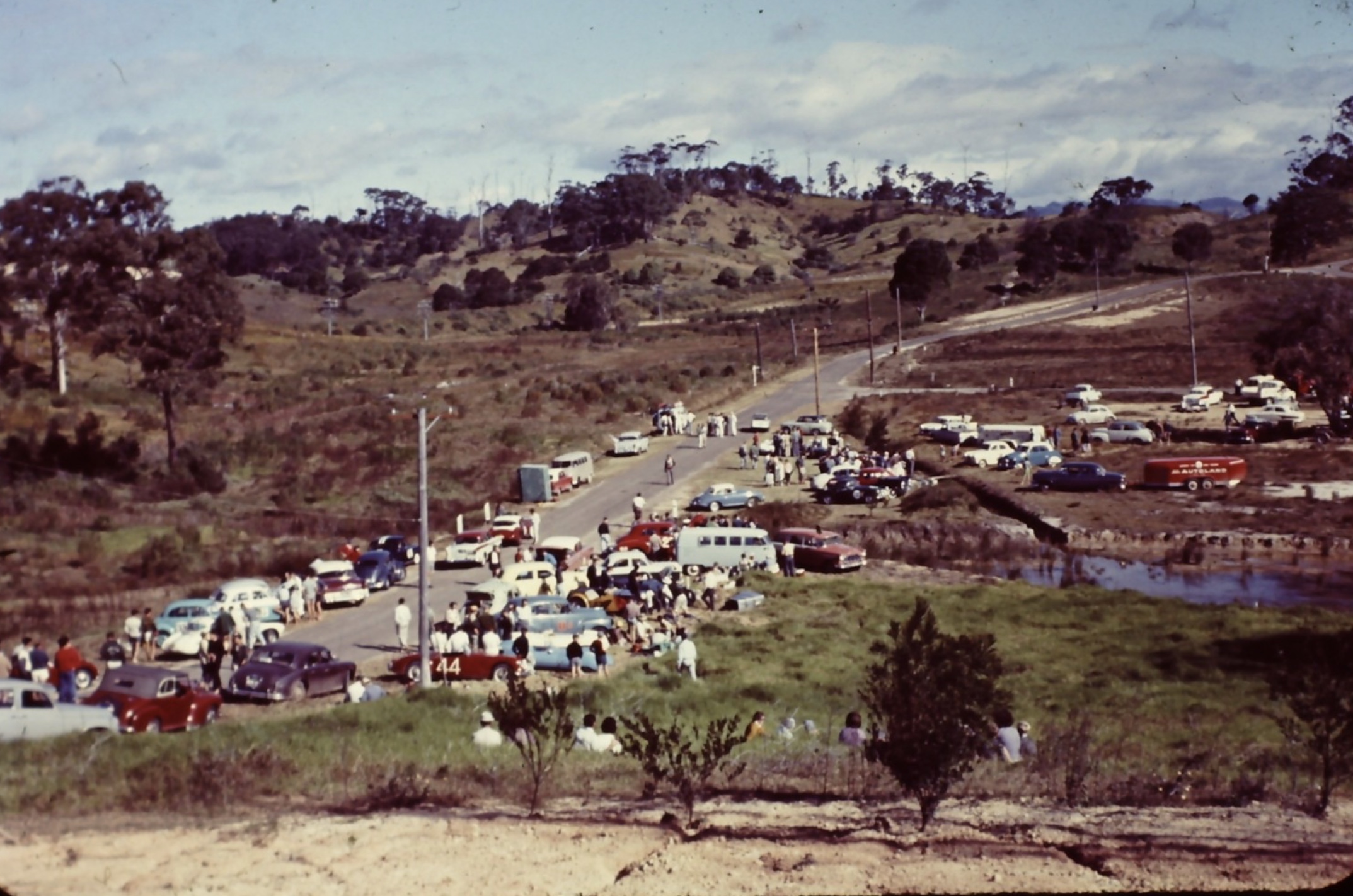
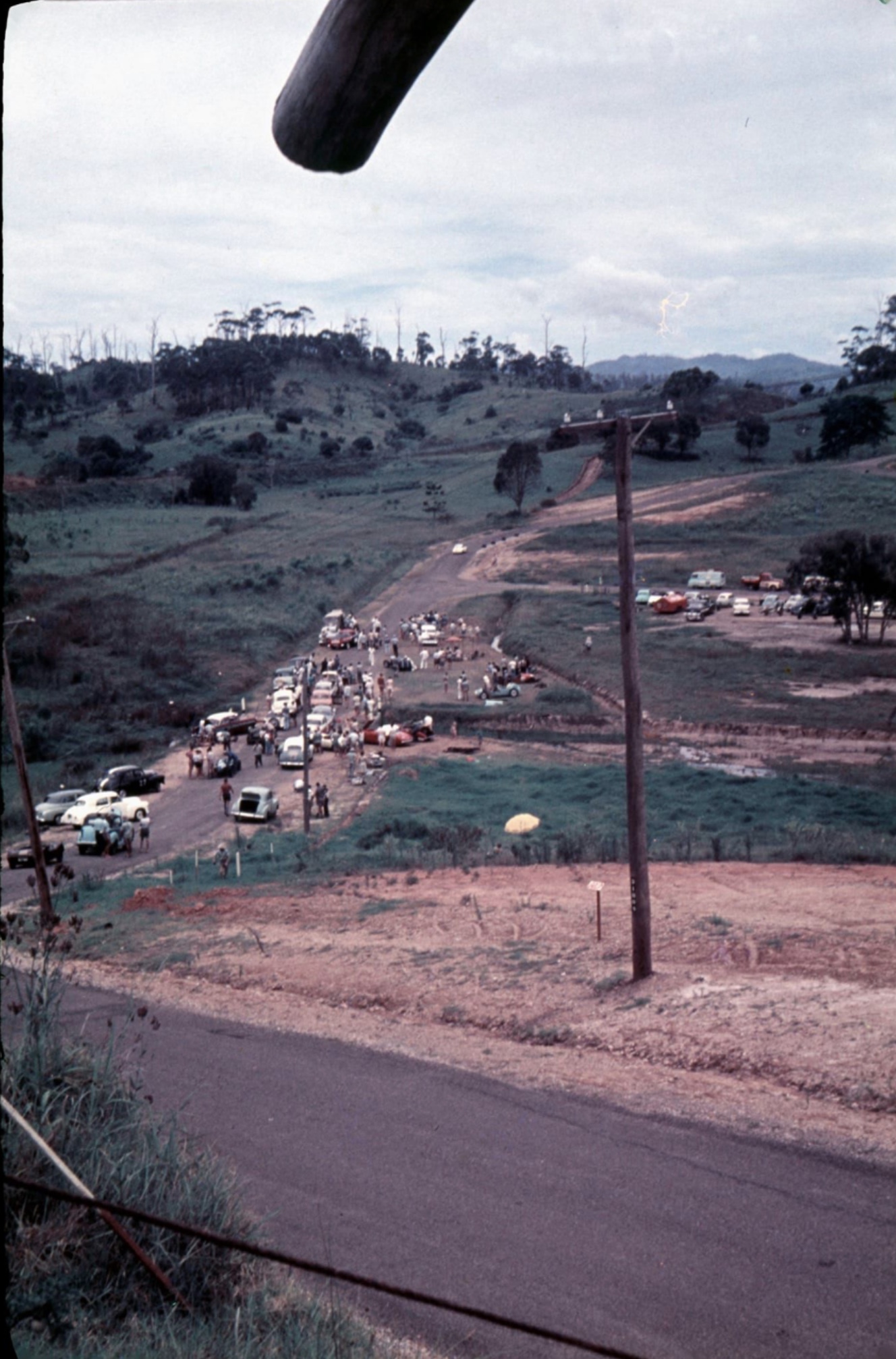
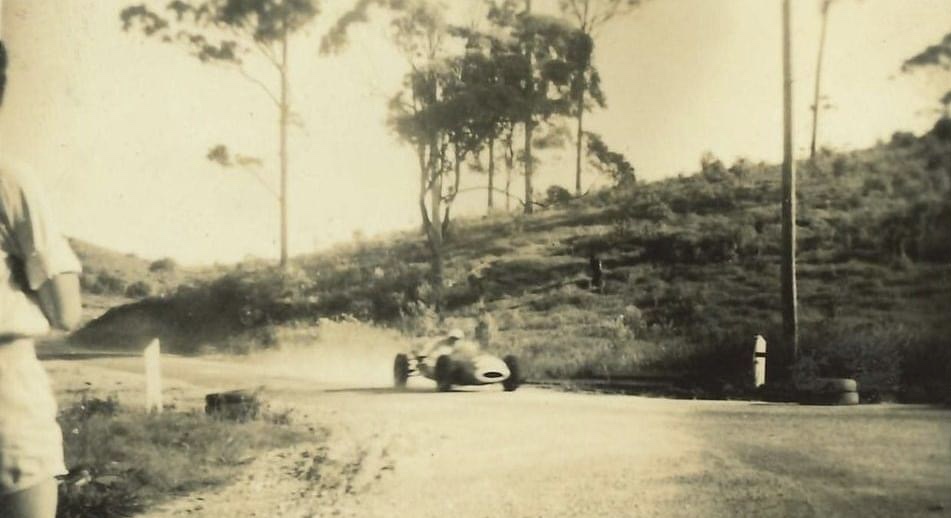
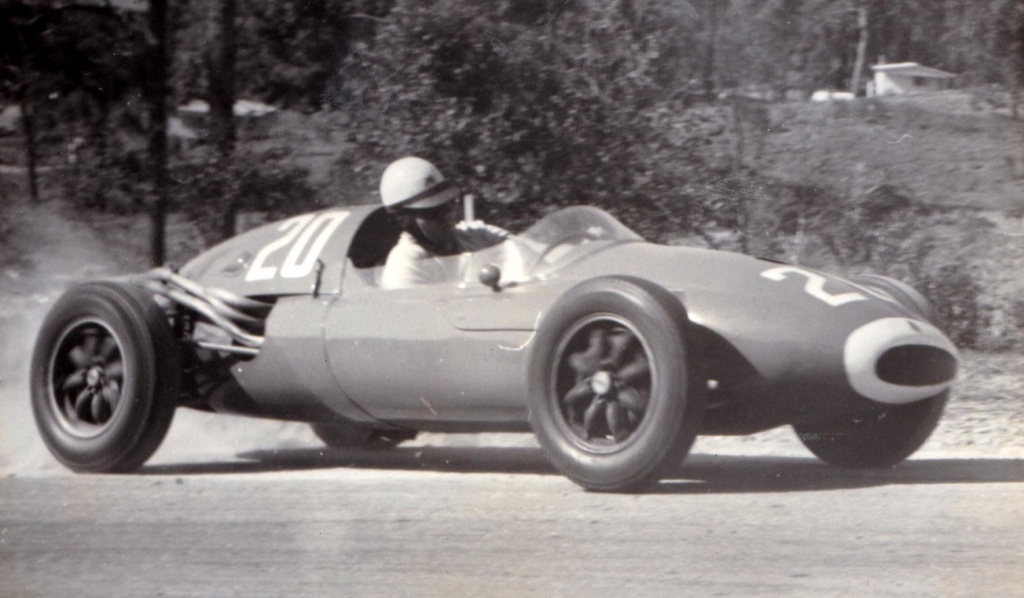
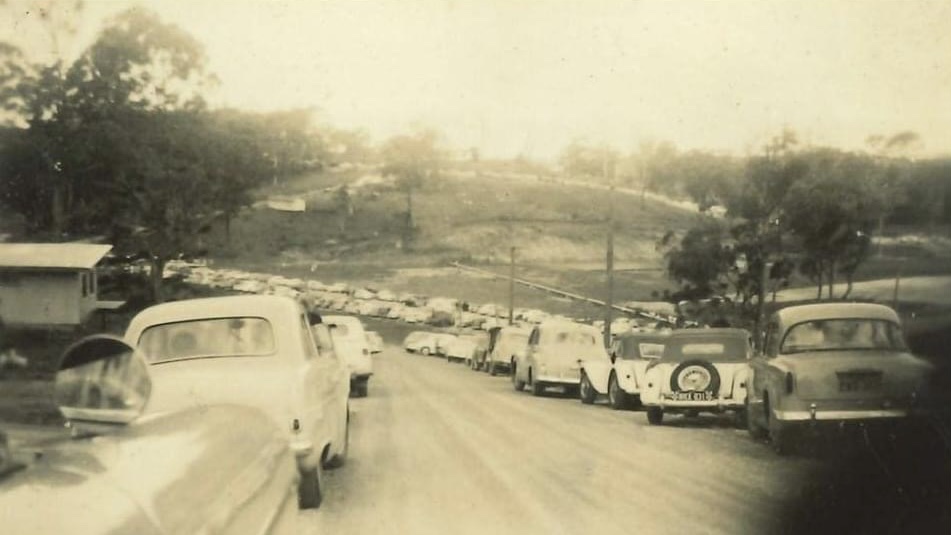
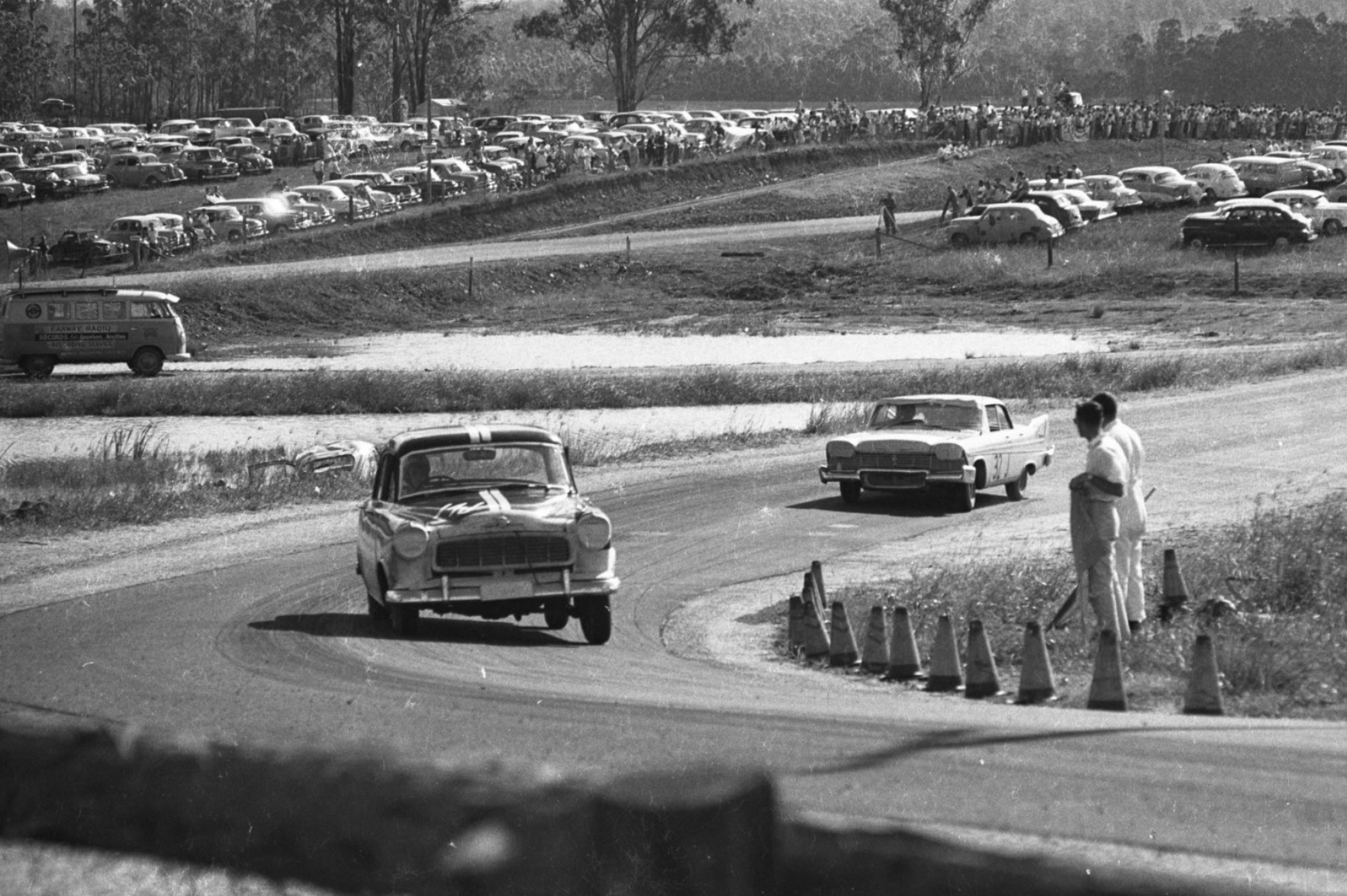
Competitors assemble for a Queensland Motor Sport Club Currumbin Hillclimb, Monday 12 June 1961…

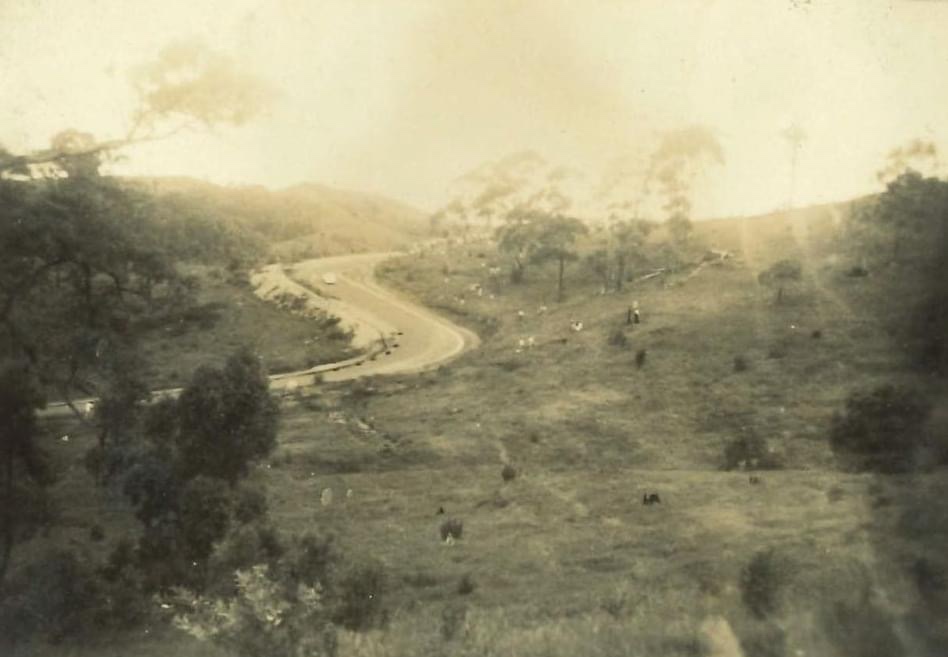
Most east coasters have holidayed on Queensland’s Gold Coast, visited the Currumbin Bird/Wildlife Sanctuary and no doubt had a surf on the beach close by. Currumbin is 20km from Surfers Paradise and a dropkick from Tweed Heads – the Queensland/New South Wales border.

This photograph has proved a bit of a mystery though.

I popped up an article on Lakeside circuit up last week but was uncertain about the photograph above given the wise owls of The Nostalgia Forum could not reach a consensus on where it was, a very rare occurrence I might add. I then uploaded the photograph onto the primotipo and Old Australian Motor Racing Photographs – Australia Facebook pages, the Lakeside article is here; https://primotipo.com/2019/09/23/lakeside-early-days/

After four or five days and 8,027 FB hits/views Quentin Miles is the winner with photographic evidence to back up his nomination of place – Currumbin.

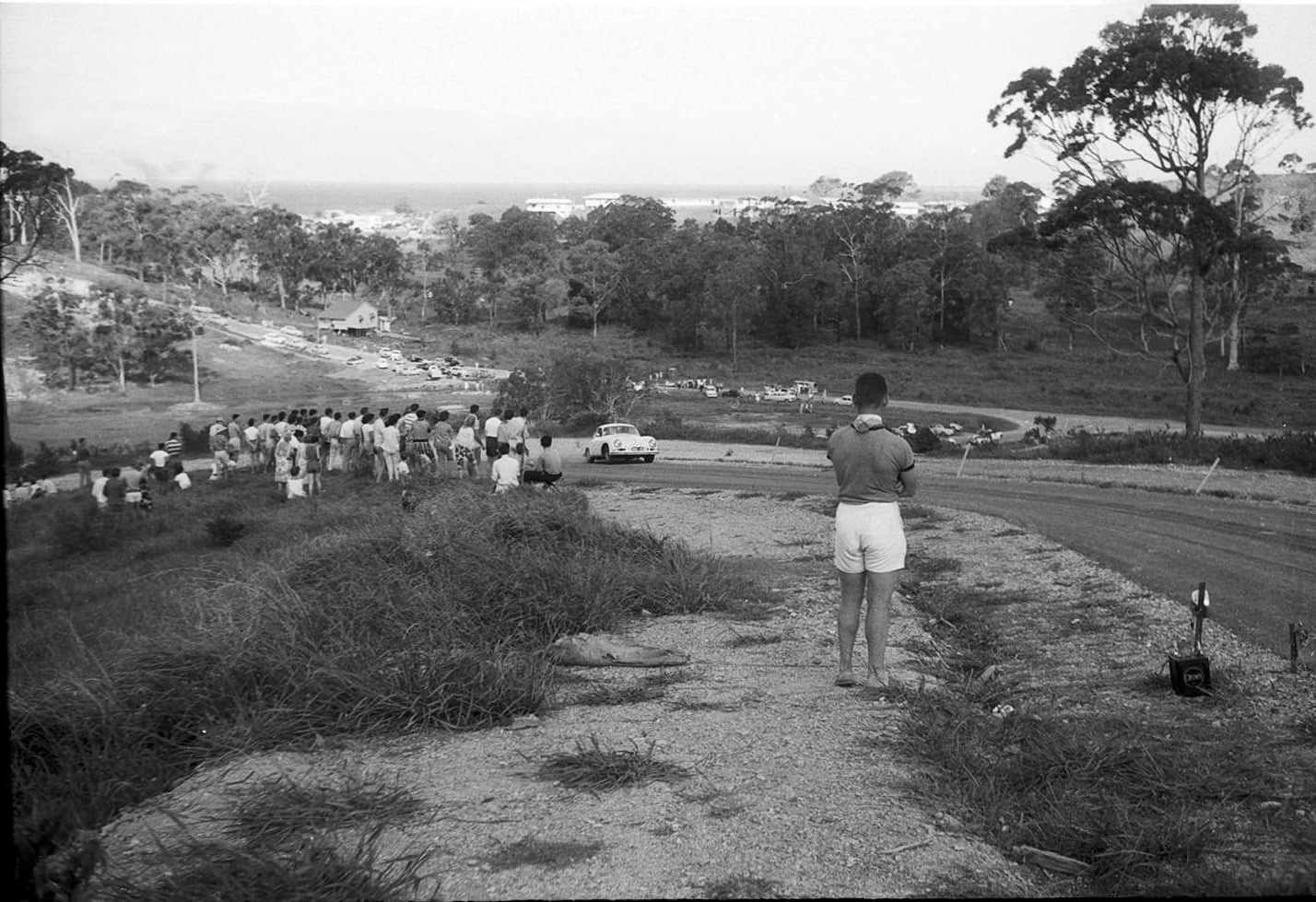
Porsche 356 on full assault. Note the corner marshal in safety overalls and the sea in the distance (B Miles)
(B Miles)

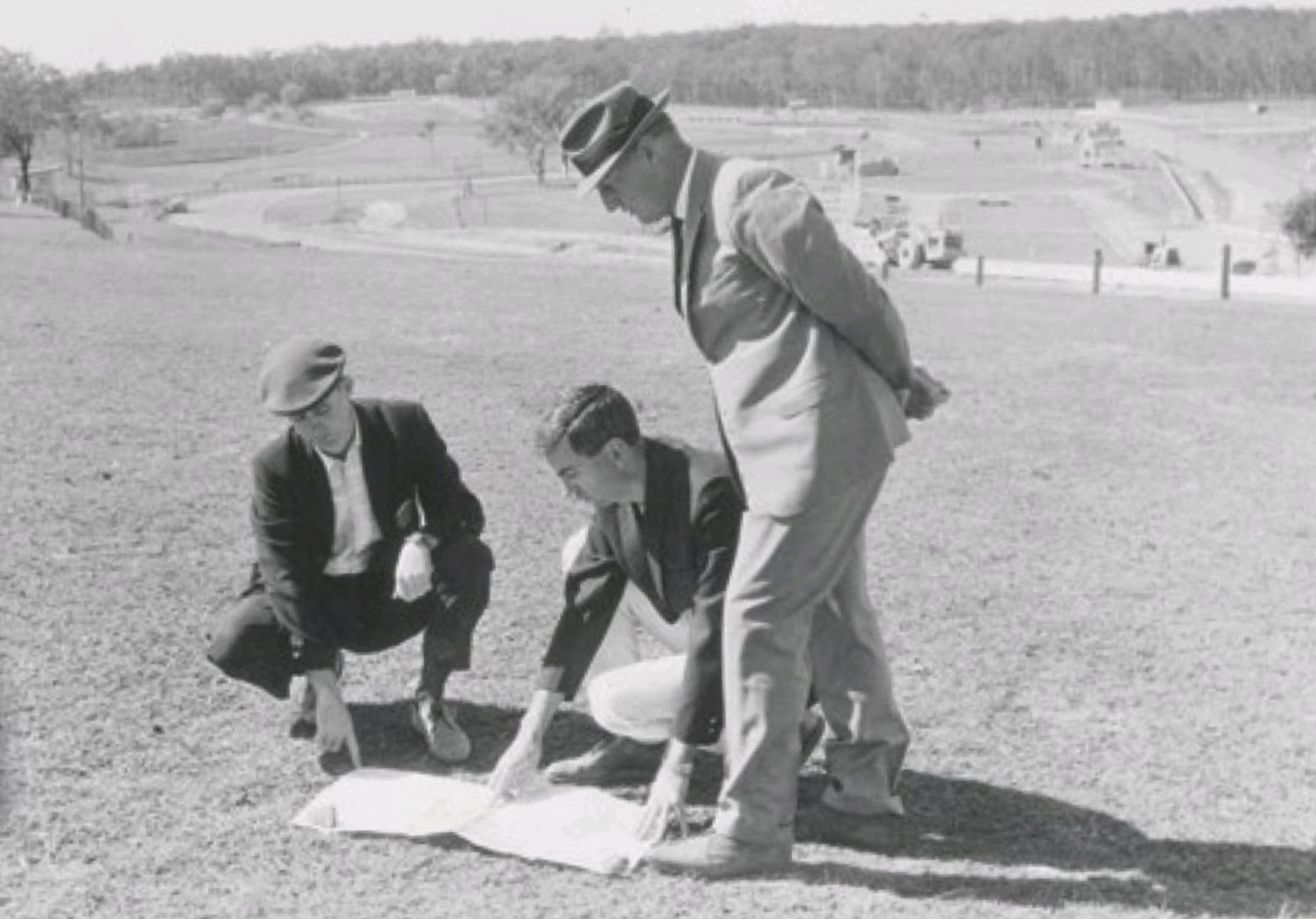
Racer/restorer Dick Willis believes the roads used were created for a housing estate and that the Gold Coast club got some events in before the influx of residents precluded further motorsport use. Brian Lear’s records show events were run in December 1958, 1960 and 1962. Stephen Dalton’s discoveries indicate the strip of bitumen used was 750 yards in length with Ivan Tighe the record-holder in 1959, he did a time of 47.5 seconds in his Vincent Special.

In Quentin’s case his father Bill attended a meeting and took these shots, its not the first time I have used the late Bill’s great material.

Several folks have identified the red Rice-trailer in the opening shot as Autoland – one of Bob Jane’s enterprises – contained therein is Bob’s voluptuous Maserati 300S. It’s a long way from Melbourne to Currumbin to contest a club ‘climb though. My theory is that Bob would have been racing not too far away, at Lowood and did the Currumbin event whilst in the ‘hood.

Roll forward to June 2020 and Andrew Lake, a Queensland MG Car Club member emailed to advise the meeting was the 12 June 1961 Queensland Hillclimb Championship. ‘As identified it is Bob Jane’s trailer…he competed in the event in his Maserati 300S and also his Jaguar sedan…Stan Jones did FTD with a time of 45.22 seconds in his Cooper T51 Climax.’

Some further work by Stephen Dalton established that Stan contested the Lowood Gold Star round – the Queensland Road Racing Championship – the day before, Bill Patterson won from Alec Mildren and then Stan, all driving Cooper T51s.

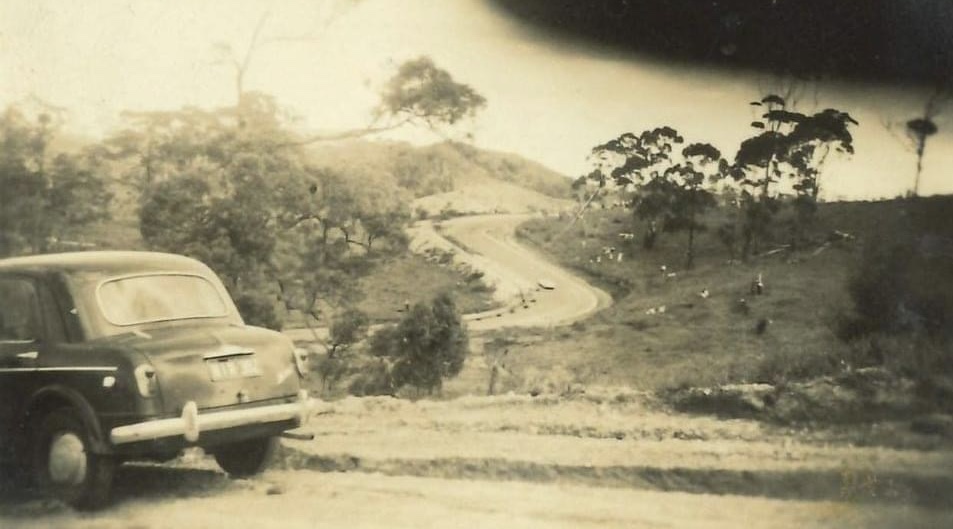
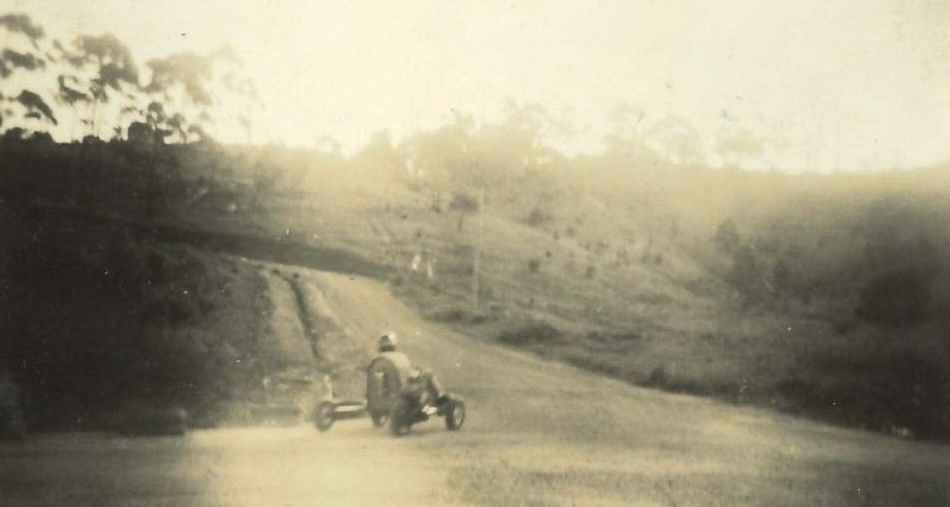
Roll forward again, this time to January 2024, and the bunch of photos taken by Peter Button’s grandfather shown below. Pauline Burrows Booth recalled, “I remember the climb well, going to watch the hillclimbs was very exciting. The hill was Currumbin Hill, on the east side that wasn’t allowed to be built on as it was a dangerous slip area.”

‘The street was on the crest, Crest Drive – it wound around the top of Currumbin Hill to the Shell Museum corner corner to Millars Drive – winding down to Millars Drive and past the now Currumbin Wildlife Hospital. The other side of the hill, Alpha Drive, we used to ride down with our go carts-billy carts

Anyway, many thanks to Quentin and his late father Bill, Stephen, Dick, Brian, Terry, Andrew, Peter Buttons and those who responded to his FB post, a team effort indeed!

Etcetera…

(T McGrath)

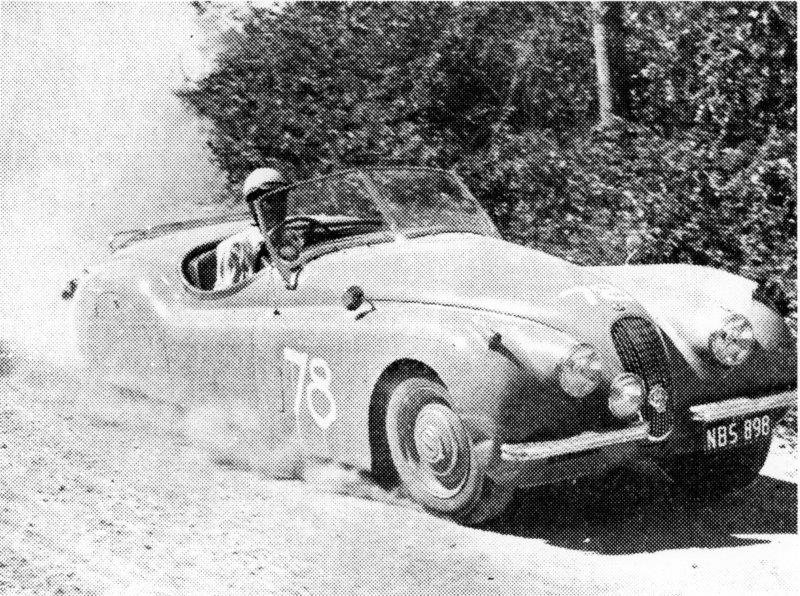
Terry McGrath tells us there was a hillclimb closeby on the Gold Coast at Burleigh Heads or Waters held on a short stretch of road with times of between 50 and 56 seconds recorded. The Dick Hamilton Jaguar XK120 is shown in full flight on 30 December 1956.

(P Button)

This bunch of shots at the ‘Currumbin Heights Hill Climb’ were spotted by Doug Grant on the Old Gold Coast Facebook page in January 2024.

They were posted by Peter Button whose “Grandad was a keen amateur racer at the time.”

(P Button Collection)

Dick Willis, “The Glynn Scott (Cooper T23 replica) Repco Holden driver by Roy Morris, now raced by Victorian, Nick McDonald.”

(P Button)

The shots above and below are of Glynn Scott’s ex-Alec Mildren Cooper T43 Climax.

(B James)
(P Button)

“Crest Drive looking across Miller’s Drive to where the wildlife hospital is now and the park across the road with the old water pipe running through it. Blamey Drive is running up and over the hill…” Glenn Bycroft.

(P Button)

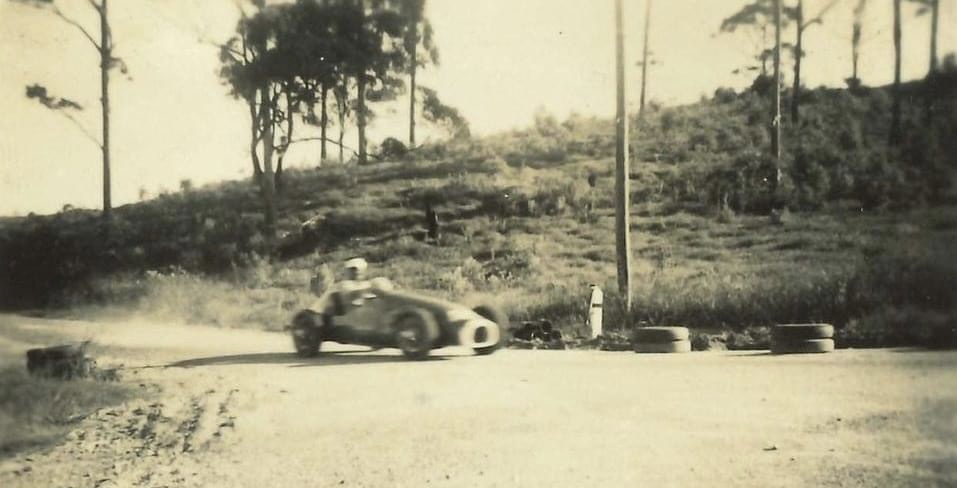
Ivan Tighe, perhaps, on his Vincent Formula 500.

(P Button)

Andrew Lake advises hillclimbs were held on the Gold Coast as follows;

Burleigh Heads

01/01/1956, 22/04/1956, 17/06/1956, 30/12/1956, 21/04/1957

Terranora

29/12/1957

Currumbin

28/12/1958, 15/11/1959, 27/12/1959, 14/08/1960, 26/12/1960, 12/06/1961

Credits…

Quentin Miles and the late Bill Miles, John Wright, Stephen Dalton, Dick Willis, Brian Lear, The Nostalgia Forum, Terry McGrath, Andrew Lake, Peter Button Collection, Bruce James

Tailpiece…

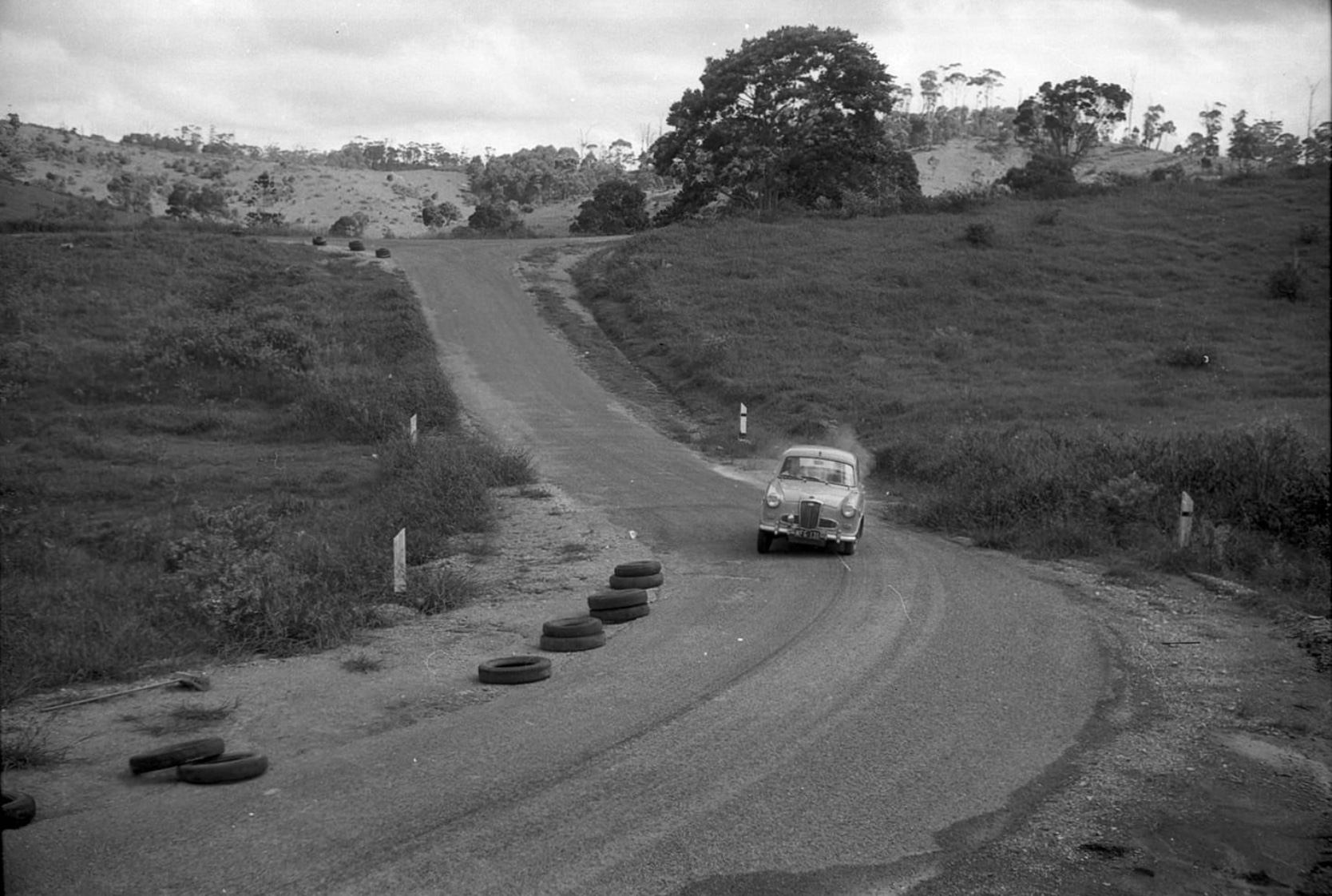
Wolseley 1500 attacking the downhill right-hander, tyres mark the apex (B Miles)

Finito…

(R Dalwood)

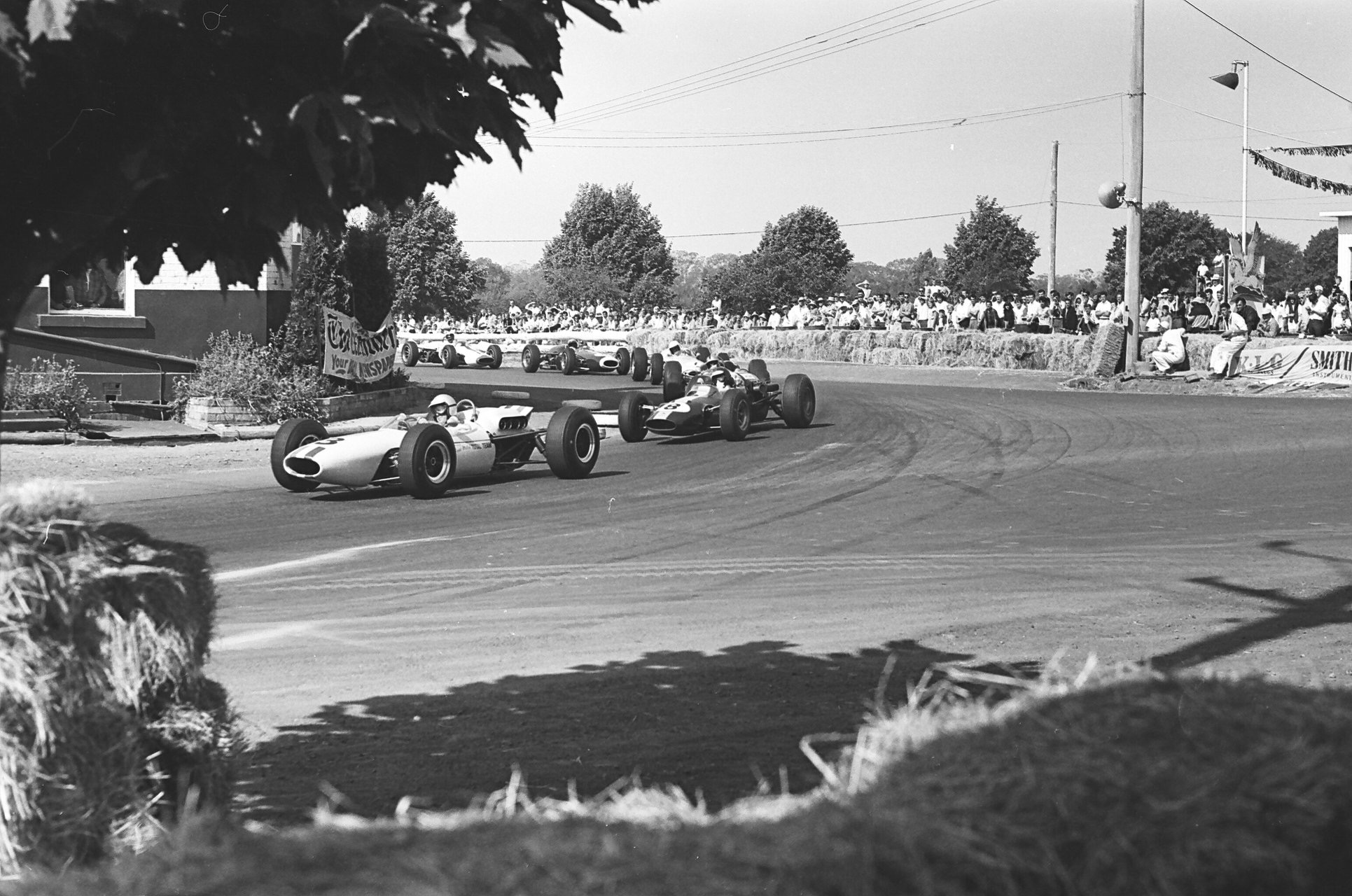
Frank Matich, Brabham BT7A Climax leads Jim Clark’s works Lotus 32B Climax into Pub Corner at Longford in March 1965. A take-your-breath-away shot, composition and execution by Reg Dalwood is something special…

I suspect this is lap 2 with the leading trio of McLaren, Brabham and Hill further up the road. Behind Jim are Bib Stillwell and Frank Gardner in Brabham BT11As, Jim Palmer in a BT7A and then at the rear of the group is Phil Hill, Cooper T70 Climax.

Bruce McLaren won this race, the Australian Grand Prix in his Cooper T79 Climax from Brabham’s BT11A and Phil Hill in the other Bruce McLaren Motor Racing entry – the updated T70 Cooper driven by Bruce and the late Tim Mayer in 1964.

(HAGP)

Bruce wheels his Cooper T79 around Warwick Farm in 1965 hiking his inside right wheel.

These Cooper T70/79 cars are acknowledged now as the ‘first McLarens’ designed and built as they were at Coopers by Bruce and mechanic/technician Wally Willmott. The story of them is here; https://primotipo.com/2016/11/18/tim-mayer-what-might-have-been/

Ron McKinnon gives McLaren and Clark a ride in the sponsors Spitty at the end of the race (B Short)

Hill at left, white car McLaren with Jack and Jim in the next row of two (B Short)

McLaren started the race from pole with Brabham, Graham Hill, Clark, Gardner and Matich behind.

Very sadly, this was the race in which Rocky Tresise died after losing control of the Ecurie Australie Cooper T62 Climax. As most of you know, this was a double disaster for the Davison family as Lex died of a heart attack at Sandown whilst practicing his Brabham BT4 the weekend prior. The Rocky story is here; https://primotipo.com/2016/05/20/bruce-lex-and-rockys-cooper-t62-climax/

I’ve a feature brewing on this race so won’t go into all the detail just now, but rather make use of some of the many images of this AGP floating around on the internet, too many for one article.

In some ways Longford 1965 marked ‘the end of the beginning’ of the Tasman Series in that 1965 was the last year of the dominance of the long-lived Coventry Climax FPF engine.

The world championship winning engines of 1959-60 had pretty much ruled supreme in Australia from 1959 through to the end of Formula Libre in December 1963, and to the commencement of the Tasman 2.5 Formula from 1 January 1964.

In 1966 the BRM V8s made their successful Tasman debut and at the end of the series – Sandown and Longford – the first of the Repco RB620 2.5 V8’s took their bow in Jack’s BT19.

(B Short)

Two nut-brown Aussie summer kids, and the equally well-tanned Oz Lotus works mechanic Ray Parsons push Jim Clark’s Lotus 32B Climax through the Longford paddock.

The Clark/Lotus combo were the class of 1965. Jim’s four of seven Tasman round victories was a precursor to a season which included an Indianapolis 500 win aboard a Lotus 38 Ford, and his second world title in Chapman’s Lotus 33 Climax. Not a bad year really!

Click here for an article on the 1965 Tasman Series; https://primotipo.com/2017/11/02/levin-international-new-zealand-1965/

(K Drage)

Kevin Drage’s shot of the front row of the Longford grid; McLaren, Cooper T79 Climax, Brabham and Hill both in Brabham BT11A Climax’.

KD has an amusing anecdote about Bib Stillwell, Matich’s big rival, and his reaction to FM’s speed that weekend.

“One story I remember from this meeting is Bib’s frustration in not being able to match Frank Matich’s lap times during practice. I was helping Gerry Brown to pit crew for Bib at this meeting, and Bib was even wondering if Frank had slotted in the 2.7 engine from his (Cooper Monaco) sportscar into the Brabham, just for practice to give everyone a bit of a stir up. He even asked me to see if I could manage to go over to the Matich pits to checkout the engine number.”

(unattributed)

Matich during the parade lap at Warwick Farm before the 1965 Tasman round.

FM started the Warwick Farm 100 from pole – in front of Hill, Clark, Brabham, McLaren and Gardner, which rather puts the Sydneysider’s pace into context. He led most of the first lap, ultimately finishing third behind Clark and Brabham.

(oldracephotos.com.au)

Brabham in the Longford paddock getting his BT11A race ready.

Ron and Jack’s Intercontinental Brabhams were supreme racing cars in conception, design and execution. Drivers of the BT4, BT7A and BT11A of varying ability won plenty of motor races in these cars right through towards the end of the sixties. Click here for a piece on them; https://primotipo.com/2018/07/20/matich-stillwell-brabhams-warwick-farm-sydney-december-1963/

Clark in the Longford paddock, Lotus 32B Climax

Credits…

Reg Dalwood on the Historic Racing Car Club of Tasmania website, oldracingcars.com.au, Kevin Drage, Ben Short, HAGP- ‘History of The Australian Grand Prix’ Graham Howard and others, Stephen Dalton Collection, Perry Drury, Ian Smith Collection

Etcetera…

(oldracephotos.com/JEllis)

Brabham, Hill and Clark enter the circuit, the crowd big enough for raceday. Looking back down the road 500 metres or so are the distinctive big pine trees of Mountford Corner. Brabham BT11A by two, and Lotus 32B.

(oldracephotos.com.au)

It may not have been the latest bit of kit, but, continuously modified by Matich and his team his year old car was well and truly as quick as the latest BT11A or anything else on the grid.

Small crowd above suggests ‘IC-1-63’ is being pushed onto the track for practice or the preliminary on Saturday. Graham Matich is steering, it’s Geoff Smedley with his head down at left, who is the other fella I wonder?

(B Short)

The Touring Car grid ready to start, Le Mans style with the ignition key handed from mechanic to driver, can anybody help with car/driver ID.

Check out the crowd above the pits, access bridge and all the fun of the fair.

(I Smith Collection)

The intense concentration is there but otherwise Jack looks relaxed in the cockpit, key to feeling what the BT11A is doing of course.

Shot is taken from atop The Viaduct, a classic shot from this locale. This one has been executed beautifully and shows both Brabham’s form as well as the lines and simple, period-typical suspension of this oh-so-successful series of Intercontinental Brabhams.

All of the shots of this car in the article are a different hue of green, I wonder which is closest to the real McCoy?

Tailpiece…

It’s a butt shot isn’t it.

From the left is the beautifully formed derrière of the lady, such a shame to miss out on the rest of her with a thoughtless crop. Then there is the rear of the FC Holden Wagon and the old bloke standing behind it.

The racer is Jack’s Brabham BT11A Climax ‘IC-5-64’ resting in the paddock after it’s hard won second place.

And finally the rear of an EJ Holden Panel Van.

Atmospheric isn’t it?

(P Drury)

Same scene, same time, same place, while Perry Drury was taking this shot, Ben Short was standing opposite him taking the one above. Jack’s Brabham, Jim’s Lotus and the EJ Wagon…

Finito…

(HRCCT)

Norm Beechey and Jim McKeown at Symmons Plains in February 1968…

Both the Chev Nova and injected Lotus Cortina Mk2 were top-liners in 1968 albeit the one race Australian Touring Car Championship was won again that year by Pete Geoghegan’s Ford Mustang from Darrell King, Morris Cooper S and Alan Hamilton’s just arrived in the country Porsche 911S/T. It was Geoghegan’s fourth of five ATCC titles.

The 34 lap event was held at Warwick Farm on 8 September, by that stage Norm had replaced the Nova with a Chev Camaro- he retired with mechanical dramas after 11 laps whilst Jim’s race was over after only 2- axle failure the cause.

(L Ruting)

Photographs of the Camaro SS are not plentiful as it raced for only a short period- four meetings (Warwick Farm twice, Calder and Catalina) from July to September 1968 inclusive of the ATCC race where he qualified on the second row- the car was an ‘in between’.

The Nova raced from Easter 1966 and the Holden Monaro’s with which he became synonomous in the latter stages of his career date from October 1968, the Camaro fitted in between.

The photo above is during the first lap of the 1968 ATCC race with Pete up front, then Norm and the Bob Jane Mustang.

See this piece on the 1969 ATCC; https://primotipo.com/2018/02/01/1969-australian-touring-car-championship/ , and on 1970; https://primotipo.com/2018/04/01/variety-is-the-spice/

Beechey trying to pursuade the Nova to turn in, Paul Fahey and Red Dawson in Mustangs, Rod Coppins in Chev Camaro at Baypark, NZ 1968 (T Marshall)

Etcetera…

(M Rogers)

Beechey and John French, Nova and Cooper S on the Surfers Paradise grid in 1967.

Credit…

Historic Racing Car Club of Tasmania, Lance Ruting, Rod MacKenzie, Steve Holmes- The Roaring Season, Terry Marshall, Mervin Rogers

Tailpiece: Beechey and Geoghegan at Catalina Park 18 August 1968…

(R MacKenzie)

Classic Ford/GM, Geoghegan/Beechey battle. Who won?

Finito…

(J Wright)

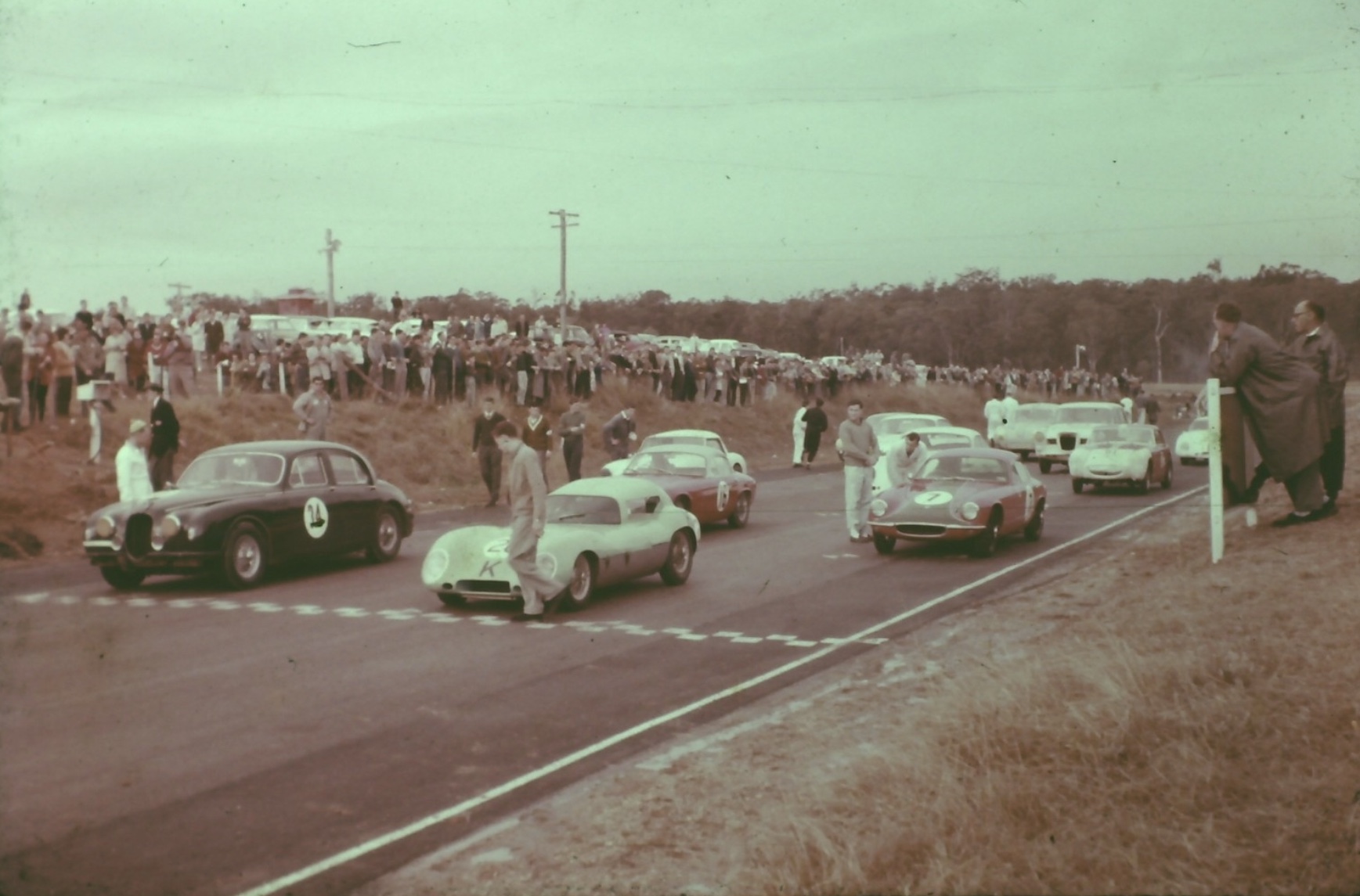
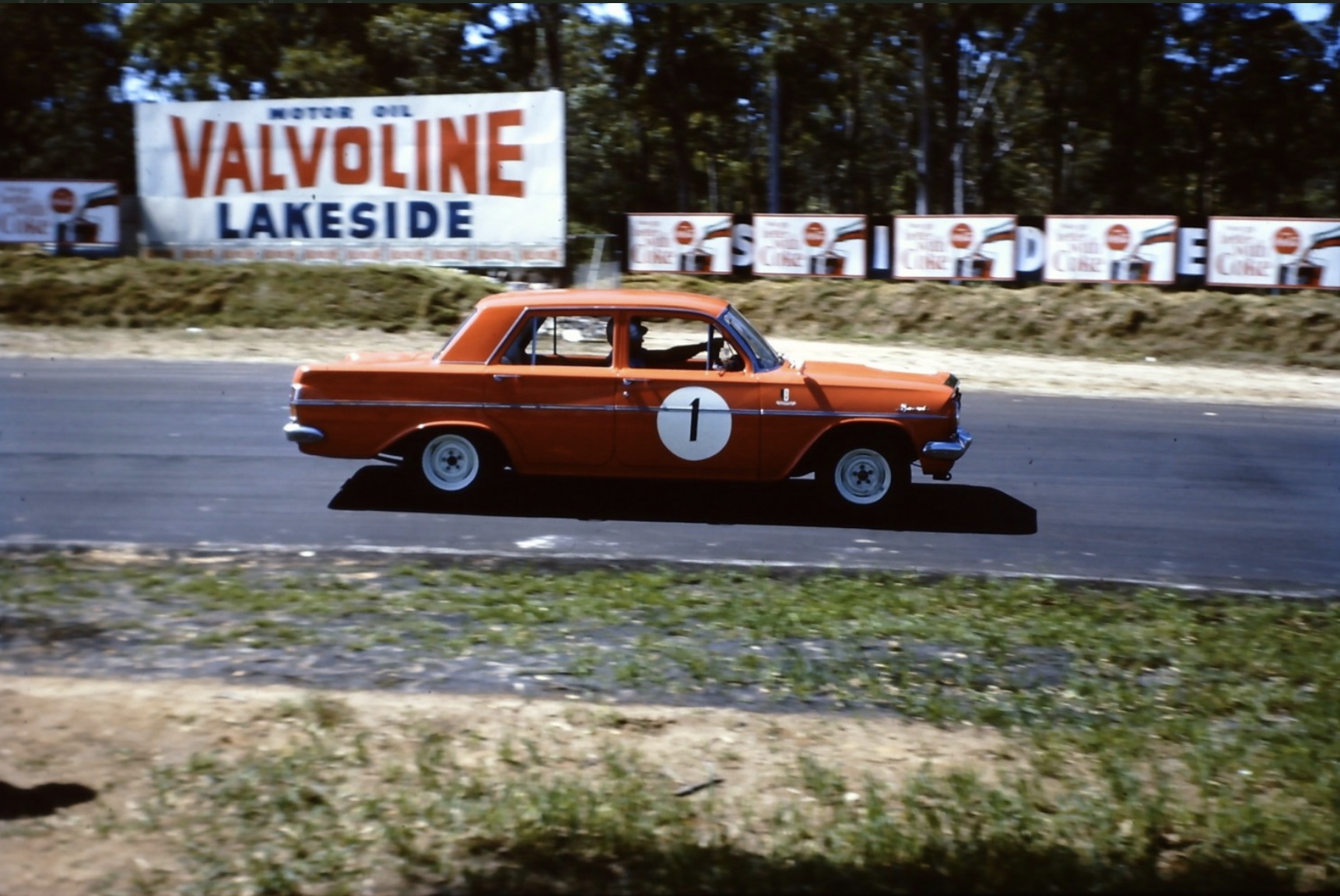
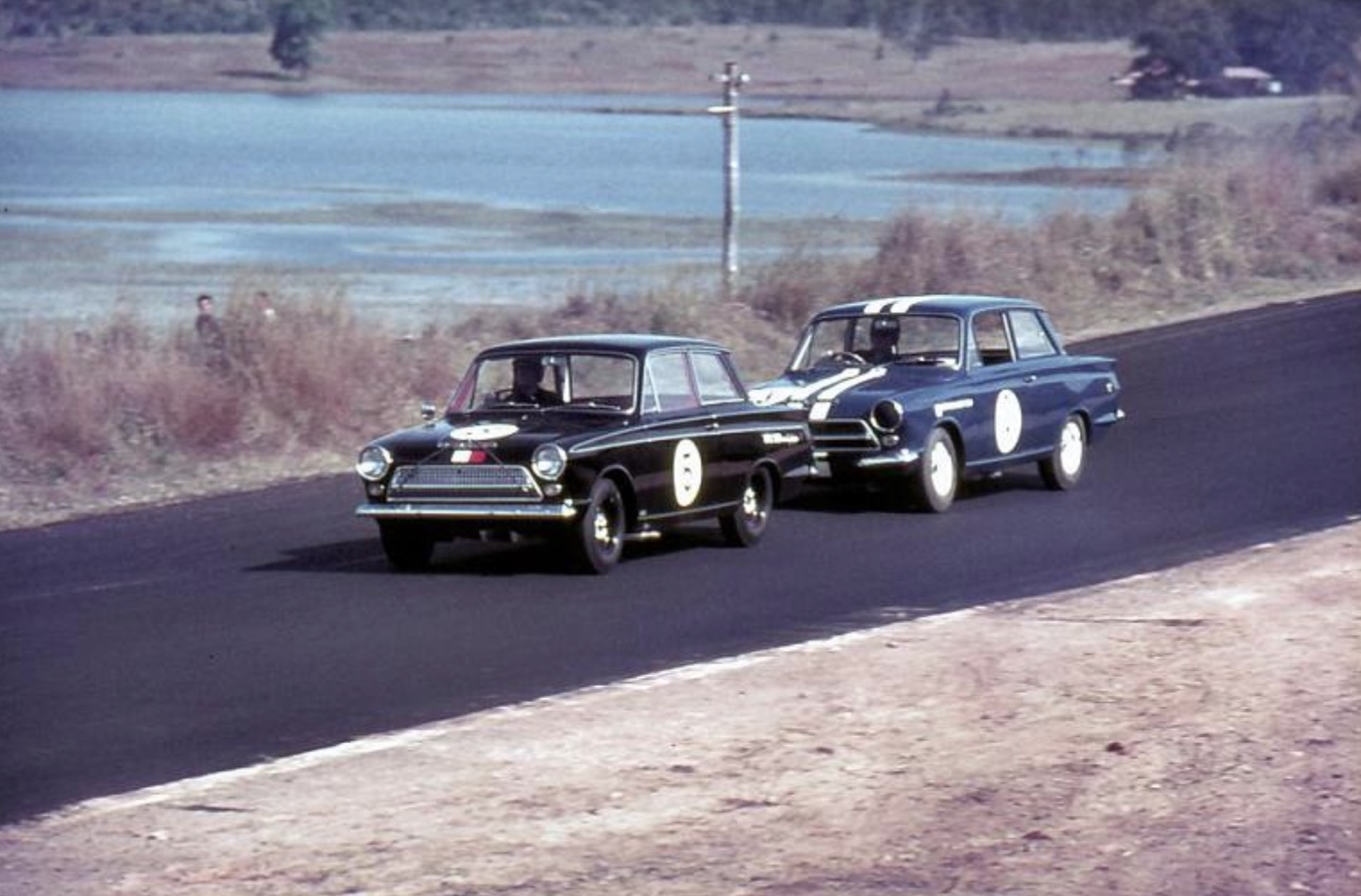
The grid for the Australian GT Championship at Lakeside, Queensland on 8 July 1962…

Bill Pitt, Jaguar 3.4 alongside John French in the Centaur Waggott/Holden, then the two Lotus Elites of Tony Osborne #16 and #7 Brian Foley. On the row behind is #21 Les Howard, Austin Healey Sprite Ford-Cosworth, in the middle the partially obscured #31 Porsche 356 of Tony Basile and on the left the white #30 Renault Floride of Terry Kratzmann .

The light coloured Sprite further back is #51 Sib Petralia, #60 Paul Fallu, Karmann Ghia whilst the #4 Wolseley has long time competitor Ken Peters at the wheel. The unmistakable outline of the grey Renault Dauphine is #6 M Hunt. Dennis Geary #22, was also entered in the HWM Jaguar- now in two-seat Coupe form but with the very same chassis and mechanicals of the car raced by Lex Davison to win the 1954 Australian Grand Prix, ‘just down the road’ at Southport on the Gold Coast.

The 50 lap 75 mile race was won in 62:6.06 minutes/seconds by French from Basile, Pitt, Howard then came Foley. Sib Petralia won the under 1 litre class, Basile the 1000-1600cc, French the 1600-2600cc and Pitt the 2600cc class and over.

The race was the third Australian GT Championship for Appendix K cars- the first was held at Bathurst during the October 1960 meeting and won by Leo Geoghegan’s Lotus Elite, the 1961 event was at Warwick Farm in July- Frank Matich won in his Jaguar D Type.

The CAMS relaxed attitude to the requirements of App K was that cars such as the Matich D, Bob Jane Maserati 300S, David McKay Lola Mk1 Climax and many other sports-racers were allowed to run to fill scanty grids, with hardtops cobbled together for the purpose.

Which rather negated the intent of the CAMS regulatory changes, lets not go down that path.

The first photograph had me tossed- I got Pitt and French but not the locale at all, i’ve never been to Lakeside and some earthworks after the first several years changed the look of the place a bit in any event.

So, many thanks for the detective work of regular collaborator Stephen Dalton and Glenn Moulds- the wise owls of The Nostalgia Forum can usually solve these knotty Who, What, Where and When problems.

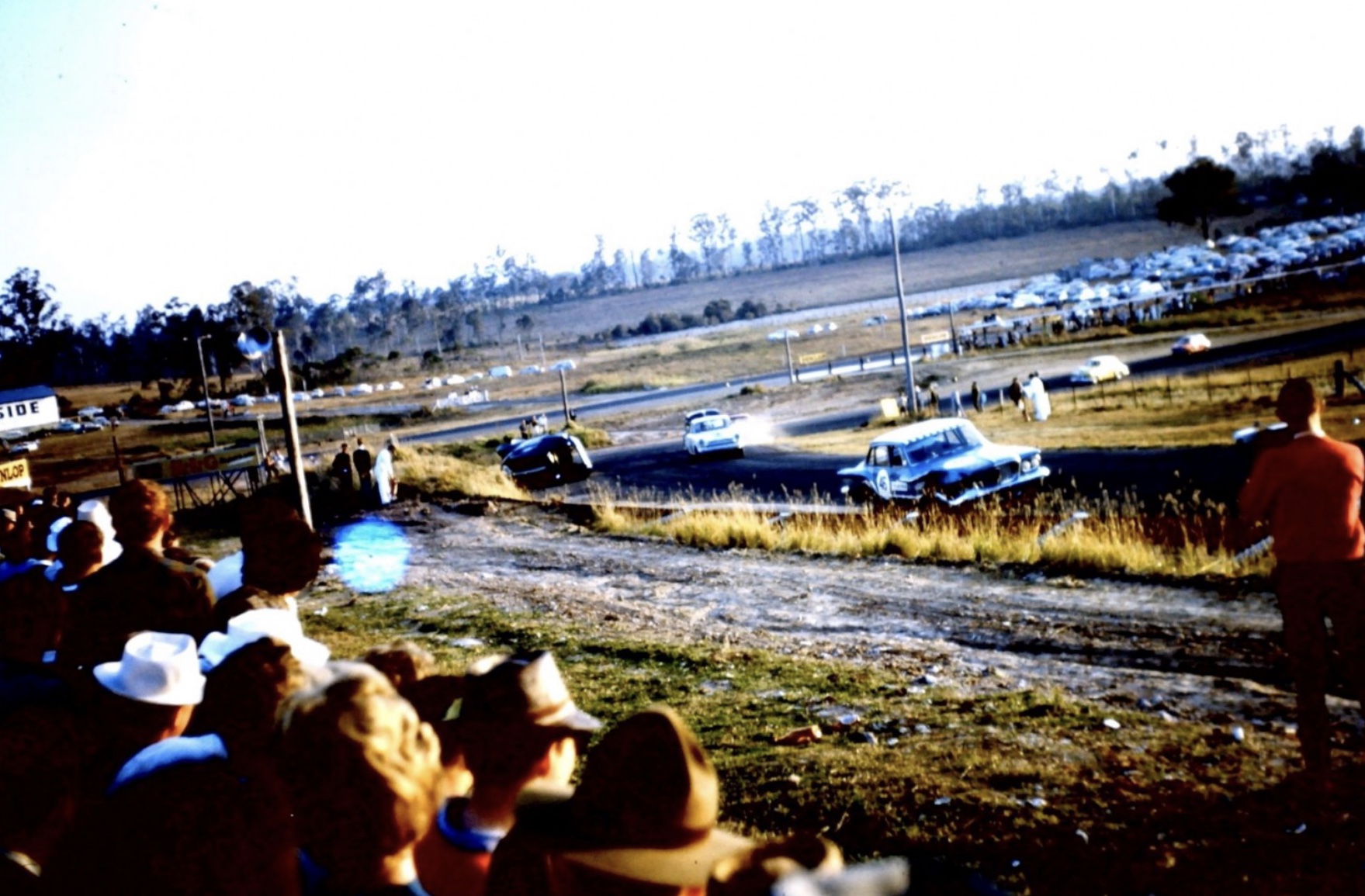
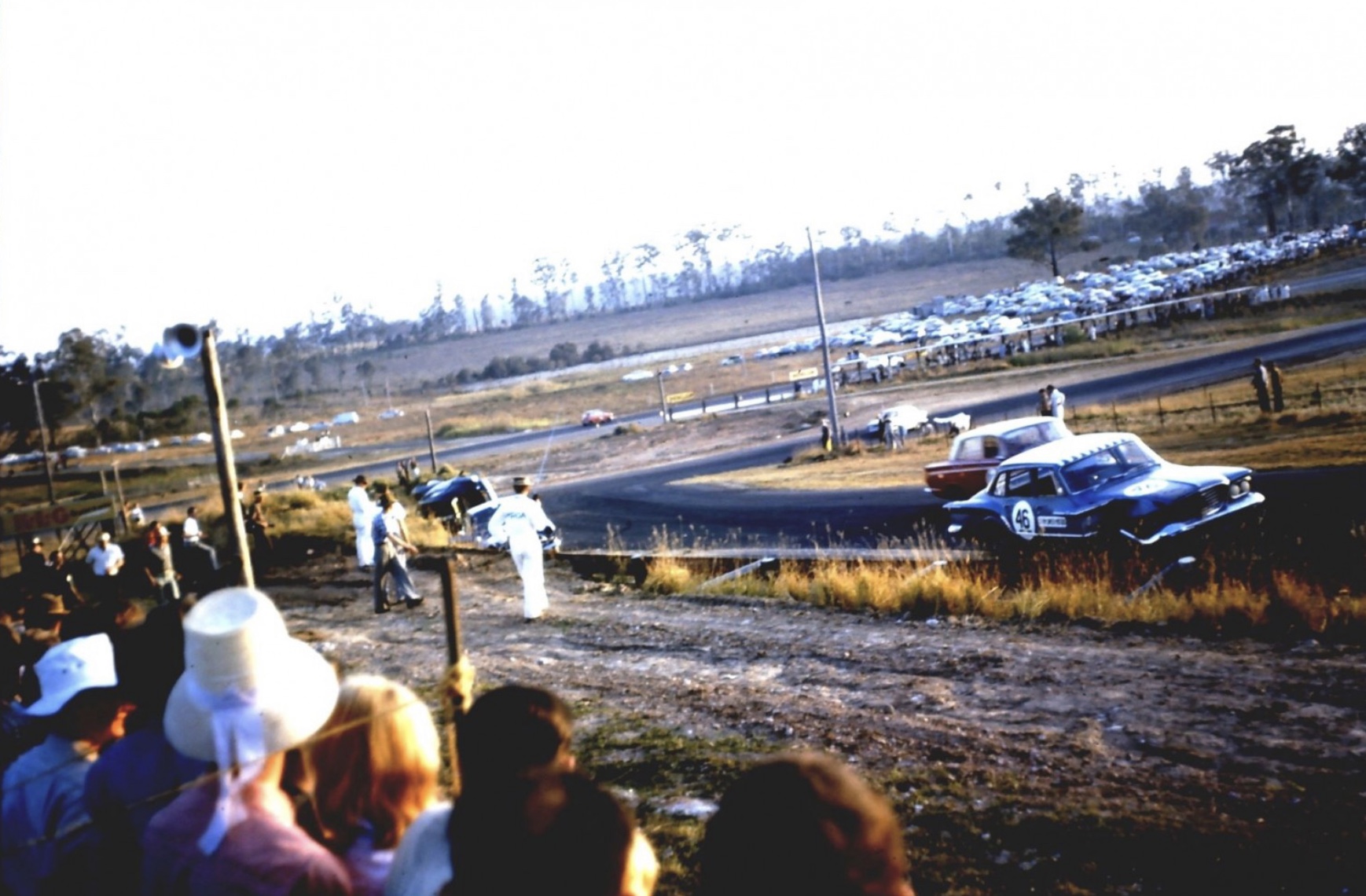
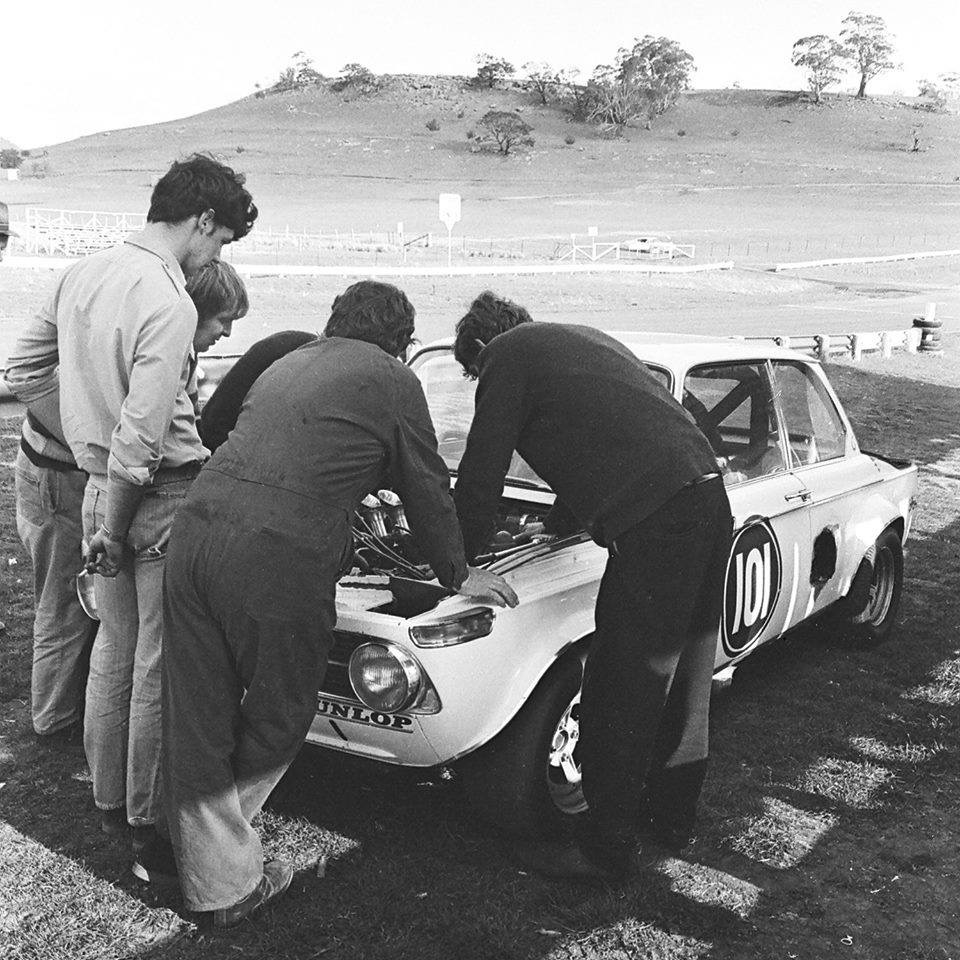
Mind you, we are still cogitating in relation to the shot below, said to be Lakeside too.

If there are some Queenslanders out there who can confirm the whereabouts of the scene below that would be a bonus. My suggestion that its on the Jindabyne-Charlottes Pass road near Charlottes in the NSW Snowies so far has little support.

(J Wright)

Most of these photographs were popped up on the Shannons Insurance website by Dr John Wright a couple of years ago but only three were identified- we on primotipo…backed by the research horsepower of the TNF Crew are happy to oblige.

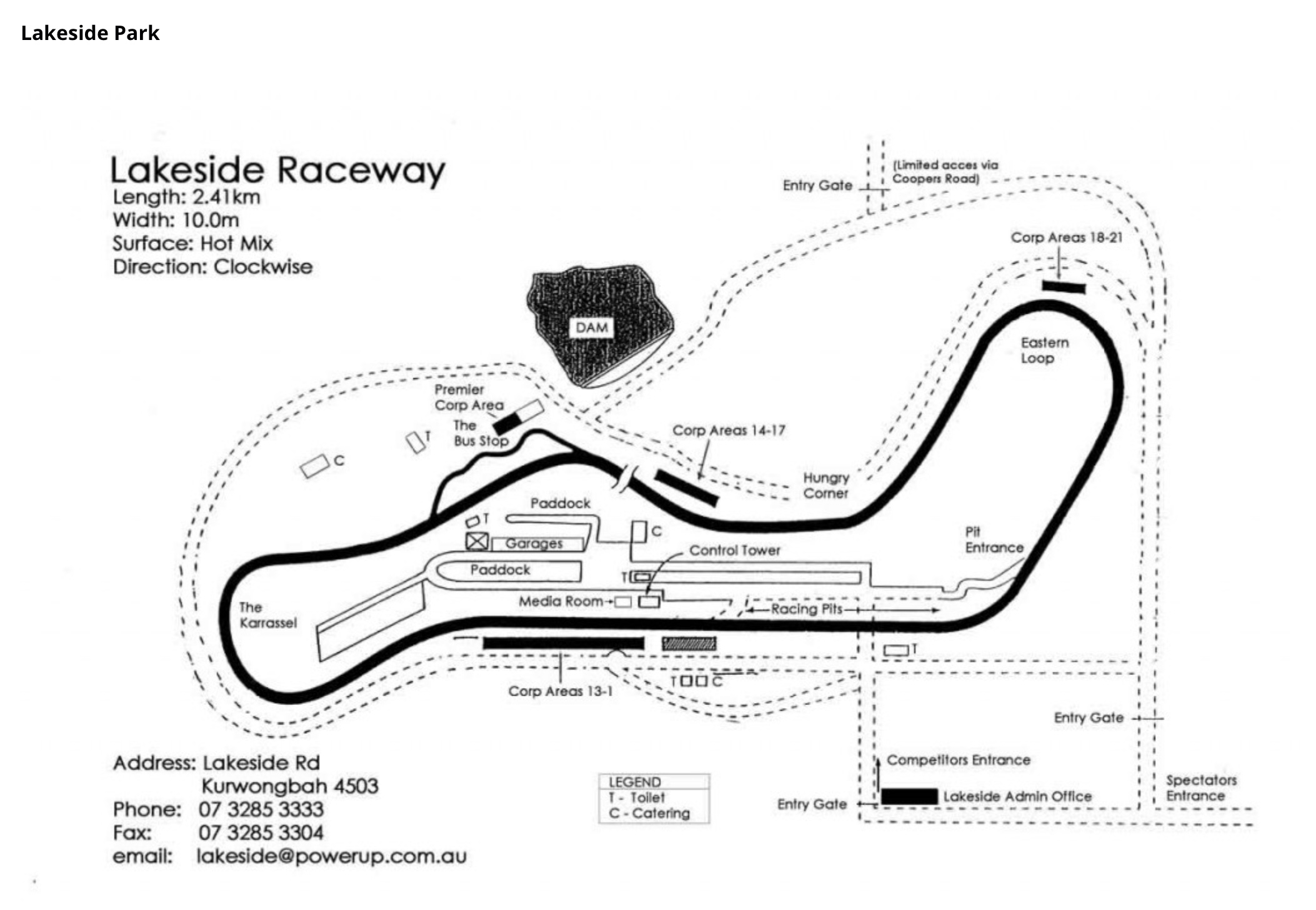
Lakeside was built on farm land purchased by Geoffrey Sidney Sakzewski at Petrie 30km north of Brisbane in 1957.

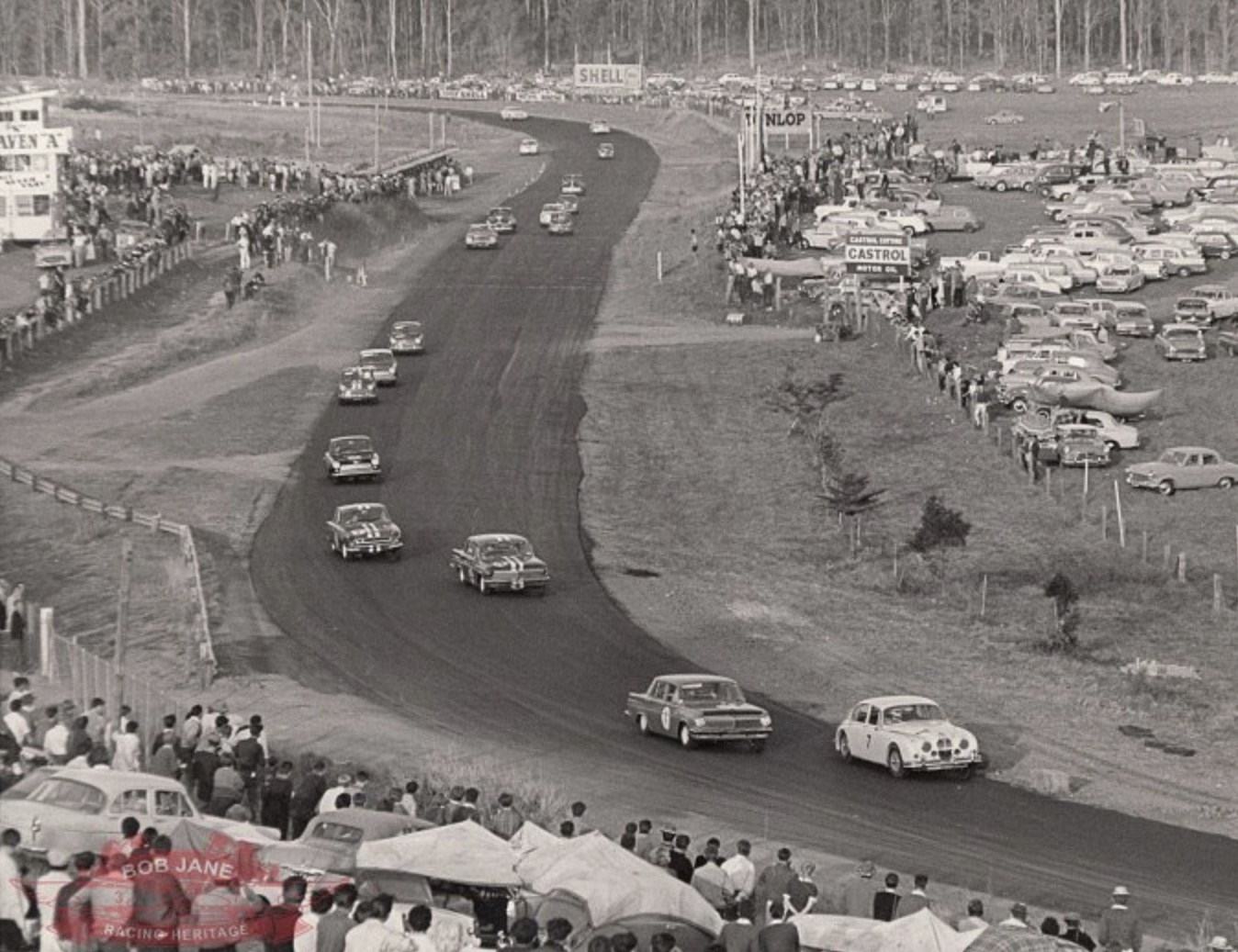
The first open race meeting was held on 19 March 1961- the landlord was keen to compete so pressed into service his wife’s  four door, light-green pillarless Plymouth Belvedere- here he is chasing the Jeremiah driven Holden FE. Rob Bartholomaeus advises the race was the Queensland Touring Car Championship- Bill Pitt is on his way to winning aboard his 3.4 Jaguar up the road- these two are scrapping for second, a battle won by the Jeremiah.

(J Wright)


Pondering and working on the remodelled Lakeside layout in 1965 before the 1966 AGP- David Harding, Ken Peters and Sid at right (unattributed)


(J Wright)

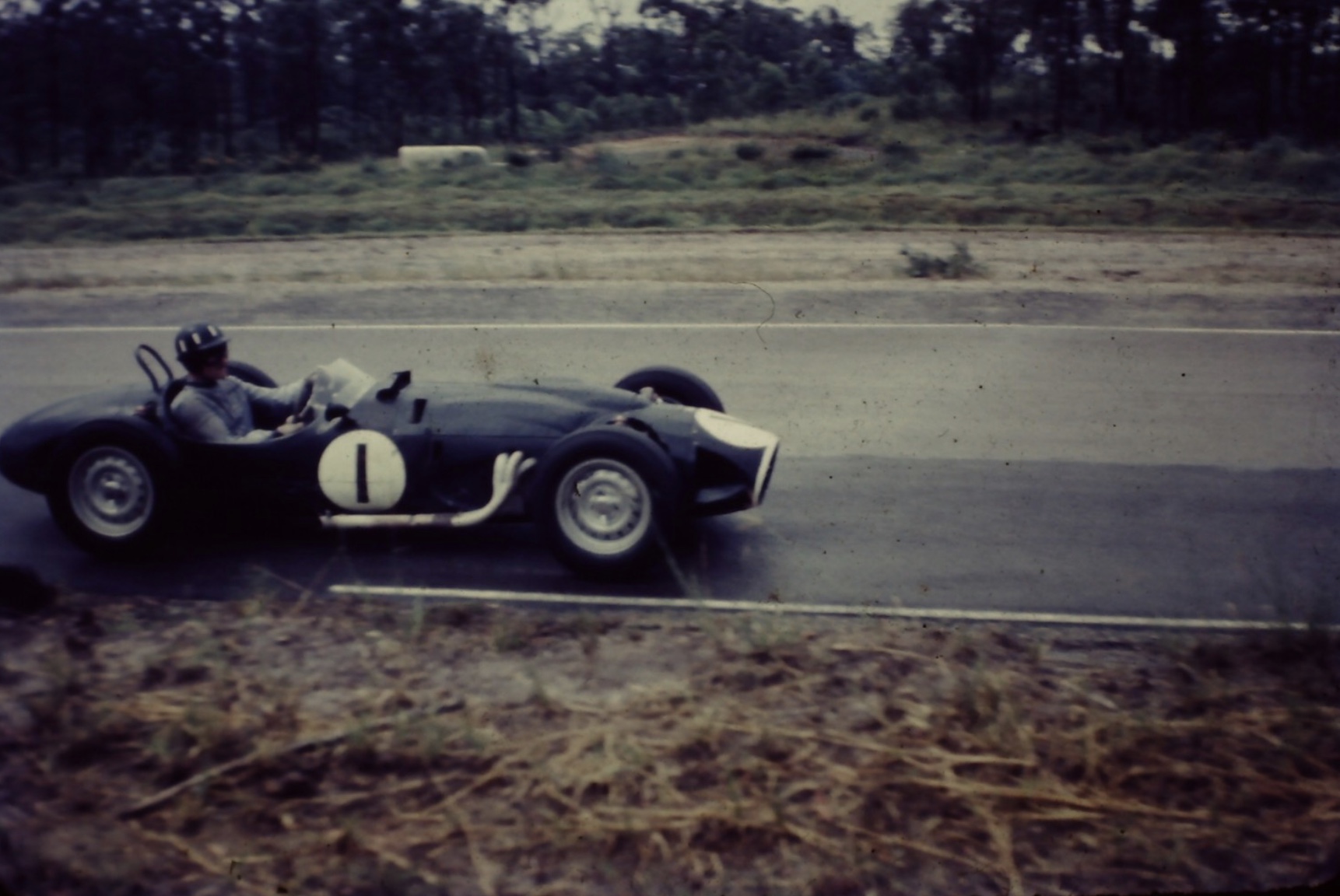
The profile of car and the helmet above will be familiar to most of you, its Hill G on his 1963 Australasian Tour during which he raced the Ferguson P99 Coventry Climax 2.5 FPF.

The rest of the hotshots ran 2.7 Climaxes in their Coopers, i’ve always thought it interesting to ponder how Graham would have gone with a bigger engine under the cars shapely bonnet.

Mind you, his only race win on the tour was a heat at Lakeside- its looks a tad soggy so I would not be surprised if Graham is on the way to a Saturday victory aboard this magnificent bit of engineering.

I waxed lyrical a while back about it, click here; https://primotipo.com/2015/01/30/ferguson-p99-climax-graham-hill-australian-grand-prix-1963/

(J Wright)

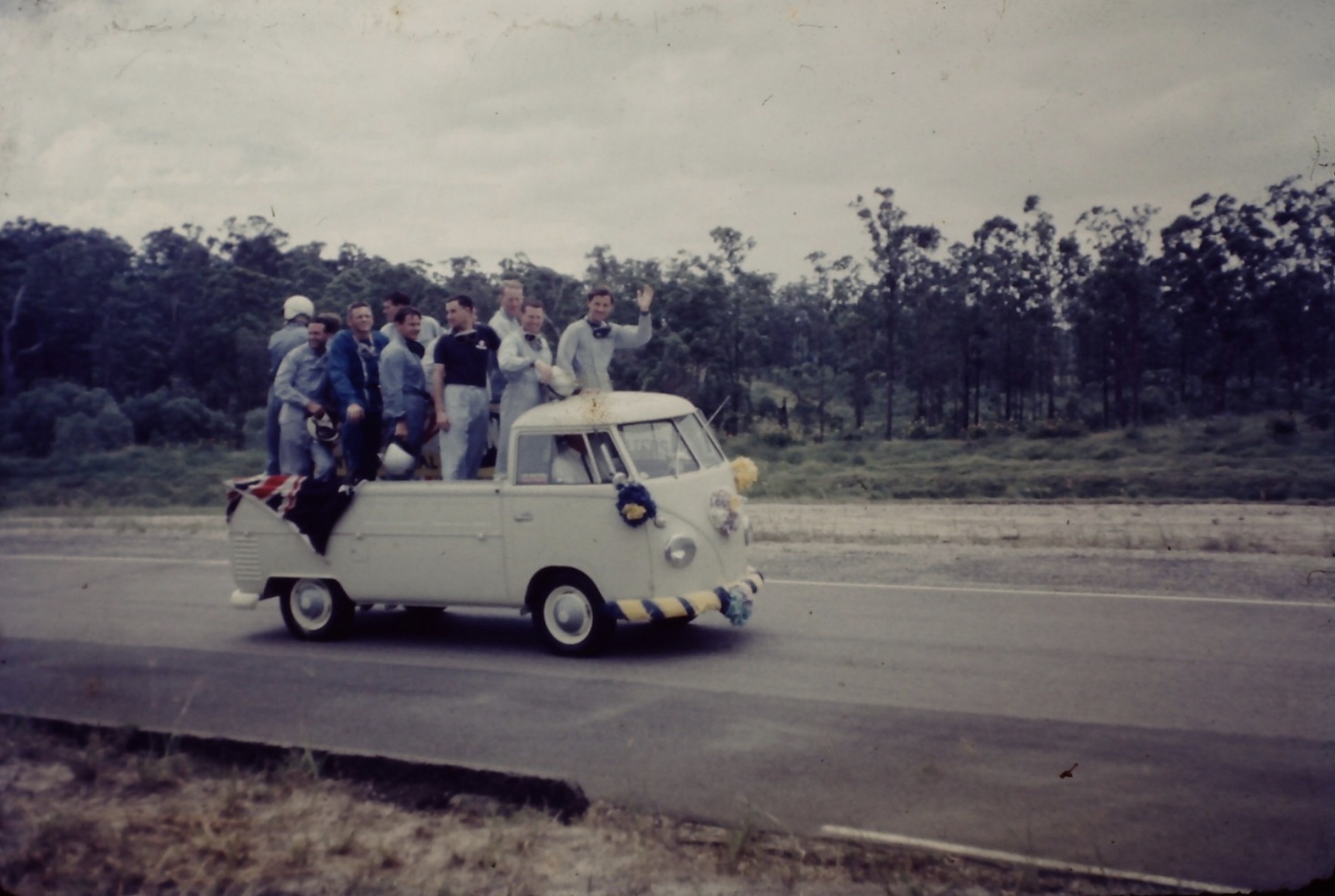
The poor old Kombi is groaning under the weight of so many champions in one place- 1200cc this model? and now highly sought after of course.

She’s a bit grainy but my best guess- and happy to hear from you, goes a bit like this from left to right- Frank Gardner in the white helmet looking away at the kangaroos, dunno holding the helmet, Arnold Glass in the darker blue race suit, Bruce McLaren holding the light silver helmet, short-sleeved fella probably Greg Cusack, Bib Stillwell and Graham Hill. ‘Blondie-locks’ behind is John Youl perhaps. Do get in touch with your bids.

The 1963 Lakeside International was won by John Surtees, Lola Mk4A from Hill’s Ferguson P99 and Bib Stillwell’s Brabham BT4- Climaxes all.

Back in the days of yore, until 1969, the Australian Touring Car Championship was decided over one race- the honour to host the event was awarded to Lakeside in 1964- race day was 26 July.

Lakeside’s proximity to Brisbane ensured a good crowd saw a contest waged between a huge variety of cars with Ian ‘Pete’ Geoghegan winning the first of his ATCC’s aboard a Ford Cortina GT from Norm Beechey, Holden EH S4, Bob Jane’s Jaguar Mk2 4.1, the Brian Foley and Peter Manton Morris Cooper S’, Glynn Scott’s Cortina GT and Brian Muir’s EH S4.

A series of heats, split into engine capacity classes determined the grid- Jim McKeown’s Lotus Cortina was on pole from Jane, Muir, Beechey and Manton.

Muir, Jane and Beechey led initially from Geoghegan and McKeown- Jim moved forward to second behind Muir- leadership of the race by Muir (below) was the first time a Holden had led an ATCC event- it would not be the last! Brian went off to fame and good fortune in Europe not so long after this.

(J Wright)

McKeown took the lead from Brian Muir on lap 7 with Beechey and Geoghegan battling for fourth. Bob Jane moved to second on lap 11 and then first when McKeown made an error and dropped to third behind Muir- at about the same time Warren Weldon locked a brake on lap 15, hit the bank and rolled onto his side a little bit behind Clem Smith who had clobbered the same bit of Queensland on lap 2, rendering his Valiant hors de combat.

The obstacles were raced around back in them days…Clem Smith’s very precarious Valiant R Type, and behind him Warren Weldon’s Holden 48-215 on its side. In the photo below you can see the blue McKeown Lotus Cortina partially obscured by the marshal. Passing Cortinas in both shots (J Wright)


(J Wright)


Done this one to death- Smith, McKeown and Weldon in line astern (unattributed)

Jane’s lead over Muir was up to 100 metres before clutch problems intervened circa lap 31- Muir then led from Pete and Norm who both passed Bob Jane. Encouraging for Holden, Muir led for the next 6 laps before a puncture forced him to pit, ‘While fetching the spare wheel, one crewman accidentally handed his motel keys to another crewman trying to open the cars boot lid. The delay cost Muir two laps and his chance of victory’ Wikipedia says.

Beechey led from Geoghegan who applied plenty of pressure to the EH in the lighter Ford taking the lead on lap 43, he held on for the next 7 laps to win by 1.2 seconds from Beechey. Jane was third despite a shagged clutch, thirty seconds adrift, with Foley and Manton’s Coopers the remaining cars on the lead lap.

Etcetera…

Start of lap 2 1964 ATCC.

Jane, Muir, Beechey, McKeown, Geoghegan, Manton, Firth, Foley and the rest.

(TRS)

Beechey and Muir in Holden EH S4’s with an obscured McKeown’s blue Lotus Cortina on the inside with Foley in the red Cooper S.

(TRS)

Pete Geoghegan’s winning Cortina GT ahead of McKeown’s Lotus Cortina.

(TRS)

Bob Jane’s very quick Jaguar 4.1 chasing Brian Muir’s Scuderia Veloce Holden EH S4, drivers using all of the available bitumen and a smidge of gravel on the inside.

Tailpiece: Lakeside Magazine looks good….

Credits…

John Wright Collection, The Nostalgia Forum- Stephen Dalton and Glenn Moulds, ‘TRS’- The Roaring Season’, Rob Bartholomaeus

Finito…

(T Watts)

4.4 litres of Repco-Brabham V8 grunt trumps 2 litres of Porsche flat-6 off the line at least, maybe not…

Bob Jane’s Elfin 400 and Alan Hamilton’s Porsche 906 on the front row of the Longford grid in March 1967.

Bob Jane won the Saturday race from Noel Hurd’s Globe Products Elfin 400 Ford and Hamilton whereas in the Monday event Bob won from Wally Mitchell’s RM1 Chev and Glynn Scott’s Lotus 23B Ford. Noel Hurd and Alan Hamilton were DNF’s, the latter running out of fuel on the last lap.

‘Tasmanian enthusiasts would recognise the Gorringe pedestrian bridge, the same bridge that now allows pedestrian access to Baskerville…’ Grant Twining noted.

I’ve written features about both these cars, so initially thought I would pop the photos into the existing articles but they are too good to ‘lose’ by so doing.

They are sourced from the ‘Historic Racing Car Club of Tasmania’ Facebook page which I raid every now and again- so far Grant has not cracked the shits about me doing that- do suss the page if you are a Facebooker, if not you are missing out.

In terms of articles the Elfin 400 is here; https://primotipo.com/2015/05/28/elfin-400traco-olds-frank-matich-niel-allen-and-garrie-cooper/. Bob’s Elfin 400 here; https://primotipo.com/2018/04/06/belle-of-the-ball/, and Hamilton’s Porsche 906 and other cars here; https://primotipo.com/2015/08/20/alan-hamilton-his-porsche-9048-and-two-906s/

(T Watts)

Jane nose up and under power past the Longford pits.

Such a brutally pretty thing, but the aerodynamics of the 400’s were never fully resolved, this car, as many of you know, took flight over the Conrod Humps at Bathurst during the Easter 1969 meeting killing Bevan Gibson in the process.

To that very point Rob Bartholomaeus reminded me Noel Hurd was a non-starter in the Monday Longford sportscar race after a hair-raising off at around 140mph induced by the Elfin 400’s aero package. He was ok, and the car was not badly damaged but the nose was changed thereafter.

Bob’s eyes will be looking up the rise towards the Water Tower to the tracks left before pursuading his beast into the fast right hander at the top of the hill and plunge towards The Viaduct. Click here for a ‘Lap of Longford’ piece; https://primotipo.com/2018/07/05/longford-lap/

The shot of Alan below is taken on the same stretch. If the car looks a bit odd its because Australia’s Porsche importer has chopped the Coupe roof off to create a Spyder given he was and is a big, tall unit and wanted to be comfy.

(T Watts)

Longford was a demanding circuit in any car but particularly so in a fast, powerful one given the inherent nature of the layout with its culverts, trees, bridge supports, Esk River (scuba divers were always at the ready in dinghies afloat) light poles and other similar immovable objects, the circuit width and its undulations or bumps.

Jane and Hamilton raced most of their cars here- sports and touring cars and in Bob’s case his Elfin Mono single-seater ANF1.5. For Hamilton it was the race debut of the 906- a daunting place for any cars first meeting however well sorted the ex-factory Porsche package undoubtedly was!

Jane raced his Elfin 400 at Longford in 1967 and Ian Cook took the wheel in 1968- Alan raced the 906 here in 1967 only. The ‘ring in’ is the photo below of Alan at Symmons Plains in 1967, its probably the ‘Tasmanian Sportscar Championship’ meeting the week after Longford on 12 March.

Click here for an article on that tragic event, Hamilton’s well-used engine (it had been in the 904-8 he had just stepped out of before fitment to the 906) had a con-rod break so he did not finish; https://primotipo.com/2018/07/17/1967-tasmanian-sportscar-championship/

(HRCCT)

Credits…

Tim Watts, Dennis Cooper, Historic Racing Car Club of Tasmania, Rob Bartholomaeus

Tailpiece…

(D Cooper)

The Longford Shell tent in 1968.

Jim McKeown’s Lotus Cortina Mk2 alongside the Bob Jane Racing 400 raced at this meeting by Victorian Ian Cook. The class of the field in that, final Longford year was Chris Amon who set the outright lap record in David McKay’s Scuderia Veloce Ferrari Can-Am 350 machine. Here tis; https://primotipo.com/2015/04/02/ferrari-p4canam-350-0858/

Note the aluminium spoiler above the radiator outlet in a quest for more downforce. 1968 was ‘the year of the wing in F1’ remember, mind you, by this stage Jim Hall and the crew from Rattlesnake Raceway in Texas had provided plenty of Chaparral mobile ‘tutorials’ on what could be applied aerodynamically to Group 7 cars like the Elfin to assist in keeping them on terra firma.

Finito…

(B Hickson)

Leo Geoghegan, left, Lotus 32 Ford, Greg Cusack Brabham BT6 Ford and Bib Stillwell, Brabham BT14 Ford with Bob Jane in the white Elfin Mono a couple of rows back, await the start of the ANF 1.5 race at Warwick Farm 16 May 1965…

This contest was an absolute cracker with Cusack ‘driving the race of his life’ according to Ray Bell. GC set the class record at 1:35.2 whilst ‘tigering’ after an early spin at ‘Creek- he dived way too deep in a late braking manoeuvre on Bib. Stillwell won from Geoghegan and Cusack. Then came Glynn Scott, Lotus 27, the similarly mounted Les Howard and A Felton in a Brabham.

Australian National Formula 1 was the ‘Tasman 2.5 litre’ Formula from 1964 to 1970 inclusive. The next level of single-seater racing was, variously, during this period, ANF 1.5 and ANF 2, putting the rule changes in F2 itself back then to one side.

ANF 1.5 existed between 1964-1968 inclusive, and, effectively as a twin-cam, two-valve formula ‘mandated’ the use of the Lotus-Ford ‘twin-cam’ Harry Mundy designed engine in 1.5 litre capacity, at least for those seeking victory. The engine was of course originally built to power Colin Chapman’s Lotus Elan, albeit it’s race potential was immediately obvious and exploited.

Arnold Glass’ Lotus 27 Cosworth Ford twin-cam in the Longford paddock 1964. Ain’t she sweet- in concept and execution very much a ‘mini’ F1 Lotus 25- daddy of the modern monocoque which first raced at Zandvoort in 1962 (R Lambert)

Mind you, the simple statement above does not do justice to the Cosworth modified four cylinder pushrod Ford engines which were dominant in Formula Junior, and were at 1.5 litres the engine to have in the early sixties before the ANF1.5 class was created in Australia.

The motors (not necessarily modified by Cosworth) were fitted to many small bore single-seaters at the dawn of the sixties and could still give a reasonable account of themselves after the twin-cam era arrived, but usually were no longer winners.

Perhaps the first twin-cams to race in Australia were Arnold Glass and Frank Gardner (Alec Mildren Racing Brabham BT6) at the 1964 Australian Grand Prix at Sandown- Arnold’s Lotus was fifth in the race won by Jack Brabham’s Coventry Climax FPF engined Brabham BT7A. Cusack entered a Brabham BT6 similarly engined at Longford and so the bar was shifted in that class as the ‘rush’ to fit the latest and greatest got underway.


Lotus-Ford twin-cam. Surely one of the great, enduring race engines despite its road car parentage (Vic Berris)

The problem for the Tasman 2.5’s was the speed of a well driven ‘one and a half’! There were many occasions on which the 1.5’s showed very well in Gold Star competition including winning in the right circumstances.

Some examples of Gold Star top-two performances were Cusack’s second at Lakeside in 1964, Brabham BT6, Leo Geoghegan first in the Hordern Trophy at Warwick Farm in December 1964, second at Lakeside and at the Hordern Trophy, Warwick Farm in 1965 aboard his Lotus 32 Ford. John Harvey was first at Mallala in 1966 driving the ex-Stillwell Brabham BT14. Max Stewart was second at Bathurst during Easter 1968 in his Rennmax BN2 Ford. Garrie Cooper was second at Sandown in an Elfin 600 Ford with John Ampt, Clive Millis and Maurie Quincey all in Elfin 1.5’s in third, fourth and fifth places!

Fast and reliable is the observation about these machines.

16 May 1965- the initial photograph race’s dummy grid- #7 is the Cusack Brabham, the bit of white beyond Geoghegan’s Lotus. #17 Les Howard Lotus 27, #9 A Felton Brabham and the blue car with the white on the nose is Glynn Scott’s Lotus 27 (B Hickson)

Great drivers won the ANF 1.5 title too- in 1964 it fell to Greg Cusack’s Brabham BT6 Ford, in 1965 Bib Stillwell won in a Brabham BT14 Ford with John Harvey victorious in the same car the following year. In 1967 it was Max Stewart’s Rennmax BN1 Ford which took the honours, whilst Max and Garrie Cooper won jointly in 1968. Max raced a Rennmax BN2 Ford and Garrie Cooper an Elfin 600B Ford.

Max Stewart gets some attention during the Symmons Plains Gold Star weekend in 1967, Rennmax BN1 Ford (oldracephotos.com.au/Harrisson)

With the exception of Stillwell, who was already an established ace- a multiple Gold Star winner when he won the title, the drivers were all ‘up and comers’- the ANF 1.5 Championship was an important part of a  journey onto greater things.

In 1964 and 1965 the championship was decided over one race at Warwick Farm and Bathurst respectively and from 1966-1968 by a series of events.

Leo Geoghegan’s Lotus 32 Ford in the Warwick Farm paddock in May 1965 (B Hickson)

ANF 1.5 Championship, Warwick Farm, 6 September 1964…

Leo Geoghegan was the form driver in a top car, most would have their money on the Sydney Lotus 27 Ford pilot to win the race in his home backyard but a practice accident meant he was a non-starter come Sunday.

John Ellacott’s photo below shows Leo’s machine less a corner or two- ‘Racing Car News’ reported ‘a sudden inexplicable brake lock-up at the end of Hume Straight’ as the cause.

Leo’s Lotus is at the end of Hume Straight. What happened? (J Ellacott)


Geoghegan’s Lotus 27 Ford at Warwick Farm in one piece! (B Wells)

A good field of nineteen cars entered the race with Greg Cusack, Brabham, Roly Levis in Alec Mildren’s Brabham BT2, Glynn Scott and Arnold Glass in Lotus 27’s the likely lads with Cusack the favourite. Future Lotus GP driver David Walker entered his Brabham Ford FJ.

Cusack aboard his Brabham BT6, WF September 1964 (B Wells)

Despite a spin on lap 2 Cusack easily won the 34 lap 76.5 mile race from Glass, Levis, Barry Collerson’s Brabham, DJ Kelley in a Cooper and the R Price Lotus 18.

Shot below is the duelling Lotus 27’s of a couple of relative veterans, Glynn Scott chasing Arnold Glass. Glass had a recent past which included ANF1 Ferrari Super Squalo, Maser 250F and various Coopers. Glynn’s CV extended just into the next decade and sadly his tragic death at the wheel of an Elfin 600 Waggott TC-4V at Lakeside in 1970.

(B Wells)

Glass with a determined set to his jaw! Pretty car had its knocks, re-tubbed at least once in Glass’ hands, famously landing atop the Armco at Catalina Park on one occasion.

Arnold Glass, Lotus 27 Ford, WF Sept 1964 (B Wells)

(Terry Sullivan Collection)

Doug Kelley’s Cooper leads a gaggle of cars below on lap one- the distinctive rear of the R Price Lotus 18, #25 is Barry Lake in the Jolus Minx- a prominent racer/journalist and #16 A Felton’s Lotus 20, this group are a mix of ANF1.5 and FJ cars.

(B Wells)

ANF 1.5 Championship, Bathurst Easter 1965…

As noted above Greg Cusack won the 1964 ANF 1.5 Championship at Warwick Farm in his Brabham, he set off to Bathurst from his Canberra base to defend his title at Easter 1965.

Unfortunately his weekend was over almost before it started.

He spun on a patch of oil at The Cutting- he almost had the car back under control and then hit Ian Fergusson’s stranded Elfin which was perhaps the source of the oil Greg found.

The car was badly damaged, but he was ok- the championship was won by Bib Stillwell from Leo Geoghegan. In the photo below Leo’s Lotus 32 Ford chases Bib’s Brabham BT14 Ford up the mountain.

To compound Greg’s shocker of a weekend, earlier in practice Cusack was running his Lotus 23 Ford sporty, with that car badly damaged after crashing with brake failure. Again Cusack was ok but the trailer was awash with rooted cars by the weekend’s conclusion- it would have been a long sombre drive back to the national capital at the end of the meeting.

(J Ellacott)

Another photograph of a Stillwell/Cusack Warwick Farm battle…

Here its the 19 September 1965 meeting in the up to 1500 cc 10 lapper. The photo is towards the end of Hume Straight approaching the Creek Corner braking area.

Bib won from Greg and Mike Champion, Elfin Catalina. Leo Geoghegan broke a halfshaft coupling on the line and Cusack spun twice he was trying so hard.

Its was not too long before Stillwell retired after a long successful career which included four Gold Stars on the trot from 1962-1965- this fast little Brabham was then sold to Ron Phillips for John Harvey to race. It was an important stepping stone in Harve’s career fitted as it was with successively bigger twin-cams and eventually with a Repco RB740 V8 to contest ANF2.5 races in 1967.

(J Ellacott)

The photo below is of Harvey in the now RRC Phillips owned Brabham BT16 after purchase from Stillwell, in the Warwick Farm paddock during the 1966 Tasman round.

In a very good showing he was eighth- second of the ANF1.5’s home just behind Leo G’s Lotus 32. The race was won by Clark’s Lotus 39 Climax, a car Leo acquired after the Tasman’s end in his step up to ANF1- a jump Harvey also made a year later in 1967. Both were to have their reliability challenges as Repco Brabham V8 engine users during this period!

(autopics.com.au)

The Elfin Connection…

Whilst the photographs above feature imported marques the ANF1.5 category was a sensational class for the local motor racing industry industry, particularly for Elfin Sports Cars.

Garrie Cooper built a swag of Ford 116E pushrod and Lotus-Ford twin-cam powered Catalina’s, Mono’s and early 600’s throughout the early to late sixties.

Below GC is showing off the prototype Mono Mk2 ANF1.5 at the Edwardstown works in 1967.

This chassis had wider swept back upper wishbones and alloy racing calipers on larger diameter 9.5 inch diameter disc brakes than the Mk1.

Whilst Cooper proved the pace of this car (win in the ANF1.5 class of 1966 Surfers Gold Star round) the unpopular with customers, top upper, boxed, swept back wishbones (look hard) were replaced by more conventional top links- so creating the Mono Mk2B.

(R Lambert)

The same chassis again, ‘MB6550’ this time with bodywork on- isn’t it a pretty little gem of a thang, at Mallala with mechanic and friend Norm Butler alongside.

(R Lambert)

Garrie’s own talent behind the wheel developed considerably in this period as he was contesting ANF1.5 races and his share of Gold Star rounds- honing his skills against the top-liners in more powerful, but not always faster cars.

Garrie Cooper, Elfin 600B Ford chasing John Walker Elfin Mono Mk2D Ford, both ANF1.5’s during the October 1968 Mallala Gold Star round- 4th and DNF in the race won by Leo Geoghegan’s Lotus 39 Repco (J Lemm)

Below the chief is being looked after by Bob Mills during the 1967 Symmons Plains Gold Star round won by Greg Cusack’s Scuderia Veloce Brabham BT23A Repco.

GC was out with bearing failure in his Mk2D Mono ‘MD6755’. It is a beautifully composed shot with the local coppers and captivated crowd looking on, or are they St Johns Ambulance chaps?

Love Bob Mills using the Shell dispenser for the BP oil behind his foot- Elfin were a BP sponsored team right from the very start.

(R Lambert)

Plenty of future Australian Aces cut their teeth at elite level in these 1.5s, if I could put it that way, including Leo Geoghegan, David Walker, John Harvey, Max Stewart, John Walker and Alfredo Costanzo.

Alfie broke through in the Mono below and then was ‘in the wilderness’ for a few years as he raced the increasingly uncompetitive car before he re-launched his career with the purchase of the ex-Geoghegan Birrana 274 ANF2 car in 1975-later becoming one of Australias’s greatest in F5000 and F Pacific machines entered for him by Alan Hamilton’s Porsche Cars Australia.

Costanzo, Elfin Mono Mk2B Ford, Lakeside Gold Star round July 1968. DNF the race won by Kevin Bartlett’s Brabham BT23D Alfa  (J Lambert)

Cooper proved the speed of his new design, the spaceframe Elfin 600 Ford, by taking the prototype car, chassis ‘6801’ to South East Asia winning the 1968 Singapore Grand Prix in the 1.5 Ford twin-cam powered car.

He replaced it in mid-1968 with 600B ‘6802’ also 1500 t/c powered, here the car is being tested by Cooper at Elfin’s home circuit, Mallala. Cooper and Max Stewart shared the ANF1.5 Championship, as related earlier, in 1968.

(B Mills)

Cooper’s ANF1.5 class winning Elfin 600B is shown in the BP compound below at Sandown in September 1968.

GC was second outright in the Gold Star race won by Glynn Scott- he of earlier ANF1.5 fame- in the Bowin P3 Ford FVA F2, part of which is on the lower right. See the laurel wreath over the cockpit of the 600- love the atmospherics of this shot.

(J Lambert)

At 6 feet 3 inches Max Stewart was a big, tall, heavy bugger for an open-wheeler dude!

His F5000’s could more readily absorb his body mass and big frame popping out of the cockpit of his smaller cars upsetting their aerodynamic efficiency. He must have given away the equivalent of 20 bhp or so compared to shrimps like Alfie! So his small-car results are all the more meritorious as a consequence.

Below he is at Hell Corner, during the Easter Bathurst Gold Star round in 1968- Max was second outright, winning the ANF1.5 class in his Rennmax BN2 Ford. Somewhat symbolic of the state of ANF1 2.5 racing at the time is that the second to seventh placed cars at Mount Panorama were all 1.5’s.

The engine of Max’ Rennmax was acquired from John Harvey when Ron Phillips fitted a bigger twin-cam to their BT14 thereby providing Maxxy with a very potent motor he put to rather good use!

(D Simpson)

ANF 1.5 was succeeded by ANF2 and that categories evolution to a 1600 cc racing engine class- a logical move given the growing number of Ford Cosworth FVA engined cars in Australia throughout 1968.

Merv Waggott’s 1.6 litre TC-4V four-valve engine broke cover in the same year and was first raced by Max Stewart fitted to Alec Mildren’s Bob Britton/Rennmax built Brabham BT23 copy- the spaceframe ‘Mildren Waggott’ at Symmons Plains in early 1969.

ANF 1.5 was a relatively short lived class, but oh-so-sweet.

Clive Millis all cocked up in his Elfin Mono Mk1 Ford on the way to 6th place in the Hordern Trophy, Warwick Farm Gold Star round in December 1968 won by Bartlett’s Brabham BT23D Alfa (R MacKenzie)

Photo and Other Credits…

Barry Hickson, John Ellacott, James Lambert Collection, Ron Lambert, Bob Mills Collection, Stephen Dalton Collection, John Lemm, Rod MacKenzie, Bruce Wells, Dick Simpson, Terry Sullivan Collection, The Nostalgia Forum, oldracingcars.com, Rob Bartholomaeus for some of the photo identification work

Etcetera…

(oldracephotos.com.au/DSimpson)

Superb Dick Simpson shot of Garrie Cooper hiking the inside right, Warwick Farm Esses 1968. Elfin Mono Ford, I am intrigued to know the meeting date, before too long he had swapped his Mono for the new 600.

(S Dalton Collection)


The cutaway above is of a monocoque Lotus 27 powered by a pushrod Cosworth Ford 1.5 and is indicative of the type of chassis construction at the time.

Tailpiece: Bob Jane, Elfin Mono Mk1 ‘M6444’ Ford ANF1.5, Warwick Farm Tasman meeting, 13 February 1966…

(J Ellacott)

Finito…
(SLSA)

A group of cars await the start of the New Years Day 1926 Light Car event at Sellicks Beach, 55 km from Adelaide on the Fleurieu Peninsula. It is a photograph but almost painting like in its softness…

Many thanks to reader ‘hoodoog53’ for helping to identify the cars, drivers and date.

Competitors from the left are the #8 NA Goodman Ceirano N150, also in the shot below, then the PM Pederson Amilcar and HH Young, Amilcar Grand Sport’s, F Beasley’s Gwynne and D Dunstan, Austin 7.

‘Pederson, Young and Bowman made regular appearances on the sand at Sellicks and also on the local speedway tracks in the 1920’s. Pederson also broke the Broken Hill to Adelaide Speed Record in May 1925 using an earlier Grand Sport Amilcar.’

(Jennison)

Doug Gordon writes ‘I’m pretty sure this photo was taken on the same day in 1926- H Young racing the Grand Sport Amilcar with a small Amilcar roadster and motorcycle spectating on the sand’

The ever reliable Adelaide newspapers consistently provided the best local coverage of early Australian motorsport events in their state right into the post WW2 period in my opinion.

Adelaide’s ‘The Register’ reported the Twenty Mile Light Car Handicap- ‘Young won by about a mile. F Beasley’s Gwynne had a front tyre blow out at the north end of the beach, and the car skidded and overturned in the sea. The passenger (Miss Watt) was severely shaken and suffered a few bruises, while the driver was not injured. Miss Watt, when asked about how she felt, showed a sporting spirit by saying that her injuries did not matter if the car were all right.’

H Young Amilcar 1074cc, off 90 seconds, won the race from P Pederson Amilcar 1074cc off 50 seconds, then D Dunstan Austin 7 748cc, off 240 seconds. Other starters were F Beasley, Gwynne, 130 seconds and NA Goodman, Ceirano 1460cc off scratch.

‘Percy Pederson was the Service Manager and did the car demonstrations to customers at Drummonds, who held the Amilcar franchise in Adelaide’ wrote Amilcar GS owner and enthusiast Doug Gordon. ‘He was called upon to prepare Amilcars for competition and drive them for sales promotions. He used the same car in May 1925 to set a Broken Hill to Adelaide speed record. Anecdotally Pederson had these cars running at ridiculous compression ratios and burning methanol like the mororcycles- his job was to win, high demand for such cars was created by events such as these.’

Motorcycle racing or hill climbing first took place in the area on the rough road above the Victory Hotel on Sellicks Hill, in the early 1900’s but the activity was banned in 1913 as the sport was interfering with what was then the main arterial road from Adelaide to Cape Jervis.

The Victory Hotel is a mighty fine place for a meal by the way- and affords wonderful panoramic views of the surrounding countryside and coast towards Aldinga Beach and beyond. Whilst being tour guide, and its all coming back to me, do suss the ‘Star of Greece’ at Willunga Beach, an Adelaide standard and make a day of it- you can have some fine food and wine at a McLaren Vale winery and within 20 minutes hit the beach at Aldinga or Sellicks for a swim. Not many places in the world you can do that, Victoria’s Mornington Peninsula and Western Australia’s Margaret River regions duly noted.

The intrepid South Australian motorcyclists then turned their attention to the wide, hard expanses of the Sellicks Beach sand, the location was used either on the January Australia Day, Christmas and October Labour Day long weekends for time trials and racing continuously from 1913 to 1953 on a very simple ‘up and back’ circa 3 km course around drums at each end of the course.

During the 1930’s light aircraft also used the beach during raceday to provide joy flights for spectators- now that would have been something, to see the racing from the air!

Unknown and undated bike racer but the twenties feels good as an approximation (Advertiser)


Racing paraphernalia and truck at Sellicks, date unknown (K Ragless)

Sellicks attracted international attention for record breaking in 1925 when American rider Paul Anderson topped 125 mph over a half-mile aboard an eight-valve Indian taking ‘Australia’s One Way Speed Record’, the Rockhampton Morning Bulletin reported in November 1925.

Whilst many of the Sellick’s bike meetings included an event or two for ‘Light Cars’ (read small cars), ‘…that trend started at the Gawler racetrack in April 1925, this comprised a demonstration or match race between the Pederson Amilcar and an Austin 7. The first Grand Sport Amilcars arrived by ship in Adelaide in October 1924, the bodywork on this car appears to have been hastily prepared for the Gawler match race, with the rear tail not yet painted. By the start of the beach racing season in 1926 Pederson had a new GS Amilcar ready to go with a beautiful, locally made polished aluminium body. The Austin 7 was driven by Jack Moyle who was better known for his exploits on an AJS 350 at the Isle of Man, so he had a lot of track experience. The Austin won but the lead changed a number of times and the spectators loved it’ said Gordon.

Percy Pederson Amilcar and Jack Moyle Austin 7, Gawler April 1925 (D Gordon)

‘As with Jack Moyle’s move from the AJS to the Austin from time to time, so it was to become a trend for ageing speedway motorcyclists to gradually transition to light-car racing with Fergusson, McGillvray and McLeod being others who moved from two to four wheels- in the case of these three riders to Amilcars.’

‘Amilcars were popular on dirt tracks and on beaches because they had no differential- just a locked rear axle that didn’t lose traction on loose surfaces. It is for this reason that Jack Brabham built his first speedcar using Amilcar axles, he wasn’t the only one to do it in the early development of Australian speedway midgets’ said Doug Gordon.

‘The trend to include light-cars at motorcycle events continued from that Gawler day with fields gradually increasing over the years- this led directly to cars racing at Sellicks.’

The first meeting exclusively for cars was organised by the Sporting Car Club of South Australia and took place on 10 October 1934.

Billed as the ‘Grand Opening Speed Meeting’ over the Labour Day long weekend the entry list included Ron Uffindell who later successfully contested the 1938 Australian Grand Prix at Mount Panorama, Bathurst- he finished the handicap event eighth in his Austin 7 Special- and drove the little car to Bathurst and back from his home in Adelaide.

Other stars of the day entered that pioneering weekend- it was actually the very first speed meeting organised by the wonderful SCCSA, included Ash Moulden, Tony Ohlmeyer, John Dutton, Judy Rackham, Ron Kennedy with Cec Warren making the long trip from Melbourne in his supercharged MG.

The ‘Bryant Special’ at the SCCSA’s Buckland Park Beach meeting in January 1935- it ran with engine troubles but still did good times and in one race lapped the course at more than 70 mph. If anyone has a clearer picture of this car it would be gratefully received (Advertiser)

The ‘Adelaide Advertiser’ estimated the crowd at 10,000 people, the largest ever to a Sellicks meeting at that point. Niggles included a late start due to a breakdown of the electrical timing gear and as a consequence a rising tide!

Whilst Ron Uffindell won the 20 Mile Handicap feature race, the sensation of the meeting was the twin-engined Essex Special which owner-driver Peter Hawker, variously named the ‘Bryant Special’, after its builder, or more fondly, the ‘Bungaree Bastard’- Bungaree being the name of his family’s sheep station (farm) first established in the north of South Australia by Hawker’s forebears in 1840.

Despite conceding 7 minutes 20 seconds to Uffindell, Hawker finished second only a few yards behind Ron’s little Austin 7. The Advertiser reported that ‘…whilst the beach only permitted a 2 mile straight, and in consequence (Hawker) had to negotiate nine hairpin turns in the race, he averaged more than 73 mph for the distance…reaching about 100 mph on the straights.’

‘The big car scared spectators badly when it developed severe front wheel patter…for a moment it appeared the car would get out of control as the front see-sawed rapidly, making the wheels wobble and lift six inches off the ground in quick succession…slowing down cured the problem with A Moulden coming third, within a hundred yards of the winner.’

This extraordinary special was built by Max Bryant at Clare together with Hawker in 1934 and had two Essex ‘L’ or ‘F’ head 2371cc/2930cc four-cylinder engines- both of which were rated at 55 bhp.

The car was raced by both Bryant and Hawker at Buckland Park Beach, Sellicks and the SCCSA’s first hillclimb at Newland Hill’s Waitpinga in 1935 (another great but dangerous beach not too far from Victor Harbor) before being sold to the incredible Eldred Norman who was very competitive in it. This intuitive engineer, racer, specials-builder and raconteur was to be a mainstay of Sellicks throughout the venues long existence.

(Norman)

Norman is shown above in his stripped 1920’s Lancia Dilambda- 4 litres of OHC V8 power at Sellicks in the mid-thirties- what became of it I wonder? Its said Eldred got his passion for V8 grunt from this machine.

In a February 1935 record breaking exercise for cars saw three members of the Adelaide Establishment tackle the Sellicks sand.

John Dutton achieved 92.34 mph in his Vauxhall 30/98 ‘Bloody Mary’, so named for its blood red duco.

It was a car which achieved local fame and notoriety in February 1936 when the young, wealthy racer was forced off the road whilst returning to his home by an oncoming drunk driver. The Vauxhall plunged 60 feet into the icy waters of Mount Gambier’s Blue Lake whilst the intrepid pilot watched his beloved car gurgle downwards from above- he had been thrown clear of it and clung to a tree on a cliff until rescued. Lets return to that amazing story towards the end of this article.

Warren Bonython extracted 76.49 mph from his little 748cc MG J2, ‘the first MG sportscar in South Australia’ whilst the ‘Bungaree Bastard’ topped 110 mph before a broken piston put an early end to Peter Hawker’s day.

Warren, John and Kym Bonython preparing for Warren’s record run at Sellicks in 1935- MG J2 (SCCSA)

I’m not sure how many meetings involving ‘bikes and cars took place down the decades but Rob Bartholomaeus’ research at the Sporting Car Club of South Australia library uncovered many programs and the newspaper reports are extensive for the best part of fifty years.

Rob recalls seeing Jack Brabham listed amongst the entrants for one of the early fifties meetings but a trawl through ‘Trove’ has not yielded any evidence that the great man actually raced at the venue in one of his Speedway Midgets or Coopers.

(B Buckle)


(B Buckle)

Two photographs above of MG T Types during a meeting in 1947- it’s summer, check out the people swimming in the shallows beyond the cars, not everyone was there for the racing! Bill Buckle, MG TA is in car #17.

The course was not without its challenges, whilst start times were of course programmed by the organising club, ultimately the elements determined things.

Officials arrived early in the morning and asessed the likely conditions for the day with the vagaries of the tide sometimes bringing an early end to proceedings- the position of the mile or more long course itself changed dependent upon the prevailing sand and other conditions, weather forecasting being not quite as sophisticated as it is today!

(D Gordon)


(D Gordon)

Proceedings were not as serious as today either, ‘…it appears to be have been very much a picnic atmosphere with wives and girlfriends in attendance showing off the ‘fashions of the field’ almost like a Melbourne Cup day. The article above focuses almost entirely on the girls fashions and nothing to do with the racing!’ Doug Gordon observes.

‘The casual drivers attire gives an idea that it was nothing like the professional racing we see today, certainly not in the sportscar ranks anyway. The group shot on the back of Don Cant’s MG TC is typical of a group of friends out for a fun picnic on the beach with racing to add a bit of excitement to the day.’

Don Cant in helmet and racing shorts, no socks and tennis shoes, Don Shinners in old school cap, Molly Foale on the tank, Jill Cant and Max Foale in togs ready for a dip (D Gordon)


(unattributed)

The photograph above appears to be during the 1950’s given the spectators cars, the panoramic view looking towards Myponga Beach gives us a bit of an idea of a spectators view back in the day.

(A Wright)

Harry Neale, above, during the Easter Monday meeting in 1950 driving Eldred Norman’s formidable Double Eight Special.

This extraordinary twin Ford sidevalve 239 cid Mercury V8 powered beastie based on a Dodge weapons carrier chassis must have been mighty quick out of the stop-go type corners with its prodigious 7800 cc of torque and 200 bhp’ish pushing it along the two straight bits. Putting the power to the ground even on the hard sand cannot have been easy, to say the least.

Click here for some information on this car;

1950 Australian Grand Prix: Nuriootpa, South Australia…

In an interesting tangent it seems that the Bryant Special’s sale by Hawker to Norman in 1936/7 was precipitated by poor Peter contracting cancer, from which he died way too young shortly thereafter. Clearly Eldred Norman’s thinking in concepting the post-war Double Eight was influenced by the Bryant/Hawker machine he owned and raced earlier.

At this Easter Monday 1950 meeting the Double Eight was driven by speedway legend Harry Neale who was well in front of the pack when he lost control. Albert Ludgate wrote in ‘Cars’ magazine, ‘Before the crowd realised what was happening, the Ford was out of control and with a mighty splash charged into the sea. Such was the force of the water that the body was ripped off the chassis, leaving Harry sitting on the chassis, unhurt, but very wet.’

Turning to Eldred Norman, he was a larger than life character in every respect.

He once retrieved the telephone cables laid out for communication between officials at each end of the beach by fitting a bare wheel rim to the Double Eight’s rear axle, jacked up the car, fired it up, cracked open the throttle and post-haste reeled in a mile or so of line. The sheer efficiency of the process is to be admired even if modern O,H & S folks would be aghast at the dangers!

Hang on Harry. Neale in, or more particularly on the Double Eight at the South Australian Woodside road circuit in 1949. Look at that way back driving position- two engines to package of course! Note the big, heavy truck wheels and tyres (unattributed)


(D Cant)

Don Cant #7 and Steve Tillet In MG TC Spls with Eldred Norman just ahead, lapping them no doubt, in the Double Eight, 1952. In the later Sellicks years Norman also raced his Maserati 6CM and a Singer 1500 production tourer there, often with success.

During the same October 1952 meeting Eddie (father of Larry) Perkins’ Lancia Special leads Greg McEwin’s HRG around a drum which marks one of the two hairpin bends in the photo below.

(Advertiser)

All good things come to an end of course.

Mixed car and bike meetings were run until the local Willunga Council cried enough in 1953.

Sellicks was a long way from Adelaide in 1915 but a ‘lot closer’ by 1950 with the cities burgeoning population and mobility of its populace as car ownership grew exponentially post war- and most of those motorists wanted to use the beach for traditional aquatic pursuits not have them interrupted by motorsport.

The sport was changing more broadly in South Australia as well.

The state had a great tradition of road racing on closed public roads at Victor Harbor, Lobethal, Nuriootpa and Woodside but the death of a rider and spectator at Woodside in 1949 was a catalyst for the State Government banning road racing until the relevant act was repealed or amended to allow the Adelaide Grand Prix to be conducted on the city streets in the eighties.

In short, South Australia needed a permanent circuit, a role Sellicks could never of course fulfil. Initial work on putting this in place began with the incorporation of a company named Brooklyn Speedway (SA) Pty Ltd in August 1952.

Local racing heavyweights involved in the venture were determined not to let the sport die in South Australia included Steve Tillet, RF Angas, ES Wells, Keith Rilstone, TC Burford and of course Eldred Norman.

They soon secured a lease on 468 acres of flat salt-bush scrubby land at Port Wakefield on the Balaklava Road, 100 km from Adelaide.

Plans for a 1.3 mile circuit were drafted by Burford and circulated to the SCCSA and amongst drivers with the plans then modified and a circuit and support infrastructure built

The tracks first meeting was held on New Years Day 1953, star attractions included Melburnians Stan Jones in Maybach 1 and Lex Davison who brought over his Grand Prix Alfa Romeo P3. Lex rolled the car without injury only days before he and Jones jetted off to join Tony Gaze in Europe to contest the Monte Carlo Rally in a Holden 48-215.

Significantly, the circuit was the first permanent race-track constructed in Australia putting aside Speedways and appropriated airfields. South Australia had a new home for motor racing, hosting the 1955 AGP which was won by Jack Brabham’s self-built Cooper T40 Bristol ‘Bobtail’.

In more recent times their have been several ‘bike Sellicks re-enactments, the first in 1986 attracted over 40,000 spectators! and involved some racers who had run at the beach in period.

Eric Cossiche provided these photos from the February 2017 Levi Motorcycle Club run at Sellicks and commented that it was a bad move ‘salt and sand took forever to get sorted’ from the car, but fun no doubt!

Car is Eric Cossiche’s wonderful 1954 Wolseley Flying W Special (E Cossiche)

Postscript…

A couple of days after uploading this article Adelaide enthusiast/racer/historian Doug Gordon got in touch with some more photos and information which I have reproduced below- many thanks to him.

‘I have a particular interest in these early SA venues – Sellicks, Smithfield Speedway, Gawler Speedway (Racetrack), Lobethal, Woodside, Nuriootpa, Victor Harbor, Glen Ewin Hill Climb, etc.
Some are very hard to find information about – especially Smithfield Speedway (from October 1926- built and run by the Motor Cycle Club of SA) which was also one of the earliest speedway venues in the country and the first purpose built, but usually overlooked.
I have a couple of Grand Sport Amilcars and also own Don Cant’s MGTC from the photos you have. Don placed fourth on handicap in the AGP at Nuriootpa in 1950 and was also at Sellicks in October 1952, along with my Amilcar (driven by Max Foale).

(D Gordon)

The other interesting SA beach racing venue (for motorcycles) was Hardwicke Bay, about which I have found very little, except for speaking to the old locals (we have a place there) and a couple of photos from the community centre. I have a 1924 Douglas and have made contact with the Yorke Peninsula V & V Motorcycle Club and hope to find out more about Hardwicke in future – one of my buddies over there is trying to track down some more photos before the old fellows die out!
Hardwicke Bay racing – both official and “UN-official” (both on and OFF the beach, apparently – not too many cars on the roads back then- boys will be boys, went on for years, whilst the better-known venue at Sellicks was still going in Adelaide.
This was on a beautiful stretch of hard white sand stretching from Longbottoms Beach to Flahertys Beach (named after local landowners) for about 4 kilometers. I’m not exactly sure where the track layout was, but in many ways it was better than Sellicks and the boys from all over Yorkes would come down for it, along with the Adelaide mob. Possibly more a clubby arrangement with very little publicity!

Ready for the off at Hardwicke Bay (D Gordon)

Jake Cook at Hardwicke Bay in the 1930’s (D Gordon)

Boys looking pretty casual and ready for the off at Hardwicke Bay (D Gordon)

It is also widely known that not ALL the racing on Sellicks Beach was “officially sanctioned” events, but motorcycles pre-dated cars there by more than a decade. The early motor-cycle clubs invited “Light-Cars” in the mid-1920s, but the Sporting Car Club of SA did not invite motor-cycles after they started their car meetings in 1934.
The precedent for this was set at Gawler racetrack in April 1925, when the motor-cycle speedway invited an Austin-7 and an Amilcar to a match race on the turf track there. After this, Light Cars often appeared at motor-cycle racing events and speedway – principally at Sellicks and Smithfield, along with a few night trials and reliability trails. So these early venues were a critical link in the formation of motor sport in this SA as well as Australia as a whole.

(D Gordon)

Its also interesting that the Harley-Davidson MCC had their club-rooms high on the Sellicks cliffs overlooking the beach in the 1920s – known colloquially as “The ‘Arley ‘Ut”.
Note that both the Sellicks and Hardwicke venues were only used in the early months of summer from late October to February, owing to the tides going out further at these times to keep the sand exposed for most of the days. If tides came in too far, the racing had to be abandoned.
Eldred Norman was said to ease the big Double-V8 into very shallow water at times to cool off the brakes in the spray after serious fading following some panic stops at the hairpin bends at the end of each long straight! Later he fitted windscreen washer spray jets with push-button control to squirt the brakes when needed to provide the same effect in long road-races.
Sellicks IS a very special venue and it has been packed for the modern re-enactments run by the Levis Motorcycle club in recent times – bikes and riders come from every state. It’s huge and you have to get tickets pre-booked and paid through Venutix etc- there are only a limited number available and are sold-out in days! These events are now fully backed by local councils and environmentalists are (sort-of) OK with it, because no damage has been proven to result – Sellicks has a unique layer of pebbles just under the sand to keep the surface very stable, which is why it lasted so long and even into the present day.’

Etcetera: Sellicks…

(unattributed)


Bill Buckle’s MG TA during the 1947 meeting, the racer/businessman made the long trip from Sydney for the event, casual nature of the beach clear from this shot as is the importance of MG’s to Australian motor racing- and not just at Sellicks Beach.


(Levis)


Harry Cossiche getting ready to boogie in the 1930’s (E Cossiche)


(D Gordon)

The Don Cant and Steve Tillet MG TC’s hard at it during 1952. By the look of the soft sand in the foreground one needed to not stray too far up the beach- or down it.

Cars on beaches is a strongly entrenched Adelaide tradition- parking ones car on the beach before popping up the beach umbrella and knocking back a couple of tinnies continues to this day on some of their coastline, a practice very strange to we east-coasters.


(Norman)

Eldred Norman’s much modified Maserati 6CM chasing Tom Hawkes’ Allard J2 above at the first all-car Sellicks meeting post-war in October 1952.

Norman had a dim view of this car which was never very fast and had an insatiable appetite for pistons, inclusive of this race meeting!


(Jennison)

Etcetera: Mystery ‘Sellicks’ car…

John Alfred Jennison built this racer at his garage in Salisbury, South Australia, which sold and serviced Chevs in the twenties. The clever Engineer was later a pioneer of caravan construction in Australia.

The car raced at Sellicks in the late twenties but I can find nothing about its mechanical specification, in period race record or its ultimate fate.

It would be great to hear from any of you who may know something about it. Neat isn’t it?

(Jennison)


(ABC)

Etcetera: ‘Bloody Marys’ 300 foot Blue Lake plunge…

The story of John Dutton’s lucky escape from the seeming death of his Vauxhall in February 1936 is too good to leave alone and is well told by Kate Hill in this ABC South East’s ‘Friday Rewind’ published on 7 November 2014.

‘Wealthy young racing driver John Dutton owned a property on the outskirts of Mount Gambier when he purchased one of the last Vauxhalls produced in 1927, nicknamed ‘Bloody Mary’ for it’s blood red duco and known for its speed and racing pedigree.

In fact, Dutton and the Vauxhall landed the Australian National RC Speed Record over one mile on Sellicks Beach in February 1935 and he was booked to compete in the 1936 Australian Grand Prix with another car, a supercharged MG (he finished tenth)

The Mount Gambier resident used his cars for both competition and daily transport, frequently spotted at hill climbs and tearing the cars around country roads.

On the Blue Lake Aquifer Tours website, Linton Morris, who purchased the Vauxhall in 1993 obtained what he calls the most ‘accurate version of the incident’ in a letter from John Dutton’s younger brother Geoffrey.

Sometime after 2am one wet February morning, Dutton was driving the Vauxhall around the lake home, when a drunk man came around the tight bend on the wrong side of the road.

The Vauxhall was forced through a fence and tipped over the edge but luckily the seriously injured Dutton had been thrown out, landing some way down the cliff before his fall was stopped short by a tree.

Watching his beloved car plunge past him into the depths of the Blue Lake, John later told his brother Geoffrey how the car spun around in the water with the headlights still on, ‘leaving an eerie lemon light’ cutting through the murky water.

Dutton, clinging to life with severe internal injuries, was stretchered back up the cliff in a dangerous night operation by police and rescue services and taken to Mount Gambier Hospital.

(ABC)


The restored ex-Dutton Vauxhall 30/98 at its point of entry into the Blue Lake crater in 1958. Armco barrier more substantial than the 1936 variant and doubtless it is even more substantial now (SLSA-Arthur Studio)

There are varying reports of whether Mr AC MacMillan, the veterinary surgeon who caused the crash, drove straight to the Mount Gambier police station to report the crash, or as a later report suggests, simply drove into town and had another few beers at the Jens Hotel.

The Border Watch newspaper reported the sensational crash with the front page of next edition screaming: Racing car drives 300ft into Blue Lake – Driver’s miraculous escape from death.

With Dutton recovering in an Adelaide hospital, the city’s council was left with a problem – how to salvage the car from the city’s famous ‘bottomless’ water supply.

In fact it would be over 13 months before a plan of action was put into place, including construction of a pontoon to support the vehicle at the lake’s surface and a 10-tonne road roller to haul the car to the top.

A steel cable was attached to the rear springs of the car, which had been stripped of its wheels and bolted to wooden cross bars to stabilise the vehicle.

A huge crowd gathered around to watch the spectacle, which was not without incident.

A workman’s fingers were crushed after he was distracted by the crowds and his hand drawn under the steel rollers.

When the car reached the top, onlookers noted the clock inside had stopped at 2.40am, probably the exact time of the accident.

The Vauxhall was put on display at local garage May & Davis and became a popular attraction for tourists and locals alike.

Believe it or not, after nearly a year underwater, the car went on to have a further racing career in Victoria and South Australia under a succession of owners.

Bought by Morris in 1993, the famous car that went into the Blue Lake has now been fully restored and lives a quiet life.’

(ABC)

Bibliography…

Adelaide Advertiser 11 October 1934/9 October 1954, Adelaide ‘The Register’ 2 January 1926, article by Tony Parkinson in the Spring 2014 issue of ‘Fleurieu Living’, Rockhampton ‘Morning Bulletin’, ‘The Nostalgia Forum’ Eldred Norman threads, communique from Doug Gordon

Photo and other Credits…

State Library of South Australia, Rob Bartholomaeus, Arnold Wright, Ken Ragless, Sporting Car Club of South Australia, Don Cant Collection, Bill Buckle Collection, Doug Gordon, K Ragless, Jennison Family Collection, Norman Family Collection, Australian Broadcasting Corporation, Eric Cossiche, Doug Gordon

Tailpieces: Sellicks Beach fuel depot ‘in period’ and the drivers view in 2019…

(unattributed)


(D Gordon)

Finito…

(P Greenfield)

Malcolm Ramsay awaits the start of the ‘Diamond Trophy’ Gold Star race at Oran Park on 28 June 1970…

His car is an Elfin 600C Repco ‘730’ 2.5 litre V8, alongside him you can just see the nose of the cars constructor, Garrie Cooper’s Elfin 600D ‘830’ V8- only three of these Repco V8 engined Elfins were built, John McCormack’s Elfin 600C was the other, and all are ‘Australian Motor Racing Royalty’ to me- about as good as it gets!

The Oran Park round was the third of the 1970 series, a championship which was wide open- reigning champion Kevin Bartlett had finished third in the first Symmons ‘Tasmanian Road Racing Championship’ round behind John Harvey’s old-faithful Brabham BT23E Repco and Leo Geoghegan’s equally venerable Lotus 39 Repco.

Bob Jane, John Harvey, a young Pat Purcell, ? and John Sawyer, side on during the 1970 Symmons round- car wing is BT23E (oldracephotos.com.au)


Symmons Plains 1970- changing of the guard- last race for Harvey’s Brabham BT23E Repco, Geoghegan’s white Lotus 39 Repco and almost KB’s last race in the Mildren Yellow Submarine Waggott. Max Stewart in the Mildren Waggott on row 2 (H Ellis)


Leo Geoghegan and Garrie Cooper at Symmons in 1970 (oldracephotos)


The Mildren Duo- The Sub, Mildren Waggott with Glynn Scott’s blue trailer alongside

At Lakeside for the ‘Governor’s Trophy’ in early June, Max Stewart won from Harvey’s new car, the ‘Jane Repco V8′ built on Bob Britton’s Brabham BT23 jig. It was a modified car with suspension geometry suited to the latest generation of cars and other tweaks. Bartlett DNF’d with ignition problems- and Leo Geoghegan made the championship debut of his Lotus 59B Waggott 2 litre ’59-FB-14’, at long last (or sadly depending upon how you view that wonderful Lotus 39) Leo had a modern car, that 39 had served him so well but had not delivered the Gold Star it was surely capable of- with Repco reliability in 1967 or 1968.

Lakeside, Governor’s Trophy 7 June 1970. Pole-sitter and winner Max Stewart in the Mildren Waggott with Kevin Bartlett in the Mildren ‘Yellow Submarine’ Waggott alongside (G Ruckert)

After Lakeside KB jumped on a plane to the ‘States to chance his arm over there in Indy racing- he raced on and off in the US from 1970 to 1973- we must get him to tell us that story.

Garrie Cooper, perhaps the other driver capable of winning the Gold Star that year also had a poor start to the season with his new Repco 830 Series V8 powered Elfin 600D ‘7012’. At Symmons he retired with a flat battery having failed to set a time in practice and at Lakeside he was ninth from Q5 with a misfire for the races duration.

Malcolm Ramsay was a title contender too- if the Repco planets could be aligned, mounted as he was in Cooper’s first Repco engined 600- the 600C ‘6908’ raced by Garrie in Asia and then sold before returning to Oz in late 1969.

GC Cooper, Elfin 600D Repco ‘830’, Oran Park June 1970- oh to have seen an ace in this chassis (oldracephotos)

1970 was an odd year in terms of Gold Star eligibility…

The Confederation of Australian Motor Sport made the following naff decisions during 1969 in an attempt to keep the peace with all interested parties- an impossible challenge of course and provide a formula, or formulae to suit the needs of Australian single-seater racing into the future. A summary of the rules for the next couple of years goes a bit like this;

1970 Tasman Series- Tasman 2.5, F5000 and 2 litre cars and under

1970 Gold Star- Tasman 2.5 and 2 litre cars and under

1971 Tasman- Tasman 2.5, F5000 and 2 litre cars and under

1971 Gold Star- F5000 and 2 litre cars and under

1972 Tasman- ditto as per ’71 Gold Star

1972 Gold Star- F5000 and ANF2 (to make up the numbers)

The impact of the above in 1970 was that those fellas who invested in F5000 could not race their cars in Australia- in particular Frank Matich and Niel Allen, both round winners during the 1970 Tasman could not race their McLarens in Gold Star events- a bummer for them and their fans but a bonus for the rest of the elite grid- Bartlett, Matich and Allen were out of the equation in 1970.

The machinations of the change from the Tasman 2.5 to F5000 category are ventilated at length in this article;

Repco Holden F5000 V8…

Wearing my Repco bias on my sleeve- 1970 was it, the last opportunity for the Maidstone concern to win either a Tasman or Gold Star 2.5 litre title for their beautiful little V8’s!

Max, second on the grid before the off, Mildren Waggott TC4V 2 litre. A jewel of a car and uber successful chassis (P Greenfield)

And so the title protagonists headed in the direction of Narellan on Sydney’s then western outskirts for the Oran Park round…

John Harvey put his stamp on practice with a 43 seconds dead lap in the Jane Repco with Max Stewart’s Mildren Waggott two-tenths adrift on a circuit Max knew like the back of his hand.

Its interesting that Max/Alec chose to keep racing the spaceframe car rather than the ‘Sub, a monocoque (after KB went away) but I guess Max wore that car like a glove- an extension of his body and he was never more than a bees-dick away from KB in terms of pace, so why not sell the Sub and keep the little Mildren nee Rennmax Waggott?

John Harvey ahead of one of the Elfin 600’s. Jane nee Rennmax Repco V8 – 830 Series V8. Bob Jane obtained the 830 V8’s used by Jack Brabham in the 1969 Brabham BT31- good works motors (L Hemer)

And as most of you know Mildren commissioned an F5000 car which Bartlett raced in the 1970 AGP and throughout the 1971 Tasman Series before the team was, very sadly, disbanded. But lets not get distracted from Oran Park.

Geoghegan did the same time as Max- he had clearly got to grips with the Lotus chassis and Waggott motors quickly having pedalled Repco V8’s since mid-1967. His Repco 830 would have had a smidge over 300 bhp with the Waggott at that stage of its development circa 265 bhp- albeit the 59B would have been a bit lighter overall than the 39.

Leo raced sans nose wings. Lotus 59B Waggott TC4V- yes please. OP June 1970 (oldracephotos)

Bob Muir demonstrated his growing pace with a 43.6 in his Rennmax BN2/3, at this meeting 2.5 Coventry Climax FPF powered- my guess is this was the best Gold Star FPF performance for a couple of years, by then these motors were no spring-‘chookins at all having taken two World Championships on the trot for Cooper/Jack Brabham in 1959 and 1960.

Bob bought a Waggott TC4V 2 litre engine which he popped into this chassis (in specification it is a BN3 but Bob referred to it as a BN2 ‘in period’) before the following ‘Sam Hordern Trophy’ round at Warwick Farm in early September and then later in the year bought the Mildren Yellow Sub off Alec and put the Waggott into that chassis- and somewhat famously rated his Rennmax BN2/3 the better car of the two. (same chassis as the Mildren Waggott).

Garrie Cooper and Malcolm Ramsay were fifth and sixth with a 44.6 and 45 seconds dead respectively, perhaps more could have been expected of the two V8’s but the dudes in front of them were all ‘locals’- if you can refer to an Orange resident as ‘local’ in Max’s case and Melbourne local for Harves! Harvey did plenty of laps at Oran Park before he emigrated to Mexico (Melbourne) when he started driving for Bob Jane .

John McCormack took the next step in his career when he replaced the ex-Jack Brabham 1962 AGP Caversham Brabham BT4 Climax FPF with an Elfin 600C in time for the 1970 Gold Star.

Fitting it with the FPF from the Brabham was sub-optimal but he was in the process of putting together a lease deal on a 740 Series Repco V8 with Malcolm Preston which would take him a further step along the path towards national championships in the years to come.

One day of The Year- that you can race your F5000 that is. Frank Matich on the way to 1970 AGP victory in his McLaren M10B Repco Holden (N Foote)

Preston and Mac developed a lifelong friendship during the Repco Holden F5000 years- Preston was the General Manager of REDCO, the Repco Engine Development Company which assumed the assets (most of ’em) of Repco Brabham Engines Pty. Ltd. and designed, built and maintained the Repco-Holden motors.

That Repco 740 engine was nestled in the spaceframe of Mac’s 600 ‘7011’ by the Hordern Trophy meeting, so he used it at WF, Sandown, Mallala (pole) the AGP at the ‘Farm in November as well as the Warwick Farm Tasman meeting in February 1971.

In 1970 the Australian Grand Prix was a stand alone meeting- not part of the Gold Star or Tasman Series and allowed Tasman 2.5, 2 litres and under- and F5000’s!

Warwick Farm Meister Frank Matich won the race from a strong field in his McLaren M10B Repco Holden- it was the first ‘notch in the belt’ for another world class race engine from the Repco boys, the design of which was led by Phil Irving- he of Vincent and Repco Brabham Engines ‘620 Series’ fame with the assistance of Brian Heard, also ex-RBE.

Queenslander Glynn Scott in his brand spankers Elfin 600B Waggott TC4V, DNF (L Hemer)

Meanwhile, back at Oran Park in June…

Glynn Scott was next up, seventh in a brand new Elfin 600B Waggott 2 litre. Glynn was sure to be quick in this car over the next season or two but his time in it was way too short, only a month later he was killed in an awful accident at Lakeside when he and his friend Ivan Tighe collided, Ivan also Elfin 600 mounted.

Waggott engined Elfin 600’s are rare beasts- this (destroyed) chassis ‘7016’, Gary Campbell’s ‘7122’ (the chassis, then powered by a Lotus-Ford twin-cam  in which Larry Perkins won the 1971 ANF2 Championship) and Ramsay’s ‘6908’ were so equipped.

The Goodwins, unrelated were next, Len in the ex-Piers Courage/Niel Allen McLaren M4A ‘M4A/2’ Ford Cosworth FVA, the Pat Burke owned car soon to become an important stepping stone in the career of Warwick Brown who raced it in 1971 before stepping into another ex-Allen McLaren, M10B F5000, for 1972- fame if not fortune followed.

Ken Goodwin’s Rennmax BN3 Ford in the OP paddock June 1970 (K Hyndman)

Ken Goodwin who had come through Formula Vee raced a beautifully self-prepared Rennmax BN3 Lotus-Ford t/c ANF2- its amazing how many guys did well in these beautifully forgiving motor-cars. Ron Tauranac got the Brabham BT23 design spot on and Bob Britton didn’t bugger things up in his translation of same!

The thirteen car grid was rounded out by the ANF2 1.6 cars of Jack Bono, Brabham BT2 Ford t/c, Ian Fergusson, Bowin P3 Ford t/c and Noel Potts Elfin 600 Alfa Romeo 1.5.

Come race-day there were only twelve starters, unfortunately Muir’s Coventry Climax engine had ‘oil leaks’ which could not be remedied.

Stewart’s Mildren sorted before the off- Glenn Abbey and Alec Mildren look on as Derek Kneller at front and Ian Gordon set final tyre pressures. Waggott 2 litre TC4V engine and FT200 Hewland ‘box (K Hyndman)

Gold Star fields in terms of numbers were always tough, other than in the Formula Pacific and Formula Holden ‘peaks during the eighties/nineties- in 1970 the number of starters were; Symmons 11, Lakeside 17, Oran Park 12, Warwick Farm 12, Sandown 18 and Mallala 12- the AGP, not a Gold Star round had 19 starters with F5000 making the difference in the main.

The field was interesting too- all of the top-liners were racing cars with spaceframe chassis, four had Repco 730 or 830 ‘crossflow’ V8’s, three modern as tomorrow Waggott 2 litres started, with one Ford Cosworth FVA, an ‘old school’ Coventry Climax FPF in the back of McCormack’s Elfin 600 and a smattering of Lotus-Ford twin-cam ANF2’s plus Pott’s 1.5 litre twin-cam, long stroke Alfa Romeo.

Look mum, one hand! Stewart shows perfect control and a gaggle of car down OP’s Main Straight (L Hemer)

The 82 lap race was won by Max Stewart by 17 seconds from the similarly engined Lotus 59 of Geoghegan, then the ‘Elfin-GT Harrison Racing’ 600 Repco’s of Garrie Cooper and Malcolm Ramsay.

McCormack was two laps back in his 600 FPF from John Harvey a couple of laps back with problems.

Than came Ian Fergusson’s monocoque Bowin P3 Ford, Noel Potts Elfin 600 Alfa and Glynn Scott with only 50 laps in his 600 Waggott.

As Max Stewart left Oran Park for home in Orange on the Sunday night little did he know the high point of his 1970 Gold Star season had been reached, he took no points at either of the following Warwick Farm (injector problem) or Sandown (bearing) rounds won by Leo Geoghegan and John Harvey respectively.

John Harvey in the Jane Repco V8 in Warwick Farm’s Esses during practice for the Septmeber Gold Star round won by Geoghegan from Cooper and Muir. Harves Q4 and DNF fuel pump (L Hemer)

In fact the difference between Leo and his pursuers that season was a blend of speed and consistency- lessons from his Repco years!

He won two of the six rounds but scored in all but one. Stewart and Harvey both won two rounds as well but scored points in four rounds apiece. Harves went mighty close though, he recalled recently ‘…at the last round of the Gold Star at Mallala I was so far in front of Leo Geoghegan and Max Stewart I thought I had the race and the series in the bag. However, not to be, the left front suspension broke and took me off the road.’

In terms of qualifying performances, often an indicator of outright speed, Harvey took pole on three occasions with Stewart, Geoghegan and McCormack, the latter at Mallala using his Repco V8, to good effect once.

Geoghegan won the championship with 33 points from Stewart 27, Harvey 25, Cooper 16 and Ramsay 9.

Leo’s 59B before the off with Bob Holden’s Escort Twin-Cam sharing the Castrol tent. OP June 1970, car still in Oz (K Hyndman)

Leo Geoghegan- Lotus 59B…

Leo Geoghegan’s Lotus 59B Waggott…

Max Stewart- Mildren Waggott…

Singapore Sling…

Bob Muir- Rennmax BN3 Waggott…

Rennmax BN2 Waggott…

Garrie Cooper- Elfin 600D Repco…

Garrie Cooper, Elfin 600D Repco V8

1970 Gold Star Season…

https://www.oldracingcars.com/australia/1970/

Credits…

Peter Greenfield, Harold Ellis, Lynton Hemer, oldracingcars.com.au, Nigel Foote, Ken Hyndman, oldracephotos.com.au, John Harvey, Graham Ruckert

Tailpiece: Harves and Hottie, Maxxie and ‘Yoko Ono’…

(L Hemer)

Finito…

Fantastic cover of Australian Motor Manual’s Yearbook Number 2, 1952…

An article inside features the Autocrat Special, a Ford flathead V8 engined racer which ace engineer/body builder Terry Cornelius advises was bought by his father, Arthur, from Ken Cox in Benalla, Victoria, and raced at Wahgunyah and other ‘outlaw’ (non CAMS certified) tracks until it was sold to a couple of fellas near Albury and never seen again.

Before Arthur took possession of the machine it had passed through the hands of the Stilo brothers and was fitted with a Holden ‘Grey’ six bolted to a Lancia four speed ‘box.

As the page above indicates the car was originally built for Jim Skinner, the chassis made by Melbourne’s Eddie Thomas of ‘Speed Shop’ fame with motive power originally a by way of a Willys Jeep engine which was later replaced by a Ford 60 V8.

See the ‘Border Morning Mail’ article and images of the 1 November 1959 dirt circuit meeting at Hume Weir below.

(C McQuillen)

I had completed the article as above but not uploaded it when Adelaide enthusiast Dean Donovan posted both the magazine cover online and some photos of cars featured in the magazine, including the ‘TS Special’, a superb Australian Special i shared garage space with at Phillip Island in March.

Charlie Mitchell in the TS Special GMC at Phillip Island, he is heading up the rise before the drop into MG (M Williams)

Whilst originally built by the Styles Brothers in Western Australia- Rod Styles was an instructor at the old Carlisle Technical College in Perth, for Syd Taylor and now owned by Sandgroper Charlie Mitchell- it resides in Victoria for the first time in its long life spent in the west. Pat Ryan’s bus depot houses the car with Charlie making regular trips east to race it.

TS Special with original body and Dodge powered, probably Syd Taylor at the wheel (Motor Manual)

Noted West Australian racing historian Ken Devine advises that the car was rebuilt in 1952 taking on the appearance it has now, Ken’s photo below is of Taylor on the Bunbury ‘Round The Houses’ road course in 1960. I wrote an article about Bunbury a while back;

‘Bunbury Flying 50’, Allan Tomlinson, Ferrari Tipo 500 et al…

The TS Special is now fitted with a highly modified 6 cylinder GMC truck engine- I was speaking to the car’s young engine builder at the Island, I wish I had taken notes!, it has a steel crank, roller cam and highly modified cylinder head. Mitchell and his offsider prepare the car beautifully, and Charlie, who has owned it for some years, drives it very well.

Credits…

Leon Sims, Terry Cornelius Collection, Chris McQuillen, Dean Donovan, Ken Devine, Max Williams

Finito…

(H Federbusch)

Greg Cusack Brabham BT6 Cosworth-Ford, Tim Schenken #16 green Lotus 18 Ford and Phil West, red Lotus 20 Cosworth on the outside. Then Kevin Bartlett, Elfin Catalina Hillman Imp on the inside in the distance and lanky Max Stewart, Rennmax BN1 Ford in the dark coloured car on the outside- Warwick Farm’s Creek Corner on 19 September 1965…

Some pretty handy drivers amongst that lot!, thanks to Rob Bartholomaeus and John Medley as well as Ray Bell for identifying the car/driver combinations.

Bell recalls the meeting ‘I thought it must be Cusack out front, but the white nose had me tossed. It turns out he borrowed his car back from new owner, Alan Felton, who had put the stripe there. He made a mess of the start and had to work his way through, this scene appears to be when he hit the front…there’s another Lotus 18 ranging up though, probably McCaughey.’

Fifteen competitors contested the title over 34 laps- 76.5 miles of Warwick Farm, Cusack, the reigning champion (he won at Lowood in an Elfin Catalina FJ in 1964) won from pole in his borrowed Brabham Cosworth from Max Stewart’s Rennmax BN1 Ford, Kevin Bartlett in the McGuire Family owned Elfin Imp and Ralph Sach in Alec Mildren’s Brabham.

Other ‘notables’ contesting the event included Ken Shirvington, Lotus 20B Cosworth and Les Howard aboard a Lotus 27 Ford.

Cusack, Brabham BT6 (Bob Williamson)

ANF2 at that time, from 1964 to 1968 was an 1100cc production-engine based class, it embraced what had been in 1962/3 Formula Junior, and engines of 1000cc free design.

Which sort of begs the question of what the single-seater Australian Formulae of the day were in 1965’ish.

I’ve used the ‘Australian National Formula’ or ‘ANF’ descriptor in my narrative which is not to say the CAMS used it at the time, here it is applied to make clear the classes were Australian ones, which in most cases were different to the categories similarly named in Europe. Here goes;

ANF1…

The ‘Tasman’ 2.5 category reigned supreme from 1964 to 1970 inclusive- the Australian Drivers Championship- the Gold Star, was run to this class. It was our best ever premier domestic elite category albeit however blessed were the Tasman grids, once the ‘furriners returned to Europe our domestic fields were not generally flash in quantity.

An anomaly was 1971 when 2.5’s were out, 2 litres were ok, F5000 was the Gold Star class of the next decade- and Max Stewart nicked the title in his reliable, fast 2 litre Waggott TC-4V engined Mildren nee Rennmax BN3 from under the noses of the new 5000’s. Just thought i’d get this in before you sticklers do- this articles ‘limit’ in terms of discussion is circa 1969/70.

Here is a rare ANF2.5 car!

It’s a Wren Coventry Climax 2.5 FPF commissioned from St Kilda’s Bill Reynolds by Tasmanian Brendan Tapp to compete with the other front-running Apple Isle locals- John McCormack in his ex-Jack Brabham 1962 Caversham AGP Brabham BT4 and David Sternberg’s ex-Clark Tasman 1965 Lotus 32B, both 2.5 FPF powered.

(oldracephotos.com.au/Harrisson)

In essence the spaceframe chassis car raced once or twice at Sandown and Symmons Plains in 1969 before being damaged in a towing accident. Bob Wright then acquired it from Tapp, fixed it and raced it as above before using it as the basis of his ‘Tasma Climax’, later Repco 2.5 V8 engined, sportscar. The chassis was widened for this purpose.

ANF1.5…

1964 to 1968. A production based twin-cam, two valve category which de-facto became a class for the Lotus-Ford twin-cam engine, the quickest of which gave 2.5’s driven in ‘average fashion’ a serious run for their money. ANF1.5 was critical to pad out increasingly skinny Gold Star grids throughout this period.

The national championship was a single race affair in 1964, won by Greg Cusack in a Brabham BT6 Ford at Warwick Farm and in 1965 when Bib Stillwell, Brabham BT14 Ford, prevailed at Bathurst. It was then a series of races in 1966, 1967 and 1968 when the winners were John Harvey, ex-Stillwell Brabham BT14 Ford, Max Stewart, Rennmax BN1 Ford and Max Stewart/Garrie Cooper in Rennmax BN1 Ford/Elfin Mono and Elfin 600 Ford respectively.

Its only in recent times that i have appreciated just how important this class was, and what great racing it provided as both a ‘stepping stone’ for young thrusters and as a destination for some single-seater stalwarts.

(oldracephotos.com.au/DKeep)

Another unusual car above is the ex-David Sternberg ANF1.5 Alexis Mk6 Ford t/c raced by Brian Bowe, here being watched over by a couple of fellows including a youthful, bespectacled John Bowe at Symmons Plains in 1968.

I wonder what has become of this little car generally referred to as the ‘Lotus Alexis’ in Tassie at the time?- he did pretty well in it including a third place in the 1967 Symmons Gold Star round behind Greg Cusack’s Brabham BT23A Repco and John McCormack’s Brabham BT4 Climax- both ANF 2.5 cars.

ANF2…

1964 to 1968. Australia recognised Formula Junior for only two brief years as a championship class, as noted above.

In 1962 Frank Matich won the title in an Elfin FJ Ford at Catalina Park, in 1963 Leo Geoghegan won at Warwick Farm aboard a Lotus 22 Ford- in both years the title was decided over one race.

F2 was a class for cars powered by 1100cc production based engines which embraced what had been FJ.

There were plenty of FJ’s around even though Australia was slowish in picking up the class which exploded globally from its European start in 1958. In Oz the cars raced in Formula Libre in 1960, by 1961 FJ only races were being run in Victoria and New South Wales.

In addition F2 allowed 1 litre race engines, not that I think anyone raced such a machine?

Front row L>R Geoghegan Lotus 22, Jim Palmer Elfin Catalina and Greg Cusack Brabham BT6. Thats Kent Price in the other Geoghegan Lotus on row 2 (B Wells)

The photos above and below are of Leo Geoghegan during and after winning the 8 September 1963, 75 mile, Australian Formula Junior Championship at Warwick Farm. Leo’s Lotus 22 Ford won from Greg Cusack, Brabham Ford and Jim Palmer in the ex-Cusack Elfin Catalina Ford.


In the photo above that’s Kingsley Hibbard losing his Rennmax Ford comprehensively as he goes over the Western Crossing (of the horse-racing track international folks).

Up front Leo leads Jim Palmer, Elfin Catalina Ford, Kent Price in the other Geoghegan Lotus 20 and then perhaps Greg Cusack alongside Hibbard- in a Repco-Brabham Ford, to give the racer the name on the badge of the car at the time!

Look at those packed grandstands!

(oldracephotos.com.au/Phillips)

Leo’s Lotus 22 Ford won from Greg Cusack, Brabham Ford, Jack Hunnam in a Catalina, David Walker and then Hibbard, who did well to finish fifth after his first lap misdemeanour. Palmer’s car expired after 13 laps.

(oldracephotos.com.au/Phillips)

Many of the FJ drivers fitted Cosworth Ford 1500 pushrod engines to their Elfin FJ/Catalinas, Brabham, Lotus and Lynx chassis and entered Gold Star rounds so equipped, which then made them ANF1.5 cars.

In 1969 and 1970 the ANF2 championship was for cars fitted with 1.6 litre race-engines, so there were two years of the Ford FVA and Waggott TC-4V before the very successful 1970-1977, 1.6 litre DOHC 2 valve production based class. This ‘Lotus-Ford twin-cam’ class was a beaut but it too was in the seventies, not the decade earlier which is our focus.

ANF3…

Apparently from 1964 to 1968 we had European F3- 1000cc production based with overhead camshafts not permitted. How many of these cars did we have ‘in period’, I certainly don’t recall these things rocketing around here in any numbers?

The ‘heyday’ of ANF3 was the 1100cc era from 1969 and especially the 1300cc period from 1972 to 1977- production based and SOHC by then ok. Lets not go there as its outside the sixties period too.

Then there is the 2 litre European F3 period even later when the Gold Star was awarded to ‘Australia’s Champion Driver’, demeaning the award in the process. European F3 as our elite level single-seater category- ya gotta be friggin’ jokin CAMS? Lets not go there either as my blood-pressure tablets are way too light a dose to deal with the angst so caused by such fuck-wittery.

(Stride Family)

Formula Vee…

Formula Vee commenced in Oz in 1965 when ex-VW rallyist and dealer Greg Cusack demonstrated an imported American Formcar whilst Frank Kleinig Jnr is credited as winning the first FV race in Australia at Warwick Farm that December.

However FV historian, John Fabiszewski notes that the first to race Vees were Pat Stride in his Scarab and George Gessophilis in a Nota, in Formula Libre races in Tasmania (what circuit folks?) and Oran Park respectively on the same weekend in September 1965 (what date folks?).

The photograph above is of the only Vee race ever held at Longford, in its final year, 1968. Winner Pat Stride is coming off Kings Bridge in his Gremlin ahead of Mike Bessant- he was third in his Scarab with Lyn Archer second in an Elfin 500.

(R Thorncraft)

Formula Ford…

FF came a bit later of course, created in England in 1967, it commenced in Australia in 1969 with a race at Sandown that November, its first ‘National Championship’, the ‘Formula Ford National Series’ was run and won in 1970 by Richard Knight in an Elfin 600.

The photograph above is of Richard in his Bib Stillwell Ford Elfin 600 at Creek Corner, Warwick Farm during 1970- in a convincing display he won five of the six championship rounds.

Noel Potts, Elfin Catalina Ford 1.5, Warwick Farm circa 1964 (B Wells)

Etcetera…

Quintessential Australian cars of this period in Formula Junior, 1.5 litre pushrod Ford powered ‘Juniors’ and ANF1.5 per-se are Elfins (bias hereby declared) FJ/Catalina/’Works Replica 275 and 375′, Garrie Cooper’s first spaceframe single-seater design, and the monocoque T100 ‘Mono’ which followed it.

Arguably the best two drivers to come through the Catalina were Frank Matich and Kevin Bartlett- which is cheating really as FM had already ‘arrived’ (in sportscars) when he started to race the FJ/Catalina. So maybe my other choice is Greg Cusack.

Applying the same approach to the two best Mono pilots is a harder as there were plenty built and a lotta good guys raced them. On balance i’ll go with John Walker and Alfie Costanzo, you can’t go too far wrong with a couple of Gold Star champions, and AGP winner in Walker’s case.

I did say arguably, happy to enter into correspondence in relation thereto!

(J Ellacott- G Burford Collection)

To me the Elfin Mono is pretty much single-seater sex on wheels.

They were a very competitive piece of kit from 1964 to the arrival of the 600 replacement and also looked the goods. Garrie Cooper’s ‘eye’ for an attractive car should not be overlooked in any and all of his designs.

They were not without controversy in terms of the effectiveness of the ‘swept back upper wishbone’ rear suspension setup of the early cars- Bob Jane’s Mono Mk1 Ford t/c one such example. Here he is shown at Warwick Farm, probably during the 1966 Tasman meeting. Bob’s cars were always superbly prepared and presented, the Mono is no exception.

Credits…

Heinz Federbusch, Ray Bell, Bruce Wells, Dick Simpson, Lindsay Ross’ oldracephotos.com.au, Bob Williamson Collection, John Ellacott via Grant Burford, Stride Family, Russell Thorncraft

Tailpieces…

(B Wells)

Kevin Bartlett clad in a Nomex t-shirt aboard his Lynx BMC from Wally Mitchell’s Lotus 20 Ford during a Formula Junior race at Hume Weir on 23 September 1962. KB was first and third in the two races that day, the other victor was Leo Geoghegan in a Lotus 20.

(D Simpson)

Jack and Ron sold plenty of Brabhams in Australia at the time, surely they were THE manufacturer of ‘small bore’ production racing cars of the sixties.

The photo above is of later ANF2.5 pilot Phil West in a Brabham BT6 (or is it BT2) Ford at Oran Park in 1967, chosen, despite a blemish of age on the negative, as it shows the lines of the car to great effect.

The very first Brabham or MRD and BT2, BT6 and BT14 smaller capacity chassis scored lots of race wins/success/played a part in the success of many careers in Australia including West, Gavin Youl, Greg Cusack, Bib Stillwell, John Harvey, Kevin Bartlett, David Walker, Warwick Brown and others.

Finito…