Posts Tagged ‘Chris Amon’

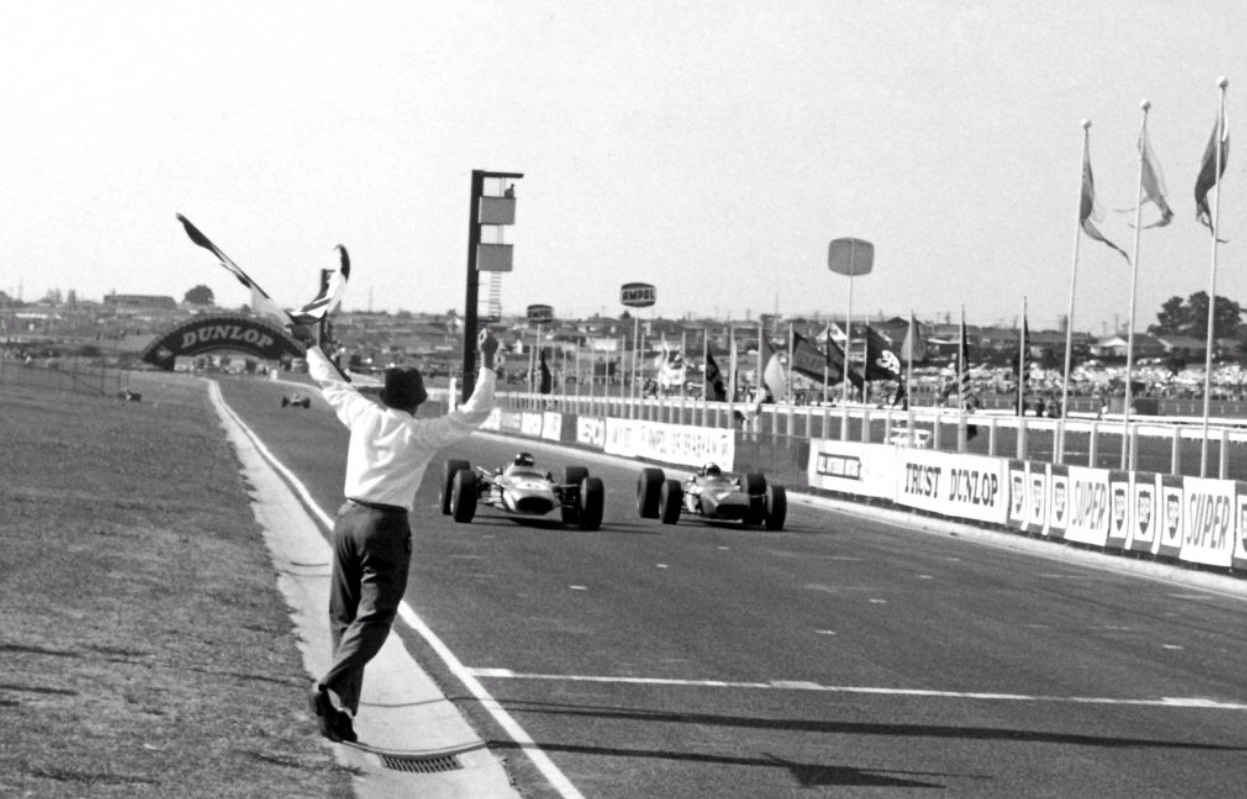
Bruce McLaren awaits his crew making changes to the setup of his new McLaren M7A Ford, chassis M7A-1, Silverstone 25 April 1968…

Its a day or so before the BRDC International Trophy, one of three non-championship F1 races run in Europe that season. Bruce is to have another good weekend, off the back of his Brands Hatch ‘Race Of Champions’ win in March, his teammate and Kiwi buddy Denny Hulme won the prestigious Silverstone race in an emphatic demonstration of the quality of Bruce McLaren and Robin Herd’s F1 design and construction capabilities.

McLaren in the M7A, from pole, Brands Race of Champions in 1968- he won. Alongside is Mike Spence BRM P126, Jackie Stewart Matra MS10 Ford and on row 2 Chris Amon Ferrari 312 and Denny in his M7A. That’s Jo Bonnier in last years McLaren M5A BRM V12 with his hand up on the second last row. Bruce won from Pedro Rodriguez BRM P133 and Denny LAT)

That season Bruce McLaren famously became one of the very few to win a championship GP in a car of his own name and construction when he won the Belgian GP. Denny Hulme took another three GP victories and challenged for the 1968 World Championship ultimately won by Graham Hill’s Lotus 49B Ford, the car for which the Ford Cosworth DFV was designed.

At the end of 1967 Ford’s Walter Hayes implored Colin Chapman to allow him to offer the DFV to other teams ‘for the good of Grand Prix racing’ such was his fear of Team Lotus dominance. Chapman, to his credit, waived his contractual entitlement to exclusivity- Lotus, Matra and McLaren raced the Ford engine in GP events in 1968.

McLaren M7A Ford cutaway (Dick Ellis)

The duo concepted a car which typified the ‘Cosworth Kit Car’ era. A short monocoque chassis ended aft of the driver’s seat and consisted of three steel bulkheads- one at the back, one at the front, and one open bulkhead at the dashboard which was then skinned with aluminium panels to form a full monocoque over the driver’s legs. It was an immensely torsionally rigid and strong structure compared with the very best spaceframes of only a few years before.

The M7A used glued and riveted skins of L72 aluminium alloy, a British standard for the aviation industry in a thickness of 22 gauge and in a few places 20 guage magnesium sheet. 40 gallons of fuel were distributed between four rubber bag-tanks- one either side of the driver in the tub, another behind his seat and the fourth in the scuttle. The Cosworth DFV engine was bolted directly to the rear bulkhead and at that stage of its development produced circa 420 bhp @ 9500 rpm.

Early test of the M7A at Silverstone on 5 April 1968. Denny up, Bruce by front wheel. Notice the McLaren wheels, ‘nostril’ ducted radiator outlets and top and bottom front suspension radius rods which mount to the bulkhead in the dash area of the tub (R Dumont)

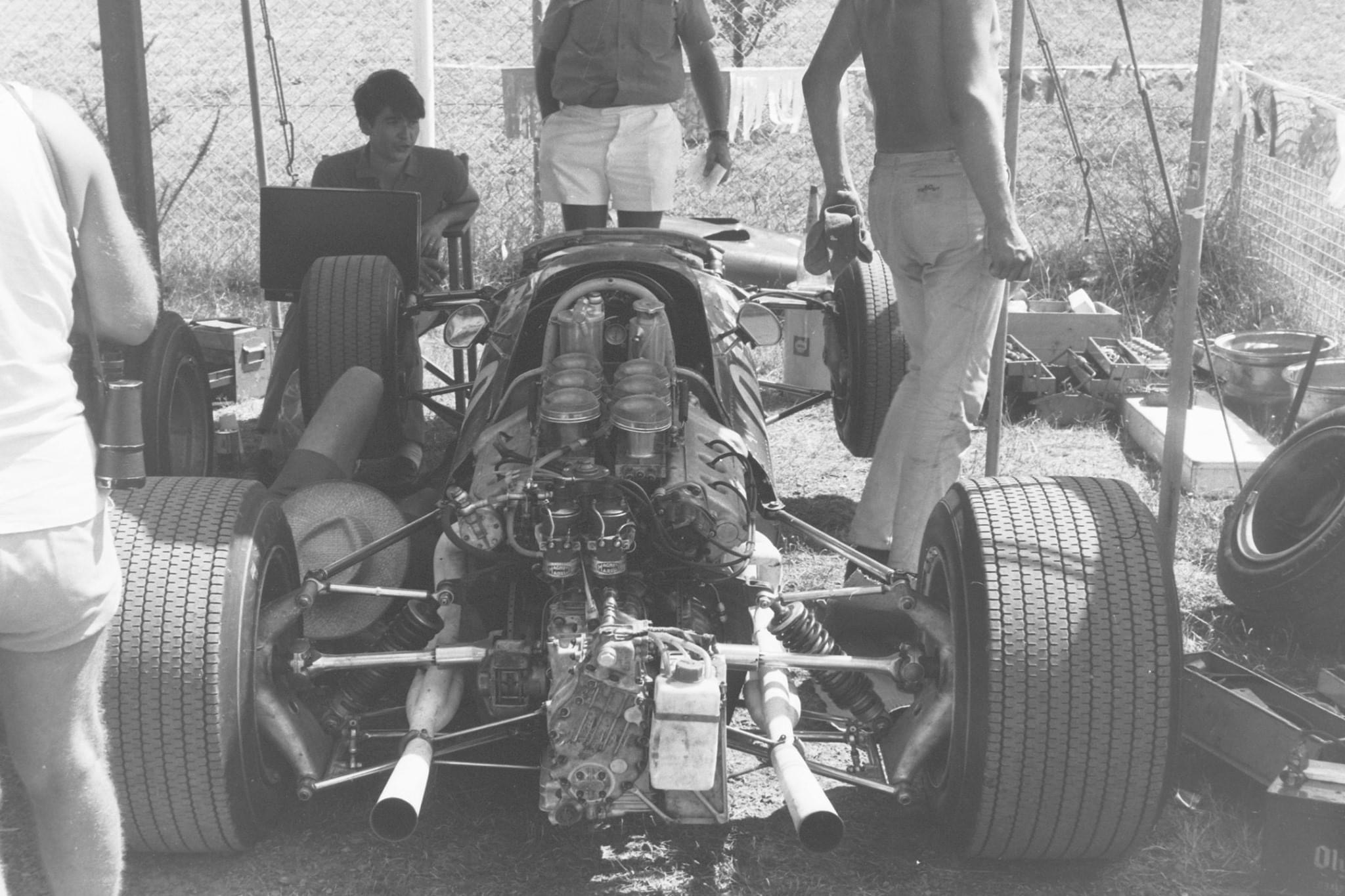
The suspension, of conventional outboard design was derived from the very successful 1967 Can-Am Championship winning M6A Chev. It comprised outboard coil spring/damper units at both ends and single lateral links and trailing arms at the front- and single lateral top links, reversed lower wishbones and twin radius rods at the rear. Uprights were cast magnesium with of course adjustable roll bars front and rear. Steering was McLaren rack and pinion, brakes Lockheed discs all round and the transmission the ubiquitous Hewland DG 300 transaxle five-speed.

The radiator was conventionally mounted at the front, with a sleek fibreglass body topping the whole visually arresting package- hot air vented McLaren style out of ‘nostrils’ in the nose with an oil radiator at the rear above the ‘box and clear in the opening shot.

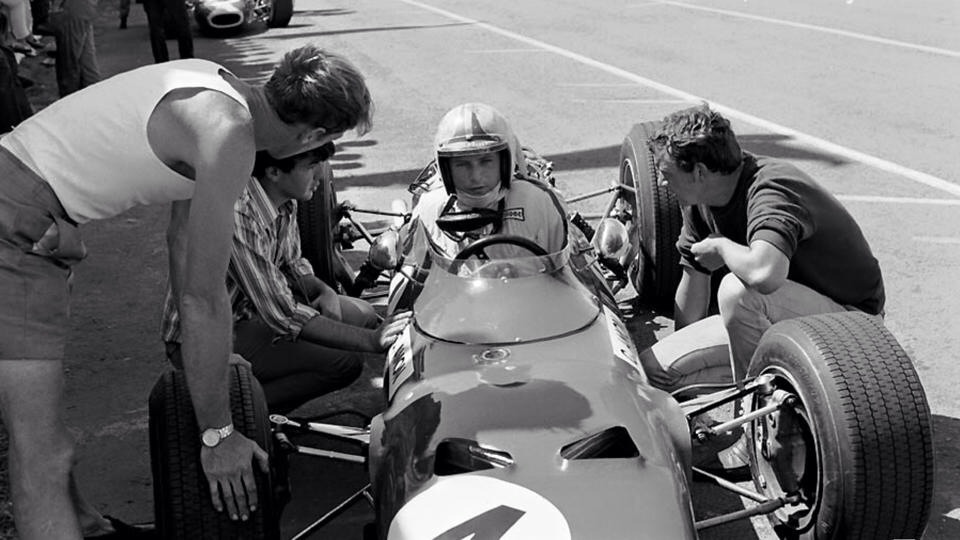
‘Pop’ McLaren and Alastair Caldwell supervise the McLaren pit in the French GP paddock, Rouen 1968. Note general car layout as per text, suspension, rad duct in lower shot- quality of design, execution and presentation a treat. #8 Denny 5th, #10 Bruce 8th. Shocker of a wet race with Jo Schlesser dead on lap 2 in the experimental Honda RA302 (unattributed)

Allen Brown reports in oldracingcars.com of the M7A’s 1968 season; ‘The first two cars were finished in March 1968, and both debuted at the 1968 Race of Champions, where Bruce McLaren dominated the race, winning from pole position, with his new teammate Denny Hulme finishing third. At the next race, the Silverstone International Trophy, Hulme took pole position and won, with Bruce content to take second place. It was not quite so easy at the first GP, the Spanish, but the M7As were third and fourth on the grid and Hulme finished second.’

‘After a poor weekend in Monaco, Bruce McLaren took his team’s first GP victory in the Belgian GP at Spa in June after Jackie Stewart’s Matra MS10 retired on the last lap. Results were mixed over the next few races, but Hulme won in Italy and in Canada to equal Graham Hill’s score at the top of the World Championship standings. A crash at Watkins Glen and retirement in Mexico ended his challenge, but had been a wonderful season for McLaren’s F1 team’.

McLaren M7A from Pedro Rodriguez, BRM P133- 1st and 2nd, Spa 1968 (unattributed)

McLaren and M7A at Watkins Glen 1968. Note the mount and location of the rear wing in the context of the text below (A Upitis)

In terms of the ebbs and flows of the season, in ‘The Year of Wings’, Matra and Ferrari- on Firestone and Dunlop tyres respectively won races later in the season and Lotus set the aerodynamic standard with high-wings after their initial appearance on the Ferrari 312 and Brabham BT26 Repco at Spa. McLaren lost some of their edge- the cars wings were less effective than Lotuses, when they remained attached to their cars, mounted in the middle of the M7A on the cars sprung mass, rather than Lotus 49 style at the rear on the unsprung suspension uprights, and Goodyear too lost their edge. Remember when there was competition between the tyre manufacturers?!

Goodyear’s new G9 boots gave Denny the kicker he needed to win at Monza and then at St Jovite, Canada but Graham Hill and Lotus deserved the title in a year during which Hill held the team together and picked everybody up after Jim Clark’s tragic death at Hockenheim in April.

Looking at the M7 design from a commercial perspective, whilst McLaren by this stage were well funded by the standards of the day- the M7 design worked hard in contributing to the companies success by providing the basis of the M14 F1 car and the phenomenally successful M10A and M10B F5000 designs which were the ‘class standard’ from 1969-1971- constructed as they were under licence by Trojan Cars in Croydon.

Bruce, M7A Silverstone (V Blackman)

Lets get back to the photo which inspired this piece though, here is none other than DC Nye’s race report of the BRDC International Trophy, in full, from the June 1968 issue of MotorSport, the photographs are all my editorial selections…

‘For the 20th B.R.D.C. International Daily Express Trophy race at Silverstone, the Club amassed a small but fairly representative field of Formula One cars. Heading the entry were Hulme and McLaren in the two impeccably-prepared McLaren M7A-Cosworth V8s, which finished first and third in the Race of Champions, and Ferrari sent over two cars, one a new, slightly sleeker-chassised V12 with the engine lower-mounted than hitherto, and the other the car which Amon normally races. Drivers were the young Belgian, Ickx, and Amon, and though the New Zealander tried both cars he decided he preferred his own, and Ickx raced the new one.

Amon’s Ferrari 312’s, Ickx car in the foreground, Silverstone 1968. Amon Q5 and Ickx Q7 with Chris proving the pace of the Ferrari, despite the Cosworth onslaught with a fastest lap and 3rd place, Jacky 4th (unattributed)

Graham Hill had a solitary Lotus 49-Cosworth V8 which was entered by Gold Leaf Team Lotus, and B.R.M. were well represented with Rodriguez in the Bourne-built, Terry-designed P133 V12 and Spence in the similar, T.A.C.-built P126. Also in a P126 was Courage, having his first F1 race this season for Parnell, and Hobbs had Bernard White’s relatively unsorted Tasman 2-litre B.R.M. P261 chassis, specially lengthened by the works to accommodate the new V12 engine. Also B.R.M.-powered was the lone works Cooper T86B, with Gardner driving, as Scarfiotti was away practicing for the Targa Florio and Redman was reputedly testing F2 Dino Ferraris in Modena. Rob Walker had acquired a new Tasman Lotus 49 chassis to replace the one lost recently in a fire at his Dorking headquarters, Siffert driving as usual; Bonnier was in his 1967 McLaren M5A-B.R.M. V12, and the Swiss Moser had the ex-Hulme, ex-Ligier Brabham BT20-Repco V8. Lanfranchi completed the field in a 2.7-litre Climax 4-cylinder powered Brabham BT23.

Withdrawn entries included a second Parnell B.R.M. for Attwood and Sheppard’s Mallite McLaren fitted with a 3-litre version of the original Climax Godiva V8 for Taylor. Two works Brabhams were listed, but were not complete.

Last year’s G.P. practice record of 1 min. 25.3 sec. by Clark in the Lotus 49 looked a little sick compared with this year’s speeds, Hulme taking pole position with 1 min. 24.3 sec. to Spence’s 1 min. 24.9 sec., McLaren’s 1 min. 25.1 sec. and Rodriguez’s 1 min. 25.3 sec. Behind these four on the front row came Amon at 1 min. 25.5 sec., Hill 1 min. 25.6 sec., Ickx 1 min. 26.4 sec., and Siffert 1 min. 27.6 sec.

One minutes silence in memory of Jim Clark before the off. Hulme at far left on pole, then Spence BRM P126, McLaren M7A and the other BRM P133 of Pedro Rodriguez. Amon, Hill and Ickx on row 2 (Getty)

After a poignant silence in memory of the late Jim Clark, the field were given a maximum of three warming-up laps, and from the start McLaren took an immediate lead ahead of Spence, Hulme, Rodriguez, Ickx, Hill, Amon, Courage, Bonnier and Gardner. Lap 2 and the leading bunch were all scratching hard to draw out some sort of advantage; Courage was briefly ahead of Amon at Copse and Siffert and Gardner were both by Bonnier, who was being harried by Hobbs.

The leading McLarens, B.R.M.s, the lone Lotus and the two Ferraris soon towed each other away from the rest of the field, with Hulme slotting by Spence into second place on lap 4, then being repassed by the B.R.M. Lanfranchi had already stopped for a plug change on his 4-cylinder, and at the start of lap 6 Spence led McLaren into Copse, and was re-passed on the way out to Maggotts to remain the meat in an orange McLaren sandwich for a short distance before chopping by again and leading the bunch on lap 7 from Hulme, McLaren, Rodriguez and Hill, all nose-to-tail. Amon and Ickx had become slightly detached in the works Ferraris, but as they sped down Hangar Straight on that lap a stone was thrown up from Spence’s B.R.M., smashing Hulme’s goggles and giving him a nasty moment which dropped him back to seventh.

Hill and Amon in 3rd and 4th- Ferrari 312 and Lotus 49 Ford (LAT)

Almost immediately Rodriguez’s B.R.M. V12 began to misfire, an ignition lead dropping off, and he stopped before Maggotts, replaced the wire and drove on to the pits, where a more lasting repair was made. By lap 9, with Spence leading narrowly from McLaren, Hill was third in the lone Lotus, Amon was a close fourth and Hulme, whose eyes had stopped watering, was already on his tail and looking for a way by. Positions remained unchanged until lap 14, when the Lotus’ V8 engine died, and, seeing a lot of fluid resting in the vee, Hill thought the engine had suffered a serious breakage and had thrown water. In fact, a fuel pipe had split, and the fluid was petrol, but he was out anyway, and walked back to the pits. Hulme had nipped by Amon on this lap, and was going out after Spence, who had been re-passed by McLaren. lckx was falling back in fifth place with the very new and understeering Ferrari, with Siffert some distance behind, followed by Courage, Gardner, Hobbs, Moser, Lanfranchi and then an unhappy Rodriguez in the misfiring B.R.M., last.

Next lap Hulme was up into second place, and on lap 20 he passed McLaren after getting round in 1 min. 25.3 sec. to take the lead narrowly from his “number one”, Spence and Amon, and these four were still driving in very close company. But Lanfranchi had retired with bad oil surge, and Siffert’s sixth place evaporated on lap 26 when the clutch broke in the Tasman-chassised Lotus, and two laps previously Gardner had gone out in a trail of smoke and steam when the B.R.M. engine broke a liner.

Lap 28, and Spence slotted his slim B.R.M. past McLaren into second place, and as they lapped the tail-enders the leading group began to space out. But Amon closed on McLaren noticeably on lap 36 and was looking for a way by, but then lost time lapping Moser at Copse and dropped back, letting McLaren get away and latch on to Spence’s tail in second place. These two then drove very hard, entering corners side-by-side occasionally until lap 41 when the B.R.M.’s engine stopped suddenly at Club with a timing chain breakage, letting McLaren up into second place, but delaying him sufficiently to let Amon catch up in the Ferrari. Rodriguez had finally retired his sick B.R.M., Ickx was running a lonely fourth, with Courage fifth and about to be lapped, while the only other cars still running were Hobbs’ B.R.M. and Moser’s Brabham-Repco.

Hulme on his way to the first of four M7A wins in 1968, Silverstone, April 1968 (LAT)

Amon was trying hard to wrest second place from McLaren, setting a new outright circuit record on lap 44 of 1 min. 25.1 sec., 123.82 m.p.h., but Bruce was trying equally hard to stay ahead, doing 1 min. 25.2 sec. on the same lap, and, although the two of them were very close together on lap 45, Amon’s luck was running out and his goggles strap broke. Shielding his eyes from the airstream with one hand he drove for two laps before managing to haul his stand-by pair into position on his face, and this dropped him well back from McLaren, and although closing the gap slightly before the finish he came home in third place. Hulme was battered but triumphant, Bruce McLaren had a lot to smile about with his cars’ first one-two victory, and B.R.M. were well pleased with their turn of speed and not too worried about the frailty their cars had shown since they are still at an early stage in their development. The Ferraris had been rather outpaced from the start, but on a clear track and with McLaren as his target Amon had proved that he is one of the quickest drivers around.’—D. C. N.

Denny on his way to a win at St Jovite, Canadian GP 1968 (unattributed)

Etcetera: M7A Chassis by Chassis courtesy Allen Brown at oldracingcars.com…

‘The first two cars were finished in March 1968, and both debuted at the 1968 Race of Champions, where Bruce McLaren dominated the race, winning from pole position, with his new teammate Denny Hulme finishing third. At the next race, the Silverstone International Trophy, Hulme took pole position and won, with Bruce content to take second place. It was not quite so easy at the first GP, the Spanish, but the M7As were third and fourth on the grid and Hulme finished second. After a poor weekend in Monaco, Bruce McLaren took his team’s first GP victory in the Belgian GP at Spa in June after Jackie Stewart’s Matra MS10 retired on the last lap. Results were mixed over the next few races, but Hulme won in Italy and in Canada to equal Graham Hill’s score at the top of the World Championship standings. A crash at Watkins Glen and retirement in Mexico ended his challenge, but had been a wonderful season for McLaren’s F1 team

Bruce 8th, with Tyler Alexander and Alastair Caldwell and M7A at Rouen, Chris Amon 10th Ferrari 312 just heading out (unattributed)

Denny and Bruce at Jarama prior to the 1968 Spanish GP, M7A’s fitted with pannier side tanks. Denny 2nd and Bruce retired in the race won by Hill’s Lotus 49 Ford (unattributed)

Bruce on the way to that historic win aboard his M7A at Spa in 1968 (unattributed)

Hulme’s M7As was retained for 1969 for the Kiwi to drive, and the latest car, M7A/3, was modified to M7B specification with pannier tanks.  When that did not work, both the M7B and the prototype M7A were sold to privateers; both were crashed later in 1969 and both cars scrapped. Bruce drove a new McLaren M7C for the rest of 1969, and a huge amount of effort was wasted on the four-wheel-drive McLaren M9A. It didn’t help that Goodyear, McLaren’s tyre supplier, were well behind Firestone and Dunlop until the end of the season, when the latest rubber helped Hulme win the Mexican GP in his well-used sole surviving M7A. That last M7A was bought by Tony Dean for Formula 5000, and was then sold to a French Museum where it remains, the museum owners having turned down all McLaren International’s offers for the car.’

McLaren, Brands, M7A British GP 1968 (M Hayward)

More on the M7A’s…

Check out Allen Brown’s article which I have referenced and filched from extensively in this article

http://www.oldracingcars.com/mclaren/m7a/

Credits…

Getty Images, Victor Blackman, Ronald Dumont, Alvis Upitis, MotorSport June 1968 article by Doug Nye, Dick Ellis, LAT, Mike Hayward, Allen Brown-oldracingcars.com

Tailpiece…

Finito…
(oldracephotos/DKeep)

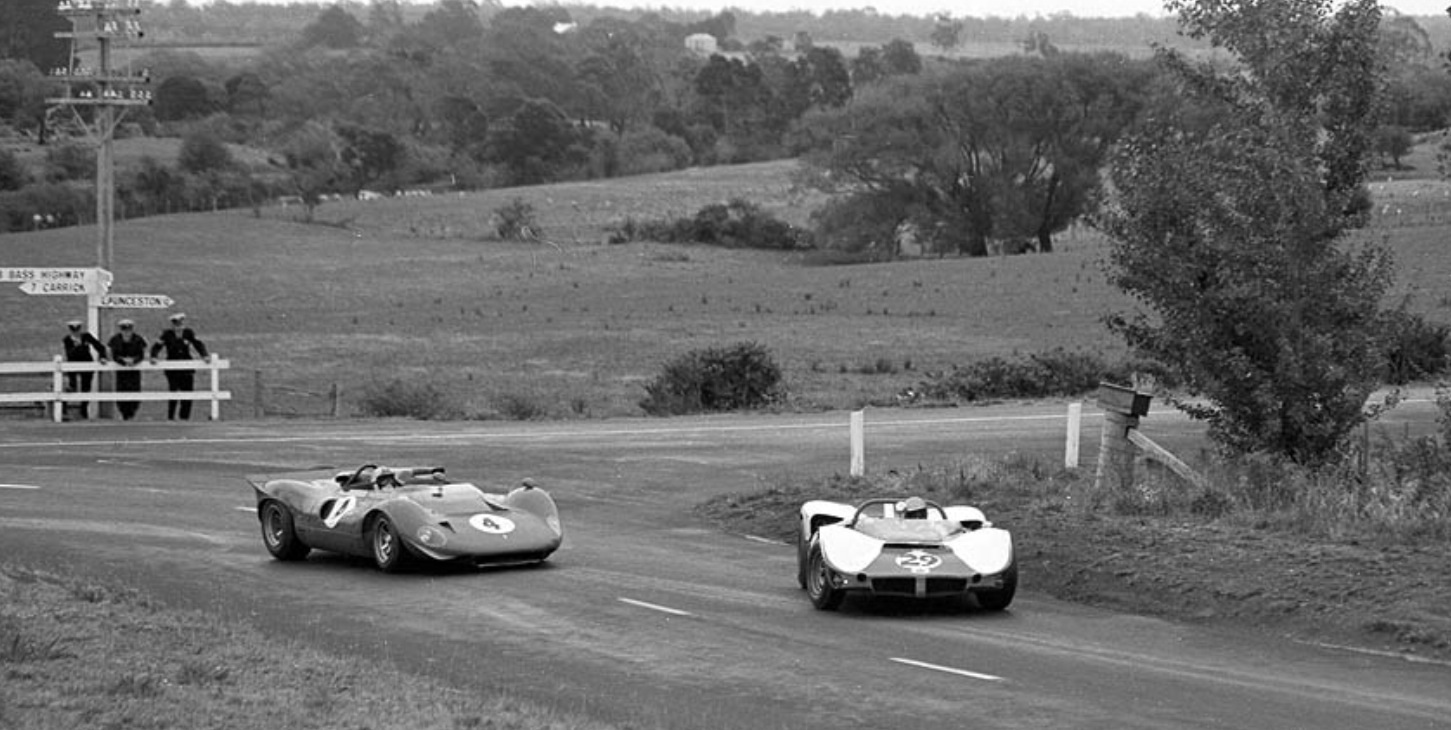
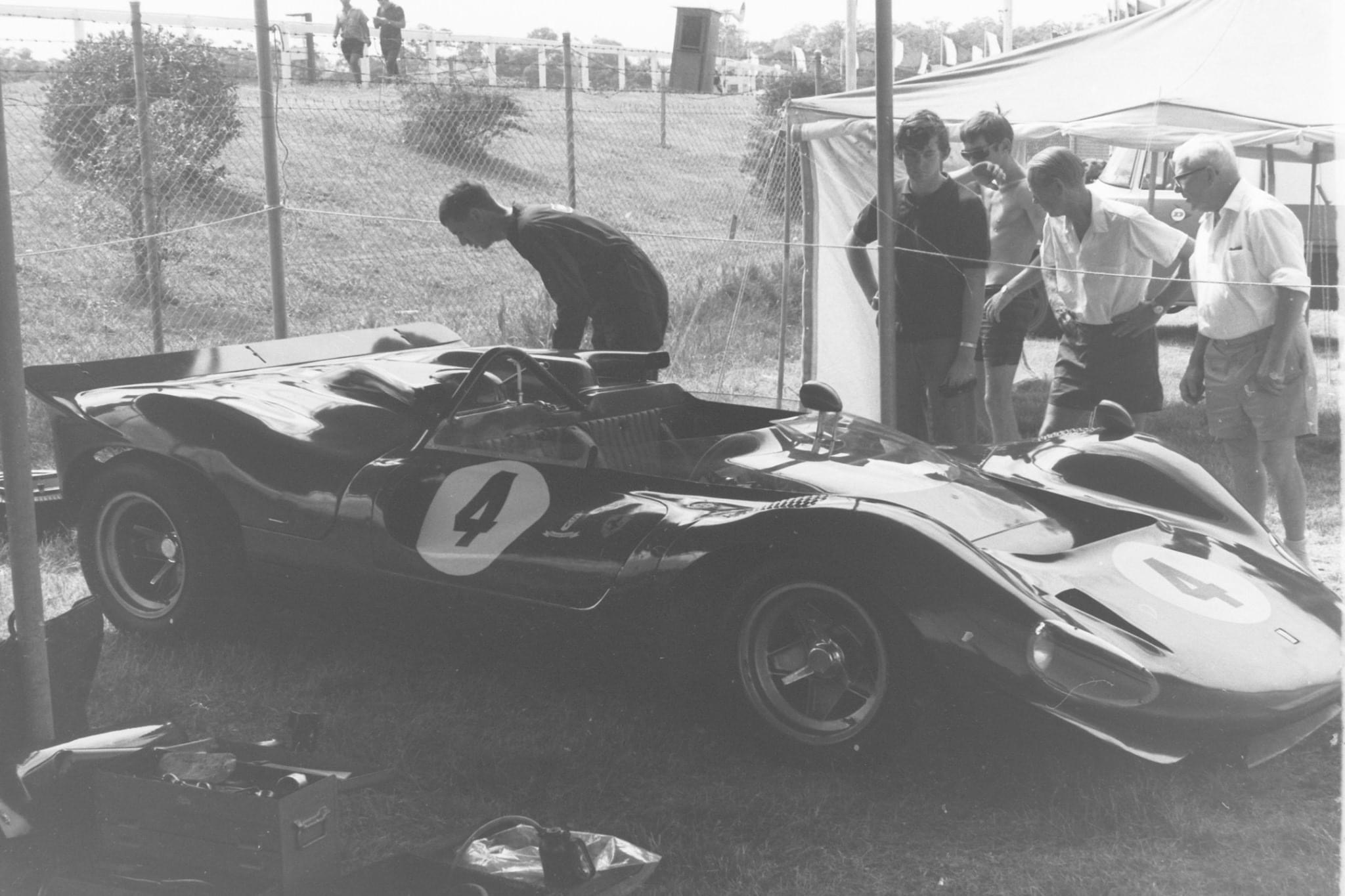
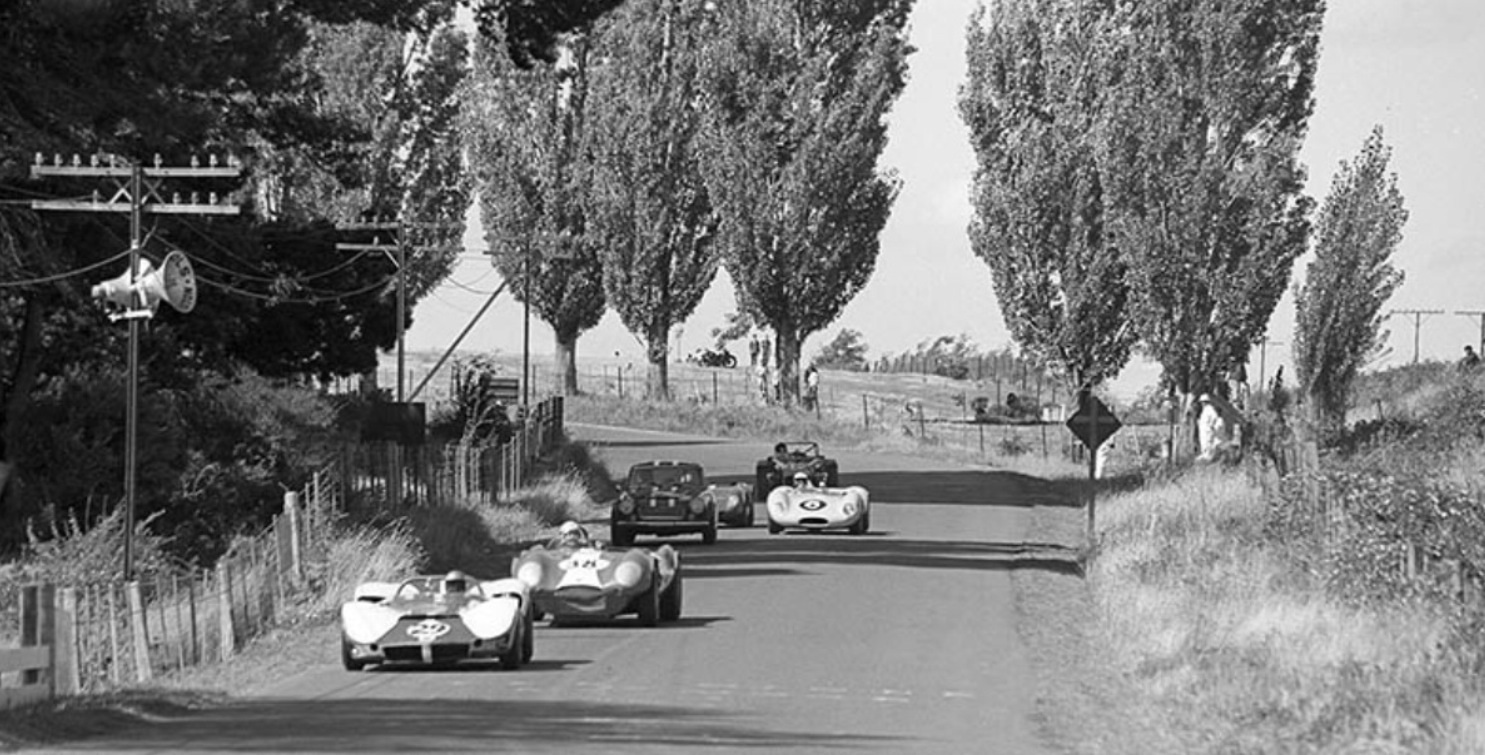
John Goss’ Tornado Ford leads a gaggle of sportscars on the drop between the Water Tower and The Viaduct, Longford, Saturday 2 March 1968…

I wrote this piece a while back and now seems a good time to post it given one of Tasmania’s finest, Gossy himself was awarded an Order of Australia for services to motor sports in last weekend-and-a-bit’s Queens Birthday Honours announcements. Off the back of that achievement Terry Sullivan started a The Nostalgia Forum thread which now contains some marvellous Goss photos, many from Lindsay Ross’ oldracephotos.com.au archive which have never seen the light of day before- check TNF out;

https://forums.autosport.com/topic/209938-john-goss-on-queens-honours-list/

Back to Longford- it’s the Saturday race day, the Monday Labour Day holiday was Tasman Cup day, that year the feature race was won by Piers Courage’ McLaren M4A FVA F2 car in a notoriously wet, perilous day of motor-racing. Sadly it was the last in Longford’s relatively short but very sweet period as a road racing track. Click here for my article on the 1968 Longford Tasman;

Longford Tasman: ‘South Pacific Trophy’ 4 March 1968 and Piers Courage…

Goss, future Bathurst and Australian Grand Prix winner is leading Kerry Cox’s Paramount Jaguar, three-times Australian Grand Prix winner Doug Whiteford’s works Datsun Fairlady, Bert Howard’s Lola Mk1 Climax, the partially obscured Lotus 23 Ford of Alan Ling and then Peter Mawdesley in a Lotus Super 7. Out front out of shot is the ex-works Scuderia Veloce Ferrari P4/350 Can Am driven by Chris Amon from Ian Cook’s Bob Jane Racing Elfin 400 Repco, Peter Macrow in the Argo Chev, Lionel Ayers MRC Ford and Glynn Scott’s Lotus 23 Ford. The opening shot shown is the second group of cars.

I wrote an article a while back about John Goss including a bit on the Tornado, click on the link to read it;

John Goss: Bathurst 1000 and Australian Grand Prix Winner…

The following shot is of Gossy losing Tornado on his turn-in to The Viaduct, I wonder if its the same lap! I think not, the track looks wet, which makes it the Monday. Amon’s Ferrari was pushed off the grid with a flat battery- he started the 10 lapper with 2 laps down and finished third- and did 178 mph in the wet conditions on The Flying Mile. Peter Macrow won in Tony Osborne’s Argo Chev from Glynn Scott’s Lotus 23 Ford.

(oldracephotos/DKeep)

Credits…

David Keep/oldracephotos.com, Lindsay Ross Collection, Rob Bartholomaeus

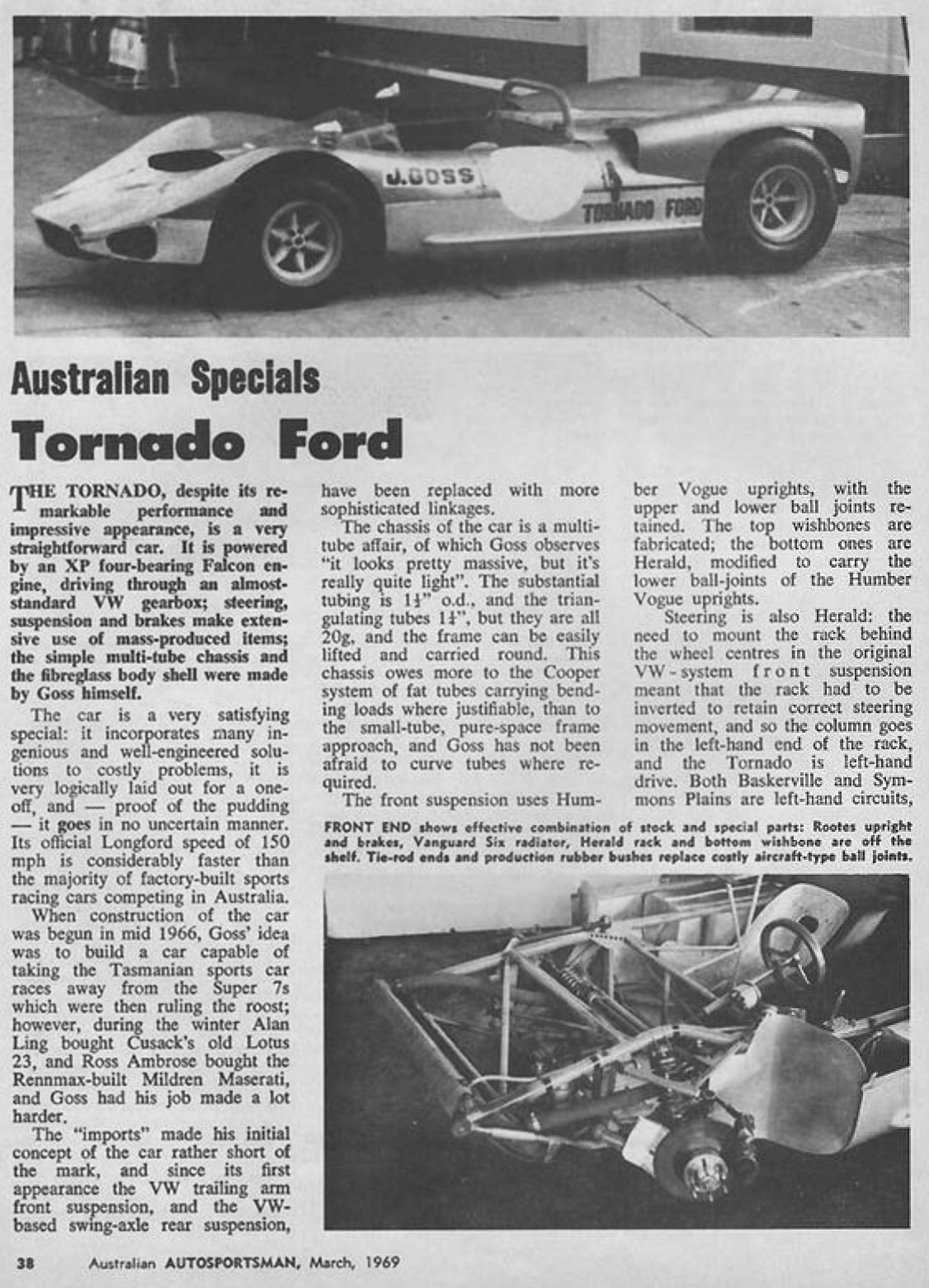
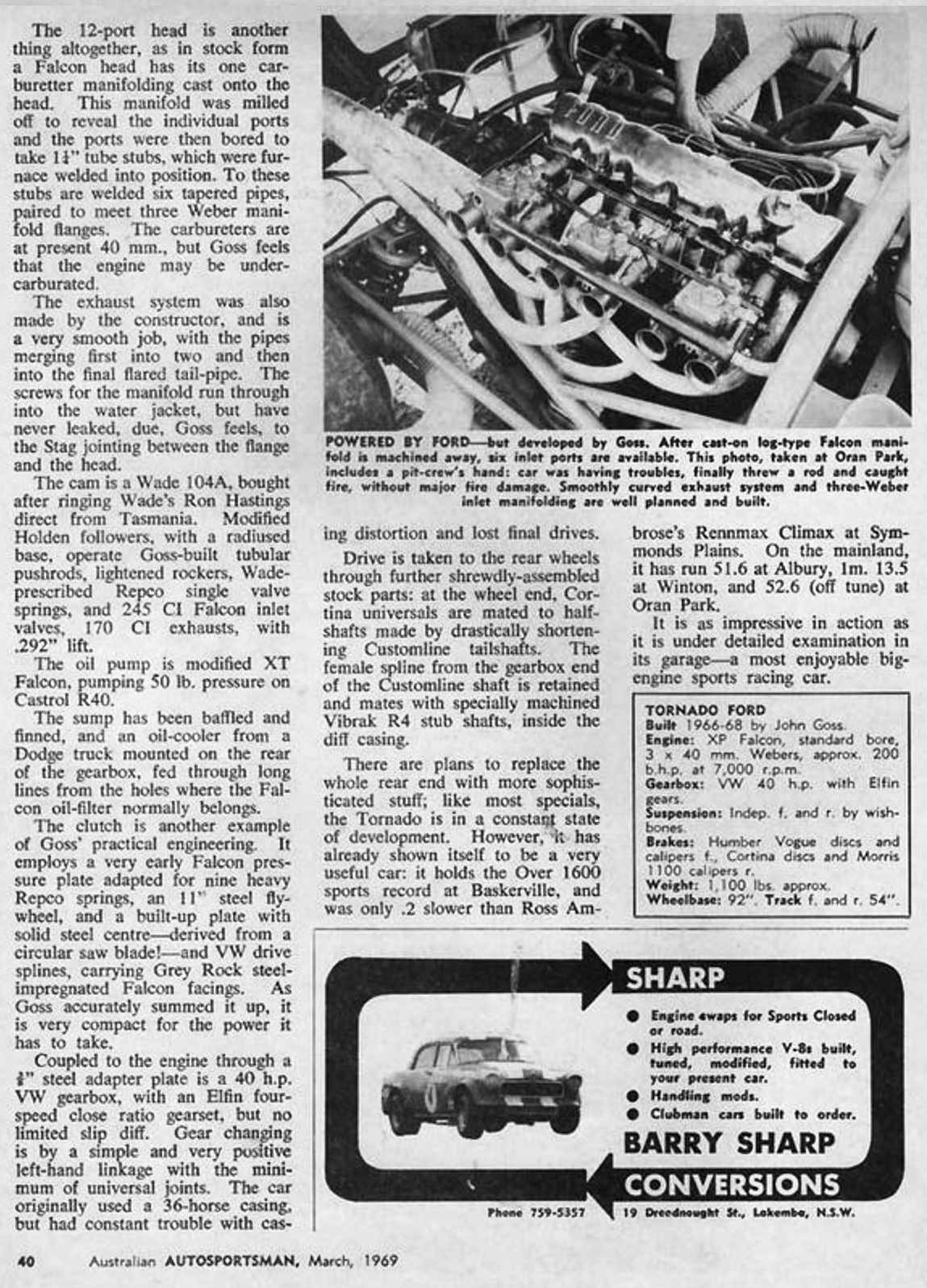
Etcetera: Autosportsman article on the Tornado Ford, courtesy Lindsay Ross’ Collection…

Tailpiece: Amon’s 480bhp Ferrari P4/Can-Am 350 monstering Gossy’s 200bhp Tornado Ford out of Newry, Longford 1968…

(oldracephotos/DKeep)

During the dry Sports Car Scratch race on the Saturday Chris won from Ian Cook in Bob Jane’s Elfin 400 Repco V8 and Peter Macrow in the Argo Chev.

Amon, awfully comfortable in the P4/CanAm 350- in addition to his Ferrari F1 commitments he raced the cars in both the 1967 endurance races and some Can Am rounds, set an all-time Longford lap record of 2:16.2 undercutting Jim Clark’s Lotus 49 Ford DFW time of 2:13.0 earlier in the day. Mighty quick. Mind you, that summer Frank Matich beat Chris’ Ferrari in the Matich SR3 Repco in the other Australian Tasman round sportscar support events. But FM did not cross Bass Straight to do Longford- sad! Those battles on that circuit would really have been something to see!

Finito…

Chris Amon on the ‘Warwick Farm 100’ grid, 9 February 1969. DNF lap 1 after a tangle with Piers Courage. Rindt won by 45 seconds from Bell’s 246T. Checkout the wing mount detail (B McInerney)

Amongst the most jewel like Ferraris of the late sixties are the F2 Dino 166 and Tasman Formula 246T’s…

Just yummy they are. The 246T had enough of everything to do the job, but not too much of it, including its wings.

Amon didn’t race so equipped in 1968, his first Tasman Dino year, but wings exploded in F1 that season so he did return with these small aerodynamic aids in 1969, together with four 300 bhp V6’s to power the cars raced by he and Derek Bell that summer.

They were works entries with logistics on the ground taken care of by David McKay’s Scuderia Veloce, Sydney based outfit. David and Chris went way back to 1962/3 when McKay’s support of him in a Cooper T53, and Chris’ speed in it that summer brought him to the attention of Reg Parnell- and off to Europe he went.

Amon’s 246T wing in the Pukekohe paddock, Jan 2-4 1969. He won the NZ GP that weekend in ‘0008’- his ’69 Tasman mount, Bell raced ‘0010’ to 4th (M Feisst)

But its the 246T wings which interest me…

Chapman’s Lotuses returned to Australasia with World Champ Hill and World Champ Aspirant Rindt at the wheel in 1969. Colin’s Lotus 49 DFW ‘aero-phalluses’ were notable for their size and the regularity with which they parted company with the chassis to which they were, usually temporarily, attached.

It was these component failures on both Lotuses at Montjuic Parc, Barcelona several months after the Tasman that caused the FIA to act, constraining the size of wings from the ’69 Monaco GP. Click here for an article in relation to those events.

‘Wings Clipped’: Lotus 49: Monaco Grand Prix 1969…

Graham Hill’s Lotus 49B Ford DFW with its big, hi-mounted wing in the Pukekohe paddock, 1969. Its high in the airstream to catch ‘clean air’, not a problem- the mounts themselves were under-engineered bigtime though. Hill, Oliver and Rindt all had failures, in the case of Oliver and Rindt huge accidents which could easily have been fatal (M Feisst)

I am a complete Lotus nutbag but joisus Chappers should have been shot for the death and destruction caused to his drivers/customers by component failure over the years? The Latin term ‘caveat emptor’ could have been designed with Lotus purchase in mind. On the other hand, butch though the engineering sometimes was, the 1961/2 156 springs to mind- shite didn’t and doesn’t tend to fall off Ferraris.

Look at (in the Pukekohe paddock photo above) the spidery, small, multi tube structure which supports the little wing. The mounts are triangulated and supported forward to the roll bar. The adjustment mechanism to alter the angle of incidence is simple and neat. The chord of the wing is shallow with endplates, not so common at the time, to ‘capture’ airflow.

Note the throttle linkage, water and oil fillers and breathers, also the Willans harness attached to the roll bar.

Amon at Teretonga, I think, in 1969. Courage won in Frank Williams Brabham BT24 Ford DFW- a portent of the success they would have in GP racing that season with an FW run Brabham BT26 Ford DFV. Again, check out the Dino wing and its mounts. Chris was 3rd behind Hill (unattributed)

Chris took a great win in the ’69 Tasman, he won the first two rounds at Pukekohe and Levin after Rindt spun away the lead, before Jochen won on the Wigram airfield circuit. Piers Courage won at Teretonga in his bi-winged Brabham BT24 Ford DFW before the circus crossed the Tasman Sea to Australia.

Chris won well at Lakeside, the Australian Grand Prix was run in very hot conditions- with both Lotuses suffering wing failure that weekend. Jochen drove away from the field at Warwick Farm in streaming rain after Amon and Courage tangled early on. Chris won again at Sandown by 7 seconds from Rindt and took the series with 44 points from Rindt and Courage on 30 and 22 points respectively.

Graham Hill suffers what would not be the last Lotus 49 wing failure during the 1969 Australian Grand Prix at Lakeside. He pitted, a mechanic hack-sawed the wing mounts and removed the offending items allowing GH to rejoin and finish 4th behind Amon and Bell both aboard Dino 246T’s and Leo Geoghegan’s Lotus 39 Repco (G Ruckert)

Amon’s 1968 Tasman Dino Season…

Amon’s Tasman Dino…

The Ferrari 166 Dino…

Temporada F2 Series Argentina: San Juan 1968: Ferrari Dino 166

Amon after his Lakeside AGP win (J Stanley)

Bibliography…

oldracingcars.com

Photo Credits…

Mike Feisst/The Roaring Season, Brian McInerney, John Stanley, Graham Ruckert

Tailpiece: Amon on his way to AGP victory at Lakeside on 2 February 1969, Ferrari 246T ‘0008’…

(J Stanley)


(B Pottinger)

I wish I had the soundtrack of the howling 300 bhp 24 valve, injected Vee-Six to go with the visual…

 Chris Amon’s Ferrari Dino 246T chassis # ‘0008’ being warmed up prior to the start of the Teretonga International on 25 January 1969.

 Chris was third in the race behind Piers Courage in Frank Williams Brabham BT24 Ford DFW and Graham Hill’s Gold Leaf TL Lotus 49 Ford DFW- and won the ’69 Series with wins at Pukekohe, Levin, Lakeside and Sandown.

 Just so ‘Ferrari in period’ this shot ‘innit?

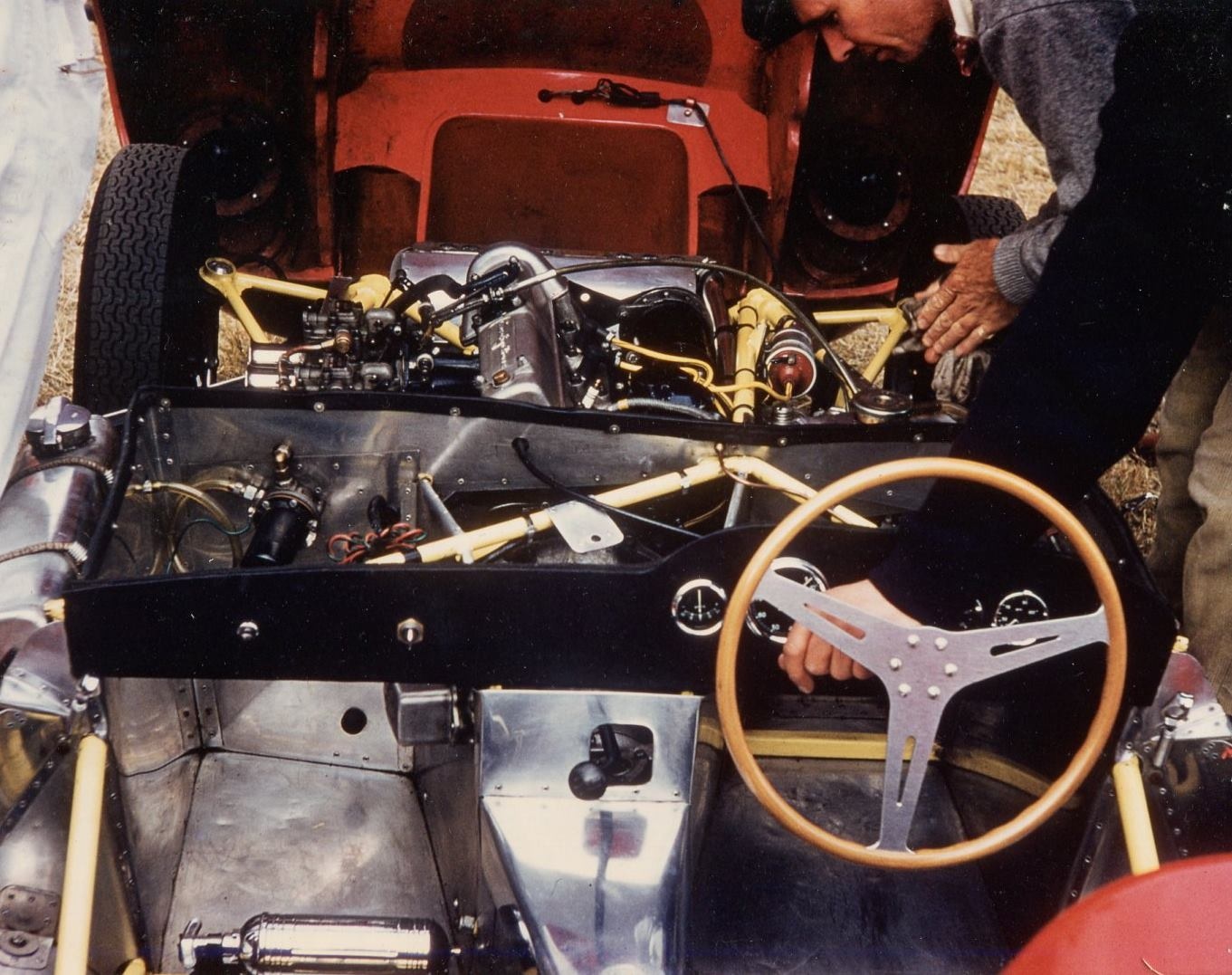
 Veglia Borletti- Giri, Olio, Acqua and Benzina instruments and MoMo steering wheel- wouldn’t we all have loved to sit right here looking at this lot. Note the small fire extinguisher sitting above the dash and Lucas electrical fuel pump off-switch beside the fuel guage.

 I’ve done a few articles about Chris and the Dino, just pop the names into the primo site search engine on the home page for more ‘on topic’.

 Photo Credits…

 Bill Pottinger on ‘The Roaring Season’, LAT

Tailpiece: Amon and Rindt on the front row, NZGP Pukekohe, 4 January 1969, Chris won from Jochen…

(LAT)

image

(T Watts Collection)

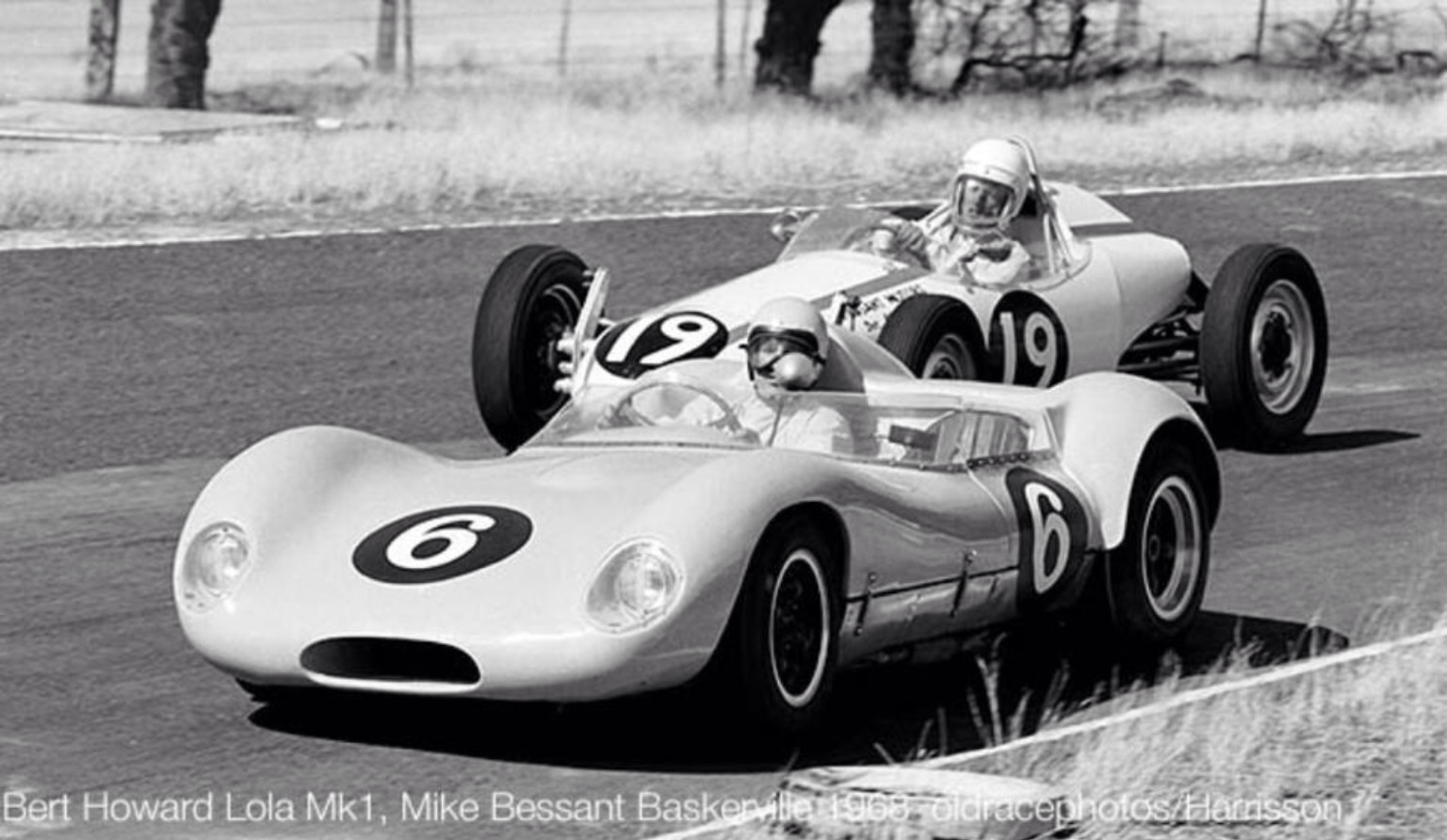
A favourite car, favourite marque, favourite colour. Bert Howard’s Lola Mk1 Climax at Symmons Plains, Tasmania in April 1968…

It’s a simple enough shot I suppose, a well executed pan with classic blurred background, but too good not to share.

The colour is so clear it could be 2017, but the low roll bar, helmet and background devoid of advertising hoardings gives it away a bit, its 1968. The small, lithe little machine looks like a ‘big banger’ doesn’t it?, but the 1098cc Coventry Climax FWA engined car is anything but that.

The Lola Mk1 was seminal in Eric Broadley’s early commercial success. The story of the car itself, it’s development and specifications is so well told on Lola Heritage, just click on the link here to read about these magic cars;

http://www.lolaheritage.co.uk/history/types/mk1/mk1.htm

Bert’s car, Lola Mk1 chassis ‘BR15’  first came to Australia to the order of ‘Scuderia Veloce’ supremo, David McKay in late 1960.

By the time David McKay landed the sporty and Formula Junior Lola Ford ‘BRJ18’ the former World War 2 veteran, racer and motoring journalist had already been competing since the late forties. He had second place in the 1955 Hyeres 12 Hours in southern France together with Tony Gaze aboard a ‘customer’ Aston DB3S and the 1958 Australian Tourist Trophy, Bathurst, victory as career highlights to that point, the latter aboard his ex-works Aston Martin DB3S, see here for that car(s); https://primotipo.com/2017/09/28/david-mckays-aston-martin-db3ss/

Most international readers would be by now familiar with McKay from various of my articles. He was a racer at elite level who founded ‘Scuderia Veloce’ to race his own cars circa 1959. The team very shortly thereafter morphed into an enterprise which entered cars for others including internationals, Chris Amon, Graham Hill and Jackie Stewart- and into a retail motor dealership on Sydney’s North Shore which sold Ferrari, later Volvo and from 1969 Porsche cars.

McKay also aided and abetted the careers of many drivers from the early days- most notably Amon, Spencer Martin, Greg Cusack and right through into the 1970’s Larry Perkins and open-wheeler Formula Pacific ace John Smith in the latter period.

Throughout this era of the mid-fifties to the mid-seventies McKay was the most influential Oz motoring journalist as motoring editor of Sydney’s Daily Telegraph and Sunday Telegraph newspapers. See here for more;

Pete Geoghegan: Ferrari 250LM ‘6321’: Bathurst Easter 1968…

image

David McKay, Lola Mk1 Climax, Forrests Elbow, Bathurst, Easter 1961. Won the 3 lap under 1500 scratch and was 4th outright and 1st in class in the 10 lap main sportscar event won by the Matich Lotus 15 Climax (J Ellacott)

A mate of McKay’s, dentist David Lewin based in London had written to the Sydneysider and extolled him of the virtues of both Lolas and McKay soon did a deal with Graham Broadley, Eric’s brother to acquire ‘BR15’, which was a works car raced by Peter Ashdown.

The FJ was a new car built for a category which was exploding globally. The shadows of the War by then had to a large extent diminished, globally the worlds economy was performing well and consumer credit was becoming more widely available- many young men could afford to go motor racing and FJ was very much a class of choice.

In Australia, finally some permanent venues were being built- Warwick Farm, Catalina Park, Lakeside, Sandown Park, Calder and others were all opened in the early years of the sixties. In fact McKay was keen to land both Lolas in time for the first Warwick Farm opening meeting in December 1960. ‘BR15’ was not available until the end of the British racing season however.

Between the purchase of the cars and their arrival in Australia the Australian Federal Government had increased sales tax on imported cars to 40%. Much to McKay’s chagrin the changes applied to both road cars AND racing cars including those ‘on the water’! His landed price having increased hugely, McKay quickly did a deal to relieve the financial pressure so created to sell the FJ to Sydney insurance broker Tom Corcoran who had been racing a Lotus 11. Corcoran raced the car under the SV banner thereby getting some support at race meetings and fuel and oil provided by Castrol who had about then done a deal with McKay. David of course raced the Mk1.

image

Scuderia Veloce on Warwick Farm’s pit straight in 1962. Morgan Distributors Morgan Plus 4, Tony Loxley’s Ferrari 250 GT, Fiat Importers Fiat 1800, ‘Old Nail’ Cooper T51 Climax, Lola Mk1 Climax (J Fullarton)

Scuderia Veloce at the time included the little Lola, a Nardi modified Fiat 1800 taken out to 2 litres owned by Fiat Australia which David raced in the burgeoning Appendix J touring car class and his Jaguar.

By early 1960 his first Jaguar Mk1 3.4 ‘Grey Pussy’, the dominant touring car in Australia at the time had been sold to Ron Hodgson. David bought a second Jag, a 3.4 litre Mk1, like the first built by the Jaguar Competition Department, which was co-owned with Australian Jaguar importer Bryson Industries. He won the very first Australian Touring Car Championship, a one race event, at Gnoo Blas, Orange in the red Jag in early 1960 beating Bill Pitt’s 3.4 litre Mk1 and Hodgson’s car which by then was 3.8 litres in capacity.

He also occasionally raced Sydney businessman/yachtsman Tony Loxley’s Ferrari 250GT coupe in GT races.

In single-seaters, for a short time in 1959 McKay raced a new (Victa Industries owned) Cooper T51 Climax FPF 1.9 and after the 1961 Australasian International season- the Victa owned car having been sold to Bib Stillwell he acquired a Cooper T51 Climax FPF 2.2 from Jack Brabham. McKay realised, approaching forty that his time at the top was limited and he ‘needed to get on with it’ in single-seaters!

image

Mallala AGP weekend 1961, this will be a heat as Bill Patterson started from pole after acrimony over qualifying times and Stan Jones DNS the GP itself after mechanical mayhem intruded. #6 Bib Stillwell in his new Cooper T53 Climax, #14 McKay in ‘Old Nail’ Cooper T51 Climax and #2 Stan Jones Cooper T51 Climax. That’s Gerry Brown tending to Bib and Kevin Drage with his hand on the tail of the car (K Drage)

The ‘Old Nail’ Cooper Jack Brabham had for sale was raced by Ron Flockhart and Roy Salvadori that summer as part of ‘Jack’s team (‘Ecurie Vitesse’) was none other than Bruce McLaren’s ex-works machine (chassis number either ‘F2-5-57’ or ‘F2-7-59’), the chassis in which Bruce took his first world championship GP victory at Sebring in late 1959 and another win at Buenos Aires in February 1960.

It wasn’t in the full flush of youth as a ’59 (or was it 1957!?) car with transverse leaf, as against coil sprung rear end but was still a pretty good thing to go head to head with Cooper mounted Stan Jones, Bill Patterson, Lex Davison, (noting Lex’ interludes in Aston Martin DBR4’s) Bib Stillwell, (ditto!) Alec Mildren and the rest of the local heroes in Australia.

Indeed, the difference between an Australian Grand Prix ‘Old Nail’ win for McKay and 3rd place at Mallala in October 1961 was a jumped start and 60 second penalty in the opinion of the race stewards…but not in the opinion of many informed onlookers! A story for another time. Lex Davison won the ’61 AGP, his fourth and last AGP victory aboard a Cooper T51 borrowed from Bib Stillwell (the ex-Victa Industries car raced briefly by McKay) and Bibs later, quicker!, Cooper T53 with McKay’s T51 third. As I say, that meeting is very much a story in itself for another time.

image

Start of the Australian Touring Car Championship race at Gnoo Blas, Orange, NSW 1 February 1960. Ron Hodgson in Jag Mk1 3.8 ‘Grey Pussy’ at left, McKay in his new Mk1 3.4 right, Bill Pitt behind in another Mk1 3.4 then the Holdens led by Pete Geoghegan’s black 48-215. McKay won from Pitt and Hodgson (unattributed)

So, McKay was a busy boy and Lola was only one of his toys! McKay was well aware of the cars speed which was both demonstrated by the performance of the cars in the UK and Derek Jolly’s Coventry Climax FWA powered Decca’s which raced in Australia from the mid-fifties- and which McKay was well familiar with on-and off circuit.

The dominant sportscars in Australia at the time were Ron Phillips’ Cooper Jaguar, Doug Whiteford’s Maser 300S, Derek Jolly’s 2 litre FPF powered ex-works Lotus 15 and then Frank Matich’s Leaton Motors owned ex-works 2.5 litre FPF powered Lotus 15 from the time it arrived in Australia in 1960. Matich then transferred his raw pace to a Lotus 19 Climax which further accentuated his dominance (which segued to Lotus 19B, Elfin 400 Olds aka ‘Traco Olds’, Matich SR3 Repco and Matich SR4 Repco- a decade of sportscar wins for FM in Australia)

image

‘BR15’ at Symmons Plains 1968: spaceframe chassis, wishbone upper and lower front suspension with coil spring/shocks, 1098cc originally but by now probably 1220cc Coventry Climax Weber fed FWA engine and rubber bungee attached fuel tank all clear (oldracephotos.com)

The Lola was a famously light, beautiful handling car but it was not an outright contender toting only 1100cc so its place in the local order was to win the 1100 or under 1500 class and punch above its weight in outright competition.

McKay’s cars finally arrived from the UK in October 1960, their first outing a test day at Warwick Farm in October before the inaugural Warwick Farm open meeting on 18 December 1960. Bob Atkin had by then been engaged by McKay to look after the Lolas, Atkin formed a career with SV’s and was still Dealer Principal of Scuderia Veloce Motors when it was sold to Laurie Sutton a decade or so hence.

McKay won his class in the famously very wet meeting whilst finishing 2nd outright behind Matich’ Lotus 15 and ahead of Derek Jolly’s 15, Bob Jane’s Maser 300S, Doug Chivas’ Jag D Type and others. In a great day for McKay, he won the first race held at the Farm, a sportscar race in the Morgan Plus 4 (chassis  #4590 was one of the first two imported into the country owned by by Sydney jeweller Ron Coulsten), was fourth in the Appendix J touring car race in the Fiat and took fastest lap as well as winning the 1500 class in the Lola Mk1. A great day at the office!

Over the next 12 months the car was unbeatable in its class with successes at Ballarat Airfield, Hume Weir, Longford and Bathurst.

Business end of the Lola, Longford 1960 (G Richardson)

image

McKay’s Lola ‘BR15’ in very ugly Appendix K GT guise in 1961, circuit unknown. Gives new meaning to ‘slab sided’ ‘dunnit (M Schagen)

The Confederation of Australian Motor Sport adopted Appendix K for GT cars for the 1960 season which made sense in terms of attracting people to buy and race closed coupes such as the Lotus Elite and Porsche Carrera being sold at the time. It left large numbers of sportscars out on a limb in the sense that promoters now chose between running races for the two categories-that is between Appendix C Sportscars and Appendix K GT’s.

CAMS oddly, but sensibly allowed open cars to compete as long as they had ‘a lid’. As a consequence all manner of cars including such exotica as D Type Jags, Maser 300S…and McKay’s Lola Mk1 were ‘converted’ from open sportscars to closed coupes.

The conversions were usually as ugly as sin, Bob Jane’s Maser 300S arguably the exception, with David’s Lola definitely in the ‘fugly’ category as the photo above proves! The work was done by Clive Adams North Sydney panel shop, ‘ there a master of aluminium work, one Stan Brown, had a small corner where he worked his magic’ as McKay so eloquently put it. ‘That it turned out an ugly duckling there is no doubt’. To make matters worse the increase in weight of the car and ‘top heaviness’ ruined the beautiful balance of Broadley’s original design.

image

1961 GT Racing shot: Bob Jane, Maser 300S Coupe, Leo Geoghegan Lotus Elite, Frank Matich Jaguar D Type Hardtop and the red car is Keith Malcolm’s Skoden, Bathurst October 1961 (MK1220)

McKay in his autobiography describes the silver lining in the GT conversion work as the introduction to him of Spencer Martin, who worked at Adams shop and had started racing in a self built sportscar. Later they would achieve much together with Spencer driving both the SV Brabham BT11A Climax after Graham Hill had finished with it at the end of the 1964 Tasman Series and McKay’s famous, glorious ‘Red Lady’- his Ferrari 250LM.

The Lola ‘GT’ cannot have been too bad mind you, McKay was 2nd in the 50 mile, one race 1961 Australian GT Championship held at Warwick Farm in July 1961. Frank Matich won in a Jag XKD ‘GT’ from Brian Foley’s Austin Healey Sprite Hardtop and Bob Jane’s Maser 300S Coupe.

As McKay focused on other cars he sold the Lola to Greg Cusack, the young motor-trader and rally-driver from Canberra was a man on-the-rise. Cusack raced the car for the first time, still under the SV banner, at Warwick Farm in December 1961. He achieved the same levels of success with it in the following twelve months as McKay.

Cusack also had an occasional race in the ‘Old Nail’ Cooper T51 Climax during 1962 including a very solid 4th in the ‘Bathurst 100’ Gold Star event on demanding Mount Panorama.

McKay played an important role in Chris Amon’s nascent career, running the young Kiwi in the Australasian International season aboard his Cooper T53 Climax in 1963- it was during that summer that Reg Parnell spotted Chris’ talent and spirited him off to Europe.

Chris had a few drives of McKay’s Coopers (Old Nail T51 and T53) in Australia in the second half of 1962 at Sandown and Mallala during practice and at the Gold Star season ending round at Warwick Farm in mid-October where he raced the T51 to 3rd place in the Hordern Trophy behind Bib Stillwell and John Youl. The talented young Kiwi also raced the Lola Mk1 at Sandown in September to a class win in the Victorian Sportscar Championship.

The Lotus 23’s then beginning to appear gave the Lola a taste of competition for the first time. Cusack could see the writing on the wall so acquired two Elfins, a Catalina single-seater and Mallala mid-engined sportscar with which to take his career forward.

Cusack remained close to McKay, he would several years hence drive the teams Brabham BT23A Repco after Spencer Martin’s departure from Scuderia Veloce.

Lola was offered for sale and sold to to another very quick young driver, John Martin of Katoomba in Sydney’s Blue Mountains who had been competing in a Lotus 15. He first raced the car in January 1963 and achieved much success despite the more competitive grids in which the Lola now competed.

John Martin, Oran Park circa 1963

image

Pete Geoghegan in ‘BR15’ giving Niel Allen’s new Elan heaps at the ’66 Warwick Farm Tasman meeting in February. It was a very effective ‘demo’ of the little cars pace despite advancing years and race miles. Geoghegan was doing as many laps in little lithe Lotuses at the time as the Touring Cars for which he was famous- he would have found Lola very much to his liking I suspect (B Wells)

Frank Demuth, a Sydney accountant was the next owner having bought the car in early 1964. He gradually got the hang of it, as a newcomer to racing, but soon traded it in after 12 months on the Lotus 23B Ford raced by Pete Geoghegan, the Geoghegan brothers were Australia’s Lotus importers.

Rather than leave the car sitting on the Parramatta Road used car lot, Pete decided to have a run in it to remind everyone Lola was about and for sale. He had the car painted the wonderful shade of yellow and added 8-inch wheels to get a bit more grip. By now the car’s Climax FWA was said to be 1220cc in capacity.

Geoghegan entered it in the 1966 Warwick Farm Tasman meeting sportscar races and gave Niel Allen’s ex-Leo Geoghegan Lotus Élan 26R and Demuth plenty of curry in the 23 he has just acquired! Still, Pete was a rather handy steerer whatever the theoretical superiority of the 1.6-litre mid-engined, Lotus/Ford twin-cam powered Lotus 23! The feature race, for the record was won by Greg Cusack in a Lotus 23B from Demuth, Geoghegan and Bob Jane’s E Type Lwt.

It was at this point that Bert Howard responded to the Geoghegan’s March 1966 ‘Racing Car News’ advertisement, asking price $A3400- read it and weep! It was a long drive from Hobart to Sydney and back but no doubt Bert had a big smile as his car towed ‘BR15’ onto the ‘Princess of Tasmania’ at Port Melbourne for the final leg of the 1600 Km trip home.

image

Longford 1968: Bert Howard’s Lola in front of Doug Whiteford, works Datsun Fairlady, John Roxburgh Lotus 23C Ford and Ian Maudsley, Lotus Super 7 (oldracephotos)

There the car was beautifully prepared and presented for years at Longford, Symmons Plains and Baskerville, if increasingly outdated as the mid-engined hordes grew exponentially throughout the 1960’s. In the smaller capacity classes these cars included the Lotus 23, various local 23 ‘clones’, the Elfin Mallala, Elfin 300 and others.

Bert sold the car in the early seventies to Kent Patrick who raced it in various historic events before selling it to Kerry Luckins, well known in motorsport as the General Manager of Paul England Engineering in Melbourne, a Light Car Club stalwart and the ‘on-circuit’ Sandown commentator.

Proud new parent, Kerry Luckins picks up his new Lola from Kent Patrick’s, son Kurt observed ‘It still had the big rear tyres’. (Luckins Family_

Kerry stripped the car and rebuilt it fully with the assistance of  Jim Shepherd. It is in this period in the earlyish days of historic racing that I remember the Melbourne based car and later when raced by Ian and his son Nick McDonald, the car always looked ‘a million bucks’ and was very fast as the McDonald cars always are.

The car left Australia circa 2000 when sold to Tony Moy of Page and Moy, the specialist UK motor racing travel agency. Forty years had elapsed between the cars departure from and return to the UK- a great pity as the lovely little car had been an enduring and ever-present part of the Oz racing scene and a ‘belle of the ball’ wherever it appeared.

It never looked better than in its yellow phase in Bert Howard’s hands mind you…

Etcetera: David, Graham and Friends…

image

(Warwick Farm)

Warwick Farm function during the Tasman Series, perhaps 1964, the year Graham Hill drove McKay’s Brabham BT11A. Left to right- unknown, McKay, unknown, Geoff Sykes Warwick Farm promoter and manager, GH and Mike Kable, motoring journalist.

(Luckins Family)

Kerry Luckins gets JM Fangio to try the seat of his Lola at Sandown during the 1978 ‘Tribute To Fangio’ meeting. Kerry was President of the organising club, the Light Car Club of Australia, see here for a piece on THAT Sandown which practically every racing enthusiast in the country attended from the Prime Minister of the day, Malcolm Fraser down;

Juan Manuel Fangio’s Sandown Park…

Kerry was a well known, respected figure in the day, I admired the way he steered the Light Car Club as a member, he came across well on the Telly as part of the Sandown broadcast team, I met him later in his life in retirement at Sorrento. I visited to buy a Smiths chronometric tach which I still have, and look at his Birrana 274 (ex-Allison 274-07) but it was way too far gone for my limited mechanical skills- not sure that car has re-surfaced yet?

The very talented John Martin shows Lola’s delicate lines and pert little rump to very good effect at Oran Park circa 1963.

Bibliography…

‘David McKay’s Scuderia Veloce’ David McKay, ‘Historic Racing Cars in Australia’ John Blanden, Lola Heritage, oldracingcars.com, Terry Sullivan and Ray Bell on ‘The Roaring Season’, ‘Bathurst: Cradle of Australian Motor Racing’ John Medley

Photo Credits…

T Watts Collection via Historic Racing Car Club of Tasmania, Geoff Harrisson/oldracephotos.com, John Ellacott, Kevin Drage, Marc Schagen via Aussieroadracing, J Fullarton, MK1220, Bruce Wells/The Roaring Season, Greg Richardson, Ian Thorn, Kerry and Jennie Luckins Family Collection

Tailpiece: David McKay at Catalina Park, Blue Mountains, NSW, Lola Mk1 Climax, date unknown, beautiful isn’t it…

image

(M Schagen)

Finito…

(Jack Inwood)

Three-time Kiwi Gold Star champion Jim Palmer leads John Riley during the 1964 running of the ‘Renwick 50’ held each November in the township of Renwick…

Palmer’s car is the ex-Jack Brabham works 1964 Tasman Series  Brabham BT7A Climax FPF ‘IC-2-63’, Riley’s the ex-Tony Shelly Lotus 18/21 Climax FPF.

When I initially saw this shot I imagined the cars were returning to the paddock but in fact they are entering what was in effect a single car at a time part of the track, a right-hander, the course was essentially rectangular in layout through the roads of Renwick.

The Marlborough region is a stunning part of New Zealand, its the countries largest wine growing area, in the far north of the South Island and famous the world over for some marvellous Sauvignon Blanc whites.

Palmer’s ex-Clark Lotus 32B Climax during the January 1966 Levin Tasman round, he was 5th in the race won by Richard Attwood’s BRM P261. Jim Clark won the ’65 Tasman in this car, chassis ’32-FL-8′ with 4 wins and then sold it to the Palmer family. Superbly prepared and driven, Palmer won the 1965/6 NZ Gold Star in it and then finished 4th in the ’66 Tasman with a mix of speed and reliability- only Stewart, Hill and Clark were in front of the plucky Kiwi. The car then raced in Oz in the hands of Greg Cusack and Mel McEwin. Ultimately restored by John Dawson-Damer in Sydney and sold/part exchanged for a Lotus 79 to Classic Team Lotus 20 years ago. 2.5 CC FPF and ZF 5 speed box clear in shot as is very beefy rear chassis diaphragm (TRS)

Click here for an article about the Lotus 32B and the Levin International won by Jim Clark in 1965;

‘Levin International’ New Zealand 1965…

The Renwick event was run from 1960 to 1967. Frank Shuter won the first in his Ferrari 625, but it was  Palmer who had a bit of a mortgage on it.

He won in 1964, 1965 and 1966 in Cooper T53, Brabham BT7A and Lotus 32B, the latter the car Jim Clark won the Tasman Series with in 1965. All of these cars were powered by the venerable 2.5 litre Coventry Climax FPF 4 cylinder engine- the World Championship winning engine of 1959-60. Palmer won the New Zealand Gold Star, the NZ drivers championship in 1964/5, 1965/6 and 1967/8 in the Brabham, Lotus and a McLaren M4A Ford FVA F2 respectively.

Jim Palmer aboard the Scuderia Veloce Brabham BT11A Climax, not so long before vacated by Spencer Martin, at Bathurst, Easter 1966. The shot is taken near the crest at Reid Park Gate. Palmer drove well, albeit against no other 2.5 litre competition, to win the racing car feature Mt Panorama Gold Cup. It was about this time he failed his CAMS licence due to some vision issues, a great shame as the speedy Kiwi would have been a welcome addition to our Gold Star grids, skinny as they were (John Ellacott)

A top driver he retired too early in my book, partially due to being unable to get an Australian CAMS racing licence, he was long-sighted in one eye. He also married and decided to focus on his retail motor trade and property business interests which centred on Hamilton where he still lives.

Jim Palmer in the ex-Clark Lotus 32B Climax on the way to 6th place in the 1966 Warwick Farm 100 on 13 February. Clark won from Hill and Gardner (Bruce Wells)

The 1964 Renwick 50 was run over 20 laps of the 2.414 km course (three variants of Renwick roads were used over the years) on 14 November, a smidge under 50 km in total. Palmer won and took the lap record at 1: 17.0 with Morrie Stanton, Stanton Corvette 2nd and Red Dawson in a Cooper T53 Climax 3rd.

Check out this YouTube footage which shows the undulating, narrow nature of the circuit. Whilst the caption says 1965, the footage is from several of the Renwick meetings including 1964.

Bibliography…

sergent.com, ‘Bathurst: Cradle of Australian Motor Racing’ John Medley, oldracingcars.com

Photo Credits…

Jack Inwood/The Roaring Season, John Ellacott, Bruce Wells, Marlborough Car Club

Tailpiece: Chris Amon, Maser 250F, Renwick 50 November 1962…

Chris Amon, Maser 250F just ahead of Bob Eade’s similar car with John Histed’s Lola Mk2 Ford behind. Angus Hyslop Cooper T53 Climax won from Amon and Barry Cottle, Lola Mk1 Climax. This race on 10 November 1962 was Chris’ last race in the Maser (Marlborough Car Club)

Postscript: Next stage of Chris Amon’s career…

Click here for an article on the next critical months in Amon’s career after the Maserati was put to one side and Chris drove David McKay’s Cooper T53 Climax in the 1963 Australasian Internationals; https://primotipo.com/2017/09/06/chris-amon-cooper-t53-and-the-australian-grand-prix-1963/

Finito…

(P Mellor)

John Surtees cruising his Lola Mk4A Climax around the Lakeside paddock during the 1963 Australian summer…

No doubt he is on the way to or from scrutineering, the Lola devoid of its usual slinky ‘Specialised Mouldings’ fibreglass body. These cars were designed by Eric Broadley as F1 machines, they were the front line weapons of the Bowmaker Racing Team during the 1962 season.

Strong results at championship level were skinny even when the too flexible spaceframe Mk4 chassis was braced with aluminium to become the ‘semi-monocoque’ Mk4A. The last of the Mk4’s was modified in this manner and is the car Surtees raced in Australasia in the summer of ’63- chassis ‘BRGP44′. The chassis made its debut in the non-championship Kanonloppet at Karlskoga in Surtees hands on 12 August 1962 and was then raced in the GP’s of Danske and Italy before being converted for Surtees’ use in the South Pacific.

The Mk4’s were fitted with both the Coventry Climax FWMV 1.5 litre V8 for F1 use and the 2.5 or 2.7 litre Coventry Climax FPF engine for the Intercontinental Formula and for Formula Libre as the Australasian summer races then were.

The global stock of FPF’s found a ready home in Australasia after the commencement of the 1.5 litre F1 as the ‘engine de jour’ in our Formula Libre, Gold Star and Tasman races until 1966 when ‘multi-cylinder’ engines arrived. The BRM P261 V8 won the Tasman in 1966 in Jackie Stewart’s hands, soon the Tasman was awash with interesting engines from BRM, Repco, Ferrari and Ford. Mind you, the good ‘ole FPF was still a contender in Gold Star events with Spencer Martin and Kevin Bartlett consistently knocking off Repco V8’s in domestic Australian events into 1967.

Surtees was on the cusp of four-wheel greatness of course. In 1964 he won the World F1 Drivers Championship for Ferrari in a Tipo 158, an additional title to match those already won on bikes.

Surtees in the Bowmaker Racing Lola Mk4A chassis ‘BRGP44’ Coventry Climax 2.7 FPF during the 1963 Australian GP weekend at Warwick Farm in February. He was 2nd in between winner Brabham and 3rd placed Bruce McLaren in Brabham BT4 and Cooper T62 respectively, both 2.7 FPF powered (Ellacott)

Bowmaker Racing entered cars for John and Tony Maggs that season in Australasia achieving a good measure of success. Competition was stiff too. That year the internationals included Jack Brabham, Bruce McLaren, Graham Hill (Ferguson P99) and coming-man Chris Amon. In addition Australian and New Zealand Champions included Bib Stillwell, Lex Davison, John Youl, David McKay and Jim Palmer- not all of these blokes did the whole series mind you.

The Lakeside International was held in blistering Queensland summer heat with Surtees taking a fine win from Graham Hill and Bib Stillwell. He was first in the NZ GP at Pukekohe early in January too, having gearbox dramas at Levin and Wigram and a distant 9th at Teretonga with undisclosed problems. He then contested the Australian events at Warwick Farm, finishing 2nd in the AGP at Warwick Farm, took the win at Lakeside and then jetted home to the UK and testing duties with Ferrari. The rest, as they say is history…

Photo Credits…

Peter Mellor on The Roaring Season, John Ellacott

Surtees Article…

John Surtees: World Champion 50 Years Ago…1964

Amon on the way to 7th in the Lola Mk4A ‘BRGP44’ now re-engined with a Coventry Climax FWMV V8, at Rouen, French GP June 30 1963. Clark won in a Lotus 25 Climax (unattributed)

Tailpiece: Chris Amon, Lola Mk4A Climax, French GP 1963…

Lola Mk4A ‘BRGP44’ raced on into 1963. The car was converted back into an F1 machine, the 2.7 FPF was lifted out after its sojurn in Australasia and an FWMV Coventry Climax V8 re-fitted back at Lola in Bromley. Chris Amon was allocated the car for the ’63 F1 season, although Maurice Trintignant raced it at Monaco. The cars best result that year was funnily enough Amon’s first race in it- 5th in the Glover Trophy at Goodwood.

amon 1963 agp cooper

(David Mist)

Chris Amon, 19 years of age, awaits the start of the 1963 Australian Grand Prix, Warwick Farm, Sydney. Cooper T53 Climax…

Amon didn’t finish in his ‘Scuderia Veloce’ entered Cooper, the cars fuel pump failed after 24 laps. Jack Brabham won the race in his Brabham BT4 Climax, Amon’s team-leader and ‘SV’ owner David McKay finished fourth in another Brabham BT4 Climax.

I wrote an article about McKay a while back; https://primotipo.com/2014/07/03/pete-geoghegan-ferrari-250lm-6321-bathurst-easter-68/

These were the early days of a very successful collaboration between Amon and McKay which resulted in the pair winning the 1969 Tasman Series in the fabulous Ferrari Dino 246T. Chris was the first of many drivers the racer/writer/team owner nurtured over the years.

In Amon’s case it was at a stage of his life when McKay was about to vacate the driving seat and evolve into a new stage of his career as owner/entrant of cars driven by others. Amon, then racing a Maserati 250F in NZ tested McKay’s Cooper T51 at Warwick Farm in August 1962 and contested Australian Gold Star rounds later in the season at Mallala and Sandown, non-starting in both but taking a strong third place at Warwick Farm in the Hordern Trophy behind Bib Stillwell and John Youl in October.

This was all valuable experience before the NZ and Australian Internationals with McKay entering the Kiwi in a later model T53 Cooper.

He was seventh from grid 6 in the NZ GP at the brand new Pukekohe circuit on 5 January, and had DNF’s with ignition and gearbox dramas at Levin, Wigram and Teretonga. He qualified fourth, sixth and seventh. In Australia he had slightly more luck.

(J Ellacott)


Before the off- Surtees Lola Mk4A, #10 McLaren Cooper T62 and an obscured David McKay Brabham BT4, row 2 Tony Maggs Lola Mk4A and Chris in #14 Cooper T53 then Lex Davison on the left, Cooper T53, John Youl bright red Cooper T55 and you can just see Graham Hill’s distinctive helmet, Ferguson P99 on the fence  (B Wilson)

He contested the AGP at Warwick Farm above, for grid 5 and DNF fuel pump. At the Lakeside International he was fourth from grid 6, his best result. In Tasmania, at the South Pacific Championship at Longford he was seventh from grid 8 and at the Sandown International, the Australian Grand Prix, he finished sixth from grid 12 in the last meeting of his tour on 10 March.

It was a critical period in Amon’s progression as a driver. Chris raced his ex-Owen Racing Organisation Maserati 250F in the first of the Kiwi Internationals at Renwick in November 1962. He then graduated to McKay’s Cooper and so impressed Reg Parnell (who ran Lola Mk4A’s for John Surtees and Tony Maggs in Australasia) that summer in a car that was not the latest bit of kit, and 2.5 Coventry Climax FPF powered rather than the 2.7 variant used by much of the opposition, that he was off to Europe for the rest of 1963. Seventh place in the British and French Grands Prix were his best results in the Parnell Racing Lola Mk4A Climax V8 that season.

His climb went all the way to the top echelon of Grand Prix Racing of course, championship Grand Prix win or not, he was undisputably a ‘Top 5 In The World’ pilot in several seasons during the 1967-72 period…

image

Chris Amon, Cooper T53 Climax Lakeside 1963. 4th in the race won by John Surtees’ Lola Mk4A Climax (Bruce Thomas)

Cooper T53 Climax ‘F2-8-60’…

The car was built by the CT ‘Tommy’ Atkins team for Bruce McLaren to drive but using the identity of one of the 1960 works F1 cars. (Jacks 1960 chassis)

The chassis was either built late in 1960 for McLaren to race in 1961 UK Intercontinental races or at the end of the season for his use in the 1962 New Zealand and Australian Internationals, depending upon the account you reference.

It was then sold to David McKay for the 1962 Australian Gold Star Series, raced by Amon in the ’63 Kiwi/Australian Internationals and then passed into the hands of a succession of Kiwi owners; Bill Thomason in 1963, Feo Stanton and Ian Rorison 1964 or 1965 and rebuilt as the Rorstan Sports with 2.7-litre Climax engine, then to D Lupp in 1970. Ted Giles bought it in 1978, it’s still in the families ownership in 2012.

Credits…

David Mist, Powerhouse Museum, Bruce Thomas, Hammo, John Ellacott

Bibliography…

oldracingcars.com for the chassis history and race results, sergent.com, Bruce Wilson

Tailpiece: Amon’s Scuderia Veloce Cooper T53 Climax 2.5 prowling the Longford paddock, he was 7th in the ‘South Pacific Championship’ race won by Bruce McLaren’s Cooper T62 Climax 2.7…

image

(Hammo)

Finito…


(Mr Reithmaier)

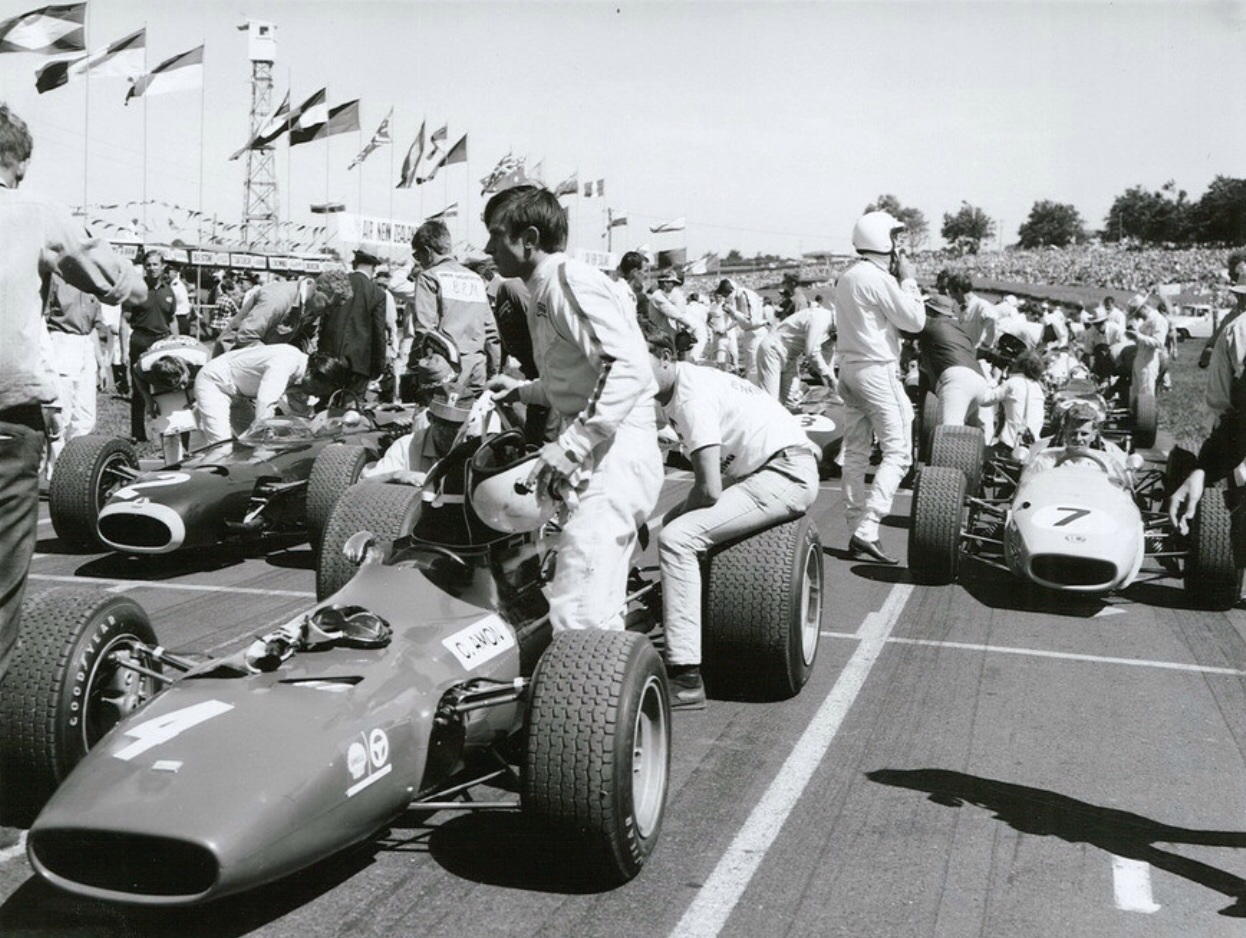
I love the build up and tension before the start of a big race; here it’s the grid prior to the start of the New Zealand Grand Prix at Pukekohe, in the north of NZ’s North Island on 6 January 1968…

Chris Amon readies himself and his Ferrari Dino 246T before the first round of the 1968 Tasman Series, a race in which he wonderfully and deservedly triumphed. Missing on the front row is Jim Clark’s Lotus 49T Ford DFW. Car #2 is Pedro Rodriguez’ BRM P261, the Mexican is bent over the cockpit of his car but failed to finish with clutch problems. Car #7 is Alec Mildren’s Brabham BT23D Alfa Romeo T33 2.5 V8 with chief mechanic Glenn Abbey warming up the one-off car. Lanky Franky Gardner is adjusting his helmet beside the car, it was a good day for Frank, the car was second.

Look closely and you can see a camera crew behind the Brabham which is focusing on 1967 reigning world champion Denny Hulme and his #3 Brabham BT23 Ford FVA F2 car- Denny’s head is obscured by Frank’s body. Hume boofed the ex-Rindt BT23 during the race badly enough for a replacement chassis to be shipped out from the UK.

I’ve always thought these F2/Tasman Ferrari’s amongst the sexiest of sixties single-seaters.
The 166 F2 car was not especially successful amongst the hordes of Ford Cosworth Ford FVA engined cars in Euro F2 racing, however, the car formed the basis of a very competitive Tasman 2.5 litre Formula car when fitted with updated variants of the Vittorio Jano designed V6 which first raced in F2 form and then powered the late fifties Grand Prix racing front-engined Ferrari Dino 246. It was in one of these cars that Mike Hawthorn won the 1958 World Drivers Championship.

Amon won the Tasman Series in 1969 with Ferrari Dino 246T chassis #0008, fellow Kiwi Champion Graeme Lawrence won aboard the same car in 1970 against vastly more powerful, if far less developed Formula 5000 cars. The story of those championships is for another time, this article is about Chris’ 1968 Tasman mount and campaign.

Amon hooking his gorgeous Ferrari Dino 246T ‘0004’ into The Viaduct in the dry at Longford 1968. Early ’68, we are in the immediate pre-wing era, and don’t the cars look all the better for it! (oldracephotos.com/D Keep)

In many ways Chris was stiff not to win the ’68 Tasman Cup a title, the last title won by the late, great Jim Clark…

Ferrari entered only one car that year, chassis #0004 was assembled in Maranello by longtime Amon personal mechanic Roger Bailey and tested at Modena in November 1967. It was then freighted by plane to New Zealand where it was prepared by Bruce Wilson in his Hunterville workshop in the south of the North Island.

The chassis was Ferrari’s period typical ‘aero monocoque’, a ‘scaled down’ version of the contemporary F1 Ferrari with aluminium sheet riveted to a tubular steel frame thus forming a very stiff structure. The 166 was launched to the adoring Italian public at the Turin Motor Show in February 1967.

In F2 form, the 1596cc, quad-cam, chain driven, 18 valve, Lucas injected engine developed circa 200bhp at an ear-splitting 10000 rpm. It is important to note that this F2 engine, designed by Franco Rocchi, and in production form powering the Fiat Dino, Ferrari Dino 206 and 246GT and Lancia Stratos is a different engine family to the Jano designed engines, evolved by Rocchi and used in the Tasman Dinos.

The F2 166 made its race debut in Jonathon Williams hands at Rouen in July 1967, whilst it handled and braked well it was around 15bhp down on the Cosworth engined opposition. The car was tested extensively at Modena, including 24 valve variants, but was not raced again that year.

Amon, who had not contested the Tasman Series since 1964, could immediately see the potential of the car, suitably re-engined, as a Tasman contender given the success of the small, ex-F1 BRM P261 1.9-2.1 litre V8’s in the 1966 and 1967 Tasmans. The same approach which worked for the boys from Bourne could work for Maranello Chris figured. A parts-bin special is way too crass, but you get my drift of a very clever amalgam of existing, proven hardware as a potential winning car.

In fact Ferrari went down this path in 1965 when a Tasman hybrid of a then current F1 chassis was married to a 2417cc variant of the Jano 65 degree V6 for John Surtees to race in the 1966 Tasman. John had Tasman experience in Coventry Climax FPF engined Coopers and Lola’s at the dawn of the sixties and could see the potential of a small Ferrari.

That plan come to nothing when Surtees was very badly injured in a Mosport Can-Am accident in his self run Lola T70 Chev in late 1965. This car, Ferrari Aero chassis ‘0006’ played the valuable role of proving Surtees rehabilitation when he completed 50 laps in the car at Modena. It was in the same chassis that Lorenzo Bandini finished second in the 1966 Syracuse and Monaco GP’s as Ferrari sought to get the new 3 litre V12 F1 312 up to speed, Bandini elected to race the Dino on both occasions- he also finished third in the car at Spa.

The allocation of this more competitive car to Bandini rather than team-leader Surtees was amongst the many issues which lead to the confrontation between John Surtees and team manager Eugenio Dragoni during Le Mans practice and Surtees departure from the team shortly thereafter.

An unidentified fellow, Jim Clark, Ferrari engineer Gianni Marelli, Chris Amon and Roger Bailey share a joke during the 1968 Longford weekend. Chassis ‘0004’ is fitted with the 24 valve V6 covered in the text. Note the quality of castings, fabrication and finish, inboard discs, sliding spline driveshafts and single plug heads of this very powerful- but less than entirely reliable engine in 1968 form, it’s shortcoming cylinder head seals (oldracephotos.com/Harrison)

The engine of the 166/246T was carried in a tubular subframe attached to the rear of the monocoque which terminated at the drivers bulkhead, the car was fitted with a 5 speed transaxle designed by Ingenere Salvarani and Girling disc brakes.

Suspension was also similar to the contemporary F1 cars in having an front upper rocker and lower wishbone with inboard mounted spring/shocks and conventional outboard suspension at the rear- single top link, inverted lower wishbone, two radius rods and coil spring/shocks.

For the 1968 NZ races- Chris won at Pukekohe after Clark retired and at Levin, leading from flag to flag, was second to Clark at Wigram and fourth at Teretonga- a 3 valve variant (2 inlet, 1 exhaust) of the 65 degree fuel injected V6 was fitted which was said to develop around 285bhp @ 8900rpm from its 2404cc.

Chris crossed the Tasman Sea with a nine point lead in the Series from Clark and the might of Team Lotus. It was a wonderful effort, whilst Ferrari provided the car free of charge and took a share of the prize money, the logistics were of Chris’ own small equipe, and here they were serving it up to Gold Leaf Team Lotus with a couple of World Champions on the strength, plenty of spares and support crew.

Amon just falls short of Jim Clark at the end of the 1968 AGP at Sandown. The official margin, one tenth of a second after 62 minutes of great motor racing. Lotus 49 Ford DFW and Ferrari Dino 246T (unattributed)


Amons heads into the Sandown pitlane to practice- Shell corner or turn 1 behind (G Paine)


Amon’s car in the Sandown paddock. That little four valve engine came so close to pipping Clark’s Ford DFW on raceday (G Paine)

For the four Australian races a 24 valve version of the engine was shipped from Maranello. Its Lucas injection was located within the engines Vee rather than between the camshafts and had one, rather than two plugs per cylinder. This motor developed 20 bhp more than the 18 valver with Chris promptly putting the car on pole at Surfers Paradise, a power circuit- he won the preliminary race and had a head seal fail whilst challenging Clark in the championship round.

At Warwick Farm he qualified with the 18 valve engine and raced the 24 valver having rebuilt it- they only had one of the motors. He was challenging both Clark and Hill in the race and then spun in avoidance of Hill who was having his own moment…he was fourth on the tight technical Sydney circuit.

At Sandown during the AGP, the pace of the car, and Amon, was proved in an absolute thriller of a race in which he finished second to Clark by one-tenth of a second, the blink of an eye. Let’s not forget the best driver in the world driving the best F1 car of the era powered by the Tasman variant of the greatest GP engine ever was his competition- and took fastest lap.

As the team crossed Bass Straight from Port Melbourne on the ‘Princess of Tasmania’ Chris knew he had to win the Longford ‘South Pacific Championship’, with Clark finishing no better than fifth to win the Tasman title.

At Longford, still fitted with the 24 valve engine, which must have been getting a little tired, he qualified a second adrift of Clark and Hill, he finished seventh in a race run in atrocious conditions on the most unforgiving of Australian circuits having initially run second to Clark but then went up the Newry Corner escape road and suffered ignition problems from lap 10.

Piers Courage won in an heroic drive aboard his little McLaren M4A Ford FVA F2 car that streaming day, in a series which re-ignited his career.

Chris and the boys confer about car set-up- in the dry!, at Longford(oldracephotos.com.au/Harrisson)

Chris was a busy boy during the Australian Tasman leg as he also drove David McKay’s Scuderia Veloce Ferrari 350 CanAm/P4 in sports car support events at each round in addition to the little Dino.

These races were outstanding as they involved close dices between Chris and Frank Matich in his self designed and built Matich SR3 powered by 4.4 litre Repco Brabham V8’s- with Frank getting the better of him in each of these races. The speed of the Matich was no surprise to Chris though, both had contested rounds of the Can-Am Championship only months before the Tasman in the US.

Click here for my article on the Ferrari P4/CanAm 350 #’0858’ Chris raced in Australia;

Ferrari P4/Can Am 350 #0858…

Amon lines David McKay’s Scuderia Veloce Ferrari P4/350 Can Am up for Longford’s The Viaduct during the 1968 Longford Tasman meeting. Matich didn’t take the SR4 to Longford so Chris had an easy time of it that weekend. The sight and sound of that car at full song on the Flying Mile at circa 180mph would have been really something! (oldracephotos.com/D Keep)


Chris Amon, David McKay and mechanic David Liddle with the Can-Am 350 in the Sandown pitlane (G Paine)

For the 1969 Tasman Chris applied all he learned in 1968 returning with two cars, the other driven by Derek Bell, four well developed 300bhp 24 valve engines with the logistics of the two months taken care of by David McKay’s Scuderia Veloce.

He promptly lifted the Tasman Cup in a very successful campaign from Jochen Rindt, Graham Hill and others, with a little more luck or greater factory commitment in 1968 it may have been two Tasmans on the trot for the Maranello team and Chris…

Etcetera…

(G Paine)


(G Paine)

A couple of shots of the SV Ferrari Can-Am 350 being fettled in the 1968 Sandown Tasman paddock.

Bibliography…

oldracingcars.com, sergent.com.au, ‘Dino: The Little Ferrari’ Doug Nye

Photo Credits…

Mr Riethmaier, oldracephotos.com, Rod MacKenzie, Glenn Paine Collection

Tailpiece: Love this moody, foreboding Longford shot by Roderick MacKenzie…

(Rod MacKenzie)

Chris has just entered the long ‘Flying Mile’ in the streaming wet conditions during Monday’s ‘South Pacific Trophy’ famously won by Piers Courage little McLaren M4 Ford FVA F2 car. 4 March 1968.

Finito…


image

(Richard Meek)

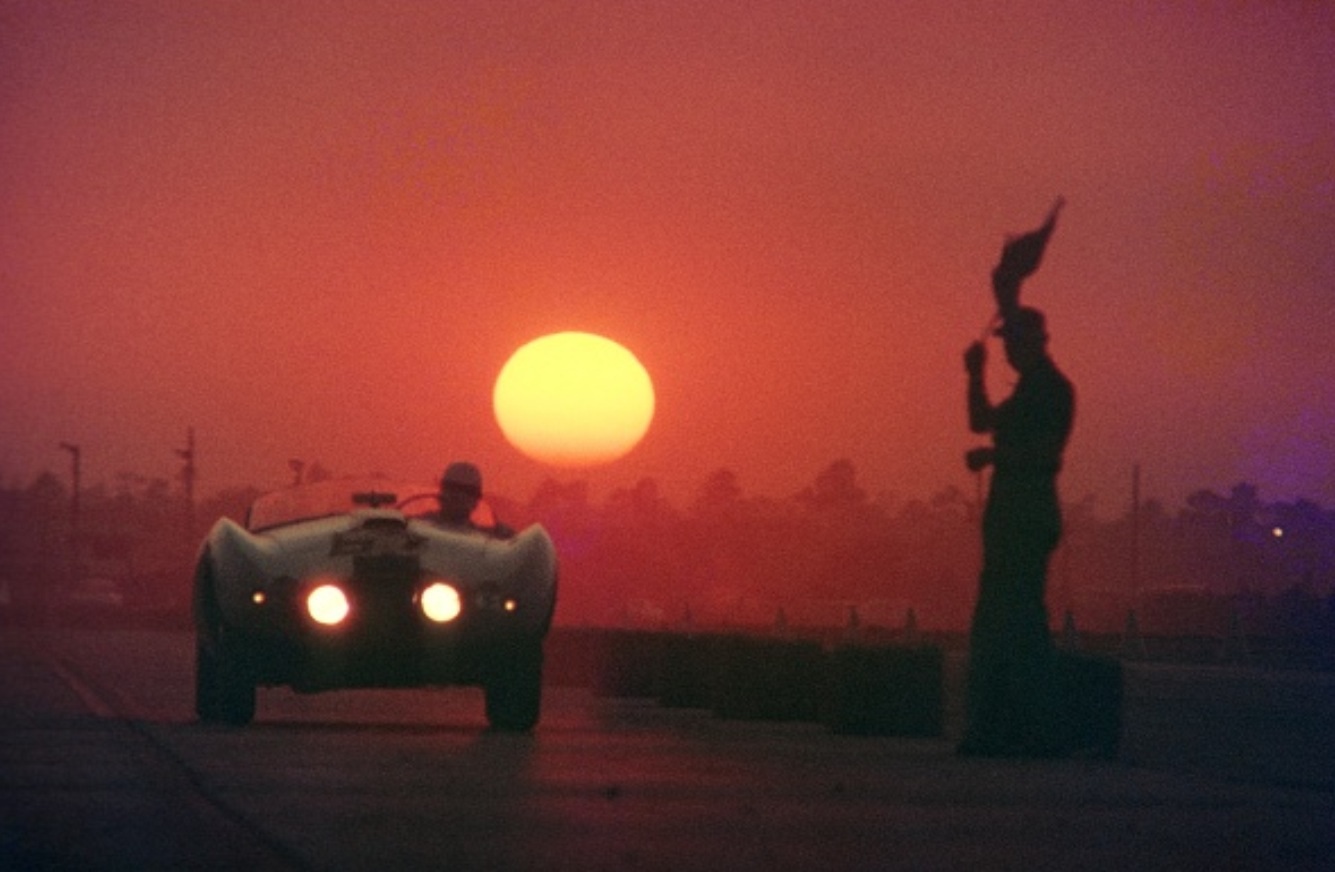
The Ballinger/Stewart Arnolt Bristol Bolide at Sebring in March 1956 at dusk, such an evocative shot…

They were 13th outright and 2nd in the 2 litre sports class, the Fangio/Castellotti Ferrari 860 Monza won.

The photo below, of another time and age is the Miller/Maassen/Rast Porsche 997 GT3 RSR, DNF, in 2011. The race was won that year by the Lapierre/Duval/Panis Peugeot 908 5.5 litre turbo-V12 diesel.

image

(Rick Dole)

Credits…

Richard Meek, Rick Dole, Racing One

Tailpiece: The ’69 Sebring field awaits the start with the Amon/Andretti Ferrari 312P on pole, the race won by the Ickx/Oliver Ford GT40…

image

(Racing One)