Posts Tagged ‘Cooper T51 Climax’

(Theo Page)

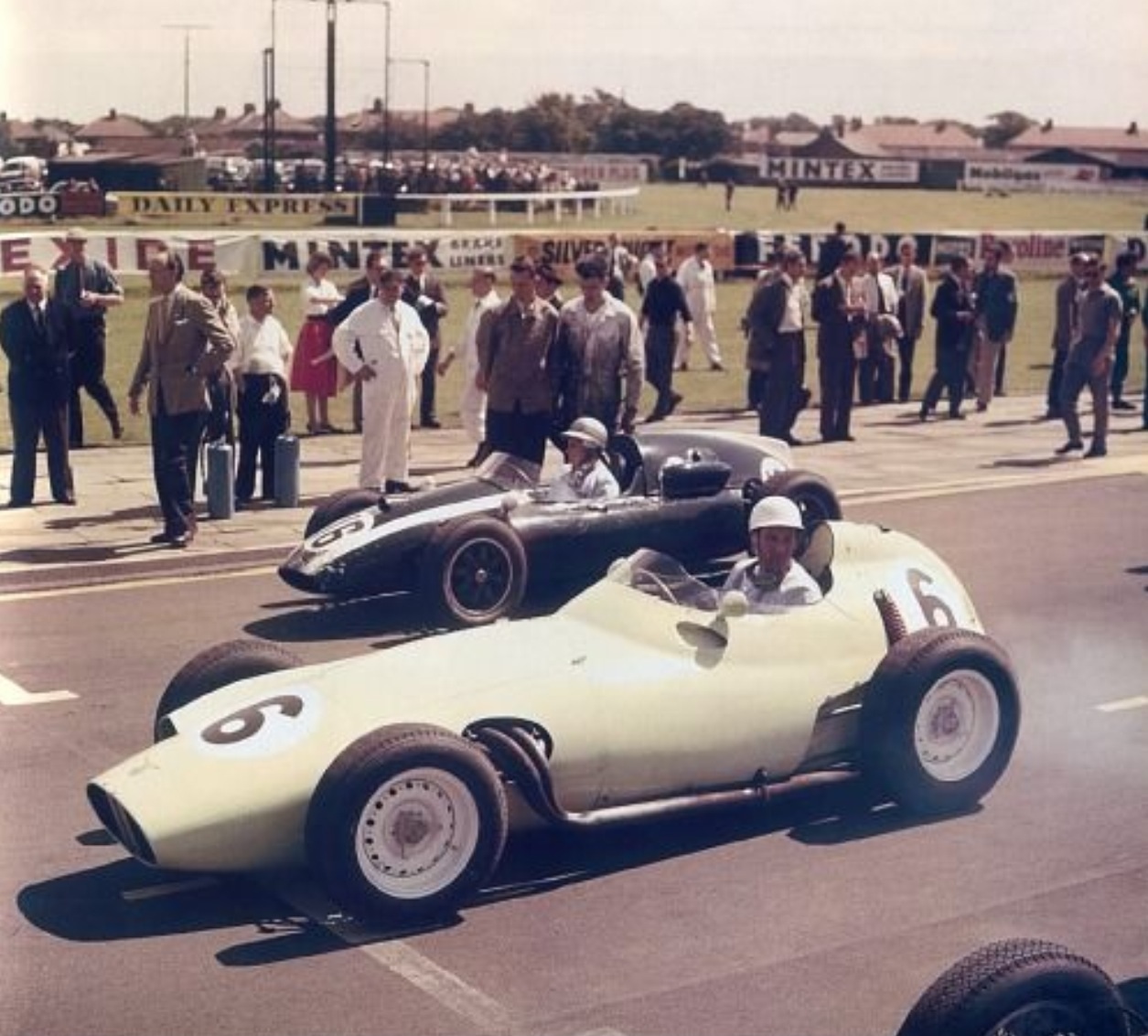
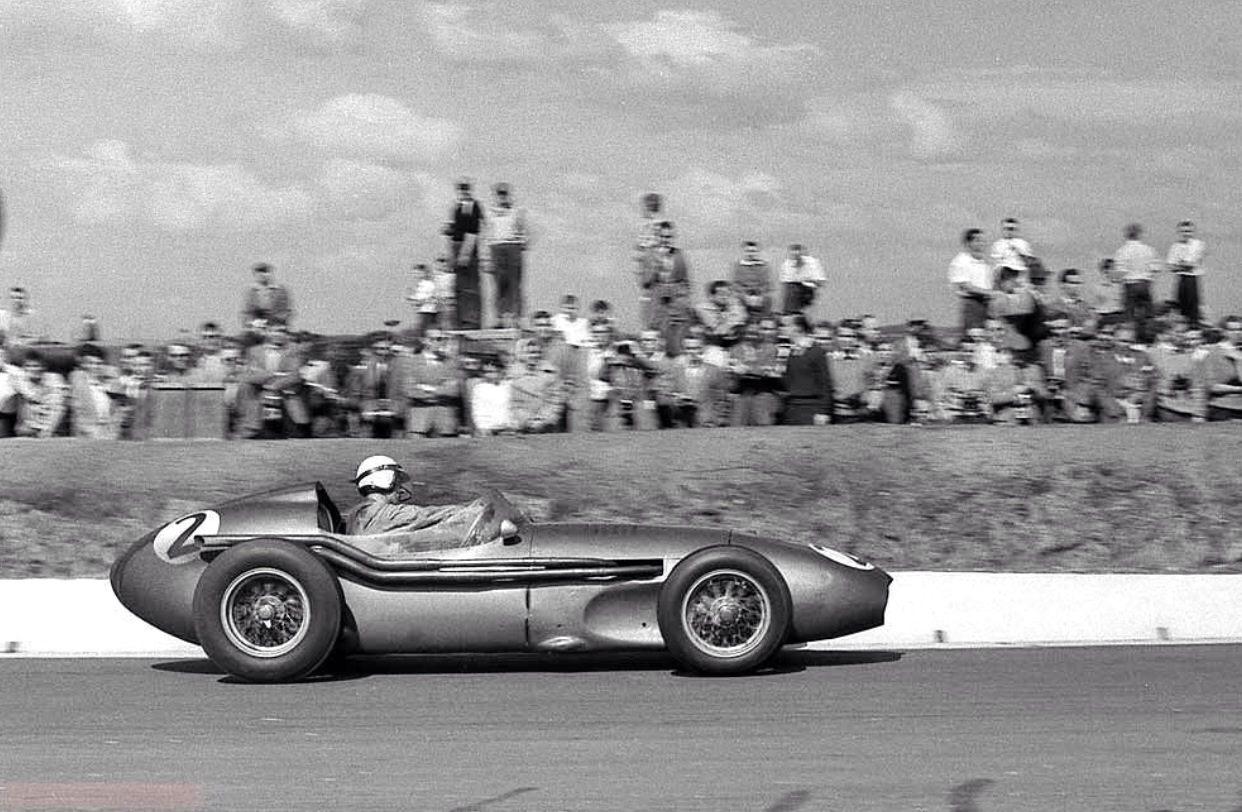
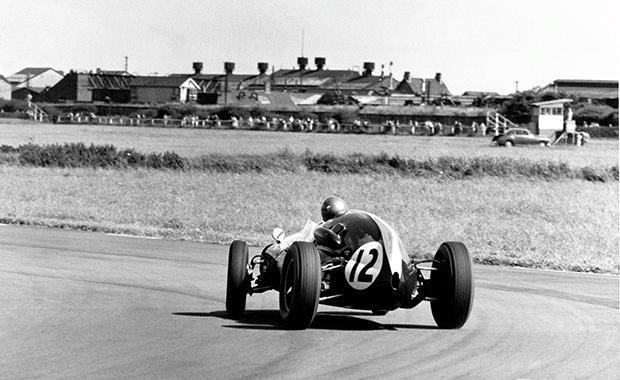
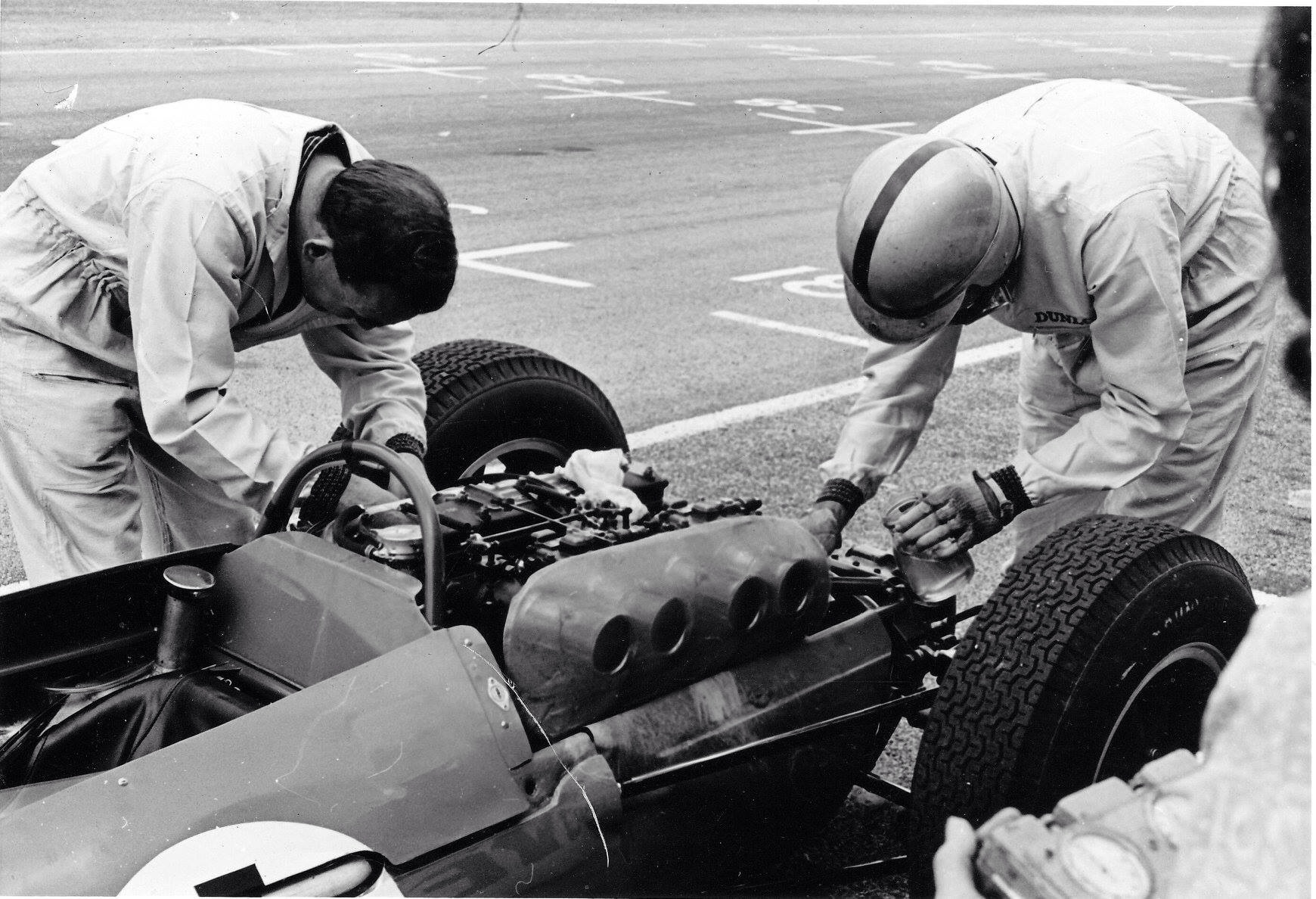
The Cooper Mark 1 (later referred to as T41) was the Surbiton marques prototype or first mid-engined F2 car…

Note that there were also Mk1, 2, 3 etc air-cooled Coopers, the T41 was typically fitted with a Coventry Climax 1.5 litre FWB SOHC, two-valve engine.

This article was spawned by Theo Page’s Type 41 cutaway above. I thought ‘that would be nice to add to an existing article on the Paul England/Austin Miller car’ and then I came upon T45, multiple T51 drawings as well as the ‘Lowline’ T53 so the idea of a piece on the early water-cooled mid engined Coopers popped into my head.

I knew the John Ross and Dave Friedman archives had some great workshop/circuit photographs of the cars engineering detail but that was going to create too much visual clutter so the article is in two parts.

The first bit is the overall story- Who, What, Where and When if you like, the second is more around the design and engineering of the cars with photographs providing great visual support. An ‘eyeful is better than an earful’ and all that.

In terms of photographs I’ve already written a lot of Cooper articles, often ‘quickies’ with all of the best Australian photographs I could find contained therein- rather than re-use these, key ‘Cooper Climax’ and ‘Cooper Maserati’ into the search spot on the upper left primo home page and you can check them out at your leisure, I have sought photos hopefully many of you have never seen before- other than a few Kiwis anyway!

Off we go.

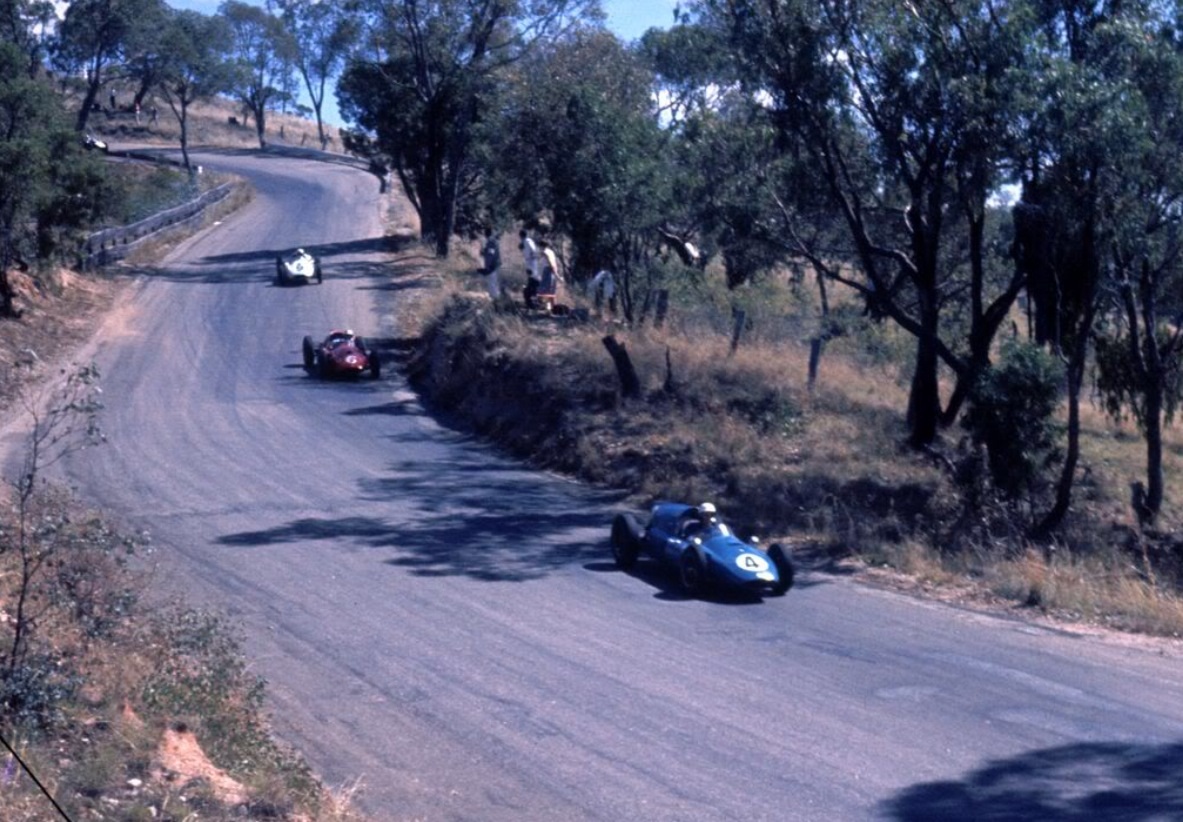
Wally Baker Cooper Mk8 Norton, South Canterbury Hillclimb circa 1960. ‘Clellands Zig Zag’, near Cave, on the east of NZ’s South Island. The road is tarmac these days (CAN)


1949 Cooper Mk3 JAP (Getty)

If John and Charles Cooper’s first mid-engined Coopers of 1948 set the company on a path to change the face of motor racing, the T41 hastened the onslaught on the long established (Auto Union pre-war duly noted) front engine motor racing paradigm.

Lets not forget the performance of the Cooper Bristols Mk1 and Mk II or T20 and T23 which were born as F2 machines and became Grand Prix cars with the adoption of F2 to determine the drivers and manufacturers championships in 1952 and 1953.

Those cars ‘launched the careers’ of a swag of top line pilots not least two World Champions in Mike Hawthorn and Jack Brabham.

The performance of the T39 ‘Bobtail’ and T40 Bristol which Jack ‘knocked together from the Cooper parts bin’, and in which he made his F1 Championship debut at Aintree in 1955- and aboard which he won the Australian Grand Prix at Port Wakefield later that year, emboldened human dynamo John Cooper to build a mid-engined car for the new 1.5 litre F2 which took effect from 1 January 1957.

Jack Brabham in his famous ‘REDeX Special’ Cooper T23 Bristol in the backyard of his parents house in Hurstville, Sydney circa 1953 (HRCCT)


Cooper Mk1 or T20 Bristol (Vic Berris)


Reg Hunt’s Len Lukey driven Cooper T23 Bristol during the 1956 AGP weekend at Albert Park. Doncha think blokes look at racing cars in the same way they check out chicks- with absolute focus, totally oblivious of anything else going on in the immediate environs? Ninth in the race won by the Moss works Maserati 250F (G Smedley)


Colvin Algie, Normac/AC Special about to be lapped by Brian Pescott, Cooper T23 Bristol and Angus Hyslop, Jag D during the 1959 Ahuriri Road Races- Port Ahuriri, Napier, NZ North Island. JW Lawton Cooper 2 litre won from DC Hulme Cooper T45 FPF 2 litre and Pescott (CAN)


Brabham in his 1955 British GP debut/AGP Port Wakefield winning Cooper T40 Bristol, here at Mount Druitt, Sydney, probably also 1955 (Uni Newcastle)

In the UK six F2 races were held between the 14 July Silverstone British GP support race won by Roy Salvadori’s works T41 Climax FWB and the 14 October BRSCC Brands Hatch race won by the RRC Walker Racing T41 similarly engined car. The new T41’s won five of the six races, Salvadori four and Brooks one. Colin Chapman won at Brands on 9 September in a Lotus 11 FWB sportscar, an occasion where the T41’s were absent.

Finally the Brits had, in Coventry Climax, a manufacturer of modern, competitive engines which were available to all who could stump up the readies. During 1957 the SOHC, two-valve FWB was supplemented by the twin-cam, two valve FPF putting in place the family of engines which carted away two F1 titles in 1959/60.

Similarly, Cooper built cars for all.

There is other ‘confluential’ stuff which contributed to Cooper’s rise and rise too;

Jack Brabham arrived at Cooper in 1954 with his unique blend of driving, testing, mechanical and engineering skills. The energy of Jack and John Cooper must have been a truly awesome thing to watch- I’m not so sure I would have wanted to work for them but to view it all from the sidelines would have been quite something.

RRC Walker racing ‘attached themselves’ to the lads from Surbiton, specifically the contributions of Walker RRC, Moss S, and Francis A were mega, as we will see.

Not to forget the son and father combination of John Cooper, a racer to the core, and Charles Cooper who kept the business alive and well. As anyone who has run a small business well knows keeping an enterprise afloat is not easy especially in the fickle ‘only as good as yer last race’ world of motor racing. Cooper Cars was highly profitable throughout with John selling at ‘the right time’ a decade hence not too long after Charles died.

Where were we?- back to the Mark 1, or make that, for me, T41!

John Cooper and Owen Maddock produced a car which was strongly based on the T39 albeit the machine was ‘slipper bodied’ rather than having the all-enveloping body of the other car. Similarly it had independent suspension front and rear using top transverse leaf springs and wishbones at the bottom.

Jack, T41 Climax at Caversham during the 1957 F Libre AGP. Modern as tomorrow Cooper a contrast with the partial nose of the Fred Coxon Amilcar Holden Spl behind (K Devine)


Brabham, T41 FWB on his way to third in the 1957 AGP behind the Ferrari 500 3 litre of Lex Davison/Bill Patterson and Stan Jones Maserati 250F (D Van Dal)


Lady Wigram Trophy 1957. They are off, F Libre- Brabham in T41 FWB against the ‘Big Red Cars’- Reg Parnell and Peter Whitehead Ferrari 555/860 and Ron Roycroft in the light coloured Ferrari 375. D Type is Bob Gibbons, Syd Jensen, Cooper T41 Climax and Horace Gould, Maser 250F #2 on row 2. Look at the size of the Brabham and Jensen Coopers in relation to the Ferrari’s (CAN)


Austin Miller, Cooper T41 Climax leads Bill Patterson, Cooper T39 Bobtail Climax off Long Bridge, Longford during the 1958 Gold Star round won by Ted Gray’s big, booming Tornado 2 Chev. Both of these fellas progressed to T51’s, Patto won the 1961 Gold Star in one of his. He owned more Coopers in Australia than anyone?- perhaps Stillwell and Jones count was similar. Paul England raced Austin’s T41 in the 1957 German GP- DNF distributor after 4 laps

The production 1957 Mark II (T43) was settled upon that winter and put into build at Hollyfield Road.

It had a longer wheelbase that the Mk1 and bulkier bodywork to accommodate two pannier fuel tanks rather than the scuttle tank of the Mark 1- the suspension was the same as the earlier car, the drooped nose was a means of distinguishing between Coopers very latest offering and its predecessor.

Brabham debuted the Coventry Climax FPF engine- it took its bow at the 1956 London Motor Show, in the first race of the year, the Lavant Cup at Goodwood on 22 April finishing second to Tony Brooks Walker T41 FWB. Initially the 1475cc engine developed 141bhp @ 7300rpm and most importantly a swag of torque from 4000rpm- it’s peak was 108.5 lb-ft @ 6500rpm. The pint sized package weighed only 225 pounds.

It was a year of F2 dominance for the marque- in sixteen national and international races  Brabham won five, Tony Marsh, George Wicken and Roy Salvadori two apiece and Tony Brooks and Ronnie Moore one. Tom Dickson won at Snetterton in May aboard a Lotus 11 FWA when no T41/43 was present, Maurice Trintignant was victorious at Reims in a Ferrari 156 and Edgar Barth in a Porsche 550RS at the Nürburgring but otherwise it was all Cooper.

Pescara GP 1957. Jack in front and Roy Salvadori behind, Cooper T43 FPF 2 litre- 7th and DNF from Q16 and 15. Moss won aboard a Vanwall VW (57)


Dunedin International Road Race 1958. McLaren, T43 Climax #47, Syd Jensen, Cooper MkX Norton with #51 Geoff Mardon, VA Vanguard and Merv Neil in another T43 alongside. You can just see the Frank Cantwell Tojeiro Jag at left rear. Ross Jensen Maser 250F won from McLaren and Syd Jensen (CAN)

Meanwhile in Europe privateers were racing the cars in non-championship Grands Prix. George Wicken took his T43 FPF to Siracusa in early April DNF, Brabham was fourth in the Glover Trophy at Goodwood behind two F1 Connaught B Types and a BRM P25. Salvadori was second at the GP de Caen in July behind Behra’s BRM P25 but ahead of four Maserati 250F’s, a car Roy knew rather well.

In the BRDC International Trophy Innes Ireland’s T43 was sixth in his heat and Brabham second in his. Fourteen Cooper T41/43’s contested this race, the best placed was Salvadori in eighth behind BRM P25’s and Maserati 250F.

With a 2 litre FPF available Cooper ran a limited World Championship campaign that year, the best results were Salvadori’s fifth at Aintree and Brabham’s sixth at Monaco. Doug Nye explained how the 2 litre variant came about.

Early in 1957 Roy Salvadori tested Rob Walker’s F2 T41 and F1 Connaught Type B on the same day at Goodwood. He quickly realised the potential pace of a water cooled mid-engined Cooper and floated the idea of increasing the capacity of the FPF enough to tackle GP racing.

Soon, with Walkers financial backing- Rob ordered a chassis and 2 litre engine, the project was underway. Climax’ changes involved increasing the bore and stroke which required new pistons, liners and crank- the result, with only two days fettling was an astonishing 176bhp @ 6500rpm. Brabham used the engine at Monaco and ran as high as third before pushing the car over the line in sixth after fuel pump failure.

At the end of Jack’s European season he came home for the summer commencing his race campaign with the Australian Grand Prix at Caversham, an ex-airbase circuit out of Perth.

His T41 qualfied and finished third behind the Formula Libre 3 litre Ferrari 500 of Lex Davison/Bill Patterson and Stan Jones’ Maserati 250F.

The 1958 Mark III (T45) added significant refinement in that the front suspension was changed to use coil springs and both upper and lower wishbones. At the rear the transverse leaf remained with upper lateral links added which released the spring to do just that, relieved of its additional wheel locational function.

Coventry Climax chief Leonard Lee had endorsed a further increase in the capacity of the FPF to 2.2 litres, the maximum the original block could accommodate. Production of these engines was geared around resourcing two car Cooper and Rob Walker Cooper entries.

The F2 Index lists twenty F2 races in 1958 with Cooper T43/45 victory honours shared widely. Brabham and Bruce McLaren- Jack brought Bruce to Europe that year after Bruce had much Cooper success at home, had three wins each, Moss and Ian Burgess two, with one each to Stuart Lewis-Evans, Kiwi, Syd Jensen, Maurice Trintignant, Henry Taylor, Tim Parnell and Jim Russell.

The big news of course was Stirling Moss’ win aboard Rob Walker’s T43 in the Argentinian Grand Prix.

The car was fitted that day with one of the 1960cc FPF’s. Continental tyres contributed too, he ran on them from start to finish in place of his usual Dunlops. Vanwall, to whom Moss was contracted in F1 that year chose not to travel to Argentina given its cost, distance and because Tony Vandervell’s engines were not quite running well enough on Avgas just yet- there were new fuel regulations in place from 1 January.

So Walker and Moss decided to have a crack at the race- and won! Use of Continentals was Rob Walker firing a shot across Dunlop’s bows ‘because they weren’t being very helpful on tyres at the time’ Doug Nye quoted Walker as saying in ‘The History of The Grand Prix Car’. The Conti’s were were worn through to the canvas at the end of the race- Ferrari fell for the ruse of a prospective tyre change when Alf Francis and another mechanic paraded with wheels and jacks in the pitlane for a stop which was never planned to happen.

In non-championship GP’s Moss won the Aintree BARC 200 in April and the GP de Caen, on both occasions aboard a Cooper T45.

In Australia we were all excited by Cooper pace watching Moss and Brabham face-off in the Melbourne Grand Prix at Albert Park, the last race at the Park until the modern era, won in searing heat by the Walker/Moss T45.

Roy Salvadori leads the marauding pack into the first turn at Monaco in 1958. He is followed by #6 Jean Behra, BRM P25, Tony Brooks Vanwall with #28 Stirling Moss, Vanwall. Brabham is to the right out of shot. Maurice Trintignant won in Walkers Cooper T45 with a bit of luck in a race full of DNF’s and clever strategy. Brabham Q3 and 4th, Roy Q4 and DNF gearbox (Getty)


Equipe Lukey during the 1959 AGP weekend at Longford, Cooper T45 2 litre FPF Climax. With a 2.5 FPF Len Lukey would have won in his ex-Brabham machine, but Stan Jones prevailed in a close tussle in his Maser 250F by 2 seconds (Walkem)


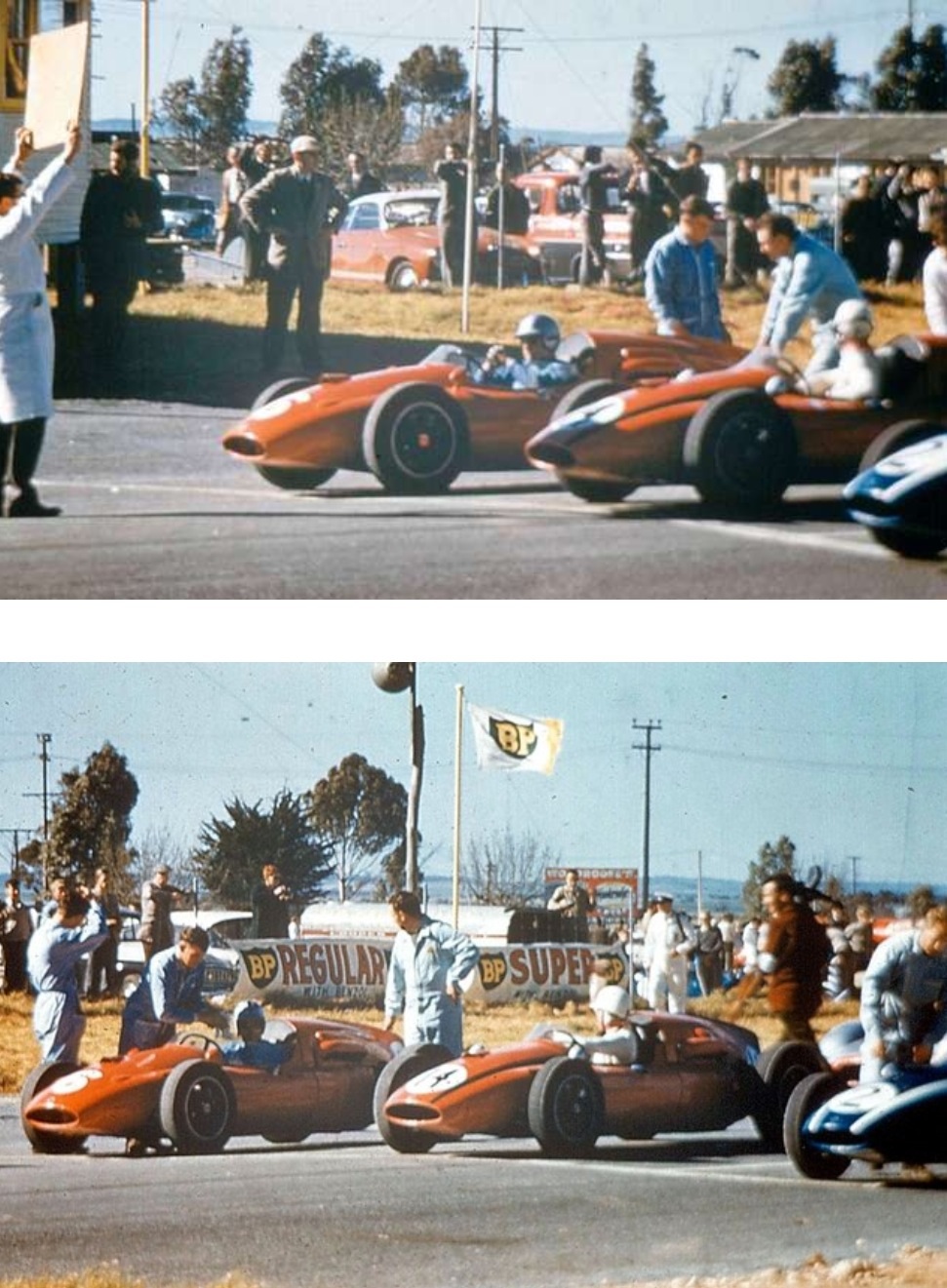
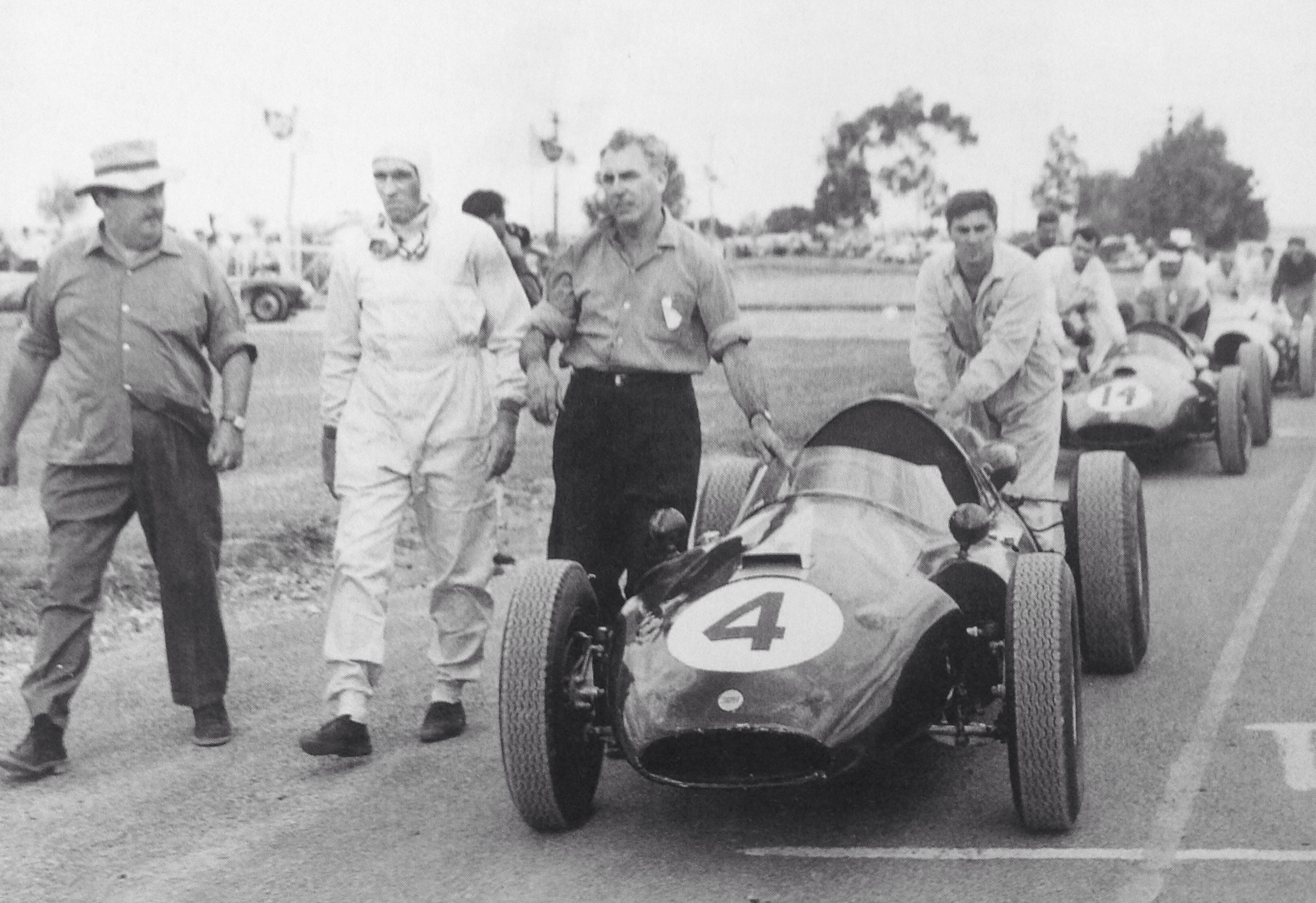
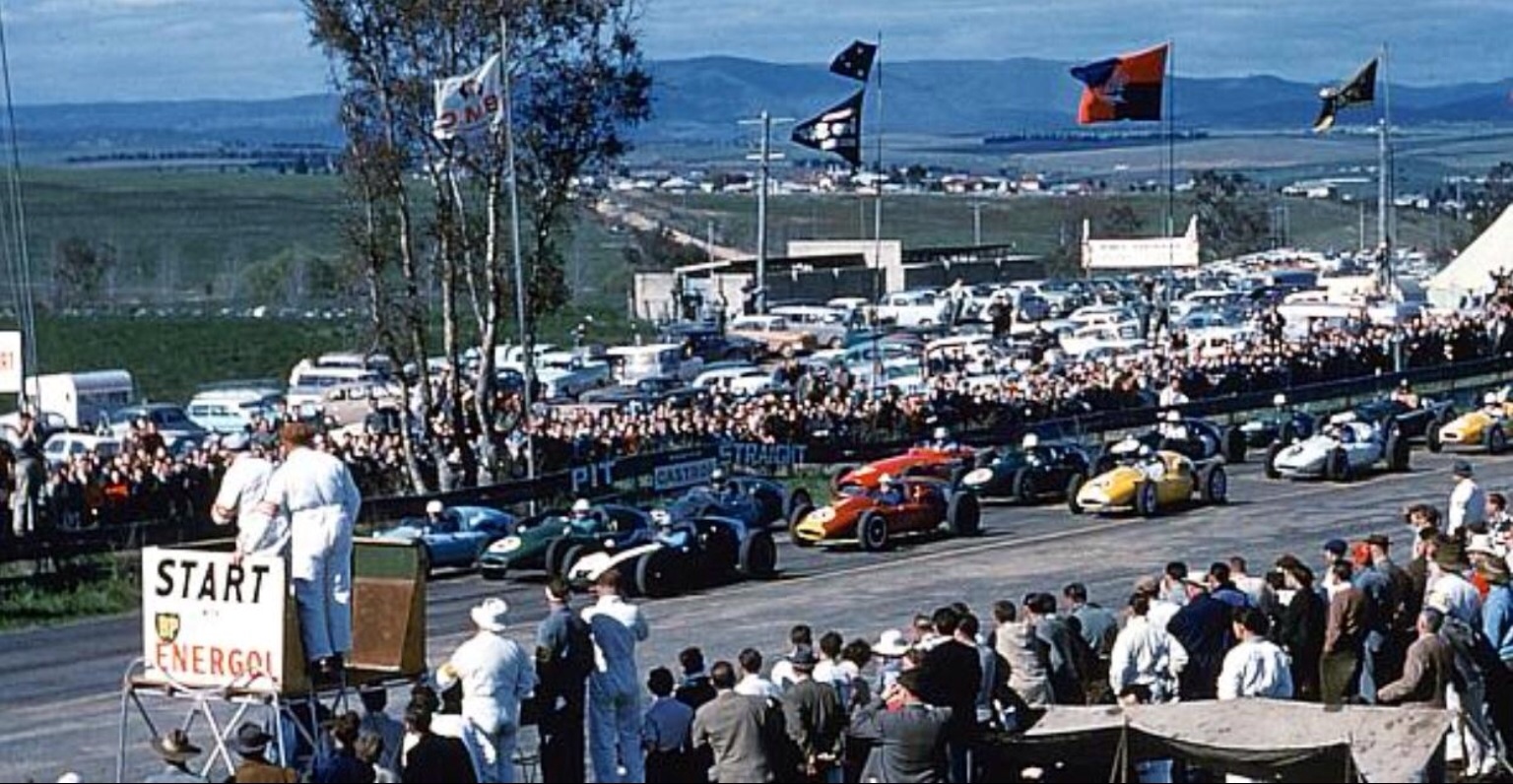
Bruce’ works T45 in the Ardmore NZ GP paddock 1960- Jim Palmer’s Lotus 15 Climax and Pat Hoare, Ferrari 256 behind. Brabham’s works T51 first- then Bruce and Stillwell and Stan Jones in T51’s (CAN)

At championship level Cooper enjoyed considerable success in addition to the Walker/Moss Argentine win.

Salvadori was second at the Nürburgring, third in Britain and fourth at Zandvoort whereas Jack was fourth at Monaco.

The 2.2 litre FPF made its debut at Monaco in the Salvadori/Brabham works cars. There, Maurice Trintignant ran a Walker T45 with an interim 2015cc engine and centre lock detachable Borrani wire wheels and in a crazy race of attrition, he won- two races on the trot for the RRC Walker Racing new-fangled Coopers!

In the more open faster races of the season the Coopers were simply giving away too much capacity but that would be remedied in 1959.

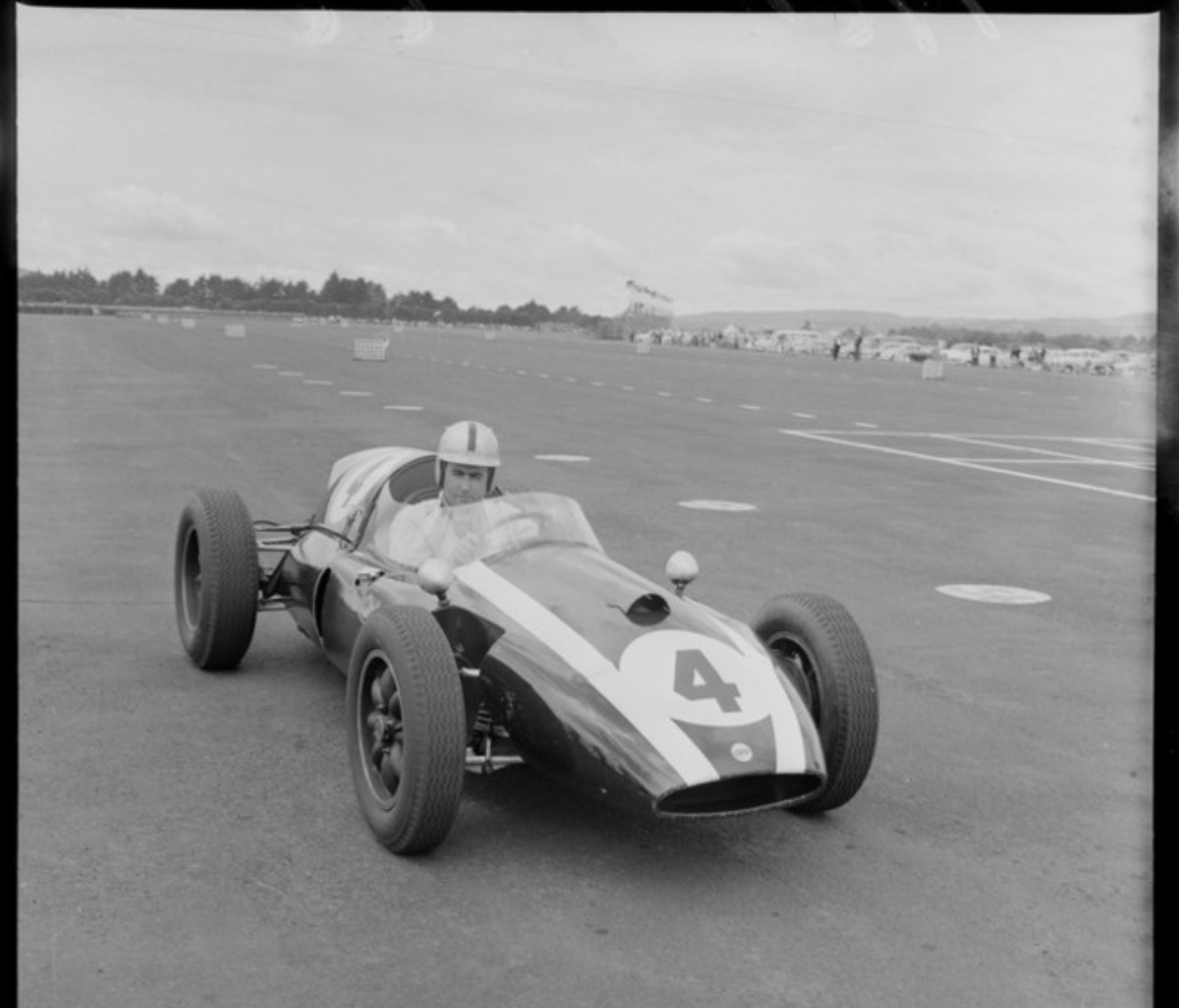
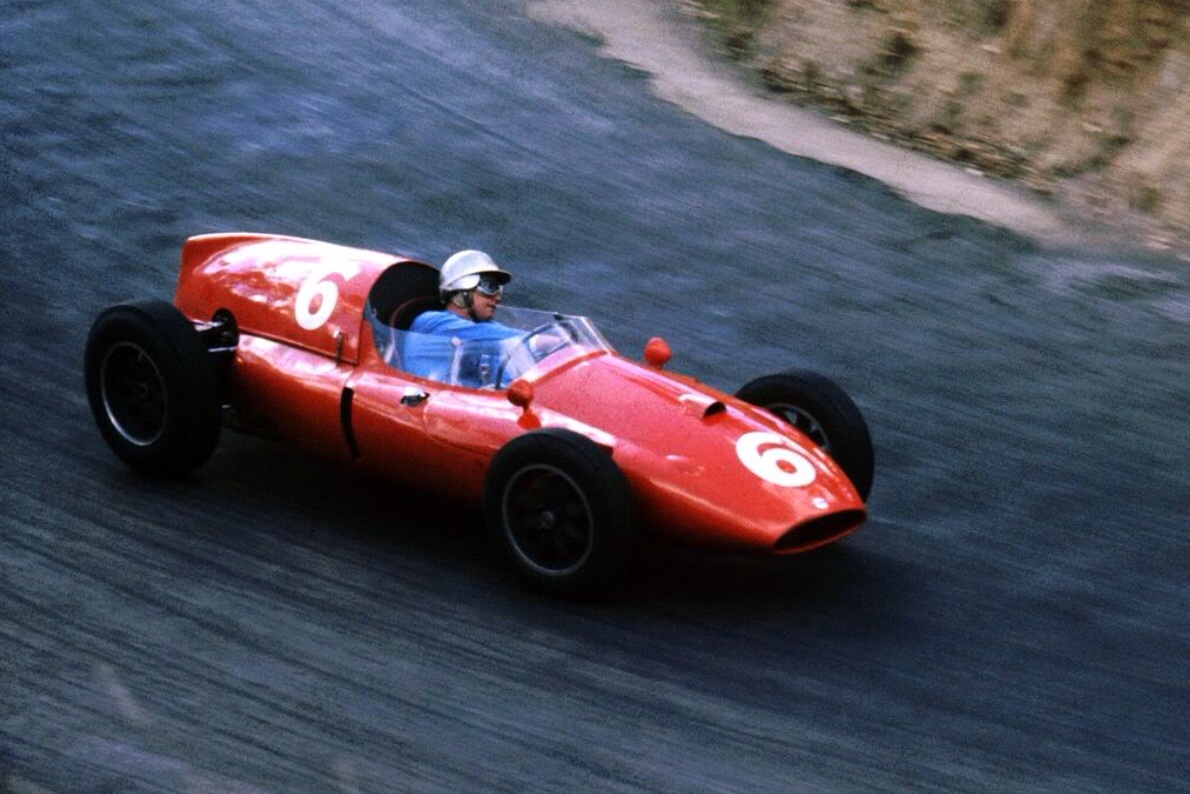
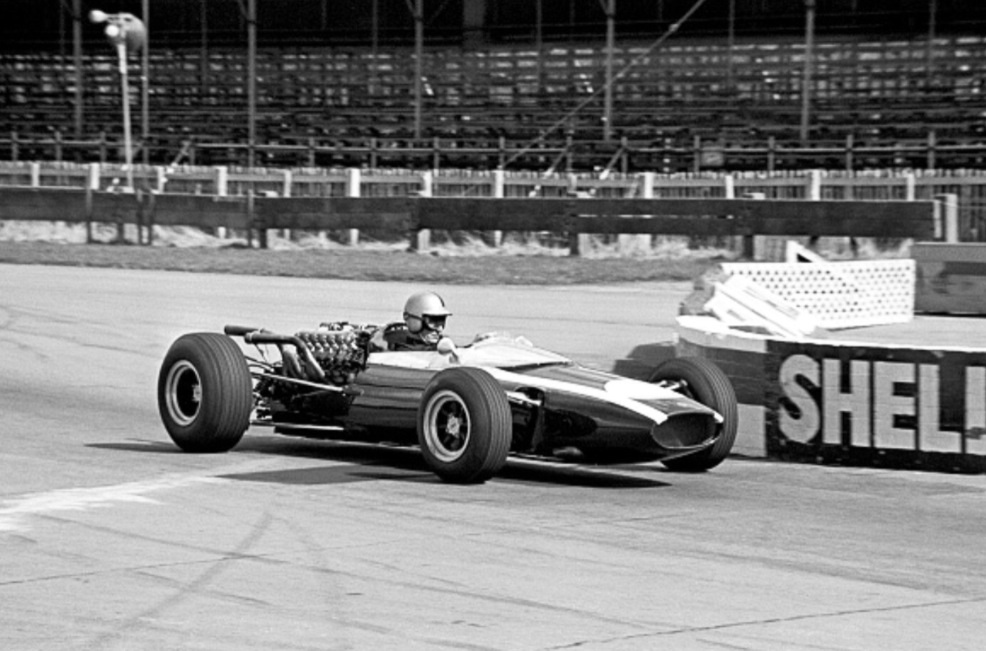
T51 Climax (T Matthews)

The 1959 Mark IV (T51) was identical in terms of chassis and suspension to the Mark III- the technical details of which are dealt with in the second part of this article.

It was one of the great customer racing cars of all time in that so many were sold (28 orders according to period factory records but the actual number of chassis built was far greater than this) and so many used it to win for two or three years hence in all corners of the globe.

Interesting insights by Cooper historian Doug Nye are voluminous and fascinating not least the fact that Coopers weren’t all factory constructed by Cooper staff. Some were, but others were built up by customer team mechanics at Cooper or using a ‘kit of parts’ provided by Cooper and built up elsewhere. The ‘kits’ could be complete or otherwise which is reflected in the many different details between cars which are nominally of the same model type.

The British Racing Partnership/Yeoman Credit take on a Cooper T51 Climax at Monaco in 1960- Tony Brooks Q3 and 4th-Moss won in a Walker Lotus 18. Compare the bodywork and detail of this car with the ‘factory standard’ car of Noel Hall below (D Friedman)


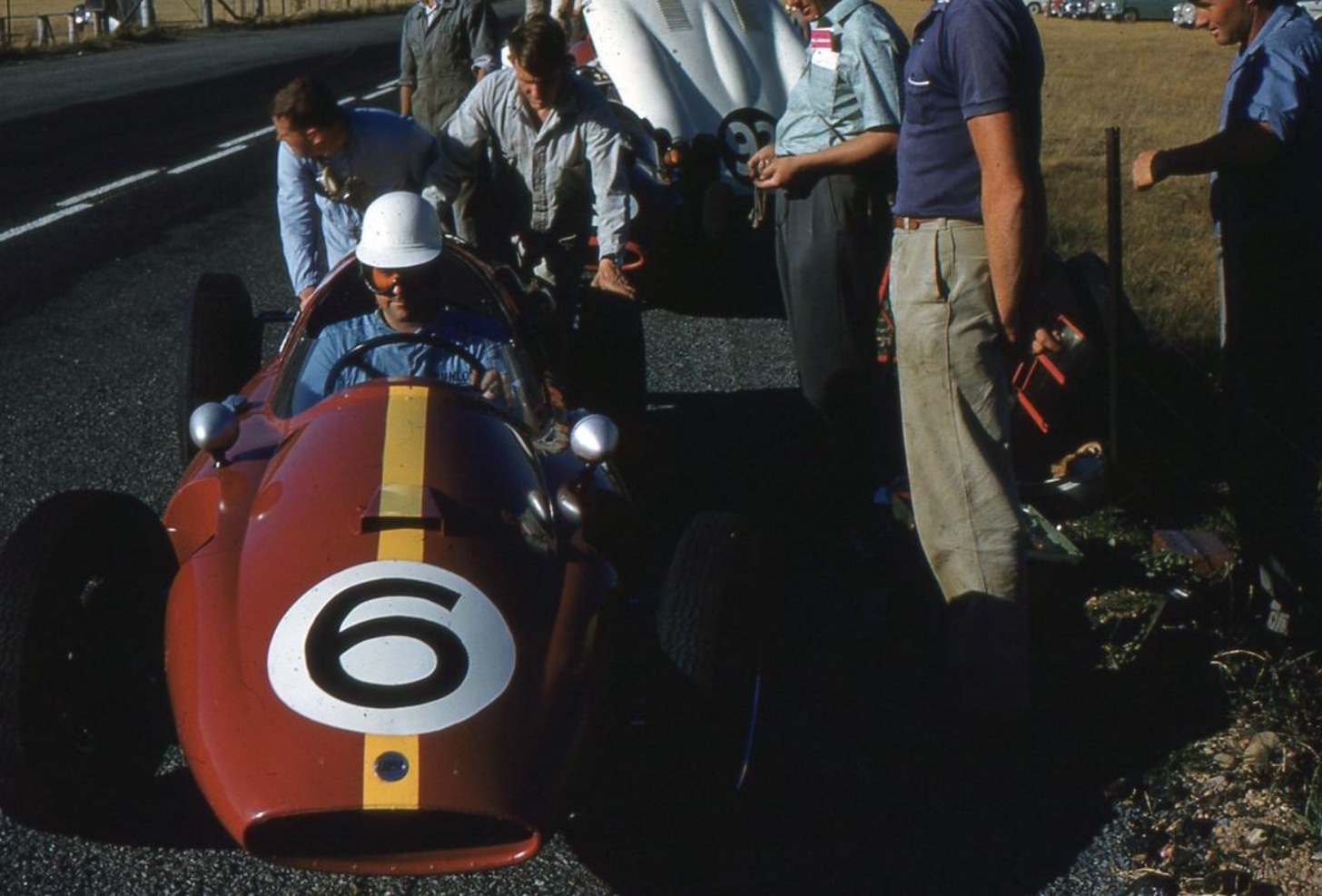
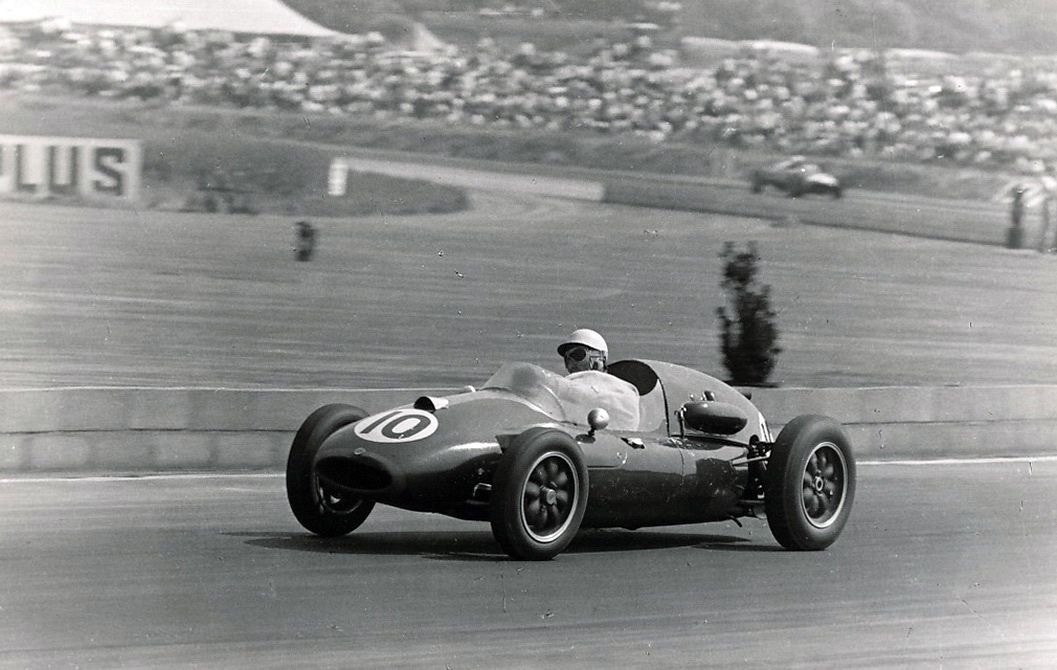
Noel Hall’s Cooper T51 Climax at Lowood, Qld in 1959. Probably during one of the two Lowood Gold Star rounds (unattributed)

Whilst, as noted above, the T51 chassis and related componentry inclusive of the gearbox was carried over from the T45, the critical aspect of the package essential for ultimate success was redesign of the FPF to the maximum allowable F1 capacity limit of 2.5 litres unsupercharged.

The 2.2’s of 1958 were fragile at the margin, the block and crankcase had been weakened in the process of taking the engine from its original 1.5 litres to a smidge over 2.2. The crank counter-weights could not be enlarged and as a consequence the motor vibrated and ran roughly- its life was usually short if over-revved.

Walter Hassan’s redesign started as late as 1 December 1958.

A new block was made by Birmal in light alloy integrating both the block and crankcase and extended from 3 1/2 inches below the crankshaft to 8 5/32 inches above it, Nye wrote. The bore/stroke was 94mm x 89.9mm for a capacity of 2495cc. Cast iron wet liners were used and a five main bearing crank. Beneath the crank was a jackshaft which carried three oil pumps- one pressure and two scavenge. The engine was ‘cross-bolted’- eight studs each side of the block screwed into the main caps.

The two valve, DOHC engine, as before, had its cams driven by a train of gears. The Mk1 2.5 litre heads had 1 1/2 inch bore ports feeding 1.937 inch inlet valves and 1.687 exhausts. Nye notes the engine was ‘under-valved’ initially in case of structural deficiency elsewhere. Fitted with twin-Weber 58 DCO carbs the engine revved happily to 7000rpm developing circa 240bhp @ 6750rpm and ‘pulled like a train from as little as 4000rpm’. Remember that the 2207cc unit produced 194bhp.

Brabham would have well and truly noticed the weight gain mind you- the 1.5 FPF weighed 225lb, the new 2.5 290lb.

Doncha hate thoughtless crops! Headless Repco technician, probably Michael Gasking, with an FPF bottom end in the Repco Engine Lab, Richmond circa 1963 which means its probably one of Jack’s 2.7 ‘Indy’ spec engines used in the NZ/Oz pre-Tasman F Libre days. Note the beefy steel Laystall crank, deep block as per text and row of holes ‘at the top’ for the cross-bolt studs. It’s a story in itself but Repco were licensed or approved by Climax to look after the FPF’s which extended to manufacture of rings, bearings and pistons with CC providing block and head castings which were machined by Repco. Brabham was the first ‘customer’ (M Gasking)

Cooper’s factory drivers changed in 1959 as Roy Salvadori, for years a contracted Aston Martin driver, committed himself to David Brown’s old-school front-engined cars in F1 as well as their sportscar program.

It was a remarkably loyal call by Roy but one not readily understood given his back to back test of Rob Walker’s old and new cars only twelve months or so ago. Roy was very much the quicker of he and Jack in 1958 and really was in the box seat with all of the knowledge about what was coming down the Cooper pike…A Le Mans win together with Carroll Shelby that summer was some compensation for the Aston Martin DBR4 which was ‘too little too late’ without getting lost in that tangent.

John Cooper therefore recruited Masten Gregory and promoted Bruce to the F1 squad with Jack’s unique contribution in and out of the car ongoing.

Vanwall withdrew from Grand Prix racing, and soon altogether, so Stirling Moss raced Rob Walker’s Coopers. The primary difference in specification between the works cars and Walker’s were that John Cooper didn’t provide his you-beaut modified ERSA gearboxes. Walker was left to his one devices, contracting Valerio Colotti to build transmissions, which it transpired failed repeatedly.

In some ways it could be said 1959-1960 were the years of the gearboxes. Moss would have won in 1959 had the Colotti’s held together in the Walker 51 and a Lotus 18, ‘the car of 1960’ would perhaps have won in 1960 were it not for the unreliability of Colin Chapman’s sequential ‘Queerboxes’.

Having said that Cooper created their own luck by building modified versions of the Citroen-ERSA boxes in 1959 and the Owen Maddock designed, Jack Knight built ‘Cooper-Knight CS5’ transaxle in 1960.

Ifs, buts and maybes mean nothing in motor racing- but they are interesting all the same!

Chassis #F2-16-59 , Noel Hall’s T51 was a new car ex-factory, fitted with a 2.2 litre FPF, here outside his garage business- where was that? (J Ellacott)

Jack Brabham won the 1959 title with 31 points from Tony Brooks, Ferrari Dino 246 and Vanwall on 27, Moss 25 1/2 and Phil Hill, Ferrari Dino 246 on 20 points.

The season was open in that Brabham, Brooks and Moss won two races apiece- Monaco and Aintree for Jack, Nürburgring and Reims for Tony and Monsanto and Monza fell to Stirling.

Moss lost the Monaco and Zandvoort leads- and was out early at Monza due to Colotti failure. But the works-boxes were marginal too and Jack nursed them, there is little doubt he had greater mechanical sympathy than Moss- and most other drivers for that matter. One does often make ones own luck in all forms of human endeavour.

2.2 Coventry Climax engine detail and ‘curvaceous’ Maddock frame (J Ellacott)

Both Jo Bonnier and Bruce McLaren took their first Championship Grand Prix wins that year- at Zandvoort (also his last) and Sebring aboard BRM P25 and Cooper T51 respectively.

Five non-championship events were held in 1959 and there, too the Coopers were dominant- T51’s took the Glover Trophy at Goodwood- Moss from Brabham powered by their brand new Coventry Climax 2.5 litre FPF’s, the International Gold Cup at Oulton Park went to the Moss/Walker Cooper and Jack bagged the BRDC International Trophy at Silverstone.

Front-engined non-champ victories went to Jean Behra’s Ferrari Dino 246 at Aintree- the BARC 200 and to Ron Flockhart’s BRM P25 at Snetterton in October- the Silver City Trophy.

This is one of my favourite Cooper shots- Harry Schell in a delicate, high speed Yeoman Credit T51 Madgwick drift at Goodwood during the April 1960 Glover Trophy. DNF engine after 20 laps. Ireland’s Lotus 18 won from the T51’s of Moss and Chris Bristow (Getty)
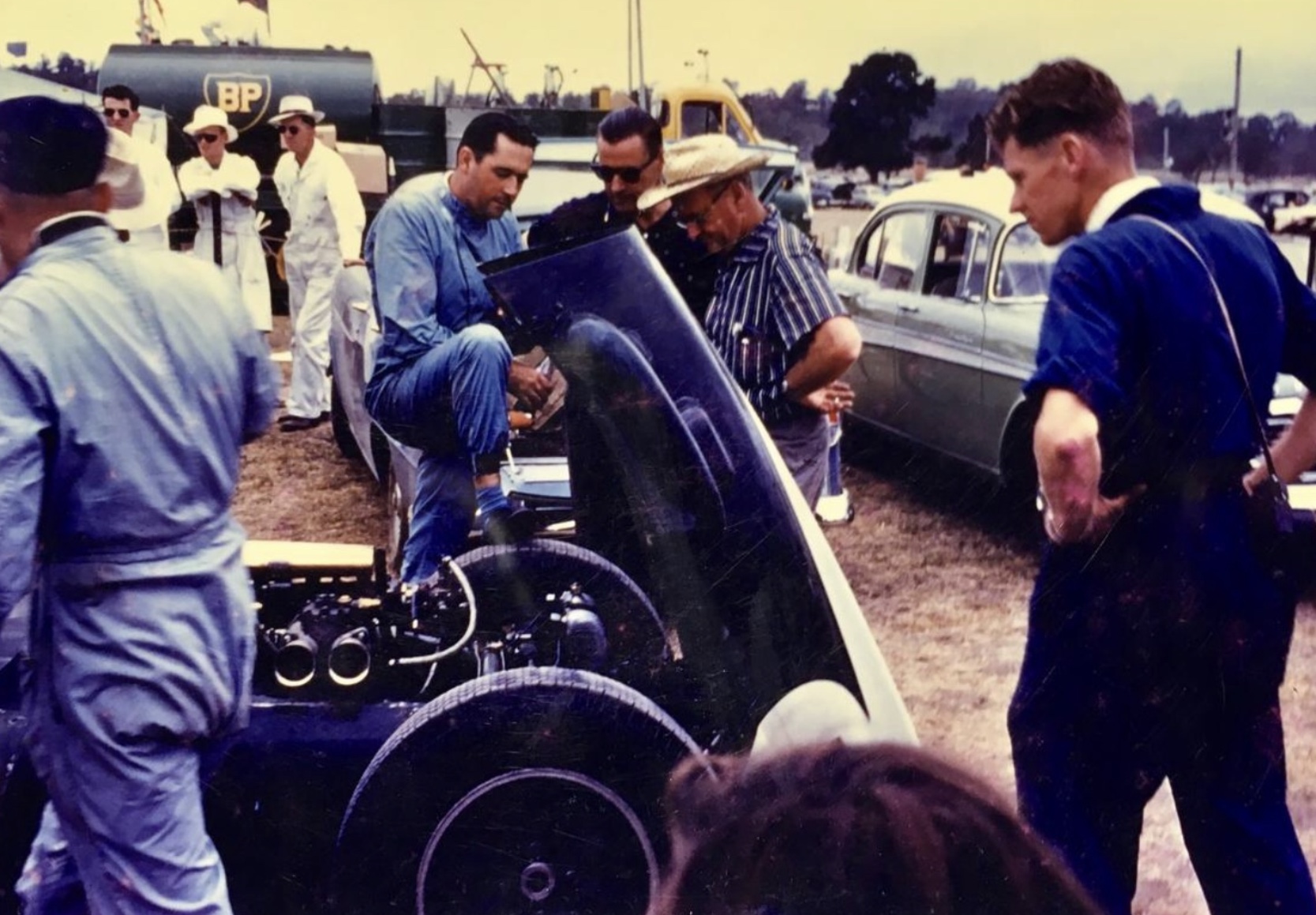
 

Jack with T51 in the Longford paddock 1960. Is that Alec Mildren in the striped shirt? Jack won in ‘F2-4-59’?) from Mildren’s T51 Maserati and Bib Stillwell, T51 Climax. Lovely atmo shot! Big, hungry DCO mouths (R Lambert)

Cooper were more dominant in Formula 2 where Coopers T43, T45 and T51 ‘cleaned up’.

The most successful combination of the year was Moss at the wheel of Rob Walker’s Borgward engined T43 and T45 with four wins. Tim Parnell and Chris Bristow took three apiece, Brabham two and one each for a lengthy rollcall- Jim Russell, Henry Taylor, Jack Lewis, Maurice Trintignant, Roy Salvadori, Harry Schell, Stan Hart, Trevor Taylor, Ron Carter and Tony Marsh. Amazing really, Cooper built and sold a lotta motor cars!

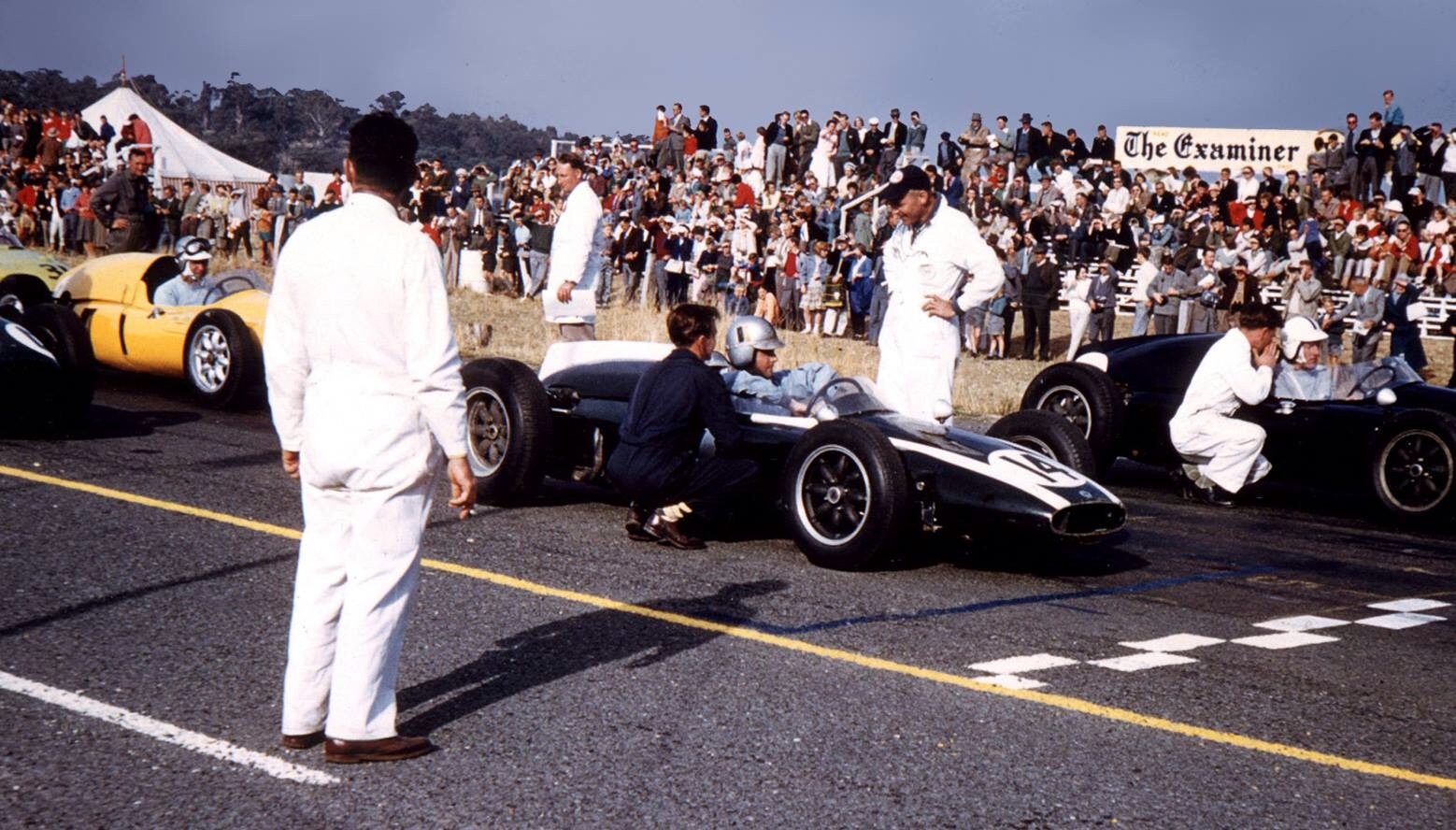
Moss’ Walker T51 Climax in the Ardmore paddock, NZ GP 1960. Moss DNF clutch after 27 laps- Brabham T51 won from McLaren T45 and Stillwell T51, Bib’s 2.2 the other two fellas 2.5’s (LibNZ)

At the European seasons end Moss, Brabham and McLaren headed south to the Antipodes for what would become an annual trip to race hard in the sun and play hard in the sun…

The NZ GP at Ardmore was won by Jack’s T51 as was the Longford Trophy in early March.

The Surbiton boys received a rude awakening when they fronted up in Argentina on 7 February with their T51’s to be comprehensively blown off by Innes Ireland’s new Lotus 18 Climax- Chapman’s first crack at a mid-engine design was a rather successful one in FJ, F2 and F1…

Bruce won the race after the Lotus failed but Jack DNF’d with heat-treating failure in his ERSA gearbox.

Suitably chastened the Cooper crew famously began the design of what became the Cooper T53 ‘Lowline’ on the long haul flights back to the UK. Doug Nye records that they landed in Heathrow on 17 March with the 14 May Silverstone International Trophy the deadline for completion of new cars.

Mike Barney preparing Jack and Bruce #18 T53 Climax in the Reims paddock in 1960- first and third, Jack won from pole. Technical details as per second part of the article but note the ‘bungy’ retained huge ally fuel tanks and relative height of T53 compared with T45/51

A head start was provided by Owen Maddock’s Cooper-Knight CS5 gearbox- it was just entering limited volume production in Knight’s workshops. McLaren’s College drawing skills were deployed to assist Maddock with Jack providing thought leadership and sketching whilst John chased suppliers for parts.

In essence the T53 was longer, sleeker, lower and lighter with a new, reliable gearbox able to take the loads of the more powerful FPF 2.5- itself mounted a smidge lower in the stronger in torsional stiffness by 25% (over the T51) Lowline frame- in the final year of the long-lived, very successful and interesting 2.5 litre F1.

The second half of the article covers the T53 technical advances in plenty of detail.

Cooper T53 ‘Lowline’ (Brian Hatton)

Innes Ireland won the Glover Trophy at Goodwood in April and the International Trophy at Silverstone in May- Jack’s T53 was second.

Moss could see the Lotus writing on the wall so Rob Walker acquired an 18 prior to Monaco- Stirling promptly won the race albeit Jack led until lap 41 when he spun on  a wet patch and clobbered the Ste Devote wall- the damaged frame was repaired in time for Zandvoort where he won- the Lowline’s first win was on the board.

At Spa the cars were jets- Jack was 2.5 seconds quicker than the nearest pursuer in practice. He won easily with Bruce second after others fell by the wayside- Nye notes Bruce’ car topped 180mph.

By Reims the T53’s were fitted with larger capacity oil pumps to prolong crown-wheel and pinion life. Jack started from pole and won again after a great long duel with Phil Hill’s potent Ferrari Dino 246.

Jack won again in Britain after Graham Hill’s BRM brakes faltered and he spun 6 laps from home, Bruce was fourth, adrift of the two Lotus 18’s of Surtees and Ireland.

This photo and the one below are to illustrate the size and shape differences between the 1959 T51- here Lance Reventlow’s works car and the 1960 T53- Bruce’ #2 car at Silverstone during the British GP weekend- up the road is one of the BRM P48’s. Brabham’s T53 won from the Surtees and Ireland Lotus 18’s. Bruce was 4th and Lance’s car was raced by (his Scarab fellow driver) Chuck Daigh- DNF overheating from Q19 after 56 laps


The shot from the rear is during the 1960 French GP at Reims- Olivier Gendebien T51, 2nd at left with Bruce’ T53 at right, 3rd. Jack won. Great effort by Gendebien in the BRP Cooper

Fortune again favoured the team at Oporto with another one-two whilst in non-championship events Ireland continued to win- the cars had the speed to win shorter events but not the reliability to win Grands Prix. He won the Lombank Trophy at Snetterton in September and Moss the Oulton Park Gold Cup in Walker’s Lotus later the same month.

The Italian organisers engineered a Ferrari win at Monza by running their race on the banked circuit and Moss- well and truly back after his terrible Spa crash on that deathly weekend early in the season, the victor in the US GP at Riverside in the Walker 18.

In Formula 2 Cooper did not have it all their own way in 1960 as they had the year before- of 26 races Cooper won twelve, the Lotus 18 six, Porsche 718 five and Ferrari 156 three- the latter car ‘a dry run’ for their 1961 World Championship winning cars. Of the Cooper brigade Brabham and Jack Lewis won three races, Mike McKee two and George Lawton, Roy Salvadori, Maurice Trintignant, and Klaas Twisk one apiece.

Bruce works T53 FPF 2.5 Lowline at a very soggy Wigram 1961. Bruce was fourth behind Brabham, Moss and Angus Hyslop- Cooper T53, Lotus 18 and Cooper T45, all Climax FPF powered (CAN)


Technical…

T43..


In a Motorsport Gordon Murray appreciation piece about the Cooper T51/53 he wrote that when he went to Brabham (in 1972/3) he inherited Pete Beddings and his Dad who made all of the early Cooper shells ‘…but I don’t know who styled them. Whoever it was obviously had an eye, because they were very pretty and quite effective aerodynamically. I suspect it was John saying “its a bit like this”.’

‘I still love to see a little Cooper at Goodwood: they still stir the blood just the same as a Ferrari or a Lotus. They were also well made for the period- if you look at, say, a Ferrari of the time, the frame technology is pretty basic: the rear engined Coopers were at least multi-tubular. Not pure spaceframes like Chapman moved on to later (I think he was well and truly there already Gordon!), but they were clever-simple for reliability.’

The T43 chassis was made of the usual Cooper 1 1/2 inch steel tube. The Mark 1 tall frame hoop encircled the seat back bulkhead and was unbraced whereas here (below) it was unbraced but the top chassis longerons each side of the engine bay were braced against the lower longerons by a three piece ‘Y member’.

What about those Cooper chassis’ which have always offended the purists- a true multi-tubulars spaceframe chassis should use straight tubes only, each stressed in either compression or tension.

Famously, after laying out several straight tube designs for the Mark 8, and in John’s absence having them rejected by Charles Cooper, Owen Maddocks decided to take the piss and presented an option in which every tube was bent- to his surprise it was embraced by Charles, a good intuitive Engineer.

Doug Nye recounts Owens account of the discussion about the approach when John Cooper returned.

’Curving the top frame rails down to meet the bottom ones reduced wracking through the frame. You could run curved tubes where they wouldn’t interfere with fuel tanks and suchlike. One of our very good welders always told me he preferred simple joints- with just one tube jointed into another- to multiple joints with with three or four tubes involved. We didn’t like weld overlapping weld and so tried to arrange things to avoid that. With curved tubes we could follow the body lines more closely, so we didn’t need the old strip -steel frame to support the body panels. What had started as a joke began to look quite logical, and very practical…’

The F2 Coventry Climax 1475cc gave circa 141bhp @ 7000rpm in its first evolution and drove through a Citroen-ERSA transaxle, which coped pretty well with the demands put upon it at that stage. Note the change linkages and beautiful rear suspension detail- traditional transverse leaf and wishbones Cooper design.

Coopers curvy frame shown to good effect.

In 1956/7 wire-wheels were still very much the norm in motor racing, Coopers progressive inclination was reflected on the magnesium alloys specified on their cars pretty much from the start. Objects of beauty, lower unsprung weight and strength were amongst the favourable properties.

Crystal clear John Ross shot- not quite close enough to checkout the chassis number however! I wonder who was the steering wheel provider of choice.

Note the gear lever and linkages to the left- the weak link of the higher powered T45 and T51’s covered in this article were the gearboxes, a solution was finally arrived at for all in the form of Mike Hewland’s concern in the early sixties when a racing gearbox finally ‘became a spacer between the engine and rear of the chassis.’

Smiths instruments of course- I wonder if one of those to the lower left is for gearbox oil temperature?

The engine progression in 1957 goes something like this.

F2 Coventry Climax FPF 1500cc 141 bhp was the ‘standard engine’ for F2 T43’s.

In F1 Jack Brabham raced at Monaco with a 1960cc FPF for the first time and later in the season, as outlined earlier in the article, 2.2 litre engines were approved by Leonard Lee late in the year and made available to the works and Rob Walker teams in 1958- and others later.

The T41’s side panels wrapped tightly around the chassis hoops whereas the T43’s were bulged to clear the fuel tanks either side of the driver- sufficient tankage was incorporated for a race of 200 miles duration. The bulged body panels were carried clear of the frame on light-guage outriggers.

See the bungees retaining the fuel tanks above. Brakes in standard form as here, were Lockheed 10 inch x 1 3/4 inch drums but Girling discs were an option and commonly specified. Shock absorbers were Armstong and uprights, I think, fabricated in-house.

Very slippery.

Lean, lithe, light and uber-responsive given the low polar moment of inertia.

Not for the faint of heart and not everybody familiar with a front-engined racer could successfully make the switch- mind you, by 1956 a generation of racers had cut their teeth on air-cooled, mid-engined Coopers so they were rather used to the handling properties of the little beetle-backed machines.


T45…


This group of photographs are all of an F2 T45 FPF 1.5 but the technical elements of the F2 and F1 T45’s are the same with the exception of engine capacity of course.

The Mk3/T45 F2 and F1 and 1959 Championship winning Mk4/T51 F2 and F1 cars are virtually identical so lets take a deepish dive into the T45 and the changes over the previous T43.

This chassis is fitted with an F2 1475cc FPF- T45’s were also fitted with 1960cc, 2015cc and 2207cc FPF’s in 1958.

The bore/stroke at the latter capacity was 3.5 inches- this ‘square’ configuration was only made possible by slipping a ‘sandwich plate’ between the block and the head to get the required stroke height. On Avgas this motor produced 194bhp @ 6250rpm.

The shot above provides just a glimpse of the rear transverse leaf spring aft of the chassis cross tube.

Its lateral location was now provided by a short link pivoted on the left side frame trunnion and bolted to a centre clamp (you can just see the inner end) retaining the leaves in the middle of the spring.

Front to rear weight balance of most Coopers was about 44-56%- quite similar to the best front engined cars with a rear mounted fuel tank.

The T45 chassis was  1/2 inches lower than the T43- at the front it now incorporated upper and lower wishbones and coil spring/Armstong shocks rather than the transverse leaf used by Coopers from the start.

Ain’t she sweet.

Note the Alford and Alder forged front uprights, these wonderful bits of kit, then fitted to the Standard 8 and Triumph TR3 Road cars, were installed in F1 Brabhams up to and including the 1966 World Championship winning BT19 Repco- and Formula Fords well into the late seventies and beyond. One of motor racings most ubiquitous components, surely?

The front wishbones were of the welded tubular type and included a Chorlton ball joint at their outer end. The uprights lower threaded trunnion was coated with cadminium plating setting the finished product off nicely. Roll bars were housed within the bottom frame cross-member.

The photograph below shows (apart from the very obvious) the top leaf outer end, Armstrong shock and inboard mount for the lower wishbone. The wishbones were more widely based at both the top and bottom than on the Mk2/T43. The outboard mount for the Armstrongs was stiffened- it was on a crossbrace welded between the wishbone legs. Note the fuel filter, starter motor and height of the gearbox.

On the earlier cars the height of the engine in the frame was determined by the Citroen based gearbox as its input shaft from clutch to gearbox passed high above the inner driveshafts.

In the early Mk2’s the engine was canted 18 degrees to the right and inclined downwards at the front by 5 degrees to lower the centre of gravity.

Jack Brabham’s ongoing contribution to design elements of Coopers in addition to set up and on circuit tuning is well established and recognised. Brabham maintained ongoing correspondence with Ron Tauranac back in Sydney. It was Ron’s suggestion to use ‘drop gears’- spur gears inside the gearbox bell-housing which allowed the engine/gearbox to be lowered a full 2 1/2 inches within the chassis frame.

Cooper worked with ERSA in Paris, the gearbox manufacturer and Jack Knight’s specialist shop in Balham, to effect those changes. A bonus was incorporation of a quick-change final drive ratio feature.

Jack famously visited ERSA in early 1958 and had six gearboxes cast with extra strengthening ribs. He laid out all the patterns on the bench and added Plasticene here and scraping a core there- the trick cases were just man enough to handle the power of the 2.2 engines in 1958 and 2.5’s in 1959. ZF slippery diffs were added too- a side trip for Jack whilst in Germany, back at Surbiton ‘…John covered his tracks so Charlie would not hear of the extra expense’ Nye wrote.

‘All Cooper chassis pickups…had been provided by drilled triangular welded-on brackets known as “Bradnack Lugs”, and on the Mark 3 frame those anchoring the inboard pivots of the lower wishbones were aligned above the bottom frame rails instead of below them. Both top and bottom frame longerons were more widely spaced than on the preceding Mark 2’s with less pronounced tube curvature’ Doug Nye wrote.


Whilst noting Cooper’s mid-engine approach itself was at the time revolutionary, the evolution of the cars from T43 to T45/51 was more evolutionary in nature addressing design/performance weaknesses or strengthening componentry based on hard won experience.

Charlie, John and Jack were all racers…and supreme pragmatists.

They were not after the great leap forward- they had that conceptually, beyond that they sought performance advantage and reliability whilst Charles, with a ready eye on the family fortunes, ensured the whole kit and caboodle could be sold at a profit and repaired and maintained cost-effectively back at Hollyfield Road or by a customer in the paddock at Gnoo Blas.

Doug Nye is at pains to point out in HAGP that the specification of these cars is not fixed or hard and fast given so many of them, as we covered earlier, were built in the factory by the teams running them or using kits of parts supplied. The ultimate detail and personal tweaks applied means that individual chassis differed from one another almost as a matter of course.

Take your pick of artists in terms of T51 cutaway drawings!

The one earlier in the article is Tony Matthews, above is James Allingtons’ and the one below is Brian Hatton’s so every angle and detail must be well and truly covered!


T53 ‘Lowline’..


(D Friedman)

As mentioned earlier the threat of the Lotus 18 meant that a ‘clean sheet’ approach was needed- a Cooper-esque clean sheet in any event! Every part of the T51 was quickly scrutinised through lenses of lightness, simplicity, strength and efficiency.

Fundamental design tenets were laying the driver down to aid aerodynamic efficiency, a coil sprung rear end (Charles Cooper fought a pitched battle on this score Nye records by insisting that a transverse leaf rear also be designed should the coils fail), greater torsional stiffness and an improvement in performance around the T51 ‘weak tracks’ which included fast places like Reims and the Avus.

(D Friedman)

The chassis was still essentially a four-tuber of 1 1/2 inch 18 gauge thick top rails and 19 gauge bottoms. Diagonals braced the frame bays ahead of the cockpit but that area was un-braced ‘other than small tube ties welded across the joint apices’.

The long rear bays were unbraced on both sides, when the engine and gearbox were fitted- the latter ‘CS5’ had five mount points frame stiffness was of course enhanced. There were two diagonals in each side with a common apex halfway along the bottom chassis rail.

The engine mounts were welded onto curved tubes to reduce the length of the mounts, both of which were welded to the middle of the main frame members, this ‘would have been heresy to an accomplished stress man like Colin Chapman’ Doug notes.

(D Friedman)

The engine was lowered another inch over the T51 by reducing centre-offset between the step-up gears in the gearbox and allowing the driveshafts to rake upwards to the hubs rather than being parallel with the ground when static.

The steering column was lengthened and moved from behind the front axle line to ahead of it- thus the pedals could go forward and the steering wheel rake made more vertical all allowing the driver to adopt a more laid-down pose aiding aero on those fast courses.

The oil tank capacity was the same but its shape was changed- it was lower and wider, still behind the radiator but pushed forward to reduce nose height.

(D Friedman)

Suspension wishbones were wider and stronger.

The ‘CS5’ transaxle was a lovely bit of kit. It was remote sumped in its gearbox section with splash-feed to the final drive and ZF diff. The unit placed its gears above the oil level so only a pressure pump was needed.

The gearbox ‘…proved essentially trouble free…Jack Knight recalled the vast amount of machining required…its cost to Cooper was around 1000 pounds a box which was virtually prohibitive. John Cooper managed to hush it up, telling his father they cost around 400 pounds each- and The Old Man was livid even then!’ Nye wrote.

No doubt Chapman would have been keen to get hold of a couple of these boxes half way through 1960, fitted thus he had a championship winning car.

Note the CS5 gearbox and pressure pump on the outside casing, oil filler neck and upper and lower rear suspension wishbone mounts (D Friedman)

The prototype Lowline was completed at around 9 am on Friday 6 May 1960 and taken to Silverstone, where after a few shakedown laps, Brabham drove faster and faster- within 10 laps he was 2 seconds under the lap record. Then Bruce jumped in and went quicker still.

Cooper were well and truly back in the game!


Bruno Betti’s take on the Cooper T53 ‘Lowline’

So where does this series of cars fit in the pantheon of racing cars and motor racing history?

Gordon Murray was rather eloquent about that aspect.

‘When I think back to GP milestones , its pretty obvious really, the first rear-engined F1 Cooper. Not so much from a technical point of view even though it was so simple and so effective compared to the other more complex cars of the time but because it brought with it probably the most significant change in Grand Prix cars…’

‘Who else can lay claim to such an impact. And i’m including pre-war cars like Auto Unions because they were such bad examples of rear-engined cars…The real pioneers were Charles and John Cooper, first with the 500 F3 cars and then having the bottle as a small concern to go ahead and do a GP car.’

‘Really the Cooper was more significant, more forward looking even than the Lotus 25 because it meant a fundamental change in packaging, weight distribution, frontal area, in philosophy. And it was an ultra simple car as well, easy to run easy to work on. I always tried to build my GP cars at both Brabham and McLaren to be as simple and easy to work on as possible, and therefore get reliability, and the Cooper was such a good car from that angle. And that Climax was a very under-rated engine because it was built by a very small company. So, the whole package was pretty radical. John probably hasn’t had the credit he should have overall.’

‘All kinds of things appeal to me about it: firstly it was a great little family business, two bright guys and then the giant killing aspect…I just love that aspect. And these guys did two titles back to back…’

Finally, Gordon concluded ‘As a designer i’d have loved to have been the first to say “hang on that’s a  bit cranky having the engine in the front”, with that weight distribution, that frontal area, the prop-shaft losses, compared to the extra traction, better braking- everything gets better with the engine behind. You can’t help saying “Why didn’t somebody think of this before”…

1961 February Teretonga International, NZ. L>R Tony Shelly, Cooper T45 Climax, Pat Hoare, Ferrari 256 (in essence a Dino 246 with 3 litre Testa Rossa V12) Denny Hulme Cooper T51 2.5 FPF leased off Yeoman Credit and Jo Bonnier Yeoman Credit Cooper T51 Climax- to the right is Malcolm Gill in the silver Lycoming, a very successful, iconic Kiwi aero-engine special. No less than Jim Clark was impressed with a drive of this car! Bonnier won from Roy Salvadori, Lotus 18 off the back of the grid, Hulme and Hoare (CAN)

Etcetera: Cooper Mark and Type Numbers…

Allen Brown advises that the ‘T type’ descriptor started at Cooper in 1963. It was applied both prospectively and retrospectively. Stephen Dalton ‘tangibilises’ this in that after extensive research, he can see Cooper using a ‘T number’ for the first time in an October 1962 issue of Autosport where Cooper are quoted about ‘the new Cooper Monaco, the Type 61’

Doug Nye wrote more broadly about the timing of the detailed way in which racing cars commenced to be identified (that is, for example, when a Cooper or Cooper Climax became a Cooper T51 Climax) ‘When it comes to a type numbering system- as in so many things Cooper- don’t rely on published references to same…I have seen all types of T scrawls on some drawing copies.’

‘When I publicised manufacturer type classifications in a “Motor Racing” magazine article reviewing the 1 litre F2 seasons 1964-5 that was the first detailed references that many people had seen to some model classifications which are now used as common terms. I was not the first- but I think at least amongst the first- to present such nerdy detail.’

‘Race reporters had seldom used even Brabham BT classification before then…Brian Jordan had previously produced a little booklet essentially for model makers which included type number detail. I also seem to recall Paul Watson freelance writer/entry fixer of the 1960’s having on a few prior occasions cited a type number’ Doug concluded.

Renwick 50, in the very north of New Zealand North Island, November 1961. Flagman at the bottom of his downward arc on the podium at right! Preliminary heat on the one off rectangular circuit which used the main street. Bob Eade, on pole Maserati 250F, Tony Shelly, Cooper T45 FPF 2 litre. Pat Hoare (won the main race in his Ferrari 256 V12) on row 2 then the Bob Eade 250F and the rest including Chris Amon- in front of the sportscar on the right perhaps? (CAN)

Credits…

Special thanks to the fantastic John Ross Motor Racing Archive and Dave Friedman Archive, Theo Page, Brian Hatton, University of Newcastle, The Nostalgia Forum, ‘CAN’-Classic Auto News- Allan Dick, Milan Fistonic, Geoff Smedley, David Van Dal, oldracephotos.com.au, Getty Images- Bernard Cahier and GP Library, John Ellacott, Ron Lambert, Tony Matthews, James Allington, Bruno Betti, Ken Devine Collection

Bibliography…

‘History of The Grand Prix Car’ Doug Nye, grandprix.com, oldracingcars.com, F2Index-Fastlane, Motorsport ‘Cooper T51/53’ interview with Gordon Murray in June 2000

Tailpiece…

Jack at his happiest and most creative.

‘Jack Brabham…was always working with the cars, looking at them, thinking about them…’Owen Maddock fondly observed of Jack to Doug Nye.

Its a posed shot above no doubt but it illustrates the point all the same…

Finito…
 

(J Wright)

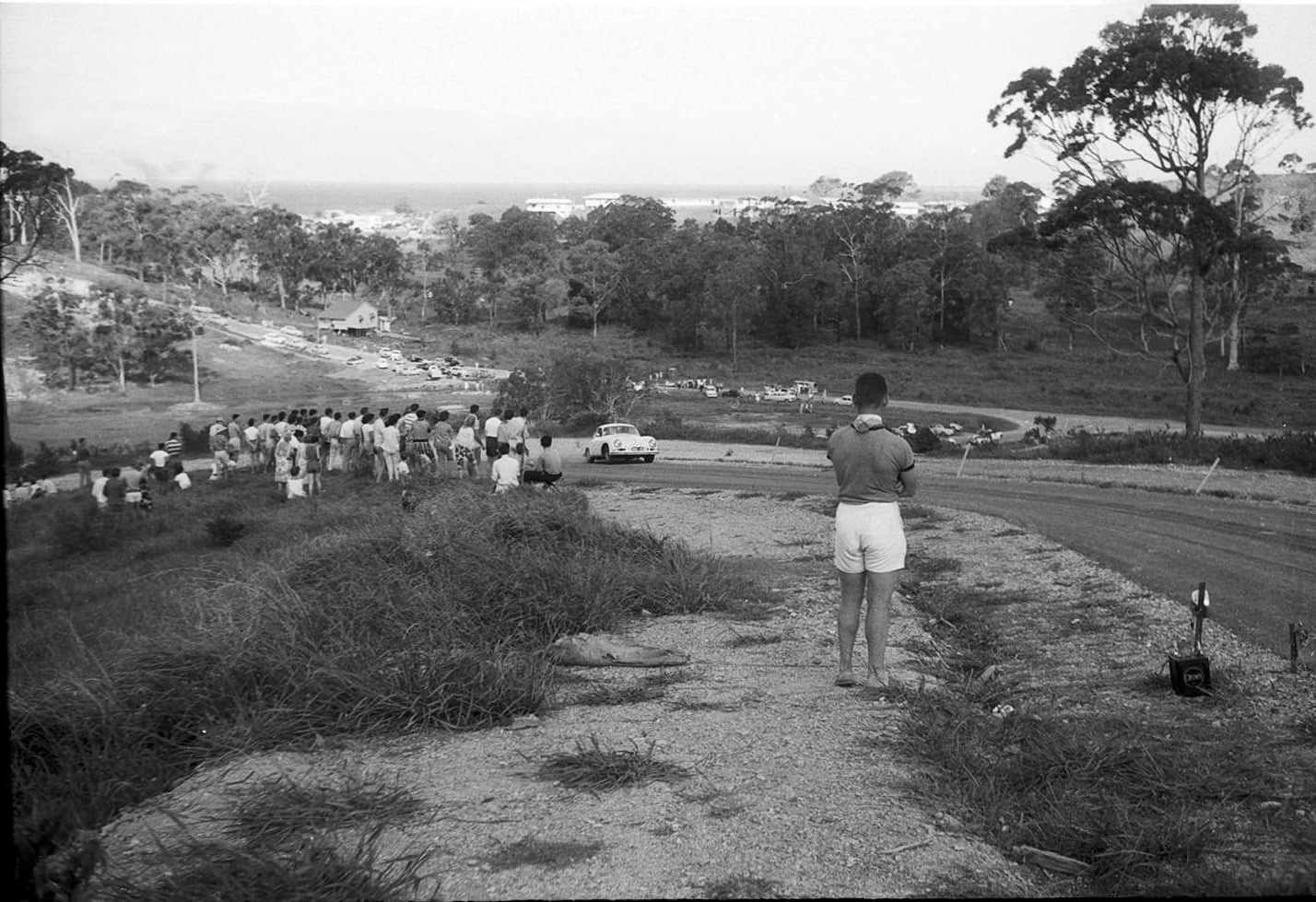
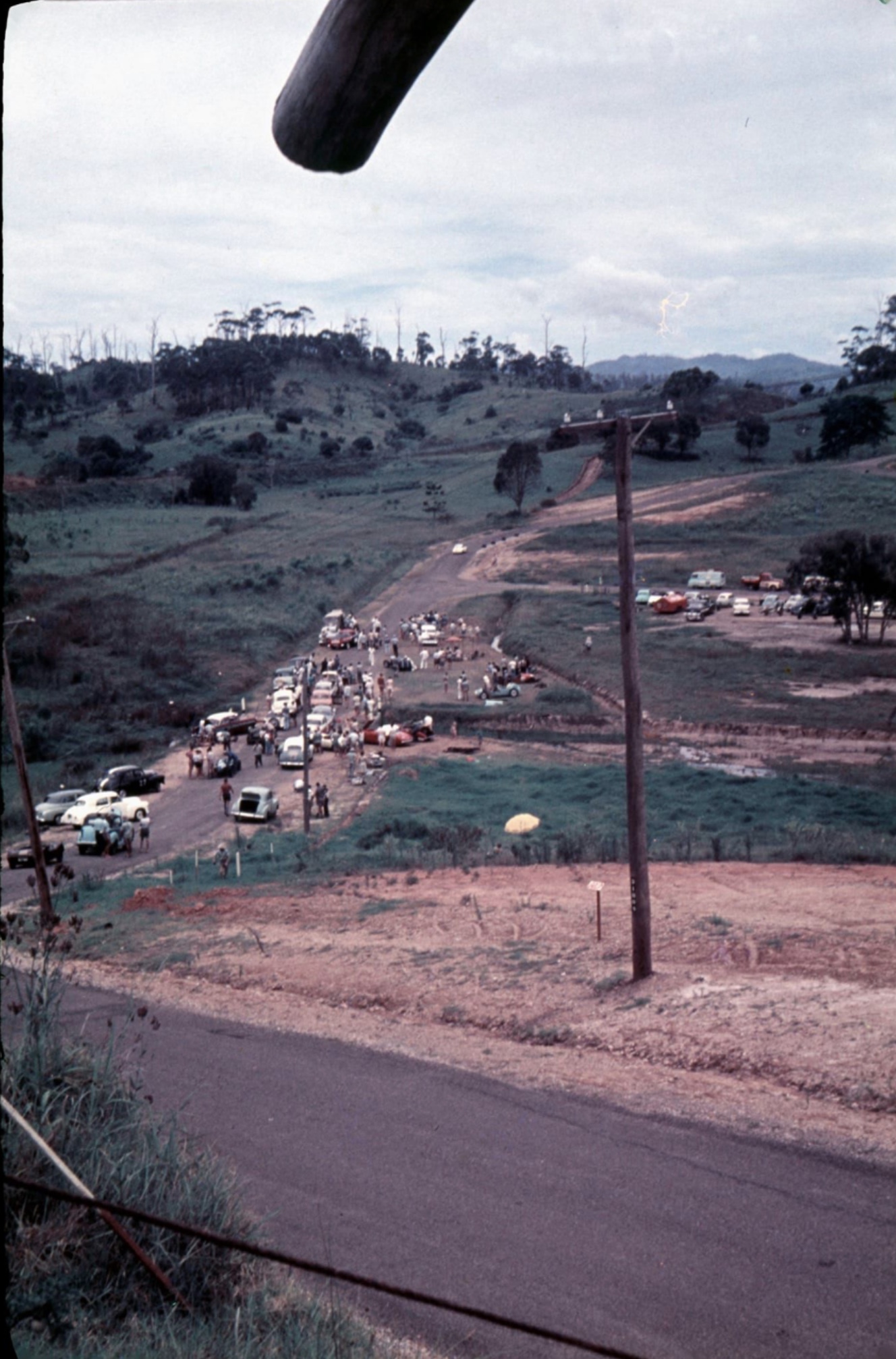
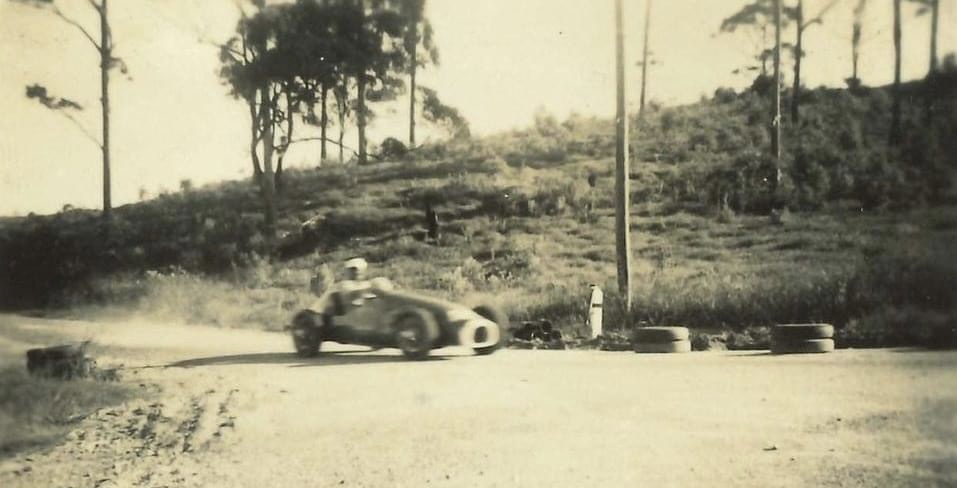
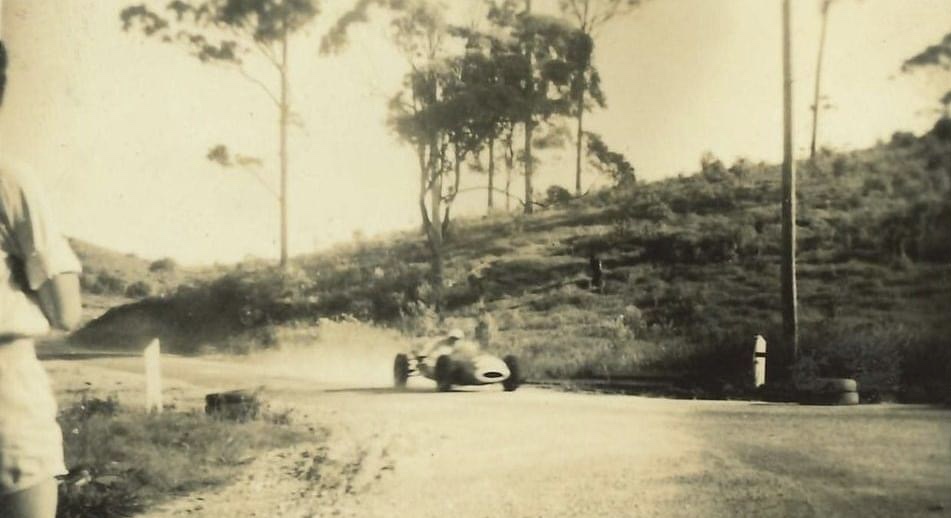
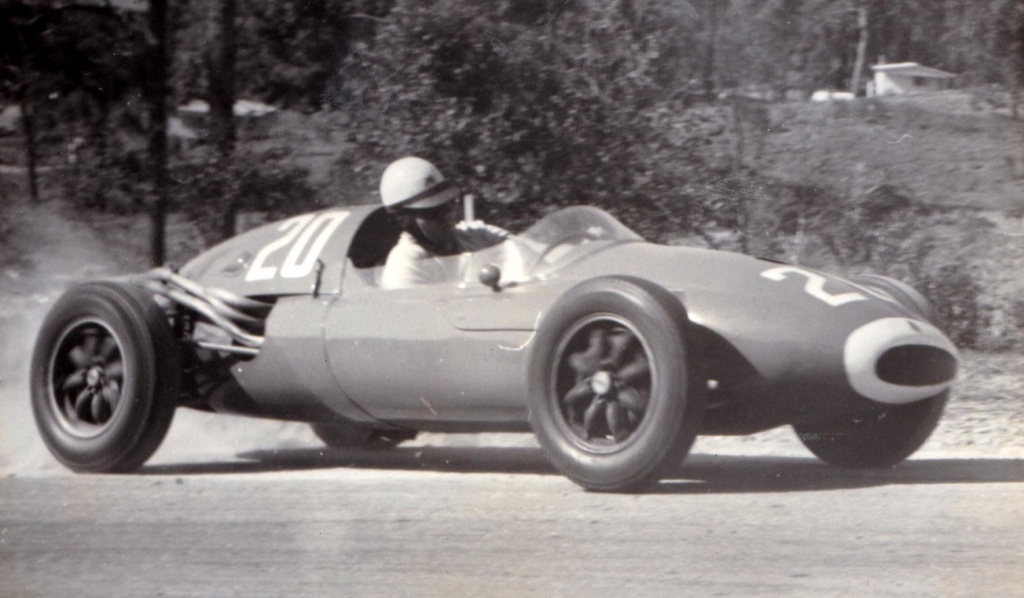
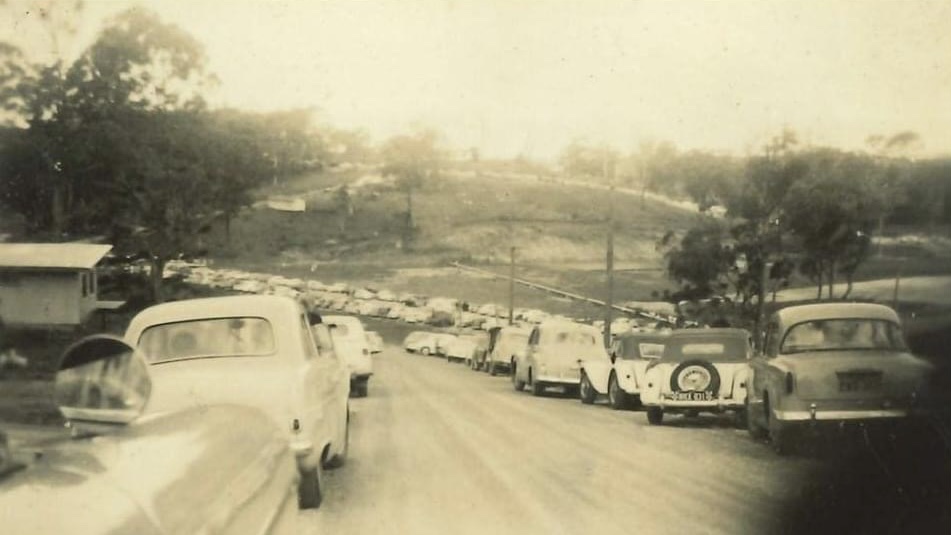
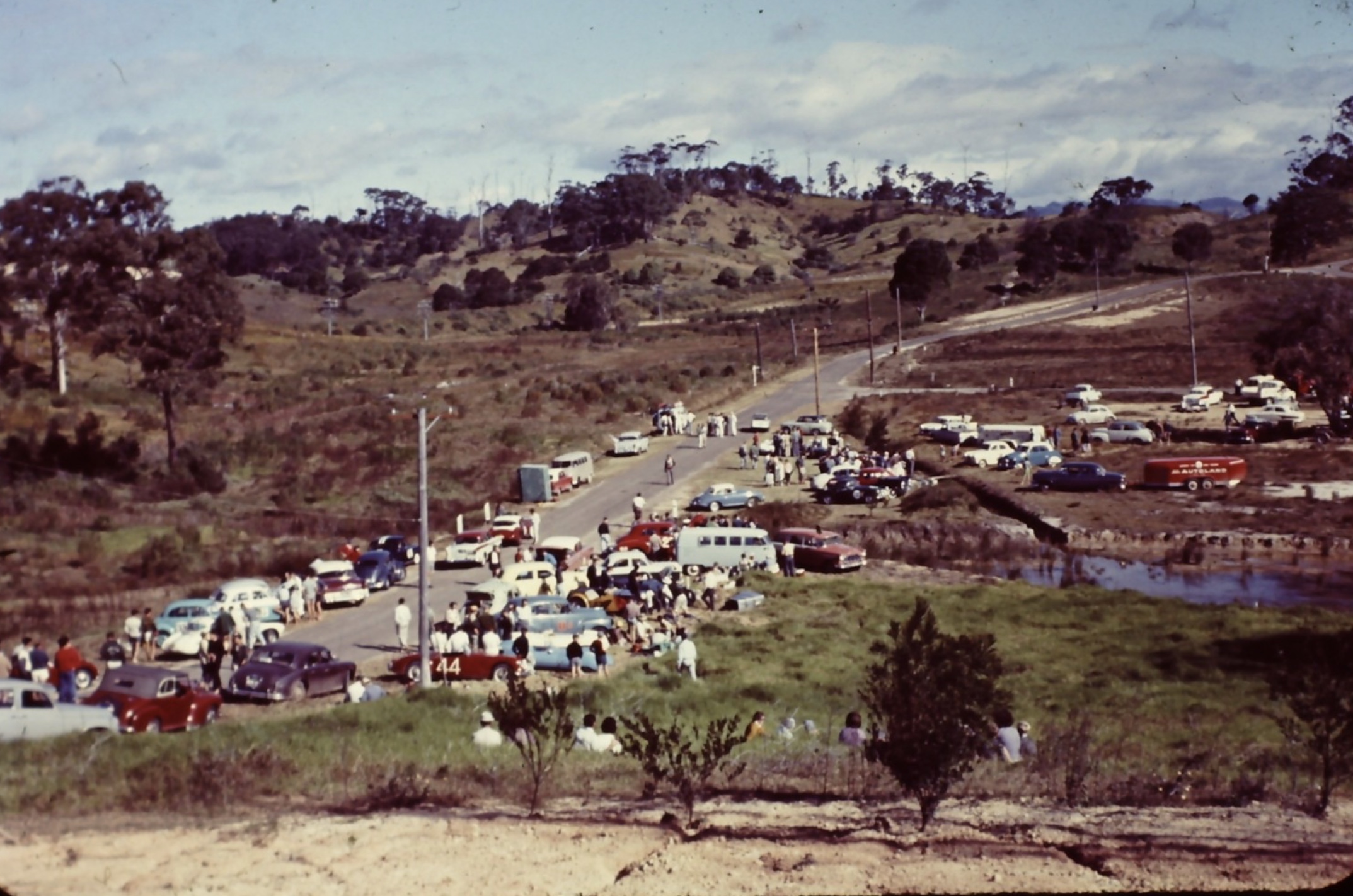
Competitors assemble for a Queensland Motor Sport Club Currumbin Hillclimb, Monday 12 June 1961…

Most east coasters have holidayed on Queensland’s Gold Coast, visited the Currumbin Bird/Wildlife Sanctuary and no doubt had a surf on the beach close by. Currumbin is 20km from Surfers Paradise and a dropkick from Tweed Heads – the Queensland/New South Wales border.

This photograph has proved a bit of a mystery though.

I popped up an article on Lakeside circuit up last week but was uncertain about the photograph above given the wise owls of The Nostalgia Forum could not reach a consensus on where it was, a very rare occurrence I might add. I then uploaded the photograph onto the primotipo and Old Australian Motor Racing Photographs – Australia Facebook pages, the Lakeside article is here; https://primotipo.com/2019/09/23/lakeside-early-days/

After four or five days and 8,027 FB hits/views Quentin Miles is the winner with photographic evidence to back up his nomination of place – Currumbin.

Porsche 356 on full assault. Note the corner marshal in safety overalls and the sea in the distance (B Miles)
(B Miles)

Racer/restorer Dick Willis believes the roads used were created for a housing estate and that the Gold Coast club got some events in before the influx of residents precluded further motorsport use. Brian Lear’s records show events were run in December 1958, 1960 and 1962. Stephen Dalton’s discoveries indicate the strip of bitumen used was 750 yards in length with Ivan Tighe the record-holder in 1959, he did a time of 47.5 seconds in his Vincent Special.

In Quentin’s case his father Bill attended a meeting and took these shots, its not the first time I have used the late Bill’s great material.

Several folks have identified the red Rice-trailer in the opening shot as Autoland – one of Bob Jane’s enterprises – contained therein is Bob’s voluptuous Maserati 300S. It’s a long way from Melbourne to Currumbin to contest a club ‘climb though. My theory is that Bob would have been racing not too far away, at Lowood and did the Currumbin event whilst in the ‘hood.

Roll forward to June 2020 and Andrew Lake, a Queensland MG Car Club member emailed to advise the meeting was the 12 June 1961 Queensland Hillclimb Championship. ‘As identified it is Bob Jane’s trailer…he competed in the event in his Maserati 300S and also his Jaguar sedan…Stan Jones did FTD with a time of 45.22 seconds in his Cooper T51 Climax.’

Some further work by Stephen Dalton established that Stan contested the Lowood Gold Star round – the Queensland Road Racing Championship – the day before, Bill Patterson won from Alec Mildren and then Stan, all driving Cooper T51s.

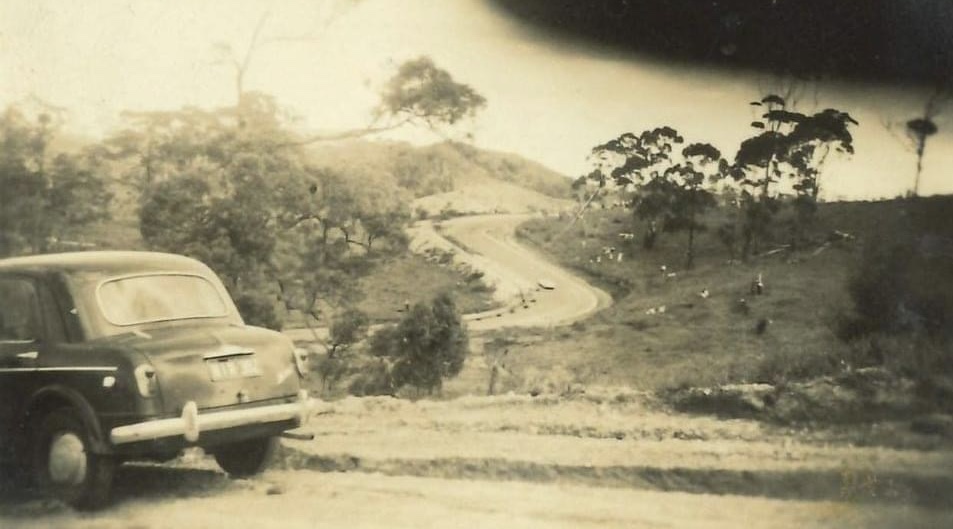
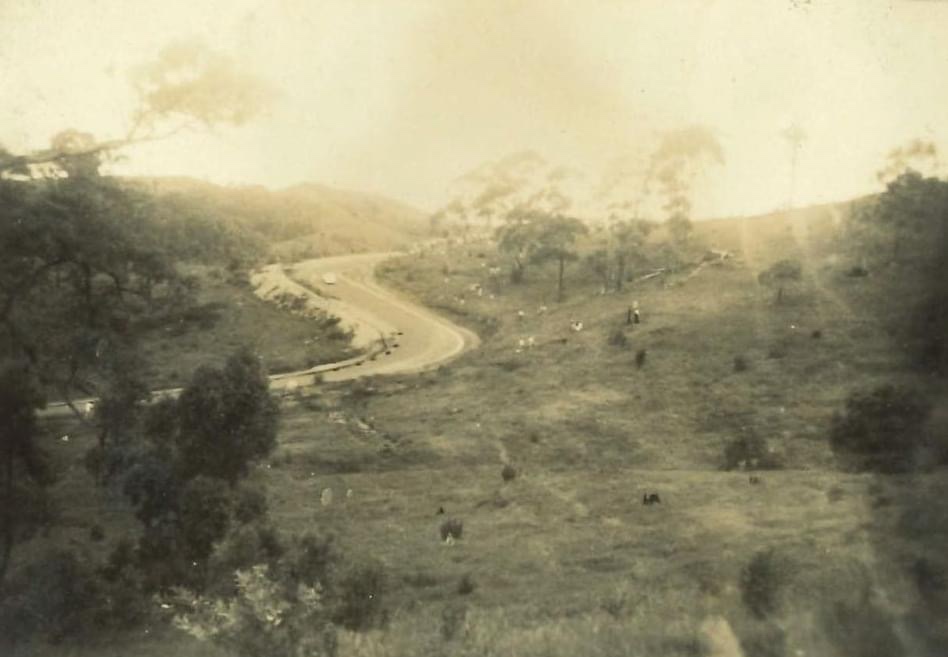
Roll forward again, this time to January 2024, and the bunch of photos taken by Peter Button’s grandfather shown below. Pauline Burrows Booth recalled, “I remember the climb well, going to watch the hillclimbs was very exciting. The hill was Currumbin Hill, on the east side that wasn’t allowed to be built on as it was a dangerous slip area.”

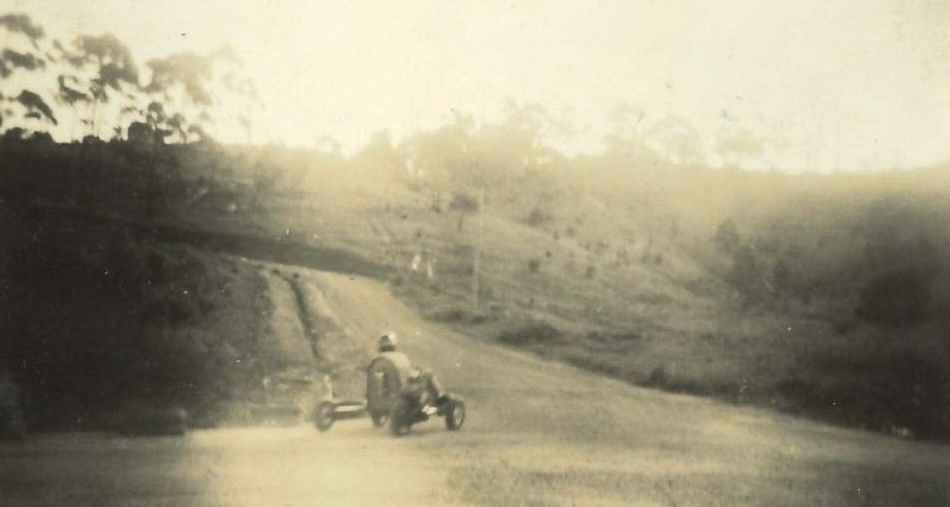
‘The street was on the crest, Crest Drive – it wound around the top of Currumbin Hill to the Shell Museum corner corner to Millars Drive – winding down to Millars Drive and past the now Currumbin Wildlife Hospital. The other side of the hill, Alpha Drive, we used to ride down with our go carts-billy carts

Anyway, many thanks to Quentin and his late father Bill, Stephen, Dick, Brian, Terry, Andrew, Peter Buttons and those who responded to his FB post, a team effort indeed!

Etcetera…

(T McGrath)

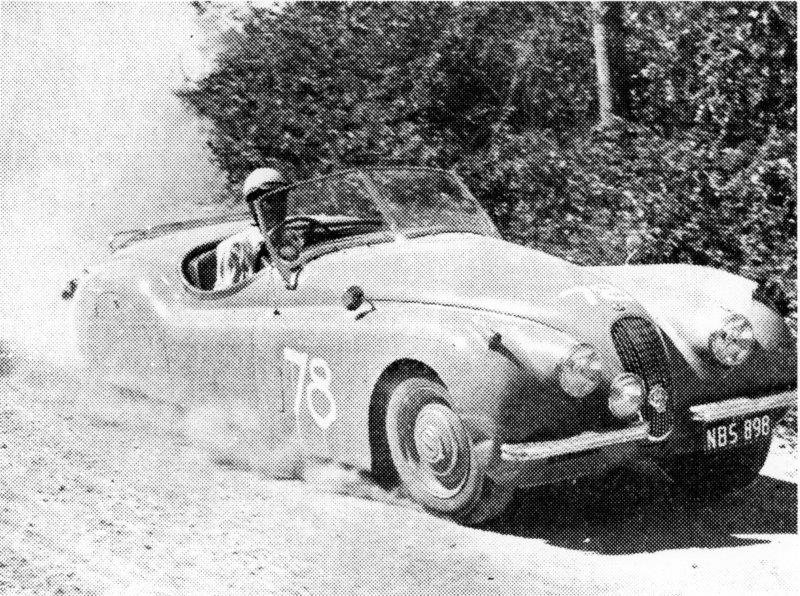
Terry McGrath tells us there was a hillclimb closeby on the Gold Coast at Burleigh Heads or Waters held on a short stretch of road with times of between 50 and 56 seconds recorded. The Dick Hamilton Jaguar XK120 is shown in full flight on 30 December 1956.

(P Button)

This bunch of shots at the ‘Currumbin Heights Hill Climb’ were spotted by Doug Grant on the Old Gold Coast Facebook page in January 2024.

They were posted by Peter Button whose “Grandad was a keen amateur racer at the time.”

(P Button Collection)

Dick Willis, “The Glynn Scott (Cooper T23 replica) Repco Holden driver by Roy Morris, now raced by Victorian, Nick McDonald.”

(P Button)

The shots above and below are of Glynn Scott’s ex-Alec Mildren Cooper T43 Climax.

(B James)
(P Button)

“Crest Drive looking across Miller’s Drive to where the wildlife hospital is now and the park across the road with the old water pipe running through it. Blamey Drive is running up and over the hill…” Glenn Bycroft.

(P Button)

Ivan Tighe, perhaps, on his Vincent Formula 500.

(P Button)

Andrew Lake advises hillclimbs were held on the Gold Coast as follows;

Burleigh Heads

01/01/1956, 22/04/1956, 17/06/1956, 30/12/1956, 21/04/1957

Terranora

29/12/1957

Currumbin

28/12/1958, 15/11/1959, 27/12/1959, 14/08/1960, 26/12/1960, 12/06/1961

Credits…

Quentin Miles and the late Bill Miles, John Wright, Stephen Dalton, Dick Willis, Brian Lear, The Nostalgia Forum, Terry McGrath, Andrew Lake, Peter Button Collection, Bruce James

Tailpiece…

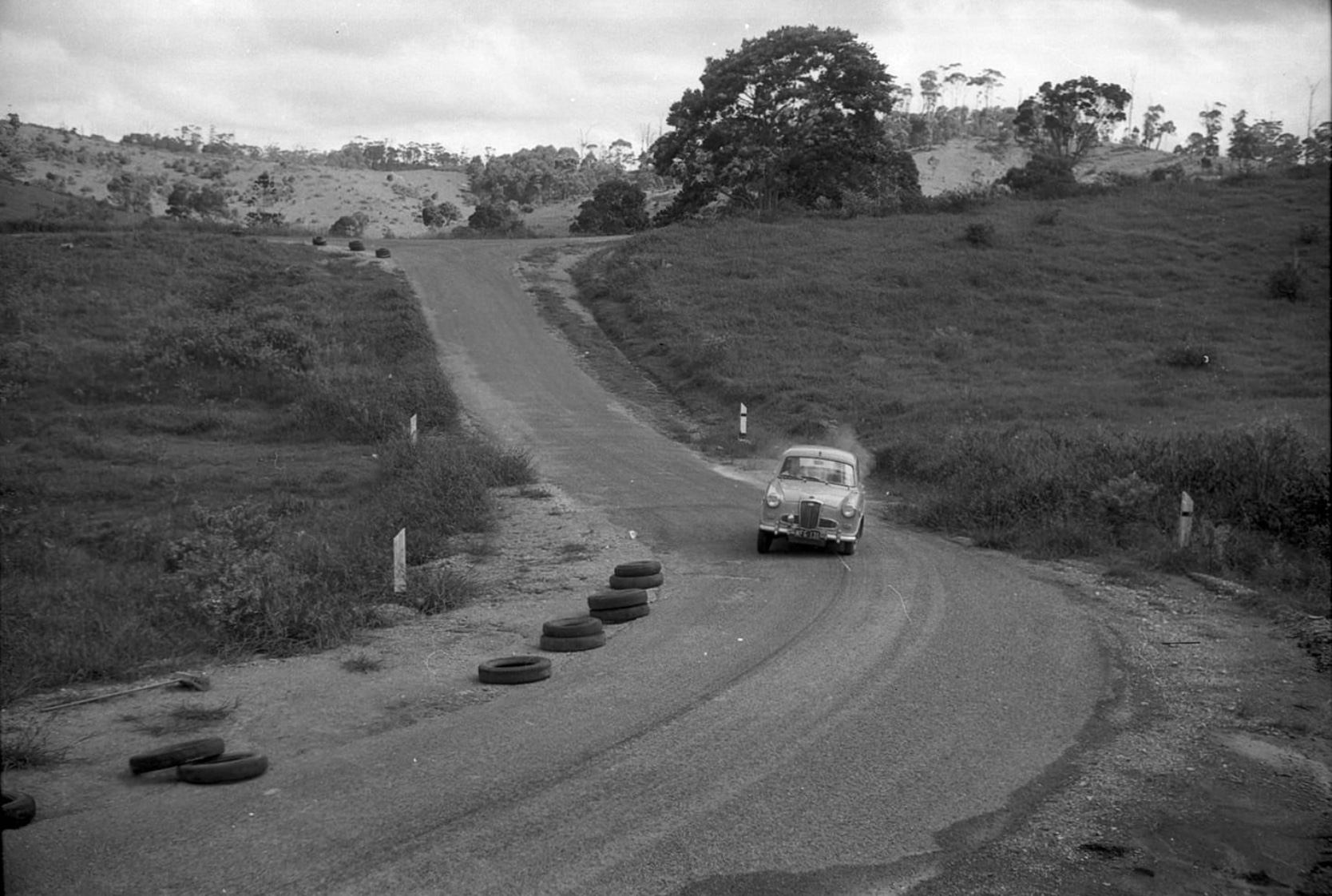
Wolseley 1500 attacking the downhill right-hander, tyres mark the apex (B Miles)

Finito…

(Natlib)

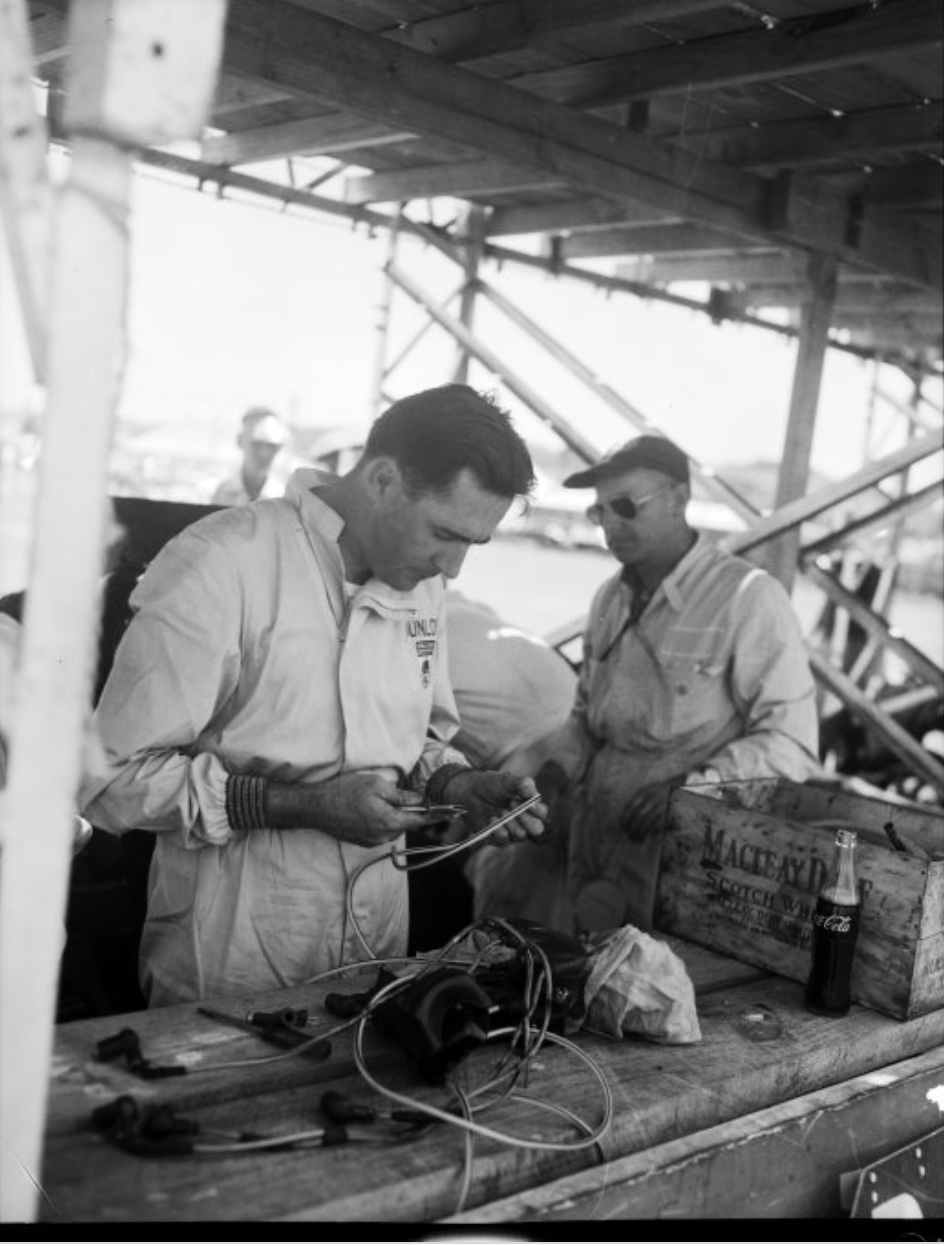
Jack Brabham sorts some Coventry Climax, or more particularly, Lucas electrical problems on the Ardmore pit counter during the 1960 New Zealand Grand Prix, January 9 weekend…

That Brabham’s mechanical abilities were right up there with his talent at the wheel has never been in doubt!

Note ‘the breakfast of champions’ bottle of Coke at the ready. The wooden box of Macleay Duff whisky is more troubling but I think its safe to assume Jack was not mixing the two liquids to assist his quest for greater speed. Not that early in the day anyway.

Brabham at Ardmore 1960, Cooper T51 Climax (Natlib)

Bruce led the race in a Cooper T45 FPF 2.5 ‘brought up to 1959 specs’ wrote Bruce Sergent, whilst Jack’s car was a new 2.5 litre T51.  McLaren’s 3 laps up front ended when he was passed by Moss’ Rob Walker T51, also fitted with a 2.5 FPF.

Brabham and Moss then staged a spirited dice with the lead changing a number of times before ‘Brabham’s determination and slight edge in performance’ put Jack in front on lap 18.

Moss was stopped by a broken clutch-shaft on lap 27- Brabham and McLaren then put on a show for the crowd before a ‘form-finish’- Brabham won from McLaren and then Aussies Bib Stillwell and Stan Jones in 2.2 litre engined T51’s. John Mansel and Arnold Glass followed in Maserati 250F’s in fourth and fifth and best of the front-engined, now, old guard…

(Natlib)

David Piper’s Lotus 16 Climax (DNF driveshaft) from Moss’ Rob Walker Cooper T51 Climax 2.5, #88 Ron Roycroft’s ex-Gonzalez Ferrari 375 (twelfth), Malcolm Gill, Lycoming Special (DNF) then Stan Jones, Cooper T51 Climax 2.2 and Ted Gray, Tornado 2 Chev DNF.

Brabham raced on in Australia after his NZ Tour, click here for that; https://primotipo.com/2015/01/20/jack-brabham-cooper-t51-climax-pub-corner-longford-tasmania-australia-1960/

Credits…

‘Natlib’- National Library of New Zealand, Bruce Sergent on sergent.com

Tailpiece…

(Natlib)

A couple of beaming youths- Brabham and a somewhat bloodied McLaren with the goodies. I doubt Jack thumped him so circuit grit is probably the culprit.

Finito…

(N Tait)

‘Victory Swig’: Jack Brabham partakes of the winner’s champagne, Aintree, 18 July 1959…

Brabham won the British Grand Prix from the British Racing Partnership BRM P25 driven by Stirling Moss and Bruce McLaren’s Cooper T51- Jack similarly works mounted to Bruce.

This story of the race was inspired by a couple of marvellous pieces from Nigel Tait’s Repco Collection. I wrote a largely photographic article about this weekend a while back too; https://primotipo.com/2014/11/01/masten-gregory-readies-for-the-off-british-grand-prix-aintree-1959/

(N Tait)

The reality of the win was a bit more complex than the Telex back to Repco HQ of course.

Brabham was aided by the very latest version of the Coventry Climax Mk2 FPF 2.5 ‘straight port, big valve’ engine as Doug Nye described it, and the very latest version of the modified Citroen-ERSA gearbox which used roller rather than plain bearings and oil pumps to aid the reliability of the transmission which was being stretched beyond its modest, production car design limits by the increasingly virile FPF. The short supply of 2.5 litre Climaxes was such that Denis Jenkinson noted ‘…Lotus have to share theirs between F1 and sportscars and a broken valve or connecting rod means a long delay’ in getting an engine returned from rebuild.

This you beaut gearbox was not made available to Stirling Moss or Maurice Trintignant, driving Rob Walker’s T51’s so Moss elected to race a BRM P25- he had lost leading positions in the Monaco and Dutch GP’s due to dramas with the new Colotti gearboxes the team had been using in their Coopers. The BRM was prepared by the British Racing Partnership given Moss was not confident in the Bourne marque’s standard of race preparation after brake failure of his works Type 25 at Silverstone in May.

(Getty)

Moss in the BRP BRM P25- he raced the cars in both Britain and France (Q4 and lap record but disqualified after a push start) with Brooks #20 trying to make the most of a Vanwall VW59 that lacked the advantages of monthly competitive pressures and consequent development in 1959. The champion marque or ‘International Cup’ winner in 1958 of course.

Ferrari stayed in Italy due to industrial unrest, the metal workers were on strike. On top of that Jean Behra bopped Team Manager Romolo Tavoni in an outburst of emotion after Tavoni glanced at his tachometer tell-tale after the conclusion of the French GP and challenged his driver. His Ferrari career was over, and all too soon, two weeks after the British GP, he died in a sportscar race which preceded the German GP at Avus.

Without a ride in his home GP, Ferrari driver Tony Brooks (works Ferraris were raced by Brooks, Behra, Phil Hill, Cliff Allison, Olivier Gendebien, Dan Gurney and Wolfgang von Trips in 1959- no pressure to keep your seat!) raced an updated Vanwall instead. He was without success, back in Q17 despite two cars at his disposal and DNF after a persistent misfire upon completing thirteen laps.

The Vanwalls were the same as in 1958 ‘except that the engine had been lowered in the frame, as had the propshaft line and the driving seat, while the bodywork had been made narrower and some weight reduction had been effected’ noted Denis Jenkinson in his MotorSport race report. Such was the pace of progress the Vanwalls had been left behind after their withdrawal from GP grids on a regular basis. Nye wrote that the performance of the car was so poor Tony Vandervell gave Brooks all of the teams start and appearance money in a grand gesture to a driver who had done so much for the marque.

(unattributed)

Aintree vista above as the field roars away from the grid, at the very back is Fritz d’Orey’s Maserati 250F- whilst at ground level below Jack gets the jump from the start he was never to relinquish. Salvadori is alongside in the DBR4 Aston and Schell’s BRM P25 on the inside. Behind Harry is Masten Gregory’s T51- and then from left to right on row three, McLaren T51, Moss P25, and Maurice Trintignant’s Walker T51.

(J Ross)

So the race was a battle of British Racing Greens- BRM, Cooper, Lotus, Vanwall and Aston Martin- in terms of the latter Roy Salvadori popped the front-engined DBR4 in Q2, he did a 1 min 58 seconds dead, the same as Brabham but did so after Jack. He faded in the race in large part due to an early pitstop to check that his fuel tank filler cap was properly closed- an affliction Carroll Shelby also suffered. The writing was on the wall, if not the days of the front-engined GP car all but over of course- there were three front-engined GP wins in 1959, two to the Ferrari Dino 246, in the French and German GP’s to Tony Brooks. At Zandvoort Jo Bonnier broke through to score BRM’s first championship GP win aboard a P25.

The stage was nicely set for a Brabham win from pole but it was not entirely a soda on that warm summers day ‘The big drama was tyre wear. I put a thick sportscar tyre on my cars left-front. Even so, around half distance i could see its tread was disappearing…so i began tossing the car tail-out in the corners to reduce the load on the marginal left-front.’

‘Moss had to make a late stop, and that clinched it for me. I was able to ease to the finish with a completely bald left-front’ Brabham said to Doug Nye. The Moss pitstop for tyres was unexpected as the Dunlop technicians had calculated one set of boots would last the race but they had not accounted for Stirling circulating at around two seconds a lap quicker than he had practiced! Moss later did a fuel ‘splash and dash’, taking on five gallons, as the BRM was not picking up all of its fuel despite the driver switching between tanks.

(MotorSport)

Whilst Jack won, the fastest lap was shared by Moss and McLaren during a late race dice and duel for second slot- Moss got there a smidge in front of Bruce ‘…as they accelerated towards the line, which was now crowded with photographers and officials, leaving space for only one car, Moss drove straight at the people on the right side of the road, making them jump out of the way, and to try and leave room for McLaren to try and take him on the left. This was indeed a very sporting manoeuvre…’ wrote Jenkinson. McLaren won his first GP at Sebring late in the season delivering on his all season promise. Harry Schell was fourth in a works BRM P25 and Maurice Trintignant fifth in a Colotti ‘boxed’ T51 Cooper despite the loss of second gear, with Roy Salvadori’s Aston, after a thrilling, long contest with Masten Gregory’s works T51, in sixth.

(BRM)

Nearest is Schell’s fourth placed BRM, then Trintigant’s T51- fifth, and up ahead McLaren’s third placed T51. BRM took the teams first championship win at Zandvoort in late May. No less than nine Cooper T51’s took the start in the hands of Brabham, McLaren, Trintignant, Gregory, Chris Bristow, Henry Taylor, Ivor Bueb, Ian Burgess and Hans Hermann

Photo and Research Credits…

Nigel Tait Collection, MotorSport 1959 British GP race report by Denis Jenkinson published in August 1959 and article by Doug Nye published in December 2009, Getty Images, John Ross Motor Racing Collection, BRM, Pinterest

Etcetera…

(unattributed)

The relative size of the McLaren Cooper T51 and Moss BRM P25 is pronounced on the grid. The pair were to provide lots of late race excitement after Stirling’s second pit stop.

(J Ross)

Wonderful butt shot of the Salvadori Aston Martin, #38 is the Jack Fairman driven Cooper T45 Climax, DNF gearbox, and Graham Hill’s Lotus 16 Climax up the road- he finished ninth.

(J Ross)

Roy Salvadori racing his DBR4 hard, he was at the top of his game at that career stage- if only he had stayed put with Cooper for 1959! He recovered well from an early pit stop but ultimately the car lacked the outright pace of the leaders however well suited to the track the big beast was. Carroll Shelby failed to finish in the other car after magneto failure six laps from home.

Two of these magnificent machines found good homes in Australia in the hands of Lex Davison and Bib Stillwell in the dying days of the Big Cars- Lex only lost the 1960 AGP at Lowood from Alec Mildren’s Cooper T51 Maserati by metres after a magnificent race long tussle.

Tailpiece: Brabham, Cooper T51 Climax, Aintree…

(MotorSport)

It’s almost as though Jack is giving us a lesson in Cooper designer/draftsman Owen Maddock’s T51 suspension geometry arcs!

Jack was famous for his ‘tail-out’ speedway style of driving, one eminently suited to the Coopers of the era. Lets not forget, according to Jack’s account of the race, he was accentuating this aspect of his driving to save the load on his increasingly threadbare left-front Dunlop.

Jenkinson in his race report observed that ‘The Coopers, both F1 and F2, were going extremely fast, and looking horribly unstable, yet the drivers seemed quite unconcerned, whereas drivers of more stabile machinery following behind were getting quite anxious at the twitchings and jumpings of the Surbiton cars.’

However untidy it may have all been, they were mighty fast, robust weapons of war.

Finito…

(K Devine)

Three men and a car- the 1962 Australian Grand Prix winning Cooper mind you…

Eoin Young, journalist and author of considerable renown, Wally Willmott, mechanic of similar standing, the incomparable Bruce McLaren and Cooper T62 Climax at Styles Garage on the corner of Sussex Street and the Albany Highway, Victoria Park, Perth during the 18 November weekend. The Austin has a 15 kilometre tow from this inner south-eastern Perth suburb to Caversham now also a Perth suburb in the Swan Valley.

All so simple isn’t it, three blokes and a car?! And they won the race- with a little bit of luck thanks to Jack Brabham’s late race collision with Arnold Glass, but that in no way diminishes the achievement.

I wrote about this race and somewhat tragic car a while back; https://primotipo.com/2016/05/20/bruce-lex-and-rockys-cooper-t62-climax/

Here are a few more brilliant photographs from Ken Devine’s Collection of that weekend- I was going to retro-fit them into the old article but it seems better to let the photos ‘shine on their own’ so here they are with a few supporting notes.

(K Devine)

David McKay and Jack Brabham chewing the fat- don’t they look like youngsters?!

McKay didn’t race that weekend but was scooping up information for his newspaper and magazine reports of the race. Morover he was spinning Jack a line about how long-in-the-tooth his Cooper was and how much he would like to buy Jack’s brand-spankers BT4 Climax- a feat he would accomplish! The BT4 was in essence an FPF engined BT3- Tauranac’s first, 1962 F1 car.

Jack raced the car in New Zealand (a win at Levin) with David racing it in the Australian events- Graham Hill took the wheel in the 1964 Tasman Series achieving one win at Longford.

(K Devine)

Lex Davison looking stern as he motors past at some clip in his T53 Cooper- like McKay he was after a new car too- at the end of the summer Bruce’s T62 was his, a car around which a good deal of tragedy occurred. Lex was classified 8th from grid 4 but only completed 46 of the races 60 lap, 101 mile distance.

(K Devine)

Bib Stillwell must have been flogging quite a few Holdens from his Cotham Road, Kew, Melbourne dealership by then- he really went about his motor racing in a thoroughly professional manner.

To me he was slow to peak having started racing just after the war, but man, when he did he was an awesome racer taking four Gold Stars on the trot from 1962 to 1965- he had his tail up on this weekend as he had just taken his first Gold Star in this Cooper T53 Climax with wins in two of the six GS championship rounds.

Its interesting to look at Stillwell’s results that year- he had an absolute cracker of a season inclusive of the internationals when the big-hitters were about. His record is as follows; Warwick Farm 100 3rd, Celebrities Scratch Race Lakeside 1st, Lakeside International 2nd, Victorian Trophy Calder 1st, South Pacific Championship Longford 3rd, Bathurst 100 1st, Racing Feature Race Calder 1st, Victorian Road Race Championship Sandown 2nd, Advertiser Trophy Mallala 1st, Hordern Trophy Warwick Farm 1st, AGP Caversham 3rd- it was a year of amazing speed and reliability, the teams only DNF was at the Sandown International (engine) the only other ‘non-event’ was a DNA at Lowood- by early June Bib no doubt figured the long tow to Queensland from Melbourne was a waste of money.

Click here for Bib’s time in Intercontinental Brabhams; https://primotipo.com/2018/07/20/matich-stillwell-brabhams-warwick-farm-sydney-december-1963/

At Caversham Stillwell was third on the grid behind McLaren 1:19.6 and Brabham 1:20.1, Bib’s 1:20.3 was pacey- he finished third, 47 seconds adrift of McLaren and 5 seconds behind John Youl in a Cooper T55.

(K Devine)

Lets not forget the Cooper Monaco either- a car I wrote about a while back and which received the ex-Scarab Buick-Traco V8 a little later in its life- the motor which was in the engine nacelle of Arnold Glass’ BRM P48 (#7 below) this very weekend.

The story of Bib’s Cooper Monaco is here; https://primotipo.com/2015/03/10/bib-stillwell-cooper-t49-monaco-warwick-farm-sydney-december-1961/

(D Van Dal-K Devine)

The cut and thrust between Brabham and McLaren went on for over forty laps- Jack saw an opportunity when Bruce ran wide lapping Arnold- Jack focussed on Bruce, Arnold on taking his line for the next corner, a collision the result. Jack was out on lap 50 whereas Arnold survived to finish in fifth place from grid 7.

The story of the BRM P48 is here; https://primotipo.com/2018/03/16/bourne-to-ballarat-brm-p48-part-2/

(K Devine)

Jack and Roy fettle the 2.5 litre Climax engine lent to them by Bruce McLaren, Jack having popped his 2.7 ‘Indy’ FF in practice.

The Brabham BT4 was the first in a long line of ‘Intercontinental’ chassis built by the Tauranac/Brabham combination all of which (BT4/7A/11A) won a lot of motor races in this part of the world.

Paragons of practical, chuckable virtue the cars won races in the hands of World Champions Hill, Stewart and Brabham as well as championship winners in domestic competition for the likes of Stillwell, Spencer Martin and Kevin Bartlett (whilst noting the latter’s Gold Star success was aboard a BT23D Alfa Romeo.

(K Devine)


(K Devine)

Plenty of hopefuls entered the meeting not least Jim Harwood in the ex-Whitehead/Cobden Ferrari 125 which by then was fitted with a small-block 283 cid Chev V8.

His times were too far behind the modern mid-enginer racers of the top-liners so he elected not to start- with 1962 still just into the period of Austraian motor racing where everybody could have a go with a high-born special such as this ex-GP 1950 Ferrari.

The car is notable for the fact that it was one of Tom Wheatcroft’s first Donington Collection acquisitions.

(K Devine)


(K Devine)

Brabham, Stillwell and McLaren from left to right at the drop of the starters flag. Brabham BT4, Cooper T53 and Cooper T62 respectively. On the second row its John Youl at left, Cooper T55 and Lex Davison’s red T53 alongside him. In the dark helmet on the row behind is the red with white striped BRM P48 Buick of Arnold Glass and at very far left is Jeff Dunkerton’s Lotus Super 7 Ford 1.5- to the right of the Lotus is the red front-engined #14 Cooper T20 Holden Repco of Syd Negus.

(K Devine)

Whilst ten starters is not a big grid, Dunkerton’s achievement in finishing ninth in the little Lotus 7 was an amazing one- the last placing ever gained by a sportscar in an AGP.

(K Devine)

Bill Patterson was the reigning 1961 Gold Star Champions but his old Cooper T51 was never going to be a competitive tool going into that year with plenty of more modern well-driven machines on Australian grids.

In reality Patto was easing himself slowly out of racing as a driver albeit he would remain involved as a sponsor/entrant in the next couple of decades. He started from grid 6 and finished fourth albeit three laps behind McLaren.

Bill Patterson’s story; https://primotipo.com/2017/02/02/patto-and-his-coopers/

(K Devine)

John Youl is another driver I’ve waxed lyrical about in the past- its a shame commitments running the family pastoral properties in northern Tasmania took him away from motor racing. Youl’s ex-works Cooper T55 was beautifully prepared by Geoff Smedley and pedalled very quickly by John in the 1963 Internationals. It would have been very interesting to see just how far he would have progressed up the elite level totem-pole had he stuck with his racing career.

Click here; https://primotipo.com/2017/09/08/bay-of-plenty-road-race-and-the-frank-matich-lotus-19s/

(K Devine)

Bruce on the way to a Caversham win, Cooper T62 from Youl, Stillwell, Patterson and Glass. Bruce McLaren Motor Racing had rather a bright future.

Credit…

Ken Devine Collection

Tailpiece: McLaren takes the flag…

(K Devine)

Is it Jack in the blue driving suit obscuring the man with the flag?

Bruce won two AGP’s, the other aboard his self designed and built- with Wally Willmott, Cooper T79 at Longford in 1965.

Both were great wins after a long tussles with Jack Brabham- at Caversham Arnold Glass ruined the fun when he mistakenly put Jack off the road and at Longford he won by a smidge under four seconds from the Aussie’s Brabham BT11A Climax and Phil Hill’s Cooper T70 Climax. It was a great day for the Bruce McLaren Motor Racing as Phil drove a terrific race- in the American’s opinion one of his best in the T70, another car built by Bruce. (McLaren’s winning T79 was an updated T70)

Longford joy was tempered considerably by the death of Rocky Tresise early in the race aboard the very same Cooper T62 in which Bruce won at Caversham in 1962…

Finito…

(P Geard)

John Youl attacks Mountford Corner, Longford in his Porsche 356 during the late fifties…

John and his racer brother Gavin were scions of a prominent Tasmanian grazier family and very successful, competitive drivers until business pressures forced early retirement. Symmons Plains is a permanent legacy for the racing brothers built as it was on the family property.

(P Geard)

John proved his world level pace in several seasons aboard Cooper Climax T51 and T55 prepared by Geoff Smedley, whose just published book will be definitive on both drivers careers.

In the 1961 Longford shot below he is in the best of company (at right) aboard a Cooper T51 alongside #14 Brabham’s T53 with Austin Miller’s distinctive yellow T51 Climax behind.

(J Richardson)

Roy Salvadori won the South Pacific Trophy race that weekend from Bill Patterson and John with Austin fourth. Brabham was outed with a broken half-shaft on lap 16 of the 24 lap distance.

Here John’s appearance in the Porsche is a little earlier, the last photo below perhaps in 1957 and the others a little later- you can see the evolution from road car still fitted with hubcaps! to lowered rortier racer. I wonder what modifications were made to that 356 Super?

Credits…

Paul Geard, Historic Racing Car Club of Tasmania, Ellis French, Geoff Smedley, John Richardson

Tailpiece: Youl, White, Walkem on ‘The Flying Mile’, Longford circa 1957…

(HRCCT)

Youl in what looks like a motor-cycle racing helmet beside his Porker, the yellow machine is Graham White’s Vincent Spl and the obscured Cooper is Jock Walkem’s- the man in black. Delightful bucolic scene belies the high speeds and sound of straining engines which took place annually on this stretch of road over the March Labour Day long-weekend from 1953 to 1968…

Finito…
(I McCleave)

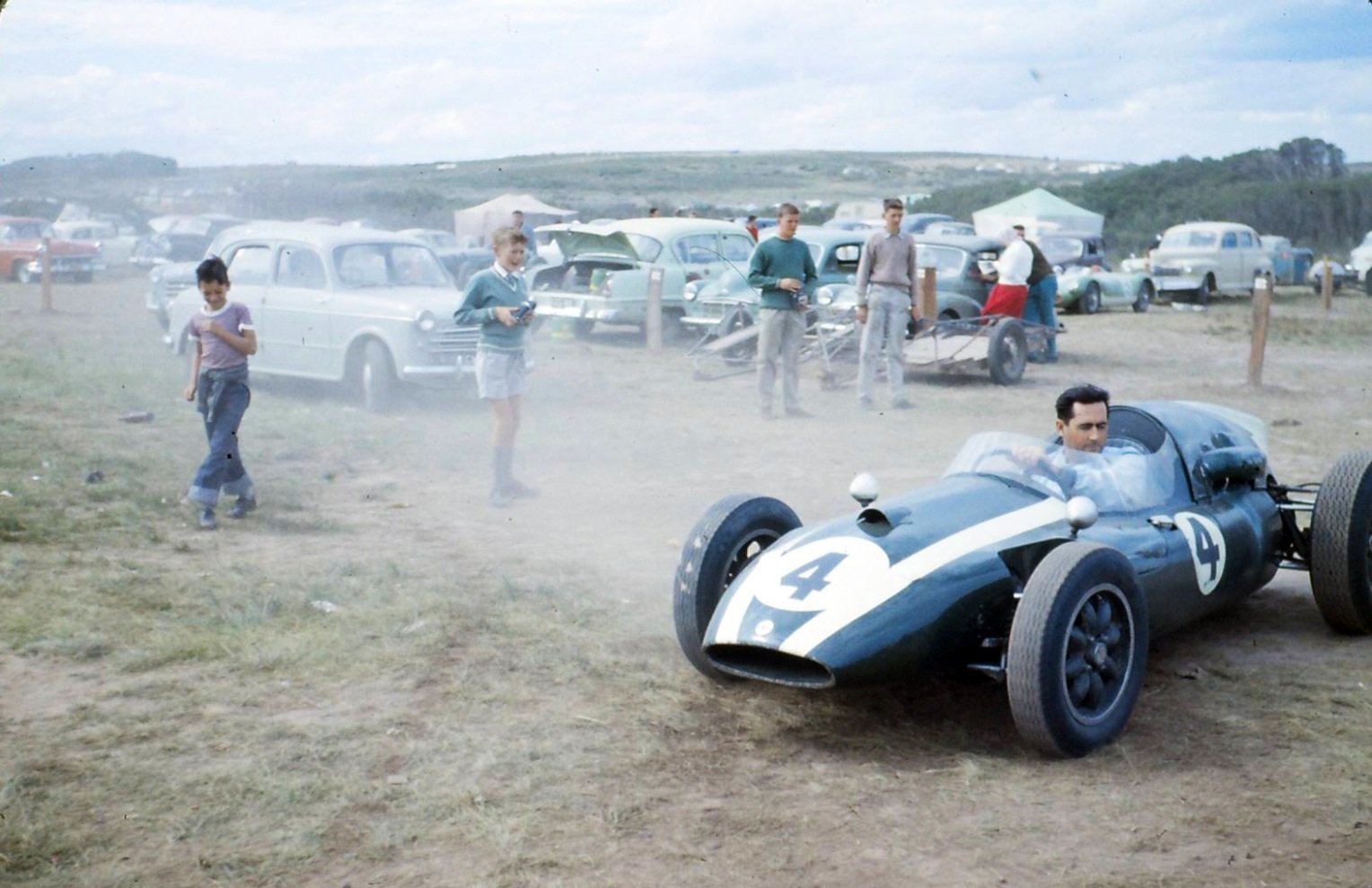
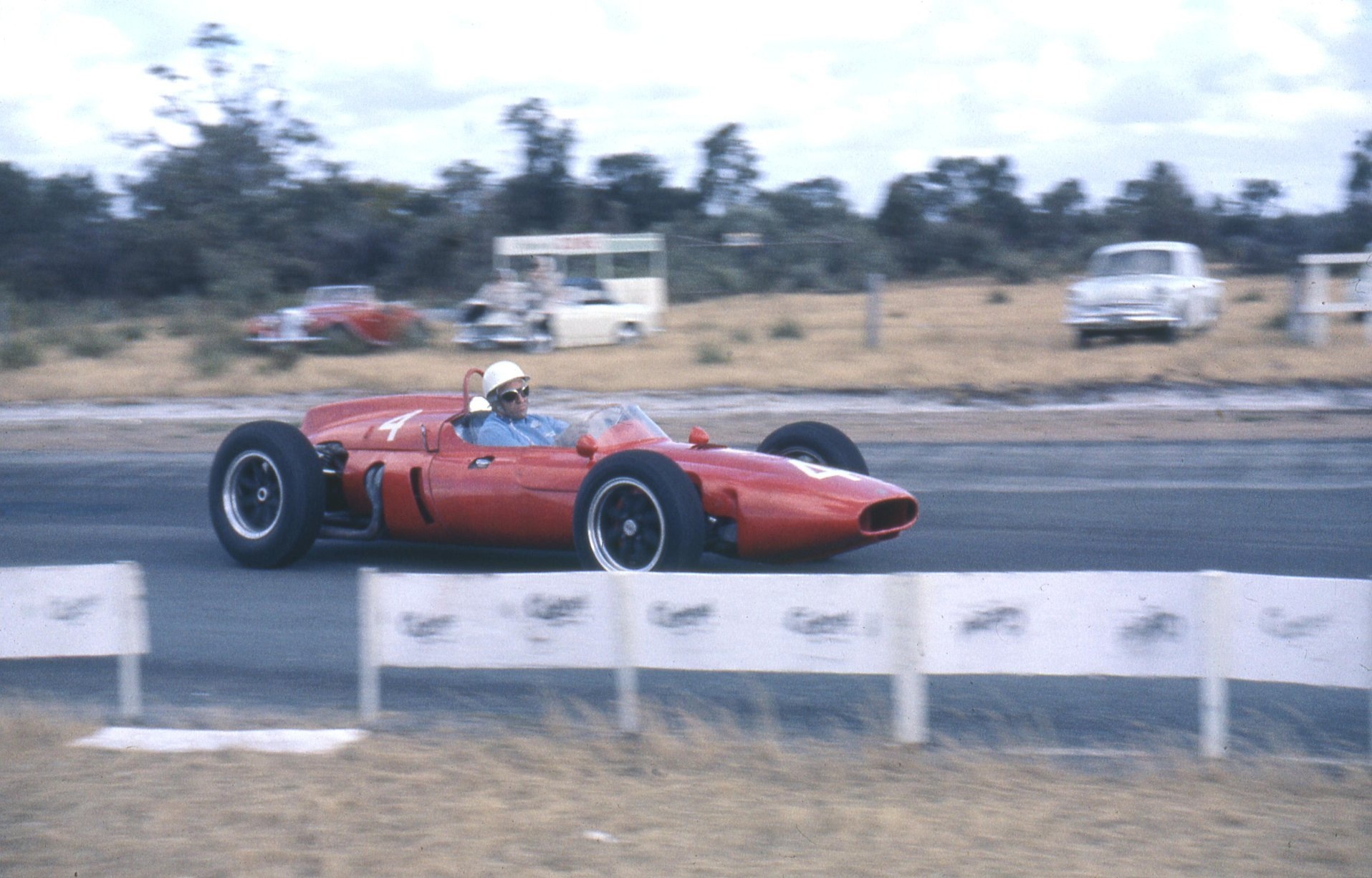
Jack Brabham playing with the kids in the Phillip Island paddock, Cooper T51 Climax, 14 March 1960…

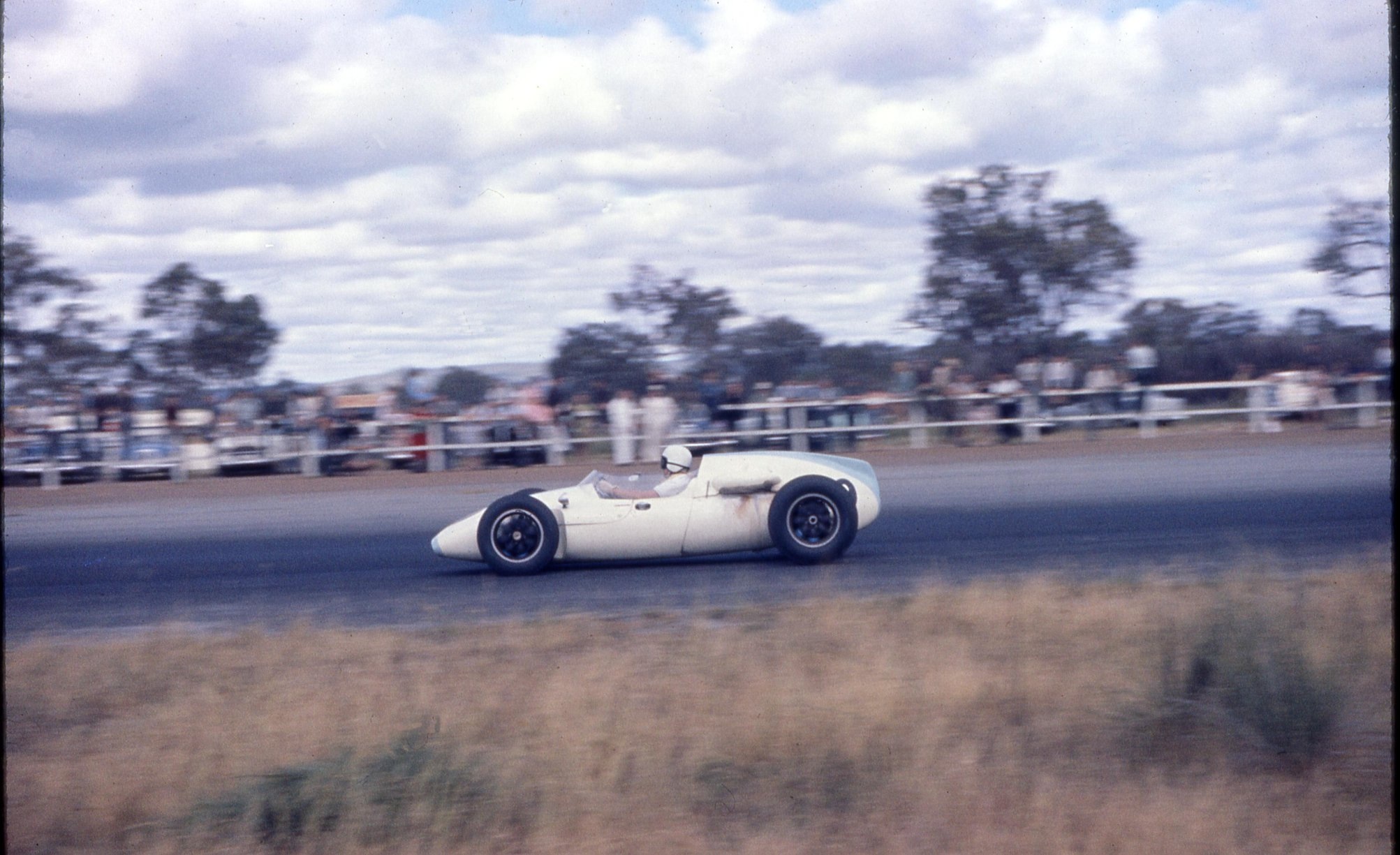
Jack won the Repco Trophy over 16 laps in a T51 rout from Bill Patterson, Bib Stillwell and Austin Miller in similar cars. None shared the latest 2.5-litre Coventry Climax FPF fitted to Jack’s F2-4-59 said to be ‘Brabham’s main car during the early part of 1959’. Austin’s motor was 2.2-litres, Bib and Bill’s 2-litre units.

Brabham had a successful fortnight during his short 1960 Australian summer racing tour, three races from three, winning the Longford Trophy, Light Car Club of Tasmania Trophy on 5 and 7 March at Longford the week before.

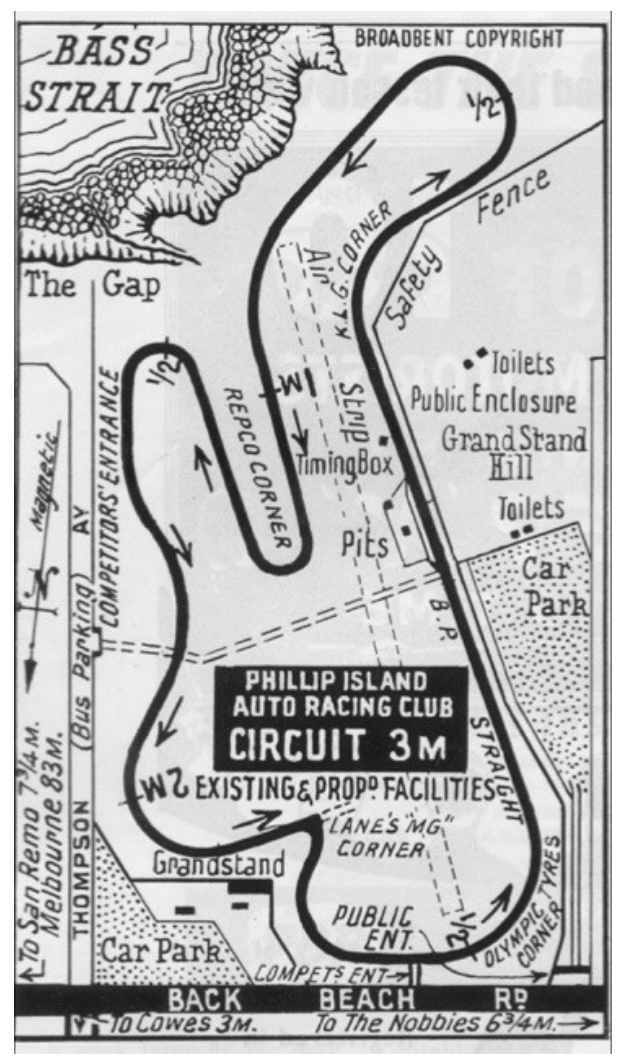
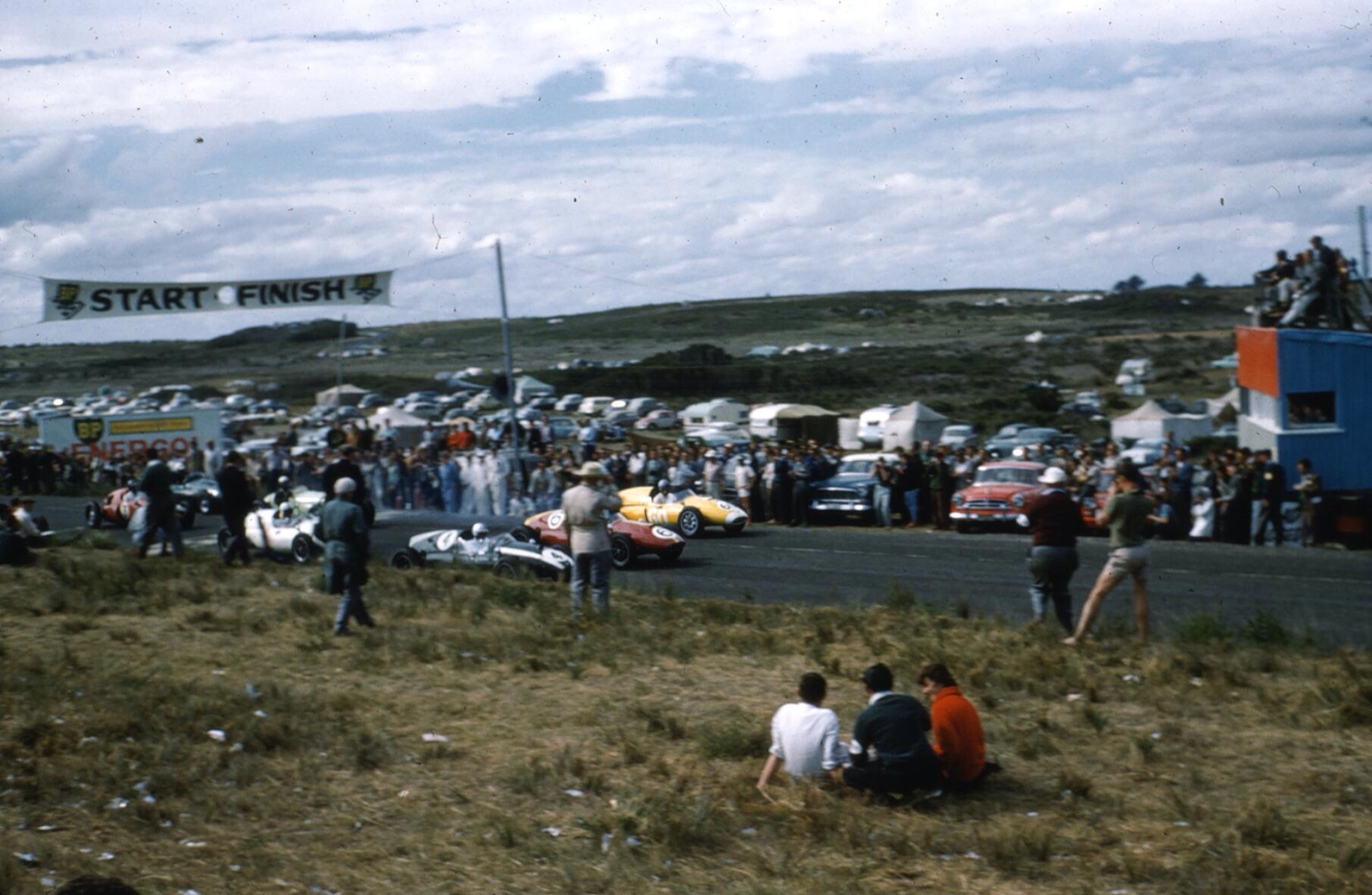
Ian McCleave took the opening photo of ‘A youthful Jack Brabham showering my younger brother in dust…I seem to recall Dad charged with adrenalin winding the Austin A95 up to 90 mph on the way back to Melbourne!’ Lukey Heights is well familiar to ‘Island regulars in the background, its a top shot and another enthusiast that day, Robert Jones caught the start of the race, below.

(T Johns Collection)

Australian Motor Sports Review 1959-60 wrote that “During these hectic two days , Brabham more than simulated his performance at the opening meeting of Phillip Island in December 1956.”

“On that occasion driving a Cooper sportscar he won the three races he entered including the Formula Libre event ahead of Ted Gray’s Tornado Ford V8 and Lex Davison’s 3-litre Ferrari 500/625. Three years later, Brabham as you would expect from a World Champion, won every scratch race he entered; but unlike the first meeting, he competed in five events, but won only four, having been beaten into second place in the Racing Car Handicap on the first day.”

(Ron Jackson)

Credits…

Ian McLeave, Robert Jones, Tony Johns Collection, Ron Jackson, Australian Motor Sports Review 1959-60

Tailpieces…

(R Jones)

The off, Brabham, Stillwell and Miller, with Bill Patterson in white, on row two.

(T Johns Collection)

Finito…

Ron Flockhart and Mustang P51, Moorabbin Airport, Melbourne 1961…

I wrote an article three years ago about Ron Flockhart’s win together with Ivor Bueb aboard an Ecurie Ecosse Jag XKD at Le Mans in 1957 (he won in a D Type with Ninian Sanderson in ’56 too) and tangentially about his death in a Mustang P51 fighter in Melbourne’s Dandenong Ranges during preparations for his second attempt on the Australia-United Kingdon air record in April 1962. Click here to read it; https://primotipo.com/2015/01/17/le-mans-1957-d-type-jaguar-rout-ron-flockhart-racer-and-aviator/

Recently I came upon some photos of him in during the Summer of 1961 Australian internationals. This led to another Flockhart-Google-cruise and discovery of the substance of this piece, an article first published in Pilot magazine written by Neil Follett and Nick Stroud. That article is written from an aviation rather than a motor racing perspective. I found it fascinating, I know many of you crossover into ‘planes as well as cars so here ‘tis, the racing bits which are mine, will be clear I think.

Ron Flockhart in red and Ivor Bueb with Jag XKD606 after the 1957 Ecurie Ecosse Le Mans win (unattributed)

‘One of the first racing drivers to fly himself to meetings in his own aircraft, Ron Flockhart raced at the top level in sports cars and Formula One before a growing interest in long distance record flights led to high adventure and stark tragedy.

William Ronald Flockhart was born in Edinburgh on 16 June 1923. He began his motor racing career in 1951, going on to win the 24 Heures du Mans race in 1956 and 1957 while driving a D-Type Jaguar with the Scottish Ecurie Ecosse team. Flockhart also participated in Formula One races, entering his first−the British Grand Prix−in 1954 and continuing throughout 1956–60. The Scotsman competed in fourteen F1 races with five different teams, his best result being a third in the 1956 Italian Grand Prix at Monza.

Flockhart also displayed an early interest in flying, owning Auster 5 G-ANHO during 1954–57, and becoming one of the first Formula One drivers to fly their own aircraft to race meetings. In the early 1960s he became interested in record flights between England and Australia, noting that the record was held by Arthur Clouston and Victor Ricketts in the DH88 Comet G-ACSS Grosvenor House.

The Comet won the 1934 MacRobertson Air Race and was the aircraft in which Ricketts and Clouston flew from London to Sydney (and then on to New Zealand) in 80hr 56min in March 1938. Flockhart considered that this record could be bettered. He was also interested in bettering the standing solo Australia−UK record, held by H F ‘Jim’ Broadbent, who had left Darwin in Percival Vega Gull G-AFEH on 18 April 1938, and landed in England on the 22nd having covered 9,612 miles in five days 4hr 21min, the last pre-war record flight between the two countries.

In October 1960, British holding company United Dominions Trust (UDT), through its subsidiary Laystall Engineering, formed an agreement with the British Racing Partnership to form a motor-racing organisation known as UDT Laystall Racing. As an extension of its racing activities, UDT became involved in the purchase of (Commonwealth Aircraft Corporation, Fishermens Bend, Melbourne built) Commonwealth CA-17 Mustang Mk 20 VH-BVM for Flockhart’s record attempt.

This aircraft had originally been purchased from the RAAF by former RAF and RAAF pilot James L ‘Wac’ Whiteman, who intended to enter the aircraft in the 1953 London to Christchurch (New Zealand) Air Race. Wac withdrew from the race when he realised it would not be competitive with the jets entered and in 1954 its ownership passed to Arnold J Glass, a fellow racing driver against whom Flockhart would compete in the 1961 and 1962 New Zealand Grand Prix races. Used latterly for target-towing experiments, it was sold to UDT for around £2,000 with around 100 flying hours on the clock. Flockhart was also able to obtain 63 gallon combat droptanks for about £7 each’.

Flockhart with the unloaded left front of his Cooper T51 Climax just kissing the Warwick Farm Causeway tarmac in 1961 (J Arkwright)

Racing in New Zealand/Australia, Summer 1961…

Ron organised an ex-works Cooper for his limited campaign of races in the Antipodes in the hot summer of 1961. T51 Climax F2-7-59 was ‘ex-Works Car No 3 according to the Cooper Register…believed to be Masten Gregory’s regular car during 1959…Bruce McLaren’s race-winning car at both Sebring December 1959 and at Buenos Aires in February 1960…and may be either the works teams spare car during 1960…or the car sold to Fred Tuck for 1960’ according to oldracingcars.com. Whatever the case, while the T51 was a good jigger, it was no longer in the full flush of youth with the quicker cars that season the T53 ‘Lowline’ Coopers of Brabham and McLaren, the works P48 BRM’s of Graham Hill and Dan Gurney and Rob Walker’s Lotus 18 Climax driven by Stirling Moss.

Flockhart and Denny Hulme fighting for fourth place during the 1961 NZ GP at Ardmore both in Cooper T51 Climax 2.5 FPF, Ron fourth, Denny fifth (sergent.com)

Moss disappeared into the distance in the 7 January NZ GP at Ardmore but was outed with a badly slipping clutch mid-race giving the win to Brabham from McLaren, Hill and Flockhart in a plucky fourth.

With much preparation to do in Australia for his pending flight, he missed the balance of the NZ events and re-acquainted himself with the Cooper T51 at the first international meeting held at the new, technically challenging Warwick Farm circuit laid out amidst a horse-racing facility on the western suburban outskirts of Sydney on 29 January.

Getty Images caption dated 2 February 1961 notes ‘The Flying Scotsman’ is travelling from Australia to England on a dual mission – first to marry BOAC hostess Gillian Tatlow and second to attempt to break the Australia-Britain record for single-engine planes’ (Getty)

He was fifth in the Warwick Farm 100 held in scorching hot weather and won by the Moss Lotus 18 with its side-panels removed to help cope with the extreme conditions. A fortnight later he contested the last race of his ’61 tour, the Victoria Trophy that year held on a circuit laid out on Ballarat Airfield, Ballarat is in Victoria’s Goldfields region 120km from Melbourne.

Flockhart at Ballarat Aerodrome, 1961. This Cooper T53 Climax  (autopics.coma.u)

Ron raced a Border Reivers Cooper T53 Climax to third to the works BRM P48s of Gurney and Hill with Dan scoring the only international win for that chassis that weekend. With that, and a fortnight until his scheduled Mustang departure for the UK he re-focused on a high-performance machine of an altogether different type.

Flockhart with G-ARKD, place? (Pilot)

Preparations begin…

‘With the end of the Antipodean motor racing season in early 1961, preparations began for the flight to the UK. Rolls-Royce ran checks on the Packard Merlin 38 engine, which had only run 110 hours since new, and which had never been ‘through the gate’. The magnetos were overhauled in Scotland and Smiths Australia set to work on overhauling the cockpit instruments.

Preparatory work on the airframe was undertaken at the Illawarra Flying School, which modified the fuel system by introducing a manual device by which the system could be de-pressurised. Two static vents were incorporated into the airframe under the cockpit sill, each containing a valve. This would enable Flockhart to run the drop-tanks dry without the risk of sucking air into the system. The system would then be re-pressurised from the exhaust side of the vacuum pump to assist initial transfer. This worked well, although a stiff bootful of rudder was required to counter the rolling moment caused by the change in lateral balance as a tank emptied.

In the limited space available in the Mustang’s cockpit two German Becker VHF radio sets were installed, which provided 36 communication channels, and Lear T12 automatic direction finding (ADF) equipment was fitted in the position usually occupied by the gunsight. No VOR, ILS, HF radio or marker-beacon receiver equipment was fitted−Flockhart held no instrument rating. Normalair supplied the oxygen equipment, Dunlop provided new tyres, and Lodge delivered new plugs. Rolls-Royce suggested that the Merlin be opened up to maximum continuous power every half-hour during the flight and again briefly during descent and approach.’

Bankstown Airport Sydney 1961 (G Goodall)

G-ARKD lookin’ a million bucks outside Fawcett’s hangar at Bankstown after final prep for the 1961 flight (G Goodall)

‘Final preparations and modifications were undertaken by Fawcett Aviation at Bankstown Aerodrome in Sydney, and the Mustang was officially added to the British register on 24 February 1961 as G-ARKD, in the name of Ronald Flockhart. In the days leading up to his departure for the UK Flockhart had logged a mere twelve flying hours in the Mustang.

In March 1961, Flockhart told British magazine Flight that piloting a Mustang for the first time was like ‘driving an ERA after a sports car; things happen very quickly’. He also admitted that it had taken some time to get used to the Mustang’s long nose and the technique of a curving approach, and had accordingly suffered ‘one or two bumpy landings’, but had quickly come to like the aeroplane very much. Flockhart noted that although the Mustang was big and powerful, ‘it was amply stable for the long hours of steady, level cruise’.

The planned route for the flight was Sydney—Alice Springs—Darwin—Sourabaya—Singapore —Rangoon—Calcutta—Karachi—Bahrain—Beirut—Brindisi—Nice and on to London, with overnight stops at Singapore, Karachi and Brindisi. Flockhart’s plan was to fly only during daylight hours and in segments of a maximum of five hours. All fuelling arrangments along the route were to be made by Esso, which Flockhart found to be ‘unfailingly helpful and efficient’

(Pilot)

Setting off…

‘On Tuesday, February 28, 1961, Flockhart and G-ARKD, painted in an overall bright red colour scheme with white detailing, departed Sydney for the first stop at Alice Springs. Enroute from the latter to Darwin, Flockhart experienced a magnetically charged dust storm, which affected his ADF equipment. He settled in at 12,000ft and followed the faint line of a solitary railway across the endless red terrain to Darwin.

The next day Flockhart departed Darwin for Surabaya on Java. Well out over the Timor Sea he saw an ominous line in the distance, marking an inter-tropical front piling clouds up to 50,000ft and higher. From 12,000ft he dived to low altitude to find a hole in the milky mist. After ten minutes the Mustang popped through the other side of the front with most of the paint on its leading edges stripped off. The diversion had cost a substantial amount of fuel and Flockhart elected to divert to Baucau on East Timor for replenishment.’

G-ARKD, Darwin 1961 (L Brighton)

‘After a quick refill from fuel kept in 45 gallon churns in a thatched hut, Flockhart took off for what he later recalled as ‘the loveliest part of the trip’ east-north-east over the Balinese islands and coral atolls to Singapore. The maximum endurance of the Mustang was seven hours, for six of which Flockhart could be on oxygen. Typical cruising speed was 225 knots at 12,000ft, although the speed would increase to 280 with the periodic opening of the throttle, as per Rolls-Royce’s suggestion.

The diversion to Baucau meant a late arrival at Singapore, where Flockhart was further delayed by an accident which had closed the runway at his next stop, Rangoon. Having received the all-clear to depart, Flockhart headed into the darkness, his first experience of flying the Mustang at night. Finding that the ADF equipment functioned better at night, he followed airways all the way to Rangoon, where the scarlet Mustang received a great deal of attention, not least from the Czechoslovakian crew of a SA Tupolev Tu-104.’

G-ARKD- 63 gallon drop tanks being filled, place unknown but looks like Australia (I Leslie)

Across India…

‘The following morning there was still plenty of interest in the aircraft, and on departure for Calcutta Flockhart held the Mustang down on takeoff until he could pull up 4,000ft almost vertically into cloud.

Navigating largely by means of contact flying−using established landmarks−Flockhart experienced difficulties on the leg to Calcutta, becoming embroiled in a cloud layer at 2,000ft which caused him to miss the let-down beacon into Calcutta and overshoot, forcing him to put down at Barrackpore, some fifteen miles north of Calcutta.

After a swift refuelling, Flockhart was off again for the longest leg of the journey, across India and Pakistan to Karachi, which he completed in 5hr 50min using 43gal/hr of fuel. Flockhart later related that he ate only a few Horlicks tablets on this leg, and refreshed himself on landing at Karachi with ginger beer kept cold in the ammunition bays.

At Karachi the Mustang was turned around in less than an hour, Flockhart taking off in the moonlight to follow the Iranian coast to Bahrain. As he later told Flight: ‘Navigation at night was wonderful. There is a great tranquility about it. The isolation and the beauty contrasts sharply with the actions of those on the ground, who try to tie you down with streamers of paper. Flying at night in the moonlight, the only shadows are on the surface’.

It was still night when Flockhart landed at Bahrain, where he discovered that air had been leaking from the port main wheel oleo. This caused little concern however, and after a safe landing the undercarriage was quickly repaired by the RAF. Flockhart was soon off again, to follow an oil pipeline to the mountains of Lebanon and Beirut. He was cleared−and then recalled−by Damascus air traffic control shortly after passing over the city, but, short of fuel, he elected to continue to Beirut and face the consequences there.

It was indeed at Beirut where the trouble started.

Despite the diversions and delays owing to minor repairs, Flockhart was still well ahead of his own schedule when he taxied out at Beirut for the next leg to Brindisi on 3 March.

Confusion on the ground, however, led to the Mustang’s coolant boiling while Flockhart was held while other aircraft landed. The Mustang finally departed for Brindisi but poor weather forced Flockhart to divert to his nominated alternate, Athens.’

G-AKRD on the deck at Athens Airport. Aircraft later damaged by a cockpit fire, left exposed for years in Athens and eventually scrapped, now seemingly resurrected from the dead (I Leslie)

‘Anxious not to lose any more time, Flockhart refuelled quickly and requested clearance from the Tower, which was refused as no flight plan had been filed. Requesting to file an airborne flight plan, Flockhart was refused again, the Tower demanding that he pay landing fees, despite the fact that these had already been seen to by Esso. As Flight elegantly put it: ‘temperatures rose−in the Tower, in the cockpit and in the cylinder heads’.

Realising that resistance was futile, Flockhart retired for a rest, before trying again in a few hours. With the paperwork sorted, he returned to the Mustang in the early morning, but found on starting that steam was issuing from the cowling. Refilling the coolant system, he found that the coolant was running out between Nos 3 and 4 cylinders on the starboard bank. By this time he was twelve hours behind his schedule, but two days ahead of the solo record.

Exhausted and frustrated, Flockhart left G-ARKD at Athens and continued to London by commercial airliner to be married as planned a few days later on 11 March 1961. The Scotsman subsequently told Flight that it was ‘not the flying, nor navigation, nor preparation which was responsible for the failure. It was an air traffic system out of touch with the individual needs of a type of flying that has not yet, by any means, disappeared from the global scene’.

In September 1961 the Mustang was severely damaged by a cockpit fire while being taxied at Athens airport, putting paid to its use in any further record attempt.’

Arnold Glass’ BRM P48 inside Ron Flockhart’s Lotus 18 Climax, DNF for both – Lycoming Special of Forrest Cardon to the right 16th- Maser 250F to the left of Cardon is Chris Amon in 11th to the Lycoming’s left, Ardmore 1962 (sergent.com)

Racing in Australasia 1962…

There was plenty of the depth in the international fields local drivers confronted in 1962. Vsitors included Moss back with a choice of Rob Walker cars – Lotus 21 and Cooper T53, McLaren and John Surtees also ran T53s with Jack in a T55. We had our first look at Jim Clark aboard a Team Lotus Lotus 21 Climax but like Flockhart, Clark was hamstrung a bit by having only a 2.5 FPF, in the hands of the top-liners de-rigeur in ’62 was a 2.7 FPF Indy engine. Ron raced a Border Reivers Lotus 18.

In a bit of Mini Cooper racing trivia, the first such cars were taken to New Zealand and on to Australia by Bruce McLaren and Ron, a third car intended for Roy Salvadori missed the trip. They raced the ‘bricks’ at several of the meetings in which they contested the feature races with their GP cars. The potential of the machines, despite their size, wasn’t lost of any of the racers or spectators who watched cars which of course became icons which define an age.

Dennis Marwood’s Humber leads Jim Steans Mini and the Coopers of McLaren and Flockhart at Wigram in 1962 (J Steans)

It was a mediocre tour really, Ron’s two NZ races were the NZ GP at Ardmore and Lady Wigram Trophy with DNF’s due to engine problems and a failed universal joint respectively. Moss won both races, the NZ GP was famously a very soggy one, in the Lotus 18 2.5 FPF.

Fifth at Warwick Farm was much better for Ron and a high point, Moss took that win too, this time aboard the T53 2.7 having tried both cars in practice. Moss preferred the more-chuckable Cooper to the Lotus around the ‘Farm. Flockhart had an early day in the Lakeside International after a collision on lap 20, the race was won by Brabham’s T55.

Flockhart in the Border Reivers Lotus 18 Climax in the Sandown paddock 1962 (autopics.com.au)

Flockhart missed the Longford round won by Surtees and rejoined for the first Sandown International, like Warwick Farm it was laid out within a horse-racing facility and on Melbourne’s then south-eastern outskirts 40km from the city. Brabham won again with Flockhart suffering bearing failure in what turned out to be his very last motor-race.

Sandown Park is only 10km from Moorabbin Airport and 30km from Kallista in the Dandenongs, both sadly to loom large for all the wrong reasons shortly thereafter.

Flockhart and mount, outside the Brookes Aviation hangar, Moorabbin Airport, fateful morning of 12 April 1962 (G Goodall)

Take two…

Not to be deterred, within months of the 1961 Athens airport fire Flockhart began looking for another Australian Mustang for a second attempt on the record that had eluded him. The aircraft chosen was former RAAF Mustang VH-UWB, acquired on Ron’s behalf by AREF Ltd of Ascot, Berkshire and registered G-ARUK. Flockhart had announced his intention to try and beat the record again, with plans to follow the route Melbourne—Sydney—Darwin—Singapore—Madras—Bahrain—Brindisi—London, starting on 16 April 1962.

‘Jock Garden, chief flying instructor and manager of the Civil Flying School, the flying training arm of the Mustang’s operator in Australia, Brookes Aviation, recalled in his memoirs: ‘Ron arranged to buy VH-UWB from John Brookes, and Brookes Aviation undertook a complete overhaul on the aircraft. Rolls-Royce, as a co-sponsor [of his next record attempt], sent out two engineers from England to service the engine; the aircraft was repainted in red and re-registered in the UK as G-ARUK.

I flew Ron over to Essendon Airport in the [Beech] Debonair early in 1962 and during the flight I asked if he had any recent instrument flying experience. When he told me he had none in the last eighteen months, I suggested it would be wise for him to gain recent instrument flying practice in view of the intended long flight, but he did not follow up on that advice.

‘I had the pleasure of doing the flight-testing of the Mustang on 19 March 1962, after its extensive servicing and it was in perfect condition with the Merlin the smoothest running engine I had ever encountered.’

‘A couple of days before he intended setting out on his record attempt Ron was to fly to Sydney to have maintenance done on his ADF unit. The weather conditions on 12 April were bad, with low cloud and rain, but Ron was determined to go. This proved to be a fatal decision as, within only a few minutes after departure, he lost control in cloud over the Dandenong Range and entered a spiral dive from which he could not possibly recover. He was killed instantly.’

The official report of the accident by the Australian Department of Civil Aviation gives the following conclusion: ‘While there is insufficient evidence to establish conclusively the cause of the accident, the possibility that the pilot temporarily lost control of the aircraft while circling in cloud, and that it subsequently stalled during the recovery and turn to avoid high terrain, cannot be excluded’.

Flockhart was flying the Mustang from Moorabbin to Bankstown to conduct fuel consumption tests and have the ADF equipment serviced. After encountering low cloud, he reported that he was returning to Moorabbin. The Mustang then changed course some 140° before entering a narrow gap between cloud-obscured hilltops in the Dandenongs.

The report stated that ‘the pilot circled in the vicinity of Kallista several times at low altitude and for the most part in cloud. The aircraft then emerged below cloud at a height of approximately 1,300ft, carried out a left turn probably to avoid higher terrain and, in the course of this turn, the nose dropped sharply and the aircraft struck trees and the ground at a steep angle, while rolling and turning to the right’.

At the time of the accident Flockhart held a British PPL endorsed for single-engined landplanes under 12,500lb (5,670kg) maximum permissible all-up weight. His total flying time was 961hr of which 69 were on Mustangs. During the six months immediately before the accident he had flown only five hours. He was not rated for instrument or night flying. In late 1960 he had undergone about 21 hours of ground-based Link trainer instruction on ADF, ILS and VDF procedures, but his logbook showed no record of any instrument flying or Link trainer instruction since that time.

Flockhart’s flying achievements were substantial and deserve a great deal of credit; his Mustang flight from Australia to Athens had been made with limited professional backing by a club-trained private pilot. Sadly, he never got the chance to finish the job — with his death on 12 April 1962, his final race had been run.’

Etcetera…

Flockhart hooting across the braking area for Warwick Farm’s Causeway during the WF 100 in 1961, Cooper T51 Climax ( J Arkwright)

Flockhart’s Cooper T51 Climax in the Warwick Farm paddock in 1961. Car raced to a Longford win by Roy Salvadori the week later and then sale to David McKay at the end of the summer post the Hume Weir meeting also contested by Roy (J Arkwright)

‘Historic Dandenongs’ tribute to Ron Flockhart

Mustang A68-152, 135 and 175. All aircraft issued to 23 Squadron Brisbane so guessing RAAF Amberley circa late 1952/3. CAC Wirraway’s alongside (L Potts)

Etcetera: The Commonwealth Aircraft Corporation Mustang P51’s…

Source: airforce.gov.au- Point Cook Museum, Victoria

‘One of the finest American fighter aircraft of World War II, the North American Mustang owed its origin to a Royal Air Force (RAF) specification for a single-seat fighter to replace the Curtiss P-40. The first flight of the prototype NA-73 occurred in October 1940. Production models reached the RAF in November 1941 and these aircraft became known as Mustang Mk I (P-51) and Mk II (P-51A). The original 1,150hp Allison engine lacked performance at high altitude, and the RAF employed the early Mustangs on low-level armed tactical reconnaissance sorties. Meantime, the US Army Air Force (USAAF) ordered a limited number of P-51s and P-51As as the Apache, to operate in the dive-bomber role.

However, once the basic P-51 design was mated with the proven Rolls-Royce Merlin engine, the aircraft became an enormous success. Through P-51B, C and D models, the Mustang became one of the finest Allied fighters of World War II, and was just as capable at long-range escort as short ground-attack sorties. Fitted with a bubble canopy in place of the earlier ‘Razorback’ fuselage, the P-51D was the most widely produced version of the Mustang, with 8,956 built.

Interesting developments of the Mustang included the XP-51F and XP-51G lightweight versions and, the fastest Mustang of all, the P-51H, with a top speed of 487 mph at 25,000 ft. The ultimate development of the aircraft occurred post-war, when two Mustang fuselages were joined, resulting in the USAAF’s F-82 Twin Mustang.

In November 1944, RAF Mustangs were first flown by the RAAF’s No 3 Sqn in Italy.

Mustang P51D cutaway drawing (Haynes)

In 1943, the Australian government arranged for the Commonwealth Aircraft Corporation (CAC) to manufacture the Mustang Mk IV (P-51D) under licence from North American Aviation. The RAAF urgently needed a new fighter, and so the first CAC Mustangs were built mainly from imported semi-finished parts. A prototype Mustang, A68-1001, was used for development trials and the first Australian production Mustang, A68-1, flew on 29 April 1945. This aircraft was handed over to the RAAF on 4 June 1945 and was used for trials by No 1 Aircraft Performance Unit until October 1946. It was placed in storage until 1953 when it was delivered to the Department of Supply at Woomera.

The first 80 Mustang 20s (A68-1/80) were delivered with Packard Merlin V-1650-3 engines, under the CA-17 designation. A second contract called for 170 improved Mustangs, but only 120 were completed. Known as CA-18, the first 40 were built as Mustang 21s (A68-81/120) with Packard Merlin V-1650-7 engines. The remaining CA-18s comprised 14 Mustang 22s (A68-187/200) with Packard Merlin V-1650-7 engines. A CA-21 contract for a further 250 Mustangs was cancelled and, in lieu of the remaining CA-18s and CA-21s, 298 lend-lease P-51Ds and Ks were taken on strength (A68-500/583 and A68-600/813). In addition, the RAAF also accepted Mustangs for the Netherlands East Indies Air Force (N3-600/640).

Produced too late for World War II, RAAF Mustangs were assigned to Japan for occupation duties and, early in 1946, Nos 76, 77 and 82 Squadrons flew into Iwakuni. In 1949 Nos 76 and 82 Squadrons withdrew to Australian and the Mustangs of No 77 Squadron remained to take part in the Korean War from June 1950 until April 1951, when they were replaced by Gloster Meteors.

In Australia, Mustangs remained in service with Citizen’s Air Force Squadrons until they were withdrawn from service in 1959.’

(MOV)

Technical Specifications CAC CA-18 Mustang Mk21…

Type/Airframe- Single seat long range fighter. All metal stressed skin construction

Engine- Single Packard Merlin V1650-7. SOHC, 2 valve, carburettor fed, two-stage supercharged V12. Bore/stroke 5.4×6 inches, 1650 cid, circa 1490 bhp @ 3000 rpm. Weight 1640 pounds

Dimensions- Span 11.28 m (37 ft): length 9,83 m (32 ft 3 in); height 3.71 m (12 ft 2 in).

Weight- Empty 3567 kg (7863 lb); loaded 4763 kg (10 500 lb).

Performance- Max speed 636 km/h (380 kt); Climb, 13 mins to 30,000 ft (9144 m); Maximum rate of climb 1059 m (3475 ft)/min; Service ceiling 41,900 ft (12 771 m); Range 1529 km (825 nm) on internal fuel tanks.

Armaments- Six 0.50 in calibre machine guns; two 454 kg (1000 lb) bombs or up to 10 rockets

Rolls Royce Merlin cutaway drawing (Aeroplane)

CA-17 A68-34 a pretty picture. Issued to 25 Squadron in 1951/2 so probably in the air over RAAF Pearce, Perth (SLSA)

Plane dudes have as much interest in chassis numbers et al as us car chaps of course, here they are..

A68-5 RAAF Serial no / Type CA-17 Mk20 Mustang / Construction no 1330 NA110-34370 (Flockhart’s 1961 plane)

Early build- 5th of a batch of 80 shipped to Oz as kits of parts, delivered to 1 Aircraft Depot ex-CAC 6 July 1945. To 78 Sqdn, then stored 14/11/45 till sold 30/1/53 to ex-Flt Lt JL Whiteman with only 35 hours up, Sydney- reg VH-BVM. To Arnold Glass, purportedly acquired with winnings from a racehorse ‘Johnny Zero’ which the aircraft was then called, Sydney May 1954. Target towing experiments with Fawcett Aviation in 1959, also flown by A Oates. To Ron Flockhart August 1960 with around 100 hours on the clock- reg UK G-ARKD Feb 1961. ‘Abandoned’ in Greece 4/3/61, cockpit fire whilst being taxied in Athens 7/9/61. Rego cancelled by UK CAA as ‘aircraft destroyed’ 26/11/61. Abandoned and left in the open in Athens 1961-1970. Reportedly broken up for scrap in Athens circa 1970.

6 June 2012 re-registered as G-ARKD to ‘Classic Flying Machine Collection Ltd’, Foulsham, Dereham, Norfolk, UK-‘remains/parts storage for restoration’

A68-113 RAAF Serial no / Type CA-18 Mk21 Mustang / Construction no 1438 (Flockhart’s 1962 plane)

Delivered to 1 Aircraft Depot ex-CAC on 1 April 1948. Issued to 78 Wing November 1949, to 1 AD July 1950, 10 Sqdn Townsville May 1953 for target towing duties. Sold August 1957, then again February 1958- Reg VH-UWB. Sold to Flockhart April 1962- reg UK G-ARUK. Flockhart’s fatal crash at Kallista 12 April 1962. Rego cancelled by UK CAA as ‘aircraft destroyed’ on 23/5/62.

CAC production line, Fishermens Bend circa 1945 (T Lyons)

Photo Credits…

Pilot magazine, Geoff Goodall Collection, W Cdr L Brighton, Ian Leslie, Jim Steans Collection, John Arkwright, autopics.com.au, Lionel Potts, Museum of Victoria, State Library of South Australia, Tony Lyons, Haynes, Aeroplane magazine

Bibliography…

Pilot magazine article by Neil Follett and Nick Stroud via aeroexpo.co.uk, sergent.com, oldracingcars.com, adf-serials.com.au, airforce.gov.au

Tailpiece: Cool dude- Flockhart, Warwick Farm 1961…

(J Arkwright)

Finito…

(R Lambert)

‘It goes just like a bought one Bib!’…

Jack Brabham about to give Bib Stillwell’s newish Cooper T51 Climax ‘F2-18-59’ a whirl during practice for the Longford Trophy in February 1960. Bib and his mechanic Gerry Brown are giving the car a shove.

Nobody knew those little babies like Jack of course. There was nothing wrong with the car a 2.5 litre Coventry Climax FPF would not fix, but neither love nor money would get you one of those in Australia at the time.

Jack and Bib swapping notes @ Longford in 1960. ‘What ratio did you say again mate’. These fellas had much in common-racing, business and aviation. Bib bought a heap of stuff off Jack- Coopers, Brabhams and planes! (K Drage)

Stillwell’s new car was shipped from Surbiton to Australia in July 1959. Fitted with a 2.2 litre Coventry Climax FPF engine, Bib first raced it in the 1960 NZGP at Ardmore where he finished 3rd behind the Brabham and McLaren 2.5 litre T51’s.

Back home, he won the Victorian Trophy Gold Star round at Fishermans Bend in February before the Longford International where was 2nd to Jack. He contested the Repco Trophy at Phillip Island in March where he was 3rd behind Brabham and Bill Patterson, Patto’s car 2 litre FPF powered like Bib’s that weekend.

Bib oversees Gerry Brown’s fettling of his Cooper in the 1960 Longford paddock. Near new car superbly prepared and presented as the racer/businessmans cars were right thru to the end of his historic racing career in the nineties (R Lambert)

The naughty corner bit came as a result of an accident Stillwell had at Easter in 1960.

He had won his Bathurst 100 heat but had an indiscretion with the fence at the bottom of Conrod Straight in the final, damaging the front of the car. Alec Mildren’s Maserati 250S engined T51 was victorious that weekend at the start of a very successful season for the veteran racer/motor dealer- he carted away the AGP and Gold Star.

Repaired, Bib’s machine was fitted with a 1.9 litre FPF and became his spare car  parked in the corner of his workshop. He focussed his affections on the just acquired ‘Victa’ T51- David McKay’s car ‘F2-14-59’ which was carefully assembled by Victa’s factory Foreman, Jim Roberts at Coopers before shipment to Sydney. The car, of similar leaf spring rear suspension specification to ‘F2-18-59’, was on the market after ‘Victa Consolidated Industries’, manufacturers of iconic Australian lawnmowers, decided to sell it rather than have David continue racing it after only 2 events.

The interesting part of the story, you knew I would get there eventually didn’t you?, is that in a quirk of fate and fortune the spare car in The Naughty Corner of Stillwells Cotham Road, Kew workshop won the 1961 Australian Grand Prix at Mallala, South Australia.

The sequence of events goes like this.

Lex Davison raced his Aston Martin DBR4/250 3 litre GP car to 2nd by a bees-dick to Alec Mildren’s Cooper T51 Maserati in the 1960 AGP at Lowood in June. He raced the car again at Lowood and Warwick Farm in 1960 and the Farm, Ballarat Airfield and Longford in early 1961 before shipping it to the UK.

Lex Davison’s Aston DBR4/250 outside Gino Munaron’s Cooper T51 Maserati during the Guards Trophy Intercontinental race at Brands Hatch in August 1961. There were 17 starters with Brabham’s Cooper winning a race of attrition, the only other finishers Salvadori, Davo and Bandini. With the new 1.5 litre F1 ‘taking off’ this was the last Intercontinental race (Getty)

He raced it throughout 1961 in the Intercontinental Formula races prevalent that year during an extended family trip and racing holiday. He also contested some sportscar races and Le Mans with Stillwell in an Aston DB4GT Zagato, click on the link below for some information on that adventure.

Aston Martin DB4GT Zagato ‘2 VEV’: Lex Davison and Bib Stillwell…

When it became clear the Aston DBR4 would not arrive back in Oz in time for the 9 October Mallala race he sought an alternative and immediately thought of his Melbourne competitor, friend and fellow Holden Dealer, Stillwell, who had five Coopers at the time according to Graham Howard! (4 single-seaters and a Cooper Monaco sports-racer I think)

Melbourne Holden Dealers meeting? Stillwell, Davison and Patterson cluster around Lex’s renta-drive soon to be AGP winning Cooper at Mallala in the lead up to the ’61 race. They had Holden dealerships in Kew, Richmond and Ringwood respectively until Bib jumped ship ‘sensationally’ from Holden to Ford circa 1965 (Davison)

Bib kindly agreed to rent Lex one of these, his Naughty Corner spare ‘F2-18-59’, fitted with a 2.2 litre FPF.

By that stage Bib’s frontline tool of choice was a T53 ‘Lowline’ Cooper fitted with a 2.5 FPF. Whilst he wanted Lex in the field Bib did not figure the ‘Crafty Cobbler’- Davison’s primary family business was in shoe manufacture and distribution- three time AGP winner would present too much of a problem to he and the T53 who, together with Bill Patterson’s T51 were the quickest combination in Oz at the time.

A quarter page agreement between the two racers dated 5 October- four days before the race provided for a hiring fee of £100 with the car to be returned in a condition satisfactory to the owner. If the racer was written off, Bib was to be paid £3000.

Stillwell T53, David McKay T51 and the nose of Jones T51 before the start of a Mallala heat. Stan DNS the GP itself with mechanical mayhem- a great shame. Gerry Brown is behind Bib’s car in the top shot with Kevin Drage leaning on the cars tail (K Drage)

In a race full of irony, David McKay, by then aboard his Scuderia Veloce ex-works T51 which Brabham raced in Australia that summer of 1960/61, was adjudged by the Race Stewards to have jumped the start. This is still a controversial decision in the view of objective observers all these years later- he was punished a minute for his alleged misdemeanour.

Bill Patterson dominated the race from the start in another T51 before fuel vaporisation problems caused multiple stops.

Bib was never a threat as his team managed to fit the wrong tyres to his T53. Accounts of this vary, but Graham Howard’s ‘History of The AGP’ version is that the team erroneously had a Dunlop R5 D12 and a D9 fitted to the rear of the car with a matched set of D12 R5’s at the front. The result was difficult handling and a ZF slippery diff which was worn out by the races end.

Lex took the win behind McKay on the road but ahead after application of McKay’s penalty. The Naughty Corner Car had been beautifully prepared by Stillwell’s Kew based team led by Gerry Brown before handover to Davison’ s crew led by Alan Ashton’s AF Hollins boys in Armadale not too far away from Stillwell’s Kew Holden Dealership and race workshop in Melbourne’s inner east.

Davison’s Cooper rolled to a stop several hundred yards after the finish of the race- a fuel union attachment on one of the cars fuel tanks had cracked when he hit a straw-bale after a spin at Woodrofe Corner, the borrowed Cooper was out of fuel, it could not have raced any further! Lex’s luck extended to the start of the race too when his crew noticed a gearbox leak which they plugged with a rag soaked in gasket goo.

Sometimes things are just meant to be!

Many say Lex was lucky with all of his four AGP wins, he was too. But he made his own luck in that his cars were always beautifully prepared and driven very fast with mechanical sympathy- he finished races where others did not. Was 1961 his luckiest win?, only he can say.

Ecurie Australie onto the grid. Peter Ward, Lex in his usual cloth cap, Alan Ashton, Warwick Cumming with T51 ‘F2-18-59’.  McKay’s car behind with then, I think then the amazing, fast, radical Eldred Norman built Zephyr Spl driven by Keith Rilstone (Davison)

Lex may have been a dark horse before the start of the weekend, his disdain of the ‘Anti-Climaxes’ as he called the Coopers a matter of record- then he won the AGP in his first race of a water-cooled Cooper, amazing really.

But he was hardly a Surbiton novice having raced air-cooled Coopers for years in hillclimbs and shorter circuit events, the Cooper Irving/Vincent s/c was a very potent device. He knew the probable handling characteristics of the T51 prior to commencement of Fridays practice in a car beautifully prepared by Gerry Brown but cared for by Lex’s mob- Alan Ashton and Warwick Cumming over the race weekend.

Further, like Patterson and Stillwell, he was razor sharp. Whilst Bill and Bib were the form drivers locally, Lex had been sharpening his skills in the UK in the DBR4 and some drives in a DB4 Zagato. He arrived home very much ‘ready to boogie’- the Cooper may not have been instantly familiar but he was in the zone from the moment he arrived in South Australia. Another factor to Lex’ advantage is that the 2.5’s were having trouble getting their power to the road. Mallala was a brand new facility, the bitumen was slippery, his 2.2 litres in the circumstances were enough to do the job that weekend.

Finally, the ‘rear-leaf sprung’ T51’s (later series T51’s had coil spring rear suspension) were very chuckable, forgiving devices. The Mallala layout then is the same as it is now with many tight corners- the circuit is a delight if your open-wheeler has good front end bite and a tad of oversteer on exit- the Naughty Corner Car was just the right spec T51 for that circuit on that particular weekend.

Last word on Mallala to Graham Howard in his biography of Lex; ‘On lap 31 Patterson pitted…Lex…in his first race with an “anti-Climax”- was leading an Australian Grand Prix. It was an odd situation, but even odder were Lex’s repeated attempts to overtake McKay (with a minute penalty applied): Lex only had to follow him over the line to win. Lex’s needless repeated attacks and waved fists spelled it out: he drove most of this race with almost red-mist passion.’

Back to the history of the AGP winning Cooper.

In late 1961 after occasional use by Stillwell and three-time Australian GP winner Doug Whiteford, the naughty Cooper was sold to Tom Wilson, then to Frank Coad who raced it on the Victorian country circuits. Barry Stilo was up next in 1965, then Ray Deighton in 1967 and later Michael Robinson.

For many years the car was owned and used in the early days of historic racing in Australia by Stan Rumble. I recall seeing it race a few times in that period. It was sold by him in 1996 to Sydney’s Peter Landan who completely restored it. I’m not sure who owns it these days.

T51’s to the fore, bucolic Bathurst ‘Craven A’ Gold Star race Easter 1961. Stan Jones from David McKay and Bill Patterson on the run to Forrests Elbow- Patterson won the 19 lap race from Jones and Stillwell- T51 2.5’s, 2.3 in Stan’s case (J Ellacott)

The Cooper T51 is one of the great customer Grand Prix cars. Its up there with the Bugatti T35 and Maserati 250F as the best of competitive tools for the privateer which could be acquired off-the-shelf.

Eleven factory built T51’s were resident in Australia ‘in period’, an amazing number given the size of the country and the racing scene at the time. The previous sentence was easy to write, but the research carried out to come up with the number was robustly tested and discussed by a group of very knowledgeable Cooper enthusiasts on ‘The Nostalgia Forum’ between January and March 2010. Click here to read the thread, don’t do so unless you have 90 minutes though!

http://forums.autosport.com/topic/122950-how-many-cooper-t51s-came-to-australia/?hl=%20cooper%20%20t51

So, many thanks to Dick Willis, Stephen Dalton, the late David McKinney, Jim Bradshaw, David Shaw, Eldougo, Ken Devine and Ray Bell for their painstaking research through old records, race accounts and results, photographs and car sale advertisements.

The list is as follows, the fellows above were smart enough not to apply chassis numbers, I have done so using Allen Brown’s oldracingcars.com to assist but any additions to the experts narrative or errors of interpretation are all mine…

‘F2-20-59’: Bib Stillwell’s red and yellow new car. Delivered to Stan Jones and transferred to Bib Stillwell, then to Austin Miller incl Chev Corvette V8 fitment and Australian LSR (extant)

‘F2-18-59’ Bib Stillwell’s darker red car, Davison’s ’61 AGP winner, Whiteford, Wilson, Rumble et al as story above (extant)

‘F2-4-59?’: Bib Stillwell’s ex-works 2.5, Sternbergs in Tasmania (extant)

‘F2/14/59’: Victa Consolidated Industries/David McKay new car, Stillwell, Bryan Thomson (extant)

‘F2-15-59’: Bill Patterson’s new, first car crashed at Lakeside 1961, to John Brindley (unknown)

‘F2-2-57 or F2-5-57’: Bill Patterson’s replacement car, 1961 Gold Star winner, apparently ex-works via either Atkins or Tuck team (extant)

‘F2-16-59’: Noel Hall’s new car, destroyed in 1961 but parts used in the build of his Rennmax Climax 2.2 FPF (extant)

‘F2-22-59’: Alec Mildren’s new car, Maserati 250S and later T61 engine, 1960 AGP and Gold Star winner, dismantled and parts used to construct the Rennmax built Mildren Maserati sports-racer. Replica or reconstruction later built for Paul Moxham by Gary Simkin and Ivan Glasby (extant)

‘F2-7-60’: Stan Jones light blue new car 1960, later Sternbergs Tasmania (unknown)

‘F2-9-60’: John Youls 1960 car, stayed in Tasmania (Hobden, Curran) (extant)

‘F2-5-57 or F2-7-59’: Scuderia Veloce ex-works car, McKay, Cusack, Amon driven (extant)

Note that the Arnold Glass raced T51 Maserati 250S engined car ‘CTA/59/F1’ is excluded from the list as a machine built ‘offsite’ by Harry Pearce at Tommy Atkins workshop rather than at Cooper’s Surbiton factory.

Stillwell, T51 , Forrests Elbow, Easter Bathurst 1961, Gold Star round- this car the ex-works ‘F2-4-59?’ (J Ellacott)

Bibliography…

‘Historic Racing Cars in Australia’ John Blanden, The Nostalgia Forum, ‘Lex Davison: Larger Than Life’ Graham Howard, ‘History of The Australian GP’ Graham Howard and Ors, oldracingcars.com, The Nostalgia Forum

Photo Credits…

Ron Lambert Collection, John Ellacott, Kevin Drage, National Motor Racing Museum, Davison Family Collection, Getty Images

Tailpiece: Like ‘r-soles really, everybody has one! A plague of Cooper T51’s, ‘Craven A International’ Bathurst 2 October 1960…

Jones in blue, Mildren, Brabham up front, then John Leighton Cooper T45 FPF and Bib Stillwell in red, front engined car on row 3 is Arnold Glass Maser 250F, Noel Hall and Austin Miller in yellow. Then John Youl beside Bill Patterson’s white car- the other yellow machine is Doug Kelley’s ex-Miller Cooper T41 Climax FWB. The cars are all T51’s except where specified otherwise (NMRM)

Finito…

(J Richardson)

Roy Salvadori all set to go in the Longford paddock before winning the 5 March 1961 ‘Longford Trophy’ aboard his ‘Ecurie Vitesse’ (Jack Brabham) Cooper T51 Climax…
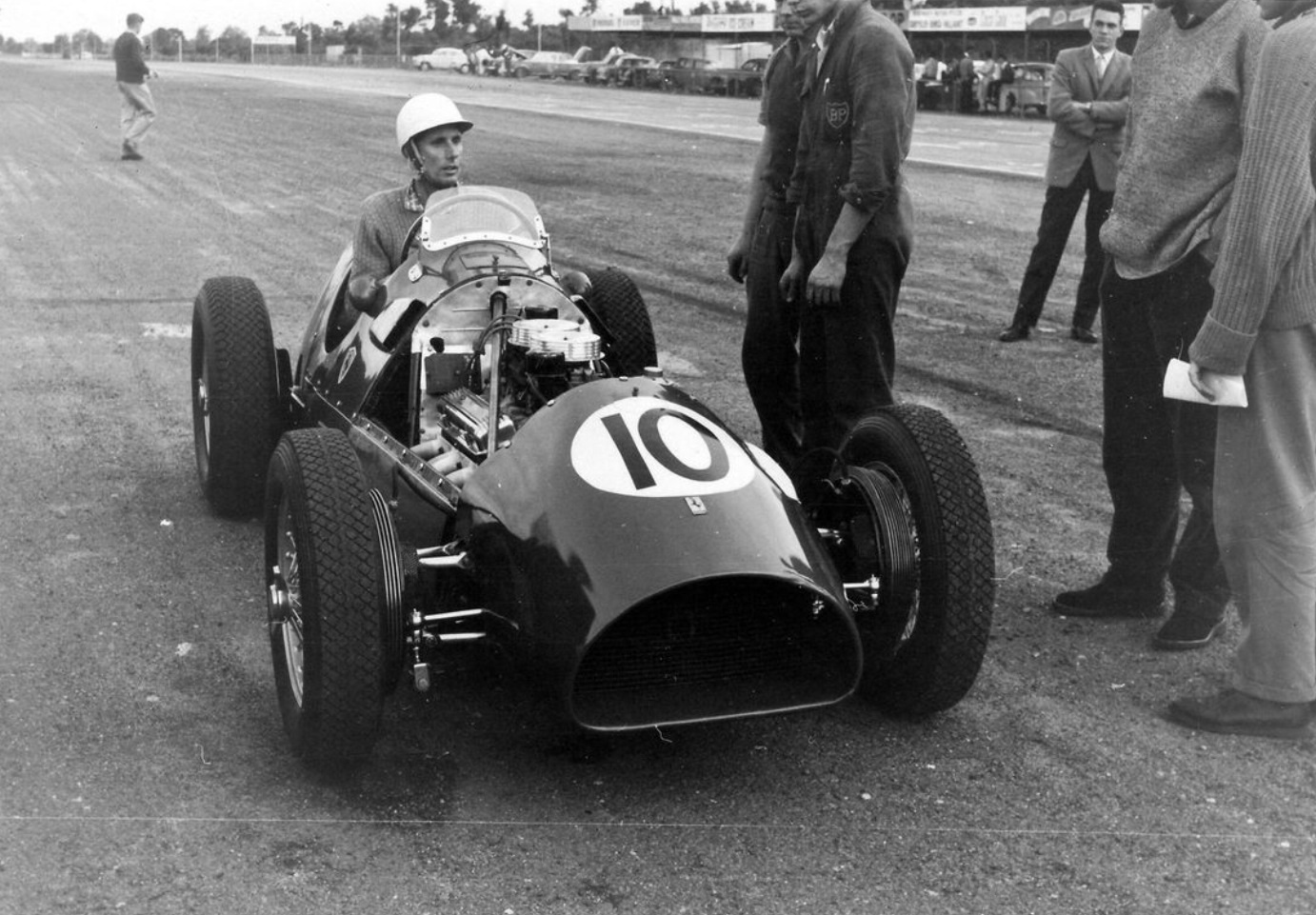
These wonderful photos at Longford during the long, languid, hot Tasmanian summer of 1961 were taken by John Richardson who was a Shell Representative for Northern Tasmania and therefore had the ability to prowl the pits and form-up area. His son Greg recalls the meeting ‘I was only 6 at the time and memories get a little hazy. But I will never forget sitting on a 44 gallon drum in the pits and that wonderful almondy smell of the racing fuel and the noise, it was pretty amazing stuff for a little kid’.

The sort of experience which hooks you on the sport for life…

Jack on the front row beside John Youl, Coopers T53 and T51 Climax- behind is the unmistakeable yellow T51 of Austin Miller- alongside Aussies right-rear you can only just see a bit of Lex Davo’s Aston Martin DBR4 (J Richardson)

Very Black Jack- look at the ‘tache and beard- has not shaved for 24 hours. Cooper T53 ‘Lowline’ (J Richardson)

Roy had better luck in Australia than he did in New Zealand- there he raced a Yeoman Credit Lotus 18 Climax at Ardmore, Levin, Wigram and Teretonga, his best a second place at Teretonga. He had gearbox problems twice and a leaking radiator in the other events.

He then crossed the Tasman Sea to Australia and raced the Cooper used by Ron Flockhart that Australasian season- in Tasmania and two International races a day apart at the new Hume Weir circuit outside Albury on the New South Wales/Victoria border. He was fourth in one, DNF the other, both races were won by Brabham’s Cooper T53 ‘Lowline’, the car photographed above.

During my formative years of interest in motor racing, devouring all of the books we all did on the history of the sport Roy Salvadori was ominpresent in publications on the British scene- where he seemed to race anything which had wheels in multiple events at the same national meeting, and also competing in International events.

Maserati 4CM, Jersey 29 April 1948, 7th in the race won by Bob Gerard’s ERA B Type (unattributed)

Whilst his surname is decidedly Italian exotic Roy was very much a Brit, born in Essex of Italian parents…

Well known as the winner at Le Mans aboard an Aston DBR1 together with Carroll Shelby in 1959 he was also very handy aboard single-seaters and is rightfully on the list of those talented enough, but unfortunate not to win a championship Grand Prix.

The highly skilled all-rounders best F1 season was in 1958, when he was second in the German Grand Prix, third in the British and fourth in the drivers’ championship aboard a Cooper T45, the title won that year by another quintessential British driver of the fifties, Mike Hawthorn in Ferrari Dino 246’s. Cooper were not of course using Coventry Climax FPF engines of 2.5 litres that season, making the performance even more meritorious.

Roy Francesco Salvadori was born on 12 May 1922  in Dovercourt, Essex. After leaving school he joined his father’s refrigeration business before starting to trade in cars, running his own garage in Tolworth, Surrey by the age of seventeen. The War put paid to early plans to race but as soon as the war was over he responded to an advertisement for an MG sportscar only to find that the car in question was the R Type pre-war single-seater- a deal was quickly done.

Jack #24 and Roy, Pescara GP 18 August 1957. Cooper T43 Climax, 7th and DNF in 2 litre cars in the race won by the Moss Vanwall VW57 (Cahier)

The R Type MG was entered in the very first race meeting post-war at RAF Gransden (Gransden Lodge) on 15 June 1946 with Roy the second of two finishers in a three car race! He progressed quickly to a Riley Special and then a 50% share in a 2.9 litre Alfa Romeo Tipo B/P3 said to have been owned by Tazio Nuvolari.

In May 1947 he entered it in the Grand Prix des Frontières at Chimay, Belgium, and, though the car was stuck in top gear from the first lap, finished fifth. Prince Bira won the race in a Maser 4CL.

He soon sold the P3 and bought a Maserati 4CM finishing 7th in the Jersey Road Race in April, contested the British Empire Trophy in May, DNF and later the 1948 British GP at Silverstone finishing 8th in the race won by Gigi Villoresi’s Maserati 4CLT.

In 1949, he again raced in the British GP, Q23, DNF . He was 5th in his heat and 17th in the final of the August International Trophy at Silverstone and wrote off a Maserati 4CL at the Curragh track in Ireland during the September Wakefield Trophy. 1950 was a year of rebuilding the finances and finding a competitive tool- the plucky motor-trader settled on a Frazer-Nash Le Mans sportscar.

Roy ahead of a group of XK120’s, date and circuit unknown, 1951 probably (unattributed)

Salvadori’s first meeting in the ‘Nash was the Daily Express International meeting at Silverstone.

Interviewed in MotorSport in 2008 Salvadori said ‘I was leading, a big thing for me then, ahead of Bob Gerard, Tony Crook and the other Frazer-Nashes. So I was feeling pretty good about life…We came up to lap a group of slower cars which were having their own battle. I tried to overtake them all, but it couldn’t be done’. He ran wide, hit the marker barrels- oil filled drums and cartwheeled down the road, his foot was stuck in the steering wheel spokes, as a consequence he was flung about like a rag doll as the car overturned. Roy suffered a triple fracture of his head- wearing no helmet and had severe brain haemorrhaging. ‘At Northhampton Hospital they decided they could do nothing for me, and pushed me into a corner. They rang my parents and told them I was unlikely to be alive by the time they got there’. A priest was summoned and gave him the last rites.

Salvadori was back in a car three months later. His only permanent legacy of the monster shunt was deafness in one ear.

Roy acquired the 1950 model Jag XK120 (above) and first raced it at Boreham in August 1951. He had much success in the car over the next 12 months racing it against the similar machines of people like Duncan Hamilton and of course many other marques. A more serious machine was the Grand Prix Alta 1.5 s/c of H Webb with which he contested the Boreham Mail Trophy race in July for a DNF.

RS aboard Bobby Baird’s Ferrari 500 F2/GP machine at Castle Combe in 1952. Lampredi 4 cylinder, 2 valve, DOHC Weber fed dual World Championship winning engine front and centre (Simon Lewis)

With his speed and enthusiasm undiminished he was soon in demand to drive other peoples cars, he raced the Jag on into mid-1952 before selling it to Peter Blond. The Frazer-Nash was repaired and raced at Ibsley in April, the car again crashed.

A significant breakthrough were a series of drives in Irish press-baron heir Bobby Baird’s Ferrari 500 2 litre F2/GP car. In an impressive performance he was Q19 and 8th in a field of 31 cars at the Silverstone British GP.

In August he raced a Ferrari 166 (Baird’s?) in the Daily Mail Trophy at Boreham but withdrew after 21 laps. Back in the Ferrari 500, at  the Daily Graphic Goodwood Trophy in September, he was 6th and a month later he drove the car to victory in the Joe Fry Memorial Trophy at Castle Combe.

In mid September Roy contested the GP di Modena in a Cooper T20 Bristol, crashing the car in the race won by Villoresi’s Ferrari 500.

Salvo’s speed in a variety of cars- his versatility clear even then and ability to handle the demanding GP Ferrari lead to an invitation to join the Connaught team for 1953 to contest GP events in the Lea-Francis four-cylinder engined cars.

Camp Connaught, French GP Reims 1953. #42 Bira DNF diff, #50 Salvadori DNF ignition, #48 Johnny Claes 12th. Look carefully and you can see the Prince speaking to Alfred Neubauer in the background. Mike Hawthorn won this famous race after a titanic long dice with Fangio, Ferrari 500 and Maser A6GCM respectively (G Phillips)

The Connaught A Type was a very competitive tool in British national events, Roy’s best results second placings in the Lavant Cup Goodwood, BRDC International Trophy Silverstone, Crystal Palace Trophy and Newcastle Journal Trophy at Charterhall. In September he won the Madgwick Cup at Goodwood from Stirling Moss’ Cooper Alta.

In championship Grands Prix the pickings were much slimmer- he failed to finish all of the events he contested, the Dutch, French, British, German and Italian GP’s. The problem was the cars reliability not Roy’s speed- he qualified 11th, 13th and 14th at Zandvoort, the Nurburgring and Monza respectively for example.

In 1953 he joined Aston Martin in sportscars- although the focus of this article is single-seaters not his two-seater programs.

For 1954 he made the sensible decision to drive a Maserati 250F for Sid Greene’s Gilby Engineering team, the very best 2.5 litre customer GP car of the period. With it he won the Curtis Trophy at Snetterton, was second in the Lavant Cup, BARC F1 race and third in the Goodwood Trophy (all at Goodwood). The Gilby lads took the Maser across the channel to contest the French GP at Reims where Roy was Q10 but had a half-shaft failure. Back at Silverstone for the British GP he was a wonderful Q7 of 28 on a circuit at which he always excelled but had a transmission failure on lap 7.

Roy aboard the Gilby Engineering Maser 250F ‘2507’ at Silverstone in 1954. Too funny finding this shot- when I first became interested in racing someone gave me this very shot as a postcard without identification. I knew enough to know it was a 250F- and the driver looked ‘Eyetalian’ but I could never work out who it was back then! (Tom March)

Still in the first flush of youth, he raced the Gilby Maser ‘2507’ on into 1955 with wins in the Glover Trophy and Curtis Trophy at Goodwood and Snetterton respectively. He qualified first and finished second behind the Collins 250F at the International Trophy, Silverstone.

The 11 April Goodwood meeting says everything about Salvadori’s speed, versatility and work ethic- he contested six of eight events! He won the Lavant Cup in a Connaught A Type, was second in the Chichester Cup, first in the Richmond Trophy and second in the Easter Handicap all in the 250F. He won the ‘B Sportscar’ race in an Aston DB3S and was fourth in the ‘C Sportscar’ race in a Cooper-Maserati. Wow!

Lavant Cup Meeting Goodwood 11 April 1955. Roy on the way to winning the 7 lap F2 race at Madgwick. Connaught A Type and Cooper Bristol (P Redman)

The team again entered the British GP at Silverstone this time yielding Q20 and DNF due to a gearbox failure.

Into 1956 Roy again raced the Gilby 250F which was getting a little long in the tooth compared to the latest spec works-cars but was still a good thing in national events- he was first in the Vanwall Trophy and Sussex Trophy at Snetterton and Goodwood respectively. Moss won the Glover Trophy at Goodwood in a works 250F ‘2522’ with Roy behind him.

In International events the 250F was 3rd in the GP de Caen and had DNF’s at both Silverstone and the Nurburgring- the British and German GP’s but qualified 7 and 9 to remind everyone of his speed in the old jigger. He was Q14 and 11th- last at Monza.

Success also came in mid-engined F2 Cooper T41 Climaxes with wins in the British GP support event, at Brands in the Bank Holiday meeting and at Oulton in the International Gold Cup F2 race.

Roy awaits the off aboard a Vanwall VW57 before the start of the French GP @ Rouen in 1957. Q6, DNF engine on lap 25- and qualified well clear of the two BRM’s! (unattributed)

A man in demand he signed with BRM for 1957, but after his cars brakes locked solid, causing his retirement from his BRM debut race and then failing to qualify for the Monaco Grand Prix, he walked away from the team.

Raymond Mays failed to intervene satisfactorily to improve the P25’s notoriously poor brakes. The P25 became a race winner- it won BRM’s first GP in Jo Bonnier’s hands at Zandvoort in 1959 of course but in 1956/early 1957 it was a problem child. No less than Alex Moulton and Alec Issigonis, Colin Chapman and Piero Taruffi- the latter two track testing the car applied their talents to dealing with the racers many handling, roadholding and braking problems. Leaving BRM at the time was as good an F1 Salvadori decision as being part of Aston’s F1 program in 1959 was a bad one!

Roy continued racing Aston sportscars throughout 1957 and was invited by David Yorke to drive a Vanwall VW57 in the Reims GP in early July, for 5th and in the French GP at Rouen a week later- Q6 and DNF engine. Chapman had of course applied his magic touch in Acton too a year earlier!

German GP paddock 1957: Yep, I can give these barges a run for their money! RS musing about the benefits of his nimble Cooper @ the Nurburgring if not its power. #1 & 2 Maser 250F’s of JMF and Jean Behra. Roys F2 Cooper T43 Climax Q15 and DNF engine in the famous ‘greatest GP of all time’ won by Fangio from the Lancia-Ferrari 801 twins Hawthorn and Collins (Getty)


Salvadori chasing Olivier Gendebien’s Ferrari 246 Dino during the 1958 Belgian GP, the Belgian was 6th and Roy 8th in his Cooper T45 Climax. Stirlings’s watches look good! (GP Library)

For the balance of 1957 Roy joined Cooper beside Jack Brabham, the pair racing Cooper T43/45 Climaxes in F2/F1 events. Cooper ran Coventry Climax FPF’s of just under 2 litres in F1 that season, the class capacity limit 2.5 litres from 1954-1960 inclusive. He was 2nd in the GP de Caen and failed to finish the German GP having qualified 14th running a 1475cc FPF as an F2 car within the F1 grid.

Generally Jack did better than Roy in F2 but he won the Woodcote Cup at  Goodwood, and the F2 class of the Daily Express International Trophy, was 2nd in the London Trophy at Crystal Palace and 4th in the Coupe de Vitesse at Reims.

For 1958 Roy stayed with Coopers and had his best season in GP racing as detailed early in this article. In addition to Championship GP events he was also quick in British Internationals taking 2nd, 3rd, and 4th in the BRDC International Trophy at Silverstone, Glover Trophy at Goodwood and the BARC 200 at Aintree.

Beautiful shot (reader David Fox points out Getty have it ‘the wrong way around’) of Roy’s Aston DBR4/250 at Zandvoort in 1959. Q13 and DNF overheating in the race won by the more modern and developed front-engine BRM P25 of Jo Bonnier- first GP win for them both. The Aston was maybe a potentially winning car in 1957- too late she cried (Getty)

Aston Martin finally got their DBR4 race ready- it was to Roy’s credit that he felt bound to drive it and did so but his first steer of the front-engined bolide would have been enough to indicate that AM had missed the boat relative to the Coopers with which he was now very familiar and had done so well.

It was a backward step indeed. To stay with Coopers would have been the go in 1959 fitted as they were with Coventry Climax FPF’s of 2.5 litres- they won the drivers and constructors titles of course. Roy did more than enough to stay with Cooper in 1959- in ’58 the qualifying record was fairly evenly split between Jack and Roy with the Brit getting far better race results. Oh to have stayed put at Surbiton!

In a fullish GP season he raced Tommy Atkins Cooper T45 Maserati at Monaco and Reims and the Aston DBR4/250 at Zandvoort, Aintree, Monsanto Portugal and at Monza- his best placings 6th in the Monaco, British and Portuguese GP’s. Sixth at Monsanto was 3 laps behind the Moss winning Cooper to give some idea of the relative pace of the new and old paradigms.

In non-championship races he won the London Trophy, was 2nd in the Lavant Cup in a Cooper T43 Climax F2 and frustratingly got a good, long, hard look at the back of Brabham’s Cooper T51 Climax finishing 2nd behind him at Silverstone in the Daily Express International Trophy aboard the Aston.

Roy gets into the Essex Racing Stable #4 Aston DBR1 he shared with Tony Maggs at Le Mans in 1961. The Border Reivers #5 the Jim Clark (jumping in) and Ron Flockhart DBR1 is alongside, both cars DNF (unattributed)

Following his 1959 success at Le Mans, in 1960 Salvadori returned to the 24 hour race in another Aston Martin DBR1 beside a very young Jim Clark, finishing a good 3rd behind two Ferraris.

His Grand Prix program in 1960 was limited to the Dutch and British GP’s in Astons for a DNS and DNF- and at Monaco and Riverside in an Atkins Cooper T51 Climax for a DNF and 8th. In Cooper mounted non-championship events he was 3rd in the Oulton Park Trophy and Lavant Cup at Goodwood and 4th in Snetterton’s Lombank Trophy. He won the Lancashire & Cheshire Car Club F2 race at Oulton Park.

After Aston’s withdrawal from GP racing he drove Reg Parnell’s Yeoman Credit Cooper T53 Climax FPF 1.5 litre engine cars in the first year of the new GP formula.

In a great mighta-been drive in the 1961 US GP at Watkins Glen he charged his Cooper T53 Climax FPF from eighth place up to second- closing on Innes Ireland’s leading works Lotus 18 when with five laps to go his engine failed. He was 6th at Aintree and Monza in a season dominated by the squadron of V6 Ferrari 156’s and notable for the brilliance of Stirling Moss in the under-powered Rob Walker Lotuses at Monaco and the Nurburgring.

German GP, Nurburgring 1962. Q9 and DNF suspension in Lola Mk4 Climax V8, winner Hill’s BRM P57 (unattributed)

Roy commenced the 1962 season with a trip to Australasia to race a Bowmaker Cooper T53 Climax with ‘…our first two races cut short because of rain storms and I took a 4th in the NZ GP and 5th in the Hudson Memorial Trophy. In contrast the following weekends Lady Wigram Trophy was held in stiflingly hot conditions and i again finished 5th’ Roy recounts in his biography.

But his tour was cut short with a practice crash at over 130 mph during practice at Warwick Farm on 4 February, the first Australian leg of the tour.

‘At Warwick Farm we were using an improved Dunlop tyre and although Surtees and I had a set each for the race, we had to share a set in practice. Surtees came back into the pits near the end of practice and the mechanics had a frantic rush to transfer the wheels from his car…I charged off from the pits, joined the long (Hume) straight and was approaching the hairpin (Creek Corner) that followed very quickly. As to what happened next I have to rely on what I was told, as I remember nothing of the accident. As I braked for the hairpin the car turned sharp right into a flag marshalling area protected by the sleepers and hit this at about 100 mph. I suffered head injuries, a broken cheekbone and severe facial cuts, the car was a write-off and two marshalls were injured (with broken legs). I was unconscious until the following day…I was later flown back to the UK for further medical treatment…My theory as to the cause of the accident is that we failed to pump up the brakes (a procedure peculiar to the Cooper after a wheel change) and then as I pumped them up quickly for the corner, the right front brake locked’.

Roy in a CT Atkins Cooper T53P Climax at Crystal Palace during the 1961 London Trophy meeting- a race he won. It was a car of this type he crashed at Warwick Farm albeit 2.6 FPF rather than 1.5 FPF as powered here (PA Images)

Roy flew back to Australia for the Sandown Park Trophy on March 11/12- the circuits opening meeting and drove a Lex Davison Cooper, ‘I was far from fit and it was a very stupid thing to do, although it seemed like a good idea at the time! I was slow in practice and in the race retired because of mechanical trouble’.

Warwick Farm and its fallout was hardly a good start to what would be Roy’s final GP season with a Bowmaker Lola alongside John Surtees.

They drove Eric Broadley’s Lola Mk4 Coventry Climax FWMV V8’s with Surtees consistently outpacing the veteran Salvadori who was terribly cramped in the cockpit of the car more suited to the shorter ‘Big John’. He carried this off with dignity with Surtees remarking after Salvadori’s death ‘Roy had always been serious about his motor racing and in my view, never quite realised his full potential as a grand prix driver, mainly because he was waiting in the wings while Aston Martin were being so slow in developing their DBR4 in 1959’.

Roy had shocking luck with unreliability whereas Surtees had a much better time of it and seconds at Aintree and the Nurburgring. There was nothing too wrong with the basic design, Roy’s best qualifying performance was in Germany with Q9.

Roy blasts away from the Goodwood 1960 TT start, Aston DB4GT in pursuit of Stirling Moss who is already outta picture- and won the race in Ferrari 250SWB (LAT)

The time had come though, Roy was 40, it was right to retire from Formula 1 at the seasons end. But he continued to race sports and touring cars with great success, often for his lifelong friend, John Coombs until 1965, when he retired from racing but not before another couple of big accidents- flipping into the lake at Oulton Park after a puncture to his Jaguar Saloon and at Le Mans in 1963 when his E Type Lwt spun on oil dropped by Bruce McLaren’s Aston Martin. He crashed, then Bino Heins was burned to death in his Alpine, Bino  having sought to avoid Jean-Pierre Manzon who was unconscious in the middle of the track having also crashed after losing control on the oil.

Motor racing is and very much was dangerous!

Testing a very early Ford GT40 at Le Mans in 1964- Colotti ‘box, wire wheels all in evidence (unattributed)

Salvadori was also involved in the original Ford GT40 campaign via John Wyer, his friend/Team Manager from Aston Martin. In fact his last race was in a GT40 at Goodwood in 1965 finishing second overall and winning his class.

In 1966 and 1967 he managed the Cooper F1 team, but was still not averse to a steer, doing some of the early test and development work on the new for ’66 3 litre V12 Cooper T81 Maserati at Goodwood. The driving strength included Pedro Rodriguez, John Surtees and Jochen Rindt.

Testing the very first Cooper T81 Maserati in early 1966 at Goodwood. A race winning car and potentially the ’66 champion with an ace behind the wheel from the start of the season. Surtees joined mid-way thru the season after his spat with Ferrari- losing he and the Scuderia a probable championship to canny Jack (Getty)

c’mon Roy, gimme Pedro’s car! Salvo and Jochen Rindt during 1967 (unattributed)

Meanwhile the garage business which funded his racing in the early days had flourished into major BMW and Alfa Romeo dealerships- they were sold to a public company providing the means and tax necessity perhaps for he and his wife Sue to move to Monaco.

His flat overlooking the Grand Prix finishing line became famous for its parties during GP weekends. He died on 3 June 2012 a familiar figure at historic racing gatherings down the decades.

Etcetera…

Wharton and Salvadori, BRM and Maser, Madgwick, Goodwood, Easter Monday 1954…

I was researching the photo above, its before an infamous high speed contretemps between the two Brits and found this piece Doug Nye wrote in his ‘Goodwood Road and Racing’ column in November 2016- here it is in all of its wonderful glory…

‘One of the great personal rivalries that used to be played out – in part – at Goodwood, was the personal antipathy between Roy Salvadori and Ken Wharton. Roy was a supremely self-confident, stylish, charming, debonair, soft-hearted, philanthropic south-London used-car dealer. His race driving philosophy was pretty much no holds barred, and he was always prepared to stick his elbows out and push and shove, or to position his car in such a way on track – as in a braking area or turn-in point for a corner – in which a close-quarters rival would be embarrassed (or intimidated) into giving way, fearing the consequences of contact – which in that period could be utterly horrendous.

Ken Wharton was evidently an almost equally charming, friendly kind of chap out of a racing car’s cockpit. But the Smethwick garage proprietor – who was in the 1950s one of the most versatile of all competition drivers – having been a front-runner in everything from mud-plugging trials to rallying and road racing in cars ranging from tin-top saloons to 500s, Grand Prix cars and the centrifugally-supercharged Formule 1 and Libre V16-cylinder BRMs, had a less armour-plated personality. He was never quite confident that he was really as good as he earnestly wanted, and tried, to be. In the car – especially at BRM when he found himself teamed with Fangio and Gonzalez (two hopes, no hope and Bob Hope) – he could only play second or third fiddle to the true stars of the day. But he plainly felt that Salvadori was not quite from the top drawer either – not a Moss, and most certainly no Fangio, nor Gonzalez. And so should Salvo attempt to assert himself on track against Ken Wharton, than Smethwick Ken would push back.

This became a pretty explosive situation in that era when drivers were not belted into the cockpits of their racing cars, when wire wheels were narrow and racing tyres slim, heavily treaded and easily intertwined should cars clash side-to-side. Competing cars were also quite tall, quite hefty, relatively unstable, and easy to overturn. On the back of the admission ticket or pass were printed the words ‘Motor racing is dangerous’ and in the ’50s that was absolutely and often painfully self-evident.

There was a history between Salvadori and Wharton before the Easter Monday Goodwood race meeting in 1954. The feature Glover Trophy race was run over 21 laps, for Formule Libre cars which set Roy Salvadori’s new Sid Greene-entered Maserati 250F against the V16 BRMs of Ron Flockhart – in the latest short-chassis Mark II variant – and Ken Wharton in the full Grand Prix-spec long-wheelbase V16 Mark I.

Roy squeezing all there was from the little Cooper T45 Climax during the 1958 British GP @ Silverstone. 3rd in the race won by Collins Ferrari Dino 246 (J Ross)


Roy alongside Mike Hawthorn and Jean Behra on the front row of the Glover Trophy at Goodwood, Easter 1958. Cooper T45 Climax, Ferrari Dino 246 and BRM P25. In the row behind is Scell’s BRM and Brabham’s #18 Cooper. Mike won from Jack and Roy (J Ross)


Reg Parnell, Roy and Carroll Shelby, Le Mans 1959 (unattributed)


Roy shared this Aston DBR1 with Jim Clark @ Le Mans in 1960, the Border Reivers entered car was 3rd in the race won by the Ferrari 250TR of Paul Frere and Olivier Gendebien (unattributed)


Roy and Les Leston shared this DBR1 @ Le Mans in 1957, DNF oil pipe. Ron Flockhart and Ivor Bueb won in a Jag D (unattributed)


Roy from Graham Hill, Oulton Park GT race in 1961, Hill won with Roy 3rd (unattributed)


You can sense the mutual trust and respect between photographer Bernard Cahier and RS in this Monza 1962 shot. Lola Mk4 Climax, Q13 and DNF engine in the race won by Hill’s BRM P57. The Lotus 25 Climax behind is Trevor Taylor’s works machine  (B Cahier)


Bibliography…

MotorSport article by Simon Taylor in August 2012, ‘The Guardian’ obituary, ‘Goodwood Road and Racing’ column Doug Nye, ‘Goodwood Remembered’ Peter Redman, Stephen Dalton Collection, oldracingcars.com, ‘Roy Salvadori Racing Driver’  Roy Salvadori & Anthony Pritchard, David Fox

Photo Credits…

John Richardson, John Ross Motor Racing Archive, B Cahier, Getty Images- GP Library/PA Images, Pinterest, Simon Lewis Transport Books, LAT, Tom March, George Phillips

Tailpiece: Roy, Aston DBR4, Zandvoort 1959…

Finito…