
(Theo Page)
The Cooper Mark 1 (later referred to as T41) was the Surbiton marques prototype or first mid-engined F2 car…
Note that there were also Mk1, 2, 3 etc air-cooled Coopers, the T41 was typically fitted with a Coventry Climax 1.5 litre FWB SOHC, two-valve engine.
This article was spawned by Theo Page’s Type 41 cutaway above. I thought ‘that would be nice to add to an existing article on the Paul England/Austin Miller car’ and then I came upon T45, multiple T51 drawings as well as the ‘Lowline’ T53 so the idea of a piece on the early water-cooled mid engined Coopers popped into my head.
I knew the John Ross and Dave Friedman archives had some great workshop/circuit photographs of the cars engineering detail but that was going to create too much visual clutter so the article is in two parts.
The first bit is the overall story- Who, What, Where and When if you like, the second is more around the design and engineering of the cars with photographs providing great visual support. An ‘eyeful is better than an earful’ and all that.
In terms of photographs I’ve already written a lot of Cooper articles, often ‘quickies’ with all of the best Australian photographs I could find contained therein- rather than re-use these, key ‘Cooper Climax’ and ‘Cooper Maserati’ into the search spot on the upper left primo home page and you can check them out at your leisure, I have sought photos hopefully many of you have never seen before- other than a few Kiwis anyway!
Off we go.

Wally Baker Cooper Mk8 Norton, South Canterbury Hillclimb circa 1960. ‘Clellands Zig Zag’, near Cave, on the east of NZ’s South Island. The road is tarmac these days (CAN)

1949 Cooper Mk3 JAP (Getty)
If John and Charles Cooper’s first mid-engined Coopers of 1948 set the company on a path to change the face of motor racing, the T41 hastened the onslaught on the long established (Auto Union pre-war duly noted) front engine motor racing paradigm.
Lets not forget the performance of the Cooper Bristols Mk1 and Mk II or T20 and T23 which were born as F2 machines and became Grand Prix cars with the adoption of F2 to determine the drivers and manufacturers championships in 1952 and 1953.
Those cars ‘launched the careers’ of a swag of top line pilots not least two World Champions in Mike Hawthorn and Jack Brabham.
The performance of the T39 ‘Bobtail’ and T40 Bristol which Jack ‘knocked together from the Cooper parts bin’, and in which he made his F1 Championship debut at Aintree in 1955- and aboard which he won the Australian Grand Prix at Port Wakefield later that year, emboldened human dynamo John Cooper to build a mid-engined car for the new 1.5 litre F2 which took effect from 1 January 1957.

Jack Brabham in his famous ‘REDeX Special’ Cooper T23 Bristol in the backyard of his parents house in Hurstville, Sydney circa 1953 (HRCCT)

Cooper Mk1 or T20 Bristol (Vic Berris)

Reg Hunt’s Len Lukey driven Cooper T23 Bristol during the 1956 AGP weekend at Albert Park. Doncha think blokes look at racing cars in the same way they check out chicks- with absolute focus, totally oblivious of anything else going on in the immediate environs? Ninth in the race won by the Moss works Maserati 250F (G Smedley)

Colvin Algie, Normac/AC Special about to be lapped by Brian Pescott, Cooper T23 Bristol and Angus Hyslop, Jag D during the 1959 Ahuriri Road Races- Port Ahuriri, Napier, NZ North Island. JW Lawton Cooper 2 litre won from DC Hulme Cooper T45 FPF 2 litre and Pescott (CAN)

Brabham in his 1955 British GP debut/AGP Port Wakefield winning Cooper T40 Bristol, here at Mount Druitt, Sydney, probably also 1955 (Uni Newcastle)
In the UK six F2 races were held between the 14 July Silverstone British GP support race won by Roy Salvadori’s works T41 Climax FWB and the 14 October BRSCC Brands Hatch race won by the RRC Walker Racing T41 similarly engined car. The new T41’s won five of the six races, Salvadori four and Brooks one. Colin Chapman won at Brands on 9 September in a Lotus 11 FWB sportscar, an occasion where the T41’s were absent.
Finally the Brits had, in Coventry Climax, a manufacturer of modern, competitive engines which were available to all who could stump up the readies. During 1957 the SOHC, two-valve FWB was supplemented by the twin-cam, two valve FPF putting in place the family of engines which carted away two F1 titles in 1959/60.
Similarly, Cooper built cars for all.
There is other ‘confluential’ stuff which contributed to Cooper’s rise and rise too;
Jack Brabham arrived at Cooper in 1954 with his unique blend of driving, testing, mechanical and engineering skills. The energy of Jack and John Cooper must have been a truly awesome thing to watch- I’m not so sure I would have wanted to work for them but to view it all from the sidelines would have been quite something.
RRC Walker racing ‘attached themselves’ to the lads from Surbiton, specifically the contributions of Walker RRC, Moss S, and Francis A were mega, as we will see.
Not to forget the son and father combination of John Cooper, a racer to the core, and Charles Cooper who kept the business alive and well. As anyone who has run a small business well knows keeping an enterprise afloat is not easy especially in the fickle ‘only as good as yer last race’ world of motor racing. Cooper Cars was highly profitable throughout with John selling at ‘the right time’ a decade hence not too long after Charles died.
Where were we?- back to the Mark 1, or make that, for me, T41!
John Cooper and Owen Maddock produced a car which was strongly based on the T39 albeit the machine was ‘slipper bodied’ rather than having the all-enveloping body of the other car. Similarly it had independent suspension front and rear using top transverse leaf springs and wishbones at the bottom.

Jack, T41 Climax at Caversham during the 1957 F Libre AGP. Modern as tomorrow Cooper a contrast with the partial nose of the Fred Coxon Amilcar Holden Spl behind (K Devine)

Brabham, T41 FWB on his way to third in the 1957 AGP behind the Ferrari 500 3 litre of Lex Davison/Bill Patterson and Stan Jones Maserati 250F (D Van Dal)

Lady Wigram Trophy 1957. They are off, F Libre- Brabham in T41 FWB against the ‘Big Red Cars’- Reg Parnell and Peter Whitehead Ferrari 555/860 and Ron Roycroft in the light coloured Ferrari 375. D Type is Bob Gibbons, Syd Jensen, Cooper T41 Climax and Horace Gould, Maser 250F #2 on row 2. Look at the size of the Brabham and Jensen Coopers in relation to the Ferrari’s (CAN)

Austin Miller, Cooper T41 Climax leads Bill Patterson, Cooper T39 Bobtail Climax off Long Bridge, Longford during the 1958 Gold Star round won by Ted Gray’s big, booming Tornado 2 Chev. Both of these fellas progressed to T51’s, Patto won the 1961 Gold Star in one of his. He owned more Coopers in Australia than anyone?- perhaps Stillwell and Jones count was similar. Paul England raced Austin’s T41 in the 1957 German GP- DNF distributor after 4 laps
The production 1957 Mark II (T43) was settled upon that winter and put into build at Hollyfield Road.
It had a longer wheelbase that the Mk1 and bulkier bodywork to accommodate two pannier fuel tanks rather than the scuttle tank of the Mark 1- the suspension was the same as the earlier car, the drooped nose was a means of distinguishing between Coopers very latest offering and its predecessor.
Brabham debuted the Coventry Climax FPF engine- it took its bow at the 1956 London Motor Show, in the first race of the year, the Lavant Cup at Goodwood on 22 April finishing second to Tony Brooks Walker T41 FWB. Initially the 1475cc engine developed 141bhp @ 7300rpm and most importantly a swag of torque from 4000rpm- it’s peak was 108.5 lb-ft @ 6500rpm. The pint sized package weighed only 225 pounds.
It was a year of F2 dominance for the marque- in sixteen national and international races Brabham won five, Tony Marsh, George Wicken and Roy Salvadori two apiece and Tony Brooks and Ronnie Moore one. Tom Dickson won at Snetterton in May aboard a Lotus 11 FWA when no T41/43 was present, Maurice Trintignant was victorious at Reims in a Ferrari 156 and Edgar Barth in a Porsche 550RS at the Nürburgring but otherwise it was all Cooper.

Pescara GP 1957. Jack in front and Roy Salvadori behind, Cooper T43 FPF 2 litre- 7th and DNF from Q16 and 15. Moss won aboard a Vanwall VW (57)

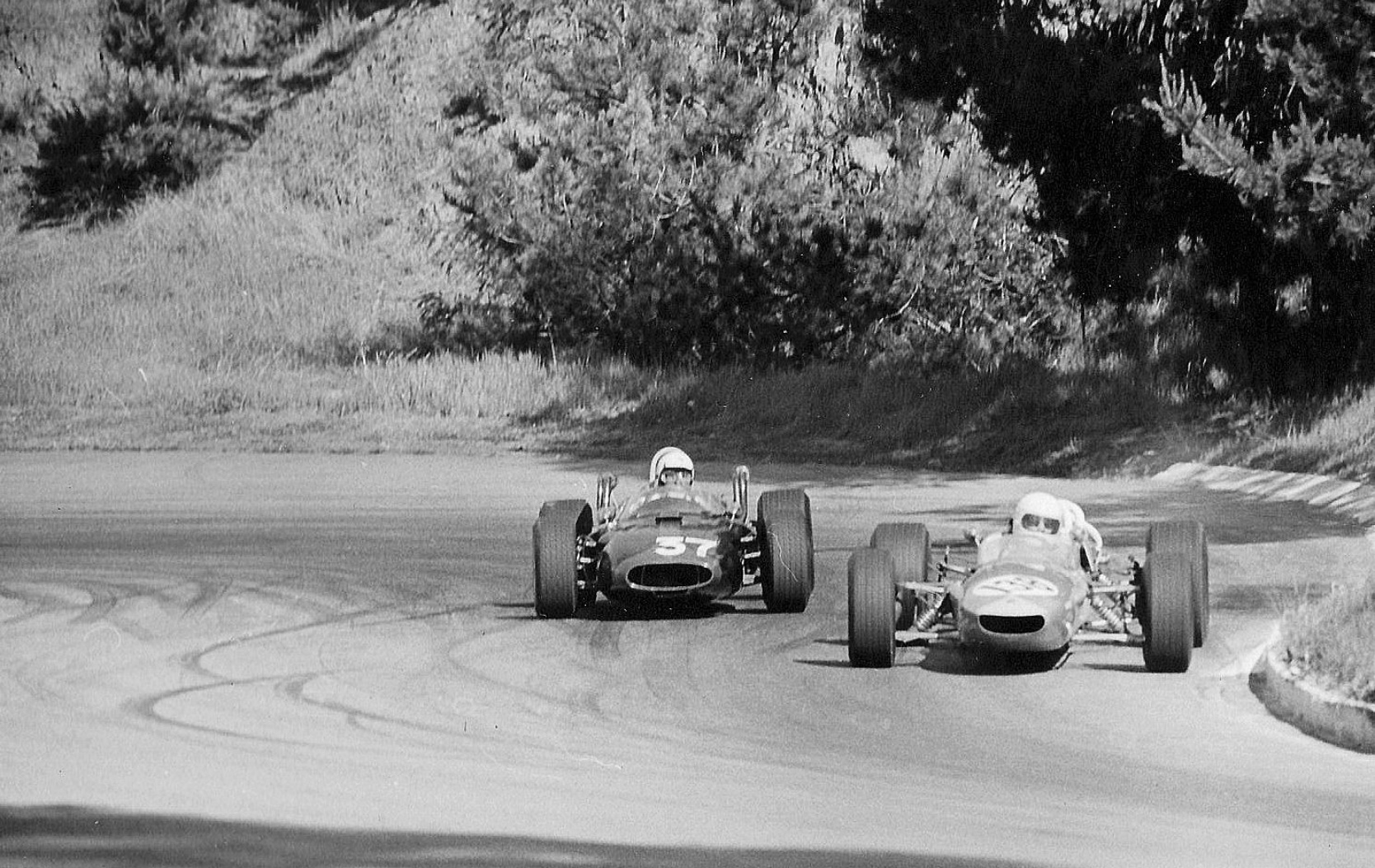
Dunedin International Road Race 1958. McLaren, T43 Climax #47, Syd Jensen, Cooper MkX Norton with #51 Geoff Mardon, VA Vanguard and Merv Neil in another T43 alongside. You can just see the Frank Cantwell Tojeiro Jag at left rear. Ross Jensen Maser 250F won from McLaren and Syd Jensen (CAN)
Meanwhile in Europe privateers were racing the cars in non-championship Grands Prix. George Wicken took his T43 FPF to Siracusa in early April DNF, Brabham was fourth in the Glover Trophy at Goodwood behind two F1 Connaught B Types and a BRM P25. Salvadori was second at the GP de Caen in July behind Behra’s BRM P25 but ahead of four Maserati 250F’s, a car Roy knew rather well.
In the BRDC International Trophy Innes Ireland’s T43 was sixth in his heat and Brabham second in his. Fourteen Cooper T41/43’s contested this race, the best placed was Salvadori in eighth behind BRM P25’s and Maserati 250F.
With a 2 litre FPF available Cooper ran a limited World Championship campaign that year, the best results were Salvadori’s fifth at Aintree and Brabham’s sixth at Monaco. Doug Nye explained how the 2 litre variant came about.
Early in 1957 Roy Salvadori tested Rob Walker’s F2 T41 and F1 Connaught Type B on the same day at Goodwood. He quickly realised the potential pace of a water cooled mid-engined Cooper and floated the idea of increasing the capacity of the FPF enough to tackle GP racing.
Soon, with Walkers financial backing- Rob ordered a chassis and 2 litre engine, the project was underway. Climax’ changes involved increasing the bore and stroke which required new pistons, liners and crank- the result, with only two days fettling was an astonishing 176bhp @ 6500rpm. Brabham used the engine at Monaco and ran as high as third before pushing the car over the line in sixth after fuel pump failure.
At the end of Jack’s European season he came home for the summer commencing his race campaign with the Australian Grand Prix at Caversham, an ex-airbase circuit out of Perth.
His T41 qualfied and finished third behind the Formula Libre 3 litre Ferrari 500 of Lex Davison/Bill Patterson and Stan Jones’ Maserati 250F.

The 1958 Mark III (T45) added significant refinement in that the front suspension was changed to use coil springs and both upper and lower wishbones. At the rear the transverse leaf remained with upper lateral links added which released the spring to do just that, relieved of its additional wheel locational function.
Coventry Climax chief Leonard Lee had endorsed a further increase in the capacity of the FPF to 2.2 litres, the maximum the original block could accommodate. Production of these engines was geared around resourcing two car Cooper and Rob Walker Cooper entries.
The F2 Index lists twenty F2 races in 1958 with Cooper T43/45 victory honours shared widely. Brabham and Bruce McLaren- Jack brought Bruce to Europe that year after Bruce had much Cooper success at home, had three wins each, Moss and Ian Burgess two, with one each to Stuart Lewis-Evans, Kiwi, Syd Jensen, Maurice Trintignant, Henry Taylor, Tim Parnell and Jim Russell.
The big news of course was Stirling Moss’ win aboard Rob Walker’s T43 in the Argentinian Grand Prix.
The car was fitted that day with one of the 1960cc FPF’s. Continental tyres contributed too, he ran on them from start to finish in place of his usual Dunlops. Vanwall, to whom Moss was contracted in F1 that year chose not to travel to Argentina given its cost, distance and because Tony Vandervell’s engines were not quite running well enough on Avgas just yet- there were new fuel regulations in place from 1 January.
So Walker and Moss decided to have a crack at the race- and won! Use of Continentals was Rob Walker firing a shot across Dunlop’s bows ‘because they weren’t being very helpful on tyres at the time’ Doug Nye quoted Walker as saying in ‘The History of The Grand Prix Car’. The Conti’s were were worn through to the canvas at the end of the race- Ferrari fell for the ruse of a prospective tyre change when Alf Francis and another mechanic paraded with wheels and jacks in the pitlane for a stop which was never planned to happen.
In non-championship GP’s Moss won the Aintree BARC 200 in April and the GP de Caen, on both occasions aboard a Cooper T45.
In Australia we were all excited by Cooper pace watching Moss and Brabham face-off in the Melbourne Grand Prix at Albert Park, the last race at the Park until the modern era, won in searing heat by the Walker/Moss T45.

Roy Salvadori leads the marauding pack into the first turn at Monaco in 1958. He is followed by #6 Jean Behra, BRM P25, Tony Brooks Vanwall with #28 Stirling Moss, Vanwall. Brabham is to the right out of shot. Maurice Trintignant won in Walkers Cooper T45 with a bit of luck in a race full of DNF’s and clever strategy. Brabham Q3 and 4th, Roy Q4 and DNF gearbox (Getty)

Equipe Lukey during the 1959 AGP weekend at Longford, Cooper T45 2 litre FPF Climax. With a 2.5 FPF Len Lukey would have won in his ex-Brabham machine, but Stan Jones prevailed in a close tussle in his Maser 250F by 2 seconds (Walkem)

Bruce’ works T45 in the Ardmore NZ GP paddock 1960- Jim Palmer’s Lotus 15 Climax and Pat Hoare, Ferrari 256 behind. Brabham’s works T51 first- then Bruce and Stillwell and Stan Jones in T51’s (CAN)
At championship level Cooper enjoyed considerable success in addition to the Walker/Moss Argentine win.
Salvadori was second at the Nürburgring, third in Britain and fourth at Zandvoort whereas Jack was fourth at Monaco.
The 2.2 litre FPF made its debut at Monaco in the Salvadori/Brabham works cars. There, Maurice Trintignant ran a Walker T45 with an interim 2015cc engine and centre lock detachable Borrani wire wheels and in a crazy race of attrition, he won- two races on the trot for the RRC Walker Racing new-fangled Coopers!
In the more open faster races of the season the Coopers were simply giving away too much capacity but that would be remedied in 1959.

T51 Climax (T Matthews)
The 1959 Mark IV (T51) was identical in terms of chassis and suspension to the Mark III- the technical details of which are dealt with in the second part of this article.
It was one of the great customer racing cars of all time in that so many were sold (28 orders according to period factory records but the actual number of chassis built was far greater than this) and so many used it to win for two or three years hence in all corners of the globe.
Interesting insights by Cooper historian Doug Nye are voluminous and fascinating not least the fact that Coopers weren’t all factory constructed by Cooper staff. Some were, but others were built up by customer team mechanics at Cooper or using a ‘kit of parts’ provided by Cooper and built up elsewhere. The ‘kits’ could be complete or otherwise which is reflected in the many different details between cars which are nominally of the same model type.

The British Racing Partnership/Yeoman Credit take on a Cooper T51 Climax at Monaco in 1960- Tony Brooks Q3 and 4th-Moss won in a Walker Lotus 18. Compare the bodywork and detail of this car with the ‘factory standard’ car of Noel Hall below (D Friedman)

Noel Hall’s Cooper T51 Climax at Lowood, Qld in 1959. Probably during one of the two Lowood Gold Star rounds (unattributed)
Whilst, as noted above, the T51 chassis and related componentry inclusive of the gearbox was carried over from the T45, the critical aspect of the package essential for ultimate success was redesign of the FPF to the maximum allowable F1 capacity limit of 2.5 litres unsupercharged.
The 2.2’s of 1958 were fragile at the margin, the block and crankcase had been weakened in the process of taking the engine from its original 1.5 litres to a smidge over 2.2. The crank counter-weights could not be enlarged and as a consequence the motor vibrated and ran roughly- its life was usually short if over-revved.
Walter Hassan’s redesign started as late as 1 December 1958.
A new block was made by Birmal in light alloy integrating both the block and crankcase and extended from 3 1/2 inches below the crankshaft to 8 5/32 inches above it, Nye wrote. The bore/stroke was 94mm x 89.9mm for a capacity of 2495cc. Cast iron wet liners were used and a five main bearing crank. Beneath the crank was a jackshaft which carried three oil pumps- one pressure and two scavenge. The engine was ‘cross-bolted’- eight studs each side of the block screwed into the main caps.
The two valve, DOHC engine, as before, had its cams driven by a train of gears. The Mk1 2.5 litre heads had 1 1/2 inch bore ports feeding 1.937 inch inlet valves and 1.687 exhausts. Nye notes the engine was ‘under-valved’ initially in case of structural deficiency elsewhere. Fitted with twin-Weber 58 DCO carbs the engine revved happily to 7000rpm developing circa 240bhp @ 6750rpm and ‘pulled like a train from as little as 4000rpm’. Remember that the 2207cc unit produced 194bhp.
Brabham would have well and truly noticed the weight gain mind you- the 1.5 FPF weighed 225lb, the new 2.5 290lb.

Doncha hate thoughtless crops! Headless Repco technician, probably Michael Gasking, with an FPF bottom end in the Repco Engine Lab, Richmond circa 1963 which means its probably one of Jack’s 2.7 ‘Indy’ spec engines used in the NZ/Oz pre-Tasman F Libre days. Note the beefy steel Laystall crank, deep block as per text and row of holes ‘at the top’ for the cross-bolt studs. It’s a story in itself but Repco were licensed or approved by Climax to look after the FPF’s which extended to manufacture of rings, bearings and pistons with CC providing block and head castings which were machined by Repco. Brabham was the first ‘customer’ (M Gasking)
Cooper’s factory drivers changed in 1959 as Roy Salvadori, for years a contracted Aston Martin driver, committed himself to David Brown’s old-school front-engined cars in F1 as well as their sportscar program.
It was a remarkably loyal call by Roy but one not readily understood given his back to back test of Rob Walker’s old and new cars only twelve months or so ago. Roy was very much the quicker of he and Jack in 1958 and really was in the box seat with all of the knowledge about what was coming down the Cooper pike…A Le Mans win together with Carroll Shelby that summer was some compensation for the Aston Martin DBR4 which was ‘too little too late’ without getting lost in that tangent.
John Cooper therefore recruited Masten Gregory and promoted Bruce to the F1 squad with Jack’s unique contribution in and out of the car ongoing.
Vanwall withdrew from Grand Prix racing, and soon altogether, so Stirling Moss raced Rob Walker’s Coopers. The primary difference in specification between the works cars and Walker’s were that John Cooper didn’t provide his you-beaut modified ERSA gearboxes. Walker was left to his one devices, contracting Valerio Colotti to build transmissions, which it transpired failed repeatedly.
In some ways it could be said 1959-1960 were the years of the gearboxes. Moss would have won in 1959 had the Colotti’s held together in the Walker 51 and a Lotus 18, ‘the car of 1960’ would perhaps have won in 1960 were it not for the unreliability of Colin Chapman’s sequential ‘Queerboxes’.
Having said that Cooper created their own luck by building modified versions of the Citroen-ERSA boxes in 1959 and the Owen Maddock designed, Jack Knight built ‘Cooper-Knight CS5’ transaxle in 1960.
Ifs, buts and maybes mean nothing in motor racing- but they are interesting all the same!

Chassis #F2-16-59 , Noel Hall’s T51 was a new car ex-factory, fitted with a 2.2 litre FPF, here outside his garage business- where was that? (J Ellacott)
Jack Brabham won the 1959 title with 31 points from Tony Brooks, Ferrari Dino 246 and Vanwall on 27, Moss 25 1/2 and Phil Hill, Ferrari Dino 246 on 20 points.
The season was open in that Brabham, Brooks and Moss won two races apiece- Monaco and Aintree for Jack, Nürburgring and Reims for Tony and Monsanto and Monza fell to Stirling.
Moss lost the Monaco and Zandvoort leads- and was out early at Monza due to Colotti failure. But the works-boxes were marginal too and Jack nursed them, there is little doubt he had greater mechanical sympathy than Moss- and most other drivers for that matter. One does often make ones own luck in all forms of human endeavour.

2.2 Coventry Climax engine detail and ‘curvaceous’ Maddock frame (J Ellacott)
Both Jo Bonnier and Bruce McLaren took their first Championship Grand Prix wins that year- at Zandvoort (also his last) and Sebring aboard BRM P25 and Cooper T51 respectively.
Five non-championship events were held in 1959 and there, too the Coopers were dominant- T51’s took the Glover Trophy at Goodwood- Moss from Brabham powered by their brand new Coventry Climax 2.5 litre FPF’s, the International Gold Cup at Oulton Park went to the Moss/Walker Cooper and Jack bagged the BRDC International Trophy at Silverstone.
Front-engined non-champ victories went to Jean Behra’s Ferrari Dino 246 at Aintree- the BARC 200 and to Ron Flockhart’s BRM P25 at Snetterton in October- the Silver City Trophy.

This is one of my favourite Cooper shots- Harry Schell in a delicate, high speed Yeoman Credit T51 Madgwick drift at Goodwood during the April 1960 Glover Trophy. DNF engine after 20 laps. Ireland’s Lotus 18 won from the T51’s of Moss and Chris Bristow (Getty)

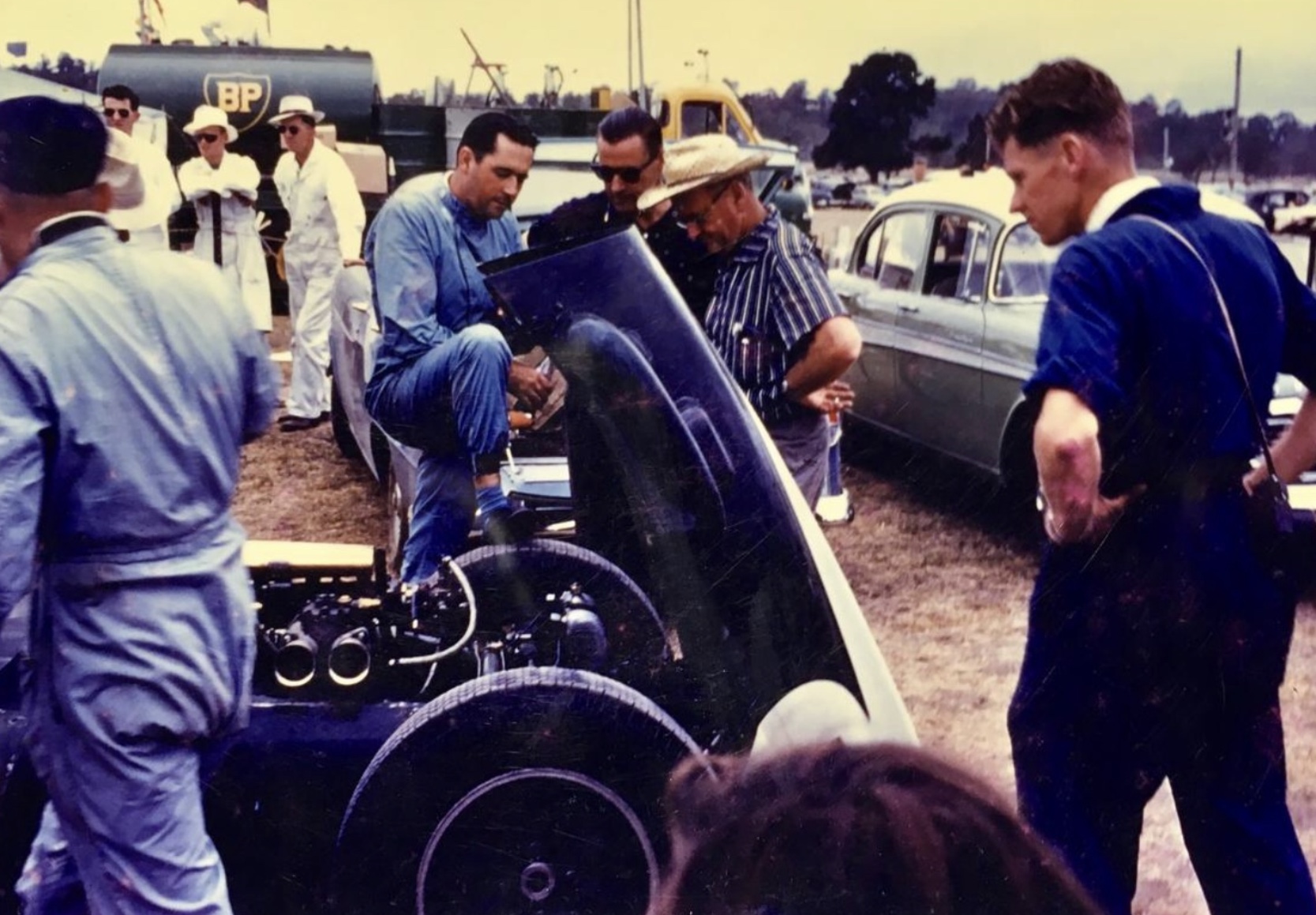
Jack with T51 in the Longford paddock 1960. Is that Alec Mildren in the striped shirt? Jack won in ‘F2-4-59’?) from Mildren’s T51 Maserati and Bib Stillwell, T51 Climax. Lovely atmo shot! Big, hungry DCO mouths (R Lambert)
Cooper were more dominant in Formula 2 where Coopers T43, T45 and T51 ‘cleaned up’.
The most successful combination of the year was Moss at the wheel of Rob Walker’s Borgward engined T43 and T45 with four wins. Tim Parnell and Chris Bristow took three apiece, Brabham two and one each for a lengthy rollcall- Jim Russell, Henry Taylor, Jack Lewis, Maurice Trintignant, Roy Salvadori, Harry Schell, Stan Hart, Trevor Taylor, Ron Carter and Tony Marsh. Amazing really, Cooper built and sold a lotta motor cars!

Moss’ Walker T51 Climax in the Ardmore paddock, NZ GP 1960. Moss DNF clutch after 27 laps- Brabham T51 won from McLaren T45 and Stillwell T51, Bib’s 2.2 the other two fellas 2.5’s (LibNZ)
At the European seasons end Moss, Brabham and McLaren headed south to the Antipodes for what would become an annual trip to race hard in the sun and play hard in the sun…
The NZ GP at Ardmore was won by Jack’s T51 as was the Longford Trophy in early March.
The Surbiton boys received a rude awakening when they fronted up in Argentina on 7 February with their T51’s to be comprehensively blown off by Innes Ireland’s new Lotus 18 Climax- Chapman’s first crack at a mid-engine design was a rather successful one in FJ, F2 and F1…
Bruce won the race after the Lotus failed but Jack DNF’d with heat-treating failure in his ERSA gearbox.
Suitably chastened the Cooper crew famously began the design of what became the Cooper T53 ‘Lowline’ on the long haul flights back to the UK. Doug Nye records that they landed in Heathrow on 17 March with the 14 May Silverstone International Trophy the deadline for completion of new cars.

Mike Barney preparing Jack and Bruce #18 T53 Climax in the Reims paddock in 1960- first and third, Jack won from pole. Technical details as per second part of the article but note the ‘bungy’ retained huge ally fuel tanks and relative height of T53 compared with T45/51
A head start was provided by Owen Maddock’s Cooper-Knight CS5 gearbox- it was just entering limited volume production in Knight’s workshops. McLaren’s College drawing skills were deployed to assist Maddock with Jack providing thought leadership and sketching whilst John chased suppliers for parts.
In essence the T53 was longer, sleeker, lower and lighter with a new, reliable gearbox able to take the loads of the more powerful FPF 2.5- itself mounted a smidge lower in the stronger in torsional stiffness by 25% (over the T51) Lowline frame- in the final year of the long-lived, very successful and interesting 2.5 litre F1.
The second half of the article covers the T53 technical advances in plenty of detail.

Cooper T53 ‘Lowline’ (Brian Hatton)
Innes Ireland won the Glover Trophy at Goodwood in April and the International Trophy at Silverstone in May- Jack’s T53 was second.
Moss could see the Lotus writing on the wall so Rob Walker acquired an 18 prior to Monaco- Stirling promptly won the race albeit Jack led until lap 41 when he spun on a wet patch and clobbered the Ste Devote wall- the damaged frame was repaired in time for Zandvoort where he won- the Lowline’s first win was on the board.
At Spa the cars were jets- Jack was 2.5 seconds quicker than the nearest pursuer in practice. He won easily with Bruce second after others fell by the wayside- Nye notes Bruce’ car topped 180mph.
By Reims the T53’s were fitted with larger capacity oil pumps to prolong crown-wheel and pinion life. Jack started from pole and won again after a great long duel with Phil Hill’s potent Ferrari Dino 246.
Jack won again in Britain after Graham Hill’s BRM brakes faltered and he spun 6 laps from home, Bruce was fourth, adrift of the two Lotus 18’s of Surtees and Ireland.

This photo and the one below are to illustrate the size and shape differences between the 1959 T51- here Lance Reventlow’s works car and the 1960 T53- Bruce’ #2 car at Silverstone during the British GP weekend- up the road is one of the BRM P48’s. Brabham’s T53 won from the Surtees and Ireland Lotus 18’s. Bruce was 4th and Lance’s car was raced by (his Scarab fellow driver) Chuck Daigh- DNF overheating from Q19 after 56 laps

The shot from the rear is during the 1960 French GP at Reims- Olivier Gendebien T51, 2nd at left with Bruce’ T53 at right, 3rd. Jack won. Great effort by Gendebien in the BRP Cooper
Fortune again favoured the team at Oporto with another one-two whilst in non-championship events Ireland continued to win- the cars had the speed to win shorter events but not the reliability to win Grands Prix. He won the Lombank Trophy at Snetterton in September and Moss the Oulton Park Gold Cup in Walker’s Lotus later the same month.
The Italian organisers engineered a Ferrari win at Monza by running their race on the banked circuit and Moss- well and truly back after his terrible Spa crash on that deathly weekend early in the season, the victor in the US GP at Riverside in the Walker 18.
In Formula 2 Cooper did not have it all their own way in 1960 as they had the year before- of 26 races Cooper won twelve, the Lotus 18 six, Porsche 718 five and Ferrari 156 three- the latter car ‘a dry run’ for their 1961 World Championship winning cars. Of the Cooper brigade Brabham and Jack Lewis won three races, Mike McKee two and George Lawton, Roy Salvadori, Maurice Trintignant, and Klaas Twisk one apiece.

Bruce works T53 FPF 2.5 Lowline at a very soggy Wigram 1961. Bruce was fourth behind Brabham, Moss and Angus Hyslop- Cooper T53, Lotus 18 and Cooper T45, all Climax FPF powered (CAN)
Technical…
T43..

In a Motorsport Gordon Murray appreciation piece about the Cooper T51/53 he wrote that when he went to Brabham (in 1972/3) he inherited Pete Beddings and his Dad who made all of the early Cooper shells ‘…but I don’t know who styled them. Whoever it was obviously had an eye, because they were very pretty and quite effective aerodynamically. I suspect it was John saying “its a bit like this”.’
‘I still love to see a little Cooper at Goodwood: they still stir the blood just the same as a Ferrari or a Lotus. They were also well made for the period- if you look at, say, a Ferrari of the time, the frame technology is pretty basic: the rear engined Coopers were at least multi-tubular. Not pure spaceframes like Chapman moved on to later (I think he was well and truly there already Gordon!), but they were clever-simple for reliability.’

The T43 chassis was made of the usual Cooper 1 1/2 inch steel tube. The Mark 1 tall frame hoop encircled the seat back bulkhead and was unbraced whereas here (below) it was unbraced but the top chassis longerons each side of the engine bay were braced against the lower longerons by a three piece ‘Y member’.
What about those Cooper chassis’ which have always offended the purists- a true multi-tubulars spaceframe chassis should use straight tubes only, each stressed in either compression or tension.
Famously, after laying out several straight tube designs for the Mark 8, and in John’s absence having them rejected by Charles Cooper, Owen Maddocks decided to take the piss and presented an option in which every tube was bent- to his surprise it was embraced by Charles, a good intuitive Engineer.
Doug Nye recounts Owens account of the discussion about the approach when John Cooper returned.
’Curving the top frame rails down to meet the bottom ones reduced wracking through the frame. You could run curved tubes where they wouldn’t interfere with fuel tanks and suchlike. One of our very good welders always told me he preferred simple joints- with just one tube jointed into another- to multiple joints with with three or four tubes involved. We didn’t like weld overlapping weld and so tried to arrange things to avoid that. With curved tubes we could follow the body lines more closely, so we didn’t need the old strip -steel frame to support the body panels. What had started as a joke began to look quite logical, and very practical…’

The F2 Coventry Climax 1475cc gave circa 141bhp @ 7000rpm in its first evolution and drove through a Citroen-ERSA transaxle, which coped pretty well with the demands put upon it at that stage. Note the change linkages and beautiful rear suspension detail- traditional transverse leaf and wishbones Cooper design.
Coopers curvy frame shown to good effect.

In 1956/7 wire-wheels were still very much the norm in motor racing, Coopers progressive inclination was reflected on the magnesium alloys specified on their cars pretty much from the start. Objects of beauty, lower unsprung weight and strength were amongst the favourable properties.

Crystal clear John Ross shot- not quite close enough to checkout the chassis number however! I wonder who was the steering wheel provider of choice.
Note the gear lever and linkages to the left- the weak link of the higher powered T45 and T51’s covered in this article were the gearboxes, a solution was finally arrived at for all in the form of Mike Hewland’s concern in the early sixties when a racing gearbox finally ‘became a spacer between the engine and rear of the chassis.’
Smiths instruments of course- I wonder if one of those to the lower left is for gearbox oil temperature?

The engine progression in 1957 goes something like this.
F2 Coventry Climax FPF 1500cc 141 bhp was the ‘standard engine’ for F2 T43’s.
In F1 Jack Brabham raced at Monaco with a 1960cc FPF for the first time and later in the season, as outlined earlier in the article, 2.2 litre engines were approved by Leonard Lee late in the year and made available to the works and Rob Walker teams in 1958- and others later.

The T41’s side panels wrapped tightly around the chassis hoops whereas the T43’s were bulged to clear the fuel tanks either side of the driver- sufficient tankage was incorporated for a race of 200 miles duration. The bulged body panels were carried clear of the frame on light-guage outriggers.
See the bungees retaining the fuel tanks above. Brakes in standard form as here, were Lockheed 10 inch x 1 3/4 inch drums but Girling discs were an option and commonly specified. Shock absorbers were Armstong and uprights, I think, fabricated in-house.

Very slippery.
Lean, lithe, light and uber-responsive given the low polar moment of inertia.
Not for the faint of heart and not everybody familiar with a front-engined racer could successfully make the switch- mind you, by 1956 a generation of racers had cut their teeth on air-cooled, mid-engined Coopers so they were rather used to the handling properties of the little beetle-backed machines.
T45…

This group of photographs are all of an F2 T45 FPF 1.5 but the technical elements of the F2 and F1 T45’s are the same with the exception of engine capacity of course.
The Mk3/T45 F2 and F1 and 1959 Championship winning Mk4/T51 F2 and F1 cars are virtually identical so lets take a deepish dive into the T45 and the changes over the previous T43.

This chassis is fitted with an F2 1475cc FPF- T45’s were also fitted with 1960cc, 2015cc and 2207cc FPF’s in 1958.
The bore/stroke at the latter capacity was 3.5 inches- this ‘square’ configuration was only made possible by slipping a ‘sandwich plate’ between the block and the head to get the required stroke height. On Avgas this motor produced 194bhp @ 6250rpm.
The shot above provides just a glimpse of the rear transverse leaf spring aft of the chassis cross tube.
Its lateral location was now provided by a short link pivoted on the left side frame trunnion and bolted to a centre clamp (you can just see the inner end) retaining the leaves in the middle of the spring.

Front to rear weight balance of most Coopers was about 44-56%- quite similar to the best front engined cars with a rear mounted fuel tank.
The T45 chassis was 1/2 inches lower than the T43- at the front it now incorporated upper and lower wishbones and coil spring/Armstong shocks rather than the transverse leaf used by Coopers from the start.

Ain’t she sweet.
Note the Alford and Alder forged front uprights, these wonderful bits of kit, then fitted to the Standard 8 and Triumph TR3 Road cars, were installed in F1 Brabhams up to and including the 1966 World Championship winning BT19 Repco- and Formula Fords well into the late seventies and beyond. One of motor racings most ubiquitous components, surely?
The front wishbones were of the welded tubular type and included a Chorlton ball joint at their outer end. The uprights lower threaded trunnion was coated with cadminium plating setting the finished product off nicely. Roll bars were housed within the bottom frame cross-member.

The photograph below shows (apart from the very obvious) the top leaf outer end, Armstrong shock and inboard mount for the lower wishbone. The wishbones were more widely based at both the top and bottom than on the Mk2/T43. The outboard mount for the Armstrongs was stiffened- it was on a crossbrace welded between the wishbone legs. Note the fuel filter, starter motor and height of the gearbox.

On the earlier cars the height of the engine in the frame was determined by the Citroen based gearbox as its input shaft from clutch to gearbox passed high above the inner driveshafts.
In the early Mk2’s the engine was canted 18 degrees to the right and inclined downwards at the front by 5 degrees to lower the centre of gravity.
Jack Brabham’s ongoing contribution to design elements of Coopers in addition to set up and on circuit tuning is well established and recognised. Brabham maintained ongoing correspondence with Ron Tauranac back in Sydney. It was Ron’s suggestion to use ‘drop gears’- spur gears inside the gearbox bell-housing which allowed the engine/gearbox to be lowered a full 2 1/2 inches within the chassis frame.
Cooper worked with ERSA in Paris, the gearbox manufacturer and Jack Knight’s specialist shop in Balham, to effect those changes. A bonus was incorporation of a quick-change final drive ratio feature.
Jack famously visited ERSA in early 1958 and had six gearboxes cast with extra strengthening ribs. He laid out all the patterns on the bench and added Plasticene here and scraping a core there- the trick cases were just man enough to handle the power of the 2.2 engines in 1958 and 2.5’s in 1959. ZF slippery diffs were added too- a side trip for Jack whilst in Germany, back at Surbiton ‘…John covered his tracks so Charlie would not hear of the extra expense’ Nye wrote.

‘All Cooper chassis pickups…had been provided by drilled triangular welded-on brackets known as “Bradnack Lugs”, and on the Mark 3 frame those anchoring the inboard pivots of the lower wishbones were aligned above the bottom frame rails instead of below them. Both top and bottom frame longerons were more widely spaced than on the preceding Mark 2’s with less pronounced tube curvature’ Doug Nye wrote.


Whilst noting Cooper’s mid-engine approach itself was at the time revolutionary, the evolution of the cars from T43 to T45/51 was more evolutionary in nature addressing design/performance weaknesses or strengthening componentry based on hard won experience.
Charlie, John and Jack were all racers…and supreme pragmatists.
They were not after the great leap forward- they had that conceptually, beyond that they sought performance advantage and reliability whilst Charles, with a ready eye on the family fortunes, ensured the whole kit and caboodle could be sold at a profit and repaired and maintained cost-effectively back at Hollyfield Road or by a customer in the paddock at Gnoo Blas.
Doug Nye is at pains to point out in HAGP that the specification of these cars is not fixed or hard and fast given so many of them, as we covered earlier, were built in the factory by the teams running them or using kits of parts supplied. The ultimate detail and personal tweaks applied means that individual chassis differed from one another almost as a matter of course.

Take your pick of artists in terms of T51 cutaway drawings!
The one earlier in the article is Tony Matthews, above is James Allingtons’ and the one below is Brian Hatton’s so every angle and detail must be well and truly covered!

T53 ‘Lowline’..

(D Friedman)
As mentioned earlier the threat of the Lotus 18 meant that a ‘clean sheet’ approach was needed- a Cooper-esque clean sheet in any event! Every part of the T51 was quickly scrutinised through lenses of lightness, simplicity, strength and efficiency.
Fundamental design tenets were laying the driver down to aid aerodynamic efficiency, a coil sprung rear end (Charles Cooper fought a pitched battle on this score Nye records by insisting that a transverse leaf rear also be designed should the coils fail), greater torsional stiffness and an improvement in performance around the T51 ‘weak tracks’ which included fast places like Reims and the Avus.

(D Friedman)
The chassis was still essentially a four-tuber of 1 1/2 inch 18 gauge thick top rails and 19 gauge bottoms. Diagonals braced the frame bays ahead of the cockpit but that area was un-braced ‘other than small tube ties welded across the joint apices’.
The long rear bays were unbraced on both sides, when the engine and gearbox were fitted- the latter ‘CS5’ had five mount points frame stiffness was of course enhanced. There were two diagonals in each side with a common apex halfway along the bottom chassis rail.
The engine mounts were welded onto curved tubes to reduce the length of the mounts, both of which were welded to the middle of the main frame members, this ‘would have been heresy to an accomplished stress man like Colin Chapman’ Doug notes.

(D Friedman)
The engine was lowered another inch over the T51 by reducing centre-offset between the step-up gears in the gearbox and allowing the driveshafts to rake upwards to the hubs rather than being parallel with the ground when static.
The steering column was lengthened and moved from behind the front axle line to ahead of it- thus the pedals could go forward and the steering wheel rake made more vertical all allowing the driver to adopt a more laid-down pose aiding aero on those fast courses.
The oil tank capacity was the same but its shape was changed- it was lower and wider, still behind the radiator but pushed forward to reduce nose height.

(D Friedman)
Suspension wishbones were wider and stronger.
The ‘CS5’ transaxle was a lovely bit of kit. It was remote sumped in its gearbox section with splash-feed to the final drive and ZF diff. The unit placed its gears above the oil level so only a pressure pump was needed.
The gearbox ‘…proved essentially trouble free…Jack Knight recalled the vast amount of machining required…its cost to Cooper was around 1000 pounds a box which was virtually prohibitive. John Cooper managed to hush it up, telling his father they cost around 400 pounds each- and The Old Man was livid even then!’ Nye wrote.
No doubt Chapman would have been keen to get hold of a couple of these boxes half way through 1960, fitted thus he had a championship winning car.

Note the CS5 gearbox and pressure pump on the outside casing, oil filler neck and upper and lower rear suspension wishbone mounts (D Friedman)
The prototype Lowline was completed at around 9 am on Friday 6 May 1960 and taken to Silverstone, where after a few shakedown laps, Brabham drove faster and faster- within 10 laps he was 2 seconds under the lap record. Then Bruce jumped in and went quicker still.
Cooper were well and truly back in the game!

Bruno Betti’s take on the Cooper T53 ‘Lowline’
So where does this series of cars fit in the pantheon of racing cars and motor racing history?
Gordon Murray was rather eloquent about that aspect.
‘When I think back to GP milestones , its pretty obvious really, the first rear-engined F1 Cooper. Not so much from a technical point of view even though it was so simple and so effective compared to the other more complex cars of the time but because it brought with it probably the most significant change in Grand Prix cars…’
‘Who else can lay claim to such an impact. And i’m including pre-war cars like Auto Unions because they were such bad examples of rear-engined cars…The real pioneers were Charles and John Cooper, first with the 500 F3 cars and then having the bottle as a small concern to go ahead and do a GP car.’
‘Really the Cooper was more significant, more forward looking even than the Lotus 25 because it meant a fundamental change in packaging, weight distribution, frontal area, in philosophy. And it was an ultra simple car as well, easy to run easy to work on. I always tried to build my GP cars at both Brabham and McLaren to be as simple and easy to work on as possible, and therefore get reliability, and the Cooper was such a good car from that angle. And that Climax was a very under-rated engine because it was built by a very small company. So, the whole package was pretty radical. John probably hasn’t had the credit he should have overall.’
‘All kinds of things appeal to me about it: firstly it was a great little family business, two bright guys and then the giant killing aspect…I just love that aspect. And these guys did two titles back to back…’
Finally, Gordon concluded ‘As a designer i’d have loved to have been the first to say “hang on that’s a bit cranky having the engine in the front”, with that weight distribution, that frontal area, the prop-shaft losses, compared to the extra traction, better braking- everything gets better with the engine behind. You can’t help saying “Why didn’t somebody think of this before”…

1961 February Teretonga International, NZ. L>R Tony Shelly, Cooper T45 Climax, Pat Hoare, Ferrari 256 (in essence a Dino 246 with 3 litre Testa Rossa V12) Denny Hulme Cooper T51 2.5 FPF leased off Yeoman Credit and Jo Bonnier Yeoman Credit Cooper T51 Climax- to the right is Malcolm Gill in the silver Lycoming, a very successful, iconic Kiwi aero-engine special. No less than Jim Clark was impressed with a drive of this car! Bonnier won from Roy Salvadori, Lotus 18 off the back of the grid, Hulme and Hoare (CAN)
Etcetera: Cooper Mark and Type Numbers…
Allen Brown advises that the ‘T type’ descriptor started at Cooper in 1963. It was applied both prospectively and retrospectively. Stephen Dalton ‘tangibilises’ this in that after extensive research, he can see Cooper using a ‘T number’ for the first time in an October 1962 issue of Autosport where Cooper are quoted about ‘the new Cooper Monaco, the Type 61’
Doug Nye wrote more broadly about the timing of the detailed way in which racing cars commenced to be identified (that is, for example, when a Cooper or Cooper Climax became a Cooper T51 Climax) ‘When it comes to a type numbering system- as in so many things Cooper- don’t rely on published references to same…I have seen all types of T scrawls on some drawing copies.’
‘When I publicised manufacturer type classifications in a “Motor Racing” magazine article reviewing the 1 litre F2 seasons 1964-5 that was the first detailed references that many people had seen to some model classifications which are now used as common terms. I was not the first- but I think at least amongst the first- to present such nerdy detail.’
‘Race reporters had seldom used even Brabham BT classification before then…Brian Jordan had previously produced a little booklet essentially for model makers which included type number detail. I also seem to recall Paul Watson freelance writer/entry fixer of the 1960’s having on a few prior occasions cited a type number’ Doug concluded.

Renwick 50, in the very north of New Zealand North Island, November 1961. Flagman at the bottom of his downward arc on the podium at right! Preliminary heat on the one off rectangular circuit which used the main street. Bob Eade, on pole Maserati 250F, Tony Shelly, Cooper T45 FPF 2 litre. Pat Hoare (won the main race in his Ferrari 256 V12) on row 2 then the Bob Eade 250F and the rest including Chris Amon- in front of the sportscar on the right perhaps? (CAN)
Credits…
Special thanks to the fantastic John Ross Motor Racing Archive and Dave Friedman Archive, Theo Page, Brian Hatton, University of Newcastle, The Nostalgia Forum, ‘CAN’-Classic Auto News- Allan Dick, Milan Fistonic, Geoff Smedley, David Van Dal, oldracephotos.com.au, Getty Images- Bernard Cahier and GP Library, John Ellacott, Ron Lambert, Tony Matthews, James Allington, Bruno Betti, Ken Devine Collection
Bibliography…
‘History of The Grand Prix Car’ Doug Nye, grandprix.com, oldracingcars.com, F2Index-Fastlane, Motorsport ‘Cooper T51/53’ interview with Gordon Murray in June 2000
Tailpiece…

Jack at his happiest and most creative.
‘Jack Brabham…was always working with the cars, looking at them, thinking about them…’Owen Maddock fondly observed of Jack to Doug Nye.
Its a posed shot above no doubt but it illustrates the point all the same…
Finito…
























 primotipo...