Posts Tagged ‘Harry Schell’

(LAT)

Atmospheric shot of Harry Schell’s BRM Type 25 during the August 23, 1959 Portuguese Grand Prix at Monsanto, Lisbon…

It was the breakthrough car for BRM, Jo Bonnier’s Type 25 won at Zandvoort in 1959 thereby breaking the F1 World Championship GP winning duck for the Boys from Bourne after nearly a decade of competition.

Immaculately credentialled engineer Stewart Tresilian “was largely responsible not only for the original conception and design of the BRM Project 25 2.5-litre four cylinder engine, but also of the compact P27 – or Type 25 – car (chassis) intended to carry it into battle.” Doug Nye wrote in ‘BRM Vol 1.’

“He had produced a homogeneous concept of car and engine combined, its essence being the complete antithesis of the original V16 in that it was all as small and compact and simple as possible, with the arguable exception of his projected 16-valve cylinder head for the four cylinder engine.”

BRM P15s, JM Fangio on the front row, and Ken Wharton behind him, Albi GP May 1953. Fangio won the heat and dominated the final before tyre troubles intervened, Louis Rosier won in a Ferrari 375 with Froilan Gonzalez second in another BRM P15. Car #3 is Nino Farina in the Vandervell Thin Wall Ferrari 375 (B Cahier)

The four-valve head design was subsequently over-ruled by Peter Berthon and after Tresilian left the Owen Racing Organisation to go to Bristol-Siddeley Engines in January 1953, Berthon, Tony Rudd and others brought the Type 25 to reality.

The result was a car that became increasingly fast, it not particularly reliable with each passing year from its race debut in 1955 until early in 1960. It allowed the team to develop the capabilities to win; car development, preparation and driver, they couldn’t do that with a car that never lasted too many laps. Mind you, the simplicity of Tresilian’s concept was complex in its execution…

Peter Collins crashed his Type 25 #252 during practice of the Daily Telegraph Trophy meeting at Aintree on September 3 1955, so took his bow here at Oulton Park during the September 24, 1955 International Gold Cup meeting in the same car. Q13 and DNF after loss of oil pressure after 13 laps. Stirling Moss won in a Maserati 250F from Mike Hawthorn’s Lancia D50. Oh to have been there that day!
Many thanks to Stephen Dalton for these two programme pages – studiously marked up by a knowledgeable spectator – from that BRM Type 25 failed race debut September 1955 meeting at Aintree

The P27 semi-monocoque – in the centre section – chassis was strongly influenced by Tom Killeen’s Killeen K1 sportscar which was tested extensively at Folkingham by Rudd. He was impressed and the performance of the car “confirmed PB’s interest in stiffening his basic new P27 frame with a stressed-skin monocoque centre section.

The five-speed rear-mounted gearbox was drawn by Alec Stokes, “who was destined to become BRM’s dedicated transmission specialist and one of the country’s leading gear-men.” The back of the gearbox carried the controversial single, longitudinal-axis rear disc universally known as the ‘bacon-slicer’.

With 50/50 weight distribution and 70% of the braking load at the front, the thinking was that outboard front disc brakes would carry 35% each, leaving 30% for a single rear disc. It took a long time to sort, but when that was achieved “this arrangenent worked quite well on the front engined cars.”

Rear suspension was by way of a De Dion tube with Lockheed air struts inherited from the V16 program, front suspension comprised upper and lower wishbones and coil air strut units again, with the rack and pinion steering Morris Minor based.

BRM P25 2.5-litre, (2491cc 102.8mmx74.93mm bore/stroke) four main bearing, DOHC, two-valve, Weber fed, twin Lucas magneto and twin-plug sparked four-cylinder engine shown in one of the cars at Monaco in 1956. That hole in the bonnet is the extent of the access my friends
BRM Type 25 1958 specification spaceframe chassis (C La Tourette)
BRM Type 25 during the 1959 Dutch GP weekend at Zandvoort. Cars then spaceframe chassis with vastly superior mechanical access, note the single rear disc brake under the fuel tank at right. All that fuel sitting very high, the trade-off decisions are made clear in this shot (BRM 1)

While work progressed on the chassis there was a long test program with a single-cylinder model of the new engine. ORO were racing the V16 Mk2 and Maserati 250F during this period, with some success. By Easter 1955 the car was complete but for the engine. Finally, on June 5, 1955 the car ran for 19 laps at Folkingham with Rudd at the wheel, having given 260bhp @ 8000rpm on the test bed.

The major problem on test was the SU fuel injection system which was subseuently ditched in favour of a pair of 58DCOE Webers. After further tests by Ron Flockhart and Peter Collins, the car was entered for the September 3 Aintree meeting.

Peter Collins was chosen to race the machine but lubrication problems caused the engine to blow oil over the rear tyres causing a spin and chassis damage that prevented further running. A further run at Oulton Park on September 24 was impressive with Collins running third in front of Ferraris, Maseratis and Vanwalls etc ended when Peter noticed failing oil pressure and pitted. Thus turned out to be a dud gauge which had been shaken to death by the vibrations of the big-bore-four!

Post-meeting work involved rubber mounting the instruments, improving gearbox lubrication and gear teeth form. As Nye observed, “The new BRM was the tiniest car of its time. It was really minute, and very light, and very powerful…and very troublesome.” The eternal process of development was only just underway.

Willie Southcott tending Tony Brooks’ car, #252, at Goodwood during the Glover Trophy meeting in April 1956. DNF oil pressure in the race won by Stirling Moss’ Maserati 250F
British GP scene July 14, 1956. The Type 25 cars of Tony Brooks, Mike Hawthorn about to receive a fresh engine, and Ron Flockhart at right; DNF accident, uni-joint and engine respectively. Fangio won in a Lancia Ferrari D50 (MotorSport)
Tony Brooks’ Type 25 #252 enroute to Q6 and second in the Aintree 200 in April 1956, Moss won in a 250F (MotorSport)

Stirling Moss tested the cars in the lead up to the 1956 season but went to Maserati instead, so Mike Hawthorn and Tony Brooks stepped into the breech. Those poor unfortunates enjoyed a season of great speed laced with equal amounts of unreliability and poor preparation.

The team addressed many problems that year. They slowed the rotating speed of the bacon-slicer by use of a reduction gear, experienced ‘stiction’ in the air struts, the big valves stretched and broke, they had pot-joint seizure and so on. Then Brooks experienced a jammed throttle rod at Silverstone at Abbey corner triggering a somersault which destroyed chassis #252 by fire. To compound a diabolical British GP weekend in front of the home crowd, Ron Flockhart’s car broke its timing gears. Despite all of that Hawthorn and Brooks had qualified in the Top 10, Mike in Q3. The team withdrew from the final two championship races of the year in Germany and Italy.

The Brooks Silverstone conflagration, thank goodness the Gods of Goodnesss were smiling on Tony that day, but chassis 252 was very dead (TC March – T Johns Collection)

Alfred Owen then decreed there would be no more racing until the car had completed 300 miles of continuous running competitively. Flockhart achieved this late in the year at Monza. Three laps later, with Berthon waving him on, the car dropped a valve and ruined another engine. Nye observed, “From their debut in 1955 to the end of 1956 the BRM Type 25s had made only eight starts in just five races, and finished only once, Brook’s second in the Aintree 200.”

Over the winter Colin Chapman test drove the car twice and provided a comprehensive set of recommendations in a formal letter of advice including rear suspension changes. Fitment of tall coil spring/dampers and incorporating a Watts linkage to help locate the De Dion tube were among changes which help transform the cars.

Les Leston at Aintree during the 1957 British GP weekend, Q12 and DNF engine after 12 laps in chassis #253. Brooks/Moss won in Vanwall VW4 (MotorSport)
Herbert Mackay-Fraser’s BRM T25 #253 ahead of Mike Hawthorn’s Ferrari Lancia D50 at Rouen during the 1957 French GP

In 1957 Brazilian born American Herbert Mackay-Fraser charged at Rouen, while poor Flockhart spun on oil , rolled into a ditch and wrote 254 off. Fraser died a week later aboard a Lotus 11 Climax FPF at Reims and Flockhart was still in hospital so Jack Fairman and Les Leston raced the cars at Aintree.

Jean Behra was so impressed by the corner-speed of the Type 25 at Aintree he cadged one for the 302km Caen GP which he won! Harry Schell drove a sister car in the event at the last moment, and soon became the most consistently successful Type 25 driver.

“At the end of the season, against meagre opposition, the three surviving cars, 251, 253, and 254 finished 1-2-3 in the Silverstone International Trophy, driven by Behra, Schell and Flockhart.”

During the 1957-58 break, a fifth main bearing was incorporated into the engine to solve ongoing timing gear problems, the cost was high, additional friction losses impacted horsepower. The chassis came in for attention too, the semi-monocoque centre section was ditched in favour of a full spaceframe with fully detachable bodywork.

Schell and Behra finished two-three in the Dutch GP, the team’s best result yet. The methanol burning four-bearing engine gave over 280bhp in 1957, whereas the five-bearing on Avgas gave only 240bhp, Behra left for Ferrari at the end of the year.

Schell at Eau Rouge, Spa, Belgian GP 1958. Harry was fifth in #257, with four of the first five cars British, the only interloper was Mike Hawthorn’s second placed Ferrari 246. Brooks and Lewis-Evans were first and third on Vanwalls, while Cliff Allison’s tiny Lotus 12 Climax was fourth (MotorSport)
Onya Harry! Third (right) on the grid at oh-so-fast Reims, 1958 French GP aboard #258. The Ferrari Dinos of Mike Hawthorn #4 and Luigi Musso share the front row with him. Hawthorn won while Harry retired with overheating after 41 laps
Behra, Oporto, Portugal in 1958, fourth from Q4 in #256 with Moss the winner in Vanwall VW10 (Getty)

Fiery Harry Schell was one of the surprises of the 1958 with a series of qualifying performances and points finishes which proved just how much their ever evolving Type 25 – despite the power loss – had come. Second at Zandvoort was fantastic, so too a swag of fifth places at Monaco, Spa, Silverstone (from Q2) and Oporto. Behra’s best was third and Holland and fourth in Portugal, while Jo Bonnier’s was fourth place in the season-ending Moroccan round.

In the first season the manufacturers championship was run, BRM were fourth in the International Cup for F1 Manufacturers behind Vanwall, Ferrari and Cooper Climax. Vanwall had peaked as they led the pre-eminence of British Racing Green, while Coopers were on the rise…

Moss on the way to second place in the BRP entered BRM Type 25, Aintree, British GP July 1959. Brabham won on a Cooper T51 Climax. Bourne standards of preparation encouraged Moss to have his Type 25 #2510 fettled by his (Alfred Moss and Ken Gregory) British Racing Partnership. This chassis met a violent death at Avus the following month when Hans Hermann had brake failure on the approach to the southern hairpin during the German GP, the lucky pilot survived the monumental accident unscathed. The BRM Gods of Goodness again smiled on Hans, but former BRM racer Jean Behra was not so fortunate that same weekend
Ron Flockhart’s #2511 during Aintree Friday practice, British GP weekend in July 1959. DNF spin after 53 laps (D Williams)
Jo Bonnier in #258, in front of Masten Gregory at Zandvoort during Jo Bo’s famous May 31, 1959 BRM Type 25 victory, Masten was third and Brabham second on works-T51s (MotorSport)

While Jack Brabham and Stirling Moss rewrote the record books with their factory and Rob Walker Cooper T51 Climaxes in 1959 BRM put themselves in the annals of Grand Prix history when Jo Bonnier won at Zandvoort in May. Schell had a season of greater reliability than Bonnier but didn’t do as well as the year before.

That winter Harry Weslake had advised Bourne on improved cylinder head design, and the fifth main-bearing was machined out! BRM adopted new timing gears “with large, coarse teeth not critical to fine backlash tuning for reliability.” Further brake modifications and simpler, lighter chassis – numbers 2510 and 2511 – “made the BRM Type 25s simply the fastest front engine cars of 1959, with fantastic braking ability.” Doug Nye wrote.

Graham Hill, Dan Gurney and Bonnier drove the cars on into 1960 at which point all of the remaining Type 25s, except #258, the Zandvoort winner, were torn to bits to provide components for the new mid-engined P48 2.5-litre cars “being hastily built to follow Cooper’s rear-engined lead.”

(unattributed)

Jo Bonnier “drifting into history”, as Doug Nye beautifully put it. By April 18, 1960 JoBo could have raced a new mid-engined P48 in the Goodwood Easter Monday Glover Trophy but chose to race Type 25 #258, his Zandvoort machine instead. Graham Hill and Dan Gurney gave the P48s their race debut that weekend, Hill was fifth, Bonnier sixth and Gurney had an accident on lap 3. In a sign of the times, Innes Ireland’s works Lotus 18 Climax won, it was the fastest, if not the most reliable GP car of 1960.

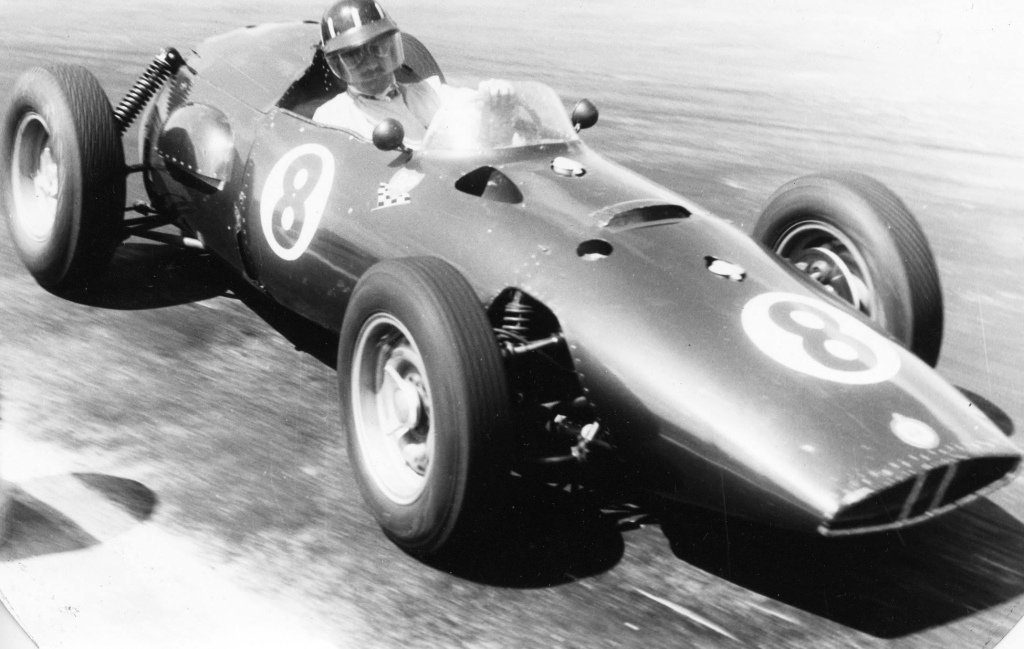
The old and new, BRMs Type 25 and P48, both 2.5-litres in September 1959. That’s #481 in shot with its unique nose on the Folkingham floor between the two cars, Type 25 chassis number unknown (BRM 2)
Graham Hill tips his BRM P48 into one of the oil-drum marked corners on the Ardmore Airfield circuit during the January 1961 New Zealand Grand Prix weekend. He was third behind the Cooper T53 Climaxes of Brabham and McLaren (M Fistonic)

See here for the first of two articles on the next phase of BRM history; https://primotipo.com/2015/03/26/tony-marsh-boness-hillclimb-scotland-brm-p48-part-1/

Eleven BRM Type 25 chassis were built – #251-259, 2510 and 2511 – during the long 1953-1960 BRM Type 25 programme, starting in 21 championship and 26 non-championship and Formula Libre events. These 47 meetings yielded the Dutch GP win for Bonnier and seven minor event victories including the two preliminary heats of the 1957 International Trophy at Silverstone and the 1959 New Zealand Grand Prix heat at Ardmore for the ever patient Ron Flockhart.

Etcetera…

(TC March – T Johns Collection)

The boys; standing are Basil Putt, Team Manager, Mike Hawthorn, Tony Brooks, Peter Berthon, Tony Rudd, Raymond Mays, AF Rivers Fletcher. Who are the mechanics in front? Folkingham, Lincolnshire August 28 1956 ‘Test and view day’.

The cover and editorial of Autosport after Peter Collins made the race debut of the Type 25 at Oulton Park on September 24, 1955 says everything about Britain’s goodwill towards BRM in its fight to take on the best in the Grand Prix world.

Great shot of Les Leston with team chief Raymond Mays at Aintree during the 1957 British GP weekend. Q12 and DNF engine after 12 laps, Jack Fairman lasted two laps more before he too suffered engine dramas. Up front, Tony Brooks and Stirling Moss shared the win in a Vanwall.

Rouen pits in July 1957, the incredibly quick BRM Type 25 #253 of the oh-so-promising American driver Herbert Mackay-Fraser awaits its wheels. Q12 and DNF transmission failure after 24 laps, Fangio won in a Maserati 250F. And below with the Mike MacDowel Cooper T43 Climax shared with Jack Brabham to seventh in the race. The contrast in size between the smallest front-engined car of the era and the grids most compact is quite marked.

(LAT)

Peter Berthon and 37 years old Harry O’Reilly Schell at Monaco in 1958. Despite a wild-man reputation Harry put together plenty of fast drives and high placings just as the team needed them. He was equal fifth (with the dead Peter Collins) in the drivers championship with 14 points, a personal best. 1959 was tougher, Stirling Moss bagged his car and Harry didn’t finish a race until Reims in July, but managed fourth at Silverstone and fifth in Portugal. Schell died at Silverstone in damp practice for the 1960 International Trophy, he clipped a low retaining wall at Abbey, was half flipped out of his Cooper T51 Climax and broke his neck.

Behra at Oporto 1958. Doesn’t that BRM #256 look magnificent beside those small, very fast Cooper T45s. #12 is Maurice Trintignant, #16 Roy Salvadori with the obscured Jack Brabham copping a push start at right.

(CAN)

Ron Flockhart during the Lady Wigram Trophy, New Zealand in January 1959. If a bloke deserved a win in these cars it was Ron given the number of test and race miles he did in them. He won aboard #259 from pole in front of Jack Brabham and Bruce McLaren’s Cooper T45 Climax’.

‘Where is the starter again?’ Tony Rudd and mechanic in Harry Schell’s #257 at Monaco in 1959. Q9 and DNF accident after completing 48 laps of the race won by Jack Brabham’s Cooper T51 Climax. Bonnier’s car retired with failing brakes from Q7.

(unattributed)

Yay team, again at Zandvoort in 1959, and one more time, there is no such thing as too much BRM…

BRM Type 25 model from Stephen Dalton, “it’s a Merit with the Alastair Brookman touch, he built it.”

Credits…

Clarence La Tourette, Getty Images, John Ross Motor Racing Archive, Bernard Cahier, John Ferguson, Classic Auto News, LAT, MotorSport Images, ‘BRM 1’ Doug Nye, History of the Grand Prix Car 1945-65 Doug Nye, Dave Williams, Stephen Dalton Collection, TC March, Tony Johns Collection

Tailpiece…

(B Cahier)

Phil Hill catches Jean Behra on the way to a DNF brakes at Monaco in 1958 from a splendid Q2 in chassis #256. Tony Brooks was on pole and Jack Brabham Q3 is the upstart 2-litre Cooper T45 – with two more of the pipsqueaks behind Jack – driven by Roy Salvadori and race winner Maurice Trintignant.

While the mid-engined writing wasn’t perhaps on the wall, the sign-writers were readying the paint…

Finito…

moss db3s

Stirling Moss’ Aston Martin DB3S heads down Silverstone’s straight on the approach to Copse, Silverstone, 5 May 1956…

Another factory Aston DB3S of Roy Salvadori won the race, The Daily Express Trophy meeting sports car event, with Bob Berry third in a Jag D-Type from Moss, he is behind Stirling in this shot. Roy Salvadori had a good meeting also winning the under 1500cc sportscar event in a Cooper T39 Climax.

Moss won the feature F1 event, the BRDC International Trophy over 60 laps/175 miles in Vanwall VW2 from the Connaught B-Types of  Archie Scott-Brown and Desmond Titterington.

image

(unattributed)

Moss in Vanwall VW2 chases teammate Harry Schell in VW1 during the International Trophy, Moss won while Harry suffered a DNF with a broken fuel pipe.

I’m on tour at the moment in Italy and then England, back in Australia on July 5, my posts until then will be predominantly quickies.

Credit…

Klemantaski Collection

Finito…

Reg Hunt, second from right, and his band of merry men fettle his Maserati A6GCM at his 182 Brighton Road, Elsternwick, Melbourne car dealership prior to the late March, Moomba races in 1955…

The car is being readied for the Labour Day long weekend, Moomba Races at Albert Park in which Reg did rather well. He won the Saturday 50 mile ‘Argus Cup’ from Doug Whiteford’s Talbot-Lago T26C and Ted Gray’s Tornado Ford V8. On the Sunday he was victorious in the first heat of the ‘Argus Trophy’ and was well ahead in the 100 mile final when the Maser’s crown wheel and pinion failed, giving the win to Whiteford.

Otto Stone, racer/engineer looked after this car, it appears a few ‘technicians’ have been grabbed from Reg’s dealership workshop for this photo taken by the crew of ‘The Argus’ newspaper. The publication was a major sponsor of the race meeting as reflected in the silverware won by Reg, no doubt they published an article encouraging the crowds to come and see the ‘KLG Maserati, the fastest car in Australia’.

I’ve written several articles about this very fast and supremely talented English born Australian racer/businessman who retired way too early. See here; https://primotipo.com/2014/07/19/reg-hunt-australian-ace-of-the-1950s/;

and here, the ’56 Argus Trophy; https://primotipo.com/2014/10/01/1956-argus-trophy-albert-park-reg-hunt-and-lex-davison-maserati-250f-and-a6gcm-ferrari-tipo-500/

there’s more- the 1955 AGP @ Port Wakefield; https://primotipo.com/2017/07/28/battle-of-the-melbourne-motor-dealers/

After a successful season racing a Cooper 500 in the UK in 1954 Reg travelled to Modena and acquired this ex-factory chassis ‘2038’ to race back in Australia.

Toulo de Graffenried aboard his 2 litre Maser A6GCM ‘2038’ in the Goodwood paddock during the Lavant Cup meeting- an event he won on 6 April 1953 from the Roy Salvadori and Tony Rolt Connaught A Types. I wonder who the driver behind the car is? (Getty)

‘2038’ was originally built as a 2 litre F2 car in 1953- raced by Emmanuel de Graffenreid.

Many of you would know the class of the 2 litre 1952-1953 F2/Grand Prix formula- F2, which at short notice became the category to which championship Grand Prix events were run given the paucity of cars at the start of 1952 with Alfa Romeo’s withdrawal from GP racing and BRM’s non-appearance- were the simple, fast, four cylinder Ferrari 500’s. Especially chassis ‘0005’, the car raced by Alberto Ascari to a record number of wins and two World Championships in those two years, that chassis was sold to Tony Gaze and later Lex Davison, it was an iconic racer in Australia in the fifties.

The great engineer Giacchino Colombo joined Maserati from Alfa Romeo for a consultancy which ended about June 1953, he first applied his magic touch to the 1953 A6GCM, squeezing closer the performance gap between the Maserati and Ferrari 500.

He changed the engine from square to oversquare, a bore/stroke of 76.22 x 72mm, squeezing a few more revs and raised the power of the 2 litre, DOHC, 2 valve, 40 DCO3 Weber carbed, Marelli sparked six cylinder engine to circa 190 bhp @ 9000 rpm.

Other tweaks were to the suspension- the inclusion of an ‘A-bracket’ to better locate the rear axle, and to the brakes. Otherwise the Maserati 4CLT derived twin-tube chassis with hoop shaped bracing at the front and cockpit area, quarter elliptic sprung rigid rear axle with ZF slippery diff, twin front wishbone suspension and excellent Valerio Colotti designed 4 speed gearbox, which mated directly to the engine, were unchanged.

By the end of 1953, it seems fair to say, that the high-revving Maser was better suited to the high speed circuits than the Ferrari 500, and whilst  the Maser may have had an edge in top speed the de Dion rear end of the Ferrari put its power down more effectively than the ‘cart sprung’ A6GCM. Maserati would remedy this shortcoming with the design of the 250F of course.

The talented Swiss Baron’s car was mainly entered by Enrico Plate’s team. His best results in 1953 were first placings in the Lavant and Chichester Cups at Goodwood, a heat of the International Trophy at Silverstone and the Eifelrennen at the Nurburgring in May- he was also victorious at the Freiburg Hillclimb in Switzerland.

At championship level his best result was fourth in the Belgian GP when the car was a works rather than a Maserati-Enrico Plate entry. The car was also entered by the works at Zandvoort, the Dutch Grand Prix, two weeks earlier using a new chassis- the car first raced at the Siracuse GP on 22 March 1953, it raced on nine occasions with the original frame.

A chassis of the same number is said to have been raced and crashed by Fangio at Monza on 8 June 1952, breaking has neck. The great man crashed 2 laps into his heat as a result of being fatigued after travelling from the Ulster Trophy race, where he drove a BRM. He flew from Belfast to Paris but could not take his connecting flight to Milan due to fog. He drove a Renault 750 borrowed from Louis Rosier all night  to contest the non-championship GP of Monza Auto Club. The great man arrived exhausted, started the race from the back of the grid and crashed on the events second lap having run wide at Lesmo, and was then thrown out of the car.

Mind you, other sources have the chassis used that day as ‘2034’…

Harry Schell contesting the non-championship Berlin GP at The Avus in 1954 aboard his Maser A6GCM ‘2038’. 8th in the race won by Karl Kling’s Mercedes W196 (Getty

Rebuilt with a Maserati 250F engine, the car was raced during the new 2.5 litre F1 in 1954 by Harry Schell as a private entry with the exception of the Pau GP, when it was works entered.

Schell’s best results in fifteen races was a first in a heat of the Circuit de Cadours, France, second in the GP di Roma at Castel Fusano and thirds at Aintree’s Daily Telegraph Trophy and the Circuito di Pescara on the wild Pescara road course beside the Adriatic.

Harry’s last drive of the car was at Aintree on 2 October, ‘2038’ was sold to Hunt shortly thereafter and was soon aboard the ‘Oceania’ heading south for Port Melbourne. Reg was reported as pacing Station Pier anxiously like an expectant father as he waited an hour for the notoriously ‘Bolshie’ Melbourne waterside workers to carefully unload his precious car on Friday 31 December 1954.

Click here for an article on the Maserati 250F, which includes the evolution of these magnificent single-seaters from A6GCM to 250F; https://primotipo.com/2014/08/21/stirling-moss-monaco-gp-1956-maserati-250f/

In the best tradition of this series of cars, the A6GCM and 250F, there are quite a few variations on the chassis theme, that is, which one is which.

I reference the 8W: Forix records as the most authorative source drawing together research of recent decades, particularly the exhaustive, scholarly, work of David McKinney and Barrie Hobkirk. The sharing and debating of evidence on the internet is a luxury not available to earlier 250F authors. Click below for all of the detail you could wish for, chassis by chassis and author by author including the way the views of the same author changed over time as more exhaustive research was undertaken allowing them to re-appraise conclusions they had earlier reached.

Chassis ‘2038’ was never allocated a 250F number when fitted with the 2.5 litre engine- although chassis ‘2503’ is the number occasionally cited. Nye concludes in relation to ‘2503’ ‘Serial never applied to a true 250F’, McKinney ‘Never built as a 250F’, Pritchard ‘Number not used’.

Given the foregoing, to be clear, ‘2038’ was built in 1953 or 1952 as a 2 litre A6GCM. Fitted with a 2.5 litre 250F engine, but otherwise the same in specification, ‘2038’ is one of the ‘interim A6GCM/250F’ chassis.

http://8w.forix.com/250f-redux.html

Reg Hunt in the Maser A6GCM during the Albert Park, Moomba meeting in late March 1955 (unattributed)

The car arrived in Melbourne in late 1954, Reg soon shook it down at Fishermans Bend before popping it back on a boat to contest the 1955 NZ GP at Ardmore.

He was immediately on the pace qualifying fourth, was second in a heat and ran second to Prince Bira’s 250F until fading brakes slowed him, finally finishing fifth.

Back in Australia the car was the quickest device around winning the Victorian Trophy at Fishermans Bend, the Bathurst 100 scratch race and was hot favourite for the Australian Grand Prix at Port Wakefield in October but was slowed by a cam follower problem- he was second to Brabham’s Cooper T40 Bristol having led initially.

In November the car won two events at Fishermans Bend- the ‘Racers Trophy’ and ‘Lucas Trophy’ both from Lex Davison’s HWM Jaguar. Lex was soon to acquire the Tony Gaze Ferrari 500/625 with which he is so readily associated.

Official extricate Neal from the badly damaged Maser towards the end of the 1956 AGP at Albert Park (unattributed)

The Maserati was sold to Melbourne haulier Kevin Neal after Reg’s 250F ‘2516’ arrived in early 1956- the car was badly damaged in the ’56 AGP at Albert Park when Neal lost control during a shower of rain late in the race.

Looking as elegant as ever, beautifully repaired, the car reappeared again at a minor sprint meeting at Eildon in country Victoria in 1960, the car was sold to Melbourne’s Colin Hyams in 1962, he used it occasionally, as below at Fishermans Bend.

(C Hyams)

The car then went to the UK in 1965, passing through the hands of Colin Crabbe and Dan Marguiles to Ray Fielding in Scotland in 1972. After many years owned by him and his estate ‘2038’ now resides in a Swiss collection.

(AMS)

Reg Hunt aboard ‘2038’ at Easter Bathurst 1955.

He won the A Grade scratch race and the scratch class of the Bathurst 100 setting the fastest time, an average of 77.8 mph. Reg was expected to take the lap record but was hampered by lack of his tall diff ratio, this component was damaged at Albert Park the month before, here Hunt is exiting Hell Corner to start his run up the mountain.

Reg Hunt in 2017…

(D Zeunert)

This photo and those of the Maser which follow were taken by David Zeunert, President of the Maser Club of Victoria- many thanks to David for sending them in to round out the article, it was taken early in 2017 at Reg and Julia Hunts home on Melbourne’s St Kilda Road- they have a floor in an old historic building.

Reg is a spritely, fit 94 and David says is still working in real estate apartment development with his grandson. The trophy is ‘The KLG Trophy’ with two Masers in is base

Etcetera…

(E Gobell)

The very rare photographs of the car in colour were taken during the 1955 Australian Grand Prix meeting at Port Wakefield- technical specifications as per text.

(E Gobell)


Reg only raced the A6GCM for not quite a year, here is the ad for its sale in Australian Motor Sports February 1956 , I rather like the ‘no idle curiosity’ bit! (D Zeunert)

The photos below via David Zeunert are of the car at home in Switzerland.


Bibliography…

‘Historic Racing Cars in Australia’ John Blanden, 8W Forix.com, ‘Maserati: A Racing History’ Anthony Pritchard, Australian Motor Sports

Photo Credits…

Fairfax, GP Library, Australian Motor Sports, Michael Hickey/Museum of Victoria, David Zeunert Collection

Tailpiece: Brake Engineer, Bart Harven, Reg Hunt, beautifully cast Maser brake drum and sublime A6GCM- circa 240 bhp from its 2 valve, Weber DCO carbed, DOHC 2.5 litre, 6 cylinder engine…

Etcetera: ‘2038’ The Movie or TV Star…

(MOV)

A mystery to solve folks! Since posting the article, reader Michael Hickey posted these amazing photos of ‘2038’ in an Australian movie, or perhaps more likely, TV show on the primotipo Facebook page.

He found the shots on the Museum of Victoria website but they are devoid of details. Tony Matthews thought the ‘driver’ of the car may be Bob Hope- it certainly looks like him. I’m not sure that he did any movies in Australia though. The ‘driver’ could be Charles ‘Bud’ Tingwell, a distinguished but now deceased Australian actor. He was in dozens of movies throughout a long career, the most iconic perhaps ‘The Castle’. I don’t recognise the babe, mechanic or baddie.

The crook only has a little gun- ‘yerd reckon they would give him a big one. Lovely A6GCM front suspension detail shot tho! Finned brake drum, forged upright and upper and lower wishbones all clear, as is roll bar. Shocks are Houdaille (MOV)

I can’t make the films Tingwell appeared in work with the photos mind you. Which means it isn’t Bud or perhaps the scenes are from a TV show. You can just make out Reg’s name on the car in the first shot, the limited caption information dates it as October 1955. TV didn’t commence in Australia until the second half of 1956. All ideas or the definitive answer appreciated!

Finito…


spanish grand prix

Maurice Trintignant’s 1953 type Ferrari 625 from Harry Schell’s Maserati 250F and victor Mike Hawthorn’s 1954 type Ferrari 553 on the picturesque Pedralbes road circuit at Barcelona, 24 October 1954…

This event was famous for the race debut of the Lancia D50’s in the hands of Alberto Ascari and Gigi Villoresi, both were quick and Alberto led convincingly from Fangio’s Mercedes W196 until a clutch hydraulic failure caused his retirement.

The three drivers above had a great dice and all led at different points with Hawthorn taking the victory. Schell retired after a spin damaged his car and Trintignant with a fractured oil pipe. Hawthorn’s win was a good one made slightly easier by the problems Fangio was dealing with in his Benz, his W196 spraying oil into the cockpit.

lancia barcelona

The Ascari #34 and Villoresi #36 Lancia D50’s, just unloaded at Pedralbes for an event which showcased Vittorio Jano’s design brilliance as well as the sublime skills of Alberto Ascari. Such a pity Lancia ran out of money! Still a world title as a Lancia Ferrari D50, and drivers title for Fangio in 1956 was a great reflection on the original design even if it had ‘evolved’ a bit by then (unattributed)

I’m leaving Australia’s winter for 3 weeks in France and Spain including Barcelona so look forward to retracing the street circuits of  Montjuic Park and Pedralbes whilst based in one of my favourite cities. My posts will be shorter over this period.

YouTube Race Footage…

Photo Credit…Yves Debraine

image


Tony Rudd and one of the BRM crew either sorting a problem or firing up Harry Schell’s P25 so the Bourne engineering chief can get back to his hotel, Monaco 1959…

image

Behra’s Ferrari Dino 246 you can just see on the left then Moss and Brabham, both Cooper T51, #48 Phil Hill Fazz Dino, #22 McLaren and #32 Trintignant Coopers T51. #16 and #18 Schell and Bonnier in BRM P25’s outside Brooks Dino. #20 Flockhart P25 BRM and behind him Graham Hill’s Lotus 16 Climax (unattributed)

In a sign of the times Jack Brabham won the race from Tony Brook’s front engined Ferrari Dino 246, Jack and third placed Maurice Trintignant in mid-engined Cooper T51 Climaxes. Jack of course took the first of his drivers titles that year and Cooper the constructors.

image

Jack on his own on the Monaco quayside in 1959, on his way to his first championship GP win, Cooper T51 Climax. His last the 1970 South African GP at Kyalami (Cahier)

It wasn’t a great weekend for the BRM boys; all three cars retired, Ron Flockhart, Jo Bonnier and Harry with a spin, brake’s and an accident and a split fuel tank the causes respectively.

mon butt

Stunning shot of Tony Brooks’ Dino chasing Harry Schell’s BRM into casino Square, Monaco 1959 (Heritage)

brm cutaway

BRM P25; spaceframe chassis, 2491cc DOHC, 2 valve, Weber fed 4 cylinder engine developing circa 275bhp@8000rpm, 4 speed ‘box. Suspension; upper and lower wishbones and coil spring/dampers and De Dion and coil spring/dampers at the rear. Front disc brakes, single disc on the transmission at the rear (C La Tourette)

The team broke through for its well deserved first win in 1959, Bonnier took the next race, the Dutch GP on 31 May, beating Jack and Masten Gregory in Cooper T51’s.

mon babes

BRM babes; hard for the mechanics to focus surrounded by this lot. The photo has done the rounds but i’ve never read the identity of said poppets if anyone can advise, BRM P25, Monaco 1959 (unattributed)

Credits…

Klemantaski Collection, Cahier Archive, Heritage Images, C La Tourette

Tailpiece: Harry Schell’s BRM P25 clips the inside of the kerb on entry to a corner in his pursuit of Cliff Allison’s Ferrari Dino 246 at Zandvoort in 1959, JoBo’s P25 took a famous win, Harry DNF, Allison 9th…

image


image

Harry Schell on the limit of adhesion in his ‘Yeoman Credit’ Cooper T51 Climax at Madgwick Corner, Goodwood…

Harry Schell was a press-on kinda driver wasn’t he? Here the Franco-American is delighting the ‘Glover Trophy’ spectators with some delicious Cooper T51 drifts…

The 1960 event was held on Easter Monday, 18 April. Harry was bang on the pace too, equal 2nd quickest in practice with Stirling Moss in a similar car. Chris Bristow demonstrated his undeniable pace though, he was on pole by a couple of tenths and finished 3rd in the race behind Moss, the winner Innes Ireland in his factory Lotus 18 Climax, the quickest of 1960’s GP grid. Harry’s engine popped on lap 20 of the 62 lap 162 Km race…

Credit…

GP Library, National Motor Museum

Tailpiece: Harry telling a naughty joke by the look of it, Crystal Place, July 1955…

Stirling Moss, Schell and Mike Hawthorn during the ‘London Trophy’ meeting which Mike won the feature race in a Maserati 250F from Harry’s Vanwall.

schell

(National Motor Museum)

Mike won his heat in the Moss’ family 250F chassis #2508, Harry his in Vanwall ‘VW2’ and Mike the final. Moss was contracted to Mercedes Benz that year, this non-championship 30 July event not one in which Benz entered their W196’s.