Posts Tagged ‘Stirling Moss’

image

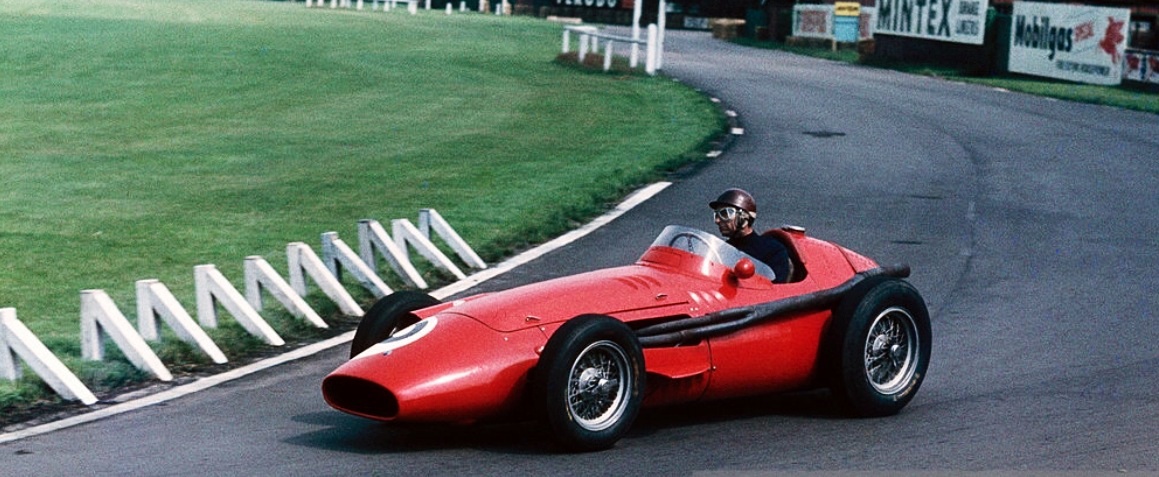
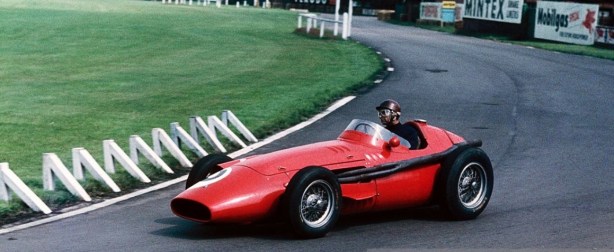
There is no such thing as too many shots of the great Brit in a Maserati 250F, and I have posted a few…

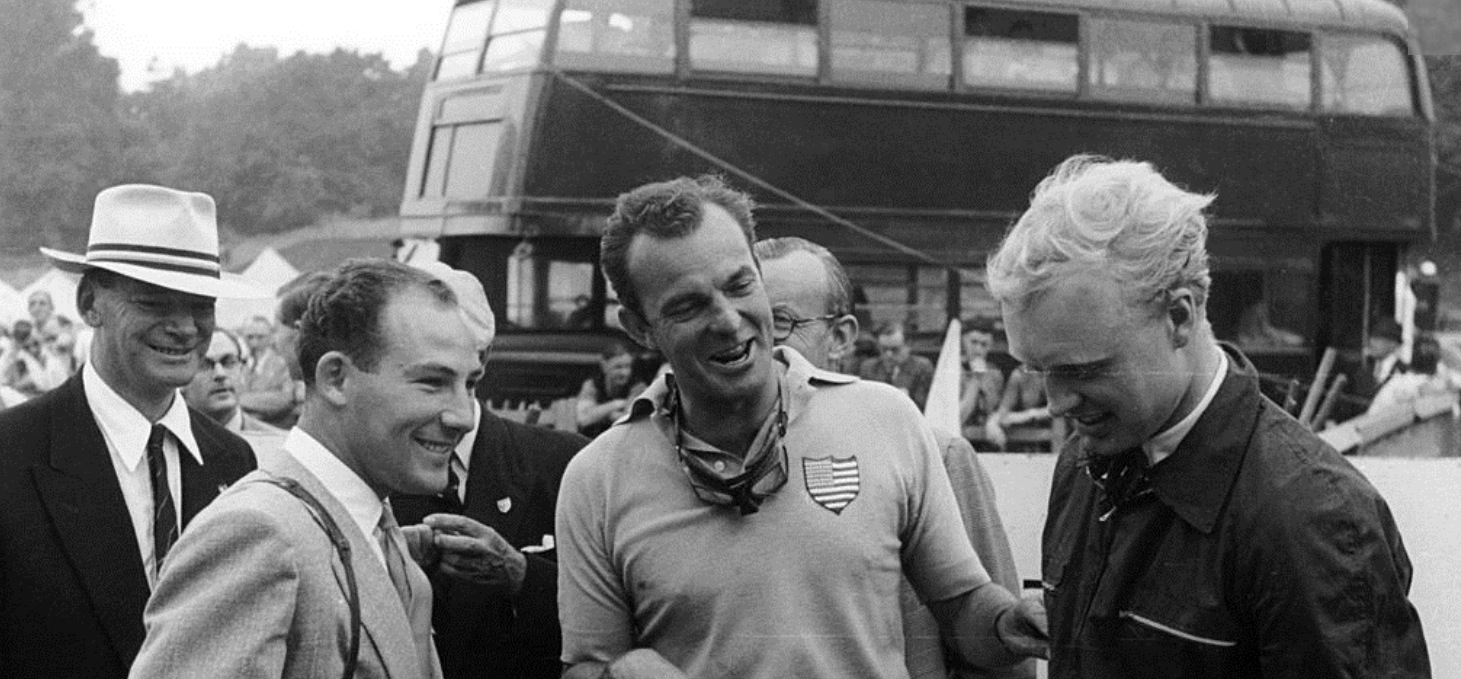
According to the photo caption the meeting is on 7 June 1954 at Goodwood. The meeting’s F1 race was the ‘BARC Trophy’, Reg Parnell won it in a Scuderia Ambrosiana Ferrari 625, but Moss wasn’t entered, so, a bit of a mystery.

Perhaps it’s the ‘Goodwood Trophy’ on 25 September 1954, he won that event in 250F #2508 and carried his #7 personal preference race number.

Credit…

Universal Images Group

moss 1

(Bert Hardy)

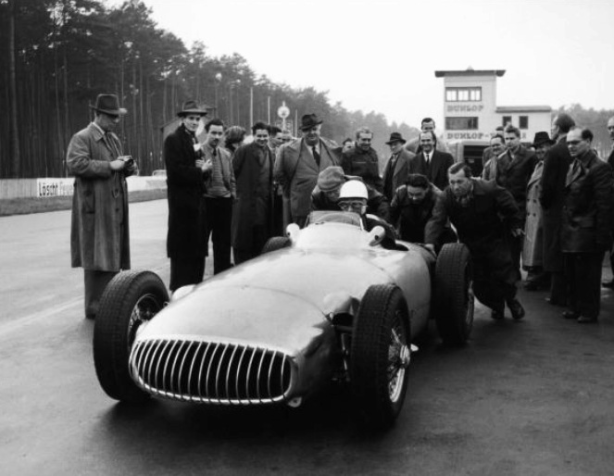
Stirling Moss sets off on his first test laps of an ‘orrible looking Mercedes Benz W196, Hockenheim 4 December 1954…

Stirling Moss started the 1954 Grand Prix season, the first year of the 2.5 litre formula with a customer Maserati 250F acquired with family resources and some trade support. By seasons end he was Officine Maserati’s ‘team leader’ albeit unsigned by them for 1955 which rather created an opportunity for others.

Mercedes re-entered Grand Prix racing from the ’54 French Grand Prix and quickly, again, became the dominant force. The idea for this article was finding some Bert Hardy ‘Picture Post’ images of Stirling Moss’ first test of the W196 at Hockenheim on 4 December 1954, the precursor to him joining the great marque for 1955.

Some quick research uncovered an article written by Mattijs Diepraam and Felix Muelas on 8w.forix.com, a great website if you haven’t tripped over it by the way.

It’s a ripper article the contents of which they sourced from Ken Gregory’s and Stirling Moss’ books. Rather than re-invent the wheel I have truncated their article a smidge without taking away their interesting, nitty-gritty of circumstances around Stirling and Alfred Moss, and Moss’ Manager, Ken Gregory’s deliberations and negotiations about ‘the boy’s 1955 contractual commitments.

‘The Hockenheimring, was still raced anti-clockwise like they do at Indianapolis when Stirling Moss flew in to test the car that was the class of the field from the word go at the 1954 French GP.

After a few laps he knew. And then there was that handsome offer made to Ken Gregory. Mercedes simply wanted Moss and the effort to get him was meticulously planned. It left Gregory gaping at the negotation table – as he readily admits in his highly entertaining 1960 book ‘Behind the scenes of Motor Racing.’

‘And still it almost went wrong – although knowing Neubauer cum suis a plan B and even plan C would have been rushed out of the Untertürkheim premises forthwith. The first thing Moss and Gregory noticed of Mercedes-Benz interest was a brief and factual telegram by Daimler-Benz AG enquiring about the availability of Stirling Moss for 1955.’

“CABLE WHETHER STIRLING MOSS BOUND FOR 1955 STOP. OUR INQUIRY WITHOUT COMMITMENT – DAIMLER-BENZ.”

‘Stirling’s gut reaction was no. He had a signed contract with Shell-Mex and BP for 1954 and 1955 and was sure of a sponsorship clash with Mercedes suppliers, Castrol. Beside that, the contract was a done deal and he would not think of dissolving it so shortly after he had given his word – of which, in Stirling’s view, the contract was merely a written confirmation. He didn’t have time to think about it anyway, as he was due to leave for the US, to race in the so-called Mountain Rally.’

moss 3

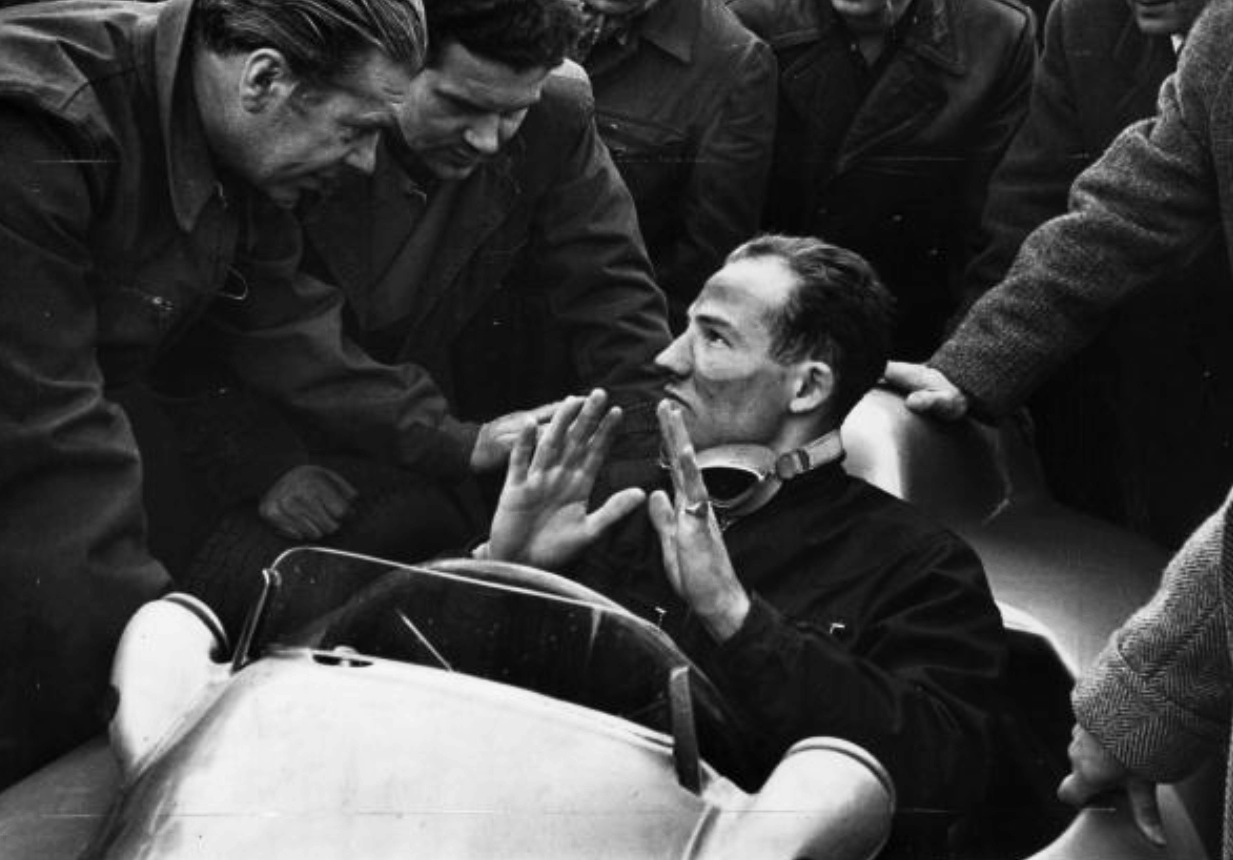
Moss relays to Rudy Uhlenhaut left and Karl Kling what its like out there, car far less forgiving than the 250F Moss raced in 1954. Stirling has done plenty of laps by the look of his face (Bert Hardy)

‘Gregory thought otherwise, and after consulting Alfred Moss, decided to go Stuttgart himself. On the advice of Stirling’s dad, Ken armed himself with monstrous demands, to act like a tough British cookie and see what happens. It was a total shock to Gregory to find that Herr Neubauer, the long-time Mercedes boss, was infinitely better prepared for the meeting. Not only did the overbearing team manager come up with the most remarkable details of Stirling’s career – he also came up with a figure that would amount to Moss’ salary, a number that froze Gregory to the ground and left him gasping for air until he got on the flight back to England.’

‘Before leaving he convinced Alfred Neubauer to pair Moss with Fangio in the new 300 SLR sportscar, and of giving Stirling a test before anything was signed. The rest of the deal was ironed out on the spot. The Shell and BP matter was conveniently postponed until after Stirling’s arrival.’

‘On his return Gregory phoned Stirling in the States, having tracked him down in the Rootes building in New York. Initially an irritated Stirling reiterated his view on the contract with Shell and BP but then Ken told him about the contract terms – the sportscar pairing with Fangio, the permission to race his 250F in non-championship events – and, of course, the money involved. An honourable human being he may be, Stirling is only human as well. This was too good to be true.’

‘According to Gregory his stance immediately made an about-turn. And this is where Stirling’s own account of things takes off in his 1957 book In Track of Speed… “I was to receive the sensational and most encouraging news that the German Mercedes firm was ready and anxious to sign me as one of their official Grand Prix team for 1955. It is not easy, now, properly to analyse my feelings when the news reached America. I had gone over there to compete in the Mountain Rally, and had driven a Sunbeam in a trio of cars which won the team prize. When I heard of the Mercedes offer, I was a little awed, a little bewildered, and very pleased. With all my experience, I had not done a lot of real racing in the Grand Prix series on cars which stood a real chance. True, I had led the Maserati team for the latter half of the year, but to have a place in that all-conquering team – and I felt in my bones that it would all-conquering – was to give me a unique personal opportunity.”

And this is the November 22 entry for Stirling’s diary: “Up early, called on Jaguars, then to Rootes, where Ken called and told me of the fantastic Merc offer. Wow!”

Enough said.

moss 2

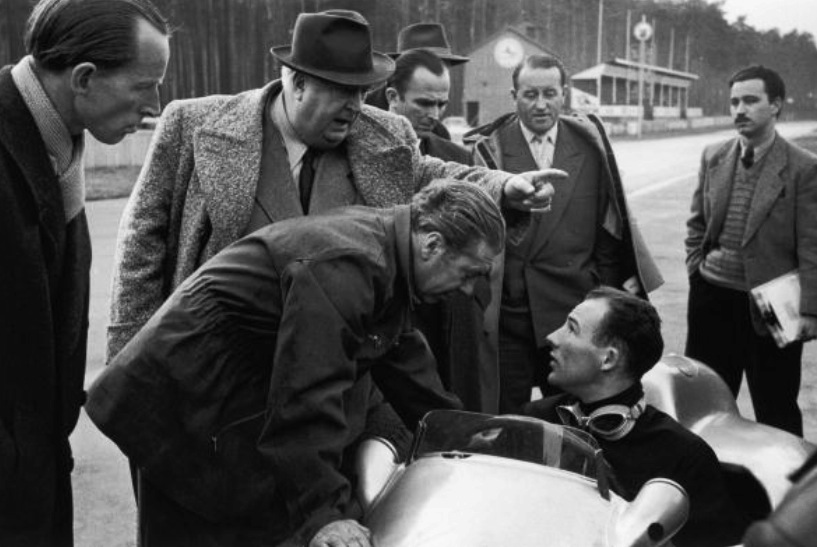
Neubauer projects and Moss listens and talks to Uhlenhaut (Bert Hardy)

Hockenheim Test and Build-up…

‘Between November 22 and December 3 lay a couple of weeks that became a string of field days for the press. The latter date would be the day of Moss’ return flight to London where he would meet up with his father and manager, the three of them flying straight through to Frankfurt for the planned test on December 4. In the meantime, Jerry Ames of Downtons, the British publicity agent for Mercedes-Benz did everything to alert his Fleet Street colleagues on the arrival of the important test, and this caused a flurry of reports on the Moss-Mercedes case. Did he have a verbal agreement with Maserati? What about the Shell/BP deal? How much would Neubauer be willing to fork out? And where were the principles of a man that had stated that he wanted to win the World Championship in a British car?’

‘All of it was fairly benign, though. From the US, Stirling had already released a carefully worded statement about his ambition to win the Championship in a British car but that there was very little hope in doing so the following year, and that as a professional racer he really had no other option than to accept the offer. These words were generally accepted as sincere. On the day of the test, however, the press were dealt a red herring by a wicked Neubauer. Although the news of the test was carefully leaked by Ames, leading to Picture Post magazine sending their feature writer Trevor Philpots and star photographer Bert Hardy on a plane to Frankfurt the very same day, the two Brits were picked up by a Mercedes-Benz driver pretending to have no knowledge of English and driven off in the wrong direction. It left Neubauer in the safe knowledge that Moss would say yes to them first before the British press could get hold of a possible no. The Picture Post duo were only allowed onto the Hockenheim grounds by the time the serious business was long underway.’

‘And so Stirling arrived at Hockenheim undisturbed to find everything thoroughly prepared for his test. And that’s understating things- to Moss and his party thoroughness was redefined. Mercedes chief engineer Rudolf Uhlenhaut had seen to it that the car had every aspect modified to Stirling’s build and style. So that was one excuse out of the way. Then there was Mercedes regular Karl Kling to set a yardstick – one that was set at 200kph just days before by the same Kling. But there had been a recent rainstorm, so that when Stirling did his reconnaissance laps on a 220A saloon, then switching to the 300SL gullwing sportscar, the track was still wet. These first laps soon created a dry-ish line on which Moss got his first hand on the W196.’

‘He thought it (the W196) was uncompromising, as any Mercedes driver would reveal. He admitted as such to a watchful Ken Gregory. “Stirling was not immediately at home with the Merc, and while Kling was circulating he told me he thought it was a very difficult car to drive; it was ‘fighty’, inclined to oversteer, and much more sensitive to handle than the Maserati, though the power, he said, was ‘fantastic’.” Despite being confused by the peculiar transmission at first he felt confident that he could master the car. He got down to a 2.15 – comparing to an average of 201kph – a time that was later equalled by Kling on a track still drier. A previously nervous Uhlenhaut was by now beaming with pleasure. A short discussion followed with Alfred Moss and Gregory, after which Stirling concluded that he should take Mercedes up on their offer, assuming that the sponsorship clash between the oil companies could be solved – and indeed it was solved in a most gracious way, with Bryan Turdle, competitions manager of Shell-Mex and BP, not hesitating to release Stirling from his 1955 Shell commitments.’

image

Neubauer and a thoughtful Moss, the most recent of so many stars the German worked with (Bert Hardy)

Maserati Intervention…

Then came another thing to be solved. During the test a telegram arrived for Neubauer. It came from Commendatore Orsi of Maserati, claiming he had a contract with Moss and that Mercedes should back off. The claim was understandable as Moss had quickly become the lead Maserati driver since his display at the 1954 Italian GP and Orsi wasn’t particularly keen to see the second best driver of the world go off and team up with Fangio, doubling Maserati’s task. But Moss Sr and Gregory were able to convince the Germans that Stirling had in fact not agreed to anything, not even verbally. And so Stirling Moss was announced as the number two Mercedes-Benz driver for 1955 shortly after.’

‘For Moss the choice of Mercedes was obvious…The British manufacturers were a long way from threatening the establishment, and the new Climax engine was still not ready. Mercedes-Benz by all means were. And they showed it at that December 4 test. It had been a test with a thoroughness previously unseen by British drivers. But also one with immaculate attention for the human being inside the driver. That was Mercedes-Benz too. This is Stirling’s own recollection of the comfort he was supplied with as soon as he got back to the pits: “What really impressed me was that as I clambered out of the car, rummaging in my pockets for a handkerchief or rag to wipe my face, a mechanic suddenly appeared, bearing hot water, soap, a flannel and a towel! Out there in the middle of the desolate Hockenheimring this was forethought I could hardly credit. I thought then that to be associated with such an organization could not be bad…”

 Checkout my article on the Mercedes W196…

Mercedes Benz W196 : French GP 1954…

Photo Credits…

Bert Hardy

Bibliography…

8w.forix.com article ‘How Stirling Got His Mercedes Breakthrough’ by Mattijs Diepraam and Felix Muelas

Tailpiece…

image

Neubauer, Alfred and Stirling Moss toast 1955 success, a year of bitter sweet for the great marque, Le Mans not in their wildest, worst dreams (Bert Hardy)


image

Juan Manuel Fangio eases his Maserati 250F through Tatts Corner,  Aintree, Liverpool during the 1957 British Grand Prix on 20 July…

Fangio qualified 4th but retired on lap 49 with engine problems, its an amazing shot ‘the maestro’ looks so relaxed at the wheel. Its the cover shot of a book i have, much of my library is in storage, a real pain in the arse in terms of access to research material, maybe one of you have the same book and can recall the title?

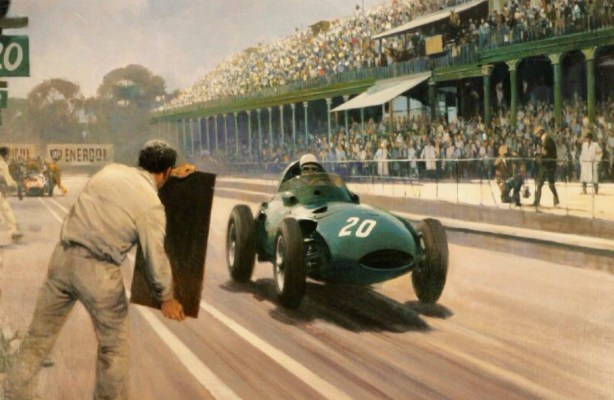
The race itself was a Vanwall benefit; Moss lead then took over Brooks car when his own engine went off song, Stewart Lewis-Evans Vanwall also lead briefly before being passed by Moss, he and Brooks shared the win from the Lancia Ferrari 801’s (LF801) of Luigi Musso and Mike Hawthorn.
image

Stirling Moss in Tony Brooks Vanwall VW57, Aintree 1957 (Michael Turner)

This article is pieced together around a swag of photos of Fangio aboard Maserati 250F’s in 1957, in many ways the combination defines the 1950’s for me. The greatest driver of the decade in its quintessential car, it may not have been the fastest of the era but for sure it provided a platform for so many drivers from journeymen (and women) to gods, to strut their stuff.

Monaco, 19 May 1957…

Between Moss who left Masers to join Vanwall and Fangio who left Ferrari to join Maserati the seven 1957 championship rounds, ignoring Indianapolis, were mopped up by those two drivers- Juan with 4 wins and Stirling 3.
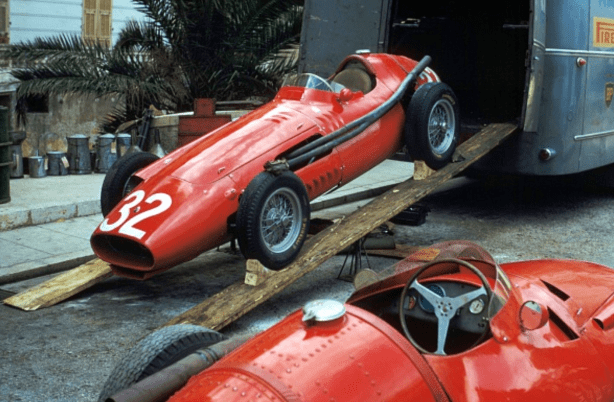
fang monaco spares

Fangio’s Maser 250F being unloaded from its transporter in Monaco

Fangio made the 250F sing, the car was towards the end of its long competitive life with the great Argentinian extracting all it had to offer. He was at the height of his powers, I don’t doubt he retired at the right time, he was 46 years of age by the end of the season after all.

Having said that it would have been fascinating to see if he could adapt to mid-engined cars, I don’t doubt he would have had he raced on for a few more years. But best to retire at the top, and alive. So many elite sportsmen and women do that one season too many, Michael Schumacher for one, Fangio did not.
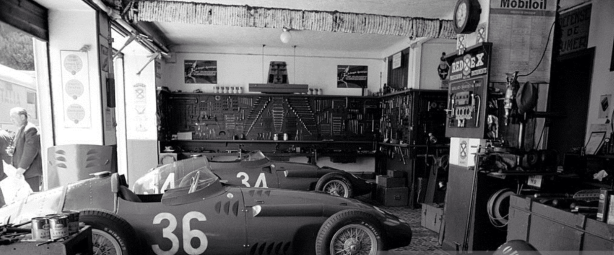
fang monaco 1957

# Carlos Menditeguy DNF spin and #34 Giorgio Scarlatti DNF oil leak in the Officine Maserati garage, Monaco 1957. 250F x 2

Fangio popped his 250F on pole in the Principality but Moss led into the first corner with Fangio behind him. Sterling went off and crashed at the chicane on lap 4 with Collins, LF801, taking exasive action and hitting a stone wall as a result! Fangio managed to get through without a problem and Brooks Vanwall braked hard only to be rammed up the chuff by Hawthorn’s Fazz.

Only Brooks was able to keep going- but he was 5 seconds behind Fangio by the time he was up to speed again. Jack Brabham was up to 3rd late in the race in his little Cooper T43 Climax. It was a portent of the 1958 breakthrough win for a mid-engined car by Moss in Argentina, but had to push the car home as result of fuel pump failure, Jack was classified 6th, with Fangio ahead of Brooks, Masten Gregory in a Maserati, Lewis-Evans Vanwall and Trintignant LF801.
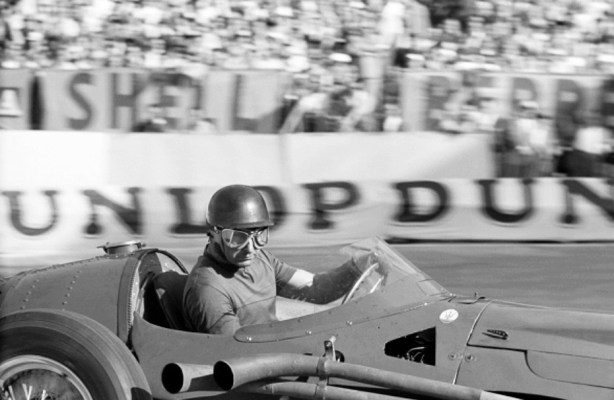
fang monaco

Fangio during Monaco practice in Giulio Alfieri’s 250F V12. The 60 degree, DOHC, 2 valve, 24 plug, Weber fed 2.5 litre engine developed circa 300-320bhp at a dizzy 10500rpm, about 50bhp more than the venerable inline 6 but the power was all at the top of the band. The engine had conrod and valve spring troubles early in its development too. Behra raced one in the Italian GP, he chomped thru tyres, such was the engines power and then retired with a lubrication problem. The engines time would come, but not for a decade!

Whilst the 250F was in the Autumn of its life Maserati were still developing the thing, not least with a 2.5 litre, quad-cam, 2 valve, Weber carbed 300 odd bhp V12. Fangio is putting some development laps into the thing at Monaco above.

The engine raced only once at championship level at Monza 1957, but suitably evolved in 3 litre, fuel injected form won a race or two mounted in the back of Cooper’s T81 and T86 in 1966/7. (Wins for Surtees ’66 Mexican GP and Rodriguez ’67 South African GP, both in T81’s)

An interesting Australian sidebar to this Maser V12 is Frank Gardner and Kevin Bartlett testing a 2.5 litre variant in the butt of a ‘cut and shut’ Tasman Brabham BT11A in February 1966. Sydney Alfa/Maserati dealer and former Australian 1960 Gold Star Champion and AGP winner Alec Mildren used his impeccable Maserati connections to score the engine which the team sussed as an alternative to the venerable Coventry Climax 2.5 litre FPF  which was the Tasman staple moteur at the time. Simply put the engine was like an on/off switch in terms of its power delivery, then blew, which rather settled the matter of a ‘Warwick Farm 100’ start. A story for another time.
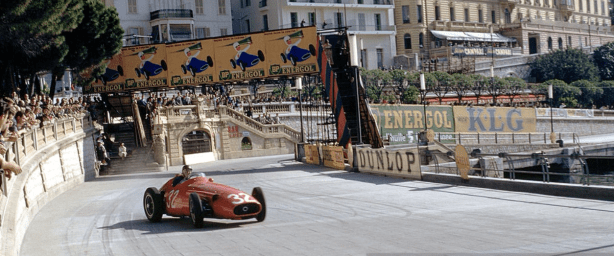
fang monaco

Fangio, quayside at Monaco in 1957, enroute to victory. He won in Argentina, Monaco, France and Germany. The Vanwalls won in Britain, Pescara and again in Italy at Monza; Moss/Brooks, Moss and Moss

The thing that always amazes me when looking at photos of Fangio is just how relaxed at the wheel he is. It’s key to great lap times, if you are that tense that your butt-cheeks grab the seat cover as you alight your racer you are definitely not going to feel what your steed is doing to extract the best from it! I remember Frank Gardner talking to me about this very point several decades ago.

When the laconic Aussie all-rounder returned home in 1975, in that first year he drove Bob Jane’s Holden Torana Chev Sports Sedan and fronted the Jane/Gardner Racing Drivers School at Calder. He wasn’t there much. In fact ex-Aussie F3 driver/mechanic and later Hardman F2 designer/builder Jim Hardman did most of the driver instruction aided by Andrew Newton, who also raced with some success. Both of them looked after the fleet of Elfin 620B Formula Fords driven by the bright eyed hopefuls, of whom i was one.

Anyway, on this particular frigid July day ‘ole FG was in effusive mode telling me about both the car setup advice and driver coaching he was giving to a well known fellow who had not long before jumped up from Formula Ford to F5000-105bhp to 500bhp is a big step.

His central point in talking about ‘the big car challenge’ was all about relaxing in the car- having soft hands and gentle feet and just being able to, as a consequence of not being so tense, feel what the car was doing and therefore be able to push the thing to its limits by  better sensing said limits when reached…Easy to say of course, harder to do especially when you have 500bhp of fuel injected Repco-Holden V8 shoving you ferociously towards the horizon!
image

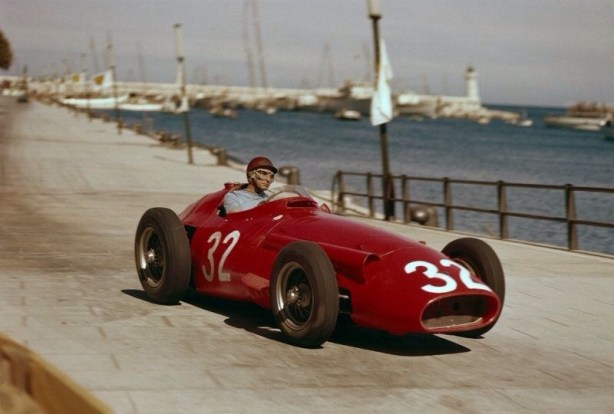
FG would have approved of Fangio’s relaxed demeanour in a car. Don’t confuse my meaning with the ferocious competititiveness and delicacy of control that went with the outer calm one can see here!

Fangio never looks anxious whether he is being closely followed at Monaco in third gear or drifting through the very high speed swoops of rural France at over 140mph in fifth.

It was magic to observe Fangio’s car control at close quarters when he was 67 years old and booting his W196 Benz sideways lap after lap in third gear through Sandown Park’s Shell Corner, only 30 metres away, during ‘The Fangio Meeting’ in 1978. The sight of this grand man of racing flicking the bellowing, powerful straight-8, silver beastie around is forever etched in my memory.

Cool, calm, collected, composed and FAST! Exactly as he was in 1957…

French GP, 7 July 1957…

The classic was held at the super fast Rouen-Les-Essarts road circuit in Grand-Couronne and Orival, northern France.

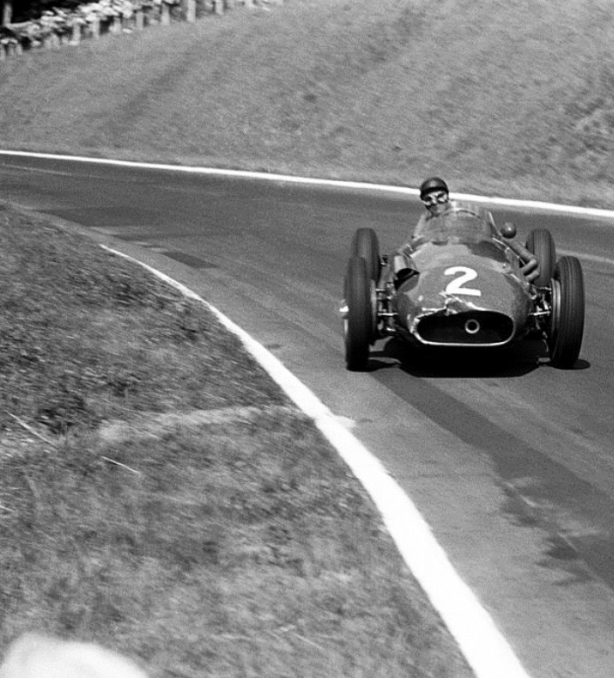
There are so many wonderful 250F shots of Fangio in 1957 drifting the sublimely forgiving chassis at well over 140 mph on public roads through wooded hillsides. I’m not suggesting, in describing the car as forgiving, it was easy my friends!
fang spa

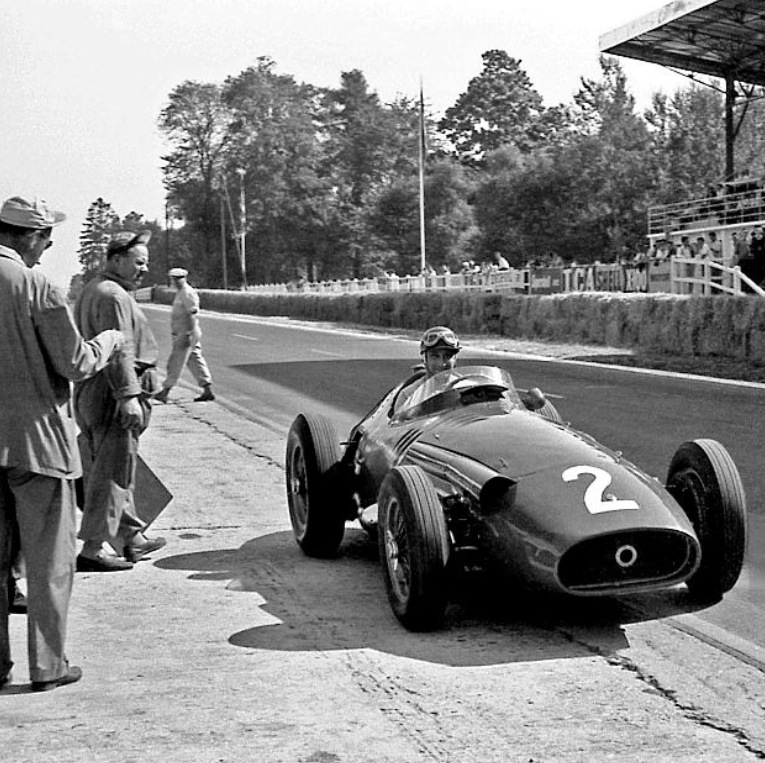
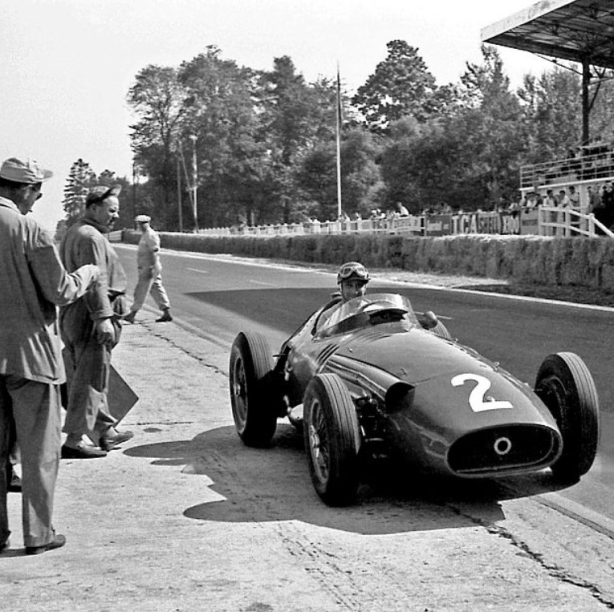
Crusin’ in having set pole i wonder? Rouen 1957. The lines of the 250F in 1957, here it’s Fangio’s ‘regular ‘Long nosed, lightweight’ chassis ‘2529’ spec are perfect, inch by sculpted inch. The cars epitomise everything great about Italian racing machines. Alfieri’s ’57 lightweight chassis was 40% stiffer than in ’56 with greater rear weight bias-48/52% front/rear. The 250F was maybe not quite the fastest tool in the 1950’s shed but it was close to it, enduring and capable of winning the 1954 and 1956 titles in addition to ’57 with more luck or the right bloke behind the wheel all season! No-one was going to beat Fangio in a W196 Merc in 1955 i don’t think

Fangio was fastest from Behra and Musso also on the front row. Behind them were Schell 250F and Collins then back a row Salvadori, Vanwall VW57 Hawthorn and Trintignant. At the jump Behra lead but Musso soon got ahead. Fangio was 3rd then Collins and Schell giving chase and then a fast-starting McKay-Fraser, BRM P25. Fangio worked his way past Behra on lap 2 and then took Musso for the lead on lap 4.

Collins got past Behra and the order remained unchanged at the front all the way to the flag with Fangio winning from Musso and Collins. Behra slipped behind Hawthorn, giving the Lancia-Ferrari 801 a 2-3-4 finish behind Fangio.
fanf french

Hang on…Fangio indulging in one of his signature, oh so fast, oh so subtle and oh so wonderful, delicate, four wheel drifts. Poetry in motion innit!? Wonder who or what he tapped?

Germany, Nurburgring, 4 August 1957: Greatest GP of all?…

Fangio’s heroic drive at this most demanding of circuits proved to be his greatest ever drive and one of the best in the history of Grand Prix racing.

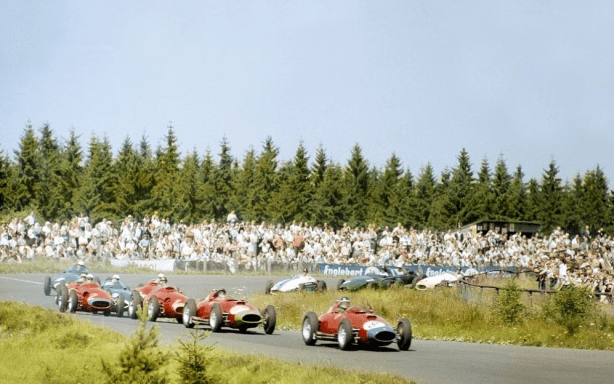
Fangio took pole with Hawthorn, LF801 Behra, 250F and Collins LF801 completing the front row. Then came Brooks, Schell and Moss on Vanwall VW57, 250F and Vanwall VW57. At the start Hawthorn and Collins battled for the lead with Fangio and Behra giving chase. On lap 3 Fangio passed Collins and soon led. Collins then passed Hawthorn and chased after Fangio with the great man edging gradually away.
fang germany

Nurburgring 1957: Hawthorn and Collins, L Ferrari 801, Fangio and Behra 250F, then Moss and Brooks Vanwall VW57, Masten Gregory’s white Maser 250F, Lewis-Evans Vanwall VW57 and the rest…

A slow mid-race pit stop, scheduled for 30 seconds, lasted 1 minute and 18 seconds. One of the mechanics dropped the wheel hub nut under the car, it couldn’t easily be found! This left Fangio a minute behind the two Ferraris but then the chase was on! He drove absolutely at the limit, at the ragged edge of the cars capabilities, chasing down the two much younger men.

Fangio famously broke the lap record 10 times and passed both Collins, and then Hawthorn on the penultimate lap. Fangio won the race and in the process, his 5th and final World Title in a drive still spoken about in reverential terms and forever remembered whenever the great GP races are considered.

Pescara GP, 16 August, The Coppa Acerbo…

The FIA included the Coppa Acerbo, Pescara GP in the World Championship for the first time given the cancellation of the Dutch and Belgian GP’s early in the season due to squabbles about money. The daunting, dangerous 16-mile road circuit on the Adriatic Coast, still used then for non-championship events was the longest ever for an F1 race.

Ferrari didn’t bother to send 801’s for Mike Hawthorn and Peter Collins as the World Championship had already been won by Fangio and partly as a protest against Italian government’s move to ban road racing following Alfonso de Portago’s, Ferrari 335S Mille Miglia accident earlier in the year. Local boy Luigi Musso convinced Ferrari to lend him a car however, which he entered as a privateer. Shades of NART entries in the 1960’s when Ferrari wanted to protest, but not too much!
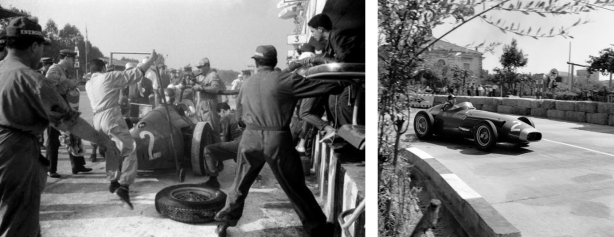
fang pescara

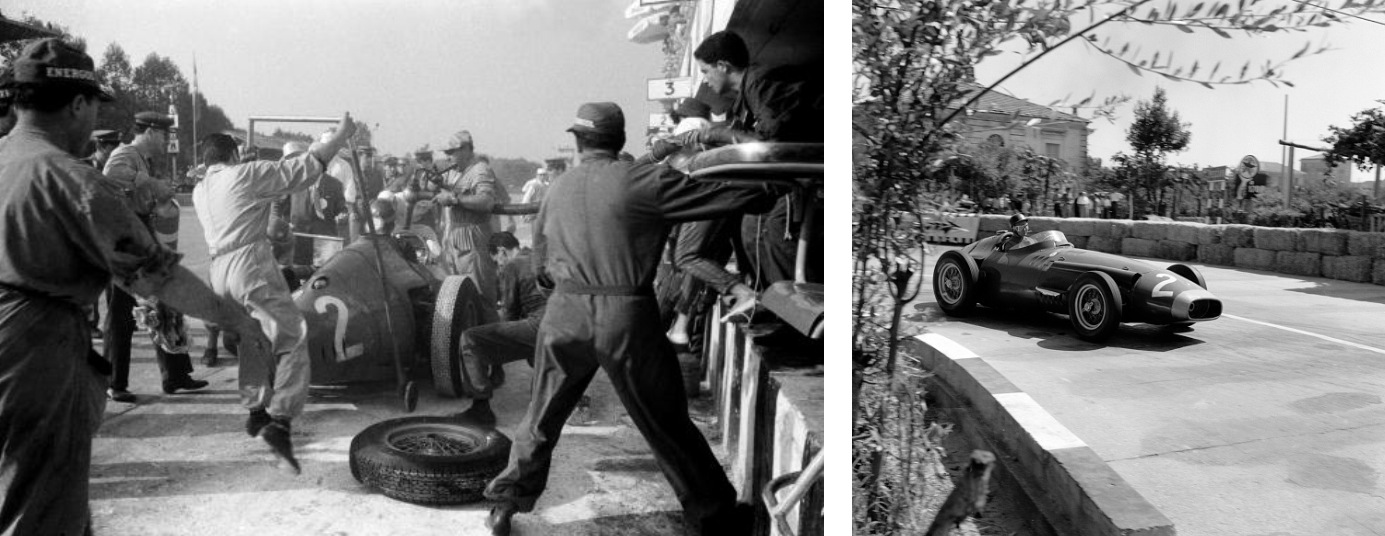
Shot at left shows Fangio’s Maser having a rear wheel replaced after spinning on Musso’s engine oil and danaging it

The Pescara battle was between Maserati and Vanwall and resulted in a Maserati pole for Juan-Manuel from Moss’s Vanwall VW57 and Musso’s ‘private’ Ferrari 801.

Musso took the lead but Maserati 250F privateer Horace Gould hit a mechanic who was slow to get off the grid. Brooks retired his Vanwall VW57 early with mechanical troubles. Moss took the lead from Musso on lap 2 from Fangio in 3rd but the field thinned as the heat took its toll; Lewis-Evans, Vanwall with tyre failures, Behra 250F engine failure. Then Musso disappeared on lap 10 when his engine blew, the oil caused Fangio to spin and damage a wheel. When Fangio rejoined, Moss had an unassailable lead, he won the race ahead of Fangio, Schell in 3rd ,Gregory 4th and Lewis-Evans 5th.

Fangio won the World Championship on 40 points from Moss and Musso on 25 and 16 points respectively. Maserati 250F, Vanwall VW57 and Lancia Ferrari 801.

Credits…

All photos by Louis Klemantaski/Getty Images, Michael Turner

Tailpiece: The Maestro, Karussell, Nurburgring, Maser 250F  chassis ‘2529’ German Grand Prix 1957, history being made. Majestic shot…
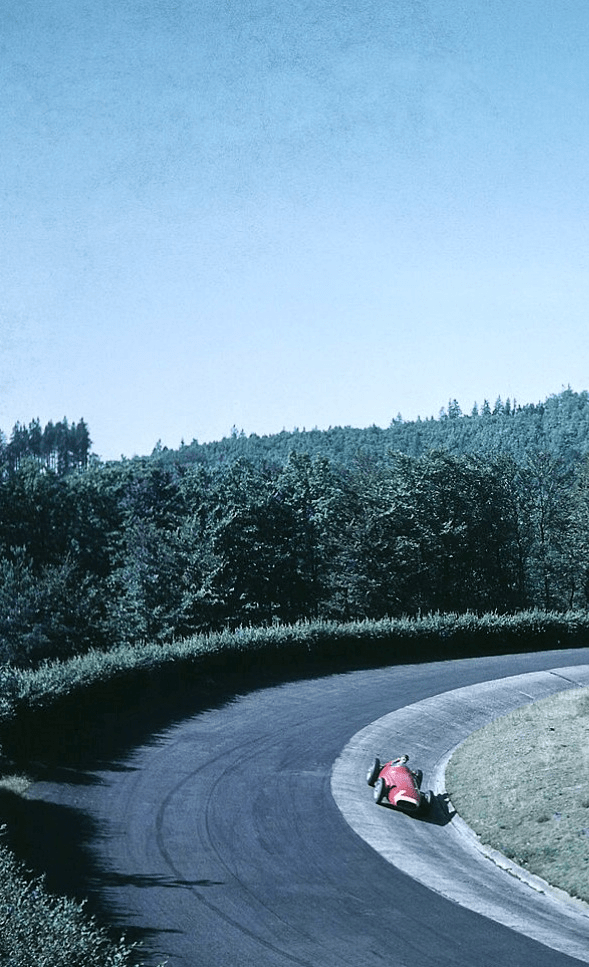
fang germany, karu


image
(LAT)

Stirling Moss leads the 1956 Australian Grand Prix at Albert Park in his works Maser 250F…

The dark, gloomy, wet weather shot could be in Europe. Stirling won the 80 lap, 250 mile race held on 2 December 1956 by a lap from teammate Jean Behra, Peter Whitehead’s Ferrari 555 Super Squalo, Reg Hunt’s Maserati 250F and Stan Jones’ similar car.

The excitement of this post Melbourne Olympic Games race meeting run over two weekends I covered in an article about the Australian Tourist Trophy which Moss also won the week before, in another works Maser, this time a 300S, click here to read it;

image
Moss during the 1958 Melbourne Grand Prix metting in Rob Walker’s Cooper T45 Climax. He raced sans the rear engine cover in the final, such was the heat, so this is a practice shot or heat (Fairfax)

This short article is pictorial in nature, I rather like the justaposition between his win in the conventional, state of the art 250F in 1956 and victory two years later in the 1958 Melbourne Grand Prix. On that occasion Stirling was in a paradigm shifting, mid-engined Cooper, a T45 Climax. He took the first modern era, mid-engined GP win on January 19, 1958 in a Cooper T43 Climax at the Buenos Aires circuit in Argentina.

Moss chills in the Albert Park paddock before the off in 1956 (S Landrigan)

Stirling won that 32 lap, 100 mile Albert Park, Melbourne GP race run in super hot conditions on 30 November 1958…

Behind him was Jack Brabham’s similar Cooper T45 Climax 2.2 FPF- Doug Whiteford’s Maser 300S and Bib Stillwell’s Maser 250F were third and fourth.

The race was a Formula Libre event attended by over 70,000 spectators. Brabham led away at the start but Moss soon passed him and moved steadily away keeping a strong lead despite easing in the final laps given his cars water temperature, which was off the Smiths clock!

(R Jones)

Melbourne GP start, Jack gets the jump in the centre from Moss on the left, both in Cooper T45’s and Stan Jones Maserati 250F.

Stirling’s car was fitted with an Alf Francis built Coventry Climax FPF, 4 cylinder DOHC, two valve, Weber carbed engine of 2051cc, it was a ‘screamer’ with trick cams and crank. Jack’s T45 toted a 2.2 litre FPF, revised Ersa five-speed ‘box and double wishbone rear suspension.

Jack Brabham ahead of Dick Cobden, Ferrari 125 Chev
image

The two new-fangled Cooper T45’s were the class of the field, Moss and Jack took a heat apiece. The natural order of things in Australia changed very rapidly, just like everywhere else, albeit the last Australian Grand Prix won by a front-engine car was Stan Jones’ win at Longford several months after the Albert Park meeting, on 2 March 1959.

image
Jack’s Cooper being fettled in the Albert Park paddock in 1958, probably a practice day shot, T45 Climax (G Rhodes via KBY191)

Brabham was still on the rise as a driver, he raced in F2 in 1958 (and in the F2 class of some GP’s) but took fourth in the Monaco classic, sixth in the French, seventh in the Portuguese and eighth in the Dutch GP at Zandvoort-all in works F1 Cooper T45’s. His time was shortly to come of course, in 1959 and 1960.

image
Moss takes the chequered flag in his Cooper T45, Melbourne GP, November 1958 (LAT)

Sadly, the 30 November 1958 Albert Park race was the last race meeting until the modern Albert Park era

That commenced with the first of the F1 Grands Prix in 1996, or more precisely with some historic events in the years before which ‘softened up the public’ to the concept. The use of the park for motor racing became enmeshed in 1950s Victorian State politics, the net result was the end of racing for nearly forty years.

Barry Green observed in his book, ‘Glory Days’, ‘In many ways that final meeting represented a changing of the guard. The two nimble, little rear-engined cars had blitzed the field, underscoring the fact that the writing was on the wall for the big, front engined cars’.

‘So too, the days of the wealthy sporting amateur, of racing for a silver cup and the fun of it all. Professionalism had arrived- to see that, one had to look no further than the darkening sky over Albert Park; to a hovering helicopter, about to pluck Stirling Moss from the crowd and whisk him off to Essendon Airport and connections to the Bahamas for the Nassau Speed Week’.

Start of one of the heats won by Brabham’s Cooper T45 on this side. In the middle is Ted Gray’s big, booming Tornado Chev with Bill Patterson in the white Cooper T43 Climax (R Jones)
Same heat as above- Brabham, Cooper T45 Climax, Ted Gray, Tornado 2 Chev, Stan Jones, Maserati 250F, Tom Clark, Ferrari 555 Super Squalo, Derek Jolly, Lotus 15, Bill Patterson, Cooper T41 and the rest

Checkout this fantastic BP film, supporters of Moss’ attendance at the event, of the 1958 Melbourne GP meeting…

Etcetera: 1956 AGP/ATT weekends, November/December…

With Reg Hunt at left and Ken Wharton, right, before the start of the Australian Tourist Trophy- Moss’ winning Maserati 300S at right- and en-route to victory below.

Reg Hunt settles into his 250F before the off (JA Dennison)

Jean Behra grabs a quick drag whilst Moss deals with a fan.

And below corrects a delicate slide on the fast, demanding Albert Park road course- Maserati 250F.

A pity about that errant thumb- but still nice atmo and the Whitehead Talbot-Lago and it’s three big SU carbs (JA Dennison)
(J Russell)

Victory shot on soggy race day- wonderful, rare photograph.

Bibliography…

‘Glory Days-Albert Park 1953-8’ Barry Green

Credits…

stirlingmoss.com, LAT, Fairfax Media, Graham Rhodes, Simon Landrigan, Robert Jones, Australian Motor Heritage Foundation via Brian Caldersmith, Janet Russell Collection, JA Dennison

Tailpiece…

image
(unattributed)

And what a fine tail it is too. Moss, Maser 250F and mechanic in more recent times. “I won’t remember your number, text-me,” is the gist of the conversation.

Finito…

monaco fan moss

(Maurice Jarnoux)

The Mercedes Benz 1955 1,2; Fangio and Moss in W196, 22 May 1955…

Mercedes had three 1/2 finishes for the year; at Spa and Zandvoort when Fangio led Moss and at Aintree where Moss led Fangio. At Monaco things were looking good for another but JM’s car broke a rear axle on lap 49 and Moss had an engine failure in the closing laps of the race (lap 80 of 100).

image

(Jarnoux)

Maurice Trintignant (above) took a somewhat lucky, but well deserved win in his Ferrari 625 from Eugenio Castellotti’s Lancia D50, the Italian putting in a charge in the final stages of the race trying to catch the Frenchman.

image

Ascari and Castelotti in D50’s ahead of Behra’s 250F, later in the race but before lap 80 when Alberto took his afternoon swim (Jarnoux)

image

Moss discussing the Mercedes teams prospects with its legendary engineer/test driver Rudy Uhlenhaut during Monaco practice. This car was comprehensively rooted later in the day when Hans Hermann had a bad accident, hurting himself as well as the W196. Andre Simon was brought into the team to race the spare (GP Library)

This was the famous race in which Alberto Ascari crashed his Lancia D50 into the harbour perhaps distracted by Moss’ engine problems in front of him late in the race. He popped to the surface unharmed but was killed several days later testing a Ferrari sportscar at Monza.

image

Ascari’s D50 cruises past Lance Macklin’s Maser 250F, DNQ. Ascari 2nd on the grid (unattributed)


It was a pivotal time in the history of GP racing; Ascari’s death robbed Lancia of the driver around which its GP campaign was built and Gianni Lancia’s lavish race program was quickly driving his company into insolvency.

The famous ‘handover’ of Lancia assets to Ferrari occurred later in the year, solving Enzo’s immediate need of competitive cars. The ‘sponsorship’ in the form of an annual contribution to the Scuderia’s budget from Fiat laid the foundations of a strategic partnership which, via ownership of the road-car division from 1969 and ultimate acquisition of the company upon Enzo Ferrari’s death continues today.

image

Louis Chiron 6th let’s teammate Gigi Villoresi 5th Lancia D50 past whilst Jean Behra’s equal 3rd placed (with Cesare Perdisa) Maser 250F threatens (GP Library)

image

Farina’s Ferrari 625 4th about to be swallowed by Ascari’s Lancia D50 (GP Library)

image

That! high speed Mercedes transporter, Monaco 1955 (GP Library)

Credits…

Maurice Jarnoux, GP Library

Tailpieces…

monaco moss

Moss heading up the hill from Ste Devote,  Monaco 1955, Mercedes W196 (unattributed)

image

The master in the lead; Fangio led from pole until transmission dramas intervened on lap 49, Benz W196, Monaco ’55 (unattributed)

image

This photo of the ‘Lady in Red’ was originally published in the UK’s ‘Picture Post’, but the caption is devoid of all the information we want; car, driver, place. The date of the pic is 20 September 1952…

It’s a C Type Jag, it looks like Stirling Moss, maybe some of you Brits can help with the meeting place and date?

Reader David Scothorn got in touch to advise that the photo, taken by Zoltan Glass, was probably during the August 1952 meeting at Boreham.

The lady is ‘…wearing a Dior style coat, modelling it to show off a winter collection. As far as the lady is concerned we have no leads there. We’ve tried various Google searches and face recognition but nothing has turned’. Its great that part of the mystery is solved!

Credit…

Zoltan Glass, David Scothorn


image

Cliff Allison releases his Lotus 12 Climax from the Monaco haybales on 18 May 1958, whilst teammate Graham Hill passes in the sister car…

It was a significant race for Lotus, their debut as Championship Grand Prix competitors, Allison was classified sixth and Hill’s race ended on lap 15 with engine dramas.

Coventry Climax had still not built a 2.5 litre version of their FPF 4 cylinder engine, so Lotus, like Cooper, were competing with engines of 1960cc, well below the 2.5 litre F1 capacity limit.

image

Jesse Alexander’s shot captures the atmosphere of Monaco ’58, shot taken from the ‘Milk Bar’

Times of change in racing are of immense interest to those of us with an historic bent. 1958/1959 is one of those eras with the growing influence of the ‘Green Cars’ a portent of the British dominance to come. And of course Cooper showing the mid-engined path still with us today.

allison

Cliff Allison at Monza in 1959 (Cahier)


lot 12

Lotus 12 in all its naked glory at Zandvoort in 1958. It was about as small as a front engined GP car could get, ignoring the fact it was designed as an F2 car! In 1958 ’twas as modern as tomorrow and as passe as yesterday simultaneously (Cahier)


Note the twin dual-throat SU carbs and front roll bar double-tasking as a means of locating the upper suspension top link

Indicative of  mid-engined growing superiority was the failure of all the Maserati 250F’s entered to qualify- driven by Godia-Sales, Kavanagh, Taramazzo, Gerini, de Fillipis, Testut, Gould and the great, but ageing Monegasque Louis Chiron. Lets not forget that only the year before, 1957, Juan Manuel Fangio won the race in a factory ‘Piccolo’ 250F. And Moss also won aboard a 250F in 1956 for that matter too.

Successful British motor-cycle dealer BC Ecclestone had acquired the GP Connaughts but Bernie, Paul Emery and Bruce Kessler all failed to qualify the cars too.

image

Bernie Ecclestone trying hard to qualify his Connaught Type B Alta, to no avail as was the case for his 2 teammates (unattributed)

Things were better for the Green Cars at the front of the grid with Brooks, Behra and Brabham in Vanwall VW57, BRM P25 and Cooper Climax T45 respectively. Salvadori and Trintignant were next up in Coopers, the quickest Ferrari, Mike Hawthorn, was sixth in his Dino.

image

# 18 Savadori Cooper T45 Climax, # 6 Behra BRM P25, #16 Brabham Cooper T45 Climax, # 30 Brooks Vanwall VW57, winner Trintignant partially obscured behind Brabham Cooper T45 Climax, # 32 Lewis-Evans Vanwall VW57…and the rest, turn one, lap1 (unattributed)

In a race of changing fortunes Behra, Hawthorn and Moss all led but suffered mechanical failures.

Trintignant won the race in Rob Walker’s Cooper T45 Climax from Musso and Collins in Dinos. Moss’ Argentina Cooper T43 win was no ‘flash in the pan’ by any stretch…

image

Moss, Hawthorn, Brabham and Trintignant. Ferrari Dino 246, Vanwall VW57 with Monaco ‘snub nose’ and Coopers T45 Climax x 2 (unattributed)


Graham Hill prepares for another practice lap whilst Cliff Allison looks on at left and Colin Chapman in the sunglasses at right.

The Lotus 12 was Chapman’s 1957 F2 contender powered by a Coventry Climax 1.5 litre FPF engine.

Whilst competitive the lithe, nimble, light front-engined cars took no F2 race wins that year, Allison’s second late in the season at the Oulton Park International Cup was the best result.

Fitted with 2 litre FPF’s, ‘F1’ 12’s contested the Non-Championship 1957 Glover Trophy and Lavant Cup at Goodwood and BRDC International Trophy, Silverstone as well as the 1958 Glover Trophy, BARC 200 at Aintree and the BRDC International Trophy before their Monaco Championship debut. Allison’s fourth in the 1958 Glover Trophy aboard chassis ‘357’- the same car he raced in Monaco was the best result. Graham Hill’s car was ‘353’ which has resided, beautifully restored, with Mike Bennett in Adelaide for many years.

Beautiful shots above and below by Bernard Cahier shows the minimalist nature of the Hill Lotus 12 to great effect. Greatness was to come later with Lotus of course- a championship in 1968 after a remarkable stint with BRM.

In some ways its surprising that Chapman, the great innovator, didn’t go the mid-engined route with the Lotus 16, the 12’s successor but he got the hang of the mid-engined thing rather well with the 18 which followed- a machine which was rather successful in FJ, F2 and F1 in 1960.

Lotus 12 Climax cutaway


Etcetera…

image

Photo and other Credits…

Jesse Alexander, The Cahier Archive, John Ross Motor Racing Archive, John Marsden

Tailpiece: Allison made the Lotus 12 sing…

alli italy

(John Ross)

As here at Monza 1958.

He put the car fifth on the British GP grid, well in front of Hill in the new Lotus 16, finished sixth at Zandvoort, fourth in the Belgian GP at Spa and seventh at Monza. Such were his performances he was off to Ferrari in 1959 at Enzo’s invitation

Finito…

image

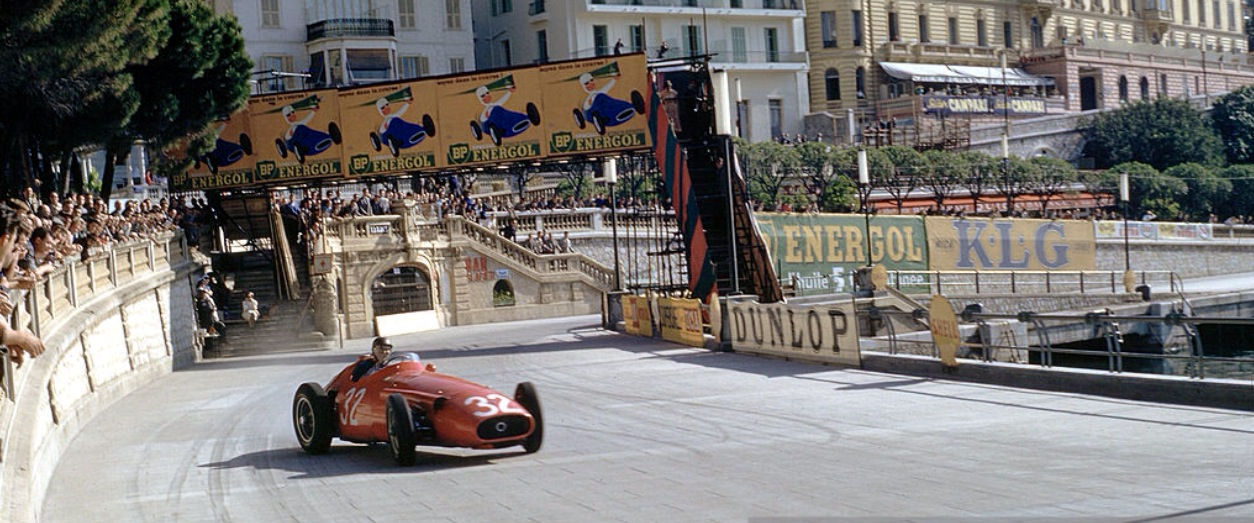
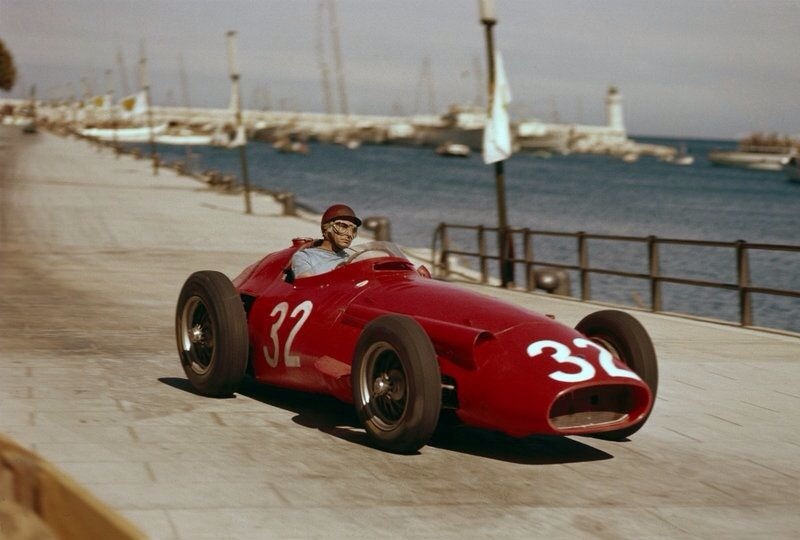
Stirling Moss practices his works Maserati 250F at Monaco on 13 May 1956…

Photographer Louis Klemantaski took the shot from his hotel balcony, the long shadows are early morning light. He won the race. Checkout this article on the 250F and this race i wrote a while back; https://primotipo.com/2014/08/21/stirling-moss-monaco-gp-1956-maserati-250f/

Credit…

Louis Klemantaski

image


image

Harry Schell on the limit of adhesion in his ‘Yeoman Credit’ Cooper T51 Climax at Madgwick Corner, Goodwood…

Harry Schell was a press-on kinda driver wasn’t he? Here the Franco-American is delighting the ‘Glover Trophy’ spectators with some delicious Cooper T51 drifts…

The 1960 event was held on Easter Monday, 18 April. Harry was bang on the pace too, equal 2nd quickest in practice with Stirling Moss in a similar car. Chris Bristow demonstrated his undeniable pace though, he was on pole by a couple of tenths and finished 3rd in the race behind Moss, the winner Innes Ireland in his factory Lotus 18 Climax, the quickest of 1960’s GP grid. Harry’s engine popped on lap 20 of the 62 lap 162 Km race…

Credit…

GP Library, National Motor Museum

Tailpiece: Harry telling a naughty joke by the look of it, Crystal Place, July 1955…

Stirling Moss, Schell and Mike Hawthorn during the ‘London Trophy’ meeting which Mike won the feature race in a Maserati 250F from Harry’s Vanwall.

schell

(National Motor Museum)

Mike won his heat in the Moss’ family 250F chassis #2508, Harry his in Vanwall ‘VW2’ and Mike the final. Moss was contracted to Mercedes Benz that year, this non-championship 30 July event not one in which Benz entered their W196’s.

moss

Stirling Moss cruising back to the pits, off the racing line on the Curva Grande, deep in thought…

The gearbox in his Vanwall failed during his dice with Mike Hawthorn’s Ferrari Dino 246 and with it his hopes of the 1958 World Championship, won of course by Hawthorn in Morocco a month later.

As to the other car and driver, my guess is Cliff Allison’s Lotus 12 Climax. All other entries welcome!

Tony Brooks won the race in another Vanwall VW 57 from Hawthorn and Phil Hill’s Dino’s after a stunning drive in his second GP, his first for Ferrari.

Photo Credit…Yves Debraine