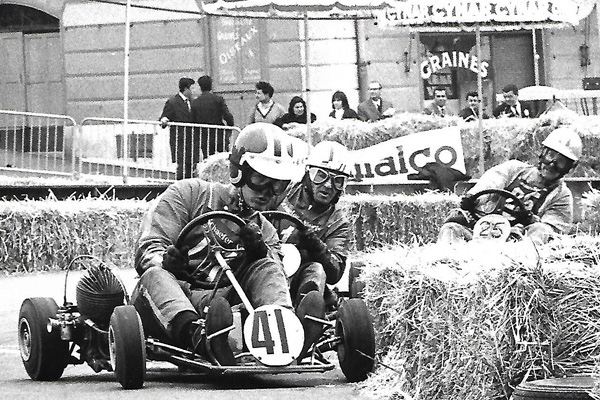
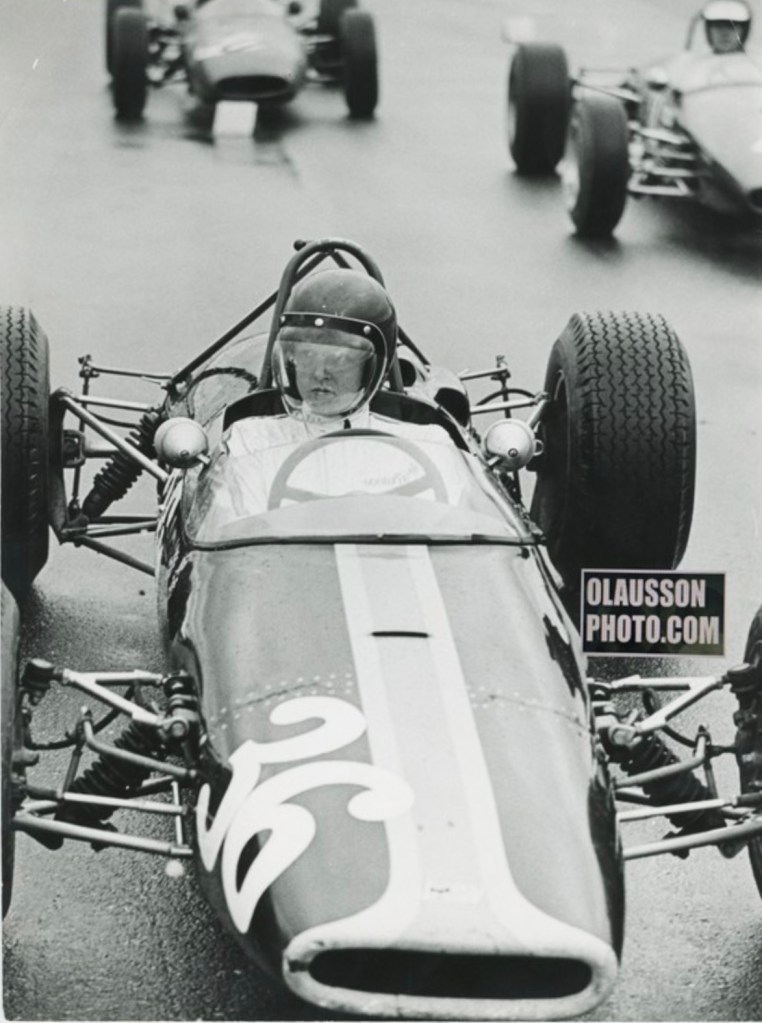
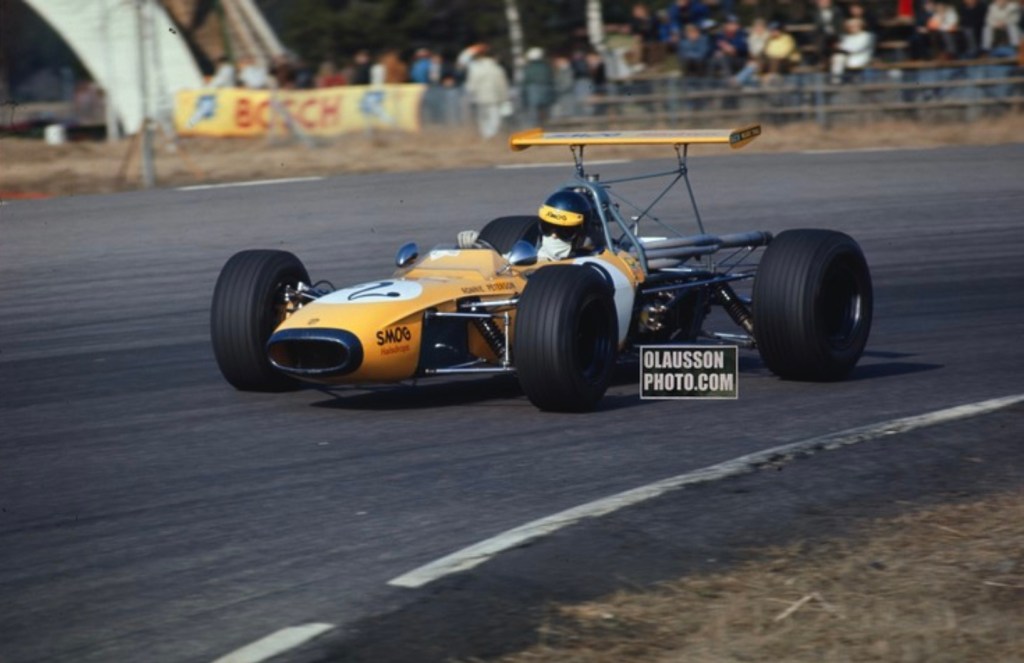
Ronnie Peterson in the style which made him a famous crowd favourite ahead of a gaggle of other karts at Laxa, Sweden circa 1965.
3,000 people watched the Laxa Motorstadion’s – Sweden’s first Kart track – first race meeting in 1961, a venue that can take some of the credit for Sweden’s 1970s and 1980s motor racing successes.
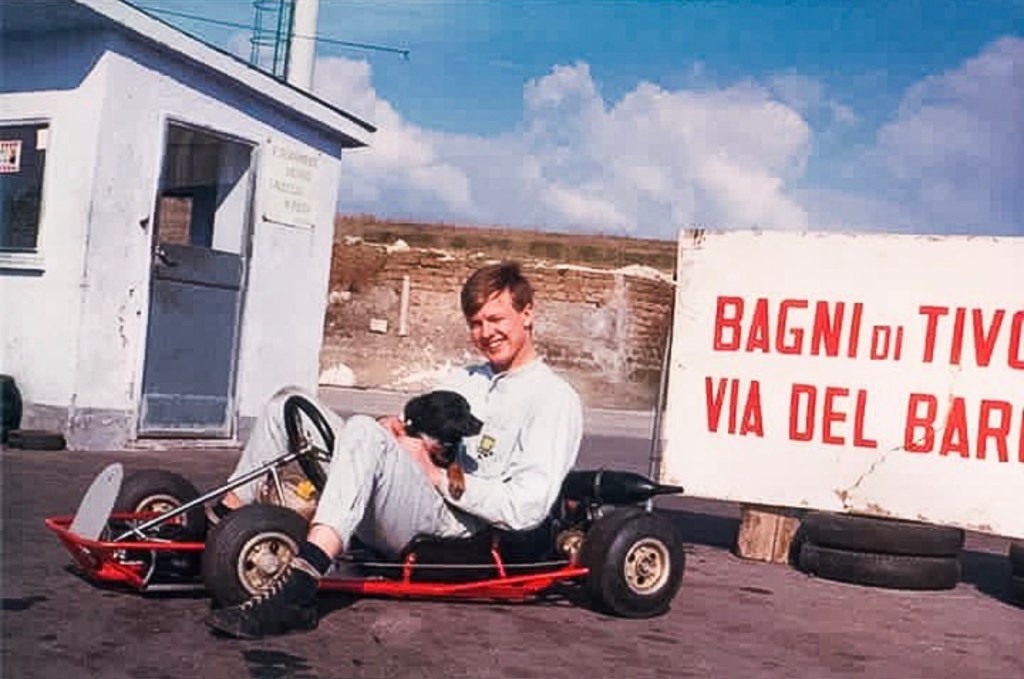
Ronnie regularly practiced and raced there together with his father Bengt ‘Bagarn’ Peterson, a skilled car builder/fabricator. His competitive instinct was there from the start, but Laxa pit-pundits bet on Ronnie hitting the straw-bales on either lap one or two in his early days.
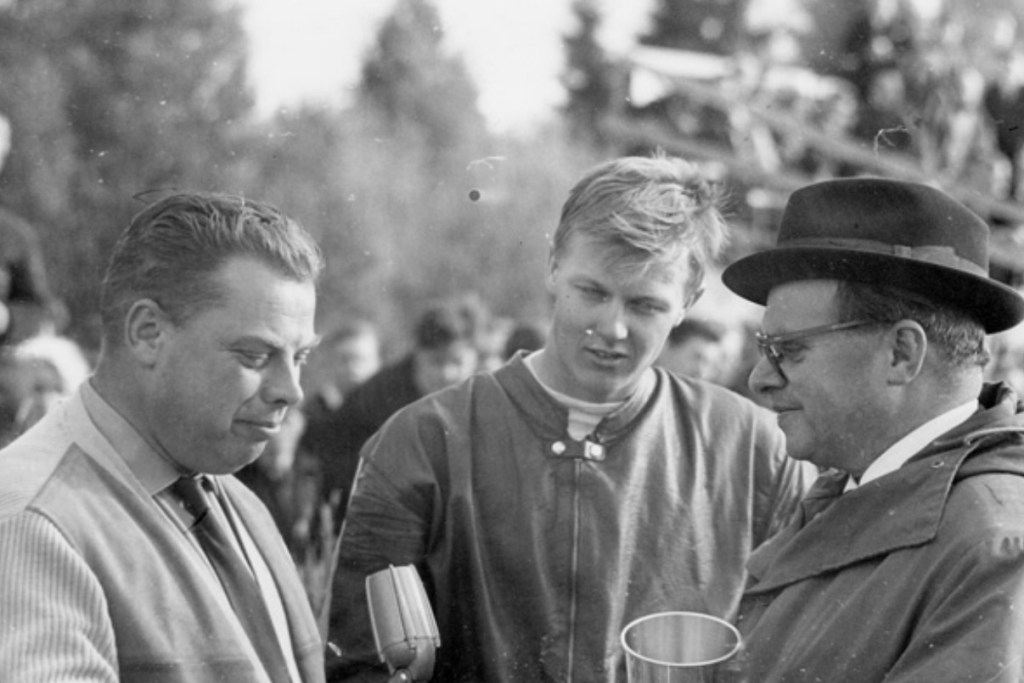
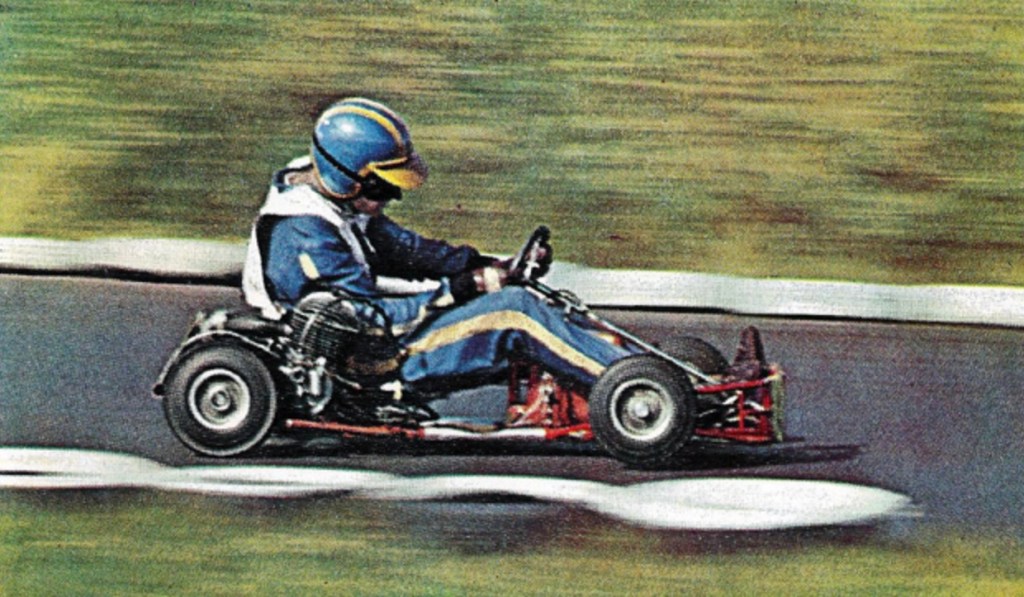
Prize presentation at Laxa circa 1964 (bilsportarvet.se)Ronnie, Robardie Parilla circa 1965 (federicascarscelli.com)
By 1964 Ronnie had made a clean sweep of Laxa events, two years later, in September 1966, he place third in the World Kart Championships at Kopenhamm, Denmark in front of Toine Hezemans and one Keijo Rosberg.
While all the hotshots raced Parilla powered Tecnos and Birels, Ronnie’s Robardie was built by his dad. Bengt’s Robardies were good enough to win world kart titles for Tomas Nilsson in 1968 and Francois Goldstein in 1968-69.
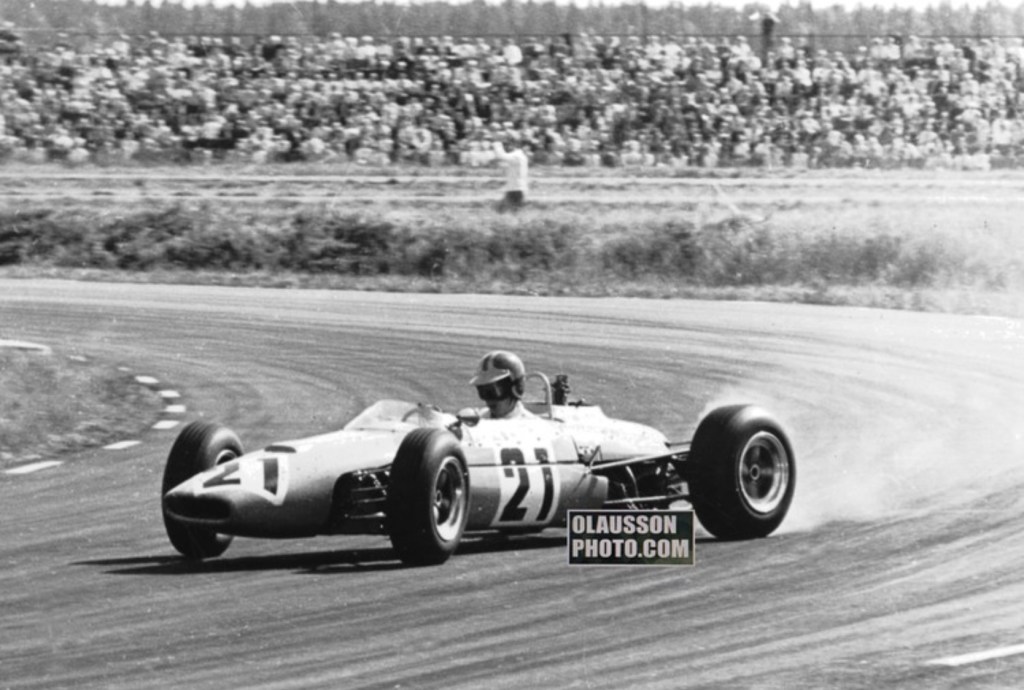
By mid-1966 Peterson father and son had progressed to Formula 3, racing the Swebe Ford (most references have it as Svebe but the name on the original steering wheel says Swebe) which was built by Bengt and engineer Sven Andersson. It was essentially a Brabham BT15 clone fitted with Brabham like suspension, uprights and other components.
Ronnie’s best result in a half-dozen mid-year Swedish events was a third at the Dalsland Ring (below) in July.
Ronnie’s car control was legendary from the very start. He was never the best at working with the engineers to get the best out of a car, preferring to just drive around the problemRonnie, BT18, on the grid of the Danmarksmesterskab final at the Jyllandsringen, Denmark in October 1967 – second behind Reine Wisell’s BT18
By the Karlskoga meeting that October Ronnie raced a Brabham BT18 Ford in advance of a full campaign at home in 1967. He was fourth in the Swedish F3 Championship won by Reine Wisell, Ronnie then took back-to-back titles in 1968-69.
The 1969 F3 win which vaulted him into consideration for Colin Crabbe’s privately run F1 March 701 Ford in 1970 was victory over Europe’s cream-of-the-racing-crop at Monaco in May.
That field included fellow future F1 drivers Reine Wisell, Jean-Pierre Jabouille, Tim Schenken, Patrick Depailler, Howden Ganley and Mike Beuttler. Ronnie won his heat and Wisell the other, with Ronnie nine-seconds in front of Reine in the final.
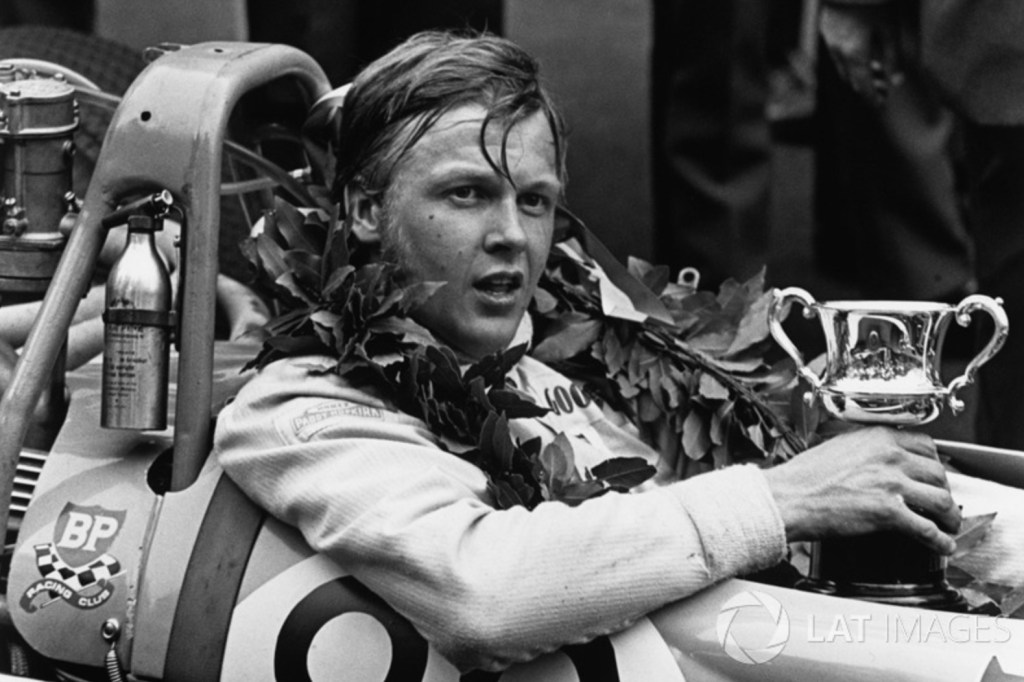
Happy and exhausted, Peterson after winning the 1969 Monaco F3 GP, Tecno 69 Ford Novamotor (LAT)Quayside at Monaco. Tecno 69 chassis #TO334 won 16 F3 races in 1969 in Sweden, Italy, France and of course Monaco (unattribured)SuperSwedes both, friends and rivals Ronnie and Reine Wisell at Anderstorp in June 1969 (LAT)
Even more impressive was that all of his F1 compatriots, with the exception of Howden Ganley, raced works or quasi-works cars, while Ronnie’s Squadra Robardie Tecno 69 Novamotor was spannered by Ronnie and his mechanic.
The world was on notice.
Nascent March Cars co-owner Alan Rees chased Ronnie’s signature at Crystal Palace the following weekend to drive the very first March, an F3 machine designated 693.
Ronnie at Karlskoga, Tecno Ford on the way to a win in May 1969 (MotorSport)
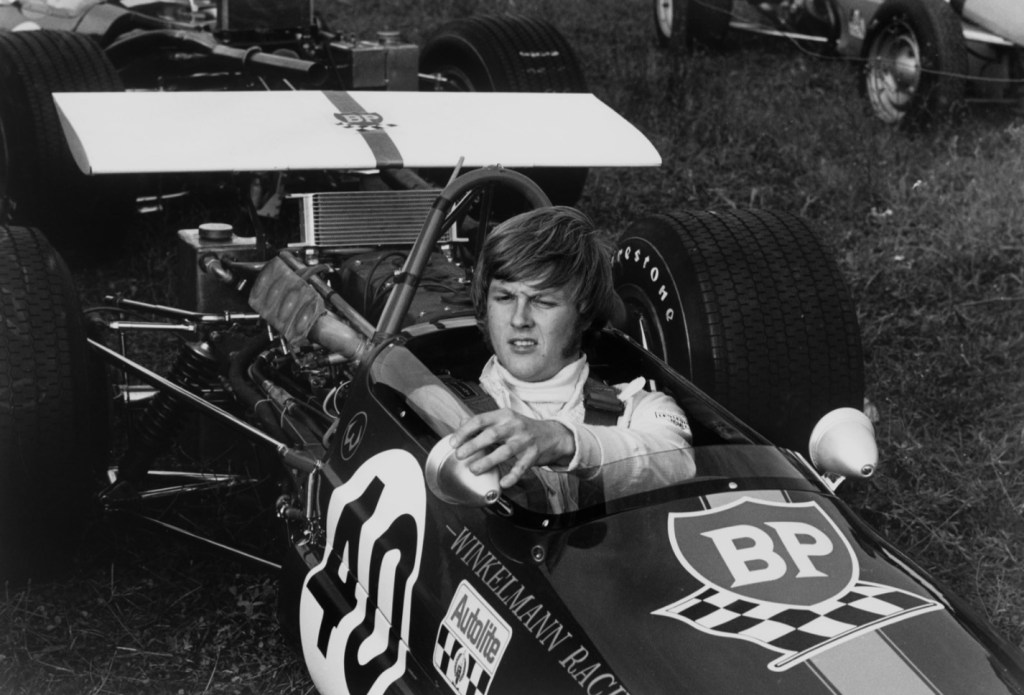
In September Peterson had his first F2 drive for Roy Winkelmann Racing (above) in the Albi Grand Prix.
Ronnie finished fifth aboard the unfamiliar Lotus 59B Ford FVA, in front of him were GP drivers Graham Hill, Johnny Servoz-Gavin, Jochen Rindt and Henri Pescarolo. It was his first Lotus drive, but far from his last!
Ronnie was on his way, and the rest, as they say, is history…
Credits…
‘Laxa-The country’s first Go-Kart Track’ Anders Bjork, bilsportarvet.se, olaussonphoto.com, federicascarscelli.com, LAT, MotorSport, F2 Index
Etcetera…
(unattributed)
Date place and event unknown, and welcome!
Tailpiece…
(MotorSport)
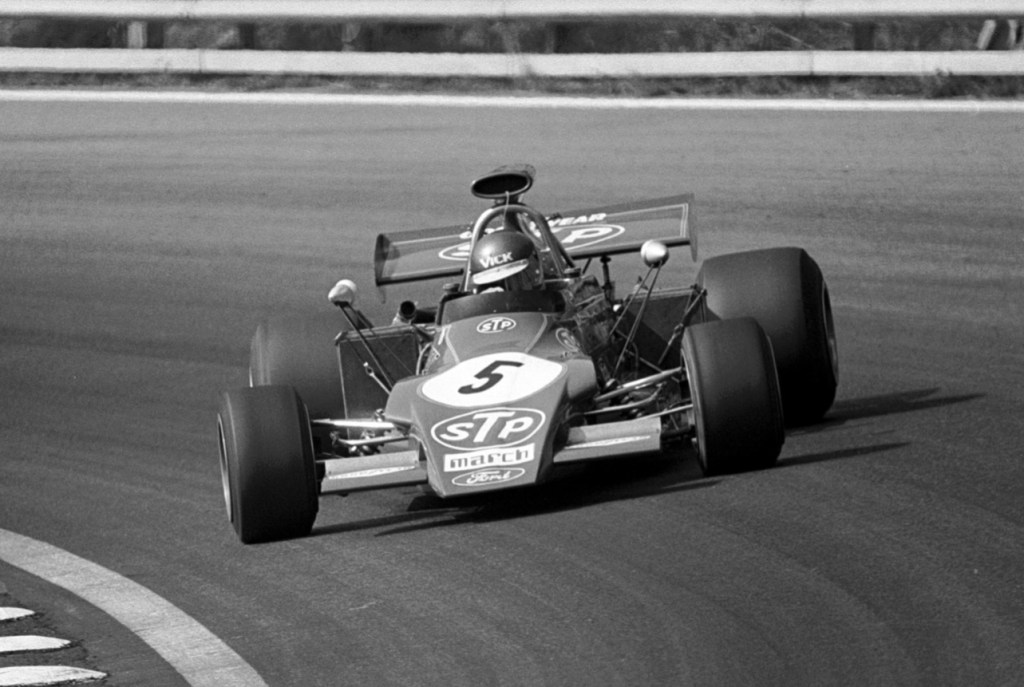
So often Ronnie had his cars all cocked up well before the apex of a corner, as here at the Osterreichring aboard his March 721G Ford in 1972.
It wasn’t always the quickest way of course but car control exhibitions like this was the best part of a weekend for many spectators.
He ran as high as third from Q11 in Austria, finishing 12th. Colin Chapman liked what he saw, Ronnie had a Lotus seat in 1973 and gave Emerson Fittipaldi, the reigning World Champ a serious run for his money. Emerson won three GPs, and Ronnie four, which gave Lotus the constructors title but Jackie Stewart won the drivers championship with five wins…
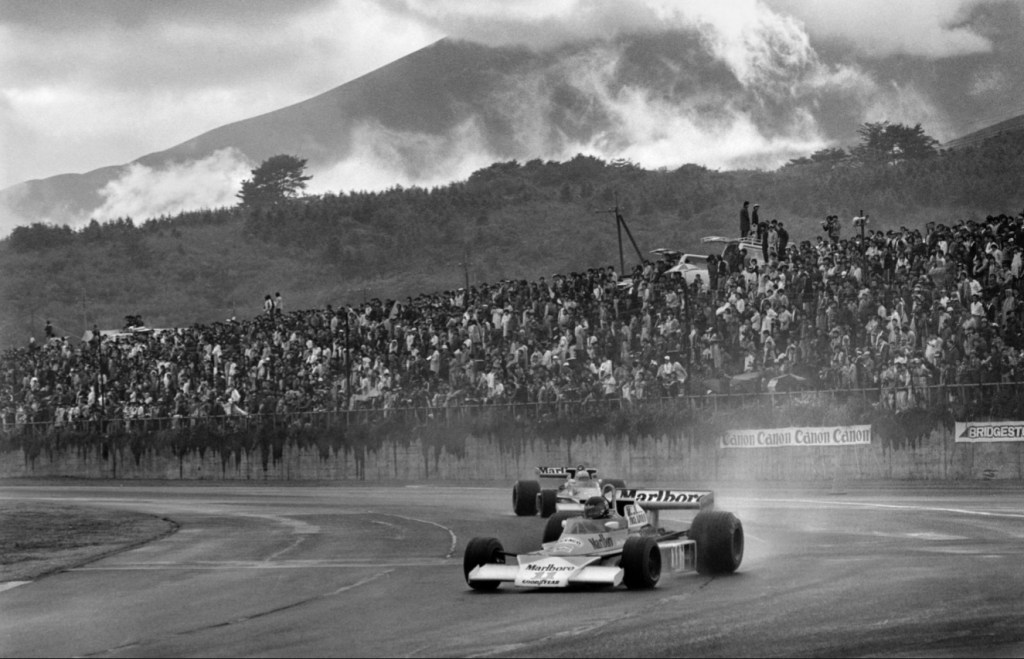
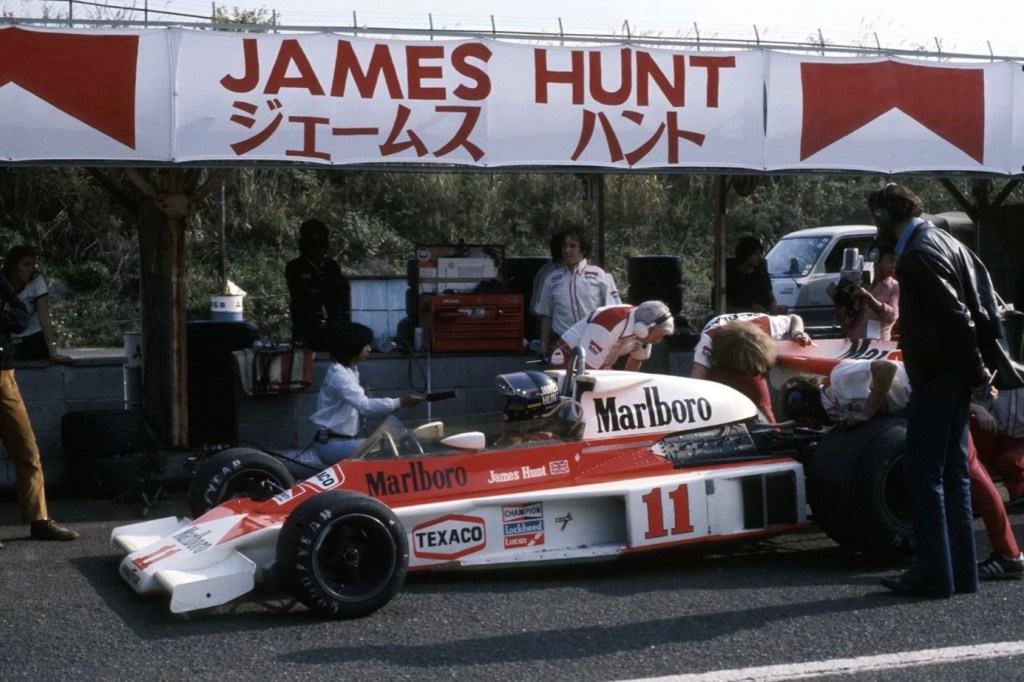
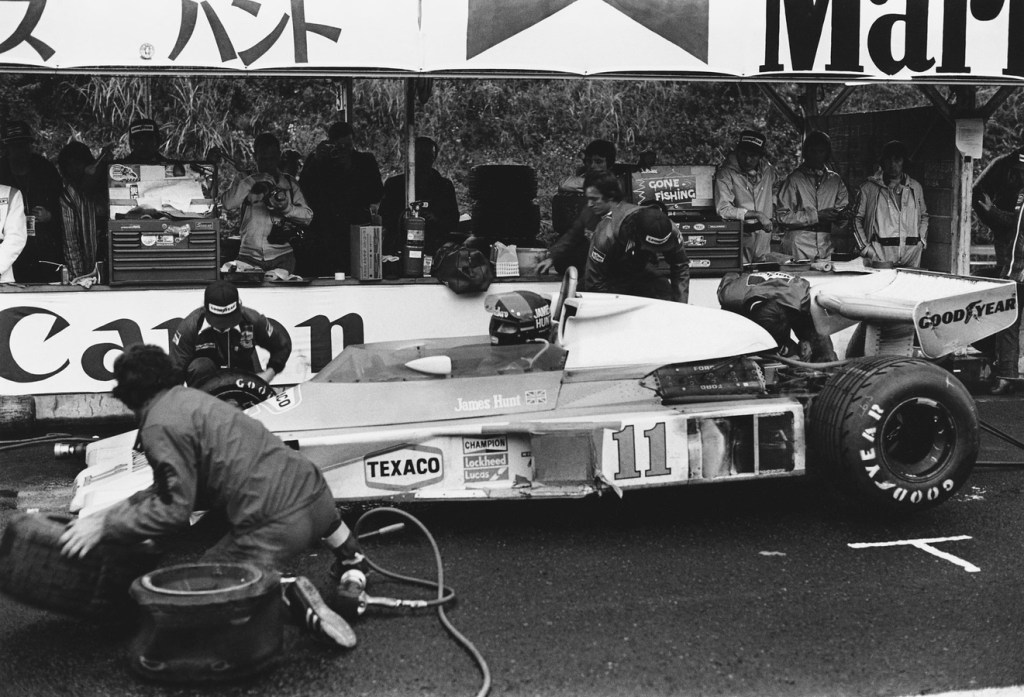
James Hunt and Jochen Mass, McLaren M23 Fords, Fuji 1976 (MotorSport)
We all have favorite Grand Prix seasons, for me 1976 was an enchilada with the lot.
It was a technically interesting year filled with pathos, drama, politics and a cast of personalities the spreadsheet jockeys who own F1 this week can only dream about.
Early in the season Ferrari appeared likely to take back-to-back titles. Mauro Forghieri’s 1975-76 3-litre flat-12 engined 312T/312T2 machines were amongst his best work in a long career with the Scuderia. Reigning champion Niki Lauda won in Brazil and South Africa, then his teammate, Clay Regazzoni prevailed at Long Beach.
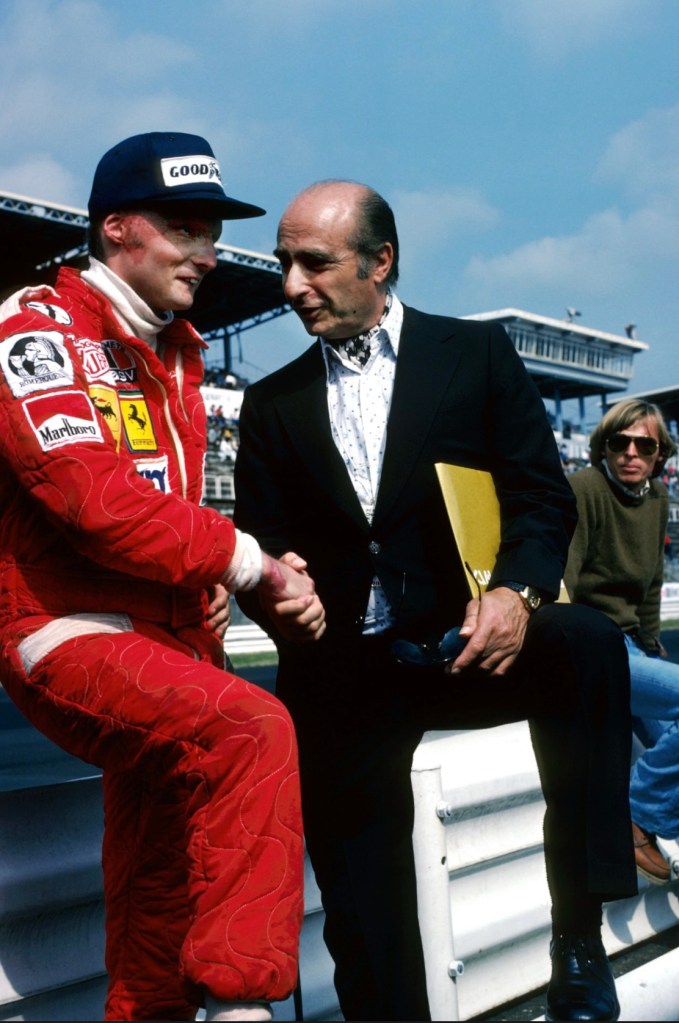
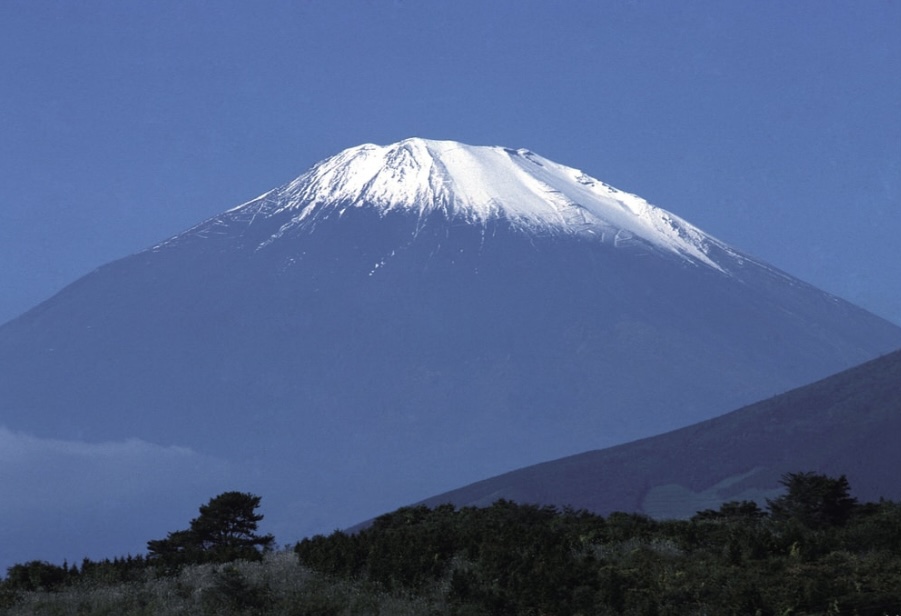
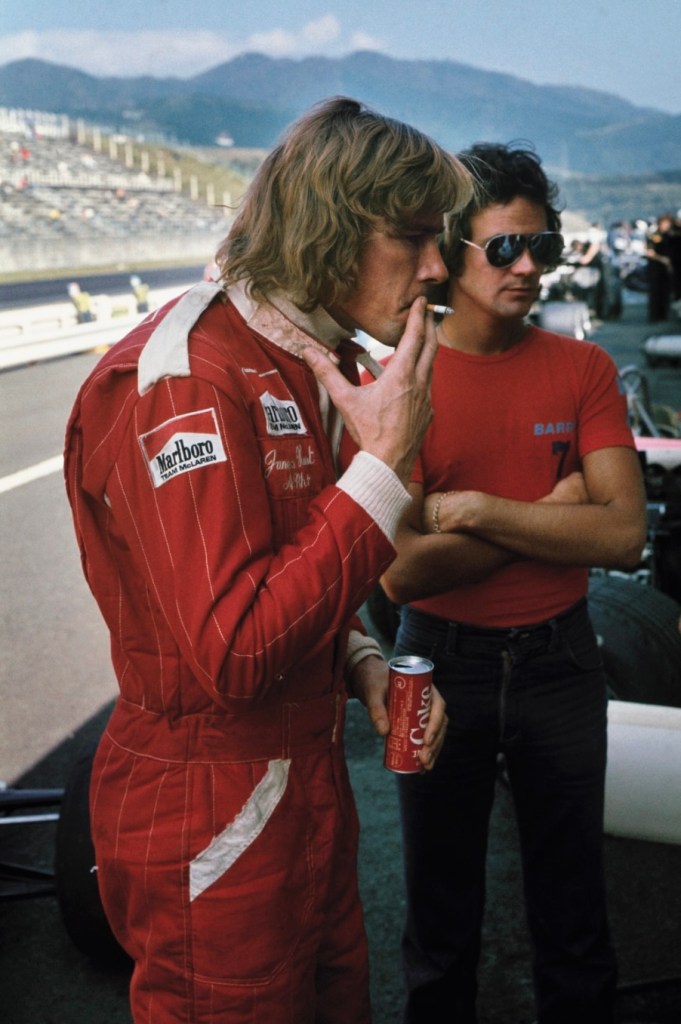
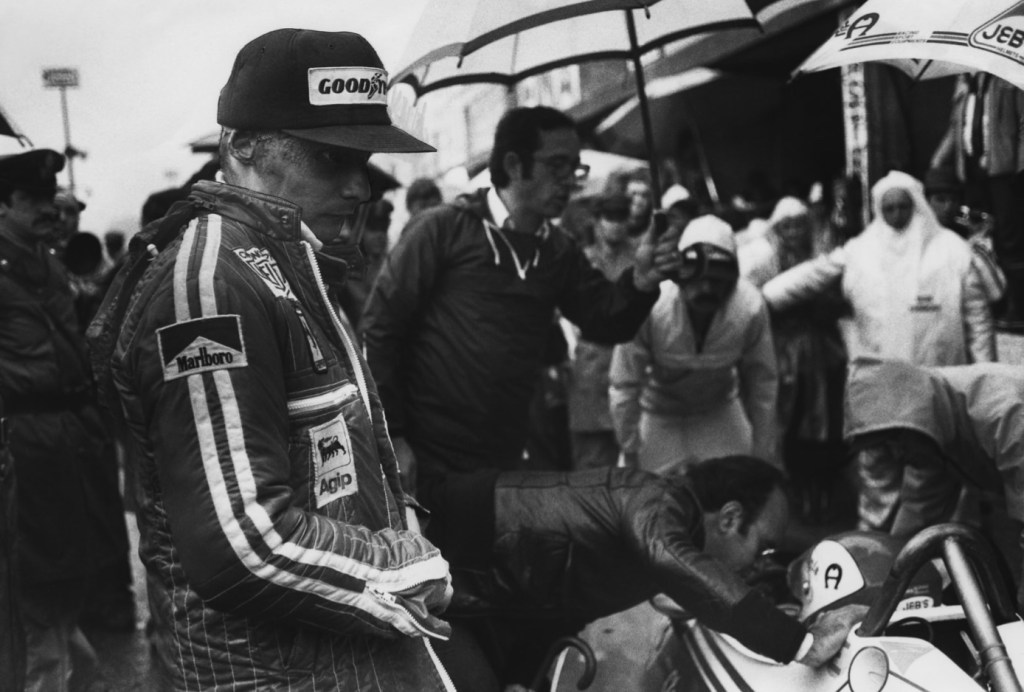
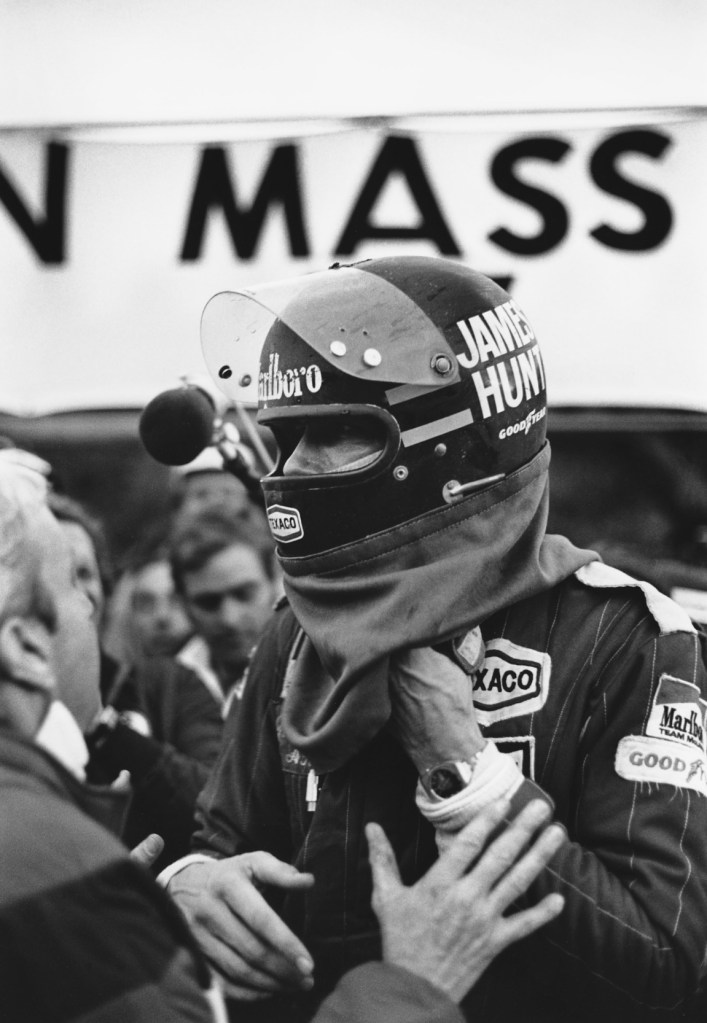
Lauda and Fangio, two of the bravest of the brave at Fuji (MotorSport) Mount Fuji during the 1976 race weekend, not a race-day happy-snap mind you (MotorSport)Breakfast of champions for James, while Barry Sheene, World 500cc Champ that year on a Suzuki RG500, looks on. Fuji 1976 (MotorSport)
James Hunt had been threatening from the get-go. Starting from pole at Interlagos and Kyalami, he finally won at Jarama with the big-league Marlboro McLaren outfit.
He’d been racing for the Boats-Bolly and Big-Boobies Hesketh outfit – Silverstone International Trophy and Dutch GP wins duly noted and admired – and got his chance in the majors after Emerson Fittipaldi committed F1 suicide by leaving McLaren for his brother’s Fittipaldi Automotive outfit.
Stuff brotherly love, I’ll take a competitive car every day of the week.
That Jarama weekend was notable for the first race-appearance of Ken Tyrrell and Derek Gardner’s absolutely wild P34 six-wheeler, and because Hunt’s win was swiped from him. His car was measured as being too wide in post-race scrutineering.
McLaren appealed on the grounds that this was due to the expansion rate of the tyres during the race. Two months later the appeal was surprisingly upheld, after all it’s up to the team to manage the width of the car in accordance with the regs knowing full well the behaviour of its Goodyears.
When Lauda won in Monaco he had a massive 33 point lead in the drivers championship from Regga and Hunt.
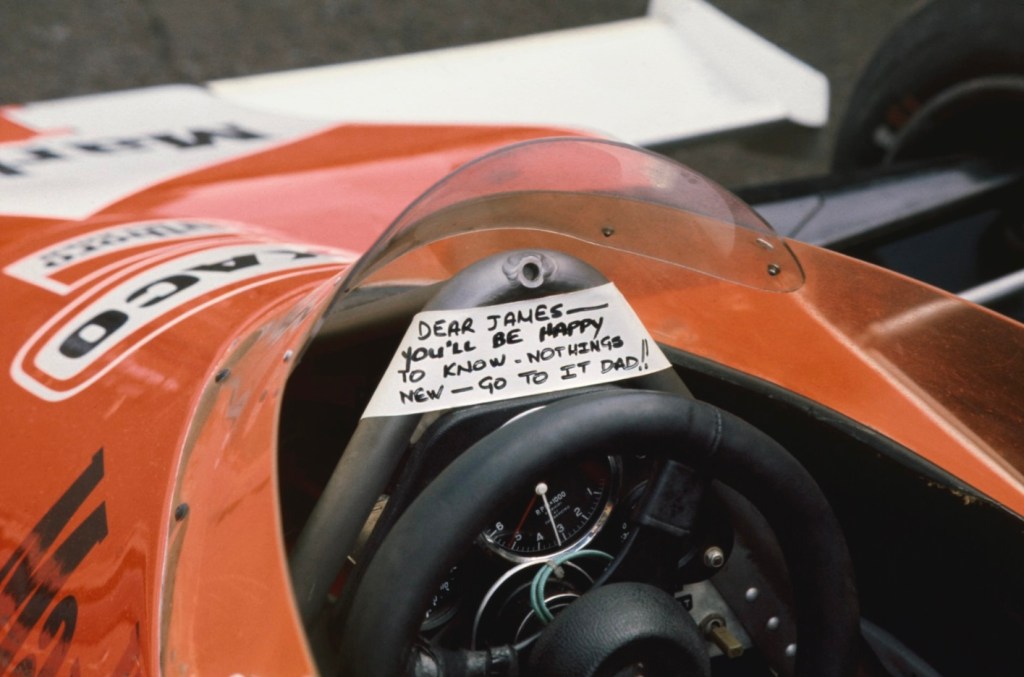
Teddy and ‘Kojak’ – what is the name of the mechanic with the wild and woolly hair? – and Alistair Caldwell look after Hunt’s M23. Gotta’ be amongst everyone’s favourite GP designs, long-lived as it was? (MotorSport)The usual witty McLaren mechanic’s missive to their pilot, Hunt’s raceday message (MotorSport)Ermanno Cuoghi and crew attend to Lauda’s Ferrari, Daniele Audetto, team manager at right. The 1975-1979 312T-312T4 were fast, reliable jewels of cars driven by some of the worlds best (MotorSport)
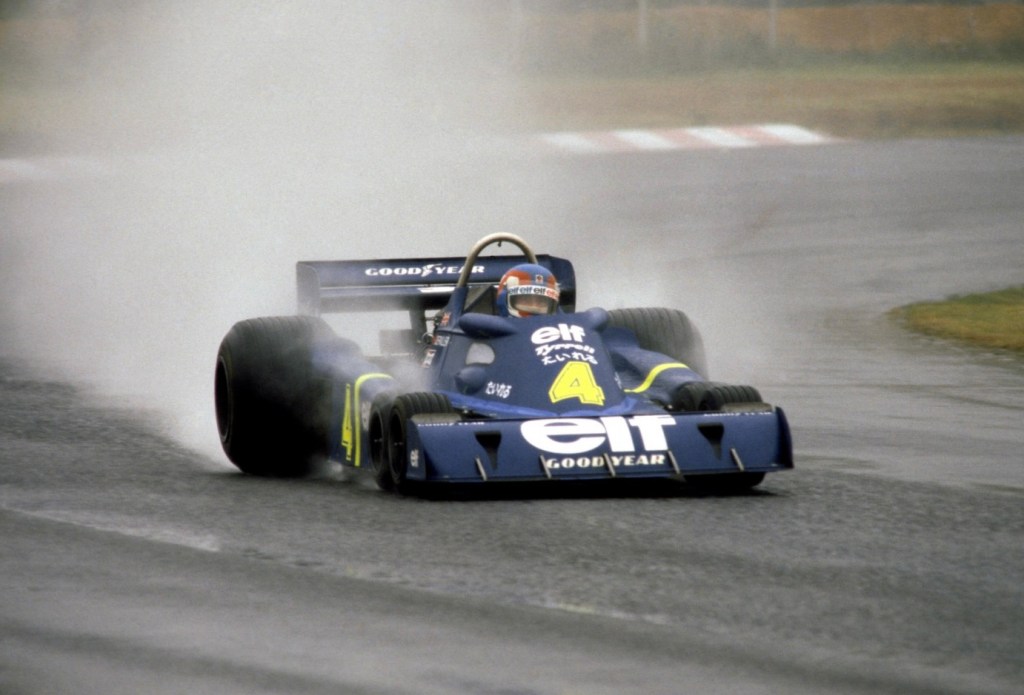
Who can forget the stunning shots of the P34s opposite locking their way around Anderstorp’s constant radius turns on the way to a history making one-two; Jody Scheckter from Patrick Depailler.
Hunt won from pole at Paul Ricard but only after Niki’s Tipo 015 525bhp flat-12 went pop while in the lead.
Niki Lauda took pole at Brands Hatch from James, then came Mario Andretti who again reinforced the growing pace of the Lotus 77 Ford. Colin Chapman, with Andretti’s developmental help, was finding his mojo again after a year or so in the wilderness.
The British GP controversy started when Regga tagged Lauda after the start and took out Hunt as the Swiss spun. In contravention of the rules, Hunt, Regazzoni and Jacques Lafitte started in their spares. Lauda led the restarted race until halfway, then slipped back with a gearbox problem, then the hometown boy was through and took a hugely popular, well merited win…for a while anyway.
Despite starting Regga in their spare, Ferrari, Tyrrell and Fittipaldi appealed against Hunt being allowed to start in McLaren’s spare. Two months later, amid great controversy Hunt was disqualified gifting Lauda the win.
I thought this was, and still do think this was a bum-deal. I would have pinged the organiser for allowing three teams to start drivers in their spares, but allowed the results to stand.
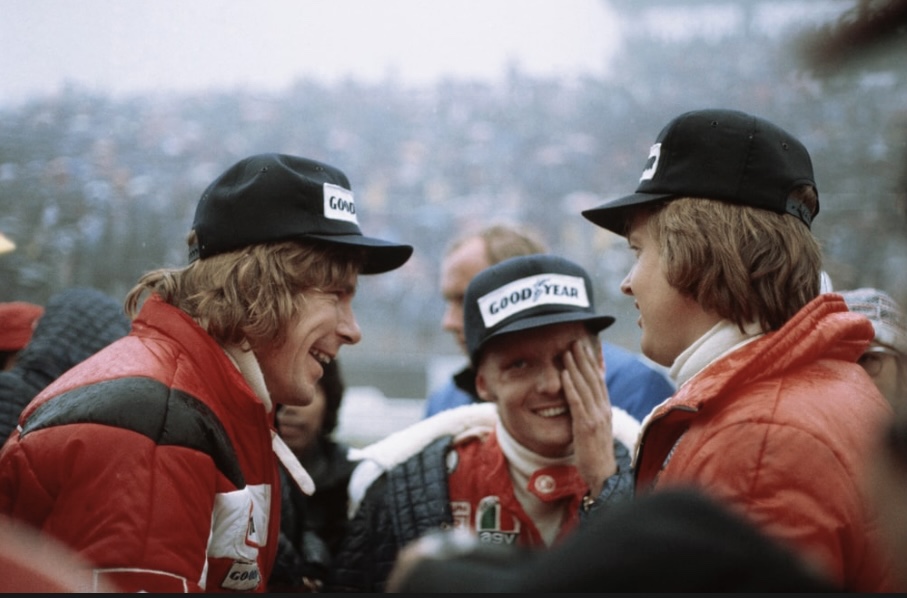
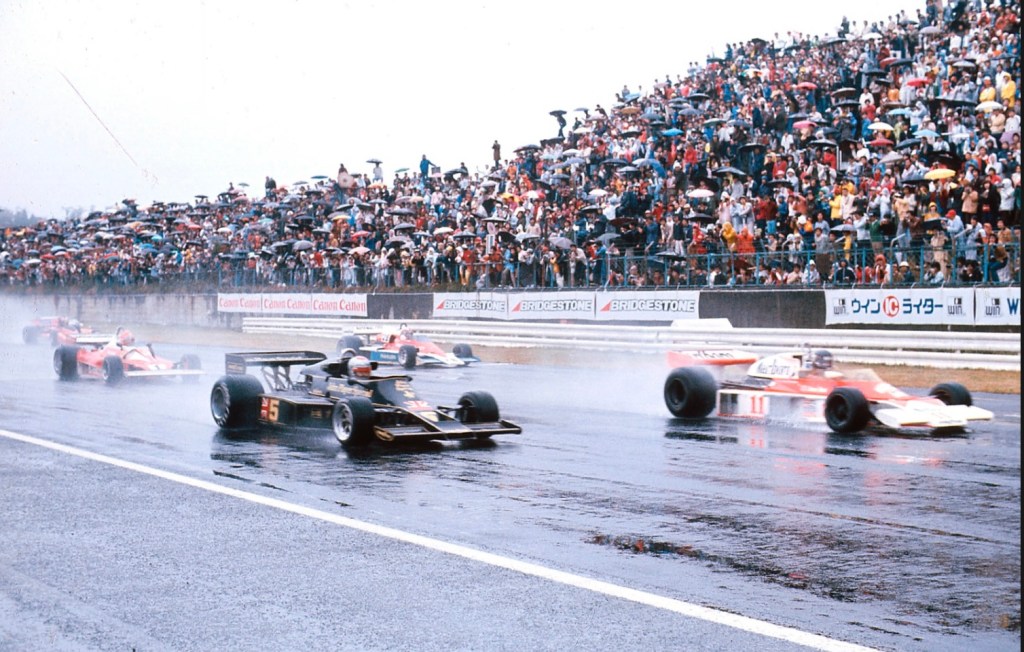
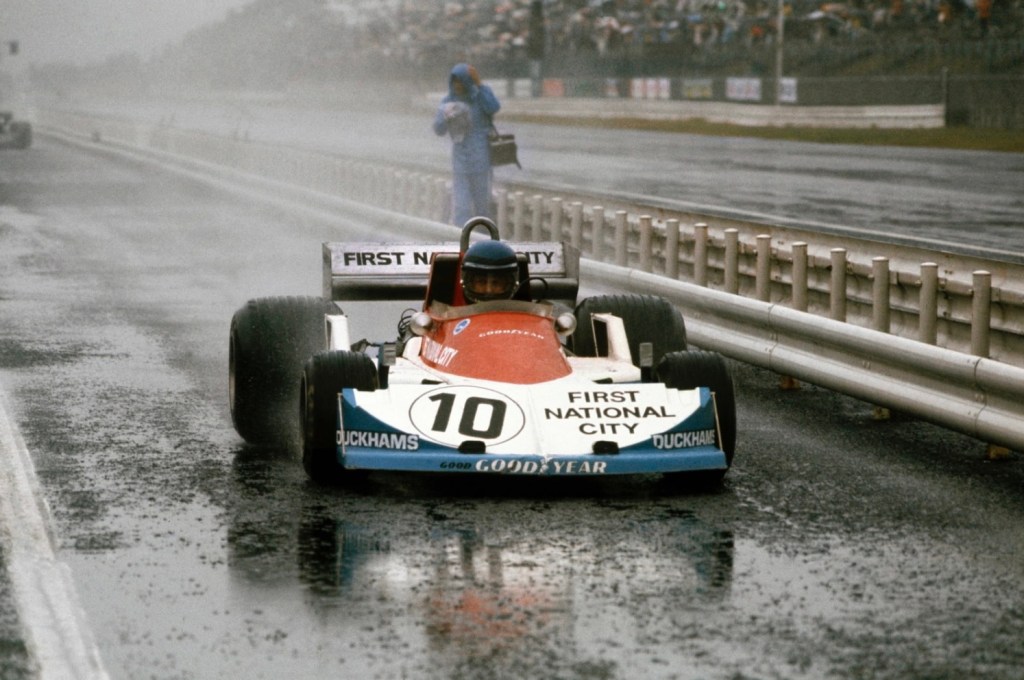
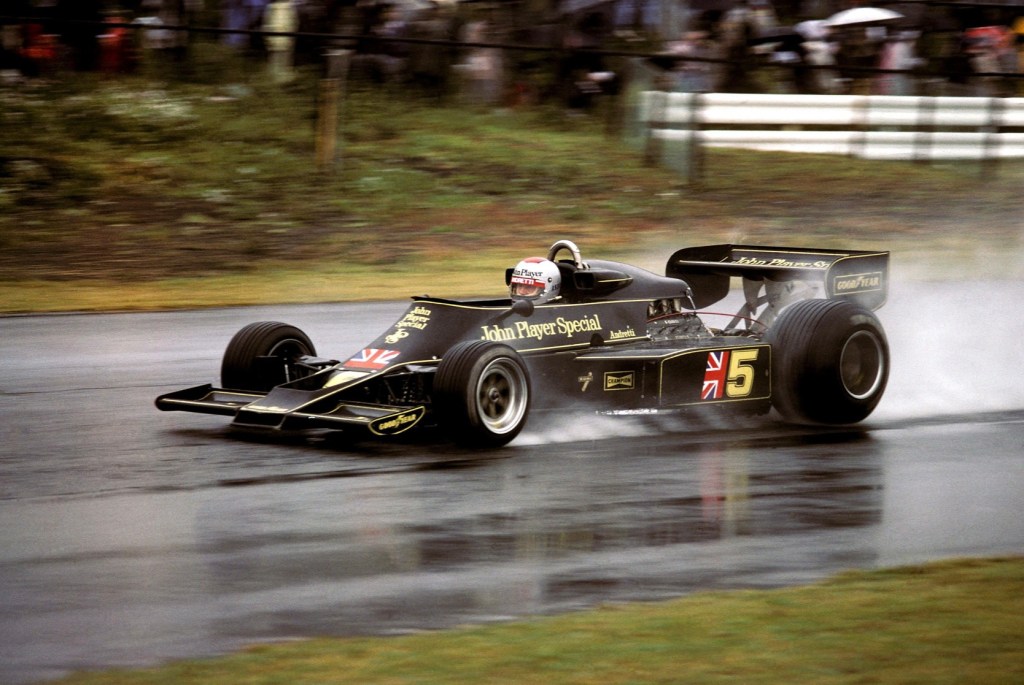
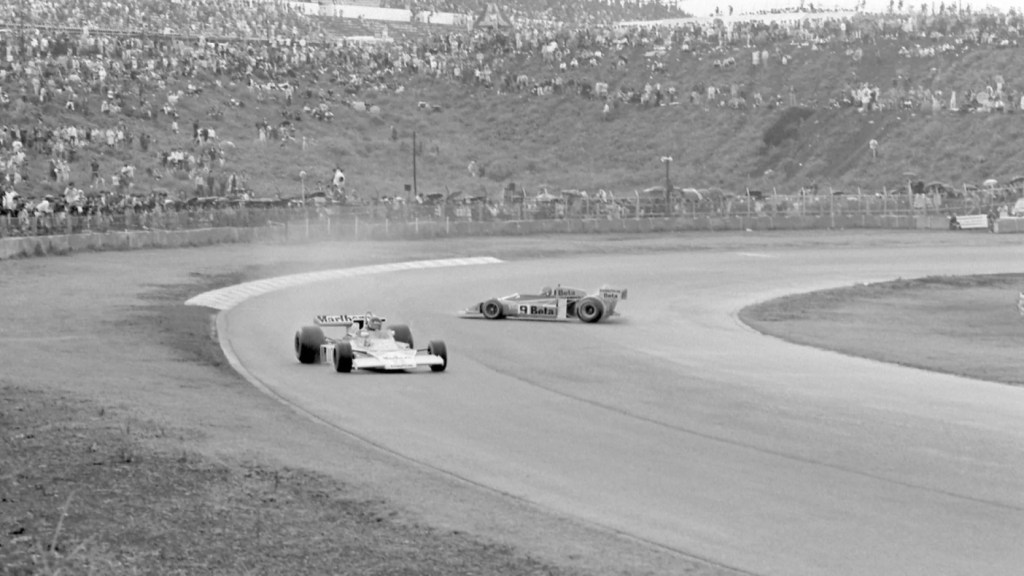
It looks jolly enough, and I’m sure it was, but laced with no shortage of tension as well given the stakes. James, Niki and Ronnie at Fuji as officialdom rubs its Chrystal Ball as to the likely weather patterns for the balance of a Fuji Sunday (MotorSport)Slightly soggy Fuji start…Andretti on pole, Lotus 77 Ford, Hunt alongside in his M23, Niki behind, Ferrari 312T2, and John Watson’s Penske PC4 Ford by the fence. The other car in the distant gloom is Carlos Pace’ Brabham BT45 Alfa Romeo. Goodness gracious, all that variety, three V8s and two different makes of flat-12, something Liberty Media’s Q-Department only have in their wet-dreams (MotorSport)This shot of Ronnie Peterson retiring his March 761 Ford without completing a lap due to engine problems further reinforces the staggering amount of water on circuit (MotorSport)
Then it was off to the Nurburgring where Hunt put in some scintillating laps to start off pole from Lauda who was nine-tenths adrift of his British buddy.
Niki’s terrible, lap two accident on the left kink before Bergwerk was probably caused by rear suspension component failure. Were it not for the efforts of Guy Edwards, Brett Lunger, Harald Ertl and Art Merzario to get Lauda out of the car – in advance of the arrival of marshals – he probably would have been fried alive there and then.
Instead, the staggering Lauda, having been given the last rites at the Ludwigshafen Hospital trauma unit, showing indomitable will of human spirit, returned two races and just six weeks later at Monza.
While Lauda set about the business of survival and recovery, Hunt won the restarted German GP, and the Dutch at Zandvoort. John Watson (Penske PC4 Ford) took a well deserved and very popular win for Roger Penske on the Osterreichring in between Hunt’s victories.
Lauda out of the car, content with the decision he had made to stop. Regga was fifth (MotorSport)(Gloomy isn’t it. Hans Stuck out with drowned electrics, March 761 Ford (MotorSport)Battle for second between Mario Andretti and Vittorio Brambilla, aboard Ford Cosworth powered Lotus 77 and March 761 (MotorSport)
When Niki Lauda appeared at Monza he stunned everyone, not least Enzo Ferrari who had hired Carlos Reutemann to drive in his place.
In great pain, his burns not fully healed with balaclava and skin enmeshed in blood, the crazy-courageous Austrian finished the race in fourth place behind Ronnie Peterson’s March 761 Ford, then Regga second and Jacques Laffite, Ligier JS5 Matra V12, third. Hunt collected no points having spun on a charge up the field.
In the week between Monza and Mosport James’ British GP disqualification was made. So, with three races to run – Mosport, Watkins Glen and Fuji – Hunt had 47 points to Lauda’s 64. It seemed and was a tall order for the British babe-magnet.
Undaunted by the Mosport challenge, James took pole and led from lap 10 having made a typically tardy start, while Niki ran fifth but faded with handling issues.
It was then well and truly game on, Lauda’s margin slimmed to eight points, there was plenty of debate globally between racing mates about which of the drivers you wanted to prevail.
I was in Niki’s camp, his sheer bravery and dogged – cussed – will to go on and win was and still is an outstanding moment of human spirit in any sport.
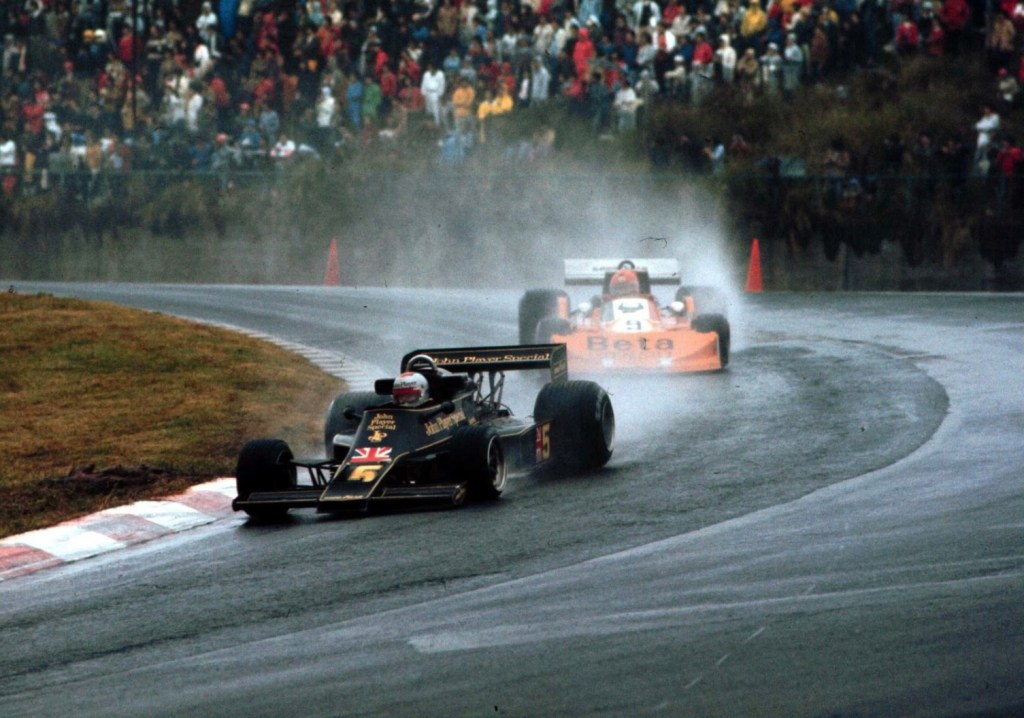
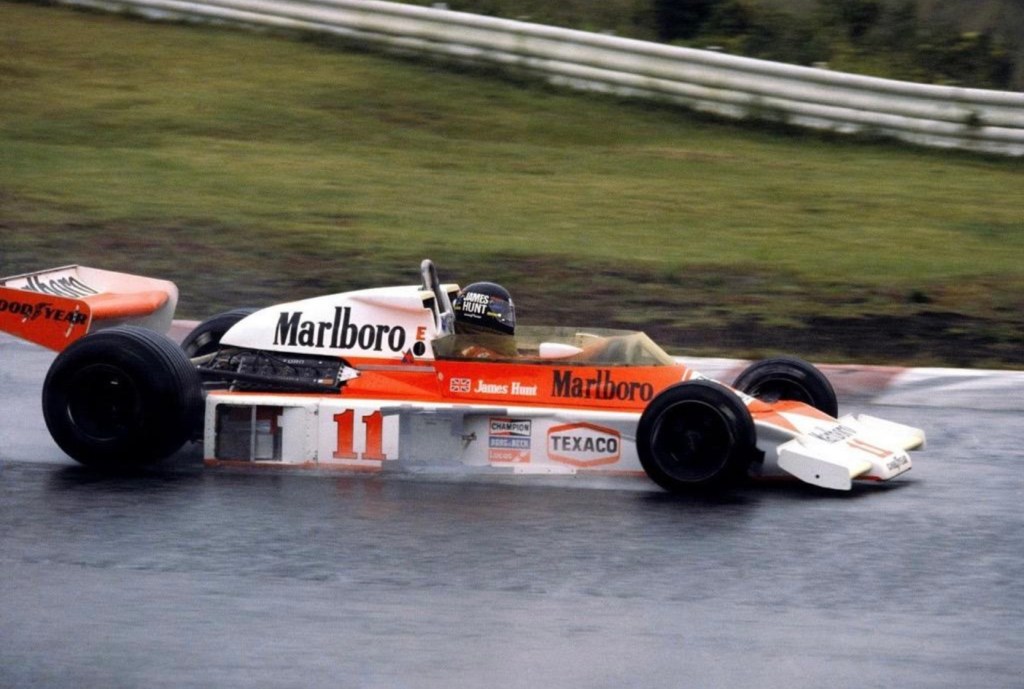
Andretti’s Fuji winning Lotus 77, look at the volume of water early in the race, Hunt below looking similarly soggy (unattributed)(unattributed)Brambilla dived down the inside of Hunt on lap 20 but James anticipated the move so the Italian didn’t take him out in the process (MotorSport)
But Hunt kept on coming. Watkins Glen was one Grand Prix racing’s great challenges, he popped his McLaren on pole – his eighth of the year – and won the race after a duel with Scheckter’s six-wheeler while Lauda bagged the other podium spot.
As the teams travelled to the orient, Niki’s margin was down to three points, it was a showdown that either racer could win.
I remember trying to follow events at Fuji over the weekend in those far way pre-internet days with shithouse international motor racing coverage in the local Melbourne ‘papers, the sporting coverage of which extended to footy (Aussie rules), cricket (a British insomnia cure), donkeys and dish-lickers (greyhounds).
I negotiated with my father captaincy of the TV set at my nana’s place. There was a family celebration at her joint, at all costs I wanted to watch the scratchy Channel 2/BBC (?) coverage of Fuji. Do you (Australians) remember that we only got colour-telly in March 1975?
Such were the dramas that year that many non-racing folk were interested in the Japanese Grand Prix with most I knew rooting for that plucky Austrian.
The Fuji weekend was ruined by the tropical Sunday rain, Mario Andretti’s Lotus was on pole from Hunt and Lauda.
There was intense, long debate about whether the race should start at all, such were the challenges of fog, rain and vast amounts of running water all over the track. But the decision was to race, the majority of drivers didn’t disagree.
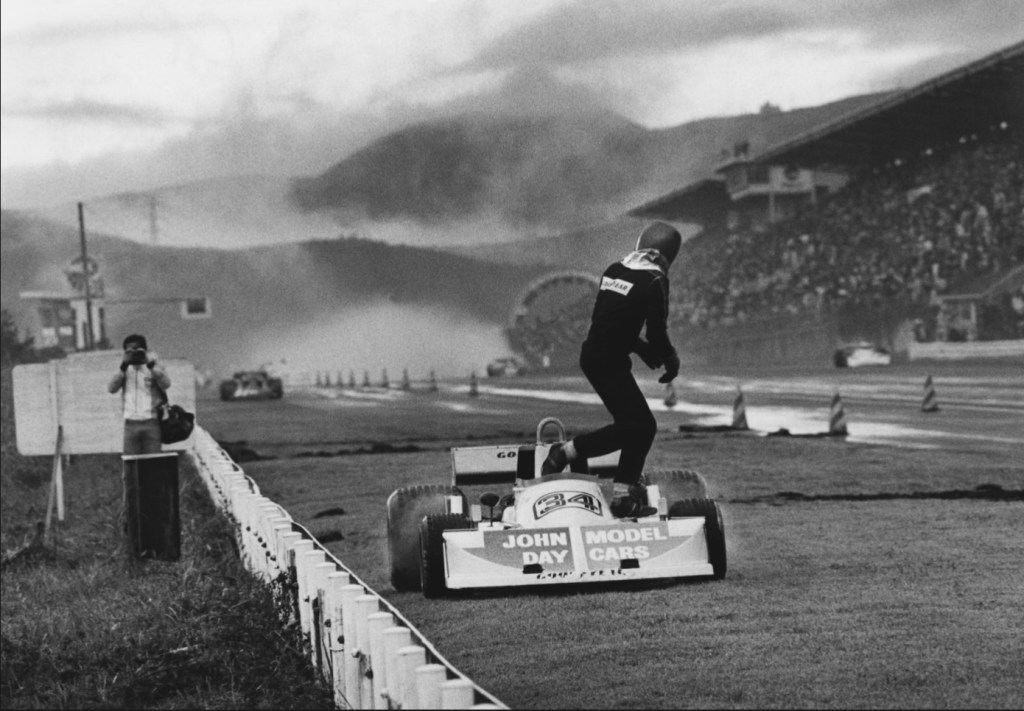
Hunt led from Watson and Andretti, then Watson went down an escape road on lap two, on that lap Lauda pulled in. Larry Perkins completed one lap, Carlos Pace seven, and Fittipaldi nine. The Brabham duo came in, I think, on the command of Generalissimo Bernie. In all of the circumstances who could blame Niki. His courage was not in doubt.
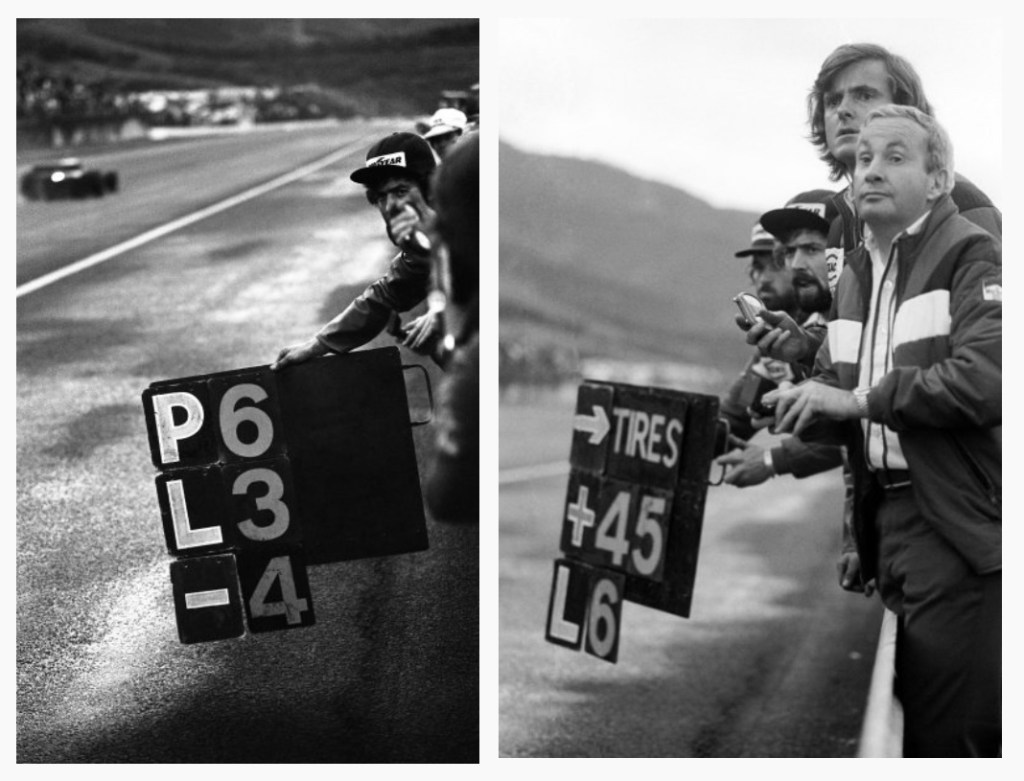
McLaren pit – sixth with 3 laps to run and 4 seconds adrift of Depailler, James’ task is clear. Teddy and Alastair Caldwell at right with 6 to run, 45 seconds in hand and tyre stop pending (MotorSport)Hunt’s critical tyre change on lap 68 of 73 laps – you can see how shot the discarded left-front is (unattributed)Patrick Depailler’s Tyrrell P34 Ford when running second (MotorSport)
James still needed points, he had to finish no lower than third in immensely difficult conditions, no pressure…
He continued to lead, by lap 10 his margin was greater than eight seconds. For a while local boy, Kazuyoshi Hoshino’s privately run Tyrrell 007 Ford was running third, from grid slot 21! He failed to finish after one of his Bridgestones (yes Martha) failed.
More worrying for Hunt was the second place contest between Andretti and Vittorio Brambilla, March 761 Ford. Vit was pretty-pacey in the wet – remember his ’75 Austrian GP win – soon passed Mario and on lap 20 challenged for the lead but spun. Anticipating/seeing the move, James gave him room then cut-back inside the hapless Italian.
Hunt then seemed set for the win, his team mate Jochen Mass was second with Andretti slipping back, but Hunt lost ground as the track began to dry.
He took no notice of pit signals to cool his soft-wets by seeking out the still watery sections of the track, as Mass was. Andretti picked this up, cooled his tyres and never pitted, while Mass closed on his team leader, then spun on lap 36.
By mid-race Merzario, Watson and Brambilla had succumbed to mechanical dramas, Stuck to drowned electrics, Hoshino with tyre troubles, while Mass’ car was damaged after his spin.
Trance like, Hunt continually stuck to his dry line, his choices then were to pit for new tyres or tough it out and hope others wouldn’t run him down.
His choice was settled on lap 68 when both left-hand tyres deflated due to excessive wear. He scraped into the pits and endured a long pitstop – the well-drilled pit-stoppers were nearly a decade away – then emerged in fifth place with four laps to run and needing third to win the title.
For two laps he didn’t progress, then with two to go he passed Alan Jones’ Surtees TS19 Ford on the exit of turn one, only Regga was in the way now.
The tough, swarthy, experienced Swiss normally would have been a big, probably insurmountable problem, but he’d already been sacked by Ferrari for 1977, so when Hunt’s intent was clear, Regga all but waved him past. Faaark Ferrari team orders/expectations he not unreasonably thought.
Hunt endured a nail-biting two final laps, but with third place points he snitched the title from Lauda
It wasn’t all bad for Ferrari though, they won the Constructor’s Championship, meanwhile Mario Andretti, somewhat forgotten a bit in all of this melodrama, won the race in a portent of what Lotus had to come, with Depailler a very well deserved second.
Even Liberty Media couldn’t have written a script like this. And yes, I know Ron Howard, or rather Peter Morgan did.
What a year and race it was…
At the end of the race James remonstrates with Teddy Mayer thinking he had fallen short, he had not! (MotorSport)
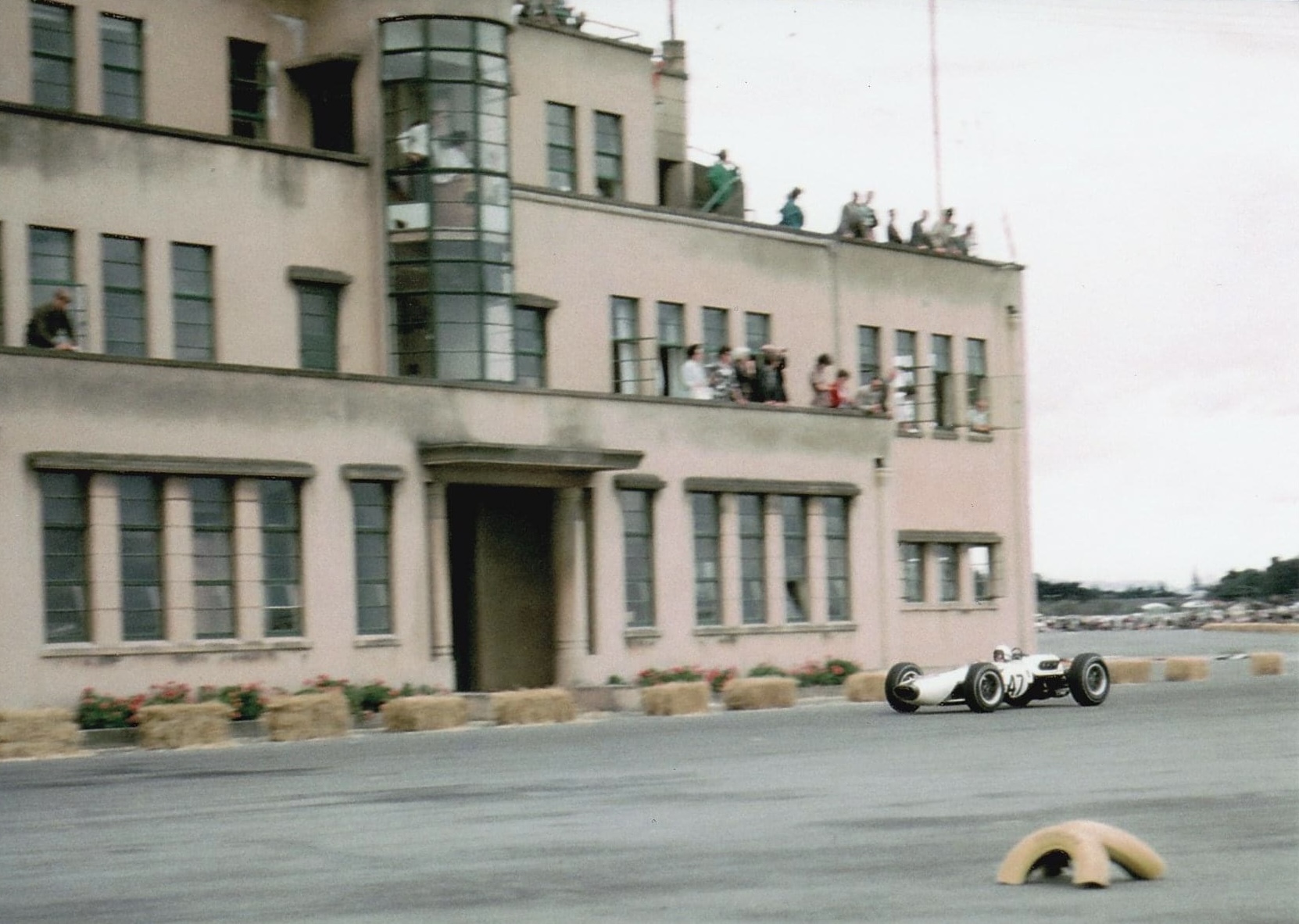
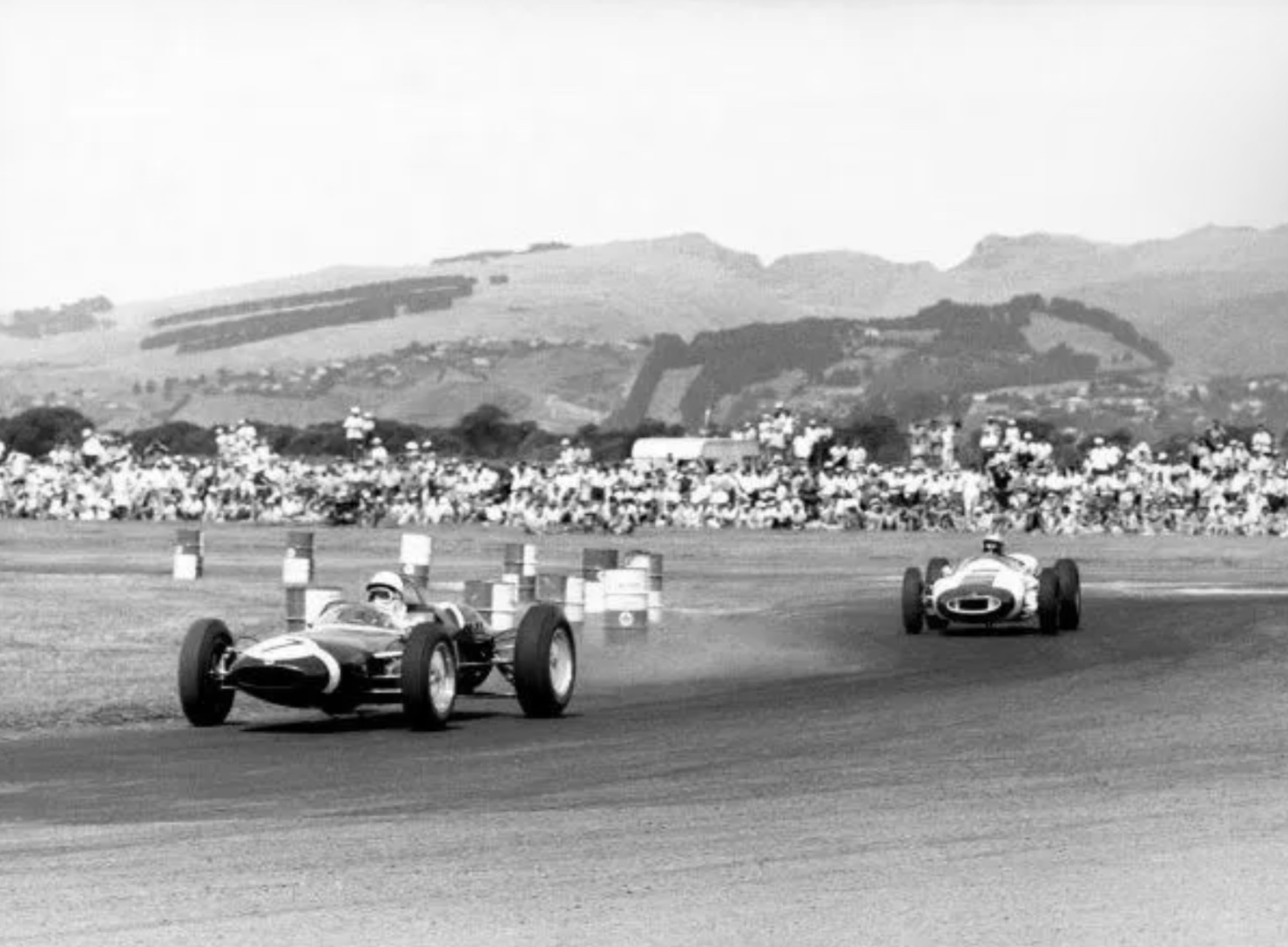
Bruce McLaren blasts past the Royal New Zealand Airforce control tower building during the 1965 Lady Wigram Trophy.
The reigning Tasman Cup champion finished second in his Cooper T79 Climax to Jim Clark’s Lotus 32B Climax with Jim Palmer’s Brabham BT7A Climax third. Clark won the title that summer with wins in four of the seven rounds.
Wigram Aerodrome was located in the Christchurch suburb of Sockburn, now named Wigram/Wigram Skies. It operated as an airfield from 1916, and as an RNZAF training base from 1923 to 1995.
Sir Henry Francis Wigram was a successful Christchurch businessman, politician and promoter of the fledgling aviation industry. He gifted land for the airfield to the Canterbury (NZ) Aviation Company (Sockburn Airport), later the land was re-gifted to the RNZAF.
The Lady Wigram Trophy was named in his wife’s honour.
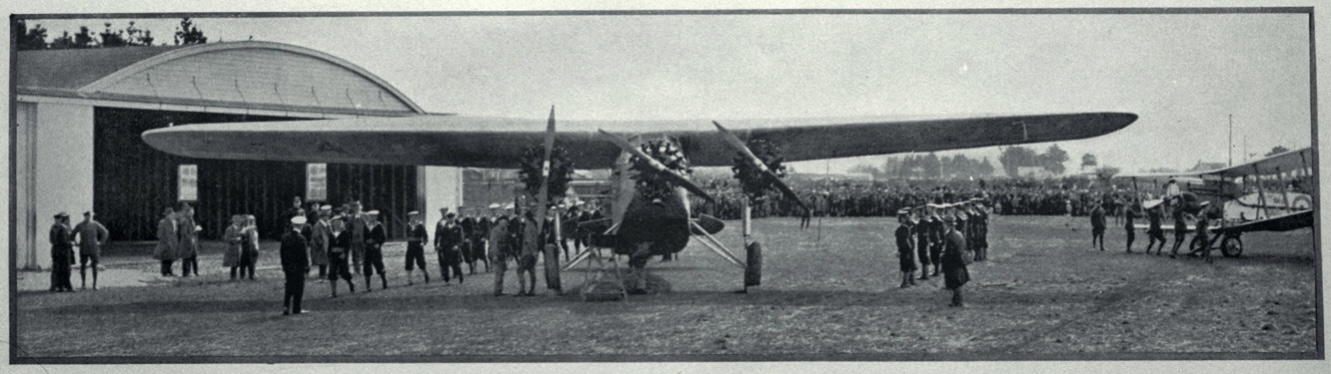
Charles Kingsford Smith’s Fokker F.VII Trimotor Southern Cross at Wigram having made the first Tasman flight from Sydney to Christchurch on September 10, 1928 (discoverywall.nz)
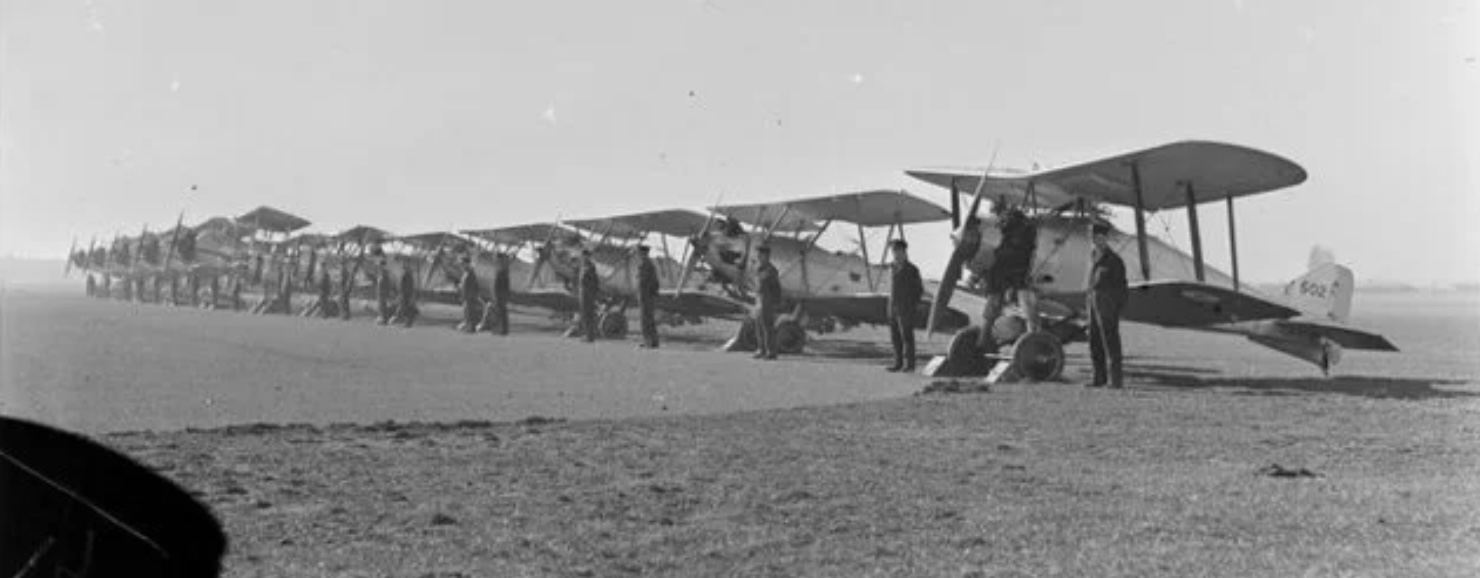
Wigram August 1937. The first aircraft is a Gloster Grebe, others include De Havilland Tiger Moths, with Vickers Vildebeests at the end. Happy to take your input/corrections (natlib.govt.nz)
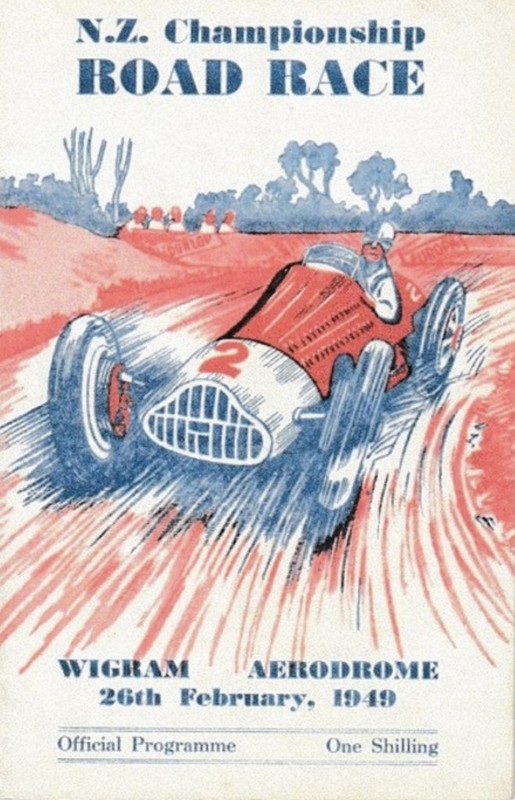
The first motor racing event took place at Wigram in 1949 when the Canterbury Car Club organised the NZ Championship Road Race meeting on February 26.
Winners of the Lady Wigram Trophy subsequently included many internationals such as Peter Whitehead, Archie Scott Brown, Ron Flockhart, Jack Brabham, Bruce McLaren, Stirling Moss, Jim Clark, Jackie Stewart and Jochen Rindt. Other F1 drivers who won around the hangars include Graham McRae, Larry Perkins and Roberto Moreno.
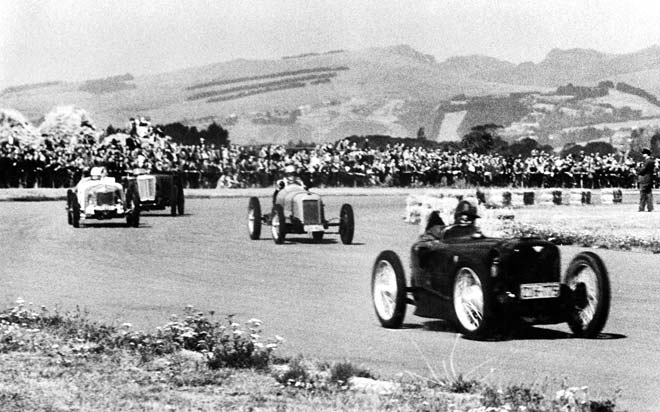
The 1949 feature, the NZ Championship Road Race was won by Morrie Proctor’s Riley 9 at the far left of this photograph.
The legendary Ron Roycroft leads in his ex-works/Sir Herbert Austin, Austin 7 Rubber-Duck s/c from Hec Green in a Wolseley Special with Bob Christie aboard an MG TA Spl at the tail of this group.
(teara.govt.nz)
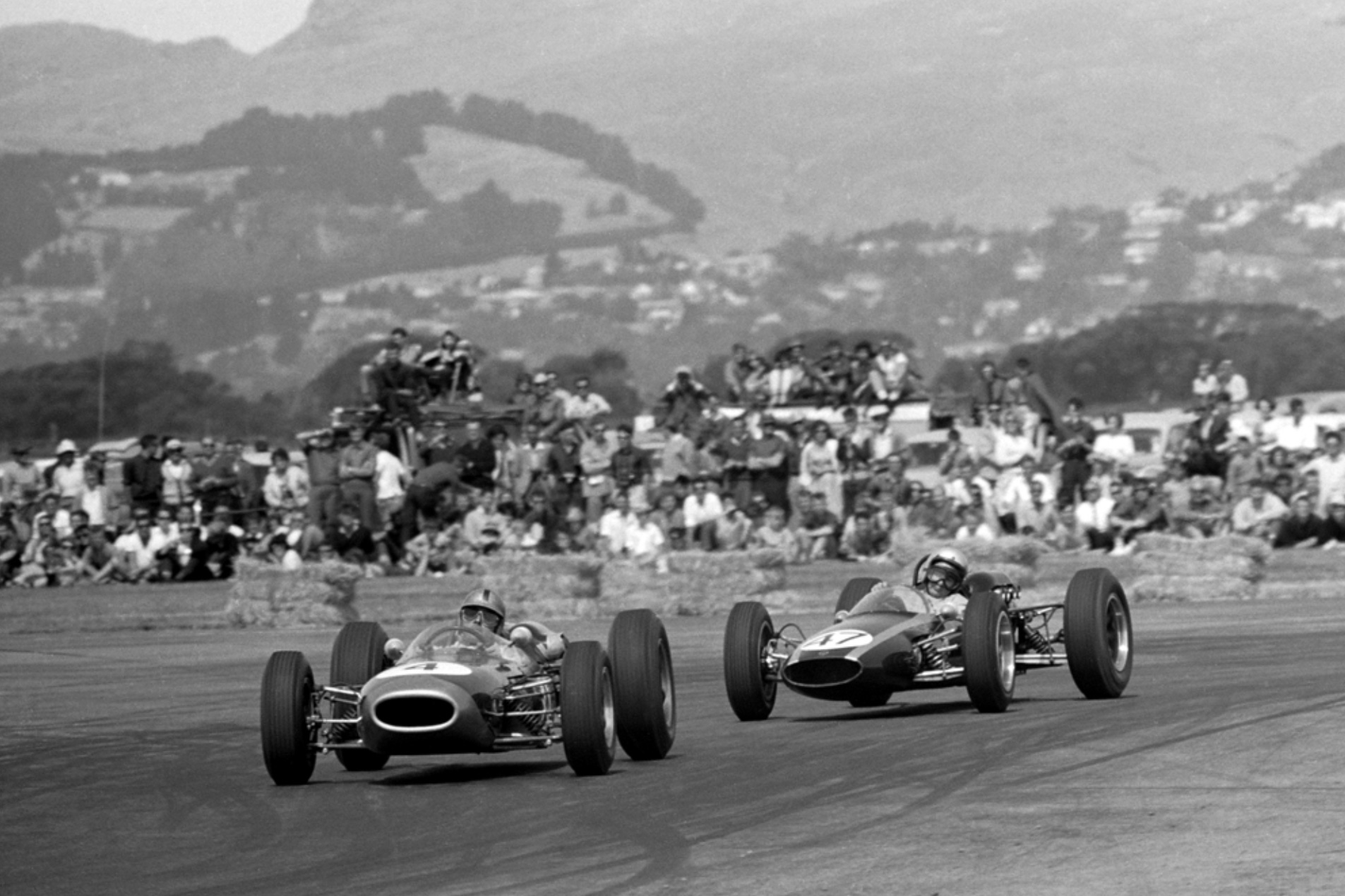
Jack Brabham leads Bruce McLaren, Brabham BT7A Climax and Cooper T70 Climax, at Wigram with the Port Hills forming a lovely backdrop in 1964.
Bruce won the 44 lap race from Jack with Denny Hulme’s works Brabham BT4 Climax third.
McLaren won the inaugural Tasman Series. His three wins in New Zealand matched Brabham’s in Australia, but Bruce’s 39 points haul trumped Jack’s 33.
Brabham was the dominant marque that summer, Graham Hill and Denny took a race win apiece aboard their BT4s giving Motor Racing Developments a total of five wins in the eight rounds.
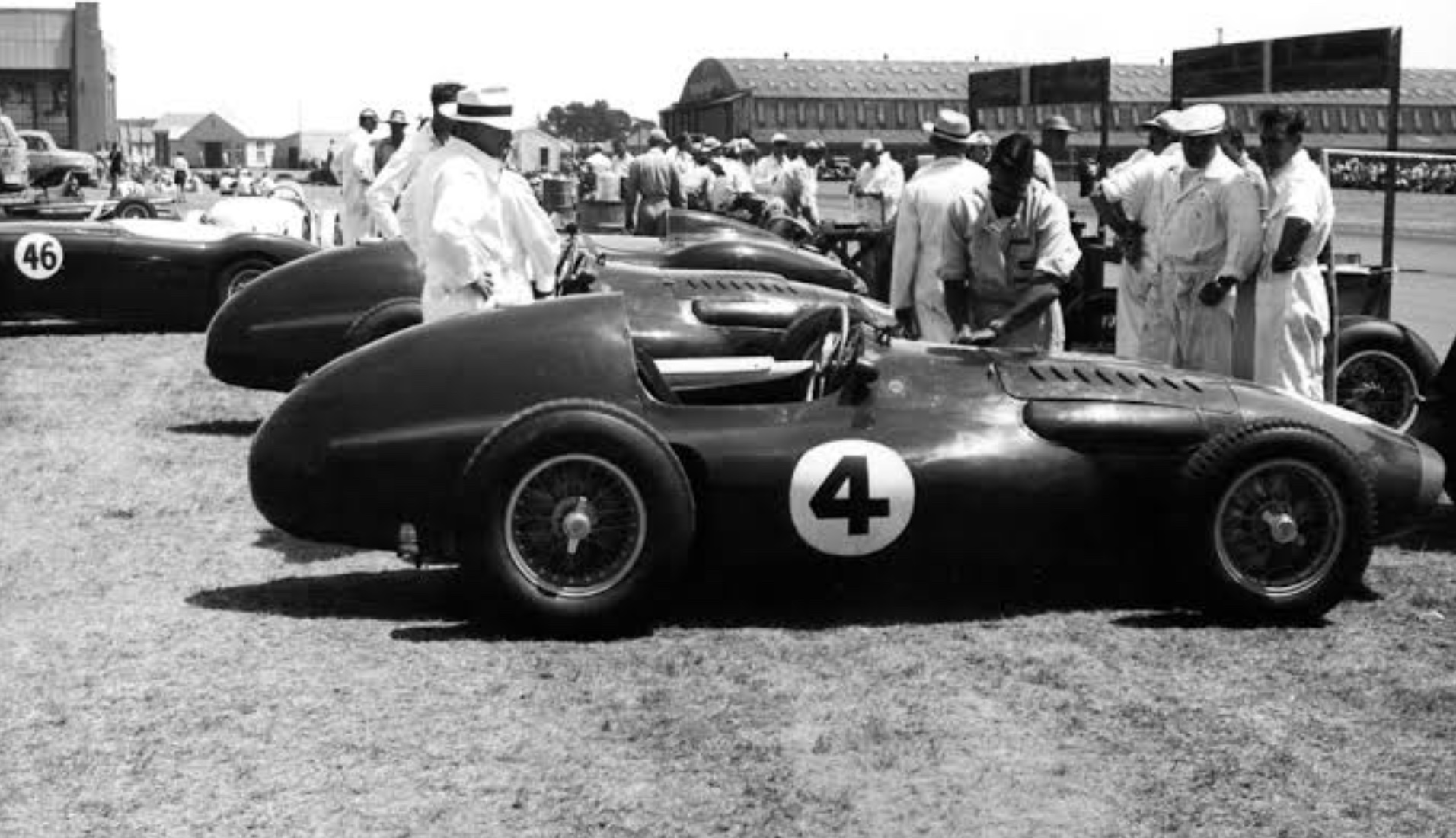
Reg Parnell’s 3.5-litre Ferrari 555 Super Squalo alongside teammate Peter Whitehead’s similar car in the Wigram paddock – note the hangars – in 1957.
Whitehead took the win from Parnell with Horace Gould’s Maserati 250F third. See here for more these cars; Squalo Squadron… | primotipo…
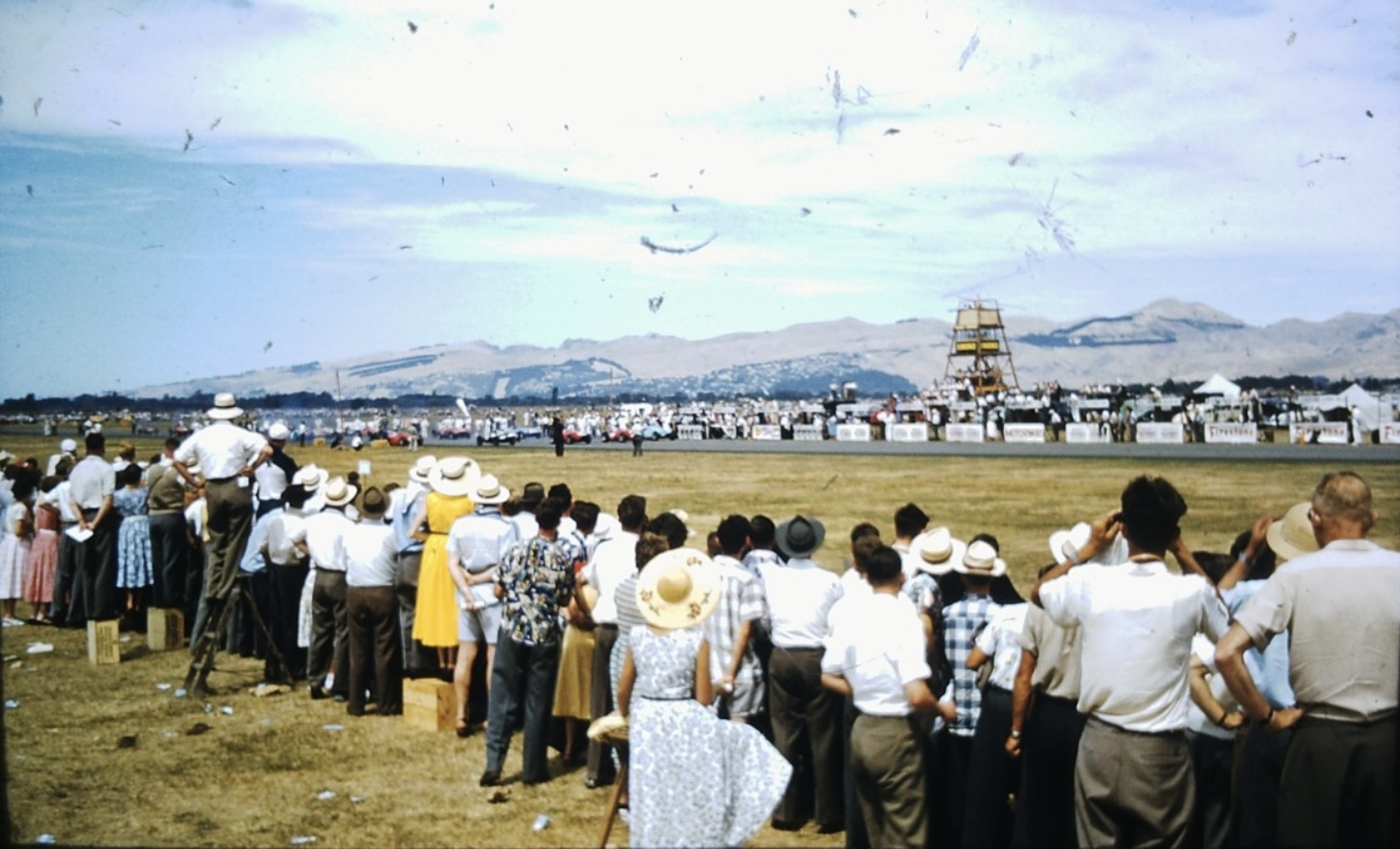
1957 starting grid panorama (I Tweedy)
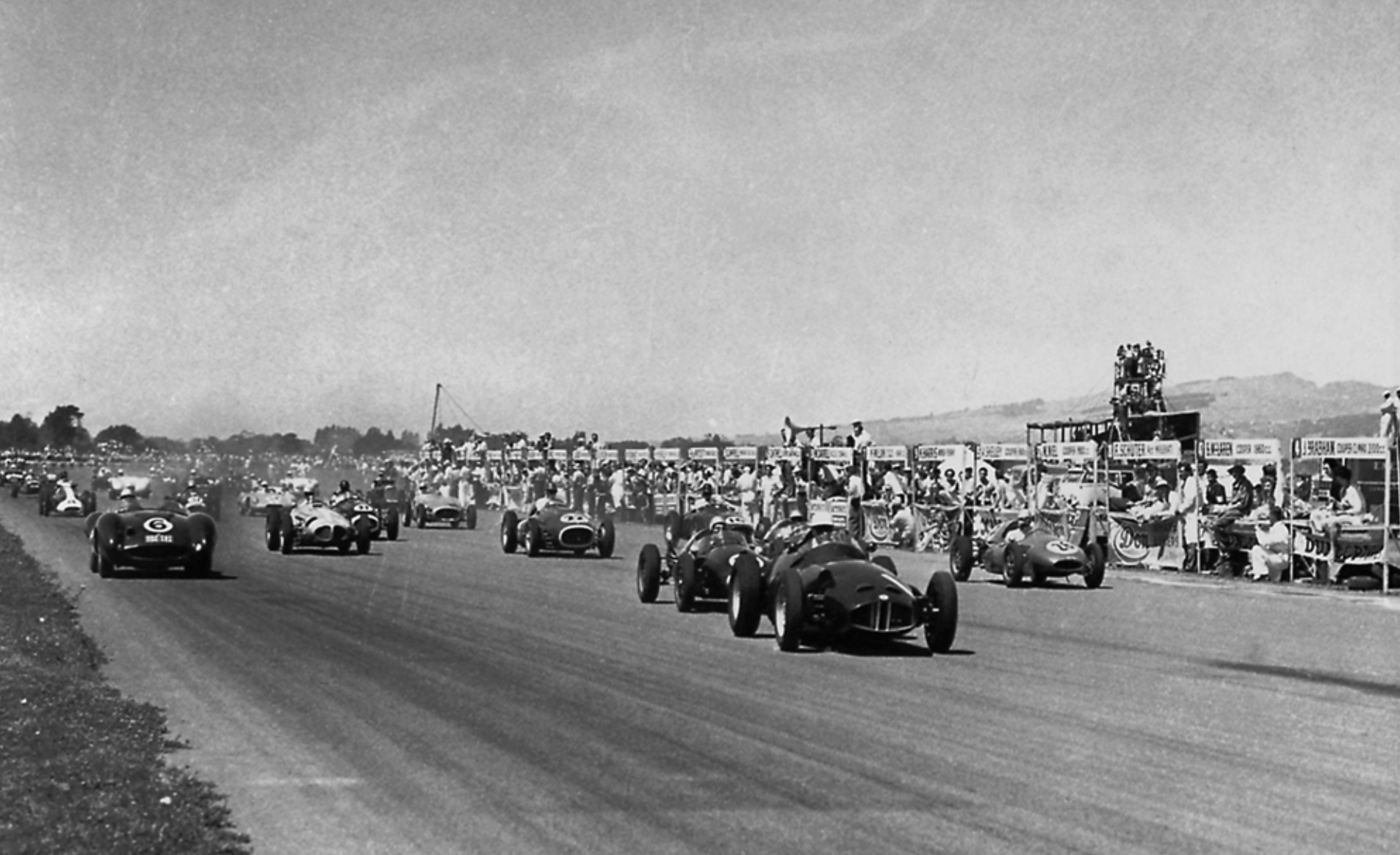
BRM’s Ron Flockhart won the 1959 race from pole in a convincing display, he gets the jump in the P25 here with the obscured Coopers of Brabham and McLaren immediately behind, and Syd Jensen’s at right.
Frank Cantwell’s Tojeiro Jaguar is on the left, then Ross Jensen’s light coloured sharknose Maserati 250F, then Tom Clark’s Ferrari 555 Super Squalo #22.
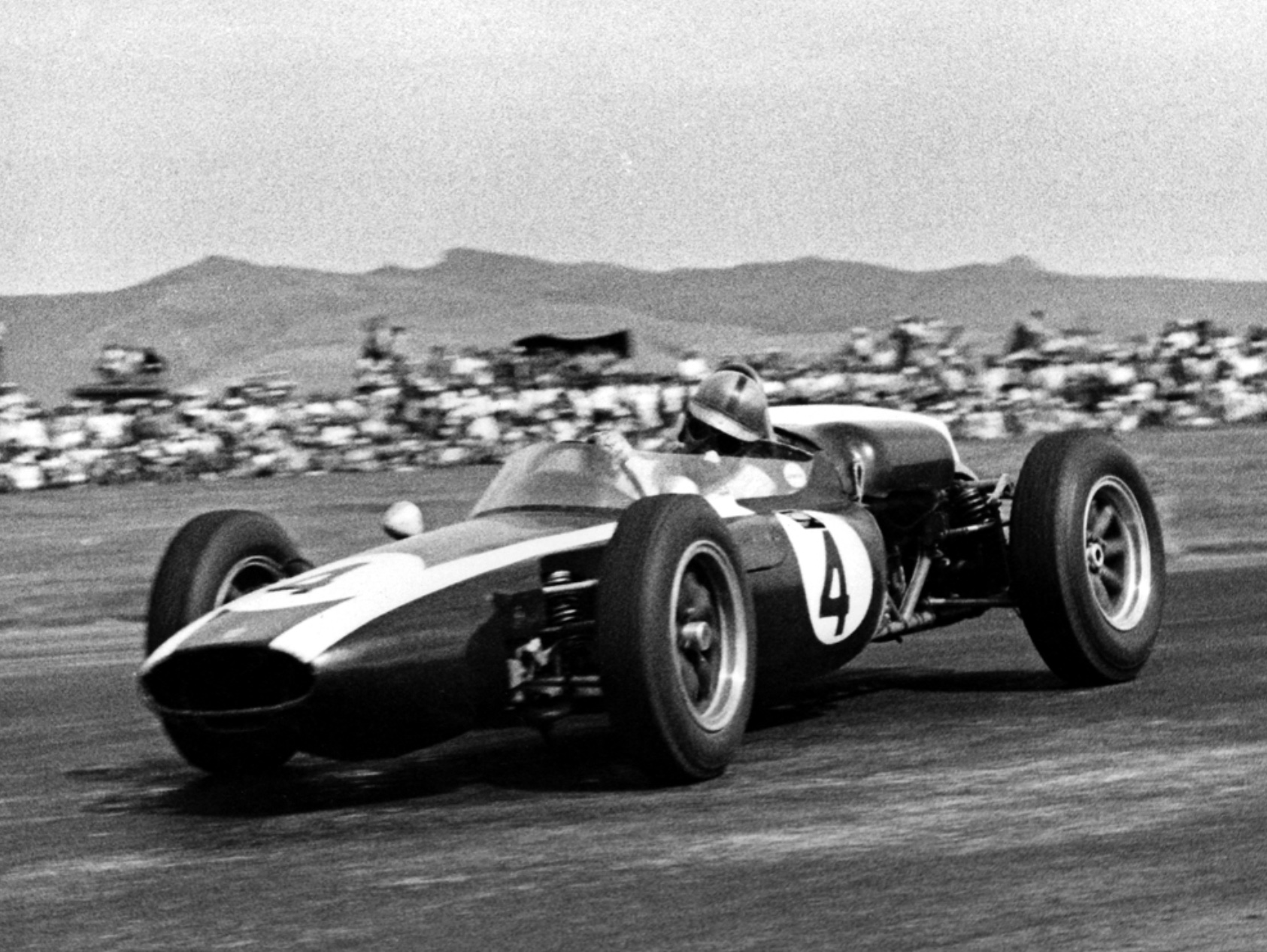
Jack Brabham crouched in the cockpit of his Cooper T55 in typical style during the 1962 running of the Wigram classic.
Stirling Moss won again in his final New Zealand victory, aboard a Rob Walker Lotus 21 Climax (below) from Brabham, with John Surtees third in a Cooper T53 Climax. Jack and John used 2.7-litre Indy FPFs, while Moss’ was a 2.5.
Moss motors away in Rob Walkers’ Lotus 21 Climax #935, who is aboard the chasing Cooper T53? (MotorSport)
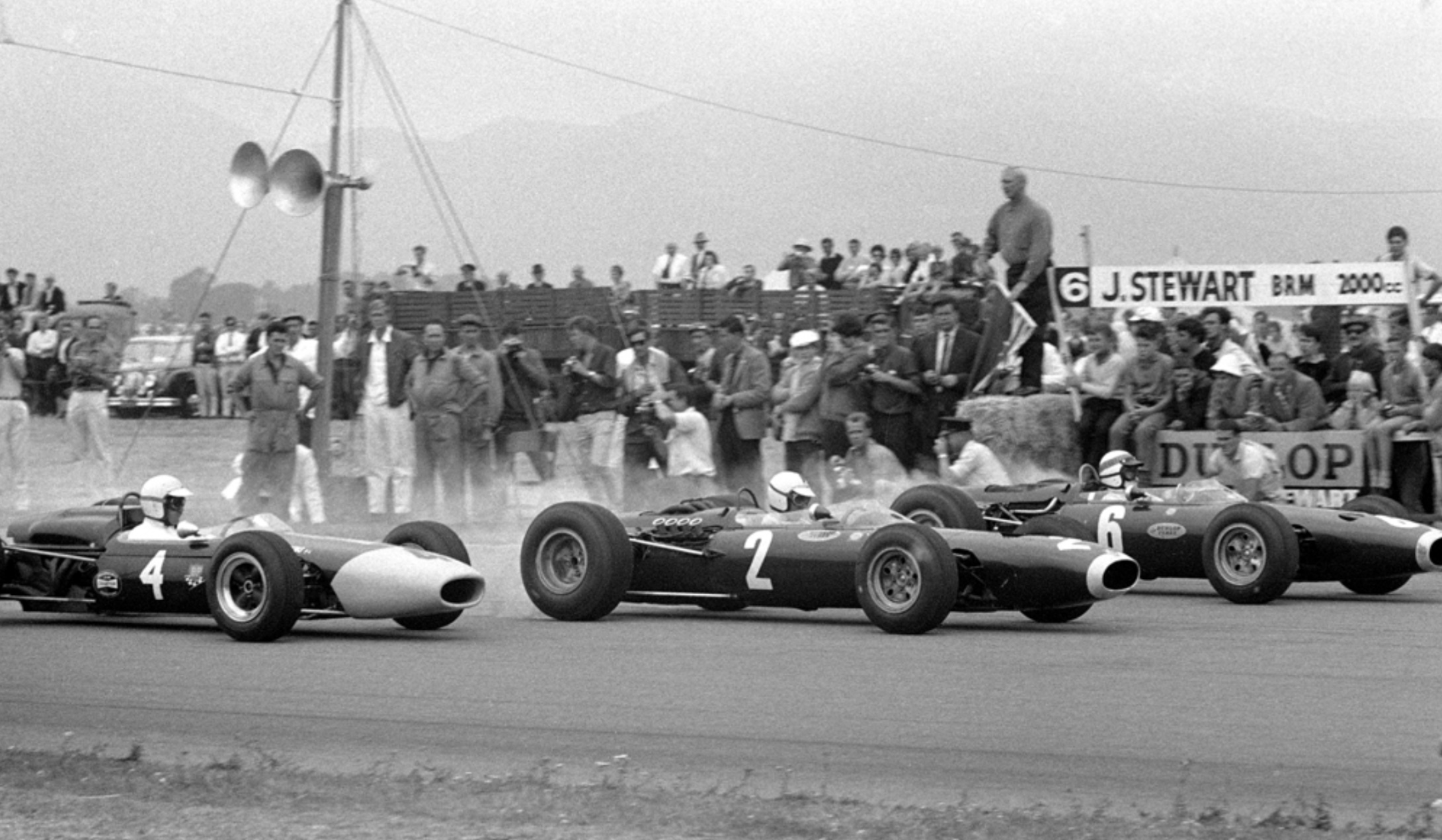
We have lift-off in 1967.
Frank Gardner’s four cylinder Coventry Climax FPF was going to struggle against the 2.1-litre BRM V8s of Dickie Attwood and Jackie Stewart on the right.
Frank finished a good fourth in a series of great speed and reliability, but up front at Wigram were three different V8s; Jim Clark’s 2-litre Lotus 33 Climax, Attwood’s BRM P261 and Denny Hulme’s 2.5-litre Brabham BT22 Repco.
Clark won the series with three wins from six championship rounds. Stewart won two and Jack Brabham, Brabham BT23A Repco one. The BRMs were quick, as they had been in 1966 – Stewart won the Tasman that year – but the transmissions wouldn’t take the additional punch of the V8s, which that year were bored out to 2.1-litres, rather than the 1.9-litre variant of the original 1.5-litre F1 V8 which did the trick the year before.
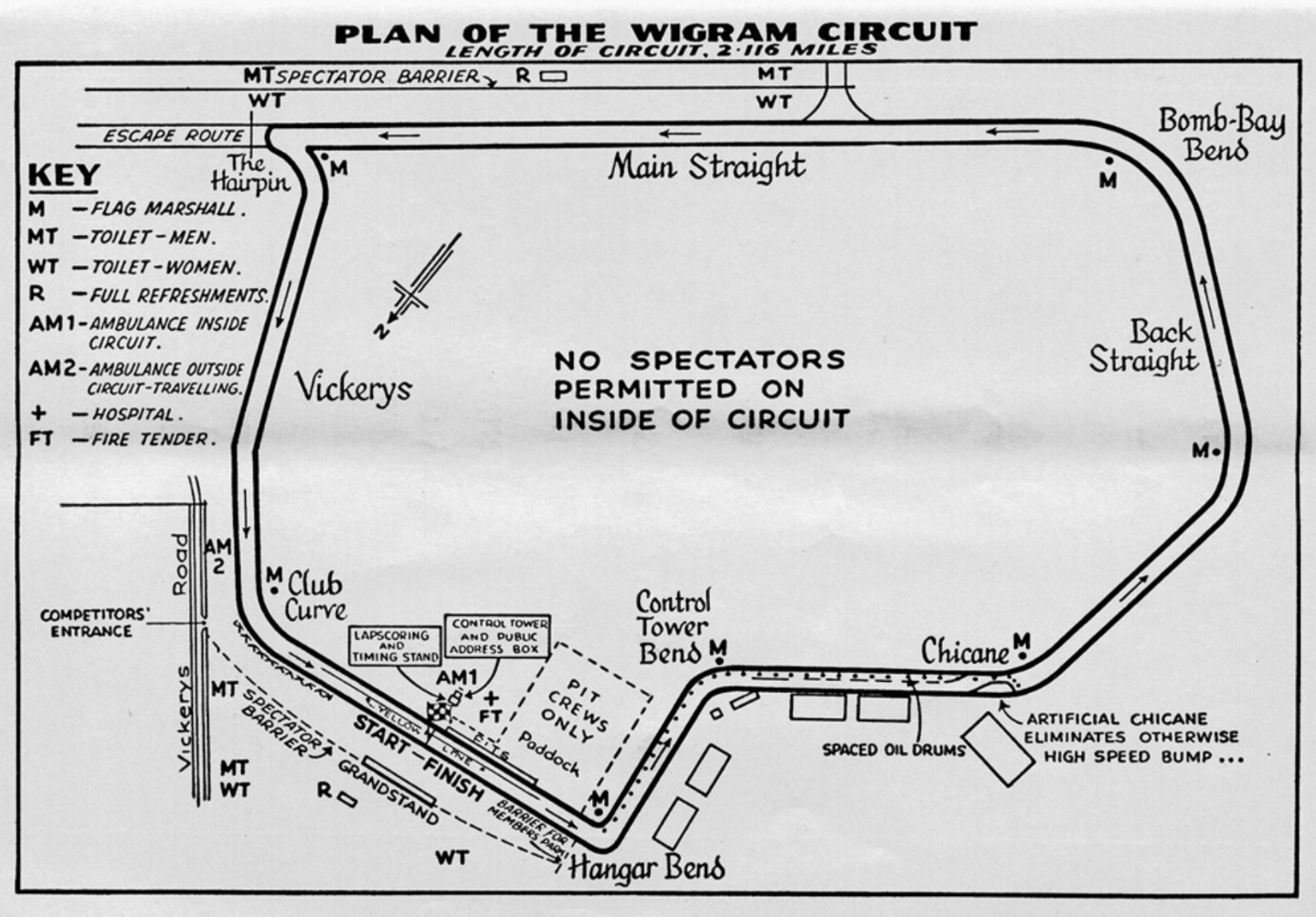
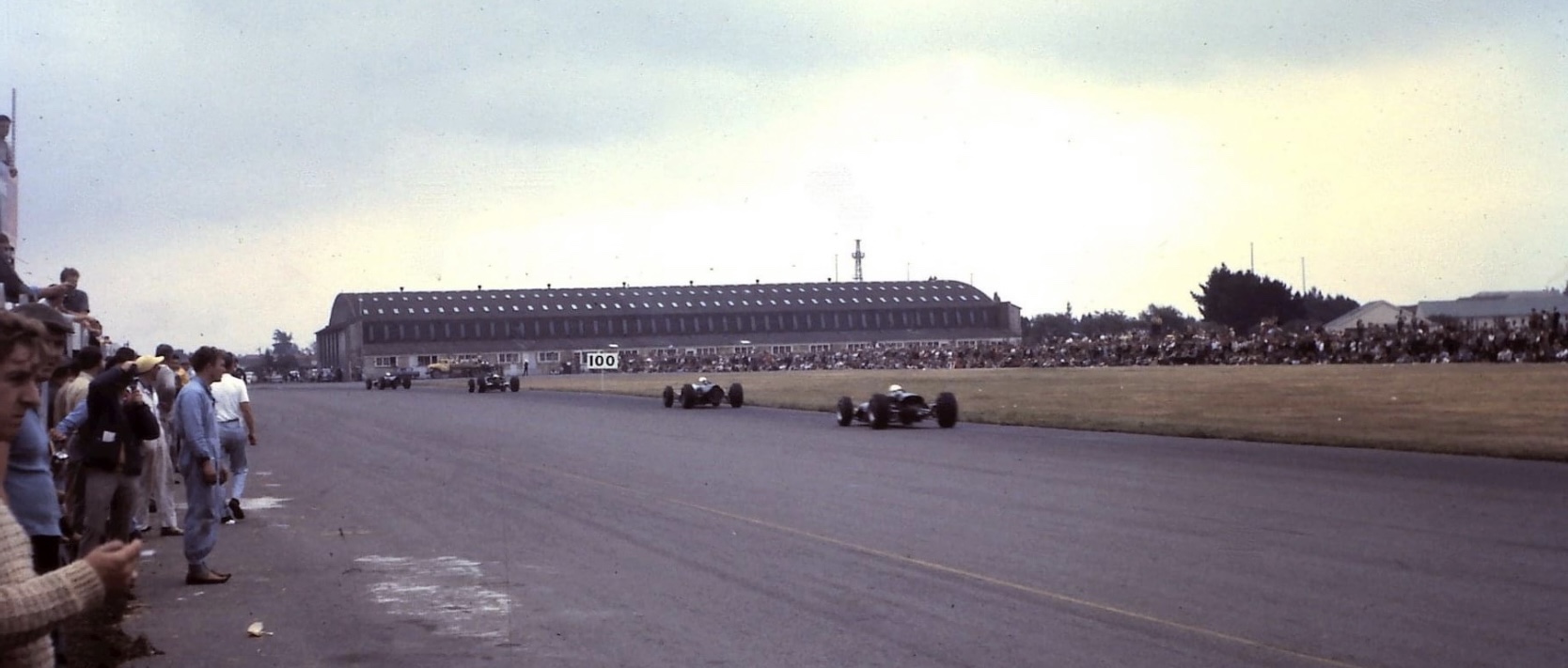
The cars are on the start-finish straight and lining up for Hangar Bend. Look closely, there are two BRM P261s in the mix so it’s probably 1966 or 1967, not 1968 I don’t think.
Christchurch enthusiast Geoff Walls remembers this era well, “It was the most fabulous fast circuit as those airfield situations can be, particularly rounding Bombay Bend onto the main straight/ runway at 100mph before really opening up for the length of the straight.”
“The Lady Wigram Trophy weekend was always in the Summer school holidays so on the Thursday, practice day, and again on Friday, some mates and I used to bike to the airfield, hide our bikes in the dry grass covered ditch parallel with the main runway, crawl through the wire fence and then sprint across the track at the right time and into the middle of the circuit where all the cars and drivers were for the day, great stuff!”
“In later years the Country Gentlemen’s Historic Racing and Sports Car Club used to hold a race weekend there with 250 entries and I was Clerk of the Course, also great occasions on the circuit. That was a great social occasion too and I do have photographic evidence!!”
(G Danvers)
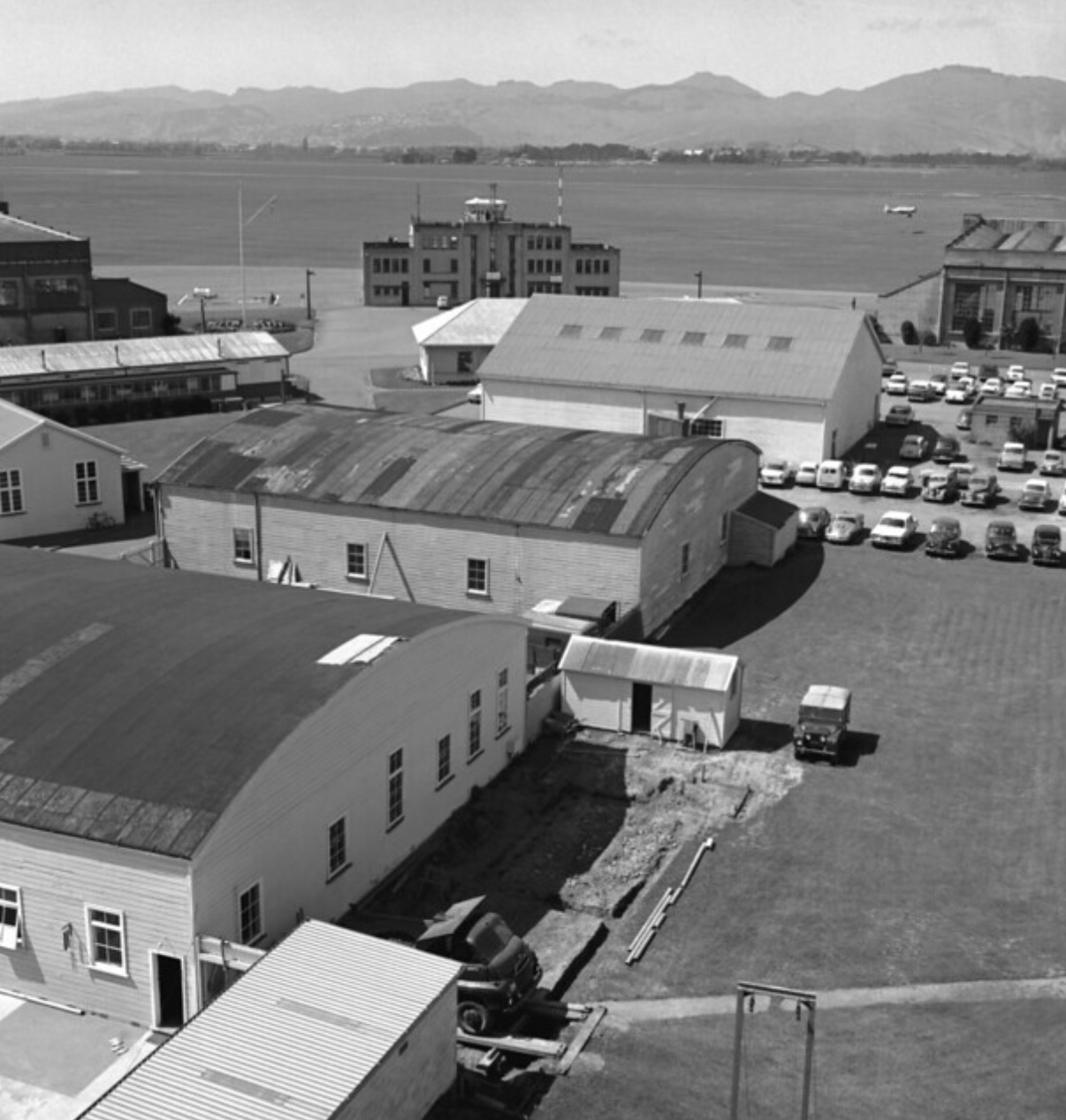
This photograph was taken in October 1968 from the top of the water tower, looking east towards the control tower. Don’t the hangars in the foreground make the control tower building which looms large over Bruce McLaren in our opening shot seem small!
(T Marshall)
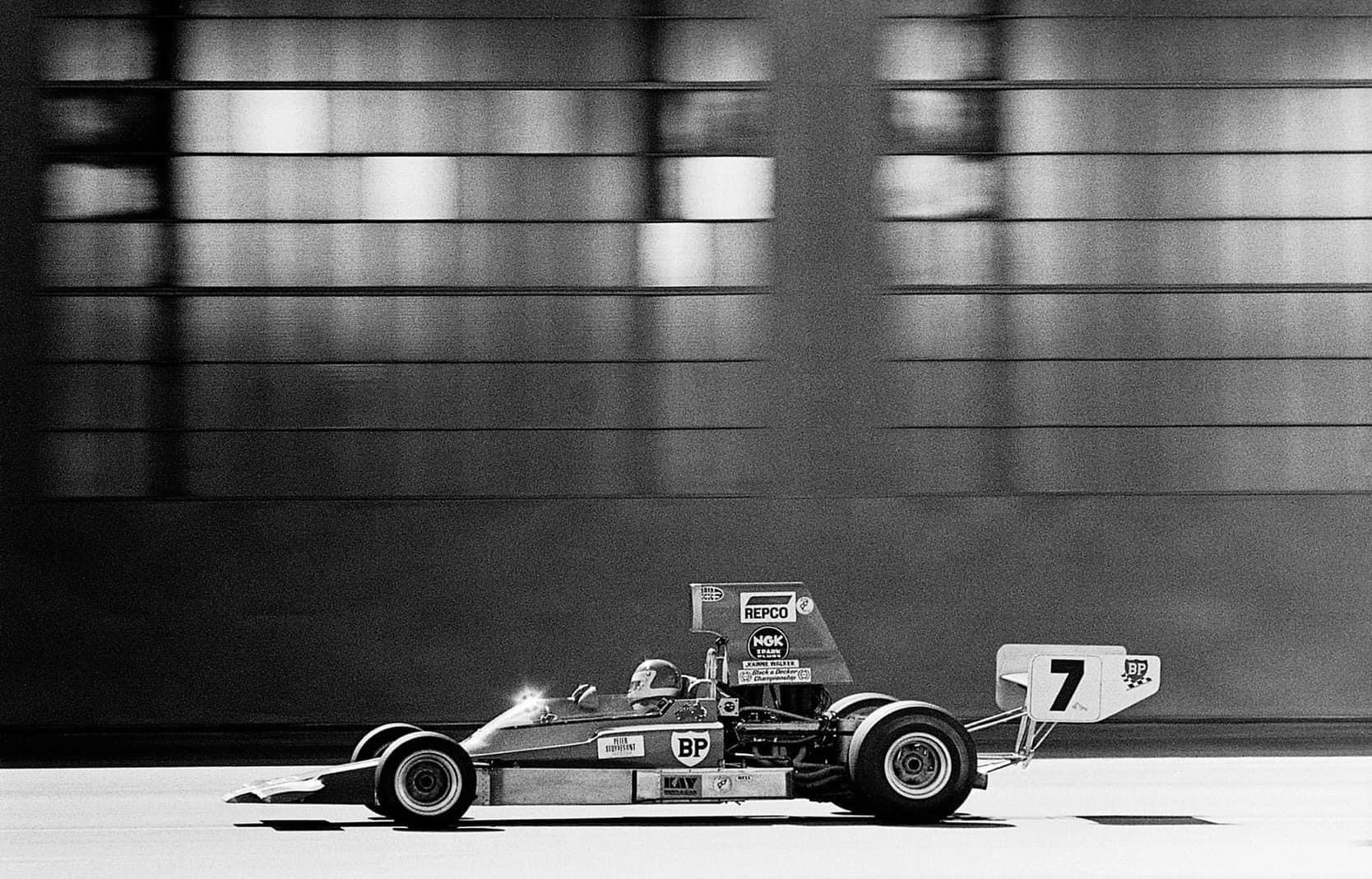
Adelaide Ace John Walker – later 1979 Australia GP and Gold Star winner – with Repco-Holden F5000 V8 fuel injected thunder echoing off the hangar walls.
It’s the ’74 Tasman round, the tremendously talented Terry Marshall has captured the perfect profile of JW’s unique Repco-Holden powered Lola T330 with a perfect-pan. His DG300 Hewland was hors d’combat after 20 laps. John McCormack won in another Repco-Holden powered car, Mac’s Elfin MR5 was timed at 188mph on Wigram’s long straight, the two VDS Chevron B24 Chevs of Teddy Pilette and Peter Gethin were second and third.
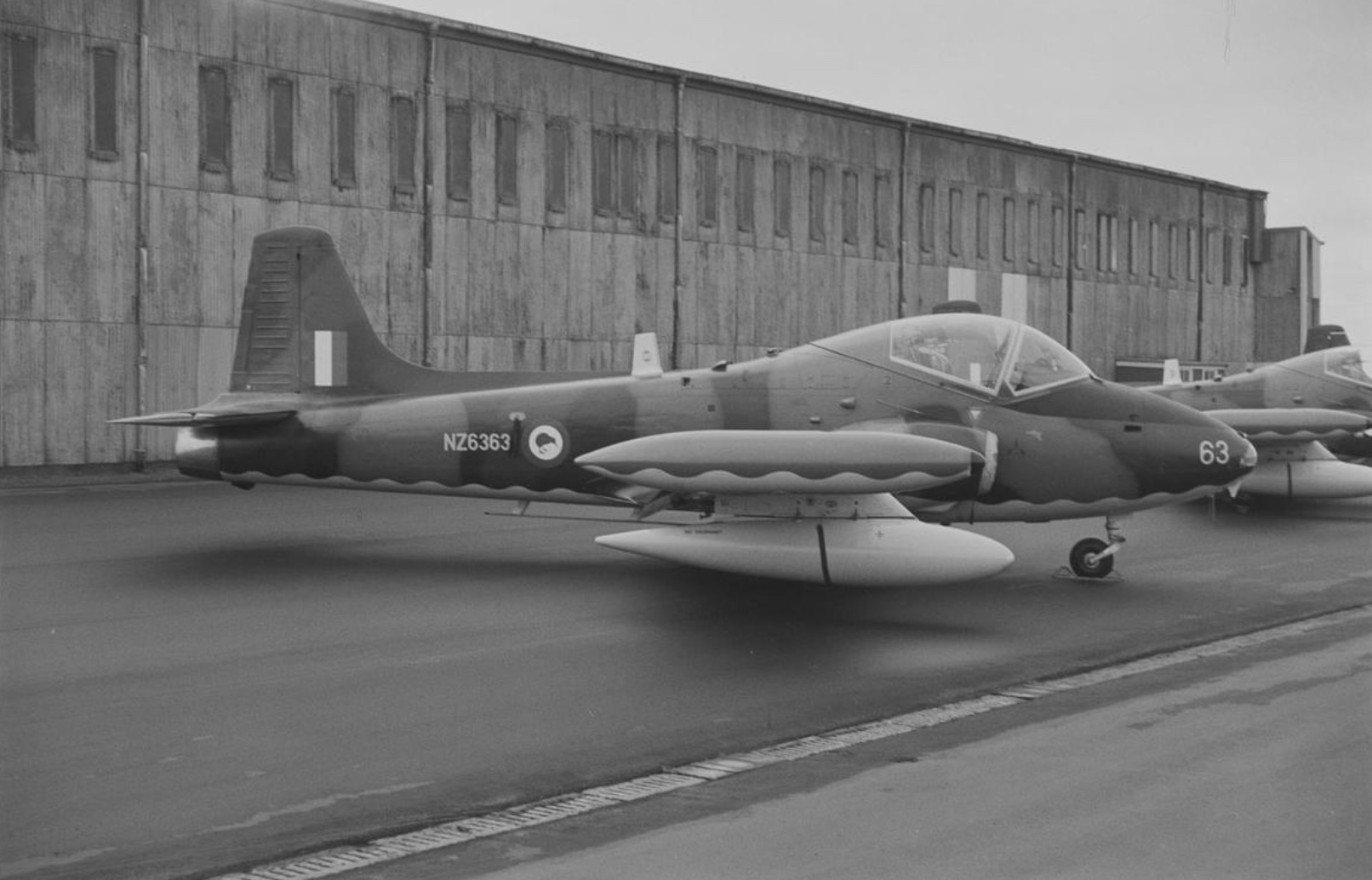
Six months earlier, closeby, this BAC 167 Strikemaster Mk88 was pictured in repose. The jet-powered trainer and light attack machine had bones dating back to the 1950 Percival Provost.
(John Page)
(T Marshall)
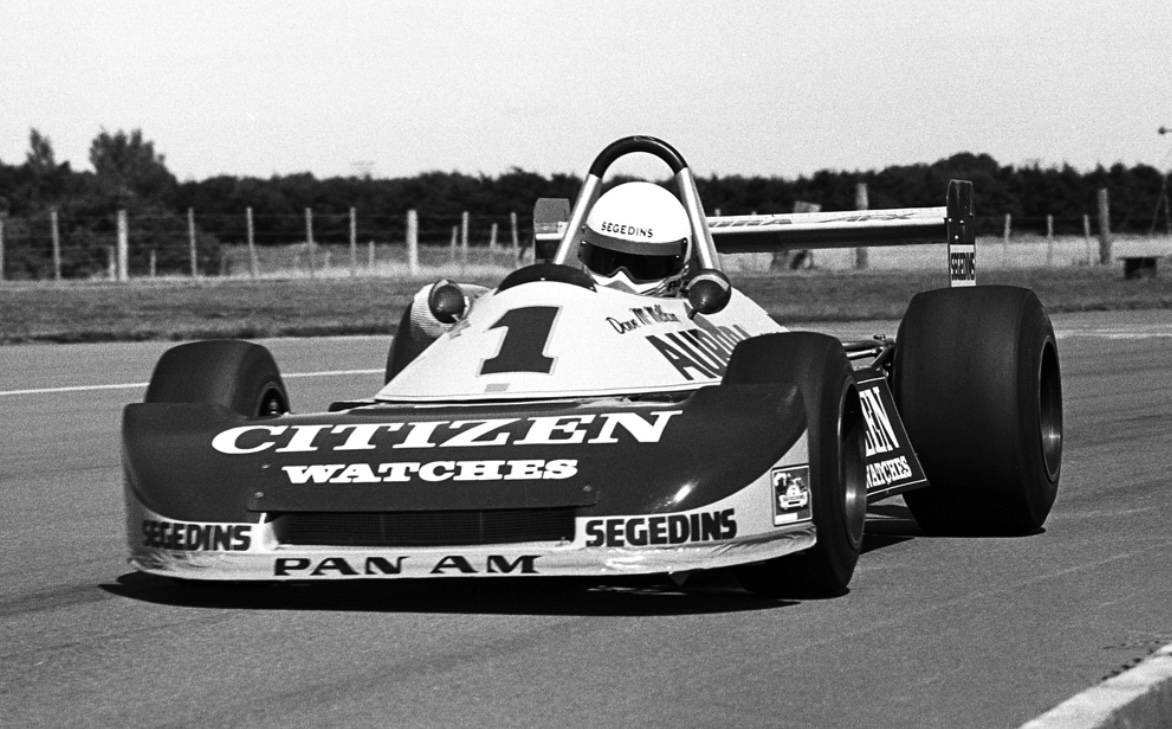
Dave McMillan won two Wigram Trophies on the trot in 1979 and 1980 aboard one of Ron Tauranac’s most successful designs, a Ralt RT1 Ford BDA Formula Atlantic/Pacific.
They were good wins against strong opposition too. He won both races in 1979, in front of Teo Fabi and Larry Perkins in one race, and Fabi and Brett Riley in the other. In 1980 he was in front of Steve Millen, second in both, and Ian Flux and David Oxton in third.
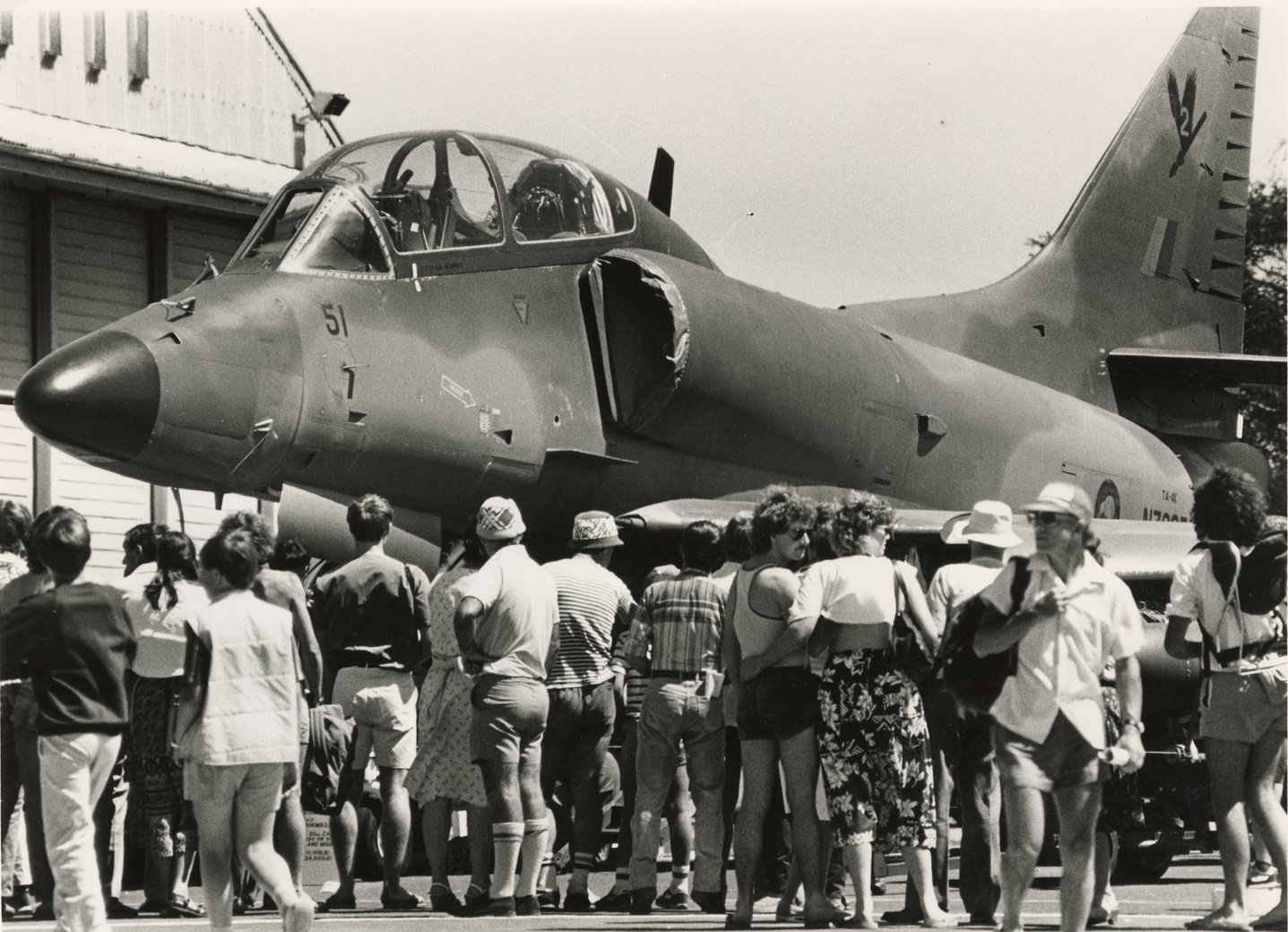
An RNZAF Douglas A-4 Skyhawk single-seat subsonic fighter on display during the Wigram Wings and Wheels Exhibition February 1986 weekend.
(canterburystories.nz)
Credits…
Classic Auto News. The talkmotorsport.co.nz website provided most of the photographs, I’d love to provide credits to the snappers concerned if any of you can oblige. Terry Marshall, John Page, canterburystories.nz, Isabel Tweedy, the Gary Danvers Collection, discoverywall.nz, teara.govt.nz
Tailpieces…
Piers Courage, Brabham BT24 Ford DFW alongside the similarly powered Lotus 49Bs of Graham Hill and Jochen Rindt at Wigram in January 1969.
Chris Amon’s Ferrari Dino 246T is behind Jochen, Frank Gardner, Mildren Alfa V8 behind him.
Perhaps the Tasman Cup high point was 1968 when the field included two works Lotus 49 Ford DFW V8s, Amon’s factory Dino V6, works BRM P261 V8 and P126 V12s, Jack Brabham’s Brabham BT23E Repco, and various other Repco V8 engined cars, Alec Mildren’s Brabham BT23D Alfa V8 and the rest.
Jochen Rindt won the 1969 LWT, it was the great Austrian’s first Team Lotus, ok, Gold Leaf Team Lotus, victory.
He won from Hill and Amon with Chris winning the Tasman that year with four wins in the seven rounds.
(G Danvers Collection)
RNZAF Wigram in 1992 complete with a Tiger Moth and 11 Airtrainers ready to boogie, the wonderful building is still with us, and as a Listed Heritage Place always will be.
The government rationalised their military properties in the 1990’s, in that process RNZAF Wigram was closed in September 1995. Wigram Aerodrome then operated until March 2009 when it was progressively redeveloped for housing. The aviation connection continues though, the Christchurch Air Force Museum is located on the northern side of the old aerodrome.
It’s not what you know that gets ya, it’s what you don’t know.
I thought I’d done a nice piece on Ferrari’s 156 variants, that is, the cars which bridged the gap between the 1961 World Championship winning 156 Sharknose and 1964 158, victorious in the hands of Phil Hill and John Surtees respectively.
Then Doug Nye posted the photograph above on an internet forum. It’s Lorenzo Bandini at the Nurburgring during the 1962 German GP weekend in a Ferrari 156/62P. The prototype was designed by Mauro Forghieri in 1962 as the young engineer explored smaller, lighter-tubed spaceframes of the type built by the British manufacturers.
He sought to bridge the performance gap which had widened even more after Jim Clark debuted the first modern monocoque Lotus 25 Climax at Zandvoort that May.
Oopsie, missed that car, hmmm, back to the drawing board I thought. Sure enough, there are a few photographs of the 156/62P, which raced only at the Nurburgring and Monza 1962 if you look closely.
(MotorSport)
Forghieri’s learnings with this model were then applied to his 1963 spaceframe 156/63, a GP winner on the Nurburgring in Surtees’ hands that year. The shot above shows Il Grande John hard at it through the Dutch dunes at Zandvoort in June 1963.
So, do check out this article, Ferrari 156/62P, 156/63 and 156 Aero… | primotipo… I’ve re-written it and doubled the number of photographs. Hopefully it’s now a decent record of the 1.5-litre V6 engined 1962-1964 Ferrari 156/62P, 156/63 and 156 Aero…
(MotorSport)
The final variant of the 156 was the 156 Aero, here Lorenzo Bandini is on the way to his – and the 156 Aero’s only championship GP victory – at Zeltweg, Austria in August 1964.
This model was created to contest the 1963 Italian GP. When the Tipo 158’s engine was running late the venerable V6 was skilfully adapted to fit the new Aero chassis. The car was still competitive in 1964 too, Bandini raced them for a while as Surtees and Forghieri got the 158 up to snuff.
Credits…
MotorSport Images
Tailpiece…
(MotorSport)
“We could have a party in here Colin! It’s so roomy and comfy.”
Jim Clark trying Bandini’s new Ferrari 156/62P for size at the Nurburgring in 1962. “Our car may be a bit snug Jimmy but it’s 48 seconds a lap quicker than that little clunker”, may well have been Chapman’s retort.
Ferrari were way off the pace in 1962 but won a nip-and-tuck world title in 1964. As much as anything else it was text book stuff about having depth in the team when the 1961-62 Winter of Ferrari Discontent resulted in eight senior employees leaving the Scuderia. In the overall scheme of things they barely missed a beat, ahem, 1962 aside…
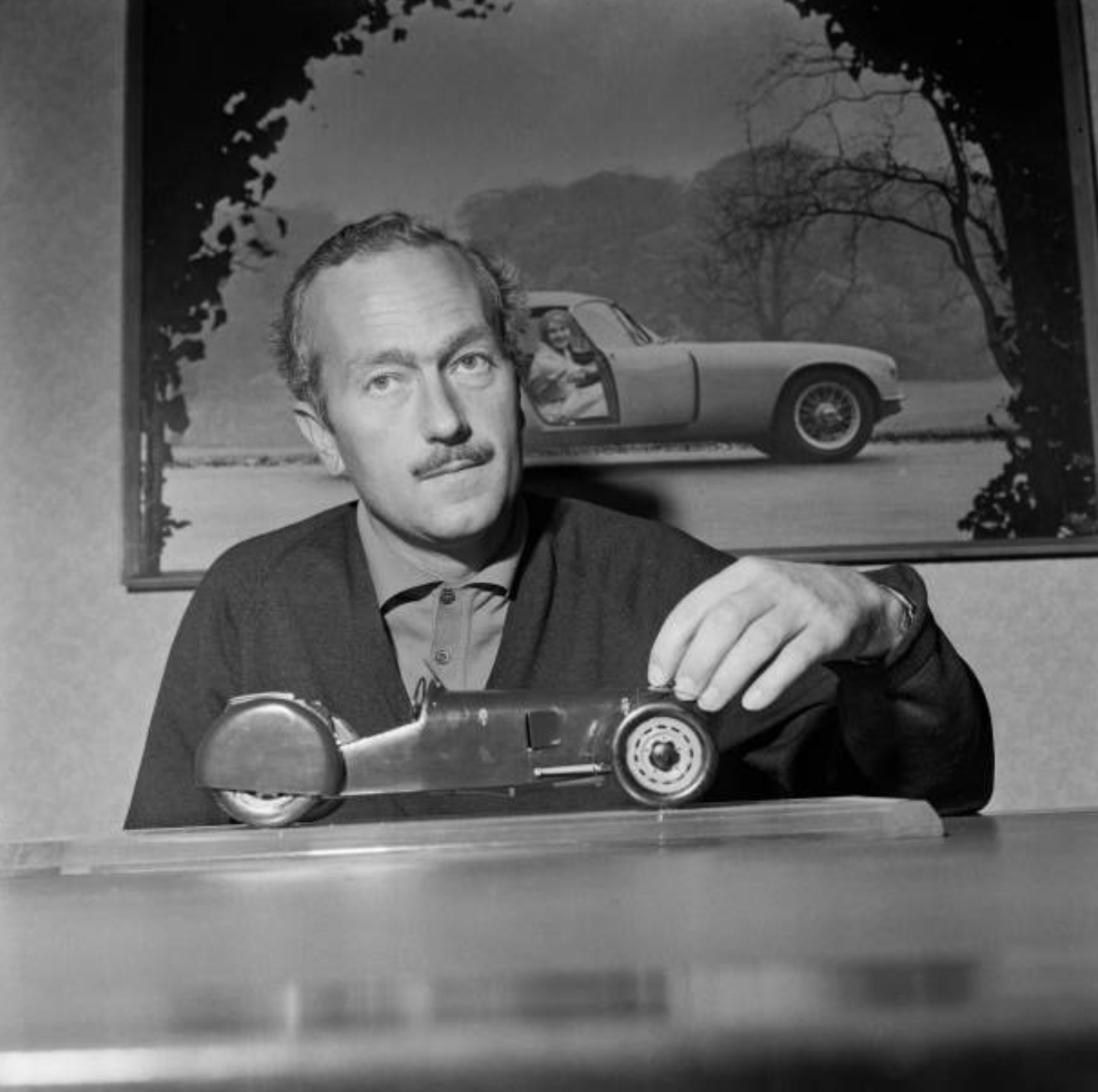
Colin Chapman in thoughtful mode posed with a model of a Lotus Mk6, the shot is dated September 14, 1963.
I wonder what the purpose of the press visit was? For sure Ronald Dumont, the photographer and perhaps an accompanying motor-noter weren’t there to discuss the Mk6 or the Elite shown in the background.
Chapman’s primary programs that year were winning Lotus’ first F1 World Championship – Chapman’s part-credit for Vanwall’s 1958 Manufacturers Championship victory duly noted – together with Jim Clark and the Lotus 25 Climax, and winning the Indy 500 with Clark, FoMoCo and Lotus 29 Ford. He ticked the first box that year, but not the second, not yet anyway.
Design drawing of what became known as the Elan, by Ron Hickman dated November 1962 (R Hickman)
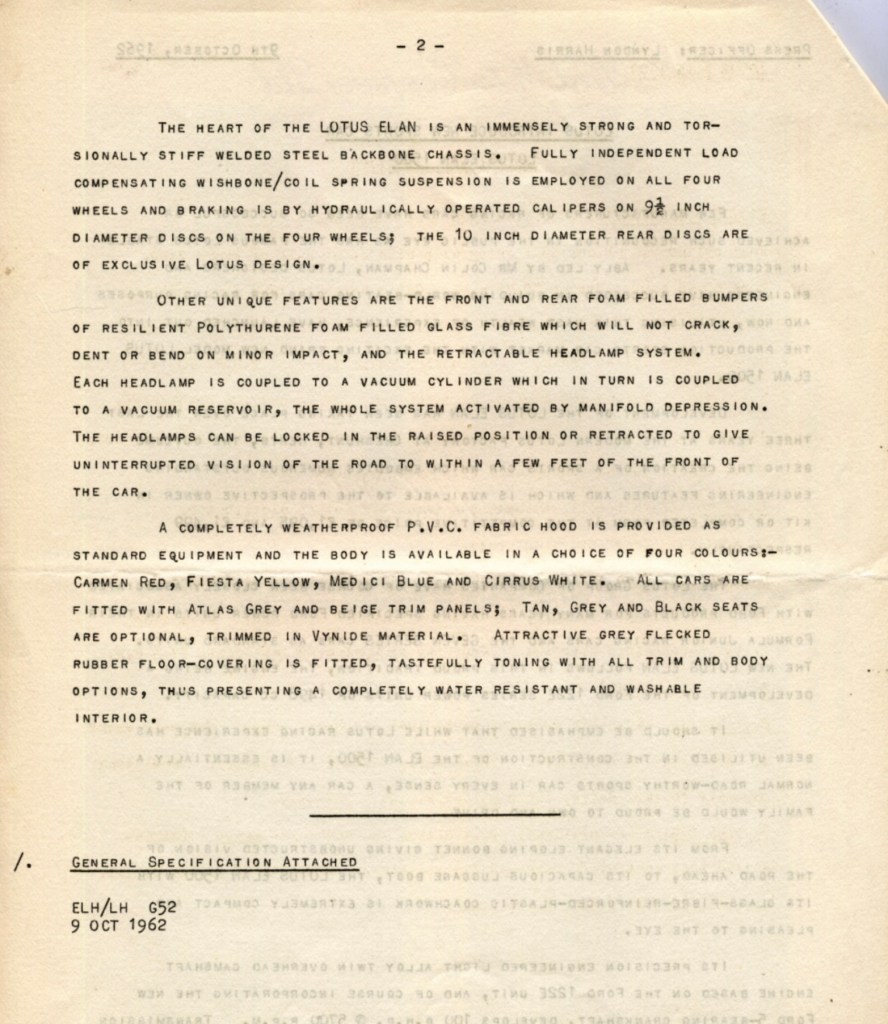
I know what the visit would have been about! The Elan was introduced in October 1962, that’s it. Ignoring the fact the car(s) in the shot are a 6 and Elite…
(unattributed but I’d love to know the artist if anyone can oblige)
It’s interesting how Ford sought to capitalise on the growing relationship with Lotus, something of a model for partnerships between a major automotive corporate and a more nimble performance specialist firm.
FoMoCo)(Lotus Cars)(Lotus Cars)Elan production line at Hethel circa 1970 (Lotus Cars)
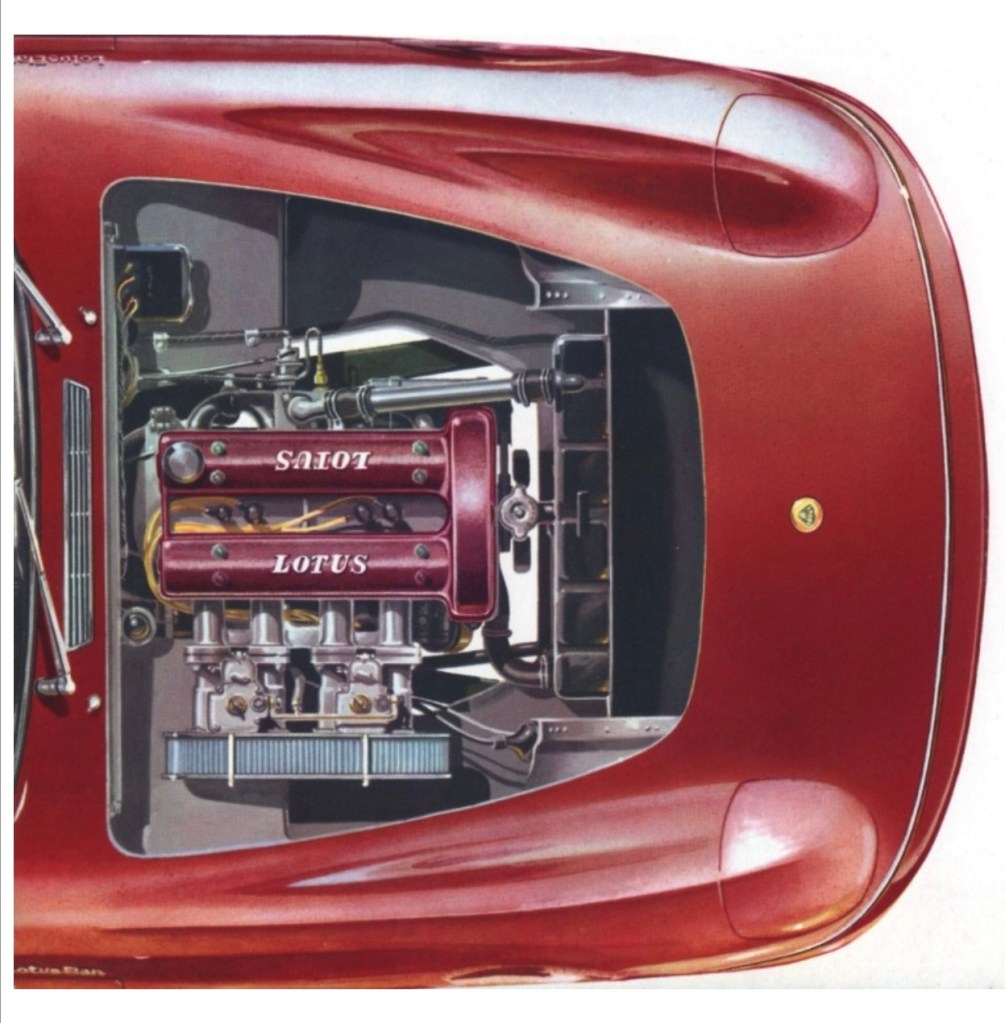
Where would motor racing have been, and historic racing now, without the giant-killing Lotus Ford twin-cam engine in all of its various guises; road, race and in the forests and hills?
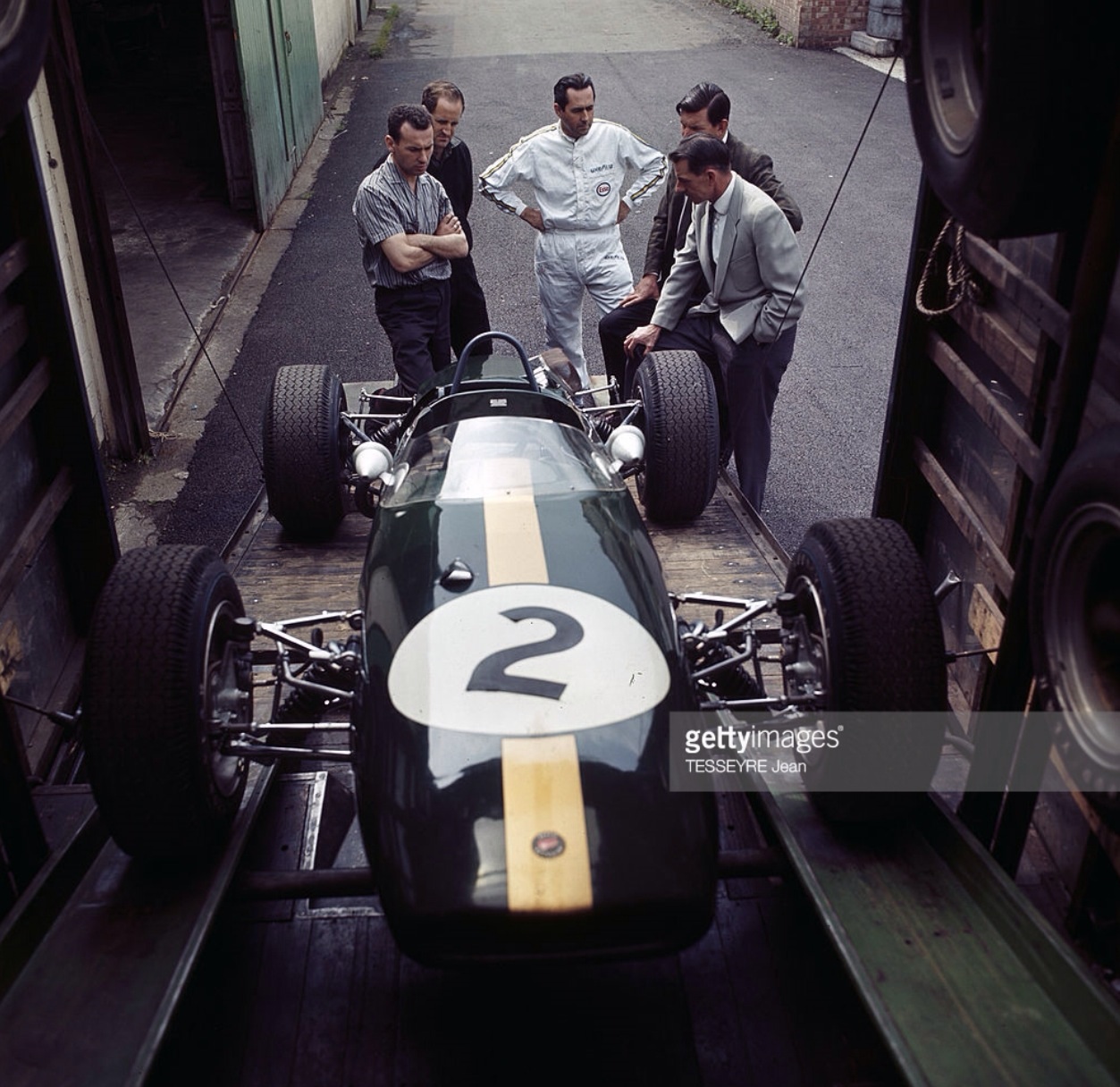
Jack Brabham with his F1 Brabham BT11 Climax, F2 BT16 Honda and one of Ron Tauranac’s bare spaceframes Jack has borrowed from Ron’s production line.
The photo isn’t dated but it’s between mid-June and mid-September 1965 – works Brabhams used number 14 at the Belgian, French, British, Dutch, and Italian Grands Prix.
In some ways it was a bit of an investment year for Brabham. It was their first year using Honda engines and Goodyear tyres, not to forget the Repco Brabham Engines V8s being developed in Melbourne. All of these initiatives paid off in spades the following year. Mind you, investment year or otherwise, Dan Gurney made the BT11 sing in F1 with a swag of top three results, albeit no wins in 1965.
Jack worked with Honda engineers to get more torque from their peaky but powerful 1-litre four cylinder engines. The team partnered with Goodyear from the January-March 1965 Tasman Cup. Lots of work on compounds and profiles helped the Brabham Racing Organisation win the 1966 F2 (Trophees de France) and F1 World championships with Honda and Repco-Brabham powered cars respectively.
The photo requires detective work as the Getty Archive caption has it as a Lotus 33 Climax V8, which it most assuredly is not! The caption reads “Motor Sport Formula 1. In July 1965, during a report on Motor Sport and Formula 1, the Lotus 33 returning to the back of a truck, men and a driver discussing outside.”
While it’s not the French Grand Prix, that year held at Clermont Ferrand in June, it could be during the British Grand Prix weekend at Silverstone during July, a meeting the photographer, noted Paris Match regular Jean Tesseyre, may have attended.
Does it look like the Silverstone paddock to any of you Brits? There was no F2 race on the program but it is possible that Brabham did some test laps during the meeting and/or had the BT16 Honda on display. Perhaps the car is being loaded up at MRD or BRO in Surrey?
I love solving these mysteries if any of you can assist, attendee identification in full would be a bonus…
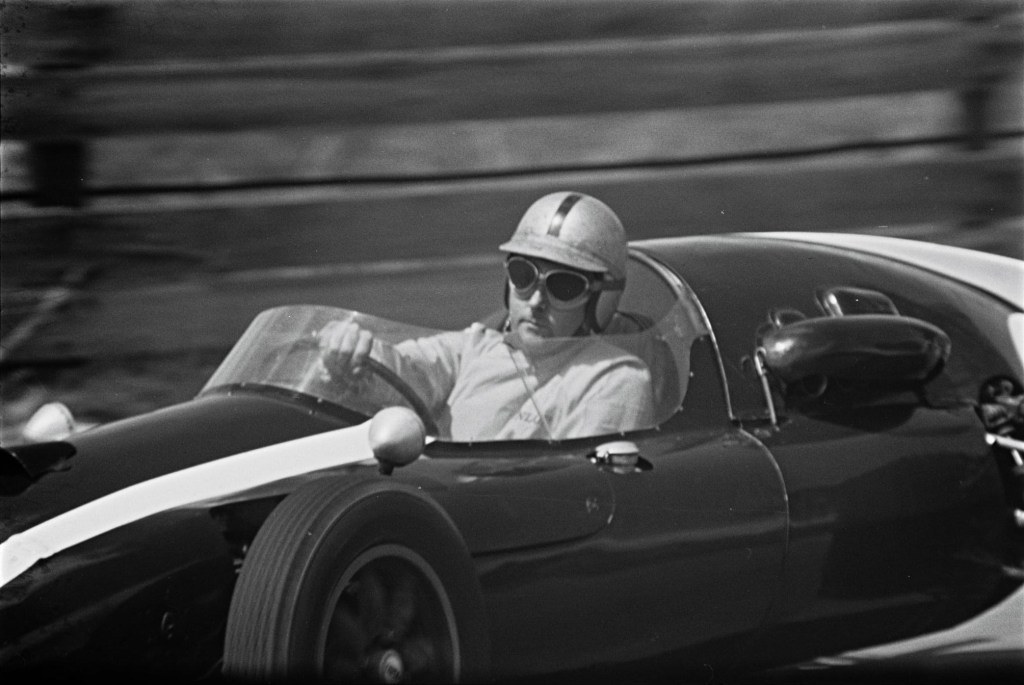
After Jack Brabham won his second World Championship on-the-trot at Boavista, Portugal in late August 1960 he returned to Australia between the Italian and US Grands Prix (Riverside that year) to contest the Craven A International, a one-off race sponsored by a cigarette company, at Mount Panorama on October 2.
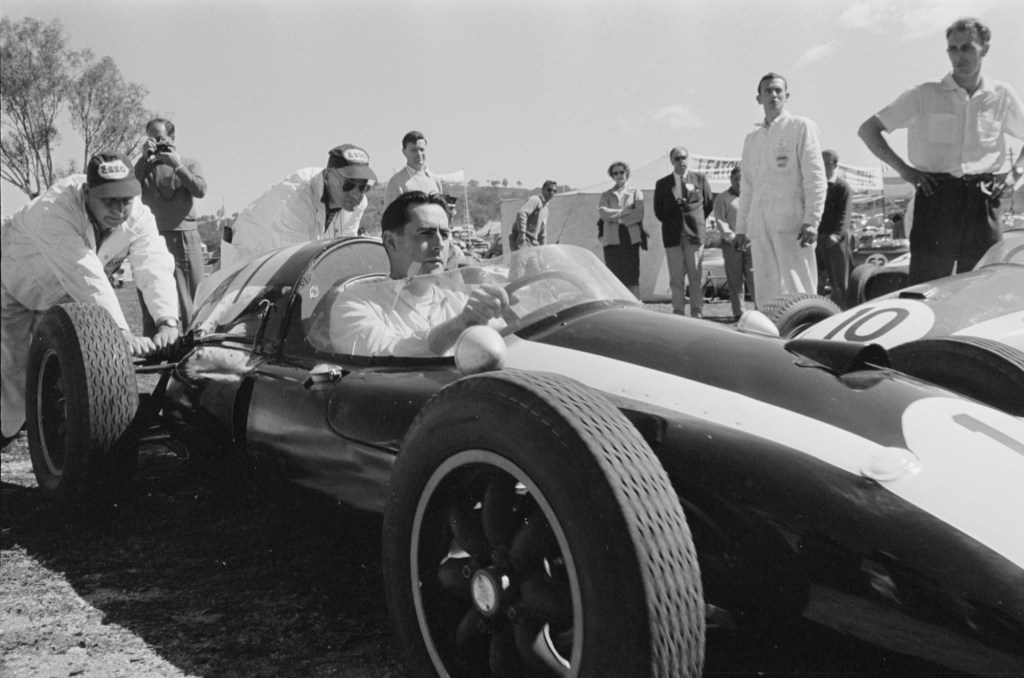
The great one raced a Cooper T51 Climax 2.5 (perhaps chassis #F2-4-59) to a convincing win from the similar cars of Bill Patterson and Bib Stillwell, albeit their cars were powered by 2.4-litre and 2.2-litre Climaxes respectively.
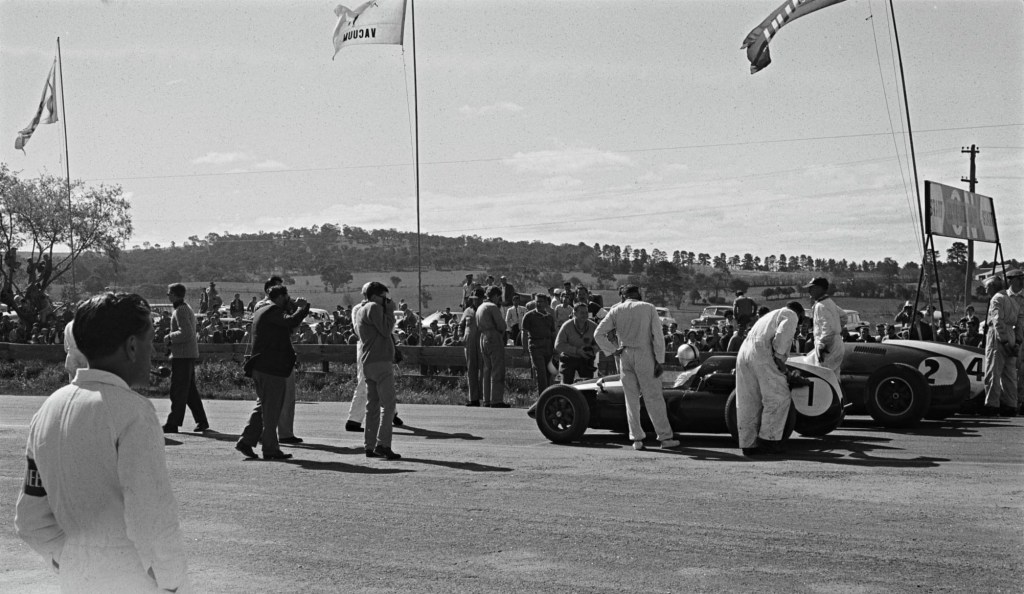
Jack takes his slot on the dummy grid, car #10 is John Roxburgh’s Cooper T45 Climax, DNF accident (L Stringer)Brabham in Cooper T51 #1, #2 is Mildren’s Maserati engined T51 and #4 is Stan Jones’ T51 Climax, DNF accident (L Stringer)
Brabham started from pole and won by 36 seconds. Coopers occupied the first five places of nine finishers in a field which included such pre-War ancients as Tom Sulman’s Maserati 4CM and Frank Elkins Holden engined Bugatti Type 37.
Australian motor racing was still in transition – very quickly – to the modern mid-engined era.
(L Stringer)Brabham takes the plaudits of the crowd and ‘snappers. Jumper, or perhaps a cardigan over the top of his overalls indicates a chilly Spring Bathurst day! (L Stringer)
These photographs posted by Leigh Stringer on social media this week beautifully capture the vibe and feel of that long ago weekend at Bathurst.
The Gold Star (Australian Drivers Championship) had been won by Alec Mildren’s Cooper T51 Maserati that year, he won four of the seven championship rounds. This Bathurst event wasn’t a title round, but it didn’t stop 28 cars starting the race, and even more entering it, such was the attraction of racing on the same grid as our Champ!
Credits…
Leigh Stringer, oldracingcars.com
Tailpiece…
(L Stringer)
No shortage of Esso capped assistance for Brabham, perhaps Tom Sulman’s Aston Martin DB3S behind? Where is John Medley’s Bathurst Bible when you need it, not here with me in the UK at the moment?!
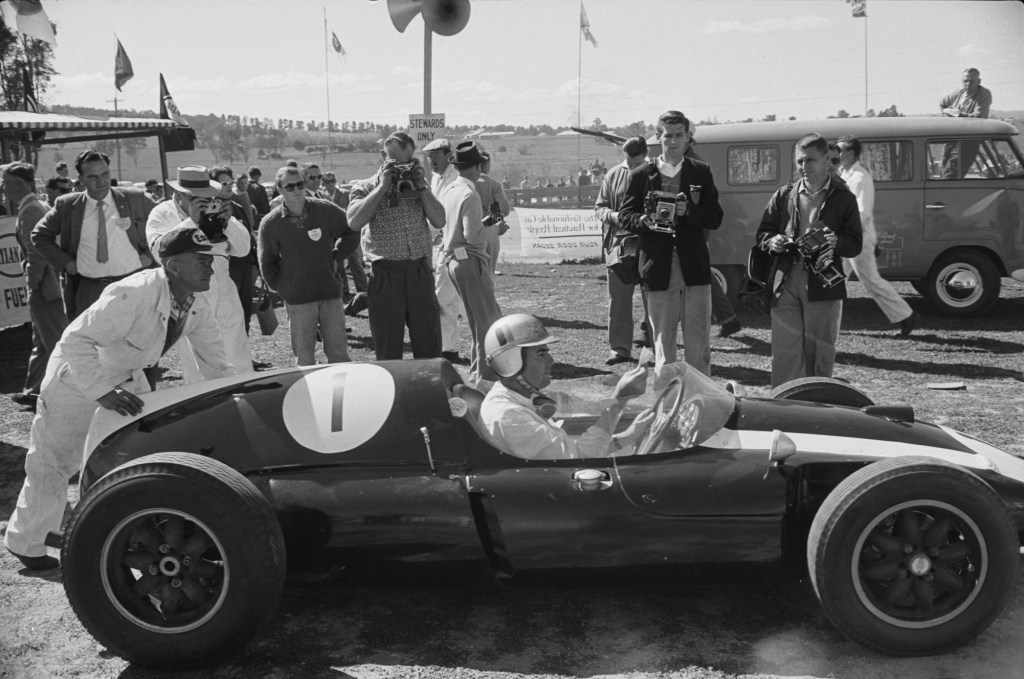
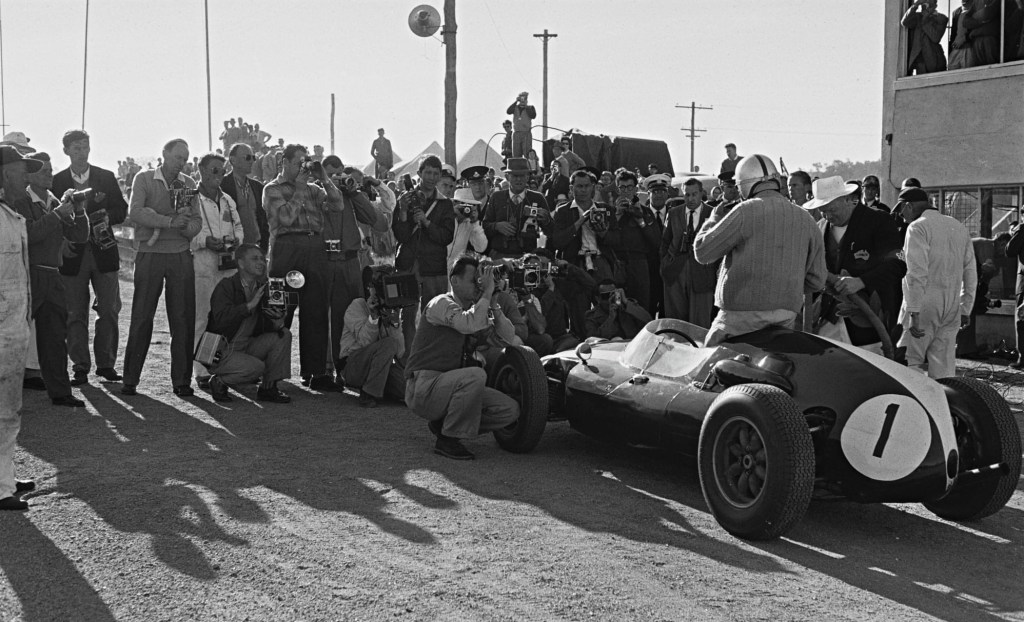
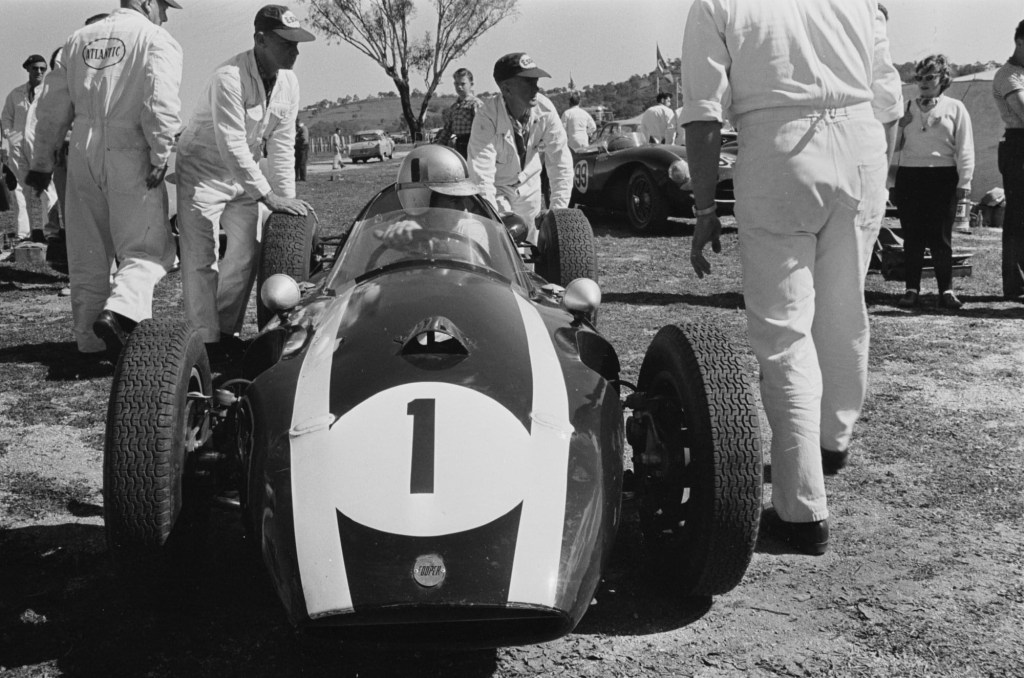
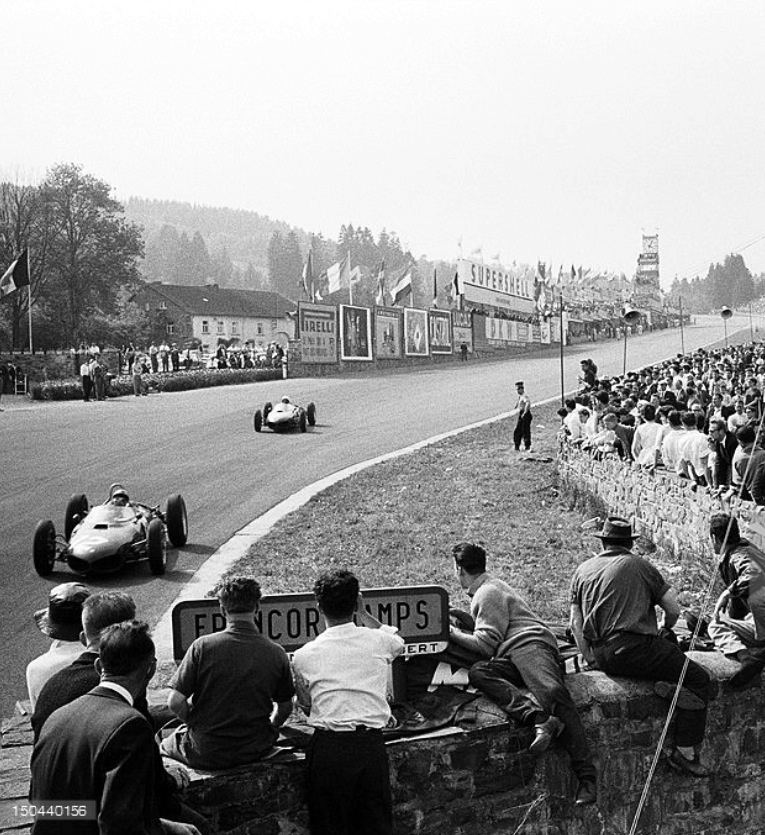
Phil Hill leads teammate Ricardo Rodriguez, both aboard Ferrari 156s, Belgian GP, 17 June 1962.
There was plenty of colour photography around by 1962 but monochrome is still rather powerful and evocative. The troops look more relaxed than the Ferrari pilots on the oh-so-fast turn into Eau Rouge, it always was and is an ultimate test of testicular girth.
Not a great season for Scuderia Ferrari in 1962 of course, the engine which kept the cars in front the season before – despite chassis deficiencies relative to the British cars – was no help in ’62 when said Brits had better Coventry Climax and BRM V8s than the Italian V6s and vastly superior chassis.
Here, Hill and Rodriguez are scrapping for third place in a season when the reigning 1961 World Champion, Hill P didn’t take a win, ceding the title to Hill G’s BRM.
Bruce, Tyler Alexander and and Alastair Caldwell…a new set of Goodyears for McLaren’s M7A. He put them to good use, qualifying sixth on the fast swoops of Rouen…
I’m drawn to the papaya McLarens thanks to their visual splendour and absolute respect for Bruce the man, engineer, test driver, racer and motivator of men.
He was the full-enchilada with the lot as a package, as well rounded a racer as it’s possible to be.
Here Chris Amon is tootling past him in the pitlane, his fellow Kiwi no doubt hoping the Firestone shod Ferrari 312 will cope with the fast swoops of Rouen better than Bruce’ M7A, a mighty fine design which carried the Ford Cosworth DFV.
I’ve posted a piece on this race before so don’t want to dwell on the awful fiery accident which cost Jo Schlesser’s life early in the event. Jacky Ickx took his first GP win in a Ferrari 312 from John Surtees’ Honda RA301 and Jackie Stewart’s Matra MS10 Ford.
The shot below is Graham Hill’s Lotus 49B Ford in grid slot nine surrounded by other fellas. The flash of blue to his left is Jean Pierre-Beltoise’ V12 powered Matra MS11 (ninth), Surtees Honda, with the blue flash down his white helmet and Chris Amon’s Ferrari, see its distinctive, white, between the Vee exhausts.
1968 was the last time an F1 GP was held at the wonderful 6.542Km road course near Orival and Rouen. The track was used for European F2 Championship races until 1978 and French national events after that, economic forces resulted in its 1994 closure.
Bill Downie, HRG, Caversham, Western Australia circa 1960 (K Devine)
Ignorance is bliss! Until now I’d assumed Brabham’s 1966-1968 Repco F1 V8 engine rebuilds/freshen-ups were done back at RBE’s Maidstone, Melbourne base, but that’s not the case
“When we started to use the Repco Brabham V8s (the very first race for the new engine was the January 1, 1966, non-championship South African Grand Prix), it was clear to Jack that sending them back to Melbourne for rebuilds wasn’t going to work given the time it would have taken,” recalls Bob Ilich.
The Australian mechanic/technician worked for Jack Brabham Conversions, Motor Racing Developments (MRD-constructors of Brabham cars) and the Brabham Racing Organisation (BRO-Jack’s race team) during the 1965-1967 glory years.
“There just wasn’t the time between race meetings to fly engines backwards and forwards between England and Australia, the logistics just didn’t work.”
In 1966 BRO contested nine championship GPs and four non-championship events (remember those!), and in 1967 11 championship GPs and five non-championship races; Race of Champions at Brands, Spring Cup and International Gold Cup at Oulton Park, the BRDC International Trophy at Silverstone and the Spanish GP. This intense program yielded world drivers championships for Brabham and Hulme, and manufacturers titles for MRD/Brabham Repco in 1966-67.
In short, the season was very full from early January until the Mexican GP in late October.
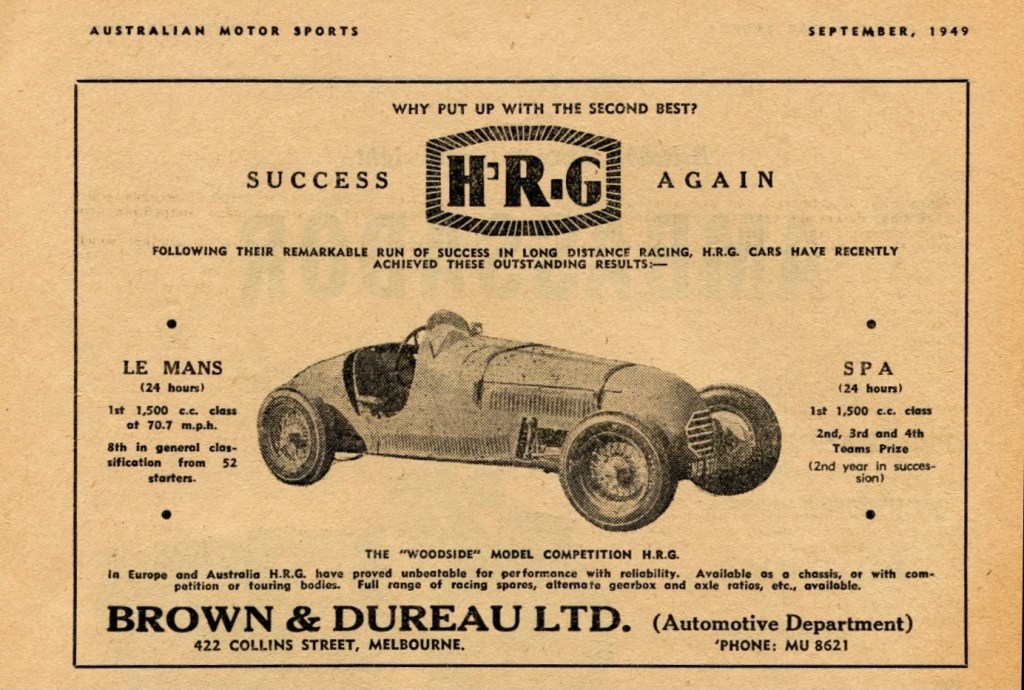
Jack had a ready-made machining solution when the H.R.G. Engineering Co Ltd – founded by Major Edward Halford, Guy Robins and Henry Ronald Godfrey in 1935 – ceased trading in 1966.
HRG built 241 sports and racing cars in addition to their core general engineering work. In 1956, they stopped building cars; their engineering clients included Cooper and, later, Brabham.
“When Jack moved BRO from the Canal Yard, Byfleet Road, New Haw, Surrey premises (which had been shared with Motor Racing Developments) to Guildford in early 1966, ex-HRG machinist Ron Cousins and his equipment, lathe, milling machines, etc., were already there doing work for Jack Brabham Conversions, which operated from an Esso Service Station in Woking.”
“Conversions did general service and tuning work, fitted Coventry Climax engines to Triumphs and Austin Healeys, made performance modifications, and later did the development work on the Brabham Vauxhall Viva/Torana.”
“The Guildford premises had administration offices upstairs, including a drawing office for John Judd, who was back at BRO after his stint with RBE in Maidstone. He was in constant touch, liaising with Norman Wilson, RBE’s Chief Engineer in Melbourne.”
“Downstairs was the Brabham Conversions Parts Department, a large workshop where the racing cars were prepared and the transporter parked, Ron Cousins’ machine shop and an engine rebuilding workshop for Jack and myself,” Bob recalled.
“After the first couple of runs in South Africa and testing in England, the engines had oil leaks, Jack said we needed to fix. The first rebuilds were to address this, over time of course, we did freshen-ups as required.”
Bob Ilich with gasket kit at BRO, New Haw circa March-April 1966. Brabham BT17 sportscar coming together behind him and Holden EH abroad (unattributed)
“All the components we needed were sent from Australia, including the new 1967 700 Series blocks. I remember replacing three 600 Series blocks with the much stronger Repco 700 block; the three Olds F85-based blocks were still in a corner of the workshop when I left. If anything needed machining, Ron Cousins did it,” Bob recalls.
“By the end of the 1967 racing season, the only thing we hadn’t mastered was the timing chain cover, which still leaked a bit, but those 740 engines were otherwise bulletproof.”
“None of the engines was ever sent back to us for rebuilds,” confirms Michael Gasking, long-time RBE, Maidstone, Melbourne engine fitter and chief dyno test pilot. “We sent engines and components over as they were needed. Jack and Frank (Hallam, RBE General Manager) were on the phone all the time discussing updates and problems discovered at the track we needed to fix or enhance.”
So, there you have it, a little tidbit of RBE history not in Repco press releases or the history books.
Thanks Bob Ilich, I’m not sure quite how it popped into our conversation, but very much appreciated!
Etcetera…
HRG
Among HRG’s products/enterprises were the original UK import rights for Weber carburettors, twin-cam HRG (Singer) engines, the Stuart Proctor-designed crossflow cylinder head, inlet manifolds and rocker covers for BMC B-Series engines (usually marketed by VW Derrington rather than HRG themselves) and overhead-cam Ford 105E conversions.
HRG originally operated from Tolworth, Surrey, and later from Oakcroft Road, Chessington, also located in Surrey.
The then HRG director/shareholders, having reached retirement age, closed their solvent, profitable business in 1966. Derringtons took over the drawings, patterns and moulds to manufacture cylinder heads, and Jack Brabham acquired or absorbed the machine shop equipment and Ron Cousin into his group…
The main-man out front of Jack Brabham Motors, Hook Road, Chessington (unattributed)
Brabham Premises
There is plenty of interest in Brabham, Jack Brabham, Ron Tauranac and Repco Brabham Engines at quite a granular level.
With an imminent trip to the UK, I have a couple of Brabham Sacred Sites at which I’m going to pay homage, with that in mind, here is a list fellow Brabham Tourists may find of interest.
Please treat it as a work in progress. I’m keen to hear from any of you with additional information to add, or corrections that should be made to this list.
Established circa 1959, ESSO garage, Rootes Group dealership. Phil Kerr ran the business until his departure to McLaren. Ron Tauranac lived in a Bed-Sit in these premises when he first arrived from Australia and built the MRD (the first Brabham Formula Junior machine ) in a lock-up downstairs.
.Repco UK : Victoria Road, Surbiton, Surrey.
Circa 1957 at the Earls Court motor show. Repco’s marketing division and warehousing facility, which sold garage and wheel balancing equipment, and later engine rebuilding, reconditioning and balancing equipment, etc.
Space was sublet to MRD to build Brabhams. The MRD and Brabhams, until when?, were constructed at these premises.
.Motor Racing Developments Ltd(MRD) : Canal Yard, Byfleet Road, New Haw, Weybridge, Surrey.
Circa 1962, manufacturer of Brabham cars and later Ralt cars
Shop floor at Motor Racing Developments circa 1966 (Repco)Brabham Racing Organisation in 1970, Guildford. Jack’s F1 Brabham BT33 Ford being prepared (D Phipps/MotorSport)
ESSO service station, modifications to Sunbeam Rapiers and other cars inclusive of fitment of Coventry Climax FWE engines to Triumph Herald, Austin Healey Sprites etc
.Brabham Racing Organisation Ltd (BRO) :
Initially co-located with MRD.
In early 1966, BRO moved to Weyford House, Woodbridge Meadows, Guildford, Surrey, as outlined in this article.
High Performance Exhaust Systems Ltd (Directors Len Lukey and Brabham) sold and fitted Lukey Mufflers for cars, trucks and tractors from this location
BRO moved – partially – back to New Haw (MRD) circa 1968. Allan Ould recalls building the BT25 Indycars in the BRO workshop at MRD that year.
The F1 car prep and machining shops remained at Guildford.
Jack Brabham (Worster Park) Ltd : 33-51 Central Road, Worster Park, London.
Vauxhall dealership in the-day, redeveloped in more recent times as the residential ‘Brabham Court’.
Jack Brabham Ltd : 23 Stoneleigh Broadway, Epsom, Surrey.
Circa 1965. Appears to have been the site of another car dealership?
Engine Developments Ltd (Judd Power) : Leigh Road, Swift Valley, Rugby.
Partnership of John Judd and Jack Brabham which commenced in 1971.
.Brabham family home.
3 Ashcombe Avenue, Surbiton, Surrey, from 1965 Greater London, below.
(P Stockden)Repco Brabham Engines, Mitchell Street, Maidstone premises early 1967 during the Tasman Series (Repco)
Australia
Repco Brabham Engines Pty. Ltd.
This entity was the Repco subsidiary incorporated circa 1965 to design and construct the Repco Brabham race engines
A small team was initially located in a small part (the engine laboratory) of Russell Manufacturing Pty Ltd at 85-91 Burney Street, and 26-34 Doonside Street, Richmond. The first V8s were built there.
Nigel Tait picks up the story, “The engine lab that was at the back of Russell Manufacturing (Doonside Street, Richmond) was to service the then current Repco factories producing engine parts.”
“Once the Repco Brabham project started to outgrow that small lab, a decision was made to relocate it over to the Maidstone site that had been purchased from the original Automotive Components Limited company some years earlier. One of the four or five factories on that site was cleaned out and early in 1966 the manufacture and assembly of the RB engines was progressively transferred from Richmond.”
“The new company, Repco Brabham Engines Pty Ltd was incorporated, the Repco Ltd (parent company) Director responsible was Bob Brown, the General Manager was Frank Hallam.”
“Eventually a new test centre was built out the back, it was very sophisticated and state of the art with two dynamometers compared to what we had in Richmond.”
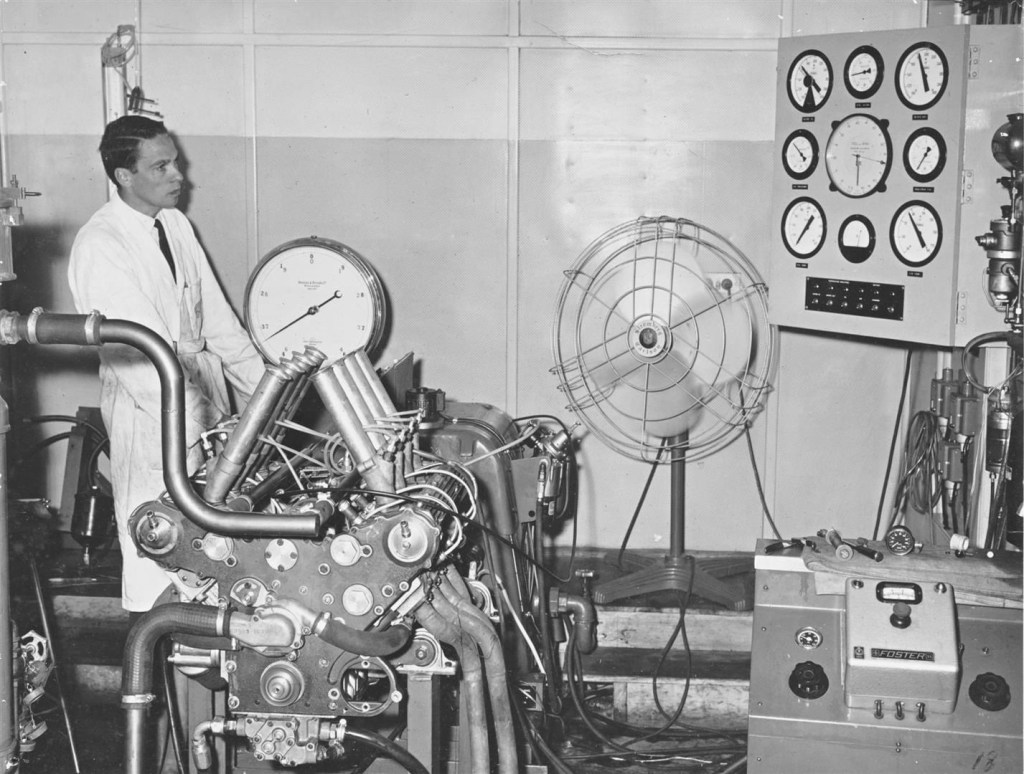
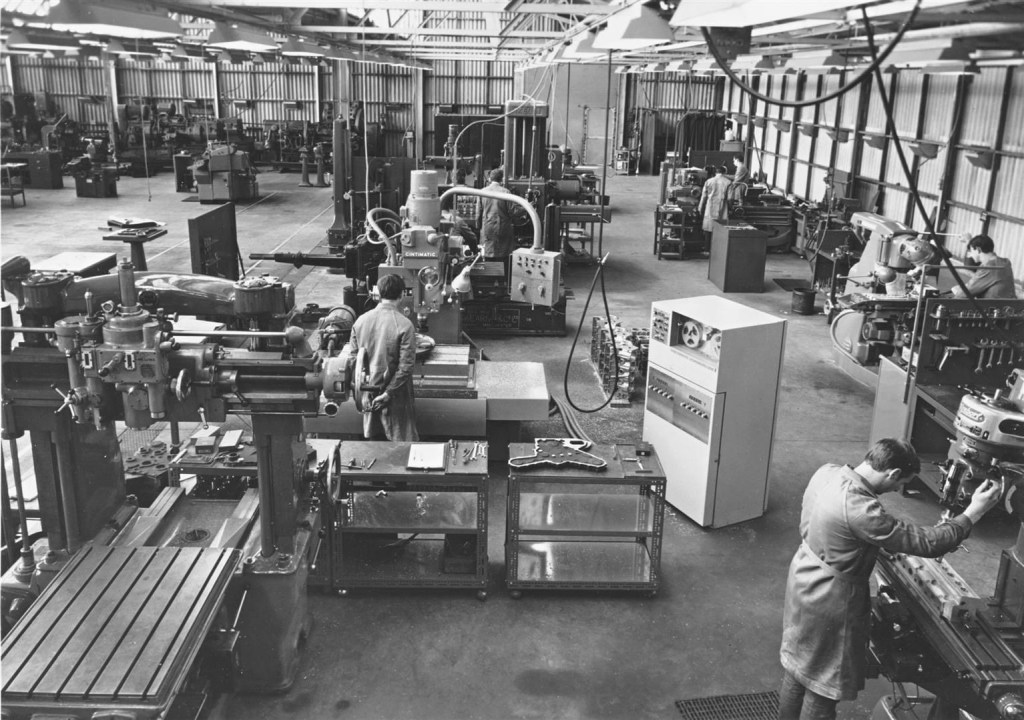
Michael Gasking testing RBE620-E2 2.5 V8 on the Heenan & Froude GB4 dyno in the old Myers garage – corrugated iron tin-shed – Doonside Street, Richmond Engine Lab. The distinctive long-inlet trumpets allow easy identification of this engine as that used by Jack at the 1966 Sandown and Longford Tasman rounds. Mike is testing it either before the Sandown round or immediately after it. The engine suffered oil pump failure and had to be quickly rebuilt before being sent to Longford…so it’s either mid-February or 28-29 February 1966 (Repco)More sumptuous surrounds at Maidstone circa 1967. Very well equipped, RBE were set up to build engines with great precision in numbers. That two axis Cincinatti Vertical Acramatic milling machine (in the middle of the photo) is claimed by the man who sold it to Repco to be the first numerically controlled machine tool sold in Australia. The timing cover case lying flat this side of the vertical tape reader (the light coloured cabinet) was made on this machine (Repco)
“So, from about mid to late 1966 (the move started during the Xmas summer break of 1965-66), the whole of the racing engine project was at Maidstone, and the engine lab in Richmond continued to service the Repco engine division.”
“Later, the same dynamometer set up was used for the (1969-1974) Repco Holden F5000 project.”
“In the meantime Repco started to move some of the piston and ring manufacturing plant over to the Maidstone site and for a while both sites operated as Repco Engine Parts – Richmond Plant and Maidstone Plant.”
“Then in 1986 Repco sold off the Engine Division to a management buyout and the same products continued to be made at the two plants though eventually all were consolidated at the Maidstone site, Richmond having been sold.”
“The management buyout company didn’t have a name and Repco kindly allowed it to be called Automotive Components Limited (ACL), so the wheel turned full circle,” Nigel Tait recalled.
The Richmond (art deco) buildings are extant, and Maidstone became a housing estate close to a decade ago, as shown below.
(N Tait Collection)(N Tait Collection)
“The memorial at Maidstone was the brainchild and project of a local councillor in 2015. We had Michael Gasking and (now the late) Don Halpin (above) to cut the cake at the unveiling ceremony,” Tait recalled.
“Michael was at Richmond when I joined Repco as a cadet engineer, and I was assigned to work with him as his assistant on Repco Brabham with engine assembly and running the engines on our dynamometer (Heenan and Froude GB4).”
“Michael was (is) a good man, very skilled, a good teacher and very thorough. The engines he built won the 1966 championship and probably half of 1967 (Denny) as well.”
“Don, sadly now gone, was an amazing engine builder, worked in my team after Repco Brabham and the F5000 Repco Holden days on alternative fuel projects for the government, and post retirement built customer racing engines until the end. I miss Don…” recalls Nigel of his colleagues and friends.
Credits…
Bob Ilich, Nigel Tait, Ken Devine Collection, Paul Stockden
Tailpiece…
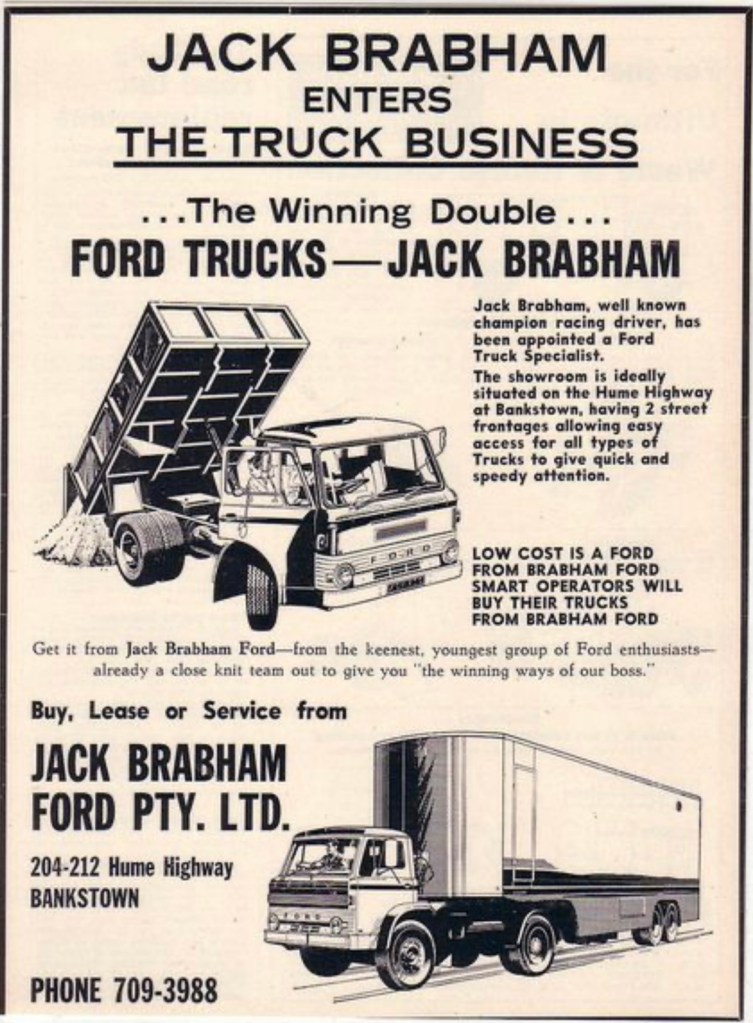
Yeah, yeah, yeah, of course there are Jack’s businesses in Australia too (both before he went to the UK and after he left to return home) in the automotive, aviation and rural sectors but my focus is just those of the Repco-Period.
If we widened the lens we would be going for weeks I suspect…