Archive for the ‘F1’ Category

(T Marshall)

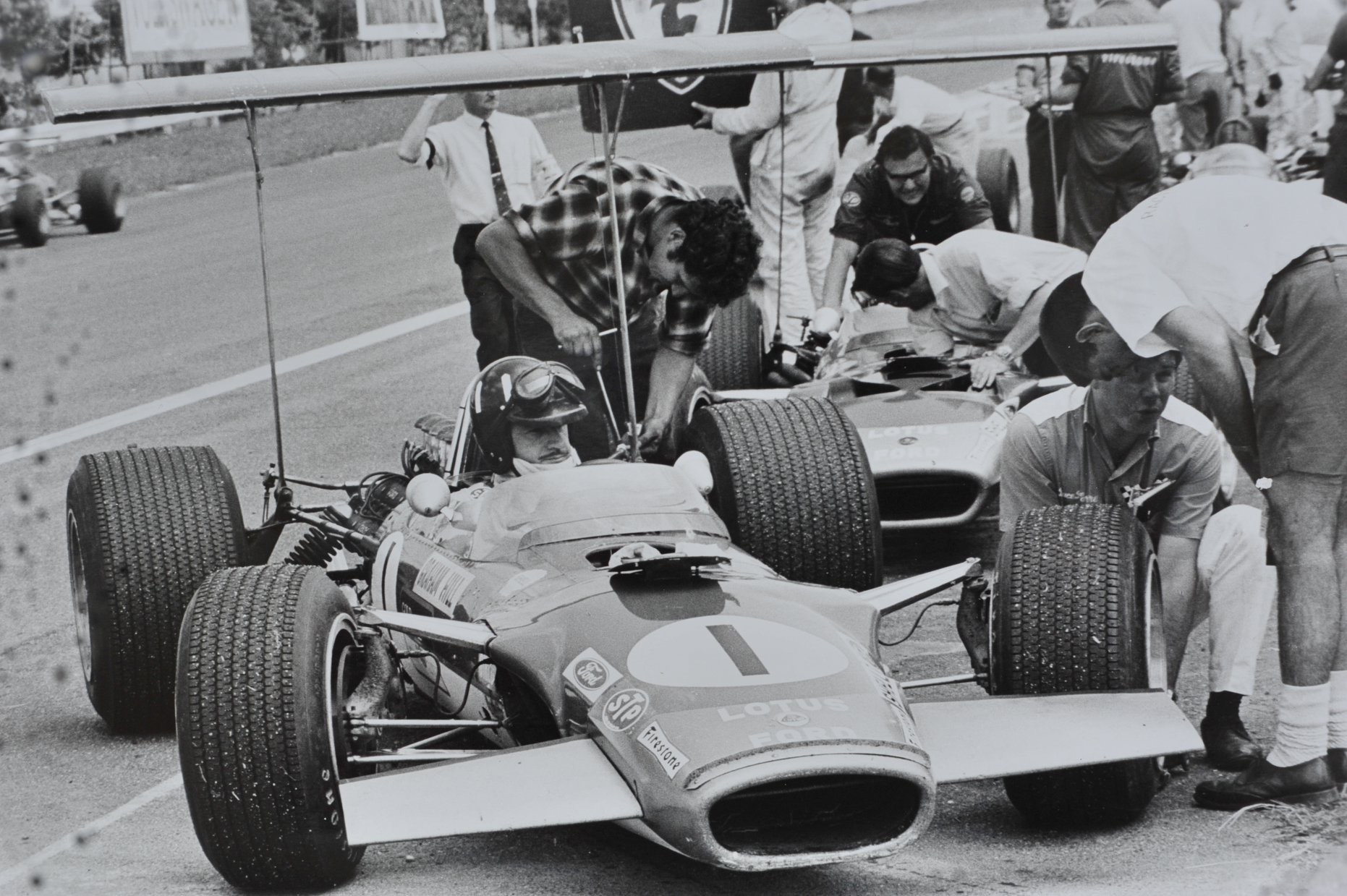
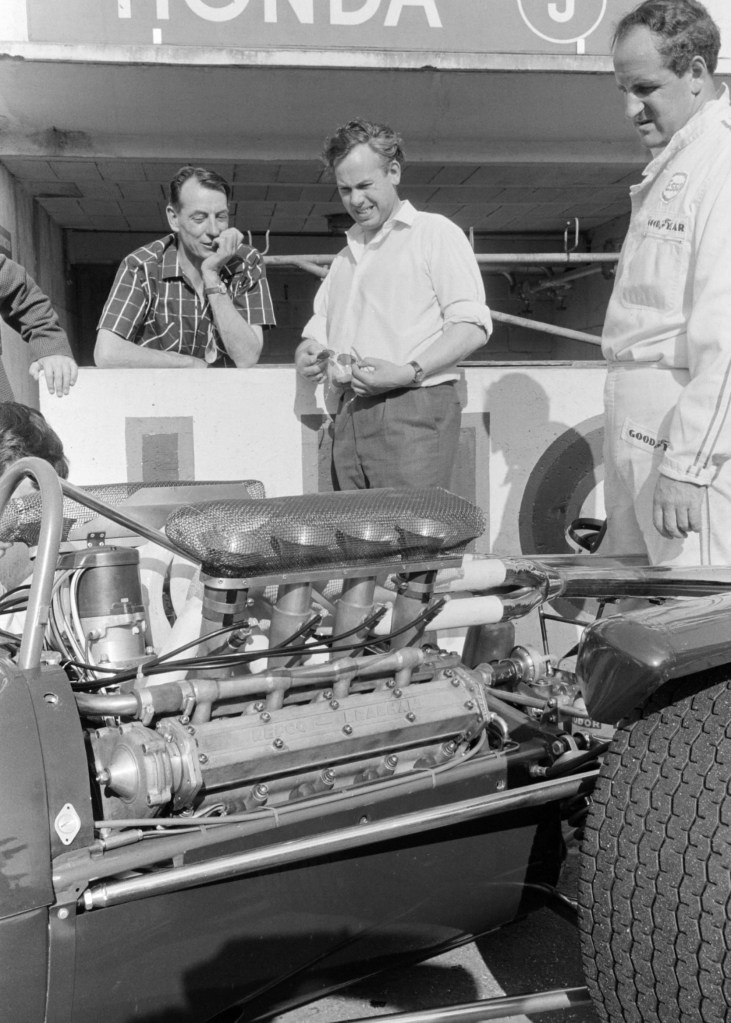
Graham Hill talks to the lads about his brand-spankers Lotus 49B, chassis R8 in the Pukekohe pitlane during the 1969 NZ GP weekend…

Maybe he is talking about his car, or perhaps the blistering pace of Jochen Rindt, his new teammate.

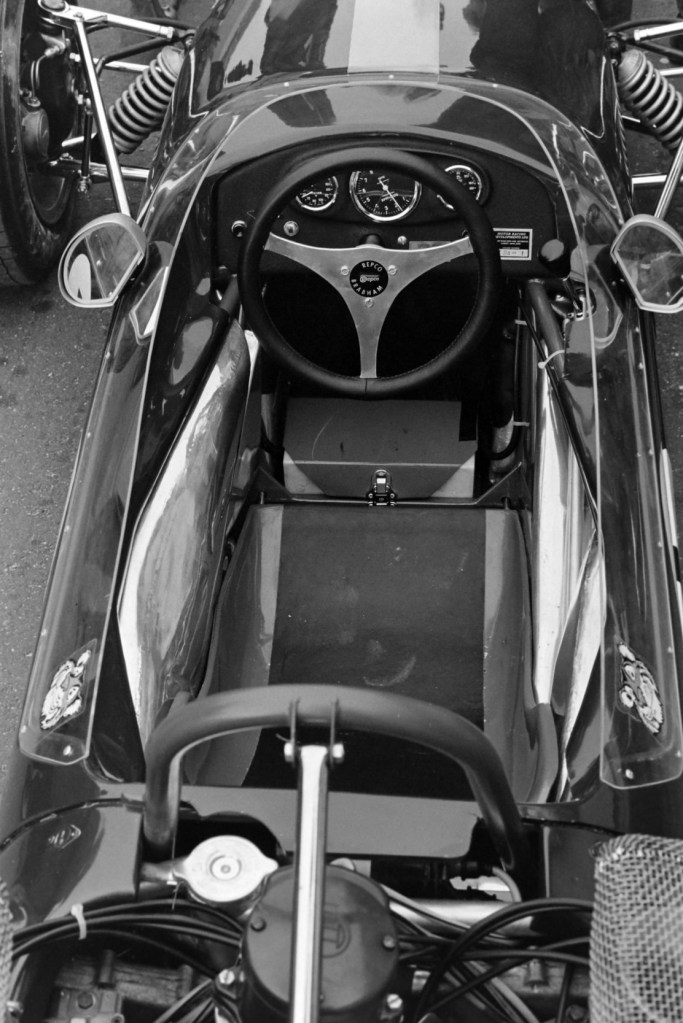
While it’s a brand new chassis, the car is fitted with a ZF gearbox rather than the Hewland DG300 which he had been using in his definitive spec F1 49B in late 1968. Both Hill’s R8 and Rindt’s R9 were concoctions of the original 49 and of the subsequent 49B. Type 49 features included the front-mounted oil tank, use of a combined oil/water radiator, original front rocker arms mounted at 90 degrees to the tub rather than swept forward, the ZF gearbox and old style rear suspension mounted to ‘fir-tree’ brackets bolted to the DFV.

The main 49B feature adopted was the use of cutouts in the lower rear part of the tub to locate the lower rear radius arms. The cars used high-wings mounted atop the uprights in the same style first used on Jackie Oliver’s R2, and used the wing-feathering mechanism pioneered in Mexico at the end of 1968.

There was enormous excitement in Australasia prior to the 1968 Tasman when the quickest cars of the 1967 F1 season, Lotus 49s powered by the 2.5-litre short stroke DFW variant of the F1 3-litre Ford Cosworth DFV were raced by Jim Clark and Graham Hill; chassis’ R2 and R1 respectively.

Jim Clark won the Tasman Cup, his last championship, and the Australian Grand Prix at Sandown, his last GP win before his untimely death at Hockenheim on April 7, 1968.

While there was huge enthusiasm for Graham Hill and Jochen Rindt, the absence of Clark tugged at the hearts of enthusiasts, Jim was such a popular visitor to our part of the world, his first tour was in 1962.

Rindt finally had a car with the speed and occasional reliability – he was hard on it mind you – to post the results he deserved. His first GP win came at Watkins Glen late in 1969, but he perished less than twelve months later at the wheel of a Lotus 72 during practice for the Italian Grand Prix.

Graham Hill did a sensational job in picking up Team Lotus lock-stock-and-barrel after Clark’s death. He filled the leadership void until Colin Chapman clicked back into gear after mourning Clark’s loss. Graham would have a tough season in 1969, Rindt’s pace was apparent from his first laps at Pukekohe and at Watkins Glen Hill he had the bad accident which hospitalised him for months.

Team Lotus built two new cars for the ’69 Tasman assault; 49Bs R8 – a new chassis – for Hill, and R9 – the prototype R1 rebuilt – for Rindt which were identical in specifications.

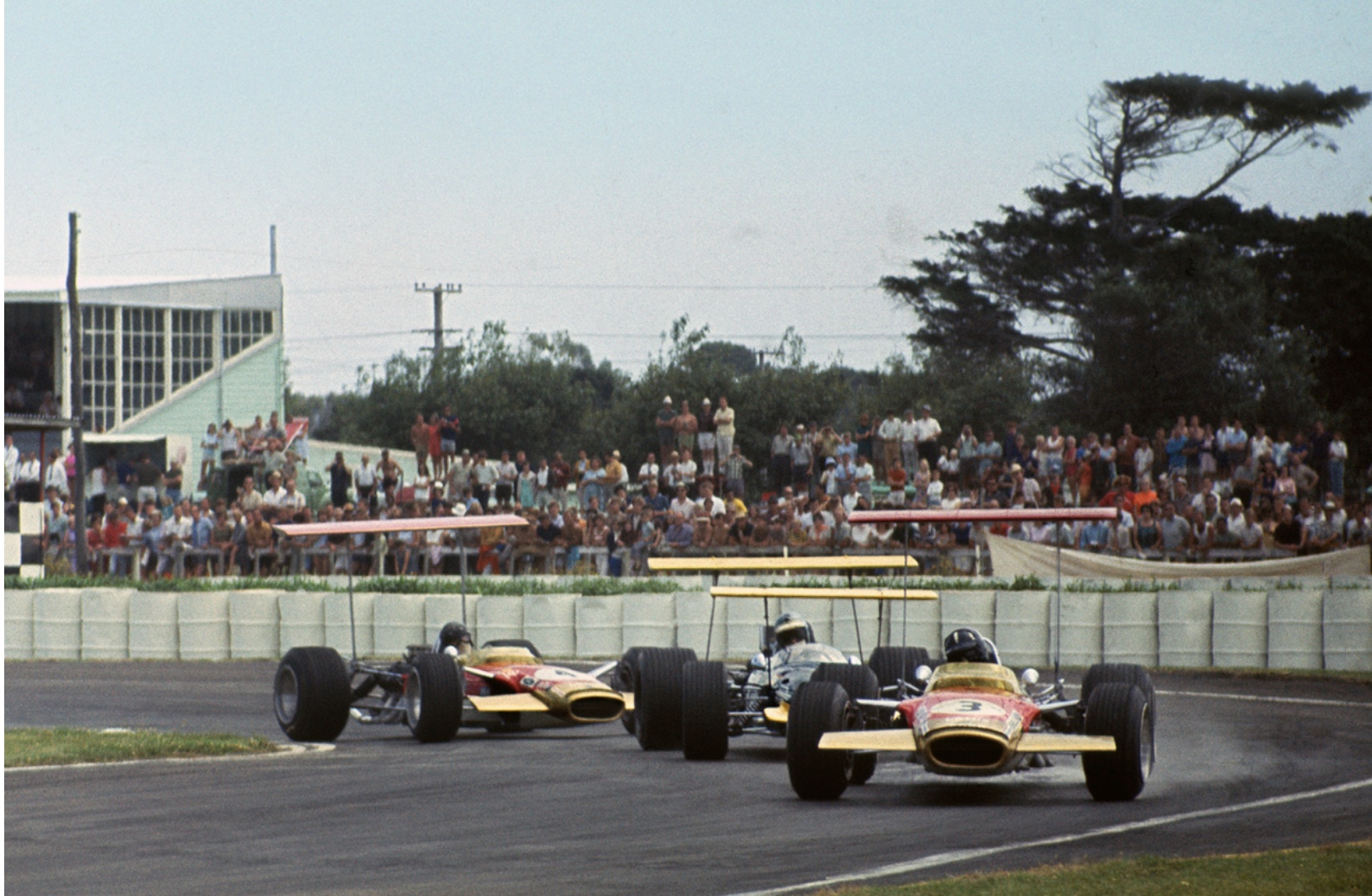
NZ GP Pukekohe 1969, the off. From left Amon with Bell right behind then Leo Geoghegan’s white Lotus 39 Repco, Hill’s Lotus a row back, then Jochen up front alongside Chris and Piers at right in the Williams Brabham BT24 Ford
Gardner, Mildren ‘Yellow Submarine’ Alfa, Hill, Rindt in the Wigram dummy grid in 1969 (CAN)

Chris Amon mounted a very successful 1969 Tasman campaign using the learnings of the prior year. He had Bruce Wilson as lead mechanic again, and an additional car to be raced by Derek Bell with a strict rev limit given the small float of engines available between two cars. Logistics were taken care of by David McKay’s (Sydney) Scuderia Veloce outfit.

Chris opened his account with intent, he won the first two races at Pukekohe on January 4 and at Levin the week later. Jochen was second in the NZ GP whereas Graham had two DNFs, a front suspension ball-joint failed after completing 13 laps in the first race, and driveshaft failure at Levin, this time on lap 12 when running in third place from grid five.

Jochen came to grief at Levin, he spun on lap four whilst leading, and then repeated the mistake two laps later but in more costly fashion, rolling the car atop a safety embankment. Jochen was ok but R9 was rooted, too badly damaged to be repaired away from home base. 49B R10 was despatched to the colonies, much to Hill’s chagrin. It was the first of many Lotus accidents and component failures for the Austrian during the next twenty months, not that the cause of this shunt was the fault of the car.

The ferry trip to the South Island brought better fortune. Hill and R8 finished second in the Lady Wigram Trophy race on the Royal New Zealand Airforce Base outside Christchurch on January 18, but Jochen made good use of his new car from pole setting fastest lap and race time. Jochen was 34 seconds in front of Graham, with Chris Amon another four seconds behind Graham, then Piers Courage another six seconds back in Frank Williams’ Brabham BT24 Ford DFW.

The following weekend Graham was second again at Teretonga near Invercargill, the world’s most southerly racetrack, the winner this time was Courage. This time it was Jochen’s turn for driveshaft failure, interesting given the DFW gave circa 50bhp less than the DFV, with Chris Amon third and looking good for the title as the circus crossed the Tasman Sea for three Australian rounds.

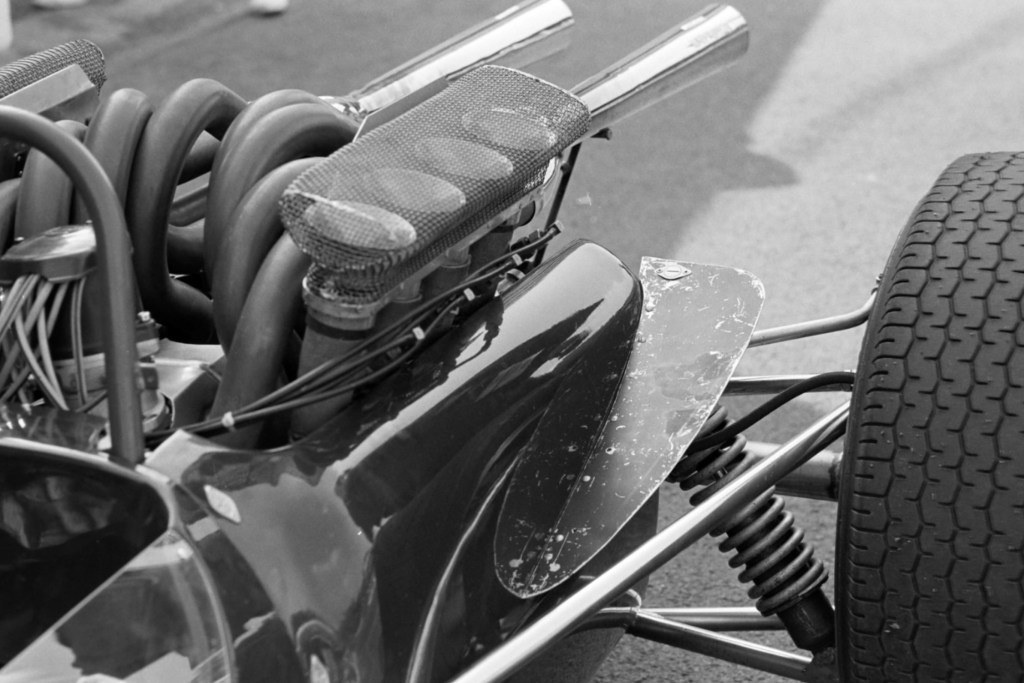
Graham blasting through the Teretonga scrub country. Note the long exhausts of the 2.5 DFW, look how flimsy the wing supports look, and were- Chapman at his worst. Note – look hard – the Lotus aero-screen (LAT)
Early laps at Levin. Piers Courage in a Lotus sandwich, Hill in front with Jochen aboard the ill-fated R9 in third (LAT)
The off at Wigram. Courage, Brabham BT24 Ford and then Graham with Jochen on pole in Lotus 49Bs. Amon behind Jochen, the light coloured car behind Chris is Gardner’s Mildren Alfa V8 (T Marshall)

First stop was on February 2, 1969, at Lakeside, Brisbane, for the Australian Grand Prix.

Graham finished fourth in R8, while Jochen’s R10 had engine failure. Both cars had wing mount failures- Chapman’s In-God-We-Trust engineering of these things was cavalier for so long it is a joke. Only Jochen’s celebrated Come-To-Jesus (whilst I am on religious metaphors) letter after the collisions inflicted upon Rindt and Hill at Montjuic Parc in early 1969 gave Our Col pause to consider his desire to attend another driver funeral.

GLTL then headed south to Sydney for the Warwick Farm 100, basing themselves at the Brothers Geoghegan emporium of fine sportscars in Haberfield, a stones-throw from the Farm at Liverpool.

While practice was dry, Rindt massacred the lap record, then drove away from the field during the race in a mesmeric display of wet weather feel, bravado, pace and dominance winning at a reduced canter by 45 seconds from Derek Bell’s Dino and Frank Gardner’s Alec Mildren Mildren Alfa Romeo 2.5 V8.

Poor Graham’s R8 snap-crackle-‘n-popped its way around the technically demanding course with his ignition very much rain affected. Chris and Piers tangled early in the race which gave the Kiwi sufficient points to win the Tasman Cup.

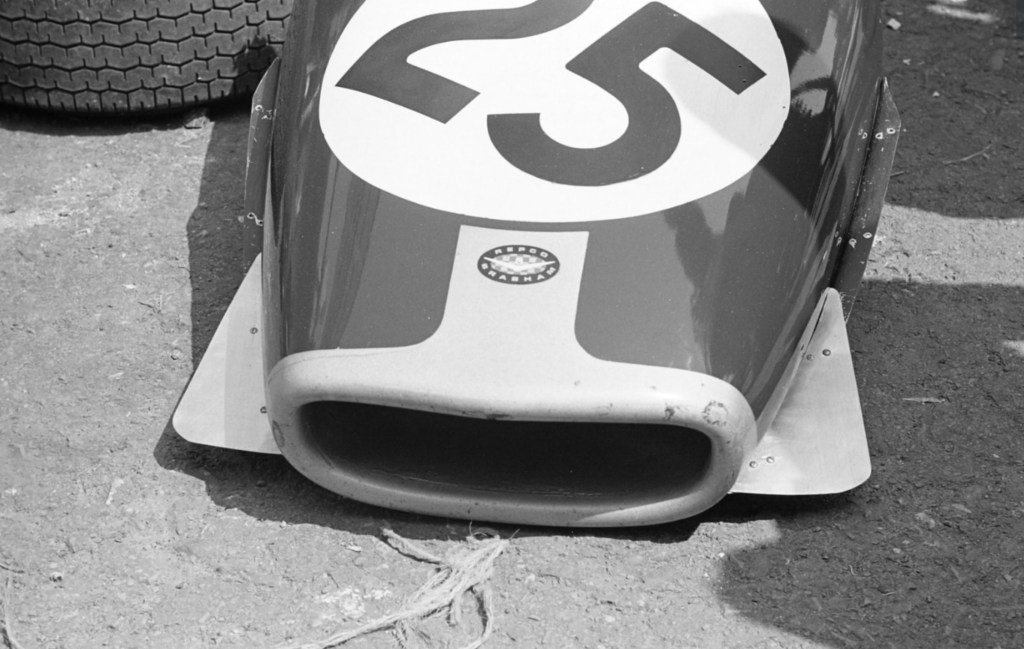
Hill aboard R8 with Rindt in R10 in the Sandown pitlane, February 1969. Note the open bonnets, spoiler atop the nose of Graham’s  (I Smith)

The final round of the Championship took place at Melbourne’s Sandown Park on February 16.

There Chris drove a wonderful race to win by seven seconds from Jochen with Jack Brabham third in the Brabham BT31 Repco 830 2.5 V8, in Jack’s one off 1969 Tasman race, with Gardner fourth, Bell fifth and then Graham sixth, three laps adrift of Amon.

Jochen’s R10 was airfreighted home to the UK, it was required in F1, whereas R8 returned by ship. In the Spanish Grand Prix both high-winged Lotus 49Bs of Rindt and Hill were very badly damaged in separate accidents triggered by rear wing strut failure over the same high-speed brow on Barcelona’s Montjuic Park circuit- as mentioned earlier. See article here; ‘Wings Clipped’: Lotus 49: Monaco Grand Prix 1969… | primotipo…

While Graham wasn’t hurt, Jochen was severely concussed and was unable to drive at on May 18. Team Lotus lacked a car to replace Rindt’s R9, the chassis of which was consigned to a rubbish skip at Hethel. As a consequence, R8 was rushed off the ship from Australia, fitted with a 3-litre DFV, 1969 roll-over hoop, and fire extinguisher system before being taken to Monte Carlo for substitute driver, Richard Attwood to race.

He had shone in a BRM P126 the year before, setting fastest lap and finishing a strong second behind Graham Hill’s winning Lotus 49B R5.

At Monaco driving R8 with minimal preparation after seven hard races in the Tasman Cup, Attwood finished a fine fourth and set fastest lap in the race again won by Hill aboard 49B R10. With Jo Siffert third in Rob Walker’s Lotus 49B (R7) three of these wonderful cars were in the top four, the only interloper was Piers Courage splendid second place aboard Frank Williams’ Brabham BT26 Ford.

Richard Attwood in h-winged R8 during Friday practice at Monaco in 1969- after the wing ban the car raced denuded of same (R Schlegelmilch)
Attwood, Monaco, race day, fourth place- wonderful result having not parked his arse in the car before practice (unattributed)

Back at Hethel R8 was altered to latest 49B specifications and raced by Hill, nursing a sick neck to seventh in the 1969 British Grand Prix, at Silverstone on July 19.

Meanwhile, Colin Chapman’s four wheel drive Type 63, the proposed Type 49 replacement, struggled to find pace and the support of its drivers, as did the other 4WDs fielded by Matra, McLaren and Cosworth.

Given the choice, World Champion Hill, and Fastest Guy On The Planet Rindt, preferred the conventional rear-drive 49B. To prevent them having the choice Chapman decided to sell Team’s 49s, R8 went to Swedish journeyman owner/driver Joakim Bonnier.

He raced it in the German Grand Prix in August, DNF fuel leak. Jo crashed it after front suspension failure during practice for the non-championship Oulton Park Gold Cup on August 16. Out of love with the car, the damage was repaired at Hethel prior to sale to Dave Charlton for South African national F1 racing in 1970.

Jo Bonnier returning to terra firma, R8, Nurburgring 1969 German GP. (unattributed)
Dave Charlton with R8, now in 49C specifications, during the 1971 Highfeld 100 (N Kelderman)

Charlton used R8 to win the first two of his six consecutive South African national Formula 1 Championship titles between 1970-75.

The car won nine rounds in 1970; the Highveld 100 at Kyalami, the Coronation 100 at Roy Hesketh, followed by the Natal Winter Trophy there, the Coupe Gouvernador Generale at Lourenco Marques, Rand Winter Trophy at Kyalami, False Bay 100 at Killarney, Rhodesian GP at Bulawayo, Rand Spring Trophy at Kyalami and the Goldfields 100 at Welkom.

In 1971 the Charlton/R8 combination won four events of six he contested before switching to a Lotus 72; the Highveld 100 at Kyalami, Coronation 100 at Hesketh, Bulawayo 100, and the South African Republic Festival race back at Kyalami.

R8 was then campaigned to the end of 1972 by South African drivers Piet de Klerk and Mayer Botha. Botha damaged the left side of the tub badly at Killarney in August. Sydney’s The Hon. John Dawson-Damer bought the damaged, dismantled car in late 1975, painstakingly restoring it with the assistance of Alan Standfield.

It was completed in 1982 and was a regular in Australian historic racing, driven by John, Colin Bond and John Smith, until DD’s sad death aboard his Lotus 63 Ford during the Goodwood Festival of Speed in 2000. Adrian Newey now owns it.

Dave Charlton in his Scuderia Scribante Lotus 49C Ford during the 1970 South African GP at Kyalami. DNF 73 laps, classified 12th (unattributed)

Credits…

Terry Marshall, LAT, MotorSport, Rainer Schlegelmilch, Nico Kelderman, Ian Smith, oldracingcars.com, ‘Lotus 49: The Story of a Legend’ Michael Oliver

Tailpiece…

(unattributed)

Graham Hill’s R8 butt at Warwick Farm on February 18.

The Brit contemplates a soggy, humid day in the office to be made worse by a misfiring engine and Rindt’s masterful brio behind the wheel of the other Lotus.

The car has the same pissant wing supports as it had at Pukekohe seven weeks before, but note the Hewland DG300 transaxle rather than the ZF unit used at the Tasman’s outset, a fitment which contradicts the history books…

Finito…

Denny Hulme, Gordon Coppuck and McLaren M8F Chev (A Bowler)

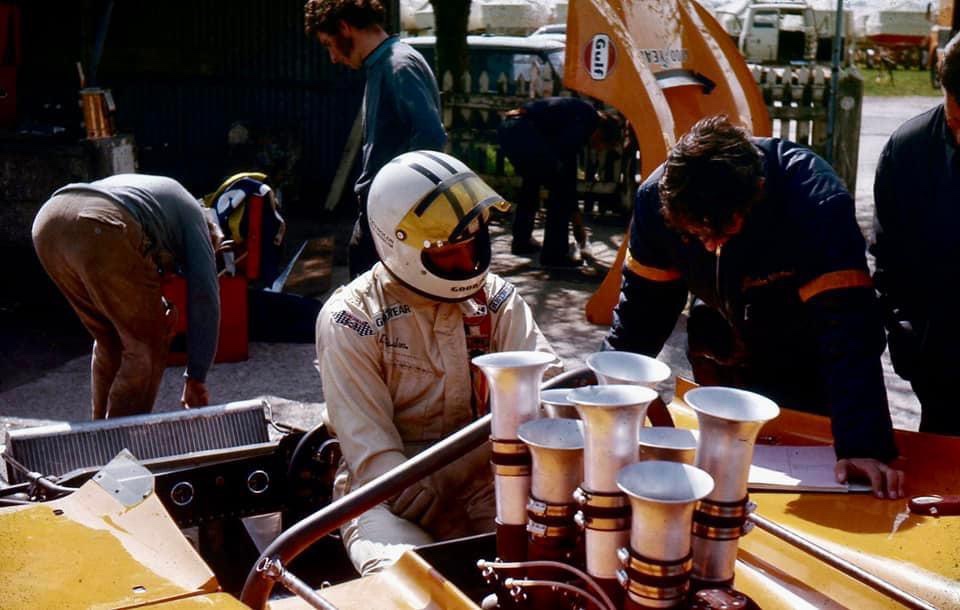
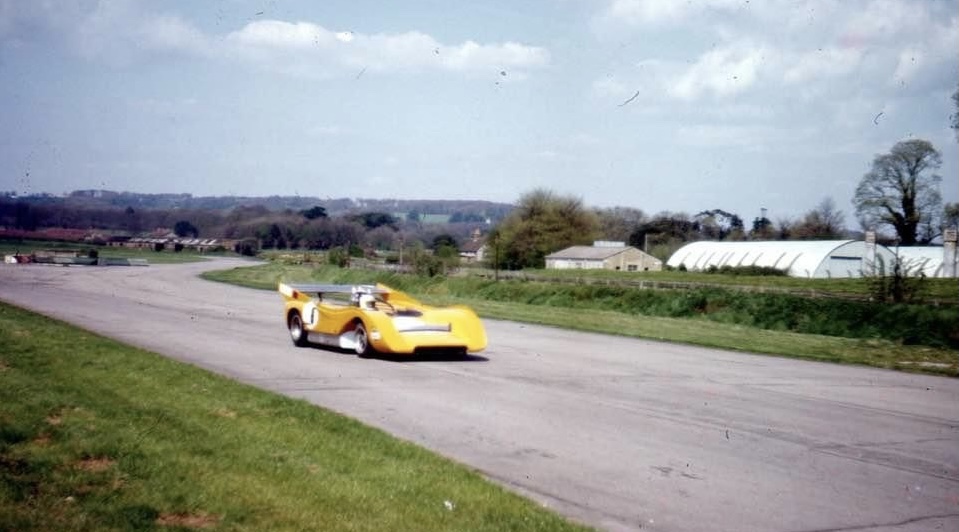
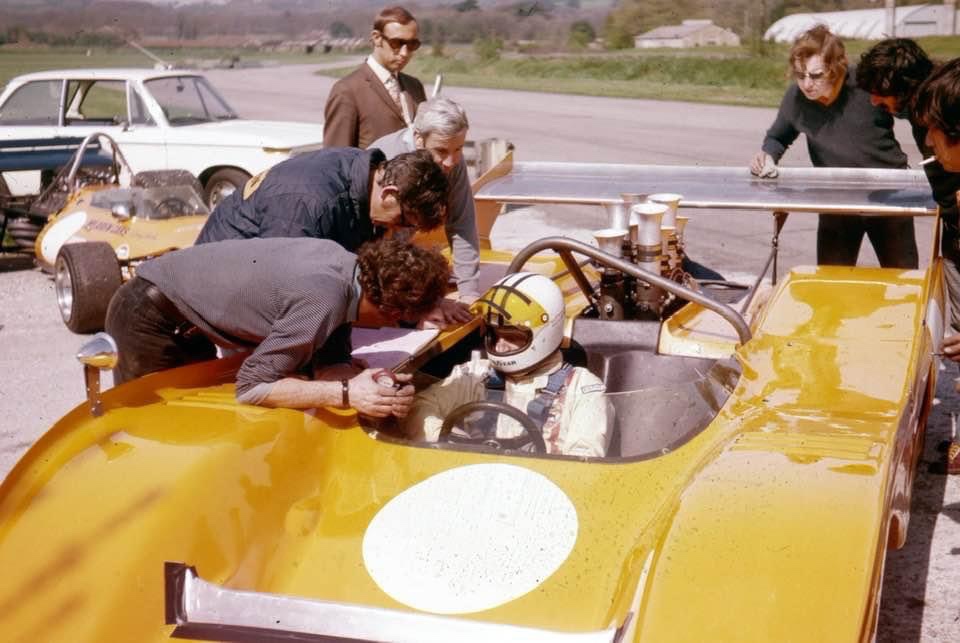
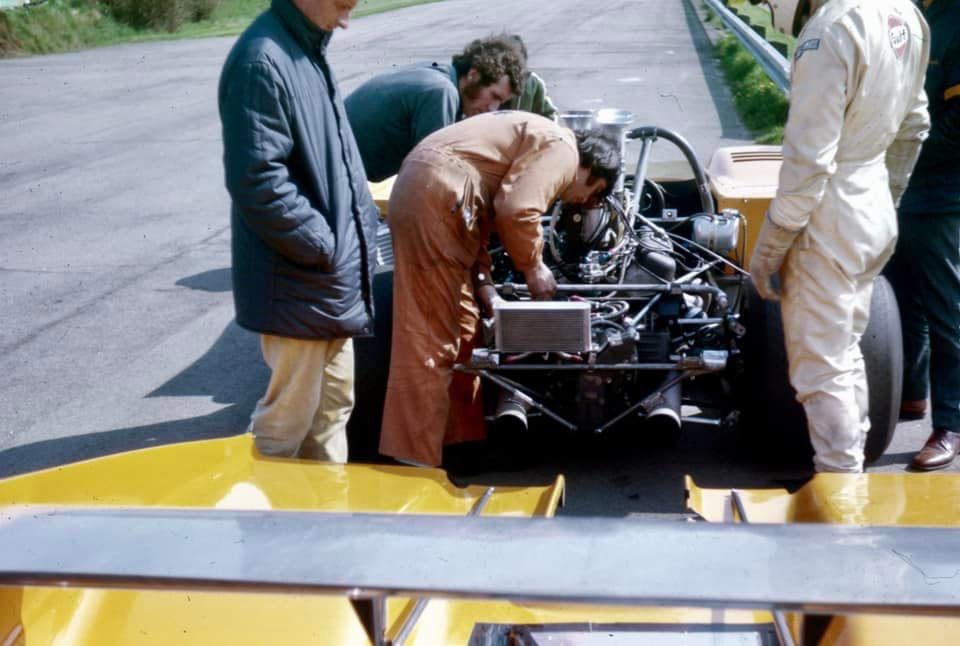
Adrian Bowler was a young medico back in 1971. He posted these marvellous words and photographs of his experiences as Team McLaren’s doctor during Goodwood test sessions that year. They are gold, too good to disappear into the bowels of FB without trace. So here they are for those who missed them.

Many thanks to Adrian and the Glory Days of Racing FB page, which is well worth sussing every few days for an incredible diversity of global racing photographs.

Tony Dowe, Barry Sullivan, Alastair Caldwell, Jim Stone and Tony Attard pushing Denny, M8F Chev (A Bowler)
McLaren M19 Ford Cosworth DFV, 1971-2 F1 car (A Bowler)

“1971, at the Goodwood motor racing circuit where Bruce McLaren had been tragically killed testing the Can-Am car (M8D Chev) the previous June.

Goodwood was a very primitive setup then, disused as a racing circuit for several years but utilised by several racing teams to test cars. Bruce lost control of his car apparently when the rear wing section separated from the body of the vehicle and it collided with a concrete marshall’s post on the Lavant Straight.

Following Bruce’s death, Teddy Mayer continued the Goodwood test sessions on the proviso that a physician be on standby at the track. As a young casualty doctor at St Richards in Chichester I was recruited by McLaren to fill the trackside Doctor role. It didn’t take much pursuasion, they paid 10 pounds which was about my weekly salary!

Denny winding it up in second gear (A Bowler)
Reynolds ally Chev 494cid, Lucas injected pushrod, two-valve V8. Circa 740bhp @ 6400rpm in 1971 (A Bowler)

I spent several days over the next six months sitting on the side of the track watching the proceedings and chatting with Denny Hulme, Teddy Mayer, Gordon Coppuck and several of the mechanics. I brought my camera with me on one occasion and these are some of the pictures.

I got to see the burn scars on Denny Hulme’s hands from a metanol fire practicing for the Indy 500 (McLaren M15 Offy in 1970). I learned lots about F1 and Can-Am cars which was mind-boggling for a lowly-ER doc!

On one occasion Pater Gethin was annoying the mechanics working on an F1 gearbox and they suggested he take me for a ride around the track in his Porsche 911, which he did! After the first lap he asked me if i wanted to go again…I declined. They let me drive my Ford Capri 2000GT around the circuit…very slowly.

(A Bowler)
Uncertain, Gordon Coppuck, Teddy Mayer in the grey hair at left listening to Denny, Alastair Caldwell leaning on the wing at right. (A Bowler)

On the day Denis Hulme was testing the M8F, as usual, the engine noise would gradually fade as he got to the back part of the track and then reappear with a vengeance as he accelerated down Lavant Straight. All was going well for several laps until on this particular lap the engine noise didn’t reappear. After maybe about 10 seconds the panic button was hit and everybody drove hell for leather around the track. There, at the top of the circuit, Denny had spun off and the windscreen was covered in blood. He was out of the car, standing by the side and when we arrived all he could say was ‘That fucking crow got in my way!’

It was 50 years ago, but was one of the most memorable times in my career.”

Alastair Caldwell comment; “Can-Am being warmed up, Denny, as normal, doing a visual check of the whole car, he would come up with some very acute observations at times. Ralph Bellamy behind (left), Designer of the M19 (1971 F1 car) rising rate suspension and later the F2 car (M21). Barry Sullivan leaning forward in front of Bellamy, Gordon Coppuck as well at right.” (A Bowler)
Massive bit of real estate, superb M8F, Chev engine and Hewland LG600 Mk2 transaxle (A Bowler)

Credits…

Adrian Bowler for the words and pictures, ‘Cars in Profile No 8 : McLaren M8’ David Hodges

Caption comments Alastair Caldwell, Hughie Absalom, Barry Sullivan, Steve Roby

Tailpiece…

Mayer sitting on the M19’s left-rear, Caldwell right-rear, while Barry Sullivan attacks the gearbox. Team Surtees truck and F1 TS9 behind the McLaren. Rob Walker is the well dressed gent, John Surtees in race overalls at far right (A Bowler)
(A Bowler)

Just another day in the office, Denny, M8F 1971.

I know it’s Denny but when I first glanced at Adrian’s shot I thought of Bruce 12 months before. RIP Bruce Leslie McLaren, 30/8/1937-2/6/1970.

Finito…

Jules Goux, works Ballot 2LS awaits his turn to set off, Targa 1922 (BNF)

I knew little about E. Ballot et Cie two years ago. Then I tripped over a photograph of Ballot 5/8LC #1004 competing at Safety Beach on Melbourne’s Mornington Peninsula in 1928, my thirst for all things Ballot remains unquenched.

The purchase of that factory 4.8-litre straight-eight 1919 Indy 500 racer – #1004 was raced at The Brickyard by Louis Wagner – and a 2-litre, four-cylinder 2LS – #15 was raced by Jules Goux in the 1921 French Grand Prix – by Alan Cooper, and his Patron, Stephen Brown, is an amazing story.

Harold (Hal) Cooper, and to a much lesser extent Alan, raced the cars with great success in Victoria and New South Wales in the mid-late 1920s. I wrote about their exploits in The Automobile, why don’t you buy a copy, that would make me look good with that nice Editor chappy, Mr Rishton; Back Issue – May 2021 – The Automobile

Ernest Ballot with two of the four 5/8LC 1919 Indy 500 racers out front of his extravagant art deco factory. Albert Guyot at the wheel on the left, Rene Thomas at right (Ballot)
Jules Goux’ Italian GP winning 3/8LC surrounded by 2LS’ in various guises. October 1921 Paris Motor Show held at the Grand Palais, Champs Elysees (Ballot)

Ballot commenced business at 103-105 Boulevard Brune, Paris in 1904 producing a range of simple, side-valve, stationary marine and automotive engines.

A profitable war building Hispano-Suiza aero engines provided Ernest Ballot with the loot to build his own cars. As the conflict wound down, he engaged pioneer aviator and 1914 Indy winner, Rene Thomas and Ernest Henry, to build four cars to contest the 1919 Indy 500, to promote his brand.

Together with The Charlatans – racer/mechanics Paolo Zuccarelli, Georges Boillot and Jules Goux – Henry built the revolutionary twin-cam, four-valve, Grand Prix engines for Peugeot from 1912-1914, from which all GP engines to this day are derived.

With an engine design up-his-sleeve, four 5/8LC, 4816cc, twin-cam, four-valve 125bhp, straight-eight racers, using ladder frame chassis and a four-speed gearbox were built and shipped to the US. The Ballots were quick, but plagued by tyre and magneto troubles, Albert Guyot’s fourth place was the marques’ best result.

Jules Goux and riding mechanic during the 1921 French GP, Circuit de la Sarthe-Le Mans. This 2LS is chassis/engine number 15, the car was purchased by Stephen Brown and Alan Cooper from the factory while in Paris in 1922, then raced in Australia (BNF)
The Goux 2LS is fettled before a crowd of admirers, superb atmospheric shot. The fascination of the public with fast automobiles – French ones at that – leaps off the image (MotorSport)
Joe Boyer’s Duesenberg 183 (DNF conrod) #16 dices with the Goux 2LS in France, 1921 (MotorSport)

Ballot’s Rue Cormeilles design team next attacked work on the 2LS and another Indy/Grand Prix car, the 3-litre 3/8LC.

Henry’s 3/8LC, a 2973cc, 107bhp scaled down 5/8LC was a masterpiece, surely one of the sexiest racing cars ever, four were made. Jules Goux won the 1921 Italian GP aboard one on the Circuito della Fascia d’Oro, at Montchiari, Brescia that September.

A little earlier in July, the French Grand Prix was held, it was the first major European race post-war. Ballot entered three 3/8LCs and a 2-litre 2LS against the mighty eight-cylinder Duesenberg 183s. Over 30 laps of a 17.26km course, 517km, at Le Mans, Jimmy Murphy’s Duesenberg just beat De Palma’s 3/8LC with Jules Goux’ 2LS a staggering third ahead of many nominally faster 3-litre cars.

These Deux Litres Sport were racers for the road, no more than 50, and perhaps as few as 20 were made. The 1986cc (69.9x130mm) 72bhp @ 3800rpm (safe to 4300rpm) engined cars were the first twin-cam 16-valve production road cars ever built.

This poster celebrates the win by Rene de Buck and Pierre Decroze aboard a 2LS in the September 1925 Gran Premio de Guipuzcoa (more usually known as the Spanish Touring Car GP). The pair completed the 1180.5km at an average speed of 98.4kmh. The race was part of the annual San Sebastian festival, the race, on the Lasarte road circuit, was held between the European and Spanish GPs

Other elements of an expensive cocktail included a channel section chassis, half elliptic springs front and rear located solid axles with one (two on some of the racers) Andre Hartford friction shock absorbers per wheel. Four-wheel drum brakes and a close-ratio gearbox completed an advanced package. There was also a catalogued modele de course with minimal doorless, wingless bodywork, a different bonnet and modified exhaust.

The more prosaic Ballots were the SOHC, 2-litre 2LT and 2LTS. The extensive competition activity was to build brand awareness of the marque generally, and specifically sell these normal road models aimed at a broader, albeit discerning market.

The 2LS first competed in the hands of Fernand Renard. He won his class and finished sixth outright at the Course de Cote a Gaillon (Gaillon hillclimb), near Rouen in October 1920.

Poor Renard – foreman of Ballot’s test department – died instantly when his 3/8LC collided with a truck which swerved into his path at Montrouge, Paris in February 1921. Testing Zenith carburettors, the experienced driver/riding mechanic was slated for a ’21 French Grand Prix drive, but it was sadly not to be.

Jules Goux, 2LS, French GP , Strasbourg, 1922 (BNF)
1922 French GP. Giulio Foresti, Ballot 2LS at left, and Pierre de Vizcaya, Bugatti T30 at right (BNF)
Foresti, 2LS French GP 1922 (BNF)
Foresti and his mechanic refuel their 2LS. Look carefully at this rare butt-shot, the attention to air-flow under the car is as considered as the rest of the body (MotorSport)

Etablissements Ballot entered two 2LS for Goux and Giulio Foresti in the April 1922 Targa Florio, the pair finished one-two in the 2-litre class. The outright winner was another works-Ballot driver, Count Giulio Masetti aboard a 1918 GP Mercedes 18/100.

In July, Ballot entered three 2LS in the Grand Prix De L’Automobile Club De France. From 1922-1925 major Grands Prix were run to a 2-litre formula. The race, centred on Strasbourg, comprised 60 laps of a 13.38km course, 803km in total.

Ballot and Bugatti (Type 30 straight-eight) competed for the Fugly Cup! Both companies presented aerodynamic, visually challenging machines with amazing cigar shaped bodies.

Felice Nazzaro won in a Fiat 804 2-litre straight-six. All three Ballots uncharacteristically failed with mechanical problems; Foresti after a piston broke on lap 44, Goux crashed on lap 33 and Masetti broke a rod on lap 18. The mechanical problems were thought to be a function of insufficient air getting to the radiator to cool the engine. The Bugatti T30s of Pierre de Vizcaya and Pierre Marco were second and third.

1922 French GP. 2LS streamliner radiator and front suspension detail. Note the sheet aluminium bulkhead supporting the radiator – its grille – and the ally body (BNF)
The Foresti 2LS, Targa 1922 (BNF)
Giulio Foresti at rest during the Targa Florio weekend, note the slab-tank on his ‘22 Targa 2LS. Foresti, a racer and Itala/Ballot dealer, came to Australia to deliver the Cooper brothers’ 5/8LC in 1925. He tested the car at Maroubra in the process of schooling the Coopers in its ways. Alan Cooper came close to killing himself and his mechanic in it days later in a monumental high-speed Maroubra rollover (BNF)
Jules Goux and mechanic at Targa, compare and contrast the bodies of the works-2LS in the various GPs contested in 1921-1922 (BNF)

Two Ballot 2LS were entered in the ’22 Italian GP at Monza but didn’t appear, into 1923 Ballot withdrew from more serious competition.

Dr Jean Haimovicci, a Romanian living in Paris, raced a 2LS at San Sebastian. “Very likely this entry received works support”, wrote Hans Etzrodt, the car appears to be one of the barrel-tank ’22 Targa cars. The doctor was third in the race taking five hours 19 minutes to complete the 445km on roads at Lasarte, south of magnificent San-Seb. Up-front was a pair of 2-litre Rolland-Pilain straight-eights driven by Albert Guyot and Gaston Delalande.

On the other side of The Channel, Malcolm Campbell won a race aboard a 2LS at Brooklands during the Whitsun or April meetings.

Malcolm Campbell, 2LS, at Brooklands during the BARC Easter meeting in 1923 (LAT)

Ballot spent a fortune on his race 5/8LC and 3/8LC GP/Indy 500 cars and the production 2LS. Despite an eye-watering price, these epochal 2-litre cars never came close to covering their development costs. Ernest went banzai! He created a marque instantly with his competition program, but his coffers were groaning as a consequence. So were his shareholders and bankers.

By 1928 Ballot’s range included the SOHC, 2.9-litre eight-cylinder RH, by 1931 the company had been acquired by Hispano-Suiza. Game over, but it was awfully sweet while it lasted.

The nautical theme of the Ballot logo dates back to Ernest Ballot’s beginnings in the French Navy, where he trained as an engineer. The Masetti 2LS with Ernest Ballot in the foreground, French GP 1922 (BNF)

Postscript…

What intrigues me, is what the chassis numbers of the works 2LS’ were/are? Was the car raced by Campbell in the UK a works racer, or a production modele de course?

It seems to me there were three (at least) works prepared and raced 2LS’. Sure, there were changes of bodywork from one event to the next, but my thesis is that the chassis’ used were probably the same throughout.

Those of you who have the voluminous, sumptuous and extravagant ‘Ballot’ by Daniel Cabart and Gautem Sen have a head start.

Do get in touch if you can assist; mark@bisset.com.au

The rear, most of it, of the Goux 2LS during the 1921 French GP weekend. The spare – look closely – is mounted vertically within the rear bodywork 3/8LC style (BNF)

Credits…

Hans Etzrodt and Kolumbus.fi, the libraries of Alistair McArthur, David Rapley, Bob King and Brian Lear. BNF-Bibliotheque Nationale de France, LAT, MotorSport, ‘Ballot’ Daniel Cabart and Gautam Sen, and the late David McKinney on The Nostalgia Forum

Tailpiece…

(BNF)

Let’s finish as we started, with the majesty of the 1922 Targa Florio, again it’s Jules Goux, 2LS.

Finito…
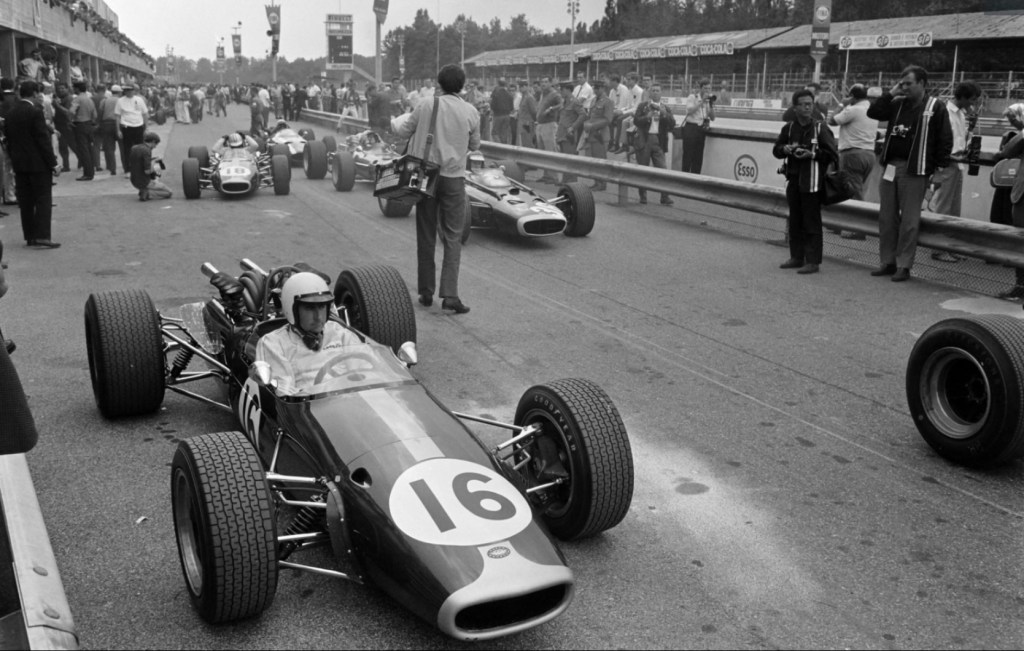
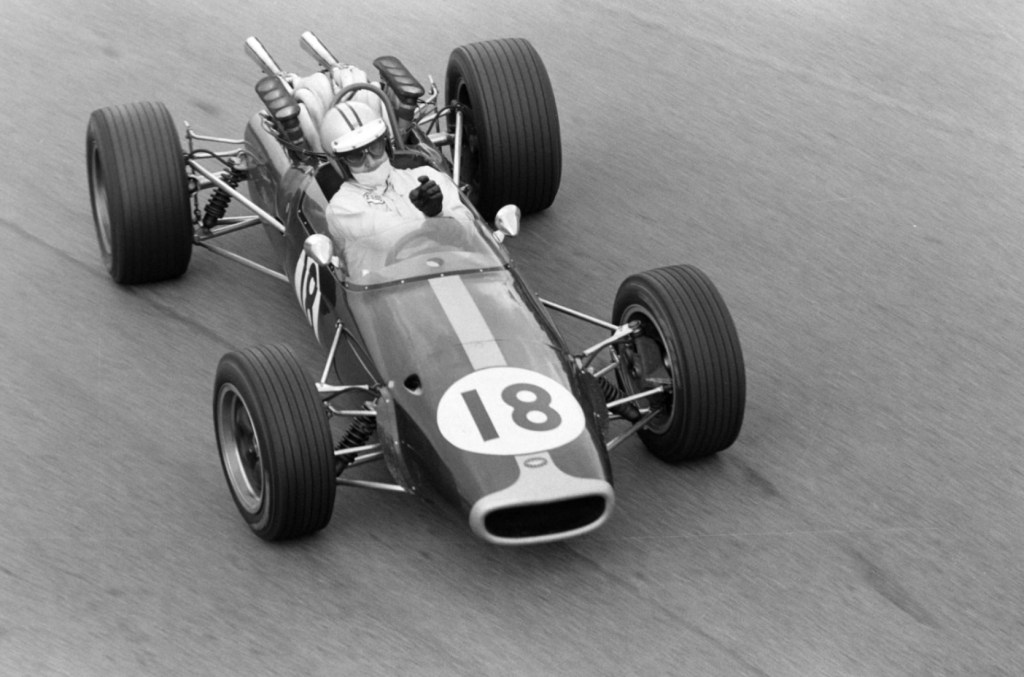
Jack Brabham aboard his Brabham BT24/1 Repco ‘Streamliner’ in the Monza pitlane during the September 10, 1967 weekend.

Lanky Dan Gurney is at right keeping an eye on his old-boss, while Jo Ramirez, in the white pants/dark top, and the All American Racers crew, tend to Dan’s erotic Eagle Mk1 Weslake #103.

Brabham, Ron Tauranac and Repco-Brabham Engines nicked the 1966 F1 World Drivers and Constructors titles from under the noses of those who were a smidge quicker, but not as well organised or reliable as the Brabham and Hulme driven Brabham BT19/20 Repco 620 V8s.

They did it again in 1967, not that it was a lucky win. Their 330hp Brabham BT24 740 Repco V8 was all new; chassis, engine and major suspension components. They got the cars running reliably el-pronto, aided and abetted by blooding the new exhaust-between-the-Vee cylinder heads during the Tasman Cup; both drivers used 2.5-litre RBE640 V8s throughout New Zealand and Australia.

Lotus ran them close of course. Colin Chapman’s Lotus 49 chassis – in truth little different to his 1966 Lotus 43 – was powered by the new 400bhp Ford Cosworth 3-litre V8, rather than the heavy, unreliable 3-litre BRM H16 engine fitted to the 43.

Driven by a couple of champs in Jim Clark and Graham Hill, they were mighty fine, quick cars, but not in 1967, reliable enough ones. That would come soon enough, of course…

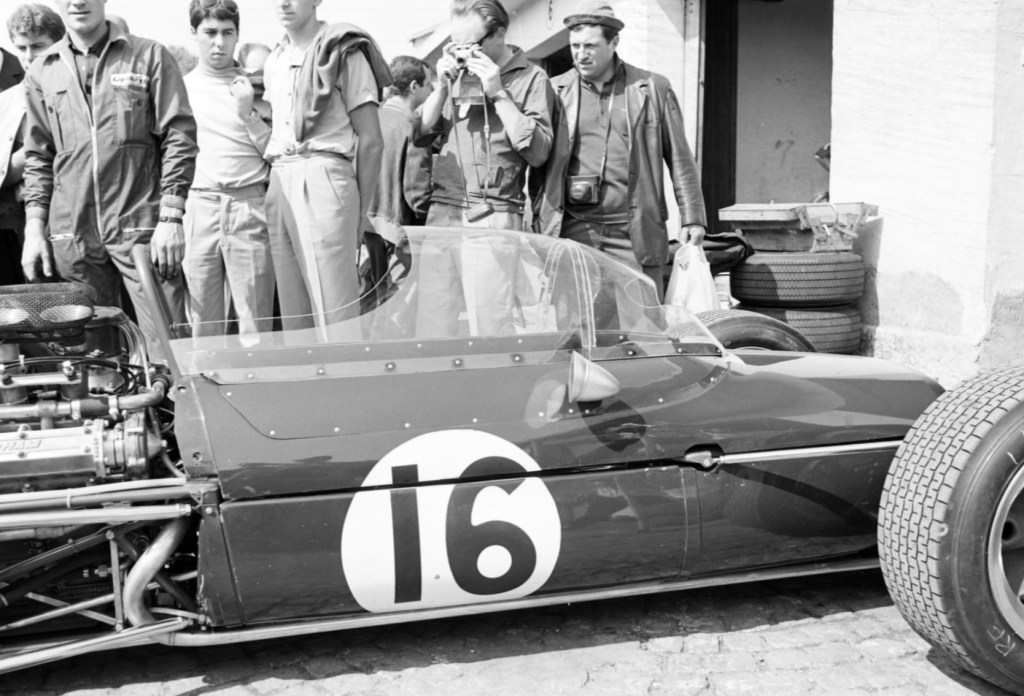
Brabham, all enveloping rear body section clear (MotorSport)
Ron Tauranac, Keith Duckworth and Denny Hulme swap notes. “Have you really only got 330bhp Ron?” (MotorSport)

As Lotus and Cosworth Engineering addressed engine reliability, Brabham and Tauranac tried to squeeze more speed from Ron’s small, light BT24.

There was only so much Repco Brabham Engines could do with the SOHC 740 Series V8, they were busy just keeping up with routine rebuilds for the two BRO cars. As the year progressed the Maidstone, Melbourne crew explored the 850 radial-valve V8 as their ’68 F1 engine, and then, having spent way too much time flogging that dead-horse, on the definitive, but way-too-late 860 DOHC, four-valve V8. Click here for a piece on the RBE740; ‘RB740’ Repco’s 1967 F1 Championship Winning V8… | primotipo…

The aerodynamics of the BT24 was another thing entirely of course. That was within Ron and Jack’s control. If MRD could just make the car a little bit more slippery through the air, maybe an extra 500revs or so would make the difference between race wins, and not.

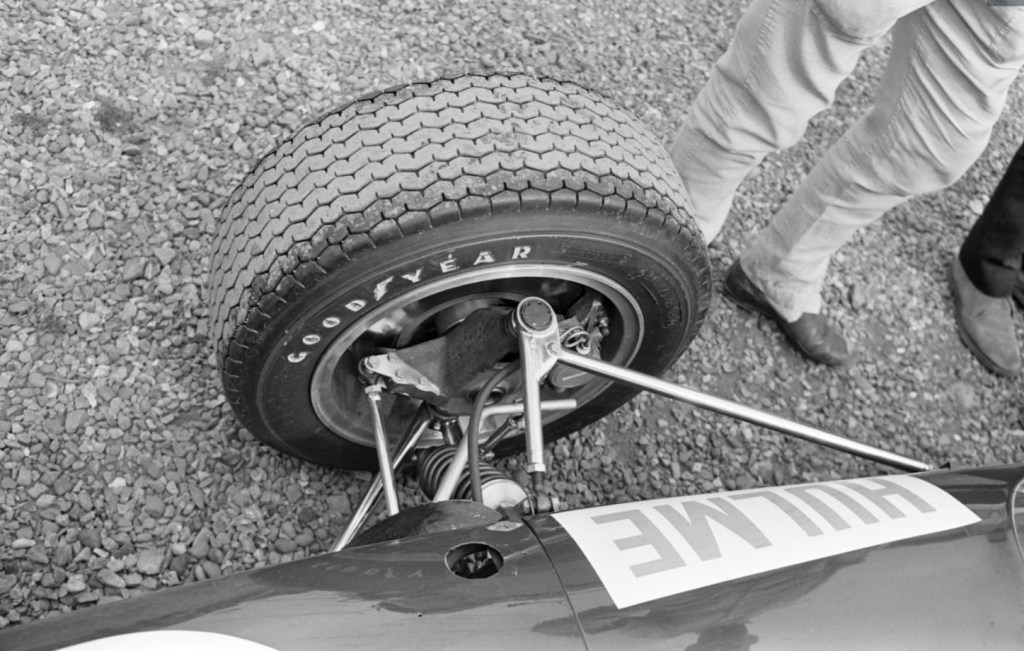
By the time the team got to Monza on September 7, the cocktail of goodies tried on Jack’s BT24 included the all-enveloping windscreen used on an F2 BT23 earlier in the year, all-enveloping bodywork extending right back beyond the endplate of the Hewland DG300 transaxle, and spoilers which were tried either side of the car’s nose, and alongside the engine. Remember, the Chaparral inspired explosion of wings in F1 occurred in 1968.

Rear spoiler, Monza (MotorSport)
Note the winglets or spoilers, Jack’s nosecone at Spa in mid-June 1967 (MotorSport)

Jim Clark started from pole, with 1:28.5 secs, ahead of Jack on 1:28.8, then Bruce McLaren, Chris Amon and Dan Gurney in BRM, Ferrari and Weslake V12 engined cars, then Denny in the other BT24 on 1:29.46.

Jack could have won of course, but the equally foxey John Surtees out-fumbled him in the final corners, bagging a popular win for the Honda RA300 V12. Denny retired with over-heating so the championship – ultimately decided in his favour – was still alive, with races in the US and Mexico to come.

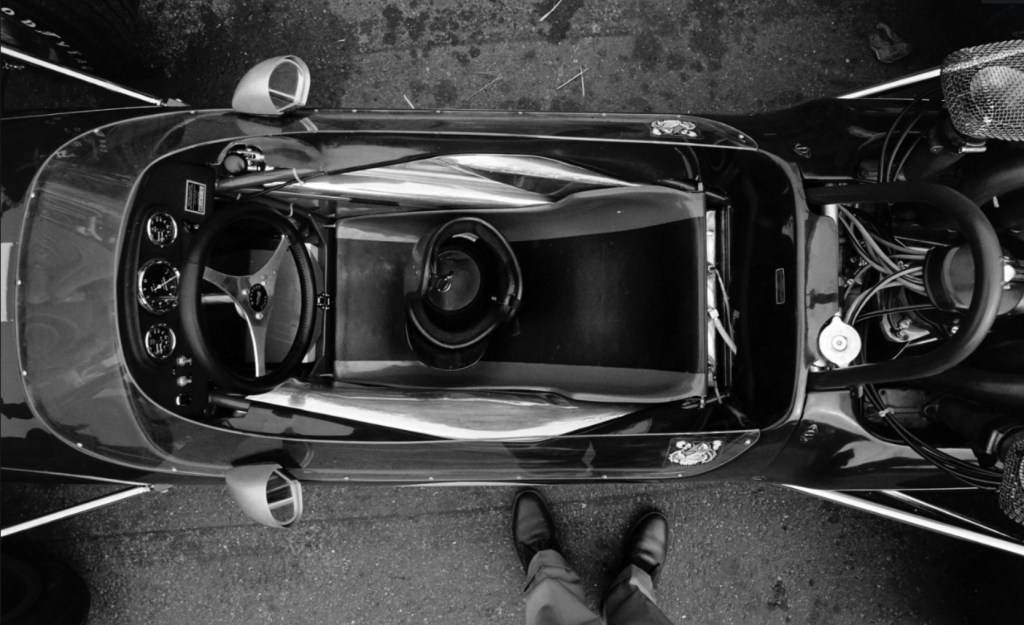
The office of BT24-1, Jack’s car. The Varley battery is in the aluminium box beneath the driver’s knees (MotorSport)

One of my favourite Grand Prix cars, the BT24, was just enough of everything, the sheer economy of the car always strikes me. See here for my last rave in relation thereto; Give Us a Cuddle Sweetie… | primotipo…

It was the first time Ron had designed an all-new F1 chassis since BT3 way back in 1962. Beautiful details abound, not least the new cast-magnesium front uprights first fitted to Jack’s BT23A Repco, his ‘67 2.5-litre Tasman Cup mount, in late 1966, the Alford & Alder/Triumph Herald uprights used hitherto were finally cast aside.

Hulme’s BT24/2 during the British GP weekend (MotorSport)
Feel the noise…Monza pit action. Brabham and Denny behind him in the distance. The queue by the Armco is headed by Mike Spence’ BRM P83 H16, Chris Amon’s Ferrari 312, perhaps then one of the Cooper Maseratis (MotorSport)

BT24/1 debuted at the same race meeting, Zandvoort 1967, as the Lotus 49 Ford DFV, albeit Jack raced BT19, his ’66 championship winning chassis. Jim Clark won famously on the debut of an engine which set the standard for a decade and a half, more if you include its many derivatives.

Denny’s BT24/2 was ready at Le Mans, when Brabham and Hulme delivered the old one-two, with The Boss in front. Clark won at Silverstone, before another BT24 one-two with Denny ahead of Jack. At Mosport Jack won from Denny. Hulme won at Monaco in May (his first championship GP win), so led the championship by nine points from Jack, with Jim further back. Clark dominated the balance of the season, winning at Watkins Glen and Mexico City, but Denny’s two third placings won him the drivers title and

Those with F2 knowledge will recall that Frank Costin’s Protos Ford FVA raced with a cockpit canopy akin to Brabham’s in 1967. BT24/1 here, again at Monza. Whatever the straight-line benefits, Jack simply couldn’t place the car as he wanted given the difficulty of seeing thru the canopy (MotorSport)
If I knew how to use Photoshop I’d get rid of ‘boots’, but I don’t…BT24/1, ain’t-she-sweet (MotorSport)

BRO sold the cars to South Africans, Basil van Rooyen (BT24/1) and Sam Tingle (BT24/2) after the end of the season. When it became clear that Jochen Rindt’s 1968 BT26 was running late, he raced BT24/3 – which first appeared at in practice, at Monza in September 1967, carrying #16T – in some of the early races of 1968. He raced BT24/2 at Kyalami (Q4 and third), and BT24/3 at Jarama (Q9 and DNF oil pressure) and Monaco (Q5 and DNF accident), before Dan Gurney had a steer at Zandvoort (Q12 and DNF throttle).

The final works-gallop of a BT24 was Jochen’s use of BT24/3 during practice over the British GP weekend at Brands Hatch in July. Before you pedants have a crack at me, for the sake of completion, German ace, Kurt Ahrens, raced the BRO tended, Caltex Racing Team entered, BT24/3 to Q17 and 12th place at the Nurburgring in 1968. Brabham BT24 chassis anoraks should click here; Brabham BT24 car-by-car histories | OldRacingCars.com

Threatening in an elegant kinda way. You can see what is being sought, ignoring the inherent streamlining difficulties of fully outboard suspension front and rear. Ron went to front inboard springs and rockers with the ’68 Indy BT25 Repco and ’70 F1 BT33 Ford (MotorSport)

Credits…

Magnificent MotorSport Images, Getty Images, Allen Brown’s oldracingcars.com

Tailpiece…

(MotorSport)

Easy-peasy, two hands are for schmucks!

Denis Clive Hulme shows us how it’s done at the Parabolica; Denny’s elegant, sublime prowess for all to see. BT24/2 Monza 1967, ‘standard’ bodywork.

Finito…
(MotorSport)

Beautiful shot of the great South Aussie in the Embassy Hill Lola T370 Ford during practice for the 1975 Swedish Grand Prix at Anderstorp.

It’s been a great pleasure working with Vern over the last month or so on a two-part ‘Living Legends’ feature in Auto Action, click here to buy the first one; AUTO ACTION 1827 – Auto Action

He is an ace-bloke with a career of great diversity; Karts, Formula Ford, Formula Atlantic, F2, F1, Indycars, Sportscars inclusive of a Le Mans win, not to forget a few taxi-races, team ownership and an amazing, but ill-fated Supercar manufacturing phase.

I’ve had a crack at him before in a couple of small bites, here; In Short Pants… | primotipo… and here; Singapore Sling with an Elfin Twist… | primotipo… oh, yes, this one in a Macau GP context too; Macau Grand Prix… | primotipo… Oops, more here too; 1977 Macau Grand Prix… | primotipo…

Success in various Formula Fords in 1969-1970 propelled him into a works FF Palliser in mid-1970, and in 1971, Formula Atlantic rides; he won the very first Formula Atlantic championship in the world, the British in 1971.

Schuppan, Palliser WDB4 BRM-Ford twin-cam at Brands Hatch on March 7,1971. He won the first round of the British Championship. I think it’s Graham Eden, Chevron B18C alongside, and #25, or perhaps #35 is not listed on my results site (V Schuppan Collection)

Of course it all started with karts in South Australia, here carrying the #1 plate, with loads of brio and intent on display, as State Champion at Whyalla, circa 1966.

Schuppan, March 722 Ford BDA F2 with Falconer body during the Rothmans 50000 at Brands Hatch in 1972 (V Schuppan Collection)

Schuppan’s March 722 (chassis 40) was bought for him by Marlboro, BRM’s sponsor, the March was to keep him busy, to supplement limited F1 drives in 1972.

He raced it in both Formula Atlantic and F2 guise in Europe and Asia. Notable victories include four British FA rounds in 1972, the 1973 Singapore GP (Ford twin-cam) and 1974 Macau Grand Prix. Teddy Yip became a long-term Schuppan sponsor, he bought the car circa 1973. Apart from Schuppan, it was raced by such notables as Alan Jones, Derek Daly, Patrick Tambay, and, when quite long-in-the-tooth, in 1981 by Roberto Moreno who raced it after boofing his Ralt RT4 in practice.

Here it is above in Dennis Falconer bodied, big-tank Formula Libre guise during the August 1972 Rothmans 50,000 500km libre race at Brands Hatch.

£50,000 was a huge prize-pool, 58 cars attempted to qualify, 30 raced with F1 cars in the top-five. Emerson Fittipaldi was up front in a Lotus 72D Ford. Vern qualified 20th in the F2-spec March, but he was the first retirement, on lap 10, after driveshaft failure.

Schuppan at Brands Hatch again, racing the March 722-40 Ford BDA. In box-stock 722 F Atlantic spec, probably on his winning way, April 16, 1972 (N Snowden)

Dennis Falconer was a Canadian born aerodynamicist employed by March who designed bodies for various smaller single-seaters. Ralph Hume worked for Vern in-the-day and describes the ever-changing modifications to keep the 722 competitive.

“Vern’s 722 was updated for 1973 with a wide nosed body kit developed by Falconer and raced in this form in England and the far east. The body was great on handling circuits but slow on fast ones. It was on the front row of an F2 race at Oulton Park and at the next race at Hockenheim we struggled for straight-line speed.”

“The body kit further evolved in 1974 to narrow nose and wings, we did a few Atlantic races in this form. At the end of the year we fitted a modified March 732 body and narrow track 732 suspension. We spaced the nose forward about 300mm and added a splitter but retained the side radiators. At the back we fitted a tweaked Lola T360 (F Atlantic) wing.”

“It’s first race in this spec was at Macau, out-of-the-box it was great. Vern put it on pole, and won the race. The car stayed at Macau and in subsequent years was raced by guests of Mr Yip…” as described above. For many years the March has been in the Macau Car Museum.

Same car folks, 722-40 in 1980, Vern was fifth at Macau behind three modern Ralt RT1s, and a March 79B. At this stage the car is described as a March 722/76B Ford BDA

Credits…

MotorSport Images, Vern Schuppan Collection, Nigel Snowden, Getty Images, Ralph Hume on tentenths.com

Tailpiece…

Brian Hatton’s cutaway of Eric Broadley’s Lola T370 Ford Cosworth DFV 3-litre V8, a quintessential British kit-car of the period

Finito…

(Ullstein Bild)

On July 28, 1935 Tazio Nuvolari defeated nine superior Silver Arrows over 22 laps, 312 miles, on the challenging, treacherous, Nurburgring in an outclassed 265bhp Alfa Romeo Tipo B/P3 during the German Grand Prix…

The foreboding, moody image above shows seventh placed Hanns Geier’s Mercedes Benz W25A 3.4-litre 302bhp straight-8 supercharged (s/c). He is ahead of one of four Auto Union B Types in the race, these machines powered by 5-litre 375 bhp V16 s/c motors.

Overnight, thousands of spectators arrived in the Eifel Mountains, what greeted them on race morning was fog and light, misty rain. It rained progressively harder as the 11am start time approached, then stopped not long before the off.

(unattributed)

In front of some 300,000 spectators, Rudy Caracciola led initially in a Benz W25B 4-litre 370-430 bhp for the first nine laps, with Nuvolari in second after one lap aboard his 3.2-litre straight-8 s/c Alfa. He fell back after a lap two spin at Bergwerk. At this stage of the race Bernd Rosemeyer, AU mounted, broke the lap record in his chase of Rudy, but he was unable to close the gap completely.

Rosemeyer then spun into the Breidscheid ditch, and arrived well back then went into the pits with a wobbly rear wheel and a throttle linkage jammed with mud. The only Alfa left in the race at the end of lap six was Nuvolari in fifth place.

Tazio made up time in the winding and downhill sections where the greater engine power of the German machines could not be successfully deployed. Nuvolari then passed Von Brauchitsch, Mercedes W25B for third on the outside of the Karussell, Brauchitsch regained the place on the following lap.

What a drive – one of the greatest in the opinions of all who matter (unattributed)

Caracciola still led on lap nine, but Tazio was now within eight seconds of him, and passed him on lap 10. The first four cars were then covered by just over 10 seconds, and the three Silver Arrows by only a few metres; the order was Nuvolari, Caracciola, Rosemeyer, and Brauchitsch.

The top three cars pitted on lap 11, Nuvolari’s stop was a shocker, the mechanics, in their excitement, broke the refuelling pump handle! He lost one minute 27 seconds to his competitors, the order at the end of lap 12 was the Luigi Fagioli Merc W25A, Brauchitsch Merc, Rosemeyer AU, Caracciola Merc, Stuck AU B-Type, and the Nuvolari Alfa.

At the end of the following lap the order was Brauchitsch, Rosemeyer, Caracciola and Nuvolari. Rosemeyer pitted at the end of lap 13 to address his throttle linkage, which was still binding, that must have been somewhat of a problem in a car of power on those tyres in such greasy conditions – this put him out of contention. Von Brauchitsch led on laps 14, 15, 16, 17, 18, 19, 20 and 21- with Nuvolari second from lap 15.

“The German had to pay for his tyre-murdering style of driving,”when the left rear tyre came apart on lap 22, only nine km from the finish. Nuvolari passed Von Brauchitsch, stricken Mercedes, heading towards a well-deserved victory for Alfa Romeo.” Stuck’s Auto Union was second, ahead of Caratch, Rosemeyer and Von Brauchitsch with his Mercedes on the rim in fifth.

Whilst the crowd cheered, the win it was not quite so popular with the Nazi mob present…

Credits…

Ullstein Bild, race report summary by Hans Etzrodt on Kolumbus.fi

Finito…

It’s amazing given that the Monaco quayside was unguarded for so many decades, that only two drivers took involuntary Monte Carlo Harbour dips, Ascari, aboard a Lancia D50 in 1955, and Hawkins in a Lotus 33 Climax a decade later.

The Australian was still making his name, while Ascari was at the top of his game, and enjoying somewhat of a renaissance at the wheel of Vittorio Jano’s masterpiece. The fates of both Monaco bathers were similar, both died aboard sports-racers. Poor Ascari in a pointless testing accident aboard a Ferrari 750 Monza at Monza on May 25, 1955, only three days after Monaco. Hawkeye died a grisly, fiery, probably component failure caused death aboard a Lola T70 Mk3B Chev at Oulton Park on May 26, 1969.

Paul Hawkins in the ex-Clark/Spence Lotus 33 Climax R8 early in the 1965 Monaco GP (MotorSport)
Alberto Ascari, Lancia D50 ahead of the Maserati 250F shared by Jean Behra and Cesare Perdisa. Monaco 1955 (unattributed)

In 1955 Ascari inherited the lead after the Mercedes W196 duo of JM Fangio and Stirling Moss dominated the first half of the race; Fangio retired with transmission trouble, then Moss blew an engine on lap 80. Ascari approached the chicane too quickly – perhaps distracted by crowd reaction to Moss’ retirement, or the lapped Cesare Perdisa behind – and burst through hay bales and sand bags into the harbour, having missed a huge steel bollard by only centimetres.

The Lancia bubbled to the bottom of the harbour while the crowd were mesmerised with fear for his safety, only three seconds passed before Ascari’s familiar blue-helmet appeared above the surface. He was taken aboard a boat, with a broken nose, but otherwise ok.

Ascari a split second before his swim (unattributed)
One shaken and plenty stirred Lancia D50 being recovered from the depths after the race (MotorSport)

Lancia had given dispensation to Ascari to race a Ferrari 750 Monza with his friend, Eugenio Castelotti in the Monza 1000km on May 29. Ascari travelled to Monza only to watch Castellotti test the car, then decided late in the day to do a few laps wearing jacket, tie and Castellotti’s helmet. On his third lap he inexplicably crashed on the high-speed Curva del Vialone, he died within minutes of having been thrown out of the somersaulting car.

All of Italy grieved.

Tin Tin Ascari cartoon

Wonderful Alberto Ascari portrait from El Grafico, an Argentinian magazine. 1950 Ferrari 125

British Boys Own Character – WW2 Spitfire pilot, highly credentialled amateur racer and man of independent means – James Richard ‘Dickie’ Stoop (July 30, 1920-May 19, 1968) acquired the first Lotus 33, chassis R8, for Paul Hawkins use in early 1965. See here for its history; Lotus 33 R8 race history | OldRacingCars.com

The Equipe’s first race was at the Sunday Mirror Trophy at Goodwood in mid-May, there Hawkins started from the rear of the grid after mechanical dramas which continued in the race, he was out after one lap with oil scavenge problems. Jim Clark won in a Lotus 25 Climax.

The BRDC International Trophy followed at Silverstone a month later. He had a better weekend, qualifying on the second last row and finishing tenth, up front was Jackie Stewart’s BRM P261 and John Surtees Ferrari 158.

Then it was off to Monte Carlo for Hawkins’ championship debut.

He qualified the car 14th and was running well, then, on lap 80 (of 100) he clipped the barrier on turn-in, causing the car to turn sharp-left – between the bollards, exactly as Ascari had managed – then sank 10 metres to the bottom. “Only when it settled on the bottom and rescue divers arrived did Hawkins extricate himself, take a huge gulp of air from the proffered mouthpiece and rocket back up to the surface,” John Smailes wrote.

The elegance of simplicity belies the deep underlying insights of Lotus 25/33 conception. Paul Hawkins flat-chat in R8 at Monaco in 1965 (MotorSport)
It ain’t perfect, but David Hudson’s shot catches Hawkins mid-flight just before splashdown (MotorSport)

“He’d had the extraordinary presence of mind to hit the engine kill-switch just as the car entered the water, saving the very expensive motor owned by the very poor team from instant destruction. It was dried out and used again in the following Grand Prix.”

R8 recovery post race. That the car is upside down makes you wonder if that is the way it settled on the bottom of the harbour. And therefore that Hawkeye made his escape on the way down – which cannot have been easy (Getty)

Well, not quite actually! While Paul was ok, the team missed both following GPs at Spa and Silverstone while the car was dried out, and carefully made-good, before reappearing at the Nurburgring on August 1.

Paul again failed to finish, having qualified 19th, he was out with undisclosed mechanical dramas after four of the 15 laps.

It was the final race for Paul aboard R8, Stoop sold it to MGM for a planned film, it then passed via Jo Siffert to Sweden’s principal museum of modern art, the Moderna Museet in Stockholm, where it remains as a prized exhibit. 

No shortage of comedians during the German GP weekend. R8 looks no worse the wear for its dunking two months before! (MotorSport)
Paul Hawkins at right, with fellow Porsche colleagues, Huschke von Hanstein, and co-driver Rolf Stommelen, after winning the 1967 Targa Florio in a Porsche 910 (MotorSport)
Dickie Stoop aboard his Porsche 911S at Snetterton, March 24, 1968 (MotorSport)

Etcetera…

Dickie Stoop : Autosport Obituary May 24, 1968.

“It is very sad to have to record the death during a club meeting at Croft last Sunday of Dickie Stoop. Apparently Dickie suffered a coronary thrombosis and died at the wheel of his Porsche 911S, which veered off the track into the bank.

James Richard Stoop had been an amateur racing driver of considerable standing for many years. His first race was the supporting F3 event at the Daily Express Silverstone in 1948, when he drove a GS1, and over the last 20 years he campaigned many types of car, but remained faithful for most of his racing to the marque Frazer-Nash.

He competed at Le Mans no fewer than 10 times: in 1950 he was 9th overall and won the 2-litre class, in 1951 he was 19th and in 1955 he was 10th. In 1958 he drove the works spaceframe AC into 8th place, again winning his class. He also took part in long-distance racing at Spa, Rouen, Montlhery and elsewhere, and in 1964 was 3rd overall in the Rand 3 hours co-driving Peter Sutcliffe’s E-type.

He performed prolifically in club racing, not only in Frazer-Nashes but also in triumphs, Healeys, a D-Type Jaguar and a Lotus 11. He also drove a Formula 2 Cooper in the late ‘50s, and with the passing of Frazer-Nash line he transferred his loyalties to Porsche. His successive Type 356 Carreras, registered YOU 4 and 5 HOT, brought him a lot of wins; having been co-victor in the 1959 Autosport Championship with the Sebring Frazer-Nash, he won the Autosport 3 hours at Snetterton the following year in YOU 4 after a tremendous battle with Chris Summers’ Elite, won his class in 1961, and then won the 2-litre division of the championship in 1962 and 1963. He also had a few races with an RS60 Porsche Spyder, and in 1964 drove a 904.

More recently he had concentrated on club production sports car racing with his silver 911S Porsche, also registered YOU 4; this car was a frequent class winner. A retired RAF officer, he was only 47.”

Credits…

MotorSport, Getty Images, Allen Brown’s Oldracingcars.com, ‘Formula One: The Australian and New Zealand Story’ John Smailes

Tailpiece…

Alberto Ascari chases teammate Eugenio Castellotti, superb MotorSport image, Lancia D50s, Monaco 1955.

Finito…
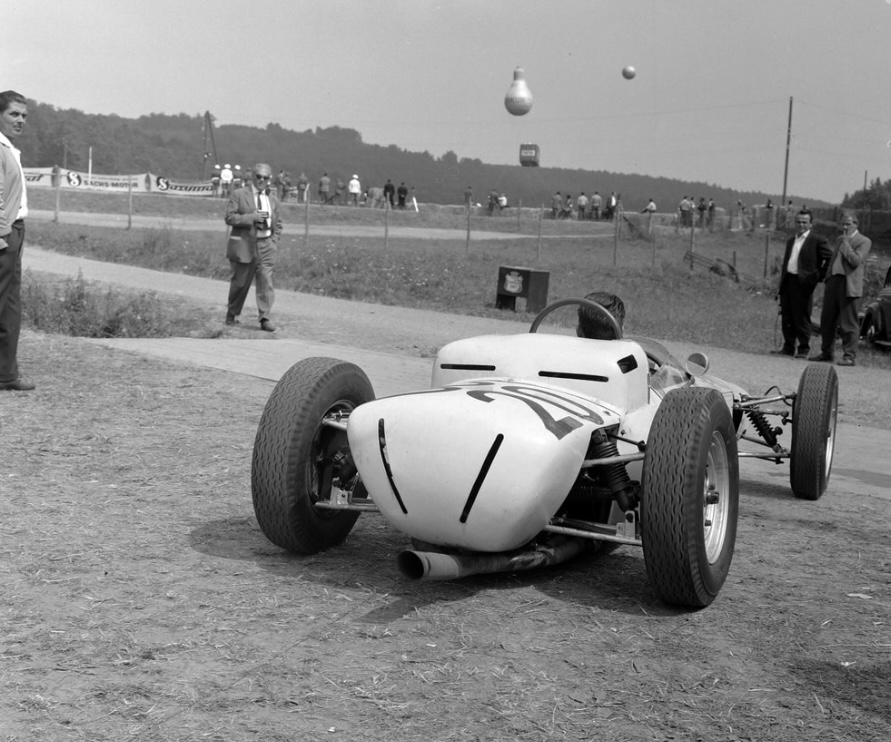
(R Schlegelmilch)

David Walker lined up for the final of the Monaco F3 GP, May 22, 1971.

He won his heat and the final in a race which was something of a metaphor of an incredible season aboard his works Lotus 69 Novamotor-Ford 1.6. Giancarlo Naddeo, Tecno 69 Ford was second, and Patrick Depailler’s Alpine A360 Renault, third.

The grid that year also included Steve Thompson, Jean-Pierre Jabouille, Roger Williamson, Rikki Von Opel, David Purley, Bob Evans and Francois Migault.

Walker’s F3 year included wins at Silverstone and Cadwell Park in April, Brands Hatch, Zandvoort (Dutch GP F3 race) and Oulton Park in May, and Silverstone in June. Early July brought victory in the French Grand Prix support race at Paul Ricard. That month got better with a win at Croft which ensured the Sydneysider was razor-sharp over the British GP weekend at Silverstone, Walker also won that blue-riband support event.

But there was no break for the team, the following day he won the the Cadwell Park BARC British F3 Championship round. August yielded wins at Thruxton and Croft, while Mallory Park fell to Walker in September and Snetterton in October.

Dave Baldwin’s F3 Lotus 69 design (there were also F2, FB and FF 69s) had a spaceframe chassis based on his Lotus 59, disguised with the bodywork and beefed up front suspension of the 69 F2 car. 1.6-litre Novamotor Lotus Ford twin-cam, Kugelfischer injected via air restrictor Walker again at Monaco (R Schlegelmilch)
Oh-so-period cockpit! Leather bound wheel and a dash full of Smiths instruments. Wonderful. Monaco (R Schlegelmilch)

In one of the most dominant ever seasons of F3 racing Walker won most of the big races and two of the three British F3 Championships – the BRSCC/MCD and BARC – with Roger Williamson taking the other, the BRSCC/MCD Lombard.

For the sake of completeness, Walker’s season commenced with the ‘Torneio Internacional de Formula 3 do Brasil’ (Brazilian F3 championship) run at Interlagos and Taruma during January.

Dave raced his (1970) works Lotus 59A Ford to third, second, 12th and first in the four round series, placing third overall behind Wilson Fittipaldi and Giovanni Salvati in Lotus 59A, and Tecno TF70 respectively.

Walker, Lotus 59A Holbay Ford, (1-litre 100bhp ‘screamer’) Interlagos, Brazil, January (FL Viviani)

Walker was the most successful of the 1971 Gold Leaf Team Lotus drivers, Emerson Fittipaldi and Reine Wisell had a lean year in Grand Prix racing, Lotus failed to win a GP for the first time in over a decade.

F1 proved a much harder nut for Walker to crack, and that story is a good deal more nuanced than most pundits would have you believe…one for another time.

Walker during a much tougher 1972

Credits…

Rainer Schlegelmilch, Fabio Luiz Viviani https://www.flickr.com/photos/146683351@N05/, F2 Index, Allen Brown in Oldracingcars.com

Tailpiece…

Finito…

(Getty Images)

Evocative shot of Peter Collins in his Ferrari Dino 246, 1958 #246/002, during the July 1958 British Grand Prix at Silverstone.

He won the race by 24-seconds from Mike Hawthorn who took the World Drivers Championship that year, before perishing in ‘that’ road-dice with Rob Walker shortly thereafter.

I’ve done these cars to death, both front-engined F1 jobbies and their related mid-engined Tasman cousins, but another bunch of photos got the juices flowing again.

In an enthralling, tragic season, Luigi Musso died at Reims, then Peter Collins crashed fatally at the Nurburgring only weeks after Silverstone (in this same chassis) during the German Grand Prix. Vanwall, with whom Ferrari battled all year – winners of the Constructors Championship – also lost a driver at the season’s end when Stuart Lewis-Evans died of burns sustained at Ain-Diab in Morocco several days after the race.

(MotorSport)

This Moroccan GP start-shot of Vanwall mounted Stirling Moss bolting away from a Ferrari, this time with Phil Hill at the wheel, says a lot about the rivalry between the teams during a year in which British F1 pre-eminence began. Vanwall and Cooper, to whom Tony Vandervell would pass the torch, were on the rise.

The shot below shows Hawthorn’s car (1958 #246/003) being attended to in the Silverstone paddock. Note the traditional twin-main tube Ferrari chassis, and subsidiary tubes, and powerful V6 engine canted to the right to allow the driveshaft to pass alongside the driver.

By contrast, the Vanwall had a Colin Chapman designed, light, multi-tubular spaceframe chassis, and far less sexy, but powerful, torquey, twin-cam, two-valve – same as the Ferrari – in-line four cylinder engine.

(MotorSport)
(MotorSport)

At the start of its life the Dino rear end (Collins’ car at Silverstone above) comprised a De Dion axle, transverse leaf-spring, twin radius rods, Houdaille shocks and drum brakes. By 1960 it was independent with coil springs, telescopic shocks and disc brakes, such was the relentless pace of change and level of competition wrought by the mid-engined Cooper T51 and Cooper T53 Climaxes in 1959-1960.

In late August, Hawthorn and Moss battle on the Boavista seafront in Portugal. Stirling won on the cobblestones by five seconds from Mike, settling up a nail-biting end to the season at Monza and Ain-Diab.

Brooks’ Vanwall won from Hawthorn at Monza, while Moss had a gearbox failure. In Morocco, Hawthorn put his car on pole from Moss, in the race the positions were reversed. Mike took the title by a point from Stirling in a season in which the best five placings were counted.

The stunning shot of Phil Hill below, hooking his Dino (1958 #246/004) into a right-hander in the wilds of Morocco shows all that was great – and incredibly dangerous – of Grands Prix racing compared with the (sometimes) between the white lines ‘car park’ F1 competition of today. Grand Prix Racing it ain’t…

(MotorSport)

Credits…

MotorSport and Getty Images

Finito…
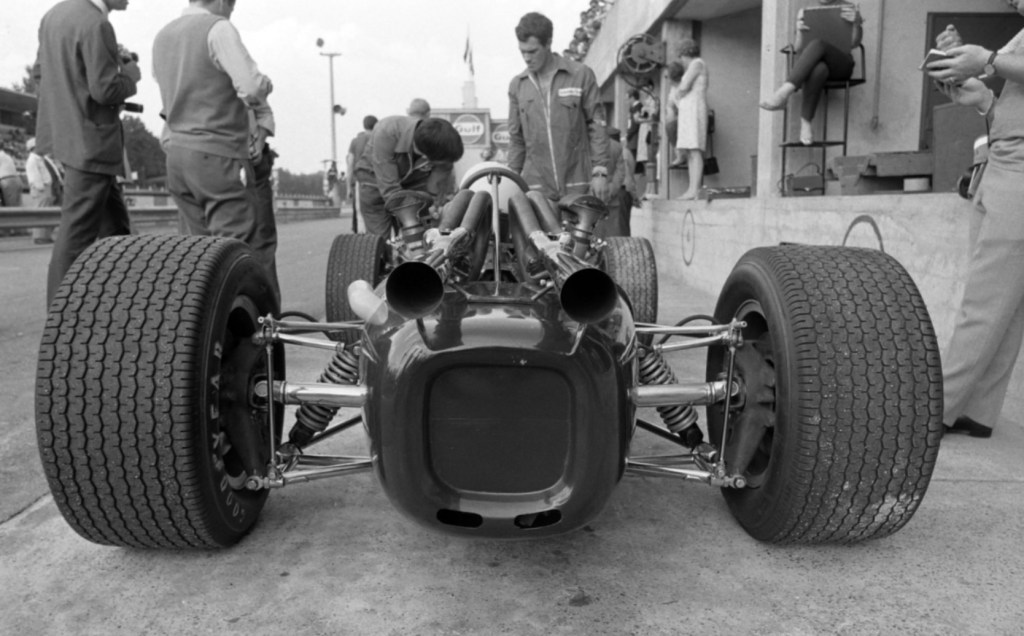
baghetti syracuse gp 1961

Giancarlo Baghetti on the way to his maiden Grand Prix win in his very first GP aboard Ferrari 156 chassis 0008. He won four Grands’ Prix in 1961; the French at Reims, and three non-championship events here at Siracusa on April 24, in Napoli three weeks later, and the Coppa Italia at Vallelunga in October …

The Syracuse locals are enjoying Giancarlo’s delicate touch and the glorious howl of the little 1.5-litre V6 around the 3.478 mile Sicilian street circuit, look closely at the kids in the trees!

While the 156 was the class of the field in 1961, Baghetti beat a field of depth in Syracuse. Dan Gurney and Jo Bonnier were second and third in Porsche 718s, then came Jack Brabham’s works Cooper T55 Climax, Roy Salvadori’s Cooper T53 Climax, and in sixth and seventh places were Jim Clark and Lorenzo Bandini in Lotus 18 Climax and Cooper T51 Maserati respectively.

John Surtees’ Cooper Climax sandwiched by the Gurney and Bonnier Porsche 718s at Syracuse in 1961 (Motorsport)
Moss chasing Baghetti and Gurney; Lotus 18, Ferrari 156 and Porsche 718 (B Cahier)
Moss in a Rob Walker Lotus 18 Climax chases Jo Bonniers’ Porsche 718 at Syracuse. Jo was third and Moss eighth with a misfiring engine (unattributed

Despite the presence of the-greats, Baghetti popped the Ferrari into second slot on the grid behind Gurney on pole. He didn’t make a great start, appearing in seventh place at the end of the first of 56 laps, but used the power of the car to progress forward through the field to lead Gurney and Surtees by the end of the sixth lap.

Once in front he led with calm, consistent precision, keeping Dan at bay to win by five seconds. The youngster’s only mistake was to whistle up the escape road at the hairpin on his victory lap when he missed his braking point whilst waving to an adoring Sicilian crowd!

The car Giancarlo raced is the very first mid-engined Ferrari – the 246P Richie Ginther debuted at Monaco in 1960, chassis 0008. This morphed progressively from a 2.5-litre GP car into the prototype 1.5-litre GP 156 by the 1960 season’s end. See this story about a most significant Ferrari, it is a great pity Enzo destroyed it along with all of its other 156 brothers and sisters; https://primotipo.com/?s=ferrari+246p

0008 always raced with the 65-degree 1.5-litre V6 rather than the definitive 1961 120-degree variant which Richie Ginther was to give debut at Syracuse, but didn’t at the last minute due to oil scavenge problems revealed in testing at Modena. Checkout this article on the testing of the 120-degree motor here; https://primotipo.com/2018/09/11/ferrari-156-testing/

Innes Ireland and Jim Clark- #20 is Jim’s Lotus 21 Climax (B Cahier)
Graham Hill, BRM P48/57 Climax FPF (unattributed)
Giancarlo, Syracuse 1961 (unattributed)

By the start of 1961 0008 was already an old nail, so Ferrari were happy to hand the machine over to a grouping of Italian car clubs – the Federazione Italiane Scuderia Automobolistiche (FISA) as a means of developing promising Italian drivers. While the car was entered by FISA, it was prepared by the factory – very well prepared as it transpired!

Giancarlo had impressed in 1960 at the wheel of a Dagrada Lancia Formula Junior, and was awarded the FISA drive. About ten of these front-engined FJ’s were built by Milanese, Angelo Dagrada who was known to Giancarlo via modifications he had made to Baghetti’s industrialist father’s Alfa Romeo 1900 road car, the family owned a foundry in Milan. Giancarlo cut his racing teeth with this Alfa and Abarths in local events.

These interesting cars bucked the Italian trend of using the ubiquitous Fiat inline-four in favour of the Lancia Appia 1098cc ten-degree V4 which was light and compact – and powerful after vast development of the standard cylinder head turned it into a crossflow unit.

Giancarlo aboard his Dagrada Lancia FJ at Monza on 25 April 1960 (unattributed)

Giancarlo was seventh in the 1960 Campionato ANPEC/Auto Italiana d’ Europa Formula Junior Championship with one win from only three point scoring rounds. In front of him was Colin Davis, Jacques Cales, Denny Hulme, Lorenzo Bandini, Henri Grandsire and Henry Taylor.

Baghetti’s win depicted in the advertisement below was a big one, the VIII Trofeo Bruno e Fofi Vigorelli at Monza on April 24-25 attracted 43 cars, 16 were non-qualifiers. Giancarlo won both his heat and one of the two finals, to win on aggregate from Juan Manuel Bordeu and Henri Grandsire aboard Stanguellini Fiats. The class field included such notables as Colin Davis, Carlo Facetti, Carroll Smith, Lorenzo Bandini, Rob Slotemaker, Ludovico Scarfiotti, Geki Russo, Gerhard Mitter, Eric Carlsson, John Whitmore, Teodoro Zeccoli and Tony Maggs.

In the Campionato Italiano, he was equal fourth with Geki Russo behind Renato Pirocchi, Roberto Lippi and Antonio Maglione, and second in the Prova Addestrativa behind Antonio Maglione.

Some sources have it that Giancarlo was a controversial choice for the FISA ride, but if you look at the races entered/won, his strike rate looks pretty good. In addition, his Dagrada was generally felt to be an inferior weapon to the Stanguellini Fiat used by most of his rivals; the choice stands the sniff test I think, whatever the case, he certainly grasped the opportunity with both hands.

Baghetti’s purple patch continued at Posillipo a month later when he won the Gran Premio di Napoli on May 14, again at the wheel of 0008.

On this occasion he finished the 60 lap, 150km road course race in front of Peter Ashmore’s Lotus and Bandini’s Centro Sud Cooper T51 Maserati, after Roy Salvadori gave chase early in the race, only to be thwarted by a puncture in his Yeoman Credit Cooper Climax.

The entry was devoid of championship front runners on this occasion, they were otherwise engaged at Monaco, Stirling Moss in one-of-those drives won the race aboard Rob Walker’s Lotus 18 Climax, one of three championship events which didn’t go to the 156 that season. The German GP also fell to Maestro Moss in the nimble, less powerful Lotus 18, and at Watkins Glen Innes Ireland won the first GP for Team Lotus, and himself, aboard a Lotus 21 Climax.

GP di Napoli, Posillipo 14 May 1961 grid. Baghetti 156 at left, Roy Salvadori, Cooper T53 Climax and then Gerry Ashmore’s Lotus 18 Climax at right. Row two is Ian Burgess’ Lotus 18 Climax at left and Lorenzo Bandini’s Cooper T51 Maserati at right. Row three is Giovanni Alberti, de Tomaso Osca at left and Menato Boffa, Cooper T45 Climax at right. Baghetti won from Ashmore and Bandini (unattributed)
Hill, Ginther and Von Trips – Ferrari 156 by three front row at Reims in 1961 (unattributed)
Reims start with Thillois in the distance, July 2, 1961. Up front its Hill, Ginther and von Trips from left to right, with Moss in the Walker Lotus 18/21 Climax on his own, and the rest- winner Giancarlo was Q12 but started poorly and is the red spec almost straddling the dashed-yellow line, about six cars from last. All of which says a lot about the Italian cars power and torque out of the slow Muizon and Thillois corners (Motorsport)
Who said the Lotus 21 had better brakes than the Ferrari 156?! Innes Ireland runs into strife under brakes whilst attempting to slip under Giancarlo watched by Jim Clark in another 21, Graham Hill, BRM, Jo Bonnier, Porsche 718, Bruce McLaren’s Cooper T55 Climax and Dan Gurney in the other works Porsche 718, Reims 1961

0008 went back to the factory for a freshen up and then joined the three factory entries of Phil Hill, Taffy von Trips and Richie Ginther at Reims on the July 2 weekend for the French Grand Prix.

There he took a stunning victory a tenth of a second clear of Gurney’s Porsche 718 with Jim Clark’s Lotus 21 Climax a further minute adrift. It was an all Ferrari front row with Hill on pole and Ginther and von Trips alongside, Giancarlo was Q12.

Hill led from the start, in that order, until Richie spun giving third place to Moss’ Lotus 18 Climax – behind this group there was a massive slipstreaming battle involving the Gurney and Bonnier Porsche 718s, the works Lotus 21 Climax’ of Jim Clark and Innes Ireland, Graham Hill’s BRM P48/57, Bruce McLaren’s Cooper T55 Climax and Giancarlo.

Two of the most important aspects of longevity for a race photographer are a sense of self preservation and fleetness of foot …Bonnier, Baghetti, Clark and Gurney, Reims 1961 (unattributed)
Clark, Baghetti and Ireland exit Thillois (Motorsport)
Spinner Ginther in front of Lucien Bianchi, Lotus 18/21 Climax (B Cahier)
Gurney and Baghetti in the final stages (B Cahier)

Taffy had engine trouble after 18 laps so he was out, Phil Hill spun on the surface which was becoming very slippery in the intense heat on lap 38, he managed to restart but was a lap down. Then Ginther led, but he too spun, and had no sooner recovered before having engine problems – no oil pressure after 40 laps, Moss had brake problems so he too retired after completing 31 laps.

Progressively the challengers fell away leaving a man-on-man battle which went on for many laps, with the lead changing by the lap between Dan Gurney – one of the finest drivers of the era – and still to win his first championship Grand Prix, and GP debutant Giancarlo Baghetti.

On the final lap, Dan out-braked Giancarlo into Thillois, the last corner, but on the sprint to the line – with more punch than the four-cylinder Porsche – Baghetti dived out of Gurney’s slipstream a couple of hundred yards before the finish in a perfectly timed move to win by the narrowest of margins from Gurney, Clark, Ireland and McLaren.

Giancarlo’s 1961 run of success wasn’t over yet, as noted at the outset, he won the minor, Prima Coppa Italia at Vallelunga on October 12. This time he raced a Porsche 718, winning both 30 lap, 106 km thirty minute heats from pole, taking the overall win on aggregate from Ernesto Prinoth, Lotus 18 Climax, and Nino Vaccarella’s Cooper T51 Maserati.

The balance of Baghetti’s career is dealt with in this article, sadly, the precocious talent of 1961 faded way too quickly; https://primotipo.com/2015/05/08/giancarlo-baghetti-lotus-49-ford-italian-grand-prix-1967/

Aintree 1961 (Echo)
Coppa Italia, Vallelunga October 12, 1961. #24 Nino Vaccarella rebodied Cooper Maserati T51, #2 Ernesto Prinoth, Lotus 18 Climax and at right Giancarlo Baghetti, Porsche 718. The Lotus 18 Maserati on row two is Gaetano Starrabba (unattributed)

The 1961 Ferrari 156 : Technical…

For early 156 Dino enthusiasts these photographs of 0008 taken by Bernard Cahier at Siracusa on this Tuesday April 25, 1961 long-weekend will be of great interest as they show the first chassis in its definitive 1961 form.

All 156’s built and raced in 1961-1962 started right here, or I guess twelve months before if you argue that the original 2.4-litre 246P version of 0008 was the starting point, which of course factually it was.

The bodywork of the car is ‘unique’ in that it has two supplementary air intake slots on the cowling, it’s very sleek compared to 0008 as it was in early 1960, to the form shown above. The shark-nose was supposedly low-drag, Carlo Chiti deployed it in his 1961 sportscar designs as well, the approach was a function of work in Ferrari’s scale-model wind tunnel.

It may well be that the shark-nose design was suggested to Chiti by Medardo Fantuzzi, one of Ferrari’s favoured external body-builders. He modified a Maserati 250F for Kiwi Ross Jensen (#2508) in this manner in late 1957, and then two other 250Fs for Temple Buell (#2533 and 2534). Fantuzzi built the 156 and sportscar bodies.

Maserati 250F ‘2508’, ex-Moss/Jensen, when owned and raced by Brian Prescott at Wigram, NZ in April 1961. Medardo Fantuzzi nose to the fore (Classic Auto News)

Medardo Fantuzzi with the three ‘shark nose’ Maserati 250Fs at his Modena factory in late 1957 or early 1958. Jensen’s at left – he finished second to Jack Brabham in the January 11, 1958 NZ GP in his upgraded car – the two Temple Buell machines alongside (unattributed)

Doug Nye described the chassis thus ‘The multi-tubular chassis itself was crude and hefty looking, not as unimpressive as a Cooper’s – not least of all its tube runs were straight – but not a patch on the lightweight lattice of a Lotus, BRM or even a Porsche.’ Big, butch, beefy and crude the chassis was, but it certainly did the job in 1961. It was only when the chassis sophistication of the Brits was harnessed to the power of the Coventry Climax and BRM V8s in 1962 that the class of ’61 became the dunce of ’62.

The main chassis rails were made of 1 1/2 inch steel spaced vertically 15 inches apart, the 120-degree motor required bulged top rails for installation, whereas the 65-degree unit did not, its rails were straight. The 120-degree frame swallowed the earlier motor whereas the wide engine wouldn’t fit into the narrower 65-degree frame.

Suspension front and rear comprised upper and lower braced wishbones and coil spring/damper (Koni) units, roll bars were adjustable both front and rear although it appears Giancarlo didn’t race with a rear fitted in Siracusa. Chiti set the cars up with bulk static negative camber, I guess the race Dunlops fitted to the 156 liked the setup.

156 cockpit, Monaco 1961
Engine bay of 0008 at Syracuse. Note the beefy spaceframe chassis Doug Nye described as being welded together by ‘Mr Blobby’. 65-degree second series Tipo 156 V6, bore/stroke 73×58.8mm, circa 180bhp fed by three 38mm Webers. The 120 degree engine had two bespoke triple choke Weber 40IF3C carbs. Note the large transaxle and starter motor, no rear roll bar fitted, suspension by upper and lower wishbones, ventilated disc brakes are inboard

The 1.5-litre Vittorio Jano (and team) designed 65-degree V6 first appeared as a front-engined F2 car in 1958. The DOHC, chain-driven, two-valve, twin-plug, triple Weber fed motor developed circa 180bhp @ 9000rpm and was fitted to a scaled down version of the then current 2.5-litre Lancia D50 derived – and then further evolved – V8 engined 801 F1 chassis, then designated 156.

The capacity of Jano’s V6 engine grew progressively to 2417cc in which form the Ferrari Dino 246 won the 1958 drivers championship for Mike Hawthorn.

As time went on it became clear Ferrari had the makings of an excellent car for the new 1.5-litre F1 which commenced on January 1, 1961, and which was expressed in the evolution of 0008 from a chubby, pudgy 2.4-litre F1 car at Monaco in May 1960 a svelte shark-nosed 1.5-litre F2 machine before Monza in September.

Chiti’s definitive engine for 1961 was a new variant of the Dino using a very wide-angle V6 of 120-degrees to lower the engines centre of gravity, and simplify manufacture of the engine’s crank. A motor of this width would not have fitted comfortably into the front-engined Dino 246/256 chassis.

The two camshafts were still chain driven, the heads still two-valvers, and still twin-plug. The dimensions of the 1960 Solitude 65-degree engine were adopted – bore/stroke of 73mm x 58.8mm for a capacity of 1476.6cc. Nye reports that all of the major castings were made in Siluminum, the 120-degree engine weighed 225 pounds, 30 pounds less than the good ‘ole Coventry Climax 1.5-FPF four cylinder motor.

Carburettors were bespoke, beautiful Weber triple-choke type 40 IF3C. Ferrari initially claimed 190bhp @ 9500rpm but ‘initial tests only yielded 177, which was still 30 more than the FPF’ used by the English teams in 1961. Jano also gave the existing 65-degree engine a bit of a tickle as a second-string unit, pending enough 120-degree engines to go around the three car Scuderia Ferrari team. When the FISA team were present four 156s presented a formidable challenge to the opposition…

Compare and contrast. Richie’s 156 0001, the prototype 120-degree engine chassis during the 1961 Monaco GP weekend. Note how low that engine sits in the chassis, trick triple throat Webers clear
(G Cavara)
0008 butt, Syracuse 1961
(B Cahier)

While the V6s in either format were delicate, compact little things, the transaxle was anything but- however it did prove problem free, as Ferrari gearboxes down the eons have tended to be. The same ‘boxes were used with both engines – these 16.25 inch long units were developed versions of the five speed and reverse transaxle used in 0008, with the clutch assembly exposed to the breeze on the end plate. The thing looks bigger than it actually was due to a wide bell-housing between engine and transmission to push the engine forward in the frame to obtain the weight distribution Chiti sought.

Nye records that Ferrari appear to have built eight chassis during 1961. 0008 was numbered in the 246 Dino sequencing, in addition there were new chassis’ serials 0001-0006, with two appearing under the 0003 number. Von Trips won the Dutch and British GP’s in 0004 which was destroyed in his fatal Monza accident, Hill won at Spa in 0003, and Monza in 0002 while Giancarlo won at Reims in our friend, 0008.

And what about poor old 0008 you ask?

Giancarlo raced it at Aintree in the British GP the week after Reims (#58 below) doing enough damage to the prototype for it to be scrapped; he crashed at Waterways Corner while avoiding another competitor having his own moment when running in twelfth place from Q19. Of course all the 156s were ultimately destroyed, but if only one of the many chassis built between 1960-1962 were to have been preserved surely it would be this one…

(Echo)

Giancarlo above while up front Taffy von Trips won the July 15 British Grand Prix from his teammates Hill and Ginther, Jack Brabham was best of the rest, 68 seconds behind Von Trips in his Cooper T55 Climax.

0008 in the Aintree paddock, note the different nosecone fitted to the car compared to that used in the Syracuse heat. Wire wheels were very much old hat by this stage, Ferrari retained them in 1962 but Campagnolo’s were part of the 156/63 package in 1963.

Etcetera…

(B Cahier)

Whether the shark-nose was more aerodynamic or not is a moot point. Didn’t Carlo Chiti put his styling stamp on the Ferraris of the time with these oh-so-distinctive visual cues.

I’m cheating a bit here, this Ferrari launch shot in Maranello was in February 1962 not that the 156 was much different, to its cost – 246SP at left.

(B Reeves)

Baghetti in the FISA 156 from Moss’ Rob Walker Lotus 18 Climax at Syracuse in 1961. Nice.

(Echo)

Dry practice at Aintree, Baghetti from Von Trips, the winner, chassis 0008 from 0004. The former was scrapped after this race, the latter destroyed in Taffy’s horrific accident at Monza in September.

Bibliography…

‘History of the Grand Prix Car’ Doug Nye, Veloce Today article by Pete Vack, F2Index, Wikipedia, F1.com

Photo Credits…

LAT, Motorsport, Bernard Reeves, Giuseppe Cavara, Getty Images-Bernard Cahier, Echo Liverpool, B St. Clare-Tregilgas, Classic Auto News

Tailpieces: Giancarlo Baghetti at the wheel of his Ferrari 156 during 1961…

baghetti 1961 (unattributed)


(unattributed)

Listen Mauro, I think we need to try this. Baghetti, place unknown in 1961, Ferrari 156.

Finito…