Archive for the ‘F1’ Category

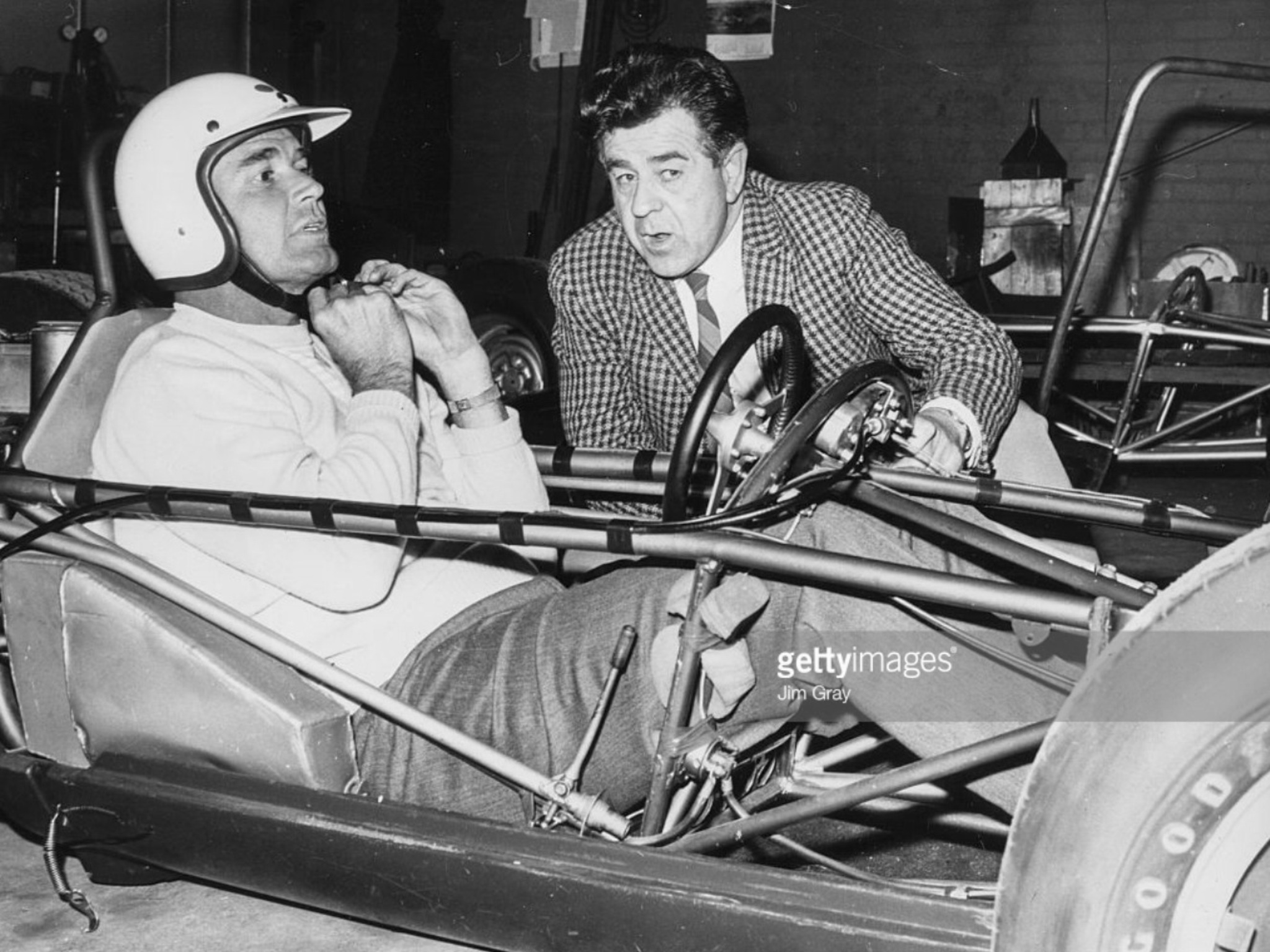
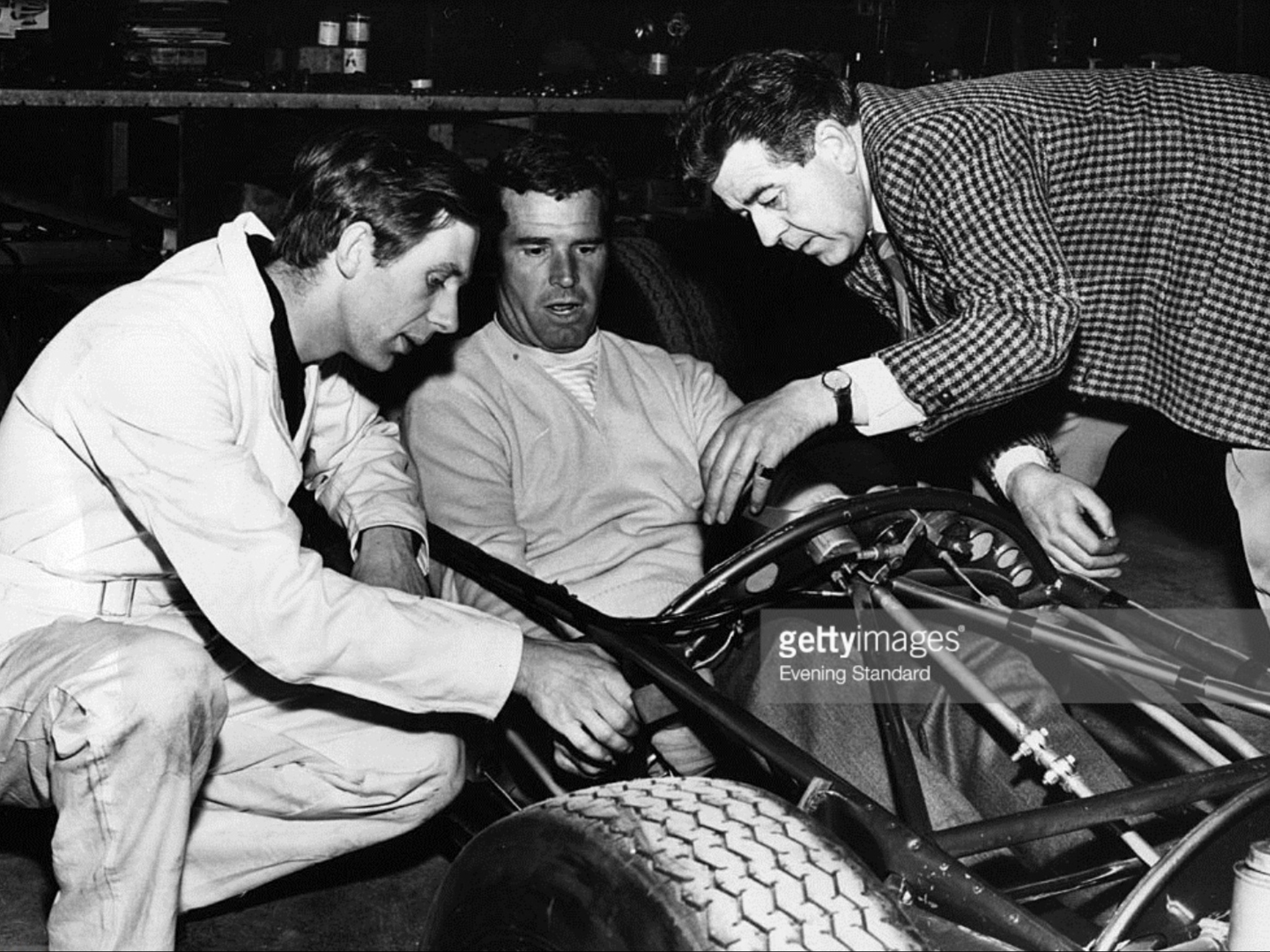
James Garner is fitted to a Jim Russell Racing Drivers School Formula 3 car on 14 April 1966…

Jim Russell supervises ‘Pete Aron’s’ preparation for some laps at Snetterton. I wonder exactly what make and model it is?!

The business end of the iconic film ‘Grand Prix’ is about to get underway, the race scenes were filmed, famously, during the 1966 Grand Prix season.

Garner is sharpening his driving skills to cope with the in-car rigours of his role as Peter Aron. Of course he rather enjoyed it all didn’t he, becoming a racer and an entrant of some note.

Garner’s ‘American International Racing’ Lola T70 Mk3B Chev finished second in the 1969 Sebring 12 Hour driven by Ed Leslie and Lothar Motschenbacher behind the winning Penske T70 of Mark Donohue and Chuck Parsons.

By the time these shots were taken in the UK Garner had already done quite a lot of driving under the tutelage of Bob Bondurant in the US, but I wonder if the JRRDS laps were his first in single-seaters?

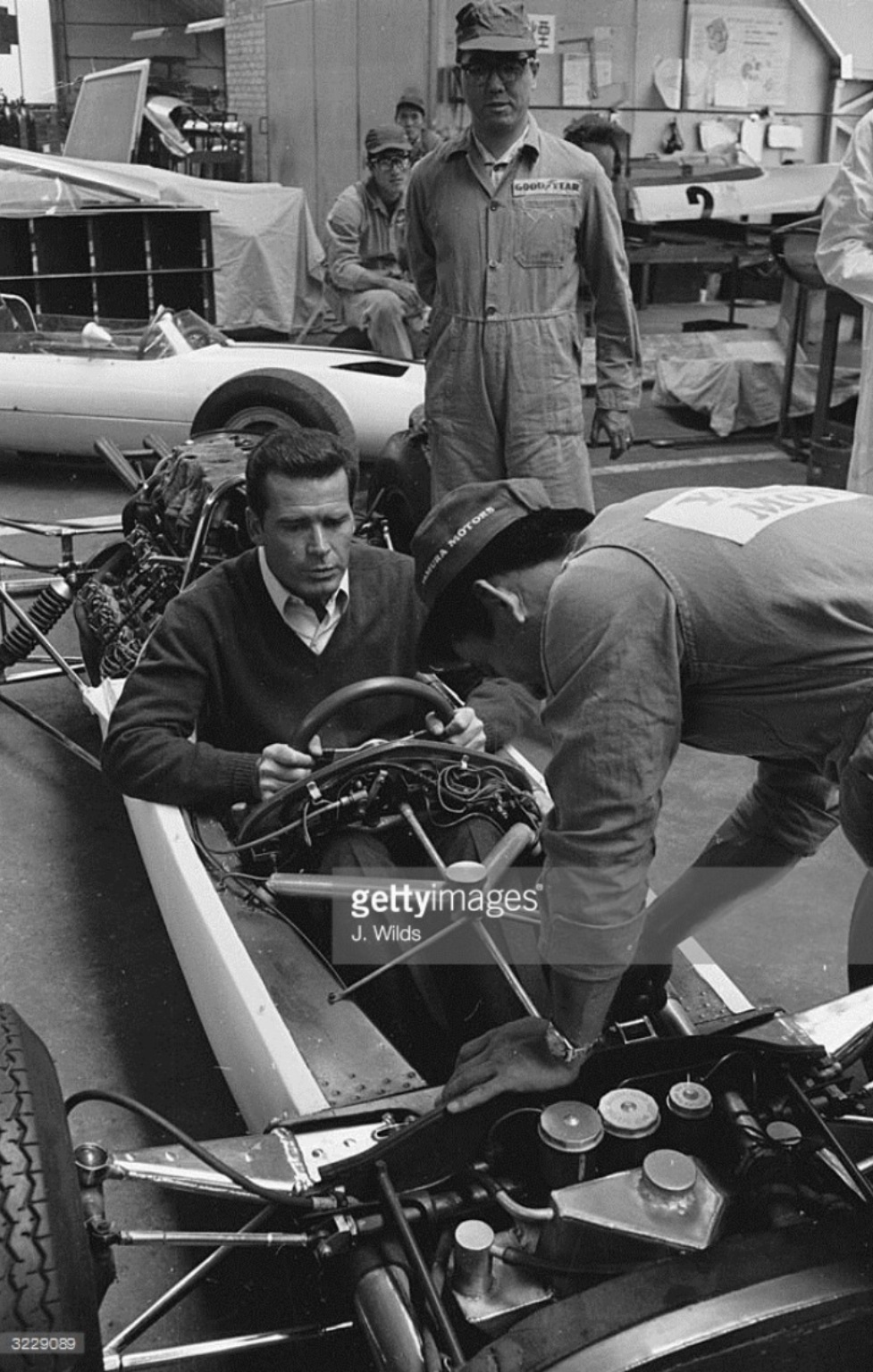
The ‘Tailpiece’ workshop shot below is on-location at the Cooper, Surbiton, Surrey factory. ‘Pete’ is sitting aboard his Japanese Yamura car which looks rather suspiciously like a Lotus 25 Coventry Climax, the cam-covers of the little 1.5 litre FWMV V8 are removed.

What a film! I wrote a short piece about it ages ago, click here if you’ve not read it, its focus is on Francoise Hardy;

https://primotipo.com/2014/10/17/francoise-hardy-on-the-set-of-grand-prix-1966/

Photo Credits…

Jim Gray, Evening Standard, J Wilds

Tailpiece: Pete being fitted to his Yamura F1 car, July 1966…

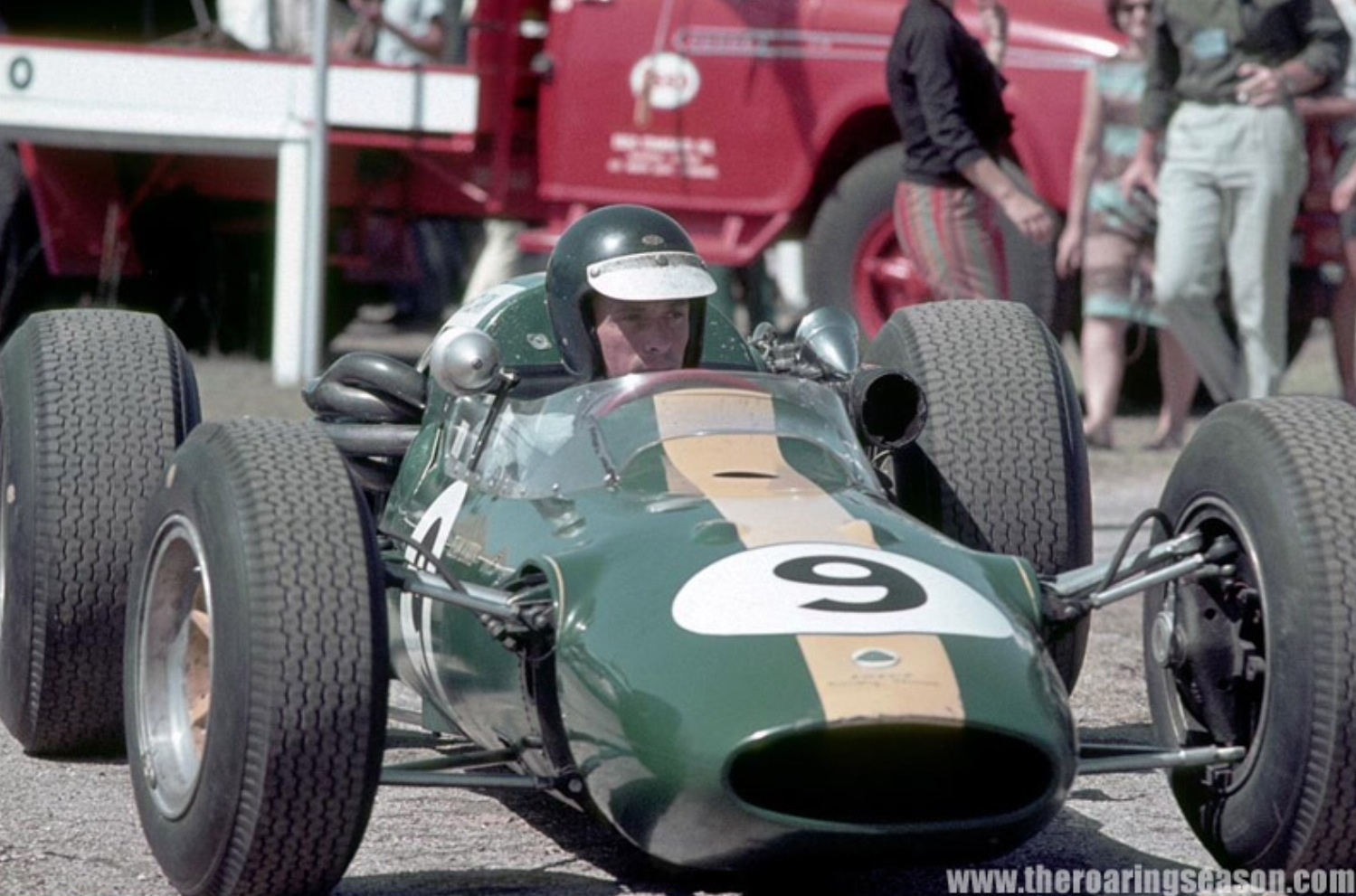
The on-circuit shots of the Yamura were of Bruce McLarens 1966 F1 contender, the McLaren M2B that year fitted with Ford, Serennissima and BRM engines. The contract was a nice little earner in the team’s first year in Gee Pee racing. Aron’s helmet design was Chris Amon’s sans the Kiwi logo. Checkout this really interesting article about McLaren’s involvement in the film on mclaren.com;

http://www.mclaren.com/formula1/heritage/action-mclaren-at-the-movies-6114785/

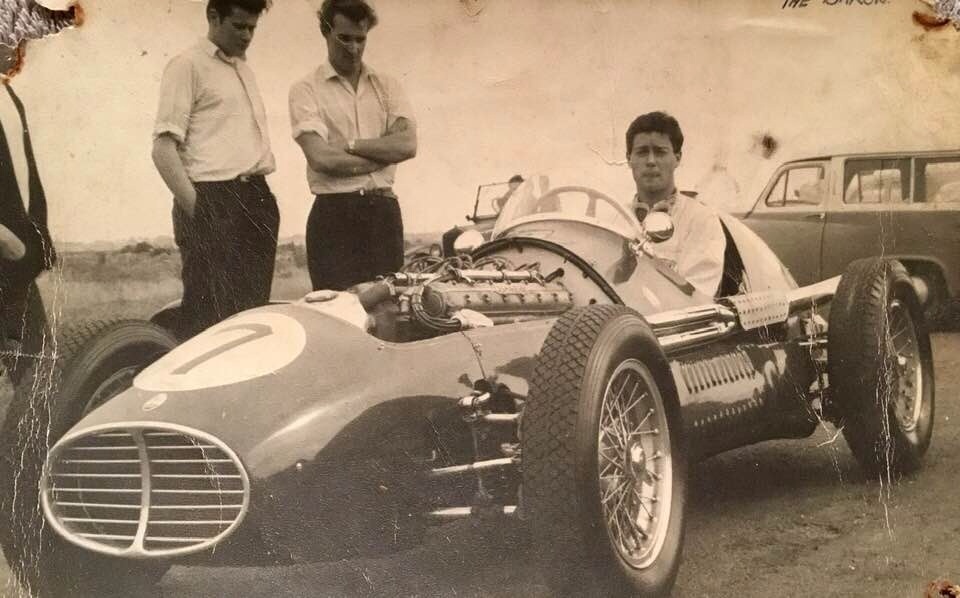
Reg Hunt, second from right, and his band of merry men fettle his Maserati A6GCM at his 182 Brighton Road, Elsternwick, Melbourne car dealership prior to the late March, Moomba races in 1955…

The car is being readied for the Labour Day long weekend, Moomba Races at Albert Park in which Reg did rather well. He won the Saturday 50 mile ‘Argus Cup’ from Doug Whiteford’s Talbot-Lago T26C and Ted Gray’s Tornado Ford V8. On the Sunday he was victorious in the first heat of the ‘Argus Trophy’ and was well ahead in the 100 mile final when the Maser’s crown wheel and pinion failed, giving the win to Whiteford.

Otto Stone, racer/engineer looked after this car, it appears a few ‘technicians’ have been grabbed from Reg’s dealership workshop for this photo taken by the crew of ‘The Argus’ newspaper. The publication was a major sponsor of the race meeting as reflected in the silverware won by Reg, no doubt they published an article encouraging the crowds to come and see the ‘KLG Maserati, the fastest car in Australia’.

I’ve written several articles about this very fast and supremely talented English born Australian racer/businessman who retired way too early. See here; https://primotipo.com/2014/07/19/reg-hunt-australian-ace-of-the-1950s/;

and here, the ’56 Argus Trophy; https://primotipo.com/2014/10/01/1956-argus-trophy-albert-park-reg-hunt-and-lex-davison-maserati-250f-and-a6gcm-ferrari-tipo-500/

there’s more- the 1955 AGP @ Port Wakefield; https://primotipo.com/2017/07/28/battle-of-the-melbourne-motor-dealers/

After a successful season racing a Cooper 500 in the UK in 1954 Reg travelled to Modena and acquired this ex-factory chassis ‘2038’ to race back in Australia.

Toulo de Graffenried aboard his 2 litre Maser A6GCM ‘2038’ in the Goodwood paddock during the Lavant Cup meeting- an event he won on 6 April 1953 from the Roy Salvadori and Tony Rolt Connaught A Types. I wonder who the driver behind the car is? (Getty)

‘2038’ was originally built as a 2 litre F2 car in 1953- raced by Emmanuel de Graffenreid.

Many of you would know the class of the 2 litre 1952-1953 F2/Grand Prix formula- F2, which at short notice became the category to which championship Grand Prix events were run given the paucity of cars at the start of 1952 with Alfa Romeo’s withdrawal from GP racing and BRM’s non-appearance- were the simple, fast, four cylinder Ferrari 500’s. Especially chassis ‘0005’, the car raced by Alberto Ascari to a record number of wins and two World Championships in those two years, that chassis was sold to Tony Gaze and later Lex Davison, it was an iconic racer in Australia in the fifties.

The great engineer Giacchino Colombo joined Maserati from Alfa Romeo for a consultancy which ended about June 1953, he first applied his magic touch to the 1953 A6GCM, squeezing closer the performance gap between the Maserati and Ferrari 500.

He changed the engine from square to oversquare, a bore/stroke of 76.22 x 72mm, squeezing a few more revs and raised the power of the 2 litre, DOHC, 2 valve, 40 DCO3 Weber carbed, Marelli sparked six cylinder engine to circa 190 bhp @ 9000 rpm.

Other tweaks were to the suspension- the inclusion of an ‘A-bracket’ to better locate the rear axle, and to the brakes. Otherwise the Maserati 4CLT derived twin-tube chassis with hoop shaped bracing at the front and cockpit area, quarter elliptic sprung rigid rear axle with ZF slippery diff, twin front wishbone suspension and excellent Valerio Colotti designed 4 speed gearbox, which mated directly to the engine, were unchanged.

By the end of 1953, it seems fair to say, that the high-revving Maser was better suited to the high speed circuits than the Ferrari 500, and whilst  the Maser may have had an edge in top speed the de Dion rear end of the Ferrari put its power down more effectively than the ‘cart sprung’ A6GCM. Maserati would remedy this shortcoming with the design of the 250F of course.

The talented Swiss Baron’s car was mainly entered by Enrico Plate’s team. His best results in 1953 were first placings in the Lavant and Chichester Cups at Goodwood, a heat of the International Trophy at Silverstone and the Eifelrennen at the Nurburgring in May- he was also victorious at the Freiburg Hillclimb in Switzerland.

At championship level his best result was fourth in the Belgian GP when the car was a works rather than a Maserati-Enrico Plate entry. The car was also entered by the works at Zandvoort, the Dutch Grand Prix, two weeks earlier using a new chassis- the car first raced at the Siracuse GP on 22 March 1953, it raced on nine occasions with the original frame.

A chassis of the same number is said to have been raced and crashed by Fangio at Monza on 8 June 1952, breaking has neck. The great man crashed 2 laps into his heat as a result of being fatigued after travelling from the Ulster Trophy race, where he drove a BRM. He flew from Belfast to Paris but could not take his connecting flight to Milan due to fog. He drove a Renault 750 borrowed from Louis Rosier all night  to contest the non-championship GP of Monza Auto Club. The great man arrived exhausted, started the race from the back of the grid and crashed on the events second lap having run wide at Lesmo, and was then thrown out of the car.

Mind you, other sources have the chassis used that day as ‘2034’…

Harry Schell contesting the non-championship Berlin GP at The Avus in 1954 aboard his Maser A6GCM ‘2038’. 8th in the race won by Karl Kling’s Mercedes W196 (Getty

Rebuilt with a Maserati 250F engine, the car was raced during the new 2.5 litre F1 in 1954 by Harry Schell as a private entry with the exception of the Pau GP, when it was works entered.

Schell’s best results in fifteen races was a first in a heat of the Circuit de Cadours, France, second in the GP di Roma at Castel Fusano and thirds at Aintree’s Daily Telegraph Trophy and the Circuito di Pescara on the wild Pescara road course beside the Adriatic.

Harry’s last drive of the car was at Aintree on 2 October, ‘2038’ was sold to Hunt shortly thereafter and was soon aboard the ‘Oceania’ heading south for Port Melbourne. Reg was reported as pacing Station Pier anxiously like an expectant father as he waited an hour for the notoriously ‘Bolshie’ Melbourne waterside workers to carefully unload his precious car on Friday 31 December 1954.

Click here for an article on the Maserati 250F, which includes the evolution of these magnificent single-seaters from A6GCM to 250F; https://primotipo.com/2014/08/21/stirling-moss-monaco-gp-1956-maserati-250f/

In the best tradition of this series of cars, the A6GCM and 250F, there are quite a few variations on the chassis theme, that is, which one is which.

I reference the 8W: Forix records as the most authorative source drawing together research of recent decades, particularly the exhaustive, scholarly, work of David McKinney and Barrie Hobkirk. The sharing and debating of evidence on the internet is a luxury not available to earlier 250F authors. Click below for all of the detail you could wish for, chassis by chassis and author by author including the way the views of the same author changed over time as more exhaustive research was undertaken allowing them to re-appraise conclusions they had earlier reached.

Chassis ‘2038’ was never allocated a 250F number when fitted with the 2.5 litre engine- although chassis ‘2503’ is the number occasionally cited. Nye concludes in relation to ‘2503’ ‘Serial never applied to a true 250F’, McKinney ‘Never built as a 250F’, Pritchard ‘Number not used’.

Given the foregoing, to be clear, ‘2038’ was built in 1953 or 1952 as a 2 litre A6GCM. Fitted with a 2.5 litre 250F engine, but otherwise the same in specification, ‘2038’ is one of the ‘interim A6GCM/250F’ chassis.

http://8w.forix.com/250f-redux.html

Reg Hunt in the Maser A6GCM during the Albert Park, Moomba meeting in late March 1955 (unattributed)

The car arrived in Melbourne in late 1954, Reg soon shook it down at Fishermans Bend before popping it back on a boat to contest the 1955 NZ GP at Ardmore.

He was immediately on the pace qualifying fourth, was second in a heat and ran second to Prince Bira’s 250F until fading brakes slowed him, finally finishing fifth.

Back in Australia the car was the quickest device around winning the Victorian Trophy at Fishermans Bend, the Bathurst 100 scratch race and was hot favourite for the Australian Grand Prix at Port Wakefield in October but was slowed by a cam follower problem- he was second to Brabham’s Cooper T40 Bristol having led initially.

In November the car won two events at Fishermans Bend- the ‘Racers Trophy’ and ‘Lucas Trophy’ both from Lex Davison’s HWM Jaguar. Lex was soon to acquire the Tony Gaze Ferrari 500/625 with which he is so readily associated.

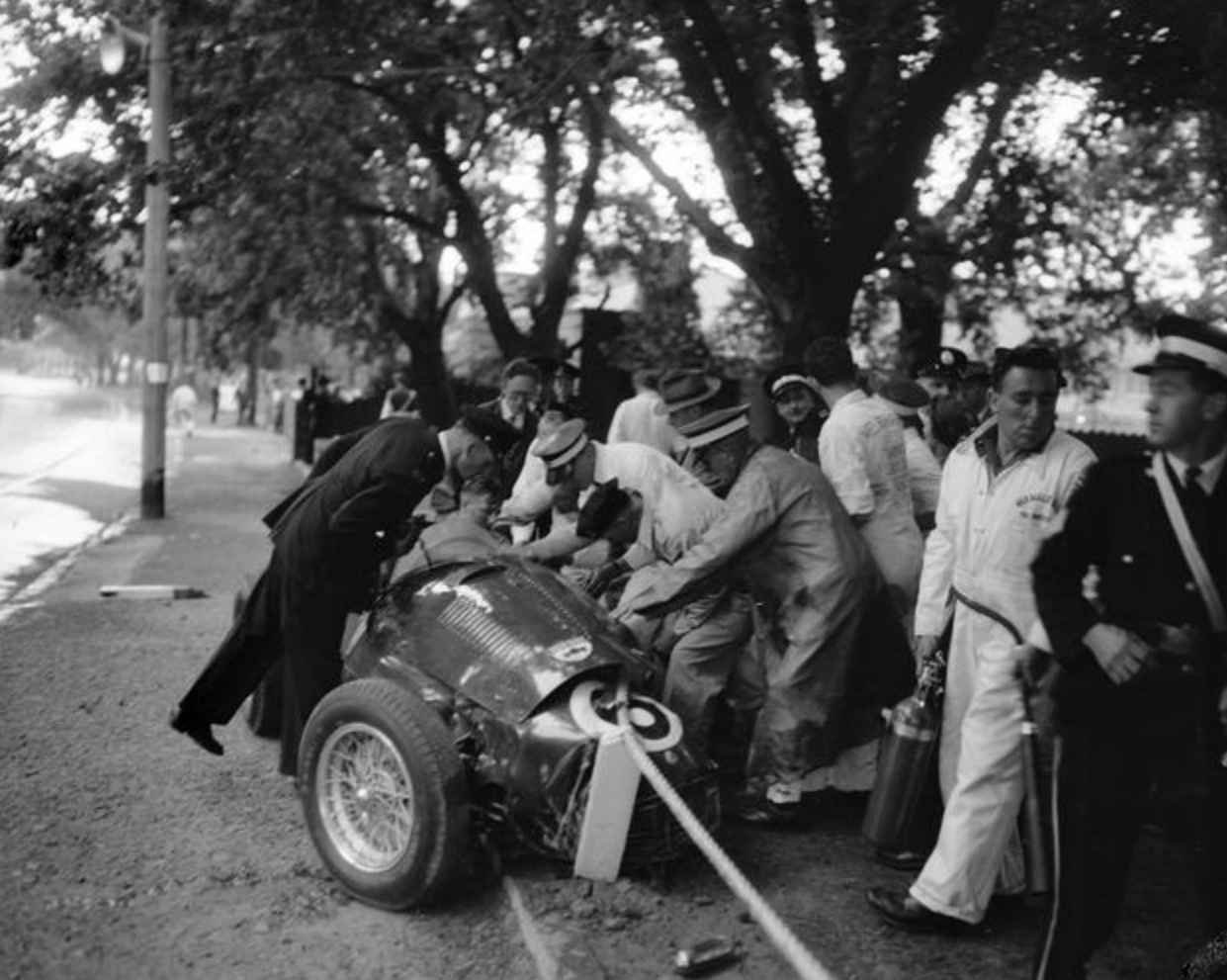
Official extricate Neal from the badly damaged Maser towards the end of the 1956 AGP at Albert Park (unattributed)

The Maserati was sold to Melbourne haulier Kevin Neal after Reg’s 250F ‘2516’ arrived in early 1956- the car was badly damaged in the ’56 AGP at Albert Park when Neal lost control during a shower of rain late in the race.

Looking as elegant as ever, beautifully repaired, the car reappeared again at a minor sprint meeting at Eildon in country Victoria in 1960, the car was sold to Melbourne’s Colin Hyams in 1962, he used it occasionally, as below at Fishermans Bend.

(C Hyams)

The car then went to the UK in 1965, passing through the hands of Colin Crabbe and Dan Marguiles to Ray Fielding in Scotland in 1972. After many years owned by him and his estate ‘2038’ now resides in a Swiss collection.

(AMS)

Reg Hunt aboard ‘2038’ at Easter Bathurst 1955.

He won the A Grade scratch race and the scratch class of the Bathurst 100 setting the fastest time, an average of 77.8 mph. Reg was expected to take the lap record but was hampered by lack of his tall diff ratio, this component was damaged at Albert Park the month before, here Hunt is exiting Hell Corner to start his run up the mountain.

Reg Hunt in 2017…

(D Zeunert)

This photo and those of the Maser which follow were taken by David Zeunert, President of the Maser Club of Victoria- many thanks to David for sending them in to round out the article, it was taken early in 2017 at Reg and Julia Hunts home on Melbourne’s St Kilda Road- they have a floor in an old historic building.

Reg is a spritely, fit 94 and David says is still working in real estate apartment development with his grandson. The trophy is ‘The KLG Trophy’ with two Masers in is base

Etcetera…

(E Gobell)

The very rare photographs of the car in colour were taken during the 1955 Australian Grand Prix meeting at Port Wakefield- technical specifications as per text.

(E Gobell)


Reg only raced the A6GCM for not quite a year, here is the ad for its sale in Australian Motor Sports February 1956 , I rather like the ‘no idle curiosity’ bit! (D Zeunert)

The photos below via David Zeunert are of the car at home in Switzerland.


Bibliography…

‘Historic Racing Cars in Australia’ John Blanden, 8W Forix.com, ‘Maserati: A Racing History’ Anthony Pritchard, Australian Motor Sports

Photo Credits…

Fairfax, GP Library, Australian Motor Sports, Michael Hickey/Museum of Victoria, David Zeunert Collection

Tailpiece: Brake Engineer, Bart Harven, Reg Hunt, beautifully cast Maser brake drum and sublime A6GCM- circa 240 bhp from its 2 valve, Weber DCO carbed, DOHC 2.5 litre, 6 cylinder engine…

Etcetera: ‘2038’ The Movie or TV Star…

(MOV)

A mystery to solve folks! Since posting the article, reader Michael Hickey posted these amazing photos of ‘2038’ in an Australian movie, or perhaps more likely, TV show on the primotipo Facebook page.

He found the shots on the Museum of Victoria website but they are devoid of details. Tony Matthews thought the ‘driver’ of the car may be Bob Hope- it certainly looks like him. I’m not sure that he did any movies in Australia though. The ‘driver’ could be Charles ‘Bud’ Tingwell, a distinguished but now deceased Australian actor. He was in dozens of movies throughout a long career, the most iconic perhaps ‘The Castle’. I don’t recognise the babe, mechanic or baddie.

The crook only has a little gun- ‘yerd reckon they would give him a big one. Lovely A6GCM front suspension detail shot tho! Finned brake drum, forged upright and upper and lower wishbones all clear, as is roll bar. Shocks are Houdaille (MOV)

I can’t make the films Tingwell appeared in work with the photos mind you. Which means it isn’t Bud or perhaps the scenes are from a TV show. You can just make out Reg’s name on the car in the first shot, the limited caption information dates it as October 1955. TV didn’t commence in Australia until the second half of 1956. All ideas or the definitive answer appreciated!

Finito…


(Advertiser)

Well, not quite! Vern Schuppan is 21 in this shot, he has just won a South Australian Kart title, its 1965…

The young South Aussie may have been a late starter, he hadn’t raced cars in Australia when he convinced his young wife they should ‘have a crack at motor racing in the UK’ for two years with $A5,000 in his pocket. His career trajectory once he arrived was meteoric though.

In 1969 he raced an Alexis and Macon Formula Fords. After some promising Merlyn performances in the five race, four circuit Brazilian Torneio Formula Ford series in 1970, he was picked up by Palliser for the rest of the year in the UK.

Other later F1 drivers on that 1970 Brazilian tour included Ian Ashley, Val Musetti and Tom Belso as well as the leaders of the Brazilian contingent Emerson and Wilson Fittipaldi. Emerson won the series from Ashley, Ray Allen and Wilson Fittipaldi.

Vern in the Mallory Park paddock on 6 November 1969, Macon MR7 Formula Ford (N Quicke)

Into Formula Atlantic with Palliser in 1971 he took the very first British ‘Yellow Pages’ championship with five wins aboard Palliser WDB3 and WDB4 chassis powered by BRM modified Lotus/Ford twin-cam engines rather than the new Ford BDA motor.

Via the BRM engine connection he came to the attention of Louis Stanley who gave him some BRM drives in 1972 aboard a P153 and P160. He also did some testing with Tyrrell.

He well and truly strutted his stuff in F5000, Indycars and Sportscars, a 1983 Le Mans Porsche 956 win together with Hurley Haywood and Al Holbert no less, but never really got his bum into a decent GP car.

A story for another time.

Vern on the cover of the Mallory 24 October ’71 meeting program. Perhaps the shot is on the day of his Brands win on 12 September. Palliser WDB4 Ford t/c F Atlantic

Credits…

Adelaide Advertiser, Norman Quicke/Getty

Tailpiece: An Oulton touch of the opposites…

Vern showing fine delicacy of throttle control aboard a two year old BRM P153 during his first F1 race, the 29 May 1972 Oulton Park Gold Cup. Q6 and 5th behind Hulme, Fittipaldi, Schenken and Redman. Not bad! (unattributed)

(Telegraph)

The highest paid Dunlop tyre fitter in the world attends to the needs of his Lotus 32B Climax, Warwick Farm, 1965…

Its practice prior to the ‘Warwick Farm 100’ so Jim Clark assists Ray Parsons in between on-circuit sessions on the Friday or Saturday before the race.

Its Frank Matich zipping by in his Brabham BT7A Climax, he was quick too, off pole and led Clark and Graham Hill for much of the first lap. He was 3rd, five seconds behind Brabham in 2nd with Jim a minute up the road from Jack in an emphatic victory.

Roy Billington, Brabham’s chief mechanic is the black clad dude to the left of Jim. In the white helmet is the tall, lanky frame of Frank Gardner and beside him his Alec Mildren Racing Brabham BT11A Climax. A DNF for Frank that weekend with Coventry Climax engine dramas on lap 25.

(Telegraph)

In the photo above Roy Billington is tending Jack’s BT11A, its Jim’s Lotus behind. The tall fellow to the right, in the cloth cap is, I think Lex Davison- Lex retired on lap 3 with a busted steering wheel in his Brabham BT4, an odd failure for a driver of considerable deftness and touch.

‘Topless’ behind Lex is Jim Clark talking to Warwick Farm boss, Geoff Sykes- to the left near the pit counter is again Frank Gardner.

Its all happening, as I say…the first six home were Clark, Brabham and Matich, then Bib Stillwell, Brabham BT11A, Graham Hill similarly mounted in the Scuderia Veloce entered machine and then Kiwi Jim Palmer in his BT7A.

Credits…

Daily Telegraph, oldracingcars.com, Bruce Wells on The Roaring Season

Tailpiece: Jim and Lotus 32B Climax on the hop…

(Bruce Wells/TRS)

He is entering The Esses and has clearly given someone or something a ‘tap’, the nose of the Lotus is slightly bruised. I’ve written about this car, click here for the link; https://primotipo.com/2017/11/02/levin-international-new-zealand-1965/

Finito…

(Fistonic)

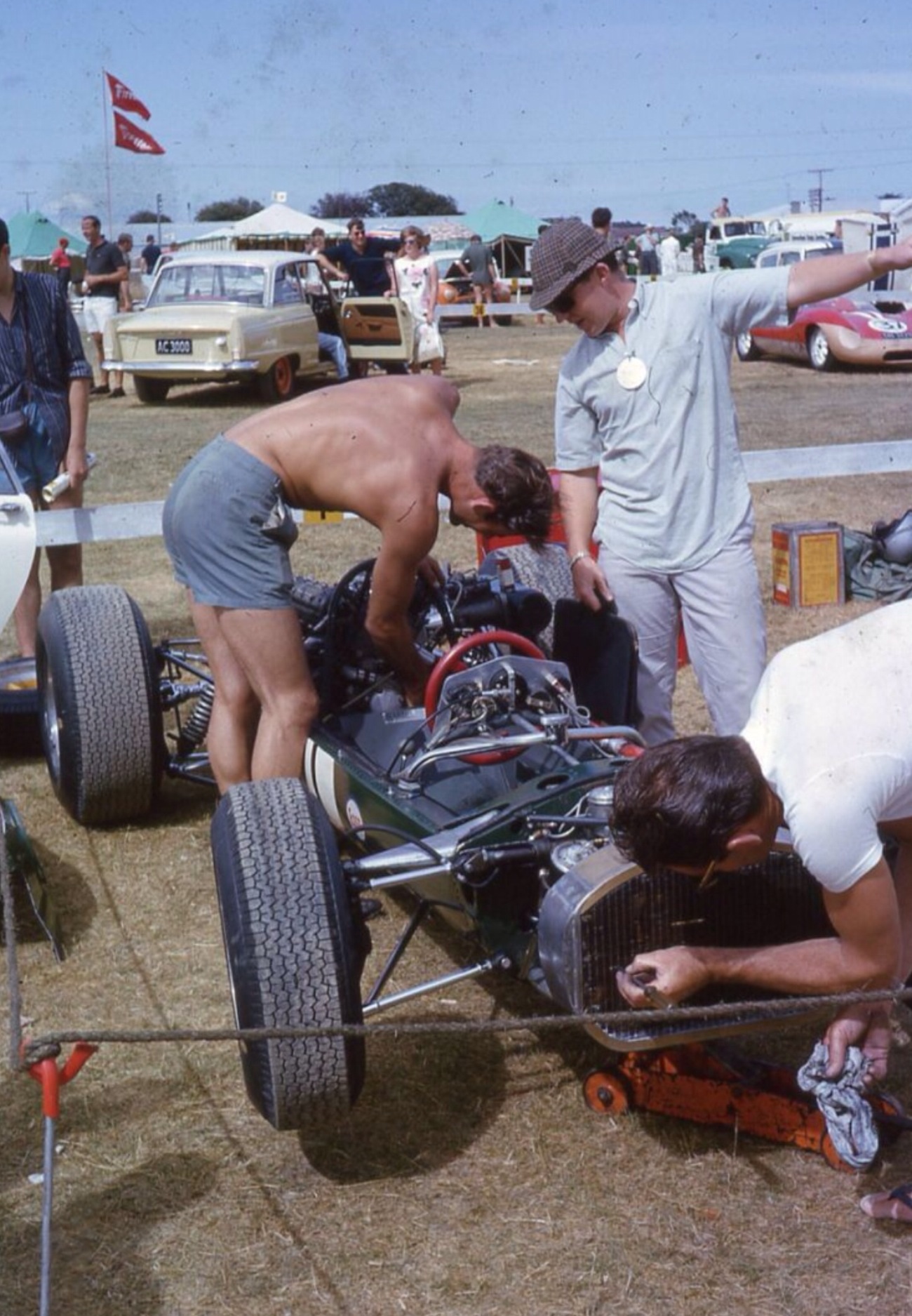
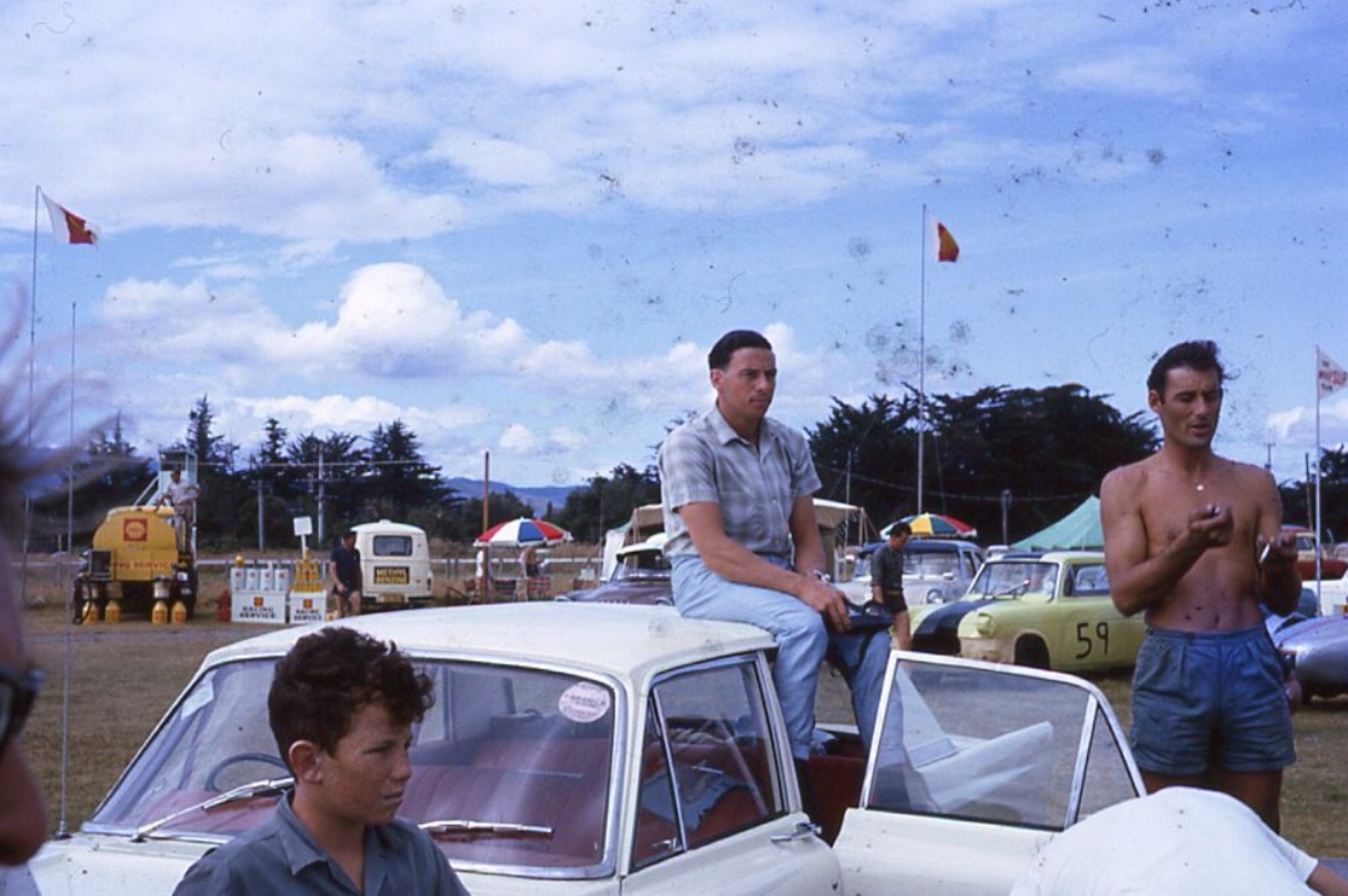
Jim Clark takes in a few rays and a touring car race from his grandstand atop a Ford Zodiac, Levin, New Zealand Tasman, January 1965. In the distance are the Tararua Ranges, alongside the Team Lotus mechanics are fettling Jim’s Lotus 32B Climax.

The champions relaxed nature and the scene itself epitomises all that was great about the Tasman Series. We had the best drivers on the planet visit us every summer and whilst the racing was ‘take no prisoners’ the atmosphere off track was relaxed- the parties, water skiing, golf and annual cricket matches at the Amon family beachhouse are stories told many times over.
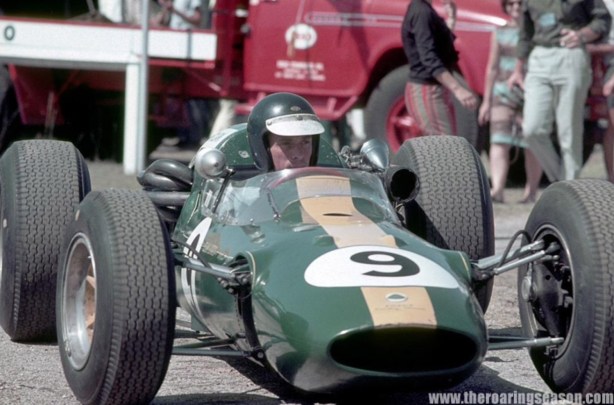
Jim Clark cruising through the Lakeside paddock during the 7 March 1965 weekend. The ‘Lakeside 99’ wasn’t a Tasman Round in 1965 but Internationals Clark, Gardner and Grant contested the event- Jim won from Gardner and Spencer Martin in the Scuderia Veloce Brabham BT11A just vacated by Graham Hill’s return to Europe (Mellor)

Few racing drivers have had a season like Jim Clark did in 1965, surely?

He started the year in Australasia and took the Tasman series with four wins in a Lotus 32B Climax FPF, won the F1 Drivers Championship in a Lotus 33 Climax with 6 wins and topped it all off with victory at Indy aboard a Lotus 38 Ford. In between times he contested the usual sprinkling of F2 events and some Touring Car races in a Lotus Cortina. Lets not forget a few longer sportscar races in the Lotus 40 Ford Group 7 car in the US. Not to mention other races as well. Amazing really.

 We were lucky enough to have the immensely likable Scot in the Southern Hemisphere at the seasons commencement though.

Colin Chapman had the Lotus Components lads build up a Tasman Special for Clark which was a mix of an F2 Lotus 32 chassis, 2.5 litre Coventry Climax 4 cylinder FPF engine and ZF gearbox. The combination was very successful taking race wins at Wigram, Teretonga, Warwick Farm and here at Levin on 16 January 1965. 

Kiwi international journalist and early member of Bruce McLaren Motor Racing, Eoin Young providing direction to the Lotus mechanics looking after Clark’s Lotus 32B. Technical specs as per text but note rocker/inboard front suspension and filler for twin tanks contained in each side of the monocoque chassis pontoons.Lola Mk1 Climax in the distance? (Fistonic)

Twelve Lotus 32 chassis were built plus Clark’s Tasman one-off car which was built around chassis or tub number 32/7. Unlike the 1 litre Cosworth SCA powered F2’s which used a full-monocoque chassis the 32B used a monocoque front section with the rear section removed and replaced by a tubular steel subframe to which the 235bhp, 2495cc, 4 cylinder Coventry Climax FPF engine was mounted. Otherwise the cars suspension, inboard at the front by top rocker and lower wishbone and outboard at the rear was the same as the F2 32. The gearbox was a ZF rather than the Hewland Mk6 of the F2 car. The car chassis plate was tagged ’32-FL-8′ where ‘FL’ was Formula Libre.

This car still exists and is owned and raced by Classic Team Lotus, a shame really as its entire racing history was in Australasia.

Clark won the Tasman in it, the car was then bought by the Palmer family, Jim raced it to NZ Gold Star victory and very competitively in the ’66 Tasman before selling it to Australian Greg Cusack. The car was also raced by South Australian Mel McEwin in period, albeit it was becoming uncompetitive amongst the multi-cylinder Repco’s and the like by then.

Eventually it passed into the very best of Lotus hands- the late John Dawson-Damer acquired it and restored it, eventually doing a part exchange with CTL to allow them to have a Clark Tasman car in their collection. John received a Lotus 79 Ford DFV as part of the deal, he already had Clark’s ’66 Tasman car in his wonderful collection, the Lotus 39 Climax, so it was a good mutual exchange.
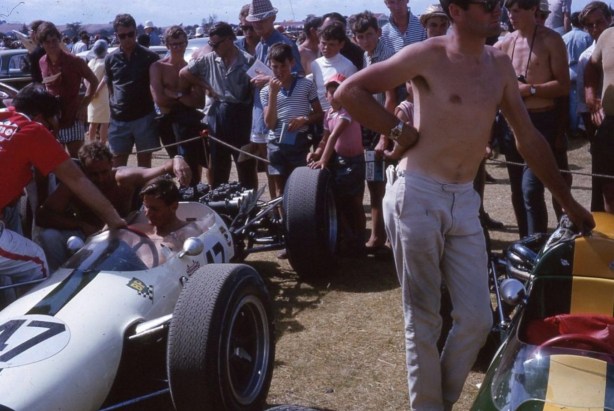
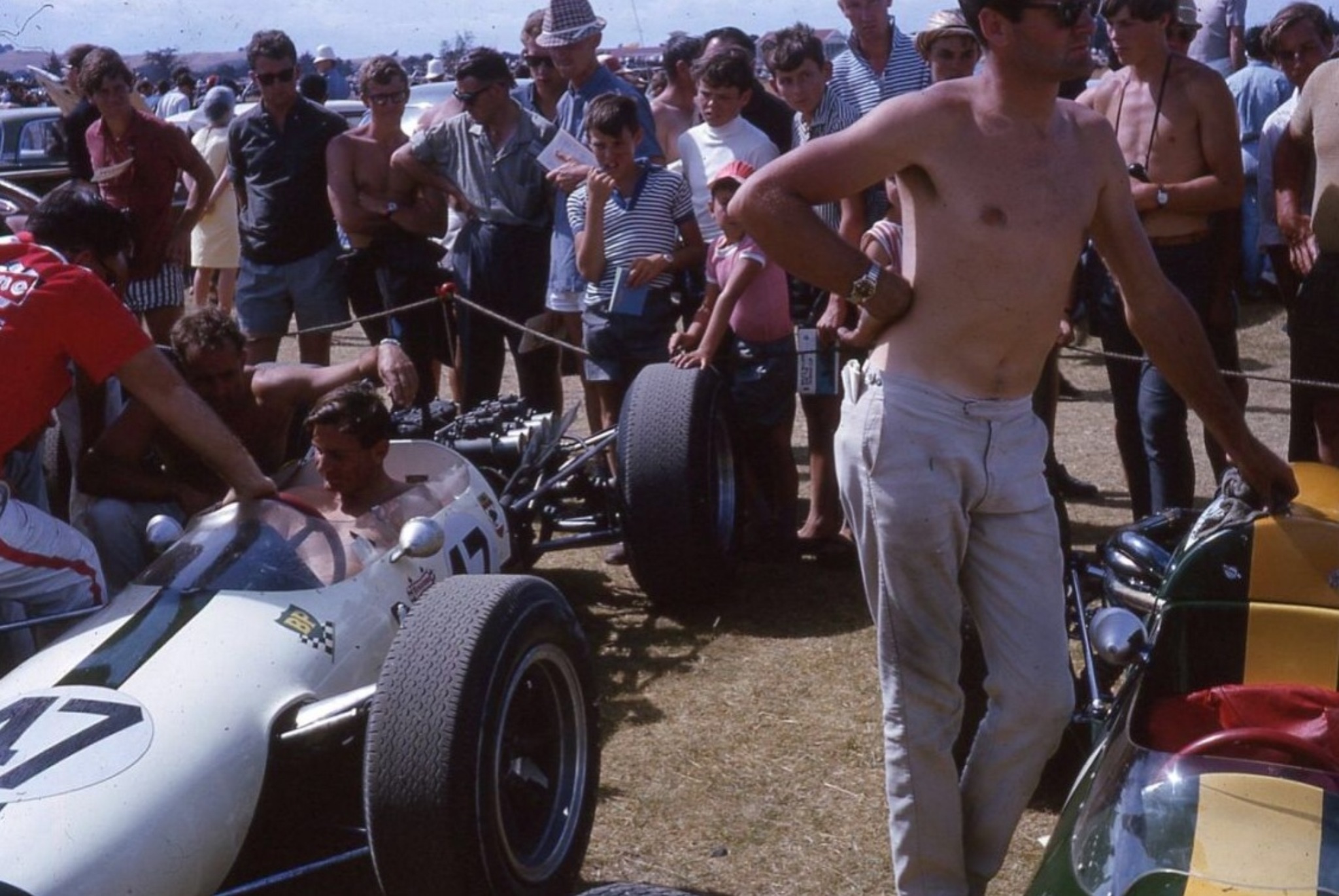
Local boy McLaren surrounded by admirers in the Levin paddock. Cooper T79, alongside is the green and yellow of Clark’s Lotus 32B (Fistonic)

Clark won the ’65 Tasman title 9 points clear of 1964 champion Bruce McLaren aboard his self constructed Cooper T79 Climax and Jack Brabham’s BT11A Climax. Given the speed of the BT11A, it was a pity Jack contested only the three Australian Tasman rounds. Frank Gardner also BT11A mounted and Phil Hill were equal fourth with Phil aboard McLarens updated ’64 Tasman car, a Cooper T70 Climax.

Graham Hill was 7th in David McKay’s Brabham BT11A Climax with other strong contenders Frank Matich Brabham BT7A Climax, Kiwi Jim Palmer similarly mounted, Bib Stillwell in a BT11A, Lex Davison in a BT4 Brabham. In addition there were a host of 1.5 litre Lotus Ford twin-cam powered cars snapping at the heels of the 2.5 FPF’s and set to pounce as the bigger cars failed.

In this article I focus on one round, the Levin event held on 14-16 January 1965.

Kiwi enthusiast Milan Fistonic took some marvellous photos at the event which are posted on Steve Holmes ‘The Roaring Season’ website, check it out if you have not, it’s a favourite of mine. They are paddock shots which ooze atmosphere- Milan focuses mainly on local boy Bruce McLaren and Clark, they are magic shots which I hope you enjoy. This account of the weekend draws heavily on the sergent.com race report. It is another ripper site I always use as my Kiwi reference source.

Start of the 1965 NZ GP at Pukekohe, winner Hill on the outside, Clark in the middle and Lex Davison on the inside- Brabham BT11A, Lotus 32B and Brabham BT4 all Coventry Climax FPF powered (unattributed)

The 1965 Tasman series commenced the week before Levin with the New Zealand Grand Prix at Pukekohe. Graham Hill took a great win in David McKay’s new BT11A, straight out of the box, from the equally new Alec Mildren BT11A driven by Frank Gardner and Jim Palmer’s year old BT7A. How about that, Brabham Intercontinental cars from first to third places, with Jack not driving any of them!

Ron Tauranac’s first in a series of three very successful Coventry Climax engined cars, Tauranac tagged them as ‘IC’ for ‘Intercontinental’, was the 1962 BT4, based on that years BT3 F1 FWMV Coventry Climax 1.5 litre V8 engined car.

Jack raced the first of these in the 1962 Australian Grand Prix at Caversham, Western Australia, having a great dice with Bruce McLaren’s Cooper T62 until a back-marker took him out late in the race. This was followed by the 1964 BT7A and the 1965 BT11A.

Frank Gardner’s Mildren Brabham BT11A Climax being pushed onto the grid. The lanky chap at the back is Glenn Abbey, long time Mildren and Kevin Bartlett mechanic (Fistonic)

The BT11A’s were phenomenally successful in both Australasia and South Africa, winning lots of races and championships not least the 1966/7 Australian Gold Star Championship for Spencer Martin in the very same chassis raced by Graham Hill to victory at Pukekohe.

The cars were utterly conventional, simple and oh-so-fast spaceframe chassis cars with outboard wishbone suspension out the front and outboard multi-link at the rear- single top link, inverted lower wishbone, twin radius rods and coil springs with Armstrong shocks. Like all customer Brabhams they went like the clappers straight out of the box as the base suspension setup was done on circuit by Jack’s ‘highly tuned arse’. Many championships were won by Brabham customers not straying too far from factory suspension settings!

After the NZ GP the Tasman circus upped sticks from Pukekohe and drove the 500 km from the North of New Zealand’s North Island to its South, not too far from Wellington. Levin is now a town of about 20,000 people, then it would have been less than half that, and services the local rural and light manufacturing sectors.

Bruce, Ray Stone in blue and Wally Willmott? Cooper T79 (Fistonic)

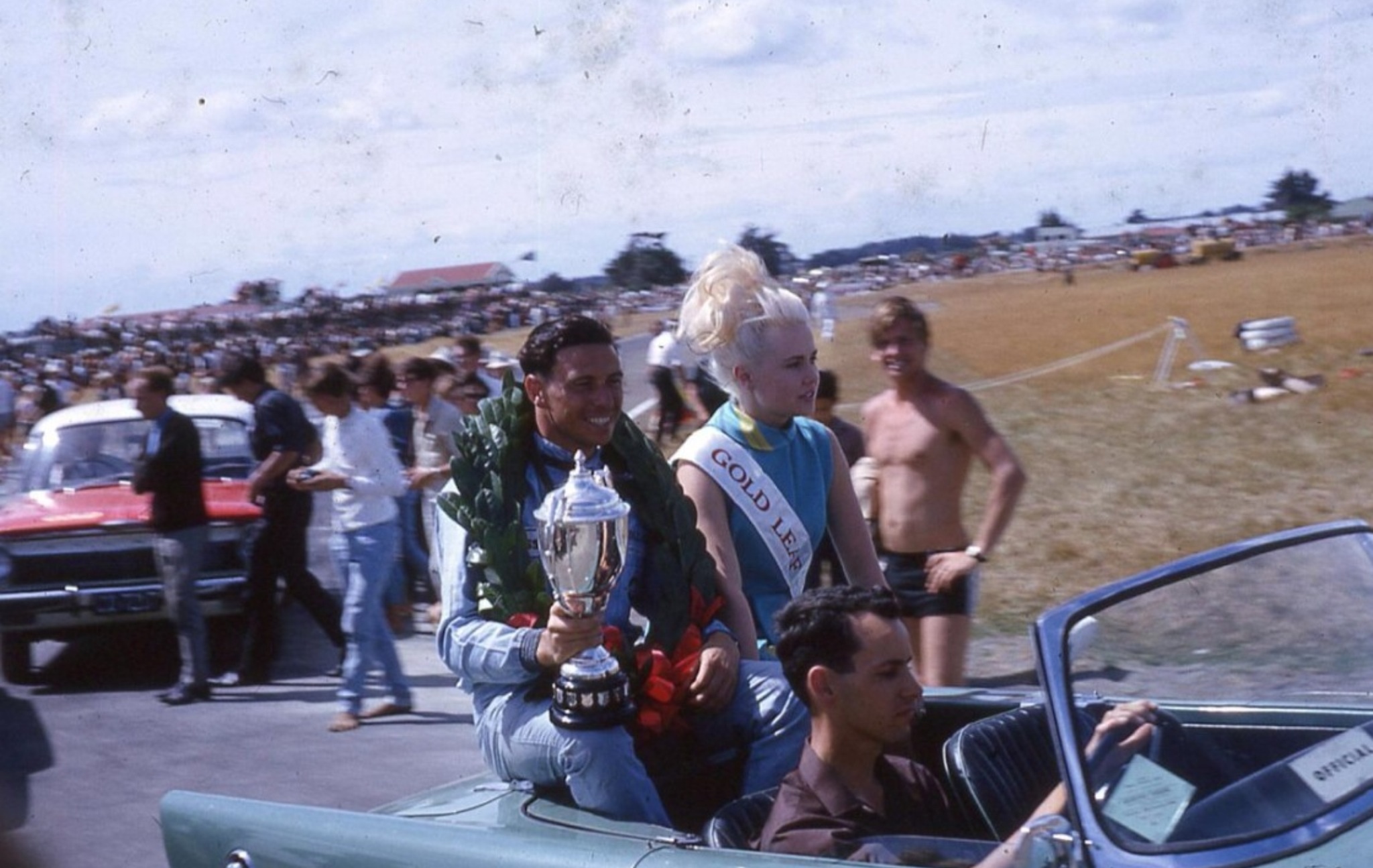
Jim Clark quickly got dialled in to his new Lotus 32B and down to business, opening his Tasman account by winning the Levin Motor Racing Club’s 30.8-mile ‘Gold Leaf International Trophy’ at fractionally more than 76.6 mph.

The Flying Scotsman cut out the twenty-eight laps in fine style in 24 min. 5.9 sec and put in his seventh lap in 49.9 sec. In 1964 Denny Hulme (2.5 Brabham-Climax) had set records of 24 min 36.8 sec and 50.3 sec in this event. Repeating their NZGP form, Brabham-Climax conductors Frank Gardner and Jim Palmer, filled second and third spots, while next in line were the Bruce McLaren Motor Racing Team 2.5 Cooper-Climaxes of Phil Hill, T70 and McLaren, T79.

Graham Hill, Lex Davison and Arnold Glass shipped their cars to Australia after the NZ Grand Prix. Wanganui driver, and later multiple Kiwi Champion, 1970 Tasman Champion and winner of many Asian Grands Prix, Graeme Lawrence had at last got hold of his Brabham BT6 which was making its first appearance at Levin. As noted above Brabham was having a Christmas break and did not join the series until the first Australian round at Sydney’s Warwick Farm in mid-February.

Levin is a tight, twisty and bumpy circuit. Newcomers Clark and Hill quickly had the 1.1-mile track sorted. Clark’s qualifying lap was a 49.4 whilst Phil Hill managed 50 sec, the same time as his team leader McLaren.
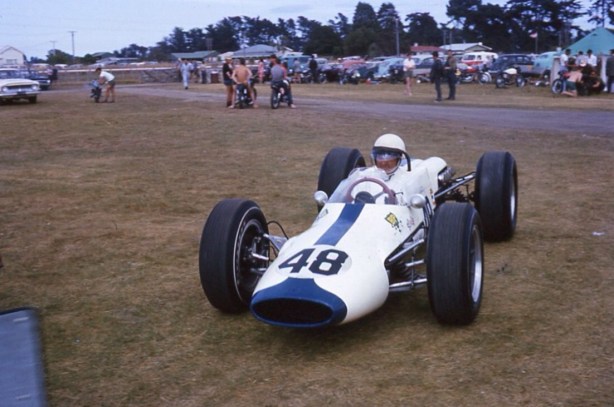
Phil Hill aboard the updated Cooper T70 Climax raced by Tim Mayer and Bruce McLaren in 1964. Compare and contrast with the ’65 model T79 below (Fistonic)

Bruce had a bitter-sweet 1964 Tasman Series. He won the championship in one of two Cooper T70’s he and his Kiwi mechanic Wally Willmott built at the Cooper Surbiton works.

These cars, raced by Bruce McLaren Motor Racing, are generally acknowledged as the first McLarens, built as they were in a corner of the Cooper factory to McLaren’s design. The second car was raced by American ‘coming man’ Tim Mayer with great speed and skill until he made a mistake on the daunting, fast, unforgiving Longford road circuit in Tasmania which took the young drivers life.

The undamaged T70 was updated during the winter to be raced by 1961 F1 World Champion Phil Hill with Bruce racing a new chassis, an evolved T70 designated T79, a spaceframe chassis was again used. The main difference between the cars were inboard front suspension on the T79 whereas the older T70 was outboard. The T79 used a nice, reliable but then new Hewland gearbox whereas the T70’s used a Colotti in one chassis and a Cooper/Citroen CS5 in the other. I wrote an article about Tim Mayer a while back, read it by following the link at the bottom of the page for details of the T70 design rather than repeat it all again here.

Hill P had a terrific Tasman which was a tonic for him as his single-seater career had stalled somewhat since his F1 title winning year. 1962 was a shocker for him with Ferrari who had failed to develop the 156,1963 in an ATS was far worse and his drives for Cooper reflected the fact that design wise, their cars were becoming outdated. If there was any doubt about Hills single-seater speed, he proved he ‘cut the mustard’ aboard a competitive year old car in the ’65 Tasman.
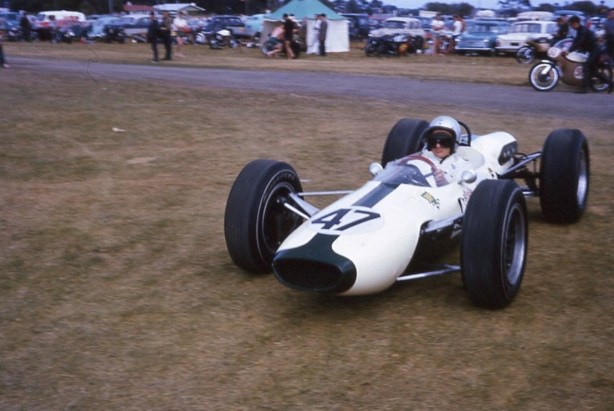
Bruce McLaren aboard his Cooper T79 Climax in the Levin paddock (Fistonic)

The Mayer/McLaren/Hill Cooper T70 Climax raced by all three drivers, originally carrying chassis plate ‘FL-1-64’, re-plated by McLaren prior to the ’65 Tasman to ‘FL-2-64’ passed through the hands of Bill Patterson for driver John McDonald, Don O’Sullivan and others before being acquired by Richard Berryman in 1974. The car was eventually beautifully restored by his son Adam in Melbourne, who retains and races it. The T79 was sold after the Tasman to John Love in South Africa who won many races in it before it later returned to the UK, it too still exists.

Back to Levin practice and qualifying…

Levis with the 1.5 Brabham BT6 Ford was in the groove with a brilliant 51.1 sec, his time put all the 2.5 drivers to shame. Palmer could only manage 51.7 sec in his Brabham BT7A, Grant 51.9 sec in his BT4, Abernethy did 52.2 in his Cooper T66 and Gardner was credited with 53.5 sec in Alec Mildren’s BT11A. Grant was a late arrival. His Brabham-Climax had undergone a major engine rebuild since the discovery of a cracked crankshaft on the eve of the Grand Prix. Second quickest 1.5 was Buchanan’s Brabham BT6 Ford with 52.0 sec. Qualifying times were academic in the sense that grid positions for the feature race were decided on heat results.

Jim Clark again chillin at Levin ’65 (Fistonic)

The eight-lap heat on raceday morning contained all overseas drivers and favoured locals.

‘Clark, sharing the front row with McLaren and Hill, jumped into the lead from the start and remained there to the finish. Hill, McLaren, Palmer and Grant settled into the next four spots after Gardner had dropped out with distributor trouble. The contest was enlivened a little by Palmer catching Grant napping on the seventh lap and assuming fourth place. Clark won in 6 min 49.8 sec and set a new lap record of 49.9 sec’ sergent.com reports.

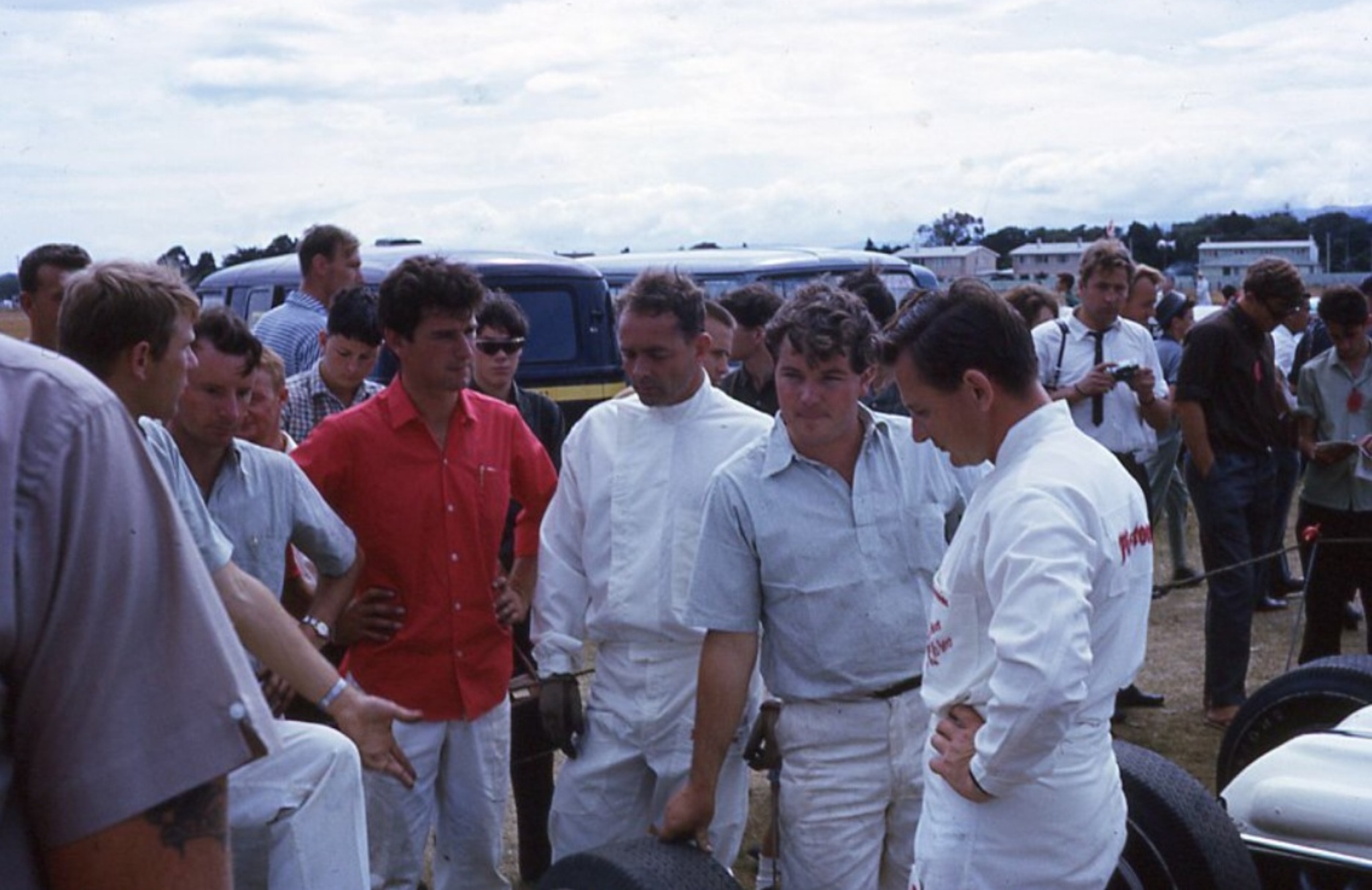
Council of war- Phil Hill in the pristine white race suit with Bruce front and centre, his allegiance to Firestone clear. Who are the other dudes? (Fistonic)

Levis had things all his own way in the second heat, winning in 7 min 13.5 sec, with Andy Buchanan, also in a 1.5 Brabham BT6 Ford, next. Third and fourth were Red Dawson Cooper T53 Climax 2.5 and John Riley in a Lotus 18/21 Climax 2.5. The situation was confused by Gardner who, anxious to make sure all was well with his car, was permitted to use the heat as a test run and took the lead in the last two laps.

Before the title race there was some feverish work in the Palmer pit to replace a cracked universal joint in his Brabham BT7A Climax. In a drama filled day for the team, an hour before the race was due to start, another close inspection revealed a hairline crack in a half-shaft. A replacement was found and fitted minutes before the cars were gridded.
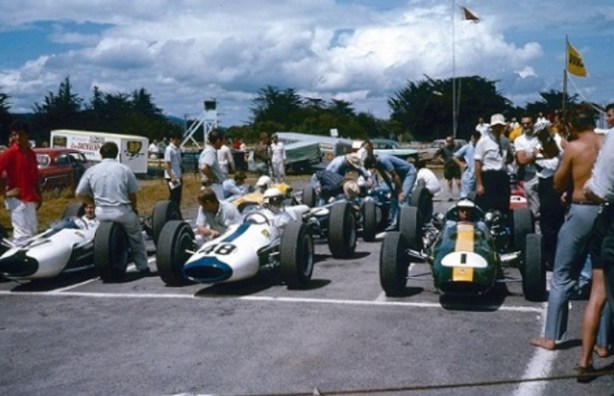
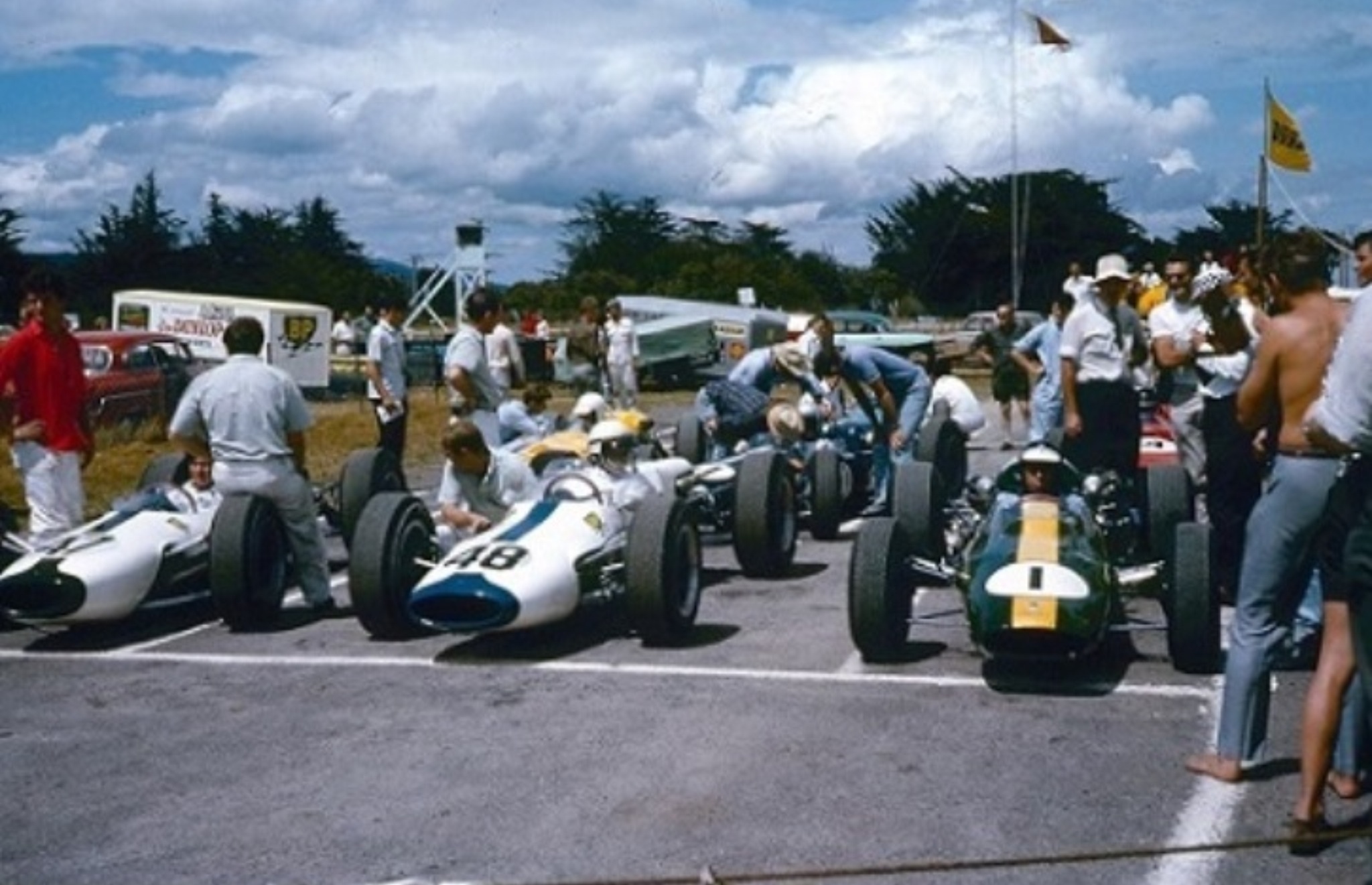
Dummy grid or form up area prior to the Levin International- Clark on pole then McLaren and Hill, the yellow of Gardner on row 2 (Fistonic)

Clark, Lotus 32B had pole position in the main event with Hill, Cooper T70 and McLaren, Cooper T79 outside him.

In rows of three, the rest of the field comprised Palmer, Brabham BT7A, Grant, Brabham BT4, Gardner, Brabham BT11A; Levis, Brabham BT6 Ford 1.5, Buchanan, Brabham BT6 Ford 1.5, Abernethy  Cooper T66; Dawson, Cooper T53, Thomasen, Brabham BT4, Brabham BT4 Riley; Flowers, Lola Mk4A, Smith, Lotus 22 Ford 1.5 Lawrence, Brabham BT6 Ford 1.5; and at the back Hollier, Lotus 20B Ford 1.5. As the cars were forming on the grid, Abernethy could not select a gear and he had to abort the start’.

‘Clark made a good start with Grant, Hill and McLaren right with him. To the elation of the partisan crowd, Grant proceeded to take McLaren and Hill on braking into the hairpin. When they came round the first time the leaders were Clark, Grant, Phil Hill, McLaren, Palmer, Gardner and Levis

A 51.6 sec second lap gave Clark a 3 sec lead over Grant. In his fourth lap Palmer took McLaren and in another two laps had moved to third place ahead of Hill. Clark held on to his lead over Grant. There was then a gap of 3 sec to Palmer, with Hill and Gardner next in line. McLaren, probably to his embarrassment, had the 1.5 drivers Levis and Buchanan looming large in his mirrors.

Clark on the way to Levin International victory 1965, Lotus 32B Climax (sergent.com)

The pattern changed dramatically during the tenth lap. Grant tried to correct a slide at Cabbage-Tree Bend, dropped a rear wheel into the rough and spun off the course to lose all chance in such a short race. Palmer took second spot, but not for long. Gardner in the next three laps bridged the gap to take over second place just 5 sec behind Clark. Next in line were Hill, McLaren and Levis. Flowers was out with transmission failure in the troublesome Lola on lap 14.

Those opening laps had been fast and furious. In their sixth lap Grant and Gardner had returned 50.6 sec in the midst of heavy traffic. A lap later Clark equaled his morning record of 49.9 sec.

As the race reached the last stages, Clark continued to circulate in a steady 51 sec. Gardner in two laps reduced Clark’s advantage from 11 sec to 9 sec while Palmer closed up to be 2 sec behind the Australian, but Clark was given the ‘hurry’ signal and moved out again with effortless ease to come home 11.3 sec ahead of Gardner with Palmer 4.7 sec further back. Thomasen retired with only a handful of laps remaining.’

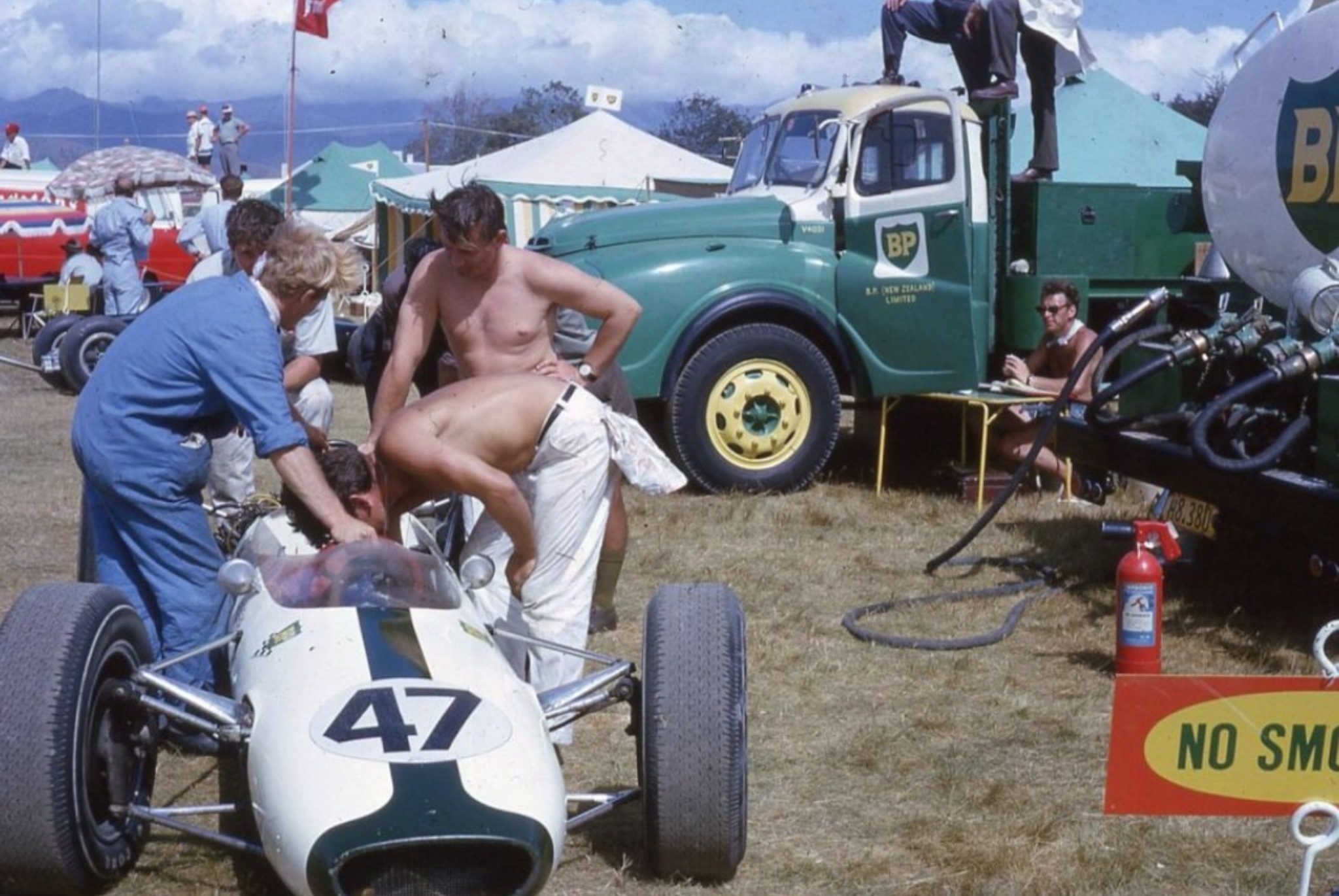
BP all the way, Bruce and Ray Stone in blue fuelling up the T79. Front on shot shows the top rocker/inboard front suspension of the car (Fistonic)

Bibliography…

sergent.com, oldracingcars.com

Cooper T70/Tim Mayer Article Link…

https://primotipo.com/?s=tim+mayer

Photo Credits…

Milan Fistonic, Peter Mellor, The Roaring Season

Tailpiece: Winners are grinners, the first of many such occasions for Jim Clark in 1965 at Levin…

(Fistonic)

Finito…


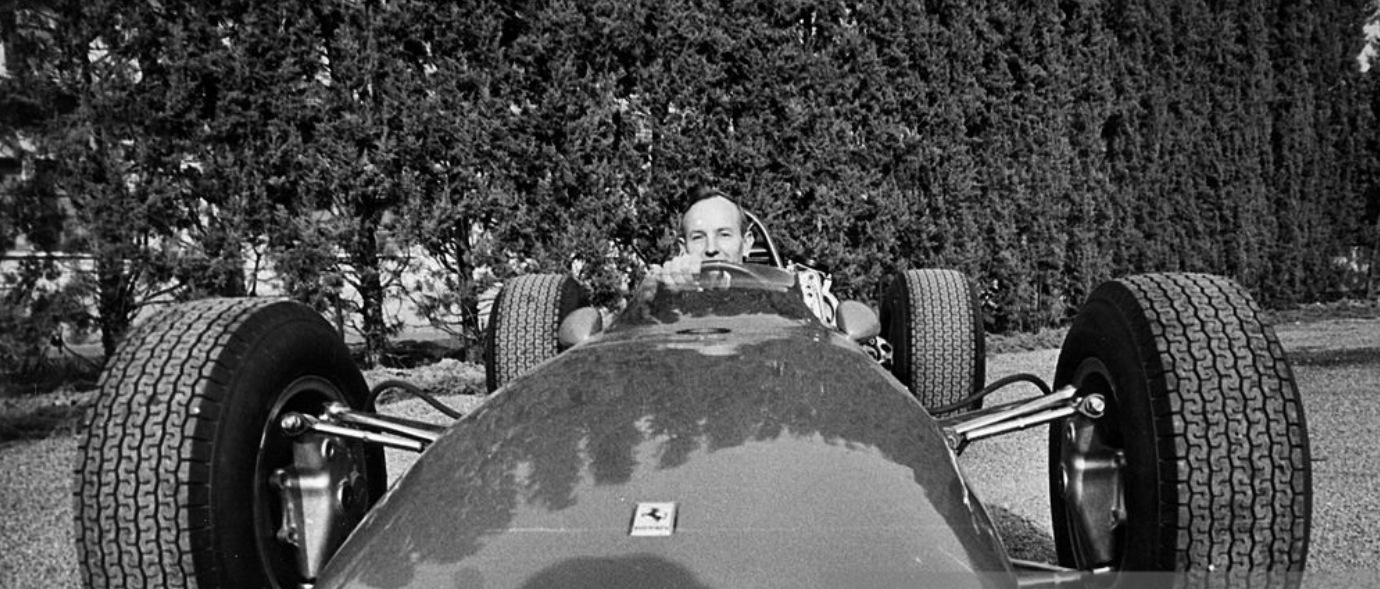
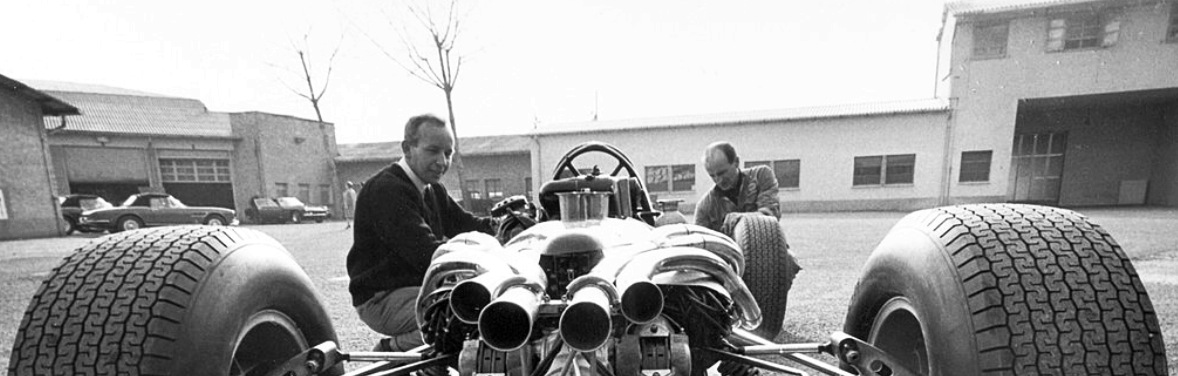
John Surtees poses with his Ferrari 312, the Scuderia’s 3 litre V12 new season and new formula contender, March 1966…

‘Big John’ is probably feeling fairly confident at this point, Ferrari seemed to be as well prepared as they had been for the last formula change from 2.5 to 1.5 litres in 1961. They took the title convincingly of course, Phil Hill won it in the Carlo Chiti designed ‘Sharknose’ 156 V6.

Coventry Climax had withdrawn as an engine provider at the end of 1965, other than some transitional support of Team Lotus with a couple of 2 litre FWMV V8’s to tide them over. Generally, 1966 was a year of transition and therefore of opportunity for those who started the season with a fast, reliable package, the Ferrari seemed just that.

Click on this link for my article on the 1966 Grand Prix season;

Winning the 1966 World F1 Championships: Brabham BT19 Repco…

surtees 2

‘Down Under’ Jack Brabham installed the first Oldsmobile F85 blocked Repco Brabham ‘RB620’ V8 into a year old Brabham chassis, BT19, built for the stillborn Coventry Climax Flat-16 engine and contested the Non-Championship South African GP at Kyalami in it on 1 January.

Repco then popped a 2.5 Tasman Formula RB620 V8 into BT19 for a couple of Tasman rounds, at Sandown Park and Longford, each time learning a little more about the engine and making it reliable.

Ferrari’s own 3 litre V12 was a trusty old warhorse which had served them well. It was a reliable Le Mans winning unit and more powerful than the Repco V8 but the car was heavy. Brabham’s BT19 was a light spaceframe and his 300 horses were stallions not geldings.

surtees 3

The first GP of the new F1, the 1966 XV Gran Premio di Siracusa was on 1 April, Surtees won it in a 312 from teammate Bandini’s Ferrari Dino 246. The only other ‘new’ F1’s were the Cooper T81 Maserati’s of Jo Siffert and Guy Ligier both of which failed to finish. So too did Brabham’s BT19 with a Repco failure.

On 14 May the teams met at Silverstone for the XVIII BRDC International Trophy which Brabham won from Surtees and Bonnier’s Cooper T81 Maser.

Game on!

Off to Monaco for the first Championship round on 22 May, Jackie Stewart’s BRM P261 took the race from Hill’s P261 both cars with 2 litre versions of the old P56 V8 1.5 litre F1 engine, and Bandini’s Dino. Surtees and Brabham were out on laps 16 and 17 respectively with transmission dramas.

Bandini’s use of the Dino which as the teams #1 Surtees should have been allowed to race, in Johns assessment the better of the two cars for the unique demands of Monaco, was one of many dramas within the team which famously resulted in the headstrong Brit telling Ferrari to ‘shove it’ costing both a title which they may well have taken.

surtess 4

Surtees joined Cooper for the balance of ’66 and made the cars sing but Jack was away and running taking the title he and Repco deserved but which perhaps should have been Maranello’s not Melbourne’s…

Click here for an interesting article on Surtees;

John Surtees: World Champion 50 Years Ago…1964

Ferrari 312 Specifications…

312 engine

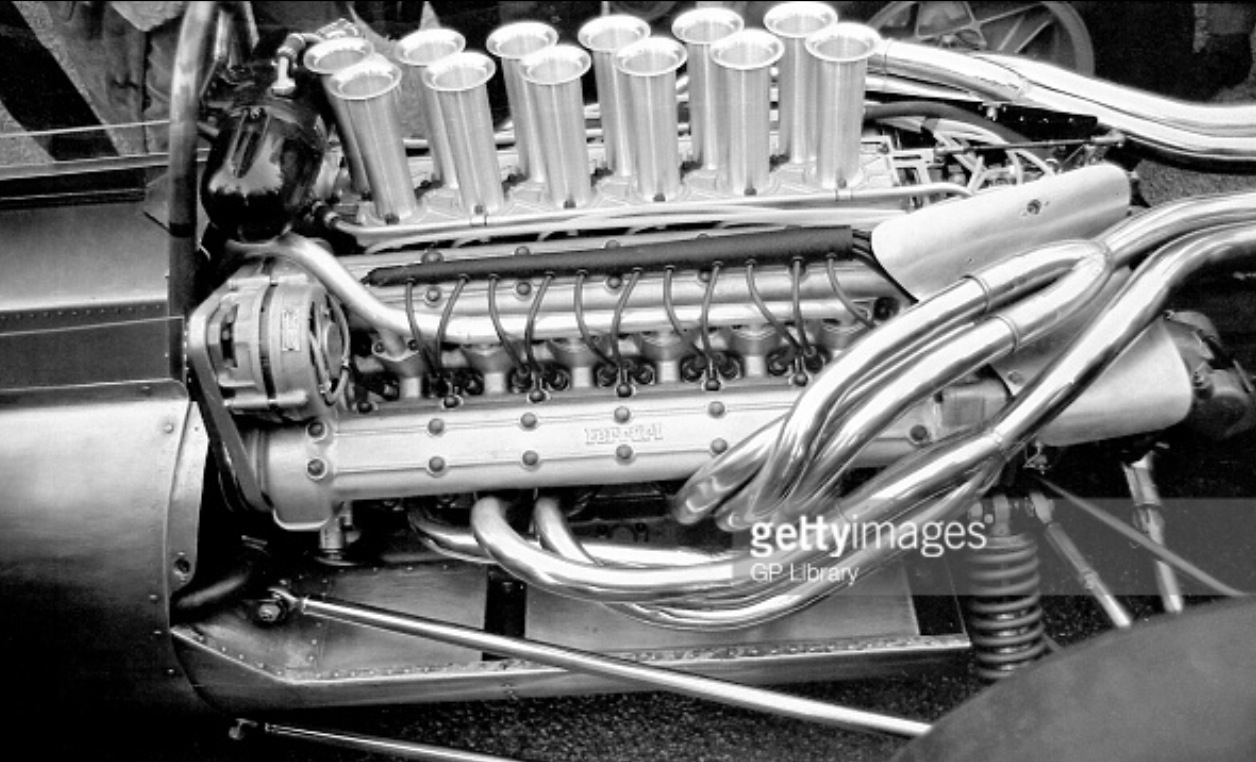
The heart of any Ferrari is its engine of course, and what a glorious thing the Tipo 218 unit was.

Cast in aluminium alloy with cast iron wet cylinder liners, the 60 degree V12 had dual chain driven overhead camshafts per bank operating 2 valves per cylinder. The compression ratio was 11.8:1, heads incorporated 2 plugs per cylinder which were fired, old school, by a battery of 4 coils. The engine was dry sumped, the cylinders fed by Lucas indirect fuel injection. Claimed output was circa 360bhp at 10,000rpm, the reality probably a little less than that.

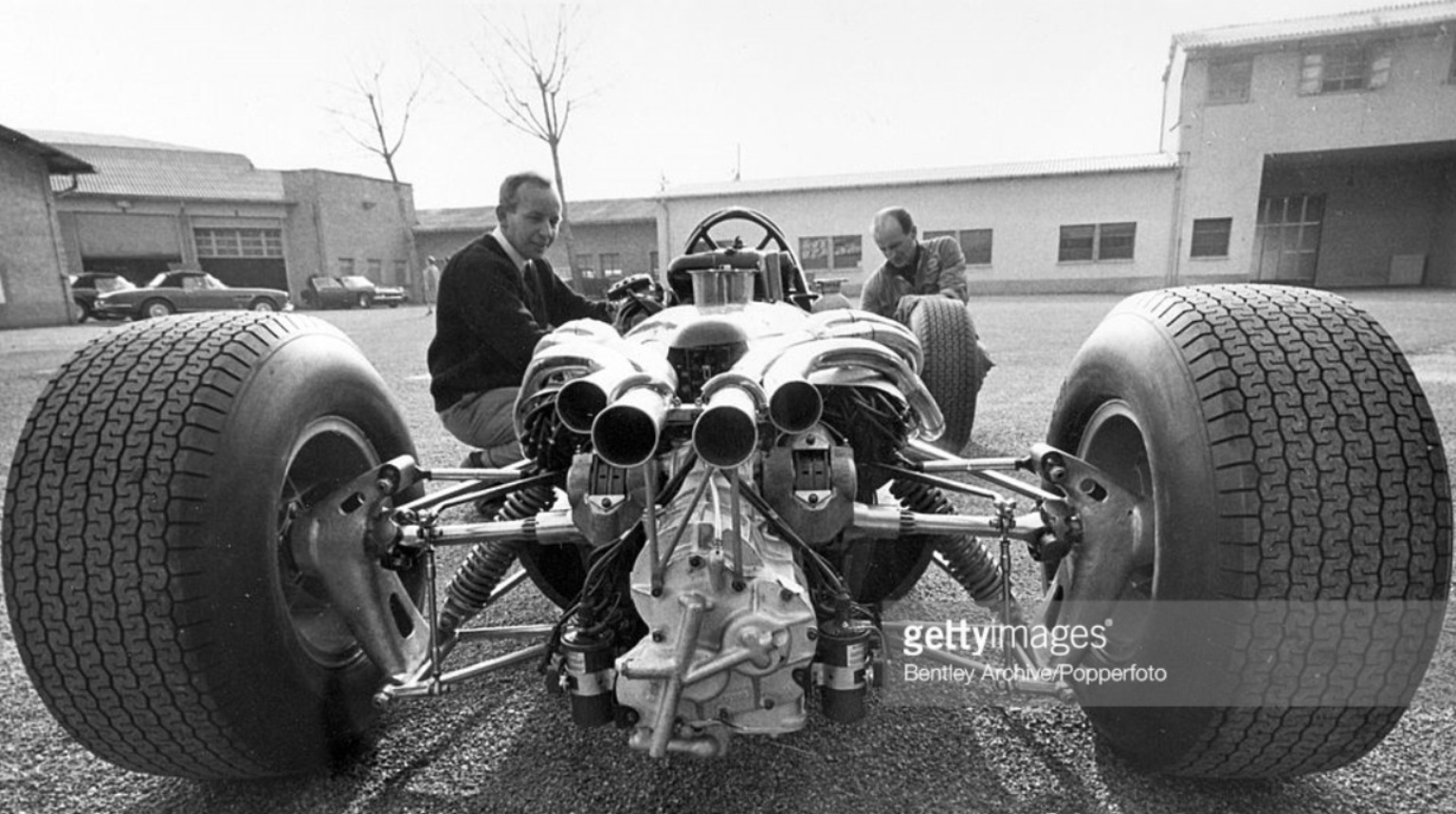
312 rear

The engine wasn’t really the cars weakness, it was probably more so the Tipo 589 chassis’s overall weight. Ferrari really didn’t get the hang of building a modern monocoque in the British idiom until they contracted John Thompson to build them one circa 1973!

Before then their tubs were sheet aluminium panels in a double wall riveted to a tubular steel structure. It was effective but heavy. The Ferrari’s suspension, as you can see is period typical; inboard at the front with a top rocker and lower wishbone and outboard at the rear with a single top link, inverted lower wishbone with forward facing radius rods for location. Uprights were cast magnesium with coil spring/shock units. Girling provided the disc brakes, which were inboard at the rear.

The Tipo 589 5 speed transaxle was sportscar derived, beefy and heavier than the DG300 Hewland box which became ‘de rigour’ in the Pommy cars of the era.

312 engine side

Shot above shows the beautiful standard of Ferrari fabrication and finish. Note the chassis, Lucas injection, twin-plug heads, alternator driven by the cams and wonderful exhausts which are fine examples of the pipe-benders art.

Credits: Popperfoto, GP Library, Reg Lancaster

Tailpiece: Why is that Simple Little Thing So Fast?…

image

Enzo Ferrari ponders the 1966 consistent speed of Jack’s BT19 Repco at Monza on September 3 1966, the ‘Wonder From Down-Under’ beating the might of the Europeans…

What is he thinking I wonder? ‘why is it so fast, its last years spaceframe chassis, engine from someone i’ve never heard of in Australia and the block is an American Oldsmobile…’

In fact the following day was a good one for the Scuderia, Ludovico Scarfiotti’s 312 V12 took the win from Mike Parkes similar car with Denny Hulme’s Brabham BT20 Repco third.


Who would have thought our ‘Black Jack’ would be a street art star…

 But he is! Even if he looks a bit like his good mate Graham Hill, replete with moustache!

Brabham is depicted aboard his 1966 F1 World Championship winning chassis- the Repco ‘RB620 Series’ V8 powered Brabham BT19, click on the links for articles on this bolide at the end of the article.

The artist didn’t realise just how perfect the placement of this sizable work is. Its on a wall in Richmond only 1.5 Km or so from the Doonside Street, Richmond Repco factory where the first of the RB620 V8’s were built and burst into life prior to the shift of Repco Brabham Engines Pty Ltd to Maidstone, in Melbourne’s inner west, in early 1966.

I came upon the art by accident whilst on a walk, its funny the way sometimes these things happen in a serendipitous kinda way.

‘Dimmey’s was an iconic department store in Swan Street Richmond. Its been redeveloped in the last few years- thank the good lord above that the developer was forced to retain the buildings base structure and façade, with the usual, small dog-box apartments contained therein. The big mural is painted on the side of the Dimmeys building. Initially I thought the work was some sort of history of Richmond but its a timeline depiction of ‘Great Australians’ and Oz icons, of whom our Jack is definitely one.

Melburnians can check out the art and have some nice nosh closeby whilst you do so- see the work on the Green Street sidestreet wall, corner of Swan Street. It won’t last forever mind you, it ain’t guarded like the Mona Lisa, if you want a look do so soon before the ‘taggers’ attack it.


It gives me the pip that in popular listings of ‘Great Australian Sportsmen’ Brabham never pops up in the top 10 or 20.

He is a member of the Sport Australia ‘Hall Of Fame’. To me, hopelessly biased as I am, Brabham’s triumphs in 1966/67, lets put to one side his Drivers Championship wins for Cooper in 1959 and 1960, make him the greatest of any Australian sportsman/athlete.

Don Bradman the cricketer is usually rated at #1, big deal, most of you globally will have never seen a game of cricket. You are lucky, it’s a dull, shit-boring invention of the Brits. Often a ‘Test Match’, the elite form of the game, goes for 5 days without a result. Cricket even makes modern Petite Prix racing look exciting!

Brabham, Ron Tauranac and Repco made the ‘bat and ball’ and then they went and belted the best in the world with it. No-one else comes close to Brabham as our #1- not Ken Rosewall, (tennis) Mark Ella, (rugby) Betty Cuthbert, (sprinter) Rod Laver, (tennis) Herb Elliott, (distance runner) Dawn Fraser (swimmer) or Bradman, none of ‘em match his achievements in my book…

Footnote…

In 1966/1967 Jack Brabham and Denny Hulme won the World Drivers Championship aboard Brabham BT19 and BT19/20/24 respectively. Brabham/Motor Racing Developments were the Champion Constructor in both years powered by Repco RB620 and RB740 Series 3 litre V8 engines.

‘RB620’ V8: Building The 1966 World F1 Champion Engine…by Rodway Wolfe and Mark Bisset

Winning the 1966 World F1 Championships: Brabham BT19 Repco…

I’ve deliberately not captioned the mural shots- I don’t know all the names of the dudes depicted myself, so I’ve left it to Aussies to have some fun picking those people and events you can and wonder who/what the ones are you can’t identify! It’s great, do take the time to go and have a look.

Tailpiece…


(P Mellor)

John Surtees cruising his Lola Mk4A Climax around the Lakeside paddock during the 1963 Australian summer…

No doubt he is on the way to or from scrutineering, the Lola devoid of its usual slinky ‘Specialised Mouldings’ fibreglass body. These cars were designed by Eric Broadley as F1 machines, they were the front line weapons of the Bowmaker Racing Team during the 1962 season.

Strong results at championship level were skinny even when the too flexible spaceframe Mk4 chassis was braced with aluminium to become the ‘semi-monocoque’ Mk4A. The last of the Mk4’s was modified in this manner and is the car Surtees raced in Australasia in the summer of ’63- chassis ‘BRGP44′. The chassis made its debut in the non-championship Kanonloppet at Karlskoga in Surtees hands on 12 August 1962 and was then raced in the GP’s of Danske and Italy before being converted for Surtees’ use in the South Pacific.

The Mk4’s were fitted with both the Coventry Climax FWMV 1.5 litre V8 for F1 use and the 2.5 or 2.7 litre Coventry Climax FPF engine for the Intercontinental Formula and for Formula Libre as the Australasian summer races then were.

The global stock of FPF’s found a ready home in Australasia after the commencement of the 1.5 litre F1 as the ‘engine de jour’ in our Formula Libre, Gold Star and Tasman races until 1966 when ‘multi-cylinder’ engines arrived. The BRM P261 V8 won the Tasman in 1966 in Jackie Stewart’s hands, soon the Tasman was awash with interesting engines from BRM, Repco, Ferrari and Ford. Mind you, the good ‘ole FPF was still a contender in Gold Star events with Spencer Martin and Kevin Bartlett consistently knocking off Repco V8’s in domestic Australian events into 1967.

Surtees was on the cusp of four-wheel greatness of course. In 1964 he won the World F1 Drivers Championship for Ferrari in a Tipo 158, an additional title to match those already won on bikes.

Surtees in the Bowmaker Racing Lola Mk4A chassis ‘BRGP44’ Coventry Climax 2.7 FPF during the 1963 Australian GP weekend at Warwick Farm in February. He was 2nd in between winner Brabham and 3rd placed Bruce McLaren in Brabham BT4 and Cooper T62 respectively, both 2.7 FPF powered (Ellacott)

Bowmaker Racing entered cars for John and Tony Maggs that season in Australasia achieving a good measure of success. Competition was stiff too. That year the internationals included Jack Brabham, Bruce McLaren, Graham Hill (Ferguson P99) and coming-man Chris Amon. In addition Australian and New Zealand Champions included Bib Stillwell, Lex Davison, John Youl, David McKay and Jim Palmer- not all of these blokes did the whole series mind you.

The Lakeside International was held in blistering Queensland summer heat with Surtees taking a fine win from Graham Hill and Bib Stillwell. He was first in the NZ GP at Pukekohe early in January too, having gearbox dramas at Levin and Wigram and a distant 9th at Teretonga with undisclosed problems. He then contested the Australian events at Warwick Farm, finishing 2nd in the AGP at Warwick Farm, took the win at Lakeside and then jetted home to the UK and testing duties with Ferrari. The rest, as they say is history…

Photo Credits…

Peter Mellor on The Roaring Season, John Ellacott

Surtees Article…

John Surtees: World Champion 50 Years Ago…1964

Amon on the way to 7th in the Lola Mk4A ‘BRGP44’ now re-engined with a Coventry Climax FWMV V8, at Rouen, French GP June 30 1963. Clark won in a Lotus 25 Climax (unattributed)

Tailpiece: Chris Amon, Lola Mk4A Climax, French GP 1963…

Lola Mk4A ‘BRGP44’ raced on into 1963. The car was converted back into an F1 machine, the 2.7 FPF was lifted out after its sojurn in Australasia and an FWMV Coventry Climax V8 re-fitted back at Lola in Bromley. Chris Amon was allocated the car for the ’63 F1 season, although Maurice Trintignant raced it at Monaco. The cars best result that year was funnily enough Amon’s first race in it- 5th in the Glover Trophy at Goodwood.

avus 1

Tony Brooks powers his Ferrari Dino 246 out of the Avus hairpin during his victorious German Grand Prix drive, 2 August 1959…

The 1959 event was held at the ‘Automobil Verkehrs und Ubungs-Strasse’ (AVUS) track in Berlin rather than its Nurburgring ‘home’. The vastly quick, banked track was tailor made for the Ferrari Dino 246 which had more power than the Cooper brigade, but considerably less handling. The recent partitioning of Berlin meant that a new south loop was added to the facility which dated back to the 1920’s.

Brooks arrived full of optimism, he had won on the super fast Reims road course on 5 July several weeks before. The Ferrari’s were right on the pace with Brooks taking pole from Moss’ Cooper T51 with Dan Gurney 3rd  in another Dino. Due to fears of tyre wear the race was run in two heats, Brooks won both of them. The minor placings also went Ferrari’s way to Gurney and Phil Hill.

The weekend is also famous as a consequence of Hans Hermanns survival of one of the most spectacular GP accidents ever. His BRM P25’s brakes failed on lap 35 of 70, the car hit hay bales and was launched into a series of somersaults with Hans thrown clear and escaping serious injury. He was a very lucky boy.

avus 2

Tony Brooks Dino ahead of Masten Gregory’s Cooper T51 Climax, the much under-rated Kansas driver qualified 5th but was out on lap 23 with engine failure (unattributed)

The meeting was overshadowed by Jean Behra’s death in a supporting sportscar race, the little Frenchman died instantly after spinning his Porsche RSK and hitting a flagpole in mid-air. Jean’s 1959 season I covered in an article, click on the link at the end of this piece to read it.

Portugal…

brooks

Tony Brooks pre practice at Monsanto Park, Portugal, Tony 9th (Klemantaski)

Brooks looking relaxed before the Portuguese GP at Monsanto, Lisbon. The 23 August race was won by Moss from Masten Gregory, both in Cooper T51 Climaxes, Gurney was the best placed Ferrari in 3rd with Brooks 9th- about where a good front engined car could expect to finish as the mid-engined paradigm shift gathered pace.

Credit…

Louis Klemantasi

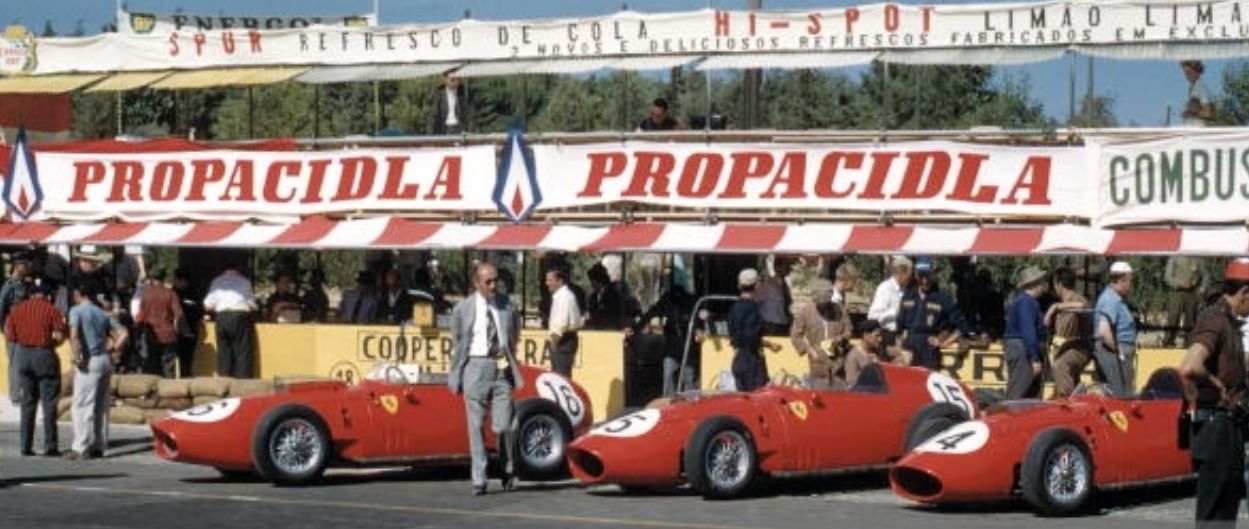
Tailpiece: Three Ferrari 246’s in a Monsanto Park row- Dan Gurney, Phil Hill and Tony Brooks steeds await their intrepid pilots…

brooks 2

(Klemantaski)

Finito…


(Joel Wakely)

While two of my favourite drivers are Lorenzo Bandini and Australian Gold Star champion, Spencer Martin, it was quite a surprise to see them in the same shot. Lorenzo in a Cooper and Spencer a Holden…
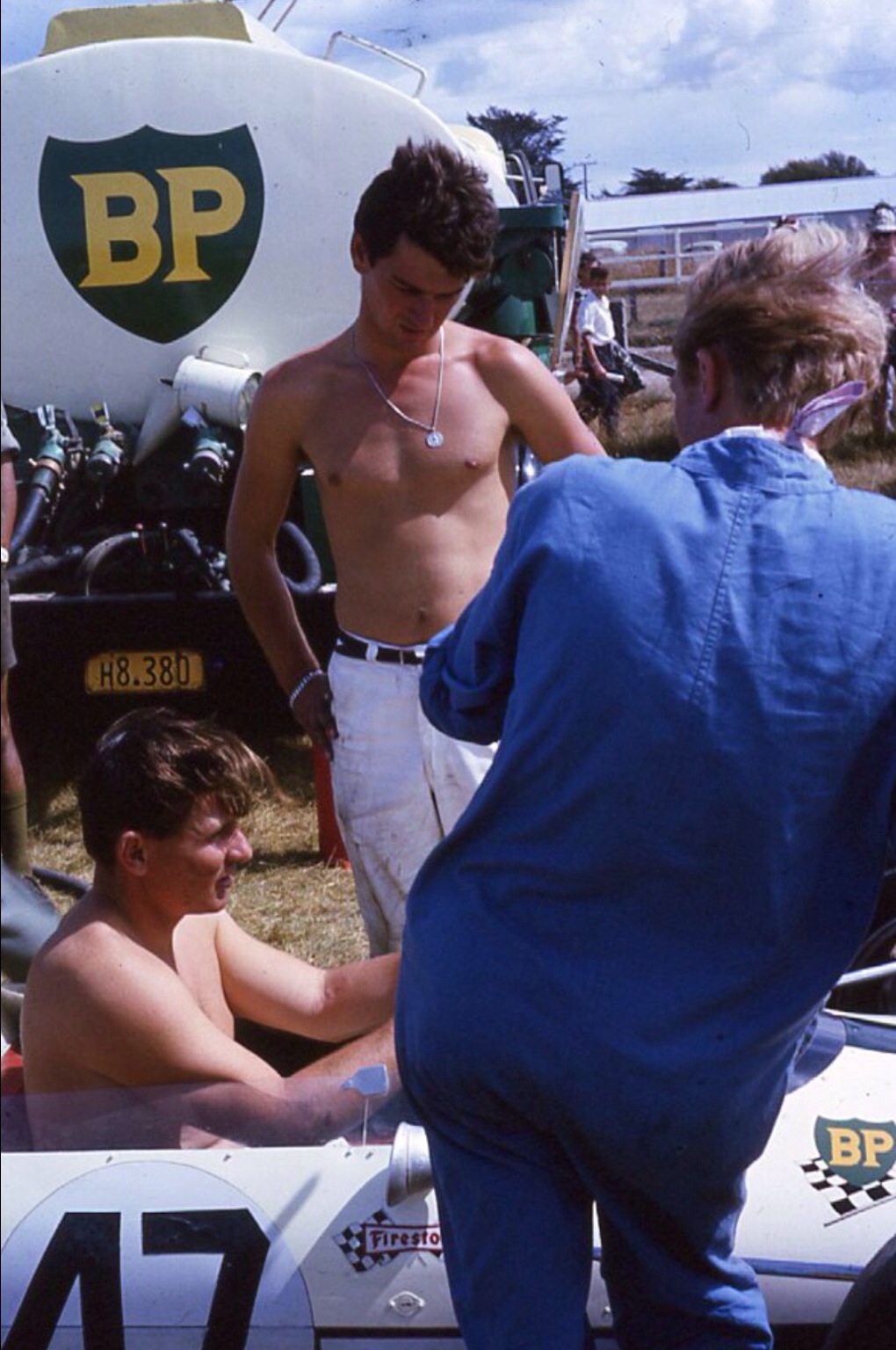
Joel Wakely’s Boomerang Service Station at Concord, inner-western Sydney was well known amongst Australian motor-racing aficionados by February 1962 as builders of one of the fastest Appendix J Holden 48-215 sedans in the land peddled very hard by up-and-comer Spencer Martin.

The young Sydneysider was soon to race Tasman cars like Bandini’s Cooper for Australian racer/journalist/patron David McKay’s Scuderia Veloce, but that period was still a year or so away. Click here for Spencer’s own account of his racing career;

Bandini was also on the rise. His racing in the southern summer sun of ’62 was part of Mimmo Dei’s grand plan to give the young Italian some racing miles aboard his Scuderia Centro Sud T53 Cooper in the European off-season’ to get him razor sharp for the rigours of the coming season back home.

The 2.9 litre Maserati engined Cooper was very much a big-car, F1 by then was a 1.5-litre formula, so the experience was valuable for him. It was a successful strategy back then and still is, the New Zealand Toyota Racing Series every summer is a place young racers look to keep themselves race fit and help thrust their careers forward. Click here for my article about Bandini;

The car in the middle of the shot is the gorgeous Clive Adams designed Prad Holden sportscar styled along the lines of a Maserati 300S. Jack Pryor built the chassis and Stan Brown it’s shapely body. Spencer Martin bought, developed and raced the car successfully after Adams sold it.

And so it came to pass that Bandini’s Cooper was operated from the Boomerang Servo at the behest of BP, who supported Centro Sud. It made good sense as the garage was only 25km from Warwick Farm, near Liverpool on Sydney’s then western outskirts. Wakely recalls that ‘So many people heard about the car at the garage and came down to have a look we had to have crowd control!’

Centro Sud were not exactly renowned for the detail presentation of their cars, but even so I thought Lorenzo’s car looked a bit tatty. Perhaps the reason is that it isn’t the car he raced!

Have a look yourself at the photo below, it isn’t the same car. The inlet and exhaust sides of the Maserati engine are on the opposite sides to the Cooper in shot, apart from the body differences. I think the car above is a spare T51 Cooper, one of two acquired by Dei from Coopers in 1959 and raced in both F1 in 1959/60 and the Intercontinental Formula in 1961. Still, that’s my theory it may not be right! So, the question for my Australian friends is which Cooper chassis is Bandini sitting aboard? A Centro Sud spare or another car based that weekend at the Concord Temple of Speed?

I love these mysteries, but I like the answers even more…

(John Ellacott)

Lorenzo Bandini in the Centro Sud Cooper T53 Maserati – chassis F1-13-61 – during the Warwick Farm 100, 4 February 1962. Compare and contrast with the car in the opening shot.

Credits…

oldracingcars.com, sergent.com, Joel Wakely, John Ellacott

Other Reading…

Article about Spencer Martin and the iconic Ferrari 250LM he raced for David McKay

Finito…