Archive for the ‘F1’ Category

oversteer

Nick Heidfeld thrilling spectators in qualifying with a touch of what was a drivers stock in trade into the early seventies, oversteer which thrilled the eye if not always the stopwatch…

He was brought in to replace Pedro de la Rosa, qualified 15th and retired after a collision on lap 36 in the race won by Fernando Alonso’s Ferrari F10.

Credit…Getty Images

image

Gavin Youl in the new MRD Ford making a sensational championship debut in Ron Tauranac and Jack Brabham’s Formula Junior at Goodwood on 19 August 1961…

The young Taswegian arrived in England with sportscar and touring car experience in Australia and made a huge impact in finishing 4th in his heat, and 2nd in the final of the BARC FJ Championship in what was only his fourth outing in single-seaters.

Alan Rees won the race in a Lotus 20 Ford. To give perspective on the level of competition, there were 19 non-qualifiers and a field of 24 which included future champions Mike Spence, Richard Attwood, David Piper, John Rhodes, Frank Gardner and Hugh Dibley.

Gavin made a huge splash, and so too did the nascent ‘Brabham’ marque, the MRD was their first car, the established production racing car paradigm was given a shake that day. Arguably Brabham were the most consistent, competitive, cost-effective customer proposition for  most of the sixties and early seventies in FJ, F3, F2 and F1.

The story of Jack Brabham and Ron Tauranac’s partnership in forming Motor Racing Developments Ltd in England, the company which built Brabham cars is well known. So too is the decision by the two partners to change the name of the cars from ‘MRD’ to Brabham upon the advice of prominent Paris based Swiss journalist Jabby Crombac. He told Jack that MRD was pronounced ‘merde’ in French the literal translation of which is ‘shit’! And Brabham’s were very rarely, if ever, shit cars!

The MRD was retrospectively given the model name BT1, there was only one built, thankfully the car is still in Australia where it has raced all of its life other than the seven race meetings in England Youl contested between late July and late September 1961.

It’s intriguing to contemplate the look on Frank Gardner’s face at the speed of the MRD at Goodwood as the multi-talented Aussie- who raced a Jim Russell Race Drivers School Lotus 20 that year, was one of a small team who built Tauranac’s new car being peddled so quickly by novice Youl!

Gavin was sold the car by Ron during a Brabham plane trip. Jack took several friends to see the Tourist Trophy bike races at the Isle of Man. It appears there was no great process of choosing the driver of their first car, the commercial imperative was someone who could pay for it! Mind you, no doubt Gavin was aboard the plane with that commercial end in mind as well as his potential as a driver.

image

Ron Tauranac’s MRD Ford Holbay was a pretty, effective, competitive car. RT had built numerous Ralts in Australia prior to the design and build of the MRD which was his first ‘water cooled engine’ design! The ‘Brabham’ was competitive from the start, here at Goodwood in Youl’s hands, very much indicative of the amazing run of strong, reliable, fast cars built through until Ron’s sale of the MRD business to Bernie Ecclestone at the end of the 1971 F1 season (Getty)

In the MRD’s initial outings (see listing below) not much notice had been taken of it, their were plenty of specials in FJ at the time. But at Goodwood, a circuit on which he had not raced before Youl caused a sensation by popping the car on pole for his heat, 0.8 second under the lap record. Tauranac recalls things were looking good but then the car caught fire, RT rebuilt it in time for the race on the Bank Holiday Monday. Youl was 4th in his heat, it may have been higher but he overcooked it on a corner, but in the final kept it all together to finish 2nd to Rees, then very much a rising star.

Jack’s connection to the car had been kept very secret. The MRD was built in a room at the back of a garage on the Esher bypass with all of the specialist purchases needed to construct the car being made very discretely. The Goodwood meeting was a national event, the FJ events were supports to the RAC Tourist Trophy sportscar race with plenty of press presence. ‘The paddock buzzed with speculation and some people were adding two and two to make four’ wrote Mike Lawrence in ‘The Ron Tauranac Story’. Soon of course the connection was known as were Jack’s plans to leave Cooper at the years end.

Tauranac arrived in the UK in April 1960, whilst he occupied himself with Climax engined Triumph Heralds and other projects for Jack Brabham Motors in Chessington, his main task was to design the MRD in the bedroom of the flat the Tauranac’s rented above a shop in Surbiton.

Sensibly, the car was a conventional multi-tubular spaceframe chassis design fitted with an attractive, fully enveloping aluminium body. Suspension at the front comprised a single upper link and Y-shaped radius rods and lower wishbone with coil spring/Armstrong dampers. At the rear broad based upper wishbones, lower links and twin radius rods were used again with coil spring/dampers. The car was reputedly the first to be fitted with adjustable roll bars.

Alford and Alder uprights were fitted at the front to which were attached 13 inch Brabham alloy wheels, unique to BT1,  front and rear. Rear uprights were cast magnesium. The car used 9inch drum brakes at the front and inboard mounted 8 inch drums at the rear.

The gearbox was a modified VW Beetle 4 speed with Jack Knight cutting gears to give RT the ratios he wanted. The steering rack was also made by Jack Knight to a pattern and drawings RT brought to England from Australia. A Morris Oxford pinion was used with a specially cut rack. Initially a 1000cc Ford engine was fitted with an 1100cc Holbay Ford used from the Goodwood meeting.

Jack was still racing for Cooper as noted above but he found time to help build the car together with Ron, Frank and Peter Wilkins who had assisted Tauranac build the chassis frames of his ‘first series’ Ralts in Australia and was asked to come over to the UK to help build the MRD.

Gavin Youl contesting the FJ race in the MRD at the Warwick Farm international meeting on February 4 1962. He was 3rd behind Leo Geoghegan’s Lotus 22 Ford and Glynn Scott’s Lotus 20 Ford (John Ellacott)

In October 1961 the MRD was shipped to Australia where Gavin raced it to some success. He contested some of the support events for that years international meetings in the summer finishing 2nd at Lakeside, 3rd at Warwick Farm and then winning the FJ race at the 1962 Longford international meeting. There, the little car was timed at 132mph on the ‘Flying Mile’. He took a win at Calder in late February and then made the long trip to New South Wales in March- he won the NSW FJ Championship at Catalina Park beating Leo Geoghegan’s Lotus 20 Ford. Gavin then returned to the UK to race a new BT2 FJ in selected British and European events.

Victorian Wally Mitchell was the lucky purchaser of the MRD which over the years passed through many owners hands. The car is a much admired part of the local historic scene and together with Jack’s 1966 F1 championship winning BT19 Repco would be the most significant Brabham in Oz.

Works Brabham FJ Campaign in 1962…

The factory assisted drivers in 1962 were Gardner and Youl with Frank initially racing BT2 ‘FJ-3-62’, a car he built. When Gavin arrived in the UK he raced this car with Frank racing ‘FJ-8-62’, both of these cars went to Australia after the initial season of racing in the UK/Europe.

Gavin’s campaign was set back from the start after a testing accident at Brands Hatch made a mess of both the car and his collar bone which was broken. He recovered whilst the car was repaired.

The BT2’s differed from MRD ‘FJ-1-61’ in that outboard disc bakes were used front and rear and Specialised Mouldings built fibreglass bodies replaced the one-off ally body of MRD. A Hewland Mk5 gearbox replaced Ron’s modified VW unit whilst noting the Maidenhead built ‘box also used a VW case.

11 BT2’s were built, the first 2 or 3 by Gardner and Wilkins, the balance by Buckler Cars. Buckler are credited in the Tauranac and Brabham biographies as the constructor of the sole MRD frame, to Tauranac’s drawings, a claim denied by Frank Gardner. In conversations with Australian Brabham owner/historian Denis Lupton, Gardner said the MRD frame was built by Gardner, Wilkins, Tauranac and Brabham.

Buckler built at least 5 BT2 chassis. Of course Arch Motors, the unsung engineering concern, were soon thereafter to become the builder of both Brabham and Ralt ‘production chassis’, in addition to their many other clients!

Peter Arundell’s works Lotus 22 Ford leads Youl’s Brabham BT2 Ford and Denny Hulme’s Cooper T59 BMC through the Nouveau Monde hairpin during the 8 July 1962 Rouen GP for FJ. They were 1st, 12th and 10th overall with Youl crashing in the first heat, he was 9th in the second heat (Sutton)

The BT2 proved to be a competitive car but the FJ combination to beat in 1962 was Peter Arundell in his works Lotus 22 Ford Cosworth. BMC engines were not prominent and the Holbays used by Brabhams were not the ‘ducks guts’ either. When Gardner and Youl’s cars finished they were often the best of the Holbays, that is, best of the non-Cosworth engined cars.

Youl’s results are in the table below, his first meeting after recovery from his injuries was at Silverstone in May, his last at Albi in September. His best results were a pair of 5ths at Albi and Goodwood, the latter event was the BARC Express and Star British Championship, where he was the best placed Holbay car.

Gardner’s 7th on the Monaco FJ grid was indicative of his place (that is fast!) in the pantheon of FJ drivers that year, a race he failed to finish with clutch failure. Arundell won still the most prestigious international junior event from Mike Spence and Bob Anderson, all three aboard Lotus 22 Ford Cosworths. It would have been very interesting to have seen how the Gardner/Youl combo would have gone with Cosworths behind their shoulders in ’62. Right up there for sure.

Gavin shipped his car to Oz after the European races he had competed in with Gardner’s ‘FJ-8-62’ accompanying Frank back to Australia at the end of the year. The lanky Sydneysider raced the car in two of the Formula Libre Australian Internationals in early 1963- Lakeside and Longford with the car being sold to Len Deaton later in 1963.

The history of the 11 BT2 chassis built for those interested can be seen, in all of its intricate glory, on oldracingcars.com and Ten Tenths, just Google away.

image

John Youl, with his engineer, Geoff Smedley beside their ex-works/Jack Brabham F1 Cooper T55 Coventry Climax FPF on the Longford grid prior to the ‘South Pacific Trophy’ on 2 March 1964. He was 5th in the race behind Graham Hill, Bruce McLaren, Frank Matich and Bib Stillwell in his 3 year old car (Smedley)

The Youl Family Story…

The story of Gavin and his older brother John, a racer of Cooper T51/55 Coventry Climax engined cars (second in the 1962 AGP to Bruce McLaren at Caversham and twice second in the Gold Star, the Australian Drivers Championship) is an interesting one for another time. So too is the history of the family, the patriarch of which was an early clergyman in Tasmania and with a land grant made on the South Esk River in 1818 commenced a very successful grazing concern which continues to this day.

Unfortunately Gavin’s promise, his raw speed, was never realised. He raced the BT2 at a few meetings at home, including the 1962 Australian FJ Championship, at Catalina Park in late October. He was 2nd to Frank Matich’s works Elfin Ford with Leo Geoghegan’s Lotus 22 Ford 3rd, but decided to retire to focus on the family grazing properties and his other interests which included aviation, both he and John were talented pilots.

The apocryphal Youl/Brabham aviation story involves Gavin being asked by Jack to deliver his single engined Cessna 180 from the UK to a farmer in Tasmania to make way for the Cessna 310 twin to which he was upgrading. Youl needed to get home for Christmas 1961/2, so too did Eoin Young the renowned Kiwi racing journalist and key figure in Bruce McLaren Racing in its early days, as well as Roger Tregaskis, a mate of Youls.

Gavin was the pilot, Roger was in the co-pilots seat and could steer if necessary and Young sat in the back ‘with maps, the five man liferaft and forty pounds of emergency rations. To eliminate customs difficulties we were given the honorary ranks of co-pilot and navigator.’ So off they set with Gavin’s intention to fly over as much land as possible keeping sea crossings to a minimum. ‘The Timor Sea between Indonesia and Australia was our biggest worry. We comforted ourselves in the fact that, as a high winged tail-dragger the Cessna could be landed on the Ocean without tipping over’ Young wrote.

Eoin was later to admit that he was better not to know that the plane was not a new one as he thought, but rather a ’54 model which Jack bought from Lance Reventlow of Scarab fame. All was well on this adventure though, the 7.7 litre, 225bhp, 4 cylinder Continental engined aircraft didn’t miss a beat on the month long trip- 98 flying hours, 30 stops in 18 countries, 13000 miles in total at an average speed of 151 mph chewing through 950 gallons of Shell fuel to do so. What an amazing experience- last word to Eoin Young.

‘It wasn’t until we delivered the plane to its eager new owner that we discovered it had been refused a Certificate of Airworthiness because there was so much corrosion in the fuselage that the wings were about to fall off!’ Boys Own Adventures and exploits indeed.

The Youls were never far from the sport, indeed they were major supporters, Symmons Plains circuit is built on land they owned. Very sadly, Gavin, an important figure in the earliest Motor Racing Developments years died in 1992 at 45, way too young, after a brief battle with a very aggressive cancer.

1962 Australian FJ Championship grid before the off at catalina park, Katoomba on 28 October 1962. #8 Leo Geoghegan Lotus 22 Ford, #2 Youl Brabham BT2 Ford and #4 Frank Matich Elfin FJ Ford. #16 is Clive Nolan Lotus 20 Ford. Matich won from Youl and Geoghegan, Nolan was 5th (Ed Holly)

Etcetera: G Youl European Race Results…

1961 British FJ Results: Gavin Youl MRD Holbay/ Brabham BT1. I have also listed the winner of each race

23/7/61 Mallory 2nd. Jack Pearce won in a Lotus 20 Ford

29/7/61 Silverstone 5th , holed fuel tank, pitted to top up with fuel. Mike Spence Emeryson Mk2 Ford

7/8/61 Aintree 17th, forced out of final with blown head gasket. Peter Proctor Lotus 18 Ford

19/8/61 Goodwood 2nd, great effort of 4th in the heat, team had a pit fire during practice. Ian Rees Lotus 20 Ford

2/9/61 Crystal Palace DNQ. Trevor Taylor Lotus 20 Ford

23/9/61 Oulton Park 13th. Tony Maggs Cooper T56 BMC

30/9/61 Snetterton 31st. Mike Parkes Gemini Mk3A Ford

1962 British and European FJ Results: Gavin Youl  Brabham BT2 Holbay

12/5/62 Silverstone  DNF oil pressure. Peter Arundell Lotus 22 Ford

1/7/62 Reims DNF lap 1. Arundell  as above

8/7/62 Rouen 12th. Arundell as above

14/7/62 Silverstone 12th. John Fenning Lotus 20 Ford

6/8/62 Brands 7th. Tony Maggs Cooper T59 BMC

18/8/62 Goodwood 5th. Arundell as above

21/9/62 Zandvoort DNF. Arundell as above

9/9/62 Albi 5th. Arundell as above

Random but sorta sixties related; Aussies Abroad in Europe…

I was flicking through the ‘F2 Index’ database to research the FJ/F3 race results of David Walker (article coming together very slowly) and Gavin Youl and it occurred to me just how many Australian’s ‘had a crack’ in England/Europe in the 1960’s.

It was a long way away then, 12000 miles- it still is the same distance I expect! but the cost and means of making the journey, then mainly by ship, as flying was so expensive, made it seem further and harder than now. What follows is a quickie list of guys, tracking them through the Junior Formulae. I don’t pretend its complete, do let me know if there are fellows I have missed. The period researched is 1960-1970 in the UK- where the racing was outside the UK I have clearly stated so.

1960 FJ

Steve Ouvaroff Lotus 18 Ford, Frank Gardner Cooper Ford

1961 FJ

Frank Gardner JRRDS Lotus 18 Ford- FG famously straightened cars at the Jim Russell School and was allowed to race them on weekends! Gavin Youl works MRD Ford

1962 FJ

Frank Gardner and Gavin Youl works Brabham BT2 Ford, Steve Ouvaroff Alexis Mk4 Ford, John Ampt Ausper T4 Ford- now there is a story to be written- about Geelong racer, Tom Hawkes’ Ausper project

1963 FJ

Paul Hawkins and Frank Gardner Brabham BT6 Ford- both guys careers took off into F1 within 12 months, Gardner raced big ‘Tasman’ 2.5 litre cars in the ’63 Australian summer as well as BT2, a go home and race summer trend he continued until his permanent return to Australia during 1974. John Ampt Alexis Mk5 Ford, Martin Davies Lotus 20 Ford

1964 F3

Martin Davies Lotus 20 Ford (running top 10)

1965 F3

Jim Sullivan Brabham BT15 Ford (he won some kind of Driver to Europe award didn’t he?) (ran top 10)

1966 F3

Jim Sullivan and Wal Donnelly Brabham BT18 Ford, Dave Walker Brabham BT10 Ford- all 3 ran under the ‘Team Promecom’ banner racing in Europe

1967 F3

Tim Schenken Lotus 22 Ford- made an immediate splash in this self prepared ‘ole clunker, having learned many of the Pommie circuits in 1966 aboard a Ford Anglia twin-cam.

David Walker Merlyn Mk10 Ford with his racing the on the road ‘gypsy existence’ in Europe going from race to race living on start and prize money. Kurt Keller, Barry Collerson and Wal Donnelly all raced Merlyn Mk10 Fords (Donnelly occasionally his BT18) throughout Europe that summer no doubt offering each other lots of support. All four were Sydneysiders, mind you they did not all do the same meetings by the look of it

1968 FF&F3

Tim Schenken won both the British FF and F3 championships in the same year, a feat never achieved before or since, and took the Grovewood Award. He raced a Merlyn and Chevron B9 Ford respectively.

Walker also ‘stepped back’ to FF that season to successfully re-launch his career. John Gillmeister Lotus 32 Ford- F3, Wal Donnelly Brabham BT18 & BT21 Ford F3 in Europe

1969 FF&F3

Tim Schenken Brabham BT28 Ford F3, John Gillmeister Lotus 35 Ford.

Dave Walker won the Les Leston FF C’ship in a Lotus 61 and joined the works Lotus F3 Team later in the season- Lotus 59 Ford and was immediately in the leading group (with his dominant Lotus 69 F3 season in 1971, the same year he made his F1 debut)

Jim Hardman raced a Brabham BT21B Ford in F3. He returned to Oz in 1975, after a stint running the Bob Jane/Frank Gardner Racing Drivers School at Calder he prepared cars for others, designed and built 3 ANF2 cars- one of these Hardman JH2 Fords won the ANF2 title in Richard Davison’s hands. He prepared championship winning cars for several drivers/team owners and is still in the business in outer Melbourne.

Buzz Buzaglo Merlyn Mk11 FF, I wrote a feature about Buzz a while back, click on the links at the end of the article to read it.

Vern Schuppan Makon MR7 FF

1970 FF&F3

Tim Schenken broke into F1 in sad circumstances- he joined Frank Williams and raced the De Tomaso after Piers Courage death.

Dave Walker GLT Lotus Lotus 59 Ford- 2nd in BRSCC F3 C’ship, John Gillmeister Brabham BT28 Ford.

Alan Jones, a couple of races in a Lotus 41 Ford and then late in the season in a Brabham BT28 Ford running down the back at this early stage (Jones F3 breakthrough and breakout of F3 season was in 1973)

Buzz Buzaglo Merlyn Mk11 FF (Buzaglo raced in F3 in 1973/4) Vern Schuppan works Palliser FF (Vern’s ascension was in ’71 when he won the first British F Atlantic series in a Palliser and was picked up by BRM in F1)

As to others, Aussie touring car ace Brian Muir carved a great career for himself in the sixties and seventies racing tourers and occasionally sports-racers in the UK and Europe.

Speaking of ‘Taxis’, Shepparton’s Bryan Thomson sold his truck business and took his ex-Beechey Mustang to the UK and raced it for 2 seasons in the mid-sixties before coming back to Oz and being a force in racing as either a driver or entrant for a couple of decades.

John Raeburn raced a Ford GT40 and a Porsche in endurance events in 1966-8 with Tim Schenken an occasional co-driver in the longer events.

As I say, it’s a quickie list- let me know who I have forgotten in that 1960-1970 period, it would be great to assemble a complete list. I’ll attack other decades another time after the going ‘cross-eyed’ exercise in creating the list above abates.

I’m also interested in what became of each of these guys and am keen to hear from any of you who can help flesh out the stories other than for the ‘stars’ of course, the histories of whom are well known.

Bibliography…

Ten Tenths Forum especially Denis Lupton, Ron Tauranac website, F2 Index, ‘Brabham, Ralt, Honda: The Ron Tauranac Story’ Mike Lawrence, ‘The Jack Brabham Story’ Jack Brabham with Doug Nye, Eoin Young article in MotorSport August 2011

Photo Credits…

Getty Images, John Ellacott, Sutton Photographics, Ed Holly Collection

Tailpiece: Beautiful portrait of  25 year old works Brabham FJ pilot, Gavin Youl at Rouen on 8 July 1962…

(Sutton)


image

A parade of Auto Unions through the streets of Zwickau on November 7 1936, Auto Union’s home town to celebrate Bernd Rosemeyer’s 1936 European Championship victory…

The cars were built in the Horch factory located in the town. Bernd Rosemeyer drives the lead car with Hans Stuck, Ernest Von Delius and Rudolf Hasse in the cars behind.

After two years of Mercedes supremacy it was the turn of the mid-engined, 6 litre, 520bhp Type C V16 engined cars. Rosemeyer was the dominant driver winning 3 of the 4 championship rounds- the German, Swiss and Italian GP’s. Rudy Carracciola’s Mercedes W125, powered by a 600bhp 5.6 litre V12 in 1936 took the Monaco race. Rosemeyer also won the Eifelrennen and Coppa Acerbo non-championship events.

Mercedes would be back with a vengeance of course, but for now victory is sweet and to be celebrated…

image

Rosemeyer’s German GP win 26 July 1936, Auto Union Type C (Getty)

Credit…

Imagno

(Mr Reithmaier)

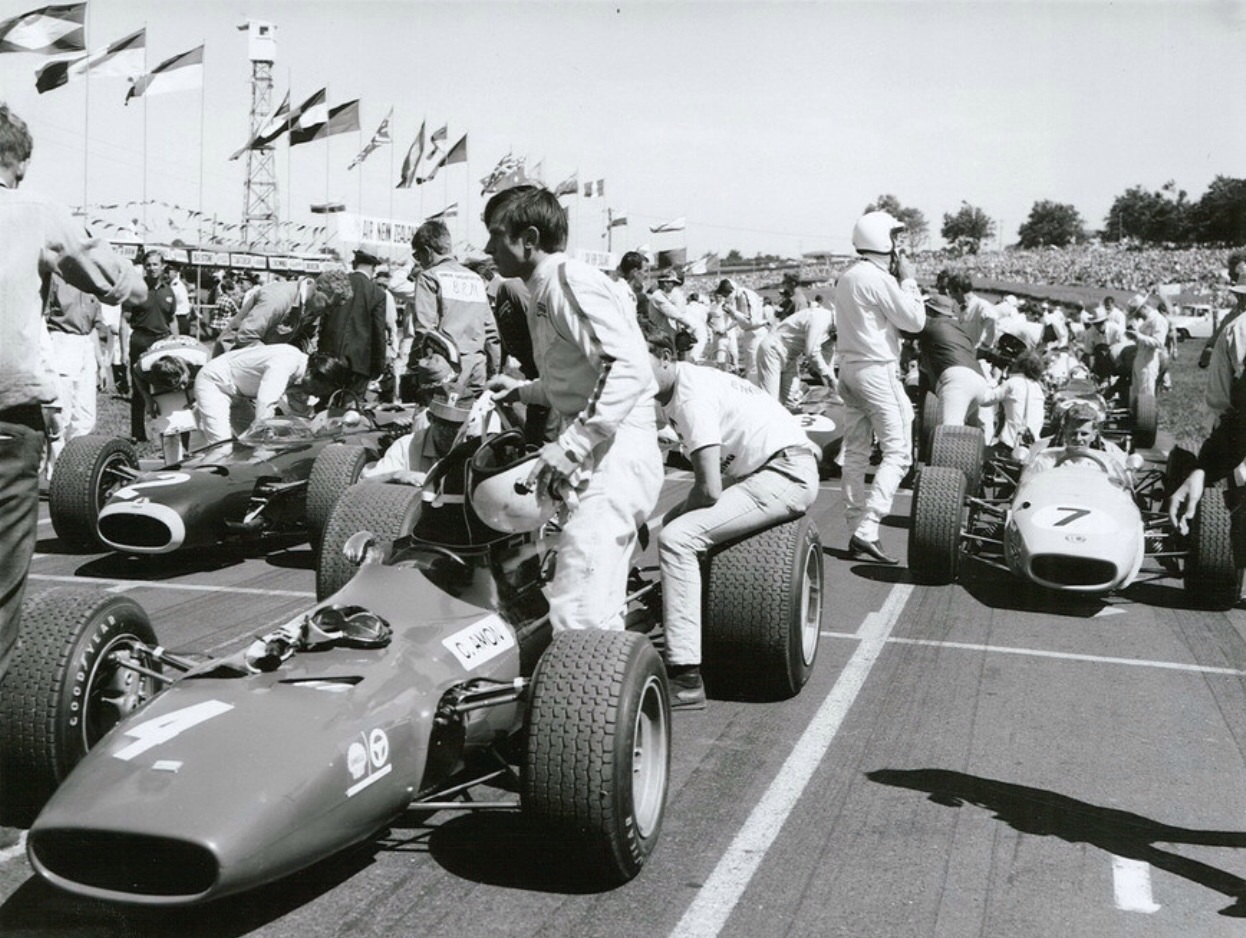
I love the build up and tension before the start of a big race; here it’s the grid prior to the start of the New Zealand Grand Prix at Pukekohe, in the north of NZ’s North Island on 6 January 1968…

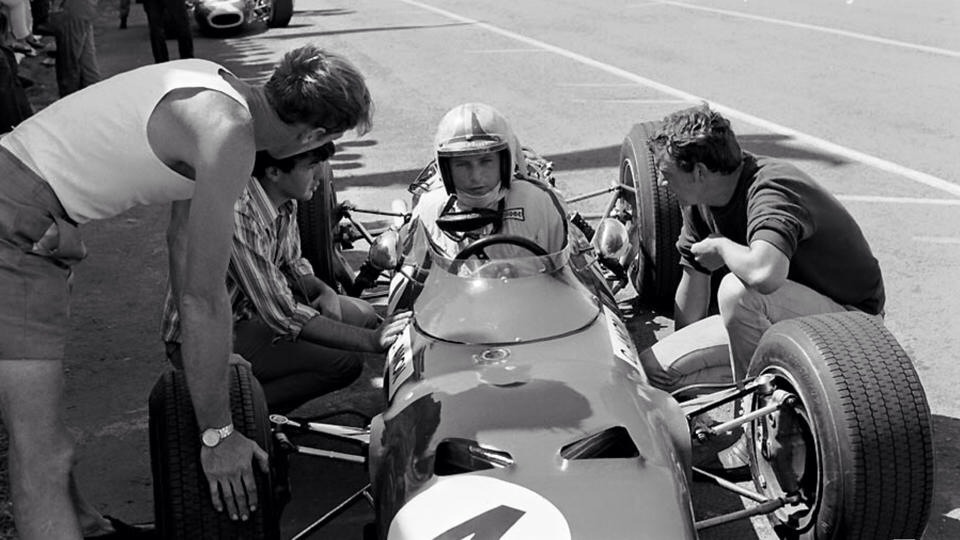
Chris Amon readies himself and his Ferrari Dino 246T before the first round of the 1968 Tasman Series, a race in which he wonderfully and deservedly triumphed. Missing on the front row is Jim Clark’s Lotus 49T Ford DFW. Car #2 is Pedro Rodriguez’ BRM P261, the Mexican is bent over the cockpit of his car but failed to finish with clutch problems. Car #7 is Alec Mildren’s Brabham BT23D Alfa Romeo T33 2.5 V8 with chief mechanic Glenn Abbey warming up the one-off car. Lanky Franky Gardner is adjusting his helmet beside the car, it was a good day for Frank, the car was second.

Look closely and you can see a camera crew behind the Brabham which is focusing on 1967 reigning world champion Denny Hulme and his #3 Brabham BT23 Ford FVA F2 car- Denny’s head is obscured by Frank’s body. Hume boofed the ex-Rindt BT23 during the race badly enough for a replacement chassis to be shipped out from the UK.

I’ve always thought these F2/Tasman Ferrari’s amongst the sexiest of sixties single-seaters.
The 166 F2 car was not especially successful amongst the hordes of Ford Cosworth Ford FVA engined cars in Euro F2 racing, however, the car formed the basis of a very competitive Tasman 2.5 litre Formula car when fitted with updated variants of the Vittorio Jano designed V6 which first raced in F2 form and then powered the late fifties Grand Prix racing front-engined Ferrari Dino 246. It was in one of these cars that Mike Hawthorn won the 1958 World Drivers Championship.

Amon won the Tasman Series in 1969 with Ferrari Dino 246T chassis #0008, fellow Kiwi Champion Graeme Lawrence won aboard the same car in 1970 against vastly more powerful, if far less developed Formula 5000 cars. The story of those championships is for another time, this article is about Chris’ 1968 Tasman mount and campaign.

Amon hooking his gorgeous Ferrari Dino 246T ‘0004’ into The Viaduct in the dry at Longford 1968. Early ’68, we are in the immediate pre-wing era, and don’t the cars look all the better for it! (oldracephotos.com/D Keep)

In many ways Chris was stiff not to win the ’68 Tasman Cup a title, the last title won by the late, great Jim Clark…

Ferrari entered only one car that year, chassis #0004 was assembled in Maranello by longtime Amon personal mechanic Roger Bailey and tested at Modena in November 1967. It was then freighted by plane to New Zealand where it was prepared by Bruce Wilson in his Hunterville workshop in the south of the North Island.

The chassis was Ferrari’s period typical ‘aero monocoque’, a ‘scaled down’ version of the contemporary F1 Ferrari with aluminium sheet riveted to a tubular steel frame thus forming a very stiff structure. The 166 was launched to the adoring Italian public at the Turin Motor Show in February 1967.

In F2 form, the 1596cc, quad-cam, chain driven, 18 valve, Lucas injected engine developed circa 200bhp at an ear-splitting 10000 rpm. It is important to note that this F2 engine, designed by Franco Rocchi, and in production form powering the Fiat Dino, Ferrari Dino 206 and 246GT and Lancia Stratos is a different engine family to the Jano designed engines, evolved by Rocchi and used in the Tasman Dinos.

The F2 166 made its race debut in Jonathon Williams hands at Rouen in July 1967, whilst it handled and braked well it was around 15bhp down on the Cosworth engined opposition. The car was tested extensively at Modena, including 24 valve variants, but was not raced again that year.

Amon, who had not contested the Tasman Series since 1964, could immediately see the potential of the car, suitably re-engined, as a Tasman contender given the success of the small, ex-F1 BRM P261 1.9-2.1 litre V8’s in the 1966 and 1967 Tasmans. The same approach which worked for the boys from Bourne could work for Maranello Chris figured. A parts-bin special is way too crass, but you get my drift of a very clever amalgam of existing, proven hardware as a potential winning car.

In fact Ferrari went down this path in 1965 when a Tasman hybrid of a then current F1 chassis was married to a 2417cc variant of the Jano 65 degree V6 for John Surtees to race in the 1966 Tasman. John had Tasman experience in Coventry Climax FPF engined Coopers and Lola’s at the dawn of the sixties and could see the potential of a small Ferrari.

That plan come to nothing when Surtees was very badly injured in a Mosport Can-Am accident in his self run Lola T70 Chev in late 1965. This car, Ferrari Aero chassis ‘0006’ played the valuable role of proving Surtees rehabilitation when he completed 50 laps in the car at Modena. It was in the same chassis that Lorenzo Bandini finished second in the 1966 Syracuse and Monaco GP’s as Ferrari sought to get the new 3 litre V12 F1 312 up to speed, Bandini elected to race the Dino on both occasions- he also finished third in the car at Spa.

The allocation of this more competitive car to Bandini rather than team-leader Surtees was amongst the many issues which lead to the confrontation between John Surtees and team manager Eugenio Dragoni during Le Mans practice and Surtees departure from the team shortly thereafter.

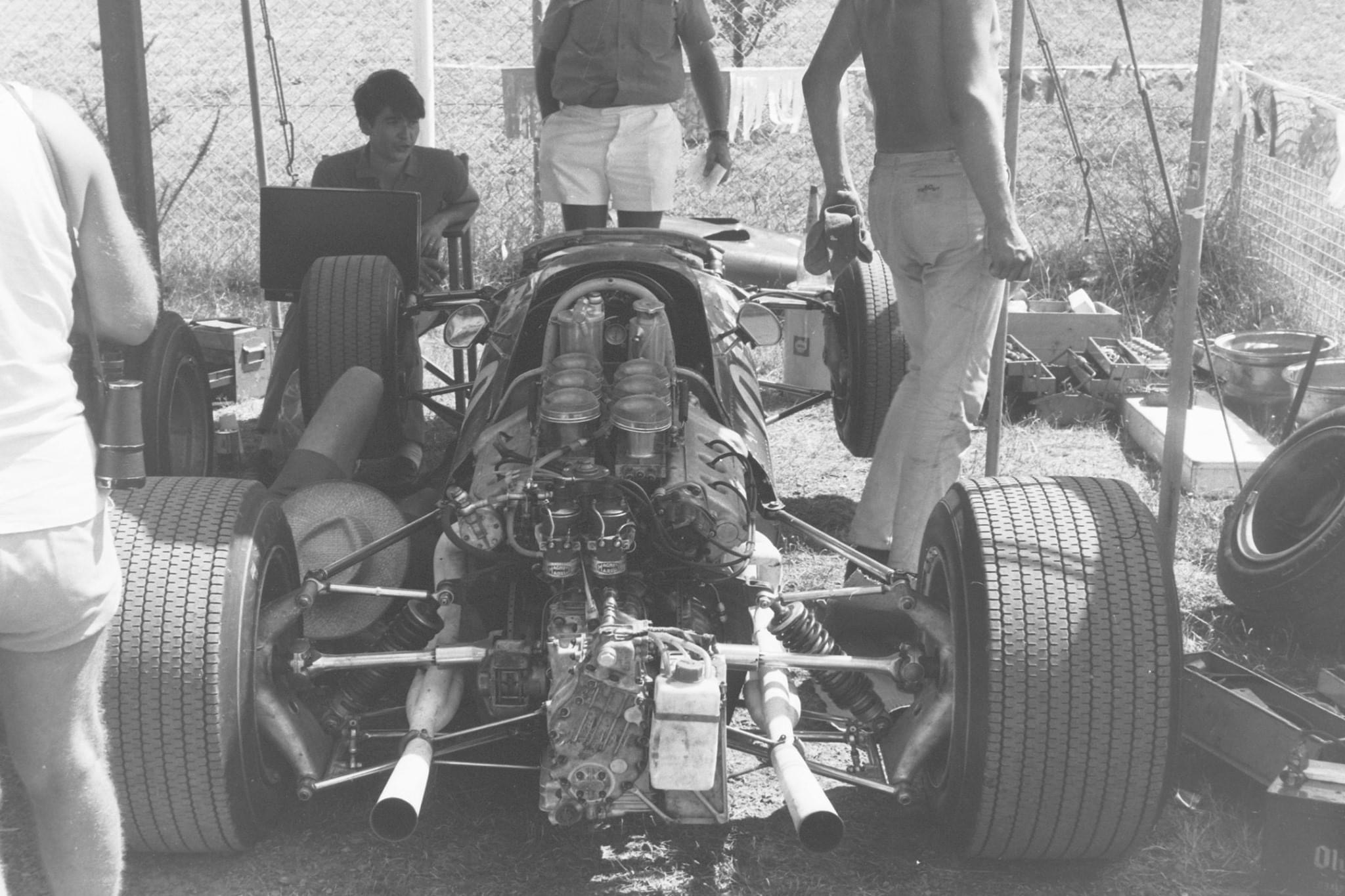
An unidentified fellow, Jim Clark, Ferrari engineer Gianni Marelli, Chris Amon and Roger Bailey share a joke during the 1968 Longford weekend. Chassis ‘0004’ is fitted with the 24 valve V6 covered in the text. Note the quality of castings, fabrication and finish, inboard discs, sliding spline driveshafts and single plug heads of this very powerful- but less than entirely reliable engine in 1968 form, it’s shortcoming cylinder head seals (oldracephotos.com/Harrison)

The engine of the 166/246T was carried in a tubular subframe attached to the rear of the monocoque which terminated at the drivers bulkhead, the car was fitted with a 5 speed transaxle designed by Ingenere Salvarani and Girling disc brakes.

Suspension was also similar to the contemporary F1 cars in having an front upper rocker and lower wishbone with inboard mounted spring/shocks and conventional outboard suspension at the rear- single top link, inverted lower wishbone, two radius rods and coil spring/shocks.

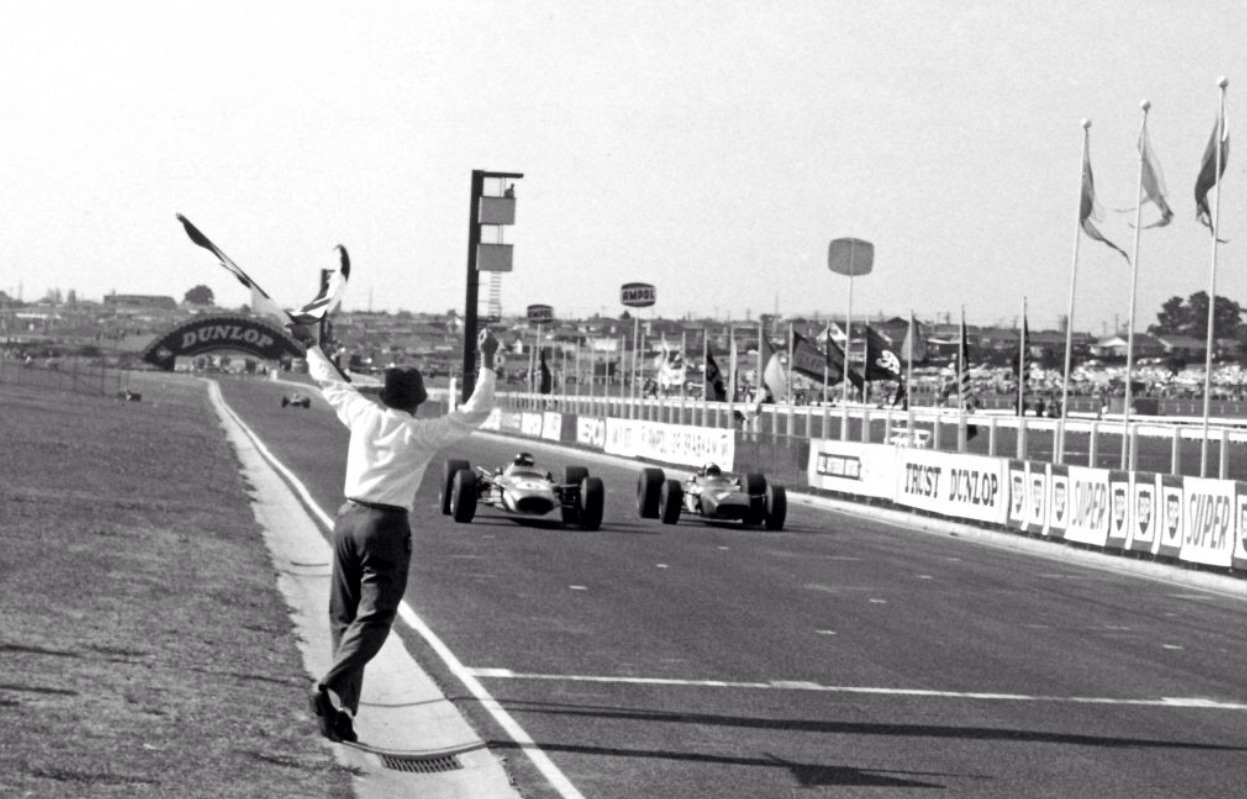
For the 1968 NZ races- Chris won at Pukekohe after Clark retired and at Levin, leading from flag to flag, was second to Clark at Wigram and fourth at Teretonga- a 3 valve variant (2 inlet, 1 exhaust) of the 65 degree fuel injected V6 was fitted which was said to develop around 285bhp @ 8900rpm from its 2404cc.

Chris crossed the Tasman Sea with a nine point lead in the Series from Clark and the might of Team Lotus. It was a wonderful effort, whilst Ferrari provided the car free of charge and took a share of the prize money, the logistics were of Chris’ own small equipe, and here they were serving it up to Gold Leaf Team Lotus with a couple of World Champions on the strength, plenty of spares and support crew.

Amon just falls short of Jim Clark at the end of the 1968 AGP at Sandown. The official margin, one tenth of a second after 62 minutes of great motor racing. Lotus 49 Ford DFW and Ferrari Dino 246T (unattributed)


Amons heads into the Sandown pitlane to practice- Shell corner or turn 1 behind (G Paine)


Amon’s car in the Sandown paddock. That little four valve engine came so close to pipping Clark’s Ford DFW on raceday (G Paine)

For the four Australian races a 24 valve version of the engine was shipped from Maranello. Its Lucas injection was located within the engines Vee rather than between the camshafts and had one, rather than two plugs per cylinder. This motor developed 20 bhp more than the 18 valver with Chris promptly putting the car on pole at Surfers Paradise, a power circuit- he won the preliminary race and had a head seal fail whilst challenging Clark in the championship round.

At Warwick Farm he qualified with the 18 valve engine and raced the 24 valver having rebuilt it- they only had one of the motors. He was challenging both Clark and Hill in the race and then spun in avoidance of Hill who was having his own moment…he was fourth on the tight technical Sydney circuit.

At Sandown during the AGP, the pace of the car, and Amon, was proved in an absolute thriller of a race in which he finished second to Clark by one-tenth of a second, the blink of an eye. Let’s not forget the best driver in the world driving the best F1 car of the era powered by the Tasman variant of the greatest GP engine ever was his competition- and took fastest lap.

As the team crossed Bass Straight from Port Melbourne on the ‘Princess of Tasmania’ Chris knew he had to win the Longford ‘South Pacific Championship’, with Clark finishing no better than fifth to win the Tasman title.

At Longford, still fitted with the 24 valve engine, which must have been getting a little tired, he qualified a second adrift of Clark and Hill, he finished seventh in a race run in atrocious conditions on the most unforgiving of Australian circuits having initially run second to Clark but then went up the Newry Corner escape road and suffered ignition problems from lap 10.

Piers Courage won in an heroic drive aboard his little McLaren M4A Ford FVA F2 car that streaming day, in a series which re-ignited his career.

Chris and the boys confer about car set-up- in the dry!, at Longford(oldracephotos.com.au/Harrisson)

Chris was a busy boy during the Australian Tasman leg as he also drove David McKay’s Scuderia Veloce Ferrari 350 CanAm/P4 in sports car support events at each round in addition to the little Dino.

These races were outstanding as they involved close dices between Chris and Frank Matich in his self designed and built Matich SR3 powered by 4.4 litre Repco Brabham V8’s- with Frank getting the better of him in each of these races. The speed of the Matich was no surprise to Chris though, both had contested rounds of the Can-Am Championship only months before the Tasman in the US.

Click here for my article on the Ferrari P4/CanAm 350 #’0858’ Chris raced in Australia;

Ferrari P4/Can Am 350 #0858…

Amon lines David McKay’s Scuderia Veloce Ferrari P4/350 Can Am up for Longford’s The Viaduct during the 1968 Longford Tasman meeting. Matich didn’t take the SR4 to Longford so Chris had an easy time of it that weekend. The sight and sound of that car at full song on the Flying Mile at circa 180mph would have been really something! (oldracephotos.com/D Keep)


Chris Amon, David McKay and mechanic David Liddle with the Can-Am 350 in the Sandown pitlane (G Paine)

For the 1969 Tasman Chris applied all he learned in 1968 returning with two cars, the other driven by Derek Bell, four well developed 300bhp 24 valve engines with the logistics of the two months taken care of by David McKay’s Scuderia Veloce.

He promptly lifted the Tasman Cup in a very successful campaign from Jochen Rindt, Graham Hill and others, with a little more luck or greater factory commitment in 1968 it may have been two Tasmans on the trot for the Maranello team and Chris…

Etcetera…

(G Paine)


(G Paine)

A couple of shots of the SV Ferrari Can-Am 350 being fettled in the 1968 Sandown Tasman paddock.

Bibliography…

oldracingcars.com, sergent.com.au, ‘Dino: The Little Ferrari’ Doug Nye

Photo Credits…

Mr Riethmaier, oldracephotos.com, Rod MacKenzie, Glenn Paine Collection

Tailpiece: Love this moody, foreboding Longford shot by Roderick MacKenzie…

(Rod MacKenzie)

Chris has just entered the long ‘Flying Mile’ in the streaming wet conditions during Monday’s ‘South Pacific Trophy’ famously won by Piers Courage little McLaren M4 Ford FVA F2 car. 4 March 1968.

Finito…


brabham art

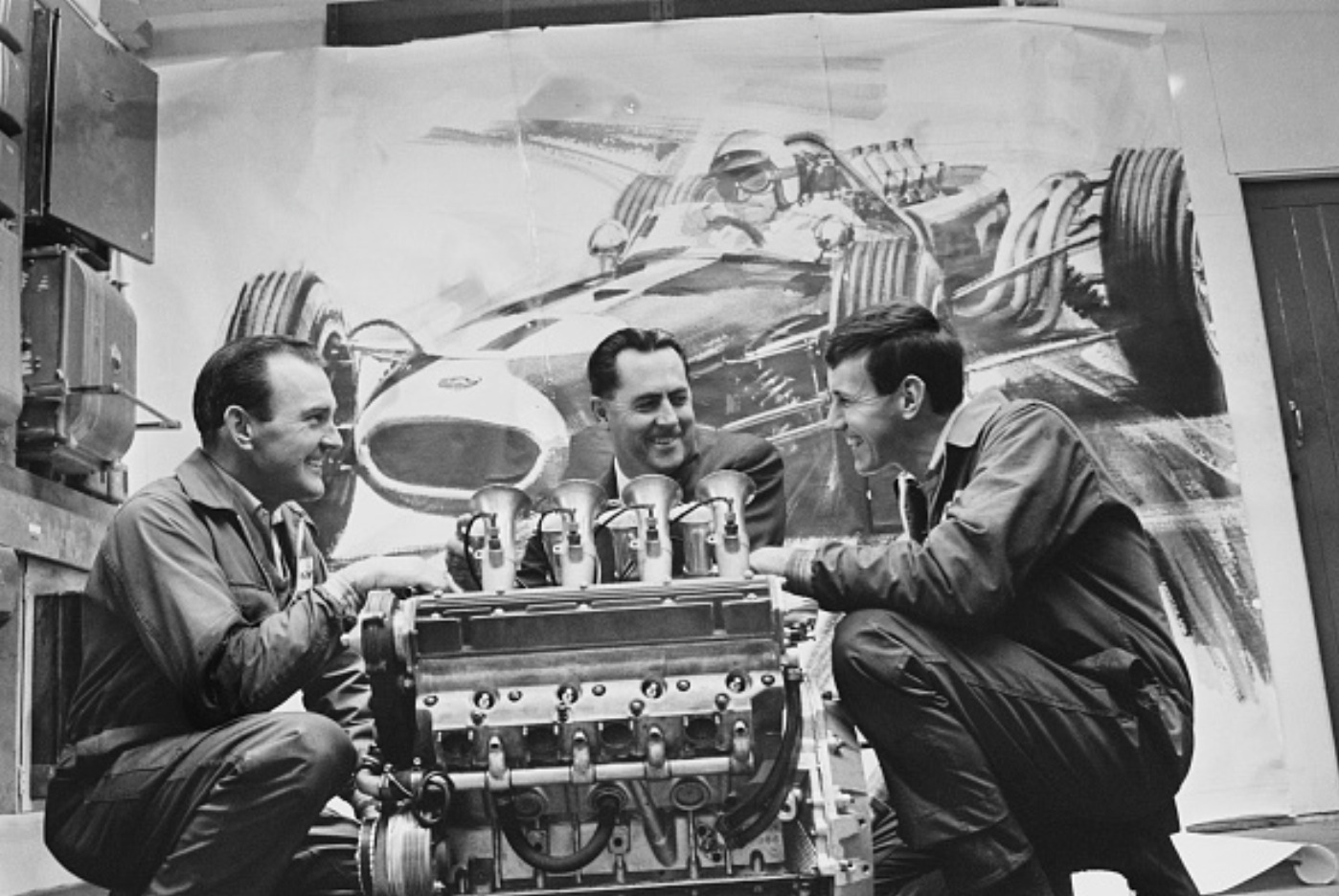
Jack Brabham, long time ‘Brabham Racing Organisation’ Chief Mechanic Roy Billington (left) and another fella, ‘twould be nice to know who, on 25 April 1967…

‘Co-stars’ in this studio shoot, which seems to be one of a series taken that year, is the Brabham BT19 pictured in the background and the Repco Brabham ‘RB620’ 3 litre V8 which is the engine/chassis combination with which Jack won the 1966 F1 Drivers and Constructors titles.

I have written comprehensively about both this engine;

‘RB620’ V8: Building The 1966 World F1 Champion Engine…by Rodway Wolfe and Mark Bisset

and the 1966 F1 Championship Year;

Winning the 1966 World F1 Championships: Brabham BT19 Repco…

I love the shots!…

Credit…

Len Trievnor

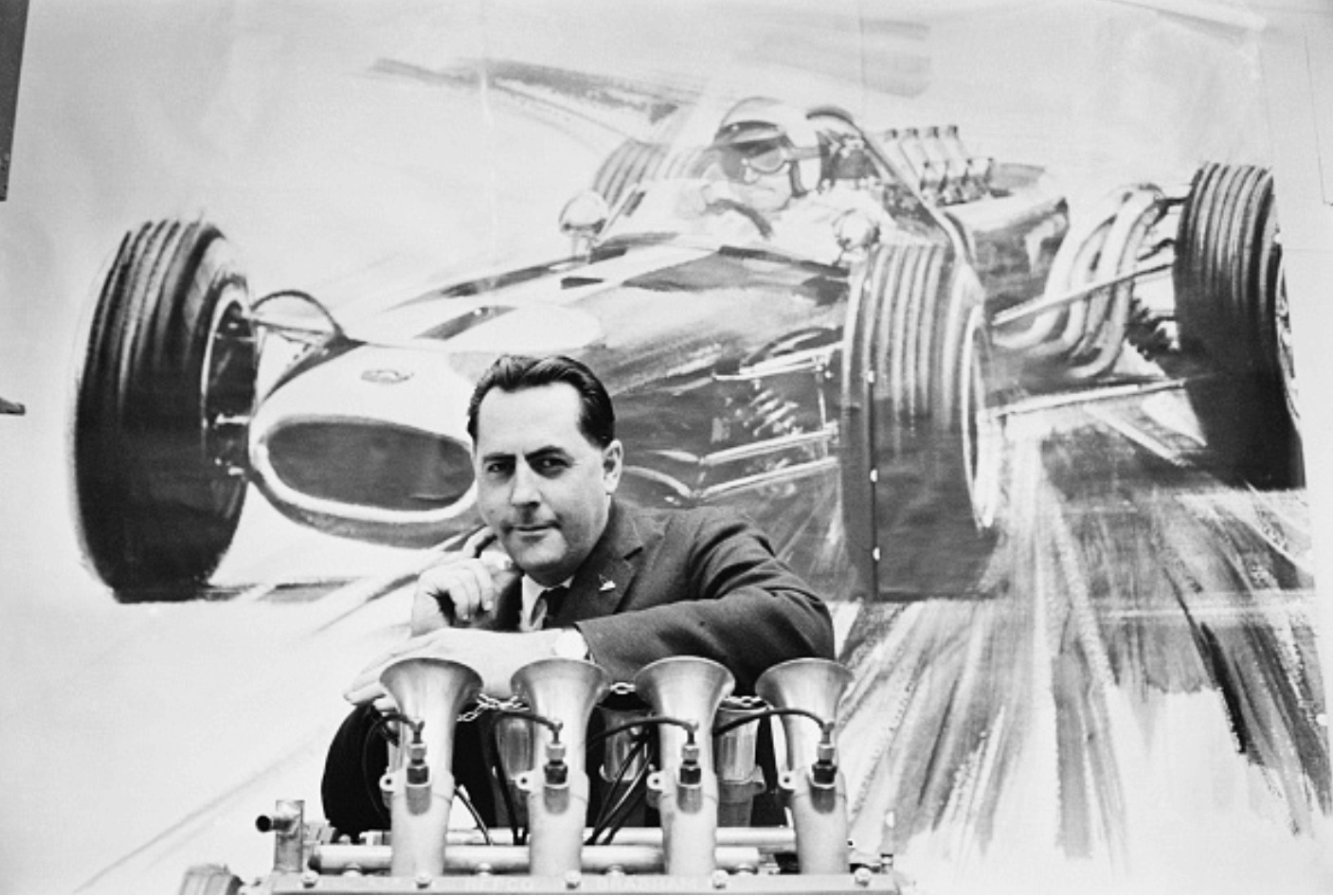
Tailpiece: Jack’s ‘Dr Evil’ pose?…

blackie

image

(Heritage Images)

I’m constantly in awe of the talents of the photographers whose work is displayed in this ‘masterpiece’ of mine…

Take a careful look at the composition and execution of this shot of Phil Hill’s Dino at Monaco in 1959-the use of light, the way the shadows of the palm tree and building architecture frame the shot of the snub-Monaco nosed Ferrari 246 and the expression on the American drivers face. The shadow of the photographer gives a sense of involvement.

image

(Klemantaski)

Things were pretty tough for the front engined brigade by 1959 of course.

Jack’s first Cooper title was bagged that year. In the process of trying to keep up, Enzo’s brigade created quite the most beautiful cars in these later Dino’s. The snub nosed car not so much but checkout Tony Brooks slinky, curvaceous chassis above during the BARC 200 at Aintree on 19 April ’59. Jean Behra took the win that day in a sister car, the Scuderia may have been lulled into a sense of false security by this non-championship event result.

The 1959 Dinos had more voluptuous bodywork by Medardo Fantuzzi, clothing big-tube frames with coil-sprung de Dion rear ends rather than the transverse-leaf setup used earlier. Dunlop disc brakes and tyres were used with Armstong telescopic shocks replacing the ‘unreliable’ lever-arm Houdailles- Doug Nye wrote that some Ferrari team members blamed the Houdailles as the cause of Peter Collins fatal 1958 German GP accident.

image

Brabham on the way to his first GP win at Monaco in 1959, Cooper T51 Climax (Cahier)

It was very much a Cooper T51 Climax year.

They won three of the five non-championship events (Moss took 2, Brabham 1) with Ferrari and BRM taking one apiece (Behra and Flockhart). Ignoring the Indy 500 which was part of the world championship back then, there were eight GP events. Cooper won five (Brabham-Monaco, British and Moss-Portugal and Italy two races each for the Aussie and the Brit and McLaren-US 1 win). Ferrari won two (Brooks-French, German) and BRM won one, the break-through first win for the Bourne marque and Jo Bonnier aboard a P25 at Zandvoort.

image

(unattributed)

Its front is a little ‘fugly’, the looks only a mother could love

‘Snub nosed’ Dino, Hill rounding the Gasworks Hairpin, Quay in the background. Oooh, la, la from the rear tho. All things Italian look great from the back!? Hill hustling his Dino, thru the Mirabeau right hander below.

image

(LAT)

Have a look at Phil’s car below in August on the hugely picturesque and dangerous Monsanto road course during the Portuguese GP.

DNF when Lotus 16 mounted Hill G spun in his path taking out both cars. Moss won in a T51 Cooper Climax from Masten Gregory similarly mounted, Gurney the best placed Ferrari in 3rd.

I guess by definition these Dino’s are the ultimate expression of the front engined GP car given Enzo persevered at least a year longer than he should have.

image

(LAT)

Credits…

Heritage Images, Klemantaski Collection, LAT, Cahier Archive, Ferrari Dino article by Doug Nye in Motorsport November 2007

Etcetera- Technical Specifications…

Two rare photographs of Dinos in the semi-nude.

The first, above, is a 156 F2 in the Nürburgring pits in August 1957, both are by Bernard Cahier. The second is of the Taffy Von Trips (DNF) car during the 1960 Belgian Grand Prix weekend at Spa.

Vittorio Jano’s new 65 degree 1.5 litre V6 gave about 180 bhp @ 9000 rpm on the Maranello test-bed, it burst into life about five months after Dino Ferrari’s untimely death due to renal failure on 30 June 1956.

The cars chassis was a scaled down variant of the Lancia Ferrari 801, its tubular frame comprised of two large diameter bottom tubes braced by a welded on superstructure of thinner tubes- not a true spaceframe in a definitional sense.

The engine was angled across the frame, as you can see, this allowed the prop-shaft to run past the drivers seat to the left. The front suspension, clearly shown, is by wishbones and coil springs with the rear suspension by de Dion tube and transverse leaf spring. Drum brakes and Houdaille lever arm shocks were fitted with Scaglietti providing the sexy aluminium body.

The 1957 German GP was a famous victory for Fangio’s Maserati 250F from the Hawthorn, Collins and Musso Lancia Ferrari 801’s. The Dino, if the photo is captioned correctly, was perhaps in the transporter. Whilst entered in the F2 section, the race results show Maurice Trintignant as a ‘no-show’, Denis Jenkinson’s race report also says the car did not arrive so perhaps the date on the caption is wrong and the shot is of a 1958 246.

The first F2 Ferrari Dino, chassis #’0011′ made its race debut at the Naples GP on 28 April 1957. Enlarged engines of 1983 cc, 2195 cc were built over the ensuing months and- then the 2417 cc variant was raced by Peter Collins during the non-championship 27 October Moroccan GP- the Dino 246 was born!

Stricken by flu, Peter spun off, the 85mm bore, 71mm stroke, 2417 cc engine at that stage gave 270 bhp @ 8300 rpm burning 130 octane AvGas, the 1958 mandated fuel.

The 1960 Dino 246/60 (above) were lightened with engines angled across the frame the opposite way to 1959, with the transaxle turned around to match- providing the drivers with the challenge of a reversed gearchange gate.

They also featured pannier fuel tanks without separate covering body panelling (look closely above) smaller fuel tanks and all-independent coil-spring and wishbone suspension.

At Spa Phil Hill used the Ferrari four-cam power advantage but was still overwhelmed by a Cooper Climax 1-3 finish. Jack Brabham led home Bruce McLaren in T53’s whilst Olivier Gendebien was third in an earlier T51.

Tailpiece: And what a tail. I’m cheating really, this is the butt of Phil’s ’58 Dino, this pictorial article is mainly about the 1959 cars…

image

’58 Moroccan GP; Moss won in a Vanwall VW57 from Mike Hawthorn and Phil, both Dino mounted, Mike won the ’58 World Title at this race (LAT)

The photo is another masterpiece of composition and high-speed shutter work during the Moroccan GP at Ain-Diab, Casablanca Morocco on 19 October 1958.

Check out the different tail treatment from the later cars earlier in the article and ‘three piece’ fabrication of the Ferrari’s rear tail section comprising from driver back- the fuel tank, then oil tank and finally small curvaceous endplate, Italian panel bashing at its best.

Finito…

image

An Australian daily broadsheet newspaper ad to promote Repco’s 1967 Grand Prix successes…

Thats Michael Gasking giving the 1967 F1 RB740 V8 ‘a tug’ on the Maidstone, Melbourne dyno before shipping the usually still warm engine off to the Brabham Racing Organisation in Guildford, England.

Credit…

Michael Gasking Collection

Max Stephens powers his 2 litre Cooper T40 Bristol up the Domain Hillclimb, Hobart, Tasmania probably late 1959…

Its not just a T40, it’s THE T40, Jack Brabham’s 1955 Australian Grand Prix winning car- Jack took a somewhat lucky win when the more powerful cars of Stan Jones and Reg Hunt fell by the wayside or were mortally wounded.

Colour isn’t so common in Australian motor racing photography in the period- partially due to its cost and that professionals mainly shot in monochrome given good ole black and white in magazines prevailed. This is a fantastic colour photograph from Lindsay Ross’ oldracephotos.com.au archive, I’m not sure who the ‘snapper is in this particular case but his/her composition took my eye.

The 1959 Australian Hillclimb Championship was held at the Queens Domain on Saturday 14 November 1959, in fact the weekend was a ‘double-banger’ with competitors over from the mainland able to compete at the Baskerville circuit on the Sunday. Perhaps this photo is of Max during the championship meeting, i’m intrigued to know.

The journalist Rob Saward, writing on The Nostalgia Forum had this to say about T40 ‘CB/1/55’ and Stephens…

‘The gearbox was always this cars weakness…It was the usual Citroen based (ERSA modified) box Cooper were using in the early Bobtails and F2 cars, which worked ok with the FWA or FWB Climax, but 2 litres of Bristol power meant it had to be treated very gingerly. Longford was always hard on transmissions, even more so before the railway crossing was rebuilt prior to the 1960 meeting’.

‘Max Stephens never really had the chance to demonstrate his true potential in the car- he was a gifted motorcycle racer, Tasmania’s best in the 1950’s and there is no reason why he could not be good in a car also. I don’t know whether it was his (Max Stephens Motors in Moonah, a car sales, later accessories and motorcycles) business that stopped him getting more involved in car racing or whether money was the issue…he died a few years ago’.

‘The car was sold in about 1962/3 to Alan Robertson of Hobart who converted it from central seat to sportscar format and raced a few times before Bristol engine problems intervened…the car was purchased by Frank Cengia, who restored it in the original Brabham 1955 colours, but in the 1990’s it was unfortunately sold overseas…’when Pat Burke who owned the car fell upon hard times’.

Cooper T40 ‘CB/1/55’ whilst in Stephen’s ownership at Longford in 1959 or 1960. It is the car that Jack built, literally, days before his championship F1 debut at Aintree in the 1955 British GP. The car was constructed on the T39 Bobtail sports jig, with modifications. Note the curved Cooper spaceframe chassis, Bristol 2 litre engine sitting tall in the chassis, alloy wheels…such a clever car (oldracephotos.com)

Talented engineer Geoff Smedley added that ‘the car was prepared (in Tasmania) by the late Eric O’Heaney, one of the old school motorcycle mechanics who gave Max a lot of success in his bike days…Eric himself was an avid bike racer until a serious accident…In my mind Eric was an earlier version of the great Phil Irving, both with the same demeanour in their thinking and dedication to the development of the sport…’

Scott Stephens describes his father Max‘…as a respected car and motorcycle racer. He was the only Australian, whilst riding a Manx Norton 500, who successfully passed Geoff Duke for the race lead whilst Geoff held the mantle of current World Champion, this was achieved during the Australian Grand Prix held at Longford…Observed motorcycle trials was his last competitive stance. He was the Kawasaki and Maserati distributor in Tasmania…In his Hobart store he was the approved reseller of Norton, BSA, Velocette, Triumph, Laverda, Maico, Cotton, AJS, CZ, Montesa, Bultaco, Ossa, Hodaka, Italjet and Suzuki’ makes down the decades. Scott himself was a successful professional racer who rode for Kawasaki Australia, Matich Pirelli Racing and Suzuki quips that Max ‘Loved and was amazed by anything driven by fuel!

Tailpiece: Stephens and T40 on the warm-down lap, Longford…

(P Geard)

Bibliography/Credits…

The Nostalgia Forum- contributions by Rob Saward and Geoff Smedley, scottstephens.com.au, oldracephotos.com.au, Paul Geard Collection

Finito…


image

(Ullstein Bild)

Sculptor Olaf Lemke works with Hans von Stuck on the bust of the pre-War Champion German driver, 1932…

Stuck cut his racing teeth in the hills and was soon scooped up by Mercedes Benz for whom he was a factory driver, but via the introduction of Adolf Hitler became Auto Union’s first star.

image

Stuck in the Auto Union Type A, Avus 1934 (Getty)

He did most of the early development work on the AU Type A or P Wagen and won the German, Swiss and Czech Grands Prix in 1934, his best season. Had a European Championship been run that year he would have won it. His star rose and then fell as his capabilities were put into context by Bernd Rosemeyer, a ‘Gold Standard’ of outright pace admittedly.

image

Hans Stuck leading the Italian Grand Prix at Monza in 1935, his final GP victory (Getty)

His last championship win was the 1935 Italian Grand Prix, the photos here show his Auto Union Type B 5 litre V16 machine, which triumphed over the Rene Dreyfus/Tazio Nuvolaro Alfa 8C-35 3.8 litre straight-8 and the Paul Pietsch/Bernd Rosemeyer AU B Types.

image

Stuck with the Monza crowd in 1935 (Getty)

After Rosemeyer’s death he returned to the Auto Union team from which he had not long before been fired! He raced post-war with little success having obtained Austrian citizenship to do so.

His son, Hans Joachim Stuck became a rather handy racer as well…

Click here for an interesting story on Stuck Senior; http://8w.forix.com/stuck.html

Credits…

Getty Images

Tailpiece: Auto Union ‘Tempo’ V16 Boat…

image

(Ullstein Bild)

Always interested in record breaking, Stuck took this craft to a speed of 81 or 82.5kmh on the Scharmuetzelsee in 1937. He set a new under 800Kg record with the craft which was powered by an Auto Union Type B V16 engine. It was built to Audi and Stuck’s order in Klaus Engelbrecht’s boatyard on the River Dahme, Berlin.

Tempo was sunk post-war, having survived the ravages of the conflict. After a bombing raid on 1 March 1943 the car was moved from Berlin to Southern Germany where is was less likely to be hit by allied bombing missions. It was wrecked when a joy-riding occupying forces officer lost control of the craft which sank to the bottom of a Bavarian Lake complete with V16 engine. The skipper survived!

Finito…

spanish grand prix

Maurice Trintignant’s 1953 type Ferrari 625 from Harry Schell’s Maserati 250F and victor Mike Hawthorn’s 1954 type Ferrari 553 on the picturesque Pedralbes road circuit at Barcelona, 24 October 1954…

This event was famous for the race debut of the Lancia D50’s in the hands of Alberto Ascari and Gigi Villoresi, both were quick and Alberto led convincingly from Fangio’s Mercedes W196 until a clutch hydraulic failure caused his retirement.

The three drivers above had a great dice and all led at different points with Hawthorn taking the victory. Schell retired after a spin damaged his car and Trintignant with a fractured oil pipe. Hawthorn’s win was a good one made slightly easier by the problems Fangio was dealing with in his Benz, his W196 spraying oil into the cockpit.

lancia barcelona

The Ascari #34 and Villoresi #36 Lancia D50’s, just unloaded at Pedralbes for an event which showcased Vittorio Jano’s design brilliance as well as the sublime skills of Alberto Ascari. Such a pity Lancia ran out of money! Still a world title as a Lancia Ferrari D50, and drivers title for Fangio in 1956 was a great reflection on the original design even if it had ‘evolved’ a bit by then (unattributed)

I’m leaving Australia’s winter for 3 weeks in France and Spain including Barcelona so look forward to retracing the street circuits of  Montjuic Park and Pedralbes whilst based in one of my favourite cities. My posts will be shorter over this period.

YouTube Race Footage…

Photo Credit…Yves Debraine