Archive for the ‘F1’ Category

image

Tazio Nuvolari in his Scuderia Ferrari Alfa Romeo P3/Tipo B after winning the ’35 Pau Grand Prix…

Nuvolari and Rene Dreyfus dominated the 25 February 80 lap, 137 mile race in their Scuderia Ferrari P3’s finishing 1st and 2nd, Rene 26 seconds adrift of his team leader. Tazio was so happy, he did not one but two victory laps, the shot above is the end of the celebration!

image


Credits…

Keystone France

image

Dreyfus ahead of Nuvolari, Pau 1935. Alfa P3, 3.2 litre straight 8 (Keystone)


image

Johnny Servoz-Gavin poses with a Talbot-Lago T26, Paris in early 1970…The photo is a PR shot to promote the ‘First Racing Car Fair’.

By the end of 1969 with a European F2 Championship and two strong F1 performances in 1968 under his belt; front row at Monaco and second place at Monza in a Matra MS10, Johnny Servoz-Gavin was in the minds of some ‘The French Driver Most Likely’. But by the end of the 1970 Monaco GP weekend he had failed to qualify and retired from the sport. Few flames have shone so brightly and been extinguished so soon…

Born in Grenoble of parents who owned a local bar, Servoz-Gavin became ‘Johnny’ from his days as a teenage ski instructor on the slopes above his home town. With long blond hair and an easy manner that ‘slayed the babes’, he developed a playboy image which stuck with him throughout his career.

ser boat

On a canal boat in Paris 1970 with actor Olga Georges-Picot (Getty)

Inspired by the exploits of René Trautmann and Robert Neyret, Servoz-Gavin commenced rallying after driving his Simca Oceane and Dauphine Gordini with great abandon and speed on local Grenoble roads like his heroes.

In 1964 driving his Volvo, he contested various rallies including the Snow and Ice, the Lyon-Charbonnières and other events in Burgundy, the Ardennes and in Bordeaux. During the Bordeaux event former F1 driver André Simon noticed his on-circuit skill. René Cotton, director of the Citroen rally team, hired him as co-driver to Jean-François Piot for the Coupe des Alpes.

In January 1965 he contested the Monte Carlo Rally with co-driver Jean-Claude Ogier in a Citroen DS21, they passed through a terrible snowstorm on the side of Chambery finishing twelfth, the event won by the Cooper S of Rauno Aaltonen and Henry Liddon.

Johnny did a half a year at the Magny-Cours Jim Russell school in 1963 and at Montlhéry in the Lotus Seven of the Automobile Club Dauphiné-Savoie within the Ford-operation youth in 1964, these experiences giving him a greater taste for circuit racing.

jon brab

Servoz, Henri Grandsire and Roby Weber in 1965. Interested to know where and when and car details from any of you French F3 experts (G Gamand)

With the help of a friend, he enrolled in the Volant Shell organised by the Winfield School (formerly the Jim Russell School) at Zolder, Belgium. His engine misfired in the final, finishing second to Belgian Dominique Lledo. The Volant winner in 1965 was Roby Weber, who won the Alpine F3 prize for 1965. Undeterred but disappointed Johnny bought a Brabham BT15 Ford maintaining it himself with the help of Tico Martini, settling in a caravan at the Magny-Cours circuit near Tico’s workshop!

jon shell

Servoz looking cool despite the pressure! Volant Shell, Zolder 27 April 1965 (Faille)

The Brabham BT15 first appeared at championship level at Rouen on 11 July when Johnny was 8th. It was variously entered by Johnny, the Jim Russell/Winfield race schools with results as follows; Magny Cours DNQ, Montlhery 5th, Albi 3rd and finally the Coupe du Salon at Montlhery on October 3. The Matra factory F3 pilots in 1965 were Beltoise and Jaussaud, (who finished first and second in the French Championship) a seat Johnny secured for 1966 given his performances during the season and end of season tests, a drive for a great team he sustained until the end of his career.

Jean-Luc Lagardère arranged the works F3 Matra drive, his faith in Servoz justified with a French championship win in an MS5 Ford. He won the title with consistency taking 3 wins, 2 at Montlhery and 1 at the Bugatti Circuit, Le Mans.

lem 41

JPB/Servoz Matra MS620 BRM 2 litre V8, Le Mans 1966. DNF gearbox on lap 26, the sports 2000 class was won by the Siffert/Davis Porsche 906, race won by the McLaren/Amon Ford GT Mk2 (Getty)

ser lem

(Friedman)

There was plenty of talent amongst the French F3 grids that year including Peter Revson, Henri Pescarolo, JP Jaussaud, Piers Courage, Chris Irwin, Jonathon Williams, Wilson Fittipaldi, Allan Rollinson, JP Beltoise and many others.

jom mont

JSG at Montlhery 25 September 1966, victorious in the F3 ‘Coupe de Paris’ Matra MS5 Ford, Pesca in another MS5 2nd and Chris Lambert, Brabham BT15 Ford 3rd (unattributed)

He contested Le Mans for the first time in a Matra and was a member of the company’s sportscar squad until the end of his career. In 1966 the MS630 was 2 litre P56 BRM V8 powered, the car failed to finish with gearbox dramas, JPB shared the drive.

ser mon 67

Denny Hulme won the 1967 Monaco GP in his Brabham BT20 Repco, his first win. JSG plopped his F2 Matra MS7  FVA 11th of 19 cars on the grid, 7 slots in front of JPB in a similar car. Servoz DNF with fuel injection dramas, it was valuable circuit practice for 1968…(Getty)

In 1967 he drove a Matra MS7 Ford FVA car in the Monaco GP, qualifying a sensational 11th but failed to finish with fuel injection problems on lap 4.

Still not finished with rallying, he participated again in the Monte Carlo Rally in early 1967 with Francois Janin in a Matra Djet but failed to finish the event won again by a Cooper S, this time crewed by Timo Makinen and Paul Easter.

In sportscars he contested Le Mans and again failed to finish, this time the MS630 BRM had an oil pipe fracture giving Servoz and JPB an early finish to their weekend.

ser lem 67

Johnny ahead of the Klass/Sutcliffe factory Ferrari P4 DNF during Le Mans 1967 won by the Ford Mk4 of Gurney/Foyt. The Matra BRM DNF with an oil pipe problem, JPB the co-driver. Prototype 2000 class won by the Siffert/Herrmann Porsche 907 (unattributed)

Johnny’s main program in 1967 was the European F2 Championship. 1967 was the first year of the 1.6 litre F2 formula, the era (1967-71) dominated by the Ford (5 bearing Cortina block) Cosworth FVA 210bhp, 4 valve, Lucas injected engine. The Matra factory pilots were Johnny and JPB in the MS5 and later MS7 monocoque chassis.

Jochen Rindt was the dominant F2 driver of the decade, and whilst a regular race winner, he like the other ‘graded drivers’ was ineligible for championship points. The beauty of the class was ‘young thrusters’ like Jean Pierre and Johnny could test their mettle against the established GP aces of the day who ‘moonlighted’ in the class. In those days the top pro’s needed to race outside F1 to be paid start and prize money to supplement their GP incomes which were decidedly skinny by the standards on the later 70’s and beyond. By the dawn of the 70’s F1 driver contracts were becoming more restrictive to preclude the sorts of activities which cost Servoz his career…

Johnny had a strong first year in the MS5, his results as follows; Rome GP, Vallelunga 3rd, GP Spain, Madrid 4th, 5th’s at the Madrid GP at Jarama and Mediterraneo GP Enna. 6th at the Pau GP early in the season, 8th’s at Crystal Palace, Rouen GP, Tulln-Langenbarn, 10th at Zolder, 11th at the Albi GP and DNF’s at Montjuic, the Eifelrennen, and Reims and Zandvoort GP’s.

Jacky Ickx won the title in Ken Tyrrell entered Matra’s, MS5 and the later MS7 from Frank Gardner’s works Brabham BT23 and Beltoise’ MS5/7. Servoz was 7th with Piers Courage, Alan Rees and Chris Irwin in fourth to six places.

ser london

Servoz in the Crystal Palace paddock in June 1968. DNF in his Matra MS7 Ford, Jochen Rindt won the race in a Brabham BT23C Ford (motorsportfriends.ch)

Servoz-Gavin’s dazzling talent was on full display during a couple of drives substituting for Jackie Stewart in Ken Tyrrell’s Ford Cosworth DFV powered Matra MS10…

Jackie Stewart was forced to miss the race with a damaged wrist ligament as a result of a Jarama F2 shunt and was out for a month. JPB stood in and raced the Matra Ford in Spain but Jean Pierre was debuting the new V12 engined Matra MS11 at Monaco so Servoz-Gavin was offered the drive after Ken Tyrrell conferred with his sponsor, Elf.

ser mon 1

MS10 ‘T-Car’, early practice, Monaco Station Hairpin, 1968 (Schlegelmilch)

What a baptism of fire, it was Johnny’s first ever drive of a 3 litre 400bhp machine on the most demanding circuit of all in terms of 200 miles of sustained accuracy! The degree of difficulty was high, the power delivery of the early DFV, until Jack Brabham got hold of the fuel cams notoriously abrupt, JSG was to learn the nuances of the Cossie in the most unforgiving of environments.

Denis Jenkinson’s MotorSport race report captures both the atmosphere and Johnny’s spirited, confident approach wonderfully;

‘As practice got under way it was difficult to know which way to look or which way to listen, with the fantastic sound of the V12 Matra engine, the V12 Honda and the V12 Eagle. The slightly less raucous noise of the V12 B.R.M. engines, the efficient sound of the Cosworth V8 engines, and all that was missing was the sound of the 4-cam Repco V8 from its two megaphone exhausts. All this echoing off the rock faces and hotel fronts made the most incredible noise that seemed to lift you off the ground with excitement. Quite soon most drivers were accelerating, sliding, braking and cornering with enormous vigour and the invited ones were out for a high place on the starting grid and the uninvited ones were out to make sure they were not the slowest or next to slowest’.

ser mon

First time out in a 3 litre F1 Car! Johnny giving the throttle a tickle and displaying the delicacy of his car control, in Casino Square, Matra MS 10  Ford, Monaco 1968 (unattributed)

‘Servoz-Gavin and Beltoise were a joy to watch, their uninhibited handling of new cars with lots of horsepower being refreshing. The 12-cylinder Matra engine seemed to require keeping well up near its 10,000 r.p.m. limit, which kept Beltoise busy, but he looked to be enjoying himself. Servoz-Gavin was obviously happy to have such a responsive and powerful car as the Matra-Cosworth V8 and was really using its potential, not being afraid to give it full-throttle out of corners and travel a long way in an ‘opposite-lock’ power slide. Oliver was also showing up well on his first outing with a real Grand Prix car, but he was less spirited than the two French lads. The McLarens were riding the humps on the concrete of the promenade in a very impressive manner, but Rindt’s Brabham-Repco V8 looked terrible, its front suspension too hard, though the driver seemed oblivious to it’.

‘Servoz-Gavin made the excellent time of 1 min. 31.1 sec. with the newer and lighter Matra-Cosworth V8 on his first outing in a Grand Prix car…’

The start of the race, DSJ again; ‘Hill seemed a bit jumpy and began to creep forward and Chiron warned him to ‘hold it’ so that when the flag dropped he was beaten away by Servoz-Gavin who roared away in a perfect start to lead the pack up the hill from Saint Devote. This was the big moment for the young French driver and he made the most of it, leading the opening lap in a cloud of dust and using all the road and a lot of the edges, and he was followed by Hill keeping a discrete distance away, so that Siffert, Surtees and Rindt were close behind him. Only fourteen cars completed the first lap for in the tunnel McLaren slid outwards, probably on petrol overflow from a car ahead of him (because oil overflows should be in the catchtank!) and his left rear wheel hit the guard rail and bent the suspension…’

mon lap 1

Wow! Thats a lead, Servoz pushing hard, too hard in reality, from the Hill Lotus 49 Ford 1st, Surtees Honda RA301 DNF and Siffert Lotus 49 Ford DNF (unattributed)

The courageous and brave Servoz-Gavin stayed out in front for three laps, followed by Hill, Siffert, Surtees and Rindt, and as they went away on their fourth lap Courage stopped at the pits with the fluid gone from the rear brakes of his B.R.M. and Scarfiotti stopped at the Cooper pits as he thought he only had neutrals in the gearbox…Meanwhile the moment of glory for the leading Matra had come to an end for the left-hand drive shaft broke in two, clean through the tubular part, the flailing ends breaking the top suspension link, and he limped into the pits to retire. (Johnny always insisted he never hit anything but onlookers at the chicane were adamant his car kissed the barrier upon exit) Hill now had a clear road ahead and he settled down to lead the race, but Siffert stayed with him’…Jo’s Lotus ZF gearbox failed leaving the lead to Hill in the first of the Loti fitted with a Hewland DG300 gearbox, which he held to the races end.

mon kaput

Onlookers say he boofed the fence, Johnny said he didn’t touch it, the result the same, DNF. Sits up high in the thing, doesn’t he?! (unattributed)

Importantly, JSG had popped down an amazing marker, it was a GP debut only bested by Mario Andretti that season when he popped his Lotus 49B on pole at Watkins Glen albeit Mario was a ‘big car’, if not GP car driver, of considerable experience.

Nigel Roebuck was also at Monaco that 1968 weekend and recalled; ‘Servoz was one, it seemed to me then absolutely right for his time. If the name looked great on the side of the cockpit, so also the man looked the part. After an era in which too many grand prix drivers…were to be seen pushing prams around the paddock, Johnny had the free-wheeling ways of my childhood heroes. He was a throwback to Alfonso de Portago, a reminder that not all racing drivers lived like monks. Servoz emphatically did not live like a monk…a playboy then and something of a hippy too…Very louche in a James Dean kind of way but not contrived. Simply he seemed like a free spirit who had found the perfect job. The abiding problem was that he lacked the commitment to do justice to his talent’.

Jackie Stewart returned to the grid from the following race but JSG was offered the works Cooper drive at Rouen, the French Grand Prix, after Ludovico Scarfiotti’s death. The V12 Matra powered T86B was not as powerful or nimble a conveyance as the Matra but he popped it 15th on the grid, in front of Vic Elford in the other Cooper but retired on lap 15 after an accident on the greasy surface. This was the horrific race in which Jo Schlesser died in the experimental Honda RA302, the race surface awash with rain and all sorts of horrid liquid used by firefighters to quell the inferno.

ser engine

Servoz, Pescarolo, Beltoise, Matra boss Jean Luc Lagarde, Jackie Stewart 11 January 1968 press launch of the new quad cam, 4 valve, 3 litre injected V12 (Keystone)

The Matra V12 engine, ‘doubled up’ in both Grands Prix and Sportscar competition. JPB debuted the MS11, qualifying the powerful, peaky, screaming car a strong 8th and then retiring it after ‘kerbing’ it amidst the tight confines of the principality notoriously hard on anything less than absolute precision.

On the Monaco GP weekend in nearby Belgium, Henri Pescarolo and Robert Mieusset gave the V12 its endurance debut at the Spa 1000Km but it was a short weekend, the car retired on lap 1 with ignition failure.

ser lem 68

Matra MS630 3 litre V12 at Le Mans in 1968, Servoz-Gavin, Pescarolo (André Rousseau)

It was a whole different ballgame at Le Mans in a drive Johnny shared with Henri Pescarolo.

The performance of the new V12 engined MS630 at Le Mans in 1968 was one of those great ‘mighta been’s. The whole Matra team returned from the Canadian GP fitting LeMans, held that year on 28 September, between the Canadian and US GP’s.

The pair qualified 5th, the Siffert/Hermann Porsche 908 was on pole, not that it matters much given the classic events duration. From the start the car was into the pits after one lap to get the windscreen wipers working but after an hour they were 16th and after 8 hours in second behind the JW Automotive Ford GT40 which ultimately won in the hands of Pedro Rodriguez and Lucien Bianchi.

The rain poured down,  without wipers and whilst Johnny was pissed off, Pesca kept at it and did 3 stints in a row during the night, keeping the car in second or third. With a little over 4 hours to go he was up to second, the home crowd getting more and more excited…but at 11.49 am the Matra came in for a wheel change but a new tyre burst and the car caught fire. It was put out but the cars rear end was destroyed, a great effort at an end.

ser lem 68 2

Servoz, Le Mans 1968, 11th in terms of laps completed but not running at the finish (Klemantaski)

The Cooper F1 rides were shuffled amongst local drivers in the following GP’s but JSG’s speed was not lost on Ken Tyrrell who entered a second car for the speedy Frenchman in the 1968 Italian GP, at Monza. He qualified the car mid grid, 13th of 24 cars, 4 of which did not qualify.

After Stewart retired his Matra-Ford MS 10 with engine failure, Johnny kept his sister car in the thick of battle to the chequered flag and pipped the Ferrari 312 of Jacky Ickx for second place behind Denny Hulme’s McLaren M7A Ford. Johnny was dicing with Ickx and Rindt during the battle behind the reigning world champ. Exalted, and vastly more experienced company indeed. Ickx pitted for fuel in the final laps but it was a mighty fine performance by Servoz.

johnny italian

2nd in the Italian GP 1968 behind Denny Hulme’s McLaren M7 A Ford, in ‘winged’ Matra MS10 (unattributed)

The circus moved on to Canada on 22 September, the race held at the very picturesque Mont Tremblant, JSG qualified 13th on this track new to him. He raced as high as 5th before spinning and retiring on lap 71, the race won by Denny Hulme’s McLaren again, all of which ensured the 1968 title would ‘go down to the wire’.

Johnny didn’t race at Watkins Glen but did so in the season ending, exciting mano-et-mano Mexican GP battle between Stewart and Hill after Hulme, the other championship contenders car retired with accident damage caused by a spin the result of a broken rear suspension mount. Then JYS had a fuel problem which dropped him back, he finished 7th, and the title was Hill’s.

JSG’ s race was far from certain. He hoped to race the spare Matra but his entry was only allowed by the organisers 2 hours before the race start; JSG practiced Elford’s Cooper when he arrived late for first practice, setting a quicker time than Bianchi in the other car. He did some laps in the spare Matra before JYS took it over having damaged his own car, in the end JSG qualified 16th with limited laps.

He raced exceedingly well, running as high as 4th before retiring on lap with ignition trouble very late in the race, on lap 57.

jon nurburg f2

Servoz contesting the F2 section of the German GP, Nurburgring 1969. He qualified his Matra MS7 Ford 15th but DNF, just behind Francois Cevert’, Tecno Ford. Ickx won in a Brabham BT26A Ford, F2 winner Pescarolo’s MS7  (unattributed)

By any assessment it had been a great start to his GP career, JSG appeared to have the world at his feet, perhaps the most promising of his generation of French drivers at that precise time. His lot for 1969 though was the European F2 championship and some F1 drives in the experimental 4WD Matra MS84, this direction, a blind alley for Lotus, McLaren, Cosworth and Matra, all of whom built all wheel drive cars, a story for another time.

Servoz-Gavin won the European F2 championship for Matra, he took three rounds in his MS7 Ford Cosworth FVA; the Madrid, Meditteranean and Rome GP’s at Jarama, Enna and Vallelunga respectively. Second and third in the championship that year were Hubert Hahne and Francois Cevert in Lola T102 BMW and Tecno 68 FVA.

thrux

Winged F2 cut and thrust 1969 style; ‘BARC 200’, Thruxton 7 April 1969. Motor cycle champ Bill Ivy Brabham BT23C Ford DNF leads another car, then Tino Brambilla’s Ferrari Dino 166 6th and Servoz Matra MS7 Ford 5th (unattributed)

The grids were awash with both ‘graded’ drivers ineligible for F2 championship points and coming-men; Jackie Stewart, Piers Courage, JPB, Clay Regazzoni, John Miles, Jo Siffert, Jochen Rindt, Henri Pescarolo, John Watson, Graham McRae and Graham Hill to name a few.

In 1969 the Velizy team elected to have a ‘sabbatical’ from GP racing choosing to extensively redesign and develop their V12 for a renewed two car assault in 1970. JPB drove the Ford engined MS80 alongside Jackie Stewart during the Scots successful assault on the 1969 World Championship.

ms 84 silver

Matra MS84 Ford at Silverstone, British GP, July 1969, where it was raced by JPB, here in practice its his ‘T-car’. Note beautifully strong, triangulated spaceframe chassis, inboard front brakes and, you can just see it, front driveshaft (unattributed)

In the ‘Year of The 4WD GP Car’, a story for another time, JSG both tested and raced the MS84 Matra 4WD car. Whilst the car looked similar to the MS80 it was totally different, the cars chassis a multi-tubular steel spaceframe of similar quality of design and construction as the companies monocoques. I will write a separate article about MS84, in layout it was similar to the Lotus 63 and McLaren M9 in mounting the Ford Cosworth DFV V8 engine was ‘back-to-front’ with the gearbox directly behind the driver. The Ferguson transmission and other necessary additions made the car circa 10% heavier than the MS80.

ms 84

Matra MS84 cutaway drawing showing the 4WD cars essential elements; beautifully made heavily triangulated and braced spaceframe chassis, Ford Cosworth 3 litre DFV mounted ‘arse about’, Ferguson transmission, inboard brakes front and rear (unattiributed)

The MS84 appeared first at the Dutch GP in June where it was practiced but unraced by Stewart. It was also tested amongst the Dutch sand dunes a week before the race. The Lotus 63 was also practiced but Rindt would not have a bar of it, plonking his Lotus 49B Ford on pole after returning to racing post his monster Spanish GP shunt the result of rear wing failure. Hills car was also destroyed as a result of the same failure, he was unable to flag Jochen down before the wing failed at the same point on the Barcelona circuit the following lap.

ser clermont

Ken Tyrrell’s Matra International equipe in the Clermont Ferrand paddock, French GP July 1969. In the foreground is the spaceframe, 4WD Matra MS84 Ford, practiced by Jackie Stewart, the other chassis’ are the Stewart/Beltoise MS80’s, Stewart the race winner (Schlegelmilch)

Naturally the MS84 also appeared at Clermont Ferrand for the teams home race but again whilst the car was practised it was not raced. Stewart ran the car on the second day of practice lapping the magnificent, challenging Charade road course in 3:6.3 compared with his best in the MS80 of 3:0.6. Stewart won the race from Ickx in a Brabham BT26 and JPB in a wonderful event for Matra.

The car was finally raced in the British GP at Silverstone when JPB was forced to use the car upon Stewart taking over his MS80, the Scot having spun his car at high speed after a tyre failure entering Woodcote at around 150mph, he later won the race with JPB bringing the MS84 home in 9th.

The MS84 wasn’t run at either the Nurburgring or Monza. JSG contested the German GP, racing his F2 Matra MS7 in the F2 class, DNF amongst the big engined cars.

ser can

Johnny on the way to 6th place at Mosport and the first points for a 4WD GP car , Ickx won the race in a Brabham BT26A Ford (unattributed)

At Mosport Johnny was entrusted with the MS84 for the first of three ‘away North American’ races in Canada, the US and Mexico. The bias of the cars drive from front to rear was gradually dialled out of the car (that is progressively less to the front) exactly how much a point of contention, but by Mexico it’s said the car was a RWD car, albeit a rather heavy one!

In Canada Servoz-Gavin put the car on the 6th row on 1:21.4 compared with the 2WD MS80’s of Beltoise and Stewart, both of whom recorded 1:17.9, Ickx and Brabham were 1/2 in BT26 Fords but Johnny persevered with the car and in a steady, careful drive brought it home 6th; achieving the first championship point for a 4WD car, ever.

ms84 watkins

JSG 7th but non-classified in the 1969 USGP at Watkins Glen, the race won by Rindt’s Lotus 49B Ford (unattributed)

At Watkins Glen on 5 October Jochen Rindt finally broke through and won his first Championship GP aboard his Lotus 49B Ford.

In practice, in rainy, foggy conditions tailor made for 4WD even Jackie Stewart and Mario Andretti in MS84 and Lotus 63 respectively were slower than conventional cars. Ultimately the traction solution sought by engineers was provided by improvements in tyre technology and the understanding of aerodynamics as they applied to F1 cars wings; both cheaper and simpler solutions than the complexity of 4WD in the absence of electronics which was the great 4WD leap forward of a decade or so later.

Johnny qualified the heavy, complex car on the second last row and again brought it home, this time in 7th place.

In Mexico he was 5 seconds adrift of Stewart in the fastest MS80, but again he finished, 3 laps behind winner Denis Hulme’s McLaren M7A Ford in 8th place.

ser lem 69

JPB looks on as Servoz is about to head off for some practice laps in the Nanni Galli/Robin Widdows car at Le Mans in 1969, 7th. Servoz shared #34 with Herbie Muller, DNF lap 158 with an electrical short circuit. Race won by the Ickx/Oliver Ford GT40  (Universal)

Servoz was again part of Matra’s sportscar squad and contested Le Mans in an MS630/650 with Herbie Muller, his run of bad luck in the classic event continued, this time retiring with electrical problems. With Jean Guichet he raced the Monza 1000km, DNF fuel feed and the Watkins Glen 6 Hour and Osterreichring 1000Km where he was paired with endurance ace Pedro Rodriguez for 4th and DNF after an accident respectively. That year Matra ‘ramped up’ their sportscar program, the success of which finally came in the years 1972-4.

In a strong 1969 season JSG impressed with his results in F2, endurance racing and in F1 where he played a key team role with the MS84. For 1970 Matra returned to F1 with their own V12 powered MS120 machines, with Ken Tyrrell racing customer March 701 Fords. The circumstances of this change from the Matras with which the Tyrrell team had so much success, to the March is explored at the end of my article on the Matra MS80, rather than repeat it all here;  https://primotipo.com/2016/07/01/matra-ms80-ford/

ser wat sport

Servoz in the Matra MS650 he shared to 4th with Pedro Rodriguez in the Watkins Glen 6 Hour in July 1969, the Siffert/Redman Porsche 908/2 won the race (unattributed)

The 1970 Matra GP rides went to Beltoise and Pescarolo, it was an easy decision for Ken Tyrrell and sponsor Elf to pick JSG to partner Jackie Stewart in the March 701 Fords with which the great entrant started the 1970 season.

I’ve always thought the chassis somewhat maligned given it won the Spanish GP in JYS hands and Non-Championship ‘International Trophy’ at Silverstone in Chris Amon’s, although it took these two, ‘Top 5’ drivers at the time to extract everything possible out of the car. Suffice it to say that whilst Servoz wasn’t in the quickest car in 1970 he was in far from the slowest, so he looked forward to the season with great optimism.

The damage to his career, the end to it in fact was done during the off-season winter when the plucky Frenchman damaged an eye in a ‘semi-rally’ event for vehicles such as Jeeps and Land Rovers. In a simple, no pressure, amateur, fun event run in a woodland, a small branch caught him in his right eye. He was aware of the possible consequences for his career and initially said nothing about it. He was treated in hospital and then awaited recovery spending most of his time in a darkened room for 5 weeks…

ser sebring

Servoz in the 4th placed Matra MS650 at Sebring in 1970, race won by the Giunti/Vacarella/Andretti Ferrari 512S (Galanos)

In 1970, Servoz raced with teammate Henri Pescarolo in the Matra 650 in the 12 Hours of Sebring, Brands Hatch 1000Km and the 1000 km of Monza finishing fifth, DNF with engine problems and sixth.

s afr

Servoz in his brand new March 701, Kyalami 7 March 1970, DNF lap 57 after engine failure, Brabham won his last GP in a BT33 Ford (unattributed)

Despite a lack of pre-season seat time, and with the eye injury Servoz was 2 seconds adrift of Stewart’s identical March 701 the Scot popped on pole at the season opening South African GP at Kyalami. Jack Brabham won the race, his last GP win in his BT33, Johnny DNF with engine failure on lap 58.

Some observed that the old panache and pace had gone in the early races of 1970 but onto Madrid for the Spanish GP Servoz was only a second adrift of Stewart.

ser spain

Servoz goes thru the Ickx/Oliver conflagration. a deadly mix of a first lap accident caused by a BRM stub axle failure and lots of litres of Avgas. Jarama 1970. No serious injury, thankfully and miraculously in this accident (unattributed)

ser spain

Johnny at Jarama 1970, the sidepods of Robin Herd’s March 701 clear in this shot (unattributed)

Given his relative lack of testing and a DFV giving less power than Stewart’s, in practice at least he proved he could still be quick. Jackie won the race after the chaos caused by the fiery crash a consequence of the stub axle failure of Jackie Oliver’s BRM P153 and subsequent collision with Jacky Ickx’ Ferrari 312B, both of which went up in smoke full of fuel on lap 1. Johnny was 5th, 2 laps adrift of Stewart his last GP start and finish…

ser mon car

Merde! I’m in trouble here. Servoz-Gavin deep in thought in this Rainer Schlegelmilch portrait during Monaco practice in 1970. March 701 Ford (Schlegelmilch)

Going to Monaco ‘he knew his peripheral vision was fundamentally and permanently impaired. Placing the car accurately for right handers was now impossible, for he had the impression he was putting a wheel off the road, when in fact he was still a few inches from the apex’ wrote Roebuck.

At Monaco in his GP debut in 1968 when he was a sensation with his speed he didn’t qualify and had a big accident in practice at the chicane. ‘I wasn’t enjoying it anyway, he said “and I thought back to Lorenzo Bandini’s accident at the same place three years earlier, he was burned to death”. By the end of the weekend, he had made his mind up to quit…”I told everyone I was retiring because I was scared. There was much more to it than that, of course but saying it that way avoided hours of discussion. I just wanted to break free, get away”.

Servoz departure of course created the opportunity for Francois Cevert, another story and another flame extinguished way too early but in a much more gruesome kind of way. Click here for an article on Francois early years; https://primotipo.com/2014/11/07/francois-cevert-formative-years/

ser car above

Servoz, Monaco practice 1970, Tyrrell March 701 Ford (Schlegelmilch)

Johnny found sailing as a passion after motor racing, he bought a 37 metre yacht and learned to sail properly by taking it across the Atlantic! “That was when I realised there was something else harder than F1, the sea! When things go wrong you can’t pull off by the trackside or go into the pits. You’re alone with the elements, it made me feel very humble but I loved it”.

In the early 1980’s Servoz was badly hurt when a gas canister exploded on his boat sustaining awful burns so bad that for a while it looked as though he would not survive, but he recovered and continued to sail.

Roebuck; ‘Who knows how good Johnny Servoz-Gavin really was, or what, had his eye sight not been damaged, he might have made of his grand prix career? Probably not too much, because he simply didn’t want it enough, it got in the way of the good life. Just on the evidence of that wet (1968) morning in Casino Square, though it seemed to me he had talent to throw away. Which, of course, is precisely what he did with it’…

Georges-Francis ‘Johnny’ Servoz-Gavin, born January 18 1942, died May 29 2006. Survived by his second wife Annicke and his son from his first marriage.

ser port

Servoz circa 1968, Matra MS7 Ford F2 (unattributed)

Bibliography…

The Guardian, F2 Index, Automobile Year #17/18, MotorSport 1968 Monaco GP race report by Denis Jenkinson and September 2000 article by Nigel Roebuck,

Photo Credits…

Patrick Jarnoux, Rainer Schlegelmilch, Getty Images, Louis Galanos, G Gamand, Klemantaski Collection, motorsportfriends.ch, Eric Della Faille, André Rousseau

Etcetera…

image

Servoz, Talbot T26 friends and Matra MS7 Ford FVA F2 (Patrick Jarnoux)

ser monaco

Servoz MS7 FVA before the ’67 Monaco GP. You can just see Dan Gurney on the far right behind the gendarme, the red car is Bruce McLarens McLaren M4B BRM 4th and to the left is the butt of Dans Eagle T1G Weslake DNF (unattributed)

lem 67

Johnny in the Matra MS630 BRM, Le Mans 1967 (Friedman)

ser nurburg

Servoz bi-winged Matra MS7 Ford en-route to 6th in the April 1969 ‘Eifelrennen’, Nurburgring Euro F2 round. Race won by Jackie Stewart;s similar car (unattributed)

ser mex

Servoz-Gavin in the MS84 at Mexico City in 1969, th in the race won by Hulme’s McLaren M7A Ford (unattributed)

ser britt

Three glamorous celebrities of the era; Johnny Servoz-Gavin, Brigitte Bardot and Francois Cevert, racing car show 1970 (unattributed)

Tailpiece: Johnny and Ronnie Peterson swapping notes on March 701 chassis set up at Monaco in 1970: For Johnny its his last GP meeting at 28, for Ronnie his first at 26. 1970’s grids should have had these two slugging it out, fate is such an unforgiving thing all too often…

ser mon ron

(Schlegelmilch)

Finito…

image

The front suspension of one of the McLaren MP4/7A Honda V12’s is fettled during Hungarian GP practice, Budapest on 16 August 1992…

The front suspension comprises upper and lower wishbones and pushrods, one of which is being adjusted, actuating coil springs and Showa dampers. Carbon fibre chassis of course. The 3.5 litre V12 car was designed by a team led by Neil Oatley. Ayrton Senna and Gerhard Berger raced the cars to 5 wins, including Senna’s race victory in Hungary (below), but struggled to match the pace of Nigel Mansell’s Williams FW14B Renault that year.

image

(Honda)


Credit…

Rainer Schlegelmilch, Honda

Tailpiece: Senna and team during German GP practice, Hockenheim, 25 July 1992…

image


image

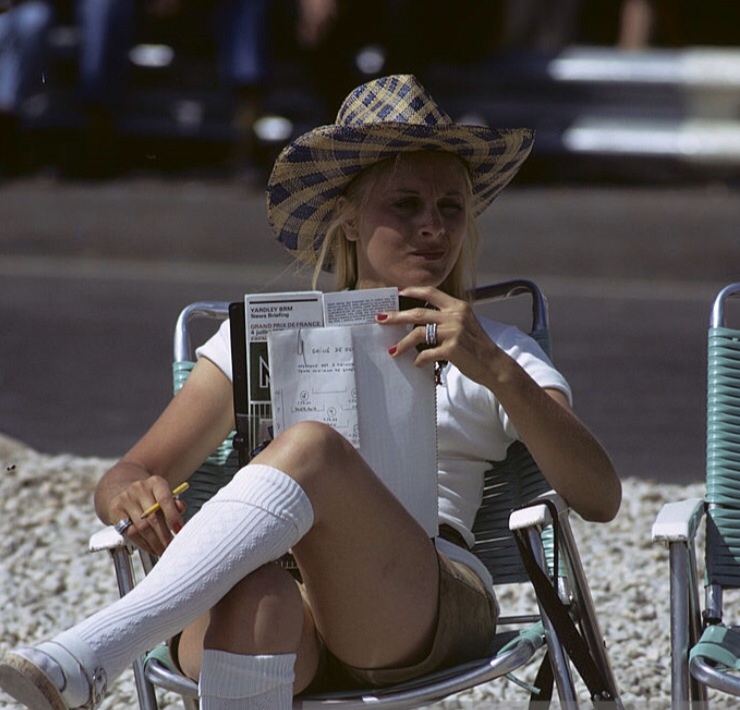
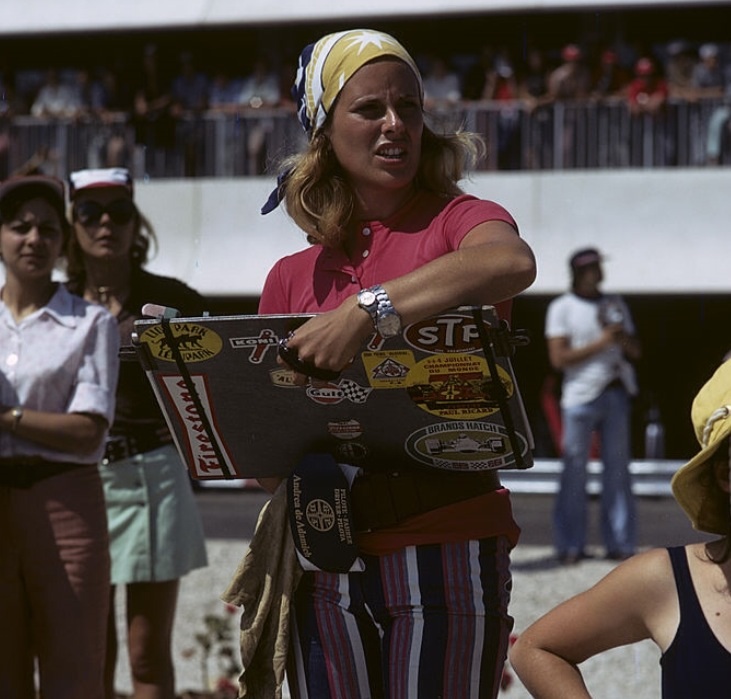
Photographers Jean-Claude Deutsch and Patrick Jarnoux display a fine eye for form, fashion, flesh and finery. French Grand Prix, Paul Ricard, 4 July 1971…

image


image

image

image

image

image


Credits…

Jean Claude Deutsch and Patrick Jarnoux

Tailpiece: And a nice tail it is…

image


jean behra portrait

(Yves Debraine)

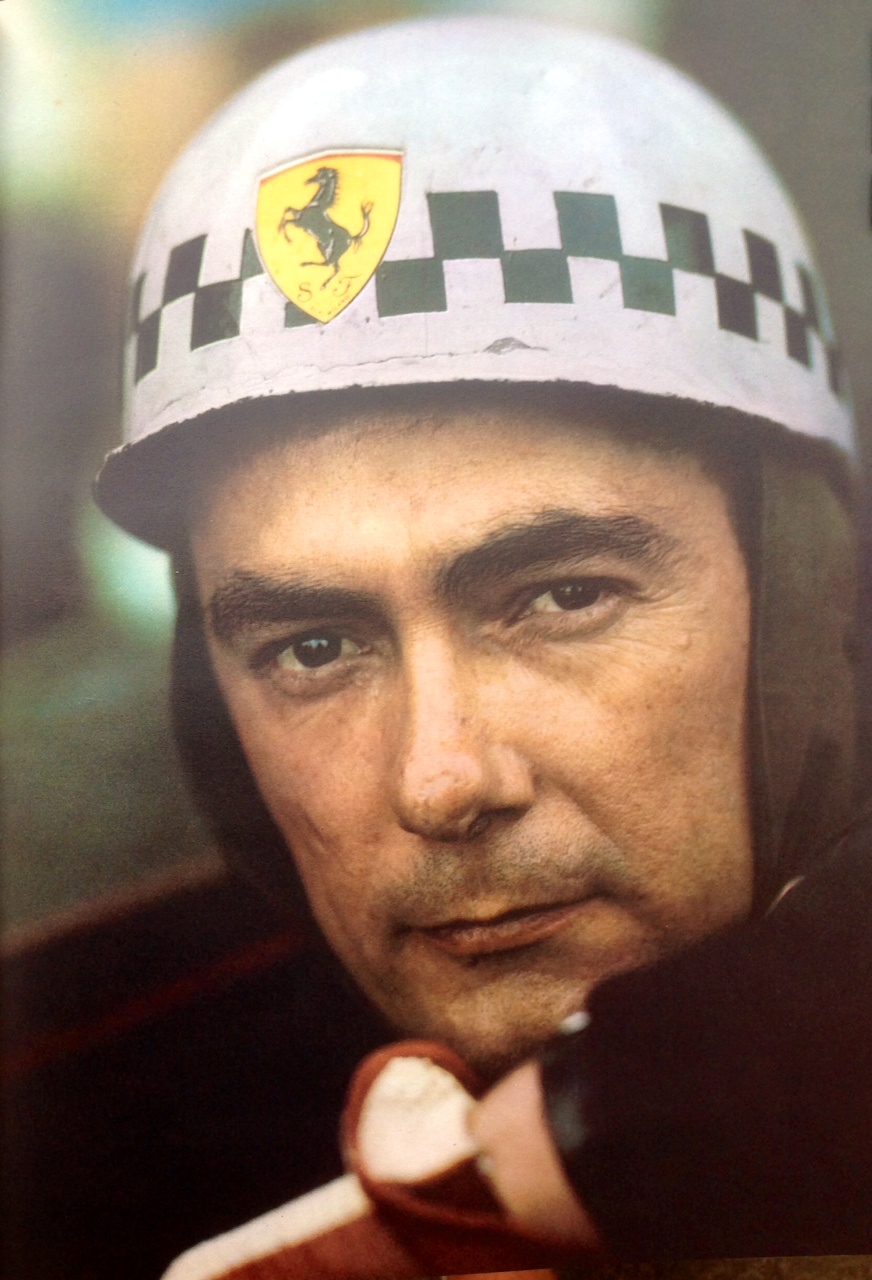
Jean Behra portrait taken by Yves Debraine in 1959, the year in which he died at the wheel of a Porsche RSK at Avus…

Not an article about this great and perhaps underrated driver but rather some 1959 snippets.

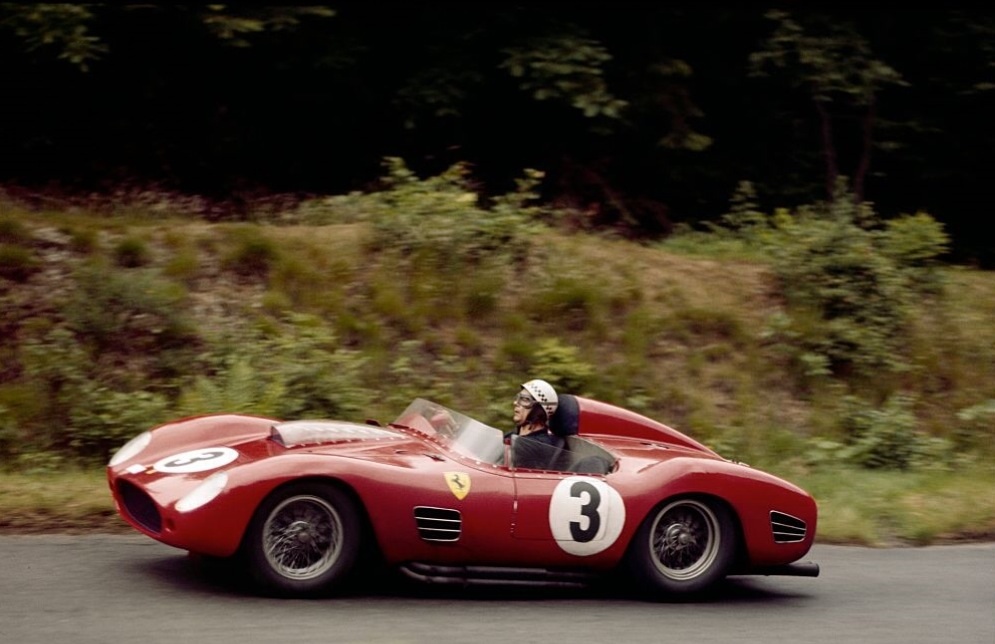
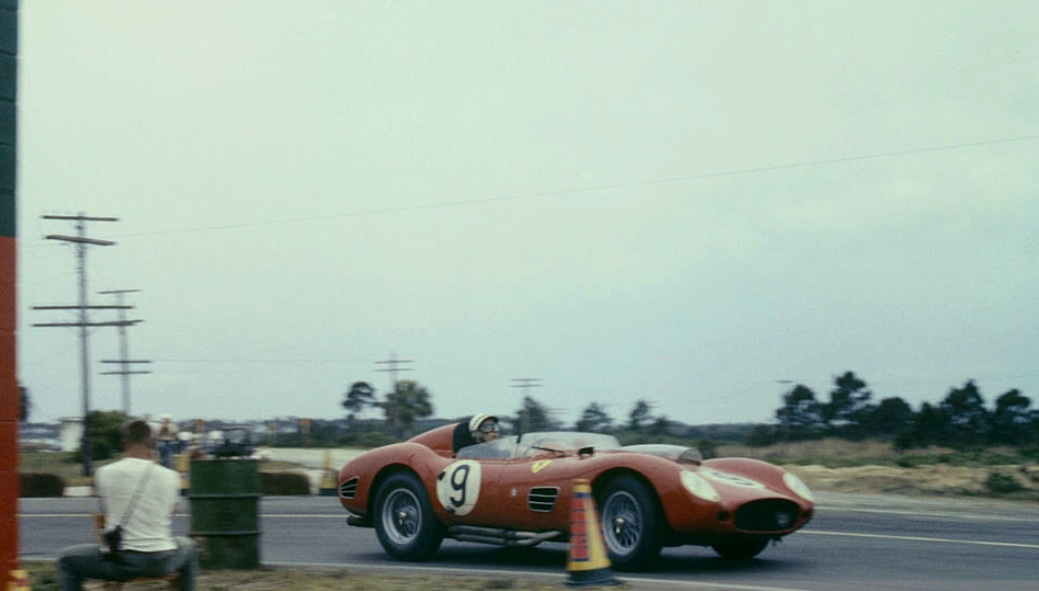
The shot below is of Behra at the wheel of the works Ferrari 250TR59 at Brunnchen, the Nurburgring on 7 June 1959. He and Tony Brooks were 3rd in the race won by Stirling Moss and Jack Fairman in an Aston Martin DBR1.

image

(Klemantaski Collection)

The great Frenchman switched from BRM to Ferrari in 1959, he started the year well winning the non-championship ‘BARC 200’ at Aintree, one of three non-champ events in the UK before the first F1 title events commenced at Monaco in May.

‘BARC 200’ Aintree on 18 April

In an encouraging start to the season Jean won the race from teammate Tony Brooks and Bruce McLaren’s works Cooper T45 Climax.

image

Monaco Grand Prix…

At the tiny principality Jean (below) was both a driver and entrant, he had built a Porsche RSK based F2 car which he entered for Maria de Filippis.

image

Despite her best efforts she couldn’t qualify the car amongst the mixed grid of F1 and F2 cars. In a sign of the times, and Porsche’s commitment to open-wheelers the factory built and entered their own car which was raced by Taffy Von Trips until a collision with Cliff Allison in an F2 Ferrari Dino.

The car, based on a new RSK had a tubular chassis built by Valerio Colotti (then of Maserati and later of transmission fame) which picked up the original front and rear suspension. The machine followed the general principles of the donor with track and wheelbase the same. The driver was placed centrally of course, the 4 cam spyder engine, gearbox, battery ignition, dynamo starter were all retained.

Colotti’s neat aluminium body was beautifully formed, the result low, streamlined and small given the cars underpinnings. DSJ’s Motorsport report of the event likened it to the Sacha-Gordini of several years before. The circa 150bhp F2 car proved to be prodigiously fast. Hans Hermann raced it for Behra at the Reims GP on 5 July finishing 2nd only to Stirling Moss’ Rob Walker Cooper T45 Borgward…in the process beating the factory Porsches of Von Trips and Bonnier and Allison’s Ferrari 156 much to the consternation of the Maranello management.

Click here for further details on this interesting car;  https://revsinstitute.org/the-collection/1958-porsche-behra-formula-ii/

image

The shot above is de Filippis in Behra’s Porsche Spl during Monaco practice, the lines of Colotti’s car sleek and low.

Below the field blasts off at the start, Behra in the middle is first away in the snub-nosed Dino from Moss on the left and Brabham on the right in Cooper T51 Climaxes, Rob Walker’s for Stirling and the works car for Jack, the latter on the way to his first GP win.

image

(unattributed)

Further back is #48 Phil Hill’s Dino 4th, #50 Tony Brooks 2nd placed Dino and Jo Bonnier #18 in the first of the BRM P25’s DNF.

The photo below shows Stirling Moss chasing Behra’s Ferrari, the Frenchman led the race until Stirling got past on lap 21 and then Brabham, after the Ferrari had engine failure on lap 22. Jack went on to take his first championship win.

image

Moss, Cooper T51 Climax chasing Behra Ferrari Dino early in the race (unattributed)

Sportscars…

Jean contested 4 of the World Sportscar championship events from March to June in the Ferrari TR250, his best results 2nd at Sebring with Cliff Allison and 3rd at the Nurburgring with Tony Brooks. The latter combination failed to finish Targa and at Le Mans Jean and Dan Gurney were out on lap 129 with gearbox problems.

jean sebring

Behra during the 21 March 1959 Sebring 12 Hours, he was 2nd in this Ferrari 250 TR/59, the winning car the sister entry driven by Gurney/Daigh/Hill/Gendebien (TEN)

image

Talking to co-driver Tony Brooks during the Targa weekend on 24 May, the winner was Barth/Seidel Porsche 718 RSK, the factory cars all DNF (unattributed)

Dutch Grand Prix, Zandvoort, and 1959…

Behra’s Ferrari Dino 246 being fettled in the Zandvoort paddock, cars were entered for him, Cliff Allison and Phil Hill qualifying 4th, 8th and 12th respectively with Bonnier’s BRM P25 on pole. His promise in practice was fulfilled in the race with the first championship win for the Bourne concern.

image

(Inside the motorsport paddock)

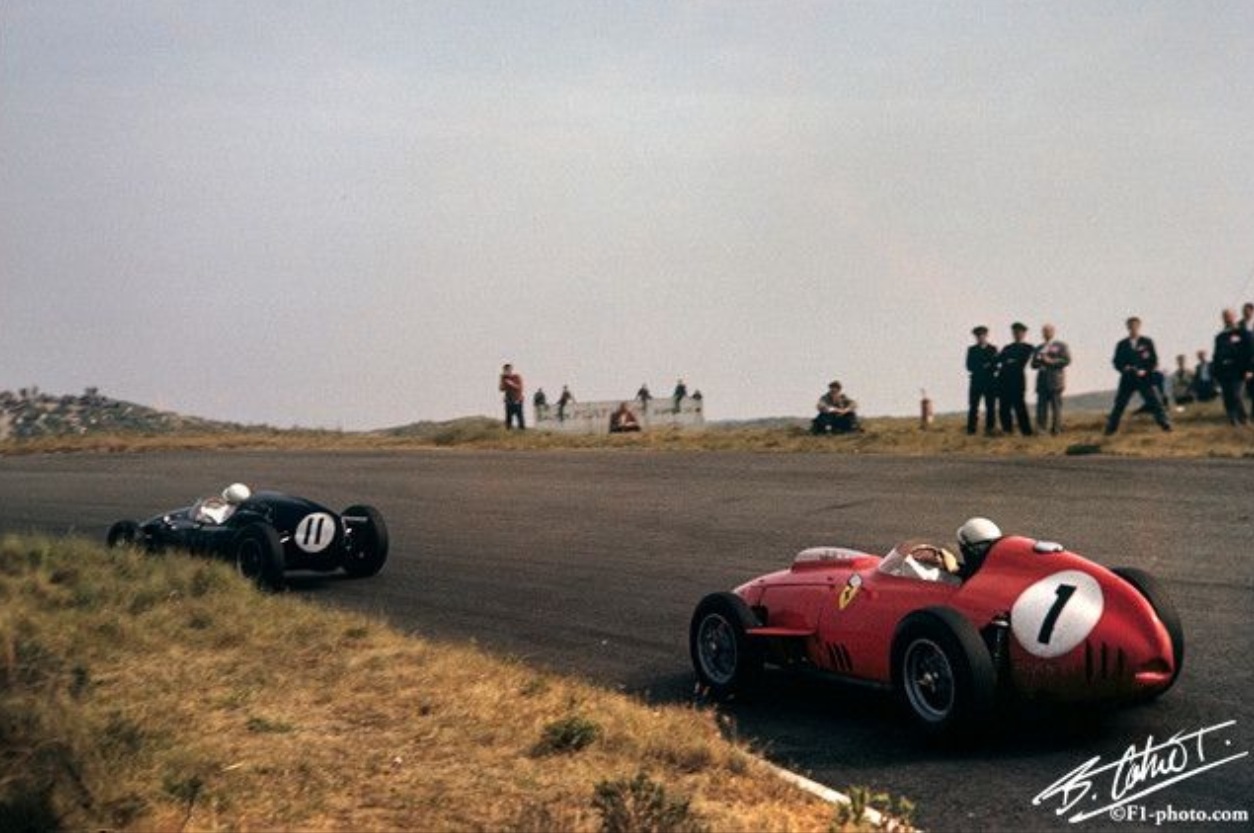
Behra below chasing Stirling Moss’ Cooper T45, he qualified 4th and finished in the same position, Brabham and Gregory were 2nd and 3rd underlying the performance of the 2.5 Coopers on a course which required a blend of power and handling.

image

Behra chasing Moss, the lines of the ’59 Dino about as good as a front engined GP car got? (Cahier)

French GP…

Onto Reims, Jean’s home race of course where things totally unravelled.

In a year in which the mid-engined revolution took hold, full 2.5 litre FPF Coventry Climax engines made clear the performance advantage of the Coopers, Ferrari only had an advantage on the faster courses of which Reims was one.

Some reports have it that Behra, a handy mechanic with great mechanical sympathy was over driving and abusing his engines in the final months of his life in his efforts to remain competitive.

image

Beautiful Reims first lap, 5 July 1959. Brooks winning Dino from Jack’s Cooper T51 3rd, #26 Hill’s Dino 2nd #10 Gregory’s Cooper T51 DNF, #2 Moss’ BRM P25 and McLaren’s Cooper T51 5th then the rest strung out thru Champagne country (unattributed)


Brooks was on pole with Phil Hill 3rd on the grid, Jean was on the 2nd row. Tony Brooks Ferrari 246 convincingly won the race in a great display of high speed precision driving in an event made incredibly demanding due to heat and stones thrown up by cars as the tracks surface suffered.

Jean qualified 5th and raced hard, having been left on the line, he made a lunge for 2nd on lap 25, but spun and dropped back to 4th. He equalled the lap record set by Trintignant on lap 28, he was racing for a hometown win after all, only for the cars engine to cry ‘enough’ on lap 29, he was out with piston failure.

The only member of the Scuderia driver line-up that year that didn’t speak English, fired up after the race, he had a ‘spirited’ exchange with team manager Romolo Tavoni. Tavoni glanced at the cars rev counter ‘tell tale’ in the pits and began, very unwisely, his driver full of adrenalin, to remonstrate with him about one-too-many over-rev and subsequent engine failure. The stocky Frenchman thumped him, knocking him over with one punch. Inevitably and predictably Jean was ‘shown the Maranello door’ giving Dan Gurney a Ferrari opportunity he took full advantage of.

image

Behra hustling his Dino hard, too hard perhaps, at Reims during the ’59 French GP (unattributed)

Ferrari missed the following GeePee at Aintree with industrial strikes in Italy but returned to the fray at Avus for the 2 August German GP.

Jean made contact with Raymond Mays to return to the BRM team there, but there was not the time or resources to make available a P25.

Jean therefore entered and qualified the 1.5 litre F2 Behra Porsche (pictured above) 16th of 17 cars but didn’t take the start of the GP after crashing, in the wet at over 100mph in a Porsche RSK in a support race. He died instantly in the awful accident in which he was flung from the car, hit a flagpole on the bankings outer extremity and then dropped into the outfield below.

A bright, charismatic light was extinguished.

Credits…

Yves Debraine, Louis Klemantaski, Cahier Archive, The Enthusiast Network, MotorSport June 1959/March 1998

Tailpiece: Le Mans 20-21 June 1959. Behra at the wheel of the car he shred with Dan Gurney DNF with gearbox problems on lap 129…

image

This race famously won by the Shelby/Salvadori Aston Martin DBR1, none of the factory TR’s finished the race (unattributed)


image


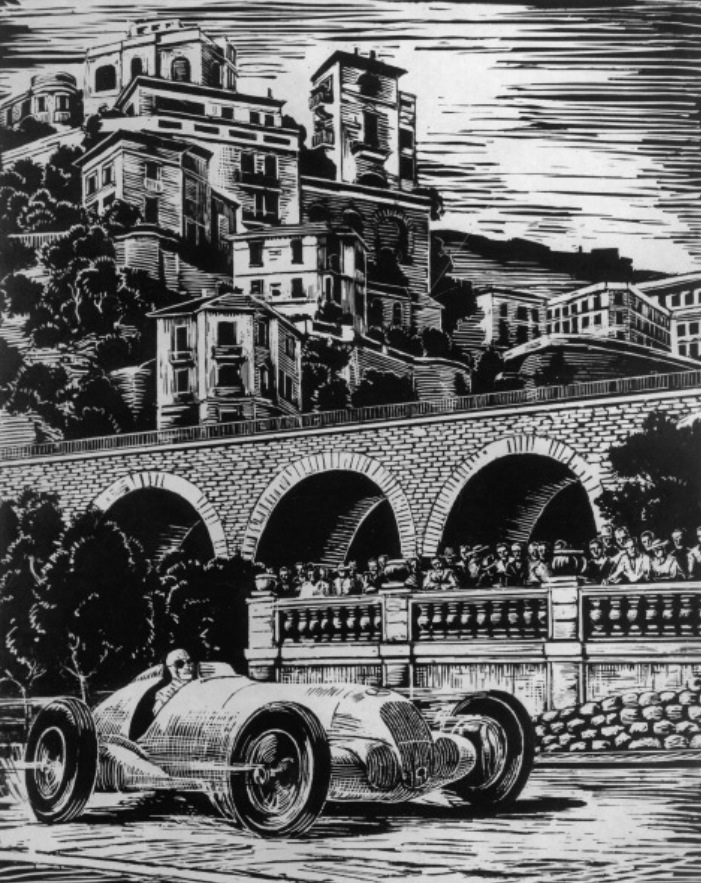
Interesting drawing of one of the dominant Mercedes W125 during the 1937 Monaco Grand Prix held on 8 August…

Manfred von Brauchitsch won from Rudy Carraciola and Christian Kautz, Goffredo Zehender was fifth, the only interloper to the Mercedes party was Hans Stuck’  Auto Union Type C which was fourth.

von Brauchitsch #10 and Caracciola below in their epic race for the GP lead, these 560bhp 5.66 litre cars GRAND in every sense of the word…

image

(unattributed)

Click here for an article on the Mercedes W125…

Mercedes Benz W125: 1937’s Dominant GP car and Rudy Uhlenhaut…

Credit…

Imagno, unattributed

image

Jack Brabham ponders wing settings on his Brabham BT26 Repco during the Canadian Grand Prix weekend at Mont Tremblant, 22 September 1968…

I blew my tiny mind when Nigel Tait sent me the photo, neither of us had any idea where it was. A bit of judicious googling identified the location as Mont Tremblant, Quebec, a summer and winter playground for Canadians 130km northwest of Montreal.

Regular readers will recall  Nigel as the ex-Repco Brabham Engines Pty. Ltd. engineer who co-wrote the recent Matich SR4 Repco article (a car he owns) and has been helping with the series of articles on Repco’s racing history I started with Rodway Wolfe, another RBE ‘teamster’ a couple of years ago.

When Nigel left Repco in the ACL Ltd management buyout of which he was a part, he placed much of the RBE archive with his alma mater, RMIT University, Melbourne. Its in safe hands and available to those interested in research on this amazing part of Australian motor racing history. The archive includes Repco’s library of photographs. Like every big corporate Repco had a PR team to maximise exposure from their activities including their investment in F1. The Mont Tremblant shot is from that archive and unpublished it seems.

Its one of those ‘the more you look, the more you see’ shots; from the distant Laurentian Mountains to the pitlane activity and engineering of the back of the car which is in great sharpness. It’s the back of the BT26 where I want to focus.

The last RBE Engines article we did (Rodway, Nigel and I) was about the ’67 championship winning SOHC, 2 valve 330bhp 740 Series V8, this BT26 is powered by the 1968 DOHC, 4 valve 390bhp 860 Series V8. It was a very powerful engine, Jochen plonked it on the front row three times, on pole twice, as he did here in Canada in 1968. But it was also an ‘ornery, unreliable, under-developed beast. Ultimately successful in 4.2 litre Indy and 5 litre Sportscar spec, we will leave the 860 engine till later for an article dedicated to the subject.

image

Check out the DG300 Hewland 5 speed transaxle and part of the complex oil system beside it to feed the 860. Also the big, beefy driveshafts and equally butch rubber donuts to deal with suspension travel. It’s interesting as Tauranac used cv’s in earlier designs, perhaps he was troubled finding something man enough to take the more powerful Repco’s grunt, the setup chosen here is sub-optimal in an engineering sense.

The rear suspension is period typical; single top link, inverted lower wishbone, radius rods leading forward top and bottom and coil spring/damper units. It appears the shocks are Koni’s, Brabham were Armstrong users for years.

The uprights are magnesium which is where things get interesting. The cars wings that is, and the means by which they attach to the car…

See the beautifully fabricated ‘hat’ which sits on top of and is bolted to the uprights and the way in which the vertical load of the wing applies it’s force directly onto the suspension of the car. This primary strut support locates the wing at its leading edge, at the rear you can see the adjustable links which control the ‘angle on the dangle’ or the wings incidence of attack to the airflow.

I’ve Lotus’ flimsy wing supports in mind as I write this…

Tauranac’s secondary wing support elements comprises steel tube fabrications which pick up on the suspension inner top link mount and on the roll bar support which runs back into the chassis diaphragm atop the gearbox.

image

The shot above shows the location of the front wing and it’s mounts, this time the vertical force is applied to the chassis at the leading front wishbone mount, and the secondary support to the wishbones trailing mount. This photo is in the Watkins Glen paddock on the 6 October weekend, the same wing package as in use in Canada a fortnight before. The mechanic looking after Jack is Ron Dennis, his formative years spent learning his craft first with Cooper and then BRO. Rondel Racing followed and fame and fortune with McLaren via Project 4 Racing…

image

Jim Hall and Chaparral 2G Chev wing at Road America, Wisconsin 1968 (Upitis)

The great, innovative Jim Hall and his band of merry men from Midlands, Texas popularised the use of wings with their sensational Chaparral’s of the mid sixties. Traction and stability in these big Group 7 Sportscars was an issue not confronted in F1 until the 3 litre era when designers and drivers encountered a surfeit of power over grip they had not experienced since the 2.5 litre days of 1954-60.

During 1967 and 1968 F1 spoilers/wings progressively grew in size and height, the race by race or quarter of a season at a time analysis of same an interesting one for another time.

image

Hill’s winged Lotus 49B, Monaco 1968 (Schlegelmilch)

In some ways ‘who gives a rats’ about the first ‘winged Grand Prix win’ as Jim Hall pioneered ‘winning wings’ in 1966, the technology advance is a Group 7 not F1 credit; but Jacky Ickx’ Ferrari 312 win in the horrific, wet, 1968 French Grand Prix (in which Jo Schlesser died a fiery death in the air-cooled Honda RA302) is generally credited as the first, the Fazz fitted with a wing aft of the driver.

But you could equally mount the case, I certainly do, that the first winged GeePee win was Graham Hill’s Lotus 49B Ford victory at Monaco that May.

Chapman fitted the Lotus with front ‘canard’ wings and the rear of the car with a big, rising front to rear, engine cover-cum-spoiler. Forghieri’s Ferrari had a rear wing but no front. The Lotus, front wings and a big spoiler. Which car first won with a wing?; the Lotus at Monaco on 26 May not the Ferrari at Rouen on July 7. All correspondence will be entered into as to your alternative views!

image

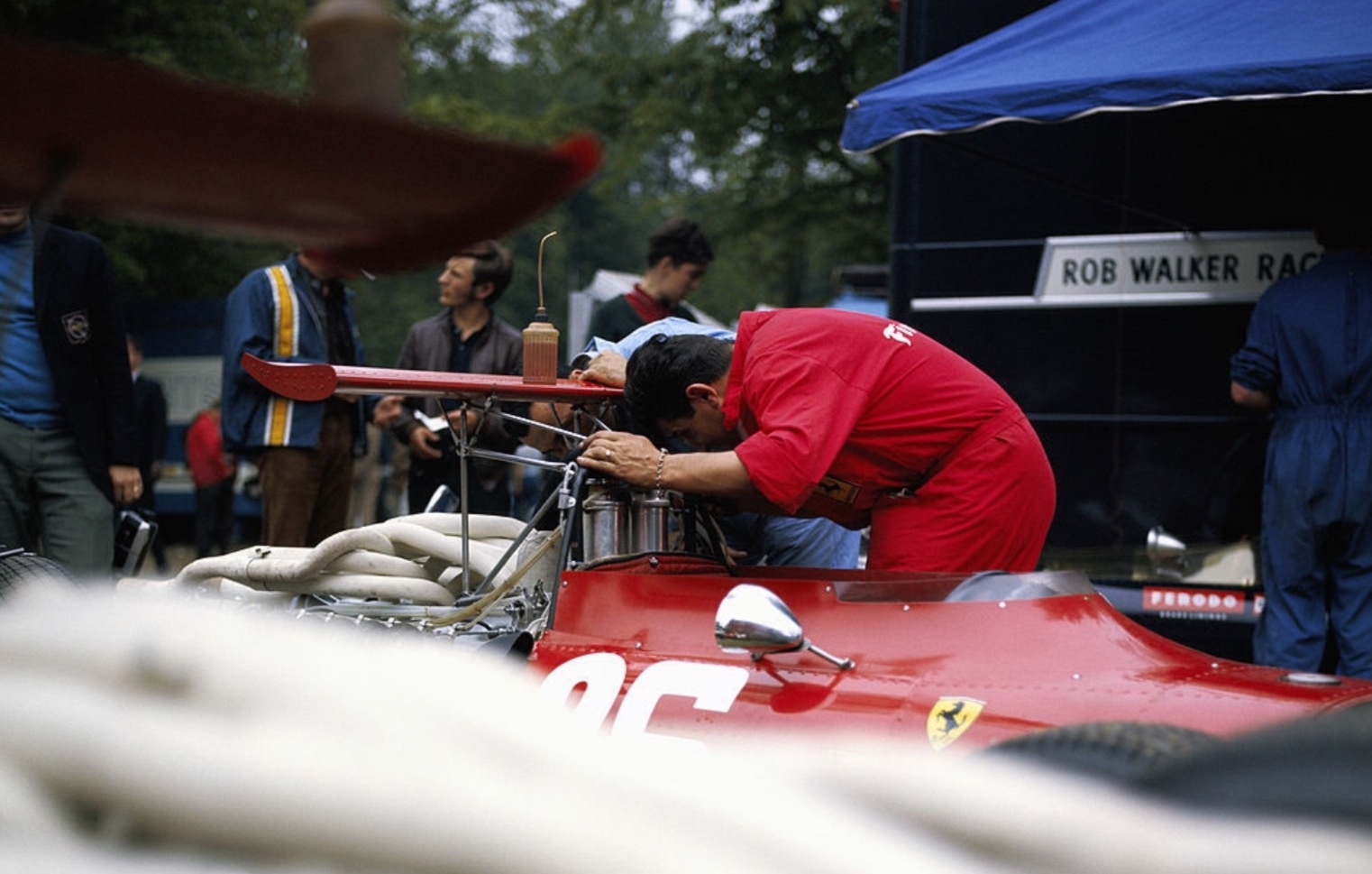
Jacky Ickx’ winning Ferrari 312 being prepared in the Rouen paddock. The neat, spidery but strong wing supports clear in shot. Exhaust in the foreground is Chris Amon’s Fazz (Schlegelmilch)

Lotus ‘ruined the hi-winged party’ with its Lotus 49B Ford wing failures, a lap apart, of Graham Hill and then Jochen Rindt at Montjuic in the 1969 Spanish GP. Both drivers were lucky to walk away from cars which were totally fucked in accidents which could have killed the drivers, let alone a swag of innocent locals.

A fortnight later the CSI acted, banning high wings during the Monaco GP weekend but allowing aero aids on an ongoing basis albeit with stricter dimensional and locational limits.

image

Mario Andretti has just put his Lotus 49B on pole at Watkins Glen in October 1968, Colin Chapman is perhaps checking his watch to see why regular drivers Hill and Jackie Oliver are being bested by guest driver Andretti who was entered at Monza and Watkins Glen at seasons end! Andretti put down a couple of markers with Chapman then; speed and testing ability which Chapman would return to nearly a decade later. More to the point are the wing mounts; direct onto the rear upright like the Brabham but not braced forward or aft. Colin was putting more weight progressively on the back of the 49 to try and aid traction, note the oil reservoir sitting up high above the ‘box. Stewart won in a Matra MS10, Hill was 2nd with both Andretti and Oliver DNF (Upitis)

Chapman was the ultimate structural engineer but also notoriously ‘optimistic’ in his specification of some aspects of his Lotus componentry over the years, the list of shunt victims of this philosophy rather a long one.

Lotus wing mounts are a case in point.

Jack Oliver’s ginormous 125mph French GP, 49B accident at Rouen in 1968 was a probable wing mount failure, Ollie’s car smote various bits of the French countryside inclusive of a Chateau gate.

Moises Solana guested for Lotus in his home, Mexican GP on 3 November, Hill won the race whilst Solana’s 49B wing collapsed.

Graham Hill’s 49B wing mounts failed during the 2 February 1969 Australian Grand Prix at Lakeside, Queensland. Then of course came the Spanish GP ‘Lotus double-whammy’ 3 months after the Lakeside incident on 4 May 1969.

image

Faaaarck that was lucky one suspects the Lotus mechanics are thinkin’!? The rear suspension and gearbox are 200 metres or so back up the road to the right not far from the chateau gate Ollie hit. It was the first of several ‘big ones’ in his career (Schlegelmilch)

For the ‘smartest tool in the shed’ Chapman was slow to realise ’twas a good idea to finish races, let alone ensure the survival of his pilots and the punters.

I’m not saying Lotus were the only marque to have aero appendages fall off as designers and engineers grappled with the new forces unleashed, but they seemed to suffer more than most. Ron Tauranac’s robustly engineered Brabhams were race winning conveyances generally devoid of bits and pieces flying off them given maintenance passably close to that recommended by ‘Motor Racing Developments’, manufacturers of Ron and Jack’s cars.

The Brabham mounts shown earlier are rather nice examples of wings designed to stay attached to the car rather than have Jack aviating before he was ready to jump into his Piper Cherokee at a race meetings end…

‘Wings Clipped’: Click on this article for more detail on the events leading up to the CSI banning hi-wings at the ’69 Monaco GP…https://primotipo.com/2015/07/12/wings-clipped-lotus-49-monaco-grand-prix-1969/

Credits…

Nigel Tait, Repco Ltd Archive, Rainer Schlegelmilch, Cahier Archive, Alvis Upitis

Etcetera…

Hill P, ‘Stardust GP’ Las Vegas, Chaparral 2E Chev 1966

image

Now you see it, now you don’t; being a pioneer and innovator was the essence of the Chaparral brand, but not without its challenges! Phil Hill with 2E wing worries at Las Vegas in 1966, he still finished 7th. Jim Hall was on pole but also had wing problems, John Surtees’ wingless Lola T70 Mk2 Chev won the race and the first CanAm Championship  (The Enthusiast Network)

The 13 November 1966 ‘Stardust GP’ at Las Vegas was won by John Surtees Lola T70 Mk2 Chev, CanAm champion in 1966. Proving the nascent aerodynamic advances were not problem free both Jim Hall, who started from pole and Phil Hill pictured here had wing trouble during the race.

The Chaparral 2E was a development of the ’65 2C Can Am car (the 2D Coupe was the ’66 World Sportscar Championship contender) with mid-mounted radiators and huge rear wing which operated directly onto the rear suspension uprights. A pedal in the cockpit allowed drivers Hall and Hill to actuate the wing before corners and ‘feather it’ on the straights getting the benefits in the bendy bits without too much drag on the straight bits. A General Motors ‘auto’ transaxle which used a torque converter rather than a manual ‘box meant the drivers footbox wasn’t too crowded and added to the innovative cocktail the 2E represented in 1966.

Its fair to say the advantages of wings were far from clear at the outset even in Group 7/CanAm; McLaren won the 1967 and 1968 series with wingless M6A Chev and M8A Chev respectively, winning the ’69 CanAm with the hi-winged M8B Chev in 1969. Chaparral famously embody everything which was great about the CanAm but never won the series despite building some stunning, radical, epochal cars.

phil

Phil Hill relaxed in his 2E at Laguna Seca on 16 October 1966, Chaps wing in the foreground, Laguna’s swoops in the background. Phil won from Jim Hall in the other 2E (TEN)

Hill G, Monaco GP, Lotus 49B Ford 1968

image

Interesting shot of Hill shows just how pronounced the rear bodywork of the Lotus 49B was. You can just see the front wing, Monaco ’68 (unattributed)

Hill taking a great win at Monaco in 1968. Graham’s was a tour de force of leadership, strength of mind and will. Jim Clark died at Hockenheim on 7 April, Monaco was on 26 May, Colin Chapman was devastated by the loss of Clark, a close friend and confidant apart from the Scots extraordinary capabilities as a driver.

Hill won convincingly popping the winged Lotus on pole and leading all but the races first 3 laps harnessing the additional grip and stability afforded by the cars nascent, rudimentary aerodynamic appendages. Graham also won the Spanish Grand Prix on 12 May, these two wins in the face of great adversity set up the plucky Brits 1968 World Championship win. Remember that McLaren and Matra had DFV’s that season too, Lotus did not have the same margin of superiority in ’68 that they had in ’67, lack of ’67 reliability duly noted.

graham

Hills 49B from the front showing the ‘canard’ wings and beautifully integrated rear engine cover/spoiler (Cahier)

Ickx, Rouen, French GP, Ferrari 312  1968

image

Mauro Forghieri, Ferrari’s Chief Engineer developed wings which were mounted above the engine amidships of the Ferrari 312. Ickx put them to good use qualifying 3rd and leading the wet race, the Belgian gambled on wets, others plumped for intermediates.

Ickx’ wet weather driving skills, the Firestone tyres, wing and chaos caused by the firefighting efforts to try to save Schlesser did the rest. It was Ickx’ first GP win.

jacky

It looks like Rainer Schlegelmilch is taking the shot of Jacky Ickx at Rouen in 1968, note the lack of front wings or trim tabs on the Ferrari 312 (Schlegelmilch)

Tailpiece: The ‘treacle beak’ noting the weight of Tauranac’s BT26 Repco is none other than ‘Chopper’ Tyrrell. Also tending the car at the Watkins Glen weighbridge is Ron Dennis, I wonder if Ken’s Matra MS10 Ford was lighter than the BT26? If that 860 engine had been reliable Jochen Rindt would have given Jackie Stewart and Graham Hill a serious run for their money in 1968, sadly the beautiful donk was not the paragon of reliability it’s 620 and 740 Series 1966/7 engines generally were…

image

Finito…

image

James Hunt dives for the inside line in his March 713S Ford, AJ and his Brabham BT28 Ford has left a gap way bigger than he ever did when they slugged it out in GP racing…

It’s 1971, the BRSCC MCD Shell Super Oil British F3 Championship at Brands Hatch on 1 March 1971 and both drivers are trying hard to jump up to the next level, the road for Hunt would be easier than Jones, James a coming star with the Hesketh March 731 in 1973 and Jones an F1 ‘occasional’ from 1974.

The ‘facts’ are from the photo caption, the cars and drivers are correct but the date/Brands event don’t accord with the ‘F2 Register’ record of that event, my F3 race resource. It appears AJ didn’t race with #69, a number with obvious appeal to him at all during ’71.

One for the British F3 historians amongst you!

(DLuff-MBisset-Copilot)

The 1969 spec Brabham BT28 Ford breaks cover near MRD’s Weylock factory on a date unknown, complete with wing kit, which was fitted, or not! depending upon the circuit and driver preference.

Credit…

Grand Prix Photos, David Luff

Finito…

image

Introduction…

As Brabham, Tauranac and Denny Hulme scanned the competitive landscape as 1966 unfolded, they formed the view that a similar formula to ’66 stood a good chance of success in 1967. A small, light, responsive chassis, this time designed around the engine. Remember that Jack’s successful ’66 mount, BT19, was an adapted, unraced 1965 GP car Tauranac designed around the stillborn Coventry Climax Flat-16. Ron’s ’67 BT24 was and is a superb car; its race record we shall review in an article about Brabham Racing Organisation’s (BRO) successful ’67 season.

In terms of the engine, keeping it simple and light had paid big dividends for Repco Brabham Engines Pty. Ltd. (RBE) in the first year of the 3 litre formula.

The fortunes of Ferrari, BRM, its H-16 engine, the antithesis of the Brabham Repco’s in terms of weight and complexity and the Maserati V12 were well covered in my article on the ’66 season. Dan Gurney’s Weslake V12 engine showed promise, but reliability continued to be an issue. The Ford Cosworth DFV didn’t race until the Dutch GP in June 1967. Brabham’s needed more power of course; too much power is rarely an issue, but they figured they needed less power than most others on the grid. If Jack and Denny started the season with a reliable, just quick enough package, BRO could retain their title as others sought to make what were ultimately potentially quicker, more sophisticated multi-cylinder, multi-cam cars reliable. Click here for my article on Jack’s successful 1966 season: https://primotipo.com/2014/11/13/winning-the-1966-world-f1-championships-rodways-repco-recollections-episode-3/

denny le mans
The beautifully fast, light, forgiving championship winning Brabham BT24 Repco 740 ahead of Chris Amon’s Ferrari 312 at Le Mans during the ’67 French GP. Denny 2nd to Jacks winning sister car, Amon DNF with throttle linkage failure (Automobile Year)

They were an intensely pragmatic group of racers in this Brabham/Repco senior mix…

Repco’s Charlie Dean, Phil Irving, Norman Wilson (designer of the ’67 RBE740 Series V8), Brabham and Tauranac all built winning cars (and bikes in Phil’s case) themselves, as in, built with their own hands. Dean created the extraordinary series of Maybach Grand Prix cars. Look at my Stan Jones article for much detail about this series of racers built by Charlie and initially raced by him, and then later by Stanley with much success. Norman Wilson built a Holden-engined special in his youth, covered in brief at the end of this article. Tauranac and his brother Austin built and raced the ‘original’ Ralts before Ron joined Jack in the UK in 1961.

Dean, Wilson, Tauranac and Brabham had been/were drivers. They knew what it took to win races. They understood winning was as much about torque as power. Handling was essential, the circuits then were all far from just requiring top-end power, what was needed at Monza was different to the blend of corners and contours at Brands. All had driven cars and lost races due to unreliability. They understood a balanced package was critical, that whatever power they had needed to be put to the road. The point I make is that these guys were practitioners, not theorists, on ‘an engineering jolly’.

The RB group were about the application of sound pragmatic engineering practice; they didn’t have to think deeply about this stuff it was part of their DNA given the ‘build and develop it yourself’ school from which they came. These guys weren’t ‘university engineers’ (which is not to say they lacked formal qualifications) but very practical chaps. Let the others chase ‘engineering perfection’ as they saw it; ‘an evolution of what we have is probably enough to do the trick’ was the correct thinking.

It was a whole different ballgame they confronted at the same time in ’68, but this was mid-’66, the game-changing DFV was still a distance away…

rb 740
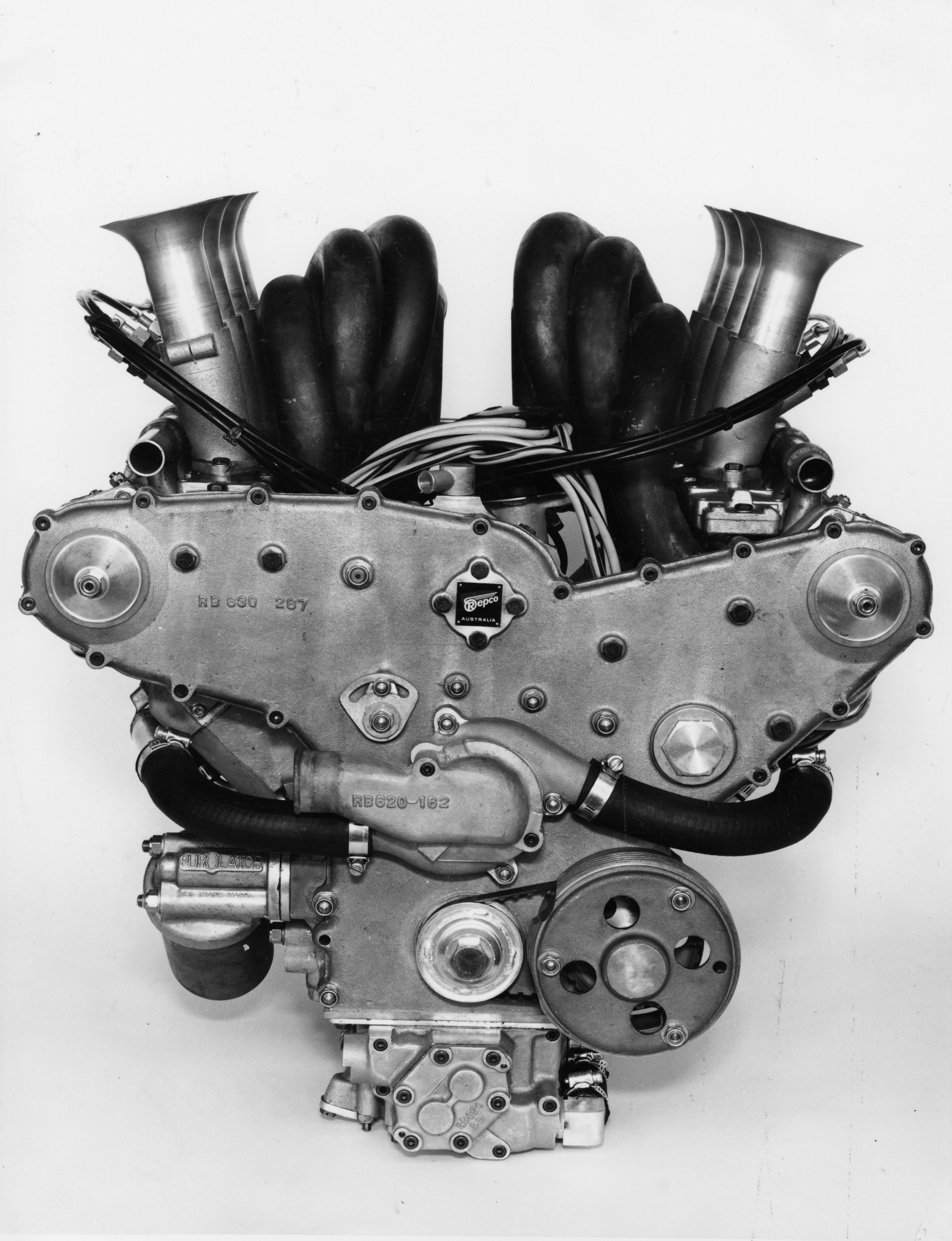
Repco studio shot of the front of the amazingly compact ’67 championship-winning ‘RBE740’, SOHC, 2 valve ‘between the Vee exhaust’, circa 330bhp V8. The ‘mix and match’ of engine parts described in the text is proven by the use of a 620 water pump, a 630 chain timing cover, an oil filter American ‘Purolator’, note the oil pump below the dry sump pan, and up top, the ends of aluminium water cooling rails, a Bosch distributor and Lucas fuel injection trumpets (Tait/Repco)

1967 Engine Design Deliberations…

Ex RBE Engineer Nigel Tait; ‘By July 1966, the World Titles had already been ‘wrapped up’ for the year, so the team were already thinking about the engine for 1967. Phil, Jack and Ron were all keen on the idea of getting the exhausts out of the airstream to clean up the car in terms of better aerodynamics and also for ease of plumbing the exhausts, which otherwise had to negotiate the tubular chassis frame. The 1966 BT19 championship-winning chassis did not present a very effective frontal profile, its exhausts well out in the breeze.

Colin Chapman was far from the first chassis man to be prescriptive about design elements of an engine, as he was to Keith Duckworth in relation to the Ford Cosworth DFV, particularly in relation to its integration with ‘his’ chassis.

Between the Vee exhausts had been raced successfully by BRM with its P56 1.5-2 litre family of V8’s in recent years. Ferrari also chose the same approach with its ’67 3 valve V12, its fair to say it was an F1 design trend of the time. In some ways, Ferrari’s approach was better than Brabham’s as Ron maintained outboard springs and shocks on both the front and back of his ’67 BT24 chassis. Ferrari, as they did in 1966, used a top rocker and an inboard front spring/shock, presenting less resistance to the air at the front of the car at least. Ferrari went outboard at the back like Brabham. (and the rest of the grid)

rb 620 and 740
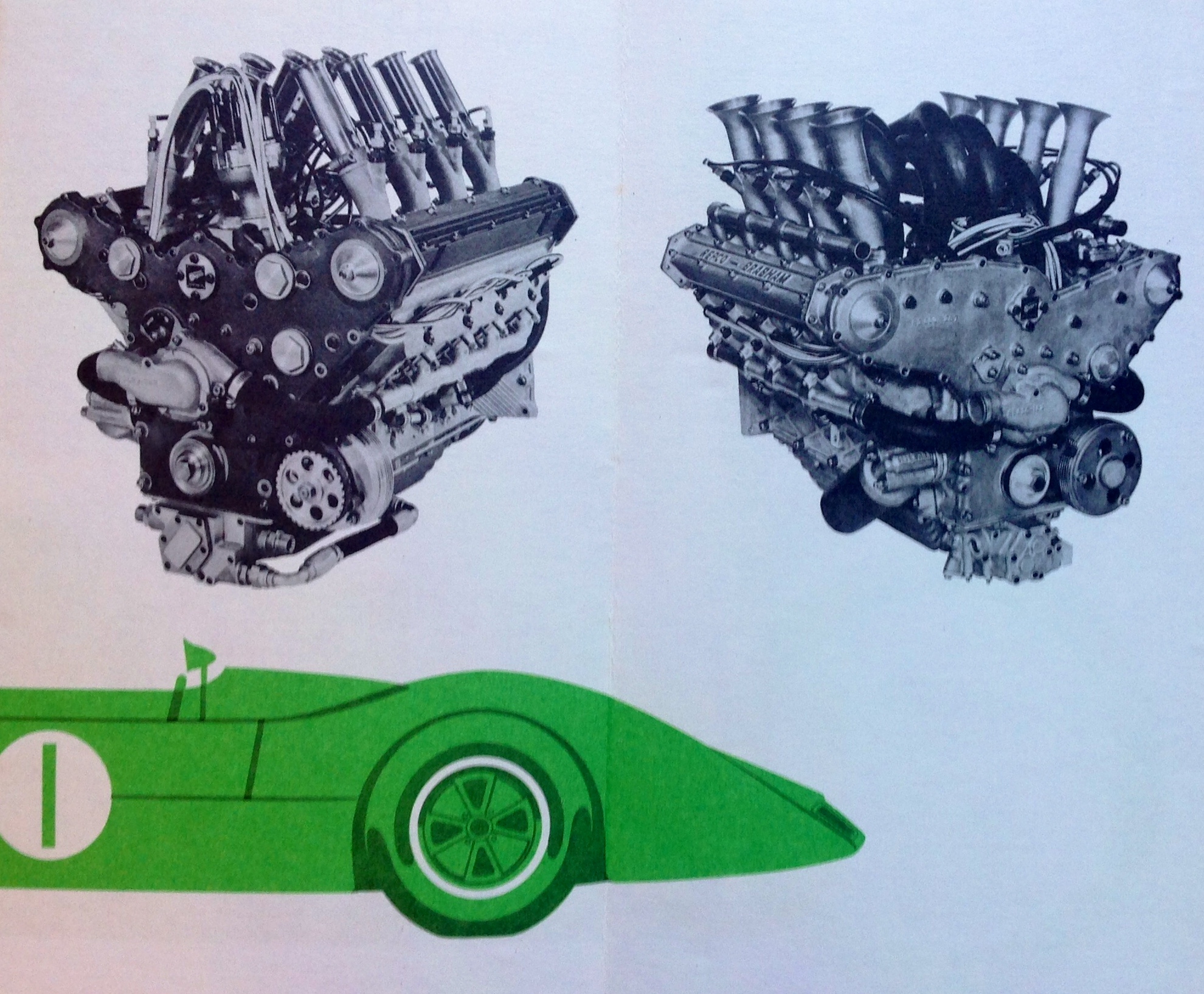
Old and new; ’66 RB620 305 bhp V8 left and ’67 RB740 330 bhp V8 right, F1 champions both. 740 was 3 inches shorter, 4 inches wider across the heads and 15 lbs lighter than 620. Dimensions otherwise the same; 25.5 inches long, 17.25 inches wide across the bellhousing (Repco)

Conceptual Design of the Heads…

RBE Chief Engineer Norman Wilson: ‘ It would have been Jack’s idea to put the exhausts in the centre (of the Vee). Jack asked if it could be done. I remember when I started designing them, I spent a lot of time, probably 3 or 4 days, just drawing one cylinder up to try and prove that you could fit everything in. Since you have got a whole row of head studs, you have got to have water passages between the ports. The whole idea was to prove that you could get the inlet port in, the exhaust port and all the head studs. That was a giant task to figure out in a way.

‘It meant putting the outer row of studs underneath the exhaust ports. I don’t think I have the layout now, but I remember spending a huge amount of time, and finally I went to Frank Hallam (RBE General Manager) and said I think we can do it. And that’s how the 40 Series heads started. ‘To manage to get everything on one side, and the thing is, unlike most engines we built, we wanted big ports. So to fit all these big ports in, plus the port wall, plus the bolt bosses, was a major task. I think it took about three days’ work for me to fit everything in a rough layout.

jack butt
Jack’s BT24 Repco 740 being fettled during ’67, circuit unknown. ‘Box is 5 speed Hewland DG300 transaxle, note rubber ‘doughnuts’, Lucas injection ‘bomb’ or fuel pump to the right of the box, also rear spaceframe chassis diaphragm. Getting the exhausts outta the airstream shown to good effect in this shot (unattributed)

The ’40 Series’ Between the Vee 1967 Cylinder Heads Design Detail…

‘…the new cylinder heads retained parallel valves, but they were now in line with the cylinder axis (instead of at 10 degrees to the axis as on the ’66 20 Series heads and were flush to the head face,’ said Wilson. ‘The 40 Series heads used the Heron head design. In this design, the cylinder head is flat, and the piston has the combustion chamber at the top of the piston (a bowl in the piston arrangement). The other feature of the 40 Series head is that it has a tall inlet port. It had a fairly long, relatively straight section there on Jack Brabham’s suggestion. He had received some highly secret information from Honda that this was the way to go. In hindsight, I don’t think so. All these things are better in hindsight, but that’s how we did it’

‘The Heron head, I think everyone agreed, had to be the way to go because the Cosworth SCA (F2 engine) was 1000cc and was putting out 120bhp. At the time in F2, it was winning everything. I think it puts out 123bhp. Now, if you are looking at a 3-litre engine, that’s 369bhp. And at that time, that would have been looking for us a fairly exciting sort of figure. The other point about the Heron head is that it allowed us to have a single camshaft, which we wanted to have the low weight, simplicity and ease of manufacture.

‘The 40 Series head was purely made for the car. No other reason. It put the exhausts down the centre of the Vee… that’s what Ron wanted, he made the car, so why not get what he wanted.

‘The highest output of the 740 Series 3-litre was only a bit over 330bhp. This horsepower rivalry between the different engine manufacturers at the time, the horsepower numbers were really irrelevant. At the time, Maserati claimed about 500bhp, but they were adding on about 100bhp to make up for the exhaust gas pollution in the test cell. But really, it’s about the area of the horsepower curve. ‘If they had 500bhp, they would be leaving us behind a lot quicker than they are leaving us behind!’ was a quip Rod Wolfe recalls Jack making to the boys in the RBE engine assembly area on one of his trips to Australia in 1967.

‘One of the philosophies was for the engine to always have a wide power range and good power at the bottom end of it, which suited the light car. So if ours was 330bhp, there was no way other cars had 400-500bhp claimed. Our power was distributed much more evenly across a wider range of revs. Thus, Denny Hulme would say it was great to drive a Repco Brabham because he could overtake competitors in the corners as if they were ‘tied to a fence’.

There were some problems with 40 Series head porosity during ’67, as ex-RBE machinist/storeman Rodway Wolfe recalls: ‘Norm did a fantastic job to even succeed with the casting, and it proved to be a great engine in larger capacity too, bigger valves etc…we were able to fit very large valves without too many seat problems. The 40 series did have a lot of porosity problems with the ports, some we scrapped as the ports actually broke through when we were porting them, and there was not the welding equipment available that we have nowadays to repair them. Porosity, a big drama, as I say, one of my jobs was to send the castings to ‘Nilsens Sintered Products’ in Richmond, where they placed the heads in a vacuum and impregnated them with hot resin. Vacuum impregnation solved some of these problems.

jack wf
Brabham on the Warwick Farm grid, WF Tasman round in 1967. In relation to the cooling duct feeding the engine, Rodway Wolfe comments, ‘There were a few heat problems in the valley of the engine with the 40 series as the fuel metering unit was also located in the valley, but small heat shields seemed to correct this problem, and it was not an issue once the car was on the track, of course. ‘ It seems these ducts were used in the ’67 Tasman rounds on the 640 engines used by Jack and Denny and subsequently sporadically on the 740 engines, Le Mans for example (Bruce Wells)

A typically pragmatic decision to the heads was made in relation to the 1967 Repco block…

Remember that the ’66 engine used a heavily adapted version of the Oldsmobile F85 aluminium block. Repco still had a swag of unused blocks sitting in Rod Wolfe’s Repco store at Maidstone. The blocks had been successful, a world title proof enough of their effectiveness, but the machining and adaptation required to make them an effective race tool meant they were expensive but still sub-optimal. But it wasn’t all plain sailing with the block, however much it may have seemed so from the outside, Tait; ‘For much of 1966 we had serious blowby issues due to distortion of the dry sleeves, and it was not until almost the end of that year that we went to wet sleeves. The F85 Olds blocks came with dry sleeves in situ’.

Repco’s race engine commercial ends were to be served by building and selling engines for Tasman use and for Group Seven sportscars, burgeoning at the time globally; 2.5 litres was the Tasman Formula capacity limit, and the F85 ‘maxed out’ at 4.4 litres, which was the capacity used for the sportscar engines. Repco’s first sale of a customer engine was the 4.4-litre 620 Series unit sold to Bob Jane for his Elfin 400.

So Repco decided to ‘have their cake and eat it too’. The new bespoke ‘700 Series’ block would allow all of the F85 ‘600 Series’ bits and bobs to attach to it: heads, timing case, sump, the lot. So Repco could gradually use its stock of F85 blocks for Tasman and sportscar use whilst ‘700 Series’ blocks were used in F1 for 1967 and more broadly in capacities up to 5 litres subsequently. As engines were rebuilt, the 600 blocks were replaced progressively by 700 series units. 600 blocks ceased to be used when there were none left. Typically practical, sensible and parsimonious, Repco!

Whilst the ‘700 Series’ block design decision, to allow 600 hardware to be attached, was a ‘functional’ pragmatic decision, the aluminium block itself was also improved, being redesigned to increase rigidity. The new block design was commenced by Irving, he and others say, before he departed from RBE, but the completed block is his replacement as Chief Design Engineer, Norman Wilson’s design.

rb team
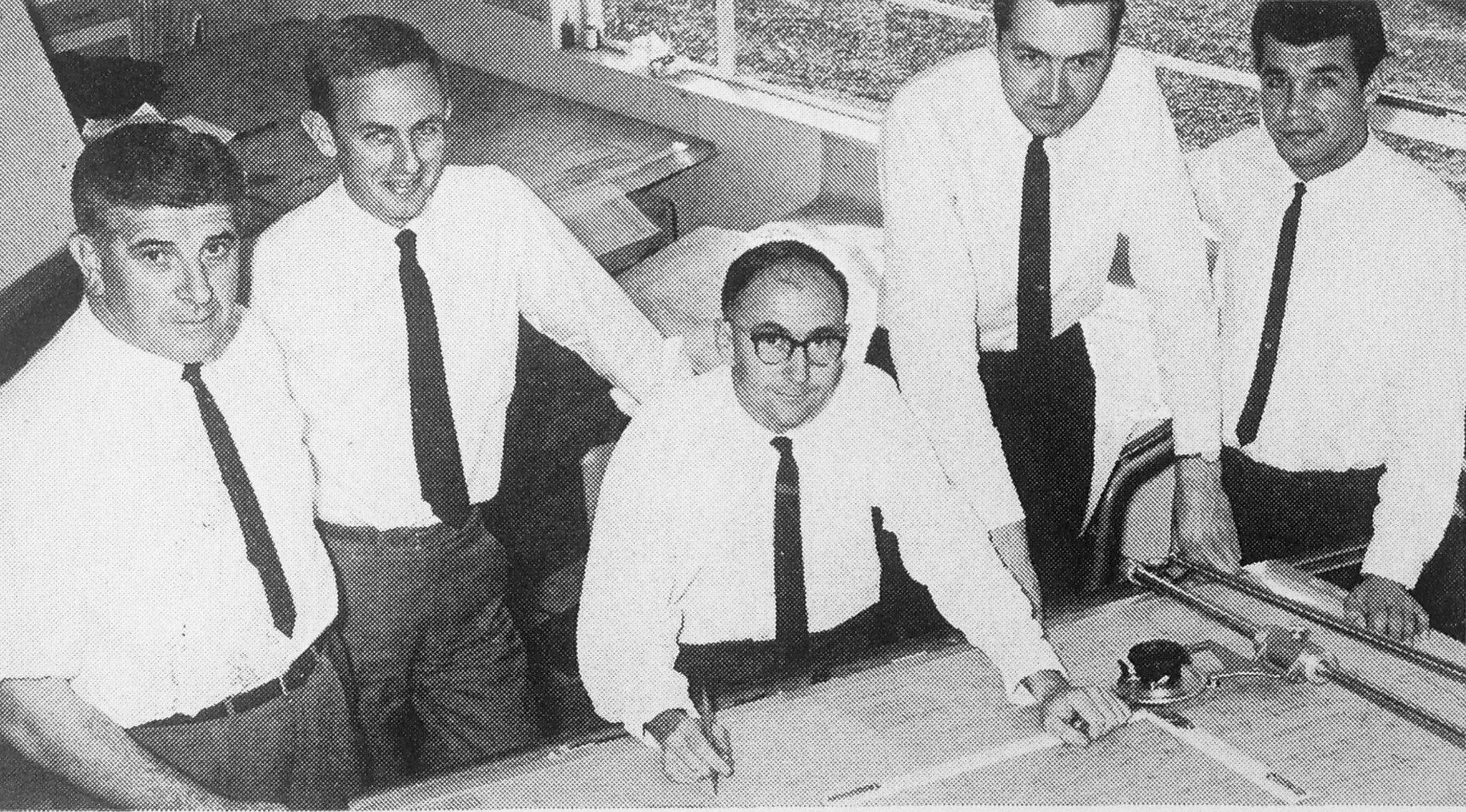
The post Phil Irving RBE design team; L>R GM Frank Hallam and Engineers Norman Wilson, Lindsay Hooper, John Judd and Brian Heard (Repco)

Phil Irving’s departure by resignation or sacking by RBE GM Frank Hallam is an important part of the RBE story and will be dealt with in a separate article. I explore not just the difficult relationship between these two characters but also the broader issues of the leadership of Repco, CEO Charles McGrath’s key enduring support of the RBE program and the appointment of Bob Brown as the Director responsible for RBE instead of alternatives, including Charlie Dean at the project’s outset. The antipathy between Hallam and Irving was partially about personality but also about politics and legacy in terms of who is responsible for what of the RB620 design and build. More on this topic very soon.

For now, let’s just focus on the RB740 engine, which in no way, shape, nor form was negatively impacted by Irving’s departure…whilst noting that there probably would have been no 740 had it not been for the success of Jack and Phil’s RB620, JB as the engine’s conceptual designer and PI as its detail designer and draftsman…

block
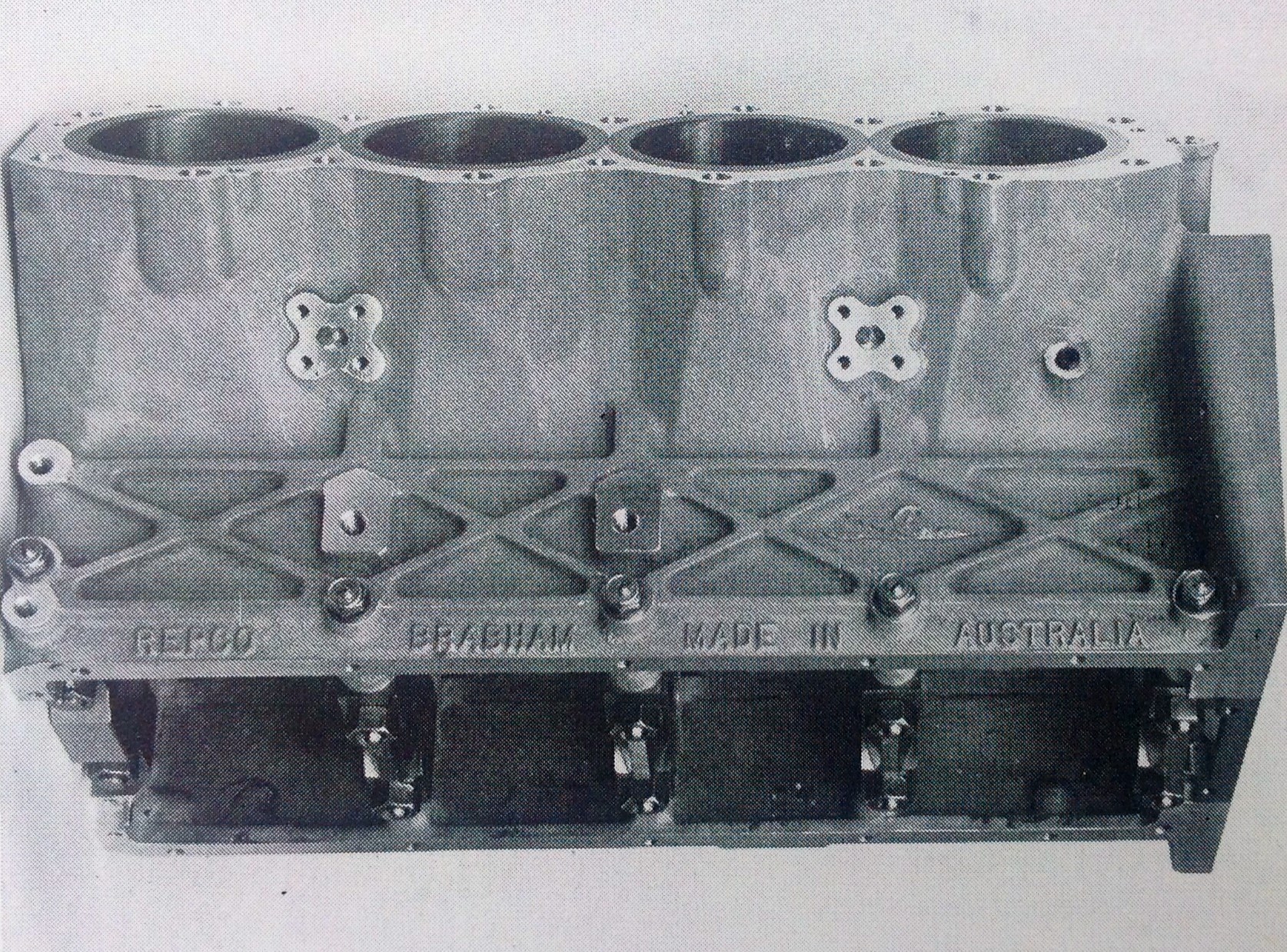
Machining the RB700 block, note the stiffening ribs referred to in the text (Wolfe/Repco)

Norman Wilson: ‘When I went there (to RBE from Repco Research), John Judd (who had been seconded to Repco by BRO in the UK) had done a new crankcase. So I asked to look at it, and John showed it to me, and I said we can’t make it. It was impossible because it was the basis of a whole new engine. It became a mutual decision (by the design team) that we make a crankcase that went underneath, on top of and behind exactly what we had. ‘We couldn’t have made a crankcase, head and timing case all at once. So we made a crankcase, and then we did the 40 series heads. We had to have a timing case with the heads, but it meant we didn’t have too much to do at once, and we just kept progressing.

Wilson: The new crankcase was designed from scratch but was also designed so it could accommodate the 20 series cylinder head if we wanted to. It was critical, being a fairly small outfit, that we had the maximum amount of interchangeable flexibility between all the components that we made. So the 700 series crankcase was designed to overcome the problems that we had seen or experienced with the Oldsmobile F85 600 series crankcase. It had wet liners, which in part was because it was easier to cast the cylinder block with a wet liner design in that it simplified dramatically the coring required for the casting of the block.

‘The Oldsmobile engine showed it had main bearing problems, so we altered the main bearing arrangement to be much more rigid. We extended the studs up through into the centre of the Vee with nuts on top to take some of the load up through to the top of the block. The unfortunate part of that was that the design was right, but people would always do the nuts in the top up tight. And of course, what would happen was that the cylinder block, being aluminium, would expand more than the stud and would eventually break it. What they should have done, and no one would listen, was to do them up at a much lower torque so when the engine got hot it would put the right load on the stud’.

repco boys
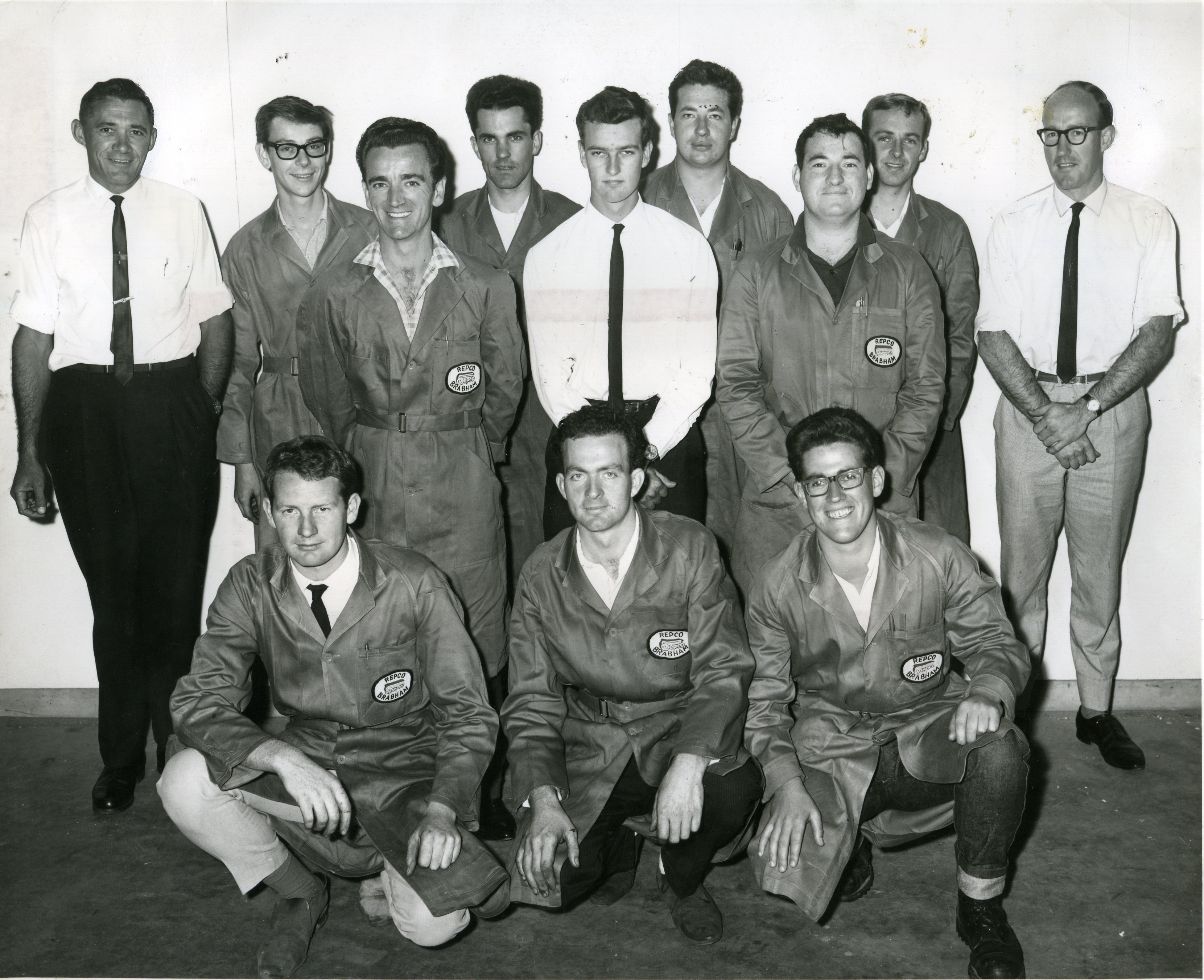
RBE Boys, Maidstone, undated but circa 1966/7. Back L>R Kevin Davies, Eric Gaynor, Tony Chamberlain, Fred Rudd, John Mepstead, Peter Holinger. Middle; Vic Mosby, Howard Ring, Norman Bence. Front; David Nash, Rodway Wolfe, Don Butler (Tait/Repco)

‘The front bearing panel of the block was made stronger because this had proved to be a weakness with the Oldsmobile block. The back of the block was made with the same stud pattern as the Olds block so that all the existing gearbox adaptors could be used. The block was made with the idea of making it as light as possible, and that was one of the critical things in the design. In the end, Frank suggested we put some diagonal ribbing on the 700 series crankcase walls to strengthen them. ‘The sidewalls of the crankcase were actually bolted to the main bearing caps… cross-bolting (and strengthened the crankcase considerably). So I felt the diagonal ribbing was really quite irrelevant. …Frank wanted it and, you know, he was a pretty good boss to work for, so that’s what we did’.

‘The other thing about the block was that later, when we made the 4.2-litre Indianapolis engines (760 Series DOHC, 4-valve V8 in 1968/9) we could alter the sealing arrangements; in fact, the later F1 engines (’68 860 Series) were the same, so we used Cooper rings instead of head gaskets. Cooper rings sealed the combustion chamber, and O rings sealed the water passages. But we also then had a groove around the outside of the Cooper ring joined with a shallow slot to the edge of the head, so if one Cooper ring leaked slightly, there was no way it would pressurise the cooling system.

rb block
RBE700 Series block, note the cross bolted 5 main bearings (Repco)

‘With the Indianapolis engine (760 Series 4.2), those grooves came out of the inside of the Vee. So you could run your engine in the pits, and you could put your finger over the end of each groove, and you’d know if any of the Cooper rings were leaking slightly. The 700 block was the same height as the Olds F85 block. And the 800 block (860 F1 and 830 Tasman 2.5) was a (1.5 inches) lower one to make the engine smaller.’

The 700 Series block, apart from being stronger, was also 15 Kg lighter than the F85 ‘600 Series, Norman Wilson again; ‘The F85 block was designed to be diecast on a diecasting machine; it was perhaps a bit thicker in spots just to make it easier to cast. We got rid of a considerable amount of aluminium around each cylinder…The Repco block didn’t have all the bosses down the centre along the block for the cam-followers. It didn’t have the cam bearings for the centre camshaft (of the F85). We didn’t have the stiffener plate on the bottom. The bearing caps were bigger, but they were done a bit better, and they were probably no heavier than what was there. And in all the places where strength was not required, we just skinned them down as much as we could’.

brochure
(Wolfe/Repco)

Most of the components for the engine were made by Repco subsidiary, Russell Engineering, few were contracted out.

Wolfe: ‘Most of the RBE engine components were made at the Maidstone factory. The pistons and rings, however, were from other Repco companies, and the crankshafts were from Laystall in the UK, but no other F1 engine constructor made their own pistons and rings in 1966; even Ferrari used Hepolite pistons, so Repco were unique.

Harold Clisby’s engineering business in South Australia cast many of the heads. Kevin Drage, the senior engineer at Castalloy, the Clisby subsidiary that made the heads, recalled that around 120 cylinder heads of four types-30, 40, 50 and 60 Series were cast by the company over the period of the RBE program.

The 30 Series head was detailed by John Judd and was two-valve with inlet and exhaust ports on either side of the head, ‘crossflow’ inlets between the Vee and exhausts out the side. 40 Series (the ’67 championship winner) heads were detailed by Norman Wilson, which had inlet and exhaust ports on the same side of the head, between the Vee exhausts.

Drage recalls that the two-valve 30 and 40 Series heads were soon followed by the four-valve 50 and 60 Series designs. John Judd drew these up with the 50 Series design having diagonally tangentially ported inlet and exhaust valves resulting in 16 inlet trumpets and 16 exhaust pipes, the 60 Series design having siamesed inlet and exhaust ports.’ The 50 Series heads, which were built and dyno tested, and the 60 Series 1968 F1 4 valve, DOHC design are the subject of a future article. The fact that RBE persevered so long, at GM Frank Hallam’s insistence, with the 50 Series heads delayed development of the 60 Series design, to RBE and BRO’s cost during the ’68 F1 season.

The Commonwealth Aircraft Corporation at Fisherman’s Bend, not too far from RBE’s Maidstone factory, made the alloy crankcases and timing covers; note that Wilson went to double-row timing chains with RB740 compared with the single chain of RB620.

Ex-Repco engineer George Wade is often given credit for the camshafts, but Rod Wolfe says, ‘We made the camshafts for all of the engines, George Wade profiled them to various specs, but we turned the billets with a mimic tracer on our Tovalieri lathe. The very first 620 cams were cast iron but were changed to steel in 1966’.

Lucas fuel injection was of course again used, as well as a Bosch distributor.

Summary of RBE740 F1 3 litre engine specifications/suppliers…

Bore/Stroke; 3.5X2.55 inches, capacity 2996cc. Power 330bhp@ circa 8400rpm, weight 350 pounds

Compression ratio 12:1, valve sizes 1 13/16inches inlet /1 1/2 inches exhaust, valve angle vertical, valve lift .40. Valve timing 50, 70, 50, 70

Pistons, rings and main bearings by Repco, big end bearings supplied by Vandervell

Lucas fuel injection, Bosch coil and distributor, Champion plugs, Esso fuel and oil and Borg and Beck clutch

Denny Hulme and Jackie Stewart, Levin NZ Tasman 1967 (Digby Paape)
Denny Hulme DNF ignition and Jackie Stewart 2nd in their ‘between the Vee’ exhaust Brabham BT22 ‘640 Series’ Repco and BRM P261 respectively Levin, NZ 14 January 1967 (Digby Paape)

Racing the 640: 1967 Tasman Series…

The first race of the 1967 GP season was the South African GP at Kyalami on January 2. Jack and Denny raced 620 Series V8’s; the 740 was running late due to delays in patterns being made for the 700 crankcase. It’s an interesting observation given that Hallam told Brabham by letter dated 23 September that the 700 patterns were half finished. In any event, the engine was late so it made its debut in the Tasman Series, or more specifically, 640 Series engines did; the new heads atop the 600 Series/F85 Olds blocks.

jack south africa
Brabham giving his 620 engined BT20 some welly at Kyalami during the South African GP at Kyalami on 2 January 1967, he was 6th from pole with Denny 4th from grid 2. Pedro Rodriguez won in a Cooper T81 Maserati (unattributed)

RBE staff numbers during the Christmas/New Year 1966/7 period swelled to 37, with 23 engines being assembled during this period. Frank Hallam records that due to the great amount of dismantling, assembly and experimentation that took place, only four 2.5-litre motors raced in the Tasman Series. The 640 series 2.5 litre Tasman engines gave circa 265bhp@8500rpm.

Brabham’s full ’67 F1 season i will cover in a separate article, here we look at the Tasman races for the 640 and early season F1 races of the 620 and 740.

gasking and bton, pre sandwon
RBE’s Michael Gasking and BRO’s Roy Billington and another mechanic prepare Brabham’s ‘RB640’ 2.5 V8 engined BT23A before the Sandown Tasman round on 26 February 1967, DNF ignition. Repco Maidstone factory (Wolfe)

If you take the view that the ’67 Tasman was a warm-up for the ’67 World Championship, then it was a success for Brabham and RBE. The 40 Series heads were thoroughly race-tested during the annual Australasian summer contest.

Equally important was Jack’s mount, his car designated BT23A was an adaptation of Ron Tauranac’s very successful new 1967/8 BT23 F2 design, which won dozens of races in Ford Cosworth FVA 1.6 litre F2 spec. The Tasman BT23A was effectively the prototype of the BT24, which went on to win the ’67 titles, so the Tasman ‘blooded’ both the chassis and engine well before the F1 season. The reliability which flowed from this development process won RBE and BRO the ’67 championships, the Lotus 49 Ford Cosworth DFV was well quicker but had not had the development miles the Brabham Repco’s had…

Jim Clark took the 1967 Tasman title in an F1 Lotus 33 fitted with a stretched to 2-litre Coventry Climax FWMV V8 engine, a quick, reliable, well-proven combination. Clark took 3 wins, and Jackie Stewart 2 in a similar F1 BRM P261. But the stretched to about 2.1 litres P56 V8 stressed the BRM transmission to its limits, the ‘tranny its weakness that summer. Jack was equal 3rd on the points table to JYS with 1 win.

Jim Clark, Lotus 33 Climax, NZ Tasman, Levin 1967
Jim Clark Lotus 33 Climax, Levin International winner, 14 January 1967 (Digby Paape)

Jack and Denny contested all rounds of the championship with the exception of Teretonga, the last Kiwi event. Jack took a win at Longford and Denny 3rd at Wigram, his best. Brabham had a lot of unreliability, but the problems weren’t in the main engines; for Denny, a radiator hose at WF, gear selector at Sandown and electrical problems at Longford and for Jack, a driveshaft breakage at Teretonga and ignition dramas at Sandown.

Denny Hulme, Brabham BT22 Repco, 1967 NZ Tasman, Levin
Denny Hulme’s pretty, effective, Brabham BT22 ‘640’ Repco, Levin 1967. DNF ignition (Digby Paape)

At that stage, Repco hadn’t sold customer Tasman 2.5 engines of any type; the engines were made available later in the year in time for the commencement of the domestic Gold Star series (640 & 740 Series 2.5 V8s). In the meantime, the more important business of getting the 3-litre ‘740 Series’ V8S into Tauranac’s exquisite little BT24 was the priority.

jack and denny
Jack from Denny in BT20’s; Jack’s 740 engined and Denny’s 620, Denny won both heats and Jack the final giving the 740 the first of its many wins in 1967. Oulton Park ‘Spring Cup’, 15 April 1967 (Brian Watson)

The first F1 event of the European ’67 season was the Race of Champions at Brands Hatch on 12 March.
Dan Gurney won both heats and the final in his Eagle T1G Weslake. Jack was 9th in a ’66 spec 620-engined BT20 with Denny DNF, similarly equipped.

The ‘Daily Express Spring Cup’ at Oulton Park followed on 15 April, Brabham ‘cleaned up’ in BT20s; Denny won both heats and Jack the final, taking a great race win for the new 740 3-litre V8 with Denny 2nd in a 620-engined ’66 chassis.

jack monaco
Jack proved the speed of the new RB740 V8 at Monaco, its championship race debut, plonking it on pole but it went bang with a broken conrod in the races 1st lap, car is Jack’s beloved ‘old nail’ Brabham BT19, his ’66 championship winning chassis. Denny won in ‘last years’ quick and reliable BT20 Repco ‘620’ (unattributed)

BRO fitted its first 740 Series engine just in time for the Monaco GP on May 7.
Apart from the delays caused by late patterns for the blocks, Repco Die and Tool Co forged conrods developed faults. After being unable to establish why the Repco rods were failing, the team went the Carillo route, the team using these tried and true products…despite not being made in Oz! Rod Wolfe: ‘We did discover that the chamfer at the bolt heads did not match the bolt radius under the head of the bolt, and even when tensioned correctly, they were not seating properly, resulting in a couple of failures. ‘

The definitive RB ‘740 Series’ engined Brabham BT24 didn’t appear until Jack gave the chassis/engine combination its championship debut at the Belgian GP at Spa on June 18. This was 2 weeks after the Ford Cosworth DFV V8 took the first of 155 GP wins, the 1967 successful Brabham GP season, a Repco story for next time…

denny spa
‘Black Jack’ at La Source during the ’67 Belgian GP. Both he and Denny retired with engine problems in BT24 and BT19 respectively. Dan Gurney took a famous and well deserved win in his Eagle T1G Weslake V12, 18 June. Compact nature of the F2 derived BT24 clear (unattributed)

Repco 1966/7 promotional film…

Check out this great footage, the first half covers Brabham’s victorious 1966 F1 season, the other bit the ’67 Tasman season, the debut of the 640 Series V8’s, including some factory footage of the engines build.

Etcetera…

test house
Rodway Wolfe ‘The dyno test house at the rear of the Repco Maidstone factory. The silver drum on the side was the fuel tank, which was changed when needed. The walls of the building were very thick…when the engines were running at full noise, you could hold your hand against the wall and get a massage! Fascinating!’ (Wolfe)
Roy Billington and Denny Hulme in the middle of a ratio change in the Wigram paddock. Note the Brabham BT22 Hewland gearbox, high-pressure Lucas ‘bomb’ fuel pump and 640 engine of course (J Manhire)
jack wf
Repco 640 2.5 V8 power; Jack all cocked up in Warwick Farm’s Esses during the AGP, Warwick Farm, 19 February 1967. Brabham was 4th in his BT23A, Stewart won from Clark and Frank Gardner in BRM P261, Lotus 33 Climax and Brabham BT16 Climax respectively (unattributed)
repco holden
Repco works Brabham Repcos’ on the move, Tasman Series, Longford, Tasmania 1967. ‘Rice Trailers’ the ducks guts at the time, tow cars are Holden ‘HR’ Panel Vans, 3-litre straight OHV 6-cylinder engines and ‘3 on the tree’ column shift manual ‘boxes (Ellis French)
jack sandown
Sandown Tasman, 26 February 1967, Brabham, Brabham BT23A Repco, Stewart BRM P261 and Hulme on the outside, Brabham BT22 Repco, all DNF! Jack with ignition, Stewart crown wheel and Hulme gear selection problems. Clark won in a Lotus 33 Climax. You can see the ducts directing cooling air between the Vee shown in an earlier shot (unattributed)
rcn
Jack hooks into the Viaduct ahead of Jim and Denny in David Chintock’s impression of the ’67 Longford Tasman round which Brabham’s BT23A won (Wolfe/Racing Car News)

Etcetera: Norman Wilson RBE740 Chief Designer…

rb norman
Norman Wilson in the study of his St Kilda, Melbourne bayside home in early 2016 (Greg Smith)

It’s interesting context to Wilson’s work at Repco Brabham Engines to look at the car he built as a ‘youngster’ before his ‘glory years’ as part of the Maidstone team. The car is both innovative and practical in its adaptation of proprietary parts, a combination applied in his later work.

As the cars current owner Greg Smith observes ‘the Norman Wilson Special is a beautiful study of a late fifties racing car with its Mercedes’ styling and layover engine, side vents and knock-off wire wheels’

rb nw spl
‘Norman Wilson Spl’ in the foreground at Templestowe Hillclimb in the outer eastern Melbourne. Pat Hawthorne’s Lycoming Spl behind. The carbs are Webers, sidedraft right-angle alloy castings (Greg Smith)

Norman started his 6-cylinder Holden-engined ‘Norman Wilson Spl’ around 1956, aged 29/30. The chassis is a spaceframe; front suspension Wilson’s using inverted Holden uprights and wishbones, his own cross member and geometry. Steering is rack and pinion. The rear end is a ‘cut and shut’ Holden with an offset diff to lower the driver; springs are quarter elliptics with some neat locating links.

The clever bit was laying the Holden engine over at 30 degrees to the horizontal to lower both the centre of gravity and bonnet line. By the time the car was finished, Norman had moved to Repco, where it was completed and furnished with 3 large, single-throat Webers Charlie Dean bought for Maybach but never fitted to it when that car was fuel injected. The ‘box was Jaguar, the beautiful aluminium body built by Barry Hudson, who also did the Ian Mountain (Peugeot) Spl.

Norman raced the car, mainly in Victoria from 1960-63; it passed through several hands before being ‘chopped up’ in the late ‘60’s. With the interest in historic racing growing, and knowing the historic significance of the car and driver, reconstruction was commenced by Graeme Brown in Adelaide in the mid-1980s; its first run was in 1997. The car is currently being rebuilt by Victorian racer, engineer and raconteur Greg Smith to its precise period spec, from whom this history and photos were provided. There is a whole lot more to this incredibly clever car built by Wilson in his youth. We will do a feature on it when Greg is close to its completion. I’ve seen it; the thing is sensational. Smithy will race it in 2017. I also plan to write more about Norman Wilson’s career; too little is known about this fella, now 91, so important in the Repco story.

Bibliography…

Recollections of Rodway Wolfe and Nigel Tait, Norman Wilson quotes from Simon Pinder’s ‘Mr Repco Brabham’, Doug Nye ‘History of The Grand Prix Car’, ‘Phil Irving: An Autobiography’, Kevin Drages comments from ‘The Nostalgia Forum’, Greg Smith’s photos and details of Norman Wilson and the ‘Norman Wilson Spl’

Photo Credits…

Rodway Wolfe and Nigel Tait Collections, Repco Ltd archive, Autocourse, Digby Paape, David Keep, Bruce Wells/The Roaring Season, David Keep/oldracephotos.com, Automobile Year, Ellis French, David Nash, John Manhire

Tailpiece…

jack longford

Jack Brabham guides his Brabham BT23A Repco into the Viaduct on his way to victory in the ‘South Pacific Trophy’, Longford 5 March 1967. He takes the first of many ’40 Series’ Repco 1967 wins…

Finito…

image

(Schlegelmilch)

Chris Amons STP March 701 Ford, at Clermont Ferrand, French GP weekend 4 July 1970, reflected in the gals ‘sunnies’, this is a signature Rainer Schlegelmilch shot but I never tire of them!…

image

Amon, French GP, Clermont Ferrand 1970, ‘works’ March 701 Ford (unattributed)

Chris qualified the car well in 3rd, one slot in front of Jackie Stewart in Ken Tyrrell’s similar, albeit Dunlop, rather than Firestone shod car. Chris raced the car into 2nd behind Rindt’s winning Lotus 72 and in front of Brabham’s Brabham BT33, all cars Ford Cosworth powered.

image

Amons March 701 at Clermont in 1970. he won the Non-Championship BRDC International Trophy at Silverstone in April in it but no championship Grands Prix despite a very close 2nd to Pedro Rodriguez’ BRM P153 in a Belgian GP Spa, slip-streaming thriller (Cahier)

Credit…
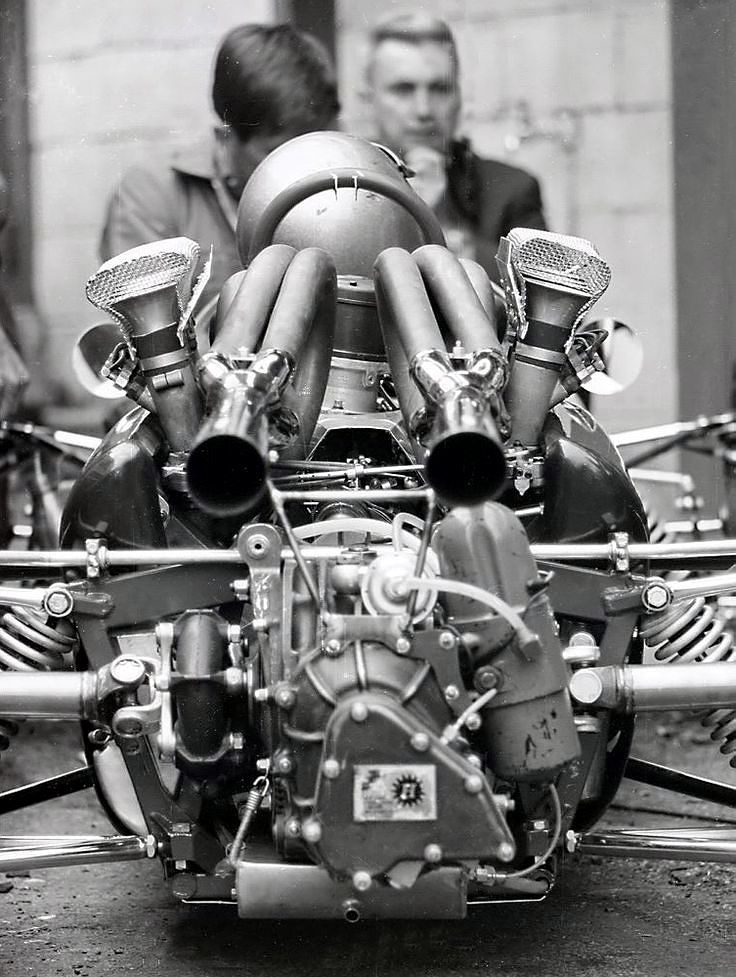
Rainer Schlegelmilch, The Cahier Archive

Tailpiece: Blurry Amon…

image

(Schlegelmilch)