BT24/1 was Brabhams’ car for the ’67 Grand Prix season, the title won by his Kiwi teammate Denny Hulme that year…
Looks comfy in there; no belts, they arrived in GP racing in’68, Smiths chronometric tach, ‘tell-tale’ showing 8600 RPM, leather bound steering wheel, aluminium fuel tanks by your hips on each side, no ‘bag tanks’ till 1970 so fire risk in the event of an accident enormous.
Bandinis’ horrific ’67 Monaco Ferrari crash a case in point.
‘Varley’ lightweight battery is under the cover over which your legs will stretch. Grey ‘stove enamelled’ chassis rails of the ‘space frames’ used by Brabham F1 cars till the end of ’69 under the shift lever, who needs those new-fangled monocoques anyway?! Fibre-glass body apparent on all sides.
Right hand shift controls a ubiquitous and reliable 5 speed Hewland DG300 gearbox. Its attached to a Repco ‘740’ Series SOHC 2 valve V8, being gently warmed up at 3400RPM. The engine gave circa 340BHP, far less than the new Cosworth DFV but enough to do the trick in ’67!
Oh! The little red plaque riveted to the dash says ‘Speed Should Not Exceed 170MPH’!
Brabham Racing Organisation always saw the lighter side of life under the surface of intense competitiveness and success.
Oh so period, just luvverly…
Brabham in BT24-1 at Silverstone , British GP ’67, he finished 4th. Trusting photographer on the inside of Woodcote Corner (Mike Hayward)
Jack Brabham, Repco engineer Nigel Tait, and Brabham BT19 Repco. Sandown Park Melbourne for its Tasman Series debut, January 1966. RB620 ‘E2’ engine in 2.5 litre capacity. (Australian Post magazine)
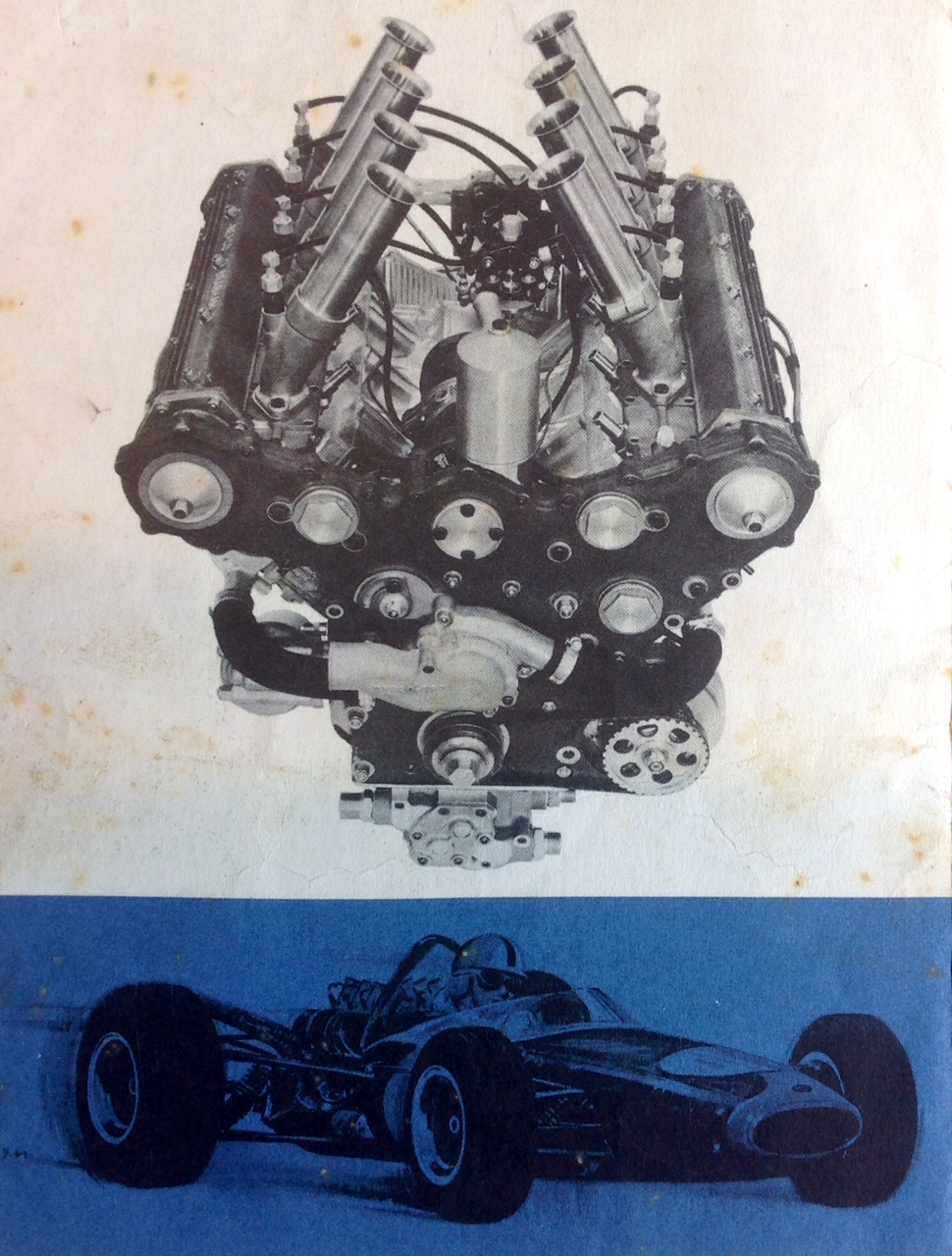
Repco Brabham ‘RB 620 Series’ 3 litre SOHC V8 engine. The ’66 World Championship winning engine. Circa 310 bhp @ 8000 rpm. Weight 160 Kg, the ‘600 series’ block was F85 Oldsmobile based, ’20 series’ heads early crossflow type (Repco)
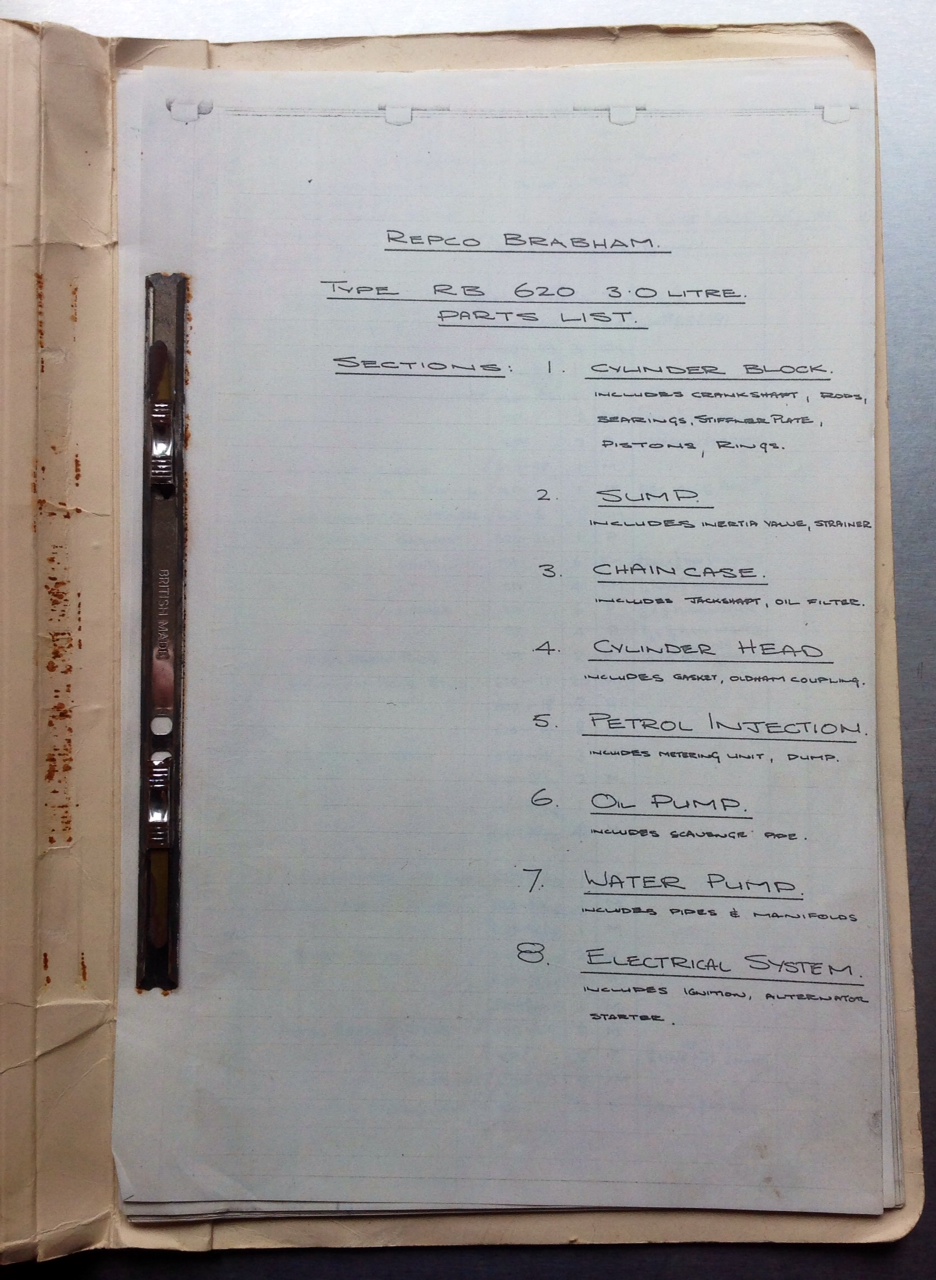
In this Repco article we start with a summary of the events leading to Repco’s involvement in Grand Prix Racing, then identify key team members, the equipment used to build the engines and finally have a detailed account of the 1966 championship winning engines construction…
RBE factory records ’60’s style (Wolfe)
Why did Repco Commit to Grand Prix Racing?…
Younger readers may not know the background to Australian automotive company, Repco’s involvement in Grand Prix racing in the mid-sixties.
Coventry Climax, the Cosworth Engineering of their day caused chaos for British GP teams when they announced they would not build an engine for the new 3 litre F1 commencing in 1966.
Repco had serviced the 2.5 litre Coventry Climax FPF four cylinder engines, the engine ‘de jour’ in local Tasman races, but were looking for an alternative to protect their competitive position, Jack Brabham suggested a production based V8 to them.
Brabham identified an alloy, linerless V8 GM Oldsmobile engine, a project which had been abandoned by them due to production costs. Jack pitched the notion of racing engines of 2.5 litre and 3 litre displacements using simple, chain driven SOHC, two valve heads to Repco’s CEO Charles McGrath.
GM developed a family of engines comprising the F85 Oldsmobile and Buick 215. They were almost identical except that the F85 variant had six head studs per cylinder rather than the five of the 215 and was therefore Brabham’s preferred competition option.
Jack had first seen the engines potential racing against Chuck Daigh’s Scarab Buick RE Intercontinental Formula mid-engined single seater in a one off appearance by Lance Reventlow’s outfit at Sandown, Australia, in early 1962.
The engine’s competition credentials were further established at Indianapolis that year when Indy debutant Dan Gurney qualified Mickey Thomson’s 215 engined car eighth, the car failing with transmission problems after 92 laps. It was the first appearance of a stock block engined car at Indy since 1945.
Jack Brabham looking carefully at the Buick 3.9 litre engine in the mid-engined Scarab RE at Sandown Park, Melbourne in 1962, filing the information away for future reference! (Doug Nye with Jack Brabham)
Whilst the engine choice was not a ‘sure thing’ its competition potential was clear to Brabham, as astute as he was practical.
At the time the engine was the lightest mass production V8 in the world with a dry weight of 144 kg and compact external dimensions to boot. Its future at GM ended in 1963 due to high production costs and wastage rates on imperfectly cast blocks, about 400,000 engines had been built by that time.
New Kid on the Block…
‘Having talked my way into the Repco Brabham Engine Co with a promise of hard work and a 3 weeks trial I was very happy’ recalls Rodway Wolfe.
I was given a nice grey dustcoat with a lovely Repco Brabham insignia on the pocket and shown around the factory and introduced to everyone- I was the seventh employee. Repco had picked the cream of their machinists from throughout the empire to work at RBE, they were great guys to work with and willing to share all their skills.
The three-week trial period was a gimmick, after a few days I had settled in as one of the team. After the trial my wage was increased to slightly higher than my previous job in the Repco merchandising company.’
People: Key Team Members…
L>R: Phil Irving, Bob Brown, Frank Hallam and Peter Holinger dyno testing the first 2.5 litre Tasman RB620 engine at Russell Manufacturing’s engine test lab in Richmond in March 1965. Weber carbs borrowed from Bib Stillwell, the engine did not race in this form. The engine initially produced 235 bhp @ 8200 rpm, equivalent to a 2.5 Coventry Climax engine. ‘Ciggies a wonderful period touch (Repco)
The first prototype RB engine was built at the Repco Engine Laboratory in Richmond, Victoria, an inner Melbourne suburb, then a hub of manufacturing now a desirable inner city place to live, 1.5 km from the CBD.
It was designated the type ‘RB620’, which was the nex file number of the various laboratory, research and development projects in process at the time.
‘Frank Hallam was General Manager and Phil Irving was Project Engineer together with Nigel Tait and others. Peter Holinger made the components and Michael Gasking tested the engines. There were others involved before my time, those mentioned were involved at Richmond’.
As an industrial site using steel garages in Richmond the RB project received comment in various overseas publications as the ‘World Championship Fl engine built in a tin shed in Australia’.
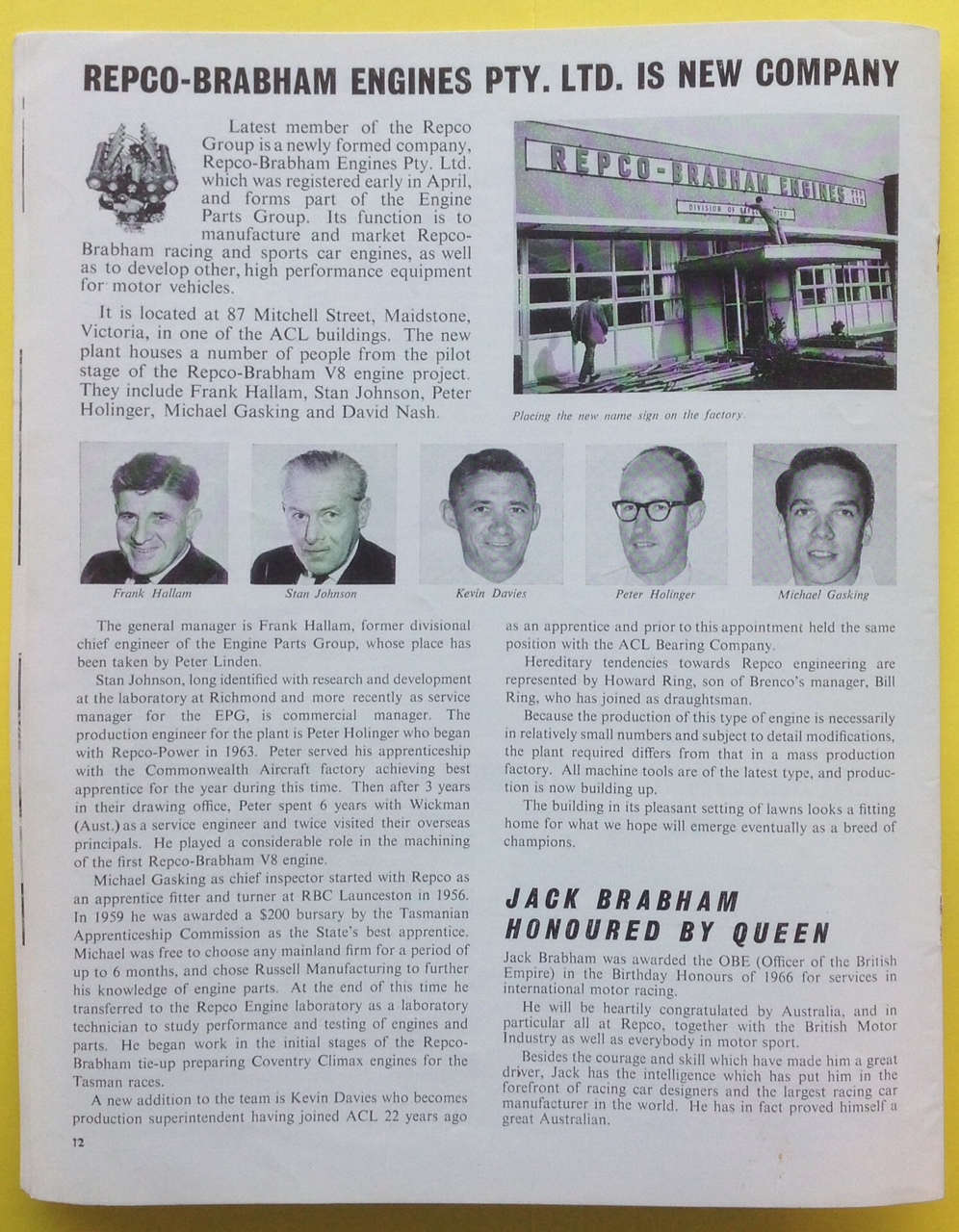
When I joined in late 1965 the project had just arrived at the Maidstone, Melbourne factory. (87 Mitchell Street, Maidstone, then an industrial Melbourne western suburb, 10 km from the CBD) The Manager was Frank Hallam. In the drawing office, the Chief Engineer was Phil Irving, the Production Manager Peter Holinger, Production Superintendent Kevin Davies and the machine shop leading hand was David Nash. We also had a Commercial Manager, Stan Johnson who came and went’.
Frank Hallam and Jack Brabham discuss the turning of camshaft blanks on the Tovaglieri lathe (Repco)
‘Around this time Michael Gasking also transferred from the Richmond Laboratory- he was Chief of Engine Assembly and Testing. Also on the machine tools was John Mepstead who was a great all rounder and later appointed to help Michael with engine assembly. He eventually joined Frank Matich to ‘spanner’ the 1969 Australian Sports Car Championship winning Matich SR4 Repco.
Frank Hallam arranged for me to attend RMIT night school, Repco picked up the bill. Those Tuesday and Thursday nights for 4 years helped me immensely, over the period I obtained a certificate in ‘Capstan and Turret and Automatic Screw Machines’ operation and a certificate in ‘Product Drafting’. My status was as a First Class Machinist in the Repco Brabham factory.
If I had any queries I would also ask Phil Irving who loved a yarn and was a huge bank of knowledge. I felt so honoured to to work for him, and learned so much’.
‘Repco Record’, the internal Repco staff magazine announces the formation of Repco Brabham Engines Pty. Ltd. (Repco)
Machine Tools…
‘Frank Hallam was a machine tool enthusiast.
It was a big help, he made sure we worshipped our machines, blowing away the swarf with an air hose. I learned respect and cleanliness of all machine tools. Few machine shops were as clean or free of swarf and mess everywhere with the exception of Holinger Engineering, Peter was also fastidious.
We were lucky to have top machines in the workshop. Our biggest was an Ikegai horizontal boring machine. RBE had two lathes- a Dean Smith & Grace English machine and also a Tovaglieri Italian unit.
We had a small Deckel horizontal borer and a couple of mills- a Bridgeport and a French Vernier. The older machine was a Herbert capstan lathe, I used this to make every stud for all the future Repco Brabham engines- main bearing and cylinder head studs, a very big variety in different steel types, it was repetitive stuff that would normally be boring but I didn’t care, we were winning the World Championship’…
‘When he drew a new design of stud, Phil Irving would come out and check my thoughts on being able to make it with what we had and other various things. We would do a yield point test in a vice where we measured the length of the new stud after I made a sample and then tension it to a nominated foot pound tension and we would keep increasing the tension until the stud refused to return to the original length. That tension was known as the yield point so Phil would pick a tension somewhere in a safe range under that yield point’.
RB620 Series Engine: Machining and Modification of the Oldsmobile F85 block…
Not the sharpest of shots but a rare one showing the ‘production’ Olds and RB620 engines. RB620 on the right. The engine was the lightest production V8 in the world at the time (unattributed)
‘When I arrived there were a lot of aluminum cylinder blocks along one factory wall. Repco acquired twenty-six Oldsmobile cylinder blocks from General Motors in the US. (2 of the 26 were prototype engines E1 and E2 which were built up in Richmond)
One of my first jobs was to remove all the piston assemblies from those twenty-four blocks. They were not short blocks as known in Australia (here they are complete without sump or cylinder heads) but these were not complete to that stage. They had crank bearings in place, all main bearing caps and the 3.5 inch liners were cast into the block. We didn’t use the cast iron main bearing caps or bolts, replacing them with steel caps and high strength studs.
The RB 620 used the original 3.5 inch cast in sleeves but practically everything else was changed.
All surfaces were re-machined for accuracy, all bolt thread holes re-tapped and recessed to accept studs of superior material. The camshaft bearings were in the valley of the block of course but we pressed them out and rotated them 45 degrees and pressed them back in place to cut off the original oil galleries as our engine ran twin overhead camshafts, one per cylinder bank.
The front original camshaft bearing was left intact and the second camshaft bearing was removed and fitted was a sleeve with an INA roller bearing.
We made up little jackshafts which were driven from the crankshaft by a duplex chain, which also drove the single row chain driving the overhead camshafts. These jackshafts used the first original Oldsmobile slipper bearing and a small roller type bearing in the second original cam bearing location. The chains etc, were all enclosed inside the RB chain-case.
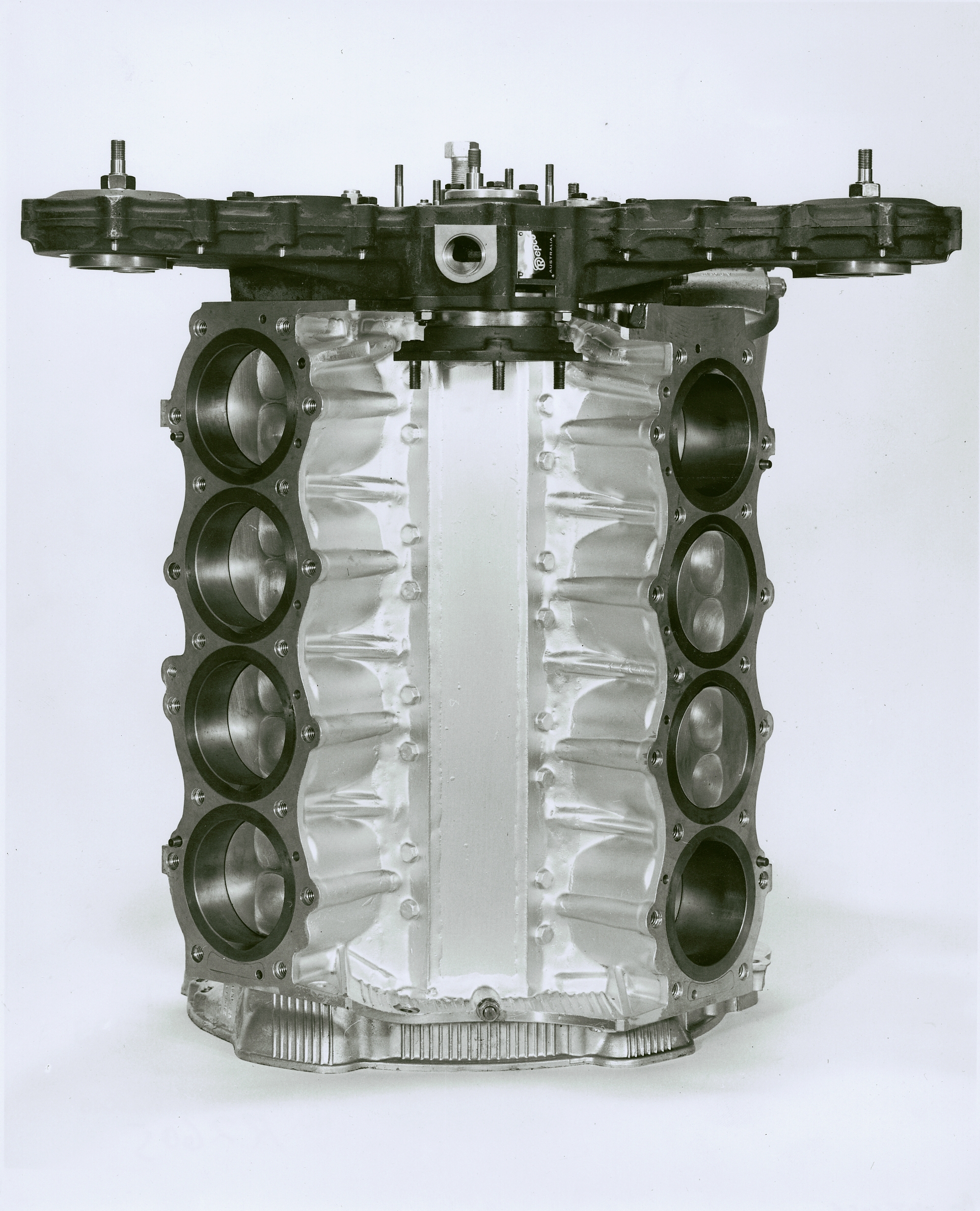
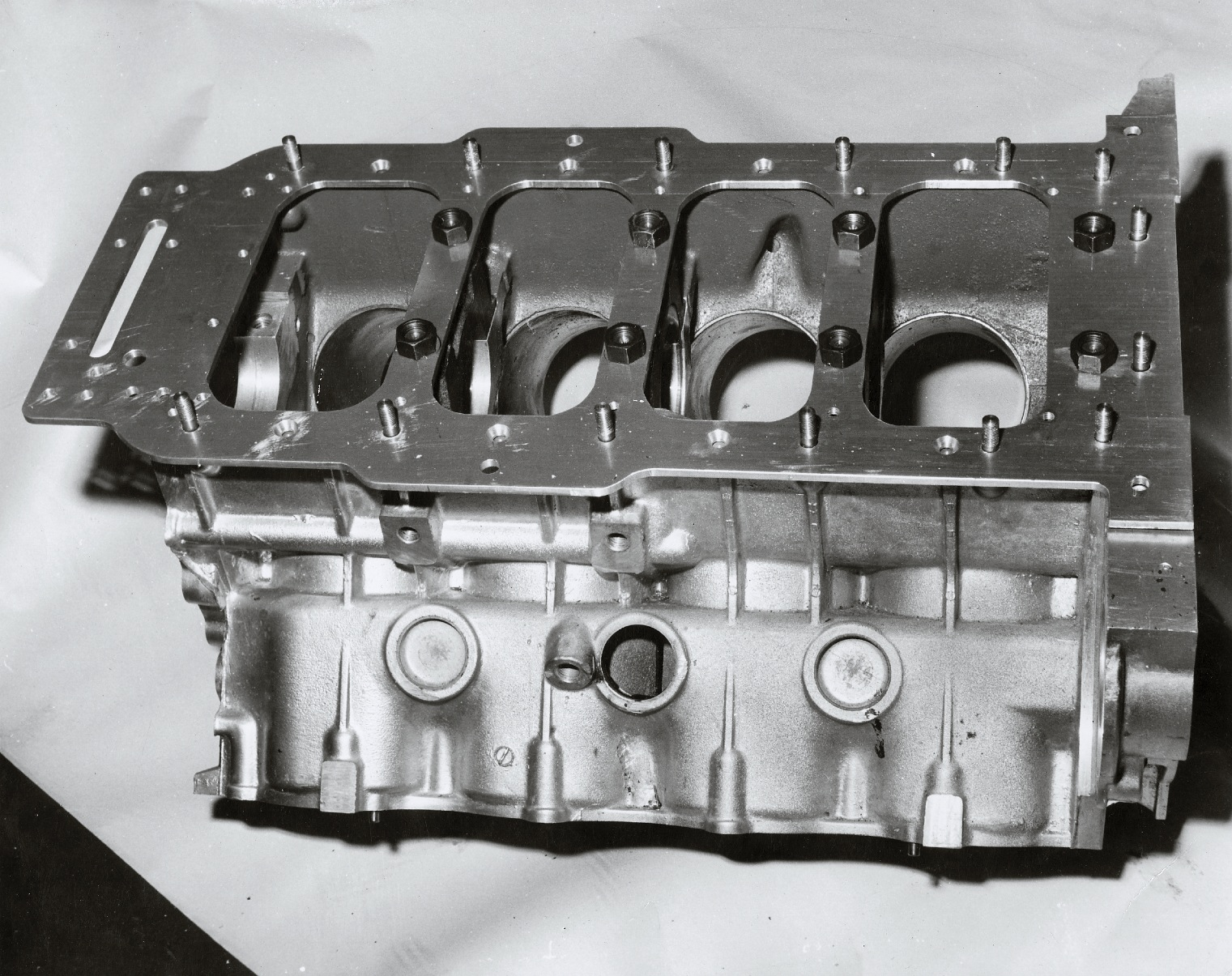
RB600 F85 Olds block from above. Note the valley cover of aluminium sealed ‘with a sea of Araldite then painted over with Silverfros- those blocks which are still in service today still retain the Araldited plate and still do not leak’ comments ex RBE engineer Nigel Tait. Phil Irving’s design had lots of clever bits including the timing chain arrangement which allowed the heads to be removed in the field without disturbing the engine timing- and was also clever in that the same head could be used on either side of the engine (Tait/Repco)
600 block and timing case, ‘Purolator oil filter housing, timing chain single row (Repco)
‘A lot of people in 1966, including the international motoring writers, did not realise the extent of the machining required to the F85 Oldsmobile cylinder block to use as our race engine base. It was more work and and involved to adapt the F85 than in machining our new Repco cast blocks (700 and 800 Series) used later in the project.
It used to annoy all of us when our engine was referred to as ‘based on a Buick’ in various world motoring magazines. It also added insult to injury by them adding ‘Built in a tin shed in Australia’!
We then had to close up the large cavity in the valley where there used to be a cover plate, pushrods and cam followers in the original engine.
We spent many hours fettling aluminum plates by hand and fitting them into the valleys to cover the original cam followers and holes etc. When we had a very good fit of these plates we mixed two pot resin (Araldite) with additional aluminum powder and filled up the valley seams around the plate.
Then with some elaborate heating systems we invented, we dried the Araldite in place. This also gained us the reputation of the ‘The Grand Prix engine held together with Araldite’ in various magazine articles!’
RB600 block on the left, Olds’ F85 unmodified block on the right. The 600 block has the pushrod holes covered with the Araldited aluminium plate. ‘The 1/4 inch thick block stiffener plate protrudes from the top of the modified block. This gives the effect of cross bolting…note also the Repco designed magnesium sump’ notes Tait (Tait/Repco)
‘I finished the job of dismantling the blocks, we only worked on two or three at a time during the early months of 1966. Unless the parts were an easy item or required substantial machine set up we only made a few of each component as design changes were ongoing. Not critical large changes but small subtle ones’.
‘We didn’t have any problems with the Oldsmobile block by there was one race in 1966 when a cylinder liner failed. As explained, we used the cast in liners and retained the 3.5 inch bore.
BRO, (Brabham Racing Organisation) sent back the failed engine block and we bored out the remains of the cylinder liner. There was a casting cavity behind the liner which caused the weakness and failure. This was a problem that could not be dealt with without boring out all the liners and fitting sleeves. Otherwise there could be more failures due to bad castings. From that date we used dry liners and eradicated the risk of it occurring again.’
Jack and Phil specified this aluminium plate to add stiffness to the production F85 Olds block, big holes to provide rod clearance obviously. ‘This block would have had dry sleeves which led to considerable blowby problems due to distortion and eventually wet sleeves were specified by Phil Irving’ notes Nigel Tait (Tait/Repco)
UK Components: Crankshaft etc…
Phil Irving completed most of the design of the engine in England, he rented a flat in Clapham in January 1964 close to BRO and together with Jack they settled on a relatively simple single overhead camshaft configuration compatible with the block and fitment into the unused Brabham BT19 spaceframe chassis. This simplen specificaton is what Jack pitched to the Repco board at the projects outlet.
The BT19 frame had remained unused throughout 1965 when the engine for which it was designed, the Flat-16 Coventry Climax FWMW, was not released to Brabham, Lotus and Cooper as planned.
To expedite things in the UK, whilst simultaneously mailing drawings to Australia, Phil commissioned Sterling Metals to cast the heads. Prior to his return to Australia in September 1964, HRG machined an initial batch of six heads, fitting valves and seats to Irving’s specifications.
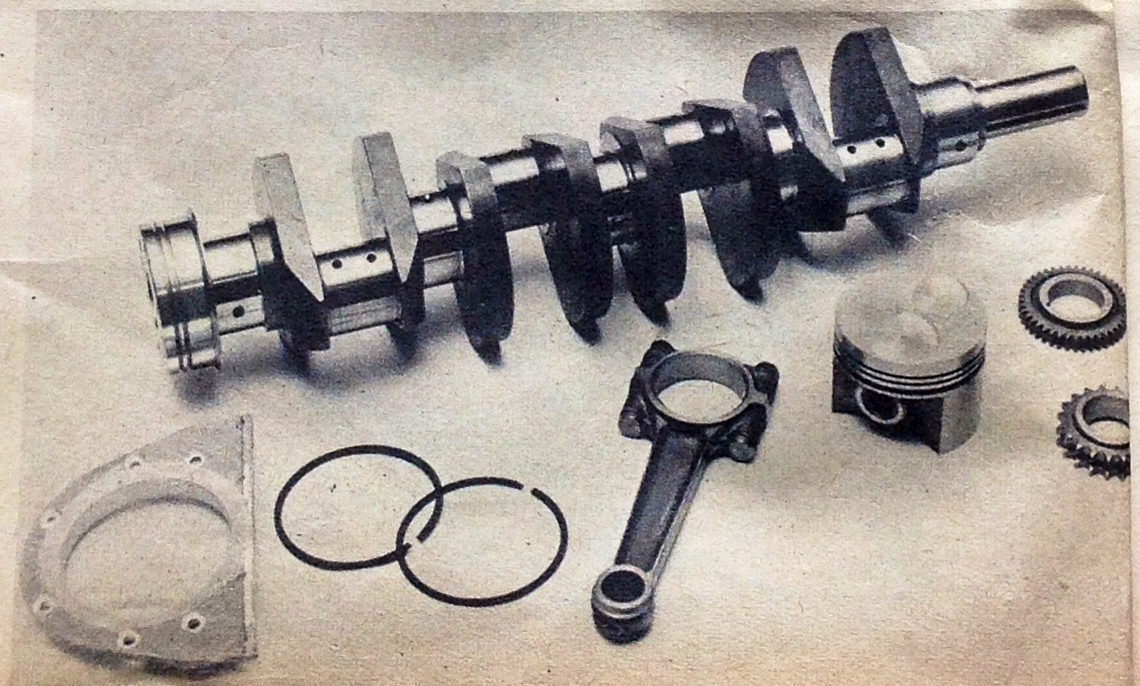
‘Laystall in the UK also made the crankshaft. Constructed from a single steel billet the ‘flat’ nitrided crankshaft was a wonderful Irving design. I don’t recall any updates or changes to the design of the crankshaft over the years the RB engines were built. It was supplied in 2.5, 3 litre and 4.2 litres for the Indy engines- also 4.4, 4.8 and 5 litre sportscar versions. All crankshafts were of the same bearing dimensions etc’.
‘The term ‘flat-crank’ refers to the connecting rod journals being opposite each other and not in multi-plane configuration as is usual in production V8’s. It meant the engine was not such a well balanced unit at low revolutions but it actually converted the engine to virtually two four cylinder units and either cylinder bank would run quite smoothly on its own. The layout also enabled the superior use of exhaust configuration eliminating the need for crossover exhaust pipes to obtain full extraction effect’.
Crankshaft was made by Laystall to Phil Irving’s design, pistons and rings by Repco subsidiaries. (Repco)
Pistons…
‘Repco is a piston ring manufacturer and very experienced in ring design which meant that we were well ahead in that regard.
The famous SS55 oil rings were well known already around the world. The pistons were Repco Products.
No other F1 engine constructor of the sixties made their own pistons. The experience we gained with the supply of Coventry Climax pistons and rings contributed to this success.’
Bearings: Vandervell Interlopers and ‘Racing Improves the Breed’…
‘Repco was already supplying engine bearings to various manufacturers globally from the Tasmanian based Repco Bearing Company, we obtained these components as required.
During 1966 an advert appeared in a British motoring magazine, ‘French Grand Prix won on Vandervell bearings’. Vandervell are of course a British bearing company, Repco were furious and telex messages to and from BRO (Brabham Racing Organization) revealed that Jack Brabham was not happy with the depth of the lead overlay on our copper/lead crankshaft bearings.
Our bearings had a lead overlay of .001 inch and the Vandervell bearings an overlay of .0005. So I was instructed to pack away all our existing bearings and mark them not for use, our bearing company came up with the improved design bearings with the lesser overlay in time for the next GP. Racing certainly improves the product!
Before I transferred to the RB project, i worked in Repco merchandising and received brochures and information about a new Repco alumina/tin bearing known as the ‘Alutin’ and advertised by Repco as a new high performance product. Repco were promoting them as a breakthrough design.
I learned these new bearings had been unsatisfactory under test in the F1 engine and within a short period no more was said about the new product ‘Alutin’. They were inclined to ‘pick up’ on the journals at high rpm – another example of how racing improves the product. This problem had not been evident in the engine testing of the product by Repco to that date.’
‘Racing Improves the Breed’…Repco Ad 1966
Outsourced Items…
‘There were some components we did source outside the Repco Group.
There were cam followers, Alfa Romeo cam buckets, valve springs from W&S, valves manufactured by local company Dreadnaught. The ignition system was sourced from Bosch by Brabham.
The collets were from the UK and were a production car or motorcycle collet, the name escapes me. We made the valve spring retainers and collet retaining caps. Over the project we made changes to the collet retainer material from aluminum to heat treated aluminium bar and later titanium. Not a lot was gained as titanium fatigues as well, as we found out.’
Lucas Fuel Injection…
‘The fuel injectors and fuel distributor were Lucas items, the system was in early stages of development. It consisted of an injector for each cylinder, in our case installed in the inlet trumpet a short distance from the inlet port in the cylinder head.
The system is timed with a fuel distributor in the engine valley driven from the chaincase by the distributor drive gear. The fuel is supplied at 100psi from an electric pump. The fuel pressure supplies and operates small shuttles which are constantly metering supply according to the length of shuttle travel. The amount of fuel supplied to the injectors is controlled by a variable small steel cam which is profiled to suit the particular engine size etc. The steel cam therefore controls the actual fuel mixture and is linked to the throttle inlet slides’.
‘It is interesting to note that although the fuel distributor can be timed to any position in the engine cycle, injecting at the point of the inlet valve opening or with it closed or wherever, it does not make any important difference in engine performance but as Phil Irving explained to me there is a point of injection that lowers engine performance so therefore the fuel distributor is timed in each installation to avoid the undesirable point of injection. The air inlet trumpets were cut to length spun and profiled.
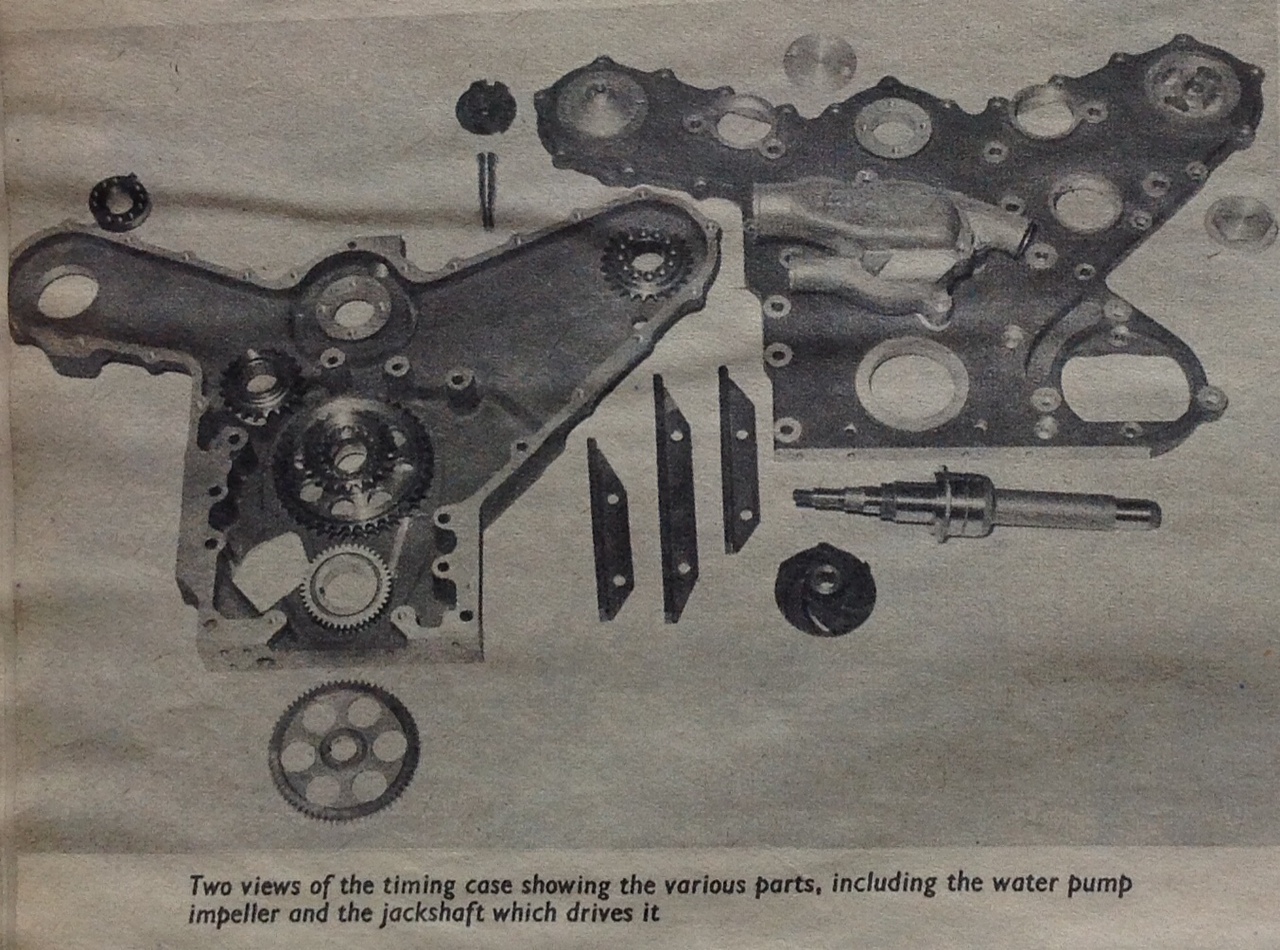
The chaincase was a magnesium casting and the ‘620’ 1966 World Championship engine used a single row handmade chain imported from Morse in the US. We cut all the sprockets and manufactured all the camshaft couplings etc. We used an SCD hydraulic chain adjuster, a standard BMC component.
The cam chain was driven by a small jackshaft which was fitted in the front two original camshaft bearing spaces of the original Olds block. The jackshaft was driven by a Morse duplex chain from the crankshaft sprocket, also Repco made. The crankshaft had a small gear driving the oil pump mounted underneath the chain case.’
Assembly of chain in the magnesium timing case of an RB620 engine (Repco)
Oil Pump…
‘The oil pump was a wonderful Irving design, simple to service but a small work of art. It featured flexible supply hoses with snap fittings and was a combination of oil supply pump which supplied the engine with oil up through a gallery in the chaincase and also a slightly larger scavenge pump connected to each end of the engine sump- it was also a magnesium casting. The pump assemblies, sump and all components were made by Repco.
The system consisted of a sump with an inertia valve located in its lowest point. If the car was braking the inertia moved the valve forward which opened a cavity in the front of the sump causing oil to be drawn from the front. Under acceleration the inertia valve moved backwards and the forward cavity closed and the rear cavity opened. This meant a minimum of blowby and air to be pumped by the scavenge system. I don’t recall any failure of this system apart from the Sandown debut race of our ‘620’ Series 2.5 litre engine in January 1966′.
‘The ‘Tasman’ cars were held on the grid for rather a long time and as a result the oil had cooled in the Repco Brabham. Jack left the line with plenty of revs, the cold oil and resulting oil pressure split the pressure pump gears. The first engines used cast Fordson Major tractor pressure pump gears and one gear had split due to the extreme pressure. Jack Brabham did 3 or 4 laps from memory.
I arrived at work on Monday morning and in typical Irving style found a drawing for the supervisor for the construction of new steel gears and a ‘Do Not Use’ request for all the Fordson gears in stock. Phil had arrived at the drawing office on Sunday evening after the Sandown meeting and made the modifications straight away’.
‘The chaincase featured a couple of inspection caps which were removed to allow for chain tension adjustment etc. We made these caps and when it came to cutting the retaining threads in the chaincase we could not obtain the required thread tap anywhere. Phil had specified similar threads to the Vincent Motorcycle chain adjuster cap threads so that’s exactly what we used. Irving brought in the original Vincent motorcycle thread tap and we used that to thread all the chaincases under manufacture at the time, actually going back to valve spring collet retainer caps.
I recall that the first engines used BSA motorcycle collet retainers. One of the things I enjoyed so much working with Phil was that he did not waste time on risk taking design, he used tried and tested systems from his past. He once said “There is really nothing new, it is just changed around in some way”- well he sure proved that with the first RB620 engine!’
Cylinder Heads…
‘The cylinder heads were cast aluminum of crossflow design, the cam covers cast magnesium. All our cast magnesium and aluminum components were supplied by CAC in Fishermans Bend, Melbourne, with the exception of the first batch of six heads cast in the UK. (Commonwealth Aircraft Corporation).
Phil was remarkable with his engine design skill in that he could see the item in reverse or three dimensions and could design all the sand boxes etc and patterns required to arrive at the finished item.
The engine used no bolts as the original Olds did. Cylinder heads, cam covers, main bearing caps, sump, oil pump and chaincase were fitted with, or retained by high tensile studs.That was my department and apart from the first couple of prototypes I made all the studs for the 1966/67 RB engines. Some were quite a challenge, the thread specification and tolerances were exacting.
The crankshaft rear bearing seal was a slipper ring design with a bolted on ring retaining flange. The slipper rings were supplied by our Russell Manufacturing Co, we made the outer flange in the factory. The steel flywheel was also turned and made by Repco’.
Conncting Rods and Ease of Servicing…
RBE conrod drawing (Repco)
‘We used modified Daimler connecting rods and competition Chevrolet and Repco rods. In later engines we occasionally used Warren rods from the US. In the valley of the engine a small drive housing held the vertical ignition distributor and also the fuel distributor. Sometimes in the larger engines we also fitted a mechanical fuel pump to this housing.’
‘The type 620 engine engine had throttle slides running on small grooves with 1/8 inch steel rollers to prevent lock ups which would be a disaster. The slide covers were fastened directly to the cylinder head and in later engines were changed to fully assembled units and fastened directly to the cylinder heads for ease of changing if required. They were then complete units with studs bolting them to the inlet flanges’.
A big feature of servicing the RB620 engine was that either cylinder head could be removed without disturbing camshaft timing or the camshaft from the cylinder head, a great time saver. (See the photos in the block section above which clearly shows this)
The oil pump can be removed in one small unit and replaced with no other dismantling. Or the two cylinder heads can be removed without disturbing the timing of the camshafts or the chain case. All very important design features for use ‘in the field’.
RB620 engine assembly early 1966, Maidstone (Repco)
First Test…
The first engine, a 2.5 litre Tasman engine designated ‘E1’ was fired up on March 26 1965, almost twelve months to the day Phil Irving commenced its design.
It was initially run with Weber 32mm IDM carbs and after a checkover fitted with 40mm Webers. The engine produced 235BHP @ 8200RPM, equivalent to a good Coventry Climax 2.5 FPF at the time.
Repco committed to build 6 engines for the 1966 Tasman Series, later changed to three 2.5 litre Tasman engines and two 3 litre F1 engines, the first race for the new engine was the non-championship South African Grand Prix on January 1 1966, the next part in the Repco story is the 1966 race program for the new engine.
‘2.5 litre 620 V8 E1 on the Heenan and Froude GB4 dynamometer in Cell 4 at Richmond, 1965. The exhausts lead straight out through a hole in the wall. Also there was minimal noise insulation in the tin shed that served as a test cell. Vickers Ruwolt across the road blamed us for the large crack that developed in their brick wall on the other side of Doonside Street!’ recalls Nigel Tait (Tait/Repco)
Photo & Other Credits…
Autocar, ‘Jack Brabhams World Championship Year’, Repco Record, ‘Doug Nye with Jack Brabham’, Australian Post, ‘From Maybach to Repco’ Malcolm Preston, Rodway Wolfe Collection, Nigel Tait recollections and his Collection, Repco Ltd photo archive
Etcetera…
Original RBE Pty.Ltd. Letterhead. Jack Brabham had no financial (equity) or directorship involvement in this company, it was entirely a Repco subsidiary.
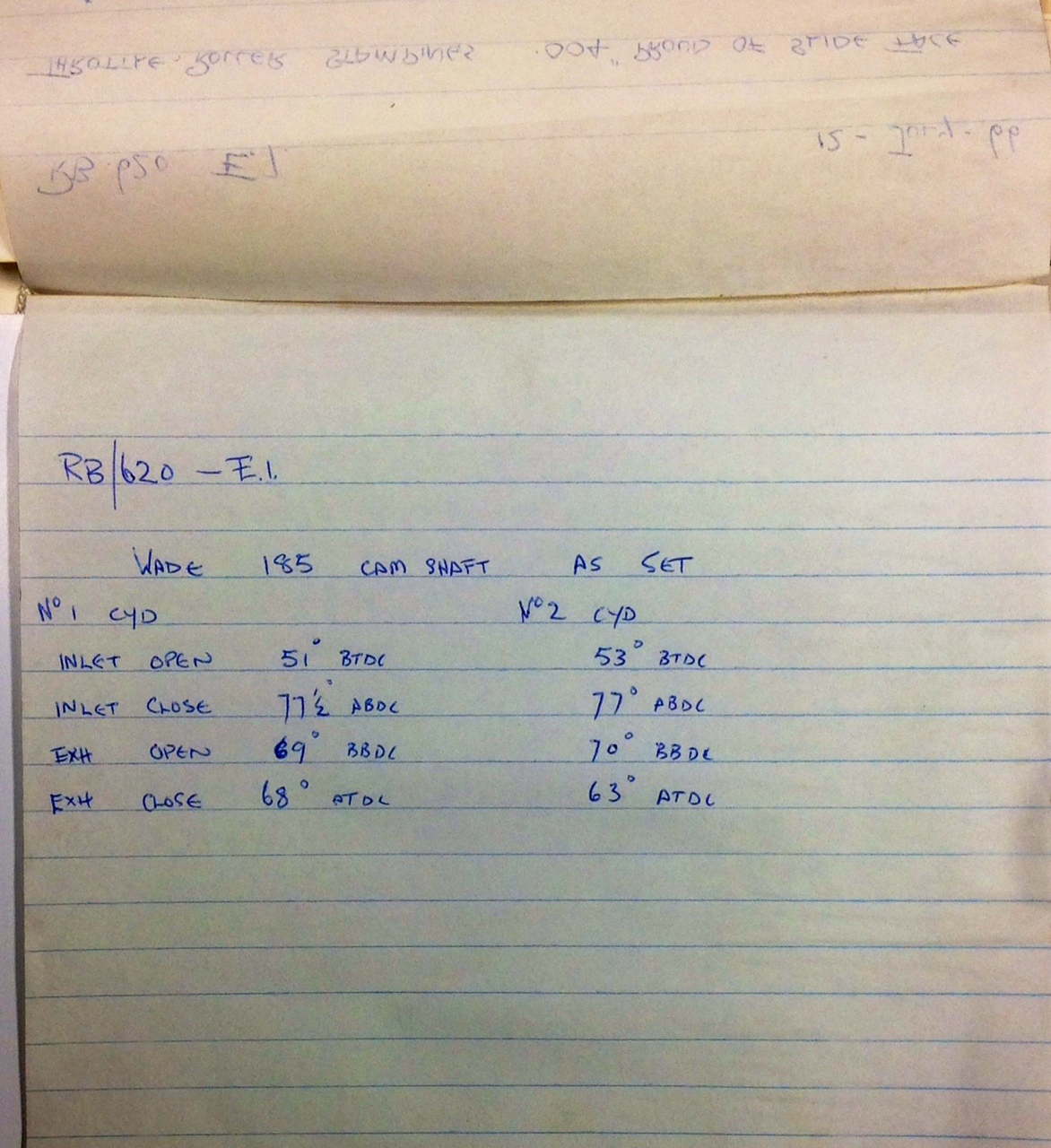
‘E1’ was the RB620 prototype Tasman 2.5 litre engine. Most of the entries in this exercise book are dated, this one is not, but its mid 1965, the book records the use of cams with the ‘Wade 185’ grind and the valve timing, no dyno sheets sadly! (Wolfe/Repco)
Have a look at this Repco film produced in mid-1965…
It covers some interesting background on the relationship between Brabham and Repco, footage of Jack at home in the UK, the Brabham factory in New Haw, some on circuit footage at Goodwood and then some sensational coverage of the 1965 Tasman Series in both NZ and Oz. The latter segues nicely into footage of the first ‘RB620’ 2.5 Tasman V8 engine ‘E1’ on the dyno at the Repco Engine Laboratory, at Russell Manufacturing, Richmond in ’65…
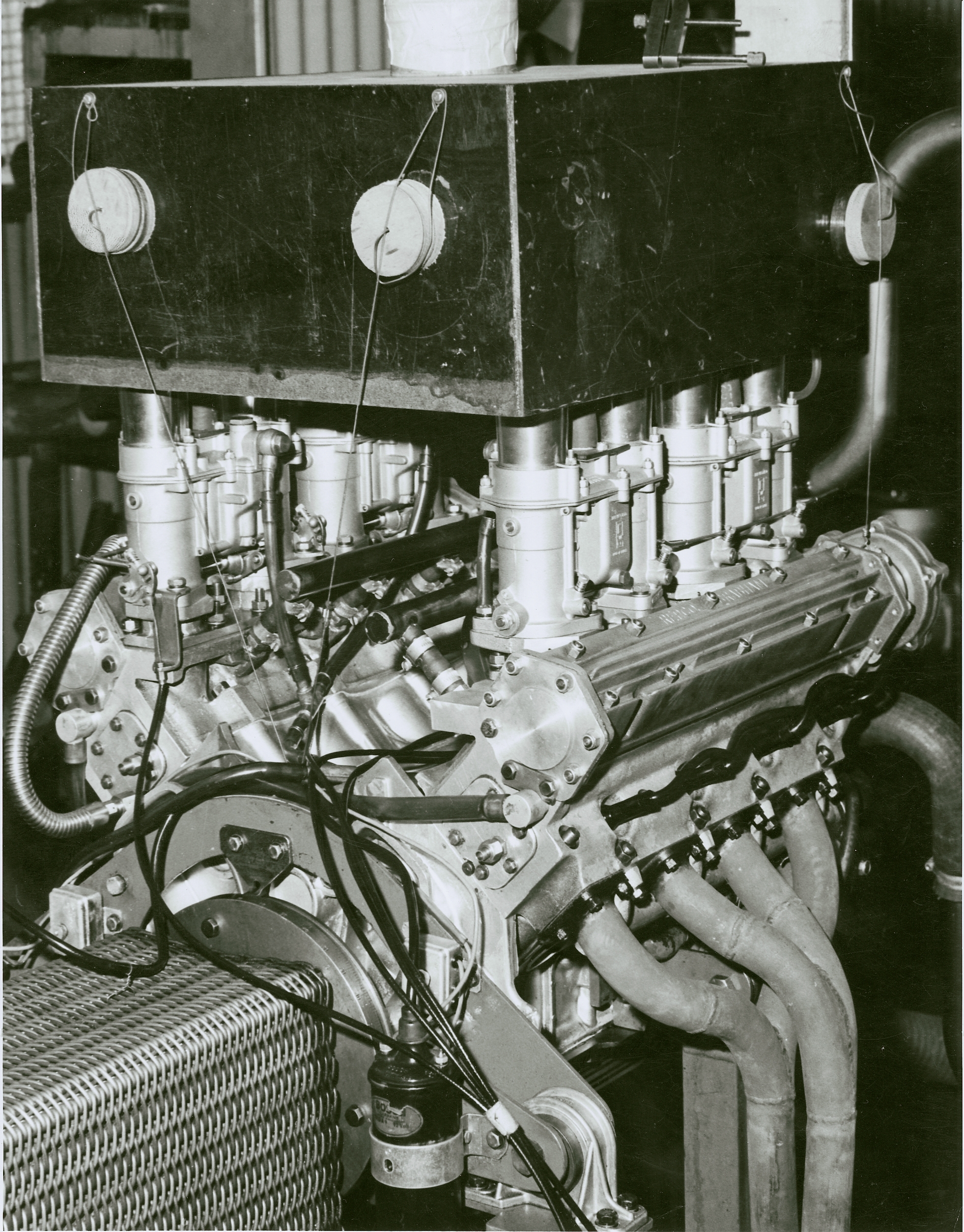
Tailpiece: #1-RBE620 2.5 litre ‘E1’, the prototype Tasman 2.5 V8, fitted with Webers on the GB4 dyno- Repco Engine Lab at Russells, Richmond 1965. The box over the Webers is for airflow measurement notes Nigel Tait…
Colin Chapman and Ronnie Peterson ‘chewing the fat’ on the French GP grid, Clermont Ferrand 1972. Car is a March 721G Ford, Peterson finished 4th in the race won by Jackie Stewart (Pinterest)
‘C’mon Ronnie, its time to move to Hethel?! Other than Bernard Charles Ecclestone there were few people with Lotus boss Colin Chapmans’ charm, and powers of pursuation when it suited him…
I doubt the weather was the topic of conversation! Ronnie learn’t his F1 stuff with March, starting with a quasi-works 701 in 1970, but the 721G, on which he is leaning, was an F2 car onto which a Ford Cosworth engine was grafted after the failure of its 721X and not as quick as the Lotus 72 Chapman is talking to Ronie about!
Ronnie replaced Aussie Dave Walker at Lotus in 1973, Peterson proving quicker than Emerson Fittipaldi, the 1972 World Champion. As is usually the case, these ‘Dream Teams’ usually end in tears.
Chapman refused to apply team orders later in the season, costing Fittipladi, the better placed driver, his second title, Lotus did pick up the Manufacturers Championship however.
Fittipaldi decamped to McLaren at the years end and a second title in ’74, Ronnie and Jacky Ickx were quick in the Lotus 72 in ’74 but it was getting long in the tooth and Lotus missed Emerson’s testing and development skills, neither of which were Petersons’ forte…
Peter Revson on his way to fourth place in McLaren M23/2 in the 1973 Spanish GP, Montjuich Park, Barcelona.
Background…
No other individual chassis has raced in F1, F5000 and Can-Am championships before conversion back through F5000 to its original F1 specifications. McLaren M23/2 is that car.
The McLaren M23 was one of the marque’s most successful designs, winning Grands Prix from 1973 to 1977 and Drivers and Manufacturers World Titles for Emerson Fittipaldi, James Hunt and McLaren in 1974 and 1976.
Coppuck’s Design…
Gordon Coppuck was responsible for the teams innovative and successful Can-Am and Indycar designs, Ralph Bellamy’s departure from McLaren back to Brabham gave Coppuck his F1 design chance.
The car followed the conceptual path blazed by the Lotus 56/72 in having a chisel nose, side radiators and rising rate suspension, rather than the Tyrrell bluff nose alternative aero approach of the day. McLaren’s very successful M16 Indycar followed the 72 so it was a logical step for Coppuck, using the well established McLaren interactive design approach, with many on the shop floor having input into the conceptual stages of new car development.
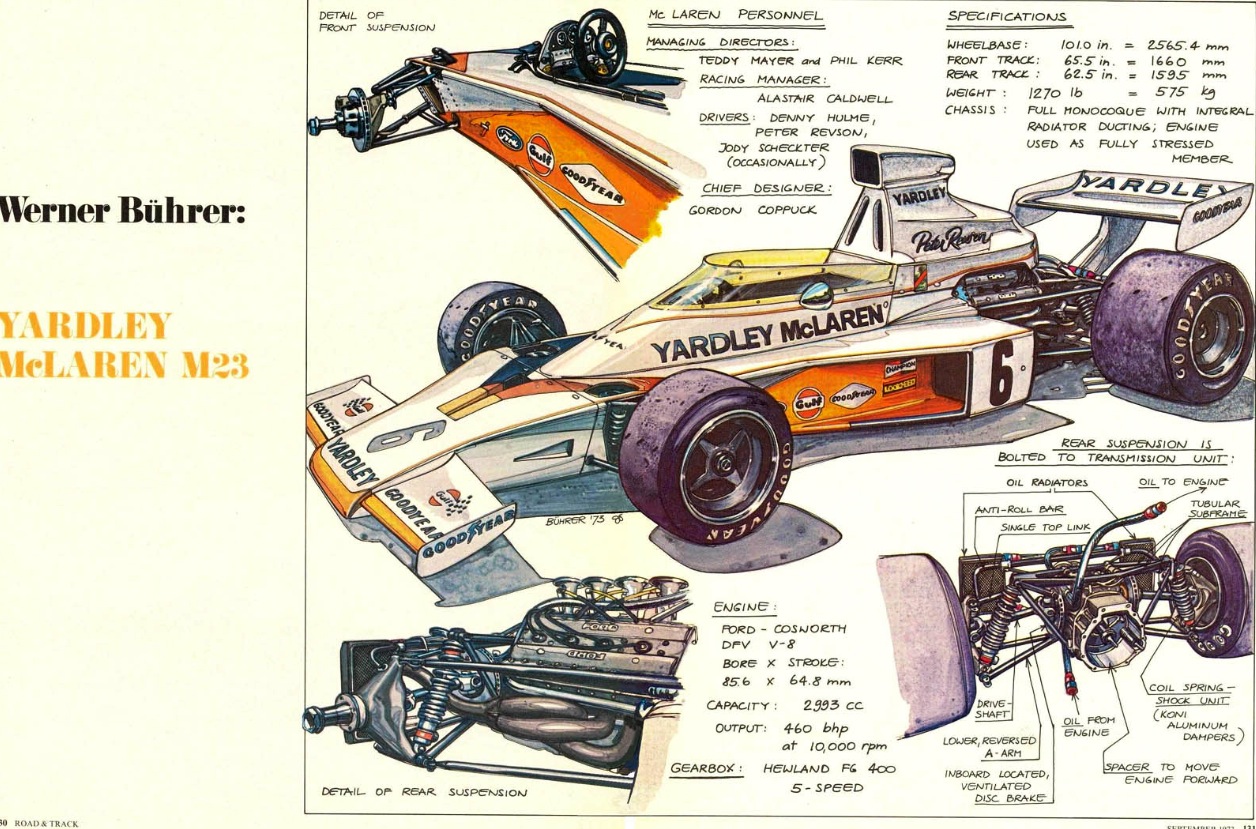
The M23 was a typical British kit-car of the period with its Cosworth DFV 3-litre V8 and Hewland FG400 five-speed gearbox. New deformable structure rules mandated for ’73 allowed a fresh approach to address the M19’s shortcomings; a lack of straight line speed and weight. The chassis was formed in 16 gauge aluminium sheet, all joints bonded and riveted, with the radiator sidepods an integral extension of the structure. Fuel tankage was centralised to promote a ‘Tyrrell like’ low polar moment of inertia, the driving position pushed forward relative to M19.
Front suspension comprised rising or progressive rate linkages, a large lower wishbone and top rocker actuated inboard mounted spring/shock units. At the rear a reversed lower wishbone, single top link and twin radius rods were used, spring rate progression was achieved with the winding of the coil springs.
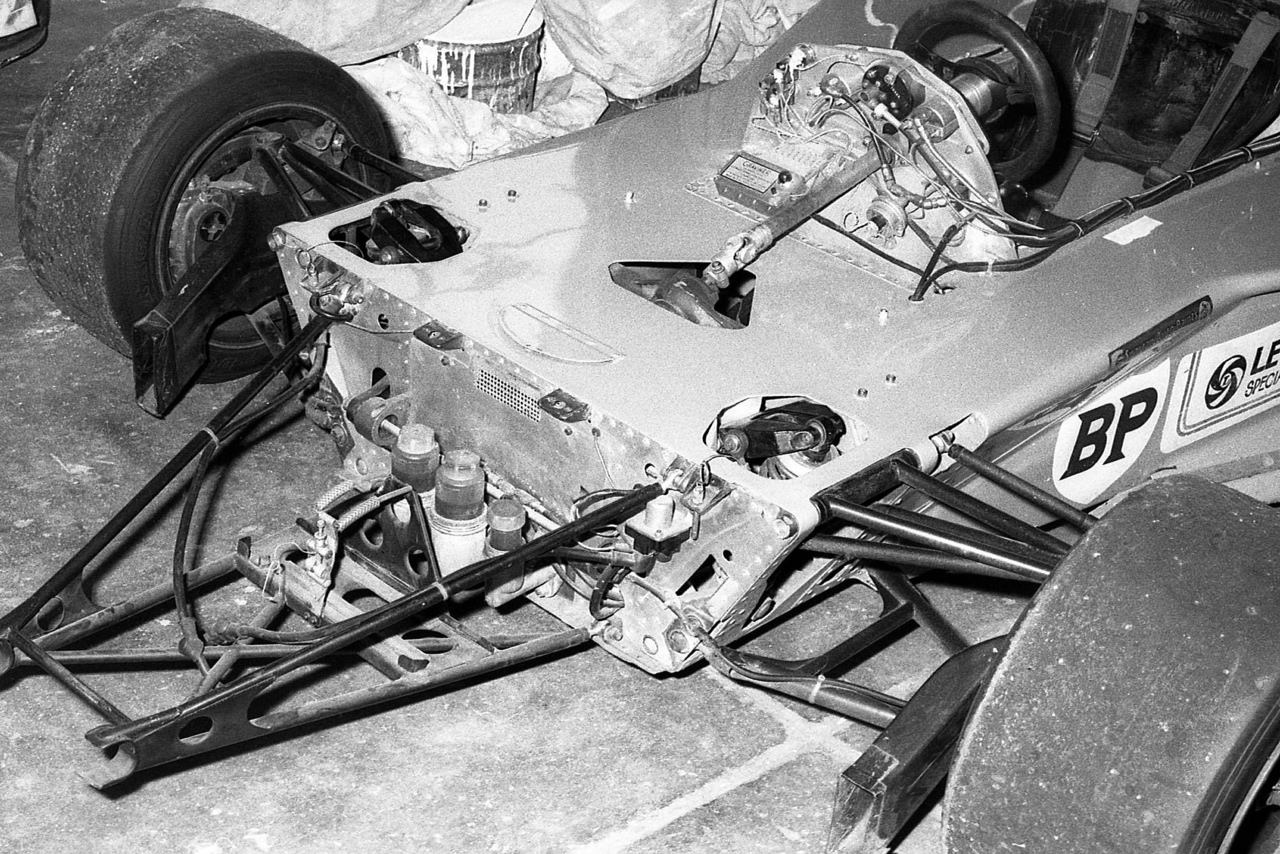
Front bulkhead, nose-cone support, master cylinders, wide-based lower wishbone, top rocker and inboard spring/shock, workmanship clear…(John Lemm)
Brakes were Lockheed ‘Can-Am’ calipers, rotors 10.5 inches in diameter, outboard at the front and inboard, beside the gearbox, at the rear. The bodywork was all enveloping with the airbox neatly covering the engine aiding airflow to the rear wing. Wheelbase of the new machine was 101 inches, front track 65 inches, rear 62.5 inches, the length was 170 inches, the whole lot weighed a claimed 1270 pounds distributed 34/66 % front to rear.
1973 Grand Prix Season…
Four of these original spec cars were built for 1973, the prototype M23/1 was tested at Goodwood by Denny Hulme before setting off for the season opening South African GP at Kyalami. Denny was immediately quicker than in the M19, rapidly adjusting to the far forward driving position, Hulme put the car on pole and led the race before puncturing a tyre on debris.
Other McLaren team drivers were Mike Hailwood, and Peter Revson in his first fulltime Grand Prix season. Revson started his grand prix career in the early 1960’s before returning to his native USA and making his name in the Can-Am series which he won in 1971 aboard a McLaren M8F Chev. He was also McLaren’s Indy driver.
A relaxed Peter Revson prior to the start of his successful British GP at Silverstone 1973, his first GP win (unattributed)
M23/2 debuted in Revson’s hands on 8 April 1973 at the Silverstone International Trophy, finishing 4th, it was to be his car for most of the year, his promise as an F1 driver was fulfilled with a tremendous victory at Silverstone in the British Grand Prix.
McLaren’s cub driver Jody Scheckter, in another M23 famously caused a multi-car pileup after losing control at Woodcote at the end of lap one and in the process proved the strength of Coppuck’s design.
Peter Revson en-route to victory in M23/2, Silverstone ’73 (unattributed)
M23/2 was used by Scheckter later in the season in Canada and the US before being sold to South African ace Dave Charlton.
Dave Charlton’s South African Championship car in 1974-75…
Dave Charlton delicately drifts M23/2, South African GP Kyalami 1975. He finished 14th in the race won by countryman Jody Scheckter’s Tyrrell 007 (reddit.com)
The McLaren replaced Charlton’s Lotus 72D for the South African National Championship, it was incredibly successful winning eight races and championships in ’74/5.
Dave set a Kyalami lap record in the 1975 Rand Winter Trophy which stood for years until broken in the ground-effects era. The cost of F1 cars was getting out of hand, so Charlton offered the car for sale with the introduction of Formula Atlantic as South Africa’s Championship class from 1976.
Dave Charlton, Brandkop circuit, Orange Free State, South Africa ’74…two SA Championships on the trot in ’74-5 for M23/2 (David Pearson)Rob Ryders’ shot of Dave Charlton at the 1972 British Grand Prix, his Lotus 72D retired with gearbox failure (Rob Ryder)
John McCormack…
Oran Park Gold Star round 1978. McCormack, Graham McRae, McRae GM3 Chev, Elfin MR8 at rear (John Shingleton)
Aussie F5000 racer John Mc Cormack was the eager purchaser, ’Charlton was a terrific bloke to deal with, I bought the car, 20 wheels, multiple sets of front and rear wings, bodywork, two types of airbox, less engines, which I should have bought and sold later, then the exchange rate moved in my favour so it was a really good deal.’
‘McLaren were still racing the car when I bought it, I had contacts there and they were used to dealing with customers so it all made good sense, as long as we could get the engine to play its part….’
John McCormack promoting the ‘Racesafe Wool TT’ racesuit circa ’76John McCormack aboard his recently acquired Brabham BT4 Climax at Penguin Hillclimb, Northern Tasmania in 1967 (HRCCT)
McCormack started racing in his native Tasmania breaking into the national scene with the purchase of Jack Brabham’s 1962 AGP car, a Brabham BT4 Climax. He proved he could mix with the ‘big boys’ in an Elfin 600C Climax, a very competitive car when fitted with a Repco 740 Series V8 in place of the old Climax.
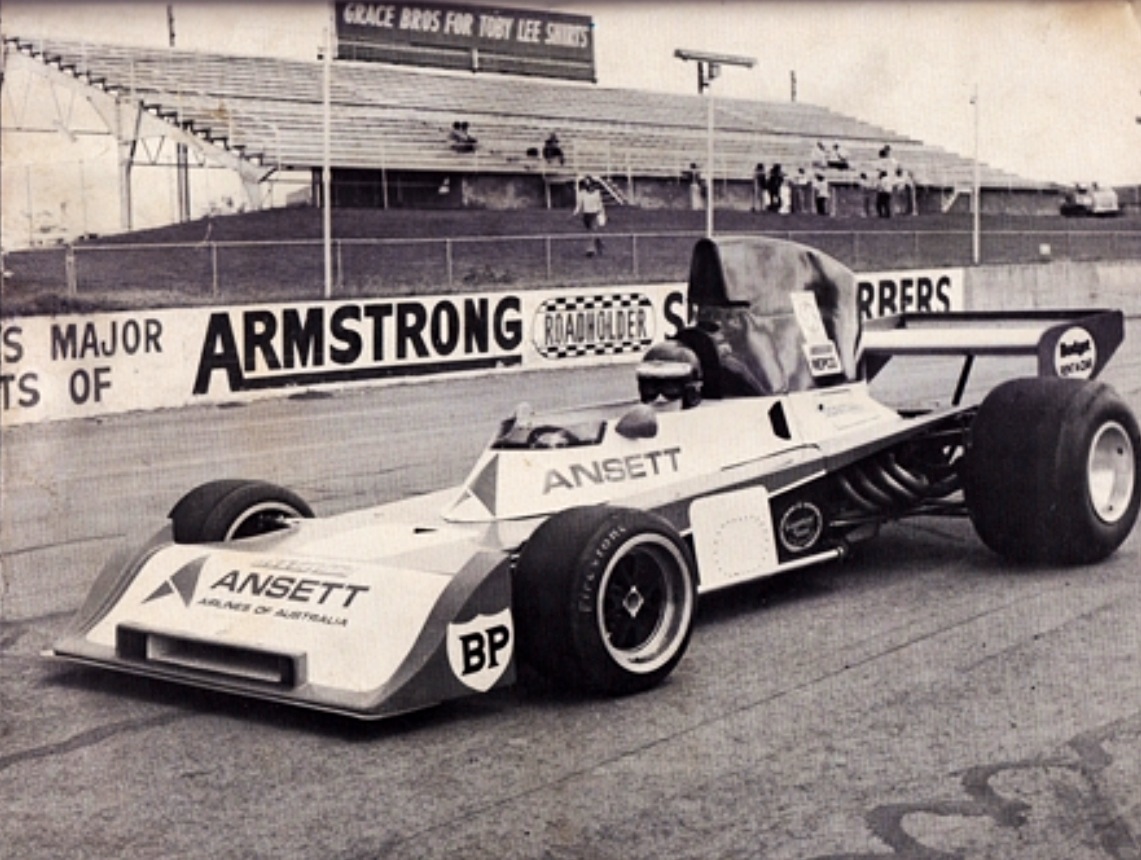
He bought the very first Elfin MR5 Repco in 1971 and via his connection with Phillip Island Auto Racing Club’s John Lanyon did the Ansett sponsorship deal to create the two car ‘Ansett Team Elfin’ together with Elfin owner/designer/driver Garrie Cooper. McCormack and his team developed his car to be very competitive, winning the Australian Drivers Championship, the Gold Star in 1973 and the NZ GP – part of the annual Tasman Series of eight races run in Australia and New Zealand every summer – in 1973 and 1974.
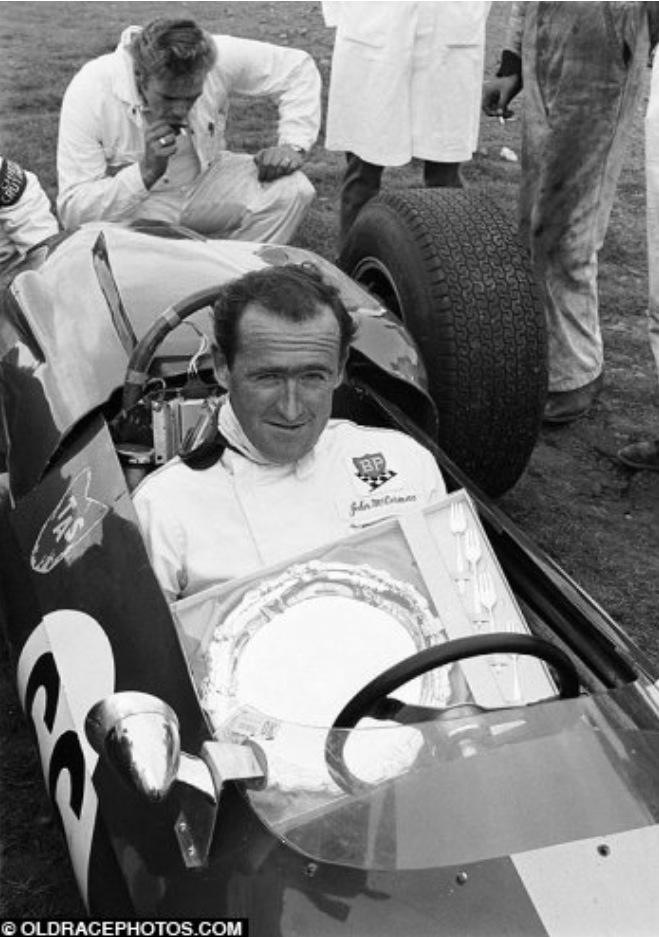
Tasmanian Gold Star race success. Mac was second in the 1967 Symmons Plains event to Greg Cusack’s Repco engined Brabham BT23A. Car is McCormack’s ex-Brabham BT4 Climax (oldracephotos)
In search of the unfair advantage over the heavy Holden and Chevrolet engined cars, Repco’s Phil Irving spotted the new Leyland P76 family car engine, a 4.4-litre aluminium block V8, at the Melbourne Motor Show.
Elfin’s John Lanyon quickly did a deal with Leyland and Repco to jointly fund development of an F5000 variant of the new engine for a car specifically designed for it. The idea was to distribute the weight in a fashion more akin to an F1 car, rather than the tail happy F5000s. McCormack characterised the 5-litre beasts as ‘like having a pendulum in the car’. Cooper’s Little Car was the Elfin MR6, a new design which debuted in 1974.
John McCormack debuts the Elfin MR6 Repco Leyland # MR6L #6741 at Oran Park on 30 January 1974. A big panic as the car was running late and was launched in NSW, at Oran Park near Leyland’s Zetland HQ, a long way from Elfin’s base in Edwardstown, Adelaide. Mac was not happy with the Tasman Series starting in NZ several days later but the car did manage a few laps despite not having turned a wheel before. The MR6 small by F5000 standards and very 1973 Tyrrell 006 like in appearance (unattributed)
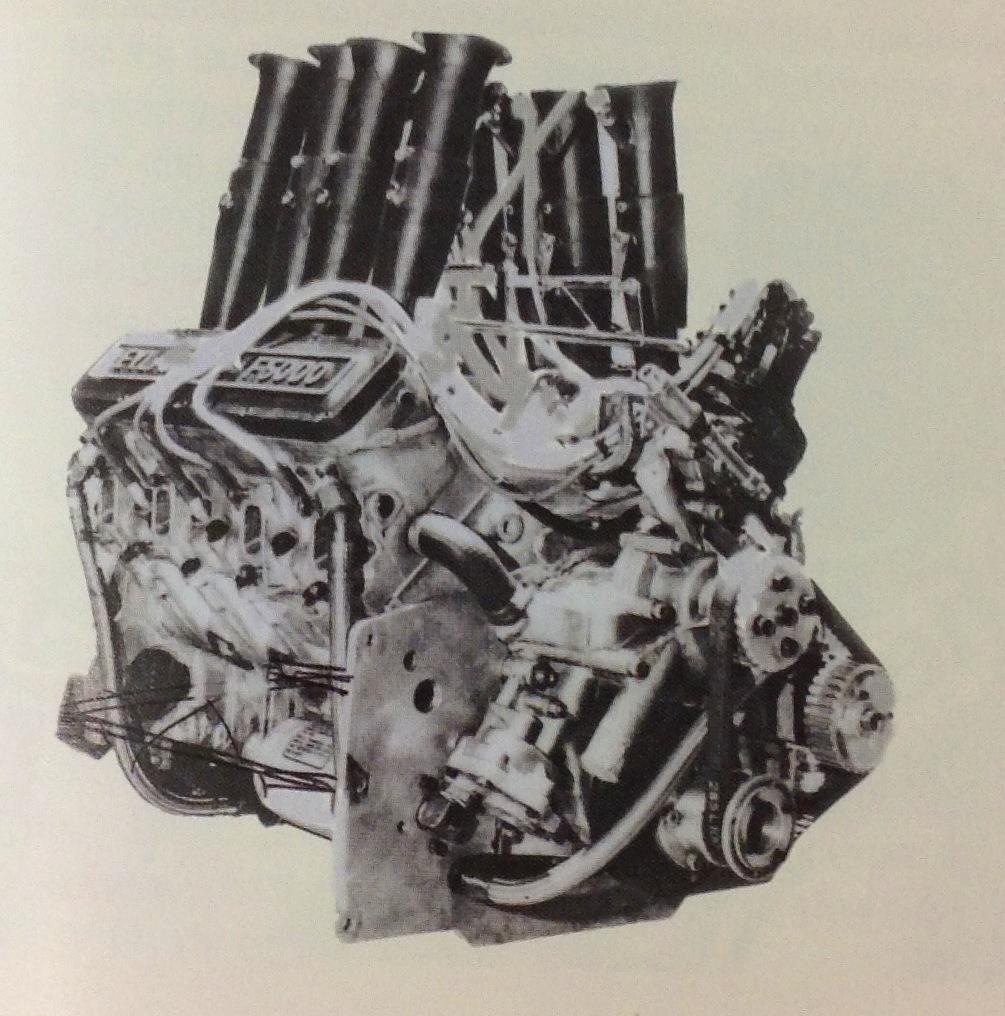
Repco developed an engine with a capacity of 4931cc, a 94mm bore and 89mm stroke. As originally developed, the engine used the P76 cylinder block fitted with special liners and main bearing stiffening plates, the cast iron crank was replaced with steel units after initial failures. Cylinder heads were P76 with flowed inlet and exhaust ports and larger valves. Pistons, con-rods and bearings were Repco, as was the dry sump setup which utilised three stage pressure and scavenge pumps. Fuel injection was by Lucas and a Repco Lorimer dual point distributor fed by coils provided the spark.
Critically, the engine weighed only 160kg compared with the Holdens 220kg, however the claimed power of 425 bhp @ 6800rpm and 375 lb ft of torque at 5500 rpm was far less than the circa 500bhp plus of a Holden or Chev. Elfin’s Dale Koenneke quipped that the engine when first raced in early ’74 had ‘no more than 365 bhp’ when installed in the MR6. History tends to support the contention that the horses were ponies rather than stallions!
The engine had many teething problems, the fragility of the engine blocks and cast iron cranks together with consistent overheating were exacerbated by Repco’s withdrawal from racing that July, and therefore lack of commitment to the project.
McCormack used both the MR5 and MR6 in ’74, before converting the MR6 to accept the Repco Holden engine. ‘Dale Koenneke said enough! We put in all this effort and the thing just shits itself, lets put the Holden into it,’ in this form the MR6 won the 1975 Gold Star.
McCormack, an independent thinker was still convinced the Repco Leyland could be a winner in the right car, the question was finding one!
And so, M23/2 came to Australia, sans DFV but with plenty of spares…
McCormack’s team of Dale Koenneke and Simon Aram did a beautiful job installing the Repco Leyland into the car without ‘butchery’. The engine, after modification of the harmonic balancer, and relocation of water pump and oil tank, fitted neatly into the tub albeit as an unstressed member, which the DFV of course was, the engine supported by traditional tubular A-frames.
Engine sans exhausts, neat installation of the Leyland engine where a DFV was designed to go apparent. A-Frame engine mounts, side rads, inboard discs, conventional parallel lower links, single top link and coil spring/shock units in contrast to inboard front set-up (John Lemm)
McCormack engaged famous Aussie engineer Phil Irving (ex Repco, Vincent) to further develop the engine from its Repco base. Irving designed new heads, cast by Comalco, which eliminated separate valve guides and seats. The design also featured a bent pushrod to allow more room for straight inlet ports. John said ‘Power increased to around 435bhp and 410ft/lbs of torque, more mid range punch than the Repco Holden. An alternate cam delivered 470bhp/380ft/lbs but this stressed the overall package causing many block failures. ‘All the talk on Friday night at the Horsepower Hotel never won races, it was about torque as well as power and whilst we were light on power we had plenty of mid range punch and a well balanced overall car package.’
The Hewland FG400 gearbox was marginal in F1, the torque of the beefy Repco required new gears cut by Peter Holinger’s now famous Holinger Engineering concern in outer Melbourne.
Another of John Lemm’s Coongie Avenue, Edwardstown shots. Outboard rear suspension, Hewland FG400 box – fragile in this application given the engines torque – radiators in a constant battle with heat, and off to the left side you can just see the nose-brackets of the Elfin MR6 tricked up as a display car at the time
The Repco and Chev engined Lola, Matich, Chevron and Elfin chassis’ had more power, but the McLaren was lighter, the superb balance, handling and braking of the design was maintained as the DFV and Repco Leyland were similar weights.
John was convinced he had his unfair advantage. ‘The drivability of the car with its long-stroke engine was great, it was an excellent high speed car, it wasn’t quite so good on slower tracks where it lacked feel at the back due to fixed length driveshafts. The car had quite a high roll-centre and was very sensitive to aero tweaks on fast circuits, it was flat into turn one at Phillip Island, really quick!’
After much media interest McCormack raced the car at the Oran Park Gold Star round in September 1976 putting it fourth on the grid, a valve failing on lap 22. A win followed at Calder in October, then pole at the ‘Island, leading until a tyre deflated, despite this the car finished third in its inaugural Gold Star Series.
Oran Park Australian Grand Prix ’77 (unattributed)
Car sponsor Budget Rent a Cars’ Bob Ansett convinced John to hire Frank Gardner to assist with Team Management in the Rothmans International series but a poor championship caused by unreliability was succeeded by a Gold Star win at Surfers.
At Sandown the car gave cooling problems, but the final round at Phillip Island showed its true pace, two seconds a lap clear of the best Lola on this circuit which is a test of power and handling. McCormack was well in the lead when problems again intervened, John pitting for two laps then limping home picking up enough points to win his third Gold Star Series. The year was capped with a win in the Rose City 10000 at Winton.
McCormack and John Walker, Lola T332 Chev, Oran Park Gold Star round 1978…’lift off’… (John Shingleton)
1978 started poorly with Rothmans Series unreliability followed by an Oran Park Gold Star round win.
The Sandown AGP was a terrible race with multiple accidents, the McLaren out virtually from the start with head gasket failures. John dominated at Calder only to run out of fuel with a lap to go. Then the Phillip Island round was cancelled, John finished second in the Gold Star as F5000 – non-existent elsewhere in the world – limped on.
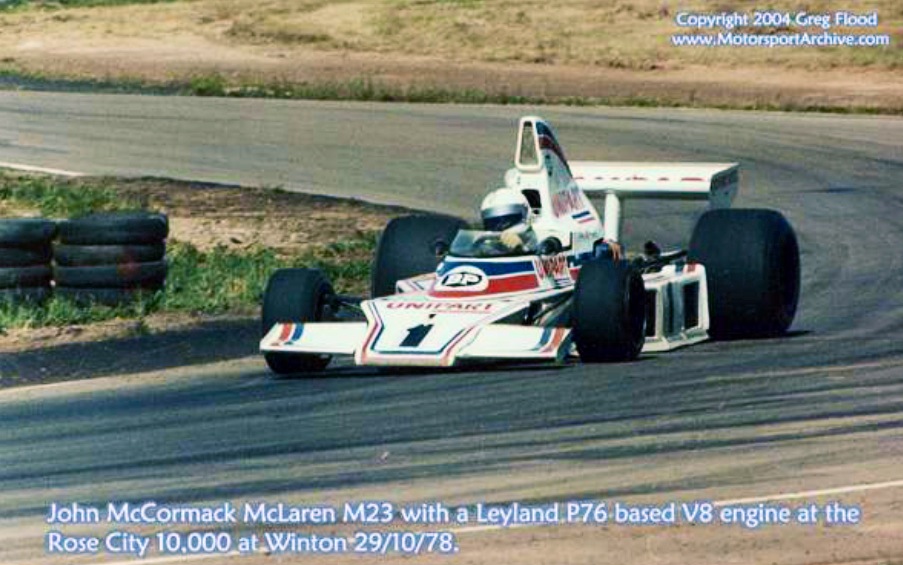
The season ended again with the Rose City 10,000 at Winton. Among the competitors was James Hunt, the 1976 World Champion making a one-off appearance in Australia driving an Elfin MR8 Chev. John was second on the grid to him, Mac having an unfortunate event in which a stone jammed a brake caliper causing a pit stop, he finished fourth in the race won by Hunt.
‘Perick of a thing, will it last ?’, F5000’s were brittle and the Leyland Repco was never left alone for long…McCormack and team Adelaide International Raceway ’78 (John Shingleton)
1979 also started poorly with 5th the best result from four Rothmans International Series meetings, Larry Perkins won the title in an Elfin MR8 Chev. The McLaren’s last F5000 race was the 1979 AGP at Wanneroo Park, Western Australia where a gear broke.
McCormack entered 20 F5000 events for three wins and victory in the 1977 Gold Star ahead of cars much younger and more powerful than his 1973 McLaren! Unreliability was the issue with 10 DNS/DNF results, mind you the Chevs and Repco Holdens were also brittle.
Can-Am 1979…
M23/2 Can Am, Mid Ohio ’79 (Mark Windecker)
By 1976 F5000 had been ‘destroyed’ by Eric Broadleys fantastic, dominant Lola T330/332/332C series of cars.
The Tasman series was over, the Kiwis adopted Formula Atlantic/Pacific and Australia persevered with F5000, against the global tide. The US F5000 series ended at the duration of the 1976 season and morphed into 5-litre single seat Can-Am sports cars, with Lola T332 derivatives remaining the dominant car for some years.
McCormack, a professional racer, converted the McLaren from an F5000 to a very attractive Can-Am car. M23/2 travelled back over the Pacific again! ‘It was time to have a look at what was happening in the US, things were quiet here so Simon Aram and John Webb designed and built an attractive body and off we went.’
US paddock shot, circuit unknown. Body designed and built by Simon Aram and John Webb (‘From Maybach to Repco’ Malcolm Preston)
He was taking on a big challenge, the Can-Am series in 1979 included Keke Rosberg, Jacky Ickx, Alan Jones, Geoff Lees, Vern Schuppan (Elfin MR8), Bobby Rahal and Al Holbert amongst its competitors.
‘Its true there were some top teams but the quality of the fields rapidly fell away. No one knew the series was on wherever we went, it was poorly promoted, the Americans were much more into Nascar and Indycars, you had to leave the circuit to go and buy fuel at some of the tracks!’
The McLaren competed in three rounds for a best result of 12th at Watkins Glen in a series dominated by Lolas with Ickx winning in a T333CS. ‘There was a weight advantage if you ran 4-litre engines, we did two of the races with the 5-litre Leyland and one, the final round, with the 4-litre which gave around 400BHP, the weight thing was academic as the cars were never weighed.’
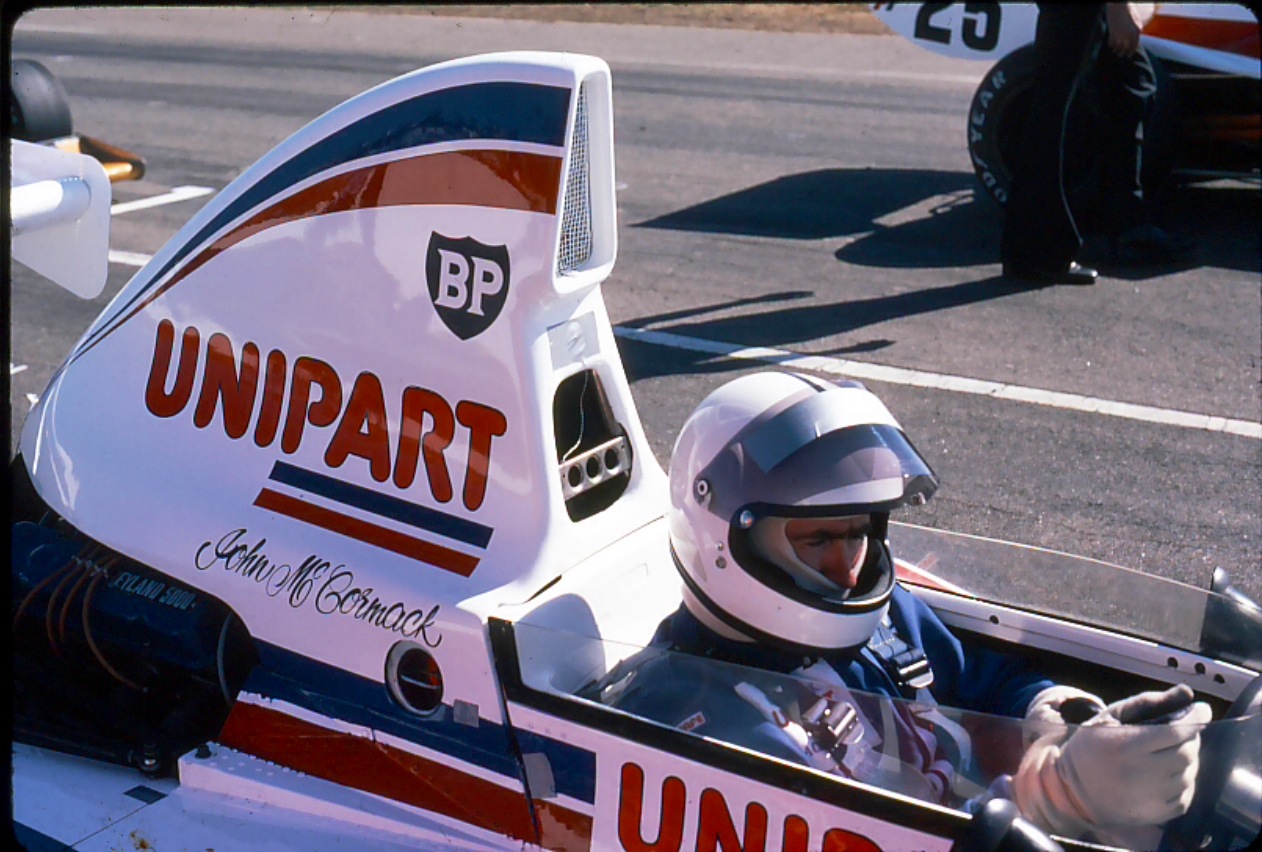
It was no disgrace in this company in a six year old car run by a small team far from home. In the end money was tight and it was time to return to Australia to compete in a Jaguar Sports Sedan his team had built, and at the instigation of sponsor, Unipart, contest the 1980 AGP which was run to F5000 – and F1- rules!
McCormack in M23/2, Mid Ohio Can Am ’79 (Mark Windecker)
Back to ‘Oz F5000 and finally home to Woking…
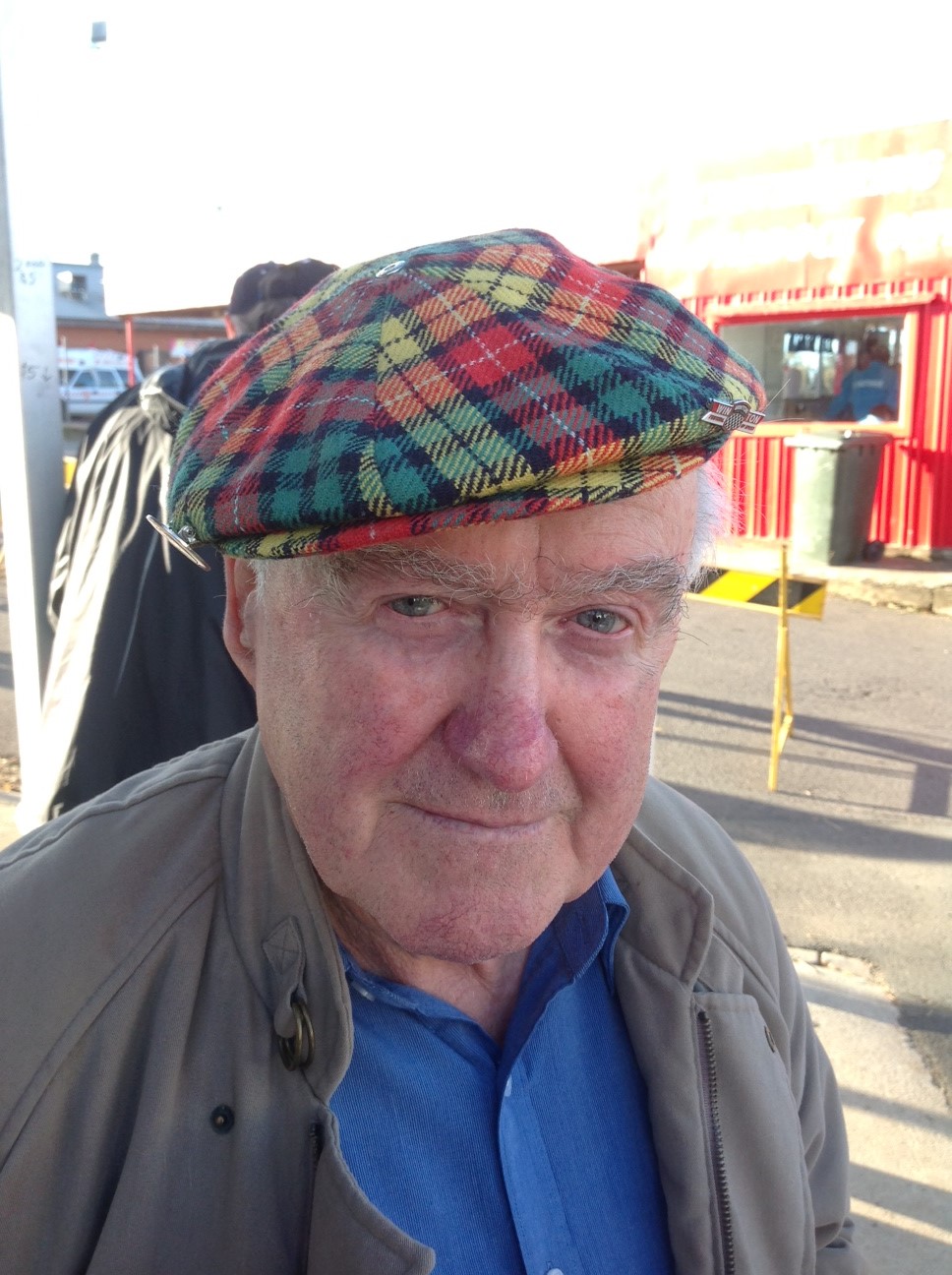
John McCormack at the Winton, Victoria, historic meeting in May 2013, interested, interesting and intelligent. McCormack was outside the mould, successfully going in his own direction throughout his career. I suspect the Leyland engine would have got the better of all but someone like him who applied his experience and pragmatic engineering approach and knowledge to making the thing work despite its fundamental structural weaknesses as a race engine (Mark Bisset)
Alan Jones was on his way to winning the 1980 World Championship, so the 1980 AGP rules were amended to attract the new champion and his Williams FW07 to Australia. Also making the trip from Europe were Bruno Giacomelli and his Alfa 179 and Didier Pironi, of Team Tyrrell, who drove an Elfin MR8 for Ansett Team Elfin.
McCormacks’ team converted the McLaren back into F5000 specifications, he was looking forward to the race. ‘The McLaren was not a light car, it then weighed about 1430 lbs, because the AGP was being run to F1 rules we lightened the car enormously by about 200 lbs’.
‘I normally flew to meetings but we a were running late with the preparation of the car so I travelled as a passenger with my mechanic to get some sleep. There was some fog about, he dozed off at the wheel near Keith (in rural South Australia) hitting a tree having glanced off an earth mover which made an horrific accident slightly better than it may have been! I got a brain injury in addition to the physical ones, I have about 70% of my mental capacity, not enough to race again’.
McCormack’s car awaits the driver, Calder paddock AGP 1980. A rare shot showing the car in its ‘Resin Glaze’ livery for the event it never started, John was badly injured in a road accident in rural SA enroute to Calder (Chris Jewell)
Sadly, that was the last race for both McCormack and the much used M23. John went on to build a number of successful sports sedans for others and today has property, retail and mining interests near his home town of St Helens on the Tasmanian East Coast.
McLaren built thirteen M23s. M23/2 competed in 54 events, more than any other M23 chassis, winning more races than any other M23 as well; 54 starts for 12 wins. One F1 Championship GP, eight South African Championship rounds and two championships, three Australian Gold Star rounds and one championship. Only a Can-Am win eluded it in its multi-faceted life.
McCormack was focussed on his health and rebuilding his life, the car was offered locally for sale around 1982, without any takers as F5000 had been replaced by Formula Pacific. It was just an old uncompetitive car at the time! Then along came McLaren’s Ron Dennis hoovering up cars for the factory collection where M23/2, converted back to its Yardley McLaren F1 spec, takes its museum place in the pantheon of the company’s rich, ongoing 50 year history.
M23/2 travelled the globe as an F1 car, crossed the Atlantic to South Africa, then the Pacific to Australia, back across the Pacific to the States, back again to Australia and finally to Woking in the UK, just down the road from Colnbrook where it was built all those years before. It was a remarkable journey from class to class and back again, competitive all the way throughout!
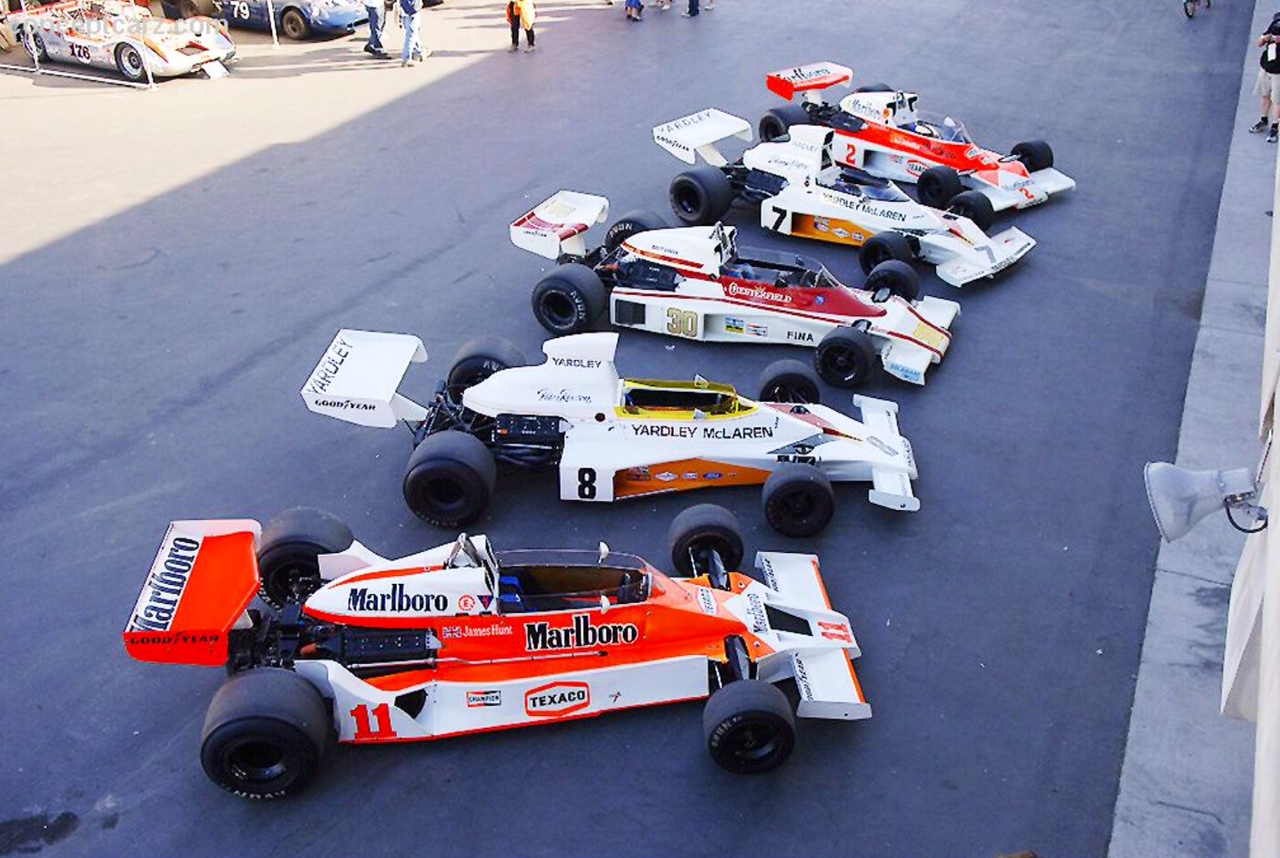
Monterey Historics : the car in front is an M26 but the rest are M23’s, M23/2 the second car…
Etcetera. The story of the McLaren is not complete without delving a bit more into the Leyland engine and its parentage…
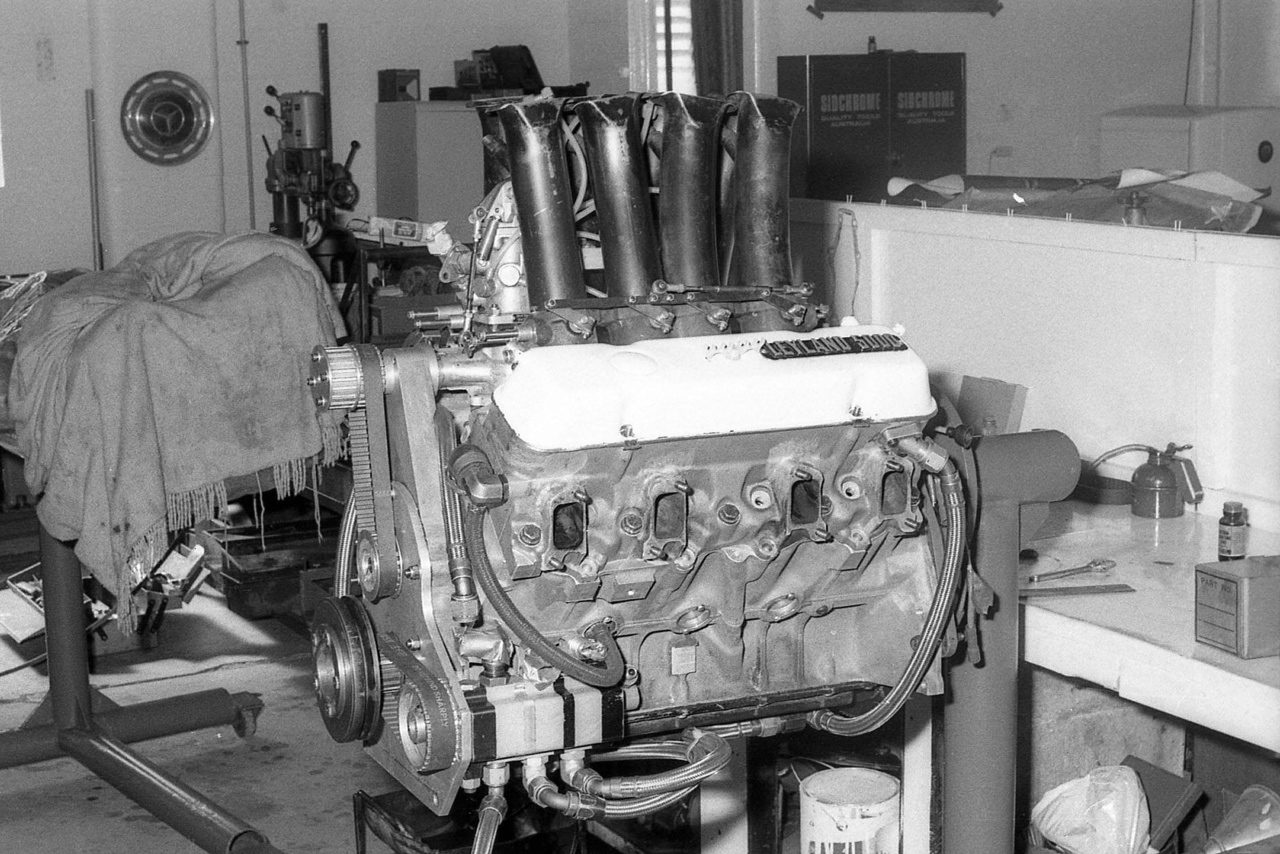
Irving/McCormack/Repco Leyland F5000 engine: drives for oil pumps, dry sump, metering unit, Lucas fuel injection, all ready for installation into the M23 at McCormack’s Coongie Avenue, Edwardstown, Adelaide workshop (John Lemm)
Coventry Climax, the Cosworth Engineering of their day caused chaos for British Grand Prix teams when they announced that they would not build engines for the new 3-litre F1 commencing in 1966. They had been engine suppliers to most of the British teams since 1958. Repco had serviced (and built the engines under licence) the 2.5-litre Coventry Climax FPF four cylinder engines, the engine de jour in local Tasman races, but were looking for an alternative to protect their competitive position, Jack Brabham suggested a production based V8 to be built by Repco .
He identified an alloy, linerless, V8 GM Oldsmobile engine, a project abandoned due to production costs and wastage rates on imperfectly cast blocks. He pitched the notion of racing engines of 2.5 litre – and later 3-litre – displacements using simple, chain driven SOHC heads to Repco’s CEO Charles McGrath.
GM developed a family of engines. The Oldsmobile F85 and Buick 215 were almost identical except that the F85 variant had six head studs per cylinder head rather than the five of the 215 and was therefore Brabham’s preferred competition option.
Brabham had seen the engine’s potential much earlier, racing against Chuck Daigh’s Scarab Buick RE in the cars one off – and only – race appearance at Sandown in early 1962. The car raced in 3.9-litre form that weekend and had plenty of squirt, albeit the underdeveloped chassis was not as competitive as the Coopers under brakes or through the corners.
The engines competition credentials were further established at Indianapolis that year when Indy debutant Dan Gurney qualified Mickey Thomsons’ 215 engined car 8th, the car failing with transmission problems after 92 laps. It was the first appearance of a stock block engined car at Indy since 1945.
An idea is born…Jack Brabham checking out the 3.9-litre Buick engine in Chuck Daigh’s Scarab RE in its one-off Australian appearance at Sandown in early ’62 (‘Jack Brabham with Doug Nye’ Doug Nye)
Whilst the engine choice was not a sure thing its competition potential was clear to Brabham, as astute as he was practical. At the time the engine was the lightest mass production V8 in the world with a dry weight of 144kg with compact external dimensions to boot.
Repco acquired 26 of the F85 blocks and won the 1966/7 World Drivers and Manufacturers Championships as well as countless other races globally with engines using these and later, from 1967, Repco’s own ‘700’ and ‘800’ Series blocks.
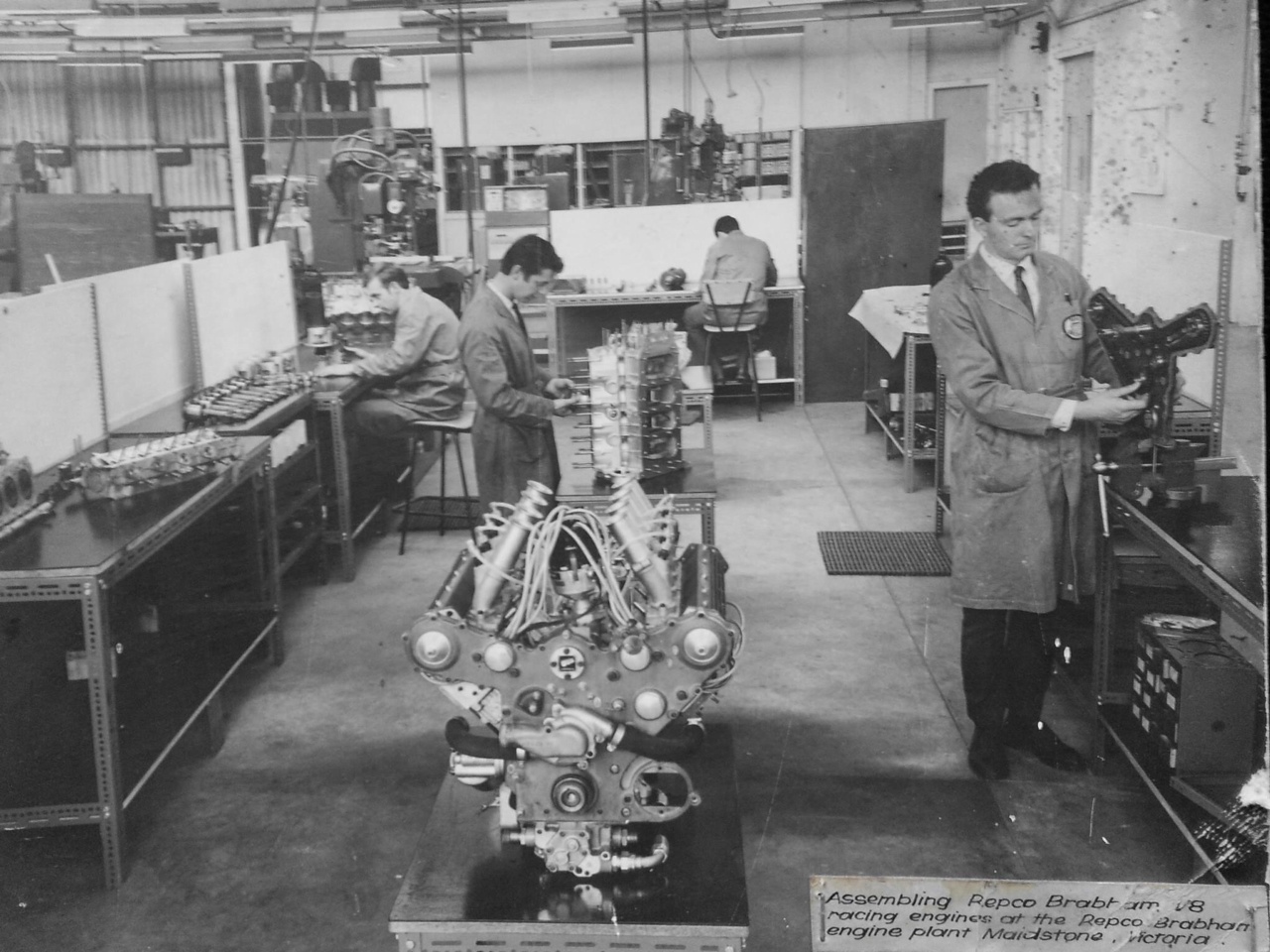
Repco’s Maidstone workshops producing the RB620 3 litre F1 engine, 1966
GM sold the production rights of the V8 engine to Rover in 1967. When Phil Irving – who designed the 1966 F85 block Repco RB 620 engine – saw the Leyland engines at the Melbourne Motor Show he thought he knew them well. However, the original GM design had suffered in its transition to Rover and then to Leyland Australia. In essence their were fewer head bolts on both the inlet and exhaust sides of the heads, in addition the block and heads were sand, rather than die cast which made them weaker and less uniform. Finally, the heads had smaller ports than the originals.
The fundamentals of the engine to take increased operating loads and power were lacking. Irving made changes by adding material to the block and head castings which also facilitated the installation of main bearing strengthening bars, such changes were homologated by Leyland in accordance with F5000 rules. Repco claimed 440bhp with an absolute rev limit of 7500rpm and a crank life of one hour. It was soon found that the fragility of the block and cranks required a maximum of no more than 7000rpm.
Repco publicity shot of the Leyland Repco engine in its original form as fitted to the Elfin MR6 in 1974 (Repco)
With further development post Repco, McCormack’s team – with the new Comalco heads, different valve sizes, inlet port shapes inspired by Honda and shorter exhaust primaries – had a vaguely reliable engine consistently giving 435bhp and 410lb/ft of torque. Not a lot, but enough to do the job, much like Phil Irving’s Repco Brabham 620 engine in F1 in 1966, that engine was not the most powerful in the field but it did the job, albeit much more reliably than its F5000 relation!
The Leyland/Repco/McCormack/Irving F5000 V8 was truly a triumph of development over design on a tiny budget!
Letter from Leyland Australia to Repco confirming the commercial arrangements to develop the engine, happy days, no lawyers and complex legal agreements! (‘ Maybach to Holden’ Malcolm Preston)
Acknowledgements…
John McCormack for the considerable time he contributed, Malcolm Preston, thanks for your written submission
‘The History of the Grand Prix Car 1966-1985’ Doug Nye, ‘Maybach to Holden’ Malcolm Preston
Photographs…
The Rolling Road/John Shingleton, Mark Windecker (Can-Am), Autosport TNF, John Lemm, Greg Flood, The Cahier Archive, Greg Falconer, oldracephotos.com, David Pearson, reddit.com, Rob Ryder, Chris Jewell, Werner Buhrer cutaway drawing
A few more M23/2 Shots…Addendum…
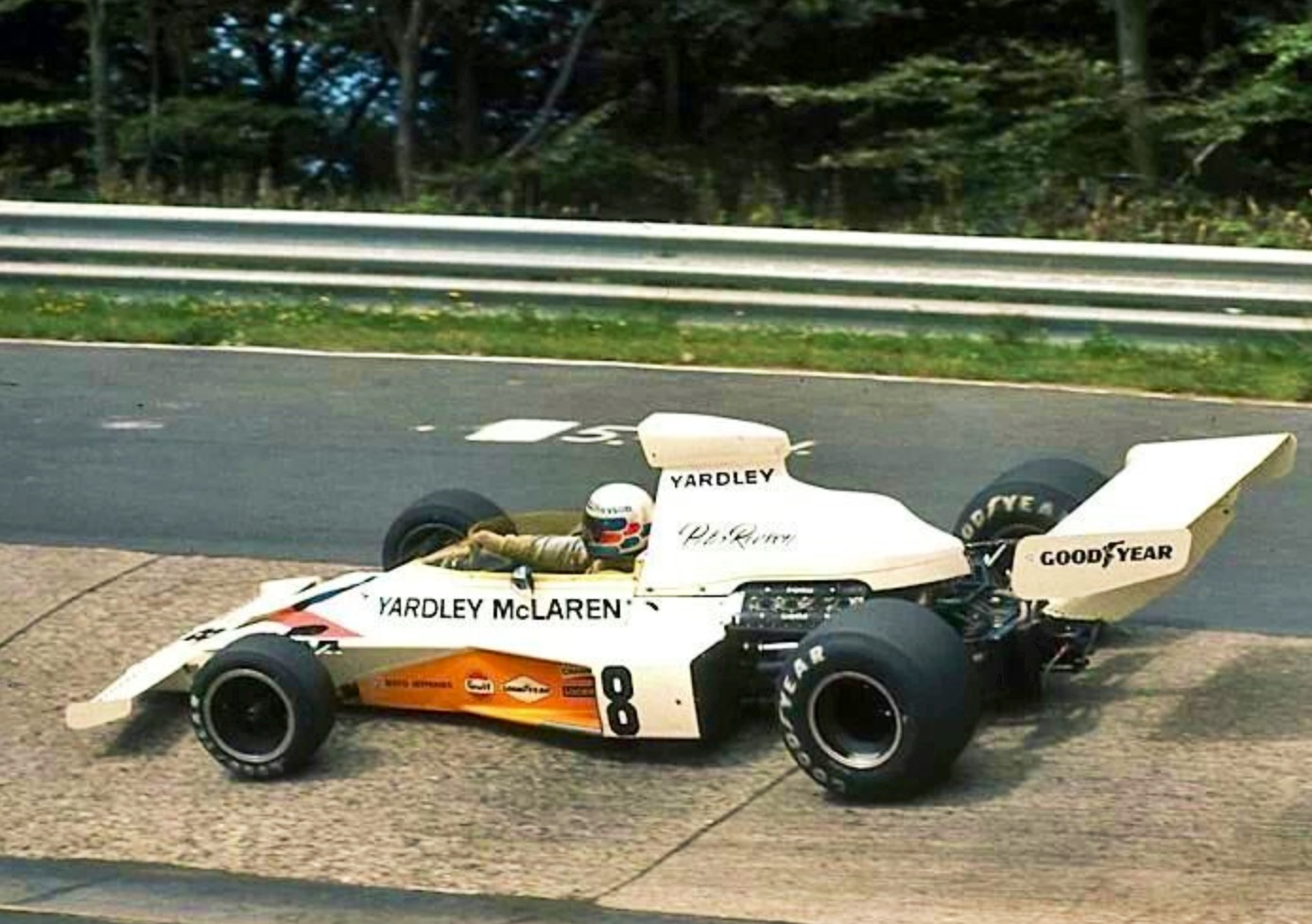
Peter Revson, German GP 1973, Nurburgring. 9th in the race won by Jackie Stewart (Unattributed)Ian Scheckter’s Tyrrell 007 in front of Charlton in M23/2 Kyalami 1975 (unattributed)M23/2 Repco, Sandown Park 1977 (unattributed)Rose City 10000, Winton 1978. This race was won by James Hunt in an Elfin MR8 Chev (unattributed)McCormack on the grid, on the far side is John Walkers’ Lola T332. Oran park Gold Star meeting 1978 (John Shingleton)‘Don’t let me down baby…’ Adelaide 1978 (John Shingleton)Adelaide 1978, entourage a contrast to the Birrana 274 F2 and Stephen Fraser’s Cicada further back…(John Shingleton)Winton dummy grid much the same today, there is a shed where the nifty Dunlop Bus is though. McCormack Rose City 10000 1978 (John Shingleton)Mid Ohio Can-Am round (Mark Windecker)Wonderful Mark Windecker Mid Ohio shot shows the attractive one-off body fashioned by John Webb and Simon Aram in Adelaide. Still some Repco support, car ran the last Can-Am round for the team at Watkins Glen with a 4-litre version of the Repco Leyland, exploiting a weight advantage afforded smaller engines by the rules (Mark Windecker)
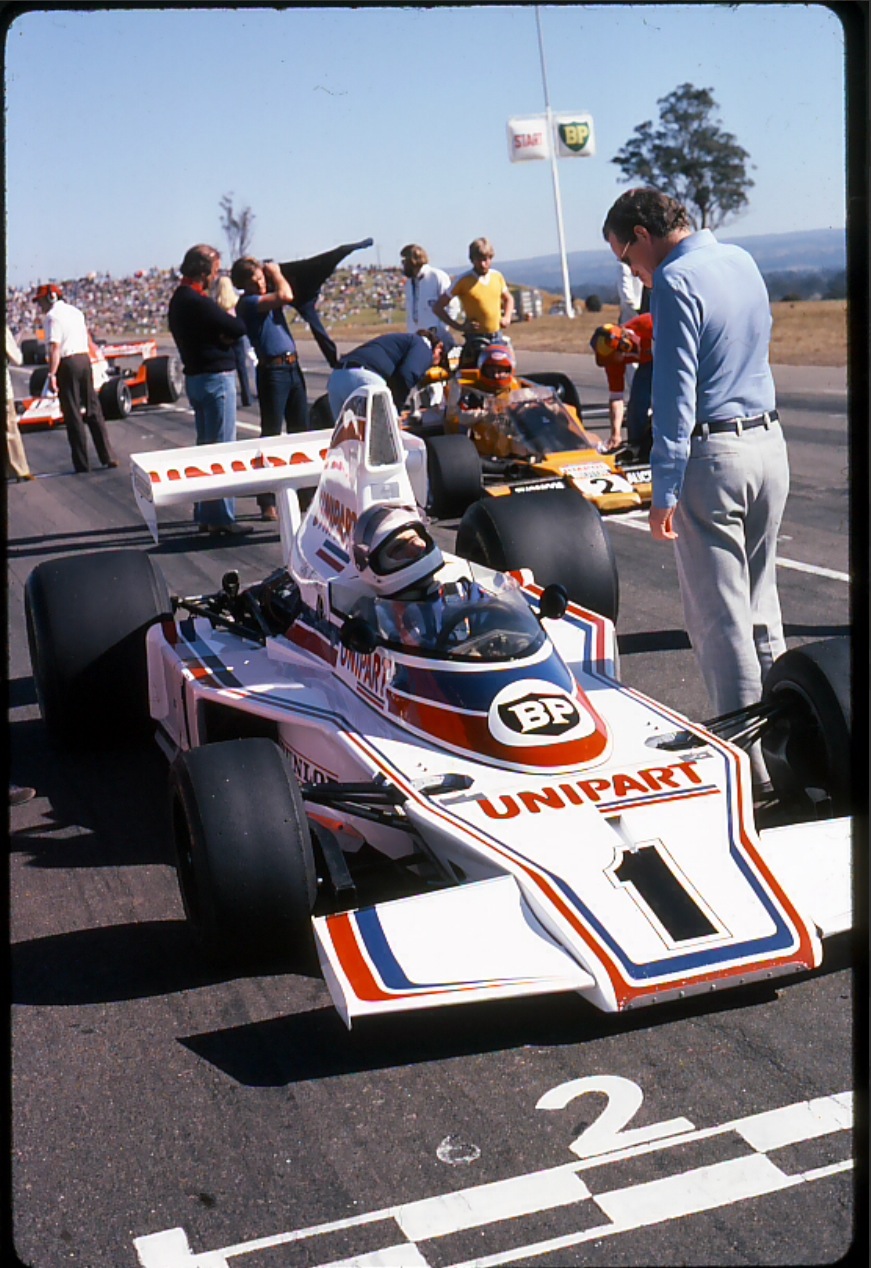
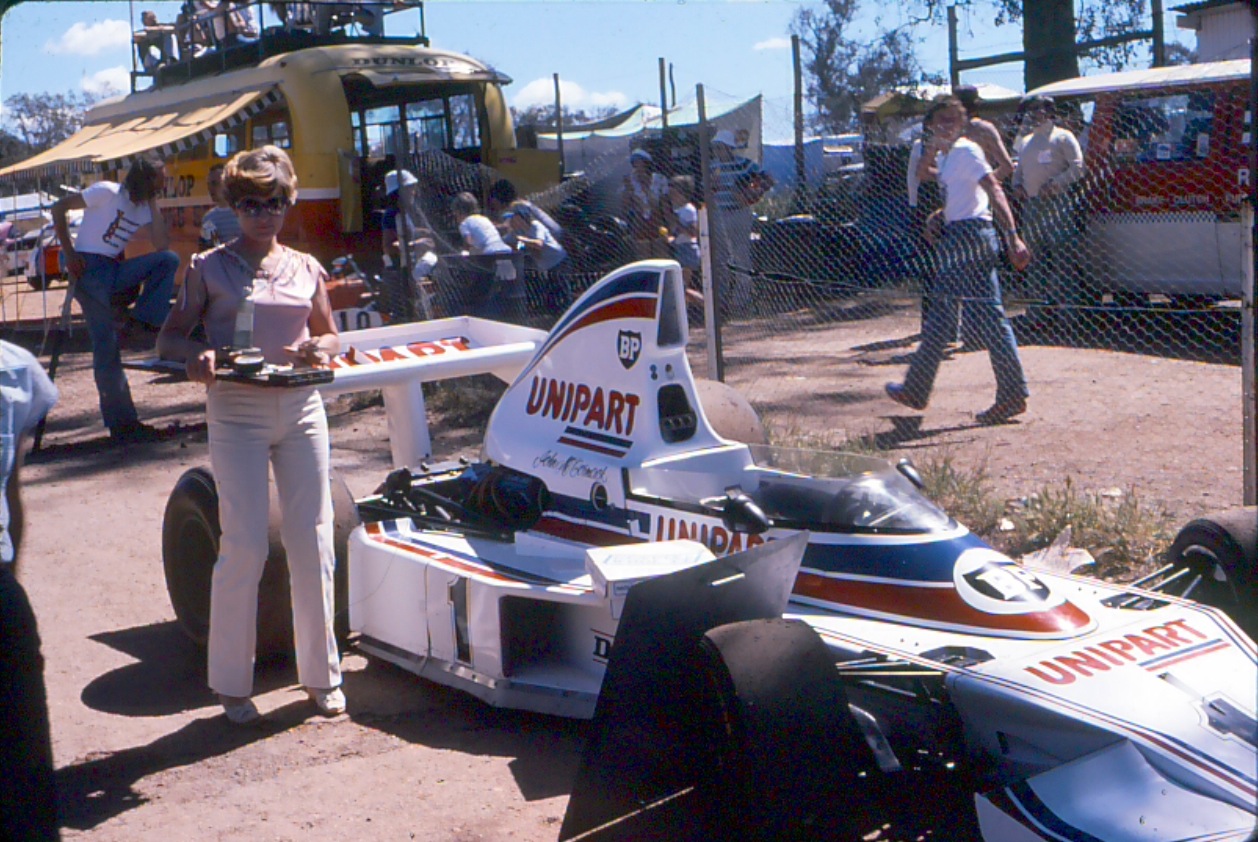
And finally, Unipart Merchandising 1978 style, the T-Shirts @ $3.20 are a snip….
Dan Gurney heading for third place in his Ferrrari Dino 246 despite running up Trintignants’ chuff…
The organisers moved the race from Oporto to Monsanto Park, Lisbon that year, also a very dangerous circuit with tram tracks, uneven surfaces and plenty of telegraph poles to hit.
Brabham was saved by one of said poles. Having spun avoiding a twice lapped car, a pole saved him from going down a ravine but spat his Cooper T51 back onto the circuit. He was then thrown out of the cockpit and nearly mown down by teammate Masten Gregory zipping past at the time. Jack always rated that prang his greatest escape.
Tony Brooks’ Dino was four points adrift of Brabham in the drivers championship at that stage, the margin he won the title from Brooks by at season’s end.
The mid-engined era was underway, the gorgeous Dino was passé, it was the last front-engined car to win a title in Mike Hawthorn’s hands in 1958, and also the last to win a Grand Prix, the 1960 Italian, a race boycotted by most of the teams as it was run on the Monza Banking. The Italian race organisers did so to advantage Ferrari, in 1960 still racing the Dino 246 which was way past it’s use by date but still had straight-line speed; scallywags those Italians.
Moss won in Portugal a canter, leading all the way in Rob Walker’s Cooper T51 Climax…
Phil Hill, Luigi Bazzi, Carlo Chiti, and Dan Gurney discuss the need for more speed at Monsanto Park, Lisbon 1959. (Getty Images)
Ferrari Dino 246 cutaway showing, ladder frame, 2417cc 65-degree DOHC V6, four speed gearbox, double wishbone front suspension, De Dion or IRS at rear depending upon the year, this car appears to be IRS and therefore a later specification car.
(James Allington/Tony Matthews)
The Cooper T51 Climax cutaway shows the space frame chassis Coventry Climax DOHC 2490cc four cylinder engine, Cooper/Citroen four speed gearbox, wishbone front independent, and wishbone and transverse leaf spring independent rear suspension.
Photo Credits…
Pinterest unattributed, Getty Images, James Allington/Tony Matthews cutaway
Pole position and a win after waving teammate & champion elect AyrtonSenna into the lead…and having the favour returned late in the race giving Berger his first McLaren win…
Even though it was ‘only’ built in the ’60’s this Honda owned track must be one of todays classics, by any measure? Even though ‘130R’ has been ‘softened’ the track is still a formidable test of man and machine and on my circuit ‘bucket-list’. Its a non-‘Tilke Template’ track which is a positive.
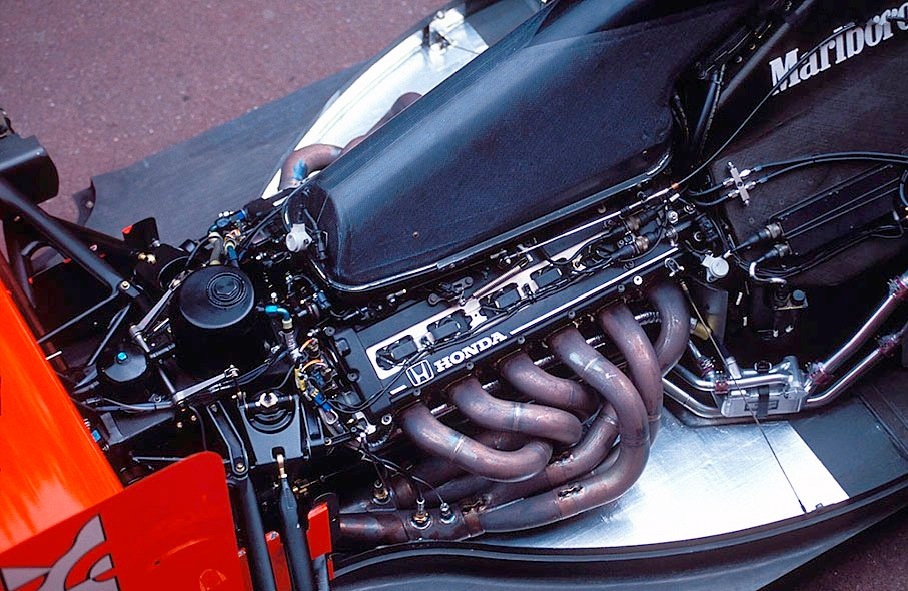
Honda’s first V12 since the Surtees ‘Hondola’ Era…
Neil Oatley’s new chassis carried the Honda ‘RA121E’ 3.5 litre V12, replacing the previous very successful V10’s. The chassis was longer to accomodate a larger fuel cell for the thirstier V12 but still torsionally stiffer than its predecessor.Early testing by Berger and Ayrton Senna was not promising, they were unconvinced of the engines superiority over the V10… but the car still won its first 4 races in Senna’s hands.
Williams FW14 then found mid season form and reliabilty. Adrian Newey , recruited from March where he created some stunning cars on small budgets was now deploying far greater resources well! He designed a superb car, the Williams Renault had a semi-automatic, 7 speed gearbox following the trail blazed by the Ferrari 640 the year before. It was regarded as a more advanced car, technically and aerodynamically than MP4/6, albeit the McLaren was more reliable and consistent.
Monaco 1991, Ayrton Senna 1st. McLaren MP4/6
Ongoing Development…
Honda focused on improving the engine management system and frictional losses, introducing new heads, cams and rods, Honda’s ongoing development legendary! Oatley evolved aspects of the car as well incuding its sidepods and wings. Linked rocker arms to reduce roll, as well as a cockpit operated ride height adjustment meachanism were also created. All of the foregoing, as well as some reliability issues and misfortunes at Williams turned the tide back in McLaren’s favor, the car winning 8 Grands’ Prix and 10 poles.
McLaren took their fourth straight Constructors title and Senna his third, and last, Drivers Championship.
Demise of Manual ‘boxes & V12’s…
MP4/6was the last Grand Prix car car with either a conventional manual ‘box or V12 engine to win a World Title…Oh, now, for both manual ‘boxes and the mix of skill required, and punishment of mistakes made, and the race interest thus produced… let alone the sweet scream of V12 engines in the current F1!
MP4/6 Monaco…linked rocker arms were used later in the season to reduce roll and a cockpit activated ride height system…sheer artisrty isnt it?
Hold your breath…and remember these duels! Mansell & Senna , Williams FW14 Renault & McLren MP4/6, the 2 dominant cars of ’91. Mansell takes Senna for second…and later wins the race, Senna 5th. Spain, Catalunya, Barcelona sept ’91.
The Previous Generation of Honda V12’s…
The previous generation of Honda V12’s…John Surtees in the Honda RA300, Mexican GP ’67, 4th. This car won the ’67 Italian GP in a last corner pass and dash to the flag, Surtees beating Jack’s Brabham BT24 Repco. The chassis was built by Lola , the T130, based on the successful Indy winning T90, hence the appelation at the time ‘Hondola’, Surtees having an enduring close association with Lola’s Eric Broadley.The ‘RA273’ engine was a 48 valve , 3 litre V12 producing circa 400 bhp. Honda’s 5 speed transaxle was also fitted. (The Cahier Archive)
Model Venetia Day tries to get comfy atop the monocoque of Matra’s 1970 F1 challenger, the MS120. This famous shot was taken on the preview day of London’s Racing Car Show at Olympia in January 1971. The compound curvature of the Matra is more than matched by Venetia’s lissom lines, the raincoats of the ‘snappers seem apt, all struggling with the correct focal length of their shot.
Matra make their GP debut at Monaco in 1968. Beltoise’ Matra MS11 with MS9, induction between the cams V12. Q8 and DNF after an accident. Short snub-Monaco nose fitted (Cahier Archive)
Matra MS120…
Jackie Stewart won the Drivers and Constructors World Championships for Matra in 1969 with the Tyrrell Team’s Ford Cosworth powered MS80. Matra entered F1 with Ken Tyrrell’s team in 1968, his cars were Ford powered, in addition their own V12 engined MS11 debuted.
In 1969 Matra focussed on developing their V12, the MS80 was designed for the Ford DFV only, the strategy was successful, few new teams have won a World Championship so soon.
Jackie Stewart in his ’69 championship winning Matra MS80 Ford. French GP, Clermont Ferrand.(unattributed)Monaco GP 1970. Henri Pescarolo ahead of Pedro Rodriguez’ BRM P153, the Matra V12 powered car finished third , Pedro finished sixth in his car, also V12 powered. Rindt’s Lotus 49 achieved a great victory having pressured Jack Brabham into a last lap error (unattributed)
Commercial Considerations…
For 1970 Matra went it alone running cars powered by the French aerospace company’s own V12. Matra boss, Jean Luc Lagarde, did a deal to sell his Matra 530 sports car through the Simca dealer network. Simca were owned by Chrysler, who were not about to have a Ford engine powering ‘their racing car’.
Tyrrell was offered the MS120 for 1970. Stewart tested the car at Albi but felt that the DFV was the more competitive engine and after most of 1970 running a customer March 701, Tyrrell’s own Ford DFV powered cars made its debut, with Stewart taking two more titles in 1971 and 1973. Tyrrell and Stewart were correct in their assessment, Tyrrell’s first Derek Gardner designed 001 was similar in many ways to the MS80 which was always one of Stewart’s favourite cars.
Equipe Matra, British Grand Prix 1970, Brands Hatch. DNF for both Beltoise and Pescarolo. Rindt’s Lotus 72 won the race after Brabham’s BT33 ran short of fuel. These paddock shots clearly show the different aerodynamic approach adopted by Matra’s Bernard Boyer (unattributed)
MS120 Design…
Chassis Designer Bernard Boyer created a new monocoque with cockpit sides and upper surfaces shaped to use the airflow over the car to develop downforce. New approaches to aerodynamics in 1970 by the March 701, the stunning wedge shaped Lotus 72 and the MS120 were stark contrasts to the cigar shapes of the 1960s. The other aero approach was the pregnant-coke-bottle adopted by the BRM P153 (see picture of Rodriguez in Monaco) to get the fuel load as low as possible in the car.
Front suspension geometry was developed directly from the MS80 but the wheelbase was 10cm longer due to the difference in length of Matras V12 relative to the DFV.
Matra’s 48-valve, 3-litre V12 was further developed by Gerard Martin’s team with a new block, which, DFV style, allowed the engine to be attached directly to the rear bulkhead of the monocoque to carry the loads of the rear suspension and Hewland FG400 five-speed transaxle. The engine developed around 435bhp @ 11000rpm, about the same as the DFV, but it was lighter and more fuel efficient.
The DFV was the-engine of the 3-litre formula, Ferrari’s flat 12 its only true competitor over the longer term and even then it was hamstrung by the chassis which sometimes carried it…the DFV had no such problem given so many teams used the ubiquitous engine.
Matra MS12 3-litre, 60 degree, 48-valve, Lucas fuel injected V12. It developed circa 435bhp @ 11000 rpm from 2993cc. The engine was used as a stressed member, suspension mounts bolting directly to the engine. Aeroquip brake lines running along top radius rod, Lucas fuel injection and metering unit in shot(unattributed)
Drivers and Results…
The MS120s were driven by Frenchmen Jean-Pierre Beltoise and Henri Pescarolo in 1970, they finished 9th and 12th respectively in the Drivers Championship. Whilst both were fast, neither was an ace, Matra finished seventh in the Manufacturers Championship. Jochen Rindt won the drivers title posthumously and Lotus the constructors for points gained by both its old 49 and revolutionary, new 72.
1970 was a very competitive season with the Brabham BT33, BRM P153, Ferrari 312B, Lotus 49 and 72 and March 701 all winning Grands’ Prix. The MS120 was a little heavy, was thirsty and lacked the reliability of much of its competition, JPB had five retirements out of 13 rounds and six top-6 finishes whilst Pesca had three retirements and four top-6 finishes.
The team lacked an ace behind the wheel and someone with real depth of F1 testing and race experience to be able to fully develop the car. French Car, French Engine, French Sponsors and French Drivers all sounds great and made political sense given the Government funds involved, but in reality, in 1970, they needed Ickx, Amon, Rodriguez, Rindt or Stewart. Of course this analysis excludes drivers rusted-on to their own teams.
Clermont Ferrand, start of the 1970 French GP. Stewart March 701, Rindt Lotus 72, Pesca MS120, Rodriguez BRM P153 obscured, Jack Brabham Brabham BT33, Denny Hulme McLaren McLaren M14A, Ronnie Petersen March 701, Ignazio Giunti Ferrari 312B, Francois Cevert March 701…talent aplenty in 1970…(unattributed)French Grand Prix 1970, Pescarolo fifth in his MS120 at Clermont Ferrand, Beltiose 13th in the race won by Rindt’s Lotus 72 (Cahier Archive)
Withdrawal from F1…
Matra withdrew from F1 as a chassis constructor at the end of 1972, despite blinding speed shown on occasion by Chris Amon in 1971-72. They eventually won Grands’ Prix as an engine supplier in Ligier chassis in the late 1970s and into the 1980s.
The 3-litre V12 was fabulous, its screaming note one of racings most evocative, shrill best. It also achieved endurance success, the French company winning Le Mans in 1972-73-74 with its ‘670’ series of cars.
Matra’s were superbly designed, distinctively different and exquisitely built racing cars, the aeronautic background of the company was obvious in the execution of the cars construction. The Grand Prix scene was the poorer for their absence, but from a commercial perspective it was mission accomplished for Matra with an F1 Constructors Championship and three Le Mans victories on the trot.
The other car behind Venetia is a Surtees TS9 by the way, or perhaps you didn’t notice…
Etcetera…
JPB MS 120 1970…the more you look the more you see! Just a beautifully engineered and built carBeltiose all ‘cocked up’ at Monaco ’68, this kiss of the kerb causing his retirement. MS11 (unattributed)Matra MS120 family: top to bottom 1970 MS120, 1971 MS120B and 1972 MS120C (Pinterest)MS12 cutaway…3-litre, 60-degree, 48-valve V12. Lucas fuel injection. Designed to be used as a stressed member, bolted directly to the monocoque rear bulkhead.
(Matra)The 1969 Matra Squad: Matra’s Henri Pescarolo and Jean-Pierre Beltoise, and the Tyrrell duo of Johnny Servoz-Gavin and Jackie Stewart (unattributed)
Ayrton Senna amongst the flowers and fields of Zeltweg, 200 km South East of Salzburg…
Nigel Mansell won the race from teammate Nelson Piquet , Senna, finished 5th after stalling at the restart and running up the chuff of Michele Alboreto’s Ferrari, a pit stop necessary to replace a damaged front wing.
Piquet won the ’87 World Championship in his Williams FW11B Honda, Sennas’ Lotus 99T similarly powered.
Senna had 2 wins back to back in Monaco & Detroit early in the season , but ,dissatisfied with the performance of the Lotus ,left for McLaren at the seasons end and starting the bitter rivalry with Alain Prost …
Photos : Pinterest unattributed
Senna victorious in his Lotus 99T Honda, Monaco ’87
San Marino pitlane ’87. Ayrton Senna , Lotus 99T Honda…2nd in the race won by Mansell’s Williams Honda


































 primotipo...