Archive for the ‘Fotos’ Category

image

(Gasking/Repco)

‘Scuds’ was the nickname of David McKay’s Ferrari, Porsche and Volvo dealership on Sydney’s North Shore…

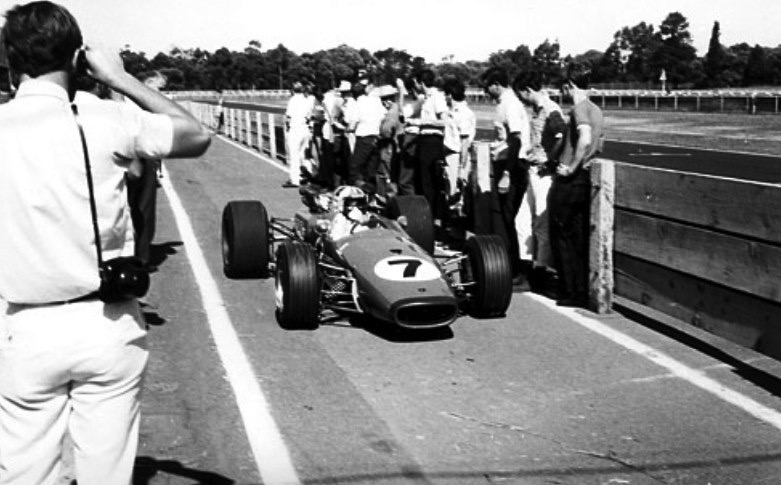
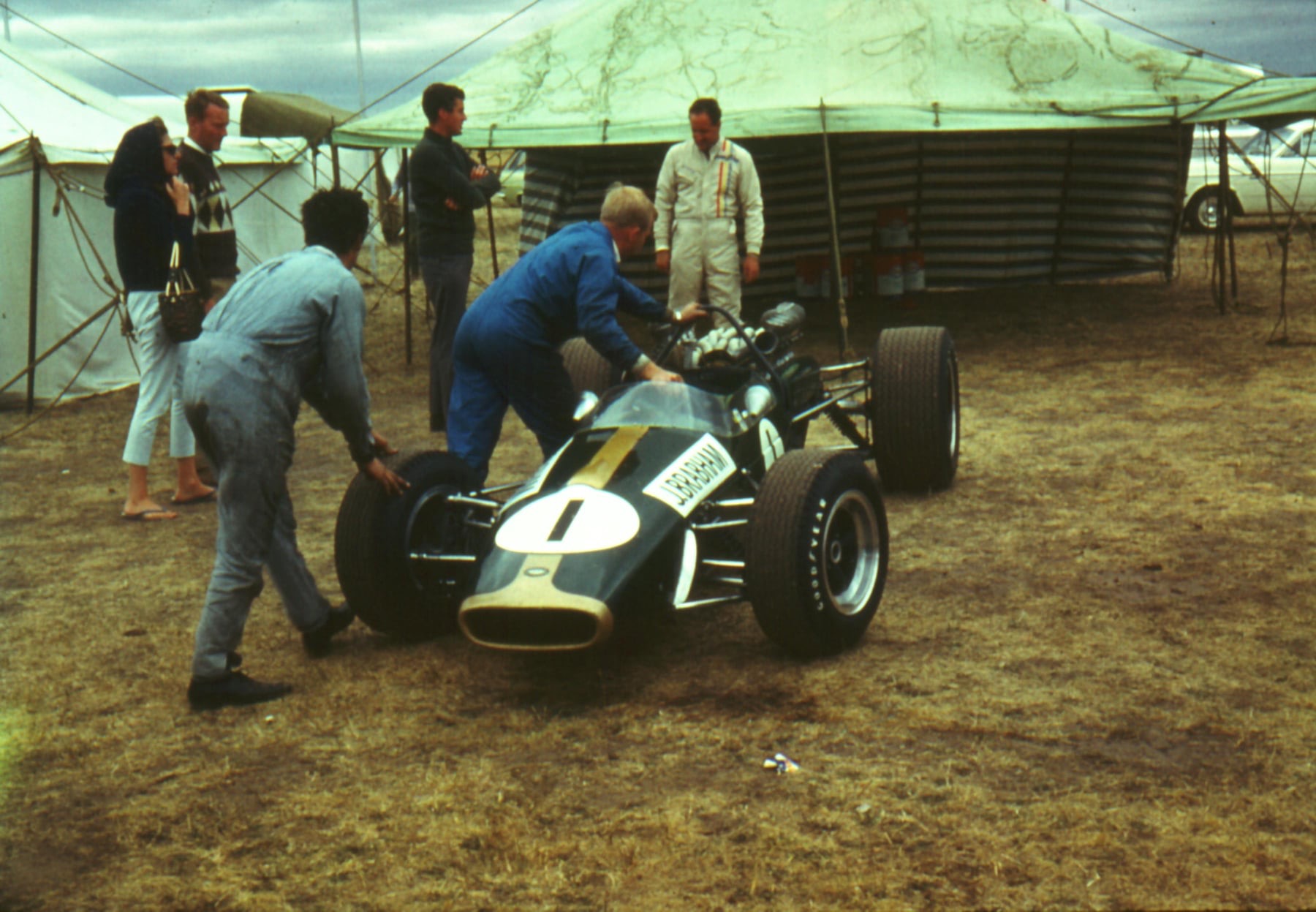
Here is the team with its Brabham BT23A Repco ‘740’ 2.5 V8 at Warwick Farm in 1967’ish. Not sure of the exact date, but it looks warm and Cusack carried #7 in the Hordern Trophy on 3 December 1967 so my tip is that weekend. He finished behind Frank Gardner’s Alec Mildren owned Brabham BT23D Alfa Tipo 33 V8, its race debut and John Harvey’s Brabham BT11A Climax.

Mind you, Cusack carried the same number in the 18 February ’68 Tasman Round won by Jim Clark’s Lotus 49 Ford DFW, Greg was out on lap 4 with brake problems. Upon a closer look, the car in the shot below, during the Tasman round does not have the green band at its noses tip, so let’s go for the shot above as pre Hordern Trophy.

From the left is the beautifully liveried Holden HR Station Wagon tow car.

It’s probably toting the big 186cid 3 litre ‘six’ and ‘three on the tree’ manual tranny. Mechanic Bob Atkin, later a Director of SV, then El Supremo McKay and driver Greg Cusack. Greg was a very successful Ford dealer himself in Canberra. He was said to have been as quick as anyone on his day but ‘those days’ didn’t happen often enough! The trailer is a ‘Rice’ rated then and eagerly sought after now.

Top period shots, luvvem!

image

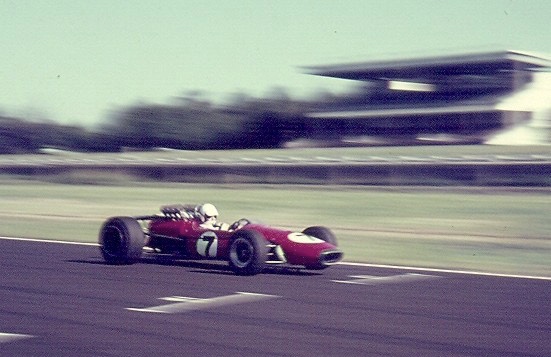
Cusack at the Farm during the ’68 Tasman round in the SV BT23A (oldracephotos.com)

Chris Amon did some laps in the car that 1968 Warwick Farm 100 weekend too. I wonder if David McKay was keen to see just how fast the car could go- Chris was one of the fastest guys on the planet at the time after all, or perhaps he was helping with car setup.

That Tasman he was racing a works Ferrari Dino 246T his own team were running, and SV’s Ferrari P4/350 Can Am.

(D Grant)

The colour shot below is of Cusack on the same weekend- he was out of the championship race on lap 4 with brake problems whereas Chis was fourth in his Ferrari, Jim Clark won in a Lotus 49 Ford DFW.

(P Houston)

Credits…

Michael Gasking Collection/Repco, oldracephotos.com, oldracingcars.com, Perry Drury, Doug Grant, Peter Houston

Tailpiece

(P Drury)

Denny behind Jack’s BT23A in the Longford paddock in March 1967, Brabham won the Monday Tasman race taking the one and only Repco engined Tasman win, using a ‘640 Series’ 2.5 V8.

Finito...

noige

(Automobile Year/DPPI)

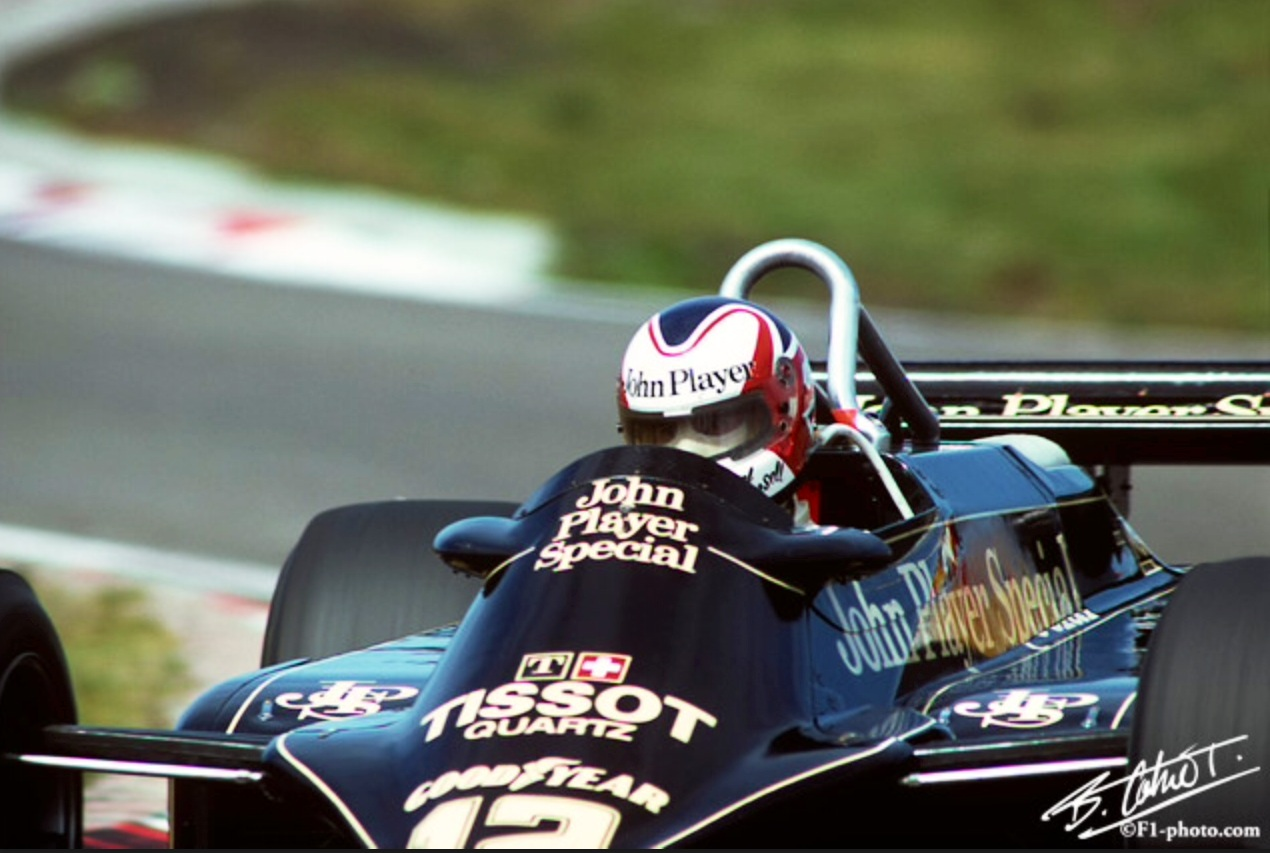
Nigel Mansell blasts his Lotus 87 Ford through the North Sea sand dunes of the fabulous Dutch circuit on August 30 1981…

Mansell joined the team in 1980, contesting the Austrian, Imola and Canadan Grands Prix.

In Holland he qualified his Cosworth powered Lotus 87 17th in a field of 30, 5 cars were non-qualifiers. His race was a short one though, he retired with an electrical failure on the races first lap. Alain Prost took the Renault RE30 win from Nelson Piquet, Brabham BT49C Ford (Piquet won the drivers title that year and Williams the constructors) and Alan Jones’ Williams FW07C Ford.

Mansell finished his first full season with 8 points, 14th in the drivers championship and a best placing of 3rd at Zolder, Belgium.

noige 2

Mansell, Zandvoort 1981. (The Cahier Archive)

Photo Credit…DPPI, The Cahier Archive

image

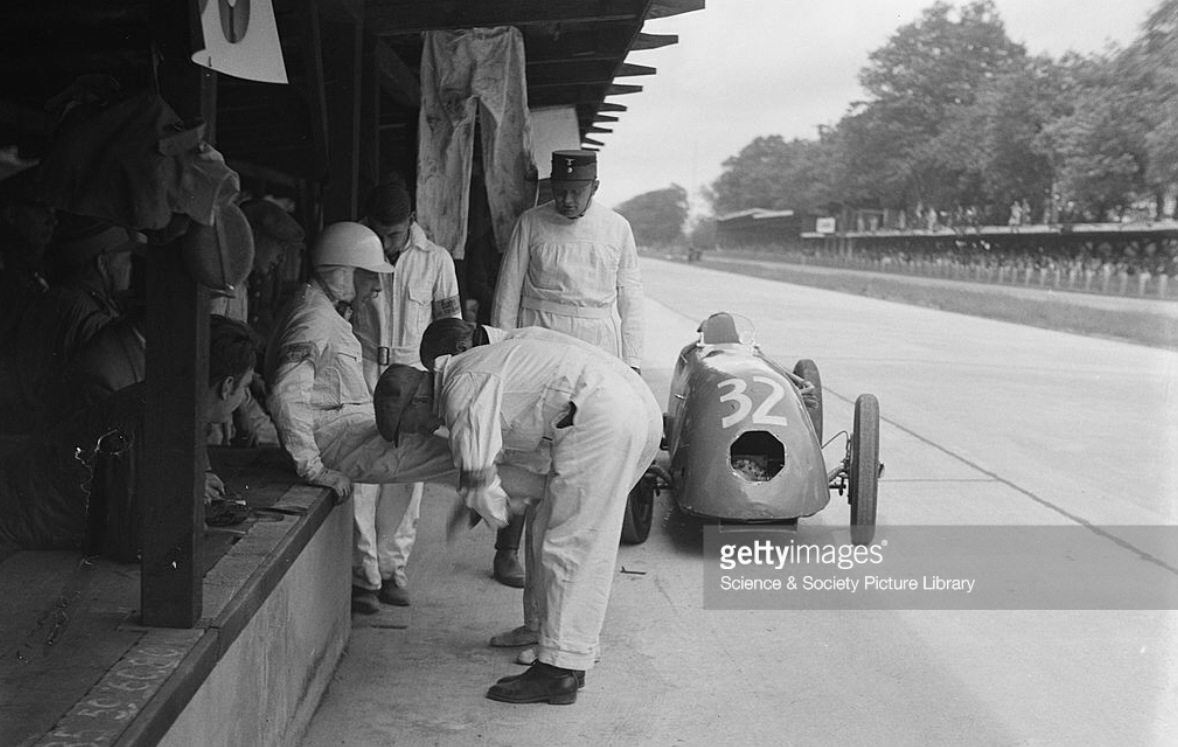
Bobby Kohlrausch and his ‘Magic Midget’ ‘EX127’ during the 1934 ‘IV Internationales Avus-Rennen’ Voiturette race on 27 May, he is getting a leg massage to address the cramp he suffered…

‘In a long, arduous life’ Kohl Rausch achieved Standing and Flying Mile class records in the car of 93.4 and 140.6 mph in 1932′. Kohlrausch didn’t get the best from the car that weekend despite being favoured to win the unofficial 800cc class with the fastest car in the world of its size. Starting from the third row, he pitted after 5 laps complaining of cramp. The race was won by Pierre Veyron’s Bugatti T51A.

image

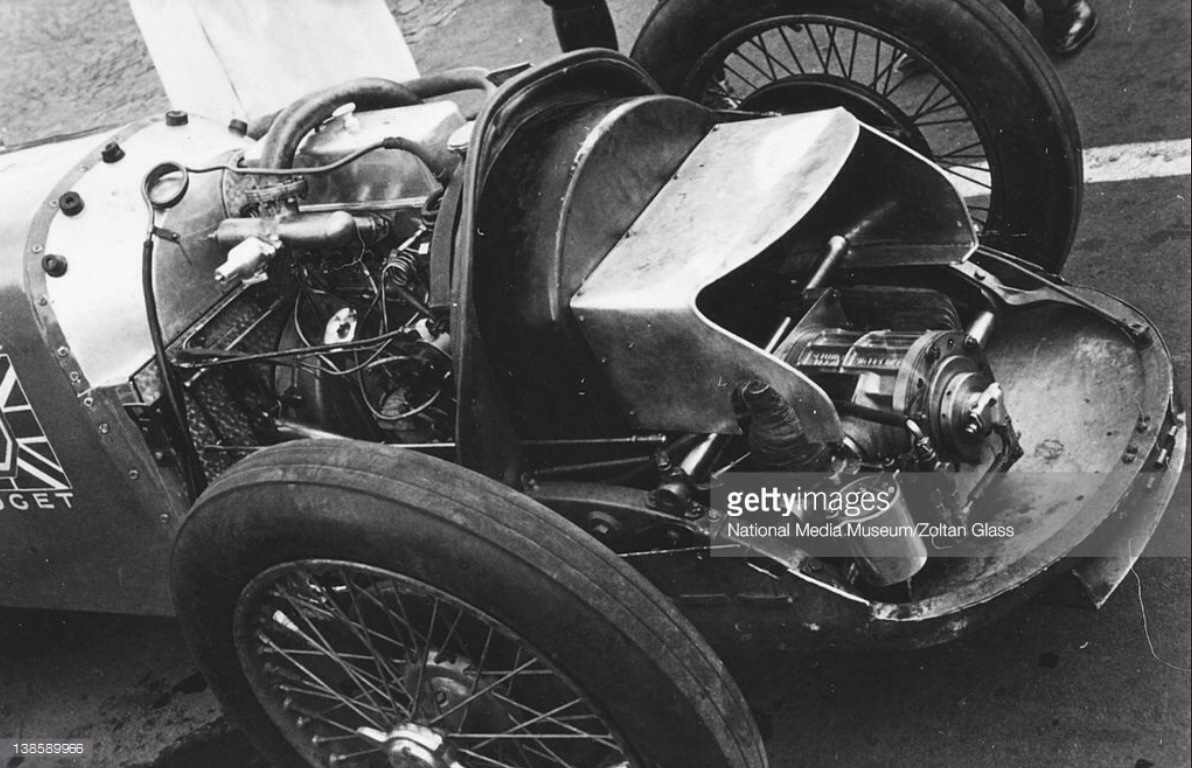
Zoller supercharged (look at the size of the thing!) 750cc s/c 115bhp 4 cylinder engine (Zoltan Glass)

A vast crowd turned up to see the Silver Arrows make their race debut in the Grand Prix event, the crowd doubly disappointed when Mercedes withdrew their cars after fuel pump troubles in practice. The Hans Stuck driven Auto Union Type A convincingly led the race by 85 seconds until lap 12 only for clutch problems to intervene. He retired the car allowing Guy Moll to win in a Scuderia Ferrari Alfa P3/Tipo B, not what the punters came to see at all, a story for another time…

image

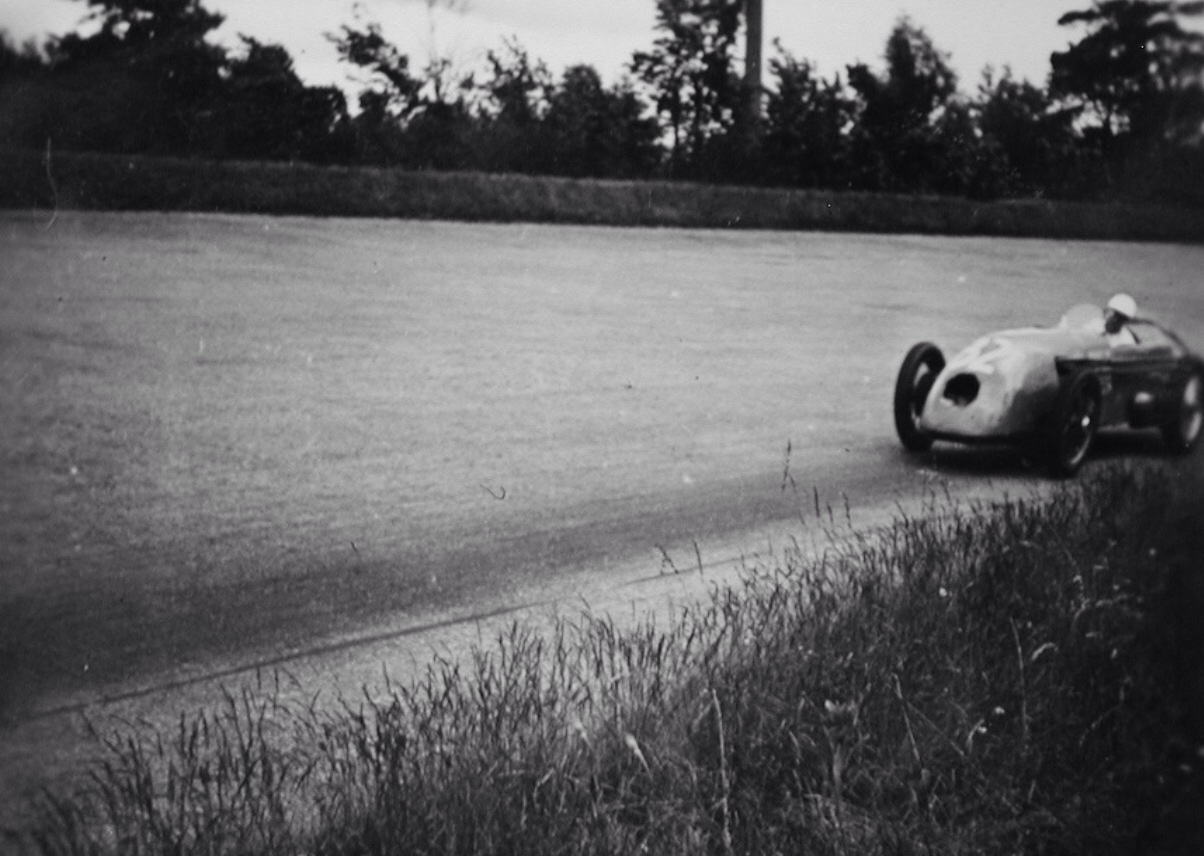
Kohlrausch in EX127, Avus 1934 (unattributed)

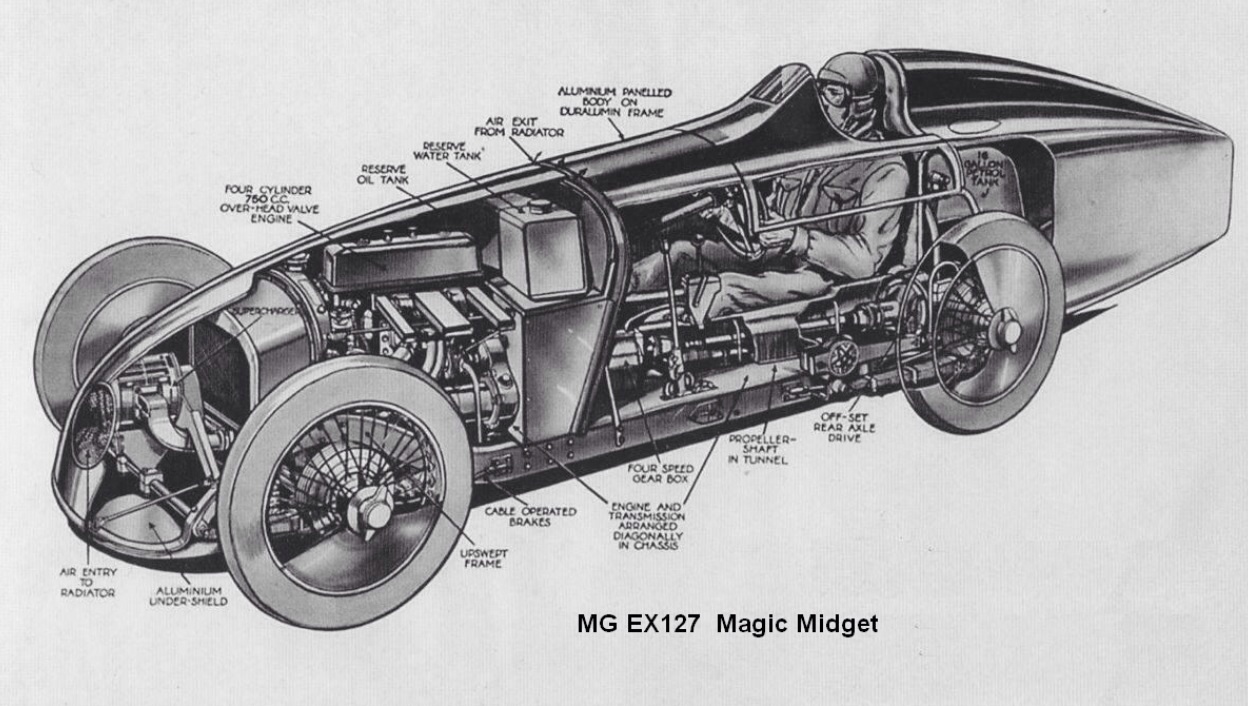
The ‘EX127’ single seater, oblique or off-centre transmission car was designed as a record breaker rather than a circuit racer. After a great deal of trying with a good deal of misfortune the car finally broke the 120mph barrier, achieving 120.56mph in George Eyston’s hands at Montlhery in December 1932.

image


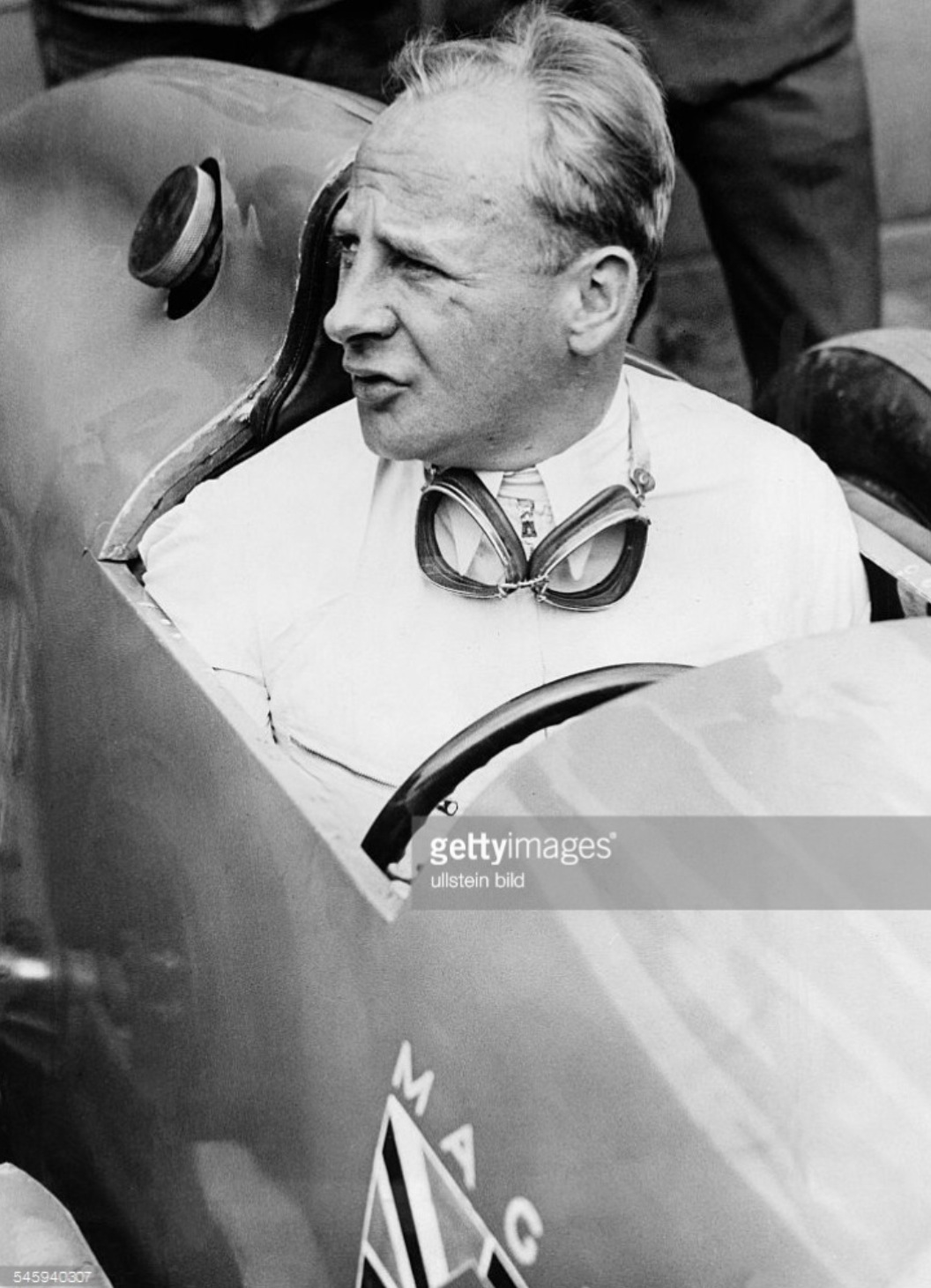
This was going to be a ‘quickie’ around the pictures at the articles outset but as usual my inquisitiveness got the better of me, this time stimulated by my friend Patrick Ryan, an enthusiast of considerable knowledge who identified the shot below as Bobby K rather than Goldie Gardner, I was not even close!

bobby

Bobby K in MG EX127 at the first Grossglockner Hillclimb on 4 August 1935, 4th best time of the day 15;10.3 with a 750cc s/c car (ullstein bild)

Kohlraush was born to affluent parents in Eisenach in 1904, he raced motorcycles from around the time he was apprenticed to the local Dixi car factory. His folks, concerned about his safety, bought him a BMW roadster to get him off ‘bikes. Soon he was competing, initially at the Kesselberg Hillclimb and soon the Nurburgring. So quick was the BMW Wartburg roadster that Bobby was offered an experimental engine by the works, he reputedly won 27 races so equipped in 1930/3.

bob austin

Bobby K in his Austin 7 ‘Rubber Duck, Berlin 1933 (Zoltan Glass)

His Austin 7 ‘Rubber Duck’ was a record breaker which was also raced by BK, he soon switched to ‘EX127’ which he bought off George Eyston. Equipped with a ‘Q Type’ engine the car did 130mph and later 140mph on the Frankfurt Autobahn. He raced the car at the Avus in 1934/5, the Nurburgring and various hillclimbs.

His performances were impressive enough to be offered a ride as a cadet or test driver with Auto Union in 1935, although he does not appear to have raced one of the awesome, V16 mid-engined beasties.

He contested the Voiturette Swiss GP ‘Prix de Berne’ on 25 August 1935, having engine troubles and retiring on lap 14, Dick Seaman took a good win in his ERA B Type.

bob mg

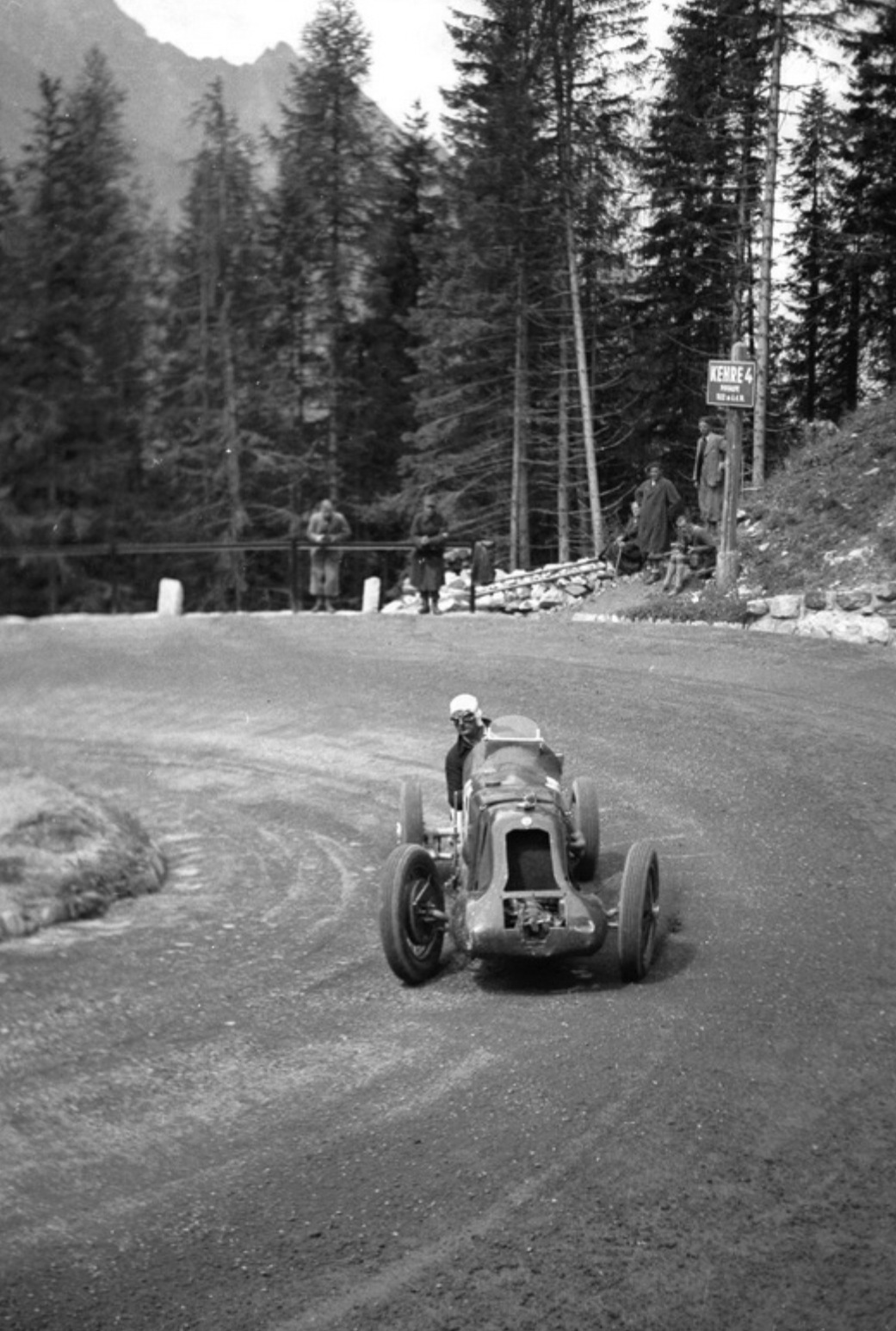
Bobby K in MG EX127 at the Grossglocker Hillclimb, Austria in 1935, he was 4 th quickest, Tadini’s much more powerful works Alfa P3 the winner. Climb circa 19.5Km, Motorsport magazine said his run ‘was stirring climb…a superlative climb in 13 minutes 10.3 seconds’, he won the under 1100cc class (unattributed)

In 1937 EX127 was bought by Mercedes Benz, some say perhaps on Hitler’s orders. Dyno tests revealed 115bhp@7000rpm or 153.3bhp per litre. A 3 litre engines implied output is 460bhp which became the benchmark for the M154 engine, the M163 achieved the target in 1939.

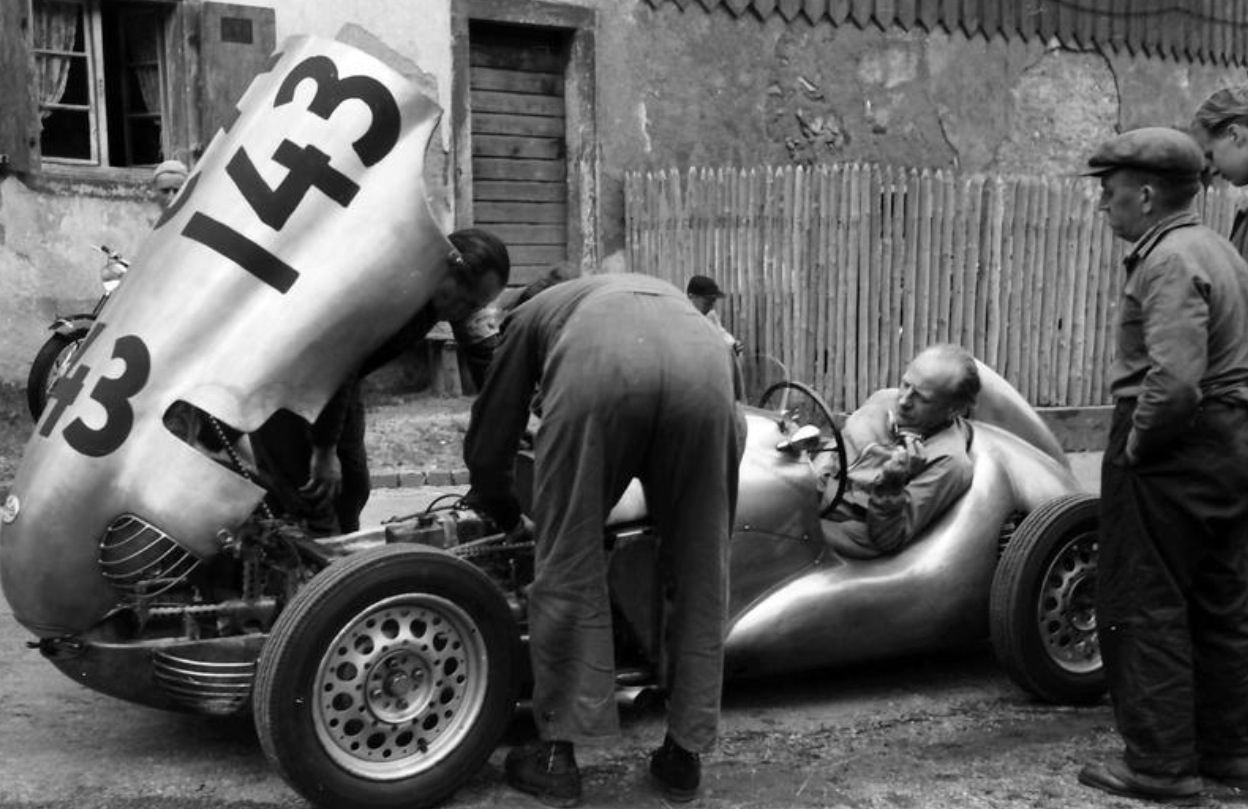
Post-war Bobby raced on in East Germany in the 750cc LTE Juwel built by Ferdi Lehder Bobby renamed the ‘GvB’, a pretty front-engined car in which he contested the 1950 German F3 Championship. His intention to supercharge the 500cc BMW engine and race it as an F2 car was never realised, he died of a heart attack enroute to a hillclimb at Schauinsland on 9 August 1953.

bobby f3

Bobby K sorting an engine problem in his GvB, Schauinsland-Racetrack, in the Black Forest, Baden-Wurttemberg, 4 August 1951. What a curvaceous little car (Willy Pragher)

Credits…

Zoltan Glass, Triple M Register, Patrick Ryan, historicracing.com, Getty Images, Imagno, Ullstein Bild, Willy Pragher, Science & Society Picture Library

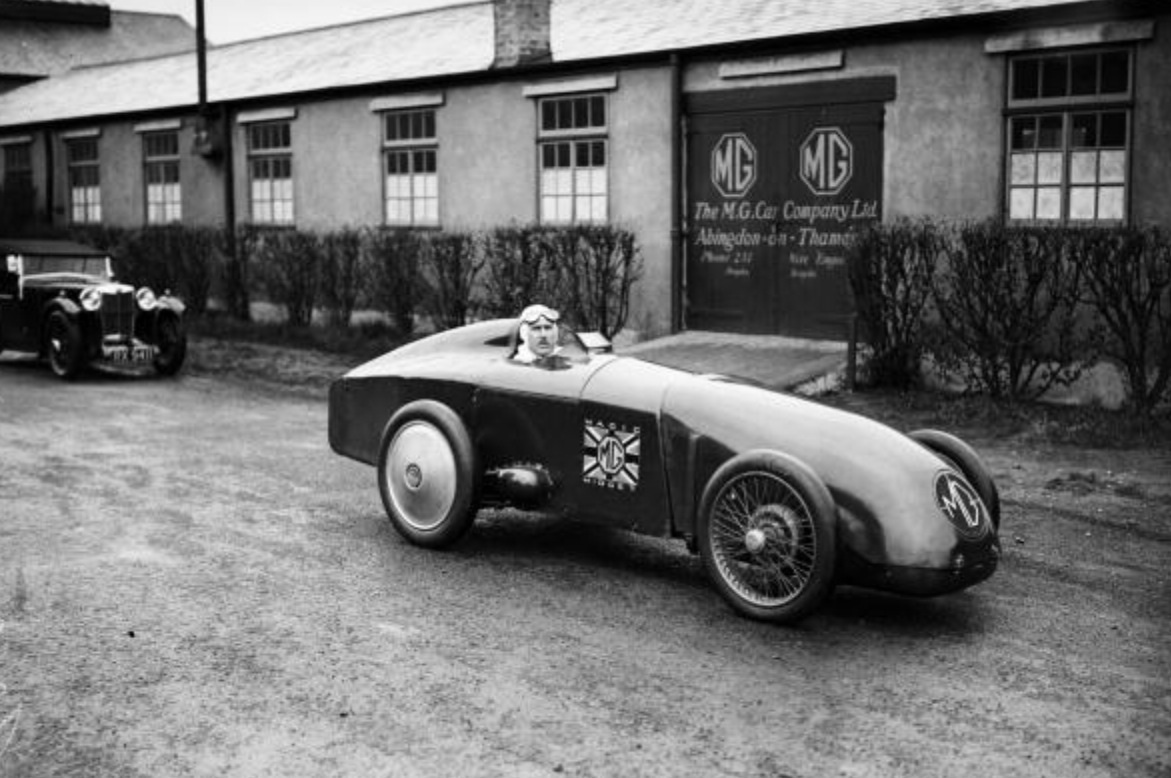
Tailpiece: George Eyston in the Magic Midget EX127 outside the Abingdon factory…

image


monaco fan moss

(Maurice Jarnoux)

The Mercedes Benz 1955 1,2; Fangio and Moss in W196, 22 May 1955…

Mercedes had three 1/2 finishes for the year; at Spa and Zandvoort when Fangio led Moss and at Aintree where Moss led Fangio. At Monaco things were looking good for another but JM’s car broke a rear axle on lap 49 and Moss had an engine failure in the closing laps of the race (lap 80 of 100).

image

(Jarnoux)

Maurice Trintignant (above) took a somewhat lucky, but well deserved win in his Ferrari 625 from Eugenio Castellotti’s Lancia D50, the Italian putting in a charge in the final stages of the race trying to catch the Frenchman.

image

Ascari and Castelotti in D50’s ahead of Behra’s 250F, later in the race but before lap 80 when Alberto took his afternoon swim (Jarnoux)

image

Moss discussing the Mercedes teams prospects with its legendary engineer/test driver Rudy Uhlenhaut during Monaco practice. This car was comprehensively rooted later in the day when Hans Hermann had a bad accident, hurting himself as well as the W196. Andre Simon was brought into the team to race the spare (GP Library)

This was the famous race in which Alberto Ascari crashed his Lancia D50 into the harbour perhaps distracted by Moss’ engine problems in front of him late in the race. He popped to the surface unharmed but was killed several days later testing a Ferrari sportscar at Monza.

image

Ascari’s D50 cruises past Lance Macklin’s Maser 250F, DNQ. Ascari 2nd on the grid (unattributed)


It was a pivotal time in the history of GP racing; Ascari’s death robbed Lancia of the driver around which its GP campaign was built and Gianni Lancia’s lavish race program was quickly driving his company into insolvency.

The famous ‘handover’ of Lancia assets to Ferrari occurred later in the year, solving Enzo’s immediate need of competitive cars. The ‘sponsorship’ in the form of an annual contribution to the Scuderia’s budget from Fiat laid the foundations of a strategic partnership which, via ownership of the road-car division from 1969 and ultimate acquisition of the company upon Enzo Ferrari’s death continues today.

image

Louis Chiron 6th let’s teammate Gigi Villoresi 5th Lancia D50 past whilst Jean Behra’s equal 3rd placed (with Cesare Perdisa) Maser 250F threatens (GP Library)

image

Farina’s Ferrari 625 4th about to be swallowed by Ascari’s Lancia D50 (GP Library)

image

That! high speed Mercedes transporter, Monaco 1955 (GP Library)

Credits…

Maurice Jarnoux, GP Library

Tailpieces…

monaco moss

Moss heading up the hill from Ste Devote,  Monaco 1955, Mercedes W196 (unattributed)

image

The master in the lead; Fangio led from pole until transmission dramas intervened on lap 49, Benz W196, Monaco ’55 (unattributed)

image

Henri Pescarolo in BRM P160E-10 18th, ahead of Ian Scheckter Lotus 72E Ford, 13th during the 1974 South African GP, Kyalami (unattributed)

One of my favourite designers is Tony Southgate, ‘tops’ for me of his many great cars are the 1970 P153 and updated and evolved 1971-4 BRM P160 GP winning machines…

‘Every man and his dog’ drove these cars from champions to journeymen, the last of the 10 built, the ex-Lauda/Pescarolo ‘P160/10’ is now owned by Sydneysider John Gale who is writing a fascinating, detailed blog as he and his team of artisans restore the car, here ‘tis, have a look at it;

http://brmp160e10.blogspot.com.au/p/about.html

image

Niki’s ‘brand spankers’ BRM P160E-10 upon its race debut at Monza in 1973, DNF (unattributed)

I thought my series of articles on the reconstruction of Peter Brennan’s ex-Lombardi Lola T330 Chev ‘HU18’ were detailed but they were ‘high level summaries’ compared with this engaging blog!

I’ve a piece in process about the BRM CanAm car with P153/160 tangents I’ll upload in the next month or so but in the meantime lose yourselves in this wonderful site for an hour or three!…

Tailpiece: BRM team at Watkins Glen 1973, Lauda’s #21 new P160E-10, Beltoise #20 and Regazzoni’s similar cars…

image


image

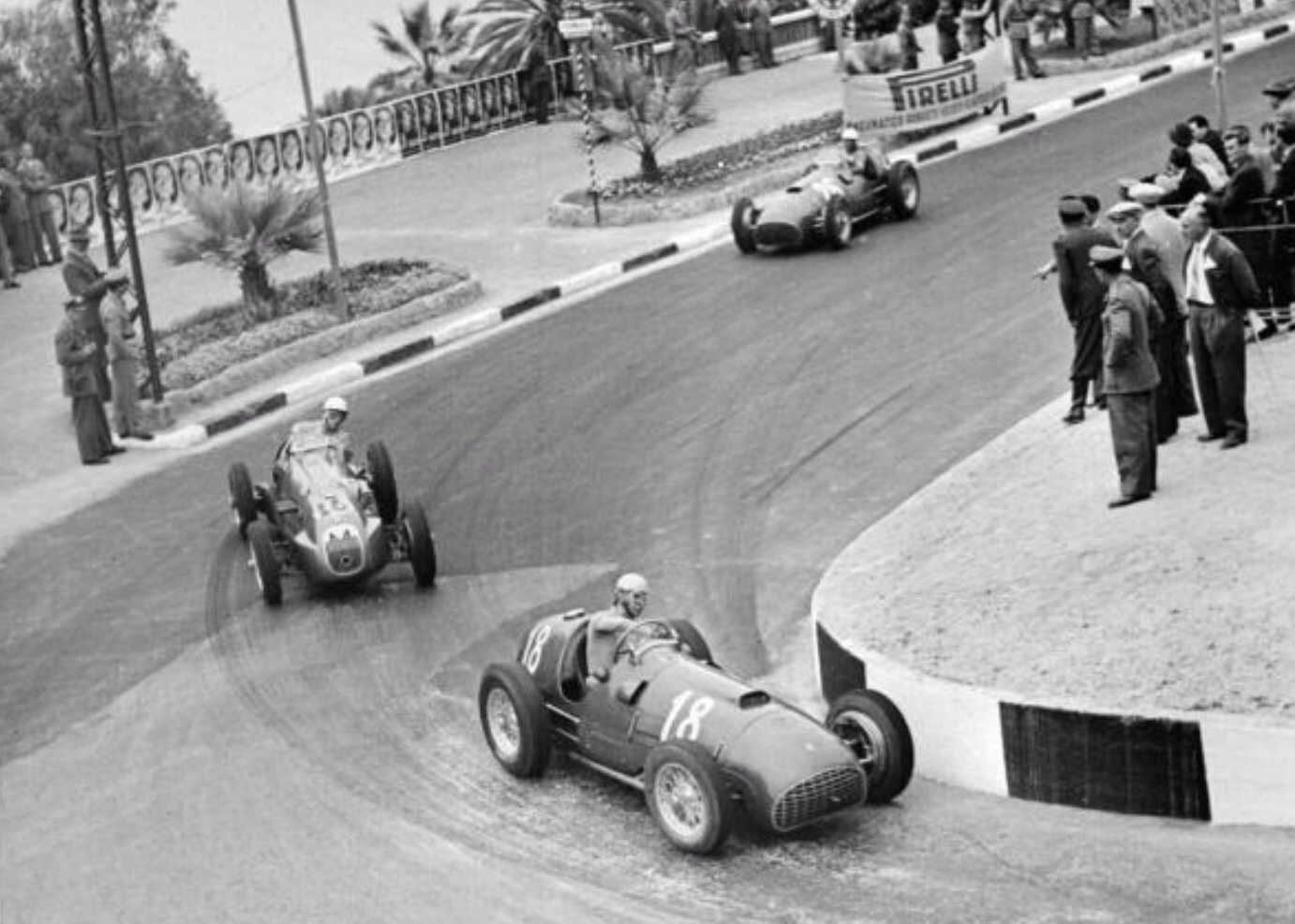
Alberto Ascari takes a quick look over his shoulder during the 1951 Italian Grand Prix…

His car is a Ferrari 375, the photo taken between the two ‘Porfido’ corners, now the Parabolica, 16 September 1951. The car being passed is an Alfa 159, not sure which one though.

Alfa Romeo hit back with a win for Fangio in the non-championship GP event on the 3.45 mile road course at Bari on Italy’s southern Adriatic coast on 2 September. Ferrari had won the British Grand Prix at Silverstone, their breakthrough win at championship level taken by Froilan Gonzalez on 14 July and again at the Nurburgring on July 29th when Ascari was first home…

image

Ascari’s 375 ahead of Stirling Moss HWM Alta and Luigi Villoresi Ferrari 375, San Remo Grand Prix 25 April 1951. Ferrari 375 won a good many of the non-championship ’51 GP’s, mind you Alfa and Ferrari largely avoided each other at these events! (Hutton)

The Italians were out in force in their home race of course at Monza.

Fangio initially lead but soon yielded to Ascari’s normally aspirated 4.5 litre V12 Ferrari, Fangio regained the lead after fitting new tyres, the two-stage supercharged 1.5 litre straight-8 both powerful and its chassis far from as modern as the Ferrari’s. In concept they were of similar thinking mind you.

image

Ascari, Monza 1951, rare color shot of this combination, superb, butch lines of the Ferarri 375 shown to great effect (unattributed)

Gonzalez (Ferrari) was 2nd after Farina and de Graffenried (Alfa) were early retirements. Fangio ‘tigered’, his attempts to catch the Ferrari’s thwarted by a misfire. Then Farina in Bonetto’s Alfa took up the fight passing Villoresi for 3rd but his fuel tank was leaking forcing additional stops, the race won by Ascari from Gonzalez and Felice Bonetto; Ferrari 375 V12, Ferrari 375 V12 and Alfa 159 S-8 supercharged.

image

Farina’s 159 Alfa engine going ka-boomba early in the race (unattributed)

And so the ‘51 championship went down to the wire to the final round at Pedralbes, Barcelona on 28 October, that race and the title won by JM Fangio. For Alfa Romeo it was their last, to date, F1 championship race let alone title win. And perhaps more significantly it was the last forced induction GP championship series victory until Brabham’s 1.5 litre, turbo-charged, 4 cylinder BMW powered win in 1981…

image

Farina Alfa Romeo 159, Italian GP practice 1951 (unattributed)

Credits…

Klemantaski Collection, GP Photo, Hutton

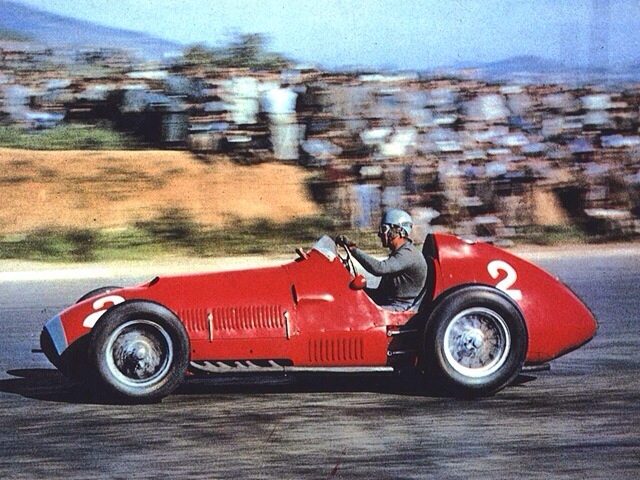
Tailpiece: Ascari has a steer of Gonzalez’ 375 during Monza practice, a mighty fine racing car!…

image

(GP Photo)


image

Pascal Rondeau is one of the more recent generation of photographers whose work I admire…

This shot is at the US Grand Prix in 1989 at Phoenix, Arizona. No details on which car it is, which is a bumma.

Credit…

Pascal Rondeau

image

The spectator is keen, his bravado enhanced by copious amounts of chianti during the long Sicilian afternoon…

The 13th placed #88 Eberhard Sindel/Dieter Benz Porsche 911S ahead of the similar #100 Dan Margulies/Robert Mackie car which was 20th. Oh to have been a privateer and raced an event like this, so relatively easily at the time, errant spectators notwithstanding!

image

The Mitter/Schutz 908/2 won the race from three other factory 908’s in a Porsche rout.

Credit…

Rainer Schlegelmilch

Tailpiece: The winning Porsche 908/2, not a bad panorama…

image


image

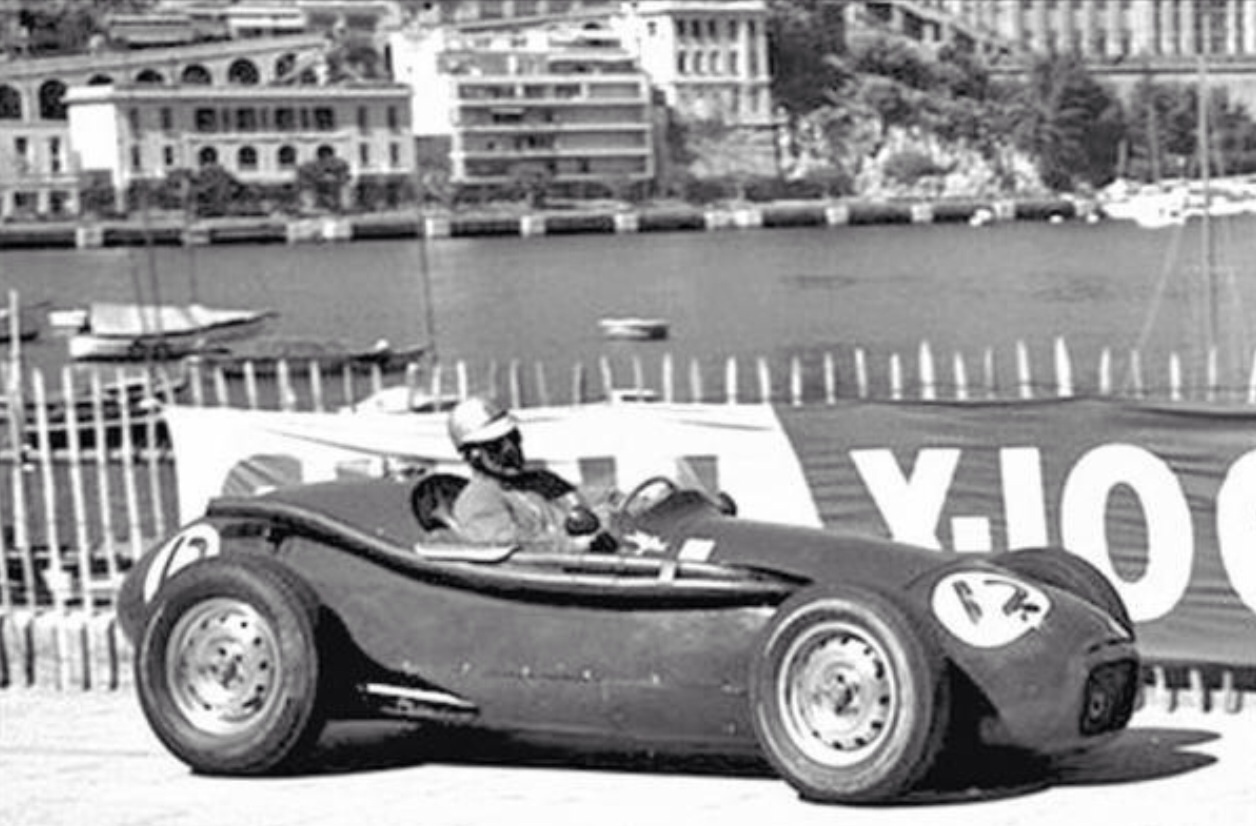
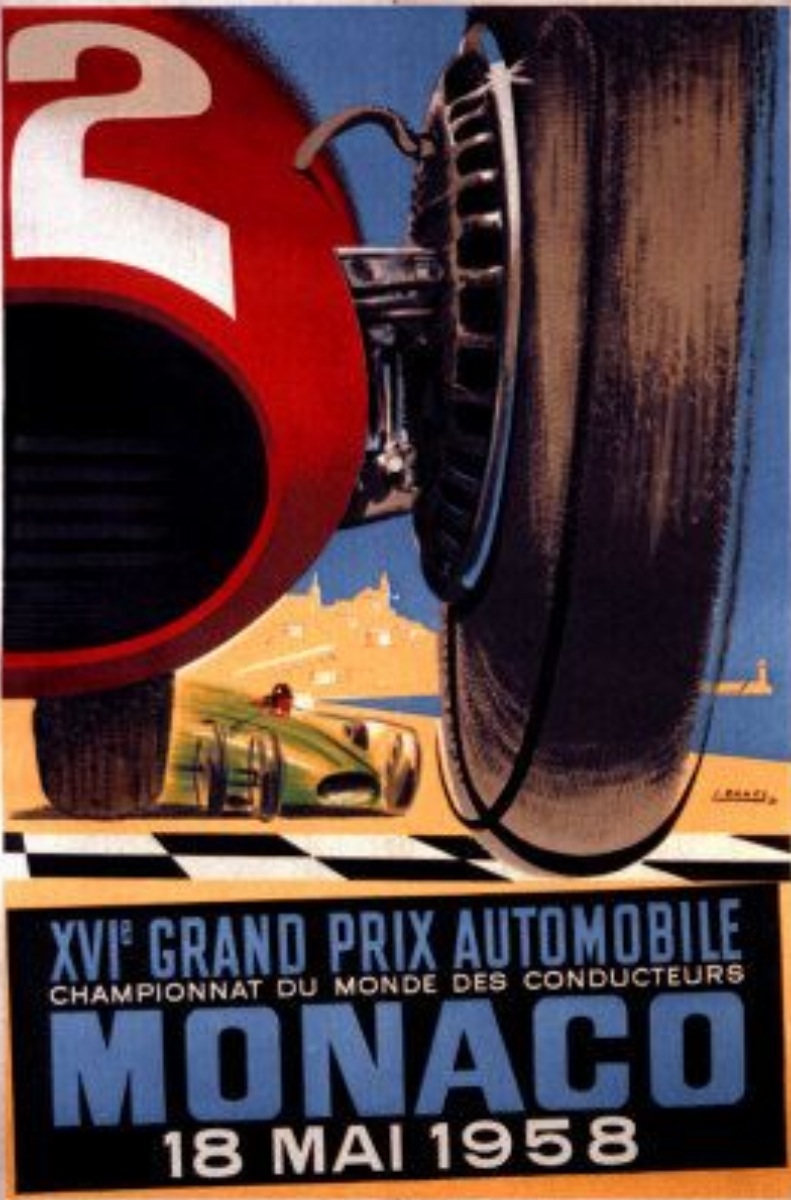
Cliff Allison releases his Lotus 12 Climax from the Monaco haybales on 18 May 1958, whilst teammate Graham Hill passes in the sister car…

It was a significant race for Lotus, their debut as Championship Grand Prix competitors, Allison was classified sixth and Hill’s race ended on lap 15 with engine dramas.

Coventry Climax had still not built a 2.5 litre version of their FPF 4 cylinder engine, so Lotus, like Cooper, were competing with engines of 1960cc, well below the 2.5 litre F1 capacity limit.

image

Jesse Alexander’s shot captures the atmosphere of Monaco ’58, shot taken from the ‘Milk Bar’

Times of change in racing are of immense interest to those of us with an historic bent. 1958/1959 is one of those eras with the growing influence of the ‘Green Cars’ a portent of the British dominance to come. And of course Cooper showing the mid-engined path still with us today.

allison

Cliff Allison at Monza in 1959 (Cahier)


lot 12

Lotus 12 in all its naked glory at Zandvoort in 1958. It was about as small as a front engined GP car could get, ignoring the fact it was designed as an F2 car! In 1958 ’twas as modern as tomorrow and as passe as yesterday simultaneously (Cahier)
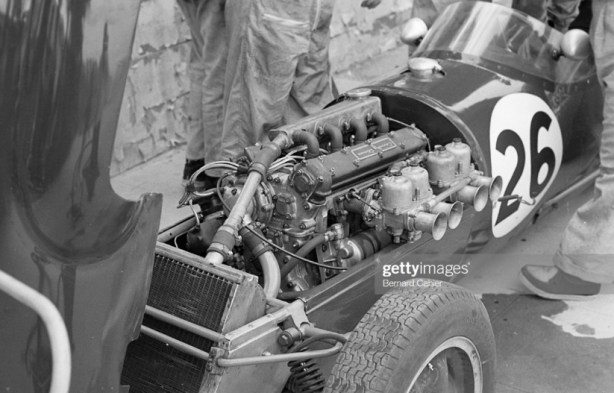
 

Note the twin dual-throat SU carbs and front roll bar double-tasking as a means of locating the upper suspension top link

Indicative of  mid-engined growing superiority was the failure of all the Maserati 250F’s entered to qualify- driven by Godia-Sales, Kavanagh, Taramazzo, Gerini, de Fillipis, Testut, Gould and the great, but ageing Monegasque Louis Chiron. Lets not forget that only the year before, 1957, Juan Manuel Fangio won the race in a factory ‘Piccolo’ 250F. And Moss also won aboard a 250F in 1956 for that matter too.

Successful British motor-cycle dealer BC Ecclestone had acquired the GP Connaughts but Bernie, Paul Emery and Bruce Kessler all failed to qualify the cars too.

image

Bernie Ecclestone trying hard to qualify his Connaught Type B Alta, to no avail as was the case for his 2 teammates (unattributed)

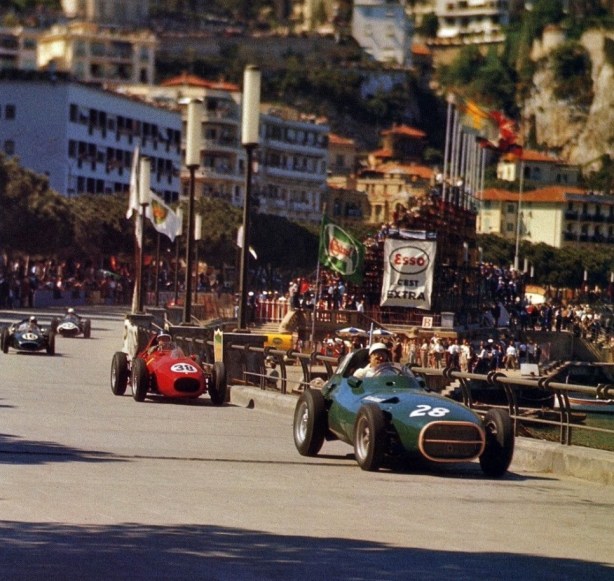
Things were better for the Green Cars at the front of the grid with Brooks, Behra and Brabham in Vanwall VW57, BRM P25 and Cooper Climax T45 respectively. Salvadori and Trintignant were next up in Coopers, the quickest Ferrari, Mike Hawthorn, was sixth in his Dino.

image

# 18 Savadori Cooper T45 Climax, # 6 Behra BRM P25, #16 Brabham Cooper T45 Climax, # 30 Brooks Vanwall VW57, winner Trintignant partially obscured behind Brabham Cooper T45 Climax, # 32 Lewis-Evans Vanwall VW57…and the rest, turn one, lap1 (unattributed)

In a race of changing fortunes Behra, Hawthorn and Moss all led but suffered mechanical failures.

Trintignant won the race in Rob Walker’s Cooper T45 Climax from Musso and Collins in Dinos. Moss’ Argentina Cooper T43 win was no ‘flash in the pan’ by any stretch…
image

Moss, Hawthorn, Brabham and Trintignant. Ferrari Dino 246, Vanwall VW57 with Monaco ‘snub nose’ and Coopers T45 Climax x 2 (unattributed)


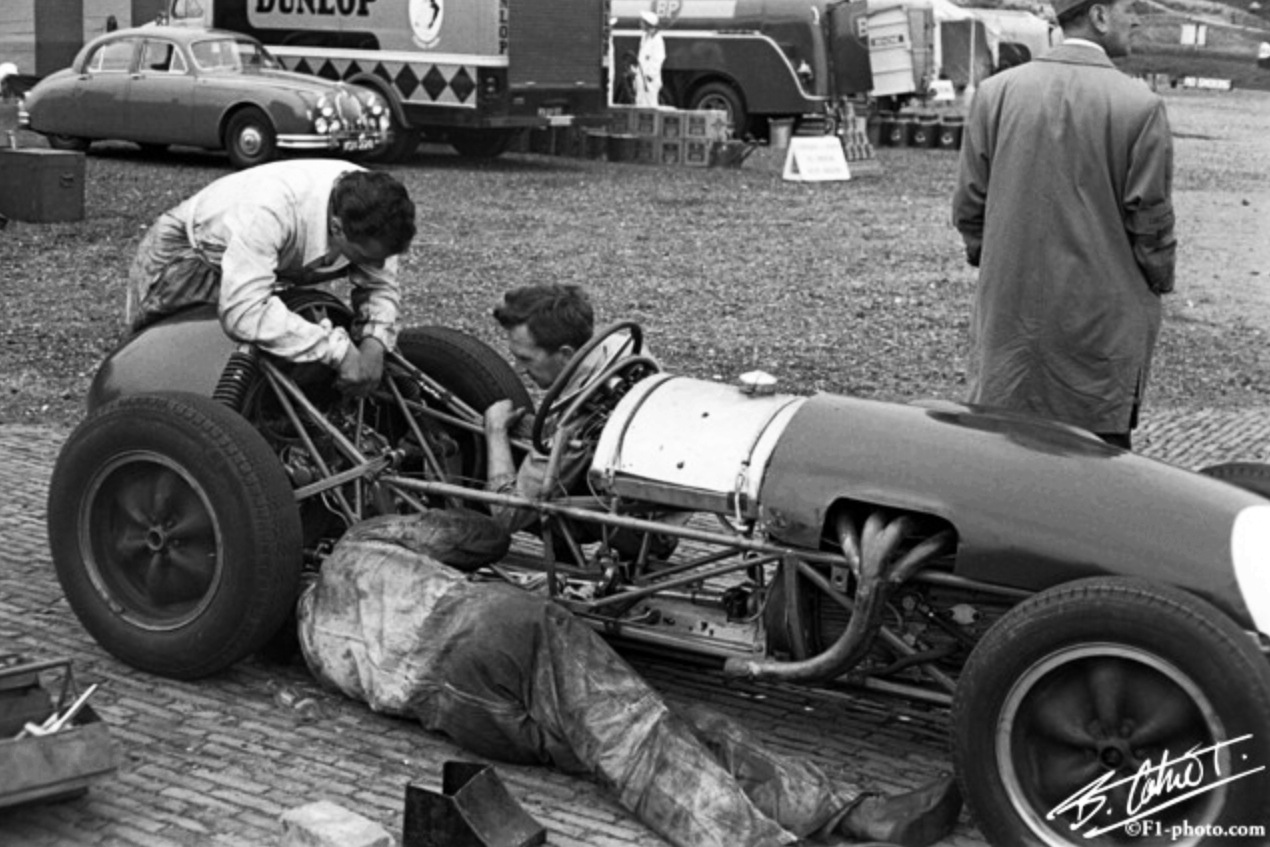
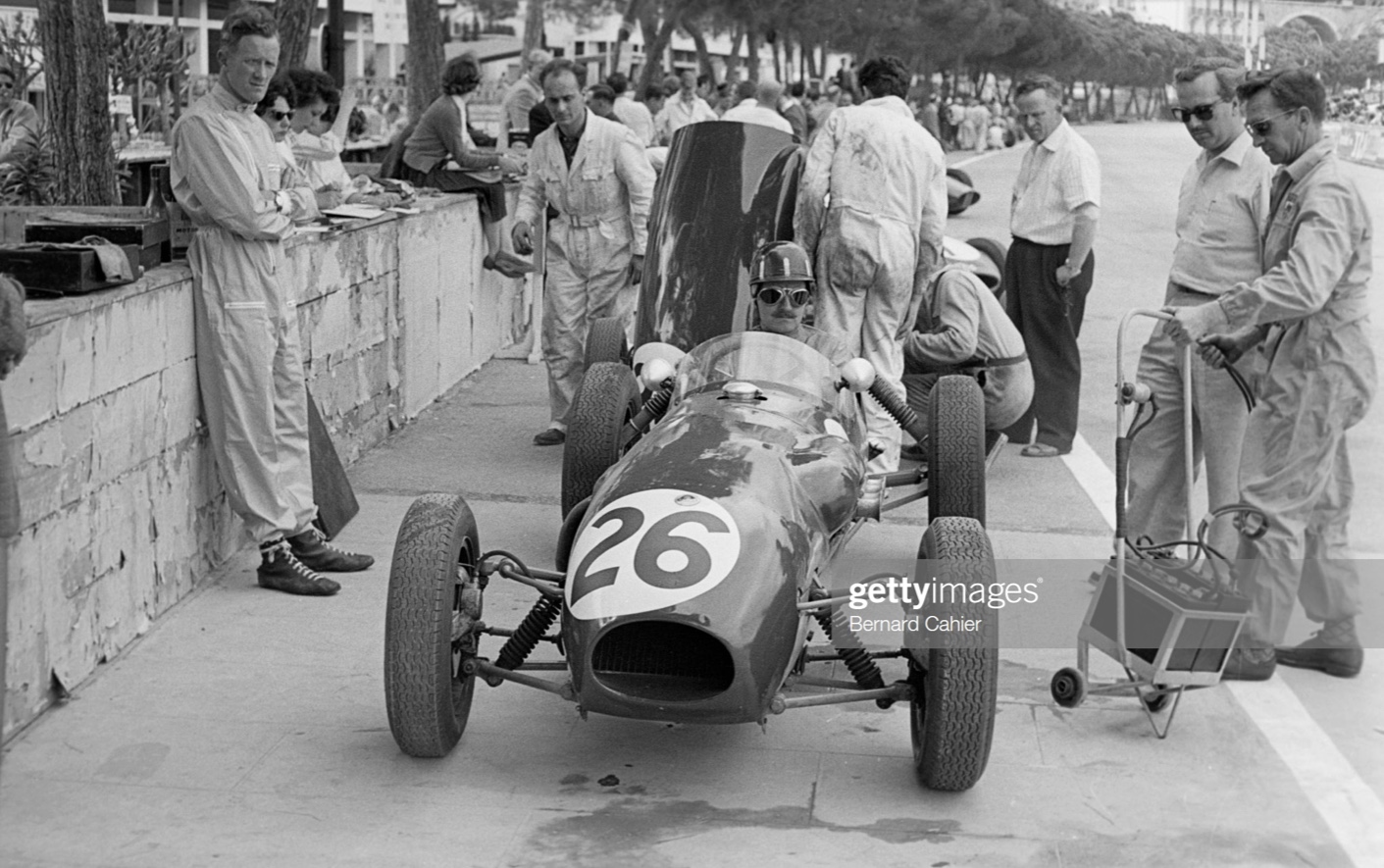
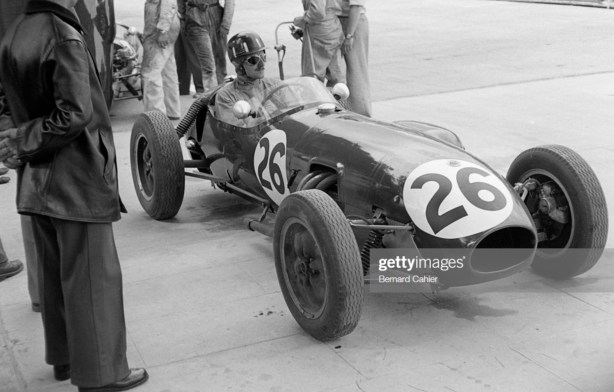
Graham Hill prepares for another practice lap whilst Cliff Allison looks on at left and Colin Chapman in the sunglasses at right.

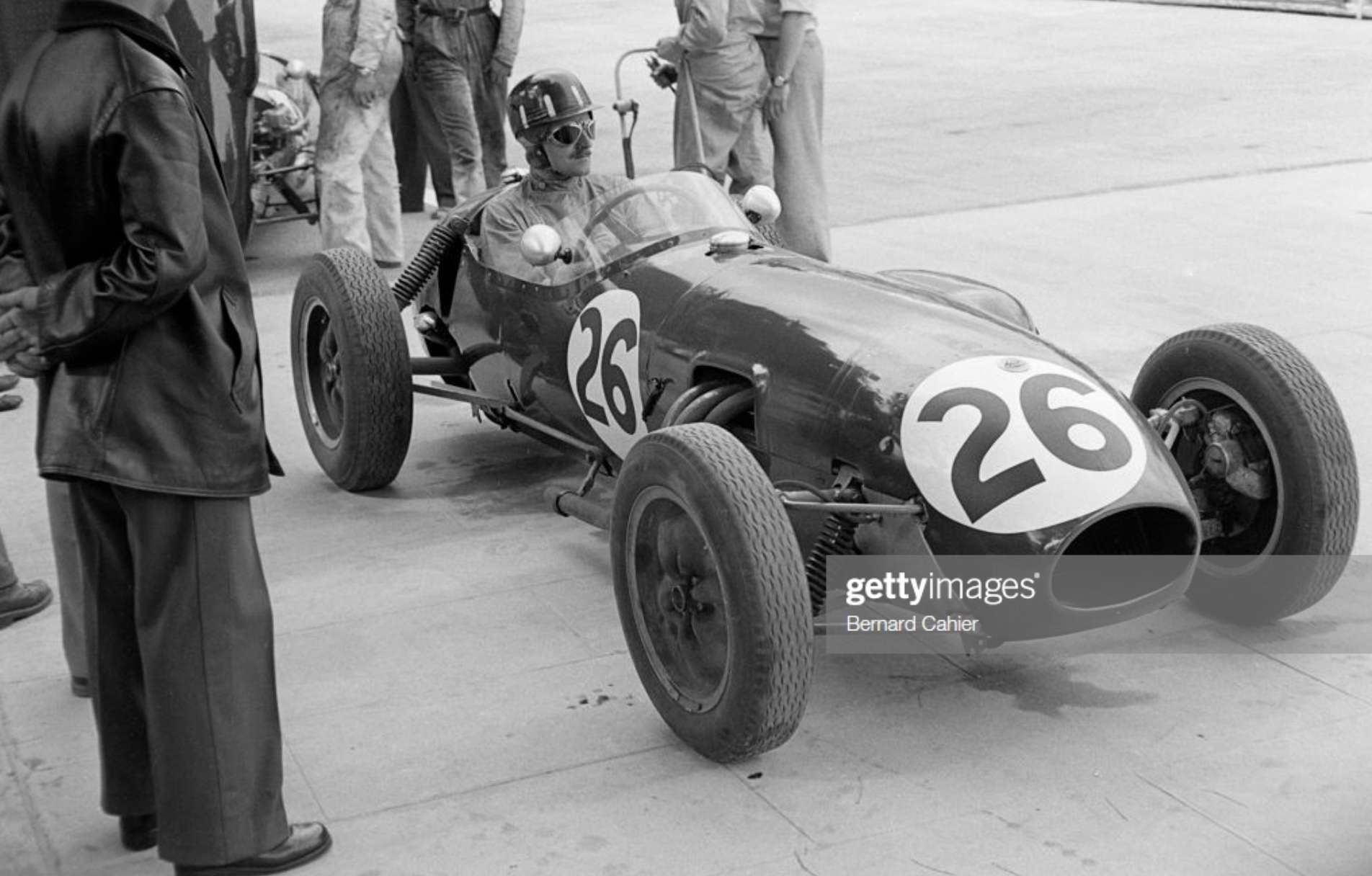
The Lotus 12 was Chapman’s 1957 F2 contender powered by a Coventry Climax 1.5 litre FPF engine.

Whilst competitive the lithe, nimble, light front-engined cars took no F2 race wins that year, Allison’s second late in the season at the Oulton Park International Cup was the best result.

Fitted with 2 litre FPF’s, ‘F1’ 12’s contested the Non-Championship 1957 Glover Trophy and Lavant Cup at Goodwood and BRDC International Trophy, Silverstone as well as the 1958 Glover Trophy, BARC 200 at Aintree and the BRDC International Trophy before their Monaco Championship debut. Allison’s fourth in the 1958 Glover Trophy aboard chassis ‘357’- the same car he raced in Monaco was the best result. Graham Hill’s car was ‘353’ which has resided, beautifully restored, with Mike Bennett in Adelaide for many years.

Beautiful shots above and below by Bernard Cahier shows the minimalist nature of the Hill Lotus 12 to great effect. Greatness was to come later with Lotus of course- a championship in 1968 after a remarkable stint with BRM.

In some ways its surprising that Chapman, the great innovator, didn’t go the mid-engined route with the Lotus 16, the 12’s successor but he got the hang of the mid-engined thing rather well with the 18 which followed- a machine which was rather successful in FJ, F2 and F1 in 1960.
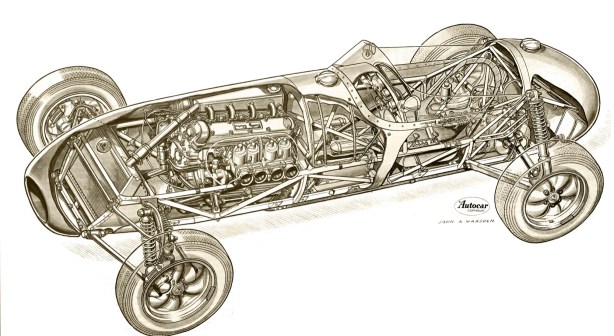
Lotus 12 Climax cutaway
 

Etcetera…

image

Photo and other Credits…

Jesse Alexander, The Cahier Archive, John Ross Motor Racing Archive, John Marsden

Tailpiece: Allison made the Lotus 12 sing…

alli italy

(John Ross)

As here at Monza 1958.

He put the car fifth on the British GP grid, well in front of Hill in the new Lotus 16, finished sixth at Zandvoort, fourth in the Belgian GP at Spa and seventh at Monza. Such were his performances he was off to Ferrari in 1959 at Enzo’s invitation

Finito…

image

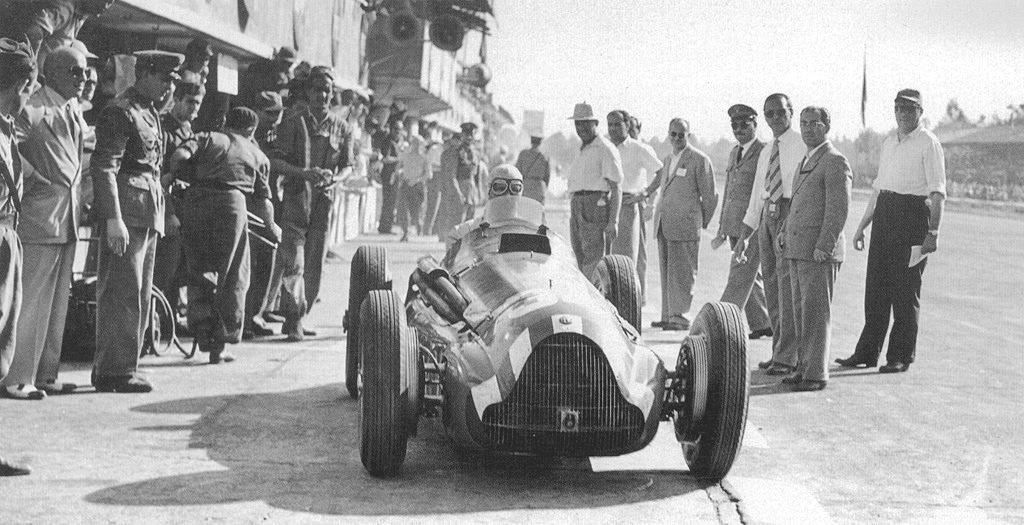
Achille Varzi’s Auto Union Type B pitstop during the 26 May Avus-Rennen, Berlin, 1935…

Note the onboard air-jacks, pretty schmick for 1935, I didn’t realise the technology went back that far, I wonder when they were first used in racing? It’s a nice shot also of the swing axle rear suspension, sprung by torsion bars in 1935 rather than the transverse leaf spring of the 1934 Type A.

Varzi was 3rd in his 4.9 litre V16 beastie, the race won by Luigi Fagioli’s Mercedes Benz W25. The race was a Formula Libre event so the German teams turned up with some streamliners including a Mercedes W25 for Hanns Geier, the cockpit cover of which could only be opened from the outside. No doubt Alfred Neubauer was happy to oblige at each pitstop.

rose race

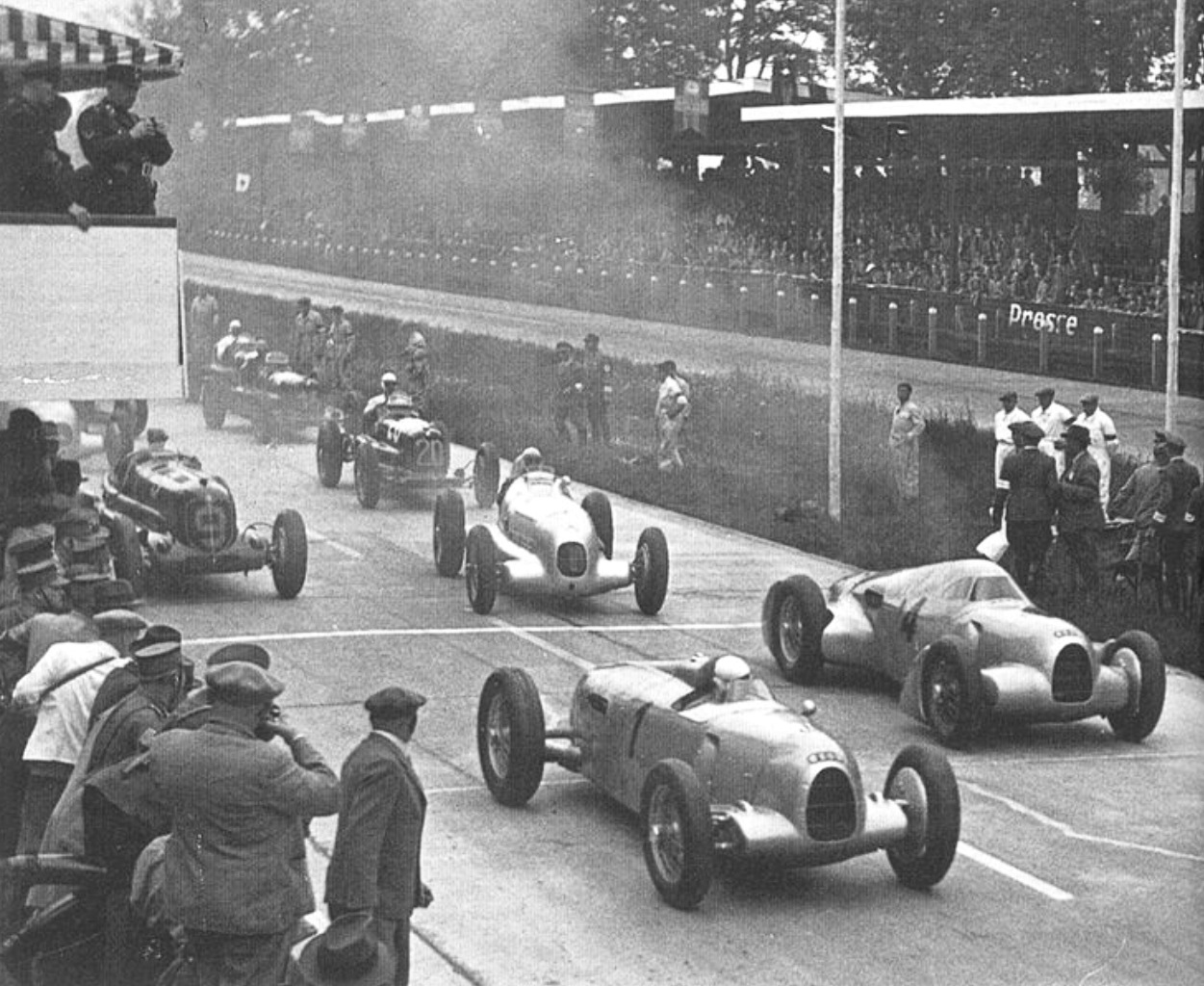
Avus 1935 heat 1 start; #1 Stuck AU Type B 1st from #4 Rosemeyer AU Type A Streamliner DNF, the Mercedes is Fagioli’s W25 2nd, #9 is Nuvolari’s Alfa Bimotore 6th, #20 Farina’s Maserati 4C 5th, #16 Siena’s Maserati 8C DNF (unattributed)

Continuing the themes of commonsense and bravery!, the meeting was also notable for the first ever car race of German ‘bike ace Bernd Rosemeyer. He ‘blagged his way’ into the Auto Union team for whom he raced from then until his untimely death in early 1938 during a brave land speed record Auto Union run. Read anything about this fella and the word brave will be peppered throughout the article.

The car racer novice plonked the notoriously twitchy 375bhp mid-engined Type B on the front row for his heat on the fastest circuit in the world, the AU’s were seeing 326kmh along Avus’ long straights. He punctured a tyre during his 7 lap heat so didn’t make the final which comprised the first 4 placegetters in each of the heats, but he had well and truly ‘arrived’…

Check out Kolumbus F1’s ’35 Avus race report, this being my favourite Pre-War race results site, have a good poke around if you haven’t visited it before;

http://www.kolumbus.fi/leif.snellman/gp3503.htm#9

Credits…

Kolumbus F1, Ullstein Bild, Zoltan Glass

image

Auto Union Type A engine and rear suspension (Zoltan Glass)

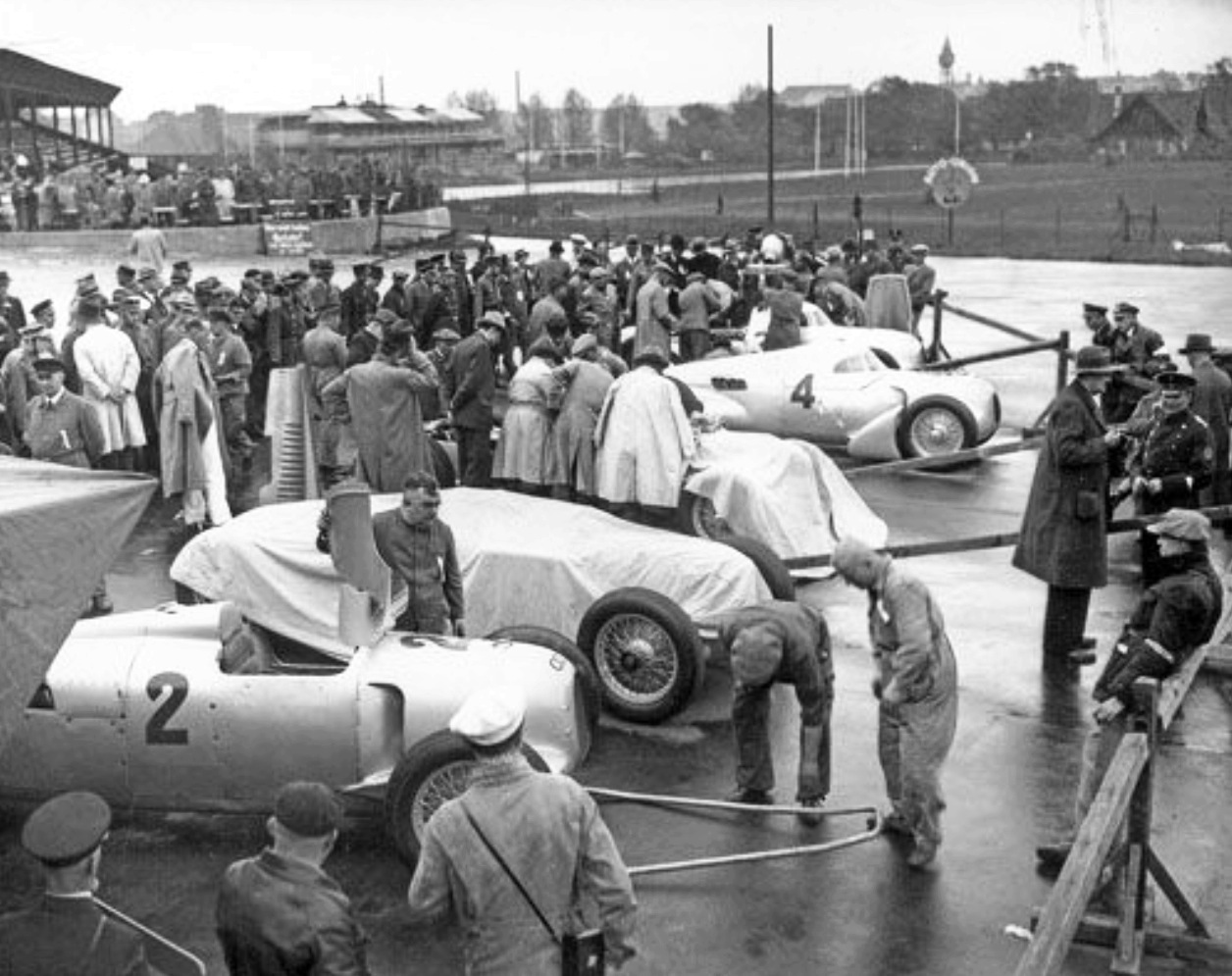
Tailpiece: Varzi’s Auto Union Type B 4.9 V16 and Rosemeyer’s AU Type A 4.3 V16 in the 1935 Avus paddock…

rose pits

(unattributed)