Archive for the ‘Icons & Iconoclasts’ Category

At 8.10am on 17 July 1964 Donald Campbell aboard Bluebird CN7 Proteus set the World Land Speed Record on South Australia’s Lake Eyre salt pans…

I wrote about this achievement a while back, in fact it was my first longer article, click here to read it;

50 years Ago Today : 17 July 1964 : Donald Campbell Broke the World Land Speed Record in ‘Bluebird’ at Lake Eyre, South Australia, a Speed Of 403.10 MPH…

One of the wonderful things about the internet is the constant appearance of material on every topic, in this case a nice batch of photos popped onto it by ‘The Adelaide Advertiser’, here they are, too good not to share.

To celebrate Campbell’s achievement the people of Adelaide turned out in droves- about 200,000 flooded the streets of the small city on 25 July to see and hear Bluebird drive up King William Street to the Adelaide Town Hall. Mind you, ‘Beatle-Mania’ hit Adelaide five weeks before when 300,000 fans of the worlds greatest supergroup flooded into the capital.

Campbell also set the World Water Speed Record in 1964, achieving 276.3 mph at Lake Dumbleyung near Perth in Bluebird K7.

Photo Credits…

Adelaide Advertiser

Etcetera: Adelaide Excitement…

Tailpiece…


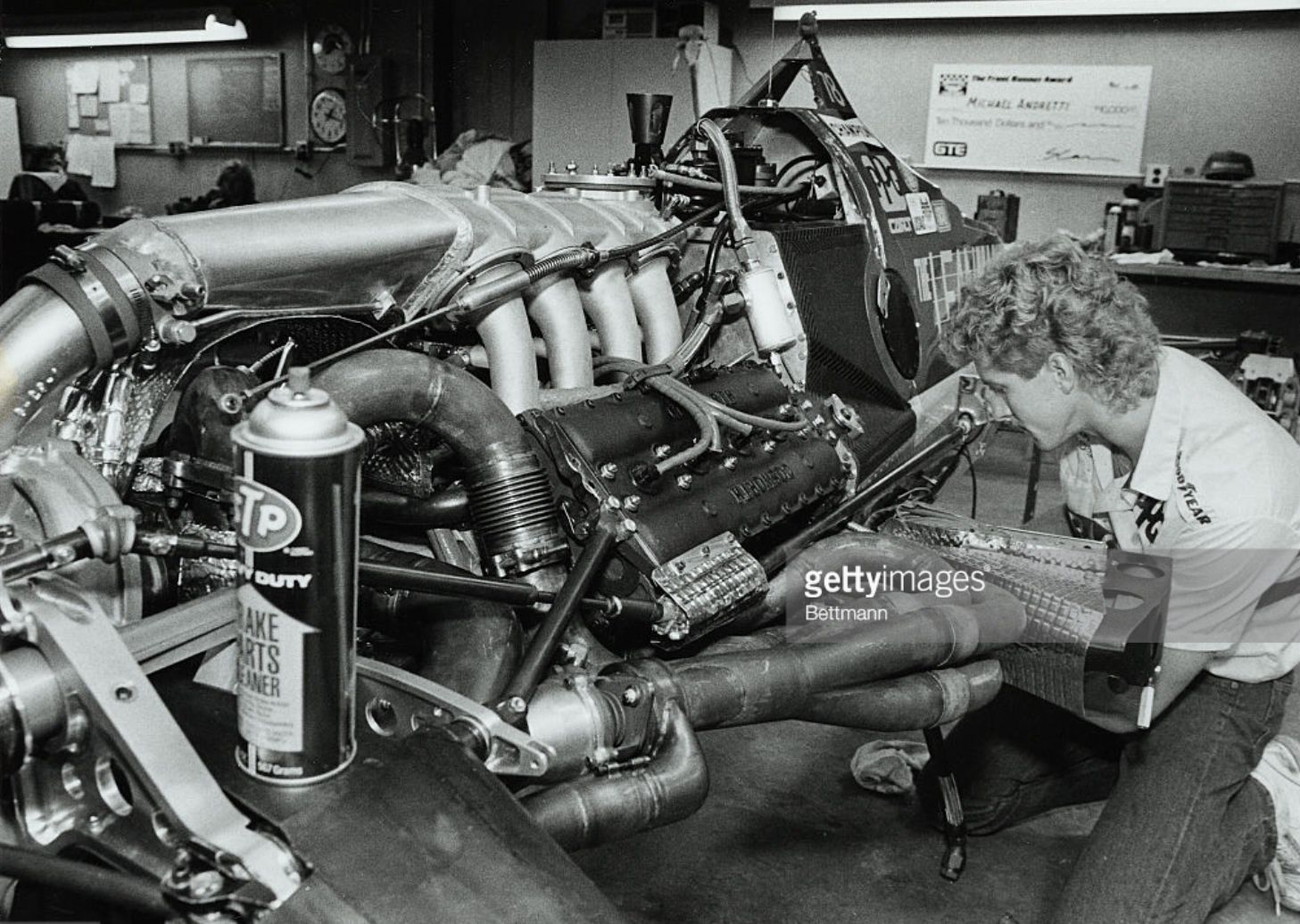
Dan Drinan prepares Michael Andretti’s March 86C Cosworth DFX at Indy, 19 May 1986…

It’s the final few days of preparation before Carb Day and the last chance to test the car before the Memorial Day classic on 31 May. Michael’s cheque for qualifying third is on the wall.

Bobby Rahal won in a similar March with Michael sixth from grid three having led 45 of the 200 laps, including the first 42. In a rout for March, the Bicester concern had cars in nine of the top-ten placings, the only interloper was Al Unser Jr’s Lola Cosworth in fifth.

Rick Mears, Kevin Cogan and Rahal battled for the lead. In an emotional win, Rahal got the jump from Cogan after a lap 194 restart and took victory for team owner Jim Trueman who died of cancer eleven days later. Rick Mears was third.

Michael Andretti, Indy 500 1986, March 86C Cosworth (B Harmeyer)

With an opening photo like that the focus has to be on that magnificent engine and it’s conversion from F1 ubiquity to CART interloper.

John Barnard’s appointment to replace Maurice Philippe as designer for the Vels-Parnelli F1 and Indy team was at the behest of his former Lola colleague, Jim Chapman, then VPJ Team Manager.

Barnard achieved much with VPJ and Chaparral before returning to Europe and staggering F1 success with McLaren. It’s his role in development of what became the Cosworth DFX V8 turbo which is of interest in this article.

John’s primary VPJ role was to design and develop the ground-breaking Parnelli VPJ6B and 6C which introduced the turbo-Cosworth DFX to Indycar racing. Over the next dozen years the engine dominated, winning 151 races, including 10 consecutive Indy 500s from 1978-87.

When Barnard arrived in South California in 1975 he was thrown into the deep end, fettling the team’s F1 car and designing the drivetrain for Parnelli Jones’ off-road Ford truck, you can’t argue with those extremes of variety.

Danny ‘On The Gas’ Ongais, Parnelli VPJ6B Cosworth, Indy 1977 20th from Q7 (B Harmeyer)
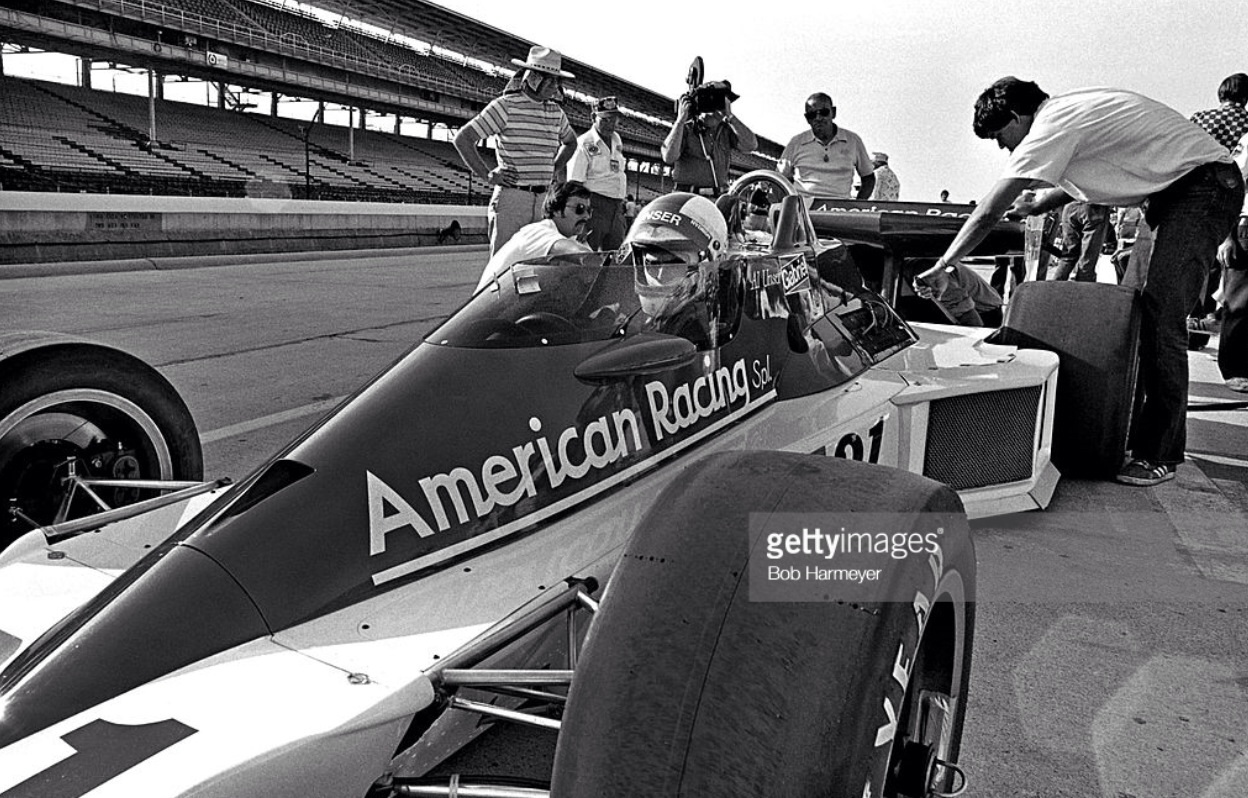
Al Unsers VPJ6B rear, Indy 1977. Note turbo plumbing and wastegate outlet (B Harmeyer)

Through the early and mid-1970s Indycars were allowed to run unlimited boost, the ageing four-cylinder Offenhauser was finally pushed way beyond its limits. “I was on USAC’s rules committee and we kept blowing up engines,” says Parnelli Jones in a Gordon Kirby article published in MotorSport.

“You could not buy an engine from Drake Engineering (manufacturers of the Offy) and run 500 miles. You couldn’t even run it 100 miles because of porosity in the engines. We had a machine to impregnate the engines so we could keep ours together, but you had to pull it all apart and blueprint it after you bought it…Then USAC cut the fuel mileage back to 1.8 mpg and I said to Vel, “We’ve got those little Formula 1 Cosworths. I think they could work’.”

In amongst the team’s F1, USAC and F5000 programs Barnard was beavering away converting the F1 design into a USAC car using a mix of changes including turbo-charging the Cosworth DFV F1 motor.

John Barnard picks up the design changes: “It was actually a completely new chassis. We put coil springs on the rear, but I kept the torsion bars on the front. The Brit strengthened the car by double-skinning the monocoque and designing a much stronger front bulkhead. “That proved very useful,” Barnard says. “In ’77 we were practising at Indy and Al ran over Janet Guthrie’s turbine wheel, which came out on the track, and had quite a big accident. But he walked away. I was glad I had double-skinned that front bulkhead.”

The resulting VPJ6B was a much smaller overall package than the existing Offy and Foyt/Ford-powered chassis’ then racing.

Ongais again in 1977, note front suspension linkages, torsion bars the spring medium up front (B Harmeyer)
Unser 1977, Q3 and third in the race won by AJ Foyt’s Coyote Foyt/Ford V8 turbo and Tom Sneva McLaren M24 Cosworth who started from pole (B Harmeyer)

Barnard also designed many key components for VPJ’s DFX development program. “There was a lot to do on the engine, inlet manifolds and all sorts of things. I was drawing conrods and pistons, an oil pump system, fuel injection and God knows what else. It was fantastic for me because I had never really got into engines much, but we had our engine shop so we could do this stuff to every part of the car and engine. It was fantastic, just like having a toy shop.”

But there was little support from Keith Duckworth for turbocharging the DFV. Duckworth famously didn’t believe in turbos. “I remember him giving me a lecture about turbos,” Barnard adds, “and another one about why 4WD wouldn’t work. I remember Vel reporting that Cosworth told him he was a bit of a twit trying to get all this horsepower out of an engine that was designed to generate 500bhp, and there we were getting more than 800,” Barnard says. “Vel told me, ‘Those bloody guys at Cosworth don’t mind selling me pistons and heads all the time. I’ve spent $100,000 with them just on pistons.’ But they told him we were idiots for making a turbocharged version of their engine.”

Unser and Andretti ran a few practice laps at Indianapolis that year in an early version of the VPJ6. The first complete 6B made its debut in Unser’s hands in 1975’s season-closing race at Phoenix, finishing fifth. “Once we got in the right ballpark with wheel and spring rates we had pretty good balance, and it got better and better,” Barnard remembers. “We continued to muck about with the engine. It was an ongoing programme. I was making wastegates and all sorts of things.”

Unser scored the Parnelli Cosworth’s first win in the Pocono 500 in June 1976, then won again at Milwaukee in August and Phoenix at the end of the season. “We proved that the engine worked and we brought Duckworth over to Pocono because we wanted to get a distributorship for the Cosworth Indy programme,” Parnelli recalls. “So Duckworth came over and damned if he didn’t turn around and steal Larry Slutter and Chickie from us.”

Ongais 1977 (B Harmeyer)
Unser 1977, gorgeous bit of engineering kit. Took the first Cosworth DFX Indy win aboard a Chaparral Lola in 1978, 11 of the 33 starters were Cosworth powered  (B Harmeyer)

Barnard took a dim view of Duckworth’s manoeuvre. “As soon as we won Pocono, Cosworth saw the light. It wasn’t long afterwards that they nicked Larry Slutter and set their own engine shop up right there in Torrance, which to be honest I thought was pretty mean. “I was told by somebody at Cosworth many years later that the turbo Indy engine programme – the DFX as they called it – was their most profitable programme of all. So I wasn’t impressed with the way they did that. Vel and Parnelli were the ones putting their hands in their pockets to develop this car and engine, and I don’t think they ever got the proper credit.”

After all the money and effort VPJ had put into developing the engine, not being able to turn it into a commercial enterprise was a big blow, playing a role in the team’s demise a few years later. “Of course,” Jones says, “we were in a catch-22 because you had to satisfy your sponsors and we needed to order parts from Duckworth. We could have sued him, but we decided to try to work with him.”

For the 1977 season both McLaren and Penske built new Fl-based cars with DFX engines. Tom Sneva won the USAC Championship aboard Penske’s Cosworth-powered McLaren M24 and Penske PC5. Johnny Rutherford also won four USAC races in the works McLaren DFX, while Unser and new team-mate Danny Ongais each won a single race, with Big Al taking the California 500.

Barnard quipped “I didn’t start the Cosworth programme,” he adds, “but I had most of the input making a car work around that engine. Looking back, I learned massive amounts and enjoyed it, too. It was bloody hard work, but I was a young man and ready to do whatever it took.”

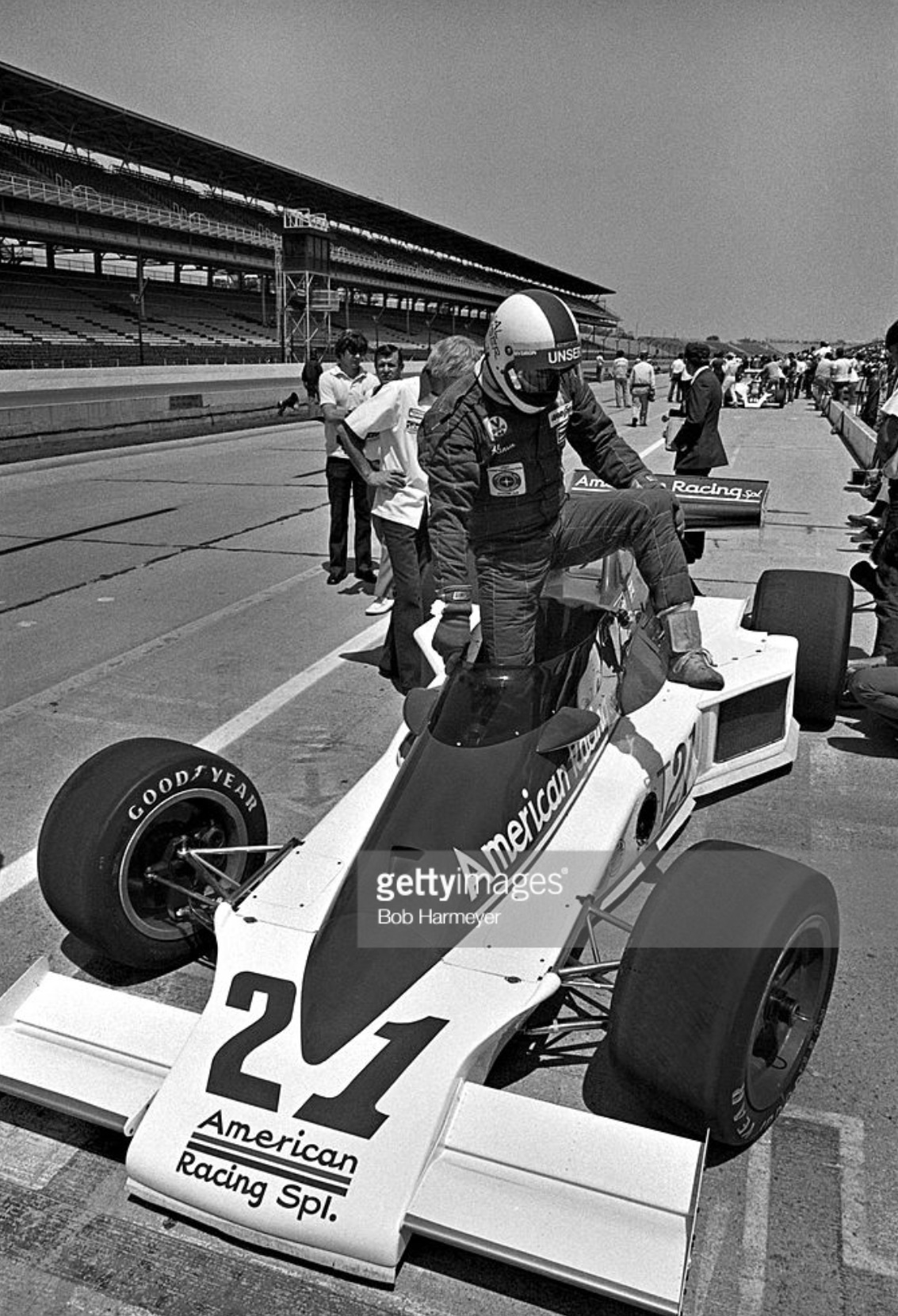
Unser 1977, classic aero of that just before ground effect period. The F1 Lotus 78 raced throughout 1977- the first of the Lotus g/e’s (B Harmeyer)

Bibliography/Credits…

MotorSport article by Gordon Kirby in 2013, Getty Images-Bettman and Bob Harmeyer

Tailpiece…

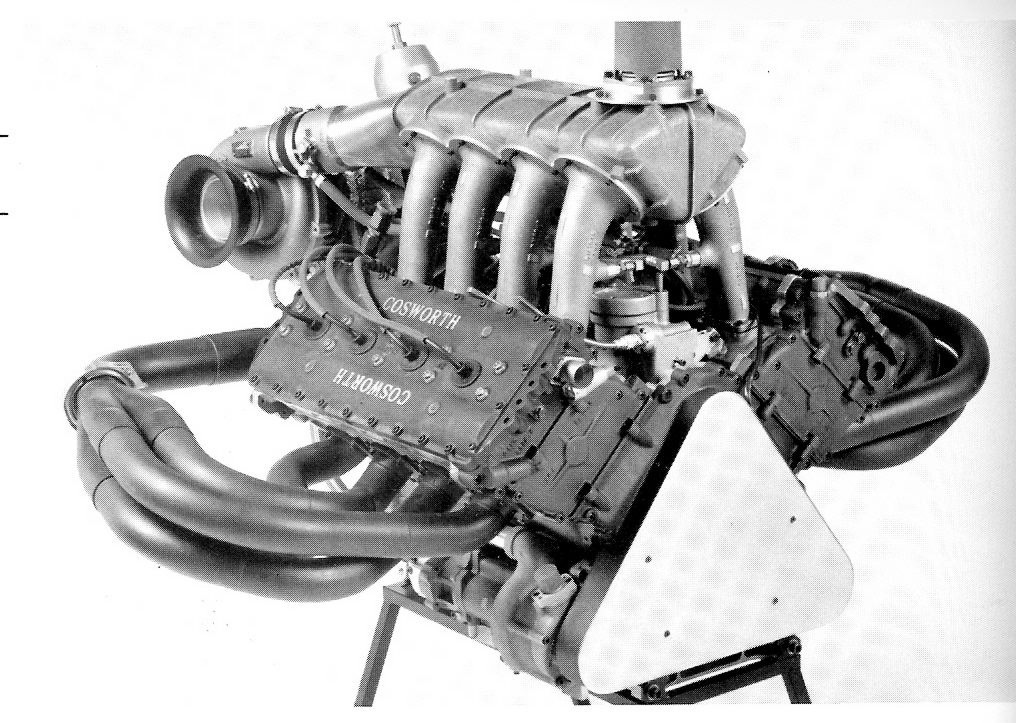
Cosworth Engineering studio shot of the DFX, engine number unknown.

Finito…

Peter Brock in his Birrana 272 Ford at Winton in 1973…

Brocky was very hot property in 1973 having seized the public spotlight with the last solo Bathurst win aboard his Holden Dealer Team Torana GTR XU1 in October 1972. Every young bloke in Australia wanted to emulate him, and many women wanted to shag him, including Miss Australia as it transpired!

Purists were delighted when he bought 272-002, Tony Alcock’s first monocoque Birrana to contest the Australian F2 Championship, but sadly he didn’t race the car for long, soon returning to the touring car ranks.

Tony Alcock’s first Birrana, the F71 Formula Ford was built in Sydney and initially raced by one of Brock’s touring car sparring partners, John Goss. Then Tony returned to his Adelaide home town and started to build Birrana’s in numbers in partnership with Malcolm Ramsay, in 1972 building two F72 Formula Fords and 272-002. Their first ANF2 car was raced by Ramsay, dual Australian F2 champion Henk Woelders and Gold Star champion Leo Geoghegan before being sold to Brock.


PB raced it at Hume Weir, Winton and Oran Park to get his hand in prior to the start of the 1973 F2 Championship which commenced at Hume Weir in June.

Brock was second to that years champion Leo Geoghegan at Oran Park on 5 August and then sixth at Amaroo on 19 August, in a Birrana 273, chassis 273-008. He updated to the best car of the season, Geoghegan galloping to the title with wins in every round but one. Its not clear exactly how many meetings Brock did in the two cars but he certainly raced the 272 at Hume Weir, Winton, Calder and Oran Park and raced the 273 at Oran Park and Amaroo Park.

Running the Lotus Ford twin-cam engine was said to be a commercial barrier to the continuation of Brock’s F2 program given his Holden Dealer Team contract, but perhaps the reality of running his own car again with the assistance of his dad was just all too hard compared with being a works driver with all of its benefits. It was such a shame, Brock’s sublime skills deserved to be deployed in racing cars as well as the tourers of all sorts in which he excelled.

Brock’s talent was clear from the start aboard his Holden engined Austin A30, his aptitude very quickly accepted once others drove that car, none of those who raced it or track-tested it could work out how he did the times he did: not Ross Bond, Peter Wherrett or Rob Luck.

The little rocket was a mix of lightweight Austin stripped shell, highly modified Holden 179 6-cylinder ‘red motor’ giving circa 200bhp using triple two-inch SU carbs, Holden three, and later four speed ‘box, rear axle assembly wheel to wheel with a Holden front end and Triumph Herald steering rack with disc front brakes and drum rears.

During the early-mid seventies glory F5000 years it always seemed to me the union between Holden and Repco would see him aboard a big, powerful single-seater car at some point, but the closest that ever came to fruition was the Repco Holden F5000 V8 engined Torana sports-sedan The Beast, which was not exactly what I had in mind at all. Still, what was in that for Holden or Repco I guess? Holden sold sedans not racing cars, so they hardly needed PB racing one of those dangerous things and Repco’s works F5000 driver was Frank Matich. A guest drive in a Matich would have been nice all the same…


Steps in the right direction were his international drives at Le Mans in 1976 aboard a Bill Patterson supported BMW 3.5 CSL Group 5 machine paired with Aussie International Brian Muir. Now that would have been a career to emulate in terms of a mix of sedans and sportscars based in the UK?

Spa in a works Vauxhall Firenza Magnum 2300 paired with Gerry Marshall yielded an amazing second outright in the 24 Hour classic in 1977.

Brock’s status as one of the best Touring Car Drivers of them all was confirmed by MotorSport in 2005 who rated him the greatest in an article contributed to by an array of global commentators of the top-20 of all time.

The Bob Jane supported attempt on the 1984 24 Hours of Le Mans, with Brock partnered by Larry Perkins in a customer Porsche 956 captured all of our imaginations and to me was exactly where that pair belonged and deserved to be. Sadly the warm-up Silverstone 1000 Km and Le Mans was as far as it went. At Le Mans they retired after an LP mistake during the night.


If only Brock had raced the 1974 Australian F2 Championship in a good car amidst one of the best grids of any single-seater championship in Australia ever- with success his career direction may have encompassed racing cars as well as tourers, rallycross and rallies.

Not half versatile was he?

Etcetera…

It’s interesting to get Brocky’s initial impressions of driving the Birrana, here recorded in his Auto Action column published in the March 16, 1973.

Birrana Cars Feature…

Photo and Other Credits…

autopics.com.au, Robert Davies, Lynton Hemer, Getty Images, Dean Oliver, tentenths.com

Tailpiece…

Outta my way big guy. Sydney during the PR build up to Le Mans 1984, Porsche 956 chassis ‘110’…

Finito…


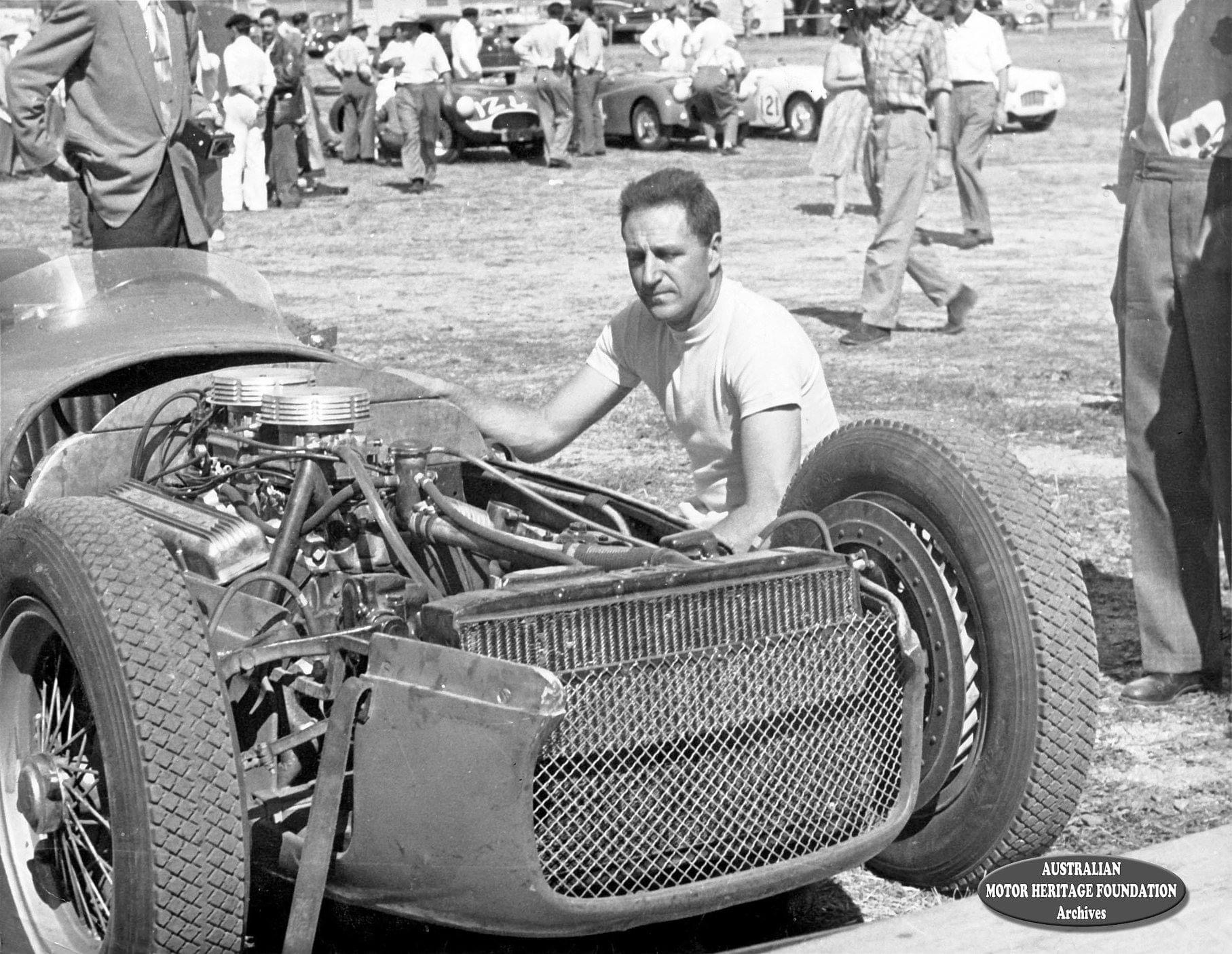
Front wishbone and lever arm shock and lower transverse leaf spring. Chev Corvette 283 cid V8 topped by 2 Carter 4 barrel carbs, note how the engine and drivetrain are offset to the right with the driver sitting nice and low to the left rather than above the prop-shaft. Bob Burnett built this body as he did the other Maybachs. Handsome brute (Q Miles)

Stan Jones, Maybach 4 Chev in the Lowood, Queensland paddock, June 1959…

I love Quentin Miles wonderful clear period photo of the fun of the fair and especially the business end of the last car built in the most famous range of Australian Specials- not that the ‘Special’ descriptor does justice to the quality of the design and construction of the Maybachs under Charlie Dean’s leadership at Repco Research in Sydney Road, Brunswick, in Melbourne’s inner north.

In essence my article about Stan Jones is also a piece about Maybach- it together with the 1954 Southport Australian Grand Prix feature provide plenty of background on the cars and their progressive evolution from Maybach 1- the 1954 NZ GP winner, the shortlived Maybach 2 which should have won the ’54 AGP but instead died a violent death during that race, and the replacement Mercedes Benz W154 inspired Maybach 3- the final iteration of the Maybach 6-cylinder engined machines. Maybach 3 became Maybach 4 when Ern Seeliger skilfully re-engineered aspects of the car to accept the new, lightish Chev, 283 cid ‘small-block’, cast-iron, pushrod OHV V8. Click here for Stan and Maybach;

Stan Jones: Australian and New Zealand Grand Prix and Gold Star Winner…

and here for the ’54 AGP;

1954 Australian Grand Prix, Southport, Qld…

Jones’ forceful speed and the ongoing evolution of the Maybachs kept the cars at the forefront of Australian single-seater racing into 1955 but game-changers were the arrival of modern ‘red cars’- Lex Davison’s acquisition of Tony Gaze’ Ferrari 500/625, Reg Hunt’s Maser 250F powered A6GCM and his subsequent 250F to name two.

Stan gave up the unequal struggle and acquired a 250F, ultimately doing very well with it- winning the ’58 Gold Star and the ’59 AGP at Longford, thank goodness he finally won the race in which he had deserved to triumph for the best part of a decade.

Even though the Maser was his front line tool he was not averse to giving Maybach a gallop, as here on the Queensland airfield circuit.

Jones at speed on the Lowood airfield circuit, Maybach 4 Chev, June 1959 (Q Miles)

As Stanley focussed on the Maserati, Maybach 3 languished in a corner of Ern Seeliger’s workshop in Baker Street, Richmond. Ern was a successful racer, engineer/preparer and a close friend of Jones. With a view to selling it Stan handed Seeliger the car telling him to ‘do what he liked with it’.

The essential elements of Maybach 3 were a chassis built up from two 4 inch diameter steel tubes, the Maybach 3.8 litre, 260 bhp, SOHC 6 cylinder engine fitted with a Charlie Dean/Phil Irving designed and carefully cobbled together fuel injection system, the engine laid down at an angle of about 60 degrees to the left to lower the bonnet line, like the W196- the car was also styled along the lines of that Benz. The cars front suspension comprised upper wishbones and a lower transverse leaf spring and at the rear utilised quarter elliptic leaf springs and radius rods. Brakes were PBR drums and the gearbox a 4 speed manual.

Towards the end of its life the limiting factor of Maybach 3’s performance was the end of Charlie Dean’s supply of Maybach engines, no more power could be squeezed from them- and there were none left in any event!

In addition there were now plenty of competitive well sorted cars. The only locally built racer capable of running with Hunt, Davison and Jones was the Lou Abrahams owned and built, Ted Gray driven Tornado Ford V8- and from late September 1957, Tornado Chev V8. There is little doubt that Ern looked long and hard at a machine that was prepared only 1.5 Km from his own ‘shop for inspiration. Click here for the Tornado story;

‘The Longford Trophy’ 1958: The Tornados: Ted Gray…

Pretty soon a 283 Chev was on its way to Australia, Seeliger modified the 4.6 litre V8 by fitment of two Carter 4-barrel carbs, the cylinder heads and valve gear were ported, polished and lightened, with the oilways modified and the unit dry-sumped. The motor produced about 274 bhp @ 6000 rpm and had a truckload of torque- around 300 lb feet of it at 3500 rpm. Ern and his band of merry men did not just plonk the engine into the space formerly occupied by the German straight-six however.

Seeliger thoroughly overhauled the machine, lengthening the chassis to accept the de Dion rear end he designed to better put the cars power and torque to the road. A transverse leaf spring was installed instead of the quarter elliptics and an anti-roll bar used at the front incorporating brake torque rods. The rear track was widened by an inch and a larger 30 gallon fuel tank fitted to feed the thirsty Chevy.

Seeliger designed and built a multi-plate clutch which used the existing Maybach 4 speed ‘box and diff albeit modified with shortened axles and cv joints to mate with the de Dion tube.

Stan Jones and Alec Mildren at Port Wakefield in 1959. Maybach 4 Chev and Cooper T45 Climax (K Drage)

Ern made the cars debut in this form at Fishermans Bend in March 1958, his bid for victory came to an end with stripped tyres- the car was quick right out of the box, Seeliger a mighty fine design and development engineer.

Whilst a very good driver he was not in Stan’s league- Jones was stiff not to win the ’58 AGP at Bathurst aboard his 250F- as was Ted Gray unlucky to dip out in Tornado 2 Chev, but Seeliger finished 2nd in the Maybach with Lex Davison, always a lucky AGP competitor, the winner. Be in no doubt my friends Maybach 4 Chev in Jones hands was a winning car- had he felt so inclined in 1958 but he was busy winning the Gold Star aboard the 250F in any event.

Into 1959 Maybach 4 was still competitive in Ern’s hands, and Stanley took a win in the Gold Star, South Australian Trophy event at Port Wakefield in late March and 3rd place in the Lowood Trophy race as pictured in this article behind the Cooper Climaxes of Alec Mildren and Bill Patterson. Before too long Stan would show his speed in a Cooper T51.

The reign of the ‘Red Cars’ was quickly coming to an end In Australia but lets never forget the dark blue Tornado 2 and silver/blue Maybach 4- Chev V8 engined locally engineered devices very much as quick as the more sophisticated, twin-cam, exotic, expensive factory cars from Italy’s north…

Etcetera…

Seeliger, above, with his mount at Bathurst during the 1958 Australian Grand Prix weekend- and a successful meeting too, second behind Lex Davison’s Ferrari 500/625 3 litre.

In June 2020 i was contacted by Melbourne enthusiast John Comber who had done a weeks work experience as a fifteen year old at Seeliger’s Baker Street, Richmond workshop in 1958.

On the strength of that he embarked on a Panel Beating career- his recollections recorded in a creative writing class not so long ago are a wonderful step back in time as a youth’s perspective of Ern’s workshop.

‘…My second job was also with a neighbour, Mr Seeliger, who had a small automotive engineering business in Richmond…The arrangements were for me and my friend Trevor to be at the Seeliger’s house at 7.30 am Monday morning, do a days work and see how we liked it.’

‘On the Monday, with a  packed lunch and wearing our best “old clothes” we arrived at 7.30 just as Mr Seeliger was starting the engine of his utility. “Jump in boys” he said and we took off straight away, heading for Richmond (from Blackburn).’

‘I still remember quite clearly his opening comments, “Well i have the right job for you two bastards today, you can clean some car parts with kero, “That’ll keep you busy”.

‘The thought of cleaning the car parts with kerosene didn’t faze me but the language had caused me something of a jolt. To me this was school-yard  language and i wasn’t used to adults swearing, certainly not from my parents or relatives, or family friends.’

‘Well the rest of the day turned out fine, Trevor and i set-to with a can of kerosene cleaning mechanical parts and some body parts as well. This was quite an easy job and allowed us to look around and take in the surroundings. Mr Seeliger’s workshop  was converted from some old run-down stables with cobblestones between the sheds and an overhead loft used for storage. The yard was quite large with grass growing between some old cars and car trailers adding to the overall run-down appearance of the place.’

‘This must have been too much for Trevor as he didn’t come any more but i was there each day for the next fortnight, working amongst the cars was perfect for me…’

The nose of Tom Hawkes’ Cooper T23 Holden-Repco and Ron Phillip’s Cooper T38 Jaguar in the Seeliger workshop in 1958 (J Comber)

‘The core of Mr Seeliger’s business was tuning and maintaining racing cars, he was a qualified aircraft engineer and understood high performance engines and was also a racing driver himself. One of the racing cars he worked on had a V8 engine and was a potential race-winner. I learned later that this car was known as the “Maybach” and had a long history of success. He had spent several days working on the rear of the car making some modifications. Finally with it all finished i can still visualise him standing on the back of the car, making it bounce up and down and saying “That’ll keep me ahead of those bloody Ferraris.”

‘There were only three on staff, Mr Seeliger, a mechanic, and Roy, the apprentice. Although Roy was only a year or two older than me he was quite friendly and helpful. To quote an old mechanic’s saying “he knew his way around a toolbox”, sometimes i helped with jobs on customer cars- simple jobs…’

‘Working conditions can best be described as matching the already mentioned surroundings: primitive might sum it up. There was no lunch-room, morning tea break was around the car being worked on and discussing the progress of the job while sipping tea or coffee. Lunch break was a little better though with a couple of old car seats to sit on…There was no heating of any sort, the area between the main sheds being open to the elements. The toilet was basic and the only tap available for hand washing was also used for filling radiators and washing cars etc.’

‘Despite these poor working conditions, which by twenty-first century standards, would be deemed illegal, i thoroughly enjoyed myself working with cars and receiving five pounds each week. Now i was even more eager to finish school and begin an apprenticeship as a panel beater’, John Comber concluded in a wonderful personal account of what it was like ‘in the day’.

Seeliger and Stan Jones with Stan’s HRG at Baker Street- guy in the cockpit? (D Zeunert Collection)


Australian Motor Sports ad 1955

Photos/References…

Quentin Miles, Australian Motor Sports Review 1959 & 1960, Australian Motor Heritage Foundation Archives, John Comber article and photograph, David Zeunert Collection 

Tailpiece: Winners are Grinners: Stan, Maybach 4, Port Wakefield 1959…
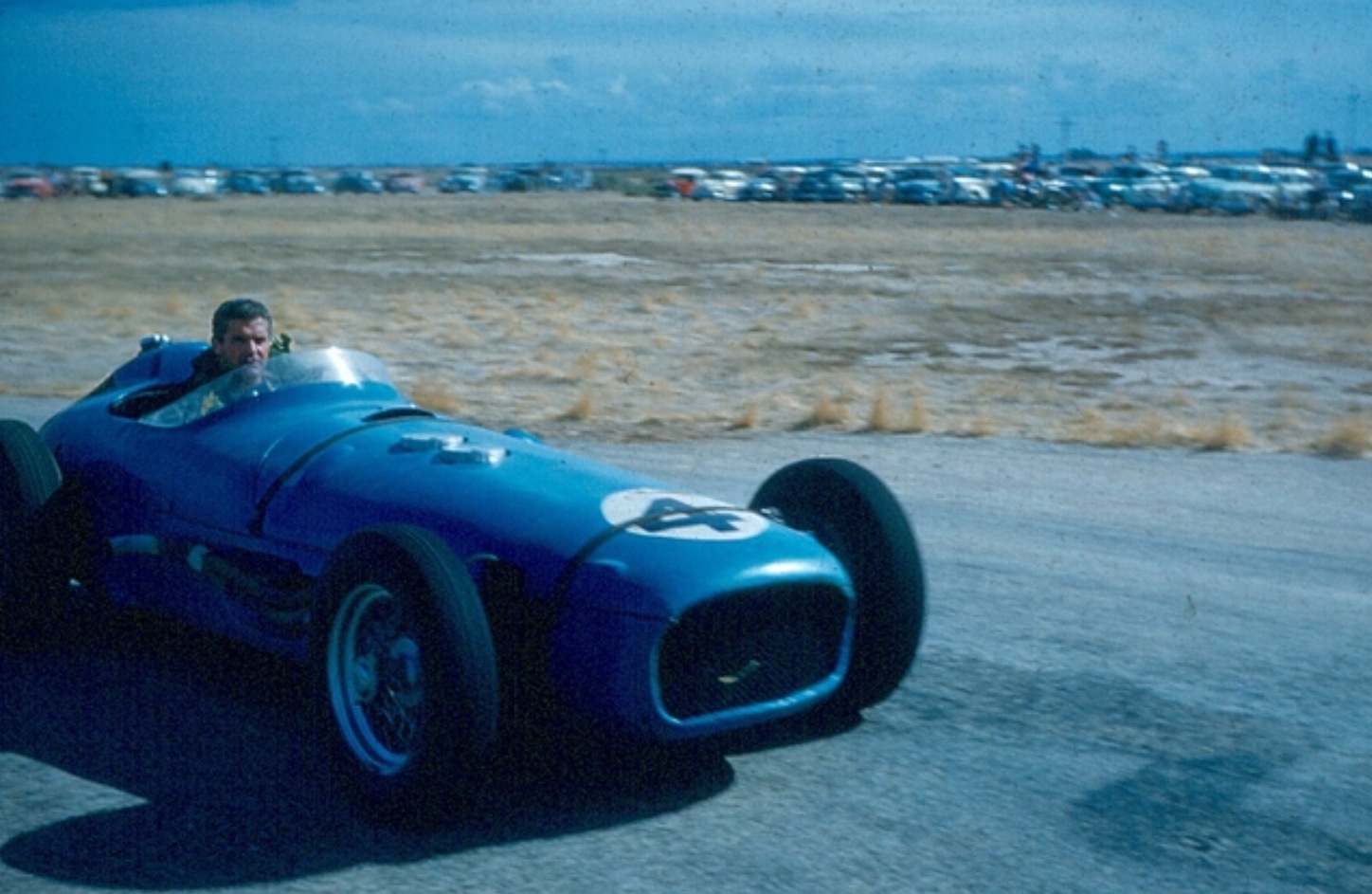
(K Drage)

Finito…


(B D’Olivo)

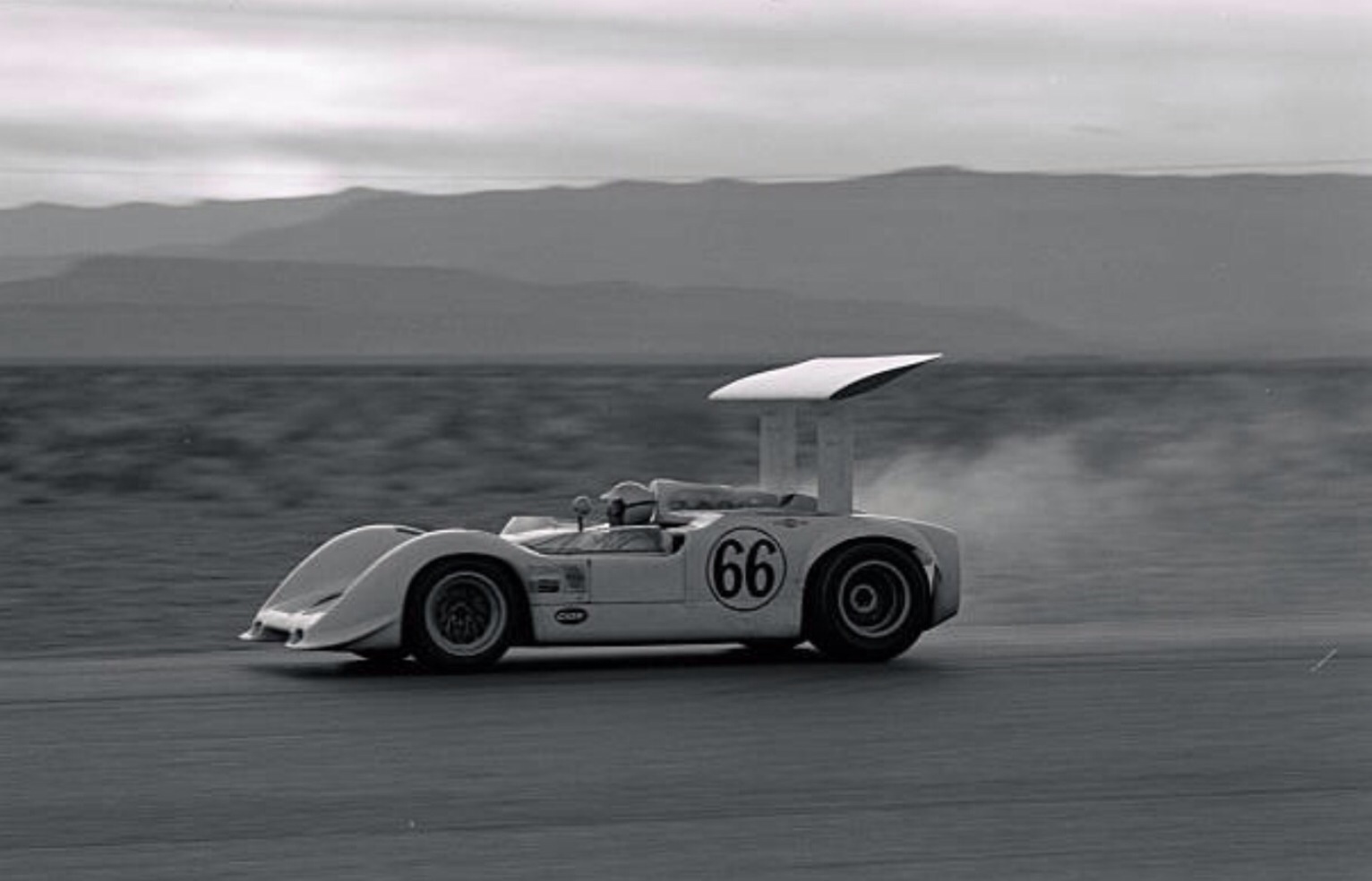
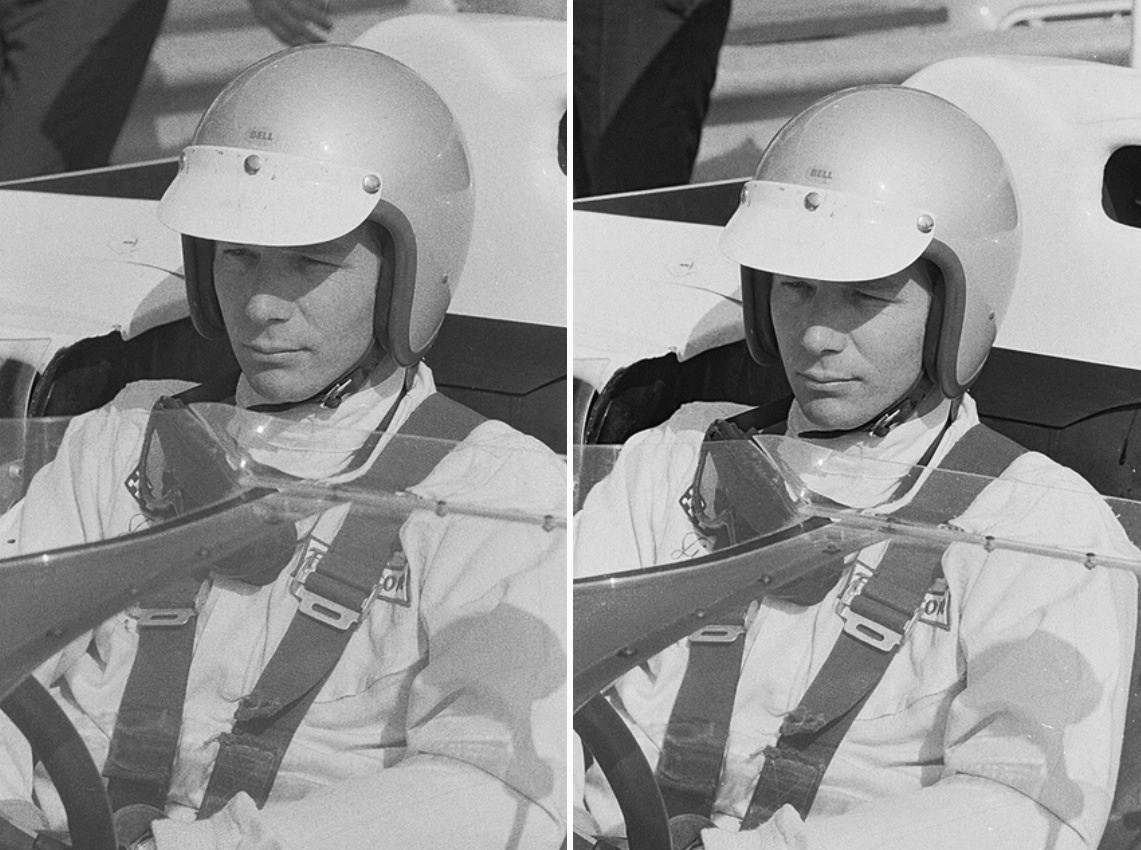
Jim Hall and his Chaparral 2G Chev look surreal juxtaposed against the Mojave Desert, Stardust GP, Las Vegas in November 1967…

Other worldly really, which of course they were. Like so many of us outside North America i missed the Can Am but have always been fascinated by it. One of THE great racing categories ever with some marvellous circuits, Bridghampton for me the most photogenic and Las Vegas the least. But not this monochrome, sundown shot by Bob D’Olivo which has a magic, eerie, feel to it. Hall failed to finish the race won by John Surtees’ Lola T70 Mk3B Chev.

Wings were well and truly a Chaparral paradigm by then, it wasn’t until 1968 they appeared in Grand Prix racing.

image

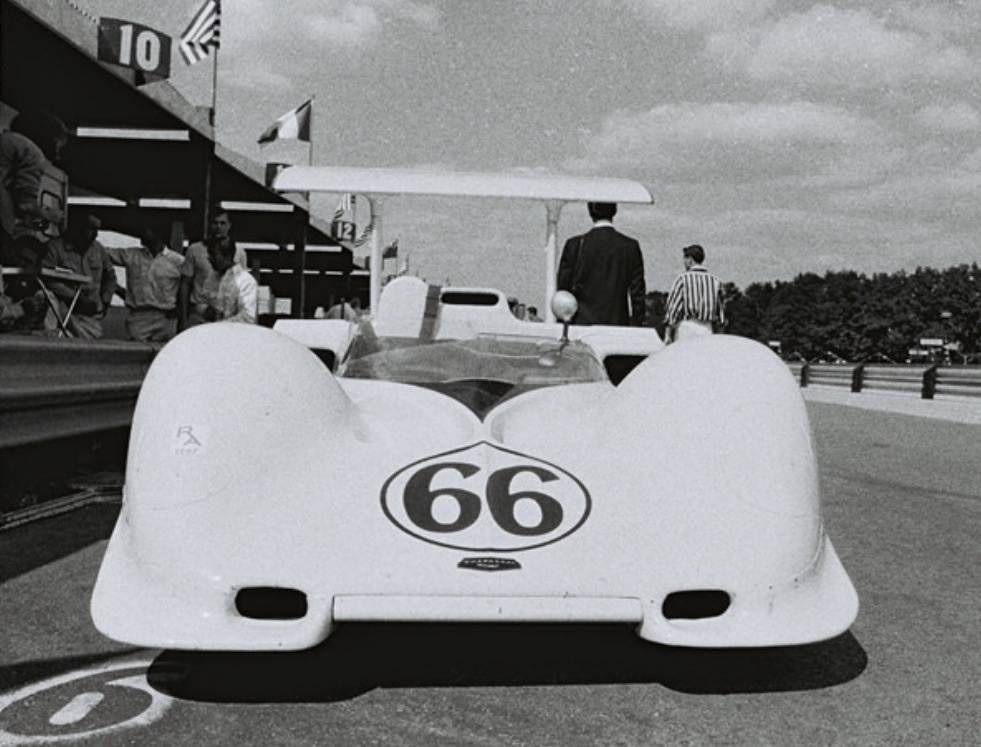
Chap 2G Chev, Road America pitlane September 1967. Jim Hall, Q7 and 4th in the race won by Denny Hulme’s McLaren M6A Chev. First race of the ’67 Can Am. The Papaya McLaren era is underway (D Friedman)

I wonder if the demonstrable pace of the winged 2F’s throughout Europe in 1967, campaigning in the World Manufacturers Championship effectively forced other designers to look at an area of aerodynamics they didn’t understand? That is, they could be ignored in the US as some sort of big car Can Am aberration, but the monthly sight of the things on ‘your own doorstep’ performing so well, if somewhat unreliably, forced a closer look. Check out my 2F article;

Chaparral 2F Chev…

And so it was that wings flourished unfettered in F1 during 1968. And were then reigned back in after CSI dictates over the 1969 Monaco GP weekend in response to some appalling engineering, make that under-engineering of said wing support structures.

image

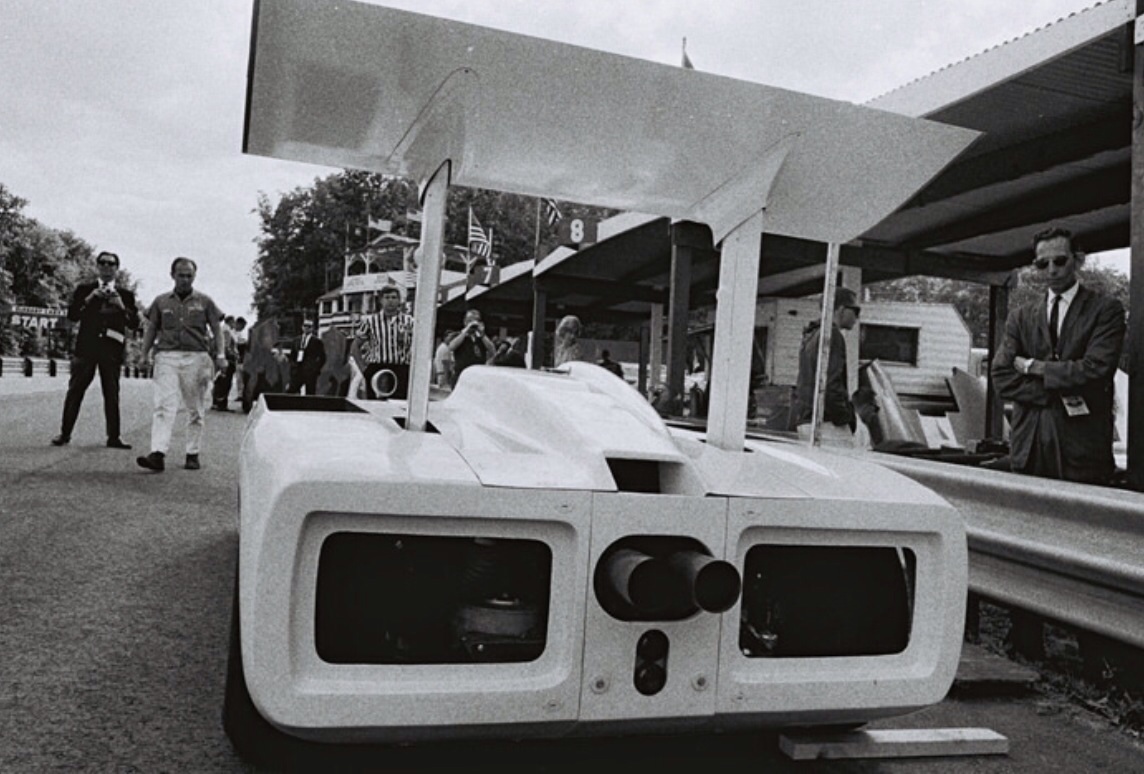
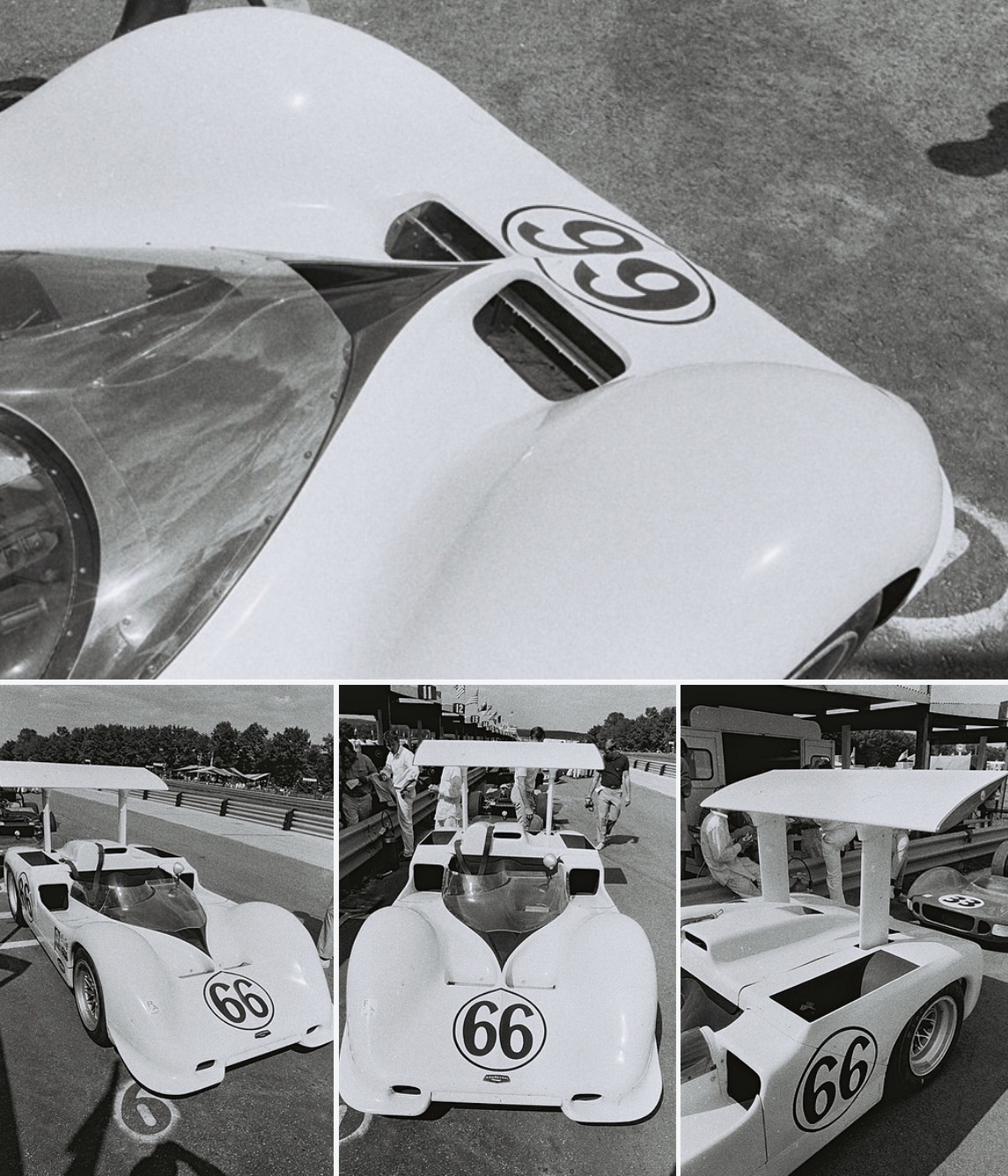
Series of body and aero shots of the Chap 2G at Road America (D Friedman)

Innovation is such an interesting thing. I mean that literally. Stuff being different to an existing paradigm makes it interesting because of its difference. Same, same, is boring doncha reckon?

We don’t get a lot of innovation in most of our motor racing classes these days, be it single-seaters, sportscars, or ‘taxis’. The rules either mitigate against it or mandate conformity of approach. Not least in F1. Often such rule changes or evolution has occurred to ‘contain costs’ and ‘ensure the drivers can compete on equal terms’. Who says that the latter is a good idea other than in the most junior of formulae where history tells us that uniformity of core package has worked well.

image

Jim Hall, Road America, September ’67 (D Friedman)

The funny thing about Jim Hall, Chaparral and innovation is that the powers that be were happy to allow their creativity to run free whilst the cars weren’t race winners. But when they were, or appeared to be, with the 1970 2J ‘Sucker’ it was legislated out of existence. So, in that sense we can be thankful that Jim, Hap, and Phil didn’t win more races or perhaps these wonderful cars may have been restricted by the intervention of vested interests of the paradigm much earlier!

God bless the innovators though, we need some. Now. And rules that allow differences of approach. Times are more complex than the sixties though. My polemic on F1 a while back supported innovation amongst other changes but how can it be afforded?

Halo’s Are A Brilliant F1 Idea. So too is to get rid of those dangerous, open exposed wheels…

image

Chap 2G looks as modern as tomorrow- as a reference point one needs to look at its sportscar and single-seater peers. Road Am ’67. Aluminium monocoque 2C based chassis. Engine aluminium 427 cid Chev 90 degree, pushrod OHV injected V8, circa 525 bhp @ 6000 rpm. Chaparral/GM 3 speed ‘automatic’ transaxle, circa 780 kg (D Friedman)

Jim’s wings, automatic gearboxes and fibreglass monocoques were relatively simple (but very clever) whereas innovation now, will probably involve ‘power units’ of massive complexity and cost akin to the current ones used in the highly restricted and complex F1. Which means major manufacture involvement and resultant ‘winners and losers’, ‘haves and have nots’ in terms of the approaches which are successful and those which are dogs. Teams ability to afford such equipment is an issue with potential impacts on grid size.

But that’s probably a good thing, smaller more interesting grids of different looking and sounding cars has to be preferable to the highly contrived, boring sameness we see now?

Anyway, here is to innovators, god bless em…

image

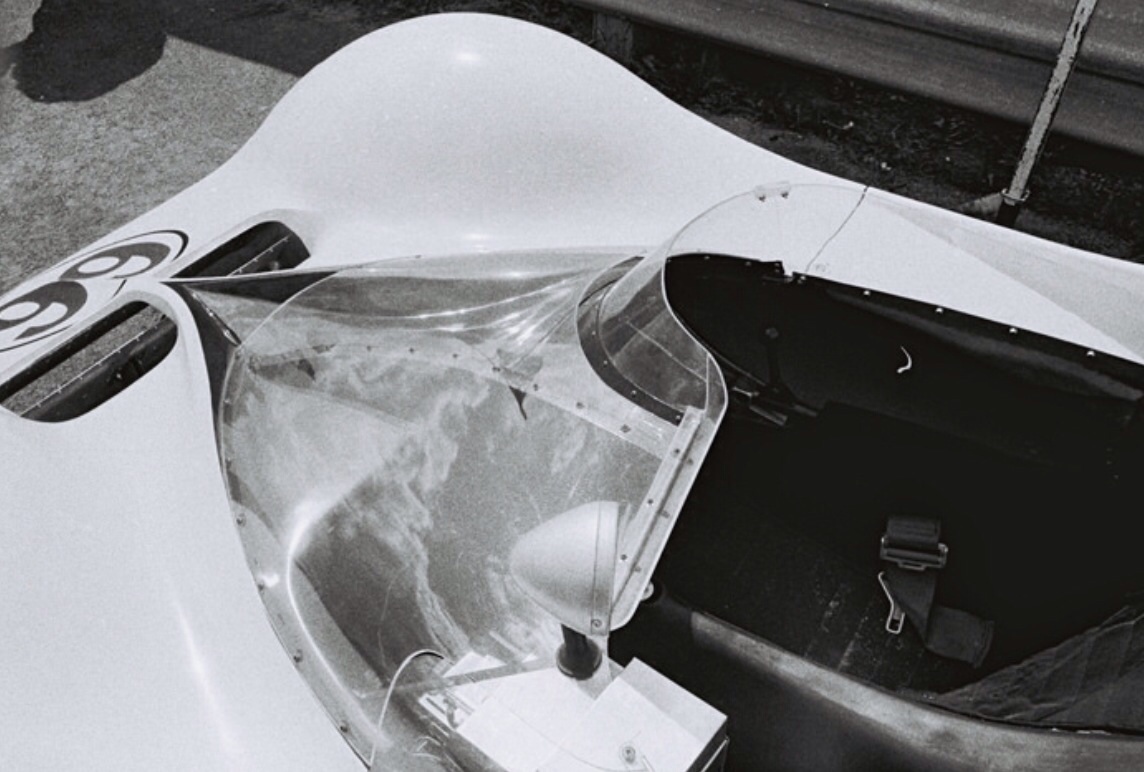
Exquisite detail wherever you look, 2G cockpit, Road Am ’67 (D Friedman)

Photo Credits…

Bob D’Olivo, Dave Friedman

Tailpiece: Truly wild in profile, Chaparral 2G Chev, Road America, 3 September 1967…

image

(D Friedman)


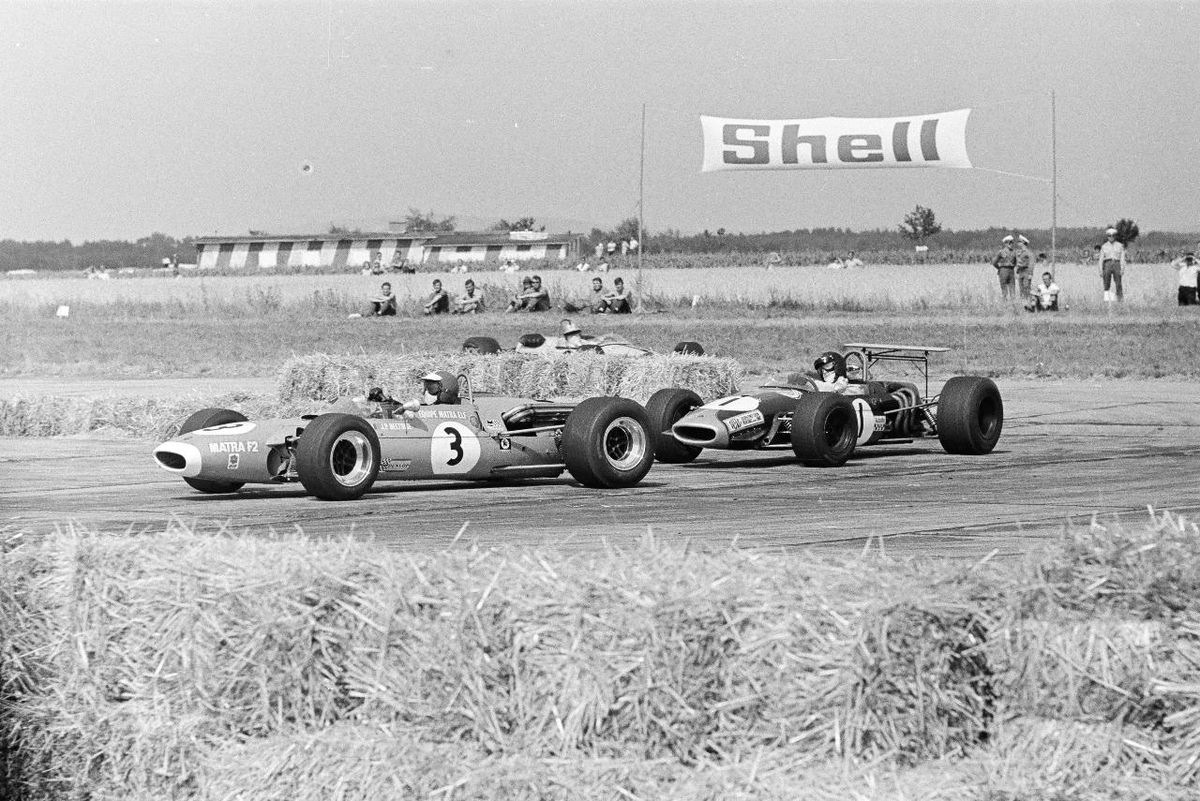
Jochen Rindt doing some Brabham ‘grass cutting’ at the Tulln-Langenlebarn airfield circuit in 1967 with the flair and precision for which he was famous…

There are the ‘thinking drivers’ of course but it’s the ones with mesmerising, other worldly driving skills that ultimately excite.

The high priests amongst these fellows are the likes of Nuvolari, Fangio, Peterson, Villeneuve and of course Jochen Rindt. Only two of these chaps died in bed. In the days when racing cars and the geography in which they raced could and did bite, the law of averages, especially if you played with the extremes of the laws of physics too often could bring you undone.

Rindt from JPB at TL in 1968. He won from JPB and Henri Pescarolo in works  Matra MS7 FVA’s. Brabham BT23C’s filled 5 of the top 10 placings (unattributed)

Rindt made his name in F2- he was the dominant player in the class from the time he entered it in 1964 until the time he left planet earth in 1970. For much of that period he raced Brabhams- the chuckability of which were tailor made for the plucky Austrians balls to the wall, tail out, crowd pleasing style. Check out this article about Jochen and the F1 Lotus 72 Ford; https://primotipo.com/2017/05/19/designers-original-intent/

The BT23 family of cars, Tasman and F2/FB variants were ripper cars. They were up there with the very best of customer Brabhams designed by Ron Tauranac, fettled by Jack as to baseline chassis setup and built by Motor Racing Developments in large numbers.

The photos in this article are of Rindt at Tulln-Langenlebaln, Vienna and Thruxton. At TL Rindt’s Winkelmann BT23 FVA won in 1967 from Jack Brabham’s works machine and Jean-Pierre Beltoise’ Matra MS5 FVA , and ‘winged in 1968 from JPB and Henri Pescarolo both aboard  works Matra MS7 FVA’s.

At Thruxton (below) in 1968 he won from JPB in an MS7 FVA and Derek Bell in a BT23C FVA. Jochen also raced a BT23C in ’68, again Winkelmann entered.

Jochen on the way to winning the ‘BARC 200’ at Thruxton on 15 April 1968, Winkelmann BT23C (unattributed)

Bibliography…

F2 Index

Photo Credits…

Unattributed

Tailpiece: Rindt, on it, as usual, BT23C, Tulln-Langenlebaln, Vienna, 14 July 1968…

(unattributed)

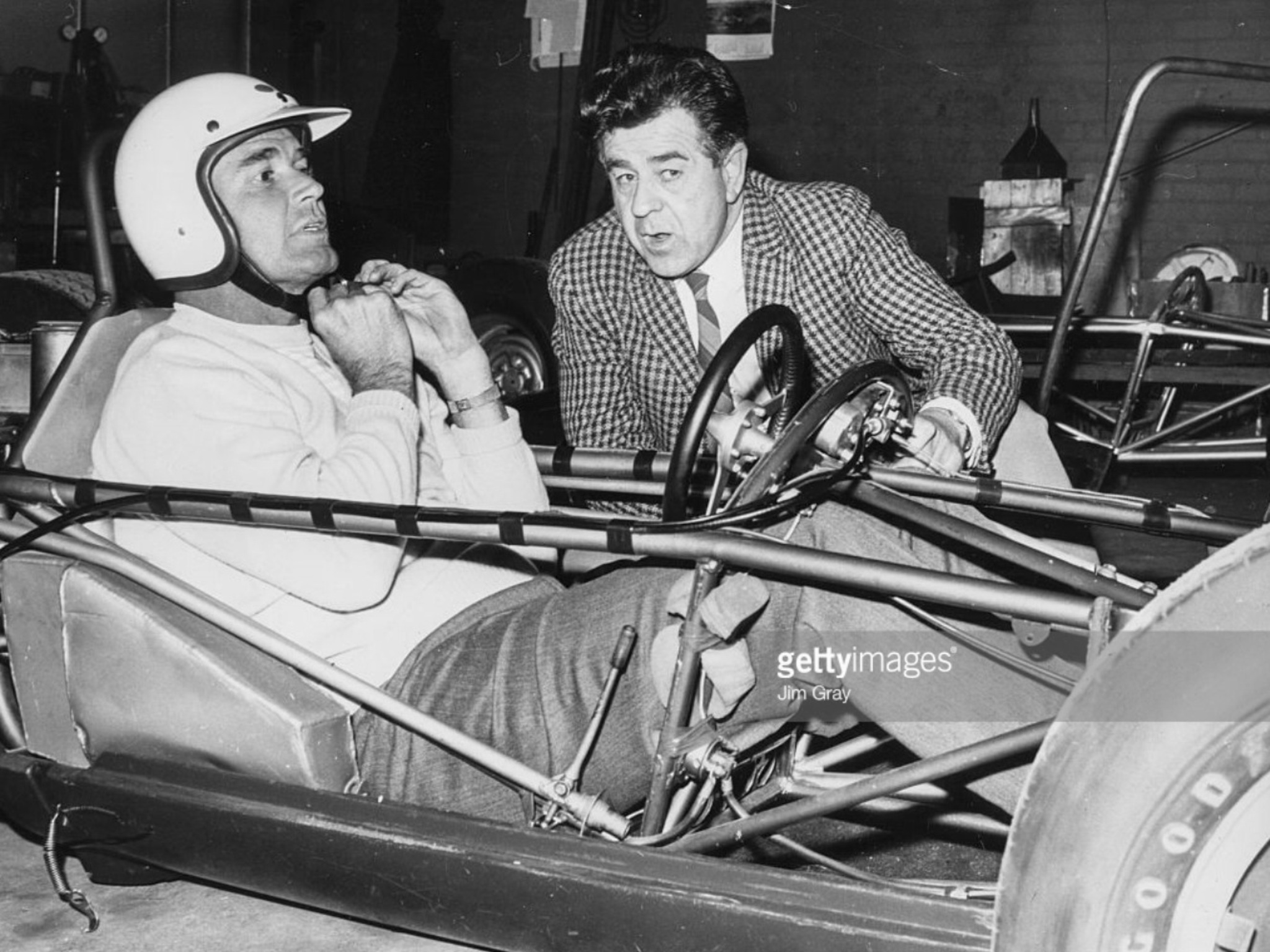
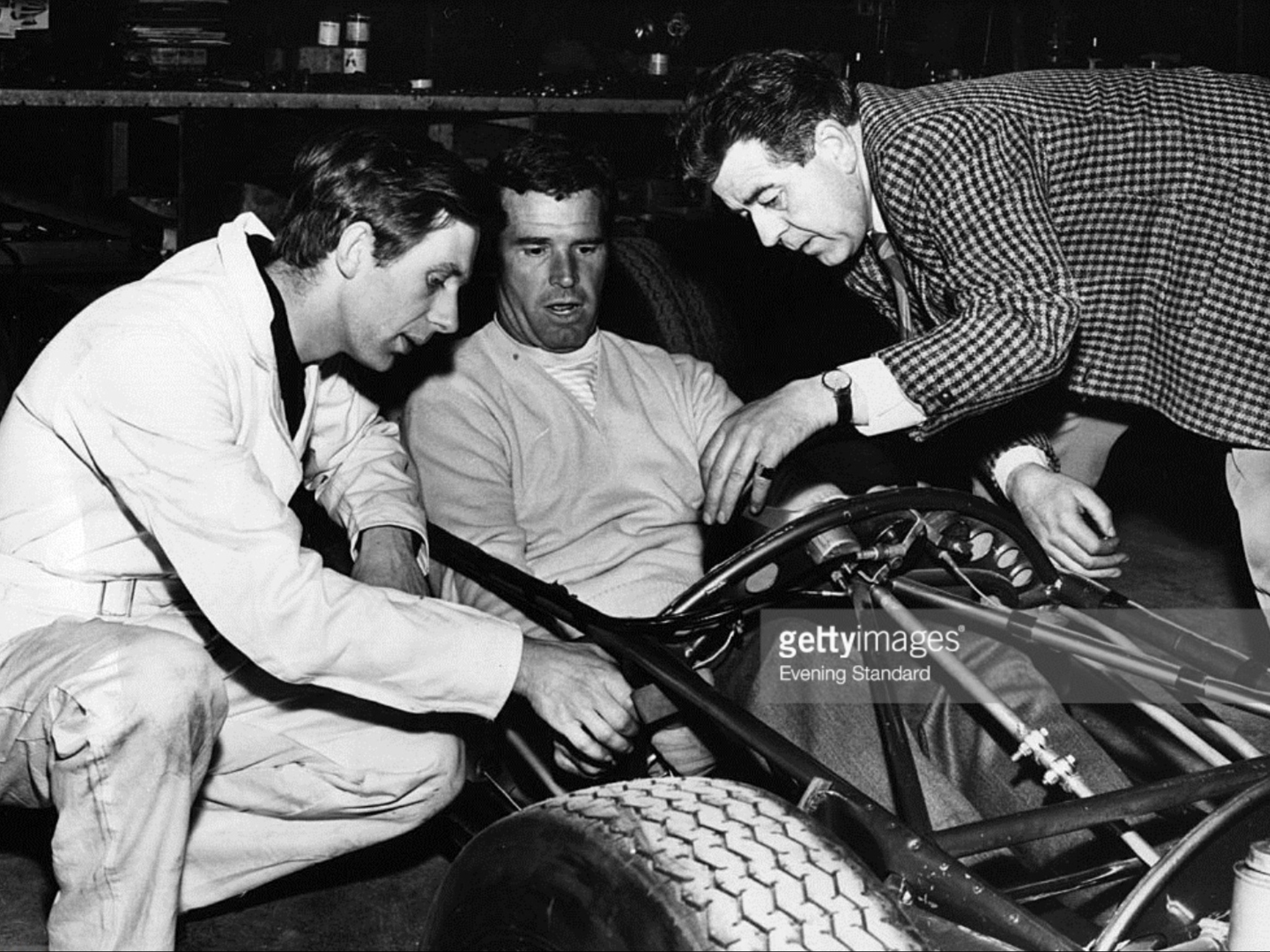
James Garner is fitted to a Jim Russell Racing Drivers School Formula 3 car on 14 April 1966…

Jim Russell supervises ‘Pete Aron’s’ preparation for some laps at Snetterton. I wonder exactly what make and model it is?!

The business end of the iconic film ‘Grand Prix’ is about to get underway, the race scenes were filmed, famously, during the 1966 Grand Prix season.

Garner is sharpening his driving skills to cope with the in-car rigours of his role as Peter Aron. Of course he rather enjoyed it all didn’t he, becoming a racer and an entrant of some note.

Garner’s ‘American International Racing’ Lola T70 Mk3B Chev finished second in the 1969 Sebring 12 Hour driven by Ed Leslie and Lothar Motschenbacher behind the winning Penske T70 of Mark Donohue and Chuck Parsons.

By the time these shots were taken in the UK Garner had already done quite a lot of driving under the tutelage of Bob Bondurant in the US, but I wonder if the JRRDS laps were his first in single-seaters?

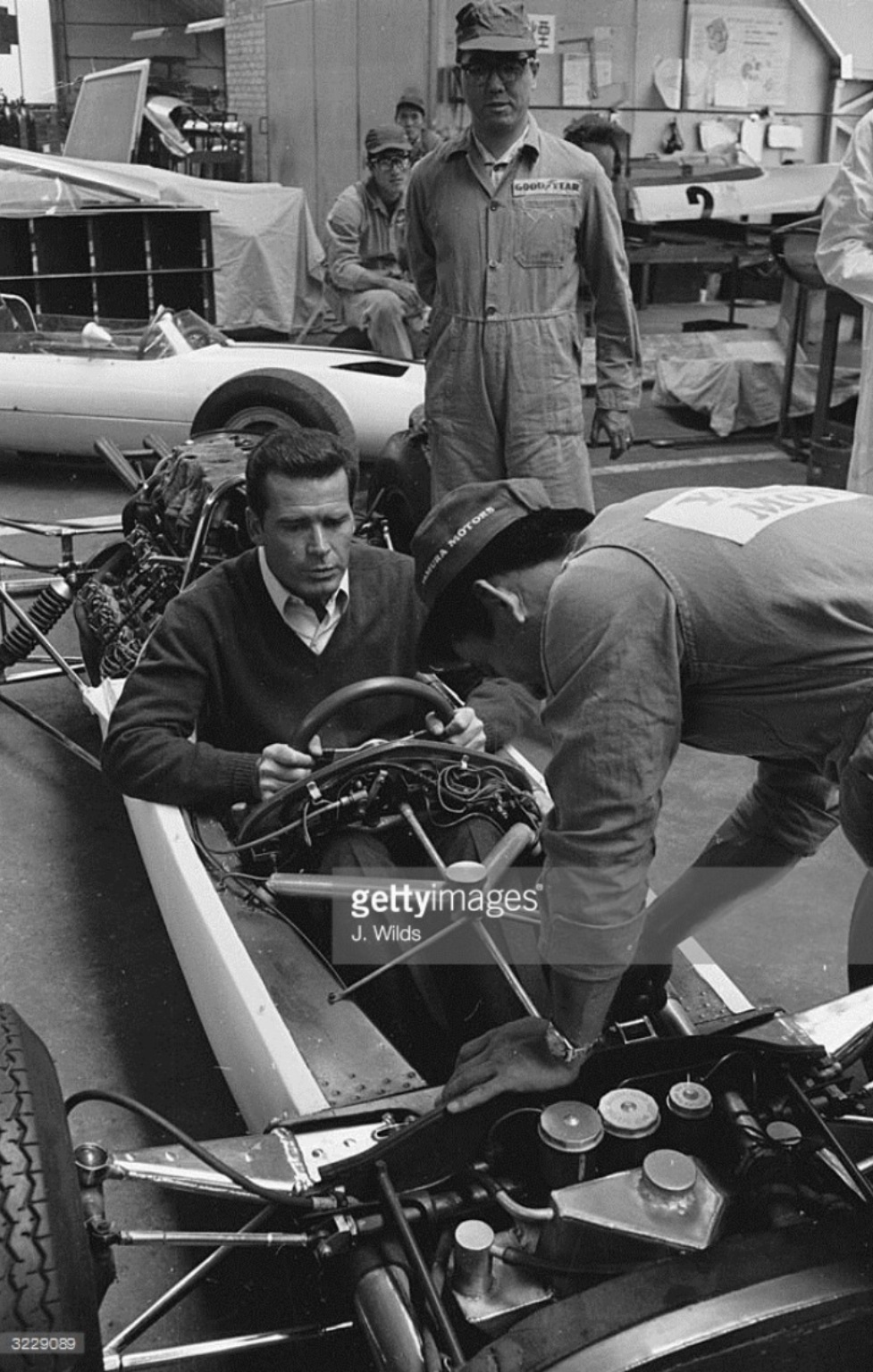
The ‘Tailpiece’ workshop shot below is on-location at the Cooper, Surbiton, Surrey factory. ‘Pete’ is sitting aboard his Japanese Yamura car which looks rather suspiciously like a Lotus 25 Coventry Climax, the cam-covers of the little 1.5 litre FWMV V8 are removed.

What a film! I wrote a short piece about it ages ago, click here if you’ve not read it, its focus is on Francoise Hardy;

https://primotipo.com/2014/10/17/francoise-hardy-on-the-set-of-grand-prix-1966/

Photo Credits…

Jim Gray, Evening Standard, J Wilds

Tailpiece: Pete being fitted to his Yamura F1 car, July 1966…

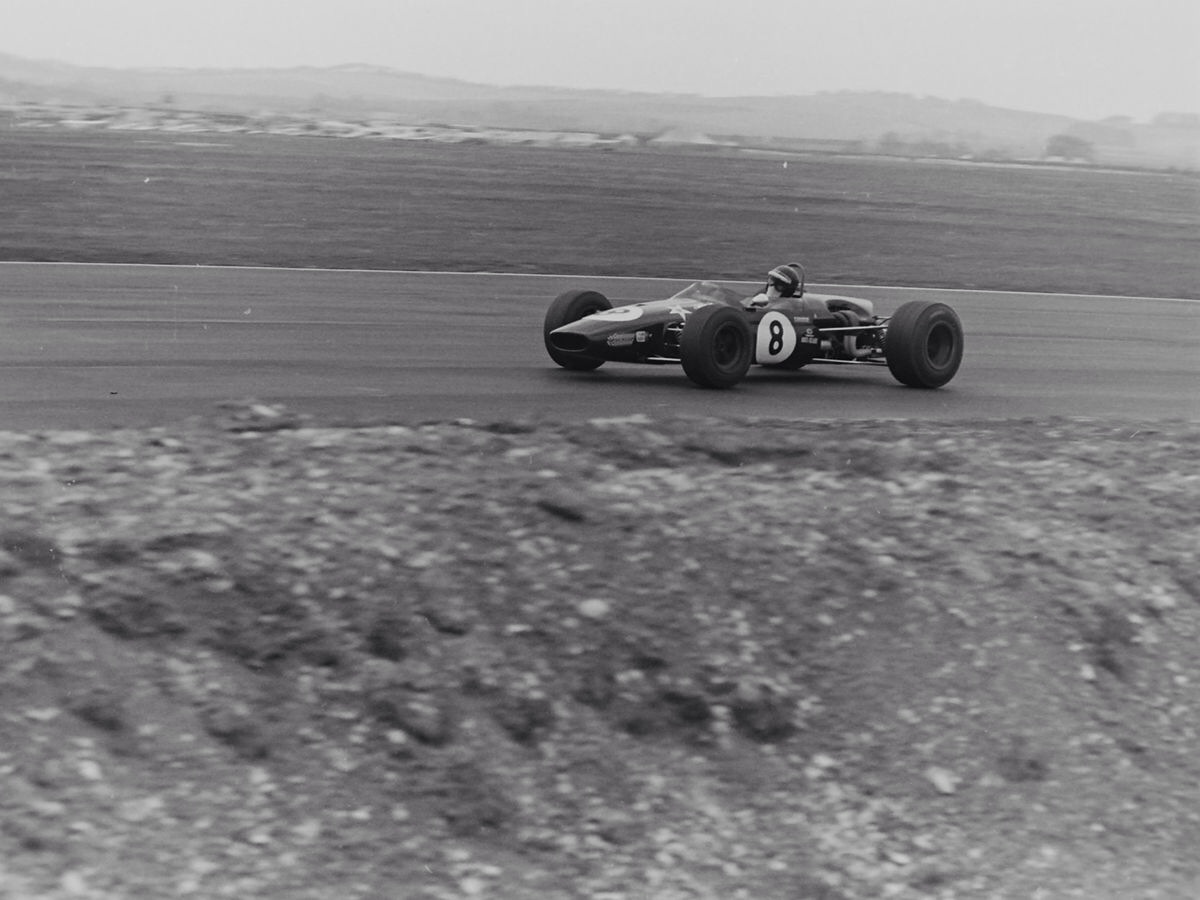
The on-circuit shots of the Yamura were of Bruce McLarens 1966 F1 contender, the McLaren M2B that year fitted with Ford, Serennissima and BRM engines. The contract was a nice little earner in the team’s first year in Gee Pee racing. Aron’s helmet design was Chris Amon’s sans the Kiwi logo. Checkout this really interesting article about McLaren’s involvement in the film on mclaren.com;

http://www.mclaren.com/formula1/heritage/action-mclaren-at-the-movies-6114785/

What a great commercial, symbiotic relationship it was between Gulf Oil Corporation and JW Automotive…

The success they achieved together with the Ford GT40 in 1968 and 1969 carried through into the Porsche years of 1970-1971 and beyond of course.

In 1968 the GT40, then getting long in the tooth, won the Manufacturers Championship and Le Mans. In 1969 the reliable old war-horse, again in Gulf-Wyer colours won at Le Mans, narrowly from the Porsche 908, undoubtedly the car of the year. It was one of the few races the 3 litre flat-8 Spyders and Coupes did not win- albeit not by much. The Jacky Ickx/Jackie Oliver GT40 ‘1075’, also the ’68 Le Mans winning chassis (driven by Pedro Rodriguez/Lucien Bianchi) beat the Hans Hermann/Gerard Larrousse 908L by only seconds, or around 120 metres after 24 hours of racing.

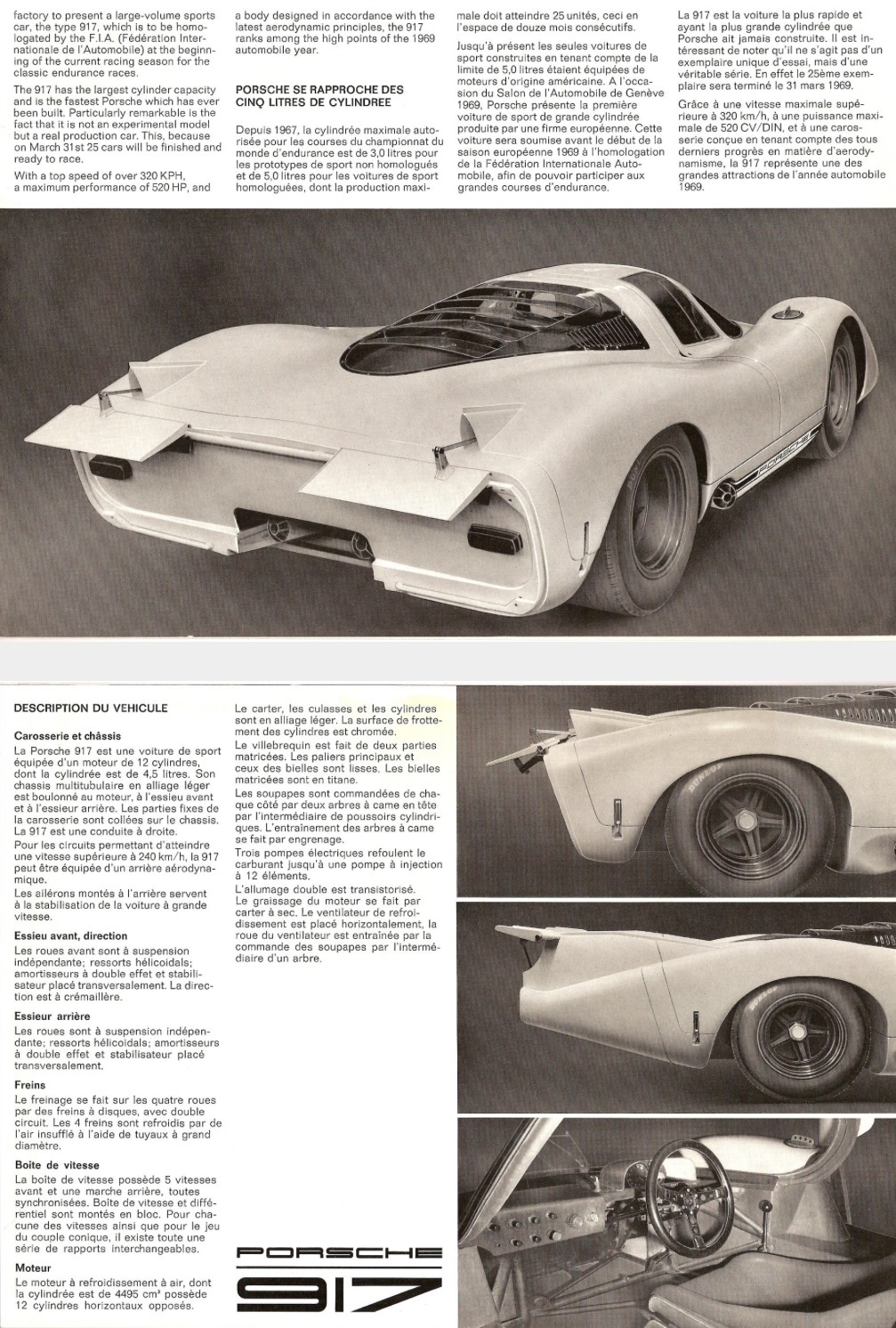
The Porsche 917, first raced in the Nurburgring 1000 Km in June, showed promise towards the end of 1969, winning the Osterreichring 1000 Km in the last Manufacturers Championship round on 10 August. It made sense for Wyer to race Porsche in 1970, and the German’s were happy to contract the racing of their cars to JW- with Gulf again providing commercial support. This event at the Carlton Tower Hotel i assume is the announcement of the parties plans for 1970.

JW were very successful in 1970, they won the lions share of the races- Daytona, Brands Hatch, Monza, Spa, Watkins Glen the Osterreichring and Targa, the latter won by a 908 Spyder. But they didn’t win Le Mans, nor did they do so in 1971.

In both cases Porsche Salzburg won the blue-riband endurance event. At the time JW signed with Porsche Wyer didn’t know about the Porsche family plans to cover its bases with two factory teams- Porsche Salzburg, owned by the Piech family being the other. Cunning plan. The right plan.

The car pictured at The Carlton is interesting to show the September 1969 917 paradigm, especially it’s aerodynamics.

Shortly after the JW engineers and drivers got hold of the 917, working with Weissach, the winning cocktail of changes which made the car so successful in 1970/71 was quickly determined.

One was a Lola T70 Mk3/3B type rear deck which cured the aerodynamic instability issue, the other involved changes to the suspension geometry both front and rear to both make good what was never quite right- and was needed anyway to suit the latest generation of wider and lower profile tyres to be used in 1970.

And the rest, as they say is history…

Compare the 1970 917K of Leo Kinnunen during the Brands 1000 Km with the 1969 917K spec of the original design shown in the brochure below. The Brands race is the one made famous by Pedro Rodriguez, who in this car mesmerised spectators and fellow drivers alike with his wet weather skills to win in this twitchy, difficult to master, high powered car (unattributed)

Photo Credits…

Wesley, Getty Images, Porsche AG

Porsche 917 in 1969…

Check out my article on the Porsche 917 first year of competition;

Porsche 917: 1969 The First Season…

Etcetera: 1969 Porsche 917 ‘Sales Brochure’ in a mix languages…

Finito…

(Rod MacKenzie)

…in the words of Maxwell Smart, for you aficionados of Mel Brooks’ wonderful sixties TV show ‘Get Smart’.

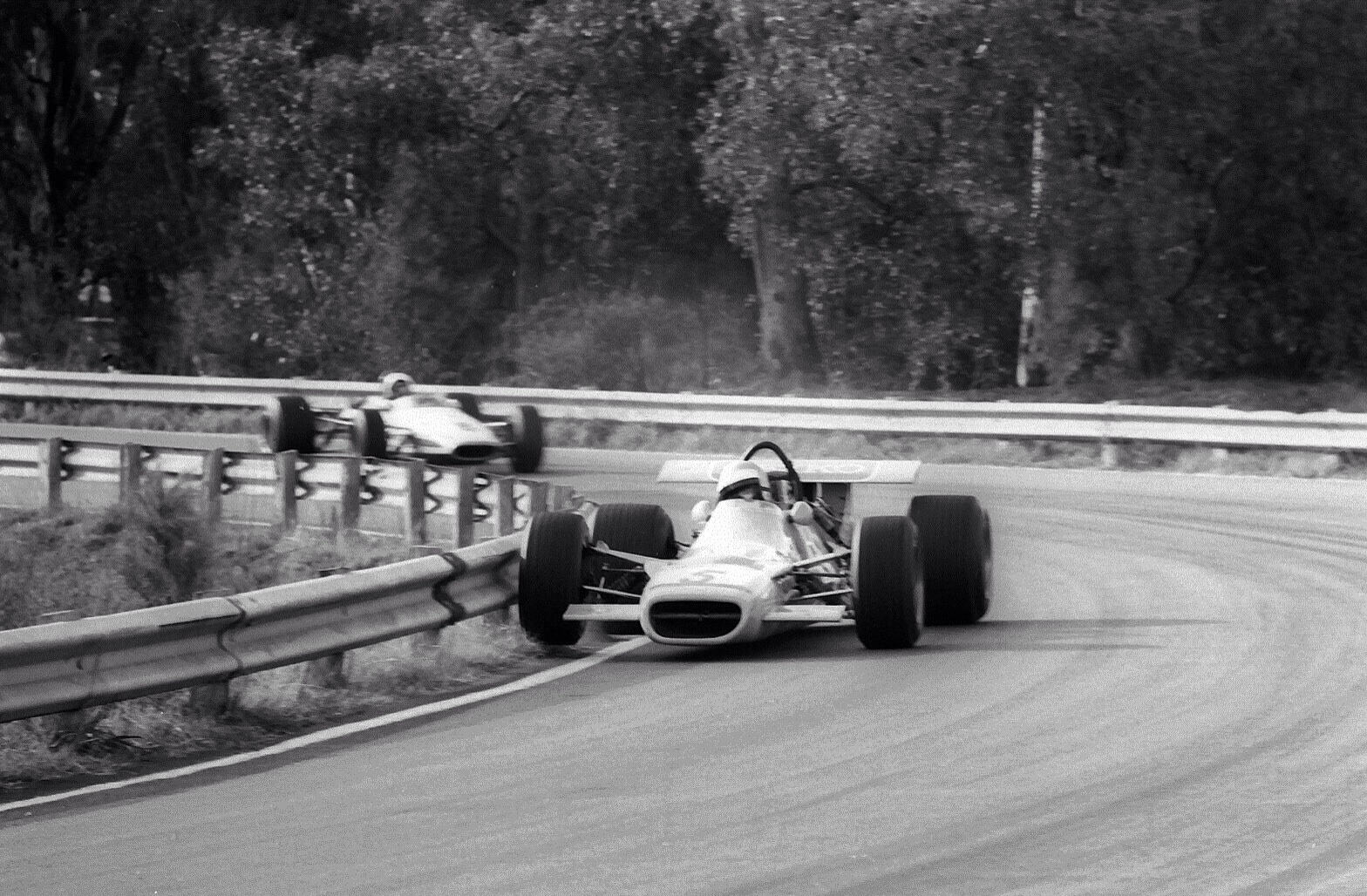
Kevin Bartlett with an inside wheel off the deck demonstrating the millimetre precision for which he was famous aboard the Mildren ‘Yellow Submarine’ Alfa in Warwick Farm’s Esses, September 1969. Rod MacKenzie has opened his shutter at precisely the right moment.

Another inch or so and the talented Sydneysider would have ripped an expensive corner off the front of a car which was so kind to him. I’m not sure of the racer behinds identity. A Lotus 27 or 32 perhaps?

Bartlett inherited the Len Bailey designed, Alan Mann Racing built, Alec Mildren owned car after Frank Gardner raced it in the 1969 Tasman Series. KB used it to great effect in that years Australian Gold Star Series winning three rounds and the title in it- Symmons Plains, Surfers Paradise and in Bartlett’s Warwick Farm backyard in December.  During a busy season KB and the Sub also won the Macau Grand Prix on 16 November and contested the JAF Japanese Grand Prix at Fuji.

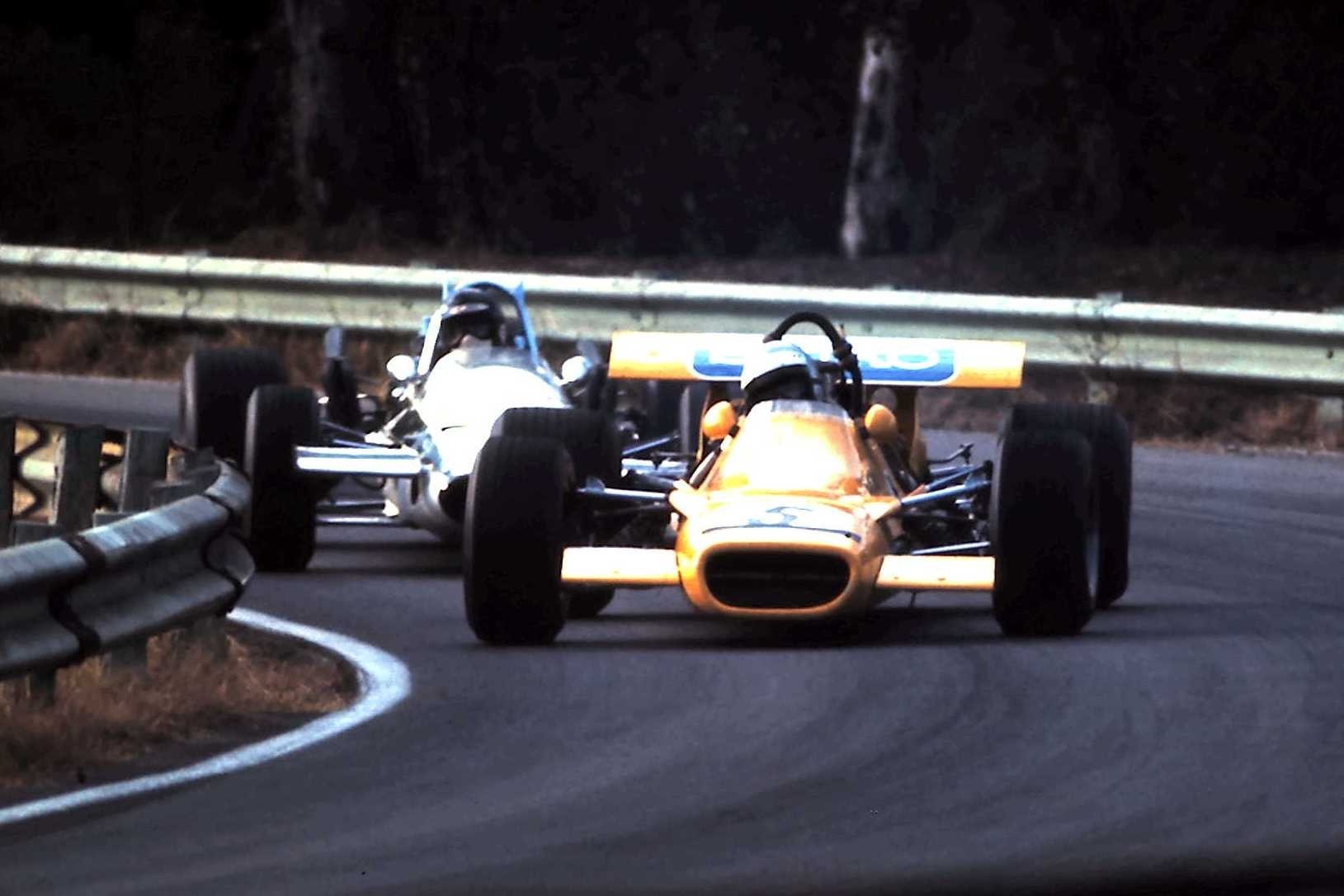
Every inch a GP car of its day isn’t it, just magnificent. Mildren Alfa in its ‘Alfa ultimate form’. Lynton Hemer’s shot captures the car at WF on Hume Straight in July 1970- interesting shot as the Alfa engine is back in the car long after its first Waggott engined race (L Hemer)

It wasn’t the ‘same car’ by the end of the year though as the Alfa Romeo Tipo 33 2.5 litre V8 engines with which the chassis was originally designed and built were put to one side and replaced by Merv Waggott’s Sydney built, 2 litre all alloy, DOHC, 4 valve, Lucas injected 275 bhp engine.

The history of my favourite ‘Australian’ racing car is one for another time- it’s a long story as this jewel of a car’s ‘in period’ history starts with 1969 Alfa V8 wins, continues with Waggott engined victories and ends with 1.6 litre Hart 416B success in Australian National F2 form in 1974/5. A fellow named Ray Winter was campaigning this famous car by then.

(Bill Pottinger)

High Speed Precision too…

Bartlett was famous for his tail out style, he was ‘the absolute master of opposite lock’ as Sam Posey described him having raced against KB during the 1973 Tasman Series and in the ‘L&M F5000 Championship’ in the ‘States in 1972/3.

This shot of the car is in ‘neutral to very subtle oversteer’ attitude, a very high speed, delicate drift- was taken by Bill Pottinger whilst Kevin traversed Teretonga’s ‘loop’.

The 1970 Tasman was tough in a 2 litre car, it was the first year of the Tasman F5000 Formula. KB was still quick enough to take 5th at Pukekohe and Teretonga- a second at Surfers Paradise, very much a power circuit was amazing and first at Warwick Farm brilliant but understandable. Bartlett, Matich and Leo Geoghegan were surely the quickest blokes around ‘Gods Own Acre of Motor Racing ‘ out Liverpool way?!

A mighty fine car and a mighty fine driver- thankfully both are still alive and well in Australia, Queensland to be precise…

(Bill Pottinger)

Merv Waggott fettles…

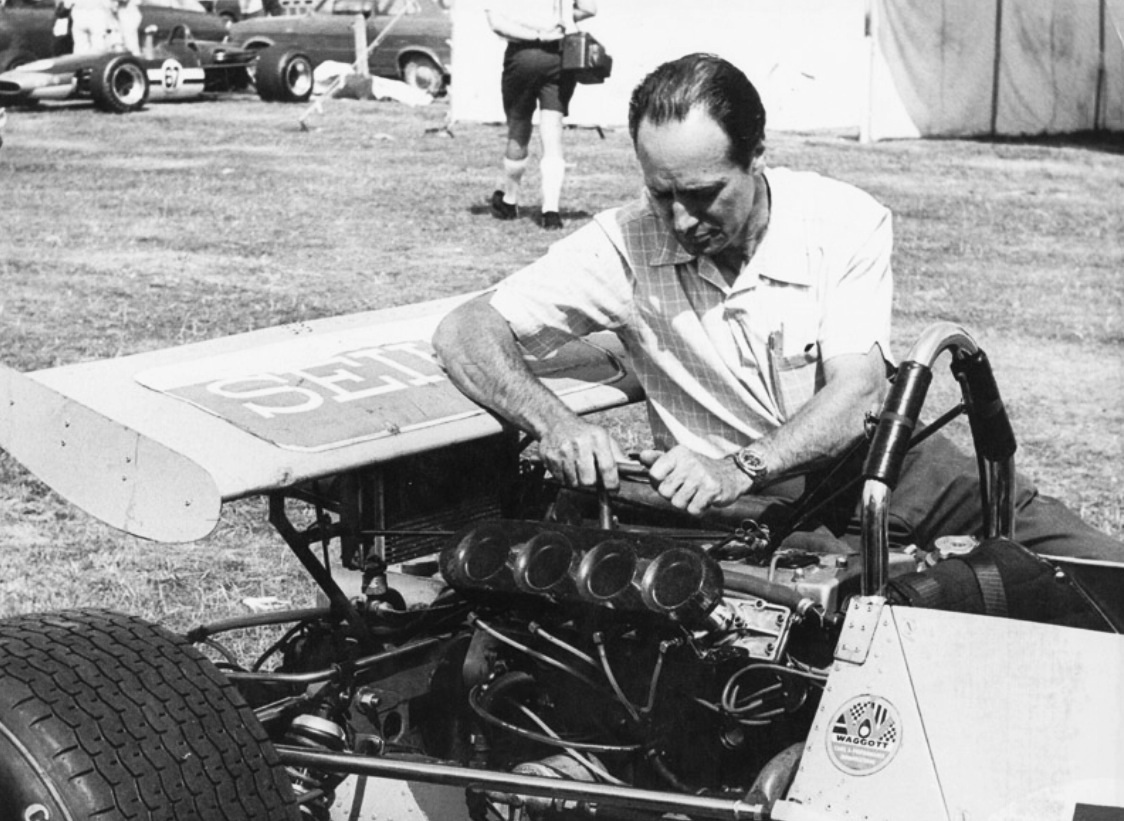
Sydney’s engineering genius Merv Waggott doing a plug change in ‘The Sub’ during the 1970 Teretonga weekend. Alec Mildren had been using Merv’s talents for years and specifically the smaller variants of Waggott’s engines in his other car, the Rennmax Engineering built Brabham BT23 copy ‘Mildren Waggott’ raced by Max Stewart.

When Merv decided to build a bespoke aluminium block to allow a capacity of 2 litres, something the Ford Cortina blocks used hitherto could not, it was an easy decision for Alec to go the more cost effective route with the local engine rather than the 2.5 litre Alfa V8.

The Alfa unit had received no development since first fitted to Mildren’s Brabham BT23D chassis in late 1967. Alfa were focussed on 3 litre engines for both their Tipo 33 Sportscar program and F1. Two litre Waggotts won Australian Gold Stars for Leo Geoghegan in 1970 (Lotus 59B) and Max Stewart in 1971 (Mildren Waggott)

(H Ellis)

Etcetera: Australian Competitor Set 1970…

Startline of the first round of the 1970 Gold Star Series at Symmons Plains, Tasmania in March 1970.

John Harvey’s #2 Bob Jane Racing Brabham BT23E Repco on pole alongside KB in the Mildren ‘Yellow Sub’ Waggott with Leo Geogheagn’s Lotus 39 Repco on the outside, and behind him in the other yellow Mildren Racing entry is Max Stewart in the Mildren Waggott spaceframe Bob Britton/Rennmax built car. Harvey won a top race from Leo and KB.

In a season of change it was Leo’s last championship race in the venerable ex-Clark Lotus, Harves was about to switch to the Britton/Rennmax built Jane Repco V8- yet another car, like the Mildren Waggott built on Britton’s Brabham BT23 jig whilst KB spent much of 1970 racing in the US so did not defend his Gold Star title. It was also the last year of the Tasman 2.5 Gold Star Formula- Geoghegan taking the title in a new Lotus 59B Waggott 2 litre as noted above.

KB gets a shove during the 1970 Tasman meeting- he won in front of the F5000’s. Glen Abbey, Ian Gordon and another fella. Stewart’s Mildren Waggott in the paddock behind (unattributed)

Photo Credits…

Roderick MacKenzie, Bill Pottinger on The Roaring Season, Lynton Hemer, Russell Thorncraft, Harold Ellis

Tailpiece: Bartlett from Geoghegan, Warwick Farm Esses during 1969- Mildren Alfa from Lotus 39 Repco…

(R Thorncraft)

Finito…


amon 1963 agp cooper

(David Mist)

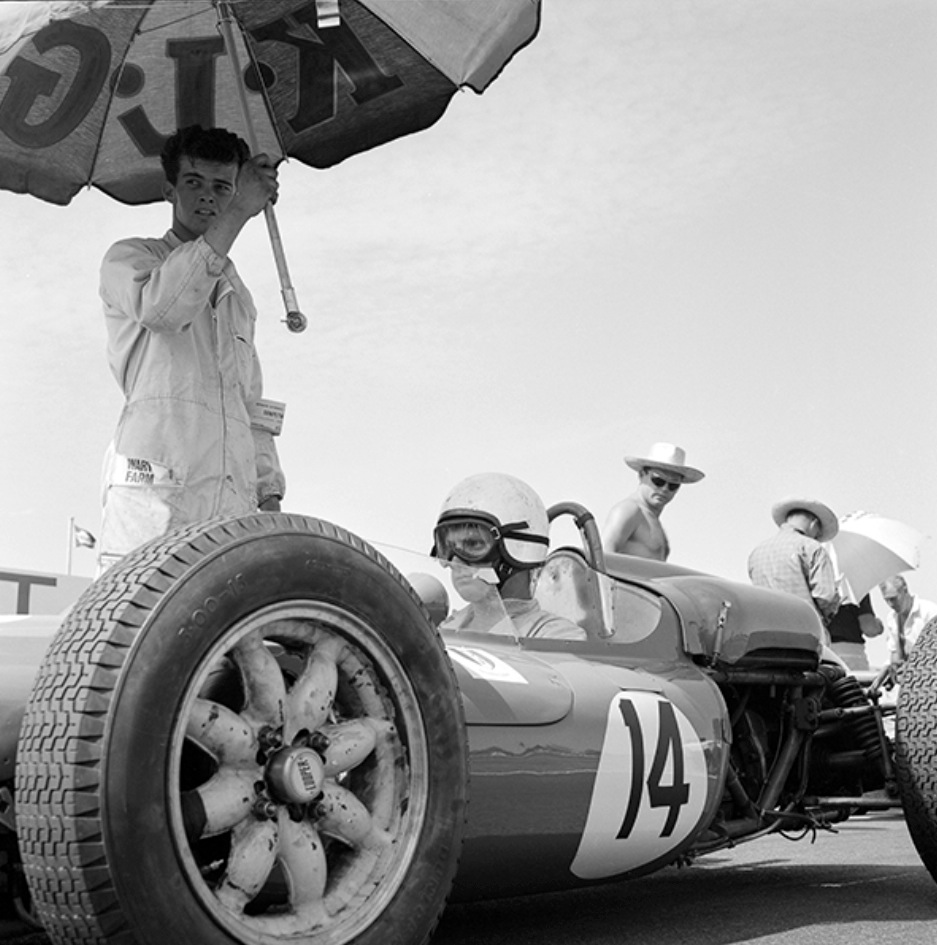
Chris Amon, 19 years of age, awaits the start of the 1963 Australian Grand Prix, Warwick Farm, Sydney. Cooper T53 Climax…

Amon didn’t finish in his ‘Scuderia Veloce’ entered Cooper, the cars fuel pump failed after 24 laps. Jack Brabham won the race in his Brabham BT4 Climax, Amon’s team-leader and ‘SV’ owner David McKay finished fourth in another Brabham BT4 Climax.

I wrote an article about McKay a while back; https://primotipo.com/2014/07/03/pete-geoghegan-ferrari-250lm-6321-bathurst-easter-68/

These were the early days of a very successful collaboration between Amon and McKay which resulted in the pair winning the 1969 Tasman Series in the fabulous Ferrari Dino 246T. Chris was the first of many drivers the racer/writer/team owner nurtured over the years.

In Amon’s case it was at a stage of his life when McKay was about to vacate the driving seat and evolve into a new stage of his career as owner/entrant of cars driven by others. Amon, then racing a Maserati 250F in NZ tested McKay’s Cooper T51 at Warwick Farm in August 1962 and contested Australian Gold Star rounds later in the season at Mallala and Sandown, non-starting in both but taking a strong third place at Warwick Farm in the Hordern Trophy behind Bib Stillwell and John Youl in October.

This was all valuable experience before the NZ and Australian Internationals with McKay entering the Kiwi in a later model T53 Cooper.

He was seventh from grid 6 in the NZ GP at the brand new Pukekohe circuit on 5 January, and had DNF’s with ignition and gearbox dramas at Levin, Wigram and Teretonga. He qualified fourth, sixth and seventh. In Australia he had slightly more luck.

(J Ellacott)


Before the off- Surtees Lola Mk4A, #10 McLaren Cooper T62 and an obscured David McKay Brabham BT4, row 2 Tony Maggs Lola Mk4A and Chris in #14 Cooper T53 then Lex Davison on the left, Cooper T53, John Youl bright red Cooper T55 and you can just see Graham Hill’s distinctive helmet, Ferguson P99 on the fence  (B Wilson)

He contested the AGP at Warwick Farm above, for grid 5 and DNF fuel pump. At the Lakeside International he was fourth from grid 6, his best result. In Tasmania, at the South Pacific Championship at Longford he was seventh from grid 8 and at the Sandown International, the Australian Grand Prix, he finished sixth from grid 12 in the last meeting of his tour on 10 March.

It was a critical period in Amon’s progression as a driver. Chris raced his ex-Owen Racing Organisation Maserati 250F in the first of the Kiwi Internationals at Renwick in November 1962. He then graduated to McKay’s Cooper and so impressed Reg Parnell (who ran Lola Mk4A’s for John Surtees and Tony Maggs in Australasia) that summer in a car that was not the latest bit of kit, and 2.5 Coventry Climax FPF powered rather than the 2.7 variant used by much of the opposition, that he was off to Europe for the rest of 1963. Seventh place in the British and French Grands Prix were his best results in the Parnell Racing Lola Mk4A Climax V8 that season.

His climb went all the way to the top echelon of Grand Prix Racing of course, championship Grand Prix win or not, he was undisputably a ‘Top 5 In The World’ pilot in several seasons during the 1967-72 period…

image

Chris Amon, Cooper T53 Climax Lakeside 1963. 4th in the race won by John Surtees’ Lola Mk4A Climax (Bruce Thomas)

Cooper T53 Climax ‘F2-8-60’…

The car was built by the CT ‘Tommy’ Atkins team for Bruce McLaren to drive but using the identity of one of the 1960 works F1 cars. (Jacks 1960 chassis)

The chassis was either built late in 1960 for McLaren to race in 1961 UK Intercontinental races or at the end of the season for his use in the 1962 New Zealand and Australian Internationals, depending upon the account you reference.

It was then sold to David McKay for the 1962 Australian Gold Star Series, raced by Amon in the ’63 Kiwi/Australian Internationals and then passed into the hands of a succession of Kiwi owners; Bill Thomason in 1963, Feo Stanton and Ian Rorison 1964 or 1965 and rebuilt as the Rorstan Sports with 2.7-litre Climax engine, then to D Lupp in 1970. Ted Giles bought it in 1978, it’s still in the families ownership in 2012.

Credits…

David Mist, Powerhouse Museum, Bruce Thomas, Hammo, John Ellacott

Bibliography…

oldracingcars.com for the chassis history and race results, sergent.com, Bruce Wilson

Tailpiece: Amon’s Scuderia Veloce Cooper T53 Climax 2.5 prowling the Longford paddock, he was 7th in the ‘South Pacific Championship’ race won by Bruce McLaren’s Cooper T62 Climax 2.7…

image

(Hammo)

Finito…