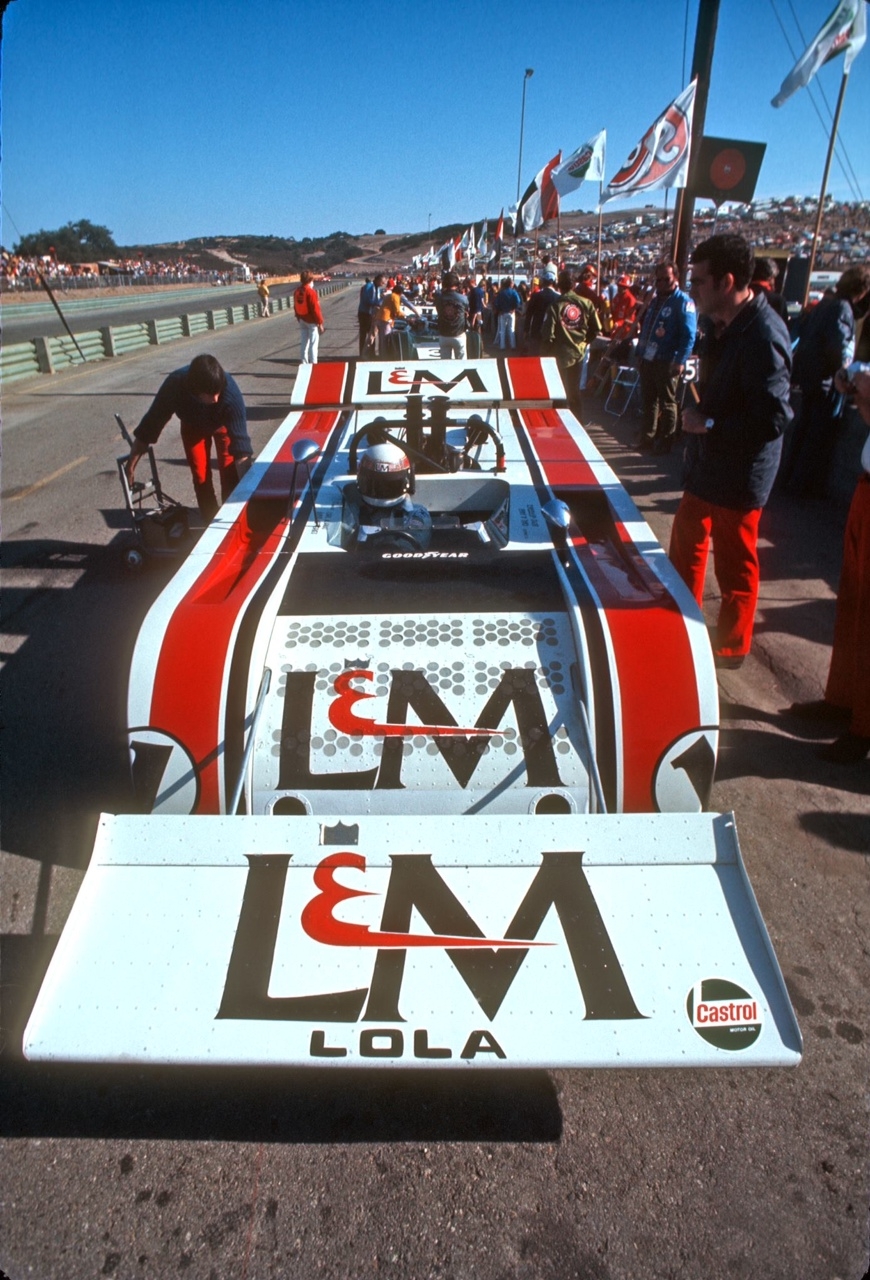
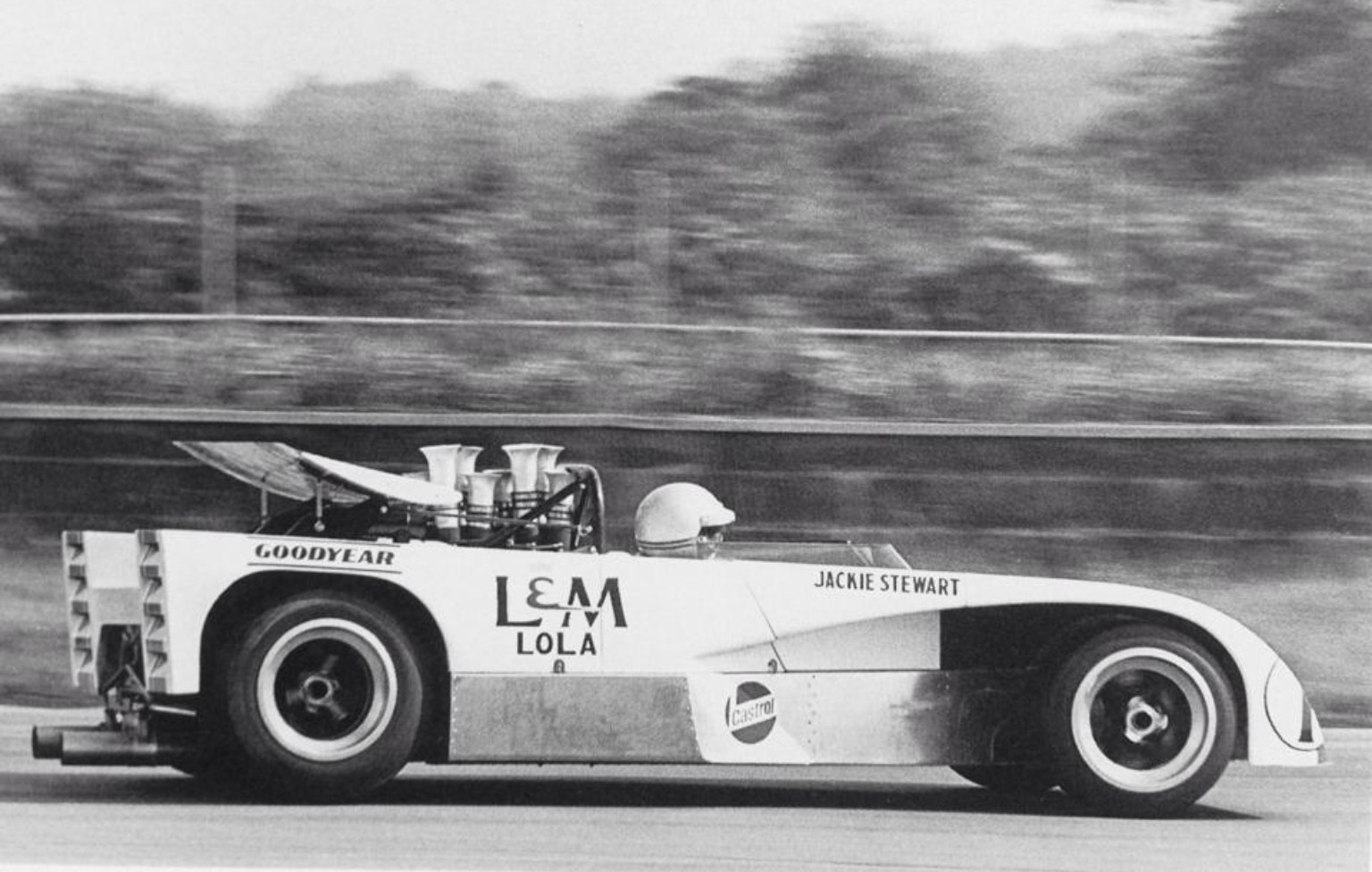
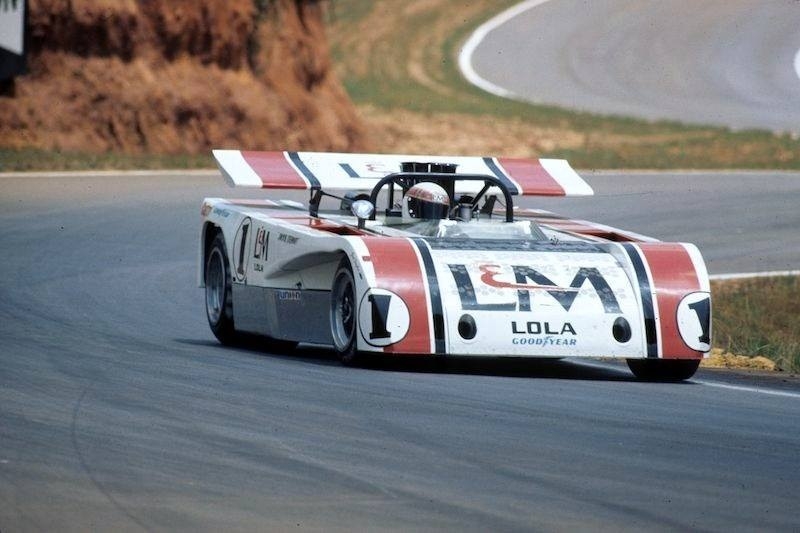
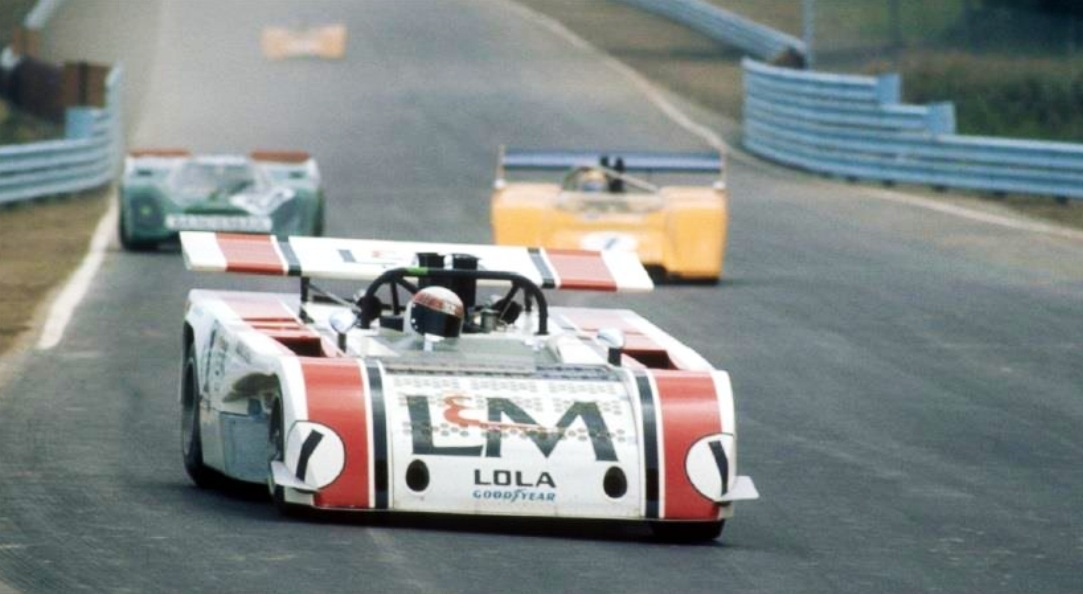
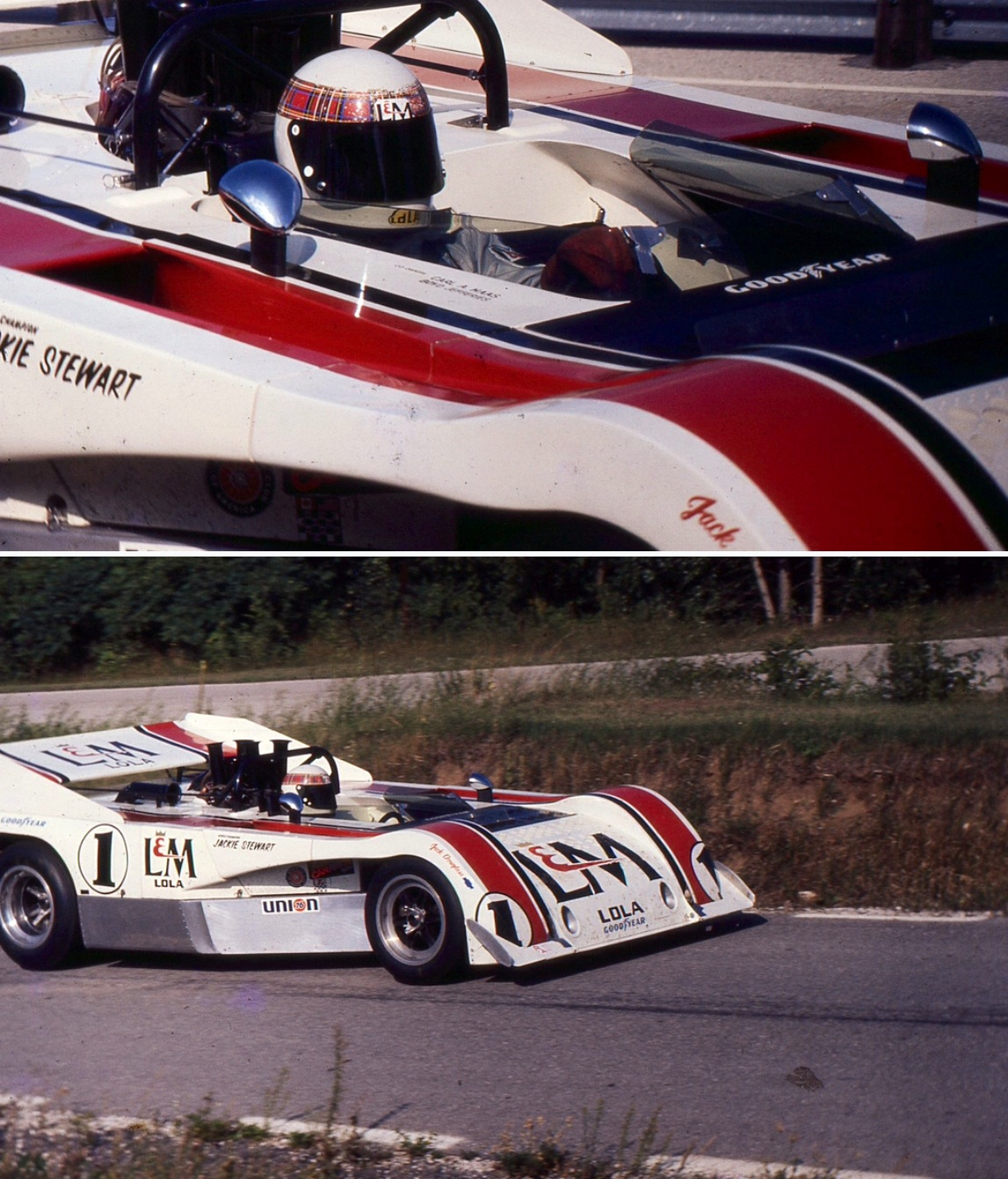
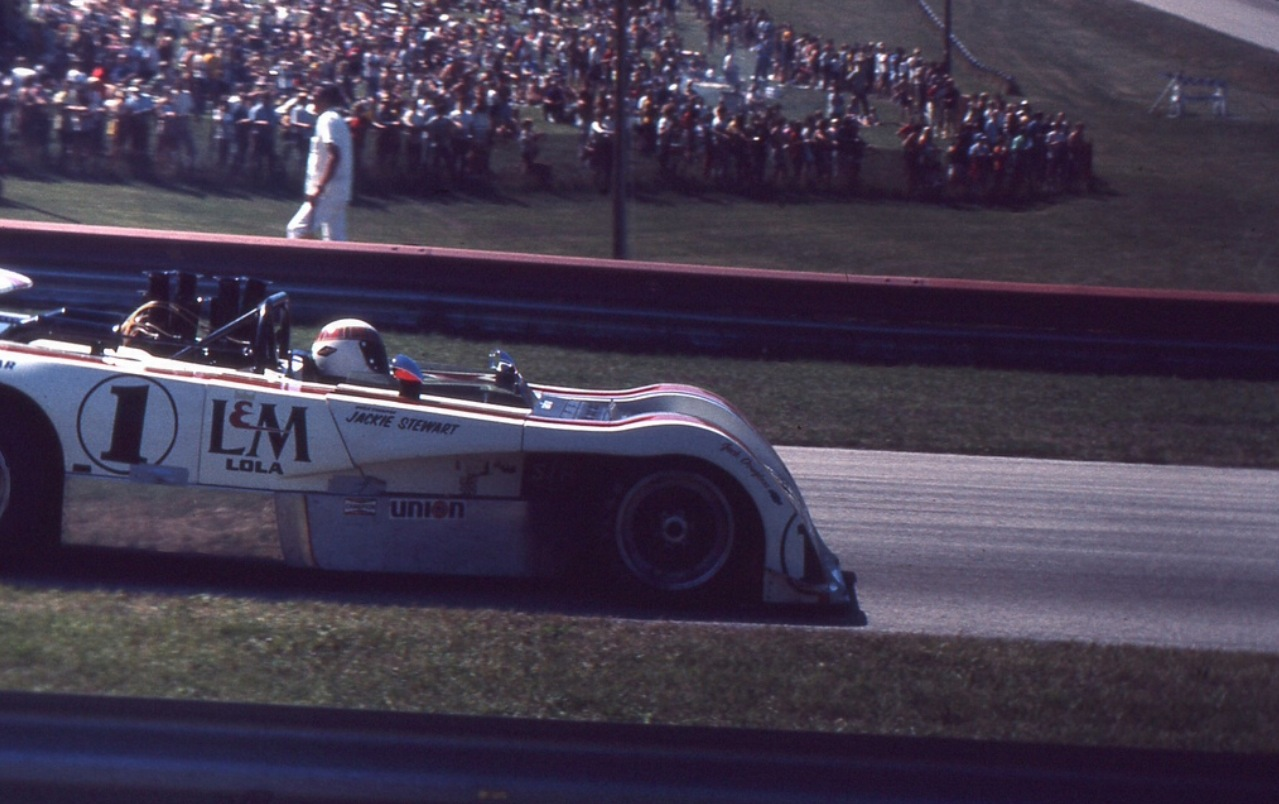
Jackie Stewart and his ‘Cowcatcher Winged’ Lola T260 Chev, Laguna Seca 1971 (Pete Biro)
It was always going to be tough to beat the dominant McLaren team, but the combination of World Champion Jackie Stewart and Lola, who had a strong Can-Am track record looked a good combination to give them a run for their money in 1971…

JYS convening a team engineering and set-up meeting in the Road America paddock, August 1971. Bob Marston in red shirt, JYS and in the green hat George Woodward (Jim Buell)
Part 1: Lola and the Can-Am Challenge…

John Surtees, Lola T70 Mk2 Chev leads Bruce McLaren’s McLaren M1B Chev at St Jovite, Mont Tremblant, 11 September 1966, they finished in this order. (unattributed)
The Can-Am morphed out of a series of professional level sports car races which had taken place for over a decade, in 1965 this comprised four events, three were won by the Chaparral 2 and one by a Lola T70.

John Surtees, Lola T70 Mk2 Chev at The Corkscrew, Laguna Seca, 1966 (Dave Friedman Collection)
The first Can-Am series held in 1966 was won by John Surtees in a quasi-works Lola T70; ‘Big John’ won three races, Dan Gurney and Mark Donohue one apiece in Lola T70s, with Phil Hill taking a solitary win aboard a Chaparral 2E.
While Colin Chapman designed the first modern-monocoque single-seater, the Lotus 25, which made its debut at Zandvoort in 1962, it was Eric Broadley who first applied the new construction technique to a sports-racer with his 1963 Lola Mk6 Ford.
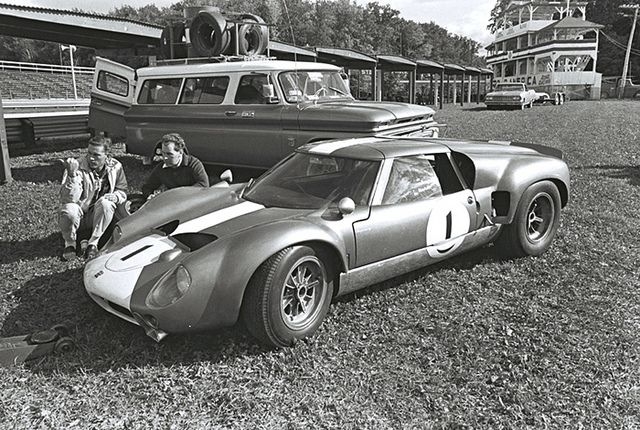
Augie Pabst’s John Mecom owned Lola Mk6 Ford, Road America 500 1964 DNF (unattributed)
Chapman was convinced the backbone chassis which worked so well in his Elan road car would migrate to sports-racing success but the Lotus 30/40 chassis were as floppy as a centenarians todger with results reflecting same; even Jim Clark could not make those cars sing.
So impressed were Ford with Eric’s Mk6 he was famously contracted to lead the design team of its GT40, a car with a steel tub.

Monterey Grand Prix, Laguna Seca, 16 October 1966. Phil Hill won in a Chaparral 2E Chev. Bottom left is Dan Gurney with his Ford powered Lola T70 (Dave Friedman Collection)

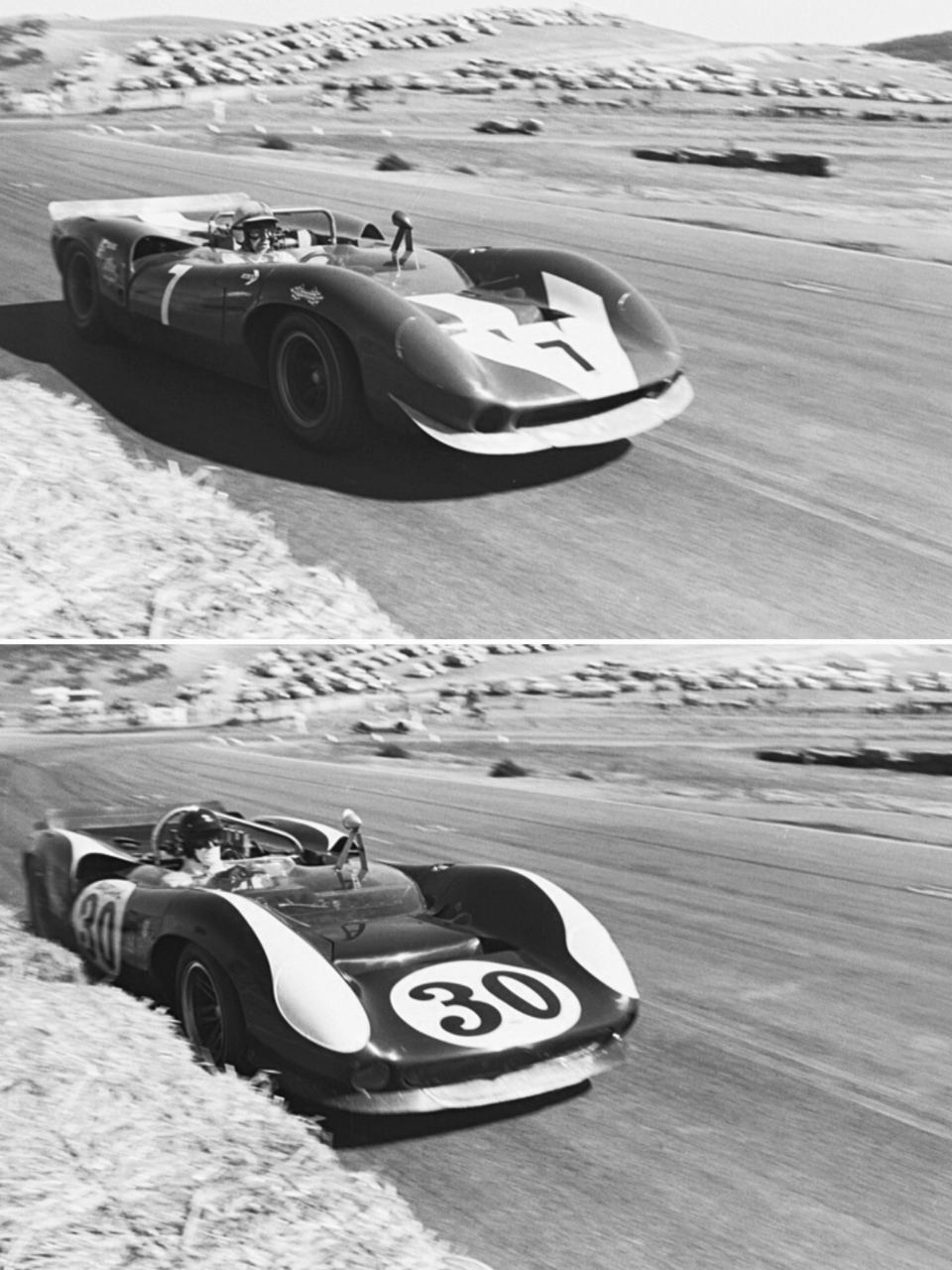
#7 John Surtees Lola T70 Mk2 Chev 12th and #30 Dan Gurney Lola T70 Ford DNF, Laguna Seca, October 1966 (Dave Friedman Collection)
The aluminium tubbed T70 was one of his first designs after his Ford sabbatical, that design process was useful in terms of evolving the car Eric thought Ford should have built in the first place!
In all its variants the T70 remained a competitive tool in both Group 7 (Can-Am) and Group 5 World Sports Car Championship events into the dawn of the 1970s. Teddy Pilette qualified his Team VDS Mk3B 19th at Le Mans in 1971, not bad for an old car with a pushrod OHV V8 against the might of the 5-litre, 12 cylinder Porsche 917 and Ferrari 512!
In endurance racing the T70 was really only held back by a suitable engine, the 12/24 hour longevity or lack thereof of the Chev engines usually chosen to power it. The small block Chev didn’t have the benefit of factory investment in its development in the same way Ford’s Le Mans winning small block Windsor V8 did.

Roger Penske’s Donohue/Parsons Daytona winning Lola T70 Mk#B Chev at Sebring in 1969. Here DNF driven by Ronnie Bucknum and Mark Donohue (unattributed)

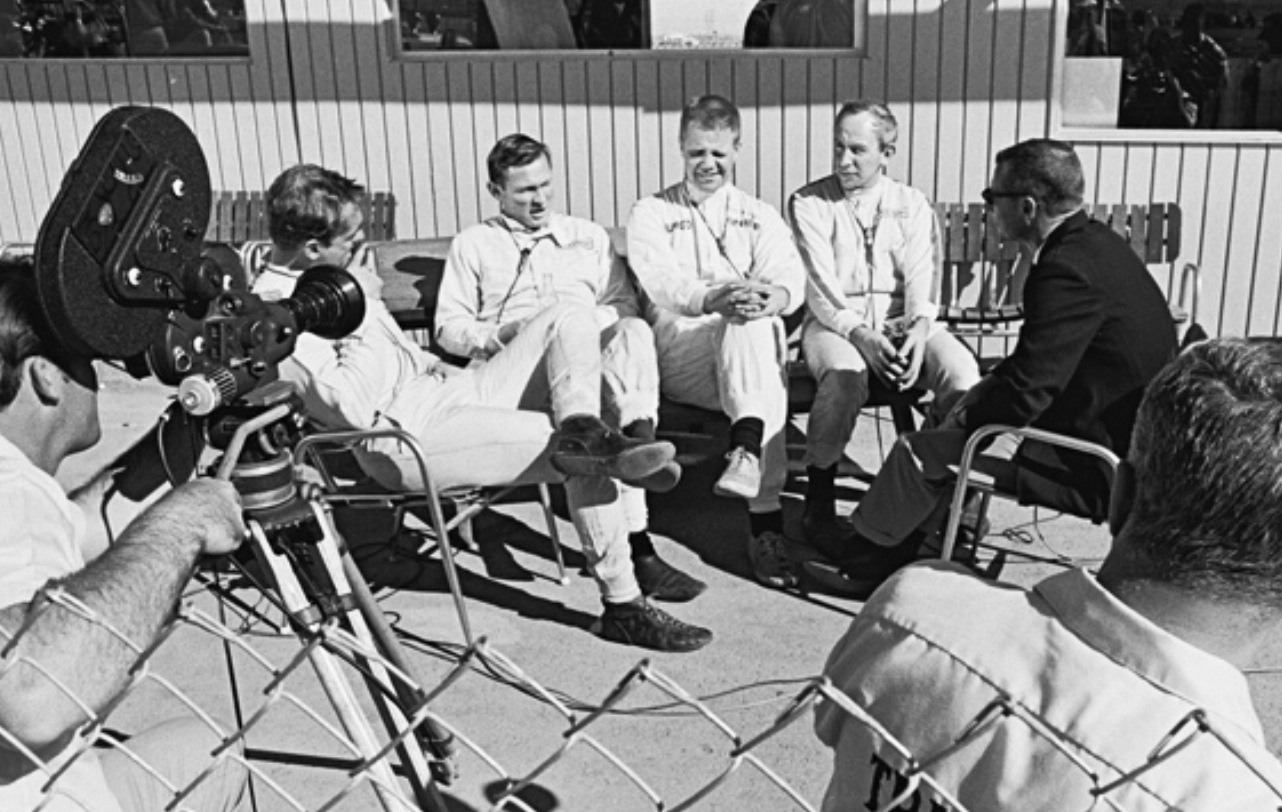
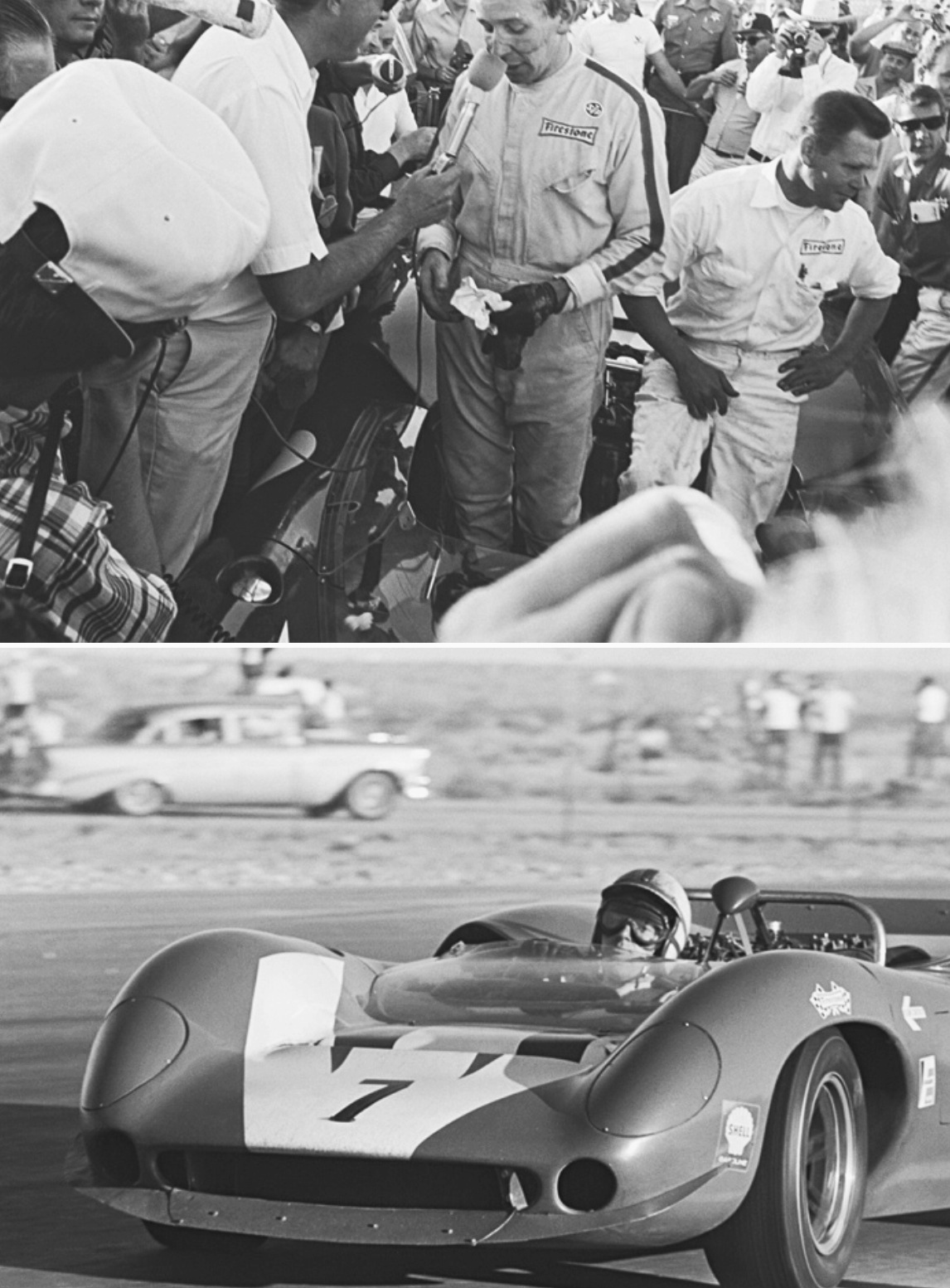
Top Guns interviewed for the TV, Las Vegas 1966: McLaren, Parnelli Jones and Surtees (Dave Friedman Collection)

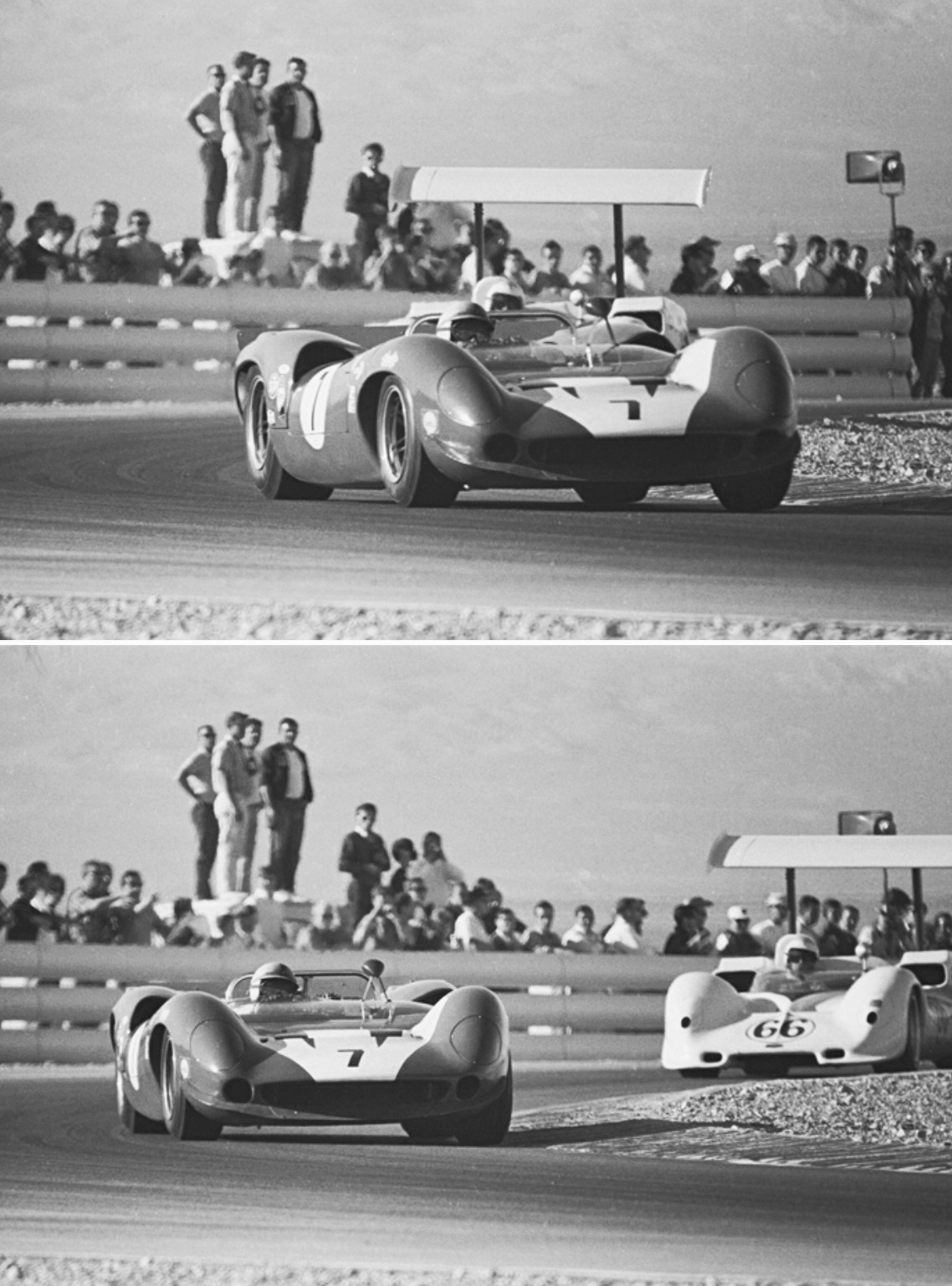
Stardust Grand Prix 13 November 1966, Las Vegas 1966 start. #7 Surtees Lola T70 Mk2 Chev first, #65/66 Phil Hill seventh, Jim Hall DNF both Chaparral 2E Chev, #5 Chris Amon McLaren M1B Chev DNF (Dave Friedman Collection)

Surtees from Jim Hall’s Chap 2E Chev early in the race. Vegas 1966 (Dave Friedman Collection)

Las Vegas 1966 (Dave Friedman Collection)

Surtees from Jim Hall’s Chaparral 2E Chev, first and DNF. Las Vegas 1966 (Dave Friedman Collection)

Surtees, Lola T70 Mk2 Chev, Las Vegas 1966 (Dave Friedman Collection)
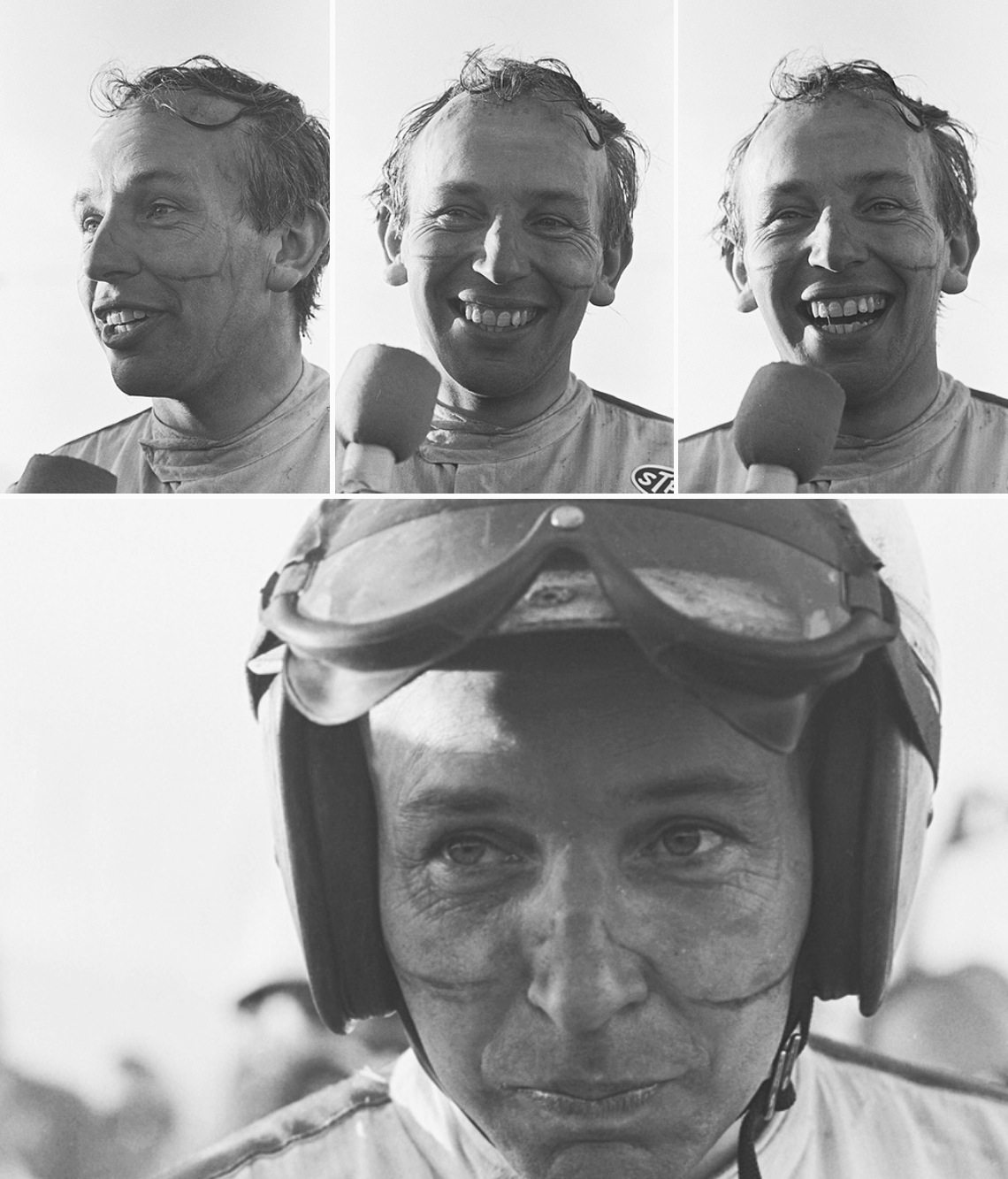
Happy Chappy. Surtees after his race and Can-Am series win, Las Vegas, November 1966 (Dave Friedman Collection)
Things would get tougher for Lola, Chaparral and the rest of the grid for the 1967 Can-Am.

Surtees Lola T70 Mk3B Chev in the Bridghampton pitlane, September 1967, fourth (Dave Friedman Collection)
Jim Hall made it tough for himself in ’66/7 by chasing championships in both Europe and the US, Chaparral sought titles in both the World Sportscar Championship and the Can-Am. They were always a threat with their unique blend of factory Chev engines, stunning chassis and aerodynamic innovation and quasi General Motors support.
Click here for an article on his 2F and it’s 1967 endurance campaign; https://primotipo.com/2014/06/26/67-spa-1000km-chaparral-2f/
But Bruce McLaren was the dark horse challenger.
McLaren had been racing in US sportscar events since his Cooper days, he became more serious with the acquisition of Roger Penske’s Cooper/Zerex Special, click here for an article on that car;
Roger Penske’s Zerex Special…
The Zerex became a test-bed for his own cars, the M1 which he raced in the UK and US until 1966. These light spaceframe cars handled well but the aluminium Oldsmobile V8s deployed – which provided weight and balance advantages – were limited by their power. The blocks maxxed-out at about 4.5-litres so the cars gave away plenty of mumbo to those running 6-litre engines.
McLaren and Chris Amon ran Chevs in their factory M1Bs in 1966 so Bruce had clarity about the bigger engine and its packaging needs, the Kiwi had a clear fix on what was needed to win in the Can-Am. He couldn’t match Jim Hall’s innovation but perhaps he could with a mix of sound design, engineering and good aerodynamics.
In essence this was the design brief McLaren gave to Robin Herd, the 6-litre monocoque McLaren M6 was the result. The M6 started the Bruce and Denny Show with five wins and Bruce deservedly taking the championship.

Class of ’67 at Las Vegas, 12 November. Jim Hall’s Chaparral 2G Chev from #4 McLaren’s McLaren M6A Chev, #21 Parnelli Jones’ Lola T70 Ford…all DNF, the race won by Surtees Lola T70 Mk3B (unattributed)
The dominance of the McLaren was a function of several elements. The design and execution of simple well engineered cars. Shaking them down thoroughly in England meant they were race-ready when the short season began. The team comprised three cars and world class drivers every year. They had a US base in Livonia, Detroit and their own engine program, its 6-litre Chevs were built by George Bartz and tuned and assembled in-house under Gary Knutsen’s supervision. Finally the team had adequate sponsorship to do things properly.
The 1968 McLaren M8 was a clean sheet design built from the learnings of the M6; the M8B, M8D and M8F works cars of 1969/70/71 were all evolutions of the M8A with sufficient change to stay ahead of the pack.
The dominance of McLaren was enhanced by ex-works cars passing into the hands of the best privateer drivers at the end of each season and customer cars available to whoever wanted one. Last years works-car became this year’s customer car, such bolides were built by Trojan Industries so the works team didn’t have to worry about pesky customers! By the end of 1968 at least, Lola’s dominance of grid numbers was over.
Such was the challenge Lola, Chaparral, John Surtees, Dan Gurney and the other best team owners faced.
Eric Broadley updated the T70 into the Mk3B for 1967, Surtees and Donohue were third and fourth in the Championship with John taking a win at Las Vegas at the seasons end.

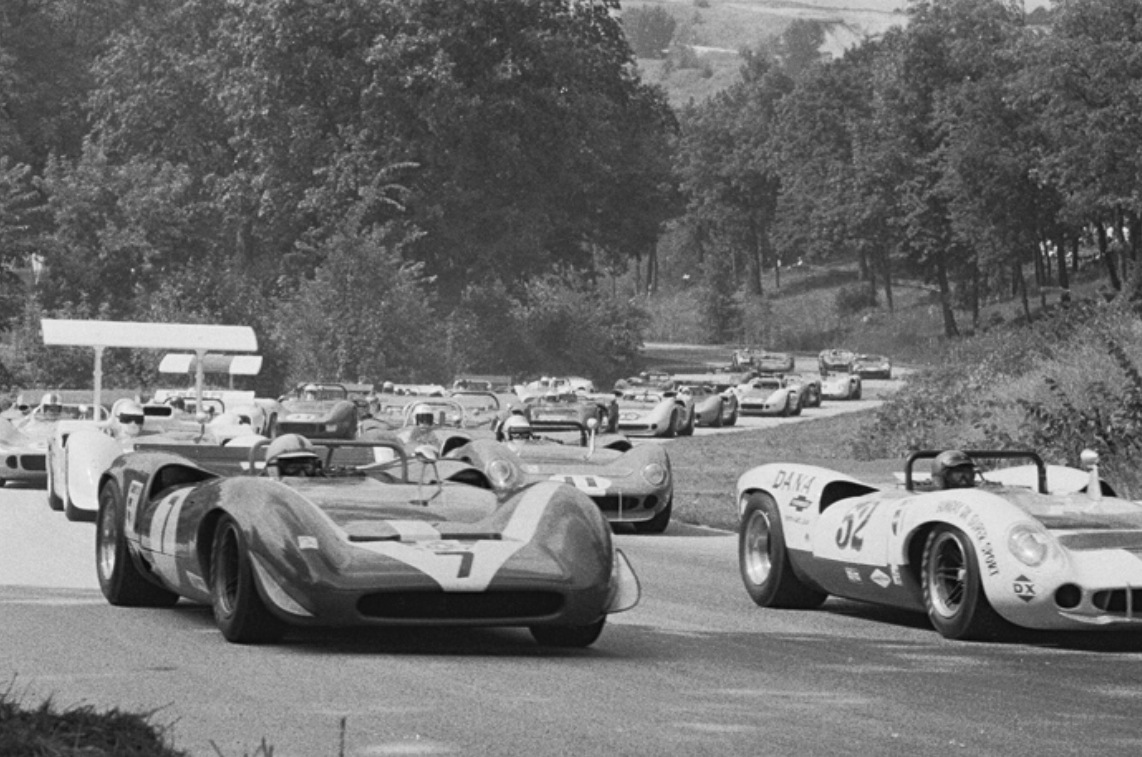
Bridghampton September 1967 start; the McLaren M6As of McLaren and Hulme are in front of this group headed by #7 Surtees and #52 Revson both in Lola T70 Mk3B Chevs, #11 Motchenbacher’s T70 Chev, Jim Halls winged Chaparral 2G Chev clear. Hulme won (Dave Friedman Collection)
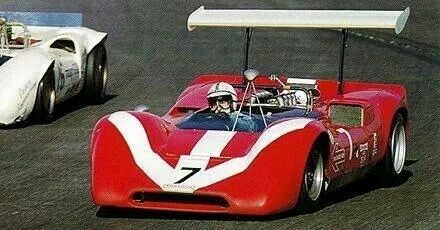
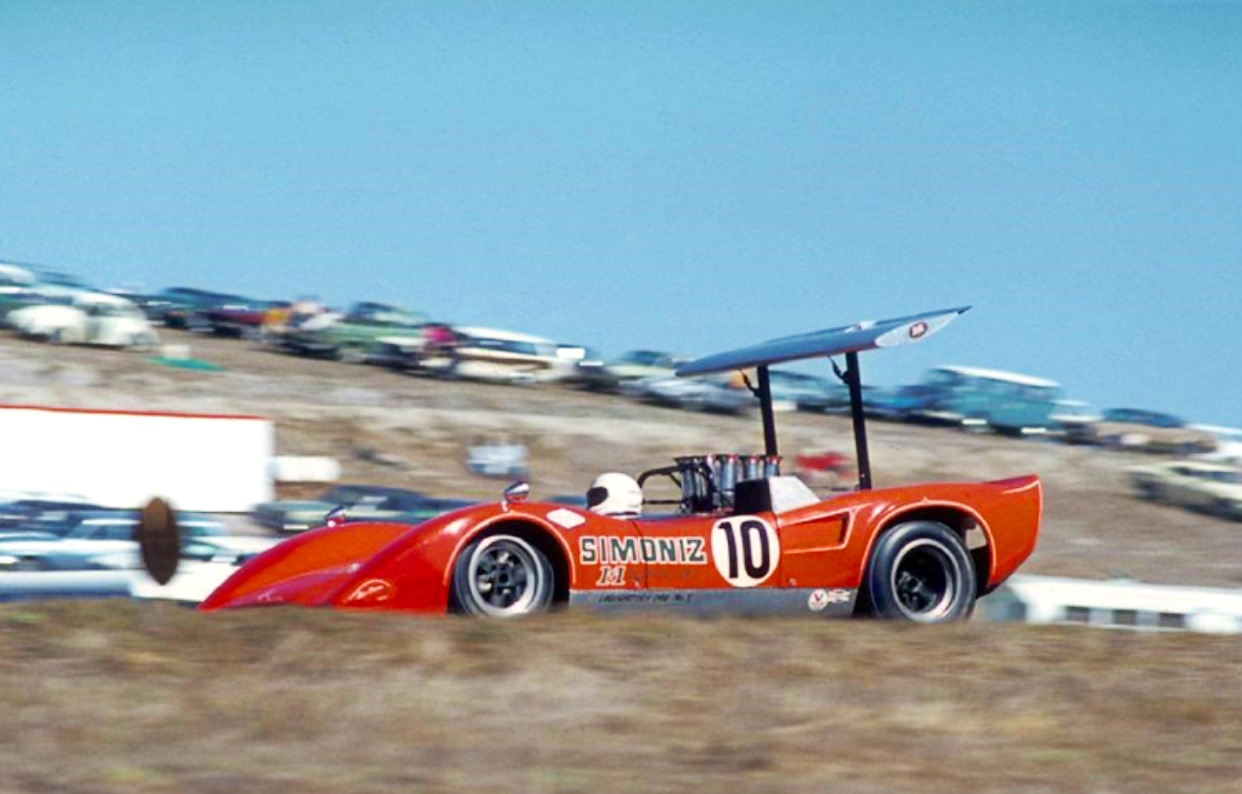
John Surtees much developed Lola T160/TS Chev at Bridghampton, September 1968, DNF having qualified 10th (unattributed)
The T160, Lola’s 1968 car was in essence a development of the T70. Surtees only raced in several rounds of the championship, Sam Posey was the best placed Lola T160 driver, finishing ninth in the drivers championship.

Surtees in his modified Lola T160/TS Chev. LA Times GP, Riverside, 27 October 1968. DNF water pump in the race won by McLaren’s M8A Chev (Dave Friedman Collection)
For Surtees it was time to do his own thing, his first customer car was the Surtees TS5 F5000 car for 1969. In the Can-Am he jumped out of the fat and into the flames, Jim Hall’s 1969 Chaparral 2H was not his best car. Surtees got a taste of the M8 McLaren when Hall realised he had built a clunker and bought an M12 customer McLaren for John to drive whilst the team sorted the 2H, Surtees revelled in the car on the few occasions he raced it!

Surtees T160 at Riverside from the rear. Top left Surtees in the pits, right Mark Donohue talking with his crew (Dave Friedman Collection)
Commercially for Broadley the appointment of Carl Haas as the Lola importer in 1967 was an astute move and provided the base for both firms success for decades with Haas having the required attributes above to take on the papaya McLarens.

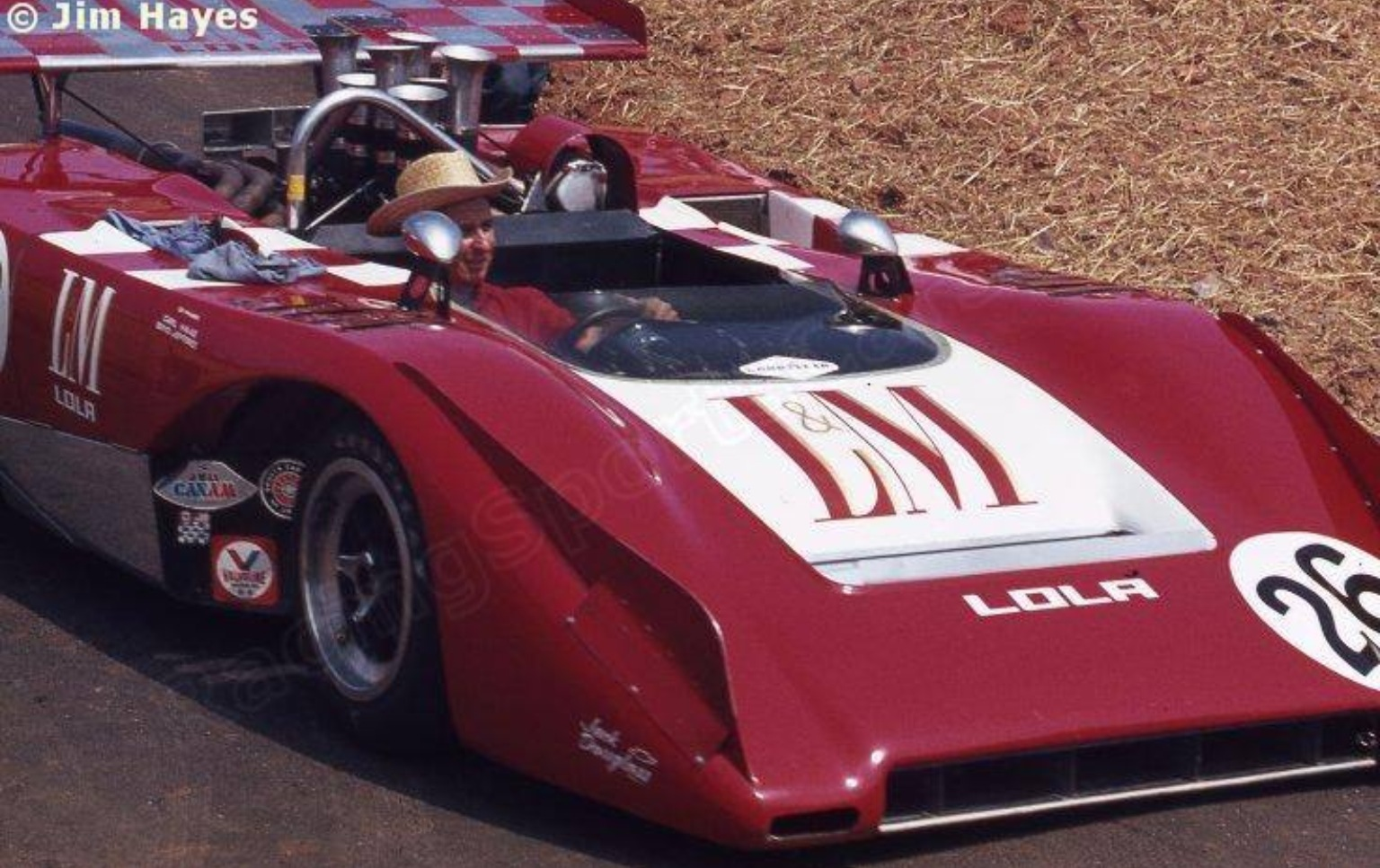
Chuck Parsons in Carl Haas ‘factory’ Lola T163 Chev at Laguna Seca in 1969. 3rd in the race won by Bruce’s McLaren M8B Chev (T Ferrari)
In 1969 Chuck Parsons proved the Lola T163 was not too bad a car, he finished third in the points chase, while the Chaparral was not a threat, and Porsche first appeared with the 917PA, the Can-Am variant of its dominant in 1970 and 1971, 917 endurance racer.

Painting depicting Vic Elford’s Chaparral 2J Chev leading Peter Revson’s Lola T220/2 during 1970 (unattributed)
1970 was one of the great years of the Can-Am. The sound, conservative engineering of the McLaren M8D was juxtaposed by Jim Hall’s outrageous Chaparral 2J Chev, one of the most stunning, original, innovative, epic racing cars ever built. The two stroke engines which created the vacuum for its ground effects were its weak link and the cause of too many retirements but the car was stunningly fast while it lasted in Jackie Stewart’s and Vic Elford’s hands.
The Establishment had it banned at the end of the season of course; ‘movable aerodynamic devices were illegal’ but the Can-Am lost its soul and it’s ‘unlimited nature’ in making that decision, Hall told the organisers to go jam it and with it the Can-Am lost its biggest draw if not its most successful team.

Peter Revson destroyed his Lola T220 Chev after a 180mph tyre blowout at Road Atlanta in 1970. He raced a new 10 inch longer wheelbase car, 98 inches, the T222 for the rest of the season. Here at Watkins Glen he was third (Automobile Year)
Haas convinced Broadley to design a new Lola for 1970 and signed Peter Revson, just peaking as a world class driver, to get the best from it.
The gorgeous, swoopy T220 had a very short 88 inch wheelbase which made it difficult to drive, a tyre failure at 180mph at Road Atlanta destroyed it, but fortunately not Revson. It was a blessing in disguise as the replacement T222 had an additional 10 inches added to its wheelbase which made it a much more competitive car.

Revson’s T220 at Road Atlanta and destroyed that weekend. ‘Fence’ an addition from original body spec (Jim Hayes)
Having said that the T220 was fast if unreliable. Revvie qualified it second at Road America, third at Mid Ohio and fourth at Watkins Glen and Mosport, his best finish was second to Hulme at Mid Ohio.
With the longer wheelbase T222 he immediately banged the car on pole at Donnybrooke, finishing third behind the two McLarens and qualified third at both Laguna Seca and the final Riverside round for a third and DNF respectively.
So, by the end of the year the Lola car/driver combination was close to the McLarens, Hulme took the 1970 title with Revson sixth. He was off to McLaren for 1971, all Lola/Haas had to do was build a better car and hire a driver of the required calibre.
Part 2: The Lola T260…

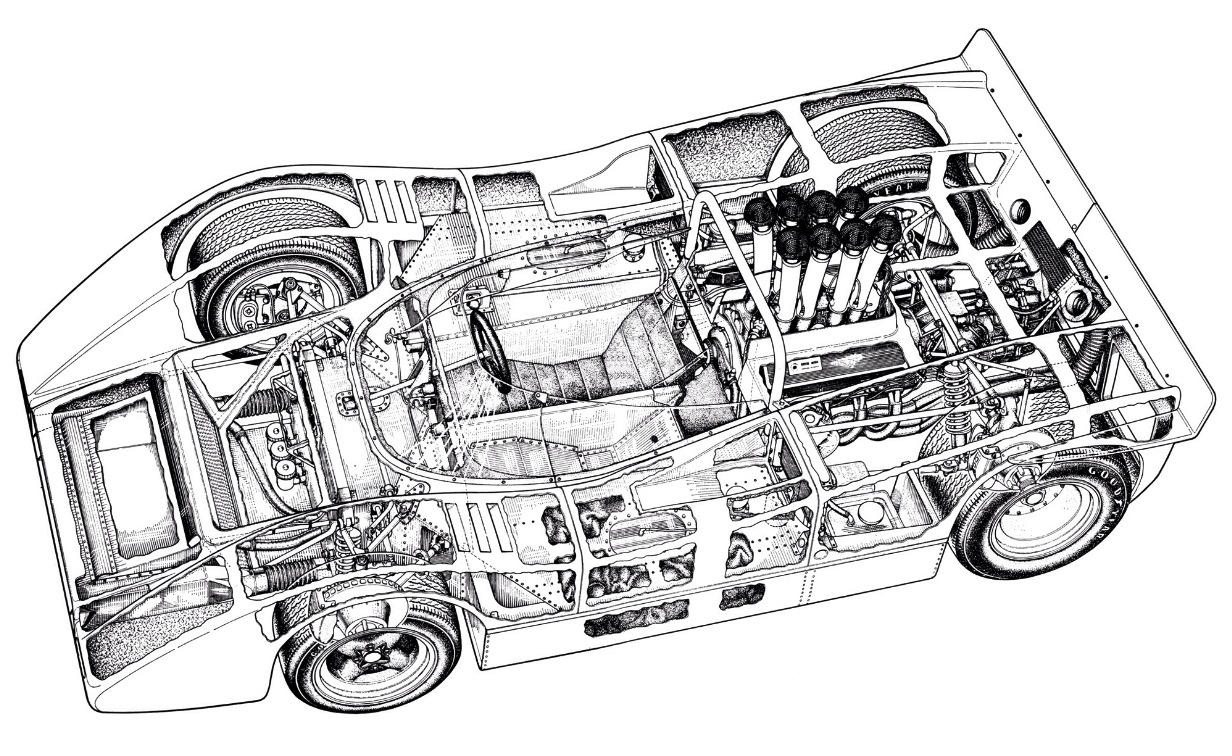
Lola T260 Chev cutaway (Tom Strongman)
Having had a taste of the Can-Am in 1970 and earlier years Jackie Stewart was keen to return. TThe professionalism of the Carl Haas team and Lola, a marque familiar to him having raced a T90 successfully at Indy together with Graham Hill in 1966, had appeal. He could fit the series into his 1971 F1 program with Tyrrell, or so he thought. Click here for an article on the Lola T90 and the 1966 Indy 500;
Graham Hill’s ‘American Red Ball Spl’ Lola T90 Ford: Indy Winner 1966…
Lola’s mount for Stewart was designated the T260 which was designed by Bob Marston with Eric Broadley’s guidance.
Lola Heritage; ‘The chassis was a…Lola full monocoque in L72 and NS4 light alloys bonded and riveted together with the fuel bags in either side of the tub with a total capacity of 60 gallons. The oil tank was contained in the rear of the left-hand fuel section. The rear of the monocoque extended to the back of the engine which was sandwiched between two bulkheads, a bell-housing supported the gearbox and absorbed suspension loads.
Cooling was via two brass-finned Serck radiators mounted behind the driver’s shoulder level and fed by two large NACA ducts on the top of the bodywork, the radiators vented through large louvres in the rear bodywork. Two oil coolers were mounted behind the water radiators and used the same ducts, an additional transmission cooler lay flat over the gearbox.
The bodywork was evolved following extensive tests in the Specialised Mouldings wind tunnel and featured a short, bluff nosecone with gauze-covered holes on the top to equalise pressure. At the base of the nose were two air ducts to feed air to the front discs, at the rear two ram pipes on the top of the rear body section collected the cooling air for the rear discs’.
Pete Lyons described the cars aerodynamic approach ‘The T260…was built to an aerodynamic theory already embodied in a few small-bore sports cars of the day. The intent was a shape that would bullet through the air on the straights and also remain stable as the car’s pitch attitude, ride height and positioning behind other cars changed everywhere else. In particular…a more conventional downforce-producing wedge nose, such as McLaren’s…could abruptly change from downforce to lift under certain conditions…’

CAD sketch showing the T260 aero treatment. (unattributed)
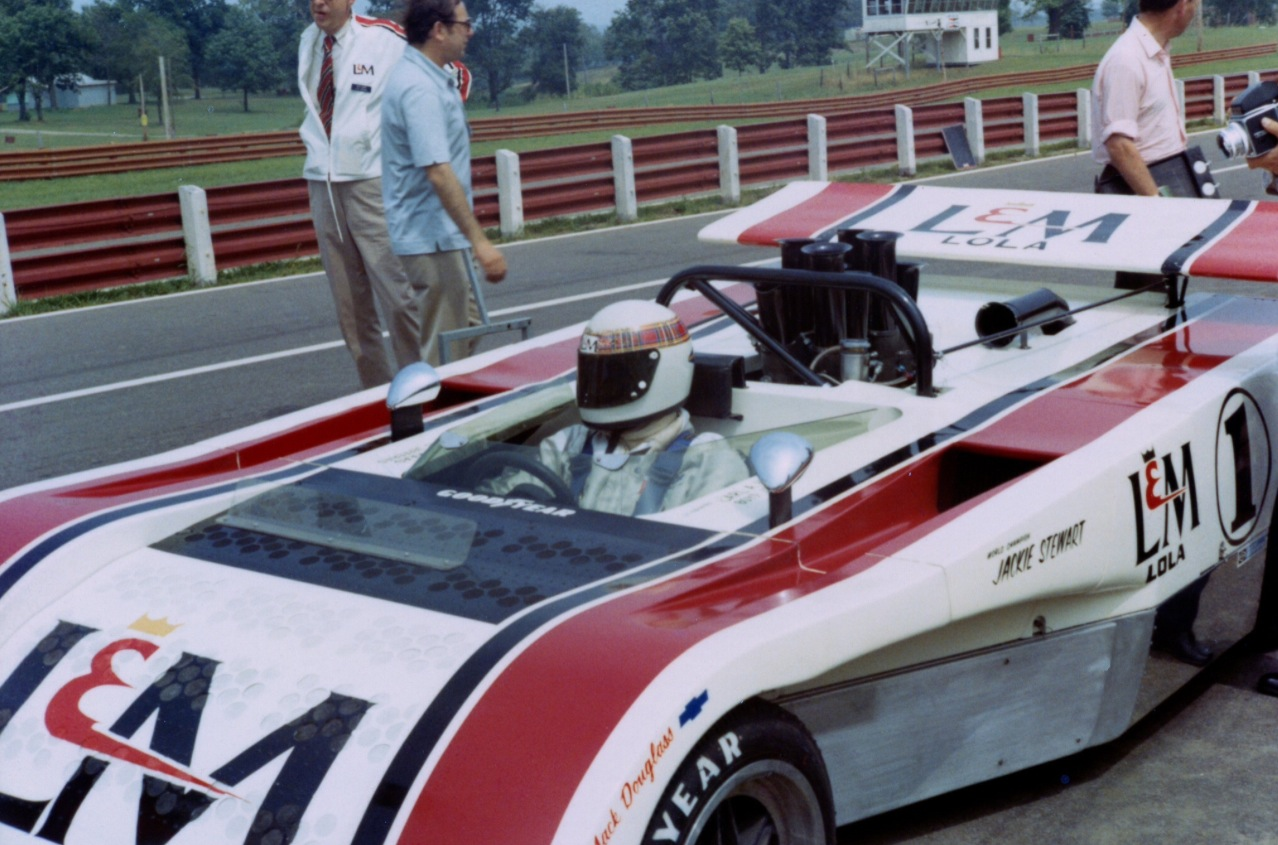
‘The front suspension on the T260 comprised unequal length wishbones, the upper ones were triangulated to form bell-cranks that operated Bilstein dampers and coil springs which lay almost horizontally across the front of the tub. The unusual spring-medium location freed space for the front brakes to be mounted inboard. Eric Broadley’s intention was to reduce the unsprung weight of the front wheels by moving the brakes inboard from their conventional hub location. This would have permitted the lighter wheel assemblies to ride better over the often bumpy Can-Am circuits. Jackie Stewart was adamantly opposed to inboard brakes after the death of his close friend Jochen Rindt due to the failure of an inboard-brake driveshaft on his GP Lotus 72 at Monza in September 1970. Conventional outboard brake mountings were used on the finalized T260 instead.’
A tangent is the fact that later JYS was comfortable enough with Engineer Derek Gardner’s approach to inboard front brakes, his 1973 Championship winning Tyrrell 005/006 being so equipped.

T260, Stewart up, Road America. Shot included to show the unusual location, for the time, of the spring/shocks referred to in the text. Graviner fire extinguished ‘bomb clear in shot. Chassis aluminium full monocoque (Jim Buell)
Rack and pinion steering was ahead of the front suspension.
Lola Heritage; ‘At the rear there was a short top link and a long radius arm attaching to the front engine bulkhead, a lower member extended rearwards to a cross-member bolted to the rear face of the gearbox. The springs and dampers fixed to the lower member and transmitted their load to tubular outriggers on the gearbox bell-housing.
Lola-made centre-lock, peg-drive magnesium wheels were fitted, their diameter 15 inches with 10.5 inch front and 17 inch wide rear Goodyears. The battery was mounted in the nose and a Graviner onboard fire extinguisher was fitted behind the dashboard’.
Two cars were built for Haas, chassis HU1 was Stewart’s race chassis, HU2 was an unused spare in 1971.
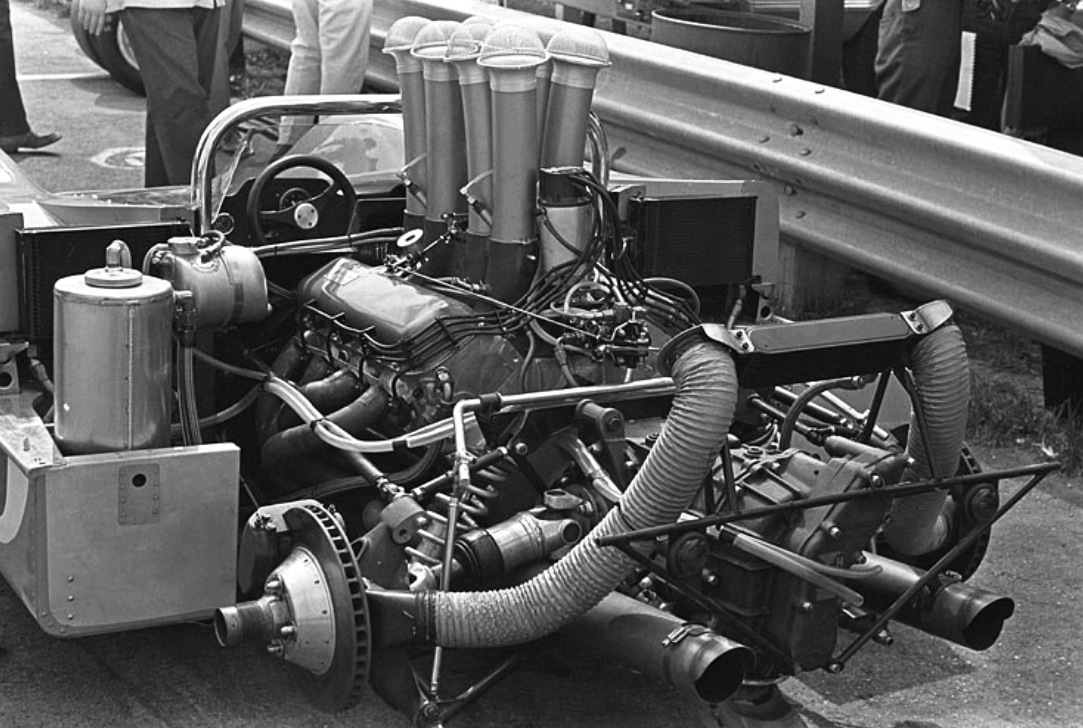
The engine was a 496 cu in (8.1-litres) V8 Chevrolet tuned by George Foltz, it produced circa 700 bhp and 618 lb/ft of torque, Lucas fuel injection was fitted with a Scintilla Vertex magneto and a Hewland LG600 four-speed gearbox transmitted the power.

Aluminium block 8-litre engine of the T260 at Mosport. June 1971 (Jerry Bendl Collection/The Roaring Season)

(Werner Buhrer)

Frank Gardner testing the Lola T260 at Silverstone in May, note how far forward the rear wing is in relation to shots taken later in 1971 (LAT)
When completed the car was tested by Lola racer/tester/development engineer Frank Gardner at Silverstone in May, FG was also turning his mind and skills into getting more speed from Lola’s F5000 T190/2; no doubt the F5000 was a kiddy-car compared to its 8-litre big brother!
Stewart drove the car in a rain soaked run at Silverstone prior to the cars shipping to Canada for the season opening Can-Am round at Mosport, Canada.

Gardner in T260 HU1 at Silverstone, the shortness of the car and different to anything else in the Can-Am aero-treatment, clear in this shot (unattributed)

Ropey shot of Stewart sheltering from the Silverstone weather during his brief drive of the T260 prior to shipment to North America, June 1971 (Sutton Images)
Other 1971 Can-Am Contenders…

Denny Hume and Jackie Stewart at Mid Ohio 1971. Stewart in his T260 office (Ron Laymon)

Denny Hulme, McLaren M8F Chev, Road America, August 1971. DNF engine. Engine 494cid Reynolds aluminium block Chev, circa 740bhp @ 6400rpm (Jim Buell)
In reality the likely outright contenders in 1971 were the factory McLaren M8Fs, Stewart’s T260 and Jackie Oliver’s Shadow Mk2 Chev, designed by Peter Bryant.

Jackie Oliver’s Shadow Mk2 Chev, Road America 1971, 12th in the race (Jim Buell)
Jo Siffert’s Porsche 917/10 was gathering valuable data for a serious tilt in 1972. In exceptional circumstances (the wet) it was a contender as were a number of the best privateers in either ex-works or carefully developed M8’s: Lothar Motschenbacher, Vic Elford and Tony Adamowicz the most likely.

Siffert’s Porsche 917/10, Road America 1971. Spaceframe chassis, 5-litre flat 12 (Jim Buell)

Peter Revson, Jackie Oliver in the helmet and front suspension detail of a McLaren M8F in the Road America paddock, August 1971 (Jim Buell)
The detailed specification of the McLaren M8F I wrote about a while back; click on this link to read the short article; https://primotipo.com/2015/03/08/peter-revson-mclaren-m8f-chev-1971/

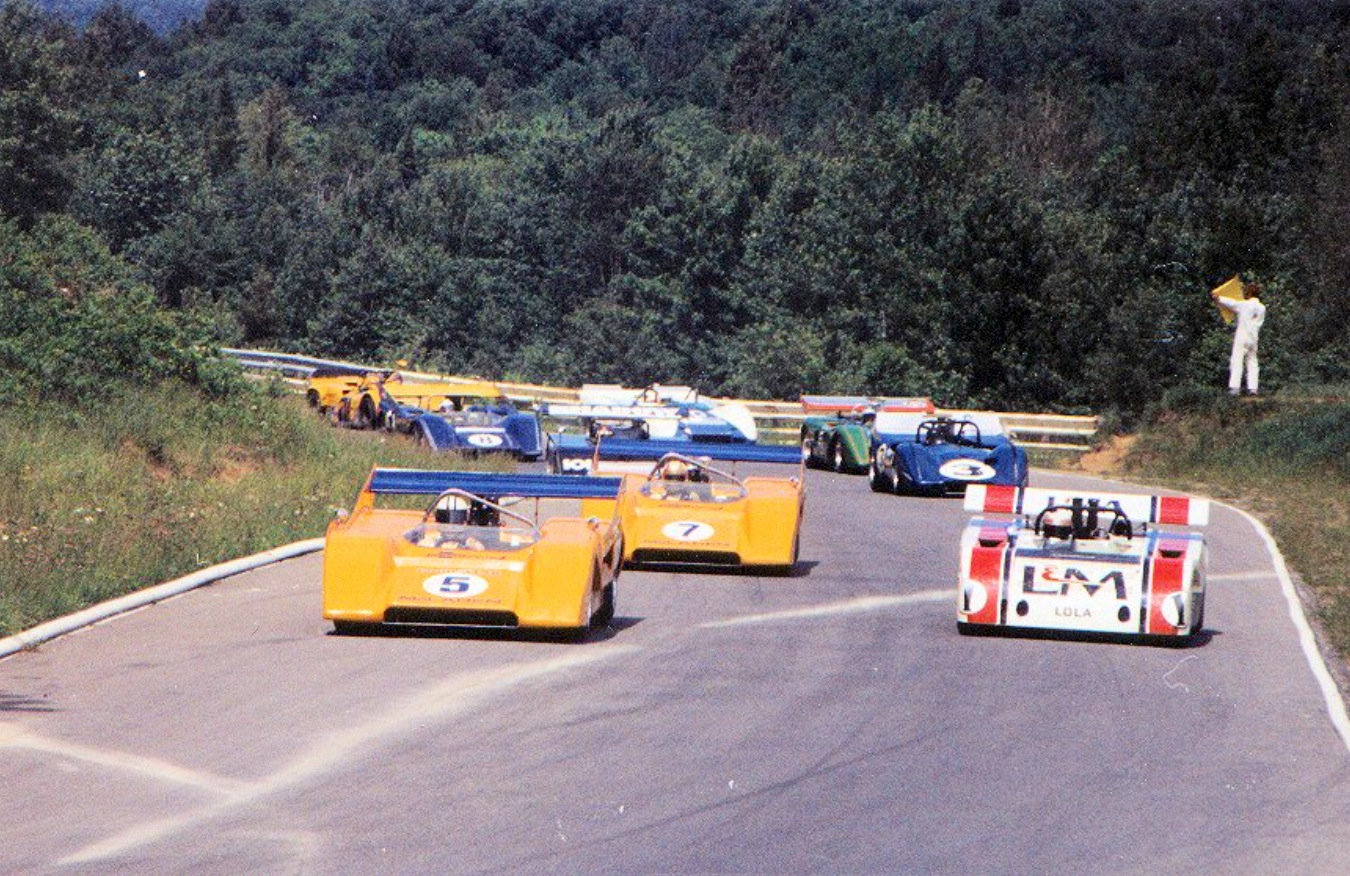
1971 Mid Ohio rolling grid. #5 Hulme, #7 Revson, #1 Stewart, #2 Jo Siffert,Porsche 917/10, #51 Dave Causey Lola T222 Chev, #54 Tony Adamowicz, McLaren M8B Chev, #88 Hiroshi Kazato, Lola T222 (Ron Laymon)
Part 3: Racing: 1971 Can-Am Round by Round…

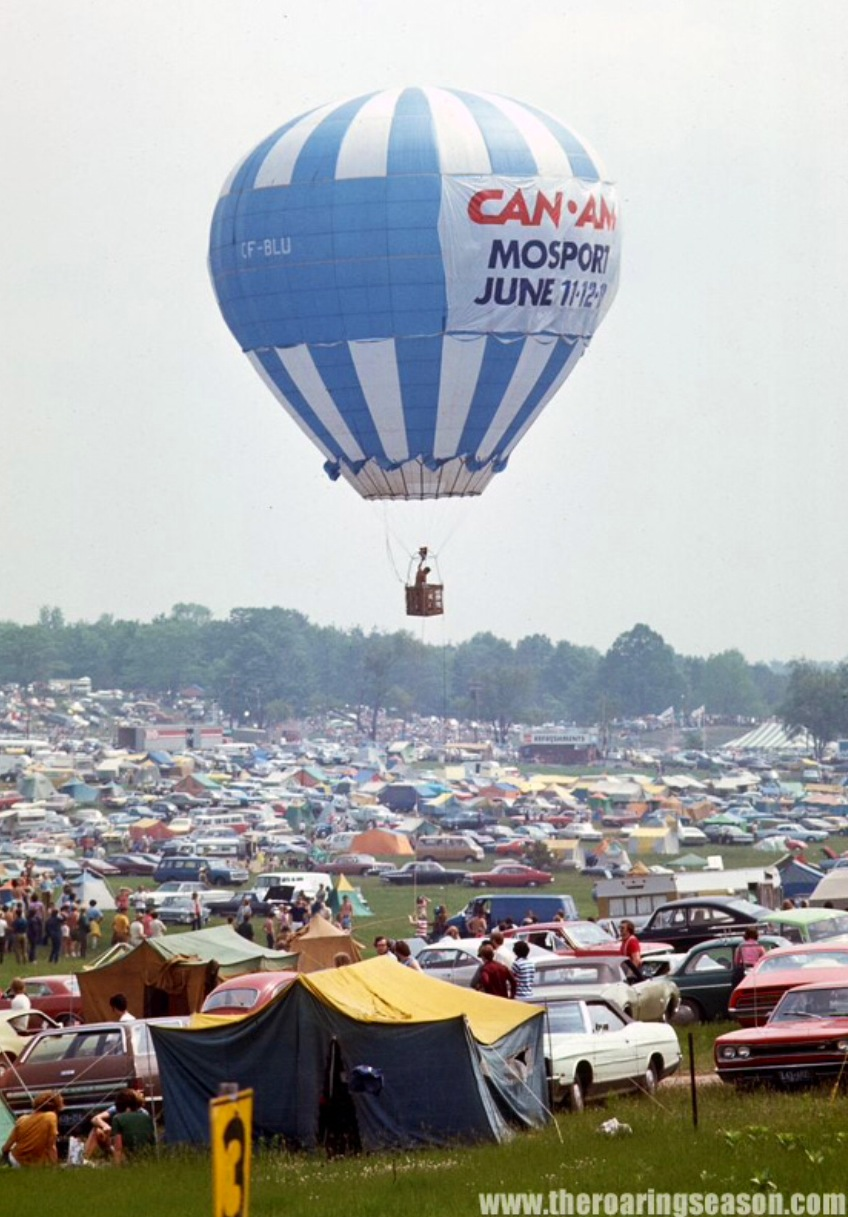
Mosport 1971 vibe, looks fantastic! (Jerry Bendl Collection/The Roaring Season)
Round 1: Mosport, Ontario Canada 13 June 1971
Stewart grabbed pole position from the works McLaren M8Fs of Hulme and Revson then led the race from Hulme, an oil leak from the LG600 Hewland ‘box resulted in its seizure on lap 18.
Hulme won from Revson and Lothar Motschenbacher in one the 1970 ex-works McLaren M8Ds.

Pan of Stewart at Mosport shows the cars original aero treatment before ongoing modifications and experiments. Rear wing far forward and nose devoid of appendages (Jerry Bendl Collection/The Roaring Season)
Rounds 2 and 3: St Jovite, Quebec Canada 27 June and Road Atlanta, Georgia, 11 July
Stewart put the T260 on the front row next to pole sitter Hulme’s McLaren M8F at St Jovite. Denny led from the start but Stewart sat in second until lap 52 when Hulme, tiring from a stomach bug, had to slow due to exhaustion. Stewart won from Denny and Peter.

Stewart a race winner at St Jovite, here beside Hulme with Revson just behind (Lola Heritage)
Stewart recalled in an interview with Gordon Kirby, ‘St Jovite was a good win because with that car, that track was hard work! The other race where we did quite well was at Road Atlanta. We led the race then had a puncture and a whole series of other problems but still turned the fastest lap of the race, quicker than Hulme’s pole time’. Revson won from Hulme and Motschenbacher.

Stewart had great pace at Road Atlanta, wonderful high speed shot of the short, squat, original T260 (unattributed)

Stewart ahead of Revson, Mario Cabral Porsche 917K and Hulme in the distance, Watkins Glen, 1971 (unattributed)
Round 4: Watkins Glen, New York, 25 July
The T260’s speed was not in doubt, it was back on pole again with Hulme and Revson right behind. Stewart got the drop putting the T260 into the lead from Revson, the Lola and McLaren diced until Stewart pitted with another puncture, losing a lap while the wheel was changed.
Stewart returned to the race and began to fly, setting the fastest lap but on the 56th lap he retired the car after detecting vibrations which proved to be a failing transmission. Revson won from Hulme and Siffert’s factory Porsche 917/10.

JYS at Watkins Glen, site of the US GP in upstate New York, it was a circuit he knew well (LAT)

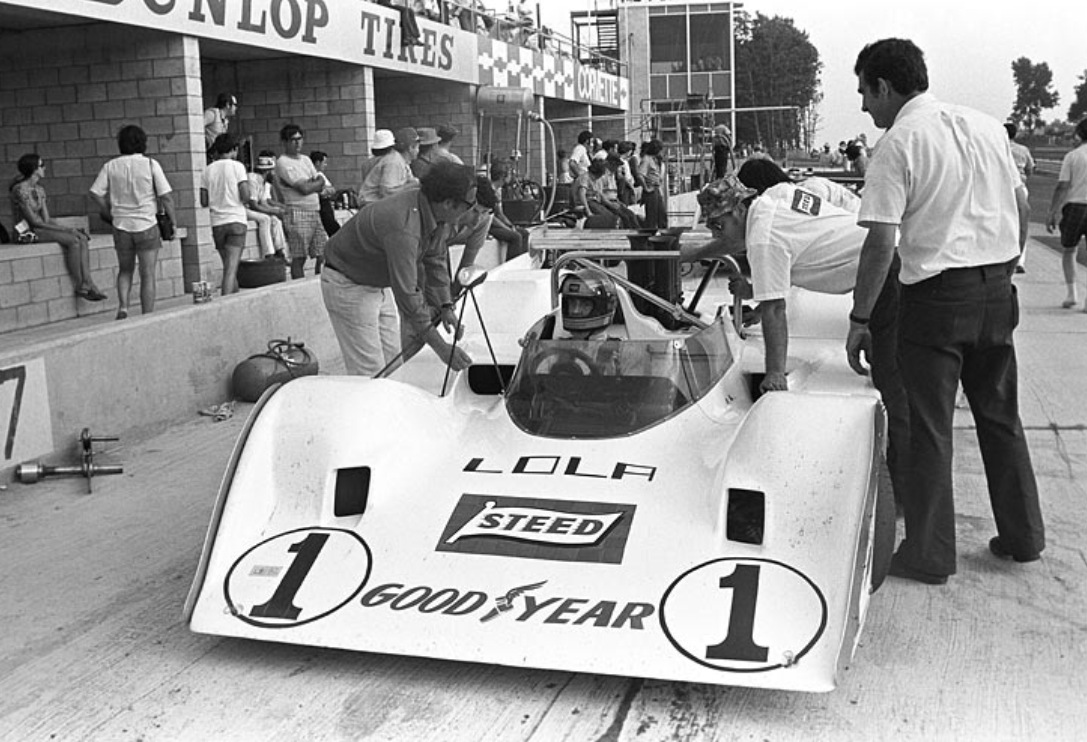
Stewart loaded up and all ready to go in the Mid Ohio pitlane (Terry Capps)
Round 5: Mid Ohio, 22 August
Stewart, famously a successful campaigner for better circuit safety, was unhappy with the track; its surface was excessively bumpy and the presence of trees and telegraph poles surrounding the course meant mistakes would be punished severely.
Much overnight work was carried out to remove some of the trees and poles, and add straw bales where possible, but after looking at the result Stewart declared he would ‘run but he wouldn’t race’. Stewart’s position could be appreciated after the bumpy track caused three rear suspension failures to the T260 during qualifying.

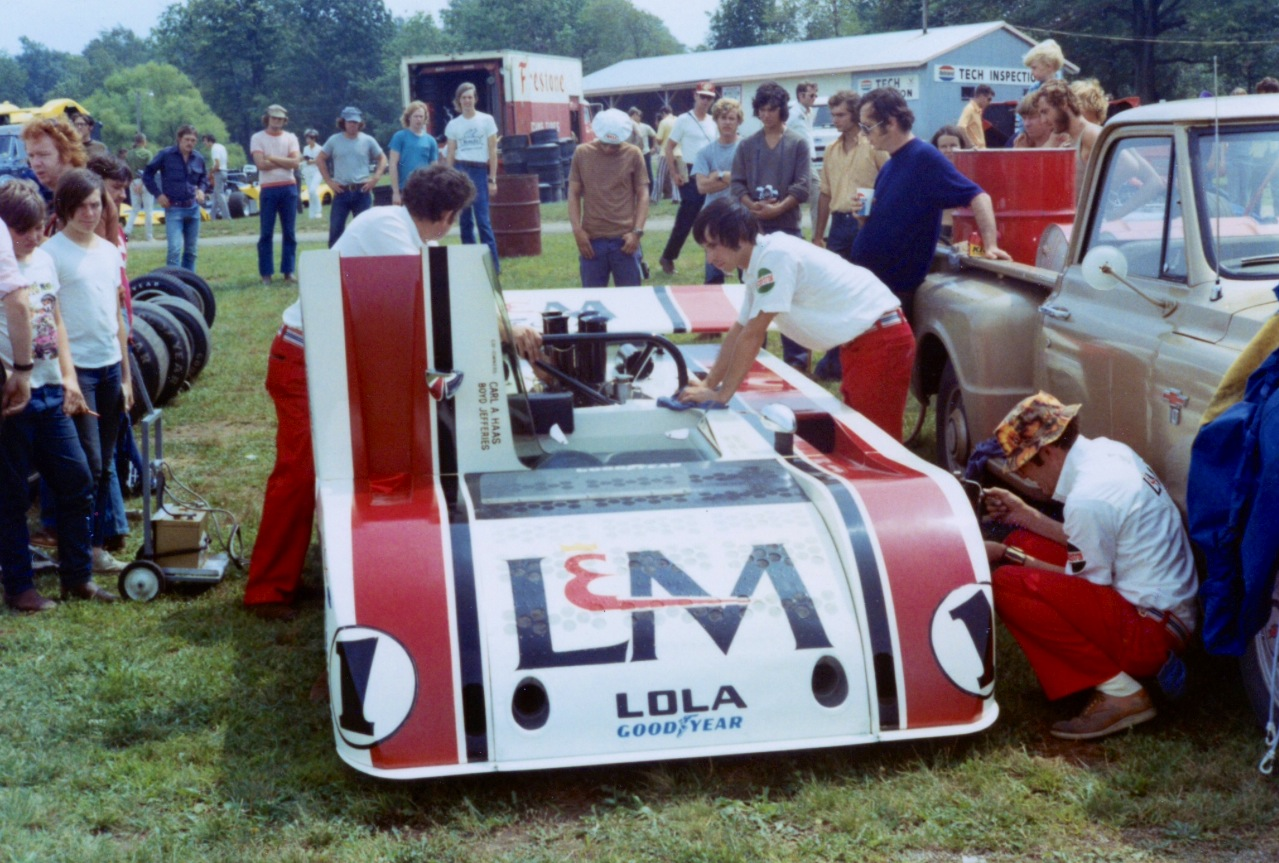
Bucolic Mid Ohio paddock. Team busy this meeting, several suspension failures over the bumpy circuit. Standard-aero at this point (Terry Capps)
Stewart qualified third and was second behind Revson at the end of lap one but the McLaren drew away as Stewart drove well within himself. On lap 72 Revson’s driveshaft universal joint failed (the same problem sidelined Hulme) and Stewart took the lead and race win from Siffert’s Porsche and Tony Adamowicz’ 1969 ex-works McLaren M8B Chev.

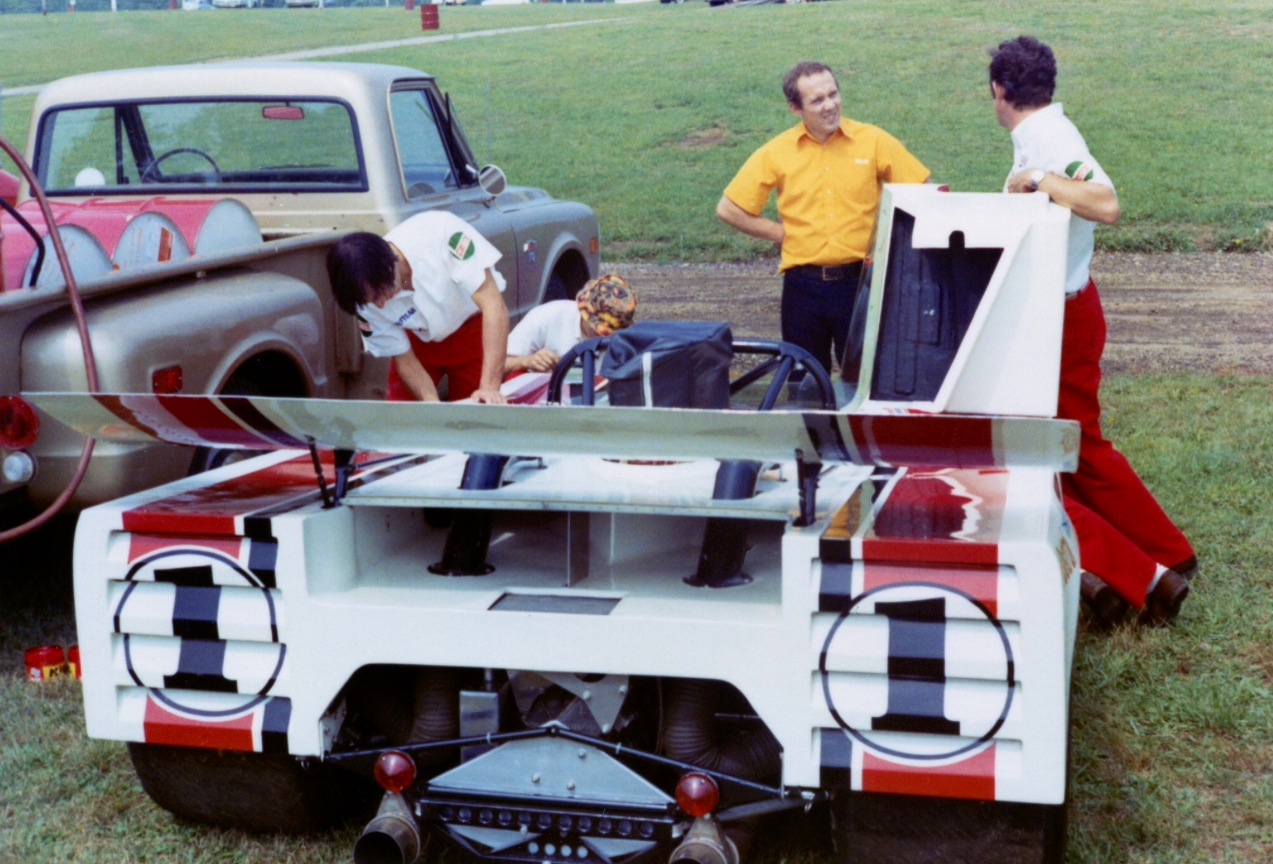
Mid Ohio paddock, this time a butt shot. Neat brackets to support beefy exhausts and lights, black ducts are cooling for inboard discs located beside the Hewland ‘box. Note also ducts/louvres on the rear of the bodywork to exhaust hot air (Terry Capps)
From this point on, the continual development of the McLarens told while the Lola effort didn’t improve enough. McLaren were a well drilled team and both drivers were experienced campaigners with whatever changes needing to be made could be done quickly in their Detroit workshop or back at Colnbrook.
While the T260 was effectively a works effort run by the marques US importer, Lola were at their core a manufacturer of customer racing cars with many customers, not a race team with only one focus.

Included in JYS program for 1971 was the Questor Grand Prix at Ontario Speedway in March. He was second in his Tyrrell to Mario Andretti’s Ferrari 312B…but here Jackie is putting in a few laps in AJ Foyt’s McLaren M10B Chev in his only F5000 drive?? (Getty Images)
Jackie Stewart on driving the T260 and stresses of two major campaigns, F1 with Tyrrell and the Can-Am Lola in 1971…
Stewart related to Gordon Kirby and Adam Cooper in separate MotorSport magazine interview’s; ‘There were no wind tunnels in those days and Eric (Broadley) would suddenly arrive and under his arm was a new front wing. There was one we called ‘the cowcatcher’. It was hung out front of the car and what it was doing I just don’t know’
‘The car was very short wheelbase and very difficult to drive. In comparison to the McLarens, (Stewart was approached to drive for them in 1972 and actually signed to do so but withdrew when the extent of his health problems were clear) the car was just a monster to drive and we were just trying to keep up’.
‘I tested the McLaren and it was just like a passenger car compared to the incredibly nervous, pointy, short wheelbase Lola where you were a millisecond from an accident all the time.’
Stewart said the Lola T260 was the most physically demanding car he raced in his career ‘On the very fast circuits like Riverside it was awfully tricky because you never knew where you were going’. In order to make up for its shortcomings ‘I sweated more. It was just a difficult car to drive. There are some cars which are easy to drive and others not and that was one of the ones that was not’.
In a contest for the worst car he ever drove; ‘The Lola T260 Can-Am car would probably make that one…the H16 BRM runs it a close second’.
The main problem was dire understeer in addition to ultimate twitchiness at speed. The Lola’s blunt nose was dotted with mesh covered holes through which the underbody air could pass. In theory this helped provide some downforce. In its initial guise the shape of the front didn’t seem to have any obvious way of providing grip. Broadley deliberately opted not to have a fashionable chisel nose. But the lack of downforce at the front was borne out by the position of the giant rear , which was usually far forward, just behind the injection trumpets in an attempt to achieve some sort of balance.
A combination of racing around the world in two series and lots of promotional work gave Stewart mononucleosis. ‘I was flying back and forth from Europe to do F1, I won the world championship that year and two Can-Am races, but I also got mononucleosis (glandular fever), a really debilitating disease that took your energy away. You couldn’t sleep and yet you were overly tired. So it was a tough year, a really exhausting year’.

Stewart racing his Tyrrell 001 Ford to victory in the Spanish GP, Montjuic Park, Barcelona on 18 April. He took six wins in 1971 and his second drivers title (unattributed)
It’s interesting to reflect on Jackie’s comments on the differences between the two cars. In fact both the T260, which retained the same wheelbase as the T222, and the M8F had 98 inch wheelbases.
The front/rear track of the Lola was 58 inches, of the M8F 60/57.75 inches, while the overall length of the Lola was 139 inches compared with the much longer M8F’s 167 inches. The aero treatment was radically different of course, a lack of downforce something the team chased progressively throughout the season.

Stewart in the T260 at Road America and trying a different aero configuration comprising; a new profile ‘clip’ on the lower nose at the cars front and McLarenesque wing and integrated mounts, wing now much further back than the original (Jim Buell)
Round 6: Road America, Elkhart Lake, Wisconsin, 29 August
Stewart was third fastest in qualifying but his engine, also used at Mid-Ohio, was tired.
A new Chev was fitted for the race but high temperatures during warm-up were hoped to be vapour lock in the cooling system.

Stewart ready to rock at Road America and a close-up of the configuration pictured above (Jim Buell)
Stewart ran second early on but after 10 laps the engine was smoking so Jackie parked it. Later examination showed a dropped cylinder liner was responsible for the high engine temperatures.
Revson won from Siffert and Vic Elford’s McLaren M8E Chev.

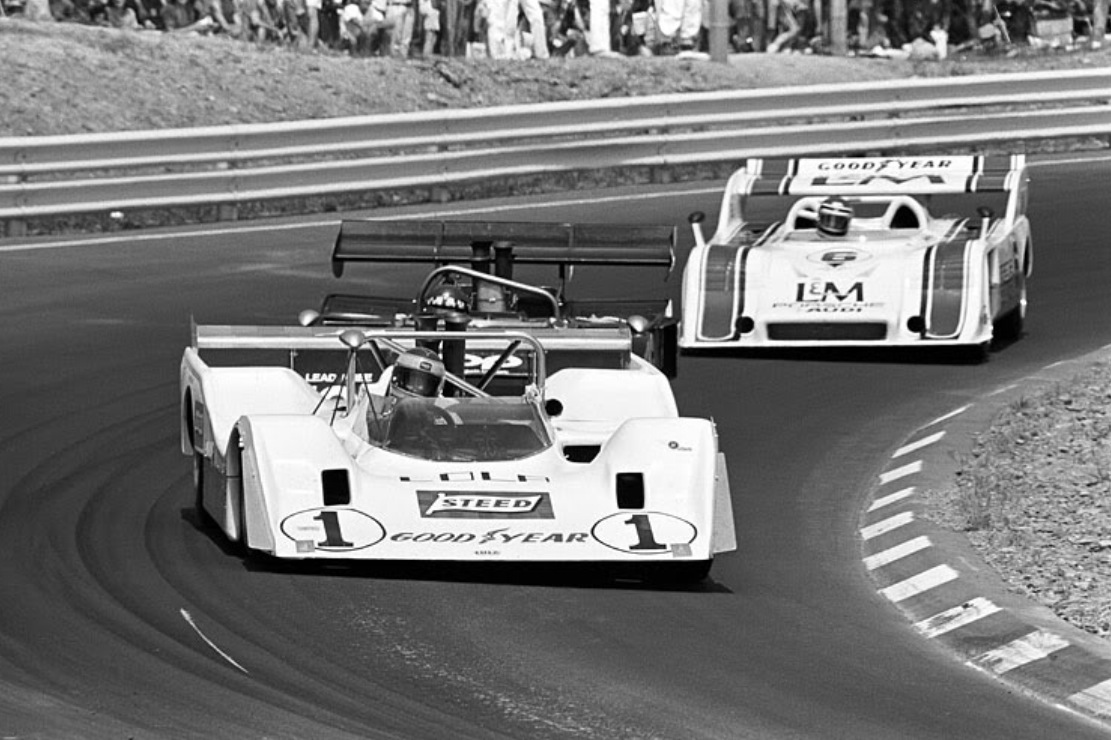
Stewart T260 Road America, note that in this shot he is running the original nose and rear wing setup (Carl Knopp)
Round 7: Donnybrooke, Minnesota
The T260 had revised rear suspension but the McLarens were continually being developed as well, Stewart’s third fastest time was two seconds adrift of the factory M8Fs.
Stewart got away well and led for two laps until Revson found a way past, Hulme was unable to pass Jackie as the McLaren was losing grip in the Lola’s slipstream. The positions remained until lap 22 when Stewart felt something amiss and pitted, nothing could be found, he resumed in 10th a lap and a half down.
The Scot raced the T260 back to fourth but another puncture saw Stewart back in the pits, the T260 finished sixth, two laps down. Revson again won from Hulme and Gregg Young’s McLaren M8D/E Chev in third.
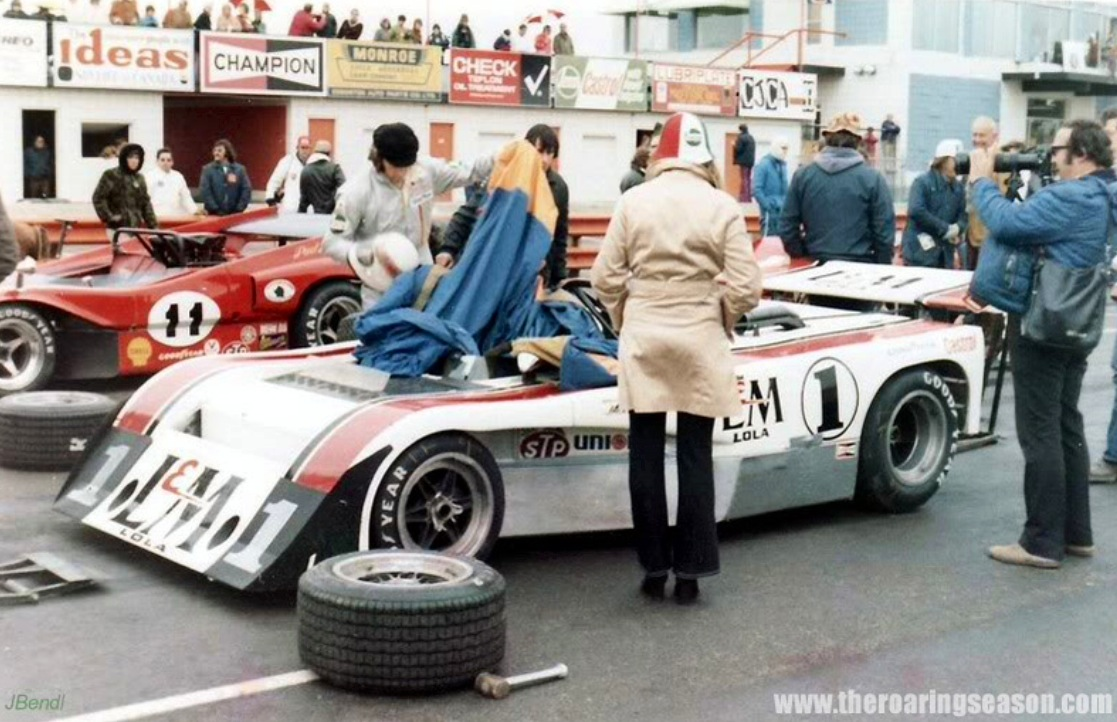
Stewart about to load up on the wet Edmonton grid, September 1971. #11 is Motchenbacher’s McLaren M8D . See another variation of the T260 nose, the front ‘clip on’ less bluff than the original and more ‘scooped’. Rear wing mounted back (Jerry Bendl Collection/The Roaring Season)
Round 8: Edmonton, Alberta Canada, 26 September
The T260 featured a revised nose shape designed to give more downforce while the rear wing was moved back to balance the new nose.
Stewart qualified third again and had a great start on the wet track and led. The T260 was handling well in the rain, the Scot extended his lead over Jackie Oliver’s Shadow and Hulme’s McLaren. Stewart was still leading at half distance but a trip onto the grass when lapping Motschenbacher’s M8D lost the Lola’s handling balance.
Gradually Hulme closed the gap and he suddenly found himself in the lead with 13 laps remaining, the deteriorating handling caught Stewart out and he spun. The T260 resumed in second but with it’s competitiveness lost Stewart settled for a safe second. Jackie Oliver finally got the Shadow Mk2 into the points in third place.

Stewart runs the cow-catcher set up at Laguna Seca, in search of downforce or what! Far forward wing and much larger rear wing to balance things up (Tony Ferrari)
Round 9: Laguna Seca, California, 17 October
At Laguna Seca the T260 had lost its high downforce nose from Edmonton and now featured a huge, front cow-catcher wing projecting out in front of the nosecone.
Stewart managed fourth on the grid behind the McLarens and David Hobbs in the Ti22 Chev.
Stewart soon passed Hobbs – David raced the Carl Haas factory Lola T310 in 1972 – and after 10 laps passed Hulme who had some broken valve springs.
Revson seemed secure 25 seconds ahead of Stewart but a collision with a backmarker required a pit stop to secure a loose door. Stewart was now nine seconds behind. Revson started to pull away again but with 20 laps to go Revvies engine lost power, he nursed it over the remaining laps but with two to go the M8F was puffing blue smoke.
He drove the last two laps cautiously to win and but Stewart took the chequered flag as Revson had been shown a black flag, Revson claimed he hadn’t seen it.
The Carl Haas team protested Revson, the results were pending for some hours, but eventually Revson got the win but received a $250 fine. Hulme was third.

Stewart ahead of David Hobbs Ti22 Chev, Jackie Oliver Shadow Mk2 Chev, another unidentified car with Jo Siffert Porsche 917/10 at rear. Corkscrew, Laguna (Hal Amarantes)


Stewart at Riverside, again with the cow-catcher aero setup. Side on profile shot gives an idea of just how far forward the front wing was and how big the rear one was! Lola T260 Chev (MP Hewitt)
Round 10: Riverside, California, 31 October
The series’ final round was at Riverside on October 30, only 3 1/2 short months since its commencement in mid-June.
Stewart again qualified third, the T260 now had bigger sideplates on its rear wing.
Hulme took the lead at the start but Stewart got up to second as Revson, looking for points to clinch the Championship, didn’t make it difficult. Unable to challenge Hulme, Stewart was running happily in second until a piston failed in the big aluminium Chevy on lap 27.
Hulme won from Revson and Howden Ganley in the BRM P167 Chev.
The end of the 1971 Can-Am Championship resulted in Peter Revson as champion with five wins to Hulme’s three, Stewart finished an honourable third to the two McLarens…
As Lola Heritage puts it ‘He had been their only consistent competitor over the ten rounds and there was a certain ‘what may have been’ feeling over the whole series, if only reliability had been better and punctures had been less’.
In addition to that it’s a shame the car hadn’t been finished earlier and tested extensively at Goodwood and Silverstone prior to crossing the Atlantic, but it wasn’t and the dominant McLaren’s reaped the rewards.

David Hobbs in the Watkins Glen pits 1972, Lola T310 Chev (unattributed)
For 1972 Lola again contested the championship with a new car, the T310, McLaren built a new car, the M20 Chev to take on the pride of Stuttgart, but the mighty turbo-charged Porsche 917/10 was battle ready in the hands of the Penske Team and Mark Donohue in a way the 1971 Lola/Carl Haas/Stewart combination were not…

David Hobbs Lola T310 Chev fourth ahead of Jackie Oliver’s Shadow Mk3 Chev DNF and the dominant Porsche 917/10 turbo of George Follmer fourth. Hulme won this round in an M20 McLaren. Watkins Glen 1972 (unattributed)
Etcetera…

Bibliography…
Lola Heritage, MotorSport October 2000 article by Adam Cooper and December 2013 article by Gordon Kirby, Automobile Year 19, ‘Can-Am’ Pete Lyons
Photo Credits…
Lola Heritage, Ron Laymon, Getty Images, LAT, Jerry Bendl Collection/The Roaring Season, Automobile Year, Jim Hayes, Tom Strongman cutaway drawing, Carl Knopp, Jim Buell, Terry Capps, Hal Amarantes, Tony Ferrari, MP Hewitt
Tailpiece…
Turn in Biiitch!

Stewart Lola T260, Road America 1971 (Jim Buell)
Finito…