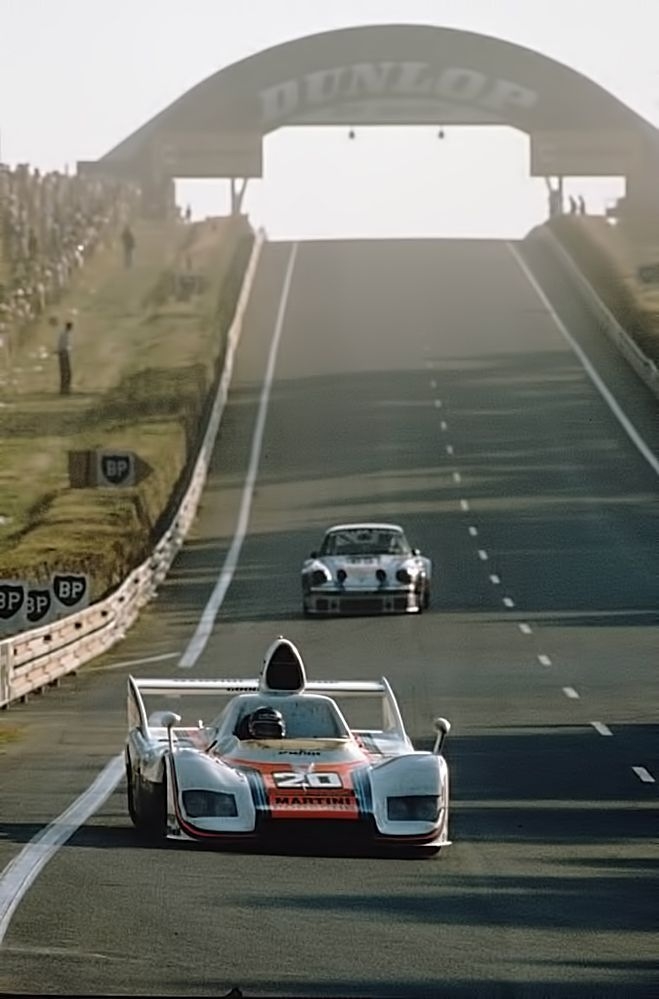
Jacky Ickx and Gijs van Lennep won the race by 11 laps in their Porsche 936 from Jean-Louis Lafosse and Francois Migault in a Mirage GR8 Ford and British pair Chris Craft and Alain De Cadenet in the latters De Cadenet Lola T380 Ford…
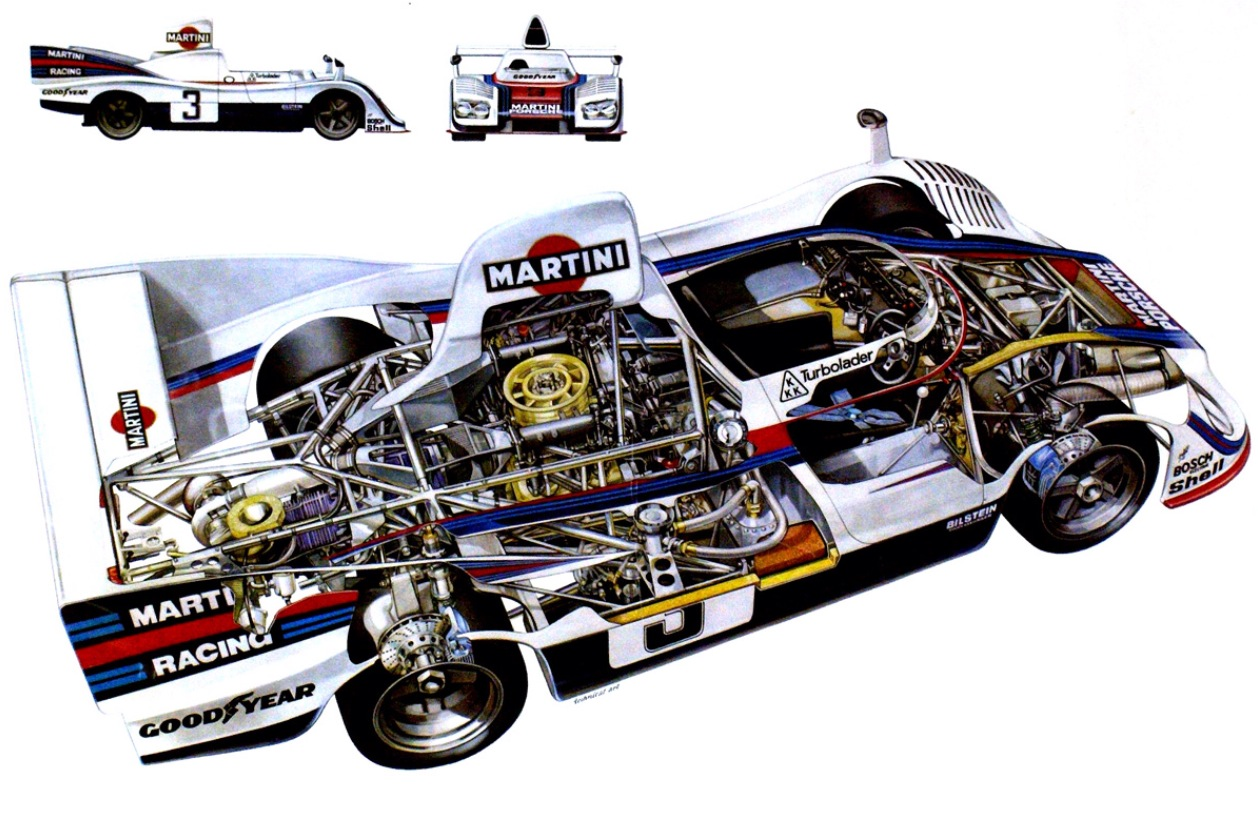
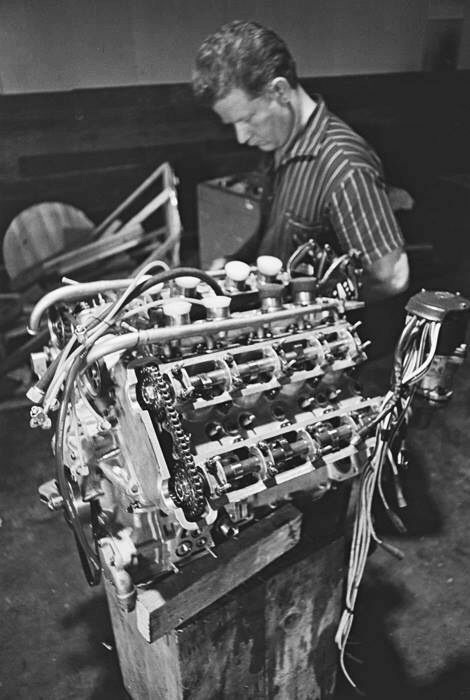
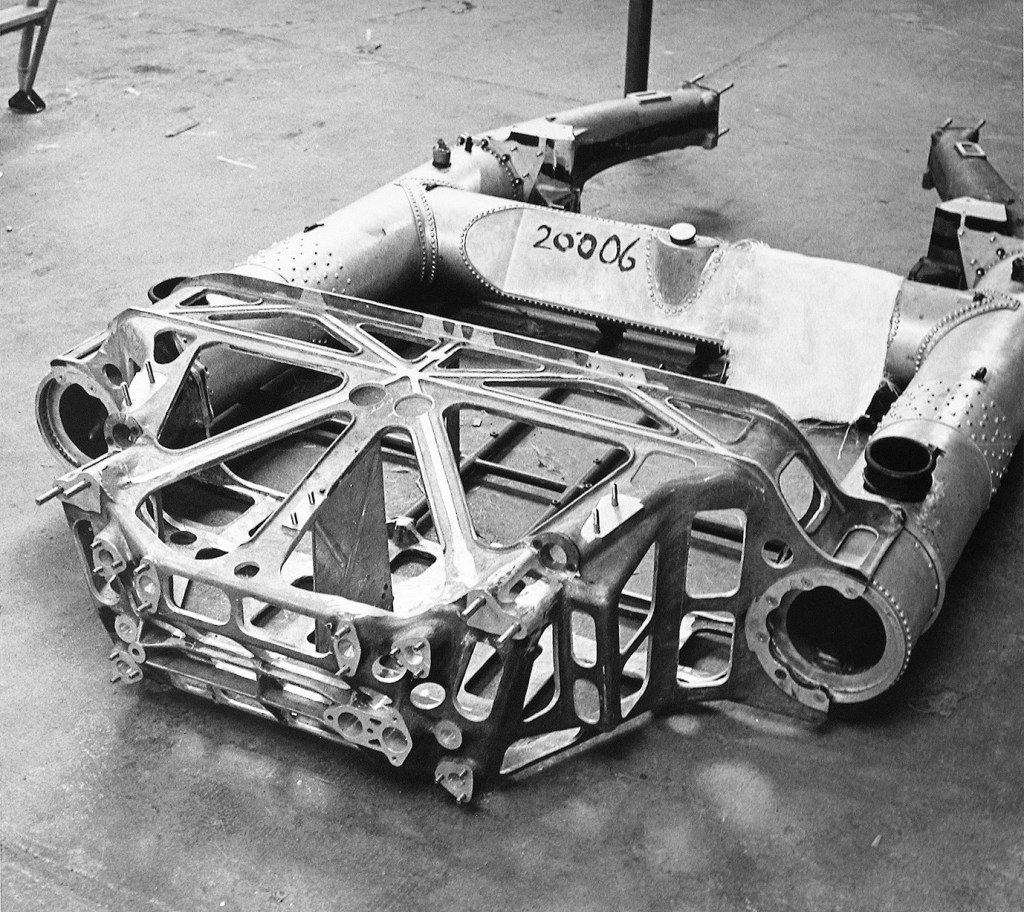
The multi-tubular spaceframe chassis was based on the 908/3 and 917 designs with some of the running gear from the 917 program. The car used a 2 valve 2142cc single-turbocharged 540 bhp flat 6 engine variant of the roadgoing ‘930 Turbo’ the teething issues of which had been sorted the year before in the back of a 911 RSR.
Competing in Group 6, the derivation of the name 936 is clear, the engine was 2142cc to fit into the 3 litre class when the equivalency formula of ‘1.4 times’ was applied to turbocharged engines.
The cars were very successful winning Le Mans in 1976, ’77 and 1981 and the World Sportscar Championship in 1976.
Alpine Renault in their new turbo-charged DOHC 4 valve V6 engined A442 cars were favourites for the ’76 title but Porsche stole the series with their amazing ‘parts bin special’, winning the Monza 4 Hours, Imola 500Km, Le Mans, Enna 4 Hours, Dijon 500Km and the Salzburgring 200 Miles. The Alpines didn’t win a round despite a roster of mainly French GP drivers…
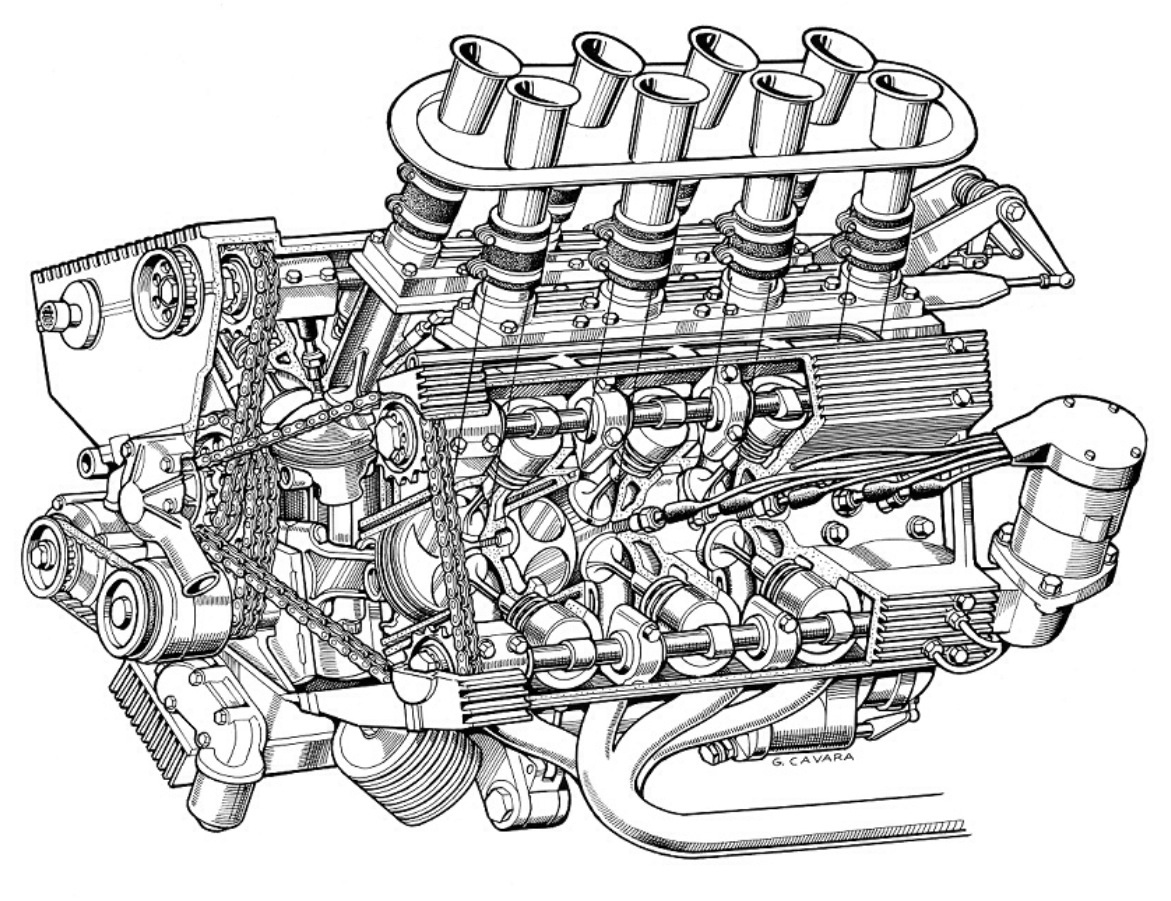
Multi tubular spaceframe chassis based on the 908/3 and 917 designs. Engine Type 935/73 B6 2142cc, 2 valve SOHC Bosch fuel injected, single KKK-turbo with intercooler, circa 540bhp@8000rpm in 1976. Gearbox Porsche 5 speed with LSD. Double wishbones and coil spring/dampers with adjustable roll bars front and rear. Ventilated steel disc brakes, rack and pinion steering, weight 700Kg. (unattributed)
Jacky Ickx in the winning Porsche 936. Le Mans 1976. (unattributed)
1967 was one of the most intensely interesting years of Sportscar Racing; the last year of the ‘unlimited cars’ saw the 4 litre Ferrari P4 and 7 litre Ford GT40 Mk4/2B’s and Chaparral 2F at it tooth and nail in a battle for dominance before new rules came into force rendering the cars obsolete at the stroke of the rule-makers pen…
I’ve written a couple of long articles about the Ferrari and Chaparral which also cover that seasons racing in some detail, click here to read them;
This article is largely pictorial using as it’s base the phenomenal work of American Dave Friedman.
He was a still photographer on movie sets after serving in World War 2. His passion was motor racing though, he was soon engaged by Ford and others to document their racing history. The photos I have chosen are from an archive of nearly 900 of this race alone!
The race was famously won by Fords ‘All American Boys’ Dan Gurney and AJ Foyt, the latter adapting rather well to road racing given his oval background on both dirt and bitumen.
The images are all monochrome and all the more evocative for it!
Race Entries…
Ford won the 1966 Le Mans classic taking the first three placings after the failings of 1964 and 1965. In 1964 the GT40 was simply too new and lacked the necessary development, in 1965 cracked brake discs from unforeseen levels of heat were the problem which eliminated most of the 7 litre Mk2’s.
For 1967 FoMoCo entered four new, fabulous 7 litre Mk4’s, two prepared by Holman & Moody and two by Shelby-American. They also fielded Mk2’s designated Mk2B’s, these beasts also powered by the same 530bhp V8’s as the Mk4.
Business end and cockpit of the Hulme/Ruby Ford Mk4 chassis ‘J8’. Aluminium honeycomb chassis, Ford 7 litre OHV cast iron V8 fed by 2 4 barrel Holley carbs. Circa 530bhp. Suspension; single top link, inverted lower wishbone, 2 radius rods, coil spring/damper unit, cast magnesium upright, adjustable roll bar. Ford Kar Kraft T44 4 speed transaxle.
Ferrari entered 4 litre cars; 3 new P4’s and a P3/4, these cars powered by the latest 450bhp 36 valve, fuel injected V12.
Two Chaparral 2F’s were entered, despite 7 litres of Chev V8 they were lighter than the P4’s.
The P4 weighed in at circa 2200lb, the 2F 1980lb, the Mark4 2200lb and the Mk2B, without the benefit of the lighter honeycomb construction of its newer sibling, was about 2500lb.
The 2 Lola T70 Aston Martin’s tipped the scales at 2320lb, the Aston 5 litre V8’s fuel injected since the April pre-race Le Mans trials at which they had been very fast.
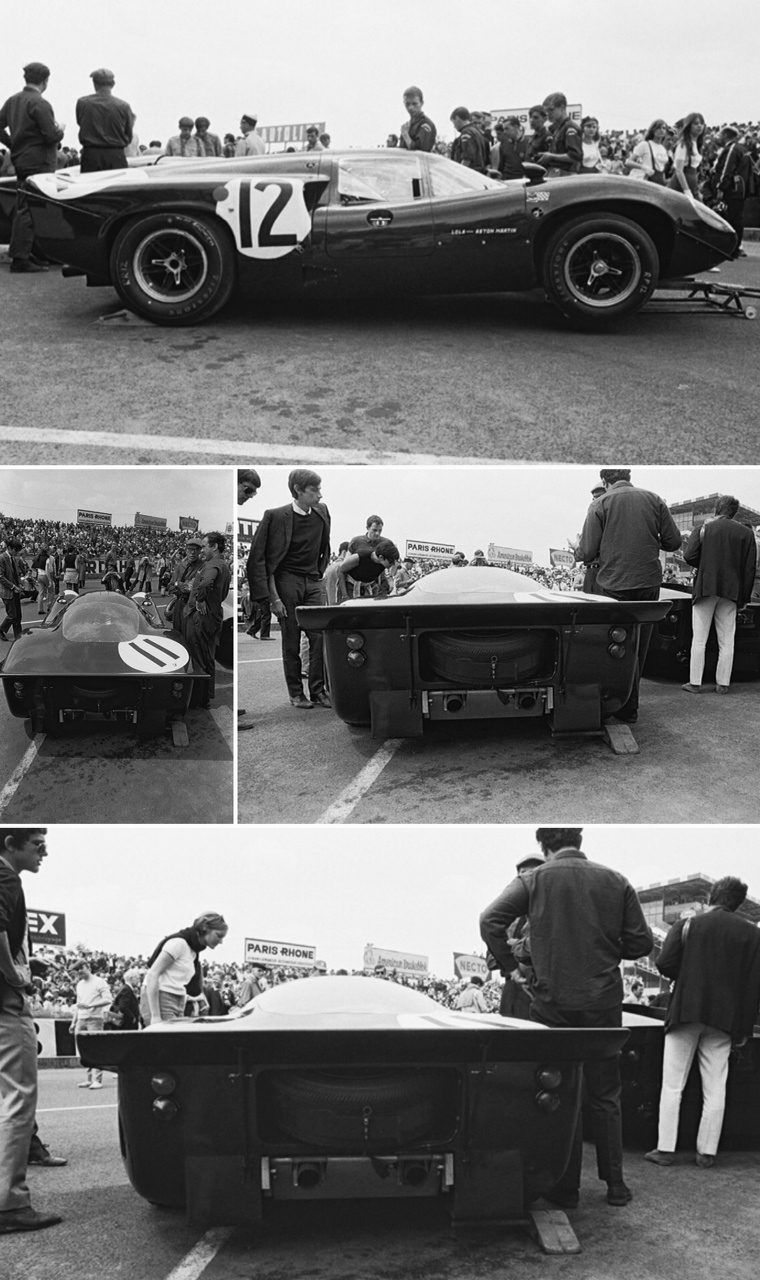
Lola T70 Mk3 Aston Martins’ a big disappointment. #11 John Surtees/David Hobbs car engine shat itself on lap 3 with piston failure , #12 Chris Irwin/Peter de Clerk lasted till lap 25 also withdrawing with engine failure.
In the 2 litre class the Porsches’, always outright contenders such was their speed and reliability, would do battle with the Matra BRM’s. Ferrari chose not to race their Dino’s focusing on the ‘main game’ and Alfa withdrew their T33’s as not being not sufficiently ready for the rigours of la Sarthe.
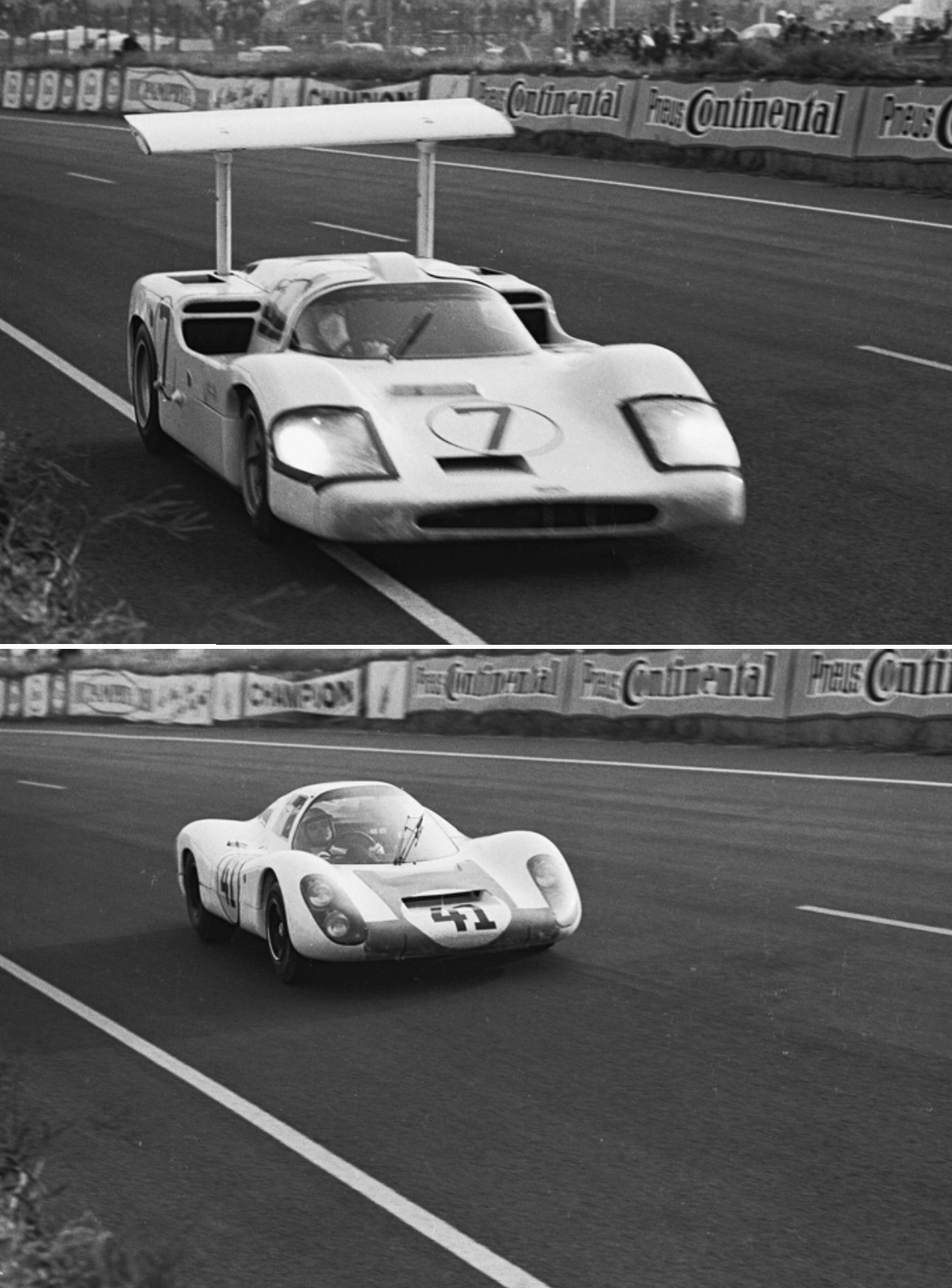
Jochen Rindt with the lovely Nina Lincoln, Finnish fashion model and daughter of racer Curt Lincoln, he married her in ’67. Jochen raced Porsche 907 #40, (above) he and Masten Gregory famously won the race in a Ferrari 250LM when the factory Ford GT40 Mk2’s and Ferrari P2’s failed in 1965. The other Porsche #41 is the 5th placed, 2 litre class winning 907 of Jo Siffert/Hans Hermann.
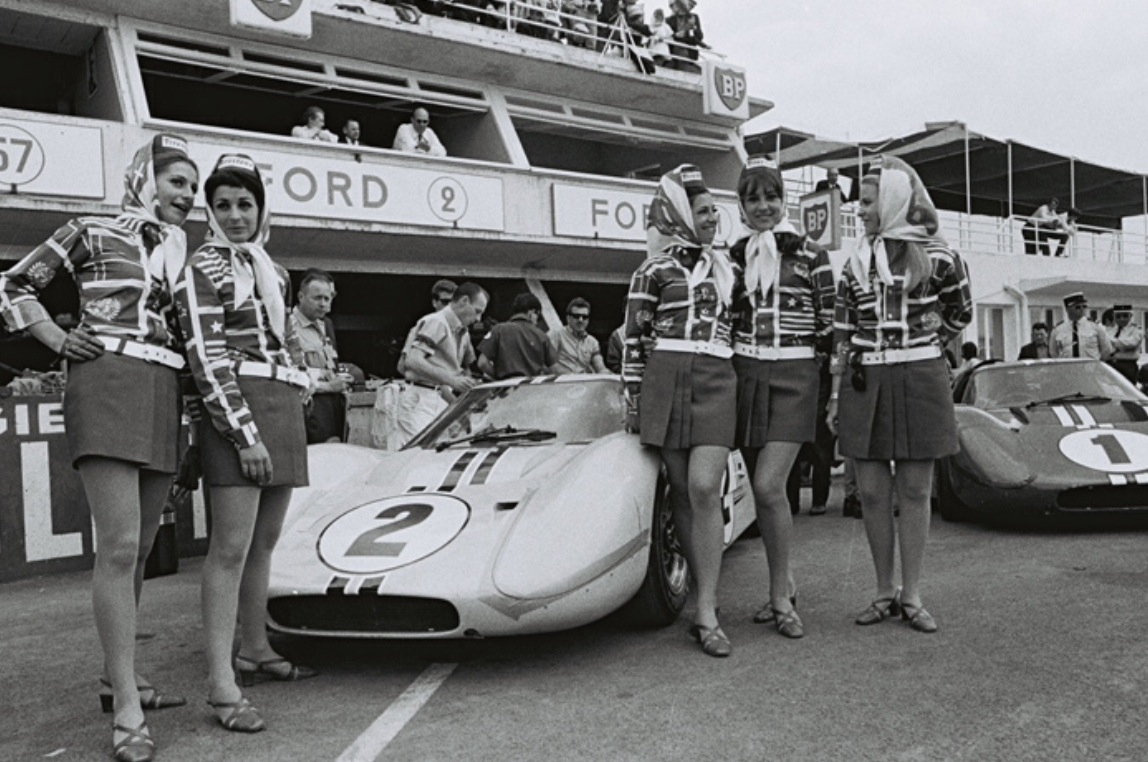
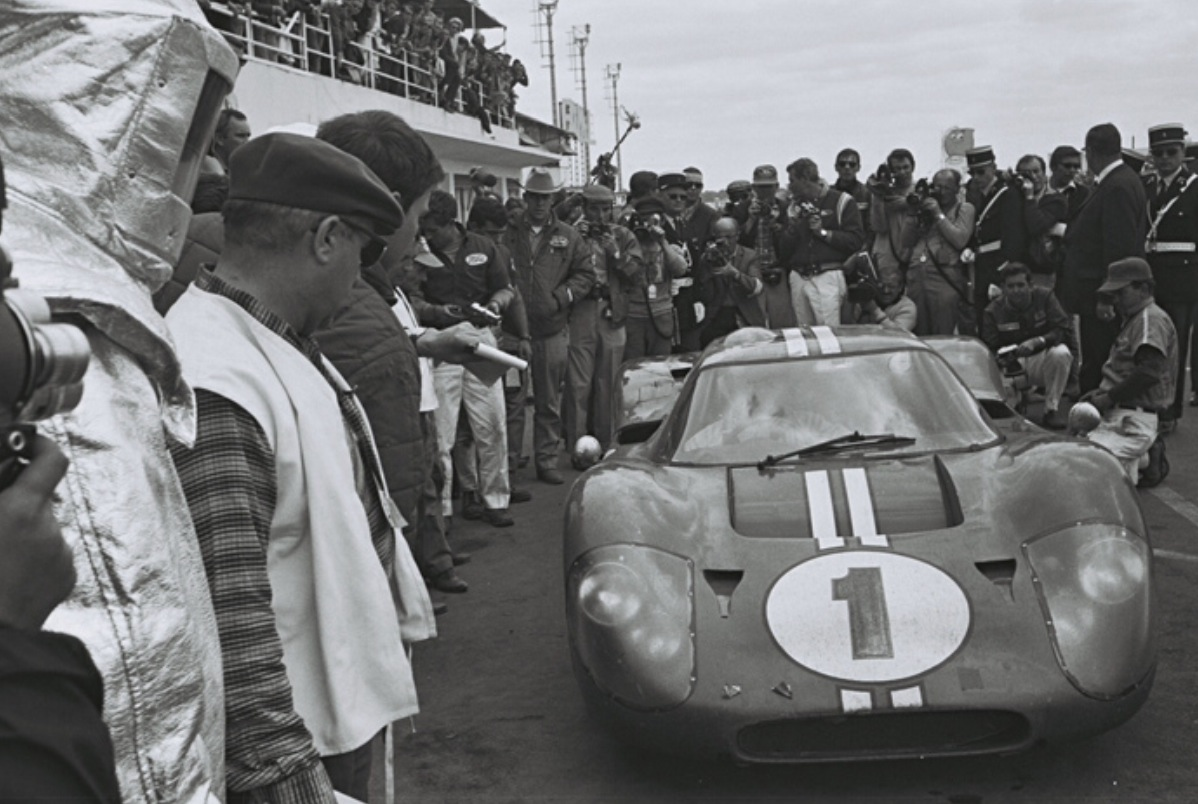
#2 McLaren/Mark Donohue 4th and #1 Gurney/Foyt 1st Ford Mk4’s with friends before the start.
Ford had windscreen troubles in practice but this was remedied with a fresh batch of correctly tempered screens which arrived pre-race.
As if to assert Ford’s authority Bruce McLaren took a Mk4 out and lapped at 3.24.4, an average of 147.316 mph and topped 215mph on the Mulsanne, in the dark. It gave him pole, McLaren was Ford’s victor in 1966 in a GT40 Mk2 he drove with fellow Kiwi Chris Amon.
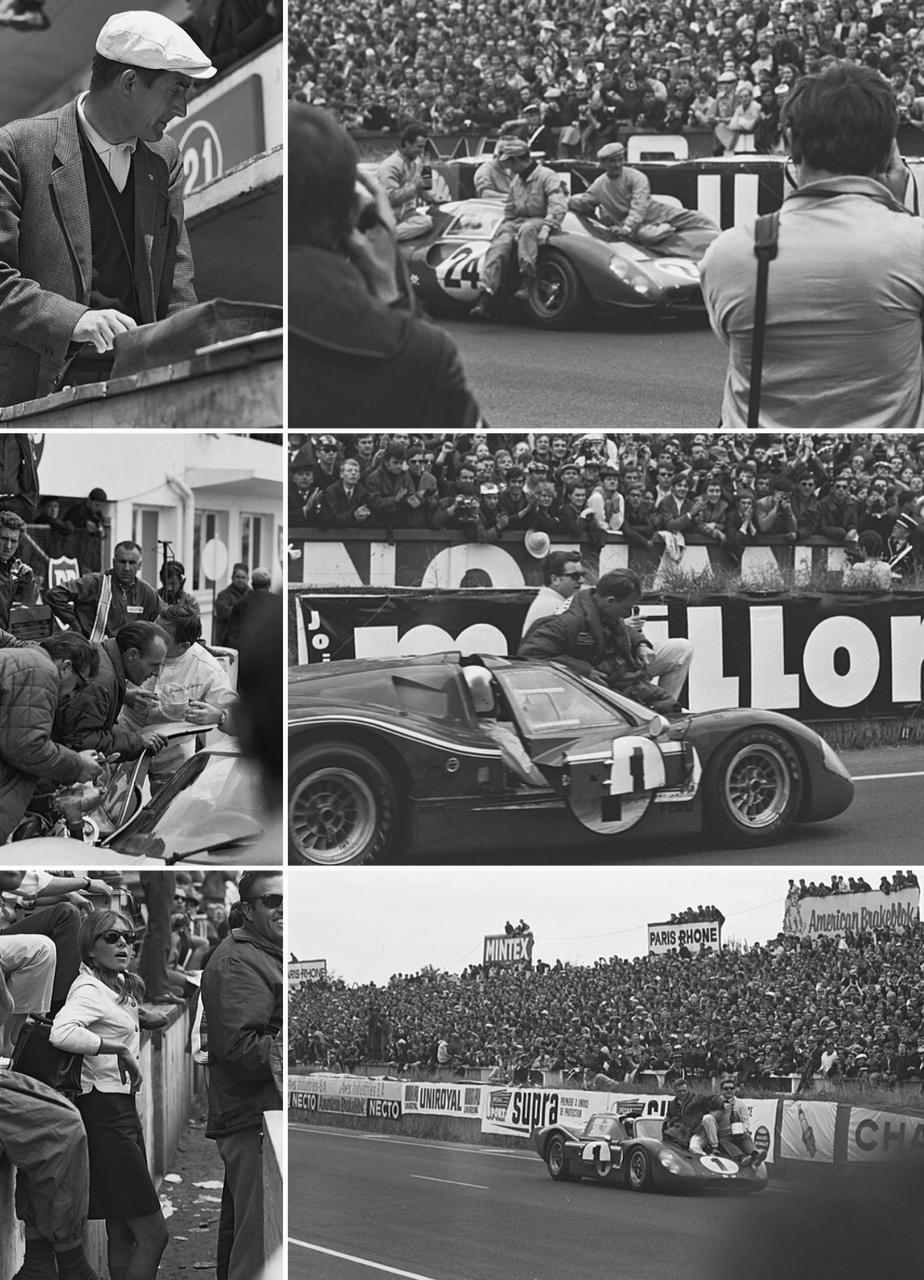
Bruce McLaren jumps out of his Ford Mk4 ‘J6’ during practice. Bruce the pole sitter in this car.
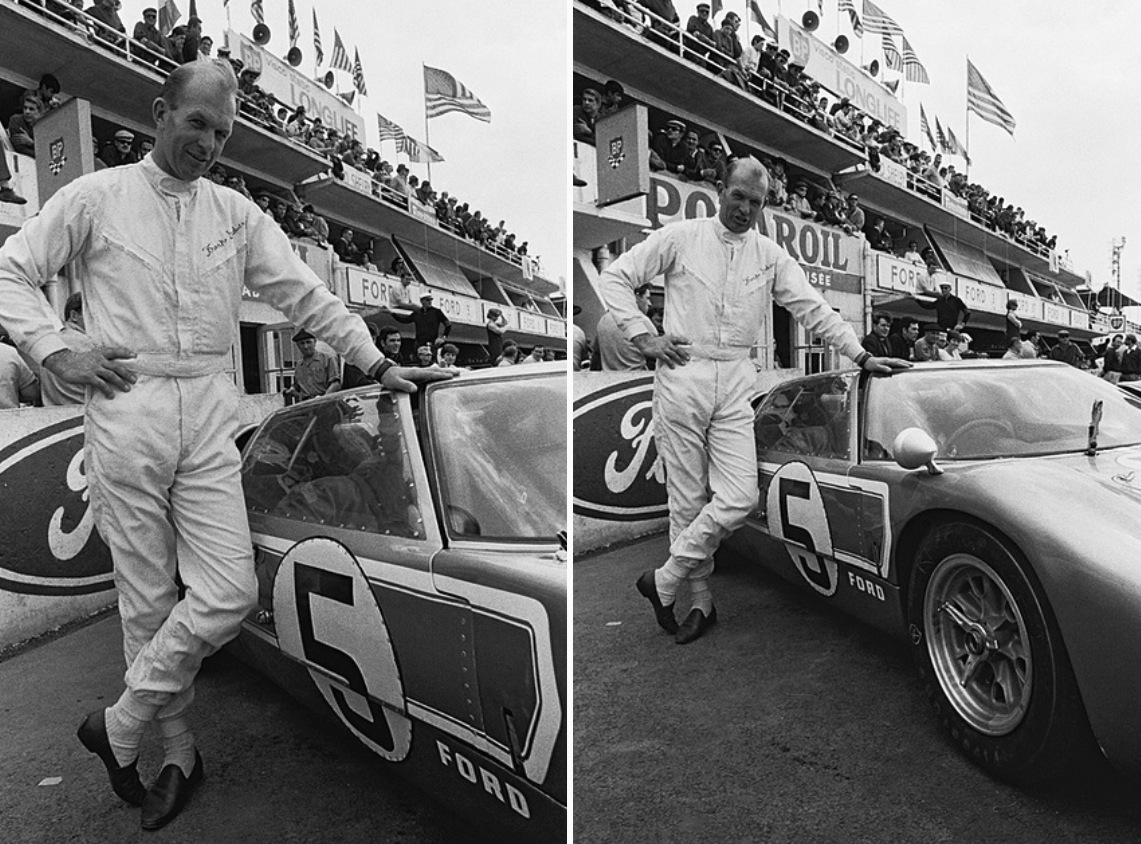
Fords times gave them five of the six top slots. Frank Gardner and Roger McCluskey qualified their Holman & Moody Mk2B 6th, here is FG before the off, the race not quite so successful, his co-driver became part of an accident not of his making…
The Race…
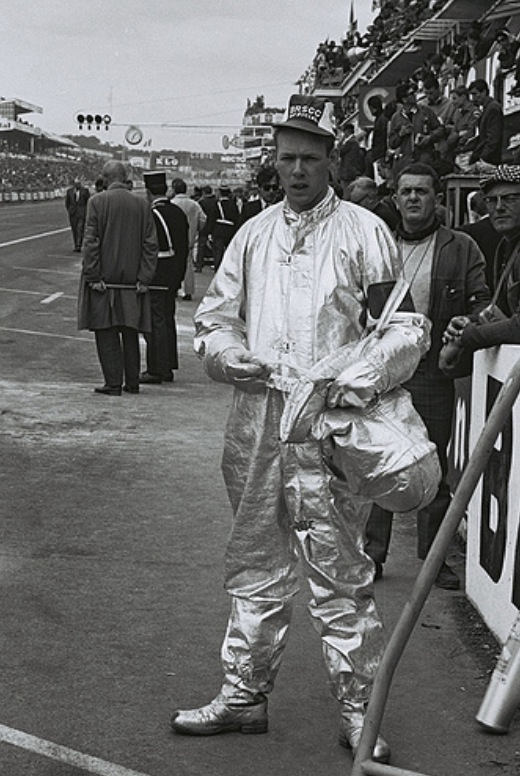
Dan Gurney is the bolter at the start in #1, #2 McLaren Mk4, #7 Chap Spence putting on his full harness, alongside him #3 Andretti and #4 Hulme both in Mk4’s doing the same.
A second or so later; Spence, Andretti and Hulme still ‘belting up’ whilst #62 Mike Salmon DNF fire and #11 Surtees Lola Aston, #23 Attwood Ferrari P3 and #21 Scarfiotti Ferrari P4 come thru.
Love this start shot as it gives a sense of the depth of the field but also the speed differentials for which Le Mans is infamous; #42 Robert Buchet/Herbert Linge 14th Porsche 911S 2 litre, #48 Roger Delageneste/Jacques Cheinisse 10thAlpine A210 Renault 1.6 litre, #60 Andre Wicky/Philippe Farjon DNF Porsche 911S and the rest…Mike Spence just away in the winged Chap 2F at far left.
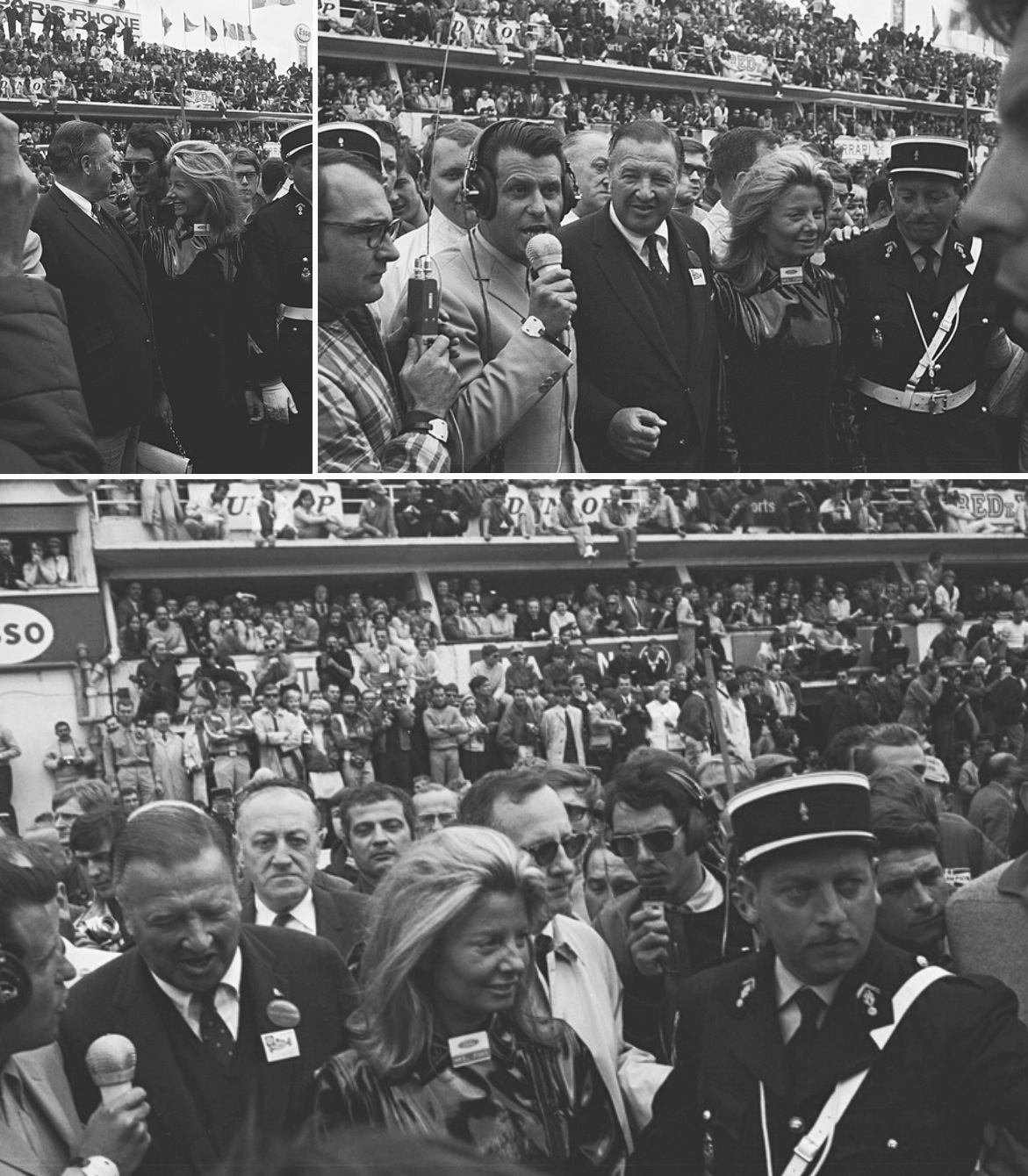
300,000 people attended the race on 10 June in overcast, warm weather, Henry Ford 2 and wife arriving by ‘chopper shortly before the race…
After the traditional start Pedro Rodriguez led initially in the NART Ferrari but was quickly passed by the Paul Hawkins Mk2B, who led at the end of the first hour by which time both Lola’s were out; Surtees with engine trouble after 3 laps, Chris Irwin on lap 25 later with fuel pump problems.
#21 Scarfiotti in the 2nd placed Ferrari P4 from the #4 Hulme Ford Mk4 during the early laps. Below is the Surtees Lola also during the first 3 laps…
After the first pitstop the Chaparral 2F took the lead, the Fords getting about an hour out of a fuel tank, the Fazz’ and Chaparral about 15 minutes longer.
The Hill/Spence Chap 2F circulating fast at this point doing 3 min 29 sec laps…
After the second refuelling the Gurney/Foyt Mk4 lead from the Hill/Spence Chaparral followed by the Andretti/Bianchi and McLaren/Donohue Ford Mk4’s.
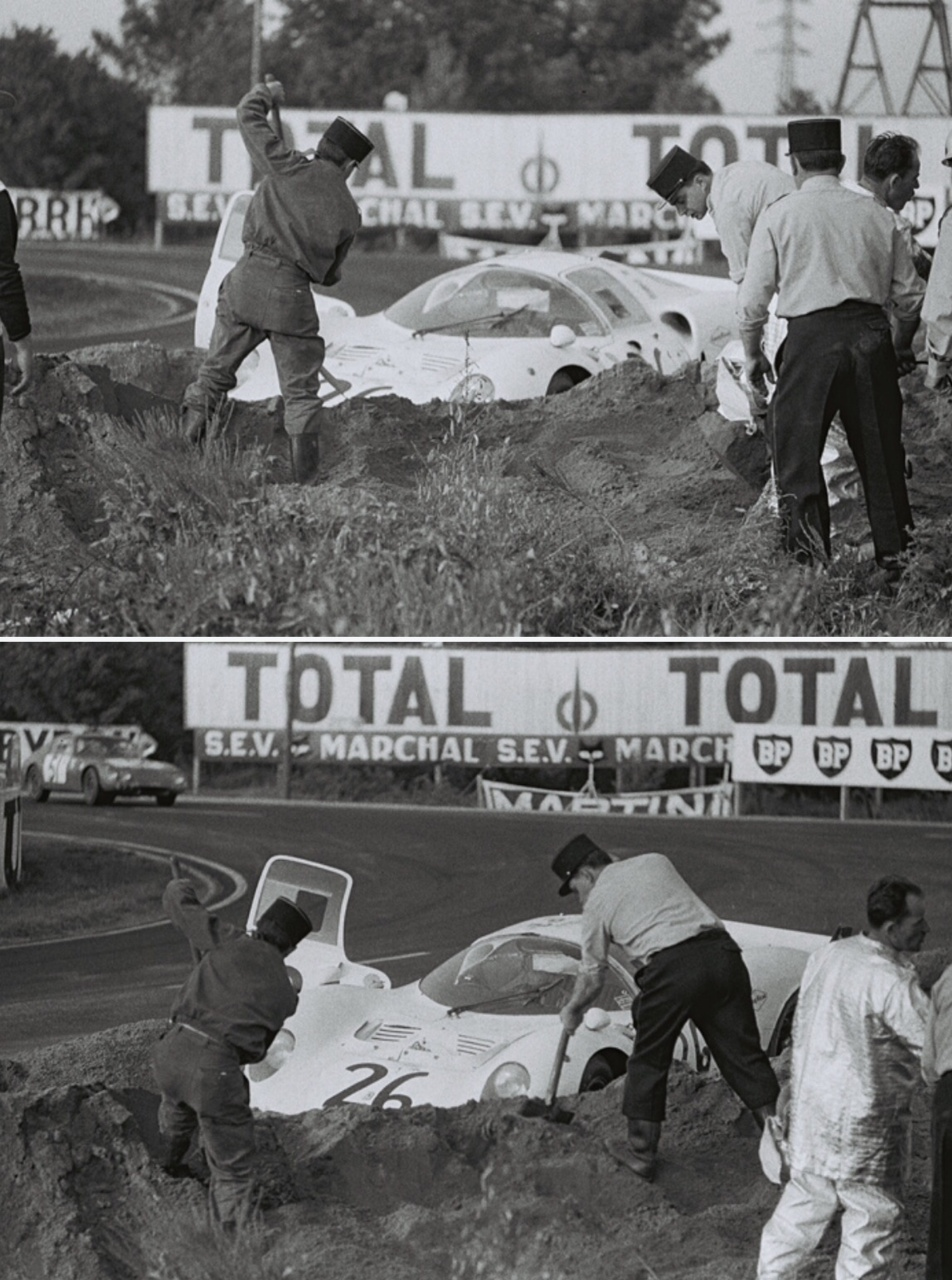
Oopsie; Ricardo Rodriguez (no relation) in the ‘kitty litter’ on Lap 30, the NART Ferrari 365P2 retired at this point. Car shared with Chuck Parsons. In the background in the lower photo is the works Austin Healey Sprite of Clive Baker/Andrew Hedges which finished 15th, first British car home.
The ill-fated Andretti/Bianchi Mk4 ahead of Chris Amon/Nino Vaccarella Ferrari P4 DNF puncture/fire and Denny Hulme/Lloyd Ruby Mk4 DNF accident, in The Esses in the first quarter of the race.
‘British Racing and Sports Car Club’ fireman in the latest gear.
After 4 hours the Gurney car was still ahead.
This time from the Andretti Ford. Three Fords led from the Chaparral, with Ferrari further back, the leading Ferrari’s were driven by Amon/Vaccarella P4 and Rodriguez/Baghetti, P3/412P.
The #8 Bruce Jennings/Bob Johnston Chaparral 2F in the pits for its final pitstop on lap 91, car out with battery and starter failure.
2 P4’s, the white car the NART P Rodriguez/Baghetti P4/412P entry chasing the Jennings/Johnston Chaparral 2F and a 911S about to be ‘swallowed’ by all 3.
After 6 hours the 2nd #8 Chaparral failed to restart after a pitstop.
Hill pitted at about the same time in the #7 Chap with the transmission, the cars weak link checked leading to speculation about its health. The stop lasted 9 minutes, the car rejoined in 7th place.
Rindt (below) retired his Porsche 907, having over-revved its 2 litre flat 8.
The #7 Chaparral 2F Chev of Spence and 5th placed Porsche 907 ‘Langheck’ of Siffert/Hans Hermann with Jo at the wheel. Car also the 2 litre winner.
At 2 am it was still 1-3 for Ford but the pattern of the race changed hugely after Andretti took over his car from Bianchi, it was fitted with fresh brake pads.
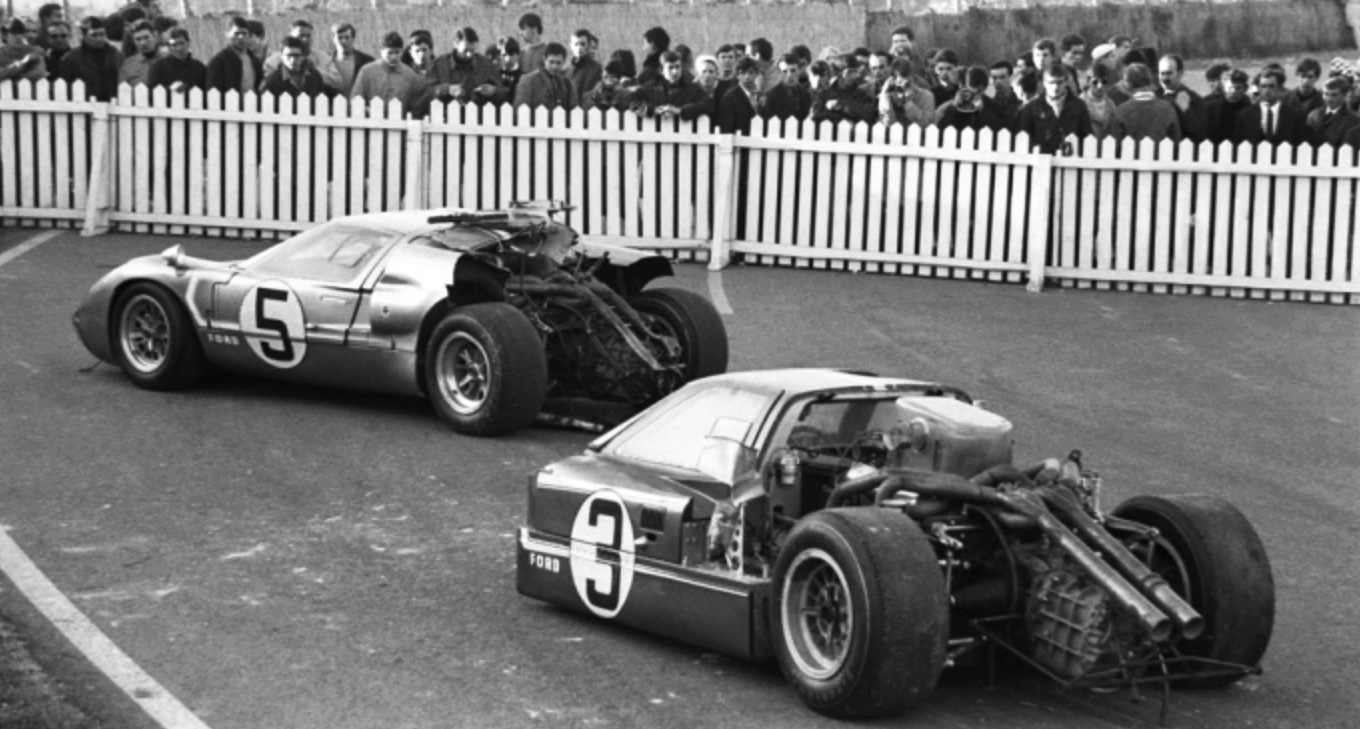
As he approached The Esses and braked one disc grabbed, pinging the car instantly between the unforgiving earth banks until finishing in the middle of the track with bits of ‘Big Henry’ scattered all over the place.
Roger McCluskey arrived in the Mk2B he shared with Frank Gardner, braked, spun and hit the banks wrecking another factory Ford. Schlesser then added to the party arriving in the Ford France Mk2B he shared with Guy Ligier and spun in avoiding his teammates- three Fords were out on the spot!
The winning Mk4 of Gurney/Foyt ahead of #57 Ronnie Bucknum/Paul Hawkins Mk2B DNF and #14 Mirage M1 Ford of David Piper/Richard Thompson,DNF .
Dead Ferrari’s atop the transporter in the middle of the race, both with piston failure; #22 Jean Guichet/Herbie Muller Ferrari P3/412P #25 Pedro Rodriguez/Giancarlo Baghetti Ferrari P3/412P
AJ Foyt aboard the winning Ford Mk4 chassis ‘J5’.
At half distance the Gurney/Foyt Mk4 had a huge lead
But there were three Ferrari’s and a Chaparral between Gurney and the next Ford.
At dawn it was Gurney/Foyt 7 laps ahead of the Parkes/Scarfiotti Ferrari, the Hill/Spence Chaparral then Ferrari-Ford-Ferrari, it was anybody’s race at this point.
At 5.30am Hill’s Chaparral pitted for investigation of an oil leak; and stayed for 3 hours whilst the mechanics heroically removed the transmission and fitted a new oil seal but the car was finally retired with an oil-less transmission.
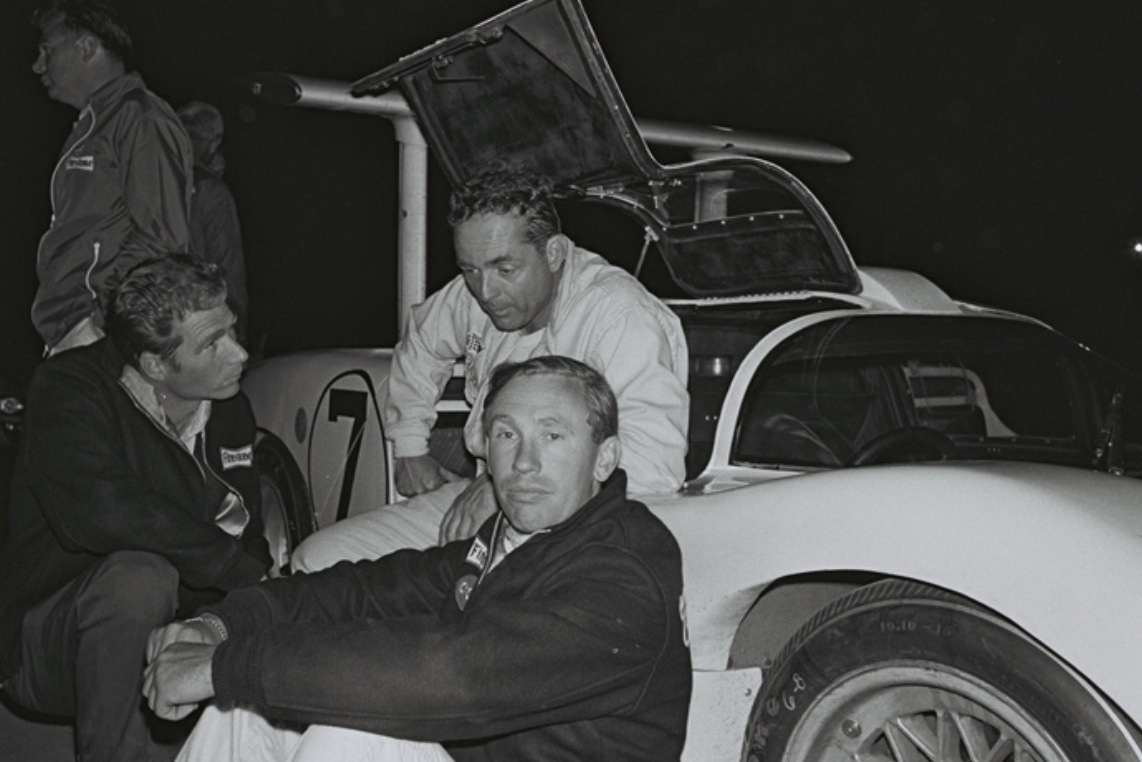
Chaparral council of war in the middle of the night. Jim Hall , Phil Hill and Mike Spence curse the cars auto gearbox, its weakness that year. The one bright spot for the fastest, most innovative and stunning sports/prototype of 1967 was its season ending Brands Hatch 6 Hour victory in July.
With 6 hours to go the Gurney/Foyt Ford only lead by 5 laps!
But it was one Ford from three Ferrari’s with the Italian cars being driven very hard, Mike Parkes said ‘I have never driven a car so hard for so long’ of his Ferrari P4 after the race.
What am i going to tell The Commendatore!? Franco Lini, Ferrari Team Manager ponders the teams prospects late in the race. It was an honorable defeat, to say the least, against the onslaught of the then second largest motor manufacturer in the world.
With less than 2 hours to go the Ferrari’s were lapping 10 seconds a lap quicker than the leading Ford, with 90 minutes to go both cars stopped for fuel for the last time, Ferrari’s only hope a Ford failure but it was not to be…
Car #24 the 3rd place Willy Mairesse/Jean Blaton Ferrari P4 and winning #1 Mk4, ‘victory lap’. Small shots; Franco Lini, Bruce McLaren Mk4 pit, ‘pit popsie’.
It was the first ‘All American’ win ever; car and drivers. Ford were both first outright and won ‘The Index of Thermal Efficiency’, which seems somewhat of a contradiction in terms for a car powered by a 7 litre cast iron, OHV V8!…
The first six placings were;
1st. Gurney/Foyt Ford Mk4 388 laps
2nd. Scarfiotti/Parkes Ferrari P4 384 laps
3rd. Mairesse/Blaton Ferrari P4 377 laps
4th. McLaren/Donohue Ford Mk4 359 laps
5th. Siffert/Hermann Porsche 907 358 laps 2 litre winner
6th. Stommelen/Neerpasch Porsche 910 351 laps
Winners are Grinners…
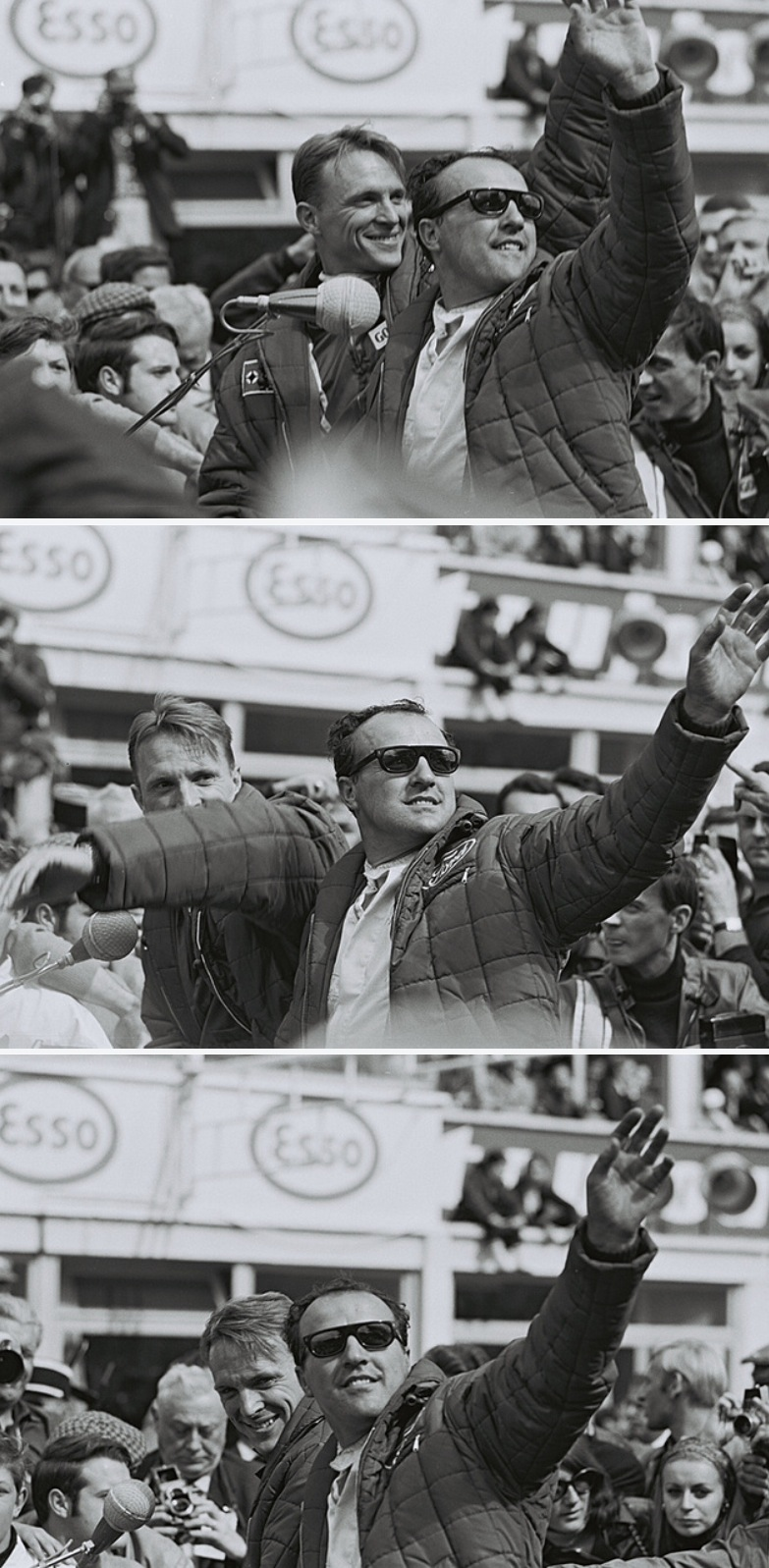
The winning Ford covered a record distance and was pushed hard all the way- Dan Gurney at left and AJ Foyt, right, below.
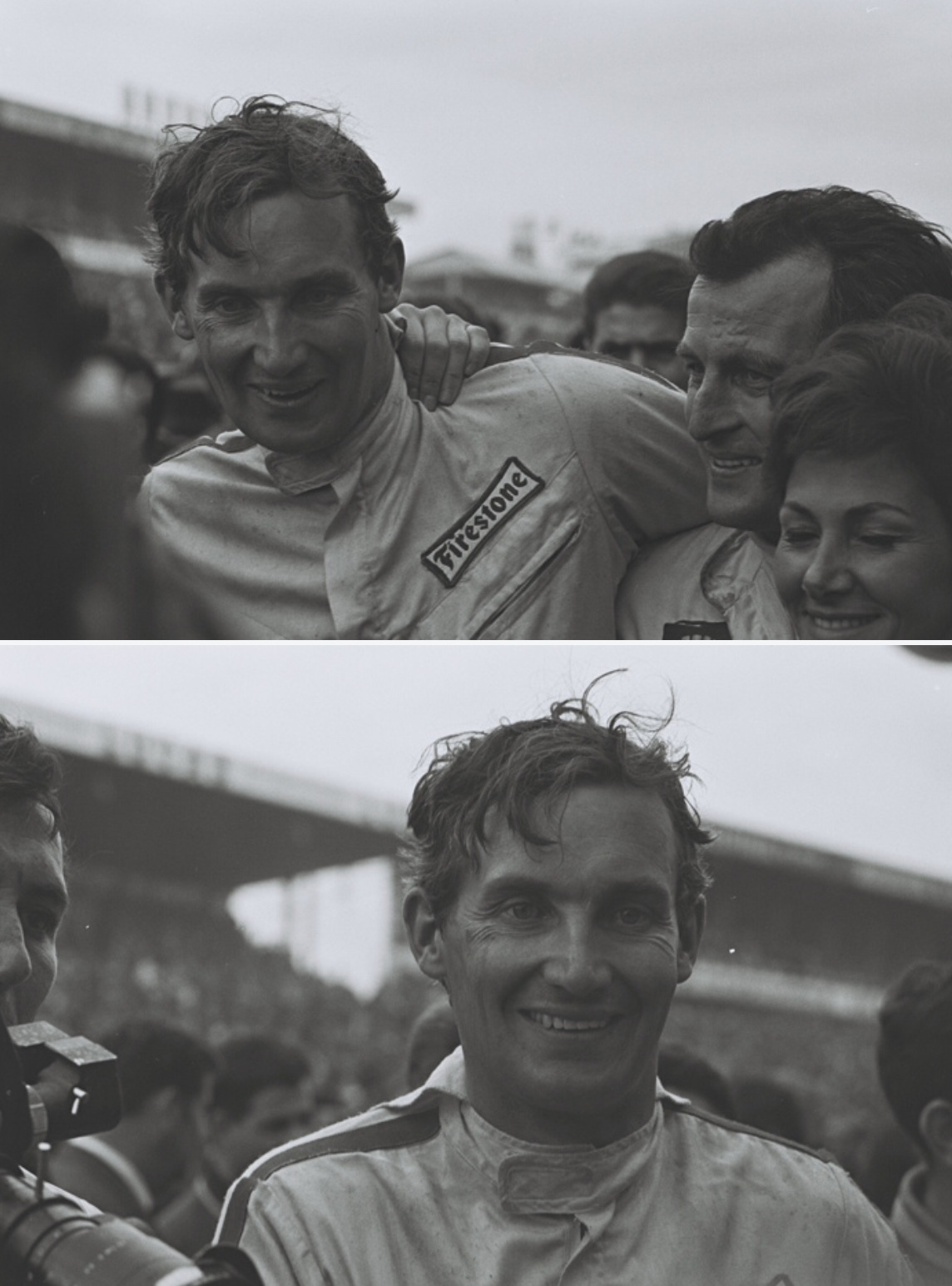
Mike Parkes (L) and Ludovico Scarfiotti looking suitably tired after fantastic drives in pursuit of the Ford Juggernaut!
Henry Ford 2 and his wife Maria look well pleased with the results of their teams work.
Its interesting to reflect on how different automotive/motor racing history may have been had Enzo Ferrari not withdrawn from the final stage of negotiations for the ‘Boys from Dearborn’ to buy his Maranello outfit in July 1963.
Whatever the case, motor racing had a friend in Henry Ford 2. Without his patronage and support of racing to build Ford’s global brand we would not have had many of Ford’s programs which enriched racing during his tenure of either direct or indirect control of FoMoCo.
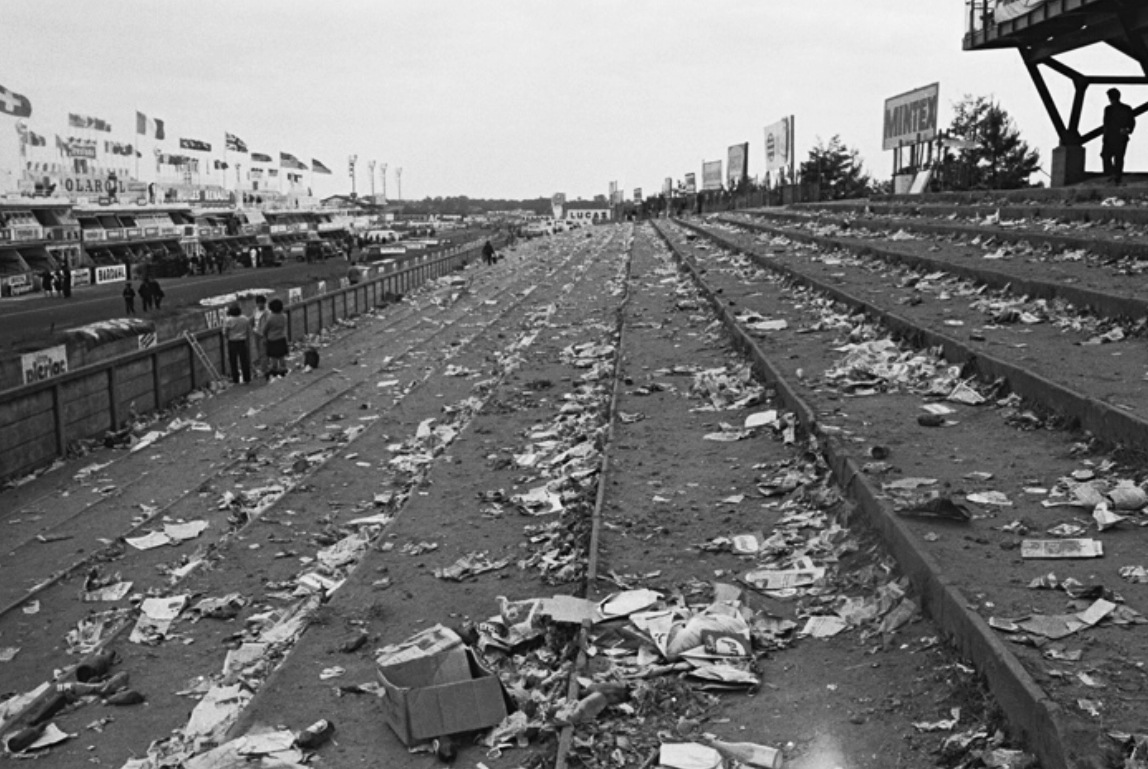
Tailpiece; The Morning After the Night Before…
Photo Credits…
The amazing Dave Friedman Archive, Rainer Schlegelmilch
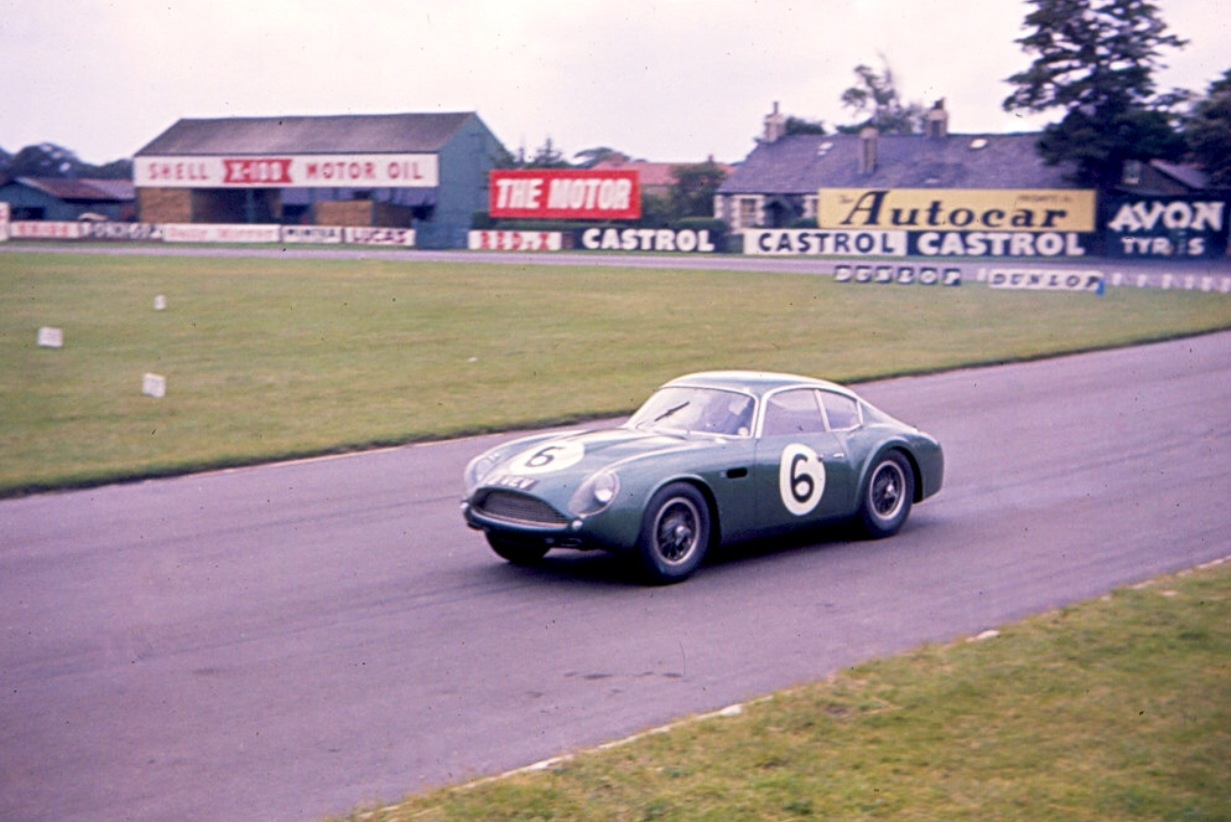
Lex Davison aboard 2 VEV at Aintree in July 1961. He won the 51 mile GT race after a battle with Jack Sears’ Jaguar E-Type. He took the lead on the last lap, perhaps recording the car’s only race win in-period.
2 VEV chassis #0183/R was registered to John Ogier’s Essex Wire Racing Team on 19 May 1961. One of 19 Aston Martin DB4GT Zagato’s, this most famous car was raced by Aussies Lex Davison and Bib Stillwell at Le Mans in 1961 alongside 1 VEV, driven by Jack Fairman and Bernard Consten.
The cars had factory support but the race was a disaster. Both failed to finish due to head studs which had been insufficiently tightened/torqued, they ran as high as 15th and 17th behind the open Aston DBR1s before withdrawal from the 24-Hour classic.
Le Mans 1961 start;#1 Dewez/Kerguen DB4Z , #2 Fairman/Consten DB4Z, #3 Davison/Stillwell DB4Z, #4 Salvadori/Maggs Aston DBR1, #5 Clark/Flockhart Aston DBR1 all DNF. The race was won by the Gendebien/Phil Hill Ferrari 250TR (unattributed)
Davison had only 25 laps under his belt when the head gasket failed at Le Mans (MotorSport)
Davison and Stillwell, Australian multiple champions both, had immaculate Aston Martin connections, having raced Grand Prix Aston DBR4s in Australia, see here; Lex’ Aston Martin DBR4/250’s… | primotipo…
Indeed, Lex came within feet of winning the 1960 Australian GP at Lowood, Queensland. He was pipped on the line by Alec Mildren’s Cooper T51 Maserati after a thrilling, race long dice.
It was the closest any of these wonderful but outdated cars came to Grand Prix win. Lex also contested a few 1962 Intercontinental Formula races in the UK aboard a DBR4.
Lex Davison contesting an Intercontinental Formula race at Brands Hatch in his bruised Aston DBR4/250 #4 in 1961. The car was then 3-litre DBR1 powered (unattributed)
Back to the GT Zagato, Lex won at Aintree in July after the battle with Jack Sears’ Jag E-Type. Motor magazine reported that Davison “looked like the prosperous middle aged businessman that he is, rather than a dashing man about town”. In fact he was a champion middle-aged racing driver, a four time winner of the Australian Grand Prix no less!
Jim Clark contested the 1961 RAC Tourist Trophy in it at Goodwood in August, but the SWB Ferrari 250s were too quick, Salvadori and Clark took third and fourth respectively in VEV1 and 2.
2 VEV was loaned to Equipe National Belge to race in the 1962 GP of Spa for GT cars. Lucien Bianchi led the race before losing the car and totalling it. In five weeks the it was rebuilt by the factory around a new chassis to DP209 ultimate lightweight specifications The machine emerged with a lower, flatter roofline, longer nose and tail, and wider rear wheel arches than a standard DB4Z.
Oh-so-famous shot of Jim Clark in Aston DB4GT Zagato 2 VEV, 1962 Goodwood RAC TT (unattributed)
Clark raced the car again in the 1962 Tourist Trophy at Goodwood that August. Having just pitted, and on coolish tyres, he lost control as the car settled after traversing the 120mph Madgwick Hump, he spun into the path of John Surtees’ leading Ferrari 250 GTO, taking then both out of the race. More works surgery to 2 VEV was required. The car raced again in Clark’s hands in the Paris 1000km, but failed while in co-driver Sir John Whitmore’s hands.
Surtees Ferrari 250 GTO and Clark’s Aston DB4 Zagato at Goodwood ’62. Clark spun taking Surtees out on lap 62 of 100. The race was won by Innes Ireland’s UDT-Laystall Ferrari 250 GTO (unattributed)
The car then ran in minor events in John Ogier’s ownership until 1964, racing on into the late 1960s and historic racing after that. 2 VEV was damaged in a road accident in 1993 and was restored/rebuilt to its 1962 specifications, the poor old darlin’ had by that point, ‘more hits than Elvis’ as the saying goes…
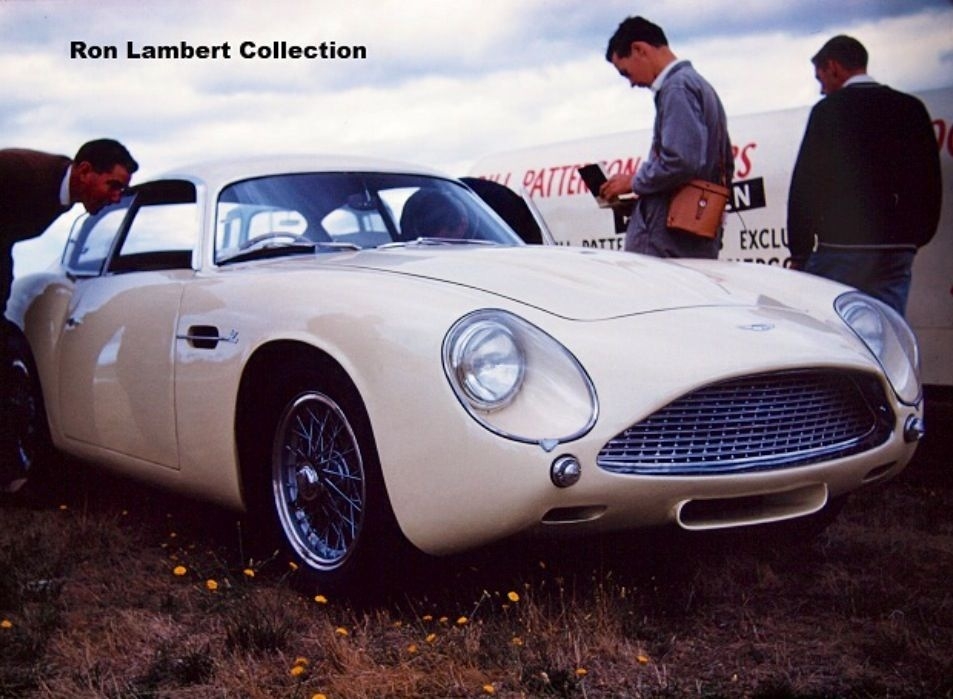
1962 Goodwood RAC TT start; Clark is the bolter in his DB4Z. #15 is the winning Ireland 250 GTO, #6 Surtees’ ill fated GTO, #5 Mike Parkes GTO, #8 David Piper GTO, #25 Trevor Taylor/Gil Baird Lotus Elite (unattributed) Australia’s only DB4Z, #DB4GT/0186/R, the fourteenth built, was owned by Sydney’s Laurie O’Neill. Here it’s pictured in the Longford paddock in March 1962. It was raced in a support event by thrice AGP winner Doug Whiteford (Ron Lambert Collection)
The DB4GT Zagato…
The Aston Martin DB4GT Zagato was introduced to the world at the London Motor Show in October 1960.
It was effectively a DB4 GT improved by Carrozzeria Zagato, Ercole Spada is the designer credited with the work. Smaller, more aerodynamic and about 100 pounds lighter than the DB4 GT, the Zagato’s twin-cam, two-valve, 45DCOE Weber fed 3670cc engine produced 314bhp @ 6,000rpm, 12 more than the DB4 GT giving it a top speed of 154mph.
Initially the factory planned 25 cars, but demand wasn’t strong enough so only 19 were completed, albeit 23 chassis numbers had been allocated. Four modern Sanction 2 Coupes were built on DB4 rolling chassis completed by Richard Williams (RSW) to the order of Aston Martin using the unused chassis numbers from 1987-91.
Ex-Zagato employee Mario Galbiatti (with Zagato’s approval) built the bodies using Williams’ own dismantled Zagato as a template. Completed and launched in July 1991, in 1993 Williams completed two more Aston Martin Lagonda approved Sanction 3 cars using left over Sanction 2 bits. Not to forget AML’s own 19 April 2019 Continuation Series DB4GTZs…
The first competition outing of a DB4 GT Zagato was during Goodwood’s 1961 Easter meeting. Driven by Stirling Moss, it finished third behind an Aston Martin DB4 GT and the winning Ferrari 250 GT.
1960 London Motor Show launch for the DB4GT Zagato.
Etcetera…
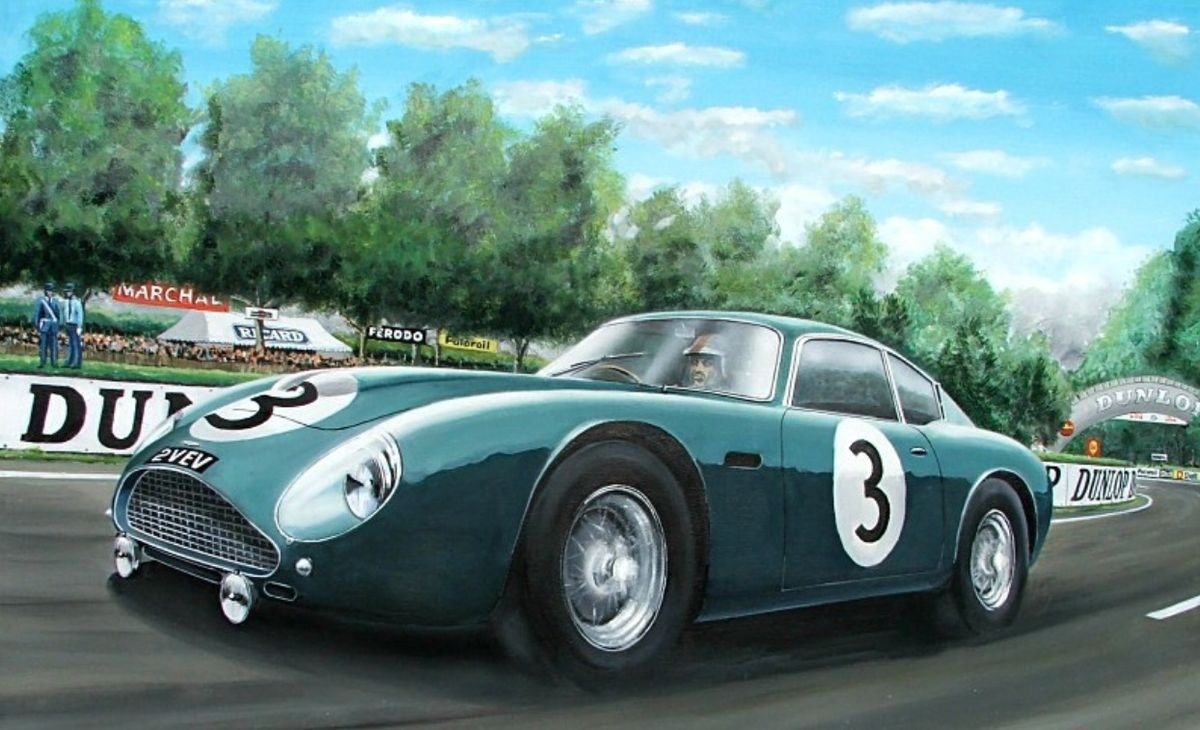
John Ogier’s two Aston DB4 Zagatos in the Le Mans paddock, 1961. #3 Davison/Stillwell, #2 Fairman/Consten (unattributed) Painting of the Davison/Stillwell DB4Z, Le Mans 1961 (Bernard Reeves)
Credits…
Ron Bert Collection, Bernard Reeves, Jim McKeown Collection
Tailpiece…
(J McKeown)
Doug Whiteford in Laurie O’Neill’s Zagato with Jim McKeown, Jewitt Holden and George Spanos, Elfin Streamliner Ford on the front row of the grid. Longford GT race in 1962 won by Whiteford from McKeown.
Nice ad featuring the winning and second placed Ferrari 250 Testa Rossa’s of #14 Phil Hill/Olivier Gendebien and #15 Giancarlo Baghetti/Willy Mairesse/Richie Ginther/Taffy Von Trips at Sebring in 1961…
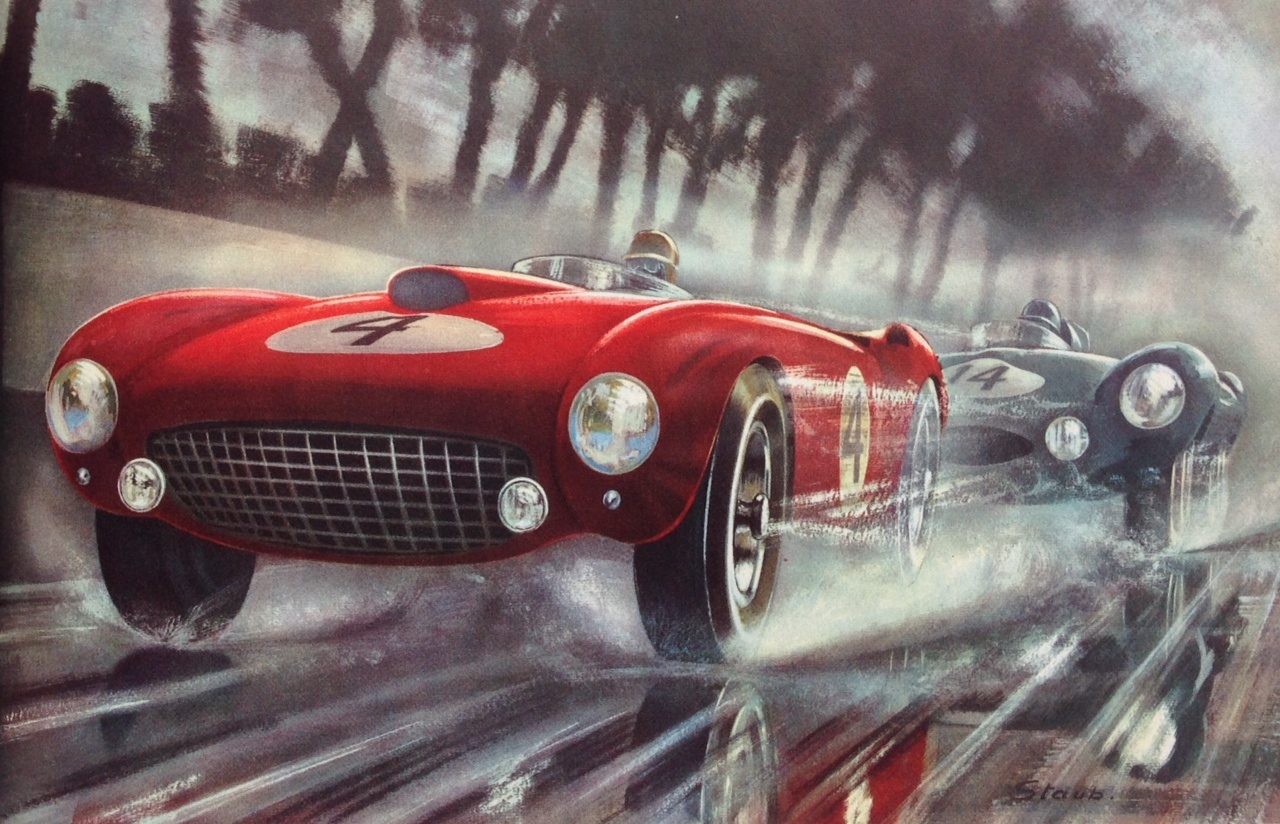
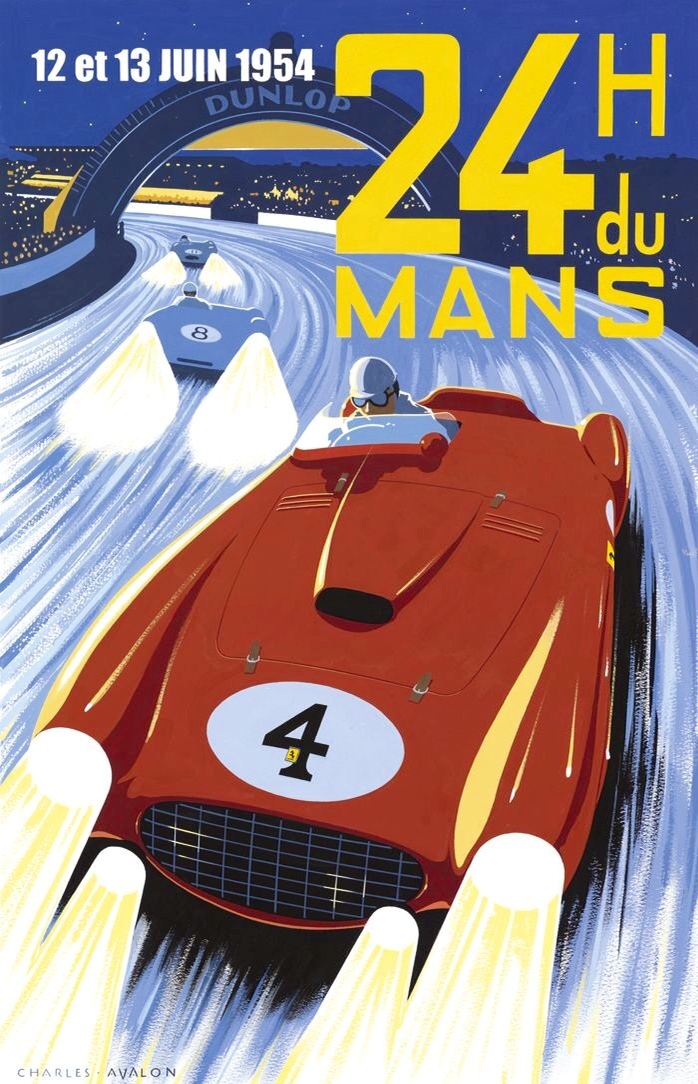
Max Staub’s painting depicts the battle between the first and second placed Ferrari 375 Plus and Jaguar D Type at Le Mans on 12/13 June 1954…
There was a lap between the cars at the end of the race, Froilan Gonzalez shared his Ferrari with fellow GP driver Maurice Trintignant and Duncan Hamilton the ‘D’ with Tony Rolt. The Brits won the race in an XK ‘C Type’ the year before.
In one of the most exciting events at Le Mans to that point the large lead of the Ferrari was diminished to about 1.5 minutes when the Fazz refused to fire at a pitstop with about 2 hours to go. Eventually a flooded magneto head was diagnosed and rectified, the Ferrari sped on to win a famous victory despite the efforts of Hamilton in the final stint.
Fantastic shot taken at about 9pm in the evening, at that time on Saturday night competitors lights had to be turned on and remain operational all night. (Yves Debraine)
Here is a longer 1950’s Le Mans Article with a Ron Flockhart twist for those with an interest in this period…
Jonathon Williams blasts through the French countryside on the way to 9th place in Steve McQueen’s Porsche 908 camera car during Le Mans 1970…
Porsche 908/02 ‘022’ was completed on 10 January 1969, making its race debut as a factory car at Daytona in 1969. It was rebuilt as a Spyder before acquisition by Solar Productions for use as a camera car in the iconic, endurance classic movie.
McQueen raced the car during 1970; at Riverside and at Phoenix winning the race and then famously finishing second at the Sebring 12 Hour, McQueen co-drove for Peter Revson in a plaster-cast with a recovering broken ankle, injured in a motorbike accident.
A short account of the Sebring race is contained in this article about McQueen i wrote a while back;
The 908 was to be driven by McQueen at Le Mans but the risk was too great; the films management, backers and insurers vetoed his participation.
The important drive was offered to ex-works Ferrari driver, Jonathon Williams and Herbert Linge, a factory Porsche driver. Despite constant, long pitstops to change cameras and an accident, the ever reliable 908 finished in 9th place on laps completed, albeit technically unclassified.
Alan Hamilton aboard the first of many serious Porsches he raced in Australia down the decades, the ex-works 904/8 ‘Kanguruh’ chassis # 906-007 at Calder in January 1966…
Norman Hamilton famously negotiated a franchise for Porsche in Australia, having been ’rounded up’ by one of the earliest 356s on a drive through the Swiss Alps. The business quickly prospered from its Melbourne base. This article is about the 906s raced by Norman’s son Alan from the mid-sixties to early-seventies and his career during that period.
He raced three such cars; 904/8 chassis # ‘906-007’ and two 906 Spyders; one during 1967 and another in 1971-72, the latter cars used chassis supplied by Porsche, but neither had a chassis number, giving more than one historian a headache or two…
Alan Hamilton was born on 29 July 1942. After attending Camberwell High School in Melbourne’s leafy eastern suburbs, he joined the family firm, which was to expand hugely over the ensuing decades under his leadership. A competition licence quickly succeeded his road licence at 18, initial competition exploits were in a VW contesting trials and gymkhanas. A 1958 Porsche 356 Super followed; he competed in this standard car at country meetings and hillclimbs. A 1959 Convertible followed, which was also successful.
In early 1965 Hamilton headed for Europe including a stint working in the Porsche factory, the 904/8 Bergspyder was purchased during that trip and shipped to Australia for the 1966 season, clearly a step up in performance for the young driver…
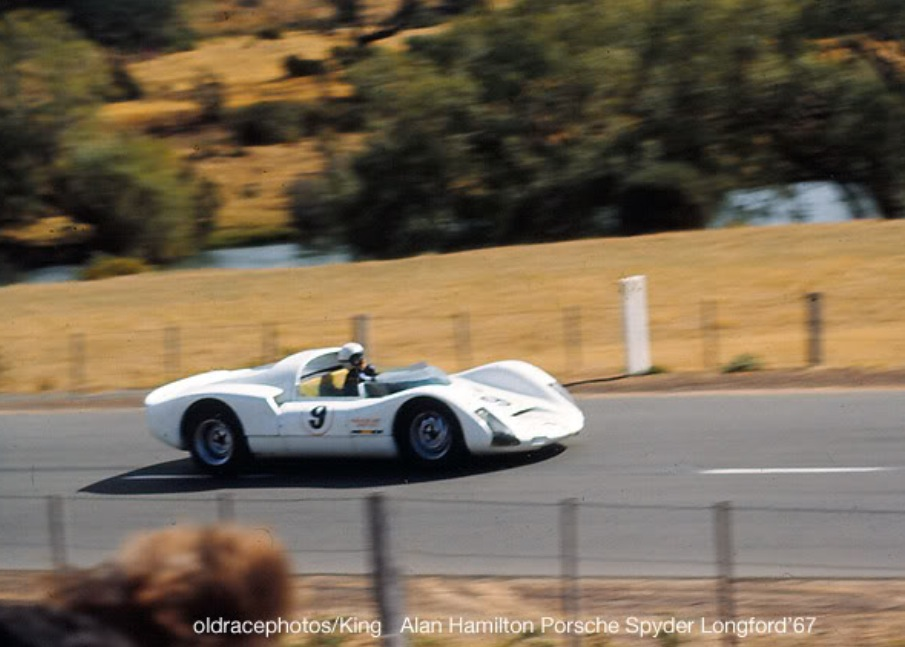
Majestic shot of a fabulous road racing circuit, ‘Long Bridge’ Longford Tasman Meeting 1967. Bob Jane leads Noel Hurd in Elfin 400 Repco and Elfin 400 Ford respectively. Hamiltons 2 litre Porsche 906 outgunned at this point by the 4.4 and 5 litre Elfins. (oldracephotos.com/Harrisson)
Porsche 906…
The 906 was produced for the 1966 World Championship of Makes. It was designed for the FIA’s Group 4 regulations, whilst modified variants of the car, using larger engines and/or cut-down Spyder bodywork, were entered in Group 6, the Sports Prototype category.
The 906 became the last street-legal pure racer built by Porsche. It replaced the successful ladder frame chassis 904 and was the first substantial product of Technical Director Ferdinand Piech’s new team at Zuffenhausen. The Porsche 904 had additional structural rigidity from its bonded-on fibreglass bodywork, while the new 906 featured a modern multi-tubular spaceframe chassis, with an unstressed fibreglass body.
The initial batch of 50 Porsche 906/Carrera 6 Coupes offered light weight, circa 1,300 lb (580 kg), a saving of around 250 lb (113 kg) compared to the similarly-engined 904/6.
The Porsche 901/20 6-cylinder lightweight racing engine was standard equipment, offering circa 220bhp on Weber carburettors. A handful of factory-entered works cars were powered either by fuel-injected versions of the 6-cylinder engine, or the flat-8 derived from Porsche’s F1 program, both engines air-cooled of course.
Porsche 906 Coupe Cutaway; multi-tubular space frame chassis, front suspension; wishbones and coil spring/dampers, rear; inverted lower wishbone, single top link, radius rods and coil spring/dampers. Adjustable bars front and rear. Rack and pinion steering. Six cylinder SOHC two-valve engine on carbs, 220bhp, five-speed Porsche’box with synchros, steel wheels, disc brakes. (Inomoto)
The 906 shape was developed in the wind tunnel, with a top speed of 170mph at Le Mans, amazing for a 2-litre car.
The cars made their international race debut in the 1966 Daytona 24 Hours, sixth overall and beating the Ferrari Dino 206 in the 2-litre class was the car driven by Hans Herrmann/Herbert Linge. At Sebring, Herrmann won the class again in a Carrera 6, this time co-driving with Gerhard Mitter and Joe Buzzetta, and finished fourth overall.
The Monza 1,000kms was dominated by 906s in the 2-litre class, this time with Herrmann/Mitter in a works entry leading home the customer car of Charles Vogele/Jo Siffert, these two cars placing fourth and fifth overall behind the victorious Ferrari 330P3 and a pair of Ford GT40s.
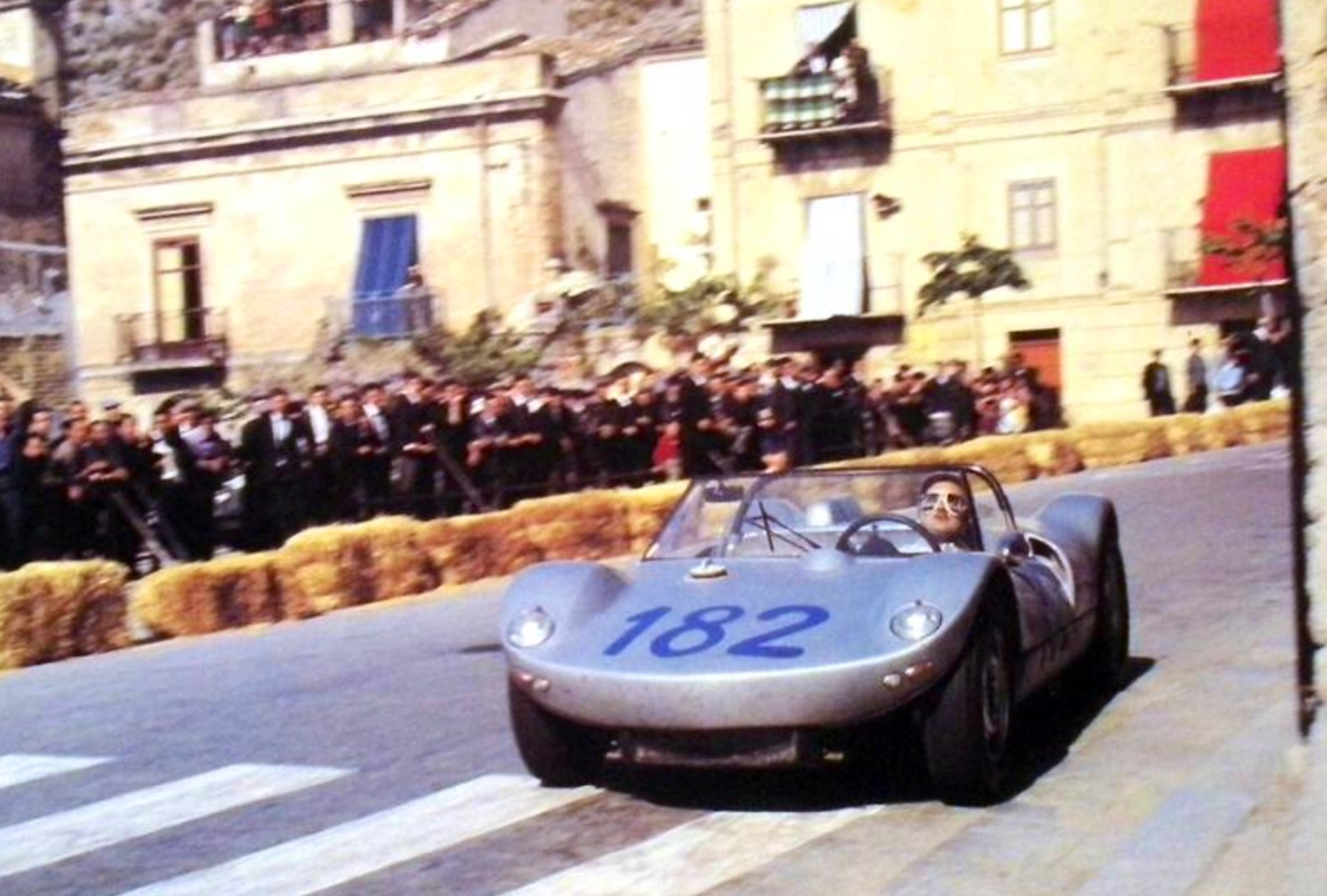
At the Targa Florio the 906 won outright, there Willy Mairesse and Herbert Muller co-drove the Swiss Ecurie Filipinetti car.
The 1966 Le Mans works, prototype Porsche 906LE Coupes finished in fourth-seventh places behind the leading trio of 7-litre factory Ford GT Mark IIs, outlasting all of the V12-engined sports-prototype Ferrari P3/4s, while the 2-litre Sports class was again dominated by a standard 906.
The Austrian 500kms event at Zeltweg saw Gerhard Mitter/Hans Herrmann and Jo Siffert (driving solo) finishing one-two.
In 1967 the 906 continued to be campaigned by prominent private entrants and drivers, while the factory team moved on to race larger-engined 907s on the relentless climb to development of the outright contender which finally won Le Mans for Porsche in 1970, the immortal 917.
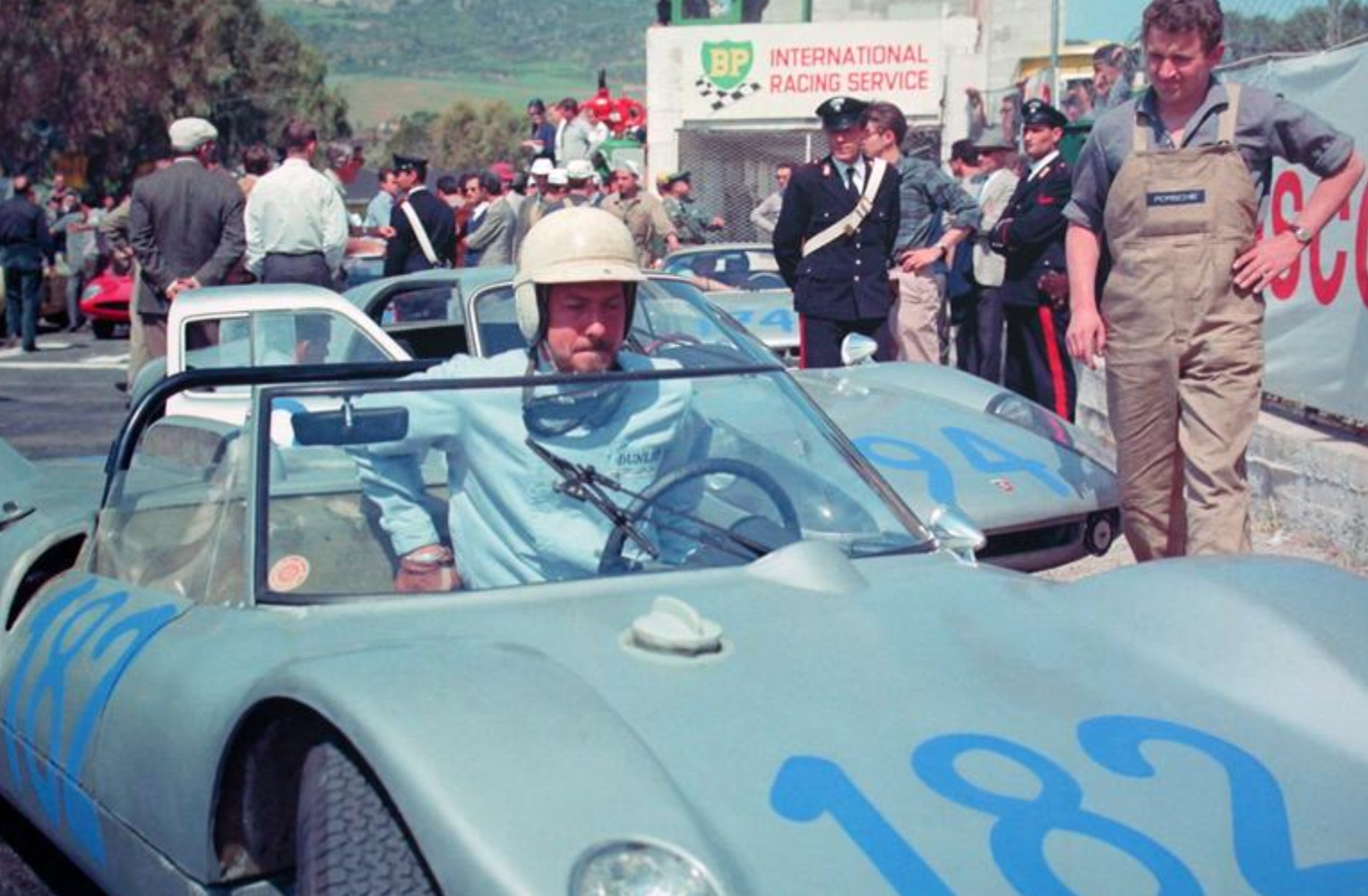
The Colin Davis/ Porsche 904/8 ‘906-007’ on the way to 2nd place during Targa 1965. The radical cutaway of the body at the front to reduce overhangs on narrow hillclimbs clear in this shot. (Martha)Jo Bonnier inserts himself into 904/8 # 906-007 during practice; both he and Graham Hill tried the car but elected to race a 904/8 Coupe #174, you can just see the nose of the car, with Hill at the wheel beside the Carabinieri. Car # 94 behind Bonnier is the #94 Pucci/Klass 904GTS. Porsche bought seven cars to the event, all but two T-Cars started. (Martha)
The Porsche 904/8…
The 904-based Bergspyders played an important test role in the evolution of the 904 to 906. The first appearance of these cars was at the Targa Florio on May 9, 1965.
All 904s came from the factory with 2-litre engines; four, six and eight cylinders. Generally the fours had 904 chassis numbers and the six-cylinder cars 906 chassis numbers. There was no rule though: the first prototype chassis 904-001 had a six-cylinder engine, the eight-cylinder coupes had 904 chassis numbers, whilst the eight-cylinder Spyders had 906 chassis numbers. Easy really!
Porsche built five 904/8 cars for factory use: chassis 906-003, 004, 007, 008, and 009. To be clear, whilst the chassis had the 906 descriptor, the cars used 904 ladder-frames, not the 906 spaceframe chassis.
All 904/8s had 2-litre flat-8 engines; the Type 771 1962cc engine, which was derived from the 1962 804 F1 car and produced circa 225bhp fed by Weber carbs.
The cars were made in two body variants. Chassis 003, 004, and 009 had the normal Spyder look of a Porsche of the period; the other two cars, 007 and ‘008, were more visually challenging, that is, ugly! The overhangs were shortened a lot for hillclimbing purposes.
Bergspyder, as a name, was a misnomer as the cars were raced as well as ‘climbed, they were nicknamed ‘Kanguruh’ (kangaroo) because of the nature of the cars roadholding, the lightweight cars with their firm suspension jumped about on poor roads.
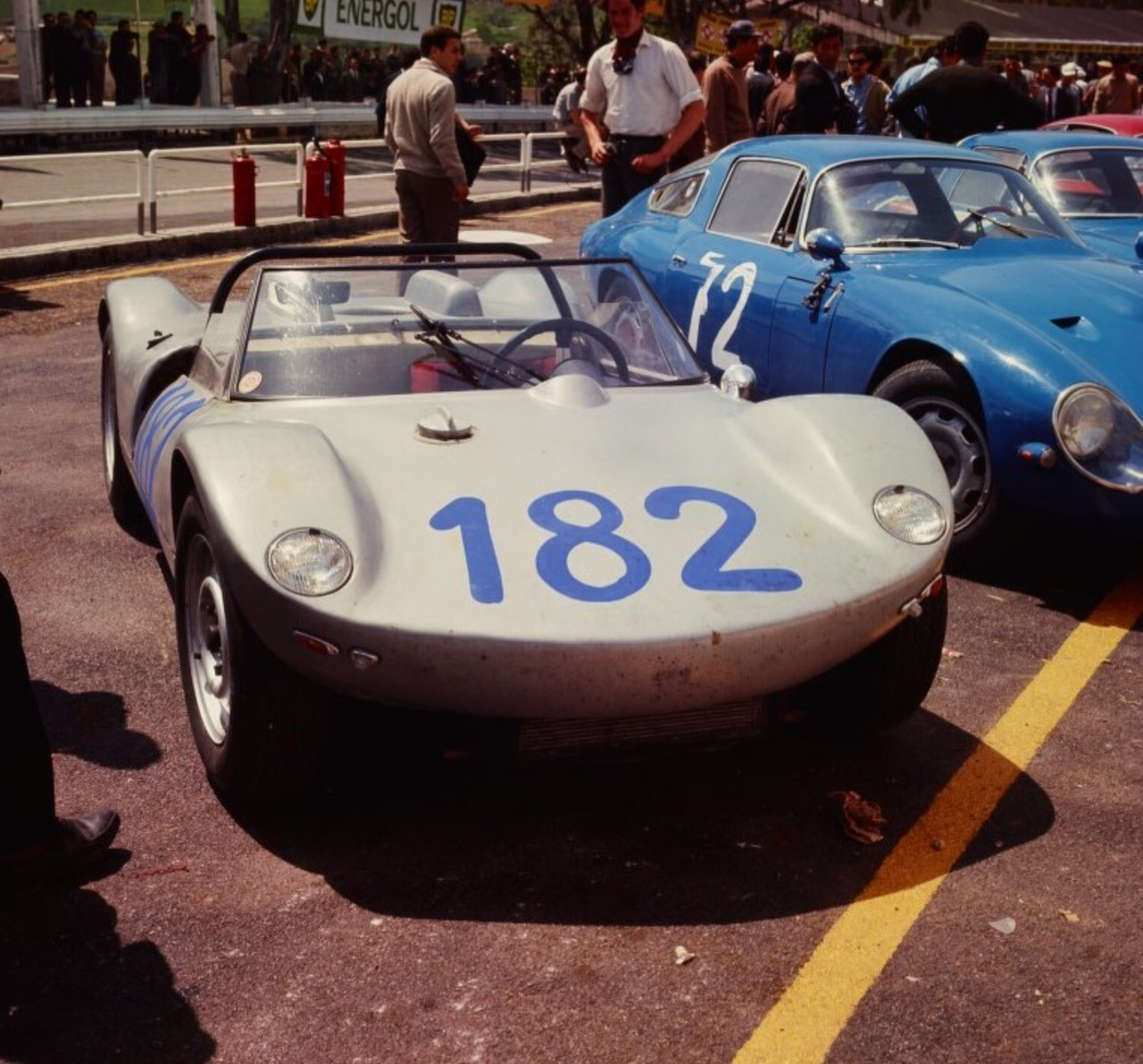
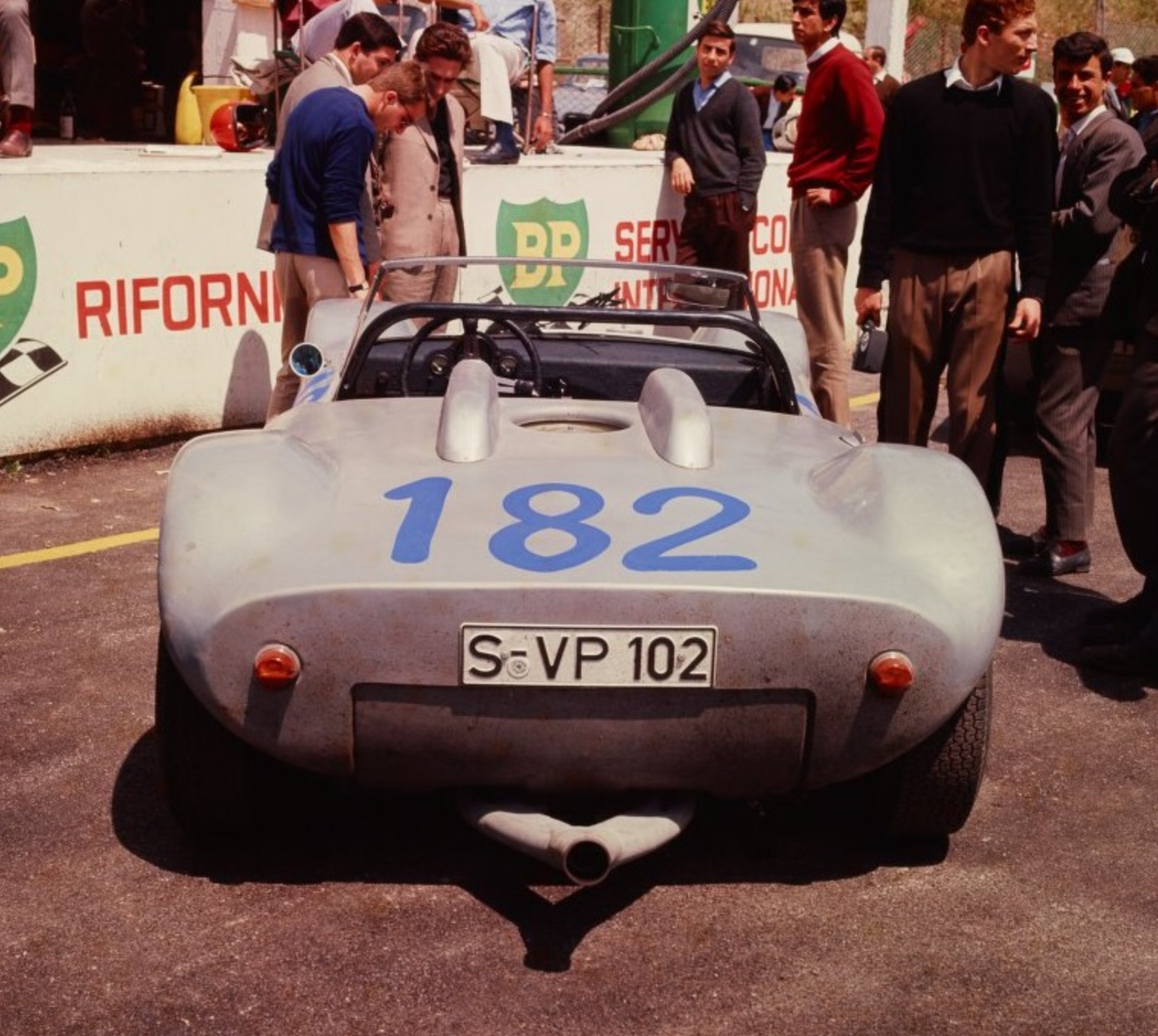
A couple of fabulous stationary shots of 904/8 ‘906-007’ at Targa 1965. #72 is the Alfa TZ1 of Panepinto/Parla DNF. (Martha)And back…by far the better angle! (Martha)The Porsche team arrive at Targa, May 1965. Cars are 904GTS Coupes and the Spyder, 904/8 906-007 chassis driven by Davis/Mitter. (PorscheAG)
Hamiltons 904/8 car chassis 906-007 was first raced at Targa 1965,
It finished second in the hands of Cliff Davis/Gerhard Mitter behind the winning Ferrari P2 of local lad Nino Vaccarella and Lorenzo Bandini. Gerhard Mitter then used the car to win the 1965 Rossfeld Hillclimb, a 6 km course near Berchtesgaden on 13 June. Next placed Herbie Muller was five seconds adrift in a standard Porsche 904GTS.
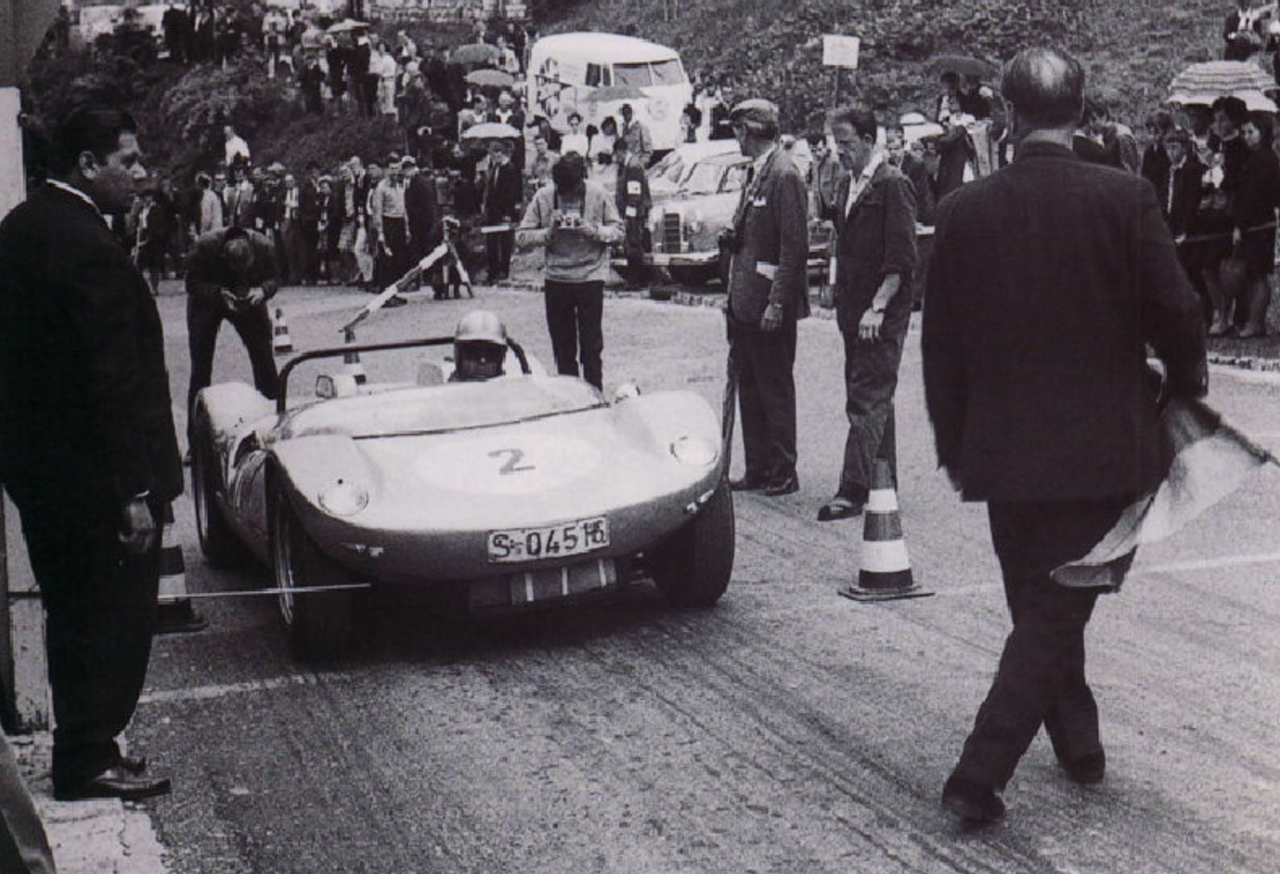
Carabinieri taking an interest in the second placed 904/8. # 94 is the works 904GTS of Pucci/Klass fifth, #106 is the Lancia Flaminia of Raimondo/Lo Jacono, which finished but was unclassified. Privateers the lifeblood of Targa! (Martha)Mitter on the startline of Rossfeld, Germany 1965. Win for 904/8 ‘906-007’. (unattributed)
Further success followed at the Norisring, near Nurnberg, where Mitter raced 906-007 to victory on July 4, 1965, leading home two Elva BMWs. The car was then unraced, the last appearance of a 904/8 was in August, in factory hands, Porsche thereafter focusing on production of the new 906.
Alan Hamilton spotted the car in a corner of the racing department…
Car #2 Mitter at the Norisring, victorious in the 904/8 again. Car #3 is a Lotus 23 driven by Anton Fischhaber, #5 Chris Williams’ Lotus BMW. (unattributed)
Porsche 904/8 906-007 in Australia…
Interviewed by Journalist Barry Lake, Hamilton said the 904/8 ‘originally had a 2-litre 8-cylinder engine, but I bought it with a new 906 (6-cylinder) engine I had asked them to install. I imported that at the end of 1965 and raced it through 1966.’
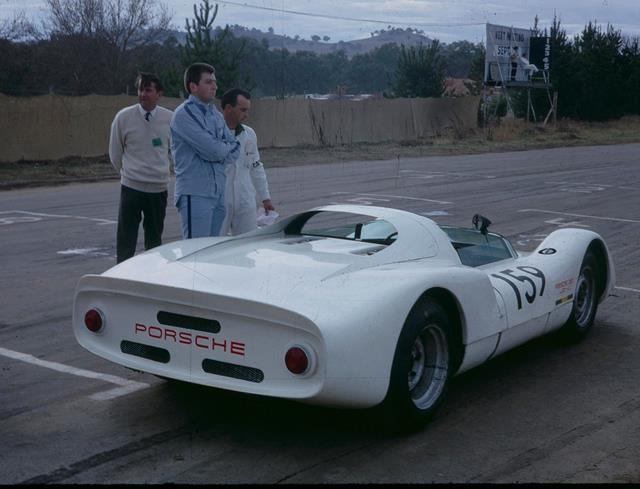
The car was first raced in Australia at Calder, Victoria on 16 January 1966, which is probably when the Autosportsman cover shot used at the start of this article was taken. The car then raced at the Sandown round of the Tasman Series, contesting the sports car events.
Taken across Bass Strait on the Princess of Tasmania with the rest of the Tasman Circus to contest the Australian Tourist Trophy at Longford, Hamilton was second in the race won by the much more powerful Elfin 400 Traco Olds V8 of Frank Matich.
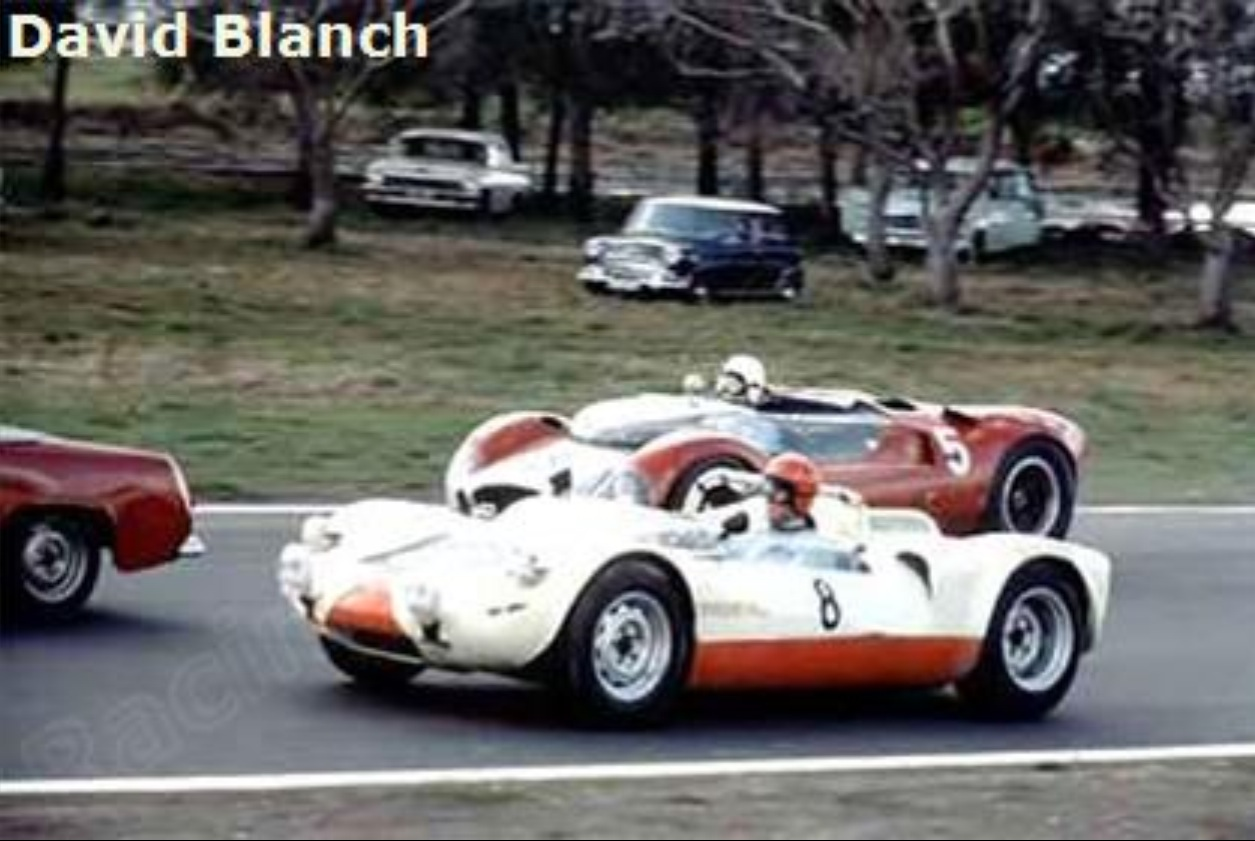
Alan Hamilton in his Porsche 904 906-007 in one of its earliest appearances in Australia, at the 1966 Australian Tourist Trophy, Longford in March 1966. Alongside is Spencer Martin’s Ferrari 250LM and on the far side Frank Matich, in the victorious Elfin 400/Traco Olds. Hamilton was second, Martin third. (Ellis French)Alan Hamilton navigating Surfers Paradise traffic during the 1966 12 Hour. Porsche 904 906-007. Car #5, the ex-Moss/Stillwell Cooper Monaco Olds of Osborne/Carter/Gibbs. (David Blanch)
The 904 quickly became one of the fastest sportscars in the country, fourth in the 1966 Surfers Paradise 12 Hour with a 2-litre car was a top result. Alan shared the 904 with Melbourne driver Brian ‘Brique’ Reed. Jackie Stewart and Andy Buchanan won in the Scuderia Veloce Ferrari 250LM- I wrote an article about this Ferrari a while back, click here to read it; https://primotipo.com/2014/07/03/pete-geoghegan-ferrari-250lm-6321-bathurst-easter-68/
The Hamilton 904 combination were also first in the 1966 Australian Hillclimb Championship at Collingrove, South Australia, the Victorian Sports Car Championship at Sandown and the South Australian Sports Car Championship at the Mallala ex-airfield circuit.
Towards the end of 1966 the Porsche workshop in St Kilda, Melbourne started to transfer the mechanicals of the Kanguruh 904/8 906-007 to a new 906 chassis.
Alan Hamilton, ‘Later (that is after the 904/8 was in Australia) I imported a new 906 chassis and body and put the mechanicals of the Targa car in that’.
‘Then Jim Abbot bought the Targa car (chassis 904/8 906-007) and fitted a ZF gearbox and 289 Ford V8 engine. His estate or perhaps Jim himself shortly before he died, sold the car to Murray Bingham in this form and it became the Bingham Cobra.’
Longford March 1966, second in the Australian Tourist Trophy. 904 ‘906-007’. (oldracephotos.com/King)Alan Hamilton ‘fairly hooting through here, scary to watch’ in the view of the photographer. Templestowe Hillclimb, outer Melbourne 1966. 904 906-007. (onelung)Another shot of Hamilton in the 904 at Templestowe Hillclimb, 11 September 1966, he broke the climb record on the day. (Stephen Dalton Collection)
Hamilton; ‘Years later, Pat Burke bought the car and sent it to Germany where it was restored to its original 904/8 Targa Florio specification. After Pat Burke fell on hard times it was auctioned at Monte Carlo. I think a man in Sydney bought it, but I have no idea who has it now.’
Lets go back a step to the acquisition of the chassis and related parts by Jim Abbott.
Abbott was a driver, owner of Lakeland Hillclimb in outer Melbourne, publisher of motor racing monthly Autosportsman magazine and promoter of an annual Motor Racing Show in Melbourne.
In 1966, 1980 World Champion Alan Jones, was trying to establish a foothold on the motor racing ladder in the UK, wheeling and dealing in cars and campers to provide the money to do so. He acquired an ex-works Sunbeam Tiger and, knowing Abbott had an interest in such cars, sold it to him. The car was raced and ‘climbed’ by Jim and engineer Paul England before Abbott decided it would make a nicer road car than a racer. He swapped the Shelby-modded 289cid V8 for a standard engine and looked around for a chassis into which to plonk his nice, powerful Ford Windsor small-block V8.
Various Coopers were considered before a deal was done with Hamilton to acquire the Kanguruh 904/8 906-007.
A suitable ex-Cooper Maserati F1 ZF 5DS 25 transaxle was also acquired. The engine and box (the latter requiring some modification in terms of clutch componentry by Eddie Thomas) was ‘dropped’ into the Porsche chassis at Hamilton’s St Kilda workshop.
A little cutting and shutting of the chassis crossmember was needed to fit the V8. A sub-frame was added around the engine to maintain chassis stiffness, but in essence, the swap was relatively simple. Stiffer springs and shocks were fitted as the Ford cast iron lump was around 200lbs heavier than the svelte, alloy Porsche Flat 6. Driveshafts were suitably strengthened by Paul England Engineering.
The original rear bodywork was used but at the front, much bashed and repaired a local specialist fashioned a nose much more attractive than the original, the screen, a concoction of a speedboat parts, met at each end with aluminium panels was not quite so pretty.
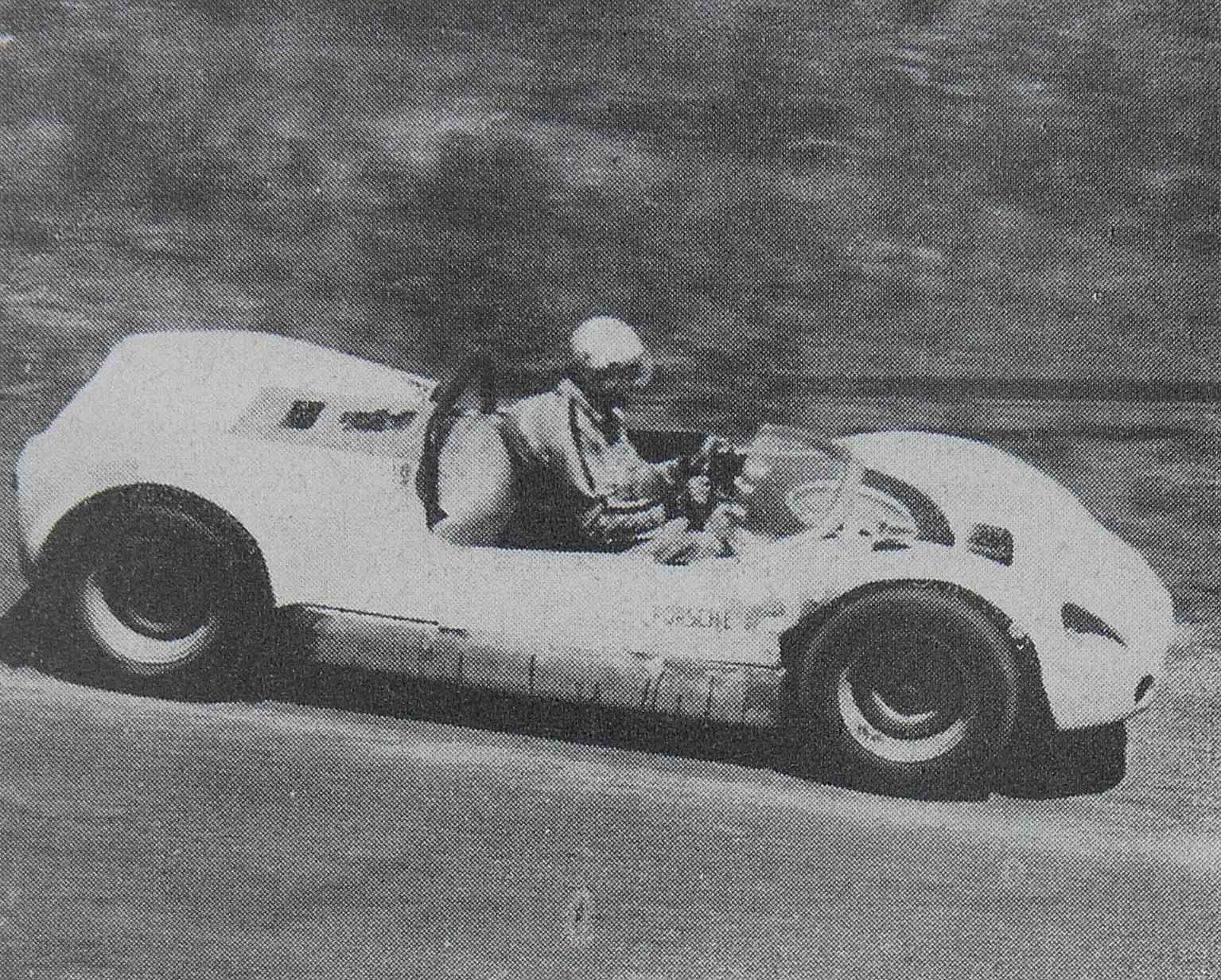
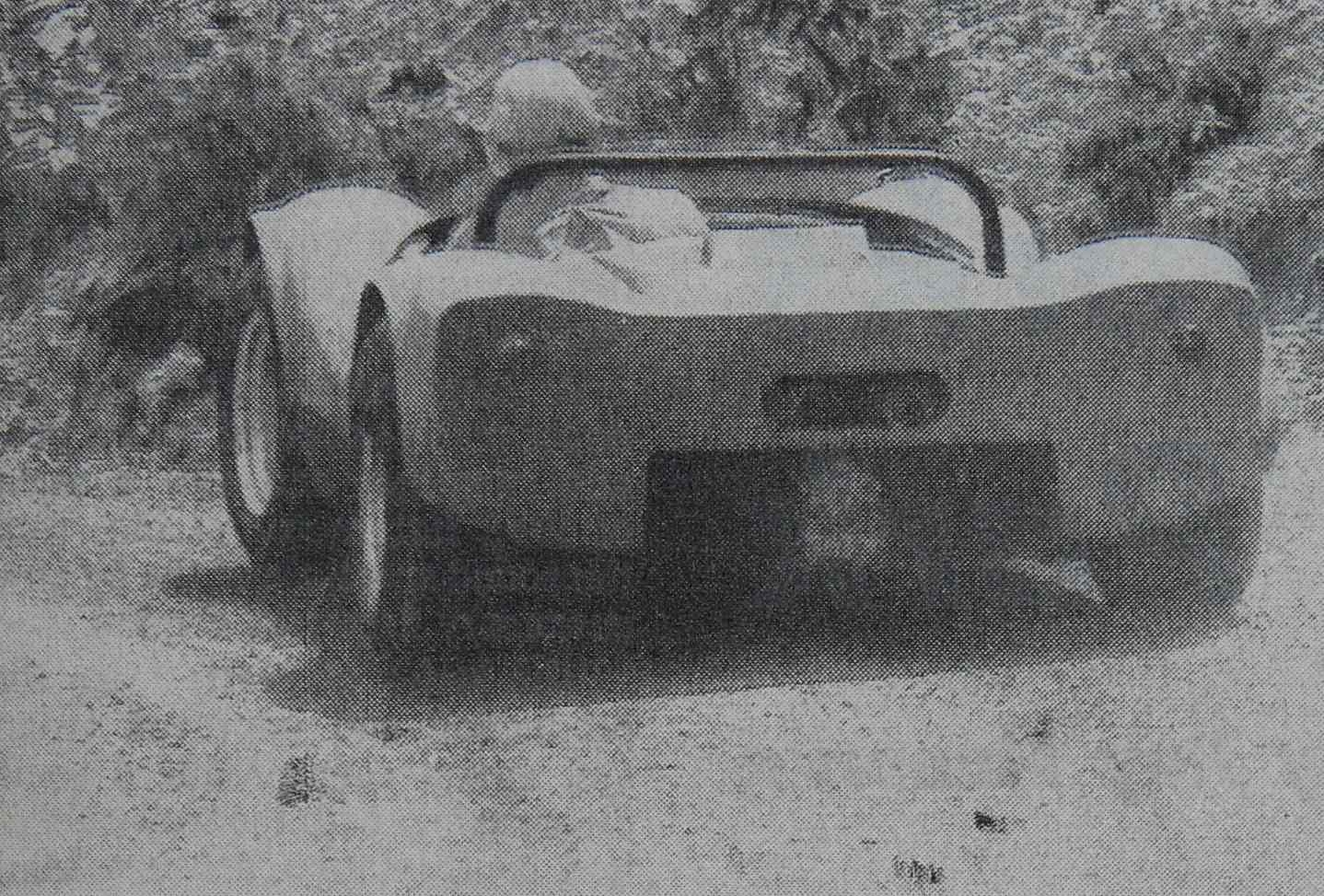
Jim Abbott in 904 ‘906-007’ now called a ‘Porsche Cobra’ in deference to the 289cid Ford engine installed. This shot is probably at Lakeland in outer Melbourne, a venue owned by Abbott. Front of the much bashed and repaired body re-worked. (Autosportsman)Fairly scratchy shot shows the ZF 5DS 25 beefy gearbox if not the engine. Chassis other than minor mods to fit the engine, as built by Porsche. Front and rear suspension sold with the car by Hamilton to Abbott also standard. (Autosportsman)
Abbott’s objective was not to build an outright car but rather a very fast sports car which could be ‘raced, sprinted and climbed’. The completed machine made is debut at the Light Car Club of Australia’s annual members meeting at Sandown on Melbourne Cup Day in November 1967. ‘Red Handed’ won the ‘Cup at Flemington that day! More importantly, Abbott set a sub-13-second standing quarter mile at Sandown, also primarily a horse racing venue.
The car was quickly under the times set by the class record holder, a Cooper Jaguar at Templestowe Hillclimb and was running fourth in the Winton Trophy at the picturesque Benalla country Victorian circuit when the car lost its water. Initial troubles centred around the cooling system, which were solved by fully rebuilding it.
Jim Abbott, ‘Porsche Cobra’ 904/8 906-007, Lakeland Hillclimb 1967. These are scratchy shots but included for the sake of completeness. Abbott looks huge in the cars cockpit. The screen is from a boat. (Autosportsman)Jim Abbott, Porsche Cobra 904/8 906-007, Lakeland Hillclimb 1967, 2 years before victorious at the much more grand, Rossfeld, Germany hillclimb. (Autosportsman)Tom Sulman in the Porsche Cobra at Huntley Hillclimb, NSW on 1 June 1969 (T Arts)
Abbott did not campaign the car for long before his untimely death, it was then sold to New South Wales veteran driver, Tom Sulman who raced it in 1969.
Murray Bingham then bought 904/8 906-007 and used it very successfully for over 10 years. The old chassis won the Australian Hillclimb Championship again in 1972, a three-round Series that year. (Hamilton won the 1966 title in it at Collingrove).
Murray Bingham in 904/8 906-007, then known as the ‘Bingham Chev’ in, probably, 1972 at Collingrove, Angaston, SA. Check out the downforce being sought front and rear. (John Lemm)
A ‘Manx’ body replaced the original, and the Ford Cobra engine was updated with an ex-Gary Campbell, Alan Smith-built Chev F5000 engine out of a Lola T300. Bingham won the 1973 NSW Hillclimb Championship in Chev-engined form, the 1971-72 NSW titles Ford Cobra-engined.
The much raced car finally passed into the hands of Pat Burke who restored it before it was sold upon the demise of his business empire in the 1980s as described by Alan Hamilton earlier in the article.
I am uncertain of the cars current owner.
Murray Bingham in 904/8 906-007 in its hillclimbing years, King Edward Park, Newcastle, NSW. Car known as ‘Bingham Cobra’ and ‘Bingham Chev’ when fitted with Ford 289 and Chev F5000 engines respectively. ‘Manx’ body (unattributed)Australian Autosportsman June 1967 cover depicts the Alan Hamilton Porsche 906 Spyder at Longford in 1967. (Stephen Dalton Collection)
Hamilton’s first Porsche 906 Spyder…
Hamilton’s new 906 chassis came with bodywork, suspension and brakes.
904/8 906-007 donated its engine and gearbox and some other components, as the narrative and photos show, the 904/8 906-007 car was still as built by Porsche, less the engine and box. Alan is a big, tall bloke so he elected to build the 906 up as a Spyder rather than a standard 906 Coupe in order to ease access and egress and more easily see out of the car.
At this point we have two cars: the 904/8 chassis car 906-007, now called ‘Porsche Cobra’ and fitted with a Ford engine and ZF gearbox and a 906 which was not issued a chassis number by Porsche, but which over the years assumed the 906-007 tag, which was built up as a Spyder, but which when restored in Germany in 2003-09, was rebuilt as a Coupe. This car now has a chassis 906-007 plate, at what point the plate was affixed is conjecture.
Both cars have elements of the original 904/8 906-007…
Another majestic Longford shot. Hamilton Porsche 906 Spyder 1967. (oldracephotos.com/King)
Back in 1966, none of these problems for future historians mattered to Hamilton; he had a new state-of-the-art 906 to contest Australian events.
As the recent article I wrote on the Frank Matich Elfin 400/Traco Olds makes clear, the light six-cylinder-engined Porsche was up against it with several very potent, light, well-driven V8-powered cars in the hands of Frank Matich, Niel Allen and Bob Jane in 1967. (Matich SR3 Repco, Elfin 400 Chev and Elfin 400 Repco, respectively).
The Porsche Team completed the build of the 906, and the original 904 chassis 906-007 was put out the back of their St Kilda workshop until acquired by Jim Abbott later in 1967.
The 906 Spyder made its debut in the sports car events at Sandown’s Tasman round in late February 1967. Hamilton took three class wins and a class lap record.
To Longford, the following weekend, the car was third outright. The following week, still in Tasmania, Hamilton raced the car at Symmons Plains, where he won his first race and was leading the Tasmanian Sports Car Championship when a conrod let go. Hamilton noted in his Autosportsman column that the engine had ‘done 14 months racing, 92 hours, so we are more than happy with its overall performance’, Porsche’s reliability is legendary.
In April, Hamilton contested the Victorian Sportscar Championship, winning his heat and finishing second outright and first in class; he also bagged the class lap record.
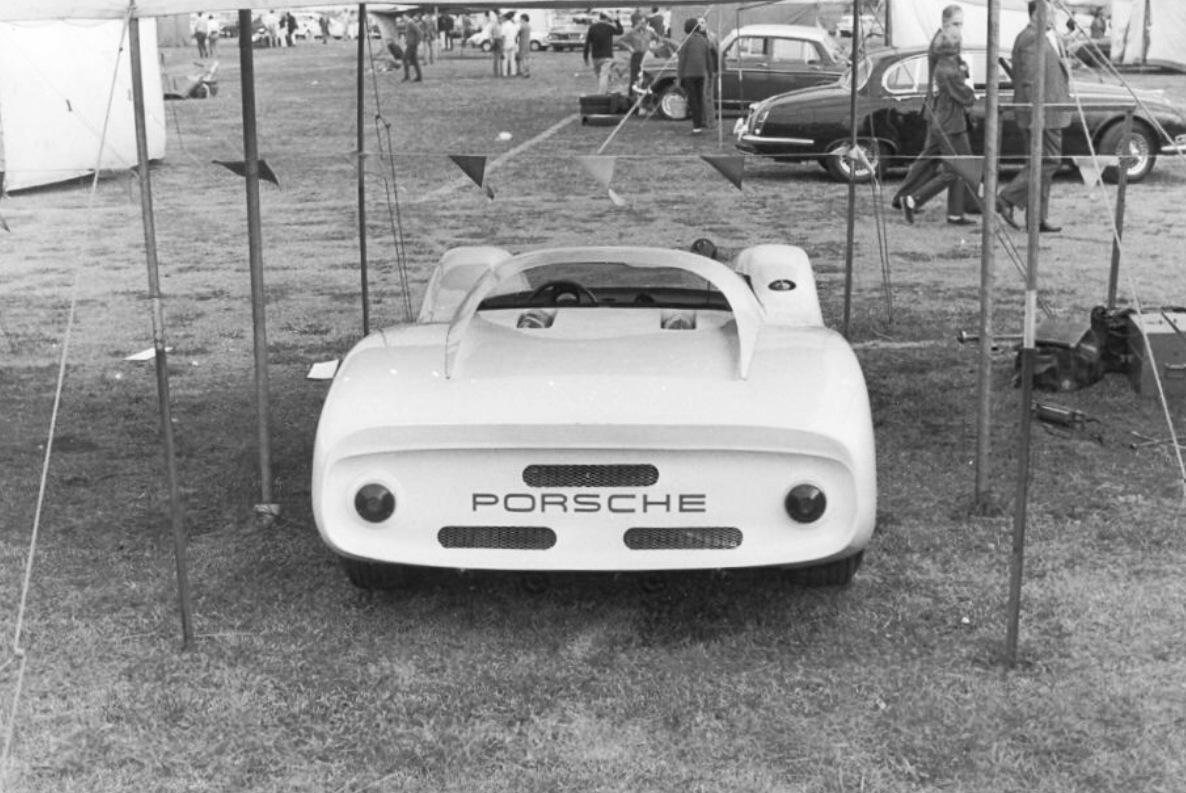
The Hamilton 906 in the Warwick farm paddock, May 1967. Note the ‘chin wing’ and pretty front of the car. (WOT)Sensational Bruce Wells shot of Hamilton contesting the RAC Trophy at Warwick Farm in May 1967, here in the Esses. Sans the wings in the paddock shot. Porsche 906 Spyder. (Bruce Wells/The Roaring Season)Warwick Farm 906 butt shot, May 1967. (WOT)
On 14 May, Hamilton contested the RAC Trophy at Warwick Farm where he finished third behind two powerful V8s. The dominant Matich SR3 of Frank Matich was getting in some valuable mileage before leaving to contest the Can-Am Series in this car, and Bob Jane’s Elfin 400, which, like the SR3, was powered by Repco’s new 620 Series SOHC, two-valve, 4.4-litre V8.
A week after the RAC Trophy, Hamilton contested the Australian Tourist Trophy at Surfers Paradise. This was a relatively easy tow from Sydney to Queensland’s Gold Coast and gave Hamilton valuable testing time at Surfers to fettle the car to suit the circuit for the international 12 Hour event in September.
Matich won again in his SR3 Repco, but Alan was second in the 906 and his 12 Hour co-driver Glyn Scott third in his Lotus 23B Ford. The other two outright sportscar contenders of that year, Niel Allen and Bob Jane’s Elfin 400s did not make the trip North.
Success followed in Victorian events at Calder and at Hume Weir on the Queens Birthday weekend, before taking the long haul back to Surfers Paradise for the 12 Hour event on the 3 September weekend .
Alan Hamilton awaits the rest of the grid at Hume Weir in 1967. Great little circuit built in a quarry created when land fill was excavated to create the Hume Weir Dam. Porsche 906 Spyder. Top shot shows the lines of this car superbly. (unattributed)Hume Weir, Queens Birthday weekend 1967. AH on pole in his 906, #6 is ‘Gold Star’ reigning national champion, Spencer Martin having his first drive of Bob Jane’s Elfin 400 Repco and the nose of Bevan Gibson’s Lotus 15 Climax FPF. (The Nostalgia Forum)
Hamilton’s co-driver at Surfers was Queenslands’ Glyn Scott, the duo finished third outright and first in class. The race was won again by the SV Ferrari 250LM, that year driven by the Australian duo, Bill Brown and Greg Cusack, Paul Hawkins and Jackie Epstein were second in Epstein’s Lola T70 Mk3 Chev.
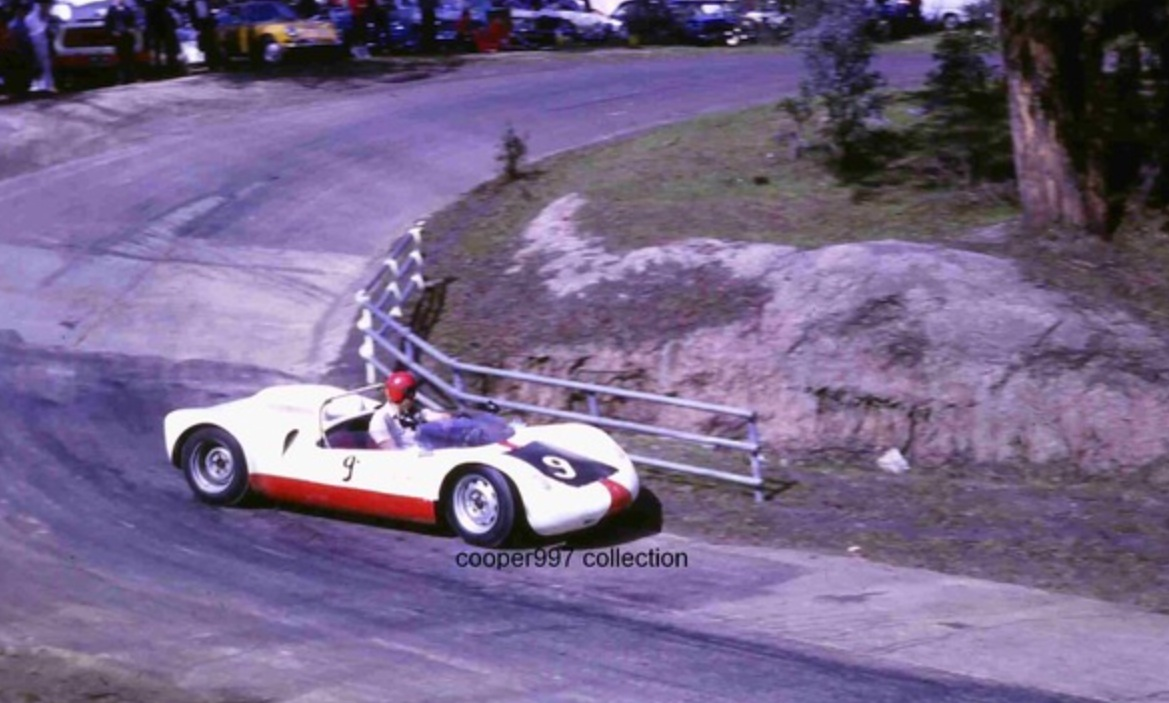
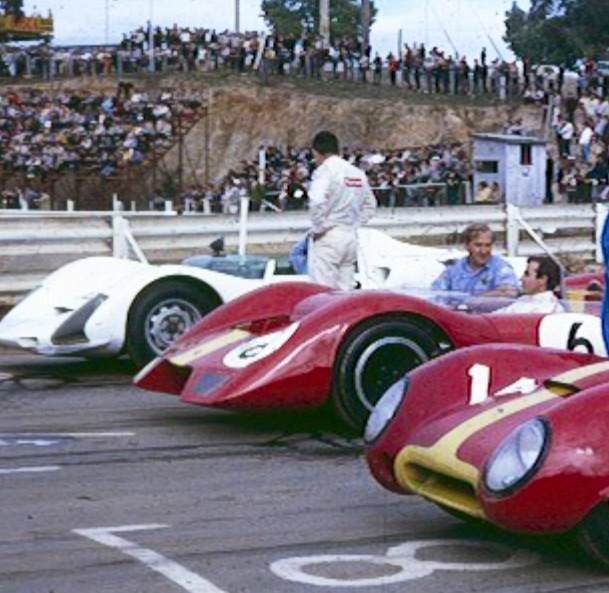
Alan Hamilton was very fast out of the blocks at the start of the ’67 Surfers 12 Hour in the #9 906. #1 is the second placed Lola T70 Mk3 Chev, with Paul Hawkins at the wheel, the winning Ferrari 250LM is alongside Hawkins. The Lotus Elan is probably the McArthur brothers’ car, the Datsun 1600 #29 the ‘works’ 1600 of Tapsall/Woelders DNF, and the Volvo P1800S driven by Keran/Bond/Winkless 10th. (unattributed)Hamilton corners the 906 at ‘Lukeys’ during the Surfers 12 Hour. (Peter Baldwin)Hamilton on the Collingrove Hillclimb startline in April 1967. He set a track record of 35.60 seconds in the 906 at this meeting. (John Lemm)
Another long tow to Mallala, South Australia, was rewarded with victory in the South Australian TT.
John Blanden noted the versatility of the car and driver, the 906 contested hillclimbs, still pretty important and sometimes televised, the car taking FTD at Templestowe in Melbourne’s outer east and second in the Australian Hillclimb Championship at Bathurst in November behind Greg Cusack’s Tasman 2.5-litre Repco powered Brabham BT23.
A successful year was capped with a win at Lakeland Hillclimb in the Dandenong Ranges, outer Melbourne in December.
Alan had a win at Lakeland Hillclimb close to home in December 1967 (G Fry)The Roxburgh/Whiteford Datsun 1600 ahead of the Cusack/Brown Ferrari 250LM and Hamilton/Scott Porsche 906 Spyder. Surfers 12 Hour 1967.(Ray Bell)
The 906 was advertised for sale in the November 1967 issue of Racing Car News, the car, according to John Blanden, having reached its Customs Duty limits. This taxation concession allowed Tasman Series competitors, for example, to avoid import duty by ‘exporting’ the cars each year to New Zealand. If exceeded, that is, the car stayed in Australia for longer than twelve months, the ‘fiscal fiend’, the taxman, had to be paid.
The car was sold to Richard Wong in Singapore and passed through many hands, including Macau businessman/racer/team owner Teddy Yip. As mentioned earlier in this article, Hamilton’s first 906 was ultimately restored as a Coupe, having been only raced by Hamilton as a Spyder…
Alan Hamilton, Porsche 906, Symmons Plains 1967 (HRCCT)
European Trip in 1968…
Hamilton spent most of 1968 overseas, much of it working at Porsche; he did manage to fit in the Nurburgring 1000Km, racing a 911S to 28th place with co-driver/car owner Hans-Dieter Blatzheim. The race was won by a factory Porsche 908 driven by Jo Siffert and Vic Elford.
Planning an all out assault on the 1969 Australian Touring Car Championship, Hamilton ordered a trick 911T/R, the car arrived early enough to compete in the 1968 ATCC, the last run to a one race format. Pete Geoghegan won the title again in his Mustang, Hamilton in the giant killing 2-litre 911 lost second place on the last lap due to a puncture, Darrell King’s Morris Cooper S just beat him to the Warwick Farm chequered flag.
Porsche still had some spare 906 chassis lying around the factory, one was offered to Alan, who was happy to oblige, he still had plenty of bits from the earlier cars so he could easily build up another car for competition back in Oz. This 906, just like the previous chassis he raced in ’67 did not have a chassis number.
Hamilton has his 911T/R in a beautifully balanced four-wheel drift during his run to third place in the one race Australian Touring Car Championship at Warwick Farm in September 1968. A flat tyre cost him second on the last lap. Pete Geoghegan won the title in his Ford Mustang. This car left Oz many years ago.(autopics.com.au)Alan Hamilton exiting Clubhouse Corner at Mallala on 16 June 1969 during the ‘South Australian Touring Car Championship’, round 3 of the ATCC in 1969. AH was second behind Pete Geoghegan, the first of four second places he achieved that year. The 2-litre 911T/R did not quite have the Mumbo to knock off the big Mustang. (Dick Simpson)
In the 1969 ATCC he came very close to taking the title with consistent second places, ultimately the championship was won by Pete Geoghegan by one point, in his Mustang, the fifth win in the event for the beefy, supremely talented Sydneysider. The battle went down to the wire in the final round at Symmons Plains.
In the middle of his ATCC campaign, Hamilton was recruited by ‘Big Al’ Turner to drive a factory Ford Falcon XW GTHO Phase 1 in the Bathurst 500 together with 500 debutant Allan Moffat that October.
Moffat was in good form having won the preceding Sandown 500 in his big Falcon. Still a young driver, Turner was keen to exploit Hamilton’s speed, smoothness and mechanical sympathy. It was the start of a relationship between the drivers which would be mutually beneficial over the next decade.
1969 was the famous Bathurst when tyres imported by Turner failed spectacularly. Moffat was called into the pits for a precautionary check after the tyres on the Brothers Geoghegan and Gibson/Seton cars failed. The Moffat/Hamilton duo were easier on the Goodyears than their teammates; the pitstop was unnecessary and probably the cause of the pre-race favourite Falcons losing the victory. The Holden Dealer Team Holden Monaro HG GTS 350 of Colin Bond and Tony Roberts won the race.
Moffat/Hamilton Ford Falcon GTHO, Bathurst 1969. (autopics)
In 1970, Alan didn’t contest the ATCC, but the second Hamilton 906 was assembled. The car had a standard 906 front clip, but, like the earlier 904/8 906-007 and 906 was a Spyder, the rear deck was modified locally with pronounced spoilers to provide some downforce. No wing though.
Minilite wheels replaced the factory steel wheels of the earlier cars. The machine was ready for the 1971 Australian Sportscar Championship, powered by a 2.4-litre twin-plug engine assembled locally from Alan’s cache of trick, Porsche bits.
Hamilton in his second 906 at Warwick Farm on 2 May 1971. The standard 906 front, Minilite wheels and modified rear deck are all clear. Like his earlier 906 this chassis was not allocated a number by the factory. (lyntonh)
Hamilton’s second 906 Spyder…
1971 was to be a big year of racing for Hamilton. In amongst the rapid growth of Porsche Cars Australia, a strong economy and global growth in the Porsche brand reflected in strong sales in Australia, Hamilton took the big step up to Australia’s premier single-seater class, F5000.
He purchased Niel Allen’s spare McLaren M10B Chev (#400-19) upon Allen’s retirement from the sport. (Ignoring Allen’s short flirtation with a Lola T300 12 months later). Kevin Bartlett bought Niel’s other M10B (#400-02), all these years later Hamilton owns both McLarens, they are being historic raced by Alf Costanzo. In the seventies and eighties Alfie was Hamilton’s driver in a swag of F5000 and F Pacific cars in which the little Italian born Aussie was prodigiously fast. A tangent too far for this long article!
AH in his McLaren M10 B Chev, F5000, Oran Park June 1971. (lyntonh)
Hamilton missed the 1971 Tasman Rounds, but both he and Bartlett had their cars ready for a full Gold Star campaign. Despite being a novice in these big, brutal, challenging cars Hamilton was immediately competitive, taking third places at Oran Park, Surfers Paradise and Mallala.
He was fourth at Lakeside, finishing the Series equal second with Bartlett in his M10B. Winner of the series was the speedy and consistent Max Stewart in his Mildren Waggott 2-litre in a final Championship victory for this superb Australian four-cylinder DOHC four-valve engine. Stewart progressed to an Elfin MR5 Repco at the end of the Series and was consistently competitive in the big cars for the rest of his career.
The Porsche Cars Australia transporter did plenty of miles from its St Kilda base in 1971 in pursuit of two national championships and the vast distances across the big Australian continent that entails.
Alan Hamilton cornering his McLaren 911 style at Warwick Farm 1971, date unknown. Car is chassis ‘400-19’, Niel Allen’s spare built up by Peter Molloy and sold, together with his race chassis ‘400-02’ to Alan Hamilton and Keven Bartlett respectively. Full monocoque aluminium chassis, 500bhp fuel injected 5-litre Chev engine, Hewland DG300 gearbox…much more powerful than a Porsche 906! (unattributed)In the best of company during the 1971 AGP at Warwick Farm. John Surtees from Hamilton, Colin Bond and Graeme Lawrence. Surtees TS8 Chev, McLaren M10B Chev, McLaren M10C Repco and Brabham BT30 Ford. (lyntonh)Side on view of Hamilton’s 906 in 1971, here at the RAC Trophy meeting at Warwick Farm, Northern Crossing in May 1971. (lyntonhButt shot of the car, same day as above, the neat upswept tail providing downforce but also not too much drag given the little 2.4-litre flat-6 propelling it all…(lyntonh)
In 1971 Hamiltons 2.4-litre twin-plug Porsche 906 was as out-powered as the earlier cars were in 1966-67.
The fastest combination in the field was John Harvey in Bob Jane’s McLaren M6B Repco, a 5-litre SOHC 740 Series V8 producing around 460bhp@7500rpm. Best results for the 906 were thirds at Phillip Island in January and Warwick Farm in May.
Whilst outgunned on the track, the nimble 906 was just the thing at Hillclimbs. Hamilton had a passion for these events and at Easter took fastest time of the day on 10 April, a track record and the Australian Title, his second win, the first in the 904/8 also at Collingrove in 1966. The Angaston Hills were alive to the sound of flat 6 music…
Alan Hamilton launches his Porsche 906 off the line at Collingrove, Angaston in South Australia’s Barossa Valley. Easter 1971. Hammo set a track record of 33 seconds dead at this meeting. (fredeuce)
At the end of the year, Hamilton sold the McLaren to Pat Burke (later the restorer of the 904/8 906-007) for his driver Warwick Brown, with the M10B an important stepping stone for the talented driver on his climb towards the top of the class in both Australasia and the US.
This M10B chassis was then used as the donor car for Bryan Thomson’s ‘Volksrolet’ VW Fastback Sports Sedan project, before being restored, around the original tub, which had never been destroyed, many years later, by Alan Hamilton as mentioned above.
A lap or so from disaster, Dandenong Road corner. AGP Sandown 1978. AH was running a comfortable second in his Lola T430 Chev, behind race winner Graham McRae McRae GM3 Chev, when he lost the car across the Causeway section of the old circuit, at high speed, hitting Dunlop Bridge and hurting himself very badly. Fortunately, he survived, but the car was carved in half, destroyed. In the last 5 years, it has been reconstructed by the ‘NZ F5000 Industry’ around the car’s remains, which comprised ‘half its vinyl Lola nose badge’…(G Howard ‘History of The AGP’)
Hamilton returned to F5000 in 1978, that campaign ended in near tragedy at Sandown when he crashed his ex-Team VDS Warwick Brown Lola T430 Chev at the high speed Dunlop Bridge, the car was destroyed, carved in half, Alan was lucky to survive, and became a diabetic as a consequence and has been unable to hold a full licence since.
Not that it stopped him winning two Australian Hillclimb Championships in 1981 at Ararat and 1989 at Gippsland Park, both in Victoria, in Porsche Spl and Lola T8750 Buick respectively. He was lucky to survive the Sandown accident and was a significant patron to other drivers, notably Costanzo post-prang.
In 1972 Hamilton continued to campaign the 906, John Harvey won the title again in the Bob Jane McLaren M6B Repco with Hamilton second in the title, 20 points adrift of Harvey with seconds at Phillip Island, Adelaide International, Warwick Farm and Surfers Paradise.
The championship had a bit of a renaissance that year with some new cars appearing, notably the Elfin 360s of Phil Moore and Henry Michell, also the Rennmax of Doug Macarthur, all of which were powered by ex-Tasman Series 2.5 litre V8 Repco engines now surplus to requirements with F5000 as the new ANF1.
Victory lap, Sports Sedan race at Oran Park May 1972. Alan Hamilton #9, Jim MkKeown in 911’s, Pat Peck in a Holden Torana GTR XU1 and Bill Brown #7 in another 911. (lyntonh)
Alan also raced a Porsche 911S sports sedan during this period, but the 906 racing days were over. The car was rebuilt as a Coupe in the 1980s by the Porsche workshop in Melbourne. It appeared occasionally, notably at a couple of Adelaide Grand Prix historic demonstrations. The car was finally sold by Hamilton in 1990 via auction to a Japanese owner.
Hamilton raced on in a variety of cars and became a very generous team owner after his own front line racing days ceased post accident, he is still active in the historic scene and lives on a property at Red Hill on Melbourne, Victoria’s Mornington Peninsula.
Hamiltons second 906, originally raced as a Spyder in 1971-72 now restored and rebodied as a Coupe and pictured here at Sandown in 1985. Restoration done in the Melbourne/Dandenong Porsche Cars Australia workshops. (Historic Racing Cars in Australia)
Etcetera…
Australian Autosportsman April 1967
904/8 906-007
Refuelling 904/8 of Davis/ Mitter, Targa 1965. (Bernard Cahier)Type 771 flat-8, 2 valve, DOHC, Weber carbed engine a development of Porsche’s 61/2′ F1 program. Circa 225bhp. (unattributed)904/8 rear suspension and engine. Upper and lower wishbones, coil spring/dampers, radius rods. Disc brake, fuel tank all clear to see. 904 chassis of ladder frame type. (unattributed)
Bibliography…
‘Historic racing Cars in Australia’ John Blanden, The Nostalgia Forum, Australian Autosportsman Magazine March 1966 and April 1967. Stephen Dalton for his research and access to his archive/collection
Photo Credits…
oldracephotos.com, ‘onelung’, Bernard Cahier, lyntonh, G Howard ‘History of The AGP’, autopics.com, Dick Simpson, Bruce Wells, The Roaring Season, freduece, Ray Bell, David Blanch, Ellis French, John Lemm, Peter Baldwin, Jean Charles Martha, Yoshihiro Inomoto, Gavin Fry, Tony Arts, Historic Racing Car Club of Tasmania
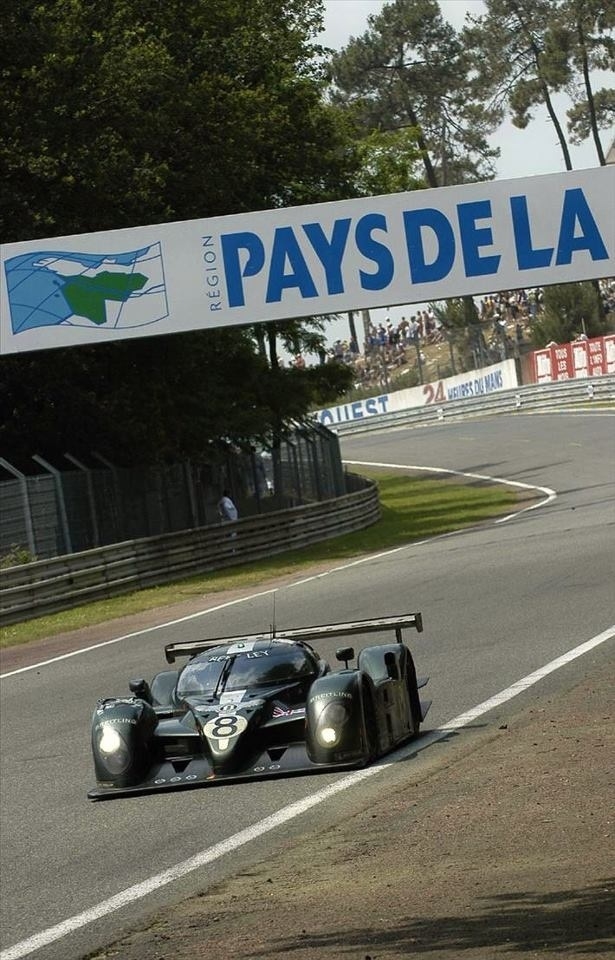
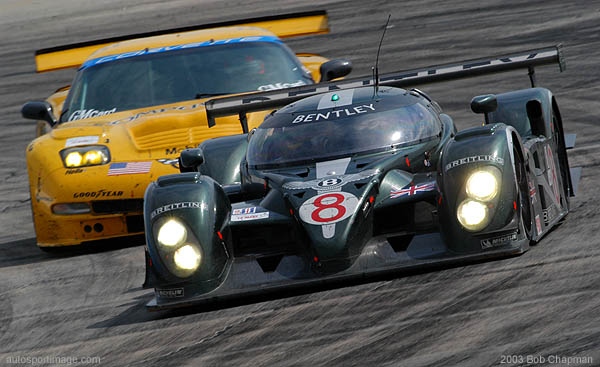
The victorious Bentley Speed 8 of Kristensen/Capello/Smith ahead of the second placegetting car driven by Herbert/ Blundell/David Brabham, Le Mans 2003. (unattributed)
Wonderful outcomes of automotive industry mergers and takeovers of the last 20 years or so has been the resurgence of the ‘Great British Grand Marques’; Rolls Royce, Jaguar, Aston Martin and Bentley. Ford were very good for Aston’s and Jaguar, (noting the subsequent changes in ownership of both companies) BMW for Rolls and Volkswagen Group’s Bentley investment in 1998 put the brand back where it deserved to be.
Successful merchant bankers conveyance of choice; Bentley Continental GT. (unattributed)
Apart from the product driven strategy starting with the Continental GT Coupe in 2003, an important part of relaunching and repositioning Bentley as a brand was victory at Le Mans. The company achieved this 5 times under WO Bentley’s leadership/ Woolf Barnato’s ownership between 1923 and 1930.
The 1924 Le Mans winning Bentley 3 litre. WO Bentley in the middle with drivers Frank Clement, left and John Duff. 4 cylinder fixed head, the block and head cast as one, SOHC, 4 valve, twin plugs with ‘pent roof’ combustion chambers, 2996cc, very long stroke engine. 4 speed gearbox, 4 wheel brakes from 1924. Circa 1800Kg. (unattributed)
Le Mans pit scene in 1925 featuring the #10 Herbert Kensington Moir/ Dudley Benjafield and #9 John Duff/ Frank Clement Bentley 3 Litres. Not a happy year for the marque, both cars DNF, the race won by a Lorraine Dietrich B3-6. (unattributed)
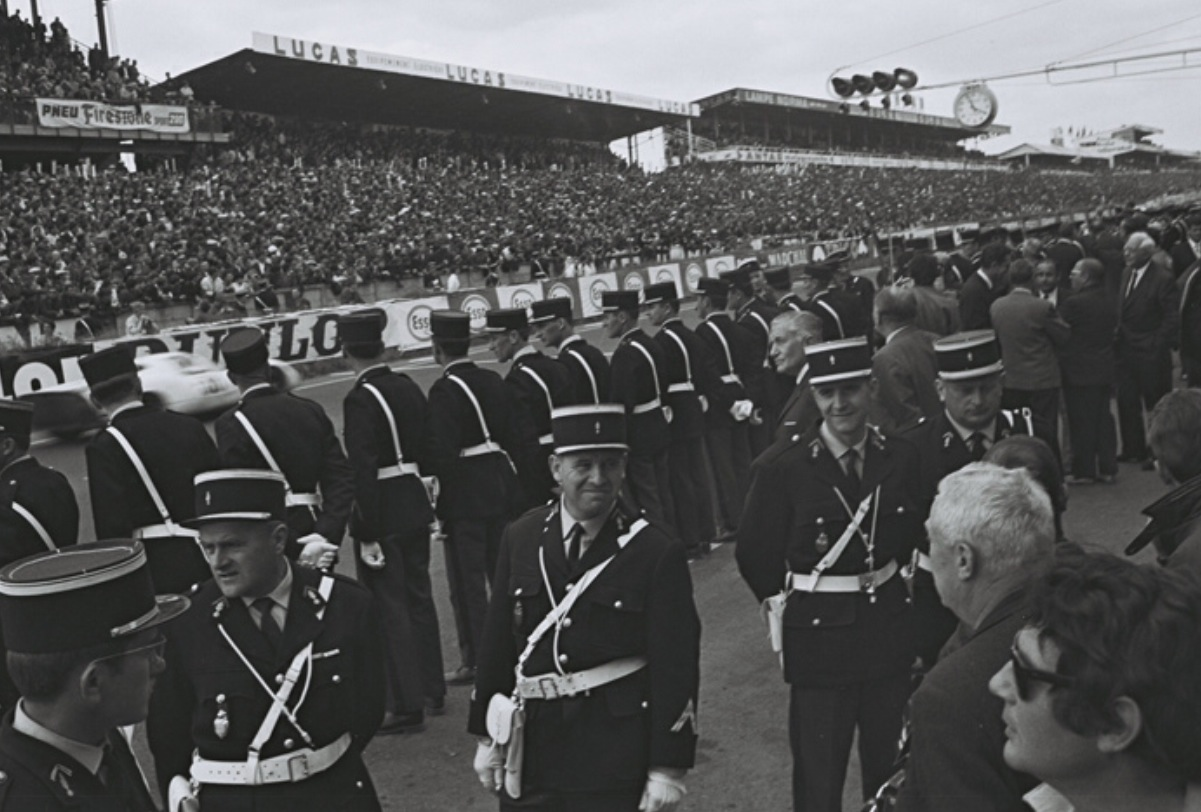
Gendarmes aboard the victorious Rubin/Barnato (right) Bentley 4.5 litre, Le Mans 1928. Chassis ‘ST3001’, was a ‘Long Standard’ type with a 101 inch wheelbase. The car was a prototype, the 3 litre engine described above enlarged to 4398cc, it used a stronger crank, rods and pistons. Power was 100-110bhp, 20 more than the 3 litre, the car good for 100mph @ 3500rpm. Suspension still by quarter elliptics front and rear. (unattributed)
Bentley boys @ Le Mans in 1928 L>R Rubin, Barnato, Birkin aboard the winning 4.5 litre, Clement and Benjafield (Popperfoto)
VW Group embarked on a 3 year program to win Le Mans with a Bentley ‘off the back’ of the Audi R8’s Le Mans success three years on the trot from 2000-2002.In 2003 there was a transition of their efforts from the all conquering R8’s, no works Audi’s were entered that year, to the Bentley Speed 8, that years contender.
The Audi race subsidiary RTN (Race Technology Norfolk) built an entirely new car, still a closed prototype or GTP class car designed by Peter Elleray who also concepted the ‘EXP Speed 8’ used in 2001 and 2002. Best placed of these cars was 3rd and 4th respectively, the all-conquering Audi R8’s in front of them in both years.
Elleray graduated from Durham University with a Bachelor of Science in Applied Maths, he then did some analysis work with Tyrrell in 1982 on their ground effect tunnels before getting a job with Arrows F1 having assisted several Formula Ford teams. He later worked as a design and race engineer running Gerhard Berger’s car in 1985. He was appointed Chief Designer of the Bentley program after Le Mans 1999.
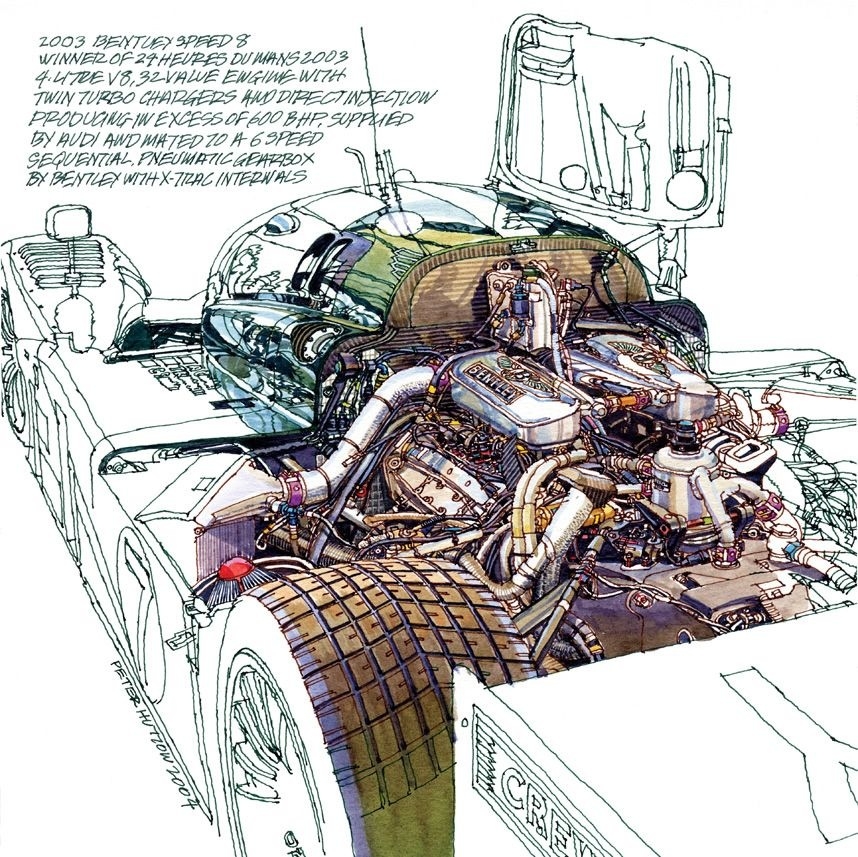
Bentley Speed 8 cutaway drawing. (Peter Hutton)
In an interesting interview of depth with mulsannes.com Elleray outlined the secrets of Bentley’s 2003 Le Mans success ‘I start with the aero side and then try to fit a workable structure and suspension systems into that…One of the very good pieces of advice I was given a number of years ago is to design the car you want and then make it fit the regulations!’
The 2001 Bentley EXP Speed 8, Le Mans 2001. This car finished 3rd driven by Andy Wallace/Butch Leitzinger/Eric Van Der Poele, the sister car DNF. In 1st and 2nd positions were Audi R8’s. Car powered by 3.6 litre twin-turbo V8 in 2001, 4 litres in 2002 and 2003. Prototype built in 2000 did not race. (netcarshow.com)
Elleray conceded the Bentley benefited from the race winning Audi R8C‘The prototype Bentley 00 car which never raced, did benefit from R8C experience, but only in as much as showing us what not to do!…I did reintroduce a number of suspension elements on the ’03 car when nobody was looking. There was not a lot of carryover of design staff from the R8C and subsequent Bentley projects…’
Tom Kristensen in the Audi R8 he shared with Frank Biela and Emanuelle Pirro to win Audi’s first Le Mans in 2000. Audi’s 1-3rd. Carbon fibre and aluminium honeycombe chassis, 3.6 litre V8 twin-turbo engine, circa 610bhp in 2000, Ricardo 6 speed sequential ‘box, suspension; wishbones and pushrods actuating horizontally mounted shocks, front and rear. Designed by Michael Pfadenhauer (aero) and Ulrich Baretzky (engine). (unattributed)
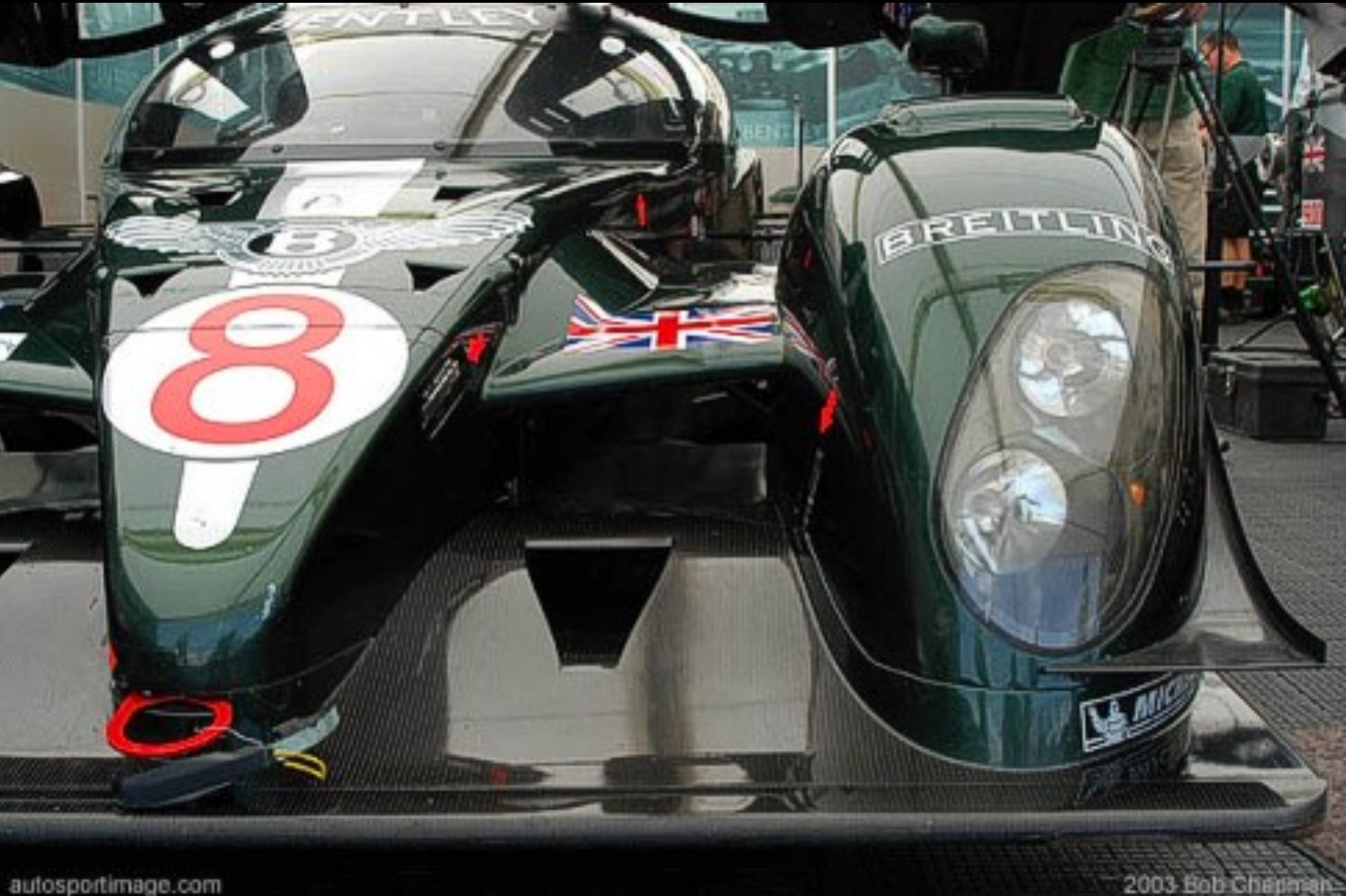
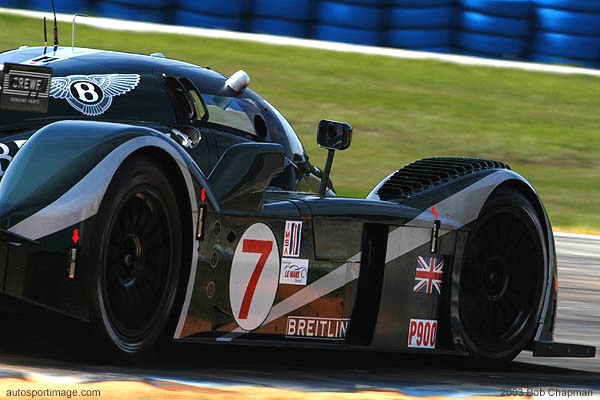
2003 Bentley Speed 8 front detail. Inlet for radiators in conventional midships position. The air flows past the suspension and a ‘faux duct’ whose aim is to reduce lift generated by the air as it goes over the bodywork. (Autosport/ Bob Chapman)
The GTP closed rather than open-car design was chosenbecause ‘the visual presence of the GTP may have been as important as anything else…If you look back through the history of prototype racing the closed cars have always been the most charismatic, and, in as much as the racing was part of their marketing strategy them I’m sure this was a factor’.
There was little mechanical carryover from ’02 to ’03 apart from the engine and internal layout of the gearbox. Some of the torsion bar system was carried over at the front but the rear was all new. The layout of the cooling system was the same, as were the front diffuser section and the Kayaba electric power steering.
Front suspension by wishbones top and bottom, telescopic dampers, torsion bars and adjustable roll bar. Carbon fibre tub clear as is the diffuser strake leading edge. The structure housing the brake inlet duct also forms the trailing edge of the diffuser. (Autosport/Bob Chapman text Michael Fuller)
‘In contrast to that all of the key performance related parameters changed. Weight distribution, aero concept and map, suspension geometry, all changed significantly...all done due to the knowledge that only a win would be acceptable. If you know you are going to be in serious trouble if you finish second then it probably encourages you to take a few chances…’ Elleray said.
The good results started with the aerodynamics ‘The car had a good level of downforce over a wide range of ride-heights and pitch angles which meant that it could run softer than the ’02 car…that (may) have assisted Michelin in a way we hadn’t assisted Dunlop (in prior years) but the race showed that we were able to look after the tyres and still be quick…the changed suspension geometry played a part ‘
‘The other thing was that we ended up with a very drivable balanced car, although that came about during the test program rather than off the drawing board…that had been a case of trying different roll and heave stiffness, seven post rig testing and also playing with weight distribution a bit. The aero map being stable over a wide range was also a function and then Michelin responded with the right tyres for the car and suddenly we were right there…’
3 D model of the Bentley Speed 8 carbon fibre and aluminium monocoque. Carbon roll hoop assemblies integrated with the roof structure. (Alastair Macqueen)
All of the Bentley monocoques have been in the 70 Kg regionwhich is to a large extent due to the FIA tests the chassis has to pass before it can race. The nose box tests the car passed easily but the roll hoop test, designed for open cars was more difficult.
After Eric Van Der Poele’s big accident at Paul Ricard in 2002, even though he was unhurt, Elleray decided to make the car more like an open one with a monocoque coming up in one piece to the drivers shoulders with a separate hoop of carbon on top of that.
A 360 degree hoop was inserted at the dashboard and a roof was glued on top of the two hoops to join them together. Elleray ‘figured this would be able to withstand repeated impacts better’.
Engine 4 litre, DOHC, 4 valve, twin-turbo 90 degree V8. Circa 615bhp and 590 lb ft of torque @7500 rpm. Boost pressure limited to 1.87 bar by ACO in 2003. Gearbox; Bentley case with Xtrac 6 speed sequential internals. Rear suspension upper and lower wishbones with telescopic dampers and torsion bars. Adjustable roll bar. (autosport/Bob Chapman)
The development of the 4 litre twin-turbo V8 to run with air inlet restrictions, imposed by the authorities to reduce power and speed in all 4 Le Mans categories in 2003 was also an important success factor.The 3 privately entered Audi R8’s which were Bentley’s main opposition had little development of their 3.6 litre engines to combat the regulation change; in short VW Group wanted Bentley to win in 2003.
The open Audi’s had the advantage of being easier to access during the race and had wider rear tyres and therefore better life and fuel economy whereas the Bentleys were superior in top speed but needed to change tyres and refuel more often.
The Herbert/Blundell/David Brabham 2nd place Speed 8. Le Mans 2003. (unattributed)
In terms of Le Mans itself, Audi’s winning factory drivers over the previous 3 years were farmed out; Tom Kristensen elected to lead the Bentley Team and asked that Rinaldo Capello join him, Guy Smith was the third driver in the #7 Bentley. Le Mans winning team, Joest Racing provided ‘in field’ support to Team Bentley.
Emmanuelle Pirro joined the Champion Racing Team driving its R8 and Frank Biela lead the British Audi Team also R8 mounted. Biela had the pace but made an error and overshot the pit entry, the extra lap ran the car out of fuel.
Nice shot which shows the profile of the 2003 Speed 8, the winning car and complex aero of the ‘modern’, its 12 years ago now, Sports Prototype. Carbon fibre brakes aglow. Brakes; AP Racing 14.8 inch front / 14 inch rear carbon fibre discs with 6 piston calipers. (unattributed)
The #7 Bentley lead almost every lap of the race, 377 in total and didn’t lose a lap in damage or punctures. Guy Smith was given the honor of piloting the Speed 8 across the line to mark an emotional sixth win for Bentley after the elapse of over 70 years.
Johnny Herbert, Mark Blundell and David Brabham were 2nd in the #8 Bentley, 2 laps behind the winners. They lost time with an unscheduled stop on the Saturday afternoon when the drivers headrest broke free in the cockpit and a few minutes on Sunday when the battery was changed twice.
With Le Mans won, it was ‘marketing mission accomplished’ for the VW Group, the Bentley prototype racing program was at and end. Audi have now won the race 13 times since their initial victory in 2000 with a variety of interesting cars; petrol, diesel and now hybrid powered.
Post Le Mans victory parade in Paris. The winning Speed 8 between the 2 crews aboard ‘Blower’ Bentleys. Nice juxtaposition of Le Mans technological advancement over 70 years! And rich Bentley brand heritage. (unattributed)
Etcetera…
Speed 8 at Sebring 2003. Interesting shot shows the aero treatment; wheel well air outlets on top of guard and at the side, and inlet for carbon brakes. Wheels are O.Z. forged magnesium, 12.25/13 inches wide front/rear and 18 inches in diameter. Tyres Michelin in 2003. The cars started from the back of the Sebring grid after a technical infraction caused by exhaust heat distorting the cars flat floor, as a result the rear diffuser was too high, its height measured from the floor. A plywood filler piece solved the problem. The Speed 8’s finished 3rd and 4th at Sebring, Audi R8’s in 1st and 2nd. Valuable testing gained. (Autosport/Bob Chapman)
Rear deck detail and aluminium strakes added to duct more air to the brakes after cooling concerns at Sebring. You can also see the very neat tail light at the trailing edge of the cockpit ‘bobble’. Between the 2 small ducts. (Autosport/Bob Chapman)
Herbert/Brabham/Blundell, 3rd place, Bentley Speed 8, Sebring 2003. Car behind is a Chev Corvette C5-R. (Autosport/Bob Chapman)
Bentley Team at Le Mans 2003. Plus a factory at Norfolk to build the cars. Even with the technology transfer from the ‘family’ Audi R8 program, victory in 3 years was a considerable achievement, many have spent more and not won at all…(unattributed)
Bibliography and Credits…
Automobile Year 51: Andrew Cottons Sportscar Review, mulsannescorner.com, Autosport, Bob Chapman, Michael Fuller, Alastair MacQueen, netcarshow.com, Popperfoto
Tailpiece…
Bentley Speed 8, Sebring 2003. Hopefully a return to outright Le Mans contention again soon? (Autosport/Bob Chapman)
Tom Hawkes, Allard J2, Collingrove Hillclimb, Angaston, SA, March 1952. First in the over 1500cc Sports Car class (State Library of South Australia)
Tom Hawkes caresses his powerful Allard around the twisty, challenging gravel confines of South Australia’s Collingrove Hillclimb at its inaugural, public, 15 March 1952 meeting…
Chassis #99/J/1731, fitted with Ford Pilot engine # 5338/26 was the first of six Allards imported to Australia, the car arrived in September 1950 to Rube Gardner’s order. Gardner was appointed the local concessionaire having travelled to the UK to do the deal with Allard himself early in 1950. Gardner’s premises were on the Princes Highway, Carlton, a southern Sydney suburb.
Gardner drove the car to the October 1950 Bathurst meeting, he didn’t race, but took it to Mount Panorama for display purposes. The red side-valve Ford Pilot engined car immediately impressed Stan Jones, the 1958 Gold Star and 1959 Australian Grand Prix winner and father of 1980 World Champion Alan Jones.
The J2 in the Bathurst paddock during Stan Jones’ ownership at Easter 1951. Colour red, ‘standard’ Ford Pilot side-valve spec V8. Five of the six J2s imported to Australia entered this meeting, three started! (Ray Eldershaw Collection)
Jones’ first J2 competition event was the 1950 Australian Hillclimb Championship at Rob Roy in November, he finished second in his class. In 1951 he raced the car successfully at Rob Roy, at Bathurst where he was timed at 104.8mph on ConRod Straight, and at other meetings.
Jones sold the car to Geelong, Victoria, driver Tom Hawkes in a deal which involved Jones taking over a Cooper MkV 500 Bill Patterson and Hawkes had raced in England in 1951.
Hawkes raced the car in standard form for a while and then engaged Melbourne’s Ern Seeliger to modify it by fitment of an Ardun OHV engine kit and Jaguar four-speed gearbox with C-Type ratios to replace the three speed Ford Pilot ‘box. The tail of the Allard was replaced with a narrower one, the front and rear guards removed and wire wheels adapted to Lancia hubs. The light car now developed circa 300bhp and was a formidable, noisy and spectacular weapon at the time.
Hawkes ahead of Eldred Norman’s Maserati 6CM at Adelaide’s Sellicks Beach. This meeting in 1953 was the first all car beach program post-War. Sellicks Beach is 55km from Adelaide. Tom is kicking the tail out, no shortage of power on the soft sand! Eldred Norman and his many cars are fascinating stories for another time (forum.fefcholden.club)
Over the next couple of years the J2 competed widely, mainly driven by Hawkes but occasionally by Reg Robbins who maintained it. It was also driven by John Sawyer and Adrian Gundlach. The car raced at Fishermans Bend, in Albert Park’s inaugural 1953 meeting and Rob Roy, all in Victoria. Hawkes competed at Collingrove Hillclimb, Sellicks Beach and Port Wakefield in South Australia.
He travelled to New Zealand for the 1954 NZ Grand Prix meeting at Ardmore in January. There the car blew the OHV engine in practice, a stone pierced the radiator. The side-valve engine was fitted for the race, famously won by Stan Jones in the Maybach after an amazing overnight engine rebuild. The J2’s Ford engine was brittle and ‘popped’ comprehensively at least three times, twice with rod failure, the errant component carved the cast iron block in half on both occasions. The J2 was very quick though, it recorded 137mph on Longfords Flying Mile during the 1955 Tasmanian Trophy meeting.
Hawkes advertised # 1731 for sale in October 1955 but continued to race it before being it was finally bought by Reg Robbins who had been preparing the car for Hawkes as noted above. He raced it at Phillip Island and Rob Roy in late 1956 and early 1957 respectively before sale to Geoff McHugh in Tasmania.
Melbourne’s Ian McDonald repatriated it from a Tasmanian chook shed in 1964 and restored it, a process which took two years. He first raced the car in an historic event at an open meeting at Sandown in 1966, the car later passed from Ian to Richard Ralph and then to Graham Smith who fitted a correct specifications Ardun Ford engine; he still owns it in 2020.
The Hawkes’ Allard in the Collingrove paddock March 1952. The modifications referred to in the text are not yet evident, this is early in Hawkes’ ownership of the car. Compare with the other later Collingrove shot below and the Sellicks Beach shot above where the car is running sans guards and with the wire wheels referred to in the text (State Library of SA)
Allard Short History…
In the the 1930s Sydney Allard was successful as a British Trials and Hillclimb competitor with his Allard Specials. Operating from Adlards Motors, a Ford dealership that he had acquired in 1929, Allard competed successfully in international motor racing. He was third at Le Mans in 1950 and victorious in the Monte Carlo Rally in an Allard P1 in 1952.
After racing first on motorbikes he moved to four wheels, in 1936 the first Allard Special was built.
Allard’s first cars were based on Ford products. The first ‘CLK 5’ combined a Ford Model 40 chassis and engine with a Bugatti Type 51 body. Its light weight and ground clearance made it an ideal Trials racer. By moving the cockpit as far backwards as possible, Allard concentrated weight over the rear wheels, a design principle of all future Allards. With Ford’s flat-head V8 providing plenty of power it was competitive immediately.
This later Collingrove shot in 1954 shows the Hawkes J2 in its later modified form: with Ardun head, skinny tail, sans guards front and rear and with its wire wheel (State Library of SA)
Pre-War a small number of Allard Specials were built powered by either the Ford V8 or Lincoln V12 and were race winners. During the War Adlards Motors repaired damaged military vehicles…and Sydney designed a new sportscar, which was built in 1946 and is now referred to as the J1.
Ford components formed the basis of J1. A braced and boxed frame housed a Ford 3.6-litre V8 and three-speed gearbox. Suspension was by a split axle at the front and live axle at the rear, transverse leaf springs were used front and rear. A full width body was fitted, but the guards could be removed and replaced by cycle-guards to turn the J1 Sports into a Trials car. Twelve J1s were built and competed in Britain and in Europe, its shortcoming was the flat-head V8, which was underpowered and overheated. readily.
Allard then built, in larger numbers, the K1 sports two seater, L-Type Tourer and M-Type coupe.
J2 factory drawings (The Allard Register)
In 1950 Allard launched the J2. Based on the J1 design, the new car was designed with the J1’s shortcomings in mind.
The front suspension was similar, the transverse leaf springs were replaced with coils at both front and rear, and a de-Dion axle was fitted with inboard drum brakes at the rear. The combination of rear weight bias and better rear suspension gave the car much better traction. Modified Ford side-valve V8s were Allard’s engines of choice, but the chassis was built to accommodate other engines. With Cadillac’s pushrod V8, the J2 was ‘in a league of its own’ and very successful in the US.
Butt shot showing the Hawkes J2’s modified tail, fuzzy shot but modifications clear. #1731 sans guards, wire wheels. On ‘The Wall’ (Collingrove Hillclimb)
‘Allard’s biggest road racing success was in 1950, when Sydney Allard and Tom Cole drove a Cadillac powered J2 to third place overall and a first in class at Le Mans. In 1951 a slightly modified version, dubbed J2X was introduced. It was similar to the J2, but the engine was mounted further forward to allow a larger cockpit. Chrysler Hemi and Cadillac powered J2s and J2Xs dominated racing in America. The final evolutions of the J2 were the J2X Le Mans and JR, both of which featured a fully enveloping body’, wrote Wouter Melissen in ultimatecarpage.com.
Sydney Allard practicing his J2 at Le Mans in 1950. He and Tom Cole finished third outright in the race won by the Rosier father and son Talbot-Lago T26GS and second placed Talbot-Lago Monoplace. These two cars were essentially ‘GP cars in drag’, so the Allards third was a great result five laps adrift of the winning car. Allard wore a helmet in the race! This shot was on Allard’s corporate 1950 Christmas card to contacts of the company (allardownersclub.org)
After 1908 Allards were built, production ended in 1959. Increased competition from Jaguar, Lotus, Austin Healey and others producing quality production sports and racing cars made the going tough as the sixties dawned, but the company and its clever products had punched above their weight very successfully for many years.
J2 chassis and general layout drawings (The Allard Register)
Technical Specifications…
90 J2s were built from 1949 to 1951. Cars delivered to the US were usually sans engine allowing the customer to choose. Those with ultimate performance in mind specified the Cadillac or Chrysler ‘Hemi’ OHV engines with a wide variety of modifications available off the shelf.
Specifications of the Ford Pilot ‘Ardun’ engine as fitted to #1731 and modified by Tom Hawkes; 3923cc, bore and stroke 80.96mm x 95.25mm. Compression ratio 8:1. Magneto ignition. two Solex carburettors giving a claimed, and I suspect very optimistic, 300bhp.
The cars chassis was a ladder or box section frame having a wheelbase of 100 inches and track of 56/52 inches front/rear.
Front suspension was Allard divided or split axle with coil springs and hydraulic shocks. A de-Dion setup was deployed at the rear again with coil springs and hydraulic shocks. Drum brakes were fitted mounted outboard at the front and inboard at the rear.
Steering was Ford Pilot ‘Marles’ worm and roller. The fuel tank held 20 gallons, the car weighed circa 1700-2000lbs. (estimates of weight differ widely across the reference sources and would do so dependent upon the engine fitted)
Collingrove is a sensational climb, highly technical and difficult. It’s at Angaston in SA’s Barossa Valley, the place is a stunningly pretty spot. Angaston is 85 Km from Adelaide. In use since 1952.(Collingrove Hillclimb)The Mail article about Collingrove’s first meeting in March 1952. Hawkes won the over 1500cc modified sports car class (Collingrove Hillclimb)Distant shot of Hawkes coming off The Wall, well sideways on the slippery gravel surface. Shot included to show the topography of this fabulous climb. (Collingrove Hillclimb)
Etcetera…
Barry Oliver wrote ‘The sound in the distance became louder and in a few seconds reached a crescendo as the big V8 Allard of Tom Hawkes flashed past me on the narrow strip of bitumen just a few feet away’ Longford, 5 March. 1955.
Bibliography and Photo Credits…
John Blanden ‘Historic Racing Cars in Australia’, Wouter Melissen’s Allard article in ultimatecarpage.com, MotorMarques article by Philip Stanton, State Library of South Australia, Ray Eldershaw Collection, The Allard Register, forum.fcfeholden.club, Collingrove Hillclimb website, allardownersclub.org, Paul Geard Collection, John Hall Collection, Barry Oliver in ‘Tasmanian Motor Sport’
Tailpiece…
(P Geard)
Tom on the entry to Mountford Corner, Longford 1955. The car did 137mph on ‘The Flying Mile’ that weekend…
Alfa Romeo publicity shot of Prince Albert and Princess Paola, Belgian Royals at Balocco, Alfa’s test circuit…
The Prince is about to test the ultimately very successful Tipo 33, here in Mugello Spyder 2-litre 1967 form. Thanks to Claudy Schmitz for identifying the Royal Couple and Balocco as the correct venue, the power of Facebook! Whilst the Princess was born of Italian Royal blood it would be interesting to know the circumstances of this test drive, the car was definitely too small for their family of five!
Alfa’s first mid-engined racer made its competition debut at the Fleron Hillclimb in Belgium on 12 March 1967, factory test pilot Teodoro Zeccoli took a win from some stiff competition.
Zeccoli at the Belgian Fleron Hillclimb upon the T33 ‘Periscopica’ debut meeting. Alfa 2600 Berlina behind. Fleron is in the Province of Liege, location appears very industrial, power station in the background (unattributed)
The 33 made its race debut at Sebring that summer of ’67, the weekend of 1 April...
Andrea De Adamich led the 12 Hour event’s first lap but both cars entered retired with suspension and overheating dramas.
Here are some shots of the cars in the Sebring paddock; #65 is DeAdamich/Zeccoli, #66 Roberto Businello/Nanni Galli. The race was won by the factory Ford Mk4 of Bruce McLaren and Mario Andretti. I covered the 1967 Endurance Season in some detail in an article i wrote a while back about Ferrari P4/CanAm350 ‘0858’ which may be of interest to some of you;
The more you look the more you see, Sebring, the DeAdamich/Zeccoli T33. Engine, two coils, behind the engine the circular vertical ducts which take cool air to the inboard discs when the body is lowered into position are clear. See the rear chassis diaphragm and coil spring/dampers, inboard Girling discs, oil tank to the left of the six-speed Alfa ‘box, battery to its right. Build quality clear.
(Paolo Devodier)
Those beautiful Alfa mag alloy wheels, filler for centrally located fuel tanks, a spare had to be carried under the regs of the time.The front of the cast magnesium chassis extension houses the radiator, you can just see the nearside suspension ‘top hat’ and adjustable roll bar going forward and mounting at its outer end.
Engine change in the Sebring ’67 garage. ‘Periscopica’ 2-litre T33 all alloy, Lucas injected, DOHC chain-driven two-valve V8 engine developed a claimed 260-270bhp @ 9500rpm (Paolo Devodier)
Four cars were entered in the ’67 Targa Florio…
All failed to finish due to suspension problems (De Adamich/Jean Rolland/Bonnier/Baghetti) and a minor accident involving the Geki Russo/Nino Todaro. The race was won by the Porsche 910 of Paul Hawkins and Rolf Stommelen.
Targa Florio 1967. The Bonnier/Baghetti T33 ahead of the other factory cars…Periscopica clear to see. Love the ‘period’ hand-painted numbers. (Unattributed)Jo Bonnier in the T33 he shared with Giancarlo Baghetti during Targa 1967 (unattributed)T33 cockpit shot at ’67 Targa. LHD unusual in racing sportscars, Alfa would later change to the norm. Momo steering wheel, Veglia instruments, change for six-speed box all clear, lots of instruments for the driver to monitor. Not sure which chassis this is, or the T33 in front, you can just see the tail of the Scuderia Filipinetti Ferrari P3/412P ahead (Rainer Schlegelmilch)
Nani Galli and Andrea De Adamich finally broke through for the team at the Nurburgring, they finished fifth in the 1000Km behind four Porsche 910s...
The winning Porsche 910 was driven by the combination of Joe Buzzetta and Udo Schutz. The De Adamich/Galli T33 had another suspension failure on lap 18, but they shared the other car driven by Businello/Zeccoli, the four drivers getting the joy of the cars’ first race finish.
Autodelta SpA lineup in the Nurburgring pitlane, 28 May 1967. #20 DeAdamich/Galli (DNF suspension) #21 Russo/Baghetti (DNF ‘box) and #22 fifth place car of Businello/Zeccoli/DeAdamich/Galli (Accursio Cassarino)Andrea De Adamich in the T33 he shared with Nanni Galli, the Italian duo DNF with suspension failure, then hopped into the #22 surviving car for fifth place (unattributed)The ‘pre-owned’ T33 of de Adamich/Galli during Nurburgring practice 28 May 1967 (Rainer Schlegelmilch)Ignazio Giunti with tyre problems at Mugello (unattributed)
The Periscopica’s final start for 1967 was the Circuit of Mugello in July, eight laps of a tough 66km road circuit…
Udo Schutz and Gerhard Mitter won the race tailor made for the fast, light but tough Porsche 910. A privately entered GTA was the best place Alfa in seventh, the three Autodelta T33s of DeAdamich/Galli, Lucien Bianchi/Giunti and Colin Davis/Spartaco Dini all failed to finish.
(Accursio Cassarino)
It had been a patchy start but the Tipo 33 continually evolved over the following decadeultimately winning many races, sometimes not against the strongest of opposition, but ultimately winning the World Championship of Makes in 1975 and 1977.
Shown above is the 1977 Alfa 33 SC12 driven by Spartaco Dini at Enna-Pergusa in June. The car used a spaceframe chassis (Alfa used both spaceframes and monocoques during the model’s long life and evolution) and a 2.1-litre fuel injected, twin turbo, four-valve V12 producing circa 640bhp. Dini practiced the car but did not start, this car was driven by Francia/Merzario but was disqualified for a startline infringement, Arturo Merzario won in another SC12.
(Vic Berris)
The T33 in its original guise had an unusual chassis design...
The main structure comprised two longitudinal aluminium spars to which was mounted a complex magnesium casting at the front, the front suspension mounted to it. At the rear the spars had a fabricated sheet metal saddle to which the suspension was attached.
The suspension itself was conventional for the period; upper and lower wishbones and coil spring/ damper units and single top link, inverted lower wishbone and twin radius rods, coil spring/ dampers at the rear. Adjustable sway bars fitted of course. Uprights were cast magnesium, steering rack and pinion with Girling disc brakes front and rear. Weight 580Kg.
(LAT)
Periscopica chassis. The incredible, complex cast magnesium front bulkhead referred to in the text is clear, the spars are bolted to it, and in turn, the two rear section pieces to the large spars.
The tall ram air intake gave the car it’s nickname, Periscopica…
The heart of the early T33s was of course it’s superb little all alloy DOHC V8. Initially 2-litres (1995cc) and two-valves per cylinder, the cams were chain driven, the Lucas fuel injected engines power output was a claimed as 260bhp @ 9500rpm, the gearbox Alfa’s own six-speed transaxle.
Cutaway drawing of car Vic Berris, engine cutaway G Cavara, Claudy Schmitz, Paolo Devodier, Accursio Cassarino, Rainer Schlegelmilch, Facebook ‘Alfa Romeo 33 Sport Car’ Group, LAT, Tony Pashley Collection
Tailpiece…
(Rainer Schlegelmilch)
Andrea De Adamich jumping the T33 he shared with Nanni Galli at the Nurburgring 1000Km in 1967, DNF.