Archive for the ‘Who,What,Where & When…?’ Category

image

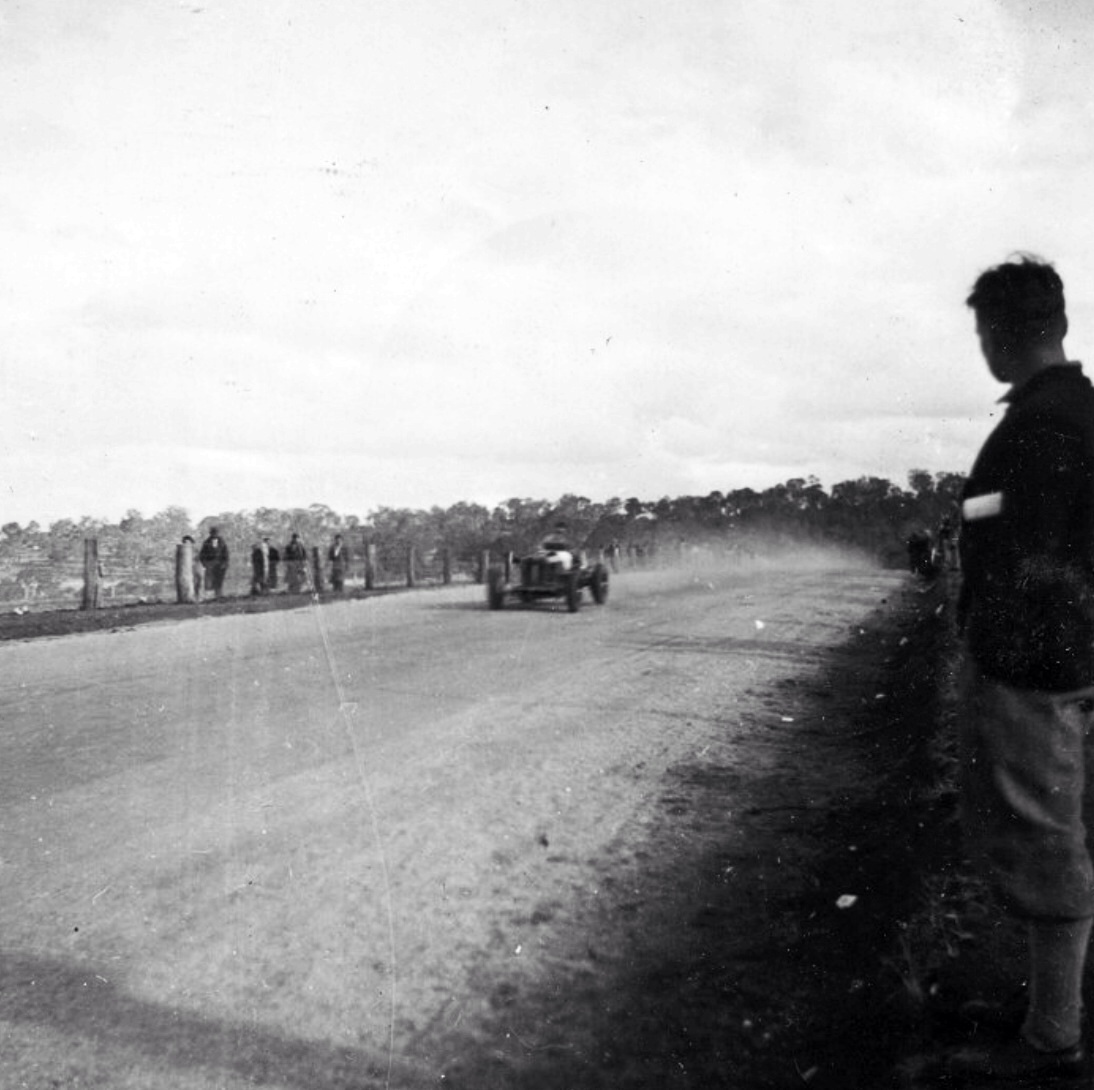
Austin Miller’s Cooper T51 Climax chases Bib Stillwell’s similar car at Reid Park gates, Mount Panorama, Bathurst on 2 October 1960, magic John Ellacott shot…

The two drivers are contesting the ‘Craven A International’ won by Jack Brabham from Bill Patterson, and Stillwell in 2.5/2.4 and 2.2 litre Cooper T51’s respectively. Miller retired his 2.2 litre engined car during the 26 lap race. Note the beautiful bucolic Bathurst surrounds of apple orchards and grazing paddocks, is a dangerous place, especially then, these cars mighty quick.

Jack was in the process of winning the 1960 GP championships for himself and Cooper, returning to Oz between the Italian GP at Monza on 4 September and season-ending USGP at Riverside on 20 November. He won the title with 5 wins from teammate Bruce McLaren and Stirling Moss (Lotus 18 Climax). Jack and Bruce drove ‘Lowline’ Cooper T53’s that season.

The tyre marks are from Doug Whiteford’s Maser 300S which had a component faiure earlier in the meeting.

The Gold Star title for Australia’s champion driver that year was won by Alec Mildren in another T51 but interestingly powered by a 2.5 litre Maser 250S ‘Birdcage’ engine.

I’ve already written an article or two about Stillwell.

Bib Stillwell: Cooper T49 ‘Monaco’: Warwick Farm, Sydney December 1961…

Aston Martin DB4GT Zagato ‘2 VEV’: Lex Davison and Bib Stillwell…

Businessman, crop-duster pilot, publican, racer and Australian Land Speed Record Holder ‘Aussie’ Miller is an intensely interesting character, article coming soon! I know his son Guy having raced against him in FF and his engineer Geoff Smedley has helped with another article, must call ’em!

The shot below is also at Bathurst, its Austin heading across the top of the ‘mount. ‘Superior Cars’ signage is one of Stan Jones Melbourne dealerships.

image

(John Ellacott)

Credits…

John Ellacott

avus 2 cars

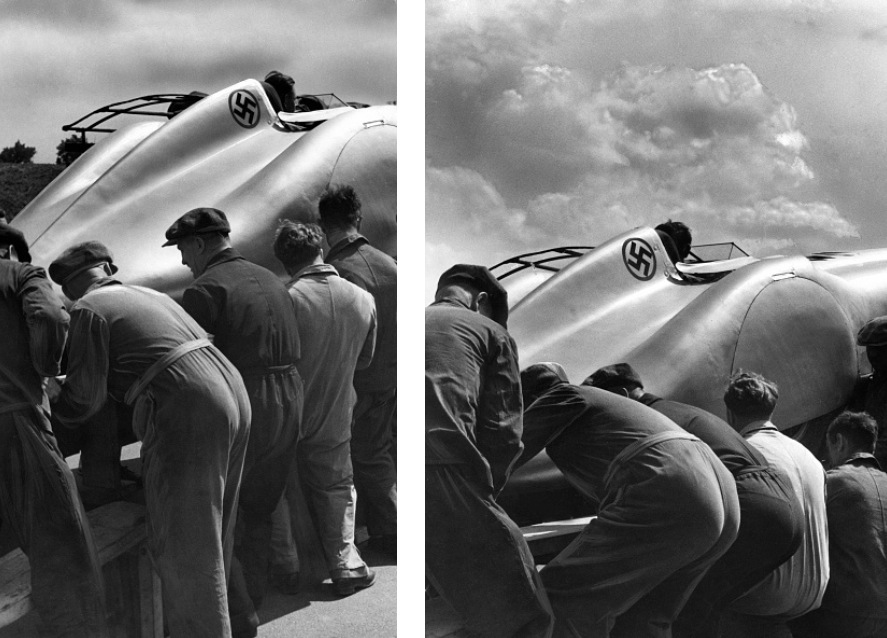
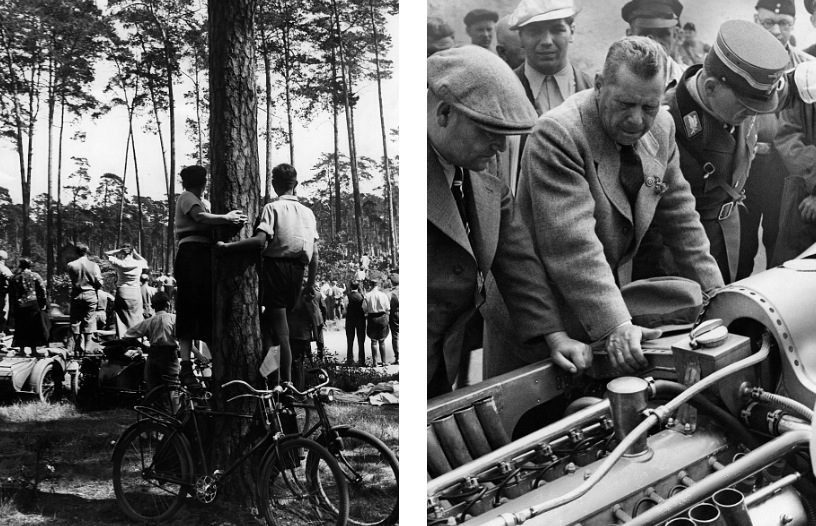
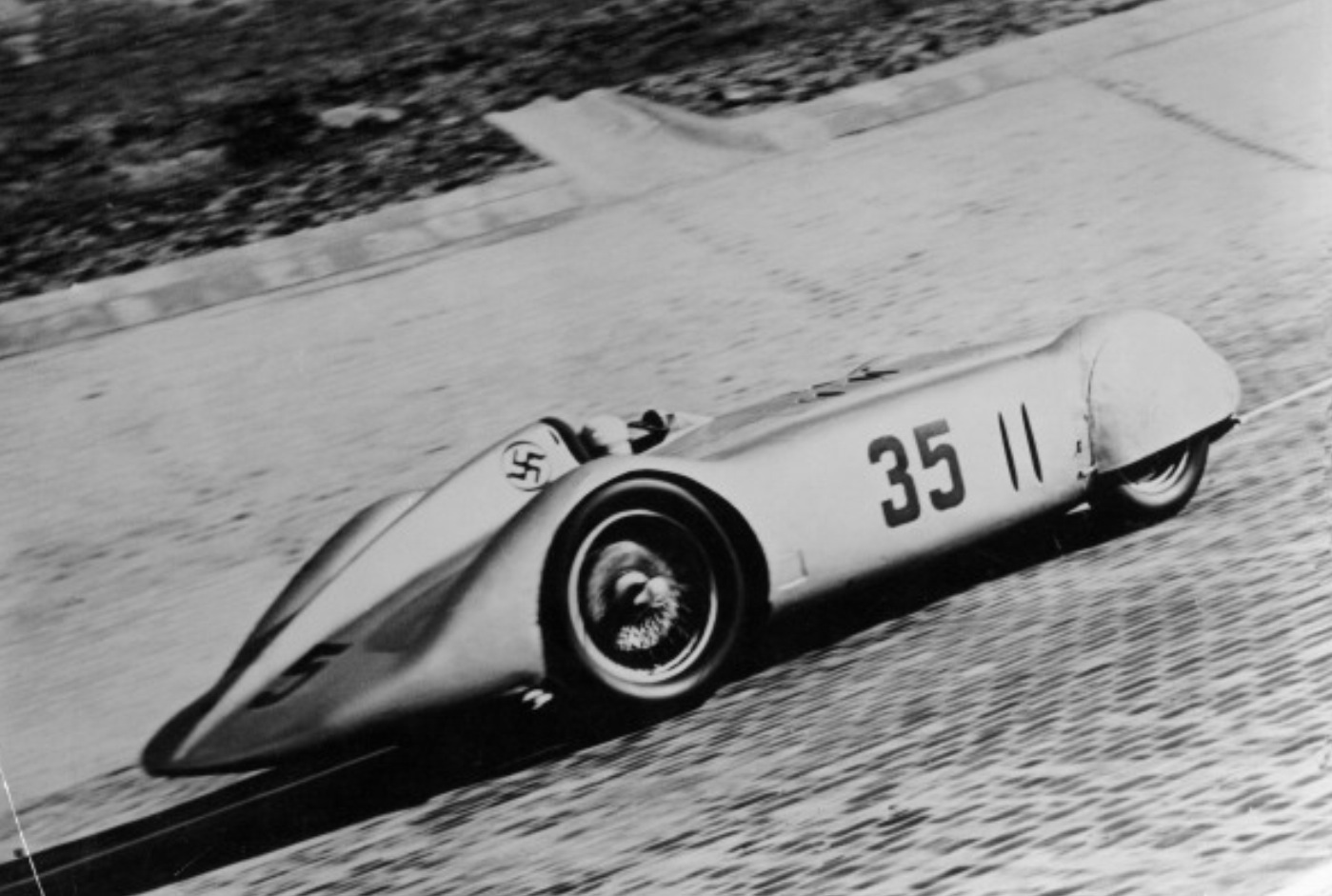
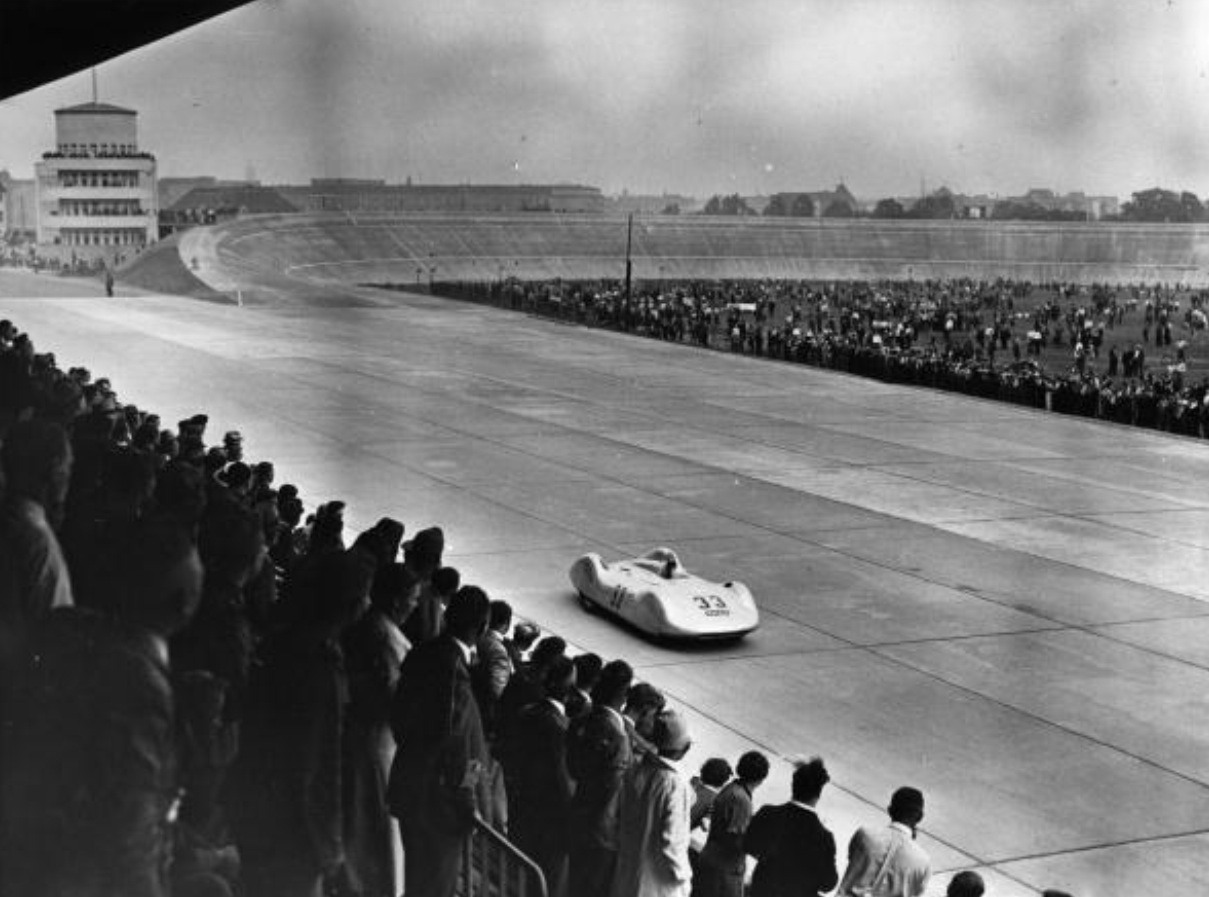
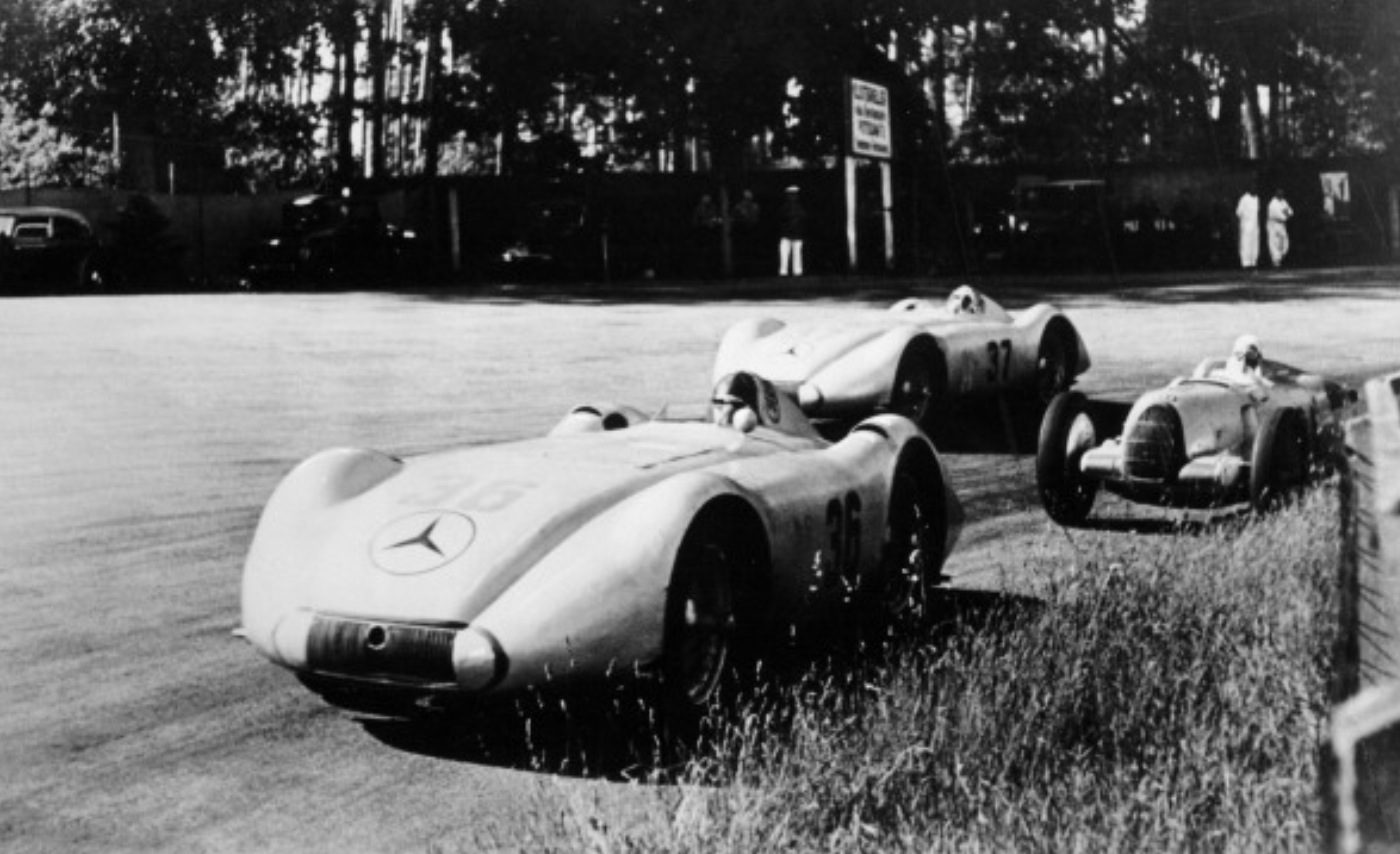
The 1937 Avus-Rennen is one of ‘those races meetings’ I suspect most of us would have rather liked to attend, these photos are of Hermann Lang’s Mercedes W25 during testing the week before on May 22, 1937.

His car is a 1936 speed record chassis rebuilt with a long wheelbase and the ‘standard’ 5.7-litre straight-eight fitted to the W125 GP cars that season.

The final race of the meeting was the fastest race ever until the Monza 500 in 1958, Rosemeyer’s Auto Union fastest practice lap was 176.7mph and the fastest race lap, in two of the heats, was 171.74mph by Rosemeyer and Lang!

avus tower

Hermann Lang testing his Mercedes W25 modified 1936 speed record car the week before the 1937 race (ullstein bild)

The Germans didn’t race at Avus during 1936. They were rebuilding Berlin’s fastest circuit in the world into something even quicker with the addition of the ‘Nordschleife’ and massive ‘wall of death’ banking at 44 degrees. Avus was built in 1921 and used for racing until 1998 when it was fully absorbed into Germany’s road network as autobahn #115.

avu banking

avu unload

avu crowd

Rosemeyer and friends AU Type C (Max Ehlert)

The 1937 race was a Formula Libre event, 300,000-400,000 spectators attended- what a spectacle it must have been. Such was the level of national prestige involved the German teams went all out to win, building special cars and testing them in three sessions before the meeting itself.

avus au

Rosemeyer on the Avus banking, Auto Union Type C Streamliner, Hasse or von Delius in AU C Type then Seaman W125 (Ullstein Bild)


avu kids

avu audi unload

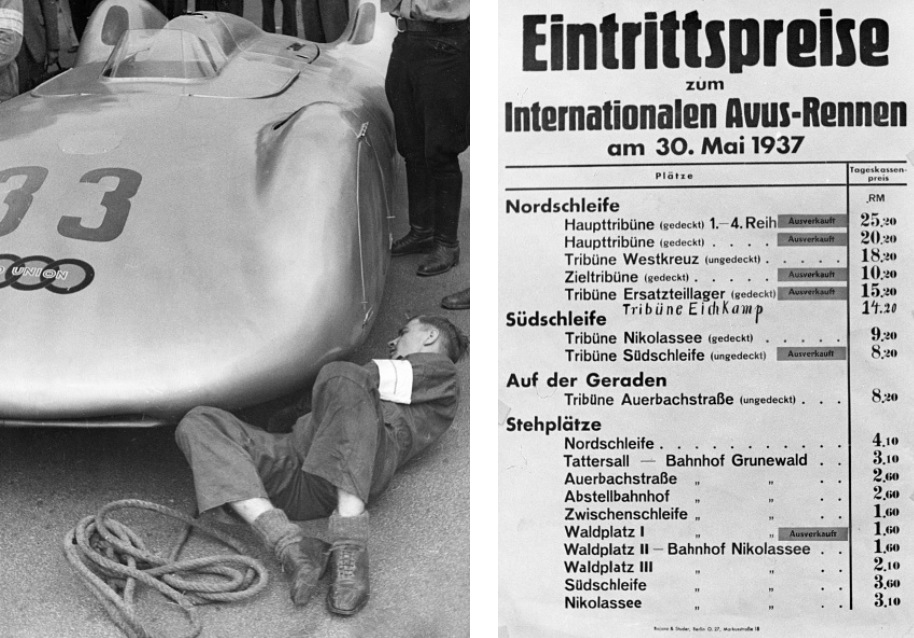
AU’s were all Type C V16’s, 2 streamliners (Rosemeyer and Fagioli) and 2 open wheelers (von Delius and Hasse)


avu alfa

Non German cars also rans! Scuderia Ferrari Alfa Tipo 12C-36 of Nuvolari, Brivio and Farina withdrawn before the race

Because of concerns about tyre-life, such was the weight, speed of the cars and tyre-technology of the day, the 30 May event was split into two heats of 7 laps apiece and a final of 8 laps comprising the first four place-getters from each heat.

The heats were won by Rudy Caracciola and Manfred von Brauchitsch in ‘Benz W125 and W25K-DAB(5.6V12) respectively, the final by Hermann Lang’s Mercedes W25K-M125- all these cars were ‘Stromlinien’ (Streamliners), single-seaters with all-enveloping bodywork.

avus race

Caracciola this side in Mercedes W125 and Rosemeyer Auto Union Type C (Ullstein Bild)


avu tree

avu audis

Rosemeyer #31 and von Delius AU Type C’s

Kolumbus.f1 has a well researched, detailed account of this meeting, click here to read it, just scroll down the page, there are a couple of other events before you get to Avus;

http://www.kolumbus.fi/leif.snellman/gp372.htm

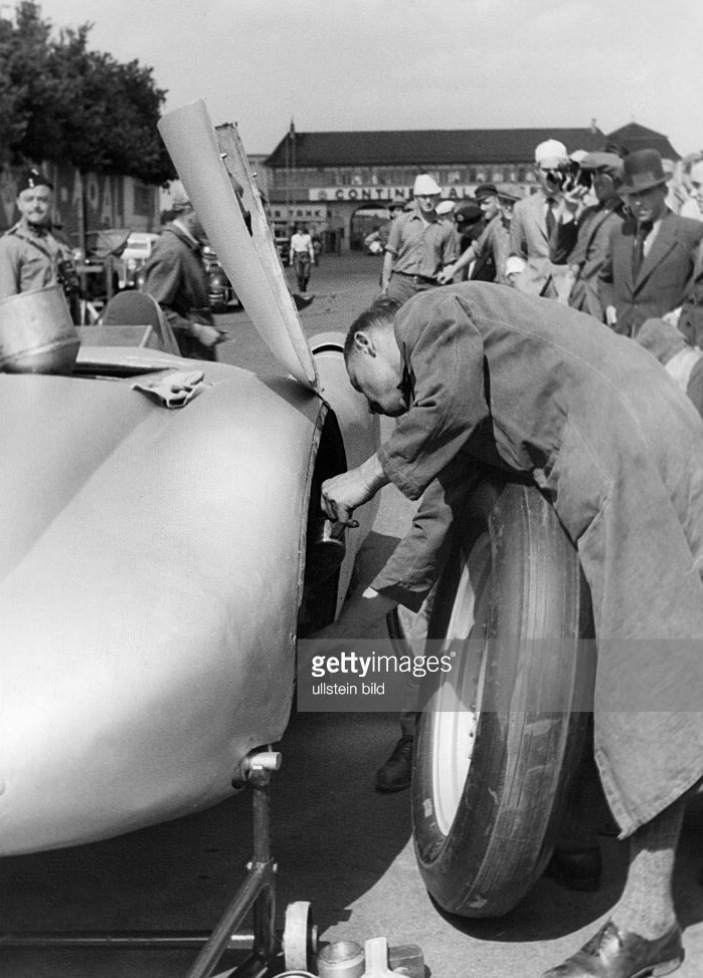
During practice for the meeting Lang’s car, with wheel covers fitted was doing 390kmh when trapped air under the car ‘lifted the front wheels from the ground- luckily the driver kept calm and finally managed to bring the wheels back down’…the wheel covers were removed for the race!

avus wheel

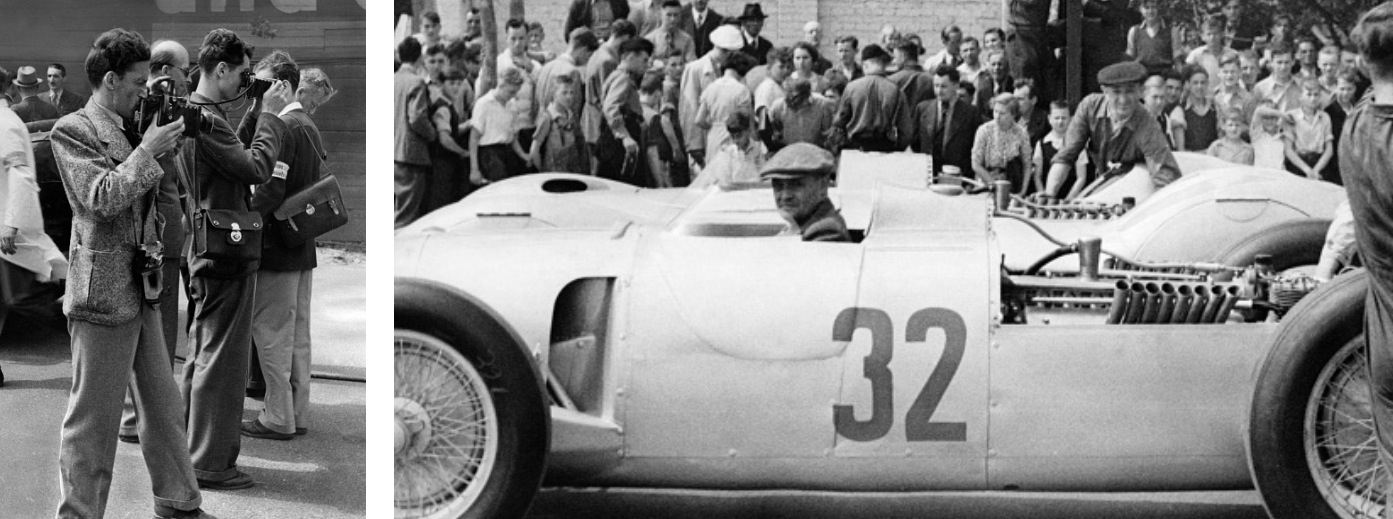
Tyre technician checks out the Continental ‘slick’, big challenge keeping tyres up to these big, heavy, powerful cars. Lang’s car as per text (Ullstein Bild)


avu 32

von Delius 6 litre V16 being gently warmed up, what awesome cars


benz 37

Hermann Lang’s winning Benz W25K

Down the decades the role of ‘aerodynamic guinea pig’ has not always been conducive to drivers attainment of retirement age. Bernd Rosemeyer’s fatal Auto Union speed record attempt on 28 January 28, 1938 an in-period case in point.

avus butt

Caracciola’s W125 Benz, Avus 1937 (Ullstein Bild)

Checkout this Avus ’37 Footage…

Etcetera…

avo cara

Caratch during testing, Northcurve Benz W125 (ullstein bild)


avu sign

Fagioli’s AU Streamliner Type C


avu butt

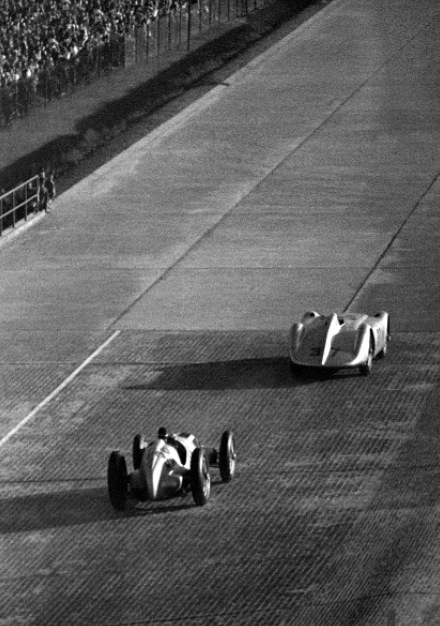
Love this shot for the contrast between Langs leading Streamliner W25 ahead o Dick Seaman’s open-wheeler W125 ‘normal’ GP car


avu 1

Avus, Fagioli Auto Union during practice 27 May 1937 (Imagno)


avu 2

Von Brauchisch’ big Benz 1936 W25 with 700bhp DAB V12 and Lang 1936 LWB speed record W25 5.7-litre Straight-8 ahead of one of von Delius or Hasse AU Type C open-wheeler 6-litre V16 (Heritage Images)


avu 3

Caratch and arch-rival Bernd, Avus ’37 (ullstein bild)

Credits…

All images not attributed by Ullstein Bild, Heinrich Hoffman, Imagno, Max Ehlert, Heritage Images, Kolumbus F1

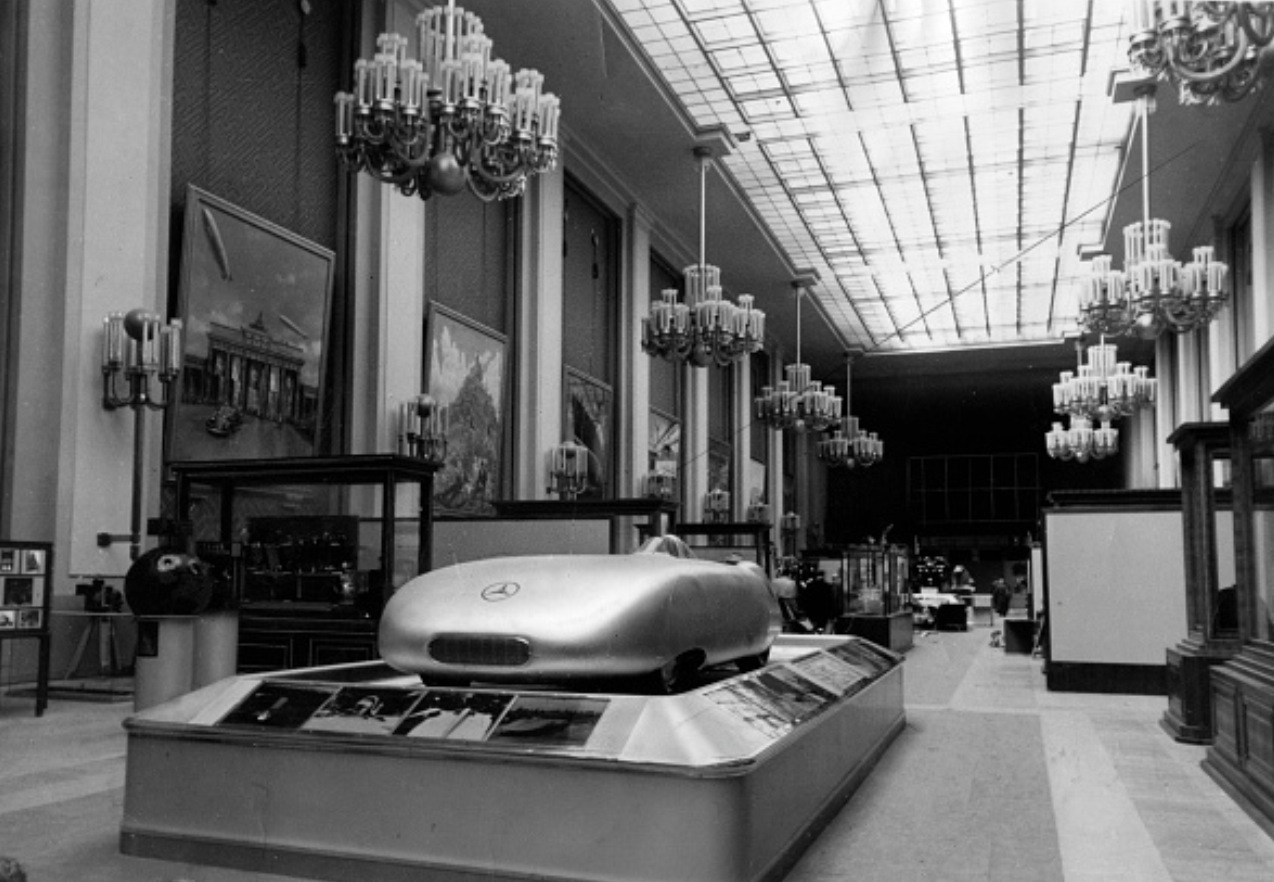
Tailpiece: Stromlinien on display, place undisclosed 1937, am interested to know if any of you can pick the venue…

avus display

(Heinrich Hoffman)

Finito…


sebring

(Max Staub)

The Phil Walters/John Fitch winning Cunningham C4R Chrysler ahead of the Reg Parnell/George Abecassis Aston Martin DB3 and Cook/Moynet/Collier/Cahier/Bonnet/Morehouse!! DB Panhard…

The American car won by a lap from the Aston with Sherwood Johnston and Bob Wilder 3rd in a Jaguar C Type.

Credit…Max Staub

image

(Rolls Press/Popperfoto)

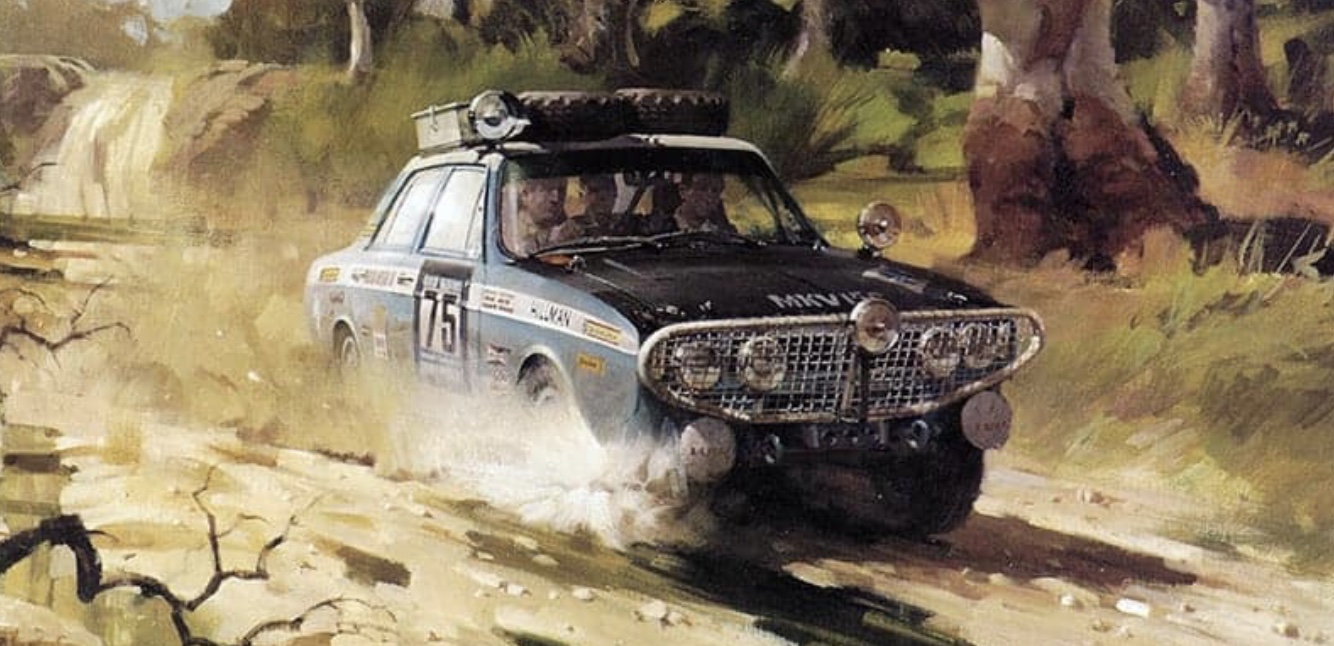
Andrew Cowan’s works Hillman Hunter blasts through the never-ending and oh-so-demanding Australian scrub during the last, long, tough leg of the London-Sydney Marathon in December 1968…

I posted an article written by Bruce Thomas a while back featuring some of his photos, but I thought these too good to ignore, click on this link to see the article;

https://primotipo.com/?s=london+sydney+marathon

image

Andrew Cowan, Brian Coyle and Colin Malkin alight their BOAC flight at Heathrow, their low budget works Hillman Hunter winners of the London-Sydney, December 1968 (Rolls Press/Popperfoto)

Andrew Cowan shared the drive with Colin Malkin and Brian Coyle, in some ways it was a lucky win but these ultra-long endurance events need a combination of luck, consistency, reliability, high levels of concentration for long periods, driving and navigational skill and resilience to overcome the inevitable dramas large and small.

image

The Bianchi/Ogier Citroen DS21 leading the event during the Numeralla Stage. 4 Miles from the end of the Nowra stage, the end of competition, the car with Ogier at the wheel, Bianchi asleep hit a Mini head on travelling against them on the rally road. The Citroen was destroyed with Bianchi suffering leg and chest injuries. Hopkirk’s Austin was first on the scene, immediately returned 4 miles to a radio point to get help (Bruce Thomas)


bianchi

Italian born, Belgian domiciled Lucien Bianchi cleans the windscreen of his Citroen, in the lead at the end of the Numeralla-Hindmarsh stage. Disaster struck in the following transport stage. A remarkably versatile driver, he won the ’68 Le Mans with Pedro Rodriguez in a JW Automotive Ford GT40, was third at the ’68 Monaco GP in a works Cooper T86B BRM and should have won the London-Sydney, not bad results in one year in such diverse cars and disciplines! Sadly he died at the wheel of an Alfa T33 during the Le Mans test weekend in March 1969 (Bruce Thomas)


image

Lucien Bianch’s Cooper T86B BRM V12 ahead of Graham Hill’s Lotus 49B Ford, 3rd and 1st, Monaco GP 1968 (unattributed)


Cowan was raised in Duns where he established a close friendship with Jim Clark another young local farmer.

‘We each had to have a car. We were able to drive in fields, off road, and of course through all the twisty roads around here where there was practically no traffic in those days. That definitely refined our driving skills. We had advantages that other drivers didn’t.’ said Cowan.

Both men were active in the Berwick and District Car Club during the 1950s, whilst Clark gravitated to open-wheelers Cowan ventured off-road. He soon contested 1960 RAC Rally finishing 43rd in a field of over 200 starters in a Sunbeam Rapier. His father acquired a more powerful Rapier in which he won the 1962 and 1963 Scottish Rallies. As a consequence the Rootes Group invited him to become their ‘works’ driver.

image

The works Paddy Hopkirk/Tony Nash driven Austin 1800 ‘Landcrab’ finished an excellent 2nd in the Marathon, here on the Numeralla Stage (Bruce Thomas)

Cowan had much success with both Rootes and subsequently Mitsubishi. He also won the 1977 London-Sydney Marathon in a Mercedes 280E with Colin Malkin again one of the co-drivers. I can still remember the thrill of seeing him and the rest of the field charging through the still, frigid winter air of the sub-alpine control Victorian Alfa Club Members manned north of Mansfield in September 1977.

cowan 2

Andrew Cowan Benz 280E somewhere in Australia during the ’77 London-Sydney (unattributed)

Cowan was a popular and much respected figure in Australia, he won five consecutive Southern Cross Rallies in Mitsubishi’s (1972–76), the 1977 Rallye Bandama Cote d’Ivoire, the 1976 Scottish Rally Championship and the world’s longest rally, the 20,000-mile South American Marathon in 1978. In the Safari Rally he finished in the top 4 four times in five years. In the Paris-Dakar, his best result was second in 1985. He retired as a driver in 1990.

cowan

Andrew Cowan and Fred Gocentas during their October 1975 victorious Southern Cross Rally win, Mitsubishi Lancer GSR 1600, no helmets. Rally HQ Port Macquarie, NSW (unattributed)

In 1977, he was awarded the British Guild of Motoring Writers’ Driver of the Year Award, the Jim Clark Memorial Trophy for ‘outstanding achievement by a Scottish driver’ and the BRDC’s John Cobb Trophy for a British driver of outstanding success.

After Cowan’s retirement as a driver he established a European base for Mitsubishi. ‘Andrew Cowan Motorsports’ was based in Rugby, Warwickshire and morphed into Mitsubishi Ralliart taking Tommi Makinen to four consecutive World Rally Championship titles (1996-9) and a manufacturers title for Mitsubishi in 1998. He retired in 2005.

falcon

The 6th placed Bruce Hodgson/Doug Rutherford works Ford Falcon ‘XT’ GT, the Vaughan/Forsyth car was 3rd and Firth/Hoinville car 8th giving FoMoCo Oz the team prize. The cars were prepared by Harry Firth and Ken Harper. Not bad for a family car with a 5 litre/302cid V8 designed for the Bathurst 500 rather than Rally Forests! Numeralla stage (Bruce Thomas)


munro

The works (GM) Holden Monaro ‘HK’ GTS 327cid V8 powered car of Barry Ferguson, Doug Chivas and Johnson best of the Holdens in 12th. Doug (thrice Australian GP winner)Whiteford/Eddie (father of Larry) Perkins were 14th and David McKay/Reynolds car DNF. Both Ford and Holden fielded well prepared cars and drivers of great experience and depth. The ‘Bathurst’ cars both performed well as rally machines. Whilst the Holden Team was organised by Scuderia Veloce’s David McKay the cars were prepared by Holden and entered in the name of their sponsor ‘Sydney Telegraph Racing’ the Packer owned newspaper for whom McKay wrote his motoring columns, to be clear it was a ‘works’ entry (Bruce Thomas)


1968, London-Sydney (unattributed)

Credits…

Rolls Press/Popperfoto, Bruce Thomas, Wikipedia, bobwatsonrally.com.au, southerncrossrallyblogspot.com, ewrc-results.com

Tailpiece: Cowan’s Hillman Hunter, known colloquially as ‘grunters’ in Oz, in 2nd place during the Numeralla to Hindmarsh Station stage, typical Australian sub-alpine terrain and vegetatation…

image

(Bruce Thomas)

Finito…


lowood jag

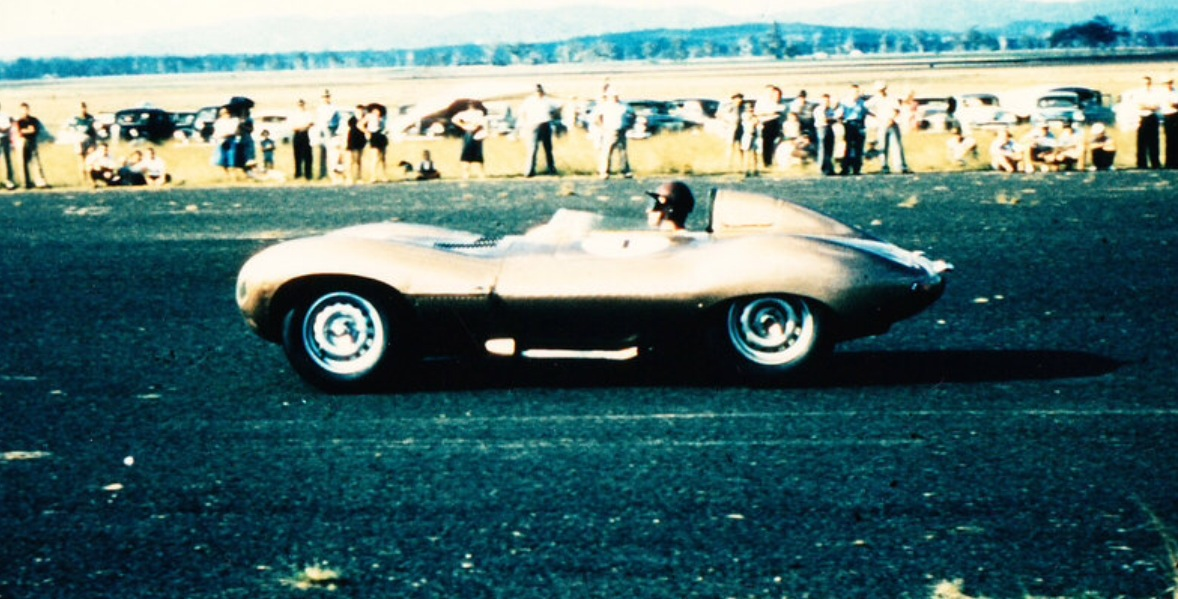
Evocative shot of Bill Pitts’s Jaguar D Type leading David McKay’s Aston Martin DB3S at Queensland airfield circuit, Lowood in 1957…

The January 1958 edition of ‘Australian Motor Sports’ covered ‘The Courier Mail’ Tourist Trophy Race Meeting in detail, the event held in typically hot Queensland November weather.

There were events for motor cycles as well as cars, open-wheelers both under and over 1500cc, touring cars and of course sports cars.

Star entries for the TT were the 2 Aston Martin DB3S’ of David McKay and Tom Sulman both back from Europe having campaigned Astons there. Bill Pitt was entered in the D Type Jaguar owned by local Jaguar dealers, Cyril and Geordie Anderson the balance of the entry Porsches, Triumph TR2 and TR3 and a large number of MG’s, for so many years the ‘backbone’ of Australian Motor Racing entries.

The TT was of 30 minutes duration with a compulsory pitstop to add interest and confuse spectators in this pre-digital sign age, with a Le Mans start.

McKay took an early lead from Pitt and Sulman but McKay spun twice in the first half of the race, once at ‘Mobilgas’ and once on the fast right hand elbow out of the same turn’…McKay foolishly tried to pass the D type here and once again misjudged and spun badly to the outside of the corner. He ended up only feet off the outside fence.

Pitt held the lead from McKay both taking their compulsory pitstop on Lap 9, David’s stop was the better of the two, McKay regained the lead from Pitt and Sulman he held to the end ‘Pitt drove impeccably but the gap was too great to bridge…McKay was lucky to win and undoubtedly the pitstop was the deciding factor. However it was part of the race conditions and the best car and driver team won’ AMS reported.

I will write about the Aston Martin DB3S’ in Australia soon.

As is so often when i start researching a topic i find bits and pieces which alters my original intent!, in this case a lot of information about Bill Pitt, a driver i was aware of but knew nothing about. This article is therefore in three parts;

.Short history of ‘XKD526’

.Reproduction of an article, slightly truncated, about Bill Pitt written by Les Hughes, which was originally published in the ‘Australian Jaguar Magazine’ in July 1987

.Short piece on the Lowood circuit.

d type

Bill Pitt at Lowood in 1957, car repainted bronze after its 1956 Albert Park accident. (Dick Willis)

Pitts Jaguar ‘XKD526’ was bought new by Cyril and ‘Geordie’ Anderson, longtime Jaguar enthusiast, occasional racing driver. It was a 1955 customer car, arriving in Australia in early 1956, Pitt chosen as the driver.

The D was very successful over the next 4 years including finishing 2nd in the 1957 Victorian Tourist Trophy at Albert Park and in the hands of Frank Matich when sold by the Andersons.

pitt

Bill Pitt, left, pondering the Jags performance at Lowood in 1957. (Dick Willis)

A summary of its race history is as follows; December 1955 car arrived in Australia; 30/1/56, Strathpine, Mrs Anderson, clocked at 120mph over flying quarter, still in 3nd gear!; 19/2/56, Leyburn sprints, Mrs Anderson, clocked 135.2mph over flying quarter, setting a state record.

March, Strathpine; Bill Pitt became the cars regular and very successful driver; 1956 race meeting at Lowood; gearbox problems precluded competition for 5 months; August, Lowood; New South Wales Road Racing Championships, Bathurst, 2nd to Stan Jones driving a 250F Maserati; Lowood TT, 1st.

Australian TT, Albert Park Olympic meeting, Melbourne, 4th. At the Argus Cup meeting at Albert Park the following weekend, the meeting a ‘double header’, Pitt rolled car and was thrown out. The D was badly damaged and trailered back to Brisbane being completely rebuilt, painted bronze, with squared-off mouth and air vents in the bonnet. Its first race post repair was back at Albert Park in March 1957 for the  Victorian TT, finishing 2nd.

XKD526 was repainted BRG; raced at Lowood and Bathurst, in 1958 it raced at Orange, Lowood, Bathurst and Albert Park and in 1959 raced at Bathurst and Lowood before being sold in late 1959 to Leaton Motors, a sports and performance car dealership in Sydney.

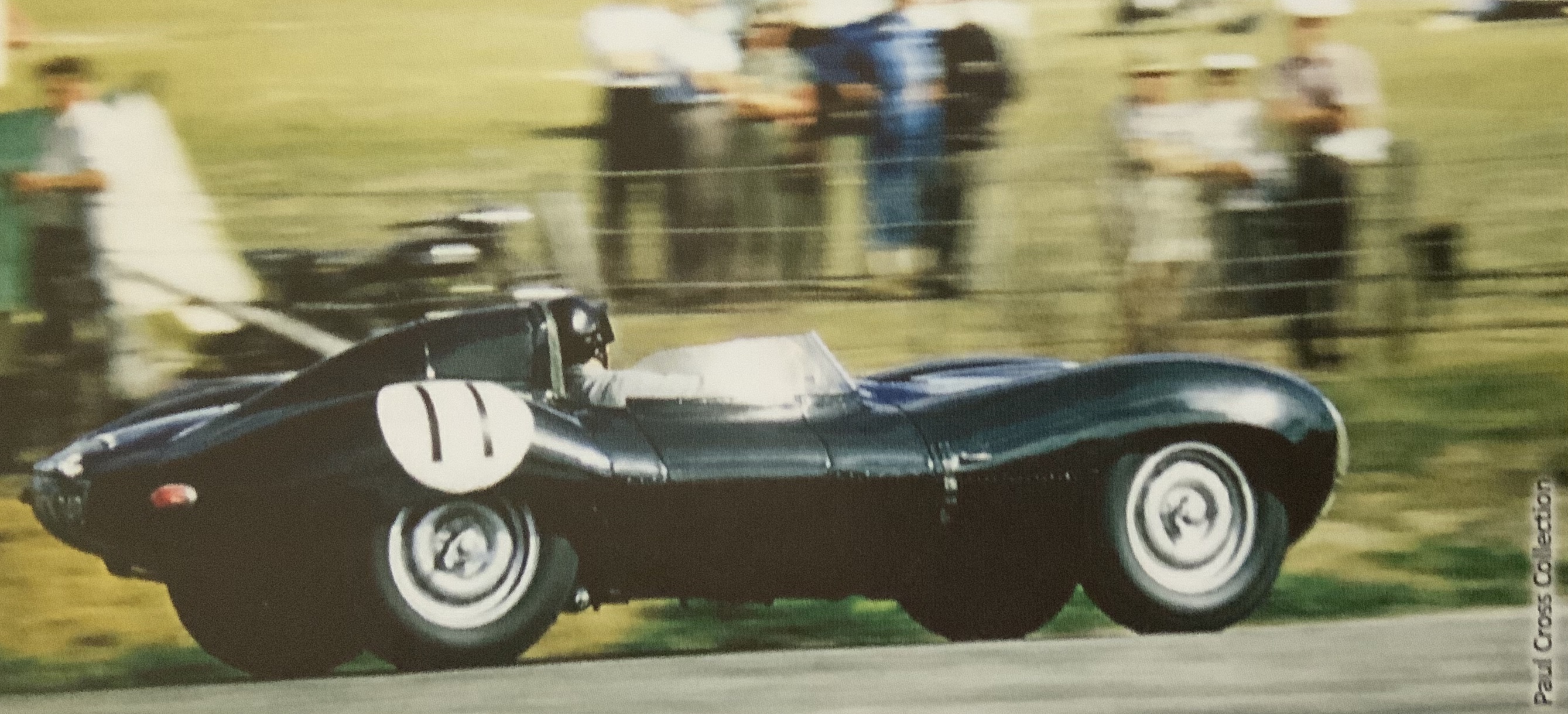
Bill Pitt negotiates Hell Corner, Mount Panorama, date unknown (P Cross)

The car was repainted yellow with black stripe and driven initially by Frank Matich and later by Doug Chivas. In 1961 it was fitted with an aluminum fastback hardtop to enable it to compete in GT racing. Matich competed in June at Catalina Park, he contested in July the Australian GT Championships at Warwick Farm finishing 1st. In October he won the NSW Championship.  Doug Chivas raced the car at Warwick Farm in November, by that stage Matich was driving Leaton’s just imported Lotus 15 Climax.

The car was sold to Barry Topen who competed in the March 1962 Warwick Farm International Meeting before racing in Sandown Park’s  inaugural meeting, crashed it and damaging it. The D Type remained in a damaged state for some time and was sold around 1965 to Keith Russell (Sydney), who rebuilt it and raced occasionally during 1966 at Catalina Park, Warwick Farm, Hume Weir and Oran Park.

In 1967 Russell sold to it to Keith Berryman. The hardtop was removed and stored, Keith raced the car occasionally until 1970. In the mid-seventies he loaned it to lan Cummins to assist with his rebuild of ‘XKD510’. ‘XKD526’ was rebuilt by Cummins/Classic Autocraft at the same time, work included re-skinning the monocoque and making a new front frame. In 1982 the rebuild was complete, Berryman retained the car until it was sold at auction in 2015, at which point, the car, its whole history in Australia, left our shores.

matich on grid

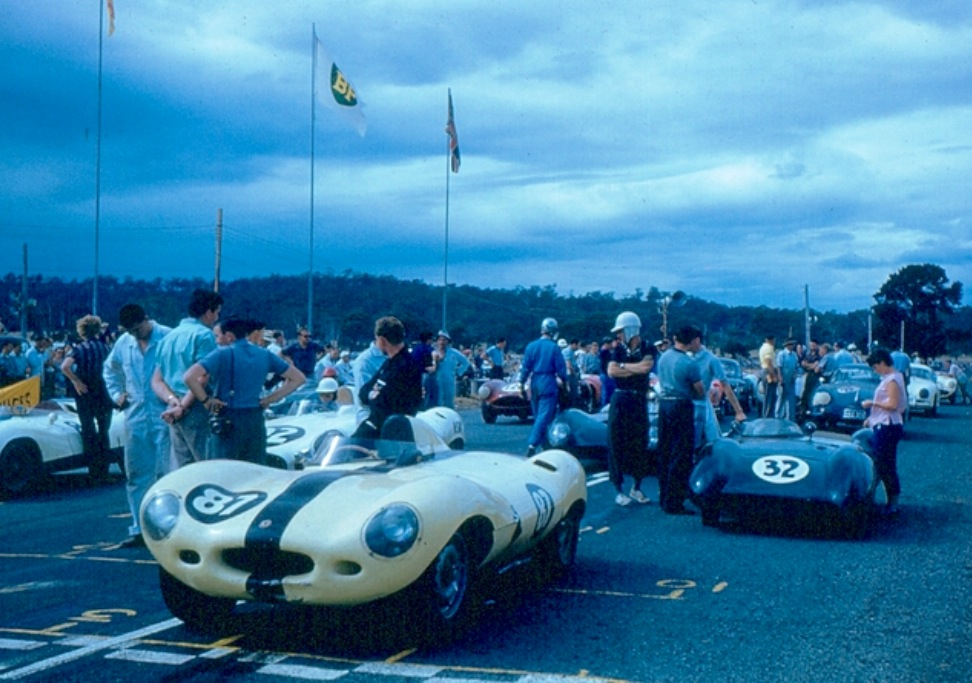
Matich leaniang against the back of the car, Australian TT, Longford Tasman meeting March 1960. #32 John Ampt, Decca and Derek Jolly’s Lotus 15 Cliimax to his left and back. (Kevin Drage)

One of the most surreal sights I can recall was after buying a Ralt RT4 (the ex-Moreno Calder AGP winning RT4 ‘261’) off Keith Berryman some years back and travelling from Melbourne to a tiny little hamlet called Stockinbingal in the South Western Slopes area of NSW.

The place is a very small farming community, the nearest large town Gundagai 80 kilometres away. Having done the deal on the Ralt I asked to see the D Type.

We walked through some parched, brown paddocks amongst the sheep near the farmhouse to an unprepossessing run down concrete shed of uncertain vintage.

Keith threw open the door and there, sitting on axle stands inside a ‘huge plastic humidicrib’ an electric motor quietly humming as it circulated clean, fresh air around ‘the baby’, was the fabulous, immaculate, curvaceous flanks of a British Racing Green Jaguar D Type.

To say that it looked out of place does not do justice to the bizarre, surreal scene!

The car lived in country NSW for a long time, Keith a passionate owner for decades…hopefully it will come back to visit one day…

matich d type

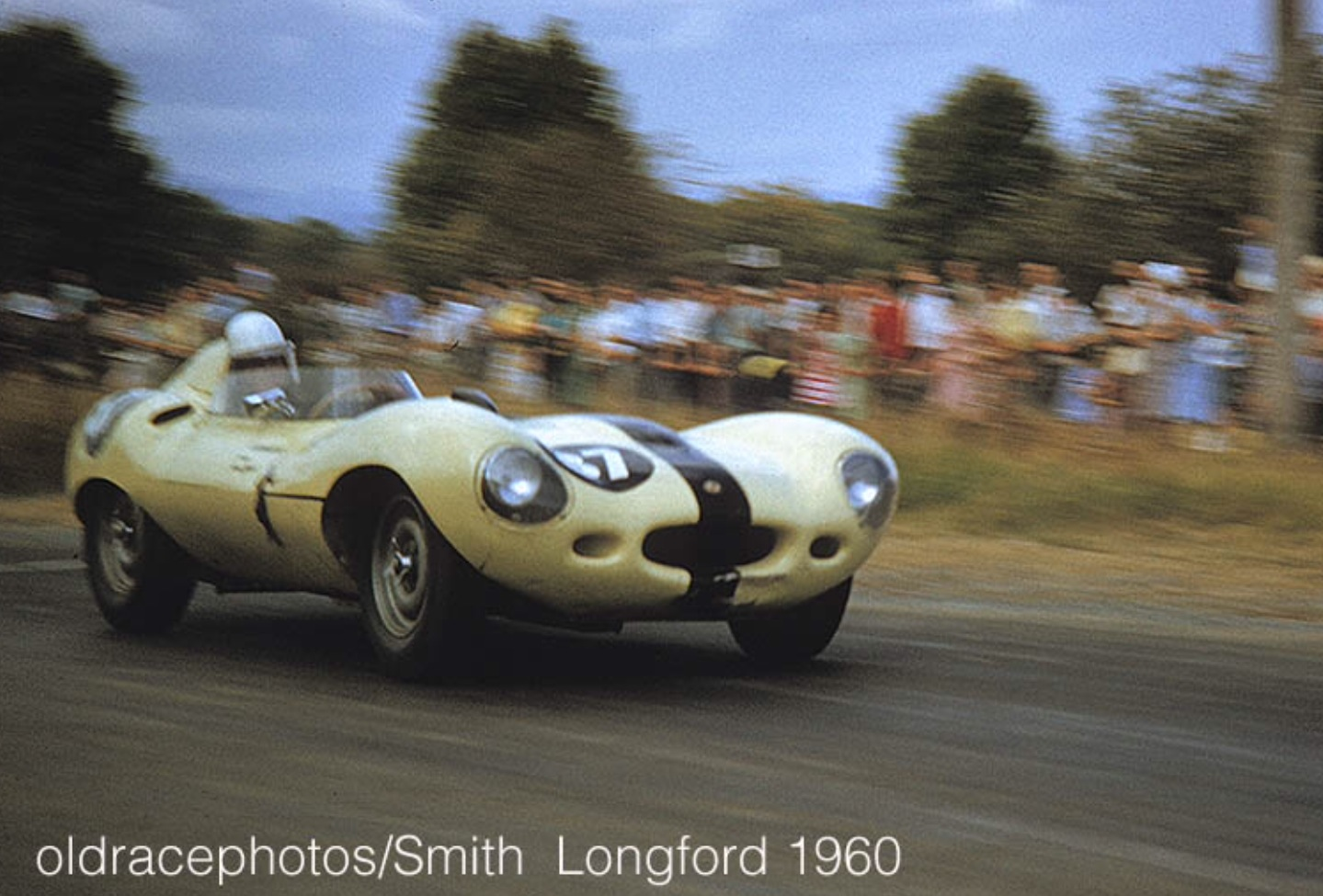
Matich in the 1960 ATT Meeting at Longford. (oldracephotos.com)

Bill Pitt: by Les Hughes ‘Australian Jaguar Magazine’ 1987…

Born in Brisbane, Bill served in the Australian Navy during the Second World war, his first contact with motor racing was as a timekeeper during the Australian Grand Prix meeting at the Queensland Leyburn track in 1948.

From the Leyburn meeting on, all forms of motor sport became a passion for Bill, his friends and later his family. He became a competitor with increasing success and played a vital part in the direction of motor sport both in his Queensland base, and later on a national level. His friend Charlie Swinburn and several other MG drivers formed an active group and later Bill, Charlie and Ray Lewis had a motor garage called LPS Motors where their cars and other racing machinery were prepared.

Pitt’s first competition car was a humble 1938 Morris 12 Roadster, which provided his first trials win. Next came a serious racing car in the form of one of the revolutionary rear-engined Coopers. The Cooper had been recently imported by Les Taylor who had just stunned the motoring world by running his brand new XK120 from Darwin to Alice Springs in under 11 hours. Actual travelling time for the 954 miles was completed at over 100 mph, the final corrected speed was 90.62 mph which allowed for stops for fuel, kangaroos and other wildlife. Taylor sold some of his property, one of the items for sale was the Cooper which Bill bought, fitting it with a Manx Norton Engine.

The engine which Bill bought came via the Queensland Manx Norton distributor, Cyril Anderson, a former international dirt bike racer. Cyril’s other business interests included Mack Trucks, Western Transport and several motor car distribution networks, including Jaguar cars which sold under his Westco Motors banner. Cyril’s wife Doris – better known as ‘Geordie’ – made a name for herself by racing their aluminium bodied XK120 (chassis no 11).

The Anderson XK120.

That first contact through the purchase of the Manx Norton engine led to Cyril’s inviting Bill and Charlie Swinburn to partner Geordie in their XK120 Fixed Head Coupe (their earlier aluminium XK120 had been destroyed in a workshop fire) which he had entered in the first, and only, 24 hour race in Australia, to be held at Sydney’s Mt Druitt circuit (31-Jan-1954).

Despite having to replace a cracked carburettor with one from a spectator’s car, their XK120 won the race against  entries including a Jaguar C-Type, Aston Martin DB2, aluminium XK120, Bristol 400, Alfa Romeo 6C. This win gained an enormous amount of publicity for Jaguar, Westco Motors and the three drivers.

Bill was then working for the Queensland Nuffield distributors, Howard Motors, and had married Sherry.

Bill and Charlie then set up the running of the 1954 Australian Grand Prix through the streets of Southport on the Gold Coast. Bill entered his second Cooper, bought from Jack Brabham. The race contenders were Stan Jones, Maybach, Lex Davison’s HWM Jaguar, Rex Taylor’s Lago Talbot and several Ferraris.

For this race Cyril Anderson had stripped the body of a black XK120, shortened the chassis, over which he then placed an aluminium body. Known as the Anderson Special, he entered the car for himself, whilst Geordie was to drive the XK120 FHC in a support race.

Saturday practice proved to be very bad indeed. Bill blew the engine of the Cooper, Cyril was very slow and uncertain of the Jaguar Special, and Geordie had an accident, hit a tree and the FHC burst into flames! As a result Cyril asked Bill to take over the Jaguar Special for the Sunday race.

Bill readily accepted, but as he sat on the grid he was trying to become familiar with a car he had never sat in before – not the most comforting way to begin a Grand Prix. After spearing off  at over 100 mph at the end of the straight, rejoining only to have to stop and replace a deflating tyre, he was classified 12th. Lex Davison’s HWM Jaguar won.

Bill’s employer, Howard Motors, used his sporting talents also, and for the 1955 Redex Trial they entered a Morris Oxford for Bill, Dick Howard and Bill Anderson.

D Type ‘XKD526’

The major decision for Bill and Charlie Swinburn in 1955 though, was whether or not to take up the offer from Cyril Anderson to become partners in ownership of a brand new D-Type.

In Melbourne, Bib Stillwell, racer and Jaguar dealer, had placed an order for one through Jack Bryson. After long and careful deliberation, Bill remembers he and Charlie parted with 2,000 pounds each for the car. As it turned out, Charlie never drove the D-Type, and Geordie did only briefly. Virtually all of the competition was done by Bill. He recalls the friendly rivalry between he and Stillwell, they stayed at each other’s homes when interstate.

Bill rolled the D-Type in Melbourne at the 1956 Olympic Games meeting at the very fast Albert Park Circuit. The ‘greats’, included Stirling Moss, Jean Behra and Ken Wharton, were out from Europe with their latest machinery.

Bill Pitt in XKD526 – Albert Park, Melbourne 1956

For Bill Pitt the competition was fierce against Bib Stillwell, and in that near fatal race, Stillwell got the jump at the start and lead Bill into the fast, first left-hand corner. He recalls how he closed quickly under braking into Melford Corner before realising he had gone into it far too fast. The car was still under control, and as he continued the power slide and concentrated on the short burst into the next corner, suddenly it was all over before he knew what had happened. As the D-Type slid wide, and the power was applied, the back wheel touched the stone curbing and at those speeds the car simply twisted into the air and slammed down on its back.

As the beautiful green D-Type lay upside down the scattered hay bales caught fire and quickly spread to the car. The marshals were convinced that Bill was squashed under the car, but couldn’t right it till the fire was out. When that was done, and the car was back on its wheels, they were shocked to find the cockpit empty. Bill was thrown out while the car was in mid air, and in a state of shock, and worry about Jack Brabham’s Cooper which was following, he jumped a six foot wall of hay bales unseen by officials.

The damaged D-Type was returned to Brisbane for a rebuild which was completed in time to return to Melbourne for a meeting in February the following year, this time painted bronze (only for a short while).

In the pits. Albert Park 1957. Painted bronze after the rebuild following crash the previous year. (Ian Richardson).

 Leading a 300S Maserati around Golf Course Corner, Albert Park, 1957.(Ian Richardson)

The D-Type was sold in 1959 to Leaton Motors, the history of the car from that point outlined above.

Keith Berryman (and family) with XKD526 at the 1988 Gold Coast Jaguar Rally, together with the excellent replica built by Classic Autocraft for Don Biggar (now owned by Frank Moore)

Jaguar Mk VIII Rally Car.

Bill was approached by Anderson to drive a Jaguar Mk VIII automatic in the 1957 Mobilgas Round Australia Trial. Geordie would partner him, and so too Jimmy Abercrombie, workshop foreman at Westco.

The big cream and grey Jaguar was shipped to Melbourne for the start on August 21, 1957. A field of 94 entrants competed in this, the last of the major round-Australia trials of the era. The toughest opposition came from the all conquering Volkswagens of previous winners, Eddie Perkins, (Larry Perkins father) Laurie Whithead and Greg Cusack, whilst Porsche entered three cars. An automatic had never finished the event, let alone a Jaguar, or even a car as big as the Mk VIII.

The Volkswagen of Laurie Whitehead was the victor ahead of five more Volkswagens, but sensationally, next came the huge Jaguar automatic in seventh place outright, making what Bill Pitt still believes is one of Jaguars greatest competition triumphs, but which outside Australia, was virtually unrecognised. Of the 94 starters, 52 cars finished. Geordie was awarded the Woman’s Prize, and the Jaguar was first in Class D (over 2500 cc), giving the team the total prize money of 760 pounds.

Touring Car Racing.

Lofty England dissuaded the Brisbane team from buying a Lister Jaguar, suggesting to them that he would build a ‘works’ specification Mk 1 3.4 saloon. When Bill and Cyril ordered the 3.4 they didn’t know that David McKay was having an identical car built to replace the less modified ‘Grey Pussy’.

By the time both had their new cars, Ron Hodgson had bought the first McKay machine. Crowds flocked to see the Aussie Holdens take on the best of British, firstly the Jaguars, then the Mini Coopers and the Lotus Cortinas, and that set the scene which was later taken over by the Ford versus Holden halcyon days of touring car racing in Australia.

Bill Pitt and the British Racing Green ‘Mk 1’ were star attractions everywhere they went, and soon the Geoghans bought the Hodgson ‘Mk 1’. Hodgson built a brand new Mk 2 and then Bob Jane arrived with his famous white Mk 2. Bill won many titles and important races, his second place to David McKay in the very first Australian Touting Car Championship, and then his own victory in the second title (1961) were the highlights.

The life of the saloons was much shorter than the old D-Type, however, and with the arrival of the big US V8’s, Bill could see the writing on the wall and in 1962 the car was sold.

Bill’s racing career was over, although he continued to work within CAMS, and for Westco Motors until 1965.

Confederation of Australian Motor Sport.

Bill Pitt was involved in many facets of  motor sport from the outset, and as Queensland delegate to the Confederation of Australian Motor Sport (CAMS) he put a lot of time into the betterment of the sport.

Retirement.

It was not until Lofty England’s first visit to Australia in 1981 that the two met for the first time, despite the many phone calls and letters exchanged during their racing and business contacts. Bill and his wife Sherry now live on the Sunshine Coast, north of Brisbane. Australian motor sport, and the Jaguar marque in particular, owe a great deal to this quiet, unassuming and very pleasant man.

Bill and Geordie meet again – March 1993

 Bill Pitt at Queensland Raceway GTP Nations Cup Race meeting. 22nd July 2001.

Celebrating 40 years of the Jaguar E-Type and 40 years since his Touring Car Title.


Lowood curcuit map

Lowoood Airfield was built on 620 acres 43 miles from Brisbane, construction commenced in September 1941

Australian and American Squadrons operating Tiger Moths, Kittyhawks, Avro Ansons, P39 Aerocobras and Beauforts operated from there from 1942 to late 1945.

Lowood’s use from motor racing commenced after the war but continued pressure from local religious groups lead to its disuse on Sundays…despite this many meetings were held from 1948-52, in late 1956 the Queensland Racing Drivers Club acquired the land.

The QRDC sold the track in 1966 moving its operations to Lakeside, the area was then subdivided into small farms, what was the main runway is now a local road!

lowood brochure

D Type: the Drivers Perspective…

http://www.motorsportmagazine.com/archive/article/june-2004/50/d-type-cast

Bibliography…

Peter Dunns ‘Australia at War’  ‘Australian Motor Sports’ January 1958, Article by Les Hughes in the July 1987 issue of ‘Australian Jaguar Magazine’, Stephen Dalton for the research and archival material

Photo Credits…

Heinz Federbusch Archive via Dick Simpson and The Nostalgia Forum, Kevin Drage, oldracephotos.com, Dick Willis, Ian Richardson, Paul Cross

Finito…

pi 3

This view in race direction looking down the main straight and into the daunting ‘Doohan’ Turn 1 ‘Southern Loop’ section of the track (Kevin Drage)

Kevin Drage’s wonderful aircraft shot shows packed  Phillip Island during the 1961 Armstrong 500, Australia’s growing obsession with Touring Cars underway

The race was held at the Phillip Island on 19 November 1961 over 167 laps of the 3.0 mile circuit, a total of 501 miles (807 km).

It was the second event held in the combined history of the Armstong 500/Bathurst 500/Bathurst 1000 which began in 1960 with the first Armstrong 500.

chequered

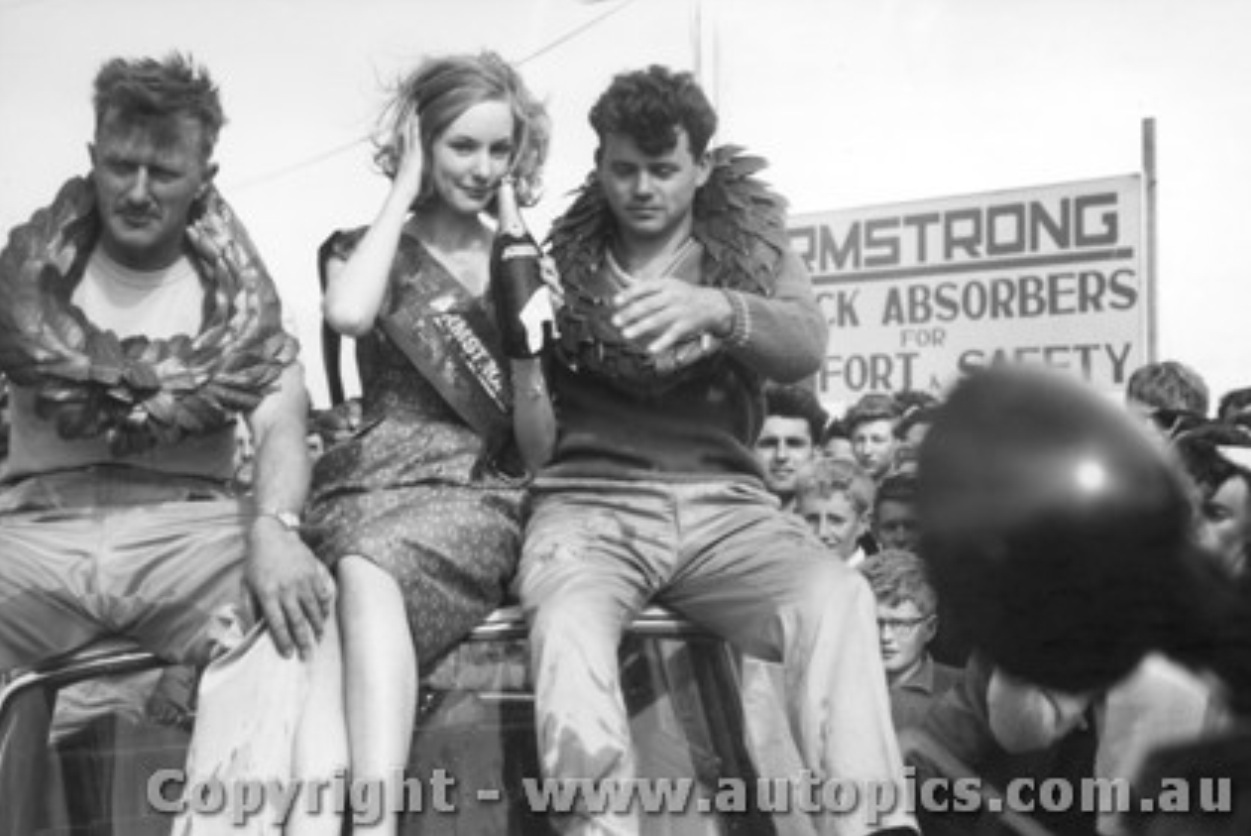
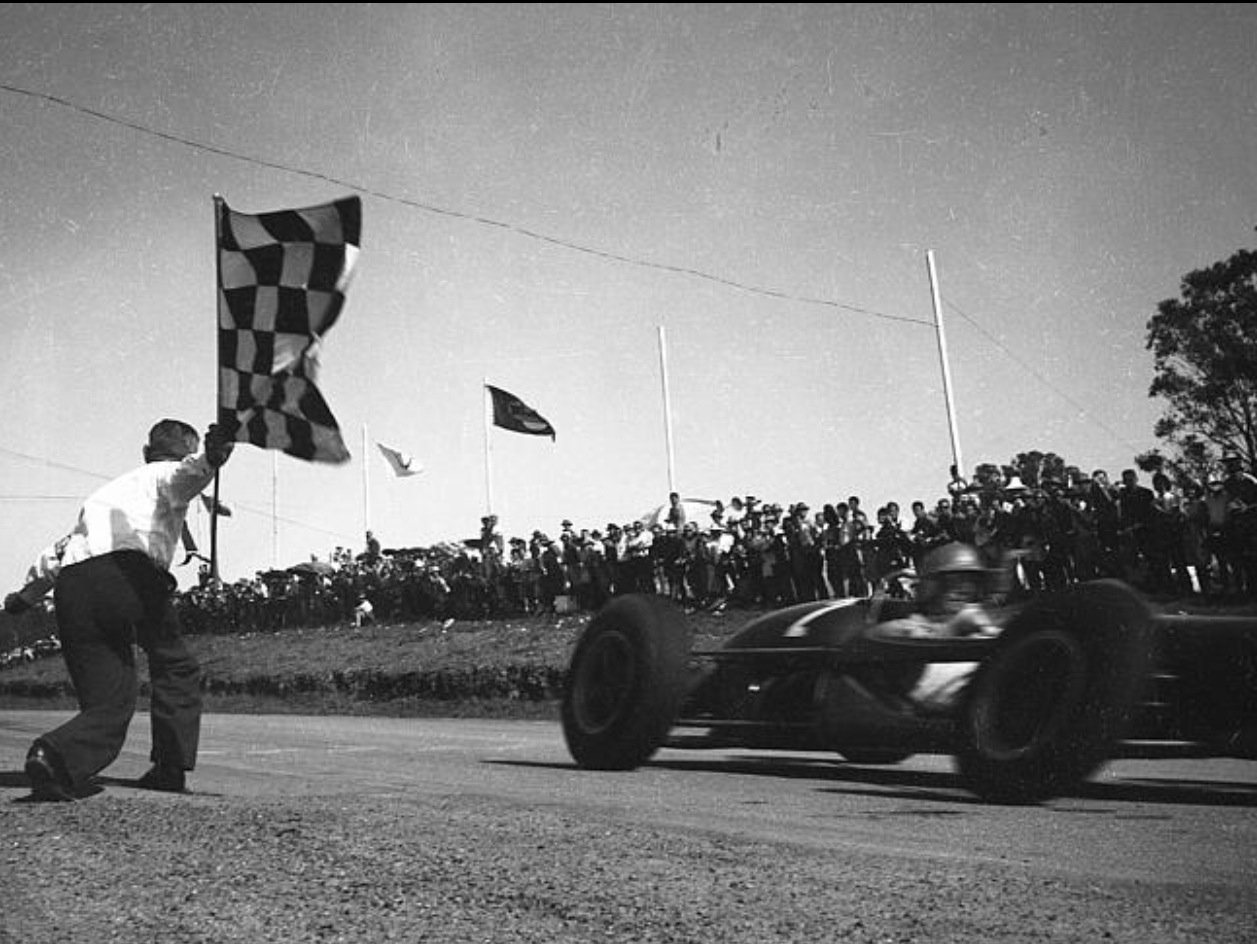
Jane/Firth take the chequered flag. Jaguar dominated the local prestige market in Oz then…but not for too much longer, the German onslaught began about here!? (autopics)

Bob Jane and Harry Firth were the only combination to complete the full race distance, earning the pair the first of their four outright race wins in Jane’s ‘Autoland’ Mercedes Benz 220SE. Mind you, the concept of an outright race win was not be officially recognised until 1965- Mercedes, Studebaker and Renault each took class wins.

pi 1

(Kevin Drage)

Fabulous Phillip Island day! Len Lukey’s airstrip in the foreground, this shot is of the cars coming out of Siberia- top shot towards Bass Straight through the flat out right handed towards ‘Lukey Heights’. And below Ms Phillip Island coping very well with the Bass Straight ‘breeze’ whilst touring car aces Harry Firth and Bob Jane look suitable pleased with their days work. Their are plenty of race wins and championships to come for these two fellows.

victors


pits

(Kevin Drage)

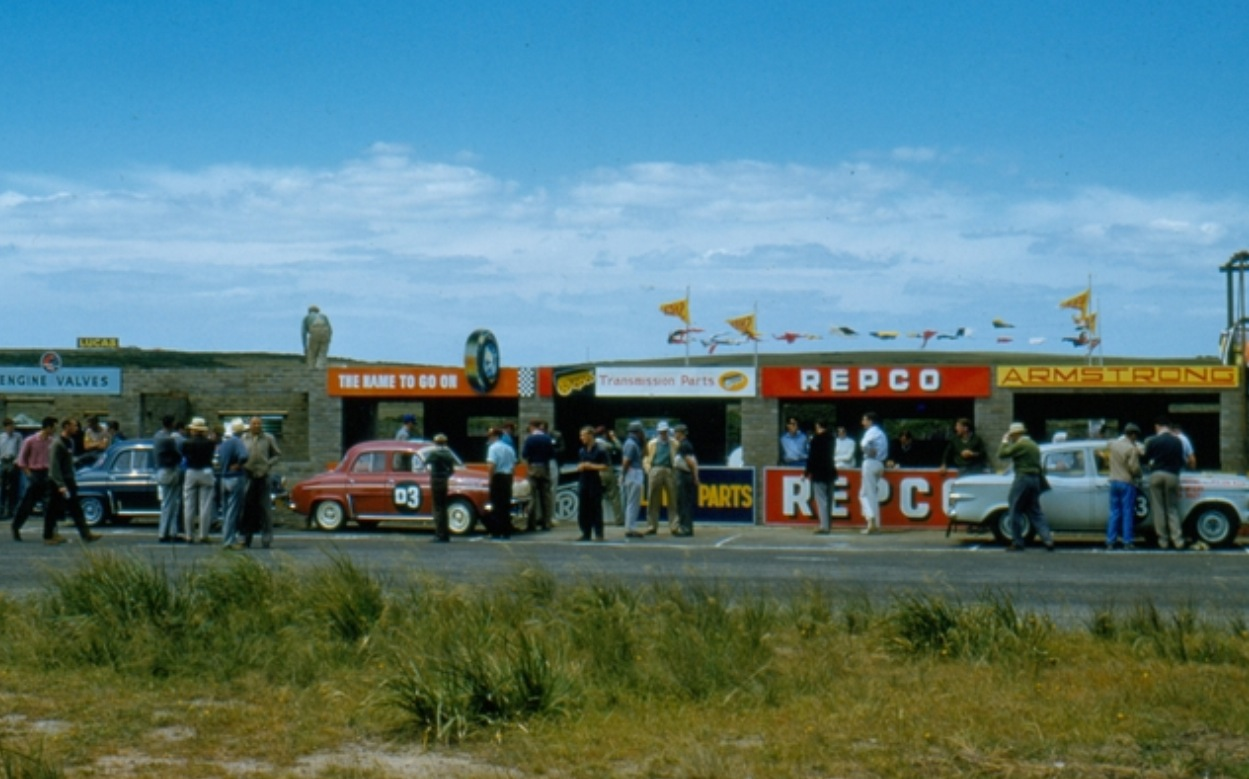
The pitlane shot shows the Class D winning Renault Gordini of Jim Gullan, Brian Sampson and John Connelly, whilst the grey car is the Class A winning Studebaker Lark of David McKay and Brian Foley.

janey

(autopics.com.au)

Harry Firth, by the look of that crouch behind the wheel of the winning Mercedes- he is just entering the left hand rise ‘Lukey Heights’ before the drop into ‘MG’, Mercedes 220SE.

mc kay

(Kevin Drage)

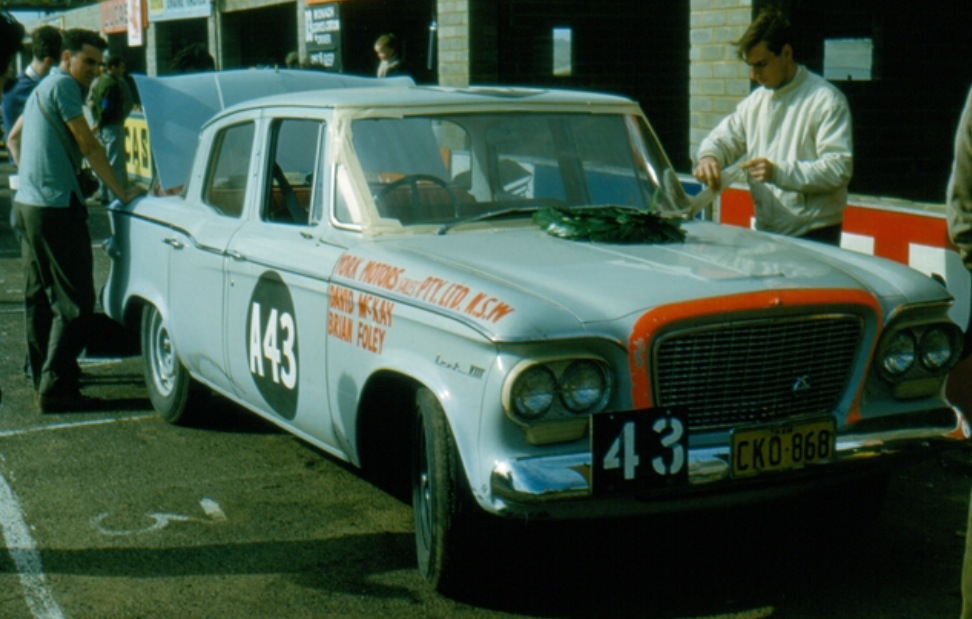
David McKay and Brian Foley- champions both and below the Studebaker Lark entered by York Motors they raced to second place.

studebaker

(Kevin Drage)

Credits…

Kevin Drage, autopics.com.au

image

(Sydney Morning Herald)

I wrote a long article about Peter Whitehead’s successful 1938 ‘Australian Tour’ which culminated in his ERA R10B, Bathurst, AGP win on 18 April, here he is enjoying a ‘cleanser’ at the races duration, click here to read it;

Peter Whitehead in Australia : ERA R10B : 1938…

This piece is a ‘photographic update’ of the earlier tome. It’s interesting the way photos sometimes ‘pop up’, in this case as a result of someone clearing out a house and finding a cache of photos of a man who was clearly a Whitehead fan ‘in period’.

Most of the shots were posted on an antiquarian website with a blog devoted to identifying unknown objects, via that medium they found the primotipo article above. Go figure the ways of this internet world! The photo’s existence 80 years later is indicative of just how much general press interest there was in Whitehead’s visit with the ‘fastest car to come to Australia’ at the time .

I received the assistance of a ‘panel of expert mates’ to ID the shots, many thanks to racers/fettlers/historians/enthusiasts John Medley, Patrick Ryan and Greg Smith for their ‘smarts’! Mind you there was not a unanimous view on all of the shots, opinions from others welcome.

ERA Australia Shots…

PW either during the 1938 AGP, Bathurst or at Rob Roy, Christmas Hills, Victoria. Whitehead ran with number 1 at both events, won both and set course records. Bathurst expert Medley says its Mount Panorama and Melburnian Rob Roy regular Pat Ryan’s vote is for the Clintons Road, Christmas Hills short ‘climb.

As you will see Whitehead is sans any form of head protection, not even the vestigial ‘cotton bonnet’ of the day; mad given Bathurst’s surface.

image

(Sydney Morning Herald)

The next 3 shots are of Whitehead going down the long Conrod Straight ahead of (ID Stephen Dalton) Barney Dentry’s #14 Riley. It would have been pretty wild, flat out in that ERA without helmet atop the gravel surface pinging past the gum-trees close by at around 150mph.

image

image

(Dave Sullivan Album)

image

Two shots ago but cropped closer to the cars; Whitehead and Dentry down Conrod (Dave Sullivan Album)

Refuelling R10B with fuel and topping up the radiator at Bathurst. Crew member Kenneth Maxwell at left.

image

(Sydney Morning Herald)

UK ERA R10B shots…

Start of the 1937 Donington GP, 2 October 1937 won by Bernd Rosemeyers #5 Auto Union Type C from the #3 von Brauchitsch and #1 Caracciola Mercedes W125’s

image

#2 Lang DNF gets the jump at the start in his W125 Benz from #4 MB Seaman DNF, #1 MB Caracciola #5 AU Rosemeyer and #3 von Brauchitsch MB on the outside. The next group comprises the 2 AU’s of Hasse 5th and Muller 4th. #8 are the Mays and #16 Whitehead ERA B Types both DNF (The Autocar)

The next photo is of Peter Whitehead leading Dick Seaman’s famous Delage at Donington during the Junior Car Club 200 Mile race and Andre Cup on 29 August, Seaman won the event in 15S8 Delage from the earl Howe and D Briault/Keith Evans ERA B Types.

The race was contested by a mix of 1500cc Voiturettes and Grand Prix cars; mainly Alfa Tipo B/Monza and Bugatti T51’s.

image

(The Autocar)

The Walker/Whitehead ERA leads the Seaman Delage at Donington in 1936, date unknown.

image

(The Autocar)

Hector Dobb’s Riley leads the Whitehead/Walker ERA R10B at Brooklands.

image

The Walker/Whitehead ERA ahead of a Bugatti, MG K3, MG NE at Brooklands

image

Credits…

Thanks again to John Medley, Patrick Ryan and Greg Smith for your period knowledge

Dave Dempsey and antiquers.com, Dave Warner Album on ‘The Nostalgia Form’ via Terry Walker

Tailpiece: ERA ‘Peter Partners’ Walker left, and Whitehead celebrating a race win, by Walker perhaps? at Donington in 1936…

image

(The Autocar)


jack finish

(News Ltd)

Jack Brabham’s ‘go-kart’ wins the ‘Lakeside 99’ Tasman Round in February 1964…

The photographer has created a ‘turn of the century’ distorted effect, the Brabham BT7A Climax looks quite weird , the off-beat nature of the shot enhanced by the cars lack of bodywork to try and deal with the harsh, summer Queensland heat.

Brabham won the race from John Youl’s Cooper T55 Climax, Jacks ’61 F1 and ’62 Australian Internationals chassis and Bruce Mclaren’s Cooper T70 Climax.

jack water

Brabham exits the Lakeside pitlane onto the hot, steamy circuit (Peter Mellor/The Roaring Season)

By the looks of these Peter Mellor shots the lead up to the race was wet, the tropical humidity would have made the race a real endurance test.

Bruce McLaren won the first Tasman Series, with both he and Jack taking 3 wins, appropriately Bruce’s in NZ and Jack’s in Oz!

jack portrait

Brabham portrait Lakeside 1964 (Peter Mellor/The Roaring Season)

jack racing

Brabham BT7A Climax 2.5 FPF (Peter Mellor Collection)

Photo Credits…

News Ltd, Peter Mellor Collection/The Roaring Season

sebring

Amazing Sebring aero backdrop for the Porsche Abarth 356B Carrera’s of Bob Holbert/Don Wester and Edgar Barth/Herman Linge, 9th and 10 placed in the race won by the Surtees/Scarfiotti/Bandini Ferrari 250P…

Wonder what the aircraft is?

Credit…Bernard Cahier

fernandez

Adrian Fernandez slices his Lola B2/00 Honda into the lead of the Monterrey Grand Prix from pole, behind is Dario Franchitti’s Reynard 02i Honda the first round of the 2002 CART Series on 10 March…

Such a picturesque location, the circuit used for this event between 2001 and 2006 was located at Fundidora Park, Monterrey the capital and largest city in the state of Nuevo León in the foothills of the Sierre Madre Oriental mountains, Mexico. The old buildings in shot are those of a disused steel mill which is both a nod to the past and indicator of the city as a current industrial centre.

fun pano

Fundidora Park panorama, Fernandez is the green/red Lola B2/00 Honda

2002 was ‘the start’ of the demise of CART, Penske Racing defected to the rival Indy Racing League at the end of 2001, starting a trend the net result of which was to weaken single seater racing in the US. A great shame as CART to me at the time was as interesting and exciting a category as F1 if not superior in its variety of circuits, circuit type (road, circuit, short and long speedways), chassis and engines. A story for another time.

The engine regs continued to mandate a 2.65 litre, single turbo-charged V8 for 2002, squabbling over the future engine specifications one of a myriad of issues causing the ‘stampede’ of teams and engine manufacturers from CART.

fun da matta

Christiano da Matta, Lola B2/00 Toyota

The 2002 CART championship was won by Christiano da Matta in a factory Newman/Haas Lola B2/00 Toyota, he also won this race. Fernandez finished 13th, Dario Franchitti was 2nd in a Reynard 02i Honda and Christan Fittipaldi 3rd in the other Newman/Haas Lola B2/00 Toyota.

fun da mat 2

da Matta Lola B2/00 Toyota, Monterrey 2002, he was on a journey which took him to F1 with Toyota

fun dario

Top shot Dario Franchitti’s Reynard 02i Honda. Podium ceremony L>R 2nd Franchitti, winner da Matta and 3rd Christian Fittipaldi

All Photo Credits…

Robert Laberge

Tailpiece…

fun pano 2