Australian Auto Action…

Posted: December 7, 2020 in Obscurities
Tags:

Make sure you buy Auto Action this week as it has a piece by yours truly, a six page feature on the Tornados. It has some ripper shots not published before. Keep buying it too, if I can help drag in a few extra readers the historic content will grow.

AA boss-cocky Bruce Williams is expanding his historic coverage to help broaden the appeal of a magazine which has been with us since 1971. Time flies. When i got hooked on cars in 1972 my magazine diet was Racing Car News, Sports Car World and Auto Action, only the latter endures sadly.

AA has more V8-taxis than you can poke a stick at of course. The F1 coverage is great, ditto Indycars, sports-prototypes, off-road and a halfway decent national event summary – and the rest. You might be surprised at the historic content already, about eight pages and above. My loose brief is to waffle on about older single-seaters, sportscars and people.

Anyway, give us a go, revisit the magazine if you’ve not bought it for a while.

primotipo and the like are free, I suppose as a group the ‘primotipos’ of the world have knocked around the sales of traditional publications. But it’s important we keep the magazines we have. Of course said publications must have punter appeal. My current favourites are MotorSport, The Automobile, Australian Musclecar and Auto Action– a diverse selection. All are privately owned which I rather like as an SME owner for most of my business career.

I’m pluggin’ away on some other commissions as well. The Auto Action piece is the first to be published. Many thanks to Geoff Harris, Bruce Williams, Heath McAlpine and the Auto Action crew.

primotipo.com rolls on unchanged, it’s a fix I can’t do without!


Perth’s Allan Tomlinson wins the 1939 Australian Grand Prix on the immensely daunting, challenging and dangerous Adelaide Hills, Lobethal course…

To this day Australia’s learned motor-racing historians struggle to understand how Tomlinson did the times he did in his little supercharged MG TA Special. It simply does not seem possible for the slightly built young ace to do what he did with what he had.

This article is about the race. The report is that published by the Adelaide Advertiser the day after the event coz’ I do like to use the language of the day when it is available. But this article piece is more about the dialogue of great Oz racing historian John Medley and others on ‘The Nostalgia Forum’ discussing Tomlinson’s achievement and how he did it.

The racing on Monday January 2 comprised the AGP for which the ‘Advertiser Cup’ and a prize of 200 pounds was awarded. Other events were the 10.45 am South Australian, or Junior GP, ‘and an innovation, the 1 pm Australian Stock Car Road Championship, in which all manner of stock car models, from sedans to tourers and small roadsters have been entered’. The AGP commenced at 2.30 pm.

The ‘Adelaide Advertiser’ report of the race weekend, published on Tuesday January 3, 1939

The high speeds recorded by drivers in the first race of the day, the South Australian Grand Prix (75 miles) made the crowd look for thrills, and although they were disappointed with the slow times in the Australian Stock Car Road Championship, they were treated to exhibitions of wild cornering, clever and fast driving, and terrific speeds in the last race of the day, the Australian Grand Prix (150 miles).

That race, conducted for the first time in this state, provided a fitting climax to a day of high speed and thrills. It was the best race ever conducted in Australia according to interstate officials.

Attracted by the treacherous curves, made even more hazardous by melting bitumen, the main bulk of the huge crowd congregated at Kayannie Corner, the Mill Corner at the entrance to Lobethal Village, and the acute Hairpin Bend near the grandstand. Time and again the faster cars, racing to the grandstand hairpin, braked and slithered around the corner, just grazing the sandbags. One of the more unfortunate however was F Kleinig, who hit the sandbags with a crash in the SA Grand Prix. Kleinig’s car was undamaged and although he lost valuable minutes in extricating it from the broken wall of sand, he was able to continue.’

My kind of driver- Frank Kleinig had lots of raw pace, fire and brimstone but perhaps not enough consistency to ever win an AGP- which he surely deserved? Here in trouble aboard his Kleinig Hudson Spl, a very quick concoction of MG chassis, Hudson straight-eight engine and an ever evolving brew of many other bits and pieces- a quintessential, ever-present, and still alive marvellous Australian Special (N Howard)

‘In the same race DF O’Leary hit the protective bags at Kayannie Corner. RF Curlewis (NSW) overturned when he attempted to pass O’Leary on the corner. He came in too fast, braked, skidded to avoid the sandbags and, with his wheels locked, turned completely over, pinning the driver underneath. The car had to be lifted to release Curlewis, who escaped with a shaking. F Kleinig had to use the escape road in a subsequent lap, and had to weave his way through the excited crowd, which had been attracted by the screaming tyres. Kleinig had much trouble at Kayannie, and eventually hit the sandbags head on.

Skilful driving by JF Snow (NSW) prevented a possible accident at Kayannie in the AGP when he had to brake hard to miss running into the back of Dr CRK Downing, who had broadsided on the gravel across the corner. Alf Barrett (Alfa Romeo Monza) mounted the sandbags in the 12th lap of the same race, and he lost four minutes in backing his car onto the road again.’

Is it his watch John Snow is checking, perhaps not? Delahaye 135CS, Lobethal – later the car was an AGP winner in John Crouch’ hands at Leyburn in 1949 (N Howard)

Wheels Leave Road

‘The entrants in the Australian Stock Car Championship had trouble at almost all of the corners on the course, as the cars, not built for racing, swayed and threatened to overturn with the heavy loading imposed on the bodies imposed by the racing speeds.

Saywell’s front wheels were leaving the road at the crest of the rise at the end of the Charleston Straight approaching Kayannie, and at the Ess Bend near the golf links on the Kayannie-Lobethal leg of the course as the spectators were treated to similar sights as the cars raced over the hilltop and down the steep downgrade towards Lobethal.’

Click here for a piece of Australia’s first Australian Touring Car Championship event; https://primotipo.com/2018/10/04/first-australian-touring-car-championship-lobethal-1939/

The fastest car in the race if not quite the fastest combination- Jack Saywell and the Alfa P3/Tipo B John Snow imported for him not so long before the race (N Howard)

The Mill Corner caused many of the drivers much trouble, and as the wheels of the cars repeatedly swept gravel onto the course, the job of cornering at that right-angled turn was made even harder.

Saywell swung right around on one lap and ended up against the protecting bales of straw. People encroaching on the road had to jump to escape injury a few times when R Lea-Wright (Vic) misjudged and swung too wide.

Barrett’s cornering was always a feature of the AGP at that corner, and he took the turn at almost full speed in second gear nearly every time. His courage on a corner which had checked practically every other driver allowed him to gain yards on every lap.

Barrett, Monza Alfa (N Howard)

Saywell came to grief at the Mill Corner in the fourth lap of the last race (AGP). Hitting the kerb beneath the straw, he rebounded high in the air, but, retaining control of his huge car, was able to speed away without delay. Kleinig took a bale of straw with him for some distance up the Lobethal main street in the same race.

When in third place in the SA GP A Ohlmeyer (SA) skidded while negotiating the S Bend near the recreation ground. Without being able to regain control of his car, he crashed into the sandbags and went over the top, but neither he nor his car was injured.

Colin Dunne in his MG K3 during practice. Prodigiously quick and a race winner at the 1938 SA GP Lobethal meeting the year before. Dunne was a DNS with a popped engine in practice- the race was the weaker for his non-appearance. He and his wife hung out the pit boards for Tomlinson under Clem Dwyer’s guidance (N Howard)

Grand Prix Described

(B King)

Representatives of the best cars in Australia, the Australian Grand Prix (150 miles) had a field of 17 competitors of which Bowes MG N Type (12 min) the South Australian driver was the early leader.

He got away to a good lead and at the end of the third lap had a three- quarters of a mile leeway over Leach (12 min), Boughton Morgan (11 min), Curlewis MG T Type (21 min), Lea-Wright Terraplane Spl (17 min). Phillips Ford V8 Spl (12:45 min) and Burrows Terraplane Spl (12:45) were juggling for the other places. F Kleinig retired on lap 3.

Russell Bowes, MG N Type with a touch of the opposites (H Cullen)

John Medley provided a fascinating vignette about one of Australia’s pre-war racers who lost his life in the war.

‘Tall, thin, Roderick Russell Herbert Bowes led the 1939 AGP early, then retired after 11 laps. As a driver he was a goer, he was a flyer with the Redhill Flying Club, he enlisted for RAAF service during the war, was a fighter pilot in the UK (now in the RAF) was moved to Burma where he was shot down and died in 1943, an Ace with at least 9 “kills”.

‘His is one of many individual files I read whilst researching my John Snow book (when it is easy to become lost in the moment), reliving that individual’s life for a moment, and even now I feel emotional about sharing that bit of Russell Bowe’s life- a young man/an enthusiast/a worker/a goer/painfully open and honest; he admitted in his enlistment papers of “one traffic offence”: he had put his MG N over a bank near Eagle On The Hill going home from Lobethal that night. He bought the ex-Snow MG K3 in 1940, his parents passing it to Ron Uffindell later’ John concluded.

Frank Kleinig’s Kleinig Hudson Spl whistles through Lobethal village at some pace (N Howard)
Alf Barrett, Alfa Monza. Steed at the start after an error with a fuel tap- he lost 6 minutes and any chance he had in the race- perhaps the only man on the day who had the blend of speed and consistency to match Tomlinson, tyres permitting (N Howard)

After his unfortunate start, Barrett, Alfa Romeo Monza (2:50 sec) who lost 6 minutes on the starting line when his engine would not start was making up time very fast. Tomlinson MG TA Spl s/c (11:30 min) began making an impression, after five laps and filled eighth almost one lap behind the leader.

Lyster Jackson relieved RW Manser MG N Type (Victoria) who retired with engine trouble and AG Sinclair took Dr Downings place at the wheel of the Brooklands Riley (which Alan Sinclair had imported from England for his intended trip to Australia and sold to Downing).

Saywell Alfa P3/Tipo B (scratch) was electrifying the crowd with his terrific speed on the straights, and was only two laps behind the field with 10 laps to go. Barrett was returning increasingly faster times, lapping at more than 90 miles per hour.

When Alan Boughton bought this Morgan from Victoria for the inaugural Lobethal car meeting 12 months before it was a sportscar, by 1939 a single-seater, Lobethal 1939 (N Howard)
High speed precision, Allan Tomlinson MG TA Spl s/c, some of his secrets revealed at the end of this article (N Howard)

Tomlinson, (given the faster signal from his pit by Colin Dunne on Clem Dwyer’s direction) travelling at more than 80 miles an hour as his average speed, pushed up behind Leach, passed him and set out after Lea-Wright. Going out of Lobethal about 30 miles from the finish, Tomlinson passed Lea-Wright and clapped on more speed to set a good margin coming past the grandstand with 3 laps to go.

Saywell was returning a consistent 92 miles an hour average, and Barrett clung on grimly with a slightly better speed.

Burrows followed Phillips who was then third to Tomlinson and Lea-Wright. Saywell’s mishap (Saywell and Barrett both spun in their attempts to increase their pace to match Tomlinson with the heat and tyre problems causing the spins) at the Mill Corner lost him two places and Snow (4:15 min) moved into fifth place behind Burrows.

Jack Phillips and mechanic, Ford V8 Spl. Wangaratta based Phillips won a lot of races in this car- perhaps not as ‘pretty’ as Doug Whiteford’s Black Bess but a really effective, fast, reliable machine (N Howard)

The first three positions remained unchanged for the last two laps (with Clem Dwyer slowing Tomlinson over the last 2 laps), with Tomlinson the winner from Lea-Wright and Phillips- MG TA Spl, Terraplane Spl and Ford V8 Spl.

Strangely enough The Advertiser reported the death of Vernon Leach ‘about 27, single from North Melbourne on the second last lap of the race in a separate article to the main race report.

Second placed Bob Lea-Wright , Terraplane 8 Spl, with hard-working mechanic (N Howard)

Leach, in fourth place at the time, raced towards Gumeracha at the top of Lobethal’s main street and swung wide at more tha 60 miles per hour- the car slid, he over-corrected rocketed back to the other side of the road, bounced over a ditch into a bank with the hapless driver pinned underneath the car. He died almost instantaneously.

In the same lap that he was killed he had crashed into the haybales at Mill Corner in addition to an earlier off at Kayannie- he too had increased his times by over 10 seconds per lap to endeavour to match the faster pace being set by Tomlinson and perhaps just pushed too hard on the unforgiving track.

He was far from inexperienced mind you having, for example, won a 116 mile handicap at Phillip Island the previous November. Leach was racing the MG P Type Les Murphy used earlier in the day to place third in the SA GP.

I’ll fated Vern Leach MG P Type behind Tim Joshua’s Frazer Nash, DNF lap 7 (N Howard)
John Snow, Delahaye 135CS (SCCSA)

In another report in the paper on the same day the ‘Tiser said ‘although the fastest time went to J Saywell, AL Barrett in an Alfa Romeo was the outstanding driver in the race.’

‘Losing six minutes…Barrett determinedly set after the field and recorded the best average lap time for the day – 93.7 miles an hour. That time was about 10 miles an hour faster than the best lap recorded last year (in the 1938 January South Australian GP). He gave a brilliant exhibition of driving and control, and cornered magnificently at every bend, rarely getting into trouble with the sandbags. Barrett consistently average more than 90 miles per hour and on two occasions equalled his lap record. His speed on the straights approached 140 miles an hour’.

By the time of the 1939 Alf Barrett was master of his steed, a 2.3 litre Alfa Romeo Monza s/c- and I’m not suggesting he had trouble adapting to it. One of Australia’s greatest with a career which extended well into the post-war period (N Howard)
Jack Saywell, Alfa Romeo P3 (SCCSA)

The report noted ‘Tomlinson, who is only 22, is a motor mechanic with his own business in Perth. Yesterday was his first appearance in interstate company (all states were represented in the race with the exception of Queensland). He won the Albany GP last Easter and the Bunbury Flying 50 in October’.

‘Although it was a delightful day for the spectators the weather was much too hot for the racing cars. Tyres were torn to shreds on the hot roads, the heat made the engines boil, and the melting bitumen made some of the corners very sticky’.

The Advertiser’s reporter did a very good job- the assessment about the conditions and tyres- particularly the impact on the bigger, heavier cars was marked and worked to the advantage of the smaller, lighter cars driven by the likes of Tomlinson.

Results:

1st- AG Tomlinson MG TA Spl 120 min 27 sec on handicap, actual time 110 min 57 sec. 2nd RA Lea-Wright Terraplane Spl  122 min 31 sec / 118 min 31 sec. 3rd JK Phillips Ford V8 Spl 122 min 46 sec 114 min 31 sec. 4th JF Snow Delahaye 135CS 124 min 11 sec, 107 min 26 sec. 5th L Burrows Hudson 124 min 38 sec , 116 min 23 sec. 6th J Saywell Alfa Romeo P3/Tipo B 126 min 48 sec, 105 min 48 sec. 7th JF Crouch Alfa Romeo (handicap 5 min) 128 min 33 sec, 112 min 33 sec. 8th AI Barrett Alfa Romeo Monza 129 min 11 sec. 9th RF Curlewis MG T Type 129 min 57 sec,

To the victor the spoils- Tomlinson’s win was a result of a mix of masterful planning, preparation and superb implementation of agreed race-day tactics and with superb driving- brilliant professionalism by Allan, Clem Dwyer and Bill Smallwood, youngsters all (The Advertiser)
Jim Gullan’s Ballot 5/8LC ‘Indy’, DNS the race but would have better luck at Lobethal post-war- he won the 1948 South Australian 100 at Lobe in another Ballot- the Ballot Oldsmobile Spl (N Howard)
Jack Saywell, Alfa P3 (SCCSA)
(H Cullen)

Junior Event SA GP

From the limit mark RS Uffindell (above) veteran Sporting Car Club member, led all the way to win the SA GP (75 miles), the first event of yesterday’s programme.

He drove a consistent race, content to keep the average lap speeds below 70 odd miles an hour. Bryson’s accident in the first lap allowed Uffindell to clear out from the 12 minute markers, and although Les Murphy (Victoria) drove very well to hold second place for several laps he was unable to make up the huge leeway set him by the South Australian. The handicaps were too great for the scratch-man and other backmarkers and they had to be content to sit behind the better handicapped drivers.

Results

1st R Uffindell Austin Spl 70 min 54 sec. 2nd RA Lea-Wright Terraplane Spl. 3rd Les Murphy driving J O’Dea’s MG. 4th JK Phillips Ford V8 Spl. 5th L Burrows Terraplane Spl. 6th RWE Manser MG N Type. Fastest Lap F Kleinig Kleinig Hudson Spl 5 min 54 sec ‘more than 90 miles an hour’

Uffindell’s Austin 7 at a South Australian hill-climb and in more recent times below (T Johns)
(T Johns)
TM Brady, Singer Bantam, winner of the 1939 Australian Stock Car Championship and as a consequence the very first winner of the Australian Touring Car Championship (The Advertiser)

Australian Stock Car Championship

Chief interest in the Australian stock car championship centred on the possibility of J McKinnon catching the leader, TM Brady. The speed of the race was very slow in comparison to the SA Grand Prix.

Brady went into the lead from Uffindell on the third time around with Hutton a long way back third. Brooks, Mrs Jacques (Owen Gibbs driver) and Osborne retired at Kayannie after about three laps each, and McKinnon and Phillips moved up into fourth and fifth places respectively.

Brownsworth with his low-slung racing type car was the best of the scratch men, and he left them to chase the other five. Lapping consistently at more than 70 miles an hour he moved up several places in successive laps and was gradually overhauling the leaders. Brady, however maintained his lead to the finish’ and in so doing is the winner of the very first Australian Touring Car Championship an honour hitherto accorded David McKay’s win in the 1960 ATCC at Gnoo Blas, Orange aboard his Jaguar Mk1.

TM Brady (left) and co-driver/mechanic, Lobethal, first winners of the Australian Touring Car Championship 1939, Singer Bantam (unattributed)

Results

1st TM Brady Singer Bantam. 2nd J McKinnon Ford V8 . 3rd JK Phillips Ford V8. 4th G Brownsworth Jaguar SS. 5th DE Hutton Morris 8/40. Fastest Lap Brownsworth 7 min 27 sec ‘just over 71 miles an hour’.

The TM Brady Singer Bantam, Lobethal 1939 (unattributed)
Tomlinson, Lobethal 1939 (The Advertiser)

Allan Tomlinson’s MG TA Spl’s speed. How Did He Do It?…

John Medley ‘I remain still mystified about how Allan Tomlinson and the ‘other kids from the west’ did what they did to win the 1939 Australian Grand Prix at Lobethal…’

Tomlinson’s win was not a total surprise as race-day dawned. The Advertisers race morning summary said ‘…Despite his huge handicap- he is the only scratch man…J Saywell…has made himself one of the favourites for the race. Provided he has a clear passage and his motor keeps going, Saywell should be well up with the field 20 miles from the finish. His record average laps during the week favour F Kleinig who is off 4 min 15 seconds, but one of the most consistent of the drivers who is expected to do well is AG Tomlinson of Western Australia.’

John Medley explores how Allan Tomlinson did the ‘unbelievable’ in both his book ‘John Snow: Classic Motor Racer’ and online on ‘The Nostalgia Forum’. What follows with the exception of a contribution from Terry Walker is from those two sources. Recording in an easily accessible place this analysis has been a somewhat laborious process, any mistakes made are mine.

‘I had previously calculated, using known tyre sizes, wheel sizes, diff ratios and revs and the sort of speeds that the supercharged Tomlinson MG T special did. Over 130mph was the answer. People who know MG TA engines say “impossible”.

‘Problem: His lap times at Lobethal suggest that the car was in fact that fast. I and others have calculated sector times that he had to have achieved to do those lap times- and then found them impossible to match. Problem 2: He did the times and the lap chart shows it.

On the most difficult section of Lobethal, from the Gumeracha turnoff to Mount Torrens Corner through the dives, twists and turns amongst the trees at very close to top speed, he had run away from much faster cars: John Snow long ago told me that Allan had rocketed away from the Snow Delahaye through here.’

John Snow’s Delahaye 135CS (N Howard)

‘When Allan talked of all of this six weeks ago, (Medley was writing on TNF in 2005) I found him very self effacing, modest, factual and with an astonishing memory. He explained the sort of things he and Clem Dwyer and Bill Smallwood did to make the car and the driver fast. And he added fuel to the fire by suggesting speeds of closer to 140mph!!’

John continues, ‘He explained, for example, that while they carefully rehearsed the whole Lobethal circuit, it was the Gumeracha Turnoff-Mt Torrens section that they had focussed on in the three weeks before the event- walking each bit, looking at it from different angles, discussing lines, gearing, braking points etc and then applying their findings bit by bit in unofficial practice. They made the decision that this tricky bit was the critical bit of the whole circuit.’

‘And of that section, the corner next to Schubert’s paddock was the “jewel in the crown”: it took them the longest time in practice, and it wasn’t until 1940 that Allan Tomlinson was able to take it flat out.’

‘They had nicknames for one another: strong and athletic Bill Smallwood was The Minder, good driver and long-time competitor (state championships on two-wheels and four and still a racer into his 80’s). Clem Dwyer was The Manager, and Allan was labelled The Driver- by Clem, who reckoned that Allan was 2 seconds per lap quicker than Clem at any WA circuit.’

The Kids from Perth: Tomlinson, Smallwood and Dwyer (K Devine)
Albany 1938 (K Devine)

‘They came to Lobethal (three weeks before the race and very quickly borrowed a Morris tow-car from an Adelaide dealer and set themselves up close-by to Lobethal in Woodside) as very young unknowns all the way from Western Australia.

No-one took any notice of them (“we were just the kids from the west”) and no-one was prepared for what the youngsters would hit them with- despite Allan’s seven wins in a row in Western Australia. And it should be noted that when Allan was injured and unable to race for part of 1939, it was Bill Smallwood who took over the top placings in WA, also in a TA Special.

Ultimately, after the three days of official practice, they removed their practice cylinder-head (from Bill Smallwood’s racing MG T Special) and on race-day bolted on their special head for the race.

Tomlinson deliberately only practiced sections at speed: not only were the roads not closed, but they didn’t want any observer to gain an idea of what the kids from the west could do. An Adelaide builder staying in the same (Woodside) hotel noticed them, though, initially he suggested to them that they were foxing (“you are cunning young bastards”). Then he drew out his comprehensive record of every lap-time of every car at Lobethal and he suggested they could win- particularly after a good final practice. They continued to politely disagree, because they were very apprehensive about the serious eastern states experienced hotshots in their real racing cars’.

Saywell’s magnificent Alfa Romeo Tipo B or P3 depending upon your inclination- the apocryphal story about this car is it’s rather pricey twin-cam, supercharged straight eight being despatched by boat back to Italy just prior to the the war and never being seen again- probably still in the bilges of a ship on the bottom of the ocean. Ultimately restored to original specs of course and long gone from our shores (H Cullen)

Medley continued, ‘The stars of the day were always going to be the recently imported Alfa Romeo’s and the Delahaye. Alf Barrett threw away his chances at the start with a failure to turn a fuel tap on again and lost something like six irretrievable minutes with his 2.3 Monza.’

John Snow plugged on steadily in his 135CS Delahaye, speeding up as the race proceeded and he gained confidence in the survival of his tyres on an appallingly hot day. John Crouch’s 2.3 long-chassis sports Alfa was never quick enough and was (according to Allan T) on one occasion passed by the MG T Special up the main street of Lobethal, and Jack Saywell’s 2.9 Alfa was also troubled by its rubber and its brakes. Snow was so impressed by the MG T Special going away from him towards Mt Torrens Corner that he said he just had to own it- and in 1946 he did’.

John Crouch in his Alfa 8C , Lobethal 1939 AGP (N Howard)

‘Allan told the story of how Saywell passed the MG up the main streets of Lobethal to lead by over 150 yards as they headed towards that tough section: and he pointed out that Saywell was in his way by the time they were past Schubert’s Corner and slowing him up towards Mt Torrens Corner.’

‘…On this section maintaining his race strategy Allan Tomlinson flung the cart-sprung supercharged TA neatly but rapidly through as usual, aviating at times over some of the blind crests, and going away easily from one of the best modern sportscars in the world (the Snow Delahaye 135CS).

The supercharged T-Series Special was reaching 130mph on this spooky section. It took the astounded Snow all the way to Charleston to catch and pass him. Even then it was a struggle because perfectionist engineer Tomlinson had made sure that the TA engine would endure revs way beyond factory limits so perfectionist driver Tomlinson could drive it with reliability to 130mph.’

John Snow’s Delahaye 135CS beside one of the Australian Touring Car, sorry Australian Stock Car Championship contenders in the leafy Lobethal paddock (N Howard)

Medley wrote ‘The Tomlinson strategy  was to run the tallest tyre/diff combination they could, not brake or accelerate too hard, run the car a gear high, let the car build up to its maximum and keep it there in particular by maintaining the highest possible corner speed’.

‘There is another haunting truth about the kids from the west that day.’

’In the entire field despite Allan Tominson’s apprehension about the eastern states hotshots there was one, and only one driver with significant racing experience on tar: all the others had experience only on dirt: the only exceptions were John Snow with his overseas experience and the few who had raced at Lobethal one year earlier- that is, they had each had one day’s tar experience: Tim Joshua, Bob Lea-Wright, Jack Phillips, Alf Barrett and Jack Boughton.’

’The one and only one with significant tar experience was Allan Tomlinson, by then a very successful veteran of WA Round The Houses racing…A tar-surfaced Lobethal with so many fast corners was tailor made for Allan Tomlinson- particularly given his race plan to use the tallest possible diff and to corner close to the cars maximum all day’.

The smiling assassin- Tomlinson bares down upon whom folks. Albany (K Devine)

Details of car preparation were no less remarkable.

‘Remember when they were doing all this stuff, they were just kids, barely 20 years of age in that pre-Kart era when they started on Allan’s new MG T.

‘Examples include rebuilding the engine after every race, constantly improving it, never satisfied unless the short motor could be spun over with the thumb and fore-finger on the crankshaft’s flywheel flange. (“if it kept spinning it was ok, if not we pulled it apart to see what was fitting too neatly”) and the gas pressure within all cylinders was within a 3% range.’

‘Rings were lapped in a dummy bore carefully measured for round and cylindrical, the actual bore was lapped with rings already lapped, and then the lapped rings were lapped in the lapped bores: there was no running in needed.’

‘Copper inlet pipes ran smoothly from supercharger on the left to inlet ports on the right. Why copper? “Because of its heat transfer properties”‘

The Lobethal scrutineers trying to understand the speed of the blue-bullet from Perth (HAGP)

More on the engine from Terry Walker.

‘I’ve worked out why the Tomlinson MG TA, when pulled down in its new owners hands, seemed to be unremarkable inside the engine- it wasn’t heavily modified at all.’

’What Alan Tomlinson and Clem Dwyer did was the most finicky preparation- it revved higher than standard of course, but not a lot higher- the cam was fairly mild- but by careful preparation, it could hold those higher revs at full throttle for a very long time without the engine bursting. It was blueprinting, but beyond blueprinting. They worked hard on improving reliability as well as power. Well ahead of their time in many respects.’

‘In a Dowerin (WA) race meeting report in the 1930’s, the writer- a WA Sporting Car Club man- commented on the revs the engine was pulling. Not i suspect because they were outrageously high, but because Allan could keep the car on max revs lap after lap. An astounding feat for a production engine in the 1930’s’.

During the 70 year re-enactment/celebration of the 1939 AGP at Lobethal Alan Tomlinson was still alive and was guest of honour of the weekend.

When John Medley spoke to him about the engine ‘Allan told of using no head gasket but rather lapping the head with three grades of valve-grinding paste on a surface plate, then lapping the block likewise, then lapping the two together- “took me two weeks for each process” said Allan. “Surely you must use a machine to do that” i foolishly said. “No, all by hand” replied Allan.

‘Great 1940/50’s MG TC racer George ‘Research’ Pearse said to me 15 years ago “You couldn’t buy performance over the counter then like you can these days. Performance had to come from what was inside your head and from your ability to shape metal”.

The little team from the West were i suspect prototypes of that view, and also forerunners of a level of professionalism which didn’t exist in Australian until the 1960s’.

The Modern Era…

The seventieth anniversary of the 1939 AGP at Lobethal in 2009 provided an opportunity for many enthusiasts to meet with Alan Tomlinson, who, at that stage lived in New York and was 92 years old.

Some snippets from those who were there;

After the race no lesser figure than Lord Nuffield himself was interested in the TA’s secrets.

Doug Gordon, ‘ Alan was a lovely bloke. I met him in the main street of Lobethal and he gave me an almost blow by blow of the 1939 event, including all of his preparations of the car, along with a remarkable account of how he was introduced to Lord Nuffield at a fancy post-race dinner.

AGT at Lobethal in 2009

‘William Morris was waiting in a side room and Allan was only young  with some rowdy mates, who had been his pit crew. He was approached by an officious looking gent in a “penguin-suit” who he thought was a bouncer about to kick them out of the show. In fact he was ushered quietly and alone into a separate room where Lord Nuffield was waiting to meet him.’

‘Morris wanted to know every detail about how he got his TA to go so fast! The poms were not able to duplicate anything close to what Allan had achieved with the car. He was told from that day on Allan had the entire UK MG racing division at his disposal and that he was to personally liaise with Morris to requisition anything he desired at no cost. He thought it too good to be true, but did send off a range of requests and in due course everything he asked for was delivered to him in Perth!’

‘This was one of the most satisfying motoring conversations I have ever had- time seemed no object to Alan and at least 20 minutes of uninterrupted exchange occurred in what seemed to be the blink of an eye! I have nothing but the greatest of respect for this man and everything he achieved- especially being an MG man myself’ Doug concluded.

(J Medley)

John Lackey at left, built a replica of the Tomlinson TA Spl. Here it is with Alan at the wheel and Rob Rowe ‘who engineered the replica rebuild, doing some of it “blind”, so when AGT slipped into the seat and slid his foot onto the clutch (thus assuring Rob he guessed correctly), Rob turned to a nearby pillar and had a tear or two.’

‘Rob then asked Alan, at this, his first sight of the replica, how he managed the bonnet clearance of something low on the left. AGT reply “Did you hammer flat the fifth louvre from the front?” wrote John Medley.

(J Medley)

John Medley ‘John Lackey, Rob Rowe and I discussed the long copper inlet tract he used on the supercharged TA, from the supercharger drawing its air from the cockpit left to the right hand side of the engine ie; it was an INTERCOOLER. First principles AGT said “It seemed the right thing to do” and later he thoughtfully said “I think I was born an engineer”…

Alan Tomlinson returned to Lobethal in 1940 and had a terrible crash which hospitalised him for some time and ended his career.

John Medley again picks up the story. ‘The car ran on alcohol in 1940, he touched the Alan Boughton slowing Morgan over the top of the hill before the Lobethal Esses, where he was launched nose-standing into a paddock where he hit a tree.

‘Alan had not seen this picture (below) until 2009 until Ed Farrar showed him. AGT was shocked, perhaps understanding better his long recovery in Adelaide, sometimes in hospital, sometimes at South Australian Sporting Car Club President John Vercoe’s place. AGT never raced again’.

(J Medley)

‘John Snow, greatly impressed by the Kids from The West, just had to have the car so bought it, and rebuilt it via John Barraclough who served in Perth early in the War. He onsold it to Hope Bartlett when he bought the Dixon Riley in 1946- selling it to Hope when Bartlett sold the TA to Lean Barnard then Alec Mildren as shown in the Parramatta Park photo below.’ The shot shows Alec ‘with implement at left’- by then the car was fitted with 16 inch wheels.

John Lackey built a replica of Tomlinson’s MG TA, the original did not survive. ‘The TA’s body ended up without headrest on John Ralston’s “J Archibald” MG TC Special until he was naughty re-importing banned birds. Alec Mildren built a single-seat body on the TA chassis, cut down TC radiatored, sold to Curley Brydon to continue a remarkable career’ wrote Medley.

Etcetera…

(T McGrath)

Terry McGrath met with Allan Tomlinson at the Whiteman Park Motor Museum at Caversham, Western Australia in July 1996.

Doesn’t he look a lean, mean fighting machine despite his advanced years?

(T McGrath)

Photo Credits…

Norman Howard, The Advertiser, Ken Devine Collection, Bob King Collection, Dean Donovan Collection, Hedley Cullen, Ray Bell Collection, ‘SCCSA’ Sporting Car Club of South Australia Collection via Tony Parkinson

Bibliography…

The Advertiser newspaper January 2 and 3 1939, ‘John Snow: Classic Motor Racer’ John Medley and Terry Walker on To he Nostalgia Forum’

Tailpiece: Tomlinson enroute to the Lobethal AGP win in 1939…

(K Devine)

Finito…

(MBRL)

Bill Pitt aboard the Geordie Anderson owned Jaguar D Type, perhaps during the March 1956 Strathpine, Queensland meeting.

‘XKD526’ is new. It arrived in Australia in December 1955 initially doing quarter-mile sprints at Strathpine in January 1956 and sprints at Leyburn in February on both occasions driven by Anderson. She did better than 120mph and 132.5mph respectively, the latter a state record.

Pitt took the car over from this Strathpine meeting, it was very kind to him over the next few years. Quite why he is contesting a race together with a little ‘Gunterwagen’ is a mystery one of you with the requisite Australian Motor Sports can perhaps solve!?

Click here for features on XKD526 here; https://primotipo.com/2016/03/18/lowood-courier-mail-tt-1957-jaguar-d-type-xkd526-and-bill-pitt/ and here; https://primotipo.com/2019/10/11/bill-pitt-frank-matich-and-xkd526-take-two/

Charlie Whatmore, Lotus 11 Climax ahead of Glyn Scott, Holden Special circa 1958 (MBRL)

Queensland’s Strathpine venue was 25km from Brisbane’s CBD, in the 1930s the area comprised farms and a new wartime airstrip as fears of Japanese invasion grew.

The Queensland Motor Sporting Club used its runways for a sprint meeting in 1938 but the place ‘blossomed’ post-war into a race circuit after local ‘Lawnton Garage’ proprietor and racer Snow Sefton saw its potential.

Local legend has it that after his garage closed for the day Snow ‘borrowed’ the Pine Rivers Shire Council’s road-making equipment to convert the airstrip into a dragstrip. ‘Councillors back then all lived out of town and were completely oblivious to Snow and his mates nicking their machinery and the racket they made turning the dusty airstrip into a bona-fide racetrack.’

Click here for a piece about Snow and his cars; https://primotipo.com/2019/04/30/bill-cuncliffe-ford-v8-spl-lowood-1956/

Snow Sefton, Strathpine Ford V8 Spl out front of his local garage (unattributed)

Initial up-and-back events around 44-gallon drums evolved into a small 1.4 mile circuit when the ‘Southern Loop’ was added in 1953 and a chicane in 1955. It was still pretty basic, haybales marked the turns in addition to the forty-fours in a nod to safety…

Only ever a club circuit because of its size and difficulty of racing on Sundays, 1960 was its last season. Lakeside’s construction close-by at Kurwongbah carried the torch forward.

We will come back to something about the place in future which is a bit more fulsome.

(L Manton)

John Aldis’ ex-Peter Whitehead/Stan Jones Cooper T38 Jaguar amongst the Strathpine grass and trees during May 1956. I’m not sure how he went.

This 1955 Le Mans veteran’s most successful Australian phase was when it was raced by Ron Phillips and prepared by Ern Seeliger. Highlight of that period was victory in the June 1959 Australian Tourist Trophy at Lowood, another Queensland airfield circuit.

The car is still in Australia and ‘still in Queensland’! There is a bit about it here; https://primotipo.com/2019/03/05/mount-tarrengower-hillclimb/

(L Manton)

Etcetera…

Credits…

MBRL- Moreton Bay Region Libraries, Stephen Dalton, Luke Manton Collection, drive.com.au, Terry McGrath

Finito…

(B King Collection)

Hope Bartlett and Harry Odewahn, in the practice of the day at Harold Park in the mid-twenties…

Bartlett ran a bus service in Nowra, it must have been a ripper business to fund an impressive fleet of racing cars including a pair of Bugatti Brescias, he used them on dirt speedways, concrete saucer at Maroubra as well as a GP Sunbeam and others.

‘Hope Bartlett had an exceptional racing career from the early twenties to post war years when he raced the Dixon Riley’ was Bob King’s caption when he posted these shots. Time to do a feature on Hope I think.

Hope and Harold Bernard Odewahn, his riding mechanic in Bugatti Type 13 chassis ‘1399’ probably, given the marking on the car Maroubra (B King)

Frank Gardner on the way to winning the 1972 New Zealand Grand Prix at Pukekohe in his works Lola T300 Chev- one of ‘the’ great Formula 5000 cars and first in a dominant model range comprising T300-332-332C-400-430.

Gerard Richards posted this and wrote ‘Photo here by Jack Inwood graced the cover of Kiwi Motor Racing Magazine ‘Motorman’ in January 1973. Aussies had a good run in the NZGP from 1970-1973 but Kiwis ultimately won the Tasman Series for those years…’

For the record, the Tasman Cup winners in those years are easy- Graeme Lawrence aboard a Ferrari 246T in 1970 and Graham McRae from 1971-1973 in McLaren M10B, Leda GM1 and McRae GM1, all Chevrolet powered respectively.

Winners of the NZ GP at Pukekohe are more varied- Frank Matich in 1970, McLaren M10A Chev, McRae the following year in an M10B Chev, then FG in his T300, John McCormack in his somewhat long in the tooth but still quick Elfin MR5 Repco-Holden, and again the following year at Wigram and finally Warwick Brown in 1975 racing his Lola T332 Chev, ‘HU27’ the very first T332.

FG on the Warwick Farm 100 Tasman grid in 1972 and looking as ‘snug as a bug in a rug’.

Many of will realise there is a connection between the first two images in that Hope Bartlett was Frank Gardner’s uncle.

He brought FG up after the death of his parents- whilst keeping it in the family there is a more distant familial link between the next photograph of Kevin Bartlett and Hope Bartlett. Hope was KB’s grandfather’s cousin.

(B Thomas)

KB being chased hard by the equally evergreen Bob Holden at Lakeside’s Shell Corner in May 1966

The Alfa Romeo GTA is ‘LHD’ the first of the two Mildren GTAs, the second was ‘RHD’ which appeared not too long after this, Bob’s car is an immortal Morris Cooper S, one of THE competition cars of the sixties and top five for bang for buck and most versatile? Bartlett and the Mildren GTAs here; https://primotipo.com/2014/11/27/the-master-of-opposite-lock-kevin-bartlett-alfa-romeo-gta/

(P Weaver Motorsports Photography)

Alfredo Costanzo in his Tiga FA81 Ford BDA at Torana Corner, during the September 1982 Sandown Gold Star round.

Costanzo failed to finish the race but prevailed over John Bowe and a shedload of other Ralt RT4’s in that seasons Gold Star, Alf won three races, JB two with the placegetters, Alf 41 points from Bowe on 38 and Andrew Miedecke, 25 points.

In Australia we pretty much missed the peak years of Formula Atlantic in terms of multiple competitive chassis, by the time we finally parted with F5000 the class was pretty much Formula Ralt RT4, wonderful gizmos as they are. We should be thankful to Alan Hamilton, Alfie and Jim Hardman for persevering with their Tigas by providing something different to look at.

The mighty little driver was going away from the field in the 1983 AGP only to have the crown wheel pinion shit itself in the Hewland Mk9 gearbox, I did shed a quiet tear that day.

(T Johns Collection)

Quite an historic occasion, the first timed run up Rob Roy Hillclimb, 1 February 1937- the Austin 7 driven by either Mr O’Neill or Morphet.

Rare shot from the Terdich Family Collection via an article written by Bob King in the VSCC ‘Racers and Rascals’. ‘The Austin looks like a sports body built on standard chassis. No Ulsters here’ Tony Johns observed.

He continued ‘It is a good photo as it shows the track surface and also that the Austin was not travelling fast enough to to extinguish the cigarette’ to which Bob King responded, ‘It must have been a quick climb for an A7 or there would have been longer ash.’ LOL etc.

An important piece of Australian hillclimb history my friends.

Those with an interest in Austin 7 racing should look at this ‘Nostalgia Forum’ thread being progressively created by Tony Johns and Stephen Dalton on the history of these wonderful little cars in Australia; https://forums.autosport.com/topic/215085-austin-seven-racing-in-australia-from-1928/

(Neil Stratton)

Peter Geoghegan up front of the Rothmans in Laurie O’Neil’s Porsche 935 at Oran Park in 1978, Rothmans F5000 round.

From memory the first 935 in the country, I did see the big fella race it at Phillip Island, but the car wasn’t raced that much from memory, is it still in Australia?

Graham McRae’s McRae GM3 Chev is front and centre amongst the black 911SCs with Warwick Brown hidden also on the front row. Warwick Brown won the Oran Park 100 from Bruce Allison and Graham- Lola T332, Chevron B37 and the GM3. A bit about McRae’s cars here; https://primotipo.com/2018/09/06/amons-talon-mcraes-gm2/

(unattributed)

Aussies Abroad.

Its all too easy after all these years to forget about gruff, tough and oh-so-fast Paul Hawkins.

I bracket him with Frank Gardner as an engineer/mechanic/driver entrepreneur who parlayed his talent as a works driver for Ford, Lola and here Porsche but who also ran his own team, racing cars for start and prizemoney.

Here he is winning the 1967 Targa Florio in a works Porsche 910 he shared with Rolf Stommelen. Paul is an intensely interesting character, click here for a short piece https://primotipo.com/2020/09/25/hawkeye/

(unattributed)
(unattributed)

This pair of photographs is all about the snapper, whose details I have managed to lose in the Facebook vortex- do get in touch if you can help me credit the man.

Its Oran Park, circa 1967- Fred Gibson in the Lotus Elan 26R whilst the smart sports-racer is I think Ted Proctor’s Manx, wonderful shots of a different time and place aren’t they?


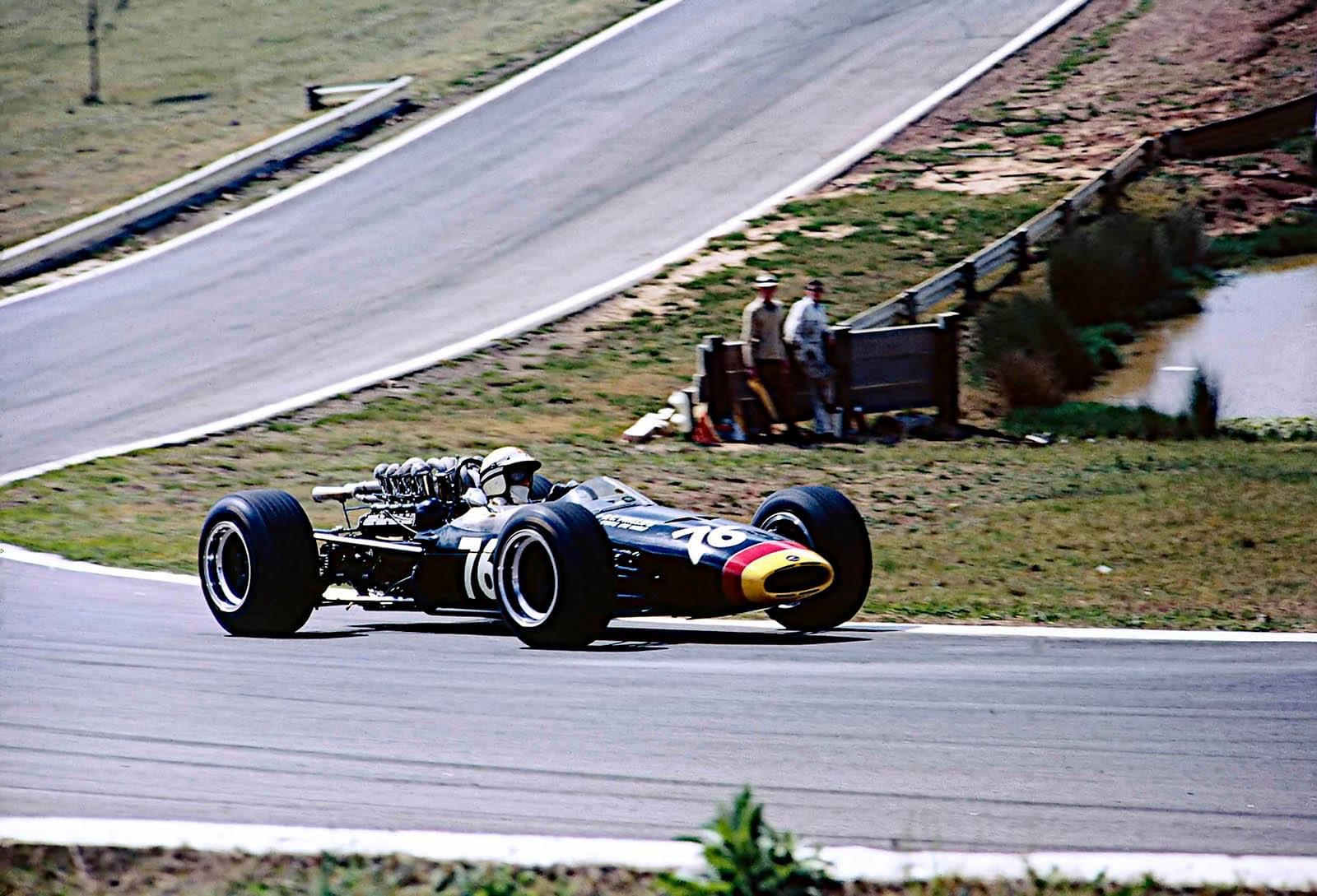
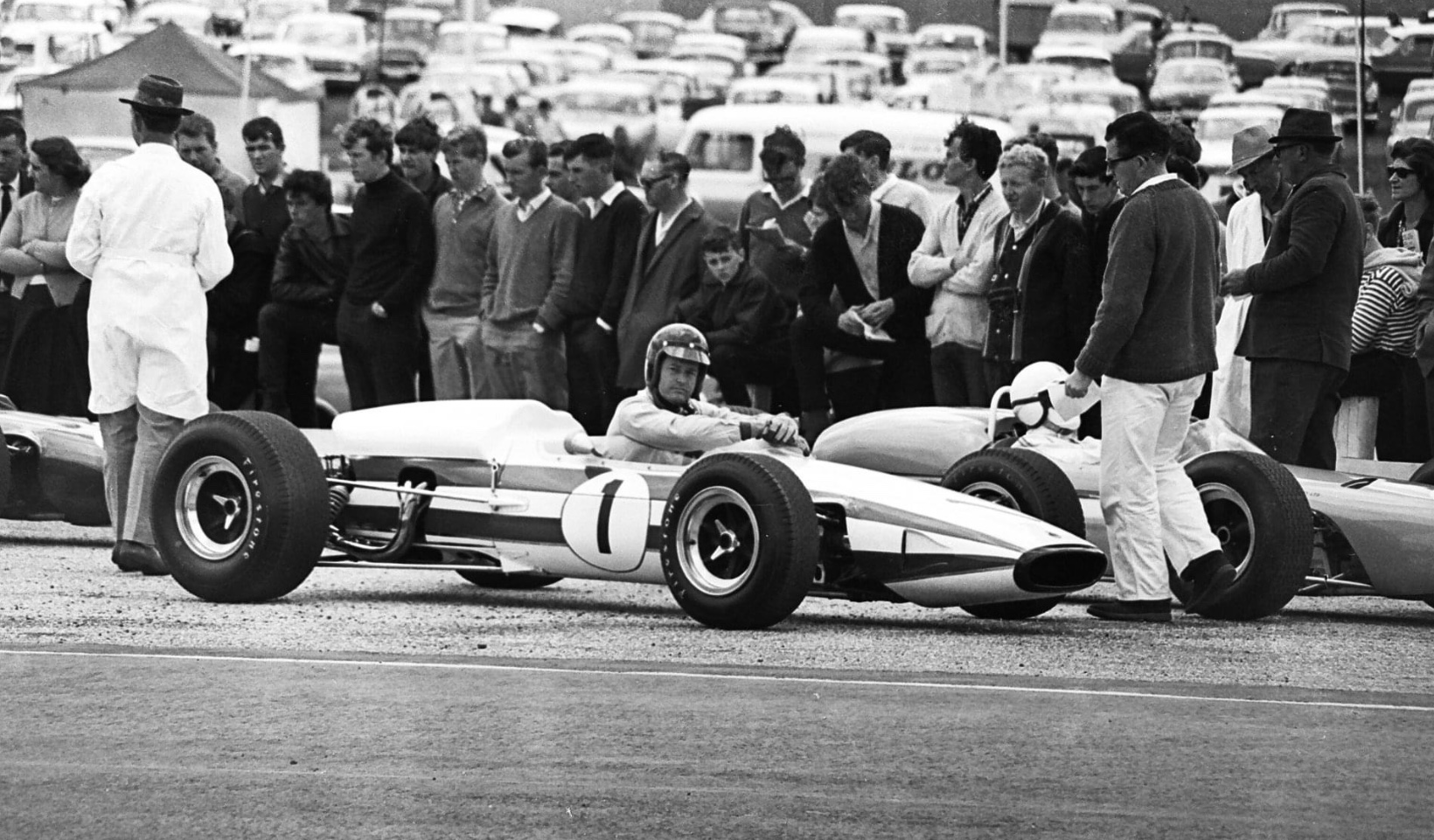
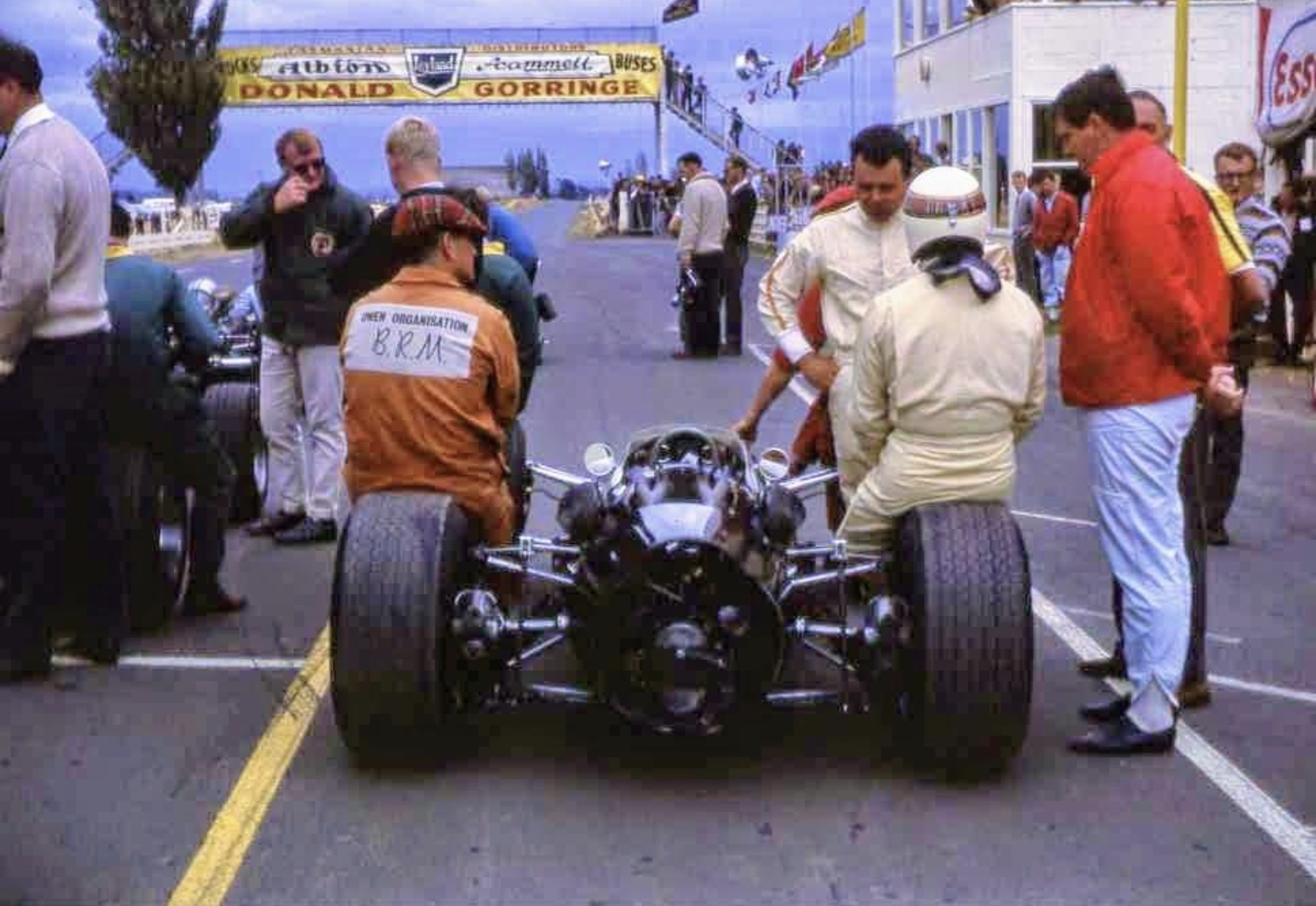
BRM used the 1968 Tasman Cup as an opportunity to win the prestigious series and failing that test its P126/133 V12 machines.

The Bourne outfit raced these Len Terry designed cars in F1 in 1968 and gave them a Tasman run with 2.5 litre variants of the new V12 in addition to 2.1 litre V8 engined versions of the ‘old faithful’ P261s. Click here for a feature on these machines; https://primotipo.com/2018/01/25/richard-attwood-brm-p126-longford-1968/

(J Lemm)

Barry Randall, Rennmax Repco 830 V8 from Bill O’Gorman, Matich SR5 Waggott TC-4V during the 1974 Australian Sportscar Championship round at Adelaide International

The cars initially caught my attention but the magic in the shot is in some ways the backdrop- the spectators doing different versions of Oz ‘chillin.

Randall again below in a car now loved to death by Jay Bondini, a favourite car of mine since it’s Gibson family days.

(J Lemm)
(N Stratton)

Graham McRae on a day for the ducks- the Warwick Farm 100 Tasman round in 1973.

The car is his self-built McRae GM1 Chev- one of THE F5000s of 1972 with Graham himself winning the Tasman Cup

And below hs is togging up before the off with plenty of his own tweaks to the setup of his Bell Star to give some semblance of vision in the race won by Steve Thompson’s Chevron B24 Chev- GM was a distant third behind Thompson and Frank Matich.

(autopics.com)

Michael Robinson (thanks Dick Willis) in the ex-Whiteford/Bailey/Collerson Talbot-Lago T26C in 1969

A famous car in Australia courtesy of back to back AGP win for Doug Whiteford at Bathurst in 1952 and Albert Park in 1953. See here; https://primotipo.com/2019/03/16/1953-australian-grand-prix-albert-park/

(L Morgan)

Love this Bakers Beach, Tasmania run in the early fifties.

Lesley Morgan said of the shot ‘Mum filling in for Geoff Quon, Dads normal passenger with me present as a very small foetus’ ! ‘The 7R AJS outfit clocked 89.1mph even with an inexperienced woman passenger.’

Rally Australia 2016

Aerobatics of the Thierry Neuville/Nicolas Gilsoul Hyundai i20 WRC on the first day of the event at Coffs Harbour, New South Wales on 18 November.

The due finished third in the testing event won by the Andreas Mikkelsen/Anders Jaeger VW Polo R WRC and the similar car of Sebastien Ogier/Julien Ingrassia.

Aussies Abroad

I think we should claim Selwyn Francis Edge even if he was really only born here- the pioneering motorist’s career was entirely in the UK, but let’s claim him all the same.

A topic for another time.

(N Stratton)

John Walker from Chris Amon and John Goss during the 1975 Oran Park Tasman Cup International

Lola T332 Repco Holden, Talon MR1 Chev and Matich A53 Repco Holden- they finished third, fourth and DNF that day, the race won by Warwick Brown, Lola T332 Chev from Graeme Lawrence’s similar T332.

I witnessed a cracker of a tustle for the series win that February at Sandown when the championship went down to the wire three weeks later. It was decided in that final race between Lola drivers Walker, Brown and Lawrence- click here to read about JW’s lucky, unlucky day; https://primotipo.com/2015/03/12/the-mother-and-father-of-lucky-escapes-john-walker-sandown-tasman-1975/

Brown, Walker and Lawrence on the front row of the grid at Surfers in 1975- Lola T332 times three. Walker won from Ken Smith and John Goss that weekend (N Laracy)
(Getty)

Donald Campbell, Bluebird Proteous CN7, Lake Eyre 10 May 1963

‘Returns after an attempt to break the Land Speed Record’, read all about this wonderful, extravagant ‘Boys Own’ adventure and ultimately successful enterprise, here; https://primotipo.com/2014/07/16/50-years-ago-today-17-july-1964-donald-campbell-broke-the-world-land-speed-record-in-bluebird-at-lake-eyre-south-australia-a-speed-of-403-10-mph/

The shot below is Bluebird K7 on its way to a water LSR setting run at Lake Dumbleyung, Western Australia in December 1964. Details of the NSW registered Commer? truck folks?

(F Bathgate)

Daniel Ricciardo leads the chasing Oulton Park F3 pack in 2009.

His weapon of war is a Carlin Motorsport run Dallara F309 Volkswagen- it is the first round of the British F3 Championship on Easter Monday 13 April.

Ricciardo won both races/rounds that weekend and 6 of the competitions 20 races. He took the title with two races to spare from Walter Grubmuller and Renger van der Zande both aboard Hitech Racing Dallara F309 Merecedes.

He progressed to Formula Renault 3.5 in 2010, finishing second in that title in a race to the wire in the final round with Mikhail Aleshin by 2 points. Into F1 with Hispania Racing in 2011.

It’s loose champ! And worn.

Jack Brabham ponders the Trokart allocated him for some type of curtain/fund raiser- Innes Ireland by the look at that helmet is behind him which promises mayhem at the first corner!

Jack’s lid makes me think it’s 1960 but i’m happy for a definitive date and place if any of you have it?

(oldracephotos.com)

Garrie Cooper, Elfin MR9 Chev from Bruno Giacomelli, Alfa Romeo 179 at Calder during the ‘F Libre’ 1980 Australian Grand Prix.

They were seventh and second in the race won by Alan Jones’ Williams FW07B Ford. GC had a shocker of a debut weekend in the worlds only bespoke ground-effects F5000 car, battling structural shortcomings induced by the grip caused.

A story in itself, we never saw this car fully developed and at its best, here Garrie is at Calder again, this time in March 1982 not long before the great Australian’s untimely death by heart failure. Bob Minogue’s ex-Brown/Costanzo Lola T430 Chev is under brakes on the back straight behind.

I’ve lost track of the ownership of this car and it’s proximity to a race some day?

(oldracephotos.com/NHammond)
(unattributed)

Lex Davison and Bib Stillwell contested the Le Mans 24 Hour classic in 1961 in John Ogier’s Essex Wire Racing Aston Martin DB4 Zagato, ‘2VEV’ car #3 here.

1VEV was raced by Jack Fairman and Bernard Consten, but both cars were out early due to incorrectly tensioned head studs which caused popped head gaskets. A bumma.

I wouldn’t mind betting the gent in the blazer and cap almost at far right is Lex Davison talking to the punters, perhaps one of the Davos can set me straight?

See here for a piece on the Victorian’s 1961 Euro Tour; https://primotipo.com/2015/09/22/aston-martin-db4gt-zagato-2vev-lex-davison-and-bib-stillwell/

(H Dennison)

Albert Park, Moomba Tourist Trophy, March 1956

Tony Parkinson quotes AMS April 1956 in his wonderful auslinhealey100s.com.au. ‘Came the patter of running feet, the whirring of starter motors, the roar as the motor burst into life, an occasional  crunch as the over eager hurriedly select first gear: the cars surged forward into now what seemed to be a never ending melee as they sorted themselves out and streamed off towards Melbourne Corner.’

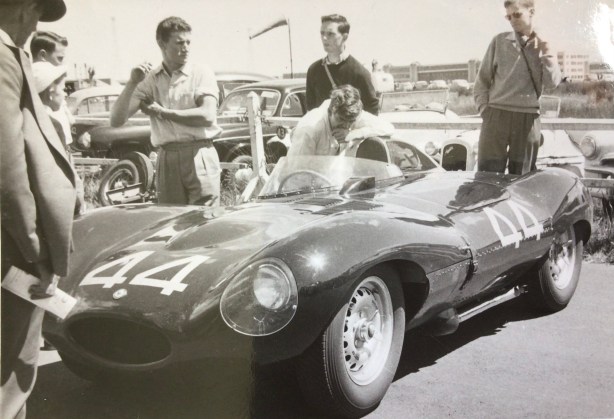
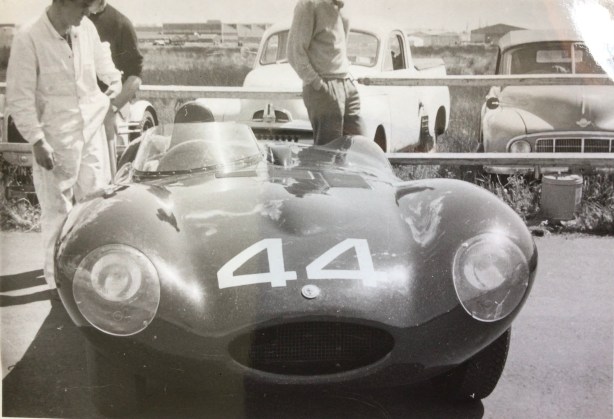
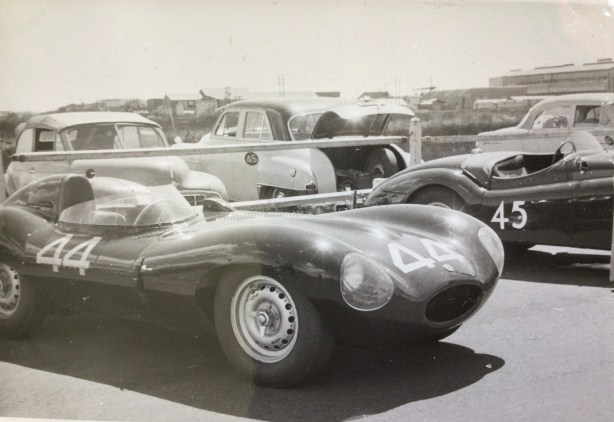
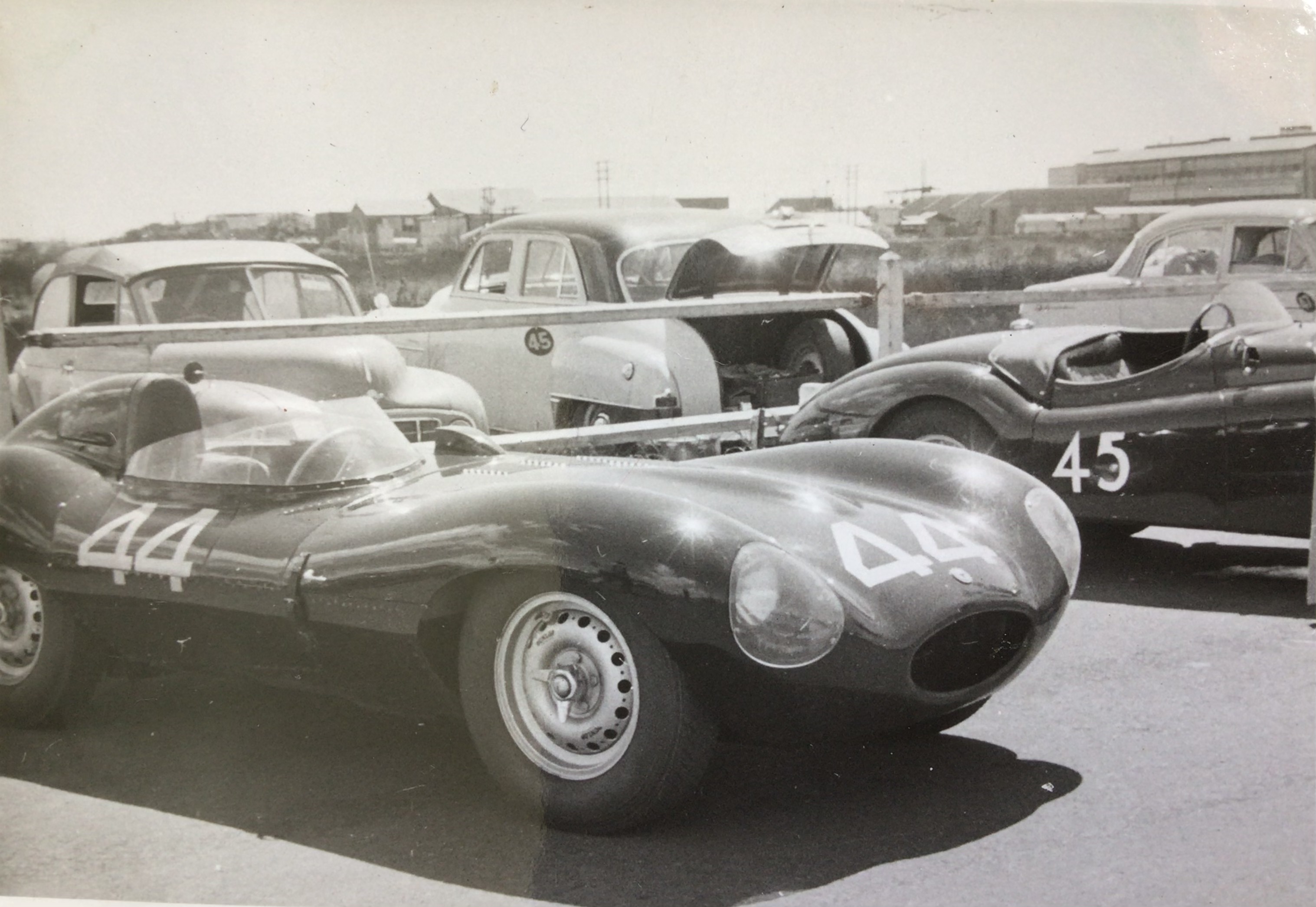
The shots are not of the front of the grid, where some more potent Jaguar engined machines resided, note Bib Stillwell’s new #44 D Type- Tony Gaze won in his HWM Jag from Stillwell’s D Type and then Ron Phillip’s Austin Healey 100S third. Hard luck story of the race was Stan Jones run in his new ex-Whitehead Cooper T38 Jaguar. He built a commanding lead having started well behind the field when the big-six failed to fire on command, but the machine over-heated with a radiator inlet clogged with Albert Park leaves.

(H Dennison)
(A Patterson Collection)

Marvellous shot of Nina Jones (below) aboard her Alfa Romeo 6C1750 Zagato at Bondi in June 1930, wonder who her co-pilot was?

About as good a ‘customer’ racing Alfa as there was, this car raced on in Australia continuously into the sixties in Ford V8 engined form before restoration for another lady racer, Diana Gaze in the eighties.

Jones did FTD of 18 2/5 seconds on the tricky, wet, slippery-concrete flat but slightly curved Bondi main-drag. Obstacles included an errant dog on one run, Jones thankfully missed the dog and crowd in avoidance. 10,000 spectators were estimated to have attended the winter gig.

64 cars entered, they raced in pairs over a quarter-mile course in a knock-out series of contests, ‘the first time races of this sort had been held in Australia’ the Sydney Morning Herald reported. Bill Thompson’s 1930 AGP winning Bugatti T37A was second quickest in 19 1/5 seconds. See here for a feature on this car; https://primotipo.com/2018/02/15/mrs-jas-jones-alfa-6c-1750-ss-zagato/

(A Patterson Collection)

Credits…

Bob King Collection, Jack Inwood, Brier Thomas, Peter Weaver Motorsports Photography, Neil Stratton, Vittorio Del Basso, Terdich Family Collection via Tony Johns, Lesley Morgan, Neil Stratton, Neil Laracy, Adrian Patterson Collection, Sydney Morning Herald 30 June 1930, austinhealey100s.com.au, Tony Johns

Tailpiece…

(A Patterson Collection)

Stunning 1926 Maroubra shot which captures the atmosphere of the place in a way most photographs of the challenging concrete saucer rarely do.

Hope Bartlett’s GP Sunbeam is the scratch car, car ‘B’ is Don Harkness in ‘Whitey 2’ an Overland. Tony Johns tells us the smokey starter is the NA Palmer, V Spurgeon entered Gordon England ‘Brooklands’ model Austin 7, the meeting date June 19, 1926.

Finito…


(B Pottinger)

The only things missing are the chief and three screaming kiddy-wids in the back seat.

Love this fantastic shot of John Colvin’s Haitch-Arrr Holden Station Wagon X2 during a club meeting at Teretonga, New Zealand in 1967.

The HR X2 option on the new ‘186’ three-litre OHV six gave only 145bhp, 5bhp more then the similar twin-Stromberg carb equipped ‘179’ X2 of the fugly predecessor HD.

Me dad had turd brown HD and blinding white HR wagons but ole’ Pete never developed slip-angles like this on the Great Ocean Road.

(gallery.oldholden.com)

Credits…

Bill Pottinger, gallery.oldholden.com

Tailpiece…

Finito…


Ian Mountain and his mates with his self-built, very clever IKM Peugeot Special on the AGP grid at Southport on Queensland’s Gold Coast, November 7, 1954.

Ian gives the photographer a big grin, it’s none other than champion racer Reg Hunt, who is sharing his previously unpublished shots with us via his friend and confidant, Melbourne enthusiast/historian David Zeunert.

The young Montclair Avenue, Gardenvale (now Brighton) engineer first came to prominence racing the MYF (Mountain Young Ford) Special he built together with fellow Royal Melbourne Institute of Technology civil engineering student, Bruce Young.

In the finest traditions of the day, this Ford 4.2 litre V8 two-seater provided day to day transport and a multi-purpose racer including a mount for the 1952 AGP at Mount Panorama. Up front Doug Whiteford won in his Talbot-Lago T26C, while Ian retired after 24 of the 38 laps.

Ian awaits the off in the MYF Ford Spl at Rob Roy circa 1952 (L Hatch)


IKM Spl. Chassis, engine and suspension detail as per text (AMS)

Despite his training, Ian was up to his armpits in all things automotive. He was employed as a Peugeot salesman by Canada Cycle and Motor Co in Latrobe Street, Melbourne. It was to them he turned for components for his next car, the IKM (Ian Keith Mountain) Peugeot Special.

The machine’s chassis was of typical ladder frame type, longerons were of 16 gauge 2 3/4 inches diameter steel tube with four cross members – one at the front, one behind the engine then two at the back, in front of and behind the final drive unit.

Front suspension used Peugeot 203 transverse front springs and stub axles with fabricated top wishbones and telescopic shocks. Steering was 203 rack and pinion, as was the steering wheel.

Rear suspension was de Dion. The bowed tube picked up the hub-carriers and a 1946 Ford V8 diff housing mounted on the frame. This had specially cast side-plates with Dodge pot-type universal joints at each end of the driveshafts. Semi-elliptic springs, radius rods and telescopic shocks completed the package.

The hydraulic brakes use MG TC backplates and shoes with Alfin drums. The wheels were Holden FJ ‘laced’ onto ‘TC hubs- 5 inches x15 in front and 5.5 x 15 at the back, whilst the heart of the matter was a modified 203 crossflow engine.

IKM engine and front suspension. Peugeot suspension and steering components with fabricated top wishbones, MG TC/Alfin brakes. Peugeot engine 1490cc- 80.5mm bore and 73mm stroke, big Wade blower and SU carb (AMS)


IKM ally fuel tank and rear suspension detail- de Dion tube, radius rod and shock mount (AMS)

The standard Peugeot four-cylinder OHV 1290cc unit was bored to 1490cc using custom made Rolloy pistons and sleeves. A big Wade R020 blower fed by a 55mm SU carb giving about 6 pounds of boost was mounted on a frame ahead of the front suspension and chain-driven from the front of the crank. Extractors were fabricated, a Scintilla Vertex magneto gave the sparks, Peugeot provided a competition fuel pump and exhaust valves. Inlets and valve springs were standard but the valve gear was lightened and polished as were the rods and crankshaft before balancing. The compression ratio was 6:1.

The engine was mounted to the left in the frame to allow a driveline left of centre and therefore a nice, low seating position. An MG TC gearbox mated to the bellhousing easily, 22 gallons of fuel were carried in a rear mounted tank.

Neil Coleman’s ‘shop in North Melbourne built the light aluminium body with the light, low purposeful car beautifully built and finished. IKM weighed 9cwt, had a wheelbase of 7′ 6″, front track of 4′ 2″ and a rear track of 4’, ‘so the car is not really a small one, belying its looks’ AMS reported.

After testing in the quiet(!) of the Geelong Road Ian ran the machine at the Beveridge and Templestowe Hillclimbs in chassis form, and then at Fisherman’s Bend with its body fitted. He finished two races despite fuel feed problems caused by shortcomings in the manifold design.

Ian married Laurel Duguid in the Scotch College Chapel at Hawthorn on November 2, 1954 then the couple set off for Southport and the 1954 AGP, what a honeymoon! Lex Davison won in his HWM Jaguar with the IKM retiring after 11 laps. Ian’s radiator drain tap was opened slightly by vibration of the body panels which allowed the water to escape, the travails of new cars.

Peugeot 203 and IKM Spl ready for the long Melbourne-Gold Coast November 1954 AGP trip, Gardenvale to Southport is 1,725km each way (L Hatch)


Ian looking around for his crew at Gnoo Blas, long, low lines of the innovative IKM Pug clear (K Devine)

After a relaxing Port Phillip Bay Christmas/New Year the newlyweds set off from Melbourne for the South Pacific Trophy at Gnoo Blas, Orange, New South Wales over the January 31, 1955 weekend.

Australia’s first FIA listed international meeting featured the Ferrari 500/625s of Peter Whitehead and Tony Gaze, Jack Brabham’s Cooper T23 Bristol, Dick Cobden’s Ferrari 125 and Bira’s Maserati 250F and Osca V12 amongst others.

Two cars in Connaghan’s Corner after the right-hand Mrs Mutton’s Corner and then the downhill The Dip. Ian has lost adhesion and left the circuit on the outside, his crashed car is visible with officials well away on the left as, perhaps, the South Pacific Trophy takes place. Superb, rare angle of this section of this road circuit whilst noting the sad scene Reg Hunt reveals


Sadly, oil which spewed from Bira’s Osca V12 probably led to the awful accident which cost 25 year old Ian and a young spectator in a prohibited area their lives on the fast, downhill run out of Connaghan’s Corner, see here for a feature on this meeting; https://primotipo.com/2020/04/09/1955-south-pacific-championship-gnoo-blas/

Reg Hunt’s Maserati A6GCM 2.5 litre was entered for the meeting but necessary spares were late arriving from Italy so he prowled the circuit with his camera instead.

Laurel remarried in 1960, the IKM remains passed to Ian’s brother Ken who later sold them to Harry Firth. Ian Tate, who admired the car in the day, later acquired it and is in the gradual process of restoration.

Path of the car clear through the fence from the previous shot from up the hill towards Connaghan’s Corner.

Whilst components off the crashed machine have been placed on the wreck and in the cockpit the barbed wire fence, wrapped around IKM Spl, which provided some of Ian’s fatal wounds is clear. When the worst happened on those tracks in those days, lady luck either was, or was not present. Unseen by Ian that day sadly

Stunning, most significant photographs, many thanks Reg, David.

Credits…

Australian Motor Sports, December 1954, ‘Ian Mountain: Potential Unfulfilled’ Paul Watson, Reg Hunt photographs via David Zeunert Archive, Ken Devine Collection, Gnoo Blas Classic Car Club

Tailpiece…

Finito…
(J Dallinger)

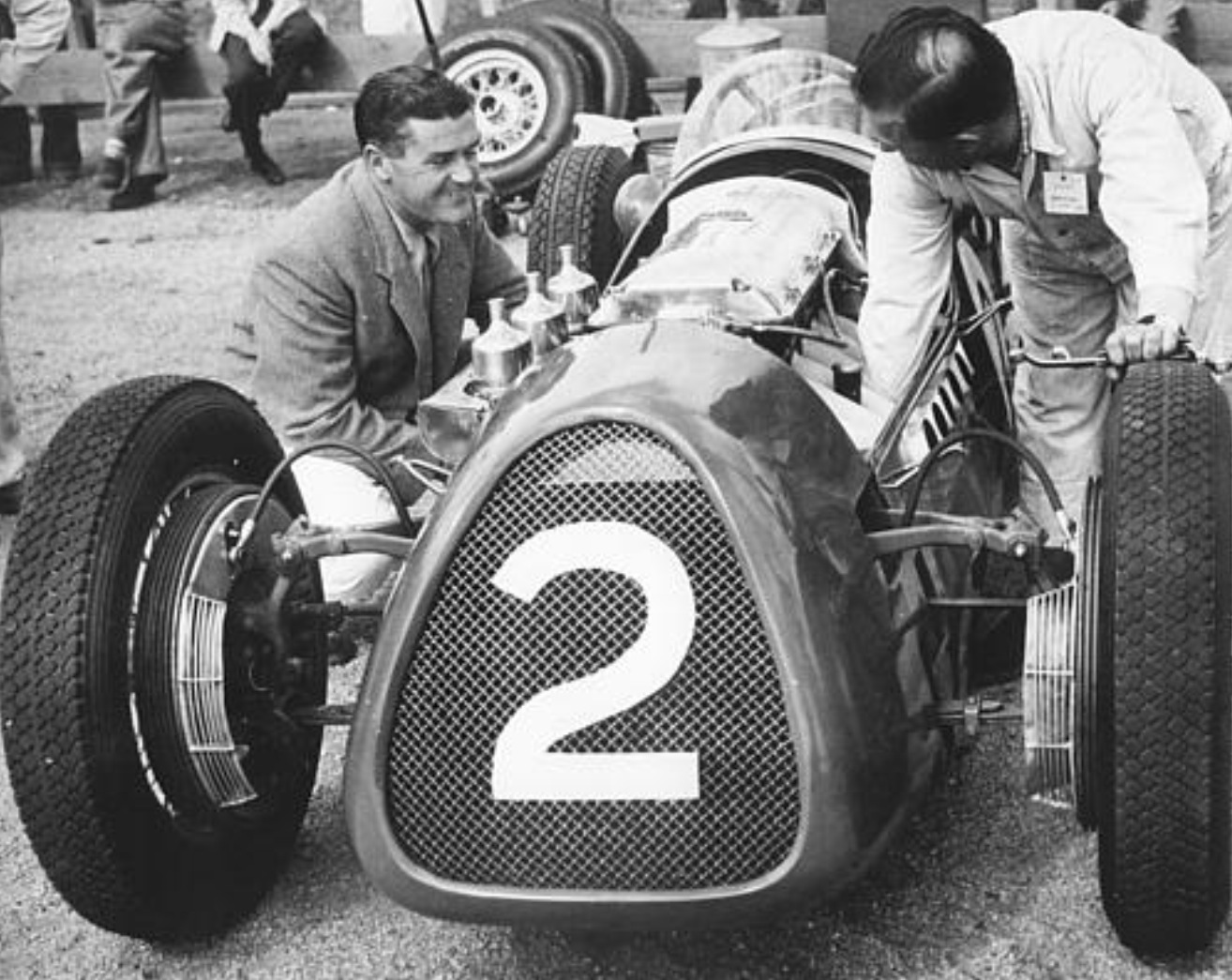
Jack Phillips and Ted Parsons looking happy with themselves aboard their Ford V8 Special having won the Interstate Grand Prix at Wirlinga, Albury on 19 March 1938.

The Ford V8 found its way into all kinds of Australian specials both pre and post war, this was one of the most beautifully built and successful of them all. See here for a piece on this race; https://primotipo.com/2019/01/11/interstate-grand-prix-wirlinga-albury-1938/

These two mates were business partners in a motor dealership in Wangaratta which distributed Ford and other brands. I wonder if one of the admiring, capped kids is Jack’s son Ron Phillips who was a star in an Austin Healey 100S and Cooper T38 Jaguar in the mid-fifties to early sixties?

It’s pretty boring writing about familiar stuff, the journey of discovery is far more engaging. I think a lot about racing in the context of the times, how people lived, what they did with their leisure hours but it’s not necessarily easy to find the right photographs.

Not so this time, John J ‘Jack’ Dallinger ran a photography business, which still exists in Albury. Along the way, he and his staff recorded the daily lives of the citizens of the border city and surrounds, I’ve chosen some images of typical life justaposed with racing shots. All of the photographs were taken by Dallinger and his team in Albury in the thirties, unless attributed otherwise.

Locomotive’3623’ leaves Albury Station during the thirties. Obviously some sort of special occasion for the train to be decorated as it is


Albury Show wood-chopping competition, takes me back to watching the O’Toole brothers on Channel 7’s Sunday ‘World of Sport’ in the sixties


Motorcycle racing blazed the trail for cars in just about every sphere of competition in Australia, speedways included.

This is Aub Boyton aboard a Douglas, perhaps a 500cc DT5 or DT6- Douglas being one of the most popular and successful speedway bikes of the era.


Jim Boughton, Morgan at Wirlinga in 1938.

A year later this car had morphed into a single-seater in time for the Australian Grand Prix at Lobethal the following January, he failed to finish the race won by Allan Tomlinson’s MG TA Spl s/c. Better still, the Morgan remains extant.

Boating on Lake Hume, 1940s


Out and about in an Austin 7, this one is fitted with a James Flood built two seater sports body.

Of all steel and ash construction, the machine used a factory supplied radiator cowling forward of which was a fairing covering dummy dumb irons onto which was painted the registration number. The running gear comprised a production Austin chassis and mechanicals with a raked steering column.

Large flowing wings kept the elements from the occupants. ‘As was fashionable with many Australian models of this period, fixed split front windscreens were mounted on the scuttle with no provision of any weather protection’, many thanks to Tony Johns on this little Austin.

Keen spectators taking a look at competitors in the Wirlinga paddock prior to the 1938 Interstate Grand Prix.

Car #3 is Tim Joshua’s Frazer Nash, not too far from being restored, alongside is former Maroubra ace Hope Bartlett’s MG Q Type and then car #6, the winning Ford V8 Spl of Phillips/Parsons.

Cricket match near Tallangatta


Billycart race in Pemberton Street, Albury 1940s.

Too much roll stiffness? is that right front taking some air. I wonder if either of these two young tyros progressed to motorised competition?

I’m sure one of you will be able to help with the Dodge Ute model year, 1930s, i’m also intrigued to know the address of Albury Motors Pty. Ltd.

The CA Williamson Chrysler ahead of G Winton, AC and L Evans Vauxhall, Wirlinga 1938.


Waterskiing on Lake Hume


Golden Arrow on display in Albury, a bit on the machine here; https://primotipo.com/2019/06/04/wot-the-bloody-ell-is-that/

Bill Boddy, in MotorSport, wrote that after an exhibition tour of Australia the car returned to England, that line is written in such a way which implies the car made the trip here after setting the Land Speed Record at Daytona at 231.446 mph on 13 March 1929. So, its later in 1929, the machine was owned by the Wakefield Company, clearly a lot of Castrol lubricants were sold here at the time.

Sir Henry Segrave was later killed aboard ‘Miss England II’ on 13 June 1930 after raising the Water Speed Record to 98.76 mph at Lake Windemere.

Tony John’s sent in a snippet from the April Fools Day edition of the 1931 ‘Bulletin’. “Drag” wrote ‘It is not often that one finds a car that has travelled 43,000 miles without an overhaul, and a racing car at that…the late Segrave’s Golden Arrow…left England on February 6 for the Buenos Aires exhibition after having made a tour of the Dominions. All its journeying has been done on board a ship, with the result that it has covered, by this means, over 1,000 times the distance it has done under its own power.’

Albury Gift finish 1939


‘NBN man’ on the road- make, model and year folks?

Credits…

John J Dallinger, Tony Johns Collection, Terdich Collection-VSCC scanned by Graham Miller and shared by his son David via Tony Johns

Etcetera…

(Terdich Collection via VSCC and Graeme and David Miller)

After upload our friend Tony Johns got in touch with these photos, ‘Having read your post i now understand the origin of these two photos in the Arthur Terdich Collection (winner of 1929 AGP @ Phillip Island). I was not aware the Golden Arrow ever came to Australia’ nor was I.

Some quick work on Trove reveals the car did a comprehensive tour of Australia in April-May 1930 taking in the west, and eastern seaboard, with over 70,000 people reported as seeing the car in Sydney’s showgrounds.

23.9 litre Napier Lion VIIA W-12 engine produced 930bhp @ 3,400rpm. Designed by John Samuel Irving and built at Kenelm Lee Guinness’ Robinhood Engineering Works Ltd, at Putney Vale, in 1928. First run in January 1929, LSR of 231.362mph at Daytona on March 11, 1929.

Terdich was a Melburnian so the above photograph was probably taken at the Royal Exhibition Buildings in the first week of May, ‘Motorclassica’ is held there these days, car shows continue at the marvellous old venue.

Checkout the rare, period cockpit shot of Bluebird below, it is not clear if Bluebird was touring at the same time as Golden Arrow.

‘Not sure that a current F1 driver would have time to read all the instruments’ Tony wryly observes. There are ten gauges to take in whilst travelling over 200mph- tach, petrol, blower (pressure or temps?) , one obscured, a clock!, then to the left are a car club and St Christopher badges?, then an adjustable knob on the chassis rail itself. On the right are axle temp, water, another temp gauge with another two at the bottom, plus Malcolm Campbell Ltd and Blue Bird brass plates.

(Terdich Collection via VSCC and Graeme and David Miller)

Tailpiece: Albury Sports Ground 1930s…

Finito…


(B Henderson)

Peter Macrow, McLaren M4A Ford FVA leads Kevin Bartlett, Mildren Alfa Romeo 1.6 four-valve, Glynn Scott, Bowin P3 Ford FVA and Brian Page, Brabham BT2 Ford twin-cam, across The Causeway at Warwick Farm on 8 September 1968.

24,000 people were at the ‘farm that Sunday, Pete Geoghegan delivered to expectations by winning the one race, 34 lap, 76 miles Australian Touring Car Championship from Darrel King’s Cooper S and Alan Hamilton’s just ‘orf the boat Porsche 911S/T. Peter Wherrett’s ‘Racing Car News’ race report reveals one of the best tussles of the day was the 15 lapper for racing cars.

The Four Valve Assemblage was not quite complete, the fourth member of the growing group of 1.6 litre Euro F2 cars in Australia, Niel Allen, didn’t race his ex-Piers Courage McLaren M4A FVA. A bumma, because that would have added to the show.

KB settles himself into the Mildren Alfa, note spoilers, ‘new.uw’ is local 2UW radio station (B Henderson)


Lovely portrait of Glynn Scott, Niel Allen is telling Glynn how much more expensive the FVA is to maintain compared with the 5 litre Chev in his Elfin 400…(B Henderson)

Macrow was the ‘newbie’ to the front rank having shown great form in Tony Osborne’s Argo Chev sportscar since taking over its wheel early in the year after Ian Cook accepted Bob Jane’s offer to drive his Elfin 400 Repco and crossed town from Brunswick to East Malvern.

Osborne realised that the limits of the Cooper T53 based Argo had been reached, and acquired Kiwi, Jim Palmer’s McLaren M4A after Allen beat him to the punch to buy Courage’s quick 1968 Tasman mount. Palmer’s car was Bruce McLaren’s own machine, chassis ‘M4A-1’, the first of the breed raced by the chief throughout the 1967 European F2 Championship. Piers was ‘well represented’ on this grid, Glynn Scott’s motor was Courage’ Tasman Cup spare.

Kevin Bartlett was the ace present, but the Mildren Alfa, built on Bob Britton/Rennmax Engineering’s Brabham BT23 jig, was ‘spankers and unsorted. Mildrens dynoed the Alfa Romeo 1.6 litre, four-valve, Spica/Lucas injected engine at 197 bhp @ 8,500 rpm, whereas about 210/215 bhp was claimed for a decent FVA, so it promised to be a good race with Bartlett on pole from Macrow and Scott.

Mildren Alfa, KB. Copy Brabham BT23 spaceframe, Hewland FT200 5-speed transaxle. Alfa Romeo 1598 cc four-valve, alloy block, injected Euro F2 engine. At 280 pounds the Italian engine is lighter than a Lotus-Ford twin-cam? It sits taller in the frame? (B Henderson)


Bartlett at the end of Pit Straight turning into Paddock (B Henderson)


(B Henderson)

Peter got the jump, which was impressive in Bartlett’s backyard, from KB and Glynn and then a gap to to the 1.5 litre cars led by Brian Page, Brabham BT2 Ford, Clive Millis, Elfin Mono Ford, Maurie Quincey, Elfin 600B Ford, Ray Cary, Elfin Ford and the rest.

On lap 2 KB had a crack at Macrow going into Creek but spun on oil on the inside of the track, KB recovered and chased Peter and Glynn in the spectacular tail-out style which was his hallmark. By lap 8 he was up Glynn’s clacker and passed him but further progress was impeded by the chassis undertray coming loose, Scott took back second place.

Scott chased Macrow hard but the Victorian held on to take the biggest win of his career to that point from Scott and Bartlett, Tony Osbornes’s Argo Racing Equipe delighted with a well earned victory.

Credits…

Bryan Henderson took all the wonderful photographs. ‘Racing Car News’ October 1968

Tailpiece…

(B Henderson)

Nice portrait of 28 years old Kevin Bartlett getting his head sorted on the Warwick Farm dummy grid before the off. It was a great year for the Sydneysider, he won his first Gold Star at the wheel of Mildren’s Brabham BT23D Alfa Tipo 33 2.5 V8.

This chassis did not use the Alfa engine for long, Max Stewart raced it from 1969 fitted with Waggott TC-4V 1600 cc, 1760 cc and 2 litre motors with great success.

Finito…

(Brabham Family)

Brabham’s Cooper T23 Bristol was billed as the fastest car of its type in the world as a Jack’s ongoing development of it with Frank Ashby’s advice and mentoring off to the side.

These images from the Brabham Family Collection were taken at Mount Panorama during the Easter 1954 meeting, the start of the A-Grade scratch race.

Jack’s T23 being tended by Keith Holland in the white overalls and Arthur Gray of Belshaw Foundry in the blazer (Brabham Family)

I’ve done Cooper Bristols and Jack’s T23 chassis ‘CB/1/53’ to death, here; https://primotipo.com/2017/02/24/the-cooper-t23-its-bristolbmw-engine-and-spaceframe-chassis/ and here; https://primotipo.com/2016/06/24/jacks-altona-grand-prix-and-cooper-t23-bristol/

The other two photos are at Mount Druitt, Stephen Dalton reckons June 27 1954 or 8 August 1954, thanks to Stephen and John Medley for photo IDs.

Credits…

Brabham Family Collection, ‘The Jack Brabham Story’ Jack Brabham with Doug Nye, Stephen Dalton, John Medley

Tailpiece…

(Brabham Family)

Finito…

I’ve been lovin’ these S5000 retro F5000 digital imaging of the Ligier JS-F3 S5000 Ford chassis, its been a great way to keep S5000 in the public eye whilst we package up the Covid 19 Dim Sims and send them back to those Wet Market pricks in Choina so we get back to normality.

Finally, they’ve got to Bruce Allison, and what do they dish up? Not the worlds best rip-off of JPS black, but the poofhouse baby-blue hue applied to his Bill Patterson supported Chevron B37 Chev in the summer of ’78. W.T.F. dudes!?

Allison, Chevron B37 Chev, Surfers Paradise 1978, started from the front row but out after 40 laps with lost oil pressure. Brown won in a Lola T333/332 (S5000)


Satanic, sinfully sexy black ‘n gold pin-striped Lola T332 Chev @ ‘Torana’ Sandown circa 1976 (I Smith)

My tongue practically stuck to the grass, sick unit that i am, when i spotted Bruce’s favourite (sic) car, the ANF2 Bowin P6 Ford-Hart in the Surfers Paradise paddock so equipped in September 1973. His subsequent Birrana 274, Lola T332 and Ralt RT4 all got a squirt from the same paint can, gold stripes and all, and didn’t they look grouse! Maybe its comin’…
Anyway, its been a while since i had a Brucie Google and some good stuff popped up, shots of the 1978 Aurora British F1 Championship, he initially ran a RAM Racing March 751 Ford but copped a much better March 781 chassis mid-season and achieved some good results including a win at Mallory Park in July, holding out eventual champion, Tony Trimmer, in the process.

This one is rare as rocking horse shite, Allison in Mario Deliotti’s Ensign N175 Ford in practice, he didn’t start the Evening News Trophy at Brands on 27 March which is a pity as he qualified third behind Trimmer and Lees.

Tony Trimmer’s McLaren M23 won from Geoff Lees, Ensign N175 and Emilio Villota’s McLaren M25 Ford.


Oulton Park F1 Trophy, held on June 24, March 751 Ford, he qualified fourth and finished second behind Guy Edwards’ March 781 Ford.


These two are at Donington during the May 21 ‘Formula 1 Trophy’.

Practice shots, DNF without completing a lap, March 751 Ford, Giancarlo Martini won in a Ensign N175 Ford from Edwards’ March 781 and Bob Evans’ Surtees TS19 Ford.


At Mallory on 30 July Bruce put his new March to good use with Trimmer’s McLaren up his chuff for much of the 75 lap race, he finished ahead of Tony and teammate Guy Edwards in the other RAM 781.

Looks like the photographers all share a beer together at the hairpin, Allison from Trimmer.


The Brands Hatch Trophy was on August 28, the tenth round, Stephen South stirred things up by popping his March 782 Ford on pole, five cars failed to finish the first lap- South, Teddy Pilette’s BRM P207 (poor bastard), Adrian Russell’s March 762 Ford, Brett Riley’s similar car and Bruce, what happened folks?

The shot below is Bruce and Edwards’ 781s in practice.


The Budweiser Trophy at Snetterton on September 24 was the last round of the season, Emilio de Villota McLaren M23 was on pole from Bruce, David Kennedy won in the Theodore Racing Wolf WR3 Ford we saw him race in Australia, from Trimmer and Allison.

The shot below is Allison from Trimmer and one of the Hesketh 308Es.

The title was Trimmers, 50 points ahead of Bob Evans, De Villota, Edwards, Lees and Allison.

Etcetera…
(J Payne)

The first and last of the Allison black beauties.

At Amaroo Park in August 1973 in the ANF2 Bowin P6 Ford-Hart, the rising-rate suspension beauty was not his favourite car, out of the points that weekend, Bruce did far better with a Birrana 274 in 1974.

Having retired too young Allison did a Nellie Melba and contested the first season of Formula Pacific in this Ralt RT4 Ford BDA, winning the 1981 National Panasonic Series, this shot is at Calder in August, he was second and fifth in the two races.

(P Weaver)

Credits…

S5000, autopassion.net, MotorSport, Rich Harman, Ian Smith, Scuderia57, J Payne, Peter Weaver

Tailpiece…

(I Smith)

Love this shot, Bruce tipping the B37 into Shell at Sandown during the 1978 Rothmans round. Grid 5 but DNS with timing chain failure, Warwick Brown’s Lola T333/332 took both the round and the series.

The car did look great in this livery but nowhere near as good as it would have in Allison/JPS black ‘n gold!

Finito…