
(George Thomas)
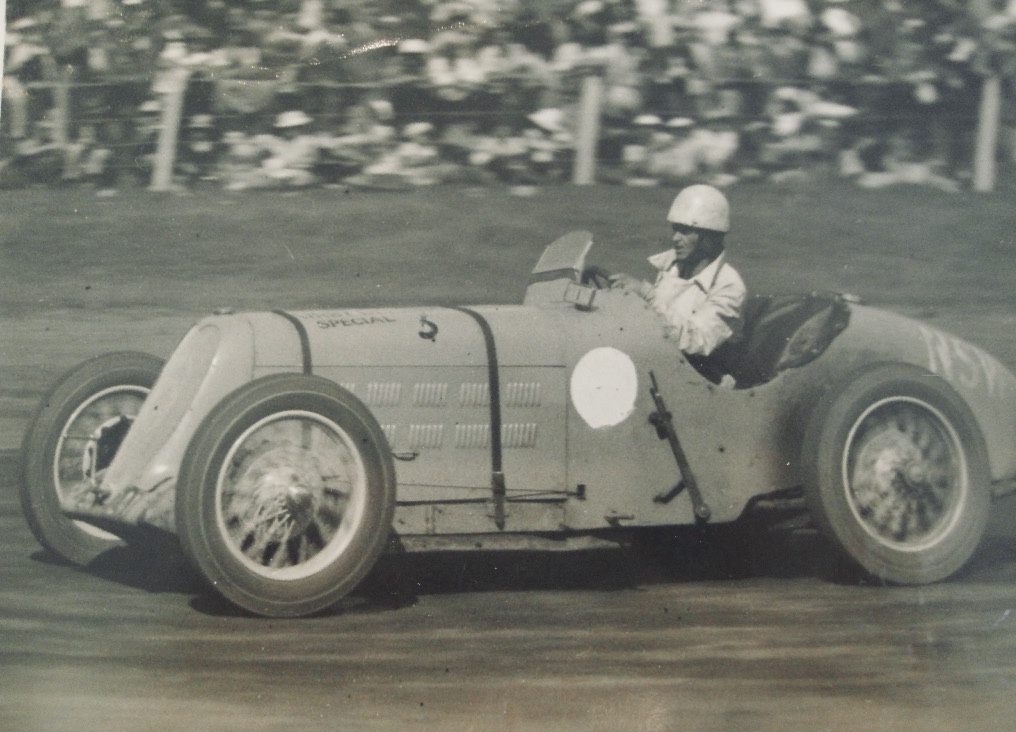
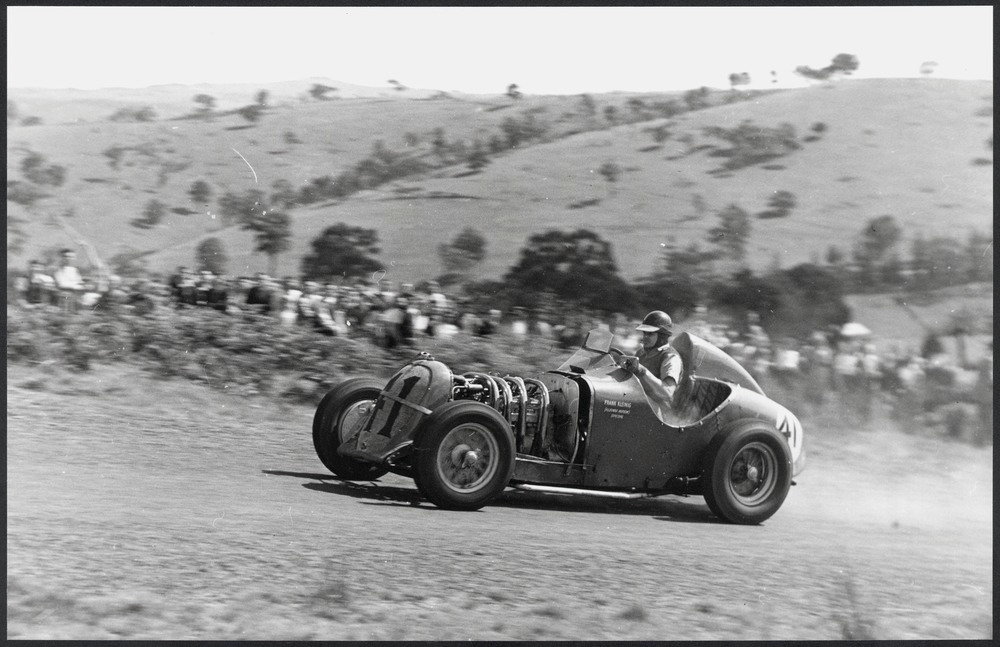
Frank Kleinig, awesome driver that he was, attacks Rob Roy Hillclimb, left front pawing the air in his self built Kleinig Hudson Spl, 1947…
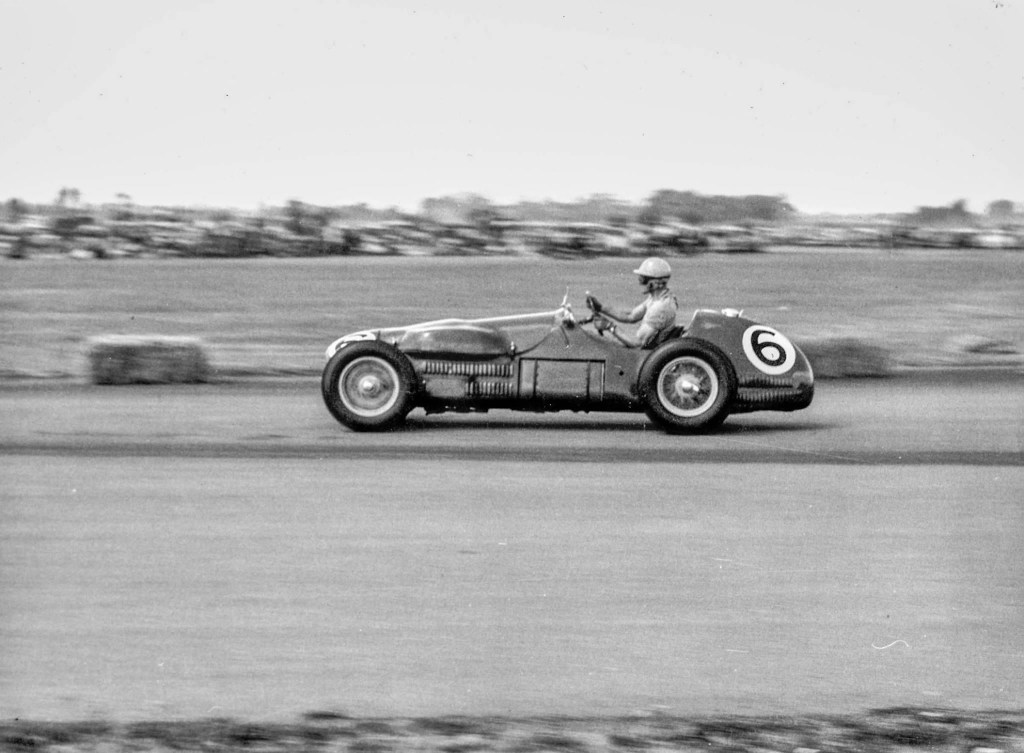
He won the Australian Hillclimb championship twice, at Rob Roy in 1948 and Hawkesbury in 1949, on both occasions at the wheel of this iconic and still extant Hudson straight-8 powered special.
Frank Leonard Kleinig was born on 10 November 1911 and died on 27 May 1976- he was one of the greatest of Australian racers of the inter and early post-war period who really should have won an AGP or two but never quite pulled it off in a career which went all the way from 1936 into the dawn of the sixties.
This is far from a complete history of the man but rather a story built around the ‘Kirby-Deering Special’ aka the ‘Kleinig Hudson Special’. Please treat the article as ‘work in progress’, some of you will have records that I do not, not least David Rapley who restored the car for its Melbourne enthusiast owner Tom Roberts.
I thought, ‘i’ll chuck it up with what I have and modify from there’ rather than try for perfection before uploading.
Mind you, the work online of John Medley and Bob King have unearthed some amazing fresh photographs from the Kleinig Family Collection via Daniel Kleinig and other information in the last couple of weeks. My contact is mark@bisset.com.au. The thing is 10,000 words now, a two beer read, let’s go for another 2,000 or so of detail…
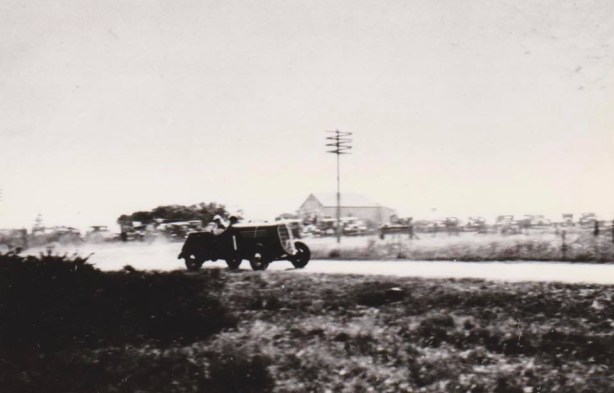
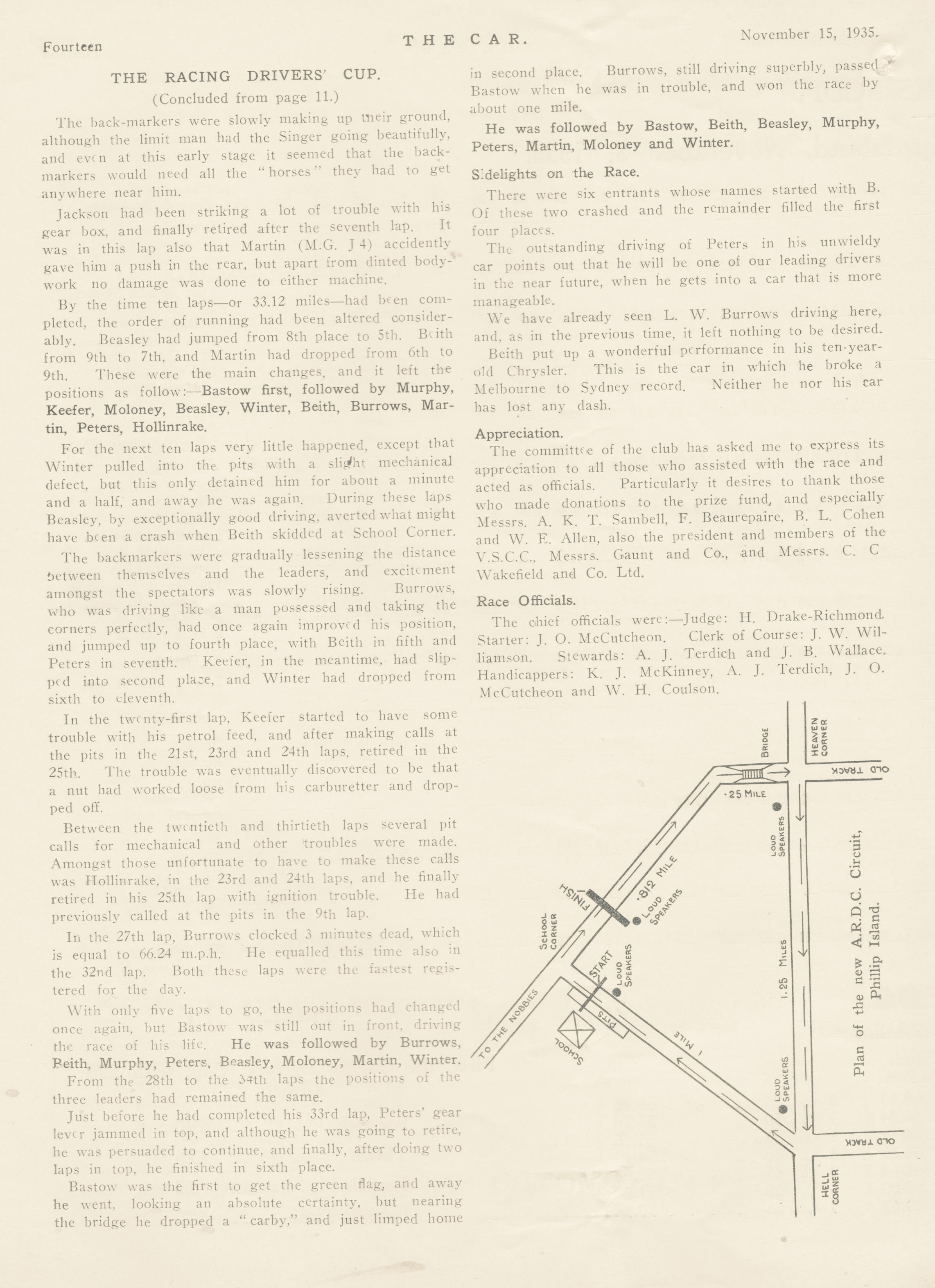
The ill-fated Buckley/Kleinig combination aboard the McIntyre Hudson at Phillip Island in November 1935 (B King Collection)
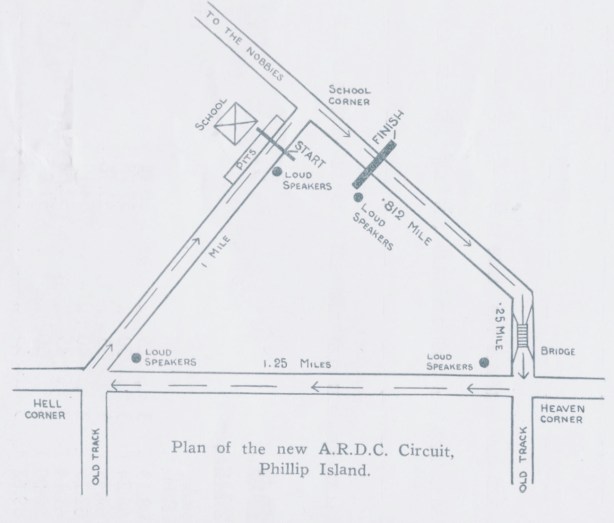
‘The Car’ 15 November 1935 via (B King Collection)
John Medley advises that young mechanic Kleinig’s opportunity to race came about due to the misfortune of his boss at Kirby Engineering, EJ ‘Joe’ Buckley who had established his own competition reputation as an inter-capital record setter of considerable national renown.
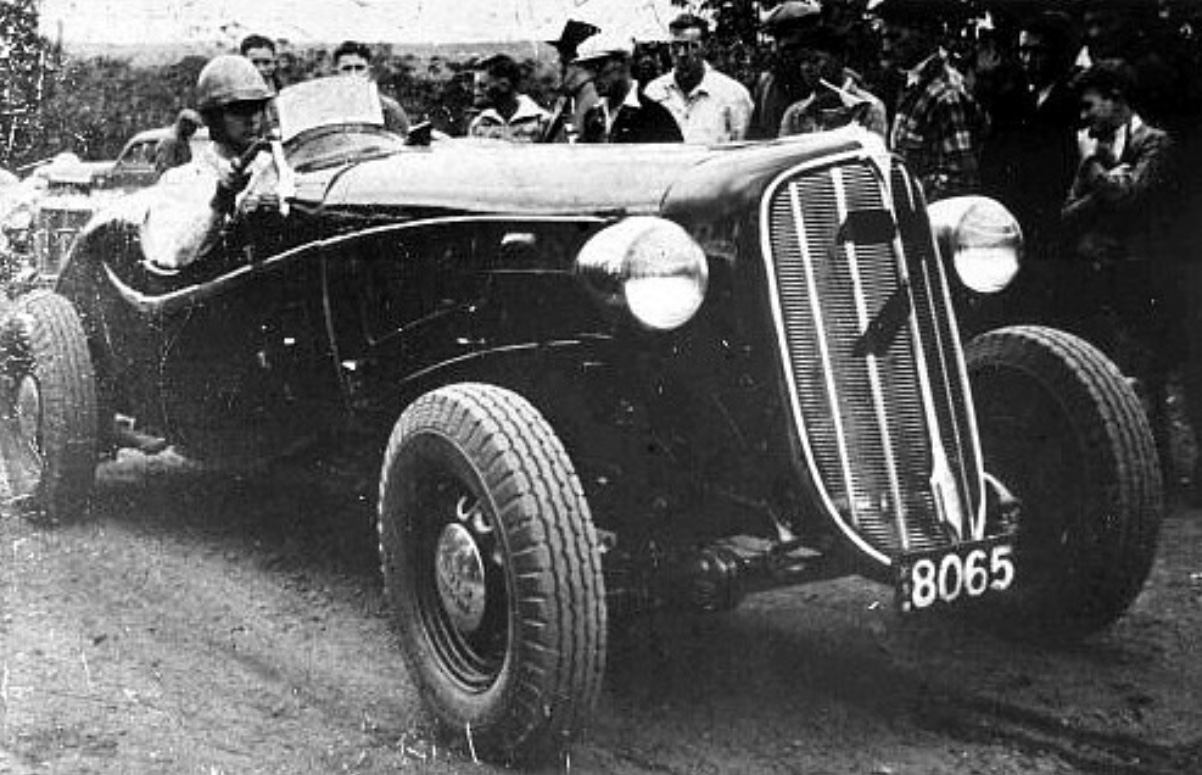
Kleinig, employed by Kirby’s, accompanied driver Buckley who was racing one of the two racers owned by ‘McIntyre’s Picture Circuits’ theatre owner/entrepreneur William August ‘Gus’ McIntyre at Phillip Island for the first race meeting held on the new 3.312 mile ‘triangular road course’ on the Melbourne Cup long weekend, 6 November 1935.
Gus owned both the McIntyre Hudson/Hudson Special, a modified Hudson drophead and was in the process of construction of the Kirby-Deering Special (KD) a wild, Miller supercharged straight-eight powered racer of more anon.
Phillip Island in its original rectangular, circa 6 miles form, with its narrow, undulating, fast and dangerous gravel/sand surface was deemed too hazardous to hold the Australian Grand Prix, so a shorter course was mapped and used. It seems the last meeting on the original track was the ‘Winter 100’ handicap 100 miler won by Alf Barrett’s Morris Cowley Spl on 3 June 1935.
The new layout formed a ‘traditional triangle’ and included the whole of the old Pit Straight, inclusive of ‘Heaven’ and ‘Hell’ corners with the apex of the triangle formed by ‘School’ corner.
Buckley, with Kleinig as riding mechanic was entered in the all-comers 116 mile handicap ‘Australian Race Drivers Cup’.
John Medley wrote that the start/finish line was opposite the School House. Buckley, who started from scratch carrying #1, crashed at School House Corner, almost but not quite completing the first lap. The car rolled, Buckley’s feet were caught in the pedals with Kleinig thrown clear, badly bruised but ok.
Spectators and officials rushed forward, rolled the hefty Hudson back onto its wheels. The badly injured Buckley- who broke his back either in the initial roll or the Good Samaritan one which followed, was hospitalised in Melbourne’s Alfred Hospital and later a Sydney facility for months, never to race again.
The Melbourne Age speculated that the accident was caused by the very dusty conditions and a bump ‘wide out’ which he is thought to have hit, ‘tripping’ the car, but the race promoters, the ARDC were having none of that- ‘It was claimed that the dust on the corner was responsible, but this is wrong, as there was not a car within two-hundred yards of School Corner at the time. It appears that he was trying to make up his handicap of over sixteen minutes, and took the corner a trifle too fast…’
Bowral’s Les Burrows, in another Hudson Terraplane won the race in 1 hour 47 minutes 21 seconds, an average of 64.83mph (see Etcetera section at this pieces end for a bit more about Les) from the G Bastow, Singer Le Mans and Harry Beith’s Chrysler.
Whilst Buckley was being looked after in hospital Kleinig repaired the car and drove it back to Sydney- and shortly thereafter was offered the drive by McIntyre.
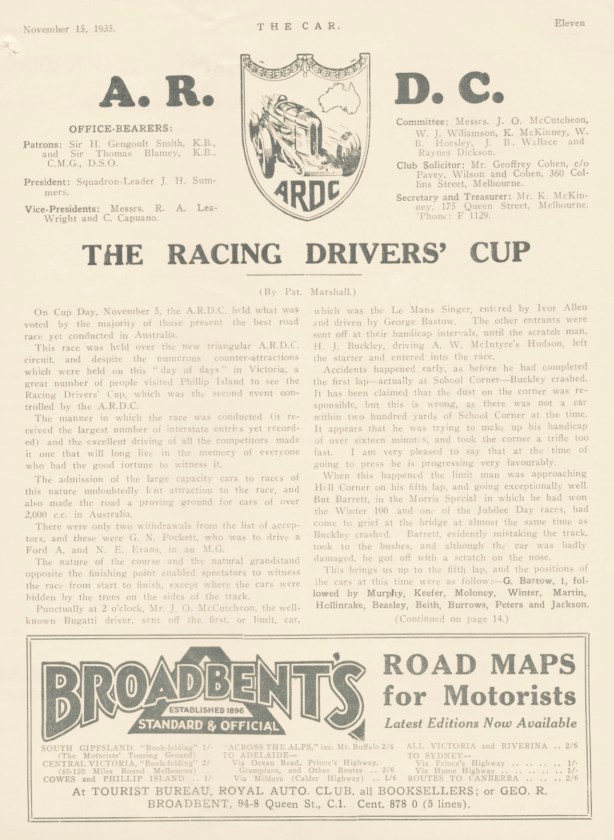
(B King Collection)
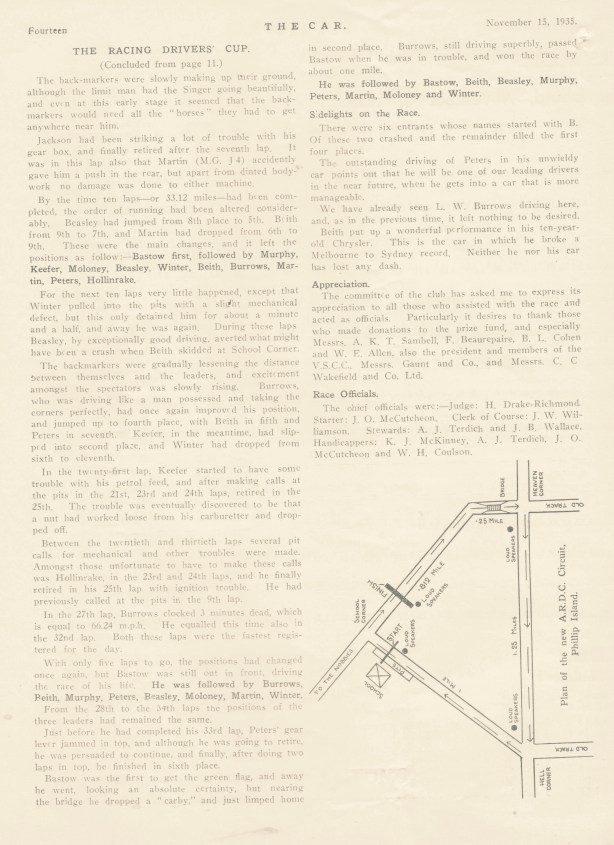
(B King Collection)
Clive Gibson, Kleinig employee and later owner of the McIntyre Hudson, said to John Medley that FK didn’t rate Joe’s talents at the wheel ‘FK thought Joe a poor driver who looked dangerous on the first few corners and turned over on lap one.’
The McIntyre Hudson was originally a hobby/plaything for the wealthy cinema owner, who had led a remarkable life, he travelled widely, had varied sporting interests including motorcycle racing, Kings Cup shooting, rowing, yachting and fishing before his decade long motor sport career. The McIntyre Hudson was built for serious intent though- a race across Africa in 1936, that event was abandoned after Italy invaded Abyssinia, the car was then deployed for a full life in Australia- races, hillclimbs, sprints, trials and as a fast road machine, happily it still exists.
McIntyre knew Kleinig, he ‘used to get his cylinder heads from Kirby’s, who cast and machined them, and he had his eye on Frank as a likely youngster, so, when he decided to build a special racing car (the KD)…he got Frank into the plot’ wrote Bob Pritchett in Australian Motor Sports.
Frank owned and had a tragic accident in a Bugatti Brescia in June 1933, but his competition in that car, if any, seems to have been limited- more of the Brescia later. Note that by the standards of the time the monoposto, 175 or thereabouts bhp KD was a very quick machine in which to commence ones racing career- starting in an F2 car is perhaps to put the scale of the challenge in a modern context.
Maybe, although results published on Trove (Australian digital newspaper archive) do not support it, Kleinig was blooded initially in the McIntyre?
Whatever the case, Kleinig was immediately quick in the Kirby-Deering, his first race, according to Barry Lake was at Penrith Speedway when the track was re-opened by Frank Arthur in June 1936.
It is not clear exactly when the long awaited Kirby-Deering first turned a wheel but it seems that FK’s first public drive of the car was during the Saturday 1 February 1936 annual New South Wales Light Car Club organised speed record attempts held on Canberra’s Northbourne Avenue- a straight, well surfaced stretch of road ideal for the purpose.
Only seven cars took the challenge that year, the quickest of which was Tom Peters in the ex-Bill Thompson twice AGP winning Bugatti T37A, he did the Flying Mile in 106.8mph- a bit slower than the state mark set by Thompson the year before at 112mph.
Second quickest was the Kirby-Deering at 105.8mph, the Referee reported that ‘This Sydney built hybrid has taken nearly two years to get into competition, but it shows great possibilities. It was probably “over-trained” on the morning of the contest: the driver, young Frank Kleinig, usually occupies the mechanics seat and during the runs the broken exhaust note told of plug trouble. But once the car gets going, Thompson’s mile record is in danger.’
Gus McIntyre, driving the McIntyre Hudson, proved the low end grunt of his mount by completing the first half in 108.4mph but fell away towards the end for a 103.4mph average.
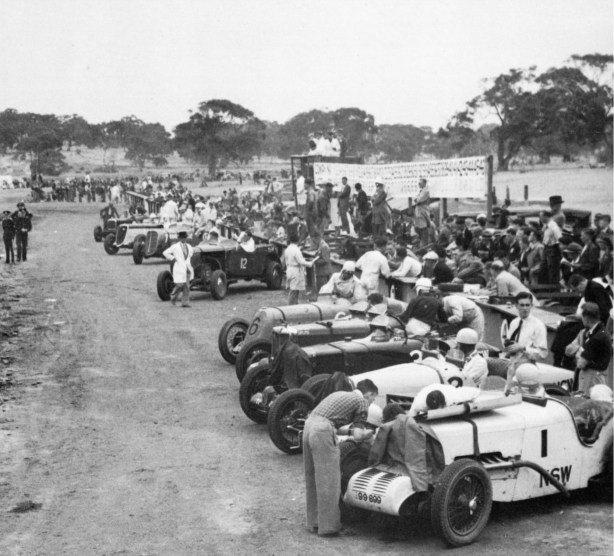
The KD is fifth from the bottom in this shot #6 with Kleinig about to mount up for the 50 Mile Olympic (as in tyres) Handicap at Victor Harbor (spelling correct) during the SA Centenary meeting second day on 29 December 1936- the 1936 AGP was run on Boxing Day. Its a rare shot so indulge me despite the Kirby-Deering being a tad difficult to see. From the bottom is #1 J Fagan MG K3, then Tom Peters Bugatti T37A, then Lord Waleran and Lyster Jackson in K3’s- then #6 Kleinig. #12 is Les Burrows Hudson, #17 the Harry Beith Terraplane and the light coloured car with a dark bonnet is Jack Phillips Ford V8 Spl (R Garth)
That year Kleinig contested speedway events, hillclimbs and the blue-riband 1936 Australian Grand Prix (South Australian Centenary GP) held on the challenging, once only used, gravel, Victor Harbor-Port Elliott road circuit that December 26, he retired after 6 laps with a burst radiator having driven the McIntyre Hudson.
Kleinig practiced the Kirby-Deering and McIntyre the ‘Hudson Terraplane’ (McIntyre Hudson) that weekend.
The Adelaide News reported that Kleinig was one of the most spectacular drivers of the meeting and that he ran out of fuel at Nangawooka Hairpin and had to walk half a mile back to the pits to get replenishment. No times were taken of the sessions, it seems that McIntyre/Kleinig determined the more appropriate mount for the fast, sandy-gravel course was the McIntyre Hudson so the K-D was put to one side for the Centenary Grand Prix but was raced in the ‘Olympic 50 Mile Handicap’ event on 29 December.
Held three days after the GP, another large crowd, this time estimated at over 20,000 people watched Stanley Woods win the Junior and Senior TT events on Velocettes, ‘the most exciting race was the car event in which great great speed and superb cornering brought spectators to their feet in the stands.’
Barney Dentry won in a Riley from Lord Waleran in John Snow’s MG K3 Magnette and Les Burrows’ Hudson third- Frank was not mentioned in the Advertisers race report other than that he was twelfth of fifteen starters in the K-D.
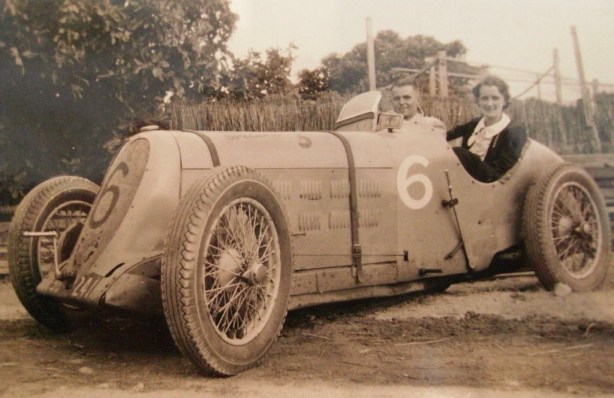
FK taking mum for a ride I wonder? Slender body by Gough Bros, Sydney, what is the lever on this side? Road registration makes it a wild road car! (Kleinig Family)
Kirby-Deering Special design, construction and development…
Gus McIntyre clearly had his public relations machine working, expectations of the completion of his new car were being speculated upon in the press later in 1934, in time for the Victorian Centenary 300 mile Grand Prix albeit the car did not finally appear until late 1935, one report had it that initial test runs would be conducted on the Bulli Pass- now that would have been exciting for anybody in the area at the time!
The basis of the car was an MG Magna ‘L Type’ tourer owned by noted Australian racing driver, speedway promoter, businessman and later President of The Royal Automobile Club of Australia, John Sherwood.
Sherwood recalled the machine in ‘Cars and Drivers’ ‘I also owned an ‘L’ type Magna…I sold it to the late WA McIntyre who had a saloon body fitted to it. He and his wife were big people and couldn’t fit into it without great discomfort so he eventually removed the body and gave the chassis to Frank Kleinig. This became the basis of the 1.5 litre Miller engined Kirby-Deering Special and later the Kleinig Hudson.’
WA McIntyre was immaculately connected and had a couple of titans of Australian industry in James Norman Kirby (later Sir James) and Harold Hastings Deering supporting his exotic new racing car- separately both men created enormous fortunes.
In Kirby’s case, he was born in Sydney, educated in Newtown and was initially apprenticed as a motor mechanic. After the success of a small enterprise repairing motor-cycles he established James N Kirby Pty Ltd in 1924- an automotive engine rebuilding business which in time employed Buckley and Kleinig.
He later expanded into the importation and assembly of cars and the manufacture of electrical whitegoods, machine tools, ordnance, establishment of an assembly plant for cars (British Motor Corporation at Zetland) and much more. Despite his modest formal education he was involved as a leader in industry bodies and was appointed as a Director of some of Australia’s largest companies including Qantas- he was knighted in 1962.
Born in Ashfield, Sydney in 1896 Hastings travelled to the UK and was commissioned in the British Army before transferring to the the Royal Flying Corps and later the RAF during the War. He served in England and France in the same squadron as (Sir) Charles Kingsford-Smith.
After postwar employment in the UK, upon return to Australia he set up Deering Engineering Co, establishing an agency for AEC bus manufacturers in Australia. He later had what was the largest Ford Dealership in the world- the sole metropolitan distributorship for Ford in Sydney selling 7,000 new and 12,000 used cars a year! Later he obtained the Caterpillar agency- Hastings Deering still holds that and more.
The smart-arse observation is that with backers of this wealth- noting that both men were still ‘on the up’ in the mid-thirties, why not have bought a Miller car, rather than ‘just’ the engine…Then again, maybe it was about good old Aussie enterprise? The commercial arrangements between the parties would be interesting to know.
Kirby died on 30 July 1971 and Deering on 16 June 1965, both in Sydney at Vaucluse and Homebush respectively.
By 1932 the Australia Street Newtown workshops of James N Kirby Pty Ltd were too small for the 25 employees, so the move was made to a larger freehold property at 75-85 Salisbury Road Camperdown that March- it is here, 4km from central Sydney that the Kirby-Deering Special was constructed.
The Sydney Referee’s 25 October 1934 issue reported that Joe Buckley was in charge of the cars build, in more modern times the credit for the KD is attributed to Kleinig solely- period newspaper articles suggest this is incorrect whilst noting that Frank was a key part of the team which built the thing.
The Magna chassis was used fitted with the front and back axles of a four-cylinder French Mathis car. The semi-elliptic springs were a Magna-Mathis combination with the back axle located above the chassis. The huge drum brakes of the Mathis were also deployed.
‘For better cornering the chassis is crab-tracked being several inches wider in the front than in the back.’
The streamlined steel body was built by Gough Brothers who had also created the body of the Stewart Enterprise land speed record car- lets leave that particular tangent well alone.
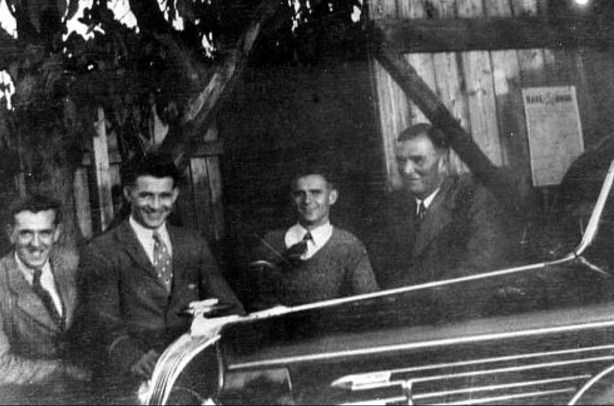
Doug Ramsay, FK’s apprentice, Jack Stevens of Silex Mufflers, FK and WA McIntyre- date and place unknown (C Gibson)

Kleinig, Kirby-Deering Spl, Penrith 1937 (Kleinig Family)
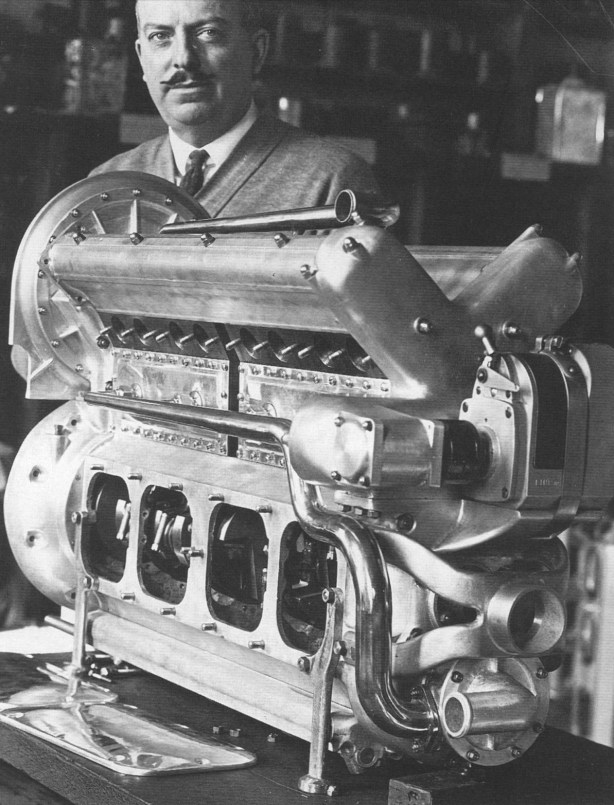
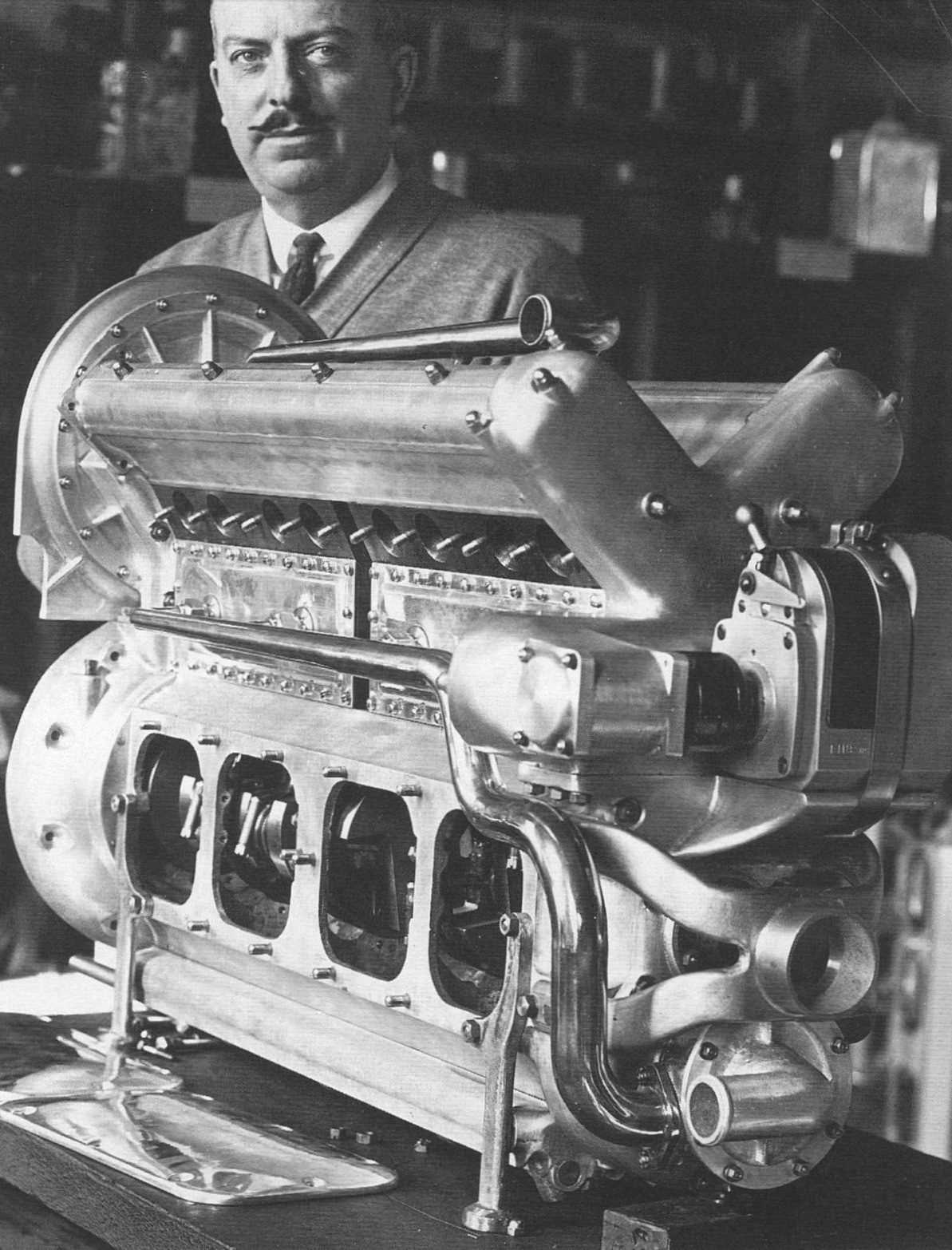
Harry Arminius Miller with one of his centrifugally supercharged 1.5 litre straight-8’s (unattributed)
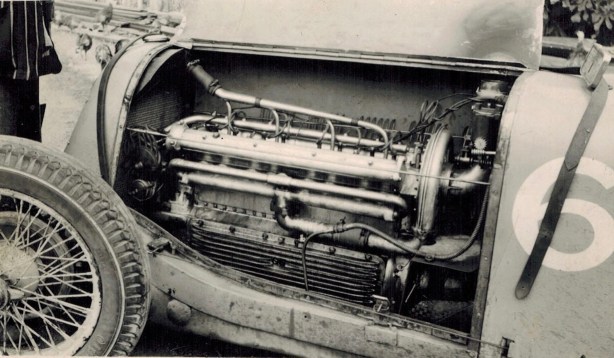
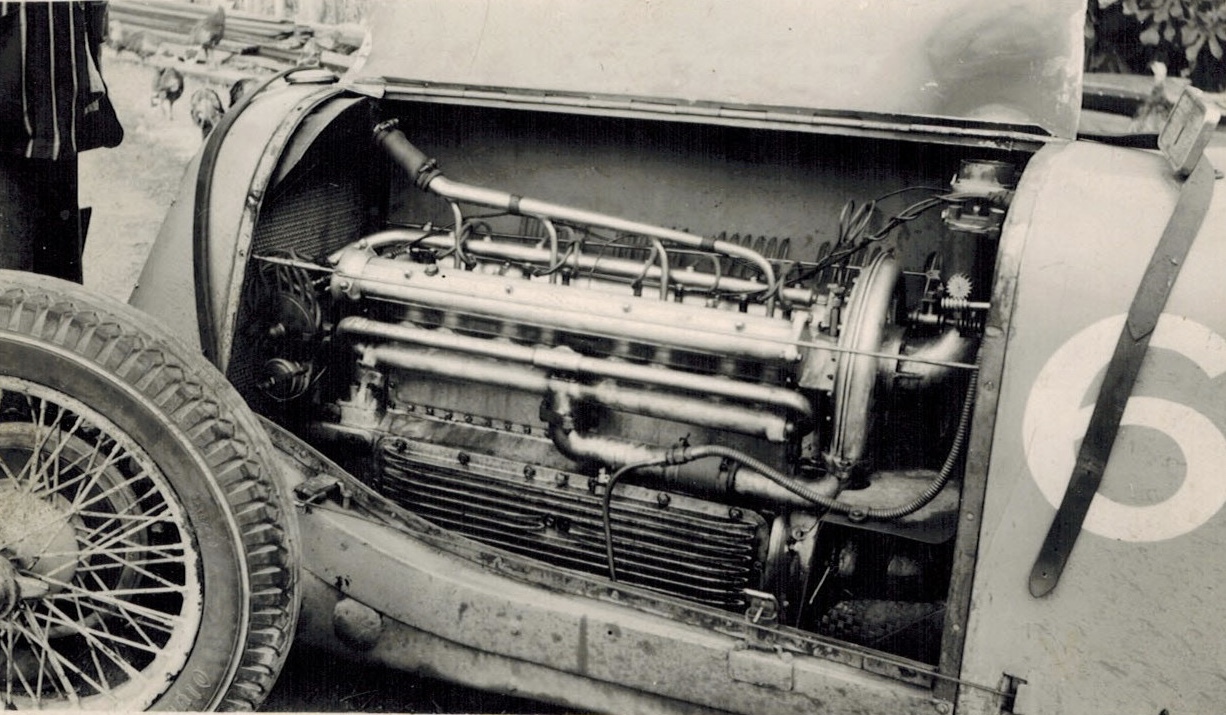
Kirby-Deering Miller Spl, rare shot of the 1.5 litre s-8 centrifugal supercharged engine. Chassis MG Magna, brakes and front axle Mathis. Of the Olympic Air Ride tyres racer/engineer/restorer Greg Smith wrote ‘…we called them ‘Slippery Sams’ as they had no grip at all. Beaurepaire’s were the owners of Olympic Tyres, so called because Sir Frank Beaurepaire was an Olympic swimmer (3 silver and 3 bronze medals in the London, Antwerp and Paris games and 15 world records). Question- Is the small cog wheel and worm used as a rack drive accelerator by pushing the worm axle or a rotary motion for mixture?’ Greg concludes ‘The engine has the uber expensive Robert Bosch 8 cylinder racing magneto, in todays money GB pound 10,000 for a second hand one’ (Kleinig Family)
‘The Referee’ recorded that the motor ‘…is the supercharged 8-cylinder Miller engine, which was in the car that came second in the Indianapolis 500 four years ago…’ Shorty Cantlon was second in 1930 aboard the ‘Miller Schofield’, a Stevens Miller engine/chassis combination which was also raced by that years winner, Billy Arnold.
The quoted power of these 91.5cid engines was initially 154bhp @ 7000rpm but that rose with refinement to both the engine itself and it’s intercoolers.
The motor was cast in two blocks of four cylinders, the crank having four main white metal bearings. Two valves per cylinder were driven by twin-overhead camshafts, ‘the centrifugal blower revs at five times engine speed and is driven off a big ring gear in front of the flywheel. Normal revs are 7000.’
The KD’s gearbox was a Mathis three speed attached to a Mathis differential via a short, strong driveshaft two feet six inches in length.
The complete car was expected to weigh 13 1/2 cwt and had an estimated top speed of 130mph- at that time the KD was anticipated to race in the upcoming Phillip Island meeting on 27 October and then at Maroubra in Sydney’s southern beachside suburbs on 24 November 1934.
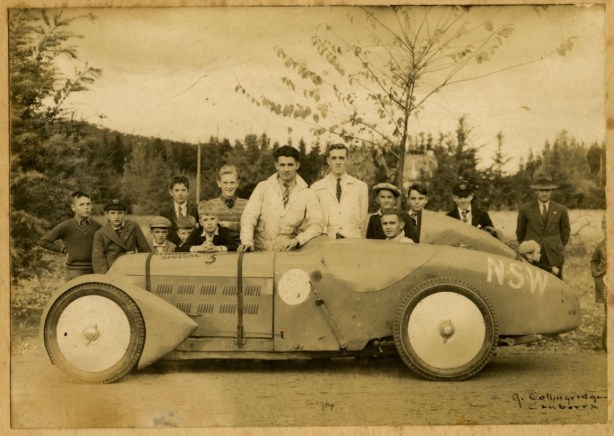
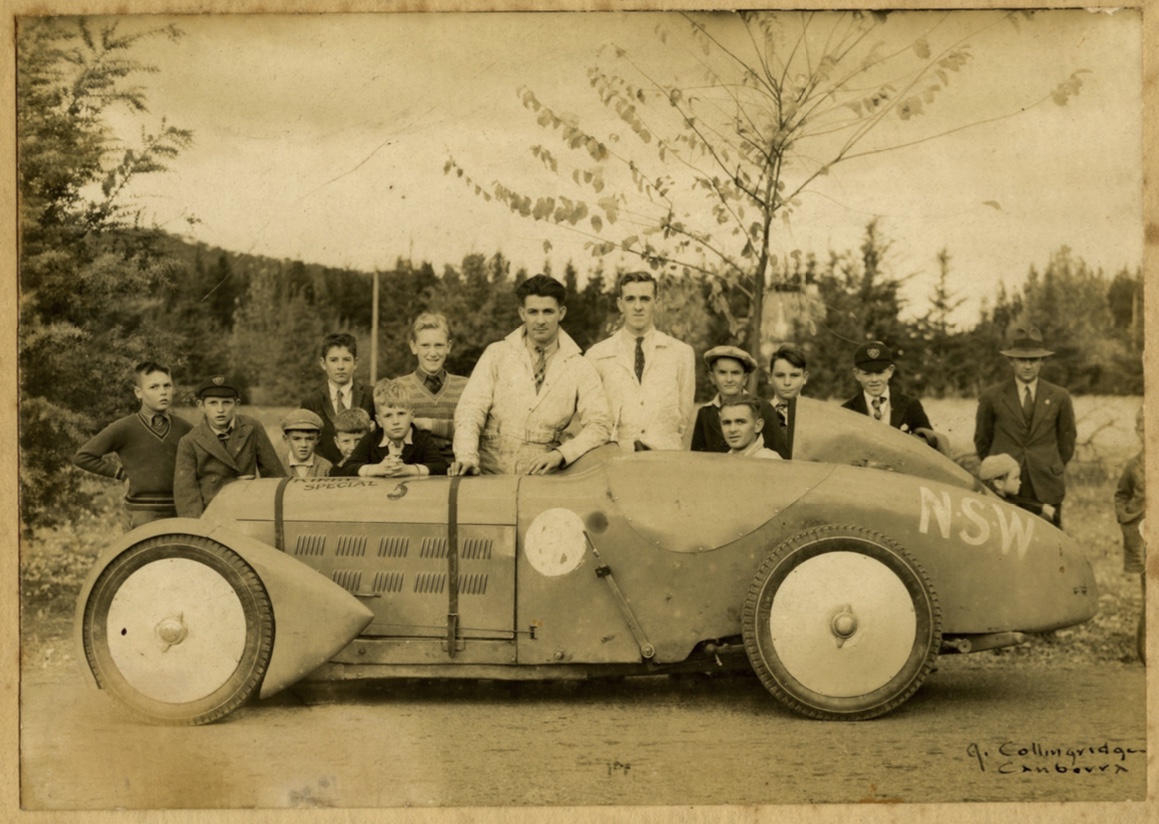
Frank and his team surrounded by admirers in Canberra after the May 1937 Speed Trials- note the discs on the wheels and special guards at the front to reduce air resistance- car very handsome in this specification- Kirby Deering Miller Spl (A Collingridge)
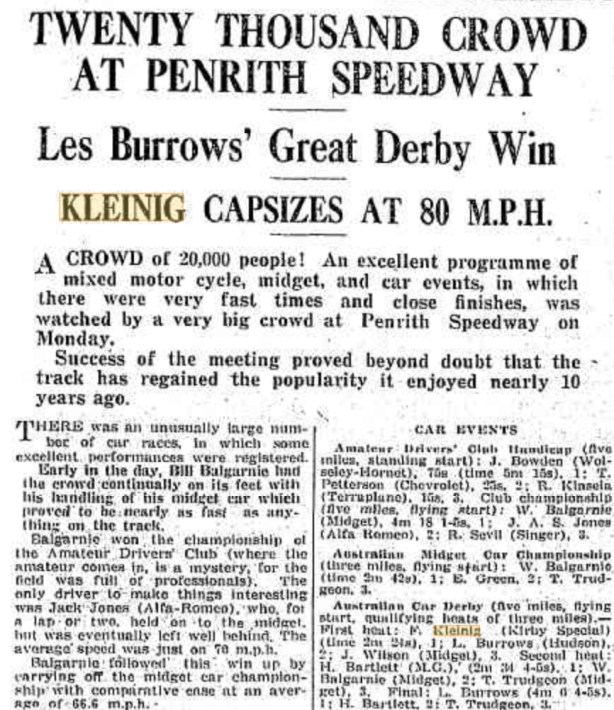
Sydney ‘Referee’ 29 April 1937
The Referee’s 3 January 1935 article reported on the frantic work being carried out to have the car ready for the New Years Day Victorian Centenary meeting at Phillip Island reflecting upon five months work to get to that point, ‘The streamlined body was a thing of beauty and…loving craftsmanship put into the job’. The plan was to complete the machine, truck the car to the Island and test it there.
Problems immediately arose when the exotic engine was started, despite a ‘satisfying clamour water oozed through the plugs, the defect was traced to metal inserts holding the blocks- apparently the rubber grommets had perished’. The towel was thrown in after attempts at soldering failed.
The car was weighed- with Buckley, who was to drive at the Island aboard, 28 gallons of fuel and 5 gallons of oil the racer weighed 17cwt ‘quite Grand Prix-ish’.
‘When the trouble has been cleared up it is likely the Kirby-Deering will attempt the mile records, standing and flying’…albeit that would be twelve months hence!
Bob Pritchett picks up the challenges of the cars early development in AMS.
‘At first, the car whilst extremely fast, was also extremely hard to handle, and it was only by a painstaking process of trial and error and experiments with weight distribution, steering geometry and ratios, shock absorbers, spring rates and so on (at one time the car carried 2 cwt of lead ballast aft so that the rear springs would work), that it was brought to the stage that it could be driven up to its potential performance.’
‘Even then the final drive ratio was too high; the Miller engine didn’t get really cracking until it was spinning at over 6200rpm and Frank says that by the time he had wound it up to this pitch the car was starting to take off properly- he had usually reached the stage where he was running out of straight and he had to begin all over again…at the Canberra Speed Trial he entered the flying mile in second gear and covered the distance at an average of 117mph, crossing the line at something over 135, he thinks that, given sufficient breathing space, she could have been worked up to about 145 or more mph. Not bad for a home-made 1 1/2 litre special. The supercharger was geared to about five and a bit times engine speed, which means that at times it was turning at 42000rpm, which is a bit staggering when you come to think of it.’
With the development of the car ongoing, it was almost unbeatable in Frank’s hands at Penrith in 1936 and 1937, he had become almost a household name in Sydney, until a spectacular rollover there on Monday 26 April 1937.
He was lucky to escape injury from the accident- having strayed to the edge of the track, the car tripped flinging him free, then rolled several times and ‘crashed down a foot of where he lay stunned’ bruised and battered but otherwise ok.
In the best racing tradition FK worked all week to repair the damage and carry complete some detailed streamlining of the KD inclusive of discs on the wheels to allow him to run at the annual Canberra Speed Trials in May 1937.
Frank did 116.9mph over the measured quarter of a mile besting Bill Thompson’s Bugatti T37A’s 112mph. His standing quarter mile time was also quickest of the day at 16.6 seconds from Jack Saywell’s Railton 4.1 litre.
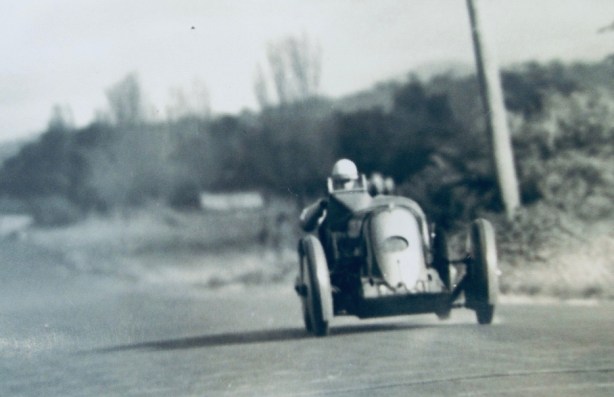
Kleinig at speed on Northbourne Avenue on one of the KD’s runs in 1937. Even tho it’s not sharp note the largely covered radiator, with only a small hole for air and the fairings over the front wheels. Marvellous (Kleinig Collection)
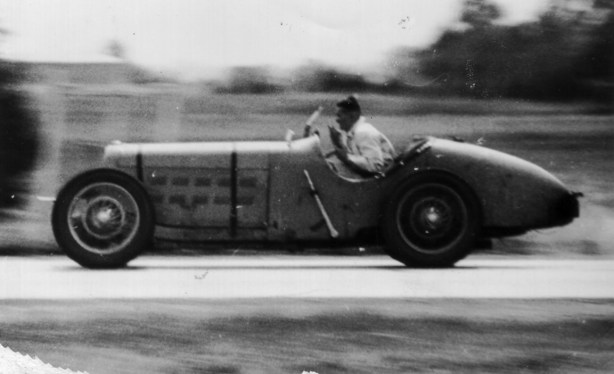
Kirby-Deering, a bit of a mystery shot as to location and driver, perhaps Tom Peters, Tim Shellshear thinks (T Shellshear)
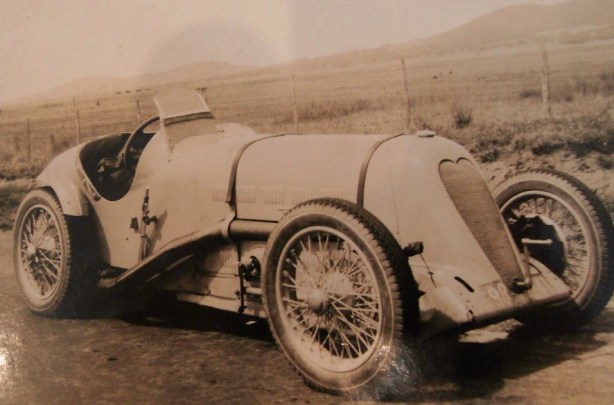
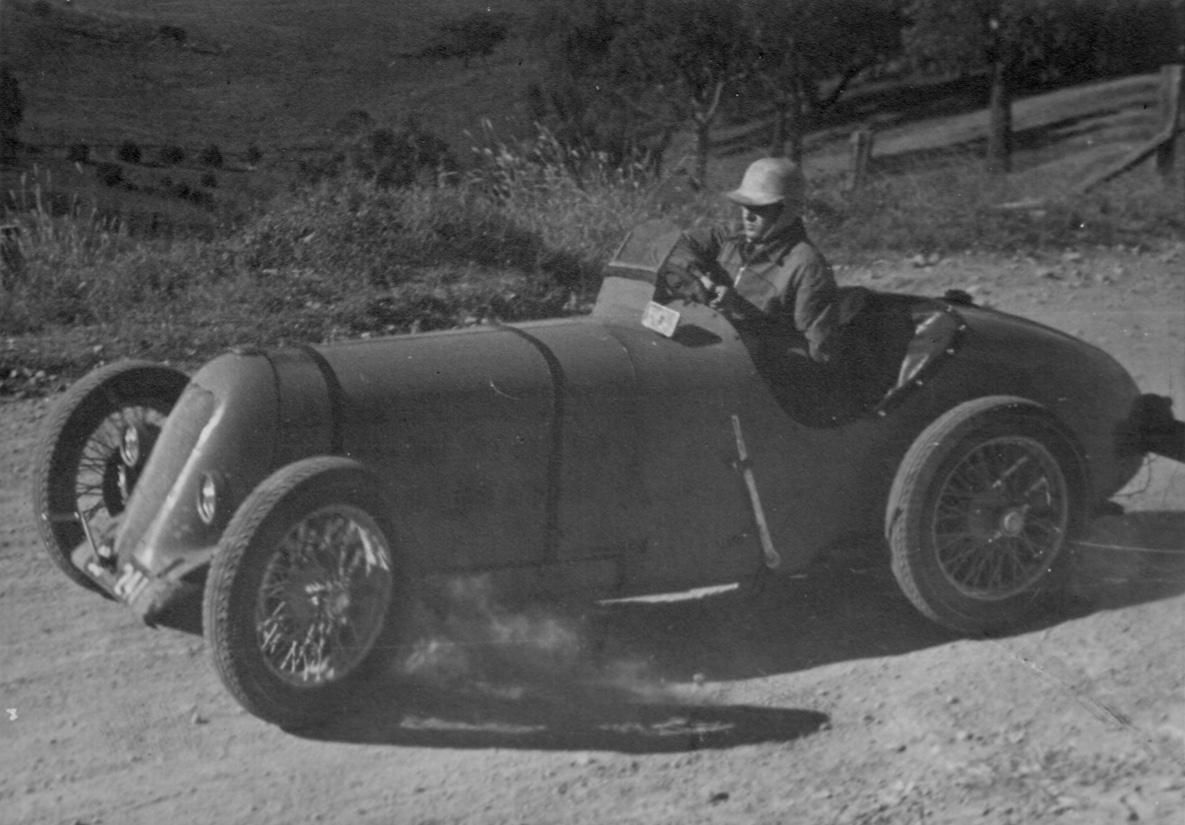
Another cracker of a shot from Daniel Kleinig this time of the exhaust side of the KD which appears, with vestigial rear guards, set up for a trial- the actual venue a hillclimb coz there is a hill present…venue anyone? Love the heart shaped grille (Kleinig Family)
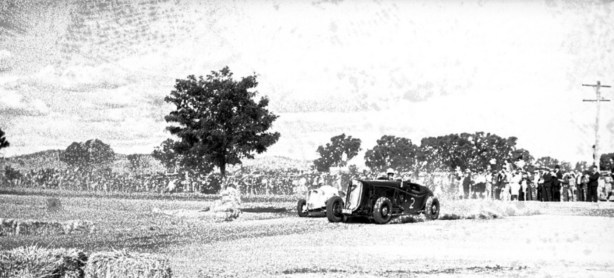
Kleinig in the McIntyre Hudson from KR McDonald, Standard Spl during the Interstate GP, Wirlinga, Albury in March 1938, DNF. Jack Phillips won in a Ford V8 Spl
Kirby-Deering Special evolves into the Hudson Special…
During 1937 Kleinig continued to race the McIntyre Hudson as well as the KD amongst other things setting hillclimb records at Cessnock (Mount View), Waterfall Gully and Broughton Pass, all in New South Wales.
The Kirby-Deering proved itself a great sprint car but was dogged by unreliability in longer distance events and so ‘The pale blue Kirby Deering Spl was rebuilt into the royal blue Kleinig Spl with 4168cc Hudson 8 power for the 1938 Bathurst AGP (and was beaten only once at Penrith in this form)’ wrote John Medley.
‘While the Miller 8 motor was superb and effective for the rolling starts of Penrith Speedway, the torquey Hudson 8 was considered better equipment for the swoops and dives of Bathurst. Right idea- but the strengthened chassis and MG brakes were found to be deficient. The development of the Kleinig Hudson proceeded over the next 15 years’.
The exotic Miller engine was put to one side of the Kirby workshop- lets come back to it later on.
Kleinig’s AGP on the new Mount Panorama tourist road only lasted 5 laps, he was out with a broken fan belt, the race won in dominant style by the visiting Peter Whitehead in his ERA B Type ‘R10B’. Some compensation for Frank was a win in a short handicap preliminary earlier in the day.
Legend has it that ‘Conrod Straight’ at Bathurst acquired its name as a consequence of a big blow up of FK’s Hudson engine during the second Easter meeting in 1939, the rod punched a big hole in the block. The 1940 Bathurst program named the straight ‘Conrod’ and FK had the errant component chrome plated as a keepsake!
1939 started well with Frank’s first visit to Rob Roy during the New Years weekend- he had the big Hudson running beautifully and became the first driver to go under 30 seconds, setting a new record at 29.72 seconds.
The great form transferred to Aspendale Speedway when FK unofficially broke the lap record set by Peter Whitehead’s ERA B Type during his long successful tour of Australia the year before.
During 1939 McIntyre sold (or gave?) the Hudson Special to Kleinig which henceforth became the Kleinig Hudson Special. In the lead up to the 1939 Easter meeting the car had been lightened and its MG Magna brakes replaced by more powerful Minerva ones with Perrot operation, and the cars wheels modified to accommodate the big brakes.
Gus also sold the McIntyre Hudson to a Mrs Dixon, a divorced lady friend of her chosen driver, Kevin Salmon, at the same time- the car was entered as the ‘Salmon Motors Special’ during this period.
Medley wrote ‘Unfortunately Mrs Dixon surprised Salmon in bed with her daughter (testing the sponsors product, as it were) and she promptly sold the car to Frank Kleinig, who occasionally raced it post-war.’ Medley notes by that stage the car had been raced, hillclimbed and sprinted by McIntyre, Les Burrows, Joe Buckley and Frank Kleinig.
Despite the loss of his sponsor, Salmon continued his racing career into the sixties in an MG.
Kleinig’s speed and the effectiveness of the cars ongoing development as noted above, was amply demonstrated that Easter when he seemed assured of victory only to hear the death rattle of failed bearings end his race, victory going to John Sherwood’s MG NE.
Better luck was in the offing during the October meeting when the car, painted red was second in the 150 mile race behind John Snow’s Delahaye 135CS and ahead of Bob Lea-Wright’s Hudson.
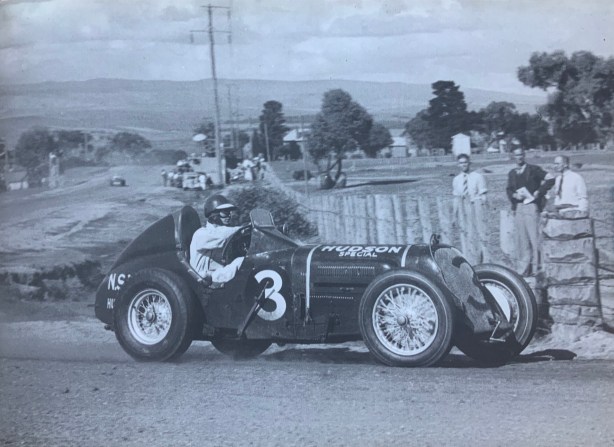
(JO Sherwood)
Two views of FK during the Easter, April meeting in 1939- the shot above shows Kleinig being closely watched by spectators as he apexes Hell Corner to head up Mountain Straight- with the pits and Pit Straight behind him.
The one below shows him exiting Murrays, at the bottom of Conrod Straight, entering Pit Straight. Its not the most beautiful of cars but brutally purposeful, distinctive and attractive if not seductive.
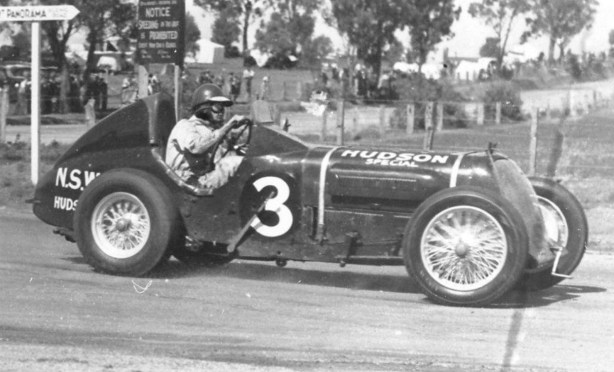
Mount Panorama 1939 (unattributed)
(JO Sherwood)
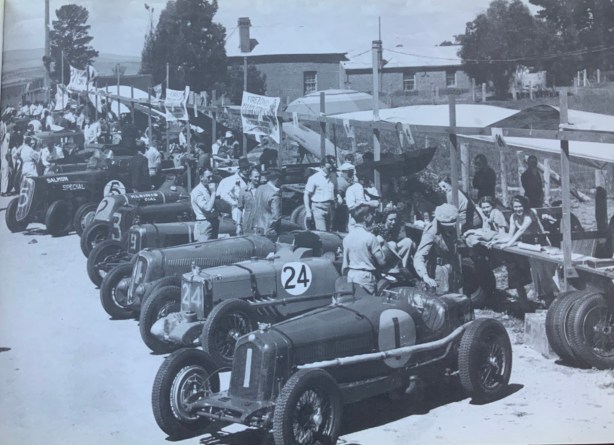
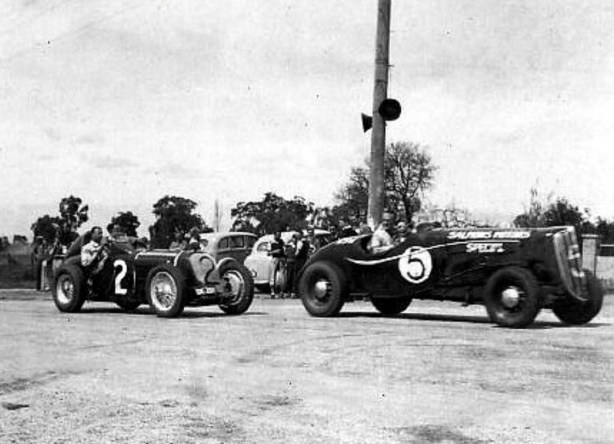
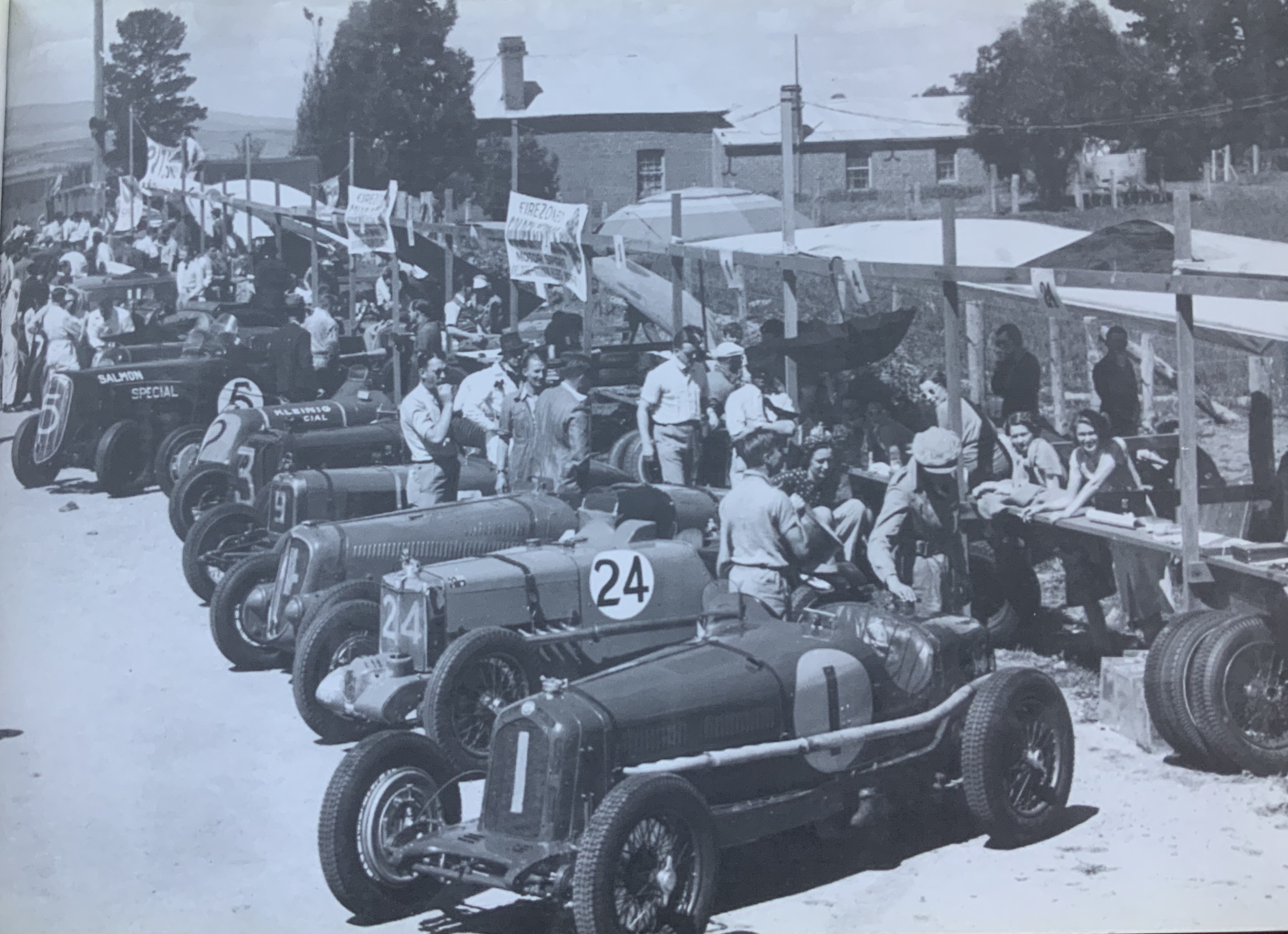
The way it was, Bathurst again, this time the line up for the 150 Mile Race, October 1939 meeting.
Up front is Alf Barrett’s Alfa Romeo Monza, then Colin Dunne’s MG K3 Magnette and beyond that John Snow’s slinky #14 Delahaye 135CS. #9 is the John Snow owned ex-Phil Garlick Alvis of 1920’s Maroubra fame- the machine that weekend driven by John Barraclough.
#3 is the McKellar Ford V8 Spl- this car famous as the ex-Bill Thompson twice AGP winning Bugatti Type 37A and infamous as the car, driven by Wal James, went into the crowd at Penrith in June 1938 killing three people- and then #2 Frank’s by then Kleinig Hudson Spl and then alongside the McIntyre Hudson, by then Salmon Special, driven by Kevin Salmon but owned by our Mrs Dixon.
The photograph is interesting in no shortage of ways not least to show the ‘competitive set’ in that immediate pre-War, and post-War period for that matter. The balance of the 150 Mile field was made up of MG T Series, Hudson/Terraplane Specials and Ford V8 Specials- and others with the only ‘Top Gun’ cars missing from this line-up Allan Tomlinson’s 1939 AGP winning MG TA Spl s/c, John Crouch’s Alfa Romeo 8C 2300 Le Mans and Jack Saywell’s Alfa Romeo Tipo B/P3.
The interesting story about Saywell’s aristocratic Grand Prix Alfa Romeo is that the engine was damaged in a workshop cock-up by the cars imported British mechanic- he goofed the engine’s timing and when turned over valves and pistons made contact in a manner not intended by Vittorio Jano.
Saywell, not confident the engine could be rebuilt in Australia despatched it by ship back to Italy whereupon ’twas never seen again- perhaps the exotic aluminium 2.9 litre supercharged straight-8 ended up somewhere between Jones Bay Wharf and Genoa. It raced on post-War with ‘black-iron’ engines fitted but was not reunited with an engine of original specification until restored in the early-sixties.
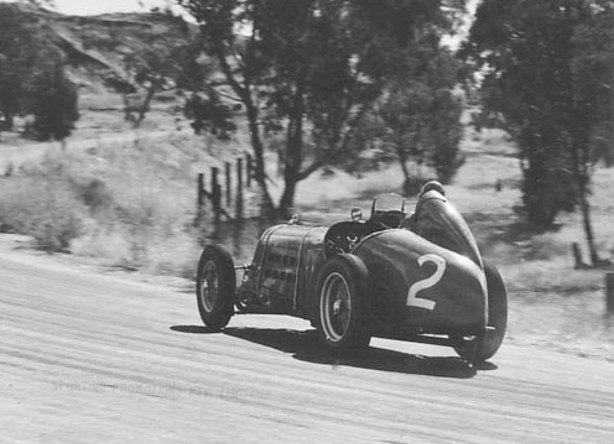
Superb shot of FK in the KH Spl heading into Quarry from Mountain Straight during the October 1939 Bathurst meeting (J Shepherd)
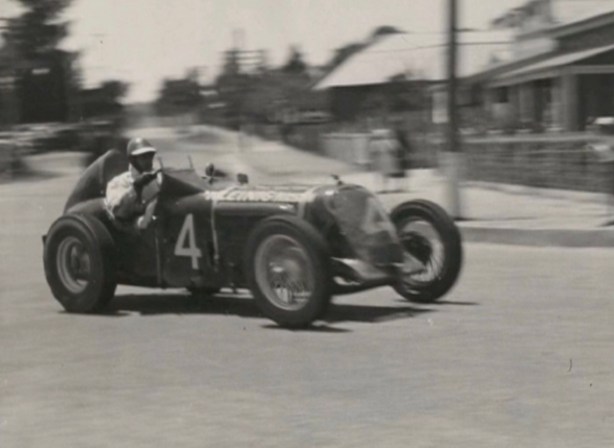
Kleinig whistling thru Lobethal township at speed during the 1939 AGP weekend at (N Howard)
The 1939 AGP was held on the fast, daunting, Lobethal Adelaide Hills bitumen road circuit.
Like all of the big cars Frank fried his tyres in the incredibly hot conditions. He and John Snow were the backmarkers, off 4 minutes 15 seconds, Frank only lasted 3 laps, the race was won by the vary fast, canny West Australian, Allan Tomlinson in a lithe, nimble, beautifully set up and prepared supercharged MG TA Spl off 11 minutes 30 seconds- one of the great AGP wins and a wonderful story (written) for another time.
The last Bathurst meeting pre-War was in 1940 by which time the Mathis gearbox casing was fitted with four close ratios, Frank was sixth plagued by carburettor troubles the race won by Alf Barrett’s Alfa Romeo Monza- he, like so many other young Australian racers was soon off to War.
Just how large a number of Australian racers took up the challenge of defending our freedoms from 1939-1945 is explored in a whole chapter devoted to the topic of John Medley’s ‘John Snow: Classic Motor Racer’. In that context this snippet on the owner/sponsor of the McIntyre Hudson and Kirby-Deering Spl/Kleinig Hudson Spl is amazing and sobering.
’The Australian (war death) toll was no less (to that of the Europeans)- particularly in proportion to overall population. Even old hands were not spared: Walter Augustus McIntyre had been Frank Kleinig’s patron in the late 1930’s, had run in the typical trials of the day during and before that time, and been the man behind the McIntyre Hudson, built strong for the trans-Africa race of 1936 that did not happen because of Italy’s attack on Abyssinia. He was not a young man and was not in good health. He chose to do his bit in the war by carrying out private patrols of the NSW coast in his own boat, looking for submarines and any other enemy force. On one night patrol he became soaked in the very wet conditions, contracted pneumonia, and died’ in a Sydney private hospital about 27 June 1944 aged 59.
Post war the Kleinig Hudson was still competitive, winning the first event held at Bathurst, a hillclimb in January 1946.
Handicap meetings continued as standard fare across Australia for a while yet, Frank took a last lap win over the John Crouch MG in the ‘Victory Trophy’ at Strathpine, Queensland in August 1946.
Together with Crouch’s Delahaye 135CS he was off scratch in the Bathurst, 1946 New South Wales Grand Prix but clutch problems outed him early in the 150 mile race won by Alf Najar’s MG TB Monoposto Special.
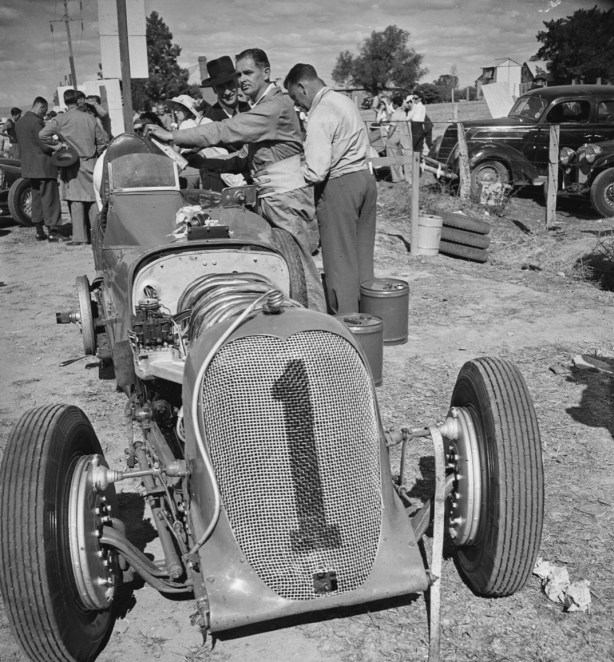
Stunning clear photograph by a ‘Pix’ snapper. Mathis beam front axle, big mechanical drum brakes all around, ‘up and over’ exhaust for the side-valve straight-8 at this stage fed by a single carb, make? Note also the steering box and drag link (SLNSW)
The photo above is in the Mount Panorama pits, October 1946 during the New South Wales Grand Prix weekend. Kleinig was the limit man together with John Crouch’ Delahaye 135CS, DNF after completing only five laps, Alf Najar was the winner as noted above.
Note FK with kidney-belt on about to address the mechanicals- see the single carburettor being run at this meeting/stage of development in contrast with what was to come as below!
In 1947 Frank returned to Rob Roy with the Kleinig Hudson but Arthur Wylie triumphed that day, winning the Australian Hillclimb Championship with a time of 29.18 seconds in his ‘Wyliecar’ Ford A Model Special.
Undeterred, he returned to the Christmas Hills, outer Melbourne venue the following year and took the title doing a 28.72 seconds run- his ‘supertweak’ that year was using 7200rpm- that poor side-valve motor, and therefore using second gear for most of the journey. His good form carried over to his home turf when he took the 1948 title as well at the Hawkesbury climb that April.
The 1947 AGP was run at Bathurst with FK suffering a major engine failure on lap 27- the winner, Bill Murray’s MG TC.

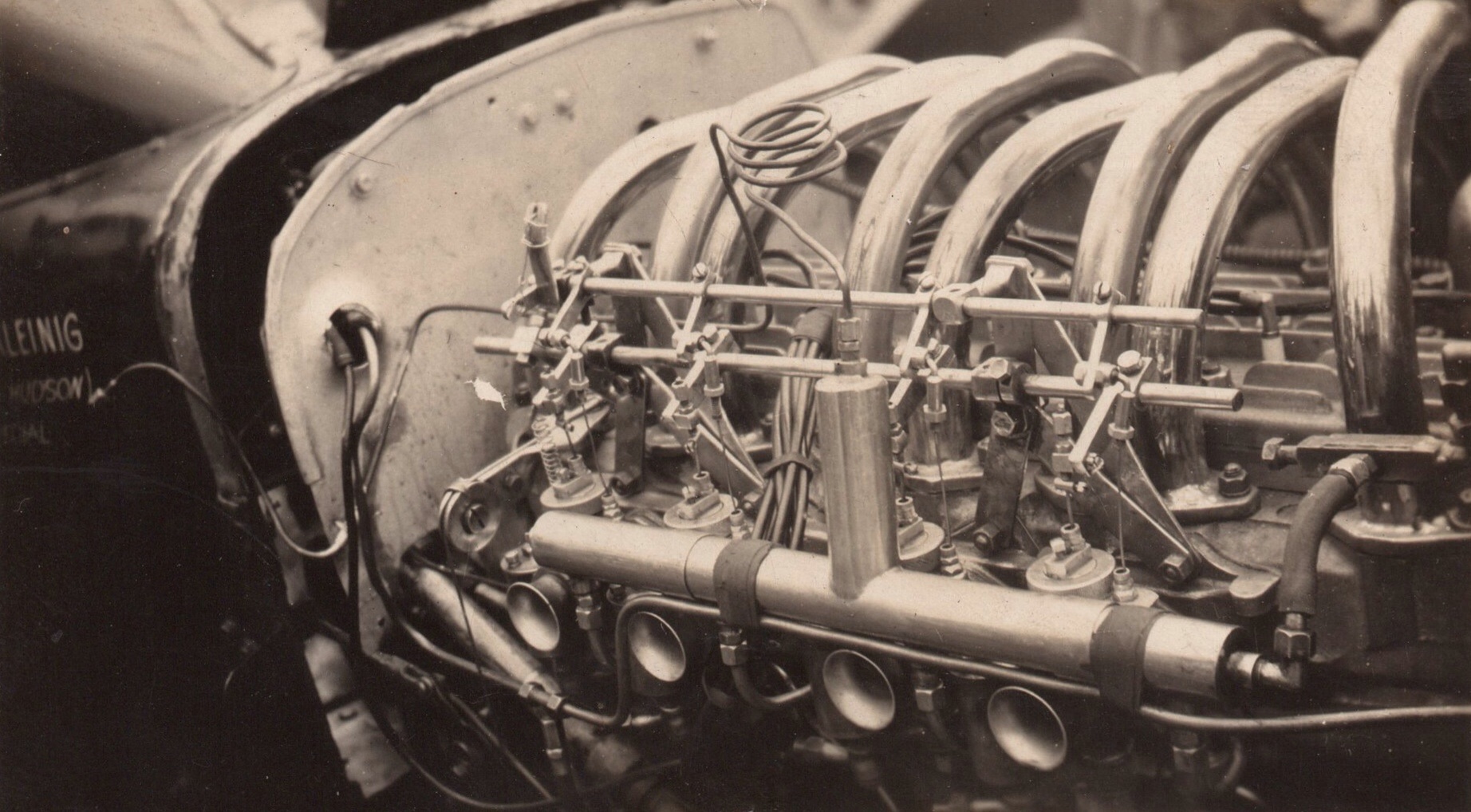
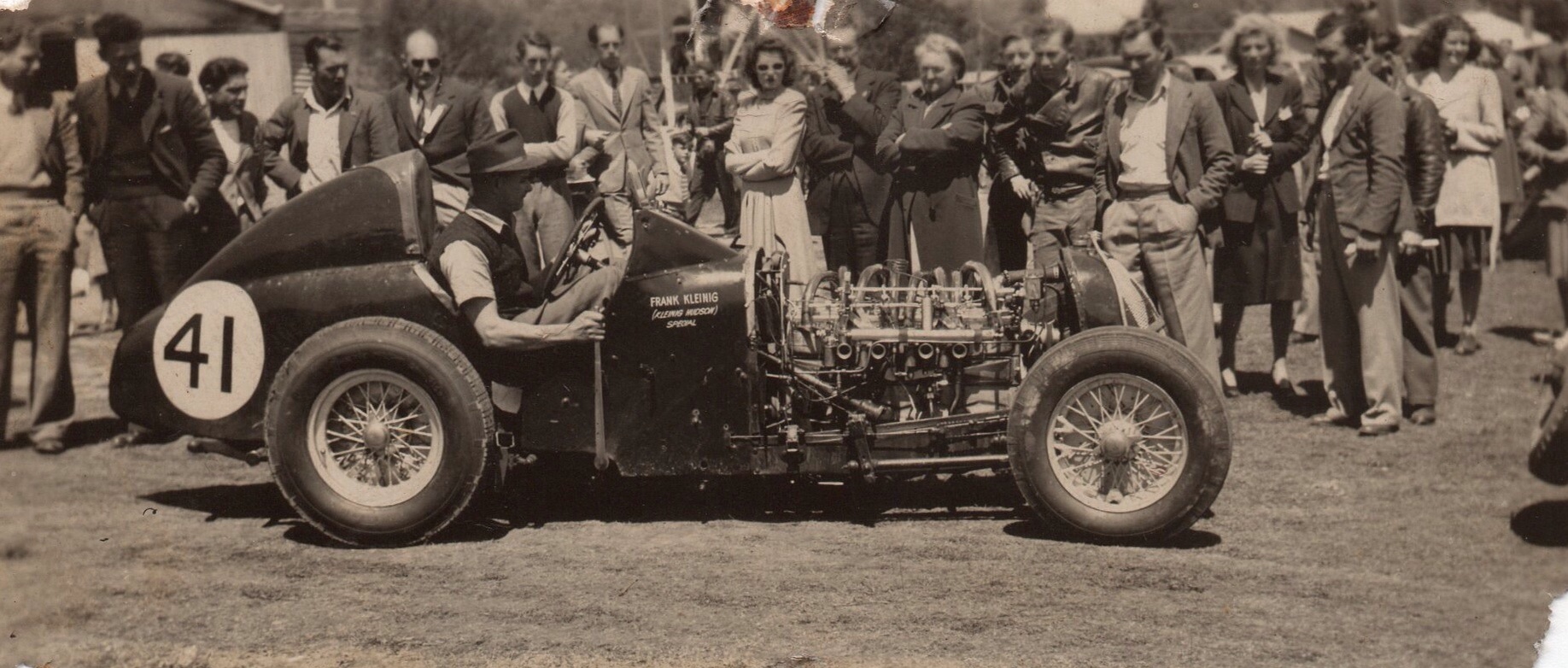
Stunning shot of the KH straight-8 Hudson side valve engine in 1947 or 1948 at Rob Roy. Have you ever seen so many gee-gaws, bell cranks and levers in your life?! Four Amal carbs feeding eight cylinders, head- still side-valve cast by FK and his water injection system- the rail above the carb bell mouths carries water not fuel. Chromium plated exhausts are ‘up and over’ to get them away from induction side apparatus (E Davey-Milne)

Racer Earl Davey-Milne inspects the engineering marvel which is the KH straight-8 (E Davey-Milne)
In 1949 Kleinig was the favourite to win the AGP at the Leyburn, Queensland airfield track after a political dispute over the location of the race resulted in the Victorian drivers declining to enter- Barrett, Gaze, Davison, Dean and Whiteford included.
Putting that to one side, Kleinig’s pace was demonstrated at Bathurst that Easter with a win in the 25 lap over 1500cc Handicap and third in the All Powers 25 lap Handicap- and fastest times in both races, there was life in the old dog yet, over short distances at least.
Graham Howard’s account of the Leyburn event in the ‘History of the AGP’ records that ‘Kleinig’s continual development of the straight 8 side-valve Hudson engine had resulted in a car which could run a standing start quarter mile in under 15 secs and exceed more than 125mph’.
‘Among Kleinig’s modifications were a supplementary oil system which used an external pump driven from the nose of the crank by a chain, and a form of water injection direct into the special Kleinig cast cylinder head, with pressure from the water supply coming-ingeniously-from a line tapped into the exhaust system. Pre-race testing showed this gave much more pressure than was needed so a blow-off was fitted. The red Hudson was an intensely developed fiery style of car-which perfectly matched Kleinig’s driving. Probably at the time only Alf Barrett was faster, and plenty of people would argue about that too.’
In the race Kleinig started from pole position, it was the first time the grid of an AGP was based on practice times- a scratch rather than a handicap race, he led from the off but was in the pits by lap 9 as the water injection blow-off valve was discharging water onto the plugs.
He rejoined the race a lap behind the John Crouch driven Delahaye 135CS and soon after the car threw its water pump as a consequence of lots of loose road metal after completing 21 of the 35 laps, John Crouch won in the ex-John Snow Delahaye 135CS- some small compensation for Frank was sharing the fastest lap of the race with Crouch.
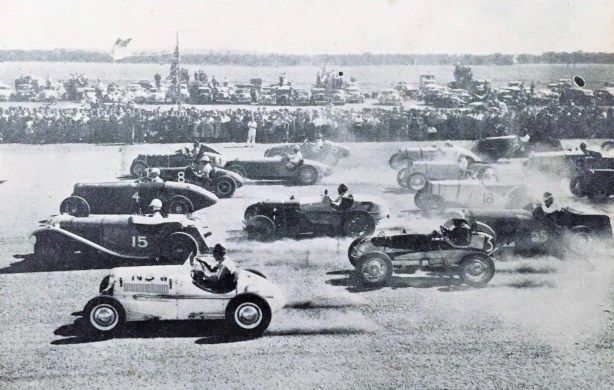
1949 AGP grid, Leyburn Qld, Dick Bland in George Reed Ford V8 Spl, #15 Keith Thallon, Jaguar SS100 #4 Crouch in the winning Delahaye 135CS, #8 Arthur Rizzo, Riley Spl and then Kleinig. Second row from this side, Alan Larsen, Regal Cadillac Spl, Snow Sefton Strathpine Ford V8 Spl and Rex Law Buick Spl. #3 is Arthur Bowes Hudson Spl #25 Doug McDonald Bugatti Dodge and #18 Garry Coglan MG TC Spl (unattributed)
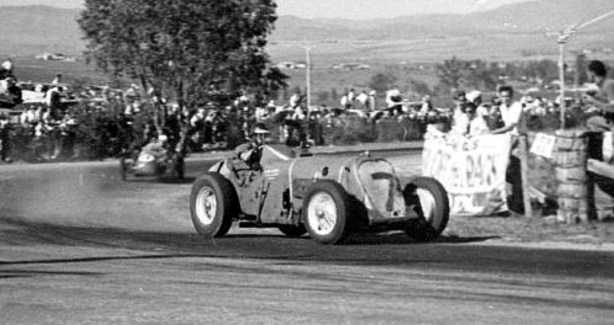
FK in the Kleinig Hudson, Hell Corner, Mount Panorama 1951 (C Gibson)
Missing from the Mount Panorama grids in 1950 he returned in Easter 1951 but was out of luck in the over 1500cc handicap, having missed practice, with points which had closed up, but he was second in the 3 lap scratch behind Jack Saywell’s Cooper- the crowd roared approval of the two old warriors- FK and the car when Kleinig had the race won from the back of the grid only to have momentary fuel starvation gift Saywell’s new-fangled Cooper JAP 1100 the win out of Murrays on the last lap.
In October he was third in the Championship Scratch behind Whiteford’s Talbot-Lago T26C and Lex Davison’s Alfa Romeo P3, in the Redex 50 Mile feature he retired shortly after encountering brake troubles- Whiteford the winner of the scratch section of the race.
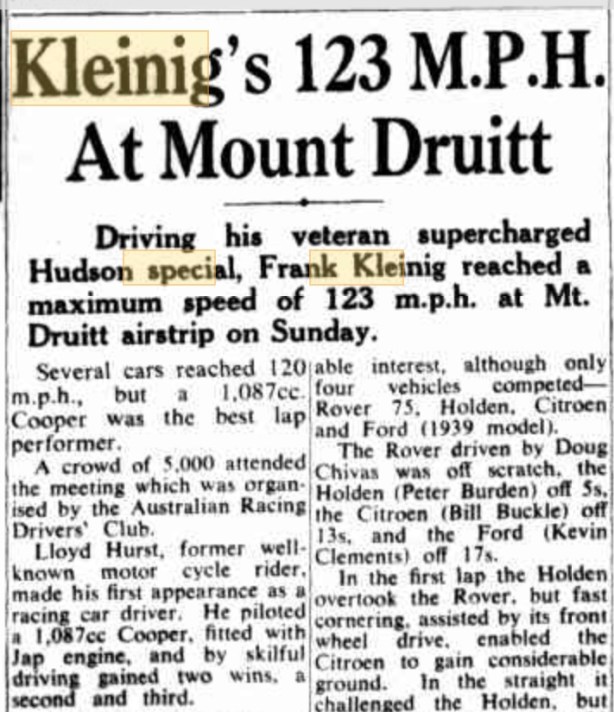
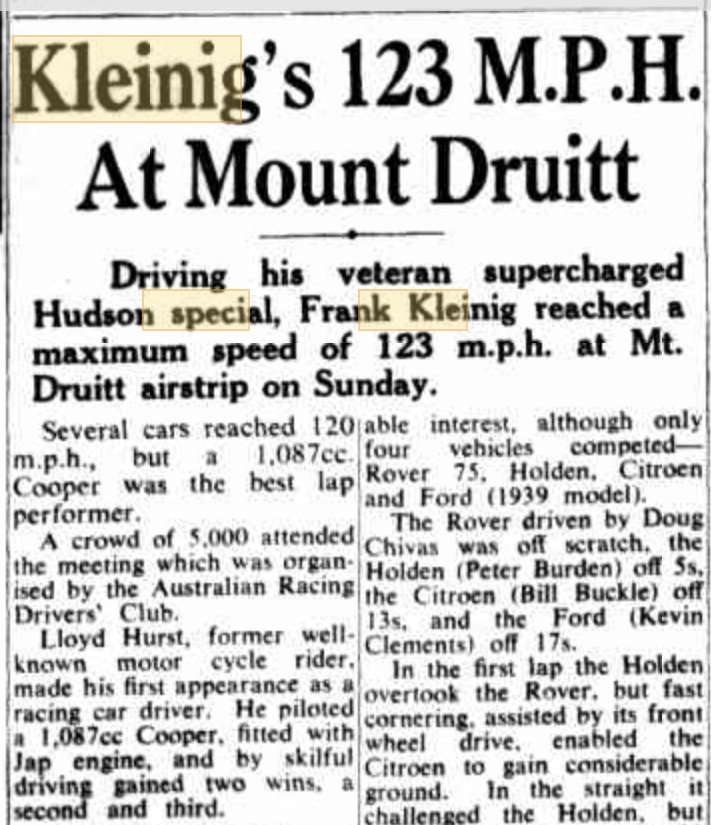
Into 1952 the car could still attract headlines, a Sydney Morning Herald banner in February proclaimed the cars top speed of 123mph at Mount Druitt.
Frank entered his faithful steed in the 1952 AGP at Bathurst but there were plenty of new kids on the block in the form of Whitefords Talbot Lago T26C, Jones Maybach and Coopers- the poor Kleinig Hudson was simply too old in the brave new world of scratch racing and the growing number of cars acquired to win outright- the big straight-8 cried enough after completing four laps and Doug Whiteford won the second of his three AGP’s- he would triumph again in the same car at Albert Park in 1953- his Ford V8 Special ‘Black Bess’ provided his first win at Nuriootpa in 1950.
Finally, and for the only time, Kleinig finished an AGP, in seventh place with one plug lead missing and only first and top gear in use towards the end- incredibly so, despite the advancing years of car and driver- with Frank pushing with all of his fire and brimstone he was third behind Jones and Whiteford at the end of the first Albert Park lap and still third by the end of lap 14 behind Jones- another fiery press-on character and Whiteford- not bad in this company in a car which dated to 1936 and was an amalgam, a clever one admittedly, of production derived parts.
For the 1954 AGP at Southport the car arrived with Kleinig’s major revision of the car incomplete but still considerably changed. The new car kept the old chassis side rails but used central seating, Peugeot 203 independent front suspension and an offset Hudson rear axle.
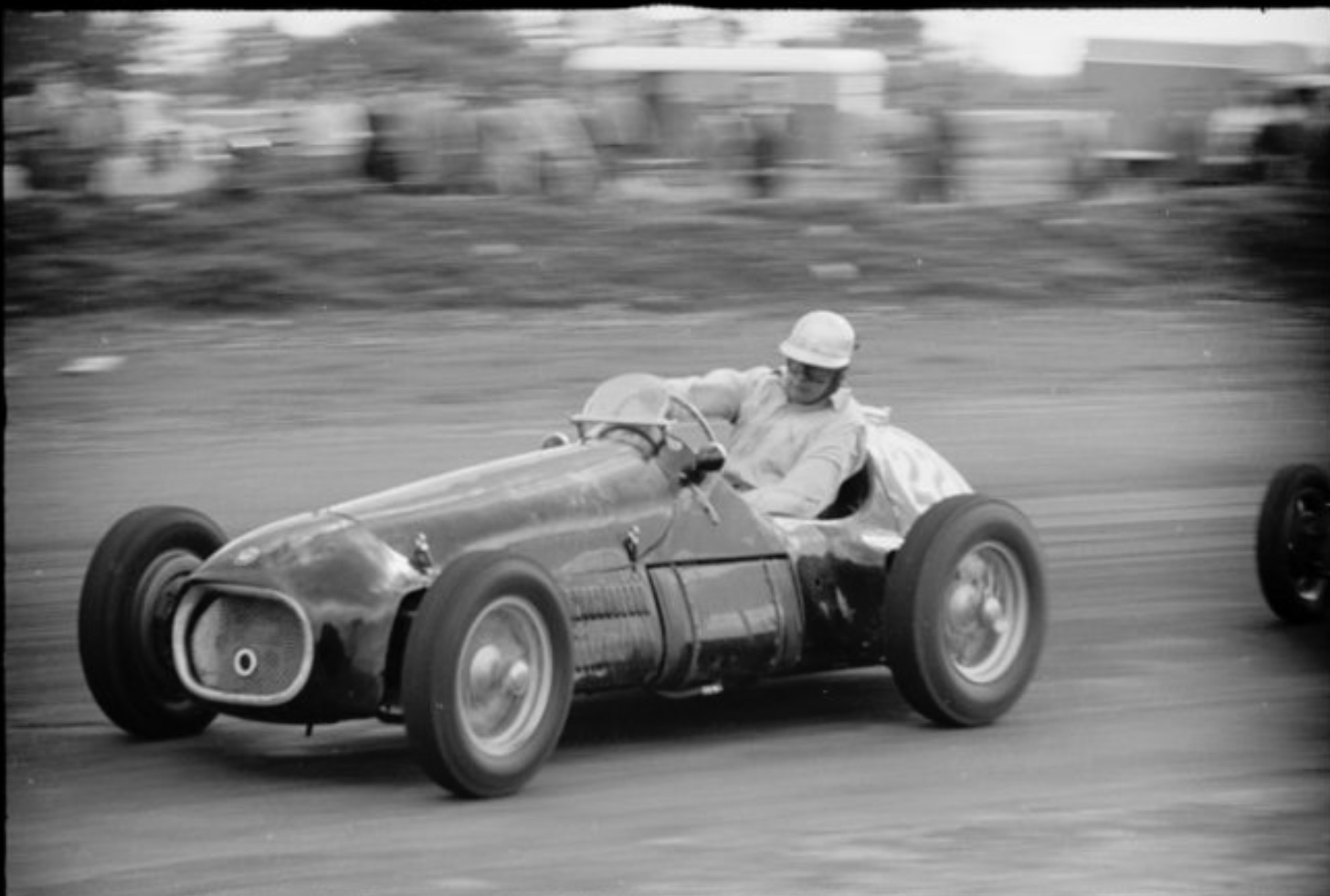
Additionally, the car was re-bodied with panels from the ex-Johnny Wakefield 6CM Maserati (#’1546′-the car now owned by Tom Roberts and has been reunited with its body in the restoration by David Rapley), the new car was much more slender, lower and lighter, 12cwt as against the 16cwt of the original car.
Part of the weight saving process included the use of a special, small ‘Lion’ battery which shorted before the event preventing Kleinig’s eighth and final attempt at the race ended almost unrecorded, wrote Graham Howard- such a sad end to the old chariots AGP career.
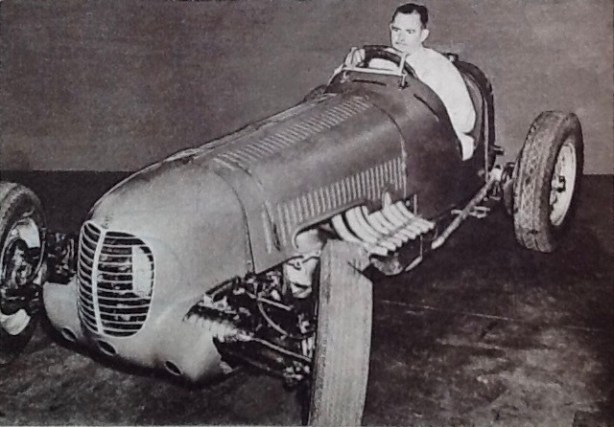
FK with the final iteration of the Kleinig Hudson Spl with Peugeot 203 front suspension, Maserati body and the rest (Modern Motor via S Dalton)
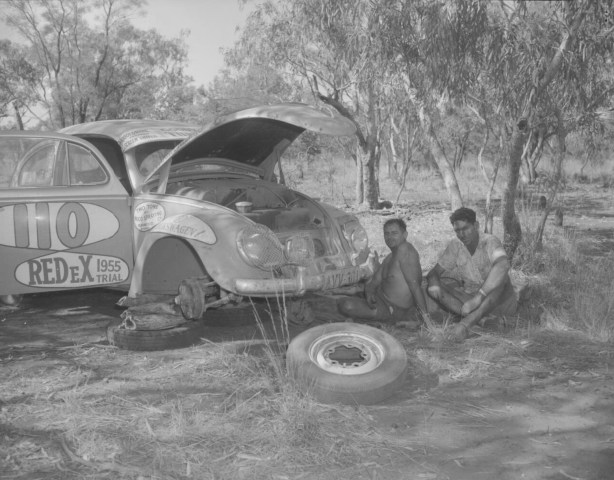
Kleinig and Beetle 1200 during the 1955 REDeX- 3 September en route to Fitzroy Crossing in WA- he hit a rock culvert, wrecking the car (HWT)
REDeX Round Australia Trials…
Like all of the aces of the day Kleinig was versatile and adaptable contesting a number of the round Australia trials which were hugely popular with the Australian public at the time buoyed by car ownership which was becoming more widespread.
FK’s was eighty-fourth in 1953 in a Morris Minor and twenty-seventh in a Peugeot 203 in 1954 but he made the papers anyway, for a speeding offence- he was found guilty of driving through Goulburn at 50mph, the prosecutor noting traffic convictions going back to 1928 and lost his licence for three months. Naughty boy.
More spectacular was the coverage he received as far away as France where their weekly magazine ‘Rampage’ reported that Frank Kleinig and another competitor, George Green ‘were attacked by savages’.
Kleinig was driving his Peugeot 203 between Katherine and Darwin, trying to get past George Green when a ‘blackfellow appeared by the side of the road…wearing only a bit of canvas in front of him, carrying an axe and a spear…’
In the delicate, politically correct language of the day Kleinig observed that ‘As Green’s car passed, the blackfellow rushed out on the road and tried to stop him but Green was going too fast. When I slowed up the blackfellow rushed towards my car and I stopped. He had some sort of root he had been smoking and he asked for “chew-back” (tobacco). I told him I had none, then he pointed to my watch…I said you don’t get that sport…I picked up a camera off the seat and took a picture of him as I started to drive away…as I did so…he took a swing at the back of the car with his axe…he made a mark but that’s all’ FK concluded.
By the time the French press got hold of this the artist concerned had ‘blackfellas’ all over the car, sadly the image, which is more ‘Jungle Jim’ in Africa than Australian Outback, is too poor to reproduce as it is a bit of a giggle…
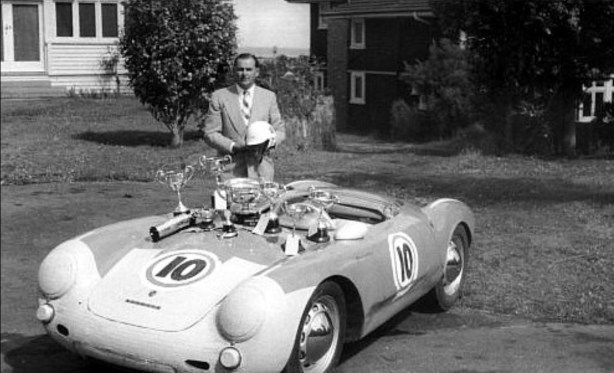
FK pictured with Norman Hamilton’s Porsche 550 Spyder, and trophies (C Gibson)
Where does Kleinig fit in the pantheon of Australian drivers?…
Norman Hamilton, the importer of Porsche into Australia invited Frank to drive his 550 Spyder in the NZGP at Ardmore, FK finished ninth in the sportscar, a great drive, Stirling Moss won the race in a Maserati 250F- and drove the Porker to victory in a sportscar support event. Kleinig also raced the car in Australia and prepared it for a time in his Sydney HQ.
A ‘works drive’ such as that offered by Hamilton late in his career (FK was born 1911 remember) makes one wonder what Frank could have achieved with better equipment- mind you he was incredibly lucky to have a Patron such as Gus McIntyre to give him his start.
Amongst good pub chatter topics over a blurry Carlton Draught is a list of ‘the greatest Australian drivers never to win an Australian Grand Prix’ before the F1 era commenced in 1985.
Names that come up include Alf Barrett, Reg Hunt (mind you he wasn’t around that long) Frank Gardner, Kevin Bartlett, John Bowe, John Smith, Alfredo Costanzo…and Frank Kleinig.
In period comparisons put him thereabouts with Barrett whose primary tool was a beautifully prepared (Allan Ashton at AF Hollins who later looked after Lex Davo’s machines) Alfa Romeo Monza which the well heeled Armadale businessman raced with considerable success and perhaps too often big-event failures. Kleinig’s machine was as far from a factory built racer as it could possibly be, an amazingly fast ‘Bitza’ with the production based Hudson engine always pushed beyond limits hard to endure.
John Medley wrote about an AMS experts review of drivers at the time ‘A 1948 Australian Motor Sports magazine placing had John Snow just behind Alf Barrett in the “Best Australian Driver” category, but ahead of John Barraclough and Frank Kleinig, with John Crouch and Doug Whiteford in equal fifth place (although it should be noted that AMS editor Arthur Wylie ((a driver of the front rank himself)) was smart enough and knowledgable enough to restrict the poll to just New South Wales and Victoria: because he, like John Snow and all the other Eastern States hotshots all knew they had been out-thought, out-prepared, and remarkably out-driven by the almost unknown Allan Tomlinson from Western Australia when his supercharged MG TA Special won the 1939 Australian Grand Prix at the sobering high speed South Australian circuit at Lobethal’ wrote Medley providing valuable in-period context and opinion- far more valuable than any thoughts of mine decades hence using third-hand information to make interpretations of ‘what was’.
Contemporary reports have it that Frank was a sprinter, not one who could really stroke the car home- despite the fact he built and maintained his cars. You can see the fizz, brio, energy and sparkle characteristic of FK’s driving in some of the photographs within this piece.
We need to keep in mind the handicappers role in this period too of course. But the adage ‘to finish first, first you have to finish’ is one to bare in mind and perhaps one Frank’s Driver Coach could have mentioned to him once or twice along his journey.
Barry Lake wrote of Kleinig in his book ‘Half a Century of Speed’. ‘I asked John Crouch (1949 AGP winner and contemporary of FK for much of his career) what he thought of Frank Kleinig as a driver. He told me: ‘Kleinig was one of our best sprint drivers ever, but he wasn’t any good in a long race. He’d drive it as if it was a sprint. He was a top mechanic but the machinery still could never stand up to him. On the dirt or in a sprint hillclimb there’s probably never been anybody as good or better.’
Looking more broadly than just at his on-track performances Kleinig is very much in the rich tradition of elite level Australian racer/mechanic/engineer/entrepreneur/businessman types- think Brabham, Gardner, Garrie Cooper, Matich and Perkins, a pretty special breed I believe.
It’s hard to say who was quickest in an era when ‘everyone’ wasn’t racing a similar Maserati 250F, Cooper or Brabham Climax, Lola T332 or Ralt RT4 but it does seem the evidence suggests Kleinig was one of the fastest of his era, a different thing to the best mind you- which spans the mid-thirties to the mid-fifties in whatever he drove.
And my guess is he may have, may have, squeezed a tad more outta that Alfa Monza than Mr Barrett did over one or two laps if not an entire race.
Bill Thompson was winding back his activities in the mid-thirties as FK was winding up- Thompson died during the War too so i have not attempted to draw comparisons there- and this ramble started with arguments about those who didn’t win an AGP whereas Bill won three of course.
For the sake of completeness Thompson and Barrett are generally the pair at the tip of the pyramid of best ever Australian resident drivers with debate more or less equally drawn on which of these two fellas stand alone.

Kleinig’s factory/workshop on Parramatta Road, Burwood, Sydney in 1947. Kleinig Hudson on the trailer, the other racer is Bill Ford’s Hudson 6 Spl. Kleinig retained the 1.5 litre Miller engine after it was removed from the KD- many enthusiasts recall it being on display in the window of this workshop for decades (C Gibson)
Commercial Activities…
Whilst involved in the motor trade all of his life Kleinig was also an inventor and innovator.
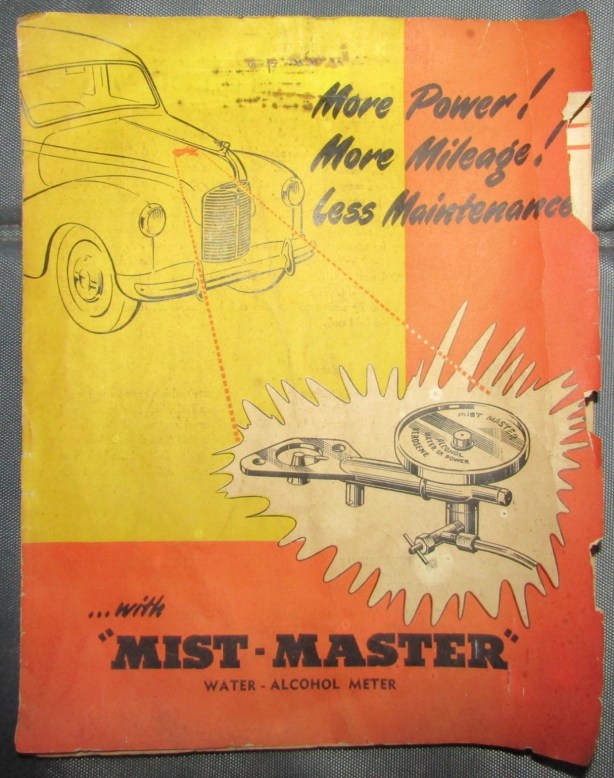
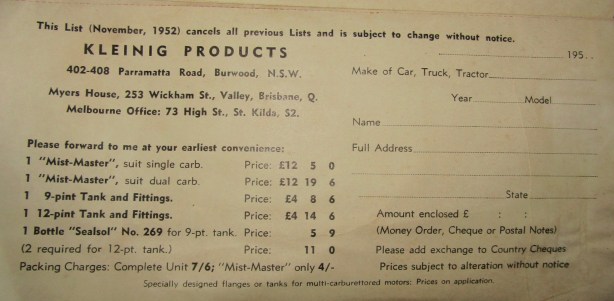
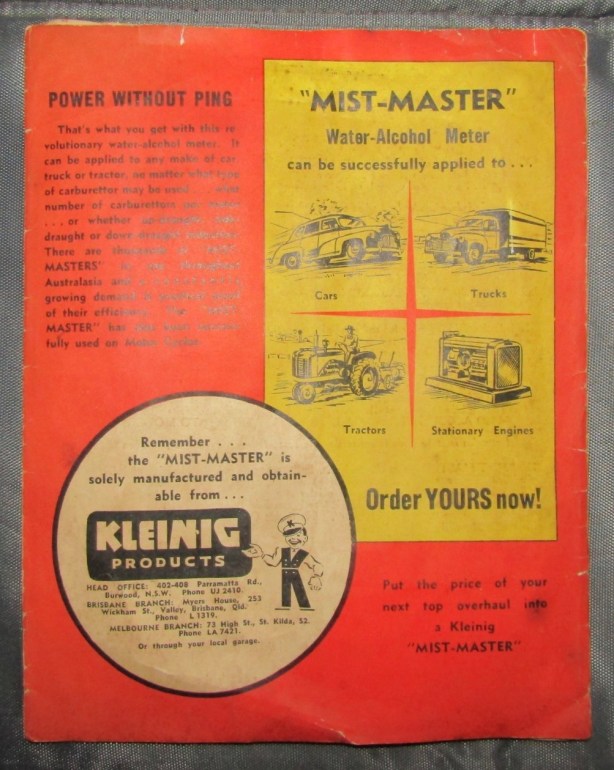
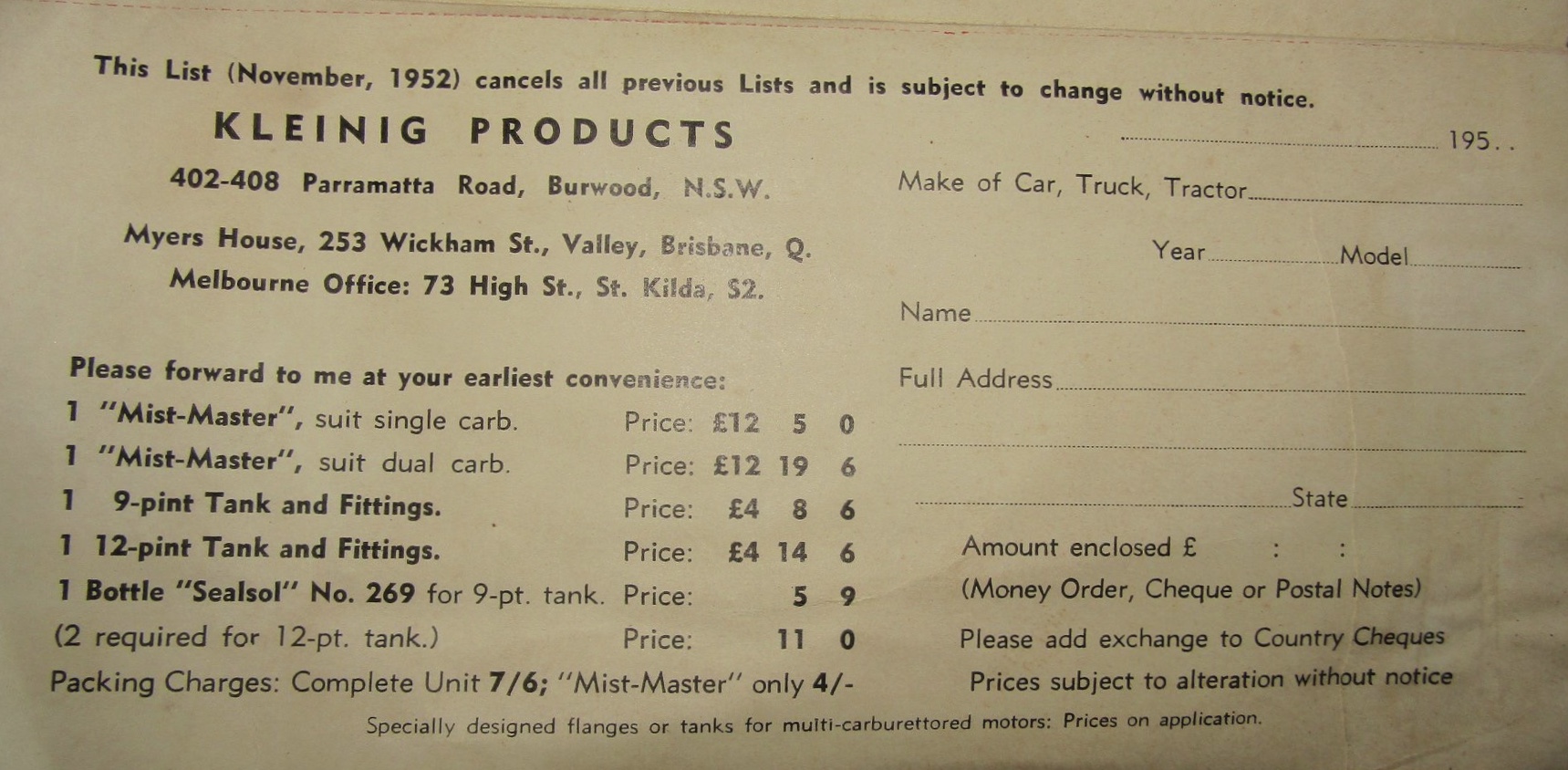
He developed the ‘Mist-Master’ water injection system for the Kleinig Hudson and also sold kits for road cars to combat the pinging or detonation caused at the time as a consequence of the low octane and quality of fuels commercially available.
He also made and marketed a range of speed equipment including exhaust system, inlet manifolds, air cleaners and the ‘Spark Booster’ device which increased the intensity of the spark.
The workshop above, established after Frank’s departure from Kirby Engineering in 1938 at 404 Parramatta Road was well known to home mechanics by the 1950’s and it was not unusual for a long queue of folks on Saturday mornings wanting to buy parts.
In addition, the Frank Kleinig Rubber Company recycled old tyres- he developed a technique for shredding the tyres in which the steel belt material was removed by magnets and the rubber melted and injected under pressure to make new products, the most popular of which were bath plugs. Misfortune occurred in May 1947 with in excess of five thousand pounds worth of damage done to the premises, equipment and stock by fire.
Kleinig held patents for some of these inventions, that he was innovative and creative is not in doubt.
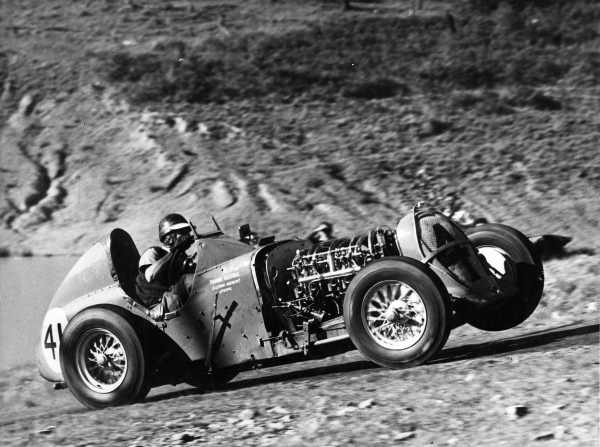
Frank Kleinig Rob Roy 1947. To set the record there in 1948 he pulled second gear all the way over the line, it spun to 7000rpm on plain bearings, a 5 inch stroke and with ‘splash’ lubrication (FH Hince)
Kleinig continued to race into the late 1950’s, for the fun of it in a Morris Minor, his last race Barry Lake believes to be a shared drive with his son, Frank Kleinig Jnr in a Morris Mini 850 for a class win in the Bathurst Six Hour Classic in September 1962- Kleinig Jnr became a Formula Vee ace.
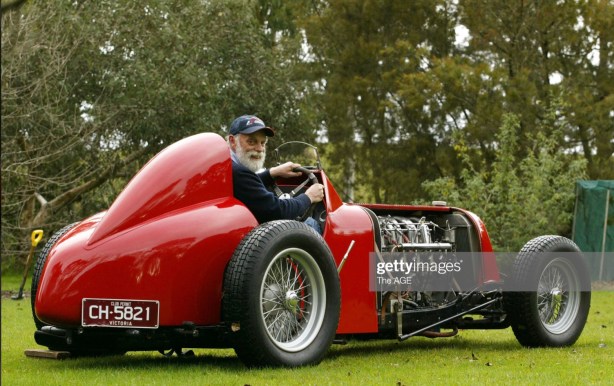
When Frank ceased racing he never sold the car which had been such an important part of his life. He died in 1976, the family retained the Kleinig Hudson until 1992 when it was purchased by the current owner Tom Roberts.
He commissioned its rebuild by David Rapley who also restored the Maserati 6CM ‘1546’ which donated its body to the Kleinig Hudson way back in 1954- and is also owned by Roberts.
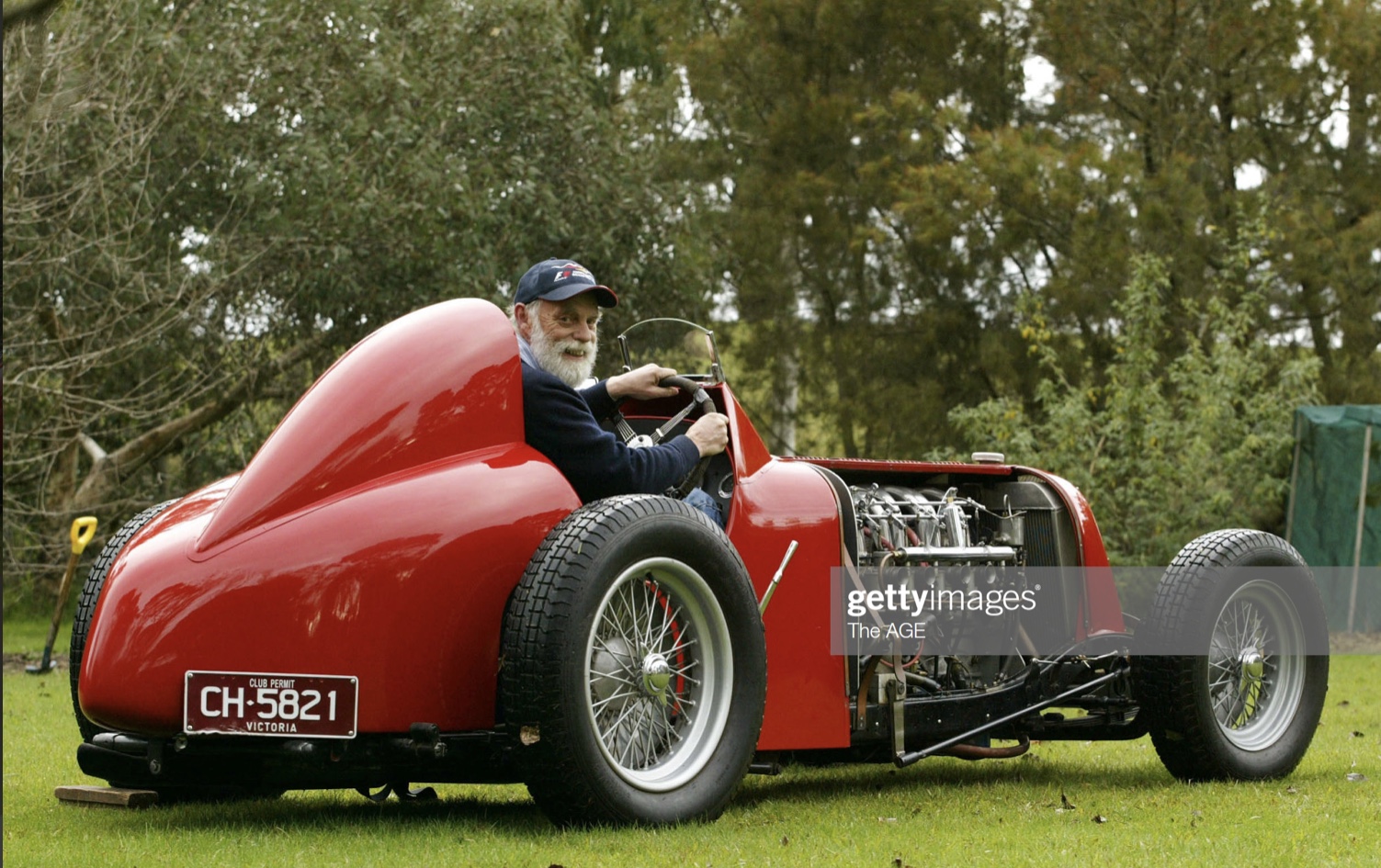
The Kleinig Hudson below with Tom Roberts at the wheel in Melbourne, August 2004- the KH would be right up there with ‘most raced car in Australia’, bested only by the Sulman Singer?
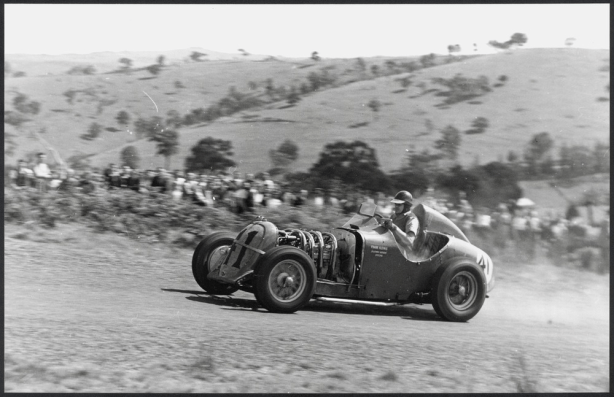
Frank Kleinig 14th Rob Roy 1947 (George Thomas)
Etcetera…
Bugatti Brescia Tragedy..
Misfortune befell Frank, two young friends and the Bugatti Brescia Kleinig was driving to a wedding in Strathfield, inner-Sydney on June 26 1933.
Travelling along Parramatta Road, on the corner of Crane Street Homebush, Frank collided with and glanced off another car into a telegraph pole, the small French car rolled spilling the occupants onto the road- very sadly for the hapless 21 year old driver, his male companions, twenty and twenty-one years old later died.
The District Coroner, sitting in Burwood, H Richardson-Clark ‘…was satisfied (having heard the differing testimony of several witnesses as to Kleinig’s speed) that the young men in the racing car were going like the wind, with time on their hands and the temptation of a concrete road. There was…clear evidence of failure to observe traffic regulations. The racing car…should have given way to the other car’, the Coroner said.
Kleinig’s counsel, Mr Simpson, remonstrated with the Coroner who he said ‘was biased against motorists’. Simpson said that ‘in the last three cases you have sent men to trial they have not had to face juries’.
And so it was that despite finding the two men had been ‘feloniously slayed’- and committing Kleinig for trial on a charge of manslaughter and FK being released on bail of one-hundred pounds, the young man did not face court.
Whatever the facts, and they died with the three occupants of the car, to overcome this tragedy says much of Kleinig’s ability to pick himself up and refocus his life on racing, building several businesses and a family in a manner typical of ‘racers’- a special breed.
The incident was an horrific one for all concerned, not least Kleinig who lived with the incident and terrible outcomes for the rest of his long life.
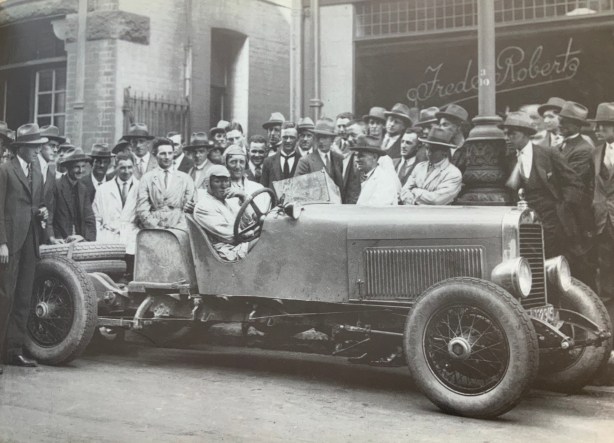
(JO Sherwood)
EJ ‘Joe’ Buckley…
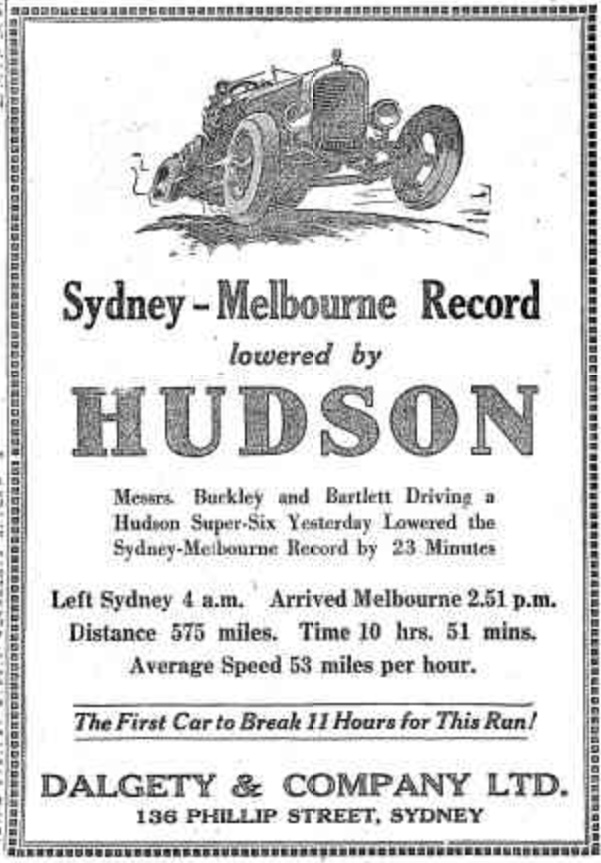
The photograph above shows Joe Buckley and Lewis L ‘Hope’ Bartlett in Sydney, Monday 20 November 1927 aboard a Hudson Super Six.
They set a time of 11 hours 54 minutes to become the first crew to go under ‘the magic 12 hours’ between Melbourne and Sydney, undercutting the previous best by 39 minutes 30 seconds despite crashing through a fence at Breadalbane and breaking a wheel.
The Sydney ‘Arrow’ reported that the same duo did a time of 10 hours 51 minutes in early January 1928. ‘The Hudson…used was almost a standard job, except that an extra petrol tank and an electric pump were installed and the springs were strengthened…The speedsters averaged 53 miles an hour over the 575 miles and had an uninterrupted run throughout. This is the first time that the journey between the two capitals has been done in under 11 hours, except by aeroplane’ the Arrow concluded.
Harry Beith held the record to that point in a Chrysler, he was the first to beat the time set by the late AV Turner who had done 12 hours 34 minutes, a record which stood for over four years set in February 1924
In a tit-for-tat period of constant changes in the record Harry Beith and his mechanic A Dolphin in a Chrysler did 10 hours and 12 minutes in December 1929 beating Buckley’s 10 hours 24 minutes…
And so it went on until the legislators brought an activity which was becoming increasingly dangerous to an end.
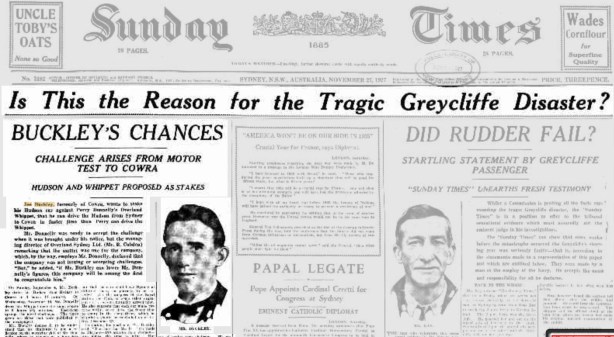
The intercapital record breaking efforts were big news, often front page news, as here with Buckley and a fellow aspirant Perry Donnelly (Overland Whippet) ‘betting their cars’ in the event one could not set a better time than the other for the Sydney-Cowra run- 27 November 1927
Buckley’s chosen marque, Hudson (Hudson, Essex and Terraplane) popular in Australia, were built from 1909 to 1954 by the Hudson Motor Car Co in Detroit and then for three years more by American Motors Corp before production stopped.
‘Speedster Buckley set speed records in that summer of 1928 between Sydney-Melbourne, Adelaide-Melbourne and Sydney-Cowra (his home town).
Whilst the manufacturers of the successful makes of car proclaimed their success in the usual way- newspaper advertisements, Hudson sent Buckley on a tour of Northern NSW (if not elsewhere) doing speed and economy demonstrations ‘with four or five passengers up’ of the Hudson Super-Six supervised by the local newspaper and/or motoring authority.
The Coffs Harbour Advocate reported the results; Walcha 21mpg, Tamworth 70mph and Moombi Range climbed ‘in top’, Armidale’s Hiscox Hill was ascended ‘in top’ whilst at Glen Innes 23mpg and 75mph was achieved.
The results of Glen Innes were repeated in Tenterfield but Big Hill was done ‘in top’- Lismore’s triumphs were 22.8mpg and 0-30mph in 4 seconds.
Proving that advertorial is nothing new the Advocate’s reporter concluded that ‘these figures are convincing proof of the Hudson makes claim that in spite of greatly improved performance, the latest Hudsons are 20mpg cars.’
What became of Joe Buckley folks?
(SLNSW)
Les Burrows..
Usual thing, you see a new name, sniff around and all of a sudden learn something about a fella yer didn’t know anything about.
What an ace on the tar and dirt the Bowral garage owner and Hudson dealer was aboard both this car and midgets at places like Penrith.
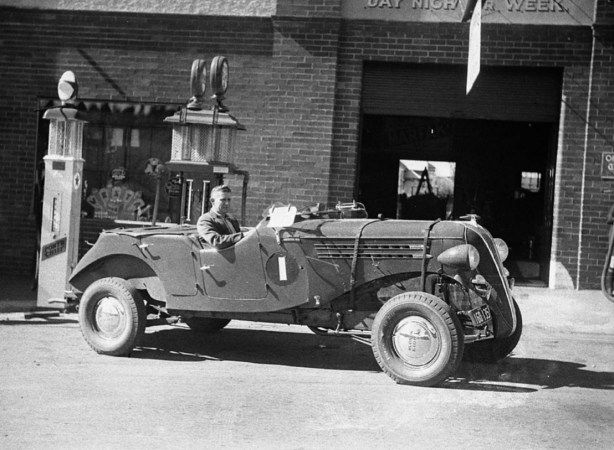
You may recall at the article’s outset that Les won the Phillip Island event during which Bailey and Kleinig came to grief, he is pictured in that car out front of his business in Bowral’s main street in May 1937 above.
Clive Gibson wrote that Burrow’s car was a one-off with a special body by Properts Body Works of Camperdown, Sydney. Said body was originally fitted to Burrow’s 1935 Terraplane and transferred to a new Hudson 8 in 1936, it was light- 20 cwt compared with a four door at 24 cwt. He also raced a 1933 Terraplane in the 1938 AGP at Bathurst, finishing second behind Peter Whitehead’s ERA B Type.
The car contested the 26 December South Australian Centenary Grand Prix aka 1936 AGP at Victor Harbor, DNF. He won the Ten Mile Championship at Penrith on Anzac Day in 1937 and in its first form as a 1935 Terraplane won the November 1935 Phillip Island race referred to above. The Terraplane was green and the Hudson bright red.
Clive Gibson owned the car in the sixties, then the machine changed hands in Sydney several times and disappeared, presumed lost. Les’ last competition event was the 1954 REDeX in a Vanguard.
Love this piece about the commitment of a racer, it’s from the Sydney Morning Herald 12 November 1935 report of his Phillip Island win.
‘…on the preceding Saturday he drove the car from Bowral to Sydney and competed in the New South Wales Light Car Club’s Mountain Trial over Kurrajong to Mount Victoria. Returning to Sydney the same evening, he drove his racing Midget at the Wentworth Oval Speedway and then left Sydney at midnight, towing the Midget home to Bowral. He then left in the Terraplane to Melbourne at 4.30am on the Sunday, arriving there the same afternoon about 4 o’clock. The car was then stripped of its mudguards, hood and windscreen, and taken to Phillip Island on Monday November 4. No additional tuning was found to be necessary, and the car went straight into practice for the big race.’
Les ‘…lapped the circuit at 64mph’ and ‘drove with great skill, cornering in a fast and safe manner’ to win the race.
Then, with all the road equipment installed back onto the car Burrows drove the 900km from Cowes back to Bowral, in New South Wales beautiful Southern Highlands.
You don’t have to be mad but it helps!
(unattributed)
Some more from Ray Bell in relation to Les Burrows, Ray wrote this piece some year back after speaking with Clive Gibson.
‘Burrows…had been showing off Essexs for some time before getting a 1935 Terraplane Sports Tourer, in this car he won Phillip Island in 1935 but then drove the McIntyre Hudson at Robertson Hillclimb later in the year.’
‘Impressed by the eight’s power, he ordered a new 1936 model minus body and installed the 1935 Terraplane body on the new car. It was in this car that he and his riding mechanics took their wives on the South Australian Centenary Trial from the Sydney start to Adelaide, then the guards were removed for the Grand Prix.’ (the 1936 South Australian Centenary GP aka the 1936 Australian GP at Victor Harbor)
‘The 1935 engine was destined for use later on the 1933 Terraplane which was shortened and run briefly with the original engine. With a Propert body and the ’35 engine and wire wheels, then a ’38 grille, it was the definitive Burrows car that was raced so much- and finished the Lobethal race on three wheels.’ (the 1939 AGP)
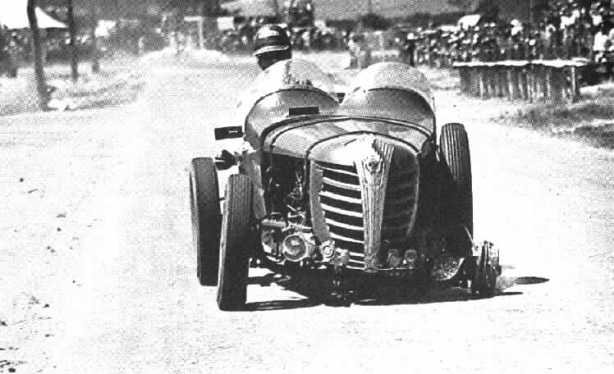
Les Burrows finishes the 1939 AGP at Lobethal on three wheels- he was fifth, the winner Allan Tomlinson’s MG TA Spl s/c (R Bell)
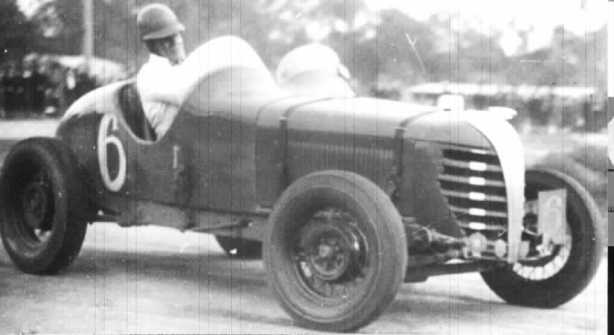
Magnificent shot of Les Burrows in the Terraplane Spl at Wirlinga, Albury during the March 1938 ‘Interstate Grand Prix’- he was third in the race won by Jack Phillip’s Ford V8 Spl- photo in reverse I think, actual number is 9 (R Bell)
Ray continues later in the original article ‘The only contemporary racing subsequent to this (Kleinig’s failure at the 1954 Southport AGP) of Hudsons or Terraplanes was accomplished by that old 1933 Burrows chassis. Its Propert body put aside in the late forties by Bill Ford, it was entered in the AGP meeting of 1955 as part of Bill’s racing and continued running until the closure of Mount Druitt and the Easter meeting at Bathurst in 1958, not entering the AGP that year.’
‘…the car became the Barracuda Ford in the sixties, with the Propert body, the grille Ford had fitted before the 1948 AGP and a Ford OHV V8. It reverted to its canvas bodied single-seater form when Peter Hitchin resurrected it for Historic Racing.’
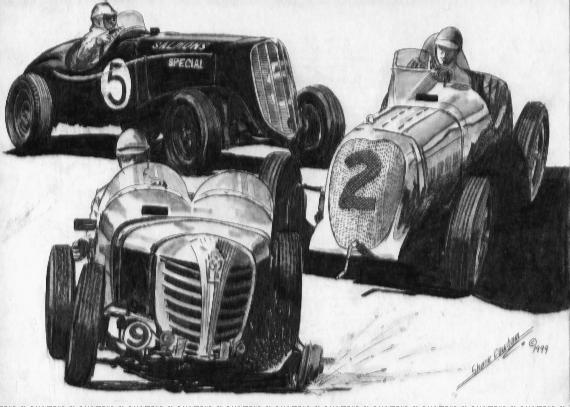
Shane Cowham drawing for the HRR Newsletter no 167- McIntyre Hudson at rear, the Kleining Hudson and Burrows Terraplane Spl (R Bell)
McIntyre Hudson…
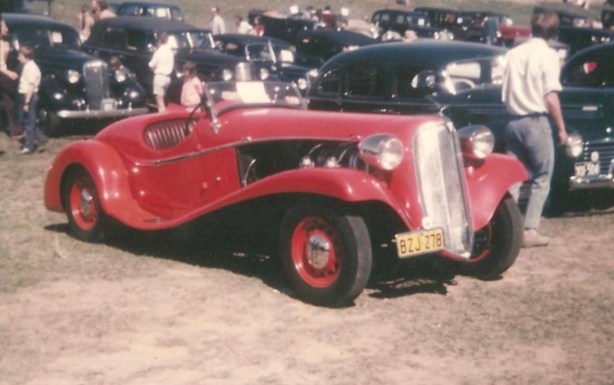
This amazing old warrior is shown above in ‘more recent times’ at Warwick Farm in 1971.
Some snippets about Kevin Salmon’s period with the car by Barry Lake, ‘Salmons car was owned by a Mrs Dixon, who sold it later to Frank Kleinig. John Crouch said of it: The McIntyre Hudson? That big roadster…it was a horrible thing to drive’.
Lake continued, ‘Kev Salmon was the son of Leo Salmon who was killed at Maroubra Speedway in 1925. John Crouch remembers Kevin for a used car showroom he had at the top of William Street (Sydney) where he “sold some wonderful cars”. I remember Salmon from when he raced again in the early 1960’s when he drove an MG Special and I had a Cooper Norton Mark V. At that time Kevin had a used car yard right at the Parramatta end of Parramatta Road.’
Kevin Salmon in the McIntyre Hudson/Salmon Spl from Frank Kleinig, Kleinig Hudson Spl at Bathurst in October 1939 (C Gibson)
Salmons Motors were the Sydney Citroen and Jewett agents and were involved in record-breaking.
Albert Vaughan, an employee of Leo Salmon’s enterprise and L McKenzie drove a Citroen to set the Sydney-Melbourne record at 15 hours 20 minutes in 1924.
Leo Salmon had a Jewett shortened and lightened to create a machine suited to Maroubra Speedway, the enormous concrete saucer built in the Sydney inner beachside suburb which opened on 5 December 1925.
With Leo at the wheel and Albert Vaughan as riding mechanic they were circulating the fast, challenging track on 30 December, preparing for the venue’s third meeting on New Years Day 1926 when Leo lost control and crashed over the top of the unguarded banking killing the poor unfortunate occupants who became the circuits first victims.
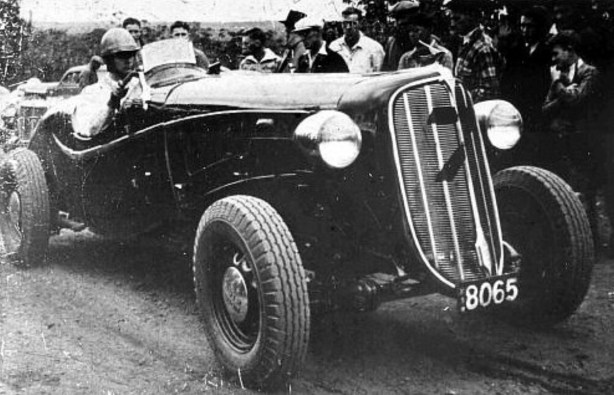
(C Gibson)
FK in the McIntyre Hudson at the Waterfall Valley Hillclimb in July 1938.
Doug Ramset in the white overalls and Clive Gibson in open neck jumper. Clive owned this car later in his life as a fast roadie, see a photograph of the car in more recent times at the end of this article.
In more recent times the McIntyre has fallen into good hands, that of the National Motor Museum at Birdwood In the Adelaide Hills, do pay the historic old jigger a visit!
Matthew Lombard is researching the full history of the car, please get in touch with him if you can add to the McIntyre story or any of those who drove, owned or prepared it- copy me in so I may update this piece too. Matt’s email is mlombard@history.sa.gov.au

Sydney ‘Referee’ 1 April 1937
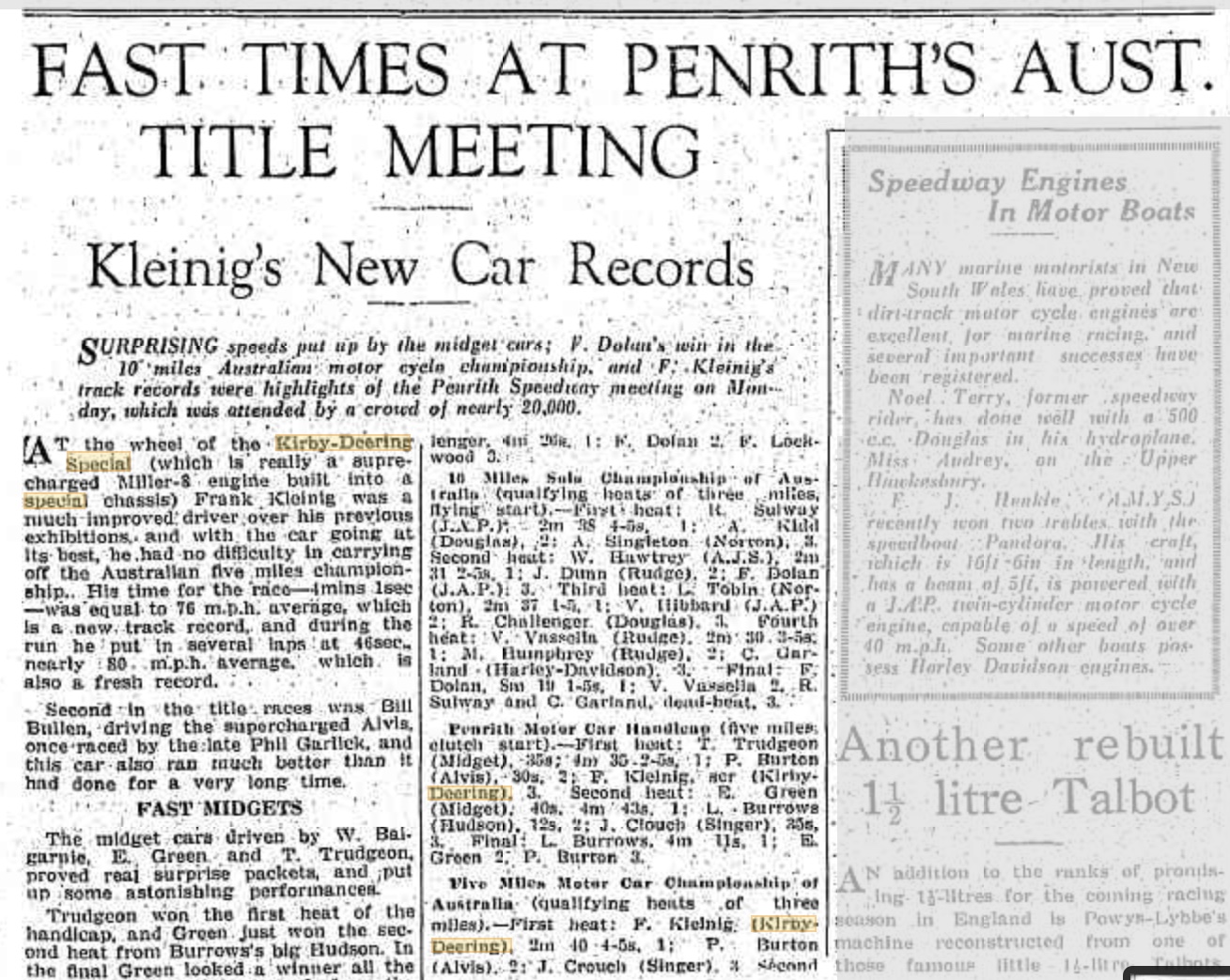
Its interesting that the reporter in the April 1937 piece above comments upon the improvement in Kleinig’s driving ‘over his previous exhibitions and with the car going at its best…’, this suggests, perhaps, that the Kirby-Deering Miller Spl was by then reasonably well sorted and that FK was handling it with aplomb.
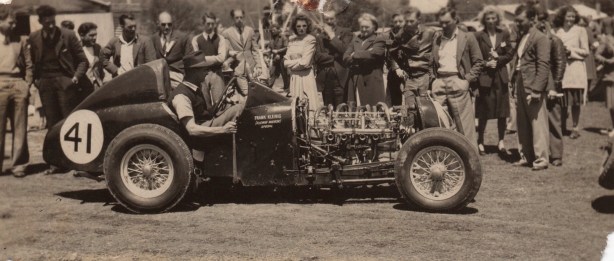
(E Davey-Milne)
Hillclimbs were a big deal yonks ago in Australia- look at the admiring Rob Roy crowd in 1947 or 1948 watching the KHS being warmed up- wonderfully, it still competes there seventy years after its first appearance.
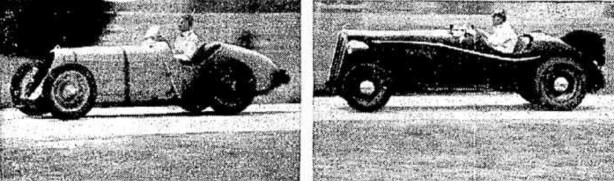
(The Referee)
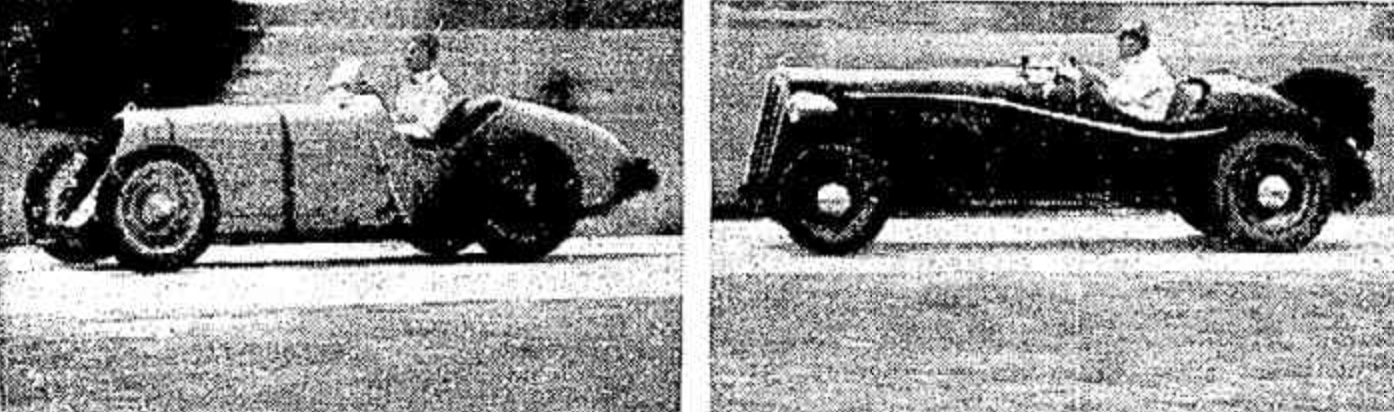
Interesting comparison of the two McIntyre owned racers in profile in November 1936.
At left is the Kirby-Deering Miller Spl with Frank at the wheel and at right Gus McIntyre aboard the McIntyre Hudson- he competed until health reasons forced relinquishment of the drivers seat.
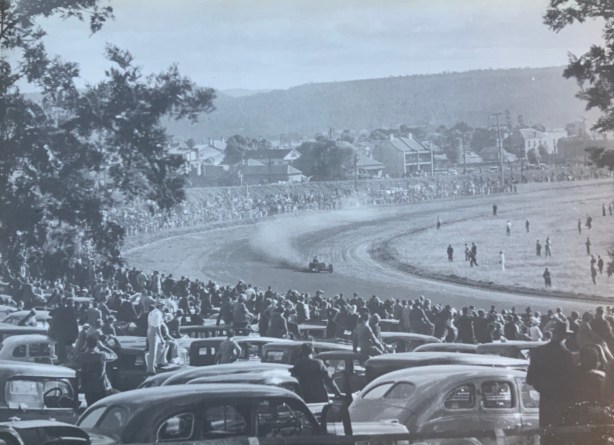
(JO Sherwood)
Superb panorama of FK in the Kleinig Hudson Special- ‘Dirt Track Charlie’ doing his thing, Barry Lake believes, circa 1939/40.
I’ve written about Penrith before- it first opened in 1921, then closed in 1930 and was re-opened by Frank Arthur in June 1936 until its final closure, well into the War, after a meeting held on 14 April 1941.
Special research thanks…
Bob King, John Medley, Ray Bell, Nathan Taska and Daniel Kleinig for photographs from the family collection
Bibliography…
Graham Howard & Others ‘History of The Australian Grand Prix’, George Thomas ‘Cars and Drivers’ #3 1977, Nathan Taska, John Medley, Motorsport January 1936, Referee (Sydney) 25 October 1934, The Referee 5 November 1936, State Library of NSW note by Clive Gibson accompanying the photograph of the Burrows Hudson at Bowral, The Canberra Times 27 April 1937, Sydney Morning Herald 12 November 1935, Bob Pritchett in Australian Motor Sports 15 November 1946, Sunday Times, Perth 22 August 1954, Museum of Applied Arts and Sciences, Sydney Morning Herald 7 July 1933, Sydney The Sun 6 July 1933, Articles by Tim Shellshear in VSCC newsletter, Bob King Collection, ‘The Car’ 15 November 1935, ‘John Snow: Classic Motor Racer’ John Medley, ‘Half a Century of Speed’ Barry Lake via Tony Davis Collection- this publication incorporates the photographs of the John O Sherwood Collection, The Arrow Sydney 13 January 1928, Coffs Harbour Advocate 24 July 1928, The Advertiser 30 December 1936, Australian Dictionary of Biography- Sir JN Kirby and H Hastings Deering, article on the Kleinig-Hudson by David White and Graeme Jackson, Ray Bell and his Collection
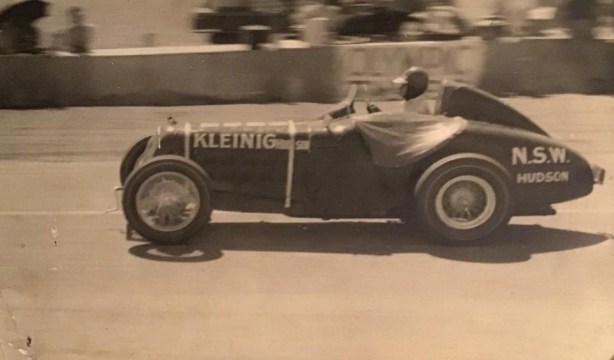
Lobethal perhaps, 1939 Kleinig Hudson (unattributed)
Photo Credits…
George Thomas, Bob King Collection, Norman Howard, Alex Collingridge, Herald and Weekly Times, Tim Shellshear Collection, Bob King Collection, Russell Garth, Jim Shepherd, Kleinig Family Collection, Stephen Dalton Collection
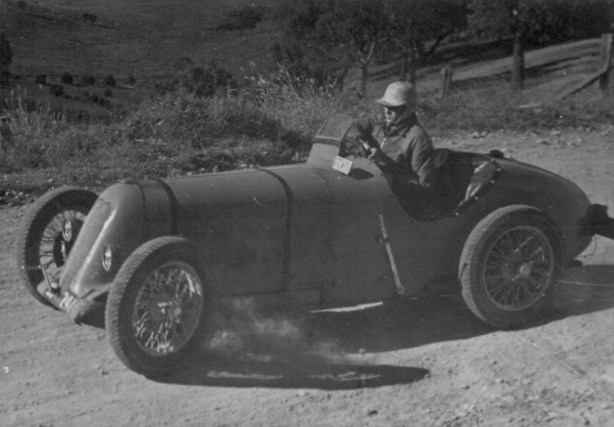
Tailpiece: Kleinig, Kirby-Deering, date and place unknown, circa 1937…
(T Shellshear)
The Kirby Deering Miller Spl, a bit of a mouthful really, with Kleinig at the wheel, probably a hillclimb, if any of you can pick the venue do get in touch.
What about that Miller engine?
One story emanating, Bob King thinks from Kent Patrick- a racer/writer of note, is that the Miller engine was bought for Frank as a gift for saving a young person from drowning. It’s an interesting one. That does not accord with the newspaper accounts or Daniel Kleinig’s recollection of his grandfather saying he ‘was allowed to set the valve clearances of the engine whilst an apprentice.’ It it were your motor you wouldn’t have been askin’, would yer?
Perhaps this story has become confused with one involving (later Sir) Frank Beaurepaire who was awarded a Gold Medal and 550 pounds by the Royal Humane Society in 1922 for helping save a shark attack victim in the Coogee surf- he used this money to start Beaurepaires, a nationally significant (still) tyre, wheels and battery business.
In any event the Miller engine sat in Frank’s Parramatta Road workshop front window ‘forever’- Barry Lake records that Tom Wheatcroft bought the engine for his Donington Collection circa 1994.
Bob King recalls Wheatcroft as a regular visitor to Australia in the Adelaide GP and early Albert Park GP days. He was close to John ‘Jumbo’ Goddard, Sydney car collector, Bob’s suspicion is that Jumbo probably said to Tom on one of these trips ‘You really should grab that motor champ’, I wonder which particular bonnet below which it was inserted back in the UK? Or perhaps it became a swap?
Finito…



















































































 primotipo...