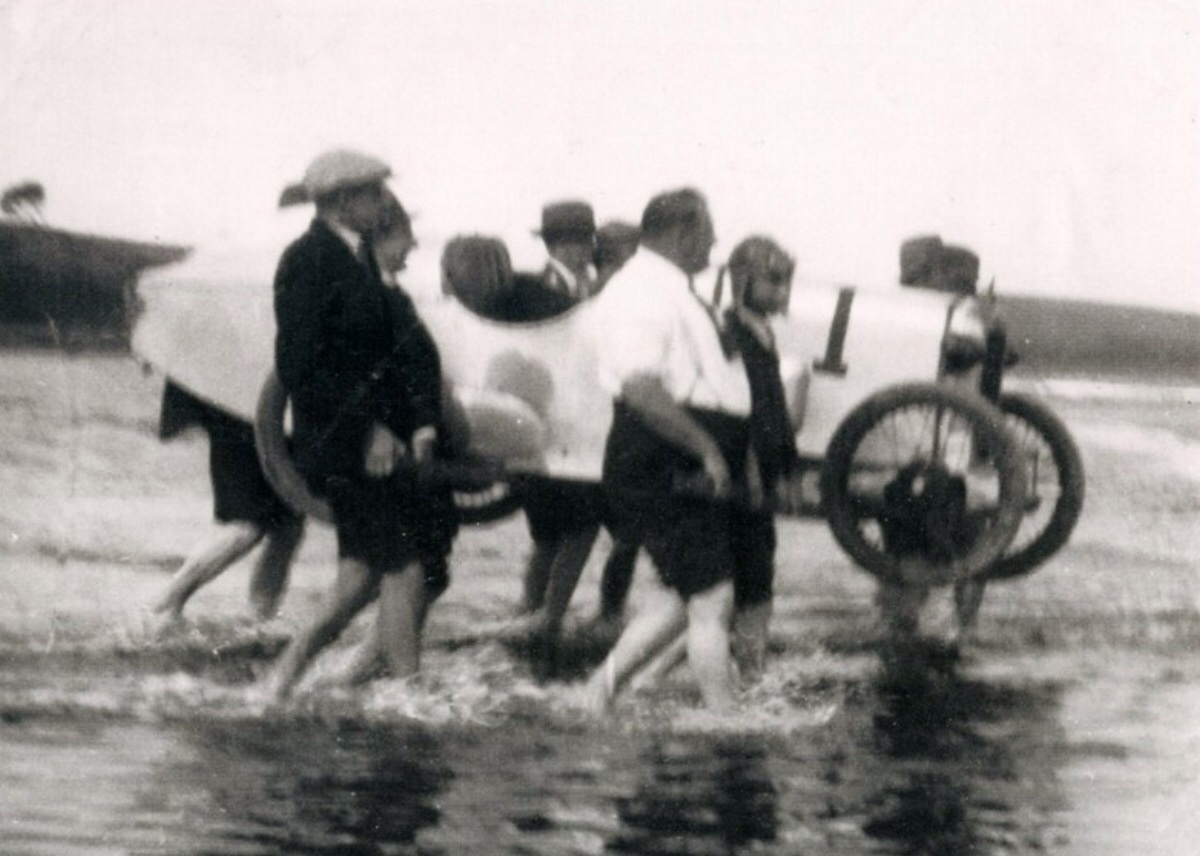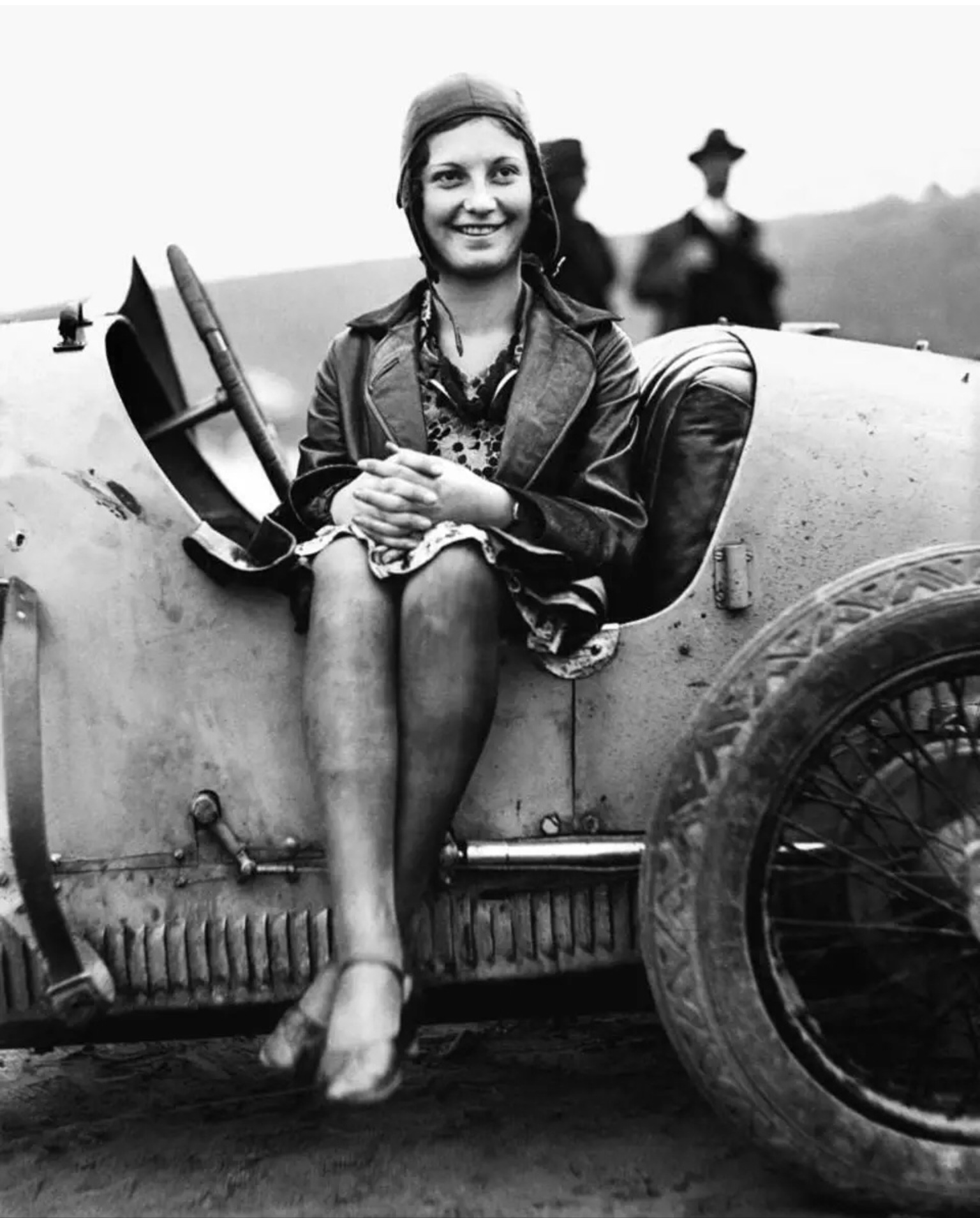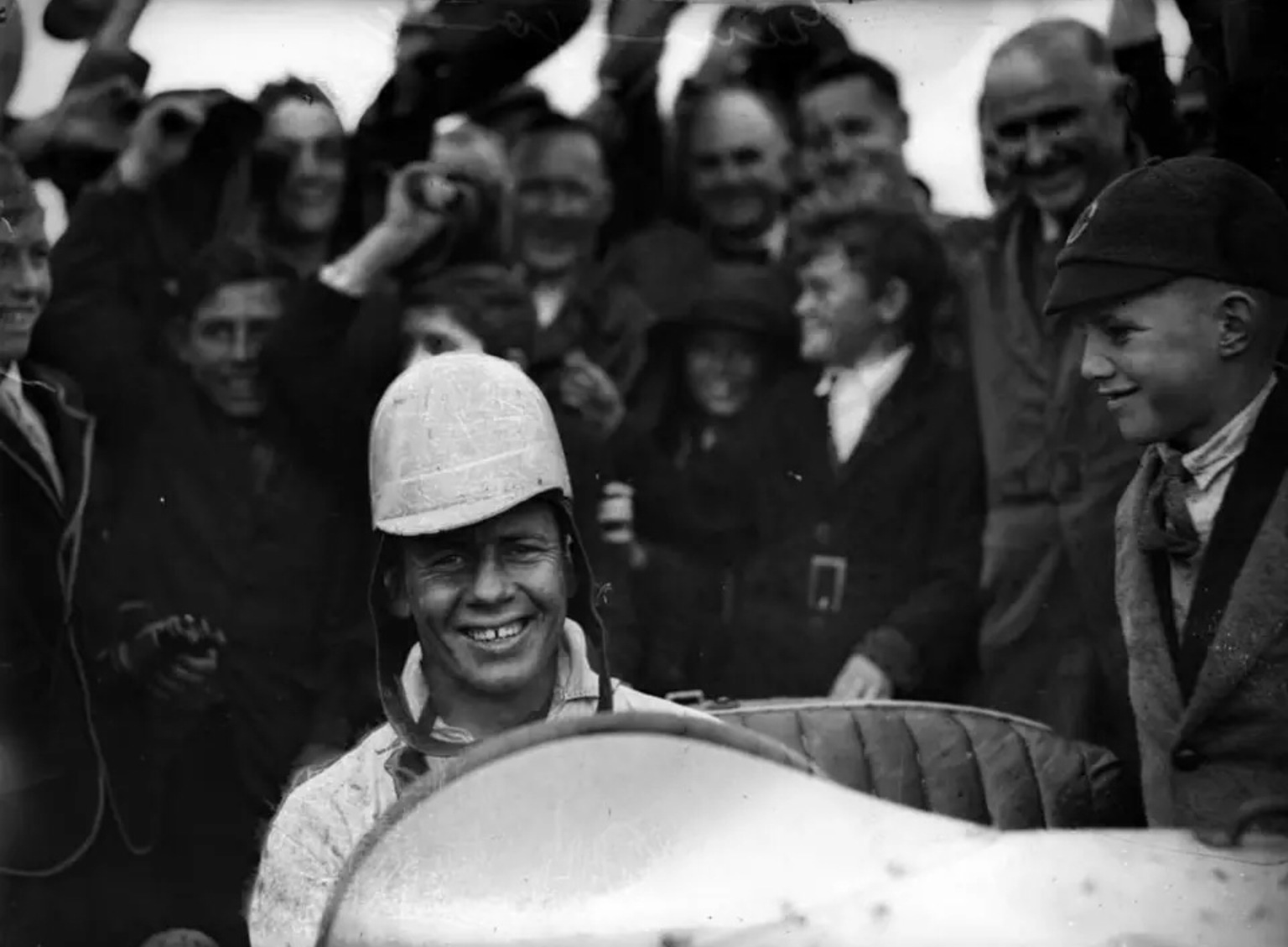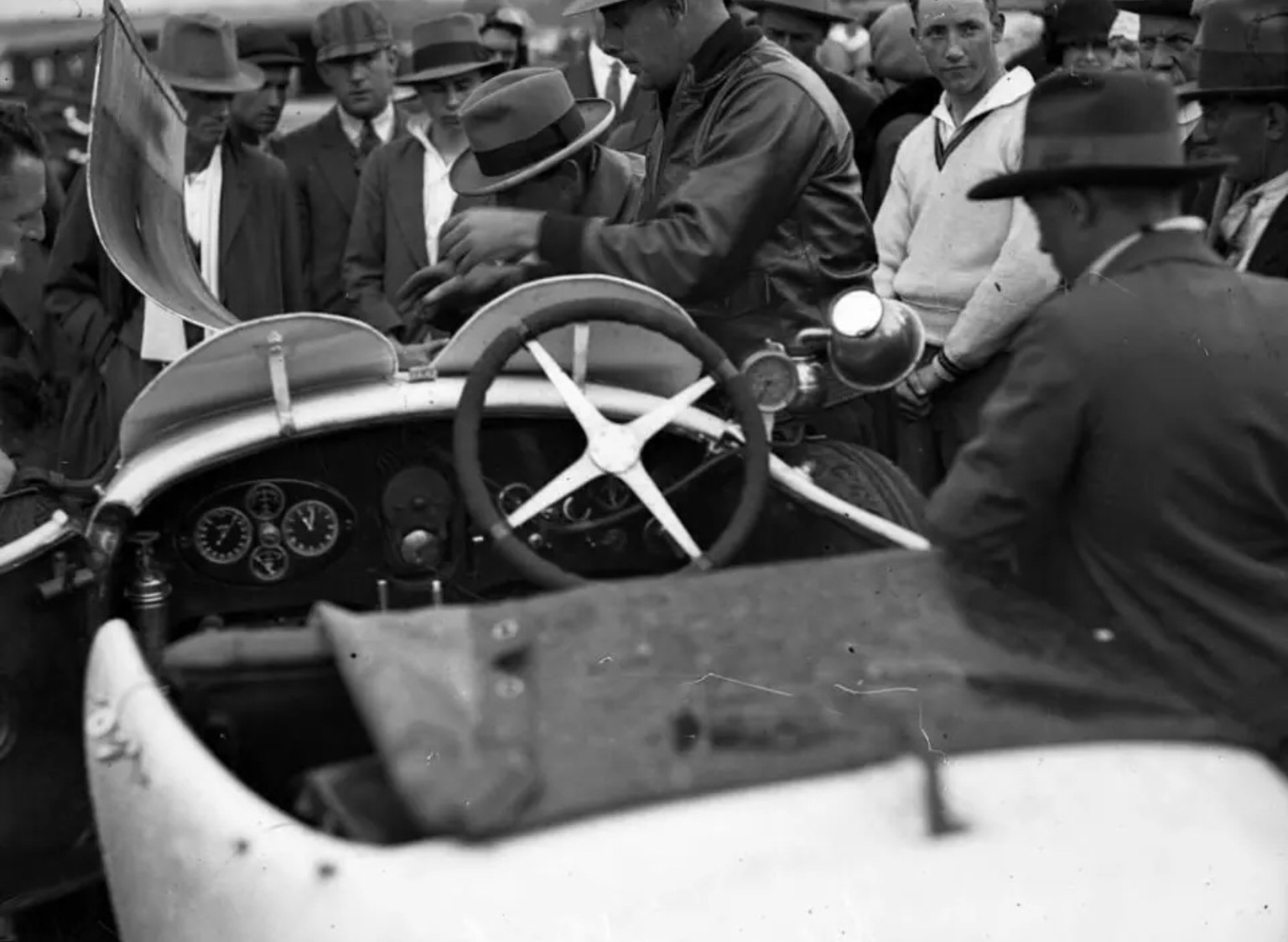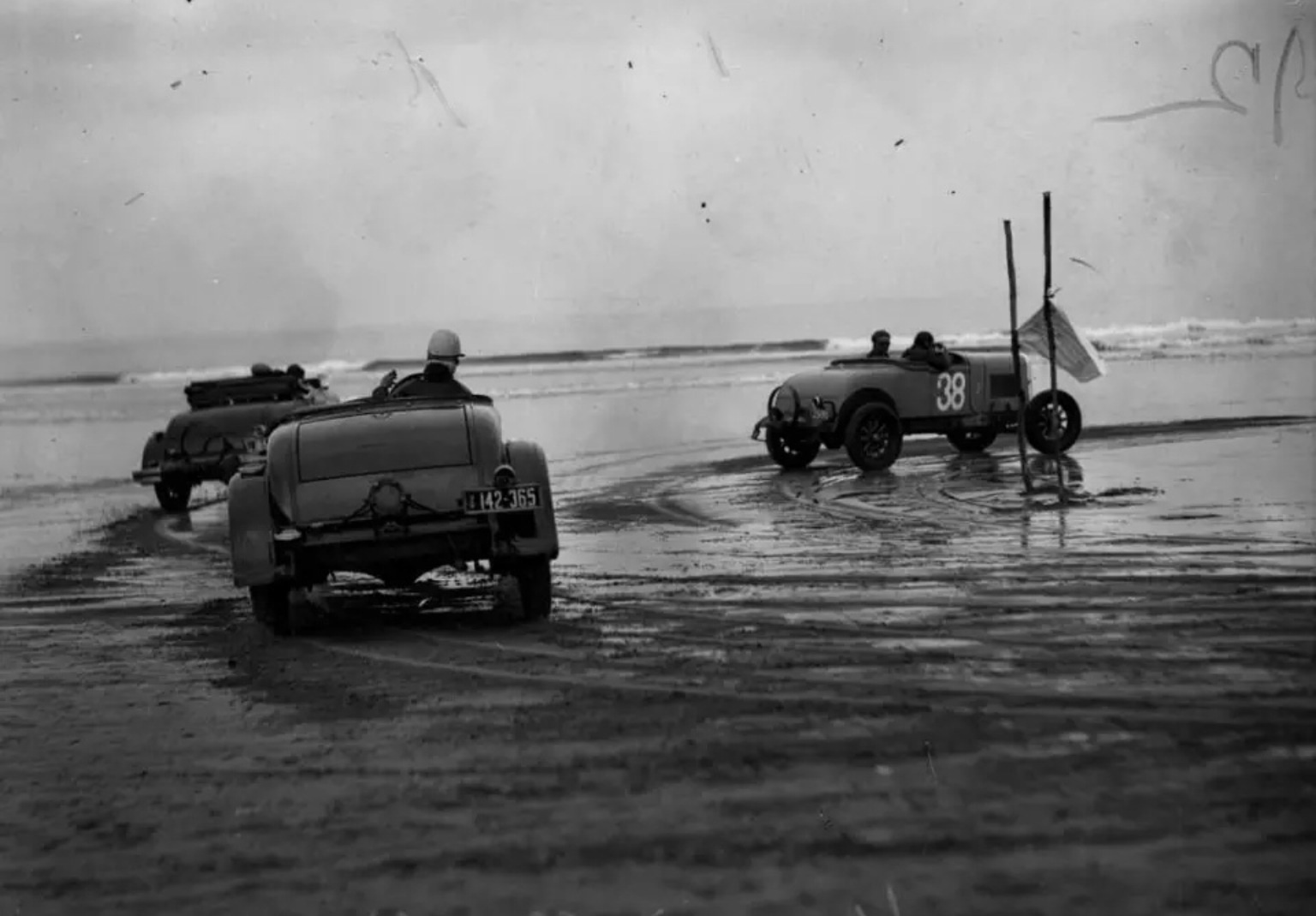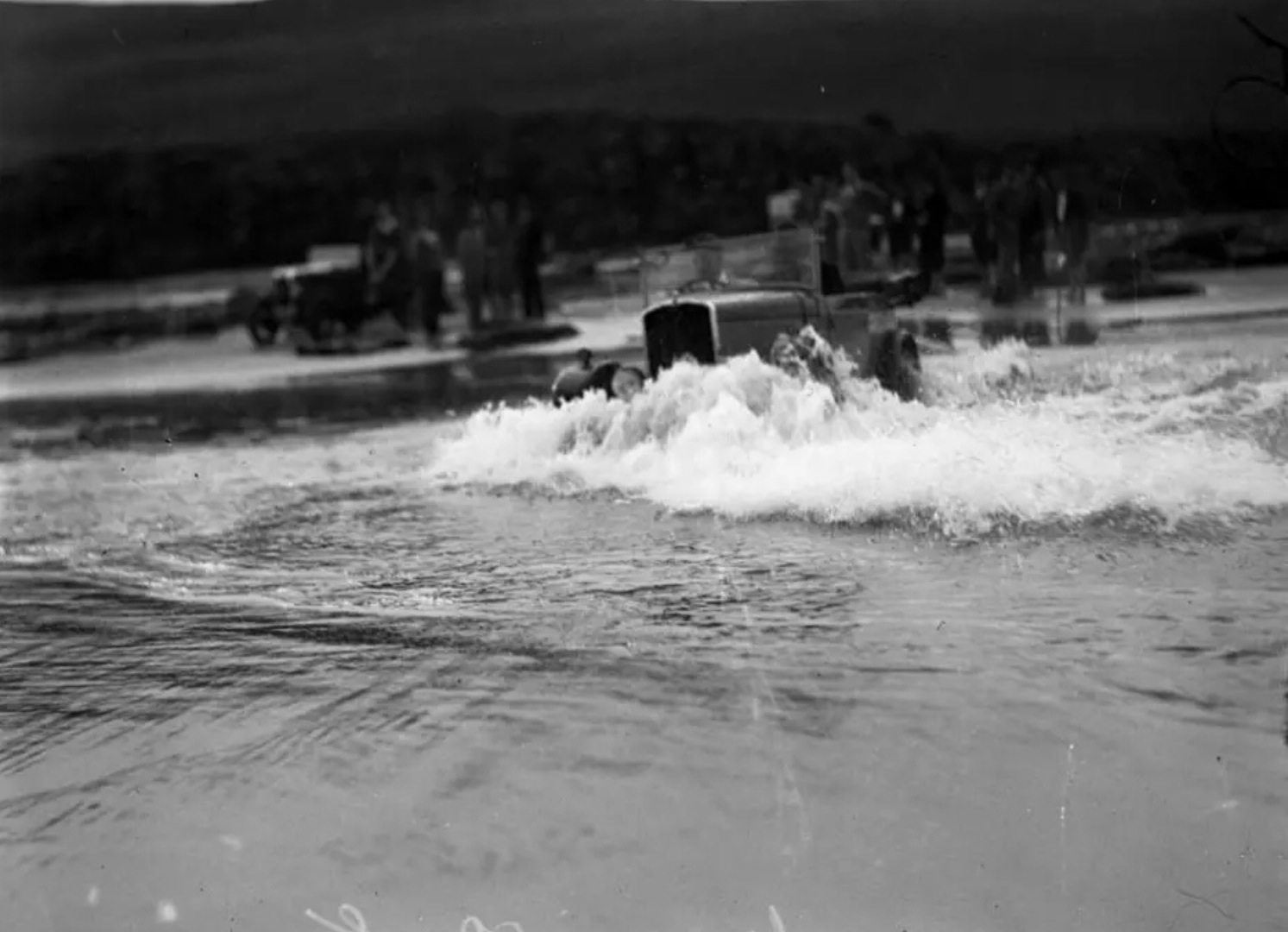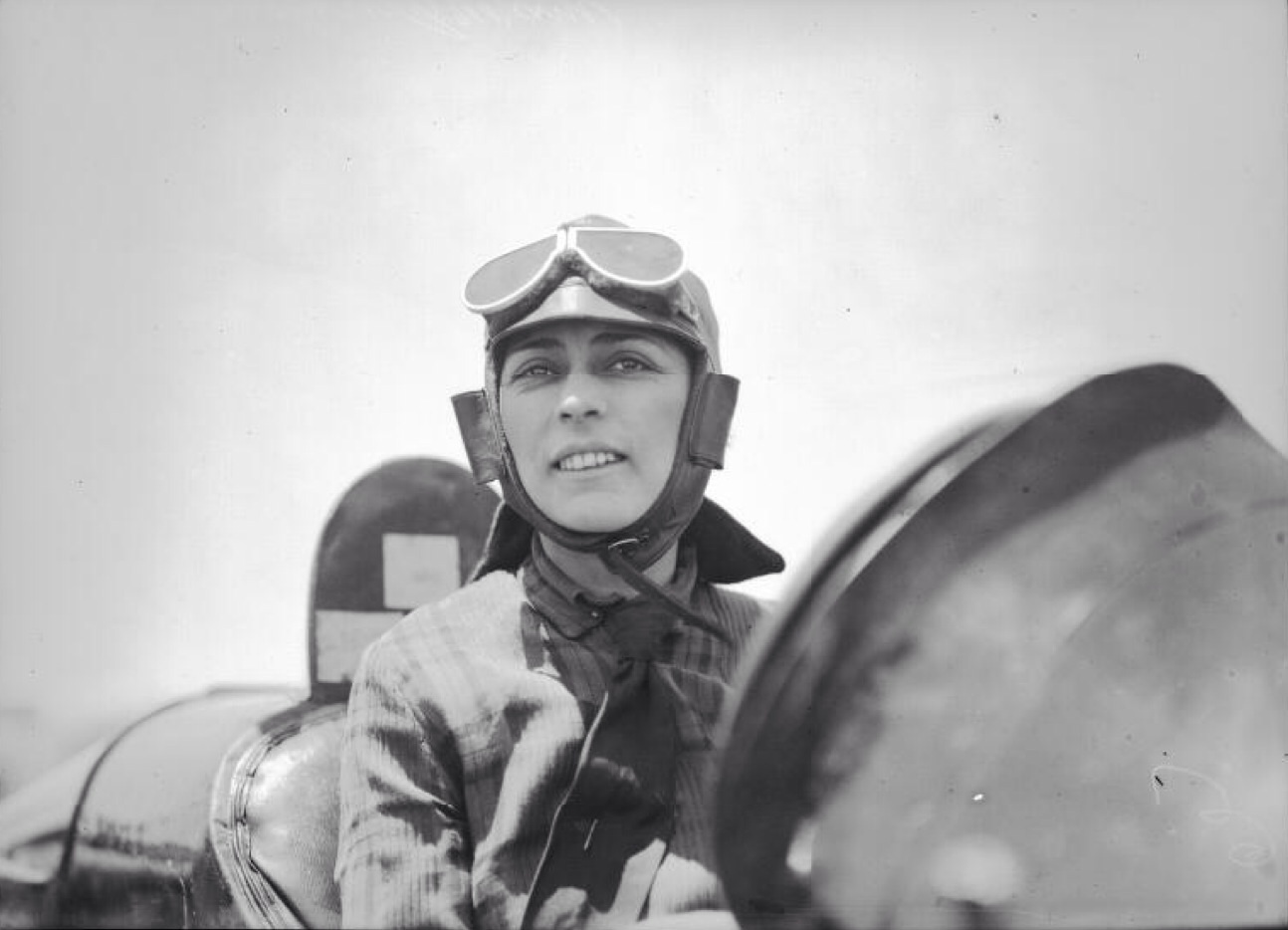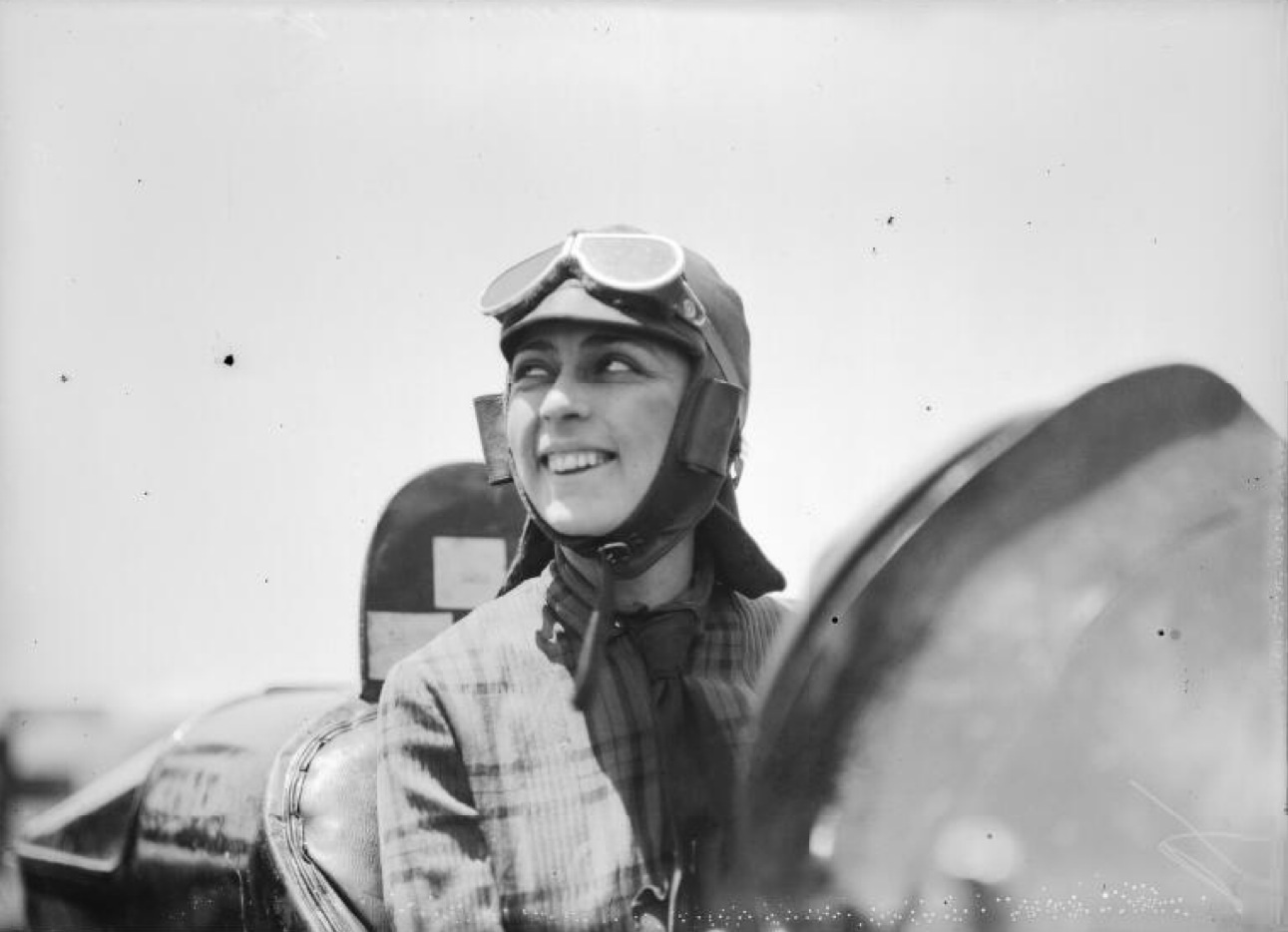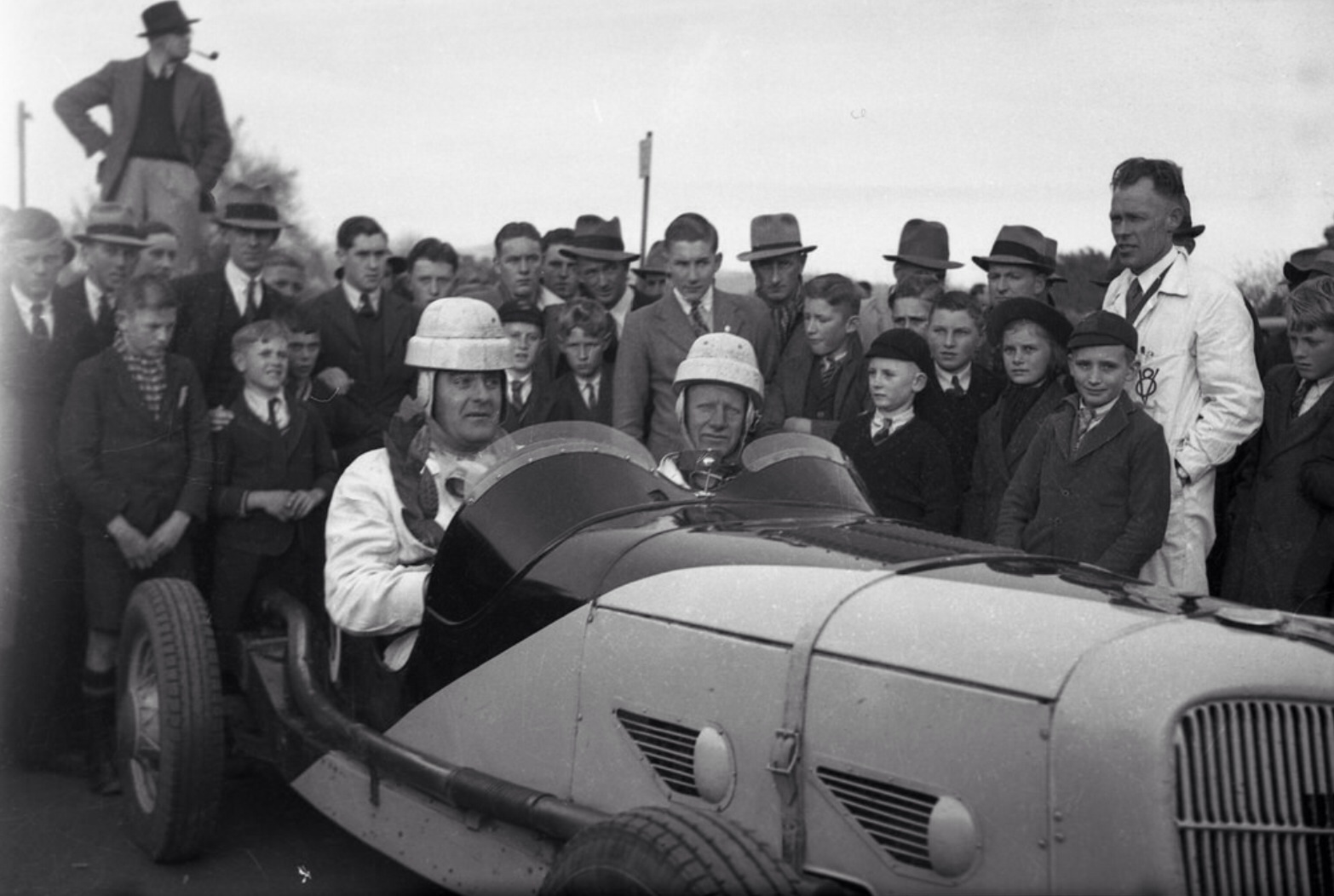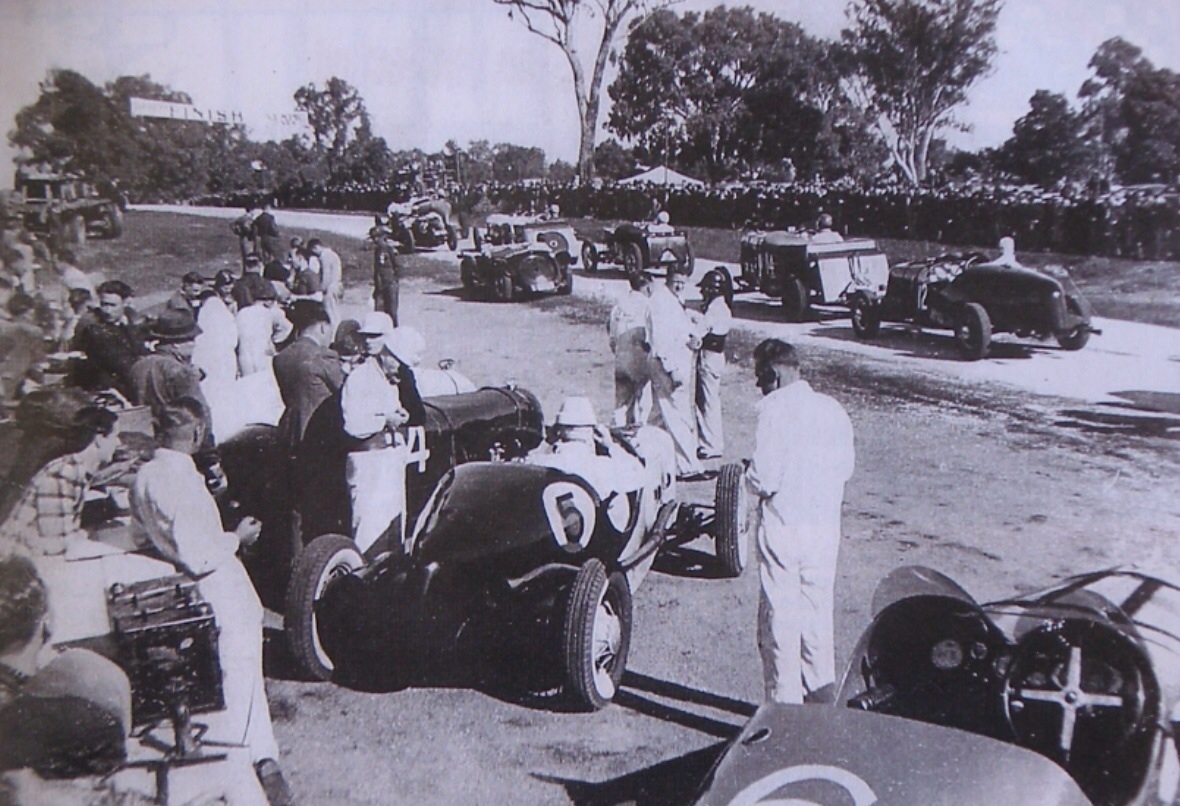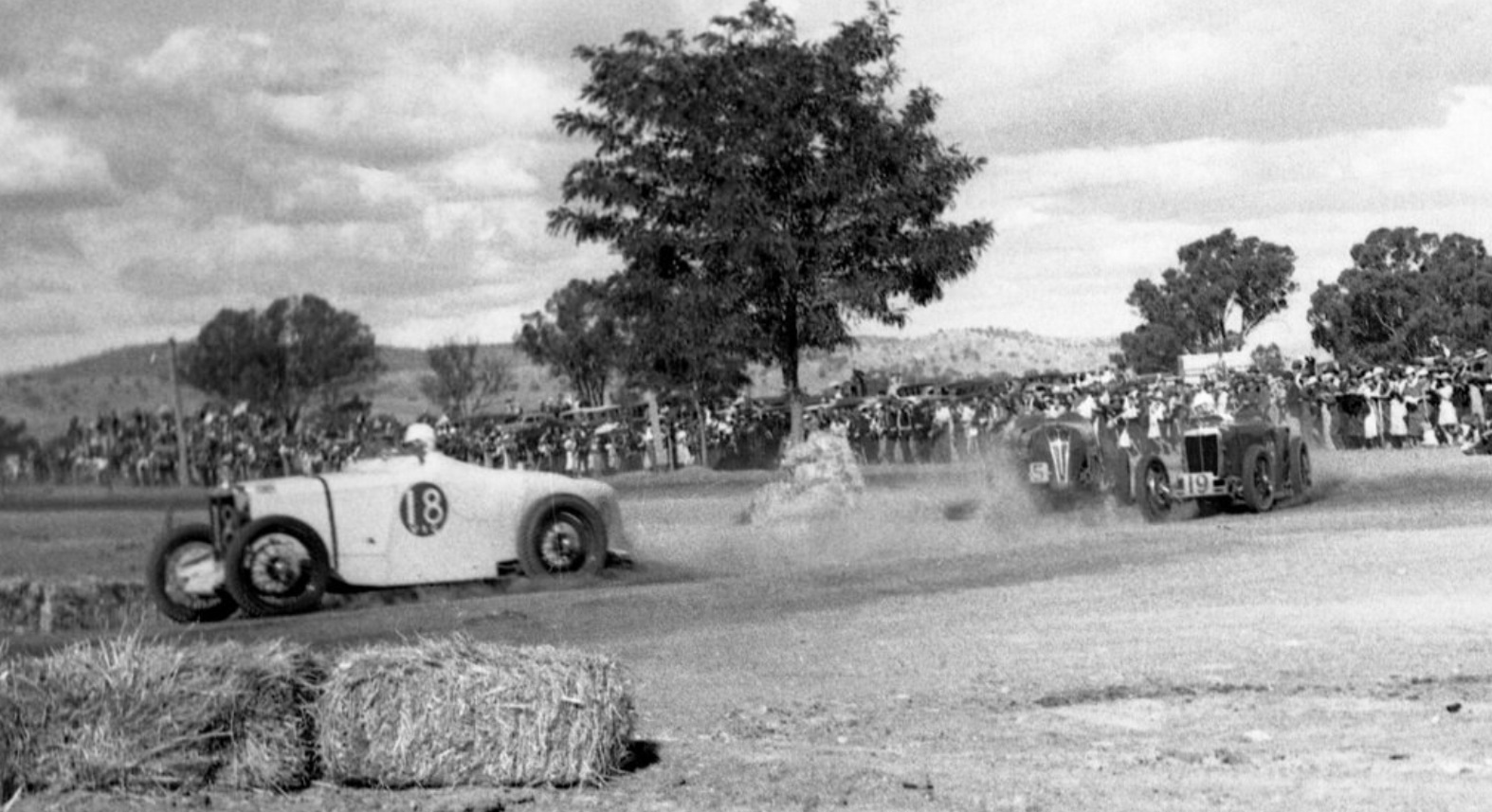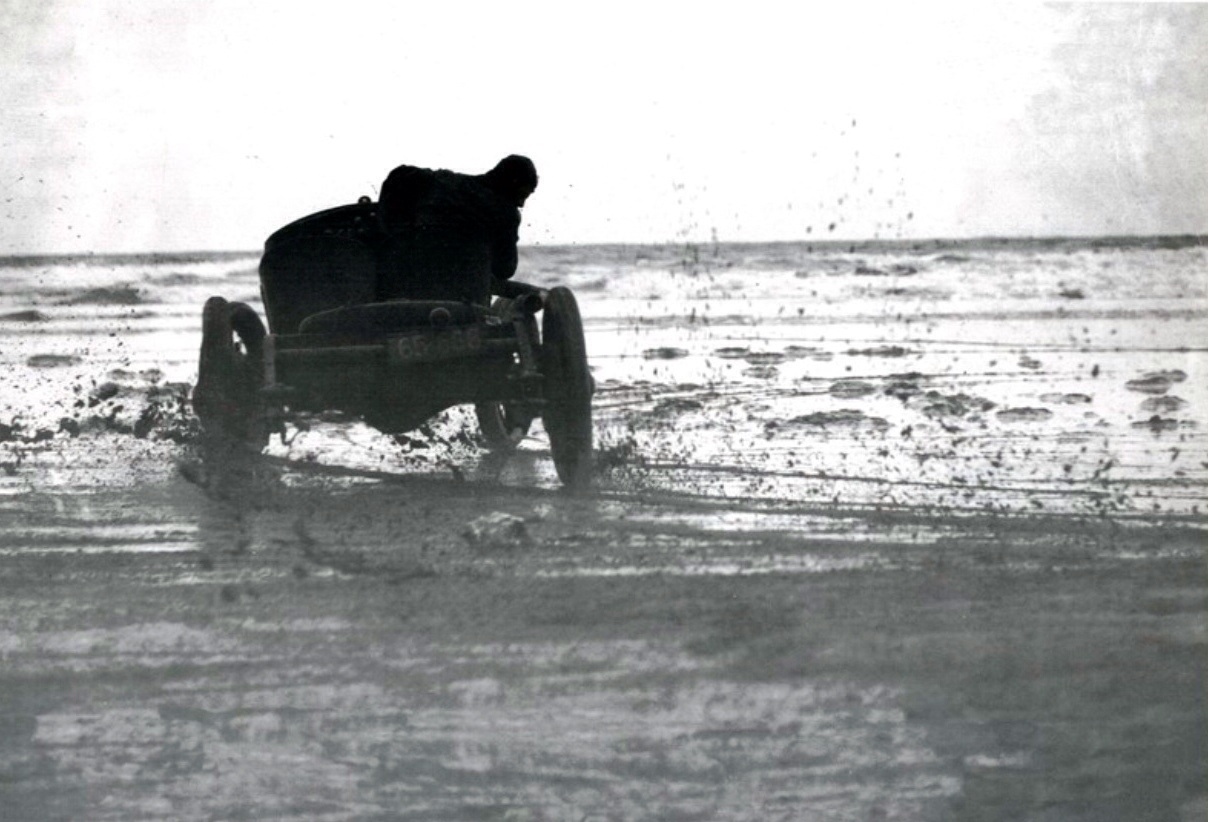
Marie Jenkins, Bugatti Brescia, circa 1925, circuit unknown, but probably Maroubra, Sydney…
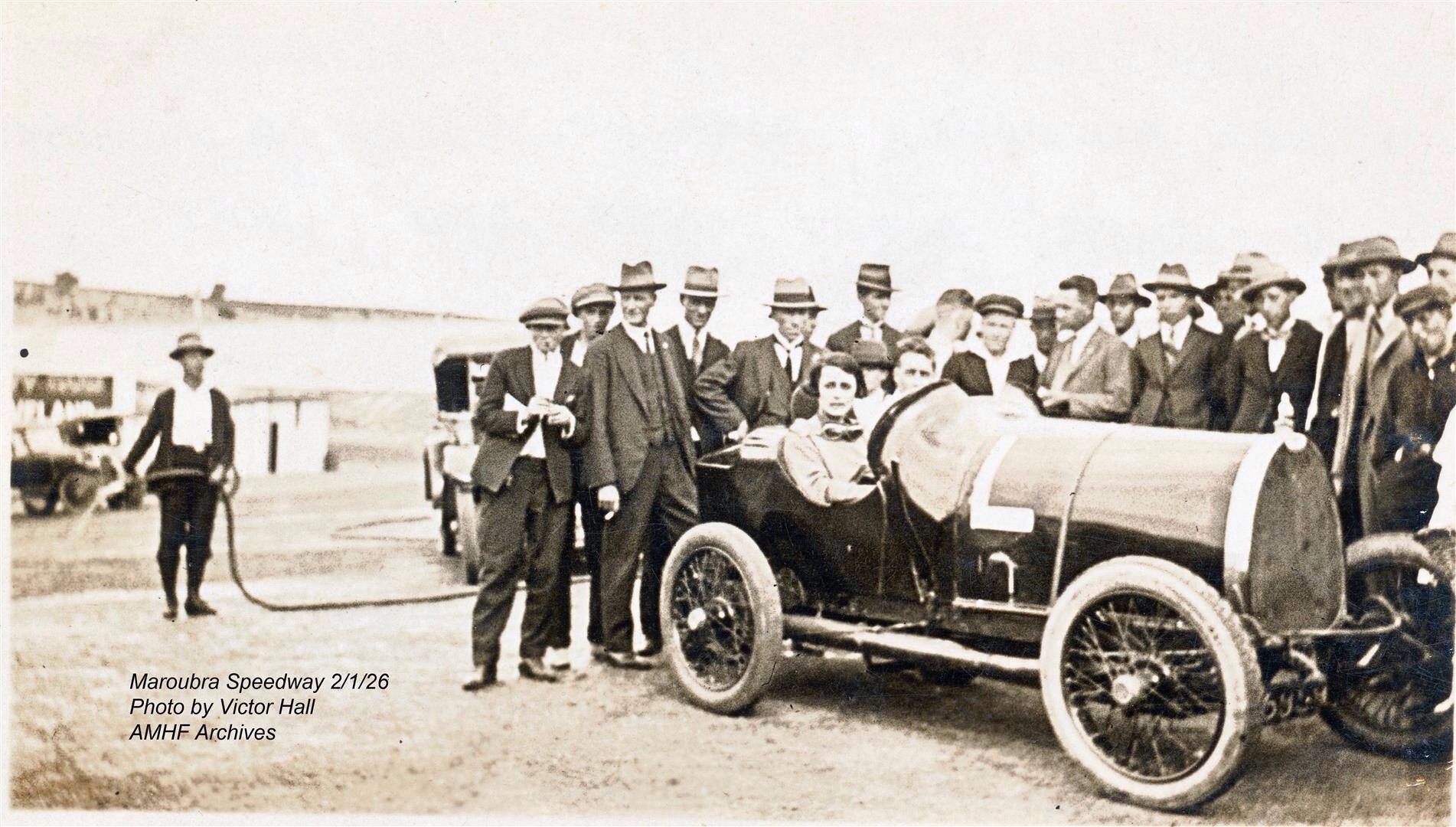
Jenkins first sprang to prominence with a win over Maroubra Speedway fast-men- Phil Garlick, Alvis and Hope Bartlett, Bugatti Brescia in a January 1926 Five Mile Handicap at the demanding dangerous Sydney venue.
Jenkins delighted the crowd by winning both her heat and the final ‘though she owed her victory to the generous way she had been treated by the handicappers. She is the first woman to win an event at the Speedway, and she received a great ovation from the spectators, particularly the fair sex’ The Newcastle Morning Herald reported.
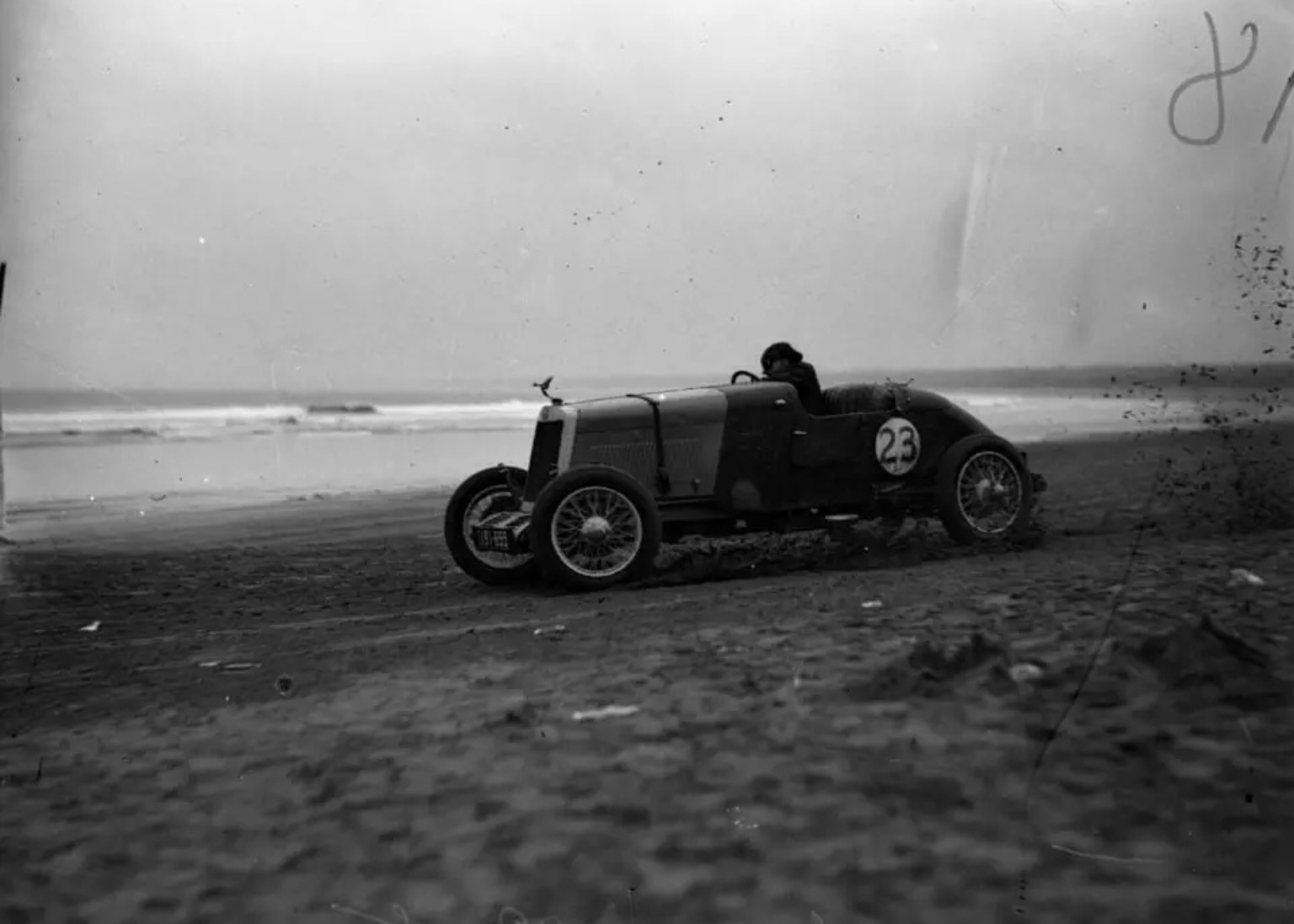
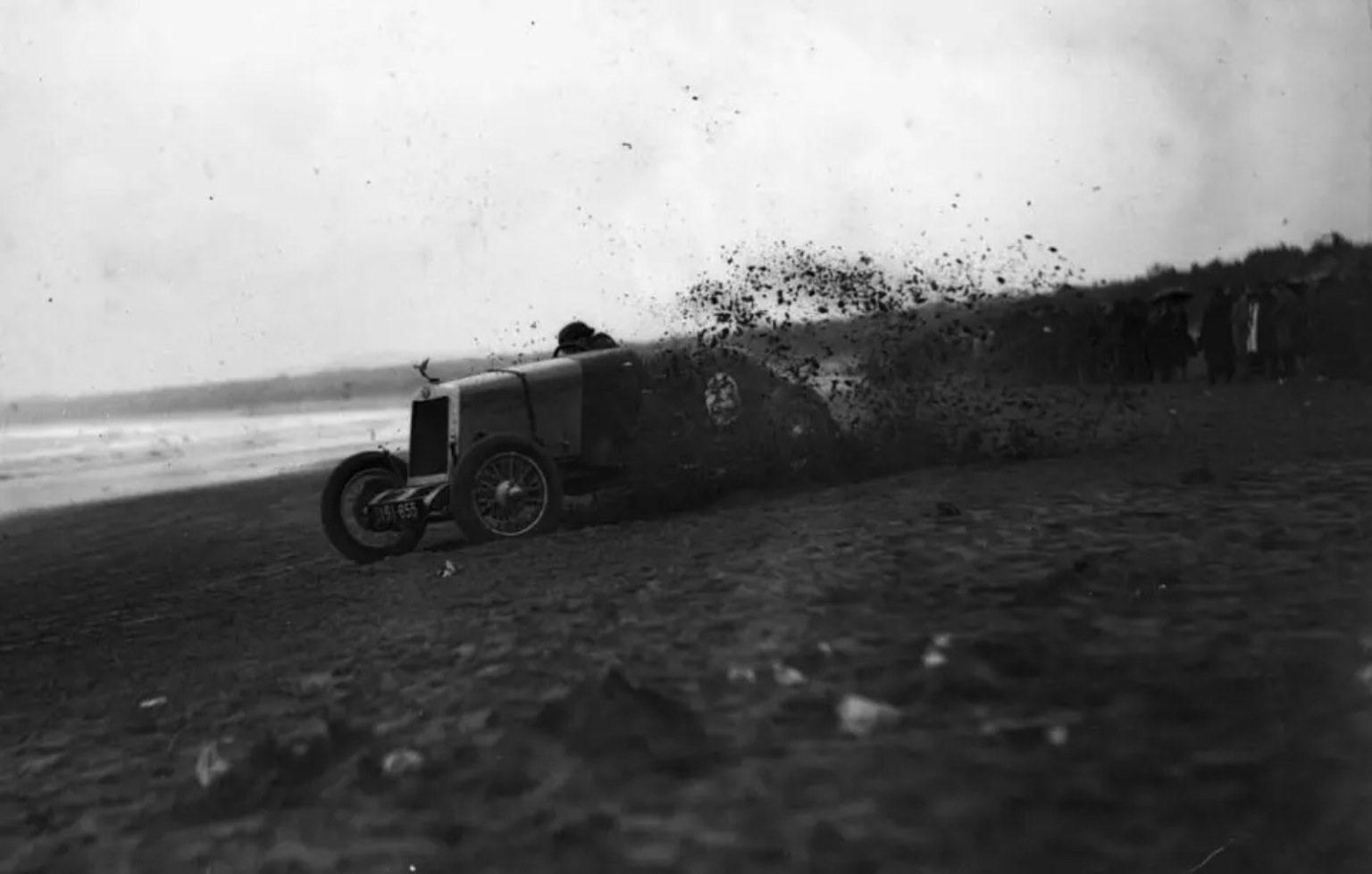
Marie Jenkins at Maroubra on 5 December 1925, Brescia T13 (23) chassis ‘2135’ (C Anicet)
She raced at Maroubra’s opening meeting, the track was a daunting, dangerous venue. Jenkins second race there was only days after the deaths of two competitors killed practising at the track on the Wednesday prior, 30 December 1925.
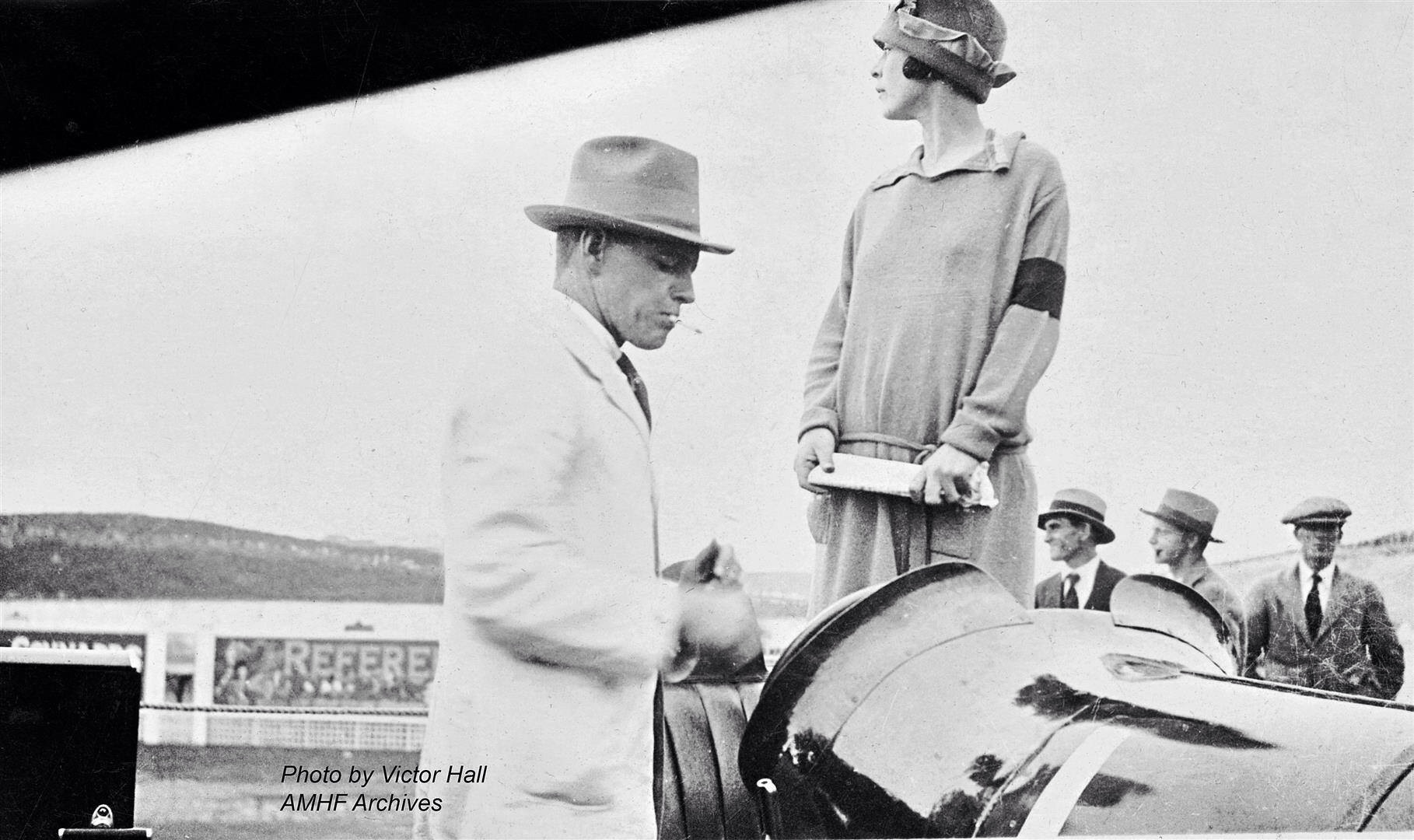
Leo Salmon and riding mechanic Albert Vaughan, partners in Salmon Motors Ltd crashed to their deaths in a 35 HP Jowett after a fractured Kingpin failed at around 90 miles per hour. Seven fatalities occurred at the circuit between 1925 and 1936, the photograph below, taken on 2 January 1926, is of Jenkins wearing a black arm-band in memory of the two competitors.
Marie Jenkins- in front is Sam Knaggs, former Austin 7 racer of Melbourne
The Melbourne racer, ‘who lives near the Yarra’ was coming off the back of a rollover in the first Aspendale Motordrome meeting of the year at the Melbourne, bayside venue in November 1925.
I can find little written about this driver- am keen to know more if any of you have particular insights. Click here for an article on the Bugatti Brescia; https://primotipo.com/2018/07/27/country-spin/
Etcetera…
The image below is the narrative by Victor Hall about his above photograph- wonderful isn’t it, to see the unfettered observations of the man at the time in the context of the day.
Credits…
Fairfax, Christian Anicet for the photo of the car and details, AMHF Archive via Brian Caldersmith
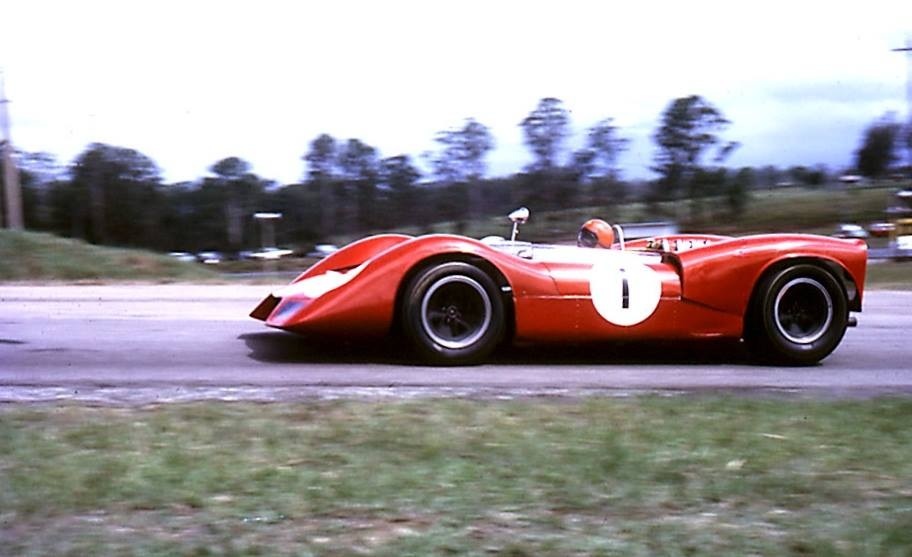
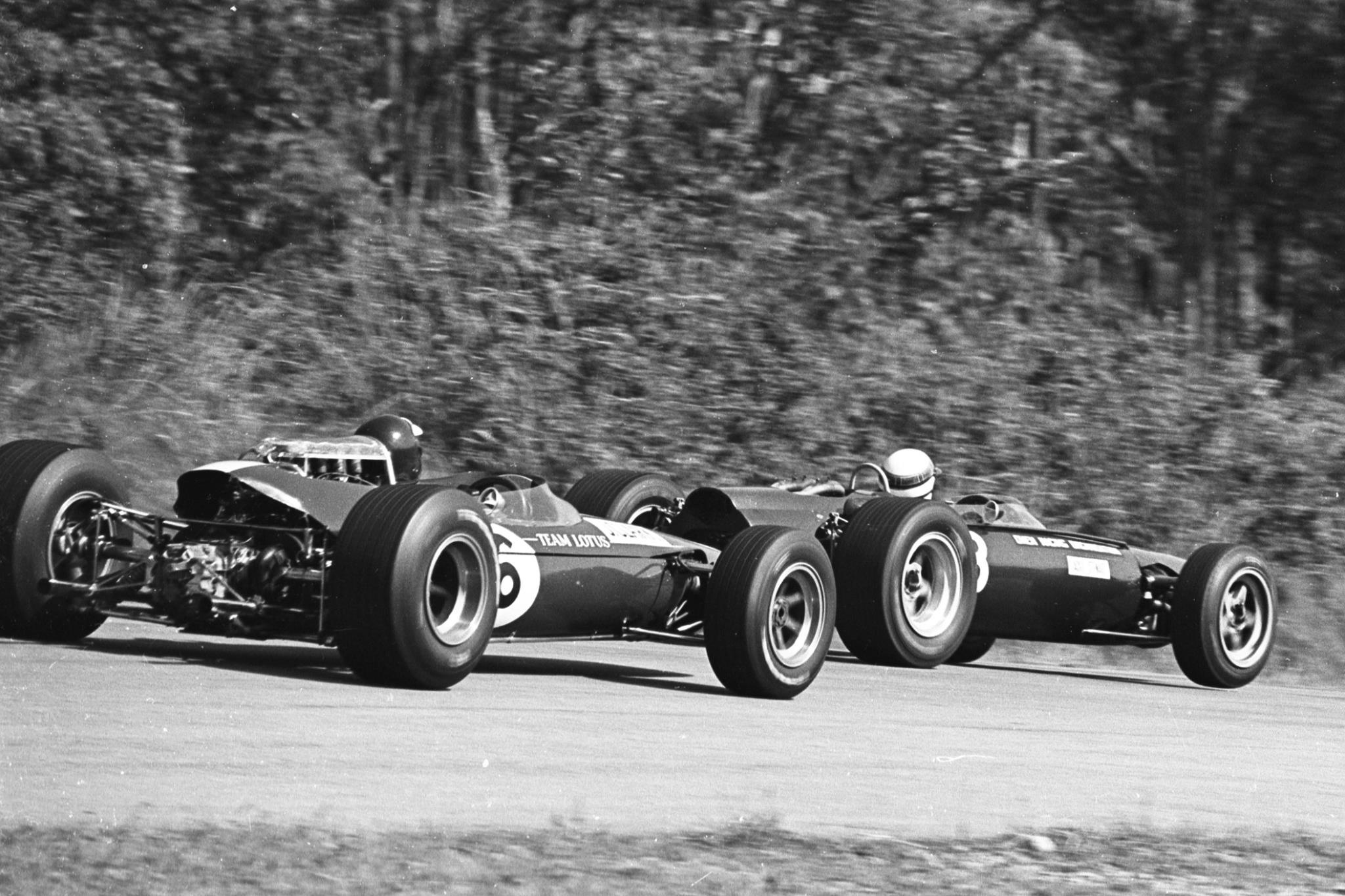
Bob Jane, Elfin 400 Repco ‘620’ 4.4 V8 entering KLG Corner, racer Ross Burbidge tells us, 12 February 1967…
It’s a very early race for Bob in his brand new Elfin, this car notable in several ways not least for the fact that it was the first to be fitted with a customer Repco Brabham engine V8- I’ve written a feature on it so let’s not repeat ourselves;
What struck me about William Byers’s photo and the unusual angle and locale in which it is taken is the degree of difficulty in sighting these big Group 7 sportscars through the corners. Admittedly Bob was a ‘short-arse’- mind you there was plenty of bounce in every ounce- but I bet the problem was the same for tall fellas like Dan Gurney.
Who won the sportscar races that day- had Matich debuted the SR3 at this point?, it certainly raced at the Farm and Sandown Tasman rounds that summer- Frank would certainly have given Bob a run for his money if present.
(W Byers)
The top-guns of the meeting were the Tasman 2.5’s of course.
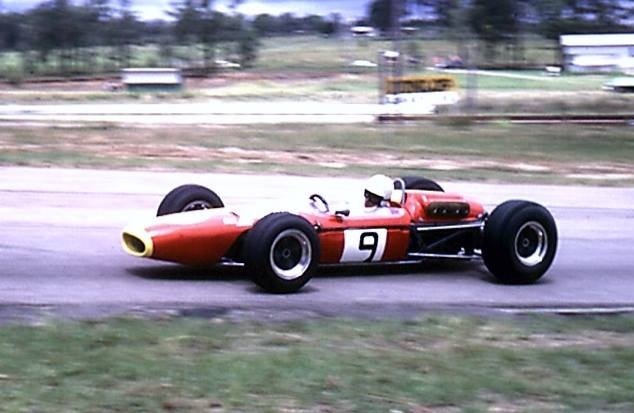
We have photos of second placed Jack Brabham, Brabham BT23A Repco ‘640’, (above and below) Denny Hulme’s similarly engined fourth placed Brabham BT22, sixth placed John Harvey in the 1.65 litre Ford twin-cam powered ex-Stillwell Brabham BT14, and Spencer Martin’s Bob Jane owned Brabham BT11A Climax but not Jim Clark’s victorious Lotus 33 Climax FWMV 2 litre V8- he won five of the eight Tasman rounds that year. A pity, but hey, let’s be thankful for some marvellous photos.
(W Byers)
(B Thomas)
1967 was the Tasman Series Repco had a red-hot go to win, two cars, one each for Denny and Jack with both drivers contesting all eight rounds- but the might of the F1 World Championship winning team did not triumph over Jim Clark and the very reliable, fast, special 2 litre FWMV Coventry Climax engined Lotus 33 of the Scottish ace.
In 1966, 1968 and 1969 Repco had limited Tasman campaigns, 1967 was the one they should have won, you might say, I’ve covered this series before, so no point repeating the many problems which cost the Maidstone outfit dearly.
Arguably the most important aspect of the Tasman for Repco was to blood their new for 1967 F1 engine- the 740 Series V8- in advance of the GP season, than win the series itself. In the event Repco’s Norm Wilson designed 700 Series block was not quite ready so Jack and Denny raced with ‘640 Series’ motors- the new 40 Series exhaust between the Vee two-valve heads and 600 Series (Oldsmobile F85 modified) blocks.
(W Byers)
Denny had a rather successful 1967 season didn’t he!, taking the F1 drivers title and finishing second to Bruce in the Can-Am Championship aboard one of McLaren’s M6A Chev papaya coloured machines.
The car above, a BT22, is essentially a BT11 frame fitted with BT19 suspension- Allen Brown writes that ‘F1-1-64’ was used by BRO until Denny’s F1 car for 1966 BT20 was ready. Fitted with a Repco-Brabham V8, it was raced by Denny in the Tasman and then sold to Rorstan Racing, who fitted a Coventry Climax FPF 2.5 and ran Aussie Paul Bolton in it, it’s present whereabouts is unknown.
Jack’s BT23A was built on the redoubtable BT23 F2 jig/frame.
BT23A has never left Australia thank goodness, and been very much in the news in the last twelve months with its acquisition by the National Motor Museum from Peter Simms who restored and then raced the car for decades.
It’s post Brabham race record was with Scuderia Veloce, the car driven by Greg Cusack and Phil West before being sold to Brian Page.
(W Byers)
John Harvey (above) drove the wheels off this ex-Bib Stillwell car, the first BT14 raced ‘FL-1-65’, then owned by Sydney car dealer Ron Phillips in 1966.
Prepared by Peter Molloy, the Brabham BT14’s Lotus-Ford twin-cam engine progressively got bigger and not too long after this shot the car was given ‘a birthday’, it was the recipient of a Repco-Brabham 640 Series 2.5 litre V8 fitted with the assistance of Rennmax’s Bob Britton, allowing Harves to run with the ‘big boys’.
In fact the combination is sorta related to Spencer Martin’s Brabham BT11A shown below.
(W Byers)
The very gifted Sydneysider won both the 1966 and 1967 Gold Stars aboard this Bob Jane owned Brabham BT11A ‘IC-4-64’ Coventry Climax FPF- his dices with the similarly mounted Kevin Bartlett in Alec Mildren’s car were highlights of racing for enthusiasts of the period.
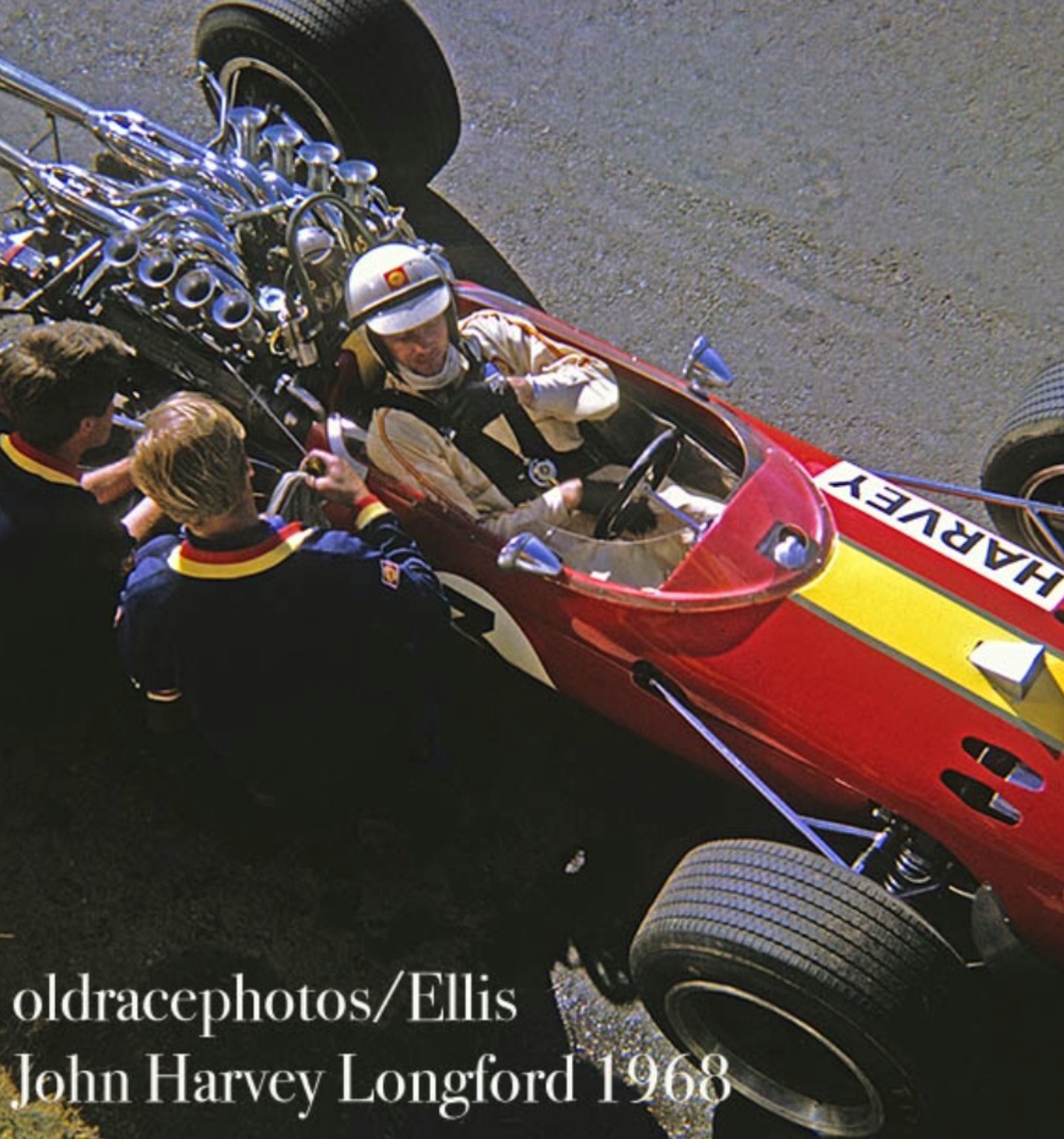
When Spencer decided to retire at the end of the 1967 Gold Star campaign Jane offered Harves the ride, and acquired the Brabham BT14 from Phillips. It’s 640 engine was fitted into the BT11A- like the BT14 it was not designed for a V8 motor, and raced by John in the 1968 Australian Tasman rounds.
Harvey in the Bob Jane Racing Brabham BT11A Repco during the 1968 Warwick Farm 100 Tasman round (unattributed)
Nice overhead shot from the Longford pits of the Repco 640 or 740 Series V8 installation in the BT11A
Jane then bought Jack’s 1968 Tasman mount, the BT23E at the series end for John to race in ’68 with Harvey very lucky to survive a huge shunt at Easter Bathurst in that car after a rear upright failure.
Harvey and Molloy had largely sorted the BT14 Repco by the end of the ’67 Gold Star, he had won a feature race in it at Oran Park. It does make you wonder why Bob didn’t race that car as it was rather than do the engine swap they did and develop the BT11A afresh- no doubt it all made sense at the time?!
The Jane Estate owns BT11A, the BT14, re-engined with a Ford/Lotus twin-cam is i think still in Peter Harburg’s hands in Australia.
William’s camera also captured some other interesting cars during that meeting.
(W Byers)
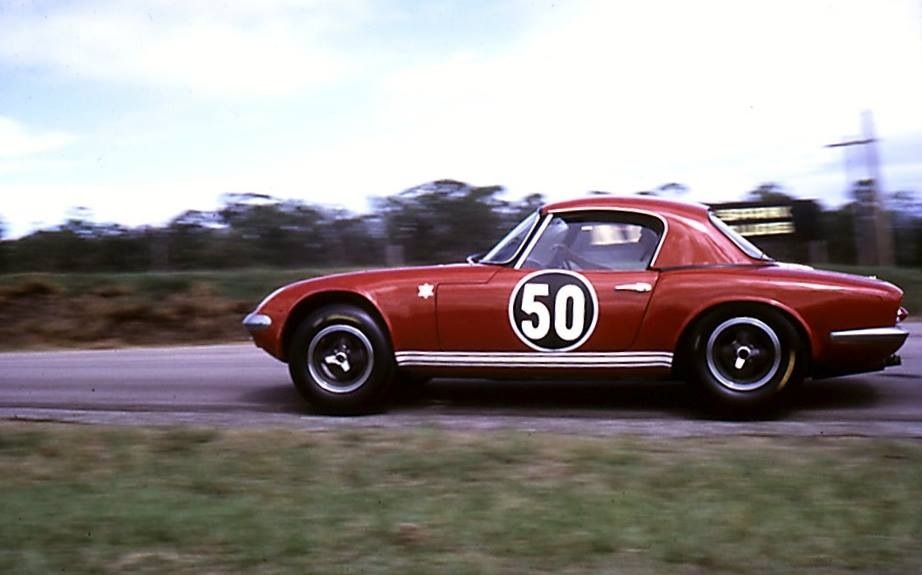
Bill Gates superb Lotus Elan 26R, Ross Burbidge tells us Gates raced both this car and an Elan Series 1, both of which are still alive and well in Australia. Ex-Geoghegan car originally?
Queenslanders will know the story better than I but its said that race promoter Bill Goode had the Bee Gees, the Gibbs brothers, performing between events at his Redcliffe Speedway and introduced them to Bill who promoted them on his radio show on 4BH Brisbane thereby assisting them in their climb to global success.
(W Byers)
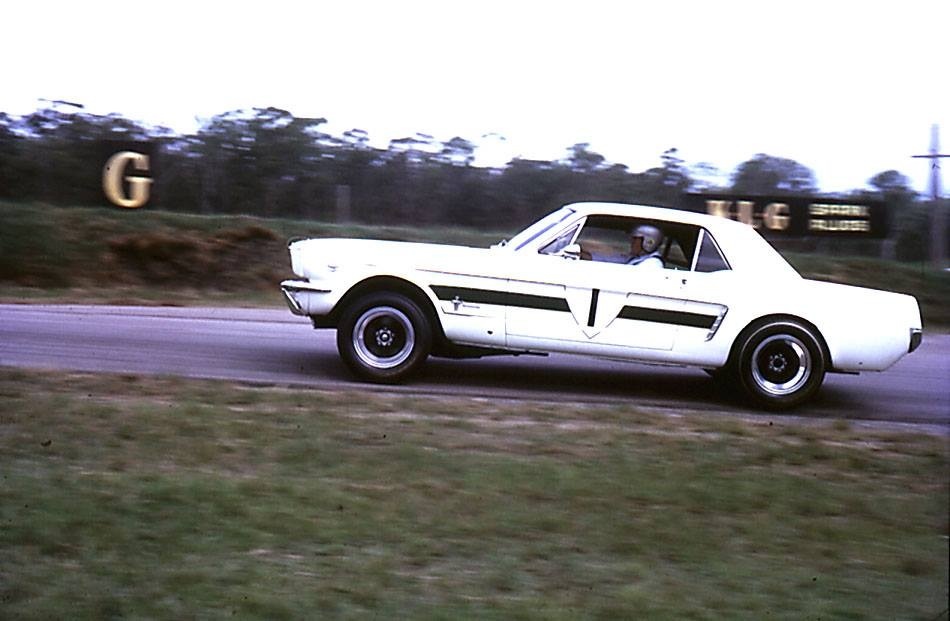
Ross Burbidge says this is the last time Pete Geoghegan ran his first Mustang at Lakeside.
He won the 1967 one-race Australian Touring Car Championship in the Australian, John Sheppard built, Mustang ‘GTA’ back at Lakeside on 30 July 1967 from the Brian Foley and Peter Manton Cooper S’s after various of the other V8’s fell by the wayside with mechanical dramas. The shot above is on the entry to ‘Hungry’ or then KLG corner.
Great Scots: Lakeside 1967, winner Clark Lotus 33 Climax chases Stewart BRM P261 (Tasman Book)
William Byers, oldracephotos.com.au, ‘Tasman Cup’ Tony Loxley and Others, Brier Thomas
References…
Ross Burbidge, oldracingcars.com.au
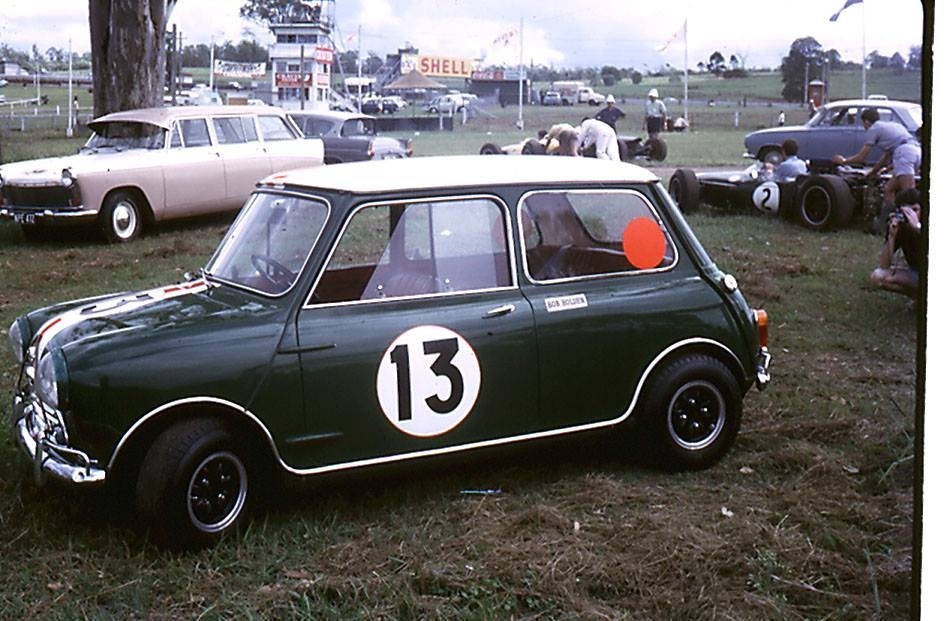
Tailpiece: Bob Holden, Improved Touring Morris Cooper S…
(W Byers)
Bob Holden won the 1966 Bathurst 500 in a Series Production Cooper S, co-driving the works BMC Australia car with rally-ace Rauno Aaltonen.
In a year of dominance the Cooper S took the first nine placings in the race! This car, not the same machine, is built to Improved Touring rules, the category to which the Australian Touring Car Championship was held at the time- mind you Bob didn’t return that July to contest the title race. He is still racing…
In the background Denny’s Brabham BT22 is being pushed past with perhaps the light coloured car Frank Gardner’s Mildren Racing Brabham BT16 Climax?
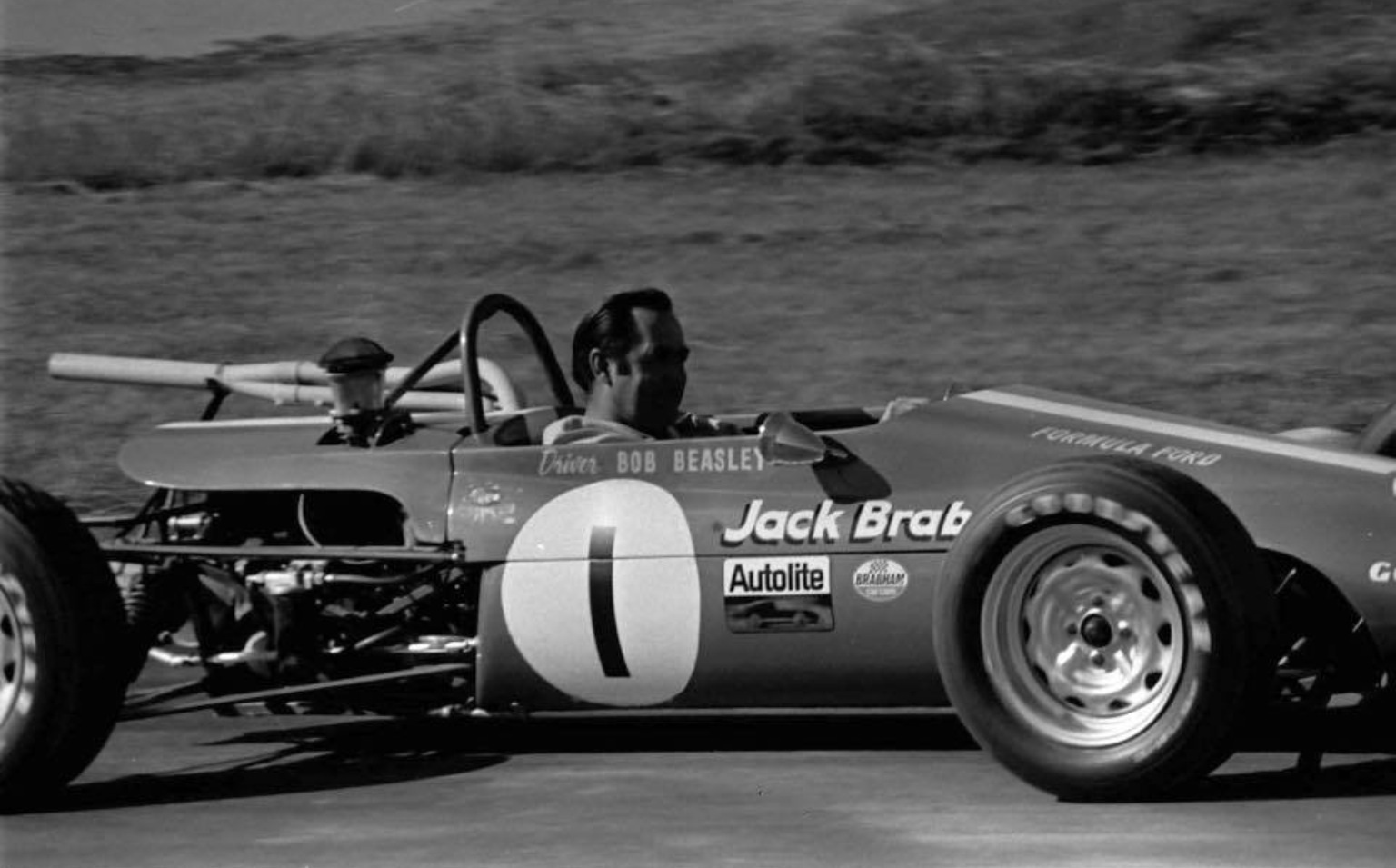
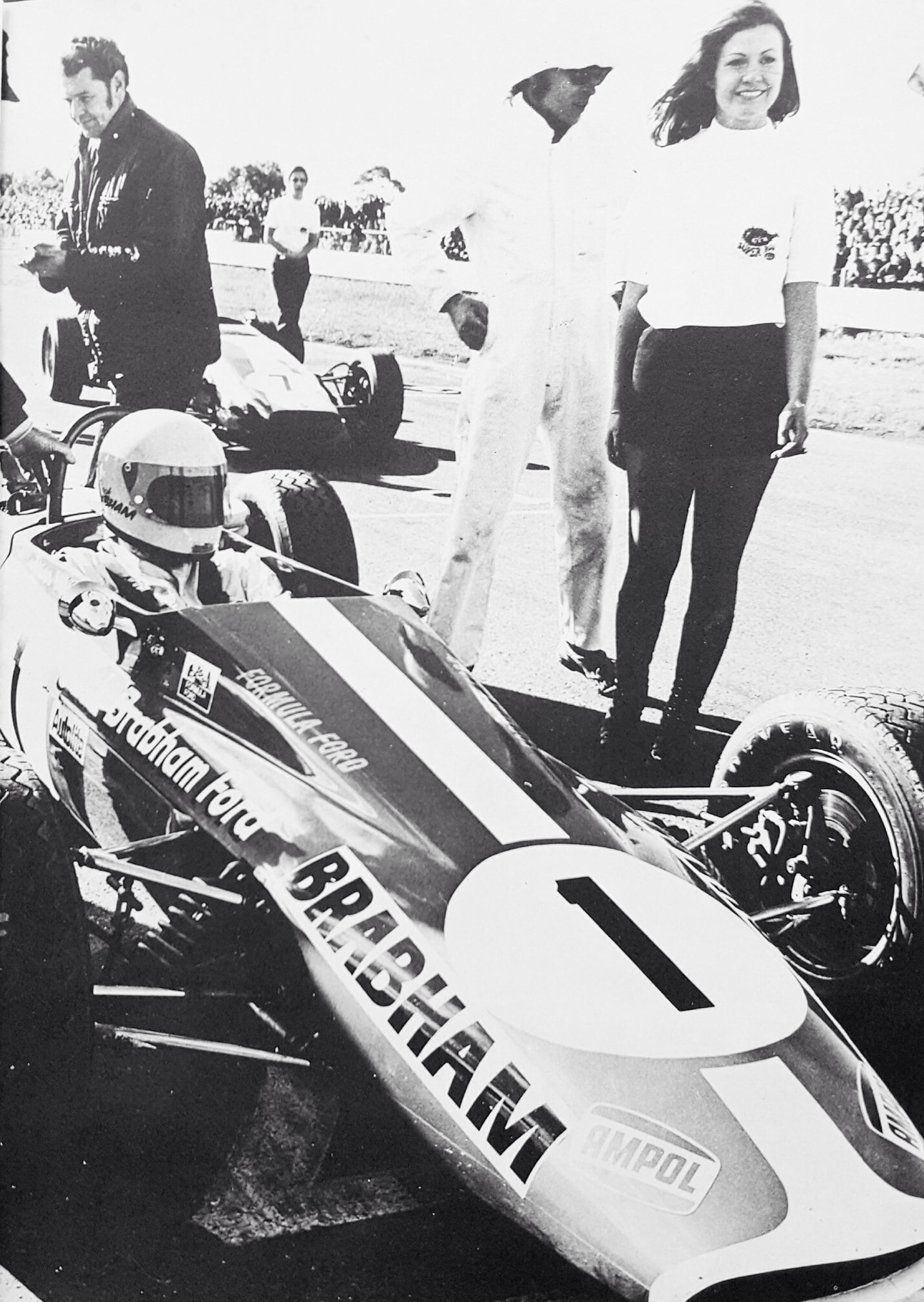
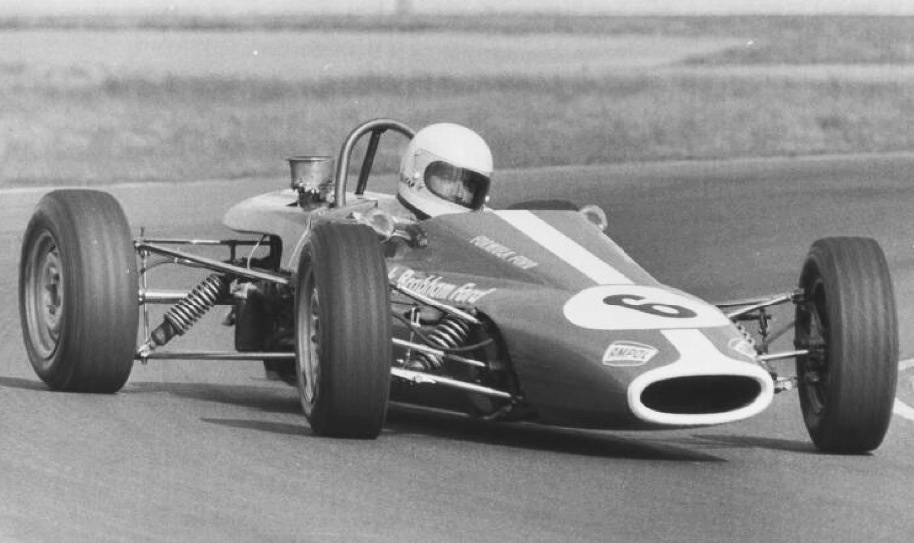
Jack Brabham, Bowin P4X Formula Ford, Calder August 1971…
Here is another Fairfax image of Jack after his victorious ‘Race Of Champions’ weekend. I wrote about this event a short while ago, and led the feature article with the final image below, this recent discovery is too good to ignore though- gotta put it up, there are no such things as too much Jack or too much Formula Ford, click here for the article; https://primotipo.com/2018/10/30/calder-formula-ford-race-of-champions-august-1971/
The Fairfax caption reads ‘Jack Brabham, Australian race car driver, 1971: Brabham in the cockpit of a 100 hp Formula Ford for a brief comeback at Calder- in the Calder Race of Champions. Driving a car built at his British racing car factory’. (actually a Bowin P4 built by John Joyce and his team at Bowin Designs in Brookvale, Sydney- owned by Jack Brabham Ford and raced by Bob Beasley in the ‘Driver to Europe’ Oz FF Championship).
JB, Bowin P4X, Oran Park parade lap 1972 (L Hemer)
Its an irrelevant tangent really but Motor Racing Developments (Brabham) never built a Formula Ford, Ron and Jack kept away from the rough and tumble of that market- mind you there were a few converted Brabham F3 cars which went well in the early years of the class in the UK.
‘Brabham raced home a clear winner after taking the lead in the third lap of the 10 lap event’.
Its a big year for Formula Fordsters in Australia- 50 years of FF in Australia is being celebrated during 2019.
Credits…
Alan Lambert- Fairfax Publications, Lynton Hemer, National Archives of Australia
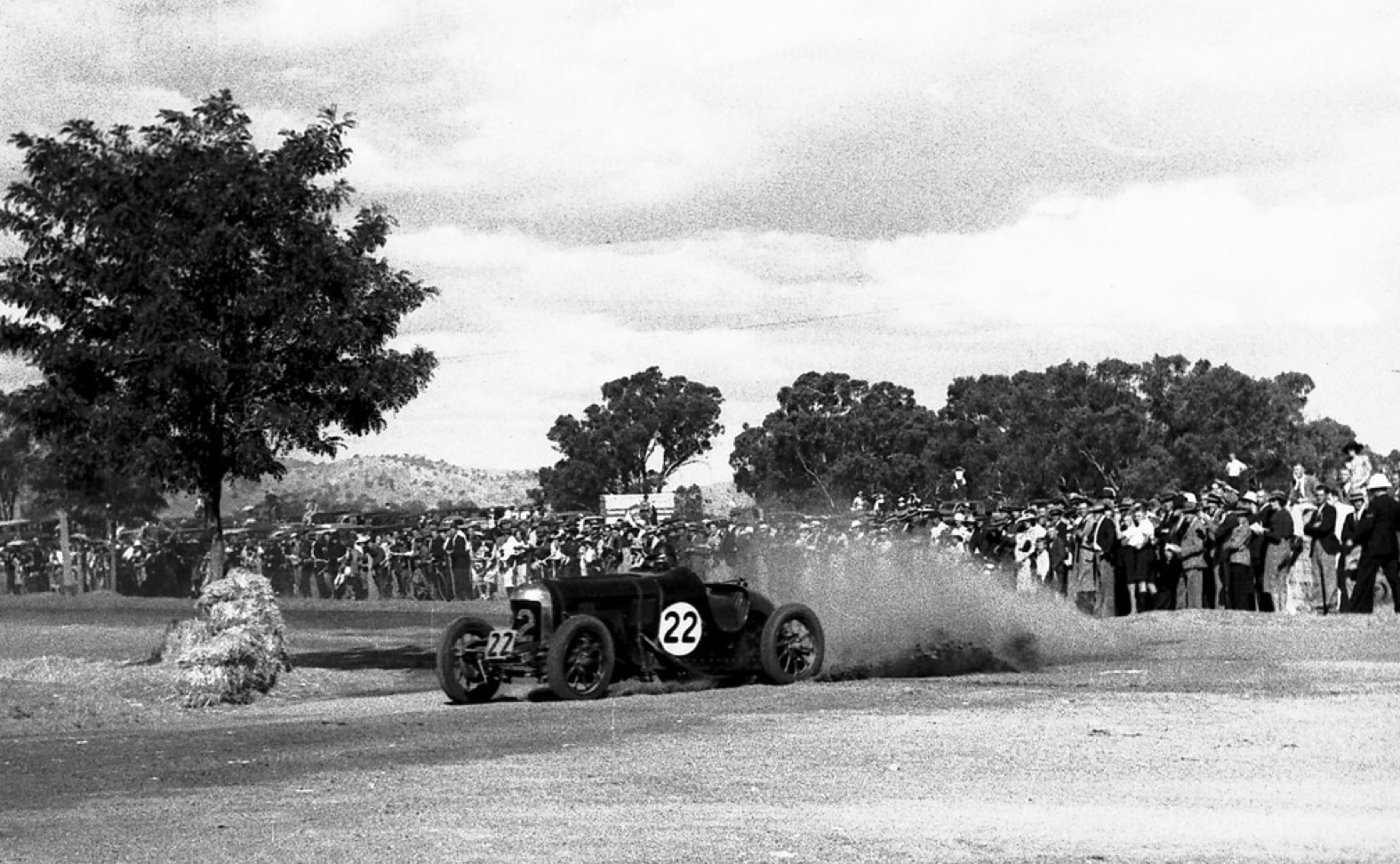
C Williamson, Chrysler leads G Winton’s AC and L Evans’ Vauxhall during the early laps of the Interstate Grand Prix, Wirlinga Road Circuit, Albury, New South Wales, 19 March 1938…
Australia Day, 26 February 1938 marked 150 years since the arrival of Governor Phillip and the First Fleet – the sesquicentenary of European settlement of Australia – ignoring the 60,000 years or thereabouts the continent has been occupied by the indigenous people of the Great Brown Land.
Official celebrations throughout the country took place between 26 February and 25 April – in Albury they occurred from 12 – 19 March and comprised an athletic and cycling day on the Saturday including the Albury Gift professional sprint race, the Albury Gun Club Championship, a swimming carnival and extended to the finale on Saturday 19 March, the Interstate Grand Prix, a 150 mile (148.5 mile) handicap event for cars ‘regardless of engine capacity’.
The lack of an engine capacity limit may seem not particularly notable, but the Phillip Island 1928 to 1935 ‘AGP’s had all been for cars of less than 2-litres in capacity whereas the December 1936 South Australian Centenary GP, later appropriated as an AGP, run at Victor Harbor was raced to what was effectively Formula Libre. Their was no AGP run in 1937 despite attempts to appropriate the the December 1936 event as ‘the 1937 AGP’ in the decades following.
What the South Australian event organisers, the Sporting Car Club of South Australia, did was to create Formula Libre as the class to which the AGP was run up to and including the 1963 event, when the Tasman 2.5-litre Formula succeeded it.
The officials in Albury, Albury/Wodonga being the twin Murray River border towns of New South Wales and Victoria involved the Melbourne based Victorian Sporting Car Club to organise the motor-racing aspects of the celebrations.
After considering various alternatives a track of 4.25 miles long was chosen by the local council and VSCC around the roads of Wirlinga, now an Albury suburb, but then 4.5 miles from Albury’s business centre.
Christened the ‘Wirlinga Circuit’ it ’embraced a 1.25 mile section of the Old Sydney Road to the north-east of Albury, a ’55 chain’ section of the Livingston-Thurgoona Road and more than a mile of Orphanage Road’.
This course is variously described in the newspaper accounts of the day ‘as having a good surface, the majority bitumen, and the remainder buck-shot gravel which is practically dust proof’ or ‘…half the course is macadam (broken stone of even size bound by tar or bitumen) and the other half gravel, it is being specially treated with calcium chloride to make it as free as possible of dust’.
Another report described ‘The roughly rectangular course, which starts on the Hume Weir road has one straight of about 1.9 miles, another of a half a mile and a long sweeping curve of 2.1 miles in length’. By the time of the Albury Gold Cup meeting at Wirlinga in July 1939 the entire course was bitumen surfaced.
‘This course is claimed to be one of the finest and fastest tracks in Australia’ the Melbourne Age recorded, clearly that fellow had not been to Lobethal or Mount Panorama at that point of his motor racing research/reportage!
In 1938 the only Australian race tracks which were bitumen or tar were some of the ‘Round the Houses’ tracks in many country towns of Western Australia and Lobethal in the Adelaide Hills. Phillip Island, the site of the early AGP’s, Victor Harbor, which held the December 26 1936 South Australian Centenary Grand Prix, and Mount Panorama, Bathurst, which held its first race meeting at Easter in 1938- all had loose gravel surfaces.
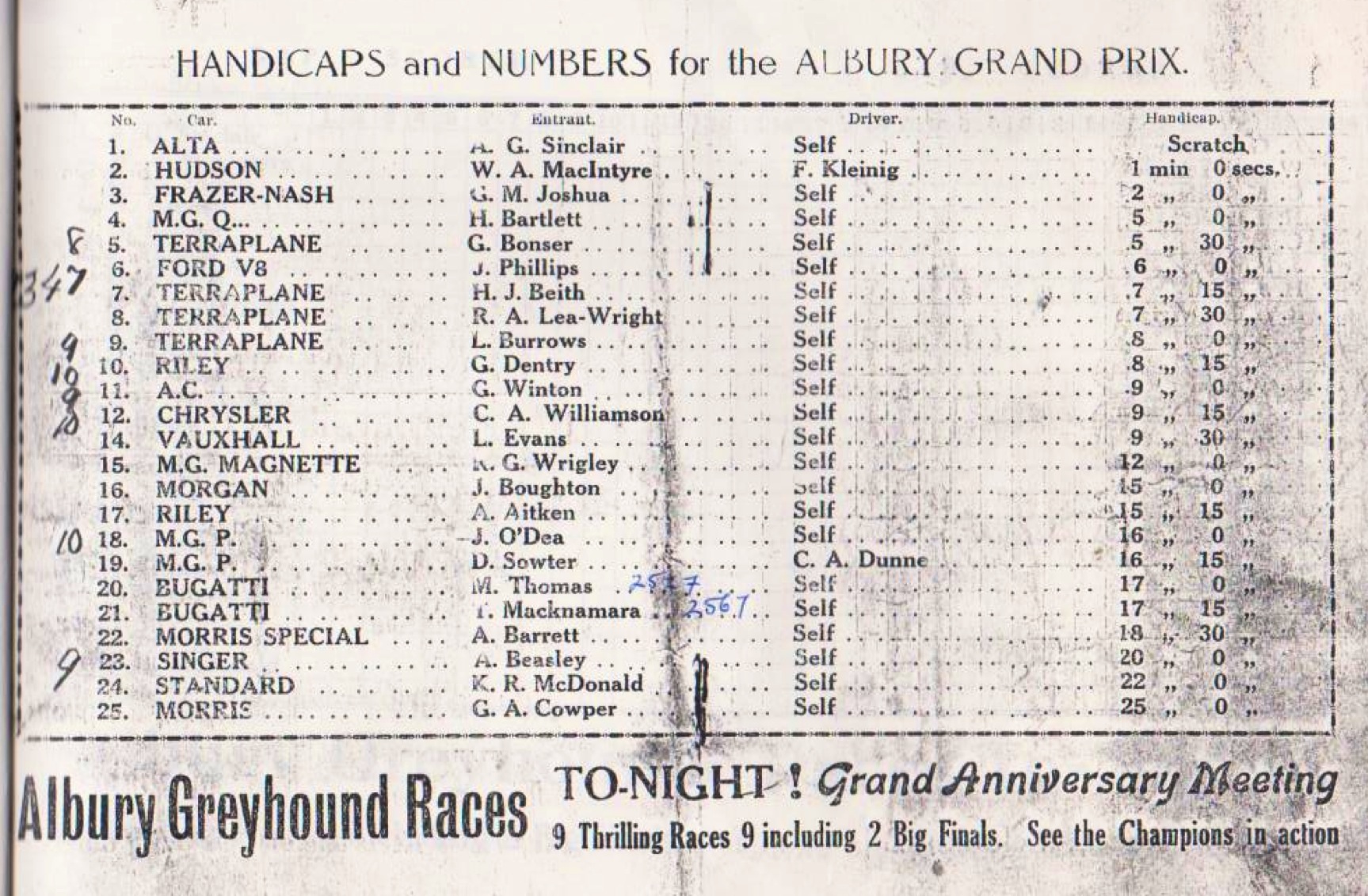
So Wirlinga, with a mix of sealed and unsealed surfaces would present challenges to the drivers- many of whom were unfamiliar with a solid surface like bitumen with the exception of those who had raced on the Maroubra concrete bowl or the opening January 1938 Lobethal meeting several months before. Such drivers included Hope Bartlett, Bob Lea-Wright, Colin Dunne, Jim Boughton, Alf Barrett, Tim Joshua, Harry Beith, Arthur Beasley and A Aitken and perhaps one or two others.
As the big weekend approached the Victorian Sporting Car Club ran a rally to Albury on the weekend of the 5th and 6th of March in which the clubs office-bearers, together with competitors and their friends journeyed the 325 Km up the Hume Highway to inspect the course- ‘which the club found had undergone considerable improvement. The bends of the track will need more attention and this will be given as suggested by officials’.
A meeting of competitors, mechanics and club officials was held in the VSCC’s clubrooms at 395 Elizabeth Street, Melbourne on Thursday 17 March at 5pm before the ‘circus’ left town for Albury/Wodonga, no doubt plenty of eager competitors were already in the border towns by the time this meeting took place.
Practice was to be held on the day before the race from 7 am with entry prices set at 2 shillings and a similar amount charged for a seat in the ‘huge grandstand’ (of which I cannot find a picture). Prize money totalled 300 pounds- 100 pounds was for the winner, the balance was paid down to eighth place.
Whilst the important track logistics were taking place in the lead up months to the meeting, the Victorian Sporting Car Club set about getting as healthy a national entry of cars as was possible for the blue-riband event. Whilst a good field of cars was entered, perhaps the proximity of the 18 April Easter Bathurst AGP to Wirlinga was a barrier to some competitors racing for fear of damaging their mount before the Mount Panorama meeting.
Many of the fast guys of the period entered, perhaps the ‘headline act’ was British mystery man, racer throughout Australia in 1938/9 and MI5 spy Allan Sinclair in a supercharged 1100cc Alta. This car was a fizzer at Lobethal in January with a better showing expected- but not delivered in Albury, or pretty much anywhere else he raced with the exception of Rob Roy Hillclimb in Victoria.
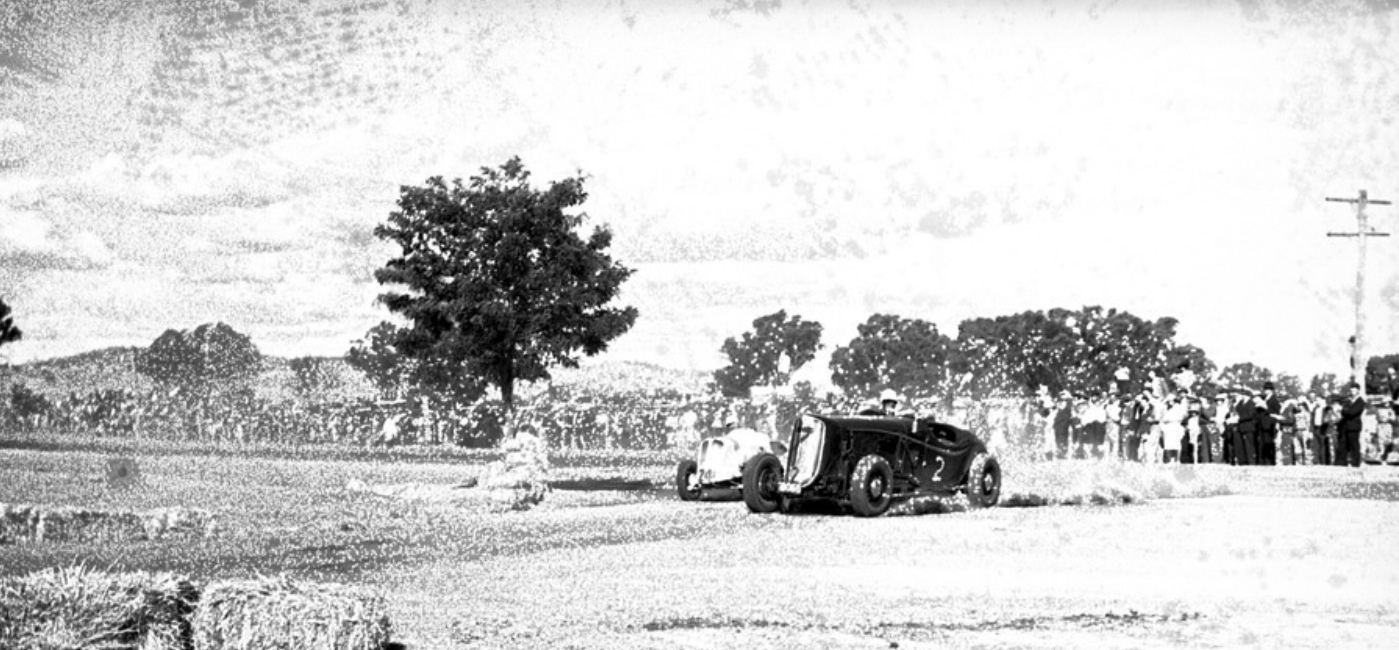
Maroubra Speedway Ace Hope Bartlett entered an MG Q Type, 1934 Australian Grand Prix winner Bob Lea-Wright- and then current VSCC President raced a Terraplane 8 Special with Frank Kleinig certain to be a front-runner in Bill MacIntyre’s Hudson 8 Special. Both these cars were powered by modified variants of side-valve straight-eights manufactured by the US Hudson/Terraplane companies.
Its interesting to look at Kleinig’s car as it was at Wirlinga and the huge amount of work it took to to turn it into an ‘outright racer’ by the time of the 1939 AGP at Lobethal less than twelve months hence.
Alf Barrett was entered in his Morris Cowley Spl but very shortly thereafter acquired an Alfa Romeo Monza, and it was his performances with that car which shot him to fame- by the time of the January 1939 AGP he was pretty much ‘the man’ despite one or two others racing faster cars such as Jack Saywell, Alfa Tipo B/P3.
Tim Joshua’s unique single-seater, supercharged four-cylinder Gough powered Frazer Nash cannot have been in the country too long with the Bryant & Mays Matches family member a guy who always drove well.
This huge factory complex (hard to believe how big a factory it was/is just to make matches) off Church Street Richmond, Melbourne is well known to locals in restored form and was unfortunately the property redevelopment which all but financially destroyed Porsche Cars Australia’s Alan Hamilton in the late eighties.
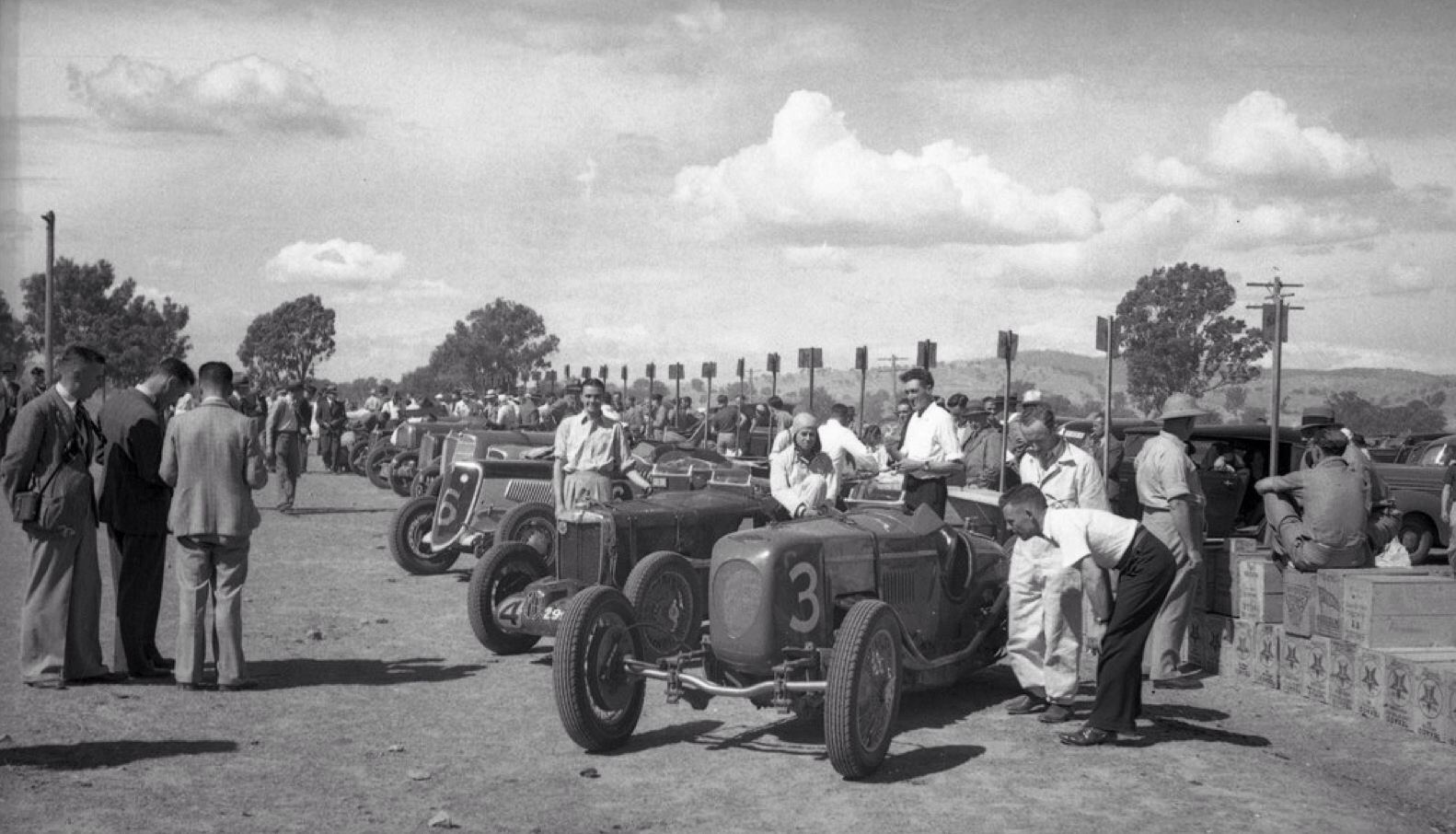
It wasn’t the ‘Nash first meeting though, he raced it in the SA GP at Lobethal in January. The car, number #3 above is in the Wirlinga paddock alongside Hope Bartlett’s MG Q Type and the Jack Phillips/Ted Parsons #6 victorious 1934 Ford V8 Spl.
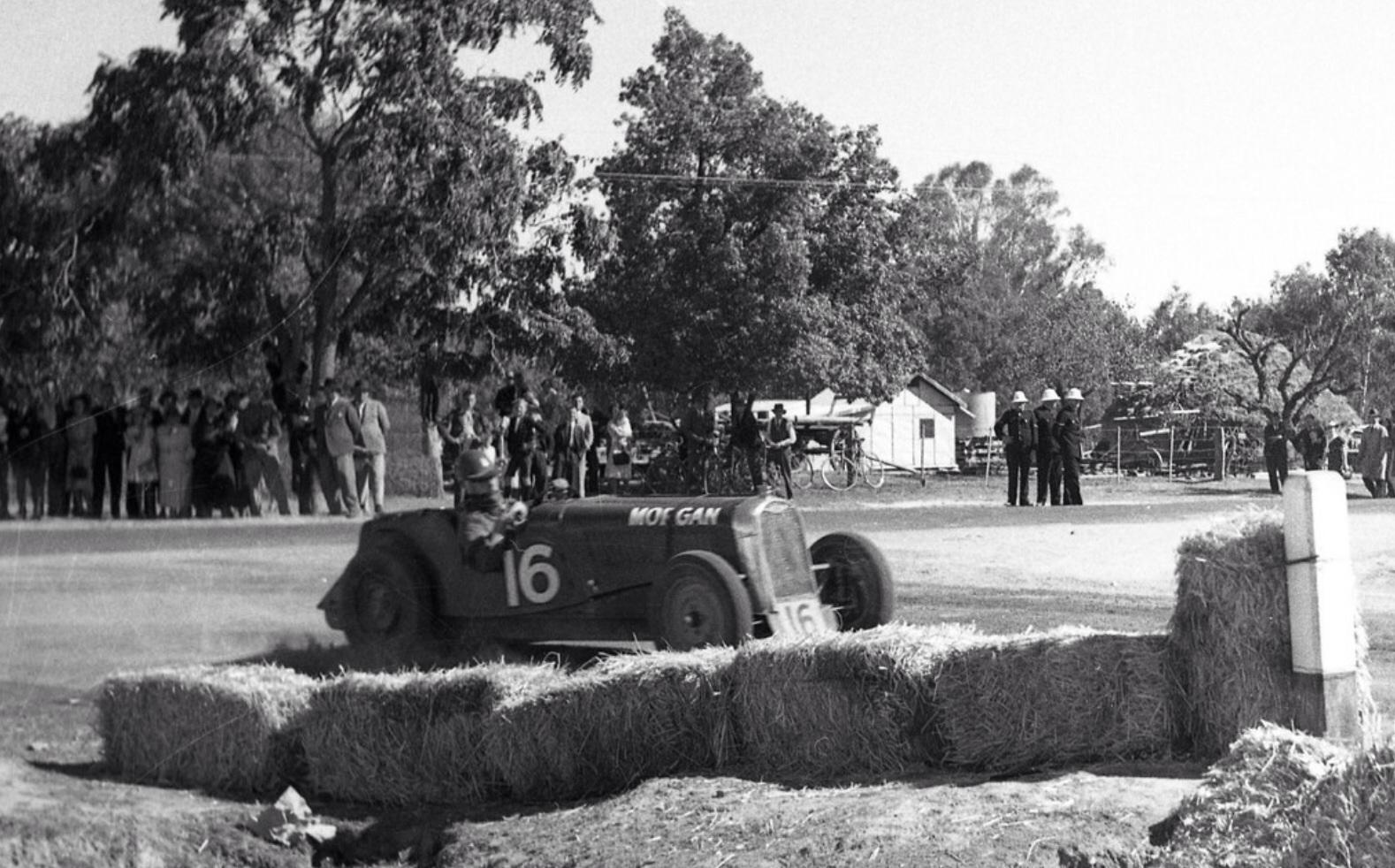
Other cars of note are perhaps the D Souter MG P Type driven by Colin Dunne who was fresh from a great win in his own MG K3 in the Junior Grand Prix at Lobethal. No doubt Dunne took this drive to preserve his own K3 for the forthcoming AGP. Others were Jack O’Dea, MG P Type, Jim Boughton in a Morgan 4/4 Coventry Climax and Barney Dentry’s Riley Spl.
Of an entry list of 25 racers, thirteen or thereabouts are ‘factory cars’ with the balance Australian Specials- these cars would increasingly form the most significant numbers on our grids until the dawn of the fifties when the end of Australian Grands Prix run to handicap rules forced those after victory to acquire a car which could do just that on an outright basis!
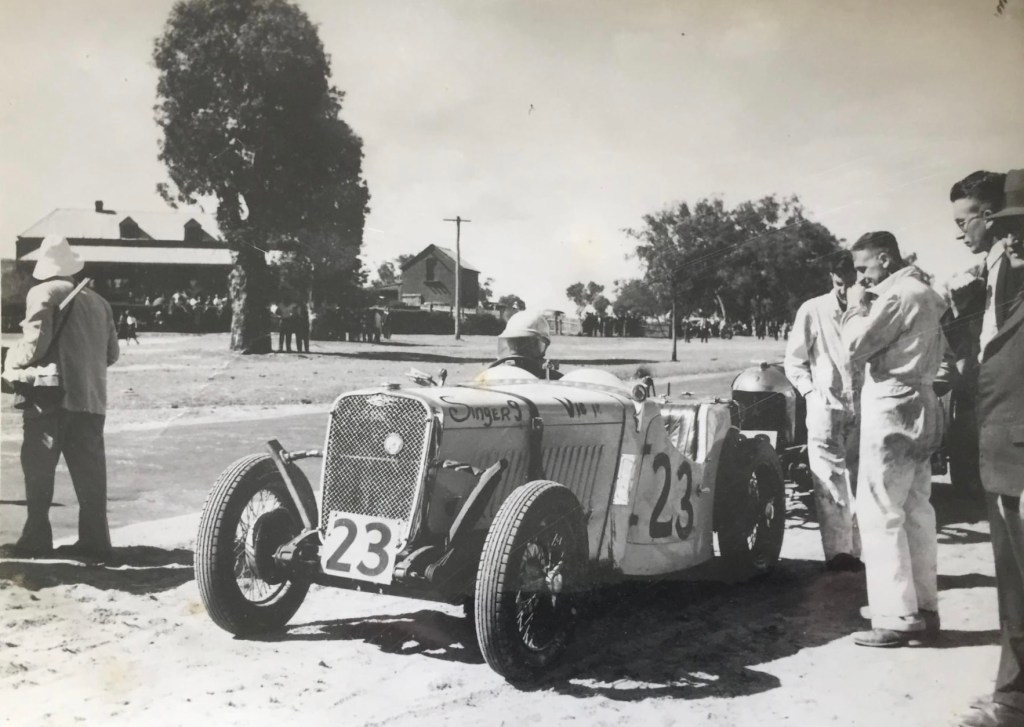
Arthur Beasley Singer 9
Sesquicentenary festivities in Albury were well underway by the time the Governor of Victoria, Lord Wakehurst alighted the train from Melbourne and performed the formal opening ceremony for the week on Tuesday 15 March in the Albury Botanical Gardens.
On raceday, Saturday 19 March, some 6,000 to 10,000 spectators attended the meeting from towns far and wide across South Australia, New South Wales and Victoria- good train access allowed the punters to make the long distance trip from the major population centres of Sydney and Melbourne relatively easily.
Jack Phillips won the race (below) driving his 3.6 litre Ford V8 Special from George Bonser’s Terraplane 8 Spl and Les Burrows aboard a similar Terraplane 8 Spl.
Phillips, accompanied by his business partner and co-owner of the car, Ted Parsons, covered the 150 miles in 2 hours 13 minutes and 15 seconds, an average of about 67 mph.
The two friends were partners in a Ford sales and service agency in Wangaratta, a major centre of agriculture to the south-west of Albury in Victoria, it was very much a hometown win all the same.
So successful was the meeting that the ‘Albury Banner and Wodonga Express’ correctly predicted that the race would become an annual event- for a while at least until the outbreak of war.
Unfortunately the only scratching from the event was Allan Sinclair in his Alta with gearbox failure, the unreliability of this car was to be one of its hallmarks in his hands.
Phillips was the only driver to have a trouble free run, and when other competitors either dropped out or made multiple pit stops he was able to take the lead on lap 23 of the 33 laps.
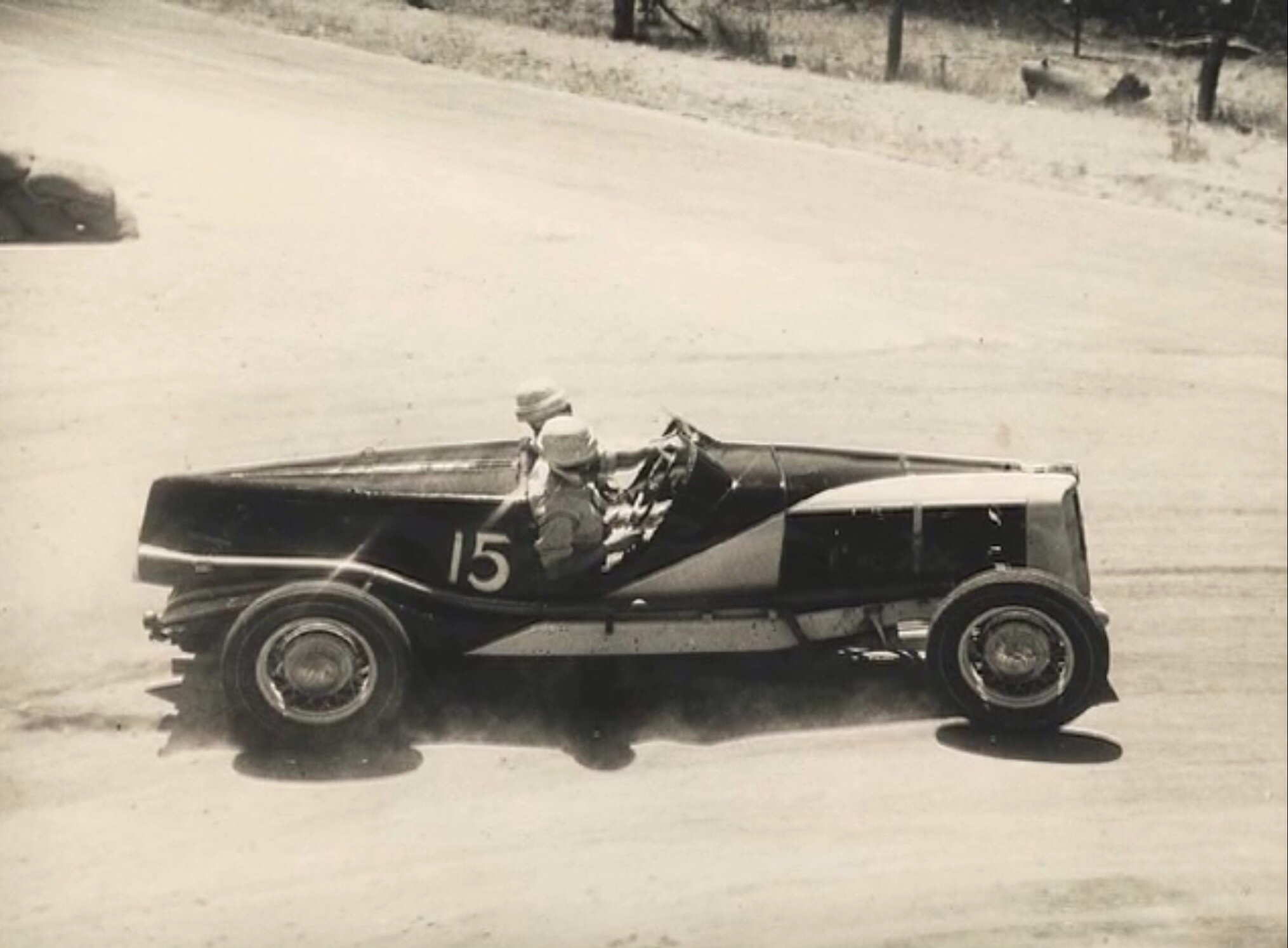
At that stage McDonald, Standard Spl was in front but he had mechanical problems and withdrew. Early DNF’s were Evans having completed only 2 laps- and Kleinig’s Hudson Spl, Bartlett MG Q Type, Beith Terraplane, Lea-Wright Terraplane, Wrigley MG Magnette, Boughton Morgan, Aitken Riley, Dunne MG P Type, Barrett Morris Cowley Spl.
Frank Kleinig’s Hudson effectively became the scratch-man with Sinclair’s withdrawal and was rightly regarded as one of the favourites for victory. The press-on Sydneysider recorded the fastest lap of the 4.25 mile track with a 3 minute 26 seconds time but the Hudson had trouble early on and after multiple pit-stops he called it quits on lap 10.
Barney Dentry, Riley Spl winner of the 50 Miles Race at Cowes in November, was well up until he too pitted for repairs to his Riley. Dentry provided one of the thills of the race when he challenged Arthur Beasley’s Singer on the Main Straight and passed him for fifth place only 150 yards from the end of the race.
Plenty of excitement was provided by the crowd ‘the largest that has yet assembled at a sporting event in Albury’.
‘Close on 6,000 people thronged the huge grandstand and on either side of the road near the finish line. The crowd got out of control when the last stages of the race were being completed. Despite the repeated entreaties to refrain from crossing over the road, people surged from one side to the other in droves, right in front of fast moving cars. However there were no accidents’ the Albury Banner reported.
The winning Phillips/Parsons Ford, a 1934 model, was modified in the manner typical of the day.
The 4 litre Ford flathead V8 was fitted with dual carburettors sitting atop an aluminium inlet manifold, a Winfield camshaft, an enlarged sump, oil cooler and double radiators were incorporated. A contemporary report says that ‘Phillips had a remarkable run of good luck in this race compared with other events he competed in’.
Clearly the two boys from Wangaratta were entering a purple patch with the car because they soon thereafter had a great run of results.
After Wirlinga the intrepid duo towed the Ford to Bathurst at Easter where they were sixth in the 1938 AGP won by Peter Whitehead’s ERA- and then third in the January 1939 AGP at Lobethal, that race won in brilliant style by Perth’s Allan Tomlinson in an MG TA Spl s/c.
Returning home they ‘doubled up’ and won the 1939 Albury Gold Cup at Wirlinga in July, they didn’t take the win in the 1940 event, the last motor race held at Wirlinga. Back across the border to Lobethal they won the 1940 South Australian 100, and that was pretty much it until the end of hostilities, Patriotic GP at Applecross in Perth held on 11 November 1940 duly noted.
Whilst much is rightfully made of Doug Whiteford’s Ford V8 Spl, ‘Black Bess’, its best results were still to come, perhaps this is the most successful Ford V8 Spl pre-War? After the conflict the beast was sold twice, then crashed and written off in the late forties- a lovely replica built by Ted Parson’s grandson in recent times will have been seen by some of you.
Phillips, in covering the 150 miles in 2:13.15 also did the fastest time of the race, his average time for each lap was 3:50 compared to Kleinig’s fastest lap of 3:43. At an average speed of 67-69 mph Phillips was about a lap ahead of Bonser’s Terraplane who was a similar distance ahead of Les Burrows Terraplane. Then followed George Winton AC, Dentry’s Riley, the Beasley Singer, Williamson’s Chrysler and O’Dea’s MG P Type.
The teams prize went to Burrows, Bonser and Kleinig.
Etcetera…
Pit and paddock scene from the final Wirlinga meeting over the Kings Birthday weekend, 10 June 1940.
The Interstate Gold Cup was won by Harry James’ Terraplane with the lap record for all time as it turned out, set by Alf Barrett’s Alfa Romeo Monza at 89 mph.
I wonder if that is Barrett’s Monza to the left of Jack Phillip’s Ford Special #5 in the photo above?
Alf Barrett applies a touch of the opposites to the wheel of his Morris Cowley Spl- the power of the supercharged GP Alfa which replaced this machine, capable of a 90 mph top speed, must have been considerable, not to say every other aspect of the cars performance!
Raced in a couple of AGP’s in Colin Anderson’s hands- he raced the car at Bathurst in April to 12th place whilst Barrett’s Lombard AL3 retired after completing only 3 laps, I’m not sure what became of this highly developed 1.7 litre attractive Morris or who built it in Melbourne.
Jack O’Dea’s beautiful MG P Type in profile. Some modern online accounts have Les Murphy driving the car at this meeting but neither the entry list or race accounts i have seen make mention of the AGP winner at the wheel.
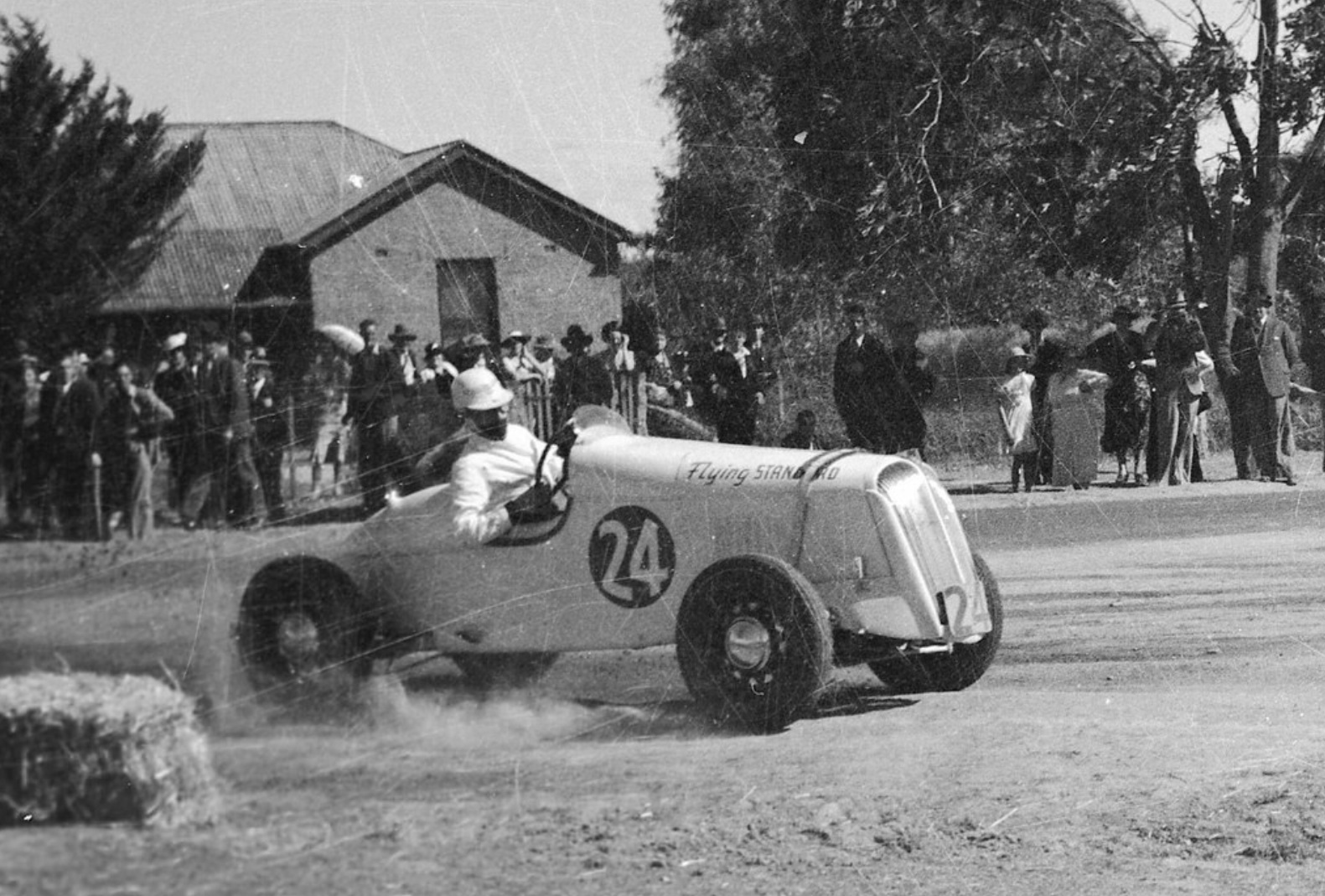
The K McDonald ‘Flying Standard Spl’ is not a car I know anything about, I am intrigued to understand who built it and it’s specifications if any of you can oblige.
Jack O’Dea’s MG P type leading the scrapping duo of Colin Dunne in Souter’s MG P and George Bonser’s Terraplane Spl.
The Phillip/Parsons Ford post-war at Port Wakefield when owned by Granton Harrison- with his back to the camera. Alongside is the ex-Bira/Snow/Colin Dunne/Russell Bowes/Ron Uffindell MG K3 (D Donovan)
Photo and other Credits…
‘Foto Supplies’ Albury Flickr Archive- photographer John J Dallinger, we salute you
Bob King Collection, N Howard, National Motor Racing Museum, Tim Hocking, ozpata, Dean Donovan, Melbourne Age 10/2/1938, Albury Banner and Wodonga Express 11/3 and 25/3/38, Melbourne Herald 15/3/38, Sporting Globe 15/1/38, Ray Bell and John Medley on The Nostalgia Forum
Tailpiece: When men were men…
Jack Phillips with kidney belt to keep his gizzards under control with helmet wearing Ted Parsons alongside- who is the dude on the left I wonder?
Three men and a car- the 1962 Australian Grand Prix winning Cooper mind you…
Eoin Young, journalist and author of considerable renown, Wally Willmott, mechanic of similar standing, the incomparable Bruce McLaren and Cooper T62 Climax at Styles Garage on the corner of Sussex Street and the Albany Highway, Victoria Park, Perth during the 18 November weekend. The Austin has a 15 kilometre tow from this inner south-eastern Perth suburb to Caversham now also a Perth suburb in the Swan Valley.
All so simple isn’t it, three blokes and a car?! And they won the race- with a little bit of luck thanks to Jack Brabham’s late race collision with Arnold Glass, but that in no way diminishes the achievement.
Here are a few more brilliant photographs from Ken Devine’s Collection of that weekend- I was going to retro-fit them into the old article but it seems better to let the photos ‘shine on their own’ so here they are with a few supporting notes.
(K Devine)
David McKay and Jack Brabham chewing the fat- don’t they look like youngsters?!
McKay didn’t race that weekend but was scooping up information for his newspaper and magazine reports of the race. Morover he was spinning Jack a line about how long-in-the-tooth his Cooper was and how much he would like to buy Jack’s brand-spankers BT4 Climax- a feat he would accomplish! The BT4 was in essence an FPF engined BT3- Tauranac’s first, 1962 F1 car.
Jack raced the car in New Zealand (a win at Levin) with David racing it in the Australian events- Graham Hill took the wheel in the 1964 Tasman Series achieving one win at Longford.
(K Devine)
Lex Davison looking stern as he motors past at some clip in his T53 Cooper- like McKay he was after a new car too- at the end of the summer Bruce’s T62 was his, a car around which a good deal of tragedy occurred. Lex was classified 8th from grid 4 but only completed 46 of the races 60 lap, 101 mile distance.
(K Devine)
Bib Stillwell must have been flogging quite a few Holdens from his Cotham Road, Kew, Melbourne dealership by then- he really went about his motor racing in a thoroughly professional manner.
To me he was slow to peak having started racing just after the war, but man, when he did he was an awesome racer taking four Gold Stars on the trot from 1962 to 1965- he had his tail up on this weekend as he had just taken his first Gold Star in this Cooper T53 Climax with wins in two of the six GS championship rounds.
Its interesting to look at Stillwell’s results that year- he had an absolute cracker of a season inclusive of the internationals when the big-hitters were about. His record is as follows; Warwick Farm 100 3rd, Celebrities Scratch Race Lakeside 1st, Lakeside International 2nd, Victorian Trophy Calder 1st, South Pacific Championship Longford 3rd, Bathurst 100 1st, Racing Feature Race Calder 1st, Victorian Road Race Championship Sandown 2nd, Advertiser Trophy Mallala 1st, Hordern Trophy Warwick Farm 1st, AGP Caversham 3rd- it was a year of amazing speed and reliability, the teams only DNF was at the Sandown International (engine) the only other ‘non-event’ was a DNA at Lowood- by early June Bib no doubt figured the long tow to Queensland from Melbourne was a waste of money.
At Caversham Stillwell was third on the grid behind McLaren 1:19.6 and Brabham 1:20.1, Bib’s 1:20.3 was pacey- he finished third, 47 seconds adrift of McLaren and 5 seconds behind John Youl in a Cooper T55.
(K Devine)
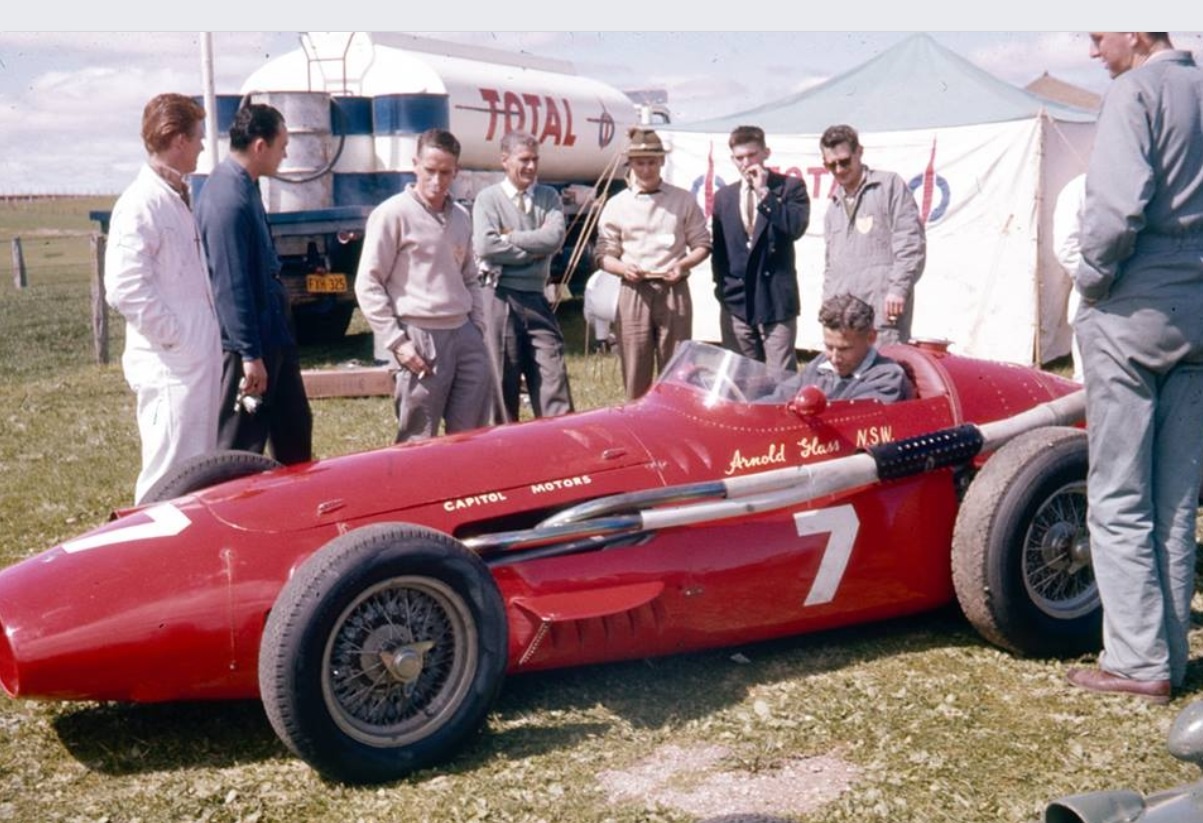
Lets not forget the Cooper Monaco either- a car I wrote about a while back and which received the ex-Scarab Buick-Traco V8 a little later in its life- the motor which was in the engine nacelle of Arnold Glass’ BRM P48 (#7 below) this very weekend.
The cut and thrust between Brabham and McLaren went on for over forty laps- Jack saw an opportunity when Bruce ran wide lapping Arnold- Jack focussed on Bruce, Arnold on taking his line for the next corner, a collision the result. Jack was out on lap 50 whereas Arnold survived to finish in fifth place from grid 7.
Jack and Roy fettle the 2.5 litre Climax engine lent to them by Bruce McLaren, Jack having popped his 2.7 ‘Indy’ FF in practice.
The Brabham BT4 was the first in a long line of ‘Intercontinental’ chassis built by the Tauranac/Brabham combination all of which (BT4/7A/11A) won a lot of motor races in this part of the world.
Paragons of practical, chuckable virtue the cars won races in the hands of World Champions Hill, Stewart and Brabham as well as championship winners in domestic competition for the likes of Stillwell, Spencer Martin and Kevin Bartlett (whilst noting the latter’s Gold Star success was aboard a BT23D Alfa Romeo.
(K Devine)
(K Devine)
Plenty of hopefuls entered the meeting not least Jim Harwood in the ex-Whitehead/Cobden Ferrari 125 which by then was fitted with a small-block 283 cid Chev V8.
His times were too far behind the modern mid-enginer racers of the top-liners so he elected not to start- with 1962 still just into the period of Austraian motor racing where everybody could have a go with a high-born special such as this ex-GP 1950 Ferrari.
The car is notable for the fact that it was one of Tom Wheatcroft’s first Donington Collection acquisitions.
(K Devine)
(K Devine)
Brabham, Stillwell and McLaren from left to right at the drop of the starters flag. Brabham BT4, Cooper T53 and Cooper T62 respectively. On the second row its John Youl at left, Cooper T55 and Lex Davison’s red T53 alongside him. In the dark helmet on the row behind is the red with white striped BRM P48 Buick of Arnold Glass and at very far left is Jeff Dunkerton’s Lotus Super 7 Ford 1.5- to the right of the Lotus is the red front-engined #14 Cooper T20 Holden Repco of Syd Negus.
(K Devine)
Whilst ten starters is not a big grid, Dunkerton’s achievement in finishing ninth in the little Lotus 7 was an amazing one- the last placing ever gained by a sportscar in an AGP.
(K Devine)
Bill Patterson was the reigning 1961 Gold Star Champions but his old Cooper T51 was never going to be a competitive tool going into that year with plenty of more modern well-driven machines on Australian grids.
In reality Patto was easing himself slowly out of racing as a driver albeit he would remain involved as a sponsor/entrant in the next couple of decades. He started from grid 6 and finished fourth albeit three laps behind McLaren.
John Youl is another driver I’ve waxed lyrical about in the past- its a shame commitments running the family pastoral properties in northern Tasmania took him away from motor racing. Youl’s ex-works Cooper T55 was beautifully prepared by Geoff Smedley and pedalled very quickly by John in the 1963 Internationals. It would have been very interesting to see just how far he would have progressed up the elite level totem-pole had he stuck with his racing career.
Bruce on the way to a Caversham win, Cooper T62 from Youl, Stillwell, Patterson and Glass. Bruce McLaren Motor Racing had rather a bright future.
Credit…
Ken Devine Collection
Tailpiece: McLaren takes the flag…
(K Devine)
Is it Jack in the blue driving suit obscuring the man with the flag?
Bruce won two AGP’s, the other aboard his self designed and built- with Wally Willmott, Cooper T79 at Longford in 1965.
Both were great wins after a long tussles with Jack Brabham- at Caversham Arnold Glass ruined the fun when he mistakenly put Jack off the road and at Longford he won by a smidge under four seconds from the Aussie’s Brabham BT11A Climax and Phil Hill’s Cooper T70 Climax. It was a great day for the Bruce McLaren Motor Racing as Phil drove a terrific race- in the American’s opinion one of his best in the T70, another car built by Bruce. (McLaren’s winning T79 was an updated T70)
Longford joy was tempered considerably by the death of Rocky Tresise early in the race aboard the very same Cooper T62 in which Bruce won at Caversham in 1962…
Queensland single-seater pilot Henk Woelders adjusts his helmet, probably Lakeside, 1967…
I was musing online with some ‘Nostalgia Forum’ buddies the other day about the effectiveness of the Castrol liveried brothers Geoghegan racers of the late sixties and early seventies. The commercial message was delivered well because of the elegant simplicity involved.
Woelders, Elfin 600E Ford Waggott, Calder 1971. Engine is a Merv Waggott prepped Lotus-Ford twin-cam (J Lemm)
Henk Woelders’ Elfin 600 liveries are other fine examples of ‘getting it right’.
He raced two of the spaceframe cars, both ANF2 machines, the second to the 1971 Australian Formula 2 Championship, taking four of the six rounds in his Bill Patterson Motors sponsored car. This chassis was a 600E, Garrie’s you beaut late F2 machine which had magnesium front uprights and revised suspension geometry front and rear.
Henk’s cars had Patto’s simple light blue stripe on a white background, Patterson’s own racing colours from his Cooper Gold Star winning days a decade before.
(DIMIA)
Sometimes photographs appear from the most unlikely of places, the inspiration for this article was two shots taken by the Australian ‘Department of Immigration, Multicultural and Indigenous Affairs’- catchy innit?
It seems the DIMIA were running some articles at the time about migrant success stories in Australia, as you may have gathered from the Woelders name he hails from the Netherlands- one of millions who came to The Great Brown Land post-war in a ‘populate or perish’ policy by our national governments. It would be intriguing to know where these photos were first published.
The shots are dated 1967 and refer to Henk with his Lotus Super Seven- which the first opening photo may be but the second most certainly is not. Lotus 20 FJ maybe?- did they have rear drum brakes?, intrigued to know what the car is if one of know what he was racing at the time.
Woelders in his first 600, a 600B chassis ‘6806’ at Calder before the hi-wing ban imposed over the ’69 May Monaco GP weekend. A moveable aerodynamic device too- clever setup has the wing feathered on the straights as here- with incidence created when required- interested to know who engineered this clever setup (B Mills)
What limited information I have indicates Henk was employed by Patterson during the Elfin 600 period, so at some point he moved from Queensland to Melbourne, presumably working at Patterson’s Holden empire based in Ringwood, an outer-eastern Melbourne suburb.
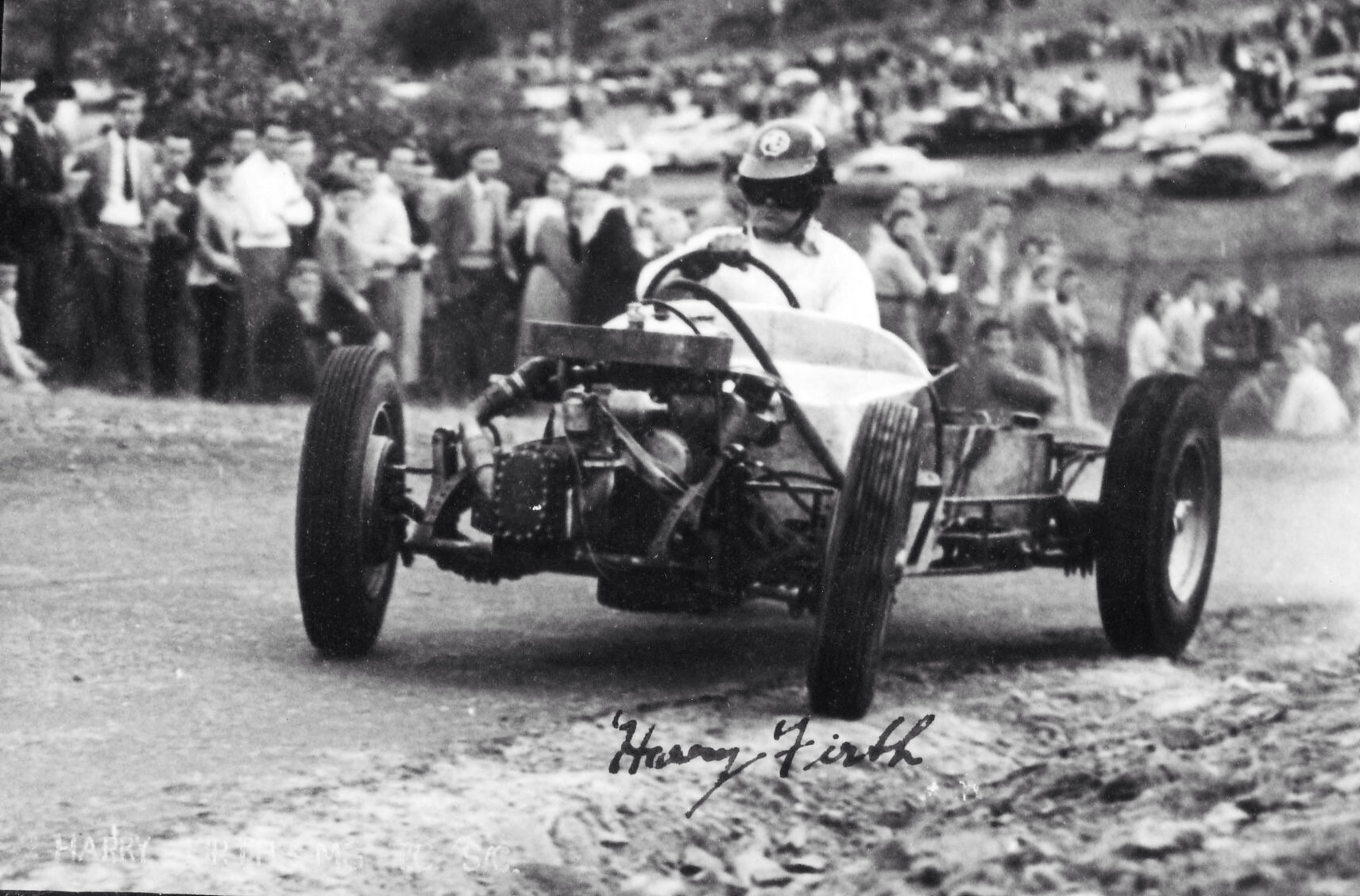
Harry Firth rated him as a driver, Henk and Peter Macrow were the ‘open-wheeler’ duo in the Holden Dealer Team’s first successful, three car 1969 Bathurst 500 assault- Colin Bond and Tony Roberts won, Des West and Peter Brock were with Woelders/Macrow sixth.
Henk’s career seems to have ended after his F2 win but he was reunited with his championship winning 600E ‘7024’ many years later and still retains it, and a very nice car it is too.
Henk and Malcolm Ramsay- in 600E and 600C ‘6908’ get set for the August 1971 Glynn Scott Memorial Trophy Gold Star round at Surfers Paradise. The F2 Championship race was run concurrently with the F5000 cars- Henk won the F2 section finishing 6th and Frank Matich was first outright in his McLaren M10C Repco. Ramsay DNF with a broken throttle cable- both these cars were powered by Merv Waggott built Lotus-Ford twin-cams (S Johnson)
Credits…
Department of Immigration Multicultural and Indigenous Affairs, John Lemm, Bruce Mills, Robert Davies, John Stanley, Stewart Johnson
Tailpiece: Woelders, Elfin 600B, Lakeside 1968…
John Stanley’s photo above is of Henk’s first 600 coming out of Lakeside’s Eastern Loop in 1968, he raced this car from 1968 to 1970 before replacing it with the later model.
Elfin 600’s won goodness knows how many F2 races in the hands of drivers like Garrie Cooper, John Walker, Tony Stewart, Ivan Tighe, Maurie Quincey and Australian Championships for Cooper, Woelders and Larry Perkins in Gary Campbell’s 600B/E in 1968 (ANF 1.5 C’ship shared with Max Stewart) 1971 and 1972 respectively.
Elfin’s Australian F2 dominance is amply demonstrated by the 1971 championship table- the first eleven placegetters raced Elfins- Woelders, Tony Stewart, Jack Bono, John Walker, Ivan Tighe, Garrie Cooper, Vern Hamilton, John Ampt, Ken Hastings, Ross Ambrose, Clive Millis and Don Uebergang!
Of those, all raced 600’s with the exception of Ampt who was aboard a Mono- the monocoque Birranas finally rained on the Elfin F2 parade from 1973…
A couple of intrepid adventurers, Harold Bowman and Murray Aunger about to set off from Adelaide to Mount Gambier, Prince Henry Vauxhall, Saturday 6 April 1912…
Some shots just blow my tiny mind and this is one of them.
The gelatin or glass plate photograph was taken in King William Street, Adelaide, the cities main drag- the GPO, still there, is in the background.
Just look at the sharpness of the shot and the subtlety of greys and darks, the formaility of all of the blokes- they are ALL fellas as far as i can see. What awaits the drivers is a journey of around 1149 miles on unmade dirt roads including clearing the dreaded 95 miles of the Coorong Desert, as it was called then, not too far from Adelaide.
The South Australian duo are part of an amazing event organised to test the time in which a military despatch could be carried by road from the Adelaide Military Commandant to his Sydney based equivalent.
‘From that aspect it became an event of some public importance, but its utility went further, for it provided an instructive comparative test of the three modes of conveyance which were employed’ the Adelaide Advertiser reported.
Contestants were split into three division- 30 cyclists, 52 motor cyclists and 12 ‘carists’. The Dunlop promoted and supported event was a relay contest, and in the best traditions of Australian motor-sport for the next four decades or so was also a handicap event.
The Dunlop Company handicappers had the cars concede six hours to the motor cycles and thirty hours to the cyclists. When the handicaps were announced there was considerable comment in sporting (betting no doubt) circles that the cyclists had no chance of reaching Sydney first and that they would soon be overhauled by the motorised opposition.
Adelaide Advertiser 11 April 1912
The first two cyclists left Adelaide at 5 am on Friday 5 April with their sealed despatch from Colonel H Mesurier to be delivered to Brigadier General Gordon 1149 miles away in Sydney.
‘Notwithstanding the early hour and already rain, there was an enthusiastic crowd to see the commencement of the most interesting despatch test ever attempted in any country, and amid ringing cheers, the wheelmen set off with all the importance of being on “The King’s business”.
The cycle class was divided into 65 sections varying in length from 10 miles to 28 miles, with two motor cyclists starting at 3am on Saturday morning, they had 25 sections varying in length from 27 to 72 miles.
‘The motor car, the “King of The Road” by virtue of its superior speed, will have four relays only, each running into hundreds of miles, and if the car drivers hope to be in it at the finish they must average a speed of nearly 30 miles an hour…’, the wheelmen will probably average 16-18 mph and the motor cyclists 23 mph The Melbourne Argus reported.
The motor cyclists were thought to be able to do the course in 46 hours with the cars needing to do the event in 40 hours ‘to come up level with the cycling divisions’. The car records at the time from Adelaide to Melbourne and Melbourne to Sydney were 20 hours 6 minutes and 19 hours 47 minutes respectively, a total of 39 hours 53 minutes so the automobilists had no easy task.
The route traversed good and bad roads, hilly to mountainous tracks, plains and sandy desert sections and ‘therefore it will be an interesting trial and from which military authorities may gather useful data respecting the three classes of transit and the most effective means for rapid mobilisation’.
Bowman and Aunger made a cracker of a start for the ‘car team’, setting off from King William Street at 9 am on the Saturday morning, they ‘startled the motoring world, and the event organisers by driving from Adelaide across the Coorong Desert to Kingston (185 miles) in 5 hours 15 minutes.
Such a feat appears incredible to those who know who now the route from Meningie to Kingston, but the fact remains that Messrs Bowman and Aunger averaged 35 miles an hour in the rain along this section of the relay. Leaving Kingston the limestone road got so slippery that fast pace was unsafe, and, in fact impossible, so, by the time Mount Gambier (303 miles from Adelaide) was reached the Vauxhall was 32 minutes behind the time schedule.
A Wiseman and T Bell then took up the running in a Maxwell and had a shocker of a time driving in pouring rain- they managed to lose their way near Glenburnie, devouring an additional hour in the process. Further hazards of the day were three punctures between Ballarat and Melbourne, a distance of about 70 miles. They finally arrived in Melbourne, still raining, at just before 11 am on the Sunday morning and ‘sorry spectacles they were’!
S Day and P Allen in a Vinot and M Smith and R Lane, FN then stepped up to the plate ‘having an unpleasant 200 mile drive against a head wind and heavy rain’, Albury being reached at 7.18 pm Sunday.
Sandford and Scott then took care of the dispatch from Albury north to Sydney but missed the road at Germanton (re-named Holbrook during the War) and went many miles out of their way. The car dispatch finally reached Sydney at 10.14 am on the Monday morning.
The event was not without incident of course, G Fitzgerald who rode the Kingston to Furner leg on a motor cycle fell heavily on the greasy road and fractured his leg.
Syd Barber, Bert Backler, Bob Smith and Charles Smith in Kingston, South Australia during the 1912 relay event (SLSA)
Despite bad weather conditions with slush and howling head winds the cyclists covered the 1149 miles in 69 hours 32 minutes averaging 16.5 mph and delivered their despatch to Sydney 6 hours 18 minutes ahead of the motor cyclists and 7 hours 12 minutes before the car despatch was handed over.
The cyclists performance was remarkable in that they’clung tenaciously to schedule hour after hour and were rarely more than 30 minutes either inside or outside of the timetable, while at Sydney they were just 4 minutes within the figures set for them’.
The motor cyclists took 51 hours 50 minutes averaging 22.5 mph whilst the cars recorded 47 hours 46 minutes an average speed of 24 mph.
A Cairns Post review of the event in 1930 mused about how quickly the times would have improved with the improved inetrstate highways of that time- the 2018 times would be interesting too!
‘No doubt the military authorities will be impressed with the reliability and effiiency of the cycles and motor cycles…One lesson to be drawn from the contest is the proved value of the three types of vehicles for military purposes…Given fair roads in this sprasely populated country, the value of the cycle and the motor vehicle in rapidly mobilising units is inestimable.
The motorists and wheelmen demonstrated that high speed can be maintained on very indifferent roads, and even if the pace did not exceed one third of the average in the respective classes, it would be fast enough to serve all purposes for home defence. The Imperial military authorities are making free use of both cycles and motors in the latest defence scheme, and paying the greatest attention to the roads- a most important factor in military operations.’ The Adelaide Advertiser said.
The nascent motor industry realised one means of proving the worthiness of cars was to demonstrate their reliability of by long distance events.
City to city transcontinental success soon evolved into city to city record breaking- the achievements of the cars and drivers was picked up by the print media of the day and the successes of the cars and their suppliers of fuel, lubricants etc were also promoted.
Before too long drivers such as Norman ‘Wizard’ Smith, Boyd Edkins and AV Turner were household names and drew crowds when they were departing and completing one of their adventures.
In parallel, car organisations/clubs were formed to provide the means for like minded motorists to share information and to tour together- there was safety in numbers if for no other reason than to have a mechanic at hand to keep your conveyance moving in the event if it faltered.
Inevitably the more competitive of motorists wanted to test their steeds in competition so Car Reliability Trials evolved from runs to more competitive events. These comprised trips from the city to the country of a navigational nature with speed events within them which typically comprised timed flying quarter/half mile/mile, acceleration tests, hillclimb(s), and what later became gymkhana type events. Normal roads were used which were closed off to other traffic- which was very limited in volume as the Trials were typically well out of town and the PC Plod’s glare. The more public of these events would have complied with the laws of the day in terms of requisite permits but perhaps not so much the smaller ones…
So, it seemed smart to do an article showing some of the cars used in these very early forms of competition in Australia- there was no permanent ‘circuit’ or ‘speedway’ in Australia in 1911. The City to City Record Breaking Era ended in 1930 when such open road ‘events’ were made illegal.
(JOL)
Napier Tourer: Brisbane to Toowoomba, Queensland 1912…
Walter Trevethan drove this 1911 or 1912 6-cylinder Napier from Brisbane to Toowoomba, 127 Km in 3 hours 7 minutes, one puncture and missing the railway gates at Redbank cost him a total of 16 minutes. Walter carried three passengers ‘The record has never been lowered although attempts have been made’, the photo caption says.
(S Hood)
Armstrong Whitworth: Sydney 1913…
AP Wright of Angus & Son and passenger, probably John Leys ‘in a stripped down Armstrong Whitworth record-breaking chassis in front of the Art Gallery’.
(SLSA Searcy Collection)
Vauxhall ‘Prince Henry’: Adelaide to Melbourne 1913…
Two unknown men in a Vauxhall ‘possibly prepared for an Adelaide to Melbourne record run in 1913. The journey is 735 Km.
(JOL)
Motor Sports Carnival: Brisbane, Queensland, 10 October 1914…
We do have State based differences in Australia, perhaps this is one of them, a variation on the trials theme perhaps? I wonder what marque of car she has jumped from?
‘A female athlete competing in the motor sports carnival in Brisbane, Queensland 1914’, most intriguing, i can’t find anything more about this event but am keen to know if any of you are descendants of this pioneering, rather attractive young lady. The caption tells us all we don’t need; ‘A woman athlete wearing a knee length dress and bonnet competing in the motor sports carnival at the Brisbane Exhibition Grounds. She appears to be a runner’. No shit Sherlock.
Essex: Hobart to Launceston and Return, ‘Wizard Smith’ 1923…
Norman ‘Wizard Smith’ acquired his nickname as a result of his speed in all manner of cars but received his label after multiple wins in the Victorian Alpine Trial.
The return trip of 400 Km took 4 hours 19 minutes. Smith left Hobart at 4am, he was at the Launceston GPO at 6.08, and after a minute was heading south again, ‘he arrived at Hobart Post Office at 6.19am, just 4 hours and 19 minutes after he left but in the meantime travelling 244 miles’…’The really remarkable thing about the whole business is that ‘Wizard’ Smith lowered the previous record by 1 hour 18 minutes…Mr Smith stated that his average speed was 56 mph, his maximum speed 101 mph…Our speed visitor holds the record from Brisbane to Sydney…Adelaide to Melbourne…These achievements have all been made on an Essex car’ The Adelaide Register reported.
Its interesting to look at the Essex and its stripped down nature, deviod of running board and mudguards, but fitted with additional wheels and tyres to prepare for punctures which were far more prevalent then than now.
Austin Tourer, a 4-cylinder car built between 1921 and 1924 during an RACQ reliability trial. Maleny is in the beautiful countryside inland of the Sunshine Coast about 100 Km north of Brisbane. No doubt quite a testing dive in the twenties.
(JOL)
Overland ‘Whitey’: Fred Eager in Don Harkness’ famous Overland in 1924…
‘Whitey’ was a stripped down 1914 Overland devoid of mudguards and headlights which broke the interstate, 915 Km speed record from Sydney to Brisbane on public roads. Fred Eagers’ company was the Queensland distributor for Willys-Overland’.
The photo caption goes on to state ‘Interstate speed record breaking was very popular after World War 1 into the 1920’s. Record breaking runs wre usually made with a single, specially prepared car with a driver and mechanic. Official timing was established by motoring clubs in the starting and finishing cities, and a great deal of publicity could flow to drivers, sponsors and manufacturers from the speed record attempts. Increasing speeds on the poor roads of the day led to crashes and serious injuries, so by the mid twenties the police were clamping down on these runs, which were eventually banned in 1930’.
(S Hood)
Chrysler: Melbourne to Sydney, ‘Wizard Smith’ 1927/8…
Scrutineers check all is good before Smith heads out of Martin Place and then south for the 875 Km journey.
Wizard is alongside what is now the wonderful GPO-Westin Hotel complex, my favourite Sydney CBD place to stay, the old building behind the car is still there in all of its magnificent, restored glory.
(Fairfax)
Citroen: Sydney to Bourke, 5 May 1932…
Arthur Barnes about to embark on his 760 Km trip to Bourke in the Darling River country of New South Wales, well supported by Texaco and Rapson Tyres. The photo caption records the attempt as an unsuccessful one.
Etcetera…
In June 2020 i had a Friday lunch with a group of motoring chaps and bummed a lift part way home with Peter Latreille whom i had met for the first time.
I checked out his quite stunning 1908 Isotta Fraschini FENC Voiturette, after waxing lyrical about that car for a half hour i turned to the Prince Henry Vauxhall sharing the garage and started to rabbit on about this article and this car whereupon Peter’s face lit up as he announced it was the very same car! A short while later we went inside where he has the King William Street shot hung in pride of place.
Vital statistics are as follows.
Car number A11.578, engine number C10.9, date of manufacture 20 December 1911. Today the car is known as ‘Henry IX’ being the ninth of 190 Prince Henrys sold between 1911 and 1915.
‘They were the early versions of the also famous 30-98 Vauxhall of 1913-1926. Nine of these cars, the first sporting cars to be manufactured by the British in series have survived’ wrote Peter.
The car’s first owner was Harold Bowman (in the passenger seat), a grazier from Meningie on Lake Albert on the edge of the inhospitable 90 mile Coorong Desert over which the intrepid pair passed later that day.
Credits…
State Library of South Australia Searcy Collection, State Library of New South Wales- Sam Hood, ‘JOL’- John Oxley Library within the State Library of Queensland, Fairfax, The Adelaide Advertiser, Melbourne Argus and Cairns Post April 1912 and other newspapers via Trove, Peter Latreille
Mal Simpson, Bill Pitt and a mystery fellow (M Simpson)
The LPS Motors/Bill Pitt Cooper MkV Norton being prepared for the November 1954 Australian Grand Prix, at Southport on Queensland’s Gold Coast…
The above sentence was easy to write, the skill is having the knowledge/research ability/database to be able to identify these mystery photos taken by the late Mal Simpson, a prominent Australian race mechanic of the fifties and sixties whose photo collection was being progressively uploaded onto ‘The Nostalgia Forum’.
Facebook is good fun for ‘light and fluffy’ photo sharing but the serious dudes of motor racing research who hangout on TNF have solved and debunked many racing knotty problems and theories in the last 15 years or so- check it out if you have not.
No less than ‘History of The Australian Grand Prix’ co-author John Medley got the research ball rolling with the first shot posted above- identifying both Cooper models and possible owners as Bill Patterson, Bill Pitt and ‘less likely, John Crouch’.
When John saw the second photo below, uploaded a day or so after the first, with Simpson identified in each shot, it provided more evidence. He felt the ‘pusher’ on the right was Bill Pitt and therefore the probable owner of car #5 as being the Lewis/Swinburne/Pitt- LPS Motors Cooper MkV Norton raced by Bill Pitt. Click here for Pitt’s history; https://primotipo.com/2016/03/18/lowood-courier-mail-tt-1957-jaguar-d-type-xkd526-and-bill-pitt/
Then my friend and Cooper expert Stephen Dalton stepped up to the plate confirming ‘pusher’ Pitt via some earlier photos he had of him and proffered the view that these Queensland cars were both entered in the ’54 AGP meeting- Pitt ran the MkV but blew the engine in practice, racing a Jaguar instead and Charlie Swinburne raced the #2 Cooper Mk IV. Stephen dated the photographs as late 1954 at least- ‘as The Triumph TR in the background (can you see a peek of it in the shot below) helps date the photo to probably late 1954 at the earliest- I think that’s when TR’s first arrived in Oz.’
So, Stephen concludes, ‘…is this the lads preparing the cars at their LPS Motors for Southport?…’
Nice work guys!
Unidentified chappy- help required, Mal Simpson and Bill Pitt with Cooper MkV (M Simpson)
Photo and Research Credits…
Mal Simpson Collection, John Medley and Stephen Dalton on The Nostalgia Forum
Jackie Stewart eases his BRM P261 chassis ‘2614’ into the Sandown Paddock after practice…
It wasn’t going to be a great day at the office for the plucky Scot. He started well, passing Jack Brabham on lap 9 for the lead but the crown wheel and pinion gave up the ghost on lap 11 of the race won by Jim Clark’s Lotus 33 Climax V8.
I think the car behind Jackie is Denny Hulme’s Brabham BT22 Repco- right of picture behind the attractive chick with white ‘flairs’, eagle eyed Holden fanciers will spot Repco’s HR Panel Van, one of two which carted the two team cars of Jack and Denny around the country that summer.
(P Newbold)
Clark ponders changes to ‘R14’ a chassis which was very kind to him in Australasia that summer- he won five of the eight rounds and took the Tasman Cup for the second time.
The chassis went back to Hethel with Jim, he raced it in the early F1 races of 1967- for the last time at Monaco before the race debut of the epochal Lotus 49 Ford DFV at Zandvoort on June 4.
Stewart was the reigning Tasman champion, the ex-F1 BRM P261 still had the speed to win the Tasman, but, stretched to 2.1 litres, the V8 put out that little bit of extra power and torque which stretched the transmission beyond its comfy limits. The cars Achilles Heel caused too many retirements that summer but the other Great Scot took two wins on the tour all the same. Click here for an article on this engine and series of cars; https://primotipo.com/2016/02/05/motori-porno-stackpipe-brm-v8/
JYS with Light Car Club of Australia, the lessee/promoters of Sandown, President Arnold Terdich- Arnold is the son of 1929 AGP winner Arthur Terdich, he won in a Bugatti T37A (P Newbold)
Stewart’s BRM P261 ‘2614’- jewels of long-lasting racing cars. Amongst the greatest of 1.5 litre F1 cars, then ‘gap fillers’ as the outrageous 3 litre P83 H16 was developed in 1966/7 and formidable Tasman cars fitted with 1.9 litre and finally 2.1 litre P111 BRM V8’s- the gearbox was not designed with so much power and torque in mind… (M Feisst)
Jack suits up below for the off with the omnipresent Roy Billington in attendance. I wonder when his time with Jack started and finished?
One of the things all these shots have in common is the very casual nature of racing at the time. The current World Champ is there for all to see and say ‘gedday mate and good luck!’
In fact he didn’t have good luck at all- he was out with ignition dramas having completed 27 of the races 52 laps with Denny retiring a lap earlier due to selector failure in the Hewland ‘box- not a happy home weekend for Repco at all!
It wasn’t that simple though, the weekend proved a long one for the Brabham and Repco boys.
In 1967 the tyre-war was on in earnest with Dunlop, Firestone and Goodyear vying for honours. Jack’s car was fitted with some wider 15 inch wheels made by Elfin (or perhaps more accurately Elfin wheels cast by the Commonwealth Aircraft Corporation) to take the latest, wider Goodyears. To do so, changes were needed to the rear suspension.
(F Nachtigal)
Jack did the quickest time on Friday and then the Repco lads popped in a fresh motor overnight- he then set pole on Saturday from Stewart and Hulme.
On Sunday Jack won the 10 lap preliminary from Stewart at a canter but as the BT23A crossed the line the Repco engines timing gear broke. With that, the crew set about another motor change in the limited time available, popping another RBE ‘640 Series’ 2.5 litre V8 into the svelte Ron Tauranac designed spaceframe chassis.
Jack and Jim both made ripper starts but Clark’s 2 litre Lotus was soon overhauled by Hulme’s 2.5 litre Brabham and Stewart’s 2.1 litre BRM. Brabham and Stewart then tussled before Jackie passed Jack- who then retired a lap later near Dandenong Road. It transpired that a soldered ignition wire pickup had come off the flywheel- repaired later, Jack re-entered the race completing 27 of its 52 laps.
Here are a few more photographs from that meeting- Peter Newbold was patrolling the paddock and so too was Mike Feisst who visited the Warwick Farm and Sandown Tasman rounds whilst on a trip over from New Zealand.
Between them, their pit shots capture the flavour of the times in a manner which on-circuit stuff on its own never entirely does.
As you will see, the entry for that meeting was truly mouth-watering in its variety and depth!
RBE 640 V8- the 1966 ‘600 Series’ Olds F85 block and new for 1967 ’40 Series’ exhaust between the Vee heads. Gearbox is a Hewland HD5 (M Feisst)
Brabham’s BT23A Repco awaits Jack and Roy Billington.
Despite passing into David McKay’s Scuderia Veloce after Jack had finished with it, this car probably under-achieved really.
Greg Cusack and Phil West raced it for David but by then the mantle of local aces had shifted from the retired Bib Stillwell to Spencer Martin, Kevin Bartlett and Leo Geoghegan. Put any of those fellas in BT23A at that time and a championship could have been won assuming a measure of Repco 2.5 litre reliability, a quality not necessarily plentiful…
Bob Jane had only just taken deliver of his Elfin 400 Repco ‘620’ 4.4 litre V8 from Garrie Cooper and his merry band of Edwardstown artisans- the 1967 Tasman round support races were his first serious events in a car which had a rather chequered and tragic history, click here for the story; https://primotipo.com/2018/04/06/belle-of-the-ball/
(M Feisst)
The Touring Car entry was ‘top shelf’ as well and led by crowd favourites from Melbourne, Norm Beechey above in his Chevy Nova and Sydney’s Pete Geoghegan below- the latter still racing the first of his two Mustangs.
Who won the battles on that weekend folks?
(M Feisst)
Pete’s ‘Stang is lining up for scrutineering, by the time I started racing a decade and a bit later the concrete pad was still in the same spot albeit there was a permanent roof providing the poor marshalls with some necessary protection from the elements.
That paddock was ‘heaven on a stick’ from a spectators viewpoint- so much was compressed into a small space but it was a pain in the tit as a competitor, it was as tight as a mackerel’s bum with a halfway decent entry list of cars. When things got too tight we Formula Vees were banished to an area of our own on the outside of Shell Corner (turn 1) which made us all grumpy at the time! And yer could no longer easily see all the other goings on.
Leo Geoghegan bought the ex-works Lotus 39 Climax Jim Clark raced throughout the 1966 Tasman at the duration of the series racing it during the 1967 Gold Star Series without much success due to recurring engine dramas.
Having said that the car behaved itself rather well on this weekend as Leo finished second in the race to Clark albeit he was 50 seconds back- this was the highest place finish by any local driver throughout the series.
It was not the last time Geoghegan gave the internationals a run for their money in this car either. Leo passed Frank Gardner in the latter stages of the race and was then lucky when Martin’s BT11A Brabham gifted Leo second with half-shaft failure.
Frank Gardner was third in Alec Mildren’s Brabham BT16 Climax FPF- an F2 chassis with a big-beefy FPF popped into the frame, Chris Irwin was fourth in the other 2.1 litre BRM chassis ‘2616’, then Kevin Bartlett, in Mildren’s other car, the ex-Gardner Brabham BT11A Climax which KB drove so hard and well in 1966/7. Then came John Harvey, three laps adrift of KB in Ron Phillips’ Brabham BT14 F2 car powered by a big 1860 cc Lotus-Ford twin-cam.
Leo contested the 1967 Australian Tasman rounds with the Climax fitted and then gave the car ‘a birthday’- John Sheppard and the Geoghegan lads adapted the chassis to take a Repco ‘740’ 2.5 litre V8, this created one of the sexiest ever open-wheelers to race in Oz, whilst the car was uber fast reliability remained an ongoing issue. The story of this machine is here; https://primotipo.com/2016/02/12/jim-clark-and-leo-geoghegans-lotus-39/
(M Feisst)
Peter Mabey eases himself out of Frank Matich’s brand-new and sinfully good-looking Matich SR3 Oldsmobile V8.
Gay Cesario brings a little bit of Italo-French style to the Sandown pits with his Abarth Simca 1300 GT.
The speedy Italian acquired the car in his native country and then drove it from one end of Italy to the other, both car and family migrating to Australia in the mid-sixties. Click here for the story; https://primotipo.com/2018/02/13/abarth-simca-1300-gt/
(M Feisst)
The two BRM P261’s of Stewart- ‘2614’, on the truck and Chris Irwin ‘2616’ on terra-firma. Nifty looking and aerodynamic full rear bodywork atypical by then.
Engines of the cars are to different specifications, Jackie’s is fitted with an exhaust within the vee motor and Irwin’s the more classic cross-flow set up with the former ‘de-rigueur’ in F1 in 1967- Ferrari, Repco-Brabham, Honda and BRM produced engines of that specification. That Stewart’s car is fitted with the exhaust within the vee arrangement tends to suggest it was the quicker at the time. Irwin’s car is about to be scrutineered.
One of the P261’s raced at the Phillip Island Historic Meeting not so many years ago driven by Rob Fowler, I think- man what a car at bulk-revs singing its way down the main straight and into Southern Loop- and well driven. Personal bias hereby declared.
(M Feisst)
I suspect Mike Feisst had a ‘heads up’ as to the garages in Melbourne where some of the Tasman cars were being fettled over the weekend- for sure this shot is not at Sandown Park.
The Aston DB4 GT Zagato has Victorian plates, I wonder which of the two (?) which came to Australia in period it is. It looks well used which is rather nice. Laurie O’Neill had one which Doug Whiteford and Pete Geoghegan gave a bit of a gallop, but wasn’t there another too? Intrigued to know which chassis this is and whereabouts the shot is taken. Check out this article on the cars; https://primotipo.com/2015/09/22/aston-martin-db4gt-zagato-2vev-lex-davison-and-bib-stillwell/
Flinders Street Station maybe for the photograph below, in Flinders Street itself down towards the ‘Banana Alley’ vaults?
The Holden FC aft of the Aston DB4 GT provides valuable context- I reckon yerv always got to see the exotica of the period juxtaposed with the transport we plebians used at the same time to see just how marvellous they were. My mums new Morrie 1100 was plated JEN-108 in 1965, so I’m thinking this Aston is perhaps a 1966 drop, James Bond plate duly noted?
(M Feisst)
(M Feisst)
Their was a bit of chatter online about this chassis being Graeme Lawrence’s McLaren M4A Ford FVA but I reckon Mike Feisst’s photo is also at Sandown and the car is an Elfin Mono- an outboard suspension second series car.
Two such were entered in the Sandown Park Cup by Ian Cook (7th) and Jack Hunnam (DNF) with Hunnam’s Mk2D the most likely choice I think. Having said that my friend, and Mono racer/restorer James Lambert will correct me if I have goofed! The engine is a 1.5 litre Lotus-Ford twin-cam, these very quick machines ran in the ANF1.5 category- effectively Australia’s F2 at the time.
(M Feisst)
Motor Racing Royalty in Australia in the mid-sixties was David McKay’s Scuderia Veloce Ferrari 250LM.
It was always, even in 1965 when it first arrived new from Maranello, a bit heavy to beat the sprinters but the car won three Surfers Paradise Enduro’s on the trot and was steered by some great drivers including McKay himself, Jackie Stewart, Spencer Martin and the brothers Geoghegan.
(M Feisst)
I’ve written about this wonderful machine, now owned by Ralph Lauren (what a waste of a RACING car) at length too;
I think Kiwi Andy Buchnan was racing, and owned the car at this stage in 1967?
(M Feisst)
Hillman had a great reputation in Australia at the time the ‘Grunter’ was popular aided and abetted by its 1968 London-Sydney Marathon win. The ‘Coventry Climax’ engine inspired Imp I always thought was a thinking mans alternative to the Mini- as ubiquitous in Australia as anywhere else on the planet.
The ‘works’ Improved Production Imps were raced (and built?) by Melbourne’s Graham ‘Tubby’ Ritter and youthful man-about-town Peter Janson. Norm Beechey had an occasional steer of these things as well- on this weekend the cars were raced by Ritter and Bruce Hindhaugh in car #22- the latter of Gown-Hindhaugh Engines in Elgar Road, Box Hill.
(M Feisst)
Alec Mildren added the teams second Alfa Romeo GTA to the trailer of cars sent from Sydney to Melbourne- both Kevin Bartlett and Gardner raced the car with FG twiddling the wheel that weekend.
No doubt those wheels are very light but there is something very ‘povvo’ about that aspect of a Porsche 906 at least visually?
Alan Hamilton would have been outgunned that weekend aboard the first of his 906’s with the Matich, Jane and Niel Allen (Elfin 400 Olds) big vee-eights present but this car always punched above its weight and was driven exceedingly well by the gifted son of Porsche importer Norman Hamilton. Click here for a feature on Hamilton and his cars;
The Morris Cooper S was a mainstay of Touring Car Racing globally at the time of course, not least in Australia where Mini Kings included Peter Manton and Brian Foley- others who spring to mind include Don Holland and John Leffler- Leffo starting a career in the BMC products which all the way through to winning a Gold Star, the Australian Drivers Championship in an F5000 Lola T400 Chev in 1977.
This car is Jim Smith’s- later the owner/racer of the crowd pleasing, ex-works Rover 3500 Repco Holden V8.
(M Feisst)
Seeing Peter Woodwards’s ex-Leo Geoghegan/Niel Allen Lotus 26R reminds me I’ve written a track test of me mate David Mottram’s Lotus Elite Super 95, I must pop it up.
Whilst most folks wax lyrical about the Elite as one of the best looking cars ever, I agree, for me the slightly more butch Elan 26R is a contender albeit not strictly a road car of course. See this short article about the car here; https://primotipo.com/2018/04/15/perk-and-pert/
Peter Woodward later won the Australian Sportscar Championship in the one-off Elfin 350 Coventry Climax FPF. He ‘nicked’ the championship in 1970 taking points in two of the three rounds from Frank Matich who did not race the awesome SR4 all season and Niel Allen in the 5 litre Chev F5000 engined Elfin ME5.
What became of this 26R after Peter Woodward finished with it?- to John Fraser in Queensland, but perhaps some of you can fill in the gaps. Is the car still in Australia?
Credits…
Paul Newbold, Mike Feisst on The Roaring Season, Frank Nachtigal, oldracingcars.com, sergent.com, Terry Sullivan, Dale Harvey, Rob Bartholomaeus
Tailpiece: All Eyes on Australia’s Finest…
Which is as it should be of course!
Jack steers BT23A-1 through the gravel Sandown paddock towards the grassy Esso compound only a few more steps away. He wore that gold ‘Buco’ (i think) helmet a lot in 1967! It may be summer in Australia but by the look of the adoring kiddos its a chilly Melbourne day.
Photos of this place bring back many happy memories of roaming the Sandown paddock just like these youngsters, although i was never as nicely dressed as the brothers in yellow and wearing a tie!
The Jack Saywell Alfa Romeo Tipo B/P3 and John Snow Delahaye 135CS and friends at The Coorong, South Australia on January 5 and 6 1939…
The two intrepid Sydney racers contested the 1939 Australian Grand Prix at Lobethal on 2 January, the handicap race famously won by Allan Tomlinson in his MG TA Spl s/c. Saywell aboard ‘the fastest car in Australia’ was off scratch and finished sixth, slowed by tyre problems on the scorching hot South Australian summer day. Snow was off 4 minutes 15 seconds in the French sportscar and was fourth. Everybody that day was outfoxed, out-prepared and outraced by the three youngsters from Perth- Tomlinson and two fellow racer/fettlers Clem Dwyer and Bill Smallwood.
Whilst in South Australia they decided to attack some Australian speed records on the pipe-clay surface of The Coorong, at a little spot near Salt Creek, 210 km from Adelaide.
Huge amounts of preparation went into the attempts with the Sporting Car Club of South Australia playing an organisational role and in ensuring compliance with international rules.
Not the Coorong but the Lobethal paddock earlier in the week- John Snow’s gorgeous Delahaye 135CS- he used the Hudson behind in the Australian Stock Car Championship that weekend too (N Howard)
Whilst attempts were being made by Snow and Victorian racer Lyster Jackson over longer distances/times, both Snow and Saywell also wanted a crack at The Flying Mile (Class C for Snow and Outright for Saywell) which had to be timed to the nearest hundredth of a second rather than a tenth of a second- the best which could be achieved with a chronometer. The Adelaide University Physics Department were involved in creating some automatic photo-electric timing equipment which met the accuracy requirements of the international regulations.
Two existing speed records had been set in South Australia during February 1935 at Sellicks Beach by John H Dutton (Class C 92 mph Flying Mile) and CW Bonython MG (Class A 76.09 mph) but the Fleurieu Peninsula beach would not suffice in length for this endeavour which sought records between an hour and twenty-four hours.
A huge open area was needed with space for long, high speed corners to keep average speeds up. Whilst the opening photo may be at the Coorong, it could be at Sellicks- perhaps its a promotional shot taken prior to the record attempts or maybe a test run. Let me know if you have certainty about the locale.
Weather delayed the attempts by a few days but the SCCSA officials were out and about at 5 am on the morning of Thursday 5 January 1939 and prepared a surface as ‘smooth as glass’- the wind was up on the day and was said to be anything up to a 40 mph headwind.
The temperature was 96 degrees Fahrenheit, by the end of the week the temperature in Adelaide was 117 degrees! ‘Despite that a crowd of over 200 people ventured out into that desolate landscape and into those incredible temperatures, setting up a tent city’ wrote John Medley.
The chosen course had been professionally surveyed by an SCCSA club-member and measured 10 miles 318 yards- it was a huge oval comprising two straights of 5 miles and ‘wide circles at either end for turning’.
John Snow started the blue Delahaye 135CS at noon and was soon lapping consistently, the intent being to stick to a plan to coax the car through 24 hours- it wasn’t a sprint after all.
John covered the first 185 miles in just over two hours averaging 92 mph. The car was then refuelled in 4 minutes and Lyster Jackson jumped aboard- he maintained the average of 92 mph in his 10 lap stint and then made another refuelling stop and some ‘engine adjustments’ were made. The first tyre stop, which took 49 seconds, was made a little later and then Jackson was relieved by Snow after the speedy machine had completed 35 laps, or about 366 miles.
Snow had been going again for less than 3 miles when valve trouble ended further motoring at about 6.30 pm.
A perfect world would have been popping a spare engine into the car between the 150 mile Grand Prix and the record attempt but Snow didn’t have a spare despite his wealth. The car ‘was overhauled by the Englishman brought to Australia specially to prepare the car’- lets come back to that point.
The distance travelled in the first hour was 92 miles, for three hours about 275 miles. Jackson did the quickest lap at 6:26 with Snow’s 6:32. ‘No attempt was made to push the car’ but a mean speed of 130 mph was reached on the long straights.
The team claimed records to the Australian Automobile Association for 50, 100 and 200 miles- 50, 100, 200 and 500 kilometres- and 1 and 3 hours. Those recognised in the Australian record books are;
Standing 100 km 40 mins 45.5- 91.47 mph, Standing 200 km 1 hour 21.29.0- 91.51 mph, Standing 50 Miles 32.55.4- 91 mph, Standing 100 Miles 6:5.33.0- 91.51 mph.
Obviously the Delahaye was in no fit state to attack the Flying Mile, whilst one newspaper report has it that Saywell’s Vittorio Jano designed masterpiece did 132 mph for the Flying Mile and 88 mph for the Standing Mile.
‘On the following day , it was Jack Saywell’s turn…the task was perhaps simpler, the red car attacking only two records, the standing start and flying start mile- but the blistering temperature, sandy surface and blustery 45 mph sidewind across his path were going to be a hindrance…in accordance with AAA rules, a run in each direction was required, and the Alfa used its Lobethal rear axle ratio, the second highest of four available’ John Medley wrote.
‘Using a four mile run in against the breeze, Saywell averaged 128 mph for the first officially timed run. In the opposite direction he used a shorter run in and averaged 140 mph for the flying mile. The average of the two runs was 134.7 mph, the fastest officially recorded speed in Australian history breaking the previous record by over 35 mph’.
‘The Alfa was then prepared for its attempt on the standing start one mile record. Spewing dirt off its spinning back wheels for the first 400 yards, the booming Alfa then got into its stride and crossed the line at 142 mph, wind assisted. Into the wind Saywell crossed the finishing line at 125 mph. When the times were totalled and the speed averaged, the mean speed was 89.2 mph, another new Australian record’ John Medley wrote.
Some Australian enthusiasts will be aware that John Snow, scion of the wealthy Sydney ‘Snows Department Stores’ family made annual trips to the UK both to purchase merchandise for the family business and to race and purchase some top-end cars either to order or for re-sale back in Oz.
The 1939 AGP grid, for example, comprised at least four cars (John Crouch Alfa 8C2300 Le Mans, Colin Dunne MG K3 Magnette, Saywell’s Tipo B and Snows Delahaye 135CS) imported to Australia by the front-rank Sydney racer.
John Snow during the 1939 AGP weekend at Lobethal, Delahaye 135CS (N Howard)
The Delahaye was a remarkably astute purchase by Snow for Australian handicap racing- it was not an outright winner other than on the ‘right day’ but with enough speed and reliability built into it by virtue of its sports-racer intent would always be ‘thereabouts’ in the handicaps which predominated in Australia. And so it was, mainly. The car probably coulda-shoulda won several AGP’s, but in the end it only took the one, in John Crouch’s hands at Leyburn, Queensland in 1949.
The 6 cylinder, 3557cc, OHV 160 bhp car, chassis ‘47190’ was turned into a ‘corn-chip’ as a consequence of a disastrous trailer fire due to an errant cigarette butt flicked out of the car window upon the trip back to Sydney after the 1951 AGP at Narrogin, Western Australia. Enough of the car existed to reconstruct in the seventies/eighties.
The English mechanic referred to earlier was ‘Jock’ Finlayson, he was brought to Australia by Snow and Saywell who by that time were operating ‘Monza Service’, at 217 Bourke Street, East Sydney looking after various racing and top-end road cars.
The very well credentialled (ex-Bentley, Birkin, Straight, Seaman) poor chap totally stuffed up the timing of Saywell’s 2.9 litre, DOHC, supercharged Tipo B engine when he rebuilt it and rooted the engine as a consequence.
With no confidence in anyone else locally to address the engine and having plenty of moolah Jack popped the engine onto a boat back to Milan, but the ship is thought to have been sunk in the immediate months of the War- Saywell never saw that engine again!
Chassis ‘5002’ was not reunited with a motor of kosher original specification until it was restored in Australia in the early sixties. It had an active, long, eventful racing career mind you, albeit fitted with GMC and Alvis motors…
Credits…
Fred Pearse Collection, ‘John Snow: Classic Motor Racer’ John Medley, Norman Howard from the Bob King Collection
Tailpiece: Jack Saywell, Alfa Romeo Tipo B, AGP Lobethal 1939…