These two blokes are aboard a Bugatti Brescia Type 23 out front of The George Hotel in Lydiard Street, Ballarat, Victoria between 1945 and 1950…
The shot is from the State Library of Victoria archive, it was taken by George Thomas, a prolific ‘snapper at motorsport events throughout Victoria at the time. Ballarat, 120 kilometres west of Melbourne is a Gold Rush town. Over 600,000 people came to Australia from all over the globe in the 1850s to chase their fortune. Ballarat was one of the main destinations of the optimistic, it’s a beautiful place with many of the stately buildings of the period still standing, including the George Hotel.
The interesting thing is of course, which particular chassis it is and who the fellows are. My recently acquired copy of Bugattis In Australasia (details in the credits below) personally delivered by the very knowledgeable, youthful, spritely 81 year old author, Bob King suggests it’s either Bill Fleming or Neil Barter, assuming the photo date range is accurate.
The car is a long-chassis Modifie. Without going into all of King’s detail, the chassis number of the car can’t be confirmed, but it came from New South Wales to Victoria in 1938 when owned by Fred Betts. He never registered it, but raced it at Phillip Island pre-war.
After the conflict it was raced by John ‘Bill’ Fleming at the Hurstbridge and Rob Roy Hillclimbs in Victoria in 1948, before being sold to Barter that October. At this stage, as shown in the opening photograph, the car was registered in Victoria JT441 and was fitted with engine number 2566.
Fleming on the startline at Hurstbridge Hillclimb in Melbourne’s outer north-east (King)The Fleming Brescia at Rob Roy Hillclimb in Melbourne’s Christmas Hills, ‘eighteen litres of Semmering Mercedes in the background’ (King)
Barter recounts in King’s book ‘By January we were driving it around as much as petrol rationing would allow. After correcting a dismally retarded camshaft timing, we found the performance astonishing – 40 mph first gear, 60 in second, 4,300 rpm etc – we were never short of superlatives. Alas youthful exuberance led to disaster and injury when… in April 1939…the car overturned at the corner of Dendy Street and The Esplanade, Brighton’, a bayside Melbourne suburb not too far from Albert Park Lake, a place all you global GP fans will be familiar with.
‘A regular trick was to drive it as quickly as you could along Beach Road at Brighton Beach and, instead of taking the right hand corner…we would hurl it into the gravel car park opposite the monument, put it into a 180-degree slide and then drive straight out again, heading back towards Hampton. The prize for the night went to the driver who travelled the quickest and made the cleanest slide!’ What a great thing to do after a few bevvies on a Friday or Saturday night?!
‘This all came to a halt when, one night, with four up, I rolled it when turning from the beach road into Dendy Street…a very sobering experience for all and particularly me’, Neil Barter wrote. Looking at the young blokes in the car at Ballarat my guess is that it’s Barter and one of his Brighton Grand Prix accomplices!
Bob King records a bewildering nineteen owners of this car. The last was Wolf Zeuner in the United Kingdom albeit this was way back 1992. The name Brescia was applied to these cars (T13 2.0 metre chassis, T22 2.4 metre, T23 2.55 metre) after the cars placed first to fourth in the 1921 Italian Voiturette Grand Prix.
Piero Marco, Brescia T22, Brescia before the off Gran Premio delle Vetturette, 1921 (Bugatti)
de Vizcaya, Brescia T13, GP Penya Rhin 1921- is the descriptor for this Barcelona event but my race results don’t accord with this car/driver combo that year (unattributed)
This event, the ‘1 Gran Premio delle Vetturette’, held on 8 September 1921 on the Circuito di Brescia comprise 20 laps of a 17 km course, a total of 346 km. Thirteen cars contested the race, the winning Bugatti T22 of Ernest Friderich completed the race in two hours 59 minutes 18.6 seconds. He was followed home by teammates Pierre de Vizcaya, Michele Baccoli and Piero Marco all aboard Bugatti 22s, they were chased home by a group of four OM465’s.
2,000 Brescias were built from 1919-1926 more than any other type of Bugatti. ‘Being the first Bugatti made in any numbers, it was the Brescia that established Bugatti’s reputation as a builder of sports and racing cars. They were imported into Australia and New Zealand in considerable numbers…’ King wrote.
Original period sales brochure with Brescia at centre stage, the rest of the document is below
Bob continues ‘The Brescia, of 1496cc capacity, has a cylinder block with non-detachable head and four valves per cylinder operated from a single overhead camshaft via ‘banana’ tappets. In Europe the standard touring model had a four sparking plug cylinder block with ignition from a magneto mounted transversely at the front the engine. These cars had a cast aluminium firewall and were known at the factory as the ‘Modifie’. Racing versions had eight plug cylinder blocks with two magnetos mounted in the dashboard driven (noisily) by spur gears. These latter were known as ‘Full Brescias’. Surprisingly, regardless of chassis length and whether fitted with racing, sports, or touring bodywork, the majority of new imports to Australia were ‘Full Brescias’. Perhaps it was thought to have the security of two magnetos in our relatively primitive motoring environment.’
Superb Brescia 16-valve engine cutaway, technical details as below (Griggs)
In the early twenties, Bugatti didn’t build the bodies of their cars, with the exception of minimalist T13 racing coachwork, so all of the new cars imported to Australia via the London agent, Sorel, were shipped in most cases in bare chassis form. A tax or tariff was imposed on imported coachwork to help stimulate the local industry with ‘Many of the local bodies fitted to Brescias appear to have been of poor quality. This, coupled with the harsh ride of the Brescia, and the poor roads on which they were driven, ensured that the coachwork had a short life. With the need for light bodies for competition work, the discarded original bodywork was usually followed by a succession of amateur built bodies.’ King wrote.
Bugatti played a very important part in the formative years of Australian motor racing as the weapon of choice for many sportsmen on road circuits, hillclimbs, the concrete saucer at Maroubra, gravel speedways and the beaches at places like Gerringong.
A straight-eight Bugatti T30 driven by Geoff Meredith won the first Australian Grand Prix at Goulburn, New South Wales in 1927. Goulburn, 200 km south of Sydney, was also a Gold Rush town. In fact Bugatti won five of the first six AGPs creating huge brand awareness by the standards of the time.
Four cylinder Bugatti T37As – the supercharged variant of the T37 – were victorious in the Phillip Island AGPs of 1929 with Arthur Terdich at the wheel, and in 1930 and 1932 when driven by the period’s ace, Bill Thompson. Carl Junker won in 1931 aboard a straight-eight 1.5-litre T39.
Drake-Richmond’s T37 goes thru Heaven Corner ahead of the Mert Wreford Riley Brooklands during the 1 January 1935 Centenary 300 at Phillip Island. This is the cover photo of Bob King’s book (King)
The Phillip Island AGPs were handicap events, so there is no reason a Brescia couldn’t have won a race with the right mix of speed, reliability and luck, but such never the case. The best Brescia results in our premier event were Merton Wreford’s fourth in 1932 and John Bernadou’s fifth in 1929.
Mert raced chassis 2133, ex-Arthur Terdich, and ‘In practice Wreford’s straight line speed was bettered by very few cars and he was actually faster than Drake-Richmond’s Type 37. In the race Mert was given a 15 minute start by the blown Type 37A’s of Terdich and Thompson and he finished a creditable fourth place on handicap, averaging almost 65 mph for the 200 miles with his old two-wheel-brake Brescia in spite of losing four valuable minutes with clutch trouble’ Bob King wrote.
John Bernadou raced his father Albert’s 2536 in the 1929 AGP – both father and son competed extensively in Victoria in the mid-twenties – despite being delayed by a hole in the fuel tank John was third in the Under 1500 cc class and fifth overall.
Bill McLachlan at Quarry Bend, Bathurst 1952. Bug T37A Ford V8 37358 aka the MacKellar Spl (B Gunther)
Some (not a huge number mind you) quite exotic racing cars came to Australia pre-War including several Vittorio Jano designed Alfa’s, but the faster Bugatti racing straight-eight T35 and T51’s didn’t make the trip until post-War, when they were of course beyond the first flush of youth.
In our racing, which comprised many events run to handicaps, the cars were competitive but none won a post-War AGP. All played an important role in bolstering grid sizes throughout the long Australian Special Era which in the main were MG based or Ford side-valve V8 powered. In many cases once the original Bugatti (or Alfa or Ferrari or Bristol) motor blew Ford V8s, or a bit later a small block Chev or Holden Grey-six-cylinder engine was inserted under said car’s shapely aluminium bonnets.
To reframe my shallow comment a moment ago about Australian Specials, the wonderful breed included tool-room-quality machines such as the Charlie Dean/Repco Research built Maybachs, the Lou Abrahams/Ted Gray Tornados and Chamberlain brothers Chamberlain 8. Also in the mix are outrageous in brilliant original conception cars like two of Eldred Norman’s masterpieces, the Double 8 and Eclipse/Zephyr Spl, while the rest includes anything and everything from mild-to-wild MGs and Ford V8 engined specials. Not to forget the Hudson straight-eight engined machines pre-War, the high point of those is the extant (Frank) Kleinig Spl: MG chassis, monoposto, Hudson-8 and much, much more. There was no lack of creativity among this country’s mechanics and engineers however basic the underpinnings of the machines they started with!
A game-changer was the move in AGP regulations from handicap to outright events from the 1949, Leyburn Queensland AGP won by John Crouch’s Delahaye 135S. Mind you that didn’t stop the organisers of the 1950 Lobethal, South Australia, and 1951 Narrogin, West Australia AGPs having an each way bet by placing as much emphasis on the handicap winner as the outright victor, which comes through strongly in the contemporary newspaper accounts.
1951 was the last handicap-AGP (in part) and the last won by an Australian built car (the Warwick Pratley driven, George Reed built, Ford V8 engined George Reed Special) until Frank Matich won the 1971 AGP at Warwick Farm a couple of decades later in brand new F5000 Matich A50 Repco Holden.
From 1951 those who wanted to win the AGP needed the readies to acquire a car with the speed, endurance on our rough road circuits and reliability. The balance of the fifties was the Factory Car Era. A Talbot Lago T26C won in 1952/3 (Doug Whiteford), HWM Jaguar in 1954 (Lex Davison), Ferrari 500/625 won in 1957/8 (Davison), a mid-engined Cooper T40 Bristol in 1955 (Brabham) and Maserati 250Fs in 1956/9 (Moss/Stan Jones).
John Cummins raced his T37A Holden ‘37332’ complete with Bellamy IFS until very late in the piece- here the eternal racer/raconteur is at Bathurst in 1961 (unattributed)
Among all this the pre-War Bugatti’s, whether Bugatti or black-iron-powered still played an important role. The last AGP grid of substantial Bugatti numbers was the 1952 Mount Panorama contest in which three entered. Bill McLachlan’s T37A Ford V8 finished 13th, while the T35B/51 shared by Phil Catlin and Peter Menere was 15th, but the P Lowe T37 Holden failed to finish. In fact the placings by McLachlan and Catlin/Menere were the last in an AGP for Bugattis, one was Ford V8 powered, the other still had its Molsheim motor.
For the record, the very last Bugatti AGP start was the David Van Dal/John Cummins T57 which failed to finish the very hot 1957 Caversham race outside Perth. There ended a rich contribution by the marque to Australian motor racing which commenced with substantial numbers of Brescias, and Geoff Meredith’s first AGP win aboard a T30 at Goulburn in 1927. Thirty years from start to finish, not a bad record at all!
Duncan Ord in the ex-Howe/Levegh T57 ‘57264’ 3.3 s-8 in the Patriotic GP at Applecross, Perth, WA on 11 November 1940. He is turning out of Tweedale Road (Terry McGrath))
Bibliography…
‘Bugattis in Australasia’ Bob King- Bob still has a couple of copies of this book and plenty of ‘The Brescia Bugatti’- contact rking4450@gmail.com
‘A History of Australian Grand Prix 1928-1939’ John Blanden, MotorSport July 1942, The Bugatti Trust
Photo Credits…
George Thomas, Bob King Collection, Byron Gunther, Bob Shepherd, Terry McGrath, Griggs, automobiles.narod.ru
Chassis: period typical girder, H-section front axle, weight circa 610 kg
Engine: Four-cylinder, SOHC by front bevel drive, four valve with bore/stroke of 66, 68, 69 x 100 mm for capacities of 1368/1453/1496 cc. Carburettor(s) one or two Zenith. Ignition one or two magnetos, usually SEV. Plugs one or two per cylimder. 30 plus bhp with an RPM limit of (‘prudent’) 4000 ‘or even 4500 on a good Brescia’
Gearbox: located centrally, four-speed and reverse with right-hand location, clutch wet multi plate
Brakes: Location and type – foot, transmission and right-hand for the rear. Four wheel brakes fitted from 1926
Wire wheels with original size 710 x 90
Dimensions: T13, wheelbase 2.0 metres or 1967 mm, T22 2.4 metres or 2417 mm and T23 2.55 metres all with a track of 1.15 metres
Drawing of Brescia ‘2566’ engine showing the oil drain tubes from cam-box to crankcase (B Shepherd)
Notes on The Brescia Bugatti: MotorSport July 1942…
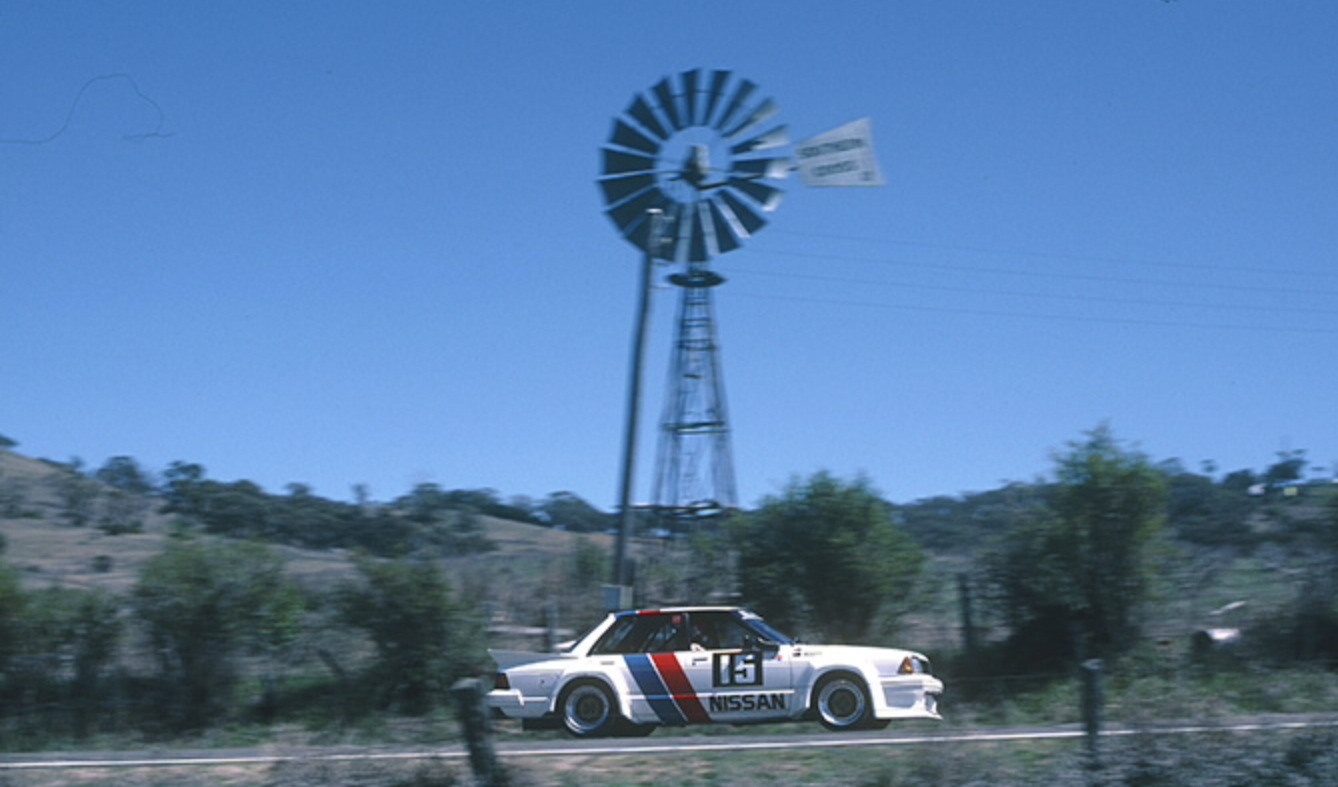
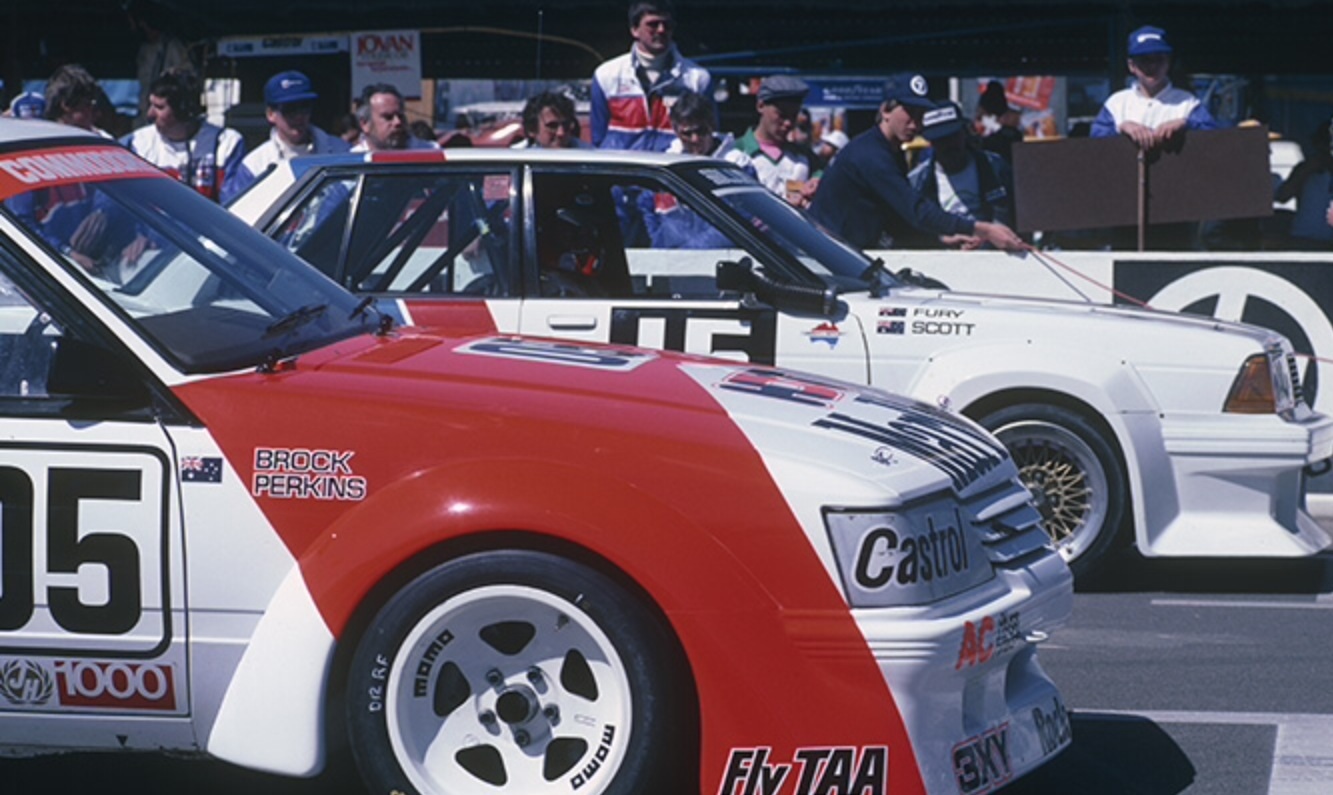
George Fury on Conrod Straight in his works Nissan Bluebird turbo during the September 1984 Bathurst 1000 weekend…
Touring Car Racing in Australia has always been tribal. From the sixties it was Holden vs Ford, later Holden vs Ford vs Chrysler/Valiant. Then there was the locally manufactured stuff vs foreign cars including ‘Rice Burners’, then a disparaging descriptor for anything from Japan. Its amusing now given Japanese dominance of our market but this kind of stuff aroused the passions as much as an afternoon at the footy, whatever your code (Aussie Rules, Rugby, Soccer).
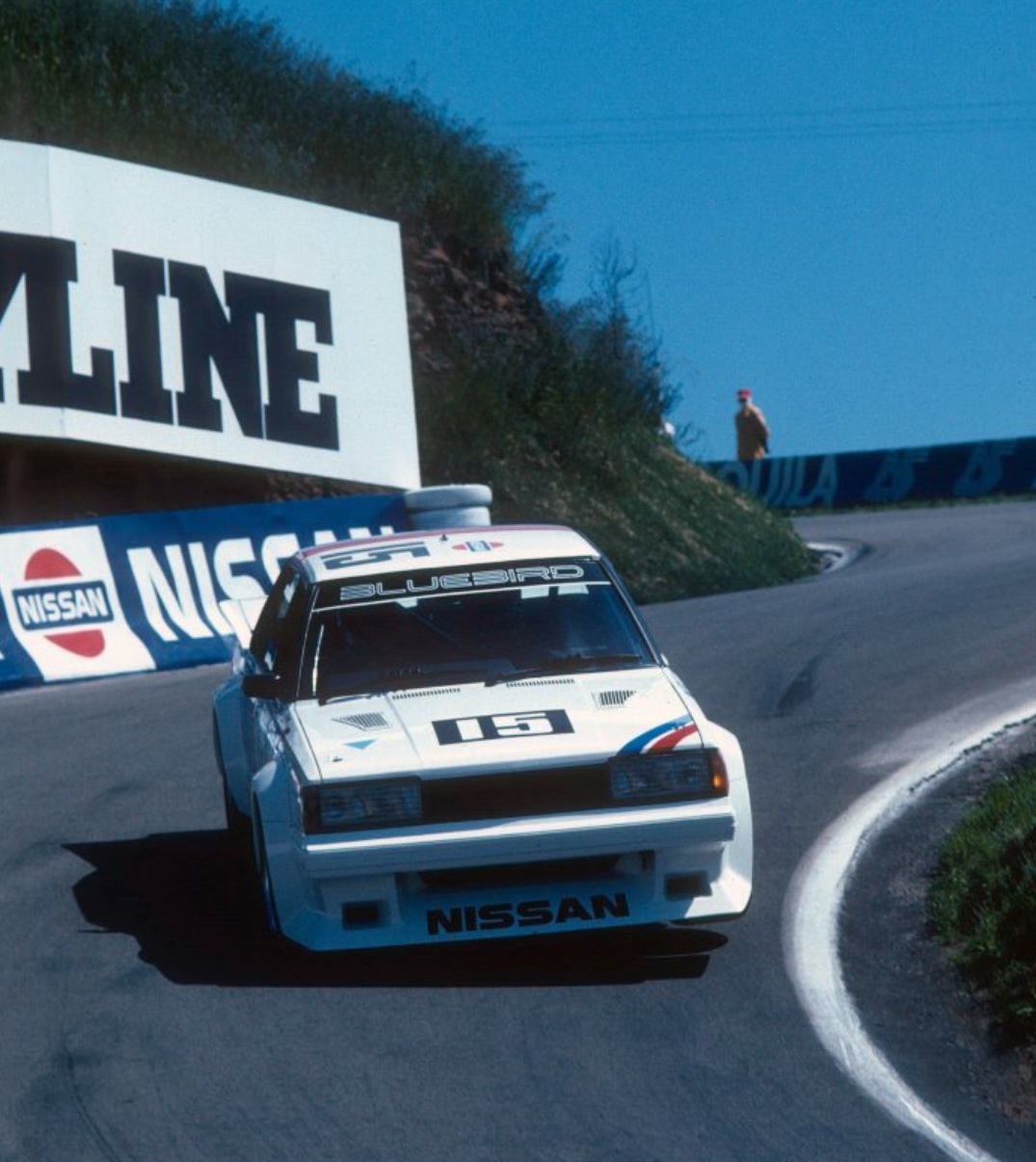
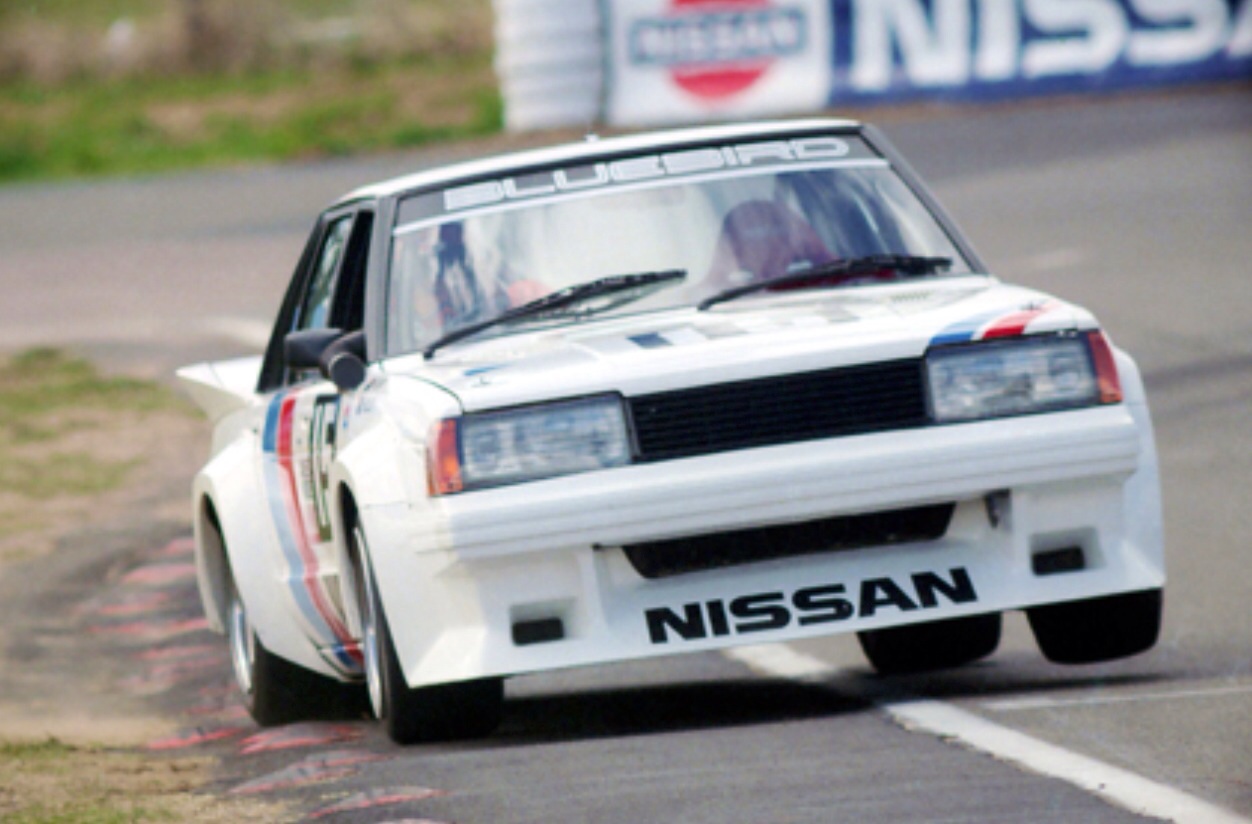
Fury/Scott Bluebird thru The Dipper, chassis the third and last Bluebird built by Nissan Motorsport Oz. Z18T 1.8 litre SOHC, 2 valve, twin-plug 4 cylinder turbo engine giving circa 350 bhp. Car still exists (supercars)
Fury exits Murray’s on ‘that lap’. It was an extremely cold day- it snowed in Bathurst that morning, getting heat into the tyres during the Hardies Heroes 2 lap top 10 qualifying format was tough for all- cold conditions suited the turbo-Nissan whatever tricks were also pulled (autopics)
Whilst the first Japanese outright win didn’t occur until the Jim Richards/Mark Skaife 1991 victory aboard a Nissan R32 GT-R ‘Godzilla’ (what a car!?) Nissan certainly signalled their intent with Australian Rally Champion turned racer George Fury’s splendid pole in the 1.8 litre, turbo-charged four cylinder Bluebird sedan on the mountain in 1984. His 2:13.850 ‘Hardies Heroes’ qualifying lap in the last season of the Group C era (Australian adopted Group A from 1985 noting their was a Group A category in the 1984 1000) was not beaten until 1991 when Skaife’s 2:12.630 R32 GT-R time bested it.
The Bluebird’s first Australian Touring Car Championship round win was at Lakeside in June that 1984 season. Pole on the mountain was a magnificent achievement, albeit the car, co-driven by Queenslander Gary Scott lasted 146 of the 163 laps in the race won by the Brock/Perkins Holden VK Commodore, the third win on the trot for that combo.
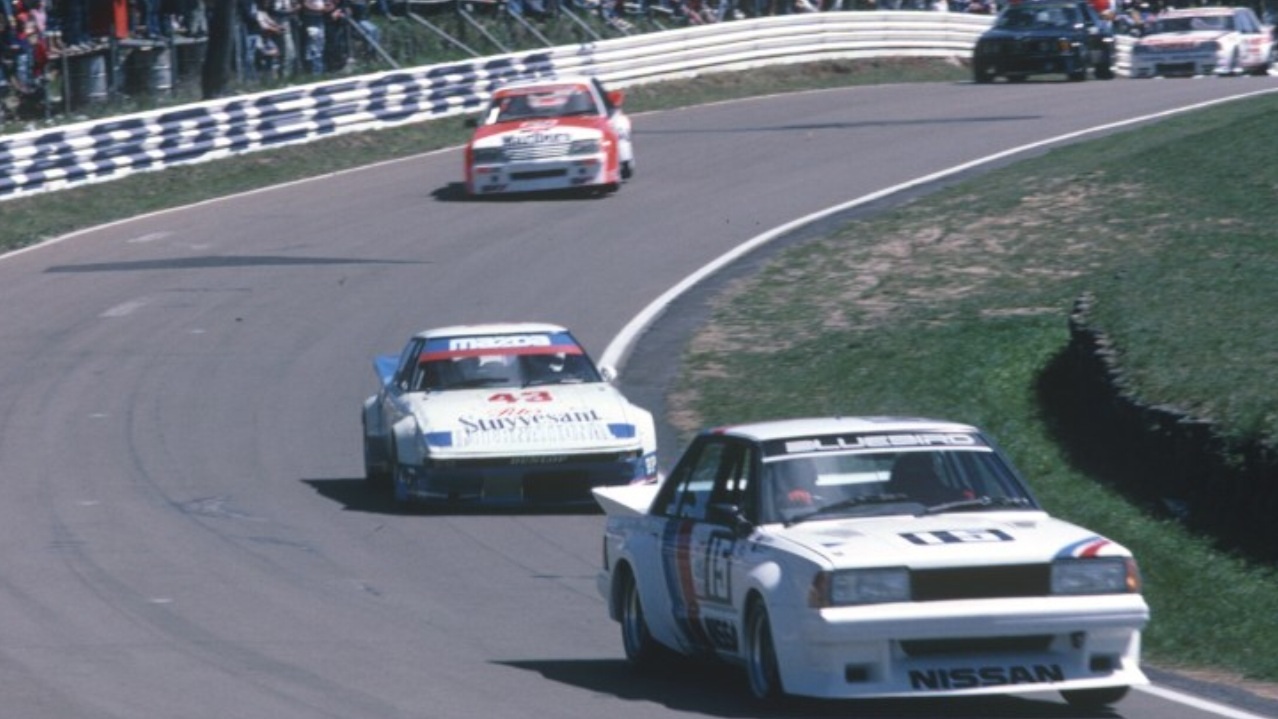
Lap 1 into Hell Corner: Fury Nissan from Brock VK Holden Commodore, Johnson XE Ford Falcon, Allan Grice white/yellow VK Commodore with Richards BMW 635 CSI and Masterton’s XE Falcon putting the squeeze on Moffat’s Mazda RX7. First start, race restarted and Brock got the jump (supercars)
Early laps Skyline: Fury, Moffat, Brock, Richards, Masterton (supercars)
Still, in some folks minds they stole pole given Fred Gibson’s admission some twenty years after the event (FG drove for the team and was Nissan Team manager by 1986) ‘that the Bluebirds had an illegal turbo-boost adjuster on the dashboard, as well as having the engine bay’s fire extinguisher spraying super-cooled Halon at the cars intercooler increasing horsepower’. It was the first time since qualifying first counted for grid positions in 1967 that a V8 had not been on pole, and a V8 would not sit on pole again at Bathurst until 1993.
Bloody rice-burners. Mind you, other than the Japanese body-shell the car was built entirely in Australia…
Credits…
Supercars Australia, autopics.com.au, Australian Musclecar
Tailpiece: Front row before the off, Bathurst 1984…
Frank Matich, Brabham BT7A Climax tries to outbrake Bib Stillwell #6, Brabham BT4 Climax, December 1963…
Photographer John Ellacott upon posting this shot online described it as ‘the two great rivals on Hume Straight’…Matich braking down the outside on the run into the slow second gear ‘Creek Corner’. Frank’s car was brand new, just unpacked, it had only turned a wheel for the first time several days before the 1 December ‘Hordern Trophy’, the final round of that years Gold Star, the Australian Drivers Championship.
Frank’s car was fitted with 2.5-litre ‘Climax FPF, Bib’s older chassis had an ‘Indy’ 2.7- a fair duel, one guy with the edge in chassis perhaps and one with a bit more power?
Stillwell led from the start of the 34 lap race and then FM began to reel him in, finally catching the Victorian on lap 20, the pair tangling in The Esses. The collision was enough to put Matich out of the race but Stillwell finished fourth, the race was won by John Youl in his Cooper T55 Climax 2.5 from David McKay’s ex-Brabham BT4.
Frank left and Bib – looking very natty is his BRDC blazer – developing his listening and empathy skills by the look of it after the Hordern Trophy. Great rivals with a lot of respect for one another’s abilities (Sports Car World)
In the 1964 Tasman Series which followed the month after this race Youl was the most successful of the locals. Stillwell only contested three Australian races gaining a strong second in the AGP at Sandown whilst Matich was prodigiously fast but had woeful reliability, we shall pick up the Tasman shortly.
I described the rivalry between Frank and Bib in a post about the Stillwell Cooper Monaco;
It’s fair to say Stillwell, born 31 July 1927 took a while to mature as a driver. He started racing MGs in the late 1940s and as his motor dealerships became more successful throughout the 1950s he acquired and raced some expensive, fast cars, D-Type Jag and Maser 250F included. By the time he commenced racing Coopers he had well over 15 years of experience and was ready to take on anybody, winning his first Gold Star in 1962 and the last in 1965, four on the trot.
Matich, born 25 January 1935 was a more precocious talent who first competed in an MG TC at Foley’s Hillclimb circa 1954 and raced seriously from later in the decade after selling his Austin Healey and purchasing the ex-Frank Gardner Jaguar XKC. He soon drove cars for Leaton Motors who employed him as Sales Manager. Bib was more the silver-spoon-special born on the right side of the tracks and funded into his first dealership with family money. Mind you, whatever Bib started with he multiplied many times over, he was an extremely successful businessman in Australia and then became an executive of global calibre inclusive of being President of the Gates Learjet Corporation in the US.
Frank, the young pro, was cut from totally different cloth. He was educated at De La Salle College, Marrickville in Sydney’s inner west and was apprenticed as a 15 year old Diesel Engineer at Sydney’s Kurnell Oil Refinery before progressing through Butlers Air Transport and in 1954 to Selected Sportscars where he first came into contact with the Englishman who owned the MG TC Frank prepared, and both men raced.
FM’s ability and gift of the gab attracted patrons and commercial support from very early on in his career, Matich too was shortly to do well out of the business of motor racing with Australian franchises for Firestone, and later Goodyear racing tyres, and Bell helmets, apart from the sale of some of the Matich sports and F5000 cars he built.
Matich and Stillwell were intensely competitive, driven, successful men, they had far more in common I suspect than not, especially in terms of mindset and will to win. The battles between the pair were absorbing, Matich very quickly got on the pace of the big 2.5 Climax Formula Libre cars (the 2.5 Tasman Formula started in 1964, Australia’s national F1 ANF1 was F Libre till then), having come out of powerful sportscars- Jags C and D Types, Lotus 15, 19, 19B and small bore single seaters, works-Elfin FJ Ford and Elfin Catalina Ford 1.5.
At the time, these 2.5/2.7 litre F Libre/Tasman cars were the fastest road racing cars in the world, F1 having changed from a 2.5 to 1.5 litre formula from 1 January 1961. Given his experience it was not a surprise when Frank was on the pace straight away as he jumped out of his Lotus 19B sporty and into the new Brabham acquired with the French Oil Company, Total’s, support.
Well before the Tasman Series commenced in 1964, we had a strong International Series of races in Australasia in January/February, with enough of the best in the world to test the locals in equal cars Matich was more than a match for any of them. So was Bib on his day.
Matich mounted up and ready for his first test of the naked BT7A, devoid of all signwriting and in civvies at Warwick Farm the week before the Hordern Trophy above. Brian Darby, at the rear, picked the car up from the Port Melbourne wharves the week before, Bruce Richardson is the other mechanic in shot. Note reinforced wide based top front wishbone and rubber mounted ball joint, inverted wishbone at the top and single lower link in the rear suspension. The later BT11A had the opposite rear set up, single top link and inverted lower wishbone (John Ellacott)
Matich was very quick in the Brabham throughout that ’64 Tasman Series and the short period in which he raced the BT7A, its interesting to look back at his time in the car. The late 1963 pre-international events in New Zealand are covered in this article here;
The first 1964 international was at Levin, which Frank missed, at Pukekohe, the NZ GP on 11 January, he ran strongly behind Brabham, McLaren, Tim Mayer and Hulme. He passed Mayer for third only to pop his engine on lap 26, McLaren won the race in a Cooper T70. After Puke he shipped the car home to Australia and re-joined the circus at Sandown on February 9. There he ran ahead of the locals before suffering crown wheel and pinion failure on lap 4.
At the Farm, Matich’s home turf, he started from pole, followed Jack away, then passed him but muffed his braking at Creek and ran off the road. Off to Queensland, at Lakeside, he was driving away from everybody before the engine let go, a Weber ingested a stone and the expensive motor went ka-boom on lap 8. After the long tow to Tasmania he finished third in the race won by Graham Hill’s BT4 and was first of the locals despite a misfire, and a revolution amongst his mechanics who pushed the car onto the grid but left his employ after the race.
Ray Bell wrote that ‘He had a mixed bag of results in shorter races during the middle part of the year, taking a number of outright lap records, then came the Gold Star closing events. Lakeside…pole and the lead before an oil line came adrift; Mallala he didn’t turn up (Stillwell basically could not be beaten for the Gold Star by this stage) and he led the Hordern Trophy till half distance before yet another engine failure’.
The 1965 Tasman Series was won by Jim Clark’s Lotus 32B Climax. Despite not contesting the four Kiwi rounds Matich was right on the pace at Warwick Farm, the first Australian round, starting from pole and leading to Creek corner, he then raced with Brabham behind Hill and Clark up front. ‘Both Hill and Matich had troubles in this race with cement dust getting into the steering, Hill spinning on the last lap because of it and failing to finish. Matich was third behind Clark and Brabham’s BT11A, Stillwell (BT11A) was thirty seconds behind him’ wrote Bell.
Matich in his semi-nude BT7A in the hot 1964 Lakeside summer sun, puddle notwithstanding! He is trying to stay cool in the searing Queensland heat, lower side panels removed. Shot shows the proximity of the aluminium side fuel tanks containing lots of Avgas, no rubber bag tanks prior to circa 1970 (Peter Mellor)
Down south at Sandown he ran just behind the internationals ahead of Stillwell only to retire with ignition failure, a rotor button on lap 10. During the AGP at Longford he pitted with suspension problems on lap 5 whilst best of the locals having run in sixth place. At Lakeside he contested the non-championship Lakeside 99 and made it a real race dicing with Clark on this high speed, demanding circuit for most of the race. ‘They traded places many times, but Matich did have a pitstop and lost some laps before rejoining the battle’. It was a race FM rated as one of his best.
Into the domestic season Stillwell won the Victorian Road Racing Championship Gold Star round in April after a couple of Matich spins, albeit FM was second despite a failing engine, and started from pole a half-second clear of Bib.
That was all the racing he did in that car. At Lakeside’s Gold Star round in late July, he crashed his Lotus 19B Climax, he took the sportscar to the meeting to test it in advance of the Australian Tourist Trophy which was held at the circuit later in the year, was burned and hospitalised and in the aftermath Total took the decision to cease their racing program and sold the cars and parts.
The story of the next phase of Frank Matich’s career in sportscars, initially with the Elfin 400 aka ‘Traco Olds’ is told in links within this article.
Frank Matich was one of Australia’s many F1 mighta-beens, to me the most likely to succeed of all, but with a young family and business ties in Oz it never happened despite offers being made to him on more than one occasion to go to Europe. As noted, Matich didn’t race single seaters for long at this stage of his career, from 1963 to 1965, racing sports cars very successfully until 1969 when he came back to open wheelers with the advent of F5000 – where he was a star as both a driver and constructor. Click here for an article on this phase of his career;
It’s a shame he didn’t drive Tasman 2.5 cars throughout this golden-era of single-seater racing in Australasia, his battles against the internationals as well as the local hotshots in both Tasman races and domestic Gold Star competition would have been sensational. Matich mixing it with Bartlett, Martin, Geoghegan, Harvey and the rest would have added depth to Gold Star fields which were increasingly skinny as the decade wore on.
Stillwell retired at the end of 1965, he was certainly as quick as anybody on his day and arguably had not quite peaked when he did retire. No less an observer of the local scene than journalist/racer/Scuderia Veloce owner David Mckay believed that by 1965 Stillwell had reached F1 standard, not least for his ability to drive fast without mistakes or destroy the equipment.
Intercontinental Brabhams at Longford, AGP 1965. Stillwell’s dark blue #6 BT11A (6th), Matich BT7A (DNF) and Frank Gardner in Alec Mildrens yellow BT11A (eighth), the race won by Bruce McLarens’ Cooper T79 from Brabhams’ BT11A (Kevin Drage)
The Intercontinental Brabhams…
The first of the Intercontinental Brabhams. Jack in BT4 ‘IC-1-62’ on its debut at the Australian Grand Prix, Caversham, WA on 18 November 1962. He retired after colliding with another car whilst lapping him, Bruce McLaren won in a Cooper T62 Climax (Milton McCutcheon)
When Jack started his climb to the top in Europe he returned and raced in Australia each summer, bringing a Cooper with him and racing it successfully, then selling the car to one of the locals before returning to Europe. It was a nice little earner and helped fund his way in Europe as he fought to gain a toehold in international competition.
Cooper sold a lot of cars in Australia, Jacks business brain was as sharp as his cockpit skills so it was natural that some of the earliest Brabham production racing cars were for Australasian Formula Libre and from 1964, the 2.5 Tasman Formula- which in effect meant cars built for Coventry Climax FPF ex-F1 engines- 2.5 litres but increasingly 2.7’s after Jacks successful Indy 500 run in 1961 in the Cooper T54 with its 2751cc FPF engine. The Tasman Formula mandated 2.5’s of course.
Soon Repco were making Climax parts and eventually building the engines in totality under licence in Australia. The bits were plentiful which was just as well as the level of competition was such that the long stroke donks were being pushed well beyond their limits with spectacular blow-ups fairly common.
Bib Stillwell in his BT4 Climax ‘Lakeside International’ 1963, 2.7 FPF powered. 3rd in the race won by John Surtees Lola Mk4A Climax 2.7 (Bruce Wells/The Roaring Season)
The first Intercontinental Brabham, i use that descriptor as that was the chassis prefix for each car (‘IC’), the design intended for the shortlived Intercontinental Formula created in response to the new 1.5 litre F1- was the BT4 based on the first Brabham GP machine, the 1.5 litre Coventry Climax FWMV V8 powered BT3.
The first Brabham, retrospectively referred to as ‘Brabham BT1’, was the MRD, an FJ machine first raced by Gavin Youl with the BT2 an evolution of the MRD/BT1. The Intercontinental cars which followed the BT4 were the BT7A in 1963 and BT11A in 1964, both F1 cars adapted for Climax FPF engines.
Some incredibly talented guys raced the ‘IC’ Brabhams- Internationals such as Brabham, Hulme, Gardner, Hill and Stewart as well as Australian champions including David McKay, Lex Davison, Stillwell, Matich, Spencer Martin, Kevin Bartlett, John Harvey, John McCormack and other drivers in New Zealand and South Africa.
Jack Brabham won Australian Grands’ Prix in a BT4 and BT7A in 1963 and 1964 respectively. The cars won the Australian Drivers Championship, the Gold Star for Stillwell in 1963 and 1964 aboard his BT4, in 1965 with a BT11A and for Spencer Martin, again BT11A mounted in 1966 and 1967.
Graham Hill ahead of Bib Stillwell, BT4 Climaxes, first and fourth. South Pacific Trophy, Longford March 1964 (Rod MacKenzie)Bib Stillwell in his final and successful Gold Star year 1965. BT11A at Warwick Farm. His final year of racing, he had a top year in the car at WF, finishing fourth in the Tasman race albeit behind Matichs’ BT7A in third and first in the Hordern Trophy at the end of the year (John Partridge Collection)
The ‘Brabham IC Australian party’ ended in 1968 when Kevin Bartlett won the Gold Star in BT23D/1, a one off car built for Alec Mildren’s Team around Alfa Romeo Tipo 33 2.5 V8s he secured to add a bit of Italian flavour to the local scene, Mildren was an Alfa Romeo dealer.
The Intercontinental cars were typically fast Tauranac designs of the period. They had rugged spaceframe chassis, suspension by upper and lower wishbones at the front with Armstrong shocks and coil springs. At the rear there was a single upper link, inverted lower wishbone, twin radius rods and coil spring damper units with adjustable sway bars fitted front and rear. With Jack doing all of the initial chassis setup work the cars were quick and chuckable ‘straight out of the box’.
Hewland HD5 gearboxes were used in the main (Colotti in the BT4) and rack and pinion steering completed the package with the cars clad in a slippery fibreglass body.
Bib Stillwell’s Brabham BT4 Lakeside February 1963. 2.7 litre Indy 2751cc Coventry Climax FPF engine, 58mm Webers, Colotti T32 five-speed ‘box. Rear of the spaceframe chassis apparent. Suspension- inverted upper wishbone, single lower link and twin radius rods for location, coil spring damper units, no rear roll bar here. Stillwell’s cars famously immaculate in preparation and presentation (Peter Mellor/The Roaring Season)
After Repco’s 2.5 litre Tasman V8 engine made its debut in BT19, Jacks victorious 1966 F1 winning chassis, in 1966 the Tasman Brabhams were variants of the BT23 frame (BT23A and BT23E) with the exception of the very last BT31 for the 1969 series. See Rodway Wolfe’s article about BT31 which he owned for many years; https://primotipo.com/?s=brabham+bt31
Once the 1.5 litre F1 ended in 1965 BRM quickly realised a stretched variant of their P56 V8 in a P261 chassis would be a Tasman winner and ‘their endeth the locals’ in Climax engined cars taking on the Internationals similarly mounted on more or less equal terms.
The Repco Tasman V8’s provided a supply of competitive customer engines for locals so the Tasman Formula continued into 1970 with engines capable of matching the internationals when the ever expanding F1 season and more restrictive driver contracts made eight weeks in January/February in Australasia no longer a proposition for the best in the world. With it went a wonderful decade or so of intense but sporting summer global competition in our backyard.
Those Intercontinental Brabhams were gems though and gave both the international aces and local hot-shots very effective tools with which to strut their stuff, not least Messrs Stillwell and Matich…
The Matich BT7A being pushed onto the Tasman grid, Longford 1964. Steering is Graham Matich, looking down at the rear is Geoff Smedley. Matich finished third, just in front of Stillwell, Graham Hill won the race in a BT4 (oldracephotos.com)
Tailpiece: Wanna buy a car matey, or a plane?…
Stillwell and Brabham, rivals and friends in the Longford paddock 1965. They are sitting on Bibs’ Bedford truck, BT11A up above…I doubt Jack sold anyone more cars over the years than he did Bib?! Bib put them to very good use mind you (Kevin Drage)
As nice a posed portrait of Jack and his BT11A ‘IC-5-64’ as you will ever see. The combination are in the old Sandown pitlane in February 1965 before he went out and won the Sandown Cup from Jim Clark, Lotus 32B and Phil Hill, Cooper T70, all Coventry Climax 2.5 FPF powered of course.
Etcetera…
Matich in his BT7A contesting the ‘Hordern Trophy’ at Warwick Farm in 1964. DNF in the race won by Leo Geoghegan in a Lotus 32 Ford 1.5, a great win for Leo, he and his brother Sydney Lotus dealers, Leo graduated to the ex-Clark Lotus 39 Climax at the end of the 1966 Tasman series (John Ellacott)The Matich BT7A sitting in the Longford paddock in 1965. DNF with suspension failure in the race won by McLarens’ Cooper T79 Climax. Rear suspension by this stage to BT11A spec (Kevin Drage)Front page spread in ‘Australian Motor Sports’, no advertising allowed on racing cars in Australia in those days but the colors on the nose of Franks’ Brabham (Leo Geoghegan’s Lotus alongside) are those of ‘Total’ the French oil company who were prominent in Australia at the time, the spread no doubt a ‘cross promotion’ as the modern marketers would call it!Racing Car News and Stillwell’s Gold Star win in 1964. Brabham BT4 Climax.
Photo and Other Credits…
John Ellacott, Milton McCutcheon, The Roaring Season/Peter Mellor/Bruce Wells, Kevin Drage, Rod MacKenzie, The Nostalgia Forum, Australian Motor Sports, Racing Car News, Peter Stephenson
theroaringseason.com, oldracephotos.com, Ray Bell on The Nostalgia Forum
Tailpiece: Matich, Brabham BT7A, and Graham Hill, red BT11A and Clark, Lotus 32B, Warwick Farm 100 1965…
John Goss, Tornado Ford, Ross Ambrose, Rennmax Climax and Alan Hamilton, Porsche 906 during the 1967 Tasmanian Sportscar Championship at Symmons Plains on 12 March…
It could only be Australia with that backdrop? Love Don Elliott’s transporter providing the spectator vantage point, devoid of Ford Mustang it makes a mighty fine mini-grandstand. Jaguar Mk1, stark eucalypt tree and the topography of the northern Tasmanian midlands circuit.
The cars are well known too, albeit Hamilton is about to lap the other two cars. Oh, and the drivers are prominent too, Goss and Hamilton Australian Champions- in Ambrose’ case perhaps he is known as much as the father of touring car ace Marcos Ambrose and ‘co-father’ with Ralph Firman of Van Diemen racing cars. No prizes for guessing who suggested the name of that great marque.
I’ve written articles about the John Goss built Tornado, Hamilton’s 906 and tangentially about Ross Ambrose’s car which started life as the Bob Britton built – he of Rennmax fame- Mildren Maserati sportscar driven by Ralph Sach, Frank Gardner and Kevin Bartlett. It then morphed into the ‘Rennmax Climax’. When sold by Alec Mildren to Ross Ambrose he fitted a Coventry Climax 2.2 litre four cylinder FPF engine in place of the Maserati Birdcage T61 motor which blew big-time whilst driven by Frank Gardner in the 1965 Australian Tourist Trophy at Lakeside, the chassis was re-named by Ross with Alecs consent.
This article was inspired by David Keep’s opening shot, it was only when I sought Rob Barthlomaeus’ help with a race report that he pointed out this was a tragic meeting as one of the contestants, Melbourne’s Wally Mitchell later died as a result of a collision in this event.
Many of the Symmons competitors contested support events during the Longford Tasman round a week before with the fields depleted by the likes of Noel Hurd’s Elfin 400 Ford due to an accident seven days earlier- Hamilton’s 906 made its debut race at Longford and was race favourite with the non-appearance of the powerful Elfin.
Alan was having a good day in the office with a Symmons preliminary win from Glynn Scott’s Lotus 23B Ford and Wally Mitchell’s RM1 Chev. The grid for the 30 lap, 45 mile championship race was derived from the lap times achieved during the earlier event.
Tas sportscar c’ship grid- L>R Mitchell RM1 Chev, Scott Lotus 23B Ford and Hamilton, Porsche 906 (oldracephotos/DKeep)
Hamilton started from pole with Scott and Mitchell alongside with Alan Ling Lotus 23B Ford and Bob Holden in a Morris Cooper Lwt on row two.
Scott led initially from Hamilton with Mitchell’s circa 350 bhp Chev V8 engined, spaceframe chassis car- built by he and St Kilda, Melbourne engineer/constructor Bill Reynolds, Bill’s cars were named Wren (R-Reynolds M-Mitchell) comprised a mixture of ex-Lex Davison Estate Brabham BT4/Cooper T62 and Wren components- passed by almost the entire field.
After 5 laps Hamilton had a sixty yard lead over Scott and had already lapped tailenders Mawdesley, Lotus Super 7 and Truscott’s Honda.
By lap 7 Hamilton led from Scott, Ling (who later lost 3rd gear) and Bob Wright’s Tasma Climax FPF 2 litre and was continuing to lap the slower cars.
An arcane but interesting sidebar to Bill Reynolds/Wren enthusiasts, and there are quite a few of us in the Australian Formula Ford ranks given the number of FF Wrens Bill constructed, is that the Tasma Climax was initially built by Reynolds as the ANF1/Tasman Formula Wren Climax single-seater. It too was fitted with an ex-Davison Estate 2.5 FPF but was only raced several times as such by Brendan Tapp and Wright before Wright widened the chassis and created the Tasma sports-racer, there is a story about both the RM1 and Wren Climax but that is for another time.
Goss spun Tornado at The Hairpin allowing Bob Holden and Kerry Cox’ Jaguar Spl through, the order at this point of the 30 lap journey was Hamilton, Scott, plugging along and hopeful in second, Ling unable to do much with third gear absent without leave, Holden, Cox, Goss, Mitchell, still with a misfiring motor and then the rest.
Wally Mitchell’s car finally chimed onto eight-cylinders and proceeded to make up lost ground over the slower cars hand over fist, he was up to third by lap 15 having passed Ling.
Mitchell’s RM1 Chev in front of Hamilton’s 906, a lap ahead, one lap before Mitchell’s tragic accident. He wore a seat belt, a big tick in 1967 as they were not mandated but it seems his fireproofs were sub-optimal and no balaclava, again, not mandated or universally used at the time (oldracephotos/DKeep)
Tragically at half distance, on that lap, Mitchell lost control of the probably not fully sorted RM1- it was originally fitted with a lightweight aluminium Coventry Climax FPF engine where the 5 litre cast iron Chev by then rested- over Bessant Hump, he went onto the grass, slammed into the fence tail first at TNT Corner, then bounced back onto the track. The car’s two fuel tanks ruptured with both the car and unfortunate driver engulfed in flames. The badly burned Mitchell released his seat belt eventually and jumped clear but not before suffering burns to eighty percent of his body.
Whilst poor Wally was attended to ‘The race was restarted at lap 16 as…the gutted RM1 still cast a pall of smoke over the pits’. In the final laps Ambrose passed Ling and Hamilton had a rod let go in the 906 on lap 26, the car expired at the Hairpin giving the win to Scott from Ling’s similar Lotus 23B Ford and Ambrose in the Rennmax Climax.
The sad aftermath of the accident is that the popular East Burwood based Wally died of his burns and related complications of pneumonia on 18 April in a Melbourne hospital.
Mitchell and the RM1 Chev at Symmons 12 March 1967. Nice looking car, I wonder what Wally and Bill took the fibreglass body flop off? Or was it bespoke? (E French)
oldracephotos.com.au- David Keep, Ellis French, Rob Bartholomaeus Collection- Racing Car News & Australian Auto Sportsman April 1967 issues, The Nostalgia Forum- Wally Mitchell thread
Tailpiece: Start of the ’67 Tassie Championship from the rear of the grid…
(oldracephotos/DKeep)
That’s Gossy to the right and the Peter Truscott Honda whilst up front it’s Hamilton’s white 906 sandwiched by two Lotus 23 Fords and then the Ambrose Rennmax and Mitchell RM1.
Doug Whiteford’s Maserati 300S blasts past Tom Sulman’s Lotus 11 Climax ‘Le Mans’ during Sandown’s opening International meeting on 12 March 1962…
I hate to think how many times these two fellows shared a starting grid- both personified the ‘Racing Is Living, All The Rest of It Is Waiting’ adage to a tee.
Unfortunately Tom died in one of his Lotus 11’s in a freak accident at Bathurst in 1970, he is 63 here with a career that stretched back to pro-Speedway racing in England pre-war.
Doug, a triple Australian Grand Prix winner, 44 years of age in 1962 raced into his dotage in Datsun Group E ‘Series Production’ Sedans and Production Sportscars after he had finished with the serious stuff.
It must be close to the end of his time racing the Maser, in fact John Ellacott who took the photo of the pair on Pit Straight, thinks it may well be his last race of the car before it’s sale. ‘3055’ was a works machine he acquired from the factory at the end of the 1956 Melbourne Olympic Grand Prix meeting with which he had considerable success in both Sportscar and Formula Libre events from then on.
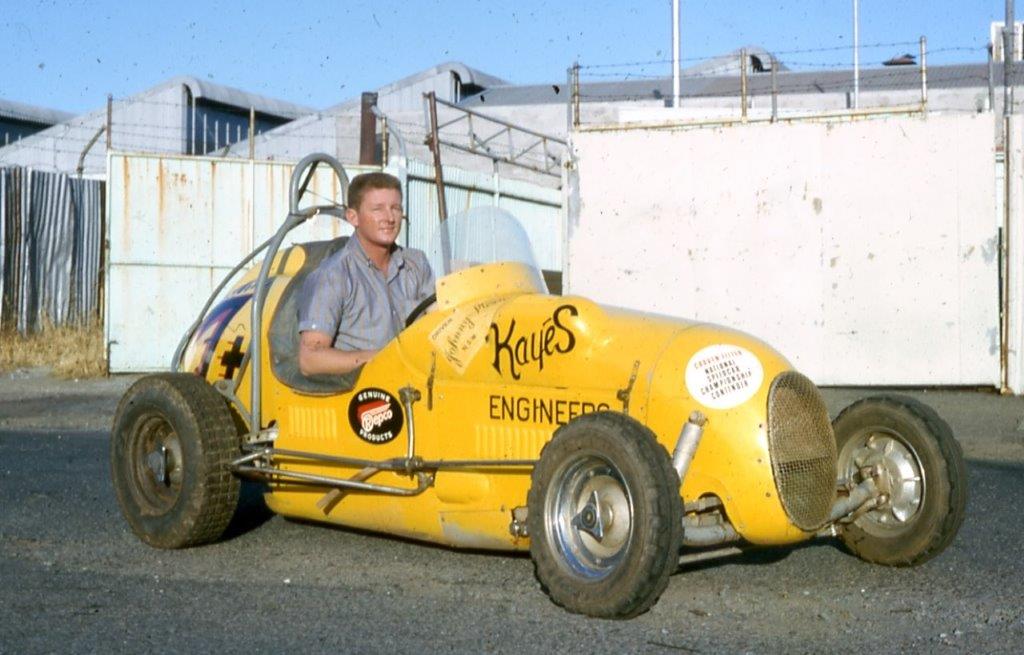
Jack Brabham and his ‘Repco Special’, Hay Street, Subiaco, Perth 1962…
With a bit of detective work from West Australians Ken Devine and Billy Hughes this photo from Nigel Tait’s Collection, which was originally thought to be of Jack Brabham in Sydney was taken during Jack’s 1962 trip to Perth for the Caversham Australian Grand Prix, won by Bruce McLaren’s Cooper T62 Climax. Click here for an article about that meeting; https://primotipo.com/2016/05/20/bruce-lex-and-rockys-cooper-t62-climax/
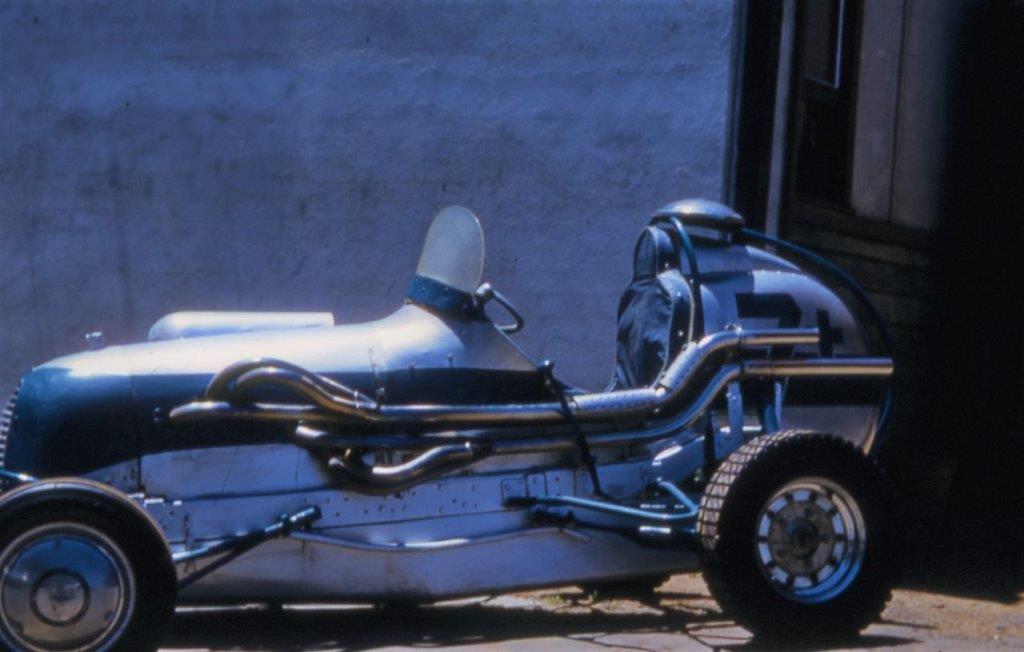
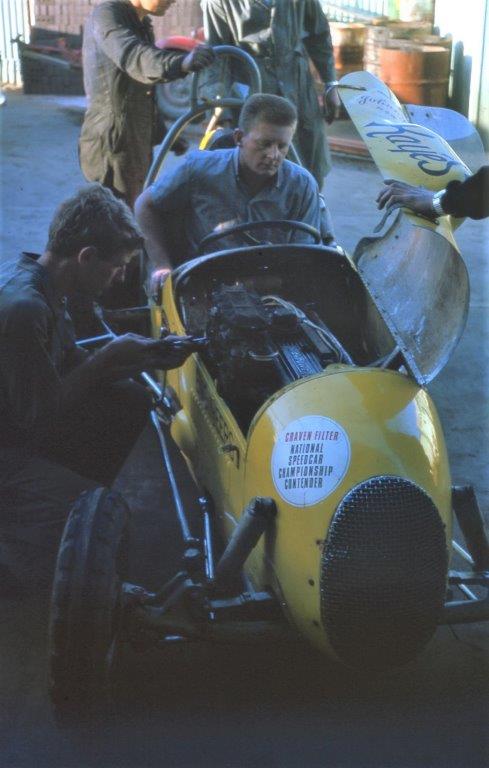
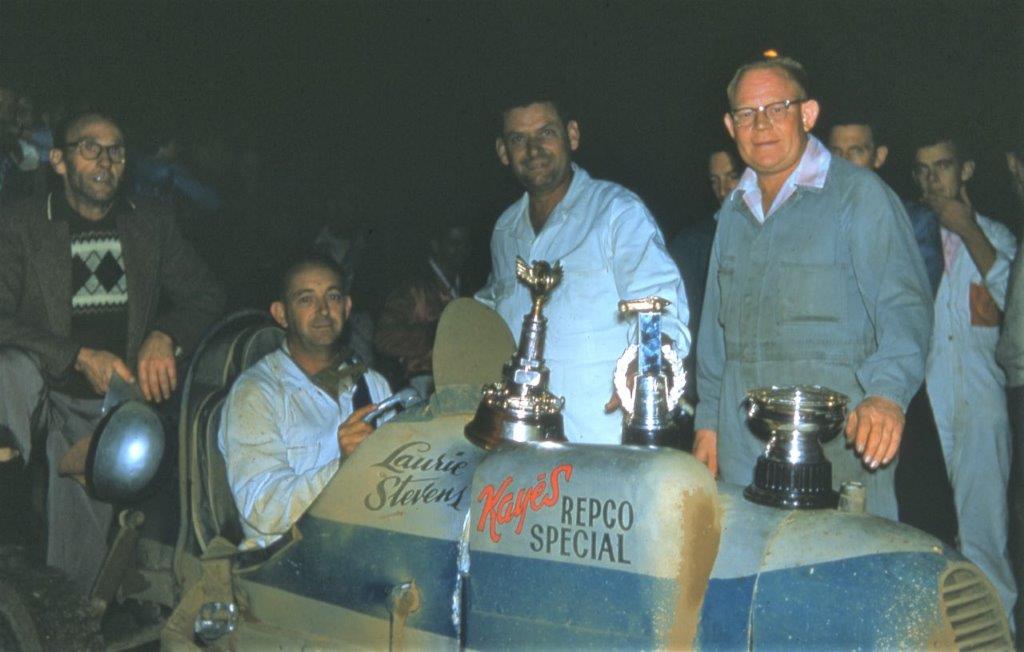
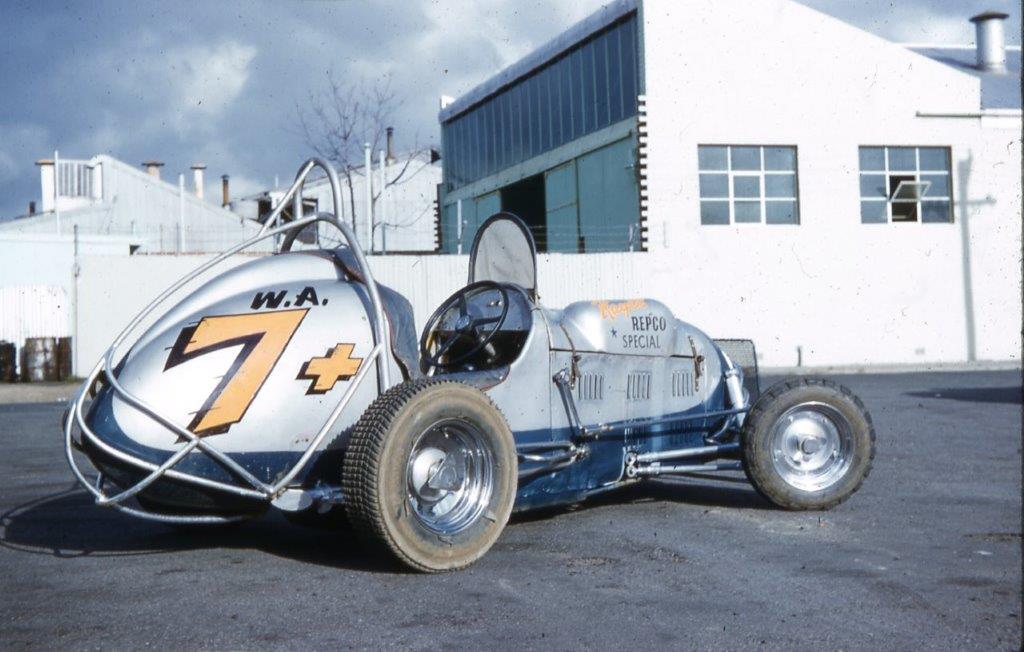
The speedway midget is ‘definitely Bill Kirkham’s WA7 Repco Special driven by Laurie Stevens…looks like Jack sitting in the car and shaking the proprietors hand’ Billy Hughes wrote, another Perth enthusiast/photographer Gary Russell-Brown agrees.
‘Kayes’ was a Repco aligned engine reconditioner in Hay Street Subiaco, an inner Perth suburb. Clearly Kayes’ owner Kirkham had enough ‘pull’ to entice Jack back into the cockpit of a speedway car from whence he came!
Jack’s very first race, a speedway event of course, was at Cumberland Oval, Parramatta on 5 December 1947, click on this ‘Loose Fillings’ link to an interesting article written by Terry Wright article on these formative, successful Brabham racing steps/successes; https://loosefillings.com/2017/07/15/its-amazing-whats-still-out-there-2/
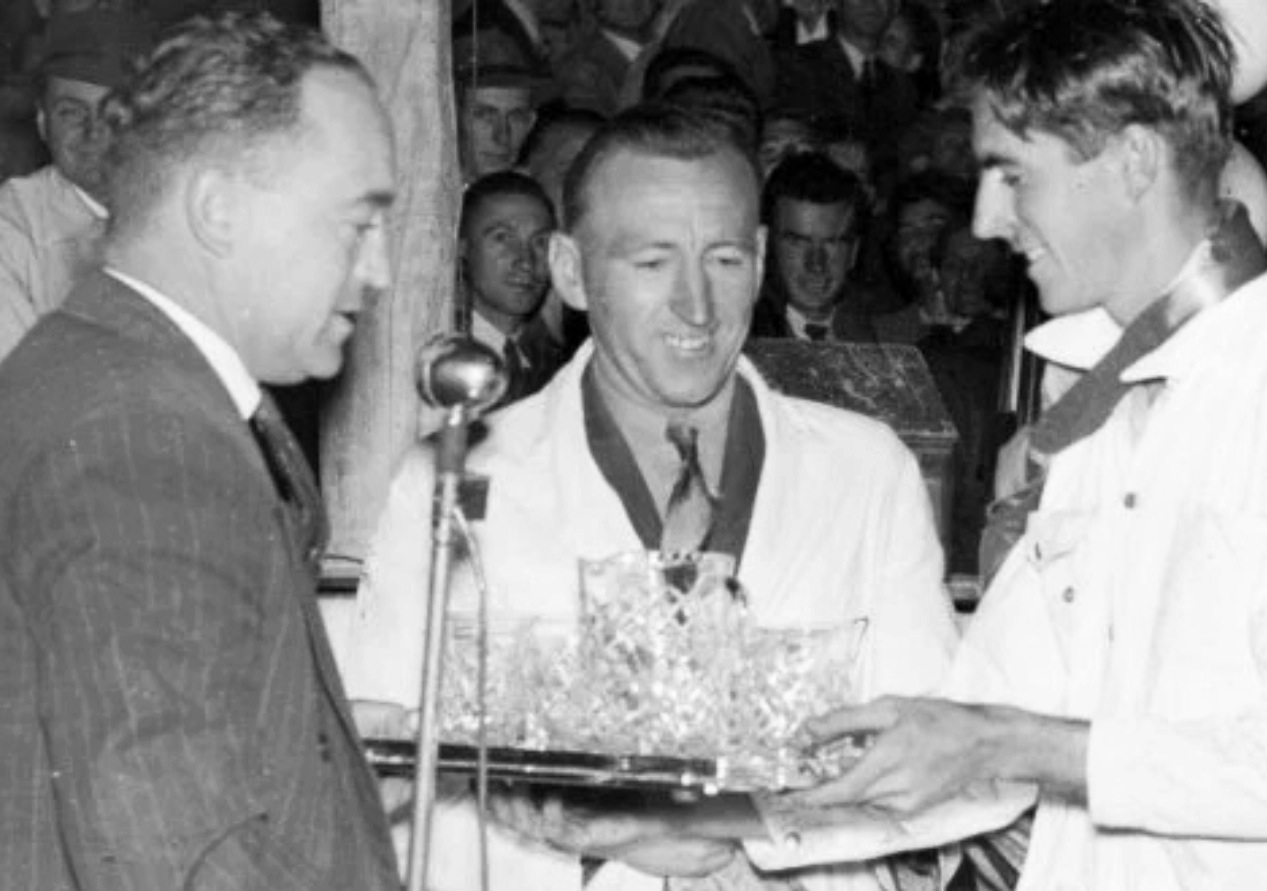
Brabham, 22 years old, receives the Australian Championship tray at Kilburn Speedway, Adelaide, 25 February 1949.
(vintagespeedway.com.au)
Jack during his first raceday at Parramatta Speedway, December 1947 (Brabham Family)
Perth enthusiast, Gary Russell-Brown provides some more information on speedway racing in Western Australia and photographs of the Kirkham midget in particular.
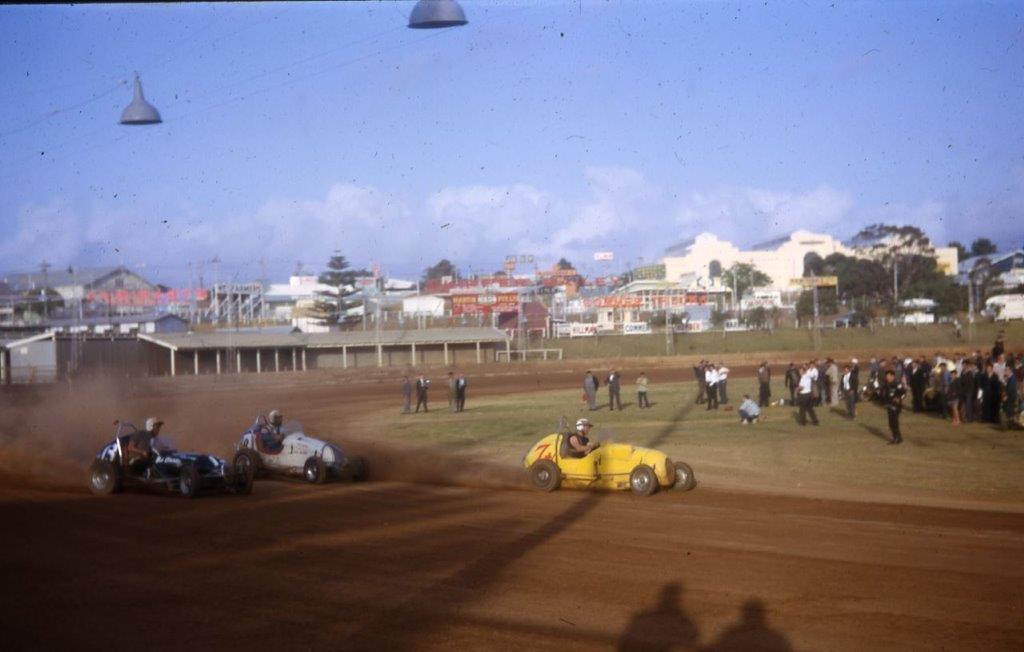
‘Dirt track speedway racing started in Australia in the late 1930’s – solos initially then followed by sidecars and speedcars or ‘midgets’. Before its relocation to the Kwinana Motorsports complex circa 2002 Perth’s Claremont Speedway was recognised as the longest running speedway in Australia, it opened in 1927.’
‘At 641 yards it was longer than most- its long straights resulted in higher top speeds than most as well,this may have been the reason for the venues shocking mortality rate- seventeen over the years. Speedcars were ill equipped in terms of safety until recent times.’
(G Russell-Brown)
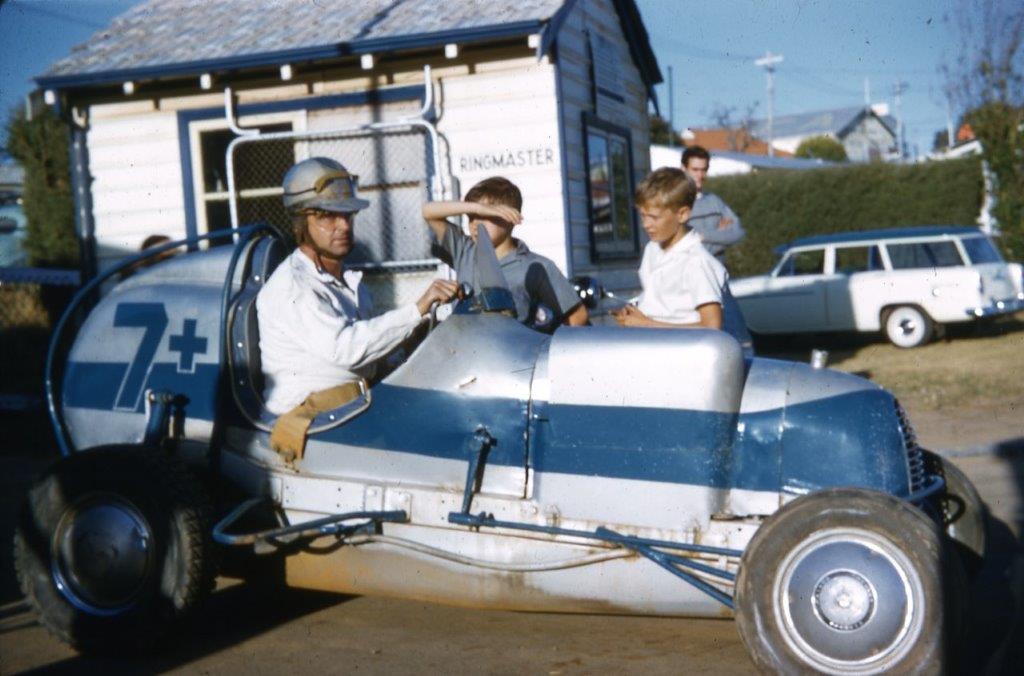
Claremont Speedway and panorama #7 Stevens in the Kayes Repco Spl then eastern staters R Clarke from NSW and Victorian D Maher, they were here for the WA round of the 1964-1965 Australian Speedcar Championship’ Gary recalls.
The shot below is of Johnny Stewart in the car, ‘He crashed his own car in Adelaide, the previous weekend in January 1965 and through a connection between Kim Bonython and Bill Kirkham it was arranged for Stewart to use 7+ which wasn’t racing at that stage, Laurie Stevens having retired.’
Claremont is a western suburb of Perth- ten kilometres from the CBD on the north bank of the Swan River.
(G Russell-Brown)
‘Visting internationals came to the track with the peak years of Australian speedway racing perhaps the fifties and sixties. Bill Kirkham was keen to get involved as speedcars gained in prominence, his Subiaco engineering business ‘Kayes Engineering’ acquired, owned and raced #7.’
‘Bills son Ross Kirkham worked for Repco, along the way he moved to Melbourne and became a key engineer on the Repco Brabham Engines F1/Tasman/Sportscar program in the early to later 1960s- he sent west one of the first Repco Hi-Power cylinder heads made which was fitted to the ‘Holden Grey’ six and made #7 very quick.’
‘Laurie Stevens drove the car very well in that era and had amazing success with it against the east-coasters and Americans including some Offy powered cars.’
(G Russell-Brown)
The car above is the original #7, which had the added ‘+” after its first outing with the Repco modifications in 1959.
‘See above the distinctive, tuned exhaust system fitted to the Repco Hi-Power Holden six- it was an aluminium cross flow Phil Irving design, in this application fitted with twin-carburettors, Solexes, i think, which you can see in the shot below.’
‘Lynn Kirkham is fettling the car below with Johnny Stewart up in January 1965.’
‘The yellow version was a totally new car built, perhaps, for the 1961-1962 season
(G Russell-Brown)
Etcetera…
(G Russell-Brown)
A couple of Claremont fans looking for an autograph from Laurie Stevens- love the ‘Ringmasters’ office, these days the more grandiose ‘Circuit Manager’ title would be applied!
Bill Kirkham behind his car, Laurie Stevens at the wheel, chief mechanic George Williams and a Claremont official after Equipe Kirkham’s first state title.
(G Russell-Brown)
(Repco)
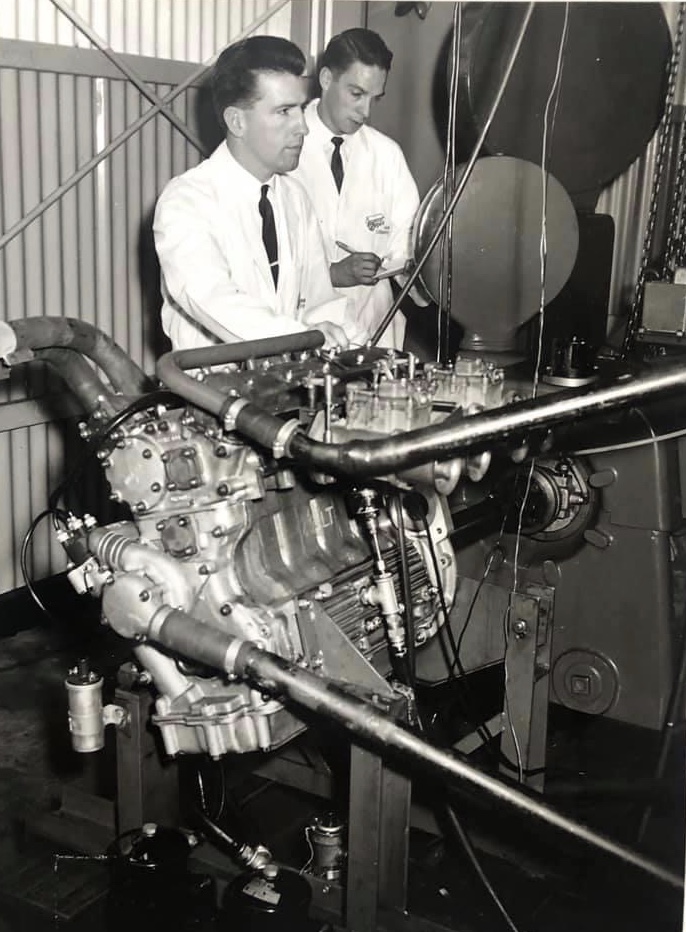
For the sake of completeness here is a photograph of Ross Kirkham manning the controls of a Repco Engine Lab dyno circa 1964- testing a Coventry Climax four-cylinder FPF race engine of 2.5 or 2.7 litres capacity.
Former Repco engineer/racer/restorer Nigel Tait recalled ‘Then Engine Laboratory Manager and Senior Product Development Engineer Ross Kirkham and Senior Technician Mchael Gasking. Ross was my boss when i started there as an Engineering Cadet- a very clever and terrific guy. The dynamometer is our Heenan and Froude GB4. It’s in a tin shed in an otherwise residential area (Richmond, Melbourne) and as you can see there was no sound insulation.’
‘Work on the RB620 V8 would have commenced by then…by 1965 the first 2.5 litre V8 would have been run on the same dyno- for sure Michael Gasking would have assenbled this one and all of the early engines.’
Photo Credits…
Nigel Tait Collection, Repco, vintagespeedway.com.au, Billy Hughes, Gary Russell-Brown
Tailpiece…
(G Russell-Brown)
#7+ Kirkham Repco Special tail shot for the tailpiece! Out back of the Kayes Engineering workshop in Subiaco.
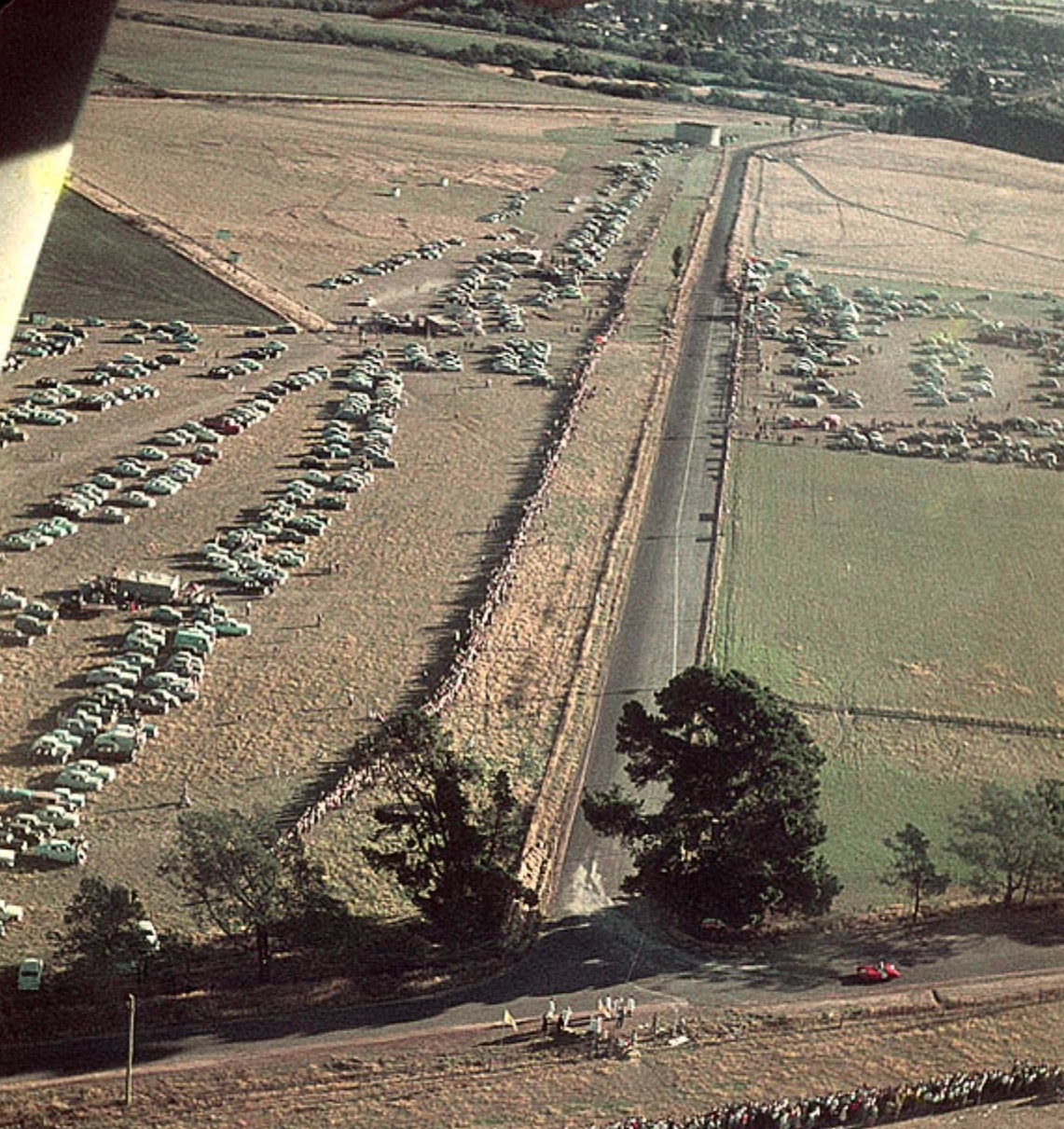
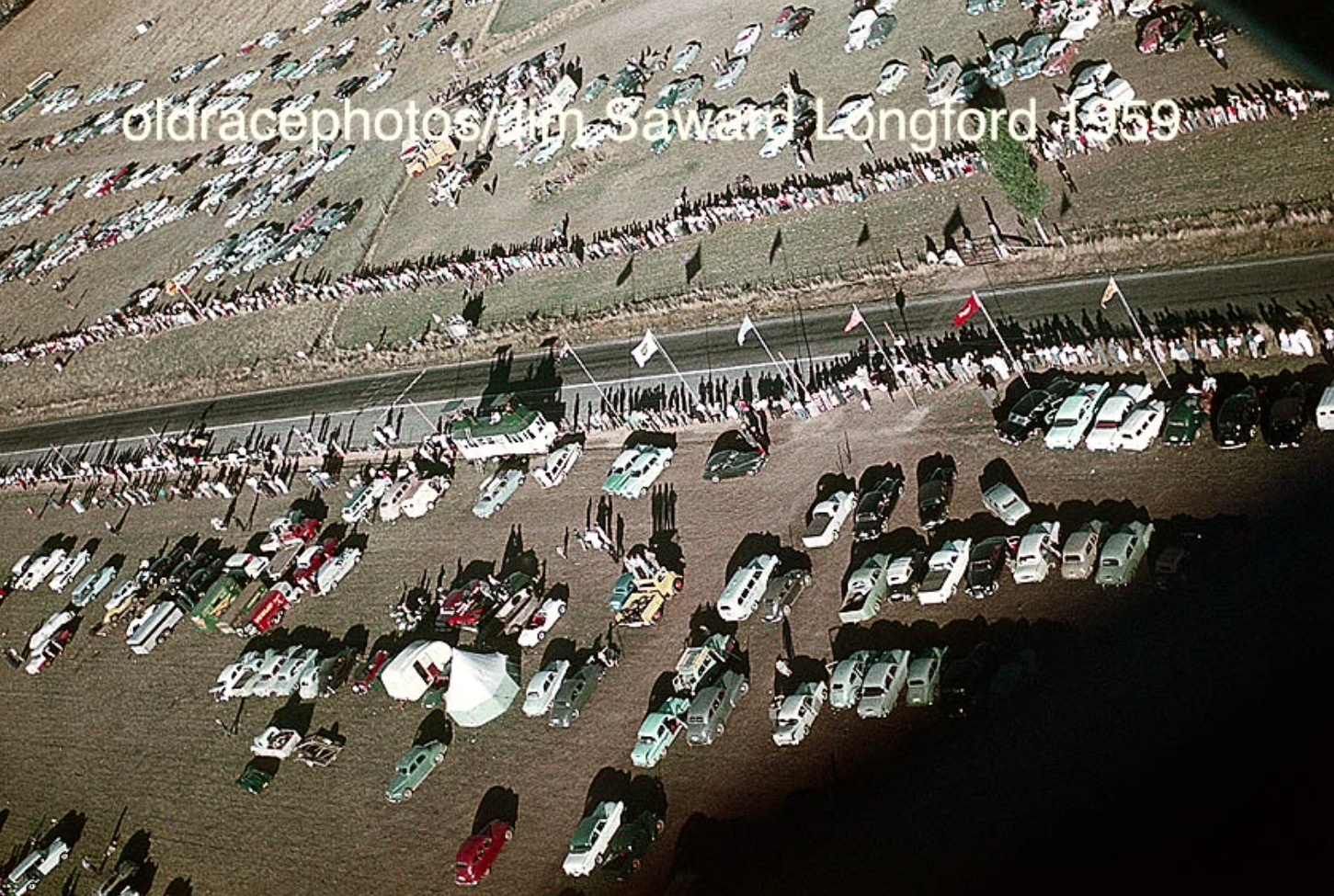
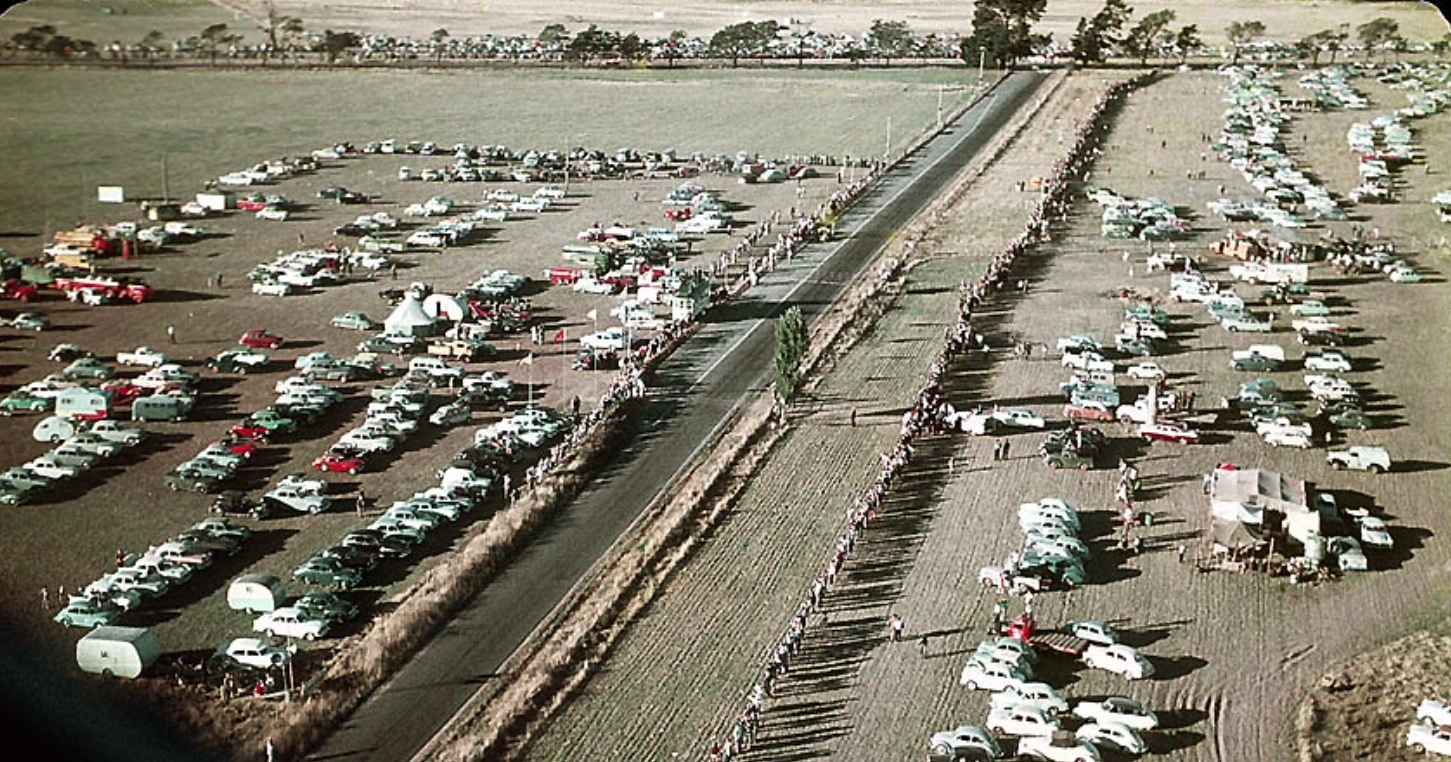
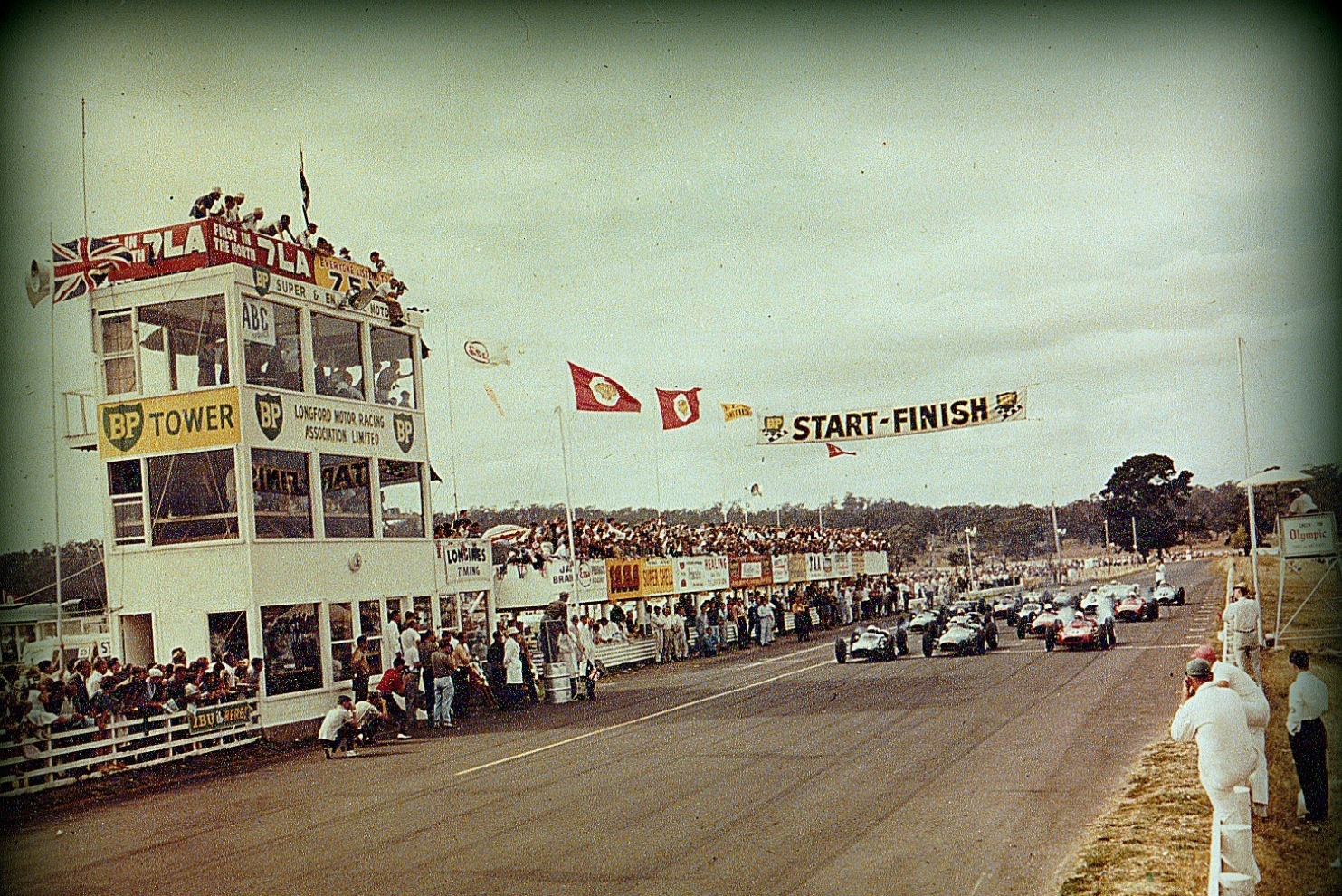
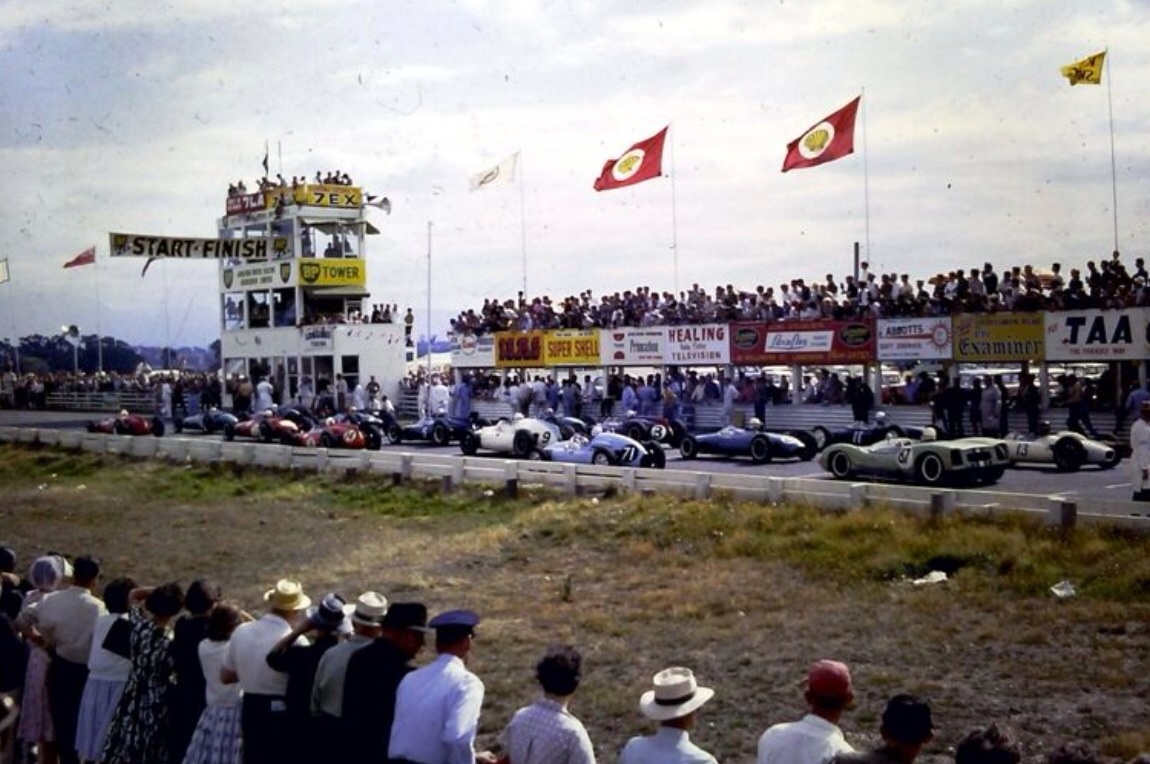
Longford’s Pit Straight- Illawarra Road from a Percival EP-9 at low altitude during the 1959 meeting…
We are indebted to Tasmanian enthusiast Rob Saward who left his, and his father, Jim’s photographic archive in the care of Lindsay Ross (oldracephotos.com.au) who periodically uploads tidbits of visual pleasure from his coterie of talented ‘snappers such as the aerial shots Jim took here.The perspective provided as a result, is gold.
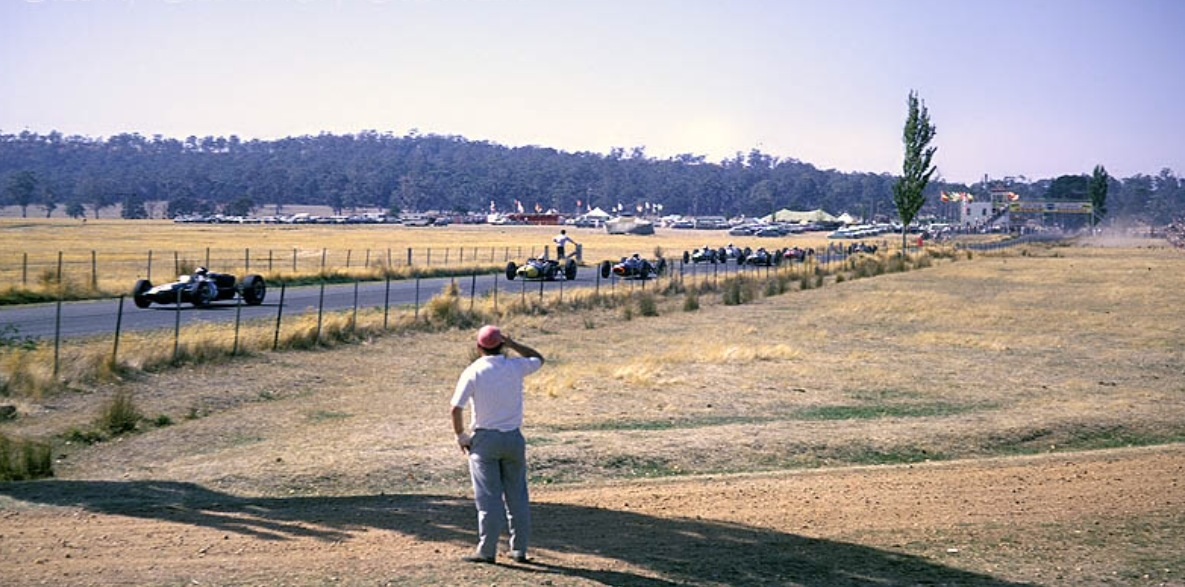
My Longford obsession I’ve admitted a number of times. I suspect I have written more articles which involve this circuit than on any other single topic. The idea for this piece arose out of a swag of photos I’ve accumulated but not yet uploaded of the circuit, and the notion of a ‘photographic lap of Longford’ with the emphasis on more panoramic images taken from a distance to give us a feel for the flow of the place rather than close up shots of the cars and drivers themselves. Most of the photographs in this article I’ve not used in the many Longford pieces on this site thus far.
What also brings the article to life are the accounts of Longford from those who were there in period, these I have filched from The Nostalgia Forum ‘Longford: Reims of The South Pacific’ thread particularly the scribblings of Ray Bell, The Late Barry Lake, Stephen Dalton, ‘Longfordboy’, Lindsay Ross, Ellis French and others. I have quoted these fellas throughout.
Treat the article as Work In Progress though as the drivers perspective is largely missing. I am very keen to hear your views/recollections, many ex-Longford racers are readers, so it would be great to hear from you folk about the particular challenges this remarkable piece of Tasmanian real estate presented to racers of the time.
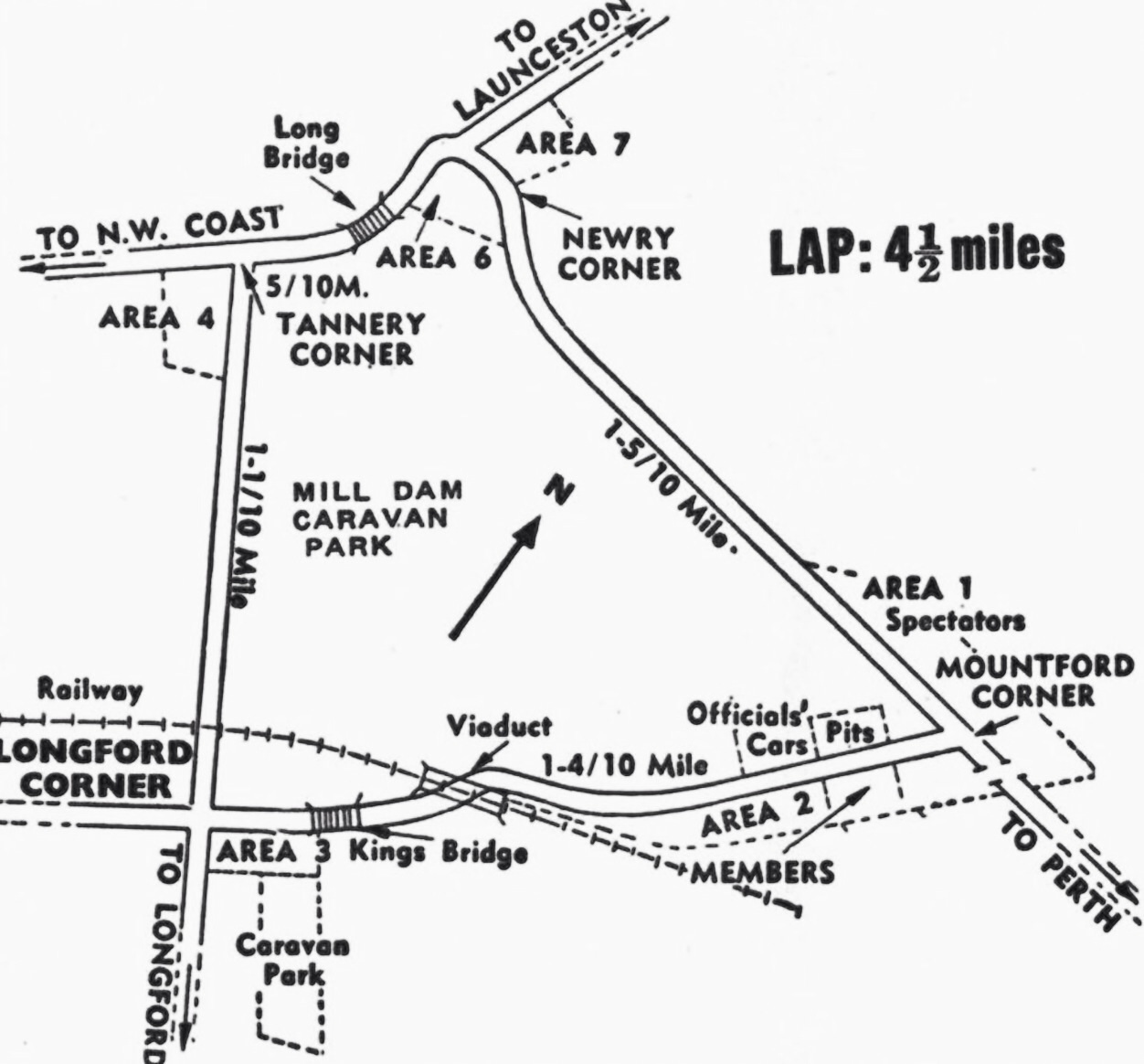
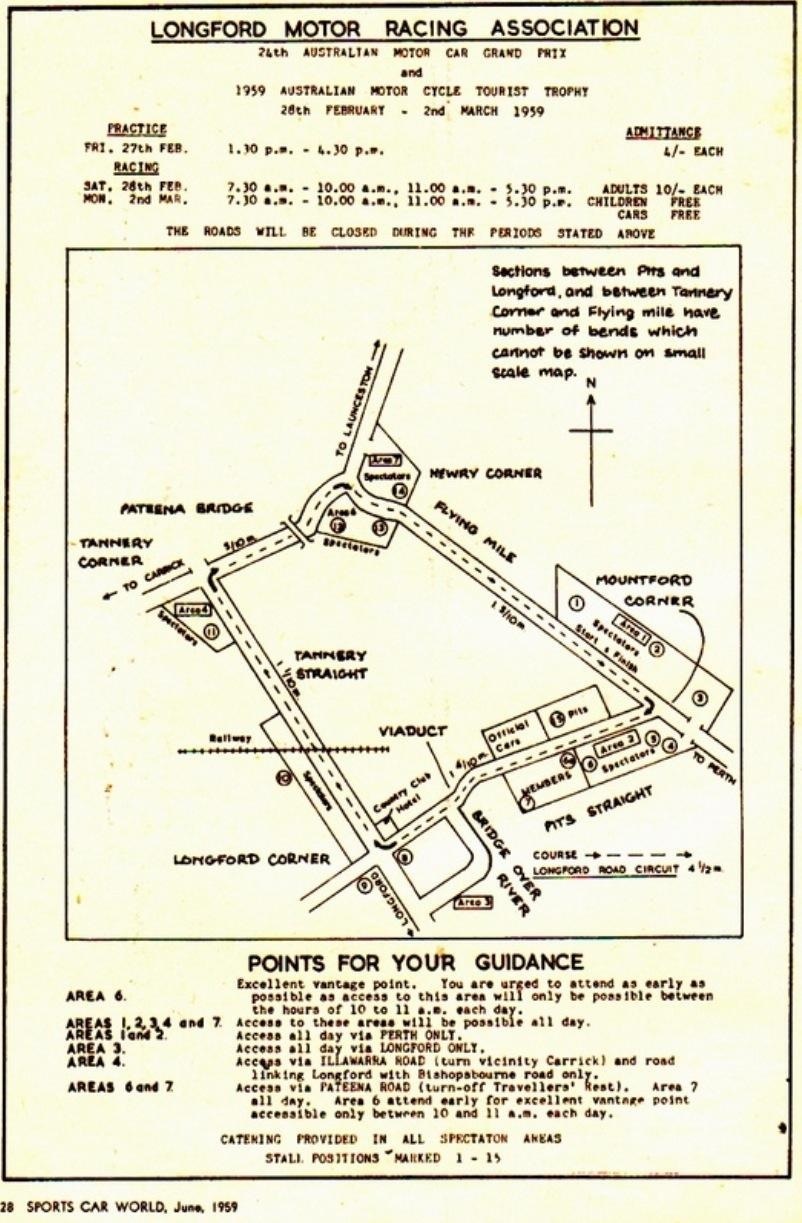
I’ve inserted a Longford circuit map to assist in understanding ‘where we are’, the reality is that the map is indicative rather than definitive, there are plenty of more nuanced twists and turns revealed by the photos which follow not reflected on a circuit map of this small scale.
Other essential homework before you read the article is to look several times at the in-car footage taken from Lex Davison’s Cooper T62 during the 1964 meeting. Many of you will have seen ‘Long Weekend At Longford’ already. After listending to and watching Davo’s great commentary (it starts at about the 2 minute 52 second mark) a couple of times turn the sound off and just focus on the circuit’s twists and turns, topography and changes in elevation.Then read the article having in part at least got into Longford’s rythmn…
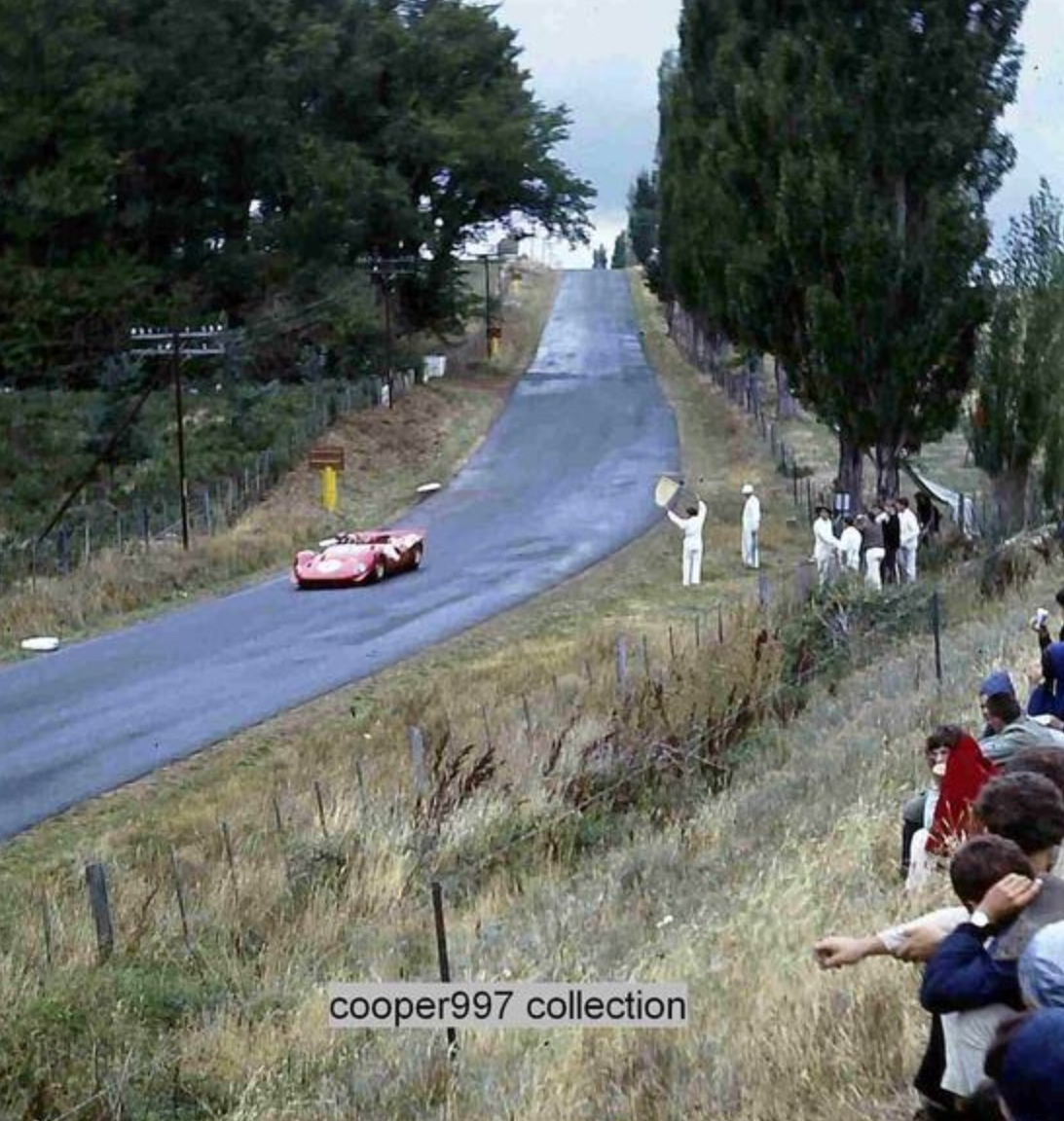
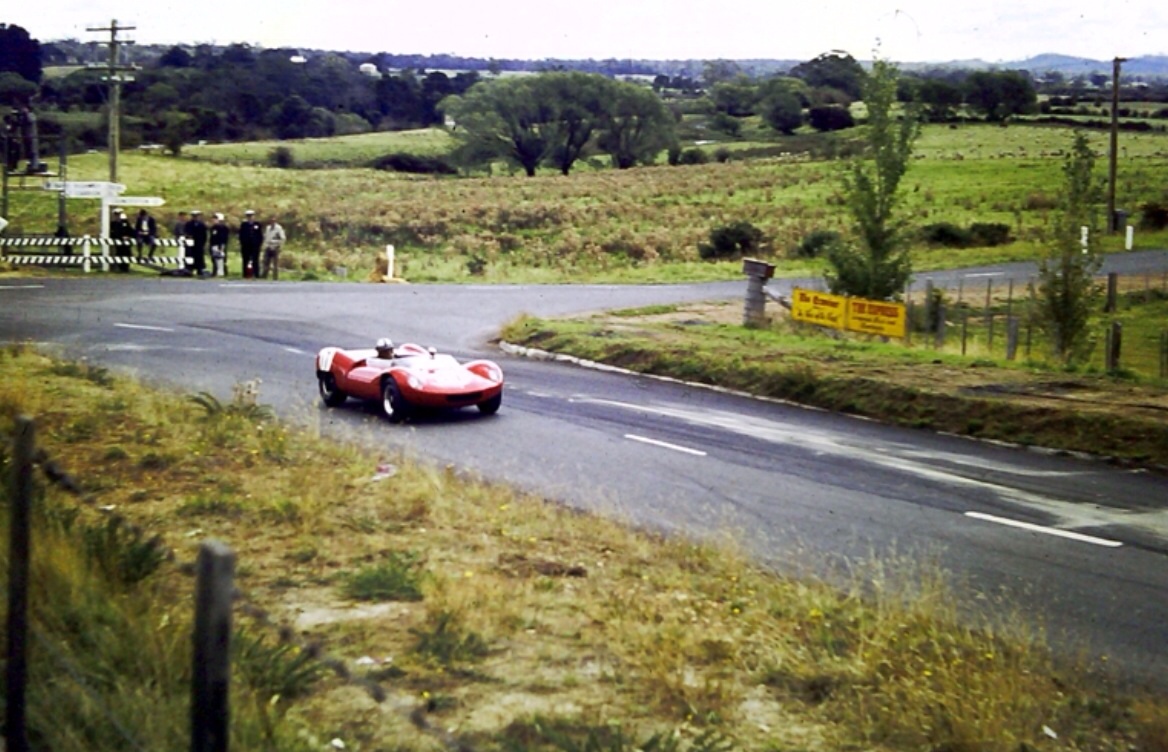
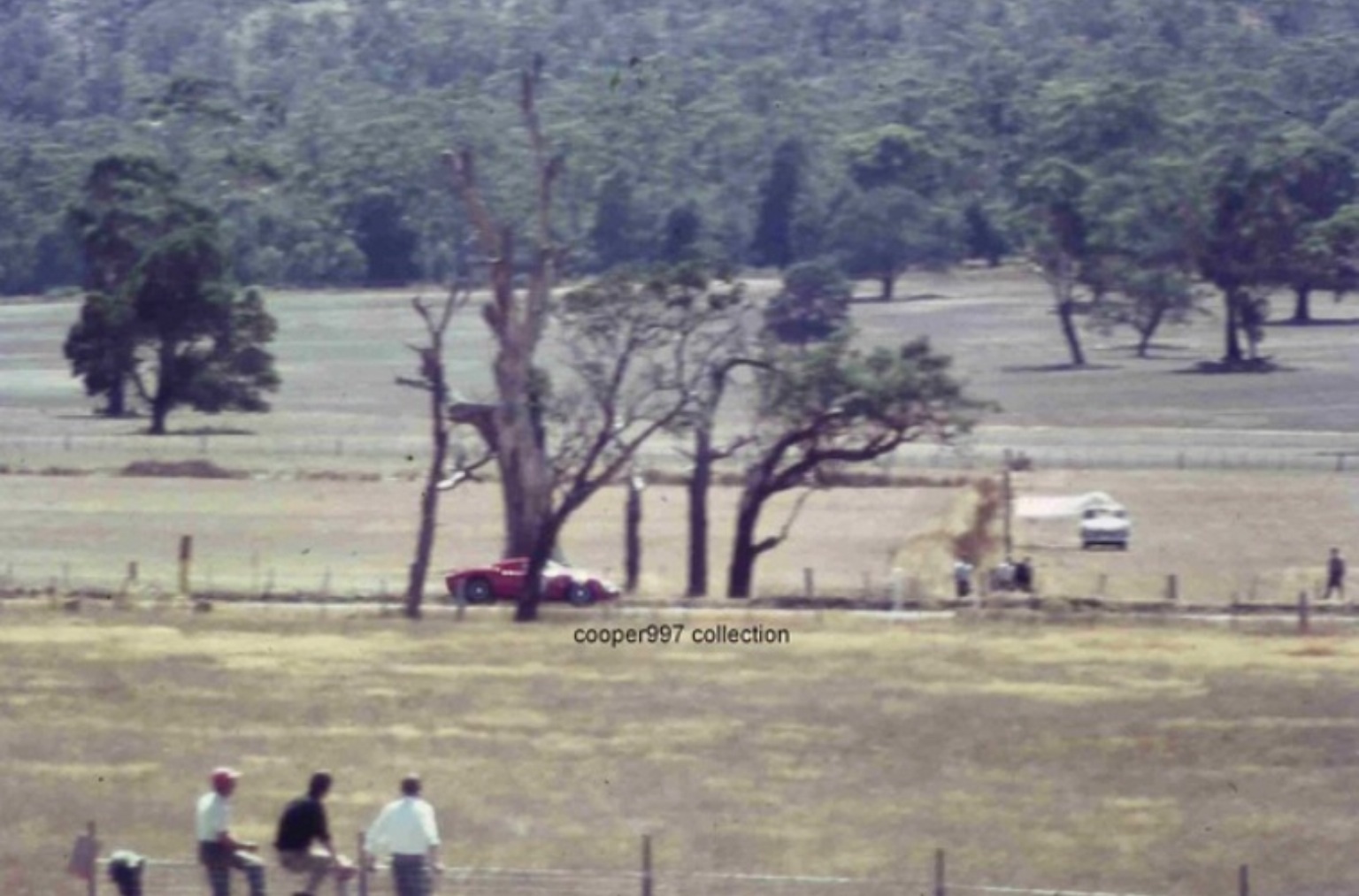
The opening shot by Jim Saward is above Mountford Corner where the red sportscar is about to turn in.
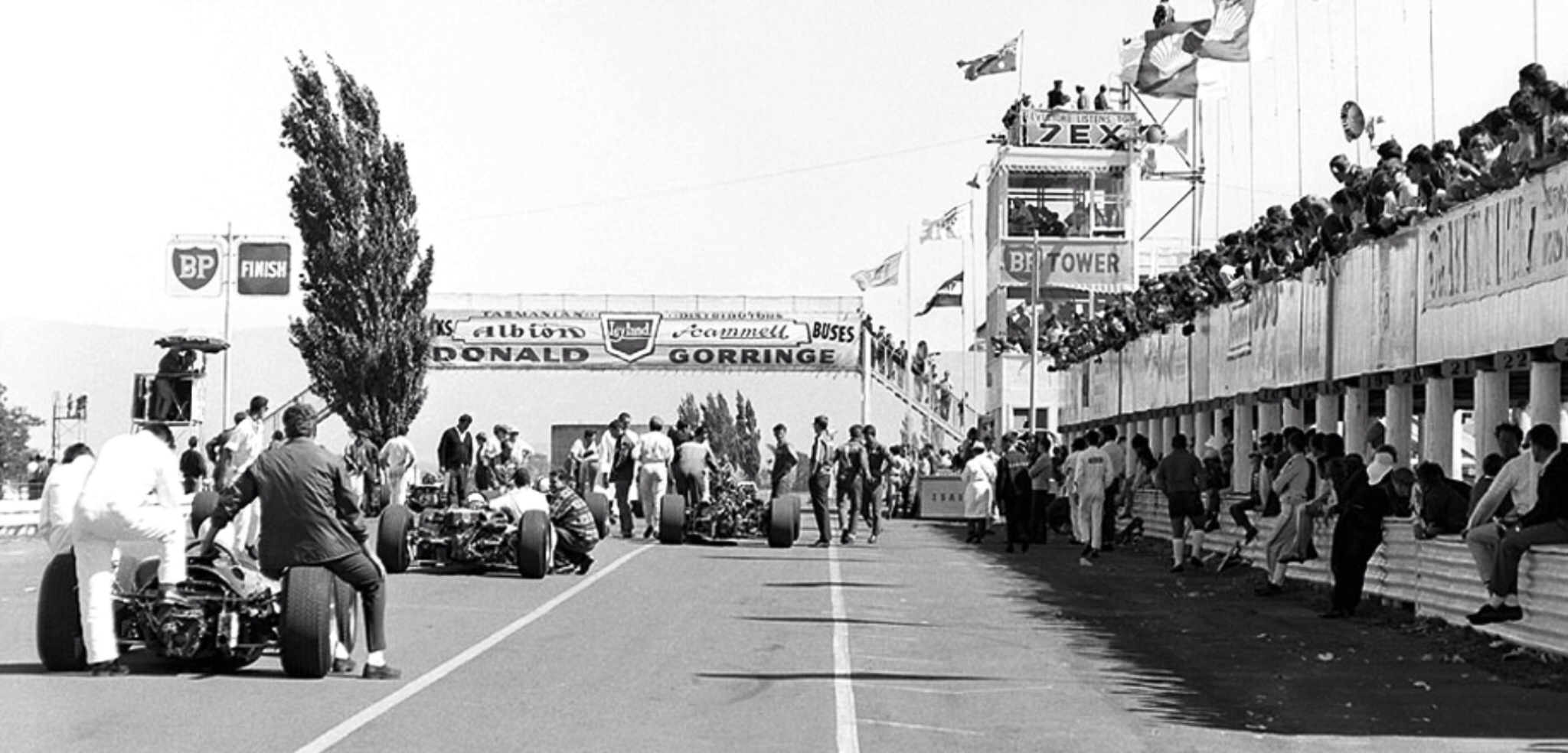
The escape road from ‘The Flying Mile’ straight from whence our sportscar came is dead ahead of him- being the road to Perth (Tasmania not Western Australia- mind you, the direction is the same for both!) The racing pits are to the right of the white painted line on the tarmac and were moved there from the outside of the circuit on The Flying Mile in 1959- this change was made after consultation with leading drivers and officials after safety concerns. To the top left of Saward’s photo is the Water Tower which marks the turn in to the fast right-hand downhill pluge to The Viaduct,in the distance is Longford village.
Ray Bell ‘The road narrowed about 100 yards or so after the start, then there was clear paddock each side of the straight till some trees came up on the right as you go over the crest…’
Kerry Grant’s Brabham BT4 Climax off to the side of the road, he pulled up after Rocky Tresise’ fatal Cooper T62 accident and could not restart (oldracephotos/DKeep)
The shot above is the drivers eye view of the Water Tower approach.
Its Bruce McLaren’s white Cooper T79 Climax dicing with Jack Brabham’s Brabham BT11A Climax for the lead of the 1965 Australian Grand Prix with Jack looking for an inside run into McKinnons Hill on the run down into The Viaduct. Bruce won on that particular day, in very fine form from Jack about three seconds in arrears.
Bell ‘The poplars can clearly be seen down the hill, (below) the railway embankment was just clear… and here’s a point… the grass wasn’t usually green! It was late summer, mostly hot, bushfire season and all that when Longford was held. The trees had a gap on the right where there was a gate into the paddock just at the turn in point for The Viaduct, and there was a sort of run-off track straight ahead at this point. In 1965 this was just dirt, maybe grassed later.’
The Viaduct section of the circuit Bell refers to above is the bit Chris Amon is negotiating below.
Waaah-raaap-waaaahhh, you can just about hear that Ferrari V12 as he shifts down through the gears from fourth or fifth to second for the Viaduct left, then right Ess to head back up the hill into the trees then down towards the Kings Bridge and Longford village itself. But lets not get ahead of ourselves.
Stephen Dalton notes in his caption of this photo ‘The keen enthusiast set up their vantage point from the edge of the trainline, as Chris Amon goes past Longford Motor Racing Association President Ron McKinnon’s ‘Mountford’ property while attempting to make up the 2 laps he lost when the P4 was discovered to have a flat battery on the grid for the 12 lap Event 2 Sports Car Scratch Race’ (S Dalton)
Chris mainly cleaned up in David McKay’s P4/Can-Am 350 in the sportscar races the car famously doing 178 mph on ‘The Flying Mile’ that day in the wet! And 182 mph in the dry on the Saturday. Here the track is patchy wet, very tricky in this powerful car, its the Monday raceday ‘Longford Cup’ day, the famously wet race won by Piers Courage’ F2 McLaren M4 Ford FVA car from the 2.5 litre cars which were somewhat hampered in the wet conditions by an inability to put their power down.
‘It was an extraordinarily quick circuit’ recalled Chris in MotorSport. ‘It was basically a rectangle, and by the time you were halfway down the straight you were absolutely flat out. It was a wonderful circuit in the dry, but in the wet it had the potential to be bloody dangerous’ he said in somewhat masterful understatement! In the dry Saturday sportscar scratch Chris set what became the all-time lap record at 2:12.6 seconds, an average of 122.19 mph.
‘As far as steepness of the area of the track is concerned – “McKinnons Hill” as we used to call it is much steeper at the initial descent to just before the gateway (just up the hill a bit on the left from where Chris is shown) where it becomes a more gentle drop…In real life it was narrow, steep and the kink past McKinnon’s Gate was a nice sweeper if there was no traffic around (i.e. a racing line used in your road car) but the fast cars would be balancing braking and set up for The Viaduct. (the point referred to is exactly where Amon just apexed above) I don’t think this kink had a name other than McKinnon’s Gate…We could ride our bikes from The Viaduct up to just past the gateway but then had to get off and push. My drivers licence test with a local policeman was 1 lap of the circuit on my 17th birthday- Sunday 6 March 1966 with hay bales and braking markers in place!’ wrote ‘Longfordboy’.
Gaggle of cars heading into The Viaduct in 1961- Austin Miller Cooper T51 Climax chasing Lex Davison Aston DBR4/250 at the rear of the group- note the run-off area between the haybales and marshalls- limited mind you, a bit of dirt then bush and a steel drop into a culvert (S Dalton)
‘I think the fast cars were just about airborn as they started the descent as it dropped suddenly at first – i think Greg Cusack in an open wheeler had a big crash there (in the Scuderia Veloce Brabham BT23A Repco in 1968 ) when he did not land straight and spun off going down the hill before the gateway’…’In the lead up to the long weekend we would ride our bikes to The Viaduct at night to watch some local competitors practicing – with sentries to advise if anyone was coming so they could use all the road!’ Longfordboy added.
‘McKinnons Hill’ is the area of the main entrance of Ron McKinnon’s (Longford Motor Racing Association’s President & Chairman) ‘Mountford’ property. That ran all the way back to Mountford Corner and had the pit building on his property…The Viaduct and the land that runs down to the South Esk river is also on Mountford property…’wrote Stephen Dalton.
(oldracephotos/DKeep)
The photo above during one of the 1966 Touring Car races is of the outside of The Viaduct and shows the Rob Boote Holden EH from Robin Pare’s Ford Mustang turning into the corner. Note the spectators to the side of the railway line as mentioned in the Amon shot above and stationary blue flag from the ‘flaggie’.
(oldracephotos/DKeep)
Whilst the colour shot above shows the run-off area into The Viaduct there was not too much space to play with as Spencer Martin demonstrates in his Scuderia Veloce Brabham BT11A Climax in 1966. The SV team got the car sorted though, Spencer was fifth in the Monday ‘South Pacific Trophy’ event- and won the first of his Gold Star national titles with this chassis that year.
(oldracephotos/DKeep)
Above is gaggle of cars the first of which is Frank Gardner’s Brabham BT23D Alfa heading under the bridge- then Leo Geoghegan Lotus 39 Repco, Richard Attwood BRM P126, Kevin Bartlett’s Brabham BT11A Climax, Pedro Rodriguez BRM P126 and the rest- the Saturday dry preliminary in 1968.
Whilst the view from the outside or exit of the corner below shows Bib Stillwell’s Cooper T51 Climax ahead of John Youl, Cooper T55 Climax during the 1963 South Pacific Championship race won by Bruce McLaren’s Cooper T62 Climax. It is a beautiful photograph, and not a bad vantage point for those who could cadge a pass into that area!
(oldracephotos)
After the cars have cleared the final right of the Viaduct combination the cars disappear up a slight rise into the Australian bush, you can smell the eucalypt’s in these next coupe of shots.
Bib Stillwell is literally lining his Cooper up for the left-right combination the cars below are traversing- clear in the shot is Austin Miller’s distinctive Cooper T51 in his trademark vivid, glorious yellow hue. Notice the drain culvert and quite dense nature of the bush- we call it bush in this part of the world rather than forest folks!
(oldracephotos)
So. Back to the map – we have cleared the railway line and are on the section of track between the Viaduct and Kings Bridge. Photos of this part of the track are as rare as rocking horse poop.
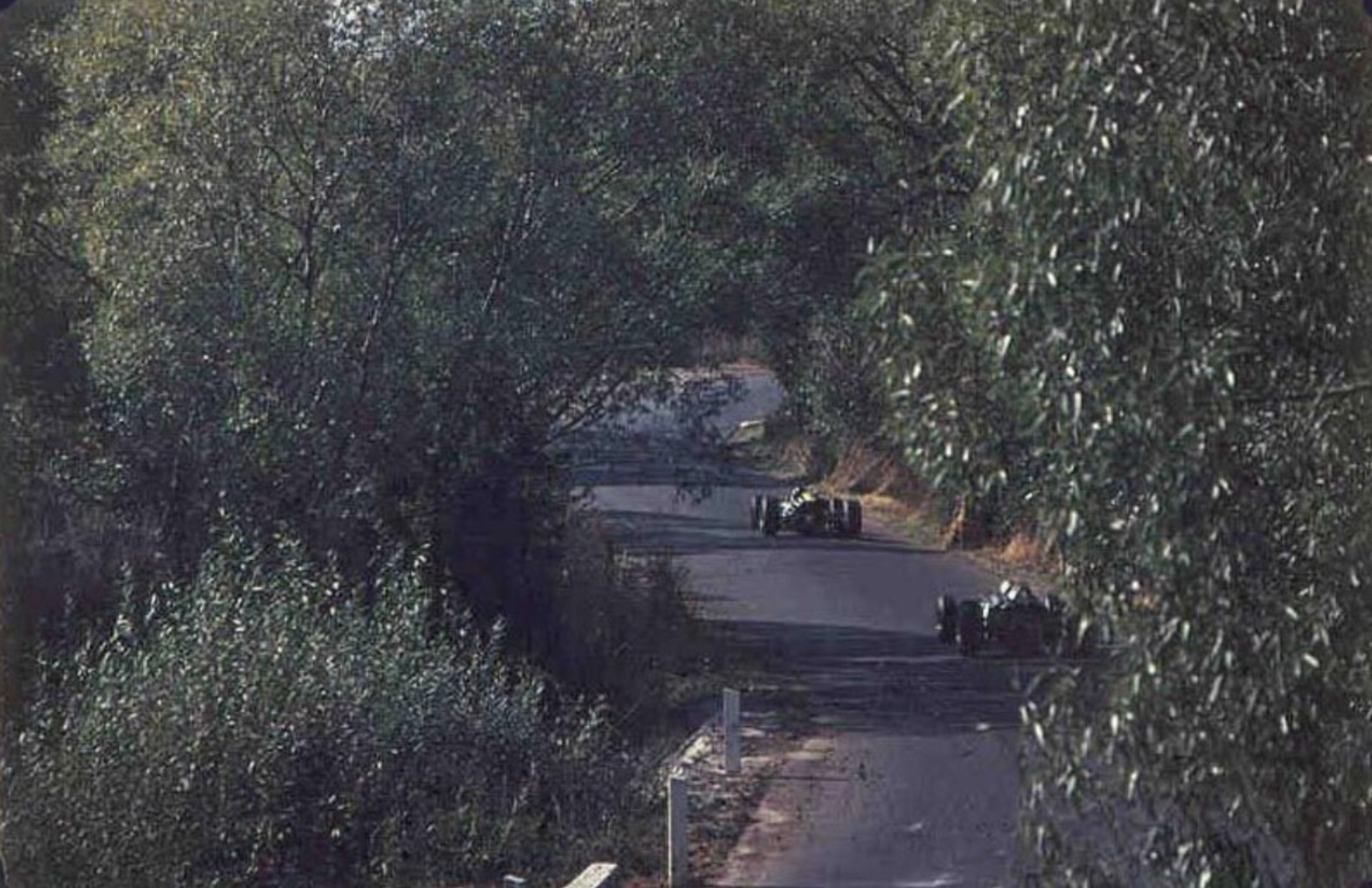
The photo below shows the track to be quite narrow and rough at its edges, not a part of the track to pop a wheel into the dirt. ‘Trees were thick from The Viaduct to Kings Bridge, then stayed thick the other side on the left’ says Bell whose magic photo it is which shows Jim Clark’s Lotus 39 Climax leading Jack Brabham’s Brabham BT19 Repco through the bush in 1966 – it’s the same stretch of track in both photos taken from atop The Viaduct, the two photographers using lens of different focal length.
(R Bell)
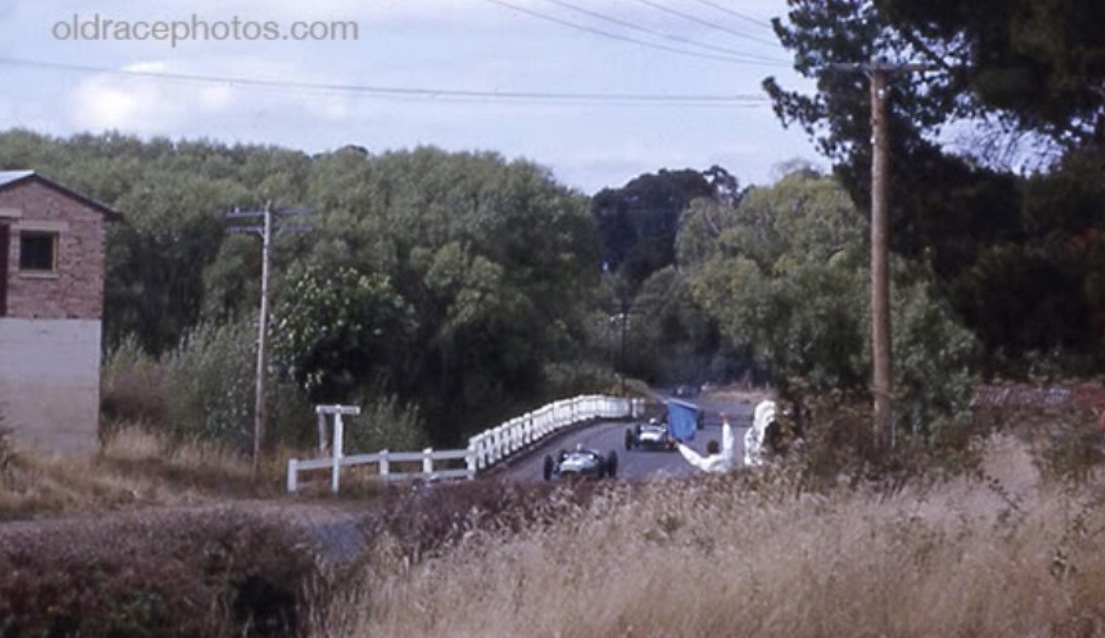
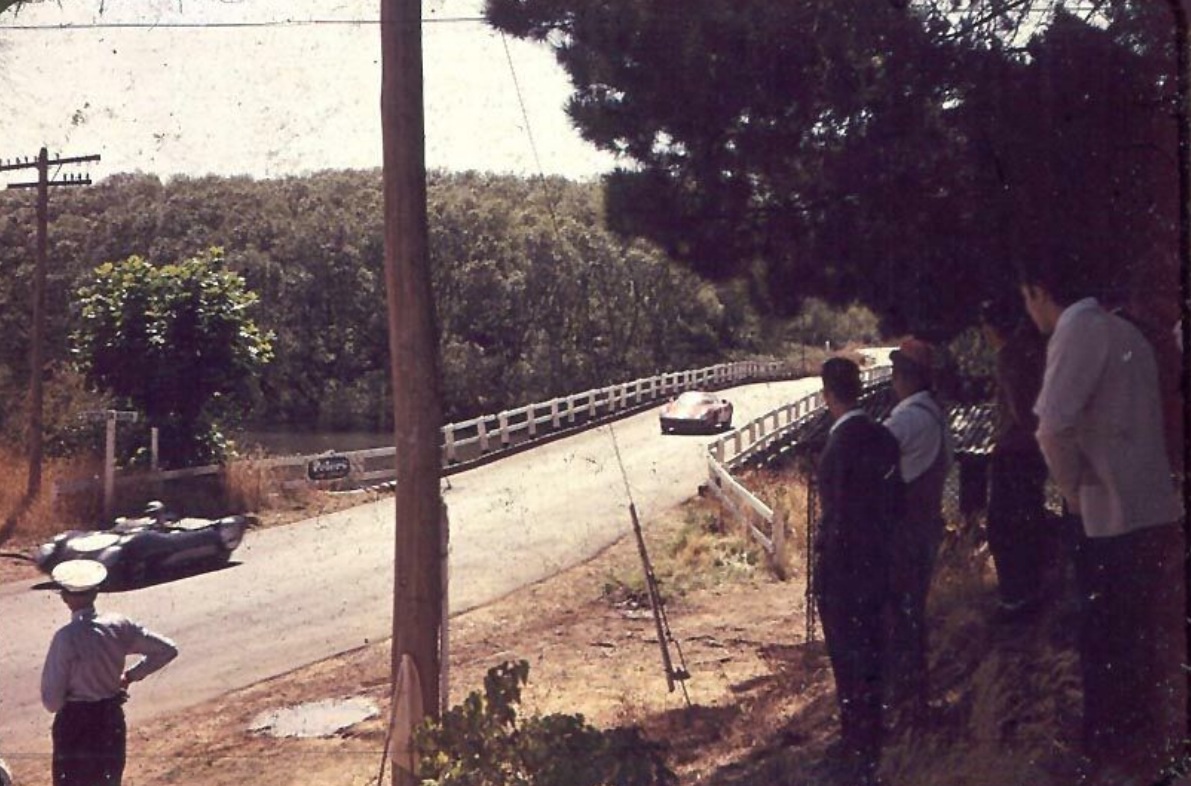
Onto the photo below of Kings Bridge we are looking from the bridge back to the bushy section of the track the cars in the two photos above are heading towards, note the open approach to the bridge below is preceded by a left-hander the last car below is just completing.
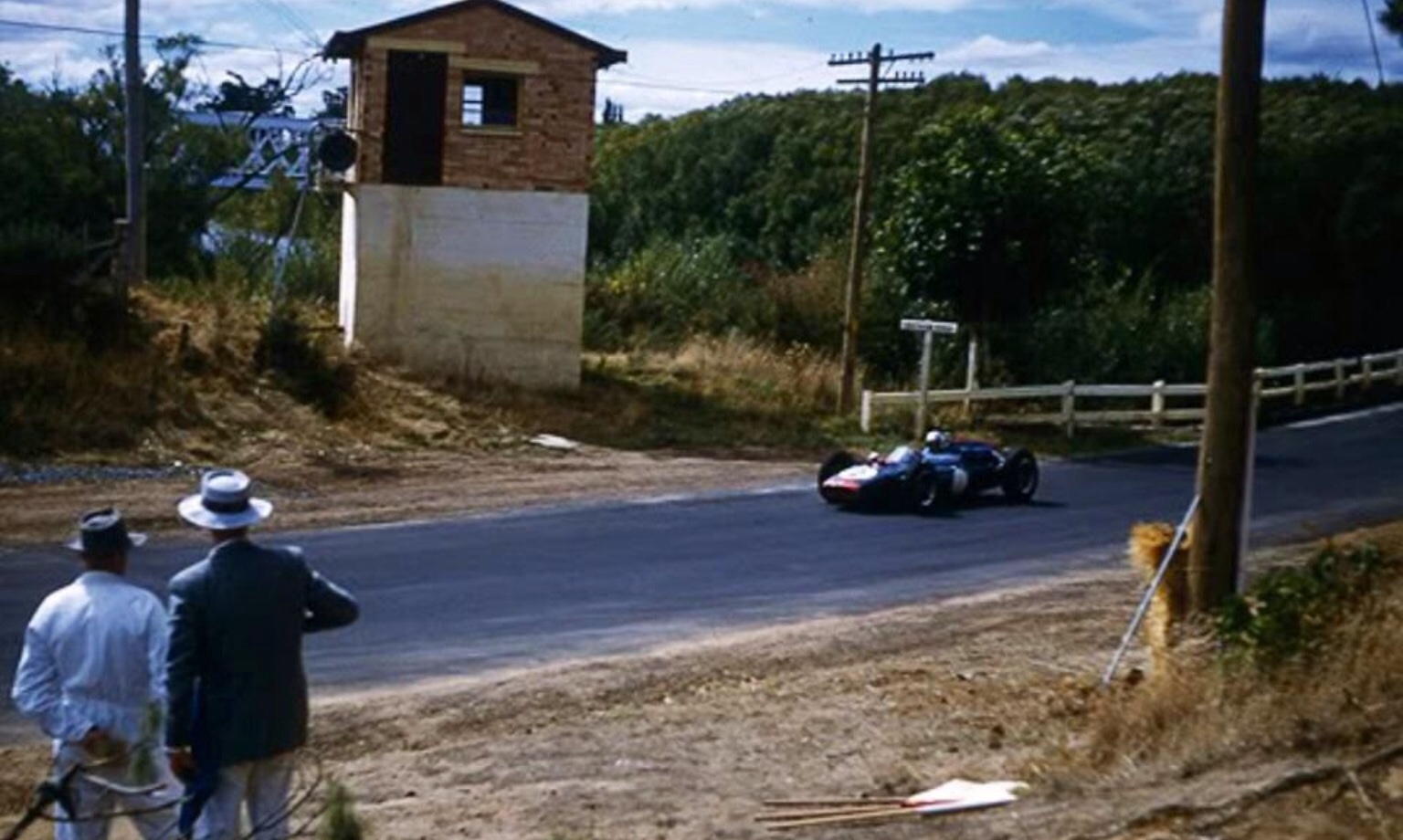
After the drivers turn right above they go down the hill and across Kings Bridge – one of two crossings of the South Esk River – the shorter of the two bridges, it’s Jack Brabham here, Brabham BT4 mounted in 1963 ahead of Bruce McLaren’s Cooper T62 Climax.
Longfordboy ‘The pump house (brick building to the left of the photo) is the new pump house for the town that pumped water up to the reservoir (water tower). The old pump house was on the opposite side of the road and the old pump in a bit of a shed remained with a large wire cage around it…We used to water ski under the Kings Bridge – provided the water was low enough.’
‘Many farmers had their own small pump houses for their own irrigation systems. My father was a mechanic so i was brought up grinding in valves by hand with suction caps on wooden handles. Of interest in 1958 or ’59 Arnold Glass brought a Maserati 250F to race and it was housed in our large single car garage/workshop beside our house. The mechanics finished working on it around midnight – to start it dad towed it around the block (in Longford) it fired up half way round and sounded “magnificent”. Neighbours never complained – it was accepted that weekend.’ quipped Longfordboy.
Spencer Martin in the SV Ferrari 250LM chasing Brian (father of John) Bowe Lotus 11 Replica HEA Simca s/c Spl on, or more particularly off Kings Bridge, morning practice Saturday in 1965 (R Bell)(oldracephotos)
John Surtees beside the Pumphouse just off Kings Bridge on the way to South Pacific Trophy victory in his Cooper T53 Climax FPF 2.7 in 1962- I guess for the great Brit Longford was ‘safe’ by the standards of some of the ‘bike racing circuits from whence he came!
Exiting Kings Bridge was fast, a top gear right hand open curve. Then there is a deceptively (in terms of the map) long straight stretch into the village of Longford itself – the approach to it is very fast and dangerous due to the presence of mature, solid Plane trees and ‘The Hump’ in the braking area.
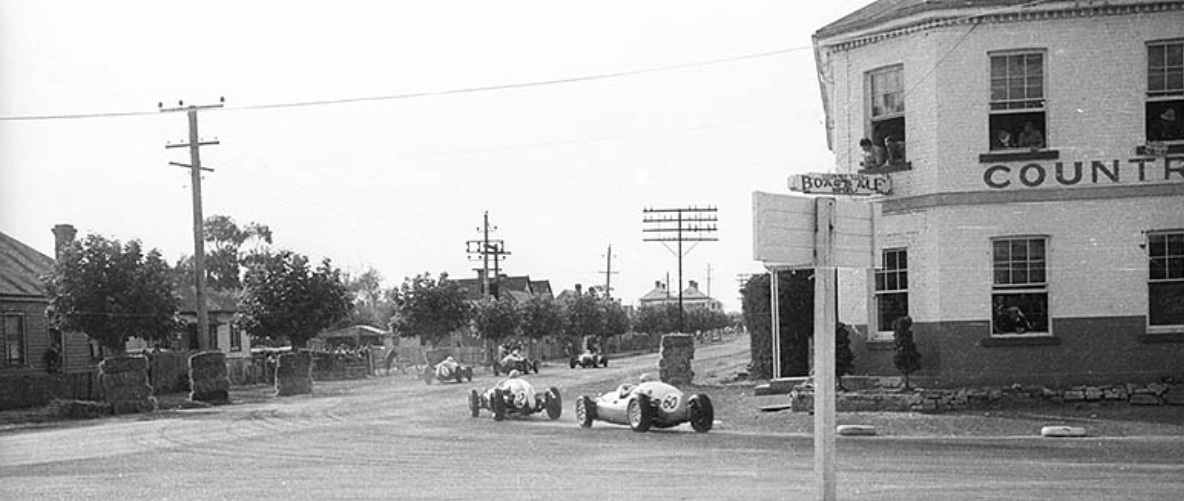
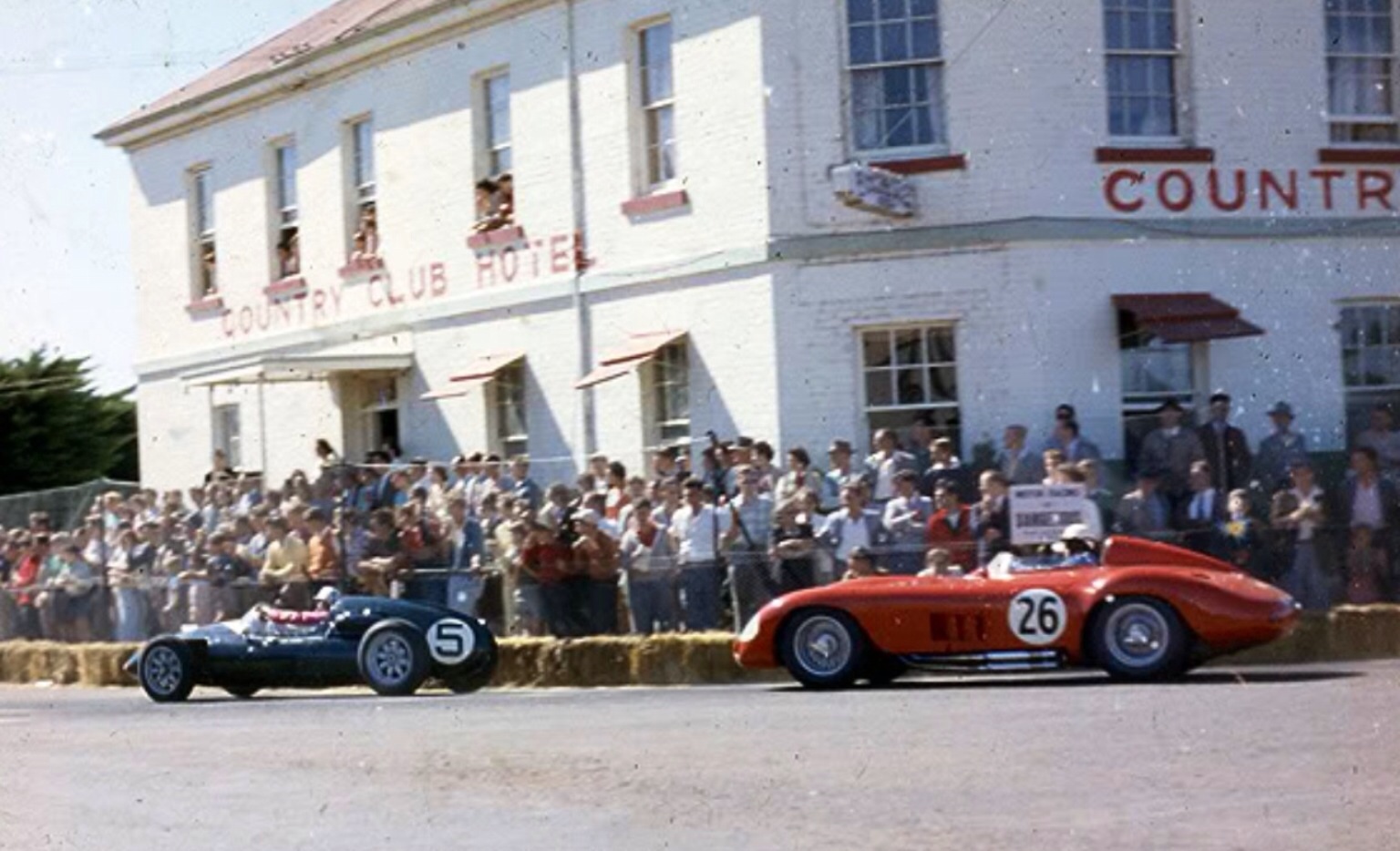
The location and Longford Corner is much photographed with the Country Club Hotel (which happily is still there, do pay a visit and check out the racing memorabilia inside) a familiar backdrop. There was a Mobilgas Service Station opposite the pub which is shown in one of the following photos.
(oldracephotos)
The image above shows Graham Hill, Brabham BT11A Climax and Phil Hill’s Cooper T70 trying to set a lap record to stop Jack Brabham, behind him in a Brabham BT11A Climax catching his teammate- and eventual winner, Bruce McLaren during the 1965 AGP. They are in the braking area for Longford Corner- whilst the Union Street plane trees have been trimmed, their solidity is readily apparent.
With unguarded trees on both sides of the track and ‘The Hump’ in the braking area the take-off and landing of ones machine was critical- getting the car settled and straight before caressing the brake pedal firmly and progressively was important. This, and a wheel in the dirt caught out young American driver Tim Mayer who lost his life in a Bruce McLaren Motor Racing Cooper T70 Climax much like Bruce’s T79 above, against a tree in 1964. The hump was removed after this incident.
(E French)
In fact, in the words of Murray Walker, if I am not very much mistaken Jack Brabham’s Cooper T51 Climax above is just landing after ‘The Hump’ in 1960 above- checkout the shadow under his machine. Brabham won that day from the Mildren and Stillwell’s T51’s.
(G Smedley)
Shot above is a favourite, Geoff Smedley’s, of Clark, his obscured teammate Hill and Amon- Lotus 49 times two and Ferrari Dino 246T then Frank Gardner’s Brabham BT23D Alfa, and then, i think Kevin Bartlett, Brabham BT11A sandwiched between the two BRM’s of Richard Attwood and Pedro Rodriguez- Clark the winner in this Saturday 1968 preliminary. By the look of the nose of JC’s Lotus he has just started to brake into Longford- the hump is now gone and the tarmac appears smooth albeit the verges are to be kept clear of as are the ever present plane trees.
All of the photos in this article make clear the impossibility of keeping the flavour and character of the place and provide greater elements of safety for both drivers and spectators of the day. There simply was never the sort of budget in Tasmania which allowed the Nurburgring to be transformed in 1971 in a way which trod the straddle between the vistas and challenges of the past and present day safety requirements pretty well.
(oldracephotos/JSaward)
Saward’s photo of Austin Miller’s Cooper T51 above chasing a gaggle of similar Coopers and Lex Davison’s (second car in this group of five) Aston DBR4/250 is interesting as we can see both the immediate environs and also have a peek around Longford Corner and along the start of Tannery Straight. At the top of the rise in the road the first three cars are travelling towards is the railway crossing ‘jump’ which is the subject of the next series of photographs coming shortly.
Len Lukey Cooper T45 Climax from Doug Whiteford Maser 300S during the 1959 AGP weekend (oldracephotos)
The photograph above is a classic ‘Pub Corner’ shot- the corner of Union Street and Wellington Streets in Longford village with the 1959 Australian Grand Prix combatants Len Lukey and Doug Whiteford apexing the corner for the run along the start of Tannery Straight (along Wellington Street) and just up the road the jump over the railway line.
Stan Jones won that 1959 AGP, a long overdue win for the perennial frontrunner in his then ageing Maserati 250F.
(oldracephotos)
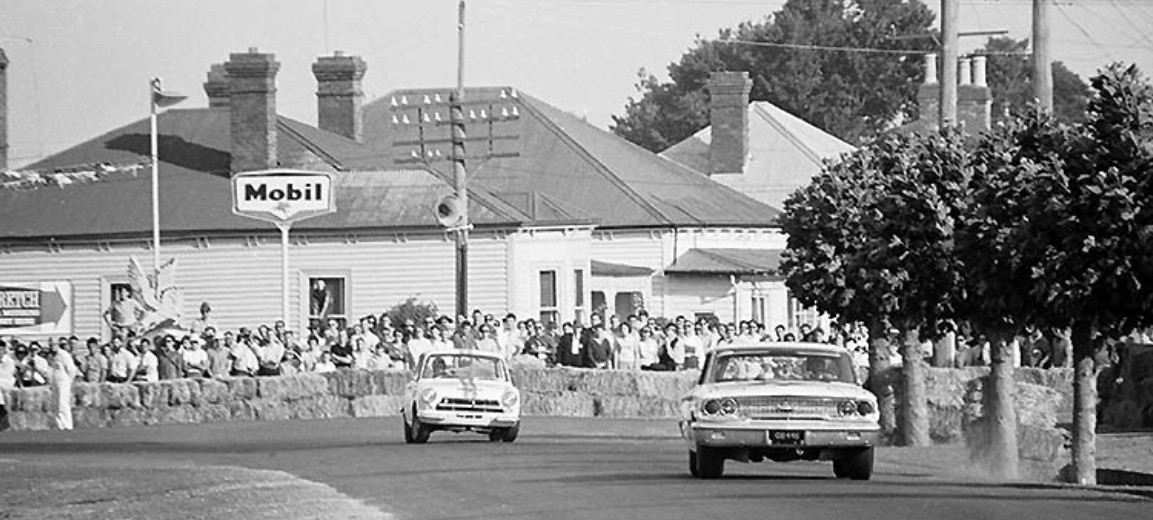
The photo above shows opposite locking Bob Jane’s Lotus Cortina chasing Sir Gawaine Baillie’s 7 litre Ford Galaxie, repaired after its near death experience against the Sandown Park, Peters Corner fence whilst driven by Lex Davison the previous November, on the exit of Longford Corner.
The Mobil Servo referred to earlier is clear as are more plane trees and an enthusiastic crowd ‘protected’ by lots of haybales and their own fast reactions! That Ford would have been mighty impressive bellowing and thundering along Longford’s long straights. The twiddly bits would not have been quite so impressive!
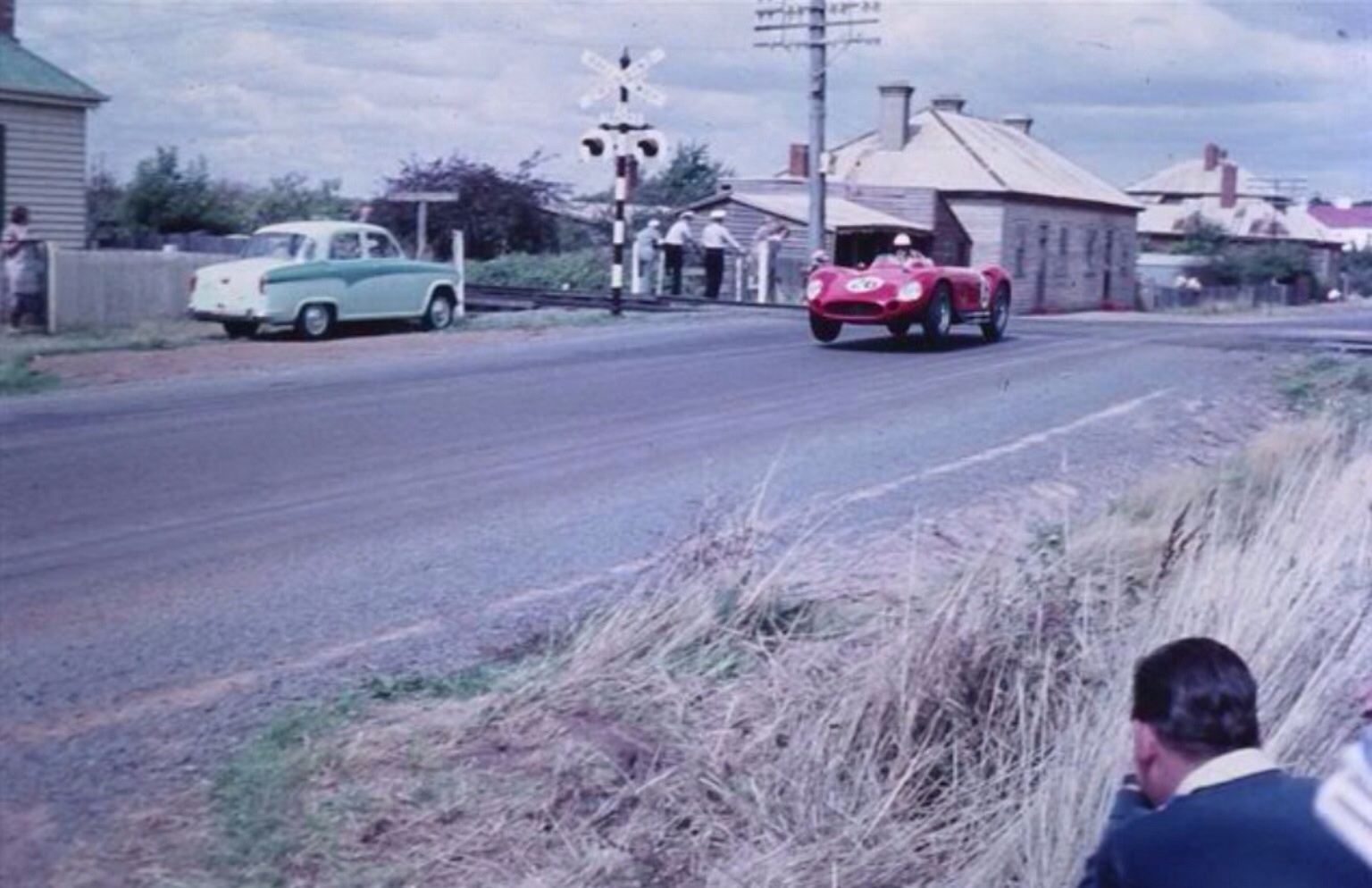
After exiting Longford/Pub Corner the cars accelerate through the gears including a ‘yump’ over the railway crossing along Tannery Straight.
Actually, for the most part after leaving Longford- that’s Doug Whiteford’s ex-works Maserati 300S coming in for a landing below, note the handily parked Austin!- its a long gentle curve, for a mile and a bit and then brake hard for Tannery Corner, a right hander.
Doug Whiteford Maser 300S, over the Tannery Straight (Wellington Street) railway crossing in 1959 (E French)
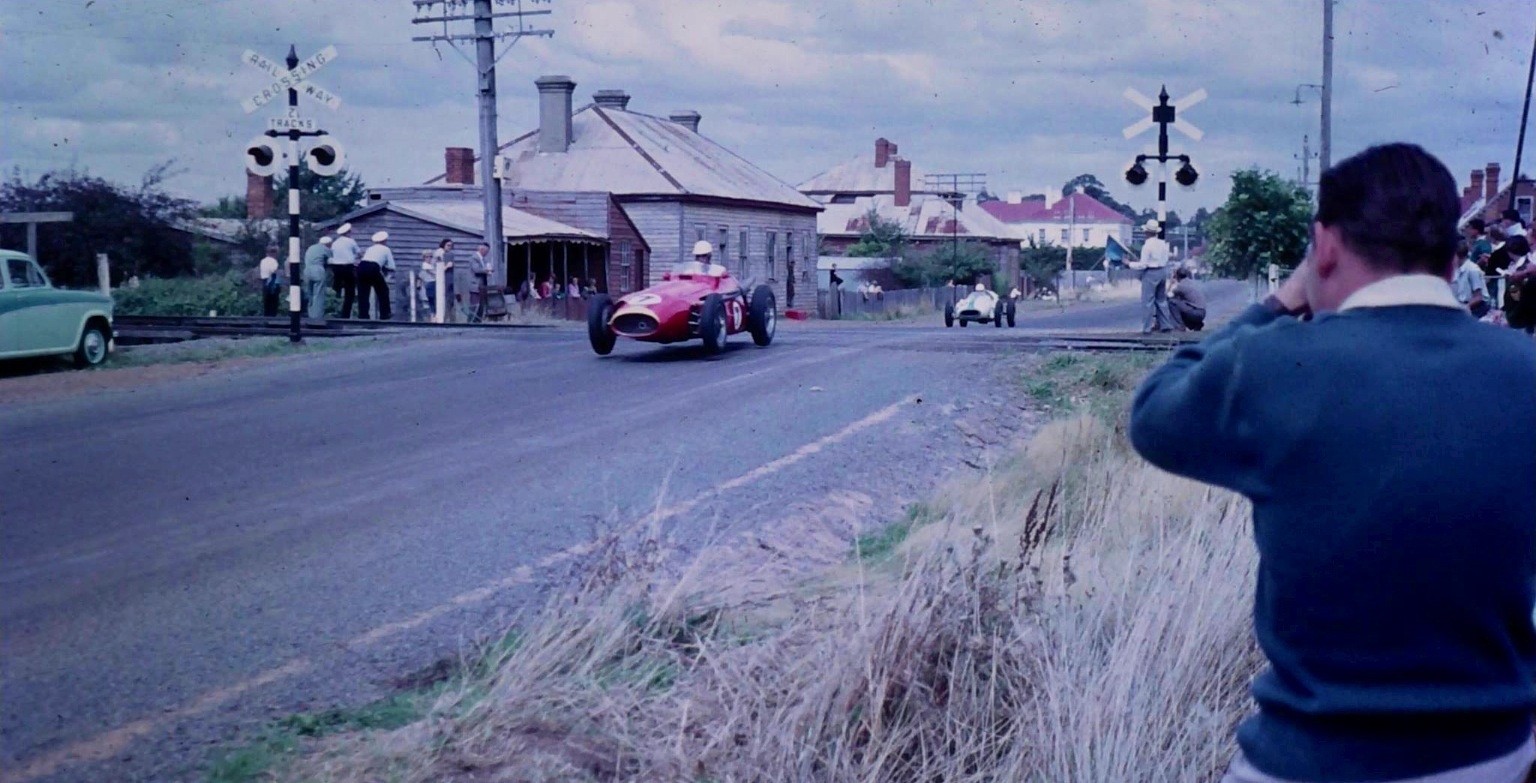
There was some technique required in addition to enjoying the ride! Kevin Bartlett recalls having to release the throttle for a fraction of a second so that the rear halfshaft donuts didn’t overstress on his Brabham BT11A, with Ellis French adding that ‘Humpy’ Holden crankshafts didn’t like the spot either. Geoff Smedley quipped ‘That crossing is the only place in the world where a race had to be paused to allow trains to pass through!’
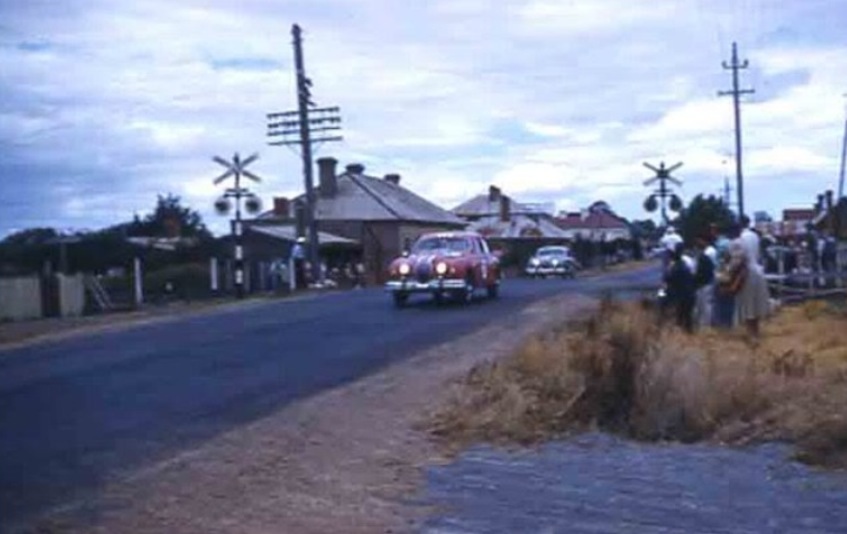
Jaguar Mk1’s 1960- David McKay from Ron Hodgson (oldracephotos)(E French)
Marvellous shot above of Ellis’ on the same day as his Whiteford one prior- its beauty is both literal and symbolic.
Literal in terms of the scene itself- the crossing, handily placed spectator’s Austin, watching, relaxed ‘coppers and of course the Maserati 250F and Cooper T45 Climax of Arnold Glass and Bill Patterson. Its practice for the 1959 AGP, Arnold was third and Bill failed to start, as mentioned earlier, the race was won by Stan Jones Maserati 250F.
Its the 250F that is the symbolic bit- the little mid-engined Coventry Climax FPF powered Cooper chasing down the thoroughbred Italian car. The first such locally domiciled car was Reg Hunts 250F engined A6GCM which arrived in early 1955. In the period which followed the 250F’s did well albeit Lex Davison’s older 3 litre Ferrari 500 pretty much always had their measure- what it may sometimes have lacked in outright pace to Hunt, Jones & Co being compensated for by strong reliability, especially on the big occasions. Whilst Stan Jones won the 1958 Gold Star Series and the 1959 AGP in his 250F the period of the big red cars was coming to an end, a smidge later in Australia than in Europe. In the ’59 Gold Star, twelve races were contested- mid-engined Cooper’s won nine of them with three going to the front-engines, and all of these wins were early in the year prior to 31 March. Jones and Kiwi Ross Jensen won in 250F’s at Longford and Bathurst with Stan rolling out the Ern Seeliger modified Maybach 4 Chev at Port Wakefield for a victory in South Australia. The days of mid-engined omnipotence had arrived.
Ray Bell’s shot below after the end of race proceedings in 1965 shows the gently curving nature of Tannery Straight- heading in the direction of Tannery Road from Longford. Its flat-knacker in top gear but clearly is not straight as is shown in pretty much all of the circuit maps available. Mind you, none of the modern maps will be from ‘source references’ but rather digital renditions of earlier work. Plenty of trees, bush and typical highway of the day with rough verges.
(R Bell)
‘The left of Tannery was like a huge hedge, the right was random trees growing thickly, with the odd track into the bush where lovers used to go and that sort of thing…
By the time they were looking for the brakes (the drivers not the lovers) they were well into clear paddock scenery, with a kind of flat and uninteresting (Windsor, Sydney after a flood kind of thing…) appearance for Tannery, where the road was built up and going off would mean dropping onto a lower level. The paddock straight ahead had a gate and driveway for convenient escape for late brakers’ Ray Bell recalled.
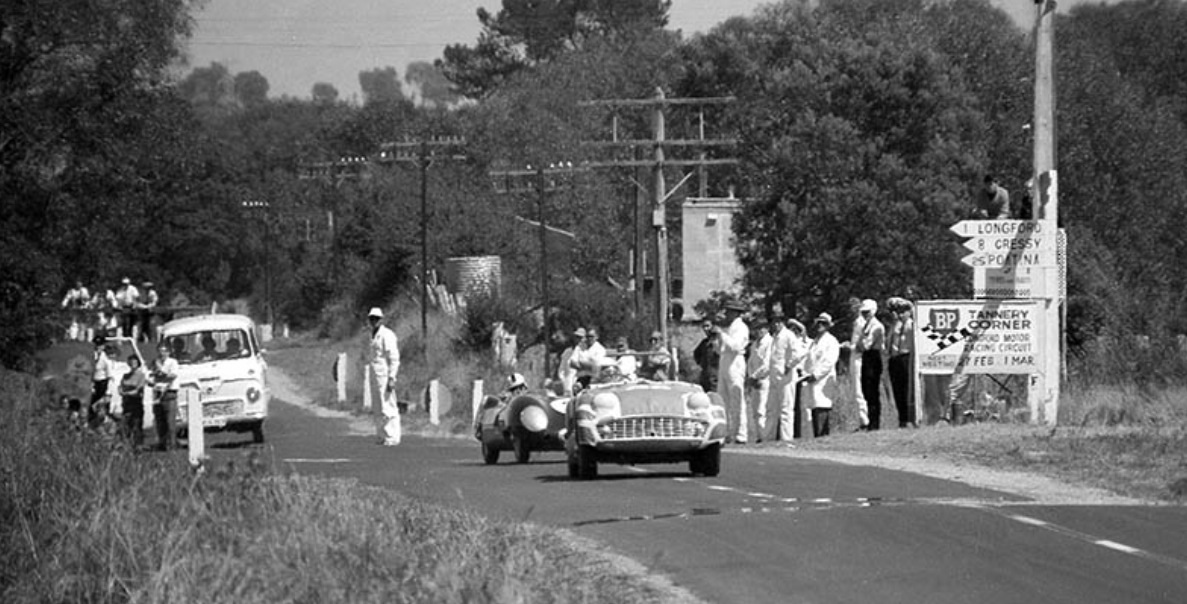
The image below of the Triumph TR3 and Lotus 11 is Tannery Corner, the T-intersection of Tannery Road and Bishopsbourne Road, the drivers have negotiated the corner and are heading towards Long Bridge and then Newry Corner, to the intersection with Pateena Road. Love that ‘Longford Motor Racing Circuit’ sign.
Owen Mortimer Triumph TR3 leads Allan Caelli Lotus 11 Climax out of Tannery in 1965 (oldracephotos/DKeep)
This photo below I have used before. Of all the thousands of photos i’ve seen and selected in the four years I have been writing primotipo this is one of my favourite ten- its Stan Jones’s Maser 250F negotiating Tannery Corner, the photo, from the outside of the corner is from the Dunstan Family Collection. Again, check out the terrain, flatness at this point, and don’t miss the dude standing at middle-right. Stan is heading for our next stop, the fast left-hander onto Long Bridge.
(Dunstan Family)
(R Bell)
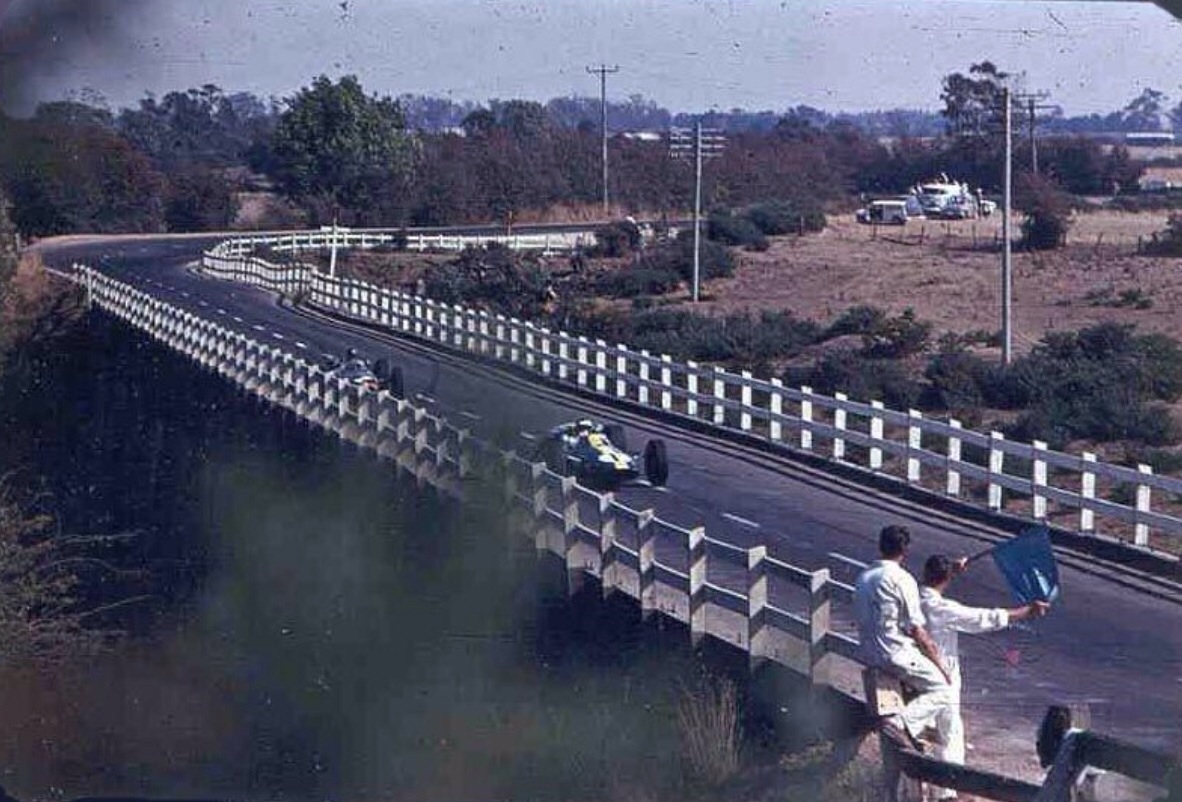
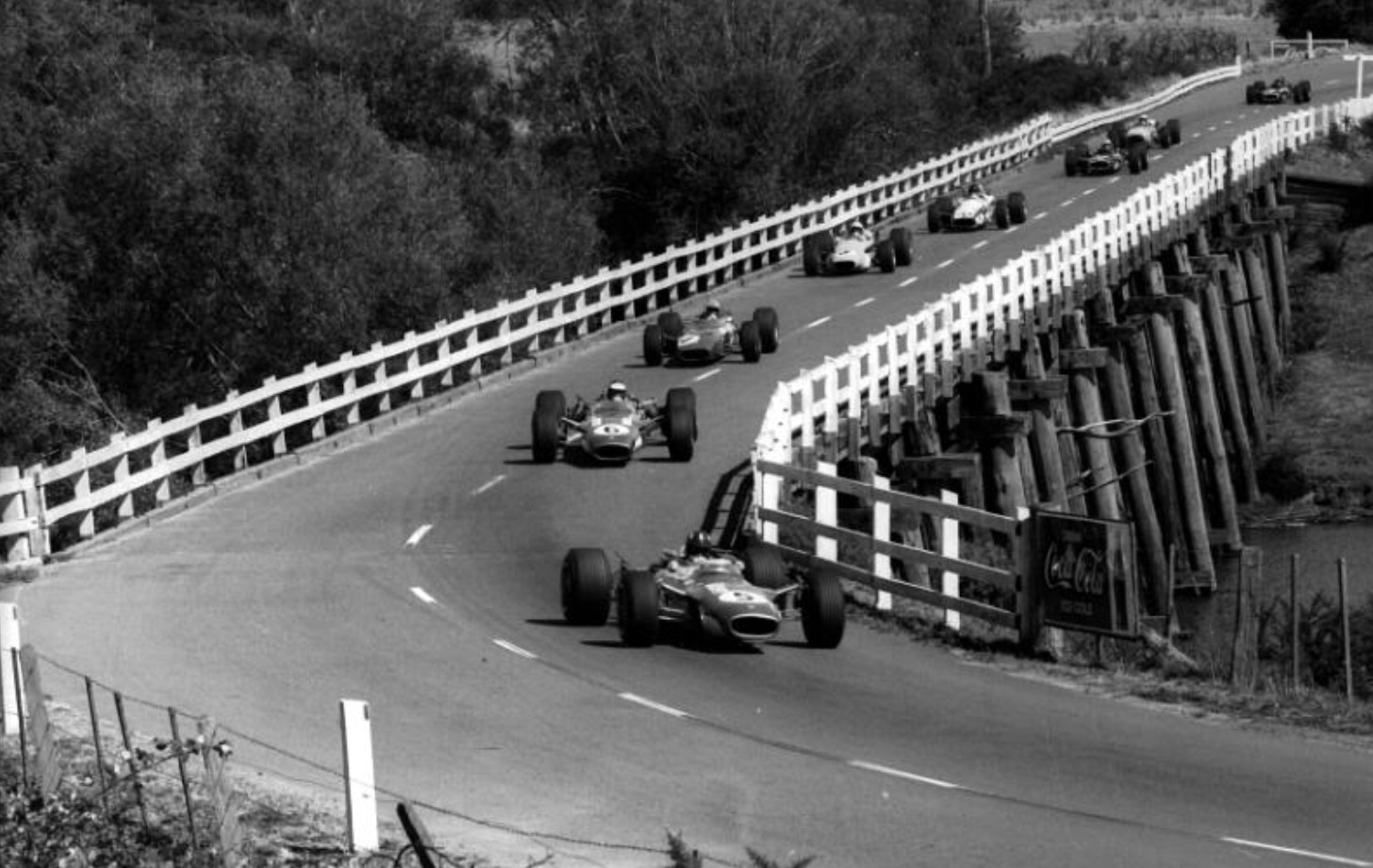
Then follows another wild section of track including the flat out fast left-hand entry onto Long Bridge, again over the South Esk.
This part of the track is again much photographed with scuba divers strategically positioned in the event of a major mishap.
Ray Bell’s shot of Jim Clark’s Lotus 39 Climax leading Graham Hill, BRM P261 in 1966 is in large part included as his composition shows the prodigiously fast ‘flat’ entry onto the the bridge which must have been a big test of ‘wedding tackle’ size, not an issue with these blokes one can only surmise. The exit left was also very quick.
The image below in 1968 (Saturday) shows the order reversed, Hill from Clark’s Lotus 49 Ford DFW’s from Amon Ferrari Dino 246T, Gardner Brabham BT23D Alfa, Geoghegan Lotus 39 Repco, Attwood BRM P126, Bartlett Brabham BT11A Climax and Rodriguez BRM P126.
(R MacKenzie)
Barry Lake recalls being at this part of Longford with Jack Brabham in the early 1990s, doing a piece for a TV report. ‘There was no fence of any sort beside the road, although there was one down a very steep embankment. If you went off the road, you would have had to be almost at a standstill to drop sharply enough to hit the fence. With any speed at all, a car would easily have cleared the fence into the cow paddock. I seem to remember some mid-sized trees in there and could picture a car landing right in the top of one if it went off.’
I asked Jack, “Did it ever worry you at all, to know you would be coming through here virtually flat, with nothing to stop you flying out there?” He said, “I’ve never seen it before. I didn’t know what was out there. I only looked at the road… I didn’t ever intend to go off there anyway, so why would I need to know.”
(D Cox)
The shots above and below of Kerry Cox in the Paramount Jaguar having a huge, high speed moment on the bridge are as good a panorama as we will see inclusive of the fast, open approach to the left hander. David Cox wrote of his Dad’s incident in 1966 ‘…he did a 270 degree spin without touching either side! He told me he was in second place, had lifted slightly there the lap before , so this lap he was trying to hold it flat through the corner before the bridge and touched the barrier on the inside which put him into the spin down the bridge. He had to reverse up the bridge and turn around, and still came third in the race. When he got back to the pits there was a massive bit of wood stuck between the rim and the tyre, we have a pic of that somewhere too!’ The other car appears to be a Lotus 7, note the little dinghy riverside.
(D Cox)
Below is another of the Long Bridge panorama albeit its in 1958, the Gold Star round that year was won by the Ted Gray driven Tornado Chev- here Austin Miller’s Cooper T43 Climax is being pursued by Bill Patterson’s Cooper T39 Bobtail Climax. There is far more undergrowth a decade earlier than the shots above but the bridge looks the same. Note the haybales on exit and huge penalties for anyone getting their turn-in off the bridge wrong!
(oldracephotos)
In fact that 1958 Gold Star round was the race meeting that put Longford on the map from a car perspective. The motor cycle racing guys first used the circuit in 1953 with cars almost an afterthought. Sedans and sportscars raced on the ‘bike meeting cards but that all changed with the award of a round of the national drivers championship on the March Labour Day long weekend in ’58- which was always ‘Longford Weekend’.
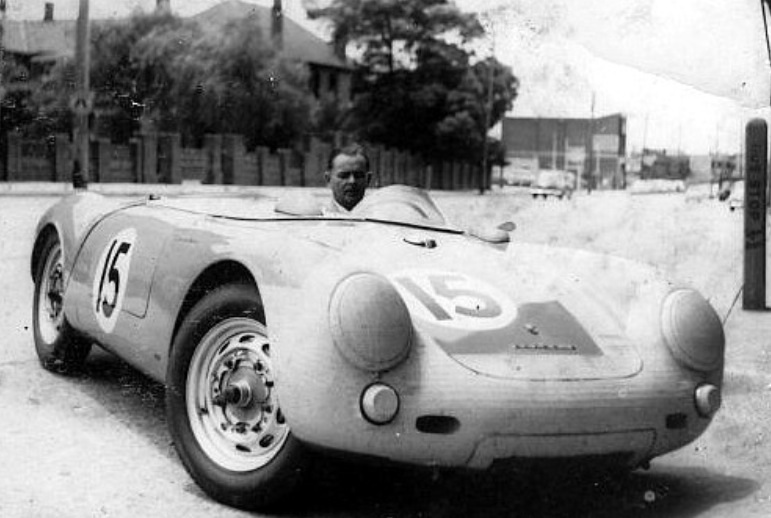
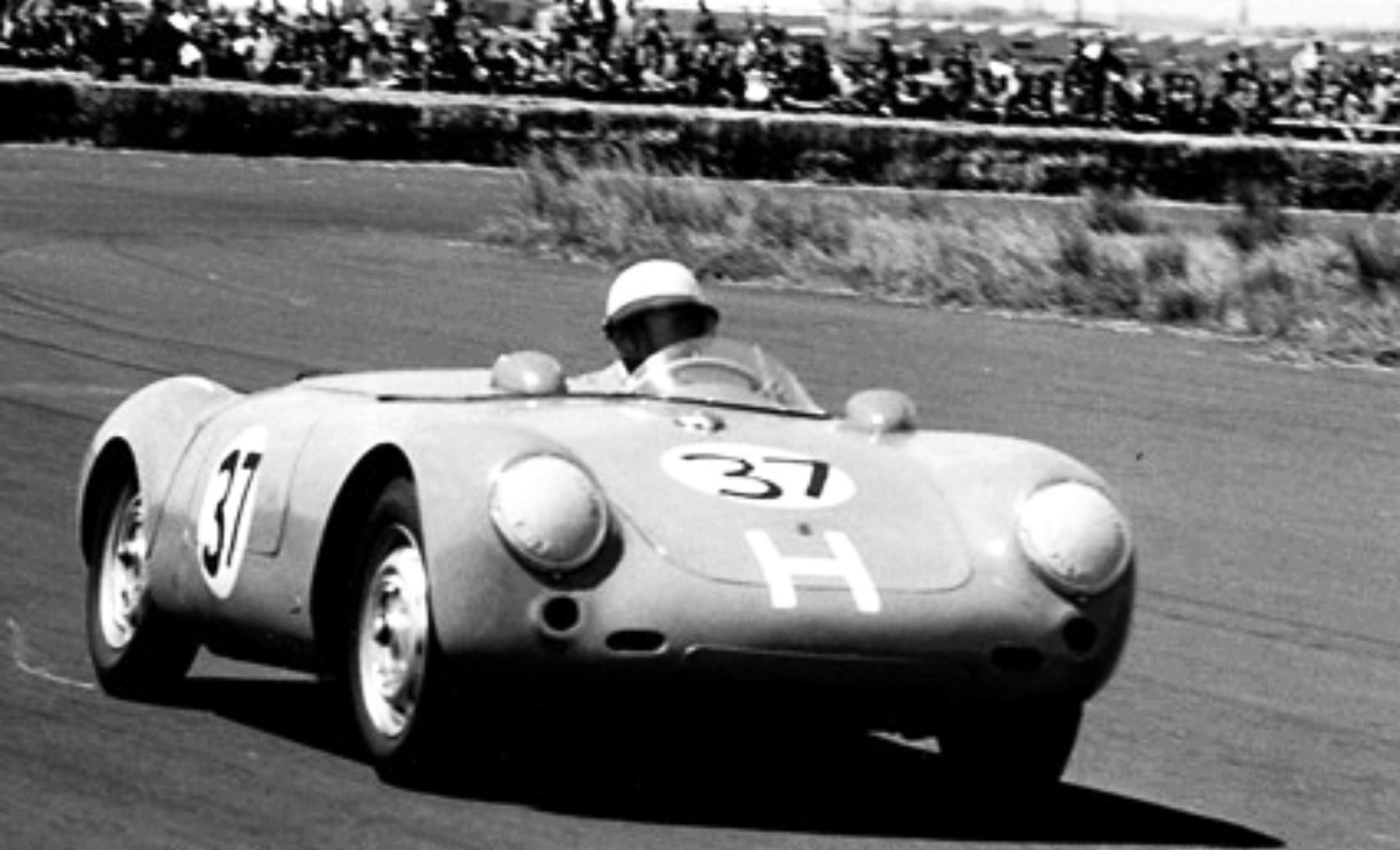
Bruce Walton was multiple times Australian Hillclimb Champion when all the aces of the circuits chased this prize eagerly. He occasionally raced on the circuits and is here at the wheel of Australian Porsche importer Norman Hamilton’s Porsche 550 Spyder during that 1958 meeting- he was third in the Sportscar Trophy event. By all means suss the car but the shot is included to show the topography after the cars exited Long Bridge. Even today this is a typical Oz country road scene.
(oldracephotos)
Bob Jane howling towards Longford below in his Elfin 400 Repco ‘620’ 4.4 V8 in 1967, one of his earliest races in his new car. He is not long off Long Bridge with the South Esk River in the background- its hue a nice contrast to the parched paddocks and the fencing less visually pleasing than above but just as lethal as a decade before.
(oldracephotos/King)(S Dalton)
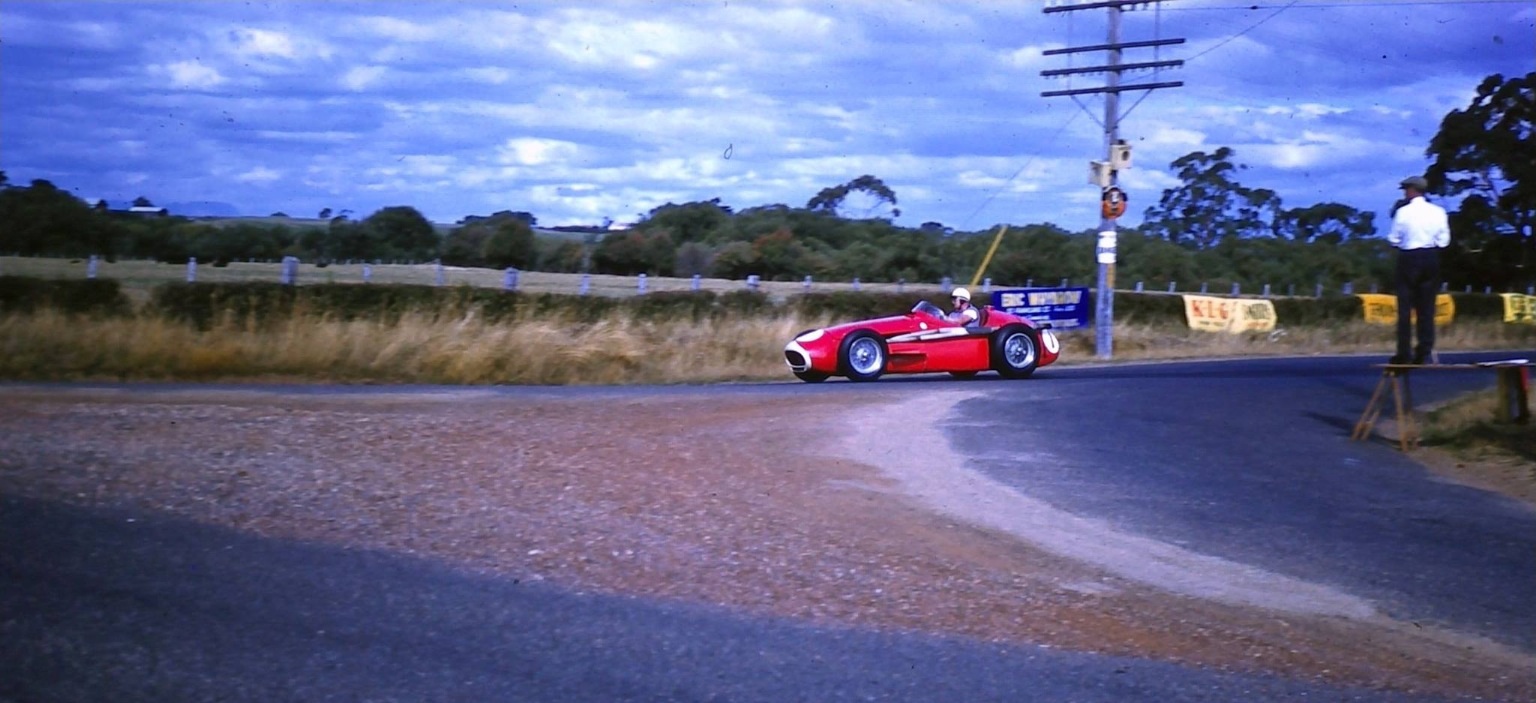
The next corner after the section off the left-hand exit off Long Bridge is the Newry right hander into Pateena Road.
‘The climb out of there is quite sharp and a bit narrow between the edges of the embankments each side…ie not much shoulder for 50 yards or so, then evening out with crowd on the fence on the right.’ notes Bell. Above is the Elfin Mallala Climax FPF of Bryan Thomson during the 1964 meeting.
Rob Saward rated Newry Corner and Long Bridge as the best spectator viewing on the circuit adding that the steep exit was named by the locals ‘Newry Hill’ which then led on to The Flying Mile a straight about 1.5 miles in length- it was straight for the first quarter of a mile and then kinked to the left for the balance of the run into the Mountford Corner right hander- at the intersection of Pateena and Illawarra Roads.
(oldracephotos.com/JEllis)
This amazing and unusual shot by Jack Ellis shows the incline of ‘Newry Hill’ on a very blowy Saturday during the 1968 meeting- Jim Clark and Graham Hill in Lotus 49 Fords are being pursued by Frank Gardner in Alec Mildren’s Brabham BT23D Alfa Romeo V8. The trio are a smidge further up the road than the Elfin Mallala above.
(oldracephotos/DKeep)
I love this shot of evergreen, talented Tassie racer Barry Cassidy giving his ‘brand-spankers’ 1967 XR Ford Falcon GT plenty of FoMoCo 289 cid V8 wellie out of Newry during the 1968 meeting.
This was the very first of an immensely successful run of Ford Australia V8 engined ‘Pony Cars’ and apart from showing Cassidy’s deft touch with the throttle also clearly shows the rise out of Newry on exit before the road flattens for the fast blast along The Flying Mile- the car was stock but would have been good for just shy of 130 mph or thereabouts.
(R MacKenzie)
Queenslander Rod MacKenzie took some sensational Longford shots on his 1968 trip down south- this moody, foreboding one of Clark’s Lotus 49 exiting Newry is one of my favourite photographs and illustrates the elevation of the circuit at this point, and again, the rise upon exit until the circuit flattens a little further along The Flying Mile.
(S Dalton)
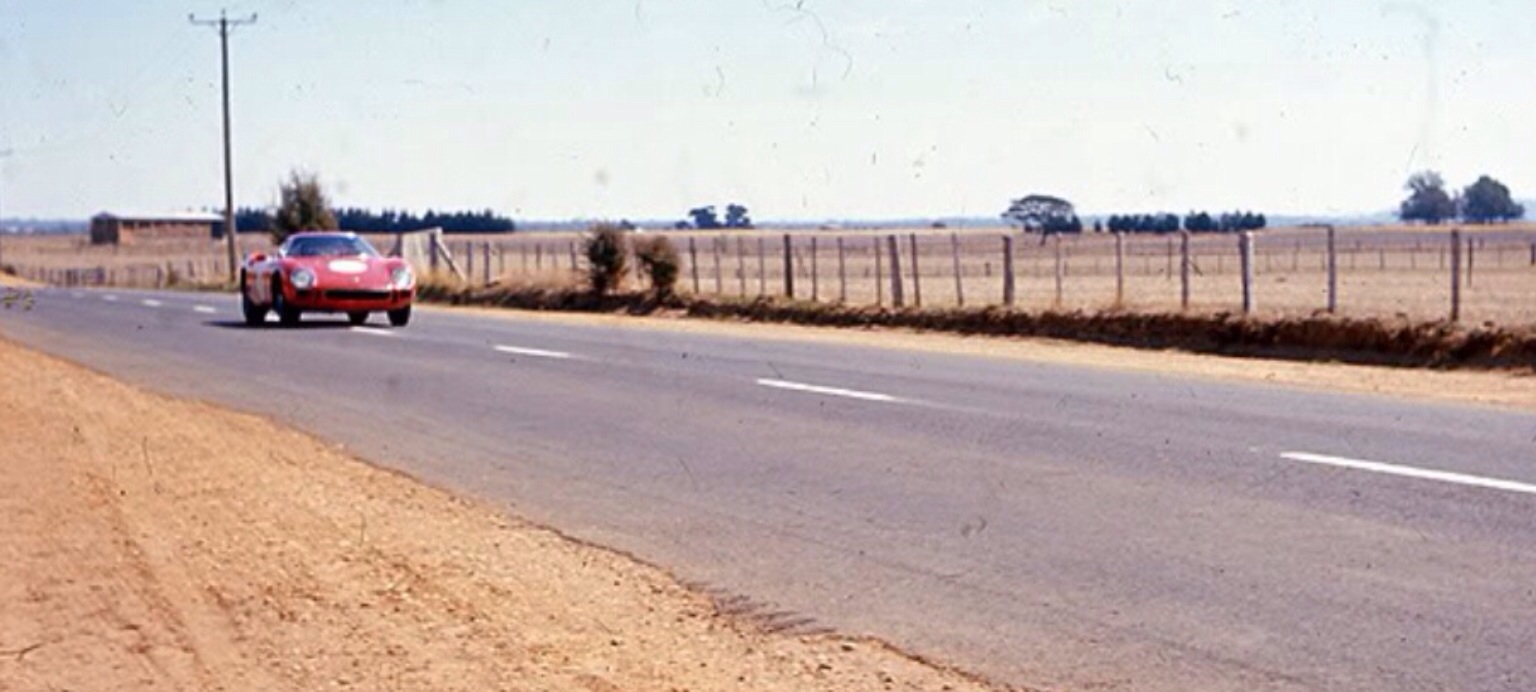
You can just about feel and hear the shrill scream of Spencer Martin’s 3.3 litre V12 @ 7500 rpm as the exotic, much loved Italian racer blasts along ‘The Flying Mile’ at around 165 mph frightening the life out of kangaroos and Tasmanians equally as much (above and below). I wonder what the speed limit on Pateena Road was at the time?! The sounds of the racing cars echoed off the surrounding hills across the brown paddocks of summer in rural northern Tasmania. The majesty of the place is one of the things that always takes my breath away- something which can only be achieved on long, open circuits in spectacular scenery on public roads.
(oldracephotos)(R MacKenzie)
It wasn’t always sunny mind you. The Tasmanian weather could be capricious as it was during the 1968 meeting.
Jim Clark was belting down The Flying Mile in his Lotus 49 DFW on sunny Saturday for a win in the 12 lap preliminary- and a lap record he held for a few hours until Amon’s P4/CanAm 350 took it later in the day and then toiling hard to fifth place in the ‘pissin rain on South Pacific Trophy day- Monday. He finished behind Courage, Rodriguez, Gardner and Attwood that day but wrapped up the ’68 Tasman with four wins to Chris Amon’s two.
(E French)
After the flat out blast of ‘The Flying Mile’ we are back whence we started, the Mountford right-hander, the corner of Pateena and Illawarra Roads onto Pit Straight- Illawarra Road.
Stan Jones Maser 250F is chasing Len Lukey’s Cooper T45 Climax during their great 1959 AGP dice, the gents in the foreground providing almosphere enhanced by the huge, imposing and shady Mountford pine tree.
Pit Straight wasn’t always Pit Straight mind you, when the roads were first used as a race-track the Pits were located on The Flying Mile on Pateena Road, as noted early in the article, but safety concerns led to their relocation down the road and around the corner on the Illawarra Road section of track between Mountford and the Water Tower, from 1959.
Jim Saward’s photos below show the layout as it then was, these shots were taken from a Percival EP-9 aircraft which Rob Saward relates had a hatch in its bottom which was used to take quite a unique set of photographs. The landing strip for ‘planes was in the paddock behind The Flying Mile.
In the photo below you can see Pit Straight without the control tower and pit buildings which were built later and are shown in the various shots below. Note the ex-Launceston Tram Number 4, which, redundant in its initial role as public transport was relocated to provide officials with a building from which to operate- I wonder what became of it after Longford closed?
(oldracephotos/JSaward)
The photo below shows Pit Straight, Illawarra Road, checkout that tram at centre shot- at its end is Mountford Corner- left towards Newry Corner and the village of Pateena along Pateena Road and to the right is the road to Perth, several miles to Longfords east. The ‘capital’ of Tasmania’s north is Launceston, 25 Km away and Devonport where the then ‘Princess of Tasmania’ ferry disgorged its cargo of cars and racers from Port Melbourne is 95 Km from Longford.
(oldracephotos/JimSaward)
The two photographs below from Stephen Dalton’s Collection are undated, the cars will be a clue for some of you, look back towards Mountford on the inside of the circuit behind the tall poplar tree and you can see the Control Tower. ‘Over your right shoulder’ behind you on the upper shot is an incline and the Water Tower.
(S Dalton
(S Dalton)
Ellis French’s grid level shot of Doug Whiteford and Arnold Glass’ Maserati 300S and 250F is taken in 1959- its not the AGP but rather a heat, further back is the white Bill Patterson Cooper T45 Climax and his former Cooper Bobtail T39 Climax then owned by Alan Jack. There is still no low-level grandstand on the outside of the circuit at that point.
(E French)
The facilities were still fairly basic below in 1960, I love the beach umbrella erected atop the control stand to afford the starter some shade to better fulfil his duties.
From the left of the grid it’s Brabham, Miller and Stillwell in Cooper T51’s with the Glass Maser 250F at far right. Jack won from Alec Mildren and Stillwell all in T51’s albeit Alec’s was Maserati 250S powered rather than by the Coventry Climax FPF’s in the rear of the other two chap’s machines.
(oldracephotos)
By 1963 it was ‘carnivale’ as this South Pacific Championship grid shot below shows the Control Tower and Pits building- together with all the advertising hoardings and bunting it looks fantastic.
The great big Mountford pine tree is there in the distance standing guard over the corner. On the front row its Bruce McLaren on pole in his Cooper T62 Climax, then Bib Stillwell’s Brabham BT4 Climax and Lex Davison, Cooper T53 Climax on the outside. The race was won by Bruce’ Cooper from Stillwell and John Youl’s T55.
(G Smedley)
The photo below is the same 1963 grid as above- just look at the atmosphere!
From the rear is the #87 Frank Matich Lotus 19B Climax and alongside the Bob Holden Lynx Peugeot 1.5, on the next row is Frank Gardner’s Brabham BT2 Ford FJ which is sandwiched by Tony Shelley’s Lotus 18/21 Climax against the pits and Peter Boyd-Squires Cooper T45 Climax. The white #9 Cooper T51 is Bill Patterson and alongside him is the #3 Cooper T53 of Jim Palmer. Then Chris Amon is in the red Cooper T51 #14 with John Youl alongside, Cooper T55 Climax and an obscured Brabham in his BT4. On the second row is David McKay’s Brabham BT4 Climax and an obscured Tony Maggs Lola Mk4 Climax with Davison, Stillwell and obscured McLaren up front.
(S Dalton)
This view is across the bonnet of Lex Davison’s Len Lukey owned Ford Galaxie in 1964, opposite the pits, with plenty of spectator viewing and easy access for them back to Mountford. Jag is Bob Jane’s very successful Mk2- Galaxie gave Lex quite a wild ride in Tasmania, the brakes in particular were wanting.
Lex Davison in Len Lukey’s Ford Galaxie in front of Bob Jane’s Jag Mk2 in 1964 (oldracephotos)
The Australian Tourist Trophy for sportscars below was the main, hotly contested support event run during the 1964 meeting.
The spectators on the outside of Pit Straight enjoy the start with Frank Gardner’s Alec Mildren owned Lotus 23 Ford leading from Bib Stillwell’s Cooper Monaco, Frank Matich in the Total owned Lotus 19B Climax and Bob Jane’s superb Jag E Lwt- Matich took the win after Bib was disqualified for a push-start at the races outset.
(olracephotos)
The 1966 panorama just after the start below emphasises the flat nature of the terrain at this point and the great brown land in which we live, distinctive also is the footbridge absent in the earlier images.
That’s Clark J’s Lotus 39 Climax from Frank Gardner’s Mildren Brabham BT11A Climax and Jackie Stewart’s BRM P261 out front. Jackie took the honours that year from his teammate Graham Hill and Jack Brabham aboard BT19 Repco- the chassis with which he won the 1966 F1 Drivers and Constructors Championships. It was the third race for the Repco Brabham ‘RB620’ V8.
Ever laconic Frank Gardner said of Longford in MotorSport ‘It was over railway lines, onto a bridge with a curve in it, with well-spaced wooden railings which you could force a car through. You were coming onto a strip of oily board over a river. That was the safety procedure! It made the Nurburgring look quite safe…’
(S Dalton)
The photo below shows ‘all the fun of the Longford fair’ with the Pit Straight facility at its zenith of development with control tower, footbridge and pit building complete with prized spectator viewing facilities. Looking away from Mountford in the direction of the Water Tower and beyond. Intrigued to know the year of this shot, circa 1966.
(oldracephotos)
Despite the uniquely challenging nature of the place with its bumpy bridges, slow Viaduct Esses with tight rise beyond, its level crossing jump and pre-1965 hump it was a FAST circuit. Chris Amon set the all-time lap record at 2:12.6 seconds, 122.19 mph in his Scuderia Veloce Ferrari P4/CanAm 350 during the 1968 dry, Saturday sportscar scratch race. Average speed folks. Imagine what it felt like on the narrowish Flying Mile in that car at 178 mph in the wet!
A confluence of events conspired to bring about the circuits closure.
Ticket sales were poor in wet 1968, the circuit was only used once per year thereby limiting the return on capital investment, local environmentalists were against permanent advertsing hoardings but most critically the Grand Prix cars of the day were becoming exponentially quicker due to the 3 litre formula introduced from 1966 (fast even when raced at Tasman 2.5 litres), tyre ‘alchemy’ or polymer chemistry was giving much greater levels of grip let alone the performance impact of wings which exploded after Longford’s final 1968 meeting. In essence the cars had outgrown the track and there was not the funding to make the necessary investment to keep the track intact but safe enough for changing times.
It was such a shame, it is not too much to think that the South Pacific Trophy could have been to Tasmania what the TT still is to the Isle of Man.
The Siffert/Redman John Wyer Porsche 917K lines up for The Viaduct during the 1970 Longford South Pacific Trophy 1000 Km. I wish!…
(woochoo)
Bibliography…
The Nostalgia Forum ‘Longford: Reims of The South Pacific’ thread-particularly the contributions of Ray Bell, The Late Barry Lake, Rob Saward, Lindsay Ross, Stephen Dalton, Ellis French, Wirra, oldracingcars.com
Photo Credits…
Lindsay Ross and his oldracephotos.com.au which provided the vast bulk of the images used in this article. I salute the work of David Keep in particular; http://oldracephotos.com/content/home/
Jim Saward, Stephen Dalton Collection, Ray Bell, Ellis French, Geoff Smedley, Rod MacKenzie, Dunstan Family Collection, Paul Geard Collection, Cox Family Collection
Etcetera…
(SCW)
Perhaps the culvert just out of The Viaduct. Mick Watt in the Prefect Ford Spl now owned by Ian Tate, mid-fifties (P Geard)
Tailpiece: Quintessential Longford 1960- Pub and Holden FJ…
(oldracephotos)
Longford was all about international racing cars and stars but equally it was motor racing mecca for Tasmanian and Australian racers with modest budgets and self prepared cars.
Endpiece: We started, and let’s finish with a Jim Saward shot at Mountford!…
(oldracephotos)
Lyn Archer’s Cooper T39 Bobtail Climax during the 1959 meeting. The shot’s composition is marvellous from the crowd involvement, the car- in the sun, just- clear of the Mountford pine’s shade and the view up the hill to the Water Tower which marks the fast right hand plunge down to The Viaduct.
Jim Clark stops his Lotus 39 to collect a celebratory beer after winning the 13 February 1966 ‘Warwick Farm 100’ Tasman round…
Clark won the Tasman Series in 1965, 1967 and 1968. His 1966 mount, whilst a good car, the 2.5 litre Coventry Climax four-cylinder engine was outgunned by the ex-F1 BRM P261, the capacity of which had been stretched from 1.5 to 1.9 litres with Jackie Stewart winning the championship taking four victories from eight rounds.
JC and the lads looking fairly relaxed for this Thursday or Friday WF test of the 39, WF pitlane 1966 (ABC)
From the off at WF: Clark’s Lotus 39 scampers away from the Hill and Stewart BRM P261’s and Frank Gardner in Alec Mildren’s Brabham BT11A Climax #4 (WFFB)
Jim’s only 1966 Tasman win was in Sydney- Barry Hickson took this photograph whilst a flag marshall at Homestead Corner recalled that Dick MacArthur Onslow, the Homestead Sector Marshall promised Jim a ‘cold one’ if he won, here in the opening photo, the great Scot has pulled up to collect the promised cool beverage from Dick!
Benz 230SL to Clark’s liking, Homestead Corner fans happy to have JC back after his stop a short time before (B Hickson)
Clark and WF supremo Geoff Sykes swap notes after the 1966 win (WFFB)
Clark excelled at the technical, depending, outer Sydney track, he started from pole and won from Graham Hill, BRM P261 and Frank Gardner in Alec Mildren’s Brabham BT11A Climax with JYS fourth in the other P261.
In fact the ‘Farm was a very happy hunting ground for Jim, he raced there from 1965 to 1968 winning on three of his four visits aboard works Lotus machines- 1965 32B Climax FPF, 1966 39 FPF, and in 1968 aboard a 49 Ford DFW, the 2.5 litre variant of the 3 litre F1 Ford Cosworth DFV. In 1967 he fell short of the mark but not by much taking second to Jackie Stewart’s BRM P261, that Tasman Series the BRM V8’s were stretched to 2.1 litres in capacity. Jim’s 1967 car was an F1 Lotus 33 Coventry Climax FWMV 2 litre V8.
Victory for Clark at WF in 1966 aboard the Lotus 39- a car which would become iconic in Australia thereafter in Leo Geoghegan’s hands in both Coventry Climax and Repco V8 engined forms. And still resident in Oz (unattributed)
Credits…
Barry Hickson, Aust Broadcasting Corp, Warwick Farm Facebook page
Tailpiece: Clark on the way to his 1965 Warwick Farm 100 win, this time in his Lotus 32B Climax, Homestead Corner…
(B Hickson)
And the same 32B chassis in the WF paddock beside Jack Brabham’s Brabham BT11A Climax, with Roy Billington toiling on Jack’s car. Is that Ray Parsons behind the 32B? Who is the Repco clad bloke looking at Jim’s car who attended to Jack every year whilst he was in Oz?
Doug Cavill or perhaps Bill Reynolds races his Austin Healey 100-6 based Prad Healey at Lowood, Queensland circa 1959…
The car was a new one on me, quite a wild, fantastic looking machine, the modifications to the body were made by Jack Pryer and Clive Adams- the Prad boys in Sydney whilst the engine was breathed upon by racer/mechanic Bill Reynolds. Cavill- the Surfers Paradise ‘main drag’ Cavill Avenue was named after his father Jim Cavill- was a successful estate agent and had the readies to fund this interesting car.
Quentin Miles has been progressively uploading some photographs taken by his late father on Bob Williamson’s ‘Old Motor Racing Photographs – Australia Facebook page- check it out, this is a beauty despite the ravages of time to the negative.
Patrick Quinn wrote an article about this interesting car published in the Victorian Austin Healey Owners Club magazine ‘Hundreds and Thousands’ in 2013 which is reproduced below. The ‘restoration’ of the car is a shame, tragic really.
Etcetera…
This shot by the Salter brothers is at Lakeside circa 1961-62.
Credits…
Quentin Miles, Patrick Quinn, ‘Hundreds and Thousands’, B & N Salter
Bruce Walton aboard Norman Hamilton’s Porsche 550 Spyder at Longford in March 1958…
The 1958 ‘Longford Trophy’ was the first Gold Star round held at what became the legendary Tasmanian road circuit that March long-weekend. Ted Gray was victorious in Lou Abrahams Tornado 2 Chev. Bruce Walton shared the beautiful Porsche 550 Spyder with its owner, Norman Hamilton. Here he is parked beside ‘The Flying Mile’ near the old startline towards the end of the ‘mile. In 1959 the start/finish line and pits were moved to a safer spot around the corner between Mountford and the Water Tower.
Porsche Spyder 550 chassis ‘550-0056’ was ordered on 2 June 1955 and arrived on the MV Sumbawa in October 1955. One of 91 cars built, it was the only 550 imported to Australia by Norman Hamilton, famously one of the first people awarded commercial rights to the then nascent marque way back in 1951.
The story of Norman’s ‘Porsche introduction’ is a well known in Australia, its an amusing one. The Melbourne pump manufacturer was rumbling up the Glossglockner Pass on the way from Austria to Switzerland to check out the latest in pump technology in an American beast- an Oldsmobile 88 when he was ’rounded up’ by a low slung, snarling silver bullet.
In a village further up the valley he came upon German racer and Porsche tester Richard von Frankenberg partaking of a refreshing beverage in an Inn. He interrupted his break from the arduous task of refining the cars chassis and showed Norman the weird little car. In a burst of entrepreneurial zeal Hamilton followed the German and the car back to the Porsche factory and on a handshake secured the Australian commercial rights- in so doing he became the second agent outside Europe after Max Hoffman in the US.
Looks nothing like my Aston old boy?! South Melbourne Town Hall 1 November 1951 (PCA)
Months later, on 1 November 1951 Hamilton held a cocktail party for Melbourne’s ‘great and good’ at South Melbourne Town Hall, not far from Albert Park, to launch the marque in Oz.
On show were a maroon coupe and a silver cabriolet- forty months after the first 356 Porsche received its road permit in Austria, the cars looked like ‘flying saucers’ compared with the British and American cars with which we were so familiar.
Shortly thereafter selected local motorsport people were invited to test the cars- around Albert Park Lake of course! Very soon after that the Porsche Australian motorsport debut took place with Hamilton family friend and experienced racer/constructor Ken Wylie running the coupe up the dusty Hurstbridge Hillclimb, northeast of Melbourne on 28 January 1952.
Ken Harper and Norman Hamilton with Porsche 356 before the 1953 Redex Round Oz (PCA)
Porsche had fallen into the very best of motorsport friendly hands in Australia. In the following decades Norman, and particularly his son Alan Hamilton, raced exotic Porsches in Australia and aided and abetted the careers of drivers such as Colin Bond, Alan Jones and especially Alfredo Costanzo in Porkers and F5000 and Formula Pacific single-seaters. That story is well covered here; https://primotipo.com/2015/08/20/alan-hamilton-his-porsche-9048-and-two-906s/
(Clarence La Tourette)
The 550-1500 RS Spyder was first exhibited at the 1953 Paris Salon, the sexy body hid Dr Ernst Fuhrmann’s ‘Type 547’ DOHC, 2 valve, air-cooled, 1498 cc (85X66 mm bore/stroke) horizontally opposed, twin-Solex fed four cylinder circa 110 bhp @ 6200 rpm engine. This motor provided the basis, as it was progressively modified, for the motive power of successive Porsche racers until 1961. Built from 1954-1955 the 550 design had ‘an integral body-frame with floor frame…the flat frame consisted of welded tubing’. The transaxle was 4 speed with a ‘slippery’ diff, drum brakes were fitted front and rear. With the machine weighing a feather-light 590 Kg, a top-speed of about 137 mph was achieved with levels of endurance and reliability which became key brand values.
When the 550 first arrived at Port Melbourne it was delivered the short distance to the Southern Cross Service Station on St Kilda Road, Melbourne where it was uncrated and checked over by engineer/mechanic/racer Otto Stone. Pronounced fit, veteran AGP winner Les Murphy gave the car it’s competition debut at Rob Roy on Melbourne Cup Day in November 1955.
Delivered to New Zealand for Stirling Moss to drive in the 1956 New Zealand Grand Prix meeting at Ardmore, the great Brit won the ‘Ardmore Handicap’ in the 550 and then jumped into his works Maserati 250F to win the NZ GP. The Spyder also participated in that Formula Libre GP- to ninth place driven by New South Wales ace Frank Kleinig.
One of the great shames of Australian Motor Racing is that Kleinig didn’t win an AGP in his wonderful (and still extant) Kleinig Hudson straight-8 Spl. It was apt that Hamilton gave Frank this ‘works’ drive. I’ve mused more than once about how many ‘big races’ Kleinig could have won had he raced a car equal to that of Bill Thompson, Alf Barrett and Lex Davison to name some drivers of equal calibre who spanned ‘the Kleinig decades’ but had much better rides.
Frank Kleinig and the 550 outside his Parrmatta Rd, Burwood, Sydney workshop in early 1956 (C Gibson)
The car was shipped back from New Zealand to Sydney in time for the South Pacific Championship meeting at Gnoo Blas, Orange on 30 January. Kleinig was to drive the Porsche but was barred from competing by CAMS, then a new organisation- the controlling body of motorsport in Australia. Frank had taken part in the ‘unofficial’, as in not sanctioned by CAMS, Mobilgas Economy Run and was punished for his crime by not being allowed to race.
Jack Brabham, who that weekend raced the Cooper T40 Bristol he drove to victory in the 1955 AGP at Port Wakefied to second in the Sou Pac feature race behind Reg Hunt’s Maser 250F- then drove the heavily handicapped Porsche to sixth in the last event of the day, a five lap racing car handicap.
Ron Phillips AH 100S approaches the looped Otto Stone in the 550 Spyder at Jaguar Corner during the Moomba TT, Albert Park in March 1956 (unattributed)
Otto Stone had a few steers of the 550 including meetings at Fishermans Bend and the 1956 Moomba TT in March (4th) and the November Australian TT both at Albert Park- the latter race famously won by Stirling Moss’ works Maserati 300S from Jean Behra’s similar car, both of which stayed in Australia and were then raced successfully by Doug Whiteford and Bob Jane. Otto failed to finish the race.
Into 1957 Stone contested a 15 lap club trophy race at Fishermans Bend (below) running with the quick guys including Paul England’s Ausca Holden Hi-Power and Doug Whiteford’s Maser 300S- following Stone is Ron Phillip’s Austin Healey 100S.
(unattributed)
Norman Hamilton, Fishermans Bend, June 1957 (autopics)
Walton won the Australian Hillclimb Championship from 1958 to 1963 at a diversity of venues across the country aboard his Walton Cooper in an era when the title ‘really mattered’ and attracted both large crowds and the best of the circuit racers, some of whom like Stan Jones and Lex Davison had cars in their equipes acquired and developed to suit the particular rigours of the ‘hill discipline.
Bruce Walton fettles his modified Cooper Mk8 in John Hartnett’s Melbourne workshop, date folks? (L Sims)
Bruce Walton does his thing at Rob Roy in Melbourne’s Christmas Hills, 1953. Walton Jap Spl (unattributed)
Whilst Bruce also circuit raced, he did not contest as many events as many enthusiasts would have liked- had he done so he was the calibre of racer who could have won a Gold Star or at least won a Gold Star round- he was that good.
Not much has been written about the great Bruce Walton who died not so long ago in 2017, this article in ‘Loose Fillings’ is a nice comprehensive piece about his hillclimb exploits. Click here to read Terry Wright’s work; https://loosefillings.com/2017/06/10/climbed-your-last-hill/
Walton, 550 mounted at Fishermans Bend in Feb 1958 (autopics)
Bruce Walton passes the Newry Pumphouse, Flying Mile, Longford, Porsche 550, Longford 1958
Walton raced the Porsche at Fishermans Bend in February 1958 which was a good means of getting the feel of the car before attacking the formidable Longford road circuit over the Labour Day long-weekend in March 1958.
In the 5 lapper on Saturday Norman Hamilton drove to second behind Bill Patterson and ahead of John Youl’s Porsche 356. In the feature sportscar race, the Tasmanian Tourist Trophy, Bruce drove to third behind Whiteford’s Maserati 300S and Royce Fullard.
The Marsh owned 550 Spyder at Templestowe Hillclimb in Melbourne’s east circa 1962 (unattributed)
In November 1959 the car was sold to Reg Smith, and sold again after the unfortunate motor dealer lost his life at Bathurst driving a 356 Coupe. Acquired by Victorian Lionel Marsh, it was raced extensively with great class success in Australian and Victorian Hillclimb Championships, Marsh raced it up until 1964 inclusive of hitting an earth bank at Lakeland Hillclimb to Melbourne’s outer east.
After changing hands on several occasions over the following twenty years, including into and out of Alan Hamilton’s hands once or twice, prominent Melbourne businessman Lindsay Fox acquired ‘0056’ in 1992. He tasked Brian Tanti to restore it, a job which took three years to complete.
The RS550 Spyder now resides in considerable comfort at the Fox Collection in Melbourne’s Docklands and is exercised every now and again attracting all the attention it deserves for a car with a roll call of prominent to great drivers including Stirling Moss, Jack Brabham, Les Murphy, Otto Stone, Frank Kleinig, Bruce Walton, Allan Williams, Ted Gray, Austin Miller, Ern Tadgell, Lionel Marsh and of course Norman Hamilton…
Albert Park paddock, 1958 Victorian Tourist Trophy, Ern Tadgell up that weekend (unattributed)
Credits…
porsche.com, oldracephotos.com.au, Walkem Family Collection, autopics.com.au, Clive Gibson, Porsche Cars Australia, Paul Geard Collection, Clarence La Tourette, ‘Historic Racing Cars in Australia’ John Blanden
Etcetera…
£1500, oh dear! Give Lionel a call, not far from my mums place actually!
Tailpiece: Walton using all the road exiting Mountford Corner for the run up Pit Straight, Longford 1958…