Posts Tagged ‘Jim Clark’

image

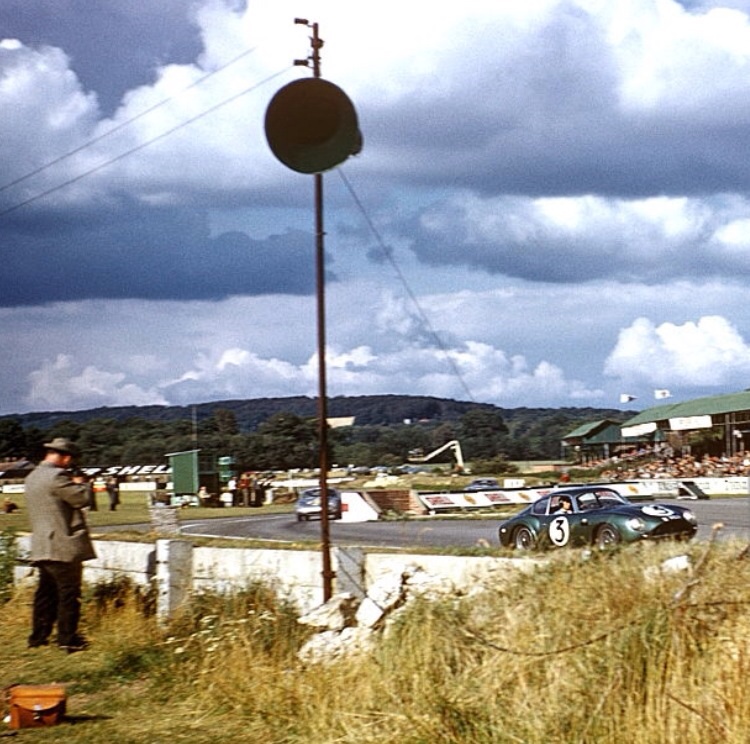
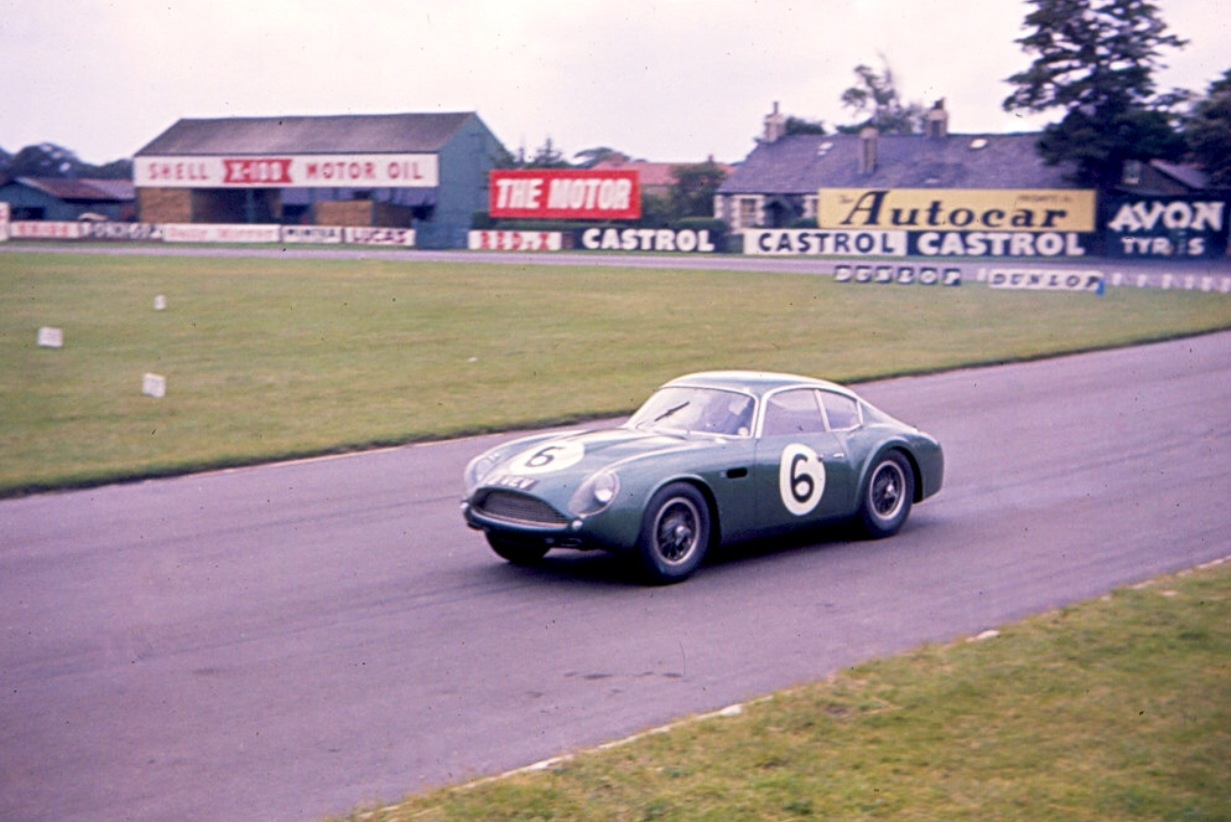
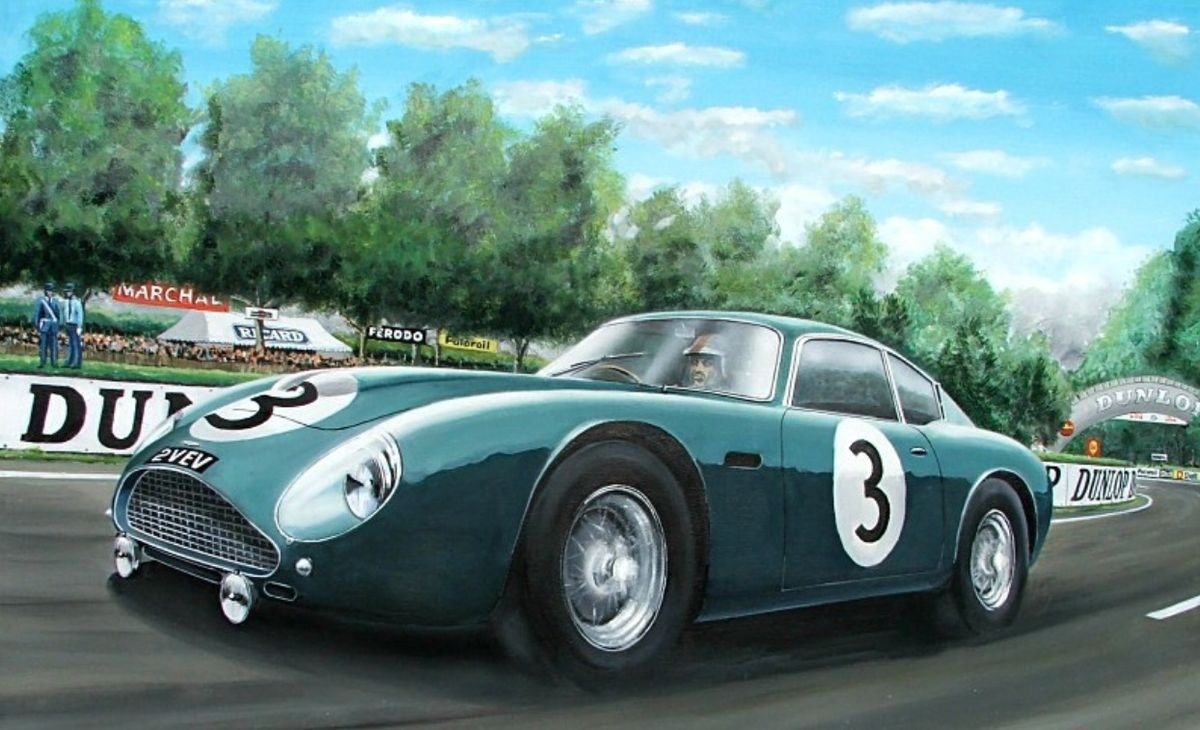
Jim Clark’s Aston Martin DB4GT Zagato ‘2 VEV’ exits the chicane during the Tourist Trophy at Goodwood on 19 August 1961…

I wrote an article about this car a while back, click here to read it, wonderful evocative shot isn’t it!;

Aston Martin DB4GT Zagato ‘2 VEV’: Lex Davison and Bib Stillwell…

image

Jim Clark circa 1962 (Getty)

Credit…

GP Library, Getty Images, Nicholas Watts

Tailpiece: Clark from the Moss and Mike Parkes Ferrari 250SWB’s…

image

(Nicholas Watts)

Finito…

monaco 1961

A famous win for Moss, Rob Walker and the Lotus 18 Climax…

1961 was the first year of the 1.5 litre F1; Ferrari were dominant with their powerful 156’s, the little V6 was the most potent engine, the chassis not a patch on the best of the Brits but overall the Scuderia had a great year.

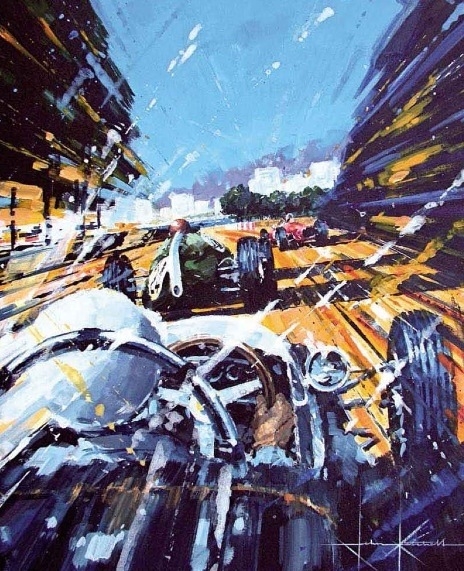
However, the mastery of Moss prevailed several times during 1961. The first of these performances in his lithe, nimble 1.5 Coventry Climax Mk2 engined Lotus 18 is portrayed in the season opening event by John Ketchell’s art.

The great cockpit view shows Moss chasing Jack Brabham’s Cooper T55 Climax and Richie Ginther’s Ferrari 156.

grid

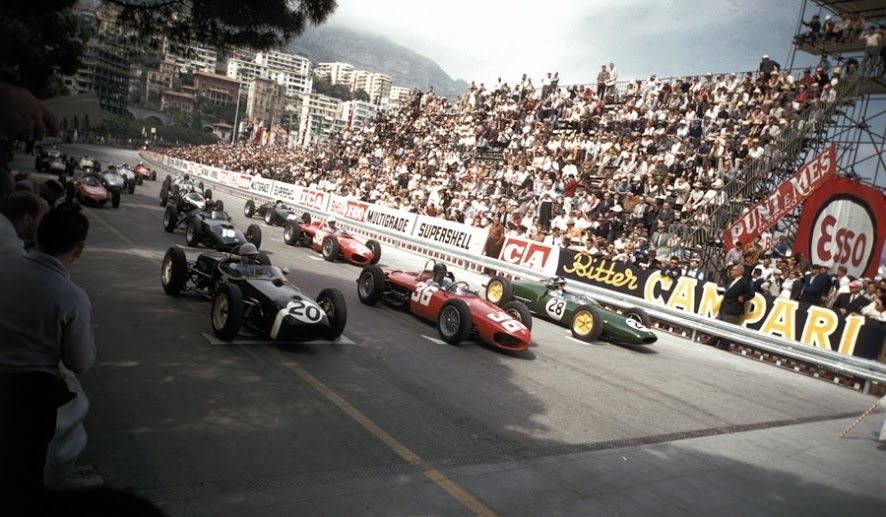
Grid shot: #20Moss Lotus 18 Climax, #36 Ginther’s Ferrari 156 and #28 Clark Lotus 20 Climax front row. Gurney’s Porsche 718 and Phil Hill’s Ferrari 156 on row 2 (unattributed)

image

Hill’s Ferrari, Clark outside #28 , Moss inside with the missing bodywork, #16 Tony Brooks BRM P48/57 Climax#36 Ginther and the silver nose of Gurney’s Porsche 718 (GP Library)


Credit…

John Ketchell, GP Library

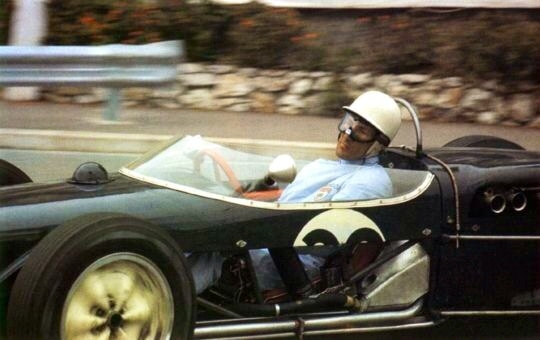
Tailpiece: Maestro Moss…

moss mastery

Moss Mastery; totally relaxed as he gets every bit of performance out of the chassis of his year old Rob Walker owned Lotus 18; works drivers Clark and Ireland are in the new Lotus 20. Side bodywork removed to provide cooling air on the hot May day. Moss won Lotus’ first championship GP win with this victory (Geoff Goddard)

39 esses

(Vintage Racecar)

Leo Geoghegan slices his venerable Lotus 39 Repco into the Warwick Farm Esses, Tasman Series, 15 February 1970…

Terrific shot, the focus is on the driver, the rest of the car blurred giving the impression of speed, something Geoghegan had in abundance.

Leo ‘made his name’ in this car, he was a front-runner from the time he bought it off Team Lotus at the end of the ’66 Tasman Series; Jim Clark was third in it, until the time it was put aside to make way for his Lotus 59 Waggott later in 1970.

geoghegan agp 1963

Faster! Deep in thought on chassis changes with his very hot mechanic, AGP practice 10 February 1963. Lotus 20 FJ 1.5 Ford 9th just behind Frank Matich in the quickest of the 1.5’s. Winner Brabham in a BT4 Climax 2.7 (David Mist)

Geoghegan had a long background in Lotus single-seaters after he graduated from sedans and sportscars in the team his father, Tom founded. Starting with an 18FJ in 1961 he progressed through 20, 20B, 22, 27 and then a 32, which, when fitted with a 1.5 Ford Lotus Twin cam engine gave him two 2nd placings in 1965 Gold Star events. He stepped up to the ‘big time’ with the Tasman Lotus 39.

32 wf

Leo G on his way to 8th in the little Lotus 32 Ford/Lotus 1.5, ‘Warwick Farm 100’ Tasman Series, 14 February 1965 (Bruce Wells/The Roaring Season)

The ‘old girl’ Lotus 39 was frustrating in many ways, its unreliability, like other Repco Tasman users, was notorious, but it gave him the critical 6 points at Symmons Plains in March 1970 before he switched to his new Lotus 59 Waggott. This won him the Gold Star he coveted and deserved…by 6 points from Max Stewart’s similarly powered Mildren. Max’s Gold Star turn would come for the first time in 1971.

39 bathurst

Easter Bathurst Meeting, 15 March 1970, thru ‘The Dipper’. Lotus 39 Repco (Jeff Nield/autopics.com.au)

Lotus 39 ‘R12’….

The Lotus 25/33 series of cars are amongst motor racing’s most famous, the Lotus 25 the first ‘modern monocoque’, Jim Clark took the 1963 and 1965 World Championships’ in Loti’ 25 and 33 respectively.

The 39 is one of this series of cars and like Jack Brabham’s 1966 championship winning BT19 chassis was built for the stillborn Coventry Climax FWMW Flat-16 engine.

image

Coventry Climax FWMW 1.5 litre Flat-16 engine of 1964/5 (unattributed)

The story of this amazing engine is an article in itself; in a nutshell CC’s Wally Hassan and Peter Windsor-Smith were convinced the best route to more power was higher revs (than their FWMV V8) a ‘multi’ was chosen partially due to Harry Mundy’s exposure to the BRM Type 15 supercharged V16 in the dawn of the fifties. Design commenced in 1963, the prototype was on the test bench in 1964.

Torsional problems of the crank were major issues, the engine also failed to deliver more power than the 4 valve versions of the FWMV, which themselves took a bit of development to better the FWMV 2 valve outputs. Then the 1.5 litre GP formula ended and Jaguar took over Coventry Climax; that combination of factors ended CC’s pivotal role as a successful supplier of racing engines for better than a decade.

39 longford

Graham Hill’s BRM P261 leads Clark’s Lotus 39 Climax and Jack Brabham’s Brabham BT19 Repco off Long Bridge, THAT post in front of GH’s LF wheel marks the apex…Wonderful Longford 1966 (autopics.com.au)

Colin Chapman needed a mount for Jim Clark to defend his Tasman title, he won it in 1965 with a Lotus 32B Climax, the unused 39 sitting in the corner of the Team Lotus workshop was ideal.

He tasked designer Maurice Phillippe to modify the engine bay of the car to accept a Coventry Climax 2.5 litre FPF engine. The 39 was different from its siblings in that the ‘D-shaped’ side pontoons of the chassis were ‘chopped off’ at the bulkhead aft of the drivers seat and a tubular steel subframe substituted to carry the CC Flat-16. Changes were made to the frame to accommodate the FPF.

Big thirsty Weber 58DCO carbs fed 2.5 Climax FPF. The frame to support the engine can be seen as can the rear of the Hewland transaxle (I MacNeill)

The 39 side pods also had a more pronounced belly than the 25/33 to ensure sufficient fuel could be carried, having lost capacity by hacking the ‘rear horns’ off the tub on each side. The suspension of ‘R12’ was pure Lotus 33 and was period typical; top rockers actuating inboard coil spring/damper units and lower wishbones and at the rear inverted lower wishbones, single top link and two radius rods for fore and aft location. Adjustable roll bars front and rear as well of course. Steering by rack and pinion and outboard disc brakes on all wheels.

Chapman bought two Climax engines from Bruce McLaren who didn’t contest the Tasman in ’66, he was too busy building cars for his F1 and CanAm programs having just left Coopers.

The 39 was soon on its way to the Antipodes for its race debut in the NZGP at Pukekohe on January 8 1966.

39 jim

AGP, Lakeside 20 February 1966. Clark 3rd behind Hill’s BRM P261 and Frank Gardner’s Brabham BT11A Climax (autopics)

By 1966 the Tasman game had largely moved beyond the old FPF. Brabham debuted his Repco Brabham RB620 V8 engine and BRM modified its F1 P56/60 V8 engines to 1930cc, Jackie Stewart took the title in a P261 with 4 wins from Hill’s 2 with Clark and Attwood (BRM) 1 win apiece.

Clark had a tough start to his 1966 Tasman campaign partially because Colin Chapman switched his Lotus tyre contract from Dunlop to Firestone not long before the Tasman commenced. The tyres had been developed by Bruce McLaren, he had used them for over a year and they were competitive but the 39 had to be adapted to them.

In addition Clark had a run of misfortunes which also reduced testing time; an abortive race at Pukekohe (gearbox) no practice at either Wigram (oil leak and engine replacement/accident when Gardner’s Brabham brakes failed) or Levin (snapped radius rod in practice/2nd). At Teretonga the cars speed was shown with a heat win from Stewart. He was moving away from Jackie in the final only to go out with a spin on dropped oil on lap 3.

In Australia he took a win at Warwick Farm, always a happy hunting ground for Clark. Graham Hill won the AGP at Lakeside from Gardner and Clark. He was 2nd to Stewart’s speedy BRM at Sandown and was 7th at Longford, he had carburetion problems in practice and a plug lead came off in the race requiring a stop and dropping him to the back of the field. Stewart was again the victor, with Jim finishing third in the series behind the BRM duo.

Clark had an amazing 1965 season winning the Tasman Series, Indy 500 and the World Drivers Championship, his start to 1966 was not quite so good, a portent of a tougher year!

39 longford

Superb Clark portrait by Lindsay Ross. Lotus 39 Climax, Longford 1966. He was 7th after a troubled run, Stewart’s BRM taking the win. Note the cars ‘aero screen’ and truncated monocoque which ends at the drivers bulkhead (oldracephotos)

Geoghegans’ were the Australian Lotus importer so a deal was done to buy the car…

John Sheppard is a legendary mechanic/engineer/car builder and team manager with some of Australia’s greatest cars in his CV; the Geoghegan’s cars, Bob Jane’s Repco Torana, Laurie O’Neills Pete Geoghegan driven Holden Monaro and the Holden Dealer Team amongst an extensive and ongoing career of car construction and team management. Early in his career he was appointed as chief mechanic to the Geoghegans.  Tom took a liking to his work preparing the Youl brothers Cooper, the Tasmanian team were using the Geoghegan’s Sydney workshop at the time. John’s first event with the team was preparing Leo’s car for the Australian Formula Junior Championship at Warwick Farm in September 1963, which he won in his Lotus 22 Ford. He shares some of his recollections about his time with the Geoghegan’s throughout this article.

image

John Sheppard in the 39 Repco cockpit circa 1967, hat is the Mickey Mouse Club! (John Sheppard)


Equipe Geoghegan during the Gold Star meeting at Lakeside in July 1966. Total sponsorship, rare colour shot of this livery. Note the addition of lower side panels to the 39 by Sheppo. Leo also raced a Lotus 32 Ford 1.5 and no doubt took some flops off that machine which was fitted ex-works with such panels (P Cross)

Essentially 1966 was a learning year for Leo in the big cars in the domestic Gold Star Championship. His limited campaign excluded the Mallala and Sandown rounds, 2nd to Spencer Martins Brabham BT11A at Surfers Paradise his best result. A duff wheel bearing was the cause of a DNF at Lakeside, he didn’t start both the Symmons Plains and Warwick Farm rounds with Coventry Climax engine problems.

Sheppard recalls; ‘The Lotus 39 was a great car although the engine problems we had were a function of very tired engines, the blocks were cracked so it was a problem keeping them running in that first year. When we took over the car they had a strange set-up to deal with the vibrations of the big Climax-four, they put rubber o-rings between the cylinder head and inlet manifold letting them flop around, and i mean flop around so Jim had problems with throttle control. We easily fixed this with a more conventional set-up of putting the o-rings between the inlet manifold and carbs’.

‘We didn’t have problems with the Firestones but i recall Leo, having fiddled around with set-ups based on tyre temps and the like at an early tyre test embarrassing the Firestone guys a bit when his ‘seat of the pants’ set-up changes gave immediate results. Leo was quick in the car straight away, i asked Bob Jane to get his driver (Spencer Martin) to stop baulking mine at Warwick Farm and Bob of course telling me to piss-orf…’

Fifth in the Australian Grand Prix ’67 Tasman Round at Warwick Farm and 2nd the following weekend behind Clarks Lotus 33 Climax FWMV 2 litre V8 at Sandown was indicative of speed and better Coventry Climax reliability.

39 cover

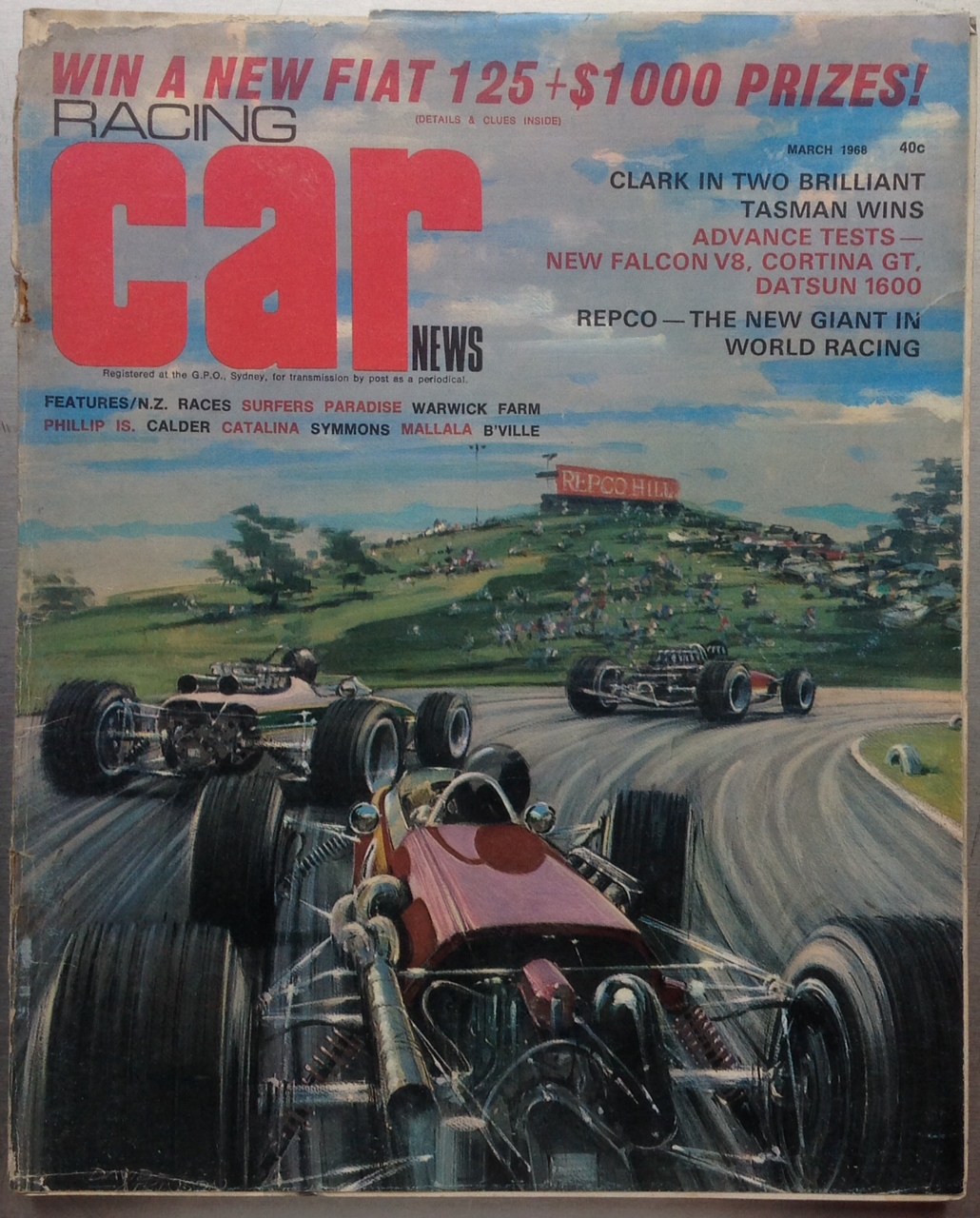
Geoghegan’s Lotus 39 sharing the AMR 1968 cover with Chris Amon’s Ferrari Dino 246T. 39 here with ‘740 Series’ Repco V8 and quite the prettiest thing with its carefully, thoughtfully aerodynamic rear bodywork developed for it by John Sheppard. Knock on wheels, Castrol color scheme just gorgeous with the speed if not always reliability to match

In 1967 Sheppard and his team did a beautiful job converting the car to a 2.5 litre Repco ‘640 Series’, ‘exhaust between the Vee’ spec engine in April. They created quite the most beautiful sixties single seater. OK, maybe Gurney’s Eagle T1G gives it a run for its money! The FPF developed around 235bhp, the ‘640’ 275bhp@8500rpm.

Sheppard; ‘It was an easy decision to go with the Repco, our Climaxes were old and tired and Repco were keen to do business with everyone. It wasn’t the biggest saga to adapt the Repco V8, we made new chassis tubes to accommodate the wider engine and used the original Hewland HD5 gearbox. The suspension geometry wasn’t touched, in fact it wasn’t the whole time i worked on the car (to the end of 1968) which shows the bloke who designed and built it knew what he was about. As tyres evolved we still got the results by simply getting the best from the tyres making set-up changes based around getting tyre temps even across the tread. Basic but important stuff.’

‘The chassis and bodywork, we made a nice rear cowling or engine cover, was done by Alan Standfield who worked out of his fathers ‘Supreme Mousetraps’ factory out near Mascot. (near Sydney Airport) It was all a bit bizarre but he did good work in grotty conditions with loads of noisy machines making springs and sawdust from the ‘trap bases all over the place!’

Leo took his first Gold Star round win at Sandown in September, Sheppo recalls; ‘Early in the Repco piece i said to Frank Hallam (GM Repco) ‘you should be nicer to us because we will win the first Gold Star race for you, he turned and walked away. I had great delight in walking up to him and telling him ‘I told you so’ when we took that Sandown win which was Repco’s first Gold Star win too’

The Climax FPF engined Brabham BT11A’s were superbly driven by Spencer Martin and Kevin Bartlett and just had the legs and reliability to pip the more powerful Repco engined cars of Greg Cusack, Geoghegan and John Harvey that year. Martin took the title.

39 tow rope

On the end of a tow rope as was the case all too often. Here its a Coventry Climax engine failure; the FPF popped back into the car after early 1967 Repco frustrations for the final WF Gold Star round, DNF with overheating (Peter Windsor)

Leo was so miffed by the lack of reliability of the Repco that his team popped the Climax back into the car for the final Gold Star round, the Hordern Trophy’ at Warwick Farm, not finishing that race either, the Climax overheated.

Sheppard; ‘We didn’t have a good run with the Repco’s early in the piece. The 640 Series Repco, the Olds block engine chucked its oil out of the crankcase, the scavenging arrangements were poor, the stiffener plate was ‘out in the breeze’, oil sat on that and got thrown around. Leo said the engine was hard to drive as there was little power below 6500-7000rpm. The 700 Series blocks were better but in many ways by then the opposition had caught up with the Cosworth and Ferrari Dino engines competing in the Tasman. The engine was a clever design though, you could take the heads off without disturbing the timing chest and vice-versa, i give Repco ten out of ten for the way they went about things.’

For the 1968 Tasman Series all local Repco clients engines were updated to the latest specifications with 700 Series blocks.

39 and brm

Leo’s 39 chases Richard Attwood’s BRM P126 at Surfers Paradise 1968. Great butt shot of both cars and a contrast of the beautifully faired Lotus and messy, bulky BRM V12. Neat packaging of the 1967 World Championship winning ‘740 Series’ V8 clear (here in 2.5 not 3 litre form). ‘Between the Vee’ exhausts easy for the chassis designer, no complex plumbing issues of pipes and tubes or an ‘ally tub. Trumpets for Lucas fuel injection and Bosch distributor cap clear also between the Vee. Car uses the same Hewland HD5 gearbox as it did with the Cov Climax FPF engine. Diaphragm to which ‘everything’ attached also clear at the very back of the chassis. Suspension at rear period typical; single upper link, inverted lower wishbone, 2 radius rods forwards for location and coil spring/damper unit with an adjustable roll-bar (Brian McInerney)

Into 1968 the Tasman Series got even tougher as the International Teams brought 2.5 litre variants of their current GP machines; the Lotus 49 DFW and the BRM P126 V12. The Mildren Team acquired a one-off Brabham BT23D powered by a 2.5 litre version of Alfa Romeo’s Tipo 33 sports car engine and Ferrari brought 2 2.4 litre Dino V6’s, the 246T.

Geoghegan, as in the prior year did only the Australian rounds; his 4th at Surfers on the same lap as the new Lotus 49’s in his 3 year old car his best result.

39 surfers 68

Who is the Belle of the Ball? Geoghegan’s Lotus 39 Repco DNF beside Brabhams Brabham BT23E Repco 7th , Rodriguez BRM P126 6th in a P261 with Clarks Lotus 49 1st. Warwick Farm practice, Tasman 1968 (The Tasman Cup)

He lost an oil line at Warwick Farm, finished 7th at Sandown, both events won by Jim Clark’s dominant Lotus 49 and elected not to start the final, very wet Logford round given the lack of a suitable tyre for the treacherous circuit.

39 and 49 surfers

Hill, Gardner, Geoghegan and further back Kevin Bartlett squabble over 2nd place on lap 2 of the Surfers ’68 Tasman round, Clark is up the road. Lotus 49 DFW, Brabham BT23D Alfa, Lotus 39 Repco and Brabham BT11A Climax (Rod MacKenzie)

Kevin Bartlett was the class of the Gold Star fields in 1968 winning the title by 10 points in the Brabham Frank Gardner drove in the Tasman. Geoghegan’s old Lotus was still fast; he took pole at Sandown and Mallala and won the race but otherwise the car lacked the consistency and speed to win the title.

39 catalina

Geoghegan Catalina Park, Blue Mountains, NSW 1968 (Paul Hobson)

Chris Amon took the 1969 Tasman in his superbly driven and prepared Ferrari Dino 246T from Jochen Rindt, Lotus 49 DFW Piers Courage, Brabham BT24 DFW and Derek Bell’s Dino 246T.

Geoghegan, still driving the ‘old lady’ contested the full series; 5th at Pukekohe in the series opening NZGP behind the four drivers above, 4th at Levin, he missed the final NZ, Teretonga round.

39 puke

Leo’s Lotus 39 Repco ‘730 Series’ NZGP paddock, Pukekohe 4 January 1969. 5th in the race won by Amon’s Ferrari Dino 246T (Habu/The Roaring Season)

Straight to Queensland he was a splendid 3rd in the AGP at Lakeside behind Amon and Bell. He was 5th in his home, Warwick Farm race and had fuel tank problems in the final Sandown round.

39 lakeside

Lakeside in the AGP; 4/5 year old car 3rd at Lakeside behind the Ferrari 246T’s of Amon and Bell (Rod MacKenzie)

Seventh in the series, the highest placed local was a superb result for a small team running a 4 year old car against GP Teams running their latest car.

leo

Leo running wings at the Warwick Farm Tasman round on 9 February 1969. Sydney the teams home base. With very low angle of attack mind you. He chose not to run them at the fast Tasman final round at Sandown the following week. He was 5th in the ‘pissin wet race won by Jochen Rindt’s Lotus 49B Ford DFW, therefore this dry day is practice (Dick Simpson)


39 sndoawn 2

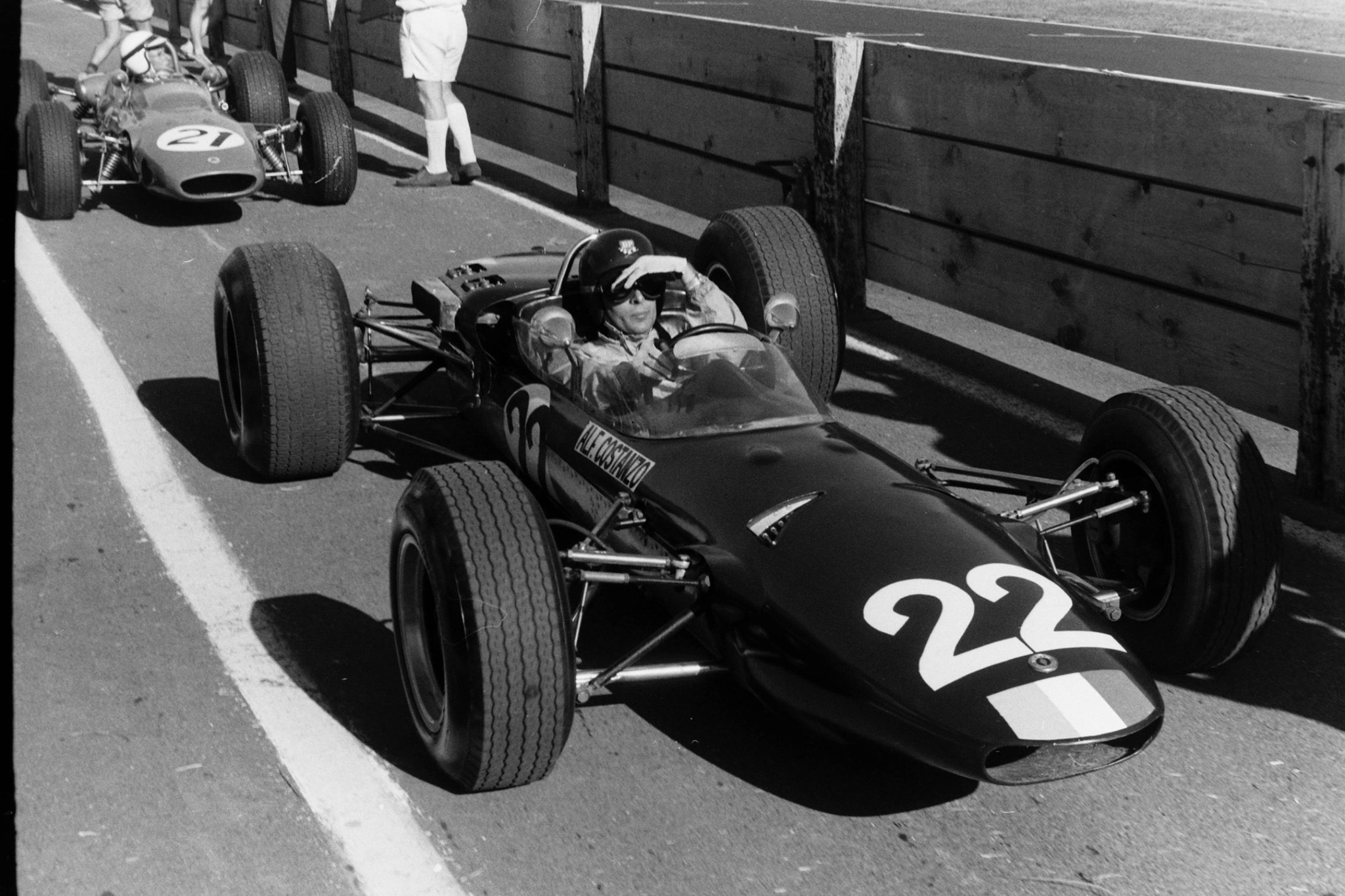
Sandown Tasman practice, 15 February 1969. Running head of Alfie Costanzo’s McLaren M4A FVA. Leo DNS with a fuel tank leak, Alf DNF engine (Rod MacKenzie Collection)

For the 1969 Gold Star Series the 39 was more competitive than in ’68 being  fitted with the latest Repco’730 Series’, crossflow head V8 used in the Tasman, this gave 290bhp@8600rpm. The car was now running wings and whilst less aesthetically pleasing than its earlier form was fast.

39 symmons

Symmons Plains Gold Star 3 March 1969. Leo was 2nd to Kevin Bartlett’s Mildren Alfa (right)  (Ellis French)

Interesting shots at Symmons Plains, Tasmania 3 March 1969 above and below. Both the 39 and Kevin Bartlett’s Mildren Alfa ‘Yellow Submarine’ sporting the hi-wings de-rigeur for the previous 12 months and soon to be outlawed over the Monaco GP weekend a month or so hence. My two favourite ‘Australian’ open-wheelers of the 1960’s albeit not in their most aesthtically pleasing form. Bartlett won the round with Leo second.

Repco ‘730 Series’ Repco V8, notice the steel ‘A-Frame’ to brace the wing supports referred to in the text and wider rear wheels but same sized fronts compared with earlier shots. Tyre widths increased dramatically from cars build in 1965 to 1970.

Locating stays for the 39 rear wing beefier than most, the failure of these in a whole swag of cars, notably the two Lotus 49’s of Rindt and Hill during the 1969 at Montjuich Park, Spanish GP the catalyst for the CSI to mandate changes to wings.

39 symmons 2

Symmons Plains Gold Star 1969, Geoghegan’s Lotus 39 Repco, KB’s Mildren ‘Yellow Submarine’ Alfa behind (Ellis French)


39 bathurst 1969

Bathurst Gold Star round 7 April 1969; Max Stewart Mildren Waggott, Niel Allen McLaren M4A Ford FVA and Geoghegan’s Lotus 39 Repco on pole. Brabham won in his BT31 Repco from the back of the grid with the front row all DNF. An accident took out Stewart and Allen, Leo had a gearbox problem (Wayne McKay)

Kevin Bartlett took the Gold Star championship again using the Mildren ‘Yellow Submarine’, initially Alfa Romeo V8 engined and later in the year in Waggott TC4 valve form. This engine developed by Sydney engineer Merv Waggott is a story in itself, it won Gold Stars for Bartlett, Geoghegan and Stewart in 1969-71 beating 2.5’s and in 1971 F5000’s to the title.

Leo was 2nd with 20 points to Kevins 33 and had reliability but perhaps not the ultimate speed, seconds at Symmons Plains and Mallala Gold Star season highlights for the old beast.

The 39’s day finally arrived 4.5 years after it was built; Geoghegan won the 1969 JAF Japanese Grand Prix in the Lotus from Roly Levis Brabham BT23C FVA and Sohei Kato’s Mitsubishi Colt F2-C 1.6. I covered this great win in an article about Leo last year, click here for the link; https://primotipo.com/2015/03/02/leo-geoghegan-australian-driving-champion-rip/

39 jaf

By 1970 F5000 was adopted as the new Tasman Formula albeit 2.5 litre Tasman cars were also eligible, the smaller cars gave the big V8’s ‘plenty of curry’ in that first year with Graeme Lawrence winning in Chris Amon’s victorious 1969 Ferrari 246T ‘008’. Bartlett took the Warwick Farm round in the 2 litre Mildren ‘Yellow Sub’, another small-car win..

39 sandown paddock

Tractable these Repco’s! Chugging thru the 1970 Sandown paddock. Nice shot showing the 33 style tub, fuel filler in front of dash bulkhead and late ’69-70 wing (Jeff Scriven Collection)


39 sandown

Same day as above with Leo in the red hat alongside his mount. Hard to see but front suspension is top rocker, lower wishbone and inboard spring/damper actuated by rocker (Jeff Scriven Collection)

Geoghegan raced the Australian rounds only for 7th at Surfers and Warwick Farm, he was DNF at the Sandown final round.

Into the domestic 1970 season Leo raced the car in the first Gold Star round at Symmons Plains, here below he shares the front row of the grid with John Harvey’s red Brabham BT23E Repco and Kevin Bartlett’s Mildren Waggott ‘Yellow Submarine’. KB’s absence racing in the US for much of the year took out a tough adversary in 1970.

39 symmons 2

Gold Star round 1 1970. Symmons Plains 2 March 1970. John Harvey won in his #2 Brabham BT23E Repco from Leo obscured this side and Bartlett’s #5 Mildren Waggott (autopics.com)

The last significant meeting in which the 39 raced was the March Easter Bathurst meeting in which Niel Allen’s McLaren M10B Chev F5000 car set a lap record which stood for decades. ‘Outright’ open-wheelers have not raced at Mount Panorama given the speeds of the cars and inherently dan gerous nature of the circuit as it was then. And still is, despite huge improvements in circuit safety.

39 bathurst 1970

Easter Bathurst 1970, contrast this shot with the hi-wings from the year before above. John Harvey’s #4 Bob Jane Brabham BT23E Repco ‘830 Series’ Repco V8, Leo’s 39 Repco ‘730 Series’ V8 and Niel Allen’s obscured McLaren M10 B Chev F5000 (Rod MacKenzie Collection)


59 wf

Leo in the new Lotus 59 Waggott, Warwick Farm’s Pit Straight 1971 (oldracephotos/Schell)

Whilst the 1970 Tasman series was run to F5000 the Gold Star Series in an interesting piece of CAMS (Confederation of Australian Motorsport) decision making driven by politics was run to the 2.5 Tasman Formula.

From Leo’s perspective the path was clear; the circa 275bhp 2 litre Waggott engine was powerful, light, reliable and better still would bolt straight into the back of the Dave Baldwin designed F3/F2 Lotus 59. As the Lotus importer, the core of the Geoghegan’s business road cars of course, his preference was a Lotus which could win the title, his F5000 options were a domestic season away.

59 op

The Geoghegan’s cars; Leo’s and Pete’s Touring cars were always beautifully presented, giving the sponsors great exposure. Here the 59 Waggott, in Castrol colors. As beautifully integrated a package as the 39 Repco in its ‘740 Series’ Repco days. Oran Park Gold Star round, 27 June 1970 (Lynton Hemer)

The 59 already had a successful season of racing in Europe with Emerson Fittipaldi taking the 1969 British F3 title and Jochen Rindt and Graham Hill winners in European F2 events; 4 rounds for Jochen and 1 for Graham. In essence the engine and chassis were a proven package.

And so it proved to be; Leo took wins at Warwick Farm and Mallala and seconds at Oran Park and Symmons Plains when the ‘old lady’ 39 held together and scored 6 valuable points…

leo oran park

Leo G during tyhe driver parade before the 27 June Oran Park 1970 Gold Star round won by Max Stewart (Lynton Hemer)

Leo Geoghegan’s Later Open-Wheeler Career…

This article was to have been a ‘quickie’ around the few shots at the start  but as usual i have  ‘rabbited on’.

The article isn’t intended to be a Leo G whole of career one, the focus was the Lotus 39. Leo raced the Lotus 59 Waggott on into 1971, that chassis is still in Australia, i will write about it separately.

Geoghegan was a factory driver for Chrysler, as covered in the other article link provided earlier, he developed and raced Valiant Pacers and Chargers for the Tonsley Park, Adelaide based company in the incredibly popular Series Production (showroom stock essentially) races which proliferated, like a disease, in Australia in the late 1960’s, the growth of ‘Taxi Racing’ in Oz remains undiminished and omnipotent.

274

Leo at Oran Park, ‘works’ Grace Bros sponsored Birrana 274 Hart Ford 1974. Jewels of things, fast ones. Aluminium monocoque chassis, Hart Ford 416B injected, often ‘ally blocked, Twin-Cam circa 205bhp, Hewland FT200 5 speed ‘box (oldracephotos.com/Peter Schell)

But Leo was a ‘died in the wool open-wheeler man’ and accepted a works drive with Adelaide’s nascent Birrana Engineering; Malcolm Ramsay and engineer Tony Alcock built some fabulous cars in three short years which turned upside down the local single-seater market, the jewel like cars winning the Australian F2 Championship from 1973-1976.

Leo took two of the titles in 1973 and 1974, finally retiring from single-seaters at the end of 1974. He went out with a bang though. The 1974 AF2 Championship was one of the most closely contested and competitive openwheeler championships in Australia ever. ‘Van Heusen’ shirts tipped in good sponsorship and established F5000 aces and young thrusters made for some sensational racing. But wily Leo, at 38 still very fast took the title by 4 points from Aussie International Bob Muir in another Birrana.

Birrana Cars is a story for another time.

John Sheppard on Leo as a driver; ‘He was incredibly fast, as good as anyone he competed against capable of just not keeping up with but beating world champions. Leo in a way kept to himself, Pete was more ‘one of the boys’ so Leo and i didn’t discuss his career aspirations but he got a lot of satisfaction from racing with the drivers that he did; world class drivers. He was very precise, Pete would throw around what he was given, Leo used the same bit of road lap after lap, very consistent, precise and fast’.

R12 in Modern Times…

Leo focussed on the 59 but gave Formula Vee ace Bernie Haehnle a test of the 39 in the wet, at Amaroo Park in May 1970. With predictable results, poor Bernie took the left-rear corner off the car. The difference from a 40bhp Rennmax FV to 280bhp Tasman car in the wet would have been marked!

39 after Bernie Haehnle’s Amaroo Park 1970 shunt (D Simpson)


39 wf 1970

Leo G, 1970 Gold Star champion in his old car later in the year at Warwick Farm. 22 November. Lotus 39 Repco (Dick Simpson/oldracephotos.com)

The car was tidied up visually, Leo gave it a run at Warwick Farm late in the year in its original color scheme but still running a Repco engine, it was then offered for sale. The Repco engines on loan were returned to Melbourne and those owned by the Geoghegans sold. Australia’s sports-racing car fields were the beneficiaries of a surplus of ‘cheap’ 2.5 litre Repco V8’s; two Elfin 360’s and  two Rennmax’s  specifically.

39 winton

Darryl Pearsall’s Lotus 39 Ford Twin-Cam ‘R12’ in the Winton, Victoria paddock in 1973/4 (oldracephotos.com)

The long racing life of R12 continued on for a year or so as an AF2 car, Darryl Pearsall the new owner. F2 then was a 1.6 litre, 2 valve class effectively mandating the Lotus/Ford Twin Cam. The car was fitted with a Twin-Cam and when sold was purchased by John Dawson-Damer for his superb collection of Lotus’s in 1976.

The car was restored to its original Coventry Climax FPF engined form and fortunately when sold after JDD’s death and realisation of some of his collection remained in Australia, fitting given the cars Australian history. It lives in Tasmania loved to bits by a lifelong Jim Clark fan, Chas Kelly.

39 restored

Lotus 39 Climax ‘R12’ at the Longford Revival Meeting in April 2011. Restored but not over-restored, a balance we tend to get right in this country! (Ellis French)

Etcetera…

Clark Lotus 39.

39 longford 3

Longford front row 1966. #1 Clark’s Lotus 39 Climax and the two BRM P261’s of Hill #2 and Stewart beside the fence (Ellis French)


clark wf 1966

Clark and mechanics looking typically relaxed during the Tasman. Here at Warwick Farm with R12. February 1966 (unattributed)

Click on this link for a lovely story related to the photo above about the ’66 Tasman.

https://open.abc.net.au/explore/45668

image

Geoghegan 39.

geoghegan portait

Leo G portrait circa 1963. Colors on helmet ‘Team Total’, the French oil company a strong supporter of motor racing in Australia at the time. Lotus 22 or 27 (Ray Berghouse)


lotus 39 sandown

Sandown Park paddock, Tasman ’67. Leo finished 2nd to Clark’s Lotus 33 Climax FWMV 2 litre V8 in ‘The Sandown Cup’. Nice shot shows the car in its Coventry Climax FPF engined/Castrol Racing colors. This is 26 February 1967, the Repco V8 was installed that April (Mike Feisst/The Roaring Season)


image

This is a nice shot of the 39 of the Repco 740 Series V8 installation, Surfers Tasman round in February 1968. Cooper S is that of top touring car driver John French (Rod MacKenzie)


39 sandown paddockl

These days the crowds are all over the ‘Taxis’, in the days of yore the focus was where it should be, on fast open-wheelers! Sandown paddock, am guessing Tasman Meeting 1969 (Jeff Morrall)


39 wf

Leo’s Lotus dips under brakes for Creek Corner at the end of Hume Straight in 1970 (Lynton Hemer)


39 repco engine

Lotus 39 business end in its Repco ‘740 Series’ 2.5 V8 days. 275bhp@8500rpm, the engine weighed 345lbs/157Kg. Gearbox Hewland HD5. Note Repco logo on LH cam cover, Smiths tacho drive on the RH cam cover. Lucas fuel injection, Bosch distributor between the Vee. 1967/8 (John Stanley)


image

Bibliography…

Thanks very much to John Sheppard for his time and recollections

Graham Howard and Ors ‘History of The Australian GP’, oldracingcars.com

Photo Credits…

Vintage Racecar, oldracephotos.com, Peter Schell, Dick Simpson, Bruce Wells, Habu, Mike Feisst/The Roaring Season, Lynton Hemer, Rod MacKenzie, Ellis French, John Stanley, Paul Hobson, Wayne McKay, Jeff Scriven Collection, Ray Berghouse, David Mist, John Sheppard, Brian McInerney, Jeff Nield/autopics.com.au, Tony Loxley ‘Tasman Cup’, Peter Windsor, Ian MacNeill, Paul Cross

Tailpiece: Leo takes Miss Queensland for a squirt around Lakeside in the family Lotus 23 Ford. Brother ‘Pete’ raced this car, not certain of the date, but 1965’ish…

39 babe


clark

Rod MacKenzie’s moody, foreboding, evocative image of Jim Clark’s Lotus 49 at Longford in 1968 is one of my favourites…

Clark is exiting Newry Corner on the run towards the ‘Flying Mile’. He started from pole, winning 100 bottles of champagne in the process and finished second in the Saturday preliminary race in beautiful weather but the clouds opened on Monday morning for the Tasman Championship event, ‘The South Pacific Trophy’.

Star of the show was Piers Courage who drove a gutsy, skilful race in the most challenging, treacherous conditions to win the event in his little F2 McLaren M4A FVA ahead of the big Tasman 2.5’s of his close competitors. Pier’s car was self run, his performances in it that summer reignited his career.

courage

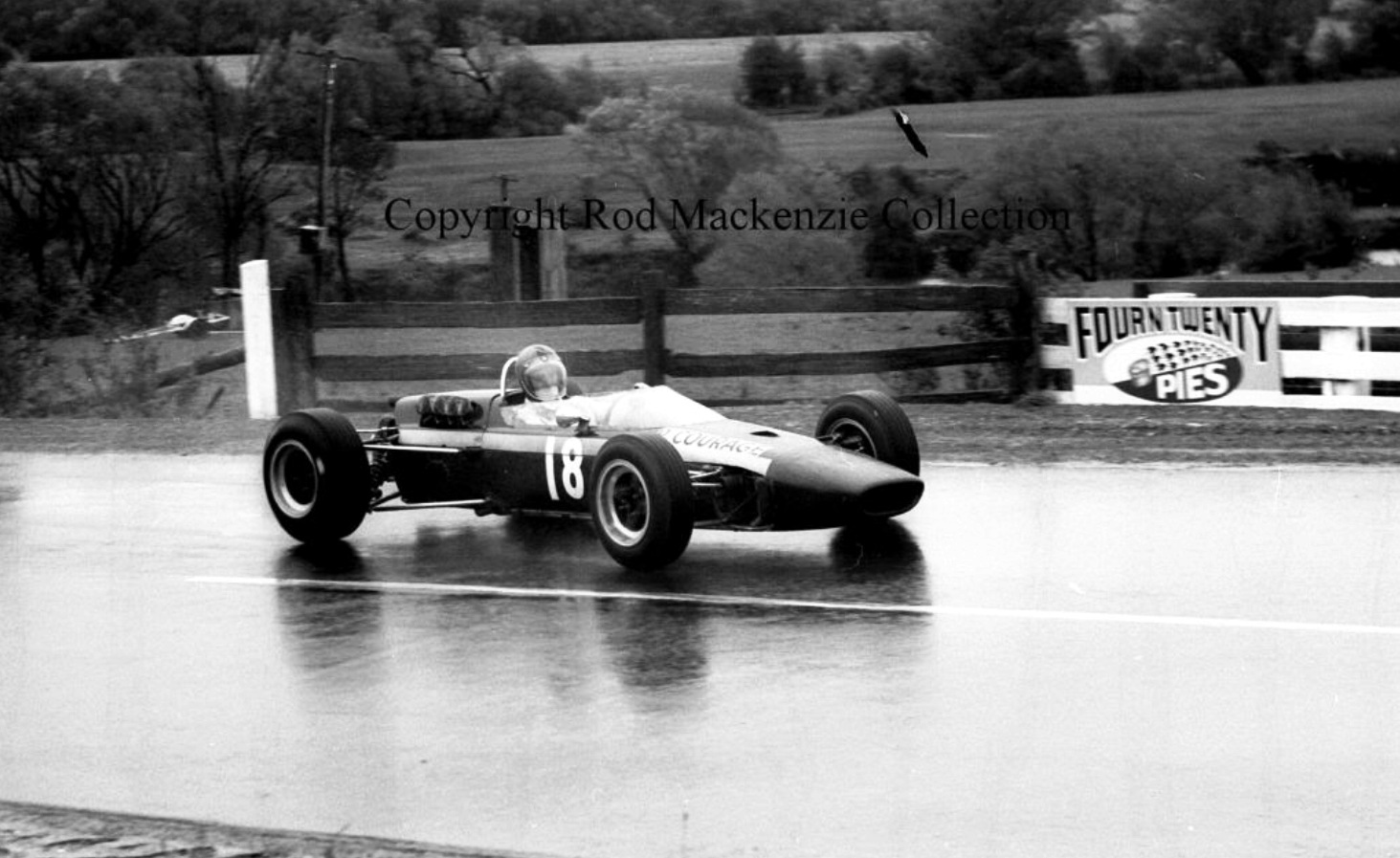
Piers Courage in his McLaren M4A F2 car, Newry Corner, Longford 1968. Power was not all on this fast circuit in such wet conditions, but the plucky Brit was giving away at least 130bhp to his 2.5 litre V8 powered opponents (R MacKenzie)

Pedro Rodriguez and Frank Gardner were second and third in BRM P261 2.1 V8 and Brabham BT23D Alfa 2.5 V8 respectively. Clark was fifth in his Ford Cosworth DFW engined Lotus 49, the 2.5 litre variant of the epochal 3 litre DFV GP engine.

Jim Clark chewing the fat with BRM’s Tim Parnell- all the fun of the fair, Longford 1968, Clark’s Lotus 49 Ford DFW ready for action (oldracephotos/Harrisson)


Clark and the boys with Denny Hulme’s Brabham BT23 FVA behind (HRCCT)

Lets go back to the start of the meeting, marvellous from the Tasmanian’s perspective as the series went down to the wire, Chris Amon was still a potential series victor with only six points between he and Jim Clark with Piers Courage’s third place within Graham Hill’s grasp depending upon how he fared.

Chris Amon blew the sealing rings in the Ferrari’s little V6 keeping his crew busy for the evening whilst Pedro Rodriguez popped an engine too- the BRM mechanics therefore readied the P261 V8 for the race rather than the P126 V12 the Mexican raced in the Saturday preliminary. Piers Courage tapped the nose of his pristine McLaren M4A when the flaggies got so enamoured of the cars they forgot to signal oil on the track! All was well at Gold Leaf Team Lotus.

Lap 1 of the preliminary on Saturday, Geoff Smedley’s amazing colour shot- Clark from Hill, Amon, Gardner and one of the BRM’s- Lotus 49 by two, Ferrari 246T, Brabham BT23D Alfa and BRM P261 0r P126 (G Smedley)

Practice times didn’t mean too much as the teams were focused on race setup for the twelve lap Saturday preliminary race ‘The Examiner Racing Car Scratch’ which also counted for grid positions. In the second session of practice Clark did a 2:12.8, Hill 2:13.6 and Amon 2:13.8. Clark was under Jack Brabham’s record set on the way to his win the year before in his BT23A Repco, Jim won 100 bottles of champagne for pole as stated earlier.

In the preliminary on Saturday the grid formed up with Clark on pole. Hill comfortably won the event run in fine, dry weather from Clark and Amon. Both Lotuses were timed on the Flying Mile at 172 mph but Amon’s 182 mph in David McKay’s ex-works Ferrari P4/Can Am 350 sportscar rather put the single-seaters in the shade! Lets not digress about that car now, follow the link at the end of this article for a long piece about the P4 which Chris raced in the sportscar support events in each of the Australian Tasman rounds.

Hill G leads the pack off Long Bridge on lap 1 of the Saturday preliminary. Hill, Clark, Amon, Gardner, Leo Geoghegan Lotus 39 Repco, a BRM and perhaps Kevin Bartlett Brabham BT11A Climax (R MacKenzie)


Exit from Newry, lap 1 of the preliminary- Hill, Clark, Amon, Gardner, Geoghegan’s Lotus flirting with the tracks edge, and Attwood. Great shot shows how the circuit rises at this point into the right hand kink up the road (S Geoghegan)

Only a couple of supporting races had been run on the Monday raceday when light rain started to fall at about 10am, this soon became heavy. As the rain got harder and the clouds more threatening it was obvious that it was not likely to abate before the 2.15 pm race start time

The track was almost under water at some points where hay bales had broken up and straw was blocking the drains. Efforts by track officials soon had most of the drainage system under control.

A large crowd was of course present on the Labour Day long-weekend. Crews brought the cars out onto the circuit in front of the pit counter and stood together under umbrellas as the drivers went into a huddle with the promoters of the meeting and the CAMS stewards to determine if the race should go on.

Leo Geoghegan and Lotus 39 Repco return to the Longford pits after some exploratory laps. DNS with unsuitable tyres. Its the Courage McLaren by the pit counter (oldracephotos)

Sergent.com report that first it was decided that the cars should do a couple of exploratory laps then report their findings.

Geoghegan, Amon, Clark, Hill, Attwood, Gardner, Bartlett and others went out and after looking like motor boats ploughing through the water delivered their thoughts to the meeting. The conditions were so bad various drivers with unsuitable tyres elected not to start having driven some ‘sighting laps’.

Kevin Bartlett recounted his experience in the Alec Mildren Racing Brabham BT11A Climax; ‘I did two exploratory laps and the old BT11 couldn’t find traction anywhere. I had an absolutely terrifying 4th gear 720 degree spin across the short Kings Bridge, the one after the Viaduct, missing all the obstacles at the tracks edge. After exiting Pub and in a straight line i did a 360 degree loop. She nearly escaped me over the rail line on the way to Long Bridge. Out of Newry and up the hill to the straight slithering along with no touch felt between me and the bitumen, so i suppose I thought at that moment to do another lap at a very reduced speed then pit’.

Packed car park: Amon’s Dino, the BRM’s of Attwood and Rodriguez, Pedro’s P261 fully covered, the two Lotus 49’s, Piers McLaren, then Leo G’s Lotus 39 and John Harvey’s Brabham BT11A (oldracephotos)

long

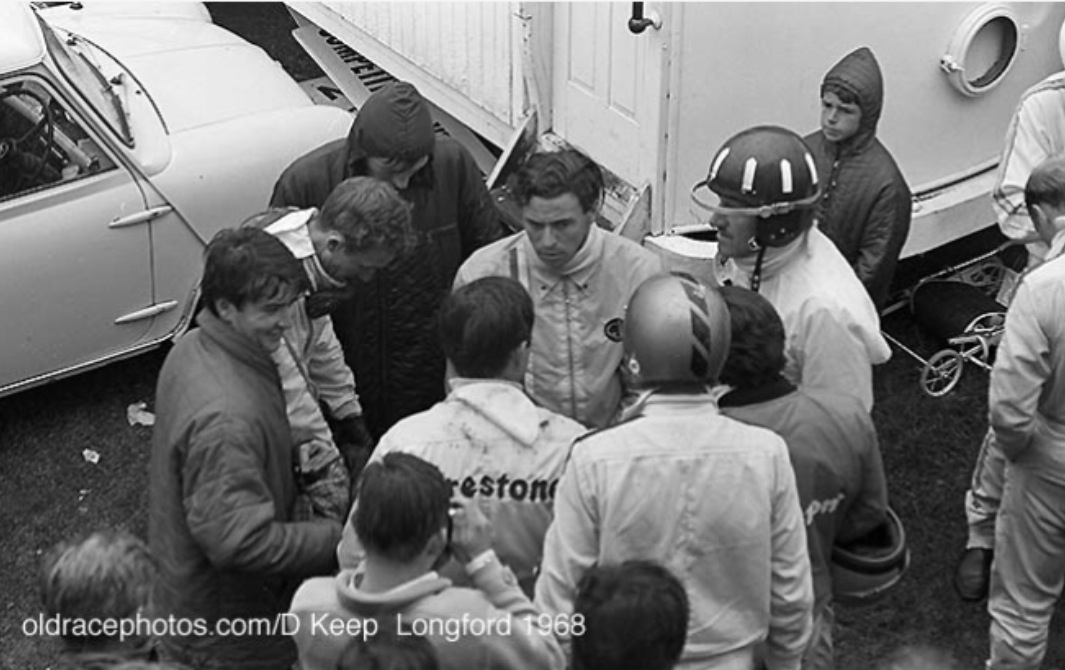
‘What are we going to do boys?!’ Drivers considering their options before the race, the pouring rain exacerbated by drains beside the track which couldn’t cope with the deluge; Clark facing us, Hill’s distinctive helmet clear. Courage with his back to us in helmet, Gardner’s lanky frame partly in shot to the right. Amon in the ‘Firestone’ suit, Harvey? at left with head down (oldracephotos)

‘Once back in the tent Alec, Frank (Gardner) Denny (Hulme Brabham BT23 FVA F2) and i had a talk about the tyres that Denny and i had and after trying to come up with a better tread pattern, such as the ones fitted to Franks car (Brabham BT23D Alfa) but with no result. It was agreed that Denny and i shouldn’t risk a start. I was happy with the call and Leo (Geoghegan Lotus 39 Repco) followed suit. Most of the top guys had the latest Firestone, Dunlop or Goodyear wets but none were available to suit the BT11’s. I consoled myself with the fact that if the new world champion (Hulme) didn’t like the risk i certainly shouldn’t!’

Longford, wonderful circuit that it was, provides no runoff area for a driver to go in the wet (or dry!) should a driver lose control or suffer a bad attack of aquaplaning, and this was the main point in contention.

The ill fated Brabham BT23A Repco ‘740’ of Greg Cusack on Friday or Saturday (oldracephotos)

Greg Cusack in David McKay’s Scuderia Veloce Brabham BT23A Repco (Brabham’s victorious Longford mount from 1967) had left the road that morning. He lost the car on the greasy road as he went over the hump/bump on the approach to The Viaduct. The car left the road, hit a bank, somersaulted and crashed into a ditch, he was then pinned under the it before being quickly released by officials.

The 37 year old Canberra motor dealer, who had intended Longford to be his last race meeting, was taken to Launceston Hospital with chipped bones to both knees, stretched ligaments and a fractured left wrist. He was lucky it was not a good deal worse. Bib Stillwell organised for one of his planes to fly Cusack and his wife home to Canberra on the Tuesday where he was admitted to hospital.

Whilst Cusack lay in hospital the other drivers were trying to explain the difficulties of Longford which were exacerbated hugely in the wet. ‘Motoring News’ reports at length about the cordial discussions between the drivers and officialdom and all of the competing issues of safety, providing a show and running a race to determine the winner of the Tasman Cup.

The Stewards finally ruled that the race should go ahead but be shortened to 15 laps of the 4.5 mile circuit, (128 miles to 68 miles) and put the starting time back to 4pm hoping the rain would ease and the situation be safer as a consequence. At 4.15pm the sodden cars and their game, uncomplaining drivers were facing the soggiest start ever seen at Longford, one of the most challenging road circuits in the world.

Front row- Amon Ferrari 246T and the two Lotus 49 DFW’s of Hill and Clark, that’s Frank Gardner’s Brabham BT23D Alfa nose (oldracephotos)


Soggy start: L>R Amon Ferrari Dino 246T, Hill Lotus 49 and unsighted to the right Clark. Then Rodriguez BRM P261 #11 and alongside Gardner in the light coloured Brabham BT23D, #12 behind him Attwood BRM P126 and alongside him the winner Courage McLaren M4A. L>R in the back row John Harvey’s Brabham BT11A, John McCormack Brabham BT4 and Mel McEwin Lotus 32B (oldracephotos)

Clark’s Lotus 49 got away well, somehow finding traction with the wide Firestones, and he was followed into the right-hander before The Viaduct by Amon and Hill. The drivers took the opening laps cautiously under race conditions and each car was leaving a gap to the other so they could see through the flying spray.

At the end of lap one the order was Clark, Rodriguez BRM P261 V8 on Dunlops, Gardner Brabham BT23D Alfa on Goodyears, Courage Mclaren M4A Ford FVA using new narrow-section 970s, Hill Lotus 49 Ford DFW on Firestones, Attwood BRM P126 V12 on Dunlop, Amon Ferrari 246T back in seventh owing to a run down the escape road at Newry Corner, then John Harvey Brabham BT11A Repco John McCormack Brabham BT4 Coventry Climax FPF and Mel McEwin Lotus 32B Coventry Climax FPF, this car the ex-Clark/Palmer 1965 Tasman Championship winning chassis.

Richard Attwood, a very good 4th in the big BRM P126 V12 on Pit Straight. BRM was testing, by way of eight Tasman race weekends in a row, this new F1 design in 2.5 litre capacity in advance of the ’68 GP season (oldracephotos/DKeep)

‘Attwood found he had more traction on Dunlops than Hill had with the wide Firestones and he slipped under the Lotus for fifth place on lap 2. Both Attwood and Rodriguez had hand-cut drainage grooves in their tyres. A lap later Courage really got his foot in it to take Gardner on lap 3. He then jumped past both Rodriguez and Clark on the next lap while Gardner followed him through and waited for another lap behind Clark before taking the plunge and heading for second. Amon had taken Hill and now, on lap 5, the order was Courage 9.6 secs ahead of Gardner, Clark, Rodriguez, Attwood, Amon, Hill and Harvey. McEwin and McCormack were already in danger of being lapped by the flying Courage.

Hill from Gardner, not sure who and one of the BRM’s, Long Bridge (R MacKenzie)

Courage, driving like a young Stirling Moss in the blinding rain, somehow gained another 9.5 secs on lap 6, putting him 16 secs ahead of second man Gardner in the Brabham-Alfa. Rodriguez had pulled past Clark and on the next lap Attwood whizzed past Clark to take fourth. On lap 9 Courage was 32 secs ahead of Gardner and having a ball out on his own, right foot hard in it. Gardner was 3.5 secs ahead of Rodriguez who was followed by Attwood, Clark, Amon, Hill and Harvey losing a lot of ground’.

Pedro raced the little 2.1 litre BRM P261 V8 having raced the new P126 V12 in the preliminary and had engine failure. 2nd a minute behind Courage just sneaking past Gardner in the final stages (oldracephotos/DKeep)

‘Rodriguez started to close up on Gardner in the closing laps, but nothing could touch Courage. This was his day, it was he who had the best gear on his car and he was darned sure he was going to make it a race to remember. He had pulled 45.5 secs on Gardner by lap 12 while Rodriguez had got within 2.5 secs of Gardner. Hill challenged Amon on the same lap and finally squeezed past in a daring effort on the greasy track to make the Lotus-Fords fifth and sixth’.

Frank Gardner on the exit of Newry, Alec Mildren’s Brabham BT23D Alfa Tipo 33 2.5 V8. 3rd a minute behind Courage (R MacKenzie)

‘As Courage screamed down the straight heading for the flag he was over 55 secs ahead of Gardner and he came past the pits jubilantly waving his hand. Gardner by this time, heading for the braking area at Mountford, had Rodriguez looking right at the Alfa V8 pipes. There seemed no way that Rodriguez could slip past, but suddenly a gap appeared as Gardner went a shade wide on Mountford and Rodriguez poured on the power into the short straight and took the flag about 25 yards ahead of the Alec Mildren car. Attwood finished his race fourth after a very steady drive, followed by Clark, Hill and Amon’.

John Harvey coming off Long Bridge in Bob Janes Brabham BT11A Repco ‘740’ V8. This is the car in which Spencer Martin won the ’66/7 Australian Gold Star. Converted to Repco power just prior to the Tasman (R MacKenzie)

Hill, Lotus 49 DFW, 5th on the Flying Mile (R MacKenzie)

‘Courage had the rubber, just the right amount of power for the job and the ability to keep the car straight on a very dicey and greasy circuit. He finished the Tasman Cup Series in a wonderful third place behind Clark and Chris Amon. Then came Hill and Gardner 17, McLaren 11, Rodriguez and Hulme 8, Jim Palmer 7, Attwood 4, Roly Levis and Leo Geoghegan 3, Paul Bolton, Red Dawson and Kevin Bartlett 2, Graeme Lawrence and Ross Stone 1 each’.

Like a duck to water- Courage, right tyres, set up, enough power, precision and bravery. McLaren M4A FVA F2 machine (R MacKenzie)

It was very much the end of an era, the last Longford, the speed of the cars and advancing track safety rules caught up with the place and an inability of the club/government to make the requisite investment. Most importantly Jim Clark, a very popular visitor to Australasia since the early sixties and twice winner of the series in 1965 and 1968 died at Hockenheim in an F2 Lotus 48 in April.

Lotus returned in 1969 but it was not quite the same without the magic and personality of the great Scot.

photo (15)

A very happy but cold and soggy Piers Courage, with wife Sally after his Longford ’68 win. It was a might fine drive which is still remembered by those fortunate enough to see it. (oldracephotos)

Etcetera…

Practice and Saturday Preliminary

Richard Attwood, BRM P126, The Viaduct (oldracephotos/Keep)


Lap 1 bunch behind the lead group- Gardner Brabham BT23D, Geoghegan Lotus 39, Attwood BRM P126, Bartlett Brabham BT11A, Rodriguez BRM P126 into The Viaduct (oldracephotos)


Leo Geoghegan, Lotus 39 Repco 740. Leo frightened the internationals in his ‘old bus’ more than once that summer- Clark’s ’66 Tasman mount Coventry Climax FPF engined. Non starter on Monday tho (R MacKenzie)


Chris Amon, Ferrari 246T. Chris learned a lot from his ’68 tour, and applied those learnings well in 1969 winning the title in an updated, four valve, winged  Dino (oldracephotos


Pedro Rodriguez, BRM P126. The V12 engine in this car failed during the race so Pedro raced the ‘backup’ P261 V8 in the championship event- cars which had become wonderful Tasman machines from 1966-8. Winner in ’66 in Stewart’s hands (oldracephotos/Keep)


Graham Hill, Lotus 49 Ford DFW. Perhaps not the best of Tasmans- 2nd at Surfers and Warwick Farm his best results (R MacKenzie)


Pedro Rodriguez, BRM P261 V8 during practice (oldracephotos/Keep)


Pedro Rodriguez, BRM P126, The Viaduct (oldracephotos/Keep)


Richard Attwood, BRM P126. Drove the Oz rounds in the car vacated by McLaren- 4th at Longford deserved, DNF’s @ Surfers and Sandown, overall the P126’s were not blessed with great reliability in the ’68 Tasman (R MacKenzie)

Photo and Other Credits…

Roderick MacKenzie Collection;  http://www.racephotoaustralia.com/

oldracephotos.com;  http://www.oldracephotos.com/content/home/

The Nostalgia Forum/Ellis French/Rod MacKenzie and Kevin Bartlett.  Sergent.com race report. Geoff Smedley. ‘Canberra Times’ 6 March 1968

Ellis French Collection/Archive

Scuderia Veloce Ferrari P4/Can Am 350…

Ferrari P4/Can Am 350 #0858…

Tailpiece: Practice- Rodriguez BRM P261 from Courage McLaren M4A Ford FVA and Kevin Bartlett Brabham BT11A Climax FPF. Variety is the spice, braking into The Viaduct…

(oldracephotos/DKeep)

Finito…

lex aintree

2VEV Chassis # 0183/R…

Lex Davison aboard 2 VEV at Aintree in July 1961. He won the 51 mile GT race after a battle with Jack Sears’ Jaguar E-Type. He took the lead on the last lap, perhaps recording the car’s only race win in-period.

2 VEV chassis #0183/R was registered to John Ogier’s Essex Wire Racing Team on 19 May 1961. One of 19 Aston Martin DB4GT Zagato’s, this most famous car was raced by Aussies Lex Davison and Bib Stillwell at Le Mans in 1961 alongside 1 VEV, driven by Jack Fairman and Bernard Consten.

The cars had factory support but the race was a disaster. Both failed to finish due to head studs which had been insufficiently tightened/torqued, they ran as high as 15th and 17th behind the open Aston DBR1s before withdrawal from the 24-Hour classic.

le mans start Le Mans 1961 start;#1 Dewez/Kerguen DB4Z , #2 Fairman/Consten DB4Z, #3 Davison/Stillwell DB4Z, #4 Salvadori/Maggs Aston DBR1, #5 Clark/Flockhart Aston DBR1 all DNF. The race was won by the Gendebien/Phil Hill Ferrari 250TR (unattributed)

Davison had only 25 laps under his belt when the head gasket failed at Le Mans (MotorSport)

Davison and Stillwell, Australian multiple champions both, had immaculate Aston Martin connections, having raced Grand Prix Aston DBR4s in Australia, see here; Lex’ Aston Martin DBR4/250’s… | primotipo…

Indeed, Lex came within feet of winning the 1960 Australian GP at Lowood, Queensland. He was pipped on the line by Alec Mildren’s Cooper T51 Maserati after a thrilling, race long dice.

It was the closest any of these wonderful but outdated cars came to Grand Prix win. Lex also contested a few 1962 Intercontinental Formula races in the UK aboard a DBR4.

davo Lex Davison contesting an Intercontinental Formula race at Brands Hatch in his bruised Aston DBR4/250 #4 in 1961. The car was then 3-litre DBR1 powered (unattributed)

Back to the GT Zagato, Lex won at Aintree in July after the battle with Jack Sears’ Jag E-Type. Motor magazine reported that Davison “looked like the prosperous middle aged businessman that he is, rather than a dashing man about town”. In fact he was a champion middle-aged racing driver, a four time winner of the Australian Grand Prix no less!

Jim Clark contested the 1961 RAC Tourist Trophy in it at Goodwood in August, but the SWB Ferrari 250s were too quick, Salvadori and Clark took third and fourth respectively in VEV1 and 2.

2 VEV was loaned to Equipe National Belge to race in the 1962 GP of Spa for GT cars. Lucien Bianchi led the race before losing the car and totalling it. In five weeks the it was rebuilt by the factory around a new chassis to DP209 ultimate lightweight specifications The machine emerged with a lower, flatter roofline, longer nose and tail, and wider rear wheel arches than a standard DB4Z.

clarc Oh-so-famous shot of Jim Clark in Aston DB4GT Zagato 2 VEV, 1962 Goodwood RAC TT (unattributed)

Clark raced the car again in the 1962 Tourist Trophy at Goodwood that August. Having just pitted, and on coolish tyres, he lost control as the car settled after traversing the 120mph Madgwick Hump, he spun into the path of John Surtees’ leading Ferrari 250 GTO, taking then both out of the race. More works surgery to 2 VEV was required. The car raced again in Clark’s hands in the Paris 1000km, but failed while in co-driver Sir John Whitmore’s hands.

calrk and surtees Surtees Ferrari 250 GTO and Clark’s Aston DB4 Zagato at Goodwood ’62. Clark spun taking Surtees out on lap 62 of 100. The race was won by Innes Ireland’s UDT-Laystall Ferrari 250 GTO (unattributed)

The car then ran in minor events in John Ogier’s ownership until 1964, racing on into the late 1960s and historic racing after that. 2 VEV was damaged in a road accident in 1993 and was restored/rebuilt to its 1962 specifications, the poor old darlin’ had by that point, ‘more hits than Elvis’ as the saying goes…

goodwood start 1962 Goodwood RAC TT start; Clark is the bolter in his DB4Z. #15 is the winning Ireland 250 GTO, #6 Surtees’ ill fated GTO, #5 Mike Parkes GTO, #8 David Piper GTO, #25 Trevor Taylor/Gil Baird Lotus Elite (unattributed)
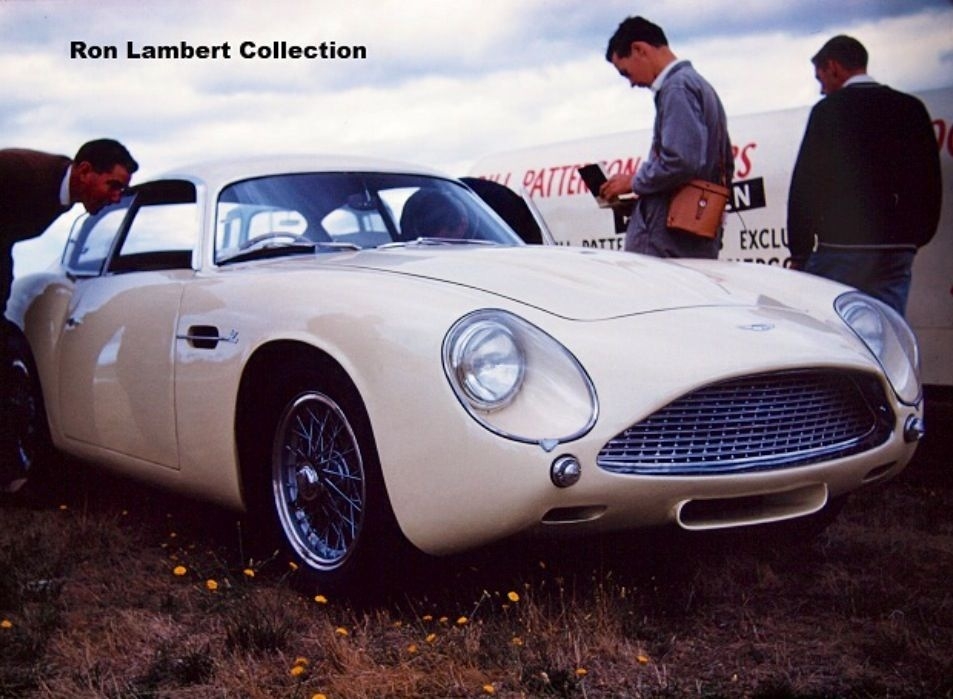
longford Australia’s only DB4Z, #DB4GT/0186/R, the fourteenth built, was owned by Sydney’s Laurie O’Neill. Here it’s pictured in the Longford paddock in March 1962. It was raced in a support event by thrice AGP winner Doug Whiteford (Ron Lambert Collection)

The DB4GT Zagato…

The Aston Martin DB4GT Zagato was introduced to the world at the London Motor Show in October 1960.

It was effectively a DB4 GT improved by Carrozzeria Zagato, Ercole Spada is the designer credited with the work. Smaller, more aerodynamic and about 100 pounds lighter than the DB4 GT, the Zagato’s twin-cam, two-valve, 45DCOE Weber fed 3670cc engine produced 314bhp @ 6,000rpm, 12 more than the DB4 GT giving it a top speed of 154mph.

Initially the factory planned 25 cars, but demand wasn’t strong enough so only 19 were completed, albeit 23 chassis numbers had been allocated. Four modern Sanction 2 Coupes were built on DB4 rolling chassis completed by Richard Williams (RSW) to the order of Aston Martin using the unused chassis numbers from 1987-91.

Ex-Zagato employee Mario Galbiatti (with Zagato’s approval) built the bodies using Williams’ own dismantled Zagato as a template. Completed and launched in July 1991, in 1993 Williams completed two more Aston Martin Lagonda approved Sanction 3 cars using left over Sanction 2 bits. Not to forget AML’s own 19 April 2019 Continuation Series DB4GTZs…

The first competition outing of a DB4 GT Zagato was during Goodwood’s 1961 Easter meeting. Driven by Stirling Moss, it finished third behind an Aston Martin DB4 GT and the winning Ferrari 250 GT.

motor show 1960 London Motor Show launch for the DB4GT Zagato.

Etcetera…

le mans paddock John Ogier’s two Aston DB4 Zagatos in the Le Mans paddock, 1961. #3 Davison/Stillwell, #2 Fairman/Consten (unattributed)
bernard reeves Painting of the Davison/Stillwell DB4Z, Le Mans 1961 (Bernard Reeves)

Credits…

Ron Bert Collection, Bernard Reeves, Jim McKeown Collection

Tailpiece…

(J McKeown)

Doug Whiteford in Laurie O’Neill’s Zagato with Jim McKeown, Jewitt Holden and George Spanos, Elfin Streamliner Ford on the front row of the grid. Longford GT race in 1962 won by Whiteford from McKeown.

Finito…

Stewart and Clark Dutch 1965

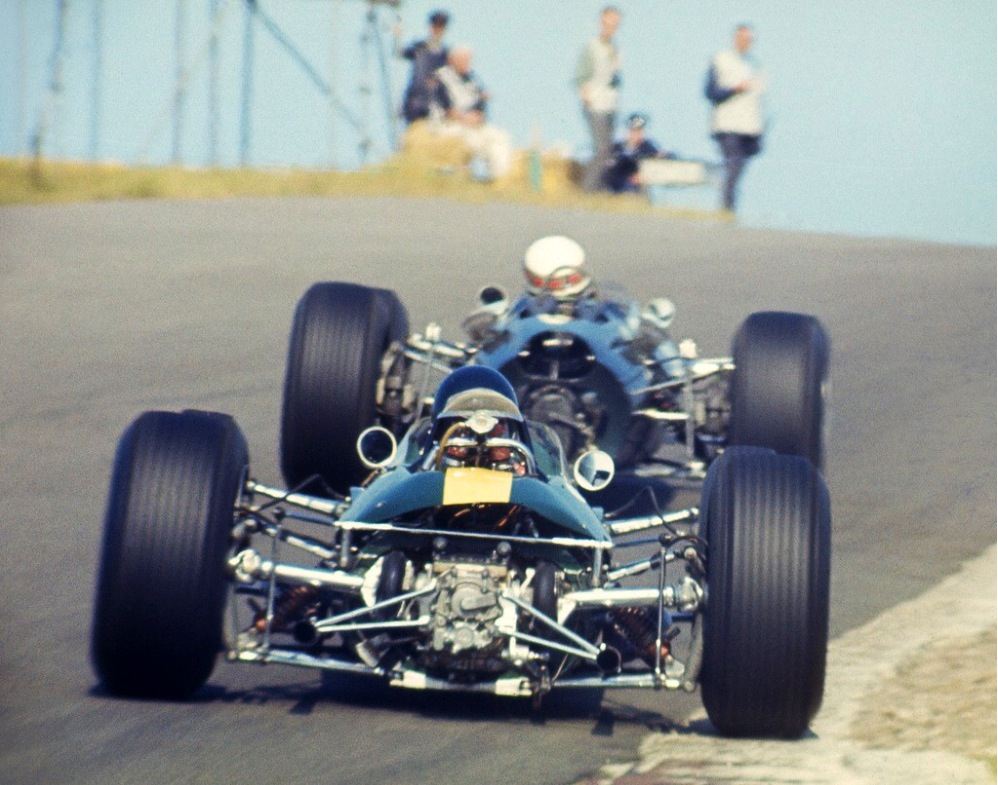
Jim Clarks’ Lotus 33 Climax chasing Jackie Stewarts’ BRM P261 through the Dutch sand-dunes…

Jackie had his first F1 drive with Lotus in the non-championship, late 1964 Rand Grand Prix in South Africa, but made the intelligent decision to join BRM for 1965 where he felt he would have the support and time to develop as a driver. Lotus would have been tougher, Clark was the established ace, and Chapmans track record with ‘number 2’s wasn’t good.

Stewart had great relationships with both his countryman Clark and his teammate Graham Hill who mentored and guided him well, that and Stewarts’ natural ability saw him take his first win in Italy later in 1965.

One of racings great ‘mighta beens’ are the potential duels between he and Clark as JYS matured as a driver and finally got a competitive F1 car with the Matras he drove from 1968…

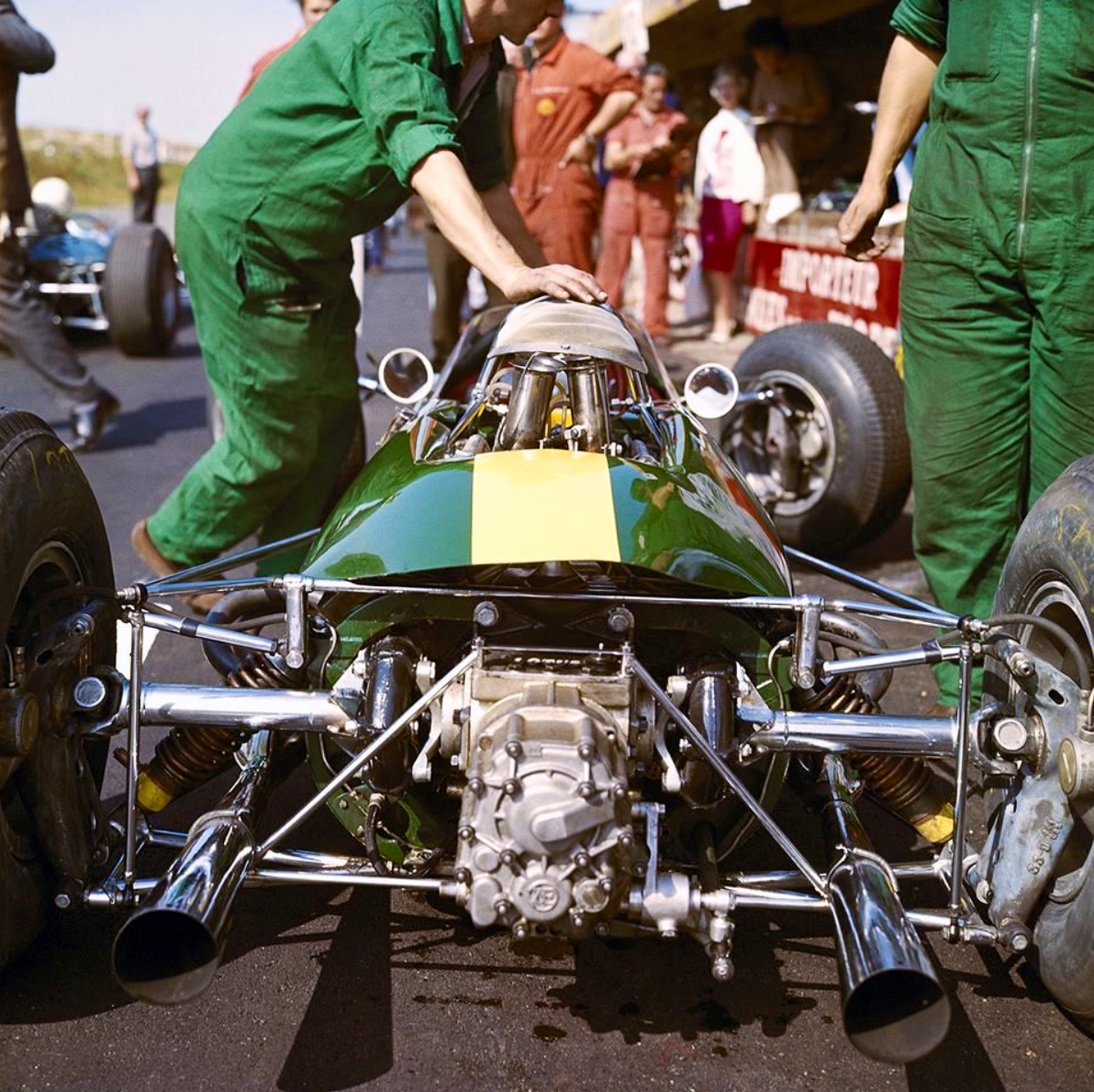
The Lotus 33 rear view…is an interesting study in suspension design and aerodynamics of the mid ’60s GP car. Fully faired cigar shaped body of the BRM in contrast with the naked Lotus. The clutter of the outboard rear suspension and its impact on the airsteam is marked relative to the rocker arm, inboard approach at the front…

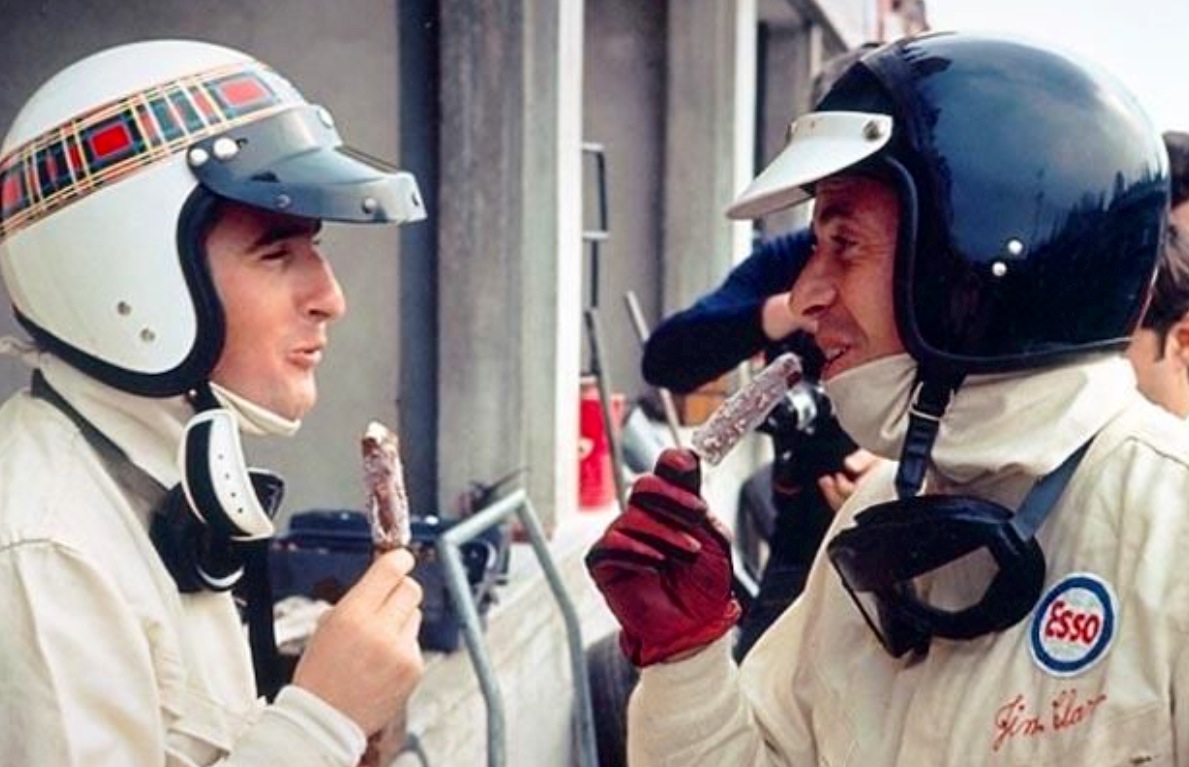
Stewart and Clark icecream

Lotus 33 rear

Lotus 33 Climax, Dutch Grand Prix 1965. Close up…ZF gearbox, later series 32 valve Coventry Climax FWMV 1.5 V8, rubber donuts on driveshaft, suspension single top link, inverted lower wishbone, twin radius rods for location fore and aft, cast magnesium uprights, coil spring/damper units and adjustable sway bar, oh so period and gorgeous!  (unattributed)

Photos unattributed…


agp 67 hill and clark

(Graham Howard ‘History of The Australian Grand Prix’)

Jim Clark and Graham Hill swap notes prior to the start of the 1967 Australian Grand Prix, Warwick Farm, Sydney. It would be a good season for them both…

Their new F1 Lotus 49’s await their return to Europe, the Ford Cosworth powered cars established a package of integrated design which became the F1 standard for the duration of the 3 litre formula. Their is plenty of press interest in the two stars, teammates for the first time in 1967 and Hill’s #5 Lotus 48.

Behind them in the ‘Farm pitlane is Kevin Bartlett’s Brabham BT11A Climax, KB just in shot with his foot on his front Goodyear. Sixth in the race for him, an excellent result in the old car.

agp 67 start

Start of the 1967 AGP. #5 Hill Lotus 48 FVA 1.6, #6 Clark Lotus 33 Climax 2.0 V8, #3 Jackie Stewart on pole, BRM P261 2070cc V8. (autopics.com.au)

The 48 was Lotus’ new car for the inaugural 1.6-litre F2 1967 season. Designed by Colin Chapman and Maurice Philippe, it was in essence a ‘mini’ Lotus 49 which made its successful debut in the ’67 Dutch Grand Prix on June 4.

Keen to get in some early season testing of the new car, Colin Chapman sent the first chassis to Australia for the Warwick Farm round of the Tasman Series, the Australian GP that year, held on 19 February for Graham Hill to drive. Hill was popular at the Sydney circuit, the promoters paying plenty of money to get the Brit and his new Lotus to New South Wales for just one race. Of added local interest was that Hill had just returned to Lotus having been a BRM driver since 1960. Mind you, in Australia he raced in our internationals the Ferguson P99, Brabham Climaxes owned by ‘Scuderia Veloce’ as well as various BRM’s.

Jim Clark did all of the Tasman rounds in New Zealand and Australia that summer. He won the title in a Lotus 33 Climax, his 1966 F1 mount ‘R14’ fitted with the 2 litre Coventry Climax FWMV V8 engine with which he started the 1966 F1 season, the first year of the 3 litre F1. He used the car until the BRM engined Lotus 43 was ‘ready’ to race.

The new 48 F2 car had a full monocoque chassis made from aluminium sheet with steel bulkheads front and rear. Bolted to the rear bulkhead was a tubular steel subframe which carried the unstressed FVA engine and ZF gearbox. Front suspension used top rockers operating inboard mounted springs and dampers. The rear suspension was also conventional; single upper link, reversed lower wishbone, twin radius rods and coil spring/ damper units.

The 48 used the Ford Cosworth FVA, one of two engines contracted from Keith Duckworth and Mike Costin by Ford. Significantly the engine proved Duckworth’s design direction for his F1 V8, the Cosworth DFV which made its race debut at Zandvoort in the back of the equally new Lotus 49. The FVA’s design commenced in July 1965, its first bench test was in March 1966 and its first race in July 1966. The engine was well tested prior to its trip to Australia in the summer of ’67.

The remarkably successful unit combined a four-cylinder cast iron Ford Cortina block with an aluminium Cosworth head. FVA was an acronym of the ‘four valve assembly’ or ‘four valve type A’ of the engine’s new head. Twin overhead camshafts were used of course, driven from the crankshaft by gears. Equipped with Lucas fuel injection, the dry sumped engine developed circa 220 hp @ 9000rpm.

Ford-Cosworth-FVA

Ford Cosworth FVA Engine Cutaway drawing by Theo Page.

Graham Hill qualified Lotus 48 chassis ‘R1’ well amongst the Tasman Formula 2.5 litre engined cars, 3rd on the grid with only the V8 engined cars of teammate Jim Clark and Jackie Stewart’s BRM in front of him. He may only have had 1.6 litres but the chassis was clearly good and Hill was always been quick around Warwick Farm, the Sydney circuit a very technical one.

Stewart was very fast throughout the Tasman, he won it in ’66, but the BRM’s gearbox was at its limits with the greater stresses of the P60 BRM V8, now at 2070cc and developing much more power and torque than the same engine in its original 1.5 litre F1 guise ever produced. But the car held together at the ‘Farm, Jackie won from Clark and Frank Gardner in a Brabham BT16 Climax FPF, the old 2.5 litre F1 Climax four cylinder engine well and truly outclassed by ’67.

Hill’s new Lotus 48 expired with gearbox maladies on lap 25 but he gained valuable miles on the brand new chassis in advance of the European F2 season, which both he and Clark contested.

Intended as a customer car, the 48 was exclusively campaigned by Team Lotus during 1967, privateers used uprated 41’s. The new Lotus was quick but encountered the Brabham BT23, one of Ron Tauranac’s most successful designs. The 48 won four F2 races in 1967, three in Clark’s hands, the fourth by Jackie Oliver in the combined F1/F2 German GP at the the Nürburgring.

Whilst the Brabham BT23 was the car of the season many of its victories were taken by ‘graded drivers’, notably the ‘King of F2′ Jochen Rindt, whilst graded drivers did win races they could not score championship points. The 1967 title was won by Jacky Ickx using both Matra MS5 and MS7 chassis’, FVA powered.

Lotus continued with the 48 in 1968, 4 chassis were built in total, but struggled again with the dominant Brabham BT23’s. Jean Pierre Beltoise won the ’68 title in a Matra MS7 FVA. 1969 would be a ‘different kettle of F2 fish’, the Dave Baldwin designed Lotus 59 a much more competitive tool.

gh lotus 48 cockpit

Graham Hill tucked into the comfy cockpit of his beautifully finished Lotus 48. He is on the grid of the ‘Guards 100’, Snetterton in March 1967. Hill was 2nd to Rindt’s Brabham BT23. (Max Le Grand)

III Gran Premio Barcelona, Montjuic, Spain 31 March 1968…

untitled

Jim Clark, Lotus 48 FVA, Montjuic, Barcelona 1968. (Unattributed)

Jim Clark aviating his Lotus 48 during practice for the first European F2 event in 1968.

He started the season strongly with victories in his Lotus 49 in both the South African Grand Prix held at Kyalami on 1 January and the Tasman Series, including the Australian Grand Prix at Sandown Park, Melbourne. Jim won 4 of the 8 Tasman rounds, his Lotus used the 2.5 litre Ford Cosworth V8 variant, the ‘DFW’ so he came to this F2 event ‘razor sharp’.

Despite Clark’s speed, Jackie Stewart won the race in his Matra MS7 FVA, Jim was tagged by Jacky Ickx at the first turn, a ‘bonzai’ move down the inside taking out the innocent Scot, deflating a tyre and rearranging the rear suspension. Ickx was involved in another accident on lap 2 and retired. Karma at play!

The shot below is of #1 Clark, with Hills nose in shot, in the middle is an innocent Jochen Rindt, Brabham BT23 FVA. Ickx shot off down the road in his Ferrari 166. The next F2 round was the ‘II Deutsche Trophae’ at Hockenheim the following weekend.

mont clark

Hill’s Lotus 48 nose, Jochen Rindt caught up in the melee in his Brabham BT23 FVA and Clark, Lotus 48 FVA. (Unattributed)


mont clark 2

End of Clark’s race, flat tyre and shagged rear suspension. Lotus 48 FVA. Barcelona 1968. (Unattributed)

YouTube Footage of the Barcelona Race;

Hockenheim 7 April 1968…

Jim Clark before the off and (below) in the early stages of this fateful, awful race and the probable high speed tyre deflation which caused the accident that claimed the champions life.

clark and sims

Jim Clark, relaxed before the off and Dave Sims. Hockenheim 7 April 1968. Lotus 48 FVA. (Rainer Schlegelmilch)


clark lotus 48 hocken 68

Clark, Lotus 48 FVA, Hockenheim 7 April 1968. (MotorSport)

Lotus 48 Technical Specifications…

Chassis; aluminium monocoque with rear subframe. Front suspension; lower wishbones, top rocker actuating inboard coil spring/dampers, roll bar. Rear suspension; reversed lower wishbones, top links, twin radius arms, coil spring/dampers, roll bar
Steering rack and pinion, Brakes, discs all-round, Gearbox ZF 5DS12 5 speed.
Weight 420 kilo / 926 lbs. Length / Width / Height 3,797 mm (149.5 in) / 1,727 mm (68 in) / 762 mm (30 in)
Wheelbase / Track (fr/r) 2,330 mm (91.7 in) / 1,473 mm (58 in) / 1,473 mm (58 in). Wheels (fr/r) 13 x 8 / 13 x 10

Ford Cosworth FVA

Pretty much the ‘engine de jour’ of the 1.6 litre F2 from 1967 to 1971, the FVA won all of the European titles in that period.
Cast-iron Ford Cortina 1600 ‘116E’ 5 bearing block, aluminium head, 1,598 cc. Bore/Stroke 85.7 mm/69.1 mm, DOHC, 4 gear driven valves per cylinder, Lucas fuel injection and electronic/transistorised ignition. Circa 220 bhp @ 9000rpm.

Those with a strong technical interest in the Cosworth FVA and its role in relation to the subsequent Cosworth DFV V8 Design will find this treatise of interest;

Click to access cosworthstory.pdf

Etcetera…

clark pau 1967

Mini Lotus 49 indeed! Clark in his svelte Lotus 48, Pau GP 1967. 4th behind 3 Brabham BT23’s; Rindt, Hulme and Alan Rees. (Unattributed)


clark jarama 67

Clark in his Lotus 48 from Jackie Stewart’s Ken Tyrrell entered Matra MS7, both Ford Cosworth FVA powered, 1st and 2nd, Chris Irwin’s Lola T100 3rd, Jarama, Spain July 1967. (Unattributed)


oliver german gp

Jackie Oliver jumping his works Lotus 48 into 5th place, and first F2 finisher, German GP August 1967. He drove a great race, Hulme victorious in his Brabham BT24 Repco. (Unattributed)


hill oulton brian watson

Hill on the way to 3rd place in the Oulton Park ‘Gold Cup’ in September 1967 amongst the F1 cars, Jack Brabham won in his BT24 Repco from Jackie Stewart in a Matra MS7 FVA F2 car. (Brian Watson)


hill 48 in 68

Graham Hill in the Tulln Langenlbarn, Austria paddock in July 1968. NC with insufficient laps. Rindt won the race in a Brabham BT23C. ‘Chequered Flag’ truck contained the McLaren M4A driven by Robin Widdows also DNF. (Unattributed)


lotus 59

For the sake of completeness…this is the Dave Baldwin designed, spaceframe chassis F2 Lotus 59 which succeeded the 48. ‘Twas an FF/F3/F2 car, much more successful than the Lotus 48 but again the Brabham BT 28/30 gave it a good run for its money! Here G Hill at the Pau GP in April 1969 with high wings having only weeks to run before being outlawed by the FIA during the Monaco GP weekend. Hill DNF with fuel metering unit failure, Jochen Rindt victorious in the other Winkelmann Racing 59B. (Unattributed)

Credits…

Graham Howard ‘History of The Australian Grand Prix’

Max Le Grand, autopics.com.au, MotorSport, Rainer Schlegelmilch, Theo Page, Brian Watson, Roger Linton

Tailpiece: 1967 AGP Warwick Farm…

(R Linton)

Start of the race from the pit counter.

Hill’s Lotus 48 FVA at right, Clark, Lotus 33 Climax and Jackie Stewart, BRM P261 on the front row. Brabham is behind Stewart and Denny Hulme behind Jack in Repco ‘640’ V8 engined Brabhams

Finito…

Jim Clark Room 01

The name Jim Clark is synonymous as one of motor racing’s greats, whether dancing a Border Reivers D Type in his early career through to the brilliance soon established with Colin Chapman’s Team Lotus. Tasting success with the marque’s many facets of motor racing – be it Elite, Elan, Lotus Cortina, Formula Junior, Tasman, Indy and Formula One & Two.

This man was born to race, despite his humble Scottish farming background and quiet demeanour. His talents took him racing all over the world be it for Formula 1 or Tasman Series in far off New Zealand or Australia during his own northern hemisphere’s cold and miserable winter period. It all came to a very abrupt ending on April 7, 1968 when despite the known dangers of the sport, the unthinkable became reality that Jim Clark was dead.

A huge talent lost at 32 years of age. News Services weren’t as instantaneous as they now are. So it took a little while to filter the news of his passing around the motor racing globe. It would have been a shock to a young enthusiast listening to a transistor radio or one of Jim’s contemporary drivers’ having a News Service thrust a microphone in front of them for a comment on his passing for their news broadcast.

Jim Clark Room 02

The modest Duns building home of ‘The Jim Clark Room’

Testimony to Jim’s greatness is that despite the passage of 47 years he’s still remembered so fondly. Not least in Duns, in the Berwickshire district of Scotland where ‘The Jim Clark Room’ displays many trophies, photos and memorabilia of the district’s World Champion farmer…

Scarily it is approaching 21 years since I made the journey to Duns to pay homage to the great Jim Clark. It was late August 1994 and with the growth of technology you can do a virtual viewing of the room here. http://www.itv.com/news/border/update/2015-05-15/celebrating-the-life-of-racing-legend-jim-clark/
With there being Jim Clark celebrations in Duns, over the weekend of May 16 and 17 2015.

See this footage of the event including Jackie Stewart and Alan McNish comments.  http://www.itv.com/news/border/update/2015-05-17/remembering-jim-clark/

However in the olden days of 1994 I took some photos. The gent who was minding Jim’s treasures that day was keen to show me that another great of the sport had been to Duns to pay his respects. That great, was fellow F1 World Champion, Ayrton Senna. Who had at that time of my visit, been killed just under 4 months earlier at Imola.

Maybe just a bit too ironic…

Jim Clark Room 03

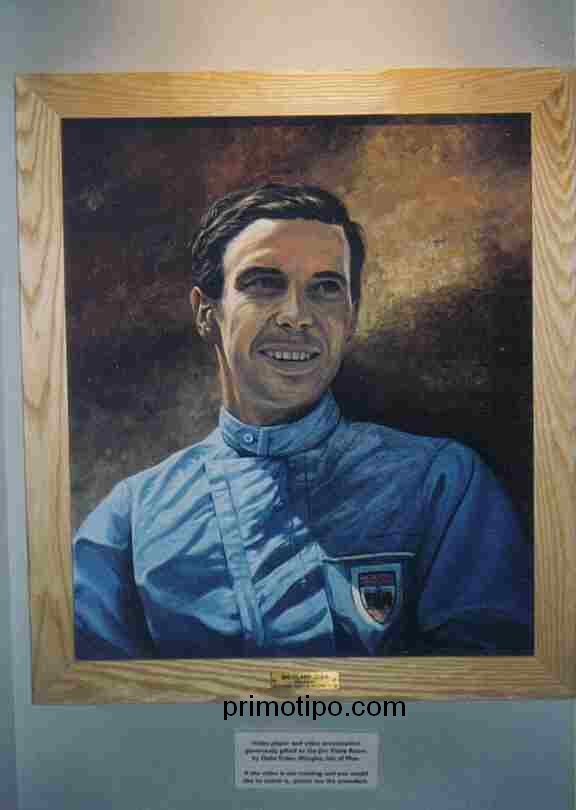
Artwork of a great motor racing champion

Jim Clark Room 04

A selection of photos and trophies depicting Jim’s many successes adorn the walls and cabinets within the room

Jim Clark Room 05

The JCR vistors’ book – Ayrton Senna visited on February 23, 1991

Jim Clark Room 06

Credits…

Article written by and photos from the collection of Stephen Dalton

duetto champs

(Bruce Thomas)

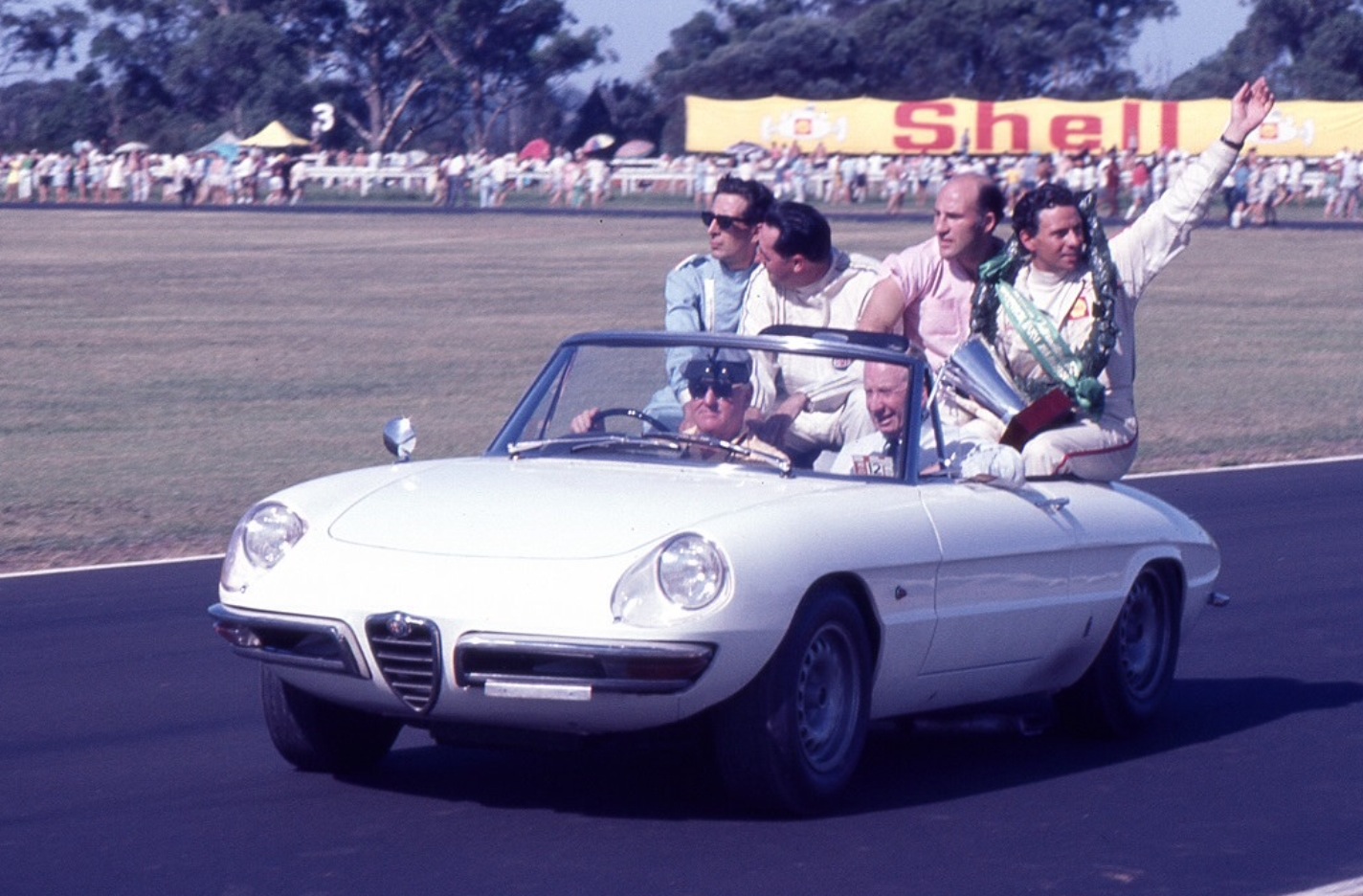
The little Alfa Duetto’s DOHC 1570cc would have struggled ferrying this lot, even for a lap…

It’s the victory parade after the 1968 ‘Warwick Farm 100′ won by Jim Clarks’ Lotus 49 Ford DFW from teammate G Hill, with Piers Courage third in his little McLaren M4A Ford FVA.

What driving talent aplenty in this car!

Driving the car is 1960 Australian Gold Star Champion Alec Mildren, Mildren also an Alfa Dealer and incredibly successful and generous race team owner of the 1960-1970 period, the Dutto immaculate in white and wearing a set of ex-GTA wheels, I wonder who owns it now?

Behind Alec is a youthful Alfredo Costanzo, first local home in an Elfin Mono Ford 1.5 and later to be very successful in Australia’s latter F5000 days and the Formula Pacific era in cars owned by Porsche Cars Australia’s Alan Hamilton, another very generous benefactor of the sport.

Brabham, Moss and Clark needing no introduction…

Clark won the race, the Lotus 49 was the F1 standard from its 1967 Dutch GP launch, reliability cost Lotus the titles that year- the light, nimble beautiful handling Brabham BT24’s did the trick, Denny Hulme pipping Jack for the Drivers Championship and Brabham Repco winning the Constructors laurels.

In 2.5 litre ‘DFW’ spec the Ford Cosworth powered cars were formidable Tasman weapons, Clark won the 1968 title and Jochen Rindt was the fastest man of the series in 1969, if not the most reliable.

clark wf

Jim Clark, Lotus 49 DFW, WF 1968. (Peter Windsor)

The Tasman Cup entries in 1968 were as interesting and diverse as ever

Moreso than previous years in fact- the interesting shot below was taken as the cars lined up for practice in Warwick Farm’s pit lane and shows the business end of the new Len Terry designed 2.5 litre V12 BRM P126. Its Hewland DG300 gearbox is just visible behind the Lucas fuel pump mounted to the rear of the ‘box, the Shell ‘el cheapo’ oil catch tank is a nice ‘in the field’ touch! Richard Attwood in the hotseat retired from the race with gearbox dramas.

Two of the P126’s were entered in the Tasman, Bruce McLaren raced a car in the New Zealand rounds and took a win at Teretonga, the cars were in the Southern Hemisphere to be race proven, after the abortive H16 program, before the European F1 season but there was always a scramble to drive the old, light, nimble and reliable 2.1 litre V8 P261.Pedro Rodriguez raced it at WF finishing sixth in a car which had so much Tasman success, Jackie Stewart took the title in a P261 in 1966.

In front of the BRM is Frank Gardner’s Alec Mildren Racing, one off, Brabham BT23D Alfa. This magic little car was powered by a 2.5 litre V8 developed via Alfas’ endurance racing Tipo 33 program. Its twin vertically mounted distributors fired two plugs per cylinder- a distinctive visual element of the little DOHC, two valve, injected engine. Later in 1968 the car won the Australian Drivers Championship in Kevin Bartlett’s capable, quick hands.

Forward of Frank is Piers Courage’ McLaren M4A Ford FVA- he came to Australasia with this car and two engines and did incredibly well, perhaps its not unfair to say he re-launched his career with this self funded Tasman effort. Numerous podium placings were surpassed by an heroic win in hopelessly wet conditions on one of the ‘biggest balls’ circuits of the world, Longford a fortnight after his strong third at WF ahead of many more powerful and equally nimble cars as his little F2 McLaren.

This McLaren stayed in Australia after the Tasman being bought by Niel Allen, and was also raced successfully by Warwick Brown in the formative stages of his career.

WF pitlane

WF pitlane Tasman Series 1968. (Brian McInerney)


gh pitlane

Graham Hill and friends, Warwick Farm paddock 1968. (Brian McInerney)

Graham Hill was perhaps not as focussed on a win as teammate Clark…get your hands off that young woman you bounder!

Was there ever a bloke from ‘central casting’ who looked more like a dashing, debonair driver than G Hill? He did not have the absolute pace of teammates Clark, Stewart or Rindt but was a driver of incredible ability, the only winner of motor racings World F1 Title/LeMans/Indy ‘Triple Crown’ of course.

His greatest moments were to come in 1968 when he picked Team Lotus up by the scruff of the neck, despite the loss of his good friend Jim Clark, providing the leadership the team needed whilst Colin Chapman recovered from his own grief at losing his driver, friend and colloborator in April, only months after this race meeting.

Lotus’ wins in the Drivers and Constructors Titles in 1968 owe a lot to Hill’s character as well as his determination and speed.

hill amon courage wf

Hill from Amon and Courage. Lotus 49 DFW, Ferrari Dino 246T, and McLaren M4A FVA. 2nd, 4th and 3rd respectively. WF 1968, the majesty of the place clear in this shot. (Unattributed)

 Jack Brabham had a short 1968 Tasman.

His Brabham BT23E was powered by Repco’s latest 740 Series SOHC V8 and competed in only the Warwick Farm and Sandown rounds.

In fact Repco, for all their F1 success didn’t ever have much Tasman glory in their own backyeard…to be fair the primary reponsibility of the Repco Tasman program each year was to sort out the engines for the coming Grand Prix season, but all the same, a few local wins should have been achieved given the resources deployed?

This fabulous car stayed in Australia, acquired by Bob Jane at the Tasmans’ duration, it was raced for him by John Harvey who was always fast in it, but also unlucky, surviving a high speed accident at Bathurst after a component failure, the low point for the team.

jb wf pilane

Brabhams BT23E Repco all ready to qualify with a fresh set of Goodyears. Car in front is the BRM P261 V8 of Rodriguez, Courages’ McLaren body on the deck behind Jack. WF pitlane 1968. (Brian McInerney)


moss Wf 1968

Stirling Moss tells Clark about the fast way around ‘The Farm, both drivers loved the place and won there. ‘Lucas Opus’ spark-box prominent between the Vee of the Cossie DFW. Ford DFV famous as a load bearing member of the car, this shot showing the suspension componentry and its attachment to the engine and ZF ‘box. Suspension itself conventional for the day; inverted lower wishbone, single top link, twin radius rods and coil spring/damper, adjustable roll bar. Front suspension inboard; top rocker visible. Nice. WF Tasman 1968. (Brian McInerney)

The Eyes Have It.

Chris Amon (below) absolutely focussed on the task at hand. He came back with another two Dinos he ran with the assistance of David McKay’s Scuderia Veloce in 1969, lifting the title in a tremendous and very popular fashion.

In 1968 he was very competitive, winning the first two Kiwi rounds at Pukekohe and Levin but did not ultimately have the speed of the Lotuses of Clark and Hill. The car was a Ferrari 166 F2 (1.6 litre formula at the time) to which was fitted the 2.4 litre DOHC, two valve, injected V6 engine from the cars used at the start of the 3 litre Formula 1 in early 1966.

In the 1968 Australian Tasman Rounds Amon mixed the racing of the Dino single seater with McKay’s P4/CanAm 350 Ferrari i wrote about a week or so back.

Ferrari P4/Can Am 350 #0858…

amon eyes

Chris Amon, Ferrari Dino 246T, WF, Tasman Series 1968. (Brian McInerney)

 This shot captures the atmosphere of the Tasman Series generally and Warwick Farm specifically…

There is no hassle of the drivers by the appreciative crowd and vice-versa, there would be uproar these days of course.

Piers Courage is looking relaxed and happy about his third behind the Lotuses of Clark and Hill, and Amon fourth, is still figuring he could take the title with two rounds remaining at Melbourne’s Sandown and Tasmania’s Longford- ultimately he fell short of Clark by 8 points, Amon taking two wins to Clark’s four.

tasman 68 warm down

Piers Courage and Chris Amon on the WF warmdown lap. McLaren M4A FVA and Ferrari Dino 246T. Australian summer male ‘fashion’ of the day on full display. (Bruce Thomas)

Jim Clark savouring the plaudits of the crowd and one of his last wins, Lotus 49 Ford DFW, 18 February 1968…

jim clark wf lotus 49 1968

Jim Clark, Lotus 49 WF 1968. (wirra)

Grid and Results…

RCN 68 WF Tasman 01

Etcetera…

(B Jackson)

Get a move on chaps…

And things go better with Coke it seems- brake bleed in process. Note the solid front rotor on Graham’s Lotus 49 rather than the vented ones first used in 1967. Nice shot of the front bulkhead and inboard front suspension mounting treatment.

amn pilane

(Peter Windsor)

Chris Amon in the Warwick Farm pitlane, Ferrari Dino 246T, 1968 was a useful exploratory season for the successful two car assault in 1969.

(Brian Jackson)

Piers Courage alights his McLaren M4A Ford FVA as Ray Parsons, in ‘Australian summer mechanic’s clobber’ awaits instructions for the next round of tweaks before the next session, one of which is to increase the size of the nose mounted duct to get a bit more cool air into the cockpit.

fg wf 68

(John Ellacott)

Superb John Ellacott shot of Frank Gardner in the one-off Alec Mildren Racing Brabham BT23D Alfa Romeo Tipo 33 2.5 V8- she is puffing a bit of blue smoke in best Alfa tradition!

gh wf 68

(Brian McInerney)

‘See you after the race then?’ Hill G dealing with another admirer of the feminine type.

1968 WF Tasman cover


(Brian Jackson)

First local driver home was Alfie Constanzo in his Elfin Mono Mk2B Ford twin-cam in eighth place, here shielding his eyes from the late afternoon sun- that’s Ian Fergusson in a Lotus 27 Ford twin-cam behind Alf, both of these cars are ANF 1.5s.

1968 WF Tasman event 5

Photo and Other Credits…

Bruce Thomas, Peter Windsor, Brian McInerney, Wirra, John Ellacott, Brian Jackson

Stephen Dalton for the race program and ‘Racing Car News’ material

Finito…

rcn surfers 1968

We all have our favourite local motoring and motor racing publications...

When I was a youngster here in Australia it was ‘Sports Car World’ for fast road cars, the monthly letter from noted NZ born but global motoring journo, Eoin Young on the European and American racing scene was not to be missed nor the column of Romsey Quints, a crusty curmudgeon who wrote about ye olde days.

And for racing it was ‘Racing Car News’ supplemented by the global giant ‘Autosport’ which required a tram trip into the big smoke as it wasn’t carried by my local newsagent.

RCN was the bible tho.

It was national, maybe a bit Sydney centric, edited and owned by Max Stahl, an ex-racer who knew everybody from clubbies to visiting World Champions in Australia annually for the Tasman Series. It was chock full of local to global news and events with ‘Stringers’ all over the place making its coverage remarkable at the time.

Delivery of information digitally takes the sense of excitement out of the visits to the newsagent eagerly anticipating these monthly publications arrival instore…having said that the ‘democratisation of the media’ means even ‘Schleppers’ like me can ‘have a go’.

There was not a page of RCN to be missed from Stahls’ editorial upfront to the classifieds up ze back, the paintings by David Atkinson, Colin Anderson and others reason alone to buy the thing.

This cover by David Atkinson captures the action of the 11 February 1968 Tasman Series Round at Surfers Paradise. It depicts Graham Hills’ Lotus 49 DFW leading Leo Geoghegans’ ex Clark Lotus 39 Repco from the Piers Courage McLaren M4A FVA around the ‘Repco Hill’ section of the circuit.

Clark won the race from teammate Hill, Courage in second, a great performance on this power circuit in the little 1.6 litre Ford FVA engined M4A and Leo G, first local home in third place.

RCN survived into the ’80’s but was never the same after Stahl sold it, somehow the thing lost its soul…these days there are print and digital Australian ‘publications’ but none are as good as Racing Car News…

clark and amon surfers

Stunning Roderick MacKenzie shot of Clarks’ Lotus 49 leading Chris Amons Ferrari 246T, Surfers Tasman 1968. Clark won, Amon DNF with an engine failure. Tweed Ranges in the background. Clark won the series and Amon returned in 1969 winning the it in a Dino. (Roderick MacKenzie)


leo g lotus surfers

Leo Geoghegans Lotus 39 Repco ‘740’ Series 2.5 V8 being given a big push, John Sheppard at the wheel and Geoff Smedley at left. ‘Castrol’ colors, Repco installation replacing the Climax FPF 4 cylinder engine lead by Sheppard creating just about the best looking 60’s single seater ever, this is not the cars best angle however! (wolseley680)


hill surfers loading up

Surfers dummy grid. Hill #5 loaded up, the Lotus behind awaits Clark. You can just see the #11 nose of Rodriguez BRM P126 (10th) a Ferrari nose amongst the crowd and the nose, far right of the Courage McLaren. (wolseley680)

Tasman 1968 Highlights…

Etcetera…


(K Rogers)

Tasman race grid with Chris Amon at left, Ferrari 246T, the Lotus 49 Ford DFW’s of Clark and Hill. On row two Geoghegan’s Lotus 39 Repco and Denny Hulme, Brabham BT23 Ford FVA with the distinctive yellow Brabham BT23D Alfa Romeo of Frank Gardner further back.

(A J Favenchi)

Photo Credits…

Roderick MacKenzie http://www.rodmackenziecollection.com/ , wolseley680, Kevin Rogers, Alexis J Favenchi

Tailpiece…

(K Rogers)

‘Once yer heard these Ford engines a couple of times they aren’t that special’- a couple of disinterested marshalls as Clark’s Lotus goes by on Surfers main straight.

Finito…