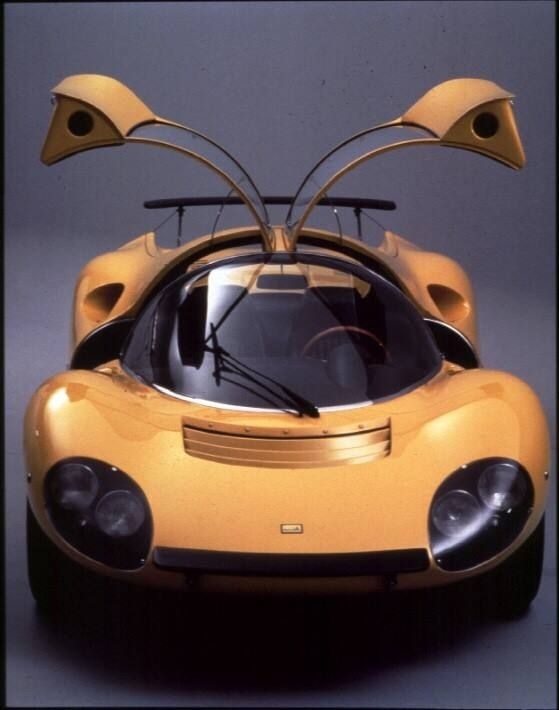
Designed by Paolo Martin, Pininfarinas’ Dino 206 Competitzione was one of the more influential designs of the 1960’s…
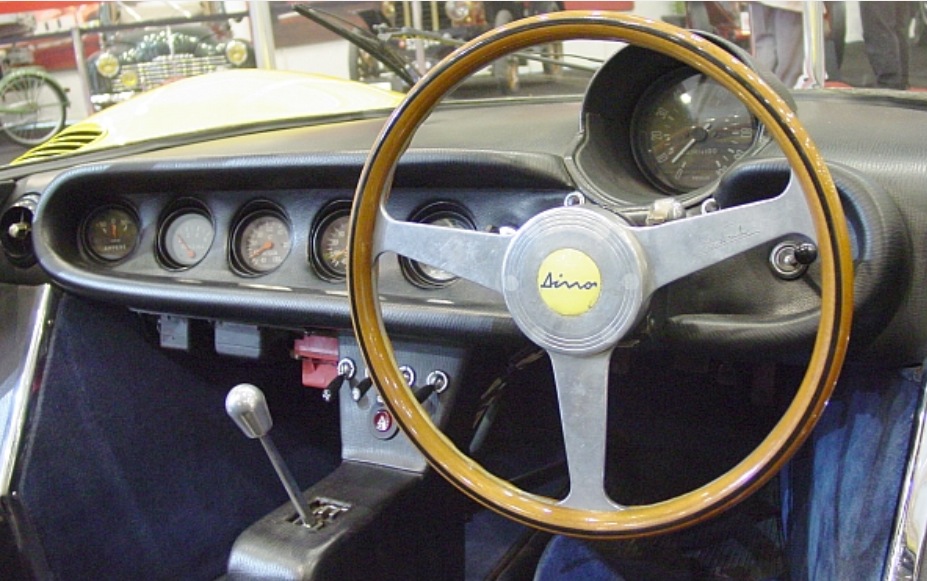
Based on an unused, unraced Ferrari 206 S chassis, ‘206S-034’, later renumbered ‘10523’. Pininfarina unveiled ‘The Yellow Dino’ at the 1967 Frankfurt Motor Show, after many years in ‘Farinas’ own collection it is now in private hands in the US.
Martin was 23 when he designed the car, his CV also includes the Ferrari Modulo, and Alfa 33 Roadster concept. He recalls, ‘i used to work on the 1:10 scale model on my house’s small balcony, spreading wood shavings in the underneath courtyard…i was working for Pininfarina secretly for contractual reasons’.
The final shape was created in aluminium, two prominent wings were added late in the project by Pininfarina, Paolo said, ‘they were added only at the last minute, since the management thought the design had to be enriched. I was always against it, anyway this was the final decision’.
Its a pity, the wings are ‘imposed’ on an otherwise fluid combination of compound curves. The car was widely hailed one of the show cars of the decade all the same.
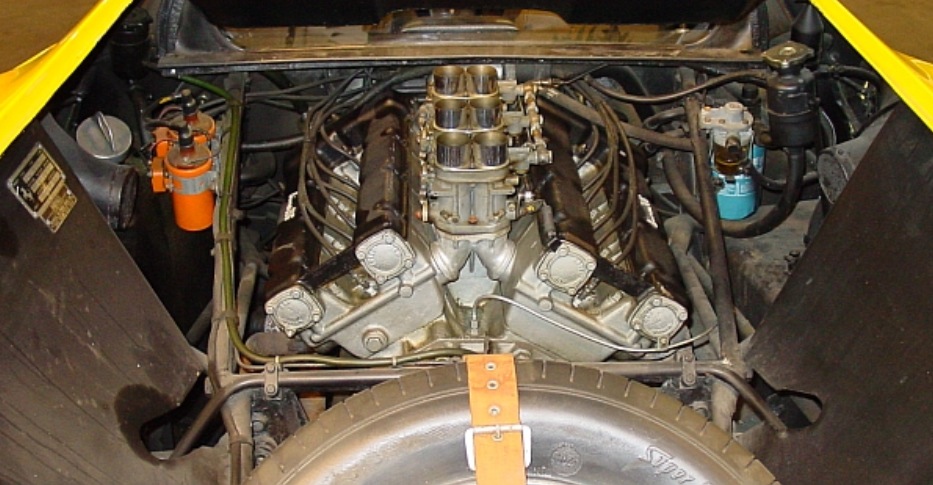
Whilst chassis ‘206S-034’ was unraced the car is fitted with an ex-Le Mans 12 valve race engine which still has its ACO affixed scrutineering tags. Circa 218bhp @ 9000rpm.Pininfarina advertisement in ‘Automobile Year 16’ 1968 year reviewVilla D’Este Concourse 2008
Ferrari 206 S…
Ferrari showed its 1966 World Sportscar Championship contenders, the P3 4 litre V12 Prototype, and 206 S, 2 litre V6 Sports Car at the 1965 Paris Auto Show.
To be eligible to race as a Sports Car, Ferrari had to produce a minimum of 50 cars, due to industrial troubles in Italy at the time only 18 were produced, the 206S was therefore forced to compete against much more powerful cars. It still sold well to privateers and was entered on occasion as a ‘Works Car’, the fastest 2 litre car of its day.
It was powered by variants of the Jano designed V6 which won the F1 Drivers Championship for Mike Hawthorn in 1958. Engine capacity was 1987cc, it was fed by Weber carburetors and later Lucas fuel injection. two, three and four-valve heads were developed, with both single and twin-plugs, the engine produced circa 218bhp @ 9000rpm.
A 5 speed gearbox was utilised, the chassis was Ferraris’ typical space frame of the time with welded on aluminium panels creating a ‘semi-monocoque’ structure. Some exterior pnaels were fibreglass.
Suspension comprised wishbones and coil spring/damper units at the front, and lower inverted wishbone,2 upper links and 1 radius rod, again with coil spring, Koni shocks at both front and rear. Disc brakes were by Girling. 7.5 and 8.5 inch wide (F/Rear) Campagnolo wheels were fitted, the whole lot weighing 654Kg. Very light!
The stunning cars were styled either in-house, or by Piero Drogo, depending on the source document, the bodies built by Piero Drogos ‘Carozzeria Sports Cars’ in Modena.
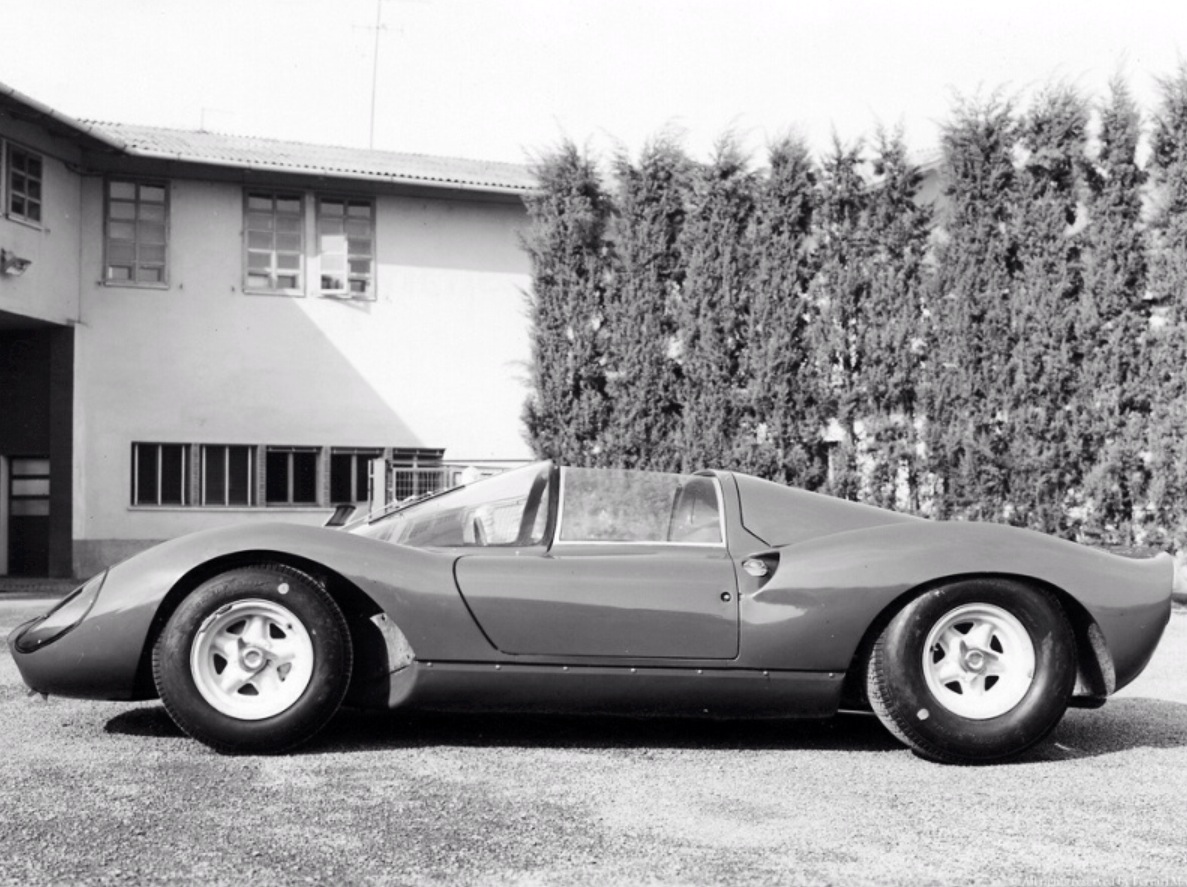
The shape is mouth-watering, the production 206/246GT road cars clearly took their styling from these cars.
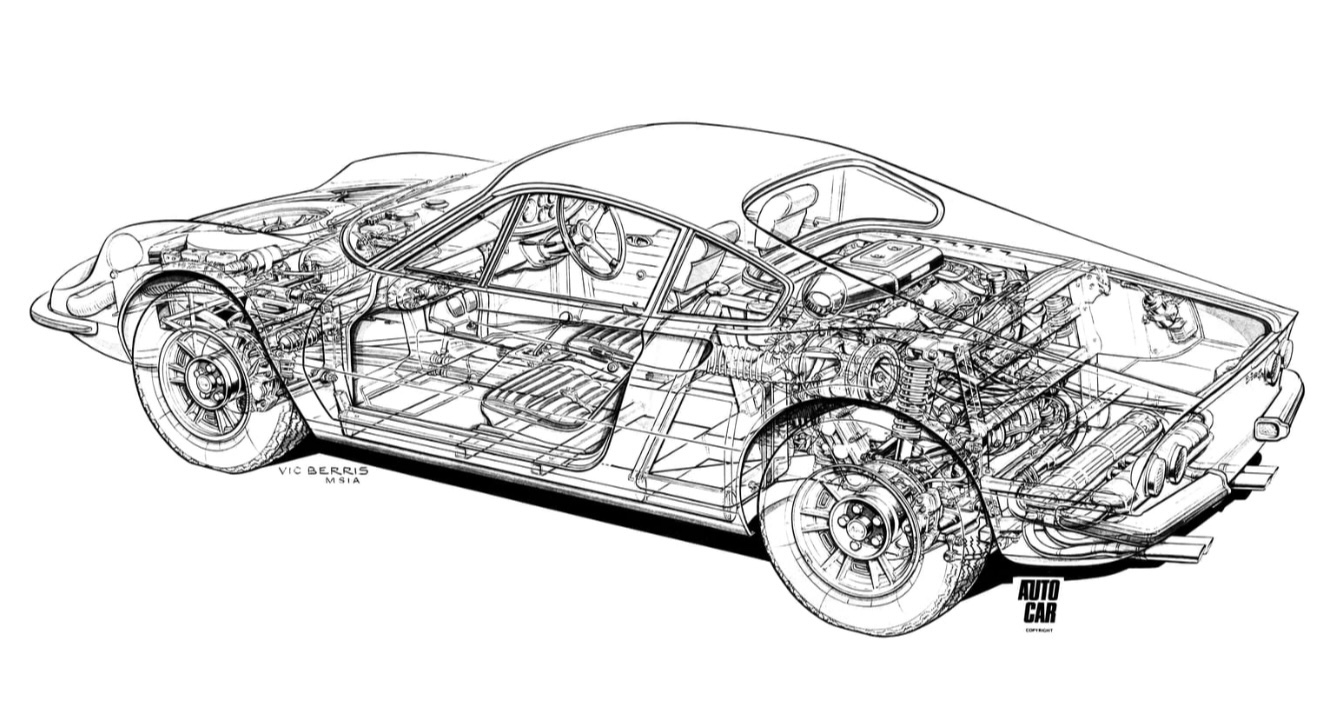
Nurburgring 1000Km, 1966. Rodriguez/Ginther 206 S (Pinterest)Targa Florio 1966. Biscaldi Ferrari 206 S (Pinterest)Ferrari factory shot at Maranello shows the 206 S stunning profile to good effect and just how close the road-going 206/246 GT was to its competition brother (Ferrari SEFAC)Ferrari Dino 206GT Prototype 1967Ferrari Dino 246GT cutaway (V Berris)
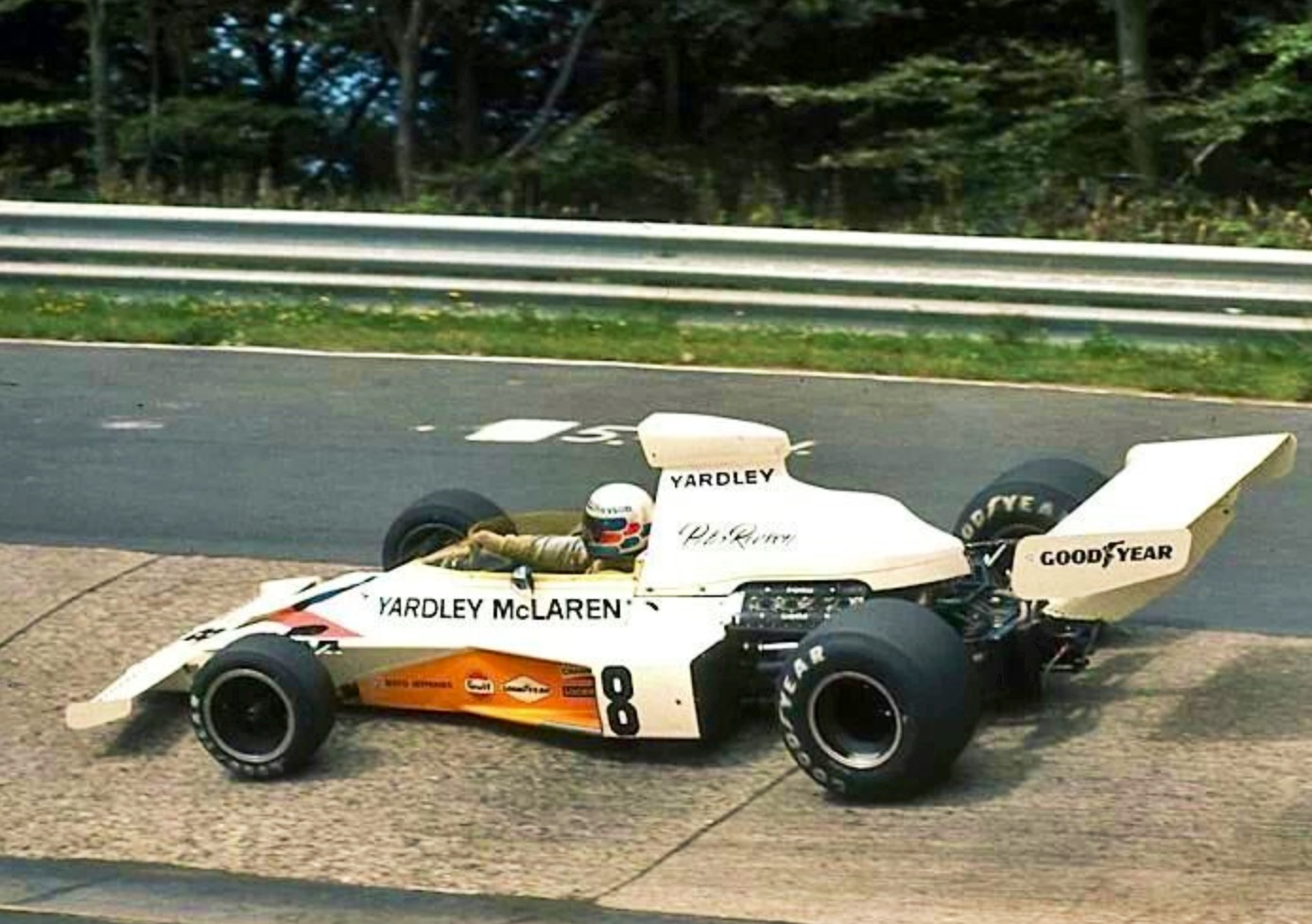
Peter Revson on his way to fourth place in McLaren M23/2 in the 1973 Spanish GP, Montjuich Park, Barcelona.
Background…
No other individual chassis has raced in F1, F5000 and Can-Am championships before conversion back through F5000 to its original F1 specifications. McLaren M23/2 is that car.
The McLaren M23 was one of the marque’s most successful designs, winning Grands Prix from 1973 to 1977 and Drivers and Manufacturers World Titles for Emerson Fittipaldi, James Hunt and McLaren in 1974 and 1976.
Coppuck’s Design…
Gordon Coppuck was responsible for the teams innovative and successful Can-Am and Indycar designs, Ralph Bellamy’s departure from McLaren back to Brabham gave Coppuck his F1 design chance.
The car followed the conceptual path blazed by the Lotus 56/72 in having a chisel nose, side radiators and rising rate suspension, rather than the Tyrrell bluff nose alternative aero approach of the day. McLaren’s very successful M16 Indycar followed the 72 so it was a logical step for Coppuck, using the well established McLaren interactive design approach, with many on the shop floor having input into the conceptual stages of new car development.
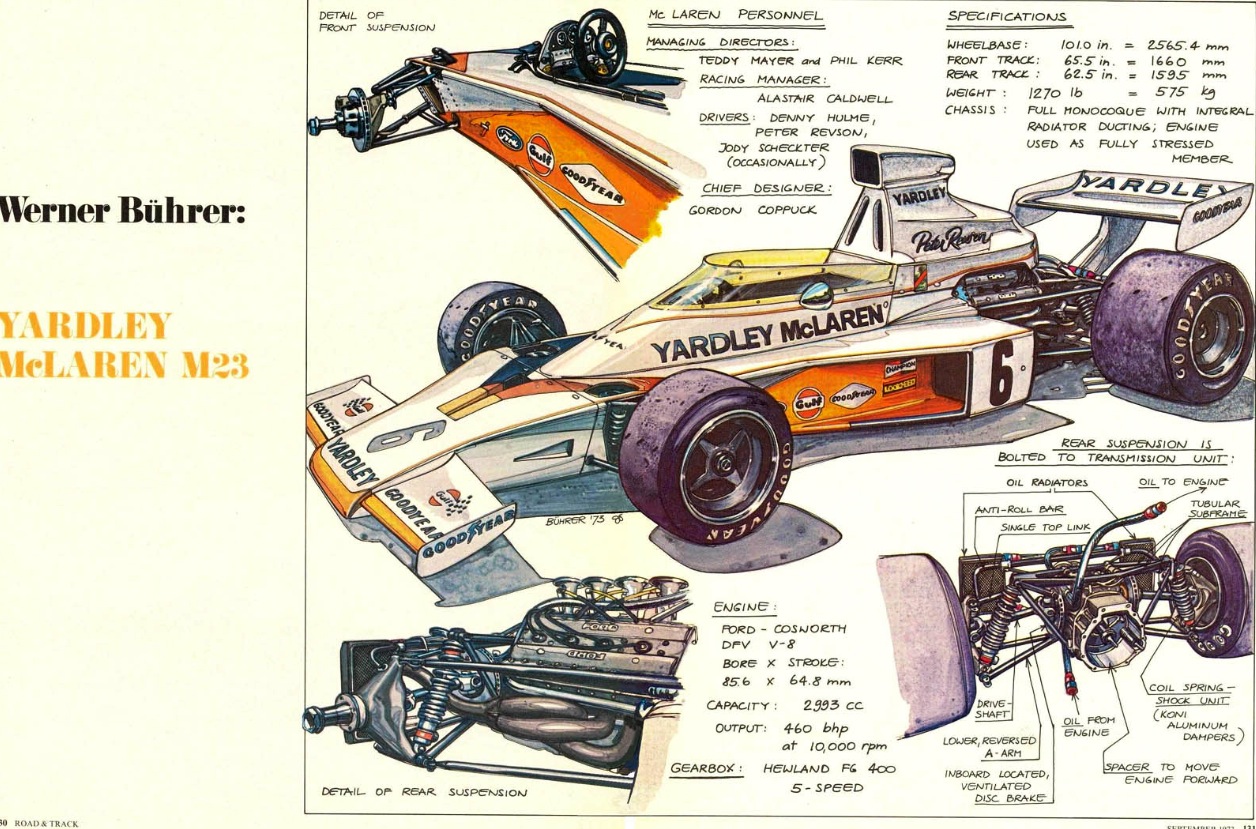
The M23 was a typical British kit-car of the period with its Cosworth DFV 3-litre V8 and Hewland FG400 five-speed gearbox. New deformable structure rules mandated for ’73 allowed a fresh approach to address the M19’s shortcomings; a lack of straight line speed and weight. The chassis was formed in 16 gauge aluminium sheet, all joints bonded and riveted, with the radiator sidepods an integral extension of the structure. Fuel tankage was centralised to promote a ‘Tyrrell like’ low polar moment of inertia, the driving position pushed forward relative to M19.
Front suspension comprised rising or progressive rate linkages, a large lower wishbone and top rocker actuated inboard mounted spring/shock units. At the rear a reversed lower wishbone, single top link and twin radius rods were used, spring rate progression was achieved with the winding of the coil springs.
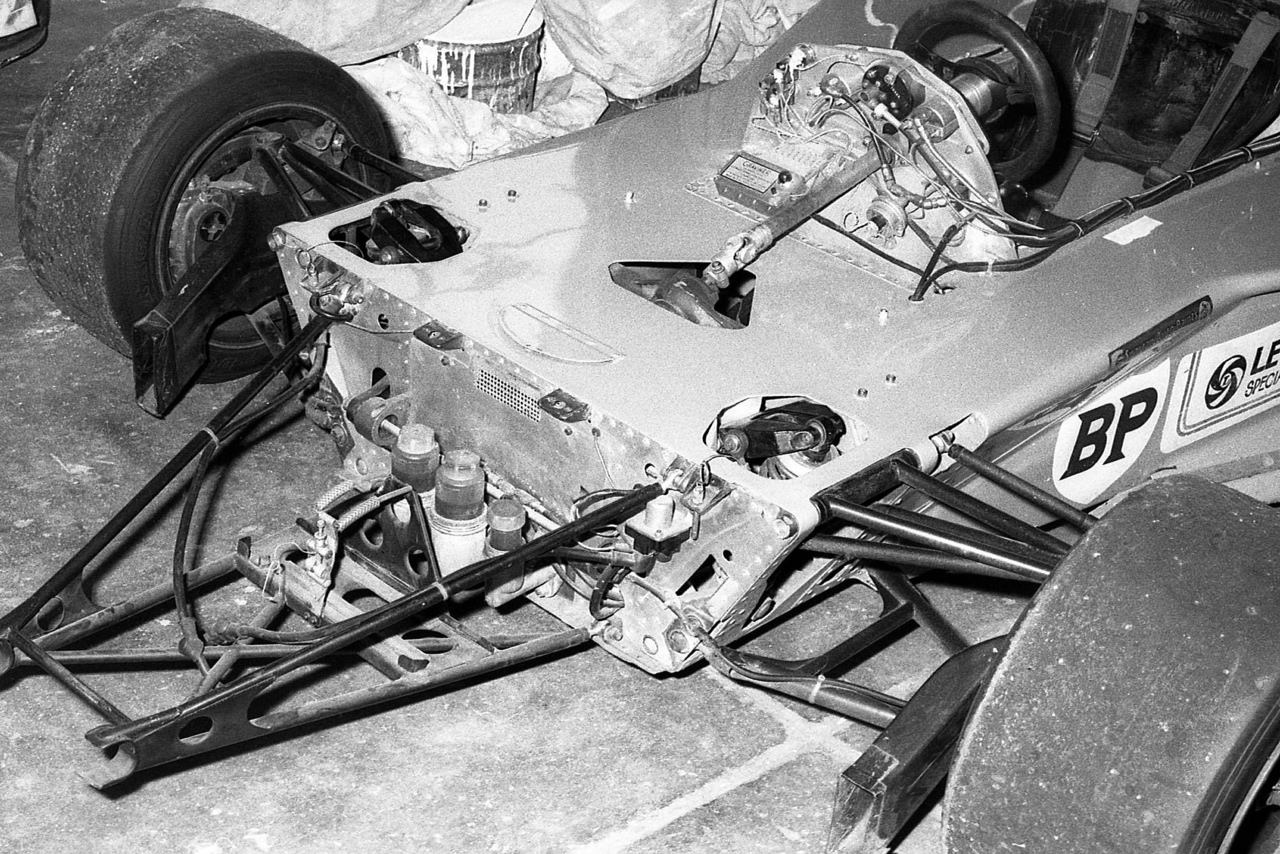
Front bulkhead, nose-cone support, master cylinders, wide-based lower wishbone, top rocker and inboard spring/shock, workmanship clear…(John Lemm)
Brakes were Lockheed ‘Can-Am’ calipers, rotors 10.5 inches in diameter, outboard at the front and inboard, beside the gearbox, at the rear. The bodywork was all enveloping with the airbox neatly covering the engine aiding airflow to the rear wing. Wheelbase of the new machine was 101 inches, front track 65 inches, rear 62.5 inches, the length was 170 inches, the whole lot weighed a claimed 1270 pounds distributed 34/66 % front to rear.
1973 Grand Prix Season…
Four of these original spec cars were built for 1973, the prototype M23/1 was tested at Goodwood by Denny Hulme before setting off for the season opening South African GP at Kyalami. Denny was immediately quicker than in the M19, rapidly adjusting to the far forward driving position, Hulme put the car on pole and led the race before puncturing a tyre on debris.
Other McLaren team drivers were Mike Hailwood, and Peter Revson in his first fulltime Grand Prix season. Revson started his grand prix career in the early 1960’s before returning to his native USA and making his name in the Can-Am series which he won in 1971 aboard a McLaren M8F Chev. He was also McLaren’s Indy driver.
A relaxed Peter Revson prior to the start of his successful British GP at Silverstone 1973, his first GP win (unattributed)
M23/2 debuted in Revson’s hands on 8 April 1973 at the Silverstone International Trophy, finishing 4th, it was to be his car for most of the year, his promise as an F1 driver was fulfilled with a tremendous victory at Silverstone in the British Grand Prix.
McLaren’s cub driver Jody Scheckter, in another M23 famously caused a multi-car pileup after losing control at Woodcote at the end of lap one and in the process proved the strength of Coppuck’s design.
Peter Revson en-route to victory in M23/2, Silverstone ’73 (unattributed)
M23/2 was used by Scheckter later in the season in Canada and the US before being sold to South African ace Dave Charlton.
Dave Charlton’s South African Championship car in 1974-75…
Dave Charlton delicately drifts M23/2, South African GP Kyalami 1975. He finished 14th in the race won by countryman Jody Scheckter’s Tyrrell 007 (reddit.com)
The McLaren replaced Charlton’s Lotus 72D for the South African National Championship, it was incredibly successful winning eight races and championships in ’74/5.
Dave set a Kyalami lap record in the 1975 Rand Winter Trophy which stood for years until broken in the ground-effects era. The cost of F1 cars was getting out of hand, so Charlton offered the car for sale with the introduction of Formula Atlantic as South Africa’s Championship class from 1976.
Dave Charlton, Brandkop circuit, Orange Free State, South Africa ’74…two SA Championships on the trot in ’74-5 for M23/2 (David Pearson)Rob Ryders’ shot of Dave Charlton at the 1972 British Grand Prix, his Lotus 72D retired with gearbox failure (Rob Ryder)
John McCormack…
Oran Park Gold Star round 1978. McCormack, Graham McRae, McRae GM3 Chev, Elfin MR8 at rear (John Shingleton)
Aussie F5000 racer John Mc Cormack was the eager purchaser, ’Charlton was a terrific bloke to deal with, I bought the car, 20 wheels, multiple sets of front and rear wings, bodywork, two types of airbox, less engines, which I should have bought and sold later, then the exchange rate moved in my favour so it was a really good deal.’
‘McLaren were still racing the car when I bought it, I had contacts there and they were used to dealing with customers so it all made good sense, as long as we could get the engine to play its part….’
John McCormack promoting the ‘Racesafe Wool TT’ racesuit circa ’76John McCormack aboard his recently acquired Brabham BT4 Climax at Penguin Hillclimb, Northern Tasmania in 1967 (HRCCT)
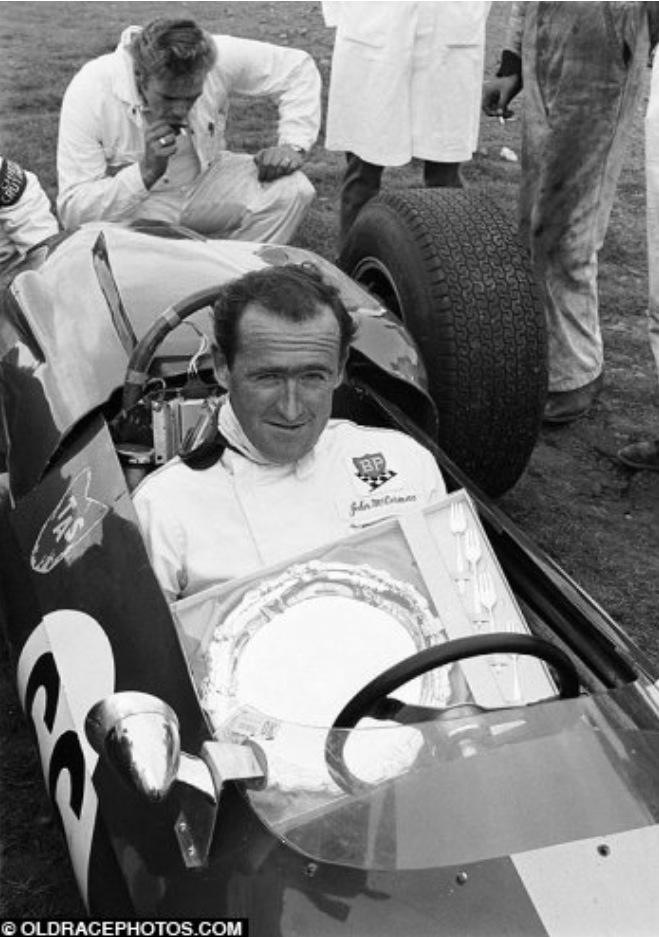
McCormack started racing in his native Tasmania breaking into the national scene with the purchase of Jack Brabham’s 1962 AGP car, a Brabham BT4 Climax. He proved he could mix with the ‘big boys’ in an Elfin 600C Climax, a very competitive car when fitted with a Repco 740 Series V8 in place of the old Climax.
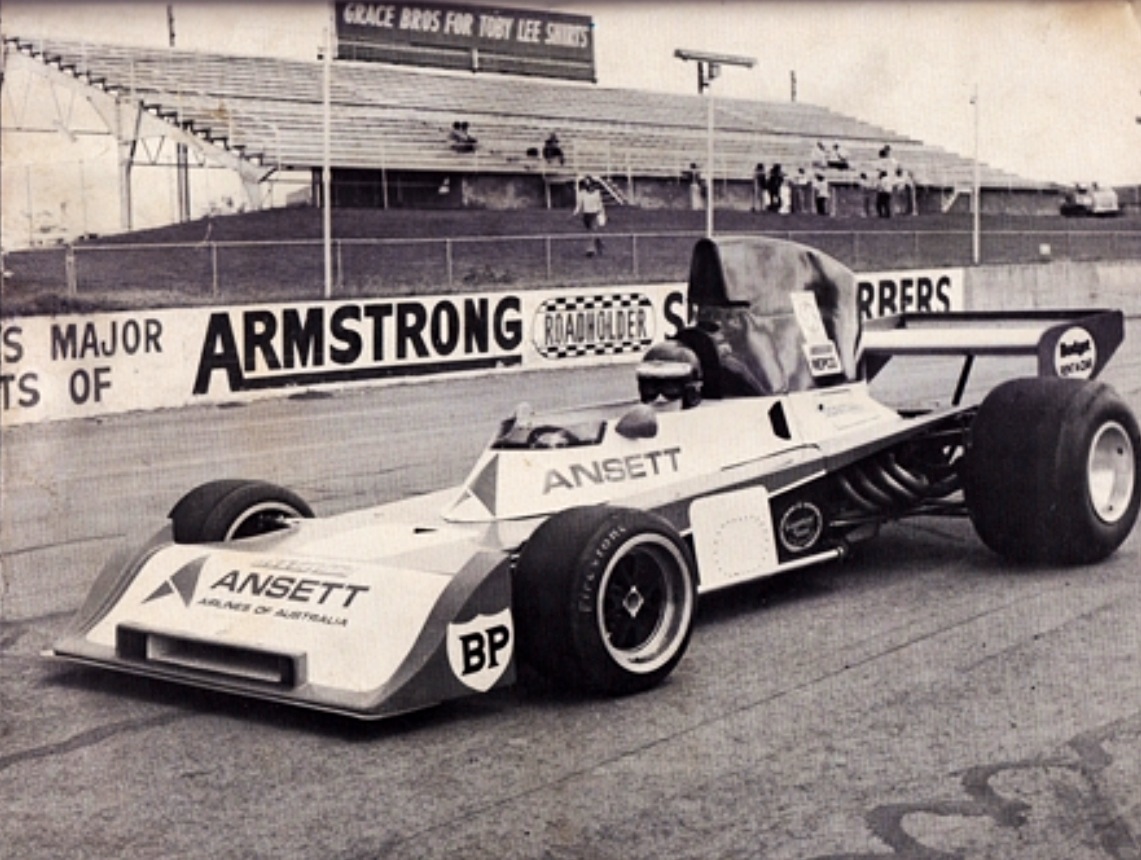
He bought the very first Elfin MR5 Repco in 1971 and via his connection with Phillip Island Auto Racing Club’s John Lanyon did the Ansett sponsorship deal to create the two car ‘Ansett Team Elfin’ together with Elfin owner/designer/driver Garrie Cooper. McCormack and his team developed his car to be very competitive, winning the Australian Drivers Championship, the Gold Star in 1973 and the NZ GP – part of the annual Tasman Series of eight races run in Australia and New Zealand every summer – in 1973 and 1974.
Tasmanian Gold Star race success. Mac was second in the 1967 Symmons Plains event to Greg Cusack’s Repco engined Brabham BT23A. Car is McCormack’s ex-Brabham BT4 Climax (oldracephotos)
In search of the unfair advantage over the heavy Holden and Chevrolet engined cars, Repco’s Phil Irving spotted the new Leyland P76 family car engine, a 4.4-litre aluminium block V8, at the Melbourne Motor Show.
Elfin’s John Lanyon quickly did a deal with Leyland and Repco to jointly fund development of an F5000 variant of the new engine for a car specifically designed for it. The idea was to distribute the weight in a fashion more akin to an F1 car, rather than the tail happy F5000s. McCormack characterised the 5-litre beasts as ‘like having a pendulum in the car’. Cooper’s Little Car was the Elfin MR6, a new design which debuted in 1974.
John McCormack debuts the Elfin MR6 Repco Leyland # MR6L #6741 at Oran Park on 30 January 1974. A big panic as the car was running late and was launched in NSW, at Oran Park near Leyland’s Zetland HQ, a long way from Elfin’s base in Edwardstown, Adelaide. Mac was not happy with the Tasman Series starting in NZ several days later but the car did manage a few laps despite not having turned a wheel before. The MR6 small by F5000 standards and very 1973 Tyrrell 006 like in appearance (unattributed)
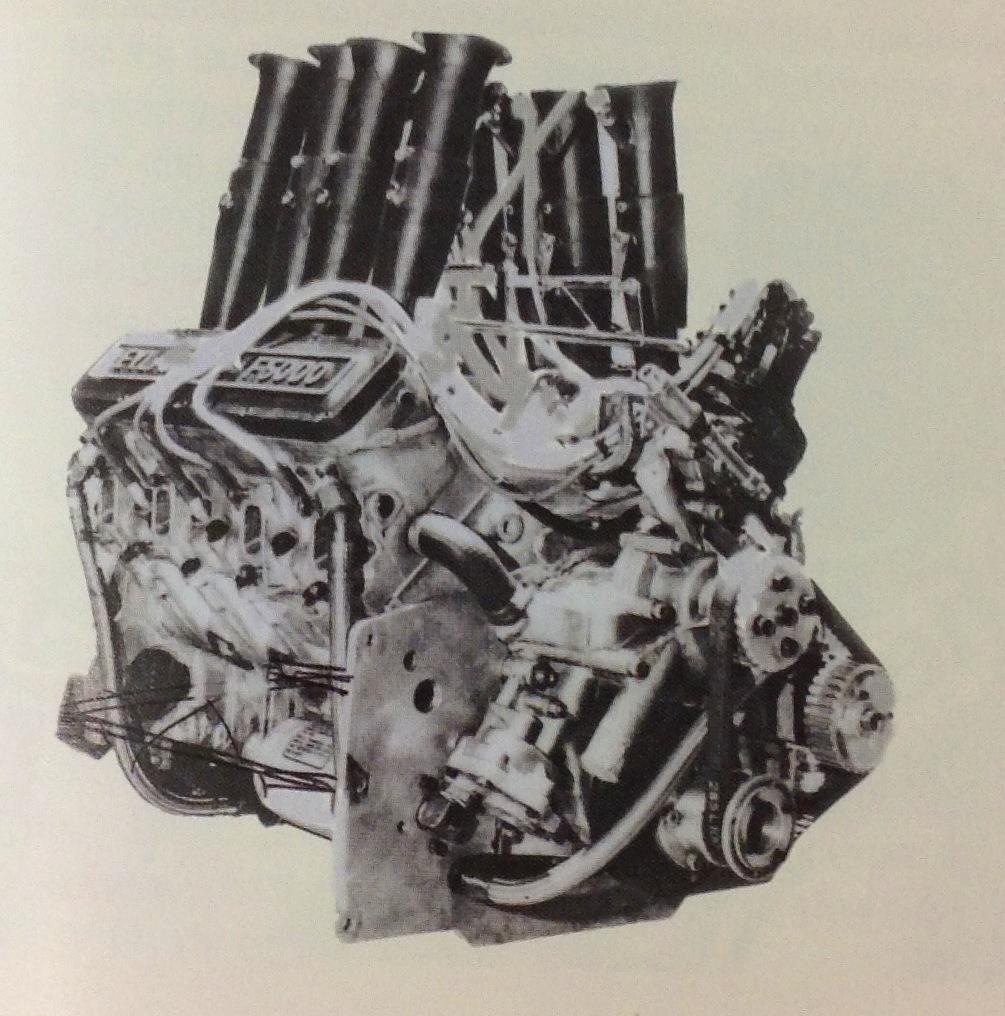
Repco developed an engine with a capacity of 4931cc, a 94mm bore and 89mm stroke. As originally developed, the engine used the P76 cylinder block fitted with special liners and main bearing stiffening plates, the cast iron crank was replaced with steel units after initial failures. Cylinder heads were P76 with flowed inlet and exhaust ports and larger valves. Pistons, con-rods and bearings were Repco, as was the dry sump setup which utilised three stage pressure and scavenge pumps. Fuel injection was by Lucas and a Repco Lorimer dual point distributor fed by coils provided the spark.
Critically, the engine weighed only 160kg compared with the Holdens 220kg, however the claimed power of 425 bhp @ 6800rpm and 375 lb ft of torque at 5500 rpm was far less than the circa 500bhp plus of a Holden or Chev. Elfin’s Dale Koenneke quipped that the engine when first raced in early ’74 had ‘no more than 365 bhp’ when installed in the MR6. History tends to support the contention that the horses were ponies rather than stallions!
The engine had many teething problems, the fragility of the engine blocks and cast iron cranks together with consistent overheating were exacerbated by Repco’s withdrawal from racing that July, and therefore lack of commitment to the project.
McCormack used both the MR5 and MR6 in ’74, before converting the MR6 to accept the Repco Holden engine. ‘Dale Koenneke said enough! We put in all this effort and the thing just shits itself, lets put the Holden into it,’ in this form the MR6 won the 1975 Gold Star.
McCormack, an independent thinker was still convinced the Repco Leyland could be a winner in the right car, the question was finding one!
And so, M23/2 came to Australia, sans DFV but with plenty of spares…
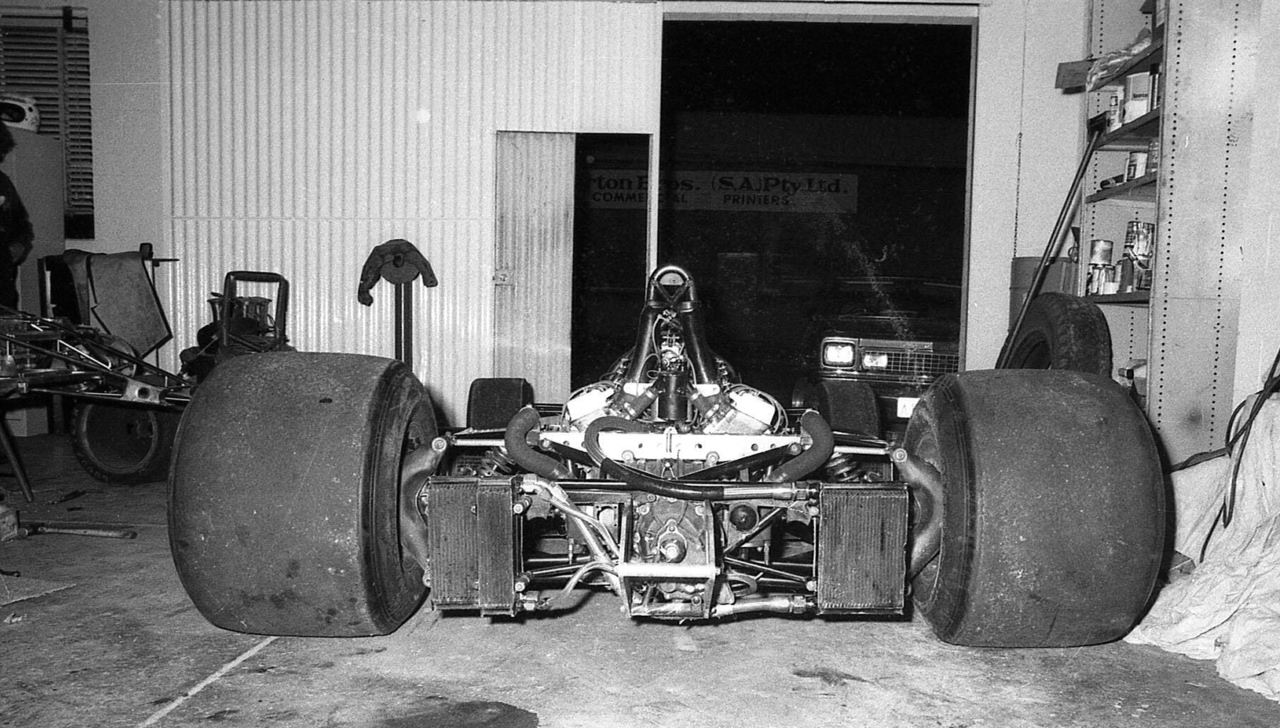
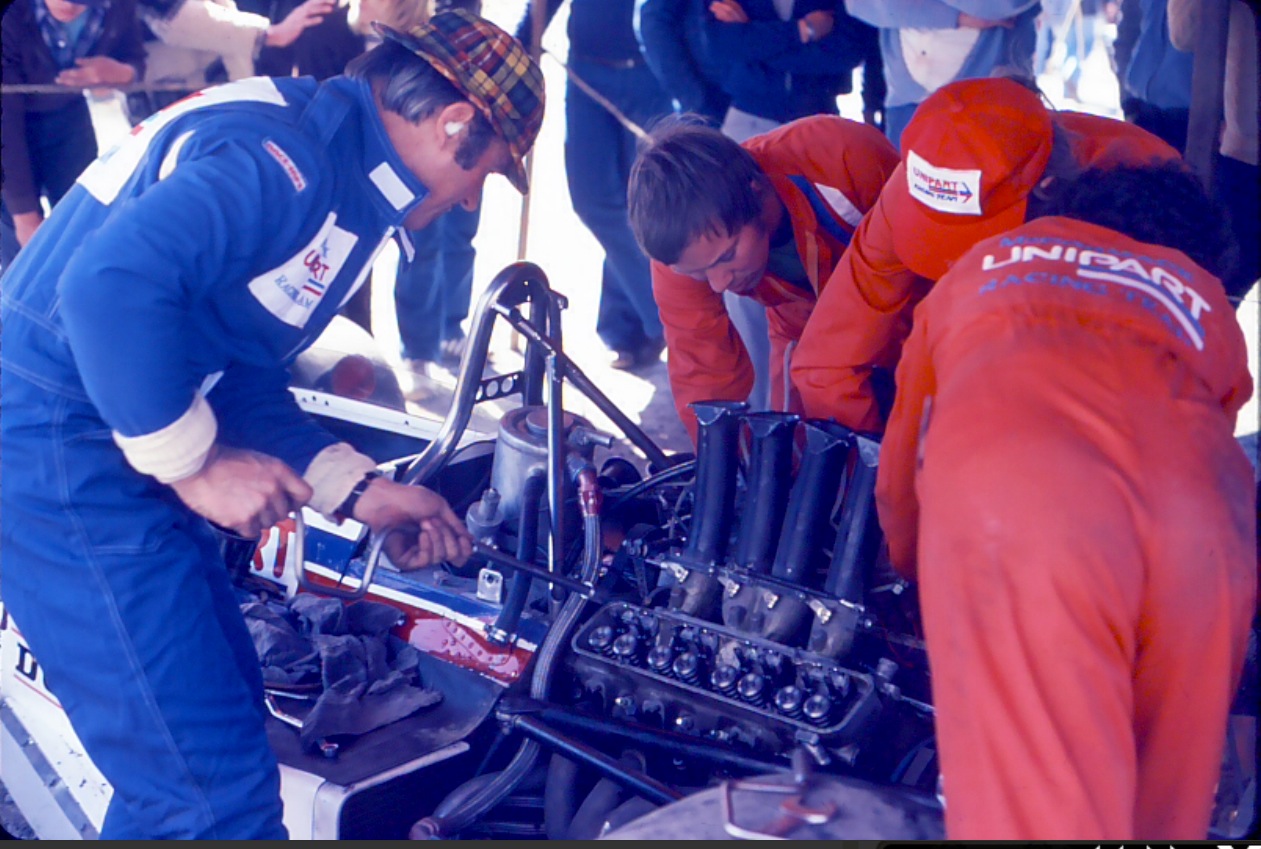
McCormack’s team of Dale Koenneke and Simon Aram did a beautiful job installing the Repco Leyland into the car without ‘butchery’. The engine, after modification of the harmonic balancer, and relocation of water pump and oil tank, fitted neatly into the tub albeit as an unstressed member, which the DFV of course was, the engine supported by traditional tubular A-frames.
Engine sans exhausts, neat installation of the Leyland engine where a DFV was designed to go apparent. A-Frame engine mounts, side rads, inboard discs, conventional parallel lower links, single top link and coil spring/shock units in contrast to inboard front set-up (John Lemm)
McCormack engaged famous Aussie engineer Phil Irving (ex Repco, Vincent) to further develop the engine from its Repco base. Irving designed new heads, cast by Comalco, which eliminated separate valve guides and seats. The design also featured a bent pushrod to allow more room for straight inlet ports. John said ‘Power increased to around 435bhp and 410ft/lbs of torque, more mid range punch than the Repco Holden. An alternate cam delivered 470bhp/380ft/lbs but this stressed the overall package causing many block failures. ‘All the talk on Friday night at the Horsepower Hotel never won races, it was about torque as well as power and whilst we were light on power we had plenty of mid range punch and a well balanced overall car package.’
The Hewland FG400 gearbox was marginal in F1, the torque of the beefy Repco required new gears cut by Peter Holinger’s now famous Holinger Engineering concern in outer Melbourne.
Another of John Lemm’s Coongie Avenue, Edwardstown shots. Outboard rear suspension, Hewland FG400 box – fragile in this application given the engines torque – radiators in a constant battle with heat, and off to the left side you can just see the nose-brackets of the Elfin MR6 tricked up as a display car at the time
The Repco and Chev engined Lola, Matich, Chevron and Elfin chassis’ had more power, but the McLaren was lighter, the superb balance, handling and braking of the design was maintained as the DFV and Repco Leyland were similar weights.
John was convinced he had his unfair advantage. ‘The drivability of the car with its long-stroke engine was great, it was an excellent high speed car, it wasn’t quite so good on slower tracks where it lacked feel at the back due to fixed length driveshafts. The car had quite a high roll-centre and was very sensitive to aero tweaks on fast circuits, it was flat into turn one at Phillip Island, really quick!’
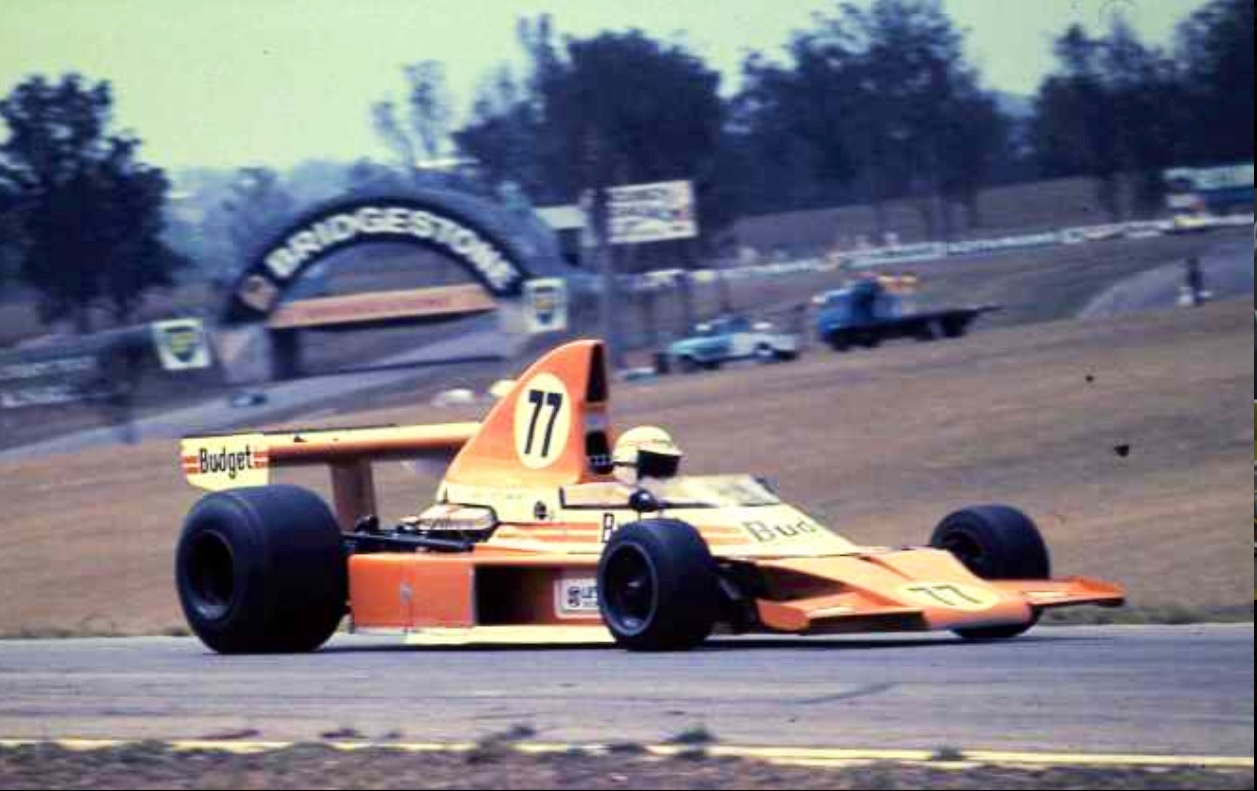
After much media interest McCormack raced the car at the Oran Park Gold Star round in September 1976 putting it fourth on the grid, a valve failing on lap 22. A win followed at Calder in October, then pole at the ‘Island, leading until a tyre deflated, despite this the car finished third in its inaugural Gold Star Series.
Oran Park Australian Grand Prix ’77 (unattributed)
Car sponsor Budget Rent a Cars’ Bob Ansett convinced John to hire Frank Gardner to assist with Team Management in the Rothmans International series but a poor championship caused by unreliability was succeeded by a Gold Star win at Surfers.
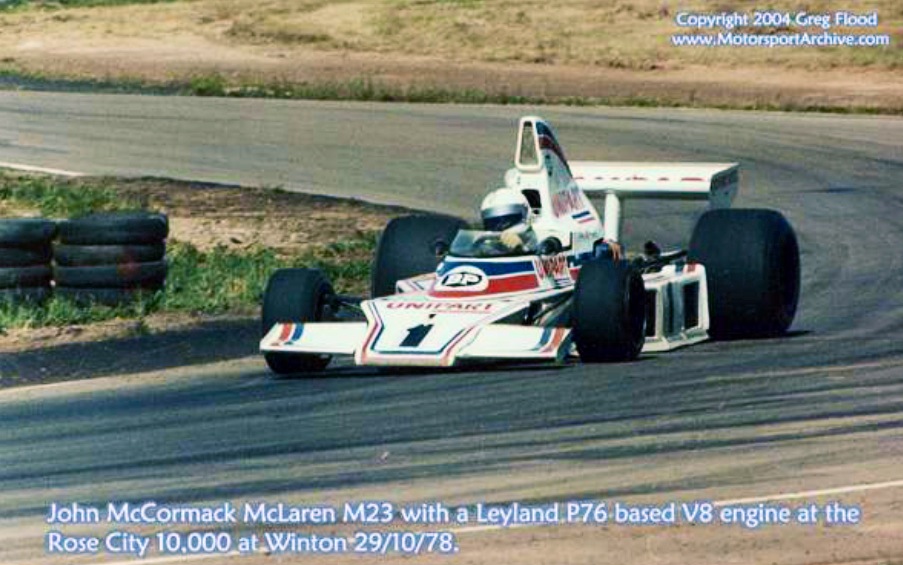
At Sandown the car gave cooling problems, but the final round at Phillip Island showed its true pace, two seconds a lap clear of the best Lola on this circuit which is a test of power and handling. McCormack was well in the lead when problems again intervened, John pitting for two laps then limping home picking up enough points to win his third Gold Star Series. The year was capped with a win in the Rose City 10000 at Winton.
McCormack and John Walker, Lola T332 Chev, Oran Park Gold Star round 1978…’lift off’… (John Shingleton)
1978 started poorly with Rothmans Series unreliability followed by an Oran Park Gold Star round win.
The Sandown AGP was a terrible race with multiple accidents, the McLaren out virtually from the start with head gasket failures. John dominated at Calder only to run out of fuel with a lap to go. Then the Phillip Island round was cancelled, John finished second in the Gold Star as F5000 – non-existent elsewhere in the world – limped on.
The season ended again with the Rose City 10,000 at Winton. Among the competitors was James Hunt, the 1976 World Champion making a one-off appearance in Australia driving an Elfin MR8 Chev. John was second on the grid to him, Mac having an unfortunate event in which a stone jammed a brake caliper causing a pit stop, he finished fourth in the race won by Hunt.
‘Perick of a thing, will it last ?’, F5000’s were brittle and the Leyland Repco was never left alone for long…McCormack and team Adelaide International Raceway ’78 (John Shingleton)
1979 also started poorly with 5th the best result from four Rothmans International Series meetings, Larry Perkins won the title in an Elfin MR8 Chev. The McLaren’s last F5000 race was the 1979 AGP at Wanneroo Park, Western Australia where a gear broke.
McCormack entered 20 F5000 events for three wins and victory in the 1977 Gold Star ahead of cars much younger and more powerful than his 1973 McLaren! Unreliability was the issue with 10 DNS/DNF results, mind you the Chevs and Repco Holdens were also brittle.
Can-Am 1979…
M23/2 Can Am, Mid Ohio ’79 (Mark Windecker)
By 1976 F5000 had been ‘destroyed’ by Eric Broadleys fantastic, dominant Lola T330/332/332C series of cars.
The Tasman series was over, the Kiwis adopted Formula Atlantic/Pacific and Australia persevered with F5000, against the global tide. The US F5000 series ended at the duration of the 1976 season and morphed into 5-litre single seat Can-Am sports cars, with Lola T332 derivatives remaining the dominant car for some years.
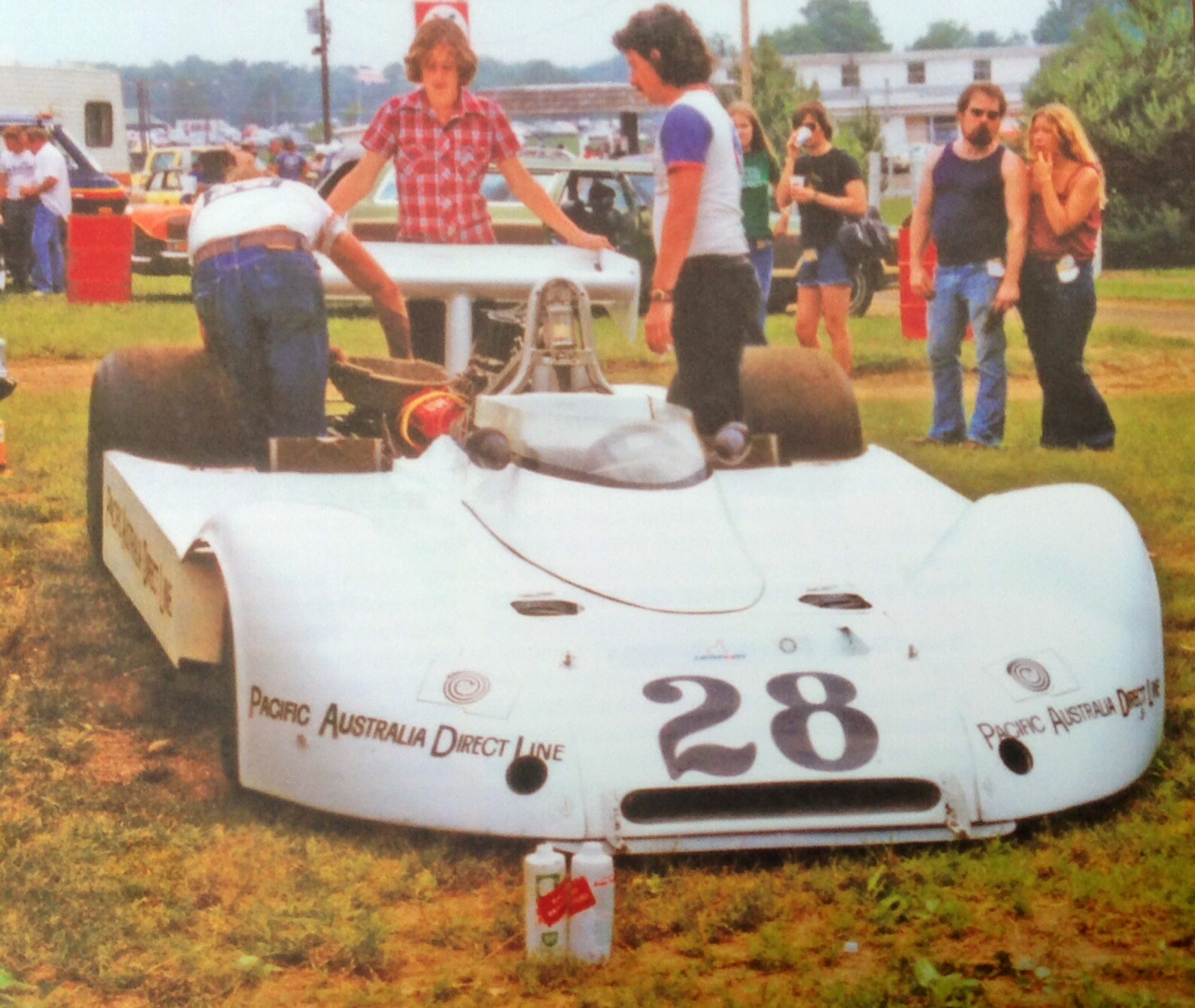
McCormack, a professional racer, converted the McLaren from an F5000 to a very attractive Can-Am car. M23/2 travelled back over the Pacific again! ‘It was time to have a look at what was happening in the US, things were quiet here so Simon Aram and John Webb designed and built an attractive body and off we went.’
US paddock shot, circuit unknown. Body designed and built by Simon Aram and John Webb (‘From Maybach to Repco’ Malcolm Preston)
He was taking on a big challenge, the Can-Am series in 1979 included Keke Rosberg, Jacky Ickx, Alan Jones, Geoff Lees, Vern Schuppan (Elfin MR8), Bobby Rahal and Al Holbert amongst its competitors.
‘Its true there were some top teams but the quality of the fields rapidly fell away. No one knew the series was on wherever we went, it was poorly promoted, the Americans were much more into Nascar and Indycars, you had to leave the circuit to go and buy fuel at some of the tracks!’
The McLaren competed in three rounds for a best result of 12th at Watkins Glen in a series dominated by Lolas with Ickx winning in a T333CS. ‘There was a weight advantage if you ran 4-litre engines, we did two of the races with the 5-litre Leyland and one, the final round, with the 4-litre which gave around 400BHP, the weight thing was academic as the cars were never weighed.’
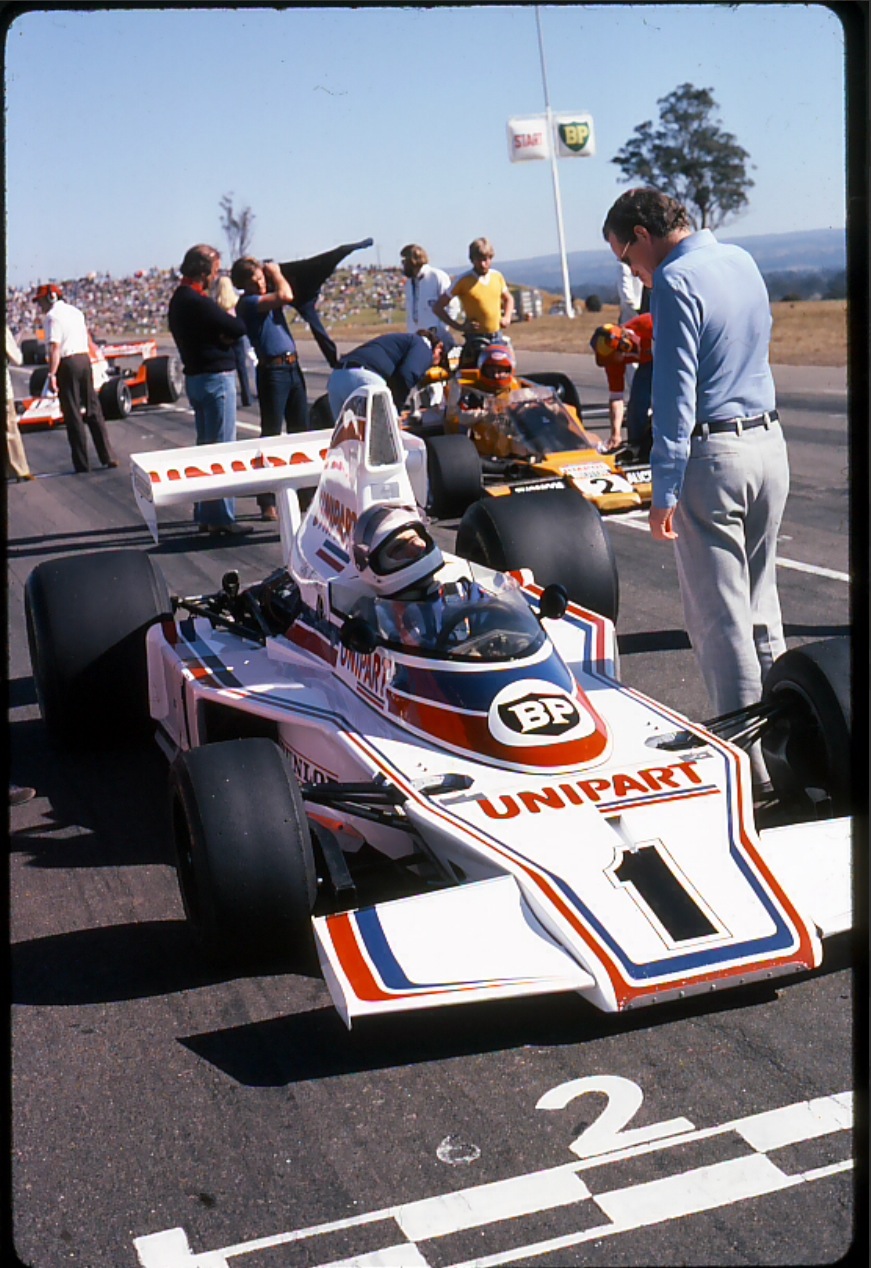
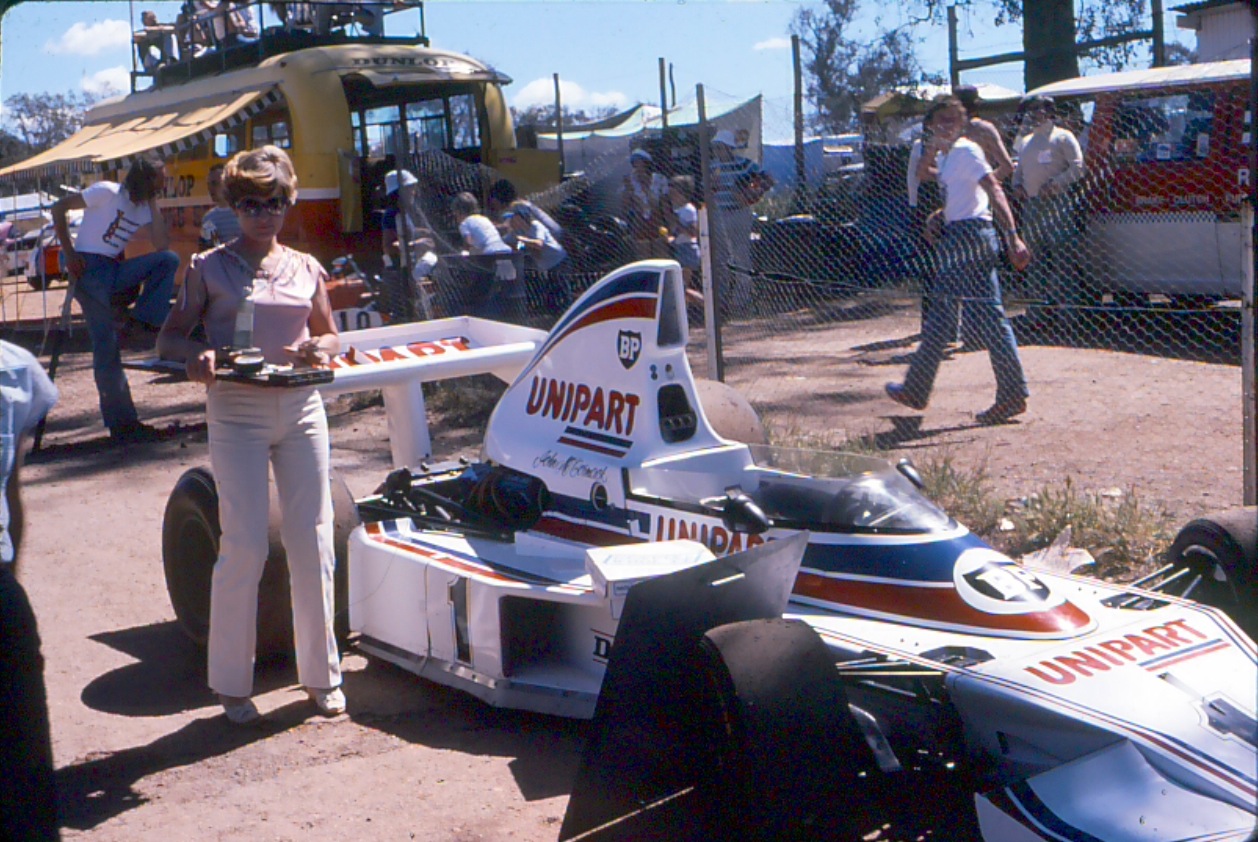
It was no disgrace in this company in a six year old car run by a small team far from home. In the end money was tight and it was time to return to Australia to compete in a Jaguar Sports Sedan his team had built, and at the instigation of sponsor, Unipart, contest the 1980 AGP which was run to F5000 – and F1- rules!
McCormack in M23/2, Mid Ohio Can Am ’79 (Mark Windecker)
Back to ‘Oz F5000 and finally home to Woking…
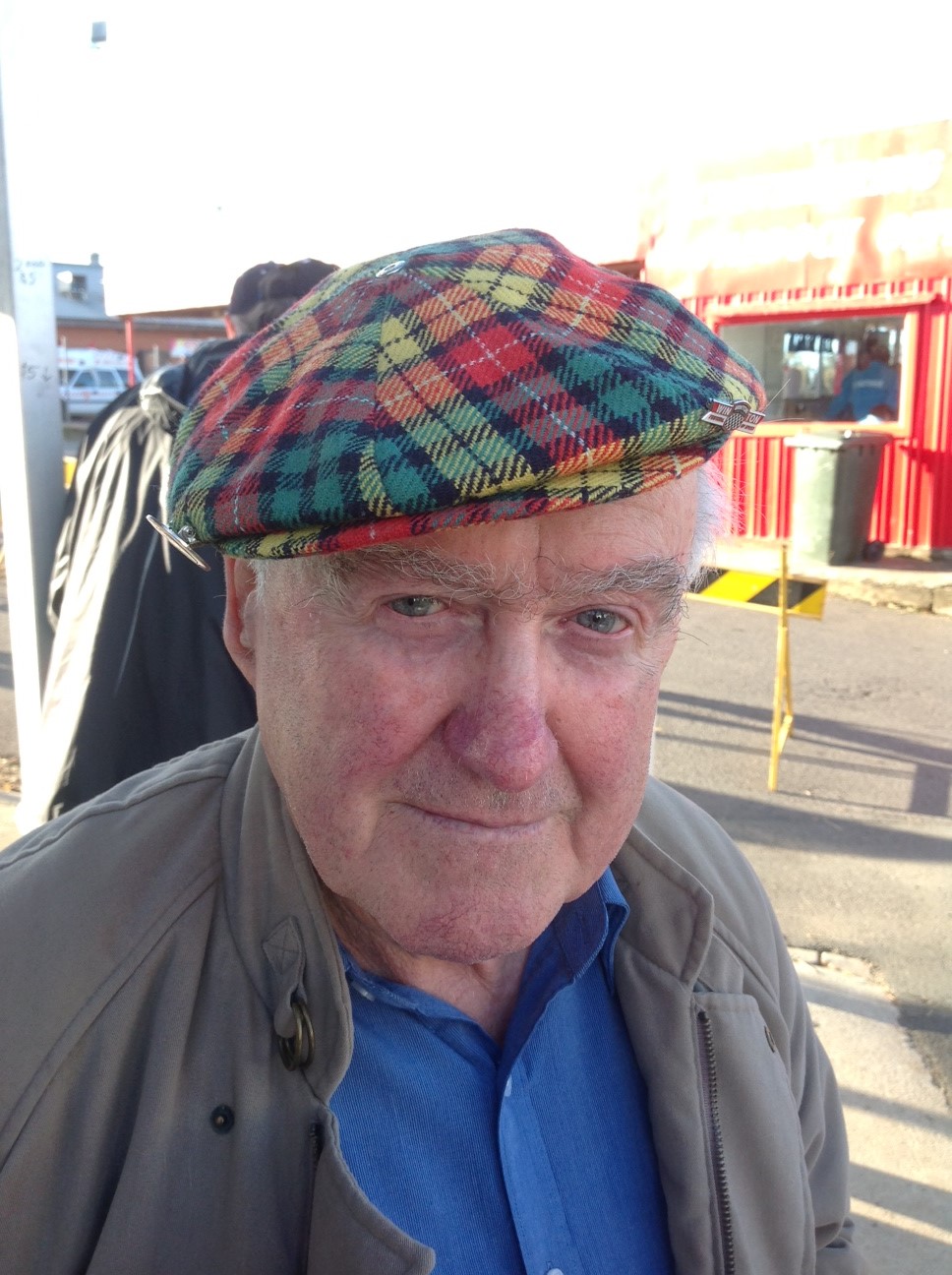
John McCormack at the Winton, Victoria, historic meeting in May 2013, interested, interesting and intelligent. McCormack was outside the mould, successfully going in his own direction throughout his career. I suspect the Leyland engine would have got the better of all but someone like him who applied his experience and pragmatic engineering approach and knowledge to making the thing work despite its fundamental structural weaknesses as a race engine (Mark Bisset)
Alan Jones was on his way to winning the 1980 World Championship, so the 1980 AGP rules were amended to attract the new champion and his Williams FW07 to Australia. Also making the trip from Europe were Bruno Giacomelli and his Alfa 179 and Didier Pironi, of Team Tyrrell, who drove an Elfin MR8 for Ansett Team Elfin.
McCormacks’ team converted the McLaren back into F5000 specifications, he was looking forward to the race. ‘The McLaren was not a light car, it then weighed about 1430 lbs, because the AGP was being run to F1 rules we lightened the car enormously by about 200 lbs’.
‘I normally flew to meetings but we a were running late with the preparation of the car so I travelled as a passenger with my mechanic to get some sleep. There was some fog about, he dozed off at the wheel near Keith (in rural South Australia) hitting a tree having glanced off an earth mover which made an horrific accident slightly better than it may have been! I got a brain injury in addition to the physical ones, I have about 70% of my mental capacity, not enough to race again’.
McCormack’s car awaits the driver, Calder paddock AGP 1980. A rare shot showing the car in its ‘Resin Glaze’ livery for the event it never started, John was badly injured in a road accident in rural SA enroute to Calder (Chris Jewell)
Sadly, that was the last race for both McCormack and the much used M23. John went on to build a number of successful sports sedans for others and today has property, retail and mining interests near his home town of St Helens on the Tasmanian East Coast.
McLaren built thirteen M23s. M23/2 competed in 54 events, more than any other M23 chassis, winning more races than any other M23 as well; 54 starts for 12 wins. One F1 Championship GP, eight South African Championship rounds and two championships, three Australian Gold Star rounds and one championship. Only a Can-Am win eluded it in its multi-faceted life.
McCormack was focussed on his health and rebuilding his life, the car was offered locally for sale around 1982, without any takers as F5000 had been replaced by Formula Pacific. It was just an old uncompetitive car at the time! Then along came McLaren’s Ron Dennis hoovering up cars for the factory collection where M23/2, converted back to its Yardley McLaren F1 spec, takes its museum place in the pantheon of the company’s rich, ongoing 50 year history.
M23/2 travelled the globe as an F1 car, crossed the Atlantic to South Africa, then the Pacific to Australia, back across the Pacific to the States, back again to Australia and finally to Woking in the UK, just down the road from Colnbrook where it was built all those years before. It was a remarkable journey from class to class and back again, competitive all the way throughout!
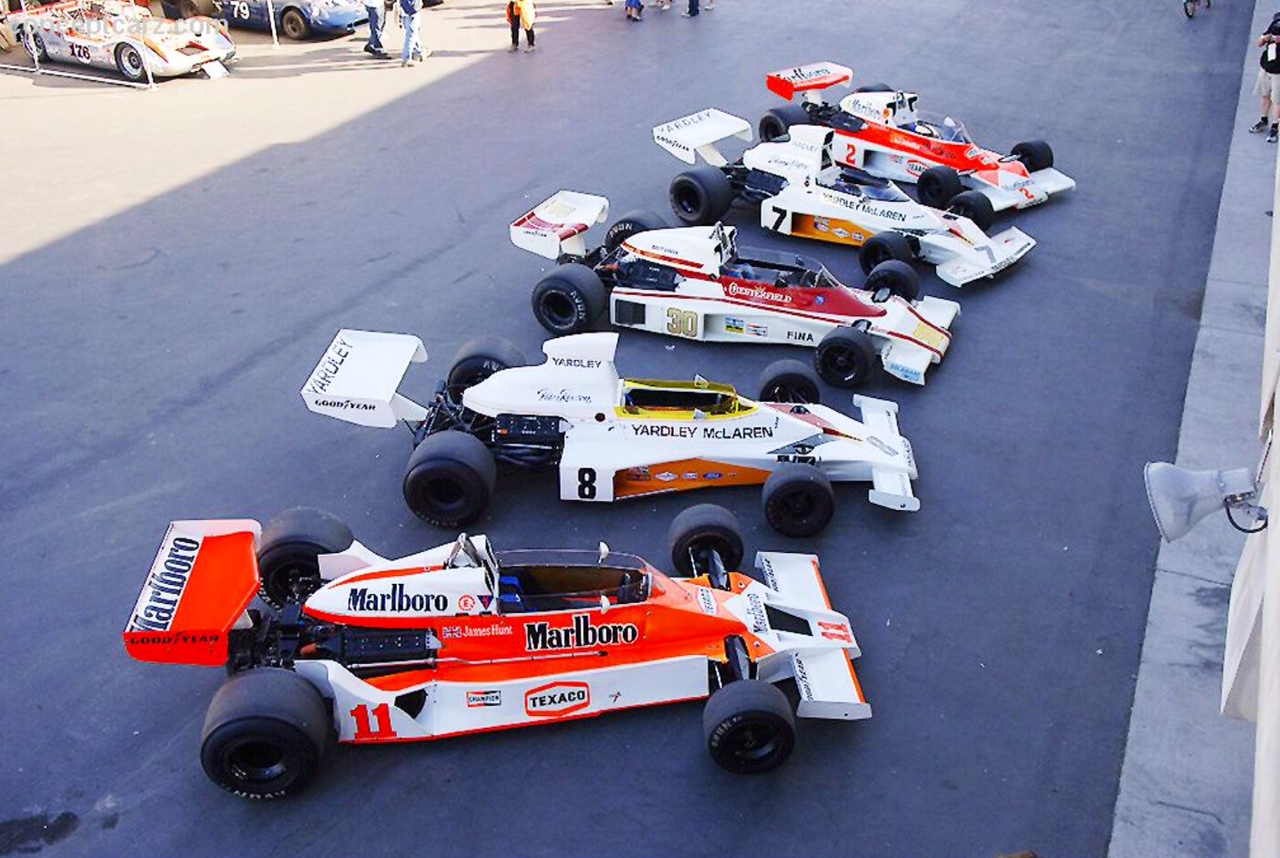
Monterey Historics : the car in front is an M26 but the rest are M23’s, M23/2 the second car…
Etcetera. The story of the McLaren is not complete without delving a bit more into the Leyland engine and its parentage…
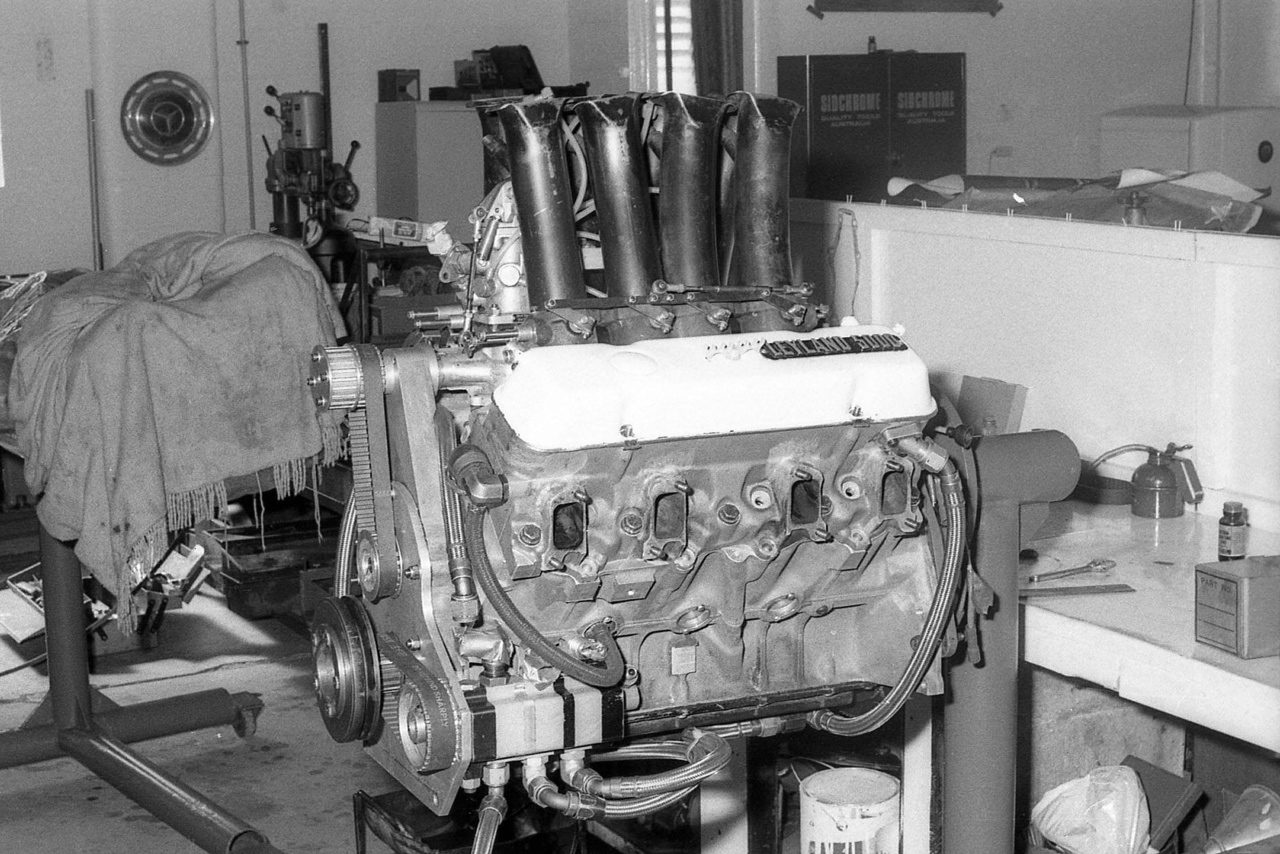
Irving/McCormack/Repco Leyland F5000 engine: drives for oil pumps, dry sump, metering unit, Lucas fuel injection, all ready for installation into the M23 at McCormack’s Coongie Avenue, Edwardstown, Adelaide workshop (John Lemm)
Coventry Climax, the Cosworth Engineering of their day caused chaos for British Grand Prix teams when they announced that they would not build engines for the new 3-litre F1 commencing in 1966. They had been engine suppliers to most of the British teams since 1958. Repco had serviced (and built the engines under licence) the 2.5-litre Coventry Climax FPF four cylinder engines, the engine de jour in local Tasman races, but were looking for an alternative to protect their competitive position, Jack Brabham suggested a production based V8 to be built by Repco .
He identified an alloy, linerless, V8 GM Oldsmobile engine, a project abandoned due to production costs and wastage rates on imperfectly cast blocks. He pitched the notion of racing engines of 2.5 litre – and later 3-litre – displacements using simple, chain driven SOHC heads to Repco’s CEO Charles McGrath.
GM developed a family of engines. The Oldsmobile F85 and Buick 215 were almost identical except that the F85 variant had six head studs per cylinder head rather than the five of the 215 and was therefore Brabham’s preferred competition option.
Brabham had seen the engine’s potential much earlier, racing against Chuck Daigh’s Scarab Buick RE in the cars one off – and only – race appearance at Sandown in early 1962. The car raced in 3.9-litre form that weekend and had plenty of squirt, albeit the underdeveloped chassis was not as competitive as the Coopers under brakes or through the corners.
The engines competition credentials were further established at Indianapolis that year when Indy debutant Dan Gurney qualified Mickey Thomsons’ 215 engined car 8th, the car failing with transmission problems after 92 laps. It was the first appearance of a stock block engined car at Indy since 1945.
An idea is born…Jack Brabham checking out the 3.9-litre Buick engine in Chuck Daigh’s Scarab RE in its one-off Australian appearance at Sandown in early ’62 (‘Jack Brabham with Doug Nye’ Doug Nye)
Whilst the engine choice was not a sure thing its competition potential was clear to Brabham, as astute as he was practical. At the time the engine was the lightest mass production V8 in the world with a dry weight of 144kg with compact external dimensions to boot.
Repco acquired 26 of the F85 blocks and won the 1966/7 World Drivers and Manufacturers Championships as well as countless other races globally with engines using these and later, from 1967, Repco’s own ‘700’ and ‘800’ Series blocks.
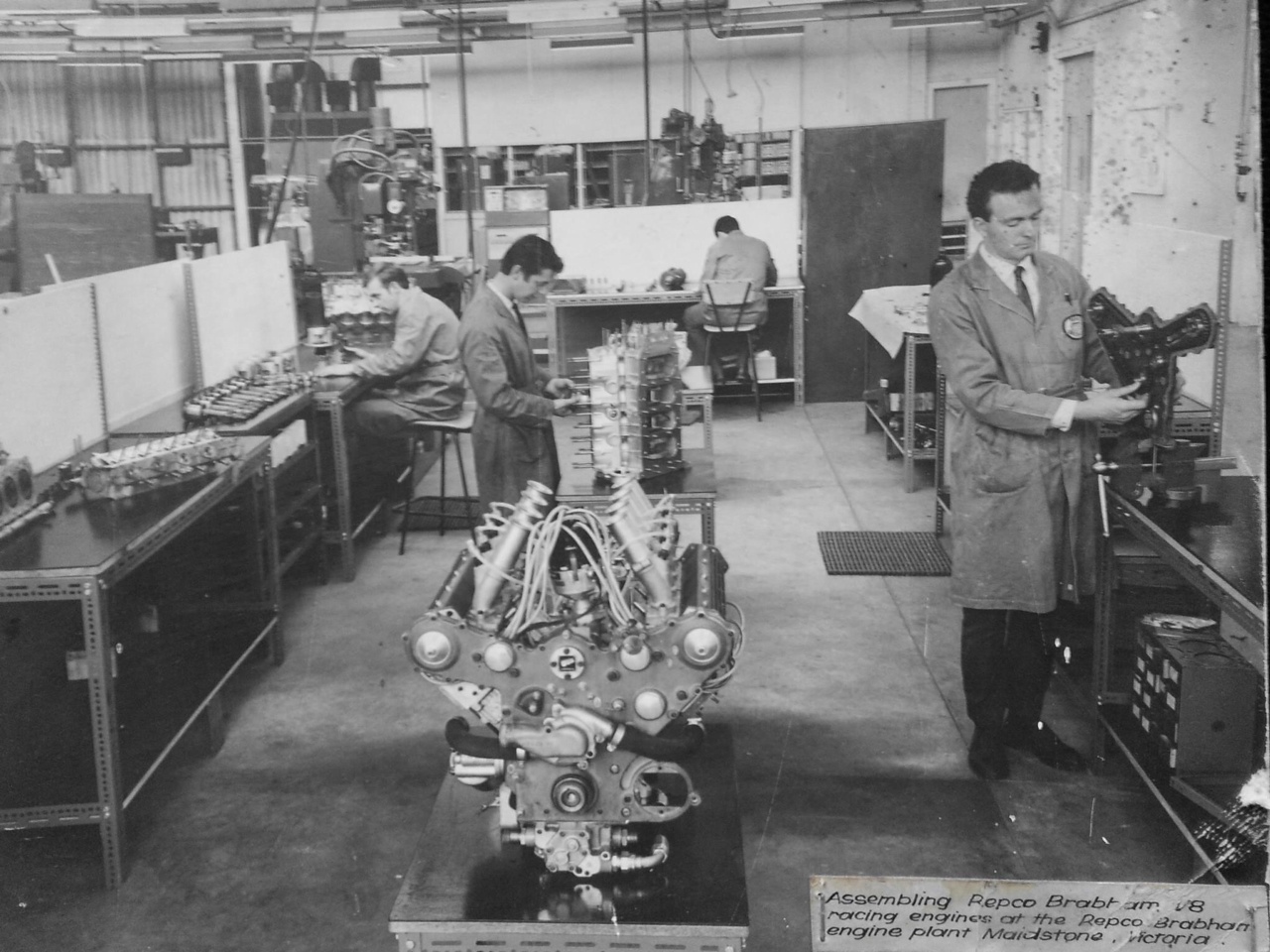
Repco’s Maidstone workshops producing the RB620 3 litre F1 engine, 1966
GM sold the production rights of the V8 engine to Rover in 1967. When Phil Irving – who designed the 1966 F85 block Repco RB 620 engine – saw the Leyland engines at the Melbourne Motor Show he thought he knew them well. However, the original GM design had suffered in its transition to Rover and then to Leyland Australia. In essence their were fewer head bolts on both the inlet and exhaust sides of the heads, in addition the block and heads were sand, rather than die cast which made them weaker and less uniform. Finally, the heads had smaller ports than the originals.
The fundamentals of the engine to take increased operating loads and power were lacking. Irving made changes by adding material to the block and head castings which also facilitated the installation of main bearing strengthening bars, such changes were homologated by Leyland in accordance with F5000 rules. Repco claimed 440bhp with an absolute rev limit of 7500rpm and a crank life of one hour. It was soon found that the fragility of the block and cranks required a maximum of no more than 7000rpm.
Repco publicity shot of the Leyland Repco engine in its original form as fitted to the Elfin MR6 in 1974 (Repco)
With further development post Repco, McCormack’s team – with the new Comalco heads, different valve sizes, inlet port shapes inspired by Honda and shorter exhaust primaries – had a vaguely reliable engine consistently giving 435bhp and 410lb/ft of torque. Not a lot, but enough to do the job, much like Phil Irving’s Repco Brabham 620 engine in F1 in 1966, that engine was not the most powerful in the field but it did the job, albeit much more reliably than its F5000 relation!
The Leyland/Repco/McCormack/Irving F5000 V8 was truly a triumph of development over design on a tiny budget!
Letter from Leyland Australia to Repco confirming the commercial arrangements to develop the engine, happy days, no lawyers and complex legal agreements! (‘ Maybach to Holden’ Malcolm Preston)
Acknowledgements…
John McCormack for the considerable time he contributed, Malcolm Preston, thanks for your written submission
‘The History of the Grand Prix Car 1966-1985’ Doug Nye, ‘Maybach to Holden’ Malcolm Preston
Photographs…
The Rolling Road/John Shingleton, Mark Windecker (Can-Am), Autosport TNF, John Lemm, Greg Flood, The Cahier Archive, Greg Falconer, oldracephotos.com, David Pearson, reddit.com, Rob Ryder, Chris Jewell, Werner Buhrer cutaway drawing
A few more M23/2 Shots…Addendum…
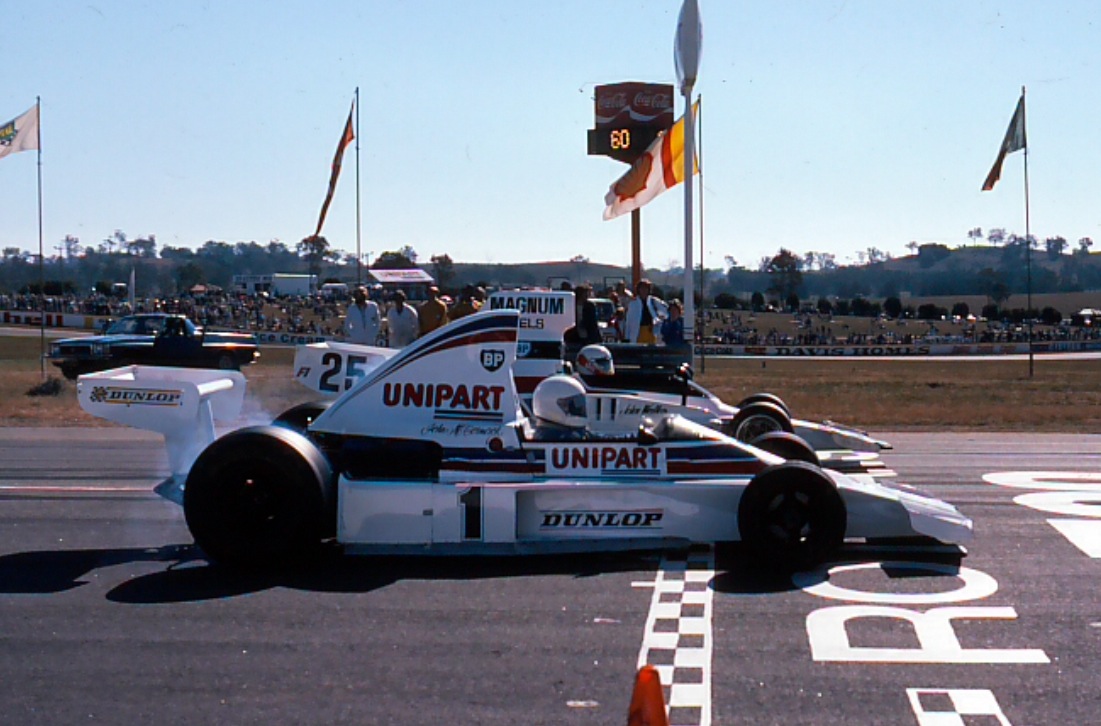
Peter Revson, German GP 1973, Nurburgring. 9th in the race won by Jackie Stewart (Unattributed)Ian Scheckter’s Tyrrell 007 in front of Charlton in M23/2 Kyalami 1975 (unattributed)M23/2 Repco, Sandown Park 1977 (unattributed)Rose City 10000, Winton 1978. This race was won by James Hunt in an Elfin MR8 Chev (unattributed)McCormack on the grid, on the far side is John Walkers’ Lola T332. Oran park Gold Star meeting 1978 (John Shingleton)‘Don’t let me down baby…’ Adelaide 1978 (John Shingleton)Adelaide 1978, entourage a contrast to the Birrana 274 F2 and Stephen Fraser’s Cicada further back…(John Shingleton)Winton dummy grid much the same today, there is a shed where the nifty Dunlop Bus is though. McCormack Rose City 10000 1978 (John Shingleton)Mid Ohio Can-Am round (Mark Windecker)Wonderful Mark Windecker Mid Ohio shot shows the attractive one-off body fashioned by John Webb and Simon Aram in Adelaide. Still some Repco support, car ran the last Can-Am round for the team at Watkins Glen with a 4-litre version of the Repco Leyland, exploiting a weight advantage afforded smaller engines by the rules (Mark Windecker)
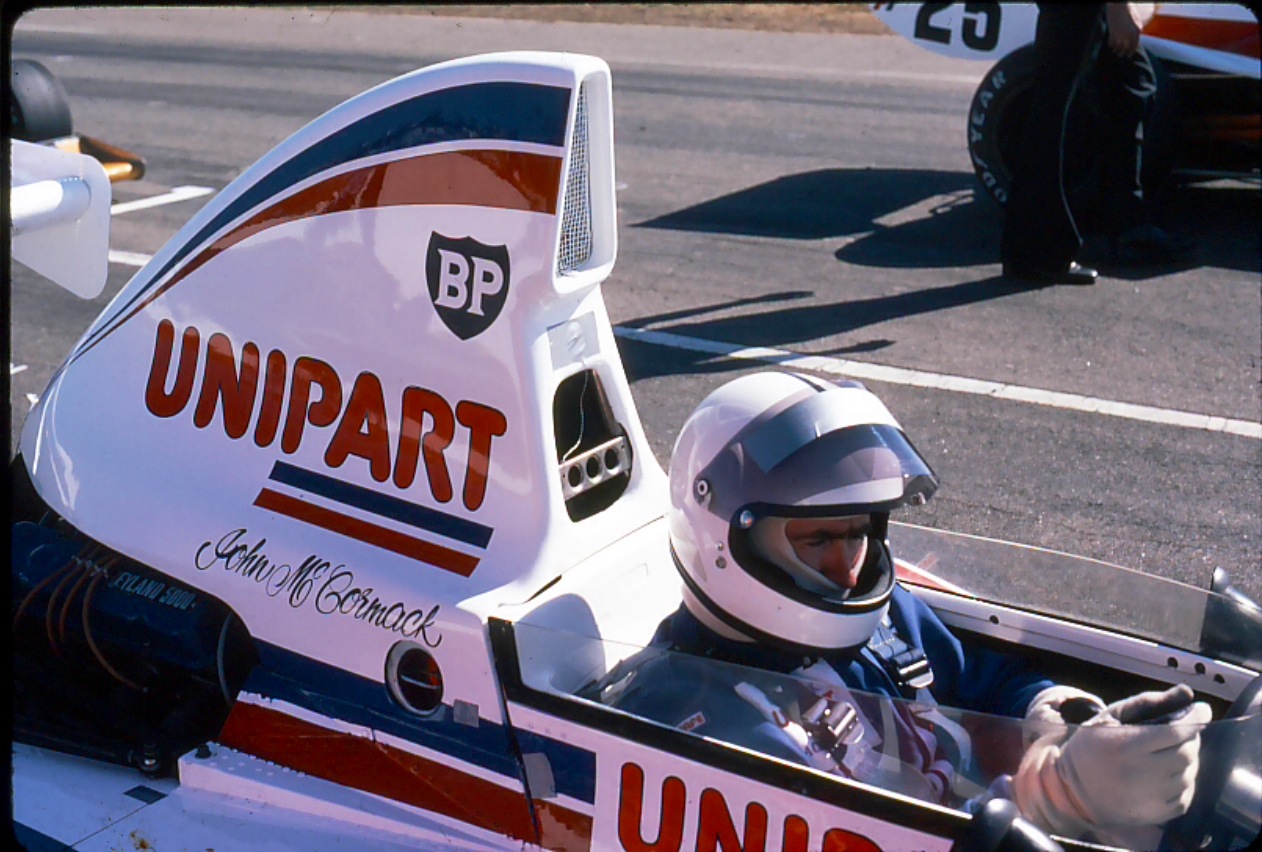
And finally, Unipart Merchandising 1978 style, the T-Shirts @ $3.20 are a snip….
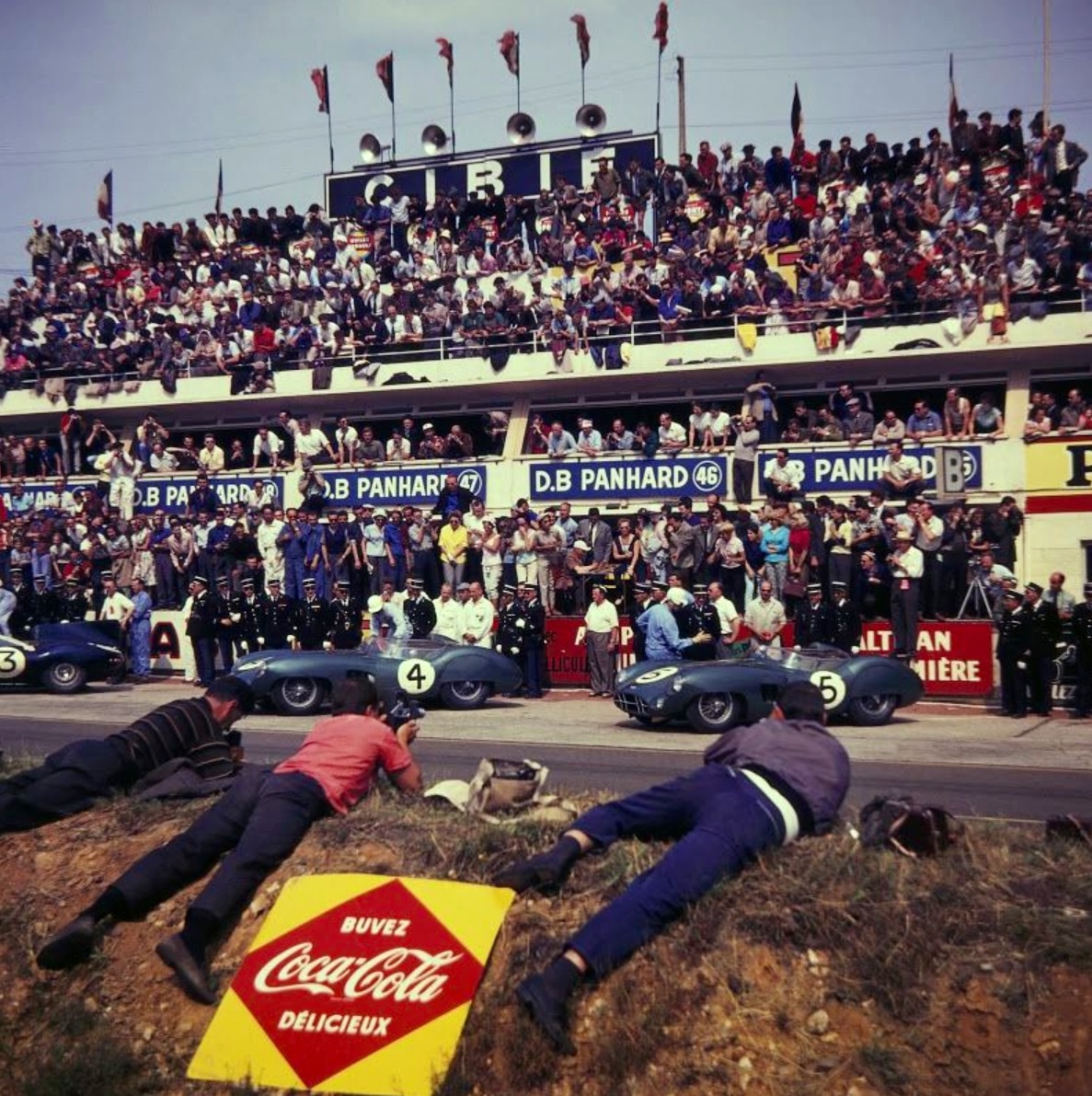
# 5 is the winning Carroll Shelby/Roy Salvadori Aston Martin DBR1/300, # 4 the Stirling Moss/Jack Fairman sister car, and # 3 the Innes Ireland/Masten Gregory Jaguar XK’D’ Type, both DNF.
1959 was the only Aston Martin Le Mans victory so far, Astons’ also won the World Sportscar Championship that year with wins in 3 of the 5 rounds; LeMans, Nurburgring 1000Km, and RAC Tourist Trophy at Goodwood. Ferrari and Porsche were second and third in the Championship respectively.
The DBR1 was one of the greatest cars produced under the 3 litre sports car formula, in addition to its 1959 successes it also won the Nurburgring 1000Km and the Tourist Trophy at Goodwood in 1958.
Its essential elements are laid bare in this James Allington period cutaway drawing for Automobile Year.
The engine is an inline 6, all aluminium, the crankshaft supported by 7 main bearings. Two valves per cylinder were fitted at an included angle of 95 degrees operated by twin gear driven overhead camshafts. Fuel was provided by 3 Weber carburettors, the ignition fired by 2 Lucas distributors driven off the end of each camshaft, 2 plugs per cylinder.
The engine was ‘undersquare’, bore and stroke 83X90mm for a capacity of 2932cc, the engine produced circa 265bhp@6500rpm on a compression ratio of 9:1.
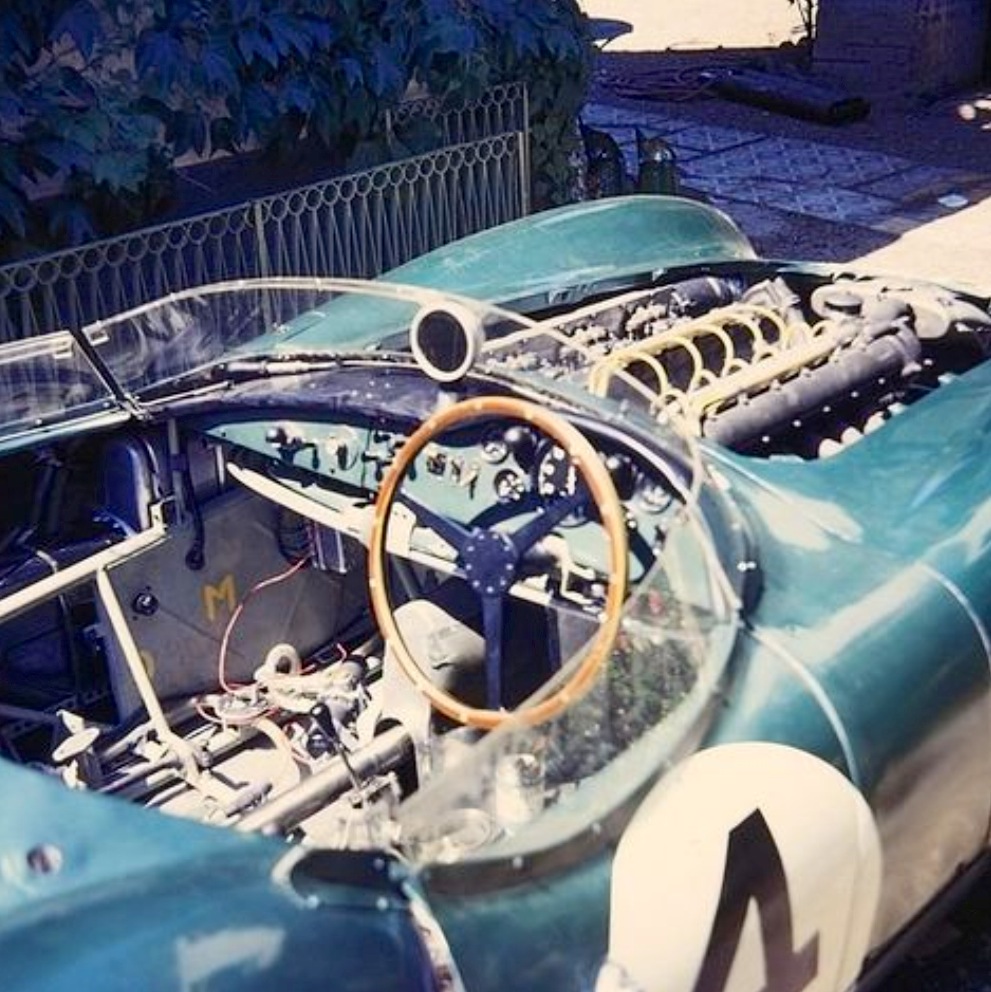
Cockpit of the Moss/Fairman DBR Le Mans 1959. (unattributed)
A five speed gearbox was mounted transversely at the rear in unit with a ZF differential.
Front suspension was by twin trailing links springing by transverse torsion bars. At the rear a De Dion rear axle was used with twin trailing arms, a Watts linkage and again torsion bars were the springing medium.
Girling disc brakes were used and rack and pinion steering. The car had a wheelbase of 90 in, a track front and rear of 51.5 in, a width of 64 inches and a height to the top of the scuttle of 38.5 in…the whole lot weighing 1760lb.
The #4 Moss/Fairman and #5 Salvadori/Shelby Aston DBR/1’s at rest. Chez Aston, Le Mans 1959. (Unattributed)
Carroll Shelby, AstonMartin DBR1/300 Le Mans 1959 (unattributed)
Carroll Shelby driving, Roy Salvadori, David Brown the owner of Astons’ and Stirling Moss post victory. (unattributed)
Etcetera…
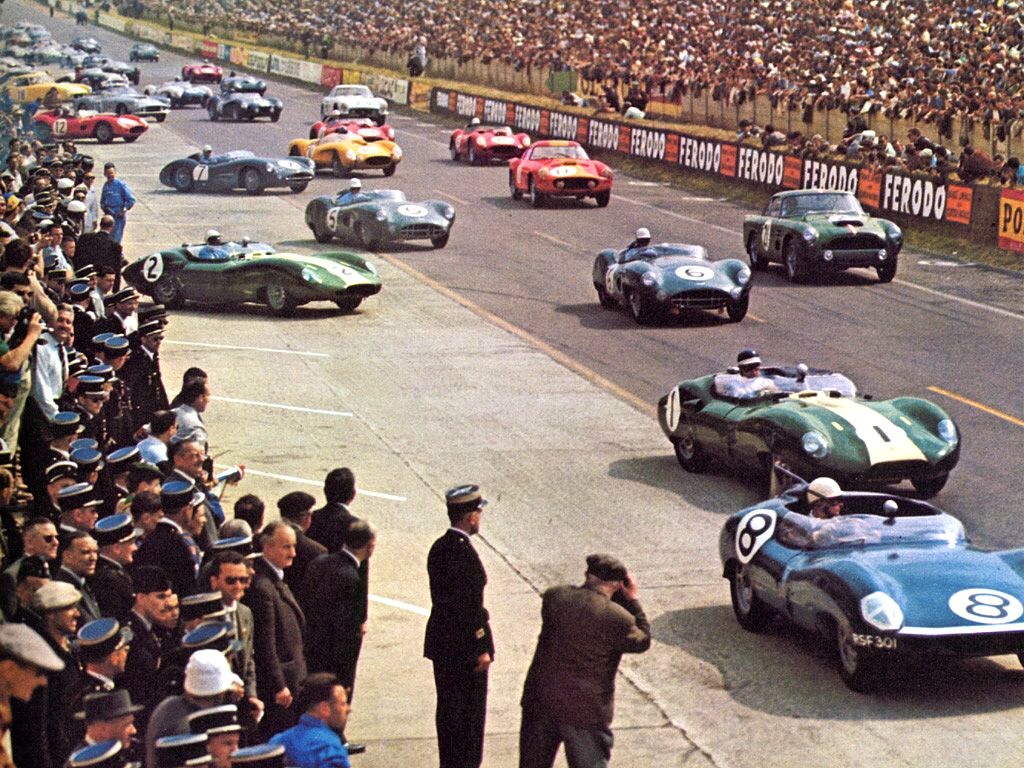
Front of the Le Mans grid 1959. #8 Flockhart/Lawrence Tojeiro Jaguar, #1 Bueb/Halford Lister Jaguar, #2 Hansgen/Blond Lister Jaguar and #3 Ireland/Gregory Jaguar D Type…all DNF. Stirling Moss is talking to the photographers priod to the ‘start sprint’. (Unattributed)
Le Mans start 1959. # 8 Flockhart Tojeiro Jag, # 1 Bueb Lister Jag, # 6 Trintignant Aston DBR/1, #2 Hansgen Lister Jag, # 5 Salvadori Aston DBR/1 and the rest. (Unattributed)
Trintignant/ Frere Aston post fuelling Le Mans 1959, the pair finished 2nd a lap behind the winning DBR/1. (Unattributed)
Dan Gurney heading for third place in his Ferrrari Dino 246 despite running up Trintignants’ chuff…
The organisers moved the race from Oporto to Monsanto Park, Lisbon that year, also a very dangerous circuit with tram tracks, uneven surfaces and plenty of telegraph poles to hit.
Brabham was saved by one of said poles. Having spun avoiding a twice lapped car, a pole saved him from going down a ravine but spat his Cooper T51 back onto the circuit. He was then thrown out of the cockpit and nearly mown down by teammate Masten Gregory zipping past at the time. Jack always rated that prang his greatest escape.
Tony Brooks’ Dino was four points adrift of Brabham in the drivers championship at that stage, the margin he won the title from Brooks by at season’s end.
The mid-engined era was underway, the gorgeous Dino was passé, it was the last front-engined car to win a title in Mike Hawthorn’s hands in 1958, and also the last to win a Grand Prix, the 1960 Italian, a race boycotted by most of the teams as it was run on the Monza Banking. The Italian race organisers did so to advantage Ferrari, in 1960 still racing the Dino 246 which was way past it’s use by date but still had straight-line speed; scallywags those Italians.
Moss won in Portugal a canter, leading all the way in Rob Walker’s Cooper T51 Climax…
Phil Hill, Luigi Bazzi, Carlo Chiti, and Dan Gurney discuss the need for more speed at Monsanto Park, Lisbon 1959. (Getty Images)
Ferrari Dino 246 cutaway showing, ladder frame, 2417cc 65-degree DOHC V6, four speed gearbox, double wishbone front suspension, De Dion or IRS at rear depending upon the year, this car appears to be IRS and therefore a later specification car.
(James Allington/Tony Matthews)
The Cooper T51 Climax cutaway shows the space frame chassis Coventry Climax DOHC 2490cc four cylinder engine, Cooper/Citroen four speed gearbox, wishbone front independent, and wishbone and transverse leaf spring independent rear suspension.
Photo Credits…
Pinterest unattributed, Getty Images, James Allington/Tony Matthews cutaway
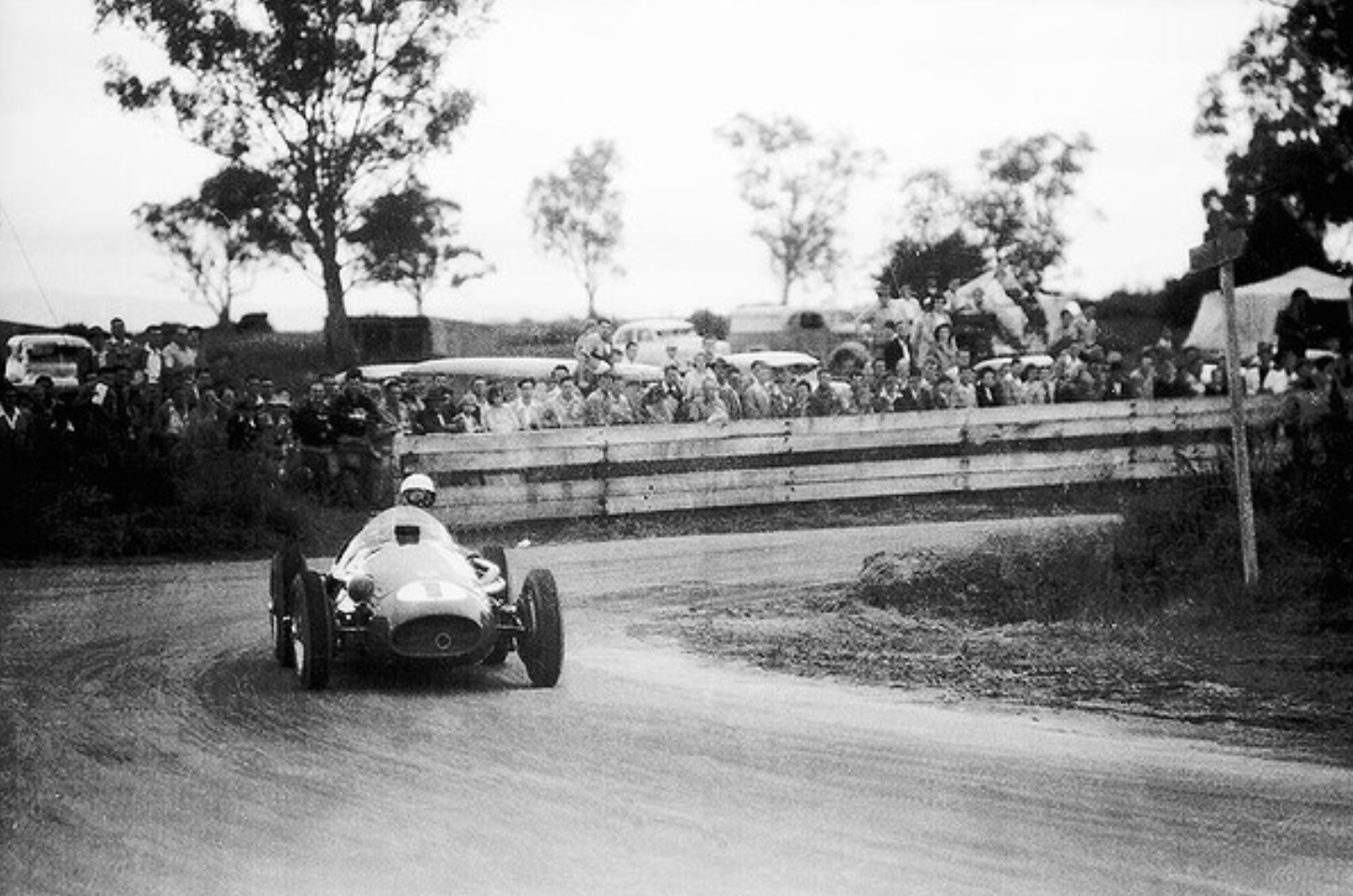
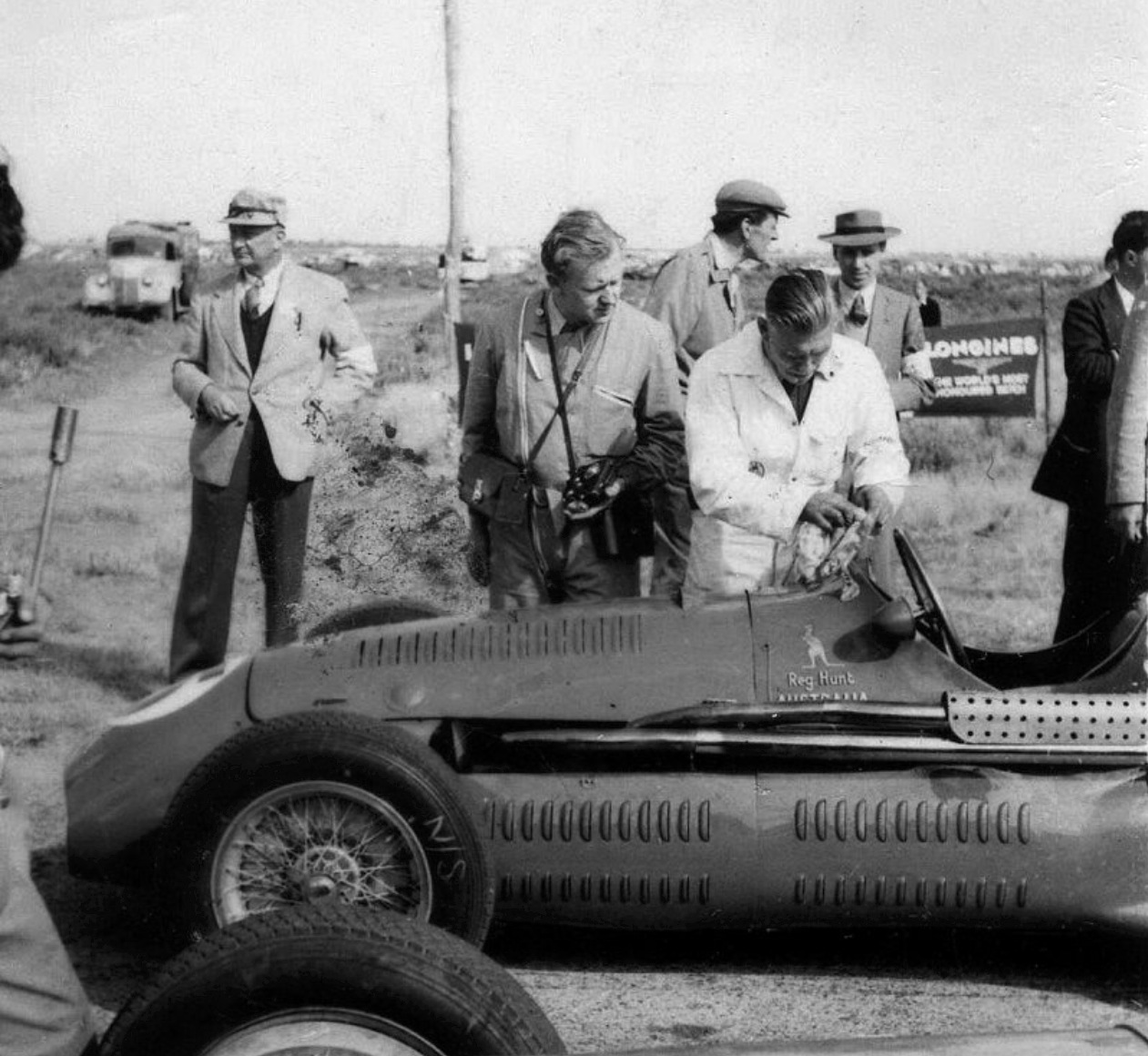
Reg Hunt, Murrays Corner, Bathurst, Bathurst 100 in April 1956 driving his recently acquired ex-works Maserati 250F ‘2516’. Hunt set fastest race time, the race a handicap won by Lex Davison’s Ferrari 500/625.
Reg Hunt, Bathurst 100 April 1956…
Many Melburnians will recognise the name as a very successful retailer of Holdens and many other makes from his acreage’s of dealerships fronting the Nepean Highway in Elsternwick.
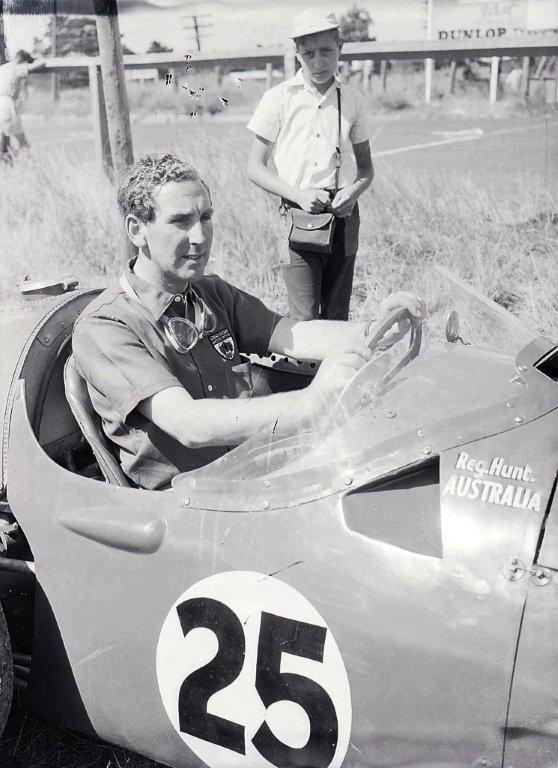
He was also a very successful racer in the 1950’s who retired in his mid 30’s. Little has been written about him. He was ‘up there’ with all of the businessmen/motor dealer/racers of the day; Stan Jones, Lex Davison, Bib Stillwell, Alec Mildren and the rest .
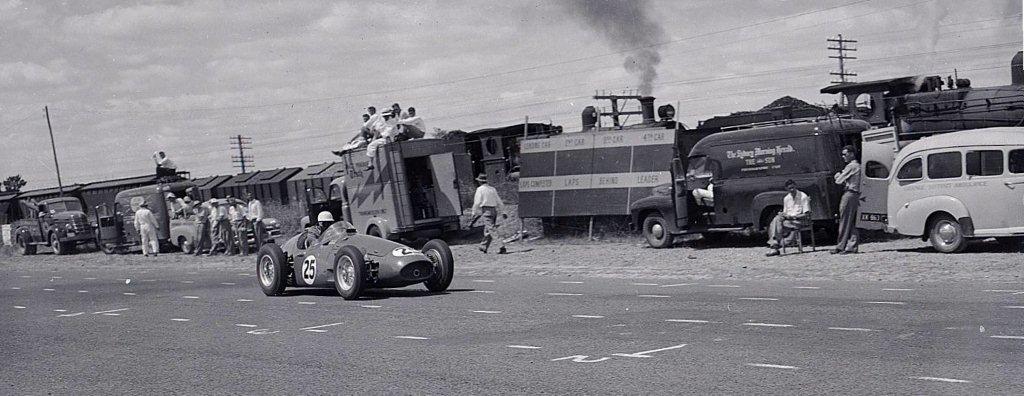
His last racer was an ex-works Maserati 250F ‘2516,’ a car driven by Moss and Jean Behra early in 1956. In this car he was as quick as any of the locals, a great ‘mighta-been’ is what he could have achieved had he not retired to focus on family and his expanding automotive empire.
This interesting article about the little known Hunt, was written by Richard Batchelor and published in the Maserati Club of Victoria magazine;
Hunt winning the ‘South Pacific Championship’ at Gnoo Blas, Orange, NSW on 30 January 1956. He beat a class field in his recently acquired Maserati 250F, Brabham was 2nd in his Cooper Bristol. Fantastic shot of this road circuit. (Gnoo Blas Classic Car Club)
Reg Hunt Unsung ace of the 1950’s…
Reg in his 250F on the cover of the October 1956 issue of ‘Sports Cars and Specials’ magazine
Etcetera…
Reg Hunt, Maserati 250F, Gnoo Blas, Orange 30 January 1956. (Gnoo Blas Classic Car Club)
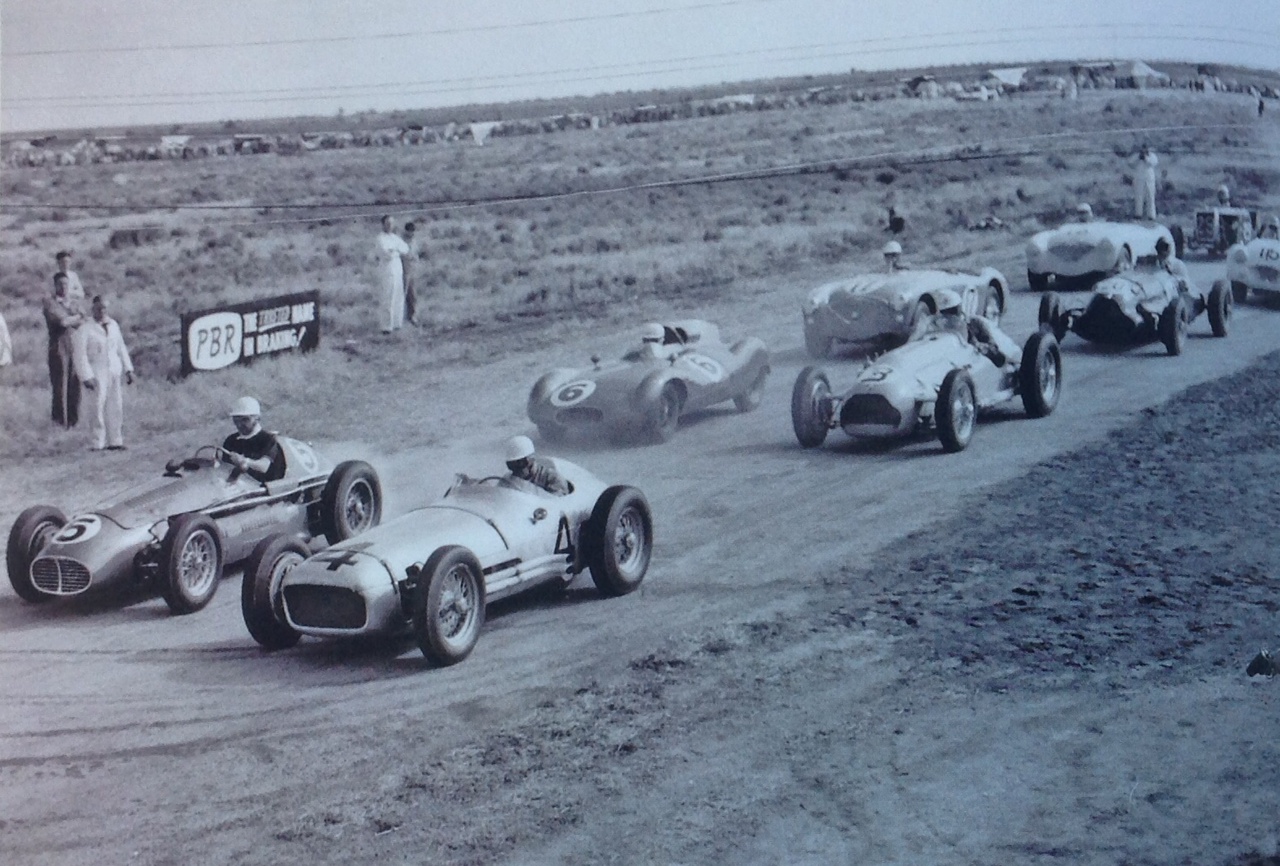
Start of the 1955 Australian Grand Prix, Port Wakefield, SA. Reg Hunt Maser A6GCM and stan Jones Maybach 3, on the front row left and RH side. Jack Brabham and Doug Whiteford, Cooper Bristol and Lago Talbot respectively on row 2, the race won by Brabham. (‘From Maybach to Repco’ Malcolm Preston’)
Hunts’ Maserati A6GCM on the AGP Grid Port Wakefield 1955. Hunt was leading this race by 23 seconds in this 250F engined car, broke a cam-follower and then slowed allowing Brabham’s Cooper T40 Climax through for the win, finishing second. Saltbush country, Port Wakefield, 80 Km from Adelaide was a shortlived circuit but the first permanent circuit built in Australia post war (Max Fotheringham)
Hunt’s A6GCM Maserati prior to the 1955 AGP Port Wakefield paddock, this model was the precursor to the 250F, it was an interim car using the chassis of Maser’s F2 car and the 250F engine…4 or 5 built (Kevin Drage)
Cockpit shot of Hunts Maser A6GCM in the Port Wakefield paddock, 50’s driver safety to the fore…4 speed box aft of engine, 250F’s transaxle mounted at rear in front of De Dion tube giving much better traction (Kevin Drage)
Hunt supervises preparation of the 250F in his Elsternwick, Melbourne, workshop. He was close to the factory team who based themselves here during the 1956 AGP at Albert Park…2493 cc straight 6, 2 valves per cylinder, twin ‘plugs, 3X Weber DCO3 Webers, circa 250BHP in 1956. ‘Space frame’ rails can be seen, ditto front wishbones, roll bar, big 14 inch finned alloy brake drums and the rest…(Garry Baker Collection)
Photo Credits…
Garry Baker Collection, Kevin Drage, Max Fotheringham, ‘From Maybach to Repco’ Malcolm Preston
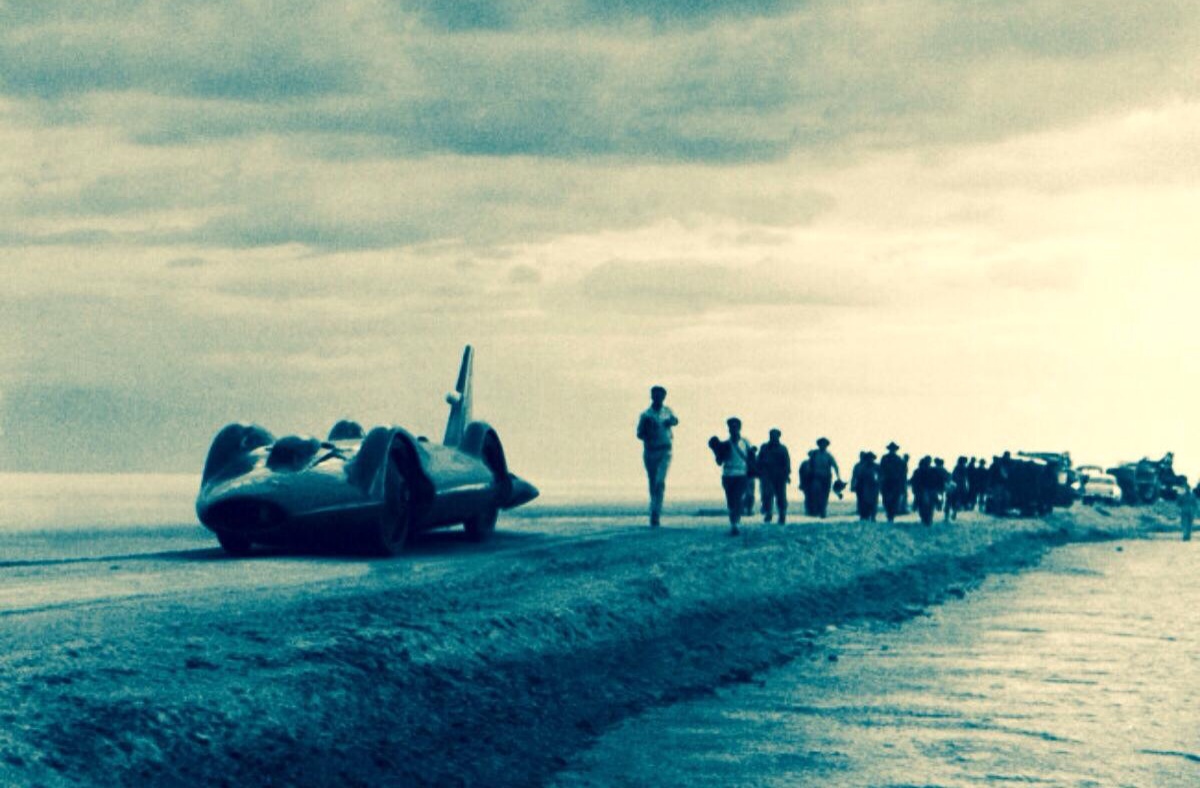
Campbell, Bluebird and team depart from the salt of Lake Eyre in May 1963 on the causeway from saltpan to road and on to Muloorina Station, rain soon covered the Lake to a depth of 3 inches…surreal shot (Pinterest unattributed)
50 Years Ago Today, 17 July 1964 , Donald Campbell Broke the World Land Speed Record, in Bluebird Proteus CN7, at Lake Eyre , South Australia achieving a speed of 403.10 MPH…
Donald Campbell was to achieve a unique double, the only man to ever break Land and Water Speed Records in the same year, when at Lake Dumbleyung outside Perth he set a record of 276.33 MPH in Bluebird K7 on December 31 1964.
His fathers son…
Sir Malcolm & Donald Campbell, Daytona Beach , January 1933. Bluebird Campbell Railton
Donald was the son of Sir Malcolm Campbell, a Grand Prix winner and Brooklands racer who turned his hand to record breaking achieving 146.16 mph at Pendine Sands , Wales , 1924 in a Sunbeam V12 .He broke 9 LSR records in all, his final at Bonneville, Utah, on 3 Sept 1935 at an average of 301.337 mph, the first person to exceed 300mph.
He set 4 Water Speed Records , the final in 1939 on Coniston Water in Bluebird K4 . He was Knighted in 1931 and died after a series of strokes in 1948 aged 63.
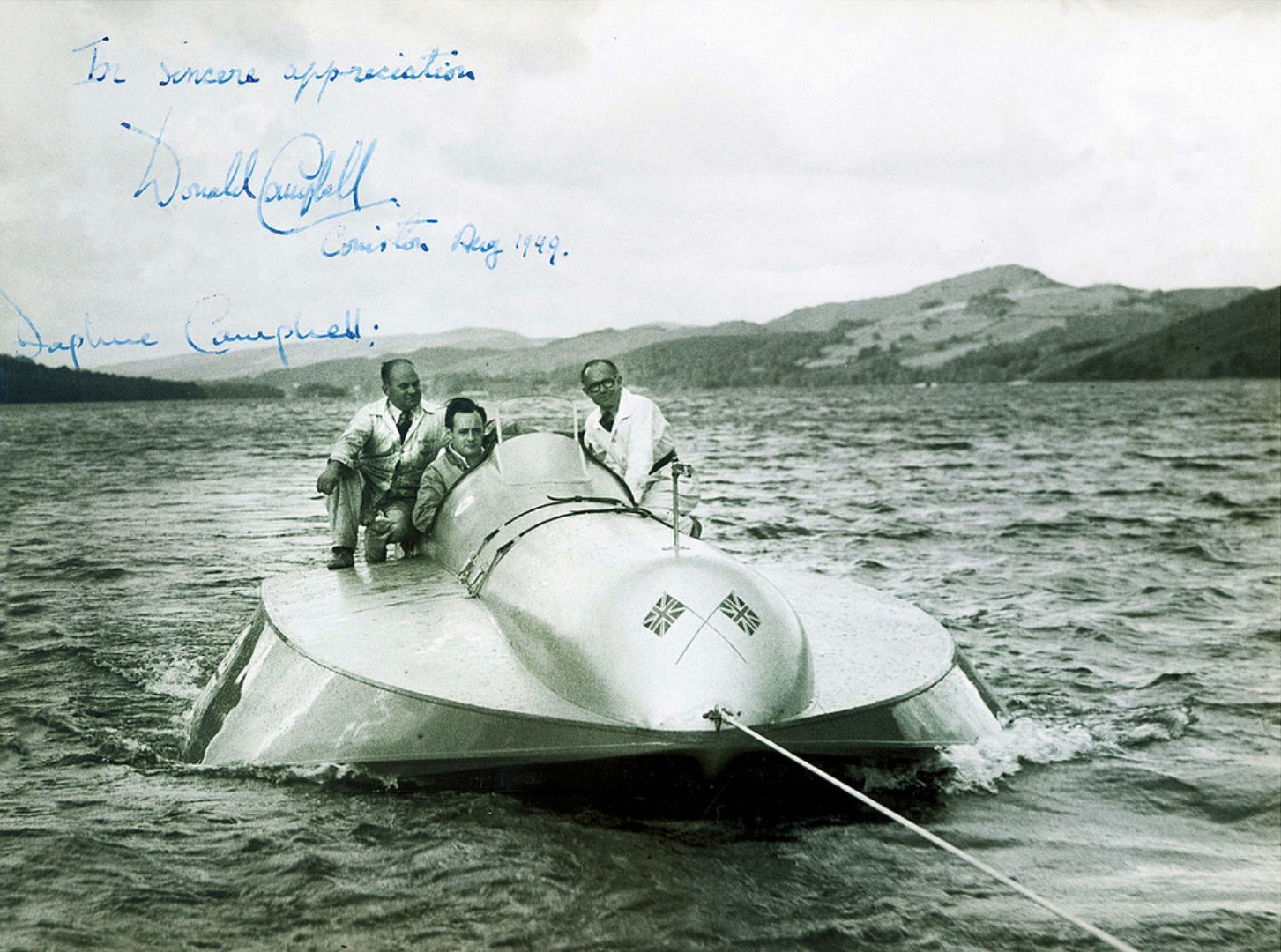
Donald Campbell, Leo Villa (right) in Bluebird K4 ,Coniston Water, Lakes District, Lancashire, August 1949 (Pinterest)
Like many sons of famous fathers Donald set out to both emulate and surpass the achievements of his father.
At the outbreak of World War 2 he volunteered for the RAF but was unable to serve as a result of childhood rheumatic fever. He became a maintenance engineer and subsequently a Shareholder/Director of a small engineering company named Kine Engineering, the business producing machine tools..
His record breaking efforts commenced after his father died, having purchased the boat ‘Bluebird K4’ from Sir Malcolms Estate. It was gradually coaxed to 170MPH and had circuit racing success.Lew Norris was a mechanical engineer and the workshop manager at Kine Engineering who provided advice on the development of K4.
In early 1953 Campbell began developing his own advanced all metal jet powered Bluebird K7 hydroplane. He approached Ken & Lew Norris to design and build the boat , the brothers collaborating with Australian aerodynamicist Tom Fink.
Norris Bros Ltd became a very successful design consultancy working and manufacturing in diverse fields, amongst their designs was the automatic tensioning device for seatbelts.
Campbell set 7 WSR’s in K7 between July 1955 and December 1964, the first at 202.33MPH, the last at 276.33 He was awarded a CBE for his water speed record breaking in January 1957.
Bluebird K7 Coniston Water 1966
From the Waters of Lake Coniston to the Salt of Bonneville, Utah…LSR & Bluebird CN7…
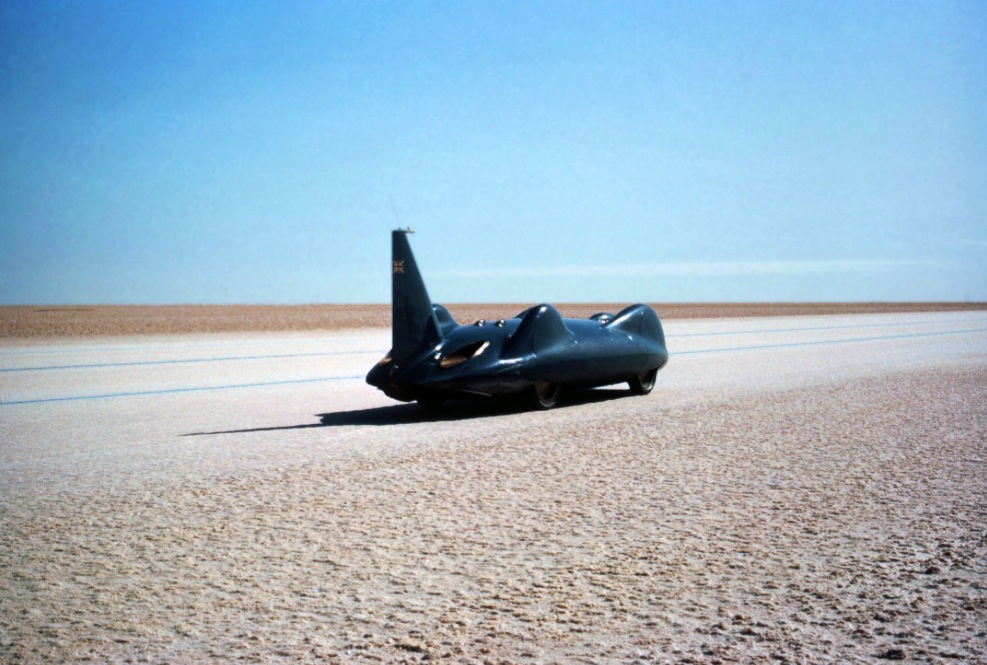
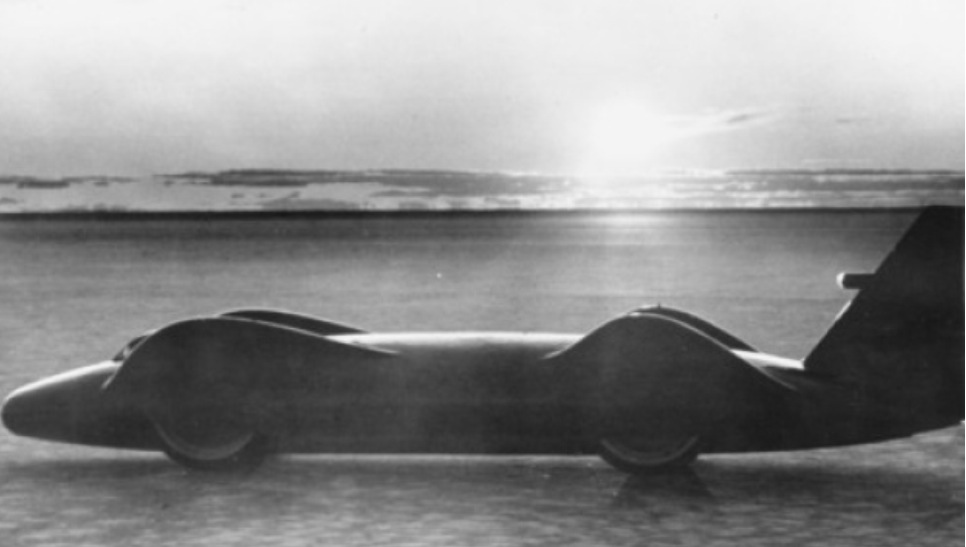
Bluebird CN7 : Air for the turbine was drawn in thru the cars nose, ducted around the driver , the cockpit positioned forward of the front wheels. Wheelbase identical to John Cobb’s Railton (Pinterest)
After Campbells record attempt at Lake Mead in Nevada in 1955 it was put to him that he should ‘go for the double’, to achieve a Land & Water Speed record in the same year .
Campbell had no credentials on land, but undeterred approached the Norris Brothers to build a car capable of 500 mph. The task was enormous with Campbell then in his late ’30’s being described as a ‘financier , impresario, sportsman, adventurer, as well as courageous enough to take on the elements’.
Campbell was a patriot and wanted the car to be the best of British ,it took over 80 companies, in excess of one million pounds to build the car and an equivalent amount to run the operation…enormous sums by the standard of the day.
Having put in place the funding and corporate support to deliver the project technically Norris Brothers designed a car capable of 500mph. the design concept was simple ; a jet engine, run drive shafts out of each end to the front and rear axles, and build a steel frame to house the engine, driver, and wheels. The driver sat forward of the front wheels, air was ingested through a front intake and ducted around the driver into the turbines and then the engine.
The technical specifications of the CN7 are outlined below, but in essence the car was of advanced aluminium monocoque construction ,had 4 driven wheels, was 30 feet long, weighed 9600 pounds and was powered by a Bristol Siddeley free turbine , or what would be described today as a ‘turbo prop’ engine, developing 4450 shaft horse power or 4000 BHP at 11-11800RPM.
The aerodynamics were similar to John Cobbs Mobil Railton Special which almost achieved 400MPH using petrol engines.
Bonneville 1960…
Campbell testing CN7 at Bonneville , September 1960, days before the accident
Bluebird was completed in Spring 1960 and after testing at Goodwood circuit was shipped to Bonneville , Utah, the scene of Malcolms last LSR triumph in September 1935.
Initial testing went well but on his sixth run Campbell crashed at 360 mph , writing off the car and hospitalising himself with a fractured skull, burst eardrum and extensive cuts and abrasions.
Campbells confidence was badly shaken, he suffered mild panic attacks and for some time doubted he could go back to record breaking. He learnt to fly light aircraft as part of his convalescence but by 1961 he was feeling better and planning the rebuild of CN7.
Bluebird was rooted, destroyed in Campbells near fatal accident, the cars structural integrity saving him. Campbell did not have a background in motor racing, unlike his father, the challenge of driving and controlling the immense car without that is almost beyond comprehension…bravery in the extreme, and self belief despite the self-doubt it is said Campbell also had
CN7 Rebuilt…
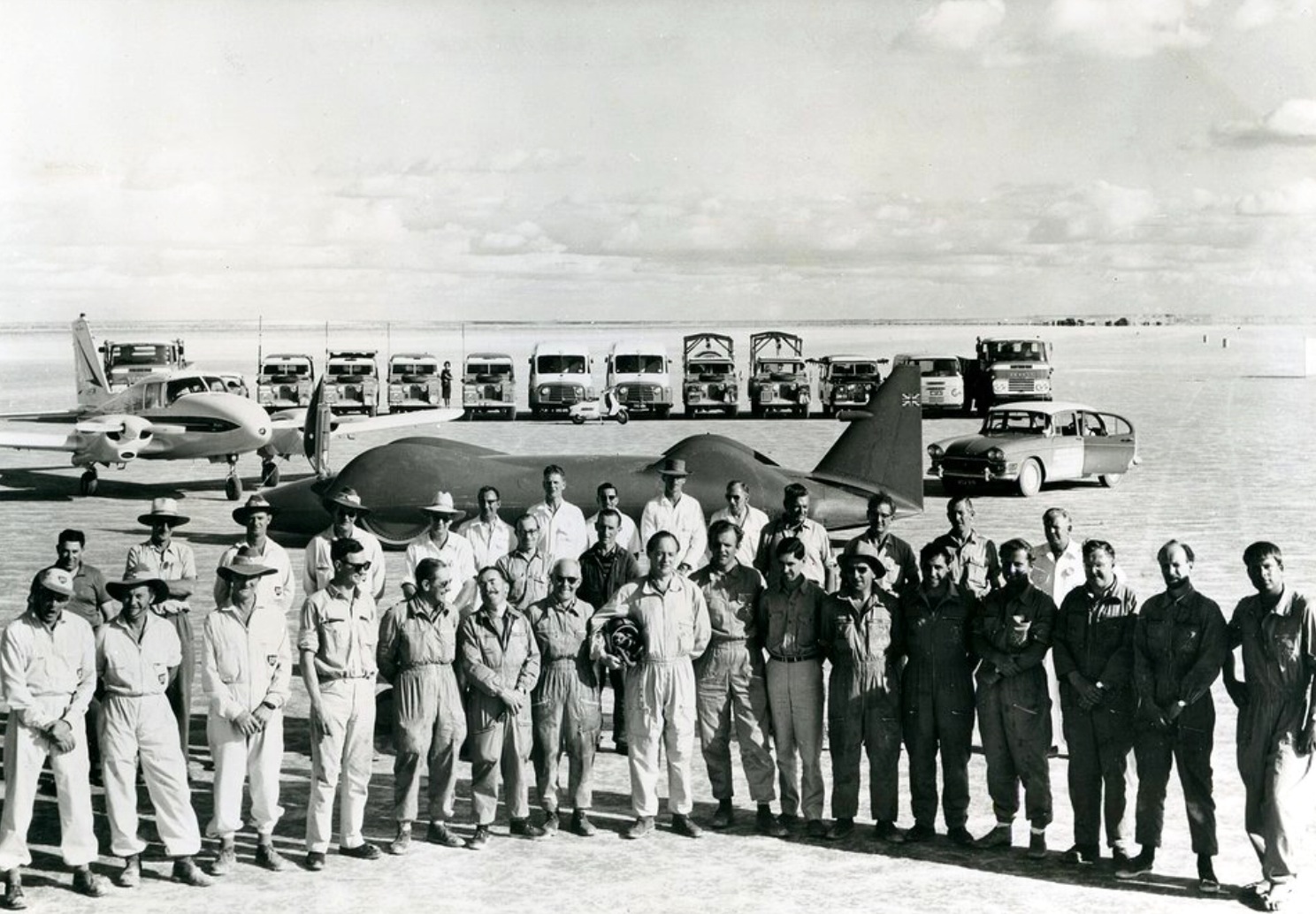
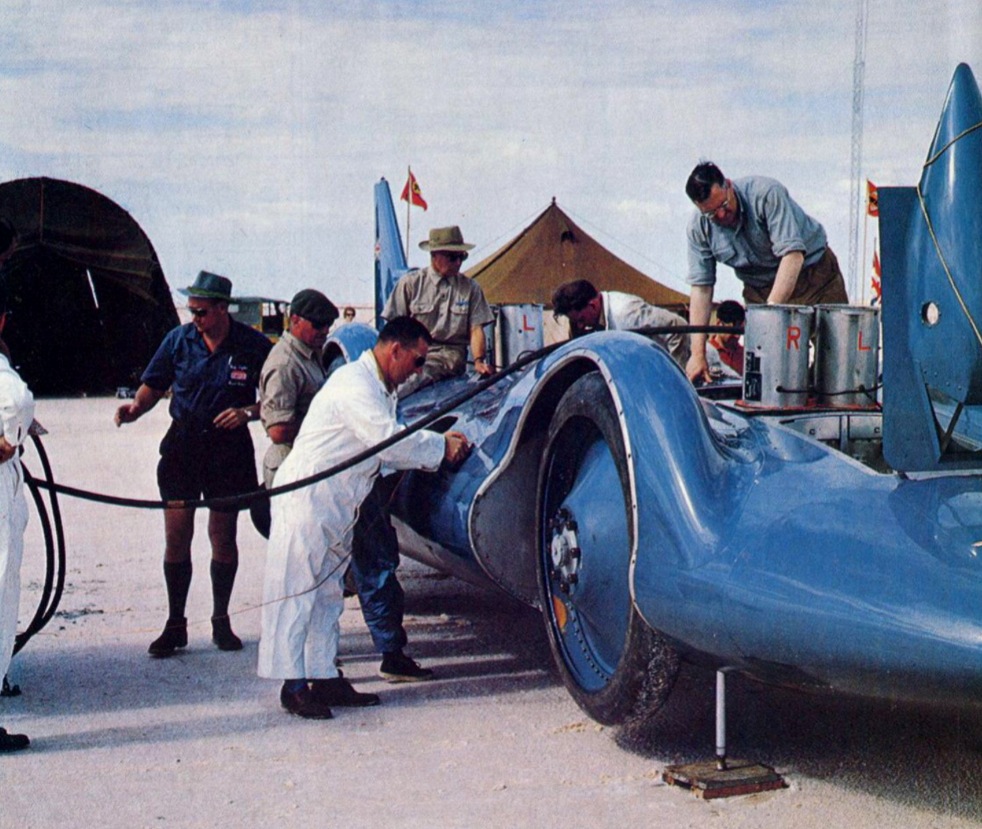
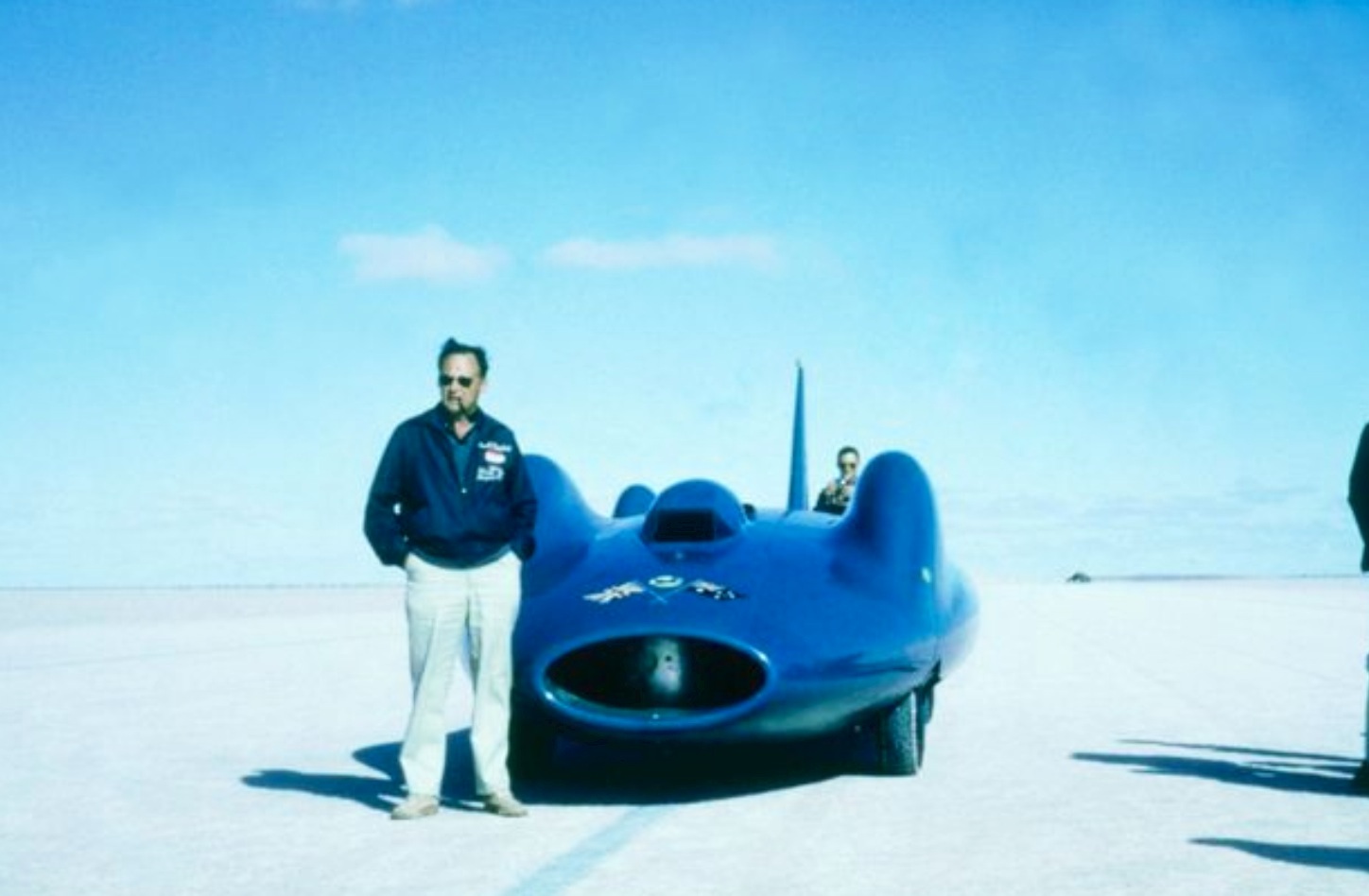
Some of the team at Lake Eyre…scale of the operation in this remote location clear…
Sir Alfred Owen of BRM Trust, and later the owner of BRM outright, fame stepped forward and offered to rebuild the car, various of his Rubery Holdings Group companies having constructed the car initially.
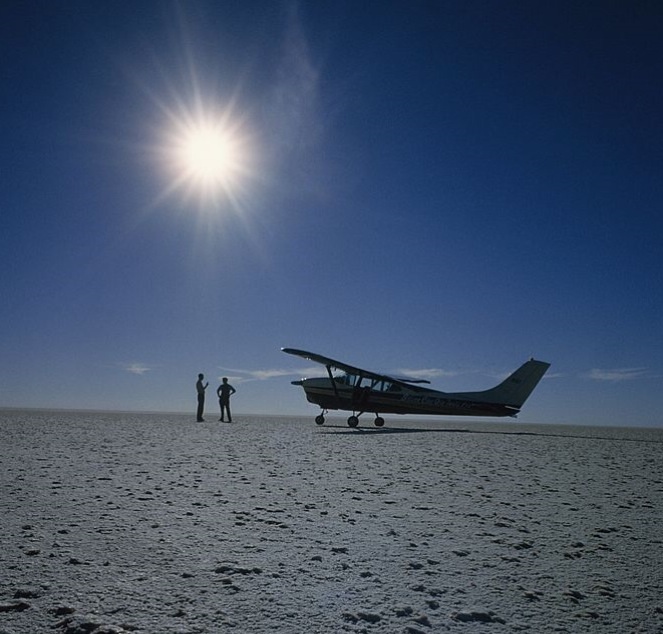
Campbell thought that Bonneville was too short, the salt having a total length of 11 miles and after researching various alternatives identified Lake Eyre, 700 Km north of Adelaide as a more appropriate location.It had 450 square miles of dried salt lake and rain had not fallen for over 20 years.The surface of the 20 mile long ‘track’ was rock hard, which allowed a very long ‘run in’ to the measured mile and importantly plenty of space to stop the massive car, not easy despite the sophisticted braking system, their being little or no ‘engine braking’ from such engines.
Sussing the Lake Eyre salt in 1962 (National Geographic)
By Summer 1962 CN7 was rebuilt , 9 months later than planned , it was the same car albeit with the important addition of a stabilising fin and reinforced fibreglass cockpit cover , it was shipped to Australia in late 1962.
Unloading Bluebird at Lake Eyre 1963 (John Kennedy)
Lake Eyre, South Australia…1963 and Craig Breedlove , Bonneville ’63…
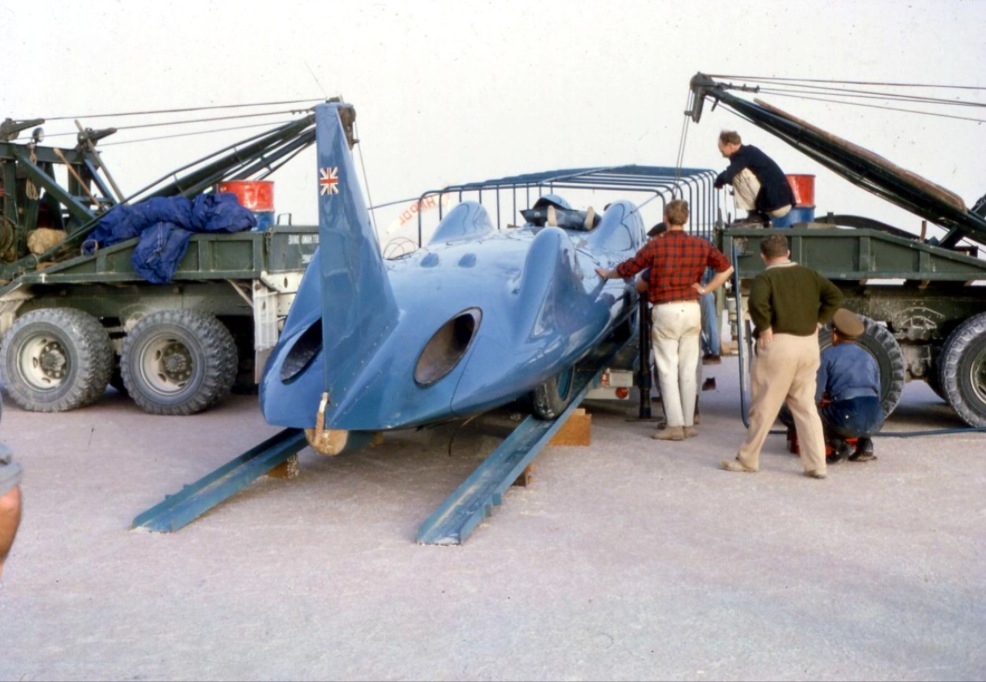
The task of getting Bluebird to Lake Eyre, and then onto the surface was immense. 100Km of road were constructed by the government and then a 400 metre long causeway from road onto the lake Surface far enough in to clear the soft outside of the Lake. 1963 (John Kennedy)
The Australian and South Australian Governments saw the attempt as a means by which to promote both the country and the state.
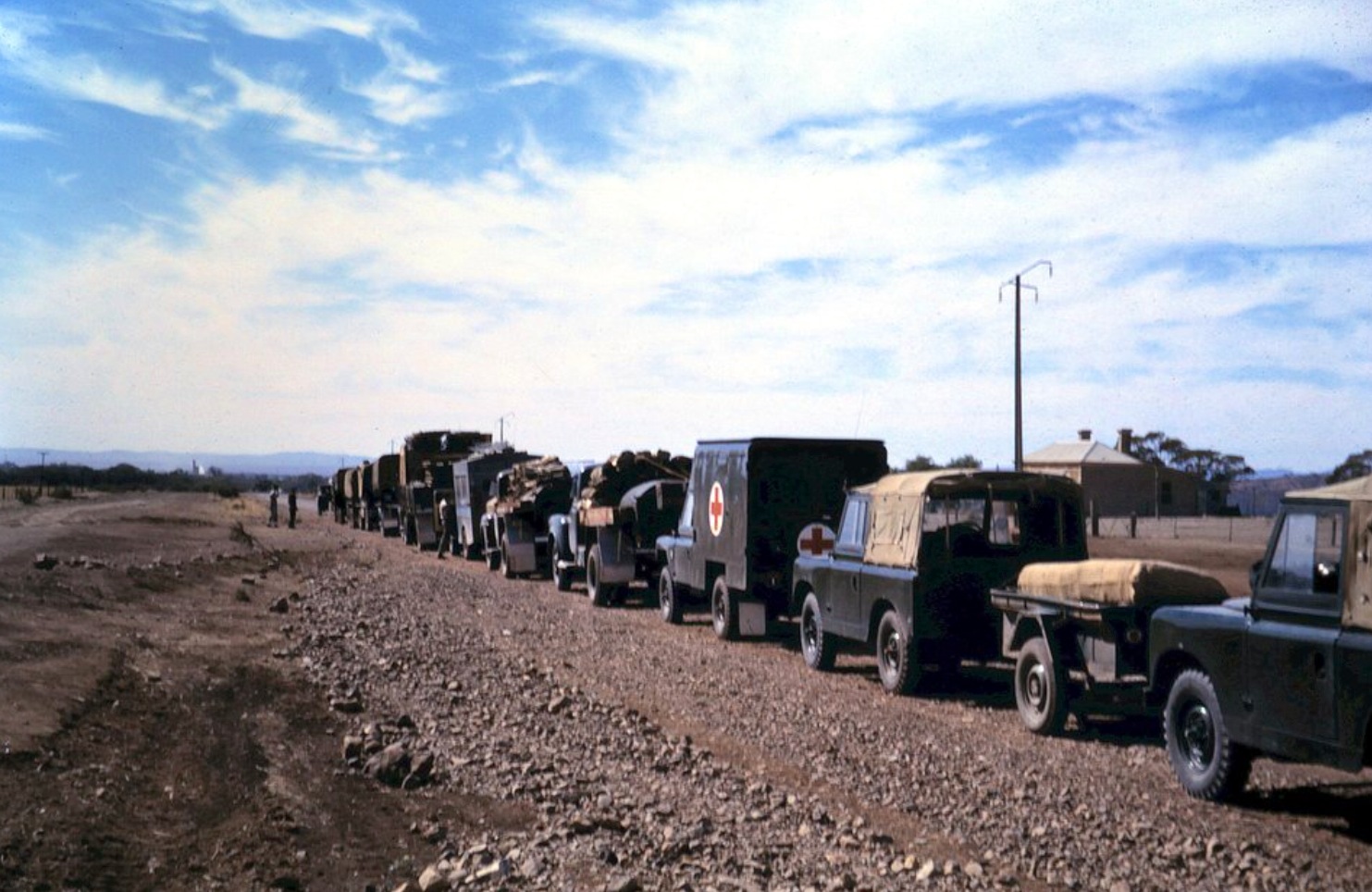
Lake Eyre is remote, to say the least, the South Australian Government creating a gravel road 100 Km long from Marree to Muloorina Station and from there to the shore of the Lake. Then the difficult bit started…the crust of salt lakes is hardest in the middle, underlying the crust is water saturated blue mud. It was necessary to build a causeway 400 metres long to allow transport vehicles to access the salt from the road itself .
The initial runway selected was abandoned after trucks grading it sank through the surface, another being chosen and graded after government equipment returned having worked on public, impassable roads which had not seen water for years…
Shortly after Easter, in addition to Bluebird there were 5 Fordson tractors, 2 Commer 5 ton trucks, a Humber Super Snipe car an Elfin Catalina single seater for tyre adhesion tests, several Commer vans for refuelling etc, multiple Land Rovers, and other assorted cars belonging to reporters and photographers.
There were around 80 men at Lake Eyre either in houses or caravans, then a mechanised unit of the army and police arrived swelling numbers to 150-200 depending on the day, making food and other supplies difficult when roads were impassable. It was a military operation, supported by the Australian Army to provide the logistical support to move around 200 people into the remote location to support the record attempt.
A new course was marked out , several test strips being prepared so that Ted Townsend, the Dunlop technician, could work out their relative effectiveness. This was done by driving the Elfin Catalina, a small single seater powered by a Ford Cosworth 1.5 litre engine, and doing deceleration runs using a recording ‘Tapley ‘ meter. The object was to find a course with a high coefficient of friction to aid the momentum of the car, to aid the cars grip of the surface. The tyres used on the Elfin were the same Dunlops fitted to Bluebird, albeit scaled down from 52 inches…
Dunlop Engineer Ted Townsend at the wheel of the Elfin ‘Catalina’ Ford used for surface testing, the car mounted with 13 inch scale replicas of Bluebirds 52 inch tyres. Car was used with testing equipment to find salt with the optimum coefficient of friction (Pinterest)
The task of making the strips was huge as Ken Norris wanted a tolerance of o.25 inches variation in height of the salt surface over 100 feet.
Bluebird Lake Eyre test run 1963 (John Kennedy)
Campbell arrived in late March, low speed attempts at around 240MPH being carried out, this also allowed the team to do their ‘turn around drill’, the return record timing run needing to be made within an hour of the first.
Then the rain came…By May 1963 Lake Eyre was flooded to a depth of 3 inches, the first rain in years and the attempt was abandoned. Campbell had to move the car off the lake in the middle of the night to avoid it being submerged. He was criticised at the time for this but the good citizens of Great Britain did not understand the ‘on ground’ realities of Outback Australia howver large the entourage.
Meanwhile, at Bonneville Craig Breedlove had driven his pure thrust jet car, the ‘Spirit of America’ to 407.45 mph in July 1963 . The ‘car’ didn’t comply with FIA regulations about the ‘cars’ having a ‘minimum of 4 driven wheels’, but in the eyes of the world he was the fastest ‘man on wheels’, it was not the first time the regulators lagged behind the technology being deployed.
Campbell was bitterly diappointed but had to push on knowing Bluebird was capable of going much faster if circumstances smiled upon him.
Campbell hands has mascot, ‘Mr Whoppit’ , who rode in the car together with several other items, he was highly superstitious, to wife Tonya, Lake Eyre 1964
Lake Eyre 1964…
Campbell returned to Australia in Spring 1964 but the course could not be used after yet more rain.
BP pulled out as his main sponsor, Australian Oil Company Ampol stepping in. Campbell was still being criticised heavily in the press in the UK because of his administration of the project, in many ways unfairly, he hardly had control over the weather.
The course was never fully dry, but under pressure, Campbell was forced to make the best of it. In July he put in some speeds which approached the record. On 17 July, taking advantage of a break in the weather , he made 2 courageous attempts on a shortened, damp course, posting 403.10 mph.
CN7 covered the final third of the measured mile at an average of 429 mph peaking at 440 as it left the measured distance …the car would have gone faster then 450MPH had he been able to make the long run into the ‘measured mile’, he had gone to Lake Eyre for in the first place…
But it was the record all the same.
Civic Reception at Adelaide Town Hall…
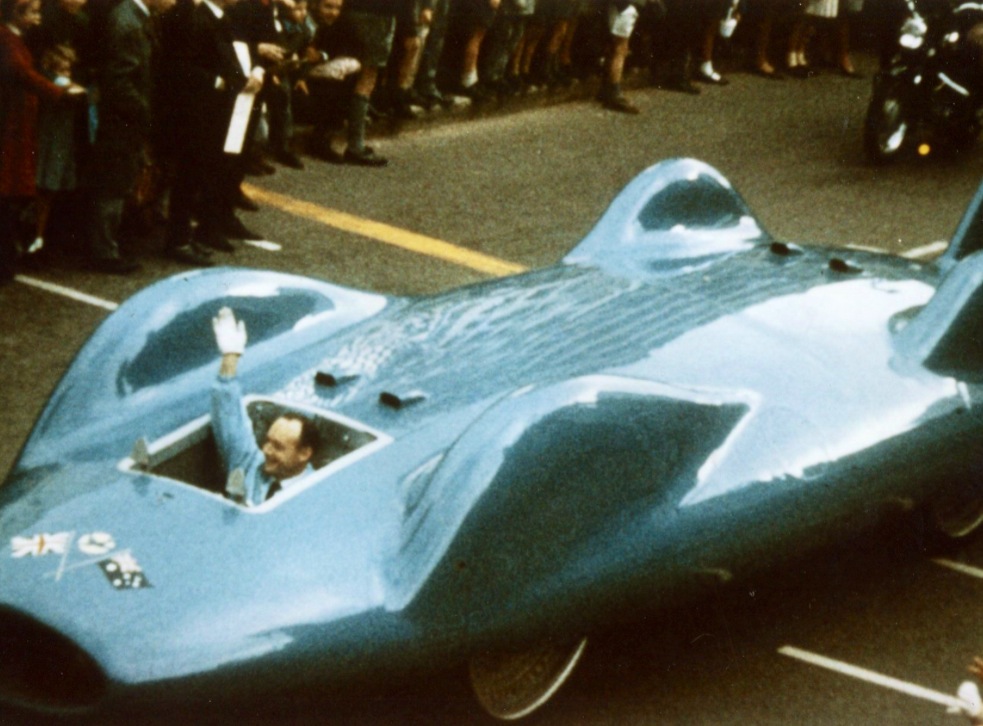
Civic Reception in Adelaide, King William Street had not seen anything quite like it! 200,000 people turned up, an enormous percentage of the local population at the time (Pinterest)
Campbell drove CN7 through the streets of South Australia’s capital with a crowd of more than 200,000 in attendance. CN7 then toured the country and throughout the UK after its return in November 1964. Bluebird was eventually restored in 1969, having been damaged in a demonstation run by a stand-in driver at Goodwood,but has never run again.
The Double…
Campbell achieved his seventh WSR at Lake Dunbleyung near Perth Western Australia on 31 December 1964 at an average speed of 276.33 mph, just getting his second record within the same year as he had planned.
Short But Sweet..
Campbell’s LSR was short as the FIA admitted jet powered cars from October 1964.
Campbell’s 429mph on Lake Eyre remained the highest speed achieved by a wheel driven car until 2001. CN7 is now on display at the National Motor Museum in Hampshire, England.
Bluebird Rocket Car and another WSR attempt…
Norris Bros were requested by Campbell to undertake design studies to achieve Mach1.1 , using a rocket car to do so.
To increase publicity for the program to get the necessary community and business support Campbell sought to break the WSR again, this program commenced in Spring 1964.K7 was fitted with a lighter & more powerful Bristol Orpheus engine from a Folland Gnat aircraft developing about 4500 pounds of thrust.
The modified boat was taken to Coniston Water in November 1966, the boat failing when the engine ingested debris from collapsed air intakes.
Some runs at 250 mph were made but the boat had fuel feed problems limiting maximum engine power, this problem was fixed by the engineers, better weather was then required.
4 January 1967…
The weather at dawn that cold, gloomy day was was ok.
Campbell set of for his first run at 8.45 am, he went past the first marker at 285MPH, 7.525 seconds later leaving the measured mile at over 310 MPH. Instead of refuelling and waiting for the wash to subside, he made his return run, this was something he had done before.
His second run was faster , at a peak speed of 328MPH the boat was bouncing its starboard sponson with increasing ferocity, the most intense bounce dropping speed from 328 to 296MPH. Engine ‘flame out’ (failure) occurred , perhaps caused by fuel starvation, damage to a structural element , disturbance of the airstream or all 3 factors. Shorn of nose thrust, and resultant nose down momentum K7 glided before completely leaving the water. It somersaulted before plunging back into Coniston 230 metres short of the measured mile. K7 cartwheeled across the water before coming to rest.
The impact broke the craft in half, forward of the intakes where Campbell was sitting, killing him instantly. K7 then sank. The wreck of was found by Navy divers on 5 January, but Campbell’s body was not.
Coniston Water 4 January 1967
Postcript…
The wreckage of K7 was recovered between October 2000 and May 2001, Campbells body was recovered on 28 May 2001, he was interred at Coniston Cemetery on 12 Sptember that year. None of this was without controversy the family split on the issue, Campbell himself having allegedly said in 1964 ‘skipper and boat stay together’.
As of 2008 K7 is being restored by ‘The Bluebird Project to full aerospace standards of working condition in North Shields, Tyne & Wear using as much of the original craft as possible.
Legacy…
Adrian Newey , doyen of Formula 1 designers in the last 20 years had this to say about Bluebird CN7 in the January 2013 issue of ‘Racecar Engineering’ magazine… ‘Motorsport as an industry is a user of technologies developed in other industries, aerospace in particular…..in terms of the biggest advances made, although not strictly speaking a racing car , Bluebird was the most advanced car of its time. …It was the first car to properly recognise and use ground effects. The installation of a jet engine is a nightmare, and it was constructed using a monocoque (chassis) working with a lot of lightweight structures. It was built in the way you build an aircraft , but at the time motor racing teams werent doing that..’
Campbell was a remarkable, extraordinarily driven man. He started his World Record Breaking late, after his fathers death, Sir Malcoms Estate passed to his grandsons partially to avoid Donald pursuing the path Sir Malcolm followed , the Estate having some of the old Bluebirds. But Donald did it anyway.
He sought the advice of his fathers mechanic, Leo Villa, and evolved K4, selling his share in his engineering business, and losing his second marriage in the process to fund the Norris Bros initial work on K7.
Other than the family background in record breaking he had no expereince of his own until his fathers death of controlling and racing boats or cars.
His family name was a huge start but the ability to create a team to fund, design, build, develop, and then compete is extraordinary. He was a ‘Racer’ to his core.
He was a deeply passionate, patriotic Brit with all of the best ‘derring do’ associated with adventurers of a past age, an inspiration to all around him and an iconic figure to a generation.
Donald Campbell CBE, with Bluebird CN7, Lake Eyre 1964. an amazingly brave adventurer from a bygone age.
Transmission : 2 David Brown single split gearboxes with differentials, no clutch. Spiral bevel drives front & rear
Chassis : ‘Aeroweb’ sandwich, 0.48 inch thick light alloy spaced 3/4 inch apart by resin bonded 1/4 inch mesh honeycomb of 0.002 inch thick light alloy . Body built by Motor Panels Ltd
Suspension :Independent by ball jointed wishbones. Girdling oleo pneumatic suspension struts with rubber rebound buffers
Steering : Burman recirculating ball
Brakes : Girling disc , inboard mounted, 16 3/4 inch external & 10 3/8 inch internal diameters
Wheels : Dunlop split rim disc wheels
Tyres : Dunlop 7.8 inch section , 52 inch external diameter
Dimensions :Length 13 ft 6 inches, Track F & R 5 ft 6
Weight 9600 pounds
Fuel Capacity 25 gallons of aviation turbine kerosene
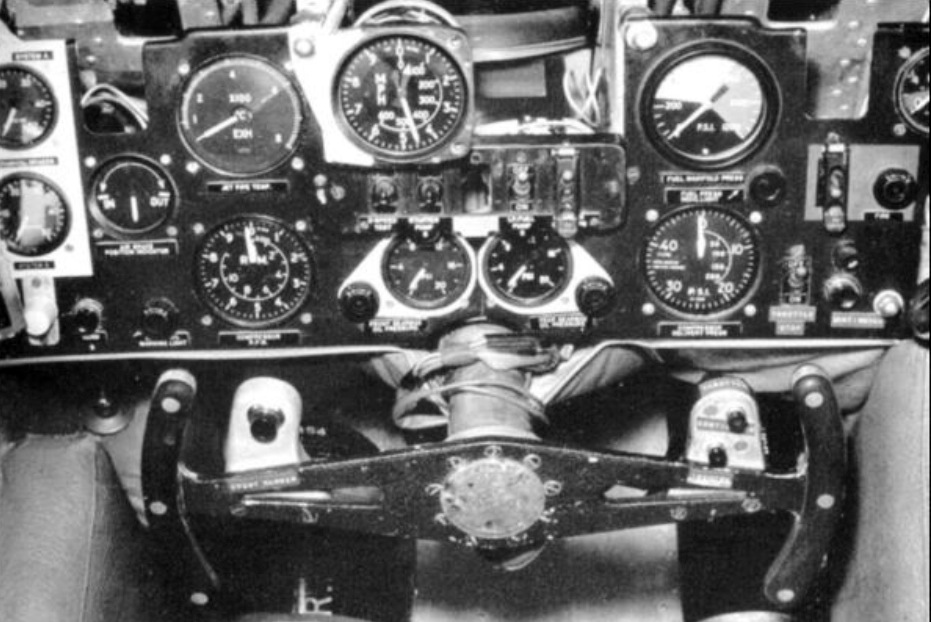
CN7 instruments were complex , their images being reflected onto the windscreen where Campbell could read them ‘heads up display’
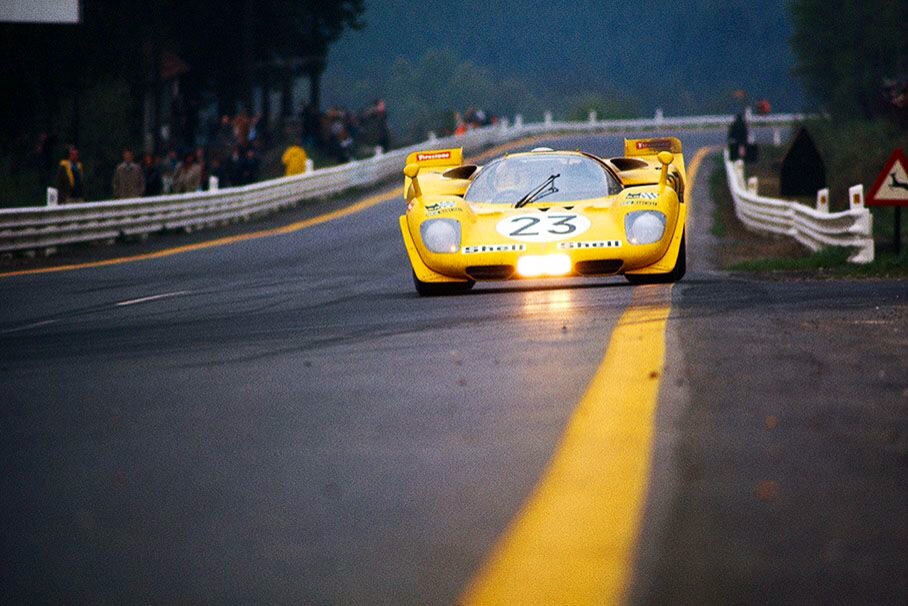
Fabulous shot of Derek Bell bang on the yellow line on the approach to La Source hairpin during the Grand Prix de Spa in 1970, he finished eighth sharing this Ecurie Francorhamps 512S with Hughes de Fierlant…
Jo Siffert and Brian Redman won the race in the dominant car of 1970/71, the Porsche 917K. These 5-litre 12-cylinder, 450-550bhp cars are still spoken of in awe 45 years later by those fortunate enough to see or drive them.
Ferrari were very busy in 1970 with F1 and their beloved sportscar programs. Porsche kept it simple, subcontracting the preparation and racing of their factory cars to John Wyer Engineering and Porsche Salzburg, they were not distracted by F1.
(unattributed)
On paper, the V12, spaceframe chassis 512S should have given the flat-12, spaceframe chassis 917 a better run for its money than it did. An early season Sebring 12 Hour win by Ignazio Giunti, Nino Vaccarella and Mario Andretti (above) flattered to deceive in a season the 917 hordes belted Ferrari into submission. What races the 917 didn’t win the lithe, nimble 3-litre flat-8 908/3 did.
Ferrari’s suitably tweaked 512S-1971-updated 512M showed early potential to serve it up to the 917 horde, but the Ferrari factory didn’t race it in ’71, the 15 cars built or converted from 512S spec were raced by privateers, while Scuderia Ferrari raced a single 3-litre 312PB in advance of a change in regulations from 1972. It was strategy that was most effective, but they probably left a win or two on the table in 1971 as a consequence.
(UPI)
Enzo Ferrari, second from the right, and buddies launch the new Ferrari 512S to the press in Modena on November 6, 1969. Key elements of the spiel with this photograph was ‘Latest Ferrari Sports Model’ was a 5000cc 12-cylinder engine producing 550bhp @ 8,500rpm and an ‘extremely low streamlined body with a panoramic cockpit in the forward position.’
Whether the shot below was taken on the same day is unclear, the very tall Mike Parkes stands out mid-pic with liddl’ Art Merzario second left and Clay Regazzoni to the right of the car, closest to us.
(UPI)(unattributed)
25 512S, Maranello late 1969…
Twenty five cars were required by the governing body, the CSI for homologation into Group 5. The cars are all lined up ready for inspection, the yellow Francorchamps car stands out. Porsche were awfully keen for the Ferrari production audit to be as vigorous as their own, the Scuderia’s ability to count having been proved poor in the past, the 250LM springs to mind…
The investment was huge compared with the small production runs of previous models, only three P4s were built, plus one P3 converted to a P4. Fiat acquired 50% Ferrari, taking control of its road car division in 1969 and put racing support arrangements in place going forward. Without that there would have been no 512 program, the company would not have had the working capital to build so many cars with sales of them far from certain.
(CA Caillier)
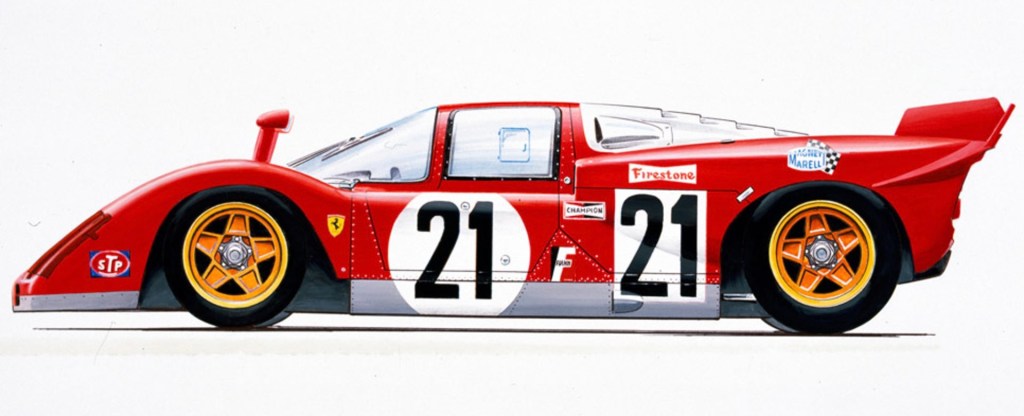
All the fun of the fair and more 512S all in a row, mechanics fettle Bell’s car, #21 is the seventh placed Schetty/Merzario Scuderia Ferrari 512S, the best placed 512S was the Ickx/Surtees machine in second.
Technical Specifications…
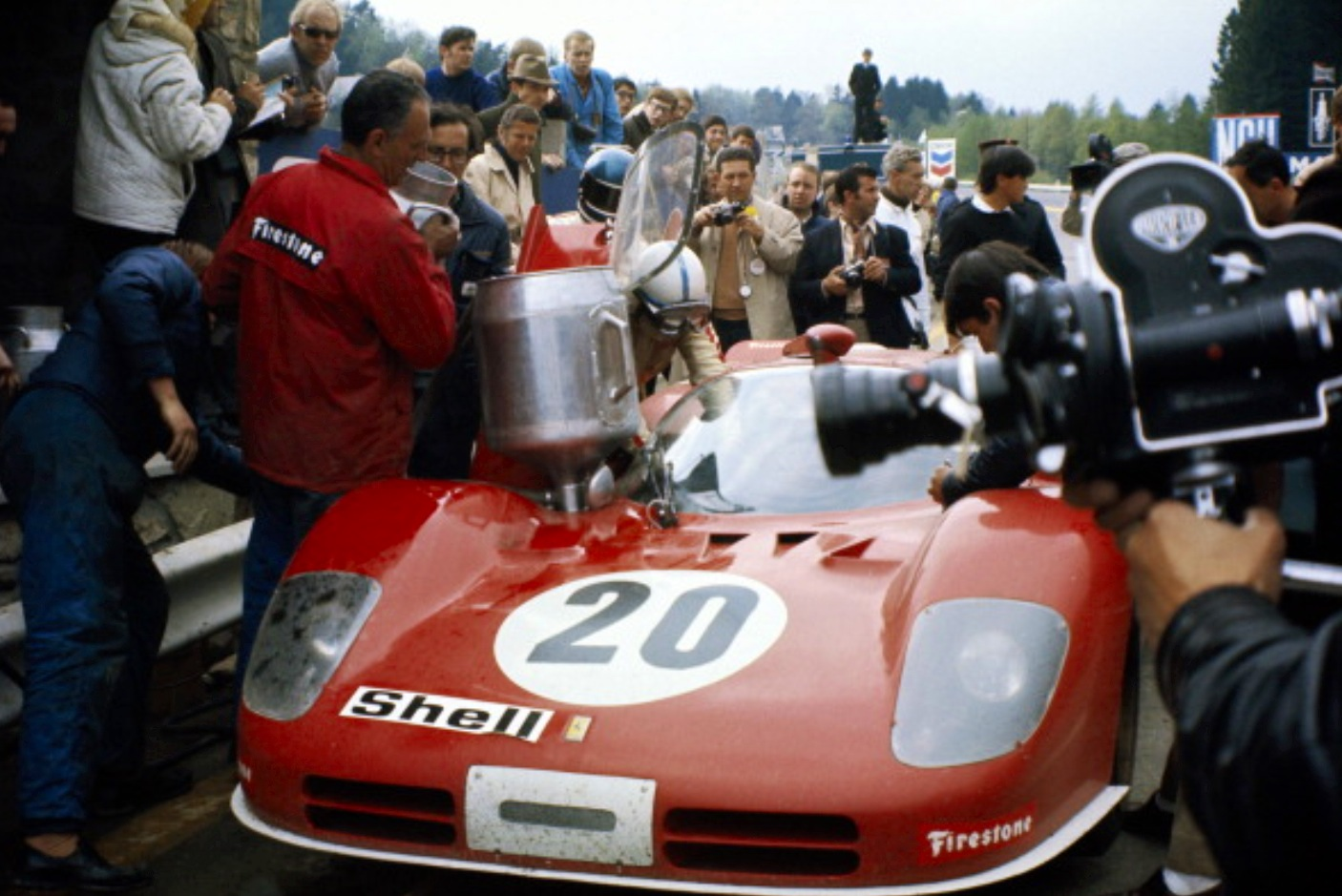
Busy pit stop for the Ickx/Surtees second placed 512S. Surtees jumping in, Ickx clear in the helmet behind, Spa 1970 (Rainer Schlegelmilch)(ferrari.com)
“Put together in just three months by a team headed by Mauro Forghieri”, Ferrari wrote. The steel tubular space frame chassis was developed with learnings from the P4 and 612, with the polycarbonate Berlinetta and Spyder bodywork designed by Giacomo Caliri.
4.06 metres long, 2 metres wide, 972mm high with a wheelbase of 2.4 metres and front and rear tracks of 1518mm/1511mm. Fuel capacity 120 litres, weight 840kg dry.
Andretti at Daytona in 1970, he was third in the car shared with Arturo Merzario and Jacky Ickx, the Pedro Rodriguez/Leo Kinnunen/Brian Redman Porsche 917K (ferrari.com)
Front suspension by upper and lower wishbones, coil springs/Koni shocks and adjustable roll bar. At the rear the period typical layout was adopted as well; single top links, inverted lower wishbones, twin radius rods and again coil spring/Konis. Magnesium uprights and wheels were used and tyre sizes 4.45-11.50-15 inches front and 6.0-14.50-15 inches at the rear. Steering was rack and pinion.
Engine, transmission and rear suspension detail of one of the works cars at Daytona in 1970(ferrari.com)
The engine was a Ferrari classic 60-degree all-alloy DOHC V12, of 4993.53cc; 87x70mm bore/stroke. The design incorporated four-valves per cylinder, Lucas indirect fuel injection, used a compression ratio of 11.5:1, one plug per cylinder and was of course dry-sumped. Quoted power, as cited earlier was 550bhp @ 8,500rpm. The gearbox had 5-speeds and reverse.
(ferrari.com)
Etcetera…
The Ferrari compound above at Le Mans in 1970.
The Dick Attwood/Hans Hermann Porsche 917K won the race with the best place of the eleven 512S which started the race was the NART entry driven by Sam Posey and Ronnie Bucknum.
#8 is the Art Merzario/Clay Regazzoni entry DNF after 38 laps with a collision, the #5 Jacky Ickx/Peter Schetty was also involved in a collision in which a marshal was killed after completing 142 laps. The car to the left without a number showing is the Derek Bell/Ronnie Petersen car which had a valve fail after only 39 laps- worse was bearing failure of the #6 Nino Vaccarella/Ignazio Giunti 512S after only seven laps were completed. Not a memorable Le Mans for Ferrari at all.
512S Long-tail during the filming of Steve McQueen’s Le Mans in 1971 (Getty)
Credits…
ferrari.com, A Caillier, Rainer Schlegelmilch, Getty Images, United Press International
Tailpiece…
(R Schlegelmilch)
Superb Spa panorama in 1970 by Rainer Schlegelmilch shows the seventh placed factory 512S chasing the winning Jo Siffert/Brian Redman John Wyer Porsche 917K.
Pole position and a win after waving teammate & champion elect AyrtonSenna into the lead…and having the favour returned late in the race giving Berger his first McLaren win…
Even though it was ‘only’ built in the ’60’s this Honda owned track must be one of todays classics, by any measure? Even though ‘130R’ has been ‘softened’ the track is still a formidable test of man and machine and on my circuit ‘bucket-list’. Its a non-‘Tilke Template’ track which is a positive.
Honda’s first V12 since the Surtees ‘Hondola’ Era…
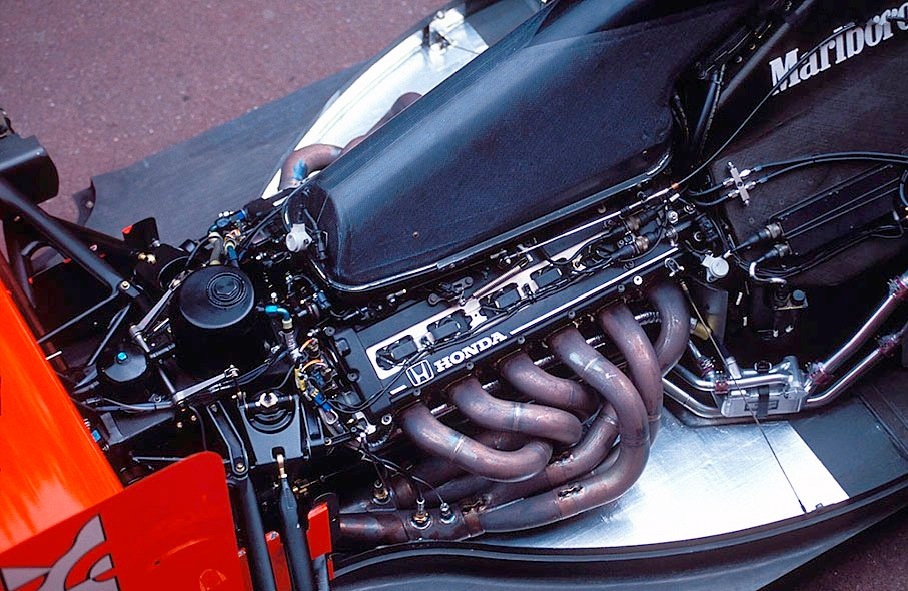
Neil Oatley’s new chassis carried the Honda ‘RA121E’ 3.5 litre V12, replacing the previous very successful V10’s. The chassis was longer to accomodate a larger fuel cell for the thirstier V12 but still torsionally stiffer than its predecessor.Early testing by Berger and Ayrton Senna was not promising, they were unconvinced of the engines superiority over the V10… but the car still won its first 4 races in Senna’s hands.
Williams FW14 then found mid season form and reliabilty. Adrian Newey , recruited from March where he created some stunning cars on small budgets was now deploying far greater resources well! He designed a superb car, the Williams Renault had a semi-automatic, 7 speed gearbox following the trail blazed by the Ferrari 640 the year before. It was regarded as a more advanced car, technically and aerodynamically than MP4/6, albeit the McLaren was more reliable and consistent.
Monaco 1991, Ayrton Senna 1st. McLaren MP4/6
Ongoing Development…
Honda focused on improving the engine management system and frictional losses, introducing new heads, cams and rods, Honda’s ongoing development legendary! Oatley evolved aspects of the car as well incuding its sidepods and wings. Linked rocker arms to reduce roll, as well as a cockpit operated ride height adjustment meachanism were also created. All of the foregoing, as well as some reliability issues and misfortunes at Williams turned the tide back in McLaren’s favor, the car winning 8 Grands’ Prix and 10 poles.
McLaren took their fourth straight Constructors title and Senna his third, and last, Drivers Championship.
Demise of Manual ‘boxes & V12’s…
MP4/6was the last Grand Prix car car with either a conventional manual ‘box or V12 engine to win a World Title…Oh, now, for both manual ‘boxes and the mix of skill required, and punishment of mistakes made, and the race interest thus produced… let alone the sweet scream of V12 engines in the current F1!
MP4/6 Monaco…linked rocker arms were used later in the season to reduce roll and a cockpit activated ride height system…sheer artisrty isnt it?
Hold your breath…and remember these duels! Mansell & Senna , Williams FW14 Renault & McLren MP4/6, the 2 dominant cars of ’91. Mansell takes Senna for second…and later wins the race, Senna 5th. Spain, Catalunya, Barcelona sept ’91.
The Previous Generation of Honda V12’s…
The previous generation of Honda V12’s…John Surtees in the Honda RA300, Mexican GP ’67, 4th. This car won the ’67 Italian GP in a last corner pass and dash to the flag, Surtees beating Jack’s Brabham BT24 Repco. The chassis was built by Lola , the T130, based on the successful Indy winning T90, hence the appelation at the time ‘Hondola’, Surtees having an enduring close association with Lola’s Eric Broadley.The ‘RA273’ engine was a 48 valve , 3 litre V12 producing circa 400 bhp. Honda’s 5 speed transaxle was also fitted. (The Cahier Archive)
The spectacular backdrop of the Andes lost on Regazoni, Rees, Pescarolo, and Courage…San Juan Circuit Argentina (Andrew Marriott)
Argentinian Temporada F2 Series : San Juan 1968…
Sensational panorama of the San Juan circuit with the Andes as a backdrop.
This race was won by the De Adamich Ferrari Dino 166. The cars in shot, all Ford Cosworth powered are Clay Regazzoni Tecno 68, Allan Rees Brabham BT23C, Henry Pescarolo Matra MS7 and Piers Courage Brabham BT23C.
The Ferrari Dino 166 F2 struggled in Europe against the Ford FVA powered hordes but the 1.6 litre V6 engined cars driven by DeAdamich and fellow Italian Tino Brambilla were competitive in Argentina, Andrea winning in front of ‘F2 King’ Jochen Rindt’s Brabham (Andrew Marriott)
F2 was a 1.6 litre formula at the time using production blocks, the Ford FVA 4 cylinder engine, the dominant engine, producing around 225 BHP at 9000 rpm. It was based on the Ford Cortina ‘116E’ block, Cosworth’s Keith Duckworth famously applying the design concepts intended for the Ford Cosworth DFV engine, Grand Prix racing’s most succssful engine. The FVA and DFV were part of the same Ford contract the FVA being built first…
The Ferrari engine was based on a block Fiat used in its Fiat Dino Coupe, and of course later in the Ferrari Dino 246, one of my favourite road cars. The engines evolved from 3 to 4 valve heads between 1967 and ’68 finally finding form in the ’68 European season ending round at Vallelunga, Brambilla winning the day from DeAdamich. A 2.4 litre 285BHP variant of the engine was developed for the Tasman series in Australasia, that car designated the 246T. Amon won the title in 1969 and Graeme Lawrence in 1970…but that is another story to tell in detail.
The Temporada series was held late in the year attracting the best of Europes cars and talent, the Championship in ’68 won by De Adamich, victorious in 2 rounds, from Jochen Rindt and Piers Courage.
DeAdamich # 14 and Tino Brambilla on the Buenos Aires grid 1968. The Ferrari’s are powered by a 1596cc, 4 valve per cylinder, fuel injected, V6 producing 210BHP @ 10500 rpm…they clearly enjoyed the altitudes of the Andes better than the Cosworths and took their end of European Season form to South America winning 3 of the 4 rounds (Pinterest)























































 primotipo...