Archive for the ‘F1’ Category

image

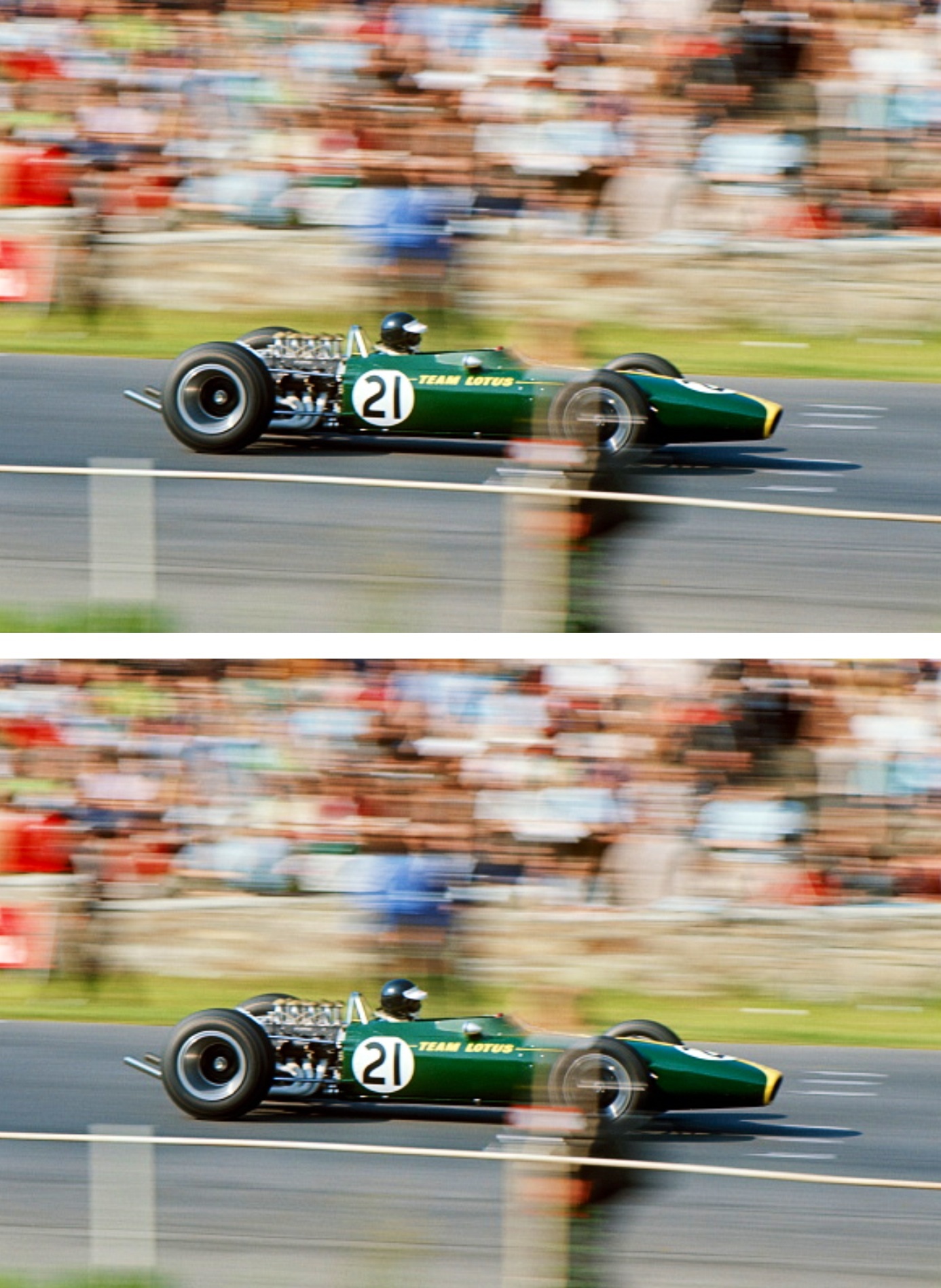
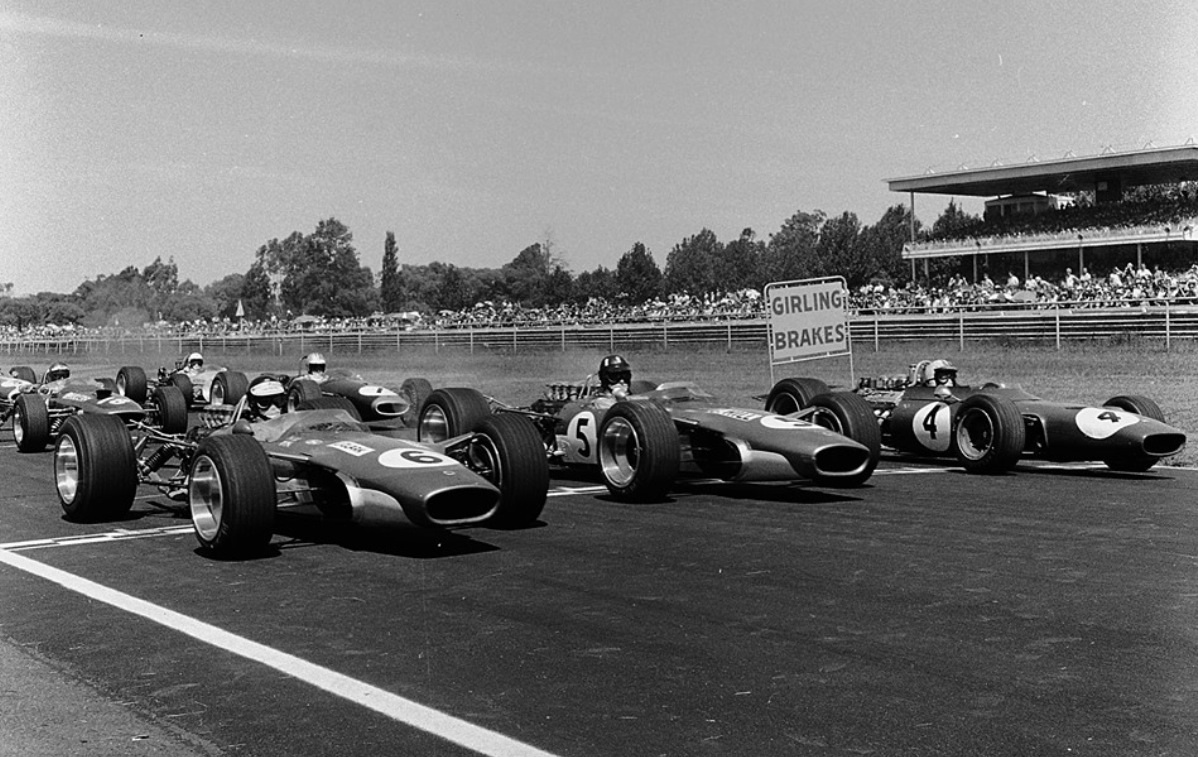
Jim Clark races his Lotus 49 Ford through the daunting dives and swoops of the Ardennes Forest in 1967…

He popped his dominant Lotus 49 on pole, then led until a stop to change plugs. Dan Gurney took a famous win in his Eagle Mk1 Weslake thereby joining the club of which he Jack Brabham and Bruce McLaren are the only members- drivers who won a championship Grands Prix in a car of their own manufacture.

Credit…

Rainer Schlegelmilch

fazz 1

(GP Library)

Brand spanking new Ferrari 156, the aluminium body still unpainted awaits its Modena test in early 1961…

fazz 2

(Klemantaski)

Its all happening in this shot.

Its the first track test in April 1961 of the new 120 degree 1.5 litre DOHC, 2 valve V6 which offered a lower centre of gravity to the dominant cars of that year. Phil Hill was crowned World Champion of course, in a year of tragedy for the team, ‘Taffy’ von Trips lost his life at Monza late in the season.

Bending over the car’s nose is Luigi Bazzi, Ferrari’s ‘Senior Technician’ of the time, the large fella to Bazzi’s left is famed ‘panel basher’ Medardo Fantuzzi who made the sexy bodies of these cars and many other Ferrari’s. Carlo Chiti, the cars designer, has his hand in the cockpit. Richie Ginther, ace racer/tester gets comfy before the off. In the hat behind Richie is Romulo Tavoni, Team Manager and leaning against Enzo’s Ferrari 250GT is the chief himself and Phil Hill.

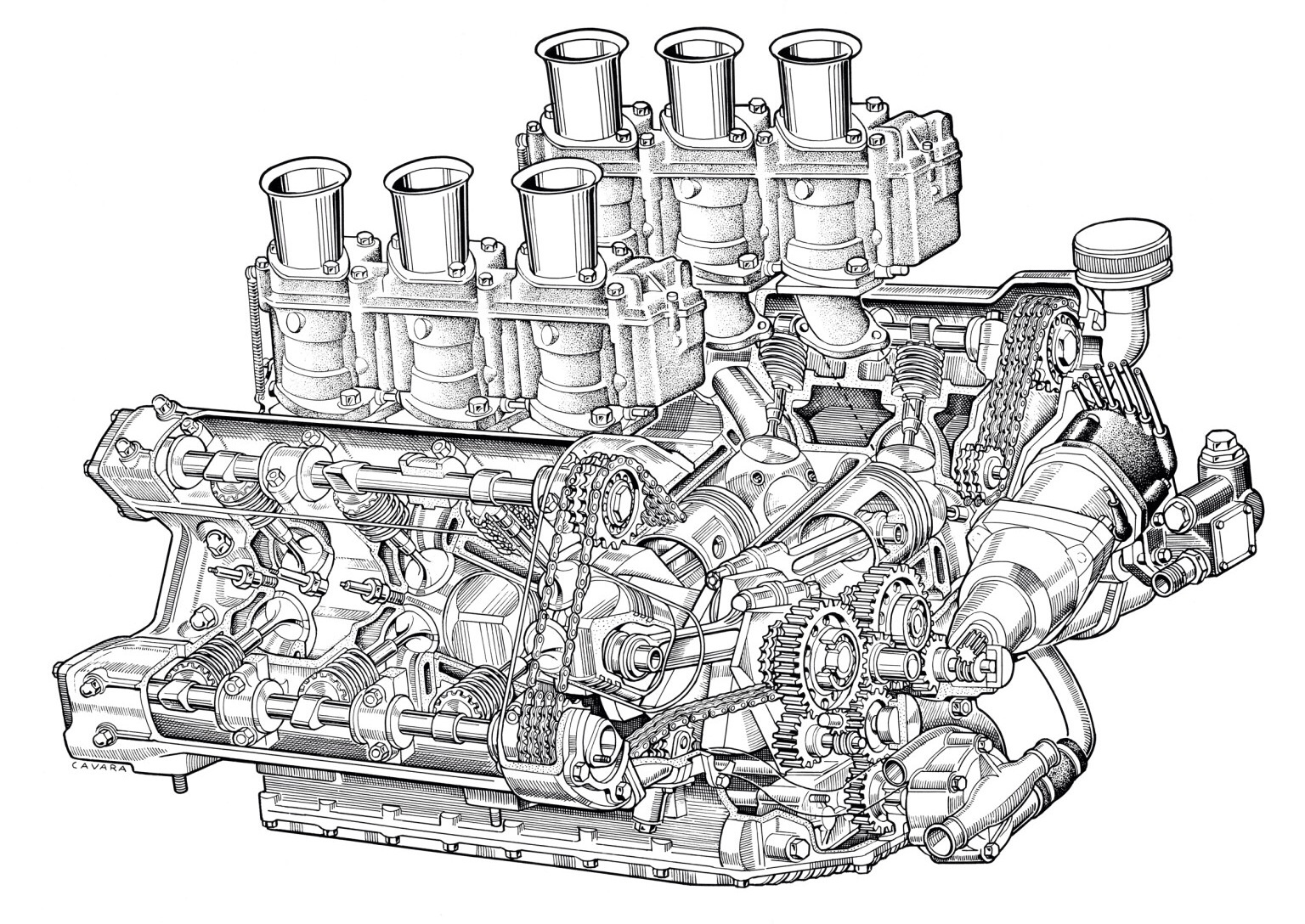
Superb G Cavara cutaway of the jewel like Ferrari 120 degree V6, the key elements of which are beautifully clear

Etcetera…

Rear suspension and bodywork detail at Zandvoort during the Dutch GP weekend in May 1961.

Upper and lower wishbones- the bottom one quite widely based, with coil spring/Koni shocks and an adjustable roll bar.

Cockpits of the day were minimalist- we are a year or so away from leather bound wheels in Ferrari cockpits.

Veglia tach and gauges probably displaying water temperature and oil temperature and pressure. Classic Ferrari ‘open gate’ change to the right which lasted all the way to the semi-automatic paddle-shift boxes pioneered by Ferrari in the 3.5 litre 640 V12 in 1989.

Ferrari 156 at the Nürburgring during the August 1962 German GP weekend, by this stage of things the dominant car of 1961 has been well and truly surpassed by the Lotus 25 Climax and BRM P57- Graham Hill won aboard the latter that weekend,.

65 degree V6 in this chassis, note the spaceframe chassis which looks a bit ‘wonky’ in the length above the cam covers of the engine- Doug Nye christened the Ferrari welders of the day ‘Mr Blobby’ given the finesse and finish displayed. They worked ok in 1961 mind you!

(B Cahier)

Four 156’s were entered at the Nürburgring in 1962, here is the World Champion, Phil Hill. He DNF with suspension failure after 15 laps, Ricardo Rodriguez was the best placed Ferrari driver in sixth, Giancarlo Baghetti was tenth and Lorenzo Bandini DNF after an accident on lap 5.

Credits…

GP Library, Louis Klemantaski Collection, G Cavara

Tailpiece…

enzo

(Klemantaski)

An earlier test than the one above, this chassis fitted with the 65 degree V6. Chiti is at left then the boss, another gent and copiously making notes is famous Ferrari engineer, Mauro Forghieri, then in his early days with the Scuderia. I’m intrigued to know who the mechanic is.

Its a stunning shot of the cars unbelievable lines, their purity complete with the Borrani’s off the car…

Finito…

(G Fry)

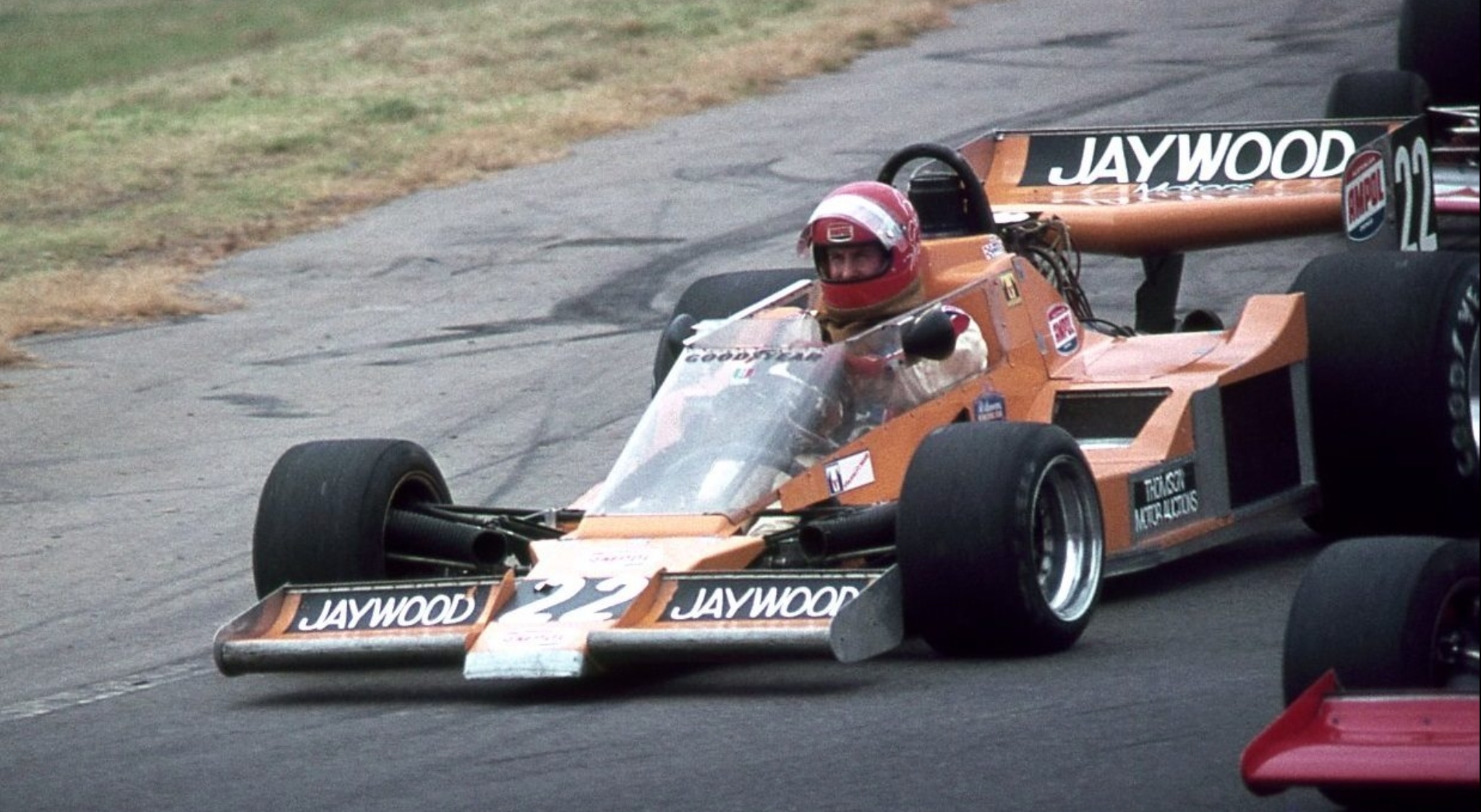
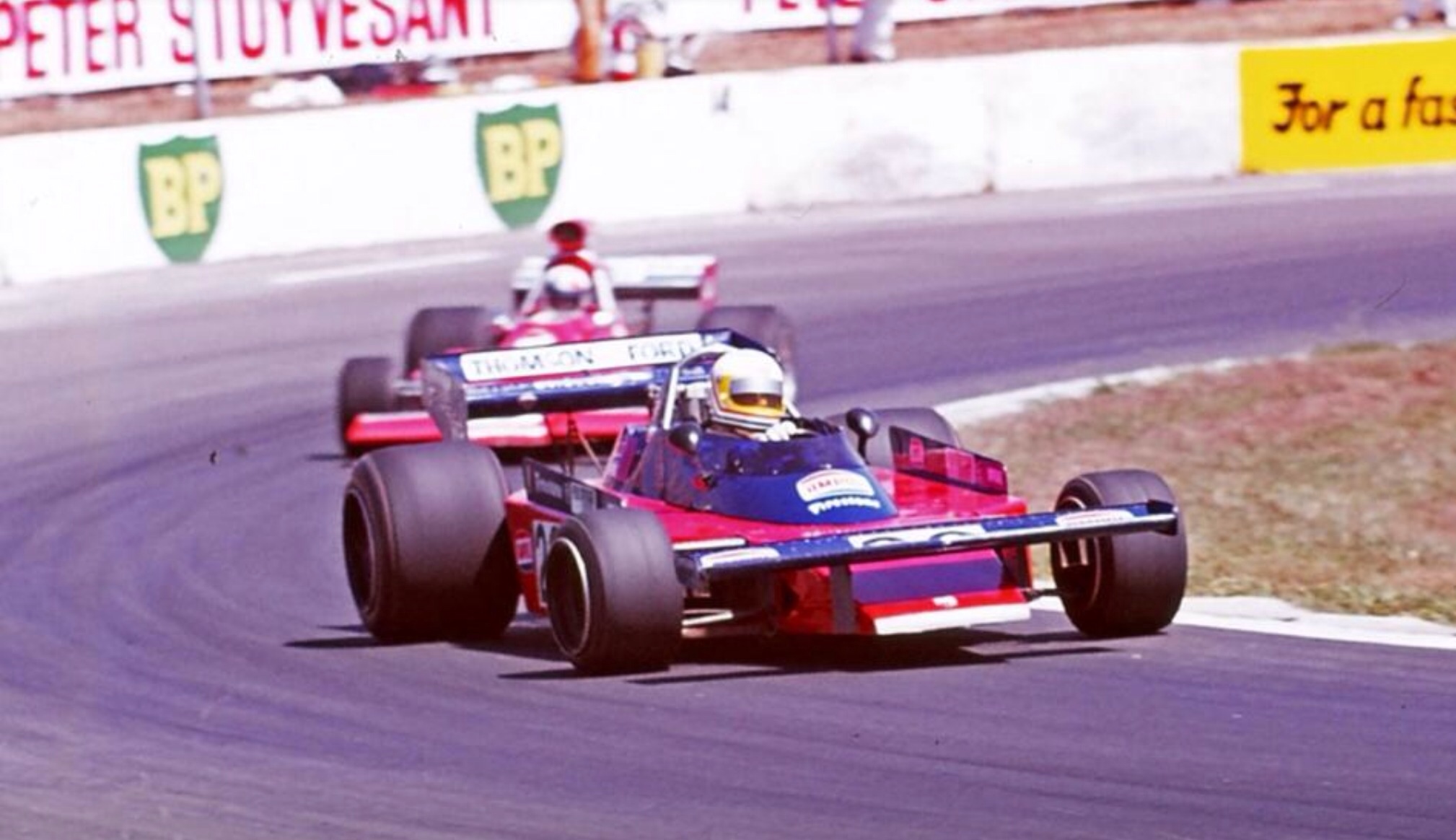
Chris Amon on the downhill plunge from Sandown’s Rise into Dandy Road, Talon MR-1 Chev, Sandown 100, January 1975…

When I first became interested in motor racing Chris Amon loomed large as an ace from ‘across the ditch’, he wasn’t Australian but he was a Kiwi which was more than close enough. Surely no two countries on the planet are closer in every respect?

One of the first posters I had on my bedroom wall was of ‘that shot’-Chris tickling the throttle of his Ferrari 312 into a gorgeous slide at Oulton Park during the Gold Cup in 1968. From that point on I willed him into that championship F1 win that cruelly never came.

Chris Amon Ferrari 312 on his way to 2nd behind Jackie Stewart, Matra MS10 Ford, Oulton Park Gold Cup in August 1968 (LAT)

By the 1975 Tasman Series Chris had been in a horrid career downer with dogs of F1 cars way beneath him for a couple of years- his own AF101 rocket in 1974 and the two Tecno’s the year before, they were shit-heaps at best.

In fact he had a ‘good finish’ to his F1 career in Mo Nunn’s Ensigns in 1975/6 proving yet again his pace but one mechanical failure too many finally made him chuck it all in at the tender young age of 33- later in ’76- brief Wolf Can-Am interlude in early 1977 duly noted.

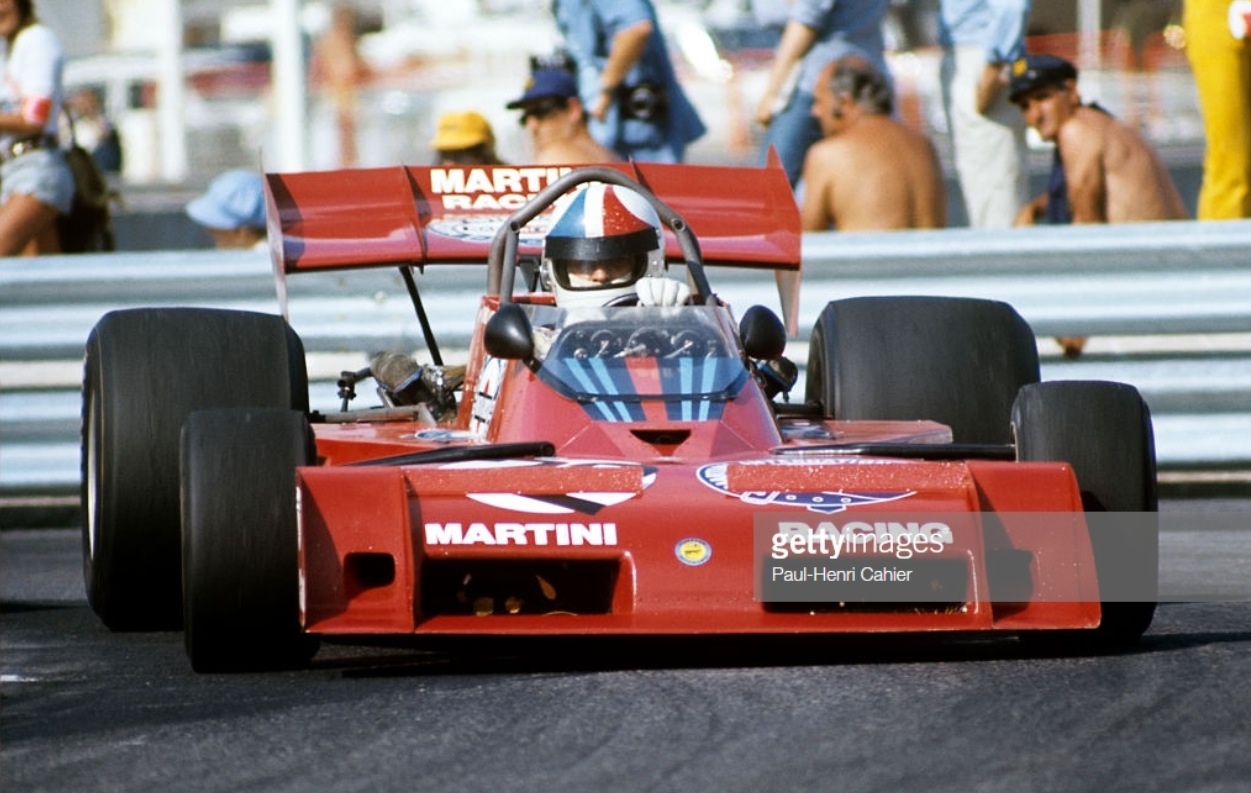
Amon, Tecno PA123,  Monaco 1973. Chris put the car 12th on the grid but DNF lap 22 with overheating. Stewart won in Tyrrell 006 Ford (P Cahier)


Amon, Amon AF101 Ford, Jarama 1974. Chris Q23 and out with braking problems on lap 22, Niki Lauda won in a Ferrari 312B3 (Twitter)


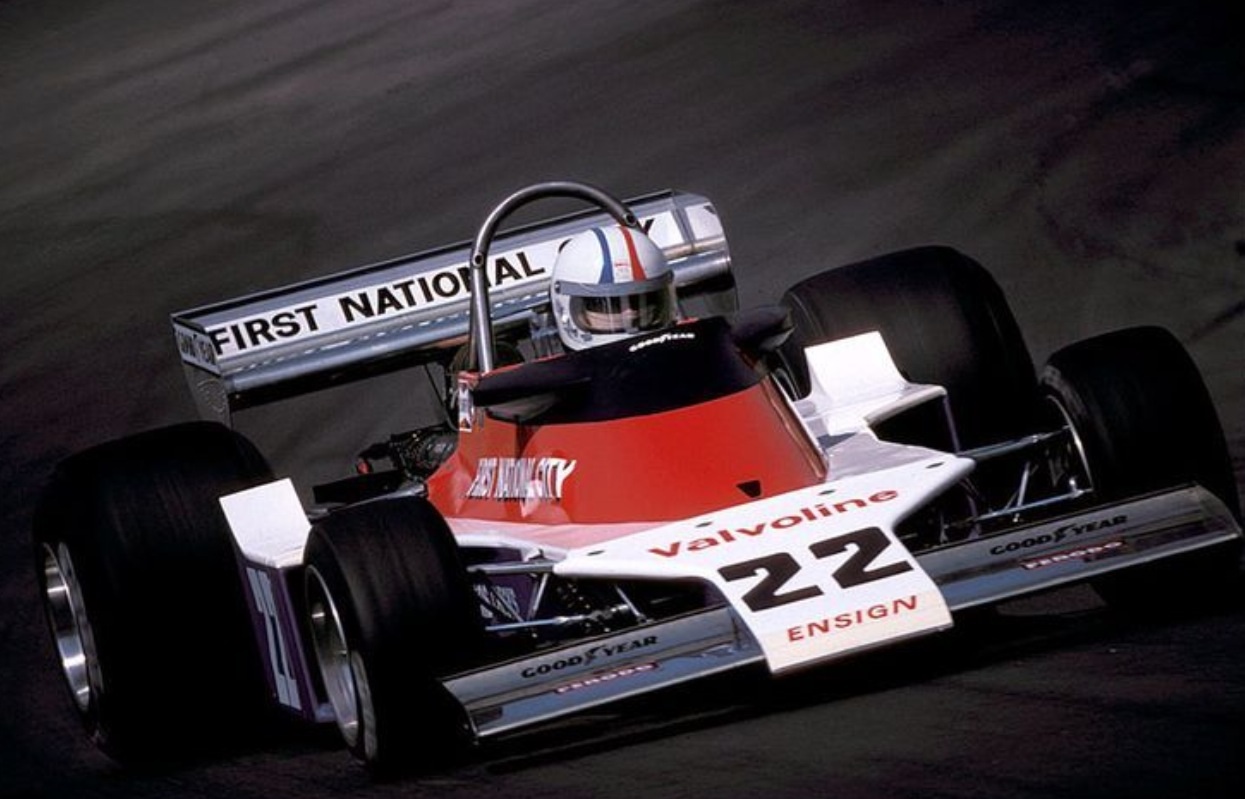
Chris, Ensign N176 Ford, British GP, Brands 1976. Stunning Q6 in the small teams car, DNF lap 8 with a water leak, James Hunt took the win in a McLaren M23 Ford (Pinterest)

But as I trundled out to Sandown in mums trusty Morris 1100 in 1975- I’d ‘conquered Sandown’ only a week or so before, a week after getting my drivers licence during a Peter Wherrett Advanced Course in that performance machine. I was keen to see how Chris handled a layout on which he had last won in 1969 when he wrapped up the final Tasman round, and series win, in his works Ferrari 246T.

Like so many really fast blokes he made it look easy.

Not much attitude on the car at all, but quick. Braking late, with a late blip of the throttle using few revs on the down-changes, he was as smooth as silk throughout. Good with feedback to his mechanics, I stalked him the whole weekend! i could hear some of it, the Jack McCormack Team were a seasoned F5000 outfit having run Sam Posey in the States for some years before.

GM ahead of Garrie Cooper’s Elfin MR5 Repco at Oran Park in 1974 (B Stratton)

Both Graham McRae and Chris made those cars- the GM2 Chev and it’s twin, the MR-1 Chev sing that summer but there were way too few finishes to threaten the three fellas who fought out that final Tasman round at Sandown- Graeme Lawrence, John Walker and Warwick Brown all in Lola T332’s- the greatest of all F5000 machines. Brown won the title and John Goss an eventful race in his Matich A53 Repco .

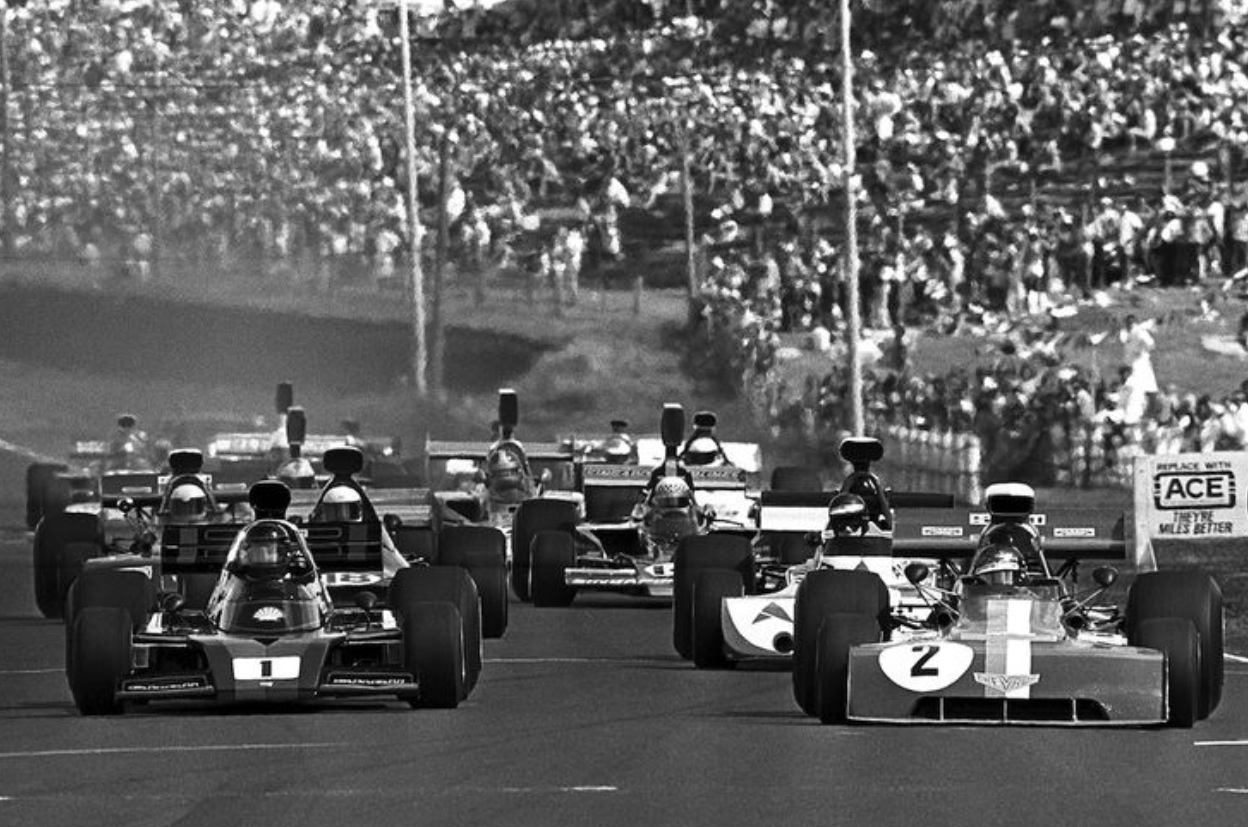
McRae followed up his very successful Len Terry designed Leda LT27/McRae GM1, a car Graham ‘concepted’ together with Terry, with the GM2. It was raced once in the UK- at the final 1973 Euro F5000 round at Brands on 21 October having troubles with a duff shocker- before landing in Australia in time for the November AGP held at Sandown, a race ‘Cassius’ won in his new car by two seconds from John McCormack’s Elfin MR5 Repco and John Walker’s unique, similarly powered Lola T330.

I spectated at the race as a teenager. In the year of the Lola T330 the GM2 was a superb looking, ‘McLaren M23-esque’ machine. With its rocker front suspension, deformable for 1974 mandated side pods and very careful attention to aerodynamics it really looked the goods.

Later in 1973 John Heynes, McRae’s business partner sold their Poole factory to the Penske Team to house their F1 effort- and the drawings and intellectual property rights of the GM2 design to Jack McCormack in California who built several cars designated Talon MR-1 and MR-1A. I will pick up this topic later in the article.

Feel The Earth Move: NZ GP Puke 1974. GM and Peter Gethin, the winner, GM2 and Chevron B24, #18 David Oxton and John McCormack- Begg FM5 Chev and Elfin MR5 Repco. The keen eyed will see the Lawrence and Walker Lolas- T332 and T330 and the rest. Tasman F5000 at its height (T Marshall)
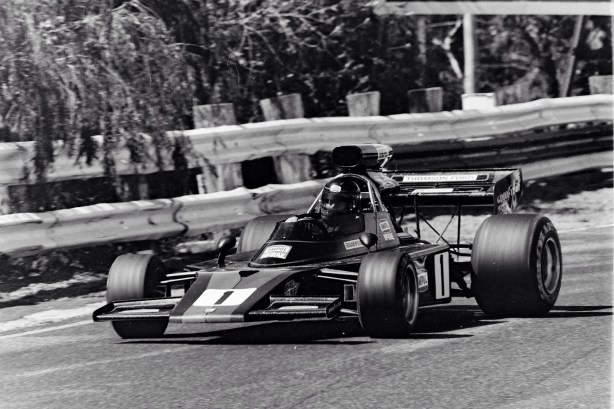
 

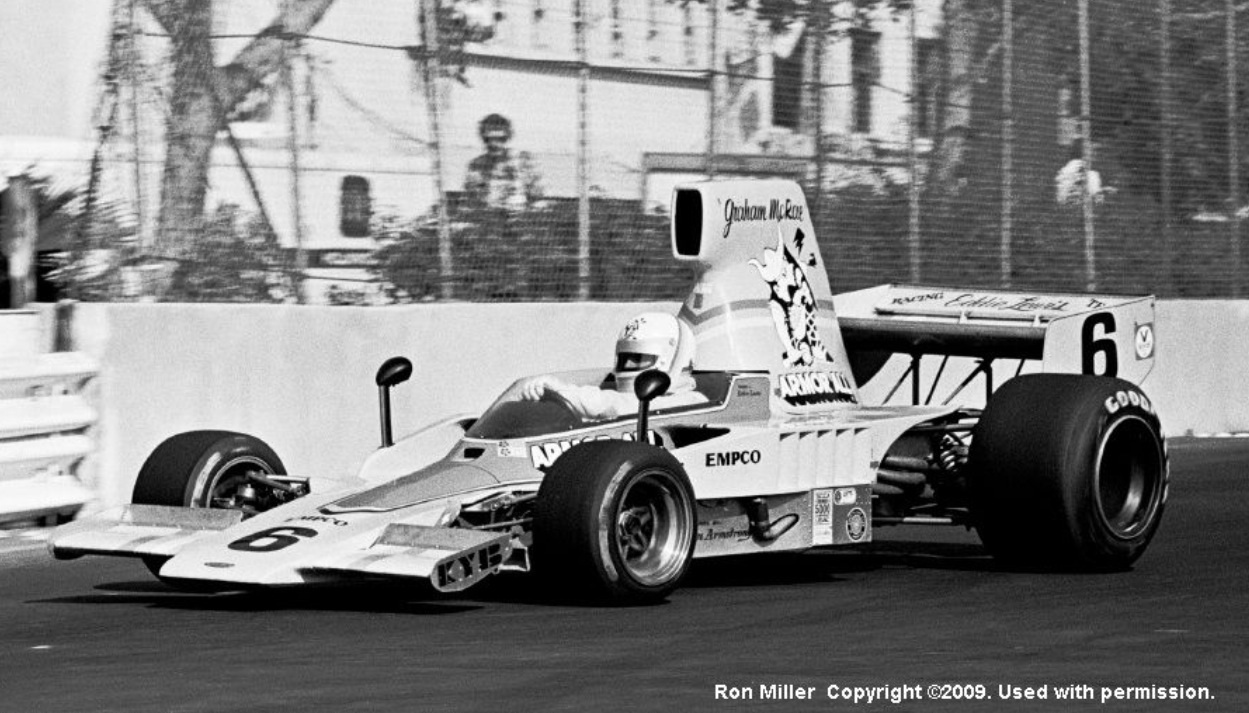
GM exits Torana Corner @ Sandown 1974, check out the front rocker angles as the GM3 is booted hard in second gear for the blast up the back straight (B Keys)

In the 1974 Tasman Series Graham was prodigiously fast starting from pole in the NZ GP at Pukekohe and setting fastest lap in three of the four Kiwi rounds- Levin, Pukekohe and Teretonga but he had problems in three of the races- oil pressure, valve spring and rear aerofoil, 2nd at Teretonga was his only points yield at home.

In Australia he was 6th, 2nd and 7th at Surfers, Sandown and Adelaide and disqualified at Oran Park. The speed he had displayed in the three previous Tasmans was mainly there but the reliability was not, by then the Louis Morand Chevy’s had been replaced by another engine-builder’s products.

Peter Gethin won the championship in a VDS Chevron B24 from Max Stewart’s Lola T330 Chev and John Walker, John McCormack and Teddy Pilette- all on 21 points driving Lola T330 Repco, Elfin MR5 Repco and Chevron B24 Chev respectively.

GM, past the Wigram aircraft hangars in 1974 (T Marshall)


Sandown Tasman 1974 with GM seated. Rocker front suspension in an F5000 of the period unusual, rest of the car typical- and superbly finished and built, the last car built by McRae at Poole prior to the factory sale to Roger Penske. Aluminium monocoque, Melmag wheels, Hewland DG300 ‘box (R Davies)

With money tight GM didn’t contest the European Championship but took the GM2 to the US in 1974.

He started the season in a Talon MR-1, racing it at Mid Ohio and Mosport and then switched to a Lola T332, finishing 4th behind Andretti, Redman and Eppie Wietzes at Watkins Glen, DNF from Q6 at Road America and then raced the McRae GM2 at Ontario Q25 with problems and DNF, Laguna Seca Q16 and 10th. Perhaps the final Riverside round was an indicator of the cars speed against the best in the F5000 world- he was fifth behind the T332’s of Mario Andretti, Brian Redman, Warwick Brown and Al Unser from Q10.

Sam Posey and Jon Woodner also raced Talons that season with Woodner doing the best of the pair.
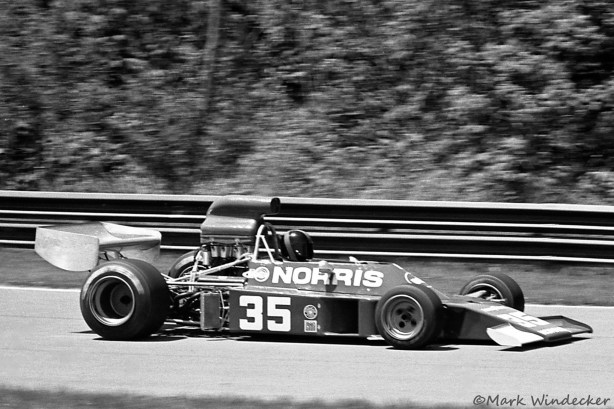
McRae aboard a Talon MR-1 Chev, Mid Ohio 1974 (M Windecker)


US F5000 Championship Riverside 1974, Graham aboard GM2 ‘001’ (A Upitis)

By the time the 1975 Tasman commenced McRae had shipped the car home to New Zealand and developed the GM2’s aerodynamics with a Ferrari inspired bladed front wing and long fences atop each sidepod.

Clearly, given the speed of GM2 against strong (Tasman) opposition the car was not as bad as has been portrayed in some texts which have not looked carefully at the cars qualifying pace but rather only the results- which are not quite so flash as the machines ultimate pace as expressed in qualifying.

Chris Amon, Talon MR-1 Chev, Wigram 1975 (T Marshall)


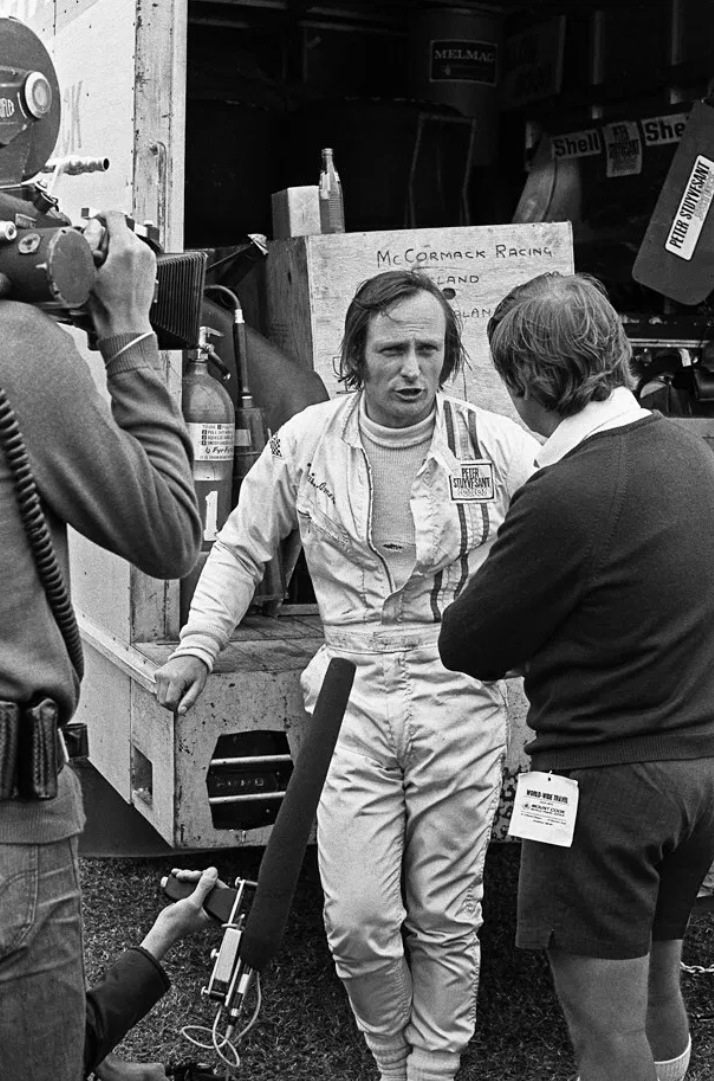
Chris taking care of the media at home in 1975 (T Marshall)
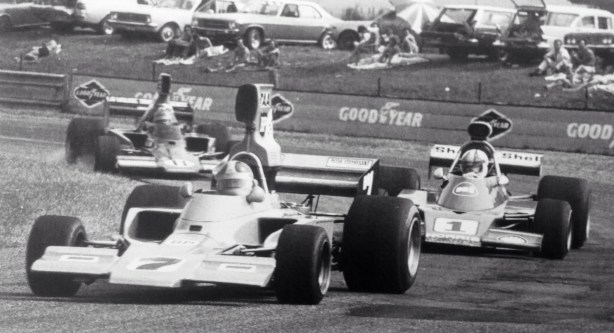
 

John Walker Lola T332 Repco from Chris and Graeme Lawrence Lola T332 Chev at Surfers Paradise in 1975 (B Thomas)

The GM2/MR-1 was on pole in McRae’s hands at Levin, Pukekohe, Wigram and Teretonga with Chris in his heavy, underpowered MR-1 second on the grid at Pukekohe, Wigram, Teretonga, Oran Park and Adelaide.

They won 2 of the races- McRae at Wigram and Amon the following weekend at Teretonga with Lola T332’s winning five rounds and John Goss in his Matich A53 Repco winning one, Sandown. The Lola T400, the Huntingdon marques new for 1975 machine was in strife with Kevin Bartlett and Max Stewart struggling to find the pace the T332 had- an update kit designed by Patrick Head would do the trick but it was no help for the two buddies from New South Wales, their Tasman was shot.
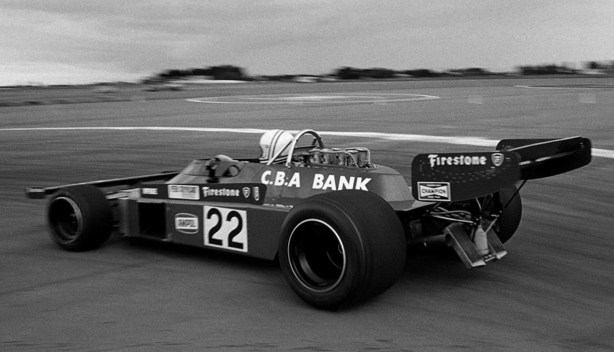
GM, McRae GM2 Chev, Wigram 1975 (T Marshall)


GM and Chris at Oran Park in 1975, GM2 and it’s ‘child’ the MR-1 Talon (V Hughes)


McRae Levin 1975, GM2 (T Marshall)

Into the US Series in 1975 the Talon MR-1A’s were not nearly as quick as the Lola T332C- awesome racing weapons driven by some of the most talented blokes on the planet at the time, and slipped down the grids.

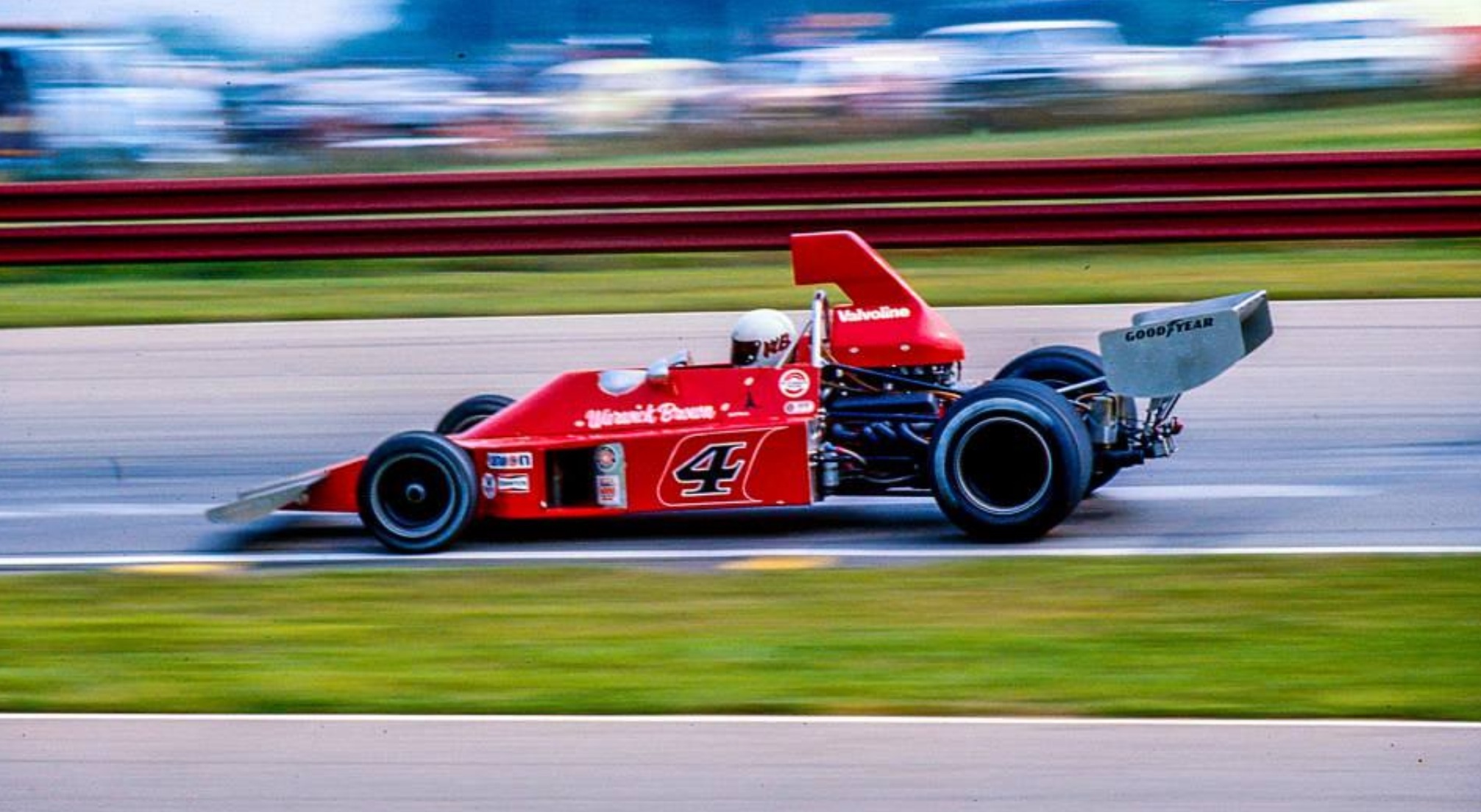
Warwick Brown raced a works MR-1A with his Australian patron, mining magnate, Pat Burke’s support in 1975 but commented more than once that he should have taken his Tasman winning T332 Chev ‘HU27’ back for a full tilt at the title in 1975 given his immediate pace in the small team’s limited 1974 US campaign. There is no doubt in my mind that the self belief for WB to win the ’75 Tasman was a direct result of proving to himself he could do it amongst the big hitters mentioned earlier in this article in the US in late 1974.

Generally the MR-1A fell down the grid from a qualifying perspective from Pocono Q5 and Mosport Q3 early in the season. WB had a year of good reliability from the car and Peter Molloy’s powerful, trusty Chevies with third at Mosport behind the Andretti and Redman T332’s and fourth at Watkins Glen his best performances.

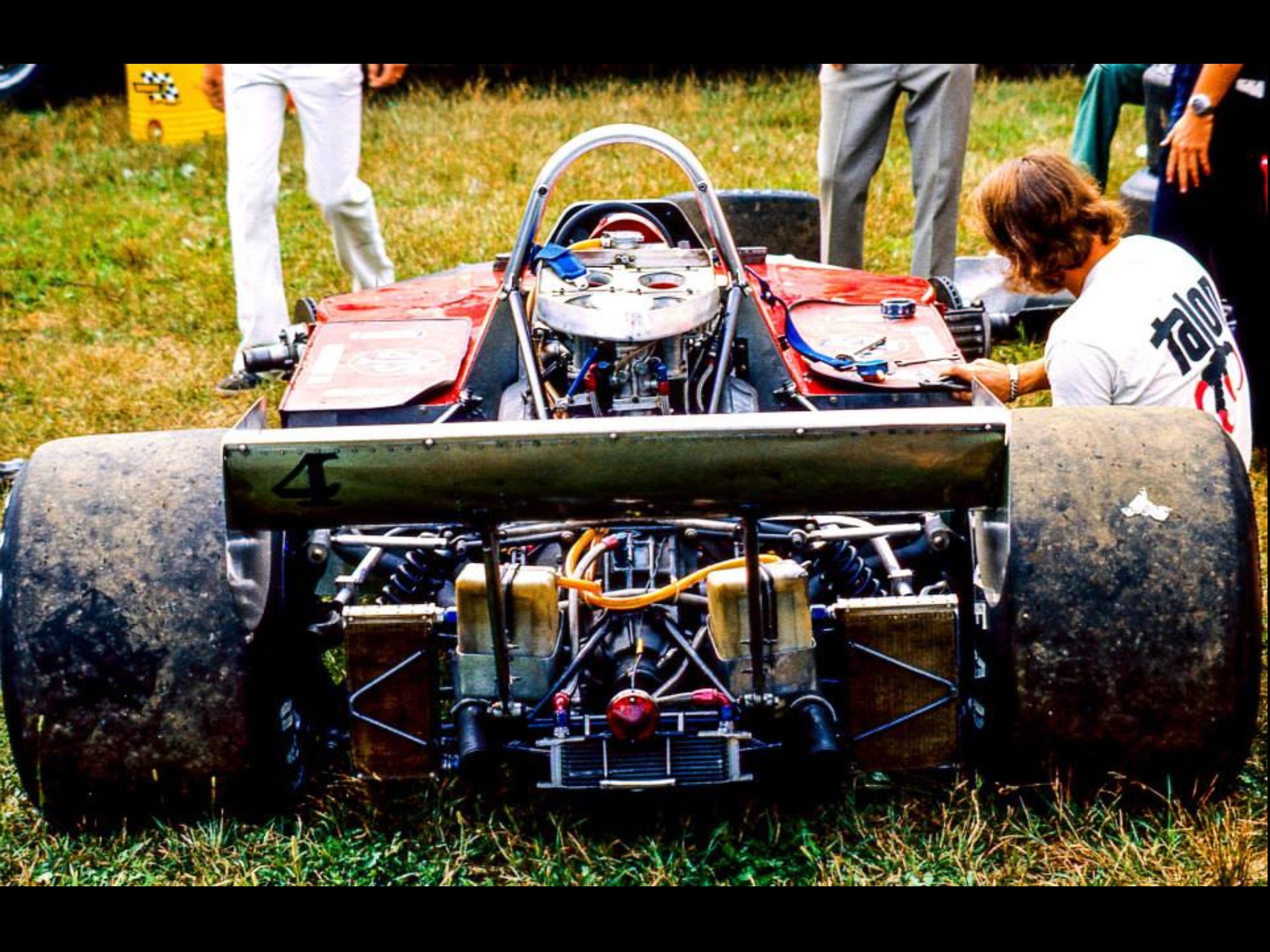
Warwick Brown, Talon MR-1A Chev, Mid Ohio 1975. Slinky from this angle (R Deming)
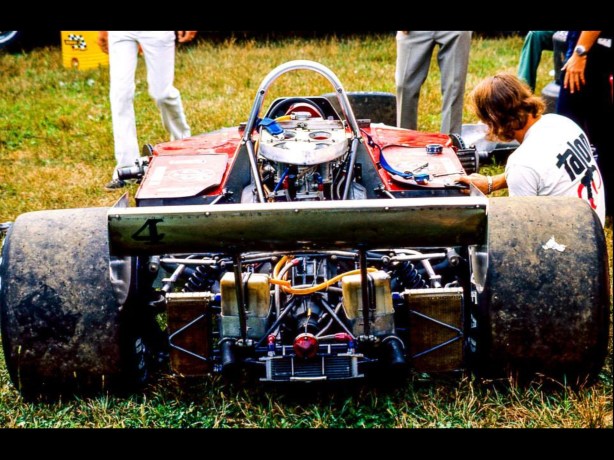
 

Brown’s Talon in the Mid Ohio paddock 1975 (R Deming)


Chris Amon joined Warwick at the marvellous Long Beach GP won by Redman’s T332.

Their qualifying positions were a bit dreary, WB 19th and Chris 26th but both raced to sixth in their heats with Amon fourth in the feature race and Brown two slots behind in sixth. Vern Schuppan was second in Dan Gurney’s Eagle 755 Chev and Eppie Wietzes third in his Lola T400M Chev with David Hobbs fifth in a Lola T330/332 Chev to provide the top six of a race which would be run to F1 from the following year.


Warwick Brown in the ‘works’ Talon MR-1A Chev he raced during 1975, Long Beach GP


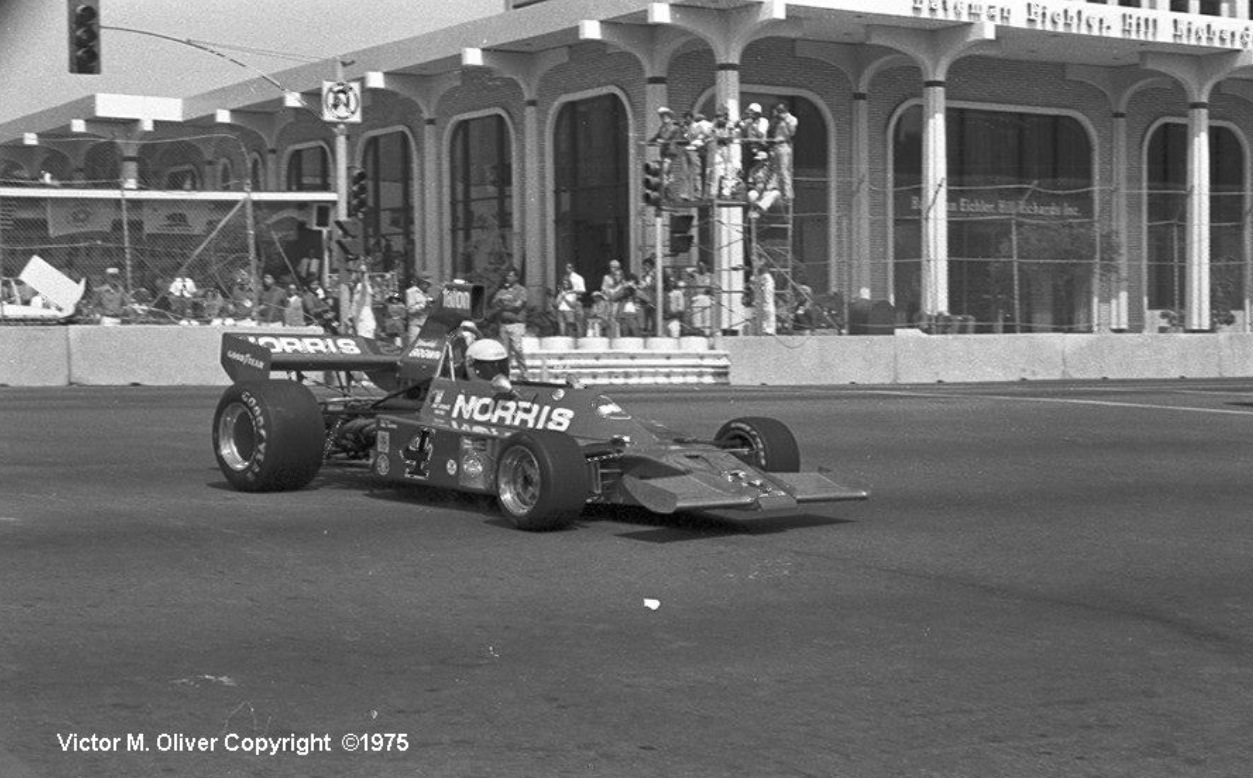
Bleedin’ the brakes, Chris, Long Beach 1975, Talon MR-1A. Poor run in qualifying belied a strong race (K Hyndman)

McRae raced a Lola T332 in the US in 1975.

His results were as follows; Watkins Glen Q9 and DNF suspension, Elkhart Lake Q12 and 7th, Long Beach Q8 and DNF after colliding with John Gunn’s T332 on lap 1. At Laguna Seca he was Q4 and 8th- and 2nd in his heat behind Unser’s T332, and at Riverside Q13 and DNF with engine problems before completing a lap.

GM, Lola T332 Chev, Long Beach 1975

Back home with the Tasman Series at an end he didn’t race in the Australasian 1976 Internationals- which that year were two separate F5000 series in New Zealand and Australia with different sponsors, it was the first time for the best part of a decade McRae didn’t compete on home turf.

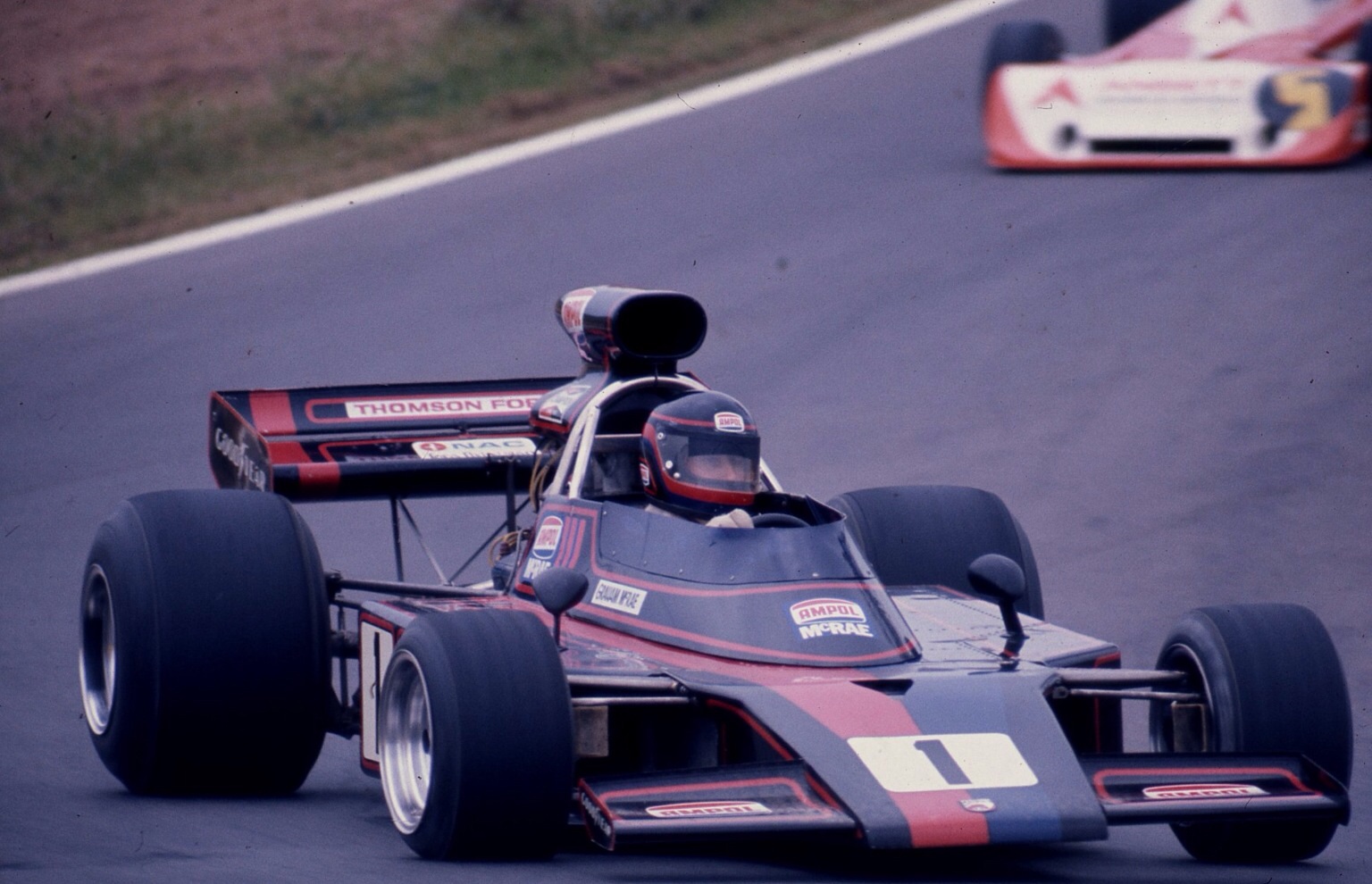
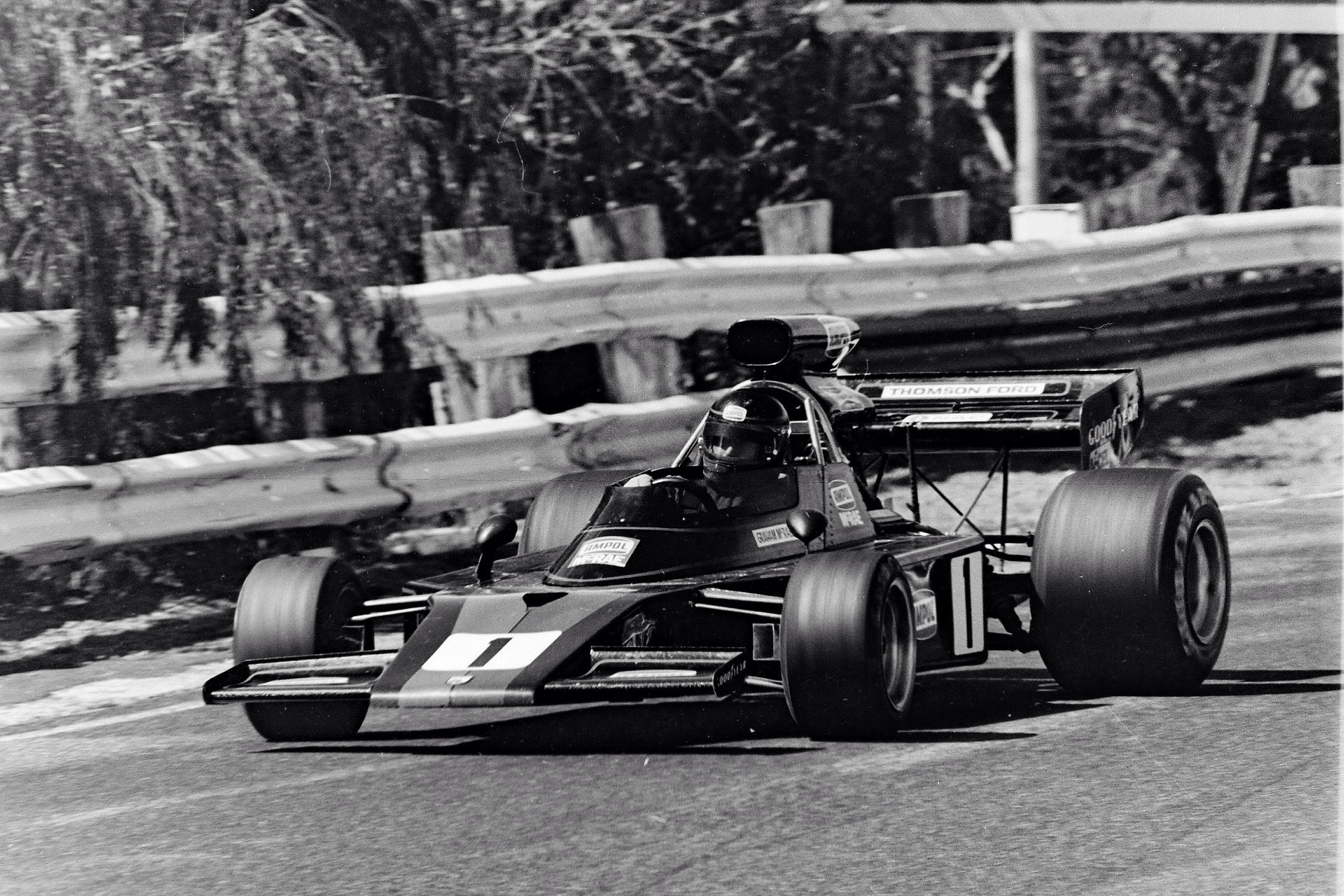
GM, Torana Corner, Sandown on the way to winning the 1978 AGP, McRae GM3 Chev 1978 (HAGP)

Graham McRae’s final car, the F5000 GM3 Chev was radical in looks with its wonderful perspex cockpit bodywork which showed the driver at work is really beyond the scope of this article, its a nice topic for another time, but here is a summary.

Apart from its looks the car was a conventional F5000 machine built by GM in Costa Mesa, California with Graham Lister lending a helping hand on a trip through Los Angeles. The cars race debut was the very last round of the US Championship in 1976 at Riverside for Q22, 6th in his heat and DNF in the final.

Teddy Pilette, Lola T430 Chev from GM’s new GM3 Chev and Peter Gethin’s one of a kind Chevron B37 Chev- all three of these cars later had successful careers in Australia in the hands of GM himself, Alf Costanzo and Bruce Allison (unattributed)


GM in the GM3 Chev Can-Am in 1977, Riverside Turn 6. Check out the vestigial bodywork, almost reminds one of Vern Schuppan’s first Can-Am body on his Elfin MR8? (Eric Schaal)

With that, Graham converted the car into a Can-Am contender with vestigial sportscar bodywork racing it at Watkins Glen, Road America, Mid Ohio and Riverside which yielded his best result, Q11 and sixth.

Gerry LaRue’s magic, ‘right in the cockpit’ shot of GM at Riverside in 1977 below makes McRae’s design intent crystal clear! GM2 Chev Can Am- look closely at this shot and others of the car in F5000 format and you see just how minimalist the sportscar bodywork of the design is.


(G LaRue)

At the end of the North American season the Kiwi then converted the chassis back to F5000 specification and shipped it from California to Australia to contest the 1978 Rothmans International Series.

There his results were- Sandown Q3/DNF, Adelaide Q7/5th, Surfers Paradise Q14/7th, and Oran Park Q2/3rd. The car stayed in Australia that season with GM winning both the 1978 Australian Grand Prix at Sandown and the three round Gold Star Series- two round wins, in fact these were his last major victories.

The cars final iteration, and model name change from GM3 to GM9, then took place in New Zealand with the chassis and body substantially modified for GM’s Can-Am final races in the US in late 1980, 1981 and into 1982 and the then the cars sale. It’s still extant in New Zealand.

GM, McRae GM9 Chev, Caesars Palace Can-Am October 1981 (B Thomas)


McRae, Sandown’s Peters Corner, on the way to victory, McLaren M10B 1971 (I Smith)

Malaya Garages, Leda Cars and Len Terry…

Let’s now go back a few steps to retrace Graham’s F5000 career from its earliest days.

McRae made his name in small bore single-seaters in NZ, demonstrating his engineering prowess- he is Engineering degree qualified with the twin-cam powered McRae 69 1.5 Ford twin-cam and its forbears giving the Tasman 2.5 machines plenty of curry each summer.

His foray into the big F5000 league was funded by Tom Clark and his Crown Lynn Potteries business which acquired the McLaren M10A Chev ‘#300-6’ GM raced in the 1970 Tasman Series. Clark knew what it was to be a racer, he contested races in both New Zealand and Australia during the 1950’s aboard a variety of cars including a Maserati 8CM and Ferrari Super Squalo 555.

GM’s self constructed McRae S2 Ford 1.5 twin-cam ahead of Graeme Lawrence’s Ferrari Dino 246T at Levin in November 1969- GM finished 6 and 3 seconds respectively behind Graeme in two races that day (T Marshall)

McRae had his first foray in Europe in mid-1969 when he contested six Euro F2 Rounds as his NZ Driver to Europe prize in a Frank Williams run Brabham BT23C Ford FVA. His best result was 4th in the GP of Limbourg at Zolder behind Jochen Rindt, Jacky Ickx and Piers Courage in a car which by then was hardly the latest bit of kit. For the record, he also raced at Thruxton, the GP of Madrid, Hochenheim, Monza and the GP of Reims yielding DNF/DNF/9th/12th/11th.

Contesting the 1970 Tasman in a McLaren M10A he was immediately comfortable in these big demanding beasts of cars taking two of the nine rounds at Teretonga and Surfers Paradise.

That year the series was contested by a mix of F5000’s, Tasman 2.5’s and 2 litre cars with Graeme Lawrence winning in the same Ferrari Dino 246T chassis Chris Amon used to win in 1969.

Superb Terry Marshall portrait of GM on the grid at Levin in 1970, McLaren M10A Chev- he stares him down before the off. I love this shot (T Marshall)

The M10A wasn’t going to do the trick in Europe so was replaced by an M10B chassis ‘400-11S’ with which Graham achieved several seconds before taking the final Brands Hatch round in late September to ‘break through’ a long way from home. The series was won by Peter Gethin’s McLaren M10B with other hotshots that year Mike Hailwood, Howden Ganley, Frank Gardner, Trevor Taylor, Reine Wisell and others.

McRae returned home to the Antipodes and brained them with his extensively developed M10B in the ’71 Tasman. In the same chassis he used in Europe he won three rounds of the series- at Levin, Wigram and Sandown and took the first of his three Tasman titles, all of which were won on the trot. Frank Matich’s McLaren M10B Repco and Niel Allen’s McLaren M10B Chev were second and third with Frank Gardner’s works Lola T192 Chev fourth. There was plenty of depth in that field, it was a very good win.

At this point, lets pause for context again.

John Surtees approached Len Terry to design an F5000 car for him- Terry’s Leda LT17 intended for Roger Nathan was taken over by James Garner and John Surtees becoming the 1969 Surtees TS5 with which David Hobbs did so well.

David Hobbs, Team Surtees, Surtees TS5A Chev (Terry’s LT17 design) at Road America, July 1970- 2nd to John Cannon’s McLaren M10B Chev (unattributed)

Terry decided commercially it would be more profitable to build cars in volume rather than design them for a one-off fee. He entered into a commercial arrangement to do so with Malcolm Bridgelands Malaya Garages, who took over the majority interest in Leda Cars towards the end of 1969- the name was one Len had ‘on the shelf’ as an alternative name for business relationship with Dan Gurney during the Eagle phase of his career Le (Len) and Da (Dan).

The successful LT17/TS5 design was replaced by the 1970 LT20, a disaster. It was a lower, lighter version of the Surtees TS5 with totally interchangeable front and rear suspension which simply did not work. In August, one LT22 was built which was an LT20 with conventional multi-link rear suspension, it too was not a star, despite the testing efforts of Roy Pike, Frank Gardner and Graham McRae to get it working better.

Martin Lyons, who worked for Leda Cars relates GM’s Leda test and this Frank Gardner exchange with Len Terry after FG put the LT22 through its paces at Silverstone in 1970;

‘Graham tested the LT22 at Silverstone in 1970 for us.

He shared our workshops in Billingshurst, West Sussex. Graham after a few warm up laps, pitched the car into Woodcote as he would in his M10B. All we heard in the pits was tortured tyre squeals that went on forever (or so it seemed) and we all anticipated that dull crump/thump. It never happened and Graham came into the pits, as white as a sheet!

Len asked Frank Gardner to drive the car as well at Silverstone and after a few laps Frank peeled into the pits, rolled to a halt and killed the engine. Len paced briskly and knelt down next to Frank. After about 30 seconds (which seemed like 5 minutes) Frank drolly said “Congratulations Len!” Another pause, Len thinking a compliment was coming his way, leant further into the cockpit. “You’ve designed one car and made it handle like two!” Frank unbuckles, levers himself out of the car and walks away back down the pitlane. Everyone in our team heard this and are looking away stifling laughter…’

Roy Pike testing the brand new Leda LT22 Chev, Snetterton, 31 August 1970 (J Ballantyne)

The LT22 was replaced with the 1971 LT25 and achieved some top-five placings in the hands of ex-Lotus GP driver Trevor Taylor who had enjoyed some race wins with Team Surtees in F5000 before joining the Malaya Garages outfit.

When Graham McRae returned to the UK in early 1971 he figured he needed a new car so decided upon a McLaren M18- not McLaren’s finest of racing weapons as events transpired, not that the model didn’t win a race or two mind you.

The ‘Team Trojan’ entered M18 ‘500-02’ had one of the shortest of lives of any racing car when Graham boofed it bigtime in private practice at Snetterton before the second round of the European series in early April. He went off sideways at Russell, hit the bank, flew up into the air and landed upside down before the car rolled back onto its wheels. The racer was totally rooted but the hapless driver was AOK and ready to fight another day!

McRae, who had missed the opening round at Mallory Park- and then the Snetterton, Brands Hatch, Mondello Park, the Silverstone International Trophy and Castle Combe rounds, returned with a vengeance to win at Mallory Park in late May with none other than good ole M10B ‘400-11S’! It was a great reminder of who the class of the field generally was even if his car wasn’t the latest bit of kit.

In mid-summer of 1970 Graham came to the arrangement with Malaya Garage’s Malcolm Bridgeland to garage, prepare and transport his McLaren to meetings together with the Leda entries, Martin Lyons mentioned above. Inevitably McRae got to know the crew at Billingshurst pretty well.

At Monza in June he didn’t qualify the McLaren M10B but practiced Len Terry’s Leda LT25 ‘1’ to get a good feel for the car. That weekend was a good one for the team, Trevor Taylor finished second in another LT25 Chev just behind Alan Rollinson’s Surtees TS8 Chev, clearly the car had some merit.

McRae won in the old-nail McLaren again at Thruxton on the August day the F5000 world changed- the Lola T300 prototype made its race debut in Frank Gardner’s hands. The man who concepted the T300 knew a thing or two about engineering racing cars, it would take a couple of rounds before FG took the T300’s first race win but McRae knew he needed something pretty special to be competitive in 1972 given Gardner’s pace in Lola’s existing T192 let alone Huntingdon’s new weapon.

And so it was that Graham explored his ideas about what he wanted in his next car with Terry- thoughts strongly influenced by his McLaren experiences, the Leda LT25 and the Lola T300. He was also mindful of the very competitive ‘pregnant belly’ F1 designs of the time- the BRM P153/160, McLaren M19 and Tyrrell 001-002.

Leda LT27/GM1 ‘001’ 1972 (T Matthews)

Trevor Lister recalls ‘Graham was determined to set his engine as low in the chassis as physically possible so he redesigned the engine sump so there was the minimum possible clearance between the crankshaft and the bottom of the sump. This enabled the engine to be installed lower and reduced ground clearance.’

Perhaps a fair description of the LT27’s design is that conceptually it was largely McRae’s with the detail design and drawing all Terry’s. Along the way they decided to use some McLaren hardware, notably the suspension uprights, which suggests the Leda bits were regarded as inferior to McLaren’s or simply that was what GM wanted- a known quantity which would work straight away.

Lister also recalls ‘At one stage we encountered continual cracking of the brake discs and Graham decided he would drill holes to improve the cooling by dissipating the heat build-up. I remember him standing at the drill-press for hours one day drilling dozens of holes in all the discs, I believe he was the first to do this in F5000 and it was copied by some teams even in F1? He also grooved the discs from inside to outside to improve the clearance of brake dust. Again, other teams copied very quickly but some had the grooves running the wrong way’.

Leda Cars were based in the Malaya Garages premises along with Alan McCall’s (another very talented Kiwi) Tui Super Vee project and a project to build a Morgan like road car. The F5000 plan for 1972 was for McRae and Taylor to race two LT27’s in the 1972 Euro F5000 Championship, but Graham first had his Tasman title to defend.

Ampol ad proclaiming McRae’s 1973 Tasman Series win. Pic is of GM Leda LT27/GM1 Chev ahead of Kevin Bartlett’s McLaren M10B Chev at Adelaide International in 1972- David Hobb’s McLaren M22 Chev won that day

Frank Matich figured he had the goods to win the ’72 Tasman, his new Matich A50 Repco had won right out of the box at Warwick Farm, taking the 1971 AGP from John Surtees amongst others.

The 1972 Tasman line-up was particularly strong with works Surtees, Lola and Trojan Cars entries for Mike Hailwood, Frank Gardner and David Hobbs. In addition there was strong competition from Kevin Bartlett, Max Stewart and the Ansett Team Elfin duo of John McCormack and Garrie Cooper.

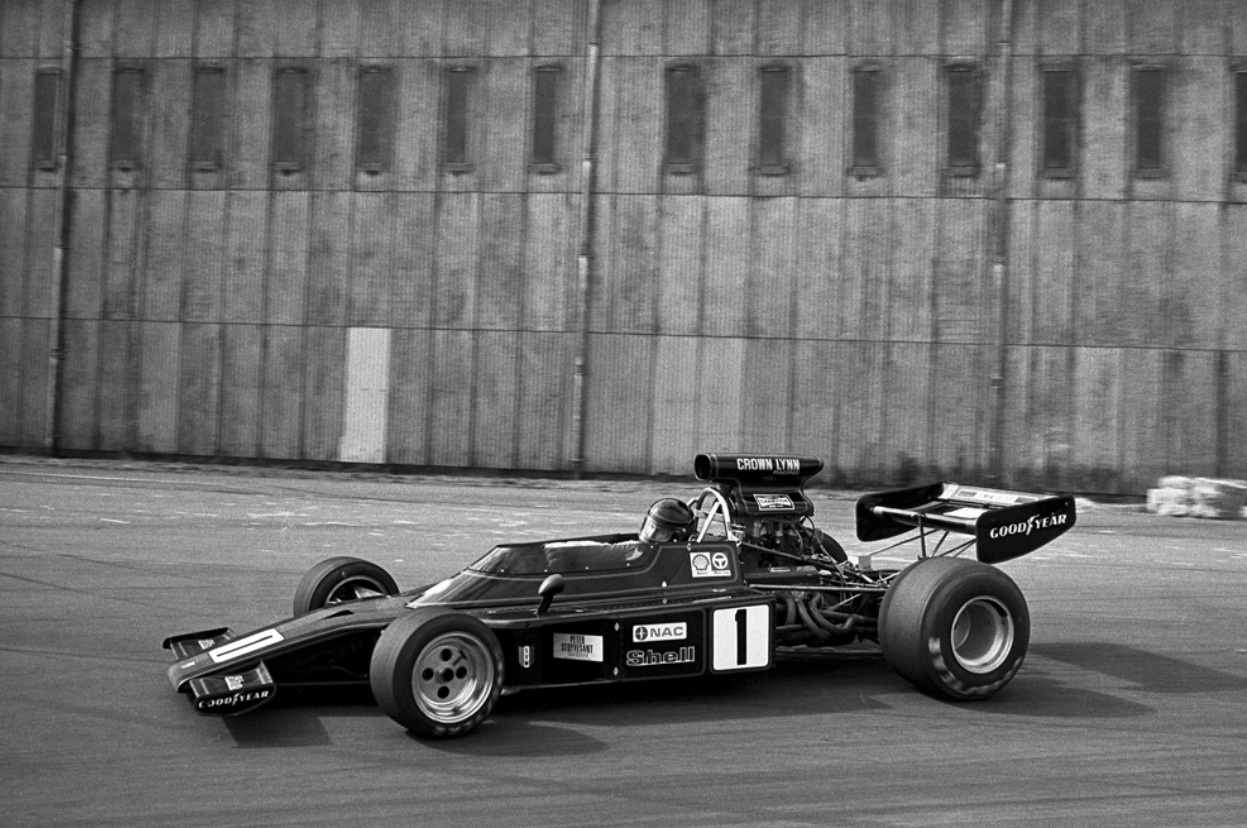
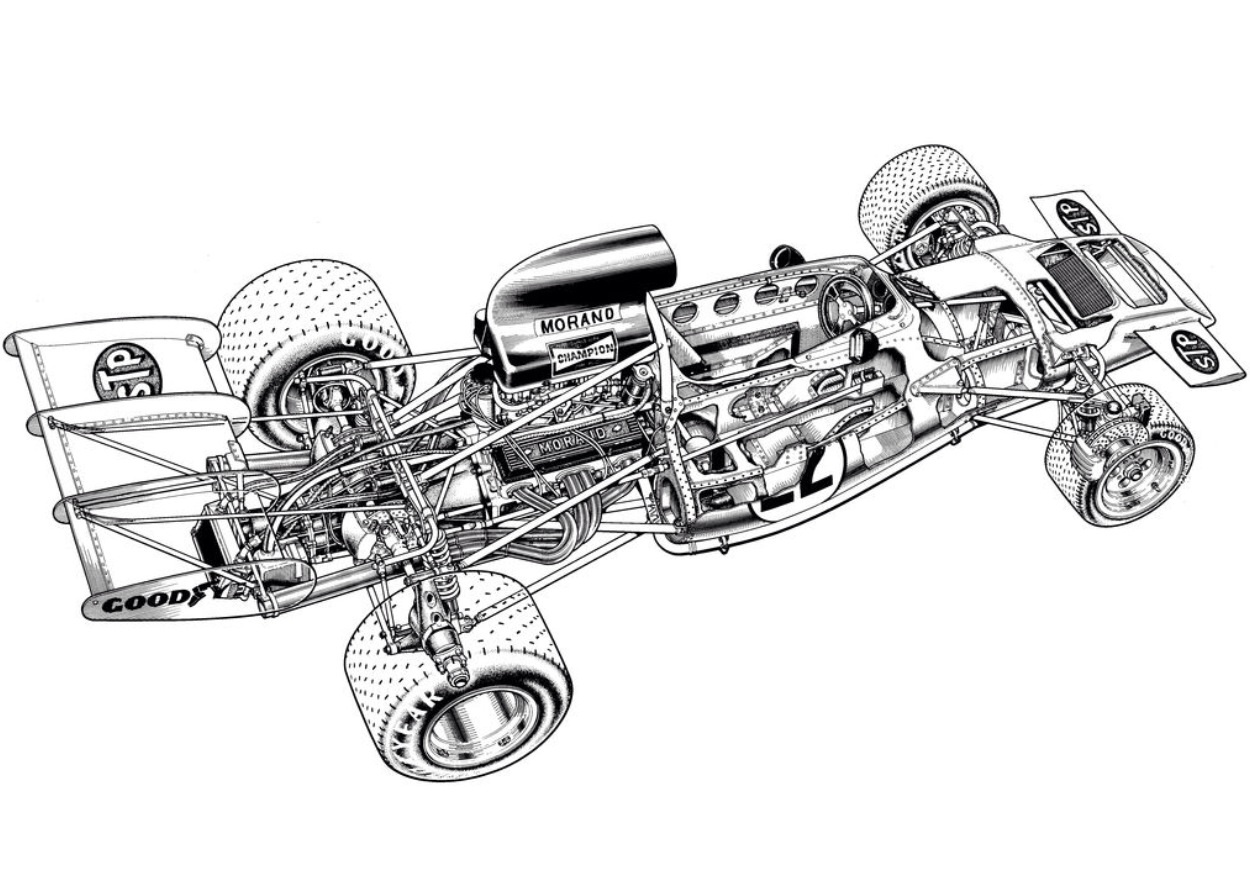
It isn’t clear how much testing McRae had completed in his new Leda LT27/GM1 Chev but the neat, squat, STP sponsored machine was fast right from the off complete with powerful, reliable, Weber carbed Morand Chevys.

McRae won at Levin, Wigram, Surfers Paradise and Sandown and took pole at Pukekohe, Levin and Wigram- notable was that the car was quick on a variety of circuits. Clearly Leda had a competitive customer car to compete with the Lola T300 and Chevron B24 which promised to be the marques available in quantity that season.

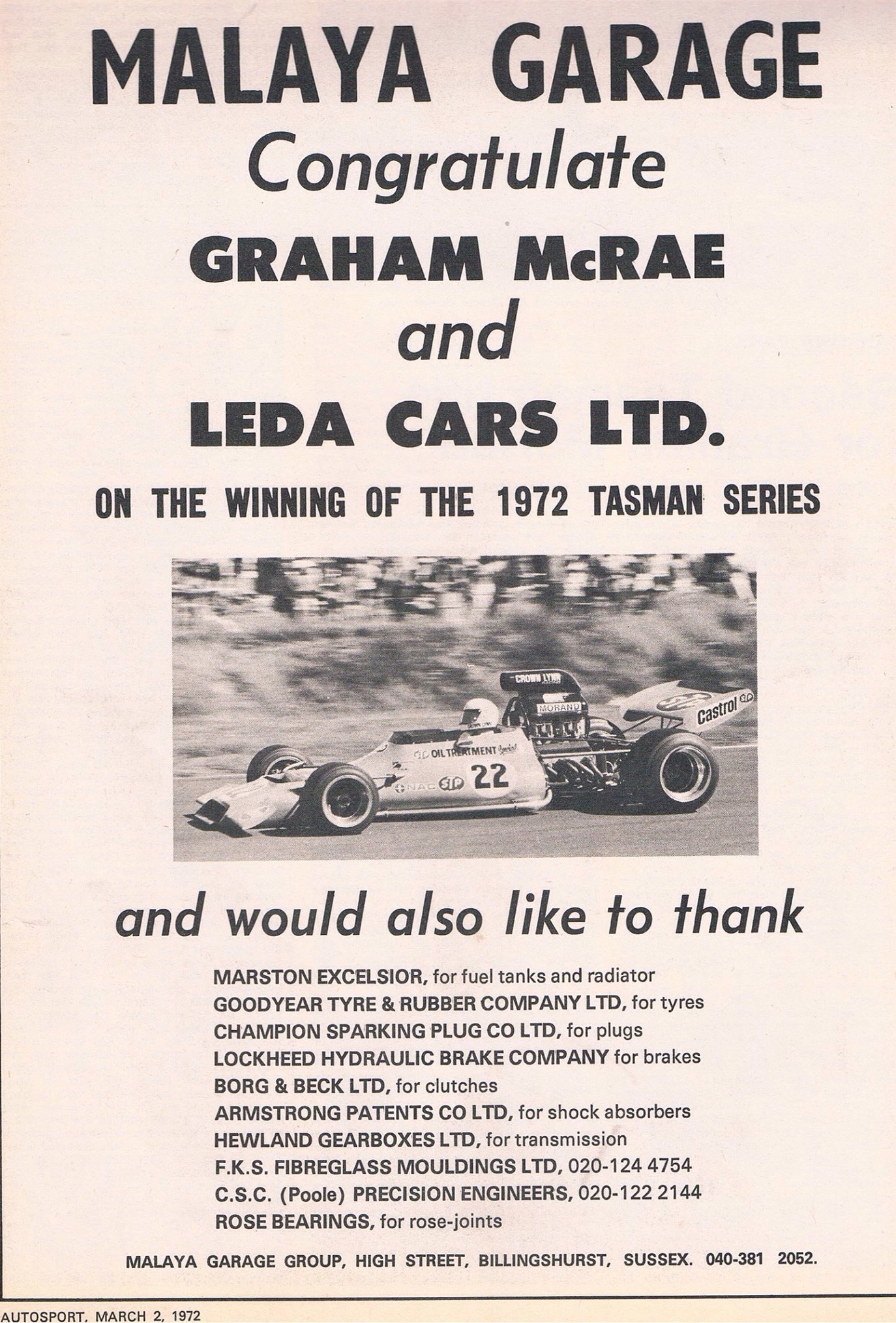
Yay team, Malaya Garages Auosport ad, March 1972 (M Lyons)

McRae returned to Europe and raced the same chassis in the Brands, Mallory Park, Snetterton rounds with dramas in all three races before breaking through for his first win of the championship that year in the April Brands round- a car for Taylor finally appeared at the April Silvertone meeting.

After the first three or four races the Malaya Garages people decided to withdraw their support for the race team with the drivers looking likely to be left high and dry- arguably Taylor already was. A London insurance broker and wealthy motor racing enthusiast, John Heynes came to the rescue and acquired premises in Poole, Dorset installing McRae in charge. Terry resigned his directorship of Leda Cars Ltd and relocated his own business ‘Design Auto’ to his home in Dorset. A contemporary Autosport report has it that Len’s only relationship at that point was as a shareholder of Leda Cars.

With the takeover complete, from 1 July 1972 the LT27 design became known as the McRae GM1 with 14 cars built and sold in 1972/1973. To that point the cover of Leda’s own sales brochure described the car as ‘Leda Type 27/GM’, which should put to an end any conjecture as to what the car’s model designation was formally prior to 1 July 1972.

Whilst all these corporate manoeuvrings were going on McRae had races to contest, his season being set up by STP- who had backed the new car during the successful 1972 Tasman campaign and decided to continue their sponsorship to forays in both the US and Europe.

GM and crew, Leda GM1 Chev, Laguna Seca practice 1972 (R Rodgers)
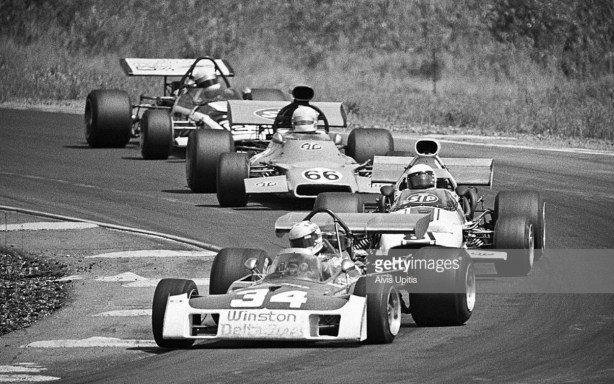
 

Brainerd Donnybrooke July 1972. Sam Posey Surtees TS11 Chev, John Cannon McLaren M10B Chev, McRae in GM1 (A Upitis)

McRae won the US L&M Championship and surely would have taken the Euro one too were it not for conflicting rounds which precluded him contesting sufficient races to do so- as it was he won the Nivelles, Silverstone, Brands (July) and Oulton Park rounds and finished third in the title chase behind Gijs van Lennep and Brian Redman in Surtees TS11/McLaren M18 and McLaren M10B/Chevron B24 respectively.

In the US McRae faced strong opposition from Brian Redman (also contesting both the European and US titles), David Hobbs, Derek Bell, Peter Gethin and Aussies Bob Muir, Kevin Bartlett- not all these fellas did the whole series mind you.

Despite that and being new to the circuits and having all the logistical challenges of a different country he won the Laguna Seca, Watkins Glen and Road America events of the eight round series taking the ‘SCCA L&M Continental 5000 Championship’ title with 87 points from Sam Posey, Surtees TS11 Chev and Brett Lunger’s Lola T300 Chev.

McRae, GM1, Warwick Farm 1973 (B Stratton)

Into 1973 McRae easily again won the Tasman Series, the combination of the GM1 design, Morand engines and McRae’s preparation and driving talent saw off fields of great depth. The GM1 took five of the eight rounds, McRae won four and Alan Rollinson one.

But it was to be a different thing in the US with a double-whammy of plenty of Lola T330’s on the grids and Jody Scheckter aboard a Trojan T101- whatever Ron Tauranac’s design may have lacked in pace relative to the Lola was more than compensated by Jody’s prowess behind the wheel.

During the year McRae’s versatility was demonstrated with a drive at Indianapolis via the relationship he had with the Granatelli’s, there STP company was also the sponsor of the three car Patrick Racing Team. In a superb effort, GM popped the Patrick Eagle Offy 16th on the grid completing 91 of the 133 laps with a header problem- in the process he was awarded the Rookie of The Year trophy.

It was a bitter/sweet weekend for Pat Patrick and the team- whilst Gordon Johncock won the race in another Eagle the teams other car driven by Swede Savage crashed very badly with the hapless young thruster succumbing to his injuries, or more particularly post-surgery complications, five weeks after the race.

The obligatory Indy qualifying shot- GM in the Patrick Racing Eagle Offy, 1973 (unattributed)


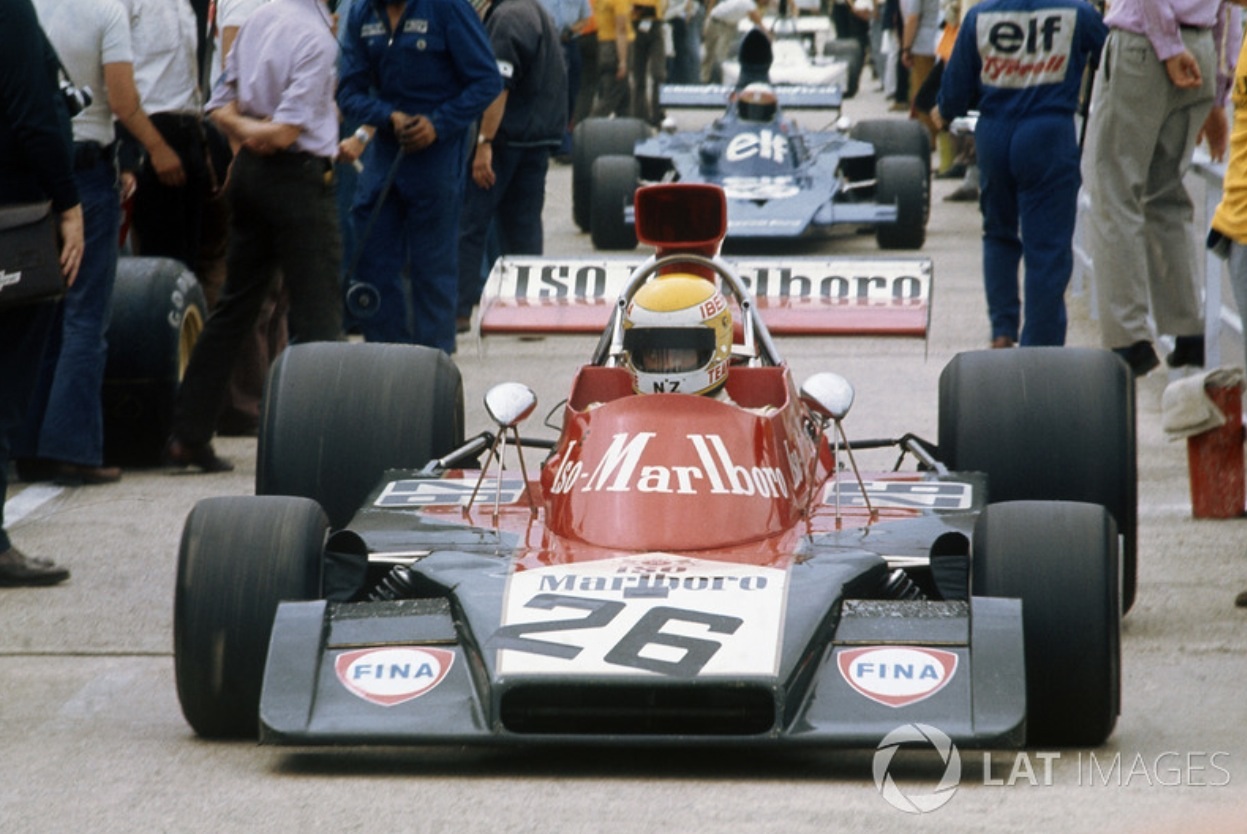
McRae in Frank Williams Iso IR Ford in the Silverstone British GP pitlane in 1973. The eagle eyed will spot Jackie Stewart aboard Derek Gardner’s experimental chisel-nosed Tyrrell 005 Ford behind. This was the chassis Chris Amon was to race in the North American away races- in the end he only raced the car in Canada, Francois Cevert’s death during Watkins Glen practice resulted in the team’s withdrawal from the meeting- which was JYS last GP (LAT)

Needless to say McRae was a ‘man of the moment’ at the time- then like now you need to grab and hold the spotlight with your results to get F1 opportunities. Unfortunately Ken Tyrrell’s offers of a race or two were declined as a result of prior contractual commitments. Unfortunately when the planets did align GM’s F1 career became one of the shortest on record.

Frank Williams was well aware of McRae’s record in the Tasman Series when FW ran a car for Piers Courage in 1969, and of course the Kiwi’s F2 drives with him in early ’69. And so it was that GM raced FW’s Iso IR Ford in the 1973 Silverstone British GP- a race made famous by the huge Woodcote lose of Jody Scheckter which then took out the best part of half the field. McRae’s car was not destroyed unlike many but the Iso’s Lucas injection throttle slides were jammed with sand, so he didn’t take the restart of the race won by Peter Revson’s McLaren M23 Ford.

McRae needed a new F5000- the GM2 was the result drawing upon ideas absorbed from the contemporary racers of the day and built in the Poole workshop. It wasn’t the last racing car built there, Penskes would follow but one can only surmise that John Heynes worked out that the only way to make a lot of money out of motor racing was to start with even more. And so McRae Cars in that incarnation ended, the facility was sold, as were the GM2 design rights and drawings to Jack McCormack.

And that folks, is about where we came in…
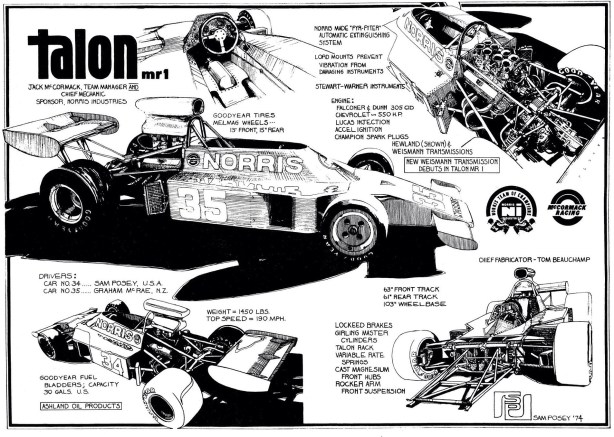
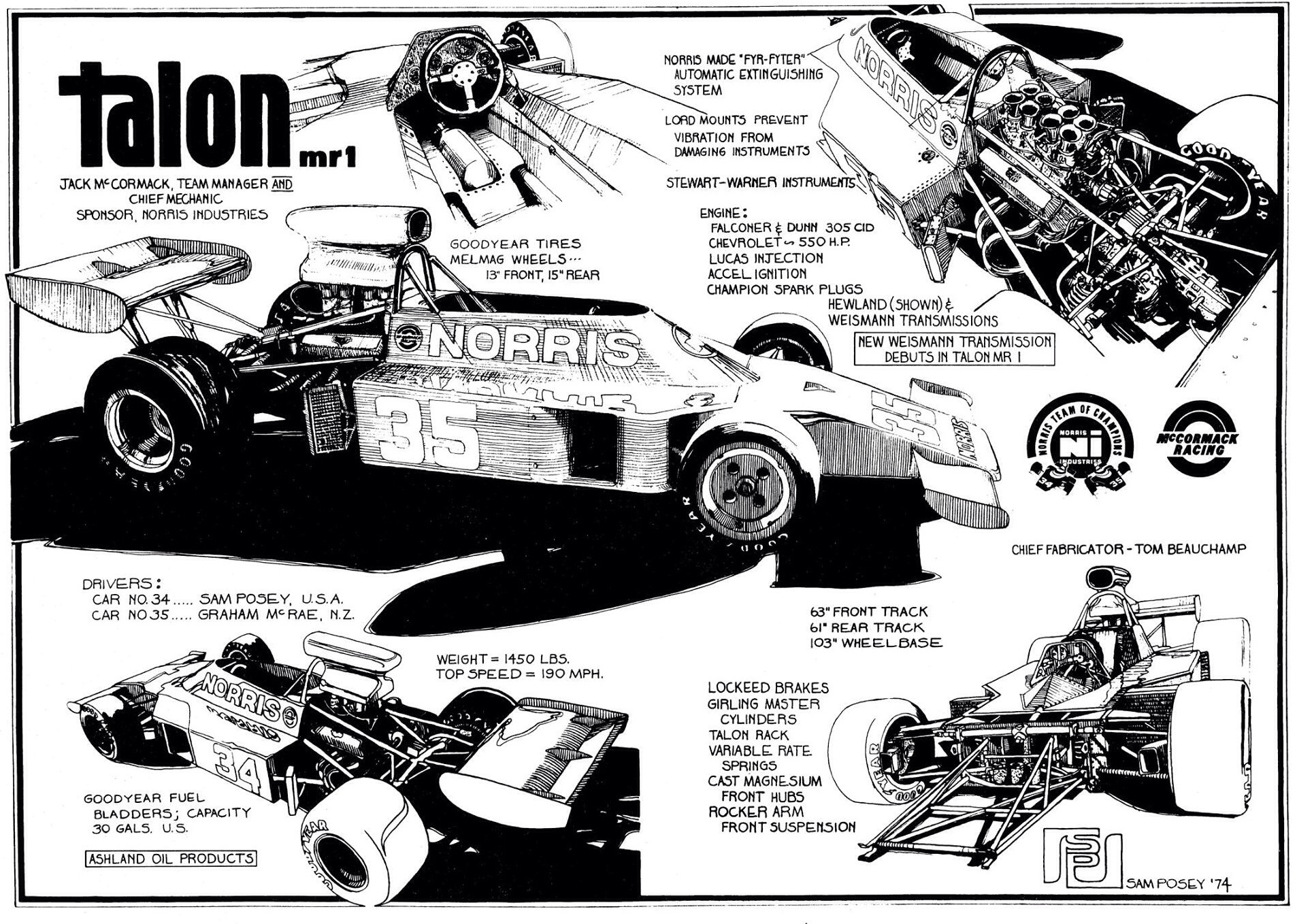
Sam Posey’s, yes the very same! Talon MR-1 drawing

After-thought: Formula 5000 Needed a Production McRae GM2 in 1973/4…

Formula 5000 was dead and buried by the Americans at the end of 1976, the knock-on effect went around the planet other than good-ole Australia who hung on to the class for way toooo long- love the category as I did/do.

The causes of F5000’s demise were multi-faceted but primarily was due to the dastardly Lola T330/332/332C which simply rolled over the top of everything its path including the Lolas designed to replace them- the 1975 T400 and 1976 T430!

The punters were getting bored with ‘Formula Lola’ in F5000 so the nuffies in the SCCA and the circuit promoters created single-seat Can-Am- and preserved Formula Lola as the T332CS/T333CS simply preserved the status quo- a non T332 derivative did not win the Can-Am until the Lola T530 did so in 1980.

And so, my thesis goes the class needed another strong make/model to give drivers another competitive mount and the punters another shape to look at. There is no reason why McRae’s development capabilities could not have turned the GM2 into a winning car built by his Poole factory in numbers exactly as the GM1 was. No doubt John Heynes business decision to sell made perfect sense to him- he saw the books and could no doubt assess the commerciality of the arrangements of a company led by a man at the time who could have been seduced to F1. His main asset could have disappeared from the scene for all manner of reasons- think of Chevron in terms of the impact of Derek Bennett’s death or closer to home Garrie Cooper’s at Elfin Sports Cars.

If the Chevron B28 were quicker, if the Chevron B37 were quicker in 1976, if the Lola T400 and T430 were quicker in 1975/6, if the McRae GM2 were built in numbers- and were quick maybe the variety we spectators like would have been provided and F5000 would have survived a little longer at least.

If yer aunty had balls she’d be yer uncle too, I know…

GM at Oran Park, Rothmans International Series 1978, McRae GM3 Chev- soon to be significantly modified in NZ into the Can-Am GM9 (N Stratton)

Etcetera…

Leda LT27/GM1 in the US early in the 1972 campaign. Ken Stepney steering, Joe Wright pushing with GM sharing a joke. Overhead shot shows the lines of the car and it’s complex, compound curvature to good effect- and its Leda badge on the nose which Martin Lyons dates the shot as pre-July


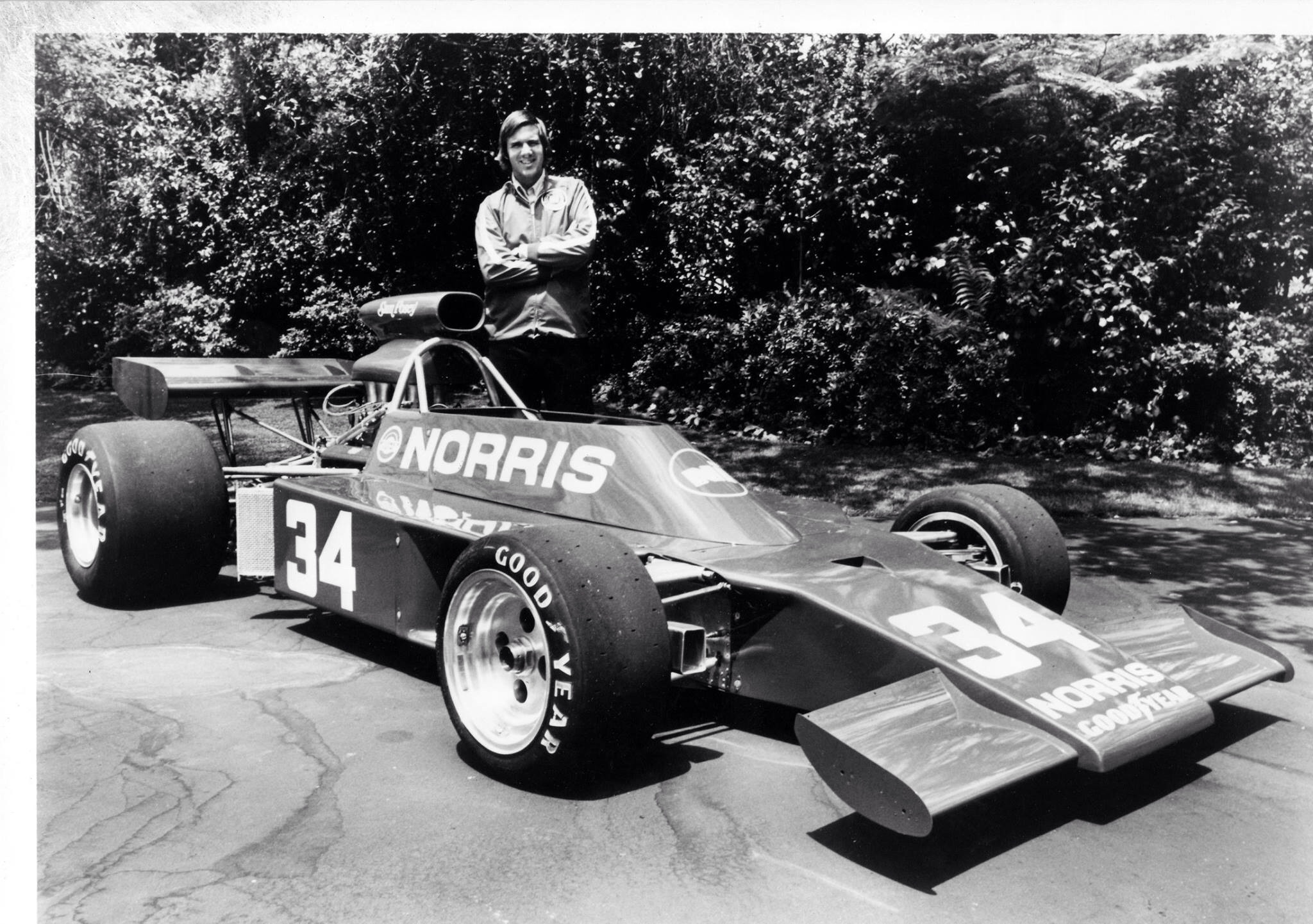
Sam Posey with his Talon MR-1 Chev prior to the start of the 1974 US season (J McCormack)


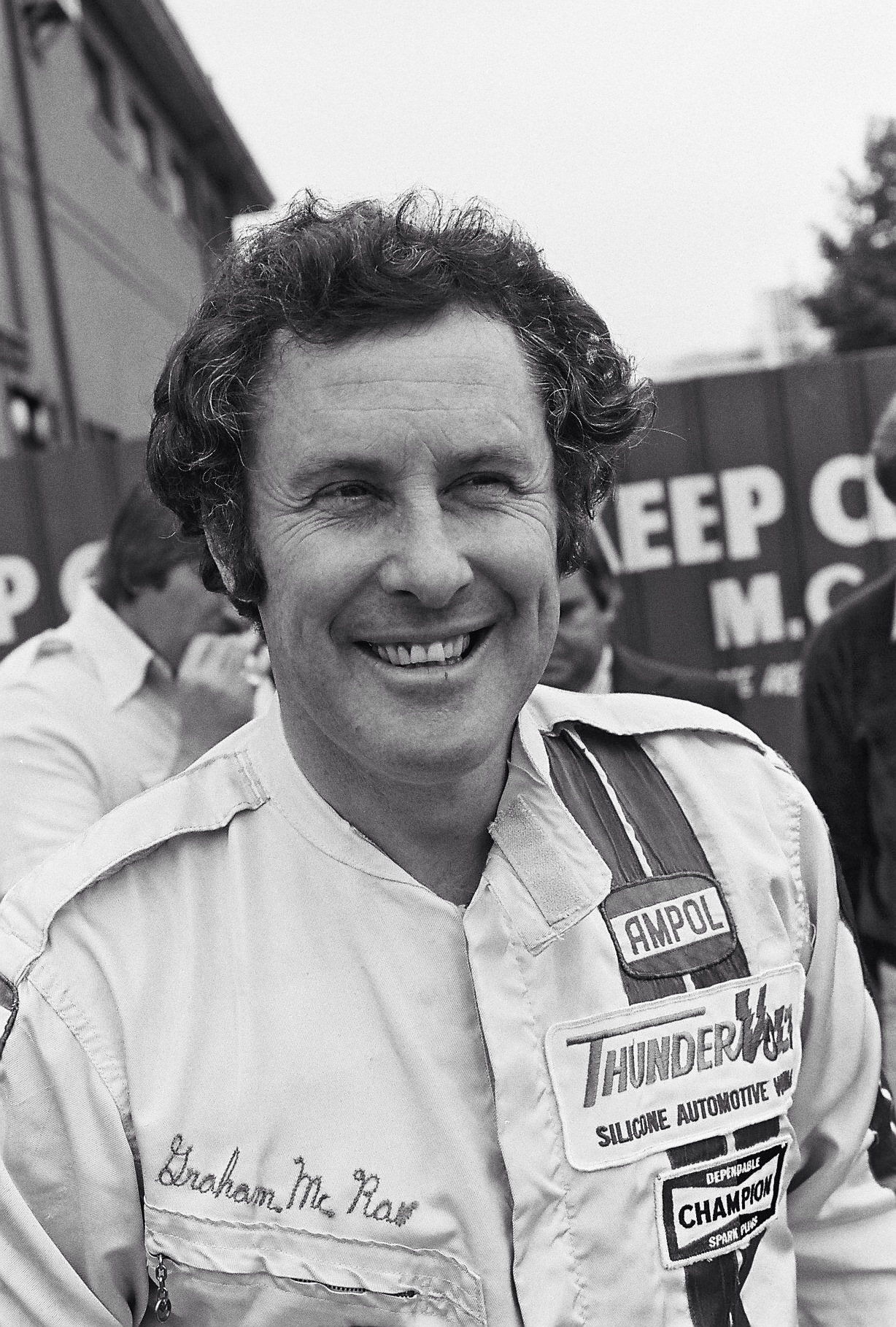
The man in 1978, Sandown or outside the Light Car Club perhaps (I Smith)

Martin Lyons on ‘Living The Dream’ as a young member of the Malaya Garages Team…

‘My first test day with the team was on Wednesday June 9th 1971 at Snetterton race circuit in Norfolk.

I was picked up by Stan, the other race mechanic who had joined us that winter from Rob Walker’s disbanded F1 team. We left Billingshurst at 6.45am in our race-car transporter, which had been owned by the American Eagle F1 team from 1966 to 1968. It still had the AAR badge on the dashboard.

We arrived at the circuit by 10am having emerged from a grey overcast sky to unbroken sunshine only a few miles from Snetterton. The car was unloaded, I filled up the fuel drums with 5-star fuel via handpump.

The car was fuelled and Trevor Taylor, our driver, had arrived in a blue Ferrari Daytona and got changed into his race kit in the transporter. We shared the track with three motorbikes that day (!) and one of them fell off in fright when our car passed him on a corner (or that’s what Trevor speculated!). We were testing a flat plate just above the carburettors and when the car went past the pits you could see a mist of fuel lapping around the plate. It never appeared on the car again. We packed up at about 4.30pm and began the journey home, arriving back in Billingshurst some 4 hours later.

Stan then gave me a lift home in his Mini Traveller (the Mini estate with wooden trims on the body). It had been a day of days. Through my Boots polaroid sunglasses, styled like Jackie Stewart’s the sky looked bluer, the grass looked greener and I was living a dream!!!’

McRae and the curvaceous, wild GM9 Chev Can-Am in 1981/2 (unattributed)

Further information on individual chassis, see Allen Brown’s Oldracingcars…

On McRae http://www.oldracingcars.com/f5000/mcrae/

On Leda http://www.oldracingcars.com/f5000/leda/

Photo Credits…

Special thanks to Terry Marshall for his marvellous evocative work, Gavin Fry, Brian and Neil Stratton, Gerard Richards, Brier Thomas,  oldracingcars.com, LAT, Sam Posey, Tony Matthews, R Deming, Mark Windecker, Roger Rodgers, Ian Smith, Bruce Keys, Gerry LaRue, Eric Schaal, Ken Hyndman

Bibliography…

oldracingcars.com, Martin Lyons and his collection

Tailpiece: Finish as we started, Chris, Talon MR-1 Chev, here at Wigram 1975…

(T Marshall)

Finito…

(R Goldfinch)

Denny Hulme acknowledges the plaudits of the crowd upon his retirement from the February 1967 Australian Grand Prix at Warwick Farm…

The ‘Creek Corner Mob’ were a notoriously loud, knowledgeable group of spectators, ‘the bugler’ in particular always comes up in conversations about the place with Sydney enthusiasts even now.

Denny’s Brabham BT22 Repco ‘640’ V8 retired on lap 41 of the 45-lap race with a burst radiator hose; the race was won by Jackie Stewart’s BRM P261 2.1 V8. In a troubled weekend, the Brabham Repco lads started raceday further out west at Sydney’s Oran Park, attempting to sort fuel injection and handling dramas before heading back to the ‘farm for the race. Jack was fourth aboard BT23A Repco ‘640’.

Love this Bruce Wells portrait of Denny on the ’67 WF grid. Note the ducting used in the hotter races of that year to get cool air into the centre of the 640 and 740 Repco’s, aimed at the fuel metering unit (B Wells/TRS)
Stewart, Clark, Hill- BRM P261, Lotus 33 Climax, Lotus 48 Ford FVA, then Jack and Leo Geoghegan- Brabham BT23A Repco and Lotus 39 Climax with Denny alongside the pit counter on the row behind, Brabham BT22 Repco (B Wells/TRS)

Its weird the way your brain works, or mine does anyway?!

The first thing that popped into my mind when I saw Denny’s salute was the famous post-200-metre Mexico ’68 Olympics medal award ceremony, brave ‘Black Power’ medal presentation dais salutes of gold and bronze medallists Tommie Smith and John Carlos.

It was ‘big news’ in Australia as Peter Norman, a great Australian athlete, was the silver medallist who bravely stood with, and in support of, the Americans and their cause. Norman was punished for his actions by the Australian Olympic Committee’s ‘forces of conservative darkness’ for the rest of his life.

Denny’s pose and actions are in an entirely different context (to say the least) but its funny the stuff which sticks in a childs mind only to pop out fifty years later. The Olympics scene resonated with me at the time, no doubt meeting Norman at a school holidays athletics training camp in the early seventies added to the potency of the moment, times of great social upheaval and progress as they were.

Peter Norman’s obituary; https://www.theguardian.com/news/2006/oct/05/guardianobituaries.australia

Credits…

Roger Goldfinch, Bruce Wells/The Roaring Season

Tailpiece…

Peter Norman, Tommie Smith and John Carlos, Mexico 1968…

Finito…

(B Howard)

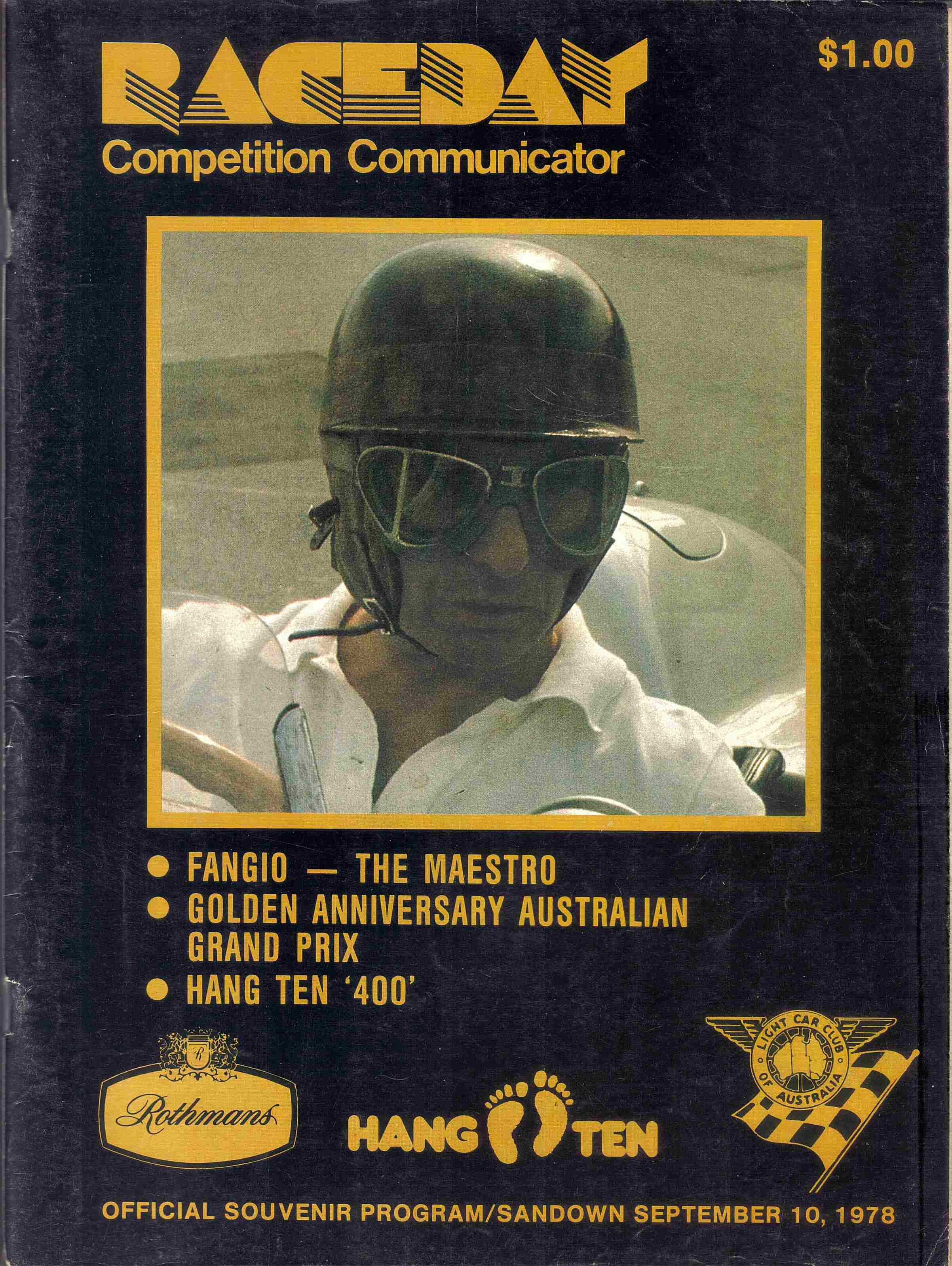
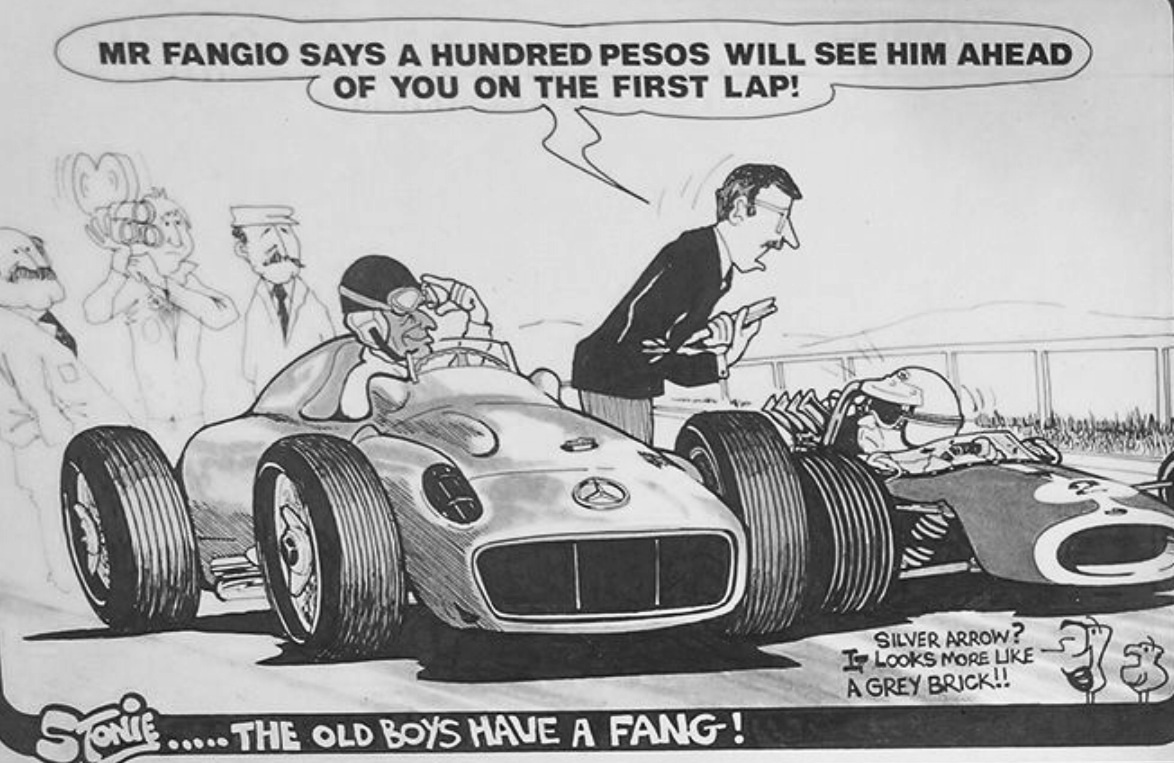
The Light Car Club of Australia achieved a major promotional coup by securing Juan Manuel Fangio’s attendance at the fiftieth anniversary of the first Australian Grand Prix, at Sandown, Melbourne on 10 September 1978…

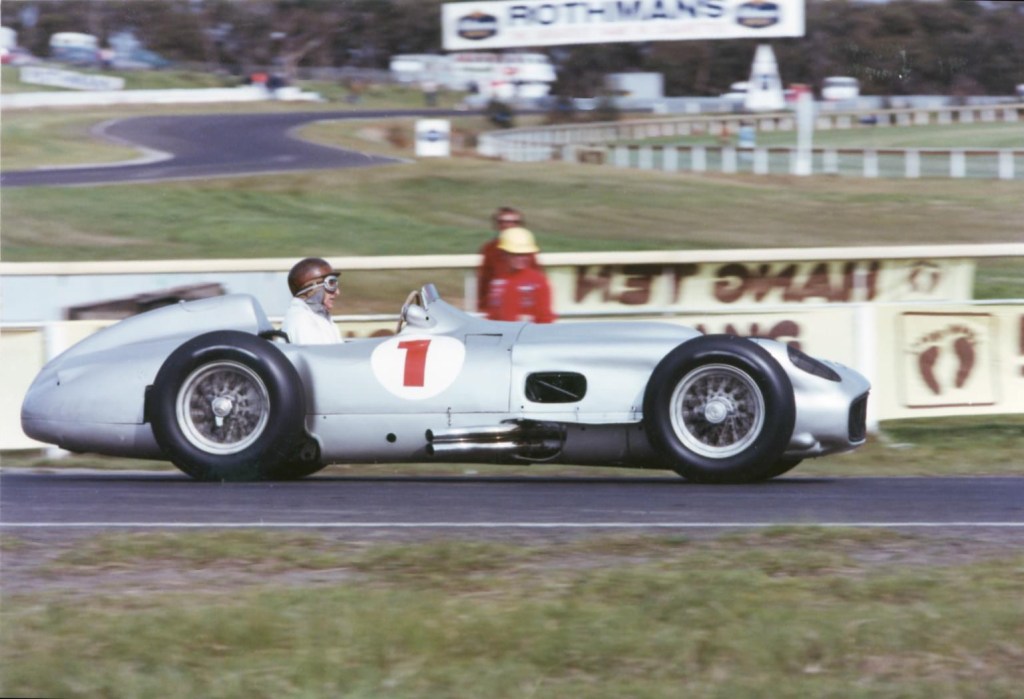
Here the great man ponders his car during practice. Fangio raced a Mercedes Benz W196 straight-eight Grand Prix car, the design with which he won his 1954-55 World Championships: whilst noting the two wins he took in Maserati 250F’s in 1954 before joining Mercedes, from the French Grand Prix.

JMF wanted to drive in a Polo-Shirt as he did in the day but the Confederation of Australian Motor Sport would have none of that, hence the overalls over his normal clothes.

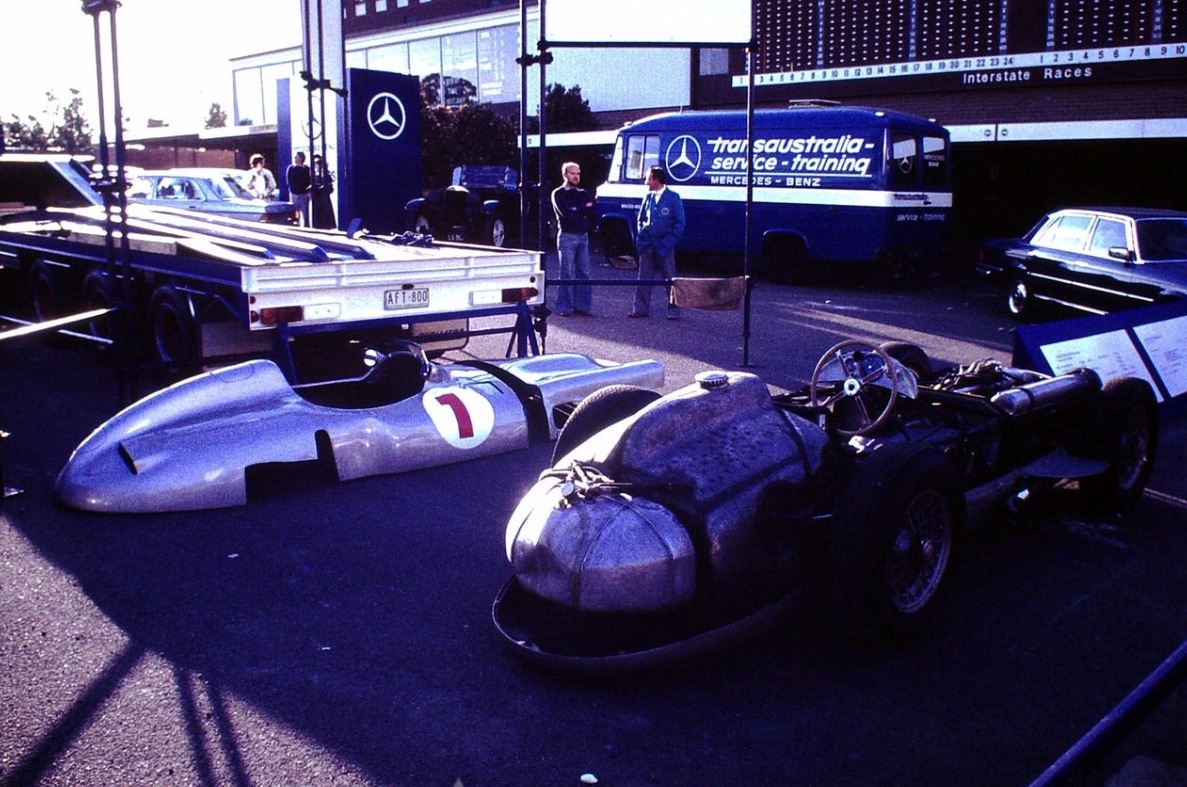
Fangio W196 on display behind the Sandown grandstand- the ‘Interstate Betting’ is a function of the place’s prime function- donkey races (mouserat159)
(S Dalton Collection)
Fangio hooks the big Mercedes into Dandenong Road corner at Sandown (I Smith)

The Sandown event created huge interest far beyond the racing fraternity, including articles in such unlikely places as the Australian Womens Weekly – normally the province of the Royal Family, cooking recipes and similar – such was the mans immense global stature decades after his last championship win in 1957. He won five F1 titles of course: 1951 in an Alfa 159, 1954/5 Benz W196, 1956 Lancia-Ferrari 801 and the final in 1957 aboard a Maserati 250F.

It was the Argentinians first visit to Australia, he had planned to race in the 1956 Melbourne Olympic Games GP at Albert Park, a race won by Stirling Moss in a Maser 250F, but in the end conflicting commitments scuttled the idea. He returned to Melbourne in 1981 and came to Adelaide twice I think, the sight of him blasting along Adelaide roads during the wonderful 1986 ‘Eagle On The Hill’ run from the city up through the Adelaide Hills to the top of Mount Lofty is not something any of the large number who saw it will readily forget either. He drove a Mercedes sports-racer, a 300SLR on that occasion. If memory serves he may have boofed an Alfa Romeo Alfetta 159 of the type he raced in 1951 at Adelaide doing a demo- by that stage he would have been well into his late seventies mind you.

Fangio contested a ‘Race of Champions’ at Sandown which included Jack Brabham aboard his 1966 championship winning Brabham BT19 Repco 620, and former Australian champions Bill Patterson in a Cooper T51 Climax and Bob Jane in a Maserati 300S. Both were cars they had raced in period and retained.

(mouserat159)
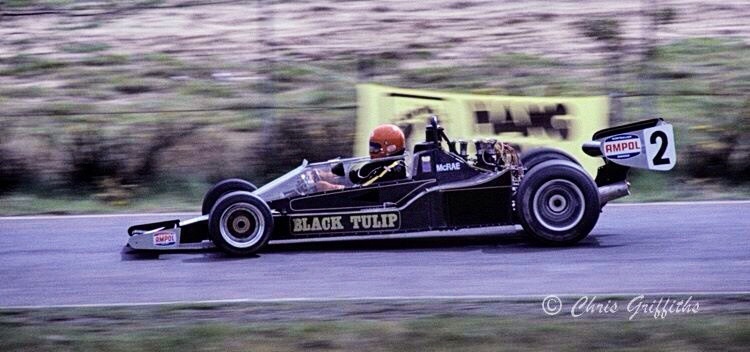
(C Griffiths)
(I Smith)

All eyes were on the Fangio, Brabham ‘battle’ over the three lap journey of course, the footage well known to most of you says it all in terms of the speed and spirit in which the cars were driven, note that JMF was 67 at the time and had suffered two heart attacks in the years before his visit.

The sight and sound of Fangio driving the big, noisy W196 on the throttle, kicking it sideways in the manner for which he was famous lap after lap in practice around Sandown’s third-gear Shell Corner onto Pit Straight is forever etched in my memory – he could still boogie at that stage, well and truly.

As you all know, normally the paddock is a hive of activity with mechanics and engineers getting on with necessary preparation of their steed for the next session or race. Sandown’s then layout afforded those in the paddock a great view of the cars on circuit from or near the pit counter. On the occasions that Fangio was on circuit the tents in the cuddly-small Sandown paddock were empty as drivers and mechanics watched Fangio strut his stuff. It was simply not to be missed whatever the competitive needs of the moment were.

It’s always funny to re-live discussions of that-weekend with fellow enthusiasts as so many of us were there from all over this vast land, all having a different experience or highlight but equally excited recollections of it all despite the elapse of forty years. As a student at the time I was there from the meetings start to finish, it was sad when it was all over, I was very conscious of the fact that I had witnessed something special.

Fangio was the President of Mercedes Argentina and owner of two dealerships when he visited Oz and had to sing-for-his-supper over the week he was here. He did a range of promotional events, dinners and drives with motoring writers to promote, mainly, the ‘Benz 450 SEL 6.9 which was the range-topper at the time, a snip at $A68,500 in 1978.

(C Griffiths)

Postscript…

The 1978 AGP, held to F5000, was a race of attrition won by Graham McRae in his see-through perspex cockpit McRae GM3 Chev from John David Briggs and Peter Edwards in Matich A51 Repco and Lola T332 Chev respectively.

In fact it was an entirely forgettable AGP. Very bad accidents hurt both Garrie Cooper, Elfin MR8 Chev and Alan Hamilton, Lola T430 Chev. These very high speed shunts, together with a tangle that eliminated second placed Jon Davison’s T332 and Vern Schuppan’s Elfin MR8 Chev on lap 28, and a broken head-gasket for pole-sitter John McCormack’s unique ex-F1 McLaren M23 Leyland, conspired to rob a race which had lots of potential.

An arcane end to this piece.

It’s a long story, but a decade or so ago, an Australian enthusiast ‘discovered’ in contemporary newspaper reports that a very short race named ‘Australian Grand Prix’, was contested on an oval layout at Goulburn’s racecourse, New South Wales on 15 January 1927.

This race was shortly thereafter recognised by many, but not all historians as the first Australian Grand Prix thereby replacing the previous event which held that honour, the ‘100 Miles Road Race’ held at Phillip Island in 1928, later recognised as the first AGP.

So, Juan Manuel Fangio was here in 1978 to celebrate the 51st AGP not the 50th…

Photo / Other Credits…

Bruce Howard, John Stoneham aka Stonie, Chris Griffiths, Stephen Dalton Collection

Tailpiece: I wonder which particular W196 chassis Fangio ran here in 1978?…

(mouserat159)

Big butt isn’t it? All fuel and oil tank, its an object lesson in Vittorio Jano’s design intent with the D50 Lancia to get the fuel between the wheelbase via his pannier-tanks. I’ve a vague recollection this particular chassis was fitted with a 3-litre SLR engine for demonstration purposes rather than the GeePee 2.5? Interesting the way the body comes together too.

Finito…

(I McCleave)

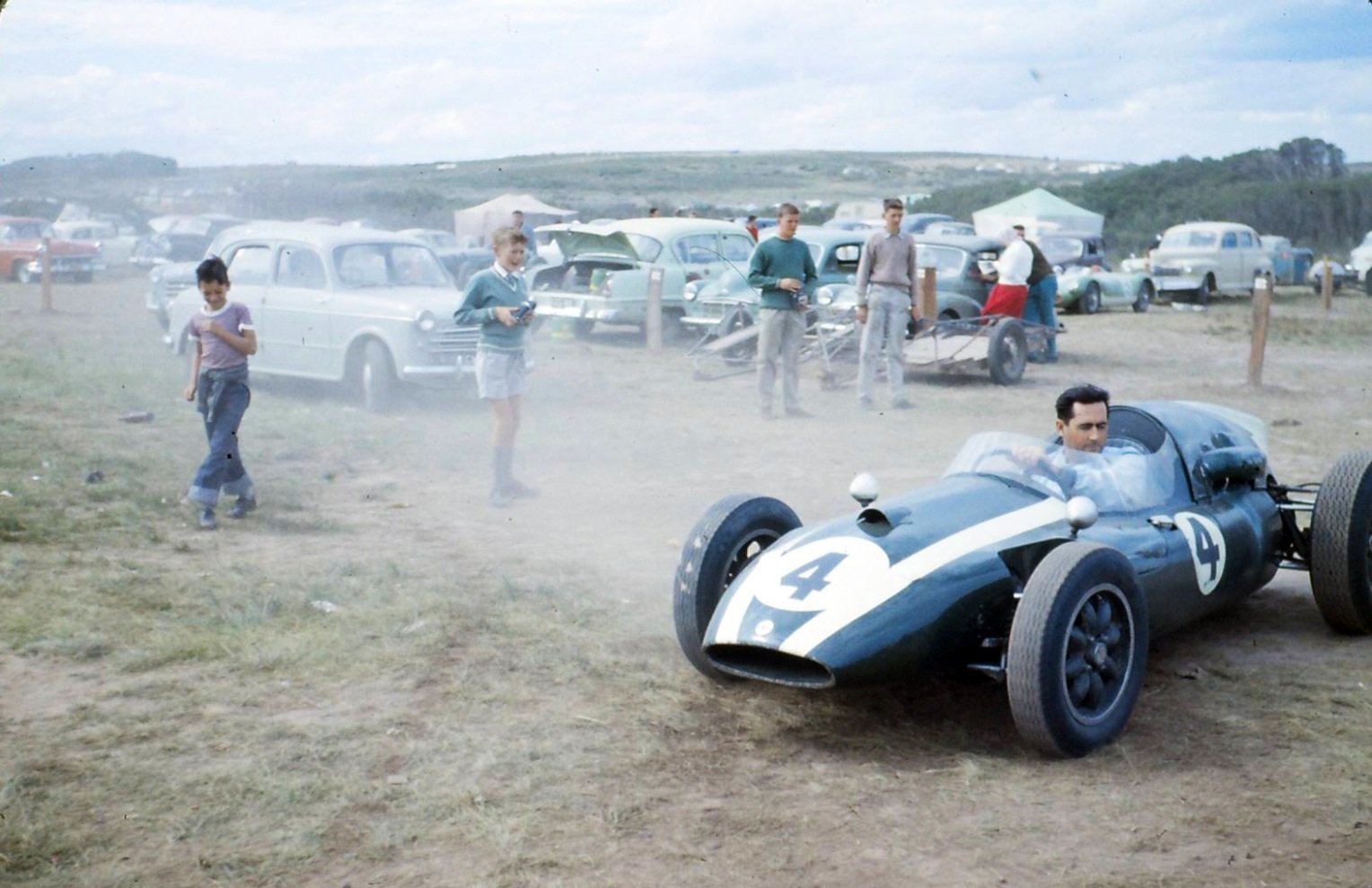
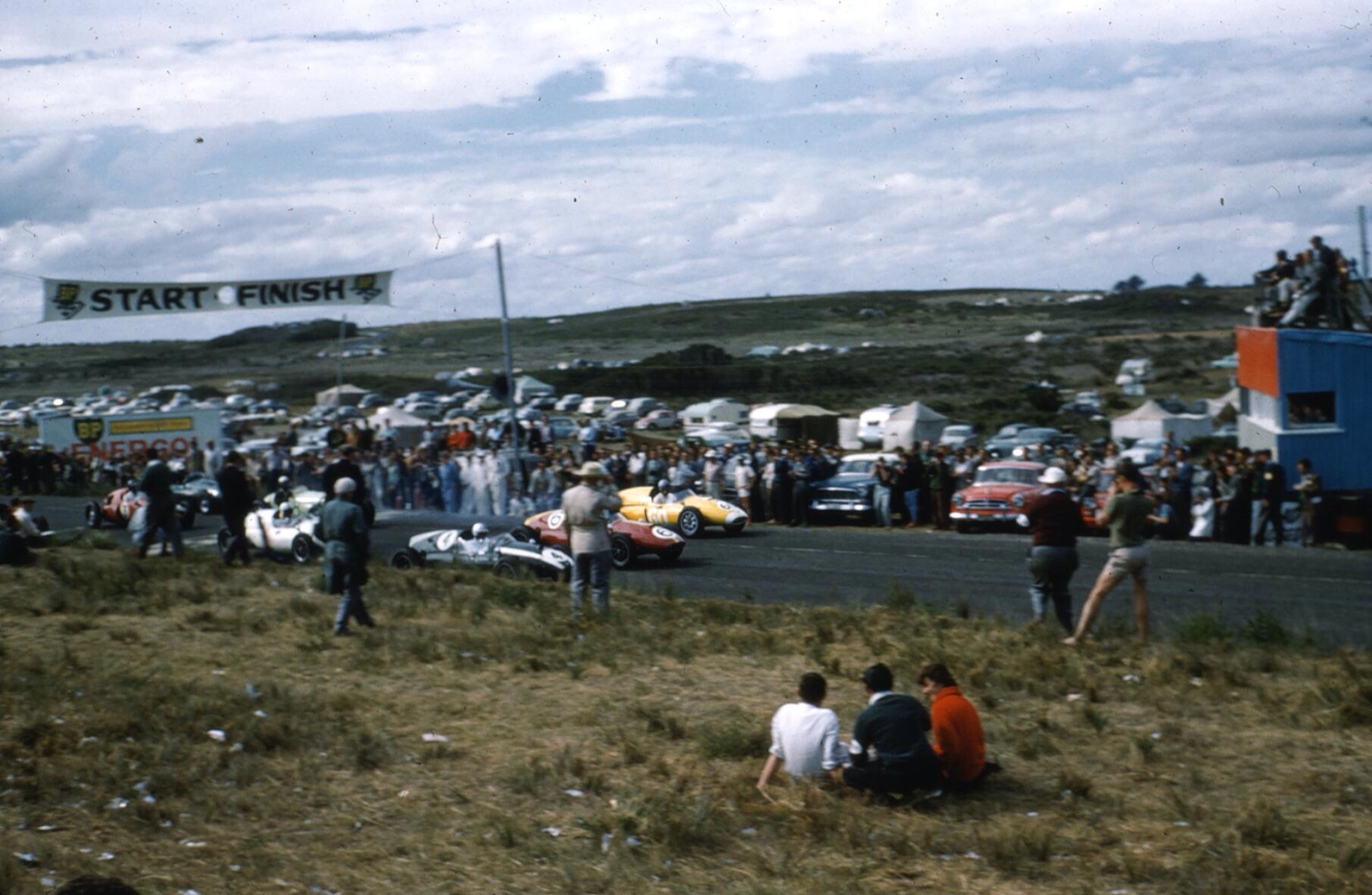
Jack Brabham playing with the kids in the Phillip Island paddock, Cooper T51 Climax, 14 March 1960…

Jack won the Repco Trophy over 16 laps in a T51 rout from Bill Patterson, Bib Stillwell and Austin Miller in similar cars. None shared the latest 2.5-litre Coventry Climax FPF fitted to Jack’s F2-4-59 said to be ‘Brabham’s main car during the early part of 1959’. Austin’s motor was 2.2-litres, Bib and Bill’s 2-litre units.

Brabham had a successful fortnight during his short 1960 Australian summer racing tour, three races from three, winning the Longford Trophy, Light Car Club of Tasmania Trophy on 5 and 7 March at Longford the week before.

Ian McCleave took the opening photo of ‘A youthful Jack Brabham showering my younger brother in dust…I seem to recall Dad charged with adrenalin winding the Austin A95 up to 90 mph on the way back to Melbourne!’ Lukey Heights is well familiar to ‘Island regulars in the background, its a top shot and another enthusiast that day, Robert Jones caught the start of the race, below.

(T Johns Collection)

Australian Motor Sports Review 1959-60 wrote that “During these hectic two days , Brabham more than simulated his performance at the opening meeting of Phillip Island in December 1956.”

“On that occasion driving a Cooper sportscar he won the three races he entered including the Formula Libre event ahead of Ted Gray’s Tornado Ford V8 and Lex Davison’s 3-litre Ferrari 500/625. Three years later, Brabham as you would expect from a World Champion, won every scratch race he entered; but unlike the first meeting, he competed in five events, but won only four, having been beaten into second place in the Racing Car Handicap on the first day.”

(Ron Jackson)

Credits…

Ian McLeave, Robert Jones, Tony Johns Collection, Ron Jackson, Australian Motor Sports Review 1959-60

Tailpieces…

(R Jones)

The off, Brabham, Stillwell and Miller, with Bill Patterson in white, on row two.

(T Johns Collection)

Finito…

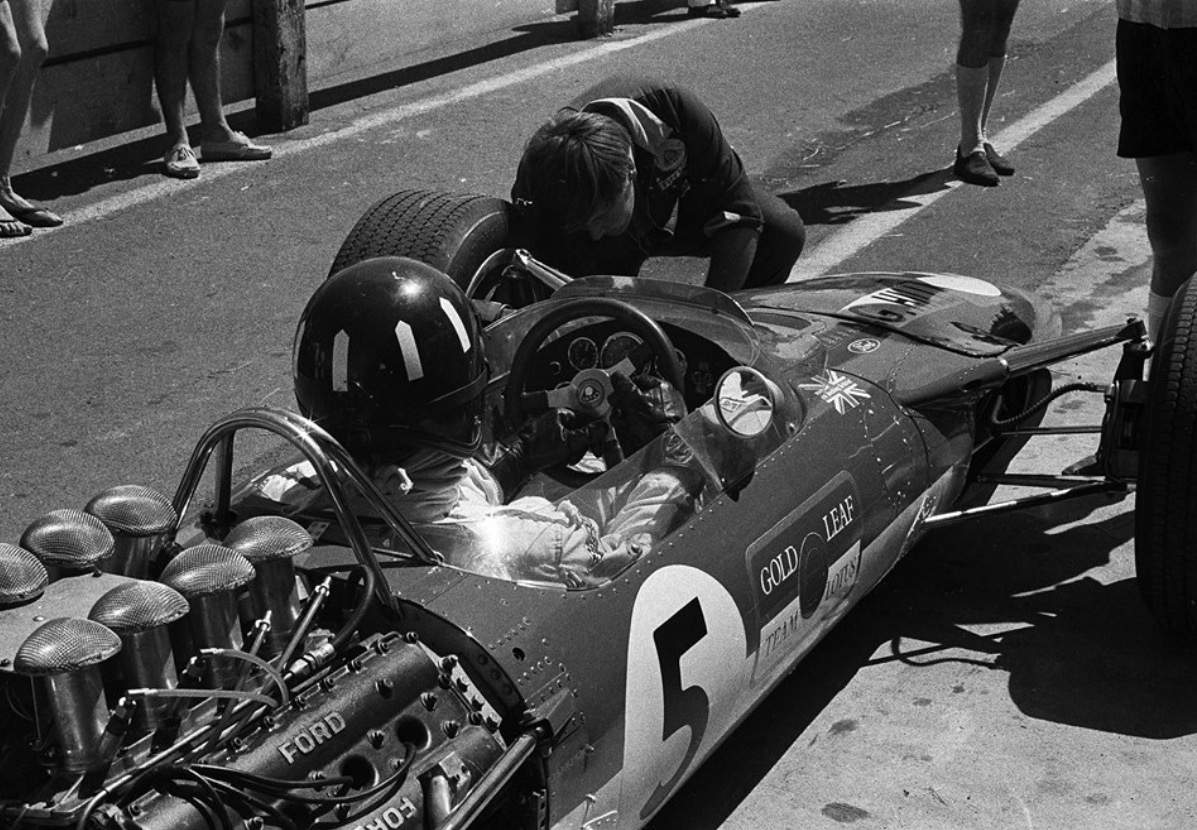
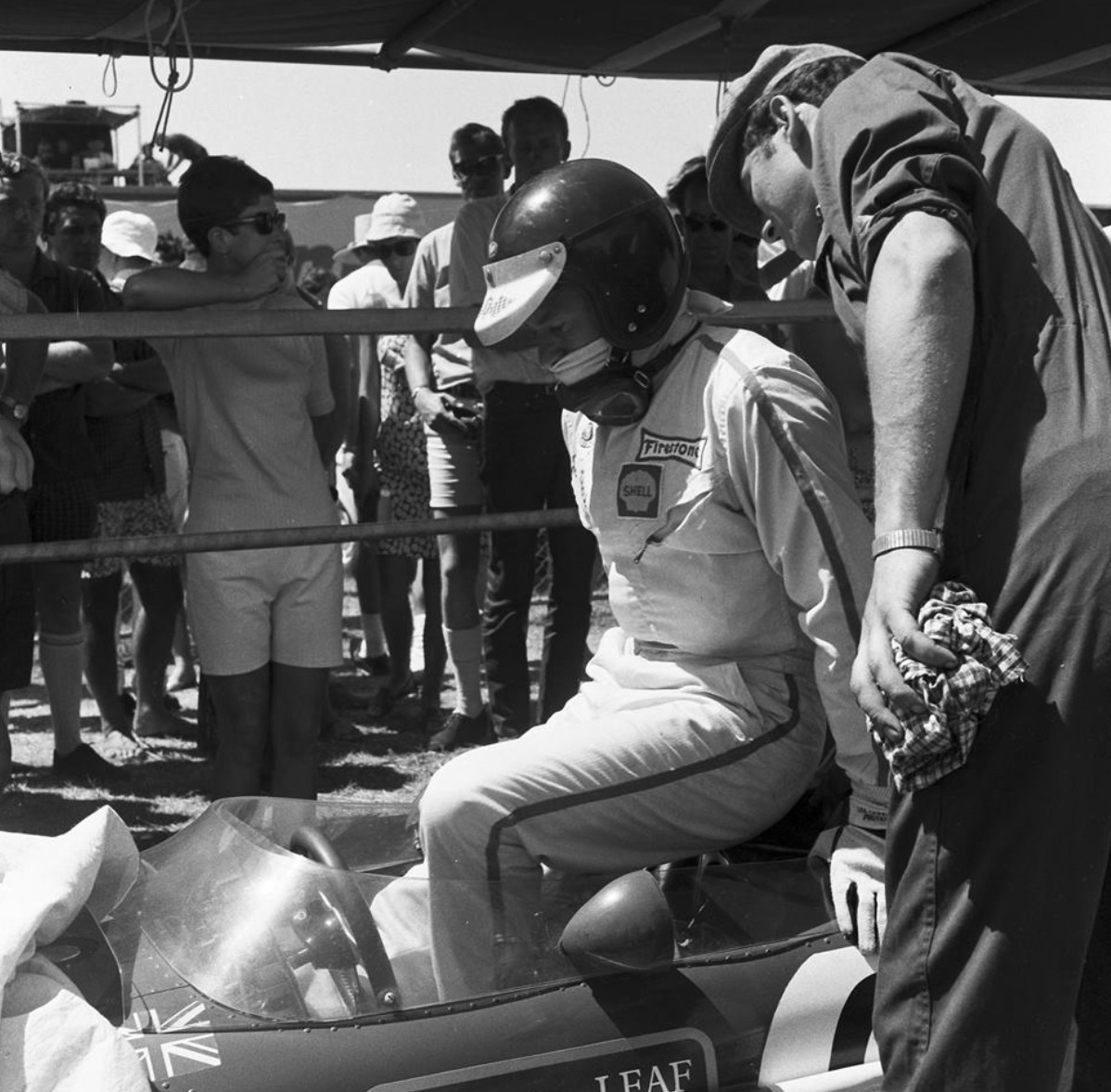
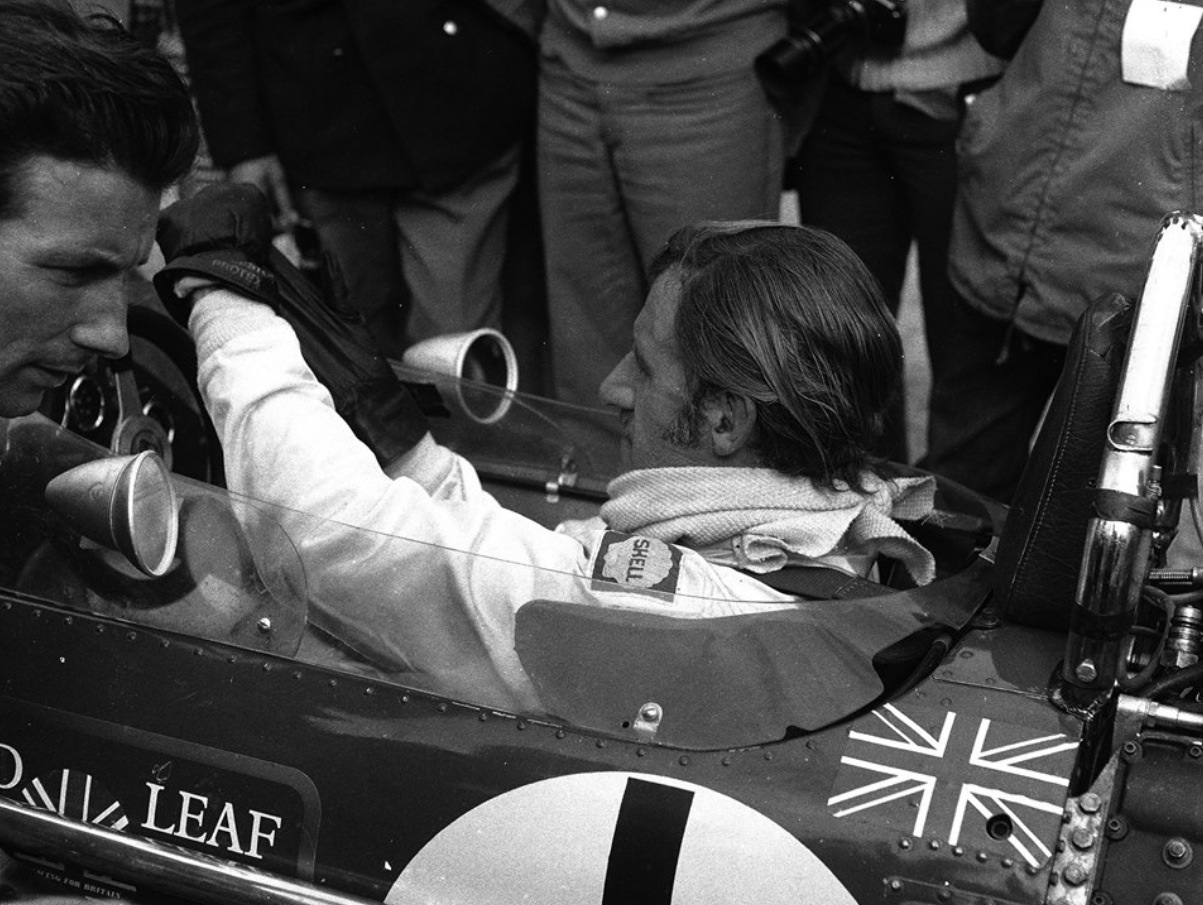
Graham Hill, works Gold Leaf Team Lotus 49 Ford 2.5 DFW in the Warwick Farm pitlane during the ‘Farm’s February 1968 Tasman Round weekend…

I’ve done the 1968 Tasman Series to death with a series of articles uploaded before including one on this particular weekend but this batch of ‘up close and personal’ photos by enthusiast Bryan Henderson are too good to ignore.

One of the reasons enthusiasts get misty eyed about that series is that both Clark and Hill had been regular, enormously popular visitors to Australasia from the dawn of the sixties pre-Tasman era, 1968 was the last we had the pair of them down south together.

Clark won the Tasman with the still very new Lotus 49 in dominant fashion and then returned to Europe after winning the series and the F1 season opening South African GP to his untimely death aboard a Lotus 48 Ford FVA during a Euro F2 round at Hockenheim. In the words of The Seekers popular song of the day ‘The Carnival Is Over’.

Hill, WF- this shot 1969


Clark and Hill, Lotus 49’s, Amon Ferrari Dino 246T, then Courage behind Clark, McLaren M4A FVA and Hulme, Brabham BT23 FVA with Gardner, Brabham BT23D Alfa  behind Denny

We all have our favourite seasons of course but arguably that summer of ’68 was the Tasman peak.

The variety of cars was truly stunning- BRM P261 V8 and P126 V12, Ferrari Dino V6, Brabham Alfa Romeo Tipo 33 V8, the Lotus 49 Ford V8’s, various Brabham Repco V8’s including Jack’s latest works BT23E Repco ‘740’ V8 and a swag of Coventry Climax FPF engined machines in the hands of locals. The driving pool included just annointed World Champ Denny Hulme, Jack Brabham, Jim Clark, Graham Hill, Chris Amon, Bruce McLaren, Richard Attwood, Chris Irwin, Frank Gardner, Piers Courage and local hotshoes Kevin Bartlett, Leo Geoghegan, John Harvey, Graeme Lawrence and others. An amazing variety of cars and depth of talent on the grid…

Etcetera…

(B Jackson)

Things go better with…

Graham and the boys bleed the Lotus’ brakes, note the use of a solid rotor rather than the vented discs used initially in 1967. Nice shot of the front bulkhead and inboard front suspension packaging.

Credits…

All photographs- Bryan Henderson, exceptions attributed on the shot

Tailpiece: To the victor the spoils…

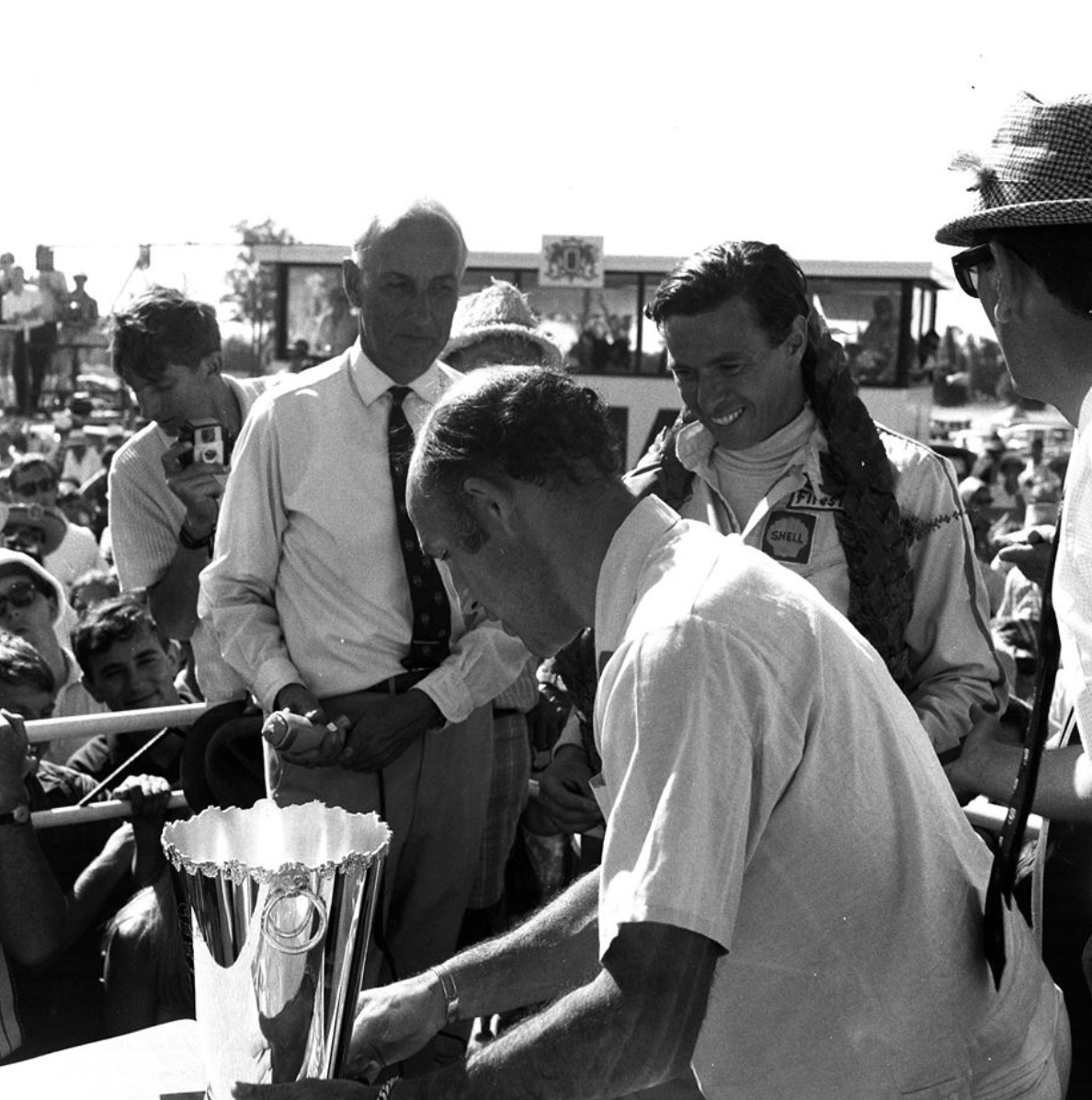
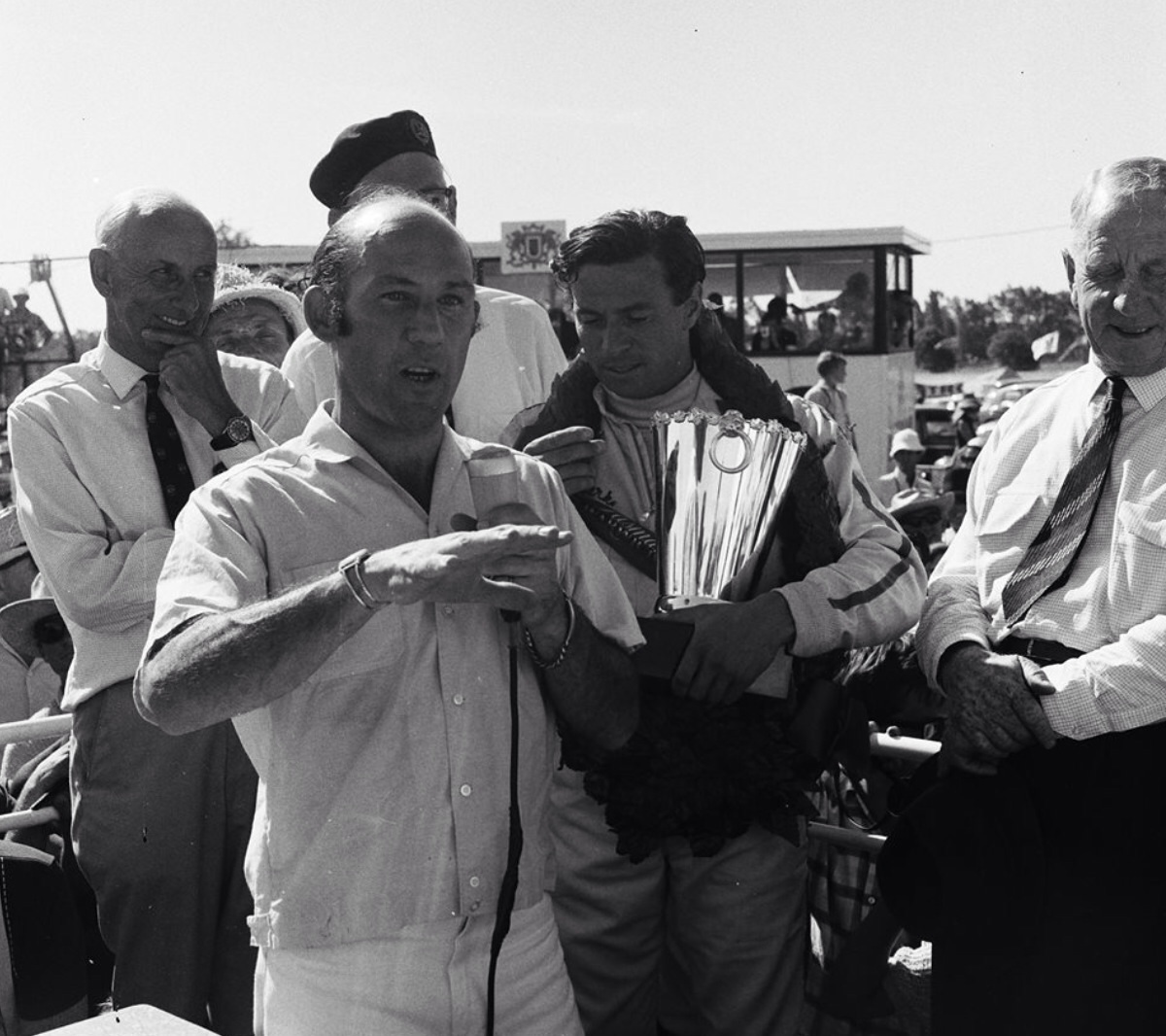
Stilrling Moss, long retired but looking disgustingly fit addresses the crowd in advance of presenting Jim Clark his trophy- he won from Graham and Piers Courage in an F2 McLaren M4A Ford FVA. The gent in the shirt and dark tie is the much respected Geoff Sykes, the AARC/Warwick Farm General Manager/Promoter.

Wonderful times…

Finito…
(Honda)

Modern Grand Prix photographers have a challenge their forebears did not, that is, generally uninteresting backgrounds by the standards of, say, pre-1970, whilst noting Monaco, Spa and Singapore as modern exceptions, not the only ones mind you…

My habit over the four year primotipo journey is making article research and writing choices based on inspiring or interesting photographs. This has taken me randomly into all manner of subjects, happily so, and further back in time than I figured at the outset. It’s been good for me as ‘my strengths’ such as they exist, are post 1960 but i’ve ended up writing articles on average about topics from much earlier periods. In part the photos which have taken my fancy are as much about the background as the car or driver and based on that are most often of the distant past. I must try harder in relation to the last twenty years or so!

So I guess whilst the photographers of today have far more sophisticated, digital, whoopy-doo, trick-schmick equipment- the act of taking a photograph is ‘easier’ than in ye olden days but they have their own creative challenges composing shots of interest to we punters on what all too often are bland circuits devoid of substantial differences from one another.

(McLaren)

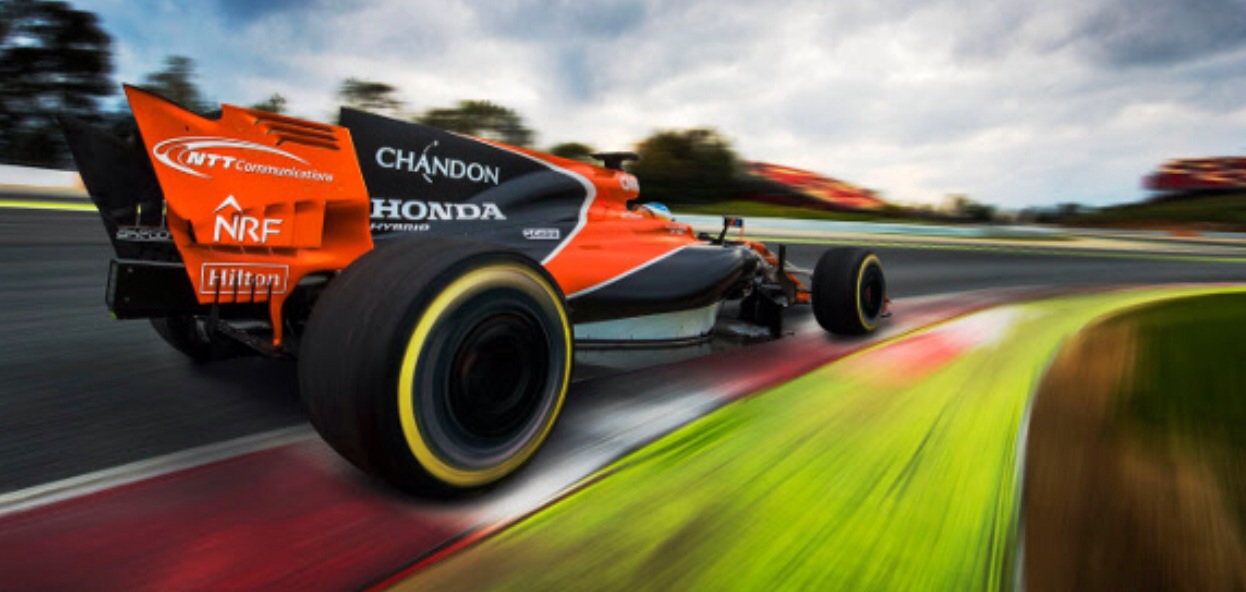
Albert Park gives the ‘snappers something to work with despite its flatness- the lake, city background, crowd and trees are all neat props. So it’s with these thoughts I went looking for some interesting current shots, Albert Park 2017 in this case. 2018 with the ‘fuggin halos was just a step too far.

It’s interesting to look at the choices these photographers made in composition, panning and crop. I’ve no idea of the driver of each McLaren in shot, both helmet designs have a bit of colour on top and a bit of white below, either Fernando Alonso or Stoffel Vandoorne are good guesses! It wasn’t a great race for McLaren mind you, Alonso was out on lap 50 with a broken floor and Vandoorne finished 13th, two laps down on winner Seb Vettel’s Ferrari SF70H.

There is no such thing as a bad orange(ish) McLaren however much the MCL32 Honda was a dog. Better times are surely around the corner at the time of writing, July 2018…

Credits…

Honda, McLaren

Tailpiece…

(McLaren)

Finito…
image

Frank Matich, Brabham BT7A Climax tries to outbrake Bib Stillwell #6, Brabham BT4 Climax, December 1963…

Photographer John Ellacott upon posting this shot online described it as ‘the two great rivals on Hume Straight’…Matich braking down the outside on the run into the slow second gear ‘Creek Corner’. Frank’s car was brand new, just unpacked, it had only turned a wheel for the first time several days before the 1 December ‘Hordern Trophy’, the final round of that years Gold Star, the Australian Drivers Championship.

Frank’s car was fitted with 2.5-litre ‘Climax FPF, Bib’s older chassis had an ‘Indy’ 2.7- a fair duel, one guy with the edge in chassis perhaps and one with a bit more power?

Stillwell led from the start of the 34 lap race and then FM began to reel him in, finally catching the Victorian on lap 20, the pair tangling in The Esses. The collision was enough to put Matich out of the race but Stillwell finished fourth, the race was won by John Youl in his Cooper T55 Climax 2.5 from David McKay’s ex-Brabham BT4.

frank and bib wf discussion
Frank left and Bib – looking very natty is his BRDC blazer – developing his listening and empathy skills by the look of it after the Hordern Trophy. Great rivals with a lot of respect for one another’s abilities (Sports Car World)

In the 1964 Tasman Series which followed the month after this race Youl was the most successful of the locals. Stillwell only contested three Australian races gaining a strong second in the AGP at Sandown whilst Matich was prodigiously fast but had woeful reliability, we shall pick up the Tasman shortly.

I described the rivalry between Frank and Bib in a post about the Stillwell Cooper Monaco;

It’s fair to say Stillwell, born 31 July 1927 took a while to mature as a driver. He started racing MGs in the late 1940s and as his motor dealerships became more successful throughout the 1950s he acquired and raced some expensive, fast cars, D-Type Jag and Maser 250F included. By the time he commenced racing Coopers he had well over 15 years of experience and was ready to take on anybody, winning his first Gold Star in 1962 and the last in 1965, four on the trot.

Matich, born 25 January 1935 was a more precocious talent who first competed in an MG TC at Foley’s Hillclimb circa 1954 and raced seriously from later in the decade after selling his Austin Healey and purchasing the ex-Frank Gardner Jaguar XKC. He soon drove cars for Leaton Motors who employed him as Sales Manager. Bib was more the silver-spoon-special born on the right side of the tracks and funded into his first dealership with family money. Mind you, whatever Bib started with he multiplied many times over, he was an extremely successful businessman in Australia and then became an executive of global calibre inclusive of being President of the Gates Learjet Corporation in the US.

Frank, the young pro, was cut from totally different cloth. He was educated at De La Salle College, Marrickville in Sydney’s inner west and was apprenticed as a 15 year old Diesel Engineer at Sydney’s Kurnell Oil Refinery before progressing through Butlers Air Transport and in 1954 to Selected Sportscars where he first came into contact with the Englishman who owned the MG TC Frank prepared, and both men raced.

FM’s ability and gift of the gab attracted patrons and commercial support from very early on in his career, Matich too was shortly to do well out of the business of motor racing with Australian franchises for Firestone, and later Goodyear racing tyres, and Bell helmets, apart from the sale of some of the Matich sports and F5000 cars he built.

Matich and Stillwell were intensely competitive, driven, successful men, they had far more in common I suspect than not, especially in terms of mindset and will to win. The battles between the pair were absorbing, Matich very quickly got on the pace of the big 2.5 Climax Formula Libre cars (the 2.5 Tasman Formula started in 1964, Australia’s national F1 ANF1 was F Libre till then), having come out of powerful sportscars- Jags C and D Types, Lotus 15, 19, 19B and small bore single seaters, works-Elfin FJ Ford and Elfin Catalina Ford 1.5.

At the time, these 2.5/2.7 litre F Libre/Tasman cars were the fastest road racing cars in the world, F1 having changed from a 2.5 to 1.5 litre formula from 1 January 1961. Given his experience it was not a surprise when Frank was on the pace straight away as he jumped out of his Lotus 19B sporty and into the new Brabham acquired with the French Oil Company, Total’s, support.

Well before the Tasman Series commenced in 1964, we had a strong International Series of races in Australasia in January/February, with enough of the best in the world to test the locals in equal cars Matich was more than a match for any of them. So was Bib on his day.

matich wf private practice brabham
Matich mounted up and ready for his first test of the naked BT7A, devoid of all signwriting and in civvies at Warwick Farm the week before the Hordern Trophy above. Brian Darby, at the rear, picked the car up from the Port Melbourne wharves the week before, Bruce Richardson is the other mechanic in shot. Note reinforced wide based top front wishbone and rubber mounted ball joint, inverted wishbone at the top and single lower link in the rear suspension. The later BT11A had the opposite rear set up, single top link and inverted lower wishbone (John Ellacott)

Matich was very quick in the Brabham throughout that ’64 Tasman Series and the short period in which he raced the BT7A, its interesting to look back at his time in the car. The late 1963 pre-international events in New Zealand are covered in this article here;

The first 1964 international was at Levin, which Frank missed, at Pukekohe, the NZ GP on 11 January, he ran strongly behind Brabham, McLaren, Tim Mayer and Hulme. He passed Mayer for third only to pop his engine on lap 26, McLaren won the race in a Cooper T70. After Puke he shipped the car home to Australia and re-joined the circus at Sandown on February 9. There he ran ahead of the locals before suffering crown wheel and pinion failure on lap 4.

At the Farm, Matich’s home turf, he started from pole, followed Jack away, then passed him but muffed his braking at Creek and ran off the road. Off to Queensland, at Lakeside, he was driving away from everybody before the engine let go, a Weber ingested a stone and the expensive motor went ka-boom on lap 8. After the long tow to Tasmania he finished third in the race won by Graham Hill’s BT4 and was first of the locals despite a misfire, and a revolution amongst his mechanics who pushed the car onto the grid but left his employ after the race.

Ray Bell wrote that ‘He had a mixed bag of results in shorter races during the middle part of the year, taking a number of outright lap records, then came the Gold Star closing events. Lakeside…pole and the lead before an oil line came adrift; Mallala he didn’t turn up (Stillwell basically could not be beaten for the Gold Star by this stage) and he led the Hordern Trophy till half distance before yet another engine failure’.

The 1965 Tasman Series was won by Jim Clark’s Lotus 32B Climax. Despite not contesting the four Kiwi rounds Matich was right on the pace at Warwick Farm, the first Australian round, starting from pole and leading to Creek corner, he then raced with Brabham behind Hill and Clark up front. ‘Both Hill and Matich had troubles in this race with cement dust getting into the steering, Hill spinning on the last lap because of it and failing to finish. Matich was third behind Clark and Brabham’s BT11A, Stillwell (BT11A) was thirty seconds behind him’ wrote Bell.

matich bt7a lakeside 1964
Matich in his semi-nude BT7A in the hot 1964 Lakeside summer sun, puddle notwithstanding! He is trying to stay cool in the searing Queensland heat, lower side panels removed. Shot shows the proximity of the aluminium side fuel tanks containing lots of Avgas, no rubber bag tanks prior to circa 1970 (Peter Mellor)

Down south at Sandown he ran just behind the internationals ahead of Stillwell only to retire with ignition failure, a rotor button on lap 10. During the AGP at Longford he pitted with suspension problems on lap 5 whilst best of the locals having run in sixth place. At Lakeside he contested the non-championship Lakeside 99 and made it a real race dicing with Clark on this high speed, demanding circuit for most of the race. ‘They traded places many times, but Matich did have a pitstop and lost some laps before rejoining the battle’. It was a race FM rated as one of his best.

Into the domestic season Stillwell won the Victorian Road Racing Championship Gold Star round in April after a couple of Matich spins, albeit FM was second despite a failing engine, and started from pole a half-second clear of Bib.

That was all the racing he did in that car. At Lakeside’s Gold Star round in late July, he crashed his Lotus 19B Climax, he took the sportscar to the meeting to test it in advance of the Australian Tourist Trophy which was held at the circuit later in the year, was burned and hospitalised and in the aftermath Total took the decision to cease their racing program and sold the cars and parts.

The story of the next phase of Frank Matich’s career in sportscars, initially with the Elfin 400 aka ‘Traco Olds’ is told in links within this article.

Frank Matich was one of Australia’s many F1 mighta-beens, to me the most likely to succeed of all, but with a young family and business ties in Oz it never happened despite offers being made to him on more than one occasion to go to Europe. As noted, Matich didn’t race single seaters for long at this stage of his career, from 1963 to 1965, racing sports cars very successfully until 1969 when he came back to open wheelers with the advent of F5000 – where he was a star as both a driver and constructor. Click here for an article on this phase of his career;

It’s a shame he didn’t drive Tasman 2.5 cars throughout this golden-era of single-seater racing in Australasia, his battles against the internationals as well as the local hotshots in both Tasman races and domestic Gold Star competition would have been sensational. Matich mixing it with Bartlett, Martin, Geoghegan, Harvey and the rest would have added depth to Gold Star fields which were increasingly  skinny as the decade wore on.

Stillwell retired at the end of 1965, he was certainly as quick as anybody on his day and arguably had not quite peaked when he did retire. No less an observer of the local scene than journalist/racer/Scuderia Veloce owner David Mckay believed that by 1965 Stillwell had reached F1 standard, not least for his ability to drive fast without mistakes or destroy the equipment.

brabhams longford 1965
Intercontinental Brabhams at Longford, AGP 1965. Stillwell’s dark blue #6 BT11A (6th), Matich BT7A (DNF) and Frank Gardner in Alec Mildrens yellow BT11A (eighth), the race won by Bruce McLarens’ Cooper T79 from Brabhams’ BT11A (Kevin Drage)

The Intercontinental Brabhams…

brabham caversham bt4
The first of the Intercontinental Brabhams. Jack in BT4 ‘IC-1-62’ on its debut at the Australian Grand Prix, Caversham, WA on 18 November 1962. He retired after colliding with another car whilst lapping him, Bruce McLaren won in a Cooper T62 Climax (Milton McCutcheon)

When Jack started his climb to the top in Europe he returned and raced in Australia each summer, bringing a Cooper with him and racing it successfully, then selling the car to one of the locals before returning to Europe. It was a nice little earner and helped fund his way in Europe as he fought to gain a toehold in international competition.

Cooper sold a lot of cars in Australia, Jacks business brain was as sharp as his cockpit skills so it was natural that some of the earliest Brabham production racing cars were for Australasian Formula Libre and from 1964, the 2.5 Tasman Formula- which in effect meant cars built for Coventry Climax FPF ex-F1 engines- 2.5 litres but increasingly 2.7’s after Jacks successful Indy 500 run in 1961 in the Cooper T54 with its 2751cc FPF engine. The Tasman Formula mandated 2.5’s of course.

Soon Repco were making Climax parts and eventually building the engines in totality under licence in Australia. The bits were plentiful which was just as well as the level of competition was such that the long stroke donks were being pushed well beyond their limits with spectacular blow-ups fairly common.

stillwell lakeside 1963
Bib Stillwell in his BT4 Climax ‘Lakeside International’ 1963, 2.7 FPF powered. 3rd in the race won by John Surtees Lola Mk4A Climax 2.7 (Bruce Wells/The Roaring Season)

The first Intercontinental Brabham, i use that descriptor as that was the chassis prefix for each car (‘IC’), the design intended for the shortlived Intercontinental Formula created in response to the new 1.5 litre F1- was the BT4 based on the first Brabham GP machine, the 1.5 litre Coventry Climax FWMV V8 powered BT3.

The first Brabham, retrospectively referred to as ‘Brabham BT1’, was the MRD, an FJ machine first raced by Gavin Youl with the BT2 an evolution of the MRD/BT1. The Intercontinental cars which followed the BT4 were the BT7A in 1963 and BT11A in 1964, both F1 cars adapted for Climax FPF engines.

Some incredibly talented guys raced the ‘IC’ Brabhams- Internationals such as Brabham, Hulme, Gardner, Hill and Stewart as well as Australian champions including David McKay, Lex Davison, Stillwell, Matich, Spencer Martin, Kevin Bartlett, John Harvey, John McCormack and other drivers in New Zealand and South Africa.

Jack Brabham won Australian Grands’ Prix in a BT4 and BT7A in 1963 and 1964 respectively. The cars won the Australian Drivers Championship, the Gold Star for Stillwell in 1963 and 1964 aboard his BT4, in 1965 with a BT11A and for Spencer Martin, again BT11A mounted in 1966 and 1967.

hill and stillwell longford brabhams
Graham Hill ahead of Bib Stillwell, BT4 Climaxes, first and fourth. South Pacific Trophy, Longford March 1964 (Rod MacKenzie)
bib stillwell wf 1965 bt11
Bib Stillwell in his final and successful Gold Star year 1965. BT11A at Warwick Farm. His final year of racing, he had a top year in the car at WF, finishing fourth in the Tasman race albeit behind Matichs’ BT7A in third and first in the Hordern Trophy at the end of the year (John Partridge Collection)

The ‘Brabham IC Australian party’ ended in 1968 when Kevin Bartlett won the Gold Star in BT23D/1, a one off car built for Alec Mildren’s Team around Alfa Romeo Tipo 33 2.5 V8s he secured to add a bit of Italian flavour to the local scene, Mildren was an Alfa Romeo dealer.

The Intercontinental cars were typically fast Tauranac designs of the period. They had rugged spaceframe chassis, suspension by upper and lower wishbones at the front with Armstrong shocks and coil springs. At the rear there was a single upper link, inverted lower wishbone, twin radius rods and coil spring damper units with adjustable sway bars fitted front and rear. With Jack doing all of the initial chassis setup work the cars were quick and chuckable ‘straight out of the box’.

Hewland HD5 gearboxes were used in the main (Colotti in the BT4) and rack and pinion steering completed the package with the cars clad in a slippery fibreglass body.

brabham bt 4 from rear
Bib Stillwell’s Brabham BT4 Lakeside February 1963. 2.7 litre Indy 2751cc Coventry Climax FPF engine, 58mm Webers, Colotti T32 five-speed ‘box. Rear of the spaceframe chassis apparent. Suspension- inverted upper wishbone, single lower link and twin radius rods for location, coil spring damper units, no rear roll bar here. Stillwell’s cars famously immaculate in preparation and presentation (Peter Mellor/The Roaring Season)

After Repco’s 2.5 litre Tasman V8 engine made its debut in BT19, Jacks victorious 1966 F1 winning chassis, in 1966 the Tasman Brabhams were variants of the BT23 frame (BT23A and BT23E) with the exception of the very last BT31 for the 1969 series. See Rodway Wolfe’s article about BT31 which he owned for many years; https://primotipo.com/?s=brabham+bt31

Once the 1.5 litre F1 ended in 1965 BRM quickly realised a stretched variant of their P56 V8 in a P261 chassis would be a Tasman winner and ‘their endeth the locals’ in Climax engined cars taking on the Internationals similarly mounted on more or less equal terms.

The Repco Tasman V8’s provided a supply of competitive customer engines for locals so the Tasman Formula continued into 1970 with engines capable of matching the internationals when the ever expanding F1 season and more restrictive driver contracts made eight weeks in January/February in Australasia no longer a proposition for the best in the world. With it went a wonderful decade or so of intense but sporting summer global competition in our backyard.

Those Intercontinental Brabhams were gems though and gave both the international aces and local hot-shots very effective tools with which to strut their stuff, not least Messrs Stillwell and Matich…

matich longford grid 1964
The Matich BT7A being pushed onto the Tasman grid, Longford 1964. Steering is Graham Matich, looking down at the rear is Geoff Smedley. Matich finished third, just in front of Stillwell, Graham Hill won the race in a BT4 (oldracephotos.com)

Tailpiece: Wanna buy a car matey, or a plane?…

bib and jack and bedford
Stillwell and Brabham, rivals and friends in the Longford paddock 1965. They are sitting on Bibs’ Bedford truck, BT11A up above…I doubt Jack sold anyone more cars over the years than he did Bib?! Bib put them to very good use mind you (Kevin Drage)

Frank Matich on dealing with ‘Wily’ Jack Brabham…

http://www.motorsportmagazine.com/halloffame/jack-brabham/frank-matich-on-jack-brabham/

(P Stephenson)

As nice a posed portrait of Jack and his BT11A ‘IC-5-64’ as you will ever see. The combination are in the old Sandown pitlane in February 1965 before he went out and won the Sandown Cup from Jim Clark, Lotus 32B and Phil Hill, Cooper T70, all Coventry Climax 2.5 FPF powered of course.

Etcetera…

matich hordern trophy 1964
Matich in his BT7A contesting the ‘Hordern Trophy’ at Warwick Farm in 1964. DNF in the race won by Leo Geoghegan in a Lotus 32 Ford 1.5, a great win for Leo, he and his brother Sydney Lotus dealers, Leo graduated to the ex-Clark Lotus 39 Climax at the end of the 1966 Tasman series (John Ellacott)
matich bt7 longford 1965
The Matich BT7A sitting in the Longford paddock in 1965. DNF with suspension failure in the race won by McLarens’ Cooper T79 Climax. Rear suspension by this stage to BT11A spec (Kevin Drage)
matich magazine
Front page spread in ‘Australian Motor Sports’, no advertising allowed on racing cars in Australia in those days but the colors on the nose of Franks’ Brabham (Leo Geoghegan’s Lotus alongside) are those of ‘Total’ the French oil company who were prominent in Australia at the time, the spread no doubt a ‘cross promotion’ as the modern marketers would call it!
stillwell rcn
Racing Car News and Stillwell’s Gold Star win in 1964. Brabham BT4 Climax.

Photo and Other Credits…

John Ellacott, Milton McCutcheon, The Roaring Season/Peter Mellor/Bruce Wells, Kevin Drage, Rod MacKenzie, The Nostalgia Forum, Australian Motor Sports, Racing Car News, Peter Stephenson

theroaringseason.com, oldracephotos.com, Ray Bell on The Nostalgia Forum

Tailpiece: Matich, Brabham BT7A, and Graham Hill, red BT11A and Clark, Lotus 32B, Warwick Farm 100 1965…

(J Ellacott)

Finito…
Bruce McLaren awaits his crew making changes to the setup of his new McLaren M7A Ford, chassis M7A-1, Silverstone 25 April 1968…

Its a day or so before the BRDC International Trophy, one of three non-championship F1 races run in Europe that season. Bruce is to have another good weekend, off the back of his Brands Hatch ‘Race Of Champions’ win in March, his teammate and Kiwi buddy Denny Hulme won the prestigious Silverstone race in an emphatic demonstration of the quality of Bruce McLaren and Robin Herd’s F1 design and construction capabilities.

McLaren in the M7A, from pole, Brands Race of Champions in 1968- he won. Alongside is Mike Spence BRM P126, Jackie Stewart Matra MS10 Ford and on row 2 Chris Amon Ferrari 312 and Denny in his M7A. That’s Jo Bonnier in last years McLaren M5A BRM V12 with his hand up on the second last row. Bruce won from Pedro Rodriguez BRM P133 and Denny LAT)

That season Bruce McLaren famously became one of the very few to win a championship GP in a car of his own name and construction when he won the Belgian GP. Denny Hulme took another three GP victories and challenged for the 1968 World Championship ultimately won by Graham Hill’s Lotus 49B Ford, the car for which the Ford Cosworth DFV was designed.

At the end of 1967 Ford’s Walter Hayes implored Colin Chapman to allow him to offer the DFV to other teams ‘for the good of Grand Prix racing’ such was his fear of Team Lotus dominance. Chapman, to his credit, waived his contractual entitlement to exclusivity- Lotus, Matra and McLaren raced the Ford engine in GP events in 1968.

McLaren M7A Ford cutaway (Dick Ellis)

The duo concepted a car which typified the ‘Cosworth Kit Car’ era. A short monocoque chassis ended aft of the driver’s seat and consisted of three steel bulkheads- one at the back, one at the front, and one open bulkhead at the dashboard which was then skinned with aluminium panels to form a full monocoque over the driver’s legs. It was an immensely torsionally rigid and strong structure compared with the very best spaceframes of only a few years before.

The M7A used glued and riveted skins of L72 aluminium alloy, a British standard for the aviation industry in a thickness of 22 gauge and in a few places 20 guage magnesium sheet. 40 gallons of fuel were distributed between four rubber bag-tanks- one either side of the driver in the tub, another behind his seat and the fourth in the scuttle. The Cosworth DFV engine was bolted directly to the rear bulkhead and at that stage of its development produced circa 420 bhp @ 9500 rpm.

Early test of the M7A at Silverstone on 5 April 1968. Denny up, Bruce by front wheel. Notice the McLaren wheels, ‘nostril’ ducted radiator outlets and top and bottom front suspension radius rods which mount to the bulkhead in the dash area of the tub (R Dumont)

The suspension, of conventional outboard design was derived from the very successful 1967 Can-Am Championship winning M6A Chev. It comprised outboard coil spring/damper units at both ends and single lateral links and trailing arms at the front- and single lateral top links, reversed lower wishbones and twin radius rods at the rear. Uprights were cast magnesium with of course adjustable roll bars front and rear. Steering was McLaren rack and pinion, brakes Lockheed discs all round and the transmission the ubiquitous Hewland DG 300 transaxle five-speed.

The radiator was conventionally mounted at the front, with a sleek fibreglass body topping the whole visually arresting package- hot air vented McLaren style out of ‘nostrils’ in the nose with an oil radiator at the rear above the ‘box and clear in the opening shot.

‘Pop’ McLaren and Alastair Caldwell supervise the McLaren pit in the French GP paddock, Rouen 1968. Note general car layout as per text, suspension, rad duct in lower shot- quality of design, execution and presentation a treat. #8 Denny 5th, #10 Bruce 8th. Shocker of a wet race with Jo Schlesser dead on lap 2 in the experimental Honda RA302 (unattributed)

Allen Brown reports in oldracingcars.com of the M7A’s 1968 season; ‘The first two cars were finished in March 1968, and both debuted at the 1968 Race of Champions, where Bruce McLaren dominated the race, winning from pole position, with his new teammate Denny Hulme finishing third. At the next race, the Silverstone International Trophy, Hulme took pole position and won, with Bruce content to take second place. It was not quite so easy at the first GP, the Spanish, but the M7As were third and fourth on the grid and Hulme finished second.’

‘After a poor weekend in Monaco, Bruce McLaren took his team’s first GP victory in the Belgian GP at Spa in June after Jackie Stewart’s Matra MS10 retired on the last lap. Results were mixed over the next few races, but Hulme won in Italy and in Canada to equal Graham Hill’s score at the top of the World Championship standings. A crash at Watkins Glen and retirement in Mexico ended his challenge, but had been a wonderful season for McLaren’s F1 team’.

McLaren M7A from Pedro Rodriguez, BRM P133- 1st and 2nd, Spa 1968 (unattributed)

McLaren and M7A at Watkins Glen 1968. Note the mount and location of the rear wing in the context of the text below (A Upitis)

In terms of the ebbs and flows of the season, in ‘The Year of Wings’, Matra and Ferrari- on Firestone and Dunlop tyres respectively won races later in the season and Lotus set the aerodynamic standard with high-wings after their initial appearance on the Ferrari 312 and Brabham BT26 Repco at Spa. McLaren lost some of their edge- the cars wings were less effective than Lotuses, when they remained attached to their cars, mounted in the middle of the M7A on the cars sprung mass, rather than Lotus 49 style at the rear on the unsprung suspension uprights, and Goodyear too lost their edge. Remember when there was competition between the tyre manufacturers?!

Goodyear’s new G9 boots gave Denny the kicker he needed to win at Monza and then at St Jovite, Canada but Graham Hill and Lotus deserved the title in a year during which Hill held the team together and picked everybody up after Jim Clark’s tragic death at Hockenheim in April.

Looking at the M7 design from a commercial perspective, whilst McLaren by this stage were well funded by the standards of the day- the M7 design worked hard in contributing to the companies success by providing the basis of the M14 F1 car and the phenomenally successful M10A and M10B F5000 designs which were the ‘class standard’ from 1969-1971- constructed as they were under licence by Trojan Cars in Croydon.

Bruce, M7A Silverstone (V Blackman)

Lets get back to the photo which inspired this piece though, here is none other than DC Nye’s race report of the BRDC International Trophy, in full, from the June 1968 issue of MotorSport, the photographs are all my editorial selections…

‘For the 20th B.R.D.C. International Daily Express Trophy race at Silverstone, the Club amassed a small but fairly representative field of Formula One cars. Heading the entry were Hulme and McLaren in the two impeccably-prepared McLaren M7A-Cosworth V8s, which finished first and third in the Race of Champions, and Ferrari sent over two cars, one a new, slightly sleeker-chassised V12 with the engine lower-mounted than hitherto, and the other the car which Amon normally races. Drivers were the young Belgian, Ickx, and Amon, and though the New Zealander tried both cars he decided he preferred his own, and Ickx raced the new one.

Amon’s Ferrari 312’s, Ickx car in the foreground, Silverstone 1968. Amon Q5 and Ickx Q7 with Chris proving the pace of the Ferrari, despite the Cosworth onslaught with a fastest lap and 3rd place, Jacky 4th (unattributed)

Graham Hill had a solitary Lotus 49-Cosworth V8 which was entered by Gold Leaf Team Lotus, and B.R.M. were well represented with Rodriguez in the Bourne-built, Terry-designed P133 V12 and Spence in the similar, T.A.C.-built P126. Also in a P126 was Courage, having his first F1 race this season for Parnell, and Hobbs had Bernard White’s relatively unsorted Tasman 2-litre B.R.M. P261 chassis, specially lengthened by the works to accommodate the new V12 engine. Also B.R.M.-powered was the lone works Cooper T86B, with Gardner driving, as Scarfiotti was away practicing for the Targa Florio and Redman was reputedly testing F2 Dino Ferraris in Modena. Rob Walker had acquired a new Tasman Lotus 49 chassis to replace the one lost recently in a fire at his Dorking headquarters, Siffert driving as usual; Bonnier was in his 1967 McLaren M5A-B.R.M. V12, and the Swiss Moser had the ex-Hulme, ex-Ligier Brabham BT20-Repco V8. Lanfranchi completed the field in a 2.7-litre Climax 4-cylinder powered Brabham BT23.

Withdrawn entries included a second Parnell B.R.M. for Attwood and Sheppard’s Mallite McLaren fitted with a 3-litre version of the original Climax Godiva V8 for Taylor. Two works Brabhams were listed, but were not complete.

Last year’s G.P. practice record of 1 min. 25.3 sec. by Clark in the Lotus 49 looked a little sick compared with this year’s speeds, Hulme taking pole position with 1 min. 24.3 sec. to Spence’s 1 min. 24.9 sec., McLaren’s 1 min. 25.1 sec. and Rodriguez’s 1 min. 25.3 sec. Behind these four on the front row came Amon at 1 min. 25.5 sec., Hill 1 min. 25.6 sec., Ickx 1 min. 26.4 sec., and Siffert 1 min. 27.6 sec.

One minutes silence in memory of Jim Clark before the off. Hulme at far left on pole, then Spence BRM P126, McLaren M7A and the other BRM P133 of Pedro Rodriguez. Amon, Hill and Ickx on row 2 (Getty)

After a poignant silence in memory of the late Jim Clark, the field were given a maximum of three warming-up laps, and from the start McLaren took an immediate lead ahead of Spence, Hulme, Rodriguez, Ickx, Hill, Amon, Courage, Bonnier and Gardner. Lap 2 and the leading bunch were all scratching hard to draw out some sort of advantage; Courage was briefly ahead of Amon at Copse and Siffert and Gardner were both by Bonnier, who was being harried by Hobbs.

The leading McLarens, B.R.M.s, the lone Lotus and the two Ferraris soon towed each other away from the rest of the field, with Hulme slotting by Spence into second place on lap 4, then being repassed by the B.R.M. Lanfranchi had already stopped for a plug change on his 4-cylinder, and at the start of lap 6 Spence led McLaren into Copse, and was re-passed on the way out to Maggotts to remain the meat in an orange McLaren sandwich for a short distance before chopping by again and leading the bunch on lap 7 from Hulme, McLaren, Rodriguez and Hill, all nose-to-tail. Amon and Ickx had become slightly detached in the works Ferraris, but as they sped down Hangar Straight on that lap a stone was thrown up from Spence’s B.R.M., smashing Hulme’s goggles and giving him a nasty moment which dropped him back to seventh.

Hill and Amon in 3rd and 4th- Ferrari 312 and Lotus 49 Ford (LAT)

Almost immediately Rodriguez’s B.R.M. V12 began to misfire, an ignition lead dropping off, and he stopped before Maggotts, replaced the wire and drove on to the pits, where a more lasting repair was made. By lap 9, with Spence leading narrowly from McLaren, Hill was third in the lone Lotus, Amon was a close fourth and Hulme, whose eyes had stopped watering, was already on his tail and looking for a way by. Positions remained unchanged until lap 14, when the Lotus’ V8 engine died, and, seeing a lot of fluid resting in the vee, Hill thought the engine had suffered a serious breakage and had thrown water. In fact, a fuel pipe had split, and the fluid was petrol, but he was out anyway, and walked back to the pits. Hulme had nipped by Amon on this lap, and was going out after Spence, who had been re-passed by McLaren. lckx was falling back in fifth place with the very new and understeering Ferrari, with Siffert some distance behind, followed by Courage, Gardner, Hobbs, Moser, Lanfranchi and then an unhappy Rodriguez in the misfiring B.R.M., last.

Next lap Hulme was up into second place, and on lap 20 he passed McLaren after getting round in 1 min. 25.3 sec. to take the lead narrowly from his “number one”, Spence and Amon, and these four were still driving in very close company. But Lanfranchi had retired with bad oil surge, and Siffert’s sixth place evaporated on lap 26 when the clutch broke in the Tasman-chassised Lotus, and two laps previously Gardner had gone out in a trail of smoke and steam when the B.R.M. engine broke a liner.

Lap 28, and Spence slotted his slim B.R.M. past McLaren into second place, and as they lapped the tail-enders the leading group began to space out. But Amon closed on McLaren noticeably on lap 36 and was looking for a way by, but then lost time lapping Moser at Copse and dropped back, letting McLaren get away and latch on to Spence’s tail in second place. These two then drove very hard, entering corners side-by-side occasionally until lap 41 when the B.R.M.’s engine stopped suddenly at Club with a timing chain breakage, letting McLaren up into second place, but delaying him sufficiently to let Amon catch up in the Ferrari. Rodriguez had finally retired his sick B.R.M., Ickx was running a lonely fourth, with Courage fifth and about to be lapped, while the only other cars still running were Hobbs’ B.R.M. and Moser’s Brabham-Repco.

Hulme on his way to the first of four M7A wins in 1968, Silverstone, April 1968 (LAT)

Amon was trying hard to wrest second place from McLaren, setting a new outright circuit record on lap 44 of 1 min. 25.1 sec., 123.82 m.p.h., but Bruce was trying equally hard to stay ahead, doing 1 min. 25.2 sec. on the same lap, and, although the two of them were very close together on lap 45, Amon’s luck was running out and his goggles strap broke. Shielding his eyes from the airstream with one hand he drove for two laps before managing to haul his stand-by pair into position on his face, and this dropped him well back from McLaren, and although closing the gap slightly before the finish he came home in third place. Hulme was battered but triumphant, Bruce McLaren had a lot to smile about with his cars’ first one-two victory, and B.R.M. were well pleased with their turn of speed and not too worried about the frailty their cars had shown since they are still at an early stage in their development. The Ferraris had been rather outpaced from the start, but on a clear track and with McLaren as his target Amon had proved that he is one of the quickest drivers around.’—D. C. N.

Denny on his way to a win at St Jovite, Canadian GP 1968 (unattributed)

Etcetera: M7A Chassis by Chassis courtesy Allen Brown at oldracingcars.com…

‘The first two cars were finished in March 1968, and both debuted at the 1968 Race of Champions, where Bruce McLaren dominated the race, winning from pole position, with his new teammate Denny Hulme finishing third. At the next race, the Silverstone International Trophy, Hulme took pole position and won, with Bruce content to take second place. It was not quite so easy at the first GP, the Spanish, but the M7As were third and fourth on the grid and Hulme finished second. After a poor weekend in Monaco, Bruce McLaren took his team’s first GP victory in the Belgian GP at Spa in June after Jackie Stewart’s Matra MS10 retired on the last lap. Results were mixed over the next few races, but Hulme won in Italy and in Canada to equal Graham Hill’s score at the top of the World Championship standings. A crash at Watkins Glen and retirement in Mexico ended his challenge, but had been a wonderful season for McLaren’s F1 team

Bruce 8th, with Tyler Alexander and Alastair Caldwell and M7A at Rouen, Chris Amon 10th Ferrari 312 just heading out (unattributed)

Denny and Bruce at Jarama prior to the 1968 Spanish GP, M7A’s fitted with pannier side tanks. Denny 2nd and Bruce retired in the race won by Hill’s Lotus 49 Ford (unattributed)

Bruce on the way to that historic win aboard his M7A at Spa in 1968 (unattributed)

Hulme’s M7As was retained for 1969 for the Kiwi to drive, and the latest car, M7A/3, was modified to M7B specification with pannier tanks.  When that did not work, both the M7B and the prototype M7A were sold to privateers; both were crashed later in 1969 and both cars scrapped. Bruce drove a new McLaren M7C for the rest of 1969, and a huge amount of effort was wasted on the four-wheel-drive McLaren M9A. It didn’t help that Goodyear, McLaren’s tyre supplier, were well behind Firestone and Dunlop until the end of the season, when the latest rubber helped Hulme win the Mexican GP in his well-used sole surviving M7A. That last M7A was bought by Tony Dean for Formula 5000, and was then sold to a French Museum where it remains, the museum owners having turned down all McLaren International’s offers for the car.’

McLaren, Brands, M7A British GP 1968 (M Hayward)

More on the M7A’s…

Check out Allen Brown’s article which I have referenced and filched from extensively in this article

http://www.oldracingcars.com/mclaren/m7a/

Credits…

Getty Images, Victor Blackman, Ronald Dumont, Alvis Upitis, MotorSport June 1968 article by Doug Nye, Dick Ellis, LAT, Mike Hayward, Allen Brown-oldracingcars.com

Tailpiece…

Finito…