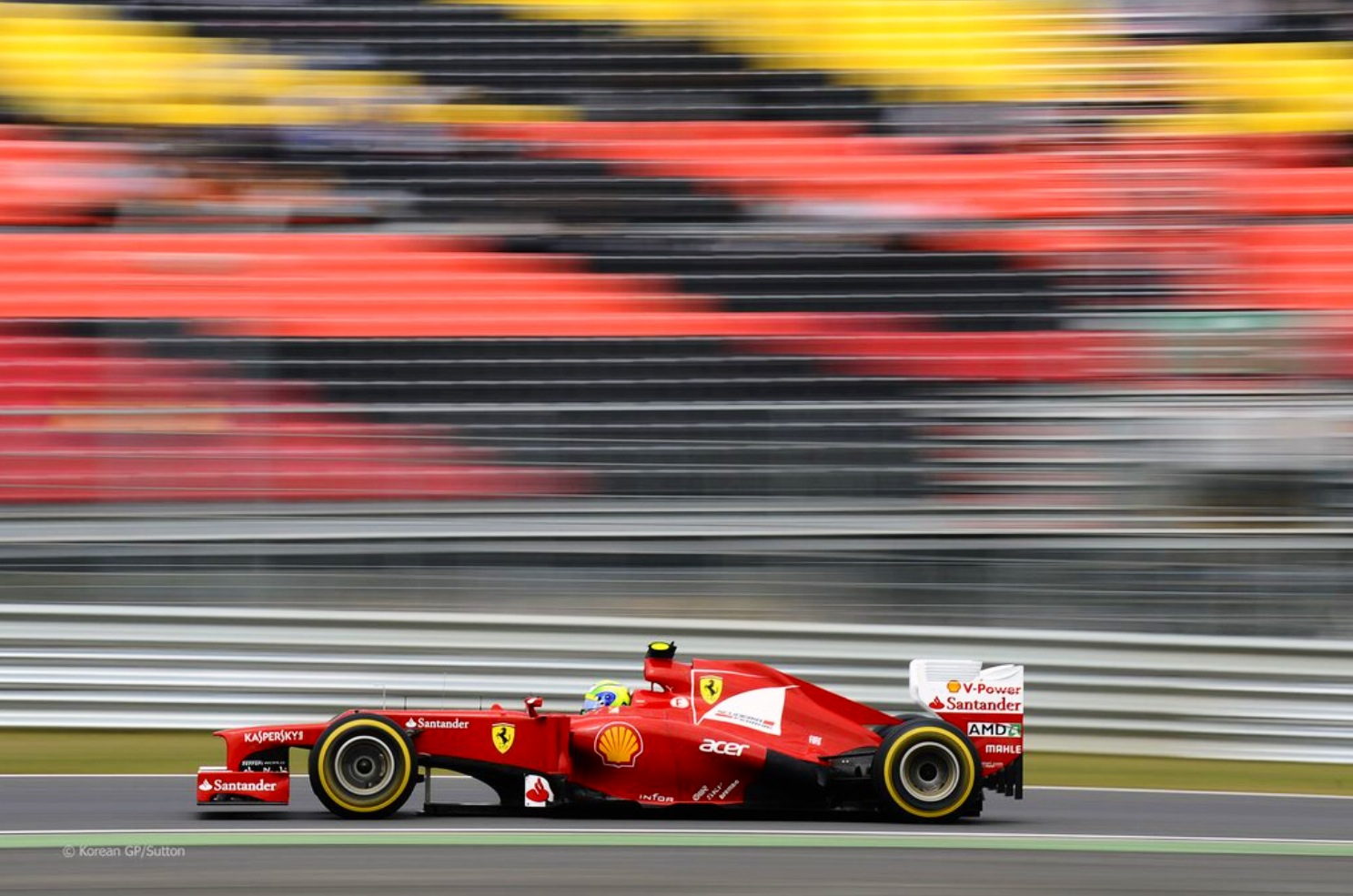
Felipe Massa on the way to fourth place in his Ferrari F2012. Yeongam, Korean GP, 14 October 2012…
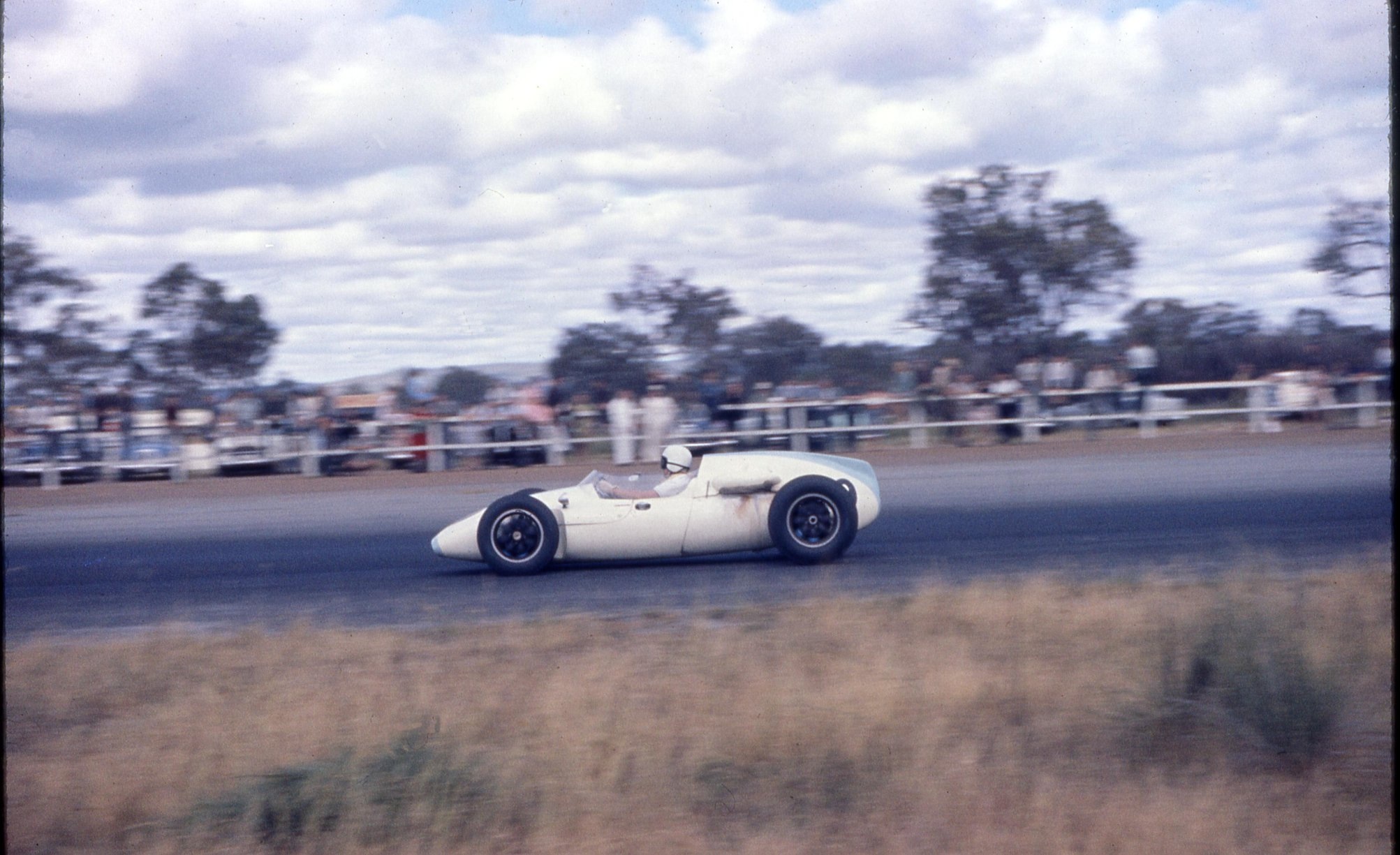
It’s a relatively simple panned-shot made striking by its composition in terms of background. The lines of the car are shown to rather good effect.
The class of the 2012 grid was the Red Bull RB8 Renault which took five wins in World Champ Sebastian Vettel’s hands, and two in Mark Webber’s. Vettel and Red Bull won the drivers and manufacturers titles respectively.
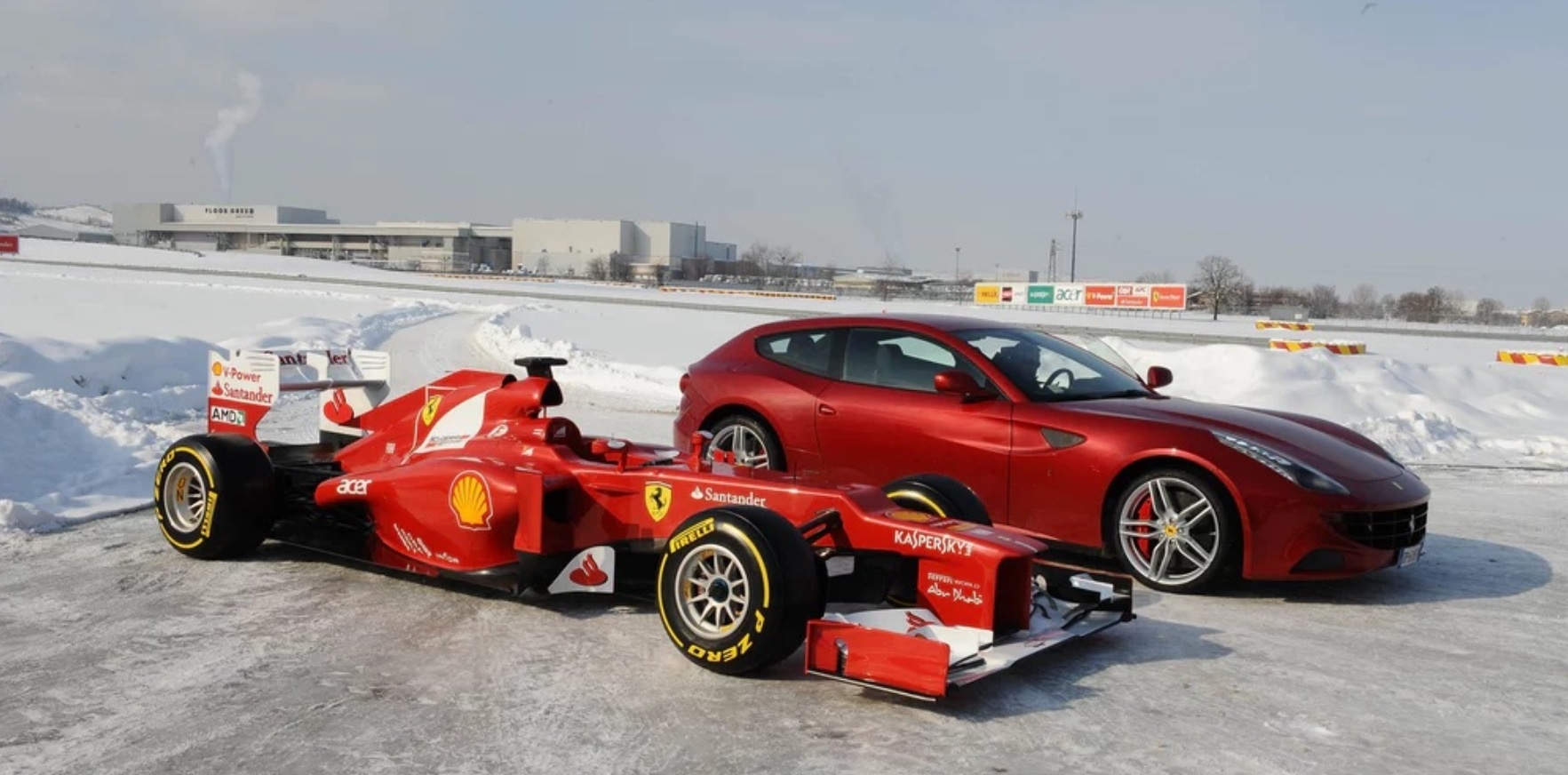
The F2012 was a competitive tool though. Fernando Alonso won in Sepang, Valencia and Hockenheim. It was powered by the mandated 2.4-litre V8 which developed about 750bhp at the mandated rev limit of 18,000rpm.
Lotsa mandateds in F1 these days.
Too many.
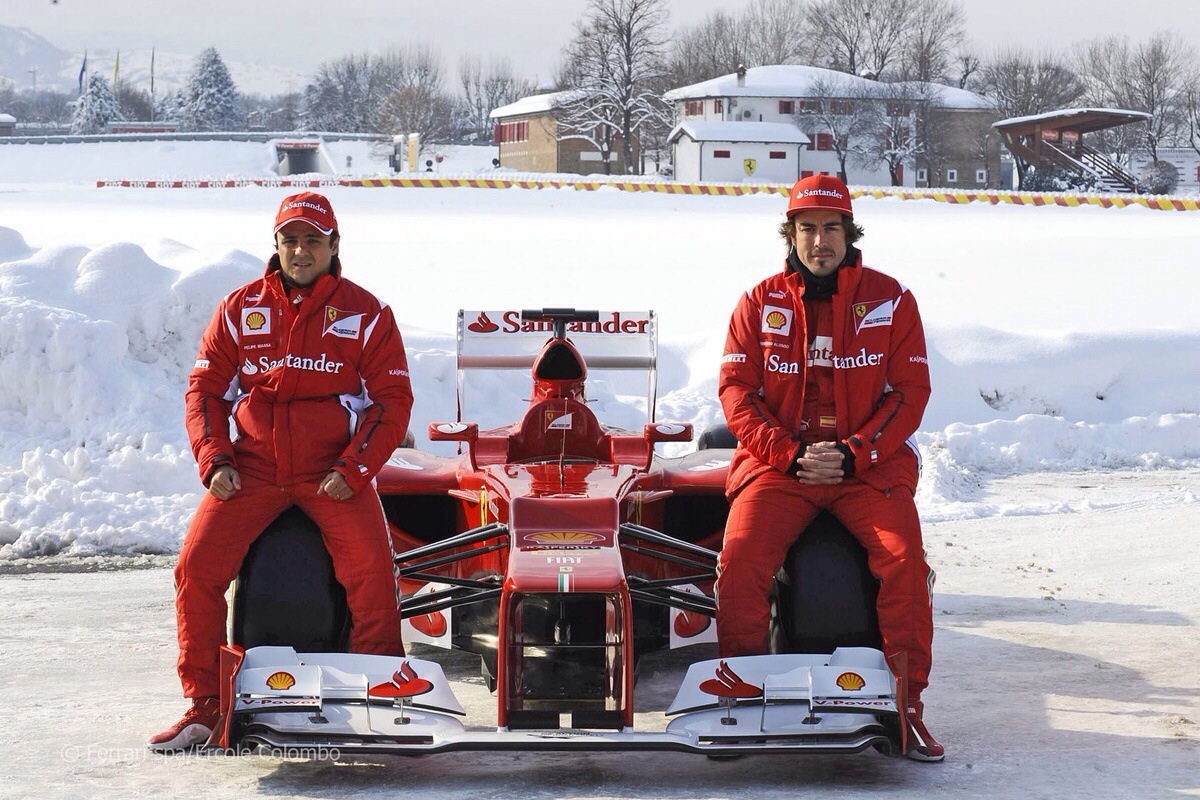
Ugly as a hatful. The F2012, not Massa and Alonso- Fiorano launch (Ferrari)
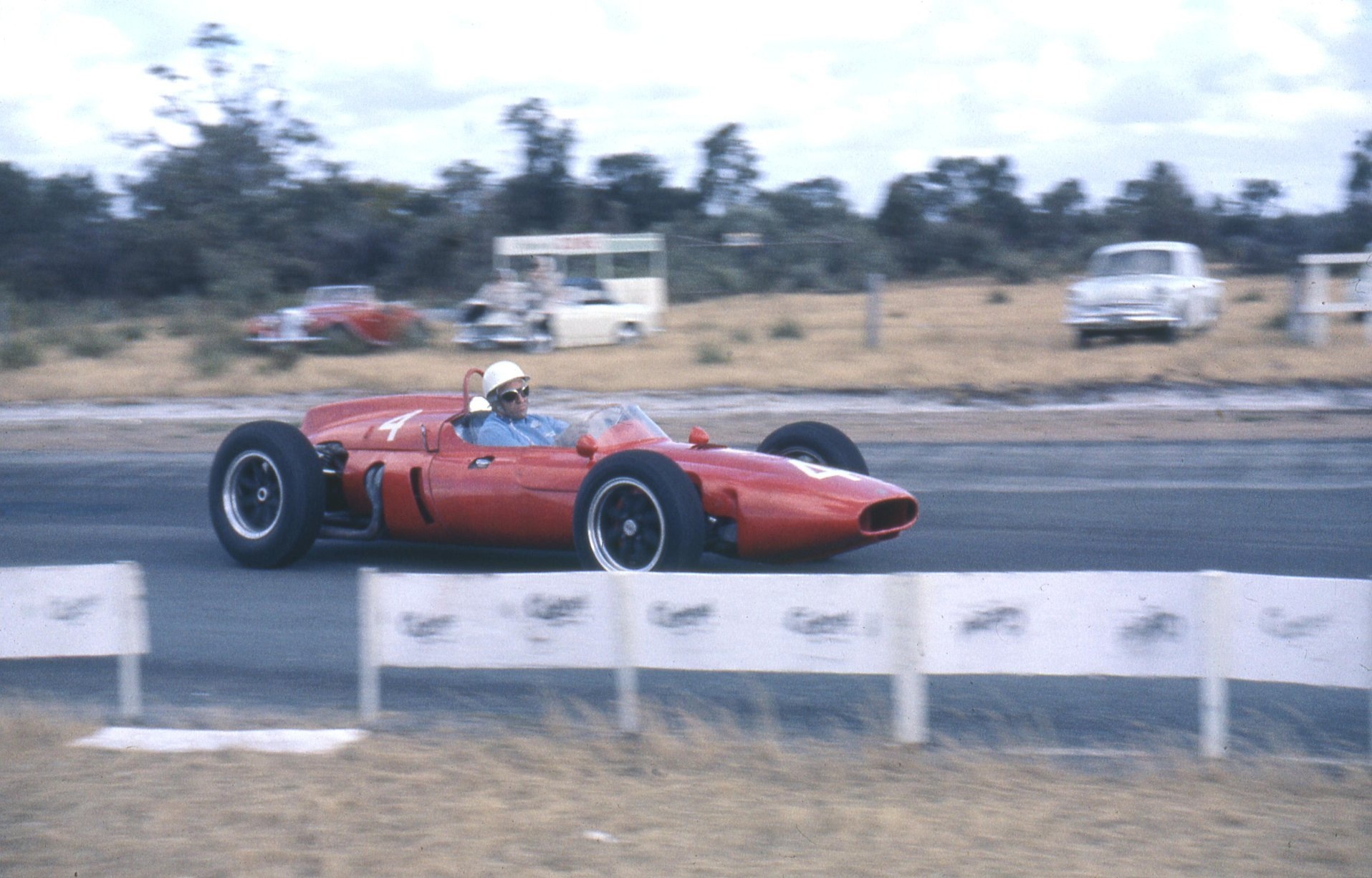
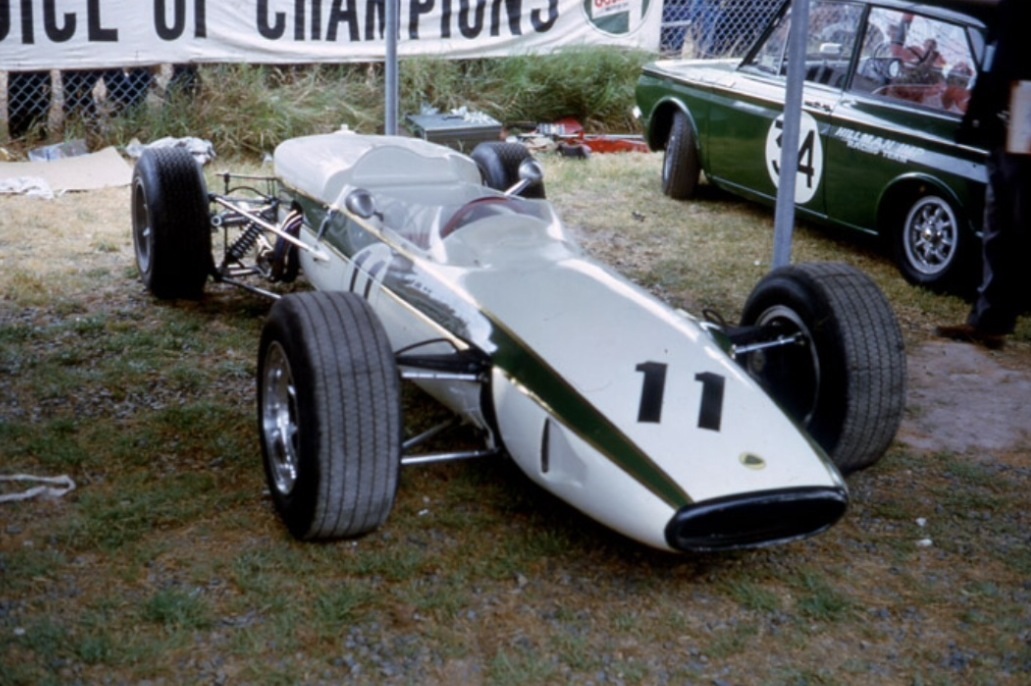
Three men and a car- the 1962 Australian Grand Prix winning Cooper mind you…
Eoin Young, journalist and author of considerable renown, Wally Willmott, mechanic of similar standing, the incomparable Bruce McLaren and Cooper T62 Climax at Styles Garage on the corner of Sussex Street and the Albany Highway, Victoria Park, Perth during the 18 November weekend. The Austin has a 15 kilometre tow from this inner south-eastern Perth suburb to Caversham now also a Perth suburb in the Swan Valley.
All so simple isn’t it, three blokes and a car?! And they won the race- with a little bit of luck thanks to Jack Brabham’s late race collision with Arnold Glass, but that in no way diminishes the achievement.
Here are a few more brilliant photographs from Ken Devine’s Collection of that weekend- I was going to retro-fit them into the old article but it seems better to let the photos ‘shine on their own’ so here they are with a few supporting notes.
(K Devine)
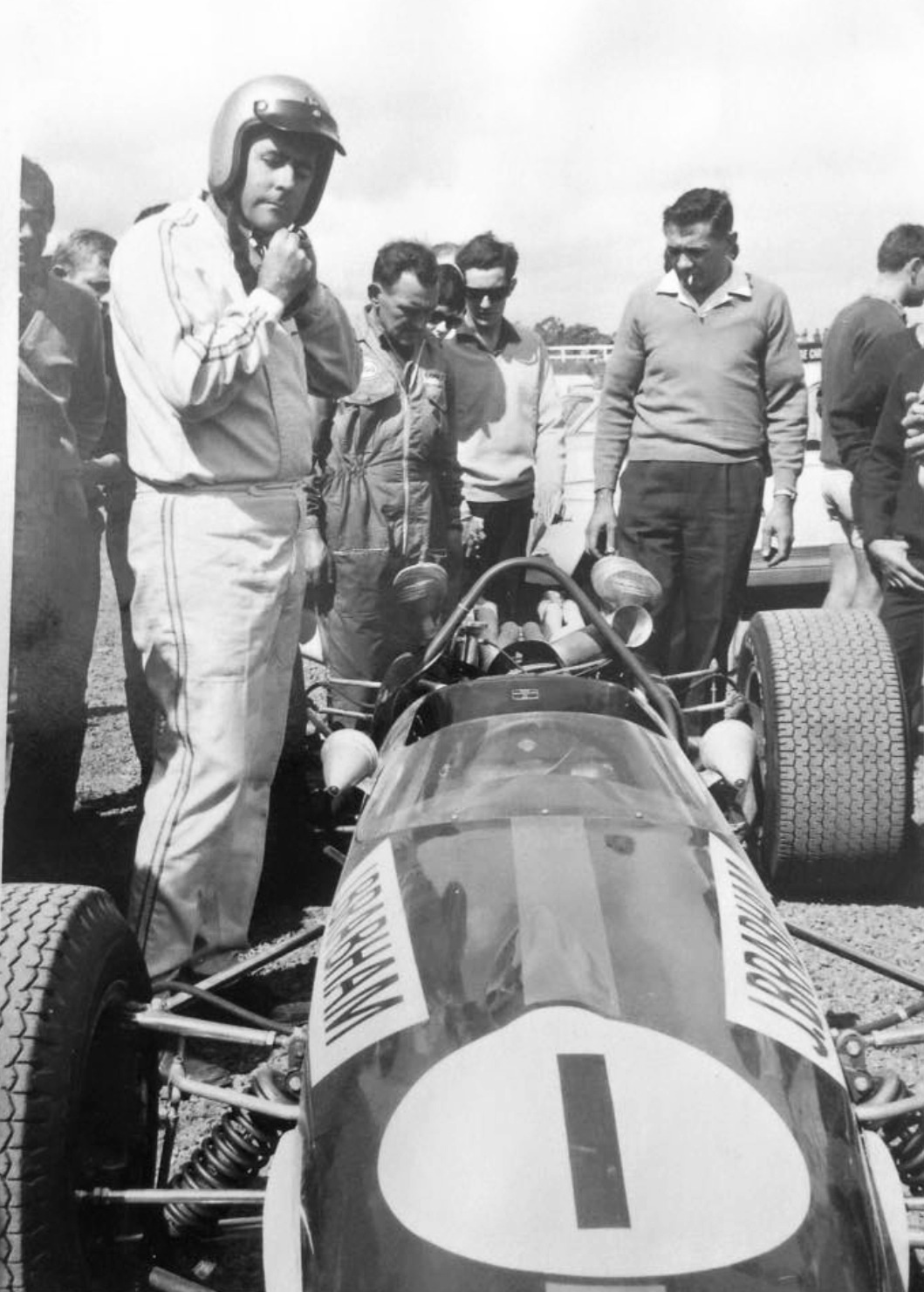
David McKay and Jack Brabham chewing the fat- don’t they look like youngsters?!
McKay didn’t race that weekend but was scooping up information for his newspaper and magazine reports of the race. Morover he was spinning Jack a line about how long-in-the-tooth his Cooper was and how much he would like to buy Jack’s brand-spankers BT4 Climax- a feat he would accomplish! The BT4 was in essence an FPF engined BT3- Tauranac’s first, 1962 F1 car.
Jack raced the car in New Zealand (a win at Levin) with David racing it in the Australian events- Graham Hill took the wheel in the 1964 Tasman Series achieving one win at Longford.
(K Devine)
Lex Davison looking stern as he motors past at some clip in his T53 Cooper- like McKay he was after a new car too- at the end of the summer Bruce’s T62 was his, a car around which a good deal of tragedy occurred. Lex was classified 8th from grid 4 but only completed 46 of the races 60 lap, 101 mile distance.
(K Devine)
Bib Stillwell must have been flogging quite a few Holdens from his Cotham Road, Kew, Melbourne dealership by then- he really went about his motor racing in a thoroughly professional manner.
To me he was slow to peak having started racing just after the war, but man, when he did he was an awesome racer taking four Gold Stars on the trot from 1962 to 1965- he had his tail up on this weekend as he had just taken his first Gold Star in this Cooper T53 Climax with wins in two of the six GS championship rounds.
Its interesting to look at Stillwell’s results that year- he had an absolute cracker of a season inclusive of the internationals when the big-hitters were about. His record is as follows; Warwick Farm 100 3rd, Celebrities Scratch Race Lakeside 1st, Lakeside International 2nd, Victorian Trophy Calder 1st, South Pacific Championship Longford 3rd, Bathurst 100 1st, Racing Feature Race Calder 1st, Victorian Road Race Championship Sandown 2nd, Advertiser Trophy Mallala 1st, Hordern Trophy Warwick Farm 1st, AGP Caversham 3rd- it was a year of amazing speed and reliability, the teams only DNF was at the Sandown International (engine) the only other ‘non-event’ was a DNA at Lowood- by early June Bib no doubt figured the long tow to Queensland from Melbourne was a waste of money.
At Caversham Stillwell was third on the grid behind McLaren 1:19.6 and Brabham 1:20.1, Bib’s 1:20.3 was pacey- he finished third, 47 seconds adrift of McLaren and 5 seconds behind John Youl in a Cooper T55.
(K Devine)
Lets not forget the Cooper Monaco either- a car I wrote about a while back and which received the ex-Scarab Buick-Traco V8 a little later in its life- the motor which was in the engine nacelle of Arnold Glass’ BRM P48 (#7 below) this very weekend.
The cut and thrust between Brabham and McLaren went on for over forty laps- Jack saw an opportunity when Bruce ran wide lapping Arnold- Jack focussed on Bruce, Arnold on taking his line for the next corner, a collision the result. Jack was out on lap 50 whereas Arnold survived to finish in fifth place from grid 7.
Jack and Roy fettle the 2.5 litre Climax engine lent to them by Bruce McLaren, Jack having popped his 2.7 ‘Indy’ FF in practice.
The Brabham BT4 was the first in a long line of ‘Intercontinental’ chassis built by the Tauranac/Brabham combination all of which (BT4/7A/11A) won a lot of motor races in this part of the world.
Paragons of practical, chuckable virtue the cars won races in the hands of World Champions Hill, Stewart and Brabham as well as championship winners in domestic competition for the likes of Stillwell, Spencer Martin and Kevin Bartlett (whilst noting the latter’s Gold Star success was aboard a BT23D Alfa Romeo.
(K Devine)
(K Devine)
Plenty of hopefuls entered the meeting not least Jim Harwood in the ex-Whitehead/Cobden Ferrari 125 which by then was fitted with a small-block 283 cid Chev V8.
His times were too far behind the modern mid-enginer racers of the top-liners so he elected not to start- with 1962 still just into the period of Austraian motor racing where everybody could have a go with a high-born special such as this ex-GP 1950 Ferrari.
The car is notable for the fact that it was one of Tom Wheatcroft’s first Donington Collection acquisitions.
(K Devine)
(K Devine)
Brabham, Stillwell and McLaren from left to right at the drop of the starters flag. Brabham BT4, Cooper T53 and Cooper T62 respectively. On the second row its John Youl at left, Cooper T55 and Lex Davison’s red T53 alongside him. In the dark helmet on the row behind is the red with white striped BRM P48 Buick of Arnold Glass and at very far left is Jeff Dunkerton’s Lotus Super 7 Ford 1.5- to the right of the Lotus is the red front-engined #14 Cooper T20 Holden Repco of Syd Negus.
(K Devine)
Whilst ten starters is not a big grid, Dunkerton’s achievement in finishing ninth in the little Lotus 7 was an amazing one- the last placing ever gained by a sportscar in an AGP.
(K Devine)
Bill Patterson was the reigning 1961 Gold Star Champions but his old Cooper T51 was never going to be a competitive tool going into that year with plenty of more modern well-driven machines on Australian grids.
In reality Patto was easing himself slowly out of racing as a driver albeit he would remain involved as a sponsor/entrant in the next couple of decades. He started from grid 6 and finished fourth albeit three laps behind McLaren.
John Youl is another driver I’ve waxed lyrical about in the past- its a shame commitments running the family pastoral properties in northern Tasmania took him away from motor racing. Youl’s ex-works Cooper T55 was beautifully prepared by Geoff Smedley and pedalled very quickly by John in the 1963 Internationals. It would have been very interesting to see just how far he would have progressed up the elite level totem-pole had he stuck with his racing career.
Bruce on the way to a Caversham win, Cooper T62 from Youl, Stillwell, Patterson and Glass. Bruce McLaren Motor Racing had rather a bright future.
Credit…
Ken Devine Collection
Tailpiece: McLaren takes the flag…
(K Devine)
Is it Jack in the blue driving suit obscuring the man with the flag?
Bruce won two AGP’s, the other aboard his self designed and built- with Wally Willmott, Cooper T79 at Longford in 1965.
Both were great wins after a long tussles with Jack Brabham- at Caversham Arnold Glass ruined the fun when he mistakenly put Jack off the road and at Longford he won by a smidge under four seconds from the Aussie’s Brabham BT11A Climax and Phil Hill’s Cooper T70 Climax. It was a great day for the Bruce McLaren Motor Racing as Phil drove a terrific race- in the American’s opinion one of his best in the T70, another car built by Bruce. (McLaren’s winning T79 was an updated T70)
Longford joy was tempered considerably by the death of Rocky Tresise early in the race aboard the very same Cooper T62 in which Bruce won at Caversham in 1962…
Tim Schenken, Merlyn Mk11 Formula Ford and his rivals at Brands Hatch, 20 September 1968…
Chris Steele, Tim’s tuner/entrant dispenses advice to the Formula Ford ‘flock’ comprising Ray Allen, Brian Smith, Dave Morgan and Tony Trimmer. No doubt it’s a press shot to promote an upcoming race meeting; two of these fellows made it through to Formula 1- Schenken and Trimmer, the well of talent in Formula Ford has been deep in every season including its first couple.
Schenken cut his racing teeth in Australia, initially with an Austin A30 and later a Lotus 18 Ford FJ. By the time he contested some F3 races in an old Lotus in the UK in 1967 he had plenty of experience- the step ‘back’ into the new Formula Ford class paid off in spades with wins in both the 1968 British Formula Ford and Lombank F3 Championship- as a consequence he carried away the main 1968 Grovewood Award.
Tetsu Ikuzawa Brabham BT21B from Tim Schenken Chevron B9 Ford, Martini International Meeting Silverstone 1968 (M Hayward)
In 1970 he broke into Grand Prix Racing with Frank William’s De Tomaso 505 Ford, that ride arose as a result of Piers Courage’ death during the 1970 Dutch Grand Prix.
His promise was confirmed with drives in the year old Brabham BT33 Ford for Ron Tauranac in 1971, his first career mistake was jumping out of Brabham as BC Ecclestone acquired it at the end of ’71. Surtees was far from the worst place to be at the time but staying put would have been better.
Tim was as quick as Mike Hailwood at Surtees but the slip down the F1 totem pole was quick once he left and the climb back up is even harder.
I don’t think we ever saw his best in Grand Prix racing but point scoring races and an F1 podium, not to forget his F2, European GT Championship and works Ferrari 312PB sportscar wins form part of a CV any of us would be rather happy to have.
Schenken, Brabham BT33 Ford, Canadian GP 1971 DNF (unattributed)
Tim’s best results in F1 were sixth and third placings for Brabham in 1971 at Hockenheim and the Osterreichring and fifth, seventh and eighth for Surtees in 1972 at Argentina, Mosport and Spain. In non-championship F1 he was third in the BRDC International Trophy at Silverstone and third in the 1972 International Gold Cup at Oulton Park.
Schenken aboard his Merlyn Mk11 FF in 1968
Credits…
Getty Images, Mike Hayward Collection, Victor Blackman, LAT Images
Schenken testing the Merlyn at Brands during 1968 (LAT)
Tailpiece: Ron Tauranac, Tim and Hill G with Hill’s Brabham BT34 Ford, Silverstone, British GP weekend July 1971- note the rig to attach a camera, the GoPro is still a while away…
Pete Makeham and the King Alfa Spyder at Reims (B King)
‘What you can do with a dodgy camera…
The story really begins in May 1965 in Aden in the Federation of South Arabia (now Yemen) where the ship on which I was travelling as the ships doctor made its first landfall after leaving Australian several weeks earlier.
Aden, then as now, was a hell-hole, but I was advised by the experienced ship’s crew that there were bargains to be had. Hence the cheap, and supposedly new, Practica IVb SLR camera- ‘state of the art’. But something was seriously wrong; was it a reject that found its way to Aden? Anyway, its deficiencies are my excuse for the poor quality of the photographs accompanying this article.
After two European Tours in a VW and then a Minivan, it was time for better things- or at least my future wife thought so- and bought a three year old Alfa Romeo Giulia Spyder 1600. My late lamented friend Pater Makeham and I set off with our first destination being Reims for the Grand Prix de l’ACF. The Alfa gremlins set in early, and with no generator charge, our arrival in the Oort of Dover was lit by the equivalent of two candles.
We camped that night outside Reims on the top of a hill and were able to roll-start the car. It was a Saturday morning and as we approached Reims we had no idea how we would resolve our problem- then suddenly we were confronted by a large Alfa Romeo badge hanging in the centre of the street- a quick left turn and we were in a large Alfa workshop. In our best French we said ‘dynamo-kaput’ which was sufficient to gain the necessary attention.’
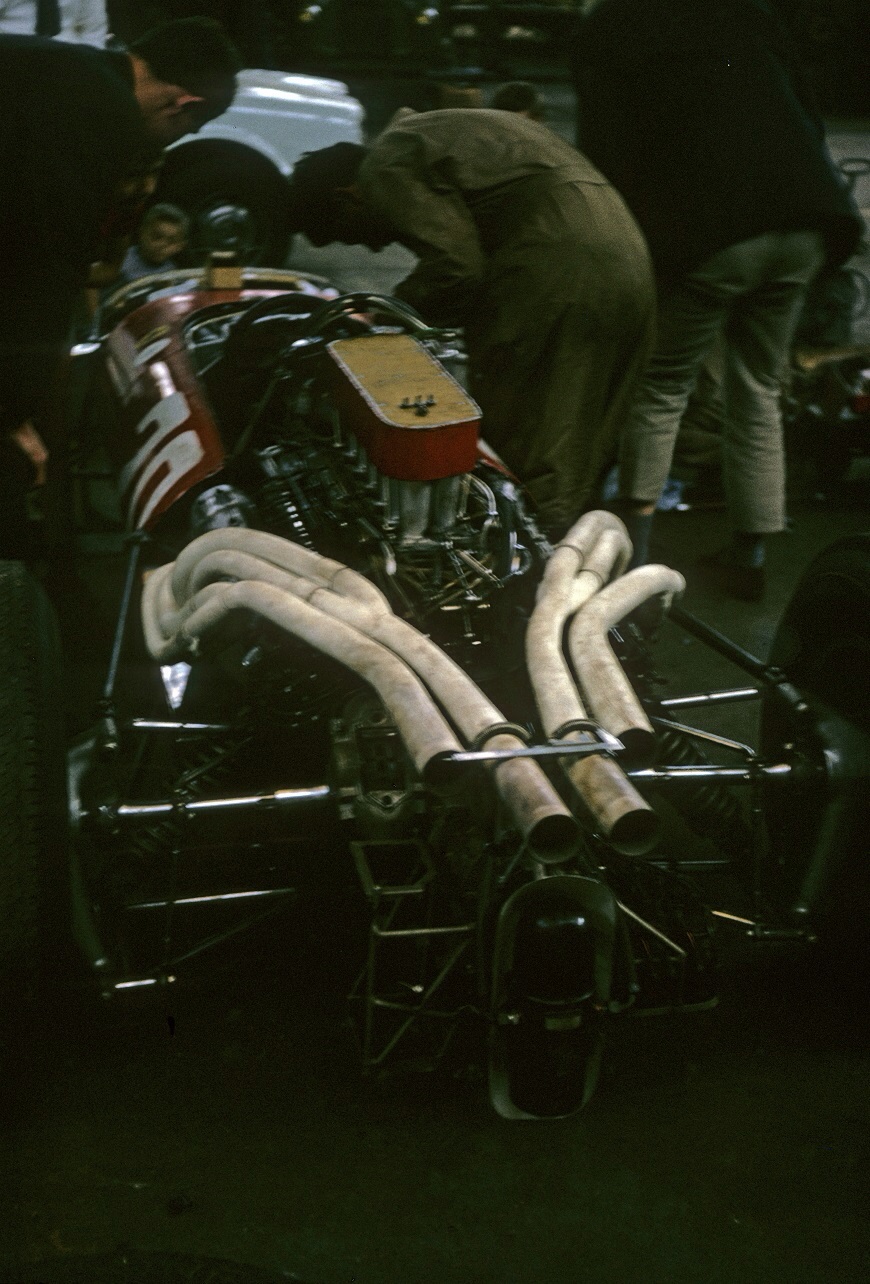
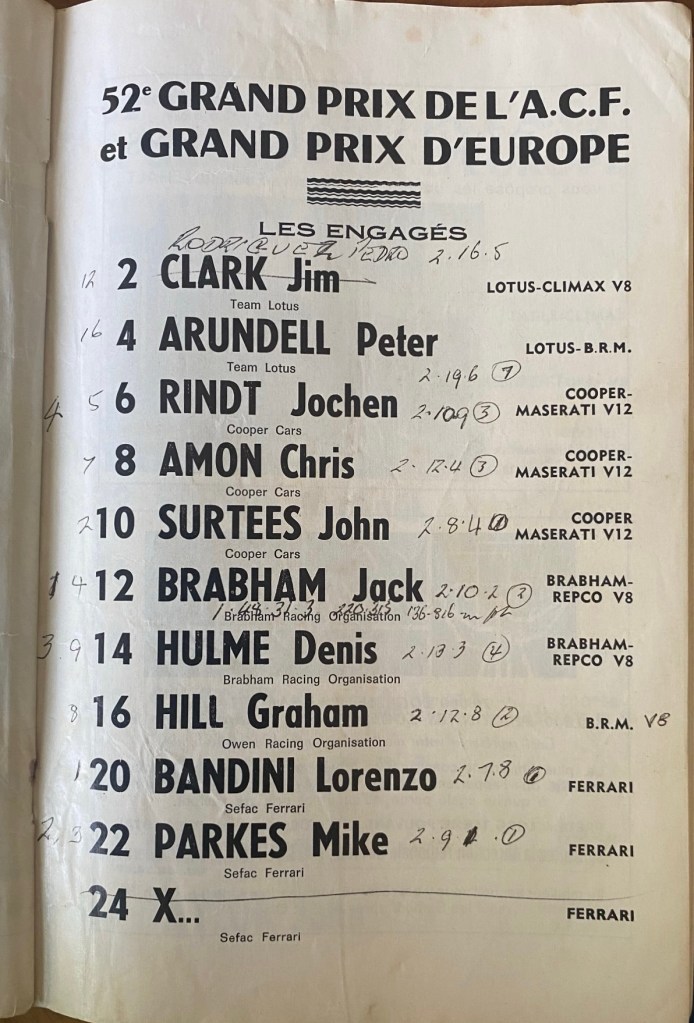
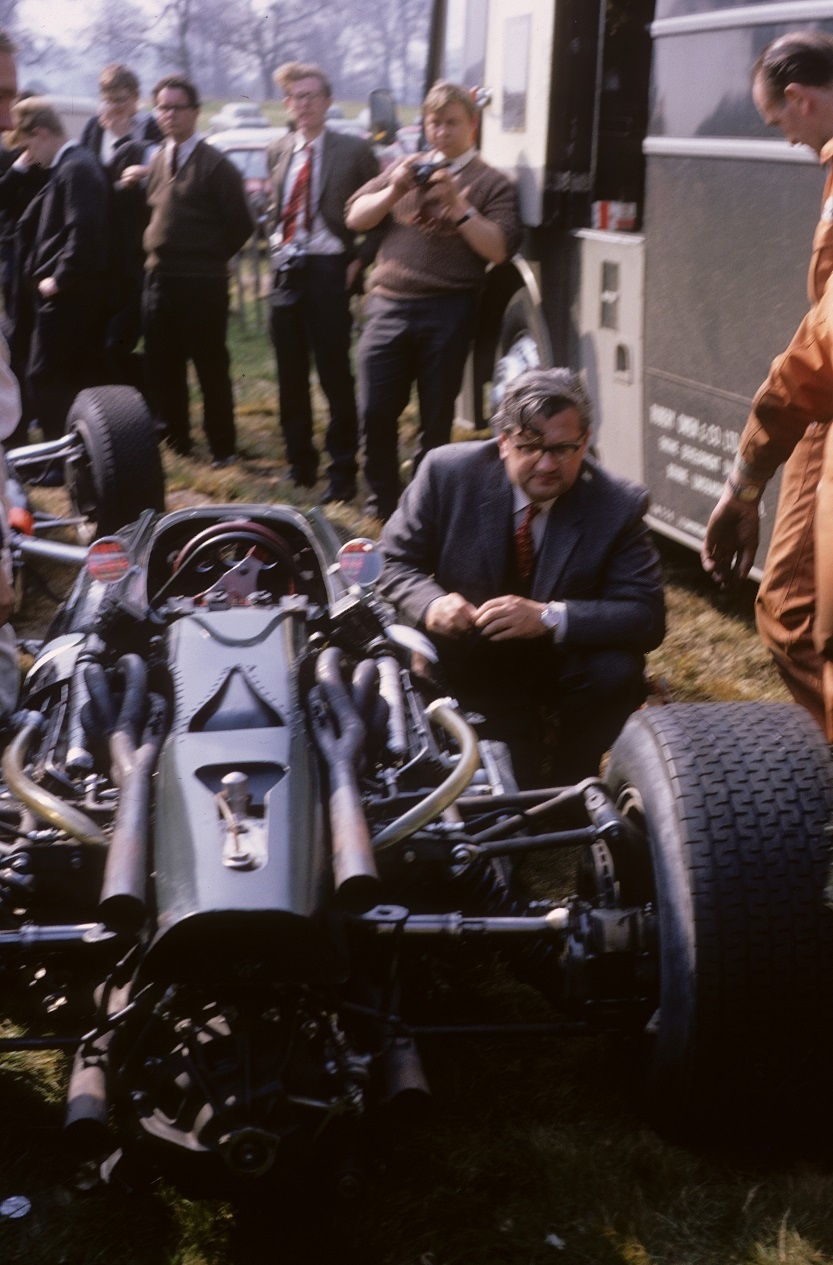
Lorenzo Bandini’s Ferrari 312 being attended to in the Alfa Romeo dealership, Reims (B King)#22 is Mike Parkes’ 312- World Champions in 1966 almost certainly had the kept Surtees within the Scuderia Ferrari, ‘Ifs, Buts and Maybes’ don’t count however (B King)
‘We then noticed that half the workshop was devoted to the Ferrari Formula 1 Team. Hence the grainy images with the Practica. While the GP cars sat idle, it seemed that the whole Ferrari team were devoting their attention to designer Mauro Forghieri’s road car- I think it was a just released 330GTC. With much revving, Mauro would take of around the block, only to arrive back with the car misfiring. About six red-suited mechanics would put their heads under the bonnet and the procedure would be repeated.’
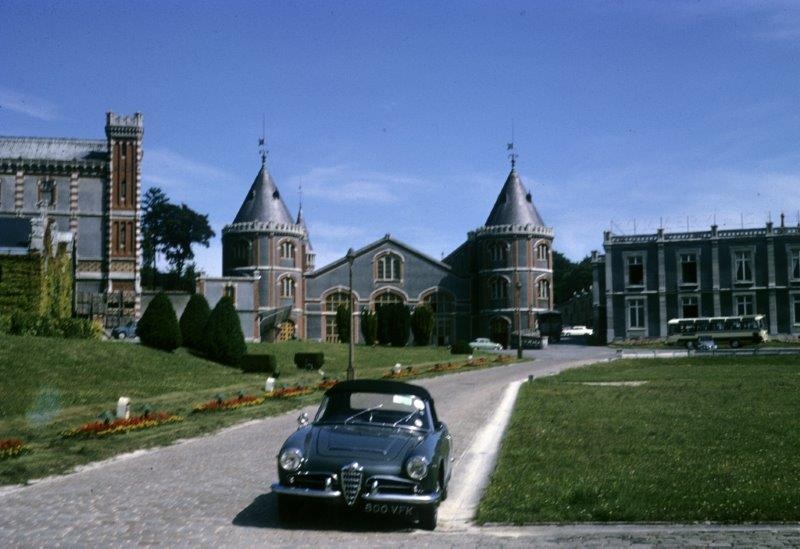
King’s Alfa outside the Champagne cellars in 1966 (B King)
‘I think our problem was resolved before Mauro’s and we were able to depart for a tour of the Champagne cellars. Perhaps if the team had devoted more time to the racing cars, Lorenzo Bandini might not have surrendered his lead to Jack Brabham because of a failed throttle cable!’
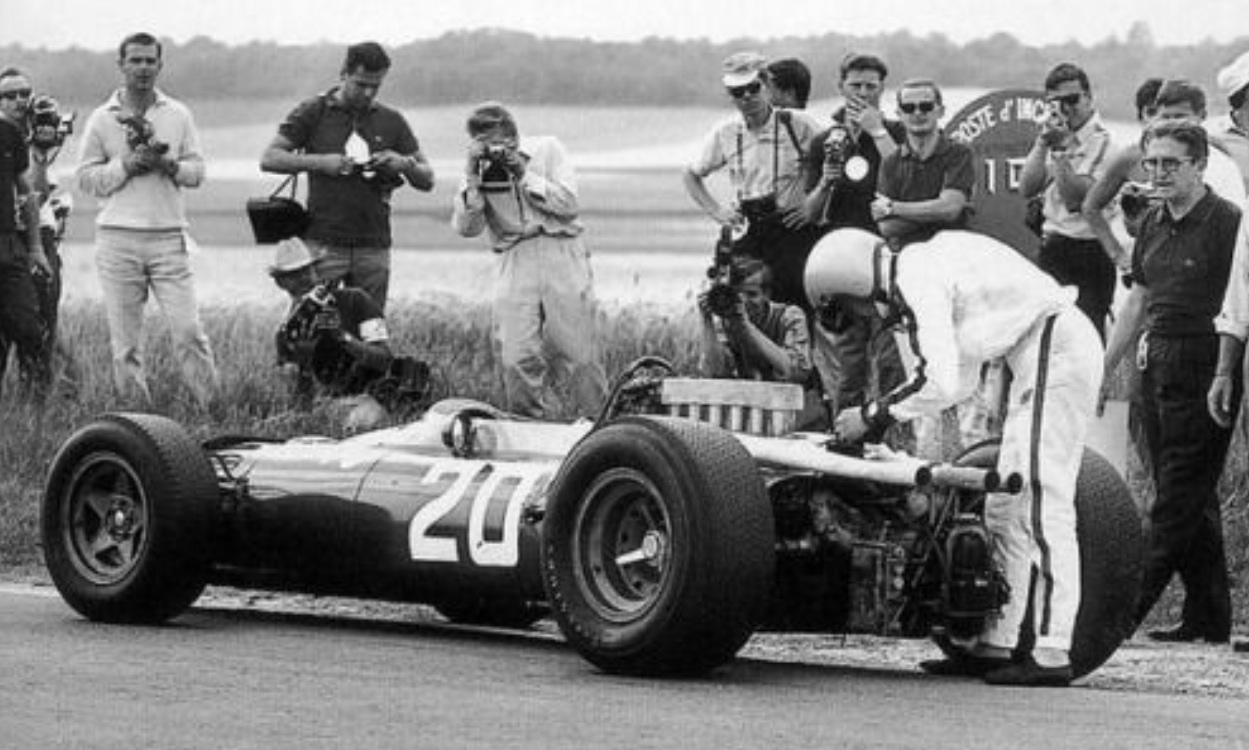
Lorenzo Bandini seeks to sort his throttle linkage problem after completing 32 laps- he led the race from Brabham and Parkes to this point (unattributed)
‘What a day it was to go to the races with Jack and Denny first and second in in the F2 support race in Brabham Hondas, and Jack winning the race in the ‘All Australian Repco Brabham’ designed by Ron Tauranac.
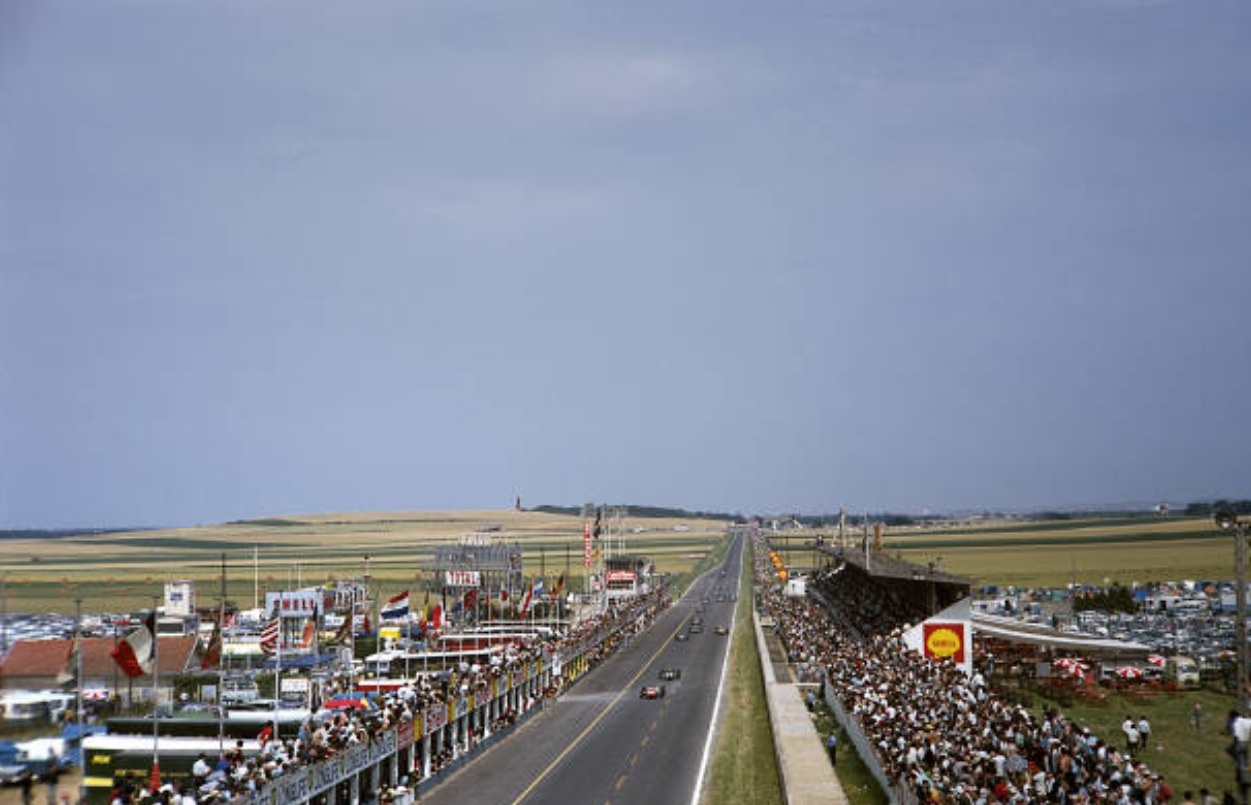
We were on the outside of the track at ‘Calvaire’, the fast bend at the end of Pit Straight and Jack was the only driver taking that corner at full noise. This was the last GP to be held at that wonderful circuit.’
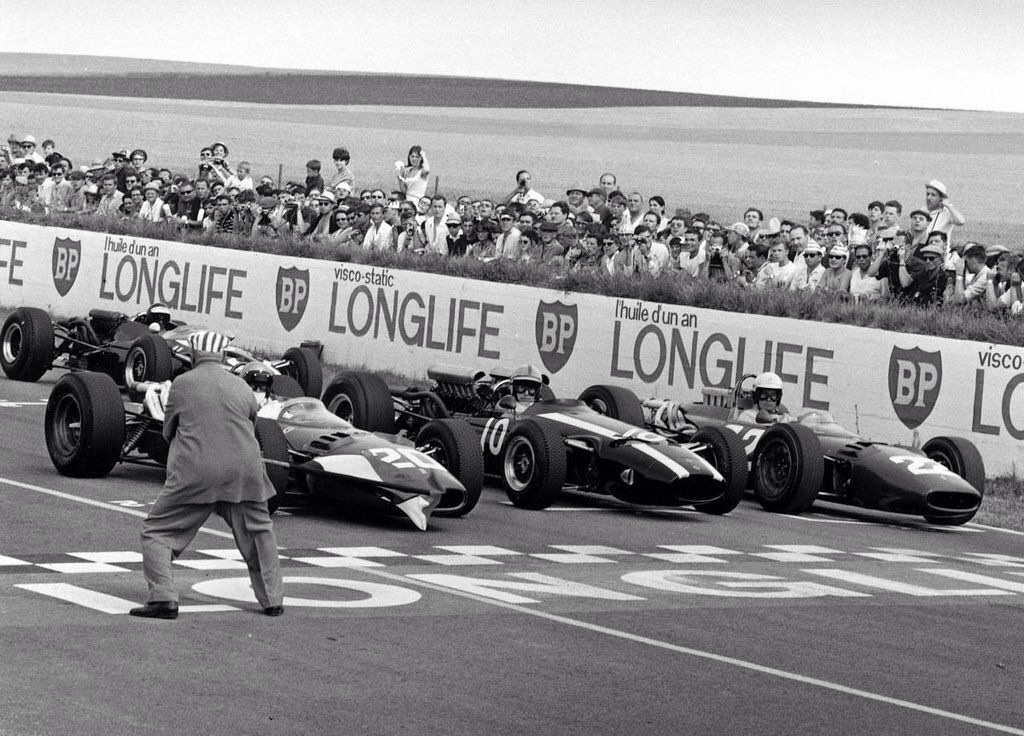
Toto Roche drops the flag and makes his famous leap out of the way, Mike Parkes and Lorenzo Bandini in Ferrari 312’s sandwich the just departed John Surtees in a Cooper T81 Maserati. That’s Jochen Rindt’s Cooper on row two.
(unattributed)
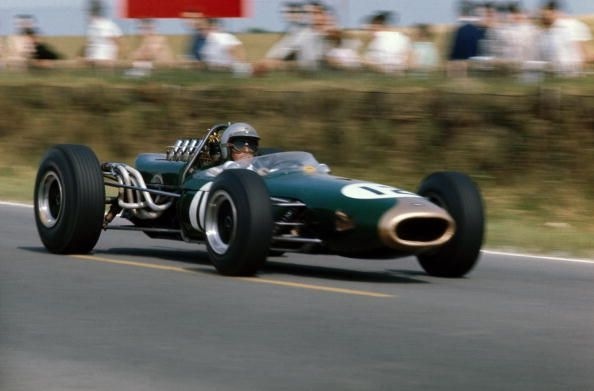
Brabham speeds to victory in his Brabham BT19 Repco, his championship steed throughout 1966- famously the first driver to win a GP in a car of his own design and manufacture- noting the contribution of Ron Tauranac, Motor Racing Developments and Repco Brabham Engines in relation thereto!
Roche, below, flag in hand, pushes the winning car whilst Brabham acknowledges the plaudits of the knowledgeable French crowd. Mike Parkes’ Ferrari 312 was second, Denny third in a Brabham BT20 Repco and Jochen Rindt, Cooper T81 Maserati, fourth.
(unattributed)
‘I was able to buy the Alfa from the proceeds of working 110 hour shifts at Manchester Royal Infirmary. Another benefit of MRI was having access to the Nurses Home, housing many hundred nurses and from where I found my wife to be.
I also enjoyed our proximity to Oulton Park- where I was a regular attendee from 1965-1968. My photos with the Practica were improving; I found the light meter gave more accurate readings if I pointed it to the ground.’
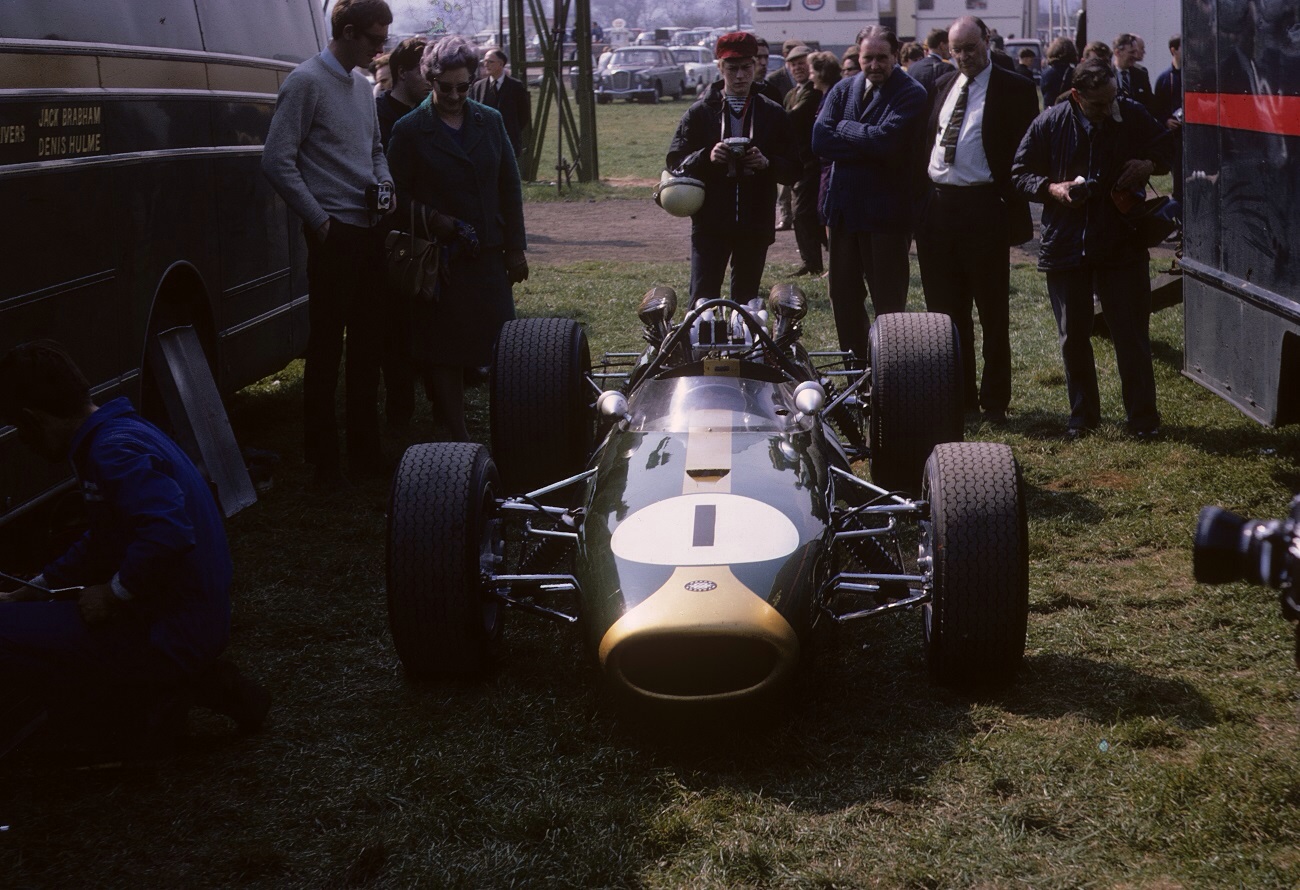
Cor! says the young motor cyclist with the camera. Brabham’s BT20 Repco with new ‘740 Series’ Repco 3 litre V8 making its first race appearance. Brabham’s definitive 1967 chassis, Tauranac’s brand new BT24 is still several races away. Oulton Park 1967- ripper shot just oozes atmosphere of the (chilly) day (B King)(B King)(B King)(B King)
Daily Express Spring Cup, Oulton Park 15 April 1967…
The first European F1 race of 1967 was the ‘Race of Champions’ at Brands Hatch in early March, the race was won by Dan Gurney’s Eagle Mk1 Weslake from Lorenzo Bandini and Jo Siffert in Ferrari 312 and Cooper T81 Maserati respectively. Dan took wins in both of the two heats and the final, wonderful stuff and unfortunately a race which somewhat flattered to deceive.
The last chance for the teams to race test their cars before the European season championship opener at Monaco in May was the Spring Cup at Oulton, where Bob’s photos were taken.
Tony Rudd fusses over his complex and superb, BRM P83 H16. The engine’s only championship win was Clark’s Lotus 43 victory at Watkins Glen in late 1966 (B King)Bruce McLaren sits on his Rover 3500 whilst the boys fettle his F2 based GP McLaren M4B BRM 2 litre V8, by the years end he was using the BRM P101 V12 but his saviour was the Ford DFV which was available to teams other than Lotus from 1968 (B King)
Jackie Stewart popped the BRM P83 H16 on pole from Denny Hulme and John Surtees- in Brabham BT20 Repco and Honda RA273. Brabham and Mike Spence were back on row two in the other BT20 and H16.
Denny won both heats in a portent of his season to come and Jack Brabham the final from Denny, Surtees, Jack Oliver’s F2 Lotus 41B Cosworth FVA, Bruce McLaren’s McLaren M4B BRM V8, Mike Spence’s BRM P83, Bob Anderson’s Brabham BT11 Climax FPF and Graham Hill’s Lotus 33 BRM. Stewart failed to finish in the other BRM after a collision.
The BRO pit with Jack’s 740 V8 engined BT20 front and centre. Circa 340 bhp by the seasons end- just enough to prevail in 1967 aided by Lotus 49 teething pain unreliability. Gearbox is Hewland DG300. Denny’s car devoid of bodywork behind (B King)
The winds of change blew at Zandvoort with the first race of the Lotus 49 Ford DFV at the Dutch Grand Prix but Bob’s photos reasonably convey, with the exception of the Ferrari’s who did not enter the Spring Cup, most of the the state of GP play in early 1967.
(B King)
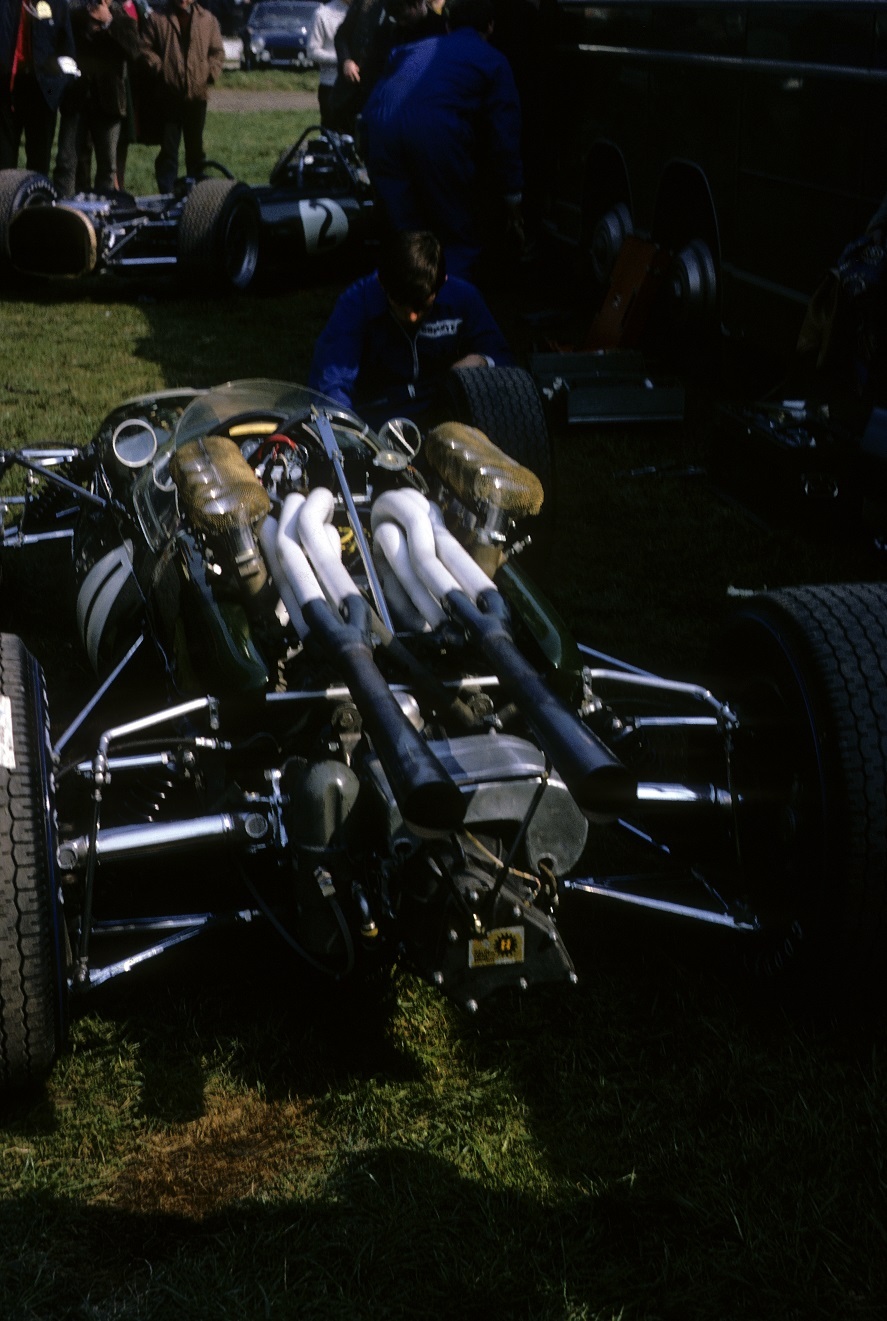
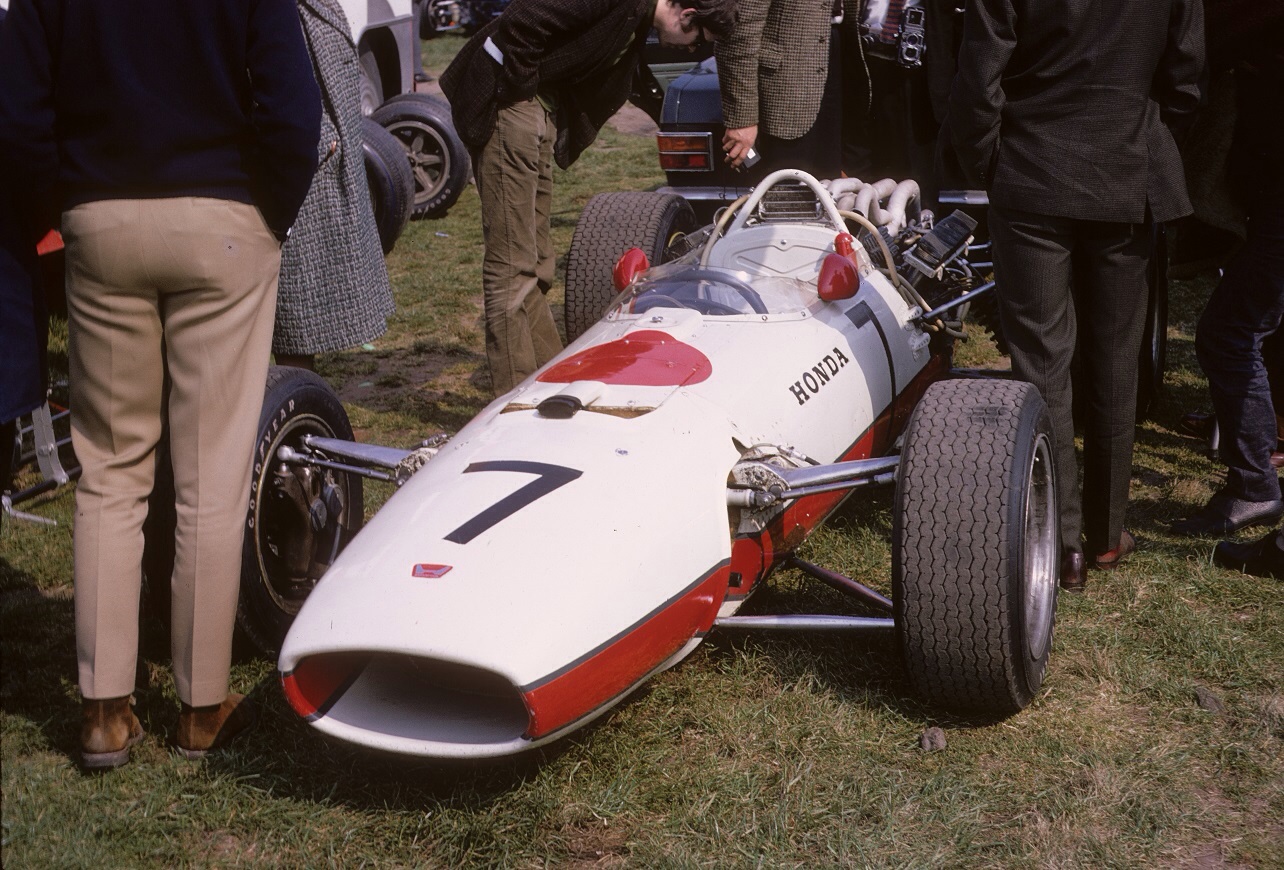
Surtees’ magnificent, powerful, but oh-so-heavy Honda RA273 V12.
By the seasons end the lighter RA300 ‘Hondola’- the monocoque chassis a variation on Lola’s T90 Indianapolis car, was raced to victory in the Italian Grand Prix, the popular Brit taking a famous victory for the car in a last lap, last corner fumble with Jack Brabham in his BT24 Repco.
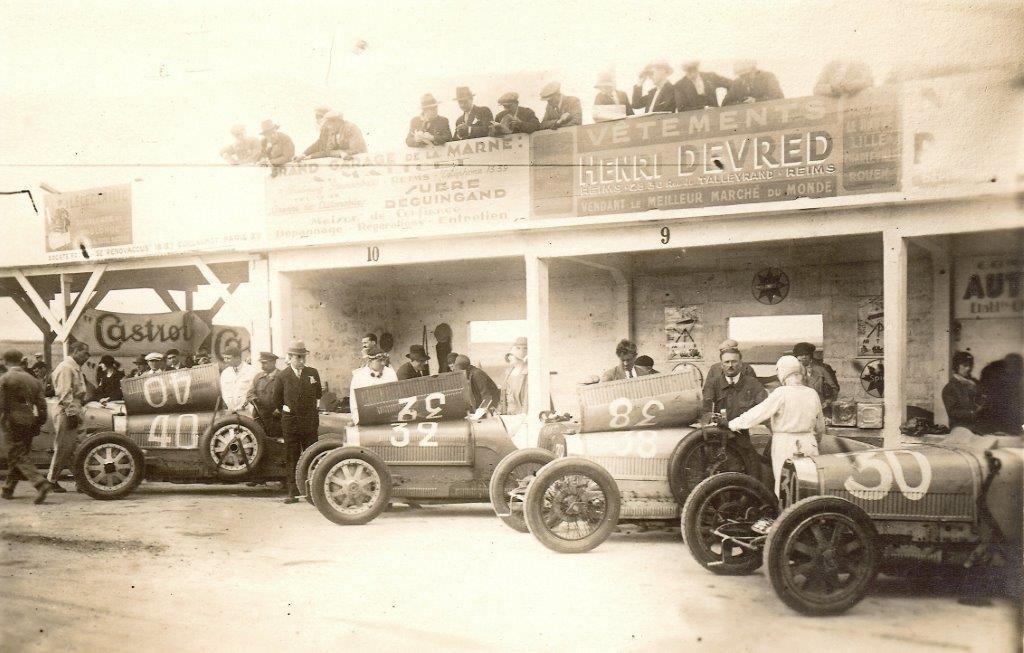
Classic Bob King ‘…and I just found this photo from 1929- if you should wish to make a comment about Bugatti being my real thing- it is such a good photo’- and indeed it is a marvellous shot!
The fifth GP de la Marne was staged at Reims over 400 km on 7 July and won by Philippe Etancelin in a Bugatti T35C in 2 hours 54 minutes 14 seconds. The cars above are those of (L-R) Juan Zanelli T35B second, Robert Gauthier T35C fourth, Rene Cadet T35 sixth and another T35 of Derrancourt, seventh.
Jackie Stewart eases his BRM P261 chassis ‘2614’ into the Sandown Paddock after practice…
It wasn’t going to be a great day at the office for the plucky Scot. He started well, passing Jack Brabham on lap 9 for the lead but the crown wheel and pinion gave up the ghost on lap 11 of the race won by Jim Clark’s Lotus 33 Climax V8.
I think the car behind Jackie is Denny Hulme’s Brabham BT22 Repco- right of picture behind the attractive chick with white ‘flairs’, eagle-eyed Holden fanciers will spot Repco’s HR Panel Van, one of two which carted the two team cars of Jack and Denny around the country that summer.
(P Newbold)
Clark ponders changes to ‘R14’ a chassis which was very kind to him in Australasia that summer- he won five of the eight rounds and took the Tasman Cup for the second time.
The chassis went back to Hethel with Jim, he raced it in the early F1 races of 1967, for the last time at Monaco before the race debut of the epochal Lotus 49 Ford DFV at Zandvoort on June 4.
Stewart was the reigning Tasman champion, the ex-F1 BRM P261 still had the speed to win the Tasman, but, stretched to 2.1 litres, the V8 put out that little bit of extra power and torque which stretched the transmission beyond its comfy limits. The car’s Achilles’ heel caused too many retirements that summer, but the other Great Scot took two wins on the tour all the same. Click here for an article on this engine and series of cars: https://primotipo.com/2016/02/05/motori-porno-stackpipe-brm-v8/
JYS with Light Car Club of Australia, the lessee/promoters of Sandown, President Arnold Terdich- Arnold is the son of 1929 AGP winner Arthur Terdich, he won in a Bugatti T37A (P Newbold)Stewart’s BRM P261 ‘2614’- jewels of long-lasting racing cars. Amongst the greatest of 1.5 litre F1 cars, then ‘gap fillers’ as the outrageous 3 litre P83 H16 was developed in 1966/7 and formidable Tasman cars fitted with 1.9 litre and finally 2.1 litre P111 BRM V8’s- the gearbox was not designed with so much power and torque in mind… (M Feisst)
Jack suits up below for the off with the omnipresent Roy Billington in attendance. I wonder when his time with Jack started and finished?
One of the things all these shots have in common is the very casual nature of racing at the time. The current World Champ is there for all to see and say ‘gedday mate and good luck!’
In fact, he didn’t have good luck at all- he was out with ignition dramas, having completed 27 of the races 52 laps with Denny retiring a lap earlier due to selector failure in the Hewland ‘box- not a happy home weekend for Repco at all!
It wasn’t that simple though, the weekend proved a long one for the Brabham and Repco boys.
In 1967, the tyre war was on in earnest with Dunlop, Firestone and Goodyear vying for honours. Jack’s car was fitted with some wider 15-inch wheels made by Elfin (or perhaps more accurately, Elfin wheels cast by the Commonwealth Aircraft Corporation) to take the latest, wider Goodyears. To do so, changes were needed to the rear suspension.
(F Nachtigal)
Jack did the quickest time on Friday, and then the Repco lads popped in a fresh motor overnight- he then set pole on Saturday from Stewart and Hulme.
On Sunday, Jack won the 10-lap preliminary from Stewart at a canter, but as the BT23A crossed the line, the Repco engine’s timing gear broke. With that, the crew set about another motor change in the limited time available, popping another RBE ‘640 Series’ 2.5-litre V8 into the svelte Ron Tauranac-designed spaceframe chassis.
Jack and Jim both made ripper starts, but Clark’s 2-litre Lotus was soon overhauled by Hulme’s 2.5-litre Brabham and Stewart’s 2.1-litre BRM. Brabham and Stewart then tussled before Jackie passed Jack, who then retired a lap later near Dandenong Road. It transpired that a soldered ignition wire pickup had come off the flywheel, repaired later, Jack re-entered the race, completing 27 of its 52 laps.
Here are a few more photographs from that meeting- Peter Newbold was patrolling the paddock, and so too was Mike Feisst, who visited the Warwick Farm and Sandown Tasman rounds whilst on a trip over from New Zealand.
Between them, their pit shots capture the flavour of the times in a manner which on-circuit stuff on its own never entirely does. As you will see, the entry for that meeting was truly mouth-watering in its variety and depth!
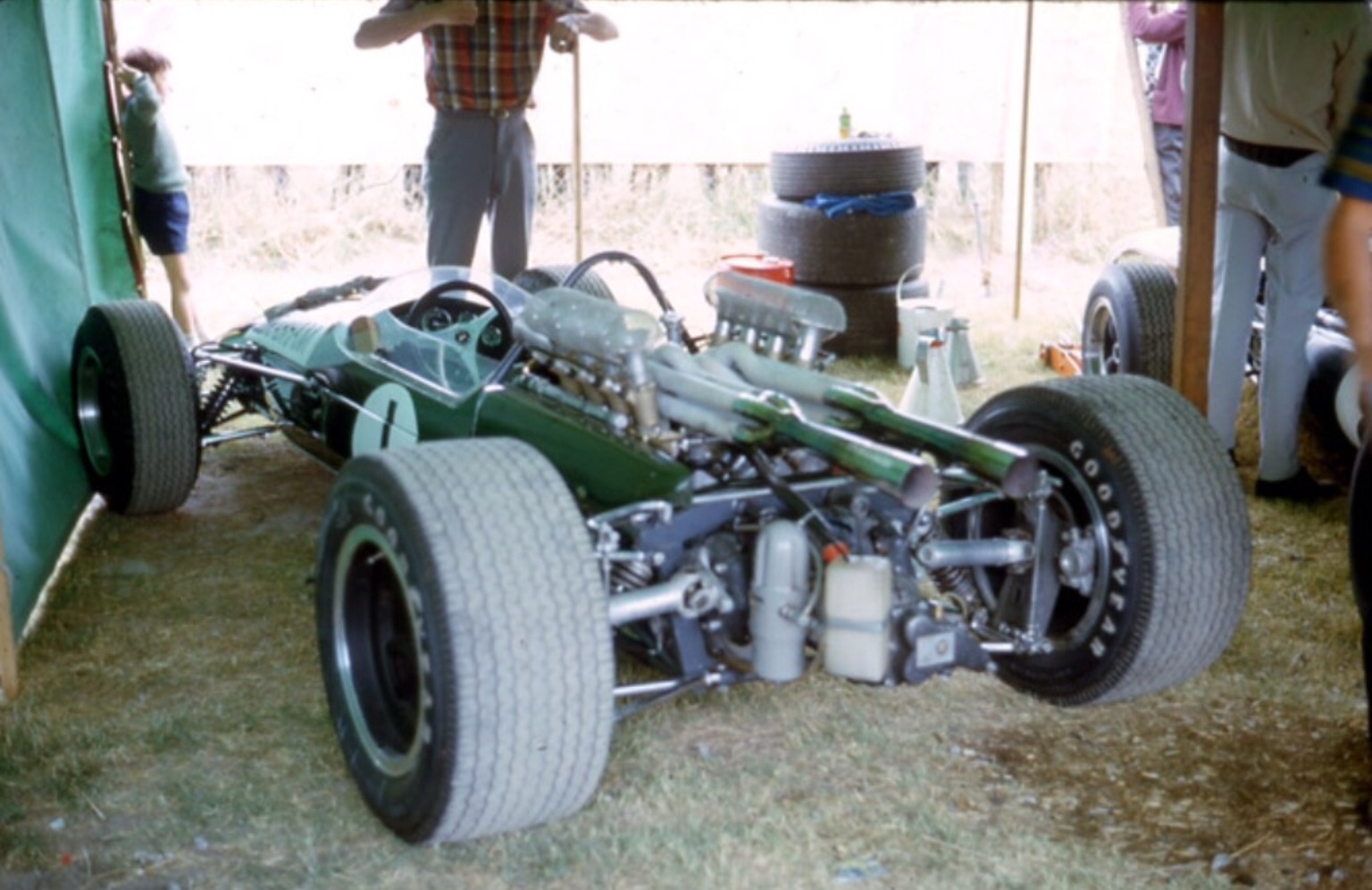
RBE 640 V8- the 1966 ‘600 Series’ Olds F85 block and new for 1967 ’40 Series’ exhaust between the Vee heads. Gearbox is a Hewland HD5 (M Feisst)
Brabham’s BT23A Repco awaits Jack and Roy, Billington.
Despite passing into David McKay’s Scuderia Veloce after Jack had finished with it, this car probably under-achieved really.
Greg Cusack and Phil West raced it for David, but by then the mantle of local aces had shifted from the retired Bib Stillwell to Spencer Martin, Kevin Bartlett and Leo Geoghegan. Put any of those fellas in BT23A at that time, and a championship could have been won assuming a measure of Repco 2.5 litre reliability, a quality not necessarily plentiful…
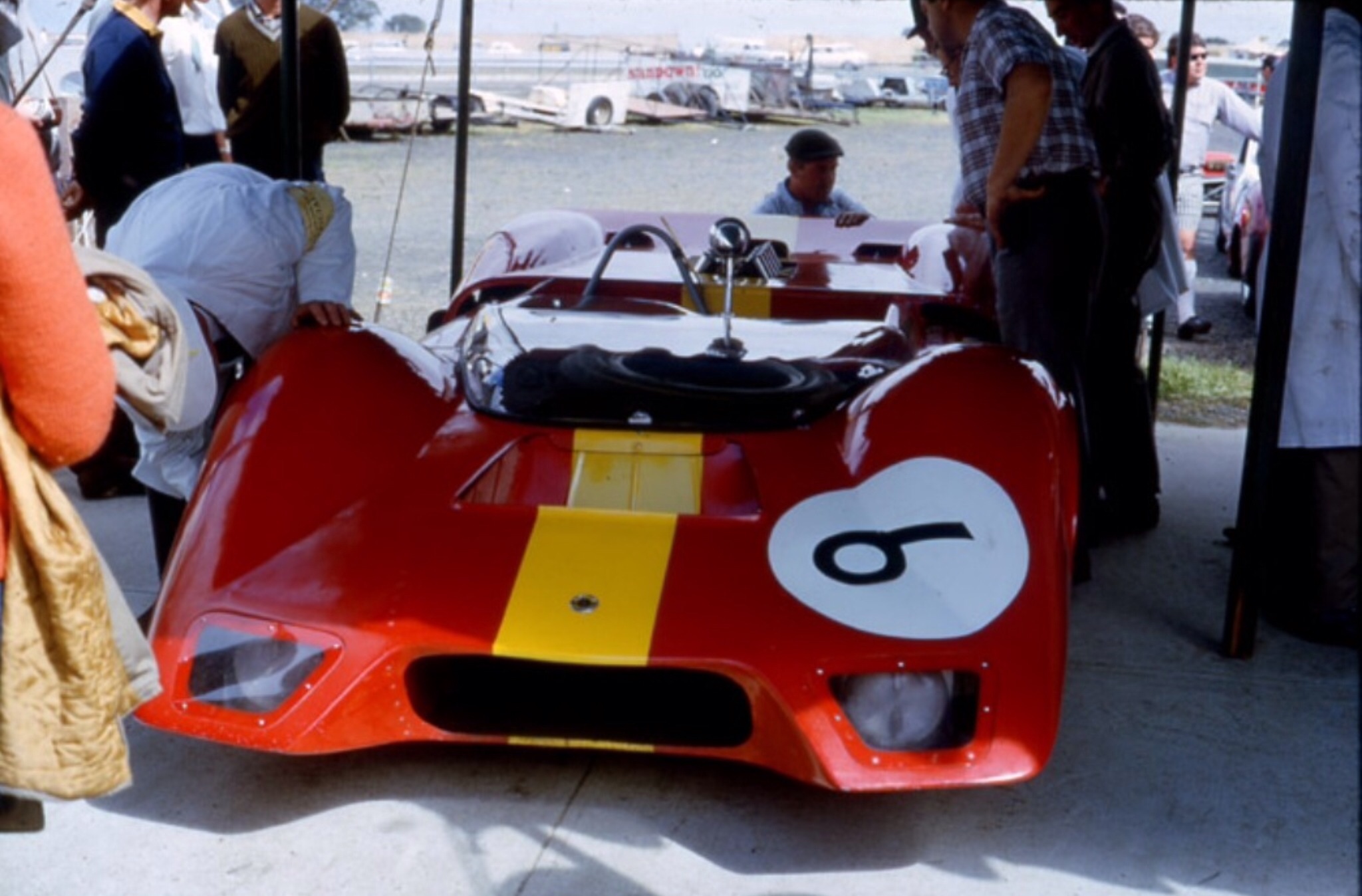
Bob Jane had only just taken delivery of his Elfin 400 Repco ‘620’ 4.4 litre V8 from Garrie Cooper and his merry band of Edwardstown artisans- the 1967 Tasman round support races were his first serious events in a car which had a rather chequered and tragic history, click here for the story; https://primotipo.com/2018/04/06/belle-of-the-ball/
(M Feisst)
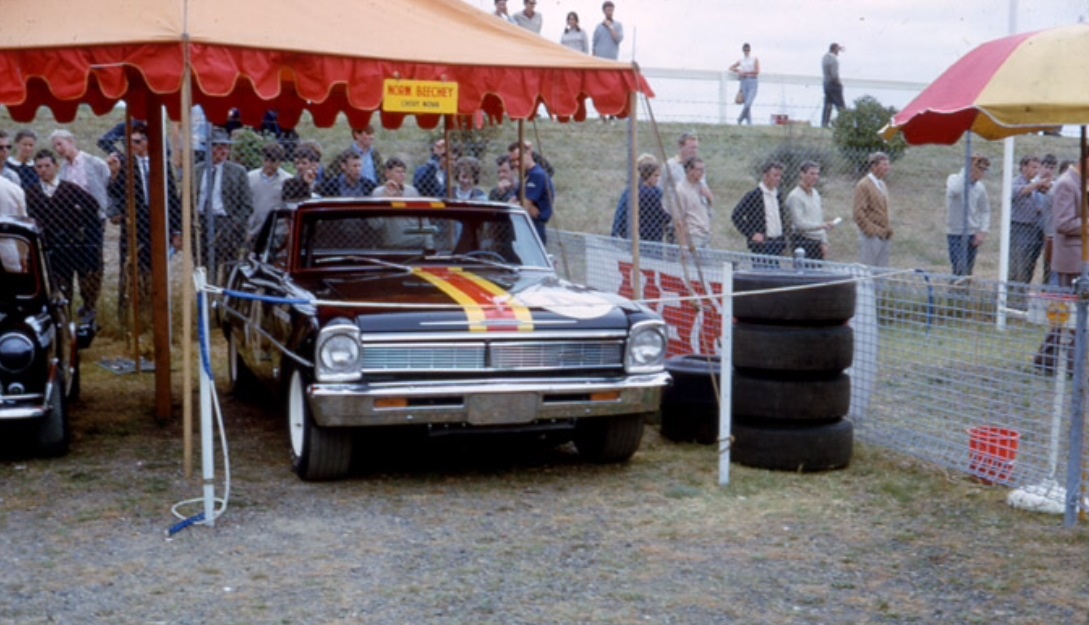
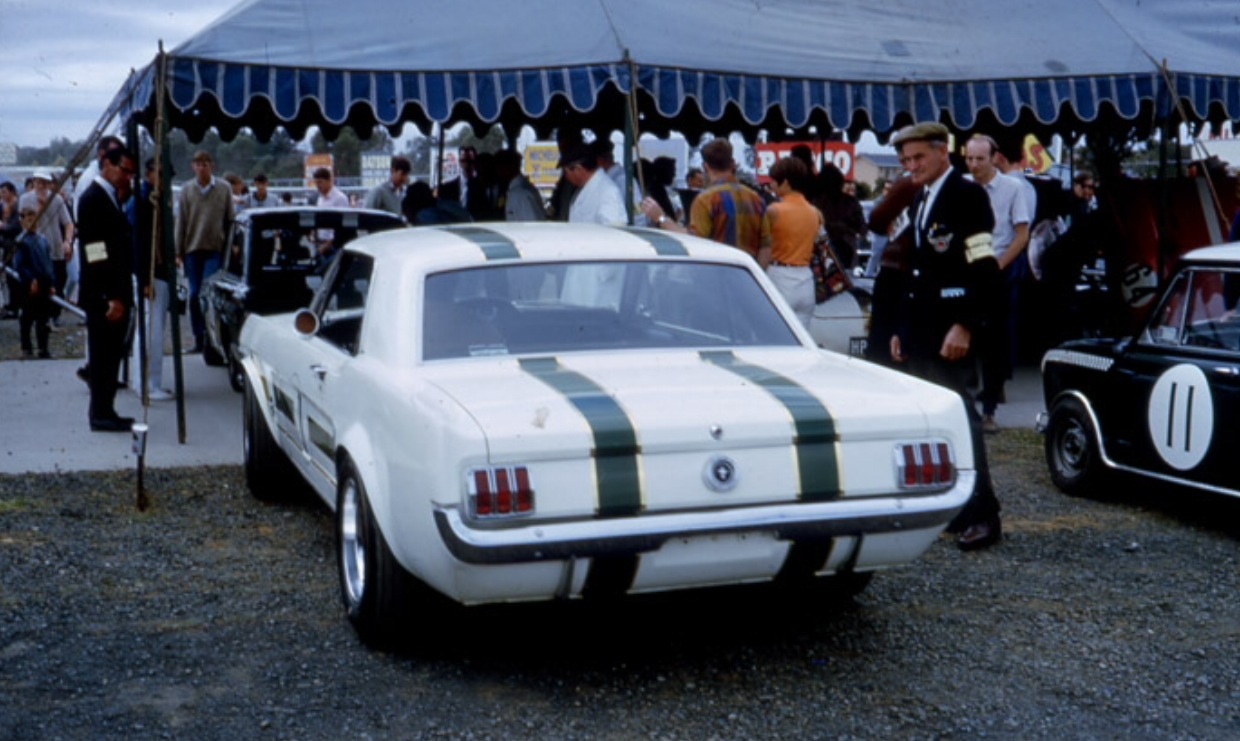
The Touring Car entry was ‘top shelf’ as well and led by crowd favourites from Melbourne, Norm Beechey above in his Chevy Nova and Sydney’s Pete Geoghegan below- the latter still racing the first of his two Mustangs. Who won the battles on that weekend, folks?
(M Feisst)
Pete’s ‘Stang is lining up for scrutineering. By the time I started racing a decade and a bit later, the concrete pad was still in the same spot, albeit there was a permanent roof providing the poor marshals with some necessary protection from the elements.
That paddock was ‘heaven on a stick’ from a spectator’s viewpoint- so much was compressed into a small space, but it was a pain in the tit as a competitor, it was as tight as a mackerel’s bum with a halfway decent entry list of cars. When things got too tight, we Formula Vees were banished to an area of our own on the outside of Shell Corner (turn 1), which made us all grumpy at the time! And yer could no longer easily see all the other goings on.
Leo Geoghegan bought the ex-works Lotus 39 Climax Jim Clark raced throughout the 1966 Tasman during the duration of the series, racing it during the 1967 Gold Star Series without much success due to recurring engine dramas.
Having said that, the car behaved itself rather well on this weekend as Leo finished second in the race to Clark, albeit he was 50 seconds back- this was the highest place finish by any local driver throughout the series.
It was not the last time Geoghegan gave the internationals a run for their money in this car either. Leo passed Frank Gardner in the latter stages of the race and was then lucky when Martin’s BT11A Brabham gifted Leo second with a half-shaft failure.
Frank Gardner was third in Alec Mildren’s Brabham BT16 Climax FPF- an F2 chassis with a big-beefy FPF popped into the frame, Chris Irwin was fourth in the other 2.1 litre BRM chassis ‘2616’, then Kevin Bartlett, in Mildren’s other car, the ex-Gardner Brabham BT11A Climax which KB drove so hard and well in 1966/7. Then came John Harvey, three laps adrift of KB in Ron Phillips’ Brabham BT14 F2 car powered by a big 1860 cc Lotus-Ford twin-cam.
Leo contested the 1967 Australian Tasman rounds with the Climax fitted and then gave the car ‘a birthday’- John Sheppard and the Geoghegan lads adapted the chassis to take a Repco ‘740’ 2.5 litre V8, this created one of the sexiest ever open-wheelers to race in Oz, whilst the car was uber fast, reliability remained an ongoing issue. The story of this machine is here: https://primotipo.com/2016/02/12/jim-clark-and-leo-geoghegans-lotus-39/
(M Feisst)
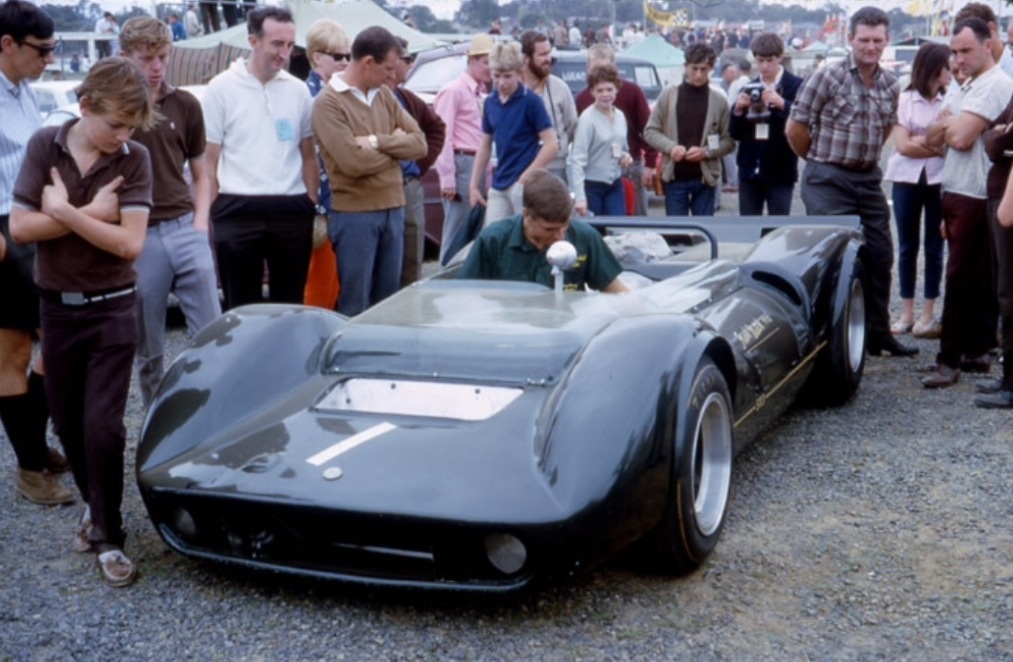
Peter Mabey eases himself out of Frank Matich’s brand-new and sinfully good-looking Matich SR3 Oldsmobile V8.
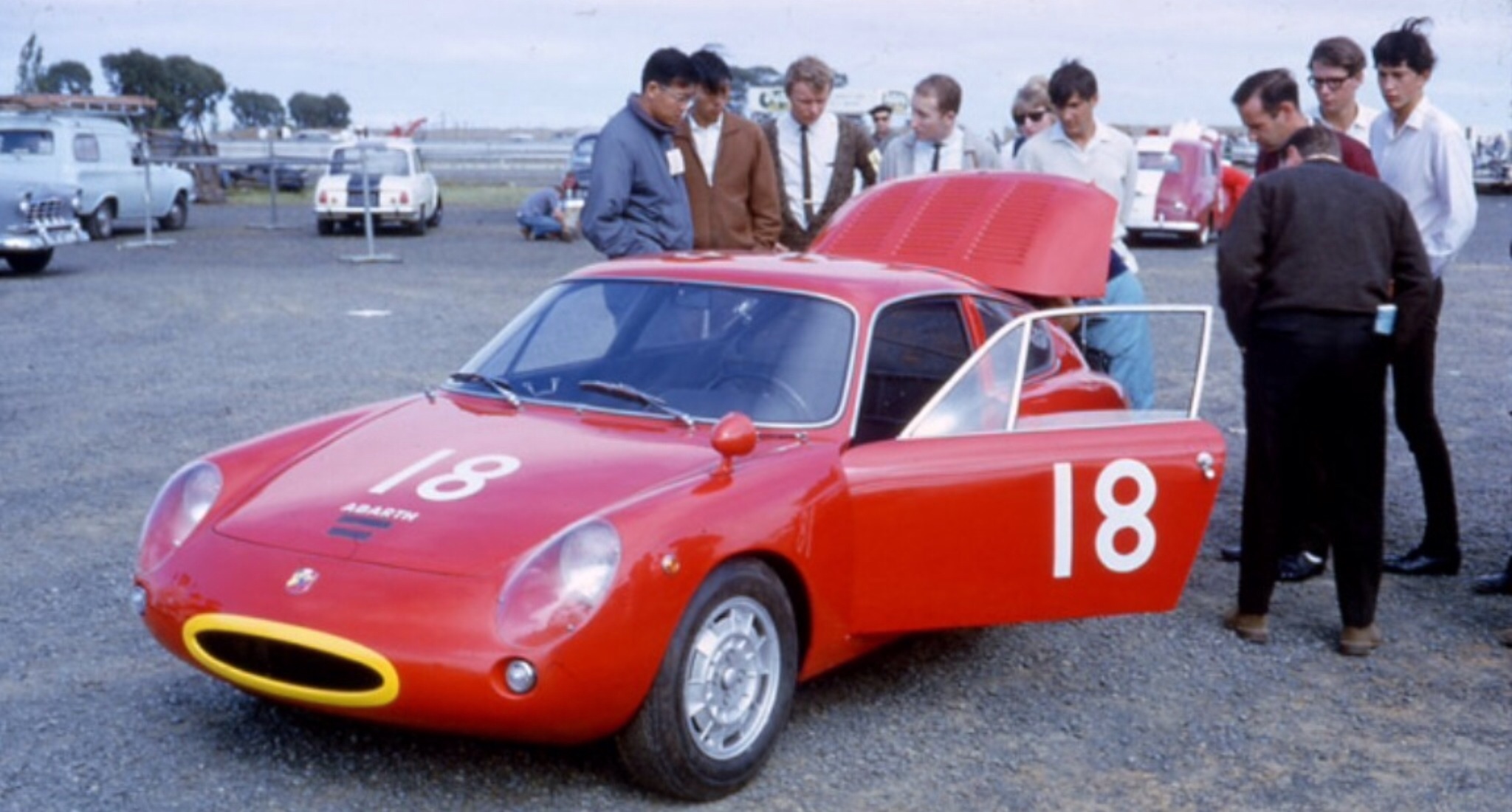
Gay Cesario brings a little bit of Italo-French style to the Sandown pits with his Abarth Simca 1300 GT.
The speedy Italian acquired the car in his native country and then drove it from one end of Italy to the other, both car and family migrating to Australia in the mid-sixties. Click here for the story: https://primotipo.com/2018/02/13/abarth-simca-1300-gt/
(M Feisst)
The two BRM P261’s of Stewart- ‘2614’, on the truck and Chris Irwin ‘2616’ on terra-firma. Nifty looking and aerodynamic full rear bodywork was atypical by then.
Engines of the cars are to different specifications; Jackie’s is fitted with an exhaust within the vee motor, and Irwin’s is the more classic cross-flow set-up, with the former ‘de-rigueur’ in F1 in 1967- Ferrari, Repco-Brabham, Honda and BRM produced engines of that specification. That Stewart’s car is fitted with the exhaust within the vee arrangement tends to suggest it was quicker at the time. Irwin’s car is about to be scrutineered.
One of the P261’s raced at the Phillip Island Historic Meeting not so many years ago, driven by Rob Fowler, I think- man what a car at bulk-revs singing its way down the main straight and into Southern Loop- and well driven. Personal bias hereby declared.
(M Feisst)
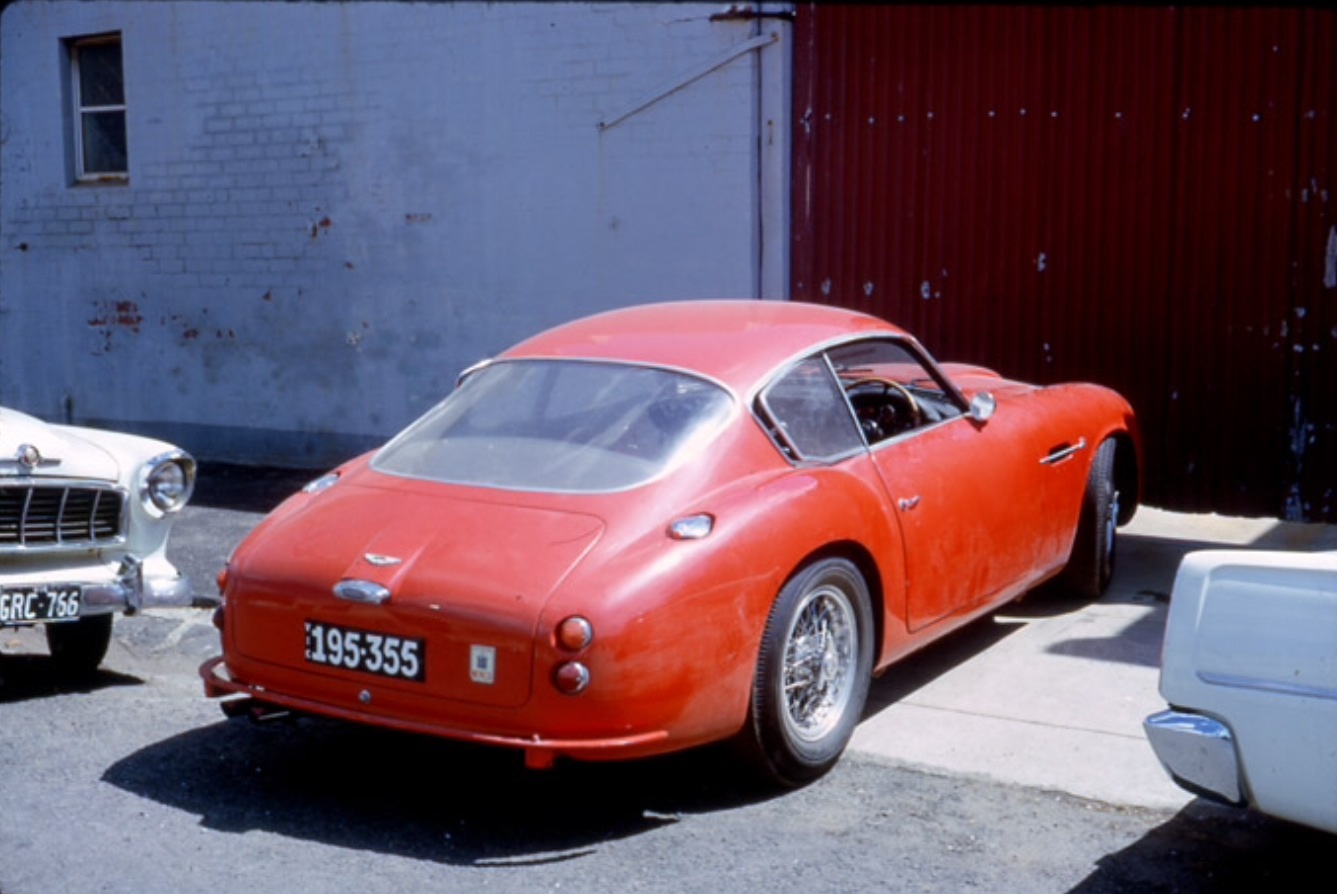
I suspect Mike Feisst had a ‘heads up’ as to the garages in Melbourne where some of the Tasman cars were being fettled over the weekend- for sure, this shot is not at Sandown Park.
The Aston DB4 GT Zagato has Victorian plates. I wonder which of the two (?) which came to Australia in period it is. It looks well used, which is rather nice. Laurie O’Neill had one, which Doug Whiteford and Pete Geoghegan gave a bit of a gallop, but wasn’t there another too? Intrigued to know which chassis this is and where the shot is taken. Check out this article on the cars: https://primotipo.com/2015/09/22/aston-martin-db4gt-zagato-2vev-lex-davison-and-bib-stillwell/
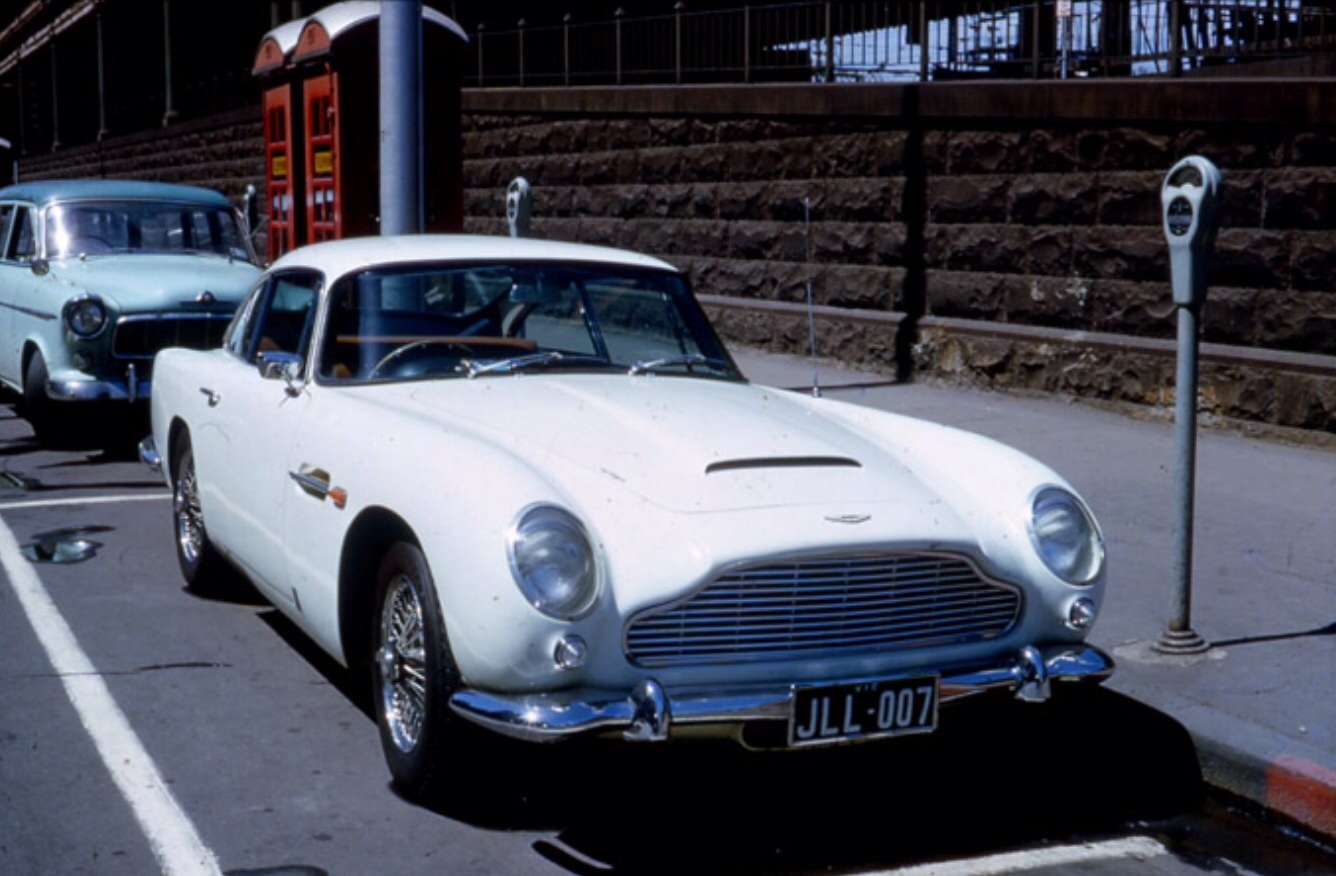
Flinders Street Station may be for the photograph below, in Flinders Street itself, down towards the ‘Banana Alley’ vaults?
The Holden FC aft of the Aston DB4 GT provides valuable context- I reckon you’ve always got to see the exotica of the period juxtaposed with the transport we plebians used at the same time to see just how marvellous they were. My mum’s new Morrie 1100 was plated JEN-108 in 1965, so I’m thinking this Aston is perhaps a 1966 drop, James Bond plate duly noted?
(M Feisst)(M Feisst)
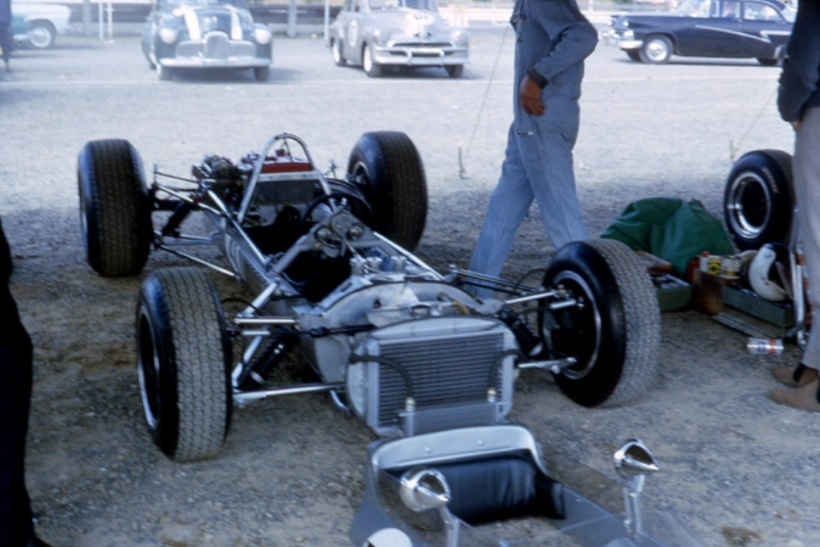
There was a bit of chatter online about this chassis being Graeme Lawrence’s McLaren M4A Ford FVA, but I reckon Mike Feisst’s photo is also at Sandown and the car is an Elfin Mono, an outboard suspension second series car.
Two such were entered in the Sandown Park Cup by Ian Cook (7th) and Jack Hunnam (DNF), with Hunnam’s Mk2D the most likely choice I think. Having said that, my friend, and Mono racer/restorer James Lambert will correct me if I have goofed! The engine is a 1.5-litre Lotus-Ford twin-cam; these very quick machines ran in the ANF1.5 category, effectively Australia’s F2 at the time.
(M Feisst)
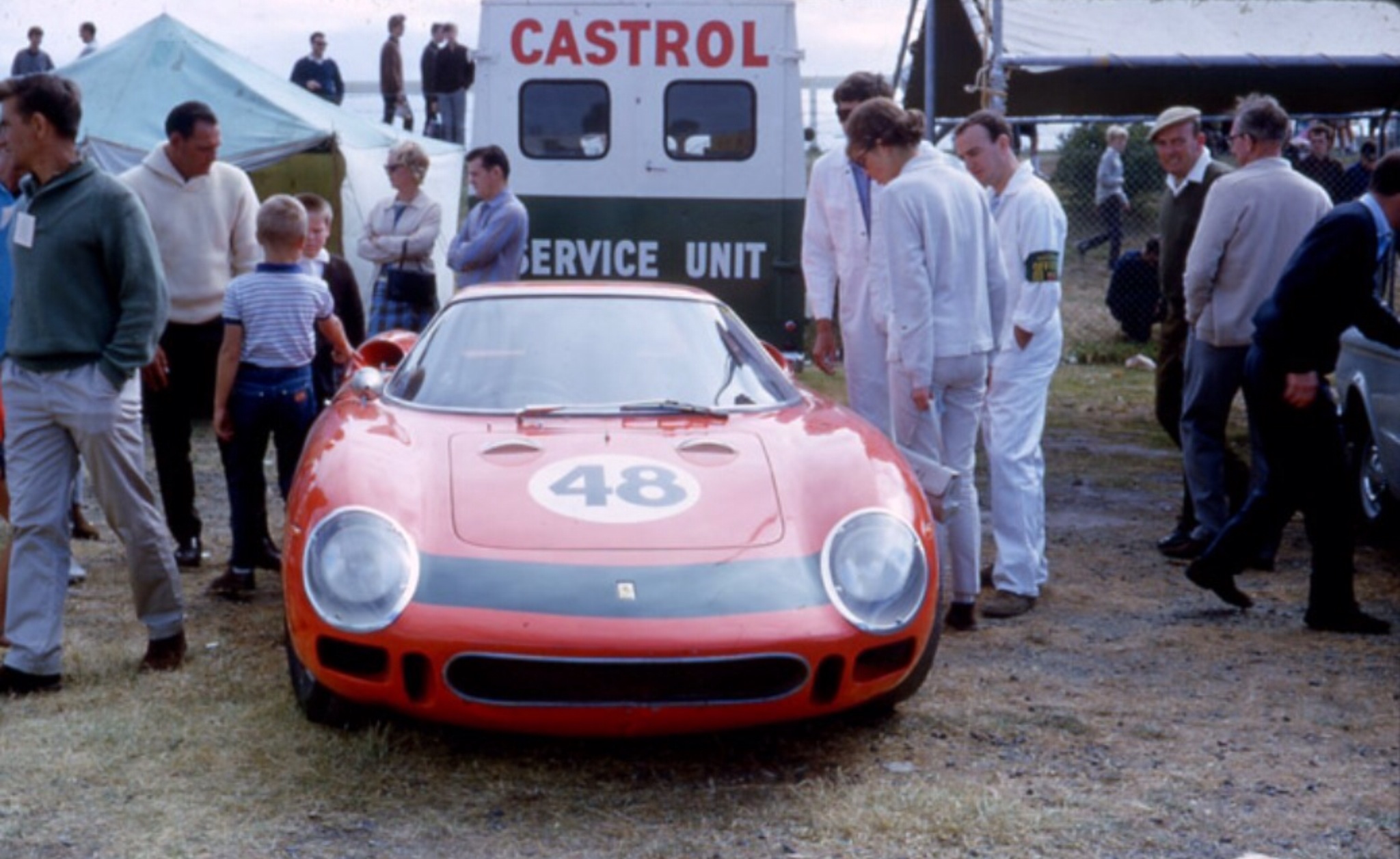
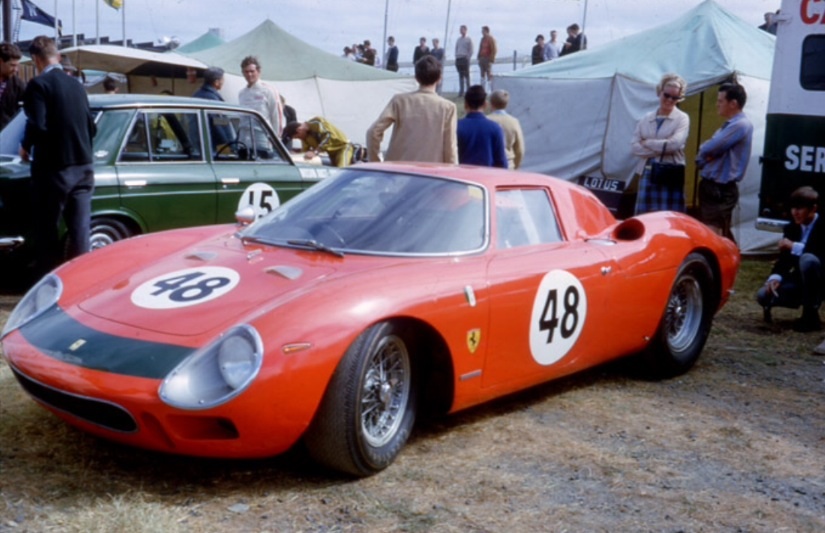
Motor Racing Royalty in Australia in the mid-sixties was David McKay’s Scuderia Veloce Ferrari 250LM.
It was always, even in 1965 when it first arrived new from Maranello, a bit heavy to beat the sprinters, but the car won three Surfers Paradise Enduros on the trot and was steered by some great drivers, including McKay himself, Jackie Stewart, Spencer Martin and the brothers Geoghegan.
(M Feisst)
I’ve written about this wonderful machine, now owned by Ralph Lauren (what a waste of a RACING car) at length too;
I think Kiwi Andy Buchnan was racing, and owned the car at this stage in 1967?
(M Feisst)
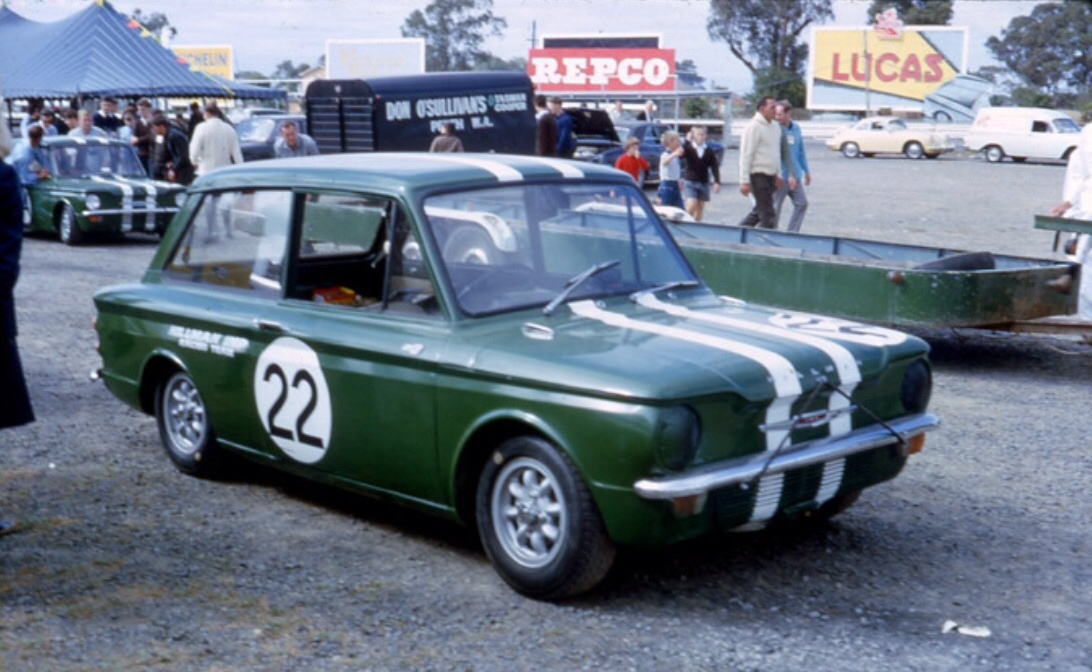
Hillman had a great reputation in Australia at the time the ‘Grunter’ was popular, aided and abetted by its 1968 London-Sydney Marathon win. The ‘Coventry Climax’ engine inspired Imp I always thought was a thinking man’s alternative to the Mini, as ubiquitous in Australia as anywhere else on the planet.
The ‘works’ Improved Production Imps were raced (and built?) by Melbourne’s Graham ‘Tubby’ Ritter and youthful man-about-town Peter Janson. Norm Beechey had an occasional steer of these things as well- on this weekend the cars were raced by Ritter and Bruce Hindhaugh in car #22- the latter of Gown-Hindhaugh Engines in Elgar Road, Box Hill.
(M Feisst)
Alec Mildren added the team’s second Alfa Romeo GTA to the trailer of cars sent from Sydney to Melbourne- both Kevin Bartlett and Gardner raced the car with FG twiddling the wheel that weekend.
No doubt those wheels are very light, but there is something very ‘povvo’ about that aspect of a Porsche 906, at least visually?
Alan Hamilton would have been outgunned that weekend aboard the first of his 906s with the Matich, Jane and Niel Allen (Elfin 400 Olds) big vee-eights present, but this car always punched above its weight and was driven exceedingly well by the gifted son of Porsche importer Norman Hamilton. Click here for a feature on Hamilton and his cars.
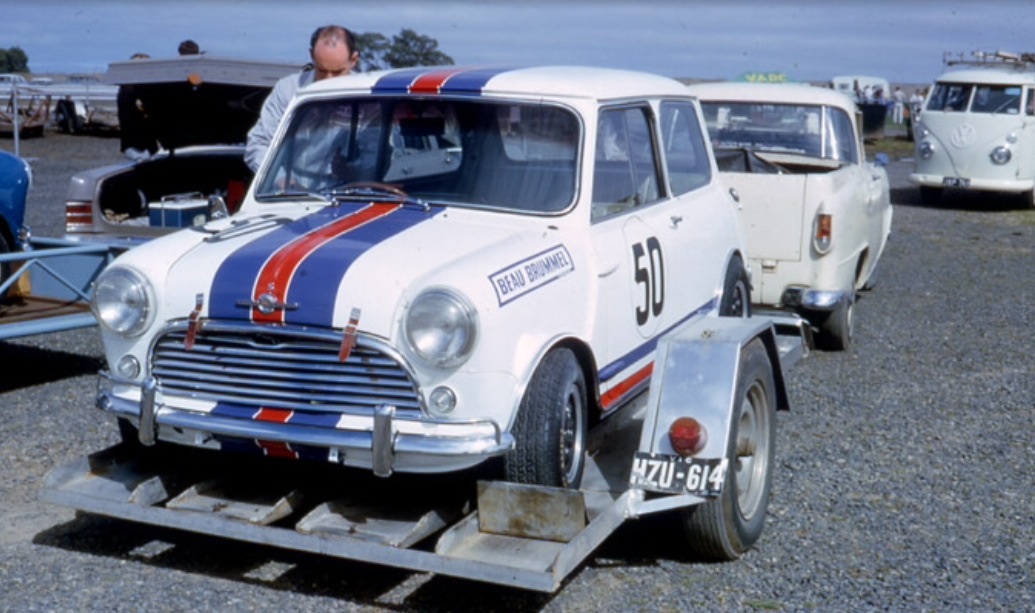
The Morris Cooper S was a mainstay of Touring Car Racing globally at the time of course, not least in Australia where Mini Kings included Peter Manton and Brian Foley- others who spring to mind include Don Holland and John Leffler- Leffo starting a career in the BMC products which all the way through to winning a Gold Star, the Australian Drivers Championship in an F5000 Lola T400 Chev in 1977.
This car is Jim Smith’s- later the owner/racer of the crowd pleasing, ex-works Rover 3500 Repco Holden V8.
(M Feisst)
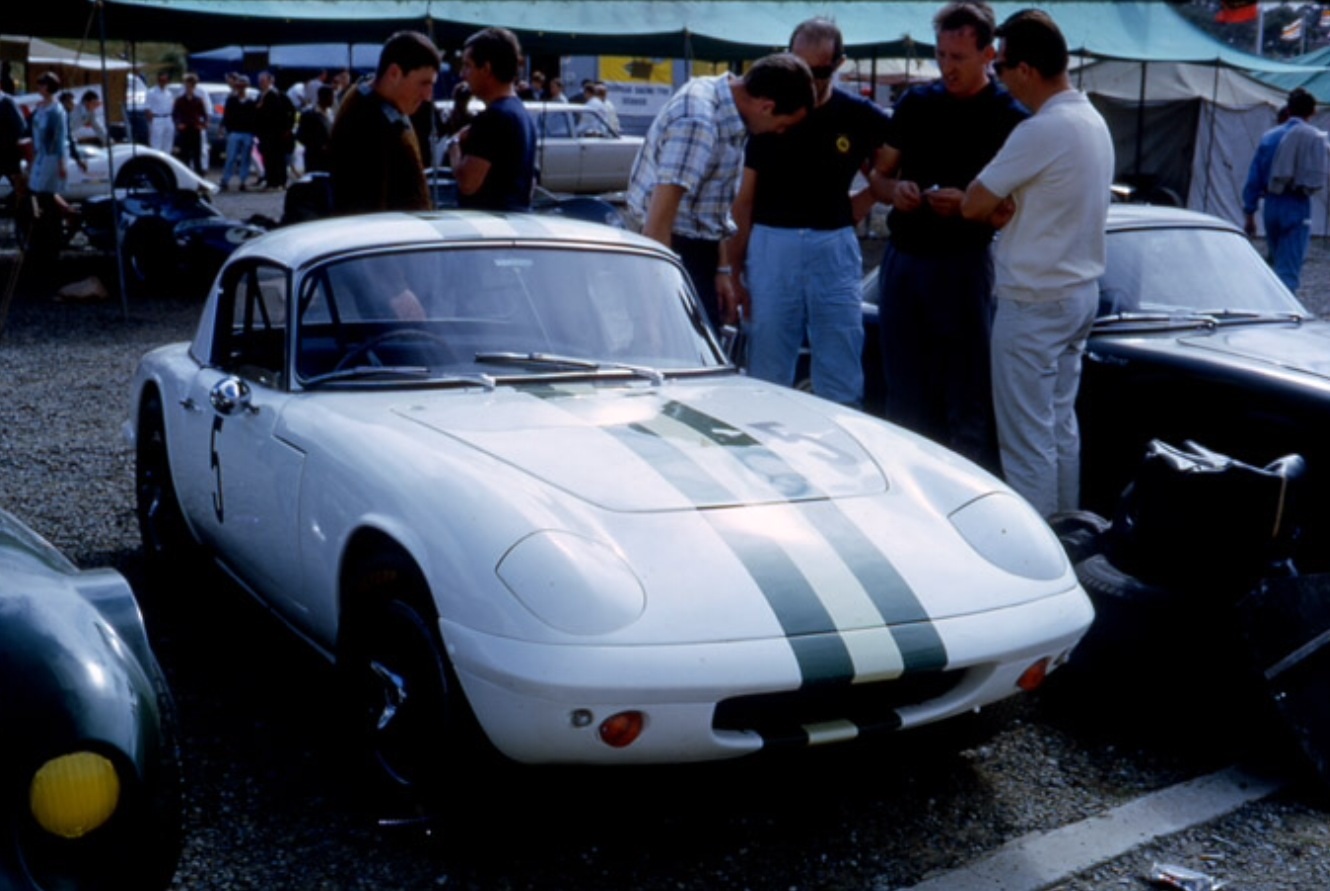
Seeing Peter Woodwards’s ex-Leo Geoghegan/Niel Allen Lotus 26R reminds me I’ve written a track test of me mate David Mottram’s Lotus Elite Super 95, I must pop it up.
Whilst most folks wax lyrical about the Elite as one of the best-looking cars ever, I agree; for me, the slightly more butch Elan 26R is a contender, albeit not strictly a road car of course. See this short article about the car here: https://primotipo.com/2018/04/15/perk-and-pert/
Peter Woodward later won the Australian Sportscar Championship in the one-off Elfin 350 Coventry Climax FPF. He ‘nicked’ the championship in 1970, taking points in two of the three rounds from Frank Matich, who did not race the awesome SR4 all season, and Niel Allen in the 5-litre Chev F5000-engined Elfin ME5.
What became of this 26R after Peter Woodward finished with it?- to John Fraser in Queensland, but perhaps some of you can fill in the gaps. Is the car still in Australia?
Credits…
Paul Newbold, Mike Feisst on The Roaring Season, Frank Nachtigal, oldracingcars.com, sergent.com, Terry Sullivan, Dale Harvey, Rob Bartholomaeus
Tailpiece: All Eyes on Australia’s Finest…
Which is as it should be, of course!
Jack steers BT23A-1 through the gravel Sandown paddock towards the grassy Esso compound only a few more steps away. He wore that gold ‘Buco’ (i think) helmet a lot in 1967! It may be summer in Australia, but by the look of the adoring kiddos it’s a chilly Melbourne day.
Photos of this place bring back many happy memories of roaming the Sandown paddock just like these youngsters, although I was never as nicely dressed as the brothers in yellow and wearing a tie!
Frank Gardner using all of his Mildren Alfa’s 310bhp chasing Jochen Rindt’s Lotus 49 ‘Warwick Farm International’ pole time, 8 February 1969…
Alfa’s Tipo 33 V8 sportscar engine was first used in elite single seater racing by Australia’s Alec Mildren Racing- a step on its way to F1 competition by the Arese marque.
Mildren, a Sydney Alfa Dealer, former Australian Gold Star Champion and Australian Grand Prix winner had one of the most professional teams in Australia. He had impeccable Alfa Romeo/Autodelta connections having acquired and raced two GTA’s and a TZ2 in the early to mid sixties, and in the process ‘polished’ Alfa’s Australian brand, one of the greatest of the ‘Grand Marques’ which was then relatively new to the ‘Oz market.
Click on these links to articles about Alec Mildren and the Mildren Racing Autodelta Alfa’s;
Mildren’s 2.5 litre Coventry Climax FPF engined Tasman Brabham BT11A/BT16 being raced by Gardner on his annual trips home from Europe was being ‘flogged’ by the Repco Brabham, BRM and Coventry Climax V8’s in 1966/7, so he sought an appropriate response- a sprint variant of the Tipo 33 engine was the obvious choice given his Alfa connections and local marketing needs.
What a beautifully integrated bit of kit the Mildren Brabham BT23D Alfa was? Here just before it progressively grew wings. Kevin Bartlett drove the wheels off the thing, here at Hell Corner Bathurst during the ’68 Easter Gold Star round. KB was on pole by 9! seconds but DNF with a broken rear upright, Phil West took the win in the Brabham BT23A Repco. Bartlett won the ’68 Gold Star in this car and was equal 9th in the ’69 Tasman (Dick Simpson)
Mildren ordered eventaully three 2.5 litre Tipo 33 V8 engines which were initially fitted to a bespoke Brabham BT23D…
The car arrived in Australia in time for the final round of the domestic Gold Star Championship- the Hordern Trophy at Warwick Farm in 1967- FG won upon the cars race debut. He then contested the 1968 Tasman.
The motors were then installed 12 months later into the Mildren ‘Yellow Submarine’, a monocoque car designed by Len Bailey and built for the team by Alan Mann Racing for the 1969 Tasman Series.
Both cars were raced by Frank Gardner in the Tasman Series and then ‘handed over’ to Kevin Bartlett for the Gold Star Championship, when Gardner returned to the UK at the end of each Australasian summer.
Bartlett won the Gold Star in 1968 and 1969 with each chassis respectively- BT23D and ‘The Sub’ respectively.
In 1969 the ‘Sub’ was also powered by Merv Waggotts’s 2 litre ‘TC4V’ 4-cylinder, DOHC, 4 valve, Lucas injected 275 bhp engine for part of the season.
(Ian Peak/The Roaring Season)
Above is a beautiful photograph of the 2.5 litre, 2 valve, 4 cam, fuel injected, 2 plug Alfa Tipo 33 V8 installed in Alec Mildren’s Gardner driven Brabham BT23D at Teretonga during the 1968 Tasman.
Gardner was equal fourth with Graham Hill in the series behind Jim Clark, Chris Amon and Piers Courage in Lotus 49, Ferrari Dino 246T and McLaren M4A Ford FVA respectively.
Kevin Bartlett had this to say about the Alfa Romeo 2.5 litre Tasman V8 and Waggott DOHC 4 valve engine, both of which powered the Mildren ‘Yellow Submarine’…
‘My memory tells me the Alfa had around 350lbs (of torque) and the Waggott about 230lbs. The useable power range was quite different with the Alfa workable between 4500-8800 rpm and the Waggott 6800-8750rpm. Not perfectly accurate as i work from memory but around that kind of difference’.
‘The driving difference was the main change, as the power to weight felt little different behind the wheel, mainly due i suppose to the fact full throttle was used much sooner with the 4 cyl 2000cc Waggott.’
Kevin Bartlett won the Macau Grand Prix in 1969 in the Mildren Alfa ‘Sub’, here in the paddock. What a handsome bit of kit the car was and still is- restored by Lionel Ayers a decade ago to Waggott engined spec and retained by his family (Natalino Couto)
‘The turn in changed to a marked degree with the lighter power plant (Waggott) having less moment of inertia allowing the car to be literally flung into a turn. As it happens i am the only driver to experience both configurations. Frank Gardner having raced only the Alfa Romeo engined variant of each car’.
‘Len Bailey was the (Mildren’s) designer of the tub which flexed a little at the rear with the Alfa’s torque, less so when the Waggott went in, with suspension being a (Brabham designer) Ron Tauranac adaption’.
Mildren’s Glenn Abbey fettling the ‘Sub’ in the Singapore GP paddock , 1970 (Eli Solomon)
Alfa Romeo claimed 315bhp at 8800 rpm for the 2.5 litre variant of the engine. A similar 3 litre, four valve per cylinder, 32 valve engine (the Mildren V8’s were all chain driven two-valvers) was developed for Cooper in F1 but wasn’t used before the teams demise.
The F1 Alfa Romeo 3 litre V8…
Was an all aluminium unit with a bore/stroke of 86mm X 64.4mm for a total of 2998cc. Five main and camshaft bearings were used, the four camshafts driven by chains.
Andrea de Adamich, McLaren M14D Alfa Romeo during 1970 (unattributed)
The valves were inclined at 30 degrees, the inlets were 32mm and exhausts 27mm in size, Alfa Romeo/Autodelta claimed an output of 400bhp @ 9000rpm in sportscar form. Modified with gear driven camshafts for F1 use, Autodelta claimed 430bhp @ 10,500 rpm at a time the 3 litre F1 competition- Ford Cosworth DFV gave circa 440, the Matra V12 445-450 and Flat-12 Ferrari 460bhp @ 12,000 rpm.
It was not enough really, not without impeccable reliability, but Alfa had put their toes back in F1 waters with McLaren in 1970 and then March in 1971- and would return with Brabham in the mid-seventies, as they had started with Mildren’s Brabham BT23D a decade before.
Etcetera…
Another photo of the Tipo 33 V8 in the spaceframe BT23D- FT200 gearbox clear as are the four coils and two distributors for all those plugs- 2 per cylinder. Car had a chequered history but still exists happily in restored form in Australia (Ian Peak)
Frank Gardner in the BT23D during the 1968 Warwick Farm Tasman round- very soggy outfield that year, this is in The Esses before Shell Bridge (oldracephotos.com/DSimpson)
Just to show the ‘Sub’ was yellow! Bartlett the cover boy of this terrific seasonal publication of the 1969 Australian Racing Season. Here the car is in 2 litre Waggott spec
Bartlett all ready to go- BT23D with Alec Mildren at right
Bibliography…
Kevin Bartlett, Doug Nye ‘History of The GP Car’
Photo Credits…
Dick Simpson, Rod MacKenzie, Ian Peak Collection/The Roaring Season, Eli Solomon, Natalino Couto, oldracephotos.com/Dick Simpson
Tailpiece: Rod’s initial Frank Gardner ‘Yellow Sub’ photo at the articles outset, uncropped…
Will I for a gallop along the track? Nah, I’ll hang here it’s more peaceful…
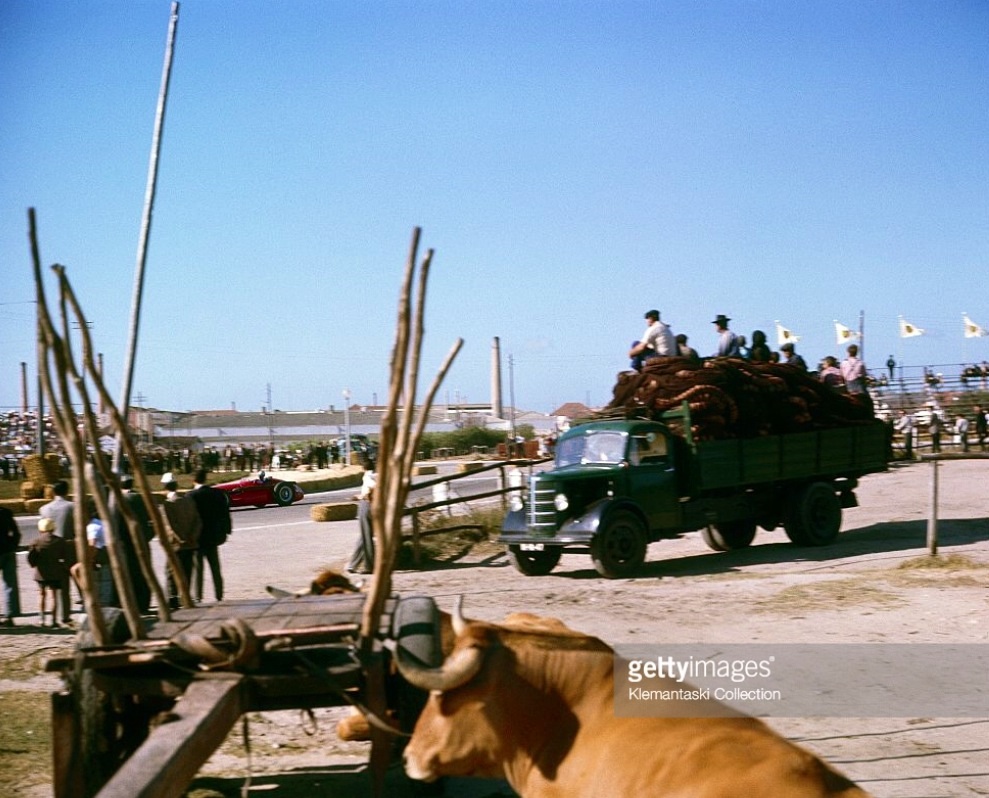
Maserati 250F going past but can’t figure whose, the number on the tail appears to have a 3-prefix but no such car was entered. Any ideas? Moss won the race from Mike Hawthorn and Phil Hill- Vanwall VW57 from Ferrari Dino 246 times two.
I wrote an article about this 1958 Moroccan GP meeting a while back, click here to read it;
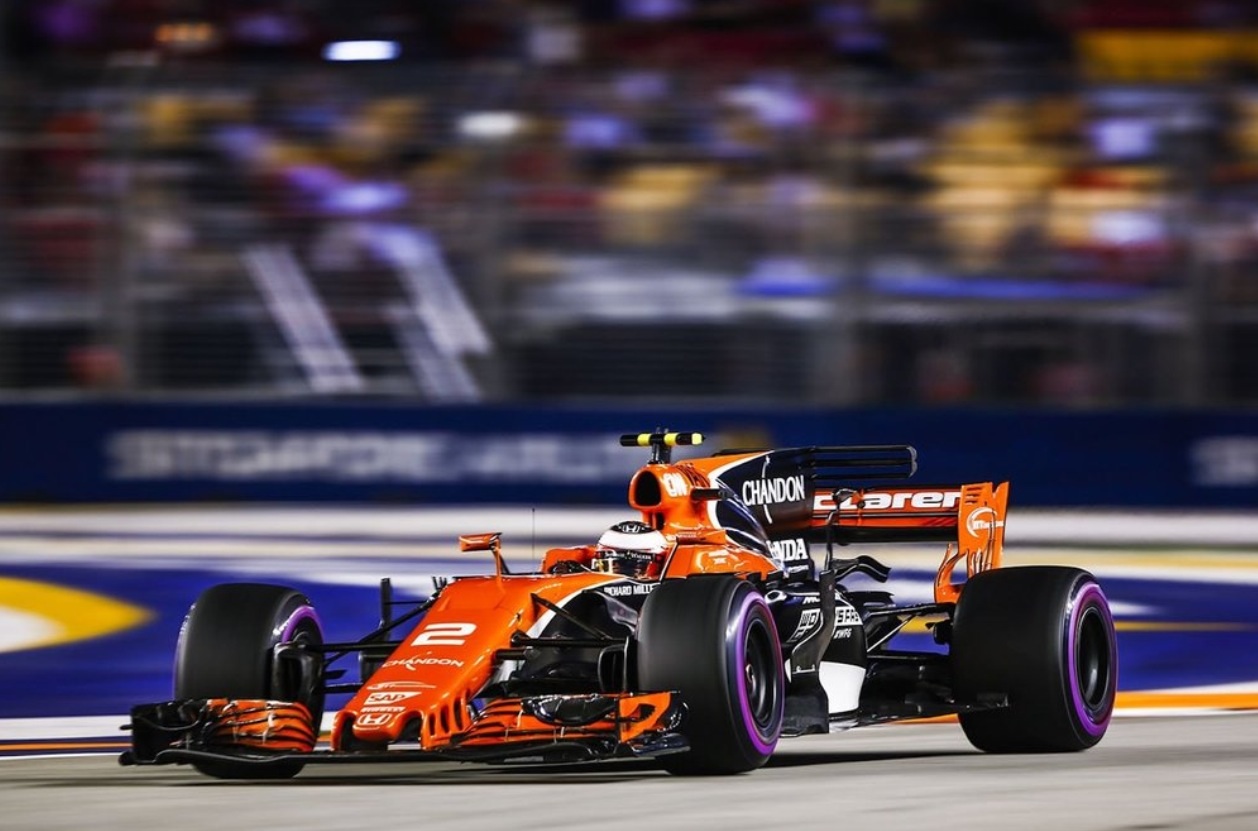
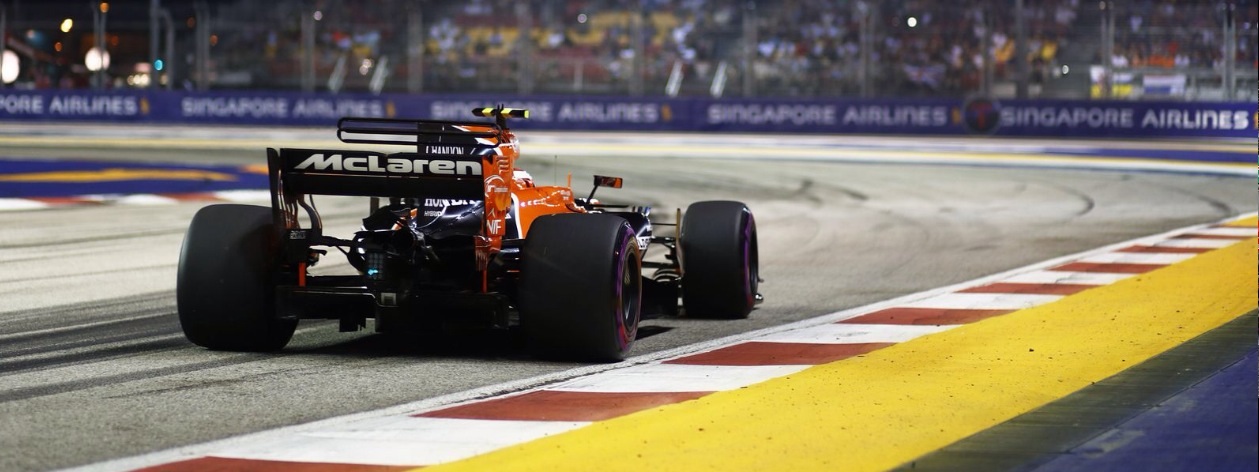
Stoffel Vandoorne, 7th, McLaren MCL32 Honda, Singapore GP 2017 (salracing.com)
‘There is no point rueing the good ole days!, you just sound like a silly old tugger!’ my youngest son observed of his father with all the respect typical of the ‘friggin millennials…
He is right of course. Every era of motor racing is interesting, the challenge is to keep up. But I must say, as a humanities graduate, the physics of kinetic recovery systems and the like is simply beyond the conceptual capacity of my noggin. No way can I write about it as I simply don’t geddit.
During the same research session that i was reading about McLaren’s use of 3D-Printing (announced April 2017) to more quickly design and deploy components on their cars- hydraulic line bracket, rear wing flap, radio harness boot and carbon fibre brake ducts to be specific, i also found some photos of those designer/builders Messrs Brabham, Gurney and Surtees.
I smiled to myself at the thought of those inveterate fettlers, fiddlers and finessers of racing cars and the manner and pace at which they would have used the tools of today.
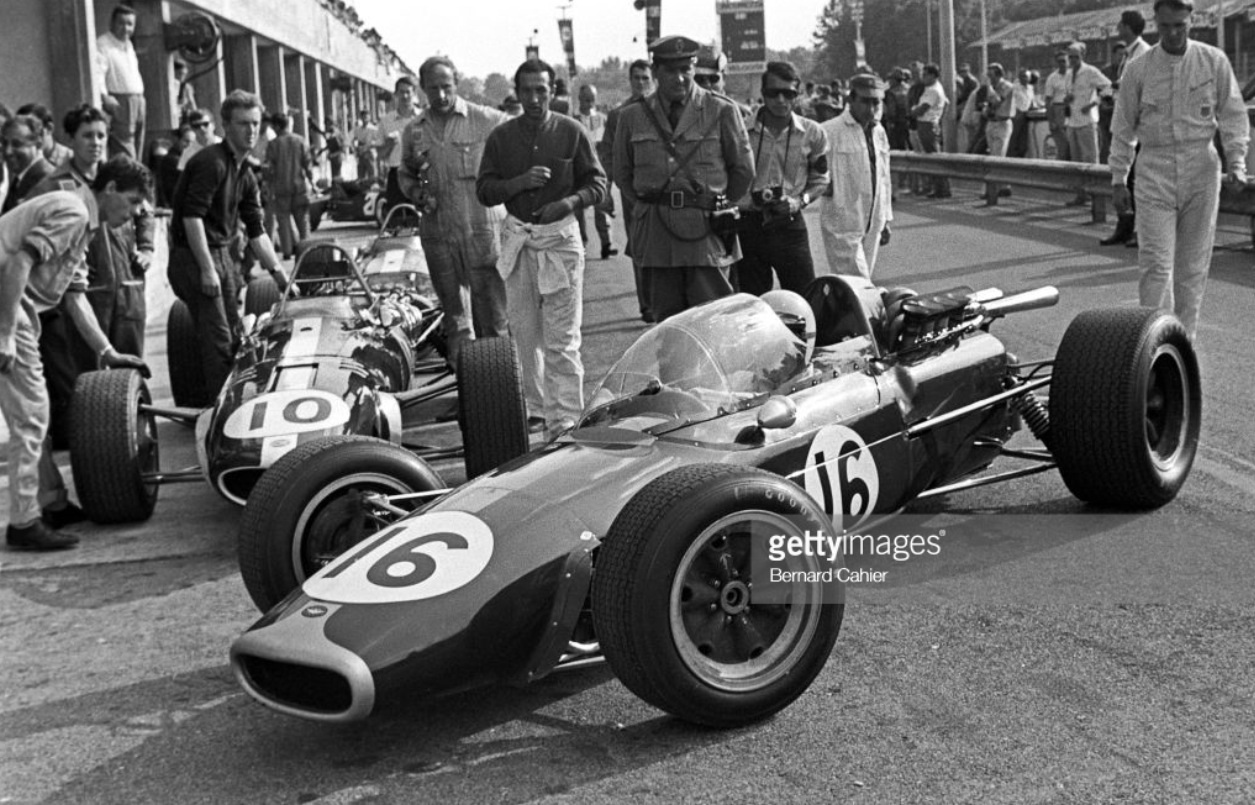
Its Dan Gurney bearing down on Jack who is just pulling his Brabham BT24 Repco up in the 1967 Monza pitlane having tried the ‘cockpit streamliner’ he and Ron Tauranac concocted to squeeze a few more top speed revs out of the reliable- but not as powerful as the new-fangled Ford Cosworth DFV V8 in the hands of Clark and Hill, Repco SOHC ‘740 Series’ V8.
Dan is anxious to know the response of his mate and former employer, his own F1 experiment is about halfway through its life at this point. The Gurney-Weslake V12 engined variant of Len Terry’s Eagle Mk1 design (#10 in the pitlane- the car behind Dan’s is the Eagle raced by Ludovico Scarfiotti) made its debut at this very race meeting twelve months before.
‘Black Jack’- he of the permanent 5 o’clock shadow, would have driven Tauranac bonkers with the 3D technology and his ideas- imagine what Colin Chapman, always a man of the future and of overnight tweaks would have done with it!
(oldracingcars.com)
Meanwhile at Warwick Farm John Surtees is looking for a way to get a few tenths out of his Surtees TS8 Chevy F5000 car during practice for the 1971 Australian Grand Prix at Warwick Farm.
One of the reasons Alan Jones left Surtees was just how painful ‘Big John’ was with car adjustments he ‘knew would not make the car quicker’ observed Jones of Surtees attitude on Jones requested TS19 chassis changes- despite Surtees ‘pottering around 2 seconds off the pace’ whilst forming his views.
The beauty of the 3D production process is the cost-effective manner in which (some) ideas can be tried, something all three of the impecunious owner/engineer/drivers mentioned would have approved.
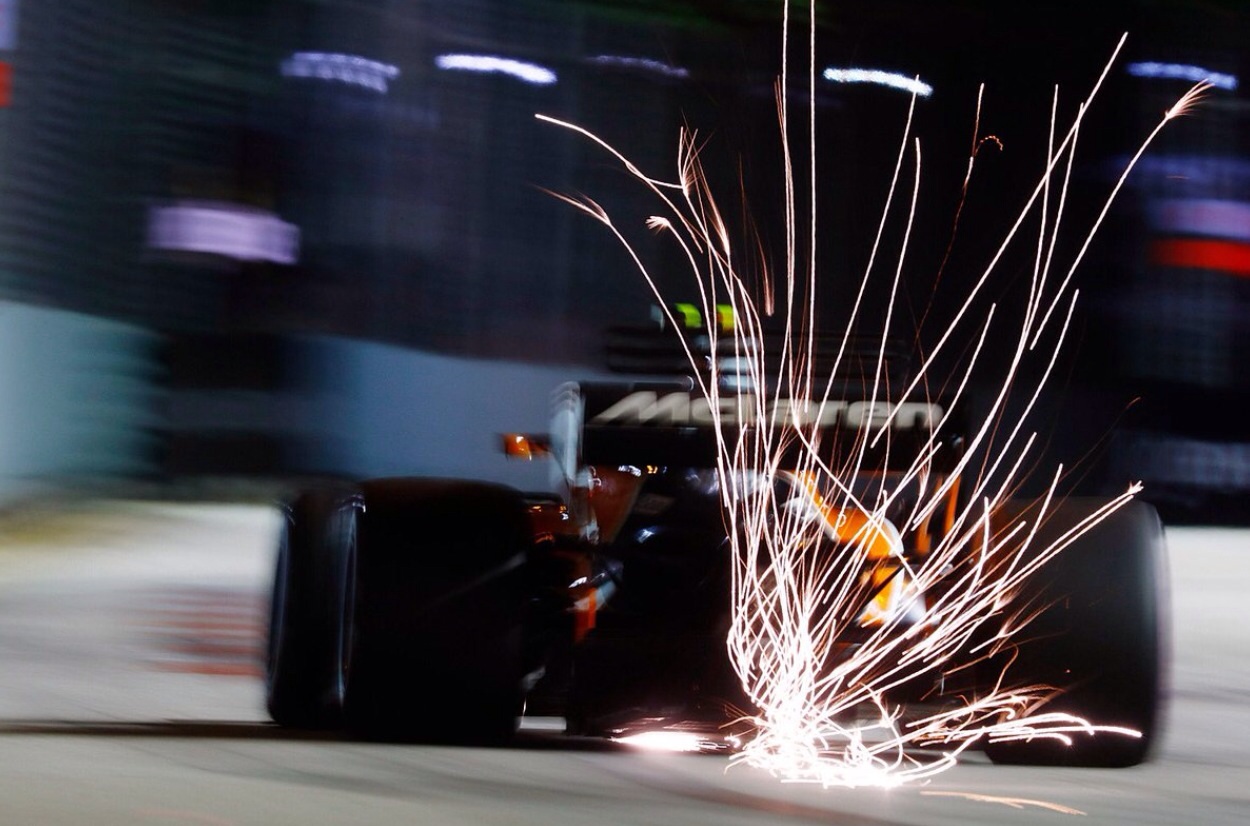
2017 Singapore GP, Vandoorne, McLaren MPL32 Honda. Lewis Hamilton the winner in a Mercedes F1 W08 (McLaren)
There is no reason why engineer/drivers are not in F1 now, either in a formally qualified manner or via the ‘school of hard knocks’ but so far no-one has challenged an article i wrote a while back which anointed Larry Perkins as the last of the engineer/mechanic/racers at F1 level?
The truth is that we misty-eyed enthusiasts do look back with fondness at the racing we savoured to watch or contest in our youth, whereas the pro-elite level fellas never cast a glance to the rear but only forward to find the next means to win…
Credits…
salracing.com, oldracingcars.com, Bernard Cahier, thisisf1racing.com, McLaren
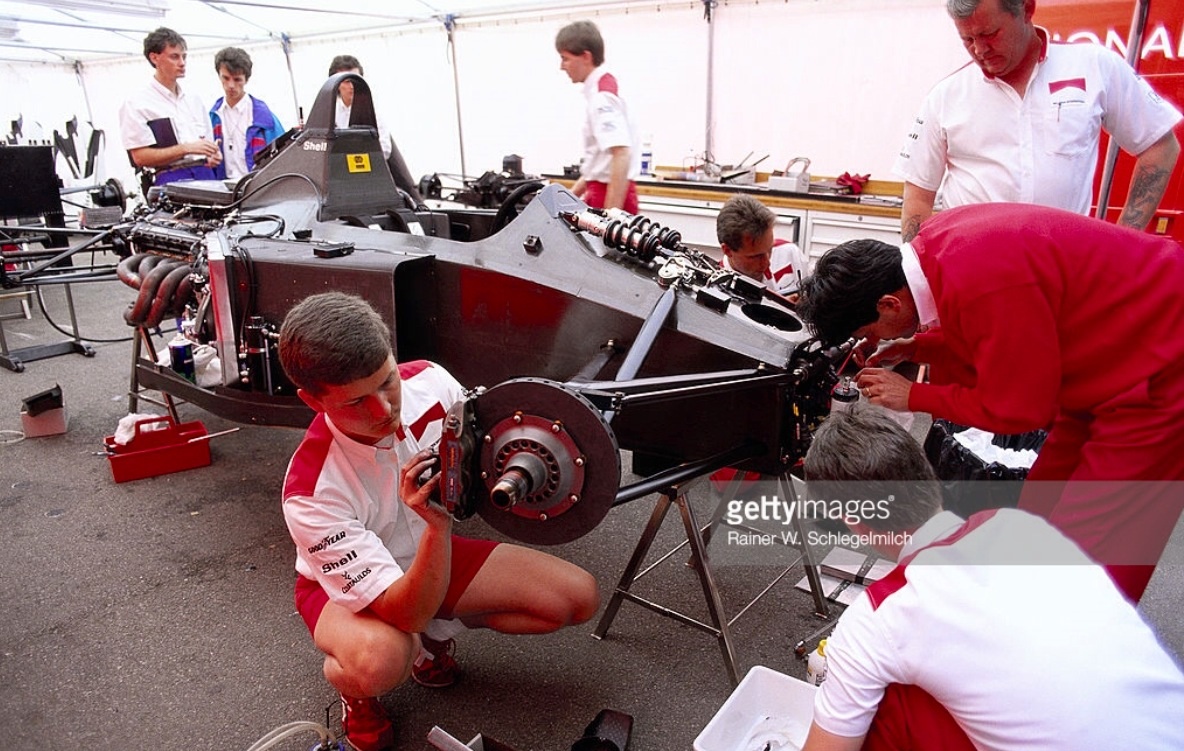
Rainer Schlegelmilch’s artistry lays bare the clinical beauty of the 1991 McLaren Honda at Silverstone on 14 July…
Whilst this article is a summary of McLaren’s ultimately successful 1991 season of changing fortunes with its new Honda V12 powered McLaren MP4/6- all of the photographs are by Rainer Schlegelmilch and were taken over the Silverstone British GP weekend of 11 to 14 July.
This was Honda’s third different type of engine in four seasons- a new 3.5 litre 60˚ V12 unit with greater piston area than the outgoing V10 it replaced and therefore it had a potentially higher rev limit. More revs, all things being equal, results in more power. It was not without its chassis design and packaging issues, the motor was longer, heavier and thirstier than the V10 it replaced but the anticipated 720bhp should have been more than enough, on balance to make the car faster.
When first tested by Ayrton Senna in an MP4/6C test-mule, he was far from impressed and said as much to the Japanese. The Honda people persevered of course, and McLaren’s season got off to a great start with four wins on the trot. The increased engine weight was partially offset by the latest development of McLaren’s six-speed manual, transverse Weisman/McLaren gearbox.
Team led by Neil Oatley produced a handsome and effective brute in MP4/6
Whilst visually similar to the outgoing MP4/5B, the new cars aerodynamic profile was different as designer Neil Oatley and his team had received fresh perspective and input from Henri Durand who had jumped ship from Ferrari to McLaren in mid-1990.
Many changes had to be made to the chassis to accommodate the longer engine and enlarged fuel cell needed to satisfy its greater thirst. Despite additional length, the new tub was much stiffer in terms of torsional rigidity and comprised fewer basic components than its predecessors.
There were changes to the suspension too. The pushrod-activated coil-spring/dampers were now mounted on top of the chassis ahead of the cockpit instead of being installed vertically on either side of the footwell.
The increased fuel consumption presented lots of challenges. Despite plenty of development on the engine management system, Senna twice ran out of fuel (at Silverstone and Hockenheim) but the Brazilian Ace and his new car remained unbeaten up to and including Monaco- giving McLaren a comfortable lead in the Constructors‘ Cup at that stage of the season.
This margin was to prove crucially important as the team’s performance began to slip and Williams Renault began to gather pace with Nigel Mansell and Riccardo Patrese threatening as the Williams FW14 Renault V10’s reliability improved.
‘In Montreal two things quickly became apparent. The first was that the Honda’s extra power was simply to offset its greater weight relative to the V10s, particularly when its internal frictional losses continued to rise. The other was that the Williams FW14s, particularly Mansell’s, were really getting into their stride’ wrote McLaren.
Honda, of course continued development of its V12. The ‘Spec 1’, which won at Phoenix, Interlagos and Monaco was replaced by ‘Spec 2’- introduced ahead of Monaco offered better mid-range punch thanks to a new induction system. The friction problems were addressed in the ‘Spec 3’ variant here at Silverstone.
In addition the cars suspension was evolved, new linked rocker arms were fitted to reduce roll and a cockpit-adjustable ride-height mechanism was deployed.
The fuel metering issues so obvious during the British and German Grands Prix weekends were mainly caused by Shell’s experimentation with different fuel densities and viscosities.
At Silverstone Nigel Mansell and his Williams dominated at home, other than for part of the first lap- Senna jumped from grid 2 and led until Mansell passed him into Stowe, the Brit led from start to finish.
Nigel and Ayrton drove away from the rest leaving Berger, Prost and Alesi scrapping over third, a duel settled in Jean’s favour, he lost the place later in the race in a collision with Aguri Suzuki. Mansell won from Berger’s McLaren and Prost’s Ferrari 642 V12 with Senna classified fourth having lost his hard-raced second after running out of fuel, as written above.
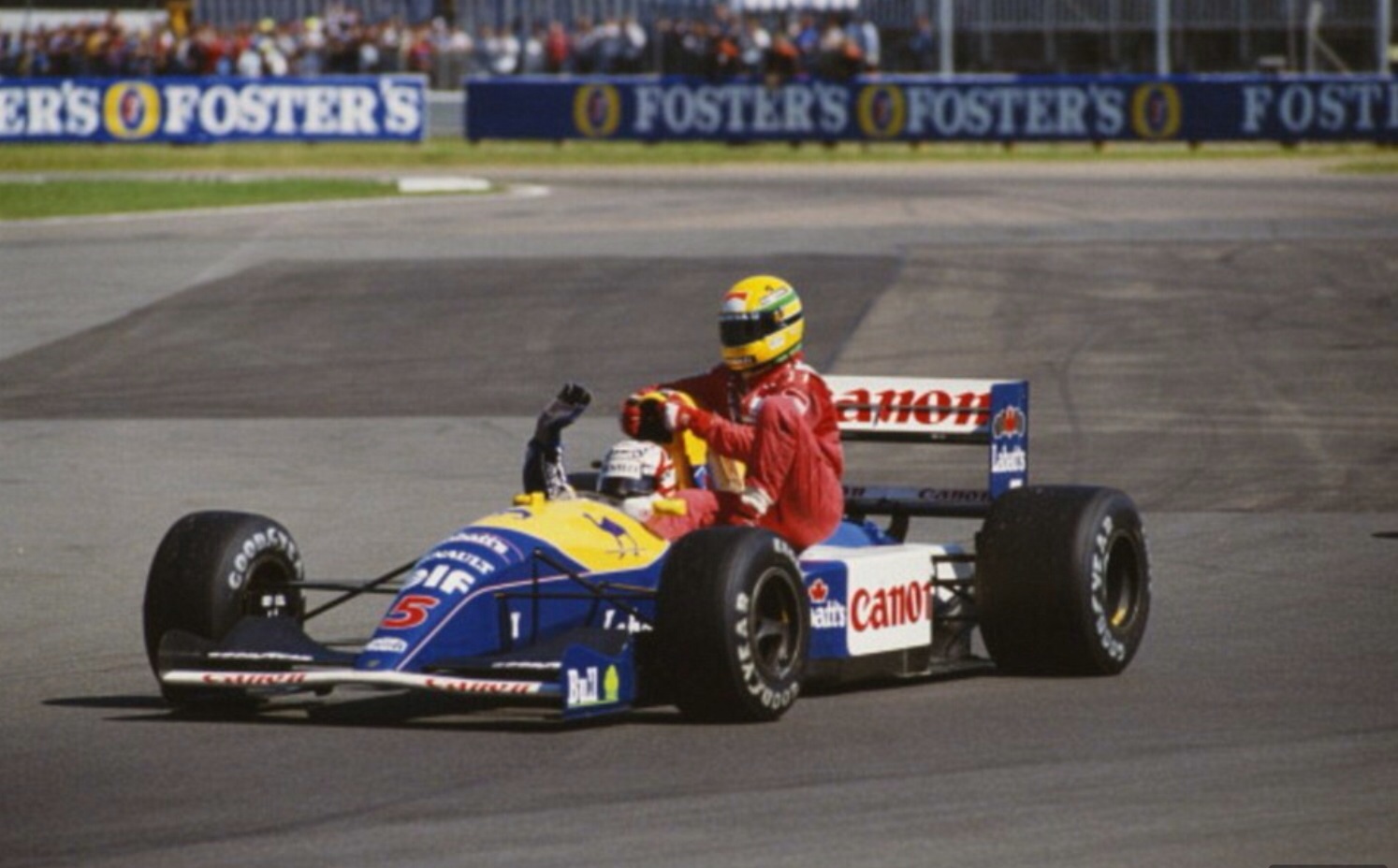
Mansell gives Senna a lift back to the pits at the end of the British GP (R Schlegelmilch)
‘At Paul Ricard, another inaccurate readout forced Senna to drive conservatively, although following this Honda’s research and development effort accelerated dramatically so that by the time he arrived in Hungary he had a car which could be safely revved to 14,800 rpm, albeit only for short bursts’
In Budapest McLaren regained its form in order to able to save its season.
With great chassis balance and another reworked engine comprising lighter cylinder heads, camshafts and connecting rods, Senna pulled out some of the magic only he possessed and pushed the Williams FW14 Renault RS3 3.5 V10 duo back to second and third places.
Despite a ‘box failure he did it again at Spa where he nursed the failing car home and saw his lead over the Williams boys grow significantly after another Mansell retirement due to an electrical problem lost the Brit a ‘sure win’.
Engineers prepare two Honda RA121E V12’s for fitting into the cars of Senna and Berger
Then Williams had two wins- the Portuguese (Patrese) and Spanish GP’s (Mansell) in a season of changing fortunes, in Spain Senna struggled on the wrong tyres.
‘At Suzuka the order flipped again, the correct tyres and yet more successful engine development leaving Senna in an unassailable position on 96 points. He returned to Brazil with a resounding third title, while Berger finished fourth with 43 points, having been handed victory by Senna in Suzuka. McLaren again took the Constructors World Championship’.
An historic sidebar to MP4/6 is that it was the last car to win an F1 World Championship powered by a V12 engine and using a traditional manual gearbox. Whilst McLaren tested a semi-automatic ‘box during the season it was not deemed race-worthy so was not used, Williams and Ferrari were the only teams so equipped that season.
The 1992 championship winning Williams FW14B Renault was ‘an orgy of technology’- semi-automatic transmission, active suspension, traction control and for a while, anti-lock brakes whilst still using the evolved but tried and true Renault RS3/4 engines, a story for another time…
Led Zeppelin first recorded ‘Communication Breakdown’ in 1969, although it was part of their live set from 1968. My whacko brain thought of that song and riff upon seeing this bit of ye olde school communication…
It would have been perfect if the song originated from 1967 given the date of the Brabham Racing Organisation team-leader’s (thaddl be Brabham JA) letter to the General Manager of Repco Brabham Engines Pty Ltd, Frank Hallam Esq is, according to Rodway Wolfe’s handwritten scrawl, 24 May 1967.
These days we have that internet thingy which makes our lives so instant in terms of communication, back then it was ‘snail mail’ or Telex machine if you were from the big end of town. I guess airmail from Surrey, UK to Maidstone, Victoria, Australia was three days or thereabouts? And the same in return with a neato ‘Par Avion’ sticker and a more expensive stamp affixed.
Jack’s note was sent between the Monaco and Dutch GP’s.
BRO had shown plenty of pace early in the season with Brabham and Hulme on pole and with fastest lap respectively at Kyalami albeit Pedro Rodriguez took the South African GP win in his Cooper T81 Maserati.
Jack flicking BT19 around with the abandon so characteristic during 1966-7. RBE740 powered, here ahead of Jim Clark’s Lotus 33 Climax FWMV 2 litre DNF, with Jack’s motor about to go kaboomba (unattributed)
At the following championship round- Monaco, Jack was on pole deploying the new RBE740 Series V8’s power and big, beefy mid-range punch for the first time in a championship round. But an unhappy early ending to the weekend was the Aussie’s new moteur breaking a rod on the first lap of the race. Denny won his first GP in a 620 engined BT20, so it was far from all bad from the team’s perspective- the race tragic for the sad demise of Lorenzo Bandini after a fiery crash aboard his Ferrari 312.
Merde! or Australian vernacular to that general effect- Brabham checks the hole in his nice new 700 Series Repco block, carved up somewhat from an errant conrod- Monaco 1967
But all the same their would have been a bit of consternation in the camp at the time, no doubt a phone call to Hallam was made about the buggered rod, or maybe Frank read about it in the late edition of Monday’s Melbourne daily ‘The Sun’?
The Lotus 49 Ford Cosworth DFV changed the GP world when it appeared in the hands of Clark J and Hill G at Zandvoort on June 4- the need to lift was clear!
So, lets address Jack’s requests.
Sorry about that sketch of Brabham’s requested 700 Series block modifications! Sadly we don’t have it- which is a bumma.
The modified Daimler rods and caps are RB620 bits, not 740- so Jack is after some bibs and bobs to keep alive some of the RB620’s by then in circulation in Europe. Not to forget Denny was still using RB620’s until he got a 740 for Spa in mid-June. The ‘620 Series’ Repco was the first of the Repco Brabham Engines series of race V8’s and was based on the standard Oldsmobile F85 block- ‘600 Series’ block and ’20 Series’ cross-flow heads in Repco nomenclature. The ‘740 Series’ was the new for 1967 motor- ‘700 Series’ bespoke Repco designed block and ’40 Series’ exhaust within the Vee heads.
The water rail changes appear routine race experience evolution, in fact whilst the whole letter is dealing with normal stuff its still interesting, if you know what i mean? And the engine fitters will have been given the bief to watch the chain tensioner fit.
Jack’s checklist of engine parts is interesting.
I thought all of the RBE engine rebuilds happened at Maidstone but clearly that is not the case, some engine work was being done in The Land of The Pom. Interested to hear from you RBE lads on this point.
Brabham and Hallam at Sandown with their newborn, January 1966 (R Wolfe)
The photograph above is of the two participants in the above correspondence at Sandown Park, Melbourne during the 1966 Tasman round. It is a ‘pose for the press’ shot given the race debut of the Repco V8 in the companies home town.
It was the second race for the RBE620 Series V8- the first was a 3 litre unit used by Jack during the non-championship South African GP weekend on 1 January, DNF with a fuel injection pump problem.
The engine above is a 2.5 litre jobbie- easily picked by its long Lucas injection trumpets, this time an oil pump broke- the chassis is the one and only BT19 which carried Jack to the 1966 title, and as can be seen in the Monaco photographs, well into 1967. The RBE620 became a paragon of reliability after some initial traumas were rectified…