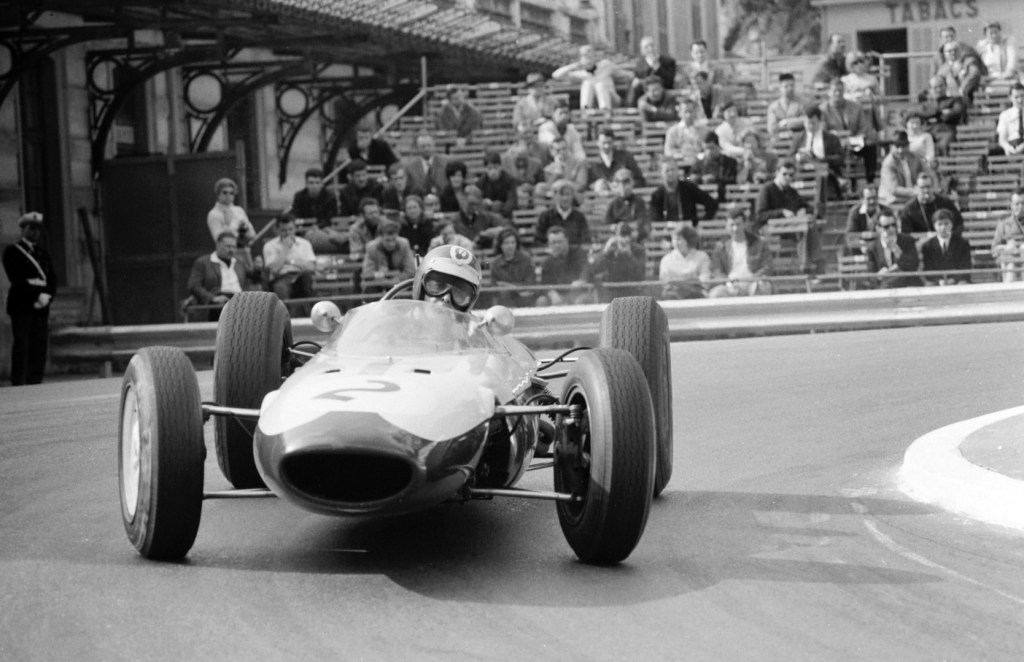
Monaco GP weekend 1964, Revson – Parnell Racing Lotus 24 BRM, DNQ. Graham Hill won, BRM P261 (MotorSport Images)
I love this letter to the editor of MotorSport from Ray Truant, of Hamilton, Canada, their Star Letter in the September 2023, current issue, highly recommended of course.
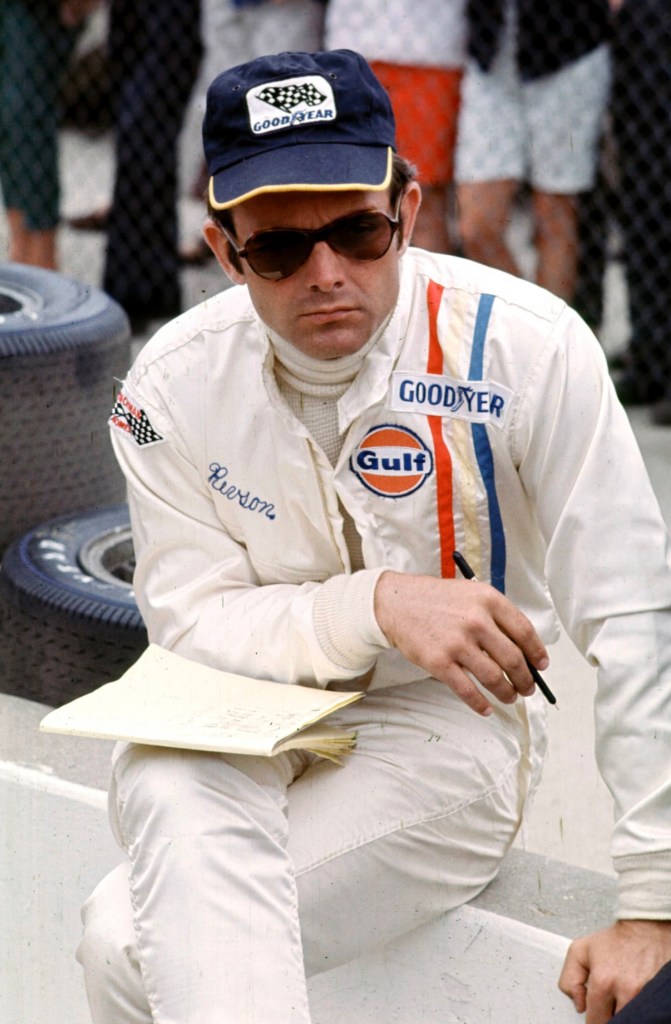
“In F1 Retro…Peter Revson is referred as ‘the heir to the Revlon cosmetics fortune.”
“This is a statement repeated during Revson’s entire racing career by the media, but was never correct. While he was a Revson, Peter’s father split his interest in the Revlon firm very early from his brothers Charles and Joseph in 1958 and had no equity in Revlon.”
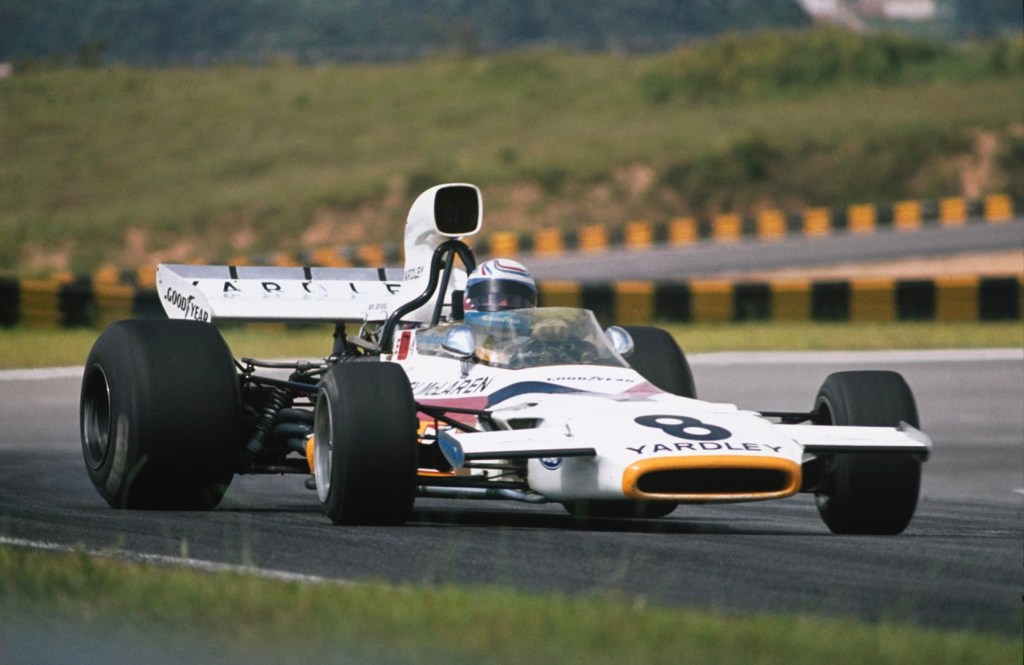
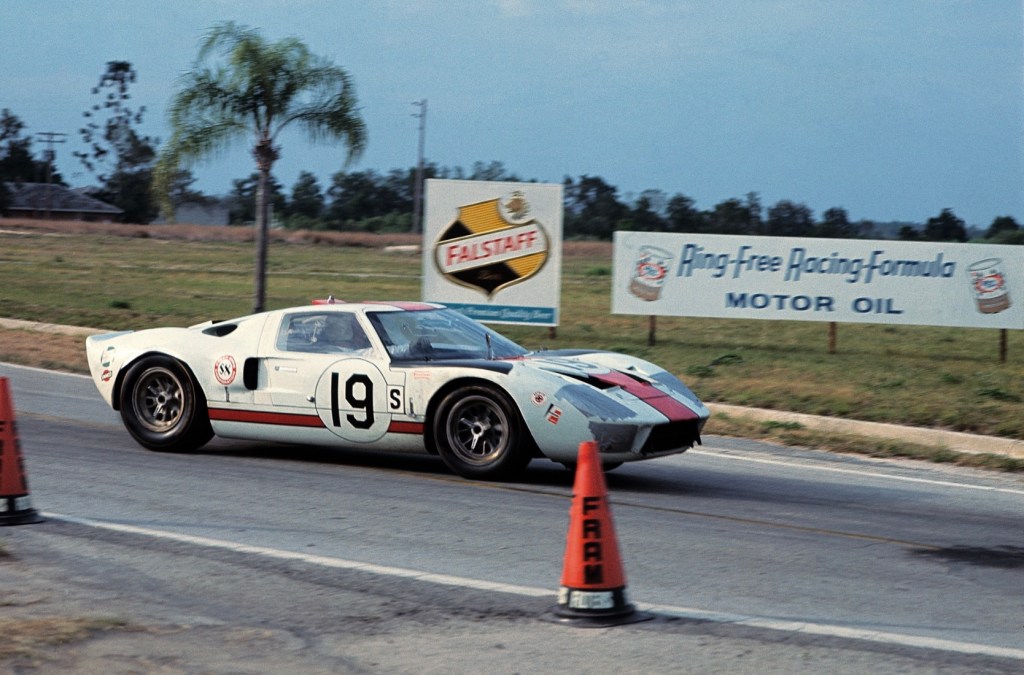
1973 Brazilian GP, McLaren M19A Ford. DNF gearbox after 3 laps from Q12, Emerson Fittipaldi won in a Lotus 72D Ford on his way to the drivers title (LAT)The 1969 Indy 500 carnival had its moments but fifth place in the Brabham BT25 Repco 760 V8 was a career turning point in the view of some – from dilettante to pro. Mario Andretti won in a Hawk 3 Ford (MotorSport)Sebring 12 Hour 1966, Essex Wire Ford GT40, third shared with Skip Scott. Ken Miles and Lloyd Ruby won in a GT40 X-1 Roadster (LAT)
“Charles and Joseph Revson ran Revlon subsequently into an empire, but Peter’s father was not involved. He ran Del Laboratories and lived to an incredible 105 before dying in 2016. Interestingly, Martin Revson left Revlon over ethical concerns of how the company was marketing to women.”
“The media loved the playboy heir story so much they ignored the reality and it persisted throughout Revson’s career, despite Revson’s attempts to correct this myth repeatedly in interviews.”
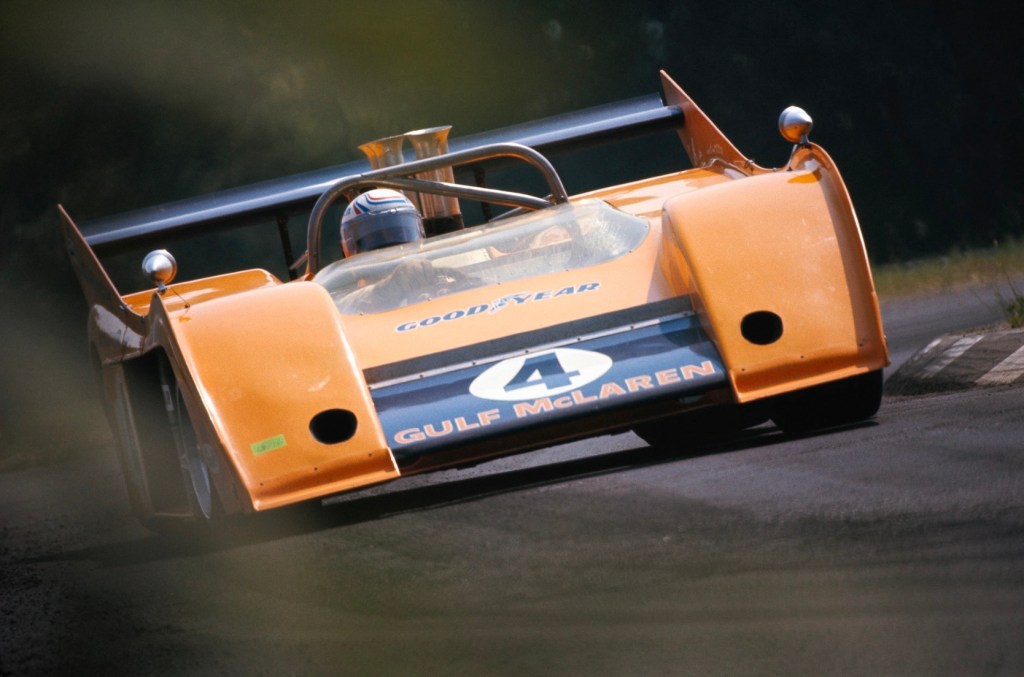
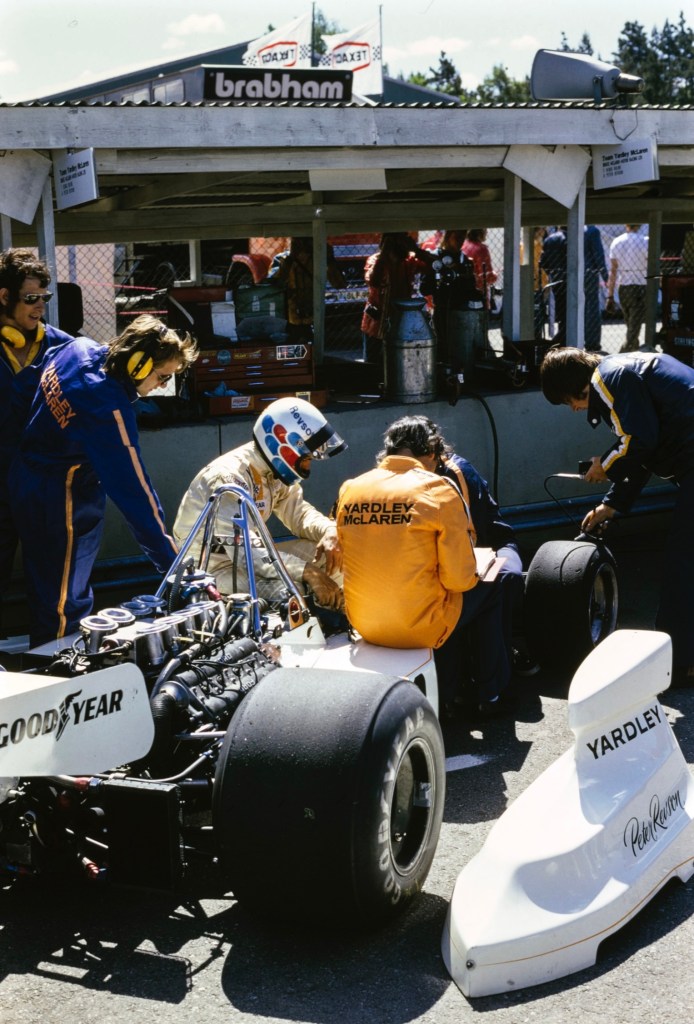
McLaren M20 Chev at Watkins Glen in July 1972, the reigning Can-Am Champ was second to Denny’s M20 that day (MotorSport/R Schlegelmilch)Chassis sorting the McLaren M23 Ford during the June 1973 Swedish GP weekend at Anderstorp, Q7 and seventh in the race won by Denny Hulme’s sister car (MotorSport/D Phipps)
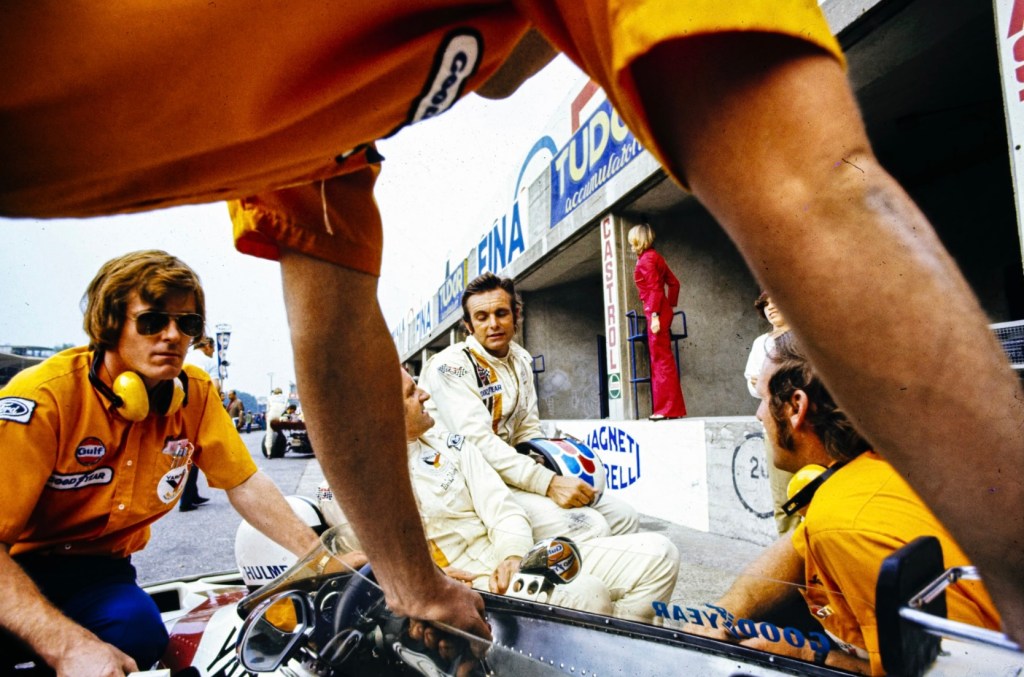
Practice session meeting of the type established by Bruce McLaren. Alastair Caldwell ponders while Denny and Revvie chew the fat. Monza 1972, where they were third and fourth in their M19C Fords, Emerson Fittipaldi’s Lotus 72D Ford won.
Credits…
MotorSport and Ray Truant, MotorSport Images, LAT Photographic
(MotorSport)
Tailpiece…
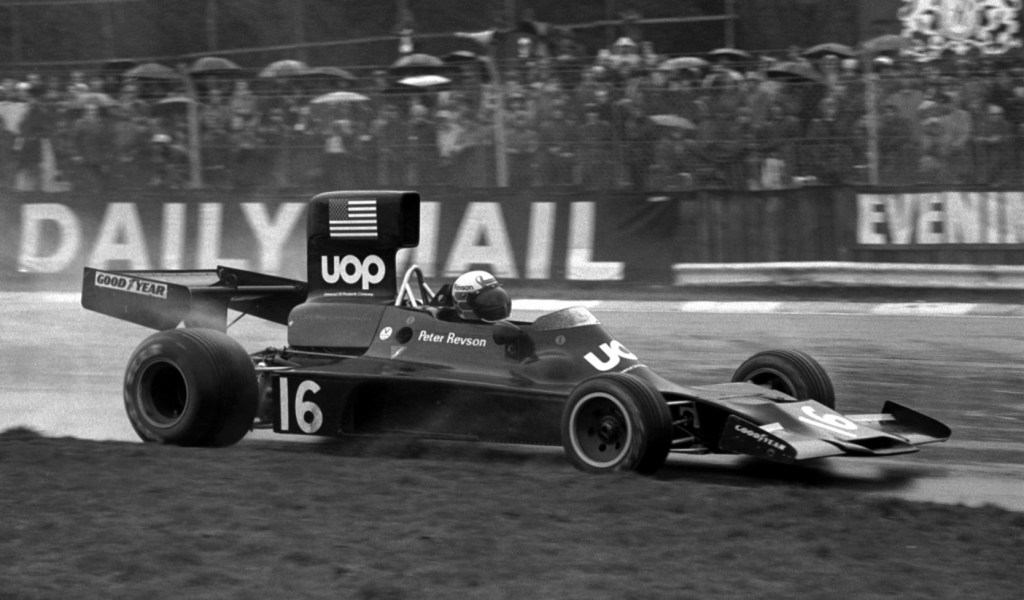
Sixth place in a gloomy Race of Champions at Brands Hatch on March 17, 1974, Shadow DN3 Ford. Sadly the car in which Peter perished due to component failure – a titanium ball joint – during practice at Kyalami, South Africa, the week after Brands on March 22.
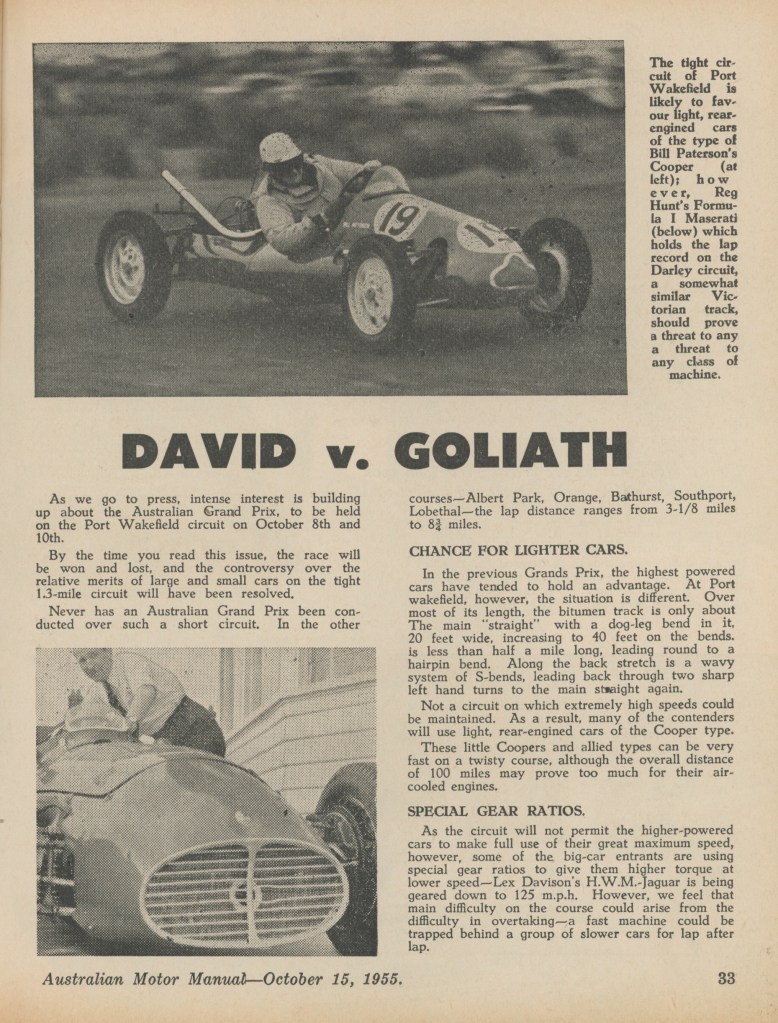
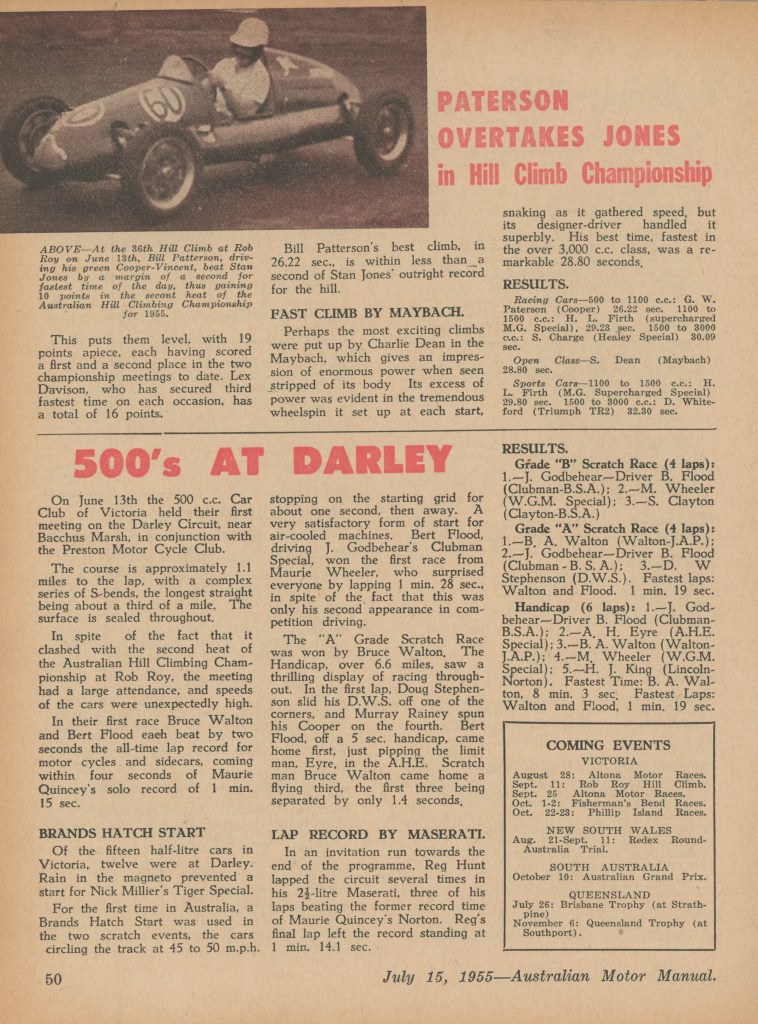
Racing a Grand Prix Maserati around the short, tight Darley circuit outside Melbourne would have been somewhat akin to racing in ‘yer backyard…
Reg Hunt pretty much became-the-pace when he imported this 2.5-litre Maserati A6GCM (chassis ) to Australia, he was stiff not to win the ‘AGP at Port Wakefield, South Australia with it in 1955.
These two Australian Motor Manual excerpts highlight the controversy surrounding the selection of Port Wakefield as the AGP venue that year given its short length – only the Goulburn course used for the first AGP in 1927 was shorter – and put in the electronic public domain Hunt taking the Darley lap record in his lead up preparation to the AGP.
This press advertisement dated January 13, 1968 changed the racing world as we knew it in many parts of the globe, the US and some other places excepted…
The days of the mobile fag, franger and fragrance wrapper were underway, for better or worse.
While Lotus and Imperial Tobacco were negotiating the commercial deal which would take advantage of the FIA/CSI relaxation of rules relating to the advertising of non-trade products and services on racing cars, the business of motorsport rolled on.
(MotorSport)
Jim Clark took off where he left off at the end of 1967, the fastest car/driver combination won the South African Grand Prix in Kyalami. Clark won aboard his Lotus 49 Ford from Graham Hill in the other Team Lotus entry, and Jochen Rindt’s Brabham BT24 Repco.
After that race – his final Championship GP win as events transpired – he flew to New Zealand along with Jack Brabham, Bruce McLaren, Denny Hulme, Chris Amon, Pedro Rodriguez and Graham Hill to join other internationals, Frank Gardner and Piers Courage, and local drivers for the 1968 Tasman Cup.
That summer the highly competitive 2.5-litre series comprised four rounds in NZ, and in Australia, commencing with the NZ GP at Pukekohe on January 6, and concluding with the South Pacific Trophy at Longford, Tasmania on March 4. Eight events in eight weeks on both Kiwi islands, shipping the circus across the Tasman Sea from the very south of the South Island (Teretonga) to Brisbane…oh, yes, and prepare the cars for the 100 mile races too. While the series was famous for sun, fun and spunkmuffins there was some serious racing as well. To win the Tasman required a mix of speed, discipline, endurance and organisation.
(LAT)
Chris Amon jumped out of the blocks, winning at both Pukekohe, and Levin aboard his works Ferrari Dino 246T. JC had engine failure after 44laps in the NZ GP while in the lead, and suspension problems at Levin (above). He ran wide off the track early, caught Amon but then went off again and bent a radius rod while trying to pass Chris.
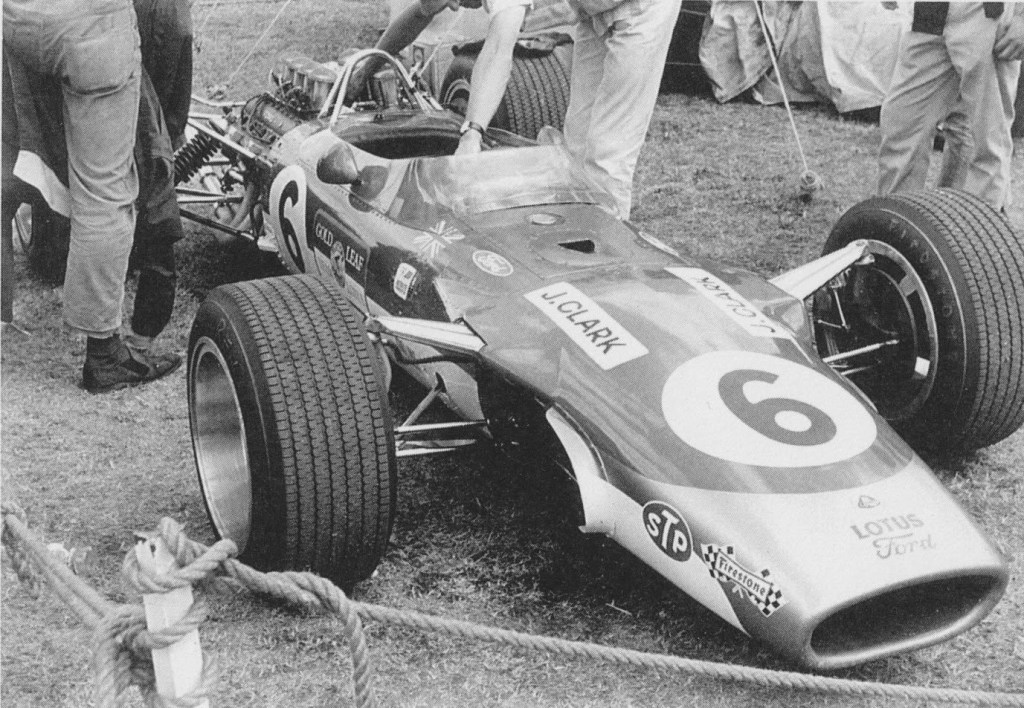
During the week between Levin and the Lady Wigram Trophy round, the small team looking after Jim’s Lotus 49 Ford DFW organised a signwriter of some talent, at Hutchinson Ford, Christchurch to apply the cancer-stick signage in accordance with the Gold Leaf corporate identity standards manual…a document with which Lotus staff were to become intimately familiar.
Kiwi journalist, Allan Dick wrote that there was a function held in Christchurch on the Friday evening of the race weekend to unveil the new colours, perhaps the shot below is during said gig, albeit the venue doesn’t appear particularly salubrious.
(MotorSport)(A Batt)
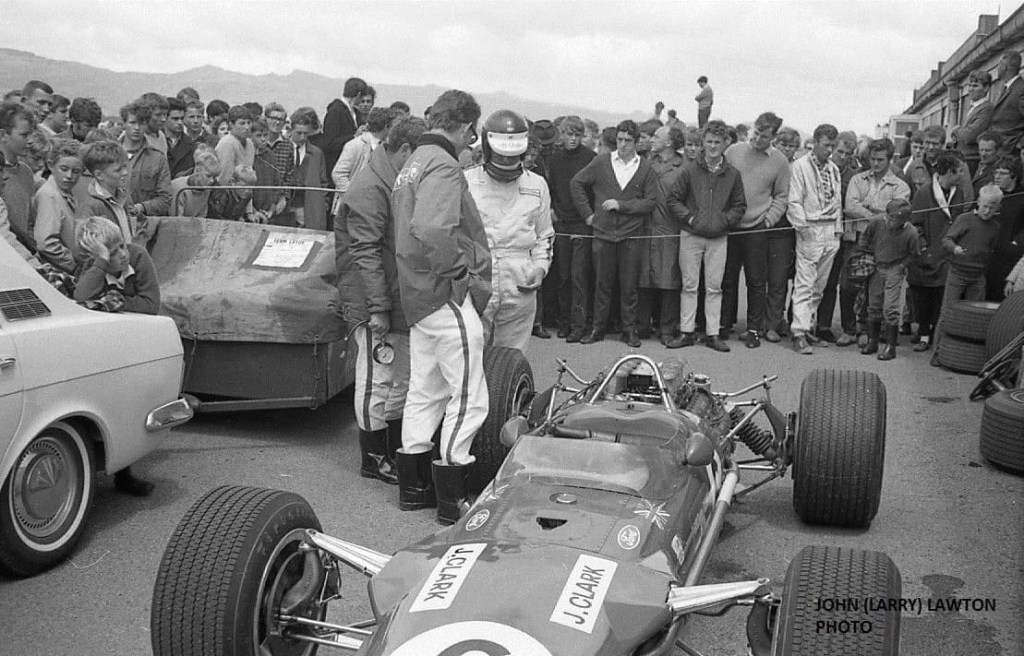
Big Wigram crowd taking in the candy-coloured Lotus – chassis number R2, Jim’s 1967 F1 mount – over the January 20 weekend. Clark provided plenty of cheer for the suits back in the UK when he won ‘on GLTL debut’ from Amon and Denny Hulme’s F2 Brabham BT23 Ford FVA.
These three shots are all at Wigram Clark from Amon at Wigram (sergent.com)Wigram looks chilly that day, Kiwi-Oz touring car ace Jim Richards with his hands in race-suit pockets towards the far right of the crowd
Bruce McLaren won for BRM at Teretonga in the final NZ round. He finished in front of Clark after Jim had an off while in the lead. Bruce’s mount was a 2.5-litre V12 engined BRM P126, a chassis designed by Len Terry, and being blooded in advance of the ‘68 F1 season by McLaren, Rodriguez and Richard Attwood.
Clark had a much stronger run on the other side of the Tasman Sea – where he was joined by teammate Graham Hill, who had been enjoying a family holiday – winning the Surfers Paradise 100, the Warwick Farm 100 in Sydney and the Australian Grand Prix at Sandown, in Melbourne’s outer suburbs. Only the final round at Longford eluded him, Piers Courage took a wonderful victory there in his F2 McLaren M4A Ford FVA in streaming rain.
Clark at Teretonga where a high speed off cost him the lead to Bruce McLaren (unattributed)Clark at Sandown winning the AGP, here on Pit Straight in third gear. The shot highlights the shortcomings of the too low roll bar. While Jim was well familiar with seat belts in his ‘Indycars’, he missed these safety devices in Grand Prix racing, commonplace as they were by the end of the year
When he departed Australia on or about March 5, Jim Clark had won his final GP and championship, he died a month later at Hockenheim during the first heat of the Deutschland Trophy, Euro F2 Championship round, aboard a GLTL Lotus 48 Ford FVA on April 7, 1968.
Last discussion before the off with Dave ‘Beaky’ Sims, Hockenheim April 7, 1968 (MotorSport)Clark here running behind Chris Irwin, Lola T100 and Chris Lambert, Brabham BT23C, the Lotus, Lola and Brabham all Ford FVA powered (MotorSport)
Etcetera…
(W Reid)
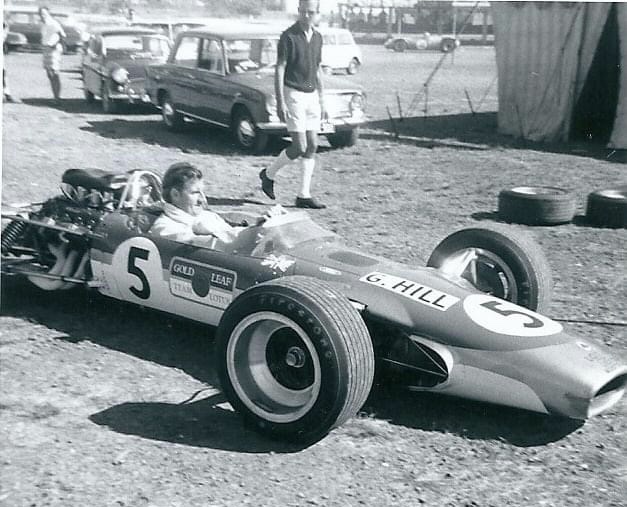
Graham Hill displaying his new colours, ones he immortalised in the F1 record book by the end of a tragic year, Sandown paddock, February 1968.
(W Reid)
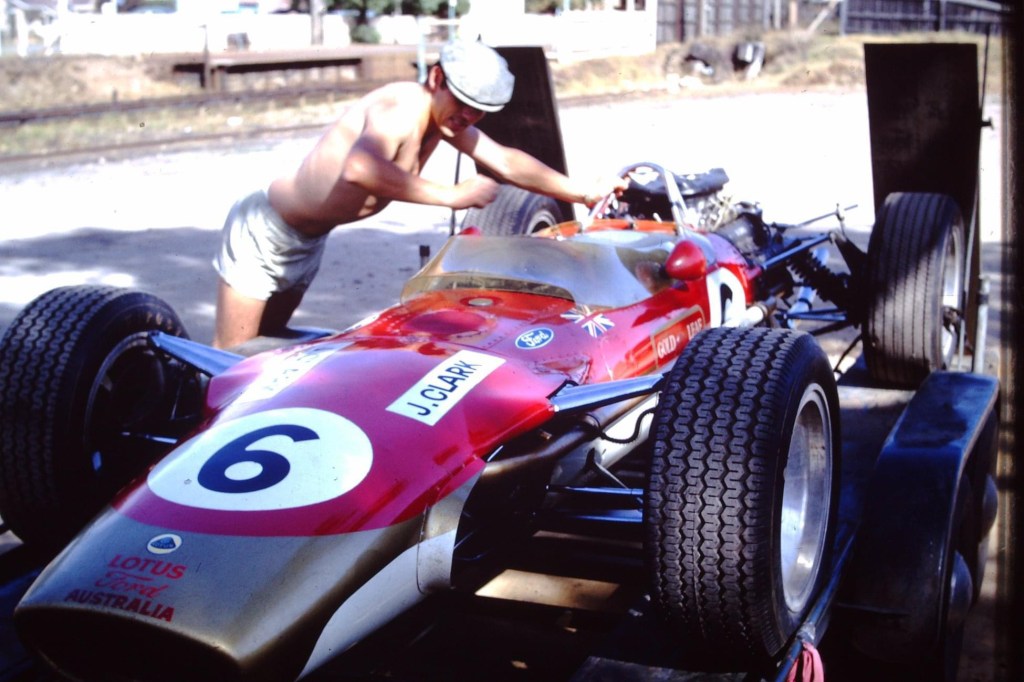
Hill raced Lotus 49 chassis R1, early spec 49s used a ZF five-speed transaxle rather than the later Hewland DG300, engine is the Ford Cosworth DFW 2.5-litre V8. The skinny rears – front tyres – are for transport purposes. A bit of arcane trivia for Melburnians is that the GLTL Lotuses were fettled in the Head Brothers, BMC dealership and bodyworks, at 504 Neerim Road, Murrumbeena, (below) not too far from Sandown.
(J Makeham)
Ford Australia must have kicked in a few dollars to the budget, note the crude ‘Australia’ added to the deft signwriting on the nose of the Lotus executed in Christchurch. The elaborate trailer is as flash as the one I used to tow my Formula Vee.
(C Neale)
Jim Clark about to go out and win the AGP at Sandown. The official margin between Clark’s Lotus 49 and Chris Amon’s Ferrari 246T is one-tenth/sec, but it was closer than that!
(unattributed)
Fags…
Kiwi enthusiast/historian Graham Woods wrote that “The first car (other than in places like the US where such advertising had been allowed) to carry tobacco sponsorship was in South Africa in a round of the SA F1 Championship.”
“The driver was John Love, and the tobacco company, Gunston. Three weeks before Wigram, Love and Sam Tingle started the South African GP, the opening round of the world championship in a Brabham and SA built LDS on January 1. Love was ninth and Tingle DNF – both were in Gunston colours. “
John Love in the Team Gunston Brabham BT20 Repco during the ‘68 South African GP (LAT)
“South Africa was Jim Clark’s last GP win in the green and yellow of Team Lotus. The first race for Lotus in GLTL colours was at Wigram, the first championship GP, the Spanish GP at , a race won by Graham Hill’s Lotus 49 Ford…another GP that got away from Chris Amon, whose Ferrari 312 dominated practice and led most of the race.”
Graham Hill enroute to winning the 1968 Spanish GP, GLTL Lotus 49 Ford (MotorSport)(CAN)
Afterthought…
The afterthought goes to Allan Dick of New Zealand’s Classic Auto News.
‘Historic image of Jim Clark’s Lotus 49T (“T” for Tasman) at Wigram 1968. It’s historic because this was the first time the public had seen the new Gold Leaf sponsorship — a first for Formula One on this scale. The deal with Lotus and the tobacco company had been finalised between Levin and Wigram and it was done in “secret”.’
‘There had been an official and rather exclusive unveiling on the Friday evening in the snobby “The Motor Racing Club” way of doing things in those days, but it was Saturday morning when the great unwashed got to see it. There it sat, paint so new it still looked sticky and fenced off with a great lump of old rope! The reaction? I can still remember it clearly! It was “Yucchhh!” Nobody liked it. It looked cheap and taudry. Nobody thought it was good. We far preferred the dark green with yellow stripe — traditional Lotus. But the world got used to it.’
Credits…
Bryan Miller Collection, LAT Photographic, Allan Batt, Ray Sinclair, John Lawton, Warren Reid, Chris Neale, John Makeham, Allan Dick Classic Auto News
The only timing device missing from the Jones Boy’s dash is a grandfather clock! Alan awaits the off in his Lola THL2 Ford at San Marino in 1986.
That weekend AJ was Q21 and DNF overheating after 28 laps in the race won by Alain Prost’s McLaren MP4/2C TAG-Porsche. The Frenchman won four of the 16 rounds and the drivers title by two points from Nigel Mansell’s Williams FW11 Honda, albeit Williams took the constructors championship by a country mile – 45 – points from McLaren. Lola Ford finished eighth.
(MotorSport)
Jones above during the 1985 AGP weekend in Adelaide where his results were again disappointing, Q19 and DNF with electrical failure after completing on 20 laps in the Lola THL1 Hart. Keke Rosberg won the race in his Williams FW10B Honda. We’ve been there before with these Hart four-cylinder and Ford V6 1.5-turbo F1 machines, see here; https://primotipo.com/2016/10/21/hart-attack/
Jones’ Lola THL2 Ford overhead, Hungaroring August 1986. Ford Cosworth GBA 1.5-litre V6 twin-turbo(SMH)
Jones had far more success in the AGP at Calder, west of Melbourne, in 1980 where he raced his Williams FW07B Ford to a dominant win from Bruno Giacomelli’s wailing V12 Alfa Romeo 179B in a mixed field of GP cars (two) and F5000 machines.
Atmospheric shot of Harry Schell’s BRM Type 25 during the August 23, 1959 Portuguese Grand Prix at Monsanto, Lisbon…
It was the breakthrough car for BRM, Jo Bonnier’s Type 25 won at Zandvoort in 1959 thereby breaking the F1 World Championship GP winning duck for the Boys from Bourne after nearly a decade of competition.
Immaculately credentialled engineer Stewart Tresilian “was largely responsible not only for the original conception and design of the BRM Project 25 2.5-litre four cylinder engine, but also of the compact P27 – or Type 25 – car (chassis) intended to carry it into battle.” Doug Nye wrote in ‘BRM Vol 1.’
“He had produced a homogeneous concept of car and engine combined, its essence being the complete antithesis of the original V16 in that it was all as small and compact and simple as possible, with the arguable exception of his projected 16-valve cylinder head for the four cylinder engine.”
BRM P15s, JM Fangio on the front row, and Ken Wharton behind him, Albi GP May 1953. Fangio won the heat and dominated the final before tyre troubles intervened, Louis Rosier won in a Ferrari 375 with Froilan Gonzalez second in another BRM P15. Car #3 is Nino Farina in the Vandervell Thin Wall Ferrari 375 (B Cahier)
The four-valve head design was subsequently over-ruled by Peter Berthon and after Tresilian left the Owen Racing Organisation to go to Bristol-Siddeley Engines in January 1953, Berthon, Tony Rudd and others brought the Type 25 to reality.
The result was a car that became increasingly fast, it not particularly reliable with each passing year from its race debut in 1955 until early in 1960. It allowed the team to develop the capabilities to win; car development, preparation and driver, they couldn’t do that with a car that never lasted too many laps. Mind you, the simplicity of Tresilian’s concept was complex in its execution…
Peter Collins crashed his Type 25 #252 during practice of the Daily Telegraph Trophy meeting at Aintree on September 3 1955, so took his bow here at Oulton Park during the September 24, 1955 International Gold Cup meeting in the same car. Q13 and DNF after loss of oil pressure after 13 laps. Stirling Moss won in a Maserati 250F from Mike Hawthorn’s Lancia D50. Oh to have been there that day! Many thanks to Stephen Dalton for these two programme pages – studiously marked up by a knowledgeable spectator – from that BRM Type 25 failed race debut September 1955 meeting at Aintree
The P27 semi-monocoque – in the centre section – chassis was strongly influenced by Tom Killeen’s Killeen K1 sportscar which was tested extensively at Folkingham by Rudd. He was impressed and the performance of the car “confirmed PB’s interest in stiffening his basic new P27 frame with a stressed-skin monocoque centre section.
The five-speed rear-mounted gearbox was drawn by Alec Stokes, “who was destined to become BRM’s dedicated transmission specialist and one of the country’s leading gear-men.” The back of the gearbox carried the controversial single, longitudinal-axis rear disc universally known as the ‘bacon-slicer’.
With 50/50 weight distribution and 70% of the braking load at the front, the thinking was that outboard front disc brakes would carry 35% each, leaving 30% for a single rear disc. It took a long time to sort, but when that was achieved “this arrangenent worked quite well on the front engined cars.”
Rear suspension was by way of a De Dion tube with Lockheed air struts inherited from the V16 program, front suspension comprised upper and lower wishbones and coil air strut units again, with the rack and pinion steering Morris Minor based.
BRM P25 2.5-litre, (2491cc 102.8mmx74.93mm bore/stroke) four main bearing, DOHC, two-valve, Weber fed, twin Lucas magneto and twin-plug sparked four-cylinder engine shown in one of the cars at Monaco in 1956. That hole in the bonnet is the extent of the access my friendsBRM Type 25 1958 specification spaceframe chassis (C La Tourette)BRM Type 25 during the 1959 Dutch GP weekend at Zandvoort. Cars then spaceframe chassis with vastly superior mechanical access, note the single rear disc brake under the fuel tank at right. All that fuel sitting very high, the trade-off decisions are made clear in this shot (BRM 1)
While work progressed on the chassis there was a long test program with a single-cylinder model of the new engine. ORO were racing the V16 Mk2 and Maserati 250F during this period, with some success. By Easter 1955 the car was complete but for the engine. Finally, on June 5, 1955 the car ran for 19 laps at Folkingham with Rudd at the wheel, having given 260bhp @ 8000rpm on the test bed.
The major problem on test was the SU fuel injection system which was subseuently ditched in favour of a pair of 58DCOE Webers. After further tests by Ron Flockhart and Peter Collins, the car was entered for the September 3 Aintree meeting.
Peter Collins was chosen to race the machine but lubrication problems caused the engine to blow oil over the rear tyres causing a spin and chassis damage that prevented further running. A further run at Oulton Park on September 24 was impressive with Collins running third in front of Ferraris, Maseratis and Vanwalls etc ended when Peter noticed failing oil pressure and pitted. Thus turned out to be a dud gauge which had been shaken to death by the vibrations of the big-bore-four!
Post-meeting work involved rubber mounting the instruments, improving gearbox lubrication and gear teeth form. As Nye observed, “The new BRM was the tiniest car of its time. It was really minute, and very light, and very powerful…and very troublesome.” The eternal process of development was only just underway.
Willie Southcott tending Tony Brooks’ car, #252, at Goodwood during the Glover Trophy meeting in April 1956. DNF oil pressure in the race won by Stirling Moss’ Maserati 250FBritish GP scene July 14, 1956. The Type 25 cars of Tony Brooks, Mike Hawthorn about to receive a fresh engine, and Ron Flockhart at right; DNF accident, uni-joint and engine respectively. Fangio won in a Lancia Ferrari D50 (MotorSport)Tony Brooks’ Type 25 #252 enroute to Q6 and second in the Aintree 200 in April 1956, Moss won in a 250F (MotorSport)
Stirling Moss tested the cars in the lead up to the 1956 season but went to Maserati instead, so Mike Hawthorn and Tony Brooks stepped into the breech. Those poor unfortunates enjoyed a season of great speed laced with equal amounts of unreliability and poor preparation.
The team addressed many problems that year. They slowed the rotating speed of the bacon-slicer by use of a reduction gear, experienced ‘stiction’ in the air struts, the big valves stretched and broke, they had pot-joint seizure and so on. Then Brooks experienced a jammed throttle rod at Silverstone at Abbey corner triggering a somersault which destroyed chassis #252 by fire. To compound a diabolical British GP weekend in front of the home crowd, Ron Flockhart’s car broke its timing gears. Despite all of that Hawthorn and Brooks had qualified in the Top 10, Mike in Q3. The team withdrew from the final two championship races of the year in Germany and Italy.
The Brooks Silverstone conflagration, thank goodness the Gods of Goodnesss were smiling on Tony that day, but chassis 252 was very dead (TC March – T Johns Collection)
Alfred Owen then decreed there would be no more racing until the car had completed 300 miles of continuous running competitively. Flockhart achieved this late in the year at Monza. Three laps later, with Berthon waving him on, the car dropped a valve and ruined another engine. Nye observed, “From their debut in 1955 to the end of 1956 the BRM Type 25s had made only eight starts in just five races, and finished only once, Brook’s second in the Aintree 200.”
Over the winter Colin Chapman test drove the car twice and provided a comprehensive set of recommendations in a formal letter of advice including rear suspension changes. Fitment of tall coil spring/dampers and incorporating a Watts linkage to help locate the De Dion tube were among changes which help transform the cars.
Les Leston at Aintree during the 1957 British GP weekend, Q12 and DNF engine after 12 laps in chassis #253. Brooks/Moss won in Vanwall VW4 (MotorSport)Herbert Mackay-Fraser’s BRM T25 #253 ahead of Mike Hawthorn’s Ferrari Lancia D50 at Rouen during the 1957 French GP
In 1957 Brazilian born American Herbert Mackay-Fraser charged at Rouen, while poor Flockhart spun on oil , rolled into a ditch and wrote 254 off. Fraser died a week later aboard a Lotus 11 Climax FPF at Reims and Flockhart was still in hospital so Jack Fairman and Les Leston raced the cars at Aintree.
Jean Behra was so impressed by the corner-speed of the Type 25 at Aintree he cadged one for the 302km Caen GP which he won! Harry Schell drove a sister car in the event at the last moment, and soon became the most consistently successful Type 25 driver.
“At the end of the season, against meagre opposition, the three surviving cars, 251, 253, and 254 finished 1-2-3 in the Silverstone International Trophy, driven by Behra, Schell and Flockhart.”
During the 1957-58 break, a fifth main bearing was incorporated into the engine to solve ongoing timing gear problems, the cost was high, additional friction losses impacted horsepower. The chassis came in for attention too, the semi-monocoque centre section was ditched in favour of a full spaceframe with fully detachable bodywork.
Schell and Behra finished two-three in the Dutch GP, the team’s best result yet. The methanol burning four-bearing engine gave over 280bhp in 1957, whereas the five-bearing on Avgas gave only 240bhp, Behra left for Ferrari at the end of the year.
Schell at Eau Rouge, Spa, Belgian GP 1958. Harry was fifth in #257, with four of the first five cars British, the only interloper was Mike Hawthorn’s second placed Ferrari 246. Brooks and Lewis-Evans were first and third on Vanwalls, while Cliff Allison’s tiny Lotus 12 Climax was fourth (MotorSport)Onya Harry! Third (right) on the grid at oh-so-fast Reims, 1958 French GP aboard #258. The Ferrari Dinos of Mike Hawthorn #4 and Luigi Musso share the front row with him. Hawthorn won while Harry retired with overheating after 41 lapsBehra, Oporto, Portugal in 1958, fourth from Q4 in #256 with Moss the winner in Vanwall VW10 (Getty)
Fiery Harry Schell was one of the surprises of the 1958 with a series of qualifying performances and points finishes which proved just how much their ever evolving Type 25 – despite the power loss – had come. Second at Zandvoort was fantastic, so too a swag of fifth places at Monaco, Spa, Silverstone (from Q2) and Oporto. Behra’s best was third and Holland and fourth in Portugal, while Jo Bonnier’s was fourth place in the season-ending Moroccan round.
In the first season the manufacturers championship was run, BRM were fourth in the International Cup for F1 Manufacturers behind Vanwall, Ferrari and Cooper Climax. Vanwall had peaked as they led the pre-eminence of British Racing Green, while Coopers were on the rise…
Moss on the way to second place in the BRP entered BRM Type 25, Aintree, British GP July 1959. Brabham won on a Cooper T51 Climax. Bourne standards of preparation encouraged Moss to have his Type 25 #2510 fettled by his (Alfred Moss and Ken Gregory) British Racing Partnership. This chassis met a violent death at Avus the following month when Hans Hermann had brake failure on the approach to the southern hairpin during the German GP, the lucky pilot survived the monumental accident unscathed. The BRM Gods of Goodness again smiled on Hans, but former BRM racer Jean Behra was not so fortunate that same weekendRon Flockhart’s #2511 during Aintree Friday practice, British GP weekend in July 1959. DNF spin after 53 laps (D Williams)Jo Bonnier in #258, in front of Masten Gregory at Zandvoort during Jo Bo’s famous May 31, 1959 BRM Type 25 victory, Masten was third and Brabham second on works-T51s (MotorSport)
While Jack Brabham and Stirling Moss rewrote the record books with their factory and Rob Walker Cooper T51 Climaxes in 1959 BRM put themselves in the annals of Grand Prix history when Jo Bonnier won at Zandvoort in May. Schell had a season of greater reliability than Bonnier but didn’t do as well as the year before.
That winter Harry Weslake had advised Bourne on improved cylinder head design, and the fifth main-bearing was machined out! BRM adopted new timing gears “with large, coarse teeth not critical to fine backlash tuning for reliability.” Further brake modifications and simpler, lighter chassis – numbers 2510 and 2511 – “made the BRM Type 25s simply the fastest front engine cars of 1959, with fantastic braking ability.” Doug Nye wrote.
Graham Hill, Dan Gurney and Bonnier drove the cars on into 1960 at which point all of the remaining Type 25s, except #258, the Zandvoort winner, were torn to bits to provide components for the new mid-engined P48 2.5-litre cars “being hastily built to follow Cooper’s rear-engined lead.”
(unattributed)
Jo Bonnier “drifting into history”, as Doug Nye beautifully put it. By April 18, 1960 JoBo could have raced a new mid-engined P48 in the Goodwood Easter Monday Glover Trophy but chose to race Type 25 #258, his Zandvoort machine instead. Graham Hill and Dan Gurney gave the P48s their race debut that weekend, Hill was fifth, Bonnier sixth and Gurney had an accident on lap 3. In a sign of the times, Innes Ireland’s works Lotus 18 Climax won, it was the fastest, if not the most reliable GP car of 1960.
The old and new, BRMs Type 25 and P48, both 2.5-litres in September 1959. That’s #481 in shot with its unique nose on the Folkingham floor between the two cars, Type 25 chassis number unknown (BRM 2)Graham Hill tips his BRM P48 into one of the oil-drum marked corners on the Ardmore Airfield circuit during the January 1961 New Zealand Grand Prix weekend. He was third behind the Cooper T53 Climaxes of Brabham and McLaren (M Fistonic)
Eleven BRM Type 25 chassis were built – #251-259, 2510 and 2511 – during the long 1953-1960 BRM Type 25 programme, starting in 21 championship and 26 non-championship and Formula Libre events. These 47 meetings yielded the Dutch GP win for Bonnier and seven minor event victories including the two preliminary heats of the 1957 International Trophy at Silverstone and the 1959 New Zealand Grand Prix heat at Ardmore for the ever patient Ron Flockhart.
Etcetera…
(TC March – T Johns Collection)
The boys; standing are Basil Putt, Team Manager, Mike Hawthorn, Tony Brooks, Peter Berthon, Tony Rudd, Raymond Mays, AF Rivers Fletcher. Who are the mechanics in front? Folkingham, Lincolnshire August 28 1956 ‘Test and view day’.
The cover and editorial of Autosport after Peter Collins made the race debut of the Type 25 at Oulton Park on September 24, 1955 says everything about Britain’s goodwill towards BRM in its fight to take on the best in the Grand Prix world.
Great shot of Les Leston with team chief Raymond Mays at Aintree during the 1957 British GP weekend. Q12 and DNF engine after 12 laps, Jack Fairman lasted two laps more before he too suffered engine dramas. Up front, Tony Brooks and Stirling Moss shared the win in a Vanwall.
Rouen pits in July 1957, the incredibly quick BRM Type 25 #253 of the oh-so-promising American driver Herbert Mackay-Fraser awaits its wheels. Q12 and DNF transmission failure after 24 laps, Fangio won in a Maserati 250F. And below with the Mike MacDowel Cooper T43 Climax shared with Jack Brabham to seventh in the race. The contrast in size between the smallest front-engined car of the era and the grids most compact is quite marked.
(LAT)
Peter Berthon and 37 years old Harry O’Reilly Schell at Monaco in 1958. Despite a wild-man reputation Harry put together plenty of fast drives and high placings just as the team needed them. He was equal fifth (with the dead Peter Collins) in the drivers championship with 14 points, a personal best. 1959 was tougher, Stirling Moss bagged his car and Harry didn’t finish a race until Reims in July, but managed fourth at Silverstone and fifth in Portugal. Schell died at Silverstone in damp practice for the 1960 International Trophy, he clipped a low retaining wall at Abbey, was half flipped out of his Cooper T51 Climax and broke his neck.
Behra at Oporto 1958. Doesn’t that BRM #256 look magnificent beside those small, very fast Cooper T45s. #12 is Maurice Trintignant, #16 Roy Salvadori with the obscured Jack Brabham copping a push start at right.
(CAN)
Ron Flockhart during the Lady Wigram Trophy, New Zealand in January 1959. If a bloke deserved a win in these cars it was Ron given the number of test and race miles he did in them. He won aboard #259 from pole in front of Jack Brabham and Bruce McLaren’s Cooper T45 Climax’.
‘Where is the starter again?’ Tony Rudd and mechanic in Harry Schell’s #257 at Monaco in 1959. Q9 and DNF accident after completing 48 laps of the race won by Jack Brabham’s Cooper T51 Climax. Bonnier’s car retired with failing brakes from Q7.
(unattributed)
Yay team, again at Zandvoort in 1959, and one more time, there is no such thing as too much BRM…
BRM Type 25 model from Stephen Dalton, “it’s a Merit with the Alastair Brookman touch, he built it.”
Credits…
Clarence La Tourette, Getty Images, John Ross Motor Racing Archive, Bernard Cahier, John Ferguson, Classic Auto News, LAT, MotorSport Images, ‘BRM 1’ Doug Nye, History of the Grand Prix Car 1945-65 Doug Nye, Dave Williams, Stephen Dalton Collection, TC March, Tony Johns Collection
Tailpiece…
(B Cahier)
Phil Hill catches Jean Behra on the way to a DNF brakes at Monaco in 1958 from a splendid Q2 in chassis #256. Tony Brooks was on pole and Jack Brabham Q3 is the upstart 2-litre Cooper T45 – with two more of the pipsqueaks behind Jack – driven by Roy Salvadori and race winner Maurice Trintignant.
While the mid-engined writing wasn’t perhaps on the wall, the sign-writers were readying the paint…
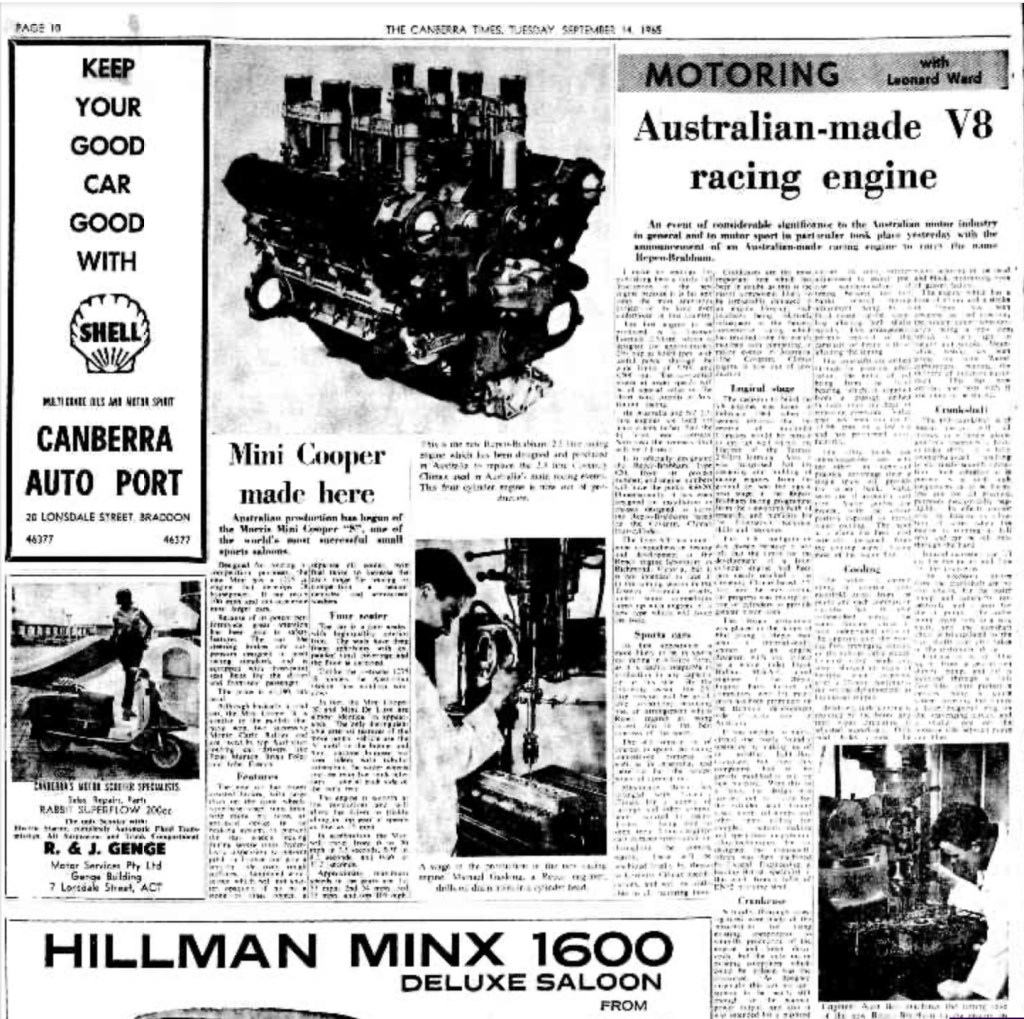
The Repco Record cover girl for September 1965 is the prototype 2.5-litre Repco Brabham 620 V8. Engine #E1 first spluttered into life on the Repco Laboratory testbed, Richmond on 26 March 1965…
She is quite a cutie replete with Weber carbs rather than the Lucas fuel injection with which the Repco engines always raced. Click away at the links below for plenty of articles on this engine, this is another piece from Michael Gasking’s wonderful collection of Repco memorabilia.
The public announcement of the engine was made by Repco on Monday September 13, 1965. Many thanks to historian David Zeunert who forwarded a copy of Leonard Ward’s piece about the initiative which was published in the Canberra Times the following day.
It includes an unusually detailed technical description of the engine, but makes no mention – at that point at least – of a 3-litre 620 variant for the new F1 which commenced in 1966.
That the 1275cc Morris Cooper S – ‘one of the worlds most successful small sports saloons’ – has gone into production at BMC’s Australian plant at Zealand, inner-Sydney would have been big news too, albeit well-known to enthusiasts.
Credits…
Michael Gasking Collection, Repco Ltd, Canberra Times via David Zeunert Collection
Jack Brabham, Cooper T39 Climax, and the Bib Stillwell-Bill Pitt Jaguar D-Types just before the start of The Argus Cup 8-lap, 25-mile sportscar support race before the Australian Grand Prix. December 2, 1956.
On row two are the red Ausca Holden of Paul England at left, and Lex Davison’s HWM Jaguar alongside. The third row comprises Stan Coffey’s Ferrari 750 Monza, Ron Phillips’ Austin Healey 100S and Tom Sulman’s green Aston Martin DB3S at right.
This AGP day grid excludes some of the cars which contested the ATT the week before including the first three placegetters, Moss and Behra, Maserati 300S and Ken Wharton, Ferrari 750 Monza. By that stage the Maseratis may have been sold to locals Doug Whiteford and Reg Smith, if not they were very much for sale, so best not to put them at risk by racing them, cash was critical to Maserati.
Brabham and Stillwell
Brabham’s 1.5-litre Climax FWB engined machine won the race by nine seconds from Stillwell’s D-Type, Jack’s task was made easier when Pitt – first Aussie home in the ATT the week before – clipped a kerb in his D-Type on lap one and rolled it, he handily landed amongst the hay bales while the Jag was rendered somewhat second-hand. In a motor-dealer strong field, Bill Patterson’s T39 Bobtail was third, then Paul England in the superb Ausca from Kiwi, Ross Jensen’s AH 100S and then Ron Phillip’s similar car in sixth.
The single-seater shots are of course the machines contesting the AGP won convincingly by Stirling Moss’ works-Maserati 250F from team-mate, Jean Behra’s similar 2.5-litre F1 car. Peter Whitehead was third in a Formula Libre 3.4-litre Ferrari 555 Super Squalo from local 250F exponents Reg Hunt and Stan Jones.
The gathering of drivers before the off is interesting, perhaps it’s just before the drivers briefing. Mind you, they may be discussing their flight connections that evening, the army’s Southern Command Band marched and played on…and on, as landlords of part of this particular manor, they weren’t keen to leave the track after their moment of glory, ensuring the race started an hour late.
From the far-left it’s Whitehead’s #3 Ferrari, the guy in the brown sports-jacket looks like Bib Stillwell to me. He didn’t contest this race but still may have ambled up for a gander. Based on the shot below, the guy in the green/blue helmet is perhaps Whitehead, but who is the driver in the white helmet? Behra is in his car with Moss perched on his left-rear, Stirling’s car is on pole. Look at that crowd and the Repco sign.
Moss’ car is about to be fired up, a mechanic is inserting the battery operated starter-shaft, the silver car on row two at right is Ken Wharton’s Maserati 250F, DNF engine failure. What wonderful theatre it must have been.
These colour shots really do allow you to feel the vibe, the palette – high quality Kodachrome film here I think – of clothing is so much more muted than today’s. This stretch of road and trees are still there, It’s roughly parallel with the current front straight, and between it and the lake. Look at the press-men in their stereotypical brown ‘flasher’ trench coats. Isn’t the lady elegant and rare, these days Drive To Survive has ’em out in droves, happily motor-racing remains a girlfriend free zone for me.
That’s Whitehead’s Ferrari 555 with, perhaps, Lex Davison’s 3-litre Ferrari 500/625 being pushed into place behind, he shared the second row with Ken Wharton’s Maserati 250F, on the third row was Reg Hunt’s 250F, Reg Parnell in the other Ferrari 555 Super Squalo and Kevin Neal in the ex-Hunt 2.5-litre Maserati A6GCM.
Credits…
Ian Curwen-Walker and Russell Garth many thanks, ‘Glory Days : Albert Park 1953-58’ Barry Green
Tailpiece…
Moss on the hop before the rains came, he beat Jean Behra by close to two minutes, the 80 lap/250 miles journey took him 2 hours 36 15.4 min/secs.
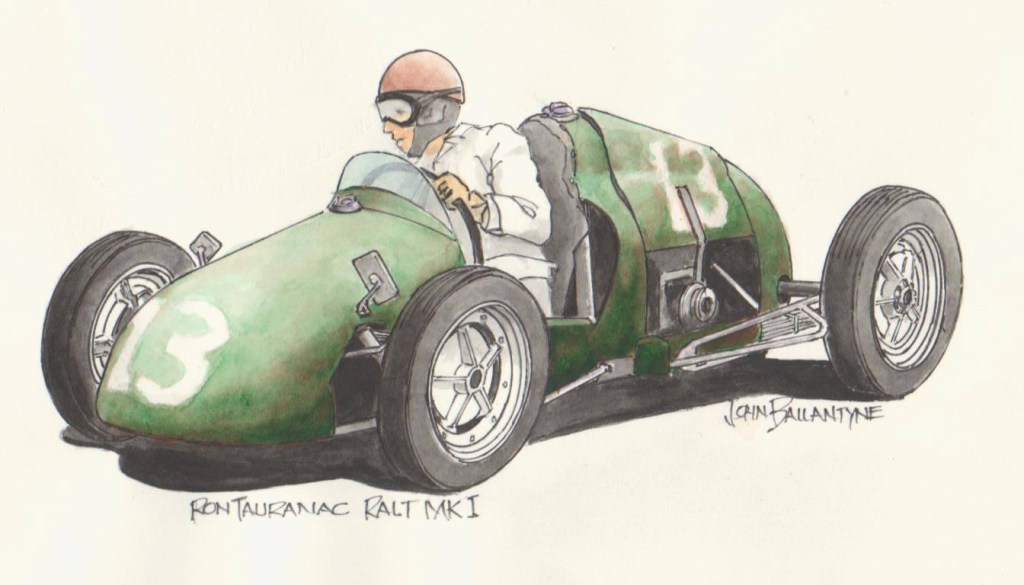
Well known in Australia but perhaps less so elsewhere are Ron Tauranac’s pre-Brabham phase Ralts as against the post-Motor Racing Developments ones…
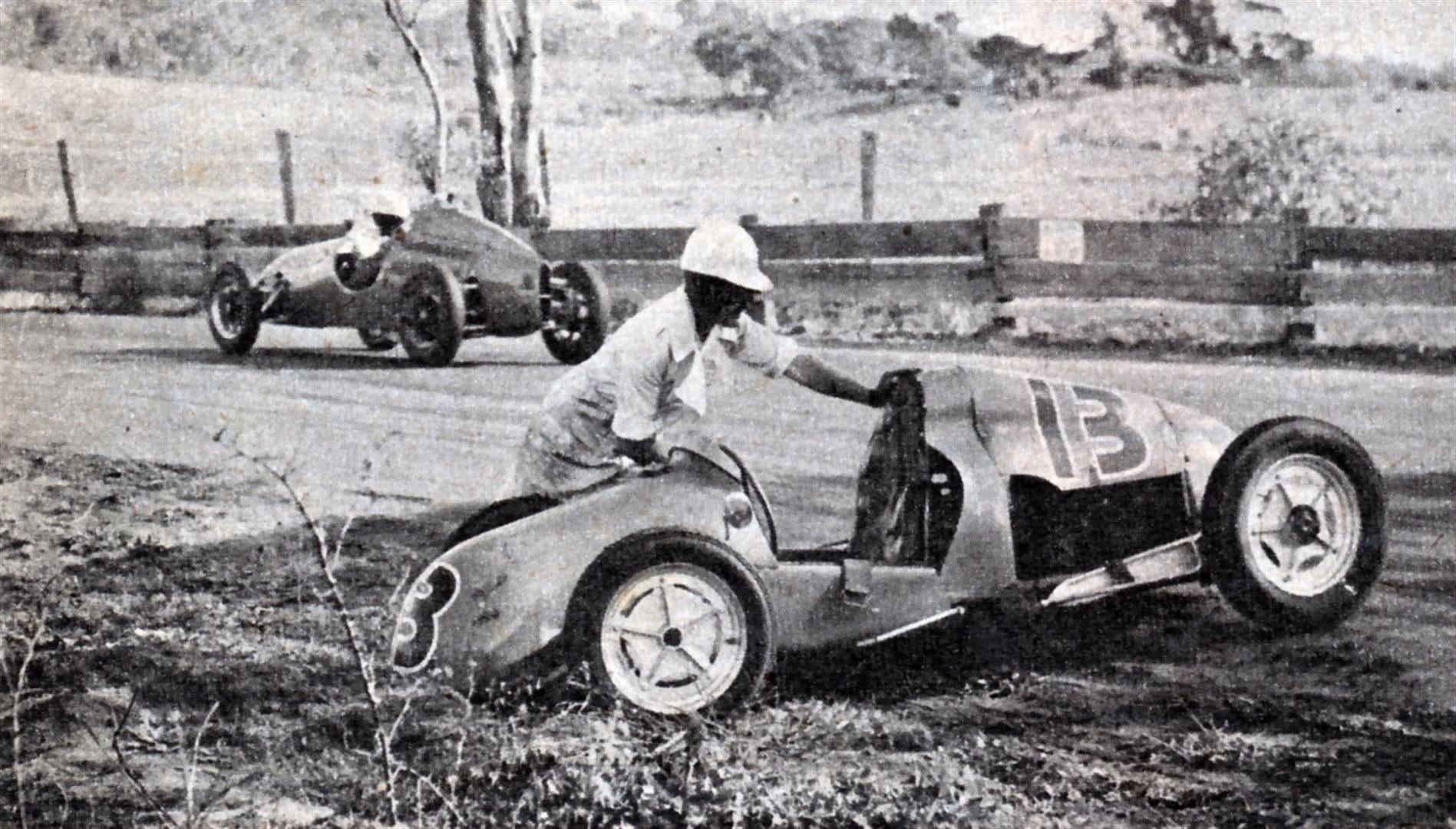
Ron looking young and shy in the first Ralt, the ‘Ralt Special’ above at the King Edward Park hill, Newcastle in 1951. By this stage Ralt 1 was fitted with schmick Ralt wheels and low-pivot trailing arms to better control the swing-axles.
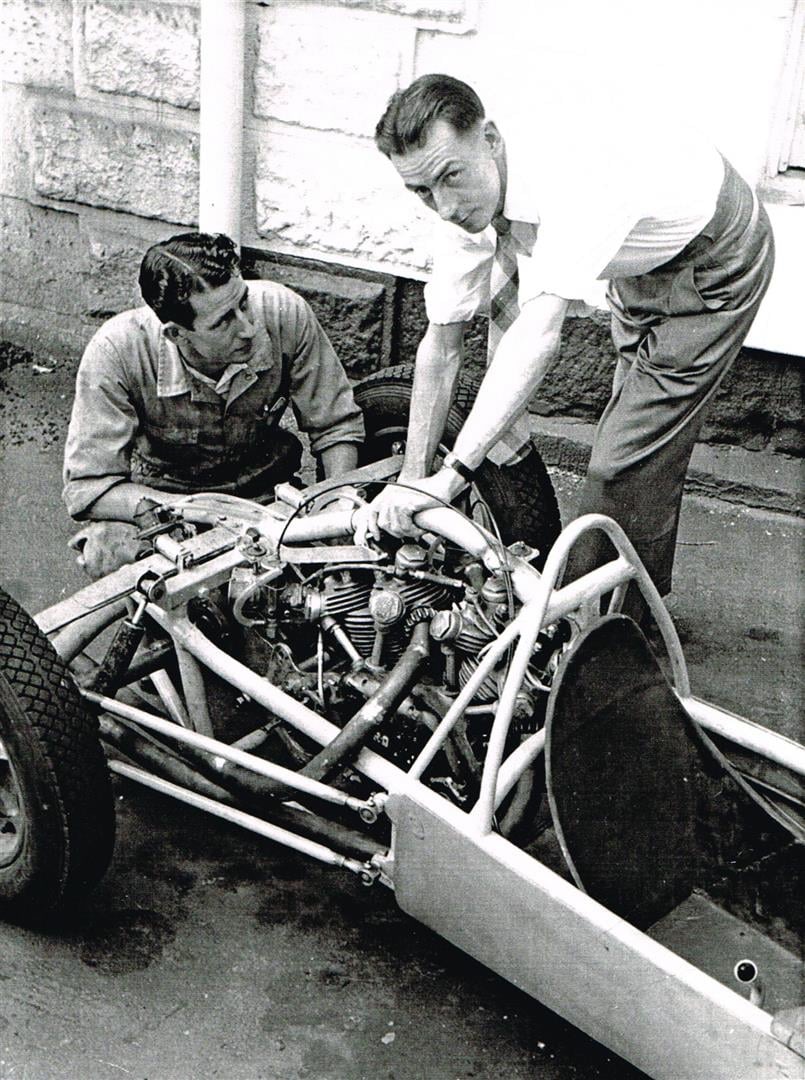
Ron and Austin Lewis Tauranac (RALT) built five racing cars in the 1950s fitted with a variety of engines, two were powered by Norton 500s and one each by Ford 10, Vincent 1000 and Peugeot motors. Sadly, only the latter seems to remain.
‘Series Two’ Ralt. Larry Perkins and Ron with the RT1 Toyota with which Larry won the 1975 European F3 Championship. Monaco GP weekend, where he won the first heat and crashed out of the final. Renzo Zorzi, GRD 374 Lancia won the second heat and the final. The car behind looks like a Modus M1 but I can’t make #117 work (Auto Action Archive)
After that they built another five or so chassis on their jig, which were Vincent 1000 powered, before Jack Brabham made the offer to Ron to join him in the UK as Jack hatched his post-Cooper plans.
Peter Wilkins, who had been working with Ron making chassis, fibreglass bodies, seats, alloy wheels with integral brake drums, steering and suspension gear, bought the stock of parts. He then onsold the Ralt bits – Ron’s version is he sold them direct – to John Bruderlin and Leon Thomas, whose Concord, Sydney, Lynx Engineering business specialised in building hot MGs and selling MG parts.
Wilkins joined them as a partner for two highly productive years making what John Blanden described in his book as Ralt Derivatives; three Vincent engined cars and various Lynx Peugeot, Borgward, Ford and BMC powered FJ/single-seaters until Wilkins joined Tauranac in the UK to assist in the construction of the first Brabhams at Motor Racing Developments. These cars are covered later in the article under the Ralt Derivatives heading.
The descriptions of the cars are those used in Ron’s biography, ‘Brabham Ralt Honda : The Ron Tauranac Story’ written by Mike Lawrence, but I have used Ralt 1, 2 etc for brevity. There is no shortage of photos of the cars on the internet but most don’t have captions, if you can help with the who, where and when please email me on mark@bisset.com.au and I will update the piece.
In the beginning…
Tauranac was born in Gillingham, Kent in 1925 and emigrated to Australia with his folks in 1928. Austin was born in 1929 by which time the family lived in Fassifern, Newcastle. When of working age Ron joined the Commonwealth Aircraft Corporation as a junior draftsman in 1939, continuing his technical studies. Despite being in a protected occupation he joined the RAAF in 1943 and trained as a pilot but missed out on combat with the end of the conflict, he was a Flight Sergeant when he returned to Civvy Street.
A very youthful Ron aboard Ralt 1, probably near the Bondi garage/workshop in 1949 (B Caldersmith)
Garry Simkin, historian, air-cooled expert and el-supremo of the superb loosefillings.com – from which a chunk of this article was drawn, together with the relevant section of Blanden’s bible which was written by Doug Grant and Mike Lawrence’s biography on Ron – writes that legend has it Ron was driving through Marsden Park when cars were racing on the ex-RAAF landing strip there, and his appetite for racing was whetted that day. Simkin debunks the theory, but one way or the other Ron and Austin, by then a motor mechanic, were soon reading all they could about the fledgling 500cc Movement in the UK. The 500cc Car Club of NSW was formed in April 1947, the brothers were soon hatching plans of their own aided by the knowledge gained in buying/improving/selling an Austin 7, Lea Francis and a Morris Minor. Suss and and carefully search Loose Fillings here; https://loosefillings.com/
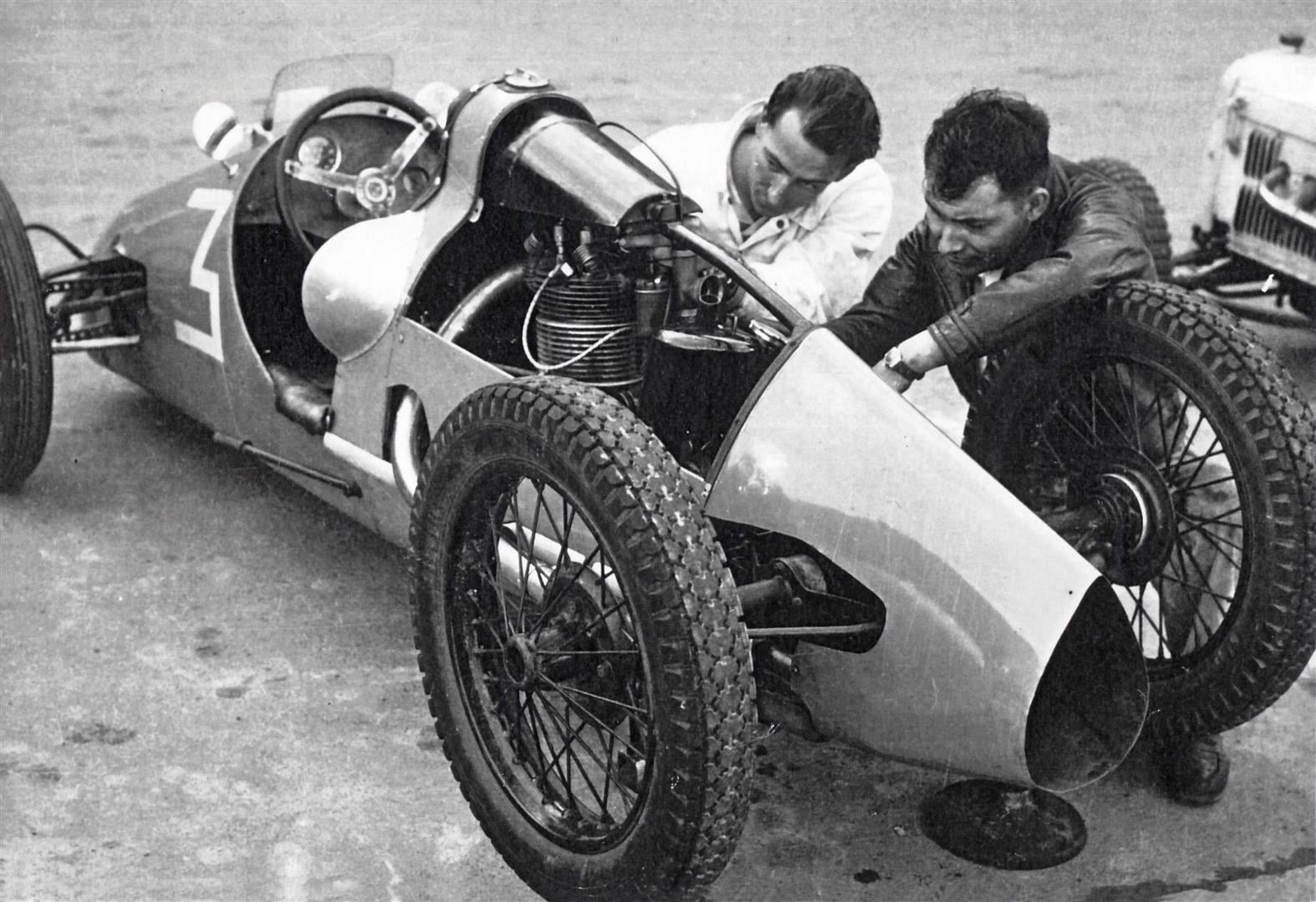
Ron drew the Ralt Special – as he called it in Lawrence’s book – Ralt 1 in 1947 but there was then a two year gestation period until it was rolled out of a rented garage in Blair Street, Bondi, closeby to the family flat. Powered by a Norton ES2 500cc engine, the car was a typical 1940s 500 with 19-inch wire wheels, tubular steel ladder-frame chassis, wishbone-leaf spring front suspension and swing-axle rear with an engine/gearbox from a road-going motorcycle.
Ralt 1 at Marsden Park, Peter Finlay suspects, an RAAF emergency airfield at Berkshire Park, west of Sydney. This shot and the one below are circa-1950 with the 19-inch wires and original rear suspension fitted (B Caldersmith)(B Caldersmith)
Despite lacking shock absorbers, money was tight, Ron entered a hillclimb at Hawkesbury on November 20, 1950. “On his first run, the Ralt, which had already given him a few frights in the first corners, ran wide, hit a drainage gully and flipped. Ron was thrown out and taken to hospital to be stitched together,” wrote his biographer, Mike Lawrence.
When RT recovered from the crash, he repaired the car, fitted shocks, stiffened the rear suspension and then took it back to Hawkesbury. After some impressive practice times, he set off on his first timed run and again crashed, this time one of the back wheels tucked under and the car flipped, Ron was unhurt despite cuts and abrasions. A shackle on the rear spring had broken and caused the wheel to fold over, the problem was that the spring was the main locating medium.
Ron was learning valuable lessons on-the-hop and back to the drawing board he went. He devised long-arm, low-pivot swing axles, adding universal joints and was able to lower the roll-centre of his car by six-inches. Then it returned to competition in 1950 and was raced consistently, notable early performances included a 58.13 seconds Newcastle hillclimb time, an Australian quarter-mile class record of 16.3 seconds, and an appearance at the Easter Bathurst meeting in 1951 when Ron drove. By then the car also had Ralt cast-alloy wheels, Ralt 2 – the ‘Ralt 1100’ – also contested this meeting.
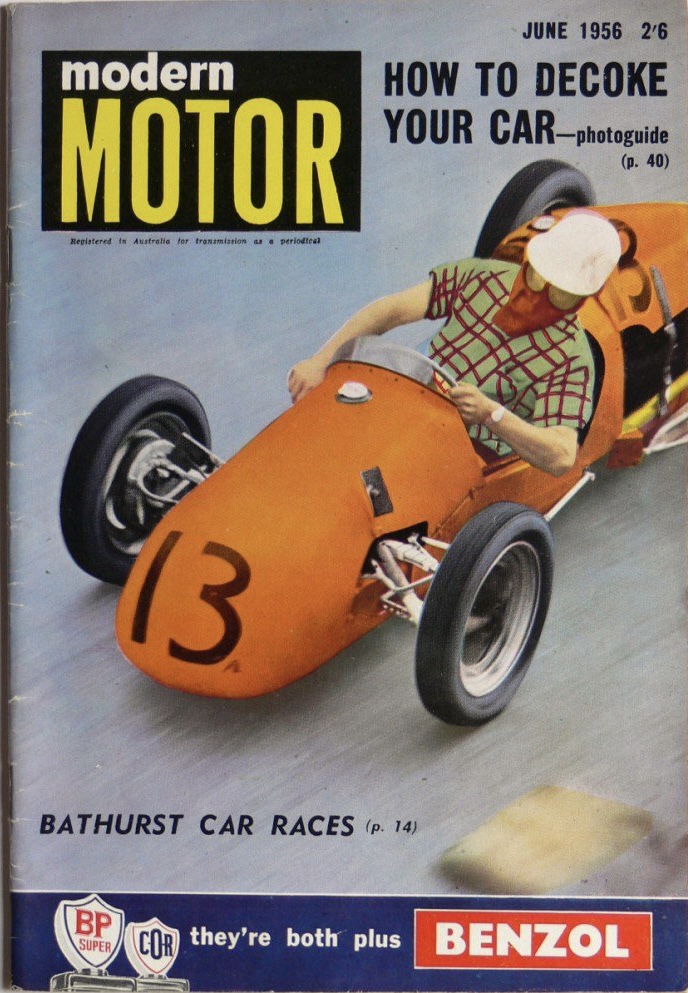
Merv Ward’s Ralt leads the Day Special (Bugatti T39 Ford V8 Spl) at Mount Druitt (B Caldersmith)Merv Ward in living colour on the cover of Modern Motor magazine aboard Ralt 1 Norton during the Easter Bathurst meeting in 1956 (S Dalton Collection)(B Caldersmith)
Ralt 1 then raced with continuous engine development at Foleys Hill, Newcastle and Parramatta Park among other venues. It was during this period that Ron met Jack Brabham and started to use him for his CSR Chemicals, his employers, machining work. The car was then sold to Merv Ward and Bernie Short, both of whom raced it in 1955 with much success using both ES2 and Norton overhead camshaft engines until Easter 1957 when the ES2 engine blew at Bathurst and the car crashed.
Sold in 1957 to Bert Bartrop, then to Reg Mulligan, on to Leaton Motors and Bert Lambkin, he crashed into a pole at Orange in 1960 during his first race. Taken to motorcycle expert Cec Platt for repair, parts of the car were used in building TQ midgets, the rest, apart from the two wheel-centres, was disposed off at the local tip after Platt’s death.
The Ralt 1100 (Ralt 2) appeared from the Bondi garage in 1949 fitted with a Ford 10 E93A engine, Standard 10 gearbox mounted mid-car fitted to a ladder-frame chassis, a Morris 8/40 rear end completing the key mechanicals. These components were clad in a sleek two-seater aluminium body, registered NSW KJ.989 and was raced by Austin at Leura, Mt Druitt, Foleys and Bathurst through to 1951.
Featured in the April 1951 issue of Australian Motor Sports, the car was sold to Lane Cove’s Austin Sudden in 1952 after Tauranac’s marriage, his wife to be wasn’t keen on his racing. Sudden used it on the road before selling it, passing through a couple of pairs of hands – Doug Grant chanced upon a photograph of the car below in a South Brisbane car yard circa-1959 – it was badly damaged in a 1969 car accident in Queensland and assumed scrapped.
(unattributed)(D Willis)
Ron Tauranac in the Jack Hooper car modified by he and Austin, then raced by Austin as the ‘Norton Special’ at King Edward Park hillclimb, Newcastle in 1951. Dick Willis tells us “It took FTD with a mere 500 Norton engine ahead of many more fancied runners including Sir Jack with the Cooper Bristol.”
Originally built by the Hooper brother, operators of the Hooper & Napier Motorcycles business in Sydney, Austin bought it and the brothers comprehensively rebuilt it inclusive of a new chassis. The Ralt MkIII (Ralt 3) took nine months to build in the Austin Service Station, East Circular Quay ‘on’ Sydney Harbour.
Austin debuted it at Mount Druitt in 1953 then raced very successfully for two years, he placed third at the Bathurst Easter 1955 meeting in an event also contested by Merv Ward in Ralt 1. Sold to a Broken Hill enthusiast who raced it at Port Wakefield in October 1956, no further details of the car’s whereabouts are known.
(B Gunther)
Byron Gunther wrote on the reverse of his photograph above, “A Tauranac, Norton 500. Very consistent all day (what day and where tho Byron??), this is the ex-Hooper 500, the first really good 500 built in this country.” Interesting to get this in-period perspective from an expert on the scene.
Ralt 1 at left with the Hooper originated Norton Special (Ralt 3) – by then fitted with Ralt alloy wheels on the front – at Mount Druitt (B Caldersmith)(B Caldersmith)
Austin and Ray Tauranac with the Ralt MkIV (Ralt 4) in build. This car, which used a four-tube chassis had no similarity to the earlier cars. Its front suspension used Austin A30 wishbones and uprights and Tauranac’s twist on De Dion rear suspension. The wheels and rack and pinion steering were also RT built. The much more sophisticated car was fitted with a Vincent Black Lightning 998cc engine and was also built at Circular Quay.
First raced in 1957 by Ron, it was driven by Jack Brabham at Mount Druitt on a trip home that year. Ron sold it to Noel Hall of Woolgoolga in 1958, he raced it in both the Easter and October 1958 Bathurst meetings before selling it to John Hough in mid-1959.
Noel Hall on his first shakedown run after purchase from RT, Ralt 4 Vincent at Castlereagh Dragway in 1958 (P Graham)Noel Hall, Ralt 4 Vincent, Lowood 1959 (D Willis)(R Hough)
John Hough in the Ralt 4 Vincent on the family farm at Woodford Island in 1958 or 1959. Later traded to Reg Mulligan for the ex-Moss-Davison HWM Jaguar, it was crashed by Richard Compton at Catalina Park in 1962 then left in Lehane’s workshop in Auburn, Sydney, before being sold in damaged condition and disappearing without trace.
(B Caldersmith)(D Grant)
Reg Mulligan in Ralt 4 Vincent on pole of a four-lapper during Catalina Park’s opening meeting, February 12, 1961. Bob Maine and Vincent guru, Alan Burdis are awaiting the push-start.
Barry Garner is in the Nota Major alongside, and #37 D Russell’s MG TC Spl, #68 is Peter Wherrett’s Cooper Mk4 Hillman Minx and #31 the Toby Hines’ Ralt 498cc.
(D Grant)
The Ralt 5 – Ralt MkV – was a front-engined single-seater for Austin which was built simultaneously with Ralt 4. With a spaceframe chassis and similar suspension to Ralt 4, the car was sold incomplete when Austin retired from racing, what became of this car, nothing is known?
Having referenced John Bruderlin and Leo Thomas’ Lynx Engineering business, here is the Bruderlin/Thomas cigar-bodied MG TC Spl of Max Williams at Lowood in 1958 (G Smith Collection)
Ralt Derivatives…
The list of the cars built with Tauranac designed chassis, sold to Peter Wilkins and then Lynx Engineering follows. lt’s a precis of the Doug Grant/John Blanden material in Blanden’s ‘Historic Racing Cars in Australia’, which is included for completeness, it’s not a treatise on the history of each car.
Ralt Vincent 1959
Bought by Tony Hindes in 1959-60 and used with both V-twin and 500cc engines, sold to Todd Hamilton in 1962-63 and still with him in 2004.
(K Starkey)
The shot of Todd above is on the Amaroo Park hill in 1968, the one below at an historic meeting in more recent times.
(D Willis)
Marvellous shot of Ron and the same car at a Parramatta Park reunion (I think) not too long before he died.
In more recent times the car has been sold to Chris Page.
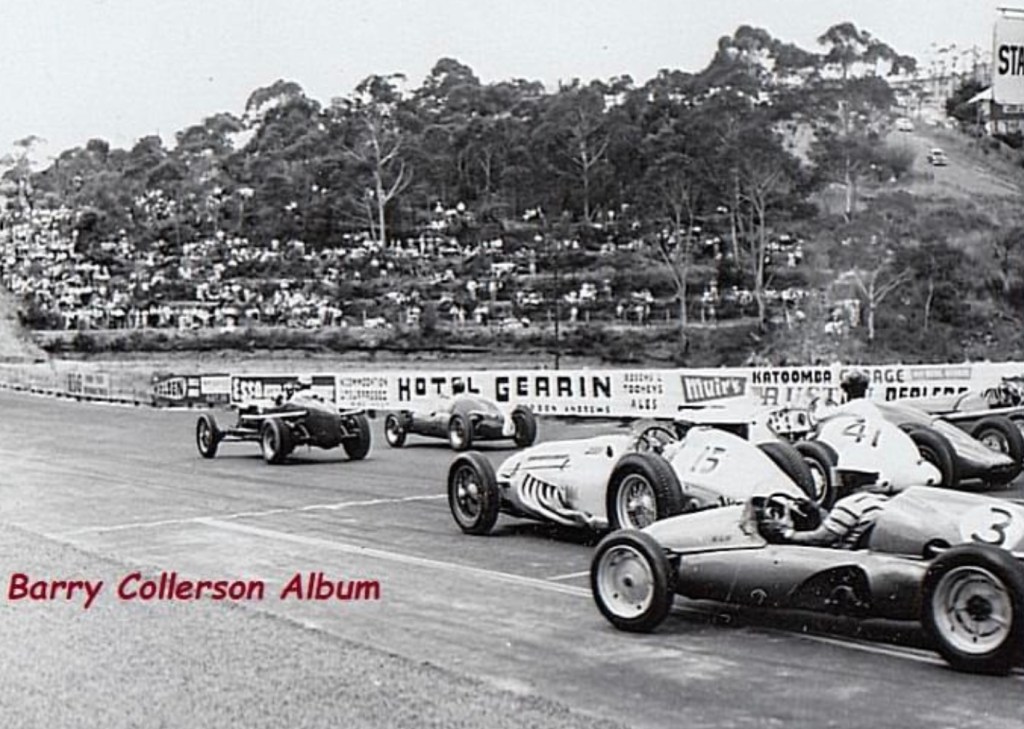
Ray Walmsley, Alfa Romeo P3 Chev up front, with Jack Myers’ #3 Triumph Thunderbolt, Barry Collerson, Talbot Lago T26C #15, #41 Frank Walters, SoCal and Gordon Stewart, Stewart MG at the start of a Catalina Park race during the opening meeting in 1961
He raced the Thunderbird at Easter Bathurst in 1961 and took part in hillclimbs throughout Australia, but tragically died in it after being thrown from it at Catalina Park, Katoomba in January 1962.
The photo above shows Jack – wearing his usual T-shirt with hoops – in car #3 at the start of a Catalina race in 1961, while the post-accident one below is shown to provide an idea of the engine packaging challenges.
(P Goulding)(D Willis)
As the post-Catalina-crash shot shows, the damage to the car does not appear significant. Sold by the Myers family, here the car is in the hands of Jim Reuter at Lowood in 1964.
Jennings Vincent
Built and owned by George Jennings in Victoria, whereabouts unknown.
(G Simkin Collection)
Lynx Vincent chassis 101
Built for Narrandera racer Les Trim in 1960, 998 Vincent. Sold in 1964 with the parts going into a sportscar project in Queensland.
Lynx Vincent chassis 102
John Marston raced it in Victoria and New South Wales fitted with a supercharged engine often as a Bruderlin & Thomas works entry. Through many hands, extant, and partially restored, albeit less engine, the car survives and was authenticated by RT.
(J Ellacott)
John Ellacott’s marvellous, rare colour shot was taken of John Marston gently sliding through Homestead corner at Warwick Farm in 1961.
(unattributed)
Lynx chassis 103
Built in 1961, through the hands of five drivers until the caring, skillful Dick Willis bought it in 2004.
Lynx chassis 104-109
Generally Ford and BMC powered FJs. Below is Kevin Bartlett’s Lynx BMC, chassis #105, at Lakeside in May 1962.
(B Miles)(B Thomas)
The same car at Lakeside a little earlier, November 11, 1961. KB’s #105 having its gizzards attended to; BMC 1-litre A-series engine with Amals, Renault transaxle.
Lynx chassis 110-116
The slimline Mark 2 machines were all Ford powered with the exception of the supercharged Peugeot powered machine built for Bob Holden and later raced very successfully by Colin Bond.
Holden’s lovely Lynx Peugeot is shown above Warwick Farm on debut in 1963.
(unattributed)
The same car with Colin Bond at the wheel and key team-members in attendance, Bob Riley standing alongside Vicki Allingham with Bob Allingham behind the front wheel. Bond’s performances in this car on the circuits and in the hills, and in rally Mitsubishi Colts resulted in subsequent fame-and-fortune via the Holden Dealer Team.
Etcetera…
Ralt 1
(B Caldersmith)
Ralt 1 in very early spec spec with Morris 19-inch wheels.
“I made two fundamental mistakes on that car,” Ron related to Mike Lawrence. “I put the seating position too far forward, and and the other was that I put swinging half-axles at the rear. The seating position gave me the theoretically correct weight distribution but it also made the car much harder to drive because you just didn’t get enough warning when the back end was going to break away.”
The shot above at Foleys Hill on July 13, 1952 shows Ralt 1 with its Ralt alloys and another angle on Ron’s swinging-half axles, and you can just see the end of the trailing arm.
(B Caldersmith)
Ron with hands in pocket and Austin looking towards us, Ralt 1 then with his alloy wheels and trailing arm rear suspension at Foleys Hill, July 13, 1952.
RT told Mike Lawrence, “The homemade engine was based on a Norton ES2 pushrod unit. The cams from a Norton WD side-valve gave me the timing I wanted. Over time, we made a crankcase, fitted a locally made piston which gave a 14:1 compression ratio, and ran it on methanol with an Amal carb. It had a cast-iron flywheel, then I had Jack Brabham machine me a a steel one. We played around with new barrells and eventually enlarged it from 500-600cc, I learned a lot about engines from that.”
(B Caldersmith)
In front of Dick Cobden’s Cooper.
Merv Ward at Gnoo Blas in 1956 (D Grant)(B Caldersmith)(B Caldersmith)
Mountain Straight at Bathurst perhaps. Do get in touch if you can help with the missing where, when and whom caption gaps.
(B Caldersmith)
Ralt 4
Noel Hall took FTD in the Ralt 4 Vincent at this gravel hillclimb held at Rushford Road, South Grafton, NSW in 1959. Racer/restorer/historian Dick Willis was there to catch the relaxed vibe of the day in countryside Dick described as “sparse”. Indeed.
(R Hough)
Ralt 4 Vincent on its trailer on the Hough family farm.
Credits…
Brian Caldersmith, Dick Willis, Richard Hough, John Medley, ‘Brabham Ralt Honda: The Ron Tauranac Story’ Mike Lawrence, Kerry Smith in Loosefillings.com, ‘Historic Racing Cars in Australia’ John Blanden, Bill Miles, Bill Tyrrell, Pat Goulding, Barry Collerson Album, John Ballantyne, Ken Starkey, Brier Thomas, Stephen Dalton Collection, Daniel Bando, John Ellacott, Peter Graham via Grant Burford
Tailpiece…
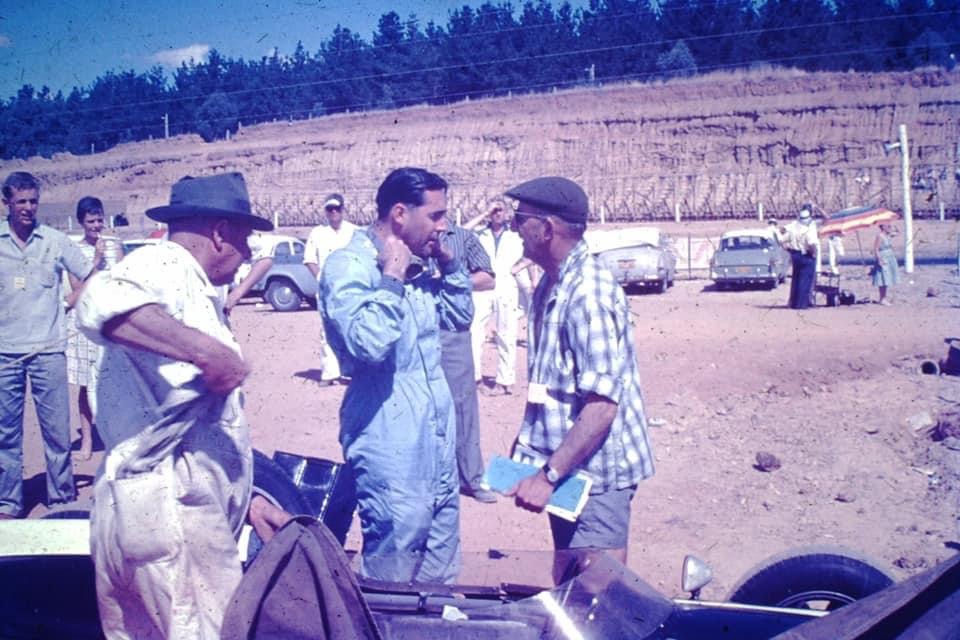
Whatever Ron and Jack were talking about, it wouldn’t have been the past. They were all about the next project, not the last one…
Social media just keeps giving and giving. This time enthusiast Russell Garth has posted some great ’56 AGP colour shots taken by the late Ian Curwen-Walker at Albert Park on Bob Williamson’s Old Motor Racing Photographs Australia Facebook page.
Sometimes I’ve got so many different articles on the same topic I’m confusing myself – not that is difficult to do I might add – so rather than start another ’56 AGP piece I’ve added the shots to this existing article; https://primotipo.com/2018/01/16/james-linehams-1956-agp-albert-park/
The photograph above is Paul England’s Ausca Holden-Repco which contested the 25 November, 34 lap, 100 mile Australian Tourist Trophy. He was 12th outright and second in class, in the car he and Bill Hickey built after hours at Repco Research’ Sydney Road, Brunswick premises on the other side of town. The flash of blue to the right is the Norman Hamilton owned Porsche 550 Spyder driven that weekend by Otto Stone, lasting only one lap. Otto would have been a busy boy that fortnight, looking after Stan Jones’ 250F, or was he preparing it at that early stage?
Tony Johns tells me the “bloke (with his back to us) in the white overalls with the fag is Norman Hamilton,” who created the Porsche Cars Australia empire in Australia, famously the first Porsche importer/dealer outside Europe.
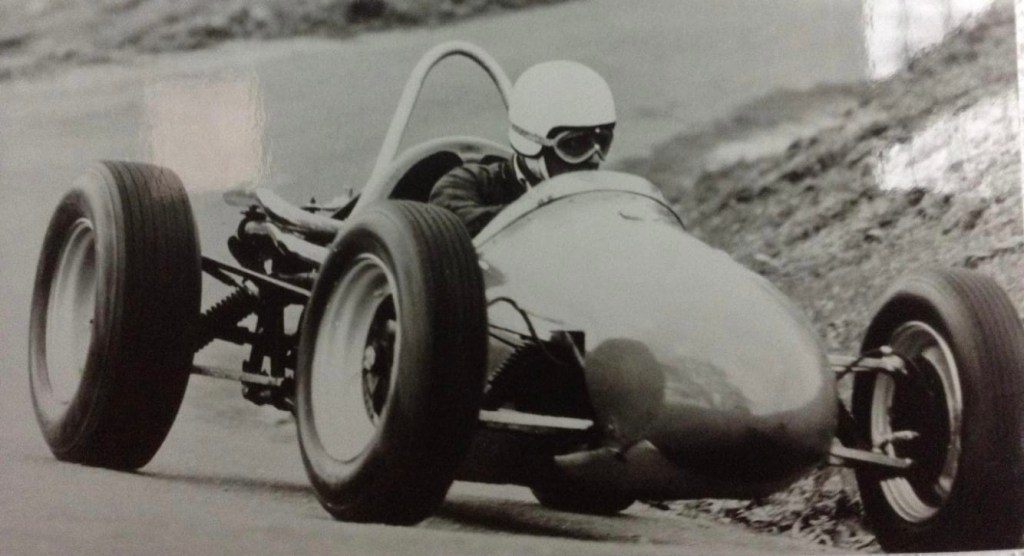
One upon a time Grand Prix drivers weren’t paid fees that make the GDPs of third world countries look small.
I guess that over 20 Grands Prix and the associated test and race-simulation loads keep them busy, the rest of the time is devoted to the body-beautiful, PR and the needs of the girl/boyfriend.
At the dawn of the space-age, wily Jack Brabham worked all the angles to optimise his earnings, short and perilous as it was in the days when drivers died in the cockpit as a matter of routine.
John Cooper paid him a retainer and a percentage of his winnings. He ghosted magazine articles, had a motor garage and dealership or three, drove cars for others and owned and entered cars for himself and others. That’s how he found himself in the New South Wales/Victorian border-town of Albury, on the Murray River, for the Craven-A International at the small, new, Hume Weir circuit over the March 12/13 1961 weekend.
(Draper Family Collection)(G Garth)
That summer he’d brought a Cooper T53 Climax (chassis F2-8-60) and Cooper T51 Climax (F2-5-57 or F2-7-59) home to do the Kiwi and Australian Internationals.
He did pretty well too, winning the New Zealand Grand Prix on the Ardmore aerodrome and the Lady Wigram Trophy on the RNZAF base of the same name in the T53. Ron Flockhart that car on pole at Ballarat, and finished third, while Ron’s best with the Cooper T51 was fourth at Ardmore and fifth in the Warwick Farm 100 where Stirling Moss won the first international held on the great Sydney track aboard Rob Walker’s Lotus 18 Climax.
(J Richardson)
Roy Salvadori – who had raced a Reg Parnell Lotus 18 in New Zealand that summer – took the wheel of the Cooper T51 in Tasmania, winning the Longford Trophy (above) but his weekend wasn’t so successful in Albury where he was fourth in the Saturday 20-lapper, and failed to finish the equally hot Sunday race. Brabham won both races in the T53 in skinny six/seven car grids.
Our Jack dragged in he crowds, doubtless Craven A sold a few cancer-sticks, so everybody went home happy. Brabham always flogged the cars he brought to Australia at the end of his tour but on this occasion both Coopers returned to the UK and equally oddly both disappeared into the ether later in the year.
(Draper Family Collection)
Credits…
John Richardson, Draper Family Collection, Glenn Garth, oldracingcars.com
Tailpiece…
(Draper Family Collection)
Roy Salvadori reflecting on the size of his ‘Gregory Peck’ at the Weir while entertaining the crowd, announcer’s name folks?












































 primotipo...