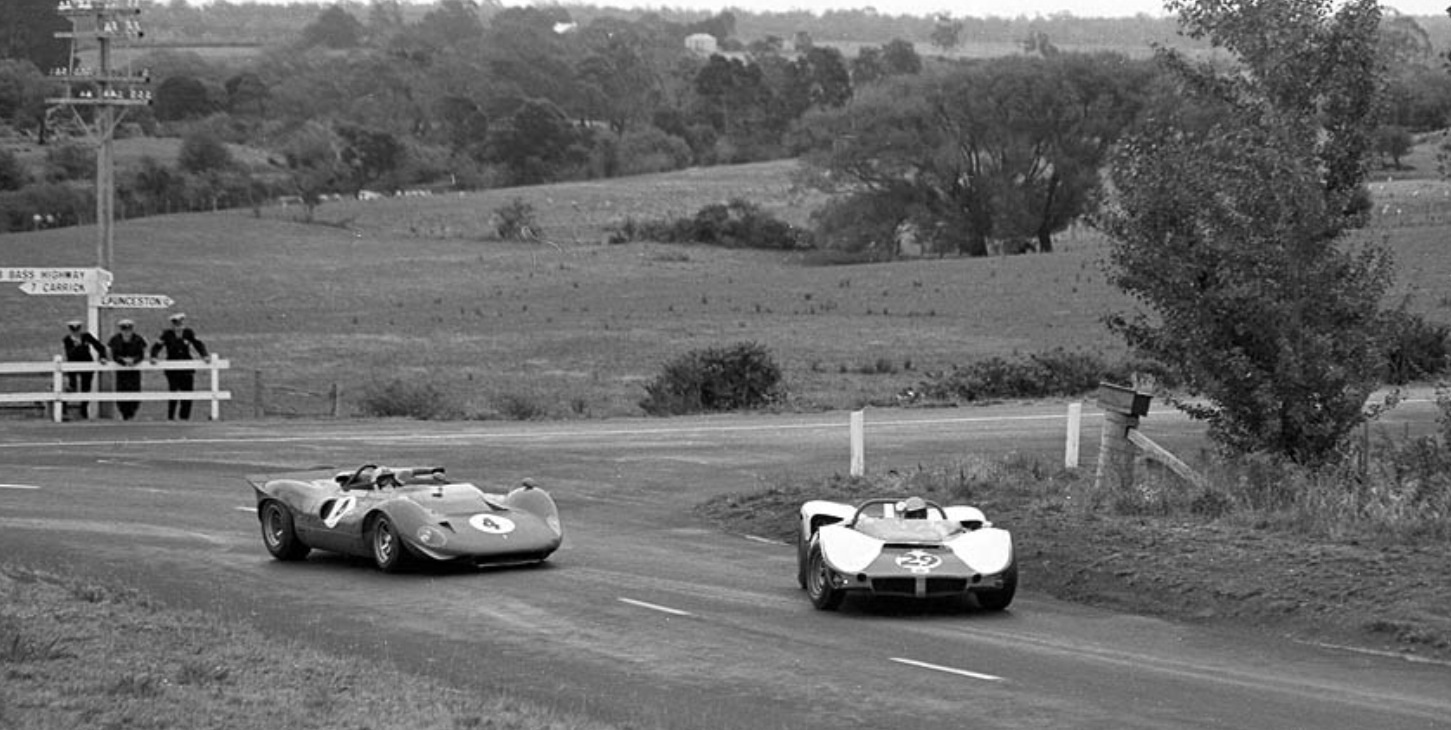
John Goss, Tornado Ford, Ross Ambrose, Rennmax Climax and Alan Hamilton, Porsche 906 during the 1967 Tasmanian Sportscar Championship at Symmons Plains on 12 March…
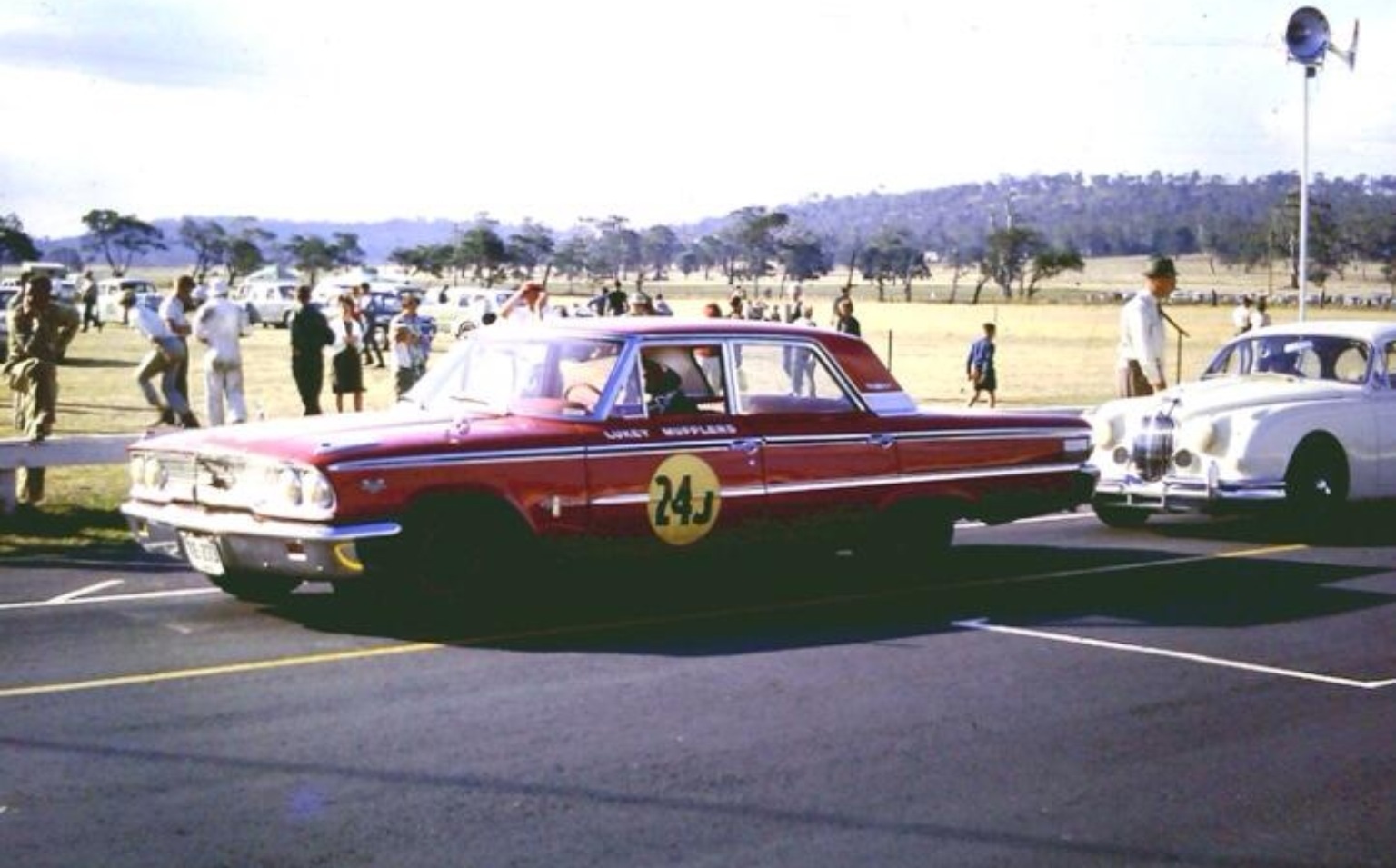
It could only be Australia with that backdrop? Love Don Elliott’s transporter providing the spectator vantage point, devoid of Ford Mustang it makes a mighty fine mini-grandstand. Jaguar Mk1, stark eucalypt tree and the topography of the northern Tasmanian midlands circuit.
The cars are well known too, albeit Hamilton is about to lap the other two cars. Oh, and the drivers are prominent too, Goss and Hamilton Australian Champions- in Ambrose’ case perhaps he is known as much as the father of touring car ace Marcos Ambrose and ‘co-father’ with Ralph Firman of Van Diemen racing cars. No prizes for guessing who suggested the name of that great marque.
I’ve written articles about the John Goss built Tornado, Hamilton’s 906 and tangentially about Ross Ambrose’s car which started life as the Bob Britton built – he of Rennmax fame- Mildren Maserati sportscar driven by Ralph Sach, Frank Gardner and Kevin Bartlett. It then morphed into the ‘Rennmax Climax’. When sold by Alec Mildren to Ross Ambrose he fitted a Coventry Climax 2.2 litre four cylinder FPF engine in place of the Maserati Birdcage T61 motor which blew big-time whilst driven by Frank Gardner in the 1965 Australian Tourist Trophy at Lakeside, the chassis was re-named by Ross with Alecs consent.
This article was inspired by David Keep’s opening shot, it was only when I sought Rob Barthlomaeus’ help with a race report that he pointed out this was a tragic meeting as one of the contestants, Melbourne’s Wally Mitchell later died as a result of a collision in this event.
Many of the Symmons competitors contested support events during the Longford Tasman round a week before with the fields depleted by the likes of Noel Hurd’s Elfin 400 Ford due to an accident seven days earlier- Hamilton’s 906 made its debut race at Longford and was race favourite with the non-appearance of the powerful Elfin.
Alan was having a good day in the office with a Symmons preliminary win from Glynn Scott’s Lotus 23B Ford and Wally Mitchell’s RM1 Chev. The grid for the 30 lap, 45 mile championship race was derived from the lap times achieved during the earlier event.
Tas sportscar c’ship grid- L>R Mitchell RM1 Chev, Scott Lotus 23B Ford and Hamilton, Porsche 906 (oldracephotos/DKeep)
Hamilton started from pole with Scott and Mitchell alongside with Alan Ling Lotus 23B Ford and Bob Holden in a Morris Cooper Lwt on row two.
Scott led initially from Hamilton with Mitchell’s circa 350 bhp Chev V8 engined, spaceframe chassis car- built by he and St Kilda, Melbourne engineer/constructor Bill Reynolds, Bill’s cars were named Wren (R-Reynolds M-Mitchell) comprised a mixture of ex-Lex Davison Estate Brabham BT4/Cooper T62 and Wren components- passed by almost the entire field.
After 5 laps Hamilton had a sixty yard lead over Scott and had already lapped tailenders Mawdesley, Lotus Super 7 and Truscott’s Honda.
By lap 7 Hamilton led from Scott, Ling (who later lost 3rd gear) and Bob Wright’s Tasma Climax FPF 2 litre and was continuing to lap the slower cars.
An arcane but interesting sidebar to Bill Reynolds/Wren enthusiasts, and there are quite a few of us in the Australian Formula Ford ranks given the number of FF Wrens Bill constructed, is that the Tasma Climax was initially built by Reynolds as the ANF1/Tasman Formula Wren Climax single-seater. It too was fitted with an ex-Davison Estate 2.5 FPF but was only raced several times as such by Brendan Tapp and Wright before Wright widened the chassis and created the Tasma sports-racer, there is a story about both the RM1 and Wren Climax but that is for another time.
Goss spun Tornado at The Hairpin allowing Bob Holden and Kerry Cox’ Jaguar Spl through, the order at this point of the 30 lap journey was Hamilton, Scott, plugging along and hopeful in second, Ling unable to do much with third gear absent without leave, Holden, Cox, Goss, Mitchell, still with a misfiring motor and then the rest.
Wally Mitchell’s car finally chimed onto eight-cylinders and proceeded to make up lost ground over the slower cars hand over fist, he was up to third by lap 15 having passed Ling.
Mitchell’s RM1 Chev in front of Hamilton’s 906, a lap ahead, one lap before Mitchell’s tragic accident. He wore a seat belt, a big tick in 1967 as they were not mandated but it seems his fireproofs were sub-optimal and no balaclava, again, not mandated or universally used at the time (oldracephotos/DKeep)
Tragically at half distance, on that lap, Mitchell lost control of the probably not fully sorted RM1- it was originally fitted with a lightweight aluminium Coventry Climax FPF engine where the 5 litre cast iron Chev by then rested- over Bessant Hump, he went onto the grass, slammed into the fence tail first at TNT Corner, then bounced back onto the track. The car’s two fuel tanks ruptured with both the car and unfortunate driver engulfed in flames. The badly burned Mitchell released his seat belt eventually and jumped clear but not before suffering burns to eighty percent of his body.
Whilst poor Wally was attended to ‘The race was restarted at lap 16 as…the gutted RM1 still cast a pall of smoke over the pits’. In the final laps Ambrose passed Ling and Hamilton had a rod let go in the 906 on lap 26, the car expired at the Hairpin giving the win to Scott from Ling’s similar Lotus 23B Ford and Ambrose in the Rennmax Climax.
The sad aftermath of the accident is that the popular East Burwood based Wally died of his burns and related complications of pneumonia on 18 April in a Melbourne hospital.
Mitchell and the RM1 Chev at Symmons 12 March 1967. Nice looking car, I wonder what Wally and Bill took the fibreglass body flop off? Or was it bespoke? (E French)
oldracephotos.com.au- David Keep, Ellis French, Rob Bartholomaeus Collection- Racing Car News & Australian Auto Sportsman April 1967 issues, The Nostalgia Forum- Wally Mitchell thread
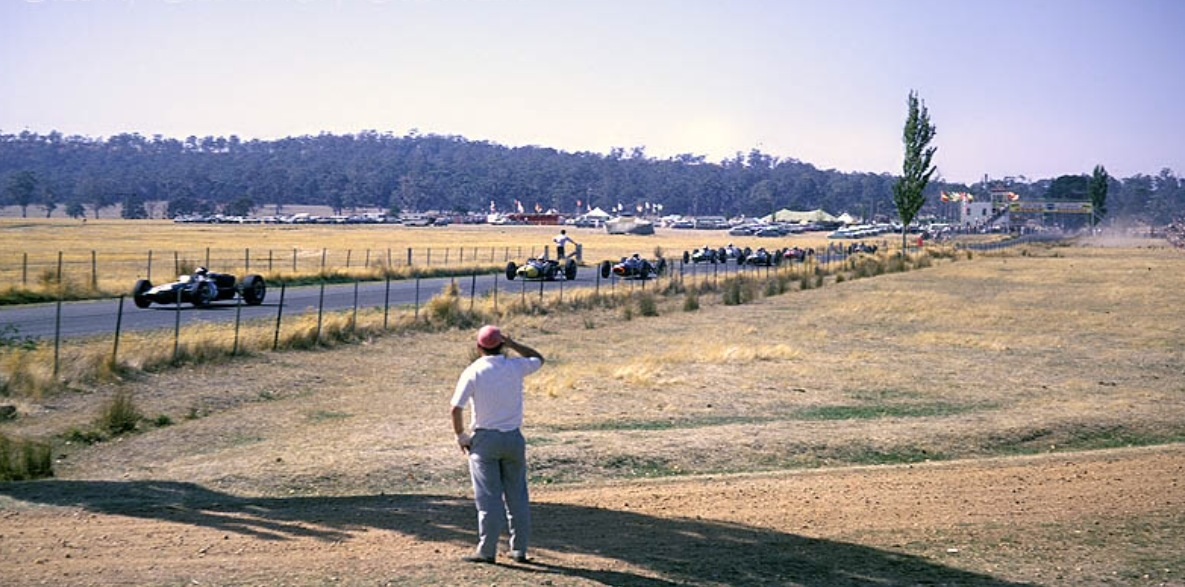
Tailpiece: Start of the ’67 Tassie Championship from the rear of the grid…
(oldracephotos/DKeep)
That’s Gossy to the right and the Peter Truscott Honda whilst up front it’s Hamilton’s white 906 sandwiched by two Lotus 23 Fords and then the Ambrose Rennmax and Mitchell RM1.
Doug Whiteford’s Maserati 300S blasts past Tom Sulman’s Lotus 11 Climax ‘Le Mans’ during Sandown’s opening International meeting on 12 March 1962…
I hate to think how many times these two fellows shared a starting grid- both personified the ‘Racing Is Living, All The Rest of It Is Waiting’ adage to a tee.
Unfortunately Tom died in one of his Lotus 11’s in a freak accident at Bathurst in 1970, he is 63 here with a career that stretched back to pro-Speedway racing in England pre-war.
Doug, a triple Australian Grand Prix winner, 44 years of age in 1962 raced into his dotage in Datsun Group E ‘Series Production’ Sedans and Production Sportscars after he had finished with the serious stuff.
It must be close to the end of his time racing the Maser, in fact John Ellacott who took the photo of the pair on Pit Straight, thinks it may well be his last race of the car before it’s sale. ‘3055’ was a works machine he acquired from the factory at the end of the 1956 Melbourne Olympic Grand Prix meeting with which he had considerable success in both Sportscar and Formula Libre events from then on.
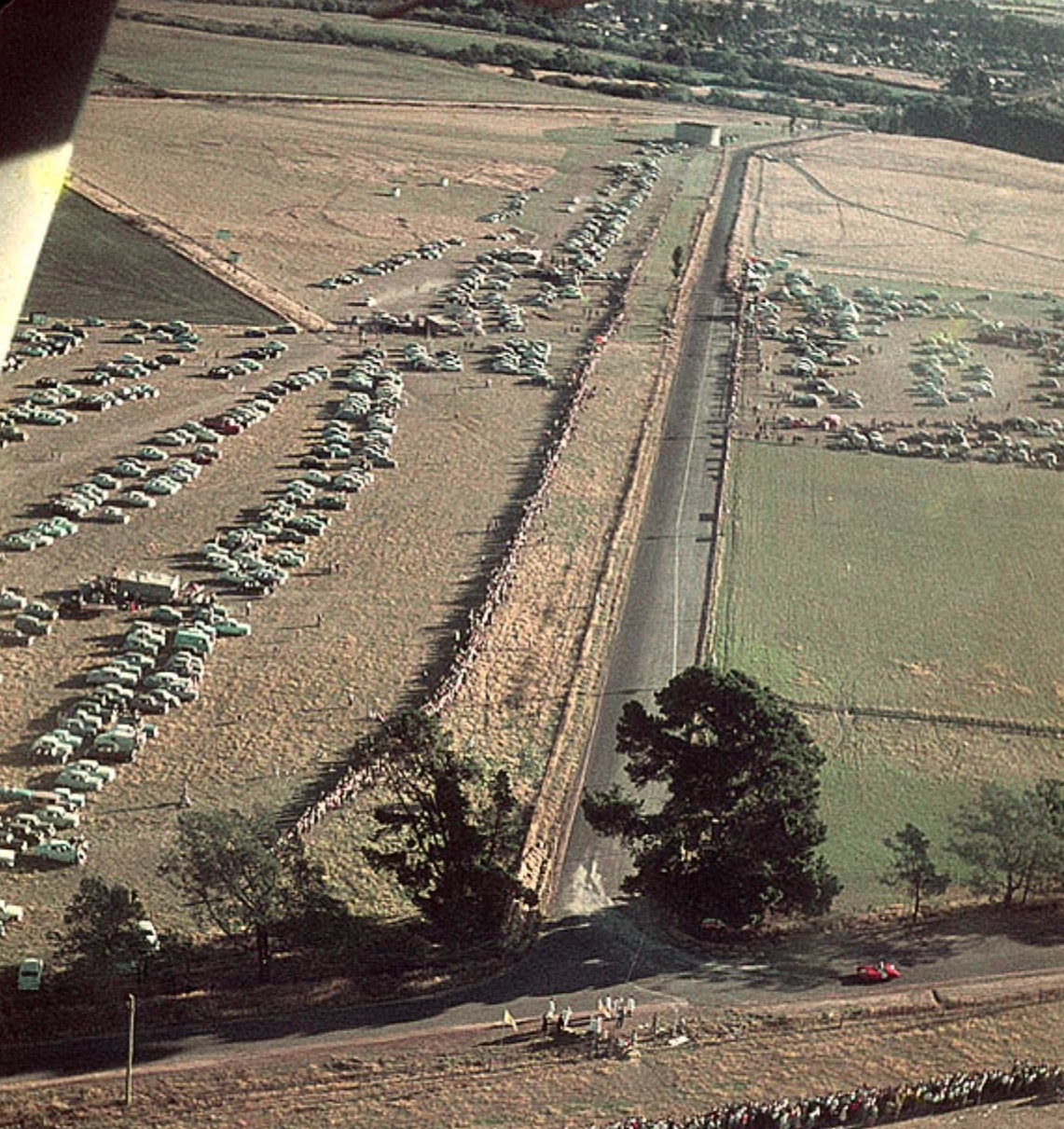
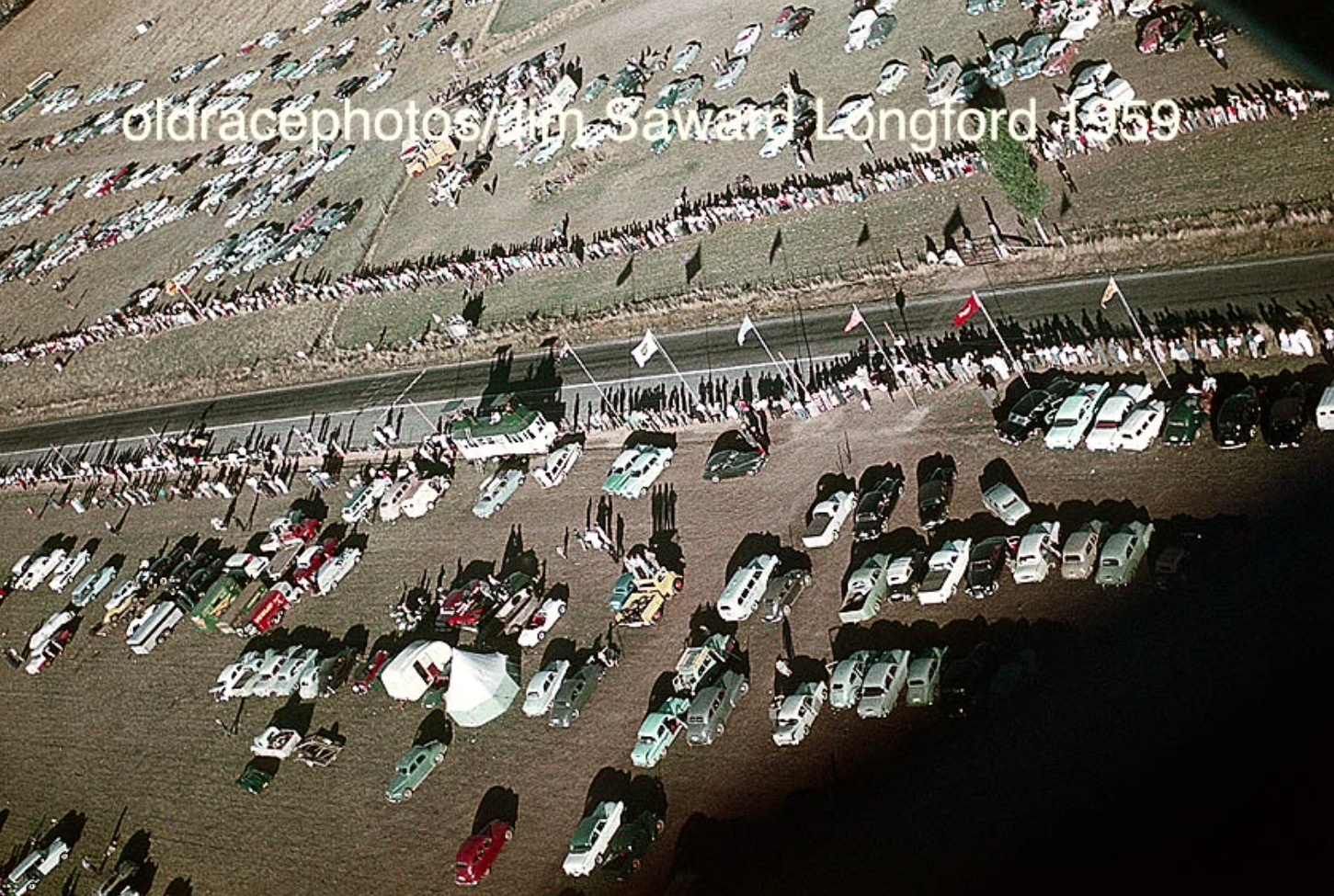
Longford’s Pit Straight- Illawarra Road from a Percival EP-9 at low altitude during the 1959 meeting…
We are indebted to Tasmanian enthusiast Rob Saward who left his, and his father, Jim’s photographic archive in the care of Lindsay Ross (oldracephotos.com.au) who periodically uploads tidbits of visual pleasure from his coterie of talented ‘snappers such as the aerial shots Jim took here.The perspective provided as a result, is gold.
My Longford obsession I’ve admitted a number of times. I suspect I have written more articles which involve this circuit than on any other single topic. The idea for this piece arose out of a swag of photos I’ve accumulated but not yet uploaded of the circuit, and the notion of a ‘photographic lap of Longford’ with the emphasis on more panoramic images taken from a distance to give us a feel for the flow of the place rather than close up shots of the cars and drivers themselves. Most of the photographs in this article I’ve not used in the many Longford pieces on this site thus far.
What also brings the article to life are the accounts of Longford from those who were there in period, these I have filched from The Nostalgia Forum ‘Longford: Reims of The South Pacific’ thread particularly the scribblings of Ray Bell, The Late Barry Lake, Stephen Dalton, ‘Longfordboy’, Lindsay Ross, Ellis French and others. I have quoted these fellas throughout.
Treat the article as Work In Progress though as the drivers perspective is largely missing. I am very keen to hear your views/recollections, many ex-Longford racers are readers, so it would be great to hear from you folk about the particular challenges this remarkable piece of Tasmanian real estate presented to racers of the time.
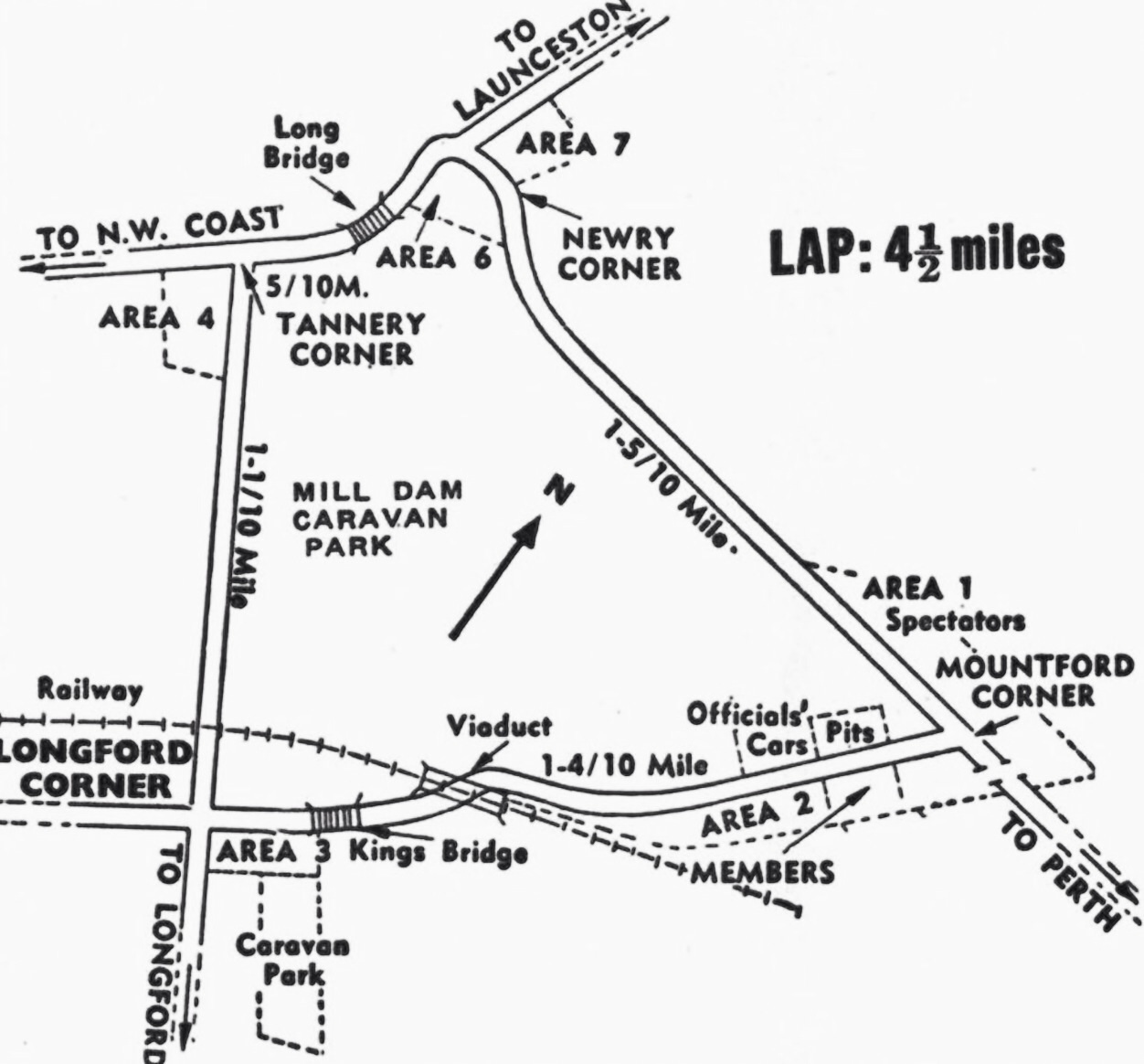
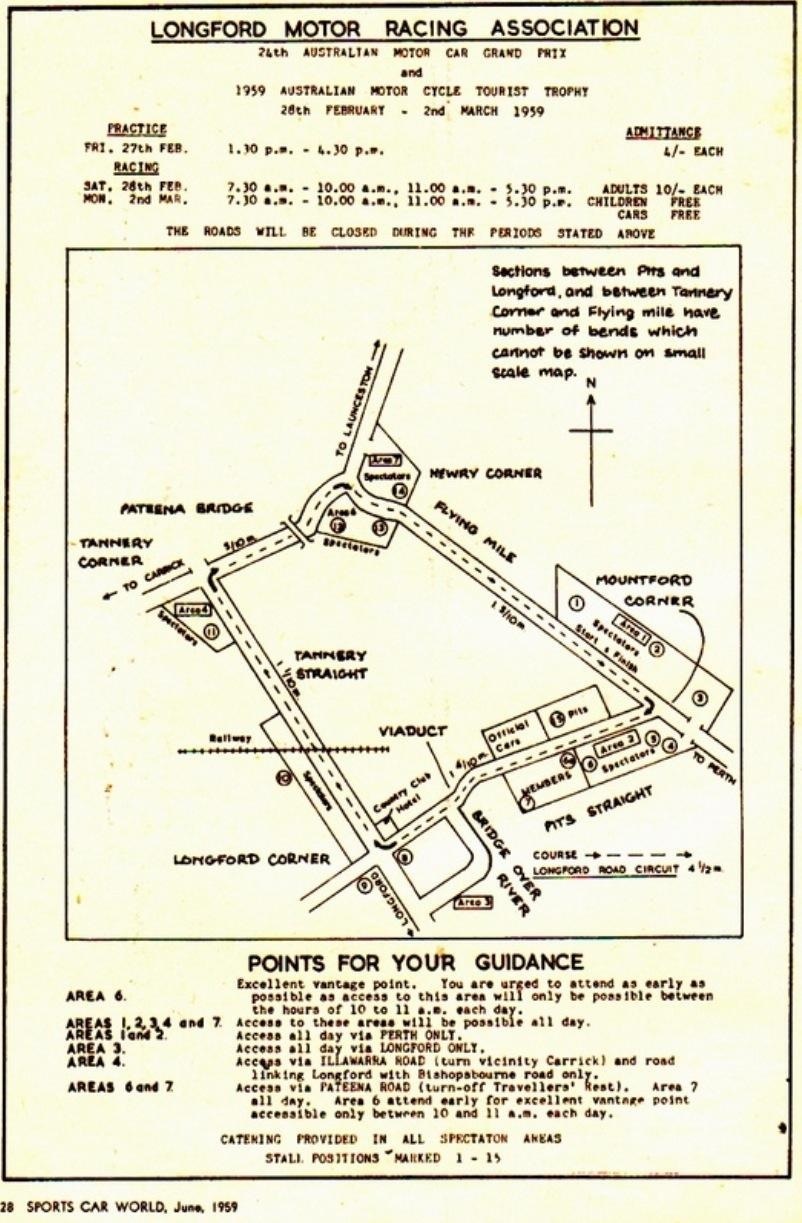
I’ve inserted a Longford circuit map to assist in understanding ‘where we are’, the reality is that the map is indicative rather than definitive, there are plenty of more nuanced twists and turns revealed by the photos which follow not reflected on a circuit map of this small scale.
Other essential homework before you read the article is to look several times at the in-car footage taken from Lex Davison’s Cooper T62 during the 1964 meeting. Many of you will have seen ‘Long Weekend At Longford’ already. After listending to and watching Davo’s great commentary (it starts at about the 2 minute 52 second mark) a couple of times turn the sound off and just focus on the circuit’s twists and turns, topography and changes in elevation.Then read the article having in part at least got into Longford’s rythmn…
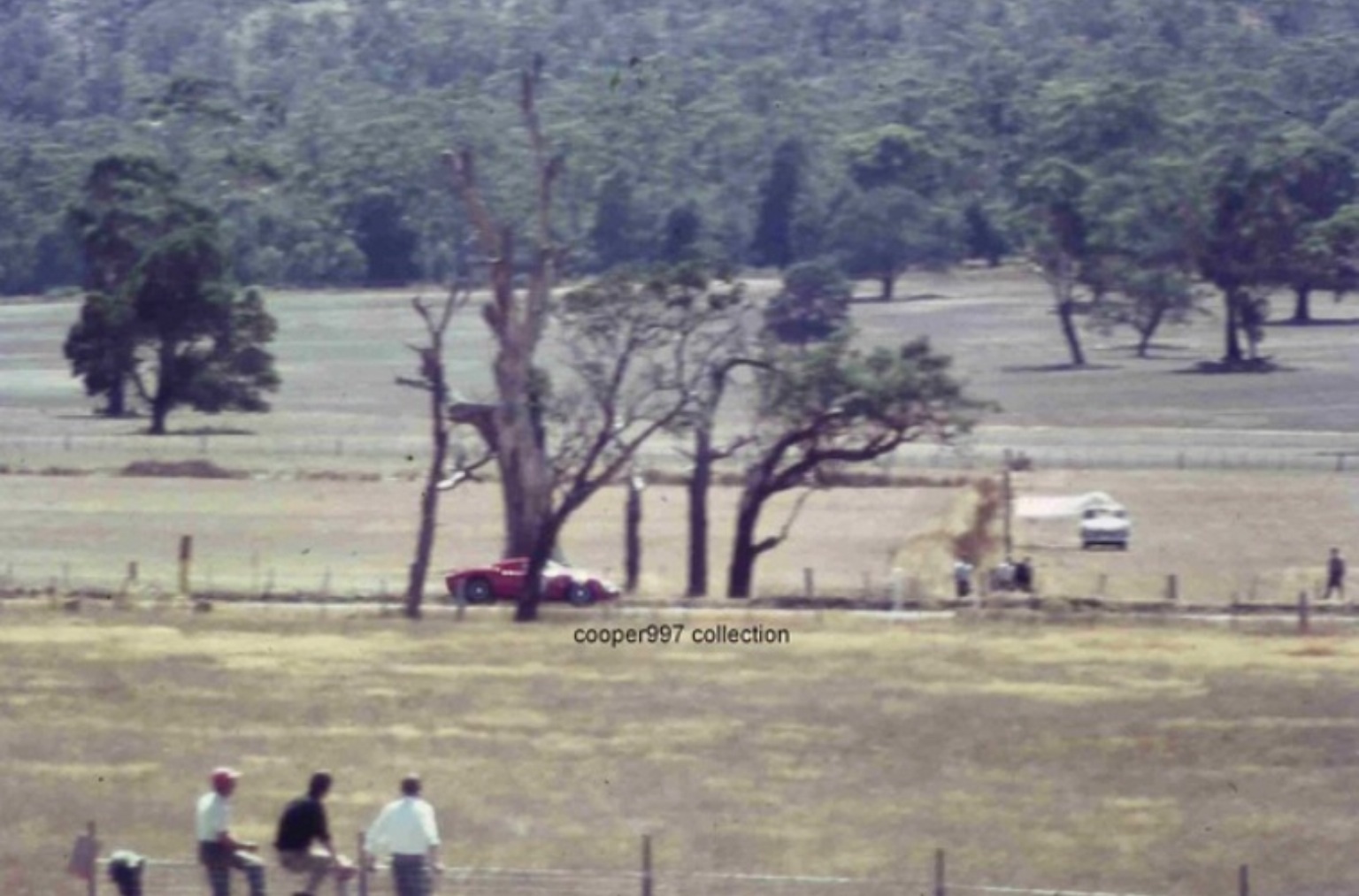
The opening shot by Jim Saward is above Mountford Corner where the red sportscar is about to turn in.
The escape road from ‘The Flying Mile’ straight from whence our sportscar came is dead ahead of him- being the road to Perth (Tasmania not Western Australia- mind you, the direction is the same for both!) The racing pits are to the right of the white painted line on the tarmac and were moved there from the outside of the circuit on The Flying Mile in 1959- this change was made after consultation with leading drivers and officials after safety concerns. To the top left of Saward’s photo is the Water Tower which marks the turn in to the fast right-hand downhill pluge to The Viaduct,in the distance is Longford village.
Ray Bell ‘The road narrowed about 100 yards or so after the start, then there was clear paddock each side of the straight till some trees came up on the right as you go over the crest…’
Kerry Grant’s Brabham BT4 Climax off to the side of the road, he pulled up after Rocky Tresise’ fatal Cooper T62 accident and could not restart (oldracephotos/DKeep)
The shot above is the drivers eye view of the Water Tower approach.
Its Bruce McLaren’s white Cooper T79 Climax dicing with Jack Brabham’s Brabham BT11A Climax for the lead of the 1965 Australian Grand Prix with Jack looking for an inside run into McKinnons Hill on the run down into The Viaduct. Bruce won on that particular day, in very fine form from Jack about three seconds in arrears.
Bell ‘The poplars can clearly be seen down the hill, (below) the railway embankment was just clear… and here’s a point… the grass wasn’t usually green! It was late summer, mostly hot, bushfire season and all that when Longford was held. The trees had a gap on the right where there was a gate into the paddock just at the turn in point for The Viaduct, and there was a sort of run-off track straight ahead at this point. In 1965 this was just dirt, maybe grassed later.’
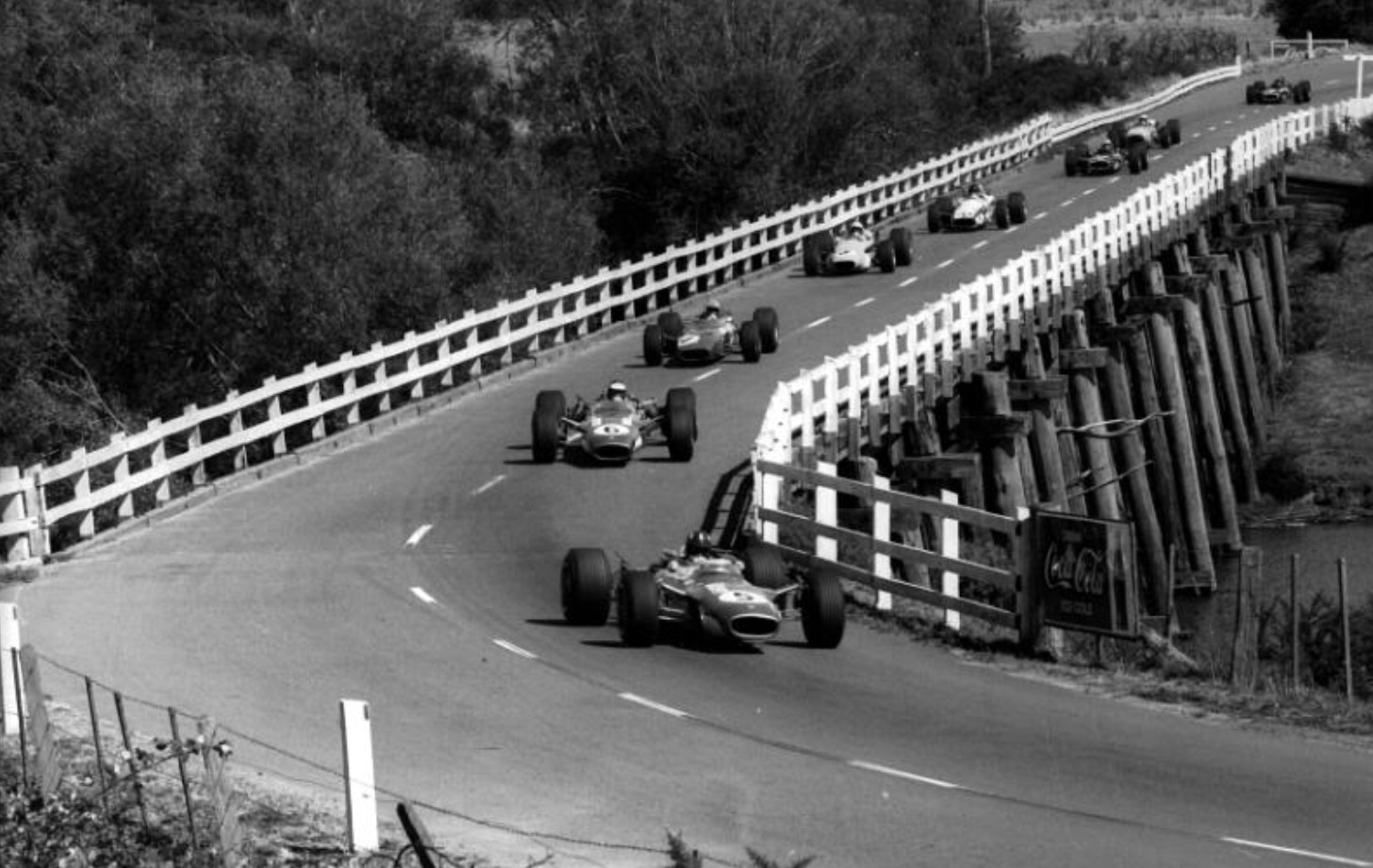
The Viaduct section of the circuit Bell refers to above is the bit Chris Amon is negotiating below.
Waaah-raaap-waaaahhh, you can just about hear that Ferrari V12 as he shifts down through the gears from fourth or fifth to second for the Viaduct left, then right Ess to head back up the hill into the trees then down towards the Kings Bridge and Longford village itself. But lets not get ahead of ourselves.
Stephen Dalton notes in his caption of this photo ‘The keen enthusiast set up their vantage point from the edge of the trainline, as Chris Amon goes past Longford Motor Racing Association President Ron McKinnon’s ‘Mountford’ property while attempting to make up the 2 laps he lost when the P4 was discovered to have a flat battery on the grid for the 12 lap Event 2 Sports Car Scratch Race’ (S Dalton)
Chris mainly cleaned up in David McKay’s P4/Can-Am 350 in the sportscar races the car famously doing 178 mph on ‘The Flying Mile’ that day in the wet! And 182 mph in the dry on the Saturday. Here the track is patchy wet, very tricky in this powerful car, its the Monday raceday ‘Longford Cup’ day, the famously wet race won by Piers Courage’ F2 McLaren M4 Ford FVA car from the 2.5 litre cars which were somewhat hampered in the wet conditions by an inability to put their power down.
‘It was an extraordinarily quick circuit’ recalled Chris in MotorSport. ‘It was basically a rectangle, and by the time you were halfway down the straight you were absolutely flat out. It was a wonderful circuit in the dry, but in the wet it had the potential to be bloody dangerous’ he said in somewhat masterful understatement! In the dry Saturday sportscar scratch Chris set what became the all-time lap record at 2:12.6 seconds, an average of 122.19 mph.
‘As far as steepness of the area of the track is concerned – “McKinnons Hill” as we used to call it is much steeper at the initial descent to just before the gateway (just up the hill a bit on the left from where Chris is shown) where it becomes a more gentle drop…In real life it was narrow, steep and the kink past McKinnon’s Gate was a nice sweeper if there was no traffic around (i.e. a racing line used in your road car) but the fast cars would be balancing braking and set up for The Viaduct. (the point referred to is exactly where Amon just apexed above) I don’t think this kink had a name other than McKinnon’s Gate…We could ride our bikes from The Viaduct up to just past the gateway but then had to get off and push. My drivers licence test with a local policeman was 1 lap of the circuit on my 17th birthday- Sunday 6 March 1966 with hay bales and braking markers in place!’ wrote ‘Longfordboy’.
Gaggle of cars heading into The Viaduct in 1961- Austin Miller Cooper T51 Climax chasing Lex Davison Aston DBR4/250 at the rear of the group- note the run-off area between the haybales and marshalls- limited mind you, a bit of dirt then bush and a steel drop into a culvert (S Dalton)
‘I think the fast cars were just about airborn as they started the descent as it dropped suddenly at first – i think Greg Cusack in an open wheeler had a big crash there (in the Scuderia Veloce Brabham BT23A Repco in 1968 ) when he did not land straight and spun off going down the hill before the gateway’…’In the lead up to the long weekend we would ride our bikes to The Viaduct at night to watch some local competitors practicing – with sentries to advise if anyone was coming so they could use all the road!’ Longfordboy added.
‘McKinnons Hill’ is the area of the main entrance of Ron McKinnon’s (Longford Motor Racing Association’s President & Chairman) ‘Mountford’ property. That ran all the way back to Mountford Corner and had the pit building on his property…The Viaduct and the land that runs down to the South Esk river is also on Mountford property…’wrote Stephen Dalton.
(oldracephotos/DKeep)
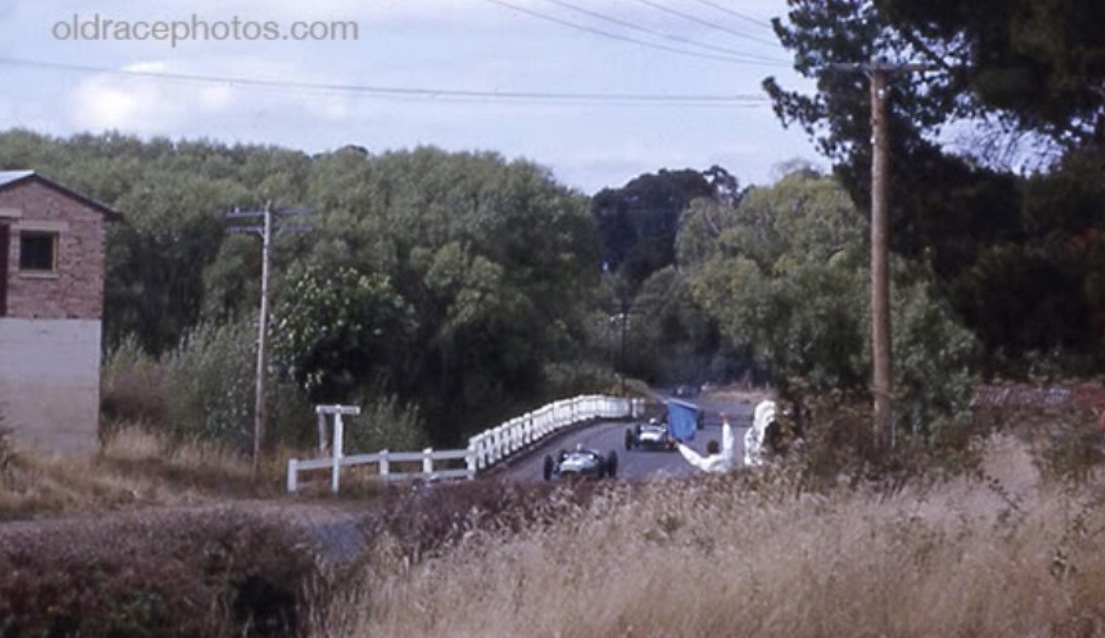
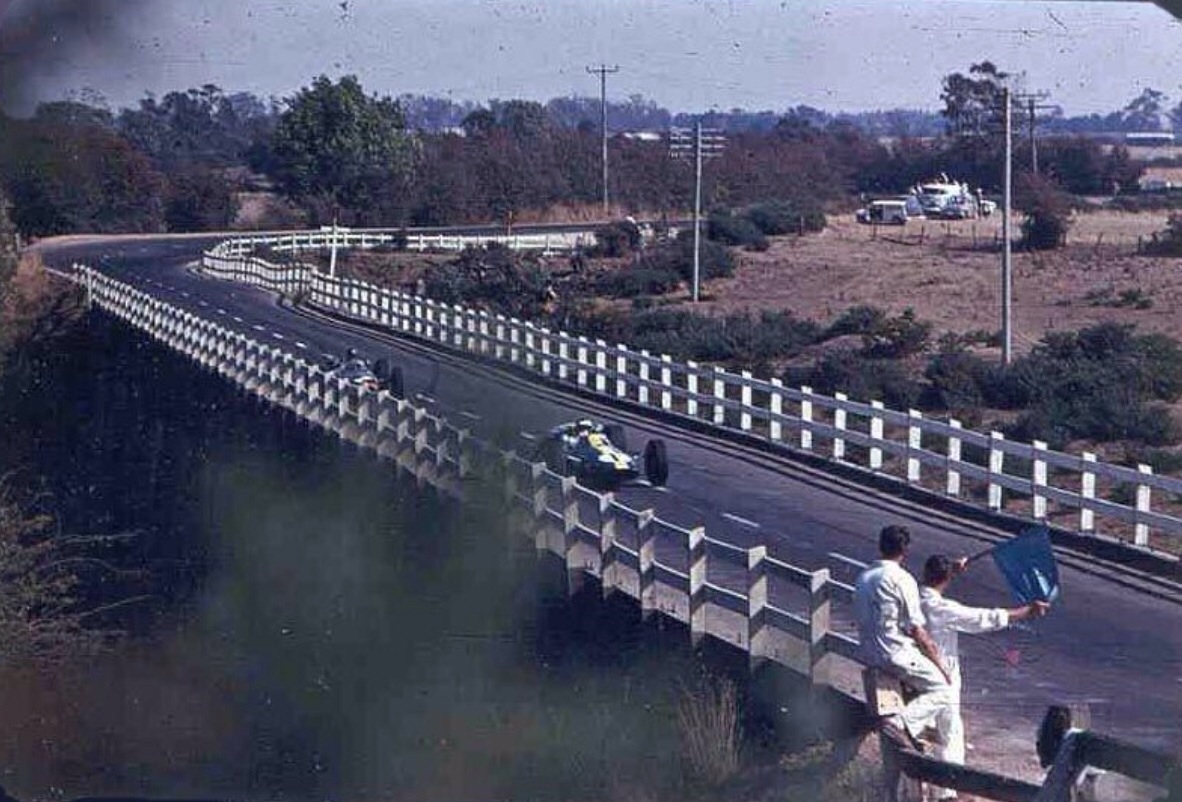
The photo above during one of the 1966 Touring Car races is of the outside of The Viaduct and shows the Rob Boote Holden EH from Robin Pare’s Ford Mustang turning into the corner. Note the spectators to the side of the railway line as mentioned in the Amon shot above and stationary blue flag from the ‘flaggie’.
(oldracephotos/DKeep)
Whilst the colour shot above shows the run-off area into The Viaduct there was not too much space to play with as Spencer Martin demonstrates in his Scuderia Veloce Brabham BT11A Climax in 1966. The SV team got the car sorted though, Spencer was fifth in the Monday ‘South Pacific Trophy’ event- and won the first of his Gold Star national titles with this chassis that year.
(oldracephotos/DKeep)
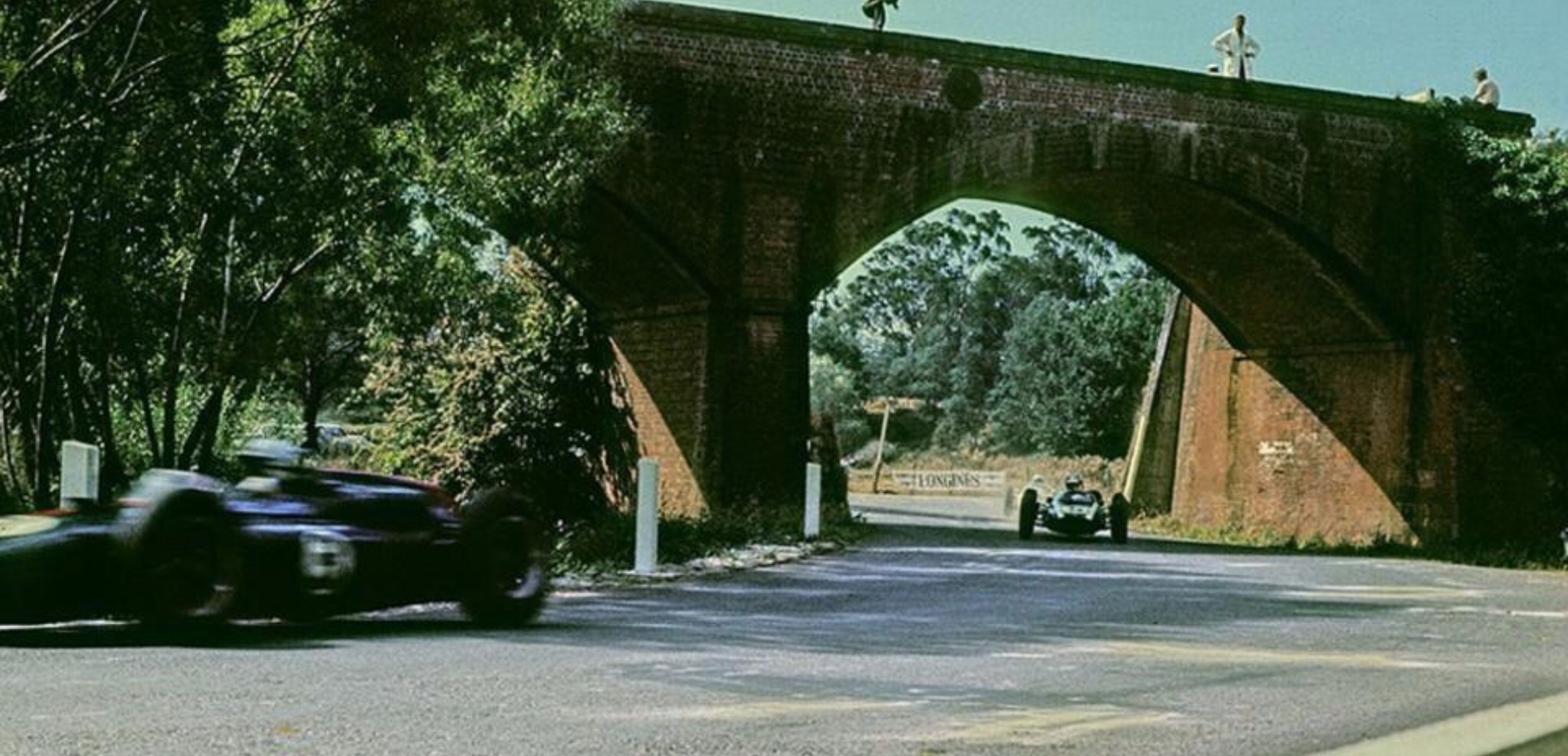
Above is gaggle of cars the first of which is Frank Gardner’s Brabham BT23D Alfa heading under the bridge- then Leo Geoghegan Lotus 39 Repco, Richard Attwood BRM P126, Kevin Bartlett’s Brabham BT11A Climax, Pedro Rodriguez BRM P126 and the rest- the Saturday dry preliminary in 1968.
Whilst the view from the outside or exit of the corner below shows Bib Stillwell’s Cooper T51 Climax ahead of John Youl, Cooper T55 Climax during the 1963 South Pacific Championship race won by Bruce McLaren’s Cooper T62 Climax. It is a beautiful photograph, and not a bad vantage point for those who could cadge a pass into that area!
(oldracephotos)
After the cars have cleared the final right of the Viaduct combination the cars disappear up a slight rise into the Australian bush, you can smell the eucalypt’s in these next coupe of shots.
Bib Stillwell is literally lining his Cooper up for the left-right combination the cars below are traversing- clear in the shot is Austin Miller’s distinctive Cooper T51 in his trademark vivid, glorious yellow hue. Notice the drain culvert and quite dense nature of the bush- we call it bush in this part of the world rather than forest folks!
(oldracephotos)
So. Back to the map – we have cleared the railway line and are on the section of track between the Viaduct and Kings Bridge. Photos of this part of the track are as rare as rocking horse poop.
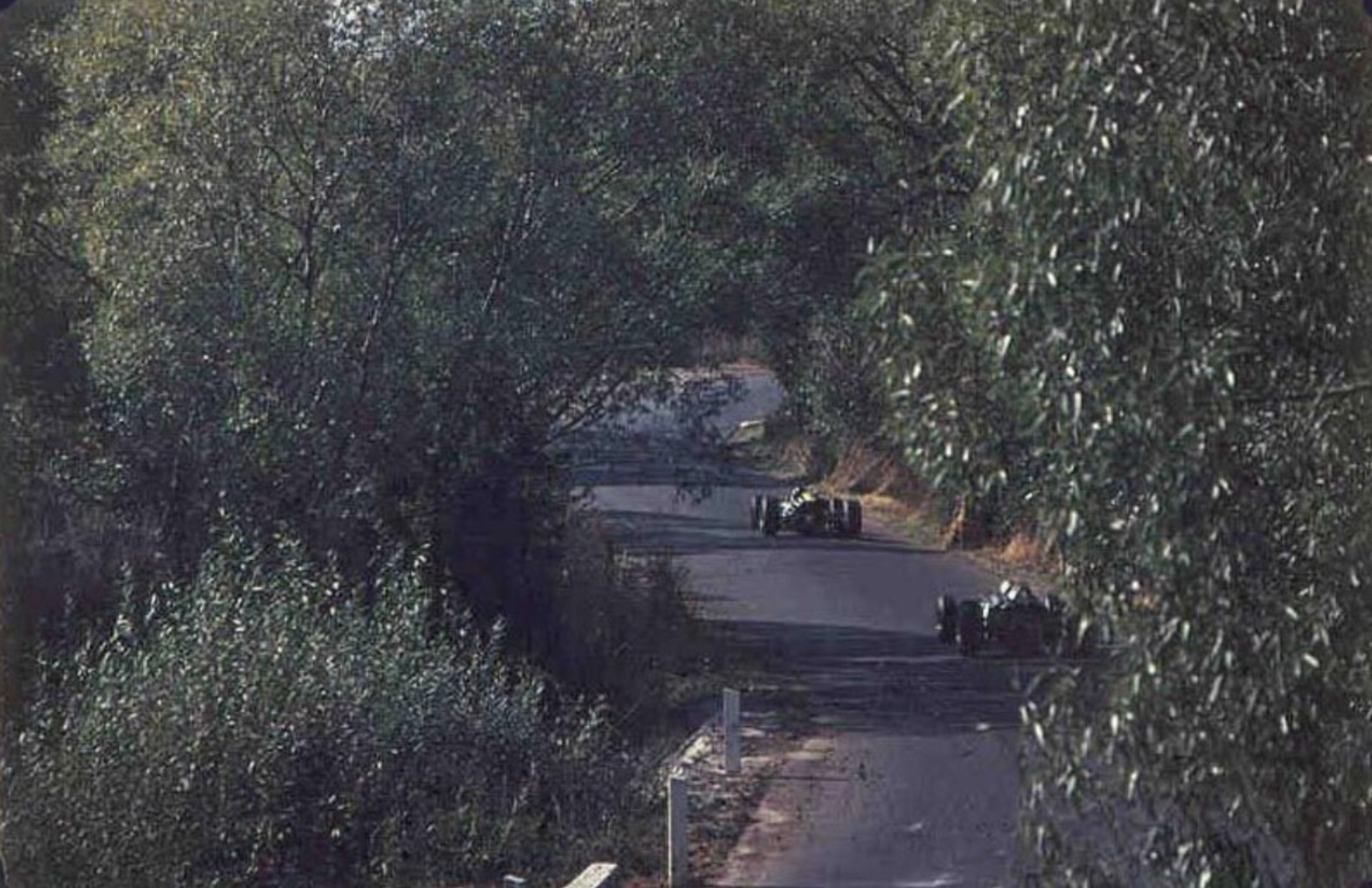
The photo below shows the track to be quite narrow and rough at its edges, not a part of the track to pop a wheel into the dirt. ‘Trees were thick from The Viaduct to Kings Bridge, then stayed thick the other side on the left’ says Bell whose magic photo it is which shows Jim Clark’s Lotus 39 Climax leading Jack Brabham’s Brabham BT19 Repco through the bush in 1966 – it’s the same stretch of track in both photos taken from atop The Viaduct, the two photographers using lens of different focal length.
(R Bell)
Onto the photo below of Kings Bridge we are looking from the bridge back to the bushy section of the track the cars in the two photos above are heading towards, note the open approach to the bridge below is preceded by a left-hander the last car below is just completing.
After the drivers turn right above they go down the hill and across Kings Bridge – one of two crossings of the South Esk River – the shorter of the two bridges, it’s Jack Brabham here, Brabham BT4 mounted in 1963 ahead of Bruce McLaren’s Cooper T62 Climax.
Longfordboy ‘The pump house (brick building to the left of the photo) is the new pump house for the town that pumped water up to the reservoir (water tower). The old pump house was on the opposite side of the road and the old pump in a bit of a shed remained with a large wire cage around it…We used to water ski under the Kings Bridge – provided the water was low enough.’
‘Many farmers had their own small pump houses for their own irrigation systems. My father was a mechanic so i was brought up grinding in valves by hand with suction caps on wooden handles. Of interest in 1958 or ’59 Arnold Glass brought a Maserati 250F to race and it was housed in our large single car garage/workshop beside our house. The mechanics finished working on it around midnight – to start it dad towed it around the block (in Longford) it fired up half way round and sounded “magnificent”. Neighbours never complained – it was accepted that weekend.’ quipped Longfordboy.
Spencer Martin in the SV Ferrari 250LM chasing Brian (father of John) Bowe Lotus 11 Replica HEA Simca s/c Spl on, or more particularly off Kings Bridge, morning practice Saturday in 1965 (R Bell)(oldracephotos)
John Surtees beside the Pumphouse just off Kings Bridge on the way to South Pacific Trophy victory in his Cooper T53 Climax FPF 2.7 in 1962- I guess for the great Brit Longford was ‘safe’ by the standards of some of the ‘bike racing circuits from whence he came!
Exiting Kings Bridge was fast, a top gear right hand open curve. Then there is a deceptively (in terms of the map) long straight stretch into the village of Longford itself – the approach to it is very fast and dangerous due to the presence of mature, solid Plane trees and ‘The Hump’ in the braking area.
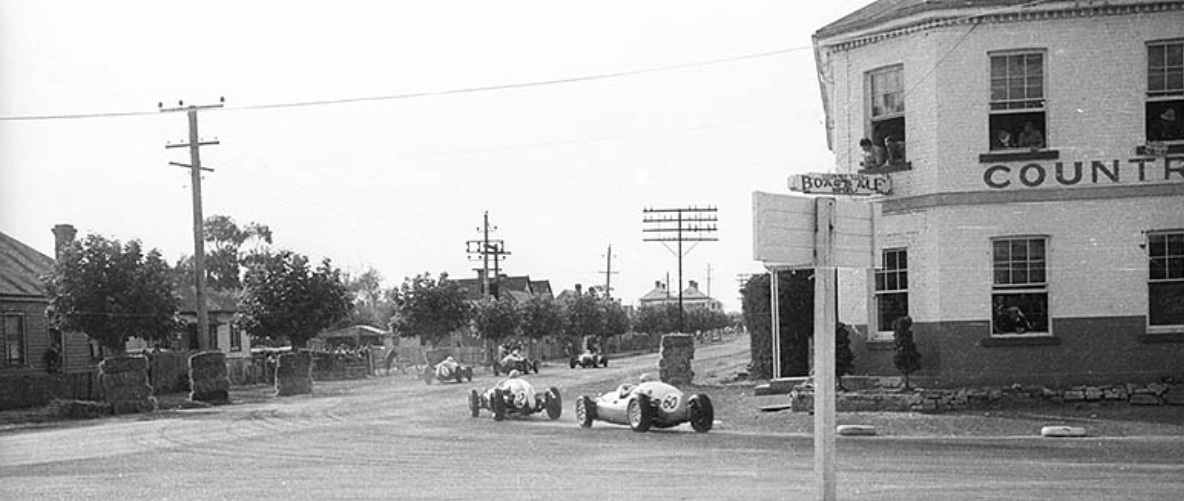
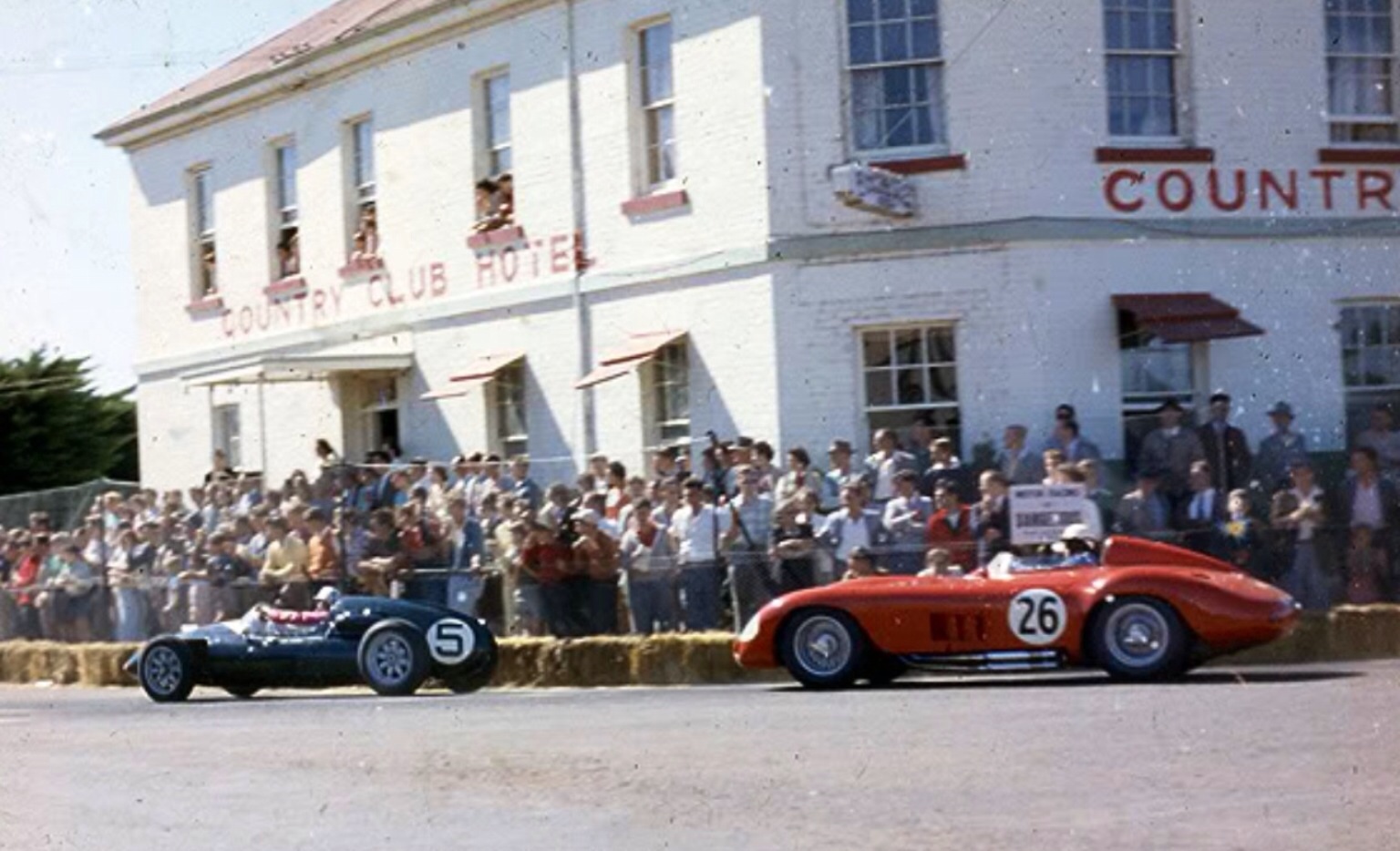
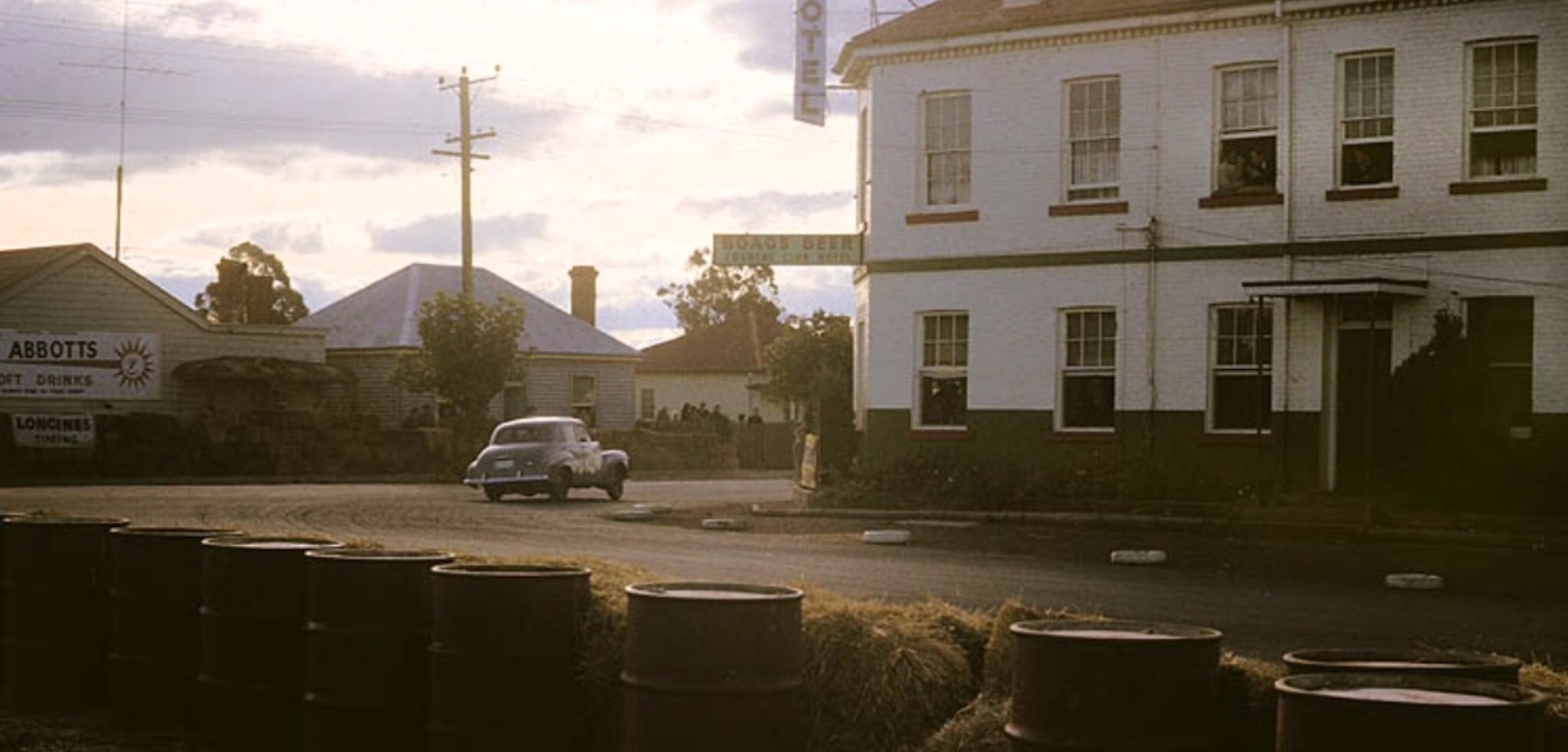
The location and Longford Corner is much photographed with the Country Club Hotel (which happily is still there, do pay a visit and check out the racing memorabilia inside) a familiar backdrop. There was a Mobilgas Service Station opposite the pub which is shown in one of the following photos.
(oldracephotos)
The image above shows Graham Hill, Brabham BT11A Climax and Phil Hill’s Cooper T70 trying to set a lap record to stop Jack Brabham, behind him in a Brabham BT11A Climax catching his teammate- and eventual winner, Bruce McLaren during the 1965 AGP. They are in the braking area for Longford Corner- whilst the Union Street plane trees have been trimmed, their solidity is readily apparent.
With unguarded trees on both sides of the track and ‘The Hump’ in the braking area the take-off and landing of ones machine was critical- getting the car settled and straight before caressing the brake pedal firmly and progressively was important. This, and a wheel in the dirt caught out young American driver Tim Mayer who lost his life in a Bruce McLaren Motor Racing Cooper T70 Climax much like Bruce’s T79 above, against a tree in 1964. The hump was removed after this incident.
(E French)
In fact, in the words of Murray Walker, if I am not very much mistaken Jack Brabham’s Cooper T51 Climax above is just landing after ‘The Hump’ in 1960 above- checkout the shadow under his machine. Brabham won that day from the Mildren and Stillwell’s T51’s.
(G Smedley)
Shot above is a favourite, Geoff Smedley’s, of Clark, his obscured teammate Hill and Amon- Lotus 49 times two and Ferrari Dino 246T then Frank Gardner’s Brabham BT23D Alfa, and then, i think Kevin Bartlett, Brabham BT11A sandwiched between the two BRM’s of Richard Attwood and Pedro Rodriguez- Clark the winner in this Saturday 1968 preliminary. By the look of the nose of JC’s Lotus he has just started to brake into Longford- the hump is now gone and the tarmac appears smooth albeit the verges are to be kept clear of as are the ever present plane trees.
All of the photos in this article make clear the impossibility of keeping the flavour and character of the place and provide greater elements of safety for both drivers and spectators of the day. There simply was never the sort of budget in Tasmania which allowed the Nurburgring to be transformed in 1971 in a way which trod the straddle between the vistas and challenges of the past and present day safety requirements pretty well.
(oldracephotos/JSaward)
Saward’s photo of Austin Miller’s Cooper T51 above chasing a gaggle of similar Coopers and Lex Davison’s (second car in this group of five) Aston DBR4/250 is interesting as we can see both the immediate environs and also have a peek around Longford Corner and along the start of Tannery Straight. At the top of the rise in the road the first three cars are travelling towards is the railway crossing ‘jump’ which is the subject of the next series of photographs coming shortly.
Len Lukey Cooper T45 Climax from Doug Whiteford Maser 300S during the 1959 AGP weekend (oldracephotos)
The photograph above is a classic ‘Pub Corner’ shot- the corner of Union Street and Wellington Streets in Longford village with the 1959 Australian Grand Prix combatants Len Lukey and Doug Whiteford apexing the corner for the run along the start of Tannery Straight (along Wellington Street) and just up the road the jump over the railway line.
Stan Jones won that 1959 AGP, a long overdue win for the perennial frontrunner in his then ageing Maserati 250F.
(oldracephotos)
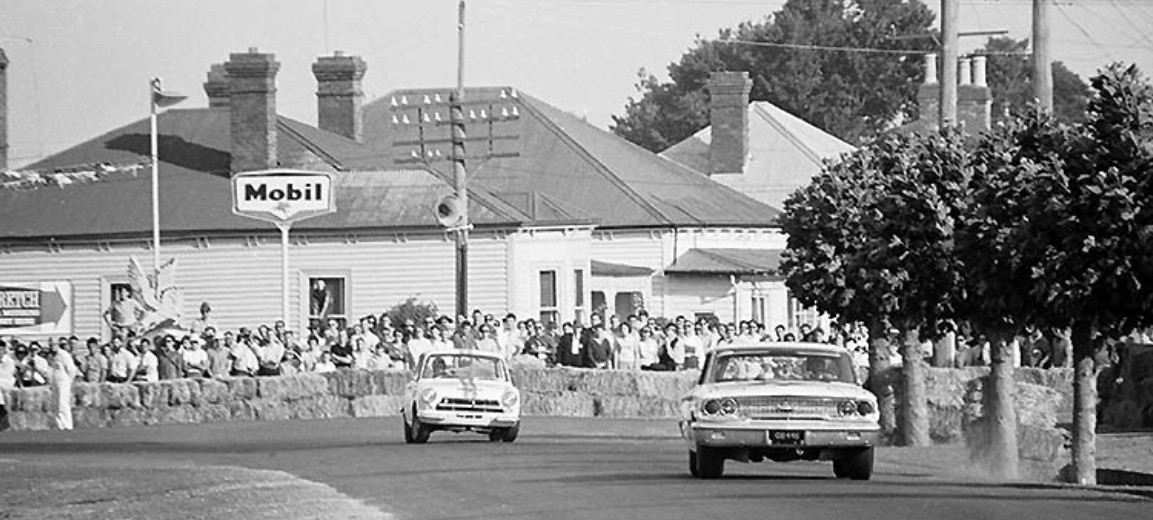
The photo above shows opposite locking Bob Jane’s Lotus Cortina chasing Sir Gawaine Baillie’s 7 litre Ford Galaxie, repaired after its near death experience against the Sandown Park, Peters Corner fence whilst driven by Lex Davison the previous November, on the exit of Longford Corner.
The Mobil Servo referred to earlier is clear as are more plane trees and an enthusiastic crowd ‘protected’ by lots of haybales and their own fast reactions! That Ford would have been mighty impressive bellowing and thundering along Longford’s long straights. The twiddly bits would not have been quite so impressive!
After exiting Longford/Pub Corner the cars accelerate through the gears including a ‘yump’ over the railway crossing along Tannery Straight.
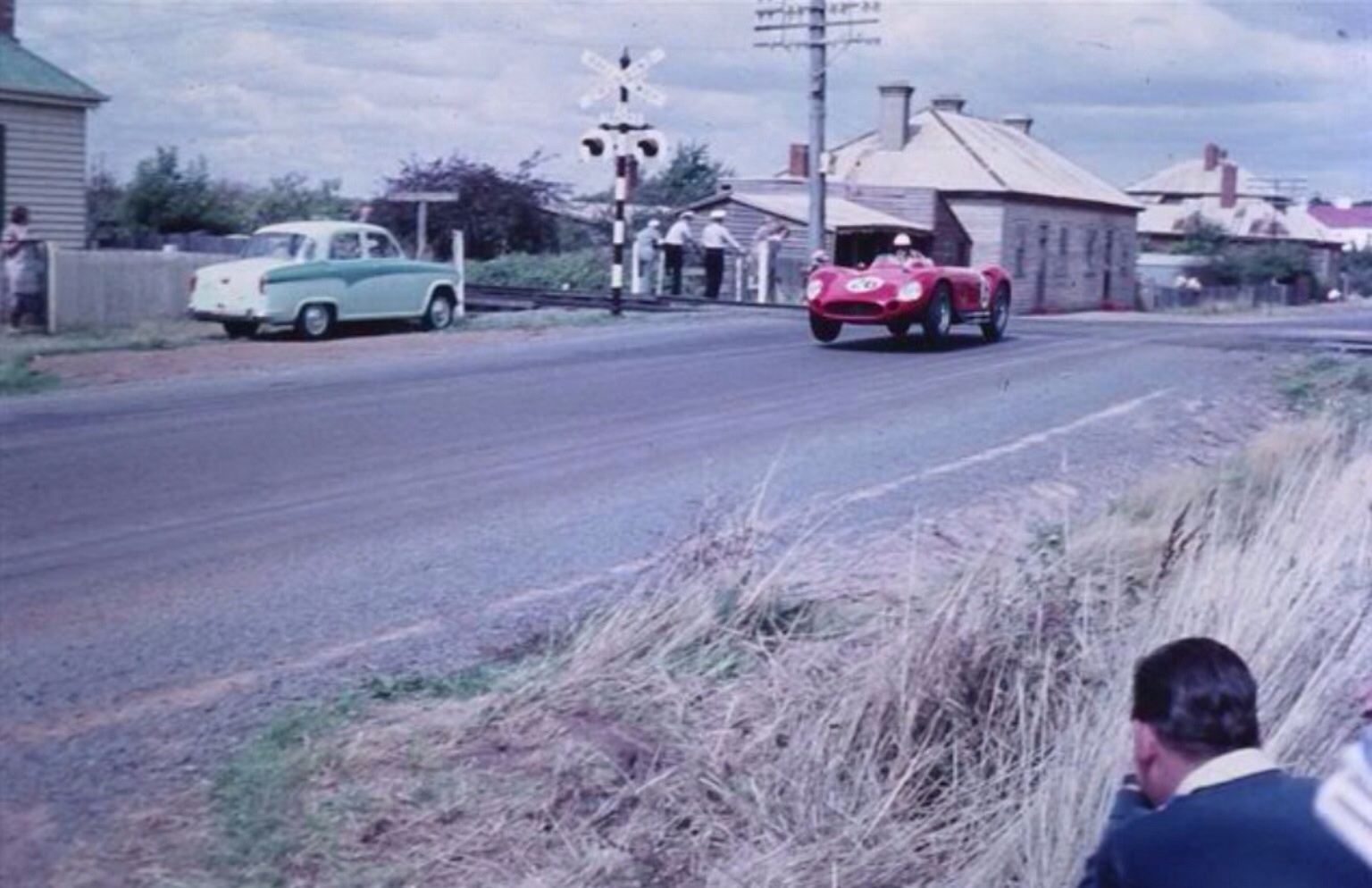
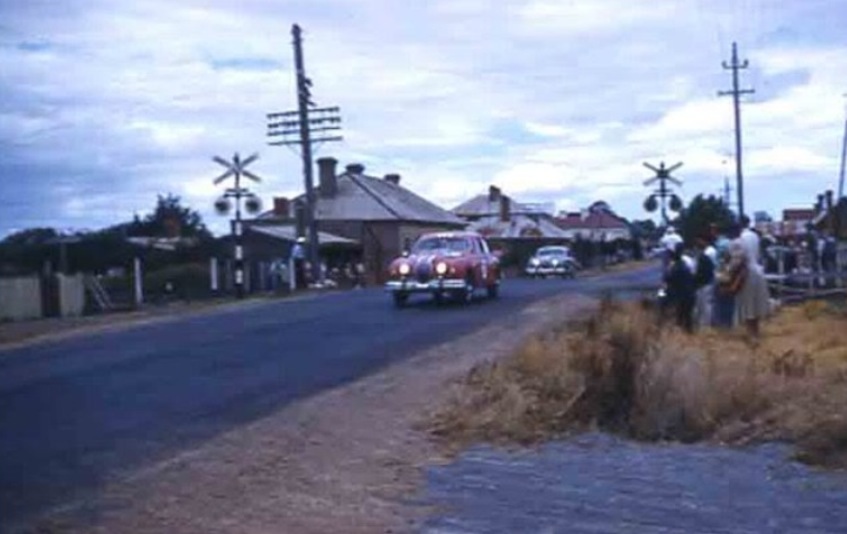
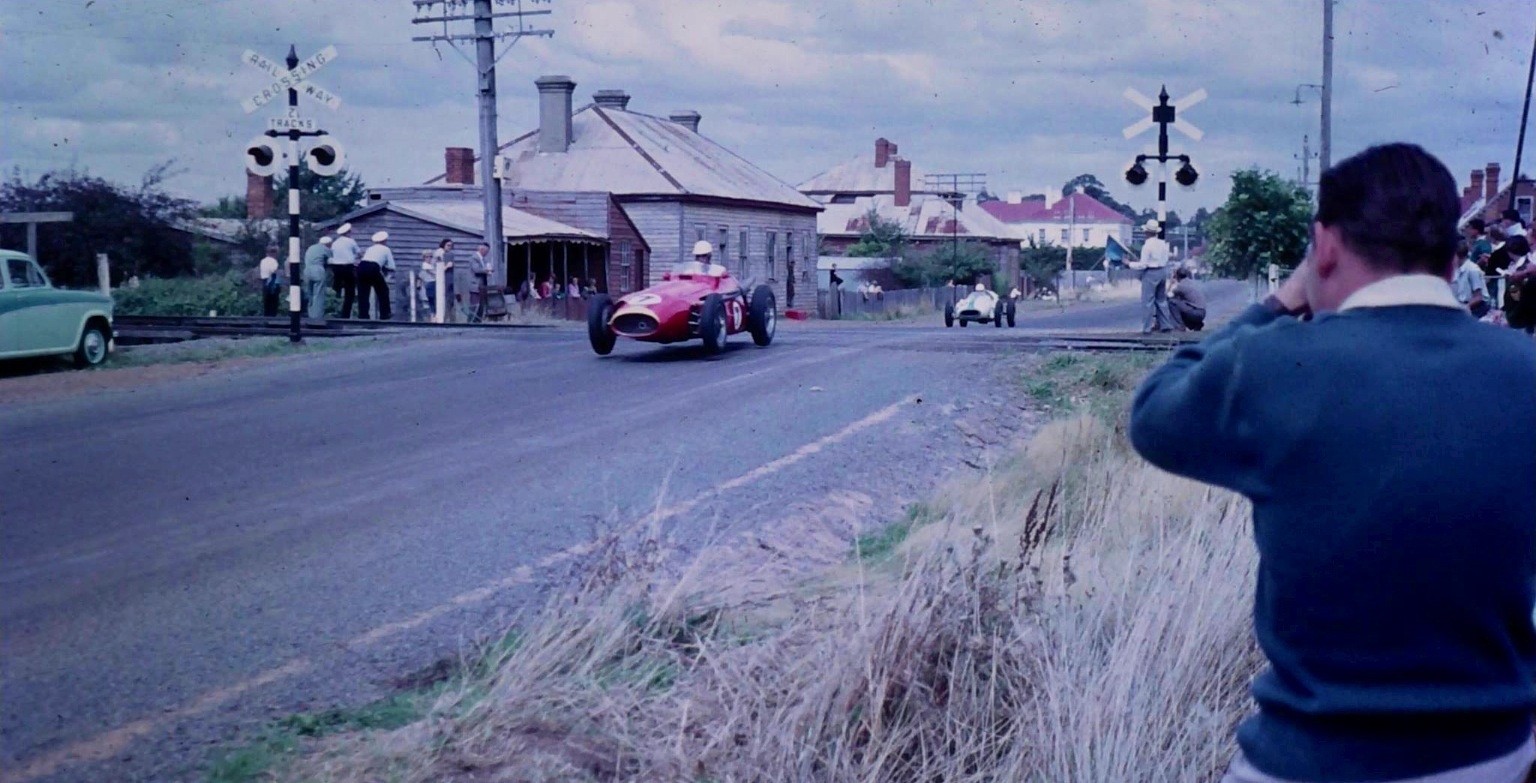
Actually, for the most part after leaving Longford- that’s Doug Whiteford’s ex-works Maserati 300S coming in for a landing below, note the handily parked Austin!- its a long gentle curve, for a mile and a bit and then brake hard for Tannery Corner, a right hander.
Doug Whiteford Maser 300S, over the Tannery Straight (Wellington Street) railway crossing in 1959 (E French)
There was some technique required in addition to enjoying the ride! Kevin Bartlett recalls having to release the throttle for a fraction of a second so that the rear halfshaft donuts didn’t overstress on his Brabham BT11A, with Ellis French adding that ‘Humpy’ Holden crankshafts didn’t like the spot either. Geoff Smedley quipped ‘That crossing is the only place in the world where a race had to be paused to allow trains to pass through!’
Jaguar Mk1’s 1960- David McKay from Ron Hodgson (oldracephotos)(E French)
Marvellous shot above of Ellis’ on the same day as his Whiteford one prior- its beauty is both literal and symbolic.
Literal in terms of the scene itself- the crossing, handily placed spectator’s Austin, watching, relaxed ‘coppers and of course the Maserati 250F and Cooper T45 Climax of Arnold Glass and Bill Patterson. Its practice for the 1959 AGP, Arnold was third and Bill failed to start, as mentioned earlier, the race was won by Stan Jones Maserati 250F.
Its the 250F that is the symbolic bit- the little mid-engined Coventry Climax FPF powered Cooper chasing down the thoroughbred Italian car. The first such locally domiciled car was Reg Hunts 250F engined A6GCM which arrived in early 1955. In the period which followed the 250F’s did well albeit Lex Davison’s older 3 litre Ferrari 500 pretty much always had their measure- what it may sometimes have lacked in outright pace to Hunt, Jones & Co being compensated for by strong reliability, especially on the big occasions. Whilst Stan Jones won the 1958 Gold Star Series and the 1959 AGP in his 250F the period of the big red cars was coming to an end, a smidge later in Australia than in Europe. In the ’59 Gold Star, twelve races were contested- mid-engined Cooper’s won nine of them with three going to the front-engines, and all of these wins were early in the year prior to 31 March. Jones and Kiwi Ross Jensen won in 250F’s at Longford and Bathurst with Stan rolling out the Ern Seeliger modified Maybach 4 Chev at Port Wakefield for a victory in South Australia. The days of mid-engined omnipotence had arrived.
Ray Bell’s shot below after the end of race proceedings in 1965 shows the gently curving nature of Tannery Straight- heading in the direction of Tannery Road from Longford. Its flat-knacker in top gear but clearly is not straight as is shown in pretty much all of the circuit maps available. Mind you, none of the modern maps will be from ‘source references’ but rather digital renditions of earlier work. Plenty of trees, bush and typical highway of the day with rough verges.
(R Bell)
‘The left of Tannery was like a huge hedge, the right was random trees growing thickly, with the odd track into the bush where lovers used to go and that sort of thing…
By the time they were looking for the brakes (the drivers not the lovers) they were well into clear paddock scenery, with a kind of flat and uninteresting (Windsor, Sydney after a flood kind of thing…) appearance for Tannery, where the road was built up and going off would mean dropping onto a lower level. The paddock straight ahead had a gate and driveway for convenient escape for late brakers’ Ray Bell recalled.
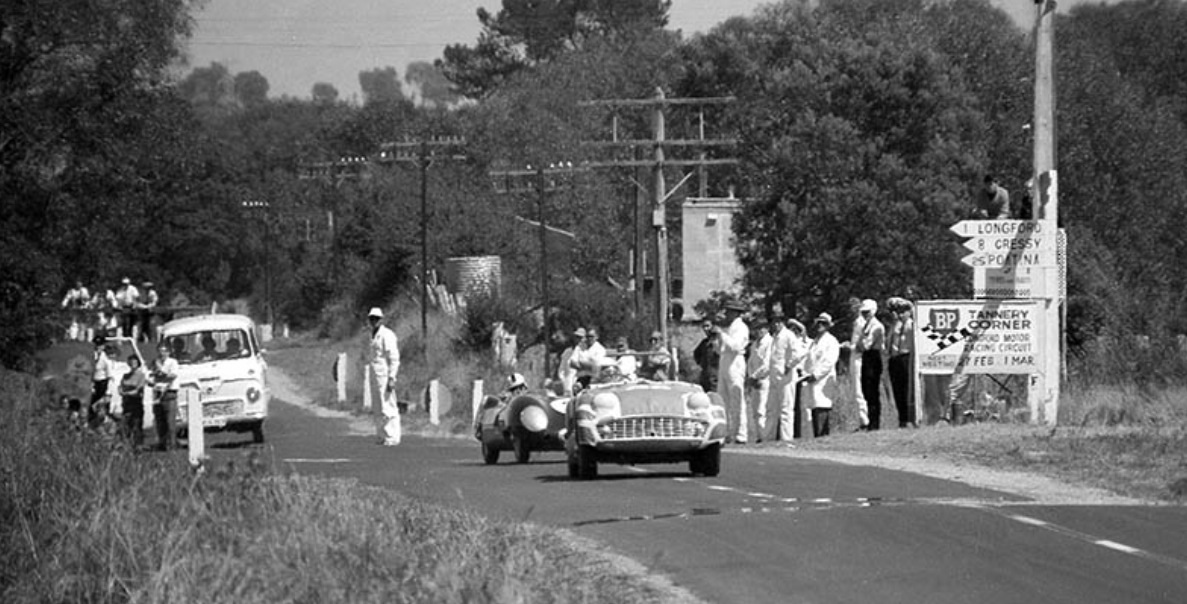
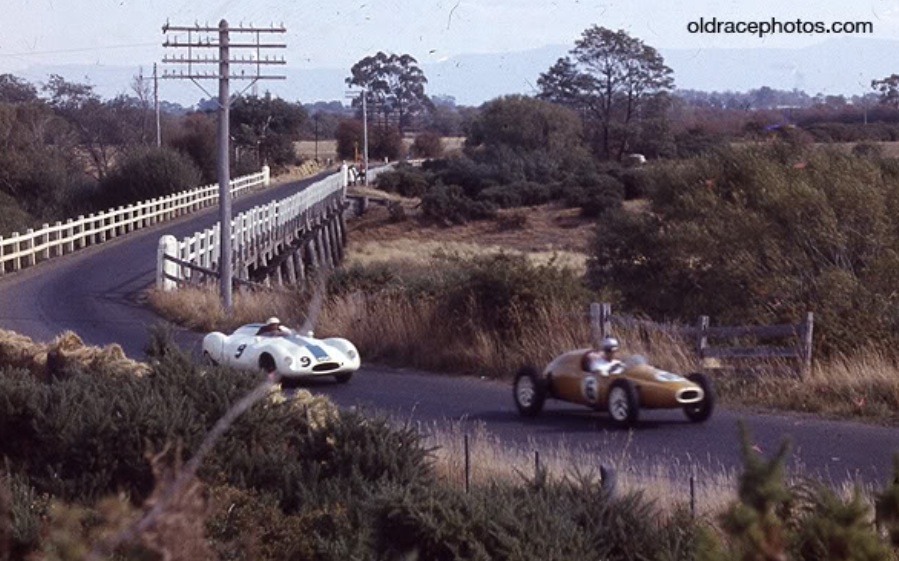
The image below of the Triumph TR3 and Lotus 11 is Tannery Corner, the T-intersection of Tannery Road and Bishopsbourne Road, the drivers have negotiated the corner and are heading towards Long Bridge and then Newry Corner, to the intersection with Pateena Road. Love that ‘Longford Motor Racing Circuit’ sign.
Owen Mortimer Triumph TR3 leads Allan Caelli Lotus 11 Climax out of Tannery in 1965 (oldracephotos/DKeep)
This photo below I have used before. Of all the thousands of photos i’ve seen and selected in the four years I have been writing primotipo this is one of my favourite ten- its Stan Jones’s Maser 250F negotiating Tannery Corner, the photo, from the outside of the corner is from the Dunstan Family Collection. Again, check out the terrain, flatness at this point, and don’t miss the dude standing at middle-right. Stan is heading for our next stop, the fast left-hander onto Long Bridge.
(Dunstan Family)
(R Bell)
Then follows another wild section of track including the flat out fast left-hand entry onto Long Bridge, again over the South Esk.
This part of the track is again much photographed with scuba divers strategically positioned in the event of a major mishap.
Ray Bell’s shot of Jim Clark’s Lotus 39 Climax leading Graham Hill, BRM P261 in 1966 is in large part included as his composition shows the prodigiously fast ‘flat’ entry onto the the bridge which must have been a big test of ‘wedding tackle’ size, not an issue with these blokes one can only surmise. The exit left was also very quick.
The image below in 1968 (Saturday) shows the order reversed, Hill from Clark’s Lotus 49 Ford DFW’s from Amon Ferrari Dino 246T, Gardner Brabham BT23D Alfa, Geoghegan Lotus 39 Repco, Attwood BRM P126, Bartlett Brabham BT11A Climax and Rodriguez BRM P126.
(R MacKenzie)
Barry Lake recalls being at this part of Longford with Jack Brabham in the early 1990s, doing a piece for a TV report. ‘There was no fence of any sort beside the road, although there was one down a very steep embankment. If you went off the road, you would have had to be almost at a standstill to drop sharply enough to hit the fence. With any speed at all, a car would easily have cleared the fence into the cow paddock. I seem to remember some mid-sized trees in there and could picture a car landing right in the top of one if it went off.’
I asked Jack, “Did it ever worry you at all, to know you would be coming through here virtually flat, with nothing to stop you flying out there?” He said, “I’ve never seen it before. I didn’t know what was out there. I only looked at the road… I didn’t ever intend to go off there anyway, so why would I need to know.”
(D Cox)
The shots above and below of Kerry Cox in the Paramount Jaguar having a huge, high speed moment on the bridge are as good a panorama as we will see inclusive of the fast, open approach to the left hander. David Cox wrote of his Dad’s incident in 1966 ‘…he did a 270 degree spin without touching either side! He told me he was in second place, had lifted slightly there the lap before , so this lap he was trying to hold it flat through the corner before the bridge and touched the barrier on the inside which put him into the spin down the bridge. He had to reverse up the bridge and turn around, and still came third in the race. When he got back to the pits there was a massive bit of wood stuck between the rim and the tyre, we have a pic of that somewhere too!’ The other car appears to be a Lotus 7, note the little dinghy riverside.
(D Cox)
Below is another of the Long Bridge panorama albeit its in 1958, the Gold Star round that year was won by the Ted Gray driven Tornado Chev- here Austin Miller’s Cooper T43 Climax is being pursued by Bill Patterson’s Cooper T39 Bobtail Climax. There is far more undergrowth a decade earlier than the shots above but the bridge looks the same. Note the haybales on exit and huge penalties for anyone getting their turn-in off the bridge wrong!
(oldracephotos)
In fact that 1958 Gold Star round was the race meeting that put Longford on the map from a car perspective. The motor cycle racing guys first used the circuit in 1953 with cars almost an afterthought. Sedans and sportscars raced on the ‘bike meeting cards but that all changed with the award of a round of the national drivers championship on the March Labour Day long weekend in ’58- which was always ‘Longford Weekend’.
Bruce Walton was multiple times Australian Hillclimb Champion when all the aces of the circuits chased this prize eagerly. He occasionally raced on the circuits and is here at the wheel of Australian Porsche importer Norman Hamilton’s Porsche 550 Spyder during that 1958 meeting- he was third in the Sportscar Trophy event. By all means suss the car but the shot is included to show the topography after the cars exited Long Bridge. Even today this is a typical Oz country road scene.
(oldracephotos)
Bob Jane howling towards Longford below in his Elfin 400 Repco ‘620’ 4.4 V8 in 1967, one of his earliest races in his new car. He is not long off Long Bridge with the South Esk River in the background- its hue a nice contrast to the parched paddocks and the fencing less visually pleasing than above but just as lethal as a decade before.
(oldracephotos/King)(S Dalton)
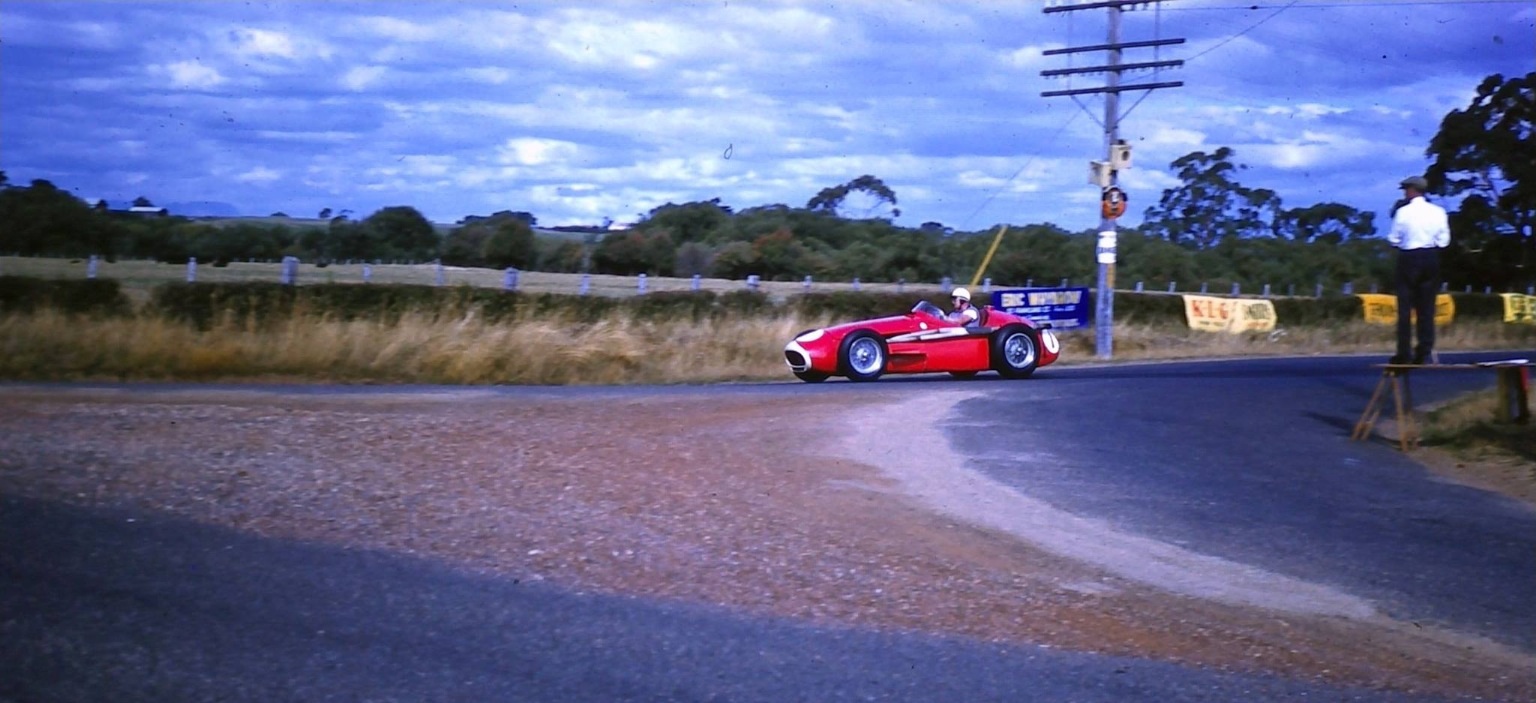
The next corner after the section off the left-hand exit off Long Bridge is the Newry right hander into Pateena Road.
‘The climb out of there is quite sharp and a bit narrow between the edges of the embankments each side…ie not much shoulder for 50 yards or so, then evening out with crowd on the fence on the right.’ notes Bell. Above is the Elfin Mallala Climax FPF of Bryan Thomson during the 1964 meeting.
Rob Saward rated Newry Corner and Long Bridge as the best spectator viewing on the circuit adding that the steep exit was named by the locals ‘Newry Hill’ which then led on to The Flying Mile a straight about 1.5 miles in length- it was straight for the first quarter of a mile and then kinked to the left for the balance of the run into the Mountford Corner right hander- at the intersection of Pateena and Illawarra Roads.
(oldracephotos.com/JEllis)
This amazing and unusual shot by Jack Ellis shows the incline of ‘Newry Hill’ on a very blowy Saturday during the 1968 meeting- Jim Clark and Graham Hill in Lotus 49 Fords are being pursued by Frank Gardner in Alec Mildren’s Brabham BT23D Alfa Romeo V8. The trio are a smidge further up the road than the Elfin Mallala above.
(oldracephotos/DKeep)
I love this shot of evergreen, talented Tassie racer Barry Cassidy giving his ‘brand-spankers’ 1967 XR Ford Falcon GT plenty of FoMoCo 289 cid V8 wellie out of Newry during the 1968 meeting.
This was the very first of an immensely successful run of Ford Australia V8 engined ‘Pony Cars’ and apart from showing Cassidy’s deft touch with the throttle also clearly shows the rise out of Newry on exit before the road flattens for the fast blast along The Flying Mile- the car was stock but would have been good for just shy of 130 mph or thereabouts.
(R MacKenzie)
Queenslander Rod MacKenzie took some sensational Longford shots on his 1968 trip down south- this moody, foreboding one of Clark’s Lotus 49 exiting Newry is one of my favourite photographs and illustrates the elevation of the circuit at this point, and again, the rise upon exit until the circuit flattens a little further along The Flying Mile.
(S Dalton)
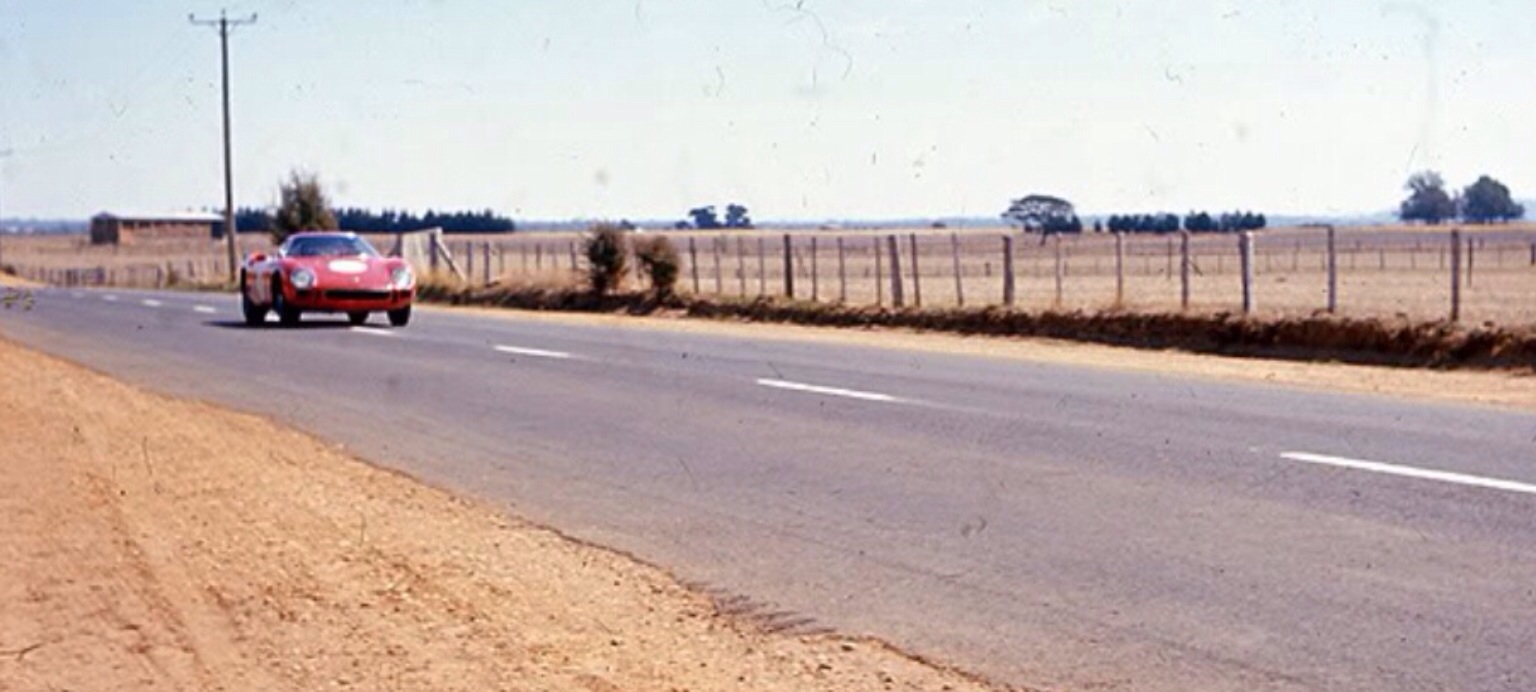
You can just about feel and hear the shrill scream of Spencer Martin’s 3.3 litre V12 @ 7500 rpm as the exotic, much loved Italian racer blasts along ‘The Flying Mile’ at around 165 mph frightening the life out of kangaroos and Tasmanians equally as much (above and below). I wonder what the speed limit on Pateena Road was at the time?! The sounds of the racing cars echoed off the surrounding hills across the brown paddocks of summer in rural northern Tasmania. The majesty of the place is one of the things that always takes my breath away- something which can only be achieved on long, open circuits in spectacular scenery on public roads.
(oldracephotos)(R MacKenzie)
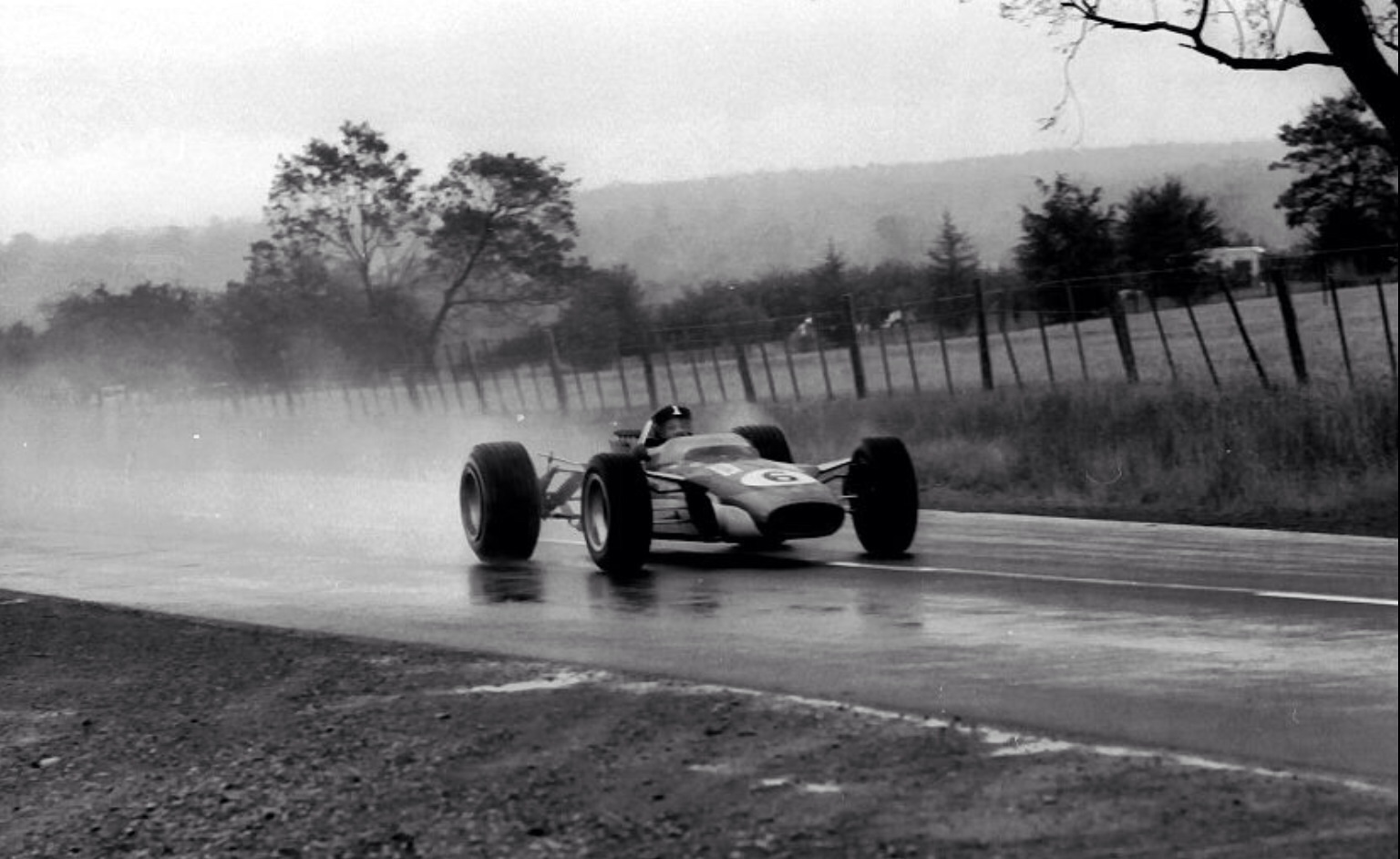
It wasn’t always sunny mind you. The Tasmanian weather could be capricious as it was during the 1968 meeting.
Jim Clark was belting down The Flying Mile in his Lotus 49 DFW on sunny Saturday for a win in the 12 lap preliminary- and a lap record he held for a few hours until Amon’s P4/CanAm 350 took it later in the day and then toiling hard to fifth place in the ‘pissin rain on South Pacific Trophy day- Monday. He finished behind Courage, Rodriguez, Gardner and Attwood that day but wrapped up the ’68 Tasman with four wins to Chris Amon’s two.
(E French)
After the flat out blast of ‘The Flying Mile’ we are back whence we started, the Mountford right-hander, the corner of Pateena and Illawarra Roads onto Pit Straight- Illawarra Road.
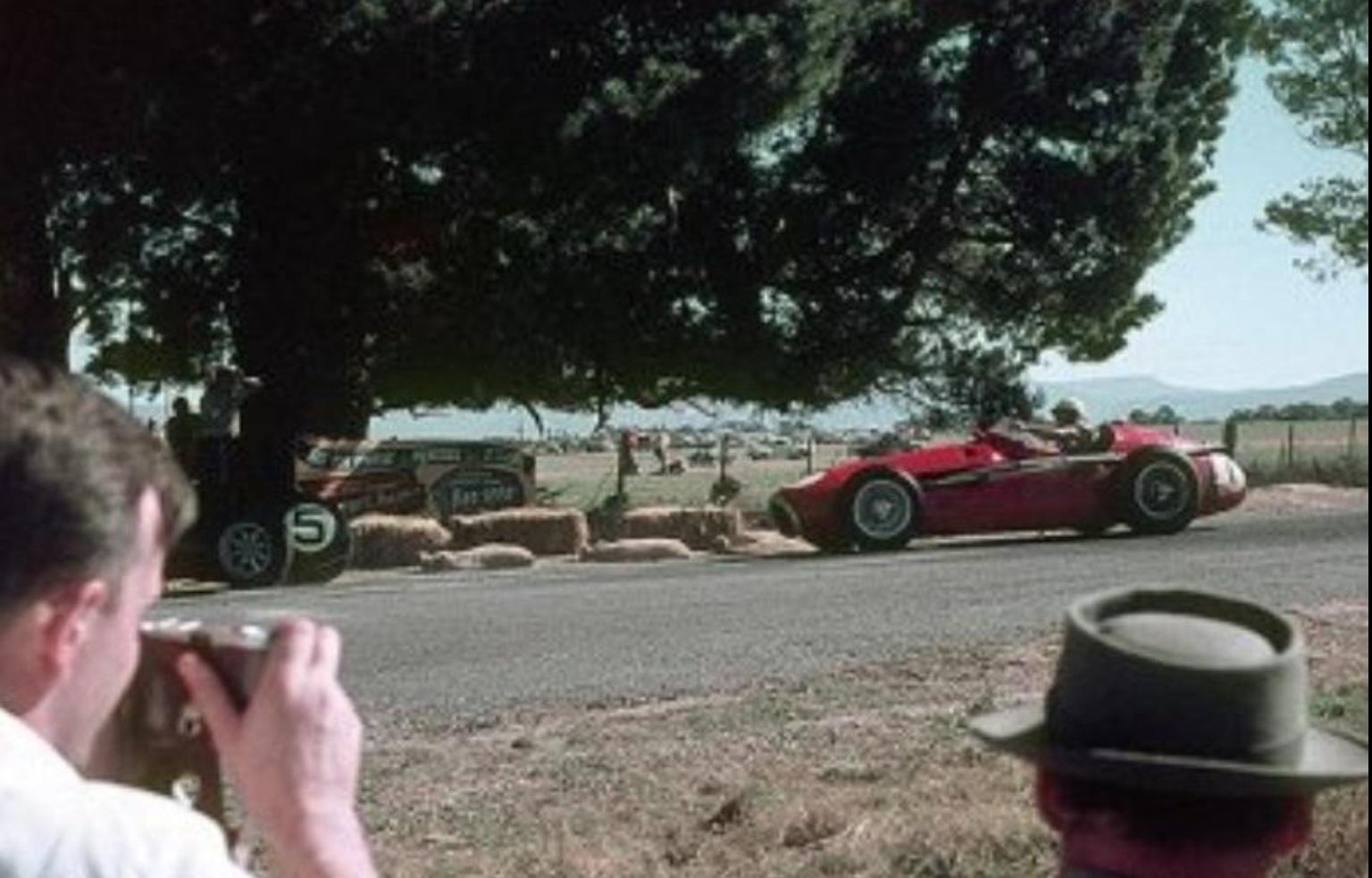
Stan Jones Maser 250F is chasing Len Lukey’s Cooper T45 Climax during their great 1959 AGP dice, the gents in the foreground providing almosphere enhanced by the huge, imposing and shady Mountford pine tree.
Pit Straight wasn’t always Pit Straight mind you, when the roads were first used as a race-track the Pits were located on The Flying Mile on Pateena Road, as noted early in the article, but safety concerns led to their relocation down the road and around the corner on the Illawarra Road section of track between Mountford and the Water Tower, from 1959.
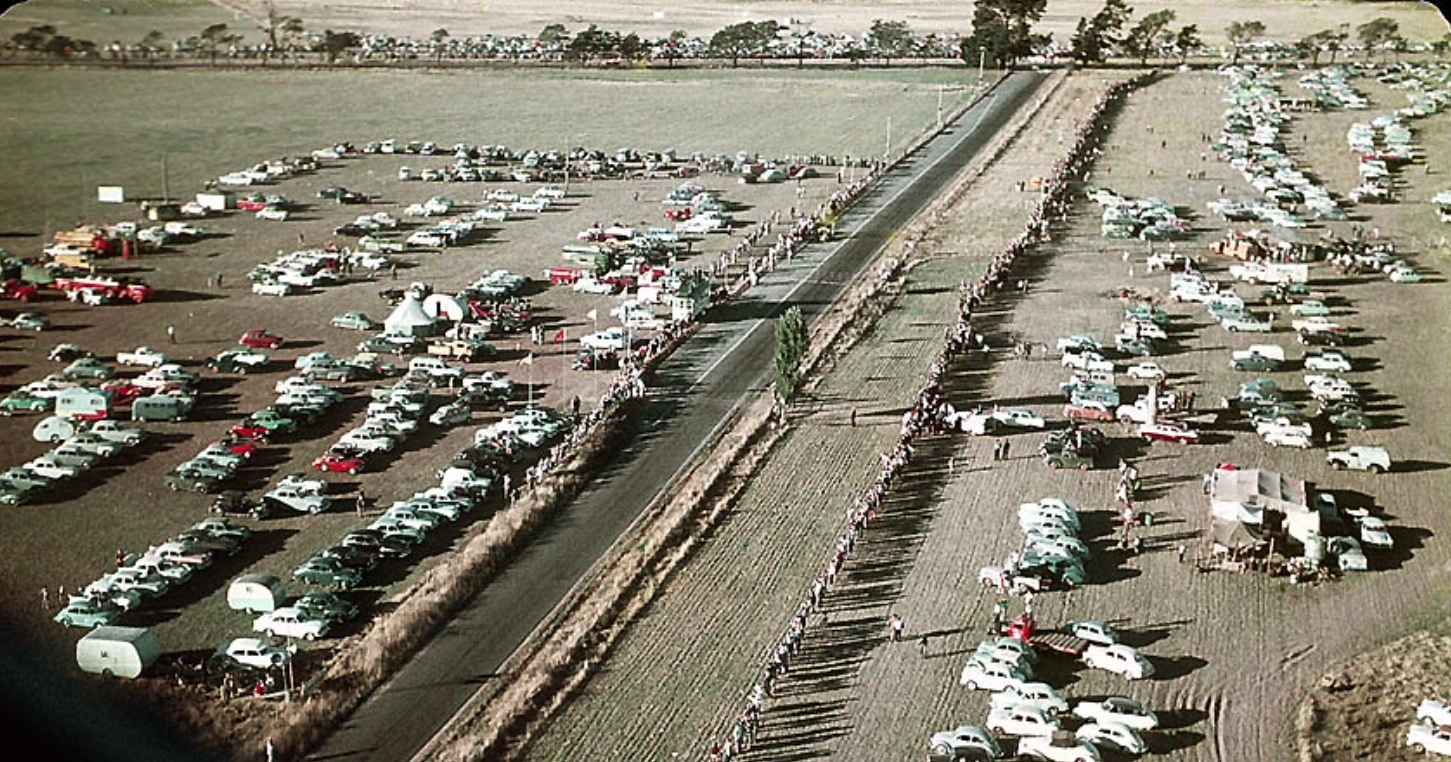
Jim Saward’s photos below show the layout as it then was, these shots were taken from a Percival EP-9 aircraft which Rob Saward relates had a hatch in its bottom which was used to take quite a unique set of photographs. The landing strip for ‘planes was in the paddock behind The Flying Mile.
In the photo below you can see Pit Straight without the control tower and pit buildings which were built later and are shown in the various shots below. Note the ex-Launceston Tram Number 4, which, redundant in its initial role as public transport was relocated to provide officials with a building from which to operate- I wonder what became of it after Longford closed?
(oldracephotos/JSaward)
The photo below shows Pit Straight, Illawarra Road, checkout that tram at centre shot- at its end is Mountford Corner- left towards Newry Corner and the village of Pateena along Pateena Road and to the right is the road to Perth, several miles to Longfords east. The ‘capital’ of Tasmania’s north is Launceston, 25 Km away and Devonport where the then ‘Princess of Tasmania’ ferry disgorged its cargo of cars and racers from Port Melbourne is 95 Km from Longford.
(oldracephotos/JimSaward)
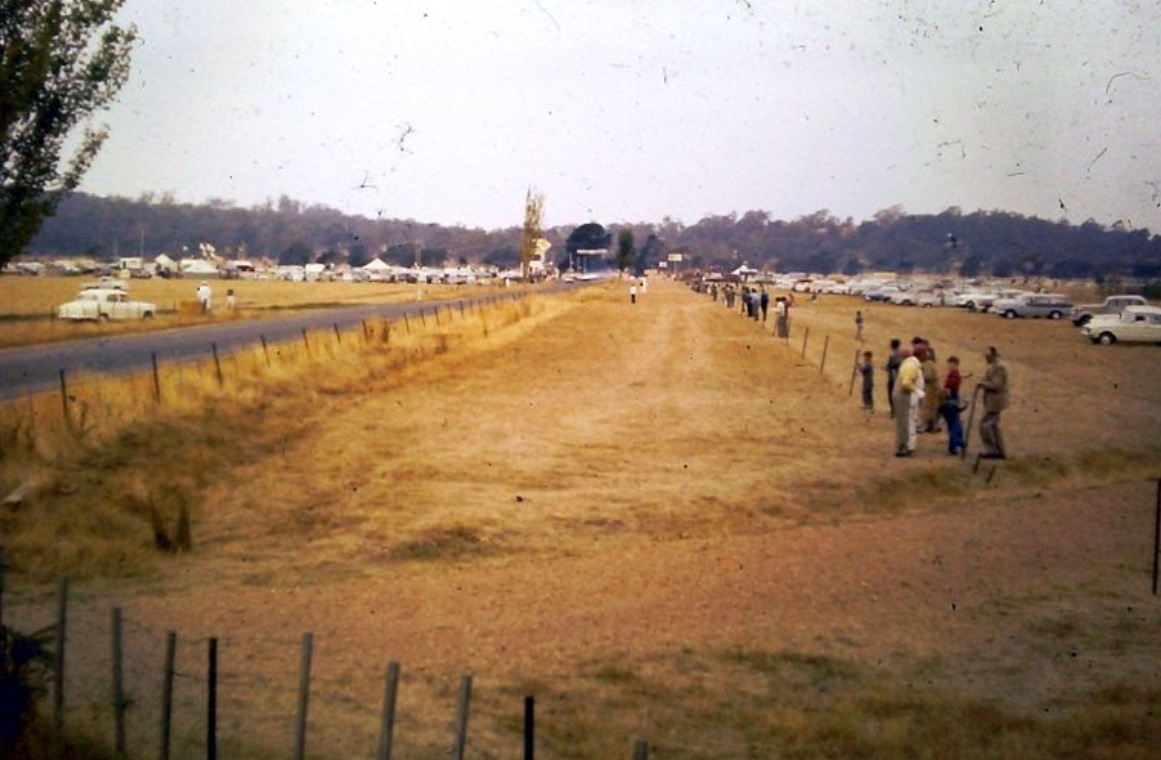
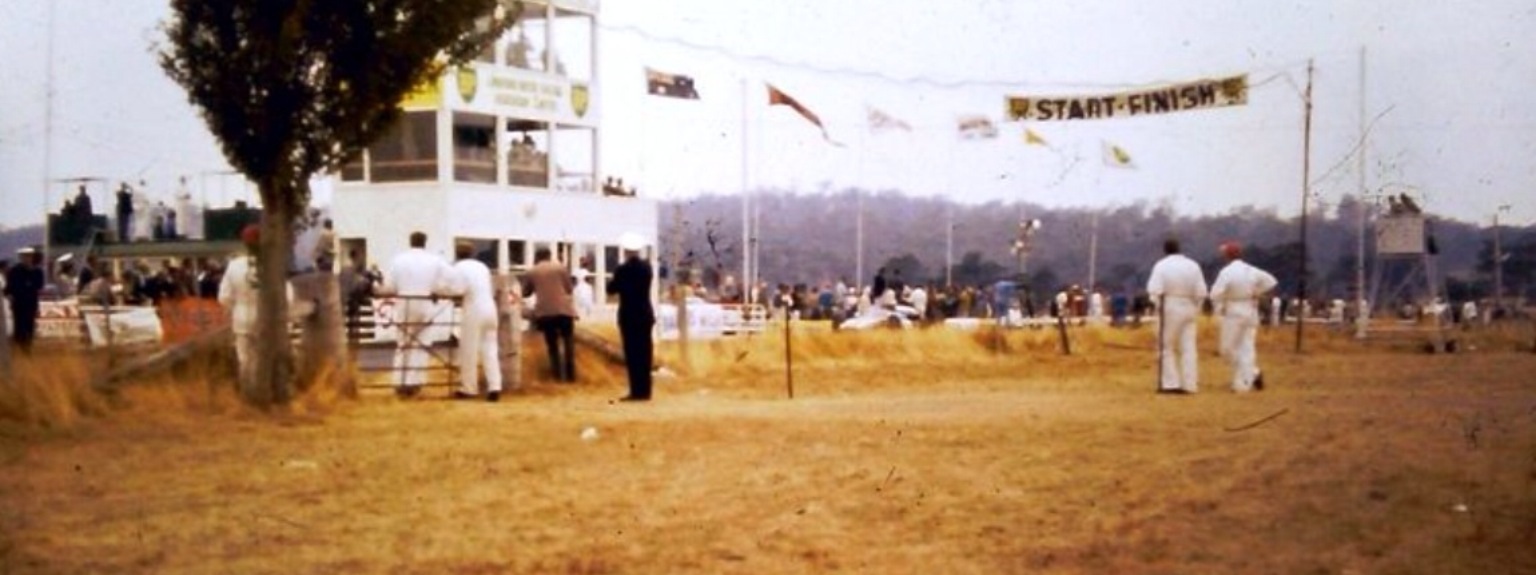
The two photographs below from Stephen Dalton’s Collection are undated, the cars will be a clue for some of you, look back towards Mountford on the inside of the circuit behind the tall poplar tree and you can see the Control Tower. ‘Over your right shoulder’ behind you on the upper shot is an incline and the Water Tower.
(S Dalton
(S Dalton)
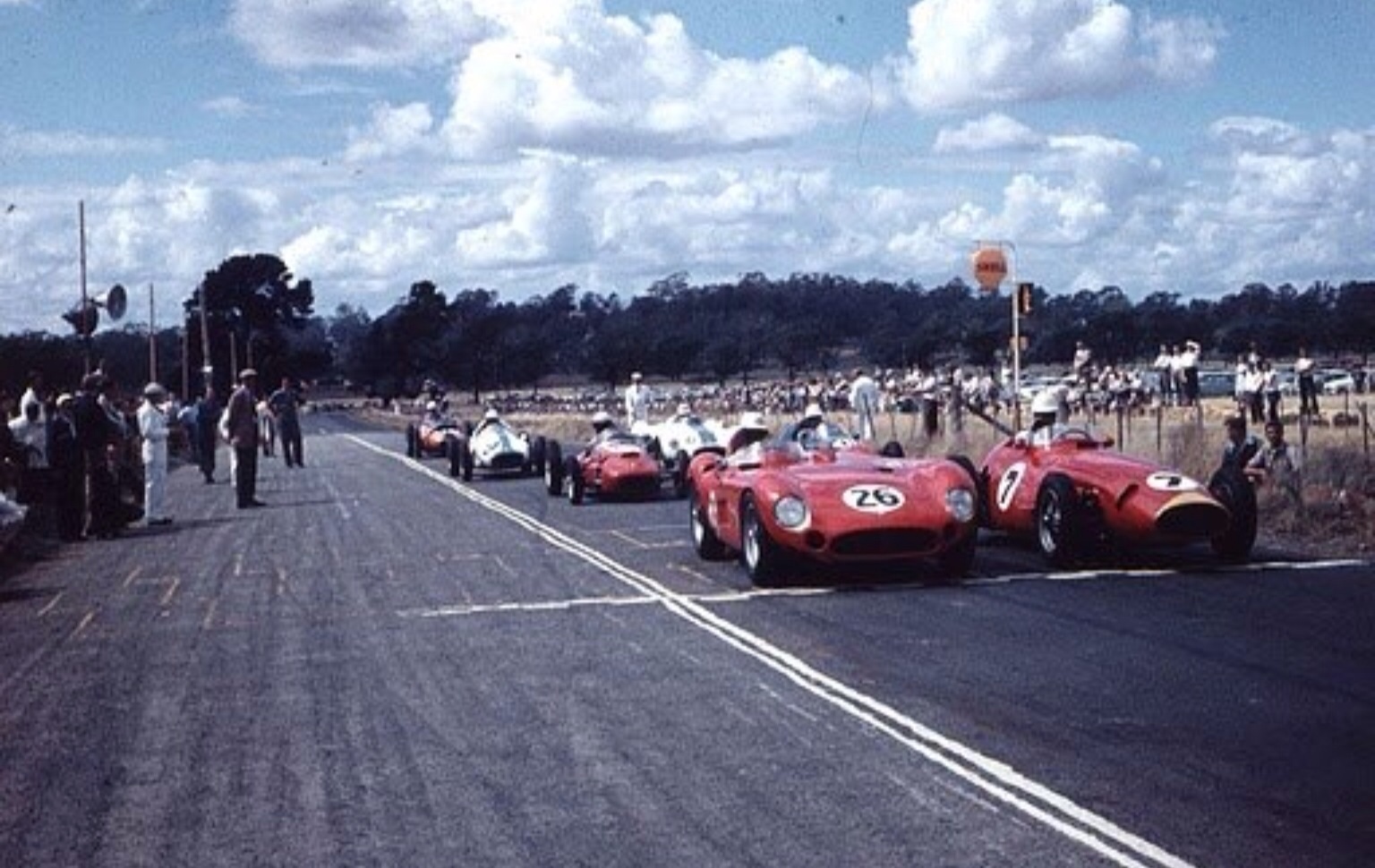
Ellis French’s grid level shot of Doug Whiteford and Arnold Glass’ Maserati 300S and 250F is taken in 1959- its not the AGP but rather a heat, further back is the white Bill Patterson Cooper T45 Climax and his former Cooper Bobtail T39 Climax then owned by Alan Jack. There is still no low-level grandstand on the outside of the circuit at that point.
(E French)
The facilities were still fairly basic below in 1960, I love the beach umbrella erected atop the control stand to afford the starter some shade to better fulfil his duties.
From the left of the grid it’s Brabham, Miller and Stillwell in Cooper T51’s with the Glass Maser 250F at far right. Jack won from Alec Mildren and Stillwell all in T51’s albeit Alec’s was Maserati 250S powered rather than by the Coventry Climax FPF’s in the rear of the other two chap’s machines.
(oldracephotos)
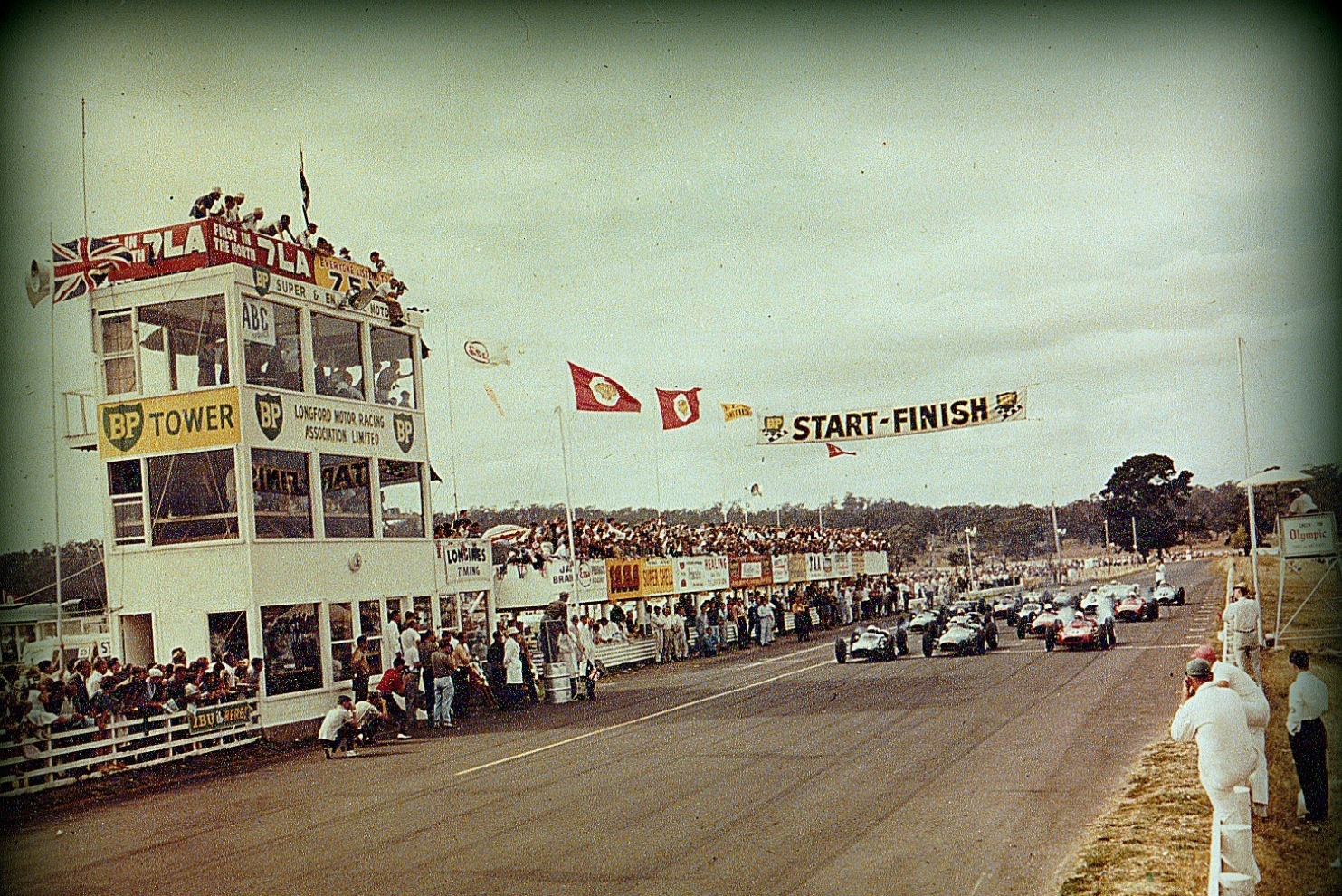
By 1963 it was ‘carnivale’ as this South Pacific Championship grid shot below shows the Control Tower and Pits building- together with all the advertising hoardings and bunting it looks fantastic.
The great big Mountford pine tree is there in the distance standing guard over the corner. On the front row its Bruce McLaren on pole in his Cooper T62 Climax, then Bib Stillwell’s Brabham BT4 Climax and Lex Davison, Cooper T53 Climax on the outside. The race was won by Bruce’ Cooper from Stillwell and John Youl’s T55.
(G Smedley)
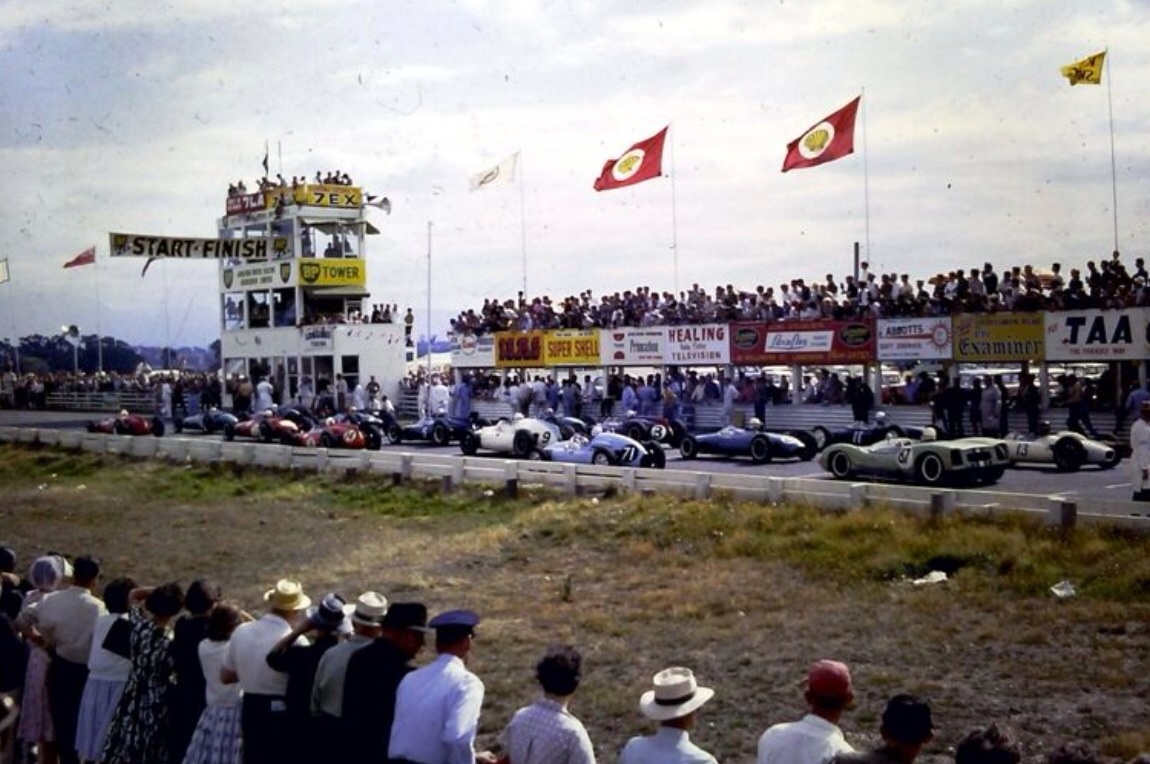
The photo below is the same 1963 grid as above- just look at the atmosphere!
From the rear is the #87 Frank Matich Lotus 19B Climax and alongside the Bob Holden Lynx Peugeot 1.5, on the next row is Frank Gardner’s Brabham BT2 Ford FJ which is sandwiched by Tony Shelley’s Lotus 18/21 Climax against the pits and Peter Boyd-Squires Cooper T45 Climax. The white #9 Cooper T51 is Bill Patterson and alongside him is the #3 Cooper T53 of Jim Palmer. Then Chris Amon is in the red Cooper T51 #14 with John Youl alongside, Cooper T55 Climax and an obscured Brabham in his BT4. On the second row is David McKay’s Brabham BT4 Climax and an obscured Tony Maggs Lola Mk4 Climax with Davison, Stillwell and obscured McLaren up front.
(S Dalton)
This view is across the bonnet of Lex Davison’s Len Lukey owned Ford Galaxie in 1964, opposite the pits, with plenty of spectator viewing and easy access for them back to Mountford. Jag is Bob Jane’s very successful Mk2- Galaxie gave Lex quite a wild ride in Tasmania, the brakes in particular were wanting.
Lex Davison in Len Lukey’s Ford Galaxie in front of Bob Jane’s Jag Mk2 in 1964 (oldracephotos)
The Australian Tourist Trophy for sportscars below was the main, hotly contested support event run during the 1964 meeting.
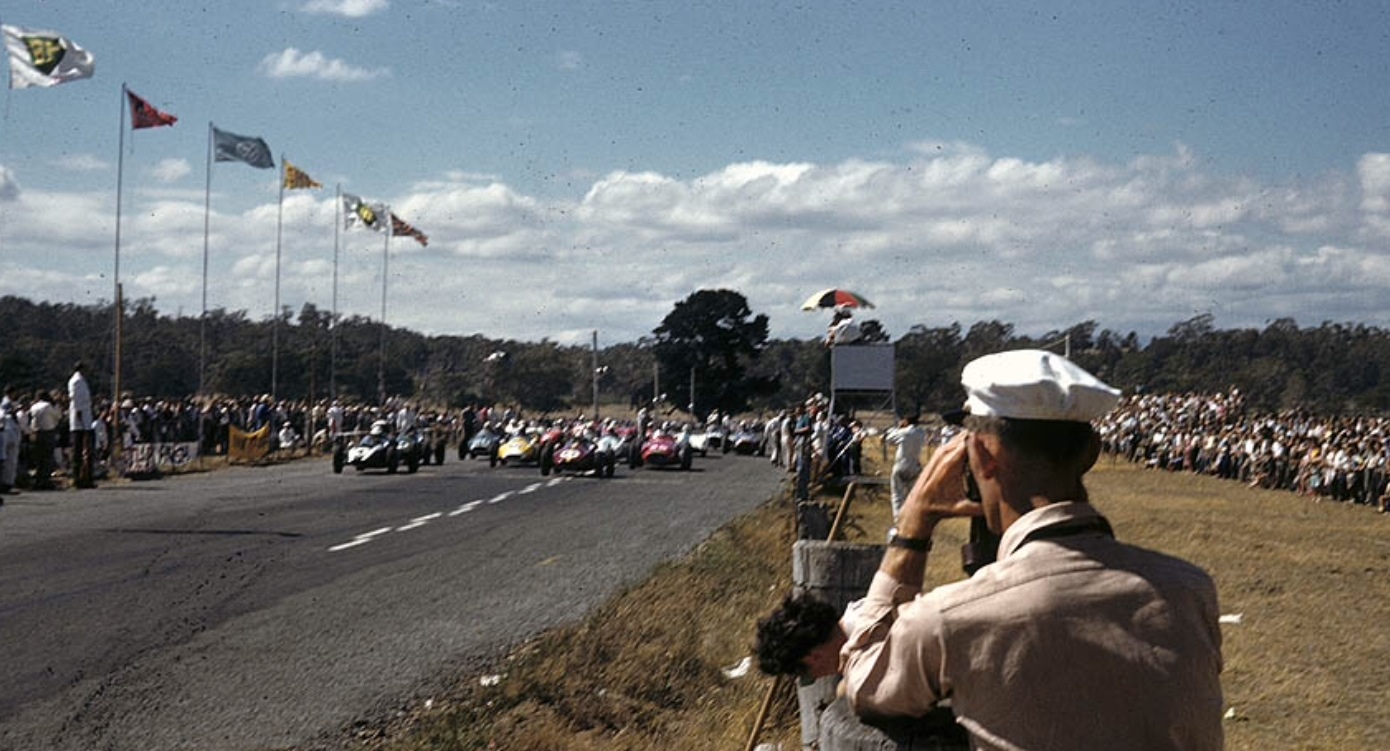
The spectators on the outside of Pit Straight enjoy the start with Frank Gardner’s Alec Mildren owned Lotus 23 Ford leading from Bib Stillwell’s Cooper Monaco, Frank Matich in the Total owned Lotus 19B Climax and Bob Jane’s superb Jag E Lwt- Matich took the win after Bib was disqualified for a push-start at the races outset.
(olracephotos)
The 1966 panorama just after the start below emphasises the flat nature of the terrain at this point and the great brown land in which we live, distinctive also is the footbridge absent in the earlier images.
That’s Clark J’s Lotus 39 Climax from Frank Gardner’s Mildren Brabham BT11A Climax and Jackie Stewart’s BRM P261 out front. Jackie took the honours that year from his teammate Graham Hill and Jack Brabham aboard BT19 Repco- the chassis with which he won the 1966 F1 Drivers and Constructors Championships. It was the third race for the Repco Brabham ‘RB620’ V8.
Ever laconic Frank Gardner said of Longford in MotorSport ‘It was over railway lines, onto a bridge with a curve in it, with well-spaced wooden railings which you could force a car through. You were coming onto a strip of oily board over a river. That was the safety procedure! It made the Nurburgring look quite safe…’
(S Dalton)
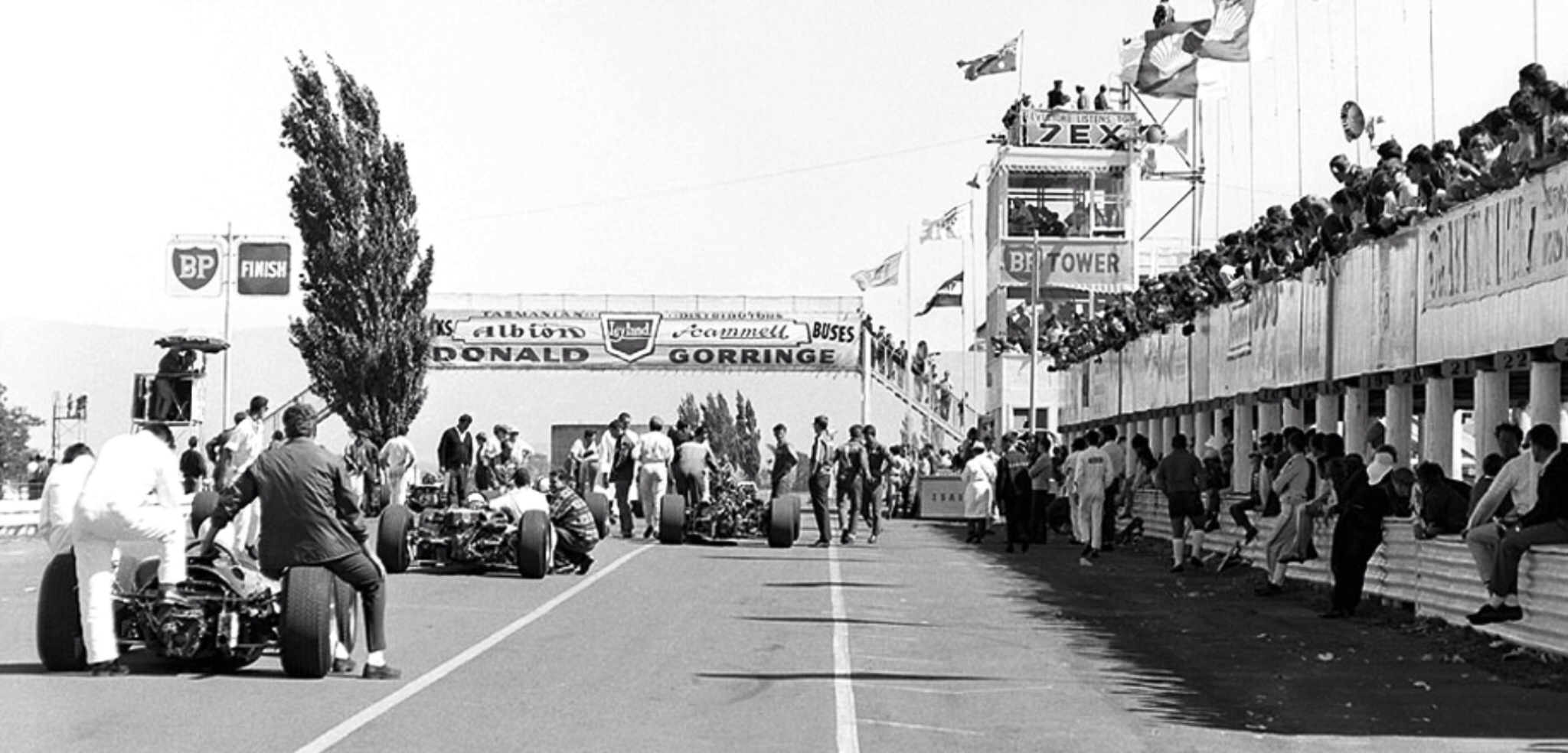
The photo below shows ‘all the fun of the Longford fair’ with the Pit Straight facility at its zenith of development with control tower, footbridge and pit building complete with prized spectator viewing facilities. Looking away from Mountford in the direction of the Water Tower and beyond. Intrigued to know the year of this shot, circa 1966.
(oldracephotos)
Despite the uniquely challenging nature of the place with its bumpy bridges, slow Viaduct Esses with tight rise beyond, its level crossing jump and pre-1965 hump it was a FAST circuit. Chris Amon set the all-time lap record at 2:12.6 seconds, 122.19 mph in his Scuderia Veloce Ferrari P4/CanAm 350 during the 1968 dry, Saturday sportscar scratch race. Average speed folks. Imagine what it felt like on the narrowish Flying Mile in that car at 178 mph in the wet!
A confluence of events conspired to bring about the circuits closure.
Ticket sales were poor in wet 1968, the circuit was only used once per year thereby limiting the return on capital investment, local environmentalists were against permanent advertsing hoardings but most critically the Grand Prix cars of the day were becoming exponentially quicker due to the 3 litre formula introduced from 1966 (fast even when raced at Tasman 2.5 litres), tyre ‘alchemy’ or polymer chemistry was giving much greater levels of grip let alone the performance impact of wings which exploded after Longford’s final 1968 meeting. In essence the cars had outgrown the track and there was not the funding to make the necessary investment to keep the track intact but safe enough for changing times.
It was such a shame, it is not too much to think that the South Pacific Trophy could have been to Tasmania what the TT still is to the Isle of Man.
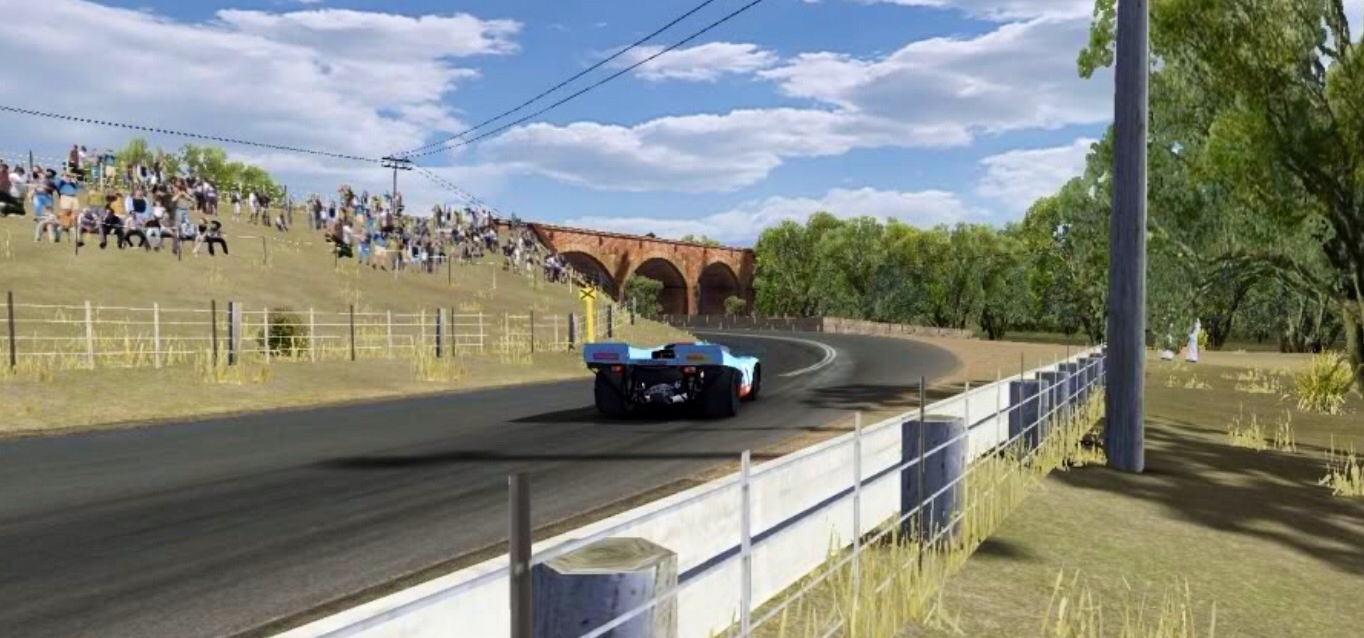
The Siffert/Redman John Wyer Porsche 917K lines up for The Viaduct during the 1970 Longford South Pacific Trophy 1000 Km. I wish!…
(woochoo)
Bibliography…
The Nostalgia Forum ‘Longford: Reims of The South Pacific’ thread-particularly the contributions of Ray Bell, The Late Barry Lake, Rob Saward, Lindsay Ross, Stephen Dalton, Ellis French, Wirra, oldracingcars.com
Photo Credits…
Lindsay Ross and his oldracephotos.com.au which provided the vast bulk of the images used in this article. I salute the work of David Keep in particular; http://oldracephotos.com/content/home/
Jim Saward, Stephen Dalton Collection, Ray Bell, Ellis French, Geoff Smedley, Rod MacKenzie, Dunstan Family Collection, Paul Geard Collection, Cox Family Collection
Etcetera…
(SCW)
Perhaps the culvert just out of The Viaduct. Mick Watt in the Prefect Ford Spl now owned by Ian Tate, mid-fifties (P Geard)
Tailpiece: Quintessential Longford 1960- Pub and Holden FJ…
(oldracephotos)
Longford was all about international racing cars and stars but equally it was motor racing mecca for Tasmanian and Australian racers with modest budgets and self prepared cars.
Endpiece: We started, and let’s finish with a Jim Saward shot at Mountford!…
(oldracephotos)
Lyn Archer’s Cooper T39 Bobtail Climax during the 1959 meeting. The shot’s composition is marvellous from the crowd involvement, the car- in the sun, just- clear of the Mountford pine’s shade and the view up the hill to the Water Tower which marks the fast right hand plunge down to The Viaduct.
Doug Cavill or perhaps Bill Reynolds races his Austin Healey 100-6 based Prad Healey at Lowood, Queensland circa 1959…
The car was a new one on me, quite a wild, fantastic looking machine, the modifications to the body were made by Jack Pryer and Clive Adams- the Prad boys in Sydney whilst the engine was breathed upon by racer/mechanic Bill Reynolds. Cavill- the Surfers Paradise ‘main drag’ Cavill Avenue was named after his father Jim Cavill- was a successful estate agent and had the readies to fund this interesting car.
Quentin Miles has been progressively uploading some photographs taken by his late father on Bob Williamson’s ‘Old Motor Racing Photographs – Australia Facebook page- check it out, this is a beauty despite the ravages of time to the negative.
Patrick Quinn wrote an article about this interesting car published in the Victorian Austin Healey Owners Club magazine ‘Hundreds and Thousands’ in 2013 which is reproduced below. The ‘restoration’ of the car is a shame, tragic really.
Etcetera…
This shot by the Salter brothers is at Lakeside circa 1961-62.
Credits…
Quentin Miles, Patrick Quinn, ‘Hundreds and Thousands’, B & N Salter
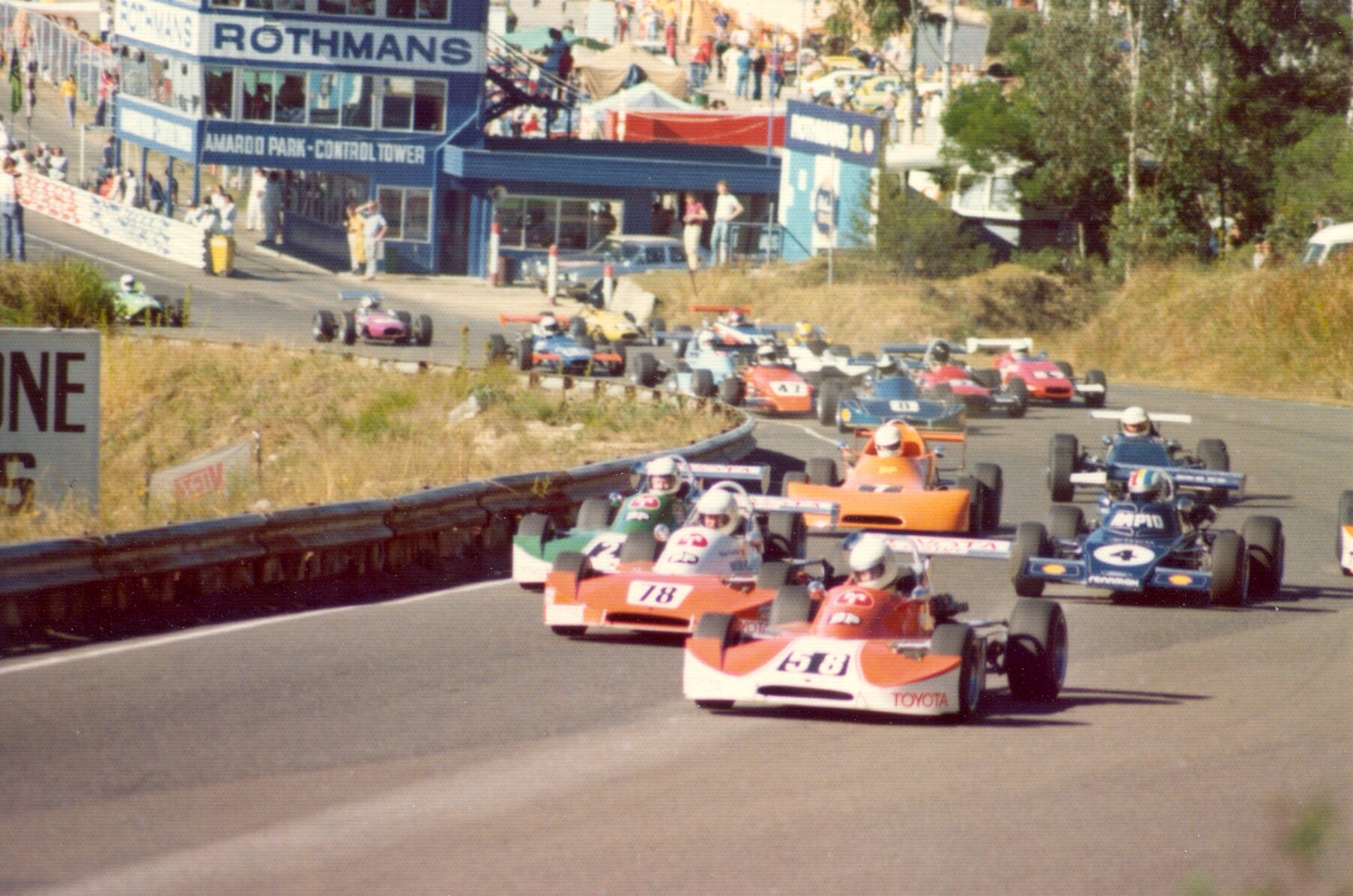
Amaroo Park, Sydney May 1976, Formula 3. The Two Brians- Shead and Sampson lead Peter Macrow, all three aboard Cheetah Mk6 Toyotas from #4 Mal Brewster, Rennmax and then David Booth in a Birrana 374 Ford, Terry Finnigan, Cheetah and the rest- Elfin 600’s, 623 etcetera…
By 1972 the classes of single-seater racing in Australia comprised the following: Australian National Formula 1- F5000 at the pinnacle through ANF2- 1600, twin-cam, 2 valve, fuel injected which effectively meant the Lotus-Ford twin-cam the ultimate expression of which were Brian Hart’s alloy, injected 205 bhp’ish 416B motors. ANF3- SOHC, 2 valve, carbs with Toyota Corolla and Kent Fords the most common but there were Datsun and a smattering of other engines too. Formula Ford and Formula Vee require no explanation.
In Gold Star rounds some F2’s help bolster skinny F5000 fields, so too did F3 run with F2- which had a national championship whilst F3 did not. Combined F3 and FF races were common at State level with FF also having a national championship- ‘The Driver To Europe Series’ with FVee always racing on their lonesome but having a one-race ‘FV Nationals’ which was a de-facto national championship- very hotly contested it was too.
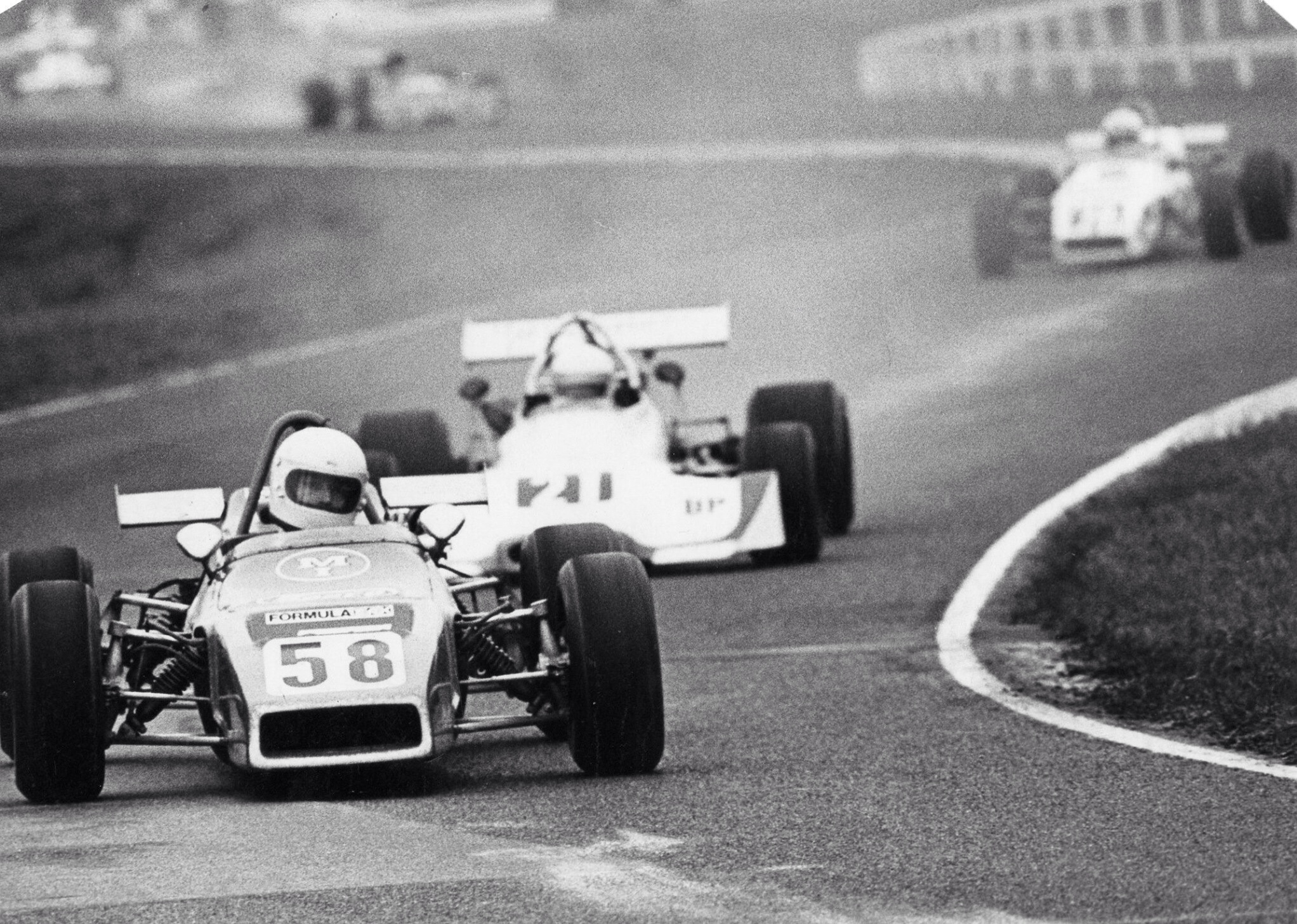
Sheady and Sambo ‘sambo: Shead and Sampson in Cheetah Mk4 Toyotas sandwich the F2 Birrana 273 Ford of Tony Stewart circa 1973 at Sandown. Mk4 the last of Shead’s spaceframe single-seaters- vestigial rear wing but no front. Maybe not the prettiest of Cheetahs but fast (B Jones)
Year in, year out the quickest F3 cars were the ‘works’ Cheetah Toyota’s fielded by the ‘Sheady and Sambo Show’- Shead built over fifty Cheetahs (F3, F2, F Pac, F Holden and Clubman) in a small workshop at Mordialloc and Sampson’s ‘Motor Improvements’ concern built the engines in the Nepean Highway, St Kilda, both southern bayside suburbs of Melbourne.
Both Shead’s Cheetah’s and Sampson’s circa 130 bhp Toyota Corolla motors were sold to customers but usually the two Brians had the answers with a combination of age and experience, finely set-up chassis’ and just a smidge more power than the customers got.
Shead and Sambo in the new, monocoque Cheetah Mk5 Toyota chased by Paul King’s Lew Wade owned Birrana 374 Toyota in the summer of 1975 at Hume Weir on the NSW/Victorian ‘Albury’ border. Who won this encounter Paul?? (B Jones)
For me the sexiest F3 machine of the period was the Birrana 374 Toyota with Paul King and Dean Hosking giving the two Brians something to think about particularly in 1974/5. The Elfin 700 was also a nice bit of kit but never did as well as the equally simple (spaceframe) Elfin 600 which preceded it, mind you the level of competition was stiffer in the mid-seventies than the late sixties.
Chassis of the F3 cars by that stage were aluminium monocoques pretty much universally with the Hewland Mk9 or Peter Holinger 5 speed ‘boxes the transmissions of choice.
I’ve no idea who won that Amaroo race but I’ve my money on one of the two Brians despite being away from home…
Credits…
Glenn Moulds, Brendan Jones Collection, Bruce Keys
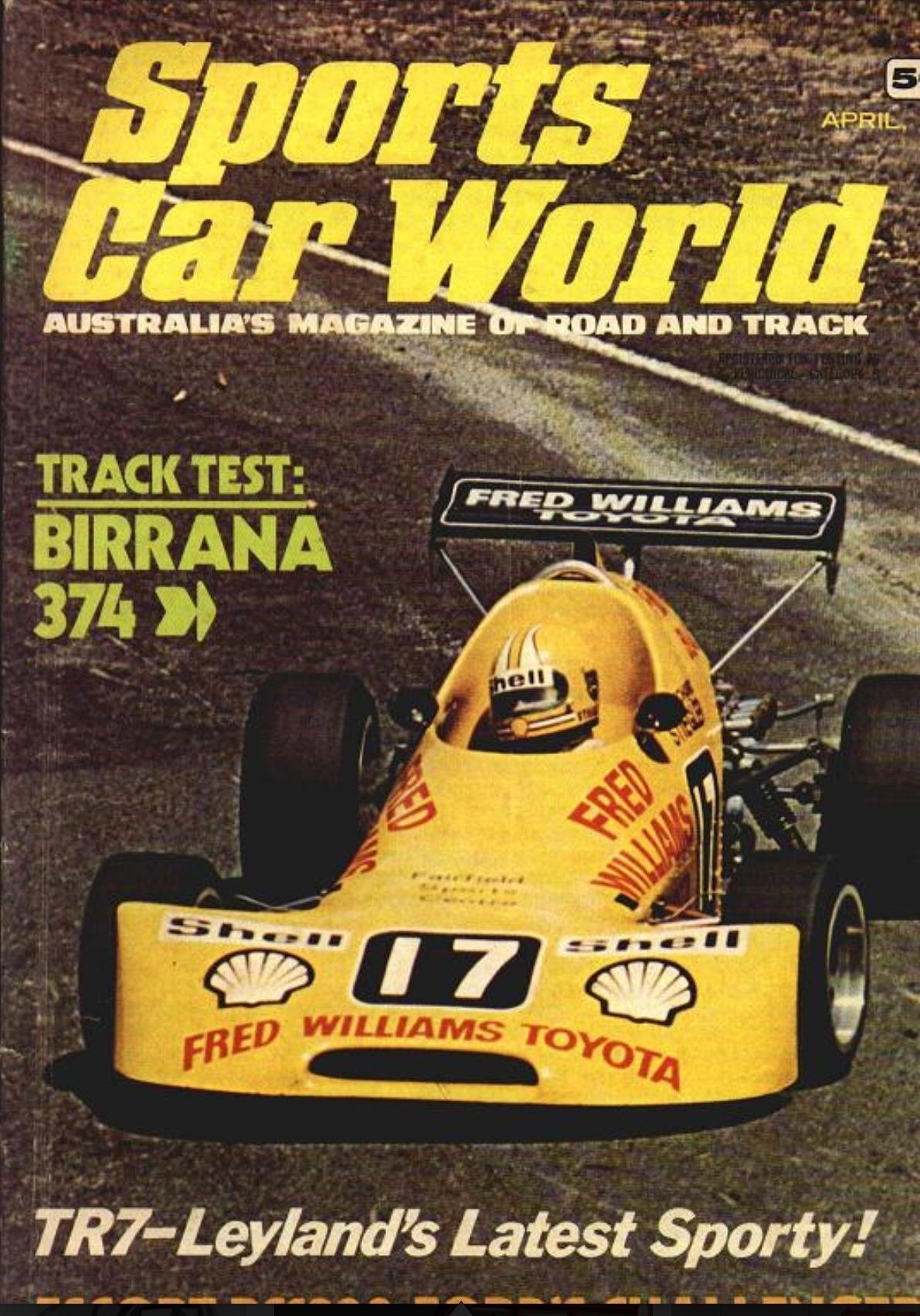
Tailpiece: Sports Car World Birrana 374 track test…
If memory serves, always dangerous, Richard Steigler’s 374 (above) was the ex-John Blanden Adelaide owned Dean Hosking driven chassis. A fellow by the name of Adrian Van Loon useter to drive and write these SCW track test articles. Mighty fine bits of communication they were to a budding teenage enthusiast too, well and truly wetted the appetite he did. Died of cancer many years ago way too young sadly.
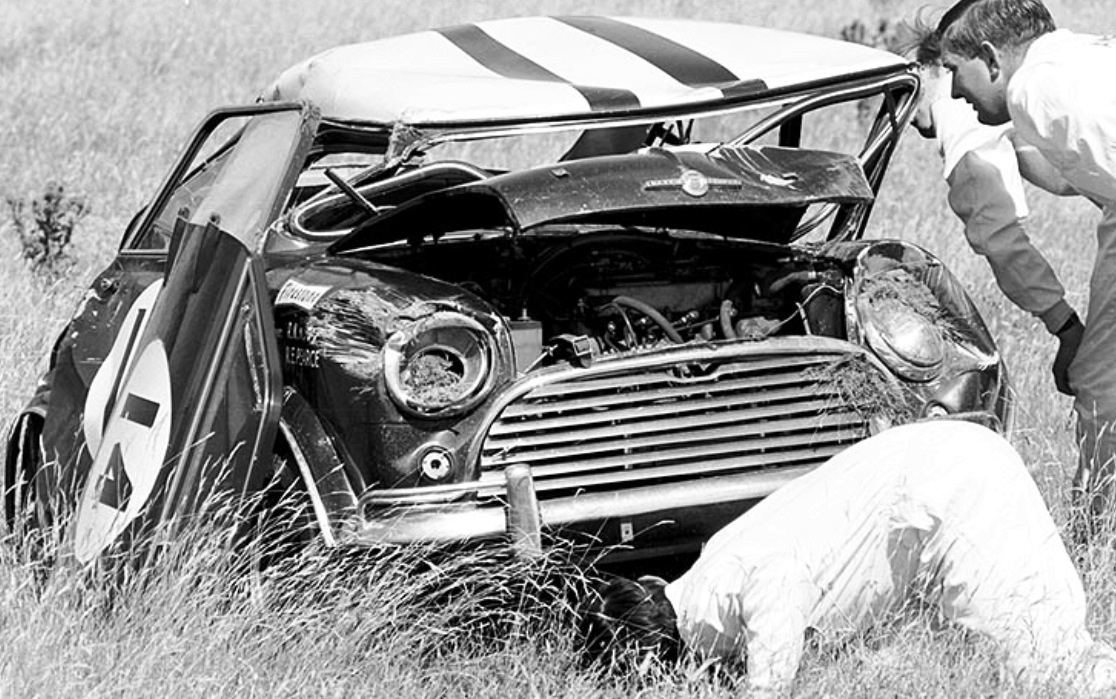
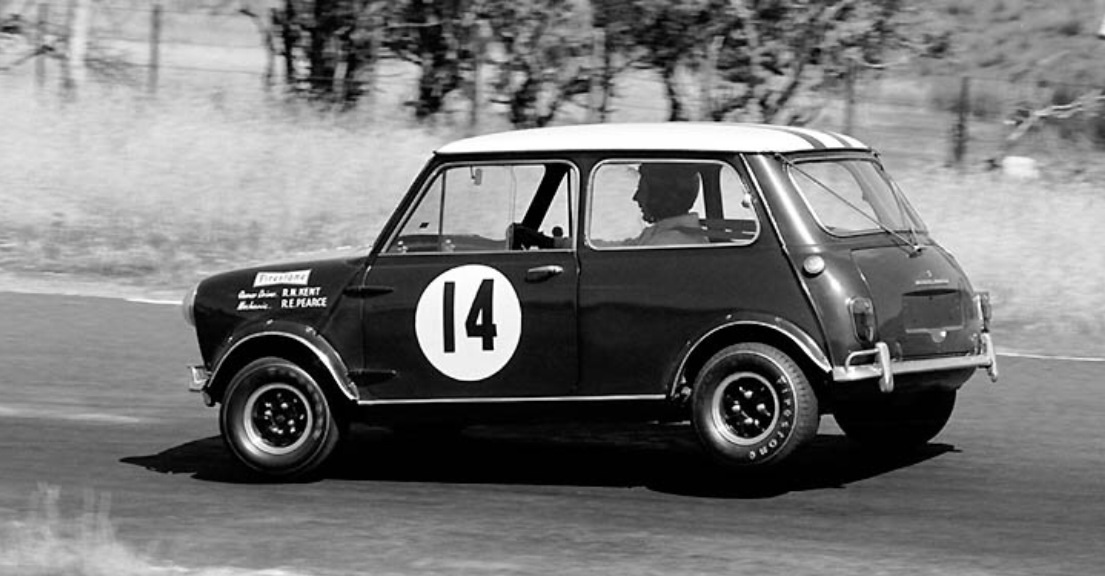
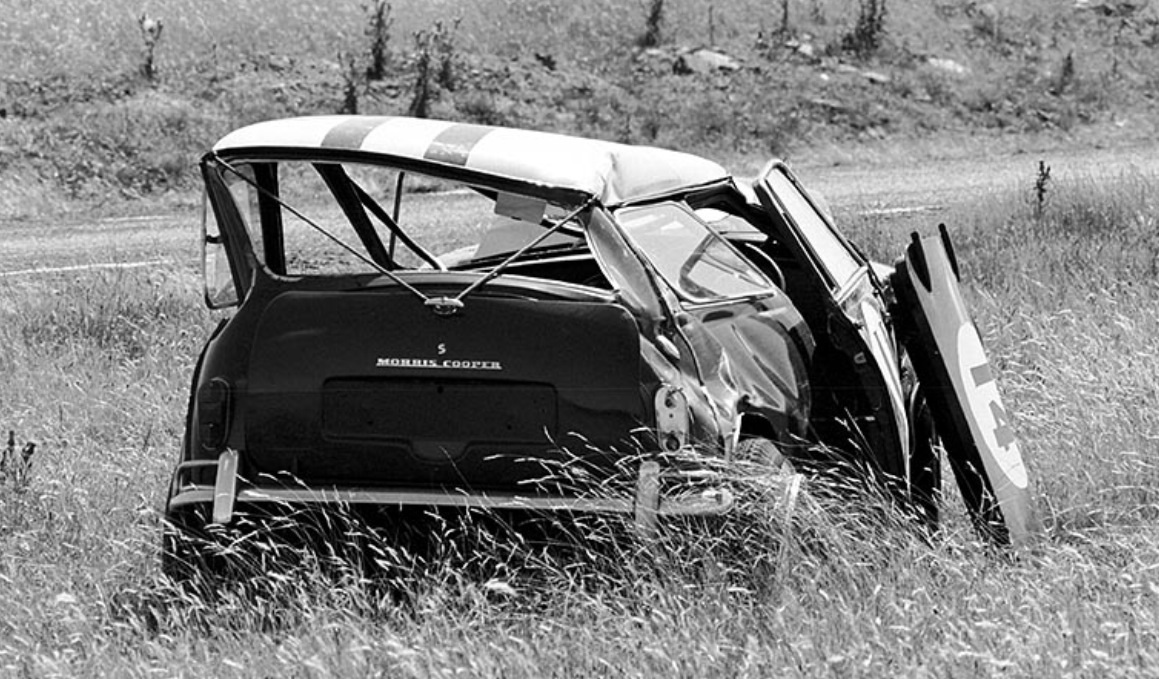
Here Bob Kent allowed Randall Bromfield to do a few practice laps of Baskerville in 1970 aboard his very tidy 1310cc Morris Cooper S, whereupon Randall ‘lost it at the bottom of the hill’.
Bigtime by the look of it.
Clearly Randall had not mastered the complex topography of that particular part of Tasmania to the required degree. The fiscal arrangements between ‘ole Randall and trusting Bob subsequent to this misunderstanding of the laws of physics remains unrecorded but it seems to me The P&O System is an eminently fair and reasonable one in circumstances such as this…
Credits…
All photos oldracephotos.com.au
Tailpiece: Daffy-Ducked ‘innit like?- it will take more than the application of Uri Geller’s talents and polish before the ‘brick is ready for its next meeting…
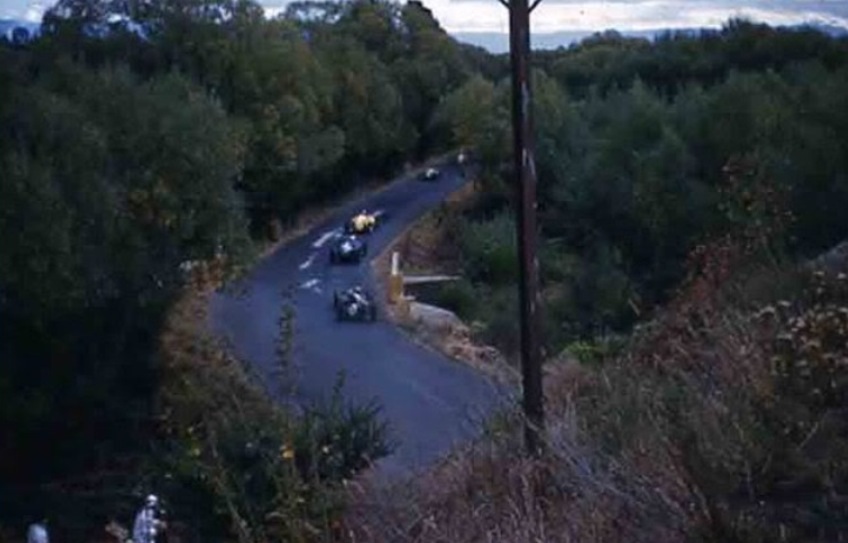
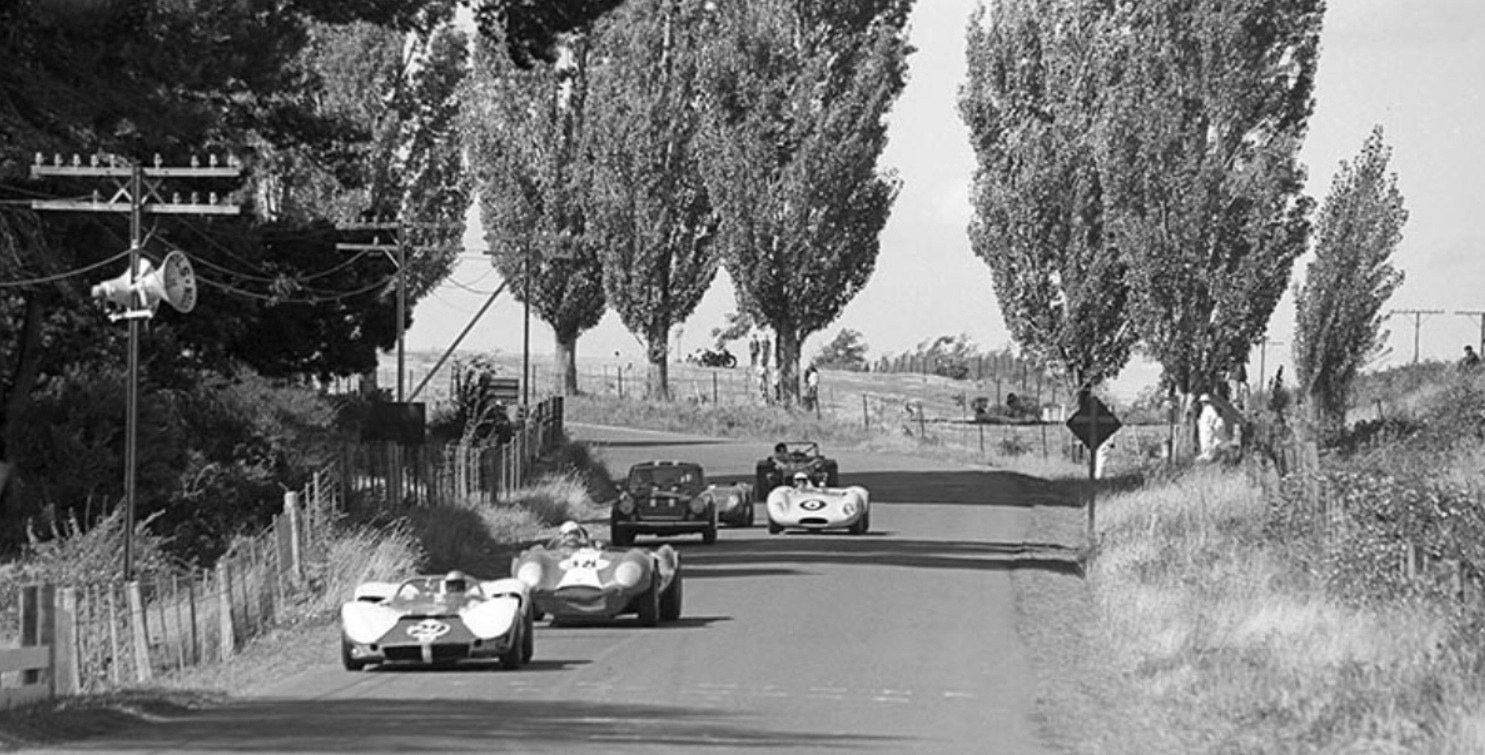
John Goss’ Tornado Ford leads a gaggle of sportscars on the drop between the Water Tower and The Viaduct, Longford, Saturday 2 March 1968…
I wrote this piece a while back and now seems a good time to post it given one of Tasmania’s finest, Gossy himself was awarded an Order of Australia for services to motor sports in last weekend-and-a-bit’s Queens Birthday Honours announcements. Off the back of that achievement Terry Sullivan started a The Nostalgia Forum thread which now contains some marvellous Goss photos, many from Lindsay Ross’ oldracephotos.com.au archive which have never seen the light of day before- check TNF out;
Back to Longford- it’s the Saturday race day, the Monday Labour Day holiday was Tasman Cup day, that year the feature race was won by Piers Courage’ McLaren M4A FVA F2 car in a notoriously wet, perilous day of motor-racing. Sadly it was the last in Longford’s relatively short but very sweet period as a road racing track. Click here for my article on the 1968 Longford Tasman;
Goss, future Bathurst and Australian Grand Prix winner is leading Kerry Cox’s Paramount Jaguar, three-times Australian Grand Prix winner Doug Whiteford’s works Datsun Fairlady, Bert Howard’s Lola Mk1 Climax, the partially obscured Lotus 23 Ford of Alan Ling and then Peter Mawdesley in a Lotus Super 7. Out front out of shot is the ex-works Scuderia Veloce Ferrari P4/350 Can Am driven by Chris Amon from Ian Cook’s Bob Jane Racing Elfin 400 Repco, Peter Macrow in the Argo Chev, Lionel Ayers MRC Ford and Glynn Scott’s Lotus 23 Ford. The opening shot shown is the second group of cars.
I wrote an article a while back about John Goss including a bit on the Tornado, click on the link to read it;
The following shot is of Gossy losing Tornado on his turn-in to The Viaduct, I wonder if its the same lap! I think not, the track looks wet, which makes it the Monday. Amon’s Ferrari was pushed off the grid with a flat battery- he started the 10 lapper with 2 laps down and finished third- and did 178 mph in the wet conditions on The Flying Mile. Peter Macrow won in Tony Osborne’s Argo Chev from Glynn Scott’s Lotus 23 Ford.
(oldracephotos/DKeep)
Credits…
David Keep/oldracephotos.com, Lindsay Ross Collection, Rob Bartholomaeus
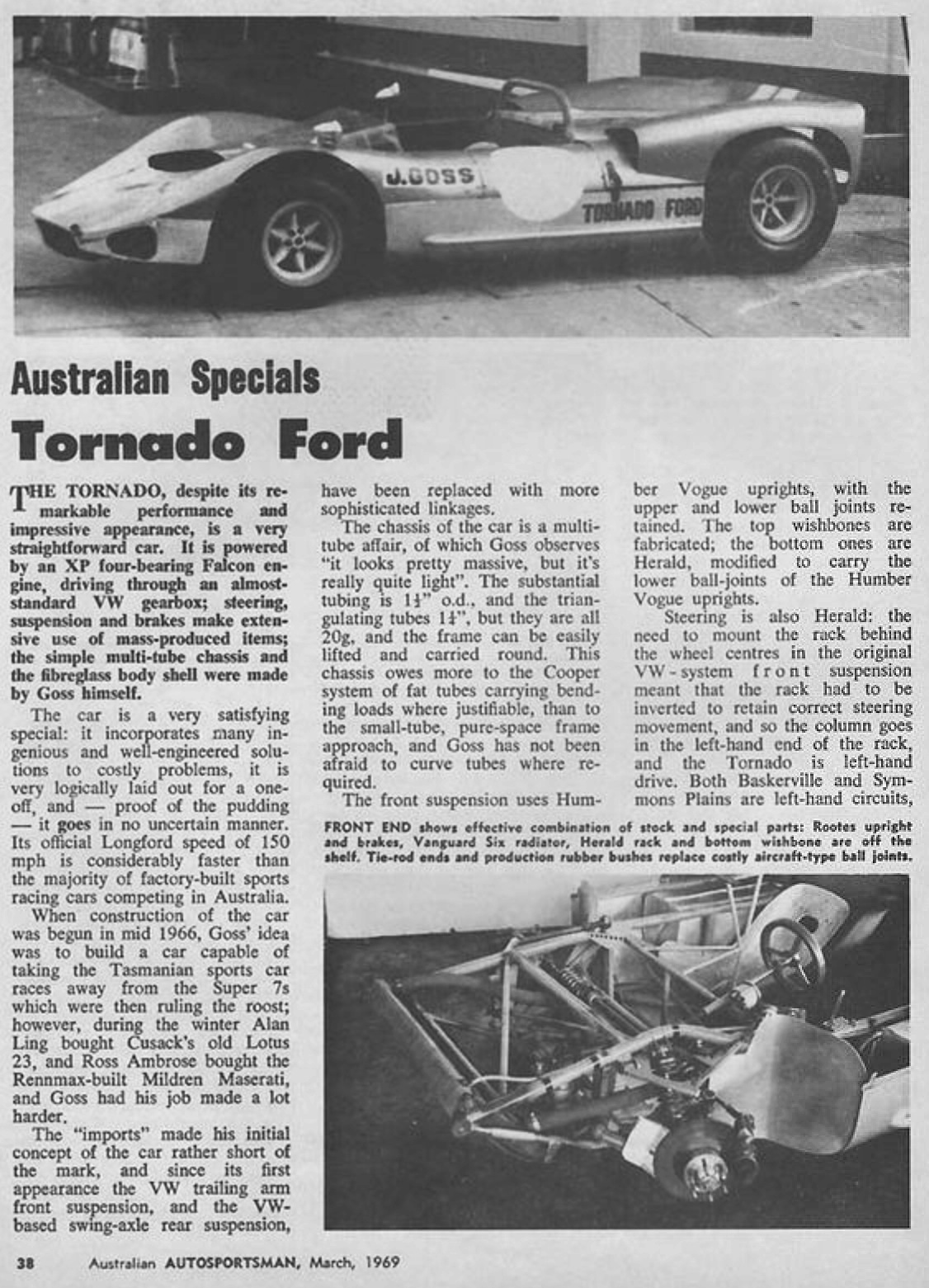
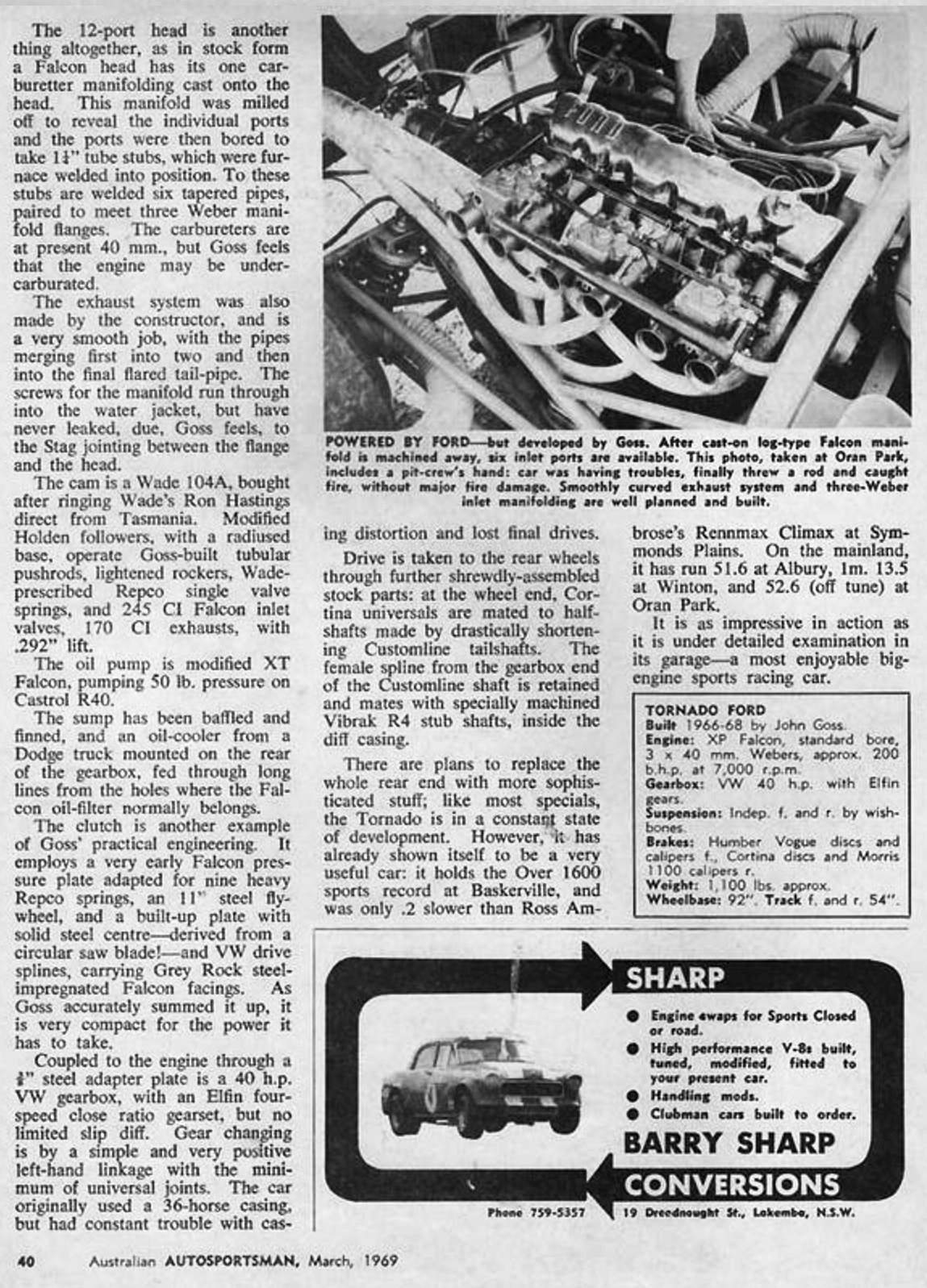
Etcetera: Autosportsman article on the Tornado Ford, courtesy Lindsay Ross’ Collection…
Tailpiece: Amon’s 480bhp Ferrari P4/Can-Am 350 monstering Gossy’s 200bhp Tornado Ford out of Newry, Longford 1968…
(oldracephotos/DKeep)
During the dry Sports Car Scratch race on the Saturday Chris won from Ian Cook in Bob Jane’s Elfin 400 Repco V8 and Peter Macrow in the Argo Chev.
Amon, awfully comfortable in the P4/CanAm 350- in addition to his Ferrari F1 commitments he raced the cars in both the 1967 endurance races and some Can Am rounds, set an all-time Longford lap record of 2:16.2 undercutting Jim Clark’s Lotus 49 Ford DFW time of 2:13.0 earlier in the day. Mighty quick. Mind you, that summer Frank Matich beat Chris’ Ferrari in the Matich SR3 Repco in the other Australian Tasman round sportscar support events. But FM did not cross Bass Straight to do Longford- sad! Those battles on that circuit would really have been something to see!
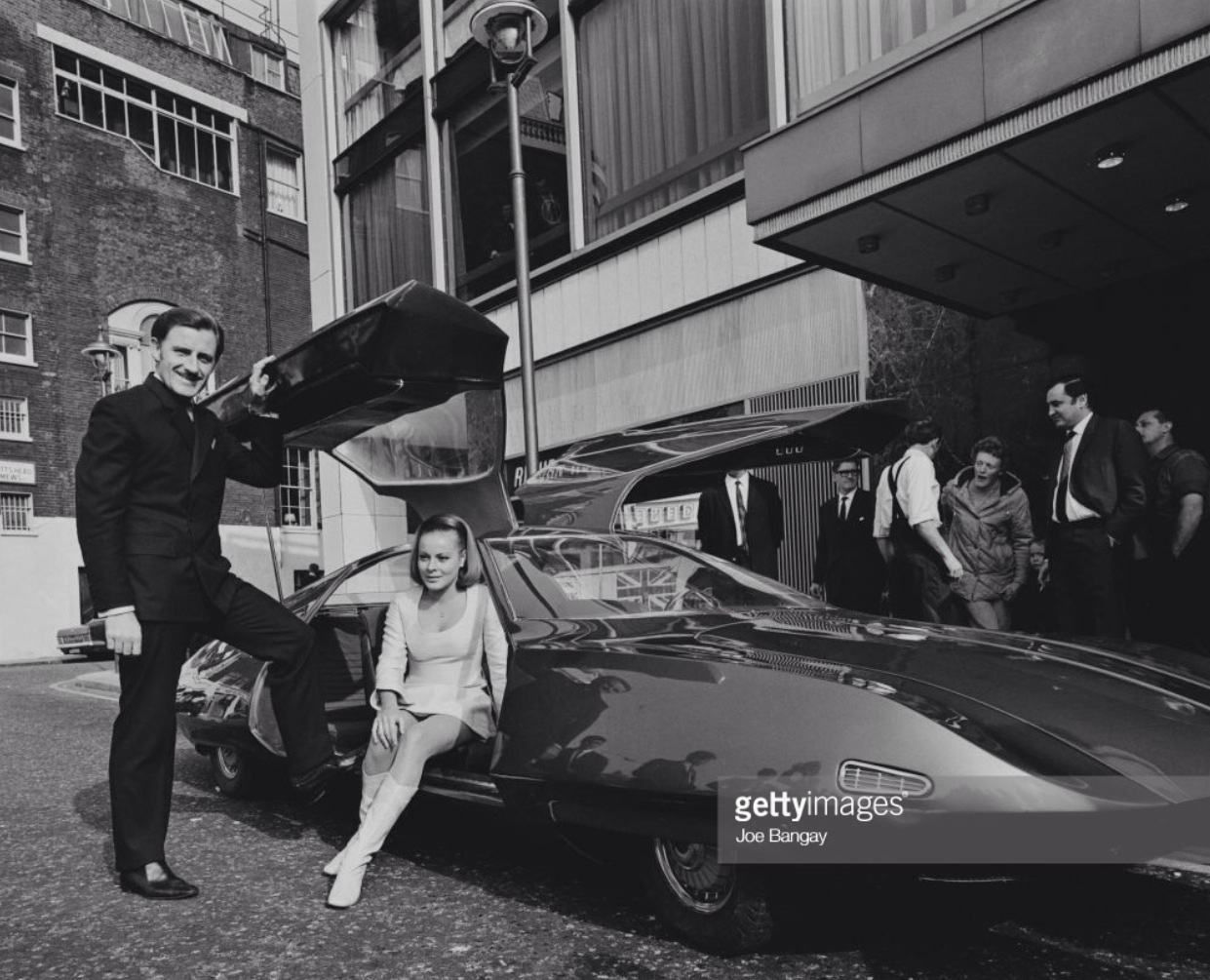
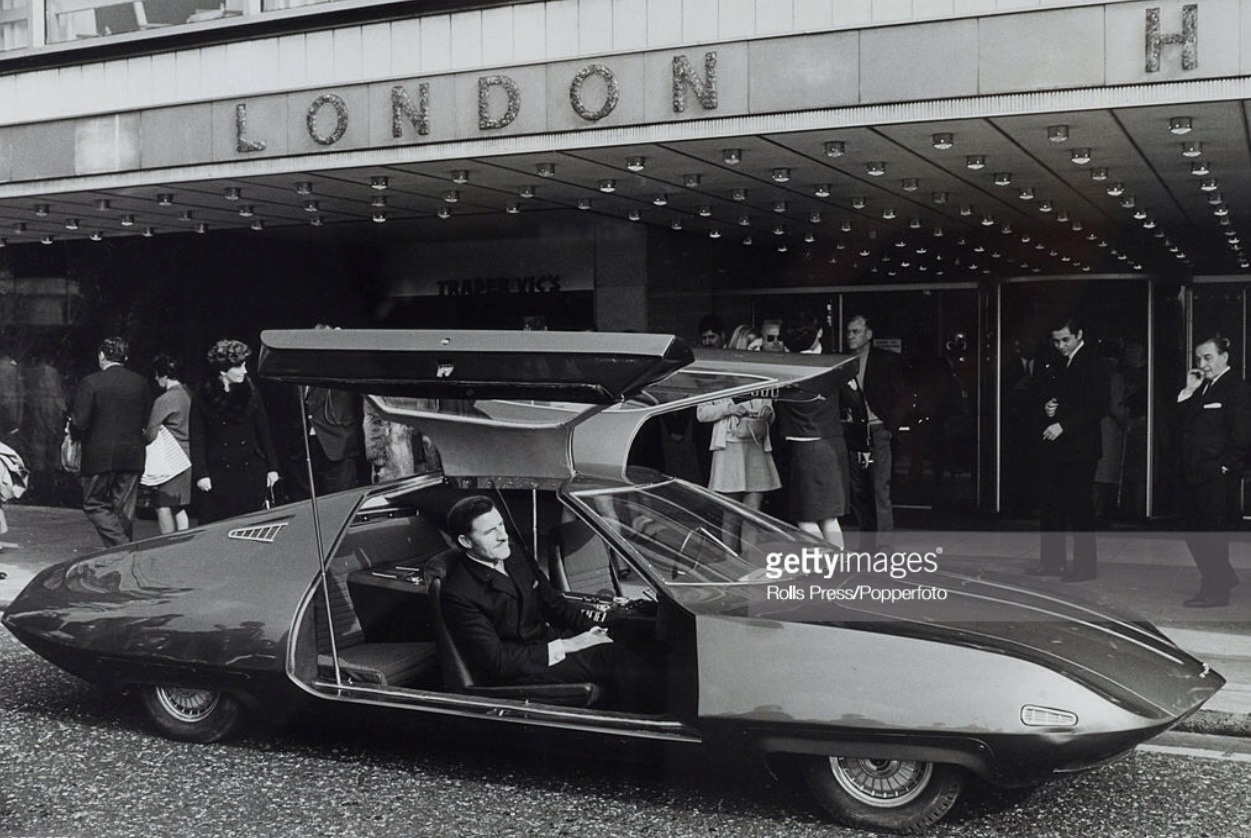
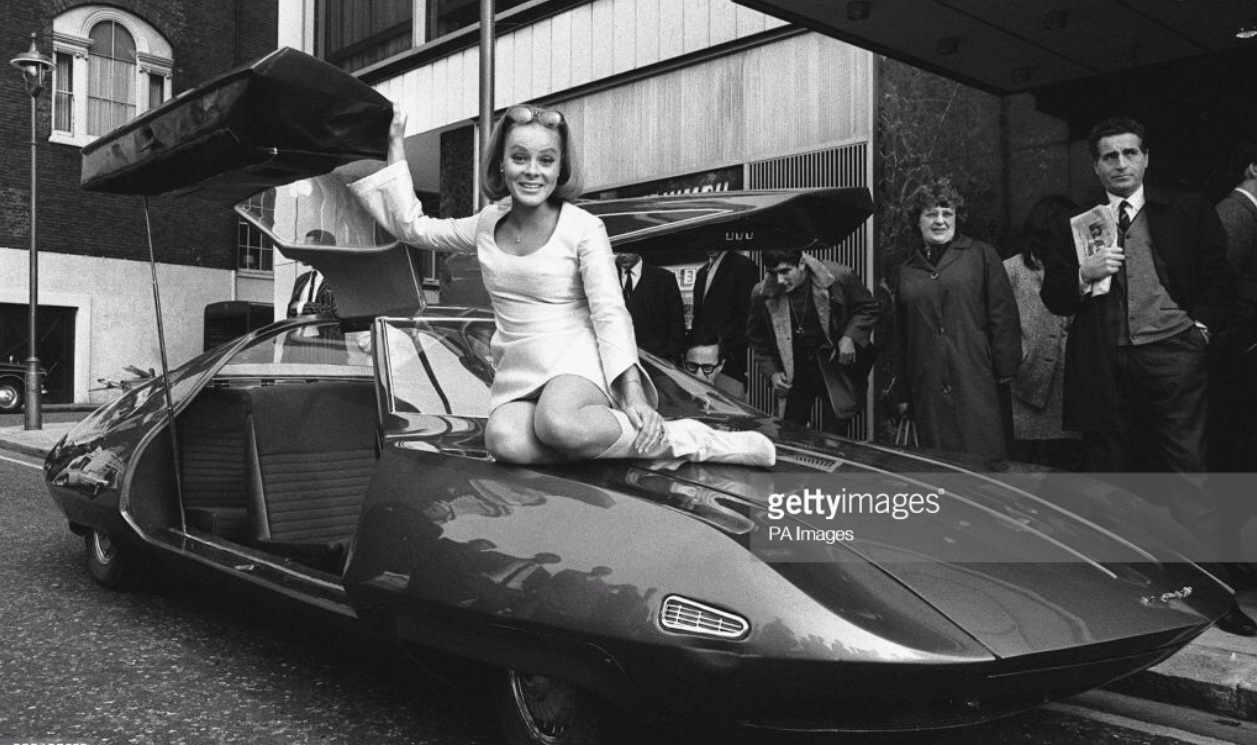
Graham Hill with his new Doppelganger, London, 10 October 1968…
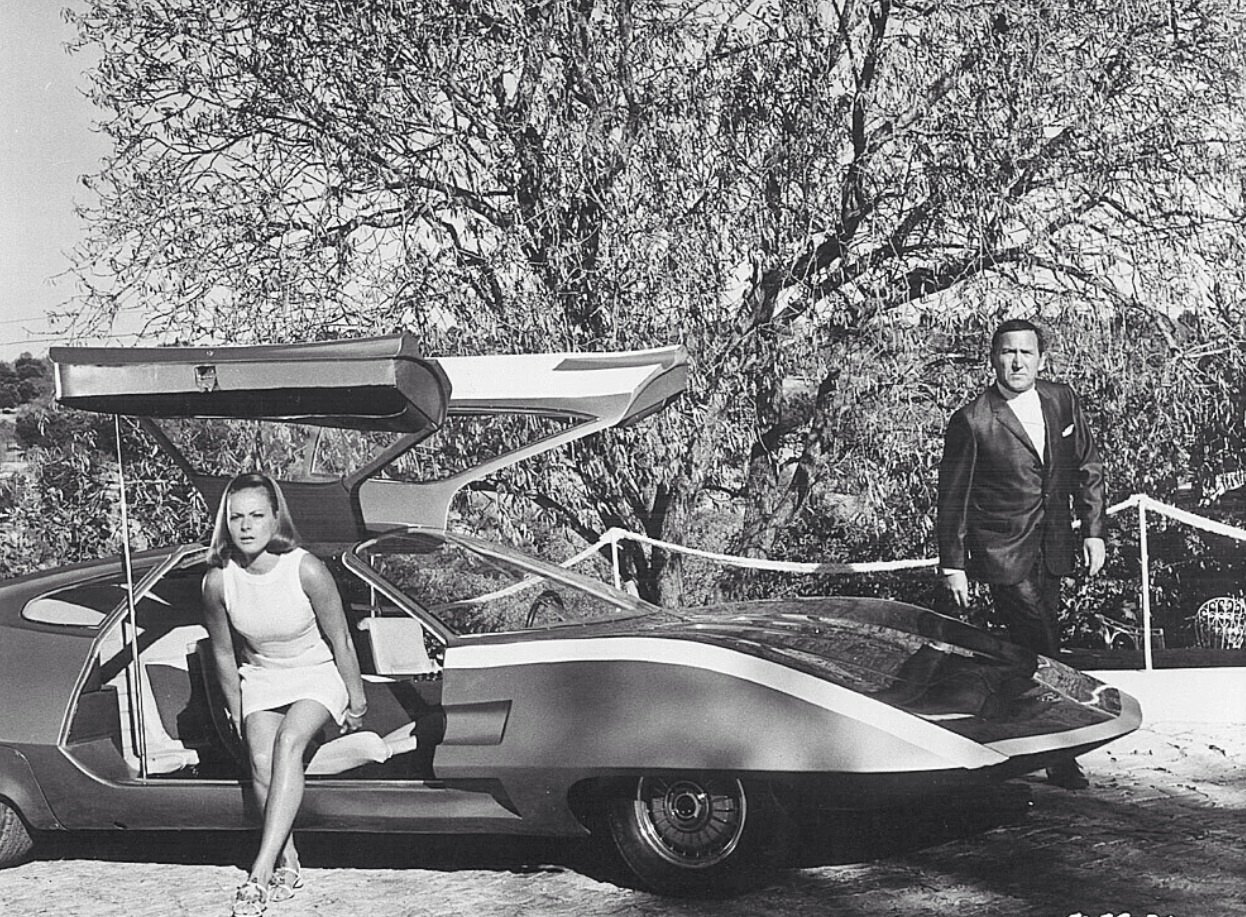
With him is Austrian actress Loni Von Friedl who appeared in ‘Doppelganger’, a movie which is the subject of this promotion, an activity which seems quite agreeable to the great Brit. The car, also a movie-star was ‘designed and built by Alan Mann Racing, has a Ford engine and chassis, is 44 inches high and is capable of 144 mph’.
The film, also called ‘Journey To The Far Side Of The Sun’ in some countries has a screenplay written by Gerry and Sylivia Anderson of ‘Thunderbirds’ and other 1960’s ‘Supermarionation’ puppet TV series fame- well known to those of us of a particular generation.
Set one-hundred years into the future, the film is about a joint European-NASA mission to investigate a planet in a parallel position to Earth and ends in disaster with the death of one of the astronauts- his colleague discovers that the planet is a mirror image of earth. Click here for some more detailed information about the movie which first screened in 1969; https://www.imdb.com/title/tt0064519/
Who gives a rats about the movie for most of us! As to the car, I can find out a little bit, Alan Mann Racing has a great website but the car does not rate a mention there so I am intrigued to know more about the detailed design.
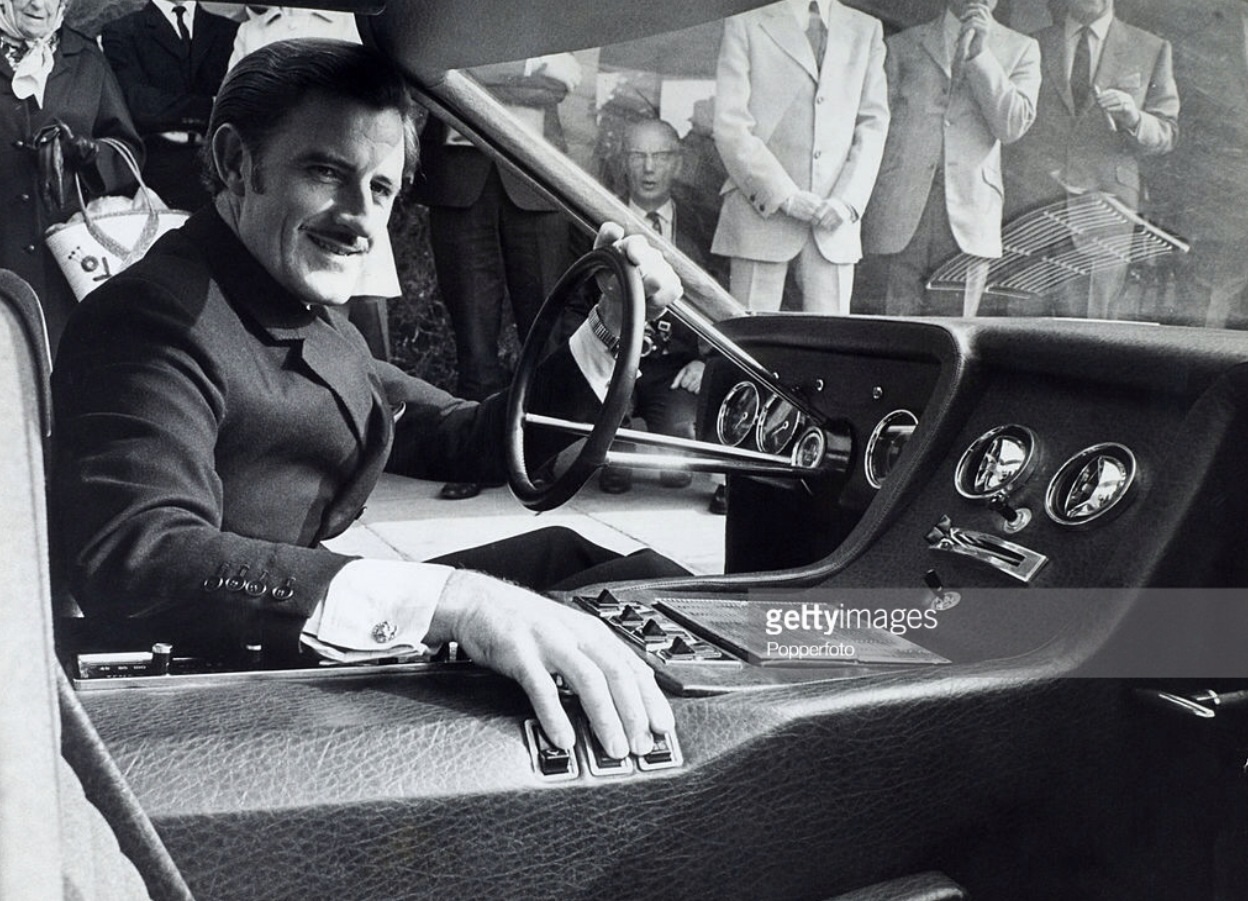
It seems the styling of the futuristic car (three were built for the film) was the work of Derek Meddings, the machines were ‘redressed slightly’ for a subsequent movie named ‘UFO’. The donor chassis was a Ford Zodiac Mk4 with the shapely aluminium body draped thereon. The gull-wing doors did not actually work, someone such as Hill G, or off camera during the movie was required to support a door.
‘The actors reported that the cars were very unpleasant to drive in, as there was not enough headroom, engine exhaust fumes spilled into the interior…and the cars were not fast, so many scenes were sped up to simulate a fast-moving vehicle’. The bones of the car still exist and will no doubt make an interesting curio at race/concours meetings when completed.
Photo and Other Credits…
PA Images/Joe Bangay Getty, projectswordtoys.BlogSpot.com
Tailpiece: Another of Doppelganger’s cars, Loni and a bloke…
One of the wonderful things about the internet is the constant appearance of material on every topic, in this case a nice batch of photos popped onto it by ‘The Adelaide Advertiser’, here they are, too good not to share.
To celebrate Campbell’s achievement the people of Adelaide turned out in droves- about 200,000 flooded the streets of the small city on 25 July to see and hear Bluebird drive up King William Street to the Adelaide Town Hall. Mind you, ‘Beatle-Mania’ hit Adelaide five weeks before when 300,000 fans of the worlds greatest supergroup flooded into the capital.
Campbell also set the World Water Speed Record in 1964, achieving 276.3 mph at Lake Dumbleyung near Perth in Bluebird K7.
Vic Elford leans his machine gun on moustachioed teammate Lucien Bianchi’s, winged Cooper T86B BRM in search of a Messerschmitt BF109, Nurburgring 1968…
This is a pretty canny bit of impromptu PR by the Cooper boys at the height (sic) of the hi-wings explosion that summer in Grand Prix racing. That trend was all over pretty quickly due to the flimsy engineering of some of the appendages, that story covered by an article I wrote a while back; https://primotipo.com/2015/07/12/wings-clipped-lotus-49-monaco-grand-prix-1969/
Cooper’s built three T86B chassis for the 1968 season by adapting the 1967 Maserati V12 engined T86 design to accept BRM’s sportscar derived customer P101 V12 first used by Bruce McLaren during the later half of the 1967 season in the back of his McLaren M5A.
Cooper T86B- aluminium/electron monocoque chassis, front suspension by top rockers, lower wishbones and inboard mounted coil spring/dampers, rear suspension by single top link, inverted lower wishbones, twin radius rods and coil spring dampers, adjustable roll bars front and rear. Outboard disc brakes front and rear, Cooper steering rack. BRM P101 2998 cc DOHC, 2 valve, Lucas injected 60 degree circa 375 bhp V12, Hewland DG300 5 speed transaxle (Bill Bennett)
The heavy, relatively lower (a Cosworth DFV punched out about 410bhp at the time) powered machines were raced initially by Brian Redman and Ludovico Scarfiotti, who was tragically killed at Rossfeld Hillclimb over the June Spa weekend. He was replaced by Lucien Bianchi, who had an amazing year in sportscars, rally machines and in single-seaters. Click here for an article in part about Lucien; https://primotipo.com/2016/03/22/cowans-grunter/
Quick Vic got the steer after Brian Redman was badly injured at Spa when his suspension failed, the car then crashed into and over a concrete barrier, his progress arrested by a parked Ford Cortina- he escaped with a broken arm and minor burns but was out of racing for a bit. Johnny Servoz-Gavin and Robin Widdows had one-off drives. Best results for the cars were thirds for Redman in Spain and Bianchi at Monaco, whilst fourth places were scored by Scarfiotti in Spain and Monaco and by Elford in France.
German GP start, gloomy to say the least! Denny Hulme’s McLaren M7A Ford in shot, to his left and forward is John Surtees Honda RA302 with Elford’s Cooper to John’s front left. Up front are Ickx and Amon’s Ferrari 312’s, Hill is to Elford’s right in the hi-winged Lotus 49 and a slow starting Stewart, Matra MS10 in front of Hulme (PH Cahier)
Vic popped his Cooper on grid 5 at the Nurburgring but left the road on the first lap of the famously wet and treacherous race won by Jackie Stewart’s Dunlop shod Matra MS10 Ford. He won by four minutes from Graham Hill’s Firestone shod Lotus 49B Ford and Jochen Rindt’s Goodyear tyred Brabham BT26 Repco a further six seconds back. Stewart was magic that day aided by some schmick, trick Dunlop wets- one of his greatest drives in the minds of many including the great man himself.
JYS during his soggy, stunning run, Matra MS10 Ford (R Schlegelmilch)
















 primotipo...